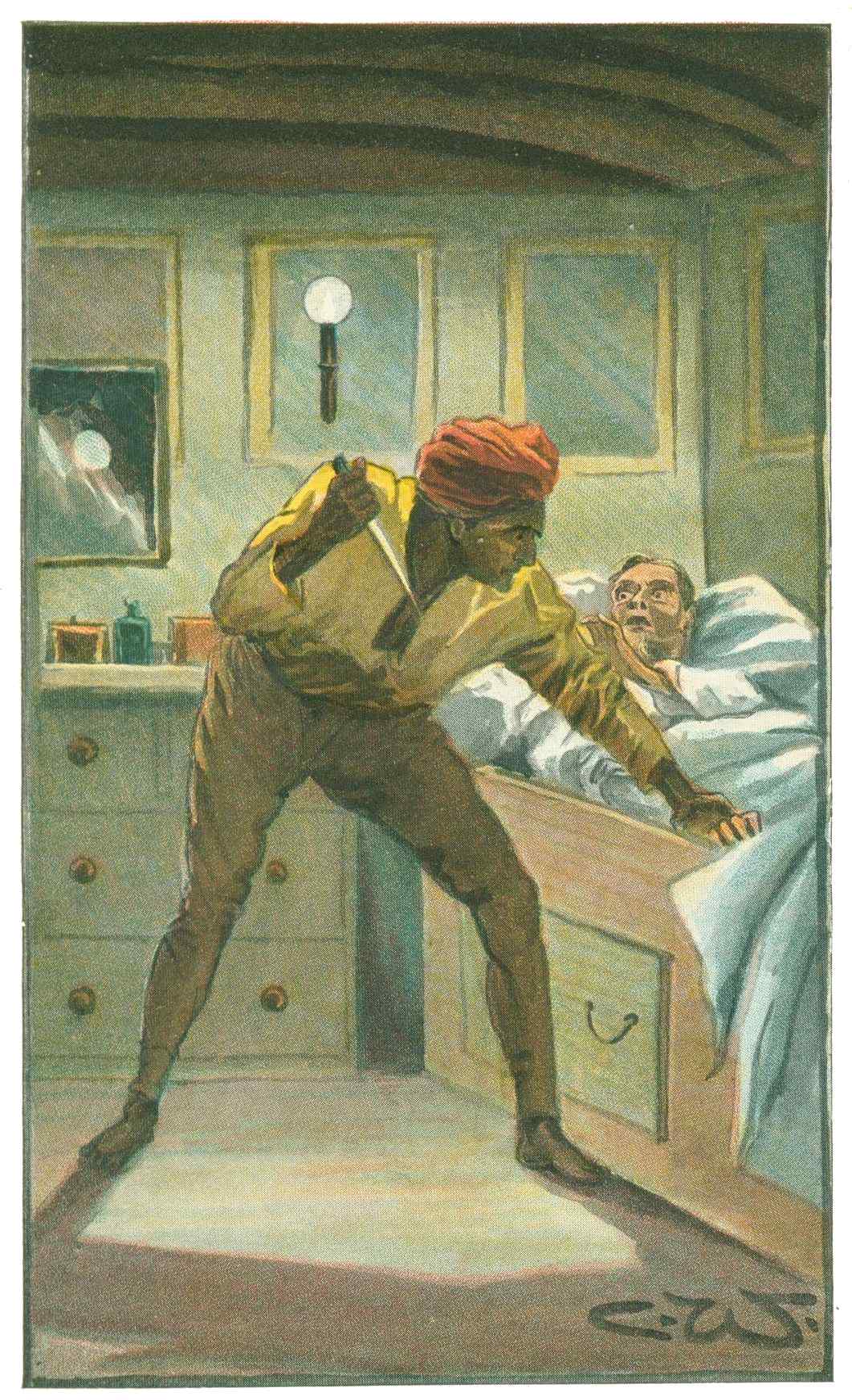
“When descends on the Atlantic
The gigantic
Storm wind of the equinox,
... in his wroth he scourges
The toiling surges,
Laden with sea-weed from the rucks.
. . . . . .
And from wrecks of ships, and drifting
Spars uplifting,
On the desolate, rainy seas—
. . . . . .
Ever drifting, drifting, drifting
On the shifting
Currents of the restless main.”
—Longfellow.
“I tell you what it is, Petersen, you’re a muff and a coward, and I
guess that is pretty plain English. What say you, maties?”
There were nine of them in all, and they sat or lay on the grass,
half-way up a beautiful mountain side that overlooks picturesque little
Jamestown, the capital of this lovely isle of the sea—St. Helena—on
which, in his lonely mansion at Longwood, Napoleon Bonaparte breathed
his last.
Yes, yonder is the town, with its snow-white houses straggling up the
bonnie glen; just beyond is the harbour or roadstead, in which, slowly
moving to the heave of the swell, are many ships from many nations. A
saucy British cruiser is there at anchor, her white ensign streaming
gaily out against the background of water. Yonder is a German, and
farther off the Stars and Stripes of a bold Yankee merchantman, and at
least a dozen others, with dark boats passing to and fro the shore, the
men singing as they bend to their work, the water dripping from their
oars, and sparkling like precious stones in the sunshine.
Beyond is the blue, blue sea itself, patched here and there with the
shadows of fleecy clouds, that float in the azure sky.
All around the glade, where the men of the Zingara are holding their
meeting, the tall cactuses are growing, with flowers of scarlet and
carmine.
The songs of the boatmen are borne up the hill, with the buzz and murmur
of the streets; but so faint and low that they sound like a gentle
lullaby, to which the boom of the waves that break on the black rocks or
beach forms a strange and dreamy bass.
Such sights, such sounds, on so sunny a day as this, might well be
supposed to lull the fiercest passions that ever dwelt in human breast.
In this case the poetry and romance of sea and shore are lost on the men
here assembled.
Alas! it cannot conquer the lust and fiendish greed of gold that inspire
this meeting.
Petersen sprang to his feet.
“Elman,” he cried, “stand up and repeat those words; stand up like a
man, and we’ll soon see who is the coward and the muff.”
But a Finn held up his hand.
He seemed to be the leader and chairman of this mutinous assembly.
“Boys,” he cried, “there shall be no fighting, no disputes. We must hold
together through thick and thin; to quarrel means to fail. Now,” he
added, “I’m a plain-spoken man. Elman, you’ve got to apologise to good
Petersen"—the Finn produced a pistol as he spoke. “You’ve got to
apologise, or we can soon arrange for you to sleep beneath the cactus.”
Elman advanced, and shook hands with Petersen, who grasped his manfully.
Then pipes were lit, and there was a lull in the conversation, broken at
last by Petersen himself.
“Men,” he said, “let us try to arrange this little affair, without
unnecessary bloodshed or violence. Antonio has been good to me; he
must be spared. Little Teenie has got round all our hearts: her life is
sacred! Is it not so, boys?”
“Yes! yes!” from all save one. He too was a Finn, of the lowest caste.
His bushy eyebrows and fiendish looks proved him to be a man who would
stick at nothing to gain an end.
He helped himself from a flask of arrack, so strong that it made even
his eyes flash and water.
“I’ve been on jobs of this sort afore,” he said, “and my motto has
always been——”
“What?” said Elman.
“A dark night, and a bloody blanket!”
Even Petersen shuddered as he heard these fearful words.
But the leader lifted his hand.
“I agree with Petersen,” he cried, “that there must be no bloodshed—if
possible.”
“And what is more,” he added, “we are strong enough to do the work
without—that is, if every man is true to his oath, and obedient to
command.”
“Bravo!” from several voices.
“We are not all here, by several,” he added. “Even Antonio would have
been suspicious had we all come on shore.”
“What about the black fellows?” said a voice.
“They are fools enough to be true to the old man.”
“Yes, if we let them.”
“Right,” said the leader. “They alone may be quietened. But, boys, the
game is worth playing. There are enough precious pearls in that ship to
make us all rich for life. Now, men, the oath.”
Every would-be mutineer stood up, and formed a circle around their
leader.
Heaven forbid I should defile my pages by describing that scene. It ill
accorded with the beauty of the day, with the sylvan scenery, with those
gorgeous banks of flowering cactus, or the sweet trilling of
bright-winged tropical birds in the thickets adjoining.
They had just got seated once again, when a merry childish voice was
heard, and next moment Teenie herself ran out from the cactus, laughing
and shouting.
She rushed straight for Peterson, and flung her arms round his neck.
“Where have you left your maid, darling?” he said.
“Oh, I just runned away from her. I is all alone. Miss Leona is in the
town.”
“Have you been in the bush long?” This from the leader.
“Bush? What is that?”
“Among the cactus, yonder.”
“Oh, quite five minutes. I was listening.”
“She must die,” said the ugly Finn. “It is for our salvation.” He spoke
in his own language, but even those who understood it not could easily
understand its meaning.
Petersen took out his knife, and laid it ominously down by his side.
“If she dies, I die,” he said, in the same language.
“Listen, dear,” he continued, turning the child’s face up towards his
own. “Tell us what you saw and heard?”
She clasped her hands in a devotional attitude.
“Oh,” she cried, “you is good good men, and I loves you all. You were
saying you’ prayers. That was all, and I not like to ’sturb you. So I
stay till you is quite finished.”
“Now then, men,” said Petersen, “are you quite satisfied? Is there a man
here who would injure a hair of this innocent head? If so, let him come
into the wood with me.”
“We are all satisfied,” cried the men. Only the auburn-haired,
fiend-faced Finn said nothing.
. . . . . .
The Zingara was once more at sea, and the wind was blowing free and
fresh. Birds from the far-off islands or shores were floating in the air
around her, and the very waves seemed to join in their wild and happy
song.
Fore and aft the decks were clean and white, not a rope’s end uncoiled,
not a trace that was not taut. Our heroes, Barclay and Davie, were
briskly walking fore and aft on the lee-side of the deck, the thoughtful
Antonio on the weather.
It was a day that would have made the heart of the veriest land-lubber
jump for joy.
And yet the officers of this ship are standing on a veritable volcano,
which may burst at any moment, though they know it not.
The mutineers have determined at all hazards to capture the Zingara,
to land the officers and others on some island, and proceed to South
America, to dispose of both ship and cargo.
But a storm of a different kind is brewing that will delay the
mutiny—for a time, at all events.
Archie Webber comes on deck and approaches the captain.
“Glass going tumbling down, sir,” he says, “and look! look! why, the
storm-clouds are banking up yonder already.”
“All hands on deck!” was the order that followed. The men came tumbling
up, eager and anxious.
“Lay aft here, lads,” shouted Antonio.
The order was instantly obeyed, though the sworn mutineers lagged a
little. Their evil consciences smote them. Oh, not with remorse! They
merely imagined that Petersen had split. The ugly Finn stood close
behind this sailor, determined that if his suspicions were correct he
should immediately plunge his knife into his back.
“Men,” cried Antonio, “there is a storm gathering, and soon to burst,
that I mean to be ready for and to fight, for the sake of the good ship
that has borne us through so many dangers and trials.”
The mutineers exchanged glances, and the evil Finn edged still nearer to
poor Petersen. His hand was on that ugly knife.
“Look to windward, lads. Hear the muttering thunder! We have twenty
minutes and no more to trim ship, for unless I am much mistaken we are
to have about the biggest thing in tornadoes that ever went whirling
over the Atlantic.
“Away aloft there, lads, and get in sail; set the storm-jib, mate, and
I’ve little doubt we shall weather it. Now, men, merrily does it. Away!”
The mutineers breathed more freely now; and right cheerily they worked.
In an incredibly short time all sails were taken in that could be done
without. The rest were close reefed.
When they came below again, the steward, honest Pandoo, was ready to
splice the main brace; and never was a glass of rum better deserved.
. . . . . .
I am not going to describe this terrible war with the elements; suffice
it to say that it was fearful, and that it ended in a gale.
The Zingara emerged therefrom, almost a total wreck.
Two masts, the mizen and the main, had gone almost by the board; there
remained of them only the jagged stumps. The fore-topsail was also
carried away, and the rudder itself was all but useless. They had been
drifted away far from their course.
The boats had been taken in-board. There were five of these altogether,
but being turned bottom upwards on the deck, they had luckily escaped
injury.
“To-night!” said or rather whispered the leader of the mutineers.
“To-night!” The word was passed round, and every one knew that the hour
had all but arrived.
By seven bells in the first watch the wind had gone down. Not a breath
of air; not a zephyr to ruffle the oily, heaving waves.
Once more the good ship was but like a log on the great waters, drifting
helplessly at the mercy of the current.
Our heroes and all aft had turned in. Even Antonio was sound asleep, and
both mates also, for the bo’s’n was now permitted to keep watch.
Barclay Stuart was awakened by an ugly dream. He started and listened.
Then his heart almost stood still. There was the sound of scuffling on
deck—the noise of a fierce fight coming aft and aft, till it raged on
the very quarter-deck.
“Down below with them!” This he knew to be the voice of that
bloodthirsty Finn, whom he had never trusted.
“Tumble the darkies overboard!”
But some one was heard interceding.
It was Petersen.
“No, no,” he cried, “spare them. No bloodshed.”
“Over they go without bloodshed. Leave the bloodshed to the sharks.”
There were shrieks for mercy now—ah! dear reader, mutiny is a fearful
thing—then the sound of heavy bodies falling into the sea told the
awful story.
In less time than it takes me to write it, every one in the saloon
cabins was astir.
They rushed to—I was going to say arms. Alas! these were all gone. They
were therefore helpless.
At the same time the good men and true had been driven below to the
saloon, into which they rushed for safety’s sake.
Several were bleeding from wounds, and one poor fellow fell dead by the
stove immediately after entering.
Then the saloon doors were closed, and barricaded outside by the
mutineers.
The ship was captured no doubt, though what the end might be no one
could even guess. Yet the prisoners in the saloon dreaded the very
worst. Had their arms not been taken away, they would have sold their
lives dearly. As it was, if the mutineers meant to murder them, it would
be a mere massacre in cold blood.
No bells were struck to-night; but the saloon clock pointed to the hour
of two. It would be over four long hours yet, then, ere the red sun
leapt up from the sea and daylight began.
Daylight? Yes, and every one seemed to feel it would be their last day
on earth.
Antonio knew well that as soon as morning broke those fiends incarnate
would commence to loot the ship—and the fate of the prisoners would be
too dreadful to contemplate.
Yet this weird little Captain Antonio did all he could to cheer every
one around him up. It was a sad task and a difficult, for the shadow of
death seemed to have settled on every heart, a gloom that kept all
silent. Even Teenie herself, who would sit nowhere but on Barclay’s
knee, was sad and fearful. Again and again she asked the boy the
question—
“What will they do, Barc? What will the bad men do to us?”
For a whole hour Miss Leona sat weeping.
At last she started to her feet and dried her tears.
“Captain Antonio,” she said quietly, “we still can pray.”
“We can,” was the solemn reply.
Miss Leona’s prayer was earnest, pleading, pathetic.
“Yet not our will but Thine be done,” she concluded. And I think he or
she is a true Christian who can pray these words from the inmost
heart. Then at her request, some of the beautiful verses from that psalm
of psalms, the twenty-third, were sung:—
“The Lord’s my Shepherd, I’ll not want.
He makes me down to lie
In pastures green: He leadeth me
The quiet waters by.
. . . . . .
Yea, though I walk in death’s dark vale,
Yet will I fear none ill:
For Thou art with me; and Thy rod
And staff me comfort still.”
. . . . . .
The only one missing in the saloon was strangely enough the fat boy
Johnnie Smart, and considerable anxiety was felt as to his fate. Surely
he too could not have joined the mutineers.
But about half-past three o’clock on that eventful night, a single low
knock was heard at the door of the saloon, and a moment after a piece of
paper was passed in under it.
It was a letter from Johnnie. Only an ill-spelt, badly written scrawl;
but it rejoiced the hearts of all inside nevertheless, and raised hopes
within them.
It was Leona who read it first.
“God has heard our prayers,” she said. “He will even yet give us the
victory.”
Then she handed the note to Antonio.
Johnnie Smart’s note ran as follows:—
“Which I is a-makin’ on ’em berlieve I’se the biggest mootineer
hout. They is now a clammerin’ for grog. Said I’d go aft and ax ye.
I goes back now to say what I knows’ll please ’em. Which I means to
save Teenie and ye all, if I can. Will let ye out when the time
comes. Keep up yer peckers, I says, says I, and trust to yours
truly,
“Johnnie Smart.”
We will follow Johnnie forward.
The mutineers, completely armed with knives and pistols, were seated in
the galley. They had been eating; now they were smoking, and talking low
together.
It was determined that as the ship was now an unmanageable hulk, they
should first seize all the gold and pearls—with as little bloodshed as
possible; then leave in two of the boats, and make their way to the
nearest island. Here it would be easy to explain that they were the only
survivors of a merchant ship—the Juno, for example—and so secure a
passage to London.
“As soon’s daylight comes in the work begins,” said the evil Finn,
feeling the edge of his knife, and smiling grimly to himself.
“Ah! here comes Johnnie,” cried Petersen.
“Now, Johnnie, what about the grog?”
“Which I never axed for it,” was the quiet reply.
“Never asked for it,” cried the leader. “Go back at once and tell them
from me, that if the rum is not at once handed out we’ll commence
shooting through the door.”
“Don’t try to fool with us,” said another fellow, “else we’ll knife you,
sure’s your name is John.”
“Ay, that will we,” from several.
“Look ’ere,” replied the boy. “Which I’se doin’ all for the best.
Listen—I knows Captain Antonio, and he is as wise and wicked as——”
He pointed with his finger downwards, instead of completing the
sentence.
“Go on,” cried Petersen.
“Mind, then, he ain’t a chap as ’ill stand much ’umbug.”
“He’s our prisoner, lad, and we’ve drawn the wasp’s sting. They haven’t
even a knife to make a flourish with.”
“Listen again,” said Johnnie. “If Antonio’s going to die, we’ve all got
to go up together.”
“Explain.”
“Which the magazine is connected with a hellectric wire. All that the
hold man’s got to do is to touch a button, and——”
The men were for a moment paralysed with terror.
“Now the reason I didn’t ax for grog like is this: he might ha’ pized
it, see!”
“Bravo! Johnnie, you’re good and wise.”
“All the same,” said the leader, “a glass all round would be precious
handy.”
“Well,” said Johnnie, his eyes getting wider than usual, “I could tell
ye how to get it. But that beast Shenkoff, he torked about knifin’ I.
I’se got a knife too, and——”
“Bah!” cried the leader, “he didn’t mean it. Shenkoff, if you’re going
to make yourself so darned disagreeable, we’ll have to do without you.
That’s a fair warning. Now, Johnnie, how are we to get the rum?”
Johnnie sheathed his knife.
Then he held back his head, and laughed in the old way.
“As simple as sinning,” he replied.
“Stop a minute,” he added.
Aft he went, and returned shortly with three sharp adzes and two saws.
“D’ye catch on, men?” he asked.
“No, Johnnie, no.”
“Take off your boots, and follow Johnnie. Just three on ye—no more.”
He handed an adze to each; he himself carried a saw.
As soon as they were on deck under the stars, and a bright scimitar of a
moon, that silvered all the calm and heaving sea, Johnnie whispered to
his followers—
“We scuppers the deck right over the store-room. Down we goes, and
there’s the rum.”
. . . . . .
Those below heard with fear and trembling the blows and thuds on the
upper deck abaft the saloon.
“They’re scuppering the deck to descend to the spirit-room,” said Archie
the mate.
“Heaven be praised!” cried Antonio, “even in that there is a ray of
hope.”
In less than ten minutes a hole had been made through the upper deck. A
candle was lit, and down went one of the men. Shortly after, the door
leading to the saloon was barricaded. Then first one huge black jack,
and then another, was hauled up.
These were coolly emptied into a bucket, another bucket was filled, and
once more the men went forward.
. . . . . .
Just an hour after this, the prisoners could tell that the rum was doing
its work. Maudlin songs, and the sound of revelry, rose higher and
higher.
But there was no quarrelling.
These sounds, however, died gradually away, and by three bells in the
morning watch not a sound was to be heard in the ship.
Twenty long weary minutes passed by; each minute seemed an hour.
At last, at last!
The fastenings were being undone, and the door was opened.
It was Johnnie, sure enough.
But before he could enter or even speak, he had to hold back his head
several times, his eyes taking refuge behind his fat cheeks, and laugh
low to himself.
“All drunk as biled owls,” said the fat boy at last, “and a-sleepin’,
jist like babes as ever was.”
Then he handed Antonio a basket: seven loaded revolvers and as many
daggers lay within.
“We are saved,” cried Leona. “Heaven has heard our humble prayers.”
“Mi’d you’d better look main sharp,” said Johnnie, “and not shout t’ll
you’se clear o’ the wood.”
But he told Antonio that every mutineer was disarmed, and that all that
was required now was to batten down the deck before they should awake.
The noise inseparable from this, however, did awaken the drunken men.
They were like a hive of hornets.
“Stand down,” roared Antonio. “The first head that pops up above the
ladder will have a bullet through it.”
The mutineers held back.
“Who is the traitor?” cried the evil Finn. “’Tis you, Petersen! You!
Have that!”
There was the sound of a horrid blow delivered with some blunt
instrument, then for a moment all was still.
“Now,” continued Antonio, “I have to inform you that the tables are
turned. Better go to sleep till eight bells. Then I’ll shoot a few of
you, to encourage the others.”
. . . . . .
The sun rose soon. Every wave caught up its rosy light; and even far in
the west, the clouds that erst were grey and purple, were now ablaze
with crimson and fiery gold.
And now, with the assistance of two of the black men who had escaped
death, the largest boat was got out and swung overboard, a bagful of
biscuits and a small cask of water was placed in the bows, and the boat
was then lowered to the sea.
An armed guard was next formed around the hatchway, and the battenings
at once cast off.
“One at a time now, men. No arms of any sort. Not even a chunk of wood.”
“Archie and Barclay Stuart, you will see the men into the boats. Keep
the pistol to their heads, and shoot the first man that even looks
defiant.”
“Ay, ay, sir,” from the mate and our hero. But the mutineers were
stupid, heavy-headed, and thoroughly cowed.
All but two came up, and were allowed to descend to the boat.
“Davie Drake,” said Antonio now, “you go aft and look after Miss Leona
and Teenie. On no account let them come forward.”
“Now then, Shenkoff and Matteo” (this was the leader), “on deck, and be
quick about it.”
They came slowly, fearfully up, and were immediately seized and bound.
A brief court-martial was held, and they were condemned to die.
The faces of these two villains, as they stood on the fo’c’s’le head,
were pale and haggard.
Right well they knew their hour had come. There was no relenting in
Antonio’s face, no mercy there, but justice—stern, determined.
“Busy yourselves now, lads,” the captain said to the two blacks.
They did; the fore-yard was squared, a block and tackle—a long rope
with a noose on the end—was rigged at each point.
Then down came the blacks, and slipped the nooses over the necks of the
condemned men.
“I will give you five minutes,” said Antonio, “to pray.”
Whether those murder-stained villains prayed or not may never be known.
We do know, however, that the thief on the cross was forgiven, and
that—
“As long’s the lamp holds on to burn,
The greatest sinner may return.”
And now the captain fired a pistol in the air, and the black men did
their duty.
In a few minutes all was over. The murderers were lowered.
Two sullen plashes were heard as their bodies were thrown into the sea,
where they floated a moment, then slowly sank.
The boat was next ordered to cast off. Not a word more was said on
either side, and by ten o’clock the cutter had disappeared beneath the
eastern horizon.
The mutiny was at an end.
That same forenoon, the bodies of Petersen and the poor fellow who had
sunk to death beside the stove, were sewn in hammocks with shot at their
feet, and laid aft on a grating.
Few and short were the prayers that were said; but the bodies were
committed to the deep. As Antonio spoke the last words the grating was
tilted; two solemn booming plashes, and all was over.
Their souls were commended to the God who gave them.
. . . . . .
There were tears in the captain’s eyes as he turned away, and both
Barclay and Davie were greatly affected.
“Heigh-ho!” said Antonio, “I could have trusted Petersen with anything.”
Then he dashed his hand across his eyes, and was himself again once
more.
There were still left on board the Zingara enough hands to work the
ship. From captain to Kroo-boys, as the darkies were called, there were
just seventeen all told, leaving out of count Miss Leona and sweet wee
Teenie.
Bitter were the tears the little lass shed when she heard that the evil
men had killed poor Petersen.
“There is some good in that man whom children love, sir, I think,” said
Archie.
“As true a word as e’er was spoken,” replied Antonio.
“And now, mate, we must see to ourselves. Davie must take the
boatswain’s watch.”
“Poor faithful fellow, no doubt he was the first man slain!”
“But, sir, where may we not drift to? We are but a wreck; we haven’t a
spare spar to rig a jury main or mizen mast, and the rudder is useless.”
“The rudder we must try to unship,” said Antonio, “hoist on deck, and
see to.”
“That will be an all but impossible task, for we have no mizen to reeve
block and tackle to.”
And so it proved.
They were, indeed, little more than a helpless floating wreck.
The Zingara was drifting northwards, her latitude about 22° north, and
western longitude about 30°.
An attempt was made for several days to steer the vessel by means of
boats ahead. This was hard work; yet it might have been successful, and
they might have eventually found themselves in the track of ships, had a
breeze sprung up.
They appeared, however, to be in a region of calms.
In very truth, they were drifting into that great ocean backwater, the
Sargasso Sea, which I speak of in my Preface.
The Sea of Sargasso might be described as a kind of meadow-land of
floating weeds, as large at times as half Europe, but often divided into
canals that are continually opening and closing.
It lies midway in the Atlantic, but well out of the track of ocean
steamers, except when it shifts its position to north or south. Latitude
might be from 20° to 30°; longitude from 25° to 50°.
Until the unfortunate Zingara drifted helplessly into this great lone
sea of weed, little was really known of it and its strange inhabitants.
Long, long ago the ships of Columbus passed through some outlying
streams of this wonderful Gulf weed, and when they did so his
superstitious sailors began to murmur, and beseech the intrepid
explorer to put back, “for,” they said, “God Himself is showing His
displeasure at your foolhardiness.”
But Columbus had but one motto, and that was, “Advance!”
Many and many a good ship has been entombed in this wondrous sea of
weeds, and never got free till one by one the crew died, and there came
to them that freedom which comes to us all sooner or later.
I had, when beginning this chapter, thought of describing the course of
the great Gulf Stream, which, starting from Africa, sweeps across
towards Brazil and the Gulf of Mexico; then north, and away to
Newfoundland; then on and east to Northern Europe, past our own coasts
here, and southward, to Africa, once again. But I need be no more
explicit. In a story one cares little for unnecessary lectures on the
science of geography or anything else.
Suffice it to say that the region of almost perpetual calms and Sea of
Sargasso lies in the centre of the sweeping circle of the second branch
of the Gulf Stream.
It is said to be a smooth and almost motionless basin; but, as will be
seen, our heroes did not always find it so.
One day a man at the foretop masthead shouted—
“Sea of dark water right ahead, sir.”
Antonio and the first mate both went up to have a look.
“That is the terrible Sea of Sargasso,” said Antonio. “God alone can
help us if we get ingulfed in that.”
Boats were had out now, and all the afternoon struggled to keep the ship
away.
But thickest darkness fell, and the boats were hoisted.
They would resume their efforts next day. No sooner, however, did the
sun appear than, to their horror, they found the thick, dark sea of
weeds closing rapidly in all around them.
The explanation is easy; they had drifted far into a huge gulf or bay,
and the horns thereof had now closed up behind them.
“Who enters here leaves hope behind.”
This they well might have said, for by noon there was no blue water to
be seen even from the masthead, nothing but the brown-black sea, close
aboard of them the dark trailing weeds, lifting their folds on the water
till it seemed a veritable ocean of great sea-snakes.
It was probably the first time since sailing away from Merrie England
that our heroes had seen Captain Antonio dull and depressed. He retired
to his cabin complaining of not feeling over well, and remained there
alone for three long hours.
Then while still dozing a soft little hand was laid in his, and a sweet
girlish voice said sympathisingly—
“’Tonio, ’Tonio, you isn’t ill, is you?”
He roused himself at once, and smiled as he patted her hand.
He had given way for a time to a depression that was almost selfish; but
now he remembered that he was the centre, as it were, of all the life on
board, and had duties to perform, which he determined not to shirk.
“Oh, dearie,” he replied, “I had a little bit of a headache, you know,
but it is better now.”
“Wait!” cried Teenie.
She went off at the run, but by-and-by returned, walking rather
unsteadily, because she bore in her two hands a large cup of fragrant
tea.
“Oh, thank you, Teenie. I’m so pleased.”
He drank the tea, and in another hour walked into the saloon, to all
outward appearance his own old self again.
“Glad indeed to see you, sir,” cried Barclay.
“And so we all are,” said Archie the mate. “You feel better?”
“Oh yes. Presently I will sing and play to you as usual.”
“What have you done, mate?”
“Oh, I’ve taken in the jib, and just clewed up, you know. Perhaps,
though, our imprisonment in this terrible sea will not be for many
weeks.”
Antonio smiled somewhat sadly, but replied, “Mate, we are not going to
despair, come what may. Despair never did any good.”
“Besides, I have already discovered,” said Archie, “that we are still
drifting, although sometimes our bows are pointing to the nor’ard and
sometimes broadside or stern.”
“Have you taken soundings?”
“Yes, and the water is of no great depth. It ranges from seventeen to
twenty fathoms.”
“Good! and now let us try to be cheery. To-morrow we will muster by open
list, and also survey our stores.”
“Teenie, dearie,” he cried.
Teenie came running at his call.
“You don’t like storms, do you?”
“Oh no, ’Tonio; I don’t like the sea when it wobbles and splashes too
much, you know.”
“Well, dearie, here in this dark weedy ocean there will be no wobbling
and never a splash, and you shall catch fish all day if you like, and be
as happy as a dickie-bird.”
“Oh, that will be jolly. Won’t it, Barclay?
“Perfectly jolly!” laughed our young hero.
There was a good quarter of an hour’s silence after this.
Everybody appeared to be thinking except Teenie, who was making love to
Muffie the cat and talking low to her.
“I say, sir,” said Barclay Stuart at last, “we have resolved ourselves
into a kind of Quaker’s meeting, but it would be interesting to know
what we’ve been all thinking about.”
“Well, you begin,” said Antonio, smiling.
“I’ve been thinking that we’ll have a real good quiet time of it for
six months in this strange sea, and that Davie Drake and I will by that
time be fit to pass our exams for chief officers as soon as we get back
to Merrie England.”
“And I’ve been thinking,” said Davie, “about our dear old home at
Fisherton. What a long, long time it seems since we left!”
“Oh,” said Barclay, “I haven’t forgotten my mother and Phœbe, and the
letters we got at the Cape telling us how well they were gave me such
joy.
“But ah!” he added, “if we are detained long here they may give up hope,
and the grief may kill my dear, kind mother.”
“I’ve been thinking,” said Archie, “about my log-book, and how little
there will be to put in it.”
“My dear mate,” interrupted Antonio, “there will be far more than you
imagine. It won’t be merely the temperature of water and air, the wind,
the current, and all that, for I’ve been thinking about adventures that
will make your hair stand up like bristles.”
“I’ve been thinking,” said Teenie, “about fishes to catch for Muffie and
me.”
Well, presently Pandoo himself appeared with the supper, and after this
every one was of better cheer, and far more hopeful.
But nearly all the talk to-night was about their far-off friends and
homes in Merrie England.
There had been letters at the Cape of Good Hope for all the saloon and
petty officers, to say nothing of the men.
Even Teenie’s father had got some one to write for him to his little
daughter, for the good honest fellow was not ashamed to confess that he
was “no scholard.”
But at the Cape also Antonio had insisted on not only Teenie, but Miss
Leona as well, having a thorough new rig-out, as he phrased it, “low and
aloft,” and so neither would want for clothes for a year to come at
least.
Teenie after supper stole on tiptoe to the captain’s cabin, and
presently appeared, lugging along the great guitar, which was nearly as
big as herself.
“Play and sing,” she said or commanded, as she handed Antonio the
instrument.
“Come, lads,” cried the weird little man, dashing his fingers across the
strings, “let us cast care to the winds. There is, you know—
“‘A sweet little cherub who sits up aloft,
To look after the life of poor Jack.’”
Archie laughed.
“He must squat in the foretop then,” he said, “as we’ve got neither main
nor mizen for his convenience.”
Song after song did Antonio sing, to the delight of his listeners. His
whole soul seemed to well out from the strings of that guitar, so sweet,
so sad and low.
But he finished at last.
“Four bells,” he said, looking at the clock.
“Well, boys all, it is time to turn in.”
“But, captain, not before we return thanks to Heaven for our marvellous
escape from cruel death. He—our Father—you know, gave us the victory.”
This from Sister Leona.
“In that case,” said Antonio, “let us call all hands aft.”
The men gladly gathered in, and no more solemn little service was
perhaps ever held at sea.
It was Davie’s watch, and he now retired to walk the deck till midnight,
Barclay going with him for company’s sake.
The moon, which was but a waning one, had not yet risen, and the night
was very dark, for thick black clouds obscured the sky, and seemed to be
banked up on all sides and close aboard of the doomed ship.
There was hardly a breath of wind, and the deep mysterious silence was
almost awesome.
Scarcely did our two boy heroes care to speak above a whisper.
Sometimes they paused in their walk and leant over the bulwark
listening.
What did they hear in the darkness? Only this, a strange mysterious
whispering sound, coming from what direction they could not tell. It was
as if that dark and solemn ocean of weeds were trying to tell them its
awful story from times long, long forgotten, till the present age.
But presently both started with an almost nervous tremor, for from afar
off apparently rose a melancholy wail or shriek. Again and again it was
repeated, but finally died away in the distance.
No more weird and mournful wail probably ever broke the silence of the
sea.
Antonio himself came gliding to their side and laid a hand on the
shoulder of each.
They started and looked quickly round.
“It is Antonio. Don’t be alarmed.”
“But did you not hear those awful wailing screams?”
“Yes, I did, boys, and they are often heard here. They make the bravest
men nervous, and sailors say it is the ghosts of men who have entered
this strange sea, never, never to leave it more, and whose clay-covered
skeletons lie deep in the bottom of the ocean.”
“But you do not believe that, sir?”
“No, Barclay. No, I am not so superstitious. I put them down either to
wild birds, or to a curious fish found here, called the piping shark. It
is said that it appears but for a few minutes above the water, utters
those awful sounds, and sinks again into the sea’s dark depths.”
. . . . . .
Next day Antonio did as he had intended, and held a general survey on
the quantity and condition of the stores.
The verdict communicated to our heroes and the first and second mates
was this: “With economy, and if the tinned meats keep in good condition,
we have food enough to last a year.”
“A year,” said poor Paddy M‘Koy. “Ach, sure it is joking entoirely you
are, sorr. It’s never a year we’ll lie in this black sea.”
The captain shook his head sadly.
“I was to have been married, sorr, on my return to Dublin to one of the
purtiest girls in Ould Ireland. Och and och, and what will become of her
at all, at all?”
“Paddy,” said the captain, “we have all a duty to each other to
perform.”
“And what is it thin, sorr?”
“To appear hopeful and cheerful, whether we feel it or not.”
But Paddy only sighed and went below.
For a whole month the weather continued calm, and what under other
circumstances might have been called delightful. Yet to these
unfortunate mariners, cast away in a sea so lonesome and still, there
were indeed but few delights.
For their first month I don’t think that any one did much else save
read. Antonio had a handsome little library, and although there were in
it many books of science, especially those relating to astronomy and
electricity, still there were scores of what might have been called
books of amusement, novels, plays, and the works of the greater poets.
I but mention the effects their imprisonment had on all hands as a
strange psychological fact.
During this time the monotony of their existence was most keenly felt.
The stillness of the air, the currentless quiet of the slowly heaving
sea, the snake-like movements of the rising and falling brown weeds—all
tended to cast a gloom over the mind that amounted almost to a low or
nervous fever.
But in six weeks’ time there seemed to be a change for the better. Even
Paddy himself recovered a deal of his old rollicking spirits, and when,
down below one night, he volunteered a song to an accompaniment played
by Miss Leona, Antonio felt that he was over the worst. It was one of
Erin’s sweetest, mayhap saddest, songs, which has about it,
nevertheless, a deal of sunshine and true beauty.
“There’s not in the wide world a valley so sweet,
As the dear little vale where the waters do meet;
Ah! the last rays of sunshine and life shall depart,
Ere the bloom of that valley shall fade from my heart.”
“Heigh-ho!” he sighed, after he had finished the last verse, “I’m sure
it’s meself would give five years av my life just to have one word wid
my Kathleen, and to assure her that I wasn’t dead at all, at all, but
only just cast away in a sea av brown vegetables. Bother it all, what am
I saying? But never mind, boys, it’s out and clear we’ll get one av them
days, and then hurrah! for home and the ould counthrie!”
Even Teenie herself had been less bright during these first dull weeks.
She had been quiet, and preferred to play with pussy and the monkeys to
speaking even to Barclay.
The least unhappy person in the ship was Sister Leona, as she had come
to be called; and I think it was her pure and true religion that kept
her up. Indeed, her faith in the wisdom and goodness of the Father was
like that of a little child in the parents who love and watch over it.
Sunday on board was now a day of complete rest, and Sister Leona
invariably conducted service in the saloon or on the upper deck.
One night moon and sky became obscured, and thick darkness brooded over
the brown and lonesome sea. It was stiller and quieter than usual, but
the stillness was broken at last by a peal of thunder, following a quick
crimson stream of fire, that rushed quivering from aloft like a
blood-red river flowing from cloudland into the sea. After this the
ocean was constantly lit up all around, till it appeared all one heaving
mass of billowy flame, while the crash of the thunder shook the ship
from stem to stern.
The monkeys had rushed aft as soon as the storm began, and sought
shelter in Teenie’s and Barclay’s arms. It was piteous to witness their
trembling and abject fear.
No one thought of turning in until the fury of the storm had spent
itself.
But next morning broke bright and clear, and seemed to instil strength,
joy, and happiness into every heart.
Davie and Barclay were early astir and walking briskly up and down the
deck, talking and laughing, long before the breakfast hour. And when
Teenie came pattering gleefully along the deck, followed by the cat and
two monkeys, the fun grew fast and furious, and all three young folks
went down to breakfast as soon as Pandoo rang his bell, with appetites
that an ostrich needn’t have been ashamed of.
Whether it was that the terrible thunderstorm had cleared the air, or
that these poor prisoners had become acclimatised in their strange
surroundings, I know not, and I do but state facts. But I have known
more than one sailor who has been cast away in these dreary latitudes,
and they have told me that there is a kind of fever which attacks every
one at first, its most notable symptoms being lethargy, drowsiness, and
great depression of spirits, but that being once acclimatised, it never
comes again.
For the next few weeks there certainly was activity enough prevailing on
board the good ship Zingara, all but a wreck though she was—activity
displayed not only among the officers, but by all hands, even by the
blacks.
Oh, there is nothing like busy-ness for keeping trouble at bay, and
sorrow too. Indeed, as soon as a man, young or old, settles down to
serious work, sorrow and worry take the huff and leap straight overboard
and drown themselves; for Care can’t bear to see any one industrious and
happy.
Archie started the men now to tidy the ship, and they went at it with a
will.
“She ain’t much to look at now,” said a bluejacket, “athout the main and
mizen, but we’ll make her as trig as a new piano. Heave round, lads,” he
shouted, “and trim decks.”
“Good!” said Archie; “I think I can leave the men in your hands. I’m
going to teach the boys a bit.”
“You come up in two hours, sir,” said Jack Hodder, “and see wot you sees
like.”
Archie was a splendid sailor and excellent scholar, and for two hours
every forenoon he coached Davie Drake and Barclay Stuart.
The former was almost a man now, quite a man in his own
estimation—eighteen, you know, and this made Barclay sixteen.
Well, I like such lads as these. I would not give a fig for a boy who
had no pride of self, and no assurance in him. It is boys with nerve and
vim that are going to make the world hum one of these days. Your dull,
“dour,” bashful “loons” have no more brains than a mangold-wurzel, and
can never to any extent benefit themselves nor those around them.
When Archie did come on deck again he found all things sweet and nice,
decks scoured and white, ropes coiled, brass and wood work polished, and
the men dressed in their white ducks.
He called Jack Hodder and thanked him; then he cast his eyes aloft, and
who should he see in the foretop but Teenie herself, with pussy and the
monkeys. How the cat had got up was a mystery, but Muffie was no
ordinary puss.
“Oh, come up, come up,” she cried excitedly. “Come up, Captain Archie.
Some awful, awful beast in the water. Oh, I is feared it will swallow
up the ship.”
Archie hurried up the ratlines, and the sight he saw was really a
strange one.
Right ahead of the ship, about a quarter of a mile, was a lake of blue
water, in the centre of this brown Sargasso Sea.
About the middle of this piece of open water lay a huge whale half on
her side. Archie had been to the Arctic Ocean more than once, and he
knew at a glance that this was the “right whale,” as Arctic sailors call
it.
He sent Teenie down for Antonio.
In a few minutes the little man was standing glass in hand beside his
mate.
“A most interesting discovery,” he said, “because it is said that the
‘right whale’ never visits the Sea of Sargasso. Pah! we can give
fireside philosophers the lie.”
“Just watch the dear affectionate lump of a mother, and the gambols of
the great ungainly calf,” he continued.
“Sent down here by the husband, I could wager my smoking-cap on that. I
think I hear the very conversation that took place away up among the
Greenland icebergs before she came away.
“‘Now look here, my dear,’ the fond but colossal husband said, nibbling
at his wife’s starboard flipper, ‘you’ve been looking rather pale about
the snout for a week or two, and Bully (the calf) isn’t so frisky as
I’d like to see him, so you run right away south to the Sargasso Sea,
where you’ll find warm water, sunshine, perfect quiet, and any amount of
little fishes to eat among the weeds.’
“‘But,’ she replied, ‘how about my little hubbie? What will he do all
alone?’
“‘Oh, I’ll be all right. Big enough, you know, to take my own part.’
“‘But who is to guide me?’
“‘Oh, something will—a great Something, that even whales don’t
understand.’
“So away went the lady whale, the husband waving his tail to her as long
as he could see her. And yonder she is.”
“There is money there too,” said Archie reflectively. “If we could——”
“Stop just right there, mate mine. Not for all the gold in Ophir would I
destroy the harmony of Nature by harpooning that innocent brute.”
The calf was ploughing round and round his huge and well-pleased
mother—round and round, making the water fly in great green seas over
her every time he struck it with his tail. But she lay more on her side
at last, and those in the foretop could distinctly hear a long, low,
cooing sound. Next moment the calf was as busy sucking as any baby ever
was. Rough it was though, and the bumps it gave the dam every now and
then made her shake and shiver like a ship in a sea-way.
But another strange thing the captain and mate noticed was this: All
around the whale and calf flew gulls in hundreds. At so great a distance
it was almost impossible to note what they were. Skuas, however,
black-headed and white-headed gulls, the pilot-bird, the Greenland
“malley,” and the beautiful ivory gull of Arctic regions were there.
Their united voices filled the air with melody, and broke the stillness
of this dark and silent sea.
Frequently they alighted on the whale, and seemed to be pecking at her,
a liberty that the leviathan did not resent in the least.
In about half-an-hour’s time, however, the monster got her back
uppermost. She lifted one great flipper, the calf seemed to cuddle under
it, the huge tail was set in motion, making the sea all round like a
boiling caldron, then she took a header under the water. The sound was
like the springing of a submarine mine or the bursting of a torpedo, and
raised waves that, rolling away in circles on every side, caused even
the Zingara for a time to rise and fall on the water and weeds.
. . . . . .
For six months that whale and her calf were almost daily visitors to the
strange open space in the water, and came to be looked upon at last as
friends. It used to delight Teenie’s heart to witness the somewhat
awkward gambols of the calf, who was growing apace, and her only sorrow
was that she could not go and play with and even kiss it.
The Zingara at the end of eight months appeared to be as far from all
chances of getting free as ever.
But by this time Antonio was prepared with his diving apparatus, and
determined not only to study the surface of the sea and its marvels, but
to visit the dark depths thereof and study wonders there.
The ship had drifted nearer to the lake of open water, which was several
square miles in extent.
Here the mate found soundings on what appeared to be a sandbank at
fifteen fathoms or less. It was determined therefore to let go the
anchor, for it was evident that they were getting farther and farther
into the sea of weeds, which no doubt stretched for many hundred miles
towards the north and the west, so the anchor was dropped.
But what a world of life was everywhere around them!
It may be that some time or other an enterprising naturalist and sailor
will find means of exploring this vast sea-solitude and writing a book
on its flora and fauna; but the undertaking will be as hazardous and
daring as an attempt to find the Pole itself.
Antonio was brave, probably to a fault, but even he dared not risk the
lowering of a boat with the view of exploring much farther from the ship
than could be seen.
Says a writer in Chambers’s Journal, “It is only natural that ships
should carefully avoid the marine rubbish heap where the Atlantic
shoots its refuse. It seems doubtful whether a sailing vessel would be
able to cut her way into the thick network of weed even with a strong
wind behind her. Besides, if the effort were rewarded with a first
delusive success, there would be the almost certain danger that in the
calm regions of the Sargasso Sea the wind would suddenly fail her,
leaving her locked hopelessly amid the weeds and wreckage, without hope
of succour or escape.
“As regards a steamer, no prudent skipper is ever likely to make the
attempt, for it would certainly not be long before the tangling weed
would altogether choke up his screw and render it useless.
“The most energetic explorer of land or sea would find himself baffled
as regards the Sargasso Sea. It is neither solid enough to walk upon,
nor liquid enough to afford a passage to a boat.
“Of course it is quite conceivable that a very determined party of
pioneers might cut a passage for a small boat even to the centre. The
work would take an immense time, however, and the channel would
certainly close up behind them as they proceeded.”
All these facts had been well studied and considered by Antonio.
No more daring mariner than he ever sailed the seas.
Now let the truth be told: so far into the Sargasso Sea had the ship
drifted before the anchor had been lowered, that the weird little
captain had not the slightest hopes of ever getting free again. Nothing
less than a miracle, it seemed, could aid them, and the only miracles
nowadays are the miracles of science.
There was nothing to look forward to but imprisonment here for life. The
provisions would not last for ever; they would be compelled to live on
the fish they might catch among the weeds, or the little brown crabs
that clung to their stems.
But this life could not last long, for fuel would fail them. Already
they were dependent for water on the condensed steam from the pumping
engine. When the coal was finished, water itself would no longer be
attainable. The look-out was sad and terrible in the extreme. One by
one, the more weakly first, they would drop off and die, till hardly
hands enough would be left to bury the dead. And who would be the last
man?
Alone on this sad brown sea, he must inevitably become a raving maniac,
and perhaps forestall fate by throwing himself into the ocean of weeds.
You must give Antonio credit therefore for bravery and wisdom, when I
tell you that he not only determined to keep all those sad forebodings
to himself, but determined also to make an attempt to navigate, by means
of a specially constructed boat, as much as possible of the great
Sargasso Sea itself.
So well had he studied everything during his life in the romantic old
windmill, that there was hardly a useful appliance of a scientific
character that was not to be found on board the good ship Zingara.
But at night, while lying awake on his couch in the awful and deathlike
stillness of this wondrous sea, poor Antonio used, at times, to lose
heart.
Not that he could blame himself for seeking to amass wealth. But now,
imprisoned here, although riches crowded his drawers and safe, what good
could it ever be to him?
Then visions would rise up before him of his brother lying in a dark and
slimy dungeon that reeked with filth and fœtor, his bed a mat on the
floor amidst insects, and even reptiles, that but to think of makes one
shudder, fed like a wild beast from the end of a pole, perhaps already
white-headed and insane. Oh, it was awful, maddening! Then dreams of the
past would take the place of these more terrible thoughts.
They were children once again, his brother and he. Living in a beautiful
cottage far away among the green woods and broomy braes of Cornwall,
whither their mother had emigrated from Spain—been banished, in
fact—after the death, by shooting, of their father, who had taken part
in an insurrection, and been chief leader.
His brother José—who was now lying in the priests’ dungeon-keep—was
three years his junior, but tall, manly, and strong for his ten years,
while Antonio himself was but a weakling, a pale-faced, not
over-well-shapen little invalid, whom José loved and looked after as if
he had been a baby, lifted in and out from his chair, or left on the
daisied sward while he, José, wandered away for a time, to return laden
with wild flowers.
Oh, thrice happy days, never, never again to return.
And worst of all, that fond mother—now aged and infirm—still lived,
and hoped that ere cold death should close her eyes, she would once more
see her boys twain.
But this might never be.
Was it any wonder, then, that even Antonio sometimes during the
stillness of night broke down, and watered his pillow with tears?
Then he would sleep—and dream.
But next day—his whole heart and soul bound up in the work of making
everybody around him happy and hopeful—Antonio seemed to have never a
care in the world. And high above the whirr or noise of his workshop, at
all hours of the day his strangely musical voice might be heard raised
in song.
Teenie would take a little mandoline he had purchased for her at the
Cape, and on which she could already play, and go and sit beside him for
hours, accompanying him as he sang.
Idyllic this, surely.
True, but the cheery voice and the pleasant smile may hide many a
deep-seated grief, as the sunshine glimmer on the waves hides the dark
rocks in the black depths of the unfathomable ocean.
The great Greenland whale and her huge gambolling calf had
gone—returned to the North, guided by instinct, let us call it, in
making her way on and on day after day through the lonesome ocean. And
instinct in this case is but a God-given gift.
“Reason raise o’er instinct as you can,
In this ’tis God directs, in that ’tis man.”
But many other whales were seen, and not only these, but awful sharks,
even the hammer-headed Zygæna would at times raise their heads above the
sea, and all draped in weeds, they looked triply terrible. So startling
were these apparitions, that Teenie used to cry out with fear when she
saw them.
The birds were a constant study. The puzzle was this: Why did these
birds, and beasts, and strange creatures of various kinds, come to spend
a portion of the year in so dreary an ocean?
“It seems to me,” said Antonio one evening when asked the question,
“that the Sea of Sargasso is a kind of health-resort for delicate birds
and beasts, such as whales and fur seals, of which we have seen so
many.”
“Well, sir,” said Davie, laughing, “if you had seen the monster shark
that Barclay and I saw yesterday, you would not have said there was much
delicacy of constitution about him. With head and back all decorated
with seaweed, and his cruel, sinful-looking eyes glaring through it, he
looked a veritable fiend of the ocean wave.”
“Ah! but these sharks, you know, are the regular inhabitants, and if you
have noticed, they are all dark brown like the seaweed itself. We shall
see more of them, and catch many too, when we lower our diving lift.”
“Catch some?”
“Yes, the more the merrier. You see, boys, their oil will be a
substitute for fuel and save the coals.”
“Is there much oil under the skin?”
“Mostly in and around the liver, lads, and there it is found in great
abundance. You shall see for yourselves.”
. . . . . .
“What are you so busily engaged at?” said Barclay next day, as he
entered the captain’s canvas workshop.
Here not only two sailors were busily engaged, but Sister Leona herself.
“We are making a captive balloon,” was the answer.
About a fortnight after this the balloon was completed. A windlass was
erected right aft, and to this the long, long rope was attached.
A code of signals was made out, and early one morning Antonio himself
made his first ascent to a great height. He had with him many scientific
instruments and one of his best telescopes.
He was more than pleased with the experiment.
Afar off to the southward, probably one hundred and odd miles away, he
could see the clear blue ocean itself. Oh, how he longed to be afloat
therein once more!
But away to the north and the west nothing was visible but the brown
solemn sea, with its dark covering of snakey weeds, that looked like
living things as they rose and fell on the gently heaving waves.
“Ah! how many secrets,” he said to himself, “lie buried in this dreary
ocean!”
He shuddered a little as he thought how the story of the disappearance
of the Zingara might never, never be told.
But see, yonder is a hull or hulk in the water many miles to the north.
There are the lower masts still sticking up from her decks—one, two,
three, and a shattered bowsprit also.
Is it possible there could be life on board of that weird-like derelict?
His attention is next called to the appearance of more than one
fearful-looking apparition, that bobs to and fro with a lifelike motion
among the brown weeds.
Antonio is not without superstition. Can these be sea-serpents? For a
moment he believes they are. He turns the glass on the largest. It
cannot be much under one hundred feet in length.
He can see its very eyes, for the head is raised well above the water,
and the neck and back are covered with a black and horrible mane.
But reason comes at last to his aid, and he makes them out to be only
floating trees.
Relieved now, and not a little hungry as well as tired—for high up here
the air is both cool and bracing—he makes the signal for descent, and
soon after is safe once more on his own quarter-deck. Every one is
anxious to hear his strange story, especially our impatient little
Teenie.
But he keeps it till after dinner, for the few hours ’twixt that meal
and bedtime are the happiest of all the day.
Antonio, much to Teenie’s delight—the child sat on his knee drinking
eagerly in every word that fell from his lips—made quite a story of his
aerial expedition. He called his yarn
“MY JOURNEY SKYWARDS,”
and certainly, as he related it, it lacked not interest. He interlarded
it too with impromptus on the guitar, some of which were weird and wild
in the extreme, but all intended to depict the state of his feelings at
various stages of his adventure; as, for example, when his eyes fell
upon the far-off blue and sunny sea, or when he first found out the
derelict, and anon the awful sea-serpents, that finally, to Teenie’s
disappointment, turned out to be floating trees, their eyes but notches,
their awful manes only the trailing seaweed.
However, this determined little fisher-lassie made a resolution, which
as she slid off the captain’s knee she embodied in the following
sentence—
“Mind you this, Captain ’Tonio, you is not going up again next time
without me.”
. . . . . .
Considering the balloon perfectly safe, Antonio agreed to let Teenie
come with him on his next ascent. And brave indeed she must have been to
make it. That she was a little afraid at first was indisputable. But
soon she brightened up, and clapped her tiny hands with joy when she
beheld the great sea-serpents through the telescope.
“But,” she said, “O ’Tonio, I ’spects they is alive after all. Just say
they is to please me.”
It will be observed that Teenie’s English was not so grammatical as it
might have been. But she had really two dialects, that of the fireside,
and that which was only taken out and aired in her school-room, then
stowed away again to be used, as she phrased it, when she went on shore
to some grand party.
Would that ever be?
Who could tell?
A month after this, Antonio’s special boat was ready to launch.
It was an ordinary whaler, but fortified in front with a straight up
and down plough-like cutwater high up out of the sea, which divided the
weeds and permitted them to fall off astern. The boat was propelled by
oars in the ordinary way, but the progress was exceedingly slow, and at
no time was a greater rate of speed obtained than two miles an hour.
The boat had three men a side, with Antonio and Barclay astern, and
these took turn and turn steering the whaler with an oar, with a species
of sculling motion well known to visitors to the far-off Arctic Ocean.
The boat was well provisioned, and carried plenty of good water.
But although they started soon after daybreak, the sun was gilding the
brown ocean before they had accomplished two-thirds of the journey
towards the derelict.
There was nothing for it, therefore, but to sup and to sleep till
morning.
Though there was no moon, the night was charming and the stars never so
bright, and apparently so close that a ship’s masts might have touched
them.
The constellations were especially beautiful and bright.
The silence for the most part was like that of death. Yet it was broken
now and then by plaintive and uncanny screams, dying away at last in
mournful cadence that touched the heart. These, as I have said before,
were put down to the credit of night-birds, or to a fish called by
Antonio “the piping shark.”
Towards morning something, or rather some creature, struck the bottom of
the boat with such violence that she was all but capsized.
She yielded to the blow, else she would doubtless have been stove. No
one could even surmise what they had come into collision with, though no
doubt it was some species of monster shark. Next day the voyage was
resumed. During their slow progress, Barclay had much time to study the
weeds that floated close aboard of them, and the myriads of small but
active creatures that lived on the surface of this strange mysterious
sea.
Towards noon a flock of sea-birds of every description, some entirely
unknown even to Antonio, came shrieking and screaming round the boat.
A few minutes after this they were close alongside one of the most
dismal-looking derelicts it has ever been the lot of human eyes to look
upon.
A veritable coffin afloat she turned out to be, a ship of the dead.
That ship of the dead was a sad and fearful sight.
So high too was her hull, that it was feared at first that to board her
would be impossible. But one of the sailors, making a knot on the end of
a strong piece of rope, threw it up over the bulwarks, and after many
unsuccessful attempts, succeeded in making it stick to something. Then
he shinned up and made the end perfectly secure to an iron, but rusty,
belaying pin. Antonio and Barclay both swarmed up hand over hand, till
they caught the seaman’s hand and alighted safely on the deck.
As our heroes were drawing near to the derelict in the boat, and as she
gently swung to and fro to the scud of the seas, they were surprised to
see the whole of the hull, nearly as high up as the bulwarks, covered
with grey gulf weed and bivalve shells. The seaweed had been originally
brown, but was now incrusted with a species of marine lichen, and the
deck itself was slimy and green, so that it was difficult indeed to walk
upon it, and both Antonio and Barclay looked about them in a kind of
bewildered way. But they soon recovered, and commenced to explore. They
first cast their eyes aloft. The lower masts were still standing, and
solid strong timber they looked; the lower rigging also, but yard-arms
there were none; the jibboom and even a portion of the bowsprit were
gone, and the bulwarks forward were sadly rent and torn.
Just behind the windlass were two bundles of what appeared at first to
be seaweed covered with lichen. A boathook was procured, and the bundles
were stirred up.
They dropped in pieces, rattling down on the deck in separate bones, for
skeletons indeed they were.
This was a sickening and horrible discovery. Near them lay what seemed
the skeleton of a dog.
But more horrors were to come, for diving cautiously now down the
fore-hold, they found three more skeletons near the galley and
cooking-range. They too were green and slimy, and the odour that
pervaded these ’tween decks was so fœtid and horrible, that our heroes
were glad to find themselves on deck once more.
So slippery was the ladder, that it was difficult indeed to ascend it.
Slowly now, and with hearts that were inexpressibly sad, they made their
way aft and down below to the cabin or saloon. They had first taken the
precaution to burst open the skylight and wait for a time. It was well
they did so, for the emanating odour was sickening in the extreme.
The sight that met their eyes when at last they entered the saloon was
one that would have appalled hearts less stout and brave.
On the deck lay the skeleton of a man, with a rusty revolver not far
off. There was a hole in the skull right behind, so that it was evident
he had not died by his own hand.
On a half-rotten and slimy sofa lay another skeleton, and, horrible to
relate, the shaft of a dagger or knife still protruded from the ribs on
the left side. But the bony hand and arm that had held that knife lay by
the side of mortal remains.
“A certain case of suicide,” said Antonio, and his voice sounded hollow
and uncanny in this awful saloon.
Determined to elucidate the mystery if possible, Antonio, followed by
Barclay, made his way to what seemed the chief state-room—no doubt the
skipper’s.
As he walked across the deck towards it, small loathsome-looking brown
crabs went scuttling across and hid in the darkest corners. Some were
unwittingly crushed under foot, and the crunching noise added to the
horror of the situation.
With the boathook Antonio dashed open the saloon door; then all three
men retreated till the foul air escaped.
In doing so Barclay kicked a hassock or footstool. It fell in pieces,
and all started back with a feeling of fear and dread, for out from the
débris wriggled two snakes, or water-serpents, of a kind not uncommon on
sandbanks in the Indian Ocean. The creatures made a dash for the
companion-ladder, up which they threw themselves in a remarkable manner.
The men in the boat alongside were startled to see the snakes leap from
the scupper-holes of the derelict and dive into the sea.
Everything was rotten, slimy, and ghastly in this stateroom. There were
curtains on the bed which gave way at a touch; the mattress and
bedclothes fell to pieces when stirred with the boathook, clothes hung
on the wall, but fell to the deck when Antonio entered.
But here in the corner was a safe. The door was shut but not locked, and
as Barclay swung it open he found therein gold, watches, and a
chronometer. These they took possession of. There was also a ship’s log,
but all the first portions of it and its top cover were decayed and
rotten.
It was only the last few pages that were decipherable, and much to
Antonio’s disappointment, when he took the book carefully out and placed
it on the table, he found that it gave no clue to the name of the ship,
her port of departure, nor her destination.
But it told briefly and irregularly of the last terrible sufferings of
the crew.
The hand that wrote these lines must have been weak and quivering, the
head of the writer congested, if not delirious.
The lines, too, and sentences were strangely disconnected and rambling.
I give but a portion of them.
“The last writings of Ben Meredith of Lark Cove, Mass., U.S.A.
“If found—to my wife or beloved father, both of that territory—twenty
days out, fearful weather, decks swept, topmasts carried away—middle of
night awful collision, carried away figure-head and jibboom, and
shattered bowsprit and bulwarks—drifting for weeks a hopeless—half the
crew stole boats and went away we know not whither. Took the great Sea
of Gulf-Weed. Misery untold, and no hopes of ever getting clear. Water
lasted, but food ran out—living on seaweed and rats—few fish
caught—men down with fever—I and mate last of—terrible sufferings.
Think am mad—killed boy and ate him—this ends all, and to-night we
die. Mate will shoot me, then kill himself—I shall not know the hour I
am to be shot—this has been agreed upon, and ’tis better thus—Heaven
forgive us, but we are mad—mad—mad!”
There was more of this rambling, but it was not decipherable. But those
two skeletons revealed this secret of the sea.
Long, long years ago the men had gone to their account, and He who knew
their terrible sufferings and temptations would judge them mercifully
and righteously.
. . . . . .
There was little good to be wrought by staying longer on board this
awful slimy derelict ship, so full of loathsome things that crept or
crawled, so full of death and mystery.
After two days and a night of struggling with the weeds, glad enough
were our mariners to get back to their own ship.
She was not yet overgrown with weeds, for men were lowered over the side
almost every week to keep her clean.
. . . . . .
Almost every day now the whaler with its “weed-plough,” as the sailors
called it, was lowered, and Barclay and Davie with a sturdy crew would
penetrate as far through the Sargasso Sea as it was safe to go with the
certainty of returning before nightfall.
As often as not Teenie went with them. They had a double object in view
in making these little cruises—the study of natural history, with the
collection of curios, and the catching of fish to help to fill the
larder.
Some of these fish, mostly small, lived and dwelt in or near the surface
among the long, dark, floating weed. At times they could be found in
shining silvery shoals, so dense that they could be taken on board with
a landing-net. These were a species of large anchovy or sardine, and
evidently did not belong to the Sargasso Sea itself, for, strange to
say, the crabs that ran about and over the weeds, the shell-fish that
clung to them, all the crustacea, molluscs, hydroids, polyzoa, and
annelides were dark-brown like the weeds themselves, and sometimes
almost black. Black though they were, the crabs proved to be most
delightful eating; so too did many of the fishes caught, but others
were so frightfully ugly as to look like sea-demons, and were thrown
overboard; so too were some most beautiful flat fish, striped with deep
crimson, yellow, and green.
These were called “tartan fish” by the men, and declared to be far too
pretty to eat, and probably poisonous.
Occasionally the exploring boat came across a portion of seaweed that
seemed alive with wriggling serpents. Most of these horrid reptiles,
none of which were over three feet long, had short rudimentary legs near
the head and far aft towards the tail. One or two found their way on
board in the landing-net, and so diabolical was their appearance as they
wriggled and hissed, that Teenie was frightened almost into fits.
Then Barclay would drop the landing-net overboard, and taking the child
on his knee, soothe and pet her till she fell asleep.
Some of the worm-like annelides grew to immense size here in this
wondrous sea, so much so, that they might have been mistaken for snakes.
Specimens of each sort were collected by the boys.
But there was a kind of annelide that the boys did not dare to catch on
the days when Teenie was a passenger. It was called the sea-centiped,
and its bite was supposed to be fatal. It was not unlike the centiped
that often appears on board ship in cases when green wood has been taken
on board, only infinitely bigger, and quicker in movement.
One day a sea-centiped ran up Barclay’s sleeve; it was longer than a
penholder. The lad was in his shirt sleeves luckily, and probably the
dreadful creature was as frightened as the boy was; indeed, he was
deadly pale. Davie Drake and Pandoo came to his rescue. Commanding him
not to move an inch, they pulled his shirt over head and shoulders, and
gradually and cautiously down his arm till the terrible centiped was
revealed. All its awful legs were pinching poor Barclay’s skin, and the
creature, which had hooks beneath its head, was moving its mandibles
horizontally in the most threatening manner, while fire appeared to
flash from its eyes. Pandoo placed a handkerchief round the boy’s arm
above the elbow-joint, retaining both ends in his hand.
Then all had to wait what appeared an interminable time.
But slowly at last the creature advanced, though pausing oft, and
finally crawled on to the handkerchief. Then with a quick jerk Pandoo
threw it off into the sea.
Barclay had behaved all the time with great fortitude, but, strangely
enough, now that the danger was over he fainted dead away.
A more beautiful, but not dangerous, annelide was found among the
seaweed, plentiful enough in some places only. In plain English—for I
am sure you do not wish to be bothered with its classical title—it is
called the sea-mouse. The creatures were nine inches long and nearly
four in breadth, and were the only living things found among the
seaweed that were not brown or black.
The strange annelide finds its food among the weeds, and is covered with
a kind of down. Above this are many rows of bristles in bunches, that
shine and glitter with all the colours of a lovely rainbow.
Many of these were caught and preserved, but to Barclay’s disgust the
beautiful colours all faded away. It is thus with many of the lovely
creatures one finds in the seas of far-off foreign lands, as I have
known often to my sorrow. Hand-painted by Nature they seem to be, and
the colours are durable until death, but then they fade away.
The people of the unfortunate ship Zingara had now lain for more than
a year and a half Crusoes in this dreary dark ocean, and food itself
began to grow scarce. All that it was possible to do was done in order
to eke out the store, by eating such fish and crustacea as they could
find among the weeds.
I have not yet described the weeds, nor need I court classical
preciseness in doing so. But there are five or six different species.
The principal of these, and the largest, is of immense length, toothed
and serrated. It seems to grow from a short stalk, with roots that may
or may not have been torn off from the rocks of continents or islands.
Be this as it may, it here lives and floats, with the aid of small
bladders called berries, and it affords refuge, food, and sustenance to
myriads of strange creatures. Not only is this so, but other weeds grow
on it, and some of these our heroes found edible and palatable, whether
eaten cooked or raw. But other species were independent of their
gigantic brothers, and lived a wholly independent life, having bunches
of bladders to support them, like clusters of grapes.
. . . . . .
Not only were stores now getting short on board ship, but coals as well,
so that the outlook was becoming black and dreary in the extreme.
Antonio often broke down in spirits, and gave way to fits of melancholy
in his own cabin by night, but he was always the same pleased and
pleasant though weird wee man by day, especially at table.
And in the evening, with his darling guitar on his breast, he excelled
himself if possible. No one to see him then could have believed that he
saw only starvation and death ahead, and that he entertained scarcely
the slightest hope of delivery from this living grave.
He made a balloon ascent about once a week, however, hoping against
hope, as it were, that the great sea of weeds might open up, as does an
icepack in the Arctic Ocean, and thus afford them a free passage.
But he saw no chance, and no change. They were still a hundred miles at
least from the sea, whose blue waves, sparkling in the sunshine, looked
so tantalising through the telescope.
The sea-gulls and birds of every sort used to come round the ship now
daily, to pick up refuse and crumbs that had been thrown on board. They
became indeed marvellously tame. Now, strange to say, many of these
were birds of Britain, and like all Britons, birds of passage as well.
They would return to their homes on the rocks around England and Bonnie
Scotland.
I was going to say happy homes, but drew rein in time, for, alas! they
are not always happy, owing to the perpetual murder that goes on around
our shores, by which, at the hands of shop-boys and cads with guns, the
beautiful birds are killed and maimed without mercy.
“I think,” said Barclay Stuart one morning, “that Davie and I have
devised a means of communicating with the outer world which may result
in our salvation.”
“Well, dearie, I’m rejoiced to hear it. What is the scheme?”
“You know, sir, that many of the black or white-headed gulls, and the
skuas and kittiwakes as well, are British birds, and that they will soon
perhaps take their departure.”
“Yes, they don’t build here, and spring—the English spring—will soon
be smiling in our own dear country.”
“Well then, Davie and I propose catching those birds by the score and
tying to their legs little messages in quills. If only one of all we
send off—and we purpose sending hundreds—if only one is shot by those
murdering ’longshore chaps, it may result in relief coming to us in a
few months’ time.”
Antonio smiled, somewhat sadly it must be allowed.
“Don’t you like the plan?”
“I like anything that will give us even the off-chance of getting clear
away, out of this black and dreary sea.”
“Hurrah!” cried Barclay; “then I’ll go and tell Davie Drake.”
And away he went.
He found Davie with Sister Leona and Teenie;—the latter, by the way,
was now in her fourteenth year, but still the innocent baby, the
fascinating child she had always been.
“Well, and what says the captain?”
“Oh, he gives us full permission, and we had better start at once.”
“There will be no fishing to-day, Teenie.”
“But what’s you going to do?”
“Why, to catch lovely gulls and make postmen of them.”
“Make postmen of them?”
“Yes, dear; you shall see. We are going to send them with letters to
England.”
“And will they bring letters back?”
“I fear not, but they may send out ships to our relief. Do you
understand?”
“Now, Sister Leona, you must assist. You can write even smaller and
clearer than we can.”
“Perhaps.”
“All we need to say is, ‘British ship Zingara cast away. Sea of
Sargasso. Lat. ——. Long. ——. (I must get this exact from the captain.)
Stores done. Must soon die if no relief.’
“We have hundreds of quills. A little string must be rove through these
first, to tie to the birdie’s thigh, then the message put in, and the
quill sealed at both ends with red wax.”
“Why red wax, Barclay?” asked Teenie.
“Why, dear, because it will be more easily seen.”
Even Leona saw a ray of hope in the plan, and entered into it with great
spirit. All that day and all the next the two young men, with Leona, and
sometimes Antonio, sat writing the tiny messages, and sealing them up
ready for the little voyageurs.
The worst of it was that these would choose their own time of departure,
but it was considered that as spring was not far off, instinct would
cause them to hie away home to the shores of England, Scotland, and
Ireland.
By evening tide on the third day they had nearly three hundred quills
loaded and sealed and ready for their bearers.
How to catch the birds would have been a puzzle to many; but our young
heroes had been instructed by Antonio long ago, and the plan adopted was
as simple as it was effective.
A piece of board with a long loose string attached to it was thrown
about thirty yards astern of the ship, the bird catcher abaft the
binnacle holding the end of the line in his hand. Then morsels of food
were thrown down between the floating board and the ship.
The gulls have eyes like eagles, and they soon came swooping around tack
and half-tack. Suddenly the line would be slackened, and almost to a
certainty a bird would get entangled by the wings. He was drawn gently
on board. If a foreign bird, he was immediately thrown into the air; if
a British, he was allowed to run about the deck, for curiously enough
they were unable to raise themselves on their wings, owing to the motion
perhaps, which invariably made them sea-sick.
When about a dozen were captured, then one by one they were taken in
hand and had a quill attached to them, then thrown up into the air.
Teenie never failed to kiss each bird on the poll, and sent all sorts of
kind messages to her daddy and mammy, and they were to be sure to fly
straight to Fisherton and deliver their letters.
But I feel certain that the prayers of every one on board went with
those bonnie birds.
It is strange but true, that the gulls that had once been caught never
returned to the Zingara again.
In less than two weeks no fewer than four hundred messages had been sent
off.
“Surely,” thought our heroes, “one will be found.”
But Antonio when appealed to only answered—
“If it is God’s will, dearie, your plan will be successful.”
. . . . . .
The open water near to which the Zingara was anchored on the sandbank,
or rather bank of clay, was the constant resort of birds of every
description, and strange fishes too. More than one whale with calves had
come to bask in the sunshine here, and sharks were very common.
Shoals of porpoises too would suddenly appear, splashing and dashing,
and making the water boil with the motion their gambols excited. They
even emitted a kind of cooing sound, but finally they disappeared as
suddenly as they had come.
Barclay, with the weed-cutting boat, had forced his way into this
strange open lake several times, and marvelled to find that the water
was at least ten degrees warmer in the centre than it was around the
ship. He marvelled more one day when all around him, right in the midst
of the lake, the water began to bubble. At the same time deep submarine
muffled thunders could be heard, and a strong sulphureous gas filled all
the air around.
This spot had, no doubt, been at one time an oceanic volcano, and it
might burst out at any time.
. . . . . .
One day while fishing with deep-sea lines in this open lake, Barclay saw
the balloon slowly ascend from the ship, with Antonio alone on board.
It passed over the boat, and the captain waved his handkerchief and
looked down. He was answered by a heartfelt lusty cheer, for there was
not a man now in the boat who did not love and revere their weird wee
captain.
Barclay continued to fish, while Teenie, who seemed to be in a
peculiarly happy frame of mind to-day, lolled back among the cushions,
and sung sweet little songs to the crew, accompanying herself on the
mandoline.
This was certainly idyllic, and the day was glorious. Not too hot
either, for fleecy little cloudlets shaded them from the fiercer rays of
sunshine.
Barclay was on good terms with himself, for he had hauled in some lordly
cod and other edible fishes, with which the sea here literally swarmed.
Fishing was continued for at least two hours. Teenie had ceased to sing
and play, and the mandoline lay quietly on her breast, while with head
thrown back and rosy parted lips, she had fallen fast asleep.
A beautiful child never looks more beautiful than in the innocence of
healthful slumber.
Barclay was looking at her, and he suddenly made a discovery. It was
this: he loved this little fisher lass. Only a boy’s love, we may grant,
but it had raised a heaven in his heart that never was there before.
He could not help wondering to himself if, when older, she would retain
her soft and marvellous beauty, and if she would continue to love him as
he knew she did now. I cannot explain this, but tell you for a fact,
that Barclay would rather have died with Teenie now, than live to see
her grow up and, mayhap, confer her affections on another.
And still gazing on her, but turning his thoughts inwards, this strange
boy began to pray. I wish every boy who reads my stories were like him,
for he went to the Father with every trouble he had, no matter how
trivial, and he never left without a feeling of hope and comfort.
To-day Barclay was still deep in thought, and the men were lying on
their oars simply waiting for orders, when suddenly there came a bolt
from the blue, as it were. High up in the air a shot seemed to have been
fired that shook even the boat. One startled glance upwards revealed the
terrible fact that the balloon had burst in mid air, and was all in rags
and tatters, while with inconceivable swiftness downwards rushed the
basket, with Antonio clinging to it.
The balloon must have been fully 1500 feet high in air when it burst,
and it seemed that nothing could save poor Antonio.
No wonder that the men’s gaze was riveted to the swift-descending wreck.
Barclay clutched the side of the boat and held his breath as if
spell-bound, while a strange kind of sickness, born perhaps of this new
terror, came creeping over his heart.
Teenie had awoke, and was weeping low to herself.
For just a moment Barclay thought he was about to faint.
But when at last the wreck struck the sea with a sounding thud, all
feeling of fear and sickness was banished as if by magic.
“Give way, lads; give way,” he cried. “We may at least save the body of
our captain from the sharks.”
The men gave way with a will.
The wreck of the balloon had fallen within seventy yards of them.
It was a race between the boat and the horrid Squalidæ (sharks of
different kinds) that infested the warm lake.
Antonio’s body was floating on its back, and he looked peaceful and
asleep.
It was saved only just in time.
One of the black men brought the whole weight of a cannibal’s battle-axe
club and his own immense strength to bear upon a hammer-headed shark
that had sprung from the depths to seize what he took for his lawful
prize, and next moment the hideous creature floated dead on the surface
of the water.
Barclay was not much of a doctor, but he spread cushions in the bottom
of the boat and laid the body of the poor captain flat thereon, while
Teenie knelt down beside it and gave way to floods of anguish.
It was heartrending to witness her grief and her lamentations.
“O ’Tonio, poor dear ’Tonio. He is dead. He is killed and deaded. He
will never sing and play again. O ’Tonio, ’Tonio. Hands so cold too, and
brow and face. He will never, never open his eyes no more. O ’Tonio, my
’Tonio!”
Barclay could detect no pulse at the wrist, but thought he felt a little
flickering at the heart.
The men worked like slaves to get the boat through the tangled weeds,
and at length they found themselves alongside the Zingara, and their
burden, all so quiet and still, was hoisted on board.
A cot was swung on the quarter-deck, and an awning spread above. In this
Antonio was laid and covered with rugs.
At Sister Leona’s request there were jars of hot water placed at the
feet and both sides of the chest.
In half-an-hour she nodded and smiled to Barclay, and the boy knew there
was hope. The pulse had begun to beat once more, though feebly, and the
breathing was perceptible, but very feeble.
Even Teenie dried her eyes now.
“Keep the ship as quiet as possible,” whispered Leona. “Everything now
depends on sleep.”
“And you do not think he will die?”
“Quite the contrary; though it is a case of brain concussion, it is
slight, and I can give you the assurance that all will be well in a
week.”
Two hours afterwards Antonio, to the delight of his watchers, opened his
eyes and began to speak feebly. He evidently did not know where he was,
however, or what had occurred.
He held out a feeble hand to Davie.
“O José, José, my own, my best of brothers,” he said, “to see you once
again, dearie! But how white your hair is, and how wan your face. Ah!
won’t mother be glad to meet us again. ‘Carissima’ we used to call
her, José, and ‘Carissima’ she still shall be.”
But now Sister Leona laid a finger on his lips.
This recalled him somewhat from his wanderings.
“Drink this and sleep,” she said.
He did as told, and presently went off again into a dreamless sleep,
without either twitching or movement of a muscle.
After concussion of the brain there is sometimes fierce reaction.
In Antonio’s case there was none.
After severe concussion, the patient is seldom, if ever, the same man
again. But to draw to a conclusion this story of Antonio’s accident, the
captain was his old self again in two weeks’ time, and in three weeks
his lady doctor, Sister Leona, permitted him once more to play and sing.
. . . . . .
The weed patches in this Sea of Sargasso are constantly shifting, except
in the very centre, where the gulf-weeds are packed and piled in such
masses, that no earthly power could ever force a passage through them.
Here, too, they probably fill the sea to its bottom, and packed thus,
will in all probability become in time great coal islands, that may
supply fuel for future generations.
Barclay had resumed his explorations far in through the weedy ocean.
Sometimes he found a lane of water leading in a tortuous manner through
the dark brown meadows. Then if a little breeze was blowing favourable
for return as well as advance, a sail would be set, and explorations
carried further over the ocean of weeds. But he did not forget that at
any moment these canals might close up behind him, and render his
passage back to the ship difficult, if not impossible.
He invariably took little Teenie with him on his expeditions.
Indeed, to tell the truth, little Teenie was just a wee bit self-willed,
and refused to be left behind.
I could not name to you half the strange things—flotsam and
jetsam—that Barclay found during his daring explorations. There were
casks innumerable, the remains of boats and derelicts, that soon must
sink owing to the load of shell-fish and lime-deposit attached to them;
trees uncountable; boxes also, and once a bottle. This was found
floating in a lane of water, intact, for its cork was closely sealed,
and the top wrapped round with canvas. It was, moreover, encased with
several bands of tarry rope, destined, no doubt, to act as buffers
against the rocks.
These buffers were covered with no deposit, nor did any shells adhere to
them; even bivalves will not cling to a tarry substance.
Barclay could not wait till he got on board, but broke the bottle open.
Strange, indeed, was the document enclosed, and it proved that the
bottle must have floated about for thirty years and over.
Yes, strange and sad was the missive.
“H.M.S. Gun-brig ‘Tartar,’
“August 21st, 1810. Lat. 30° N., long. 43° W.”
“On fire. Nothing can save us. All boats destroyed. Sinking fast. We
commend our souls——”
The message broke off abruptly here. There had been no more time. The
brave fellows had thrown the bottle into the sea, and now—
“The billow mournful rolls,
And the mermaid’s song condoles,
Singing glory to the souls
Of the brave.”
On a heaped-up bank of seaweed one day Barclay found quite a quantity of
birds’ nests, those of a large species of gull, plentiful enough in this
Sea of Sargasso.
He felt a little compunction in taking them away, but it seemed a
necessity, although Barclay was certainly not one of those
self-conceited saints who believe that every creature and thing in this
world was made for man’s use. Says some poet—Pope, I think, though I
cannot be sure, for a man’s memory plays him queer tricks at times, and
causes him, in cold blood, to murder the best of quotations—
“‘All things on earth were made for mankind’s use,’
‘And man for mine,’ replied the pampered goose.”
. . . . . .
One night, however, Barclay got belated, and finding he could not reach
the Zingara that night, determined to lie where he was.
The sun had gone down so suddenly, that though the ship was but five
miles off, and they could see her great lantern a-swing at the masthead,
they would not dare to fight the weeds at night.
But Barclay’s plan suited romantic wee Teenie very much indeed.
She clapped her hands first with delight, then growing serious all of a
sudden, she put her hand on Barclay’s arm, and leaning confidingly
towards him—
“Of course,” she asked, “no wobbley-wobbley beasts will come up to kill
us?”
“You are perfectly safe, Teenie dear.”
“Well,” she added, “I’ll say my prayers and make sure.”
Off came every cap, and no one spoke till Teenie got up from off her
knees and once more seated herself among the cushions.
It was an ideal tropical night. The stars were all out, and shining with
ineffable clearness. A gentle breeze blew over the great brown sea in a
kind of gentle whisper, and far away on the western horizon great white
clouds had banked up, behind which the summer lightning or “fire
flaughts” played incessantly.
For a long time Barclay and Teenie sat side by side talking low together
about the dear old times, as the child called them, and all their
fishing adventures and wild escapades in the woods and on the hills and
moors.
But she heaved a deep sigh at last.
“Oh dear me!” she said, “I suppose all these happy days will never
return.”
“They may, little pet.”
“Well,” said Teenie, “Sister Leona prays every night, and I’m just going
to do the same. She says God is sure to hear us some day. Do you think,
Barclay, that God ever comes to this ugly brown sea?”
“Oh yes; all the beautiful birds are His, and we are all His, and He
loves us.”
“Ah!” she cried, “of course the birds are His, but not the ugly sharks.
They belong to the bad man. Oh, I know nicely they do.”
“And now, Teenie, are you not going to tune your mandoline and sing a
little to us?”
“Yes, do, missie,” said one of the men, reloading his pipe.
Simple little songs they were, sweet and clear; many were lullabies,
that almost sent the men to sleep.
But bedtime came at last. A sentry was set, and the men lay down.
Barclay tucked Teenie up on the after-seat of the boat, bade her
good-night, kissed her by order, then curled up himself at the bottom of
the boat.
Nor did he or she awake until the sun glared red across the Sargasso
Sea, encrimsoning even the dark brown weedy billows—a scene of such
beauty, that it could not be depicted even by the aid of the best of
magic-lanterns.
Teenie awoke happy and smiling, and looked down at Barclay.
“Poor boy!” she said, “all alone all the long, long night.”
He drew water for her in a pannikin, and she performed a little
salt-water toilet, such as the mermaids do. Barclay followed suit, and
both felt refreshed.
Then a fire of wood was made on an iron plate in the bottom of the boat,
and fish were fried and coffee made.
Barclay never went away on an ocean picnic of this kind without taking
every necessary of camplife with him, so no wonder Teenie delighted to
accompany him.
All felt like giants refreshed now, and the battle with the weeds was
recommenced.
In less than three hours they were safe alongside the Zingara.
But something strange was soon going to happen, though they could not
yet tell what it might be.
Anyhow, the glass fell lower than ever it had done since they entered
the Sea of Sargasso.
That night the centre of the lake appeared wonderfully agitated, and a
dark cloud lay close over it.
The wind—quite a breeze for this great ocean backwater—was blowing
from the ship towards the submarine volcano—for it was nothing less—so
that those on board the Zingara were but little inconvenienced by
sulphureous fumes.
But all night long the lightning played incessantly in the dark cloud
that hovered over the ocean-covered crater, and low muttering thunder
was heard, while every now and then the ship was shaken fore and aft.
With the single exception perhaps of Teenie herself, no one lay down to
sleep till far into the short hours of morning. But tired and weary now,
our heroes stretched themselves on deck at last, and were soon forgetful
of all around them.
Day was breaking when they awoke and staggered to their feet.
Their first glances were turned towards the submarine volcano.
All was peaceful and still.
The dark cloud was there no longer.
The breeze itself had almost died away, but a heavy swell, greater than
any they had yet experienced, was rolling in from the far-off blue sea,
which told them plainly that a violent storm or tornado must have been
raging in the south.
The ship rose and fell and rolled, and the disagreeable motion
altogether reminded them of the doldrums of the equator.
Wonders really never cease on this mysterious sea.
Barclay went to the masthead, nay, he even shinned up to the very truck
itself to look around him.
The discoveries he made were interesting.
First and foremost, the lake of open and weedless water had increased to
double its size; secondly, the derelict “ship of the dead,” which they
had formerly visited, had drifted much nearer to them; thirdly, a broad
lane of water stretched from the open sea as far as eye could reach into
the ocean of weeds to the west; last and not least, adown this canal,
borne along by the light wind, and wheeling round and round in the
current, was another derelict.
“Still another secret of the sea,” said Barclay.
“True,” replied Davie Drake; adding, “Do you remember Longfellow’s poem?
how
“ . . . the Count Arnoldos
With his hawk upon his hand,
Saw a fair and stately galley
Steering onwards to the land;—
How he heard the ancient helmsman
Chant a song so wild and clear,
That the sailing sea-bird slowly
Poised upon the mast to hear,
Till his soul was full of longing,
And he cried, with impulse strong,
‘Helmsman! for the love of Heaven,
Teach me, too, that wondrous song!’
‘Wouldst thou,’ so the helmsman answered,
‘Learn the secret of the sea?
Only those who brave its dangers
Comprehend its mystery.’”
“There is no current here,” said Antonio to the mate. “If so, it is all
but imperceptible, so it is the light breeze alone that is carrying that
derelict along.”
“Look at the birds around her, sir. Why, they are in thousands and
thousands.”
“Well, I propose that we board her. Call away the weed-plough, and get
the man to put a rope-ladder on board.”
In two hours’ time they found themselves in the volcanic lake, and soon
had entered the lane or canal adown which the derelict came slowly
floating along.
“Give way, men, with a will,” cried Barclay, who was in command, Antonio
having stayed in the ship. “Give way, lads; the exercise will put life
in you.”
It made them perspire at all events, for the day was sultry and hot.
The derelict which they reached at last was a strange sight, draped all
round with weeds slimy and grey.
But the hook-end of the rope-ladder was pitched on board, and caught
on.
The men held it till Barclay clambered up to the top of the bulwark.
He stood there for a moment holding on to a portion of the slimy rigging
which still remained, for indeed a wondrous sight lay before him on the
deck below.
The whole of it was covered with the nests of sea-birds, built chiefly
with dried seaweed, and lined with rags. These rags told a tale—they
were undoubtedly the tattered remains of dead men’s clothes, and must
have been torn from the bodies of sailors that lay dead in derelicts not
so ancient as this. Some of the rags were red, others blue.
But every nest was filled with beautiful eggs. Blue or green they were,
and prettily streaked and blotched with black.
Save the birds—and they were in myriads, their screaming and noise
being deafening—there was no living creature on board. Shells of
molluscs, bivalves, and small crabs, however, lay about plentifully, and
even the bones of fishes, nor was the odour that rose from the deck at
all captivating to the nasal organs.
It is always sad, and at most times sinful, to harry or rob the nests of
birds, but in this case Barclay considered it a case of necessity, so
with but few scruples of conscience the boat was loaded with eggs.
There were one or two skeletons on the deck, the green bones of which
told a sad tale of suffering. Inside the ribs birds had built their
nests. Down below there was absolutely nothing to give a clue to the
name of the ship or to elucidate the mystery. When told of this, Antonio
believed that she had been hurriedly deserted at sea, and afterwards had
floated into the Sargasso Sea; that the men who had died on board had
probably been sick, and thus were left behind to die in lonesome misery.
The eggs were put in salt, and formed an excellent and wholesome
addition to the now waning contents of the larder.
. . . . . .
When morning at length broke red across the brown sea, it was found that
something strange had happened during the night, for there were no signs
of the derelict, and all the birds had dispersed.
“No doubt,” said Antonio to Barclay, “the shaking of the ship by your
men trampling about as they gathered the eggs had opened an old leak,
kept shut before, perhaps, by weeds, and a rotten plank or two. She
would then rapidly go down and sink.”
. . . . . .
A time came at last when death seemed but a measurable distance
off—death by starvation.
Already Antonio had found it necessary to place all hands on a
diminished allowance with the exception of Teenie and Sister Leona,
though the latter could scarcely be prevailed upon to acquiesce in the
arrangement.
“Ah, but, dear sister,” said Antonio, “our men may soon fall sick. We
depend upon you to nurse them. You must not let yourself sink.”
The coals were nearly all used up by this time.
There was still arrowroot left, biscuits, the eggs, and some tinned
meat, but nothing else, with the exception of preserved coffee, sugar,
and tea, and a few pieces of pork.
I must except tobacco, however. Old hardy sailors, reader, may smoke,
but the weed invariably weakens the hearts of boys who use it.
. . . . . .
Food was eked out now with everything it was possible to get of an
edible kind. Fish were caught daily; sometimes more than could be used,
for scarcely would they retain their freshness for four hours.
Seaweed was considered a delicacy both fore and aft. So too were the
succulent little brown crabs and different species of molluscs. Many of
the latter were eaten raw to save fire.
For on fire their very lives depended. Without it water could not be
condensed.
With Archie and our younger heroes, the captain one day went round the
ship below and above.
“You see, lads,” he said, “the coals won’t last a very long time, and
water we must have.”
“Yes, sir.”
“Well, I think with economy we may be able to live six months longer.”
“Oh, sir, the coals won’t last six weeks.”
“True, mate, true, but we’ll burn the bulkheads and every timber or
spar below we can spare, though we make a shell of the ship.”
“Won’t there be danger of her floating too lightly then and rolling
under?”
“No, I shall look out for that. I shall load up with sand ballast
dredged from below.”
“Well thought of!”
“Ah, lad! danger and misadventure make one wondrous wise.”
. . . . . .
For the first time since their imprisonment the great diving lift was
swung overboard, and Barclay, who, it must be owned, was chief favourite
with Antonio, descended in it to the sea’s dark depths.
These dark depths, however, were speedily illuminated by electric light.
Not only so, but a flash-light was turned on, and directed through the
great glass window away into the blackness of darkness beyond. The
effect was magical.
Not only could they see the sandy bottom clearly, and make out that it
was covered white with the débris of shells that had sunk from aloft,
but the strange light attracted towards it small fishes in shoals, of
every conceivable kind or class.
Not only these, but huge sharks and zygænas, or hammer-headed sharks.
They came close against the glass, and might have smashed it had not
Antonio been prepared to repel these ungainly and terrible would-be
boarders. He had placed sharp strong wires near the sides, and when a
shark came too near he touched a button, and though the shock was not
enough to kill, it was sufficient to make the monsters fly.
They stopped down for a whole hour on the first day to study natural
history.
But on the second day they saw a strange sight under the rays of the
great flash-light; several enormous sharks were about, and one received
a shock.
Unable to imagine what had hurt him, instead of darting away off into
the darkness, he turned with all the fury of a tiger on another shark
near him.
The combat raged for a quarter of an hour, and was fearful in the
extreme, though but dimly seen by those in the lift, owing to the
combatants having stirred up the bottom.
This murkiness cleared away at last, and then one of the sharks could be
seen lying dead at the bottom of the sea.
The lift was hoisted up.
“Pity we couldn’t get the dead shark, sir,” said Barclay musingly.
“We have only got to wait a few hours and watch; as gases form in the
dead monster, he will float to the surface.”
And this was precisely what occurred.
A boat was lowered and the liver secured. The amount of oil extracted
was enormous, and would serve as fuel. It was carefully bottled, as a
sailor called it, in an air-tight tank.
But many more sharks were taken in the following way.
The lift was lowered, and the flash-light turned on. Then after giving
time for these operations, hooks baited with pieces of pork were
lowered.
These were almost immediately seized by some powerful tiger of the sea,
and soon after he was drawn up, and in-board.
The struggles of such monsters as these were fearful to witness; the
snap-snapping of the jaws, and the lashing of the tail, were things to
see and hear and remember for ever and a day.
One of the blacks, however, usually settled the business with his
battle-axe or cannibal club.
Then the shark was opened, and the liver extracted.
But this was not all, for shark is good to eat, though I never cared
much for it myself.
Many sharks were thus caught. And so too were gigantic conger eels, that
really looked like sea-serpents. Cod also, and halibut. So that on the
whole, Antonio found now he could once more put the crew on full
allowance.
But living on fish and seaweed, without bread or vegetables, Antonio
knew, would not do for any lengthened period.
Indeed, in about a month’s time several of the hands began to sicken,
and one night poor seaman Hodder died somewhat suddenly.
He had been a general favourite with every one on board. His song was
always the cheeriest, his laugh the merriest, and his sad death cast a
gloom over all the ship.
But when two other men died in spite of Sister Leona’s nursing and
attention, things began to look serious.
Antonio blamed the shark diet, and gave orders that no more should be
used.
Then Barclay in his weed-plough went in search of succulent weeds. He
brought on board a quantity of delicious dulse, and small oysters that
he had found clinging to the roots of the seaweed stalks.
And so the plague was stayed—for a time at all events.
They had now sufficient oil to act as fuel for months.
. . . . . .
But the men began to get languid and lethargic again, always the first
symptoms of that ocean scourge, the scurvy.
“Well, sister, can you account for it?” asked Antonio.
“It is want of work that makes the blood stagnant,” said Leona.
Antonio considered for a short time.
“What can we give them to do?” he remarked at last.
“Oh,” cried Barclay Stuart, “I know.”
“Well, dearie, let us hear your scheme. Quite a boy’s one, no doubt.”
Barclay smiled, and coloured a little.
“Anyhow,” he said boldly, “boy or not boy, here it goes.”
“The derelict, you know, that we first boarded is now much nearer to us,
isn’t it?”
“Granted, dearie.”
“Well, those spars or lower masts of hers are as strong and good as
ever.”
“True.”
“Then my plan is, to unship them and haul them on board here. They will
do excellently well for main and mizen jury-masts, with fore and aft
sails on them——”
Antonio would not let him say another word.
“Bravo!” he cried; “shake hands, my boy. You’re cleverer far than your
stupid old captain, who never even thought of that. It shall be done.
“Heigh-ho! though,” he added, “it may be of little use in the long run;
but if Heaven in its mercy would but send a gale and open up this
terrible sea of weeds, then with our jury-masts and try-sails we might
float away and get free.”
“Well, sir, I have hopes anyhow. Mind, the birds, you know, must be home
long, long before now.”
. . . . . .
The very next day not one but two boats forced their way after terrible
exertions to the derelict, and the work was commenced.
She had been a taller ship, this derelict, than the Zingara—much, so
it was found that her masts cut from the main deck would be high enough
to form jury-masts for the Zingara.
The work, however, was indeed hard and difficult in the extreme.
But from the very day the men began it, all signs of sickness departed.
Sister Leona was wise. It was the towing of the spars towards the
Zingara through the awful tangle of weeds that was the most difficult
task, and, indeed, two whole weeks passed by before the masts were
fairly hoisted on board.
Then the work of stepping them commenced. At this every one on board
worked with a will—excepting, of course, Teenie and Sister Leona, but
even they assisted with their cheerful talk and encouraging smiles.
Pandoo proved almost as strong as either of the black men, and poor
Johnnie Smart did his best, although bathed in perspiration. When fairly
beaten out, Johnnie would sink on the deck, wipe his steaming face,
and—just laugh.
This laugh of his, so droll and silent, never failed to make everybody
else laugh.
“Down again, Johnnie?” a man would say.
“Down again,” Johnnie would reply, with his head in the air, and no more
eye visible than a piggie’s.
But the work went merrily on, and in time the masts were stepped.
Then the rigging had to be got off the derelict, another difficult task.
This was shipped at last. Spars were now formed and fitted as booms.
Then sails had to be made and bent. Luckily there was a good deal of
canvas on board, besides spare ropes and sheets, so that the sails were
not long in being completed.
The Zingara now looked wonderfully well, and Antonio took a delight in
getting everything into good working order. Although there was no need
to do so, he exercised the men every day at setting and taking in sails.
This, at all events, had the effect of keeping the crew active, and
holding sickness at bay.
But the weeds and shells had once more got the upper hand, and had taken
entire possession of the water-line and a band of the hull some three
feet wide. Below this all was copper, and to this only some mussels
clung.
Well, a party with instruments not unlike strong Dutch hoes was now
lowered daily to clear the parasite weeds and shells away.
An accident that this work led to was probably one of the saddest that
had yet occurred.
The very innocence of the fat boy, Johnnie Smart, had endeared him to
all. His great affection for Teenie too, for whom I believe he would
have at any time laid down his life, was quite a feature in his
character.
Then his well-pleased fat face and curious smile or laugh made everybody
feel on good terms with him. Even when he made a mistake of any kind in
his capacity of cook’s mate or Pandoo’s assistant, it only made him
laugh, and no one could be angry with him.
One morning he approached Teenie, who was sitting near the binnacle
engrossed in “Tom Cringle’s Log.” He was looking more serious than
usual.
He bobbed and bowed and blushed, and spoke at last.
“Miss Teenie,” he said, “I had a kind o’ a dream last night, which
’twere more o’ a wision like nor a dream——”
“Well, Johnnie?”
“Well, Miss Teenie, I seed my old grannie like ’s plain ’s I see you
afore me just now, and she says, ‘Johnnie,’ says she, ‘you’re goin’
home,’ and wi’ that the old lady just wanished, and I woked.”
He seemed so woe-begone, that Teenie could not help saying—
“Ah! but you know, Johnnie, dreams go by contraries.”
“Goes by contrairies, does ’ey now, missie? Well, the old lady never was
that way. No, Miss Teenie, summat’s gone to ’appen. We’ll see.”
And off walked Johnnie, sighing.
If dreams ever come true in any way, it depends, I believe, on mere
coincidence. But this is strange enough sometimes to make people put
faith in them.
Johnnie was soon after busily engaged with the rest of the squad
clearing off the weeds and shells from the ship’s sides. They were slung
overboard on the bights of ropes, in which they sat with their legs
dangling down.
They were all working away right merrily, and Johnnie was perhaps the
merriest of the lot.
He had almost forgotten his dream. He only once alluded to it, and that
was to say—
“Well, maties, this all looks as if we would soon get clear and sail
away for furrin counterees, which my grannie did say in my dream. Says
she, ‘Johnnie,’ she says, ‘you’re goin’ home, you is.’”
“La!” said one sailor, “I’ve most forgotten wot home’s like.”
“But,” said another, “if ever we does get back to Britain’s shore,
won’t we let ourselves spread, Bill, eh?”
“That will we, Jim, and not a little bit either. Ye can bet your ’at on
that. And I say, Jim, wot cher think? I——”
He never finished his sentence, for a piercing shriek from Johnnie, who
was next to him, drew attention to the poor lad. His rope had slackened,
and he swung with his feet almost touching the water.
Bill Carry seized him just in time, and shouted for help from above.
Both he and the poor fat boy were almost immediately drawn up.
The blood was flowing like a fountain from Johnnie’s leg, which a shark
had snapped off close above the knee.
Sister Leona came up, and with Antonio’s assistance quickly applied a
tourniquet, and the bleeding was partially stopped.
Johnnie had fainted, and during the time he lay thus insensible, Sister
Leona dressed the stump as neatly as a surgeon could have done.
It was not until after the unfortunate lad had been placed in a cot
beneath the awning that he recovered semi-consciousness.
But wild, hot fever set in that night, and all throughout the long dark
hours he raved and talked of home, of his sister, his mother, and
grannie.
He seemed to doze off about daybreak, and slept heavily off and on till
nearly sunset.
Poor Teenie hardly ever moved away from his side, moistening his lips
with water, and keeping wet the cloth that had been laid upon his brow.
Sister Leona had entertained but little hopes of him from the beginning,
but had not calculated upon the end being so close at hand.
It was nearing the brief gloaming that follows sunset in these latitudes
when he opened his eyes.
“Are you better, dear Johnnie?”
“Which I’ll be better prisintly, dear Teenie,” was the reply.
“Which I’se a-goin’ home fast, missie.”
Teenie began to cry.
“Don’t ee, don’t ee,” said the poor boy faintly.
“It allus did make me feel queer like to see you cry, Teenie.”
“Johnnie, Johnnie, oh say you will not die.”
“Which death—comes—to us all,” he gasped.
He lay perfectly still for a minute, and Teenie put a little cordial to
his lips.
“Say, Teenie?”
“Yes, Johnnie.”
“Ye won’t take on muchly, will ye?”
Teenie tried hard not to cry.
“There be a long letter in my ditty-box for them at ’ome. ’Taint
finished. Teenie, you’ll finish her, and if ever ye gets away home to
England’s shore, give this silver ring to Sissie.”
“Shall I run below, Johnnie, and bring Sister Leona? She may be——”
“No, no, no, Teenie. I wants nobbut you. Give me your hand like.
“I’m happy now,” he added.
Teenie spoke not.
She was awed into silence, for in the waning light she could see a
change spread over the poor boy’s face.
He just held back his head, his face to the sky, and smiled in the old
droll way, then——
When Leona came up a few minutes later she found Teenie sitting there,
her face buried in the coverlet, and sobbing as if her heart would
break.
She still held Johnnie’s hand.
But Johnnie had gone home.
. . . . . .
. . . . . .
Of all the burials that had taken place at sea, that of Johnnie Smart
was the saddest by far.
As Sister Leona read the service, I am sure there was not a dry eye in
the group abaft the binnacle, while both Teenie and Pandoo sobbed aloud.
But it was over at last.
The men were dismissed to their work, and Johnnie Smart, innocent,
unselfish lad, will be seen no more, until that day
“When the sea gives up its dead.”
. . . . . .
Captain Antonio Garcia kept all hands steadily at work now, and even for
Teenie he found something to do.
In a few weeks’ time he was pleased to note that although Johnnie never
could be forgotten, the men, and even Teenie, talked about him as not
dead, but gone before, and in a far happier place now than any on board
the seemingly doomed ship Zingara.
Antonio determined to make one more, one last ascent in the balloon; for
things were now getting desperate indeed, and once again it appeared as
if scurvy was about to break out among his crew.
So the balloon was repaired, almost rebuilt indeed, and finally it
ascended. But this time the wise wee captain had provided himself with a
parachute, and he wore also a lifebelt.
Well indeed was it that he had taken these precautions, for a man
falling into the Sargasso Sea, were he the strongest swimmer who ever
shot arms out, could not save his life, if he once became entangled
among the long snaky weeds.
The balloon rose well, and Antonio turned his telescope anxiously
seaward.
Joy of joys! he saw a ship, a great ocean steamer, homeward bound. He
could see the men and officers on deck clearly enough, for the open
water was only about thirty miles away now.
They evidently saw him, for when he waved his coat they responded. They
even dipped their ensign.
What they took him for may never be known.
It is but charitable to believe that the captain of the unknown steamer
did not even know that the aeronaut was in need of assistance. Be this
as it may, she steamed off and away, and made no more sign.
It was very sad, and Antonio’s hopes now sank to zero.
As he was just about to make the signal for descent, the balloon burst
with a loud report.
The captain at once precipitated himself into space, holding fast to the
parachute.
The boat, under the command of the third mate, Davie Drake, had been
pushed through the weeds into the volcanic lake, and the men were lying
on their oars listlessly when they heard the explosion.
They paid no attention to the wreck; all eyes were riveted on the now
slowly descending Antonio.
“Give way, lads, now,” shouted Davie. “Let us get right beneath, for the
sharks are in shoals.”
And so well did they manage it, that the captain alighted right amongst
the men.
Had he fallen into the sea to-day, his life would not have been worth a
minute’s purchase.
Antonio was smiling.
“Here’s a wind-up to a windy day,” he said.
“Indeed, sir,” said Davie, “you seem to bear a charmed life.”
“Pull right away for the basket and wrecked balloon, boys,” he made
answer. “My telescope and other instruments are in it, and I wouldn’t
lose them for a good deal.”
“Give way again, boys,” shouted Davie, and very soon they reached the
wreckage.
To Antonio’s joy the basket had not capsized, so everything was saved.
“And now on board we go,” cried the captain. “I have joyful news for you
and for us all, men.
“If my plan is adopted, I think we will even yet get clear.”
“Hurrah!” shouted the stroke oar. “Up with her, lads. Cheerily does it.
Doesn’t it, sir?”
“Ay, boy, and cheerily always did do it. Mind what Shakespeare says,
mate?
“‘Jog on, jog on the footpath way
And merrily hent the stile-a;
A merry heart goes all the day,
Your sad tires in a mile-a.’”
Antonio said little more until he got on board, nor even then till
dinner was finished and they were all gathered cosily together on deck,
with the sun sinking low in the west.
“We are all anxious to hear what you have to say, sir,” said Davie
Drake.
“Well, it is this—
“‘Where can men die better
Than in facing fearful odds?’
I’ll explain. I feel, then, that if scurvy attacks us again we will
drop off one by one like sickly sheep. If we work, it will help to keep
the enemy at bay.”
“True, sir, true,” said Sister Leona. “We are commanded to work and
pray.”
“Well, from my observations to-day before the balloon unfortunately
burst, I find we are but little more than thirty miles from the sea. I
mean to try to reeve the ship through into the blue water. If we drop,
we shall die. True, but it is death anyhow, and perhaps Providence will
sustain us.”
Teenie was looking at him with wide open eyes and parted lips.
She was too young to fear death, but she was filled with hope.
She went and threw her arms round Antonio’s neck.
“Oh, good, good ’Tonio,” she cried, “you’ll take us home, won’t you?”
“I’ll try, dearie, I’ll try.”
“Can Sister Leona and I help?” she asked.
“Ahem! Oh yes, you can. We will work, and you shall pray.
“A fair division of labour, isn’t it, Archie?”
“Yes, sir.
“But,” he added, “for the life of me, I don’t yet see how it is to be
done.”
“Wait then till to-morrow’s sun shines o’er the sea,” answered Antonio,
nodding and smiling.
. . . . . .
The news that an attempt was now to be made to gain the open water soon
spread among the crew, and even those who had began to ail seemed to
regain strength and spirits.
There is indeed no medicine in the world so efficacious as hope.
Every one on board the Zingara slept sounder than usual that night,
and more than one dreamt ere morning that the ship was once more far
away from this mysterious and echoless sea, ploughing her way through
the blue ocean, all sails set, and homeward bound.
Early next morning Antonio commenced putting his plan into execution.
The work would be long and tedious, probably it would be an entire
failure. Yet somehow or other he had hope.
He called all hands together and addressed them briefly.
“It seems to me,” he said, “boys, that the sandbank on which we lie
extends almost directly south far beyond this Sea of Sargasso, in which
we have been Crusoes so long. The soundings that I and my young officer
here, Mr. Stuart, have taken, appear to confirm me in that idea. Well,
deep water would frustrate my plans, so we must trust we shall keep on
the bank.
“Luckily,” he continued, “we have a tremendous length of hawser or
hawsers on board. Some of these will need splicing. This must be done at
once. So away with you, lads, and do this work, and reeve a small anchor
to one end of it, attaching the other to the windlass, and then we shall
see what we shall see.”
The men worked with such a will, that before noon all was ready.
Then the anchor end of the hawser was loaded into the weed-plough boat,
which being well manned, began at once to forge its way through the
weeds directly south.
Meanwhile the main anchor was got up.
The hawser was paid out almost to the end. Then Antonio hailed the boat
through his speaking-trumpet.
“Let go the hawser anchor.”
For just a moment hope trembled in the balance.
But, oh joy! as the men on board bent on to the winch and turned it
round, it was found that the anchor end held fast, and the ship herself
began to move slowly seawards.
Round and round went the winch, and in came the hawser.
Men were stationed over the bows at each side, armed with long poles, to
help to thrust aside the weeds. And this aided the ship’s progress
considerably.
Unfortunately there was not a breath of wind, else the work would have
gone on more quickly.
As it was, there was little to complain of, and as soon as the hawser
anchor was got up, it was once more shipped on board the weed-plough and
carried off again.
And so the work went on slowly but surely till darkening.
Then the main anchor was once more let go, and the boat hauled up for
the night. They had advanced two whole miles that afternoon, so no
wonder their spirits rose.
. . . . . .
For the first time since the sad death of poor Johnnie Smart, Antonio
brought out his guitar to-night to play and sing.
We cannot blame him. We never can forget the dear dead ones, although
soundly do they sleep, their joys and sorrows past.
Then have we not the hope of a glorious resurrection? We can harbour no
doubt on this score; for to Him who made and rules the mist of stars,
and suns, and planets we see even by the naked eye every starry night
around and above us, surely nothing is impossible. But more marvellous
still, perhaps. Our Father governs the infinitely small as well as the
infinitely great, and that by laws immutable and unchangeable. Not a
midge that, though but one of millions who dance gaily as the setting
sun glints over moor or marsh He does not know all about; even the
microbes revealed to us by microscopic aid are His creatures, and fulfil
His will, making life, or destroying the old to rebuild the new. Yes, it
is a mysterious world! But what would it be without hope?
Grief, however, is not healthful, and we may indulge in it even to a
sinful extent.
But the songs sung to-night by Antonio were, though not exactly sad,
plaintive, sweet, and tender, and found their way straight to the hearts
of his listeners. And when he had finished, Sister Leona, though she had
tears in her eyes, thanked him most fervidly.
After he had laid down his instrument, Teenie crept up close to his knee
and demanded a story.
And it had to be a fairy one, too.
Antonio told her one with a mermaid in it, a most beautiful mermaid, who
dwelt far away in a coralline cave, deep down in the sea’s dark bottom.
She had little baby mermaids too, and though the sea itself was dark,
her cave was lighted up with diamonds and rubies, and studded with
pearls, quite a fairy-queen’s palace.
“And now, dearie,” he said at last, “off you go to your hammock, say
your prayers, and dream about all the pretty things I have tried to
describe to you.”
. . . . . .
The men were at work next day soon after sunrise. Indeed, all hands were
piped to breakfast at a little past five o’clock.
It was a long and toilsome day’s work, and at the end of it they found
they had only done four miles.
But at this rate they would succeed at last, and probably in ten days’
time be afloat on the blue sea once more.
Day after day they toiled and toiled. Never before, perhaps, had such
hard and tedious work been performed by men who were far from well.
The labour of cutting a ship clear from the main pack of ice in the
Arctic seas is great indeed, but there the weather is cold. Here, on the
contrary, the sun’s heat almost broiled the poor fellows, and the water
served out to them was all but hot.
No wonder that before five days were over three had succumbed to
sunstroke, two of whom were dead.
Their deaths caused fear in the hearts of the survivors, for no one knew
whose turn might come next.
Antonio and the officers worked as hard, if not harder, than the crew
did.
But now came Sabbath, and rest. They were working for dear life itself,
it is true, yet Antonio believed that ill-luck would follow, if they did
not refrain from work on Sunday.
But Monday morning saw them hard at it again.
And lo! on the evening of that day, with a delight that was
inexpressible, they beheld the blue open water not ten miles away.
In three days more, being still above the sandbank, they found
themselves at anchor beyond and clear away from Sargasso, that
mysterious and echoless sea.
And now a most difficult task lay before them.
They must unship and repair the rudder. Without this they would but
drift like a log once more, and probably be once more engulfed among the
terrible weeds.
The rudder, when at last they did manage to unship and hoist it, was
found to be more severely damaged than any one had been aware of.
They had to cut timber from the lower deck itself to splice and repair
it. But at long, long last they were successful.
But heavy seas, though smooth, were once more rolling in from the south
and west, and it was days before they could get the anchor re-shipped.
Was danger all over now?
No, indeed, it was not.
For the backwash of the Atlantic had a tendency to thrust them north
again into the Sea of Sargasso, and there was not a breath of wind to
aid them in keeping away.
But luckily the sandbank ran far south, and along this they crept by
means of hawser and windlass, until they had made good quite a wide
offing.
The sandbank ended now, and just at its edge they cast anchor, and
determined to wait for the wind, or for assistance from some passing
steamer.
No help! no hope! and day after day flew by. They appeared as far from
succour as ever.
Hope began once more to fail them, and illness took its place.
Of the whole crew now only nine remained, and of these five were down
with scurvy.
O reader, if ever you go to sea, I trust you will never have any
experience of that dreariest of all diseases, scurvy. It is but little
likely that you will, for never a ship sails now that is not well
provided with its prophylactic antidote, lime juice.
I would not harrow any one’s feelings with describing the sufferings of
these stricken men, their swollen limbs, their dusky, deathlike
countenances, and their sadly sunken eyes.
One of the worst features of these cases was the terrible despondency of
the poor fellows.
Sister Leona and Teenie, with Antonio himself, laboured hard among them,
but so virulent were the attacks, that one by one all five dropped off.
They were simply sewn in their hammocks and cast overboard.
But dreadful to say, the other four hands of the working crew took ill
next, and of these three died.
Then one of the blacks succumbed.
The plague, however, seemed now stayed, but there were hardly officers
enough left to work the ship.
The reason, I believe, why none of these had died, is simply to be found
in the fact that they kept hard at work all day long. The pores of the
skin were therefore well open, and the poison eliminated as fast as it
accumulated.
But the wind never came, and for three whole weeks no sail heaved in
sight.
Had the anchor been let go, they would have drifted off into deep water,
and so have been swirled back towards the echoless sea—never again in
life to leave it.
One day Teenie from the foretop—where she spent a great portion of her
time with her monkeys and pussy—hailed the quarter-deck.
“’Tonio! O captain, there is a ship in sight.”
It was not long before both Antonio and Barclay were at the masthead.
Yes, indeed, Teenie was right. There she was, just coming over the
western horizon. A steamer, too, and that a large and powerful one,
though from the fact that her engines were far aft it could be seen that
she was a trader, and not a passenger ship.
Nearer and nearer she came, till, even without the aid of a glass, the
men could be seen on the deck.
Antonio had hoisted the ensign upside down as a flag of distress, and
both he and Barclay waved their jackets from the foretop. Let us be
charitable, and say that as there was no wind to float the flag, those
on board could not distinguish it as a flag of distress.
But they must have seen that something was wrong, and the skipper of
that trader surely had a heart as hard as flint, to pass on as he did
and make no sign. Many and many a ship at sea is thus left to perish, I
am sorry to say.
An English ship too, undoubtedly.
“I would not have believed,” said Antonio, “that such cruelty could
exist in the breast of a British sailor.”
Barclay was dumb.
For once in a way he was ashamed of his country.
. . . . . .
But Providence proved far more merciful than man, and in a few days’
time, to the intense joy of all on board, cats’-paws began to ruffle the
heaving billows, and in less than an hour’s time a seven-knot breeze was
blowing from the west-north-west.
It might not last long it is true, but every inch of canvas was set at
once, and the anchor being up, away went the Zingara, steering
eastward and south for the Canary Islands.
Once clear away from the great ocean of weeds, and all danger seemingly
left far behind them, there was joy in every heart.
But, alas! the work was hard, for it was now watch and watch, and hardly
even thus was there enough hands to work the ship.
But the fact that the main and mizen sails were fore and aft ones
lessened the labour considerably.
. . . . . .
The voyage to Teneriffe was a long and a slow one, and on a beam wind
most of the way. It was one, however, that few on board the Zingara
were ever likely to forget.
There was a chastened kind of sorrow in the hearts of all, that found
ascendency sometimes, but for the most part it was joy and hope that
came uppermost.
But what a change! Out here on the bright clear waters, soothed by balmy
winds, cheered by the warm sunshine, to look back now to that black and
dreary weed-pack, the Sea of Sargasso, was like opening a darksome
burial vault and gazing into the gloom and night of death.
Long anxiety had told on our heroes, and even on Teenie and Sister
Leona, and both the latter were thinner in face than they ought to have
been, and had lost something of the bloom that should dwell for ever on
the cheeks of childhood or of youth.
But from the very day the Sea of Sargasso was left behind, things took a
change for the better. Every one began to regain health and spirits, and
each day that dawned took their thoughts farther and farther away from
that nightmare dream of two years, spent in the midst of the dreariest
sea in the wide, wide world.
Though busily engaged all day, our more intimate heroes, Barclay Stuart
and Davie Drake, found time to arrange the hundreds of curios, animal
and vegetable, which they had collected while prisoners in the echoless
ocean.
It was Barclay’s intention to present those to the British Museum, so he
had the fauna labelled, with day and date, and all he knew about them,
where and how caught, and their manners and habits of life. With the
various kind of weeds he was not less particular, nor with the different
kinds of clay and sand that had been dredged up from the bottom.
When all was complete, Barclay was quite proud of his collection.
Although the wind was not all the mariners could have wished, the
Zingara made fair progress.
Teenie, at all events, was in no hurry to get to Teneriffe. She loved
the sea.
The voyage to her was perfectly idyllic.
And so it was to Barclay Stuart also when Teenie—now in her fifteenth
year, be it remembered—was sitting or walking by his side.
Everything that could be done was done in order to make the ship look
smart.
Pandoo and the black man—sole survivor of the four brought from the
Coral Isles—with the assistance of the one seaman left, scoured the
decks fore and aft, and turning the hose on them, washed them down.
Indeed they were washed down every morning, and this was the time for
Davie and Barclay to have a bath.
As early as five the hose was rigged and pump and sea-pipe manned. And
now the boys went on deck, shutting the companion behind them to keep
everybody else down. Then they stripped, and had the hose turned upon
them. Next to a swim in a tropical sea, I know of nothing more
exhilarating than a hose-bath of this description.
By eight o’clock the young fellows were dressed and ready for breakfast.
About two days after leaving the tail of the bank, as it was called,
they had fallen in with an outward bound trading steamer. Antonio
hoisted the flag of distress, and lay-to.
This time the signal was replied to. The steamer stopped ship, and in a
few minutes a boat was seen rapidly approaching the Zingara.
The officer who held the ribbons was a jolly-looking old man, with
cheeks like a full moon orient, and the snowiest of snow-white hair.
“What can I do for you?” was his first kindly query, as he shook
Antonio’s hand.
“So sorry,” began Antonio, “to take up your time——”
“Man! don’t mention it,” cried the seafarer. “My time is my own. And
what is more, the ship yonder—the Loch Katrine—is my own, for I’m
skipper and owner. I’m sailing from Glasgow to Rio, and farther down.
“I say, though, you’ve been in awful grief,” he added, looking around
him. “Jury main and jury mizen, and evidently the work of amateurs. And
aren’t you undermanned?”
“We have no crew at all save one sailor, that black man, and our good
and brave steward Pandoo. All are dead.”
“All dead?”
“Yes, sir; we have been imprisoned for two long years in the Sea of
Sargasso.”
“Bless my soul and body!” cried Captain M’Lean, “and you live to tell me
so!”
The rosy-faced skipper’s eyes grew bigger, and he stared in silence for
at least ten seconds at Antonio, as if he were looking at some of Madame
Tussaud’s wonderful wax figures.
“Bless my soul and body!” he repeated, “and you actually mean to tell
me that you escaped at last, and that you really are alive?”
“We certainly escaped, and as far as I can tell, we are all alive,
though not over-strong yet.”
The Glasgow skipper took a seat beneath the awning, lit an enormous
cigar, and gave Antonio another.
“Now,” he said, “tell me all about your adventures.”
Teenie came shyly up at this moment and put her arm round Antonio’s
neck.
“What a bonnie lassie!” cried the skipper. “Come here, dear, and shake a
paw. Why, if I were a hundred years younger I’d make love to you myself.
“Your daughter, Captain Antonio?”
“No, Captain M‘Lean. Shall I tell him what you are, dearie?” This last
to Teenie herself.
“Oh yes, ’Tonio.”
But she blushed bonnily all the same.
“She is just a little stowaway we found in the storeroom two days after
sailing, more than four years ago.”
“Well, well, well, and you love the sea, dear?”
“Oh yes, dearly; I am a fisherman’s daughter, you know, and Barclay and
myself—that is Barclay holding on to a backstay—were always—always
together in boats among the rocks, and—so——” She hung her head.
“And so you thought you shouldn’t be parted?”
. . . . . .
Captain M‘Lean stopped on board for two whole hours, and all that time
Antonio kept talking, and managed to give this kindly skipper an epitome
of his marvellous adventures.
But Captain M‘Lean’s kindness was not merely of the verbal species.
He despatched a boat to his ship for fresh stores of almost every sort
that would likely be of service, nor would he hear of payment or barter.
“You would do the same by me, I know,” he said, “and God only knows how
soon we ourselves may need assistance.”
But before he went he accepted a pearl from Antonio, which he assured
him he should have placed in a ring for his wife.
And then he gave Antonio his address, bidding him be sure and call
whenever he could find his way down the romantic Clyde as far as
Helensburgh.
Soon after this the ships parted, dipping ensigns as each went on his
own way across the lonesome sea.
. . . . . .
So now after their salt-water bath and a spell of walking in the morning
sunshine, Barclay and Davie had a good breakfast to go down to, cooked
and served up in Pandoo’s best style. It is needless to add that they
did justice thereto.
Yes, the voyage was indeed idyllic.
When the moon rose up of an evening and silvered the waters, while the
gentle breeze blew cooler, and the stars shone bright and clear, our
heroes, with Teenie, Sister Leona, and Antonio, sat together on the
deck.
They talked of the future—oh, not the nightmare past—till at least
five bells in the first watch, and every now and again Antonio’s sad
guitar was struck, and he sang songs of romantic Spain that enthralled
and enchanted every one who heard them.
. . . . . .
Teneriffe at last, after sighting several other most beautiful islands
that hung like green or brown clouds twixt the blue sea and the horizon,
which melted together, as it were, till you could not have told where
the one ended and the other began.
It was five o’clock when the anchor was dropped, but before that time
our boy heroes were on deck, and had had their bath, and were gazing in
wonder at the rugged beauty of this mountain isle. High above all the
other mountains rose the lofty sugar-cone Peak of Teneriffe, high indeed
above the clouds that rested on his giant breast and that caught the
first pink rays of the morning sun.
But the sun had not yet risen, but had just begun to tinge the lower
mountain peaks with opal and crimson, when Teenie herself came on deck
with Sister Leona.
They were both dumb with delight. So grand a scene had never before been
witnessed by them, nor such beautiful cloud effects, not only among the
mountains themselves, but even far to the west.
Antonio went early on shore that day, taking with him Archie the mate,
Teenie, Sister Leona, and Barclay.
“Now, dearies,” he said to the latter three, “you go and enjoy
yourselves all you can, while Archie and I go to engage fresh hands.
“Mind this though, the boat will leave for the ship at precisely five.
Adios!”
And the weird wee kindly skipper waved his hand.
. . . . . .
Just at this end of my ower true tale I have but little space to tell
you of all the young folks did on this delightful day, and on this
delightful island.
I shall tell you, however, one thing they did not do, they did not
attempt the ascent of the giant peak. The fatigue would have been far
too great for Teenie and her companion, albeit horses take you high up
into the mountain ranges.
But they went to Orotava, and marvelled at all the beauties of nature
they saw on every side. The drive was truly charming, the trees, the
flowers, and palms more lovely than anything on earth they had ever seen
before.
There was here such a charming mixture of the tropical and temperate, of
wildness with civilisation combined.
Barclay enjoyed it. And as to Teenie, wandering hand in hand through the
wilds, after leaving the carriage, with the boy who was more than a
brother to her, was all one delightful dream.
. . . . . .
At sea again once more.
Less work to do though now, for Antonio has engaged six good seamen and
true.
Britons every one they were, and right glad to be able once more to
secure a passage to the shores of Merrie England.
. . . . . .
Standing on the little pier at Fisherton one beautiful morning, with
spy-glass in hand and a trusty companion by his side, Teenie’s father
rubbed his eyes, then rubbed the glass and scanned the horizon.
He could just raise the full-rigged fore-topmast of a stately ship
standing in apparently for the shore.
“Shiver my gaff, Bill,” he said, “if there ain’t the old Zingara or
her ghost. I can’t be mistaken in the cut of her jib.”
“Let me have a squint.
“Ah! that is her for sure. I can raise her hull now, and why—why ’s I
live, if she haint got juries stepped, and fore and aft sails on each.”
“Oh, this is a happy day,” cried Mr. Norton. “Run up and tell t’ould
parson, and send a boy to convey the jiful tidins to Mrs. Stuart and
Miss Phœbe. If I don’t run ’ome and tell my old woman that the
Zingara’s headin’ straight for the bay, I’ll bust up, so off I goes.”
The news spread through the village like wildfire, and in half-an-hour’s
time there wasn’t a boat that was not afloat and speeding off to meet
the long-lost Zingara.
But Norton’s boat, in which went Phœbe, outstripped them all, for he
carried a press of canvas that caused her to skim across the water like
a sea-gull.
When near enough to see his own little daughter standing in the bows
beside Barclay, he simply lost all control of himself. He waved his red
fisherman cap in the air, and shouted aloud for very joy, and the shout
was taken up from boat to boat, and re-echoed even from the crowd around
the shore itself.
But can I really be expected to describe or dwell over the joysomeness
of that home-coming? There are some things that authors cannot do. And
were I to tell you how, after hugging Teenie in his arms, and kissing
her hair and brow, the old man just managed to say—
“Bless the Lord for all His mercies,” then burst into tears—I
should—why, I should make a baby of myself also, and—cry too.
Two years have past and gone since that memorable day when the long-lost
Zingara sailed into Fisherton Bay.
As far as Barclay, Davie, and Antonio are concerned, they have been
eventful years.
Both our heroes have passed their examinations, and have been to India
with Antonio, he himself acting as captain of the Zingara, and Davie
and Barclay as mates.
But during the time the ship lay at Calcutta, Antonio was absent for two
long months.
Two years, then, are past and gone, and the Zingara is once more on
the eve of starting from Fisherton Bay.
But not for a long voyage, for—whisper, reader—this is a bridal tour.
The Zingara will cruise only during the sweet summer months along the
shores of Spain, where a stay of some weeks will be made, that Antonio
and his brother, so long a prisoner in the dungeon of the murdering
priests of G——, may visit their proudest acquaintances of the days of
auld lang syne.
Yes, the brother is on board. Tall and spare is he, his hair as white as
snow, but his complexion fair and young, while his voice is ever tender
and quiet, and his smile a sad and chastened one. Oh, no one but himself
can tell of the long years of suffering he has passed through.
Who else are on board?
Well, I must not hesitate to answer this question. Let the passengers
muster by open list, as we say in the Navy, and present themselves
according to age.
Mrs., or Madame Garcia, Antonio and José’s mother. She is cheerful
though old, cheerful and active, and not a day more aged-looking than
the long-suffering José her son, whom she idolizes.
Parson Grahame comes next, looking resigned and happy. Maud, his dear
little daughter, has been dead for years, but he knows she is in a
better land. If you were to unwittingly ask him about Maudie, he would
simply reply—
“Oh, didn’t you know? God took dear wee Maud home.”
Dr. Parker might have been here. Alas! he is dead too.
Mrs. Stuart is too delicate, or fears the sea; but Phœbe is here, and
very happy and pleased she looks.
Poor old plain-faced Norton the fisherman is sitting aft yonder, smoking
his not over-aristocratic pipe. Pandoo has just brought him a light,
and Pandoo and he have waxed very friendly. At this moment he is telling
the handsome Indian that “there be a many changes in this world o’ sin
and sorrer, but it’ll all come right up-bye.”
Now comes Antonio and his bride, Sister Leona, sister now no longer.
And last, but not least, surely the youngest, handsomest, and happiest
couple ever seen on board ship—Barclay Stuart and Teenie, now all his
own; and Parson Grahame married those two couples only this morning.
But the anchor is up, a delightful land breeze fills the sails, and away
flies the Zingara on the wings of the wind. The flag is dipped again
and again to the cheers of the good folks of Fisherton that crowd the
pier and shore to throw blessings, rice, and old shoes on the water.
The blessings, let us hope, will take effect, the sea-gulls eat the
rice, and the old shoes will sink.
. . . . . .
. . . . . .
Pandoo is still steward, but there is a good cook, and both young ladies
have maids.
That first day’s dinner was a happy one, and when seated on chairs in
the moonlight, on the upper deck, Antonio told more of the wonderful
adventures of the Zingara than Parson Grahame yet had heard.
“But now,” said Davie Drake, “don’t forget your promise, sir, to tell
us how you managed to free your brother from the power of those
bloody-handed thugs and priests.”
. . . . . .
Antonio sat still for a minute or two, as if deep in thought. Then he
played a few sad notes on the guitar. This, he used to say, always
calmed his mind and toned his nervous system.
“Brother,” he said at last, “let you and I tell the story together.”
José’s hand and Antonio’s met in a brotherly clasp.
“Will you begin?”
“Let me be brief, then,” said José; “my voice is still feeble from long
confinement.
“We were younger then, Antonio, young, and perhaps a little wild. But
after the city of L—— was recaptured, you and I, who were volunteers,
did a little looting, as did the soldiers and their officers also.
“You will remember that dark night when a friendly native offered to
conduct us to a blood-stained temple, from which he told us the priests
had fled, and that the eyes in the idols were diamonds of the purest
water; that, moreover, they were charms, and had the power of keeping
off disease, and rendering the owner proof against death by violence?”
“Yes, and I shall never forget that fearful night, José.”
“Well, Antonio, we gained access to the temple, and I had broken one
idol, and taken out the glittering diamond that served as an eye in the
forehead. I gave it to you till I went in search of another.
“I sent you,” continued José, “outside to watch.”
“And I never saw you more; and when the guide rushed out, he said he had
seen you fall stabbed to the heart.”
“I was stabbed, Antonio, but it was only through the arm.
“I was then stripped to the skin, but no diamond being found on me, I
was condemned to be lashed, and confined in a loathsome dungeon, with
barely rags enough to cover my lacerated and bleeding body.
“Centipeds and gecko lizards I could see about me in scores by the dim
light that came from the narrow slit in the wall. There were scorpions
too, and other loathsome, slimy things. Antonio, I will not harrow the
feelings of these gentle ladies by describing all I suffered. God kept
me alive, and now I hope to devote the years that may be left me to His
service.”
“Well, ladies and gentlemen,” said Antonio, “when the Zingara
returned, after her terrible adventures in the brown weedy Sea of
Sargasso, my pearls and other things realised for me quite a large
fortune. I sold all, for too well I knew the value money would be in
enabling me to discover the hiding-place of my dear brother here, and
delivering him from the hands of the priests.
“First I endeavoured to get the assistance of the British Parliament.
The few members I interviewed received me kindly, but were afraid they
could do nothing to assist me.
“I determined, therefore, to act for myself, so when I got to India I
repaired to L——.
“I am a fairly good actor, and no part suits me better than that of a
Hindoo priest.
“I became one to all intents and purposes. From an Indian potentate,
friendly to the British, and to whom I had done some services in the
Mutiny times, I received an introduction to Hindoo priests at L——.
Heaven forgive me for my deceit, but I carried it out so well, that I
found favour everywhere, and was received even into the inner
sanctuaries of the priests.
“At last I became a guest of the very men who had imprisoned my brother.
This might have been called my third move, or third act, in the
dangerous drama I was engaged in.
“My fourth was a more daring, but it was successful, for I bribed my
brother’s very jailer.
“About a week after this came the fifth and last act.
“Rhadda, the jailer, was to have ten thousand rupees and a free passage
to Britain if he succeeded in smuggling my dear brother here beyond the
gates of the temple, and coming, with me and him, to the British
consul’s house.
“He agreed. Such a sum seemed a fortune to him.
“Now the temple was far away in a wood in the suburbs, and to make
successful pursuit impossible I had hired three fleet horses, and they
would be in waiting at a certain rendezvous, where I with my brother and
Rhadda would meet them at a particular hour late at night.
“But I had something else to do before this took place. I was to eat
food with the priests that night, and drink so-called ‘holy wine.’ It
was arrack pure and simple.
“However, I must devise a means of leaving their company so as not to
excite suspicion.
“The ‘holy wine’ was never taken out till all the servants had salaamed
and retired for the night.”
Here Antonio smiled grimly.
“I made that ‘holy wine’ still more holy that evening,” he said; “and
scarcely had the priests partaken twice of it, ere they sank to sleep on
their divans or mats, or even beneath the table.
. . . . . .
“So far everything was satisfactory.
“But the servants constituted the danger. They slept on mats behind the
doors or in the long corridors, so I determined to escape by the open
window.
“I borrowed—well, perhaps it was theft—I stole, then, a long dark
camels’-hair cloak to hide my white dress, and exchanged my turban for a
little straw skull-cap.
“Next minute I was in the open air. And, José, were you not astonished
when your jailer came in and told you your brother had come, and that
you were free?”
“I fainted dead away,” said José. “But Rhadda was strong. He threw me
across his shoulder, and soon I was in the open air. Oh, the gush of
life and joy I felt now! But Rhadda carried me beyond the temple walls,
and there—but you must finish the story, brother.”
“Yes, I was at the rendezvous first.
“‘Great heavens!’ I exclaimed, ‘the horses have not come. All, all will
be lost.’
“I saw Rhadda bearing you along.
“But just at that moment the sound of great gongs was heard all over the
temple. These gongs were like wild beasts roaring for vengeance. I was
missed and my treatment of the priests was discovered.
“In a few minutes it would have been too late!
“Already shouting was heard within the walls.
“We were doomed to the torture and to death. The bush could not hide us
long. But we were about to seek its friendly shelter, when to my intense
joy the horses hove in sight, five in all, in charge of two natives.
“How the sight gladdened my heart!
“‘On, Rhadda, on,’ I cried, ‘and mount, José. I will follow.’
“Next moment, with sabres flashing in the starlight, two horsemen swept
round the corner.
“My revolver broke the silence. Two men rolled to the ground, two
riderless horses dashed away into the night and the darkness.
“Next minute we were mounted and off.
“We never drew bridle till we reached the house of the consul, and there
we had protection and freedom.
“Rhadda had his ten thousand rupees, and was seen safely on board a
passenger steamer. I believe he is in England at this present moment.”
. . . . . .
. . . . . .
There is little more to tell the reader.
After the long delightful cruise down the Mediterranean, the Zingara
and her people returned, and a right hearty welcome they all received
from the good people of Fisherton.
Antonio Garcia did as he had always said he would. He retired from a sea
life and built himself a beautiful house among the woods, and here he
dwells with his wife, his old mother, and José.
There are beautiful gardens around it, and these are José’s chief
delight.
Antonio goes daily to his study in the old windmill, and the wild
sea-birds seem to love him more than ever. Their screaming delights his
ears, and brings him back dreams of days long past and gone.
Often he sleeps here all night, his faithful servant Pandoo seeing to
his every wish and want. Then the wind howthering around the old
windmill makes him think he is at sea once again, so his slumbers are
sweet when the wind blows high.
Davie Drake is commander of an Atlantic liner or ocean greyhound.
Barclay Stuart is skipper of the trading ship Zingara, in which he had
seen so many wild and strange adventures.
With Teenie by his side, then, like a true seaman he sails the wide
world over.
But ever when he returns from a voyage his first visit is to Fisherton,
to stay for a time with his mother and Phœbe, and visit Antonio and his
wife every evening as certain as sunset.
. . . . . .
One summer’s day, while Antonio and his wife were in the beautiful and
romantic upper room of the old windmill, there came soaring round and
round among the other gulls one bird that appeared more timid than the
others.
It alighted at last, however, and Antonio caught it gently.
He was about to let it fly away again when something attracted his
attention.
“O dear Leona,” he cried, “come here quickly. See, see the little
quill.”
Leona speedily snipped it off from the bird’s leg with her scissors.
She looked at it, and her colour came and went.
“It is undoubtedly,” she said, “one of the birds we despatched from the
Sea of Sargasso.”
“It really seems so,” said Antonio. “It is sealed with red wax, too. Is
it not truly marvellous?”
“Yes, indeed, dear.”
“But open it, Leona; open it.”
Leona snipped off one end, and shook out a tiny rolled scrap of paper.
“Dear Antonio,” it read, “excuse a joke. But thinking to astonish you, I
captured one of your half tame sea-gulls, and now I send him home. We
are two hundred miles from land. Hope he’ll get back all right. All’s
well.—Your bad boy,
“Davie Drake.”
THE END
Printed by Ballantyne, Hanson & Co. Edinburgh & London