FROM SPA TO SPA
In Peakland one marvels most at the strange
variety of scenery—illustrations of all English inland
beauty seem to have been grouped there for man’s
delight. There are tender meadows, streams such
as must have meandered through Arcady, fantastical
hillocks, mountains that cut the skyline with dog-tooth
edges, moors that change colour every day of
the year; there are two of the most notable houses
in existence—houses famous all over the civilized
world—and two spas unlike each other and unlike
any spas in England.
The folk are genial and ever willing to pass the
time o’ day; they show themselves, as in the days
of Philip Kinder, the eighteenth-century historiographer,
“courteous and ready to show the ways
and help a passenger. The women are sober and
very diligent in their huswifery; they hate idleness,
and obey their husband.”
Kinder also asserts that they are much given to
“dance after the bagpipe, and almost every town
hath a bagpipe in it”. To-day the Peaklanders are
as fond of dancing as ever, and although no piper
produces eerie music, at feast times they can still
make a very pretty show. The hill country has endowed
the youths and maidens with suppleness and
they trip it with exceeding grace.
Peaklanders are shrewd, lovable, and unspoilt,
somewhat distrustful of foreigners—all unrelated folk
who dwell on the farther side of the moors are
foreigners—yet quite as hospitable as the more reserved
natives of Yorkshire. Old customs are
tenaciously preserved—in some places the wells are
dressed with flowers for the festival of the patron
saint, and in one of the most remote villages every
Royal Oak Day a quaint and pretty pageant enlivens
the irregular grey streets. At such times the kin
from far-distant towns return to the old home and
spend a few hours of happy merrymaking.
To my thinking the most satisfactory entrance to
the Peak Country is by way of Scarthin Nick, a gap
through which the old London-to-Manchester coaching
road passes on its way to Matlock Bath.
Throughout the year this valley never fails to
suggest a foreign country: in the blackness of mid-winter
one might believe oneself in Norway; in spring
and summer one is curiously reminded of Switzerland;
in autumn, when the foliage glows marvellously,
one might be looking upon some fanciful picture
done by a southern painter with a passion for vivid
colour. To the right flows the Derwent, with clear
waters tranquil before the crossing of a white weir,
or churning merrily between great boulders.
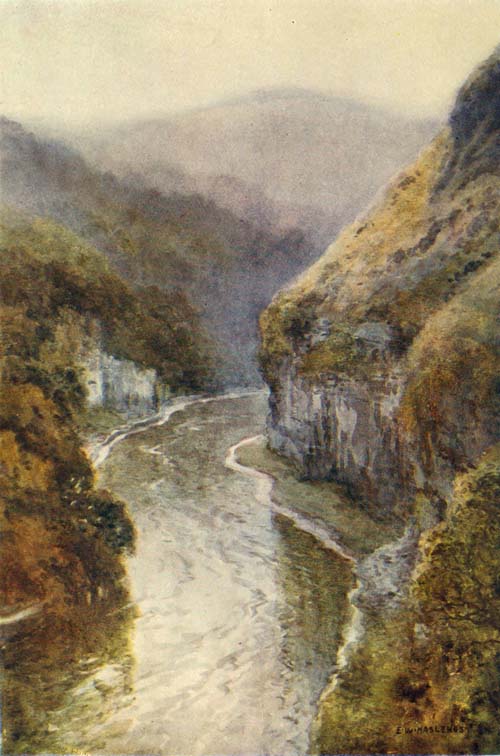
From the Black Rocks near by may be seen one
of the finest views in all Peakland—the Matlock Dale
with its High Tor and its quaintly named Heights
of Abraham, its grotesque sham mediæval castle, its
pleasantly situated mansion of Willersley, which was
built by one of Derbyshire’s best-famed men, Sir
Richard Arkwright. Farther away lie Dethick—with
a quaint church that was built by the grandfather
of Mary Stuart’s Anthony Babington—and Lea Hurst,
the Peakland home of Miss Florence Nightingale.
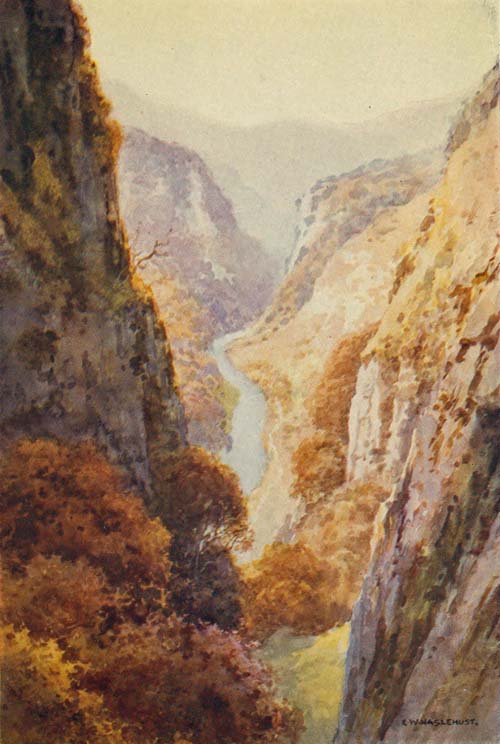
The Via Gellia, a narrow valley, well-wooded, opens
not far from the old posting house; in May the
traveller is assailed there by rustic children who
offer bunches of greenish lilies of the valley.
Matlock is crowded with holiday-makers in summer-time,
and progress along the road becomes somewhat
difficult; nevertheless it is impossible even then to
deny the strange beauty of the place. There is an
air of pleasant freedom; life moves briskly; the valley
might be threaded by a great highway. No watering-place
has a greater wealth of lovers’ walks, of caves,
of petrifying wells, and other objects of interest well-calculated
to amuse and delight the tripper. The
visitor is happy, albeit feverish, and there is to be
seen little aping of the manners of fine society.
Onward through Darley Dale one sees to the left
Oker Hill, with its solitary tree—the survivor of two
planted by the brothers Shore, collateral ancestors
of the Lady of the Lamp. Wordsworth wrote a
pathetic sonnet concerning the separation of these
young men. In Darley churchyard is one of the
most famous yews still existent. Centuries ago
much of the land about here was owned by the
Dakeyne family, whose motto—“Stryke, Dakyns, the
Devil’s in the Hempe!” still puzzles the student of
heraldry. Sir Joseph Whitworth’s Institute—surely a
boon to the young countryfolk—rises near the road,
as does his Cottage Hospital, and, farther, his house,
Stancliffe Hall, now shorn of much of its dignity by
rough quarries.
Just beyond Rowsley Bridge may be seen the old
Peacock Hotel, perhaps the most picturesque hostelry
in all England. Above the porch of this gabled,
creeper-covered house stands a stone peacock in his
pride. This bird is the badge of the Rutland family—one
finds inns bearing the name in many Derbyshire villages.
The sheltered garden is well worth
seeing; it might be the glory of some ancient well-beloved
mansion. Quaint flowers thrive there, and
beside the Derwent stretches a pleasant well-screened
walk, where one may rest with some “well-chosen
book or friend”, and hear the tranquil susurrus of
the smoothly gliding stream.
Then, beyond Fillyford Bridge over the Wye,
which joins the Derwent not far from the inn, debouches
one of the strangest and most beautiful
vales of Peakland. To the left of this is the village
of Winster, with a fine old mansion that was once
occupied by Llewellyn Jewitt, the well-known Derbyshire
antiquarian, and a singular Market Hall with
walled-up windows. The place lies in a backwater.
One expects to see naught modern at Winster;
the inhabitants should wear eighteenth-century garments,
and should carry lanterns and pattens to
their tea parties. Near by are the grotesque Rowtor
Rocks, Robin Hood’s Stride, and Cratcliff Tor.
One is continually reminded of the weird and charming
Vivares engravings that may be found embellishing
the coffee-rooms of conservative inns.
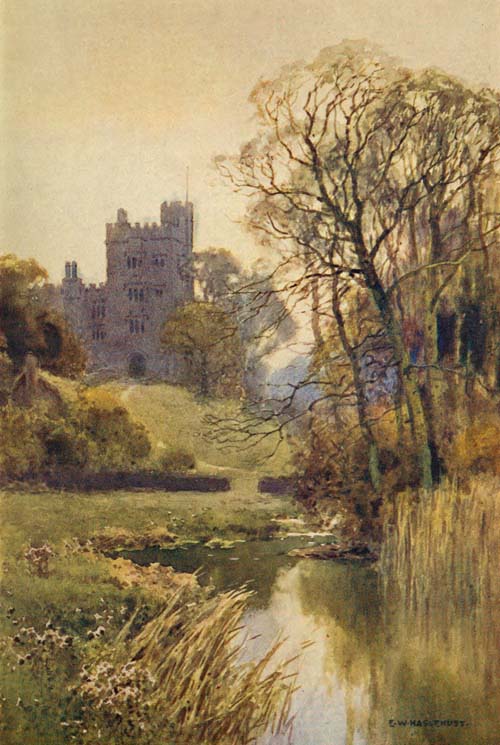
Then Haddon is passed, and the old story—ill-founded
to be sure—that Mrs. Radcliffe sought
inspiration there for her glowing romances comes to
mind. Even in the richest sunlight the wonderful
house suggests mystery and romance. The Wye
glides, clear as morning dew, almost level with the
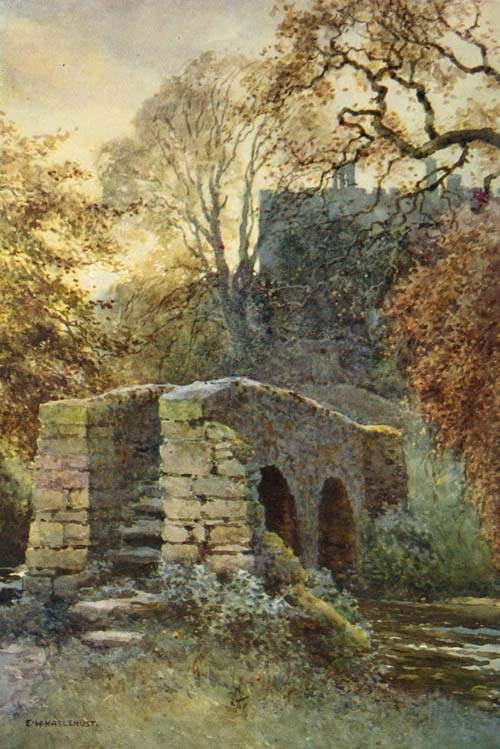
green surface of the water meadows. There is,
within a stone’s throw of the white road, a little
footbridge of the kind that one crosses in happy
dreams.
Bakewell, which owes part of its fame to the
luxurious pastry known as “Bakewell Pudding”, has
perhaps the most beautiful situation of any Peakland
town. It is eminently quaint, there is an aristocratic
air about the place, and the principal streets are
kept wonderfully clean. At fair times may be seen
crowds of booths reaching from the “Rutland Arms”,
to the post office—booths where are sold gaudy pots
from Staffordshire, gingerbread flat and curly, fried
fish, and the sticky sweetmeats beloved by children
of country and of town. In the marketplace are
galloping horses, swings, shooting galleries, and everything
that from long usage appeals to the innocent
rustic mind.
There are many handsome old houses here, but
the finest, Holme Hall, is not visible from the highway.
The church is a graceful building, admirably
placed, with a tall slender spire, which looks its
best when pricking through a golden December mist.
Near the porch is a curious epitaph: “Know,
posterity! That on the 8th of April in the year of
grace, 1757, the rambling remains of John Dale were,
in the 86th year of his pilgrimage, laid upon his two
wives.
“This thing in life might cause some jealousy,
Here all three lye together lovingly;
But from embraces here no pleasure flows,
Alike are here all human joys and woes;
Here Sarah’s chiding John no longer hears,
And old John’s rambling Sarah no more fears;
A period’s come to all their toylesome lives,
The good man’s quiet, still are both his wives.”
The interior of the church is of great interest,
since here is the richly coloured Vernon Chapel,
where lie the famous Dorothy and her husband Sir
John Manners, also the lady’s ancestor, Sir George
Vernon, King of the Peak, and Sir Thomas de Wendesley,
who fell at Shrewsbury. Some of the effigies
are strangely realistic, with appropriate inscriptions
culled from Holy Writ. Perhaps the most interesting
to the antiquarian is that of Sir Godfrey Foljambe,
the founder of the Chantrey of the Holy Cross, and
of his wife Dame Avena. These figures, represented
from the waist upwards, are carved in alabaster,
under a canopy with two shields, the one displaying
escallops, the other fleurs-de-lis.
From Bakewell Bridge may be had one of the
most beautiful glimpses of the Wye, which divides
there to encircle a green eyot. Against the brown
bed of the shallow stream, sleepy fish lie with scarce
a tremor. The grass of the banks hardly loses
colour in the heart of winter.
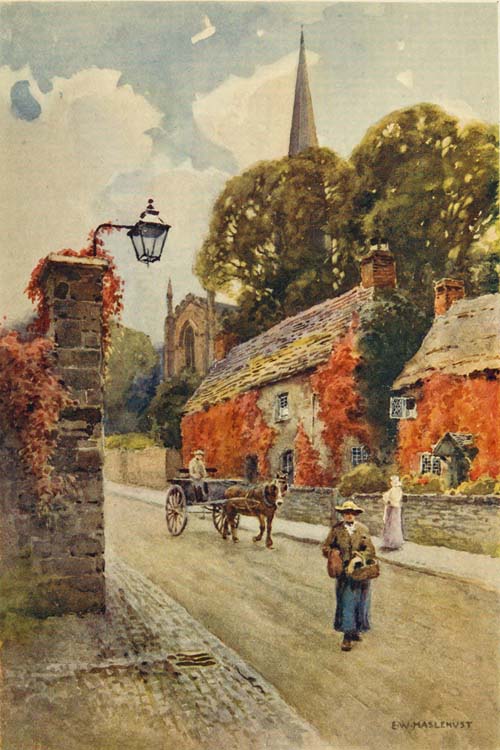
BAKEWELL, SOUTH CHURCH STREET
After leaving the town, the Buxton road soon
reaches the village of Ashford-in-the-Water, a strange
old place with a picturesque mill. In the park of
Ashford Hall the Wye is artificial but charming, its
waters spreading into emerald-green reaches. The
church of Ashford contains some of those funeral adornments
known as “maidens’ garlands”, cages of cut
paper which were carried at the funerals of such girls
as died unmarried.
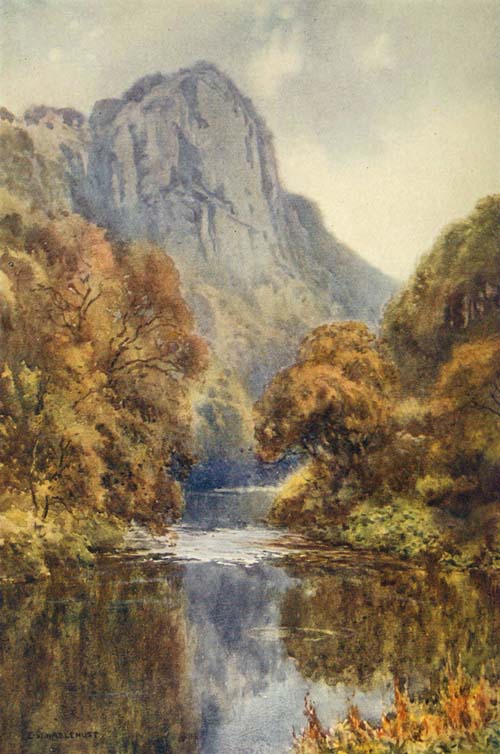
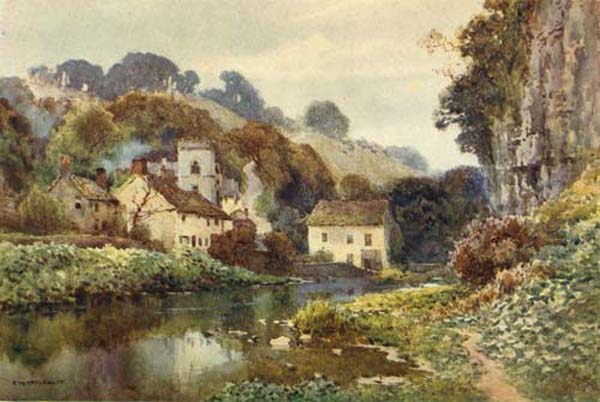
A mile or two beyond this sleepy hamlet, Monsal
Dale opens to the right. On one hand are osier beds,
rich in colour at every season; on the other the Wye
rushes happily over a stony bed. Beyond Monsal the
well-wooded valley contracts, and the road climbs to
the grey village of Taddington, in whose churchyard
may be seen one of the oldest crosses in Derbyshire.
Taddington is devoid of interest; one leaves it without
regret, and, after crossing some miles of bleak
uplands, begins to descend to Ashwood Dale. There
the road has several sharp curves, and travellers of
all kinds must go warily. Nearer Buxton the Wye
glides smoothly in an ugly concrete channel, suggestive
of a gutter. To the left, a mile or so before
reaching the town, a wonderful little ravine, known
as Sherbrook Dell, with a Lover’s Leap Rock, abruptly
cleaves the hillside. Except in times of drought this
opening has a fascinating appearance; it is like the
scene of some old story of gnomes and fairies.
Buxton itself is interesting—if unpicturesque.
Throughout the year it has a swept-and-garnished
appearance. The shops are excellent, as befits a
watering-place frequented by fashionable folk, ailing
and sound. There are several hotels to which the
vulgar word palatial may be applied, there are hydropathic
establishments and boarding houses in plenty,
and there is a fine hospital of widespread fame, with
a dome that enjoys the distinction of being greater
in diameter than that of St. Peter’s at Rome.
The most striking feature of the town is the
Crescent, a fine half-circle of brown stonework that
was erected in the eighteenth century. It is three
stories high, with an arcade that extends from end
to end. Formerly it consisted of hotels and one
private boarding house, and the lower-floor rooms
were used as shops; but now it is occupied entirely
by two hotels, the “St. Anne’s” and the “Crescent”.
In the latter may be seen one of the finest Adam
rooms in the country. This was formerly known as
the “Assembly Room”, and has been scarcely altered
since the day of opening. The length is 75½ feet,
the width 30 feet, and the height 30 feet. There is
an air of old-time dignity about the place, and it is
easy for the imaginative to repeople it with the
stately folk of Georgian days.
Buxton, notwithstanding its fame of old, has but
few antiquities. Before 1570 the Earl of Shrewsbury
erected a great house for the accommodation of
visitors. It was probably in this place that Mary
Stuart rested during her cure, and wrote with a
diamond upon glass:
“Buxtona, quæ calidæ celebrabere nomine lymphæ,
Forte mihi posthac non adeunda, vale”;
in translation:
“Buxton, whose fame thy milk-warm waters tell,
Whom I, perhaps, no more shall see, farewell”.
A hundred years later the hall was taken down and
a “most commodious edifice” raised by the Earl of
Devonshire, Bess of Hardwick’s great-grandson. In
old maps may be found a picture of the former building,
which is thus described by Doctor Jones, in 1572,
in his treatise on the Buxton waters:—
“A very goodly house, foure-square, foure storeys high, so
well compacte with houses of office beneath and above and round
about, with a great chambre and other goodly lodgings to the
number of 30: that it is and will be a bewty to behold, and very
notable for the honourable and worshipful that shall need to
repaire thither, as also for other. Yea, the poorest shall have
lodgings and beds hard by for their uses only.... A phisicion
to be placed there continually, that might not only counsyle them
how the better to use God’s benefyte, but also adapt their bodies
making artificial baths, by using thereof as the case shall require,
with many other profitable devyses, having all things for that use
or any other, in a rediness for all the degrees as before it bee
longe it shall be the scene of the noble earle’s own performing.”
For the gentlemen Doctor Jones recommends the
diverting exercises of bowling, shooting at butts, and
tossing the wind-ball. The ladies may enjoy the
calmer pleasures of walking in the galleries, and “if
the weather be not agreeable to their expectacion,
they may have in the ende of a benche eleven holes
made, into the which to trowle pummets or bowles of
lead, bigge, little, or meane, or also of copper, tynne,
woode, eyther vyolent or softe, after their own discretion,
the pastime Trowle Madame is termed. Likewise
men feeble, the same may also practise in another
gallery of the new buildings.”
Even in those days men of note came here to
take the waters—the lords Leicester and Burleigh
amongst others. In the Harleian MSS. one may see
a letter to the Earl of Essex, in which the latter
writes:—
“Your Lordship, I think, desyreth to heare of my estate, which
is this: I cum hither on Sunday last at night, took a small solutive
on Monday, began on Tuesday, yesterday I drynk of the waters
to the quantity of 3 pynts at 6 draughts; this day I have added
2 draughts, and I drynk 4 pynts, and to-morrow am determyned
to drynk 5 pynts, and mixt with sugar I fynd it potable with
pleasure even as whey. I mean not to bath these 8 dayes, but
wyll contynew drynking 10 dayes.”
The Earl of Essex himself writes, several years
later: “The water I have drunke liberally, begynning
with 3 pynts, and so encreasing dayly a pynt I come
to 8 pynts, and from thence descendyng dayly a pynt
till I shall ageyne return to 3 pynts, wch wil be on
Thursday next, and then I make an ende”.
The church of St. Ann is singularly small, and
uninviting of exterior aspect. Inside, however, one
may see ancient ceiling beams and a quaintly illuminated
altar. The only person of any note buried
in the dreary little graveyard was one John Kane,
a comedian, who in 1799 died because he mistook
monkshood for horse-radish.
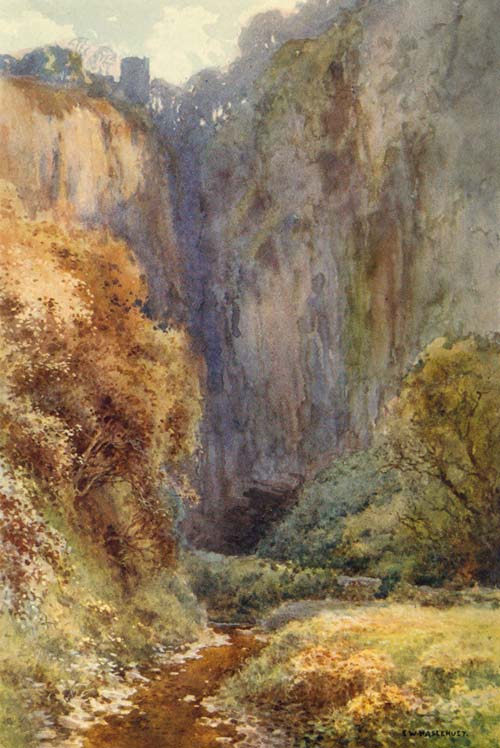
One of the wonders of the Peak is Poole’s Hole,
a cavern situated less than a mile to the west of the
Crescent. The Wye threads its way through this,
its waters strongly impregnated with lime. There
are various more or less appropriately christened stalactites,
and the cavern, being smooth of path and
well-lighted with gas, is without terrors even for the
most nervous. Mary Stuart is said to have visited
the place, and we are shown a stalactite which bears
her name.
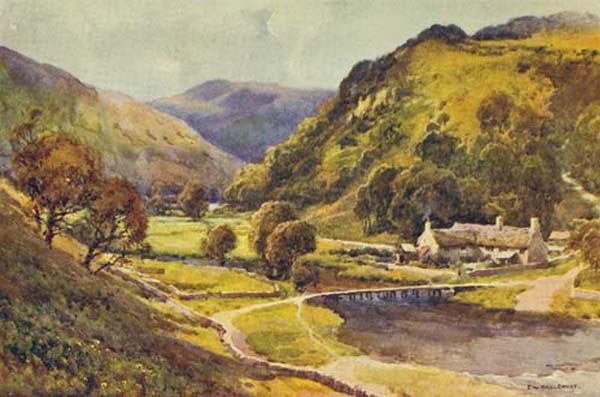
MONSAL DALE
Perhaps the chief interest in Buxton consists of
the Grounds, a pleasaunce embellished by the Wye,
whose water here is of a sickly yellow. There of a
sunny afternoon may be seen those who are taking
the cure, some in bath chairs, some leaning heavily
upon stout sticks, but the majority looking in the best
of health. The band discourses pleasant music; nevertheless
the gaiety of Buxton is always chastened—not
even on a Bank Holiday have I seen ought approaching
rowdiness.
In the neighbourhood are many excellent walks
and drives, the most popular being to the “Cat and
Fiddle”, a hostelry on the Macclesfield road. This
enjoys the distinction of being the second highest
inn in England. Quaint enough are the surmises
concerning the origin of the name, and much is perennially
written thereon in the local newspapers.
Buxton often enjoys brilliant sunlight when the
rest of Peakland is plunged in gloom. It is bracing
and supremely healthy; but its sister spa of Matlock
has a less shrewd atmosphere. At Matlock, for
all its beauty, one wishes to leave the valley for the
hilltop, whilst at Buxton one usually idles and spends
the days in watching other folk take their pleasure
with becoming sobriety.