[p 3 ] THE PEACOCK “AT HOME.” — THE BUTTERFLY’S BALL; AN ORIGINAL POEM. — THE FANCY FAIR; OR, GRAND GALA AT THE ZOOLOGICAL GARDENS.
[p 5 ] THE PEACOCK “AT HOME.” BY A LADY.
The Butterfly’s Ball and the Grasshopper’s Feasts
The Peacock display’d his bright plumes to the Sun,
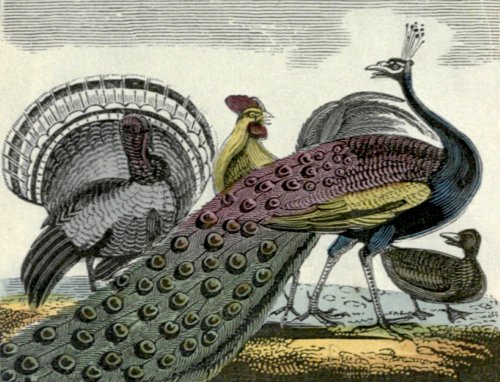
“Shall we, like domestic, inelegant Fowls,
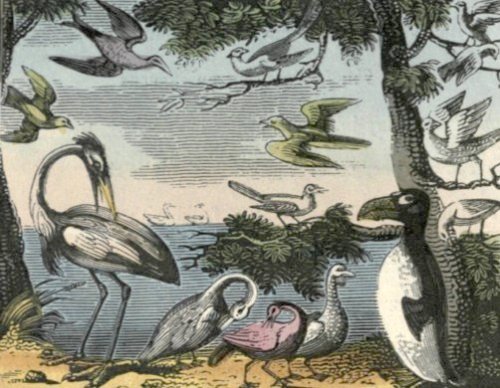
Such ruffling of feathers, such pruning of coats,
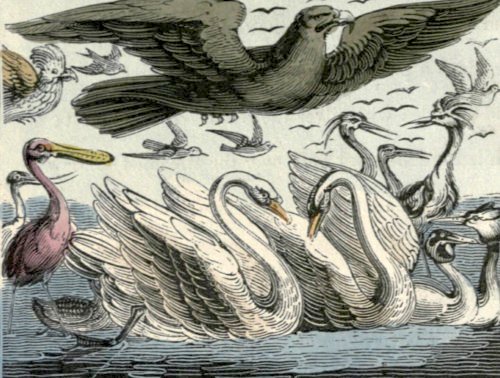
Thus adorn’d, they set off for the Peacock’s abode,
The Peacock, Imperial, the pride of his race,
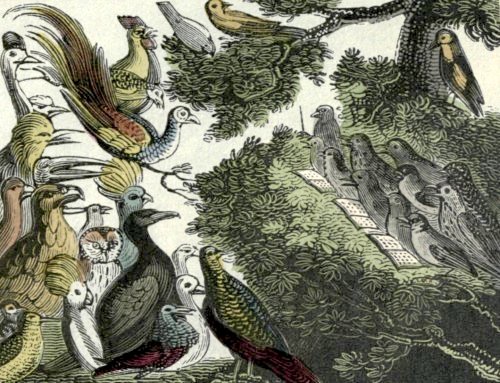
A holly-bush form’d the Orchestra, and in it
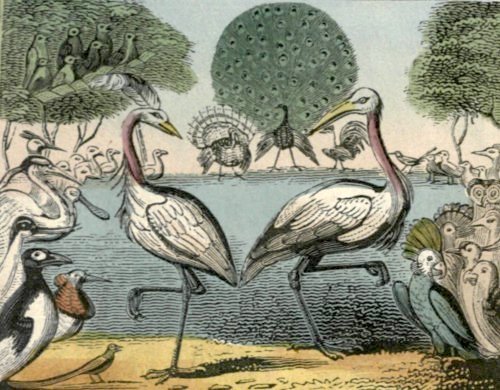
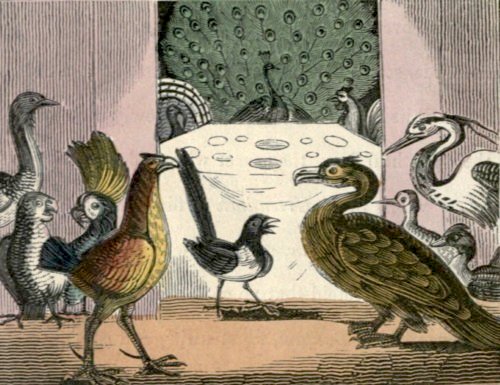
The dancing began when the singing was over:
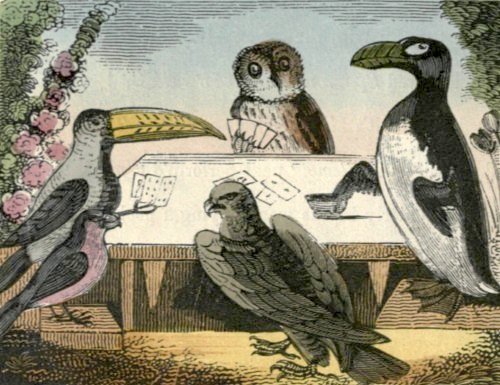
Old Alderman Cormorant, for supper impatient,
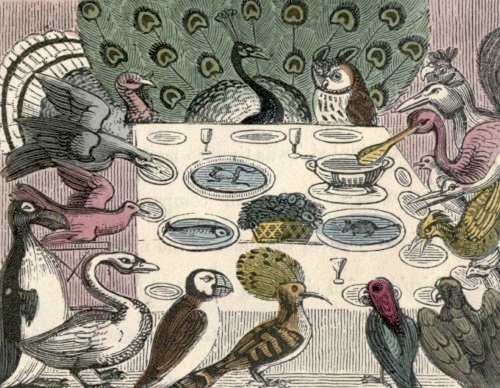
Description must fail, and the pen is unable
When they gaily had caroll’d till peep of the dawn,
Then long live the Peacock, in splendour unmatch’d,
1. The Rip. A machine used in poultry-yards, under which it is usual to confine the mother-bird with the young brood, till it has acquired strength to follow her. The word is derived from the Saxon Hrip, meaning a covering, or protection, for the young.
2. The Tailor-Bird. So called from the singular manner in which it constructs its nest, which is composed of two leaves, sewed together with wonderful skill by the little tailor, whose bill serves him for a needle, and the fine fibres of leaves furnish him with a substitute for thread, by which means he attaches a dead leaf to a living one, growing at the end of a branch. The Tailor-Bird is an inhabitant of India.
3. The Golden-crested Wren is the smallest of the British Birds; it takes its name from a circle of gold-coloured feathers, bordered with black, forming an arch above its eyes, which it has the power of raising or depressing; it is a native of every part of Europe, and is also to be found in Asia and America.
4. Halcyon, or Kingfisher. Esteemed the most beautiful of our native birds; but its form is clumsy, and its bill very disproportionate to its size. It inhabits the banks of rivers and streams, where it will sit for hours on a projecting branch, watching for its prey. The ancients relate many fabulous stories of this bird, as that of its laying its eggs in the depth of winter, and that during the time of its incubation the weather remains perfectly calm, whence the expression Halcyon days.
5. Cuculus indicator. A bird of the Cuckoo kind, found in the interior parts of Africa; it has a shrill note, which the natives answer by a soft whistle; and the birds repeating the note, the natives are thereby conducted to the wild Bee-hives, which this bird frequents.
6. Cassowary. A large singular bird found in the island of Java, in Africa, and the southern parts of India. The head of this bird is armed with a kind of natural helmet, extending from the base of the bill to near half-way over the head.
7. Flamingo. A bird of the crane kind, but web-footed, whose plumage is of a bright scarlet: when standing erect, it measures above six feet, though its body is not larger than that of a Goose; and is a native of Africa, Persia, and South America.
8. Ptarmigan. The white grouse, or white game, inhabits the Highlands of Scotland and the Western Islands; it prefers the coldest situations on the highest mountains, where it burrows under the snow. It changes its feathers twice in the year, and about the end of February puts on its summer dress of dusky brown, ash, and orange-coloured feathers; which it loses in winter for a plumage perfectly white, except a black line between the bill and the eye. The legs and toes are warmly clothed with a thick long coat of soft white feathers.
9. The Chough. This bird, which is about the size of the Daw, has a long curved bill, sharp at the point, which, as well as the legs and feet, is of a bright scarlet, contrasting beautifully with its black plumage, which varies, as the light falls on it, to a deep purple violet. Its general haunts are the crevices of high cliffs in Devonshire and Cornwall.
10. The Widow, or Widah Bird, is a species of Bunting, a native of Angola and other parts of Africa; and is remarkable for the feathers of its tail. The two middle ones are about four inches long, and ending in a long thread; the two next are thirteen inches in length, broad, and narrowing towards the points: from these proceeds another long thread.
11. Yaffil, the Woodpecker. The name Yaffil is provincial, but is so very expressive of the noise it continually makes, that I have preferred it on that account. It is a beautiful bird, and is sometimes called the English Parrot; the colour of its plumage, green, yellow, and scarlet, giving it some resemblance to that bird.
12. The Numidian Crane, or Demoiselle, from the elegance of its appearance, and its singular carriage, is called the Demoiselle, which means the Young Lady; for this bird walks very gracefully, and sometimes skips and leaps, as though it were trying to dance.
13. Guillemot. A sea-bird, of which there are several species numerously spread over the northern world; from whence they come towards winter to the British shores, and remain till they have reared their young. It is sometimes called “the foolish Guillemot,” from its stupidity; for when their companions are shot one after another, they have so little sense of danger, that they make a small circuit, and then return and settle in the same place, to share the same fate.
14. Toucan. A native of America, where it builds in the hollows of trees, and sits at the entrance, ready to peck at the monkeys, who often endeavour to destroy and eat the young. It is about the size of a Magpie, but the head large in proportion, to enable it to support its immense bill, which is six inches and one-half in length, but extremely thin. It is a mild inoffensive bird, and easily tamed, but cannot endure the cold of our climate. The feathers of the breast are highly esteemed by the natives.
15. Cross-bill. So called because the two mandibles cross each other in different directions. They feed chiefly on the seeds of fir-trees; the singular construction of their bills being admirably adapted to separate the seeds of the cones. The pips of apples are also a favourite food, and, to obtain them, they split the apple with one stroke of their bill; they are consequently found to be very injurious to orchards. It has been observed that they have been more frequently seen in England since the fir-tree has been more generally planted than formerly.
16. Siskin. A migratory bird, which is seen in the southern parts of England at the time of the barley harvest, and is sometimes called the Barley-bird. It has a pleasing note, and is sold as a singing-bird in the London bird-shops by the name of the Aberdevine. The accusation of its flirtation with the Greenfinch is to be understood as pure scandal, the most prying naturalists never having discovered any particular attachment between them.
17. Razor-bill. A migratory sea-bird, which visits the northern shores in spring, and leaves them in winter: they lay a single egg on the ledges of the rocks without any nest, and on which it is said to be fixed with a cement.
18. Spoon-bill. So called from the construction of the bill, which is flat the whole length, but widens towards the end in the form of a spoon or spatula; and is equally remarkable in its substance, not being hard like bone, but flexible like whalebone. They feed on snakes, worms, frogs, and fish, even on shell-fish, which they first break with their bills.
19. The Agami, or Trumpeter. A native of America, remarkable for a singular noise, resembling the instrument from which it takes its name.
[p 21 ] THE BUTTERFLY’S BALL, AND THE GRASSHOPPER’S FEAST. By Mr. ROSCOE .
Come, take up your hats, and away let us haste
So said little Robert, and pacing along,
Then Home let us hasten, while yet we can see,
[p 24 ] THE FANCY FAIR; OR, GRAND GALA OF THE ZOOLOGICAL GARDENS. — Transcriber’s Note:
Some years are elapsed, and some worthies are gone,
The sun, as he rose, was received with a cheer,
Much pains had been taken to add to the grace,
The Beasts and the Birds were so fresh and so fair,
The crowd still increased on that magical ground,
And now the fair parties, with Mirth for their guide,
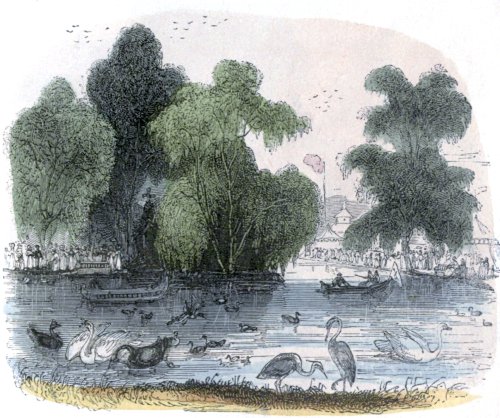
Some visit the laughing-bird, called Cockatoo,
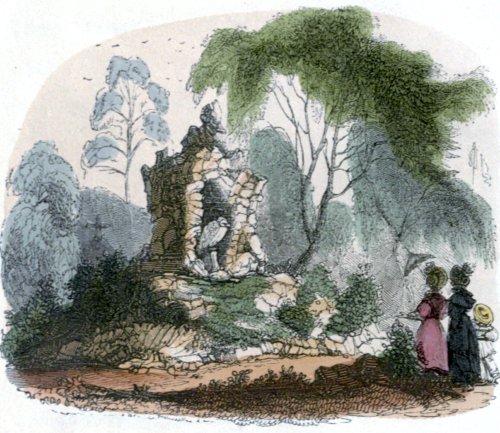
New pleasures succeeded; the spell was of power
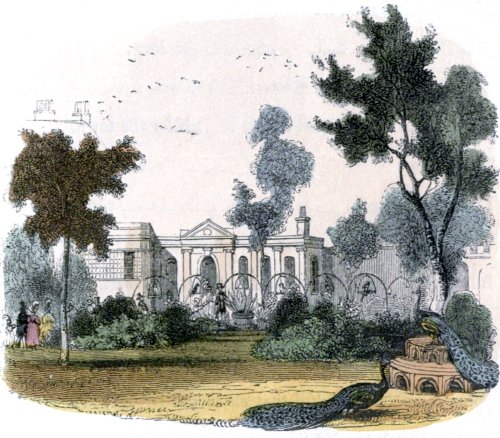
A multitude muster’d, escaped from the plains,
How often it is, when the sun is most bright,
In the midst of the hubbub and riot around,
While the war-whoop was raised by the Birds and the Trees,
When the Fair was concluded, and all the gay throng
But amid the confusion, the hubbub, and din,
1. The skeleton of the Giraffe was exhibited in the Gardens on this occasion.
2. The late spirited proprietor of the Surrey Zoological Gardens.
THE END.
The original book has no publication date but does bear a handwritten inscription on the title page—
Walter Francis Clinton
June 2d 1848 from Aunt Lou