Having briefly sketched the history of the
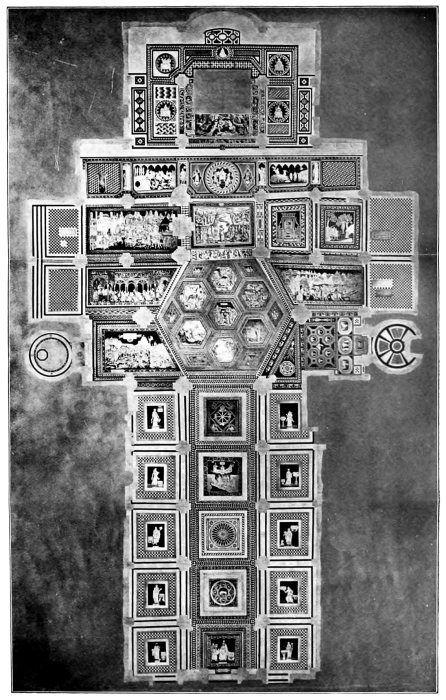
entire Pavement, it will be necessary now
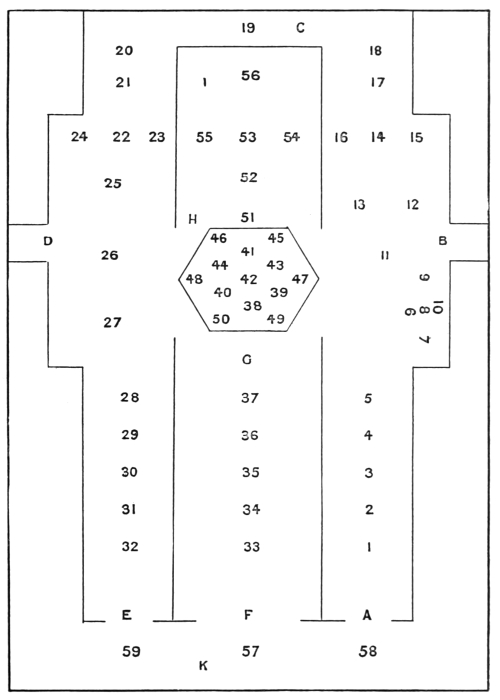
to describe it in detail. For this purpose I have
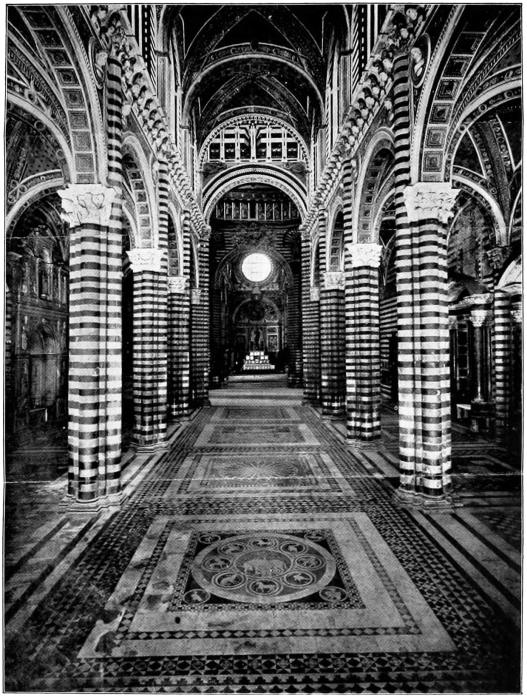
divided it into ten parts, commencing at the great
Western Entrance.
These ten parts are as follows:
1. The wide Platform before the Façade.
2. The Spaces in the three Western Doorways.
3. The Nave.
4. The South Aisle.
5. The North Aisle.
6. The North Transept.
7. The Choir Ambulatory.
8. The South Transept.
9. The Choir and Altar-steps.
10. Under the Cupola.
LOMBARDI PHOTO.]
II. THE ENTIRE PAVEMENT
KEY PLAN TO THE PAVEMENT
Tizio14 tells us that this platform with its three
steps was laid down in 1448, under the direction
of Giovanni Borghesi, then Rettore of the Opera.
Originally there were apparently five designs upon
it, of which, however, only four were still distinguishable
when, in the seventeenth century, Landi
wrote his elaborate description of the floor.15 These
were: In the centre, as at present, the Pharisee
and the Publican kneeling before a round Temple:
On either side a vase; the one inscribed Mel
(Honey), the other Fel (Gall), symbolic perhaps
of the imperfection of earthly joys. On the right-hand
side on entering was the Sacrifice of Abel;
and on the other side, Landi says, that there was
no pictured design, but merely a fancy pattern of
coloured marbles, probably replacing a scene previously
destroyed by time and hard usage. The
constant stream of traffic across this Platform has
necessitated frequent restoration of the Pavement;
and the story of Abel has now entirely vanished.
The vase, also, on the right, now bears the label
Lac (Milk), instead of Fel, perhaps in allusion to
the Promised Land, and the Golden Jerusalem of
Bernard of Clairvaux’s hymn. This work is executed
in the earliest of the four principal methods
of design: namely a trapano; that is to say, outlined
on a slab of white marble in little dots made
with a trepanning drill.
The figures of the Pharisee and the Publican
are executed with great spirit, but are entirely
modern in feeling and conception.16 Each figure
is formed of a slab or slabs of white marble, cut in
outline, and let into a background, of which the
atmosphere is black and the ground red marble, so
that each figure stands out clear and distinct.
Lines of feature, folds of robes and other accessories
are outlined, as described above, with a
trepanning drill. Certain pieces of yellow marble
have been added at the sides of the picture, which
seem unnecessary and even discordant. They
may have been placed there during the restorations
which took place here but a few years since.
The three much-worn scenes that remain here
evidently represent the “Ceremonies of Ordination”
in the three degrees; and such is the opinion of
Faluschi, Landi, and Della Valle. Padre Everardo
Micheli, however, wishes us to believe that these
scenes illustrate the “Reconciliation of the Penitent:”
a proposition which seems to me both far-fetched
and improbable.
These works, executed in the same methods and
with the same materials as those just described,
retain far more of their original feeling and sentiment;
and it is interesting to compare them with
a similar set in the doorways of San Giovanni (the
Baptistery), which represent the “Birth,” “Baptism,”
and “Anointing of an Infant Christian.”
In the first case we have, to the extreme right,
the “Ordination of the Deacon;” next, that “of the
Priest;” and, finally, that “of the Bishop.” In the
other, to the extreme left, is the “Birth of the Child”
(a composition curiously similar to that employed
by many painters at this period for the Birth of St.
John the Baptist): then “Its Baptism;” and lastly,
“Its Anointing and Reception into the Church of
Christ.” Of these three scenes, commenced in
1450 by a certain Bartolomeo di Mariano, called
Il Mandriano, from designs made by one Nastagio
di Guasparre; that in the centre, which we read
was executed by Antonio Federighi (1451),17 is
very much the finest, although there is a certain
similarity in general conception throughout.
On further research, we find that a certain
Guasparre, described as “dipentore nostro,” made
a design for the space before the door for the then
existing Porta del Perdono.18 This design represented
the “Consecration of the Duomo” in 1174,19
and was executed by Corso di Bastiano of Florence.
Now Guasparre d’Agostino, also designated as
“nostro dipentore,“20 about this same time painted
certain scenes from the Life of S. Bernardino for
the Sacristy of the Duomo, and also decorated the
apse of the Baptistery with frescoes of the “Crucifixion
and Burial of Christ.”21 We may not unreasonably
suppose that the above-mentioned
Nastagio was his son or pupil, and that the father
and son, or master and pupil, were associated
together in all these similar works around the
doors of the Cathedral and Baptistery. Unfortunately
the work known to have been designed
by Guasparre before the Porta del Perdono was,
together with that entrance itself, ruthlessly destroyed
in 1661, so that we have nothing certain
remaining of his Pavement work upon which to
start comparison. The force and charm, however,
of the compositions, still existing before the Western
Doorway of the Cathedral; show that they must
have been executed from the designs of no mean
or inferior draughtsman.
We find also several references at this date,22 to
work done outside the Duomo by Bastiano di
Corso, a Florentine, fine work by whom, as we
shall see presently, still exists inside also; but it
is not easy to identify the exact portion laid down
by him and his son Corso, who, as we have seen
above, was employed on the work before the Porta
del Perdono.
It is interesting to notice how sharp and clear is
the trepanning work in the older of these designs,
and how close together the points have been
drilled. It would appear as if, contrary to the
method employed in the more modern work, no
graving tool had been used, nor any stucco to fill
up the holes and outlines.
* * * * *
And now we enter the Church.
The first thing that meets the eye is an inscription:
“CASTISSIMUM VIRGINIS TEMPLUM CASTE MEMENTO
INGREDI.”
It is unknown by whom, or when, this inscription
was laid down, but it is possible that it was introduced
at the same time as the design which
follows it.
ALINARI PHOTO.]
[DESIGNED BY GIOVANNI
DI MAESTRO STEFANO (?)
III. HERMES TRISMEGISTUS (No. 33)
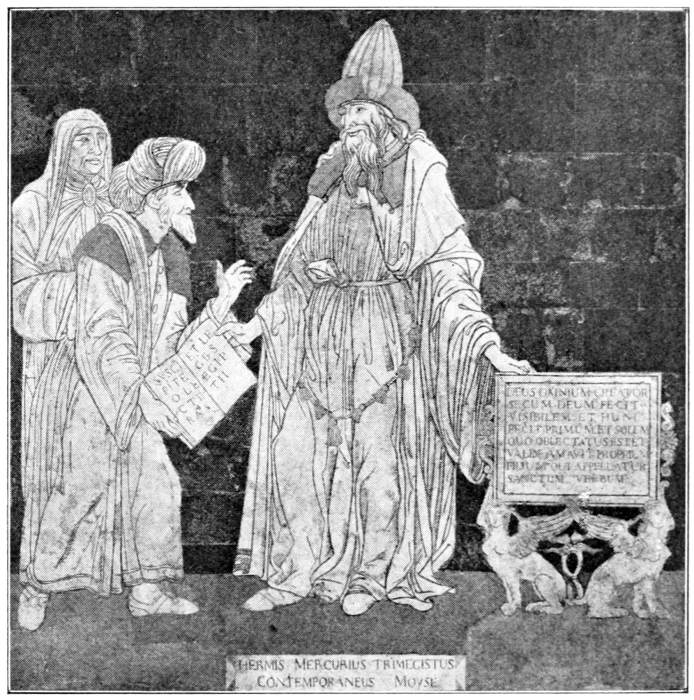
Beyond this appears the commanding figure of
a man in a high crowned head-dress, apparently
an Eastern Sage, holding out with his right hand,
to two other men, a book inscribed SUSCIPITE O
LICTERAS ET LEGES EGYPTII; while with his left, he
points to a quotation on a slab supported by two
winged sphinxes. The principal figure represents
the semi-mythical Hermes Mercurius Trismegistus,
who, as we read below, was “Contemporaneus
Moysi.” The two men, one old and turbaned, and
the other veiled, may perhaps typify the learned
men of the East and West. (Ill. III.)
The introduction of this mysterious personage,
whose very existence is extremely doubtful, is most
interesting to the student of Renaissance philosophical
and theological ideas. Since to his fabled
authorship are attributed a vast number of works
dealing with ancient wisdom and religious belief,
as well as many treatises on ecclesiastical ceremonial,
the placing of him on the threshold of this
magnificent Temple is not without appropriate
suggestion. From the principal work attributed
to him “the Poemander”,23 is drawn the quotation
inscribed on the slab beside him here; and the
enthusiastic attitudes of the two Seekers after
Knowledge before him are very forcibly expressed.
This admirable design was placed here in 1488,
under the Rectorship of Alberto Aringhieri, mentioned
in the last chapter. He, being a Knight of
St. John of Jerusalem and of Rhodes, must have
been familiar with the mystical tastes and theories
of those who endeavoured to bring the learning,
lore, and art of Pagan ideals into line with Christian
Dogma and Faith. Hence the choice under his
direction of this subject, and, as we shall presently
see, of the ten Sibyls also.
It is not definitely known who designed this
group; but it is generally supposed, with considerable
show of reason, to have been Giovanni di
Maestro Stefano:24 and it appears to have been
the last of the series commissioned by Aringhieri,
as Rettore, since his occupation of that post ended
in 1498.25 He seems, though, seven years later,
to have commissioned Pinturicchio’s “Allegory of
Fortune.”
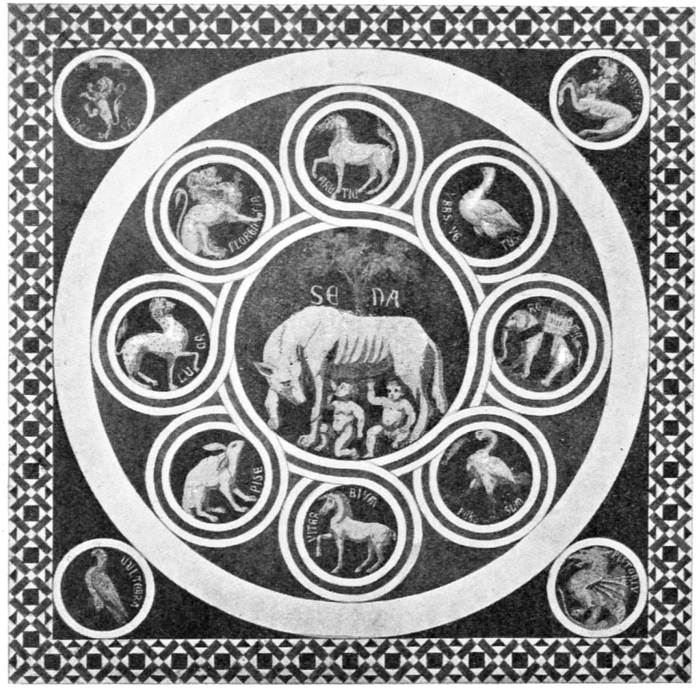
The next design is that of the Badges or
Emblems of Siena, surrounded by those of her
allies. In the middle is the Wolf of Siena suckling
the Twins. In a circle round her are the
symbols of the following cities; Florence (a Lion,
the “Marzocco”); Lucca (a Lynx); Pisa (a Hare);
Viterbo (an Unicorn); Perugia (a Stork); Rome
(an Elephant bearing a Tower); Orvieto (a
Goose); and Arezzo (a Horse). In the four
corners of the surrounding square are, Massa (a
smaller Lion); Grosseto (a Goat); Volterra (a
Vulture); and Pistoia (a Dragon). (Ill. IV.)
LOMBARDI PHOTO.]
[1373. AUTHOR UNKNOWN
IV. THE BADGES OF SIENA AND THE
CONFEDERATE CITIES (No. 34)
(The only panel in mosaic)
This, the only portion of the Pavement that is
really executed in mosaic, was, as we have seen
already, laid down in 1373; but we are unable to
trace the author. Fragments of the original work
are still existing in the Museum of the Opera;
but the whole design has been replaced by a
modern copy, carefully made by Sig. Maccari in
1865.26
Beyond this is a large geometrical pattern. A
wheel with twenty-four columnar spokes, in the
centre of which appears the Imperial Eagle. Of
this design little or nothing is known; but the author
of La Guida Artistica supposes it to have been of
the same date as that last described (1373). It is
possible that, before the days of Alberto Aringhieri,
the whole of the Nave floor, except “Fortune’s
Wheel,” in the first bay, may have been covered
with geometrical or heraldic devices only, as can
be seen at Lucca, and that all of them, except
these last two, were removed to make way for
other more interesting subjects.
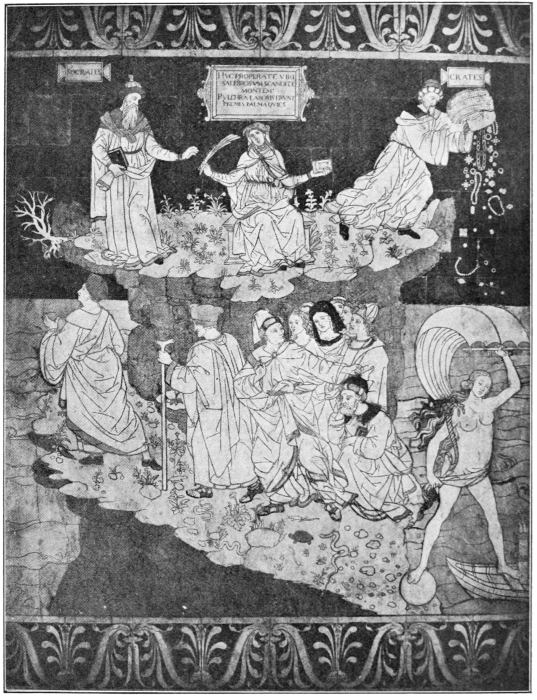
The next scene is Pinturicchio’s well-known
design, called in the old documents “La Storia
della Fortuna.” It might just as well though be
designated as “the Reward of Virtue,” or the
“Pursuit of Wisdom.” (Ill. V.)
Wisdom, a sedate woman, royally robed, veiled,
and crowned with a jewelled wreath, is throned
upon the upper platform of a small precipitous
rock in the midst of the sea. The platform is
covered with growing flowers, as is also the winding
path which leads to it. On Wisdom’s right
hand stands Socrates, holding a book, to whom
she offers a branch of palm. On her left is Crates,
who is hastily emptying into the sea a basketful
of rings, chains, and other jewels. To him she
extends a closed volume. Over the head of
Wisdom, on a tablet, appears the following inscription:
HUC PROPERATE VIRI, SALEBROSUM SCANDITE MONTEM
PULCHRA LABORIS ERUNT PREMIA PALMA QUIES.
On the path below, which, besides flowers, is
strewn with stones and over-run with reptiles and
small animals, is a crowd of ten men, seekers after
Wisdom, who apparently have just been landed
upon the Island by Fortune. The attitudes of
these men, some of whom at least appear to be
portraits, are very striking. Alone at the head of
the procession strides a stately personage—a
patron perhaps of art and learning. Next to him
an old man, leaning on a crutch-handled staff,
plods determinedly along. Following him, a
younger man looks back and shakes his fist at
Fortune. Behind him stand six figures with
varied expressions of interest or desire. In front
of them an elderly man with a beard has sunk
down exhausted, his book clasped in his left arm,
too weary to move on. On the extreme right of
the picture stands Fortune, a nude woman with a
cornucopia in her right hand. She is the most
striking figure in the composition. Her left foot
is resting on a globe, perhaps to indicate her
instability, while with her right she seems to push
off the boat, shattered and broken-masted, in
which these travellers have journeyed to the
island. Above her head she holds a sail, which
the wind has filled out, one end of which, wound
round her body, is grasped also by her right hand.
Obviously this design is one of those conceits so
dear to the Renaissance mind. Fortune has,
with favouring breeze, but through stormy waters,
brought the seekers after Knowledge to the Mount
of Wisdom; and the artist has endeavoured in
these ten figures to symbolize the varied character
of her votaries. Socrates stands calmly waiting
for his reward; Crates earns his by contempt of
all things worldly.
ALINARI PHOTO.]
[DESIGNED BY PINTURICCHIO
V. AN ALLEGORY OF FORTUNE (No. 36)
Pinturicchio received on the 13th of March,
1504,27 twelve lire for this design, which was laid
down under his direction, probably by Paolo Mannucci,
in 1506.28
The last design in the Nave is perhaps the
oldest of all; but the actual piece of Pavement
that we now see is a complete renovation by
Signor Maccari in December, 1864, costing
2,491 lire 98 c. Tizio29 tells us that it was executed
in 1372, and though he does not say who was the
author of the design, or who executed the work,
we know that Andrea di Minuccio was Operaio
at this time,30 and that under his direction, two
years later, the work at “the foot of the Choir” was
completed.
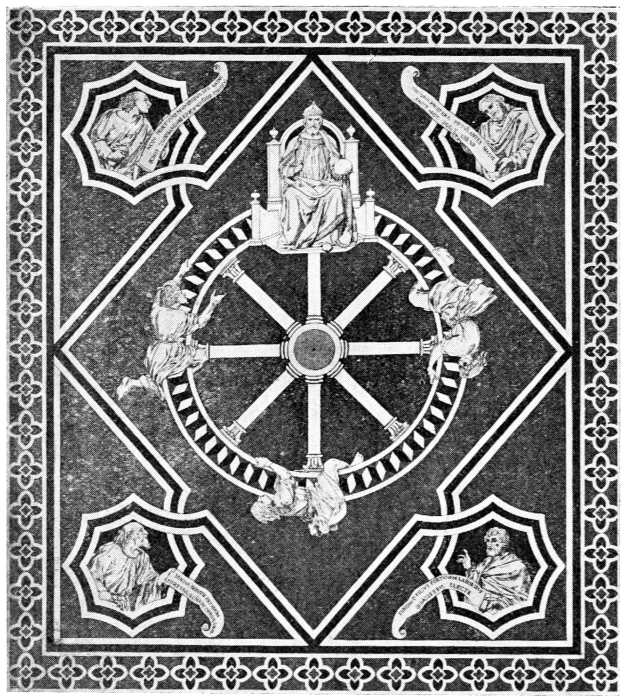
We see a wheel with eight columnar spokes.
To give an effect of rotatory motion, the border is
inlaid in small lozenges of black and white marble,
arranged to represent cogs. At the top of the
wheel sits a King, enthroned and crowned, with
orb and sceptre. Clinging to the two sides and
bottom are three figures of men, whose anxiety
to retain their hold, as the wheel revolves, is
forcibly expressed. The wheel is surrounded by
a continuous band of black and white marble,
which, looped octagonally at the angles, incloses,
in the spaces so formed, half lengths of the following
four Sages: Epictetus, Aristotle, Seneca and
Euripides. Each Sage holds a scroll, with a
quotation from one of his own writings. (Ill. VI.)
LOMBARDI PHOTO.]
[1372. AUTHOR UNKNOWN
VI. THE WHEEL OF FORTUNE (No. 37)
This design may be compared with another
Wheel of Fortune, inlaid by Domenico del Coro
in the lower panel of a door in the Chapel of the
Palazzo Comunale. Padre Micheli calls it the
Wheel of Ambition,31 although the wheel itself is
inscribed “Rota della Fortuna.” He thus describes
it: “To the lower part is a man clinging,
beside whom is written the inscription ‘So senza
Regno’ (I am without a Kingdom). Half way
up the wheel, to his right, clings another figure of
a man, this time with the head of an ass, and the
inscription ‘Regnero’ (I will reign). On the top of
the wheel is seated an ass, with the word ‘Regno’
(I reign); and lastly, on the other side, going
downwards, is an ass with a man’s head, and the
motto ‘Regnai’ (I have reigned).” The author
of this inlaid panel, who must in his former position
of Capo-maestro, have known well the larger
and older design, probably wished to improve
upon it; but it is somewhat remarkable to find it
placed among panels symbolising the Articles of
Christian Faith.
* * * * *
Let us now turn to
Both this and the North Aisle are adorned with
representations of the ten Sibyls, five in each.
These Sibyls were all placed here under the Rectorship
of Alberto Aringhieri in the years 1482–83.32
The introduction of these mythical personages
into ecclesiastical art was not unusual at this
period, and they take their place beside the
Prophets, as forerunners of Christ.
They form a curious link between the Pagan
and Christian world of thought. According to
Greek ideas, Sibyls were women under the inspiration
of the Deity, but they are not spoken of
at all by either Homer or Herodotus: and the first
Greek writer who mentions them is Heraclitus
(circa 500 B.C.). Aristophanes, Plato and other
early writers only mention one: Heraclides Ponticus,
a pupil of Plato, speaks of three (the
Erythraean, Phrygian, and Hellespontine); but
Pausanias gives four (the Libyan, Erythraean,
Cuman, and Hebrew). Of these the oldest was
said to have been the Libyan: though the best
known to modern times are undoubtedly the
Delphic, the Cuman (visited by Æneas), and the
Tiburtine, who is said to have foretold Christ to
the Emperor Augustus.
By Christian writers they are spoken of first
in the second century A.D., but do not appear in
art until the eleventh. In the handbook of Mount
Athos we read of the “Wise Sibyl”; and side
by side with David, one of these prophetesses
appears in the Sequence of Thomas of Celano:
the Dies Irae (circa 1253).33 They have no place
in early mosaics, but one of the most ancient
representations of a Sibyl is that of the Tiburtine
in the church of Sta. Maria Aracoeli in Rome.
The first, and perhaps the most poetic Choir of
them, is on the pulpit of S. Andrea at Pistoia,
sculptured by Giovanni Pisano in 1301; but from
that time, until the fifteenth century, we find no
other groups of them. Then appeared a great
many representations, and their number increases
rapidly to as many as thirteen, the last of whom
is the Queen of Sheba, who is called Nichaula,
and is fabled to have foretold to King Solomon
the Advent of a Messiah. The usual numbers,
however, are three, four, six and ten; and in such
groups they have been designed by the greatest
artists. Giotto,34 Perugino,35 Pinturicchio,36 Raphael,37
and Michael Angelo,38 are but a few of these.
Not only throughout Italy, but to the Northern
Art Schools of Germany and Flanders, the same
cult spread; and we find them introduced into
sculpture, painting and engraving. Sibyls assist,
as interested and sympathizing spectators, in every
scene of Holy Writ. They meet us even in painted
windows and illustrated books of devotion.39 It is
therefore not remarkable to find them here; and,
if one recognizes the attitude of mind, with which
they were regarded by the Renaissance Catholic,
they are even most appropriate. The number
chosen is in accordance with that fixed by Varro,
and with the exception of the Cumaean, who seems
to take the place of the Cimmerian in his list, the
choice of prophetesses is the same.
For the purpose of study, let us begin at the
Western door; and commence with
Delphi, famous in ancient times for its Oracles,
would not unnaturally suggest itself to these early
students of Greek art and literature as one of the
places whence prophecies of the Redemption of
the World should come. Hence Plutarch calls
her the first of the Sibyls. According to Pausanias,
the Erythraean Sibyl, although a native of
Marpessus, or Erythrae, in the Troad, lived mostly
at Samos, and visited Clarus, Delos, and Delphi,
at all of which places were shrines dedicated to
the Pythian Apollo, whose special gift this form of
prophetic utterance was said to be. Later tradition
would seem to have divided her attributes into at
least three, and given them separate existence.
Here she is shown as a stately woman, bearing in
her left hand a decorated horn from which issue
flames. Her right hand rests on a tablet supported
by a winged sphinx, which bears the words:
IPSVM TVVM CO
GNOSCE DEVM
QVI DEI FILIVS EST
(Know thy God Himself, Who is the Son of God.)
Beneath her feet a label records her name, and
the fact that she is mentioned by Chrysippus in
his Book of Divination. We find40 that this figure
was executed in 1482 by Giuliano di Biagio and
Vito di Marco, who probably also made the design
for the work, as the payment they received was
579 lire 10 soldi. We may compare this amount
with the sum paid in 1866–69 for the restoration
of the same Sibyl. It was 2,341 lire 17 c.
It is not clear why this Sibyl is so named, especially
as it provokes confusion with the more
celebrated “Sibilla Cumana.” Apparently the
Cimmerian Sibyl is intended. Ferdinand Piper
tells us that she was sometimes styled the Italian
Sibyl,41 and mentions other variations of the name:
“Cymea, Chymerea or Chimica.” According to
the label, supported behind her by two charming
putti, she is said to have been mentioned by Piso
in his Annals. Here she is represented as an
excited-looking woman, with loose hair scattered
over her shoulders. She bears in her hand a
tablet, with the following words inscribed upon it:
ET MORTIS FATVM FINI
ET, TRIVM DIERVM SO
MNO SUSCEPTO TUNC
AMORTVIS REGRESSVS
INLUCEM VENIET PRIM
VM RESURRECTIONIS
INITIVM OSTENDENS.
(He shall accomplish the fate of death, having
undergone a sleep of three days. Then being
returned from the dead, he shall come into the
light, showing the first beginning of the resurrection).
This design is said to be the work of Luigi di
Ruggiero, called l’Armellino, and Vito di Marco;42
but, except a notice dated 148243 of payments to
the first-named worker for marble cut by him for
work on “li spazi di Duomo e per le Sibille,” we
have no further record as to the author of this
particular design, or its cost. We find, however,
that in the restoration above referred to, it cost
2,581 lire 80 c.
This Sibyl is famed in poetic story as having
been visited by Æneas: an interview described
with much graphic minuteness by Virgil, in Book
VI. of the Æneid. Endless legends have accumulated
in connection with her, and her presence
is associated with many spots in and around
Naples. Ferdinand Piper states that the names
of Amalthea, Demophile, and Herophile have
been given to her by different writers,44 and that
Justin Martyr asserts that she was daughter of
Berosus, and came from Babylon to Campania.
She is said to have lived for a thousand years;
and to have been the ancient prophetess, who
offered the Sibylline Books to Tarquin. These
books, the oldest collection of which was, according
to tradition, made about the time of Solon
and Cyrus, by the Sibyl of Marpessus (the Erythraean
Sibyl), at Gergis, on Mount Ida, found
their way thence to Erythrae; from there to Cumae;
and so to Rome. In 83 B.C. they were burned;
but fragments of their contents continued to exist
orally until A.D. 12, when they were collected and
revised by the Emperor Augustus, and were surviving
in 363. In the year 400 they were again
destroyed by Stilicho; and the present so-called
Sibylline books are a spurious invention of Jewish
and Christian writers.
Here she appears as a somewhat severe old
woman, with a veil wound round her head. In her
right hand she carries the mistletoe bough of the
Virgilian story; and with her left she clasps to her
three books. Piled on the ground to her right, and
burning, are six more, representing those destroyed
by her in the Tarquinian legend; and above her
left shoulder two flying cherubs bear a tablet, with
the following inscription:
VLTIMA CVMAEI VENIT IAM
CARMINIS AETAS MAGNUS
ABINTEGRO SAECLORVM
NASCITVR ORDO IAM RE
DIT ET VIRGO, REDEVNT
SATVRNIA REGNA, IAM
NOVA PROGENIES CAELO
DEMITTITVR ALTO
(Now has come the last period of Cumaean song,
A great order of the ages is born afresh.
The Virgin now returns; the kingdoms of Saturn return.
Now a new progeny is sent down from lofty Heaven.)
Her label bears the words “Sibilla Cumana meminit
Virgilius. Eclog. IV.”
This figure is the work of Giovanni di Maestro
Stefano di Giovanni and his scholars, and was
executed by him in 1482.45 He received for it the
sum of 697 lire, 9 soldi and 2 c. It was restored at
the same time as the other Sibyls, in 1866–69, at
a cost of 2,743 lire 6 c.
This Sibyl, as we have already seen, is one of
those named in the earliest lists by Pausanias.
She is said to have been a native of Marpessus or
Erythrae in the Troad, and he, as well as some
other writers, gives her the name of Herophile;
one authority however speaks of a Trojan Sibyl,
whom he calls Herophila, and names the Erythraean
one, Symmachia. She lived, as we have said before
when writing of the Delphic Sibyl, chiefly at
Samos, but visited Clarus, Delos and Delphi. This
would, no doubt, account for the difficulty in distinguishing
the various place-names attached to
these different women. As we have also seen above,
the Sibylline books are said to have been once
preserved at Erythrae, and Lactantius attributes
to her the famous acrostic which announces the
Coming of the Anointed One, Son of God Himself,
as Saviour of the World. Here she is depicted
as a tall patrician lady, with a rather forbidding
countenance, and a very curious head-dress, which
partially envelops her face. Her right hand
clasps a closed volume, while the left rests on an
open book, supported by a carved lectern. On
the pages of this book are written the following
words:
| DE EXCELSO |
ET NASCETVR |
| CAELORVM HA |
IN DIEBVS NO |
| BITACVLO PRO |
VISSIMIS DE VIR |
| SPEXIT DOMI |
GINE HEBRAEA |
| NVS HVMILES |
IN CVNABVLIS |
| SVOS |
TERRAE |
(From the High Habitation of Heaven God has
looked down on His humble (servants), and shall
be born in these most recent days of a Hebrew
Virgin in the cradle of the earth.)
Beside her on a stool is a tablet, telling us that
this is the Erythraean Sibyl, whom Apollodorus
claimed as his fellow citizen. This Sibyl was
designed and executed by Antonio Federighi in
1482; and we are told that he received 649 lire
17 soldi for it.46 It is interesting to note that this
and the Samian are the only Sibyls signed by their
designers. Federighi’s evident taste for faithful
representation of the costumes of his period, apparent
also in his other works, would account for
the rather bizarre head-dress above referred to.
The cost of restoration of this Sibyl was 2,043 lire
13 c.
Ferdinand Piper, quoting a scholiast on Plato,47
identifies this Sibyl with the one elsewhere variously
called Chaldaean, Babylonian, Egyptian and Hebrew.
He tells us further, that tradition called
her also the daughter of Berosus, and daughter-in-law
of Noah, which raises confusion with the
Cuman.48 He adds, also, that sometimes the name
of Sabbe is given to her, and sometimes that of
Sambetha. Nothing more is known of this Sibyl;
but it is worth noting that the prophecy here attributed
to her is the only one that does not deal
with the Birth or Atonement of Christ.
She is represented as a pleasant-looking woman
of middle age, with her head bound up in a simple
veil. In her left hand she carries a book, and
with her right she draws attention to a tablet,
resting on a carved pedestal, with an inscription
as follows:
PANIBVS SOLVM QVINQVE
ET PISCIBVS DVOBVS HO
MINVM MILLIA IN FOENO
QVINQVE SATIABIT RELI
QVIAS TOLLENS XII
COPHINOS IMPLEBIT
IN SPEM MVLTORVM.
(With five loaves and two fishes He will satisfy
the hunger of five thousand men on the grass.
Taking up the remains, he will fill twelve baskets,
for the hope of many.)
Beneath her feet, a label informs us that it is
Nicanor who bears record of her. Urbano di
Pietro da Cortona, Antonio Federighi, Vito da
Marco and Luigi Ruggiero (l’Armellino) received
commissions to execute these Sibyls on September
20th, 1481;49 but Urbano does not appear to have
received his payment of 605 lire 12 soldi for the
execution of this one, until October, 1483.50 The
sum paid to restore his work was 3,153 lire 84 c.
This prophetess, as we gather from the label
placed beneath her feet, was also styled the Tiburtine
Sibyl, because she was “honoured as Divine
at Tibur.” From a Christian point of view she is
perhaps the best known of all the Sibyls, and the
representations of her in art, still extant, are
many and very varied in conception.51 The Emperor
Augustus is said to have visited her, and,
as a result of her prophecy, erected the altar inscribed
“ARA PRIMOGENITI DEI,” now inclosed in
the Cappella Santa (or di S. Elena) of the Church
of Sta. Maria Aracoeli in Rome.
She is here represented as a tall and youngish
woman, with a curious pointed head-dress. In her
right hand she carries an open book; while above
her left shoulder, and attached by a ribbon to the
neck of a small cherub, is a tablet on which are
the words:
NASCETVR CHRISTVS
IN BETHLEHEM ANNVN
CIABITVR IN NAZARETH
REGNANTE TAVRO PACI
FICO FUNDATORE QVIE
TIS. O FELIX MATER CV
IVSVBERA ILLVM LACTA
BVNT
(Christ shall be born in Bethlehem. He shall be
announced in Nazareth, the peaceful Taurus (the
Bull) being in the ascendant, the founder of peace.
Oh Happy Mother whose breast shall give him
milk.)
This Sibyl was designed by Benvenuto di Giovanni
del Guasta in 1483,52 and is a fine specimen
of his work; but it is not known definitely who
executed this, or indeed any of the four remaining
Sibyls. We read, however, that Giuliano di Biagio
was in this year paid 41 lire 15 soldi for the carriage
of 9,310 lbs. of marble for this work,53 so presumably
he and his assistants executed some if
not all of them. 2,149 lire 35 c. were paid for the
restoration of this Sibyl in 1866–69.
Of this Sibyl we know nothing, and can only
point out, as in the case of the Delphic and Erythraean
Sibyls, that the latter of those prophetesses,
though born in the Troad, made her principal
abode at Samos: and that thus these three may
have been one and the same person. We are told,
by the label beneath her representation, that she is
spoken of by Eratosthenes, a writer quoted by
Lactantius, and whose work was one of the first
books printed in Italy in 1465.
ALINARI PHOTO.]
[DESIGNED BY MATTEO DI GIOVANNI BARTOLI
VII. THE SAMIAN SIBYL (No. 29)
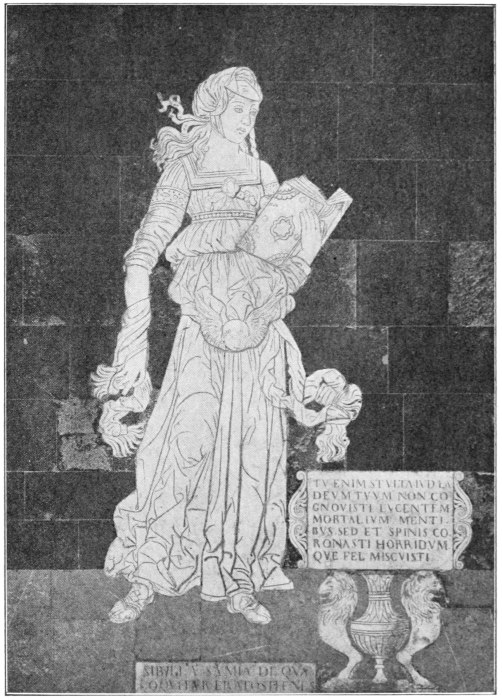
This figure is one of the most beautiful of all
the ten Sibyls, and well it may be, seeing that it
was designed by that delightful draughtsman and
earnest artist, Matteo di Giovanni Bartoli. A
slender princess, with flowing draperies, she supports
with her left hand a handsomely-bound open
volume. A curious and characteristic feature of
Matteo’s work is evident in the charming cherub-head,
with outspread wings, that clasps a girdle
round her robe below the hips. Beside her on a
tablet, upborne by two lion-headed figures, is the
following inscription:
TV ENIM STVLTA IVDAEA
DEVM TVVM NON CO
GNOVISTI LVCENTEM
MORTALIVM MENTI-
BVS SED ET SPINIS CO
RONASTI HORRIDVM
QVE FEL MISCVISTI
(For thou, foolish Judaea! hast not known thy
God, shining in the minds of men. But thou hast
both crowned Him with thorns, and hast mixed
for Him nauseous gall.)
At the foot of the tablet is the designer’s signature,
with the date 1483. (Ill. VII.)
Matteo di Giovanni received for this design
4 lire only,54 on May 23rd, 1483; but it cost 2,654
lire 52 c. to restore.
Of this Sibyl also nothing is known, though
she too has been confounded with the Delphic
Sibyl. Most of the longer lists, however, include
both. From the label designating her we learn
that she prophesied at Ancyra. She is here
brought before us attired in what we may suppose
the artist intended to represent Phrygian or semi-Oriental
dress. She holds aloft in her left hand
a small book open at the words:
| SOLVS |
| DEUS |
DEVS |
| SVM ET |
ALIVS |
| NON EST |
(I am the only God, and there is no other God.)
Her right hand directs attention to a tablet, on
a lyre-shaped support, between which are seen
half-length figures and heads of nude suppliants,
apparently rising from the grave.
The inscription on the tablet runs as follows:
TVBA DE CAELO VOCEM LV
CTVOSAM EM ITET TARTARE
VM CHAOS OSTENDET DEHIS
CENS TERRA VENIET AD TRIBV
NAL DEI REGES OMNES DEVS
IPSE IVDICANS PIOS SIMVL
ET IMPIOS TVNC DEMVM IM
PIOS IN IGNEM ET TENEBRAS
MITTET QVI AVTEM PIETA
TEM TENET ITERV VIVENT
(The trumpet shall utter from Heaven a mournful
sound. Yawning earth shall show Tartarean
Chaos. All Kings shall come before the Tribunal
of God. God Himself judging the Evil and the
Good together. Then at length He will send the
wicked into fire and darkness. But whosoever
will keep righteousness shall live again.)
Luigi di Ruggiero (l’Armellino) and Vito di
Marco are generally reputed to have devised and
executed this design, but no record exists on the
subject. The cost of restoration was 2,433 lire
91 c.
The inscription beneath the feet of this Sibyl
says that she was born on Trojan soil, and was,
according to Heraclides, a contemporary of Cyrus.
Hence, no doubt, she also has been confused
with the Erythraean Sibyl. It is very probable
indeed, as we have before hinted, that time, tradition,
and the varying expressions of different
writers have divided the personality of that one
Sibyl into several, according to the various places
that she is reported to have visited.55
ALINARI PHOTO.]
[DESIGNED BY NEROCCIO DI LANDI
VIII. THE HELLESPONTINE SIBYL (No. 31)
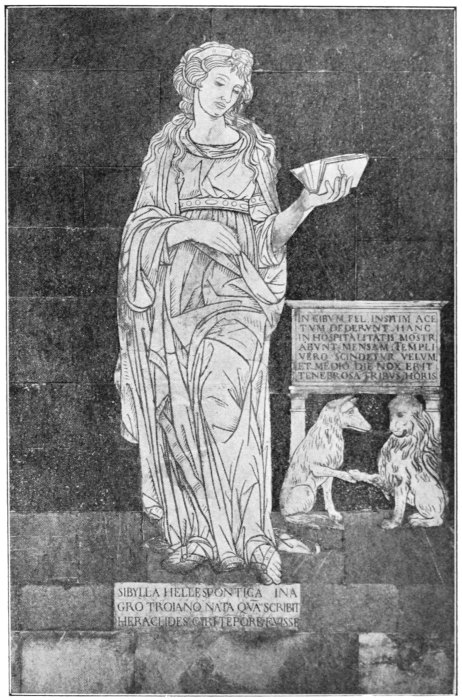
The figure is a graceful one, but suggests
somewhat gigantic proportions. Her hair flows
over her shoulders, though partially confined by
ribbons, and crowned with a jewelled diadem. In
her left hand she holds a half-open book. Her
robe is loosely confined by a small girdle set with
gems.
On her left, a tablet is borne by two columns,
seated in front of which are a Wolf and a Lion
(the Marzocco), with their hands amicably clasped:
an allusion perhaps to the then recent treaty
between Siena and Florence.56 The inscription on
the tablet runs thus:
IN CIBVM FEL IN SITIM ACE
TVM DEDERVNT HANC
IN HOSPITALITATIS MOSTR
ABVNT MENSAM; TEMPLI
VERO SCINDETVR VELVM
ET MEDIO DIE NOX ERIT
TENEBROSA TRIBVS HORIS.
(For food gall, in his thirst they gave him
vinegar, they will show this table of inhospitality.
The veil of the Temple shall indeed be rent, and
at mid-day there shall be black night for three
hours.)
This fine design was the work of Neroccio di
Bartolommeo di Benedetto Landi in 1483,57 and is
a noble specimen of his style. We do not know
what he received for the work, but it is probable
that it was the same sum as that given to Matteo
di Giovanni. Nor, as we have seen, do we know
who executed this and the adjacent designs.58
(Ill. VIII.)
According to Pausanias, the Libyan was the
oldest of all the Sibyls, and was the daughter of
Zeus and Lamia. More than this nothing is
known of her, but her label tells us that she is
spoken of by Euripides. She is a striking figure,
her black marble face, neck, hands and feet, producing
a remarkable effect. She is veiled and
crowned with a garland of flowers. In her left
hand she grasps a small open scroll, while in her
right she shows an open book with the words:
| |
DABIT |
| COLA |
IN VER |
| PHOS |
BERA |
| ACCIPI |
INNO |
| ENS TA |
CENS |
| CEBIT |
DORSV |
| |
M |
(Receiving buffets he will be silent, to blows he
will give his innocent back.)
On her left is a tablet, borne by intertwined
serpents, the words written upon it being:
IN MANVS INIQVAS
VENIET. DABVNT DEO
ALAPAS MANIBVS IN
CESTIS. MISERABILIS.
ET IGNOMINIOSVS.
MISERABILIBVS SPEM
PRAEBEBIT.
(He shall come into unjust hands. With impure
hands they shall give stripes to God. He miserable
and in ignominy will give hope to the
miserable.)
Guidoccio Cozzarelli was the author of this
design in 1483,59 but here again there exists no
record of the sum paid for it. We may suppose
though that these designs were all paid for at
about the same rate.60 The expense of its restoration
was 2,352 lire 16 c.
With the examination of the Libyan Sibyl, we
find ourselves again at the Western end of the
Church, and must betake ourselves back to—
This Transept is covered with three large designs,
all executed during the Rectorship of Alberto
Aringhieri; two of which, at least, may have some
political significance.
The first we come to is—
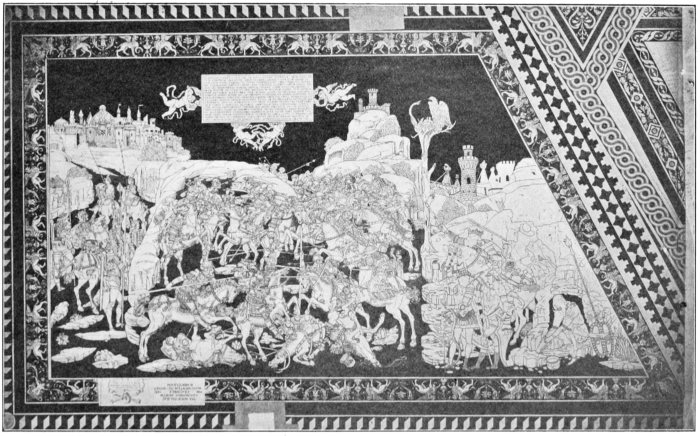
This vast composition, designed by Benvenuto
Giovanni del Guasta in 1484–85, and for which he
received 78 lire,61 is full of charming grouping and
delightful suggestion. It not impossibly alludes
to the expulsion, which had then but recently
taken place, of Pandolfo Petrucci and his followers.
It must be remembered that, though Siena at
this period was not involved in important external
historical events, her internal history was one long
record of party faction and strife, in which Aringhieri
himself played a not unimportant part.
(Ill. IX.)
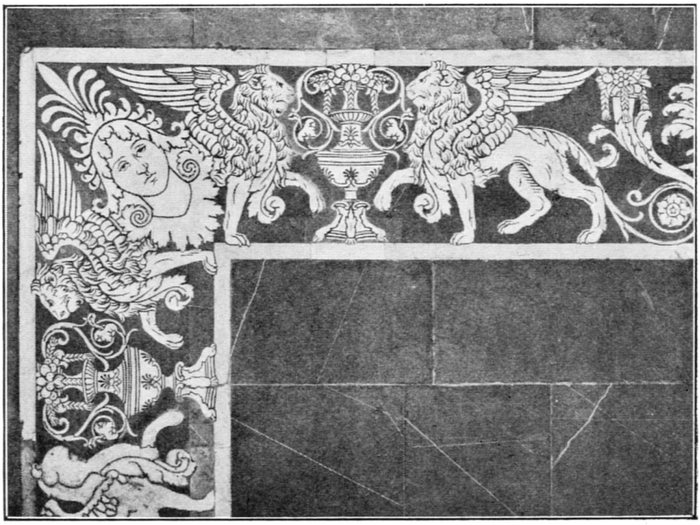
Benvenuto was a consummate draughtsman,
and he was ably supported here by Bastiano di
Francesco, who designed the delightful border of
winged lions that frames the picture (Ill. XI.), and
made sixty letters of marble for the same work.62
LOMBARDI PHOTO.]
[DESIGNED BY BENVENUTO DI GIOVANNI DEL GUASTA
IX. THE EXPULSION OF HEROD (No. 27)
(The entire panel)
We find several notices as to sums paid to workmen
for executing this frieze, but only one speaks
also of work on the design itself. From this, however,
we learn that it was executed by Bernardino
Antonio and Cristofano di Pietro Paolo del Quarantotto.63
The other workmen employed on the
frieze were Vito di Marco,64 and Bartolommeo di
Domenico.65 With the exception of Vito di Marco,
we have no record of these men, apart from
notices of their work done on this Pavement.
Perhaps they were scholars or apprentices of the
better-known masters, and therefore not recorded
more particularly. We also read that certain
millers, by name Giusto Giovanni and Michele di
Ludovicho, were paid 15 lire 14 c. for the porterage
of 7,870 lbs. of black marble used in this design,
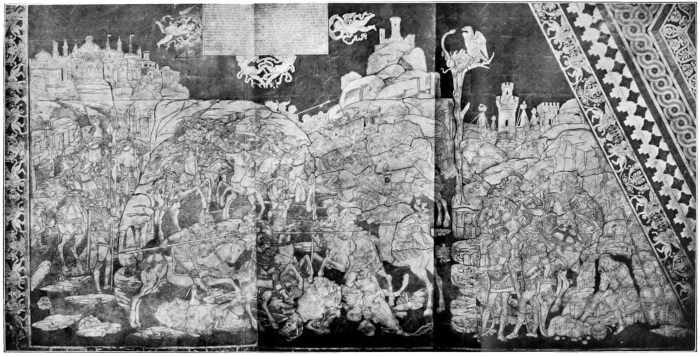
and that “del onperadore.”66 (Ill. X.)
ALINARI PHOTO.]
[DESIGNED BY BENVENUTO DI GIOVANNI DEL GUASTA
X. THE EXPULSION OF HEROD
The composition is most graceful and full of
force. It illustrates an episode in the struggle
between Herod Antipas and his brother-in-law
Aretas, as a result of which the former had to
evacuate his kingdom. The picture has been
well restored, a re-engraving of the marble slabs
on the old lines having been, to a large extent,
sufficient for the main work, though the frieze
has had to be entirely renewed. A group of
soldiers, among whom is one extremely striking
man’s figure in full armour, has been particularly
successful. Over this group, in a high tree, an
eagle maybe seen protecting her nest of young
ones from the attacks of a serpent, possibly alluding
to the same political events referred to above.
The charming cherubs, supporting a tablet in the
upper part of the composition, upon which is engraved
a long quotation from Josephus, describing
the scene depicted, have been renewed, and the
damaged originals transported to the Museum of
the Opera.67 With them is also the original tablet,
which curiously enough on removal was found to
be a memorial slab of an earlier date, bearing on
the reverse side a fine effigy of a cleric.68
The last restoration of this design took place
between the years 1869–1878 and, together with
the Pavement around it, cost 2,156 lire 63 c.;
while that of the friezes, around this and the next
design, cost another 3,490 lire 12 c.
ALINARI PHOTO.]
[DESIGNED BY BASTIANO DI FRANCESCO
XI. DETAIL OF THE FRIEZE OF LIONS
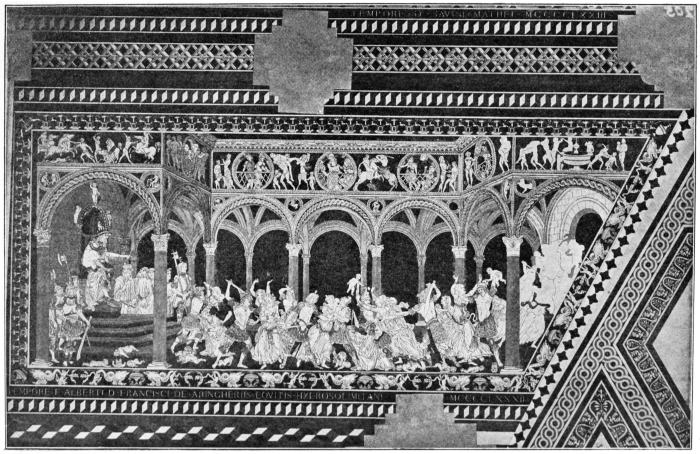
Beyond this fine scene we come to another,
still more remarkable, if not quite so pleasing.
This, perhaps, is the most striking of all the
scenes on the Pavement, and as interesting historically
as artistically. The artist who designed it,
Matteo di Giovanni Bartoli, has thrown into it all
the force of his fancy and skill. It is extraordinarily
full of life, and vivid with imagination. The same
artist executed certainly three, if not four, more
designs of the same subject, two of them being
pictures still existing in Siena itself;69 and it is
extremely interesting to compare his treatment of
it in all these three. Authorities differ as to the
dates of these two paintings, but admittedly there
was an interval of ten years between them. That
in S. Agostino, and most probably also the very
similar painting by the same artist at Naples,
come in point of date almost immediately subsequent
to this design for the Pavement, and resemble
it very closely. At this period all Italy
was convulsed with horror at the awful Sack and
Destruction of Otranto, which had occurred on
the 11th of August, 1480.70 We read that 1,200
persons were massacred, and that most of the
children were sold as slaves. The shock to the
Christian world was so terrible that the Pope,
Sixtus IV., in an Encyclical addressed to all the
cities of Italy, called their attention to the disaster,
pointed out to them that none of them, however
remote, was safe, and implored them, setting aside
their party divisions, to combine in the cause of
mutual protection against the Moslem. Alfonso,
Duke of Calabria, son of Ferdinand, King of Naples,
then living as ruler in Siena, was hastily recalled
to take command of an expedition against the
common enemy: and it is, I submit, not straining
a theory too far, to suppose, that Matteo di
Giovanni may have been directed to design these
scenes on the Pavement of the Duomo, for the
Church of S. Agostino, and for the Church of
Sta. Caterina a Formello at Naples, as an object
lesson to recall to the public mind, through the
medium of a Scriptural Tragedy, the horrors to
be endured at the hands of the unspeakable Turk.
They are all executed with a force and a suggestiveness,
so vivid as to be painful in their intensity.
The successful results of these three probably inspired
the fourth,71 which is somewhat less ferocious,
and certainly more graceful and pleasing.
LOMBARDI PHOTO.]
[DESIGNED BY MATTEO DI GIOVANNI BARTOLI
XII. THE MASSACRE OF THE INNOCENTS (No. 26)
(The entire panel)
Unable to use on the Pavement the brilliant
pigments so lavishly employed in the paintings,
the artist has introduced, wherever possible, marbles
of many and varied colours; and when upon
these multi-coloured materials are super-imposed
most elaborate designs, the whole produces the
effect of a gorgeous piece of bizarre jewellery.
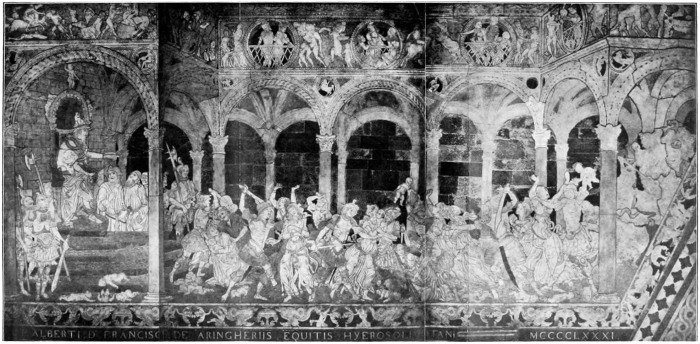
Herod sits on a splendid Renaissance throne of
carved marble, in a colonnade, adorned with panels72
of classical scenes. A sportive frieze of marble
Bacchanals is introduced along the top of the composition,
broken by circular windows, from which
groups of impish children look down complacently
and even laughingly, on the dreadful slaughter
below. The armour of Herod and his soldiers
is of the most magnificent kind, and we may
notice again the artist’s affection for finishing a
clasp with the head of an animal or a human
being.73 (Ill. XII.)
It is evident from the style of this work that
it is by Matteo di Giovanni Bartoli, and his
authorship has never been questioned, though
there is no record of any commission or payment
to him. The date of its execution (1481) is fixed
by Tizio,74 and by two records of payments for
materials used upon it.75
ALINARI PHOTO.]
[DESIGNED BY MATTEO DI GIOVANNI BARTOLI
XIII. THE MASSACRE OF THE INNOCENTS
We have no record as to who executed the
very charming frieze of putti and dragons, which
borders the bottom and the left side of this picture;
nor that of greyhounds and fountains, which
incloses the other sides, and it is not easy to
suggest any reason why two such different designs
should have been employed for the same picture.
They are evidently designed by different hands,
and were probably executed like the other friezes
by the Cathedral workmen mentioned above.
(Ill. XIII.)
The whole work has been apparently restored
several times; for we find in the notes of Abate
Faluschi,76 that it was restored in 1790 by
Matteo Pini, after the designs of Carlo Amidei,
and at this very day some of the worn-out stones
are being renewed, and the line of drawing re-trepanned
and stuccoed.
The third picture in this transept is:
Whether this picture had any political or semi-political
reference we do not know. The small
fortress-towns in the Sienese contado were at
this time continually being relieved and changing
hands, but we cannot now identify this scene with
any particular event. It is interesting, though, to
note that it was planned during the Rectorship of
Savino di Matteo di Guido Savino, who was, on
January 26th, 1480, deposed from his post for
being one of the “Riformatori.”77
LOMBARDI PHOTO.]
[DESIGNED BY URBANO DA CORTONA (?) OR MATTEO DI GIOVANNI BARTOLI (?)
EXECUTED BY ANTONIO FEDERIGHI
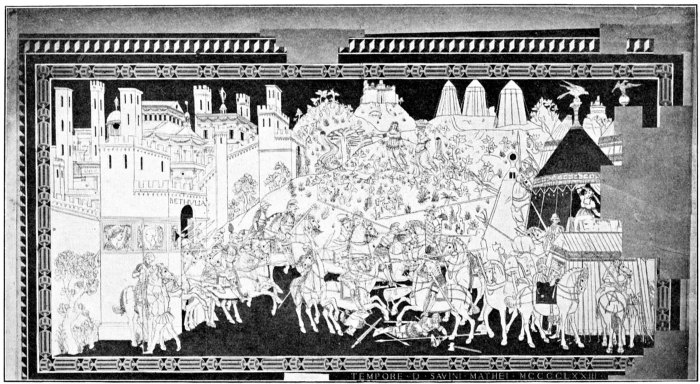
XIV. THE RELIEF OF BETHULIA (No. 25)
(The entire panel)
The notices as to this work are few and vague:
but we know from Tizio78 that it was laid down in
1473, and further that the frieze of “reels” (naspatoio),
surrounding it, was executed by Urbano
di Pietro da Cortona, Giovanni di Stefano di
Giovanni, Bartolomeo di Domenico Calabrone
and Francesco di Bartolomeo (perhaps his son).79
It is generally supposed that the design itself was
the work either of Urbano da Cortona or of
Matteo di Giovanni Bartoli, and the execution is
attributed to Antonio Federighi.80 (Ill. XIV.)
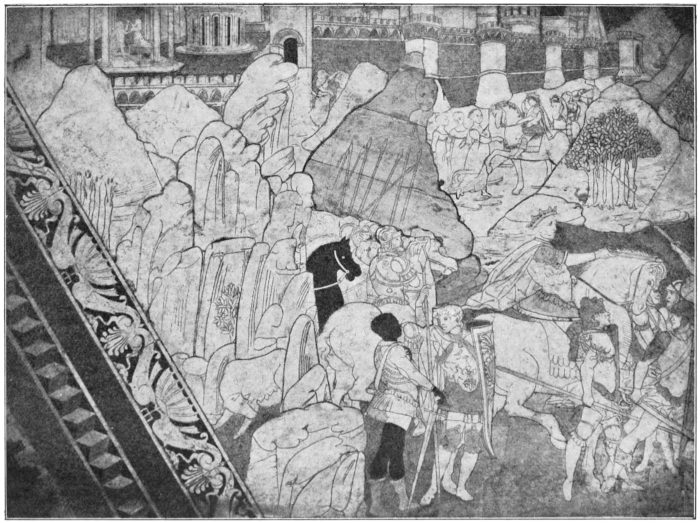
However this may be, it is a work full of charm,
recalling examples of the most poetic period of
Florentine art. As usual in work of this period,
several episodes of the story are told in various
parts of the picture. On the extreme right, now
much injured, and partly obliterated by the Pisani’s
pulpit, we can still trace Holofernes’ tent, and the
gruesome tragedy therein enacted. Above the
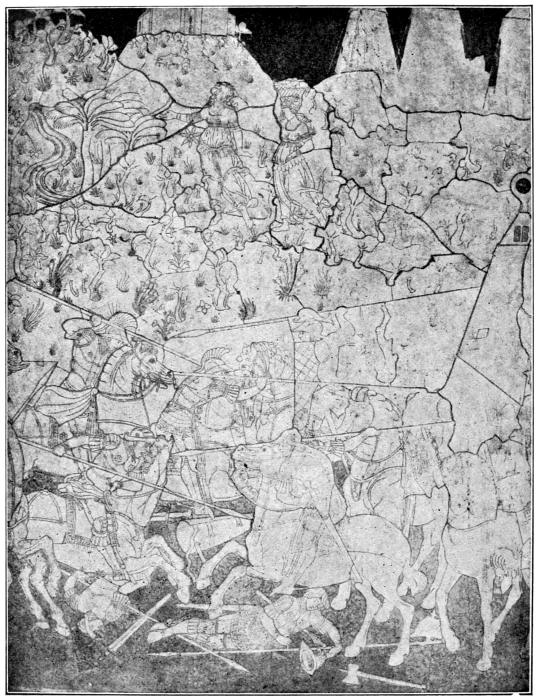
middle of the picture, over the hillside, upon which
bloom myriad flowers amid purling brooks, comes
Judith, a figure of extreme grace, followed by her
maid, who bears on her head a basket, containing
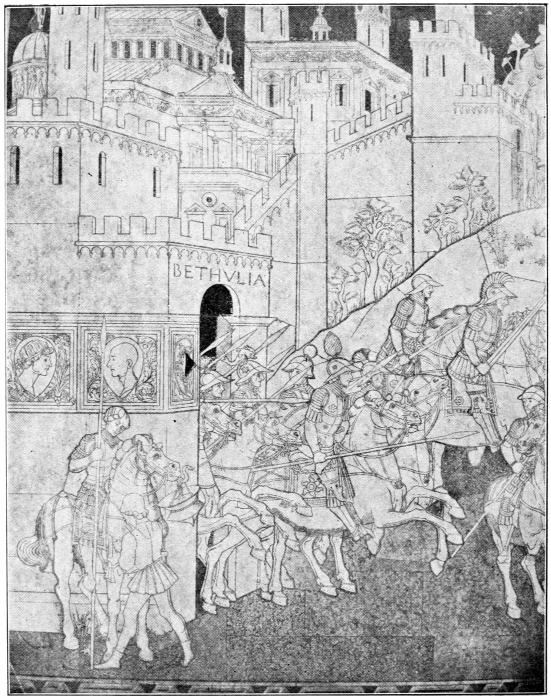
the tyrant’s head.81 (Ill. XV.) To the left
is the towered city of Bethulia, from which issue
troops of horsemen, intent upon victory in the
fight, which is depicted in the centre of the composition.
Beside the gate of the city, one may
notice a group of a knight with his squire arranging
the harness of his horse. (Ill. XVI.) We may
also remark the introduction here of birds. In the
extreme left corner are two parent birds, sitting
in a bush, guarding their young ones in a nest,
whilst above Holofernes’ tent are perched two
waiting ravens.
ALINARI PHOTO.]
XV. DETAIL FROM THE RELIEF OF BETHULIA]
This work was also restored, or, as Abate
Faluschi puts it with much truth, “modernized”
(modernata) by Carlo Amidei and Matteo Pini
in 1790, so that we cannot now know how much
of the original work has perished. It is not unlikely
that, in any case, it may have been a composite
design from the hand of more than one
artist. It is, however, worth noting that, whereas
the design last described depends largely for its
effect on varied colour, this one, the Expulsion of
Herod, and the other contemporary picture of the
Story of Jephthah, presently to be described, show
how much can be done by the use of line alone.
ALINARI PHOTO.]
XVI. DETAIL FROM THE RELIEF OF BETHULIA]
Ascending a wide step, we come to a work of
much older and more archaic character, which I
propose to include in my seventh division.
This work, with the others beside it on the
same platform right across the church, was executed
about the year 1424, during the Rectorship of
Bartolommeo Cecchi. I have already, in my introduction,
referred to the difficulty in separating
the work done here by Domenico di Niccolo del
Coro, from that of Paolo di Martino. Both men
appear from the documents to have held the post
of Capo-maestro of the Duomo. Tizio mentions
distinctly82 this design as among those executed in
1424, and Milanesi in his Documenti83 repeating
that date, assures us that it was among works
to be attributed to Domenico himself: thereby
pointedly confuting Vasari’s assertion, that it and
those adjoining it were from designs by Duccio.
On the same page, however, of the Documenti,84 we
find a notice, dated 1426, of payment to a paper
dealer, named Domenico di Francesco, for ten
squares of “fogli reagli” used by “Paolo nostro,”
for a design for the “storia di Giesue:” and Milanesi
himself in his Discorso sulla Storia Artistica Senese85
contradicts his former statement, attributes this
design and that of Samson (No. 14) in the opposite
aisle of the Choir, also hitherto given by him to
Domenico, to Paolo, and dates them both two years
later than in his previous assertion.
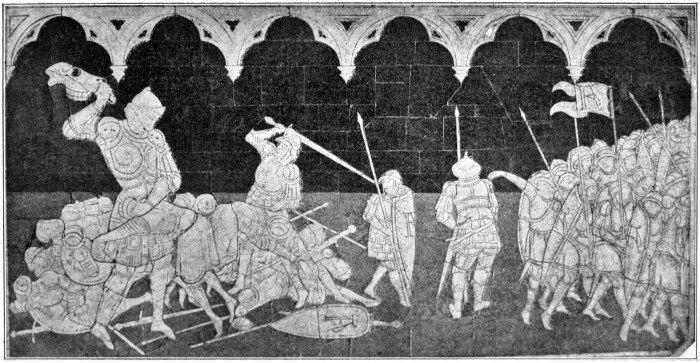
It is an interesting picture, though at present
sadly in need of judicious restoration. The greater
part of it is occupied by the battle scene, but up
in the top left-hand corner we see the bodies of
the Five Kings hung up to five stakes, and below
them a yawning cavern. Some of the figures are
expressed with considerable force, and the fifteenth-century
armour of the soldiers is most quaint and
curious.
The work here, and that of the story of Samson
above referred to, do resemble each other, and
have not much in common with the known work
of Domenico del Coro. I think we may, therefore,
fairly consider them as from Paolo’s designs; and
supposing that these artists worked in collaboration
on the whole scheme of this platform, that, when
Tizio spoke of these designs, he described a project
not completely carried out until two years later.
On either side of the main picture are single
figures Joshua and Solomon (Nos. 23 and 24).
The first of these Milanesi, in his Discorso,86 gives
unhesitatingly to Paolo di Martino, with the same
date as the before-mentioned larger design. But
of the figure of Solomon, now more than half concealed
under the marble balustrade of the altar of
S. Ansano, a mention exists in a document in the
Archivio dell’ Opera, dated 10th of August, 1447.87
This was during the Rectorship of Giovanni di
Pietro Ghezzi (Borghesi), who held the post from
1437 to 1448,88 and we find a notice dated June,
1444,89 which may refer to this very work, although
it is not mentioned specifically. It is a permission
to the Rector to fill up this portion of the Pavement
with such a design, as may seem to him suitable
and pleasing.90
The whole platform, or step, upon which all these
designs are inlaid had been bordered, along the
top and bottom, by a delightful frieze of putti,
executed in 1423, by Agostino di Niccolo of Siena,91
and Bastiano di Corso of Florence.92 Of the former
artist we know but little, but of the work of the
latter, in company with his son Corso, on the
pavement before the Cathedral doors, we find
several notices, to which I have referred already,93
A notice, dated 25th March, 1447,94 speaks of other
frieze-work done by father and son, “sotto la
tribuna di verso l’altare di Santa Chaterina.” This
work appears to have perished, or been superseded,
unless, as is by no means impossible or improbable,
we may attribute to him the frieze round the
Massacre of the Innocents described above, the
authors of which are unknown and unidentified.
Agostino and Bastiano’s frieze is a very graceful
one, but it would seem, judging from the dates of
the documents, as if the latter artist had succeeded
the former in the work: for the first document
speaks of payment made to Agostino up to
December 30th, 1423, whereas both those commissioning
Bastiano are dated the same month,
with no allusion to previous or contemporary employment
of any other artist.
Three more steps bring us to the passage which
runs round behind the altar. Here originally was
some of the oldest work, but to all appearance
now it would seem to be almost the most modern.
In five circles we find the five Cardinal Virtues,
the first of whom is
On this spot, as I have already said in my first
chapter, Marchesse d’Adamo95 and his companions,
the Comacene sculptors at work in Siena in 1406,
are generally supposed to have executed the earliest
figure-subject on the Pavement, about which we
now possess authoritative information. There is
nothing, however, to show their work. The figure
is imposing and dignified in composition, but the
workmanship on it is poor and somewhat paltry.
Of the four other Virtues, Justice, Christian
Piety, Prudence, and Temperance (Nos. 20, 19, 18,
and 17), there is little definite to be said. Padre
Micheli96 following Milanesi97 gives 1406 as the
possible date of the two first, 1380 as that of the
other two; but there is nothing in their present
condition to prove either one date or the other.
The only thing that may be noticed is that the
restoration of Justice and Prudence shows more
vigour of conception and boldness of line, with far
more satisfactory results than have been shown in
the case of Fortitude and Temperance. Fortitude,
we know, was restored in 1839, and Temperance
perhaps at the same time. Christian Piety is half
covered by the great lectern, and so obliterated
by the feet of readers and singers as to be now
almost indistinguishable. The frieze of ladders
(scaglioni) and thorns (spini), surrounding these
works, is said to have been executed in 1406.98
Descending again three steps corresponding to
those on the opposite side of the church we come
to the design of
alluded to above. The workmanship and style of
this picture certainly resembles that of Joshua
and the Five Kings on the north side, but it is a
finer and a grander piece of work. The grouping
is bolder and more forcible. Samson, a giant
figure, is administering chastisement to a Philistine
in the manner of a schoolmaster to a naughty boy.
He holds aloft, not merely the jawbone of an ass,
but the whole skull. Some of his opponents lie
slaughtered on the ground, and a crowd of them
cowers away in terror, to the right of the composition.
(Ill. XX.)
This design, as we have said before, is mentioned
by Tizio99 among those projected in 1424, and was
probably executed by Paolo di Martino in 1426.
On either side of it are the single figures of Moses
(No. 16) and Judas Maccabeus (No. 15). Milanesi
in his Discorso100 attributes the figure of Moses, like
that of Joshua (No. 23), to Paolo di Martino in
1426, while that of Judas Maccabeus, now hidden
almost entirely by the balustrade of the altar of
the Blessed Sacrament, and also recorded by Tizio
(in the notice already more than once referred to),
Padre Micheli101 supposes, and there is no evidence
to contradict him, to have been the work of Domenico
del Coro in 1424.
Before descending the step to the South Transept,
I would wish to draw the reader’s attention
to the fact, that this step does not run parallel with
the steps above it, and that the platform is narrower
at this end than at the other. Consequently, the
design of Samson and those in the transept, now
to be described, are all more or less irregular in
shape. Whether this is due to some structural
defect in the original building, or to some inequality
in the foundation, it is impossible now
to say.
This transept is complicated in its general plan
by the irregularity above referred to. It contains
two pictures to correspond to the one (the Story
of Judith) on the opposite side of the church, and
is further broken up by varied designs, of different
sizes, before what was once the Porta del Perdono,
and is now the Cappella del Voto.
The first picture, that we come to, is very remarkable,
especially since it is the only one which
is neither biblical, symbolical, nor heraldic. It
professes to be a portrait of the
who in 1433 was a visitor for some months to the
city. (Ill. XXI.)
Confusion has arisen among Sienese writers as
to the identity of this portrait, and some have
said that it represents the Emperor Charles IV.
This probably arose from the fact, which is difficult
now to explain, that Tizio,102 under date 1424,
after describing, as we have seen, the above-mentioned
designs, goes on to say that “in the time
immediately following, to the right, by the iron
grating, a Portrait of the Emperor was laid down
on the pavement; and not much later the Story
of Absalom hanging by his hair to the oak, under
the direction of the same Operaio.” With the
Story of Absalom I will deal presently, but Tizio
must have made a very grave mistake here in
dates; since we have two notices103 proving that
Domenico di Bartolo di Ghezzo d’Asciano was
the designer of this work in 1434, for which he
received 16 lire; whilst another notice,104 dated
December 2nd in the same year, records the
payment of 3 lire 10 soldi to a workman named
Giacomo d’Antonio for assistance in executing it.
As regards the Operaio at this period some
difficulty arises, since Padre Micheli asserts that
Bartolommeo Cecchi only held the post up to 1430.
From the Borghesi and the Faluschi MS. lists,105
however, we find that Cecchi (Bartolommeo di
Gio. di Cecco) was still in office on October 25th,
1434, but was apparently compelled to resign on
account of his having married a certain Corsa,
and had children by her.106 We read further that
he was succeeded, 1434–5, by Giacomo della
Quercia, who held the post until his death on
February 8th, 1438.107 From the second of the
notices above referred to we gather, therefore,
that the work was certainly ordered by Bartolomeo
Cecchi, even if, as is possible, it was completed
under the direction of his successor.
LOMBARDI PHOTO.]
[BY PIETRO DEL MINELLA (?)
XVII. THE STORY OF ABSALOM (No. 12)
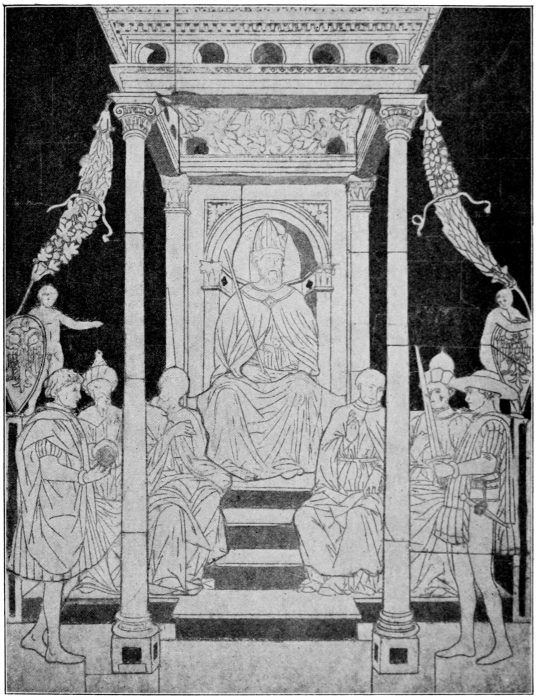
The Emperor, crowned and sceptre in hand, sits
on a splendid throne, under a marble canopy, hung
with garlands. Four counsellors sit beside him,
two on each hand; and two tall pages carry his
orb and sword. It is worth noting, that this design
appears to have early required restoration, because
we read in a notice quoted above,108 under date
1485, of black marble being brought from Chasciano,
among other things, “raconciare la storia
del onperadore.” At the latest restoration (1869–78)
a sum of 616 lire 49 c. was expended on it.
Beside this design, as I have remarked above,
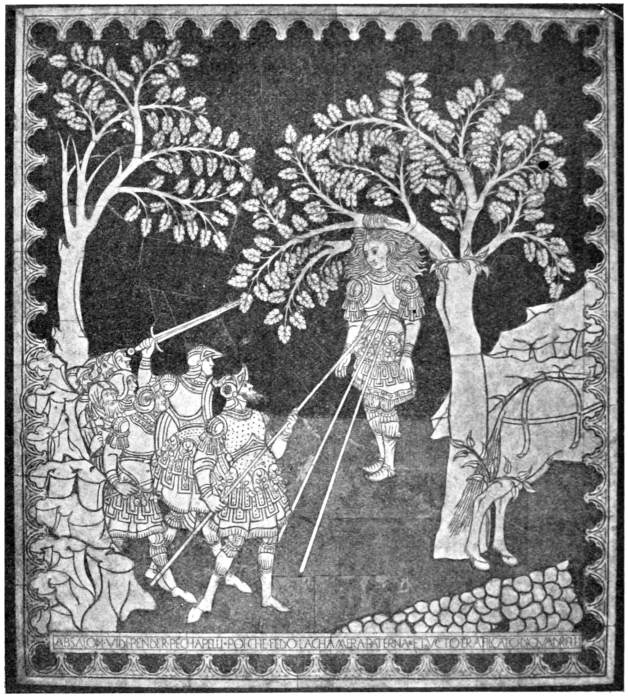
is the very striking picture of
(Ill. XVII.). No design on the Pavement attracts
so much attention as this. The bold, vigorous
outlines of the white figures set against the black
marble background, the vivid and forcible composition
of the picture, and the remarkably decorative
foliage of the two trees, almost Japanese
in character, from one of which Absalom is hanging,
arrest the eye and the attention of even the
most casual visitor. We find a notice in the
Archivio dell’ Opera,109 stating that it was commenced
after the 11th of July, 1447, during the
Rectorship of Giovanni Borghesi, and while Pietro
di Tommaso Minella was Capo-maestro.
The design of it is generally attributed to
Minella himself, and from the high merit of its
conception and composition this is very probable,
but there are no records to prove more than that
he superintended its execution. Tizio110 includes
it in the list of works to which he gives the date
1424, but this, as I have already pointed out, is an
obvious mistake.
Below these two designs we come to another
fine large picture, similar to those in the North
Transept. It represents
The greater part of the composition is taken up
with the Fight and Victory; and the expression
of violent action on the part of the combatants is
wonderfully forcible. To the left Jephthah, on his
charger, a crown on his head, and clothed like a
Roman emperor, gives orders to his men. Near
him we notice a charming group of two young men
conversing, one of whom, a negro, stands out from
the picture with startling vividness. (Ill. XXIII.).
Above, in the background, Jephthah’s daughter is
seen coming out of the city gates, with a joyous
crowd of maiden companions, to greet her victorious
father; while, still farther into the top left-hand
corner, we may see the unhappy father, in a
tiny temple, sacrificing his daughter, in fulfilment
of his rash vow. Of this work we find two notices
in the Archives,111 the first, dealing with advances
made on two occasions to the artist, and the other,
recording payment for the complete work. The
artist employed upon it was Bastiano di Francesco
di Sano, of whom we have already spoken, and he
appears in this case to have been both designer
and executant. The work seems to have been
commenced either late in 1481 or at the beginning
of 1482, but not finished until the end of 1484 or
early in 1485. Not that the artist was idle, for, as
we have seen, he had work to do elsewhere on the
Pavement in the interval, besides various sculptures
commissioned by the cathedral authorities.112
He received for it in all a sum of 2,555 lire. Its
restoration in 1869–78 cost 2,664 lire 8 c. (Ill.
XXIII.)
Below this design, the plan of the floor is very
much broken up. The reader must, however, bear
in mind that up to the year 1661, when Pope
Alexander VII. (Fabio Chigi) began to build the
Cappella della Madonna del Voto, to contain the
famous wonder-working picture of the Madonna,
Protectress of Siena, this portion of the Pavement
lay before the Porta del Perdono, to which I have
made frequent reference at the commencement of
this chapter. This Porta del Perdono must have
been a sort of Porta Sacra, opened only in solemn
state in the years of Jubilee.113 Fragments of it still
exist, and may be seen built into the outer wall of
the bay, next to the above-mentioned Chapel; and
the inscription, quoted in the note, is now to be found
over the left hand doorway of the Western façade.
There are many notices still to be found dealing
with this important entrance. Several, to which
we have referred already, dealt with the adornment
of the wide step or platform, that apparently
led to it from the outside. All this has now
perished. Inside, however, the floor has fared
better, and the beautiful painting by Maestro
Gregorio (1423), which hung above an altar114 once
erected over this door, and belonging to the
Tolomei family, still exists in the Museum of the
Opera del Duomo. It was, no doubt, the fact
that long periods of time passed between each successive
opening of this door, which gave Antonio
di Federigo, or Federighi, the idea of placing
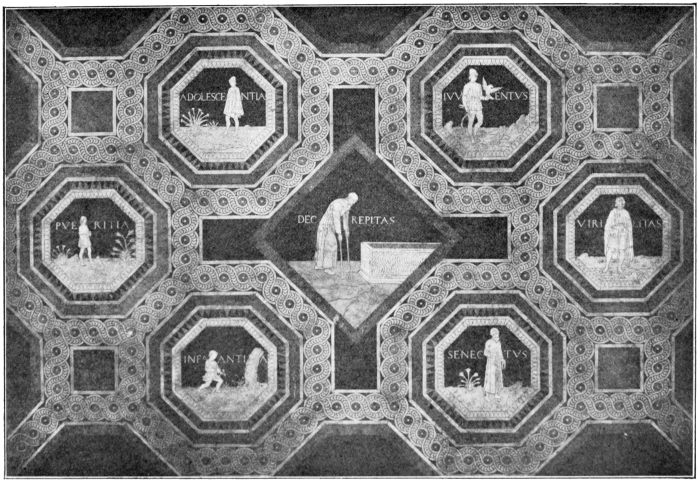
before it his beautiful design of the
All seven are treated with a naïveté and grace
impossible to surpass. (Ill. XVIII.) Not only the
figures themselves, but also their accessories; the
budding blossoms, the over-blown flowers, and the
handsome classical tomb to which “Decrepitas” is
tottering, show a taste and feeling beyond description.
Federighi, we read, designed and executed
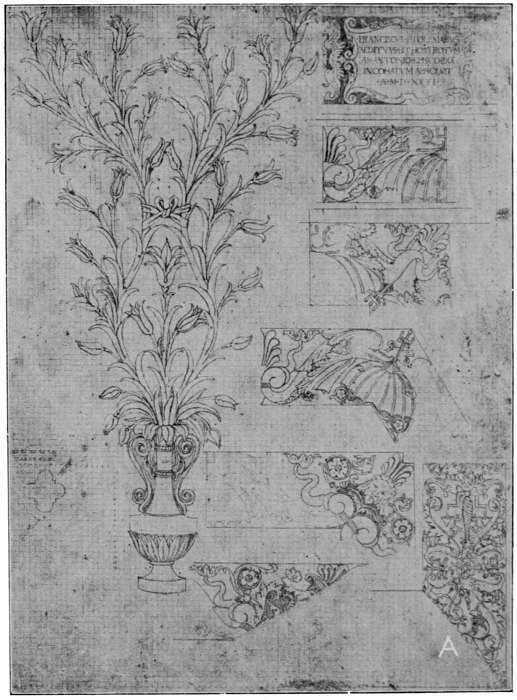
this delightful work in 1475,115 and, at about the
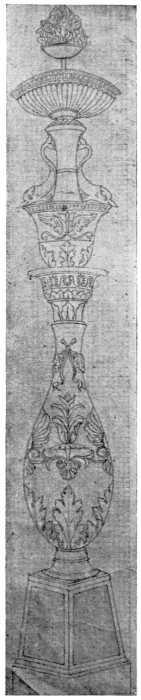
same date, the friezes of stags, and perhaps the
beautiful lily (Ill. XXIV.), candlestick (Ill. XXII.)
and geometrical pattern, in the angle formed by the
Seven Ages with the Cupola designs, were also laid
down; but we cannot be sure whether they are by the
same master or not. All that we do know for certain
about them is drawn from two notices,116 recording payments
to a certain Bartolino of Massa da Carrara for
marble for work in the Duomo, among which the
“frieze of stags” (fregio del cervio), and a frieze at
the Porta del Perdono are especially mentioned.
ALINARI PHOTO.]
[DESIGNED BY ANTONIO FEDERIGHI
XVIII. THE SEVEN AGES OF MAN (No. 6)
The work visible here now is wholly a restoration;
but Federighi’s Seven Ages may be seen
nearly complete in the Museum of the Opera, together
with part of the frieze of stags. Fragments
of the other friezes and borders are also to be
found, laid down outside the north aisle of the
Cathedral, in the little courtyard between it and
the present Palace of the Archbishop.
Federighi’s work, when removed (1869–1878),
was replaced by the fine copy, which we now see,
executed by Leopoldo Maccari and Giuseppe
Radicchi. The cost of restoration, at this date,
of the entire angle amounted to 22,254 lire 26 c.
There is no record of any early work ever having
existed between this design and the destroyed
Porta, which probably stood nearly on the same
spot as the doorway of the present Cappella del
Voto. Perhaps the erection of this newer archway
created a wider space. However this may
have been, designs for the four Theological Virtues,
Religion, Faith, Hope, and Charity were made by
Carlo Amidei, and executed here by Matteo Pini117 in
1780. These designs were not admired, and, moreover,
did not stand the wear of time as the older
work had done. They were, therefore, removed
in 1870, and replaced by entirely new designs,
made by Professor Alessandro Franchi, and executed,
under his direction, by Leopoldo Maccari.
Before commencing the description of the last
two sections of the Pavement, I must remind my
reader once more, that, after a great part of it had
been laid down, an important radical change took
place in the interior arrangements of the Duomo.
Up to the commencement of the sixteenth century
the great High Altar, glorified by Duccio’s
grand Maestà, stood in the centre of the Cathedral,
under the Cupola. This part, therefore, of the
floor was not decorated. But, on the other hand,
that above the steps, where the Choir and Altar
now are, was so adorned.
By the advice of Baldassare Peruzzi, Capo-maestro
in 1532, the whole arrangement was
changed. In accordance with his plans, and under
his direction, Choir and Altar were moved further
east, and placed in the position that they now occupy.
Of the original floor decorations, then, all that
now remain in situ are the designs in the Choir
Ambulatory above-mentioned, and Domenico del
Coro’s work, to be described shortly. Fragments of
the older work, removed to make way for the alterations,
still exist; and, until 1878, were used to fill up
three of the hexagons under the Cupola. At that
date, as we shall presently see, they were finally removed
to the Museum of the Opera, and replaced
by modern work of an entirely different character.
* * * * *
Let us now proceed eastwards and examine
Before the lowest step of the High Altar, we
find one large design, and on either side of it seven
small ones; the whole being inclosed by a long
processional frieze.
The principal design represents
The whole story is told in different parts of
the picture, culminating in the central group of
the Sacrifice itself. The smaller designs represent
the following subjects.
* * * * *
On the right of the Altar:
1. Elisha raising the son of the Shunammite.
2. A prophet with an open book before him.
3. Eve on her knees.
4. A woman, holding in her hand an open book.
5. Another woman, with a mirror, representing
Prudence.
6. The Sacrifice of Melchisedec.
7. A seated woman, with a child.
On the left:
1. The old Tobit, with his son, Tobias, and the
Angel Raphael. At their feet a dog.
2. A woman, representing Charity.
3. Adam kneeling.
4. A prophet, gazing up to Heaven.
5. Another woman, seated, holding a book in her
hand.
6. The Sacrifice of Abel.
7. Another woman, seated, with a child.
A great procession runs all round these, composed
of men and women of all ages, shown in
half-length, representing
All these designs were the work of Domenico
di Jacopo di Pace Beccafumi, called Il Mecharino,
and we read in Alfonso Landi’s Descrizione del Pavimento
and in the notes of Abate Faluschi118 that they
were executed between the years 1544 and 1546.
The writers refer to (as their authority) the Libro
Giallo dell’ Assunta of the Cathedral Archives, and
state that the artist received 8,004 lire 19 c. for his
work. The subjects chosen fitly complete the
general scheme of the floor, surrounding, as they do,
the Altar, with symbolical imagery from the Old
Testament. The repentant Adam and Eve, the
three Typical Sacrifices, Prophets, Virtues, the
Guardian Angel, and around the whole a host of
believers hastening to the Promised Land. Some of
the drawing is very beautiful and extremely decorative,
notably the frieze. The beautiful figure of
Eve, indeed, has been even attributed to Giovanni
Antonio Bazzi (Il Sodoma), who is known to have
received a commission to make at least one design
for this floor.119 This, however, is wholly uncertain,
and cannot now be verified. The workmen employed
here, and the sums they received respectively,
we learn from the above sources and from
Milanesi.120 They were Bernardino di Giacomo,
who received for his labour 475 scudi, and Pellegrino
di Pietro, 151 sc., 1. 4. These men were
probably masons in the regular employ of the
Cathedral, for Bernardino, at least, seems to have
been employed on all the work done at this time.
Descending three steps we come to Domenico
del Coro’s design of David, to which we have had
occasion to refer already more than once.
In a circular panel, David, as King, sits on a
throne with a sort of zither on his knee, while,
with his right hand, he points to an open book of
Psalms, propped upon a lectern by his side. Around
him stand four courtiers holding each a primitive
musical instrument:—a small organ, a tambourine,
a mandoline, and a viol. The whole picture is
surrounded by a graceful cornice of leaves. On
either side of the central picture, in a lozenge-shaped
space, is a single figure; on the one side
is the youth David slinging his stone, and upon
the other the giant Goliath falling backwards.
It is curious that Goliath has a hole in his forehead,
although the stone has not reached him;
while, at the same time, the stone is both still
in David’s sling and in the air above Goliath.
The figures in the central composition are fine,
but much altered by restoration. Those of
David and Goliath are more original, and have
probably suffered less. These designs are undoubtedly
the work of Domenico del Coro,
executed during the Rectorship of Bartolommeo
Cecchi: and the cornice and frieze work around
them is that of Agostino da Niccolo, for we read
special notice of this fact in a memorandum of
payment to the latter, dated June 6th, 1423.121
Below another step we come to the largest and
most pretentious of Beccafumi’s designs.
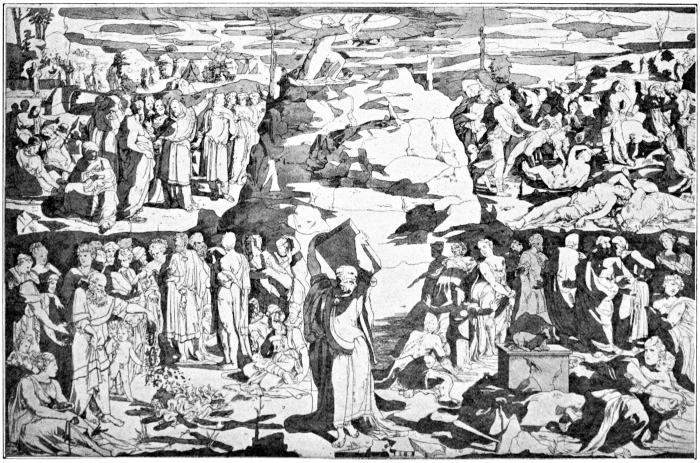
The story is told in six parts, combined into one
large picture. Above, in the centre, Moses kneels
on the mountain top (α). The light of Heaven
streams over him, and he receives the Tables of
the Law into his outstretched hands. Below in
the centre he lifts the Tables over his head, to
dash them to pieces on the ground (δ). In the
upper left-hand corner, the Elders of Israel are
seen persuading Aaron, who points to Moses on
the mountain, to make the Golden Calf (β): in
the lower, we see him casting their gold and jewels
into the fire to make it (θ). In the lower right-hand
corner the Israelites are worshipping the
Calf (η), while above they are smitten with plague
and dying in agony (γ). This work appears to have
been originally commissioned by a certain Antonio
d’Agostino del Vescovo, then Rector (1524);122 but,
as we read from an inscription let into the beautiful
frieze that surrounds it, it was completed under
the direction of his successor, Francesco di Carlo
Tolomei. Beccafumi received on the 30th of
August, 1531, 120 scudi for these designs,123 according
to a valuation made for Tolomei by Baldassare
Peruzzi himself;124 which suggests the idea that
these two great artists may have together planned
the new arrangements of the Choir, and a scheme
of decoration to adorn it, when complete. From
Landi and Faluschi we learn that the workmen
here employed125 were the same Bernardino di
Giacomo, who now received for his work 969 scudi
13: Giacomo di Pietro Gallo, 133 sc. 6.8; Bartolommeo
di Pietro Gallo, 41 sc.; and Giovanni
d’Antonio Marinelli, called il Mugnaino, 486 sc.
To these Milanesi adds two more, not mentioned
by either of the above authorities: Niccolo Filippi
and Cristofano di Carbone.126
Immediately below these scenes a long narrow
design, also by Beccafumi, shows
This is by far the most pleasing and successful
of Beccafumi’s works. We can see, from its very
simplicity, how much its charm depends upon
sheer skill of drawing. This work was executed
in 1525,127 but we do not find any record as to the
amount paid to him for it, or the workmen
employed upon it. Probably they were the
same as had carried out his previous designs.128
These scenes by Beccafumi provoked the most
extravagant admiration and applause from the
writers of the seventeenth, eighteenth and early
nineteenth centuries; and as tours de force, and
specimens of a new kind of work, they are certainly
remarkable. They do not, however, succeed in
provoking that feeling of pleasure and charm, that
one experiences when studying the older and
simpler productions.
And now we come to the last section, and some
of the latest work.
This vast hexagonal space is divided into seven
hexagons and six lozenges. They all now contain
scenes from the Story of Elijah, completing what
probably was Beccafumi’s original design. That
that artist did prepare designs for four of the
hexagons, for two of the lozenges and for a frieze,
we have abundant evidence, for we have no less
than five notices,129 between the 11th of March,
1518–19, and the 18th of June, 1524, in the
books of the Opera, of payment to him, not only
for his labour, but also for the paper used for his
cartoons. It is also to be noted that the commission
for this work was given him earlier than
that of any of the other works above described.
Upon these grounds, Professor Luigi Mussini,
writing on the Pavement,130 supposes that they
were executed in 1517, and likens them to Pinturicchio’s
work of eleven years before. A recent
writer in the Miscellanea Storica Senese,131 however,
contests this statement, and quotes a document
in the Archives dated 1562,132 which states
that a certain person, called there Giovan Battista
nostro, designed four scenes from the Story of
Elijah for the Duomo floor, which, we gather from
the same sources, were executed by the Cathedral
masons, Niccolo di Girolamo Gori, Domenico di
Pier Giovanni, and the same Bernardino di
Jacomo.
This Giovan Battista was Giovanni Battista di
Girolamo Sozzini, brother of Alessandro Sozzini,
Diarist of the last Siege of Siena. He was a
pupil of Beccafumi’s, and of his work, Scipio Bargagli
in his Imprese speaks in high praise, specially mentioning
some mandorle designed by him, “placed
near the grand works of the great Mecarino.”133 To
add to these facts, we know that Sozzini retained
in his possession many drawings by Beccafumi,
and among them his cartoons for the floor. These
designs he sold to the architect Tiburzio Spannocchi,
and it is recorded in the Archives of the
Duomo,134 that the Cathedral authorities endeavoured,
but apparently unsuccessfully, to recover
them. Some of these have now, as we
know, found their way into the Public Picture
Gallery. These six designs differ in treatment
from Beccafumi’s other work, and the drawing
and composition of them is not so striking. The
large hexagons represent:
1. The Compact between Elijah and Ahab (in
the centre). (Ill. XIX.) No. 42.135
2. Ahab’s Sacrifice (to the left). No. 44.
3. Elijah’s Sacrifice (above). No. 41.
4. The Slaughter of the Prophets of Baal (to
the right). No. 43.
The small ones:
5. Ahab comes to meet Elijah. No. 46.
6. Elijah sends Obadiah to fetch Ahab. No. 45.
It does not seem to me, however, that the learned
writer of the above-referred-to article brings forward
any real ground for doubting Beccafumi’s
authorship of these designs. The Document
quoted, and Scipio Bargagli, both speak of “mandorle,”
which appears to have been the technical
expression for the lozenges filling up the great
hexagon, in contradistinction to the words “tondo”
or “esagono,” used to describe the larger sections.
The documents dated 6th of September, 1521, and
18th of June, 1524, together expressly mention
four tondi and two mandorle, which exactly
accounts for the designs in question. It seems
unnecessary, therefore, to strain the word mandorle
to mean something else than its more
obvious meaning: and it is surely much more
probable, that the document and quotation, both
refer to designs for the remaining four mandorle,
which are generally supposed to have been filled
in by Carlo Amidei, and Matteo Pini in 1780.136
However this may be, the smallness of the sum
paid for the designs, 75 soldi, makes the idea,
that it was a payment for drawings of any size,
even more improbable and absurd.
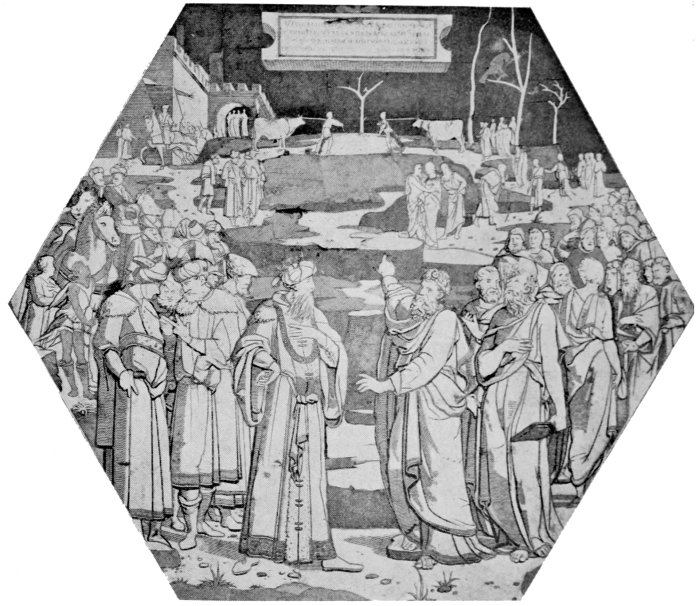
ALINARI PHOTO.]
[DESIGNED BY DOMENICO BECCAFUMI
XIX. ELIJAH’S COMPACT WITH AHAB (No. 42)
The three remaining hexagons, up to 1878,
contained fragments, and most interesting fragments,
of older work, which evidently once formed
part of the floor, where the High Altar now stands.
To the left, looking east, was a delightful design
representing the Blind leading the Blind. An old
man is holding one end of a stick, while a young
man, also blind, is grasping it at the other end.
The older man is just stepping over a precipice
into space. Below them is a delightful putto, holding
in one hand a mirror, and a label with the word
“Notate” upon it. This design we know to have
been the work of Antonio Federighi in 1459; and
for it he received 46 lire.137 It was apparently ordered
by the Rector, Benedetto di Biagio di Roberto,
and completed during the Directorate of
Cristofano Felice.138
The middle design illustrates the Parable of the
Mote and the Beam; and though it dates from
1374–5,139 strangely enough is now in the best preservation
of the three.
The third design was a scene of a stately-looking
bearded man, giving alms to a woman with a child
in her arms. This is generally supposed to be
that work of Domenico del Coro140 which is referred
to in a document dated 1433, as being placed by
him in the choir (then under the cupola) from the
lectern downwards, in that place where they stand
to sing,141 and for which he received 357 lire.
It is impossible now to tell what was the original
shape of these designs, or where they were
placed. But to fit them into the hexagons, they were
made into more or less complete triangles, the remainder
of the space being filled up with fragments
of old friezes, brought probably from the same
place.
In 1875, the fragments left of them, and of the
four later mandorle, were removed to the Museum
of the Opera, where they now are, and in 1878, all
seven were replaced by others, completing the Story
of Elijah and Ahab.
The subjects chosen are, for the larger ones:
1. Ahab mortally wounded. No. 40.
2. Elijah carried to Heaven in a Chariot of
Fire. No. 38. (Ill. XXVI.)
3. Elijah predicts the manner of Ahab’s death.
No. 39.
For the smaller ones:
1. Elijah fed by Ravens. No. 47.
2. Elijah raises the widow’s son. No. 50.
3. Elijah asks bread of the widow. No. 49.
4. Elijah anoints Jehu, King of Israel. No. 48.
These designs were made by Professor Alessandro
Franchi, the present Director of the Accademia
delle Belle Arti, and were executed under
his direction by Leopoldo Maccari and Antonio
Radicchi.142 The smaller ones follow to some extent
the older lines, but in the larger ones, the artist
has struck out for himself; and, if the result is in
somewhat startling contrast to everything preceding
it, there is no doubt that his work is full of skill
and merit of a most scholarly and remarkable kind.
Under his care, and with the able support of the
above-mentioned two artists, aided by a generous
legacy of a former Rector, Cav. Pietro Bambagini
Galletti, the whole Pavement has undergone the
Restoration, to which I have referred so often,143
and is now in as perfect a condition as constant
loving and intelligent care can keep it, without
entirely hoarding it from view.