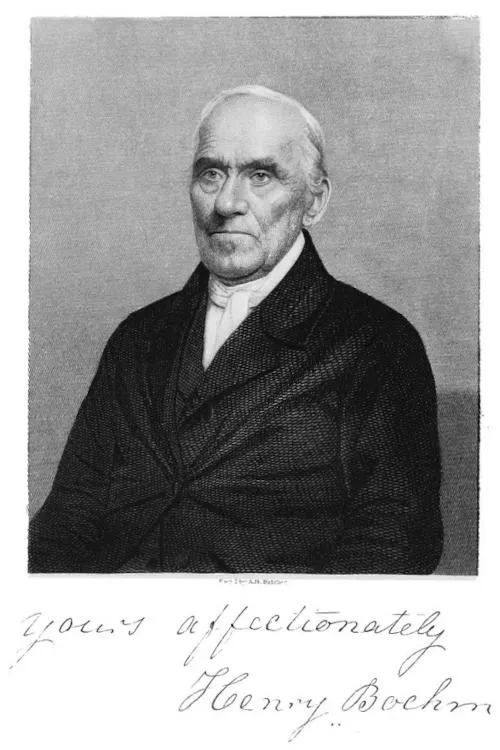
BEING
REMINISCENCES, HISTORICAL AND BIOGRAPHICAL, OF
REV. HENRY BOEHM.
BY REV. J. B. WAKELEY, D.D.
With several additional chapters, containing an Account of the
Exercises on his One Hundredth Birthday; his Sermon
before the Newark Conference and the Addresses then
delivered; his Centennial Sermons in Trinity
Church, Jersey City, and in John-street
Church, New York, and
The Addresses made on
those occasions,
PHONOGRAPHICALLY REPORTED.
NEW YORK:
NELSON & PHILLIPS. CINCINNATI: HITCHCOCK & WALDEN.
1875.
Entered according to Act of Congress, in the year 1865, by
CARLTON & PORTER,
in the Clerk’s Office of the District Court of the United States for the
Southern District of New York.
TO THOMAS A. MORRIS, D.D., AND
HIS COLLEAGUES, THE
BISHOPS OF THE METHODIST EPISCOPAL CHURCH, THE
WORTHY SUCCESSORS OF THE APOSTOLIC ASBURY, IS THIS VOLUME
MOST AFFECTIONATELY INSCRIBED BY HENRY BOEHM.
PREFACE.
For many years, and by many persons, including
bishops, editors, and others, I have been importuned
to publish the substance of my records and recollections
of the Methodism of my day. It was judged
that my great age, my intimate relations with Bishop
Asbury, and my acquaintance with other pioneers
and fathers of the Church, would enable me thus to
preserve much desirable information which would
otherwise soon be forgotten.
In 1847 the New Jersey Conference took action on
the subject, and appointed a committee to confer with
me in respect to my journals and other papers, and
aid in preparing them for publication. The committee
was a very competent one, but the members
were too widely separated for any effectual result.
I had concluded to abandon the design, and this
volume would probably never have seen the light
had not the Rev. J. B. Wakeley come to my help.
For the materials of the work I had a manuscript
journal of two thousand pages. This we went over
together, reviewing all my fields of labor, and drawing
additional particulars from the storehouse of
memory, Brother Wakeley performing the work of
transcribing, arranging, and revising. Thus the
journal furnished the warp and recollection the filling
of what is before the reader in the shape of a
book. In this way we were employed, at different
times, during a period of twelve years, so that if the
work has been poorly done it has not been through
undue haste or the sparing of labor or pains.
Next year is the centenary of American Methodism,
and this volume is a connecting link between
the present and the origin of our Church, for I have
heard Robert Strawbridge, who laid the foundation
of Methodism in Maryland nearly a hundred years
ago. From it the reader may get a good idea of
primitive Methodism, and learn how our fathers
toiled and “endured hardness as good soldiers,” and
some, I trust, will catch their spirit of labor and self-denial
for Christ and the Church.
REMINISCENCES OF REV. HENRY BOEHM. — CHAPTER I. MY ANCESTORS AND MY EARLY DAYS. — MY EARLY DAYS. — RELIGIOUS EXERCISES.
My forefathers were from Switzerland. There is
romance in their history as well as in the land of
their birth. Jacob Boehm, my great-great-grandfather,
was a Presbyterian. His son Jacob learned a
trade. It was a custom in Switzerland for all who
completed their apprenticeship to travel three years
through the country as itinerant journeymen. The
design was to make them finished workmen; and
no man could enter into business for himself, no matter
how well qualified, until he pursued this course.
In his wanderings Jacob fell in with a people called
Pietists. In many respects they resembled the
Puritans. He was converted among them. The
change was so great when he returned home, his
language so strange, that his friends could not understand
him. “The natural man receiveth not the
things of the Spirit of God.” His singular experience,
his exposure of formal religion, his boldness in
reproving sin, raised a storm of persecution. The
minister withstood him, and denounced him as a
heretic. His answers were so pertinent that his
father gave him a severe reprimand, inquiring,
“Boy, do you answer a minister in that way?”
The Church exercised civil as well as ecclesiastical
authority, and young Boehm was convicted of heresy,
and sentenced to prison. An elder brother was appointed
to conduct him to the prison-house. He did
not watch his brother very closely, and as they were
near the line that separated Switzerland from France
the prisoner crossed over, and was forever free from
his domestic and priestly persecutors.
He journeyed along the banks of the Rhine till he
entered the Dukedom of Pfaltz. This was the Palatinate
bordering on Belgium. From this region
were the ancestors of Philip Embury. There young
Jacob became acquainted with a people called Mennonites.
They took their name from Menno Simon,
who was cotemporary with Luther. They were a
simple-hearted people, and he united with them, and
became a lay elder. He had several children, of whom
Jacob, the third, was my grandfather. He was born
in 1693, and emigrated to this country in 1715.
Many of the Mennonites emigrated from Switzerland
and Germany.
My grandfather was induced to come to America
from the glowing description given of this country
by Martin Kendig, one of the seven families who had
settled in what is now Lancaster County, Pa. He
landed in Philadelphia, from thence went to Germantown,
then to Lancaster, and finally settled in
Pequea, Conestoga Township. Soon afterward he
married a Miss Kendig. My grandfather was a lay
elder in the Mennonite Society.
Soon after his arrival he bought a farm and built
him a house. He was also a blacksmith, the first in
all that region. His wife was very industrious, and
when necessary, she would leave her work and blow
and strike for him. I recollect him well. When I
was five years old he walked over the fields showing
me various things, and trying to entertain me. Not
knowing anything about the infirmities of age, I
wondered why he did not walk faster. He died in
1780, aged eighty-seven. My grandmother was an
excellent woman, particularly fond of me because I
was the youngest grandchild. They had a number
of sons and daughters. My father, Martin Boehm,
was the youngest. He was born November 30,
1725, and married in 1753 to Eve Steiner, who was
born on Christmas day, 1734. Her ancestors were
from Switzerland, and settled near my grandfather’s.
My father inherited my grandfather’s beautiful
farm, and in 1750 built him a house, in which his
children were all born, and where many have been
born again. He was a short, stout man, with a vigorous
constitution, an intellectual countenance, and a
fine flowing beard, which gave him a patriarchal
appearance. He had strong common sense, and well
understood the science of family government. The
order and discipline of the family attracted the attention
of the apostolic Asbury, and he made mention
of it in preaching my father’s funeral sermon.
Martin Boehm was first a Mennonite preacher, for
he embraced the religion of his fathers. He was
made so by lot in 1756, for such was the custom of
this singular people. For some time he preached
without a knowledge of sins forgiven; but in 1761
he found redemption in the blood of the Lamb, and
then he became a flame of fire, and preached with
the Holy Ghost sent down from heaven. His success
was wonderful, and the seals to his ministry
were numerous. Then the Mennonites expelled him
for being too evangelical. He then joined the United
Brethren, and afterward became a member of the
Methodist Episcopal Church.
My mother was a noble woman, and to my parents
I am, under God, indebted for what I am on earth,
and all I hope to be in heaven.
I was born in the old homestead, in the township
of Conestoga,[1] Lancaster County, Pa., on the 8th
of June, 1775. This was immediately after the battle
of Lexington, and one year before the Declaration
of Independence. Thus I saw the birth of our nation,
and have lived under the first President, George
Washington, and sixteen of his successors, to Andrew
Johnson. I was born nine years before the
Methodist Episcopal Church was organized, and have
known all its bishops, from Thomas Coke, the first,
to Calvin Kingsley, the last elected. My memory
goes back over eighty years. I recollect when they
traveled out West to Fort Pitt, now Pittsburgh, on
“pack horses.” The roads, if we may call them
roads, for they were mere paths through the wilderness,
were so rough that they could not be traveled
any other way.
Like my father, I was the youngest child. There
were seven older than myself, and four of them had
grown up to manhood before I was born. I had a
common school education. The old school-house and
my schoolmaster, Henry Rosman, I well remember.
He went from house to house, and it was a great
occasion when he came to my father’s to board. He
was quite a character, a perfect original. He came
from Hesse Cassel, and was one of the Hessian soldiers
taken prisoner at Trenton, N. J., when Washington
and his noble band crossed the frozen Delaware
and surprised Colonel Ralle and his troops and
took them prisoners, while their commander was
slain. Many of the Hessians had come to this country
contrary to their own will to fight against America,
and they preferred remaining here to returning
to Europe. A number of them were sent to Lancaster
County, and among the rest my old schoolmaster.
He possessed many rare qualifications for an instructor.
He was a thorough German scholar, and
had mastered the English language. His school was
kept in perfect order; every scholar knew his place,
and was obliged to keep it. The teacher prayed in
school, and taught the children short prayers. Like
Ichabod Crane, he sung psalms and hymns, and we
learned to sing them. Some of the German hymns
which he taught me to sing over eighty years ago I
still remember well. To him I am indebted for my
accurate knowledge of the German language, which
I learned before the English. Germans have often
admired my correct pronunciation of their vernacular.
They said it was pure, and not mixed with
other dialects, like the Pennsylvania German. In
after years it was a great benefit to me when I
preached in German. I was one of the first
among the Methodists that preached in that language.
This I have done in fourteen different states.
Some things which I wrote in German over sixty
years ago I have preserved, and am surprised to find
them so correct. I was a great favorite with Mr. Rosman,
and he took delight in giving me instruction.
The little old school-house still remains, but where
are the scholars and the teachers? When, after an
absence of many years, I paid a visit to my native
town in 1856, I inquired for my old schoolfellows,
hoping to find one with whom I could converse
about by-gone days. I inquired in vain. They were
all gone, and I found myself alone and lonely. Dilworth’s
spelling-book, from which I learned English,
and the knife and fork I used when a very little
boy, I have preserved as relics of my childhood.
Once in my early days I went to the theater in
Philadelphia. I had heard much of the theater, and
I wanted to see what it was. I got along very well
until mimic thunder and lightning was brought in to
illustrate the play. When I saw and heard this I
was shocked. It seemed to me so irreverent and
presumptuous that I thought the Almighty in his
displeasure would send real thunder and lightning
to terrify those imitators. I expected to hear the
deep-toned thunder, and to see the vivid lightning
flash over my guilty head. I prayed, and promised
God, if he would only spare me to get out of the
house and return safely home, I would never enter
such a place again. That was my first and last visit
to the theater.
My early advantages for religious instruction were
great. I was “brought up in the nurture and admonition
of the Lord.” Morning and evening the
old family Bible was read, and prayer was offered.
My father’s voice still echoes in my ears. My
mother, too, had much to do in moulding my character
and shaping my destiny. One evening as I
returned home I heard a familiar voice engaged in
prayer. I listened: it was my mother. Among
other things, she prayed for her children, and mentioned
Henry, her youngest son. The mention of
my name broke my heart, and melted me into contrition.
Tears rolled down my cheeks, and I felt the
importance of complying with the command of God:
“My son, give me thine heart.”
There lived in my father’s family a wicked man who
had a peculiar hatred against the Methodists, and he
prejudiced me against them by his misrepresentations.
This had a soul-withering influence on me. I lost
my tender feelings, and neglected the means of
grace. “One sinner destroyeth much good.” Sinners
enticed me to sin and I consented.
In the year 1790, when I was about fifteen, I went
to learn the milling business, and worked in a grist
mill. There I had no religious counsel or example.
What a critical period it is when a young man leaves
home! I went into bad company, supposing my
father would not hear of it; but I was mistaken.
He did hear of my conduct, and came to see me.
When I saw him I suspected his errand. A guilty
conscience needs no accuser. The plain, solemn, and
affecting reproof he gave me at that time had a wonderful
effect upon me. His quivering lip, tearful
eye, and tremulous voice showed how deeply he felt
for me. Shame crimsoned my cheeks. His counsel
was not lost, but it terminated in deep conviction for
sin. My soul was burdened, and, almost in despair,
I prayed,
“Show pity, Lord, O Lord, forgive;
Let a repenting rebel live.
Are not thy mercies large and free?
May not a sinner trust in thee?”
When my father left I went into the upper loft of
the mill, and on my knees, in an agony of deep distress,
I cried, “God be merciful to me a sinner.”
“Jesus, thou Son of David, have mercy on me.” I
had a view of the atonement of the Son of God. By
faith I realized my interest in it, and in a moment
I felt my heart strangely warmed. My conscience
was assured of its part in the atoning blood, and
God sent forth the spirit of his Son into my heart
crying, “Abba, Father.” This was in February, 1793.
I lived near the Lord, and enjoyed a great deal of
comfort for some time; but I fell into a sad error.
As I was converted alone away from the Church
the enemy suggested that I could get along without
uniting with God’s people. I yielded, and this error
was like to have ruined me. I enlarge here because
many have yielded to a similar temptation and been
lost to the Church and lost to heaven. The lambs
of the flock cannot too soon enter the fold. In apostolic
times converts did not first try the experiment
whether they could get along without uniting with
the Church. On the day of Pentecost the three
thousand who were “pricked in their hearts” under
the preaching of Peter were baptized and united with
the Church that day. So with the jailer; he was
converted, baptized, and united with the Church that
very night in Philippi, when Paul and Silas prayed,
and sang praises to God. This was the course pursued
in the days of the apostles. I would advise
young persons not to imitate my example. Never
try to see if you can get along without the Church.
The Church can get along without you, but you cannot
get along without the Church. Place yourself
under her care as soon as possible. Confess Christ
before men, and he will confess you before his Father
and the holy angels.
The consequence of my error was that I lost my
spiritual enjoyment. My course was zig-zag. I ran
forward, then stood still, then went backward. I
was not a member of the Church, therefore was not
under her watch-care, and I had no opportunity to
improve the talents God had given me. I told no
one I was converted. Instead of letting my light
shine before men I resolved to hide it. Sad mistake!
Thus I continued five long years. These were lost
years: lost to myself, lost to the Church, and lost to
the world. There is nothing in my early history I
regret so much as the loss of these five years; a loss
that tears and prayers cannot recall, for time once
lost is gone forever.
CHAPTER II. SKETCHES OF EARLY PREACHERS.
The Methodist fathers were self-sacrificing men,
who possessed great virtues, and performed heroic
deeds. Many of them are now unknown except by
their names. Those who knew them personally are
nearly all numbered among the dead. I knew most
of them, and will give a sketch of a few of those who
found their way into the rural districts of Lancaster
County, Pa.
Robert Strawbridge, the apostle of Methodism
in Maryland, is a name prominent in the early annals
of American Methodism. We are indebted to Ireland
for Robert Strawbridge as well as for Philip
Embury. I heard Strawbridge preach at my father’s
house in 1781, and am the only man now living that
has a personal recollection of him. Though I was
then quite small, his image is still before me. He
was a stout, heavy man, and looked as if he was built
for service. My father was much pleased with him
and his preaching. He was agreeable company, full
of interesting anecdotes. Many times I have been
to the old log meeting-house he erected in Maryland,
concerning which so much has been said and written,
and around which so many interests cluster. He
died in August of the same year I heard him, and
his spiritual son, Richard Owings,[2] preached his
funeral sermon from Rev. xiv, 13. No monument
marks the place where his dust is sleeping. I hope
this will not be said after the celebration of the first
centenary of American Methodism, for his name will
be prominently connected with it.
Another of these pioneers was Benjamin Abbott,
who early visited my father’s house. He was indeed
a son of thunder, and preached with exceeding power.
This was the only ministerial tour he made through
Pennsylvania, and he went like a flame of fire. My
father had a very exalted opinion of Mr. Abbott,
and felt it an honor to entertain him as his guest and
listen to his powerful sermons.
Mr. Abbott wrote his life, and in it he describes
his visit to my father’s, his preaching, and the wonderful
results that followed. I prefer he should give
it in his own peculiar style.
“At Boehm’s we found a large congregation.
When I came to my application the power of the
Lord came in such a manner that the people fell all
about the house, and their cries might be heard afar
off. This alarmed the wicked, who sprang for the
doors in such haste that they fell over one another in
heaps. The cry of mourners was so great that I
thought to give out a hymn to drown the noise, and
desired one of our English friends to raise it; but as
soon as he began to sing the power of the Lord
struck him, and he pitched under the table, and there
lay like a dead man. I gave it out again, and asked
another to raise it. As soon as he attempted he fell
also. I then made the third attempt, and the power
of God came upon me in such a manner that I cried
out and was amazed. I then saw that I was fighting
against God, and did not attempt to sing again.
“Mr. Boehm, the owner of the house, and a
preacher among the Germans, cried out, ‘I never
saw God in this way before.’ I replied, ‘This is a
pentecost, father.’ ‘Yes, be sure,’ said he, clapping
his hands, ‘a pentecost, be sure.’ Prayer was all
through the house, up stairs and down. I desired
Mr. Boehm to go to prayer. He did so, and five or
six of us did the same.
“A watch-night having been appointed for that
evening, and seeing no prospect of this meeting
being over, although it had begun at eleven o’clock,
I told Mr. Boehm we had best quietly withdraw
from the meeting-house. When we had got out of
the door a young man came out and laid hold upon
the fence to support himself from falling, and there
cried amain for God to have mercy upon him. ‘To
be sure,’ said Mr. Boehm, ‘I never saw God in this
way before.’ We exhorted him to look to God, and
not to give up the struggle, and God would bless him
before he left the place.
“I took the old gentleman by the arm, and we
went quietly to the house to get some dinner. About
five o’clock a messenger came from the preaching-house
requesting that I would go there immediately,
for there was a person dying. We went without
delay. I went up stairs, and there lay several about
the floor in like manner. I then went to see the
person said to be dying. She lay gasping. I kneeled
down to pray, but it was instantly given me that
God had converted her soul, and therefore, instead
of praying for her deliverance, I gave God thanks
that he had delivered her, and immediately she arose
and praised God for what he had done for her soul.
A young German came to me and clasped me in his
arms, but could not speak English that I could
understand.
“I then retired to the house and consulted with
Mr. Boehm who should preach in the evening, for I
thought it would be best for one of the German
preachers to speak first, there being several of them
present. The rumor having run through the neighborhood
of the power of God through the day, we
had a very large congregation in the evening, to
whom one of the German preachers preached. It
appeared to me he spoke with life. Then Mr.
Boehm gave an exhortation in the German language,
and after him a young man gave a warm exhortation
in the same tongue. Then I arose and hardly knew
how to speak, there had been so much said, and it
was now growing late. However I spoke, and the
Lord laid to his helping hand as he had done in the
day time. Divers fled, and made their way out of the
house, and then it appeared as if there were none left
but what were earnestly engaged in prayer; some
praising God, and others crying for mercy. I told
Mr. Boehm that I should not be fit for the duties of
the ensuing day if I did not retire, so we went to
the house about twelve o’clock and took some refreshment
and went to bed. In the morning I found
the people were still engaged, and had been all night.
I went to the house about sun an hour high, where I
found about one dozen still engaged in prayer. I
told them we ought to begin to prepare for the other
meeting, so they broke up.
“We set out with about forty friends to the next
appointment. The people being gathered, after singing
and prayer I began to preach, and God laid to
his helping hand. Many cried aloud for mercy.
One young man being powerfully wrought upon
retired up stairs, and then thumped about on the
floor, so that Mr. Boehm was afraid that he would
be injured in body. ‘To be sure,’ said he, ‘I never
saw God work in this way before.’ I told him there
was no danger, he was in the hands of a merciful
God. In a few minutes after, in attempting to come
down stairs, he fell from the top to the bottom, and
hallooed aloud, ‘The devil is in the chamber! the
devil is in the chamber!’ which greatly alarmed all
the people. This brought a great damp over my
spirits, for I thought if I had raised the devil I might
as well go home again. However, after a little space,
I bid some of the good people go up stairs and see if
the devil was there. Several went up to see what
the matter was, and there they found a man rolling,
groaning, and crying to God for mercy. They returned
and told us how the matter stood. When I
dismissed the people many wept around me; some
said they had found peace, some were truly awakened,
and others deeply convicted.”[3]
Such is Mr. Abbott’s description of the scenes that
occurred in the old house where my grandfather used
to live. I heard him, and beheld the strange scenes
he relates. It was more like pentecost than anything
else I ever saw. The influence of that meeting
was tremendous, and for years it made a great deal
of talk in my father’s neighborhood.
Richard Webster was the second Methodist
preacher raised up in America. He joined at the
second Conference, 1774, with Philip Gatch, when
there were only twenty Methodist preachers in
America and two thousand members. He was appointed
to Baltimore Circuit with the excellent
George Shadford and Edward Dromgoole. He
used to preach in my father’s barn long before
the Chapel was built, and I listened to him with
great delight. He was a fine specimen of the early
Methodist ministers. He was a perfect Christian
gentleman, a son of consolation; the Gospel flowed
sweetly from his lips. Mr. Webster was the first
Methodist minister that Freeborn Garrettson heard,
and he greatly admired him. I heard him preach
in after years, as the shadows of the evening were
gathering around him.
Sylvester Hutchinson was a thundering preacher,
who alarmed the careless ones. In 1790 he preached
at my father’s, and a glorious revival followed.
Richard Whatcoat was the Elder in 1790,[4] and I
heard him preach. He was then stationed in Philadelphia,
and the only Methodist preacher in that
city. His text was, “There shall be a handful of
corn in the earth on the top of the mountains,” etc.
I well remember the preacher and his illustrations,
and the mighty effect produced by the sermon,
although it is now over seventy years ago.
William Thomas was a good minister of Jesus;
I heard him on the witness of the spirit. Our
fathers were great in preaching experimental Christianity,
especially the knowledge of sins forgiven.
John Jarrell I heard in 1793. He was lively
and energetic. His discourse was against Winchester’s
doctrine of Universal Restoration. “See the
wicked,” said he, “coming up from the furnace of
fire. What will they sing in heaven? ‘Unto Him
who hath loved us and washed us from our sins in
his own blood be glory for ever?’ No. They cannot
sing any such song; but ‘Unto hell fire that hath
purified us and made us meet for heaven, be glory
for evermore.’ This is the only song they can sing.
Will any such song be heard in heaven?” Thus he
used irony in exposing and refuting error. Mr. Jarrell
was a fine-looking man, with a splendid voice,
which he knew how to use to purpose. He was
very popular and successful. He entered the traveling
connection in 1786, and, after having traveled
ten years, died in Wilmington, Delaware.
Valentine Cook was over six feet high, with
dark complexion, long arms, very black hair, coarse
and bushy, and dark piercing eyes. He had a fine
cultivated intellect and a powerful voice. He was
an extraordinary preacher, and I listened to him
with great delight. In after years I heard of his
fame when traveling with Bishop Asbury in the
West.
Joseph Everett was a soldier of the Revolution,
and a standard-bearer in the ranks of Methodism.
He preached in Boehm’s neighborhood in 1793. He
abhorred slavery, and preached against it with all his
might, denouncing it in no measured terms. Sometimes
he would refuse to eat with slaveholders till
they had freed their slaves. I spent weeks with him
at Dr. White’s in Cambridge after he had retired
from the regular work, and could only ask, “How
goes the battle?” Mr. Everett was six feet high,
well proportioned, of a commanding appearance, very
agreeable in conversation, and full of anecdotes and
reminiscences of olden times.
Simon Miller was a native of Lancaster County.
He possessed much of this world’s goods, but he was
ready to make any sacrifice to preach the Gospel.
He was a man of deep piety and remarkable gifts.
He was the spiritual father of Jacob Gruber. I recollect
with gratitude the efforts he made for my salvation,
how earnestly he labored, what sympathy he
manifested. He was a German, and preached in his
vernacular. He received him into society in 1792,
when he was but a school-boy. His ministerial career
was brief but brilliant; his end triumphant. He
joined the traveling connection in 1791, and died,
deeply lamented, in 1795. He left no children.
Thomas Ware married his widow.
William Jessop was a tall man, with a prominent
nose and a very grave countenance. I knew him
intimately, and heard him preach often. He joined
the traveling connection in 1784, the year in which
the Methodist Episcopal Church was organized. Mr.
Jessop occupied prominent appointments. In 1790
he was stationed in New York, and the next year
volunteered to go to Nova Scotia. He died of consumption
in the latter part of 1795, and was buried
in the graveyard connected with Boehm’s Chapel.
His last sermon was on the sufferings of Christ, and
was one of the most melting I ever heard. He was
reduced almost to a skeleton; his face was pale, his
eye sunken and glassy, his voice sepulchral, his countenance
grave, and his manner solemn as eternity.
The preacher and his auditors felt that his days were
numbered. A few days after he died in triumph,
exclaiming, “My work is done! Glory, glory!”
He expired at Strasburg, at the house of John Miller,
who was a brother of Simon the preacher. This
family were great friends of the preachers. They
nursed them when sick, and when dying they
smoothed their pillow. John and Simon Miller
helped to give character and stability to Methodism
in that region. Mr. Jessop, knowing he could not
survive long, sent to Bishop Asbury requesting him
to preach his funeral sermon. The bishop complied,
and preached it at Boehm’s Chapel. He says in his
journal: “I had my difficulties in speaking of a man
so well known and so much beloved. He was always
solemn, and few such holy, steady men have we
found among us.”
Michael H. R. Wilson visited Lancaster County,
and fell at his post while the dew of his youth was
upon him. He was from Maryland, and only twenty-eight
years old when he died, on April 24, 1798.
He finished his course with joy at John Miller’s, in
Strasburg, in the same room where William Jessop
had expired three years before, and they were both
interred in the same ground.
But time would fail to tell of Caleb Boyer, John
Bloodgood, John M’Claskey, Joseph Cromwell, John
Haggerty, and others, from whom I heard the Gospel,
and to whom I am indebted for my Methodism.
These were the pioneers in the great work of introducing
Methodism into Lancaster County.
Bishop Asbury early visited my father’s house.
In July, 1799, he came there with Jesse Lee, who
was then his traveling companion. They both
preached at Boehm’s Chapel; the bishop from Heb.
vi, 12, Mr. Lee from Isa. xxx, 31. The latter wandered
among the tombs, and stood by the grave of
William Jessop, whom he greatly loved, and wept
there, and then rejoiced for his triumphant death and
the consoling thought that “them that sleep in Jesus
will God bring with him.” Reluctantly turning
away from the grave with his eyes moist with tears,
he offered the prayer that has been repeated a thousand
times: “Let me die the death of the righteous,
and let my last end be like his.”
Mr. Lee gives a description of my father, of his
conversion, his personal appearance, his long white
beard, his call to the ministry, and his praying in
German in the family after Bishop Asbury had
prayed in English.[5]
CHAPTER III. BOEHM’S CHAPEL.
Great interests cluster around the early Methodist
chapels. Boehm’s Chapel is distinguished for its
antiquity. It was the first Methodist house of worship
built in Lancaster County, now studded with
Methodist temples. The plan of the edifice was furnished
in 1790 by Richard Whatcoat, afterward
bishop. He was elder at the time, and came there
to administer the ordinances. Years before the erection
of this building, as early as 1775, the year I was
born, a class was formed at my father’s house. My
mother was one of the first who joined, and therefore
belonged to the first race of Methodists in America.
Until the chapel was built my grandfather’s house
was used as the preaching place, except on great
occasions, when it was too small; then they used the
barn.
Boehm’s Chapel was erected in 1791, the year in
which Shadrach Bostwick, Joshua Taylor, and other
strong men of our Israel were received on trial. The
house was built on a hill, from which there is a fine
view of the neighborhood country, and was surrounded
by trees, which still remain, adding to the
beauty of the scene. The house was built of limestone;
was forty feet deep and thirty-two wide, and
had galleries. It was called “Boehm’s Chapel,”
because it was built upon Boehm’s land in Boehm’s
neighborhood, and because the different families of
Boehms did much toward its erection, and were
regular attendants there. In the same way “Barratt’s
Chapel,” “Gatch’s Chapel,” “Watters’s Chapel,”
and others, obtained their names. My brother Jacob
gave the land for the house and the burying-ground.
In this ground my honored parents were buried.
There were wonderful gatherings at Boehm’s
Chapel. The bishops and the great men of Methodism
found their way there, and preached the word.
At quarterly meetings the people came from Philadelphia
and the Eastern Shore of Maryland and
the Western Shore from Watters’s neighborhood.
Boehm’s Chapel was a great center of influence. It
is difficult now to estimate the position it once occupied
in Methodism. My father was “given to hospitality,”
and at great meetings fifty and even one
hundred have been entertained at his house. Several
itinerant ministers were raised up and went out from
the neighborhood of Boehm’s Chapel to preach the
Gospel. Ten I now think of, and there may be
others: Joseph Jewell, who was Nathan Bangs’s first
presiding elder in Canada; Simon Miller, Richard
Sneath, William and James Hunter, James and
William Mitchell, Thomas and Robert Burch, and
Henry Boehm. David Best and James Aiken were
from the circuit. It is singular they were all from
Ireland except Jewell, Miller, and myself.
Great quarterly meetings were held in this house.
I will notice one held in 1798. Thomas Ware was
the presiding elder, William Colbert and William P.
Chandler the circuit preachers. The meeting began
on Saturday, and while the presiding elder was praying
the Holy Ghost filled the house where they had
assembled. The work of revival commenced, and
such were the cries of distress, the prayers for mercy
heard all over the house, in the gallery as well as the
lower part, that it was impossible for Mr. Ware to
preach. He came down from the pulpit, and the
brethren went to the penitent ones, as they found
them in different parts of the house, and pointed
them to Jesus, and prayed with them. They were
assembled in different groups praying for the broken-hearted,
and one after another found redemption in
the blood of the Lamb. It was impossible to close
the meeting, so it continued all day and most of the
night. Sunday morning came, and they attempted
to hold a regular love-feast, but all in vain. The
cries of mourners, the prayers for mercy, and shout
after shout as one after another passed from death
unto life, made it impossible to proceed. On Saturday,
when I beheld my niece Nancy Keaggy kneeling
near me in an agony of prayer asking for mercy, the
comparatively innocent child so intent on forgiveness,
my heart was melted, my eyes were filled with tears,
and again I knelt down and there “gave my wanderings
o’er by giving God my heart.” There God
restored to me the joy of his salvation. Then I
united with the Church, a duty I ought to have performed
years before. I was admitted by Thomas
Ware.
A few months before my probation expired they
appointed me class-leader at Soudersburg. The
brethren knew what I had lost by refusing to bear
the yoke in my youth, and they were determined to
put it on me and make me wear it. I begged, but
there was no excuse. They threw the responsibility
on me, and said, “On such a day, Henry, do you go
and meet that class.” I was living at my brother
Jacob’s, near where the class met. On Saturday I
took my horse and rode to my father’s, eight miles.
My object was to have a good excuse for not meeting
the class. My father was absent preaching. The
devotional exercises of the family devolved on
me, and I attended family prayer. The power of
God came down, and my beloved mother and a relative
were so overwhelmed they fell to the floor, and
the room was filled with glory. That Saturday night
I retired to rest, but not to sleep. In the morning I
rode nine miles and met the class. We had a refreshing
season. I dared not stay away. I took the
manifestations of power the evening before as an indication
that I should obey the preachers in taking
charge of the class. I continued to meet that class
for over two years, till I became an itinerant minister.
To the class-meeting I am greatly indebted.
There I was “strengthened,” “stablished,” “settled.”
A great revival followed that quarterly meeting.
My father’s children and grandchildren shared largely
in it. Some moved to Canada, some to Ohio, and
other parts of the West. They are nearly all now in
heaven. The revival spread to the Peninsula, from
that to Baltimore in 1800, and the influence was felt
all over the country. Bishop Asbury mentions my
brother Jacob, and says, “God has begun to work in
the children of this family. The parents have followed
us for the space of twenty years.” On August
31, 1799, he says: “I had a comfortable time at
Boehm’s church. Here lieth the dust of William
Jessop and Michael R. Wilson.... Martin Boehm is
upon wings and springs since the Lord has blessed
his grandchildren. His son Henry is greatly led out
in public exercises.” This is the mention the bishop
makes of my boyish performances. Honorable mention
I might make of the ministers who were engaged
in this revival: Thomas Ware, William Colbert, and
William Penn Chandler. The latter was my spiritual
father.
CHAPTER IV. GENERAL CONFERENCE OF 1800.
The General Conference of 1800 was one of the most
remarkable in the history of our Church. The revival
at that time was the greatest that has ever occurred
during the session of any General Conference. I
was a visitor, and had peculiar opportunities to witness
the wonderful scenes that created joy on earth
and in heaven. All the accounts we have had are
extremely meager. As I have been preserved, while
all who were actors in those scenes are gone, I will
describe what I heard and saw at that time. Is it
not generally known that the greatest displays of
divine power and the most numerous conversions
were in private houses, in prayer-meetings? And
yet the preaching was highly honored of God, for
the ministers were endued with power from on high.
I kept in my journal a particular account of their
texts and themes.
The General Conference commenced its session on
Tuesday, May 6, in Light-street, Baltimore. All the
General Conferences, from the famous Christmas
conference to the first delegated conference, were
held in Baltimore. Baltimore was a small place to
what it is now. We then called it Baltimore town.
The Methodists had two church edifices, one in
Light-street, the other in Oldtown, which was in the
suburbs. This was the first time I had ever seen a
body of Methodist preachers; only now and then one
who wended his way to my father’s neighborhood.
The conference was then composed of all the traveling
elders. The strong men of Methodism were
there, and such a noble class of men I had never
beheld. There were Philip Bruce, Jesse Lee, George
Roberts, John Bloodgood, William P. Chandler,
John M’Claskey, Ezekiel Cooper, Nicholas Snethen,
Thomas Morrell, Joseph Totten, Lawrence M’Combs,
Thomas F. Sargent, William Burke, William M’Kendree,
and other prominent men. These were representative
men who laid the broad foundations of
Methodism east, west, north, and south. What a
privilege to hear them debate, and listen to their
sermons!
Such was the health of Bishop Asbury he thought
of resigning; but the conference, in order to relieve
him, authorized him to take an elder as a traveling
companion. This the bishop did during the remainder
of life. They elected Richard Whatcoat bishop,
he having a majority of four votes over Jesse Lee.
I witnessed the excitement attending the different
ballotings. The first, no election; the second, a tie;
the third, Richard Whatcoat was elected.
I will now make some extracts from my journal,
written sixty-five years ago.
“Sabbath morning, May 11, 1800.—I heard Bishop
Asbury preach in Light-street Church on the perfect
law of liberty. He had great liberty in preaching,
and multitudes as well as myself were blessed
under the word. In the afternoon Rev. Thomas
Lyell, on making our calling and election sure.
There was preaching at four o’clock in two places on
the streets, and several were converted. In the evening
we had a prayer-meeting at Brother William
Bruff’s. After we began to sing and pray the people
crowded in till the house was filled, and the awakening
and converting power of God was displayed.
After the prayer-meeting was over we went to Oldtown
meeting-house, singing the praises of God along
the streets. This greatly surprised the people, and
hundreds came running out of their houses and followed
us till we reached the house of God. There
were wonderful exhibitions of power as we went
through the streets, and we entered the house singing
and shouting the praises of God. Five were
converted that evening. It was heaven in my
soul and glory all around. On Monday evening
we went to John Chalmers’s to prayer-meeting. It
was a powerful meeting. God’s people prayed
that sinners might be awakened and converted.
Heaven heard their petitions, and twenty-four
were converted to God that night. The meeting
lasted till two o’clock the next morning.
God was converting the people in three different
rooms at the same time. I never saw such a night.
Glory! glory!
“Tuesday, May 13. Numbers stayed at Brother
Bruff’s over night, and the work of revival soon
began. In the morning, Philip Bruce came to us
and went to prayer, and the Lord answered and
came in our midst. Some were crying for mercy,
while others were leaping for joy. We then came
down to Brother Price’s and began to sing, and some
of the neighbors came in and we went to prayer.
The Lord was there of a truth. Several were converted,
and one who was in the class yesterday.
This is a day of feasting. The Lord is at work in
all parts of the town. There were six converted last
night at the Point. Brother Chalmers preached a
sermon at six o’clock at Brother Bruff’s, and two
more were converted. In the evening went to Oldtown
meeting, and God’s power was there, and several
more were converted.
“Wednesday, 14. In the evening Brother Smith
preached at Brother Bruff’s; many rejoiced in the
God of their salvation. After that we went to Oldtown
meeting, where Rev. John M’Claskey preached
a powerful sermon. The Lord blessed his word:
there were six converted. The children of darkness
were very mad.
“Thursday, 15. Felt very weak, being up every
night till after twelve o’clock; but it is in a good
cause. Rested to-day at Brother Martin’s. In the
evening went to Brother Bruff’s. At 5 o’clock Rev.
Lawrence M’Combs preached. He impressed holiness
upon the people. Many saw a great beauty in
it. While he was preaching, one was converted;
before the meeting broke up, two more were set at
liberty. Old and young were leaping for joy. My
soul, praise the Lord!
“Friday, 16. Spent the day in the Conference.
The Lord is with the preachers of a truth. In the
evening went to meeting again at Brother Bruff’s.
Christopher Sprye preached a powerful sermon.
After preaching the Lord began to work, and eighteen
were converted that night. ‘Christ the Lord is
come to reign.’
“Saturday, 17. Stayed last night at Brother
Chalmers’s, at the Point. Heard Dr. Thomas F.
Sargent preach from 2 Cor. vi, 1, ‘We then, as
workers together with him,’ etc. He spoke with
great liberty. Some were crying for mercy. This
evening, at Brother Bruff’s, three were converted.
“Sunday, the 18th, was a great day in Baltimore
among the Methodists. The ordination sermon was
preached by Rev. Thomas Coke, LL.D., in Light-street
Church. Crowds at an early hour thronged
the temple. The doctor preached from Rev. ii, 8,
‘And unto the angel of the Church at Smyrna write;
These things saith the First and the Last, which was
dead and is alive,’ etc. After the sermon, which
was adapted to the occasion, Richard Whatcoat was
ordained a Bishop in the Church of God by the
imposition of the hands of Dr. Coke and Bishop
Asbury, assisted by several elders. Never were
holy hands laid upon a holier head. In those days
we went ‘out into the highways and hedges and
compelled them to come in.’ That afternoon Jesse
Lee preached in the market-house on Howard’s Hill,
from John xvii, 3, ‘And this is life eternal, that
they might know thee the only true God and Jesus
Christ, whom thou hast sent.’ The Lord was there
in a powerful manner. Several were converted; one
in the evening at Brother Bruff’s.”
Jesse Lee makes the following record in his Journal:
“The power of the Lord came down upon us
while I was preaching, and the people wept and
roared aloud and prayed most earnestly. Joseph
Totten exhorted with life. Afterward several prayed
with those who were under conviction.”
“On Monday, the 19th, Richard Sneath preached
in the evening. Many came to hear the word of the
Lord and were affected. After preaching we went
to John Chalmers’s. We had a glorious time. Eight
were converted, and about that number received the
second blessing. The meeting was going on in three
rooms; sinners were crying for mercy in each, and
the glory of God filled the room as one after another
passed from death unto life. This was a never-to-be-forgotten
night. A shout of victory in one room
inspired them in another. The meeting was continued
with unabated interest until three o’clock the
next morning.
“On Tuesday, the 20th, I heard the Rev. Jesse
Lee preach at Brother Bruff’s. Many were powerfully
wrought upon under the word. In those days
he preached with unusual power and success. Several
of the old fathers and mothers stayed here after
preaching, and while they were talking about the
goodness of God such a melting power came down
that almost all who were present were melted into
tears.
“Wednesday, 21. Yesterday Conference adjourned,
and the preachers have parted and are going to different
parts of the continent, having got a fresh
spring from heaven. About five in the evening the
young converts met together at Brother Bruff’s.
Brother James Moore and several of the preachers
were with us. We sung and prayed with them.
The Lord was with us of a truth. Some of the
sisters related their experience, which was rendered
a great blessing to all who were present. It filled
me with joy to see so many young people happy in
God; some of them were strangers to God only a
few days ago. At night we went to the Point; the
power of God was among the people; many were
crying for mercy, and four were converted to God.
After meeting I went home with Brother Haskins.
“Thursday, May 22. Came up to Oldtown
this morning. I am told there were seven souls
converted last night at the upper end of the town in
a prayer-meeting. The devil can’t stand the prayers
of the faithful ones. It seems there was the most
good done in the prayer-meetings. The Lord loves
simplicity.”
Bishop Asbury writes only fifteen lines concerning
this wonderful Conference. He says, “The unction
that attended the word was great; more than one
hundred souls professed conversion during the sitting
of the Conference.” Bishop Whatcoat is still more
brief. In nine lines he tells the story. “We had
a most blessed time and much preaching, fervent
prayers and strong exhortations through the city,
while the high praises of a gracious God reverberated
from street to street and from house to house.
It was thought that not less than two hundred were
converted during the Conference.”—Journal, p. 29.
Jesse Lee’s account is also short: “Such a time of
refreshing from the presence of the Lord has not
been felt in that town for some years.”—Lee’s History,
p. 271.
During this Conference I became acquainted with
many choice spirits, both among the ministry and
laity; among the rest, Dr. Thomas Coke. I not
only had the pleasure of hearing the doctor preach
and make motions and speeches in the Conference,
but also of dining with him and Bishop Asbury.
The doctor was a short man, and rather corpulent.
He had a beautiful face, and it was full of expression,
a sweet smile often playing over his features. His
eyes were dark and his look very piercing. His
voice was soft and full of melody, unless raised to a
very high pitch, and then it was harsh, discordant,
and squeaking. His conversational powers were
great. He was very entertaining. He did a noble
work for American Methodism, and should ever be
remembered with the liveliest sentiments of gratitude.
He sleeps in the Indian Ocean, “till the sea
give up its dead.”
Brother Bruff, at whose house such glorious meetings
were held, and where so many souls were converted,
was a most excellent man. He had married
Catharine, sister of Harry Ennalls, of Dorchester;
she was instrumental in introducing Methodism into
that county. She was a sister to Governor Bassett’s
first wife. Mrs. Bruff was a very superior woman;
her Christian virtues shone with transcendent luster.
She was very useful in that revival, as well as many
other holy women whose names are in the Book of
Life.
It will be seen that John Chalmers did a noble
work. He joined the Conference in 1788, but had
located. Years after, side by side, I fought with this
veteran the battles of the Lord. I never knew a
more courageous soldier, one that used sharper
arrows, or had more splendid victories. We shall
see more of him before we are through with this
narrative.
CHAPTER V. PHILADELPHIA CONFERENCE—GREAT REVIVALS—BARRATT’S CHAPEL.
We reluctantly bade adieu to our kind friends in
Baltimore on Saturday, May 24, 1800, and started
for Duck Creek (now called Smyrna) Cross Roads, the
seat of the Philadelphia Conference, in company with
Dr. Chandler, L. M’Combs, Samuel Coate, John
Chalmers, and Shadrach Bostwick. We went in a
packet to Georgetown Cross Roads, and arrived just
in time for a love-feast. Some of those present had
been to Baltimore and beheld the wonderful works
of God, and returned home full of the holy fire,
and the revival extended to that place. On Monday
Dr. Chandler and I went to Duck Creek Cross
Roads, and were entertained at Brother George Kennard’s.
The revival at the Philadelphia Conference is a
matter of history as one of the most remarkable that
has taken place on this continent, and yet we have
had few particulars. All the bishops and preachers
who were there are dead, and I alone am left to give
an account. Fortunately I kept a record of what
took place every day. It was written with the
utmost simplicity, and I transcribe it because every
scrap of the history of that period is valuable. It
shows the simplicity of the times, and how our
fathers did in days of old.
“We had preaching on the evening of May 27.
The power of God was among the people. Some
were convicted of sin. On Thursday evening a
prayer-meeting was held. God’s people were blessed,
and went singing and shouting on their way home.
“On Friday, the 30th, Brother Chandler and I
went to meet Bishops Asbury and Whatcoat.
Bishop Whatcoat arrived, and preached from ‘Come
out from among them, and be ye separate,’ etc. It
was a season of refreshing from the presence of the
Lord. Bishop Asbury had gone to Dover, and did
not come till Sunday. On Saturday evening Brother
John Chalmers preached. There was considerable
of a move. The expectations of the people were
greatly raised. Some were powerfully convicted,
and others shouted aloud the praise of God.
“On Sunday, June 1, a prayer-meeting was held
at sunrise. At eleven o’clock Father Whatcoat
preached from Rev. xi, 18: ‘And the nations were
angry, and thy wrath is come, and the time of the
dead,’ etc. He preached with great liberty; the
word was powerful; many were convicted of sin,
and others rejoiced in the God of their salvation. I
never felt happier in my life. After preaching a
love-feast was held, in which one was converted.
There was preaching in the afternoon and evening,
and great power among the people.
“On Monday morning, June 2, the conference
commenced its session. At sunrise Anning Owen
preached on Christian perfection; it was a theme he
loved. Quite a number were present at this early
hour. I never saw such a beauty in holiness before.
There were sixty-six preachers present at the conference.
The conference was held at a private house;
the meeting-house was used for religious services.
Tuesday was a great day. The work began in the
morning, and went on all day and the greater part
of the night, and numbers were converted.
“On Wednesday, about sunrise, there was a sermon
preached, and the power came down upon the
people. The work then went on all day and until
three o’clock the next morning, and many were
brought to rejoice in God their Saviour. I never
saw such a glorious time; it exceeds what we have
just witnessed in Baltimore. Sinners are flocking
home; the people of God are getting happier and
happier. I feel thankful that I ever came to Duck
Creek Cross Roads.
“Thursday, 5. This morning we had a glorious
love-feast. The power of God was among the people,
and many rejoiced with exceeding great joy.
The work of revival continued; sinners were crying
for mercy, and many obtained pardon. Many were
converted at Brother Kennard’s house. The work
of God continued all this day and most of the night.
Great numbers were converted. In the evening a
sermon was preached, followed by an exhortation;
both delivered with great power. God was among
the people. Such a night I never beheld, such a
shout I never heard. I think there were upward of
two hundred people who shouted at one time. It
was glory all over the house, and I hope it will be
remembered throughout all eternity.”
Bishop Asbury mentions the revival in his journal,
and says, “Over one hundred souls were converted
to God.” Jesse Lee says “one hundred and fifty.”
They both made too low an estimate.
There were great revivalists at this conference:
W. P. Chandler, John Chalmers, Jesse Lee, each a
host in himself, and many others, who entered heartily
into the work. It was not confined to them; the
preachers and people all had a mind to work. This
conference will ever be memorable as the most fruitful
in saving souls of any ever held in America.
Those who were not present can form but a faint
idea of the nature of the work. Meetings were held
day and night with rarely any intermission. One
meeting in the church continued forty-five hours
without cessation. Many were converted in private
houses and at family prayer as well as in the house
of the Lord. This revival did immense good; the
preachers returned to their work like flames of fire.
As the Philadelphia Conference held its session six
hours each day, the members were obliged to be
present; but as I was not a member I had nothing
to interrupt me or to call off my attention from the
revival, but devoted every moment to the blessed
work. For several nights I did not take off my
clothes, but lay down upon the sofa and rested a
little while, and then up and right into the thickest
of the battle. Thus was I employed for days and
nights, and was an eye and ear witness to the joyful
scenes that were occurring.
This was my second visit to Duck Creek. I was
there in 1798 with Dr. William P. Chandler, and
then we put up at Brother George Kennard’s. This
was my home at the conference in 1800, and there
we had the company of Bishops Asbury and Whatcoat.
Brother Kennard was a gentleman, a merchant,
a great business man, and a thorough Methodist.
He used to correspond with Bishop Asbury.
His house was one of the choice Methodist homes in
that day, and there in after years I was made very
welcome.
The scenes which I witnessed in the revival at
Baltimore during the General Conference, and then
so soon after in the one at Duck Creek Cross Roads,
come up freshly before me after over threescore
years, and I still feel the sacred flame. And yet a
kind of melancholy comes over me when I remember
I am the sole survivor that took an active part in
the scenes that angels must have contemplated with
delight. Like an aged oak, I remain while all the
trees have fallen around me.
At this conference Richard Whatcoat first presided
as bishop. A number of young men were
received, who occupied prominent stations and made
their mark in after years: Learner Blackman, Jacob
Gruber, well known for his virtues and eccentricities,
William Williams, and others.
This remarkable conference closed on the 6th of
June, at nine o’clock, and I started for my father’s
house, walking sixty miles to the rural district of
Lancaster; having seen more, heard more, enjoyed
more, since I left home, than in all my lifetime
before. It was an ever-memorable period in
my history.
Twice before I had been down the Peninsula with
Dr. Chandler, and witnessed wonderful displays of
the power of God; the first in 1798, the second
in 1799, when there was a great revival on Cecil
Circuit, the flame of which spread to Baltimore. I
was permitted again to accompany him. The reason
was, my health had suddenly failed. I was mowing
in my brother’s meadow in August; the day was excessively
hot, and I perspired most freely; while in
this state I walked through cold spring water, and it
checked perspiration and affected my whole system.
I was so ill that I was obliged to leave the meadow
and return home. When I reached the house I
found Dr. Chandler, the circuit preacher, had just
arrived. He was a physician and minister, and
could attend to bodies as well as souls. His arrival
seemed to be providential, and may have saved my
life. He saw the critical state I was in, and that there
was no time to be lost. He immediately bled me,
which afforded instant relief. And yet I continued
very weak and unable to work, therefore the doctor
proposed that I should go with him to Cape Henlopen,
where I could be benefited by sea-bathing.
With great joy I accepted the invitation, and we
soon were ready for our journey. Better company
no one could have, and I had this to comfort me, my
medical adviser was with me. I believe that tour
not only benefited my health, but had a great influence
in shaping my destiny in after years.
On our way we stopped at a quarterly meeting at
“Barratt’s Chapel.” This chapel was twelve miles
below Dover, in Delaware, between Dover and Milford.
It was built of brick, on land belonging to
Philip Barratt, who rendered much assistance, and
therefore it was called “Barratt’s Chapel.” Francis
Asbury encouraged its erection. He visited this
place on March 20, 1780, and had an interview with
Philip Barratt and Waitman Scipple, and he says,
they “determined to go about the chapel.” They
then fixed the site, concluding “to set it near the
drawbridge.” Such was the origin of this chapel.
Mr. Asbury, we see, was the prime mover. He also
helped raise means to erect it, for on November
8, 1780, at Perdin’s, after lecturing, he “engaged
the friends to subscribe seven hundred weight of
pork toward the meeting-house at Barratt’s.”—Journal,
vol. i, p. 410.
Philip Barratt was a noble man, and he and
Francis Asbury were great friends. I did not know
him, he was gone before my time, but I knew his
children. He had three sons: Andrew was a judge,
and a man of talents. He lived near the church,
and we put up with him. Doctor Barratt was a
practicing physician. Caleb was the only son who
was a member of our Church; the others were
friendly. How would the spirit of Philip Barratt
(as well as that of Asbury) rejoice to know that he
had a great-grandson a foreign missionary. The
Rev. William Prettyman, formerly of the Philadelphia,
then of the Baltimore Conference, married a
daughter of Doctor Barratt, and his son, Doctor
William Prettyman, is the Superintendent of our
Methodist Mission in Bulgaria, Turkey. The Methodist
seed among the descendants of Philip Barratt
has not run out.
This is the famous chapel where Doctor Coke and
Asbury met for the first time and embraced each
other. Famous meeting! of great hearts and kindred
spirits who have met long since in a far more glorious
temple,
“Where perfect love and friendship reign
To all eternity.”
Here the plan was formed for the meeting of the
Methodist Minister’s Conference in Baltimore, by
which the Methodist Episcopal Church was organized
in 1784.
In the love-feast at this quarterly meeting I made
a covenant with God, that if he would restore me to
health I would dedicate myself wholly to him, and
would do the work of an evangelist to the best of
my ability. I here made the promise, and the covenant
I have always kept in mind; and I have not
only taken “the cup of salvation and called upon
the name of the Lord,” but have been enabled “to
pay my vows in the presence of his people.”
I traveled that circuit some years after, and was
presiding elder of the district, and often preached
at this heaven-honored chapel; but never did I enter
it without peculiar feelings, remembering the love-feast
and my self-consecration to the work of the
ministry.
Sunday being over, Dr. Chandler and myself
started for Lewistown and Cape Henlopen. We
put up at Caleb Rodney’s. The light-house was
kept by a local preacher named J. R. Hargus. I
stayed with him at the light-house and bathed in the
salt water. I had never seen the ocean before. I
was so weak that when I walked down upon the
shore the breezes from the ocean almost deprived me
of my breath. I went in to bathe at one time and
the waves came rolling in from the ocean and threw
me down, and I was greatly frightened. I did not
know but the returning waves would carry me out
where I could not get back. The fright and being
thrown down set my blood circulating, roused it to
action, and did me much good. Dr. Chandler,
when he saw me thrown down by the undertow, and
witnessed my fright, laughed, and said, “that was
just what he wanted; he was glad of it; it would
benefit me more than all the medicine I could take.”
The doctor was right. In less than a week I had
greatly improved; and there was prospect of soon
recovering my strength. In a little time I was as
well as ever: a happy soul in a sound body.
The next Sabbath, on our return, we attended a
quarterly meeting at Milford. The place of worship
was too small to hold the vast multitudes, and they
were obliged to go in a grove to preach the word.
There was a mighty outpouring of the Spirit of God,
and many exclaimed, “Men and brethren, what shall
we do?” During the exercises, one man—a person
of standing and influence—was so affected that he
tried to hold himself up as he stood trembling by a
sapling, but he could not stand. He got down on
the ground and cried for mercy, and there he experienced
religion. He united with the Methodist
Church and became a very useful member.
The Rev. William Mills, of Philadelphia Conference,
preached. His text was novel and his explanations
original. It was 1 Sam. xxx, 24: “But as
his part is that goeth down to the battle, so shall his
part be that tarrieth by the stuff: they shall part
alike.” He said the itinerant preachers were the
ones that went to battle for God and truth—standard-bearers
in the Christian army, achieving victory
after victory over the king’s enemies; but they must
not think they were to receive all the reward—as if
they accomplished all that was done. He showed
that it was as necessary for some to stay by the stuff
as it was for others to go into the battle; both were
doing the work of the Lord. The local preachers
and exhorters and class-leaders and private members
that stay by the stuff should not lose their
reward, but their part shall be equal to those that
went to battle. This is the order of Heaven, and
nothing could be more just and proper than this law,
that those who stay at home to defend house and
property have equal right to the spoils of victory as
those who go forth to battle.
The next day I returned to my father’s house a
healthier, wiser, and better man than when I left.
The scenes I witnessed on the tour are very vivid
before me after the lapse of over threescore years.
Dr. Chandler’s kindness to me was unparalleled.
He lives in my affections, and I look back upon him
as one of the finest specimens of a Christian gentleman
with whom it has been my good fortune to be
associated.
When I arrived at home my father was about to take
a ministerial tour through Pennsylvania, Maryland,
and the great valley of Virginia, or what was known as
“New Virginia.” He wished me to accompany him,
and I did so. We were absent from home about a
month. It was in September and October. I kept
a diary in the German language, written every day,
of where we were and what we were doing. It is
still carefully preserved. My father was a German
preacher, then holding some connection with the
“United Brethren.” The Rev. William Otterbein
was with the same people. We traveled every day,
and my father preached in German, and I exhorted
after him, sometimes in German and sometimes in
English. He preached with great life, power, and
success, and had many seals to his ministry. We
went as far as Winchester, Va., where he preached
in the Methodist church, and under the sermon one
was awakened, namely, Simon Lauck, who afterward
became a traveling preacher and a member of the
Baltimore Conference. My father also preached at
the Rev. Henry Smith’s father’s. I remember his
text and sermon well.
I had an opportunity of getting more particularly
acquainted with the distinguished ministers connected
with the United Brethren. They held great
meetings that were often attended with power.
Their annual meeting was held September 25, at
Peter Kemp’s, in Frederick County, Maryland.
This was important in many respects. First, they
resolved to call themselves “The Church of the
United Brethren in Christ.” Second, they elected
bishops for the first time. William Otterbein and
Martin Boehm (my father) were unanimously chosen.
Here were assembled their great men: Gueting, Newcomer,
Draksel, and the two brothers Crums. The
meeting was full of interest. Reports were given
from different parts of the work, and each minister
gave an account of the progress of the work of God
in his own soul. They had at that time but little
order and discipline, and what I had seen of the
order and discipline of the Methodists at the General
Conference in Baltimore and at the Philadelphia
Conference showed me the vast superiority of the
latter, and I made up my mind to enter their itinerant
ministry.
CHAPTER VI. MY FIRST CIRCUIT, DORCHESTER.
In January, 1800, I began my regular itinerant
life. It was on Dorchester Circuit, on the Eastern
Shore of Maryland, in Philadelphia Conference. The
peninsula that lies between the Delaware and Chesapeake
Bays, though not considered very healthy, was
the garden of Methodism in America. Methodism
was early introduced there, and for a time the ministers
were greatly persecuted; but they achieved a
glorious success. The heroic Garrettson was persecuted;
Caleb B. Pedicord, the sweet singer of our
Israel, received scars which he carried with him to
the grave; Joseph Hartley was imprisoned, and
through the grates of his prison preached deliverance
to the captive; and Thomas S. Chew took the sheriff
prisoner who had taken him captive. Dorchester
Circuit was formed in 1780. It was a large circuit,
embracing not only Dorchester County, but Taylor’s
and Hooper’s Island in the Chesapeake Bay.
The introduction of Methodism into Dorchester
can be traced to the conversion of a young woman,
Miss Catharine, sister of Harry Ennalls. She was
afterward Mrs. Bruff of Baltimore, who was so useful
in the revival at the General Conference of 1800.
Through her influence her sister Mary, and her
husband, the Hon. Richard Bassett of Delaware,
were converted; also Henry Airey, Esq. It was at
Squire Airey’s house that Freeborn Garrettson
preached the first Methodist sermon in Dorchester
County, and from that house he was taken to the
jail at Cambridge. The squire threw over Mr. Garrettson
the mantle of his protection as far as he was
able. I learned while traveling there that all the
ringleaders in that mob died a violent death, except
Batt Ennalls, who was converted, and joined the
Church. I knew him very well, and preached at his
house when on that circuit. The sad end of these
persecutors was considered a special judgment from
God.
I was employed by Rev. Thomas Ware to preach
on this circuit because John Leach was sick and
unable to travel. He was an excellent young man,
with a shattered constitution, who lingered a year or
two, and then entered into rest. I bade farewell to
the scenes of my childhood and started to go among
strangers. My mother’s sweet kiss and my aged
father’s blessing I still remember. The tears rolled
down my cheek as I looked back upon the home of
my childhood, the old family mansion, endeared to
me by so many tender associations. With weakness,
fear, and much trembling, I entered upon my new
field of labor and began to cultivate Immanuel’s
land. The arrival of a new preacher, a German
youth from Pennsylvania, was soon noised abroad,
and this called out many to see and hear. I was
reluctant to go to a circuit and preach in the English
tongue. Had it been in the German language I
should not have been so embarrassed.
For two months I suffered powerful temptation to
abandon my work and return home. I went to
Brother Harry Ennalls’s. He lived near the Choptank
River, one of the largest streams on the Peninsula.
His house was a preaching-place and a home
for the preachers. This family did not belong to the
class who were “afraid they would be eaten out of
house and home.” Harry Ennalls was a man of
wealth, and he used this world as not abusing it.
His money gave him power and influence, which
were used to advance the great interest of the Redeemer’s
kingdom. He was a holy, zealous Christian,
and a devout Methodist. One of our preachers,
Thomas Smith, met him and the late Hon. James A.
Bayard, senator in Congress from Delaware, at Governor
Bassett’s. Harry Ennalls prayed with great
power and unction, talking with God as if he was
used to conversing with him. He did not forget the
honorable statesman in his prayer, but fervently
invoked the blessing of God upon him. When he
had finished praying, and the family had risen from
their knees, Mr. Bayard was observed walking the
floor very rapidly, much agitated; then turning to
Mr. Ennalls, he said, “Henry, what did you mean
by shaking your brimstone bag over me?” “To
save you from hell, sir,” replied Mr. Ennalls. Governor
Bassett’s first wife was Harry Ennalls’s sister.
Harry Ennalls’s wife was one of the best of women.
She was a Goldsbury, related to Governor Goldsbury.
This was one of the great families of the
Peninsula. They had no children, and always made
the preachers very welcome, and considered the
younger as their children. Mrs. Ennalls, who was a
person of discernment, saw I was suffering under
deep depression of spirits. I was fearful I had mistaken
my calling. Ingenuously she asked me a great
many questions, till she drew from me the real state
of my mind. When she found out that I was discouraged,
and about to give up my work in despair
and return home, she gave me such a reproof as I
shall never forget. “My young brother,” she said,
“your eternal salvation may depend upon the course
you are about to take. You may lose your soul by
such an unwise, hasty step.” Then she exhorted me
in the most earnest and emphatic manner not to
abandon my work, but to keep on. I resolved in
the strength of my Master to try again, and though
over threescore years have gone into eternity since
“having obtained help from God, I continue unto this
day.” Well I remember that hospitable mansion; and
the room in which we were, the attitude of the woman,
her anxious countenance, her piercing eye, the tone
of her voice, are all before me just as if it were
yesterday. Her wise counsel has had an influence
upon me all my days; it shaped my destiny for life.
She has been in the grave for many years, and I
remember her still with a heart overflowing with
gratitude.[6]
I then went to that famous house where the first
sermon was preached in Dorchester County by Freeborn
Garrettson, where the widow of Squire Airey
resided. The old squire was dead and gone. By
his position and character he was enabled to do
noble service for Methodism, and he deserves a conspicuous
place in the gallery of portraits of the distinguished
laymen of the early Methodist Church in
America. His widow still lived in the old homestead,
and the itinerant ministers were made as welcome
as when he was alive. She lived but a short
distance from Mr. Ennalls. In family prayer we
had a gracious time. The Holy Ghost descended in
copious effusions, and the widow was so baptized
she shouted aloud for joy and was greatly strengthened
and encouraged. I retired to my couch feeling
that my soul was resting in God.
It was in the month of March, and the snow had
mantled the earth with its sheet of white. I went
to sleep sweetly and had a most singular dream. I
have never attached much importance to dreams,
but this was so strange that I will relate it; it will
do no harm if it does no good. I dreamed of seeing
a large field of wheat, ripe, waving before the wind,
ready for the sickle, and the reapers were cutting it
down and binding up the golden sheaves. And
there was a large field of green wheat, so extensive
I saw no end. This beautiful dream was a benefit
to me; the idea of such scenery at that time of the
year, when the snow was on the ground, caused me
to rejoice, and the rejoicing to awake, and lo, it was
but a dream. I concluded this dream could not
have come from an evil source, otherwise I could not
have been in such a happy state of mind; and if it
was from a good source, it was for some good purpose,
and accordingly I thanked God and took courage,
and “went forth weeping, bearing precious seed,”
not doubting that I should “come again with rejoicing,
bringing my sheaves with me.”
We had a number of appointments on Dorchester
circuit. I have preserved the names of all the
classes and of all the members, both colored and
white, and of those who died during the year, and
of those who married out of the society, and all who
were expelled. The record is singular; it would be
still more so if we knew the destiny of each of the
persons whose name is recorded; but they are all
written in God’s book. Most of them, no doubt,
are in their graves. A prominent appointment was
Cambridge. It was here that the noble Garrettson
was imprisoned. But the days of persecution were
passed, and Methodism was respected. Here resided
Dr. Edward White, who helped give tone
and character to Methodism. Among the names
I find on the class-book in Cambridge are Dr.
Edward White, Mary Ann White, his wife, and
Eliza White, Sarah White, and Mary White, his
three daughters.
Religion did wonders for the colored people on
this circuit, and hundreds of them were converted.
They sometimes took the name of their masters. I
copy from the African class at Cambridge: Edward,
Lina, Jacob, Alice, Ralph, Lua, David, Rhoda,
Adam, Esther, Rachel, Harrie, Isaac, Minta, Primus,
Philus, Ned, Den, John, Drape, Rive, Robert, Tom,
Jacob, David, Adam, Esther.
I preached at Ennalls’s meeting-house. There was
also a class at Harry Ennalls’s: on the book are the
names of Harry Ennalls, leader; Sarah, his wife,
and Eliza Airey, the widow of Squire Airey. There
are other honorable names that I have not space to
transcribe—they are in the book of life. There were
two colored classes that met at Ennalls’s: one had
twenty members, the other twenty-five. Among
their names are Pompey, Dido, Moses, and others.
We not only had separate classes for the colored
people, but separate love-feasts; they were generally
held in the morning previous to the love-feasts for
the whites, and were seasons of great interest.
Religion in its simplicity and power was exhibited
by them.
We preached also at Airey’s Chapel. This was
not far from where Squire Airey lived and died, and
it was called after him; there was a class or society
here; there were forty-four names belonging to one
class. William Pitt was the leader, and among the
members were a number of Aireys.
CHAPTER VII. MY SECOND CIRCUIT, ANNAMESSEX, 1802.
Bishops Asbury and Whatcoat visited my circuit
previous to the Conference of 1801, which was held
in Philadelphia. We had then but two houses of
worship in that city, St. George’s and Ebenezer.
There was great political excitement at the time.
Federalism and Democracy ran high, and Jefferson
and Adams were talked about everywhere. Such
was the excitement that it separated families and
friends and members of the Church. I was urged
on every side to identify myself with one political
party or the other, or to express an opinion. I felt
sad to see what influence this state of feeling was
producing in the Church. I consulted Bishop Whatcoat,
who said that our different political sentiments
should never affect our Christian fellowship and affections;
that each had a right to his own peculiar
views, and we should make no man an offender because
his views of politics were different from ours.
At this Conference I was not received on trial,
because my recommendation from Dorchester circuit,
by some mistake, was not brought to the Conference.
I was received virtually, but not formally. The next
year, to the question in the Minutes, “Who remain
on trial?” the answer is, “Henry Boehm;” and at
the end of the following year I was admitted into
full connection and ordained. The Minutes and Dr.
Bangs’s History make me one year younger in the
traveling ministry than I am. I date from 1801, the
same year as Dr. Bangs and Bishop Hedding.
At the Conference of 1801, William Colbert was
appointed to Annamessex Circuit, and Thomas Ware,
the presiding elder, employed me to labor with him.
Mr. Colbert had charge also of Somerset Circuit, on
which Daniel Ryan and Edward Larkins traveled.
The introduction of Methodism into this circuit
was providential, and in it we can see the hand of
God. A Methodist preacher, whose name I have
forgotten, was on his way from the Line Chapel to
Accomac, Virginia. (It was so called because on
the line between Delaware and Maryland.) The
preacher being a stranger, inquired the best way to
Accomac. He was directed into the Cypress Swamp,
which extended for many miles.
Supposing it was the direct route, the unsuspecting
stranger entered, to learn, by sad experience, that he
had been deceived. After wandering about for a
long time in the mud, bogs, and water, where he
was in danger of sinking, he came out of the swamp
near the house of Jepthah Bowen, on the east side
of the Pocomoke River. His preservation was very
singular, equally so that he should have come out at
the right place. Mr. Bowen took the stranger in and
gave him a hearty welcome. He was a member of
the Church of England, and learning his guest was a
minister, proposed prayer. The preacher prayed
with so much power that he was invited to preach
at Mr. Bowen’s house. On his return from Virginia
he did so, and the people were so pleased with his
sermon that Mr. Bowen’s house became a regular
preaching place. Thus Methodism was singularly
introduced in that section of the country.
Jepthah Bowen was converted and many others,
and a society was early formed at his house. He
lived long enough to see the frame of a new house
of worship erected that bore his name, Bowen’s
Chapel. This led to the formation of several societies
in that region, and to the conversion of multitudes.
Mr. Bowen’s was the first house opened for
Methodist preaching in Worcester County. In after
years I was entertained by his aged widow at the
old homestead. His children and children’s children
were blessed, being the descendants of those who
entertained the Lord’s prophets.
The Rev. Freeborn Garrettson was lost in this
swamp in 1779. After wandering for a long time,
night overtook him. It was quite dark, and to add
to the gloom, the rain descended in torrents. He was
about to take lodgings upon the cold, wet ground,
when, to his great joy, he discovered a light at a distance,
and following it, he found a house where he
was kindly entertained. The man with whom he
stayed thought his guest was an angel, and he surveyed
him from head to foot, and then inquired,
“What are you, and who are you? for I am sure
I never saw such a man as you appear to be.” Mr.
Garrettson answered, “I am a follower of our blessed
Saviour.”
The woman of the house had been peculiarly afflicted
for sixteen days; she had neither eaten nor
drunk. There were many who went to see her die,
when she suddenly rose in the bed and exclaimed,
“You thought mine a disorder of the body, but it
was not; now I know my Maker loves me.” She
was very happy, and said she knew Mr. Garrettson
was a man of God, one whom the Lord had sent to
reform the world. His visit to the family at that
time was a great blessing.
Another anecdote related by Mr. Garrettson will
illustrate the ignorance of some of the people. He
met a man in the region of the Cypress Swamp, and
asked him if he was acquainted with Jesus Christ.
“Sir,” said he, “I know not where the gentleman
lives.” Mr. Garrettson, supposing the man misunderstood
him, repeated his question, and to the astonishment
of Mr. G. he replied, “I don’t know the
man.”
I was glad to travel with my friend William Colbert,
who had been so often at my father’s house.
He was an eminent revivalist. Our circuit was
nearly two hundred miles round. There were
several houses of worship: Bowen’s Chapel, Miles’s
Chapel, Curtis’s Chapel, St. Martin’s Chapel, and
Sound Meeting-house. I have a record of all the
members. Nathaniel Bowen, a descendant of Jepthah,
had thirty-one members in his class, five by
the name of Bowen.
We preached against slavery, and persuaded our
brethren and those who were converted to liberate
their slaves, and we were often successful. There
was a revival both among the white and colored.
Many slaves were made “free” by “the Son,” and
they enjoyed the liberty of the soul.
We preached at Snow Hill. It was formerly a
wretched place where the traffic in negroes was carried
on. The Georgia traders in human flesh came
there and bought slaves, and then took them south
and sold them. Methodism made a mighty change
here and destroyed this inhuman traffic. Snow Hill
for years has been a prominent place for Methodism.
People often fell under the word. George Ward, a
local preacher, who married Harry Ennalls’s sister,
resided here. When I was preaching at his house
Sister Ward fell under the power. She was a woman
of fine intellect, therefore I name it because some
think that none but persons of weak minds are thus
affected. At Brother Ward’s house we used to
preach, and there we formed the first class at Snow
Hill. Henry White, so long an honored member of
the Philadelphia Conference, frequently a delegate to
the General Conference, I had the honor of taking
into the Church while on this circuit. I also knew
his father, Southy White. He was a good man, and
an excellent local preacher. I preached at his house,
and was his guest. He died the year I was on that
circuit. I knew many of the fathers in the Methodist
ministry, and have lived not only to bury the fathers,
but many of their sons.
John Phœbus’s at Quantico Neck was another of
our preaching places. He was the brother of Dr.
William Phœbus, so long known in New York for
his talents and his eccentricities. The doctor went
out into the ministry from that section of the country.
We preached also at Brother Lazarus Maddox’s, at
Potato Neck. His house was an excellent home for
a wayworn itinerant. On February 14, while preaching
at his house, the power of God came down and
Brother Maddox was struck to the floor, and lay for
some time under the divine influence. Thrilling
were the scenes we witnessed. Indeed the whole
circuit had a wall of fire around about it and a glory
in the midst. The people got so happy and shouted
so loud they drowned my voice, and leaped for joy,
and sometimes they would fall, lose their strength,
and lie for hours in this condition, and then come to
praising the Lord. At several funerals many were
awakened, and in several instances loud shouts were
heard at the grave. This was something entirely
new to me.
We also preached at Devil’s Island, as it was
called. Deil’s it should be named. The first time
I visited it I preached from “Prepare to meet thy
God.” I had spoken but a few words when twelve
were struck under conviction. I was so pleased I
wrote, “The devil will have to give up his island.”
There was one general revival; the circuit was in
a flame. In every appointment sinners were converted.
The Peninsula seemed like the garden of
God. Scenes took place that gladdened the eyes of
angels and thrilled the heart of the Saviour. The
Gospel had wonderful power, and the results were
glorious, as the records of eternity will reveal.
To show that I have not over-estimated the work,
and to record the wonderful works of God in those
days, I make a few extracts from letters written by
men of God long since in Abraham’s bosom. The
first was from Thomas Ware to Dr. Coke, dated
Duck Creek, Delaware, September 12, 1802, and
published in the Arminian Magazine for 1803:
“Rev. Sir,—In the year 1800 I was appointed to
preside on the Peninsula. From the time of my
entering on that important charge to the Annual
Conference in Philadelphia, May, 1802, above six
thousand souls were added to the Church, most of
whom, I trust, are added to the Lord.... In Milford
Circuit have been added one thousand six
hundred members, in Talbot about one thousand,
in Somerset and Annamessex one thousand, and
the prospect continues equally pleasing in that
favored country.”
Ezekiel Cooper, in a letter to Dr. Coke dated
Philadelphia, September 7, 1801, says: “I have just
now received a letter from Brother Colbert, one of
our preachers in Annamessex Circuit. He wrote:
‘Good news from Pocomoke. The kingdom of
hell is falling, the borders of Zion are enlarging, and
glory to God, the prospect of a greater work than we
had last year lies before us. In both circuits, Somerset
and Annamessex, the Lord is powerfully at
work; our preaching places or houses are too small
for the congregations, and, two or three places excepted,
too small even for our love-feasts. I believe
the Peninsula has never known such a time as heaven
now favors us with. Glory to Jesus on high! we
have what is the most inviting among us, namely,
the Lord in power converting sinners, and the saints
feel as if they were sunning in the beams of redeeming
love, overwhelmed with the glorious billows.
Some fall motionless, and lie for some minutes, others
for hours, and some for a great part of the night
without the use of their limbs or speech, and then
they spring up with heaven in their eyes and music
on their tongues, overwhelmed with love divine. O,
glory to God! this work makes Pocomoke swamps
like a blooming paradise to my soul. If the
Lord spares us, I trust that we shall return to the
North giving him glory for another thousand members.
One thousand joined last year. By grace
there is a good beginning. To God be all the
praise.’”
Such is the account Brother Colbert gave of the
work of God that year I traveled with him.
John Scott’s was one of our preaching places. He
lived near Poplartown, Worcester County. He was
an active and liberal man. He was also very shrewd;
knew how to answer a fool according to his folly.
As he entertained the Methodist preachers and their
horses some of his neighbors predicted that he would
be “eaten out of house and home.” It was a very
dry season, and things were parched up. He was a
farmer, and had planted one hundred acres of corn.
The crop was likely to be cut off. On a certain day
a cloud came up from the west and the refreshing
rain descended on his fields, but extended no further.
His fields were fresh and green, while those of his
neighbors were dry. In the fall when they were
gathering the crops his neighbors expressed astonishment
that his corn should be so much more valuable
than theirs. They did not know how to account for
it. He replied that he “had fed the Methodist
preachers’ horses.” He left his neighbors to infer
that this was one cause of his prosperity. I have
often noticed those families who were not given to
hospitality, and those who have welcomed the messengers
of God to their houses, and the latter have
prospered far more than the former. A noble man
was Brother John Scott.
When I was on Hooper’s Island I put up with a
Widow Ruack, who was a member of our Church,
and entertained Methodist preachers. She related to
me the following anecdote: “Joseph Everett traveled
and preach there. One day she looked out of
her window and saw Mr. Everett coming. She rejoiced
to see the preacher, but was exceedingly mortified
that she had nothing in the house to cook for
his dinner, and living on the island, it was not convenient
to get anything, for stores and markets were
scarce. She went out into the door-yard for some
wood to make a fire to boil the tea-kettle. Just that
moment something fell at her feet. It was a large
fresh bass that weighed several pounds. She looked
up and saw a large hawk flying over, which had
dropped the fish. He had just taken the fish out of
the bay, and finding it heavy, had dropped it in the
right place. She immediately dressed and cooked it
for the preacher’s dinner, and he praised it exceedingly,
not having enjoyed such a meal in a long time.”
CHAPTER VIII. KENT, BRISTOL, AND NORTHAMPTON CIRCUITS.
During the interval between the Baltimore and
the Philadelphia Conference Bishops Asbury and
Whatcoat spent some time on the Peninsula. They
visited my circuit, and I had the honor of going with
them to the conference which met in Philadelphia on
Saturday, May 1, 1802.
Sunday was a high day in Zion. In the morning,
at St. George’s, the Rev. George Roberts preached a
sermon of rare excellence on salvation by grace
through faith. In the afternoon John M’Claskey
preached from Exod. xv, 16, on Israel’s separation from
the world, and how it might be known that God was
with his people; not by the descent of manna, but
the pillar and cloud day and night. He showed
great ingenuity, and while he was preaching the
baptism of fire descended. In the evening Rev.
William Colbert discoursed on the advantages of an
itinerant ministry from “Many shall run to and fro,
and knowledge shall be increased.” It was delivered
with great unction. Colbert was a great little man
in the days of his glory.
This pleasant conference closed the next Friday,
and I was appointed to Kent Circuit with Christopher
Sprye. He was a noble colleague, one of the
pioneers of Methodism in New England. This was
the oldest circuit on the Peninsula, being formed in
1774. There were many things on this circuit of
peculiar interest to me. I had the honor of preaching
in Kent’s Meeting-house, the first Methodist
house of worship erected on the Eastern Shore of
Maryland.
It was built in 1774, one year after the first conference
was held in America.
This was four miles below Chestertown. The old
chapel years ago gave way to a better structure, now
called Hynson’s Chapel, from the name of a family
who resided near it.
The burying-ground connected with this chapel is
also a place of interest, not only because of the old
families of Methodism who were sleeping there, but
from its being the last resting-place of ministers who
have fallen at their post. The renowned William Gill,
one of our early preachers, was buried there. He was a
man of surpassing genius, of philosophic mind. Dr.
Rush greatly admired him, and pronounced him the
greatest divine he had ever heard. This is no mean
praise coming from such a source. In 1777 he joined
the traveling connection, and died in 1789; a short but
brilliant career. With his own hands he closed his
eyes, and laid his body down in sure and certain hope
of a glorious resurrection.
In this circuit I formed the acquaintance of Rev.
John Smith, one of our old preachers, who possessed
much of the spirit of the beloved John, whose name
he bore. He was at the famous Christmas Conference
of 1784. He lived in Chestertown, and his
house was my home. He was a very genial old
man, and his conversation was agreeable and profitable.
I heard him preach from Psalm xxiv, 3, 4:
“Who shall ascend into the hill of the Lord?” etc. It
was a profitable discourse, and much good was done.
He died triumphantly in 1812, exclaiming, “Come,
Lord Jesus, come quickly; take my enraptured soul
away. I am not afraid to die. I long to be dissolved
and see the face of God without a dimming
vail between: death has lost his sting.” He was
buried beside the grave of William Gill.
The father of Shadrach Bostwick resided on this
circuit. Shadrach Bostwick was one of the mighty
men of our Israel. I wonder not that Bishop Hedding
called him a “glorious man;” we have had but
few such men. I first saw and heard him at the General
Conference in Baltimore in 1800.
The same spring I went with him to Georgetown,
when he was on his way to see his aged father for
the last time.
Dr. Bostwick was born near the head of Chester,
in Kent County, Maryland. In Delaware, Maryland,
New Jersey, New England, and Ohio he did noble
service for Methodism, and was everywhere esteemed
as “a prince and a great man.” He emigrated to
Ohio, and was a pioneer in more senses than one.
Long since he fell asleep, leaving behind him a name
distinguished for its purity and luster. His father’s
house was one of my regular preaching places on this
circuit. In the old homestead where he was born
and spent his early days, and where he was born
again, I preached over sixty years ago the glorious
Gospel of the blessed God.
His father was among the oldest Methodists on
the Peninsula, and when his son joined the conference,
in 1791, he was “in age and feebleness extreme.”
He died while I was on the circuit.
I wrote thus in my Journal: “June 23, 1802, I
rode to Father Bostwick’s; I found him in a low
state of health; but the way to the celestial country
appeared bright before him; this enables him to rejoice
in the midst of pain. I preached at his house
from ‘Blessed are the pure in heart, for they shall
see God.’ This was a theme adapted to his character
and condition. The old man got happy under
the word in the prospect of seeing God.
“July 22. I rode to the aged Father Bostwick’s.
When within a quarter of a mile of the place I
met the people returning, who informed me that the
old man lay at the point of death, and, therefore,
there could be no preaching at his house that night.
I told them we would have a meeting in the road
where we were. I gave them an exhortation, followed
by prayer. We all knelt down in the street
and had a precious time.” I name this to show the
early Methodist ministers lost then no opportunity of
doing good. It was the uniform custom to be “instant
in season and out of season.”
I then went to his house and found the old pilgrim
near “The narrow stream of death.” The next day,
as he had somewhat revived, I preached in his
orchard from “Ye know the grace,” etc. I then
spent some time with the dying father. The scene
was beautiful, the room full of glory; the old saint
was triumphant. I prayed with him, and then bade
him farewell till we meet in the pilgrim’s home.
Before I came round again he was in Paradise.
The peninsula produced some of the strongest men
of Methodism: Shadrach Bostwick, Caleb Boyer,
William Beauchamp, Ezekiel Cooper, Hope Hull,
Dr. William Phœbus, Stephen Martindale, Lawrence
McCombs, Lawrence Lawrenson, Bishop Emory, and
many others.
Frequent changes were made at that time in the
ministry during the conference year. I traveled
Kent Circuit, with Christopher Sprye, till August,
then my presiding elder removed me to Northampton
Circuit, formerly a part of Bristol. It embraced
several counties besides Northampton, Montgomery,
Berks, and others. An exchange was made between
Johnson Dunham and myself. So I went from the
low to the high lands. The contrast was wonderful:
the former low, level, and unhealthy; you might
travel a whole day without seeing a hill; the latter,
hills, mountains, and valleys. The change had a fine
effect on my health and spirits. I entered upon my
new field of labor with delight. The country was
new, the circuit large and rough.
Bristol Circuit was traveled by Thomas Everard
and T. Jones. James Lattomas was stationed in
Wilmington. He was a superior preacher, and in
his day a man of considerable note. He was taken
sick, and Brother T. Jones was sent to fill his place.
A relative of Thomas Everard died in Philadelphia
of yellow fever, so he left the circuit, and Bristol
and Northampton were blended into one, and I
alone left to travel them. I found I had enough to
do to go round this large territory in three weeks.
I had no time for “rest week,” no time to rust out;
but it was happy toil, and the best of all, God was
with me, strengthening me with his Spirit, and cheering
me with his presence.
Jacob Gruber’s birthplace was on this circuit, and
I used to stay with his parents, who lived in Springfield
township. I was there in 1798 with my father,
who was on a ministerial tour. Jacob’s father belonged
to the United Brethren; his mother, and
brother Peter, and sister were Methodists. I knew
the family well. They were exceedingly industrious
and economical. Jacob was converted, as we have
seen, under Simon Miller, and from this place he
went out to travel. He was highly esteemed in his
neighborhood, but met with great opposition from
his father when he joined the Methodists. He had
a very ready utterance, with quite a German accent.
I shall say more about him hereafter, as he was my
colleague.
There was a house of worship in the neighborhood
called Bryan’s Meeting-house, named after Brother
Bryan, who was a man of standing and influence.
He was formerly a deist, but was converted under
the labors of Dr. William P. Chandler.
I preached in Stroudsburg, now the county seat
of Monroe. It took its name from Colonel Jacob
Stroud, who was the first settler, and owned four
thousand acres of land. He was colonel in the Revolutionary
army, and commanded at Fort Penn, which
stood where the village of Stroudsburgh is now. This
was the first settlement reached by the unfortunate
fugitives from Wyoming after the terrible slaughter
of July, 1778. I knew Colonel Stroud well, for he
kept a public-house, and I often put up with him,
and his house was a regular preaching place. We
preached there on Sunday mornings. The colonel
was a short, thick-set man, and much of a gentleman,
and a thorough business man. His wife was an
excellent woman, and a member of our Church.
The colonel was very friendly, very courteous, but
not religious. I went to his house to preach one
Sabbath morning, and arriving before the hour of
service, I was kindly invited into a private room.
The colonel came in, and, after wishing me good
morning, I inquired after the state of his health.
He answered, “As hearty as a buck, but I do not
like this dying. I believe God made man to live
forever.” I replied, “I believe that too, but sin
entered into the world, and death by sin; and now it
is appointed unto all men once to die.” He looked
thoughtful, but made no reply, and left the room.
A few minutes after I began the service, and the
colonel was one of my auditors, for he was always
present at the preaching, and a very attentive hearer.
He was then an old man, and yet he did not like to
think of death. He died three years after, in 1806.
My excellent friend and brother, William Colbert,
in November, 1804, married Colonel Stroud’s daughter
Elizabeth. As I was so well acquainted in the
family, and he and myself such intimate friends, he
consulted me concerning the step he was about to
take. I knew how deeply he was in love, and said I
could give him no better advice than I saw in the
almanac: “If you marry, you will be sorry; if you
do not, you will be sorry.” He smiled, and said,
“You have now fixed me.” A few months after he
was married, and I never heard he was sorry. She
made him an excellent helpmate, and William and
Elizabeth “walked in all the commandments and
ordinances of the Lord blameless,” till death separated
them, in 1833. Then Elizabeth was left a
widow, and William went up to receive his crown.
Another of my preaching places was at Father
Broadhead’s, in Smithfield, Northampton County.
There was a place called “Broadhead Settlement,”
and there is a stream called “Broadhead Creek,”
They probably were so called from General Broadhead,
who distinguished himself first in the Indian
wars, and afterward in the Revolution. Here the
Rev. John Broadhead, a descendant of his, was born
and converted, and began to preach, and from this
place entered the traveling connection. It was at
his uncle’s I preached, and there were a number of
his relatives in the neighborhood. He entered the
traveling connection in 1794, and after having accomplished
a noble work, died with his armor on,
April 7, 1838. No name in the annals of New England
Methodism shines brighter than John Broadhead’s;
none will be more enduring. He was a man
of imposing appearance, a dignified Christian minister,
and a model preacher. In 1800 I became acquainted
with him, and in after years, when at the
New England Conferences, I saw him and heard him
preach.
I preached also at Bristol, a beautiful place on the
banks of the Delaware, twenty miles from Philadelphia.
We had a small class there, and I preached
in the old Episcopal church. The Episcopalians had
no minister and no preaching, therefore they permitted
us to occupy it. This was the case then almost
everywhere in that part of the country, but it is very
different now. Our people some years before had
begun to erect a brick edifice in Bristol. The walls
were up, but the roof was not on. They began to
build, but were not able to finish; so it stood for
several years. We circulated a subscription, raised
the money, and completed the edifice, and I had the
honor of dedicating it on March 12, 1803. My text
was 1 Peter iii, 12. I made this record: “I preached
to one hundred and seventy, who appeared remarkably
attentive. The Lord truly let us feel the evidence
of his approbation.”
I see by the last Minutes that we now have in
Bristol 204 members and 191 probationers, and a
church edifice worth $10,000. There is a great
change since I was there in 1803.
Then I went to Germantown, and John M’Claskey
preached for me. His text was 2 Kings v, 14:
“Then he went down and dipped himself seven times
in Jordan,” etc. His sermon was original and full
of interest. A great preacher was John M’Claskey
in the days of his strength. He was one of the
noblest looking men in the pulpit I ever saw. His
commanding appearance, beautiful flowing locks, and
magnificent voice made him quite an object of attraction.
On July 1 I went to Philadelphia and preached
at Zoar, and lodged with Brother D. Doughty. The
next evening I heard Thomas F. Sargent preach at
the Bethel on “the stone which the builders rejected.”
His sermon showed him to be a workman
that needeth not to be ashamed.
Near the close of this conference year I received a
letter from William Colbert requesting me to take a
tour with him through the Peninsula previous to the
session of our conference. I could not have been
better pleased than at the opportunity to revisit
with such a man the scenes of our former labors and
triumphs.
On April 7 we started for Annamessex and St.
Martin’s Circuits. Again we witnessed the mighty
displays of the mercy and power of God. Multitudes
were converted; among them many Africans.
Brother Colbert preached at that time with great
efficiency. He moved the masses as the wind does
the wheat in summer. I have a list of all his texts
and themes. He showed great wisdom in their selection.
At every place we were hailed with delight.
After many days of traveling, on April 30 we
reached Dover, and were the guests of the Hon.
Richard Bassett.
Bishop Asbury being sick, and not able to fill his
appointment, Ezekiel Cooper held forth, and then
Brother Colbert gave a narrative of the work of God
on Albany District, over which he had presided during
the year, and of the hundreds who were flocking
to Jesus in the north, and while he was so doing
the holy fire began to kindle on the altar of many
hearts.
Joseph Jewell from Canada gave an account of
the work of God on his district, which was like good
news from a far country, and the people were much
refreshed. We had no periodicals then, and this is
the way religious intelligence was communicated.
What a different age we live in now, when we have
so many “Advocates” and other religious journals.
The reader will get an idea of the extent of the work
when he learns that in what was then the Albany
District there are now several annual conferences.
This district and Canada then belonged to the Philadelphia
Conference.
Bishop Whatcoat arrived and preached at four
o’clock one of his rich sermons, on all things working
for good to them that love God. Richard Sneath
exhorted. In the evening James Moore preached
from Rom. viii, 18: “I reckon the sufferings of the
present time,” etc. There was a general move in
the congregation, and some professed to be converted.
On Sunday, May 1, Bishop Whatcoat preached
from 1 Peter iii, 5, on being “clothed with humility.”
It was a melting time. Few men could move
and melt an audience like Bishop Whatcoat. His
own heart was made of tenderness, and no wonder
those felt who listened to him.
I never saw a more general move in a congregation
under the word than on that day. Many were
awakened, and we spent hours with those in distress.
Several were converted, and the shouts of joy and
songs of triumph were heard afar off. The meeting
continued from nine in the morning till three in the
afternoon without intermission. The recollection of
such days of power and glory is enough to make an
old man renew his youth.
CHAPTER IX. PHILADELPHIA CONFERENCE, 1803—BRISTOL CIRCUIT. — BLACK HARRY. — BRISTOL CIRCUIT IN 1803.
The Philadelphia Conference met at Duck Creek
Cross Roads, now Smyrna, in May, 1803, in the
meeting-house of the Friends, so that we could have
our own to preach in. This we did several times a
day.
Methodism was introduced into this place in 1779.
Among the early Methodists here was Joseph Wyatt,
who joined the conference in 1781, and located in
1788. His house was the preaching place till the
church was built. Also, Alexander M’Lane, who
gave the site on which the church was built; he
and his wife were excellent members. He was an
old Revolutionary soldier under Washington, as well
as a valiant soldier under the great Captain of our
salvation. He was father of the Hon. Louis M’Lane,
a member of General Jackson’s cabinet and minister
to England, and of Robert M’Lane, minister to
Mexico, both of whom were baptized by Bishop
Asbury. I was well acquainted with this family.
Near their farm lived Sarah, daughter of Thomas
White, Bishop Asbury’s early friend. She married
Dr. Cook, who became a prominent Methodist.
George Kennard was also a pillar in the infant
Church, and his house was my home during conference.
At Brother Kennard’s I met my dear aged father,
who had come to attend the conference. I made
this record: “Glory to God that we are brought to
see each others’ faces in the land of hope.”
On Monday, May 2, the conference commenced its
session. In the evening Brother Richard Swain[7]
preached from, “To-day shalt thou be with me in
Paradise.” A glorious time: my soul, magnify thou
the Lord. We had a powerful prayer-meeting at six
in the morning. It was the custom in those days to
have a prayer meeting early in the morning during
conference, and they were refreshing seasons.
Preachers and people were in the habit of rising
earlier than they do now; they had not learned to
turn midnight into noon.
I heard, during the session, a number of admirable
sermons: one from Richard Sneath, on Matt, vi, 10,
“Thy kingdom come;” another by Thomas Foster,
from Isaiah xlv, 18, a profitable and pointed discourse;
the power of God rested on the congregation.
I also heard “Black Harry,” who traveled
with Bishop Asbury and Freeborn Garrettson. He
was a perfect character; could neither read nor write,
and yet was very eloquent. His text was, “Man
goeth to his long home;” his sermon was one of
great eloquence and power. The preachers listened
to this son of Ham with great wonder, attention,
and profit. I shall say something more concerning
him.
I made this record in my journal: “Throughout
the whole this was a comfortable and profitable conference;
the business was done in love and harmony.
The conference continued four days. There were
about one hundred preachers. Bishops Asbury and
Whatcoat were both present. Twenty-four were
ordained: twelve deacons and twelve elders.”
Bishop Whatcoat preached from 1 Peter v, 10:
“But the God of all grace, who hath called us to his
eternal glory,” etc. The sermon was most powerful.
It was one of the most melting times I ever witnessed;
the theme suited him. I was ordained a
deacon at this conference, and took the solemn vows
of God upon me. I was in the regular succession,
for I was ordained by Richard Whatcoat, who was
ordained by Wesley. Of the twenty-four who were
ordained at the conference, and the venerated
bishops who presided, not one remains but myself;
the rest sleep in honored sepulchers.
Having heard this African preach, I have been
asked a great many questions concerning him. The
preaching of a colored man was, in those days, a
novelty. Harry traveled with Bishop Asbury as
early as 1782; also with Dr. Coke, Bishop Whatcoat,
and Freeborn Garrettson. Crowds flocked to hear
him, not only because he was a colored man, but
because he was eloquent. Mr. Asbury wished him
to travel with him for the benefit of the colored
people.
Some inquire whether he was really black, or
whether Anglo-Saxon blood was not mixed in his
veins? Harry was very black, an African of the
Africans. He was so illiterate he could not read
a word. He would repeat the hymn as if reading it,
and quote his text with great accuracy. His voice
was musical, and his tongue as the pen of a ready
writer. He was unboundedly popular, and many
would rather hear him than the bishops. In 1790
he traveled with Mr. Garrettson through New
England and a part of New York. In Hudson
Mr. Garrettson says: “I found the people curious to
hear Harry. I therefore declined, that their curiosity
might be satisfied. The different denominations
heard him with much admiration, and the Quakers
thought, as he was unlearned, he must speak by immediate
inspiration.” Another time he says: “Harry
exhorted after me to the admiration of the people.”
Again, near Gen. Van Courtland’s, he says: “The
people of this circuit are amazingly fond of hearing
Harry.” In Canaan, Conn., Mr. Garrettson preached,
and says: “Harry preached after me with much
applause.” The same afternoon Mr. Garrettson
preached in Salisbury, and adds: “I have never seen
so tender a meeting in this town before, for a general
weeping ran through the congregation, especially
when Harry gave an exhortation.”
Dr. Rush heard him and admired his eloquence.
Dr. Coke heard him preach, soon after his arrival in
America, on the Peninsula, and said, “I am well
pleased with Harry’s preaching.”
’Tis painful to mar a picture so beautiful. Gladly
I will leave it as it is. But, alas! poor Harry was so
petted and made so much of that he became lifted
up. Falling under the influence of strong drink,
he made shipwreck of the faith, and for years he
remained in this condition. He was afterward reclaimed,
and died in peace in Philadelphia in 1810,
and was buried in Kensington.
I was appointed this year to Bristol Circuit; John
Bethel was my colleague. I rode home to Lancaster
with my venerable father. We were accompanied
by several preachers: Jacob Gruber, James Ridgeway,
J. Dunham, Gideon Draper, and Benjamin Bidlack,
the latter so graphically described by Dr. Peck.
We had preaching every night.
Before I returned to my circuit I took a tour with
my father. We went to New Holland and tarried
with John Davis. On Sunday my father preached,
as he always did, in German, from “The Spirit and
the Bride say, Come,” etc. After the sermon the
Lord’s Supper was administered, and Jesus was made
known to us in the breaking of bread.
On May 18, after these seasons of refreshing, I
started for my circuit full of the spirit of my Master.
I went to Germantown, then to Tullytown. I
preached there on the 28th on “Acquaint now thyself
with God,” etc. At the conclusion of the sermon
a man who was intoxicated reeled into the school-house
with a tumbler full of strong drink, and offered
it to me. The tavern was opposite the school-house,
and a number of “lewd fellows of the baser sort”
had gathered there. They could have had no idea
that I would drink of their fire-water. They wanted
some fun with a Methodist preacher, or to discourage
him so that he would not come again.
I preached also in Germantown. This place is
within ten years as old as Philadelphia. It was
called Germantown because it was founded by Germans.
They were from the Palatinate.
Germantown was the birthplace of David Rittenhouse
the astronomer. Often have I seen the old
house where he was born, and the mill where he
studied his first lessons. His father was a paper
manufacturer. My father preached in Germantown
for many years, and was well acquainted with the
Rittenhouses. The old people were Mennonites, and
hence their acquaintance with my father, who was a
Mennonite preacher.
In 1802-3 the Methodists had had scarcely a foothold
in Germantown. There was a small class, but
the members were poor and of but little influence.
They had preached in the school-house, but were
now excluded from it. This was from prejudice
against “a sect everywhere spoken against.” I concluded
we ought to have a church of our own there
where we could preach the Gospel without the fear
of the doors being closed against us. It was in my
parish, and I felt the importance of cultivating this
part of Immanuel’s land.
Brother Ezekiel Cooper was book agent in Philadelphia.
I went and informed him of the state of
things, and he advised me to circulate a subscription
to build a church. He wrote a subscription, and I
circulated it. I do not wish to boast, but simply to
state a fact: the preacher in charge had a salary of
eighty dollars, and he headed the subscription with
forty dollars.
In my journal, February 9, 1803, I wrote: “In
Germantown I tried to get a meeting-house started.
We got upward of one hundred dollars on subscription
in part of one day. If we had only one or two
leading men the work, I believe, would go on.” I
even prayed for them, for this follows: “O Lord, the
hearts of all men are in thy hands; do thou look in
mercy upon us.” Has not this prayer, offered fifty-nine
years ago, been answered?
Several hundred dollars were soon after subscribed,
and we immediately secured a site and prepared for
the erection of a small house. We appointed a committee
to superintend the erection of the building.
It consisted of five persons: two members of the
Church, and three who were not members. The
appointment of a majority of outsiders on the committee
showed two things: 1. The scarcity of Methodist
timber for material. 2. The friendly feeling of
others toward this new enterprise. I made a short
visit to Philadelphia, and on my return I jotted
down the following: “I came back to Germantown,
where I met the committee. They all seemed to be
in good spirits about the meeting-house. O may the
Lord prosper his blessed work in this town!”
In circulating the subscription among the Germans
it greatly aided me when they learned I was a son
of “Elder Boehm.” My father had preached there
years before, and they were pleased with him, and
many of them gave me a ten-dollar subscription for
our new church. Soon after some influential families
were converted, which gave character and stability
to Methodism in this place. Such was the
origin of the first Methodist house of worship in
Germantown. It is now a large place, and an arm
of Philadelphia. The Methodists have there two
churches: 483 members, and 116 probationers; in
all, 509, and Church property worth $36,000.
What a mighty change since the school-house was
closed against us, and we, like Noah’s dove, found no
rest for the sole of our foot! To God be all the
glory.
Some striking incidents occurred on this circuit.
Near Bristol there was a wild, fast young man, who
was awakened under very singular circumstances. He
wished to frighten some of the neighbors on their
way from meeting; so one night he fastened some
horns on his head, and covered himself with the skin
of a beast with the hair on, and said he was the
devil; but instead of frightening others, he frightened
himself, and resolved to leave the service of the
devil and become a servant of God.
I preached at Mr. Heath’s, a little below Morrisville.
There were two brothers, who were mechanics,
and in partnership, working in a shop about forty
yards from the preaching place. One got ready for
meeting, and asked his brother if he would not go.
He said he could not spare the time, and added,
“You had better stick to your work also.” He
replied, “I am determined to go to meeting, let the
consequences be as they may.” After he was gone
the brother who stayed home with a determination
to work was suddenly taken sick with a violent fever,
and instead of working, he was not able to help himself
even to a drink of water, and he was in perfect
misery all the time his brother was gone. As soon
as his brother returned the fever left him, and he was
able to join his brother in work. When I came
round on the circuit the same thing occurred over
again, that made it still more strange. At the
next appointment for preaching both the brothers
went to hear the word, and we were invited to
make their shop a regular preaching-place, which
we did, as it was much more convenient than the
other.
Near Morristown, on this circuit, a house of worship
had been erected by the Rev. Mr. Demer, who
also built the Forrest Chapel in Berks County. He
was a Swedish minister. When he first heard the
Rev. Joseph Pilmoor, one of Mr. Wesley’s missionaries,
preach in Philadelphia, he welcomed him as a
minister of God preaching the truth as it was in
Jesus, and after a time his Church property and the
society were transferred to the Methodists. My colleague
and myself used to preach there.
There was a serious difficulty among some of the
most prominent members and families which threatened
the destruction of the society. Various attempts
had been made to settle it, but all to no purpose; the
storm still raged. My colleague, Thomas Everhard,
tried, but it was labor in vain. I resolved, as the
charge then devolved on me, in the name of the
God of peace to try and settle the affair. I knew
that if we did not it would destroy that Church root
and branch, and that “Ichabod” would soon be
written upon the deserted wall of their sanctuary.
When I came round I found the society all at logger-heads.
It was a perfect Babel. I was young in the
ministry, and greatly exercised to know how to restore
peace. I preached, and the society came together
afterward, and each opened his budget of
grievances. And after searching into the origin of
the difficulty, I found it was much ado about nothing.
It commenced with evil surmising, and this led to
evil words. My impression was it could never be
settled in the ordinary way, for there was nothing
definite; there were no tangible points. I then told
them I had a plan for disposing of the whole matter
at once. I told them my plan was that all
should agree to settle the difficulty at once and forever
by burying it very deep. Both parties with
tears agreed to it. We dug its grave deep, we
buried it, and then prayed that it might never
have a resurrection. There was not a single mourner
at the funeral, but a general rejoicing. I invited
all who were in favor of burying it and living hereafter
in Christian fellowship to rise. They all stood
up; tears flowed freely; they embraced and forgave
each other. Best of all, it stayed settled.
They did not in burying the hatchet leave the
handle sticking out so that they could get hold of
it and renew the war, but buried handle and all.
The old people have been gathered to their fathers.
They lived and died in peace and harmony, and
to this day their children and children’s children
bless me. I saw one of the sons years after, and
he spoke with gratitude of the day when that old
difficulty was buried, and when Zion became a quiet
habitation.
This was at Supplee’s Chapel, the oldest Methodist
house of worship in Pennsylvania except St. George’s.
Joseph Pilmoor early preached here. The Supplees
also heard Captain Webb. Abraham Supplee was a
local preacher. I was often his guest. This chapel
was used as a hospital for our sick and wounded soldiers
after the battle of Germantown, and a number
of the soldiers died and were buried here. Several
of the officers made Abraham Supplee’s house their
home. Washington was often there, having his headquarters
in the neighborhood.
It was an old stone chapel, and was afterward
called Bethel. Many of our early chapels were built
of stone, which was abundant, cheap, and durable.
Indeed, the first Methodist chapel in America was
built of stone, namely, Wesley Chapel in New York.
CHAPTER X. SHORT TOUR WITH BISHOP ASBURY, 1803.
Bishops Asbury and Whatcoat visited my circuit
on the 18th of July. Bishop Whatcoat preached in
Bristol, and Bishop Asbury in Burlington; after
which I rode with the bishops to Philadelphia,
in company with Thomas F. Sargent and Oliver
Beale. Bishop Asbury said he wished me to
travel with him, so I left all, for in that day the
bishop said “go, and he goeth; come, and he cometh.”
I heard the bishop, George Roberts, and T.
F. Sargent preach before I left Philadelphia. The
bishops moved on in advance of me, and I overtook
them at Soudersburg. Here Bishop Asbury
preached from Psalm li, 9-12, on “a clean heart
and a right spirit.” Bishop Whatcoat exhorted
after him.
Bishop Whatcoat had designed to go the western
route, but he became so feeble that Asbury was
obliged to proceed without him.
We went first to Columbia, then to Little York,
then to Hollow Pence’s, a little distance from York.
The bishop preached in every place. At Brother
Pence’s, Brother Wilson Lee met us. After the
bishop’s sermon he exhorted with great effect, and
there was a shaking among the dry bones. From
thence we had his company for some days. He
was the presiding elder, and when the bishop entered
a district the elder generally accompanied
him. Next we went to Carlisle, to quarterly meeting.
On Saturday Bishop Asbury preached at
eleven, from Col. iii, 12, 13; at night Wilson Lee,
from Joshua iii, 5, “Sanctify yourselves, for to-morrow
the Lord will do wonders among you.”
This was indeed a preparation sermon for the wonders
of the morrow.
On Sunday morning we had a prayer-meeting at
sunrise. It was a joyful season. At eight o’clock
James Smith preached from Acts xiii, 26; at eleven,
Bishop Asbury preached with life and power from
2 Cor. iv, 2, “But have renounced the hidden things
of dishonesty,” etc. At four, Wilson Lee preached
from 2 Cor. x, 3-9, on the weapons of our warfare.
Brother Fidler preached in the evening. We had
four sermons, besides a prayer-meeting at sunrise.
That was a great day in Carlisle; crowds attended to
hear the word.
The next day we went to David Snyder’s, where
the bishop preached from 2 Tim. iv, 7, 8, “I have
fought a good fight.” Wilson Lee exhorted. I wrote,
“Glory to God, this was a comfortable season.” In
the afternoon we went to Shippensburgh, where the
bishop preached in the evening from 1 Peter iii, 15,
16, on the “reason of the hope” within you. I
wrote thus: “It is remarkable to see what labors
our father in the Gospel undergoes. I think there
is not a traveling preacher in the connection that
goes through more fatigue. His extreme toil and
labor eclipses the most zealous among us.”
On Wednesday Brother Lee left us, and I went on
with the bishop over the mountains and rocks till we
reached Bedford County, Pennsylvania. We then
went over the Dry Ridge and the Alleghany Hills
singing the praises of the Most High. We stopped
in Berlin, Somerset County, on the top of the mountains.
I preached in German, and the bishop exhorted.
Here, on the top of the Alleghany Mountains, I
parted with the bishop, on the 5th of August, having
been with him fourteen days, and heard him preach
eight times. He always loved the Germans, and as I
could preach in that language, and few at that time
could, he said to me, “Henry, you had better return
and preach to the Germans, and I will pursue my
journey alone.” He did not send me back to Bristol,
but to Dauphin, there being more Germans on
that circuit. The bishop gave me his blessing, and
with tears I bade him adieu, and he turned his face
westward and I went eastward. Years after I crossed
the Alleghanies several times with the bishop; I did
something more than go to the top and look over at
the mighty West.
The bishop, when I parted with him, was feeble
in body, but in a blessed state of mind, as will be
seen by an entry in his journal the next Tuesday
after we separated. He says: “Although much
afflicted, I felt wholly given up to do or suffer the
will of God; to be sick or well, and to live or die, at
any time and in any place—the fields, the woods, the
house, or the wilderness: glory be to God for such
resignation! I have but little to leave except a
journey of five thousand miles a year, the care of
more than a hundred thousand souls, and the
arrangement of about four hundred preachers yearly,
to which I may add the murmurs and discontent
of ministers and people. Who wants this legacy?
Those who do are welcome to it for me!” Many
might covet the honor, but few the toils and the
sacrifices. The office of bishop was no sinecure in
those days.
At the time frequent changes in the ministry were
made by the bishops during the interval of conference,
but they did not always appear in the Minutes.
Most of the preachers were single men, and could
move without much trouble. My name in the
Minutes that year does not stand connected with
Bristol Circuit, but Dauphin. Thus: “Dauphin,
Jacob Gruber, Henry Boehm.”
On Sunday, August 7, I went to a quarterly meeting
held at Fort Littleton by Wilson Lee, presiding
elder of Baltimore district. There was an excellent
love-feast at nine o’clock, at which Brother Lee
presided. It was the only time I was in a love-feast
with that heavenly-minded man.
Brother Lee was very ill, and urged me to preach.
In the name and fear of my Lord I undertook it.
My text was 1 Peter iii, 12: “For the eyes of the
Lord are over the righteous,” etc. I was blessed
with great liberty. God’s power was felt in the
sanctuary; the house echoed with songs of joy and
shouts of triumph all through the sermon, but the
Lord gave me strength to keep my voice above the
rest. There was not only a shout of the king in the
camp, but the power of God so rested upon the people
that many of them fell both speechless and helpless.
It reminded me of the exhibitions of power I
had seen in the Peninsula. Four souls were converted
during this meeting.
On Tuesday, the 9th, we came to Shippensburgh.
Here Brother Lee and I bade each other
farewell. The refreshing seasons we had together
I have not forgotten, and his image for over half
a century has been before me. I had heard him
preach in Philadelphia, in 1797, at St. George’s,
when he was stationed there. He was a tall,
slender man, had a musical voice, and his delivery
was very agreeable. He was one of the great
men of Methodism, and a great favorite of Mr.
Asbury.
Bishop Asbury saw him but once after this, and
that was on the 27th of April, 1804, on his return
from the south. He says: “We came to Georgetown,
and I visited Wilson Lee, ill with a bleeding
of the lungs.” Mr. Lee lingered till autumn, and
on the 4th of October he died at Walter Worthington’s,
in Anne Arundel County, Maryland, in the
forty-third year of his age.
CHAPTER XI. DAUPHIN CIRCUIT, 1803-4.
This circuit was very large, and the people were
mostly Germans. We had thirty appointments, and
at twenty of them we preached in German. Under
the first sermon I preached in German one was
converted. After a time it was as easy to preach in
the one language as the other. Jacob Gruber was
my colleague, and we both preached in our vernacular.
We held union, or what were called “friendly
meetings,” where the Methodists and the “United
Brethren in Christ” met in harmony, and the ministers
took turns in preaching. These were meetings
of great interest to the Methodists. It gave them
access to many they could not otherwise have
reached.
We held one of these meetings in Columbia in
August. Multitudes were present. James Thomas
preached the first sermon;[8] then my father preached
in German from Gal. vi, 15, 16; then I preached in
English from Isa. liv, 13. Thus we had three sermons
in the forenoon without any intermission. In
the afternoon three of the United Brethren held
forth: Smith, Hershy, and Shaefer.
To show how we worked at that day I will give
an account of a few days with Jacob Gruber. At
Johnstown, on Sunday, August 28, Brother Gruber
preached at eight o’clock in German on Christ and
him crucified. At twelve he preached again on
“the Lord openeth the eyes of the blind.” I exhorted
both times, and at four o’clock preached at
Millerstown in English from Acts x, 35. Brother
Gruber exhorted in German. We lodged at Henry
Myers’s. On Monday evening Brother Gruber
preached in German on the way of life and the way
of death, and I exhorted in English. On Tuesday
we went to Harrisburgh, but on our way there I
preached at Brother Neiding’s, one of the ministers
of the United Brethren, in German, from Psalm
xix, 11: “And in keeping of them there is great
reward.” Brother Gruber exhorted. This was a
melting time. At night Brother Gruber preached in
Harrisburgh on Felix trembling, a sermon full of
alarm to delayers. He preached in German, and I
exhorted in English. It was necessary that we should
do so, for we had a mixed congregation. I sometimes
preached in German, and then interpreted it
in English; at other times I would preach in English,
and then give the same sermon in German.
On Monday, September 5, I wrote: “I begin to
feel as if I should be able to give the devil some
heavy blows in my mother tongue before all is over.”
I was greatly encouraged among the Germans, as
will be seen by another extract. “September 14.
The prospect is good in almost every preaching
place. I feel as if the Lord was about doing a great
work among the Germans. Glory to God, the fields
are blossoming, and I begin to feel more liberty in
preaching in my mother tongue.”
In October I attended a meeting of the United
Brethren at George Zoeler’s, west of Reading. I
heard some of their great preachers: Father Tracksel,
Newcomer, Kemp, and Gueting. I greatly profited
by their preaching; it was a fine school for me.
On October 22 the yearly meeting of the United
Brethren was held at my father’s. Quite a number
were converted during the meeting, and others were
filled with the wine of the kingdom. Their meetings
generally lasted three days, and were seasons of great
interest.
I had made an appointment to preach in the
court-house at Reading, but the commissioner refused
to give up the key, so a large number who had
assembled were disappointed. There was in this
town a deep-rooted prejudice against the Methodists,
which continued for years. When I passed through
Reading in 1810 with Bishop Asbury the boys
laughed at us, and said, “There go the Methodist
preachers.” They knew us by our garb, and perhaps
thought it no harm to ridicule us. In 1822, when on
Lancaster Circuit, I succeeded in planting Methodism
in Reading, and formed the first class there, where I
had been shut out a score of years before. This I
considered quite a triumph. We then put up at a
public-house, for there was no family to entertain us.
Some young men rented the school-house for us to
preach in, but we still met with much opposition and
ridicule.
There was a shop in the neighborhood of the
school-house where some men used to meet together.
One of the company, a young man, undertook
to mimic the Methodists. He went on to show
how they acted in their meetings. He shouted,
clapped his hands, and then said he would show how
they fell down. (The Methodists in that day would
sometimes fall and lose their strength.) He then
threw himself down on the floor, and lay there as if
asleep. His companions enjoyed the sport; but after
he had lain for some time they wondered why he did
not get up. They shook him in order to awake him.
When they saw he did not breathe they turned pale,
and sent for a physician, who examined the man and
pronounced him dead. This awful incident did two
things for us. 1. It stopped ridicule and persecution.
Sinners were afraid, and no marvel: “Behold,
ye despisers, and wonder, and perish,” etc. 2. It
also gave us favor in the sight of the people. They
believed that God was for us, and if he would thus
vindicate us we must be the people of God.
Little do the present Methodists of Reading know
of our early struggles and difficulties. Now they
have two churches, Ebenezer and St. Paul’s, and
Reading is the head of a district, which is not larger
than my circuit in 1803.
Harrisburgh was another of our preaching places.
I was in the neighborhood of where Harrisburgh now
is in 1793. It was then called “Harris’s Ferry,”
from John Harris, its founder, whose grave is there.
In 1803 it was a small place, and Lancaster was then
the capital of Pennsylvania. We had very hard
work to get a foothold in Harrisburgh. We preached
mostly in German, and had only a small class in
1803. In my journal I wrote most discouragingly,
as will be seen by the following extracts: “Friday,
November 11, 1803, I preached to a few from Gal.
vi, 9. Hard work in this town rowing against
wind and tide; but I trust in the Captain of my salvation.”
Again: “Friday, April 6, I preached in
Harrisburgh. The people in this town are the next
thing to inaccessible.”
Harrisburgh was then a small village; it did not
become a borough till five years after I was there.
We did not then cross the Susquehanna on a bridge
that cost $150,000, but in an old scow. Horse-boats
were not then in existence. Most of the inhabitants
were Germans.
We were kindly entertained at Friend Zollinger’s,
a very fine family, who afterward became Methodists.
What has God wrought? Now we have in
Harrisburgh five hundred members and forty-eight
probationers, and a beautiful church edifice worth
nineteen thousand dollars.
Columbia was another of our preaching places. I
was at this spot in 1791, when it was called “Wright’s
Ferry,” from John Wright, a Quaker preacher, who
came from England, and was the original land proprietor.
Methodism was introduced here near the
close of the last century. In 1803-4 we had a small
society of very lively members, among whom were
John Mitchell, brother of William and James Mitchell,
traveling preachers, Brother Gough, an Englishman,
and others. In Columbia we have now a
fine house of worship worth $11,000, a parsonage
worth $1,800, and a membership of two hundred
and fifty.
My presiding elder was James Smith, a native of
Ireland, and a man of large frame. There being
several of that name in the conference, we used to
call him “Big Jimmy,” to distinguish him from
“Baltimore James” and “Delaware James.” In
the days of his glory and strength he was quite a
preacher.
I took a tour with him for several days. He
preached in English, and I immediately translated
his sermons into German. There was no other way
by which he could get access to the people or be
understood by them, for many of them had never
heard a sermon in English. German was the pioneer
language, and prepared the way for the English. I
could have accomplished but little there if I had not
been able to preach in German.
We were all the time breaking up new ground,
entering new fields, stretching ourselves beyond ourselves.
It was pioneer work.
My colleague, Jacob Gruber, soon went to another
field of labor, and I was left alone on this large circuit.
He was a fine intelligent looking man, and his
countenance often expressed a thing before his tongue
uttered it. He had a German face and a German
tongue, and often looked quizzical. He wore a drab
hat, and a suit of gray cut in Quaker style. With a
rough exterior, but a kind heart, it was necessary
to know him in order to appreciate him. A
more honest man never lived, a bolder soldier of the
cross never wielded “the sword of the spirit.” As a
preacher he was original and eccentric. His powers
of irony, sarcasm, and ridicule were tremendous, and
woe to the poor fellow who got into his hands; he
would wish himself somewhere else. I heard him
preach scores of times, and always admired him;
not only for his originality, but at all times there
was a marvelous unction attending his word. He
had many spiritual children, some of whom entered
the ministry; among others, Alfred Brunson of the
Wisconsin Conference. I do not mean to justify his
eccentricities; but we should remember religion does
not alter our natural constitution. I might relate
many anecdotes respecting him, but have not space.
The Philadelphia Conference of 1804 was held at
Soudersburg, commencing on May 28. At the adjournment
of the General Conference, in Baltimore,
Bishop Asbury hastened on to my father’s, and on
Sabbath preached in Boehm’s Chapel. The place
was called Soudersburg from Benjamin and Jacob
Souders, the proprietors. They were both Methodists,
Benjamin being a local preacher.
Methodism was introduced here in 1791, and a
house of worship was built in 1801. The conference
was held in a private room, at the house of Benjamin
Souders, that the meeting-house might be used for
preaching, which was done three times a day, except
on the first day. There were one hundred and
twenty preachers present, and the utmost order and
harmony prevailed. My soul exulted at the idea of
a Methodist Conference in my native county; it was
an era in the history of Methodism in that region.
Bishop Asbury preached twice during the session.
The influence of the conference was beneficial in all
that region. There were strong men at the conference,
and some very powerful preaching.
I was appointed to Dauphin Circuit. My colleague
was Anning Owen, who had charge of the
circuit, greatly to my relief. William Colbert was
my presiding elder.
This, as has been seen, was a large and laborious
circuit; it included Boehm’s Chapel and Lancaster,
as well as many other places. We had hard work to
get a foothold in Lancaster, and met with powerful
opposition. Having no church there, we preached
in the market, and those of the baser sort annoyed
my colleague and myself exceedingly. Once while I
was preaching, and there was some disturbance, I
saw a man coming toward me from the tavern. He
seemed to be full of wrath, and pressed through the
crowd toward my pulpit, which was a butcher’s
block, as if he intended violence. I kept on preaching,
throwing out some hot shots, when suddenly he
stopped, his countenance changed, and the lion became
a lamb, and I was preserved from the harm he
no doubt intended I should suffer.
Brother Owen had tried to preach there several
times, and once they so interrupted him, and even
threatened him, that he bade them farewell, after
telling them his skirts were clear from their blood,
and he literally shook off the dust of his feet as a
testimony against them. Then we abandoned the
place, and for three years after no Methodist preachers
visited it. It was not till 1807 I formed a class there,
as will be seen in a following chapter. There was a
small class earlier, but it soon died away.
One of our preaching places was David Musselmen’s.
He lived about seven miles from Lancaster,
between that and Marietta. It was a fine family,
and their house one of the choice homes the early
ministers loved to find. There was something very
peculiar about his conversion. He was a Pharisee;
thought himself good enough, a little better than
most men, and looked on experimental religion as
fanaticism. One day he was in his field at work, in
the summer of 1800, when a storm suddenly gathered,
and the clouds were dark and lowering. His
little boy was with him. He saw they would not
have time to reach the house before the rain fell, so
they went under a large walnut tree that stood by
the roadside. The rain fell in torrents; there was a
flash of lightning, and quick as thought a loud peal
of thunder followed. The tree was struck, and
father and son fell to the ground, both senseless.
When the father recovered he heard louder thunder—the
thunder of Mount Sinai; all his sins were
set in order before him; his guilty soul trembled.
He had hoped that his darling boy was, like himself,
only stunned; but, alas! he found he was dead. His
self-righteousness was now all gone, and he cried
out, “O Lord, I thank thee that thou hast taken the
innocent and spared the guilty.” There under the
tree, beside his dead son, he knelt down and sought
the Lord with prayer and tears, and the Lord heard
and answered. He united with the Methodist Church,
and was a most excellent member. His house was
the pilgrim’s rest, indeed it was a sanctuary, “for
there the Lord commanded the blessing, even life
for evermore.” My father, Thomas Burch, myself,
and many others, have preached under his roof
“the glorious Gospel of the blessed God.” He lived
faithful many years, and then died happy in the
Lord.
Thomas and Robert Burch were among my early
associates in the Church. Their mother lived in the
neighborhood of my father’s, and belonged to the
society at Boehm’s Chapel, and so did her sons. She
had a daughter who married a preacher. The
mother was a woman of intelligence and decision of
character. Years after she lived in Columbia, and I
used to put up with her with Bishop Asbury when
I traveled with him. It affords me pleasure, now
she and her sons sleep in the grave, to make a record
of her virtues. They were from Ireland; emigrated
to this country in June, 1800, and settled in the
neighborhood of my father’s. She was a widow,
having lost her husband several years before. They
had been converted under the ministry of Ireland’s
great missionary, Gideon Ouseley, of whom they
often spoke in the most exalted terms. Thomas,
the oldest son, was my father’s and mother’s class-leader.
The class met at my father’s house; it was
an old class, formed before I was born. I heard
some of his earliest efforts at exhortation and at
preaching. I encouraged him and his brother
Robert to enter the ministry. Robert joined the
Philadelphia Conference in 1804, and Thomas in
1805. I have rode hundreds of miles with them,
attended a great many meetings, and heard them
preach scores of times. They soon occupied some
of our most important stations with honor to themselves
and usefulness to the Church. Thomas had a
voice remarkably soft and musical, yet strong. He
was one of the most eloquent and popular preachers
of the day. In 1810, when he had been only four
years in the ministry, he was stationed in Philadelphia.
His mother at that time resided with him,
and she was delighted with her clerical sons. To a
person who was eulogizing the preaching of Thomas
she inquired, “Do you think that is great? wait till you
hear my Robert.” Thomas Burch died in Brooklyn
on August 22, 1849, aged seventy, having been forty-four
years in the ministry. He left a son, Thomas
H. Burch, who is a member of the New York East
Conference. Robert Burch was a member of Philadelphia,
Baltimore, and Genesee Conferences. He
traveled for a while with Bishop Asbury. He
was a man of fine talent, great simplicity of character,
and honest integrity. He died July 1, 1855,
aged seventy-seven.
CHAPTER XII. BALTIMORE AND PHILADELPHIA CONFERENCES, 1805—ST. MARTIN’S CIRCUIT.
Having a little ecclesiastical business, I attended
the Baltimore Conference in Winchester, Va., on
April 1, 1805. I was at Winchester in 1800 with
my father, and in 1805 I was the guest of Simon
Lauk, Jun., who was converted under my father’s
labors in 1800. Mine host gave me a most cordial
welcome, and my former colleague, Jacob Gruber,
also was entertained there. He had been transferred
to the Baltimore Conference, where he spent the
remainder of his days.
Methodism was early introduced into Winchester.
They had a house of worship there in 1800. Joseph
and Christopher Frye were from this place. They
were Germans, but not preaching in that language,
soon lost the use of their native tongue.
On Sunday I heard four sermons: Brother William
Page at eight in the morning, Bishop Asbury at
eleven, Bishop Whatcoat at three in the afternoon,
and James Hunter in the evening. The preaching
was powerful, and the results were great.
This was the first time I was permitted to look
upon the noble body of men that composed the Baltimore
Conference. There were seventy-four preachers
present. The conference was held in an upper
room in the private house of Brother George Reed.
The reason for this was that the Methodist church
was occupied for preaching three times a day. There
was quite a revival during the conference, and a
number passed from death unto life. All but two or
three of the preachers that were present have long
since been in their sepulchers.[9]
Here I had the privilege of seeing for the first
time the Rev. William Watters. He was the first
American Methodist traveling preacher. I was not
only privileged to see him but to hear him preach.
I still remember his appearance and his theme. He
preached on the “Christian armor,” and I was perfectly
delighted while he described, as I never heard
before, the various parts of that armor and their
uses. He showed that the armor was not only defensive
but offensive; that we must carry the war
into the enemies’ camp. The sermon was delivered
with great unction, and many resolved under it to be
valiant for the truth; to conquer, and then share in
the rewards of victory.
At this conference I first saw and heard Robert R.
Roberts, afterward one of our bishops. He was then
a homespun looking man, plainly and coarsely
dressed, and yet his personal appearance and preaching
attracted considerable attention. He had not
then graduated to elder’s orders. I heard him
preach from 1 Cor. i, 31: “He that glorieth let him
glory in the Lord.” The sermon was able and eloquent,
showing great pulpit power. This was Mr.
Roberts’s first sermon at an annual conference.
Bishop Asbury heard it with great admiration, and
he determined to bring the young preacher forward
and give him a more prominent appointment. In
1809 he was appointed to Baltimore, and then to
Philadelphia, and so he rose step by step until he
reached the episcopal office.
Most honorable mention I make in my journal of
this conference, of its peace and harmony, of the
largeness of the congregations, of the faithfulness of
the preaching, and of the souls converted. In returning
from this conference I had the company of
James Hunter and Henry Smith. Where we stayed
over night we went into the woods, and there
we wrestled and prayed together for a deeper
baptism of love. Heaven met us in the grove,
and we felt it none other than God’s own house and
heaven’s gate. After riding together three days we
separated.
I knew Henry Smith’s father. He resided not far
from Winchester. I was at his house in 1800 with
my father. Mr. Smith, the aged, belonged to the
United Brethren, having been converted at one of
Mr. Otterbein’s meetings at Antietam previous to
1789. Both the Methodists and the United Brethren
used to preach at his house.
The Philadelphia Conference met on May 1, 1805,
in Chestertown, Md., in the court-house, that we
might occupy the meeting-house for preaching. My
father and Brother Thomas Burch accompanied me
to conference. On our way we attended a quarterly
meeting at North East. On Saturday Brother Colbert
preached in the morning, and Anning Owen in the
evening. Freeborn Garrettson preached on Sunday
morning a most profitable discourse, and he again
preached at Elkton at five o’clock. This was the
first time I heard him.
The next day we reached Chestertown, and Brother
Thomas Burch and I were kindly entertained at
Friend Pope’s. My father having been present
when I was ordained deacon, was desirous to see
me invested with full ministerial powers. Bishops
Asbury and Whatcoat were both present. Alas, it
was the last time we ever beheld the venerable form
of Richard Whatcoat presiding in the Philadelphia
Conference.
Bishop Whatcoat ordained seven deacons, and
after an impressive sermon from Bishop Asbury
from Luke iii, 4, 6, “All flesh shall see the salvation
of God,” six of us were ordained elders in the
Church of God: James Aikins, James Polhemus,
John Wiltbank, Asa Smith, Benjamin Iliff, and
Henry Boehm. I can almost feel the hands of the
sainted Asbury as well as of the elders still resting
on my head, and hear the echoes of his voice saying,
“The Lord pour upon thee the Holy Ghost for the
office and work of an elder in the Church of God,
now committed unto thee by the imposition of our
hands,” etc.
My parchments I have preserved as carefully as if
diamonds, the first bearing the signature of Richard
Whatcoat, the other of Francis Asbury. I was ordained
a deacon on May 4, 1803, at Cross Roads, and
an elder on May 5, 1805. I was licensed to preach
in Pennsylvania, ordained a deacon in Delaware, and
an elder in Maryland. Except myself, those who
were ordained at this conference have long since
gone to rest. Benjamin Iliff was the first that
fell at his post. I used to preach at his father’s
house in Bucks County, below Easton, when
on Bristol Circuit. With Benjamin I took sweet
counsel, and together we walked to the house of
God in company. I little thought as we stood at
the altar taking the vows of God upon us that my
friend and brother would die before he reached his
appointment. Twenty-four days from that Sabbath
he rested from his labors. He was a good man and
a good preacher. His last words were: “I have
lost sight of the world; come, Lord Jesus, come
quickly.”
James Polhemus was a pious man, and died in
1827, and was interred at Woodrow Chapel on
Staten Island, where Joseph Totten is sleeping, and
where I expect to myself.
James Aikins was an Irishman. He came to this
country in 1792, and was converted in Pennsylvania.
He died of cancer at Haverstraw in 1823. He was
aware that he was dying, and said to the family with
which he was staying, “I shall die here. God called
me into the ministry, and he has called me out of it.
Medical aid cannot save me.”
John Wiltbank was a man of moderate talents.
He located in 1813, and died many years ago,
and was buried at Dover.
Asa Smith was useful, but he was very boisterous
in preaching, sometimes forgetting that bodily exercise
profiteth but little. He died in New Jersey
several years ago.
I was appointed to St. Martin’s Circuit with James
Ridgeway. I left the mountains and hills of Dauphin
to travel again on the Peninsula. This was a
part of Annamessex Circuit that I had previously
traveled.
After visiting my native place I entered upon my
interesting field of labor. Returning I attended a
quarterly meeting in Barratt’s Chapel. William P.
Chandler was the presiding elder, and our quarterly
and camp-meetings were great occasions. The first
meeting was held at Snow Hill. Samuel Porter,
father of Rev. John S. Porter, D.D., was a most
prominent man on the circuit. He was a steward
and class-leader, and his house a preaching place.
Mr. Asbury greatly admired him, and makes most
honorable mention of him in his journal. Arthur
and Ezekiel Williams were brothers, and both local
preachers. They lived near the head of the Sound.
The Sound Meeting-house was built in 1785. Freeborn
Garrettson introduced Methodism here, and
through him the Williamses were converted. Arthur
was one of the best local preachers I ever knew.
He was a sound divine, an evangelical preacher, a
thorough Methodist. He was wise in counsel.
When I obtained his advice in a critical or difficult
case I felt secure. I loved to throw myself under
his wing.
Arthur Williams had several children, and his
wife began to be seriously exercised about their salvation.
They were moral and amiable; but, alas!
they had no religion. While Mr. Williams was
attending an appointment some distance off she
prayed with the family, as was her custom when he
was away. While she was wrestling with the angel
of the covenant on behalf of her children, their
hearts were melted into tenderness as they saw the
anxiety of their mother on their behalf. Some began
to sigh, and others to cry and pray for mercy. Several
were converted that night, and when the father
came home there was wonderful rejoicing. In a
little while they were all converted.
I received a letter from Bishop Asbury requesting
me to meet him at my father’s. I did so. On Sunday
he preached at Boehm’s Chapel from 2 Thess. i, 2-10,
on the second coming of Christ. The unction of the
Holy One rested on him. The sermon was delivered
with great life and power, and there was a melting
time under the word. Joseph Crawford traveled
with him then. The next day they started for the
Western Conference, and I for my circuit.
On Friday we went to the Bethel, where Lorenzo
Dow had an appointment. He took no text, but
discoursed on “The Character of a Gentleman.” He
gave the deists no quarters. Then he spoke clearly
and feelingly upon justification by faith and sanctification.
We then accompanied him to the “Union
Meeting-House,” on Duck Creek Circuit, where he
preached from “Watchman, what of the night,” etc.
His theme was the signs of the times. It was a time
of great power; there were a thousand people present.
Dow had traveled all night, and until ten o’clock the
next morning, before he reached Bethel. As soon as
he had finished his sermon he jumped out of the
window, back of the pulpit, and mounting his horse
rode seventeen miles to “Union;” then to Duck
Creek Cross Roads, where he preached from “Many
are called, but few are chosen.” His powers of
endurance must have been great, for he rode eighty
miles and had five meetings without sleep.
Dow was then an Evangelist. He was irregular,
eccentric, and yet powerful. He had acquired
the title of “Crazy Dow.” The preachers were
divided in opinion concerning him. Some gave out
his appointments, and others would not. John
M’Claskey absolutely refused; he said, “I give out
no appointments for him, for I have nothing to do
with Lorenzo Dow.”
I heard him preach several years after in Camden,
N. J., and came to the conclusion that the Lorenzo
Dow I heard then was not the Lorenzo Dow I heard
in 1805. He was like the sun under an eclipse, or
like Samson after he lost the locks of his strength.
Previous to the session of the Philadelphia Conference
in 1806, Bishops Asbury and Whatcoat made a
short tour through the Peninsula. I had the privilege
of accompanying them, and heard them preach.
The fifth of April we met them at Snow Hill, which
was on my circuit. I felt a thrill of delight in seeing
them again. They went a journey of five hundred
and fifty miles to visit the Churches and preach
after they left Baltimore.
Bishop Asbury preached at Snow Hill, from Heb.
iii, 12, 13: the caution “not to depart from the
living God,” and the duty to “exhort one another
daily.” Notwithstanding the rain fell in torrents,
crowds came to listen. Thence we went to Broadkilltown,
Delaware, where the bishop preached on
Christian steadfastness, from 1 Cor. xv, 6-8; then to
Milford, where he held forth on the form and power
of godliness: 2 Tim. iii, 5.
Thence we hurried on to Dover with the afflicted
Bishop Whatcoat. He was taken with a severe fit
of the gravel, and suffered most intense agony. We
did not know but he would die on the road. Bishop
Whatcoat remained at the house of Hon. Richard
Bassett, while Bishop Asbury went on to meet the
Philadelphia Conference. Here these great-hearted,
noble-souled, true yoke-fellows, who had known each
other in England, met in class together when boys,
who had traveled all over the mountains and valleys
of this country in pursuit of the lost sheep of the
House of Israel, looked upon each other’s faces for
the last time. How touching the scene of the separation
of those patriarchs, whose hearts had beat
responsive to the other for so many years!
CHAPTER XIII. FIRST CAMP-MEETING ON THE PENINSULA, 1805.
The introduction of camp-meetings into the Peninsula
formed a new era in Methodism in that section
of country. Worshiping in the groves, God’s first
temples, was a novelty, and called out the people by
thousands. The ministers preached with unusual
power, for crowds inspired them, and converts were
multiplied as the drops of the morning. I attended
all these meetings and kept a record of them.
Camp-meetings had their origin in Tennessee, in
1799. Two brothers, named Magee, one a Methodist
the other a Presbyterian minister, had the high
honor of originating them. With John Magee, the
Methodist, I was acquainted for several years; I
traveled with him many miles, and heard him in preach.
He was the father-in-law of the Rev. Thomas L.
Douglas.
Jesse Lee introduced camp-meetings into Virginia
and Maryland, and then to Delaware. But the first
camp-meeting in the East was held by the Rev.
William Thatcher, in Carmel, New York, in 1804.
The meeting of which I now speak was the first
held on the Peninsula, and the beginning of a series
that were greatly honored of God and a blessing to
thousands. It was held in a beautiful grove three
miles south of Duck Creek Cross Roads, (now
Smyrna,) and commenced on the 25th of July, 1805.
There were multitudes of tents, and thousands came
to the feast of tabernacles. Worshiping in nature’s
magnificent temple, the preachers and the people got
new inspiration.
A notice of the ministers who preached, and their
texts, may seem dry to some, but by others the record
will be read with interest, for all who preached on
that ground at that camp-meeting have long since
been in Paradise.
The opening sermon was by Jesse Lee, who had
attended many camp-meetings. He was then in his
palmy days, and was a host in himself. His text was
Isaiah xxxiii, 12: “And the people shall be as the
burnings of lime, as thorns shall they be burned in
the fire.” This was a singular text. The sermon
was terrific, showing the awful end of the wicked.
Jesse Lee was occasionally a “son of thunder.” His
texts were often novel, and therefore attracted attention.
John Chalmers, the old hero, preached in the
afternoon from Numbers x, 1-9. If the reader will
turn to it he will see it was a most ingenious text
for a camp-meeting, and the sermon was equally
ingenious. A minister’s skill and wisdom are exhibited
as much in the selection of his texts as in
expounding them. Adaptation is the great secret of
success. John Chalmers knew as well as any other
man how to adapt his subject to the occasion. In
his text we read of “camps,” of “trumpets” that
were blown, of the “assembly,” “congregation,” of
“priests,” of “solemn days” and “days of gladness,”
all reminding us of modern camp-meetings.
Joseph Totten preached in the evening from Hab.
iii, 2, “O Lord, revive thy work.” My journal says:
“This was a time of power to many souls; about
twenty-two professed to find converting grace to-day.”
Such was the first day’s work of the first
camp-meeting held on the eastern shore of Maryland.
On Friday Thomas Ware preached at eight o’clock,
from 1 John v, 4, on faith and its victories. The
word was conveyed by the Spirit to the hearts of
many. At three o’clock John Chalmers preached
from John xiv, 12, on faith and works. James
Aikins, at eight in the evening, from Matt. xi, 28, on
the rest for those who labor and are heavy laden.
The result of the second day was glorious: sixty
were converted and a number sanctified. The meeting
continued all night; some were crying for mercy,
others praying, singing, shouting—there was indeed
a shout of a king in the camp. We had a glorious
time at sunrise.
On Saturday morning Jesse Lee preached at eight,
from John xvi, 20, on weeping and lamentation being
turned into joy. That was verily a time of weeping.
Richard Lyon preached at three o’clock, from Isaiah
i, 18: “Come and let us reason together.” William
Bishop preached at night. About one hundred were
converted during the day and last night. Wonderful
are thy works, O Lord Almighty!
On Sunday, at eight o’clock, Alvard White
preached, from Psalm cvii, 8, on praising the Lord
for his wonderful works. Ephraim Chambers preached
in the afternoon, and Richard Sneath in the evening.
This was a high day in Zion. It was supposed there
were more converted to-day than yesterday.
On Monday our camp-meeting closed, after a most
affectionate parting. Jesse Lee says, concerning this
meeting: “Thousands of people attended, and I suppose
two hundred were converted among the white
people, and many among the blacks. I think it exceeded
anything that I ever saw for the conversion
of souls, and for the quickening influences of the
Holy Ghost upon the hearts of believers. I took an
account of sixty-eight Methodist preachers who were
at that meeting. The work went on beautifully and
powerfully. It was said the noise occasioned by the
cries of the distressed and the shouts of the saints
was heard at the distance of three miles. From that
meeting the work of the Lord spread greatly on the
eastern shore, both in Maryland and Delaware states;
and hundreds were converted and added to the
society in the course of a few months after that
meeting.” I make this long quotation because it
confirms all I have said by one who was a prominent
actor.
This camp-meeting was under the charge of
William P. Chandler, who was a mighty leader of
the “sacramental host,” and just the man to command
such a wing of the Christian army. Of the
sixty-eight preachers who were present I alone survive.
William P. Chandler, who presided, has been
dead forty-three years; Jesse Lee, forty-nine years;
and John Chalmers, thirty years.
I went with Dr. Chandler to the camp-meeting in
Accomac County, Va. We arrived there on Monday,
August 26, and worked hard in clearing the ground
and fixing the seats. We were entertained at Major
Kerr’s, a man of wealth, who stood high in the community,
and had built him a splendid mansion. He
was one of Dr. Chandler’s spiritual children, and had
recently joined the society. His conversion was
quite singular. Brother Chandler preached in the
neighborhood, and was entertained by the major,
who had respect for the Gospel and its ministers,
though he was then emphatically a man of the world.
One day while walking with him in his fine parlor,
and amid his splendid furniture, the doctor said,
“Well, major, this mansion is too beautiful to leave
behind you, and yet you will soon have to leave it
and go to that narrow house appointed for all living.”
It was a word “fitly spoken,” a “nail fastened in a
sure place.” It led the major to reflection, which
resulted in his conviction and conversion. The
major identified himself with Methodism, and became
very useful.
A great multitude attended this camp-meeting.
The ministers preached with “the Holy Ghost sent
down from heaven,” and the “arrows were very
sharp in the hearts of the king’s enemies.” On
Thursday sixty were converted, on Friday one hundred
and fifty, on Saturday and Sunday over a hundred
each day. It was the opinion of the preachers,
and others who took pains to ascertain, that four
hundred whites and over one hundred and fifty
blacks were converted. The work went on day and
night without intermission from Thursday till Monday.
Besides Dr. Chandler there were present Henry
White, Thomas Birch, James Ridgeway, and John
Chalmers.
There was a skeptic at the meeting who made
some disturbance. He was very fluent, and crowds
gathered around him as he argued against the
divinity of Jesus, and ridiculed his mysterious birth.
At last John Chalmers encountered him, and he was
just the man. He inquired of the skeptic, “Do you
believe that God created the universe?” He answered,
“I do.” “Do you believe God formed man
out of the dust of the earth?” He said, “Yes.”
Another question: “Do you believe that God formed
the woman out of the man?” “Yes.” Then came
the crowning question: “Do you think it more difficult
for God to create a man out of a woman than
a woman out of a man?” The question struck at
the foundation of his skepticism. He was confounded;
he trembled and wept, and in a little while
was on his knees at the mourners’ bench imploring
pardon. And he found that the blood of the
incarnate Jesus could wash all his guilty stains away.
He became an ornament to the Church. Years afterward
I saw him with a face that looked toward
heaven, declaring, “I seek a better country.”
There has been some discussion in our periodicals
as to the time when mourners were first invited to
the altar for prayers, and with whom the custom
originated. As this practice made a new era in the
Church, and has been so highly honored of God, the
question is one of interest.
Dr. Bangs, in his History of Methodism, vol. iii,
p. 374, speaks of the revival in the city of New York
in 1806, and says: “It was during this powerful
revival the practice of inviting penitent sinners to
the altar was first introduced. The honor of doing
this, if I am rightly informed, belongs to Brother
Aaron Hunt, who resorted to it to prevent the confusion
arising from praying in different parts of the
house.” This has been for years stereotyped, and is
interwoven into history. The doctor expressed himself
cautiously, for he said, “If I am rightly informed.”
The truth is, he was not correctly informed.
Aaron Hunt was no doubt the one who first introduced
its practice in New York, but it existed previously
in other places. The Rev. Henry Smith of
Baltimore Conference wrote a letter to Dr. Bangs
when he was editor of the Advocate asking that this
error in his history might be corrected. In it he
stated he had invited mourners to the altar as early
as 1803, and adds, “It was not a solitary case or a
new thing, but often practiced with success.”
I know the practice commenced much earlier than
1806. As early as 1799, when in company with that
eminent revivalist, Rev. W. P. Chandler, on Cecil
Circuit, at Back Creek, after preaching, the doctor
invited mourners to the altar. Nearly a score came
forward, and twelve men experienced the forgiveness
of sins that day, and among them Lawrence Laurenson,
who became one of the most popular and useful
preachers in the Philadelphia Conference. That was
the first time I ever saw or heard of mourners being
invited to the altar.
During the revivals on the Peninsula in 1801, and
the two following years, as well as at the camp-meeting
in 1805, it was the invariable practice to invite
mourners to come forward. The Rev. Richard
Sneath, one of the best of ministers, with whom I
fought side by side the battles of the Lord, has thrown
light on this subject. In a letter to Dr. Coke, dated
Milford, October 5, 1802, he says: “On January 25,
1801, at St. George’s, Philadelphia, after Mr. Cooper
had been preaching, I invited all the mourners to
come to the communion-table that we might pray
particularly for them. This I found to be useful, as
it removed that shame which often hinders souls from
coming to Christ, and excited them to the exercise of
faith. About thirty professed to be converted, and
twenty-six joined the society.” Mr. Sneath says
also: “In 1800 and 1801 I added on Milford Circuit
upward of three thousand members.”[10] So mightily
grew the word of God and prevailed. The scenes
were pentecostal. It is difficult to realize them now.
CHAPTER XIV. DOVER CIRCUIT, 1806—SICKNESS AND DEATH OF BISHOP WHATCOAT. — PORTRAITURE OF BISHOP WHATCOAT.
On Saturday, August 12, I went with Bishop
Asbury to Philadelphia. He preached twice on Sabbath.
In the morning at St. George’s, from 2 Peter
i, 12-14. If the reader will turn to the passage he
will see how touching and how appropriate it was.
The bishop had just left his dying colleague, Bishop
Whatcoat. He was himself pressed down with many
infirmities; his tabernacle was shaken, some of the
pins were being taken out. He preached also at the
Academy from James v, 7, 8, on patiently waiting
for results, like the husbandman. The conference
commenced on Monday the 14th. There were sixty-three
preachers present, and the session was one of
great peace and harmony. Bishop Asbury preached
on Wednesday from 1 Tim. iv, 12, 13: “Let no man
despise thy youth;” after which he ordained seven
elders.
On Thursday I heard Ezekiel Cooper preach in
the Bethel from Haggai ii, 9: “The glory of the
latter house shall be greater than the former,” etc.
This was a sermon of superior excellence. Ezekiel
Cooper was then in his palmy days, powerful in the
pulpit, powerful on the conference floor. The influence
he wielded in the Philadelphia Conference was
wonderful. He was the master-mind, the leading
spirit.
On Monday the 21st this pleasant and profitable
conference adjourned. The bishop in his journal
says, “I hope many souls will be converted in consequence
of the coming together of this conference,
having had great peace in the societies, and sound,
sure preaching three times a day.”
I was appointed to Dover Circuit with James
Bateman. It was a pleasant circuit, and he was a
pleasant colleague. He was a young man, belonging
to one of the first families on the Peninsula, and
this was his first circuit. William P. Chandler was
the presiding elder. On my arrival I was heartily
welcomed in the name of my Master. My home was
the house of the Hon. Richard Bassett. On the 26th
I wrote: “Here in this hospitable mansion the venerated
Richard Whatcoat is confined with dangerous
illness; but I rejoice to find him better, and that
there is hope of his recovery.” Alas, it was a false
hope, raised only to settle in despair.
On Sunday morning, with the assistance of several
class-leaders, I met two hundred colored members.
Their black faces shone with holy joy, and their
songs were fervent and exhilarating. Religion does
wonders for the children of Ham.
On Tuesday I went with Dr. Chandler to James
Purnell’s, where our quarterly meeting was to be
held in a grove. This was the custom in that day.
They were miniature camp-meetings. The people
came in crowds, so the churches could not hold
them. We spent a day or two in clearing the
ground and removing the underbrush, and prepared
seats for twelve hundred persons. On Friday there
were several tents on the ground, and a number of
people.
Dr. Chandler preached the opening sermon from
Hab. iii, 2: “O Lord, revive thy work,” etc.
Great success attended the word. Brother Richard
Lyon exhorted. I closed with prayer, and then
Brother Lyon invited the mourners to the front of
the preachers’ stand. I preached in the afternoon,
from 1 Peter iii, 9; and at night James Bateman,
from Acts iii, 19, on the times of refreshing from the
presence of the Lord. We had not only the gentle
dew, but the refreshing shower; a number of mourners
came to the altar; sinners were pricked to the
heart, and some who came to mock, remained to pray.
Sunday was a day of mighty power; we had three
sermons. I never witnessed a more melting time.
The work of justifying and sanctifying grace went
on with sweetness and power.
During the meeting one hundred and sixty were
converted, and thirty-four professed to be sanctified,
and were witnesses that the blood of Jesus Christ
cleanseth from all sin.
I do not wish to make any invidious comparisons,
and all my brethren know that I never belonged to
the family of croakers; but I will ask this question:
What would we think if we could witness such a
scene at a modern quarterly meeting? There was a
power among the fathers, both in the ministry and
laity, that we do not possess. The ministers moved
the masses as the wind does a field of wheat, and
they mowed them down as the scythe does the grass.
After spending several days in attending the different
appointments, I returned to Dover on Monday
the 12th. I wrote in my journal thus: “Father
Whatcoat is still very dangerous.” Tuesday, “To-day
I shaved the dear saint of God. I also had great
satisfaction in conversing with him; he is much resigned
to the will of God.” Never shall I forget the
days and hours I spent with the dying bishop. The
place was hallowed, and the room seemed filled with
the glory of God.
I took another tour, and then returned and spent
more time with the excellent bishop, whose days were
closing, and the shadows of a long evening were
gathering around him.
On the 18th I preached at Barratt’s Chapel. I
also preached at Frederica and at Banning’s Chapel.
Much of the power of God was felt in many of these
meetings; several lay speechless and helpless.
On May 26 I made this record: “This evening I
had the pleasure of conversing with dear Father
Whatcoat, who is in a very low state of bodily
health; but what is infinitely superior, he has peace
of mind, which the world, together with health, cannot
give.” The next day I had another conversation
with the aged pilgrim. “O! may the loving wholesome
advice he gave me never be erased from my
mind. May I, agreeably to his wish, continue in the
field of battle should I live fifty years from now and
have health and strength. Lord, thou knowest I
want to be wholly thine while I live, thine in the
article of death, thine in Paradise, thine in the
morning of the resurrection.”
Such is the record I made fifty-nine years ago,
after an interview with one of the holiest men earth
ever saw. He was exceedingly happy; he shouted
aloud the praises of Jesus, and gave a glorious testimony
to the power of religion to sustain in adversity.
He talked sweetly of heaven, and of the numerous
friends in America and in England that he expected
to meet in heaven.
I have ever esteemed it one of the most exalted
privileges of my life to enjoy the interviews I did
with the dying bishop, and to be favored with his
benediction.
On the 5th of July, 1806, the good bishop gave his
soul to God and his body to the dust. Seldom has
the Church lost a brighter ornament, seldom heaven
received a purer spirit.
Dr. Chandler delivered an address at his funeral
to an immense crowd, and the remains were deposited
under the altar of the church, in Dover, Delaware.
With Bishop Whatcoat I was personally acquainted
for sixteen years. I had seen him at my father’s
house long before he was elected bishop. I was present
at his election and ordination, and I was myself
ordained by him a deacon. I have heard him preach
often; have traveled with him hundreds of miles;
have been with him in many families; enjoyed his
friendship, and had the benefit of his wise counsels.
I presume there is no one living that has as many
personal recollections of Bishop Whatcoat as I have.
In regard to his personal appearance, Bishop Whatcoat
was not very tall; he was stout, though not corpulent.
He had a fine intellectual face; his mouth was
small; his eyes not very dark, but expressive. His
dress was very plain, in Methodist minister style:
the shad-belly coat, and vest buttoned snug up to his
neck. A few years before his death he lost all his
hair, so he was entirely bald. Some time after, to
his great astonishment, it began to grow, and his
hair came out thick and beautiful, so that when he
died he had a fine head of dark hair, not even
sprinkled with gray. He combed it down straight
over his forehead, the Methodist fashion in those
days. It would have been considered out of order
to have worn it so as to exhibit a noble forehead.
His face, like that of Bishop Asbury, was bronzed or
tanned by exposure to many summer’s suns and winter
winds and storms. His likeness in the “Arminian
Magazine” resembles him, though it is younger
than when I saw him.
As a man he was most remarkable, for in him was
blended a dignity that commanded reverence, and a
humility and sweetness that inspired affection. The
benignity that shone in his countenance revealed the
character of the inner man. He loved everybody,
and all loved him in return. As a bishop he was a
safe counselor, for he was wise in judgment. He
was a good presiding officer. He governed by the
law of kindness, and the preachers all venerated
him. In the pulpit he excelled. He could melt and
mould an audience as few men ever did. The holy
anointing rested on him, and a peculiar unction
attended his words. Several of his sermons I can
never forget. One I heard from him in 1790,
seventy-five years ago, I distinctly remember: “The
handful of corn,” and “the fruit shaking like Lebanon.”
Also the one at Duck Creek Cross Roads, in
1803, on “suffering a while,” etc. He professed purity
of heart, and no one that knew him doubted his
being in possession of it. A holier man has not lived
since the days of the seraphic Fletcher, whom in some
respects he strikingly resembled. He walked in the
light as God was in the light. He was a man of one
book, the Bible; and such was his knowledge of the
Scriptures that he was called “a concordance.” He
was peculiarly solemn. He always appeared to act
as if he heard a voice saying, “Occupy till I come,”
or as if the judgment trump was sounding in his
ears summoning him to “give an account of his
stewardship.”
It was my privilege on September 23 to hear
Dr. Chandler in Dover preach the funeral sermon of
Bishop Whatcoat from John i, 47: “Behold an
Israelite indeed, in whom there is no guile.” Was
there ever a more appropriate text? No man was
ever more free from guile than Bishop Whatcoat.
Dr. Chandler did justice to the subject. He had
known the bishop intimately for years, and was a
great admirer of his many virtues. I wrote thus in
my journal: “This was truly a solemn and profitable
discourse. My heart was affected on reflecting
on what wholesome instructions I have heard
from the lips of our father in the Lord both in private
and public. I am encouraged to be more faithful,
that I may not become a castaway, and be separated
from those who have gone before.”
Bishop Asbury hastened back after his New England
tour to see his friend and “true yoke-fellow,”
but he was too late. “At Kingston,” he says,
“I found a letter from Dr. Chandler declaring the
death of Bishop Whatcoat, that father in Israel, and
my faithful friend for forty years; a man of solid
parts; a self-denying man of God. Who ever heard
him speak an idle word? When was guile found in
his mouth? He had been thirty-eight years in the
ministry: sixteen years in England, Wales, and Ireland,
and twenty-two in America; twelve years as
presiding elder; four of this time he was stationed
in the cities, or traveling with me, and six years in
the superintendency. A man so uniformly good I
have not known in Europe or America.... At
his taking leave of the South Carolina Conference
I thought his time was short. I changed
my route to visit him, but only reached within
a hundred and thirty miles; death was too quick
for me.”
The next spring, when Bishop Asbury was returning
from his annual southern tour, he came to Dover.
On April 27, 1807, in Wesley Chapel, standing
over the remains of Bishop Whatcoat, he preached
the funeral sermon of his late colleague from 2 Tim.
iii, 10: “But thou hast fully known my doctrine,
manner of life, purpose, faith, longsuffering, charity,
patience.”[11] Governor Bassett was present, and
many others who loved Bishop Whatcoat in life, and
mourned the loss they sustained in his death. It
was a portraiture of Bishop Whatcoat sketched and
painted by a master workman who was well acquainted
with his subject; and so accurate was the likeness,
with its lights and shades, that there was no
difficulty in recognizing the original.
On the walls of the church in Dover was placed a
neat marble slab, on which the following was inscribed:
“In memory of the Rev. Richard Whatcoat,
one of the bishops of the Methodist Episcopal
Church, who was born March, 1736, in Gloucestershire,
England, and died in Dover July 5, 1806,
aged seventy years.”
CHAPTER XV. DOVER CIRCUIT—GREAT CAMP-MEETINGS. — REV. WILLIAM P. CHANDLER, M.D.
It is now almost impossible to realize what great
times we had at our early camp-meetings. They did
much in breaking up the strongholds of the devil,
and almost revolutionized the Peninsula. They
made, as Bishop Asbury said, “our harvest seasons.”
Among the Methodists no gentlemen and ladies
attended for leisure, pleasure, or pure air; but they
went to work to save souls from death, and acted as
if they had no other business. On June 11 we held
a camp-meeting on Dover Circuit. There were two
hundred tents on the ground. Brother Alward White
preached the first sermon from Neh. iv, 10, on removing
the rubbish so we shall be able to build the wall.
On the first day forty-seven were converted and thirty-nine
sanctified. This is the way they looked for
things in those days: while penitents were pardoned
the saints were purified. Friday morning Richard
Lyon preached from Matt. xx, 6, to idlers in God’s
vineyard. Then mourners were invited to the altar.
Many came, and the work of God went on till three
o’clock, when James Aikins preached from Luke xiv,
17, on the Gospel feast. The work went on gloriously,
and at sunset they reported one hundred converted
and seventy-five sanctified. In the evening
George Woolley preached from Isaiah xxviii, 17, on
sweeping away the refuge of lies. The last refuge of
the sinner seemed to be swept away. The next
morning they reported sixty-two converted and fifty-three
sanctified.
Thomas Boring preached on Saturday at eight
o’clock from Rev. iii, 20: “Behold, I stand at the
door and knock,” etc.; W. B. Lacy at three from
Deut. xxxii, 11, about “The eagle stirreth up her nest,”
etc.; Thomas Dunn in the evening from Psalm cxlv,
19. There were one hundred and forty-six converted
and seventy-six sanctified during the day.
The next morning they reported one hundred and
fifty-six converted and one hundred and sixteen sanctified
during the night.
Sabbath was a great day in Israel. Dr. Chandler
preached in the morning at ten from Isaiah xi, 9:
“For the earth shall be full of the knowledge of the
Lord,” etc. He could move the masses as the wind
stirs the leaves on the trees. James Ridgeway at
three in the afternoon, from 1 Peter iv, 17: “What
shall the end be of them that obey not the Gospel.”
He was a powerful man at camp-meetings. At sunset
they reported three hundred and thirty-nine conversions
and one hundred and twenty-two sanctifications.
What a Sabbath! Peter Vannest preached
at eight o’clock. Eighty-one converted that evening
and sixty-eight sanctified.
On Monday morning William Hardisty preached
from Psalm xxxiv, 5; in the afternoon Brother Jackson
from Acts iii, 19, 20, on times of refreshing from
the presence of the Lord; and James Herron preached
in the evening. There were this day two hundred
and sixty-four conversions and fifty sanctifications.
On Tuesday morning the Lord’s supper was administered.
There was a most melting time. I
have given this record just as it was written in 1806.
I added: “O how the power and love of God unites
the hearts of his people. Glory to my God and
Saviour that I have lived to see such times of the
outpouring of his Spirit! Agreeable to the report of
those who were most active in the work, there were
eleven hundred conversions and six hundred sanctifications.”
This may seem an exaggeration, but the
record was made at the time, and there could be no
object to state anything but the truth, for it was
written simply for myself, and not for others.
July 15 the camp-meeting began near Dover. For
several days we had been preparing seats for six
thousand persons. The people came in crowds.
There were four hundred tents, wagons, and carts
within the inclosure. Some slept in wagons, others
in carts.
On Thursday John Chalmers, an old warrior,
opened the campaign from Exod. xiv, 15: “Speak
unto the children of Israel that they go forward.”
They did go forward with banners flying, and a
shout was heard along the ranks of our Israel. The
work of revival commenced in a powerful manner
under the first sermon, and continued through the
night. There were sixty-eight converted and twenty-nine
sanctified. Glory to the Highest!
On Friday at eight o’clock Lawrence M’Combs
preached on 2 Cor. iv, 5. He had a powerful voice,
and was an admirable man to preach at camp-meetings.
Brother Kendall preached in the afternoon.
On Saturday morning Daniel Chambers, a local
preacher from Baltimore, preached on “The Lord
preserveth all them that love him, but all the wicked
will he destroy.” Joshua Wells preached in the
afternoon from Psalm lxxxvii, 3: “Glorious things
are spoken of thee,” etc.; and William B. Lacy at
night from Isaiah xxxiii, 16. The work went on all
night. Will the reader be surprised that I added,
“Glory! glory!”
Sabbath was a high day in Zion. There were
about ten thousand people on the ground. In the
morning Samuel Coate preached on John iii, 17;
John Chalmers preached in the afternoon; and
Brother Ridgeway at night. One hundred and
ninety-eight were converted and one hundred and
sixty sanctified. Halleluiah! This was during the
day. The work continued all night, and one hundred
and twenty-seven were converted and one hundred
sanctified before the sun rose in the east.
On Monday morning Peter Vannest preached on
Luke xv, 2: “This man receiveth sinners and eateth
with them.” He did receive them cordially into his
arms, into his family; he was receiving them when
my brother was preaching. Samuel Coate preached
again on being instant in season and out of season.
He was there to raise money for a church in Montreal,
Canada, and was very successful. I preached
at night from Luke xiv, 22, 23: “And yet there is
room.” The work went on gloriously all night.
During the meeting there were reported one thousand
three hundred and twenty conversions and nine
hundred and sixteen sanctifications.
This is wonderful. I give the figures just as I
wrote them in my journal in July, 1806. Shall these
eyes, before they are closed in death, ever witness
such scenes again? Shall these ears ever hear such
cries of distress, such shouts of joy, such songs of
victory? Shall this aged heart ever feel such
shocks of divine power as I felt on that consecrated
ground?
Governor Bassett was full of faith and the Holy
Ghost. He obtained a wonderful baptism, and gave
in his testimony before listening thousands. Bishop
Whatcoat had died a short time before at his house,
and his patience in suffering and his triumphant
death was a great benefit to the governor, who witnessed
the agony and the triumph of that holy man.
Allen M’Lane, father of Hon. Louis M’Lane, was
there on his knees wrestling with the Angel of the
Covenant, with tears rolling down his cheeks, for a
clean heart, and he was made pure in heart and
enabled to see God. Methodism received a mighty
impetus from this meeting.
On the 31st of July I left home for a camp-meeting
in Virginia. On the way I attended quarterly
meeting, with Dr. Chandler, in the grove near Samuel
Porter’s, at Snow Hill. Two hundred and forty
were converted and many sanctified. On Sunday,
at midnight, I started with the doctor, Brothers
R. Lyons, T. Burch, Aikins, and others, for the
camp-meeting at Accomac. We reached Onancock,
and put up with Major Kerr, whom I have described.
On Thursday morning our camp-meeting commenced,
and the work of God broke out in the several
tents before a single sermon was preached. In
the evening Alward White preached from Psalm
xlii, 3: “My tears have been my meat day and
night,” etc. The work went on nearly all night,
and the next morning they reported one hundred
and twenty-two converted and eighty-four sanctified.
The preachers and subjects during the rest of the
meeting were as follows: Friday—John Chalmers,
Eccles. iii, 3; Matthew Greentree, Col. iii, 3, 4;
Peter Vannest, Rev. xii, 1, “And there appeared a
great wonder in heaven,” etc.; a wonderful text, and
there was a wonderful time. Saturday—James
Aikins, Zech. ix, 12; Richard Lyon, Luke xii, 57;
John Chambers, Matt. i, 21. On this day the sons
of Belial made a great stir, and for a time somewhat
hindered the progress of the work; yet there were
two hundred and sixty-three conversions and one
hundred and twenty-three reported to have been
sanctified during the day and night. Sunday—John
Chalmers, Rev. xx, 1-3; Henry White, Rev. xxi, 27;
he struck with the hammer of God’s word and broke
the hearts of stone, and the work went on during
the whole night. On Monday I held forth, from
Gal. vi, 9, on not being weary in well-doing.
On Tuesday morning the Lord’s supper was administered;
after which we had our Christian parting,
which was truly affecting, for many of us parted
to meet no more till we pitch our tent in the groves
of Paradise. A number of friends were there from
Baltimore. The preachers and the people who were
there have gone most of them the way whence they
will not return. The number of conversions reported
in the course of the meeting was over nine
hundred.
Brother Chalmers went with me to Snow Hill,
where he preached. I was taken very ill. I lodged
with Samuel Porter. I read a part of a chapter
and fainted, and Brother Porter prayed. I fainted
also in preaching that day. I was kindly cared
for at G. Ward’s, a local preacher. Here I was
dangerously ill for several days under the doctor’s
care. I then went with Brother Ridgeway to
the Line quarterly meeting to see Dr. Chandler, to
get some advice from him concerning my health.
The chapel could not hold the people, so the preaching
was out of doors, and the preachers lodged in
the meeting-house. There were one hundred and
twenty converted at this meeting. Dr. Chandler
advised me to go with him to Dr. Edward White’s,
in Cambridge. I was so weak I could not have gone
had not Doctor Chandler kindly permitted me to
ride in his carriage. For five weeks I was under the
care of Dr. White, who was a skillful physician as
well as Christian gentleman. And here slowly I
began to recover. The doctor and his family were
very kind to me.
During these days I enjoyed the society of Joseph
Everett, who was then worn out. It was a privilege
to hear the old warrior talk of bygone days, of battles
fought and victories won. On the 30th of October
I took my leave of Dr. White, and recorded this
prayer: “May the Lord bless this kind family. I
trust I shall never forget the kindness they have
shown to me.” I never can. They have gone to
their reward, but my heart throbs with gratitude
when I recall their peculiar kindness to me over fifty
years ago.
I went to our quarterly meeting, not far from
Snow Hill, and found Brother Chandler and the
preachers clearing the ground and preparing the
seats. The people went with their tents to quarterly
meeting as they do now to camp-meeting. There
were many tents on the ground. On Saturday there
was a great awakening, and though it rained, the
work went on all night.
On Sunday morning, Dr. Chandler preached from
John vii, 17, “If any man shall do his will he shall
know of the doctrine,” etc. Then he called the
mourners forward, and many came and the work
went on till three o’clock, when Ezekiel Williams
preached from 1 Cor. i, 30. Dr. Chandler immediately
followed, and took for his theme the ten
lepers. At the conclusion of the discourse he called
the mourners forward; a great number accepted of
the invitation, and the cries of the mourners and the
shouts of those who were happy continued until
morning, when we separated, and it was a time of
weeping and of shouting. There were sixty souls
converted and fifty sanctified during the meeting.
My soul, praise the Lord! I have dwelt here to show
the reader what kind of times we had at our quarterly
meetings in those days. I returned to my circuit,
and there was one general revival.
In September I preached the funeral sermon of
Edward Callahan, who resided near Banning’s
Chapel. He died of cancer, after long and excruciating
sufferings. It commenced with his under lip,
and spread so that it eat off the side of his face and
his tongue, yet such was the power of grace that he
was enabled to triumph over pain, and glorified God
in the fires. Like his Master, he was made perfect
through suffering. His was a peculiar case. Before
his conversion he was a confirmed stammerer; indeed
such was the impediment in his speech that often he
could not express what he wanted to say in language,
and was obliged to resort to writing; but the moment
he passed from death unto life a physical as well
as moral miracle was wrought, his tongue was unloosed,
and he became a very useful local preacher.
He preached for over twenty-five years.
I could fill a volume with what occurred on Dover
Circuit; it was one of the most glorious years of my
life. At Dover, Barratt’s Chapel, Milford, Banning’s
Chapel, and many other places, we saw the
wonderful works of God. I was happy in my colleague,
James Bateman, a Christian gentleman, and
a brother beloved. I was happy in my presiding
elder, Doctor Chandler. I was happy in my home,
the house of the Hon. Richard Bassett, for though I
had many good stopping places on the circuit, his
house was my home, and there could be no better
one for a Methodist preacher. I was happy among
the colored people; we paid special attention to
them, and witnessed the power of the Gospel upon
their hearts. The whole year was one scene of revival.
I rode with Dr. Chandler, in his wagon, to Philadelphia,
to attend the conference. As this is the last
of my traveling with him I will give a sketch of him.
I do this with pleasure, as I think too little has been
said concerning him. He was among the great men
of Methodism in that day, and his name deserves to
be held in everlasting remembrance. I was intimately
acquainted with him for years. No man did
I venerate more, none had I greater reason to love.
He was my spiritual father, my early counselor and
friend, and it was by him I was first encouraged to
enter the work of the ministry.
He was born in Maryland on June 22, 1764, and
in 1790 was converted in St. George’s, Philadelphia.
In 1797 he was admitted into the Philadelphia Conference,
and appointed to Strasburg Circuit. This
included Boehm’s Chapel. This was the first year I
saw and heard Dr. Chandler. He was called doctor
because he had studied medicine with the famous Dr.
Rush, one of the signers of the Declaration of Independence.
Thomas Ware brought him out into the
work, and had for him a great admiration.
He did most efficient service for several years,
until his health failed, and he located in 1813.
Anxious to die with his name enrolled with his
brethren, he was received into the Philadelphia
Conference as a superannuated preacher in 1822, the
very year he died.
Dr. Chandler was emphatically a great man: great
physically, for he had a noble body; great mentally,
for he had a noble mind; great morally, for he had a
noble soul. As presiding elder, he magnified his
office. His quarterly meetings were seasons of great
interest and power. He was great at camp-meetings.
He inaugurated the camp-meetings that were
first held on the Peninsula, where thousands were
converted.
The great revival at the General Conference in
1800 was the result of a revival previously commenced
on Cecil Circuit, and the flame spread to
Baltimore, from that to Duck Creek, throughout the
Peninsula, and almost all over our entire work.
Dr. Chandler was the leading spirit, the pioneer in
that glorious work which is now a part of the history
of the Church.
He was pre-eminently a revivalist. Powerful
scenes were often witnessed under his preaching.
Scores would be awakened under a single sermon.
Sinners seized with trembling would fall to the
ground like dead men, while the shout of victory
from the redeemed could be heard afar off. I saw
him on an ordinary occasion take twelve into society
who were converted at a meeting one Sabbath day,
and two of them, Lawrence Laurenson[12] and Thomas
Curran, became preachers.
Dr. Chandler was great in faith and prayer. At
the first camp-meeting a dark, thick cloud gathered
over the encampment, and there was a prospect of a
tremendous shower. The people showed symptoms
of alarm, and began to disperse. The doctor requested
them to be seated, expressing the utmost
confidence there would be no rain. Then he said,
“Let us pray.” And he prayed that God would
fold up the clouds, and that the rain might not
descend upon the encampment. He that heard
Elijah’s prayer listened to Dr. Chandler’s. The
clouds parted when right over the camp, and it
rained on either side, but no sprinkling on the camp-ground.
I make no comment, but simply state the
fact, of which I was an eye-witness. I heard him
preach over fifty times sermons of such power as I
have seldom heard in a long life of over fourscore
years. Down on the Peninsula such was his power
that the wicked used to say, “If Dr. Chandler was
placed on one end of a stand at camp-meeting and
Solomon Sharp on the other they could preach the
devil out of hell.” This rough expression shows
what they thought of his power.
The doctor suffered from paralysis. He went to
the West Indies, but returned home worse than when
he went. His death was such a triumph that angels
must have contemplated it with delight. A friend
being on the way to meeting stopped to inquire how
he was. The doctor asked “What day is it?” On
being told it was Sunday, “Sunday?” said the doctor;
“go then to meeting and tell them I am dying shouting
the praises of God.” Then turning to his wife he
said, “My dear Mary, open the window and let me
proclaim to the people in the streets the goodness of
God.” Thus passed away one of the most powerful
ministers that ever wielded the sword of the Spirit.
Such was the last hour of my lifetime friend and
spiritual father. He died on December 8, 1822,
aged fifty-eight.
CHAPTER XVI. MISSIONARIES, 1807. — CAMP-MEETING AT WYE.
Bishop Asbury preached the funeral sermon of
Bishop Whatcoat April 29, 1807, and the same evening
in Dover I preached my farewell sermon. My
heart was deeply affected on parting with my
dear brethren and friends, with whom I have had so
many gracious seasons. Can it be wondered at that
I wrote, “I hope to meet them in a better country?”
Most of them are already there, and I am on my
way.
The session of the Philadelphia Conference was a
harmonious one. It was held in Philadelphia, commencing
on April 2. On Sunday morning Bishop
Asbury preached from Rev. ii, 10, “Be thou faithful
unto death, and I will give thee a crown of life.” In
the afternoon I went with William Colbert to the
debtor’s prison, where he preached. Many of the
prisoners appeared very serious. In those days we
took great pains to preach in poor-houses, jails, penitentiaries,
and state-prisons. We visited prisoners,
and particularly those who were under sentence of
death. The Wesleys did the same in the infancy of
Methodism. My appointment was strange, as it
appears in the Minutes: “Pennsylvania, William
Hunter, Henry Boehm.” We had not, however, the
whole “Keystone State” as our field of labor, but
only that part which lies between the Delaware and
Susquehanna Rivers. We were to break up new
ground, “stretch ourselves beyond ourselves.”
This was what Bishop Asbury was ever trying to
do himself, and wished others to imitate him. I
was appointed to that field because I understood
the German language. My German sword had
become a little rusty, for I had had but little
occasion to use it on Dover Circuit; but I had
now to take it out of its scabbard and polish it,
and try its temper.
Thomas Burch and I put up with Mr. Rolph, who
was the keeper of the debtor’s prison. People were
in those days imprisoned for debt, and as there were
many in debt, so there were many prisoners. Robert
Morris, a signer of the Declaration of Independence,
the intimate friend of Washington, one of the framers
of the Federal Constitution, and the great financier of
the Revolution, whose credit for a time was better
than his country’s, lost all his property and became
bankrupt, and was confined in this very prison for
debt for a long time, to the shame of the city of
brotherly love and to the shame of his country.
But the year before I was there death came to his
relief, on May 6, 1806. He died in poverty at the
age of seventy-three. This law of imprisonment for
debt is now abolished, thanks to humanity. The
keeper of this prison and his wife were awakened,
and shortly after converted. It was a very fine
family, and in after years I used to be entertained
by them.
In the conference our brethren were filled with
much of the divine presence. The work of God
went on in the congregations, and many were converted.
Fifteen were admitted on trial at this
conference, among them Peter P. Sandford, long
known as one of the strong men of the New York
Conference.
Solomon Sharp was my presiding elder. Our first
quarterly meeting was held in a grove near Cornwall
Furnace. Brother Sharp preached on 1 Peter iv, 7,
“But the end of all things is at hand,” etc., a sermon
full of power; and again on Sunday from Eccles.
ix, 11. On Monday the sacrament was administered,
and Solomon Sharp preached a very profitable sermon
from Gal. v, 17, “Ye did run well; who did
hinder you?” etc. There were a few converted, and
both ministry and the laity got a wonderful baptism
of love at our first quarterly meeting in the grove.
We had about twenty tents and wagons, in which
the people lodged.
The last of May a camp-meeting was held in the
neighborhood of what is called “the Forrest Chapel.”
This was an old chapel in the forest, built by Mr.
Demer, whom I have already noticed. Brothers
Sharp, Hunter, Ireland, and others preached, and
also myself. Solomon Sharp preached four very impressive
sermons. He was a mighty man in the
tented grove, and had great power over the masses.
One of his sermons was on the worth of the soul, and
the danger of its loss. Sinners trembled, and who
can wonder? Another was the contrast between the
Law and the Gospel, John i, 17; another on the
danger of looking back after having put his hand
to the Gospel plow. Upward of twenty were converted,
many shouted for joy, and over ten were
sanctified. Meetings of this kind were new in
this part of the country, and crowds came to attend
them.
An incident occurred here worthy of note. Some
of the sinners of a baser sort were disposed to interrupt
the service. When the disturbance threatened
to be serious, the Hon. George Clymer, a signer of
the Declaration of Independence, then a lawyer,
residing in Reading, arose in the congregation and
addressed the assembly. He spoke of the struggles
of the Revolution, of what our liberties cost, and the
right our glorious Constitution gives to all to worship
under their own vine and fig-tree. Then he said,
“In vain have patriots bled and martyrs died to
procure freedom if we cannot worship the God of
our fathers according to our own conscience.” His
address had a most happy effect in restoring order.
It was whispered round, “Who is that?” “The
Hon. George Clymer,” was the answer. It was the
only time I ever saw him or heard him. His conduct
was so noble, for then we were a “sect everywhere
spoken against,” and no great honor could be
obtained by defending us.
Mr. Clymer was a tall, fine-looking man, with
a dark, expressive eye, a grave countenance, and
hair of a kind of iron gray. He was a great
financier, associated with Robert Morris in establishing
a bank for the relief of his country. He was
a member of Congress, and president of the Philadelphia
Bank and of the Academy of Fine Arts.
He was one of the great men of Pennsylvania, and
of the nation, and for such a man to defend the
Methodists under circumstances that I have described
certainly was a noble act. The name of
George Clymer has in my mind ever been associated
with the Forrest camp-meeting. Six years after
he died, aged seventy-three years, just as old as his
friend and compatriot Robert Morris was when he
bid adieu to earth.
In July Bishop Asbury and Daniel Hitt made us
a brief visit, as they were on their tour West.
On Sunday, July 26, the bishop preached, under
the shade of some locust trees, near Columbia, on the
east bank of the Susquehanna, from 2 Cor. v, 14, on
the death of Jesus, and why he died for all. Daniel
Hitt preached from 2 Cor. vi, 17, 18, on coming out
from the world, etc. The next day I accompanied
Bishop Asbury to Little York, and then bade him
adieu, little thinking that the next year I would be
his traveling companion.
On Wednesday I went with Brother Sharp and
several friends to Wye camp-meeting, Queen Anne
County, Maryland. On Friday night the campaign
was opened by Solomon Sharp, from Mal. iii, 16-18,
“Then they that feared the Lord spake one to another,”
etc., an admirable introduction. I preached
on Jer. vi, 16, and John Chalmers on Matt. vi, 10,
“Thy kingdom come.” It did come, not in word
only, but in power. The work of revival went on
all night. Many were converted, and the grove
echoed with loud halleluiahs.
Sunday was a great day. Great crowds, great
singing, great preaching, and great power under the
word. Solomon Sharp preached in the morning
from Jer. ix, 1, “O that my head were waters,” etc.;
Brother Ridgeway in the afternoon, on 1 Cor. xv,
34, “Awake to righteousness, and sin not,” etc., a
very awakening sermon; and William B. Lacy in
the evening, on Luke xiv, 17. The slain of the Lord
were many.
On Monday there was a novel scene. In the
morning, John Chalmers preached with great effect.
He was followed by his son, John Chalmers, Jr., who
preached from Dan. vii, 18, “But the saints of the
Most High shall take the kingdom, and possess
the kingdom forever, even for ever and ever,” a
sermon full of encouragement. The preacher was
a noble son of a noble father. His youth then
attracted great attention. He was called “little
Jackey Chalmers.” Many souls found the Lord
this day.
On Tuesday morning Leonard Castle, of Baltimore,
preached from 2 Cor. iv, 5, “For we preach
not ourselves,” etc., a sermon of uncommon beauty,
eloquence, and power. Solomon Sharp followed, on
Luke xxii, 26. Great unction attended the word;
convictions and conversions were greatly multiplied.
A brother was appointed to preach in the
evening; but the work broke out so under the
prayer offered at the stand, and such were the cries
of distress, the shouts of triumph, that the preaching
had to be dispensed with. But the work went on
gloriously.
On Wednesday Leonard Castle preached again
from Ezek. xxxiii, 5. This was a sermon full of
alarm. Sinai’s thunder could be heard, its lightnings
seen. The people were awe-struck, and listened as
if they were hearing an angel from heaven. I wrote:
“Praise the Lord that mine eyes have ever been
permitted to witness such displays of the power of
God as I have seen this day.” The work went on
all night.
On Thursday morning a love-feast was held. The
testimonies were clear. God spread his banner over
us, and it was love. At three o’clock Brother Leonard
Castle preached from I Tim. iv, 8, on the profitableness
of godliness for two lives and two worlds. He
was surpassingly eloquent, and the Lord worked
powerfully.
On Friday Solomon Sharp and E. Larkins preached.
The work went on with such power that it was concluded,
to the joy of many, to continue the meeting
over another Sabbath.
On Saturday Leonard Castle, Henry Boehm, and
Henry White preached. It was a great day of the
converting and sanctifying power of God. The work
went on during the night.
Sunday was a day of wonders. Eight thousand
people were on the ground. Brothers Sharp, Castle,
and Alward White preached. Leonard Castle’s text
was: “Except your righteousness shall exceed the
righteousness of the scribes and Pharisees, ye shall
in no case enter into the kingdom of heaven.” The
sermon was one of the most eloquent and impressive
I have ever heard. The multitude on the ground
looked astonished; it was visible in their countenances.
If we would know the number of conversions and
sanctifications we must wait till we are permitted to
search the records of heaven. But they were many.
On Monday morning we separated with tears and
regrets. I wrote: “This was the greatest meeting I
have ever attended. Almost every sinner on the
ground was awed to reverence.”
Over twenty sermons were preached by men who
knew how to wield the sword of the Spirit. Solomon
Sharp preached five sermons of rare power and excellence.
The youthful and captivating Leonard
Castle preached five times on the grandest themes
that ever engaged the powers of a minister or the
attention of a congregation. His sermons on that
camp ground for years were subjects of profound admiration.[13]
The old hero, John Chalmers, twice held
forth; and Jackey, a counterpart of himself, once.
We tried to break into new ground. About ten
miles from Wilmington was Sharpless’s rolling mill.
We got a foothold, and formed a society, and a
church was afterward built in the neighborhood.
When we first preached there some tried to mob us.
They gathered around the door and tried to rush in
and seize us. I was preaching, and Brother Hunter
was with me. There was a strong man who stood at
the door with a stone in his hand and took sides with
us, and threatened to knock down the first man who
touched us. So he frightened the rowdies, and we
preached on unmolested. He was a large Irishman,
and one reason he interested himself so much on our
behalf was that Brother Hunter was an Irishman, and
he was determined that his countryman should not
be abused.
When on this circuit several years after I became
acquainted with Abram Sharpless, the owner of the
works. He was an orthodox Quaker, a man of
wealth and great business talent. We put up with
his foreman, and Mr. Sharpless furnished plenty of
food for our horses. Mr. Sharpless when eighty
years of age spoke to me of the great change that
had taken place among his workmen. Of their sobriety
and industry since the Gospel had been introduced
among them he said that previous to the
preaching there on seventh day his hands would be
dissipated, and no better on first day. On second
day he would have to send after them to get them to
work, and then they were not worth much. He
said it was very different now. All he had to do
was to tell his people what he wanted done, and
how, and it was accomplished. I then asked him if
we might not conclude that the influence of the
Gospel had produced this great change. He heartily
assented. This was acknowledging a great deal for
an old Quaker.
In 1790 my old schoolmaster left Lancaster, and I
did not know where he had gone. One Sabbath in
July this year, while preaching in German in a barn
in Likens’s Valley, I saw an intelligent-looking
man viewing me intently through his spectacles. I
wondered who it was, and where I had seen him.
Behold, it was my old schoolmaster, that I had not
seen since I was his pupil eighteen years before.
We greeted each other with tears, and talked of
bygone days and scenes. He was a Lutheran, and
used to read the burial service at funerals when the
minister was absent. He became a minister, and was
pastor of a church west of the Susquehanna. I never
saw him afterward, but I never can forget Henry
Rossman, my old schoolmaster, to whom I am so
deeply indebted, especially for my knowledge of the
German language.
It was not till 1807 we got a permanent foothold
in Lancaster. It was very hard soil for Methodism.
Twice we made a beginning, but failed, and for several
years the place was abandoned. We had no
preaching there, only an occasional sermon.
The introduction of Methodism into Lancaster was
providential. The translation of the Methodist Discipline
into German had something to do with it.
In 1807 I went to Lancaster to read the proof-sheets
of this translation at the printer’s. After I had read
them, and was about to return home, it commenced
raining hard, and I put up at a public house where I
had often stopped. The Lutherans were there in
great numbers to draw a lottery, the proceeds of
which were to finish a church steeple.[14] A crowd
had come together to see who was fortunate enough
to obtain a prize. Feeling no interest in the result
of the drawing, and annoyed by the noise and confusion
of the people, I left the public house and took
a walk through Lancaster to while away the time.
While going along the street I met with a woman
who had been a member of the Methodist Church in
Germantown. She told me there was a man by the
name of Philip Benedict in Lancaster who had been
awakened at a camp-meeting, and he and his wife
were seeking the Lord, and she advised me to call
and see them, telling me where they lived. I went
to their house, pointed them to Jesus, and prayed
with them. As I was about leaving they said, “O
that we could have Methodist preaching in Lancaster!”
I told them they could have it. So I left an
appointment to preach at his house. It became a
permanent preaching place. In a little while I
formed a class of six members: Philip Benedict and
his wife, and four others. This was the nucleus
of the society which remained permanent. I am
thankful that I had the honor of planting the tree
of Methodism in that city. Behold how many links
there are in this singular chain; how many small
causes to bring about such large results!
CHAPTER XVII. DOCTOR ROMER AND THE GERMAN METHODIST DISCIPLINE.
There are but few who know that the Methodist
Discipline was translated into German fifty-seven
years ago, and I am the only man living who knows
all about it: by whom it was translated, who brought
it through the press, etc. In Asbury’s Journal we
find, under date of Friday, August 30, 1810, “At
Middletown, Penn. We here broke bread with Dr.
Romer, a German, who has translated our Discipline
for his countrymen.” This brief record is all. There
is not a historian of our Church that names the fact
so full of historic interest. Mr. Asbury ever felt the
deepest interest in the welfare of the Germans.
When I commenced traveling with him in 1803,
and went as far as Berlin, on the top of the Alleghany
Mountains, the reader will remember he
sent me back to Dauphin to preach to the Germans.
The Rev. John Lednum in his recent
work, “Rise of Methodism in America,” p. 241,
has fallen into an error. In speaking of Peter
Albright,[15] and the Albright Methodists, he says:
“Dr. Romer of Middletown translated the Discipline
into German for their use.” This is a great
mistake.
The Albrights were not regularly organized into a
conference till 1807. The same year the Methodist
Discipline was translated into German. Their whole
membership at that time was only two hundred and
twenty. It is not likely they would have had the
Methodist Discipline translated for that small number.
Furthermore, at their Conference of 1807 those
associated with him requested Mr. Albright to draw
up some “articles of faith and a discipline for the
association, in conformity with the Scriptures.”
Would they have made any such request if they had
adopted the Methodist Discipline? Mr. Albright
died six months after the conference, and therefore
was unable to comply with their request. The association
had not the name of “Albrights” until 1809,
and in that year the Rev. J. Miller drew up the articles
of faith and discipline for them. Our Discipline
was translated into German two years before, but not
at their request, or for their use; they had no hand
in it.
The facts are these: At the request of Bishop
Asbury and the Philadelphia Conference I had the
Methodist Discipline translated into German in 1807.
I employed Dr. Romer, and aided him in the translation.
We frequently compared notes, and consulted
about certain terms. I also employed the
printers and paid them, and examined all the proof-sheets,
and attended to the distribution of the books
after they were printed. I made a number of entries
in my journal at that time which throw light on the
subject: “June 30, 1807, I rode to Middletown and
came to Dr. Romer’s about sundown. The doctor
has now translated our form of Discipline into the
German language, which I expect soon will be published.”
This was in June, and some time was spent
afterward in revising it, for it was not until September
it went into the hands of the printer, as
will be seen from the following extracts from my
journal:
“September 1, I rode to Lancaster, and agreed
with Henry and Benjamin Grimler, printers, to print
fifteen hundred copies of our form of Discipline in
German, then returned home to my parents in the
afternoon.” Again: “Monday, September 7, went
to Lancaster, and saw the first proof-sheets of the
Discipline.” October 14 I was again in Lancaster,
and the record says, “I stopped a while with the
printers; the Discipline is about half done.” From
these extracts and others I might make, it will be
seen what kind of a hand I had in publishing the
first German Methodist Discipline in the new world.
The Germans had an idea that the Methodists had
no Discipline, and this was widely circulated to our
injury, for it was extensively believed. This translation
corrected the error. Then there was a prospect
of a union between the Methodists and the United
Brethren, and it was well to have the Discipline in
their own language, so that they could understand
our doctrines and our mode of Church government.
It was also necessary for the Germans who were
connected with our Church. The translation was
an admirable one, and was very useful, correcting
the errors that had been circulated about
us, and enabling the Germans to read in their
mother tongue our excellent Discipline. I sent several
hundreds of them in a box to Cincinnati, to be
distributed gratuitously among the Germans in the
West; others were circulated about Pennsylvania.
Bishop Asbury had some of them. I footed the bill,
and the publication caused me some pecuniary loss.
It might not have been so if I had continued to
travel in Pennsylvania; but the following spring I
commenced traveling with Bishop Asbury, and so
could not well attend to the sale of the books. I do
not complain, but I rejoice that I was permitted to
do anything toward the translation of the Discipline
into German at that early day. “I cast my bread
upon the waters” expecting to “find it after many
days,” and I have not been disappointed. I found it
long ago.
The reader would no doubt like to know more
of the translator. I was intimately acquainted
with Dr. Romer for years, having been often
at his house, and often preached there. I was
there in 1802, and in after years. He was a
physician, and resided in Middletown, Penn., ten
miles south-east of Harrisburgh, and situated near
the junction of Swatara (sweet arrow) and Susquehanna
Rivers. Middletown was built upon the
site of an ancient Indian village, and derived its
name from being half way between Lancaster and
Carlisle.
Dr. Romer was a native of Switzerland. He was
educated for a Roman priest, but he became so disgusted
with the conduct of a corrupt priesthood that
instead of entering the sacred office he became skeptical.
He acknowledged the existence of a God, but
denied the authenticity of the Scriptures. He emigrated
to this country and married here. The doctor
was awakened, not by reading the arguments of able
champions of revelation, nor by the eloquence of able
ministers of the Gospel, but by that most powerful
argument in favor of Christianity, a holy life. The
great Teacher said, “Let your light so shine before
men that they may see your good works and glorify
your Father which is in heaven.” It was the holy
life and correct deportment of a widow lady by the
name of Flanagan, who was a neighbor of Dr.
Romer, which shook the foundations of his skepticism,
and the whole superstructure fell to the
ground. He had no argument against a holy life.
Her example led him to abandon his skepticism,
led him to Calvary, to the cross, to the Church, to
heaven.
I was well acquainted with Mrs. Flanagan. She
was a good woman, possessed a strong mind, and was
keen and shrewd. She not only lived religion before
the doctor, but was able “to give a reason for the hope
that was in her with meekness and fear.” Being
convinced of the truth of the Christian religion, he
sought and found the pearl of great price, and rejoiced
with joy unspeakable and full of glory. He
joined the Methodist Episcopal Church, whose doctrines
he cordially believed, and whose discipline he
approved and loved. This was about the year 1800.
He was ever after the preachers’ friend; his house
was their home, and also one of our regular preaching
places on the circuit. I made his house my
home when on the Schuylkill District in 1814. He
was a man of sterling integrity, and greatly esteemed
for his many virtues. He was a profound
Latin as well as German scholar; indeed he had
a superior education in all respects; was eminent
as an astronomer, and a good English scholar,
though he always retained something of the German
accent.
Dr. Romer did immense service for Methodism by
his translation of the Discipline. Up to that time
but little had been done by the Methodists for the
Germans; but O what wonders since! The doctor
wrote an admirable preface to the German Discipline,
in which he gave a condensed view of our
history, doctrines, and discipline. All honor to the
man who did such noble service for the Germans; a
work and labor of love, for he would not take a farthing
for his labor.
Dr. Romer held fast his integrity until the end,
and died a few years ago at Lewistown on the
Juniata.
CHAPTER XVIII. GENERAL CONFERENCE OF 1808.
The Philadelphia Conference met this year in the
city of brotherly love, on March 20. It was like one
great love-feast from beginning to end. The preaching
was of a high order, and many were converted.
Twelve preachers were received on trial, among others
Thomas Neal, long one of the honored fathers of the
New Jersey Conference. Five were admitted into
full connection; one of them was Charles Giles, so
useful in Western New York.
Bishop Asbury was constantly in favor of breaking
up new ground. The success of the previous
year encouraged him to appoint an additional laborer
to the field we had tried to cultivate. The bishop
read the appointment thus: “Pennsylvania, William
Hunter, William Colbert, and Henry Boehm.”
On the 26th of April, with Brothers William Hunter
and William Colbert, I started for Baltimore to
attend the General Conference. We rode on horseback,
as was the custom in those days. On the 30th
we arrived in Baltimore, and were appointed to John
Fisher’s at Oldtown.
The conference began the 1st of May. Bishop
Asbury alone presided, as Dr. Coke was in Europe,
and Bishop Whatcoat was dead. This was in many
respects the most important Methodist ecclesiastical
body that had ever assembled in America.
Previous to the session of this conference the
Church had been like our nation under the articles
of confederation; but subsequently we were like it
after our constitution was formed.
There were one hundred and twenty-nine members
representing seven conferences. All the elders were
entitled to a seat in the conference, but many of them
did not attend. The funeral of Harry Dorsey Gough
was attended at seven o’clock the 6th of May. Mr.
Gough resided in Baltimore in the winter, and at his
splendid country residence, Perry Hall, in the summer.
When his corpse was removed, to be taken
into the country, Bishop Asbury and many members
of the General Conference walked in the procession
to the end of the city. The multitude was so great
few of them got into the house. Bishop Asbury’s
prayer, before the body was removed, was one of the
most powerful I had ever heard.
During the session of the conference there was
much eloquent and powerful preaching. On Sunday,
the 8th, George Pickering preached in the market-house,
and three preachers exhorted after him, Joseph
Totten, Francis Ward, and S. Budd. There was a
mighty shaking among the people. This was early
in the morning. At half past ten I heard William
M’Kendree from, “Is there no balm in Gilead,” etc.
This was the eloquent sermon that made him bishop.
The late Dr. Bangs gives a graphic description of
it. Slow in his commencement, he rose with his
subject, till his audience were melted like wax before
the fire. In the afternoon Rev. Stith Mead,
from Virginia, preached at Oldtown. Bishop Asbury
preached, in Eutaw-street, the opening sermon
of the new chapel, from 2 Cor. iii, 12, “Seeing
then we have such hope, we use great plainness of
speech.” The crowd was immense and the sermon
characteristic.
There was not only preaching on Sunday, but three
times every day in the Light-street Church, and every
evening in the four other churches, namely: The
Point, Oldtown, African, and the New Church,
(Eutaw.) Several were converted during the week,
but we saw no such scenes as occurred during the
General Conference of 1800.
The Conference elected William M’Kendree bishop.
There was great unanimity in regard to the choice,
for on the first ballot he received ninety-five out of
one hundred and twenty-eight votes.
Sunday the 15th was a great day. William
M’Kendree, bishop elect, preached at seven o’clock
in the Marsh market. My record says: “This was
an awful time of the power and presence of the
Lord.” At ten o’clock Bishop Asbury, in Light-street
Church, and the sheep were gloriously fed by the
under shepherd. In the afternoon Jacob Gruber
preached in German, at three o’clock, in Father
Otterbein’s church; Brother M’Kendree again at
five, in the New Church; and John M’Claskey at
Light-street in the evening.
On Wednesday, the 18th, William M’Kendree was
consecrated to the office and work of a bishop. Previous
to the ordination Bishop Asbury preached from
1 Tim. iv, 16, “Take heed unto thyself,” etc. Freeborn
Garrettson, Philip Bruce, Jesse Lee, and Thomas
Ware assisted Bishop Asbury in the ordination service,
they being the oldest ministers present. The
future life of Bishop M’Kendree, his efficient services
for years, show the wisdom of the choice.
Sunday the 22d was a great day in Baltimore.
George Pickering preached in the new church at six
in the morning from Col. i, 28; at ten, Samuel Coates,
in Oldtown, from Gen. xxiii, 14; at three, Jacob
Gruber, at the African Church, from Psalm xxxiv, 6;
at five, Ezekiel Cooper preached in Eutaw-street
Church, from Matt. iii, 7, “O generation of vipers,
who hath warned you to flee the wrath to come?”
He dwelt not only upon wrath—divine wrath—but
particularly “wrath to come;” taking the sinner onward
and showing that to all eternity it would be
wrath to come! future wrath, increasing wrath,
Jesse Lee preached in the evening at Light-street,
from John v, 40. Thus ended this day of privileges,
the last Sabbath of the General Conference in Baltimore
in 1808.
I have given a description of the preaching, for
this had not been done. Others have dwelt upon the
doings of the General Conference during the week,
and have said but little of what was done on Sunday.
But to hear giants in the pulpit, these master workmen,
was a privilege that afforded me consolation in
after years.
It will be seen they preached early in the morning,
and had five services a day. There was a great deal
more preaching during the General Conference. I
have simply named the men I heard.
The business of the conference was done in great
harmony. There were masterly debates on the great
questions of Church polity that came before them,
but all was done in love. The members seemed to
possess much of that “charity that thinketh no evil.”
They not only elected a superintendent, but made
provision for a delegated General Conference, a
measure that was much needed.
Bishop Asbury requested me to travel with him.
On Monday, May 23, William Hunter, William Colbert,
and myself, obtained leave of absence. It was
necessary for me to go home to get ready to travel
with Bishop Asbury, and I was to meet him at Perry
Hall.
After my return home I went to Lancaster, and
agreed with Messrs. Grimlers to print a pamphlet on
the Characteristics of a true Methodist or Christian,
and a sermon on, “Awake thou that sleepest,” etc.,
in the German language. Bishop Asbury was
anxious I should travel with him, especially on
account of the Germans. He was so well pleased
with the German discipline that I went to the same
printers to get the German tracts printed. These we
took with us and distributed them, as will be seen by
Asbury’s journal. These tracts did immense good;
they often went where the preacher could not go.
These were the first Methodist tracts that were published
in the German language; now they are abundant.
I shall not be accused of egotism for thus
showing that over half a century ago I was a humble
pioneer in this blessed work.
As I part with my excellent colleagues, William
Hunter and William Colbert, I would like to
give an outline of them. Brother Hunter, a noble-hearted
man and an able minister, was born in Ireland
in 1755, and came to this country in 1790. He was
intimately acquainted with the venerated Wesley,
often heard him preach, and traveled extensively
with him when he visited Ireland. After he left
the Pennsylvania Mission he was presiding elder of
Schuylkill District four years. He died in 1833.
William Colbert was a small man. He was a
genuine Methodist, a sound divine, and a great revivalist.
Hundreds will rise up and call him blessed.
He had a heart formed for friendship. He and my
friend William Hunter died the same year.
CHAPTER XIX. FIRST ANNUAL TOUR WITH BISHOP ASBURY, 1808. — THE WESTERN CONFERENCE.
Bishop Asbury had a number of traveling companions:
Edward Bailey, Hope Hull, Nicholas
Snethen, Sylvester Hutchinson, Thomas Morrell,
Jesse Lee, Daniel Hitt, Joseph Crawford, and others.
Some were among our ablest men. Snethen Mr.
Asbury called his “silver trumpet;” Hope Hull was
a prince among orators; Morrell was dignified, wise
in counsel; Hutchinson a son of thunder; Jesse Lee
shrewd, ever knowing how and when to answer a
fool according to his folly; but I have no space to
notice the characteristics of each. After my term
of service expired he had two others travel with
him: John C. French, and John W. Bond, brother
to the late Thomas E. Bond, M.D., so well
known as the editor of the Christian Advocate and
Journal.
The General Conference of 1800, on motion of
Thomas Morrell, resolved “that Mr. Asbury be authorized
to take with him an elder through any part
or all his travels.” Mr. Morrell had been the traveling
companion of Mr. Asbury, and he knew how
much the venerable patriarch needed one. Previously
elders had traveled with him at his own
request, but from that time it was done by the authority
of the General Conference.
This year was an era in my ministerial life. I was
no longer confined to a small circuit, but traveled
with the bishop around his large diocese. Though
my name in the Minutes for 1808 stands as Pennsylvania
missionary, I was there only a few weeks
previous to the General Conference; the rest of the
year I was traveling with Bishop Asbury. My new
field of labor was a splendid school for a young minister,
and he must have been a dull scholar that did
not learn important lessons. It enlarged my knowledge
of the country, of the Church, and of her ministers.
The venerable Asbury was sixty-three years old
when I began to travel with him. Having been
greatly exposed, he was feeble, and suffered from
many infirmities. I traveled with him much longer
than any of his other companions, and have survived
them all many years.
John Wesley Bond, who traveled with him last,
has been dead forty-seven and Bishop Asbury fifty
years.
By agreement I was to meet the bishop at Perry
Hall, Md., on June 5, where he was to preach the
funeral sermon of Harry Dorsey Gough, and then
we were to proceed on our western tour. I took
leave of my aged mother with tears, and my father
accompanied me for some distance. On our way we
came to a camp-meeting that commenced on June 3,
near Salem Chapel, under the care of Dr. Chandler.
Jesse Lee was at this camp-meeting in all his glory,
and preached three powerful sermons.
On Monday morning I had a most affecting parting
with my father. He loved me as Jacob did Joseph,
for I was the son of his old age. I did not reach
Perry Hall till June 7, two days later than I was
expected, having lingered at the camp-meeting. I
found Mrs. Gough in all the loneliness of widowhood.
She treated me very kindly.
As I was not there at the time, I supposed the
bishop would wait till I arrived; but when I reached
Perry Hall I found he had left the day before. He
never waited for any man, and he wanted no man to
wait for him. His motto was, “The king’s business
requires haste.”
Perry Hall was the most splendid mansion I had
ever seen. There was beauty, elegance, and magnificence.
It contrasted strangely with the little cottages
and uncomfortable places where I had sometimes
put up. Mr. Gough had inherited a large
estate from England, and he built Perry Hall for his
residence in the summer. It was twelve miles from
Baltimore, on the Bel Air Road.
Mr. Gough was fortunate in his marriage. His
wife, Prudence, was a sister of General Ridgeley, who
was afterward governor of Maryland. She was
rightly named, for she was a very prudent woman.
Mrs. Gough was first awakened by hearing the
Methodists preach, and her proud husband forbid her
hearing them again. However, he went to hear Mr.
Asbury more out of curiosity than anything else.
The sword of the Spirit was very sharp that evening,
and the proud sinner was cut to the heart. On the
way home one said, “What a heap of nonsense we
have heard to-night!” To his astonishment Mr.
Gough replied, “No; we have heard the truth as it
is in Jesus.” He hastened home and said to his
beloved Prudence, “My dear, I shall never hinder
you again from hearing the Methodists.” This was
joyful intelligence for her. They were both converted
under Bishop Asbury, were his lifetime
friends, lived holy lives, and died triumphant deaths.
The Rev. Thomas B. Sargent, D.D., married a descendant
of this family.
The next day I overtook Bishop Asbury at James
M’Cannon’s at Pipe Creek.[16] We also went to visit
the widow of Rev. Henry Willis, and his aged
mother. The bishop kissed and encircled in his
arms the six orphan children of his departed friend,
and blessed them in the name of the Lord, and
prayed with them. Henry Willis had died but a
few weeks before, and this was Bishop Asbury’s first
visit to the lonely family after their bereavement. The
bishop went out and wept at the new-made grave of
his friend. Henry Willis was one of the noblest men
of Methodism. He was universally beloved and universally
lamented.[17]
While at Pipe Creek I saw the old log meeting
house built by Robert Strawbridge, the first Methodist
preaching house erected in Maryland. It was
then in a dilapidated state, and used for a barn.
What wonderful interests cluster around this humble
edifice!
We commenced our tour westward. The roads
were rough, the weather excessively hot, and the
bishop very feeble, and yet on he would go, and at
almost every stopping-place would preach. It was
his element, his life; he could not live long without.
He makes this mournful record: “I begin to fail.”
Dear old man! He had endured enough to kill
many strong men, and now he makes the discovery
that he has begun to fail. Old men are not generally
willing to admit this; gray hairs are upon them, and
they do not know it. What an era it is in a man’s
history when he is conscious he is failing!
After visiting a number of places and preaching
every day we began to climb the Alleghany Mountains.
It was a most tedious ride, especially for the
aged and infirm bishop. Can we wonder he wrote
thus: “I have suffered much. I am pained and
sore, and poor Jane stumbled so often; but my limbs
and my soul are safe. Glory! glory!”
We were thirty-nine hours crossing the mountains.
Five years before I went with Mr. Asbury to the top
of the Alleghanies, and then returned to preach to
the Germans; but now I have crossed this nature’s
monument. It was seventy miles over the mountains
by the crooked paths we had to travel. I wrote thus
in my journal: “There were few houses, plenty of
stones, rocks, and hills, and springs of water and
brooks; but the best of all, the rock which cheered
the Israelites in the wilderness was with us while
traveling under the rays of the scorching sun. My
soul, praise Jesus!” We passed over several mountain
ridges of stupendous magnitude. The grandeur
of the natural scenery was indeed a subject of admiration.
On the other side of the mountain we rested in
the hospitable mansion of Jacob Murphy. On Sunday
Mr. Asbury preached at Uniontown, Pa., on
“Converting a sinner from the error of his way.”
This is said to be the place where the first conference
was held west of the Alleghanies. Here also I
preached at our host’s from Prov. x, 28. The first
ordination among the Methodists west of the mountains
took place here.
The next day was the Fourth of July, and although
the bishop and I were both patriotic, and lovers of
freedom, we spent, as he expresses it, “a solitary
Fourth of July” at Widow Henthorn’s. The bishop
always planned his work far ahead, and when he
came to a conference he had but to carry out his
plan. That day he drafted conference plans as far
as Baltimore, and the next day, besides reading
Thomas à Kempis, he copied off a list of preachers
for the western and southern conferences. It was
method that enabled the great Asbury to accomplish
so much.
The bishop writes: “Brother Boehm spoke to the
people in English and German.” Rheumatism
troubled the old gentleman, and the incessant rain
for four days kept him a prisoner, and he found
the confinement irksome. Here we saw Edward
Dromgoole, one of the early preachers. He joined
at the third conference, 1775. He was now returning
from the West, and he gave a flaming
description of the camp-meetings that had been
held there.
We journeyed on to Connellsville. Here we had
a new house of worship, or rather a part of one.
The bishop preached and dedicated the walls of the
church, for at that time it was roofless. I held forth
in German. This I did in almost every place. The
next day we went to the splendid mansion of Colonel
Mason, and were entertained like princes.
During this route the bishop suffered all but martyrdom.
He was exceedingly lame, his feet being
greatly inflamed, and he had been blistered; and yet
he would press on amid the intense heat of July,
that almost overcame him.
We met Asa Shinn, author of “Shinn on Salvation.”
He was a man of splendid talents; an excellent
metaphysician. The bishop conversed with him
about being removed to Baltimore. Mr. Shinn
finally went off with the Reformers, and died deranged
in an asylum. It is supposed his deep studying
had much to do with unbalancing his mind; but
at one time he was a mighty man in our Israel.
It was pitiful to see the old bishop hobbling on
his crutches into church at Brownsville on Sabbath
July 17. There, like his Master, he sat down and
preached. His subject was God’s design in sending
his Son into the world.
The next day we rode to John Brightwell’s. The
bishop says: “I had an awfully severe ride. I am
fairly arrested in my course. My knees and feet are
so disabled that I am lifted to bed. I can neither
ride, stand, nor walk.” What a painful record! And
what does the reader think of his companion, who
had to lift the bishop out of bed, bathe his limbs,
dress his blisters, and nurse him like a child. I left
him for a while and went to fill his appointments,
while the family kindly took care of him.
For a week there is no record made in his journal.
He was unable to write a line. But I kept an
account of each day. After filling several appointments
during the week, I went to Pittsburgh to fill
the appointment of the bishop there. I lodged at
Brother Wrenshall’s, a local preacher. He was an
Englishman, of excellent education and fine mind.
He preached a great deal, and preached well, and
helped give tone and character to Methodism in that
section.
There were few Methodists in Pittsburgh, and
they had no house of worship, so I preached in the
Court-house to about a thousand people who had
come out to hear the bishop and saw but a plain
German youth from their own State. They listened
with attention while I expounded Matt. v, 20. In
the afternoon I preached in the jury-room, in German,
to one hundred hearers, from Acts x, 35. Some
felt the weight of truth. Thus for the benefit of the
Germans in Pittsburgh I preached the Gospel in
their own vernacular fifty-seven years ago. Then,
at six o’clock, in Brother Wrenshall’s door-yard, I
preached “deliverance to the captives.” This was
my first visit to Pittsburgh, a place so full of historic
interest. And here, for the first time, I beheld the
Ohio. In after years I became very familiar with it
by crossing it so frequently with the pioneer bishop.
Leaving Pittsburgh, I returned to see how the
bishop was getting on. I was accompanied by Betsy
Farley and her son-in-law. She was the daughter of
Edward Bailey, an excellent man, and one of Bishop
Asbury’s traveling companions. He died in October
1780, when on a tour with the bishop, and here,
eighteen years afterward, was one of his daughters
traveling many miles to see the bishop to converse
with him about her father. On Tuesday we reached
Brother Brightwell’s, the bishop’s host, and to our
great joy we found him much better.
Mr. Asbury makes this entry: “How am I honored!
Thornton Fleming paid me a visit, and with
him came Mrs. Hebert and a daughter of Edward
Bailey of Amherst, Virginia. These dear souls came
sixty miles to see me. I suppose I must get a four-wheeled
carriage. Wednesday was a serious day,
but prepare to move we must; pain and death are
nothing when opposed to duty.” This is a noble
sentiment of a noble man.
I wrote thus in my journal: “Thursday, 28, past
human expectation we started for West Liberty,
crossed the Monongahela at Freeport, then to Mr.
Thomas M’Faddin’s, Washington, a little before
night, very wet on my part and very full of pain on
the part of Father Asbury. The family were exceeding
kind.” Is it not marvelous that the old
sick man should travel in the rain under such circumstances?
What but love for the Church and for
souls could have induced him?
On Friday we reached John Beck’s. This was one
of the homes that Bishop Asbury prized very highly.
There was quite a society here, and John Beck was
the class-leader. He has long since gone to Paradise,
but his descendants are Methodists, and they have
preserved the old chair in which Bishop Asbury used
to sit, and the old chest on which James Quinn sat
when he was converted; for this was his spiritual
birthplace. It was a famous place in Methodism;
one of its early strongholds in this part of the country.
Mr. Beck was from Kent County, Maryland.
We left John Beck’s and were entertained at Major
Samuel M’Colloch’s. He and his brother John were
celebrated in the annals of Indian warfare. He it was
who, when pursued by the Indians, made that terrible
leap of three hundred feet down a precipice with his
horse into the river, and thus mercifully escaped out
of their murderous hands. The leap of General Putnam
at Horseneck was nothing compared with this.
He was an excellent member of the Methodist
Church, and his house was one of the choice homes
where the bishop and other preachers were made
welcome. His father was originally from New Jersey,
and one of the early pioneers of the West.
At Wheeling Bishop Asbury preached in the Court-house
from Heb. ii, 2, 3, on the great salvation and
the danger of neglecting it. We had no house of
worship there at that time. We were kindly entertained
by Colonel Ebenezer Zane, one of the earliest
settlers in the West. I was highly delighted,
as well as the bishop, to hear Mr. Zane and his wife
(who was a sister of Samuel and John M’Colloch)
relate the thrilling scenes through which they had
passed, and their hair-breadth escapes from wild
beasts and from the murderous savages. She told us
about the siege of the fort, and how she was engaged
in running bullets which the men fired at the Indians
who were thirsting for their blood. Mr. Zane was a
great hunter, a man of noble deeds and noble daring,
and his history, if fully written, would be equal to
that of Daniel Boone of Kentucky.
Zanesville, Ohio, was named after Colonel Zane.
He was not a Methodist, but a great friend to our
people. Mrs. Zane joined the Methodists in 1785,
under Wilson Lee. Her cabin was early opened for
preaching, and she made the ministers very welcome.
She was a Christian heroine, an honor to her sex
and to the Church.
We left Wheeling and the Zane family, and entered
Ohio. That State, so rich and flourishing now, was
then in its infancy, being a child only six years old.
To my great joy Bishop Asbury’s health was improving,
and we rode one hundred and thirteen miles to
a camp-meeting at Rush Creek. Camp-meetings
were numerous then, and attended with great success.
They were not merely for visiting or pastime,
but to save souls. Their character in some parts of
the county has greatly changed. We had four
sermons a day. On Sunday John Sale, then in his
palmy days, preached early in the morning; Bishop
Asbury followed at eleven; and I, at three o’clock,
gave a sermon in English, and concluded in German.
There was considerable of a move, many convicted
crying for mercy. We then went to Chilicothe, and
were the guests of Dr. Edward Tiffin.
On Thursday, August 11, in compliance with an
invitation, we visited General Thomas Worthington,
one of the candidates for governor. Dr. Tiffin married
his sister Mary, a woman of remarkable sweetness
and loveliness. The general was a very fine
man, and was elected to the governorship. He
resided in a splendid mansion called Mount Prospect
Hall.
Mr. Asbury felt keenly the loss of the general’s
sister. He went to her grave and sighed there, and
made the following record: “Within sight of this
beautiful mansion lies the precious dust of Mary
Tiffin. It was as much as I could do to forbear
weeping as I mused over her speaking grave. How
mutely eloquent! Ah, the world knows little of my
sorrows; little know how dear to me are my many
friends, and how deeply I feel their loss; but they
all die in the Lord, and this shall comfort me. I
delivered my soul here. May this dear family feel
an answer to Mary Tiffin’s prayers.”
On our tour in 1811 we visited Governor Worthington,
and he requested the bishop to write an appropriate
inscription for the tombstone of his sister.
He took his pen and wrote this: “And Mary hath
chosen that good part that shall not be taken away
from her.” These words are upon the tombstone of
that excellent woman. Who would not exclaim,
“O that I could forever sit
With Mary at the Master’s feet!
Be this my happy choice,” etc.
On Friday, 12th, we attended a camp-meeting at
Deer Creek. There were twenty-three preachers,
traveling and local, and about two thousand people
on the ground, and a multitude of tents; and some
people put up in their covered wagons.
This camp-meeting was near White Brown’s, and
we were entertained by him. He was a noble man,
a sterling Methodist. He was a nephew of Thomas
White of Delaware. Asbury used to preach at
White Brown’s on the Peninsula in Maryland as
early as 1779. He emigrated to Ohio in the early
part of this century.
Mr. Asbury delighted to put up with his old
friend, whom he had known in the East, and with
whom he had had an unbroken friendship for nearly
forty years.
Several sermons of great pathos and power were
preached on the ground. One of the most remarkable
was by Dr. Tiffin, ex-governor of Ohio, from
“What is a man profited,” etc. The doctor threw
his whole soul into it as he dwelt upon the soul’s
immense value and its amazing loss, and the fact
that nothing can compensate for such a loss. His
appeals to the heart and conscience were almost irresistible.
His voice was musical, his gestures were
rapid, and his countenance expressed all his tongue
uttered. There was a mighty work among the people
during the day, and it continued all night.
On Sunday morning John Sale, presiding elder of
the Ohio District, preached from Psalm xlv, 13. He
was an able preacher and a good disciplinarian. He
had much natural dignity, and was remarkably
courteous. He had a fine form, intelligent countenance,
and a dark eye that was very expressive.
The bishop preached at eleven o’clock, and Dr.
Monnett gave an eloquent discourse immediately
after from Psalm cxviii, 15, 16, “The voice of rejoicing
and salvation is in the tabernacles of the
righteous,” etc. In the evening Benjamin Lakin
preached on Christian purity from 2 Cor. vii, 1. Over
forty were converted beside the witnesses of perfect
love.
Deer Creek was the first circuit traveled by Henry
B. Bascom when he was a stripling.
On Tuesday the 16th we journeyed twenty-three
miles to the edge of the prairies. We tarried at the
“New Purchase” with a hospitable family named
Wood, who had emigrated from Pennsylvania.[18]
The next morning at six o’clock we were on our
journey, and rode eighteen miles through the prairies.
The bishop and I must have been talking about the
prairies, for in our journals on that day we both
make a similar record. He says: “The prairies
have once been, I suppose, lakes of water; they
furnish grand and beautiful views still.” I wrote:
“We rode through the prairies, which, from their
appearance, must have been covered with large
lakes or ponds; now they furnish extensive ranges
for stock.”
On Wednesday we passed through Xenia to
Frederick Bonner’s, at Little Miami. This was one
of the great families of Methodism in the West,
one of the bishop’s excellent homes, and they looked
for his annual visit as they would for an angel’s.
Here we rested one day. Brother Bonner was an
early friend of Rev, Freeborn Garrettson, and knew
him from the time he began to preach. He was a
Methodist in Maryland before he emigrated to Ohio.
John Sale married a daughter of Frederick Bonner.
The bishop was satisfied that he crossed the Alleghany
Mountains at the wrong time of the year. He
not only talked about it, but made this singular
record: “I have more than once put the wrong foot
foremost in my journeys to the West: the spring
will not do because of wet and deep and dismal
roads; the summer’s extreme heat, and the small
green flies, make disagreeable traveling. I make a
decree, but not of the Medes and Persians, never in
future to cross the mountains before the first of
September, nor leave Carlisle before the first of
October.”
On Friday we were the guests of Rev. John Sale,
who at one time had almost the whole state of Ohio
for his district.
On Sunday the bishop preached at Xenia Court-house
on Col. i, 28, “Whom we preach.” There
were about five hundred to hear him. I tried to
clinch the nail the bishop had been driving. We
went to Peter Pelham’s, another of the bishop’s
choice homes, where he delighted to rest his weary
head. This was a most respectable family. They
had emigrated to Ohio from Old Virginia.
This night we were very unfortunate, for our
horses were lost and in the morning could not be
found. Our appointments were out in advance, and
the people must not be disappointed, so we borrowed
horses and on we went to Samuel Hitt’s, (brother of
Daniel,) and then to Widow Smith’s, where the bishop
preached. By the time he had finished his discourse
our horses were there. Brothers Sale and Pelham
had gone in pursuit of them, found them, and then
brought them to us.
On the 26th we went to the house of Rev. Philip
Gatch, one of the bishop’s famous homes. A camp-meeting
was held there, and the bishop was delighted
to greet many of his old friends whose society he
greatly enjoyed. The meeting was attended by the
mighty power of God, and over fifty were converted;
but I was suffering so with inflammation in my eyes
that I did not attend till Sabbath. I spoke to the
crowd in German. I must have looked comical
enough, for I had a blister behind each ear, and a
bandage around my head and over my eyes. Immediately
after my exhortation the bishop preached
to two thousand people. On Monday evening I
preached in German at Brother Gatch’s house. The
family were very kind to me, and I parted invoking
the blessing of God to rest upon them.
These noble families I have mentioned emigrated
from Virginia and Maryland, which were slave states,
to Ohio, a free state. They abominated slavery and
slave soil, and they emancipated their slaves before
they left for Ohio. This I had from their own lips.
All honor to their memory for their noble deeds!
At that day we preached against holding human
beings in bondage. I did it early on the Peninsula,
as my journal will show.
On Friday, September 2, we reached Cincinnati,
and were the guests of Brother Lines. This is a
family given to hospitality, and therefore deserving of
grateful remembrance. Cincinnati was first settled
by emigrants from New England and New Jersey.
At the time of our visit it was a small village of less
than two thousand inhabitants.
The first Methodist sermon in Cincinnati was
preached in an upper room to twelve hearers, in
1804, by Rev. John Collins. The next who preached
there was John Sale, who organized a society of
eight persons, just as many as were in the ark. The
first Methodist chapel was erected in 1806, and was
built of stone. In this church the bishop and I both
preached. He gave an admirable sermon in the
morning from 2 Cor. v, 14, “For the love of Christ
constraineth us,” etc., and then called on me to
preach immediately after in the German language.
I did so from John i, 11, 12, “He came unto his own
and his own received him not.” This is believed to
be the first sermon preached in Cincinnati in the
German language; certainly it was the first Methodist
sermon in that tongue. In the afternoon Brother
Lakin preached from Luke xvi, 8; and I again in
the evening, in English.
I made this record in my journal: “The house
was crowded both day and night; there is a good
prospect in this town for a revival of religion.”
This record was made fifty-seven years ago. Was
it prophetic? How strange it sounds now to speak
of “the Queen City of the West” as “this town.”
Bishop Asbury advised the society to enlarge their
house of worship, and to invite the Western Conference
to hold its next session there. They did so, and
the invitation was accepted.
On Tuesday we left Cincinnati, accompanied by
Brother and Sister Lakin. We put up in Lawrenceburgh,
in the Indiana territory, with Elijah Sparks.
He had moved from Maryland, and was a brother
of Robert Sparks. Elijah was a local preacher and
a lawyer. The Indiana territory was then one vast
wilderness. The bishop said: “In this wild there
may be twenty thousand souls already. I feel for
them.” How would his great soul rejoice if he
could return to that territory and see a rich populous
state teeming with inhabitants and four flourishing
annual conferences! In what Mr. Asbury called
“that wild” there are now one million three hundred
and fifty thousand inhabitants.
In traveling the Indiana territory the next day, in
thirty-three miles we passed only six houses. This
will give an idea of the sparseness of the population
at that time. “The wilderness and the solitary
place has been made glad, and the desert has rejoiced
and blossomed as the rose.”
We crossed the Ohio at the mouth of the Licking
River in what Mr. Asbury most appropriately
called a “crazy flat.” With great difficulty we
reached the other side. It was leaking, and like to
have sunk with the bishop and all on board; but we
were mercifully preserved.
We had but seven conferences at that time. The
Western Conference included all the vast tract of
country lying west of the Alleghanies as far as it was
settled with whites, with the exception of Monongahela
District, which belonged to Baltimore Conference.
It was a field that was widening and expanding
every day.
The conference met on October 1 at Liberty Hill,
Tenn., at Rev. Green Hill’s. He was a local
preacher, had emigrated from North Carolina,
where Bishop Asbury had been well acquainted
with him.
A conference was held at his house in North Carolina
as early as 1785, and Dr. Coke and Asbury were
both there. Another conference was held there in
1792, at which Bishop Asbury presided. He and
his family emigrated to Tennessee when all was a
wilderness, and they had to make their way through
a cane-brake to the place where their house was
located. Liberty Hill was twelve miles west of
Nashville, and Nashville was then but a very small
village. This was the first conference I attended
with Bishop Asbury as his aid, and all I saw and
heard were full of interest.
It was the first conference William M’Kendree
attended as bishop. I saw him when he filled the
episcopal chair for the first time, and so I did
Bishop Whatcoat. M’Kendree had left Baltimore
at the close of the General Conference and gone
West by the most direct route. He was one of
the fathers of the Western Conference, where
his influence was unbounded. The preachers gave
the new bishop as well as the old one a hearty
welcome.
There was a camp-meeting connected with the
conference, and the preachers ate and slept in
their tents. There were eighty ministers present,
and there had been an increase of twenty-five
hundred members during the year. It was a
most pleasant conference, and the discussions were
interesting.
There were noble men belonging to the conference:
Learner Blackman, William Burke, John
Sale, Jacob Young, and James Ward. These were
the presiding elders, and they were on districts that
were large enough for conferences. There were
present also Jesse Walker, the pioneer of Missouri.
He was a young man then, only six years in the
ministry. Samuel Parker, the Cicero of the West.
He was a deacon. Peter Cartwright, young, strong,
courageous; but he had not graduated to elders’
orders. Twelve were admitted on trial, six ordained
deacons, and ten elders, among whom was the eccentric
James Axley.
The names of the districts now appear strange:
Ohio District, John Sale, Presiding Elder; Kentucky
District, William Burke; Mississippi District,
Jacob Young.
Some of the appointments also sound still more
strangely to our ears: Illinois, John Clingan; Missouri,
Jesse Walker. What a foundation they were
laying for the opening future! Noble, self-sacrificing
men as earth ever saw or the Church was ever
blessed with were these pioneers of the West. With
a single exception, I believe they are now passed
away. “Our fathers, where are they? and the
prophets, do they live forever?”
CHAPTER XX. FIRST VISIT TO THE SOUTH.
The next day after the Western Conference adjourned
the two bishops and myself started for the
South Carolina Conference, which was to meet in
Liberty Chapel, Green County, Georgia, on December
6, 1808.
There was a novelty and variety about my present
large field of labor which made it peculiarly
interesting. I had been to what was then the
West, (it would be difficult to tell where it is now,)
and I was highly delighted, and now I was on my
way to the sunny South. And I had the wisest
and best companions in the world. This was
the first tour which M’Kendree made with Bishop
Asbury after his ordination to the episcopal office.
Everywhere the old and the new bishop were
objects of interest, and their appearance hailed
with joy.
On Monday we reached Dr. Henry Tooley’s.
This was a family of note, and their house one of
the best of homes. Here we rested and refitted, and
prepared to climb the mountains and to penetrate
the wilderness, for all this must be done before we
could reach Georgia. On we went, preaching every
evening, till on Saturday we fell in with a camp-meeting
at Ohaver’s.
On Sunday morning Brother Learner Blackman,
Presiding Elder of Holston District, preached at
sunrise, I preached at ten o’clock, and then Bishop
M’Kendree gave one of his overwhelming discourses,
after which I preached again in the German language.
Bishop Asbury then preached with great
liberty. We were at it five hours without intermission,
during which time the people heard four sermons
in English and one in German, and yet we
were not through, for in the evening John Henninger
preached, and Nathan Barnes exhorted. Thus
ended this memorable day. It was a time of uncommon
power, and many were converted. What
would people think now of listening to six sermons
in one day? How would they get along who can
hardly endure one?
The next morning the bishops preached again:
Bishop Asbury first, and Bishop M’Kendree immediately
after him. I have written, “It was a solemn,
searching time.”
To benefit the Germans I took a little tour by
myself, while the bishops went forward. Bishop
Asbury makes this entry in his journal: “Henry
Boehm has gone to Pigeon River to preach to the
Dutch.” I preached six times, and then rode on to
overtake the bishops. After riding twenty miles I
learned they were still far in the advance of me, and
had gone on to Buncombe. On Thursday I hastened
on to overtake them. I went over the lofty hills and
mountains and solitary valleys along the banks of
the French Broad. This is an astonishing river in
its meanderings through beautiful valleys and
mountain gorges, with overhanging rocks. Here
nature is seen in her beauty and grandeur, and I
wonderfully admired that day the works of nature
as one scene after another broke on my delighted
vision.
That night I lodged at Barnett’s Station.[19] This
was a public house, partly over the mountain, where
multitudes of travelers put up. We carried our
religion wherever we went, and always hoisted our
colors. Bishop Asbury taught us, both by precept
and example, to be valiant for the truth. So the
travelers were called together, and I gave them an
exhortation, and prayed with the family. All were
civil, respectful, and attentive to what was said.
On Friday I rode to Buncombe, expecting to find
the bishops there. Buncombe County is in the
western part of North Carolina, joining Tennessee.
It was nine days before I overtook them. On
Monday, November 2, I found them at Samuel
Edney’s,[20] one of the bishop’s choice homes. We
were overjoyed to see each other.
It was a tremendous task to descend from the lofty
mountain. The ascent was rough and fatiguing, but
the descent still more difficult. On we went, the
bishop preaching every day and several times on the
Sabbath till we reached Waxhaw, South Carolina,
famous for being the birthplace of Andrew Jackson.
Here at this time Bishop Asbury ordained Robert
Hancock, who was a respectable local preacher.
There were many private ordinations of that kind in
those days.
We arrived at Camden and put up with Samuel
Matthis. On Sabbath morning Bishop Asbury
preached from Ephes. v, 8, on walking as children
of the light. At three I held forth from John i, 9,
and in the evening Bishop M’Kendree preached from
“worship God.” Immediately after the first sermon
Brother Jackson, who was the preacher, met the
colored people, about three hundred in number, to
whom I preached from Luke ix, 62, on putting the
hand to the plow and looking back. The colored
people are fond of figures; such a text suited them.
I told them if a man was plowing and he should look
back, he would make a very crooked furrow. A
circle of smiles passed over their black faces when
they heard this. A colored brother in a love-feast
said, “I have put my hand to the Gospel plow, and
I am determined to plow my furrow clean up to
glory.” Another, in relating his experience, said,
“Bredren, I cannot exactly tell it, but when I was
converted two suns rose dat morning sartin.” This
was a beautiful figure. He was converted just as the
natural sun was rising, and that moment the Sun of
Righteousness arose with healing in its wings and
shone into his dark soul, and he was all light in the
Lord.
The next day we went to James Rembert’s. Camp-meeting
began here on Wednesday, November 23.
Bishop M’Kendree opened the campaign by preaching
at seven o’clock from 1 Cor. xv, 48, “Therefore,
my beloved brethren, be ye steadfast,” etc. A
mighty man was Bishop M’Kendree on great occasions:
they woke up the giant, and he put forth all
his strength. In the afternoon Bishop Asbury
preached one of his massive sermons from “Go
through, go through the gates, prepare ye the way
of the people,” etc. The next day there was preaching
by James Jenkins, Morris Mathis, Bishop M’Kendree,
and myself. I wrote in my journal: “The
Lord was in his word through the day and evening.
A general shout in the camp this evening; some
powerfully converted.”
On Friday there were five sermons, the preachers
being Lovick Pierce, Bishop Asbury, Henry Boehm,
James Jenkins, and I again at night. There were
forty tents and cabins. It being very late in the
season they had fireplaces in the tents, so the people
kept very comfortable. The meeting was held late
in the year, not only because the people were in the
spirit of camp-meetings, but also to have the presence
of two bishops. There was a cabin neatly fitted up
with its chimney and fireplace for the bishops.
In regard to the result of this meeting Bishop
Asbury says: “There was a powerful work among
white saints and sinners, and the poor oppressed,
neglected Africans.” And Bishop Capers says:
“The camp-meeting was one of the best I have ever
known.” I had attended four camp-meetings in the
West, and this was the first in the South.
It was here I first saw the Southern preachers, and
for the first time that beautiful and amiable youth,
William Capers. He, as my readers know, became
one of the strong men of the South. At this time
he had not been licensed to preach; he had traveled
as an exhorter, and at a quarterly conference held at
this camp-meeting he was licensed to preach and also
recommended to the Annual Conference. Two of
William Capers’s brothers, John and Gabriel, were here
converted, and his father was reconciled with Bishop
Asbury. Mr. Asbury used to preach at his father’s
house years before, but Mr. Hammett had prejudiced
his mind against the bishop, and for seventeen years
he had been estranged from him. But I prefer that
William Capers tell his own story. “At this camp-meeting
I first saw Bishop Asbury. I was introduced
to him immediately on his first coming to the
camp-meeting, as I happened to be in the preachers’
tent at the time of his arrival. I approached him
timidly, and with a feeling of veneration; but, ‘Ah,’
said he, ‘this is the baby; come and let me hug you,’
meaning that I was the baby when he was last at my
father’s house. On my father’s entering the tent, he
rose hastily from his seat and met him with his arms
extended, and they embraced each other with mutual
emotion. It had been seventeen years since they had
seen each other, and yet the bishop asked after Sally
and Gabriel, as if it had been but a few months, and
repeated, gleefully, ‘I have got the baby!’ It was
evident no common friendship had subsisted between
them; and how much happier had those years of
estrangement been to my honored father if they had
been passed in the fellowship he had been seduced to
leave.” Mr. Capers well adds the following, worthy
to be written in a conspicuous place: “I hate schism;
I abhor it as the very track and trail of him who, as
a roaring lion, walketh about seeking whom he may
devour.”[21]
All the preachers who were at that camp-meeting
in 1808 have gone the way whence they will not return,
except Lovick Pierce and myself.
James Rembert, with whom we were staying, was
a large man in body, and equally large in soul. He
was very wealthy and very benevolent. He lived in
a place called Rembert’s Settlement; there was a
church called Rembert’s Chapel, and James Rembert
was the honored patriarch. Bishop Asbury had been
here to Rembert’s Hall several times before, and
always had a hearty welcome.
On Monday the 28th we left Rembert’s Hall and
started for Charleston. On our arrival we were the
guests of Dr. William Phœbus, who was the stationed
preacher. In former years I preached at his brother
John’s, on the eastern shore of Maryland. The doctor
was a most eccentric genius. There was dignity
about him, and yet he was peculiarly odd. He was,
however, quite a philosopher, and did noble service
for Methodism.
We remained in Charleston for several days, and
both bishops preached almost daily. I also preached
there several times. Never was I more delighted
than with my visit to Charleston and the Charleston
Methodists. There was a zeal and warmth among
them I much admired. They not only lived in a
warm climate, but had warm hearts. I wrote thus
in my journal: “The Lord has a kind and loving
people in this city. The prospects of Zion are very
promising in this place.” Wonders has God done
for the Methodists in Charleston since I made this
record. But alas, what a change has come over
the city! How has the fine gold become dim! It
was a sad day for them when secession was born,
and they fired upon Fort Sumter and the old time-honored
flag.
We were several days in reaching the seat of the
South Carolina Conference, and crossed several rivers
on the way. On Wednesday the 15th Bishop
M’Kendree preached a very ingenious sermon on
1 Peter i, 13, “Wherefore gird up the loins of your
mind,” etc. He was perfectly original in his mode
of illustration. He said the loins were the weakest
part of the body, and therefore the necessity of
strengthening them. We were to gird the weak
places. He applied to diligent attention, watchfulness,
etc. It was a striking discourse, impressive
both in matter and manner.
On Saturday we reached Augusta in Georgia.
This day we dined in the woods. It was nothing
new; and the bishops were just as grateful over their
dry morsel, and would ask a blessing as fervently
over it as over some of the sumptuous dinners of the
wealthy.
Bishop Asbury preached in Augusta in the morning,
M’Kendree in the afternoon, and I in the evening.
Mr. Asbury makes this mournful record: “Sunday,
18, my flesh sinks under labor. We are riding in a
poor thirty-dollar chaise, in partnership; two bishops
of us, but it must be confessed it tallies well with the
weight of our purse: what bishops! Well, but we
have great views, and we have great times, and the
Western, Southern, and Virginia Conferences will
have one thousand souls truly converted to God; and
is this not an equivalent for a light purse? And are
we not well paid for starving and for toil? Yes.
Glory to God!” This record is characteristic of the
sainted Asbury. The bishops rode in a carriage, and
I on horseback, a kind of body-guard.
On Saturday the 24th we reached Liberty Chapel,
near Milledgeville, the seat of the conference. It
was held in the house where the bishops were entertained,
commencing on Monday, December 26, 1808.
The day before being Christmas, Bishop Asbury
preached a sermon from John iii, 17, on the design
of God in sending his Son into the world.
At the opening of the conference Bishop Asbury,
in a very appropriate manner, introduced the new
bishop to them. The preachers received him joyfully.
Every member, one after another, went forward and
gave the bishop his right hand, and bade him welcome.
The scene was beautiful, and to Bishop
M’Kendree it was as refreshing as the dews of
heaven. Sixteen were received on trial, among
others the excellent and eloquent William Capers.
They are all dead. Nine deacons were ordained and
six elders. There were nearly seventy preachers,
and the sweetest spirit prevailed.
In connection with the conference they held a
camp-meeting. I had never thought of attending
a camp-meeting between Christmas and New Year’s.
I wrote thus: “My heart feels united to my southern
brethren in the bonds of a peaceful Gospel.” Peace
and harmony continued throughout the progress of
the conference; preaching, praying, exhortation,
shouting, crying, rejoicing. There were about forty
or fifty converted. There were quite a number of
tents and fifteen cabins, and about a thousand people
attended every day.
On the last day of the year a love-feast was held,
and it was a precious time both with preachers and
people. Bishop Asbury preached at noon from
1 Peter i, 10-12, “Of which salvation the prophets
have inquired,” etc. It was a masterly sermon, delivered
to three thousand people. We had the sacrament
in the evening. There was over three thousand
increase in the South Carolina Conference during
the year. It was a glorious year for the South.
There was a noble class of men in this conference
who helped lay the foundation for the future prosperity
of Methodism in the South, James Jenkins, Hilliard
Judge, Lewis Myers, Daniel Asbury, and many others
that we might name.
CHAPTER XXI. NORTHERN TOUR—VIRGINIA AND BALTIMORE CONFERENCES.
On Monday, January 2, 1809, we left for the Virginia
Conference. In crossing Cashaway Ferry we
just escaped drowning. It was most providential.
We were oft in perils on the land and on the water.
Part of our journey was on a muddy road, through a
forlorn-looking tract of marshy country. No wonder
Bishop Asbury said in reference to it, “My
limbs, my patience, and my faith have been put to a
severe trial.”
Fayetteville was one hundred and thirty miles from
Camden, the route we took. “We had a cold, fatiguing
ride, especially for Father Asbury, who certainly
is astonishingly supported under almost incredible
toil for a man upward of sixty-three, amid
perpetual exertion of body and mind and constant
affliction.” So I wrote fifty-five years ago, when I
witnessed him in labors more abundant, and his
martyr sufferings which he bore with a martyr
spirit.
The Virginia Conference for 1809 met in Tarborough
on February 1. This was my introduction
to the Virginia Methodist preachers, and a fine body
of men they were; and it was Bishop M’Kendree’s
first visit to them as superintendent. Virginia was
dear to him as his native state and his spiritual birthplace,
and the scenes of his early itinerant labors.
There were eighty-four preachers present, and only
three of them married. It was properly called the
“Bachelor” Conference. We also had bachelor
bishops. Bishop Asbury was delighted with the
appearance of the men. He said, “Many of them
are the most elegant young men I have ever seen
in features, body, and mind; they are manly, and
yet meek.”
I had an opportunity of hearing their great preachers,
and seeing how they transacted business. Indeed,
I was honored with preaching the first sermon at
eleven o’clock the day the conference commenced.
My text was Prov. xviii, 10. I felt as if I was talking
before giants. Hilliard Judge, a visitor from
South Carolina Conference, preached from Job xxi,
15, “What is the Almighty,” etc. Jesse Lee followed
with a powerful exhortation. The work of
God revived, and souls were converted.
On Friday afternoon at three o’clock we enjoyed a
rich treat. Bishop M’Kendree preached an ordination
sermon from 2 Tim. ii, 15, “Study to show thyself
approved unto God,” etc. It was attended with
great unction. Thirteen deacons were ordained,
among them John Early, now one of the bishops of
the Southern Methodist Episcopal Church.
Jesse Lee preached on Sunday in the court-house
one of his ingenious sermons from Deut. xxix, 29,
“The secret things belong unto the Lord our God,”
etc. He said if the Lord has been so kind as to
intrust his secrets to any, those who revealed them
treated the Lord unkindly. He left the “secret
things” with God, where they belonged. Then he
dwelt largely and forcibly upon “revealed” things:
the subject of redemption as revealed to us by the
prophets of the Old Testament and the evangelists
and apostles of the new, and showed they belong to
us with all their benefits, and are not confined to us,
but extend to our children. There was a melting
time under this sermon. In the afternoon Jesse
Lee preached again from Heb. vii, 12, “For the
priesthood being changed, there is made of necessity
a change of the law.” He gave us some
fine thoughts on the necessity of the change of
priesthood, and the necessity there was of a
change in the ceremonial law, and the advantages
of such a change. He was plain, practical,
and powerful. There was a great stir among the
people, and a number sought and found the Lord.
In the evening Thomas L. Douglass preached a great
sermon on the value of the human soul and the danger
of its loss. He was one of the great men of
Methodism, and at that time one of the pillars of the
Virginia Conference.
On Monday I preached again from Matt. xi, 28, 29.
On Tuesday I heard Philip Bruce from Matt. v, 8,
“Blessed are the pure in heart, for they shall
see God.” A sweet sermon on Christian purity.
He was a charming man as well as a charming
preacher. He went through Virginia and Carolina
like a flame of fire and of love.
We had a cold uncomfortable ride from Tarboro’
to Harrisonburg, Va., the seat of the Baltimore
Conference. We reached Norfolk on Saturday.
Methodism was early introduced into this place by
Robert Williams; indeed he was the Apostle of
Methodism in Virginia. He arrived in this country
before Richard Boardman and Joseph Pilmoor. Mr.
Pilmoor also did early service in this place to the
cause of truth.
On Tuesday we reached Petersburgh and stayed
with Edward Lee, a brother of Jesse Lee, and father
of Rev. Leroy M. Lee of the Virginia Conference.
We also stayed one night with a man by the name
of Bradly, who had just been converted. There was
something very singular about his conversion. He
was home alone one Sabbath reading his prayer-book,
when as sudden as lightning he was awakened, dropped
his prayer-book, and fell on his knees and prayed
without a book for the Lord to have mercy on his
soul. Heaven heard his prayer and forgave him.
He had a number of race-horses when converted.
These he parted with at once, for old things had
passed away and all things become new.
On Saturday we reached Richmond and stayed
over the Sabbath, preaching there and at Manchester.
We were glad to see our early friend,
Archibald Foster, who had been a traveling preacher
for several years. He was originally from Ireland.
He married the daughter of old Mr. Hynson, the
founder of Hynson’s Chapel, in Kent County, Maryland.
I formed his acquaintance in 1802. His family
was given to hospitality.
Methodism had to struggle hard for an existence
in Richmond. It was long an up-hill business.
The first society was formed in 1793. They early
preached in the court-house, but were turned out on
account of their noise. Then a noble woman by the
name of Parrott fitted up a large room for preaching
in her barn or stable. Here Asbury and M’Kendrick
preached at an early day.
Thomas Lyell was stationed here in 1799, and he
was unboundedly popular, and succeeded in building
a church. This is the house in which Mr. Asbury
preached his last sermon.
Stith Mead was stationed at Richmond. He
was one of the purest and most zealous men in our
connection; a man full of faith and the Holy Ghost.
He preached to the prisoners in the Penitentiary,
and the word of God was quick and powerful; and
there was a great revival, and he formed classes of
the converted prisoners. They used to pray in their
rooms and sing, and make the old walls ring with
their shouts of praise. I went with him to the
prison and we held divine service there. I was well
pleased with the devotional appearance of the prisoners.
One young man, after he professed religion,
was pardoned by the Governor. Much good Mr.
Mead did among the poor friendless prisoners; and
no doubt Jesus will say to him, “I was sick and in
prison, and ye visited me.”
We left Richmond and pursued our journey, having
the company of Bishop M’Kendree. On Tuesday
we had a peculiar day: 1st. We rode forty-five miles
without food for ourselves or our horses—both man
and beast fasted. 2d. Twice on that day we got lost
in the woods, and wandered round and round to find
our way out. Bishop M’Kendree preached in the
evening. On Friday we passed within sight of
Monticello, the famous seat of Thomas Jefferson.
It occupied a lofty eminence, from which there was a
most extensive prospect.
We crossed the Blue Ridge to Harrisonburgh. The
roads were in a sad condition, and the snow was deep
in crossing the mountain. I ruined a valuable horse
on this route, and parted with him for a trifle when
I reached Philadelphia. This county was early settled
by Germans. It was this region my father
visited in 1761, where he obtained new light, which
he scattered with holy zeal. I traveled here with him
in 1800.
The Baltimore Conference commenced its session
on Thursday, March 2. Besides the business of the
conference, which was done in great harmony, there
was preaching three times a day; I preached in
German. There were ten young men received on
probation; among them was Beverly Waugh, a
handsome young man, afterward book-agent and
bishop; Joseph Frye, brother of Christopher;[22] and
Simon Lauck, one of my father’s spiritual sons; he
was awakened in 1800 under a sermon my father
preached in the Methodist church in Winchester.
We hastened on through Winchester and Harper’s
Ferry to Baltimore. This was always a favorite place
with the bishop; it was the scene of his early labors,
and the people were always kind to him. On Sunday
he preached morning and evening in Light-street.
The next day we attended a camp-meeting near
Perry Hall. Bishop Asbury not being very well,
preached in the camp-meeting chapel on “Work
out your own salvation with fear and trembling,” etc.
He was deeply affected as he passed the grave of his
late friend, Harry Gough, and said, “his image
came up before him.”
Onward we went to Delaware. March 27 found
us at Barratt’s Chapel. Father Asbury always
thought much of the children of the earliest Methodists.
We see it in regard to the children of
Thomas White and Philip Barratt, the founder of
Barratt’s Chapel. At this time he said, “I have
powerful feelings of sympathy for the children and
the grand-children of that holy man in life and
death, Philip Barratt.” He then had the pleasure
of baptizing some of his descendants. He was much
rejoiced also to meet here his dear friends, Governor
Bassett and his excellent wife, who went forty miles
to see him. How strong the friendship that subsisted
between them!
We had a cold uncomfortable ride for many days,
and no wonder the old man of God wrote in such a
melancholy strain: “I have suffered incredibly by
the cold in the last one hundred and thirty miles:
souls and their Saviour can reward me, and nothing
else! Lord, remember Francis Asbury in all his
labors and afflictions.”
Friday was a joyful day to me, and not to me only,
but to others, as will be seen by the following record
made by Asbury: “I preached at Keagy’s. Brother
M’Kendree and Father Boehm met me once more,
and we greatly rejoiced in God together.” Abraham
Keagy had married my only sister, Barbara. Bishop
Asbury and my father never met without a thrill of
delight. I had not seen my loved father for ten
months, a longer time than I had ever been
absent from him before, and he embraced me in
his arms.
The third of April, 1809, the Philadelphia Conference
met in St. George’s, Philadelphia. Bishops
M’Kendree and Asbury were both present. It was
a privilege to see my brethren, “true yoke-fellows,”
after the absence of a year. There were eighty-four
preachers present. Fourteen were received on trial,
some of whom have since filled prominent stations in
the Church, among whom were Stephen Martindale
and Loring Grant. Fourteen were ordained
deacons, one of whom was Peter P. Sandford. My
early friend, Thomas Burch, was ordained elder, and
also George Lane, long our book agent, a man of
uncommon purity, and seven others.
It may be asked to whom I was amenable when I
traveled with Bishop Asbury. I answer, To the
Philadelphia Conference. It may be asked who
represented me, as I had no presiding elder. I
answer, Bishop Asbury. When the question was
asked, “Is there anything against Henry Boehm?” the
bishop was the only person who could answer it, for
he was the only one who knew how I spent the year,
and he would answer, with great gravity, “Nothing
against Brother Boehm.” It may be asked how I
was supported while I traveled with the bishop. I
answer, I received it from the different conferences,
just as the bishops did theirs. My salary was one
hundred dollars.
At the adjournment of the conference Bishop
M’Kendree went direct to Elizabethtown. Bishop
Asbury and myself made a tour of twenty days
through the lower and eastern part of New Jersey.
He was everywhere hailed as an apostle. He had not
been over this route in twenty-five years.
We started to go to Brother Blackman’s, father of
Learner Blackman. We were to have been there at
three o’clock. Charles Reed was to have piloted us,
but he did not come. We got lost in the pines, and
we went round and round without making much
progress. We arrived there two hours after the
time, and found Charles Reed preaching. He ceased
on our arrival, and the bishop commenced; but our
long, tedious ride had perfectly unfitted him for
preaching, and after saying a few words he suddenly
stopped, and called out, “Henry, you must preach,
for I cannot.” Quick as thought these words came
in my mind, “And all thy children shall be taught
of the Lord, and great shall be the peace of thy children.”
I had extraordinary liberty, and all got
happy, and among the rest the bishop, who then rose
and gave a discourse of great power.
Here was the natural and spiritual birthplace of
that distinguished minister of the Western Conference,
Learner Blackman. The bishop made this
record: “Learner Blackman has been raised up from
small appearances possibly to very great consequences.”
There can be no doubt of this if he had
not been drowned in the Ohio River.
Space would fail to tell of Absecom, Tuckerton,
Waretown, Polhemus’s Chapel, Squam River, and
Shark River, where also the bishop preached. At
the last place, as the men were fishing, and his congregation
composed of women, he preached on
Martha and Mary, Luke x, 41, 42, and adds, “Ah,
how many Marthas are there, and how few Marys!”
I might inquire, What kind of a world would we
have if all the women were Marys? Has not injustice
often been done to Martha? Do we not need a
union of both Martha’s zeal and Mary’s love?
Sunday, April 30, we spent at Long Branch. Mr.
Asbury preached, from Acts iii, 26, a sermon of great
strength. This has become a famous watering-place.
Hundreds resort here from Philadelphia and New
York to spend the summer. Here the broad Atlantic
Ocean is seen in her glory. Methodism has greatly
prospered here.
We then went to Staten Island and put up with
Rev. Joseph Totten. He was presiding elder of Jersey
District, which included the whole of New Jersey
and Staten Island. Methodism was early introduced
on this beautiful island by Francis Asbury. It was
always a favorite place with him. He preached here
before he did in the city of New York. As he was
on his way from Burlington to New York he came
across a gentleman by the name of P. Vanpelt, who
had heard him preach in Philadelphia, and he invited
Mr. Asbury to go with him to Staten Island.
On Saturday, May 6, we went to Elizabethtown.
In crossing the Narrows we saw for the first time a
vessel moving without sails, and to us it was a great
curiosity, neither Bishop Asbury nor myself ever
having seen a steamboat before. We gazed upon it
with wonderful interest, as the following extracts
from our journals will show. The bishop wrote,
“My attention was strongly excited by the steamboat.
This is, indeed, a great invention.” My
record reads thus: “At Elizabeth Point we saw a
packet which goes by steam, a wheel on each side
like a flutter wheel. The vessel is about eighty feet
long, and travels one mile against wind and tide in
about eighteen minutes.” All this must sound
strange to the reader who is familiar with steamboats,
floating palaces, and steamships that plow the
ocean, and bring continents into one neighborhood.
At Elizabethtown we stopped with Rev. Thomas
Morrell, who lived there in a fine mansion. The
bishop and Mr. Morrell were very intimate. They
loved each other as brothers, and often corresponded.
He considered Mr. Morrell wise in counsel. Mr.
Morrell had been an officer under Washington
during the Revolutionary War, and had been
wounded in battle. He was also a bold soldier of
the cross, and filled some very important appointments.
He was then in deep mourning, having lost
his excellent wife, the mother of the amiable and
beloved Francis Asbury Morrell of the New Jersey
Conference.
Methodism was introduced here as early as 1785
by John Haggarty. Here Rev. George G. Cookman
made his earliest efforts in this country.
Joseph Holdich in the early part of his ministry
preached here, and here he found his excellent wife.
In the old Episcopal church Samuel Spaggs was
rector. He preached in John-street Church, New
York, during the whole of the Revolutionary War,
being then a minister in our Church. He died here,
and had a tablet in the old church.
At Elizabethtown we met Bishop M’Kendree. He
preached in the morning, and Bishop Asbury in the
evening. Bishop M’Kendree and I went to Newark,
where he preached from Prov. i, 23, “Turn you at
my reproof,” etc. Here we saw the Rev. John Dow,
and at his request I accompanied him to Belleville,
four miles from Newark, a pretty little village on
the Passaic, where I preached in the evening from
1 John i, 9.
Methodism was introduced in Belleville much
earlier than in Newark, and a stone church built.
John Dow was a local elder, a man of fine talent
and sterling integrity. He was several times a member
of the Legislature. The Rev. Isaac N. Felch of
the New Jersey Conference married his daughter.
Here the eloquent Nicholas Snethen used to tend
a mill; here he was converted, and commenced his
first public exercises. Here Peter P. Sandford was
converted and went out into the itinerant work.
This is enough to give this place a Methodistic
celebrity.
In Newark we stopped at Richard Leycraft’s. This
was for some time the only home for Methodist itinerants
in Newark. There was a very small class
here, only three years old, and a little edifice was
erected in Halsey-street. This is a mother of a numerous
and thriving family. What a contrast between
1809 and the present, when we have ten
churches in Newark, some of them the most beautiful
in the country, among which are Central and
Broad-street Churches. I little thought then that we
should ever have a Newark Conference, and that I
should be a member of it. The Methodists in
Newark are among the most liberal and enterprising
in America. Newark is a place of uncommon beauty,
with splendid parks and lofty elms, and Broad-street
is one of the finest in America.
CHAPTER XXII. FIRST VISIT TO NEW YORK CITY—NEW YORK AND NEW ENGLAND CONFERENCES.
On Monday, May 7, 1809, we left Newark for
New York. Crossing the beautiful Passaic river,
and then the Hackensack, we passed a singular elevation
called Snake Hill, and then through Bergen,
an old Dutch town almost as old as New York.
From Bergen Hill we had a magnificent view of
the beautiful bay of New York and of the city.
For the first time I beheld the noble Hudson.
At Powles Hook we crossed the river. There
was no Jersey City then. The spot where that
city now is appeared to be a kind of island of
sand. There were scarcely any houses. Jersey
City was not incorporated till 1820; now it has
thirty thousand inhabitants, and we have four beautiful
Methodist churches there.
Our place of entertainment in New York was
John Mills’s, near the corner of Fulton-street and
Broadway. He was an excellent man, an elder in
the “Brick” Presbyterian church, (Dr. Spring’s.)
His wife was a charming woman, and belonged to
the John-street Methodist church. They were
wealthy, and left much property to their descendants.
They both possessed catholic spirits, and theirs
was a home for all Christian ministers.
In the evening I went for the first time to the old
church in John-street, built by Philip Embury, called
“Wesley Chapel,” the first in the world named after
Mr. Wesley. What thoughts crowded my mind as I
entered this cradle of Methodism! What rich and
hallowed associations cluster around this original
home of Methodism on this continent! I heard a
sermon from James i, 27, on pure religion. The
next evening, in the Bowery Church, I heard Samuel
Cochrane preach from Rom. v, 1, on justification by
faith. He had a powerful voice and was not afraid
to use it.
On Tuesday morning at four o’clock we were
alarmed with the cry of “Fire, fire, fire!” It was no
false alarm; about thirty houses were burned. It
was truly affecting to see parents and children and
the aged and helpless turned out into the street, not
knowing where to go. It was the first large fire I
had ever witnessed.
May 10. The New York Conference commenced
its session in John-street. This was the first time I
ever beheld the men that composed this conference.
This was Bishop M’Kendree’s first visit as superintendent,
and most heartily they welcomed him.
There was great love and unanimity among the
brethren. On Friday Bishop M’Kendree preached
an ordination sermon that was much admired. His
text was 2 Cor. v, 20, “Now then we are embassadors
for Christ,” etc. After the sermon Bishop
Asbury ordained twelve deacons, among whom were
William Swayze, a most blessed man, who did noble
execution afterward in Ohio; Lewis Pease, distinguished
for his zeal and eloquence; and Phineas
Rice. When the case of the latter came up the
conference voted that he was “too funny,” and
passed the resolution that Bishop M’Kendree should
reprove him. The bishop did so. Years after Mr.
Rice said, that as he had never been to conference
before he supposed that this was the regular process
that all young ministers went through, and therefore
did not feel at all unpleasant.
At that time our conferences were held with closed
doors, and local preachers and probationers were not
permitted to be present until they were received into
full membership.
Five were ordained elders; ten were received on
trial, among others the excellent Coles Carpenter,
Robert Hibbard, who was drowned in the St. Lawrence,
Isaac Puffer, who was known as the traveling
concordance, and the amiable Marvin Richardson.
He is the only survivor, enjoying a green old age, as
straight as he was fifty years ago. He resides at
Poughkeepsie, greatly esteemed.
On Sabbath there was a great love-feast in the
Hudson Church, now Duane. There were fourteen
hundred guests at the feast. I wrote in my journal:
“It was a blessed time; O my soul, never forget the
gracious visitation this morning! Many cups were
made to run over in loud acclamations to God and
the Lamb.” Bishop Asbury preached in the morning,
in John-street, from Mark x, 23, and in Hudson
Church in the afternoon, from Rev. ii, 10.
On Monday evening, by special request, I preached
in German, in the English Lutheran Church, from
Luke xix, 10, “For the Son of man is come to seek
and to save that which is lost.” Great attention and
great solemnity. Twice more I preached during the
week in the Bowery Church, (now Forsyth-street,)
and in the English Lutheran school-house.
Here I saw for the first time the excellent but
eccentric Billy Hibbard. When the roll was called
the secretary read the name “William Hibbard.”
There was no response, and Bishop M’Kendree said,
“Brother Hibbard, why don’t you answer to your
name and not keep the conference waiting?” “I
will,” said Mr. Hibbard, “when he calls my name.”
“Is not your name William?” “No, sir.” “What
is it?” said the bishop. “Billy,” was the answer.
“Billy!” said the bishop, with great emphasis; “that
is a little boy’s name.” “I know it,” said Mr. Hibbard;
“I was a very little boy when my father gave
it me.” Then the conference was convulsed with
laughter.
When his character was examined it was objected
that he was practicing medicine. Bishop M’Kendree
inquired, “Brother Hibbard, are you a physician?”
“I am not,” he replied; “I simply give advice in
critical cases.” “What do you mean by that?”
asked the bishop. “In critical cases,” said Mr. Hibbard,
“I always advise them to send for a physician.”
There were one hundred and twenty preachers
belonging to this conference. It began in peace and
fellowship, which seemed to increase toward the
close, and then a gracious shower of blessings descended
on the preachers.
The trustees of the Methodist Church in New
York were ever kind to Bishops Asbury and M’Kendree,
and they took good care of their horses. As a
part of the history of the times, and as a curiosity,
and to show the generosity of the trustees, I transcribe
an old bill that has been carefully preserved
in good order fifty-five years:
1809.
Bishop Asbury,
To Peter Alexander
Allaire, Dr.
20th May.
To keeping 3 horses from 8th of May, on hay, at 4s
£7
4
0
To 9 quarts oats per horse, per day for each horse,
say 27 quarts per day, 324 quarts, at 4d
5
8
0
To keeping 1 horse from 8th of May, on hay, at 4s
2
8
0
To 78 quarts of oats, at 4d
1
6
0
To bleeding bishop’s horse, phisick, fetching, etc.
0
16
0
£17
2
0
$42 75
Received payment from Mr. Abraham
Russel,
Peter Alex’r Allaire.
Abraham Russel was a noble man; he was indeed
a pillar in the Methodist temple. The three horses,
one was Bishop Asbury’s, the other Bishop M’Kendree’s,
the other mine. The bill was made out to
Bishop Asbury. At another time Bishop M’Kendree
paid for his horse-keeping. When the trustees heard
of it they sent him an apology and refunded the
money.
On Saturday we went to Tuckahoe, and were
kindly entertained at one of the bishop’s choicest
homes, Bishop Sherwood’s. Pages might be written
concerning this most excellent family. Nowhere did
the bishop find warmer hearts or meet with a kinder
reception than in the Sherwood cottage. On Sabbath
the bishop preached in the morning at Sherwood’s
Chapel. This old chapel still remains in all
its glory, and has been a little improved.
The site was given by the Sherwoods; the ground
was staked out by Bishop Asbury, and the plan of
the church given by him. It is in a valley at the
foot of a hill, and surrounded by beautiful locust
trees. There is a burying-ground connected with it,
where the early Methodists sleep.
In the afternoon we went to New Rochelle, and
were the guests of Peter Bonnets, one of the oldest
Methodists in that place. He was a descendant of
the Huguenots, formerly an Episcopalian, and one
of the first trustees of the Methodist Church in that
place, which was organized in 1791.
Crossing the Byram River, which is the dividing
line between New York and Connecticut, I found
myself in the land of steady habits. We reached
Norwalk, a place famous in the history of our
country. It was burned in 1779 by Governor Tryon.
It has an important position in the history of Methodism,
for here in 1789 Jesse Lee first planted the
tree of Methodism in New England, and now one
hundred thousand Methodists in the New England
states sit under its shade and partake of its fruit with
delight. Here resided Absalom Day. He was a
potter. He lived at what was called the “Old
Well.” In this (Fairfield) county the first class was
formed in New England, and the first Methodist
house of worship built, and called “Lee’s Chapel,”
in honor of Jesse Lee.
The bishop preached that evening at Brother
Day’s, from Rom. xvi, 24, the apostolic benediction,
“The grace of our Lord Jesus Christ be with you all.
Amen.” The Methodists had no house of worship
then in Norwalk. Many strong Methodist ministers
were born in this county: Nathan Bangs,
D.D., Heman Bangs, William Thacher, and many
others.
We passed on through Fairfield and Bridgeport to
Stratford, where we stayed at Thaddeus Peck’s, one
of the bishop’s old homes, then through Milford, one
of the oldest towns in the state, to New Haven, the City
of Elms, no doubt the most beautiful city in America;
and here is Yale College, one of the oldest in the land.
We were entertained here at Pember Jocelin’s.
We journeyed on through beautiful towns to Saybrook,
on the Connecticut. This received its name
from Lords Say and Brook, who procured a large
patent of land, of which this was a part. Here the
famous “confession of faith” was drawn up in 1708
known as the “Saybrook Platform.” There was
much all along this route that was enchanting:
riding most of the time in view of Long Island
Sound, then crossing the rivers and beholding the
harbors, then through neat and beautiful villages.
It was the last of May, and the peach and other trees
were in blossom. Everything looked beautiful:
flowers blooming, birds singing, nature having put
on her loveliest robes, and the air perfumed as if
with sweet incense.
The bishop rode in a carriage and I on horseback.
The weather or something else had such an effect
upon the bishop’s horse that day that twice he started
to run away, and it was as much as he could do to
hold him, so he took Henry’s horse and rode on his
back, and Henry rode in the chaise, and had no difficulty
in managing the bishop’s horse.
In the evening we reached New London, and put
up with Mr. Douglass. The bishop preached at
night to two hundred hearers from 1 John ii, 5; I
preached next morning, at the early hour of five, to
one hundred hearers, from Matt. v, 6; then we crossed
the Thames in a flat-bottomed sail-boat. The wind
being fair we were soon over. Journeying on, we
entered Rhode Island, and crossed the beautiful Narraganset
Bay to Newport. Here we were the guests
of Samuel Merwin, the stationed minister. He was
a noble man, then young and in his glory. He was
all courtesy and attention; a Christian gentleman.
The bishop preached at Newport on Sabbath morning
and afternoon, and I in the evening.
On Monday we visited Fort Wolcott. Here the
bishop preached to the soldiers from Isaiah lv, 6, 7.
Then we went to the school and the hospital, talking
and praying with the soldiers who were sick. I
addressed a number of German soldiers by themselves,
then I gave them the Methodist German
tracts, a pamphlet on “The Character of a Methodist,”
and the tract on “Awake Thou that Sleepest,”
etc. Among them was a young man named
Shellenbuerger, a native of Switzerland, who had
been taken from his friends at eleven years of age
by Napoleon Bonaparte, and then by the British;
afterward he came to America, where he enlisted.
He was very serious, and thankfully received the
tracts.
Captain Beal had charge of the fort. He was a
fine man, a Christian gentleman, a Methodist. The
bishop greatly admired the order and discipline at the
fort; indeed, he was an admirer of discipline everywhere,
in the family and in the Church.
On we rode through various towns and villages,
preaching Jesus, till Saturday, when we reached
Boston, and were there entertained by Widow Lewis.
We had but two chapels then in Boston, the “Old”
and the “New.” The bishop preached in both, and
so did I. Elijah R. Sabin and Philip Munger were
the stationed preachers in Boston, both good men
and true.
The next day we went to Waltham, and were
entertained by Abram Bemis. He possessed much
of the spirit of Abram of old, who was given to
hospitality, and who entertained strangers and sometimes
angels. George Pickering married into this
family. There were four generations living in that
house: the great-grandfather, Abram Bemis, was in
his ninety-second year; and the oldest grandson,
Asbury Pickering, was about twelve. This was
one of the leading families of Methodism in New
England. The bishop preached here from 2 Peter
iii, 14.
The next day found us at Lynn, the cradle of
Methodism in Massachusetts. The first Methodist
chapel was built here; the first New England Conference
was held here; and Enoch Mudge, the first
native preacher in New England, was born here.
We put up with Benjamin Johnson. The bishop
preached on Thursday from Hab. ii, 3; and I the
next morning at five o’clock from Psalm xxxiv, 8,
“O taste and see,” etc. I have had the honor of
preaching in the oldest house of worship in Massachusetts,
as well as the oldest on the Peninsula, and
the oldest in America.
We passed through many important places: Marblehead,
Salem, Newburyport, etc., to Portsmouth,
New Hampshire. This was my first introduction
to the old Granite State. We put up at Friend
Hutchins’s, and stayed over the Sabbath, the bishop
preaching twice and I once.
On Monday we started for Monmouth, in the
Province of Maine. (Maine was then attached to
Massachusetts, and was not admitted into the Union
till 1820.) We fell in with John Broadhead, George
Pickering, and Elijah Metcalf, who were on their
way to conference. They were most excellent company.
We went as far as Saco Falls, and as Methodist
homes were scarce we went on our own hook
and put up at Moody’s tavern. The day we reached
Monmouth we stopped at a tavern, and the following
scene is described by the Rev. Ebenezer F. Newell:
“After we had rested half an hour Bishop Asbury
said, ‘We must have prayers before we leave; I will
go and give notice to the landlord, and some of you
must pray.’ I followed him to the bar-room to learn
his way of proceeding in such a case. He said,
‘Landlord, we are going to have prayers in our
room, and if you or any of your family wish to
attend we should be happy to have you.’ ‘Thank
you, sir,’ he replied; ‘please wait until I speak not
only to my family, but my neighbors.’ Soon they
flocked in; we sung and prayed, and melting mercy
moved our hearts. When our bill was called for we
were told there was no demand against us, and were
requested to call again.”[23] The course of the bishop
surprised Brother Newell, but to me it was almost an
every-day occurrence in traveling. It was Asbury’s
invariable custom. Even the night before, where we
put up at the tavern, the bishop proposed having
prayers; they objected, but he insisted upon it, so we
had prayers both evening and morning.
On Thursday, June 16, 1809, the New England
Conference commenced its session. Both Asbury
and M’Kendree were present. This was Bishop
M’Kendree’s first visit to New England as superintendent,
and everywhere he was regarded with peculiar
interest. We put up with a Brother Derbin.
There was peace and good order throughout the
session from beginning to end. There was a camp-meeting
held in connection with the conference. I
preached on the camp-ground to about eight hundred
on Friday, from Matt. xi, 28, 29.
Doctor Stevens in his Memorials says: “M’Kendree
was present, but we have no notice of the part he
took in the proceedings.” Perhaps I alone am left
to supply the deficiency. First, he presided, with
dignity, a part of the time. Secondly, he preached
two never-to-be-forgotten sermons: the first on
Saturday at noon, from Rom. vi, 22, “But now being
made free from sin, ye become servants to God, and
have your fruit unto holiness, and the end everlasting
life.” The dignity, freedom, fruit, and end of a
Christian were dwelt upon, after which Bishop Asbury
ordained twenty-two deacons. At three o’clock
John Broadhead preached from John iii, 1, “Behold
what manner of love,” etc. Adopting love was his
glorious theme, which he handled in a workmanlike
manner.
Sunday was a high day in Monmouth; we had
five sermons. At six in the morning Bishop M’Kendree
preached from Rev. ii, 10, on fidelity unto
death, and its reward. At ten Bishop Asbury
preached in the grove to three thousand people,
from Isaiah xliv, 23, “Sing, O ye heavens; for the
Lord hath done it,” etc. He regarded it as an
“open season.” My impression is that Bishop
M’Kendree ordained the elders after this discourse.
This was their custom: one ordained the deacons, the
other the elders. Then George Pickering preached
from Luke xix, 5, on the talents given, and man’s
responsibility.
At half past two Martin Ruter preached from Job
xix, 25, 26, “For I know that my Redeemer liveth,”
etc. Job’s knowledge of a living Redeemer and the
resurrection of the body at the last day was his
theme. These sermons were preached on the camp-ground
to crowds. There was great attention and
solemnity, and much good was done. Several professed
to be converted. At five o’clock I preached
in the meeting-house from Prov. xviii, 10. Thus
ended this memorable Sabbath.
There were noble men at this conference: two
future bishops, Joshua Soule and Elijah Hedding;
also John Broadhead, Thomas Branch, Elijah Sabin,
and many others. Eighteen were received on trial,
among whom were George Gary, then a boy of fifteen,
but he was a boy with a man’s head; John
Lindsay, whose praise is in the Church; and Edward
Hyde of blessed memory. Joshua Taylor was at
this conference, though I think he then held a local
relation.
Here Bishops Asbury and M’Kendree separated
for a season, taking different routes, expecting to
meet at the Western Conference, if not before.
Thence we went to Danville in Vermont. This
was my introduction to the Green Mountain
State. On Friday we accompanied Solomon Sias to
the house of his mother, an excellent woman. I
wrote, “We are weary, but not forsaken.” We
spent the Sabbath and preached in that neighborhood.
In the evening I preached at Widow Sias’s,
and John W. Hardy and Solomon Sias exhorted.
On Tuesday the bishop preached in the meeting-house
in Danville, while seated in a pew. No
wonder the bishop admired the scenery during our
late route, and wrote: “We have passed many a
fertile hill, and saw many fruitful vales, through
which flowed noble rivers.”
On Thursday we were at Montpelier, the capital
of the state. The bishop admired the fine state-house,
and said “it was worthy of the seat of government
of Vermont;” and the splendid hotel, which
he said “was an appropriate appendage to the state-house.”
On Friday the bishop preached at Mr. Fuller’s on
Lake Champlain. Here he ordained Joseph Sampson
an elder, and sent him as a missionary to his
countrymen in Quebec. Sampson was a Canadian
Frenchman, and talked broken English. In speaking
of the Lamb of God he could not think of the
word, so he said “God’s mouton,” the French word
for sheep. He did not succeed in Canada, and afterward
was a member of the Philadelphia Conference,
and on my district. He was not a Samson
physically or mentally or theologically. Becoming
unsound in doctrine, and denying the divinity of
Christ, he was expelled. He appealed to the General
Conference, and the decision of the Philadelphia
Conference was confirmed.
On Saturday we had the company of William
Anson, presiding elder of Ashgrove District, who
went with us through Vergennes to Bridport. I
found Brother Anson a most genial man. He told
me the Congregationalists were the “standing order”
of ministers in Vermont, and all were taxed to support
them. The Methodists having to support their
own ministry thought it was not fair, so they petitioned
the Legislature to have the law repealed.
Their petitions were treated with contempt, and the
inquiry was sneeringly made, “Who are the Methodists?”
affecting to be ignorant of the existence of
such a people. The Methodists in the state concluded
that if this was the kind of treatment they
were to receive it was time to show who they were;
so they and their friends had an understanding, and
at the election the next year there was, to the astonishment
of many, a general turning over. The new
governor and Legislature found out who the Methodists
were, and the obnoxious law was repealed.
We tarried on Sunday night with Luther Chamberlin,
who, I believe, was a relative of Pamerly
Chamberlin, late of the New York Conference.
Here we rested near the ruins of Fort Ticonderoga,
which was taken in 1775 by Colonel Ethan Allen of
Vermont “in the name of the great Jehovah and the
Continental Congress.” This was the first fortress
captured in the war of the Revolution.
On Tuesday we traveled along Burgoyne’s Road to
Fort Edward. This was called Burgoyne’s Road
because he made it through the wilderness for the
use of his army. Here the bishop preached in the
store of Dr. Lawrence to a large and attentive congregation.
He preached the next day at M’Cready’s
barn from Rom. viii, 1. Here were the ruins of an
old fort built in 1755. Near here Jane M’Crea met
with her tragical end, being cruelly butchered by the
Indians. Here Burgoyne’s army waited six weeks
for provisions, and thus lost the best part of the season,
which seemed to be the beginning of his blunders.
We have now at Fort Edward a splendid
literary institute.
The next day we rode by Saratoga Lake to Ballston.
Here the bishop preached in the bar-room of
the tavern kept by General Clark, and he says “had
life and liberty.” It was not every minister that
could adapt himself to every place in preaching like
the bishop.
On Saturday we visited the springs at Ballston,
very celebrated then for the medicinal qualities of the
waters.
The same day we rode forty miles to Kingsbury.
Here at a quarterly meeting we met Bishop M’Kendree
with several preachers. On Sunday Bishop
Asbury preached in a grove to a thousand people
from Matt. xvii, 5. I preached immediately after
from 1 John i, 9. The bishop says in his journal,
“Brother Boehm closed a meeting of three hours’
continuance.”
The next morning we started with the two bishops
for Cayuga Lake. For several days we traveled
together. Bishop Asbury preached, Bishop M’Kendree
exhorted, and I closed with prayer. We passed
Utica and reached Cazenovia, where Bishop M’Kendree
parted with us to go to Pittsburgh by Lake
Erie, and we took another route, expecting to meet
at the Western Conference. We went to Manlius
Square and to Auburn. The bishop wrote, “No
food or rest to-day.”
We had quite a variety the next day: rain and mud
and mud and rain. We rode six miles to Asa Cummins’s
cabin, a humble place twelve feet square, but
a warm reception within. The next day found us on
one of the head branches of the Susquehanna, which
was greatly swollen with heavy rains, so it was considered
reckless to attempt to cross. No wonder the
bishop wrote, “We had an awful time on Thursday
in the woods among rocks and trees, living and dead,
prostrate, barring our way. When we thought the
bitterness of death was passed, behold the back-water
had covered the causeway.” This was about two
miles below Owego. We worked our passage
round the Narrows with the utmost difficulty.
However, we got safely through, to the astonishment
of the people, particularly concerning our carriage.
A gentleman by the name of Hathaway was very
kind, and rendered us much assistance.
On Friday we rode to Tioga Point, Pennsylvania,
to Dr. Hopkins’s. The Susquehanna was so high we
could not cross, so the bishop preached in the
academy from “Seek ye the Lord,” etc. Here he
made this wonderful record, and who can read it
without deep emotion? “Such roads, such rains,
and such lodgings! Why should I stay in this land?
I have no possessions or babes to bind me to the soil.
What are called the comforts of life I rarely enjoy.
The wish to live an hour such a life as this would be
strange to so suffering, so toil-worn a wretch; but
God is with me, and souls are my reward. I might
fill pages with this week’s wonder.” Dr. Stevens, in
his “Memorials,” says, “It is a pity he didn’t.” Is it
not wonderful that he recorded as much as he did
under the circumstances? I hope my journal will
supply in some measure the deficiency. I was not
merely a spectator of the wonderful scenes he hints
at, but an actor. In the daily sacrifices and toils
and sufferings I shared. To the bishop’s every-day
martyr-like sufferings I was a witness, and it brings
tears to my eyes now when I think of them. Our
appointments were generally sent forward, and here,
in consequence of heavy rains, swollen rivers, and
muddy roads, we were eighty miles behind our Sabbath
appointments. On Saturday, as the waters had
abated, we crossed the Susquehanna, and rode to the
mouth of Wyoming Creek, and put up at Stevens’s
tavern. On Sunday we attempted to reach the place
where George Lane was preaching, but we missed
it. We met with an accident. The bishop says,
“Brother Boehm upset the sulky and broke the
shaft.” The only wonder is we did not upset twenty
times where we did once. It was well I was in the
sulky instead of the old bishop, or he might have
fared hard. He might have had something worse
than a “broken shaft:” a broken limb or a broken
neck. This happened on Sunday; but we were traveling
from necessity, not from choice. On Monday
we went through the Narrows on the east side, not
without considerable danger; then we crossed to the
west side, dined at our friend Sutton’s, and came to
Widow Dennison’s at Kingston. This is the place
where Methodism was first introduced into Wyoming.
My old colleague, Anning Owen, had the
distinguished honor of being the pioneer.
This valley is far famed for its beauty. Campbell
has immortalized it in song, and it is embalmed in
history. At Kingston we have now a splendid seminary.
The next morning we crossed to Wilkesbarre,
a very fine place, the seat of justice for Luzerne
County. We have now a Wyoming Conference. It
did not look much like it then. This region is now
the garden of Methodism.[24]
CHAPTER XXIII. SECOND ANNUAL TOUR—WESTERN AND SOUTHERN CONFERENCE. — FIRST CONFERENCE IN CINCINNATI. — EPISCOPAL TOUR FROM CINCINNATI TO SOUTH CAROLINA CONFERENCE.
The relation of my first annual tour with Asbury
has convinced the reader that the office of a bishop
was then no sinecure, and that his traveling companion
had something more to do than play the
gentleman. It indeed was toil, intense toil, as much
so as soul and body could bear. During the tour I
visited all the conferences, and preached the Gospel
in fifteen states, and became acquainted with the
great men of Methodism in the ministry and laity,
East, West, North, and South.
Never was a mariner, after a perilous voyage, more
rejoiced to get into harbor than we were to reach the
old family mansion of my father. We arrived there
on Friday, July 28, 1809, but both my parents were
from home, therefore Mr. Asbury concluded he would
go right on, and I got a friend to go with him a distance,
while I went to see my parents. I could not
bear the thought of being gone ten months without
having an interview with them before I left. They
were infirm and I might never see them again. I
went to a camp-meeting near Morgantown, where
I met my parents, and they embraced me with joy.
I had been in seven different states besides the Province
of Maine since I saw them.
Mr. Asbury wrote: “On Friday a thirty mile ride
brought us to Martin Boehm’s. Delightful rest! but
it may not be so.” The next morning found him on
his way to Lancaster. At the camp-meeting I heard
my father preach from Luke on the Gospel Supper.
He preached in German; I immediately after in
English.
Sabbath was a great day. James Smith preached
in the morning on the peculiar doctrines of Methodism,
in opposition to antinomianism; I at noon from
Isaiah xxxii, 17; then Thomas Burch. The next day
I went home with my parents, remained a few hours,
and then bade them farewell till the next spring.
My next business was to overtake Mr. Asbury,
who had gone on, waiting for no one. I did not
overtake him till the third of August at James Hunter’s,
Fort Littleton. I found him in a sad plight.
He was not able to stand, preach, kneel, or pray.
He had needed both a traveling companion and
a nurse. Suffering from rheumatism, he had applied
several blisters to relieve him. He had put
them on too strong, and the remedy was worse than
the disease. Camp-meetings he still zealously engaged
in, and said, “We must attend to them; they
make our harvest times.”
In crossing the Alleghanies we were in great danger,
and came near being dashed in pieces, but were
providentially preserved. Mr. Asbury wrote: “The
hand of God was manifested to-day in saving man
and horse from wreck; the danger appeared exceeding
great.” At Berlin the German Presbyterian
minister caused the church-bell to be rung, and Mr.
Asbury says: “Brother Boehm preached to them in
high Dutch.”
On Tuesday the 8th we rode thirty miles in a
heavy mountain rain, and were dripping wet. We
put up with a German. Mr. Asbury says: “We
called a meeting, and our exercises were in German.
We gave away religious tracts, German and English.
We have disposed of many thousands of these; it is
our duty to do good in every possible way.” We
were pioneers in circulating tracts. The German
tracts were those I had published in Lancaster. I
preached in the German language every day, and
often in German and English at the same time. On
Saturday we reached Pike Run camp-meeting. Here
to our great joy we met Bishop M’Kendree.
On Sunday morning I preached at eight o’clock
on the profitableness of godliness. Bishop Asbury
preached at eleven, from 2 Cor. v, 20, on the dignity
and employment of the embassadors of Christ. The
grove rang with his deep-toned voice. Bishop
M’Kendree preached at two o’clock from Deut. xxx,
19, “I call heaven and earth to record,” etc. I
wrote: “The work of God is progressing mightily
among sinners, mourners, backsliders, and believers.”
The work went on until after midnight. It then
began to rain, and continued until next day about
noon, when I preached on Matt. xi, 28, 29, to the
weary and heavy laden, for there were many such on
the ground. At three o’clock Bishop M’Kendree
preached again from 1 Cor. xiii, 13, on faith, hope,
and charity. Such a time of power has seldom been
witnessed. I wrote: “The cries of mourners, prayers,
shouting, rejoicing, etc., were the uninterrupted
exercises until after midnight. Some that were the
companions of drunkards and persecutors in the
first part of the meeting now swelled the number
of mourners. Glory Halleluiah! The Lord’s supper
was administered on Tuesday, after which Bishop
Asbury delivered a profitable lecture.” He wrote:
“It appears the bishops will hold a camp-meeting in
every district. We are encouraged so to do. Great
power was manifested here, and much good was
done. I will not say how I felt or how near
heaven.” Bishop M’Kendree preached four times
at this meeting.
On Wednesday the 6th to Brightwell’s, Philip
Smith’s, and then en route for Pittsburgh. On
Thursday the cross-bar of that old sulky broke and
brought us up all standing. I do not wonder Jacob
Gruber could not bear a sulky. He thought they
were sulky enough.
On Friday evening we reached Pittsburgh, and
stopped at Brother John Wrenshall’s. I preached at
Thomas Cooper’s on Friday and Saturday evenings.
On Sunday Bishop Asbury preached at Brother
Cooper’s at eight o’clock from Titus ii, 11-14. At
twelve I preached in German in the same house from
Rom. x, 12. Some felt the force and spirituality
of the word. I closed by giving the substance of
the discourse in English. My heart was much
enlarged.
Bishop Asbury being invited to preach in the elegant
Presbyterian church, did so at three o’clock from
2 Cor. v, 11, “Knowing therefore the terror of the
Lord we persuade men,” etc. Five hundred listened
to his solemn persuasions. At six I preached in
Brother Wrenshall’s yard to about three hundred attentive
hearers from Heb. ii, 1.
On we journeyed to Zanesville, where I preached in
the Court-house, as we had no house of worship there
then. In New Lancaster I preached in German, and
Robert Cloud exhorted after me. This is the man
who was so useful in the East, and who was once under
a cloud; but he was doing better, and the sun was once
more shining upon him. He had a son, Caleb W.
Cloud, a very good preacher, a member of the Western
Conference.
We went to Chillicothe, and were made welcome
at Dr. Edward Tiffin’s; then to Deer Creek, at White
Brown’s. Here I saw Stephen Simmons, who used
to travel our circuit in Lancaster County. He had
located and married the daughter of White Brown.
On Wednesday we reached Peter Pelham’s. I
preached in German almost every day through this
part of Ohio.
On Saturday, September 23, we reached one of
Bishop Asbury’s best homes, that of one of his dearest
friends, Philip Gatch. While the bishop rested
there I took a tour among the Germans. Some of
them had not heard preaching in their own tongue
since they left their native land. Tears flowed
from many eyes, and they heard with delight the
word of life. What has God wrought since among
the Germans![25]
On the 28th we reached Cincinnati, the seat of the
Western Conference.
On Saturday, September 30, 1809, the Western
Conference commenced its session in Cincinnati.
This was the first conference held in what has since
become the Queen City of the West. We were kindly
entertained by Oliver Spencer, Esq. When a boy
he was taken captive by the Indians, and his early
history is full of wild romance and sober truth.
There were some splendid men at this conference,
who were destined, under God, to lay the foundations
of Methodism in what is now the mighty West.
I heard some excellent preaching here. The evening
before conference began I heard Miles Harper on
“Set thine house in order,” etc. He was one of
their strong men. I preached on Saturday from
John i, 11, 12, and Brother Lakin exhorted. The
Lord was eminently nigh. Several souls professed
to find the Lord in the pardon of their sins.
The Lord’s day was a high day in Zion. We had
four sermons. The first from Learner Blackman on
Judges iii, 20, “I have a message from God unto
thee.” It was a message of light and truth and
power. At noon Bishop M’Kendree preached on a
favorite subject, Prov. i, 23, “Turn you at my reproof,”
etc. At three William Burke on 1 John i, 9,
“If we confess our sins,” etc. A mighty preacher
was William Burke in his palmy days. He wielded
a tremendous power in the pulpit, and in the conference
he was then the master-spirit. In the evening
Caleb W. Cloud preached from the same text I had
taken the evening before. This was a day of feasting
for my soul and many others.
On Monday James Quinn preached at noon from
Heb. xxiv, 26 on Moses’s choice and Moses’s reward.
A wonderful man was James Quinn when he got the
baptism of power. I wrote, “The Lord is with us
both in the conference and the congregation.” On
Tuesday at noon Bishop Asbury preached an ordination
sermon from Titus ii, 7, 8, “In all things showing
thyself a pattern of good works.” It was a most
impressive discourse, and was owned of God. At
noon on Wednesday Bishop M’Kendree preached on
faith, hope, and charity. Our souls were richly fed
with celestial manna. At night Daniel Hitt, the
book agent, preached on “Pray for us, that the word
of God may have free course,” etc. On Thursday I
preached at noon from Matt. v, 20; on Friday William
Burke preached from Isaiah xl, 1, “Comfort ye,
comfort ye my people, saith your God;” a sermon full
of consolation. James Quinn preached at night.
On Saturday Samuel Parker preached at noon
from 1 John i, 3, “That which we have seen and
heard declare we unto you,” etc. This was an eloquent
discourse, delivered in the sweetest spirit,
making a powerful impression. He presented some
fine thoughts on our union with the Father and the
Son, and that all the divine attributes are engaged
for our good; also the blessed effects of fellowship
with the people of God.
On Sunday, the 8th, Bishop Asbury preached in the
morning at nine, Learner Blackman in the afternoon
at three, and Samuel Parker in the evening. The
sermons were all good, but Samuel Parker’s excelled.
His text was Phil. iii, 10, “That I may know him
and the power of his resurrection and the fellowship
of his sufferings, being made conformable unto his
death.” Over fifty years have passed away since I
heard him, and yet the image of the eloquent Parker
is before me, and I remember with what overwhelming
pathos he dwelt on the “fellowship of his sufferings.”
The word ran through the audience like
electricity, tears flowed, and shouts were heard. It
was a most appropriate sermon for the last before the
conference adjourned. It prepared the ministers for
the work of suffering with their Lord if they would
reign with him.
Bishop Asbury then delivered to the Methodists in
Cincinnati a farewell address, which was not only
able and ingenious, but truly affecting. We had
spent two Sabbaths there, and on the morrow were
to take our departure. I heard fifteen sermons at
this conference from the master minds of the West,
men who were giving tone and character to Methodism
through all that vast region. The bishop does
not name a text or theme that any of the ministers
used at that conference; mine may be the only
record there is. To the Methodists in Cincinnati,
where so many conferences have since been held, it
may be of interest to know the ministers who
preached at the first conference there, and the texts
they used on the occasion.
Seventeen were admitted on trial at this conference,
among whom were Moses Crume and William
Winans. The latter became a giant in the south
and south-west. Eight elders were ordained, among
others Samuel Parker, John Collins, Miles Harper,
and Peter Cartwright. These were mighty men.
Peter Cartwright is the only one living.
Three of the prominent ministers in this conference
were from New Jersey: Parker, Blackman, and
Collins. John Collins did wonders for Methodism in
the West. His life, abounding with thrilling incidents,
has been written by the late Judge M’Lean,
to which I refer the reader.
Samuel Parker has been called the Cicero of the
West. He was born in 1774, and early learned the
business of a cabinet-maker. At the age of fourteen
he gave his heart to the Saviour. In 1805 he joined
the itinerancy, and after being in the work fifteen
years, fell at his post. He volunteered to go to
Mississippi, and died there of consumption in December,
1819, and was buried near Washington in that
State. His name at the West will ever be fragrant.
William Winans was deeply indebted to him, loving
him as a father, for Mr. Parker was his counselor
and friend, and gave him his first license to preach.
There was nothing prepossessing in his appearance;
his face was very thin, and his countenance dull, till
he became animated with the truths he preached.
His voice was uncommonly melodious; it was soft,
rich, sweet. He was a very superior singer; but it
was as a pulpit orator he excelled, and will long be
remembered.
With regret we bade farewell to our kind friends
in Cincinnati and started for the South Carolina
Conference, several of the preachers with us. We
entered Kentucky on Tuesday, and at midnight the
bishop called us up, and we traveled twenty-five
miles to Mount Gerizim, where he had an appointment.
Bishop M’Kendree here preached a sweet
sermon from “Is it well with thee?” He used to
inquire of his dying sister, Frances Moore, whom I
knew very well, “Is it well with thee?” and when
he was himself on his deathbed he exclaimed, “All
is well.” Bishop Asbury preached from “Suffer
the word of exhortation,” and then ordained a
person.
On Thursday we reached Martin’s meeting-house,
called so from Major Martin, with whom we stayed;
sometimes it was called “Ebenezer.” Bishop Asbury
preached from Psalm lxxxv, 1-9. The reader will
recollect what I have said about the bishop liking a
long text.
There had been considerable excitement among
the local preachers in this part of the country on the
subject of ordination. The bishops had a number
of them convened here by previous appointment, and
they held what Bishop Asbury called a “Conciliatory
Conference.”
The next day, at the same place, Bishop M’Kendree
preached a characteristic sermon from “He that
endureth to the end;” then I held forth, then Daniel
Hitt, then Bishop Asbury. He says, “I embraced
various subjects in my exhortation.” It was a very
able address on the qualifications and duties of ministers.
We rode a number of miles the next morning
before breakfast, and there Bishop M’Kendree left us
for Cumberland, accompanied by Thomas Lasley,
who was his traveling companion.[26] We forded the
Kentucky and came to John Bennett’s, a very fine
man and family, having a meeting-house called after
him. On Sabbath the bishop preached at Bennett’s
meeting-house on John iii, 19, 20.
We left Kentucky and entered Tennessee, crossing
rivers and climbing mountains. Can we wonder the
bishop wrote: “My mind and body have had no
small exercise in bringing my stiff-jointed horse over
the rocks and rough and deep roads.”
Crossing the French Broad, we reached Barnett’s
Tavern. The old landlord was very sick and like to
die. The bishop, who was a physician when necessary,
always carrying medicine with him, gave Mr.
Barnett a dose that almost instantly relieved him,
and he fell asleep. He was so thankful he would
receive nothing for our entertainment. The bishop
writes: “Eight times within nine years have I crossed
these Alps.” Well might he call those high mountains
the Alps. Never can I forget the toils over
those mountains, rocks, hills, stumps, trees, streams,
awful roads, and dangerous passes.
We crossed to Buncombe, North Carolina, preaching
every day. In South Carolina we attended a
number of quarterly meetings with that excellent
man of God, long since gone to his rest, Lewis
Myers.
There were glorious revivals through the South
this year, and the bishop’s soul greatly rejoiced. He
wrote: “Great news, great times in Georgia; rich
and poor coming to Christ.” Again: “The Methodists
have great success on Camden District;
surely there must be some good done; all are on
fire, and I feel the flame! God is with preachers
and people.”
On Tuesday, November 21, we stayed with William
Gassoway, a noble old preacher, universally
esteemed. He joined as early as 1788. He was
William Capers’s first colleague. We had a very
severe snow-storm. It was cold and chilly, and we
reached Waxsaw and put up with Robert Hancock.
Almost every prominent Methodist man had
a meeting-house named after him: so we had a
“Hancock Chapel.” On Saturday I preached in
this chapel on John xiii, 35, and Brother William
Capers followed with a charming exhortation. The
bishop preached the next day in the chapel. “The
next day on the south side of the Catawba river,
piloted by Brother William Capers, who is a promising
young man about twenty.” So I wrote
over fifty years ago. We had a delightful interview
with Capers at Robert Hancock’s, as well
as the privilege of traveling with him many
days. William Capers, in his Autobiography, (pp.
113-115,) has described what took place at Robert
Hancock’s, and made such honorable mention of
Bishop Asbury and his traveling companion that
I transcribe it for my work now the writer is in
his grave:
“At the close of the year 1809 Bishop Asbury
passed through my circuit on his way to conference,
and it was arranged for me to meet him at Waxsaw,
(General Jackson’s birthplace,) and attend him along
a somewhat circuitous route to Camden. I met him
at the house of that most estimable man and worthy
local preacher, Robert Hancock, who had been more
than a friend to me, even a father, from the beginning.
The bishop was then accompanied by the
Rev. Henry Boehm as his traveling companion, so
long afterward known in the Philadelphia Conference
as one of the purest and best of Methodist
ministers, and whose society I found to be as ‘the
dew of Hermon.’ This was the last of my itinerant
year on the Wateree Circuit; and as I have had quite
enough of the disagreeable in my account of it, I
will end the chapter (perhaps more to your liking)
with an anecdote of my first night and last night on
the trip with the bishop. I met him when a heavy
snow had just fallen, and the north-west wind blowing
hard made it extremely cold. The snow had not
been expected, and our host was out of wood, so
that we had to use what had been picked up from
under the snow, and was damp and incombustible.
Our bed-room was aloft, with a fireplace in it, and
plenty of wood; but how to make the wood burn
was the question. I had been at work blowing and
blowing long before bed-time, till, to my mortification,
the aged bishop came up, and there was still no
fire to warm him. ‘O Billy, sugar,’ said he as he
approached the fireplace, ‘never mind it; give it
up; we will get warm in bed.’ And then stepping
to his bed as if to ascertain the certainty of it, and
lifting the bed-clothes, he continued, ‘yes, yes, give
it up, sugar; blankets are plenty.’ So I gave it up,
thinking the play of my pretty strong lungs might
disturb his devotions, for he was instantly on his
knees.
“Well, thought I, this is too bad. But how for
the morning? Bishop Asbury rises at four—two
hours before day—and what shall I do for a fire
then? No light wood, and nothing dry. But it
occurred to me that the coals put in the midst of the
simmering wood might dry it sufficiently to keep fire
and prepare it for kindling in the morning; so I gave
it up. But then how might I be sure of waking early
enough to kindle a fire at four o’clock? My usual
hour had been six. And to meet this difficulty I
concluded to wrap myself in my overcoat, and lie on
the bed without using the bed-clothes. In this predicament
I was not likely to over sleep myself on so
cold a night; but there might be danger of my not
knowing what hour it was when I happened to
awake. Nap after nap was dreamed away as I lay
shivering in the cold, till I thought it must be four
o’clock; and then creeping softly to the chimney,
and applying the breath of my live bellows, I held
my watch to the reluctant coals to see the hour.
I had just made it out, when the same soft accents
saluted me: ‘Go to bed, sugar, it is hardly three
o’clock yet.’
“This may do for the first night, and the last was
as follows: It had rained heavily through the
night, and we slept near enough to the shingles for
the benefit of the composing power of its pattering
upon them. It was past four o’clock and the bishop
was awake, but ‘Billy sugar’ lay fast asleep; so he
whispered to Brother Boehm not to disturb me, and
the fire was made. They were dressed, had had
their devotions, and were at their books before I was
awake. This seemed shockingly out of order, and
my confusion was complete as, waking and springing
out of bed, I saw them sitting before a blazing
fire. I could scarcely say good-morning, and the
bishop, as if he might have been offended at my
neglect, affected not to hear it. Boehm, who knew
him better, smiled pleasantly as I whispered in his
ear, ‘Why didn’t you wake me?’ The bishop
seemed to hear this, and closing his book and turning
to me with a look of downright mischief, had an
anecdote for me. ‘I was traveling,’ said he, ‘quite
lately, and came to a circuit where we had one of our
good boys. O, he was so good! and the weather
was as cold as it was the other night at Brother
Hancock’s, and as I was Bishop Asbury, he got up
in the bitter cold at three o’clock to make a fire
for me; and what do you think? He slept last
night till six.’ And he tickled at it as if he
might have been a boy himself. And this was
that Bishop Asbury whom I have heard called
austere, a man confessedly who never shed tears,
and who seldom laughed, but whose sympathies
were, nevertheless, as soft as a sanctified spirit might
possess.”
We next went to Camden and stayed with James
Jenkins. Bishop Asbury baptized his daughter,
Elizabeth Asbury Jenkins, perpetuating not only the
bishop’s name, but his mother’s also. On Sunday at
eleven Bishop Asbury preached at Camden from
Rev. xxii, 14, on the blessedness of doing his commandment.
I preached at three on Acts v, 2, after
which the bishop addressed himself to the people of
color. He was a great friend of the colored race,
whom he called his “black sheep.” I held forth in
the evening from 1 Peter iv, 7. It was a day of
marrow and fat things.
On Tuesday we went to Father Rembert’s on
Black River. On Wednesday the bishop preached
to the negroes of Henry Young, who were called
together to hear him. We then had free access both
to the master and the slave.
On Sunday there was a quarterly meeting at Rembert’s
for the Santee Circuit. I preached on Saturday,
and John and James Capers exhorted. On
Sunday the bishop preached from Matt. xiv, 35, then
Joseph Tarpley and Lewis Hobbs exhorted. The
meeting lasted five hours. At night I held forth on
Heb. ii, 1.
On Monday we started for Charleston. The roads
were muddy in the extreme, the rivers high, and we
had swamps to go through; but Wednesday evening
brought us to the goodly city.
On Tuesday of next week Bishop M’Kendree
arrived with his traveling companion, Thomas Lasley.
We had preaching nearly every night.
The South Carolina Conference commenced on
Saturday, December 23. It was a very pleasant
session. Preaching three times a day on Sunday,
and in all the churches in the evening, and in the
Bethel Church every morning at eleven. On Monday,
being Christmas, I preached in Cumberland
Church to a large audience on Luke ii, 15. Thomas
Lasley exhorted. It was a time of refreshing from
the presence of the Lord.
There were several conversions during the conference.
The closing scene was peculiarly affecting.
On Friday, just before adjournment, the Lord’s supper
was administered. It was a most melting time.
No wonder I wrote, “O my soul, never forget this
melting, soul-animating time of the power of God.”
The excellent William Capers, with fifteen others,
was received on trial; Joseph Travis, with a number
of others, was ordained deacon; Lovick Pierce
and his brother Reddick, and James Russell, with
three more, were ordained elders.
CHAPTER XXIV. TOUR TO VIRGINIA, BALTIMORE, AND PHILADELPHIA CONFERENCES. — NORTHERN TOUR TO PITTSFIELD, NEW YORK CONFERENCE.
Again we turn our faces toward the North. The
first night we were the guests of a brother of Bishop
M’Kendree, who was overjoyed to see us, and treated
us in a friendly manner.
We went to Newbern, N. C., and on Sunday had
four sermons: Thomas Lasley preached at sunrise
from Gen. xlix, 10, “The scepter shall not depart,”
etc.; Bishop Asbury at eleven from Heb. xii, 1, 2.
The race, the witnesses, the judge, and the prize,
were the topics he dwelt upon. At three Bishop
M’Kendree from Jer. iv, 14, “O Jerusalem,” etc.
Brother Merritt at night from 1 Tim. ii, 22, “Flee
youthful lusts,” etc.
On Friday Bishop M’Kendree left us to go direct
to Norfolk, and Bishop Asbury and I went out of
our direct route to Edenton. We borrowed two
horses, that our tired animals might rest, and arrived
at Edenton after dark. Well might Mr. Asbury
inquire, “Are we riding for life?” It was exceedingly
cold, and I suffered severely. We stayed at
William Hankins’s. In the evening I walked to the
church and preached, and in returning took a cold
that had like to have cost me my life.
On Sabbath there was a tremendous snow-storm.
So after all our pains the bishop preached to only six
men and twelve women. In the evening I preached
to the Africans. We never forgot these sable children.
During this route I suffered more than the martyrs.
For a fortnight I had high fevers every night;
and then riding all day in the cold, my sufferings
were intolerable. I became so weak that I had to
be helped on to my horse, and then, though I could
hardly sit upon him, rode thirty and forty miles a
day, with cold winds beating upon me.
Bishop Asbury describes our route: “My flesh
complains of cold riding and the labor of preaching.
May I be made perfect through sufferings! Saturday
brought us through rain and snow, without eating
or prayer, to William Birdsong’s. On Monday,
February 5, we wrought our solitary way through
the woods to Allen’s bridge. The Widow Pennington
received us. Her husband is dead, she is sick, her
children irreligious. O misery! O mercy!... We
have passed like a mail through South and North
Carolina. I solemnly sympathize with my dear
Brother Boehm. He has suffered greatly in his journey;
an awful cough and fevers. Lord, what is
life?” From this I think the bishop doubted my
recovery. My sufferings can never be told. The
day we rode to Petersburgh we stopped to rest in
the woods, and I lay down upon a log, for I was too
weak to sit up. The time came to start, and I told
the bishops (Bishop M’Kendree had now rejoined us)
to go on and leave me there. I felt as if I would
rather die on that log than go on. They were all
attention and full of sympathy. Bishop M’Kendree
prepared me a little medicine, and I drank it, and
then ate a little. They lifted me from the log on to
my horse, and in this plight I rode to Petersburgh.
When we arrived there, about sundown, I was so
weak they had to lift me from my horse and carry
me into the house. The ride was most tedious and
painful. At Petersburgh we found a kind home at
Sister Harden’s.
The Virginia Conference commenced its session in
Petersburgh on Thursday, February 8, 1810; but I
was so sick that it was six days before I could go to
the conference room. On Friday Bishop M’Kendree,
seeing how ill I was, took me into his room, and was
my nurse and physician. He administered medicine
to me, and watched over me with all the kindness of
a father. If I had been his only son he could not
have treated me more tenderly. When he was under
the necessity of being absent, his traveling companion,
Thomas Lasley, continued with me, and was very
attentive and kind. The family we put up with
were all kindness and affection. What a debt of
gratitude I owe them! “I was a stranger, and they
took me in.”
Under God I owe the preservation of my life to
Bishop M’Kendree. Blessed man! I had often
waited on him, for he was frequently an invalid.
On his first episcopal tour he was afflicted with
asthma, and needed much attention, and it afforded
me great pleasure when I could do anything to
relieve him. Sometimes he could not lie down, and
suffered exceedingly. And yet I have often thought
his continental tours were a great benefit to him, and
prolonged his life. The open air and the exercise on
horseback did him good.
On Wednesday, the 14th, I was able to go to the
conference room. Then I heard Bishop Asbury
preach an ordination sermon from “Lo, I am with
you alway,” etc. It was full of instruction and encouragement
to Christian ministers. Immediately
after the sermon Bishop M’Kendree ordained the
elders. In the afternoon I heard a profitable sermon
from Edward Dromgoole.
The next day at noon the conference adjourned,
and immediately Bishop Asbury and I started for
Richmond. I left Petersburgh with a heart overwhelmed
with gratitude. I wrote, “The Lord
made use of Bishop M’Kendree in saving my life.
May the Lord abundantly bless him; also this kind
family.”
Forward we went to Richmond, then to Fredericksburgh,
through heavy rain and deep mud, not
the best weather for an invalid. Here the bishop
preached. Onward through Dumfries, one of the
oldest places in Virginia. Mud, mud, mud! deeper,
and still deeper, till we were in danger of being
stuck.
At Alexandria the bishop preached from, “If any
man speak,” etc. We went thence to Georgetown
to Henry Foxall’s. Speaking of Washington city,
the bishop exclaimed, “O what a world of bustle
and show we have here!” If he thought so in 1810,
what would he think if he could revisit Washington
city in 1865?
Jesse Lee was then chaplain to the House of
Representatives. I went with him to the capitol.
He first prayed in the House of Representatives, and
then we went to the Senate, and there he offered
prayer. He and the chaplain to the Senate took
turns, praying alternate weeks in both houses. Lee
was much respected as chaplain. His prayers at
that time were short, fervent, and patriotic.
In coming north with Bishop Asbury in 1810, at
the south of Washington we met John Randolph, that
peculiar genius and unequaled orator of Roanoke.
He was riding, and had his dogs with him in the
carriage. He always thought much of his dogs, and
took them with him to Washington. His complexion
was very dark, and his eyes were black.
On Saturday, February 24, we reached Baltimore,
and put up with Sister Dickins. Then I went to see
my father, and he went with me to the Baltimore
Conference. He loved to attend the conference, and
wished another interview with his life-time friends,
Bishops Asbury and Otterbein.
On Lord’s day I heard my aged father preach
in Otterbein’s Church from 1 Cor. iv, 20, “For
the kingdom of God is not in word,” etc. Of
course it was in German. At three o’clock my
colleague, Jacob Gruber, preached in Otterbein’s
Church, from John v, 25, on the spiritual resurrection.
It was a lovely sight to behold the
venerable Otterbein, my aged father, and Newcomber,
all together worshiping in such delightful
harmony.
On Wednesday evening I preached at Otterbein’s
Church, on Matt. xi, 28, 29, in my mother tongue.
My father concluded with an impressive exhortation
and prayer. This was my father’s last visit
to Baltimore, his last interview with Otterbein,
and the last time he ever attended an annual conference.
Twelve were received on trial at this conference;
among them John Davis, long an ornament to the
Baltimore Conference and a pillar in the temple of
Methodism; and John W. Bond, the last traveling
companion of Bishop Asbury. Among the elders
ordained were Gerard Morgan, (father of N. J. B.
and L. F. Morgan,) Job Guest, and Alfred Griffith,
who has recently retired from the work. The bishop
wrote thus: “If we want plenty of good eating and
new suits of clothes, let us come to Baltimore; but
we want souls.”[27] This will give an idea of our entertainment
in Baltimore.
The conference adjourned on Saturday, March 17,
and Bishops Asbury and M’Kendree, and my father
and Thomas Lasley, immediately left for Perry Hall,
where Sister Gough treated us with the usual kindness.
On Monday we rode to Henry Watters’s at Deer
Creek. He was seventy-two years old when we were
there. He was a brother of William Watters, and in
this house William was born and converted. One
of the earliest Methodist churches in Maryland was
erected on the farm of Henry Watters. It was in
this chapel the famous conference was held in 1777,[28]
when the English preachers, with the exception of
Mr. Asbury, gave up the field, and returned to their
native country. The old homestead is still in possession
of the family of Henry Watters, Esq., the
oldest son. He is a class-leader in the Church.
What imperishable memories cluster around the
sweet rural mansion where Pilmoor and Boardman,
Coke and Asbury, so often lodged and prayed![29]
This was Bishop Asbury’s last visit to Deer Creek
and to the Watters family. He was here the year
after he arrived in America, namely, 1772, and often
afterward, and had witnessed thrilling scenes. He
wrote mournfully, in his journal, “I parted at Deer
Creek (ah, when to meet again!) with aged Father
Boehm and my ancient friend, Henry Watters.” It
was his last interview with his friend Watters. My
father and the bishop met but once more.
I accompanied the bishop through the Peninsula
before the session of the Philadelphia Conference.
On Thursday, at Elkton, I heard Bishop M’Kendree
and George Pickering preach. The latter was raising
money for a church in Boston, so he came to the
Peninsula, the garden of Methodism, for sympathy
and funds. He found both, as the sequel will show.
This was Bishop M’Kendree’s first tour through the
Peninsula. We went to Bohemia Manor, where
there was preaching, and we were entertained by
Richard Bassett.
We continued traveling and preaching every day.
On Saturday at Friendship meeting-house. Sunday,
at Smyrna, Bishop Asbury preached from 2 Chron.
xxxii, 25, 26, “But Hezekiah rendered not again
according to the benefit done unto him,” etc. George
Pickering spoke afterward, and then a noble collection
was taken for the Boston Chapel. Here Bishop
Asbury wandered among the tombs, and his heart
was affected as he looked at the graves of those
he loved, and with whom he had worshiped years
before.
On Monday we were at Dover, and the bishop
preached in the chapel. Mournfully he wrote:
“Most of my old friends in this quarter have fallen
asleep.” We went to Barratt’s Chapel, where
George Pickering preached on “By whom shall
Jacob arise,” etc.; then Bishop Asbury, on Heb. x,
38. We stayed with Andrew Barratt, Esq., son of
Philip Barratt. Onward we went till we reached
the Sound Chapel, and after the bishop preached we
stopped with my old friend, Arthur Williams. We
had ridden fourteen hundred and sixty-six miles on
horseback since we left Charleston.
We went to Snow Hill. The bishop wrote:
“Lodged at Samuel Porter’s, the steward of the
circuit; he is a solemn man in his appearance, as an
official character ought to be.” On Tuesday bishop
M’Kendree preached at eleven at Captain Downing’s,
and Bishop Asbury at night.
On Wednesday, April 11, at Curtiss’s Chapel, and
then went to Francis Waters, Esq., at Potato
Neck. He was a sterling man and a sterling Methodist.
He was the father of Francis Waters, D.D.,
and of the wife of Freeborn Garrettson, Esq., of
Rhinebeck, N. Y. The bishop here wrote: “I rode
to Francis Waters’s at Potato Neck. They kept me
busy: I must preach; I am senior; I have been long
absent; some never expected to hear me again; possibly
I may never come again. I am reminded that
such and such I dandled in my lap. The rich, too,
thirty years ago, would not let me approach them;
now I visit and preach to them. And the Africans,
dear affectionate souls, bond and free, I must preach
to them.”
Next day we preached at Potato Neck, and lodged
with Lazarus Maddox. He was one of the best men I
ever met with. On Monday Bishop Asbury preached
at Ennalls’s Chapel, and we dined with my early
friend, the widow of Harry Ennalls. I have given but
a part of this memorable tour through the Peninsula.
Everywhere the bishops were hailed as holy apostles,
everywhere they preached with power.
On Thursday, April 18, the Philadelphia Conference
commenced its session in Easton, Maryland.
Here the early Methodist ministers were persecuted.
Joseph Hartly was imprisoned, but he felt the “word
of God was not bound,” and through the grates of
his jail he “preached deliverance to the captives,”
and many were converted, and the persecutors liberated
the prisoner for fear he would convert the
whole county.
There was a camp-meeting connected with the
conference. There was much feeling under a sermon
preached by Bishop Asbury from 1 Peter ii, 21-23,
on the example of Jesus. A number were converted
on the camp-ground.
John Emory, afterward bishop, and Laurence
Laurenson, were received on trial with others. This
was one of the most harmonious conferences I have
ever attended. Bishop Asbury was delighted, as will
appear by the following: “What a grand and glorious
time we have had! how kind and affectionate
the people!” On Friday the conference adjourned.
My appointment was read off thus: “Henry Boehm
travels with Bishop Asbury.”
On Saturday we went to Henry Down’s at Tuckahoe.
Bishop Asbury and he were bosom friends.
We rode fifty miles this day to Dover, and Bishop
M’Kendree preached in the evening. We stayed at
Richard Bassett’s. Bishop M’Kendree preached at
Dover on Sunday, the 22d, at eleven, and Asbury
immediately after. Then I went to Smyrna, and
Bishop M’Kendree preached there. Have such laborious
bishops been seen since the days of the
apostles?
We went to Chester, where Bishop Asbury preached
the funeral sermon of Mary Withey. Chester is the
most ancient town and county seat in Pennsylvania.
Very early William Penn was here, and Whitefield
preached in this place to thousands. Here lived
Mary Withey. She was a woman of superior talents,
and kept one of the best public houses in America.
As early as 1798 I was her guest with Dr. Chandler,
and was often at her house in after years. Her husband
during the Revolutionary War was for King
George; she was for America, a decided Whig.
Washington was often her guest, and she took great
pains to entertain him well, Mr. Asbury early
became acquainted with her, and in 1800 was at her
house with Bishop Whatcoat, and he wrote thus:
“On Saturday we dined with Mary Withey, now
raised above her doubts, and rejoicing in God.
Through her instrumentality a small society is raised
up in Chester, and she hath fed the Lord’s prophets
twenty-eight or more years.” What a splendid
eulogy upon Mary! Now we have there a membership
of over three hundred, a very pleasant station.
What would the old landlady say if she could revisit
Chester and contrast the present with the past?
Mr. Asbury went eighteen miles out of his way to
preach the funeral sermon of Mary Withey. This
he did in the Chester Church May 5, 1810. He
makes the following interesting record: “She was
awakened to a deep inquiry respecting the salvation
of her soul while I officiated at her house in family
prayer. This was in 1772, on my first journey to
Maryland. She had lived twelve years a wife, forty-four
years a widow, and for the last thirty years kept
one of the best houses of entertainment on the continent.
In her household management she had Martha’s
anxieties, to which she added the spirit and
humility of Mary. Her religious experience has
been checkered by doubts and happy confidence.
She slept in Jesus.”
We made a visit to Burlington, N. J., to James
Sterling’s. A whole volume might be written concerning
this estimable man and his family. It is
difficult now to appreciate the position they once
occupied. James Sterling was a prince in our
Israel.
Having the company of George Pickering we went
to New Brunswick, where Bishop Asbury preached
in the court-house to three hundred people. We
had no house of worship, and there was but one
family that entertained Methodist preachers. It was
a family by the name of Poole, who made us very
welcome. It was years after before we got much of
a foothold in this beautiful place. The Rev. Charles
Pitman was the first stationed preacher, and he was
favored with a glorious revival. He was then in his
prime, and he helped to give character and stability
to Methodism in New Brunswick. Now we have
three flourishing Churches there.
The next day we went to New York and stayed
with John Mills, Esq. Bishop Asbury preached in
old John-street. He made this record in his journal:
“We are in New York. Great times here. Two
new houses within the year.[30] I preached in old
John-street. This is the thirty-ninth year I have
officiated within the walls. This house must come
down, and something larger and better occupy its
place.”
It did not come down, however, till the venerable
bishop was in his grave. It was not till May 13,
1817, the old walls were demolished after an appropriate
address by Rev. Daniel Ostrander. Then it
was not done without powerful opposition; but the
energetic William Thacher succeeded in raising the
necessary funds for the new edifice. Now the third
church edifice occupies the site.
On Saturday we left New York and went to Sherwood
Vale, the next morning to White Plains, and
the bishop preached from Heb. vi, 9, 10. Methodism
was early introduced into White Plains, which is the
county town of Westchester. Indeed this has been
one of its strongholds. Here a memorable battle
was fought during the Revolution, and here is
“Washington’s headquarters;” and in the very room
Washington occupied the first Methodist sermon in
the town was preached, and the first Methodist class
formed.[31]
On Monday we left for Pittsfield, Mass. We
reached Amenia, and put up with Father Ingraham.
Amenia has been a stronghold for Methodism many
years, and we have here an excellent seminary. Two
annual conferences have been held here. The Ingrahams,
the Hunts, and others have been strong pillars
of Methodism in this place.
We passed on to Lenox, Mass., which is indeed a
gem among the mountains, and then to Pittsfield.
We put up during the conference at John Ward’s.
We have ridden from Charleston more than two thousand
miles. This would be but little by railroad or
steamboat, but much to perform on horseback, as any
one would find out by trying it.
Here lived the excellent Robert Green, who was a
Methodist preacher of the old stamp and brother of
Lemuel. Methodism was introduced into Pittsfield
in 1790. The first Methodist sermon was preached
by Freeborn Garrettson. The Rev. Robert Green
formed the first society in this place. He was the
main pillar of the society and ornament to the
Church, and an honor to Methodism.
Both Bishop Asbury and M’Kendree were at the
conference. On Saturday evening I heard Francis
Ward preach. He was an excellent brother, a fine
penman, and for several years secretary of the New
York Conference. On Sabbath morning Bishop
Asbury preached from Phil. iii, 17-21; Bishop
M’Kendree in the afternoon.
Bishop M’Kendree presided at the conference most
of the time. The brethren were not as familiar with
his method as Bishop Asbury’s, and at first it did not
go very smoothly. He was more systematic; but
they soon got used to his ways, and most highly
esteemed him.
The conference lamented the loss of one of its
brightest ornaments, the Rev. John Wilson. He
was a very pure spirit. He was book agent, and I
used to do business with him and also correspond
with him, as I attended to the interest of the Book
Room. He was a Christian gentleman, an able
preacher, a superior scholar, a good penman and
accountant, and an able businessman. He died
suddenly of asthma in New York city, January 28,
1810. His brethren say such were his excellences
that even envy itself must be turned into praise, and
malice and hatred into veneration.
Half a century has made a great change in the
members of the New York Conference. Of the
eighty-four who were present in 1810 but
two remain, Laban Clark and Marvin Richardson.
Fourteen were received on trial, among others Arnold
Scolefield and Tobias Spicer.
The conference adjourned on Saturday, but the
bishops and several of the ministers remained over
Sabbath. We were the guests of the venerable
Robert Green.
On Sabbath Daniel Hitt preached from “We have
not received the spirit of bondage,” etc.; and Bishop
M’Kendree, in the Congregational Church, in the
afternoon, from John viii, 31, 32, on Christian Freedom.
CHAPTER XXV. NEW ENGLAND AND GENESEE CONFERENCES OF 1810. — FORMATION OF GENESEE CONFERENCE.
On Monday we left Pittsfield (the most beautiful
inland town in the United States) for Winchester,
New Hampshire, the seat of the New England Conference.
We went over the perpetual hills and descended
beautiful valleys, crossing the Connecticut
River, and on Thursday reached Winchester, and
were the welcome guests of Caleb Alexander. There
was but one Methodist family in the village. He
was a large-hearted man, and had petitioned to have
the conference hold its session there, pledging himself
they should be well entertained. His own house and
his neighbors’ were filled, and he paid the board
of others. He was a noble-hearted man, and the
preachers were delighted with him and their entertainment.
Bishops Asbury and M’Kendree were both present,
and presided alternately at the conference. There
was a general fast held by several of the conferences
on Friday, and we religiously observed it till six
o’clock in the evening. Bishop Asbury regularly
observed his fasts whether ordered by conferences
or not. It was his practice to abstain every Friday.
On Sunday, June 3, the bishop preached in the
morning and I in the evening. He says: “I think
my words pierced the hearts of some like a sword.
I neither spared myself nor my hearers.”
On Wednesday, June 6, the New England Conference
for 1810 commenced in the Congregational
meeting-house.
There was a camp-meeting held in connection with
it, about three miles distant, and they had preaching
there three times a day during its session.
On Sunday the 10th Bishop Asbury preached with
life and energy; after which six deacons and twelve
elders were ordained. There were about fifteen
hundred persons present. Six sermons were preached
that day.
On Monday morning, after the bishops had delivered
their valedictory addresses, which were distinguished
for appropriateness and pathos, Bishop
Asbury read off the appointments of eighty-seven
preachers, who all went cheerfully to their work in
the spirit of their Master.
We left Winchester and went to Waltham, and on
the 16th Bishop Asbury, George Pickering, and myself
went to Boston, and were the guests of the Rev.
Elijah Sabin, the stationed preacher. The new chapel
was greatly in debt, and Brother Pickering had been
south soliciting funds; and yet, such were the pressing
wants of the Church, that while we were in Boston
Bishop Asbury wrote five letters supplicating a
collection for the new chapel, namely, to Baltimore,
Georgetown, Alexandria, Norfolk, and Charleston,
and I believe they all responded.
We visited Newport, and in the afternoon I went
with Brother Daniel Webb (now the oldest effective
preacher in the world) to Fort Wolcott. On Sunday
the 24th we had preaching three times. The bishop
preached to the soldiers at the fort.
On Monday we crossed the Narraganset Bay, and
then went to Stonington, Conn. I do not wonder at
its name, for the ground is literally covered with
stones. We crossed the Thames. We found a home
at friend Douglass’s, and the bishop preached in the
evening.
Here for the first time Bishop Asbury saw a copy
of Jesse Lee’s History of Methodism. It made the
bishop nervous, as will be seen by the record he
made at the time in his journal: “It is better than I
expected. He has not always presented me under
the most honorable aspect. We are all liable to mistakes,
and I am unmoved by his. I correct him in
one fact. My compelled seclusion in the beginning
of the war in the State of Delaware was in no wise a
season of inactivity. On the contrary, except about
two months of retirement from the direst necessity,
it was the most active, the most useful, the most
afflictive part of my life. If I spent a few dumb
Sabbaths, if I did not for a short time steal after
dark, or through the gloom of the woods, as was my
wont, from house to house to enforce that truth I, an
only child, had left father and mother to proclaim, I
shall not be blamed, I hope, when it is known my
patron, good and respectable Thomas White, who
promised me security and secresy, was himself taken
into custody by the light horse patrol. If such
things happened to him what might I expect, a fugitive
and an Englishman? In these many years we
added eighteen hundred members to society, and
laid a broad and deep foundation for the wonderful
success Methodism has met with in that quarter.
The children and the children’s children of those
who witnessed my labor and my sufferings in that
day of peril and affliction now rise up by hundreds
to bless me. Where are the witnesses themselves?
Alas! there remain not five perhaps whom I could
summon to attest the truth of this statement.”
I do not think Mr. Lee meant to censure the
bishop,[32] but others have, and I am thankful we have
the bishop’s explanations and his admirable defense.
One who has recently written says, “It was a
question painfully revolved in the mind of Mr.
Asbury whether or not he ought to have thus concealed
himself from his enemies. It is certain that
in this he was not imitating the Saviour, who went
forth to meet Judas and his band in the garden;
neither was he following the example of the apostles,
who went forward in their work, although forbidden
by the Jewish Council; nor did he exhibit the courage
of Wesley in the days of mob violence in England,
nor yet that of Abbott, Garrettson, and
Hartley, who dared to meet their worst foes. It
seems that his prudence prevailed over his faith.”[33]
Does my friend Lednum mean to accuse Francis
Asbury of cowardice? If he does, the bishop’s explanation
is a defense against all attacks until the
end of time.
We left New London on Wednesday, June 27, and
went to Hebron, riding six hours in the rain. The
bishop seldom stopped for rain, even if it came in
torrents. He preached in the evening.
The next day we rode to East Glastenbury, and
put up with Jeremiah Stocking. He was one of
the oldest and most distinguished local preachers
in New England. His ministry extended over a
period of sixty years. He was the first to open
his doors in that part of the country to receive
the Methodist preachers; he was the father of the
Methodist society in the town. He died in holy
joy March 23, 1853, aged eighty-five, his wife and
eight children following on in the path made
smooth by his feet and wet by his tears. Brother
Stocking wrote many interesting articles while
Dr. Bond was editor, entitled “Sketches of my
Life,” and dated “Pilgrim’s Tent, on the Banks of
Jordan.”
Saturday we rode through Hartford to Middletown
amid a heavy thunder-storm. At Hartford we
were like Noah’s dove: had no place for the sole of
our foot, and it was the day of small things at Middletown.
We rode one hundred and eighty-six miles
this week. We spent the Sabbath in Middletown,
and were entertained at Brother Eggleston’s. The
bishop preached in the morning from 1 Cor. xv, 5-8;
I preached at three o’clock from Acts iii, 19; the
bishop again at six from “Behold, now is the accepted
time,” etc. There was a small congregation
both morning and afternoon; but who hath despised
the day of small things? Could the bishop
have foreseen the growth of the Church in Hartford
and Middletown, and especially that noble institution,
the Wesleyan University, which has been such
a blessing to our Church, how would his great soul
have thanked God and taken courage! Its first
president, the seraphic Fisk, who sleeps in the beautiful
cemetery on the hill, was then a youth of eighteen,
and was not licensed to preach till eight years
after; and Stephen Olin, of blessed memory, was
then a lad in his father’s house in Vermont, and it
was not till twelve years after our visit to Middletown
he became a Methodist minister.
The bishop had been at Middletown several times
before. He was there as early as June, 1791. He
preached in the meeting-house belonging to the
Standing Order, and then after preaching rode a
mile out of town to get lodging. Bishop Whatcoat
was with him there in the month of May, 1803,
and preached at five o’clock on Sunday in “the Separate
Meeting-house.” When he had finished his
sermon the old women controverted his doctrine of
sanctification.
On Monday we went to Burlington. The bishop
preached, and he shaved very close. On through
Goshen, next to Sharon, where we were the guests
of Alpheus Jewett, a wealthy farmer. He was a
large man, with much native dignity. He was the
father of the late Rev. William Jewett.
Bishop Asbury preached at Brother Jewett’s from
Heb. iv, 11-16. Our meeting-house was a mile from
the village, among a huge pile of rocks. Our fathers
were not Solomons in regard to the sites of their
churches. Now we have a neat brick church in the
village.
Thursday, July 5, brought us to Amenia, and to
Thomas Ingraham’s, just where we were May 17;
and think what a round we had taken in the intervening
six weeks. One would have thought that the
bishop might have rested a little from his incessant
toil after he had attended the conference in Winchester;
but no, he never thought of resting till he
rested in Abraham’s bosom, or of locating till in the
neighborhood of the throne of God.
The next day he preached at John Row’s meeting-house
in Milan. The old man still lives, and
has consecrated his money to God by building a
church and parsonage.[34] Here we met Freeborn
Garrettson and Daniel Hitt, and went with them
to Rhinebeck.
On Monday, July 16, Bishop Asbury, Daniel Hitt,
William Jewett, and I started for the Genesee Conference.
William Jewett was then a youth of uncommon
beauty and promise. We crossed the
Hudson, passed through Kingston, (formerly Esopus,
originally settled by the Huguenots,) then to Durham,
over the mountains, to New Sharon, to a camp-meeting
under the charge of Henry Stead.
On Thursday we fired three guns in quick succession.
Bishop Asbury preached first; then Daniel
Hitt, without any intermission; and as soon as he sat
down I preached in German. There was a good number
of Germans present (many of them Lutherans)
who were permitted to sit near the stand and hear
in their own tongue the wonderful works of God.
They were delighted. They had supposed the difference
in the effect of Methodist preaching from that
of their own ministers was in the language. They
thought the English expressed the Gospel better.
But when the power of God came upon the people,
and tears flowed down many cheeks under German
preaching, they were convinced the difference was
not in the language, but in the manner of communication;
the one formal, the other spiritual. Quite a
revival followed, and a number of preachers were
raised up. This meeting was held near Cherry
Valley.
We spent the Sabbath at Cazenovia. Bishop Asbury,
Brother Hitt, and I, preached, and William
Jewett exhorted. The services were held in Silas
Blass’s barn. It would have been a glorious vision
of the future could Bishop Asbury have foreseen the
future prosperity of Methodism in Cazenovia and the
noble seminary of learning erected there.
On Monday we reached Daniel Dorsey’s, at Lyons,
about sunset. We had rode two hundred and sixty-one
miles from Rhinebeck. Daniel Dorsey, a Methodist
of the old stamp, was originally from Maryland,
and a Methodist there. He had a large farm and a
large heart. His house was a home where the weary
itinerant delighted to rest. He was steward of the
circuit and a local preacher.
As Bishop Asbury was severely censured for organizing
this conference, and as it produced much
agitation at the time, so that several annual conferences
and the General Conference of 1812 took action
upon it, I will give a brief sketch of it, showing that
what Bishop Asbury did was worthy of all praise,
and that, like Mr. Wesley, he was far-seeing, and
could plan for the future.
Previous to its formation, the preachers on the Susquehanna
District, in Western New York, (eighteen
in number,) belonged to the Philadelphia Conference,
and it was a long distance to go to conference on horseback,
which was then their usual mode of traveling;
so also the preachers in Canada and Cayuga District,
who belonged to New York Conference. Mr.
Asbury believed there was a more excellent way
for both preachers and people. Much time was lost,
and the work on circuits suffered by the long absence
of the preachers. Bishop Asbury, with almost a
prophet’s eye, foresaw the growth and prosperity of
Western New York; that it would be the garden of
the Empire State, and the garden of Methodism.
In 1809, while the bishop and I were passing
through the Genesee country, as we were riding
along he said to me, “Henry, things do not go right
here. There must be a Genesee Conference;” and
then he went on to assign his reasons. The bishop
then planned the conference and its boundaries in
his own mind, and proceeded afterward to carry his
purpose into effect. The new conference was composed
of four districts, namely, Susquehanna, Cayuga,
and Upper and Lower Canada, and it was to hold
its first session in Lyons, Ontario County, July 20,
1810.
This act of the bishop gave great dissatisfaction to
many of the preachers, not of the Genesee, but of
other conferences. James Smith and Jesse Lee were
greatly displeased. The former said “it gave evidence
of the increasing infirmities of age in Bishop
Asbury; that he was in his dotage,” etc.; others
considered it an unauthorized assumption of power;
and some said “it was cruel, setting off these
preachers to starve.” I justified him, and said “I
thought it one of the best official acts of the bishop,
and that in a few years Genesee Conference would
be one of the richest in the Union.” How far I was
right may be easily seen. It certainly was the best
thing that could have been done for the Methodists
in Western New York. The plan originated with
Bishop Asbury, who was better acquainted with the
state of things in that part of the country than his
colleague; but Bishop M’Kendree concurred in it,
and therefore received his share of the censure. But
very nobly some of the conferences vindicated the
bishops, for most of them took action upon it. That
the bishops were perfectly justifiable is evident from
the fact that in 1796 a proviso had been inserted in
the Discipline in these words: “Provided that the
bishops shall have authority to appoint other yearly
conferences in the interval of the General Conference,
if a sufficiency of new circuits be anywhere formed
for that purpose.” This was re-enacted at each succeeding
conference, with a slight change, until 1832;
therefore the bishop’s act was constitutional, and
there was no reason to complain of “assumed
powers,” etc.
At the Virginia Conference of 1810 this important
question was asked: “Whether the bishops had a
right to form the eighth, or Genesee Conference?”
The bishop had no difficulty in answering this
question in the affirmative. It will be seen, however,
that the “right” was questioned.
Bishop Asbury, after the first session of the Genesee
Conference, makes the following record: “If the
cry of ‘want of order’ came from God, the appointment
of the Genesee Conference was one of the most
judicious acts of the episcopacy. We stationed sixty-three
preachers, and cured some till then incurable
cases.”
The New York Conference took action on the subject
and nobly vindicated the bishops. I cannot
withhold their preamble and resolutions, which do
them so much honor, especially as they never have
been published:
“Whereas, doubts have been entertained in the
minds of some of our brethren respecting the constitutionality
and necessity of the Genesee Conference.
Our opinion being requested on the subject,
after mature deliberation, we are of opinion that the
constituting of that conference is perfectly conformable
to the spirit and letter of our form of discipline,
and calculated to facilitate the work of God, and
spread the Redeemer’s kingdom, in the convincing,
conviction, conversion, and establishing immortal
souls in the precious truths of the blessed Gospel;
and also we are of opinion that our venerable superintendents
have acted judiciously therein, and entirely
under the authority our discipline has vested in them,
and therefore recommend the adoption of the following
resolutions:
“Resolved, 1, That we consider the appointment of
the Genesee Conference to be perfectly consistent
with the spirit and letter of our form of discipline;
and that the superintendents have assumed no illegitimate
power, or forfeited any of the confidence
reposed in them.” Carried.
“Resolved, 2, That, considering the extent of the
Philadelphia and New York Conferences, and the
great increase of circuits since the bounds thereof
were defined by the General Conference in 1800,
which is about or fully double the number, we consider
the appointment of the Genesee Conference
proper and necessary for the good of the connection.”
Carried.
“Resolved, 3, That we therefore recommend or advise
the continuation of that conference, and that we
do pledge our mutual support to our bishops and
superintendents therein.” Carried.
At the General Conference of 1812 an address of
several preachers of the Genesee Conference on the
subject was presented by Bishop M’Kendree on the
6th of May. A committee of eight was appointed,
one from each conference. Ezekiel Cooper was chairman.
The next day, May the 7th, the chairman
presented the following resolution: “Moved, that
this General Conference do consider that the Genesee
Annual Conference is a legally constituted and organized
conference.” It was carried unanimously.
The organization of the Genesee Conference was
an era in the history of Methodism in Western
New York. The first conference began on Friday.
Both Bishops Asbury and M’Kendree were present.
There was a camp-meeting held in connection
with the conference. We had no meeting-house in
Lyons then, and the conference was held in Captain
Dorsey’s granary. There were sixty-three preachers
present, among them some noble men: Anning
Owen, my old colleague, Benjamin Bidlack, and
Gideon Draper. William Case, Ebenezer White,
Seth Mattison, and others were indeed pillars in
our Church.
A more harmonious conference I never attended.
Everything augured well for the future prosperity
of our Zion.
On Sunday Bishops Asbury and M’Kendree
preached on the camp-ground. The word was
quick and powerful.
On Wednesday about two o’clock the conference
adjourned, and the preachers, after shaking
hands and exchanging plans, separated for their
various fields of labor, to preach, to suffer, or to
die. Most of them are now resting in Abraham’s
bosom.
After dinner Bishop Asbury and I started on our
journey. It was not his custom to tarry after conference
adjourned. He moved right on, and often
his horse was at the door and he was ready to
commence his journey as soon as the benediction
was pronounced. He thus avoided importunity,
and no one could have his appointment changed if
he desired to, for no one knew where to find the
bishop.
We commenced our southern and Western tour.
Such a doleful, fearful ride few bishops ever had,
and it was one calculated to make the traveler
rejoice when at the end of his journey. Asbury
at that time, in consequence of infirmities, rode in
a sulky and I on horseback. Sometimes I would
ride before him and then in the rear. We would
occasionally change when he was tired, or the roads
very rough.
The first part of our journey was very pleasant.
We had the company of Anning Owen, the apostle
of Methodism in Wyoming, who was not only good
company but a good guide. He went with us to
Tioga Point, and then we parted with him reluctantly.
Brother Owen went to Wyoming, and we
took the route for Northumberland. We soon got
lost in the wilderness, and needed a cloud by day
and a pillar of fire by night to guide us. Then a
fine gentleman, by the name of Coles, piloted us five
miles, and helped us out of our difficulty.
We had been accustomed to muddy roads, rocks,
hills, mountains, gulfs, rapids, dangerous streams,
but this route excelled them all for difficulty and
danger. We traveled several hours in the rain and
gained nine miles. We came to Elder’s Inn, where,
though not a very desirable place, we were glad to
put up. It poured all night. The next morning we
proceeded through the solitary woods, that had been
the abode of Indians, and where the wild beast still
found a home, through deep mud, over huge rocks
and lofty hills, down deep gulleys, to where two
branches of the Elk waters formed a junction. The
current being so rapid we thought it not safe to venture
over; but we soon perceived that the water was
falling, and in about an hour and a half we passed
over in safety.
Of this journey Bishop Asbury makes the following
mournful record: “We must needs come the
Northumberland road; it is an awful wilderness.
Alas! Read and prayed in the woods. I leave the
rest to God. In the last three days and a half we
have ridden one hundred and forty miles. What
mountains, hills, rocks, roots! Brother Boehm was
thrown from the sulky, but providentially not a bone
broken.” This record needs no comment. It makes
me weep when I look back and remember how
patiently he suffered. I was suddenly thrown from
the sulky and might have been killed, but as the
bishop said I was providentially preserved, or I
might have found a grave in the wilderness and left
the poor infirm old man to have pursued his journey
alone. The road was so rough that Father Asbury
could not ride in the sulky; it jolted and hurt him,
so he and I exchanged, and he rode my horse and I
in his vehicle. If he had been thrown out as I was
he probably would have been killed. No bone of
mine was broken, and yet the flesh was torn from
my left leg so that I was a cripple for months. I
suffered more than if it had been broken. Riding
on horseback with that poor leg, no language can
describe my suffering.
We will resume our narrative, for we are not yet
out of the woods. When we reached the other
side of the stream we fell in with a man by the
name of John Brown. As it was dangerous for us
to proceed, Mr. Brown kindly invited us to his
cabin. No endangered mariner was ever more glad
to get into harbor than we were to find a shelter,
for houses in that wilderness were very “few and far
between.”
But the reader must not suppose Mr. Brown’s
cabin was close at hand, and that all we had to do
was to enter it. We had to cross the creek twice,
and that with great difficulty and danger, and then
tug our way up an exceedingly high mountain in
the heart of the wilderness before we reached his
cottage. When we arrived there we found he had
no wife, nor children, nor housekeeper. He did
his own cooking and washing. John Brown was a
hermit. He was an Englishman who, for some
reason, had chosen this secluded spot where he lived,
four miles from any other dwelling. His cabin was
pleasant, and he most cheerfully divided his coarse
fare with us.
We felt much at home, and the after part of this
day we were employed in reading, meditation, and
prayer. We spent the Sabbath very differently from
what we had generally done. It was what Mr. Asbury
used to call a “dumb Sabbath.” What added
to the gloom, it rained all the day and night. By the
fall out of the carriage the day before I was more
injured than I thought for at first; my left leg was
bruised and torn and much inflamed, and I was very
lame.
But onward we must move. So on Monday, July
30, we began to descend the mountain, and our kind
friend John Brown accompanied us to the shore of
the creek, which we found considerably higher than
the day before, being swollen by the rain. As it was
dangerous to attempt to cross, we took the back
track, our host inviting us to return to his cabin and
stay till it was safe to proceed on our journey. He
did everything he could to make us comfortable and
happy. I have put up in palaces, but never felt
more comfortable and grateful than in the humble
cabin of John Brown.
As the storm had abated the next morning we
bade a final adieu to our pleasant home in the wilderness,
and began to descend the mountain; but our
kind friend and benefactor would not permit us to
go alone. He went with us five miles, in which distance
we crossed the waters of the Elk seven times.
John Brown’s hospitality was worthy of patriarchal
times. To us it was a heaven-send, for if we had
been obliged to remain at a tavern during that time
we stayed with him we should have been bankrupt,
for Bishop Asbury and myself had only two dollars.
I know, for I carried the purse.
With grateful hearts we bade adieu to the hermit,
and proceeded on our perilous journey. After dining
at Hill’s Inn we crossed the stream, which was full
of drift logs. The wheels were taken from our carriage,
and they and the body placed in a canoe, in
which we also got, and were rowed over by two men,
while our horses were obliged to swim across. The
stream was swollen and the waters rapid, but fortunately
we all reached in safety the other shore; then
we had to put on our wheels to get our sulky in
order to prepare for our journey. I was lame and
the bishop feeble. To add to the gloom, clouds
gathered over us dark and heavy. It thundered and
lightened, and the rain fell in torrents, and when we
were over the stream to begin our journey we had to
ascend a rough, high, craggy mountain; but as Mr.
Asbury wrote, “God brought us in safety to Muddy
Creek. Deep roads and swollen streams we had
enough on our route to Northumberland on Wednesday.”
Northumberland is a pleasant, quiet, romantic
place on the Susquehanna. The distinguished Dr.
Joseph Priestley spent the evening of life here, and
died in 1804, aged seventy. He was a splendid
scholar, and a great man; but how different his life,
labors, and influence from that of the apostolic
Asbury. They both were adopted citizens of America;
both died at the age of seventy.
On Friday, after an unparalleled week of toil and
suffering, we reached Middletown, Pa., and took
dinner with our old friend Dr. Romer. A number
of the neighbors heard of the bishop’s arrival and
came to see him, and urged him to preach; but
he had only time to pray with them, and say
“farewell.” But it was very refreshing, after having
for so long put up at miserable taverns, and
been among strangers, and through such perils,
to meet with so many familiar faces and kind
friends.
In the afternoon we journeyed on to my father’s.
My aged parents embraced me with joy, while I
felt “there is no place like home.” Bishop Asbury
and my father gave to each other the kiss of affection,
and mutually encircled each other in their
arms. That day we rode fifty miles. From Charleston
to my father’s house we had traveled two
thousand two hundred and twenty-five miles. The
bishop preached on Saturday evening at “Boehm’s
Chapel.”
His letters were generally sent to the care of my
father, and at his house he answered them, so he was
generally busy with his pen after our arrival home.
He found fifteen letters waiting this time, and he
answered them all on Saturday.
After an absence of months I remained at home
one day and two nights, and the bishop said,
“Henry, we must move.” My father and sister and
many others went with us to Lancaster, where, on
the fifth of August, we had a great day. The bishop
even felt an interest in this place, where we had such
a hard time to obtain a foothold. He preached
morning and evening, James Smith at three, and I
immediately after him in German. The bishop
rejoiced to see such a comfortable house of worship
here, and wrote: “After forty years’ labor we have
a neat little chapel of our own.”
“Good-by,” I said to my friends, and at noon on
Monday we were at Columbia, where the bishop
preached. I was lame, and the lameness was increasing;
but I did not name it to my parents lest
they should urge me to stay home, or worry about
me when I was gone; therefore I bore my sufferings
in silence. From Columbia we went to York.
Methodism was introduced here in 1781 by Freeborn
Garrettson. On Wednesday to Carlisle, where the
bishop drew up a plan for a new meeting-house, and
answered twenty letters.
The bishop preached in Shippensburgh from Gal.
vi, 9, then we went to Chambersburgh. We had
there a neat little chapel in the town, but the bishop
preached in the court-house, as it would hold more
people. Bishop Asbury made but two visits to this
place, and I was with him on both occasions, the one
in 1810, the other in 1811.
The next day our ride was terrible over three lofty
mountains, and we were under the rays of an August
sun, and I suffering almost martyrdom with my lame
leg. James Hunter kindly escorted us to Fort Littleton,
and took us to his own house, and treated us
as if we were angels. The bishop says, “On Sunday,
August 12, at Littleton Chapel, I preached, and
we administered the sacrament; but as my aid was
lame the labor fell on me. Though wearied and sore
with traveling I enjoyed a gracious season.”
I was so lame and in such misery that I was
advised to remain at home; but lame or not lame,
bright and early the next morning we were on our
journey to Bloody Run, and though it rained, we
reached it at three o’clock. After having changed
our wet garments the bishop preached at four from
Luke xiii, 12, and as soon as he had done I preached
in German from John iii, 19, and at night I preached
again in English from Acts x, 35, and Joshua Monroe
exhorted. It was a time of power, and we had a
shout in the camp.
We preached at Bomerdollar’s tavern. There
were seven of his family who professed to belong to
the household of faith. It is not often there is as
much salt in a public house. There is generally no
room for the Saviour at the inn.
The roads next day were intolerable. The bishop
said, “I enter my protest, as I have yearly for forty
years, against this road.” In the evening we reached
Connellsville, in Fayette County, one hundred and
thirty-four miles from Chambersburgh. It was so
called from Zachariah Connell, who laid it out
seventy years ago. Mr. Asbury must have felt a
little sad when he wrote, “O what a life is this!
My aid is lame, and I am obliged to drive.” It will
also be seen how the bishop employed his time, and
how deeply he felt for the Germans, for he adds:
“People call me by my name as they pass me on the
road, and I hand them a religious tract in German
or in English, or I call at a door for a glass of water,
and leave a little pamphlet. How can I be useful?
I am old and feeble and sick, and can do but little;
and the poor Germans! they are as sheep without a
shepherd.”
On Saturday we reached Brownsville. This is
where the old Redstone fort was. We then went to
Pike Run camp-meeting, on Jacob Gruber’s district,
in Washington County. This county was the hotbed
of the famous “Whisky Rebellion.” There
were one hundred tents and four or five hundred
people encamped on the ground. Sunday was a
high day. There were three thousand people in the
grove. I opened the campaign in the morning by
preaching from Acts x, 35 at eleven, and in the
evening Bishop Asbury preached, and in the afternoon
Jacob Gruber.
In reference to this meeting Bishop Asbury says,
“There were very wicked people there, I learned,
who desperately libeled Brother M’Kendree and the
preachers, and committed other abominable offenses.
On Monday I was called upon to preach in the
morning. I took occasion to give a solemn warning
to certain sons of Belial that they would be watched,
and their names published. I felt much, but God
was in the word.” He was very pointed, and it had
a good effect upon the sons of Belial.
Friday, August 26, brought us to Pittsburgh.
Bishop Asbury visited this town as early as July,
1789. The population in 1786 was only five
hundred. It was a little settlement when Mr.
Asbury first visited it, and when we were there in
1810 there were only five thousand inhabitants. On
his first visit he wrote: “I preached in the evening
to a serious audience. This is a day of very
small things. What can we hope? yet what can we
fear? I felt great love to the people, and hope God
will arise to help and bless them.” He remained in
Pittsburgh several days on that visit. He preached
on Monday, and says the people were attentive; “but,
alas! they are far from God, and too near the savages
in situation and manners.” This must have been
the introduction of Methodism in Pittsburgh.
More than a dozen years rolled away before
Asbury visited Pittsburgh again; that was in August,
1803, the year I traveled with him almost to this
place, and then returned. On Sunday, August 27,
1803, the bishop preached in the court-house in the
morning from 1 Chron. vii, 14 to about four hundred
people. He says, “I would have preached again,
but the Episcopalians occupied the house. I come
once in twelve years, but they could not consent to
give way for me. It is time we had a house of our
own. I think I have seen a lot which will answer
to build upon.”
We put up with John Wrenshall. On Sunday the
bishop preached on the foundation of the new meeting-house
at nine o’clock to about five hundred hearers.
Text, Mark xi, 17, “My house shall be called
of all nations the house of prayer,” etc. I exhorted.
At two o’clock I preached at Brother Cooper’s house
from 1 John iii, 1, “Behold what manner,” etc. At
five Asbury preached again on the foundation of our
Church to a thousand people. The bishop adds:
“The society here is lively and increasing in numbers,
and the prospect still is good in this borough.”
On Monday morning we left Pittsburgh, piloted for
a few miles by John Wrenshall.
The next day we reached John Beck’s. There I
carved my name on a tree, with the date of our being
there. The old tree may still be standing to witness
that Henry Boehm was there the 30th of August,
1810, over fifty years ago; but where is our host, his
family, and his guests? They have fallen; I am left
alone. On we traveled to a camp-meeting at Little
Kanawha. James Quin was presiding elder of the
district where it was held. We were the guests of
Richard Lee, brother of Rev. Wilson Lee.
On Sabbath morning, at eight o’clock, I preached
from Prov. xviii, 10. Bishop Asbury at eleven, from
1 Tim. iv, 16, “Take heed unto thyself, and unto
the doctrine,” etc.; after which he ordained John
Holmes to the office of an elder. There were a great
many such ordinations wherever the bishop traveled.
It accommodated those who could not go far to conference.
At three James Quin gave us a powerful
sermon from 2 Thess. i, 7-10, on the second coming
of Jesus. I preached again in the evening.
On Monday morning the Lord’s supper was administered;
after which the bishop preached a profitable
discourse on 1 Peter v, 7-9.
We left the encampment, and I preached at
Brother Wolf’s, in German, from Acts viii, 35. I
had great liberty in speaking to a people who had
not heard the Gospel in their mother tongue in ten
or twelve years. Bishop Asbury held forth in English
immediately after. James Quin continued
with us several days, and he was most excellent
company.
On Wednesday the bishop preached in the school-house
on a bluff opposite Blennerhassett’s Island. I
saw the beautiful island where Harman Blennerhassett
and his beautiful wife dwelt in most surpassing
loveliness, till a blight came over this terrestrial
Eden and destroyed it. The reader must be familiar
with the melancholy history of this most unfortunate
family.
On Tuesday we crossed the Ohio into Belpre, and
put up at Mr. Browning’s. The lady of the house,
who was from Old Connecticut, was delighted in
entertaining a Methodist bishop. She conversed
with him readily, and lamented the destitution of
the West in regard to able preachers, and spoke of
the elegant meeting-houses, pews, organs, singing,
and the charming preachers of the East. “O
bishop,” said she, “you can’t tell!” The bishop,
delighted with her enthusiastic descriptions, exclaimed,
“O yes, yes, Old Connecticut for all the
world!
“A fine house and a high steeple,
A learned priest and a gay people.”
After considerable further conversation she inquired,
“Bishop, where do you live?” With the utmost
solemnity, and with a countenance and tone that
showed the deep emotion of his soul, he replied,
“No foot of land do I possess,
No cottage in the wilderness,
A poor wayfaring man.”
The bishop preached in Belpre school-house from
Luke xix, 10.
Colonel Putnam, son of Israel Putnam, who
bearded the wolf in his den, and who also bearded
the British lion, invited the bishop, Brother Quin,
and myself to the house of Mr. Waldo, grandson of
the old veteran. We had a hearty welcome and
were treated like princes. In the evening six or
eight gentlemen, revolutionary officers, with their
ladies, were invited in, and we spent a most agreeable
evening. The conversation was very entertaining
and instructing, and the bishop took a very
active part in it. But he would often manage to
give the conversation a religious turn, to which the
company would bow assent. The bishop prayed
before the company retired. We lodged that night
in a splendid ball-room. “Here,” said the bishop,
as he kneeled down, “they used to worship the devil;
let us worship God.”
Early next morning we bade adieu to our polite
host and were on our way to Athens, and on Thursday
we arrived at the camp-meeting near that town.
We had now traveled five hundred and forty-two
miles since we left my father’s, and three thousand
four hundred and sixty-seven miles since we left
Charleston.
Much good was done at this camp-meeting. We
had four sermons on Sunday, Bishop Asbury preaching
twice. I preached in German.
Traveling on and preaching every night we
reached Chillicothe, and put up with Dr. Tiffin.
The bishop says, “I am happy to find him no longer
in public life, but a private citizen, respectable and
respected, and the work of God revived in his soul.
I have preached to many souls in the late camp-meetings.
Lord, give thy word success. My own
soul is humbled and purified. Glory be to God!”
The bishop preached in the evening from Rev.
xvi, 15.
On Sunday Bishop Asbury preached in Chillicothe,
and baptized a whole family of Quaker descent.
He dwelt upon the nature of the ordinance
of baptism, and the duty it imposes upon parents.
It was a rare thing for birthright Quakers to be
brought over to the faith, for they are generally as
unyielding as the oak; but we have noticed when
they are really converted they make most excellent
Methodists. This was the case with that bright and
shining light, John Collins.
On Thursday we reached Cincinnati, and were
entertained at Oliver Spencer’s. On Friday evening
I preached in German from John viii, 36 on being
free indeed, and Bishop Asbury exhorted. The
bishop was very happy in his remarks. He was
always present when it was practicable to hear me
preach in German. He had a great love for the
Germans, and an imperfect knowledge of the German
language. On Sabbath the bishop preached morning
and evening, and I in the afternoon. It was a day of
great consolation to many.
On Monday we visited several families, and prayed
with them, and then in the evening Father Asbury
met the society and gave them a pastoral address.
It was his custom to meet classes and to meet the
societies, and give them good advice and wise suggestions,
and in these family gatherings and family
lectures the bishop often excelled himself.
Having spent four days in this goodly city we
prepared for our departure. The bishop felt a
peculiar affection for the people in Cincinnati, as
may be seen from the following extract from his
journal: “Sunday, 30, I preached morning and
evening. It was a season of deep seriousness with
the congregations. I felt an intimate communion
with God, and a great love to the people, saints and
poor sinners. Monday, met the society; Tuesday,
we bade farewell to our affectionate friends in Cincinnati.
The great river was covered with mist
until nine o’clock, when the airy curtain rose slowly
from the waters, gliding along in expanded and
silent majesty.”
We traveled in Kentucky, preaching every day.
The bishop makes this singular record: “The Methodists
are all for camp-meetings, the Baptists are for
public baptizings. I am afraid this dipping with
many is the ne plus ultra of Christian experience.”
On Saturday we reached Joseph Ferguson’s, and
on Sunday spent the day at Ferguson’s Chapel.
Here Bishop M’Kendree, Learner Blackman, James
Gwin, and Peter Cartwright overtook us, and our
spirits were much refreshed. We had not seen
Bishop M’Kendree since we parted with him at
Lyons at the close of the Genesee Conference. He
had returned by another route. Now the two
bishops and the preachers started in company for
the seat of the Western Conference.
Bishop Asbury’s soul was delighted to hear of
the enlargement of the borders of Zion, and he wrote
in ecstasy: “We have an open door set wide to us
in Mississippi. The preachers there sent but one
messenger to conference; they could not spare more.
They keep their ground like soldiers of Christ.
Good news from the south. Great prospects within
the bounds of the South Carolina Conference.”
The Western Conference was held in the new
chapel, Shelby County, Ky., commencing on November
1, 1810. The two bishops were present, and
nearly a hundred preachers from their various fields
of toil. The conference began, continued, and ended
in peace.
I preached on Saturday, at early candle-light, from
Matt. xi, 28, 29.
On Sabbath Bishop M’Kendree preached one of
his mighty sermons, and Bishop Asbury exhorted
with wonderful power. Then the elders and deacons
were ordained. Fourteen were admitted into full
membership and ordained deacons, among whom
were William Winans and James Gwin. The latter
was also ordained elder at this conference. He had
been a local preacher years before he entered the
traveling connection. John Crane and a number of
others were ordained at the same time. Twenty-six
were received on trial, among whom were John
Strange and Michael Ellis, and other pure and noble
spirits. J. B. Finley was continued on trial. There
had been an increase of four thousand members in
the Western Conference this year.
The bishops assigned fields of labor to ninety-five
preachers, and then we parted to cultivate Immanuel’s
land.
CHAPTER XXVII. TOUR TO SOUTH CAROLINA CONFERENCE.
On Tuesday, October 9, we rode to Winchester,
capital of Clarke County, Ky., and were the guests of
Leroy Cole. The history of this brother is a peculiar
one. He became a traveling preacher as early as
1777. His first appointment was to North Carolina
with John Dickins and John King, one of the pioneers
in that state. He was in Kent, Delaware, and
on the Peninsula, Maryland, with Gill and Tunnell,
and did noble service. In 1784 he was in Philadelphia.
He was a member of the famous Christmas
Conference in Baltimore, where the Methodist Episcopal
Church was organized in 1784. In 1785 we
find in the Minutes the question, “Who is laid
aside? Answer, Leroy Cole.” This is all the light
we have on the subject, and this is enough to make
darkness visible. There might have been injustice
done him, for soon after he was restored, and he was
a traveling or local preacher for over fifty years.
He early emigrated to the West, and settled near
Lexington, Ky., where he was a farmer, beloved and
respected. Mr. Asbury’s visiting him and the friendship
he exhibited shows he had confidence in him.
He was a Virginian, born in 1749, converted in
1777, and the same year licensed to preach and entered
the traveling ministry. He sustained a local
relation when we visited him. He was afterward a
member of the Kentucky Conference. He died in
triumph February 6, 1830, aged eighty-one.
We remained two days at Leroy Coles’s, and the
bishop preached on Thursday evening. On Saturday
he preached at Abraham Cassell’s, brother to
Rev. Leonard Cassell of the Baltimore Conference,
who died in 1808. Abraham had emigrated from
Pipe Creek, Md.
On Sunday, at Nicholasville, the bishop preached,
and I in the evening at Brother Cassell’s on Matt.
v, 20, and then gave them another discourse in
German.
At Brother Cassell’s the bishop heard sad intelligence
of the death of Benjamin Swope. He had
died the winter before. The bishop says, “My old
acquaintance was a man of more than common mind
and gifts, and might have been much more useful
than I fear he was.” Mr. Swope was a minister
among “The United Brethren.” Mr. Asbury became
acquainted with him in 1771, and through him
with the great Otterbein.
On Monday we visited an old minister, one of the
pioneers of the West, and the bishop makes this melancholy
record. I never read it without pain: “This
has been an awful day to me. I visited Francis
Poythress. ‘If thou be he; but O how fallen!’”
Perhaps no record in his journals has been so little
understood as this, and none more liable to be misinterpreted.
Some have supposed that he had fallen
like wretched apostates, who have made shipwreck of
the faith; but it was not so, and the bishop would
not willingly or knowingly have done the unfortunate
brother injustice. My journal reads thus:
“Monday 15, we went with Brother Harris to see
Francis Poythress, one of our old preachers. He
has been for ten years in a state of insanity, and is
still in a distressed state of mind. We then returned
to Brother Harris’s.” This is the record I made
over fifty years ago, and it was italicised as the
reader now sees it.
Francis Poythress was one of the leaders in our
Israel. He was admitted into the traveling connection
at the third conference, held in 1776, with Freeborn
Garrettson, Joseph Hartley, Nicholas Watters,
and others. He was a pioneer of the West. In
1790, John Tunnel dying, Francis Poythress was
appointed elder at the West, having five large circuits
on his district, and on them were Wilson Lee,
James Haw, and Barnabas M’Henry. We have not
space to trace his history. His excessive labors
shattered his system, and his body and intellect were
both injured. About the year 1800 he became deranged,
and a gloom settled down upon him not
to be removed. When Asbury saw him he was
shocked, contrasting his former look with his appearance
then. He was then living with his sister, twelve
miles below Lexington. Bishop Asbury never saw
him more; death soon came to the relief of poor
Francis Poythress, and none who knew him doubt
but he is among the clear unclouded intellects of the
upper and better world.
On Friday Bishops Asbury and M’Kendree, James
Gwin, and myself started for Cumberland, Tennessee.
Before we left an event occurred that pleased me
much. Bishop Asbury sold our sulky and bought a
horse. His object was to get through the wilderness
to Georgia easier. The bishop remarked, “The reward
of my toils is not to be found in this world.”
No, thou venerable man of God, but thou art finding
it in the other, “for if we suffer with him we shall
also reign with him.”
At Springfield Hills Bishop M’Kendree preached
an excellent sermon in the morning; I exhorted.
In the afternoon the Rev. Mr. M’Clelland preached
from “The time is short.” Bishop Asbury followed
right after from “Now is the accepted time,” and
James Gwin exhorted after him.
On Thursday we reached the residence of James
Gwin, near Fountain Head. Here we found a comfortable
home. Mr. Gwin was one of the early
pioneers in Tennessee, and with Andrew Jackson
he fought the Cherokee Indians. General Jackson
greatly admired him. He was chaplain in Jackson’s
army at the time of the battle of New Orleans. He
was a noble man, and did noble service in the Western
and Tennessee Conferences. Bishop M’Kendree and
James Gwin were long intimate friends, and the
latter named his son after the bishop.[35] There
was a chapel not far from his house called “Gwin’s
Chapel.”
On Friday I went to see Bishop M’Kendree’s
father; he was a venerable looking man of eighty-six
years, and was like a patriarch in the family,
greatly beloved. Also James M’Kendree, brother of
the bishop, and his sister Frances. The family emigrated
from Virginia. James was a sterling man.
Frances was converted under John Easter as well as
the bishop. Frances married Rev. Nathaniel Moore
in 1815, and she died in peace January 1, 1825.
The venerated father of the bishop died in holy joy
in 1815. And here in Tennessee, many years after,
at the house of his brother James, the bishop fell at
his post, loaded with honors and covered with scars,
shouting, “All is well.” Here he was buried.
On Saturday and Sunday night I lodged with
Bishop Asbury at James M’Kendree’s. On Sunday
morning Bishop Asbury preached at Gwin’s Chapel,
and the other part of the day at Fountain Head
meeting-house. This was near where James M’Kendree
lived.
Bishop Asbury seemed to be delighted to be rid
of his sulky and on horseback again; for he
says, “Since I am on horseback my fetters are
gone; I meditate much more at ease.” The advantages
of being on horseback he thus designates:
“1. That I can better turn aside and visit the
poor. 2. I shall save money to give away to the
needy. 3. I can get along more difficult and intricate
roads. And lastly, I can be more tender to
my poor faithful beast.” Surely these were weighty
reasons.
On Monday the 19th the two bishops and myself
started for South Carolina by way of Buncombe.
We reached John M’Gee’s, (father-in-law of Thomas
L. Douglas,) about thirty-five miles from Fountain
Head. We have rode one thousand one hundred
and fifty-three miles since I left my father’s, and four
thousand one hundred and seventy-eight miles from
Charleston.
Tuesday brought us to Dr. Tooley’s. On Wednesday
we started for the Holston settlements with
Brother John M’Gee, crossing Cumberland River at
Walton’s Ferry. After days of hard toiling, on
Saturday evening we reached Brother Winton’s.
On Sunday the 25th Bishop M’Kendree preached
in the meeting house on Matt. v, 3, “Blessed are the
poor in spirit,” etc. John M’Gee and I exhorted.
Bishop Asbury preached at Brother Winton’s in the
evening.
For days we toiled on, and on Friday we took a
new route over the mountains. We started about
seven o’clock and crossed Big Creek with some
difficulty, and not without danger, the water being
deep and rapid and the bottom very rocky. After
crossing we had to toil several hours over high
mountains, and then came to Catahouche Creek;
here on its banks in the woods we took a little bread
and gave our horses some oats. The venerable
bishops asked a blessing over our humble meal, and
were as thankful as if seated at a well spread table
in a parlor.
This was a deep and rapid stream. After we had
refreshed both man and beast we prepared to cross.
There was no bridge. Brother M’Gee rode through
and we drove our horses after him, then the bishops
and myself walked over the rapid stream on a tree,
and were thankful to get across in safety. The next
thing was to climb the Catoluche Mountain. No
wonder the bishop wrote, “But O, the mountain,
height after height, and five miles over;” and to add
to our troubles, we got lost in the wilderness and
crossed other streams, wandering hour after hour in
the home of wild beasts. Seventeen miles we went
through a dreary wilderness. We came to a gate
which we entered and passed through the settlements
on Jonathan’s and Richland Creeks, and came in at
Brother Jacob Shuck’s at nine o’clock in the evening,
long after dark, weary, cold, and hungry; but my
soul was stayed on the Lord. Bishop Asbury characterizes
this as “an awful day.”
Bishop M’Kendree and Brother Magee went a few
miles to attend a two days’ meeting at Rev. Samuel
Edney’s, and we spent the Sabbath in Buncombe.
Bishop Asbury preached for the Rev. Mr. Newton, a
Presbyterian minister, whom he loved exceedingly,
not only for his catholic spirit, but his strong resemblance
to Bishop Whatcoat both in regard to placidity
and solemnity.
After crossing mountains and streams, a week from
Monday 10th brought us to Rev. James Jenkins’s.
He had located some years before, and the bishop
was delighted that he was going to re-enter the
traveling connection. The bishop here received
from the North the sad news of the death of his old
friends Jesse Hollingsworth, Peter Hoffman, and
John Bloodgood. The next day Brother Jenkins
rode with us to Camden. Father Asbury met a
class at night in Brother Mathis’s room.
In regard to our late route Mr. Asbury wrote thus:
“Great fatigue, my lame horse, and unknown roads
where we lose ourselves, are small trials; but ‘as thy
days so shall thy strength be.’” He then wrote what
is very complimentary to the inhabitants of Carolina,
and contrasts strangely with some who would take
the bishop’s last cent for a little refreshment: “We
are not, nor have we been lately, much among our
own people; but it has made little difference in the
article of expense. The generous Carolinians are
polite and kind, and will not take our money.”
On Friday the 14th we left Camden and rode to
Father Rembert’s. Brother William M. Kenneday,
Brother Gilman, myself, and several others fixed the
seats in the new meeting-house. We spent the Sabbath
there. Father Asbury preached in the morning,
and William M. Kenneday followed him. I
preached in the evening, and William Capers exhorted.
Bishop Asbury was very much indisposed
here for several days.
On Thursday we rode with quite a number of
preachers to Columbia, the seat of the South Carolina
Conference. It was held in the private mansion
of Colonel Thomas Taylor, United States senator.
He was not a Methodist, but was very friendly. He
and his family were at Washington, and he gave
up his whole house for the conference to be held
there, and the preachers to remain in it. He gave
two brethren, Wyth and Williamson, the privilege
of moving into his house and entertaining the
preachers.
The conference commenced on Saturday, December
22. After singing and prayer, Bishop Asbury
addressed the conference in a most parental and affectionate
manner, stating, among other things, that
he was in the fiftieth year of his ministerial service
and his fortieth in America, and that he could not
endure such labors much longer. The brethren were
deeply affected. The conference commenced and
progressed in great harmony.
On Sunday morning at eight o’clock we had a
social meeting, composed of traveling and local
preachers, in the conference room. Several spoke
of the dealing of God to their souls. It was a
blessed privilege to listen to these warm-hearted
southern brethren as they talked of Jesus and his
love. Surely we sat together in a heavenly place in
Christ Jesus. To crown the whole, we had a pastoral
address from Bishops Asbury and M’Kendree.
It was a moving and a memorable time. At eleven
Bishop Asbury preached from 2 Cor. iii, 12. Plainness
of speech was dwelt upon with great effect.
The congregation was immense, and there was great
seriousness. At three Bishop M’Kendree preached
from 2 Cor. v, 20, “Now, then, we are embassadors
for Christ,” etc. The sermon was masterly. No wonder
I added, “The Lord was with us. Glory to the
Saviour that such an unworthy creature as I am permitted
to enjoy such a refreshing season from the
presence of the Lord! Glorious Sabbath, never to
be forgotten in time or eternity.” On Monday at
eleven I preached from John i, 11, 12. The Lord
made the word a blessing to some souls.
Tuesday was Christmas day. In the morning
James Russell preached at five o’clock from Mark
i, 15. It was a great privilege to hear that original
genius preach. I added under the sermon, “There
was a shout in the camp. Glory! halleluiah!” The
preachers in those days were up in the morning;
they were not caught napping. Early as it was, long
before the sun got out of bed, there were over three
hundred hearers. At eleven o’clock Bishop Asbury
ordained eleven promising men to the office of deacon,
after which Jonathan Jackson preached on Rev.
xiv, 6, 7.
Love and harmony seems to increase in our conference.
Twenty preachers were admitted on trial, and
there was about two thousand five hundred increase
of members. The elders were ordained on Friday,
the last day of the session, after Bishop Asbury had
preached a sermon admirably adapted to the occasion
from Heb. iii, 12, 14.
CHAPTER XXVIII. VIRGINIA, BALTIMORE, PHILADELPHIA, AND NEW ENGLAND CONFERENCES.
We left Columbia for Charleston on Saturday,
December 30, accompanied by that noble man of
God, Lewis Myers. We reached General Rumph’s,
on the Orangeburgh District, where we spent the
Sabbath. He was a man of mark, a general of the
Revolution, and a noble soldier in the Christian
army. The general had two sons, Christian and
Jacob Rumph, who were excellent men and superior
preachers. Jacob was in the work only five years.
He joined in 1808, and died in Charleston in 1813.
His father was wealthy, and Jacob might have richly
enjoyed the good things of this life, but he chose to
endure the hardships of an itinerant ministry. His
career was short, but brilliant; his end triumphant.
I have noticed for a long lifetime that those families
that early entertained the Lord’s prophets were
greatly blessed. The Lord put the broad seal of his
approbation upon them, and this is strikingly illustrated
in the family of General Rumph. The general
was one of the first that welcomed Methodist
ministers in that part of South Carolina. Bishop
Asbury makes the following honorable record:
“God has repaid this family for its kindness to the
poor followers of the Lord Jesus. There are four
sons and three daughters, gracious souls. Two of the
sons, Jacob and Christian, are preachers of the Gospel.”
This was the bishop’s last interview with
General Rumph. Before his next annual round the
general was in the sepulcher.
We reached Charleston January 2, 1811, and
spent several days there. The bishop preached
several times. I attended to some important business
for the Book Room, procuring drafts, etc. After
several days’ riding and preaching, on Monday 28
we crossed Cape Fear River at Governor Smith’s
Ferry. The bishop was oft in perils on the land, on
the water, on the mountains, and in the woods. Of
these he makes but little mention in his journal.
One of the most fearful perils he had while I was
with him was at this ferry. We started to cross
with one ferryman instead of two. I was holding
the bridles of our horses, standing between their
heads. Another ferryman came up with a canoe. I
warned him not to let it strike our boat; but he did
not heed the caution, and his canoe struck our scow,
which so frightened one horse that he sprang against
the other and both went overboard. The bishop and
myself were also in danger of being knocked overboard
and drowned, as the water was very deep.
The bishop was seated at the end of the scow with
his staff in his hand. One of the horses struck the
staff and broke it, and a little more and it might
have broke his leg or knocked the feeble old man
overboard. I held on to the reins of one, and he
swam along the side of the scow; the other began to
swim toward the shore, but seeing which way the
other horse was swimming he turned round and
passed us, and reached the opposite shore before we
did. There he sunk in the mud, and his exertions
to escape only sunk him deeper, and his case became
more hopeless. The bishop looked very sad as he
saw his favorite animal floundering in the mud.
Just then an old colored woman, a slave, made her
appearance, and she was full of sympathy. “O,”
said the bishop, “my horse is mired, and I am afraid
we shall never be able to get him out.” “O yes,
massa,” said she, “you will, for we will call the colored
people down from their quarters, and they will lift
him out bodily.” At this the bishop laughed most
heartily. But previous to sending for help I thought
I would try what could be done. So I got a rail and
put it under the horse’s haunches, and he gave a
spring and was soon out, to the bishop’s great joy
as well as my own.
The bishop’s saddle-bags were fastened to his
saddle, mine were not, and they floated down the
stream. I felt much anxiety until I recovered them,
as I had many dollars in them belonging to the
Book Room. Our clothes, books, and manuscripts
were all well soaked. We spent hours in drying
them, and then started on our journey. Bishop
Asbury was much alarmed, far more so than I had
ever seen him. Our preservation and that of the
horses was providential, and we had special cause
for thanksgiving.[36]
The Virginia Conference commenced its session in
Raleigh, N. C., on February 7, 1811. In 1810 the
conference was held in Newbern, and the citizens of
Raleigh sent an invitation to have the next session
there, pledging themselves to entertain the preachers
and their horses. We had a very small society at
Raleigh, and the brethren considered the invitation
providential, and accepted it. I know of no particular
account of this memorable conference anywhere.
It was held in the state-house, in the senate chamber,
and we preached in the hall of the House of Representatives.
There was preaching three times a day.
C. H. Hines and Jesse Lee preached the first day.
On Friday Bishop M’Kendree preached at eleven
o’clock, and I at three. The work of conviction was
going on, and a number were converted in the evening.
Saturday was a day of the Lord’s power. The
work not only continued during the day, but till
midnight.
On Sunday Bishop Asbury preached in the morning
to a thousand people, and Thomas L. Douglass
at three o’clock. Many embraced religion, and the
interest continued to increase to the last. This was
the greatest time I had seen for years at any conference
for the display of saving power. Over fifty
were converted and united with us, among whom
were the Secretary of State and some of his family.
This revival gave such an impetus to Methodism in
Raleigh that they proceeded to build a church that
year, and Methodism had a character and permanency
that remains to this day. We put up with a
kind family named Mears, who kept a public house.
They shared in the blessings of the Gospel, for
some of them experienced religion during the conference.
For three nights Bishop Asbury, Thomas L. Douglass,
and myself lodged with our aged friend, Rev.
William Glendenning, who came and insisted that
we should put up with him. He was a Scotchman,
a man of rather large stature, and had something of
a brogue. He was one of our earliest preachers,
having been received at the conference held in 1776,
when there were only nineteen Methodist preachers
in America. This made him to me an object of
great interest. His first appointment was Brunswick,
Virginia, with George Shadford, Edward Drumgoole,
and Robert Williams. Mr. Glendenning was remarkably
eccentric, if not a little “cracked.” I
knew him very early, having seen him at my father’s
house and heard him preach. He withdrew in 1785.
He afterward joined the “Republican Methodists”
under James O’Kelley, and preached among them;
then he became a Unitarian, and built a church
in Raleigh. We had a very pleasant time at his
house.
He attended our conference and the preaching,
and appeared interested in the revival scenes; but he
would exclaim, “I do not like the government.”
There seemed to be a conflict in his own mind: he
believed the work to be of God—that souls were
really converted; and yet he was so strongly prejudiced
against our Church government that he could
not see how heaven had set its seal of approbation
upon such measures. At this time he was an old
man. He ended his days in Raleigh.
In 1814 Bishop Asbury visited Raleigh again, and
writes: “After all allowance for drawbacks, we cannot
tell all the good that was done by our conference
in Raleigh in 1811.”
I have noticed the conversion of the Secretary of
State. His name was William Hill. He immediately
joined the Methodist Church, and was baptized
by Bishop Asbury. Such was the purity of his
character that amid all the changes of party he
held the office of Secretary of State from 1811
till his death in 1857, a period of forty-six years.
This is unparalleled. He was a class-leader and
steward for many years. He was eighty-four when
he died.
On the 28th of February we rode to William
Watters’s. He retired from the regular work in
1806, but his heart was always in it. He was now
living in dignified retirement on his farm on the
Virginia side of the Potomac, opposite Georgetown.
He was the first traveling preacher raised up in
America. Philip Gatch commenced nearly the same
time. They were intimate, and in their declining
years corresponded with each other. Mr. Watters
was a stout man, of medium height, of very venerable
and solemn appearance. Bishop Asbury and he
were life-time friends. The bishop was acquainted
with him before he was licensed to preach, and used
to call him familiarly, “Billy Watters.” When
these aged men met on this occasion they embraced
and saluted each other with “a holy kiss;” and the
bishop, writing of this visit in his journal, speaks
of him as “my dear old friend, William Watters.”
He was distinguished for humility, simplicity, and
purity.
Few holier ministers has the Methodist Church
ever had than William Watters. I rejoice that I
was permitted to hear him preach and to be his
guest; to eat at his table, to sit at his fireside, to
enjoy his friendship and hospitality. His house was
for years a regular preaching-place on the circuit.
In 1833, at the age of eighty-two, he died in holy
triumph. His name will go down to the end of time
bearing the honored title of The First American
Methodist Traveling Preacher.
William Watters rode with us about four miles,
and then we went to Georgetown to Henry Foxall’s.
On Sunday the bishop preached in Washington city,
in the new chapel, and at Georgetown. On the next
Saturday Hamilton Jefferson, Dr. Hall, and James
Smith overtook us, and we journeyed on together.
On Wednesday we reached Pipe Creek, and Bishop
Asbury preached next day at the Pipe Creek Chapel.
I held forth at night on Acts x, 33. Thence we
proceeded to Baltimore.
On Wednesday, March 11, 1811, the Baltimore
Conference commenced its session in Light-street
Church. The first evening I heard Gill Watt preach
on “The preparation of the heart,” etc.; Thursday,
at eleven, Benedict Reynolds on “Who then can be
saved?” There was a good work in the evening in
Light-street Church—sinners awakened and mourners
comforted.
On Sunday morning I heard Jacob Gruber preach
in German in Father Otterbein’s Church. In the
afternoon I preached also in German in the same
place, from Gal. vi, 9; my dear old friend Newcomber
exhorted.
The revival continued during the conference.
Such a work during the session of a conference is
delightful, and should always be expected. At this
conference Beverly Waugh, Joseph Frye, James M.
Hanson, and four others were admitted into full
connection and ordained deacons.
On Thursday the conference adjourned, and I
went with Bishop Asbury to see Mr. Otterbein.
The interview between these ancient friends was
most delightful. Then we went to Gatch’s meeting-house,
and the bishop preached from Heb. xii, 15.
The reader can see what a laborious man the bishop
was when he remembers that after many days’ close
sitting in conference, and stationing so many men,
instead of retiring for rest, that very day he preaches
at Gatch’s Chapel. He was the most laborious man
I ever knew.
We had in company with us Brother James Paynter,
Sister Gough, and Sister Dickins, both widows
indeed. We went with them to Perry Hall.
On Friday the bishop preached in the camp-meeting
chapel and I exhorted. We returned to Perry
Hall. On Saturday we rode to the Fork Chapel,
where the bishop preached and I exhorted. Here
we parted with three widows, Gough, Dickins, and
Cassell. The last was the widow of the eloquent
Leonard Cassell, who fell asleep three years before.
I left the bishop and hastened to my father’s,
whom I had not seen since the summer before. To
my great joy I found there Bishop M’Kendree and
Robert Burch. On Friday, April 5, Bishop M’Kendree
preached in Boehm’s Chapel on Luke xii, 32.
On Sunday Bishop M’Kendree, Robert Burch, and I
preached in Lancaster. On Monday I rode with Bishop
M’Kendree to Strasburgh, where he preached, and we
tarried with my old friend Thomas Ware; thence to
Souderburgh, where the bishop preached from Prov.
xxiv, 30-34. I returned with him to Strasburgh.
Having rejoined Bishop Asbury, we went to Philadelphia,
and put up with Alexander Cook. This
was a very fine family. Their house was then a
little out of town, but the city has now grown out
to them. He was the father-in-law of Rev. John P.
Durbin, D.D.
On Saturday the Philadelphia Conference commenced
its session in St. George’s Church. On
Sunday I heard three sermons from Bishop M’Kendree,
Stephen G. Roszell, and Bishop Asbury, all in
St. George’s. Thomas Burch and I lodged with my
early friend, Dr. Chandler.
On Saturday 27 Bishop M’Kendree, having appointments
for preaching ahead, left Bishop Asbury
to finish the work of the conference. Ten preachers
were admitted on trial, among whom were Joseph
Lybrand. The conference adjourned on Monday. I
wrote, “It seems the voice of Providence that I
should keep on with Bishop Asbury.”
On Wednesday we went to Germantown, and
Bishop Asbury preached in the evening. Here he
was visited by those distinguished physicians, Drs.
Rush and Physic. It was my privilege to be present
at the interview. Dr. Benjamin Rush, as a man, a
patriot, a physician, and a scholar, occupied the first
rank. He was one of the signers of the Declaration
of Independence. Bishop Asbury was delighted with
their attentions, as will appear from the following
entry in his journal: “Wednesday, May 1, I
preached in Germantown. Drs. Rush and Physic
paid me a visit. How consoling it is to know that
these great characters are men fearing God! I was
much gratified, as I ever am, by their attentions,
kindness, and charming conversation; indeed they
have been of eminent use to me, and I acknowledge
their services with gratitude.”
The bishop had had several interviews with them
before, but I believe this was the last. In less than
two years Dr. Rush was in his grave. He died in
Philadelphia, April 19, 1813, aged sixty-seven.
Bishop Asbury lived only five years after. Dr.
Physic, who was much younger than either, died in
1837, aged sixty-nine.
It was at this interview, as they were separating,
the bishop inquired what he should pay for their
professional services. They answered, “Nothing;
only an interest in your prayers.” Said Bishop
Asbury, “As I do not like to be in debt we will
pray now;” and he knelt down and offered a most
impressive prayer that God would bless and reward
them for their kindness to him.
We were next to visit the New York Conference.
On May 18 we came to Powles Hook, and had to
wait two hours for wind to cross the Hudson River.
We went over then in sail-boats, and there was not
wind enough to fill the sails. In this go-ahead, rushing
age, when every one is in a hurry, what would a
person think of being delayed at a ferry two hours?
Now you cross every three minutes, as regular as
clock-work.
We put up in New York at Sister Grice’s. She
was a widow, from Annapolis. She had a daughter
who was also a widow, Mrs. Ann Tucker. They
were milliners, and lived in William-street, and their
house was an excellent home. Our old friend, Mrs.
John Mills, where we put up last year, was dead.
The conference commenced its session in New
York May 20, 1811. Both the bishops were present.
There was nothing special except the election of
delegates to the General Conference in 1812. The
New York Conference was the first that elected its
delegates. There was considerable excitement, and
some electioneering. They elected thirteen. Freeborn
Garrettson headed the delegation, and was followed
by Daniel Ostrander, Aaron Hunt, William
Phœbus, William Anson, Nathan Bangs, Laban
Clark, Truman Bishop, Eben Smith, Henry Stead,
Billy Hibbard, Seth Crowell, and Samuel Merwin.
They are all gone years ago, except the venerable
Laban Clark.
On Friday, May 31, the bishop preached at the
“two-mile stone,” as it was called, or “Bowery Village.”
It was considered out of the city. He
preached in an academy in what is now St. Mark’s
Place. The society there was early organized. John
and Gilbert Coutant were among the early members.
This was the germ of what is now the Seventh-street
Church, one of the most flourishing in New York.
We put up with George Suckley, Esq., a wealthy
gentleman of the old school, who came over to
America with Dr. Coke. We had the company of
Rev. Ezekiel Cooper, Freeborn Garrettson, and
Daniel Hitt. Brother Garrettson and Brother
Suckley were intimate friends, and in 1827 Mr.
Garrettson died at the house of his friend in New
York.
Onward to Sherwood Yale, and spent the Sabbath
there and at New Rochelle. Here Thomas Paine
was buried, and has a monument. On Monday to
Croton to General Van Cortland’s. The governor
was ninety-one years old, with clear mental faculties,
and, best of all, happy in God his Saviour. The
bishop preached at three o’clock on the prodigal’s
return.
On Friday, June 7, we reached George Ingraham’s
in Amenia. On Saturday I wrote thus: “This day
I am thirty-six years old, and it is twelve years since I
joined the Methodist connection. My much esteemed
senior, Thomas Ware, asked me if I had ‘a desire
to join society.’ I answered, ‘If the society could
venture on their part, I was willing to make the
trial.’ He then set down my name. It is ten years
last January since I left my dear father and mother
and relations, with small gifts and little Christian
experience, and less in the ministry, not knowing
much of men and things, and but little knowledge of
the English tongue; and yet the people have generally
received me in the character of an itinerant
minister in different parts of our continent. This is
indeed marvelous. It is the Lord’s doing. My soul
feels deeply humbled in love and gratitude before
the Lord. Halleluiah! The sun shines bright, the
meadows and fields are clothed with grass, wheat,
etc.; all nature smiles. O for a trumpet’s voice and
the power of the Spirit! that Henry might successfully
call souls to God.” I have transcribed this
from my journal that the reader might see the
scrap of history it contains, and also the frame of
mind I was in at that time when I was a houseless
wanderer.
After spending the Sabbath at Amenia, we traveled
through Hillsdale, Lenox, Pittsfield, Pownal, and
Bennington, to Ashgrove. We stopped at Brother
John Armitage’s, and here we met Bishop M’Kendree
and Elijah Chichester, who accompanied him to
the New England Conference. Ashgrove, as the
reader well knows, is Methodist classic ground.
On Wednesday we reached Barnard, Vermont, the
seat of the New England Conference. We put up
with Andrew Stevens. On Thursday, June 20, the
session commenced. They had preaching every day.
Elijah Hedding preached at eleven o’clock from
Isaiah xl, 1, 2. It was a sermon full of consolation.
On Friday there was a general fast that was observed
by six conferences, and Bishop Asbury preached and
ordained the deacons. It was a gracious time. The
elders were ordained on Sunday afternoon after a
sermon by Bishop M’Kendree.
On Tuesday, after a pleasant session, the Conference
adjourned, and the preachers repaired with
cheerfulness to their different fields of labor. Here
also I witnessed the first election by this conference
of delegates to the General Conference. Nine were
chosen: George Pickering, Oliver Beale, Elijah
Hedding, Joshua Soule, William Stevens, Asa Kent,
Solomon Sias, Joel Winch, and Daniel Webb. They
have been gone years ago, except Daniel Webb, who
entered the traveling ministry sixty-seven years ago,
and Joshua Soule.
CHAPTER XXIX. BISHOP ASBURY’S VISIT TO CANADA.
For many years Bishop Asbury had an ardent
desire to visit Canada. I was with the bishop in
July, 1809, near Lake Champlain, where he ordained
“Joseph Sampson, a native of Canada, and sent him
to be a missionary to his countrymen.” He adds,
“The day of small things will be great; but the day
is not yet come, rather it is still afar off. Patience,
my soul! Do I not feel for the lost sheep? Yea,
verily.” We had at that time two districts in
Canada, and a little over two thousand members.
The next year Joseph Sampson was presiding elder
of Lower Canada District.
Mr. Asbury believed a bishop should travel through
every part of his diocese, and as far as possible acquaint
himself with every part of his work. When
we were in Kentucky, in October, 1809, he wrote:
“If spared, I shall see Canada before I die.”
The foundation of a great work had been laid there
by William Lozee, James Coleman, Darius Dunham,
Joseph Sawyer, Hezekiah C. Wooster, Samuel Coate,
Joseph Jewell, Elijah Woolsey, Nathan Bangs, and
others, to whom the Methodists in Canada owe a
debt of gratitude. Annually the bishop had heard
of the state of the work there since he appointed
William Lozee the first missionary in 1791.
Mr. Asbury selected the interval between the
session of the New England and Genesee Conferences
for his visit to Canada. Had he not gone then
he would never have made the journey, for the war
which commenced the next year between Great
Britain and the United States would have prevented,
and by the time war was over the bishop
would have been too feeble to have undertaken it.
According to his usual custom the plan was laid
beforehand, his guide selected, and his appointments
sent forward. At Barnard, Vt., Bishop M’Kendree
and he separated, to meet at Paris, N. Y., the seat of
the Genesee Conference, and he and I started for
Canada. An ordinary man would have sought an
interval of rest; but the laborious Asbury, though
old and infirm, never thought of repose till the
heavenly land should unfold its boundless loveliness
and welcome him to its rest and refreshment
forever.
Our guide was the Rev. Bela Smith, then preaching
in Canada, on the Cornwall Circuit. We had
a very severe time on our journey. We crossed
Lake Champlain, and Mr. Asbury preached in a
bar-room in Plattsburgh. The heat was intolerable.
The roads through the woods, over rocks, down
gulleys, over stumps, and through the mud, were
indescribable. They were enough to jolt a hale
bishop to death, let alone a poor infirm old man near
the grave.
We crossed the Chateaugay and Salmon Rivers,
and on Monday, July 1, reached a large Indian village
called St. Regis. The St. Regis River, a beautiful
stream, here enters the grand old St. Lawrence.
These Indians, and there were some thousands of
them, were a nation composed of the fragments of
several once powerful tribes, who had been gathered
many years before by a Roman Catholic priest. A
part of the Indians belonged to the United States
and the rest to Canada. The St. Lawrence River is
not the line that here separates the two countries.
The Indians belonging to Canada live one side of
the line, those belonging to the United States on the
other. They were chiefly Roman Catholics, and had
a large church, with its steeple and bell, and a parsonage,
in which the priest lived, near the bank of
the St. Lawrence. The church was built about the
beginning of 1700. They are known as the St.
Regis Indians.
In entering the village, as Mr. Asbury was leading
his horse across a bridge made of poles, the
animal got his feet between them and sunk into the
mud and water. Away went the saddle-bags; the
books and clothes were wet, and the horse was
fast. We got a pole under him to pry him out;
at the same time the horse made a leap and came
out safe and sound.
The French have intermarried with these Indians.
Since our visit we have had, and still have, a mission
among them and a little church. But we have had
no great success. The beads, crosses, etc., suit the
Indians best, for they strike their senses.
We crossed the St. Lawrence in romantic style.
We hired four Indians to paddle us over. They
lashed three canoes together and put our horses in
them, their fore feet in one canoe, their hind feet in
another. It was a singular load: three canoes, three
passengers, (the bishop, Bela Smith, and myself,)
three horses, and four Indians. They were to take
us over for three dollars. It was nearly three miles
across to where we landed. It was late in the afternoon
when we started, and we were a long time
crossing, for some part was rough, especially the
rapids, so we did not reach the other side till late in
the evening. Then the Indians claimed an additional
dollar. They said, “four men four dollar,” intimating
that three dollars could not be so easily divided
among four. We cheerfully paid the additional dollar,
and were full of gratitude for our crossing in
safety. We might have shared the fate of Robert
Hibbard, a preacher in Canada, who was drowned
October 10, 1812, in the St. Lawrence, in crossing
the ferry some distance below Montreal. His body
was never found.
We arrived in Canada on July 1, 1811, landing
at Cornwall, and about midnight we reached the
hospitable dwelling of Evan Roy, who hailed the
bishop’s arrival with joy, and gave him and his companions
a welcome worthy of patriarchal times.
We found it warm in Canada, and the bishop suffered
greatly. Here Henry Ryan, presiding elder of
Upper Canada, met us. The next day Bishop Asbury
preached, and Brother Ryan and I exhorted.
The day after there was a love-feast, and the
Lord’s supper was administered, and the bishop
preached. After meeting we rode up to the banks of
the river, dined at Stephen Bailey’s, and then went
to Brother Glassford’s. The bishop rode in Brother
Glassford’s small close carriage, which he called a
“calash,” and he inquired how they were to get
out if they should upset. He had hardly asked the
question before over went the carriage, and again
the venerable bishop was upset; but fortunately no
bones were broken; the saplings alongside of the
road broke the fall, and he escaped uninjured.
On Thursday, July 4, we heard the firing on the
other side of the river, celebrating the day. The
war spirit was waking up in Canada as well as in
the United States, and the people there answered by
firing popguns by way of contempt. This woke up
my patriotism, for I had always regarded the Fourth
of July as the birthday of liberty, the Sabbath day of
freedom.
On Friday the bishop preached in Matilda Chapel,
in what was called the “German Settlement;” I
followed him, preaching in German. We had a
good time, and from appearances good was done.
The bishop was delighted with the people. He
wrote thus: “I was weak in body, yet greatly
helped in speaking. Here is a decent, loving people.
My soul is much united to them. I called upon
Father Dulmage, and on Brother Hicks, a branch of
an old Irish stock of Methodists in New York.”
We tarried over night with David Breckenridge.
He was a local deacon. He married and baptized a
great many people, and attended many funerals. In
1804 he preached the funeral sermon of Mrs. Heck,
who died suddenly. She is said to have been a most
estimable woman. She was the wife of Paul Heck,
who was one of the first trustees of old John-street,
and it is said she claimed to be the woman who
stirred up Philip Embury to preach the Gospel.[37]
On Saturday we rode twelve miles before breakfast
to Brother Boyce’s, where we attended a quarterly
meeting. The meeting was at Elizabethtown. I
preached at noon on 1 Peter iii, 12. William Mitchel
and Bela Smith exhorted. It was a time of
power; many of God’s people rejoiced, and some
mourners found converting grace. On Sunday we
had a glorious time in love-feast and at the Lord’s
supper. Bishop Asbury preached a thrilling sermon
from Titus ii, 11, 12.
This was about sixty miles from Cornwall. The
bishop greatly admired the country through which
we rode. He says: “Our ride has brought us
through one of the finest countries I have ever seen.
The timber is of a noble size, the cattle are well
shaped and well looking, the crops are abundant on
a most fruitful soil. Surely this is a land that God
the Lord hath blessed.”
This extract not only shows the estimate the
bishop formed of that part of Canada, but his habits
of observation, extending not merely to the inhabitants,
but to the soil, the crops, the timber, the cattle,
both to their shape as well as size. The bishop
passed through this world with his eyes open.
On Monday we proceeded with Henry Ryan and
E. Cooper, a young man from Ireland, to Cannoughway
Falls to Colonel Stone’s. Father Asbury was
very lame in his left foot with inflammatory rheumatism.
He suffered like a martyr. On Tuesday we
reached Brother Elias Dulmage’s, a very kind family,
and Bishop Asbury preached in the first town church
on Heb. x, 38, 39; Brother Cooper and I exhorted.
The bishop was so poorly he could not proceed on
his journey, and was obliged to lie by and rest, that
he might be able to attend the Genesee Conference
at Paris. He remained at Brother Dulmage’s, where
he found a very kind home, and I went with Henry
Ryan to his quarterly meeting in Fourth or
Adolphus Town, by Bay of Quinte. We dined at
Father Miller’s, a native of Germany. On Friday
we rode to Brother John Embury’s, by Hay Bay.
He was a nephew of Philip Embury, the apostle of
American Methodism. He was awakened at the age
of sixteen under his uncle’s preaching in New York.
The next day, Saturday, Ezekiel Cooper preached at
eleven o’clock, and Henry Ryan and I exhorted.
On the Lord’s day we had a glorious love-feast,
and at the Lord’s supper Jesus was made known to
us in the breaking of bread. In a beautiful grove,
under the shade of trees planted by God’s own hand,
I preached to two thousand people from Luke xix, 10,
John Reynolds and Henry Ryan exhorted. The
sparks flew and the fire fell. Henry Ryan was from
Ireland. He was a powerful man in that day.
In order to get to the conference Brother Ryan
and I were obliged, after this day of toil, to ride all
night to meet the bishop. About eleven o’clock we
reached Brother Miller’s, where we were refreshed.
We slept for a while, and when it was time to start
I had hard work to awake Brother Ryan, he was
sleeping so soundly. At length he awoke, and we
started, and wended our way through the dark, and
just as the morning light made its appearance we
reached Brother Dulmage’s. The distance we rode
that night was thirty-five miles.
To our great joy we found Father Asbury better.
We found also that notwithstanding his lameness
and indisposition the ruling passion was so strong
that he could not keep quiet; but he had sent round
and got a congregation, to whom he preached in the
chapel. He also met the society and baptized two
children.
We were in Canada just a fortnight, during which
time we visited a number of important places: Cornwall,
Matilda, Augusta, Kingston, and Elizabethtown.
Everywhere the bishop was treated as the
angel of the Churches. I was also in Adolphustown,
Hay Bay Shore, and Bay of Quinte. In Adolphustown
the first regularly organized class was formed
in Canada, and at Hay Bay the first Methodist
church in Canada was erected.
The bishop preached six times in Canada, besides
numerous lectures which he delivered to societies.
Bela Smith piloted Mr. Asbury and myself in
crossing Chateaugay woods from Plattsburgh to St.
Regis, and crossed with us into Canada. In the
woods there was a log across the road, and it was
very muddy. I rolled the log out of the road so we
could pass. Bela Smith said, “I believe you can do
anything.” “O yes,” I said, “anything that is
necessary to be done.” Forty years afterward I met
him in Forsyth-street Church at the New York
Conference, and I asked him if he remembered
Chateaugay woods. He said yes. And while we
talked over the dangers we encountered in that
perilous journey, and the sacrifices of the past, a
young man listened to us, and with a significant
look he tossed his head and said, “It is all Greek to
me.” I have no doubt but he would have thought
so if he had had as much difficulty in translating it
as some of us had; but a brighter day has dawned
upon the Church, and I rejoice that the young men
are now called to make no such sacrifices, and to
bear no such burdens. Mr. Smith was an excellent
man. After suffering much he died in holy triumph,
and was buried in Durham, N. Y. His excellent
wife, whose name was Merwin, a relative of Rev.
Samuel Merwin, sleeps beside him. He had two
sons, Thomas B. and J. W., who have caught his
falling mantle, and are members of the New York
Conference.
The bishop being anxious to get to the conference
at Paris, left Kingston on Monday to cross Lake Ontario
for Sackett’s Harbor in an open sail-boat, dignified
by the name of “packet.” We commenced
our voyage with a very heavy head wind, and were
obliged to beat all the way. We could have crossed
in a few hours if the wind had been fair. A tremendous
storm overtook us; the wind blew like a hurricane,
and it was so dark the captain did not know
where he was. He intended to have anchored at a
harbor in Grenadier Island, but we passed it without
knowing it. The captain swore and cursed the wind
when he found he could not reach the island before
dark, and then I thought we were in danger. A
female passenger reproved him, and inquired if he
was not ashamed to swear so. He made no reply,
but he swore no more that night.
After we passed the island we looked back, and
beheld a large raft with a fire upon it. When we
saw the light we hailed those on the raft, and learned
from them that we were near to some dangerous
rocks. We should no doubt have found a watery
grave if we had not seen the light on that raft.
They had come to anchor in consequence of the
storm.
We turned our old scow round and came to anchor
alongside of the raft on the north side of Fox Island,
Henry Ryan and the rest of our company left the
vessel and went on to the island, where there was a
house of entertainment.
Bishop Asbury and I remained on the boat till
morning. There was no cabin; it was an open boat,
and the wind was howling and the storm beating
upon us. In order to make the bishop as comfortable
as possible I made him a bed, covered him with
the blankets we carried with us, and fixed the canvas
over him like a tent, to keep off the wind and the
rain. Then I laid down in the bottom of the boat,
on some stones placed there for ballast, which I covered
with some hay I procured at Kingston for our
horses.
At midnight a sudden squall struck our frail bark;
the canvas flapped and awoke and alarmed the
bishop. He cried out, “Henry, Henry, the horses
are going overboard.” I quieted his fears by telling
him that all was safe, that it was merely the flapping
of the sail in the midnight winds. He then lay
down again and was quiet till morning. The reader
will remember that I had no sleep the night before,
but traveled nearly forty miles; and on the lake
it was difficult to sleep under the circumstances I
have described. No shipwrecked mariner who
had endured the darkness of a stormy night on
the ocean was ever more rejoiced to see the
light of the morning than ourselves. “Truly
light is sweet, and a pleasant thing it is to behold
the sun.”
In the morning we went on to Fox Island and
took our breakfast, which tasted good, as we lay
down the night before supperless. Then we set sail
for Sackett’s Harbor, and arrived there about two in
the afternoon in safety, after the perilous storm and
tedious night, and we were never more glad to set
our feet on terra firma.
We dined at Sackett’s Harbor, and then set out
in a thunder-shower toward the seat of conference.
It was singular to see the feeble old bishop,
who had such a rough passage across the lake,
moving forward in a heavy rain, amid lightning
and thunder, showing that in his estimation “the
king’s business required haste.” In his journal
he speaks of his sufferings: “My foot swelled, and
was very painful.” “I have passed a night in
great pain and disquietude.” Friday, “Sore, lame,
and weary.”
On Friday we reached Paris, where we met with
Bishop M’Kendree, and the old veterans were overjoyed
to meet each other. Bishop Asbury wrote:
“My spirit rejoiced with dear Bishop M’Kendree;
he nursed me as if I had been his own babe,” We
were kindly entertained at Brother Elijah Davis’s.
It was a very pleasant and harmonious conference.
On Thursday evening it adjourned, to meet the next
July at Niagara, Canada.
Loring Grant, who still lives, an old veteran, and
Isaac Puffer, known as chapter and verse, or as a
traveling concordance, were ordained deacons. The
latter has fallen asleep. Charles Giles, George
Harman, and others were ordained elders. They
elected their first delegates to General Conference,
William B. Lacy, Anning Owen, Timothy Lee,
James Kelsey, Elijah Batchelor, and William Snow.
It is singular they did not send one of their presiding
elders, Gideon Draper, William Case, or
Henry Ryan.
The next day Bishops Asbury and M’Kendree
and myself set out for Wilkesbarre, accompanied by
Gideon Draper, who was then a young man. Bishop
Asbury carried his crutches with him, and his leg
pained him so we were obliged to stop at a house
and get some vinegar with which to alleviate his
misery by bathing it.
We reached Kingston and put up with Elijah
Shomakers. On Sunday morning the Methodists in
Kingston had a rich treat: Bishop Asbury preached
a sermon on the Pharisee and the publican in his own
peculiar style; Bishop M’Kendree preached immediately
after from 1 Cor. i, 23, 24, on preaching Christ
crucified, and the effects of such preaching upon
different hearers. At five o’clock Bishop Asbury
preached at Wilkesbarre from 2 Cor. vi, 1, 2, “We
then as workers together,” etc.
Bishop Asbury thus notices the labors of this Sabbath:
“Sabbath, August 4, 1811.—Preached in the
Methodistico-Presbyterian Church at Kingston. It
was a time of freedom, and words were given me to
speak, which were felt by preachers and people. I
preached at Wilkesbarre and had a liberal season.”
We were invited to Judge Fell’s, and were treated
kindly.
On Friday, after intense suffering on the part of
Bishop Asbury, we reached my father’s. No wonder
the bishop wrote: “My flesh is ready to think it
something for a man of sixty-six, with a highly inflamed
and painful foot, to ride nearly four hundred
miles on a stumbling, starting horse, slipping or
blundering over desperate roads, from Paris to this
place, in twelve days.”
We tarried here longer than usual, from the 9th to
the 20th. Thus I had a fine opportunity for a final
visit with my much loved father. On Sunday Bishop
Asbury preached at Boehm’s Chapel from Rom. viii,
11-18. It was the last time my father ever heard
Bishop Asbury preach. I preached in the afternoon
from 1 John i, 9; the last time my father ever heard
his son Henry.
CHAPTER XXX. FOURTH WESTERN AND SOUTHERN TOUR—CONFERENCES OF 1811.
On Tuesday, August 20, we took out solemn leave
of my dear aged parents and friends. O how my
heart was pierced with hearing my father say, as the
tears ran down his furrowed cheeks, “We shall not see
each other again.” How I gazed upon his patriarchal
form, and wept as he embraced me, when I thought
those arms will embrace me no more. Bishop Asbury
said, “We hope to meet in glory.” This was a
word in season, and proved a cordial to my soul.
My father’s words were prophetic. Before we came
round again the sun shone on his grave, and his
spirit had returned to God.
We started West, and the tour was full of incident.
We crossed again the rugged Alleghanies, and spent
a Sabbath in Pittsburgh. We attended several
camp-meetings. The first was in Ohio, fourteen
miles above Zanesville, beginning on September 2.
Bishops Asbury and M’Kendree preached, and some
others. There were thirteen hundred people, and
a number were converted. The second camp-meeting
we attended was on the 15th, one mile from
Xenia. Bishop Asbury preached on Sunday, and
after half an hour’s intermission Bishop M’Kendree
followed.
On the 21st we visited Rev. Philip Gatch. I
wrote: “But dear Mother Gatch is gone to a better
country, that is, a heavenly.” She was a blessed
woman.
On Friday we reached Cincinnati, where we spent
three Sabbaths, and stopped at Oliver M. Spencer’s.
On Sunday the 29th Bishop Asbury and Learner
Blackman preached.
On Tuesday, October 1, the Western Conference
commenced its session. There was much weighty
and critical business, but it was attended to with
order, dispatch, and good feeling. On Sunday,
October 6, Bishops Asbury and M’Kendree again
preached. The conference lasted ten days, and one
hundred ministers were appointed to fields of labor.
The work was so widening and spreading that there
were not workmen enough to supply the work:
twenty-two additional laborers were needed. The
following Sabbath the bishop delivered what he
called “a farewell warning to preachers;” after
which he met the society and then visited the sick.
At this session they made their first election of
delegates to the General Conference. Learner Blackman,
who was very popular, headed the list. He
was brother-in-law of John Collins. I had known
him since 1800, and was present when he was received
at the Philadelphia Conference that year.
He traveled with Bishop Asbury and myself many
hundred miles on his way to General Conference.
He met with a sad end. He was drowned in the
Ohio in crossing a ferry in 1815. The other delegates
were Benjamin Lakin, James Quinn, Frederick
Stier, John Sale, William Pattison, Isaac Quinn,
William Houston, John Collins, Samuel Parker,
James Axley, David Young, Thomas Stilwell.
On October 14 we started for the South Carolina
Conference. We passed through Kentucky, everywhere
preaching the word. The bishop wrote,
“What a field is opened and opening daily in this
new world!”
I will give a specimen of the lights and shadows
of the itinerancy. Friday, about half an hour after
dark, we came to Rock Castle Bridge, and wished
for entertainment over night. The answer was,
“All full.” The bishop, sick and feeble as he was,
and I, had to grope our way seven miles before there
was another place at which we could put up. We
both rejoiced when we reached, as we supposed, the
end of our journey for that toilsome day. We inquired
if they could entertain us. The answer was,
“No admittance.” On we went a mile further, and
wished to tarry over night. The answer was, “No
room.” We began to despair. The hour was late.
Then we came across a person who kindly conducted
us through the dark woods amid stumps and stones
for several miles to the house of a kind friend, who
exhibited a hospitality worthy of patriarchal times.
We rode forty-seven miles that day. It was eleven
at night when we arrived. We had had no dinner
or supper, so they gave us a delicious meal that answered
for both. This was at Waynesborough, and
the family that so kindly entertained us was Colonel
Milton’s. We did not retire till midnight, and next
morning at five o’clock we were again on our journey,
and traveled on till on Friday, the 8th, we reached
Athens, Ga., where we were kindly received by
Hope Hull. On Tuesday Bishop Asbury preached
at Bethel Chapel, and Hope Hull and I exhorted.
Hope Hull was born on the Eastern Shore of
Maryland. His name is one that will long live in
the annals of Methodism as one of the pioneers of
our Church in New England and the South. He
had a fine intellectual face, and features that expressed
determination. His hair, originally black, was then
sprinkled with gray. He had a melodious voice, was
a very superior preacher, and in eloquence few
equaled him. In 1794 he traveled with Bishop
Asbury, who greatly admired him as a man, as a
preacher, and as an orator. He was a pioneer in
the cause of education. He resided in Athens,
Ga., and had much to do with the origin and
prosperity of the University of Georgia, and was
for a time president.
He was born in 1763, entered the traveling ministry
in 1785, and died October 4, 1818. One inquired
concerning his spiritual state when he was dying.
He heroically replied, “God has laid me under
marching orders, and I am ready to obey.”
Everywhere in the South the bishop’s visit was
hailed with joy, and he preached almost every day.
The bishop and I went to Savannah and Augusta,
and I preached in both places. I preached in German
as well as English. Here I saw peach-trees in
bloom, a great curiosity for December.
On the morning of December 16, about three
o’clock, the house where we were was awfully shaken
by an earthquake. This was repeated at eight
o’clock as we were at our family devotions. Many
people were much alarmed. The shock was felt
very seriously in Columbia, so that some of the
citizens ran out into the streets, supposing the houses
would fall down.
We arrived at Camden, the seat of the conference,
and were entertained by Samuel Mathis. The conference
commenced on the twenty-first. Bishops
Asbury and M’Kendree were present, and we had
good tidings from almost every part of the work.
On Sunday morning Bishop M’Kendree preached
from John iii, 18, 19, “He that believeth on him is not
condemned,” etc. In the afternoon Bishop Asbury
preached from 2 Chron. xiv, 7. On Thursday morning
Learner Blackman preached from James v, 16.
On Friday evening the conference adjourned. Such
peace and love I have hardly ever seen in any conference.
A goodly number were converted during
the session.
There was a great increase during the year—three
thousand three hundred and eighty. The bishops
were in fine spirits, full of hope in regard to the
future. Twelve were received into full connection
and ordained deacons. They elected the following
to the first delegated General Conference: Lewis
Myers, Lovick Pierce, Joseph Tarpley, Daniel
Asbury, William M. Kennedy, Samuel Dunwoody,
James E. Glenn, Hilliard Judge, and Joseph Travis.
Leaving Camden we went to Charleston, thence to
Georgetown, where we stopped with William Wayne,
nephew of General Anthony Wayne. He was born
in Wilmington in 1736. He was awakened by reading
the writings of John Wesley, and was converted
in his forty-seventh year under a sermon preached
by Bishop Asbury in Georgetown. He and his wife
joined in August, 1784, and this was the nucleus of
the Methodist society in Georgetown.
The Virginia Conference was held in Richmond
on February 20, 1812. This was the first time the
conference had been held at the capital. On Sunday
Bishop M’Kendree preached in the morning, and Dr.
Jennings in the afternoon. On Wednesday Bishop
Asbury preached from 2 Tim. ii, 1-7, on the faithfulness
of ministers, their ability, their disentanglement
from the world, their power of endurance, and
their reward. Afterward he ordained the elders,
and while he was performing the office in his solemn
and impressive manner the work of revival broke
out in the gallery, and quite a number were converted.
I never before witnessed just such a scene
in conference. I wrote: “O my soul, never forget
the blessing received on this occasion.”
The conference made its first election for delegates
to the General Conference, choosing Jesse Lee, Philip
Bruce, John Buxton, Thomas L. Douglass, James
Boyd, Richard Lattimore, Charles Callaway, C. H.
Hines, William Jean, and John Early.
While at Richmond I visited the ruins of the
theater that was burned the night of December 11,
1811. Just before the conclusion of the play the
scenery caught fire, and the whole building was
almost instantly wrapped in flames. I saw the staircase
where the people crowded down the steps to
escape, and falling one upon another, perished in a
heap. There was a general gloom in the city, and
the people were clad in mourning.
On the site of the theater they erected a house of
worship, which they called “Monumental Church.”
Indeed it was a monument of one of the saddest
events that has occurred on our continent. It was
an Episcopal church, and Bishop Moore was the
rector. The remains of the unfortunate victims who
perished were deposited in a marble urn, which
stands in the front portico of the church, and therefore
its name.
In the interval between the session of the Virginia
and Baltimore Conferences, the bishop made a tour
through the most interesting part of old Virginia.
We went to James City, and he preached there;
then to Williamsburgh, and on the 3d of March he
preached in the venerable old State-house or capitol,
in the afternoon, to a crowded audience; and I had
the honor of holding forth in the evening from Heb.
ii, 3, “How shall we escape,” etc. We lodged at
Brother Ratcliff’s. This was the capital of Virginia
before Richmond, and it is the oldest incorporated
town in the state.
The old walls of the State-house in which we
preached had echoed with the eloquence of Virginia’s
greatest men. Here Patrick Henry made his first
grand speech; and in this old house Henry exclaimed,
in tones of thunder, “Cesar had his Brutus, Charles
the First his Cromwell, and George the Third—”
(“Treason!” cried the Speaker; “treason, treason!”
echoed from every part of the house)—Henry exclaimed,
“may profit by his example. If this be treason,
make the most of it.” It was in this edifice they
returned thanks to George Washington for his services
in the French and Indian war, and he rose to
reply, and was so embarrassed he could say nothing;
then the Speaker, Robinson, said, “Sit down, Mr.
Washington; your modesty is equal to your valor,
and that surpasses the power of any language that I
possess.”
We then went to Elizabeth City County and
preached at Hampton, the county seat, ninety-six
miles from Richmond. Hampton is distinguished
for its antiquity; its site was visited by Captain
John Smith previous to the settlement in Jamestown.
Old Point Comfort, on which Fortress Monroe
stands, is two miles and a half from Hampton.
The bishop preached every day, going miles out of
our direct route, visiting and confirming the Churches
during the interval between the Virginia and Baltimore
Conferences.
On Friday, March 20, the Baltimore Conference
commenced its session in Leesburgh, Virginia. There
were twelve ordained deacons, among others Beverly
Waugh, afterward book agent, then bishop; Joseph
Frye, of blessed memory, and James M. Hanson.
They also elected their delegates to the first delegated
conference, fifteen in number: Nelson Reed,
Joseph Toy, Joshua Wells, Nicholas Snethen,
Enoch George, Asa Shinn, Hamilton Jefferson, Jacob
Gruber, Robert R. Roberts, William Ryland, Christopher
Frye, James Smith, Robert Burch, Henry
Smith, Andrew Hemphill. These were all men of
mark; two afterward became bishops.
On Sabbath both Bishops Asbury and M’Kendree
preached. Bishop Asbury ordained the deacons on
Sunday, and the elders were ordained the next
Wednesday, after an able sermon from Nicholas
Snethen.
CHAPTER XXXI. DEATH, FUNERAL, AND CHARACTER OF REV. MARTIN BOEHM.
A short time before the conference closed at Leesburgh
Bishop Asbury said to me, “Henry, as soon as
conference adjourns you must have the horses ready
and we must go right to your father’s.” I reminded
him of appointments he had sent on to Baltimore
and through the eastern shore of Maryland. He
said, “Never mind, we can get them filled; I tell you
we must go right to your father’s.” We were then
one hundred miles distant.
The reason of the sudden change in his plans I
believed to be, the bishop had a presentiment or an
impression that my father was dead. How else could
we account for his abandoning a long list of appointments,
changing his entire route, and hastening on
to my father’s?
When we reached Samuel Brinkley’s, who lived
about a mile from our old homestead, the mystery
was solved; there we heard my father was
dead. The aged Asbury wept, and I felt sad
at the thought I should see him no more. I
learned that he was taken sick the 17th of March,
and on Monday the 23d he departed this life in
great peace and triumph, so his mournful words
proved true that “we should never see each other
again.”
The bishop makes this record: “Friday, a cold
disagreeable ride brought us across the country to
Samuel Brinkley’s; here I received the first intelligence
of the death of my dear old friend, Martin
Boehm.”
The next day, Saturday, we passed by his new-made
grave to the old homestead, where I found my
mother in all the sorrows of widowhood. The
bishop writes thus: “Sabbath, April 5, I preached
at Boehm’s Chapel the funeral sermon of Martin
Boehm, and gave my audience some very interesting
particulars of his life.” His text was, “Behold an
Israelite indeed, in whom there is no guile.” Immense
was the crowd; and the occasion was one of mournful
interest. The bishop drew the character of his lifetime
friend with great exactness, and also that
of many of his cotemporaries, particularly William
Otterbein.
“Martin Boehm,” he said, “was plain in dress
and manners. When age had stamped its impress
of reverence upon him he filled the mind with the
noble idea of a patriarch. At the head of a family,
a father, a neighbor, a friend, a companion, the
prominent feature of his character was goodness;
you felt that he was good. His mind was strong,
and well stored with the learning necessary for one
whose aim is to preach Christ with apostolic zeal
and simplicity.
“Martin Boehm had frequent and severe conflicts
in his own mind, produced by the necessity he felt
himself under of offending his Mennonist brethren by
the zeal and doctrines of his ministry. Some he
gained, but most of them opposed him. He had
difficulties also with ‘The United Brethren.’ It
was late in life that he joined the Methodists, to
whom long before his wife and children had attached
themselves. The head of the house had two societies
to pass through to arrive at the Methodists, and his
meek and quiet spirit kept him back.
“In his ministry he did not make the Gospel
a charge to any one; his reward was souls and
glory.
“The virtue of hospitality was practiced by his
family as a matter of course, and in following the
impulses of their own generous natures the members
of his household obeyed the oft-repeated charge
of their head to open his doors to the homeless, that
the weary might be solaced and the hungry fed.
And what a family was here presented to an observant
visitor! Here was order, quiet, occupation.
The father, if not absent on a journey of five hundred
miles in cold, hunger, and privation, proclaiming
the glad tidings of salvation to his dispersed German
brethren, might, by his conduct under his own roof,
explain to a careful looker on the secret of a parent’s
success in rearing a family to the duties of piety,
to the diligent and useful occupation of time,
and to the uninterrupted exhibition of reflected
and reciprocal love, esteem, and kindness in word
and deed.
“If it is true, as generally believed, that the
mother does much toward forming the character of
her children, it will be readily allowed that Martin
Boehm had an able help-meet in his pious wife. The
offspring of this noble pair have done them honor.
The son Jacob, immediately upon his marriage, took
upon himself the management of the farm, that his
excellent father might, ‘without carefulness,’ extend
his labors more far and wide.
“A younger son, Henry, is a useful minister of the
Methodist connection, having the advantage of being
able to preach in English and German. We are
willing to hope that the children of Martin Boehm,
and his children’s children to the third, fourth, and
last generations, will have cause to thank God that
his house for fifty years has been a house for the
welcome reception of Gospel ministers, and one in
which the worship of God has been uninterruptedly
preserved and practiced. O ye children and grandchildren!
O rising generation, who have so often
heard the prayers of this man of God in the houses
of your fathers! O ye Germans to whom he has
long preached the word of truth! Martin Boehm
being dead yet speaketh. O hear his voice from
the grave exhorting you to repent, to believe, to
obey!”[38]
After the bishop had finished his impressive discourse,
which was listened to with tears and sighs by
a numerous auditory, he called on me to speak. I
endeavored to do so, but when I stood in the pulpit
where I had so often beheld my father, in the church
that bore his name, with my venerable mother before
me, tottering over the grave, my relatives all
around me, where I could look out of the window
into the burying-ground and see the new-made
grave of my father, my eyes filled with tears, and
I was so overcome that I could only utter, “Let
silence speak.”
The people were deeply affected all over the
house. There was weeping from many eyes. My
father was greatly beloved in life, and deeply lamented
in death. I had heard the venerable Asbury
often when he was great, and he was peculiarly great
on funeral occasions, but then he far transcended
himself.
He called upon Thomas Ware to make some observations.
He had long known and loved my father,
and his remarks were very touching and appropriate.
The bishop then called upon Abram Keaggy, who
had married my sister; but his feelings overcame
him, and he sat down and wept, and thus we all
wept together.[39] A spectator might have said, “Behold
how they loved him.”
My father was in his eighty-seventh year when he
died, and had preached the Gospel fifty-five years.
It is a matter of deep regret that I am under the
necessity of noticing a grave attack upon the character
of my father and of the Methodist Episcopal
Church, made by the historians of the “United Brethren
in Christ.”[40]
The attack was first made thirty-nine years after
my father was in the grave, and was repeated eleven
years later. So half a century after my father’s
death I, an old man in my ninety-first year, am
obliged to vindicate his character from those who
profess to revere his memory, who eulogize him, who
place him next to the great Otterbein. Beautiful
garlands they bring with which to adorn their victim.
These historians say:
In justice to his memory, to the Church in whose
origin he was so intimately concerned, and to the
truth of history, we must pause at the grave of this
venerable patriarch to review an account of William
Otterbein and Martin Boehm, which first appeared
in the Methodist Magazine, volume vi, pp. 210-249.
The sketch purports to have been furnished to Bishop
Asbury a short time previous to his death, by his
friend, F. Hollingsworth, the transcriber of the bishop’s
journal; it has also been embodied in the history
of the Methodist Episcopal Church, by Dr. Bangs,
and may be found in volume ii, pp. 365-376. Here
is the matter referred to:
“Martin Boehm, of whom we desire to speak, was
born in November, 1725. As a professor of religion
and minister of Christ, the labors and experience
of his life may be pretty justly estimated by what
we learn from himself, communicated in answers to
certain questions propounded to him by his son Jacob,
which we transcribe.
“Ques. Father, when were you put into the ministry?
“Ans. My ministerial labors began about the year
1756. Three years afterward, by nomination to the
lot, I received full pastoral orders.
“Q. What was your religious experience during
that time?
“A. I was sincere and strict in the religious duties
of prayer in my family, in the congregation, and in
the closet. I lived and preached according to the
light I had: I was a servant and not a son; nor did
I know any one, at that time, who would claim
the birthright by adoption but Nancy Keaggy, my
mother’s sister; she was a woman of great piety and
singular devotion to God.
“Q. By what means did you discover the nature
and necessity of a real change of heart?
“A. By deep meditation upon the doctrine which
I myself preached, of the fall of man, his sinful
estate, and utter helplessness; I discovered and felt
the want of Christ within, etc., etc.
“Q. Were your labors owned of the Lord in the
awakening and conversion of souls?
“A. Yes; many were brought to the knowledge
of the truth. But it was a strange work; and some
of the Mennonist meeting-houses were closed against
me. Nevertheless, I was received in other places. I
now preached the Gospel spiritually and powerfully.
Some years afterward I was excommunicated from
the Mennonist church, on a charge truly enough advanced,
of holding fellowship with other societies of
a different language. I had invited the Methodists
to my house, and they soon formed the society in my
neighborhood, which exists to this day. My beloved
wife, Eve, my children, and my cousin Keaggy’s
family, were among the first of its members. For
myself, I felt my heart more greatly enlarged toward
all religious persons and all denominations of
Christians. Upward of thirty years ago I became
acquainted with my greatly beloved brother,
William Otterbein, and several other ministers, who
about this time had been ejected from their churches
as I had been from mine, because of their zeal, which
was looked upon as an irregularity. We held many
large meetings in Pennsylvania, Maryland, and New
Virginia, which generally lasted three days. At
these meetings hundreds were made the subjects of
penitence and pardon. Being convinced of the necessity
of order and discipline in the Church of God,
and having no wish to be at the head of a separate
body, I advised serious persons to join the Methodists,
whose doctrine, discipline, and zeal suited, as I
thought, an unlearned, sincere, and simple-hearted
people. Several of the ministers with whom I
labored continued to meet in a conference of the
German United Brethren; but we felt difficulties
arising from the want of that which the Methodists
possessed. Age having overtaken me with some of
its accompanying infirmities, I could not travel as I
had formerly done. In 1802 I enrolled my name on
a Methodist class-book, and I have found great comfort
in meeting with my brethren. I can truly say
my last days are my best days. My beloved Eve is
traveling with me the same road, Zionward; my
children, and most of my grandchildren, are made
the partakers of the same grace. I am, this 12th of
April, 1811, in my eighty-sixth year. Through the
boundless goodness of God I am still able to visit
the sick, and occasionally to preach in the neighborhood:
to His name be all the glory in Christ
Jesus.”
After giving this quotation, Mr. Spayth observes:
The first remark we make on the foregoing is that,
as Father Boehm spoke but little English at best, the
foregoing questions and answers were neither written
or spoken by him in English. It is true that he
went to Virginia in 1761, but not as Jacob would
have it understood, before he had experienced a
change of heart, but after that event. As to the
statement we have given of the cause of his going to
Virginia, we are safe to vouchsafe for its correctness,
for we had it from his own lips. For some reason,
or by some means, the statement given by Jacob
may be warped in the English version.
The second exception we take is to the idea conveyed
in the statement that his name was enrolled on
a Methodist class-book in 1802. That his name was
placed on the class-book referred to is true, but the
circumstances were as follows: A meeting-house had
been built on his land principally by his aid and that
of his German brethren. At this meeting-house the
Methodists had formed a class previous to the year
1802, under the liberal construction of their rules,
and hence with the free assent of Bother Boehm;
but this liberality was some time after withdrawn,
and the restrictive rule relating to class-meetings and
love-feasts was insisted on, and even the venerable
Boehm was not excepted. Here was a dilemma.
To admit Brother Boehm, the preachers said, was in
violation of an express disciplinary rule, and to deny
him the privilege in his own meeting-house was hard;
but the law is imperative and binding. Now comes
the gist of the matter. Brother Boehm was entreated,
for form’s sake, at least, to allow his name to go on
the class, nominally, as a private member, and all
would be right. To this, for peace’s sake, he consented,
and nothing more.
How far the law of kindness, of Christian friendship,
and hospitality, and of pure love had to stand
aside in this case we leave to every one to say. As
it was it did not give the Brethren a moment’s concern,
nor would we here have taken any notice of it at
all had not the Methodist historian made it a subject
of record. In concluding this topic we remark that
Brother Boehm’s relation to the Brethren Church was
unbroken from first to last, as has already been seen.
This our annual conference proceedings sufficiently
show. Thus in 1800, in connection with Otterbein,
he was elected bishop. He was prevented by sickness
from attending the conference of 1801; attended
conference in Maryland in 1802, was re-elected bishop
in 1805, and attended the conference of 1809, which
was the last this devoted servant of the Lord enjoyed
with his brethren in the Church on earth. From
this time to the time of his death, great age, with its
accompanying infirmities, prevented him from attending
an annual conference.
It is a duty I owe to my venerated father, to the
memory of Bishop Asbury, and to the ministers that
were in charge of the Church at Boehm’s Chapel in
1802, that I should correct the misrepresentations
contained in the history of the “United Brethren
in Christ.”
There was a mistake in the account in the Methodist
Magazine, and copied in Bangs’s history and the
“History of the United Brethren.” It says the
questions were asked by Martin Boehm’s son Jacob.
It should have been Henry. I asked the questions,
and wrote the answers. This was fifty-three years
ago last March. I have the original copy with my
father’s signature, and the reader can see a fac-simile
of his autograph. I asked the questions, and took
down the answers at the request of Bishop Asbury,
who wished the history of my father. The bishop
had taken down from the lips of Otterbein the answers
giving his history. It was at my father’s
house where the questions were asked and the
answers given. To the animadversions that have
been made to my statement I make the following
replies: 1. It is objected that my father did not
understand English, and that he wrote neither the
questions nor answers. He did understand English
very well. He conversed very readily in English,
and had quite a library of English works, which he
read with great pleasure and profit; among others,
Wesley’s Sermons and Fletcher’s Checks. These
were great favorites with him.
As my father was aged and infirm I wrote the
questions and answers. He fully understood them
both, and it was voluntary on his part, and not the
least influence was exerted over him. I carefully
wrote every word of the answers from his mouth,
and then read them over to him, and he pronounced
them correct, and then deliberately affixed his signature
to them. My father was not one who would
sign a document when he was ignorant of its contents,
or that he knew to be untrue.
At that time neither Bishop Asbury or myself
supposed it would ever be a matter of controversy.
It was not obtained for any such object, or to prove
my father was a Methodist, but simply to obtain his
history correctly.
2. Another error is this: that his son had warped
the statement. This is both uncharitable and unjust.
It was not enough to hint that I took advantage of
my father’s ignorance of the English language, but
now I am accused of warping what he said. I
would as soon have cut off my right hand. If I had
been guilty of an act so mean, so unjust to my father,
and so false to others, I should have despised myself
all the rest of my life. The insinuation has not the
semblance of truth. Those answers were not warped;
there was no false coloring, but sober truth. I took
them down from his lips as he answered in honest
simplicity, and in the same spirit I wrote them down.
3. This historian speaks of Boehm’s Chapel being
built on Martin Boehm’s land, principally by him
and his German brethren, and then the Methodists
denying him the privilege of his own meeting-house,
etc. Now all this is a mistake. It was not built
upon my father’s land, but upon that of my brother
Jacob, who gave the site for the church. Nor was
it built principally by my father and “the German
Brethren.” I suppose he means by this the United
Brethren. As a body they had nothing to do with
it. My father gave something, and so might some of
them; but it was built for the Methodists, and principally
by the Methodists. It was not my father’s
church any more than it was mine, and it is sheer
nonsense to talk of the cruelty of shutting him out of
his own church. No such thing ever did or could take
place, simply from the fact that he never owned any
church, and therefore the thing was impossible. It
was built for a Methodist church, the plan was furnished
by a Methodist minister, and it was deeded to
the Methodist Episcopal Church. After the lapse of
seventy years it is still a Methodist Episcopal Church,
and their ministers still preach in it.
4. Another error is accusing the Methodists at
Boehm’s Chapel of double dealing. In the first place
“forming a class under a liberal construction of their
rules,” so that Father Boehm, not a member, could
attend a class, and then “withdrawing such liberal
construction,” and bringing it to bear on Father
Boehm, so he was excluded from the class-meeting
and love-feast. Any one acquainted with the Methodist
Discipline knows that no such thing could take
place. No individual Methodist society makes and
unmakes terms of membership. We have a Discipline,
and the terms are fixed by the General Conference.
We are not independent bodies to make
rules for ourselves. Furthermore, I was there at the
time, and know that no such thing ever took place.
William Hunter then had charge of the circuit, an
honest man as ever came from the land of Erin. He
was an outspoken man, open as the light of day, and
incapable of duplicity.
But to “the gist of the matter.” Father Boehm,
says this writer, was entreated, “for form’s sake,” to
have his name go on to the class-book nominally.
So, according to this statement, he never joined the
Methodists, he was only a “nominal member.” Here
the Methodists are accused of deception, and my aged
father of complicity with them: they pretending
that he was a member, and he allowing his name to
be entered as a member, all the while knowing
that he was not one. My father would never have
stooped to such meanness. He did not consider himself
a nominal, but a real member of the Methodist
Church. He was not only a member of the class,
and used to meet in it, but he was a member of the
Quarterly Conference; he used to meet and take a
part there, by virtue of his office, as a local preacher
of the Methodist Episcopal Church. He was an
ordained minister and used to administer the ordinances,
Baptism and the Lord’s Supper.
But it is said “he was entreated to do this for
peace’ sake.” For whose peace? My father was
not so easily persuaded to do a wrong action for the
sake of peace. He always preferred purity to peace:
“First pure, then peaceable.”
CHAPTER XXXII. THE UNITED BRETHREN IN CHRIST—SKETCH OF OTTERBEIN, ETC. — REV. WILLIAM P. OTTERBEIN.
“The United Brethren in Christ” have often been
confounded with the Moravians. They had gone by
the name of “United Brethren” ever since Mr.
Otterbein took my father in his arms and exclaimed,
“We are brethren;” and at the conference in 1800
they added the words, “in Christ.”
There was a great effort made to unite the Methodists
and the United Brethren, who were often called
“German Methodists.” The Baltimore and Philadelphia
Conferences not only corresponded with them,
but delegates from both Churches were ordered to
devise a plan of union. This was kept up for years.
In 1813 William Hunter and myself were appointed
delegates to them. This was the last of fraternal
letters or fraternal delegates. Terms of union were
agreed upon, and it promised well for a time, but
before long there was dissatisfaction on both sides.
So the United Brethren took their course and we
ours, each doing our own work in our own way.
The United Brethren had class-meetings, but did
not, like the Methodists, make them a test of membership.
They had love-feasts also, but lacked discipline.
William Otterbein recommended their adopting
the Methodist discipline. They had at that time
no regular organization, but were composed of
persons belonging to different denominations. They
recorded the name of their ministers but not of the
membership. At their conference in 1802 a proposal
to record the names of members as well as ministers
was voted down. When they began to “number
Israel” I cannot say.
In their Minutes for 1800 they named Henry
Boehm one of their ministers; but I did not belong
to them, and at that time had no license to preach.
It was not till 1815 they had a regular discipline.
Their doctrines are the same as the Methodists’, but
they differ in practice. They wash each other’s feet;
they are opposed to masonry and all secret societies;
they always abominated slavery and would never
tolerate it. They have bishops, Annual and General
Conferences, traveling and local preachers. They
have a large publishing house in Dayton, Ohio, and
print two newspapers, one in German, the other in
English. At their General Conference in May, 1861,
they reported 5,166 preaching places, 3,900 classes,
94,443 members, 499 itinerant and 417 local preachers,
and 15,130 Sabbath scholars.
The relation of Mr. Otterbein to Bishop Asbury
and my father was such as to require more than a
passing notice. They were united by a threefold
cord stronger than death, and lasting as their existence.
They never met without complying with the
apostolic injunction: “Salute one another with a
holy kiss.”
Mr. Otterbein was one of the fathers of the
“United Brethren in Christ.” He assisted in ordaining
Francis Asbury bishop, and was ever a
friend of the Methodists. There are but few living
who knew him. I heard him preach frequently,
have seen him at my father’s and at great meetings,
have been his guest, and preached for him in Baltimore.
He was born in Nassau, Prussia, June 4, 1726.
His education was of a superior order. In 1752 he
emigrated to this country, and settled in Lancaster.
Mr. Asbury and he became acquainted through Benjamin
Swope, one of the German preachers, the year
the apostle of Methodism came to America. Mr.
Asbury wrote to Mr. Otterbein urging him to come
to Baltimore, and he did so in 1774, and organized
the “Evangelical Reformed Church” out of the ruins
of another completely demoralized.
In sentiment they were like the Methodists, and
somewhat in practice. Their constitution read thus:
“No preacher can stay among us who teacheth the
doctrines of predestination or the impossibility of
falling from grace, or who holdeth them as doctrinal
points.” They were genuine Arminians. No
preacher could remain who did not strictly attend
class-meetings.
Mr. Otterbein’s church was built on Howard’s
Hill. My father and he first met at Isaac Long’s, a
few miles from Lancaster. Various denominations
had been invited to meet there, and my father
preached the first sermon, which was attended with
peculiar unction, and when he had finished, Mr.
Otterbein arose and encircled him in his arms, and
exclaimed, “We are brethren.” Shout after shout
went up, and tears flowed freely from many eyes,
the scene was so pentecostal. Such was the origin
of the United Brethren. Mr. Otterbein used to
itinerate, and hold great union meetings generally
in groves, barns, or church-yards, for houses of worship
were generally closed against him.
I first saw Mr. Otterbein and heard him preach in
1798. It was at my father’s, where a three days’
meeting was held. I heard him in 1800 at their
conference, from Rev. iii, 7. It was a masterly sermon,
and the effect was overwhelming. His sermons
were scripturally rich, and were delivered with unusual
energy. He was a great expounder of the
word, giving the meaning of the inspired writer.
His voice had lost its musical notes, and was harsh
and husky.
Bishop Asbury speaks of him as the “great Otterbein.”
There was no man for whom he had a higher
regard, none whose death he lamented more deeply.
In person he was tall, being six feet high, with a
noble frame and a commanding appearance. He
had a thoughtful, open countenance, full of benignity,
a dark-bluish eye that was very expressive.
In reading the lessons he used spectacles, which he
would take off and hold in his left hand while speaking.
He had a high forehead, a double chin, with a
beautiful dimple in the center. His locks were gray,
his dress parsonic.
He married the sister of the distinguished Dr.
Handall, a man of profound learning and deep
piety.
I was at his house the last evening Mr. Asbury
and he ever spent together. This was April 22,
1813. The bishop says, “I gave an evening to the
great Otterbein.” Mr. Otterbein was one year
younger than my father, and nineteen years older
than Mr. Asbury. Mr. Otterbein was useful in life,
and triumphant in death. His last words were,
“The conflict is over; lay me down upon the pillow,
and be still.” His friends complied with his request.
During that stillness angels whispered, “Sister spirit,
come away.” Gladly he obeyed the summons, and
entered into the joy of his Lord.
On Thursday, April 24, 1814, in Mr. Otterbein’s
chapel, Bishop Asbury preached his funeral discourse.
He says, “Solemnity marked the silent
meeting in the German church, where were assembled
the members of our conference, and many of the
clergy of the city. Forty years have I known this
retiring, modest man of God, towering majestically
above his fellows in learning, wisdom, and grace, yet
seeking to be known only of God and the people of
God. He had been sixty years a minister, fifty years
a converted one.” He was buried in the ground
connected with his church.
I knew others of the fathers of the United Brethren
Church. George Adam Guething was the most
eloquent. He was truly an Apollos. He was born
in Germany, and emigrated to this country when he
was seventeen. He taught school in winter, and
quarried stone and dug wells in summer. He became
a splendid preacher. I heard him at my
father’s, and at other places. In 1800 I was his
guest with my father. He lived in Washington
County, Md. Over sixty years ago I heard him
preach from Jer. xvii, 7, 8, “Blessed is the man that
trusteth in the Lord,” etc. This beautiful text,
which reminds us of the first psalm, just suited the
genius of Guething, who preached a sermon of rare
beauty and excellence. He was the spiritual father
of the Rev. Henry Smith, late of the Baltimore Conference,
who was converted under a powerful sermon
which he preached at Antietam. Mr. Guething died
in 1812, the same year as my father. He made a
visit to Father Otterbein, was taken sick, started for
home, and died before he reached it. His death was
one of exceeding triumph. He was very quiet for a
while, when he suddenly exclaimed, “I feel as though
my end had come. Hark! hark! who spoke? whose
voice is that I hear? Light, light, what golden
light! Now all is dark again. Please help me out
of bed.” He said, “Let us sing, ‘Come, thou long-expected
moment,’” etc. He knelt and offered
prayer. He was helped into bed, folded his hands
across his bosom, and in fifteen minutes the angel of
death had done his work. Thus triumphantly died
my father’s friend, the most splendid orator among
the United Brethren in Christ, aged seventy-two
years, of which he had spent forty in the ministry.
CHAPTER XXXIII. PHILADELPHIA AND GENERAL CONFERENCE OF 1812. — GENERAL CONFERENCE OF 1812.
I will now resume my narrative. Notwithstanding
the recent death of my father, and the loneliness
of my widowed mother, three days was all the time
we could spend at the old homestead after months of
absence. As for rest we knew not what it meant,
unless it was on horseback. Mr. Asbury acted as if
a voice was ringing in his ear, constantly saying,
“Arise ye and depart, for this is not your rest.”
His motto was, “Labor here, rest hereafter.”
The next Sabbath Mr. Asbury preached near Valley
Forge at Isaac Anderson’s, Esq. He had been a
Methodist for over thirty years, was several times a
member of the State Legislature, and was honored
with a seat in Congress.
The Philadelphia Conference began on Saturday,
April 18. Bishop Asbury, feeble as he was, preached
four times during the session, namely, at St. George’s,
St. Thomas’s, Union Chapel, and Ebenezer. The
deacons were ordained on Wednesday, and the elders
on Thursday by Bishop Asbury, Bishop M’Kendree
being sick.
This was the first time this conference elected
delegates to the General Conference. They sent
fourteen: Ezekiel Cooper, John M’Claskey, Thomas
F. Sargent, Stephen G. Roszel, Thomas Ware, Richard
Sneath, Thomas Boring, David Bartine, John
Walker, George Wolley, James Bateman, Thomas
Burch, Michael Coate, and Asa Smith. Several of
them, like M’Claskey, Sargent, and Roszel, were
physically as well as mentally great men. Long
since they have all been gathered to their fathers.
The conference adjourned on the 26th after a very
peaceful and profitable session.
On Friday, May 1, 1812, in the city of New York,
there was a great gathering in “Wesley Chapel,”
John-street. The cradle of American Methodism
was an appropriate place in which to hold the “first
delegated General Conference” of the Methodist
Episcopal Church. Bishops Asbury and M’Kendree
were there, and ninety representatives from eight
Annual Conferences. It was the first Bishop M’Kendree
attended after his election to the episcopacy, and
the last at which the venerable Bishop Asbury was
present. Before the next session he was in Abraham’s
bosom.
No account has hitherto been published of the
opening services of this conference, nor is there any
record in the journal. The first day was observed as
a day of fasting and prayer. Bishop Asbury preached
at eleven o’clock from Matt. xvii, 19-21, a text admirably
adapted to the occasion. No man ever understood
adaptation in preaching better than Francis
Asbury. Fasting was regularly observed by the
Wesley’s and by our fathers in the ministry. Alas,
though enjoined in our general rules, it is now almost
obsolete.
On Sunday Bishop Asbury preached in the morning
at the Bowery (now Forsyth-street) Church, in
the evening in the Fourth-street (now Allen-street)
Church. The Spirit of God accompanied the word
to many souls. On Monday the 4th it not only
rained, but snowed: rather late in the season for
snow-storms. On Tuesday night I preached in Hudson
(now Duane) Church on John i, 11, 12.
On next Sunday, the 10th, Bishop Asbury preached
in the morning in the African Church. The colored
people had a great time under the word. The
bishop was always a great friend to colored people,
and they always had the highest regard for him. In
the evening he preached in the Hudson Church. A
good and gracious time in both places.
On Thursday evening I preached in John-street,
from Matt. xi, 28, with some comfort.
On Sunday the 17th I heard Bishop Asbury preach
in Sands-street, Brooklyn, from Isaiah lii, 1, “Awake,
awake, put on thy strength O Zion,” etc. I wrote in
my journal, “A solemn, awful time.” The bishop
said it was an “elegant house.” What would he say
now to our elegant houses if he could revisit our
churches? In the afternoon I heard Joshua Marsden
in John-street, on “wisdom.” He was a member of the
English Wesleyan Conference, and had been for some
years in Nova Scotia. He had come to New York
to return to England, but the breaking out of the war
between England and America prevented him, and
therefore he was employed to preach in New York.
He was a good preacher, a great admirer of Bishop
Asbury, and has given one of the best descriptions
of the bishop’s personal appearance and character I
ever read. He had also no common gift as a poet.
Some of his pieces, especially a sonnet, “What is
Time,” are much admired.[41]
I need not give an account of the doings of the
General Conference, which the reader can find in the
printed journals. I have dwelt on things hitherto
unrecorded. The presiding elder question was debated,
whether they should be appointed by the
bishop or elected by the conference; also the ordination
of local preachers. Asa Shinn and Jesse Lee
were here opposed to each other, and it was like the
wrestling of giants. Lee contended the local preachers
could not perform their ordination vows while in
a local condition. Mr. Shinn shrewdly replied that
the same form of ordination required an “elder to
rule well his own family;” that Brother Lee had
promised to perform this duty twenty years before,
and yet he had never done it—he was a delinquent,
and should keep his own vows, etc. This retort was
effective. The conference was perfectly convulsed
with laughter at the expense of the old bachelor,
who sat down shaking his great sides and enjoying it
as well as others. From that time he gave up his
opposition.
On the 22d the conference adjourned, to meet in
Baltimore May 1, 1816. Where are now those delegates
that met in New York in May, 1812? Of the
ninety strong men who were there eighty-four are
dead, and six only survive: Laban Clark, Joshua
Soule, Daniel Webb, Lovick Pierce, Joseph Travis,
and John Early.
CHAPTER XXXIV. NEW YORK, NEW ENGLAND, AND GENESEE CONFERENCES.
At the close of the General Conference Mr. Asbury
and I left for Albany. On the way we made Governor
Van Cortland a visit at Croton. I wrote:
“We found the aged father in the possession of his
faculties, and he loves to hear of the prosperity of
Zion.” He resided in the old Manor-house, near the
mouth of the Croton River. The governor was very
rich, having inherited a large part of Cortland
Manor. The house was famous for its antiquity, and
for the distinguished guests that had been entertained
there, among whom were Washington, Lafayette,
Franklin, and Whitefield, who preached from
the piazza to the multitudes who thronged to hear
him. It was a stopping place of Bishop Asbury,
Garrettson, Moriarty, Hibbard, Hutchinson, and
others of the early Methodist fathers.
Governor Pierre Van Cortland was the first lieutenant-governor
of New York, and was re-elected
eighteen times. He was the president of the convention
that formed and adopted the constitution of
the State of New York. In the City Hall in New
York is a fine marble bust of him. He was very
tall, and of a commanding appearance. He wore
breeches, and silver shoe-buckles.
The governor was a Methodist, and gave the land
for a church and burying-ground. It was erected
upon a hill, and commands a splendid view of the
Hudson. The old building remains, a relic of former
days. He married Joanna Livingston. They were
both pure spirits. Their daughter, Mrs. Van Wick,
was a gifted woman, a shouting Methodist, who
would exhort with great effect. His daughter, Mrs.
Gerard Beekman, was also a Methodist, and her son,
Dr. Stephen Beekman, at whose house the Rev.
John Summerfield died in New York on June 30,
1825.
Bishop Asbury greatly admired the old governor,
and said he resembled General Russel of Kentucky,
who married the sister of Patrick Henry. The governor,
full of years and of honors, died on May 1,
1814, in the ninety-fourth year of his age.
The next year, on May 13, the bishop in making
his last tour through his diocese went to the old
mansion, and found its inhabitant gone. He mournfully
wrote: “The dear, aged man, Governor Van
Cortland, has gone to his rest, having attained his
ninetieth year and upward.” He was buried in his
family cemetery, on a beautiful elevation a short
distance from the old Manor-house. On his marble
tomb his portrait is drawn in full. It concludes
thus: “The simplicity of his private life was that of
an ancient patriarch. He died a bright witness of
that perfect love which casteth out the fear of
death,” etc.
His son Philip was an illustrious man. He was
brigadier-general during the Revolutionary War,
and distinguished himself in several battles, and
especially at Yorktown, where the crowning battle
of the Revolution was fought. He was the intimate
friend of Lafayette, whom it is said he strikingly
resembled, and he made the tour of the country with
him in 1824. He was very friendly to the Methodists,
and attended their meetings; and when the
minister failed to come, he would read a chapter
from the Bible. Great camp-meetings were held
upon his land, and multitudes were converted there.
He died in 1831, and Noble W. Thomas preached
his funeral sermon.
From Croton we went to Rev. Freeborn Garrettson’s
at Rhinebeck. The bishop delighted to visit
that model household. Fifty years later, long after
the death of Father Garrettson and his amiable wife,
I went to the old homestead. It stood as in the days
when Bishop Asbury and I were there, but where were
its inmates? Melancholy reflections came over me
when I thought of the changes that had taken place;
but I was kindly entertained by their daughter Mary,
as well as their nephew, Freeborn Garrettson, Esq.,
whose friends I knew and those of his wife when I
traveled on the Peninsula half a century ago.
We tarried a short time at Poughkeepsie, where
Methodism was then very feeble. In the winter of
1861 I spent several weeks there, and was glad to
find three flourishing Churches, besides a German
Church. In the latter I was permitted to preach in
my own vernacular, which I had not done for years.
On Thursday, June 4, 1812, the New York Conference
commenced its session in Albany. Eleven
were received on trial, among them William Ross,
Tobias Spicer, and Theodosius Clark. Mr. Clark is
the only one remaining. Fourteen remained on
trial, including J. B. Matthias, Benjamin Griffen,
John B. Stratten, and Samuel Luckey. The latter is
the only one living, except Hawley Sanford, who
located years ago. He is the father of Rev. A. K.
Sanford of the New York Conference. This was my
last visit to the noble New York Conference with
Bishop Asbury. I attended its session at Poughkeepsie
in 1861, and looked in vain for the men I
saw in 1812. But four remained: Marvin Richardson,
Phineas Rice, Benjamin Griffen, and Theodosius
Clark. Rice and Griffen have since departed.
Leaving Albany, we rode on horseback to Boston,
and were the guests of our old friend Otheman,
father of Rev. B. Otheman, of New England Conference,
and grandfather of Rev. E. B. Otheman, of
New York Conference, and of the late Mrs. Stevens,
wife of Rev. Abel Stevens, LL.D.
On June 20, 1812, the New England Conference
began in Lynn. Both Asbury and M’Kendree were
present. On Sunday I preached at five in the morning,
Bishop M’Kendree at ten, and Bishop Asbury at
three in the afternoon. The session was exceedingly
harmonious. The announcement that war was declared
by the United States against Great Britain
produced the most intense excitement. Of the
eighty-four preachers present all are gone except
Joshua Soule and Daniel Webb.
Leaving Lynn, the bishop went to the Genesee
Conference. We stopped in Troy, and Bishop
Asbury held forth from “If any man speak,” etc.
We heard Nathan Bangs on “Being made free from
sin,” etc. It was the first time I ever heard him.
Samuel Merwin, then stationed in Albany, accompanied
us for a little distance. He was a noble
looking man.
The Genesee Conference was to have been held in
Niagara, Upper Canada, but the war prevented, and
it was changed to Lyons.
The 28th of July it commenced in Daniel Dorsey’s
store-house or granary. Here the ordinations were
performed. I am told the venerable old building is
still standing. There was a camp-meeting held in
connection with the conference. I preached in German
from Isaiah iii, 10, 11.
We missed the preachers from Canada. There
was an increase of six hundred on two districts. We
could not hear from Canada. This was my last visit
to the Genesee Conference. What has God done for
Methodism in Western New York since that day!
We left for my mother’s, passing through the
valley of Wyoming, and arrived at the old mansion
the 11th of August. Bishop Asbury wept for his old
friend, and I for my father.
CHAPTER XXXV. MY LAST TOUR WITH BISHOP ASBURY.
On Monday, August 17, we started on the last
tour I made with the bishop. The next Monday we
went to Pipe Creek and attended a camp-meeting
there. Then we started West, and the bishop remarked,
“There was a strange medley of preachers,
drovers, beasts on four legs, and beasts made by
whisky on two, traveling on the turnpike at one
time.”
In eight months we had traveled six thousand
miles and attended nine conferences and ten camp-meetings.
On Friday, September 18, we went to Rush Creek
camp-meeting. We tarried with Edward Teel, a
Methodist of the old stamp, nearly eighty years old.
Mr. Asbury and he had been friends over forty years.
He was the father-in-law of Rev. James Quin. The
bishop at this time was very feeble, and required
much care and constant nursing.
We reached Chillicothe, and were the guests of
Rev. Thomas S. Hines, a local preacher. He was a
good writer, and capital at sketching. He wrote
those sketches on Western Methodism that appeared
in the Methodist Magazine and in the Christian
Advocate, over the signature of Theophilus Arminius.
He was the intimate friend of Rev. William
Beauchamp, and wrote his memoir. He was the son
of Dr. S. Hines, whom Bishop Asbury mentions,
who put a blister plaster on the back of his wife’s
head to draw her Methodism out of her. She bore
it with such meekness and patience that it led to the
awakening and conversion of her husband. I was
acquainted with the old doctor, who was a very singular
but interesting man.
He related the circumstance of his trying to extract
his wife’s Methodism by so harsh a remedy to
the bishop and myself, and he cried, and said, “what
a fool I was to do so.” The doctor was a surgeon in
the British army under General Wolfe, and was present
at the Plains of Abraham where Wolfe fell at
Quebec, and Captain Webb lost an eye. The doctor
and his family emigrated from Virginia to Kentucky
when it was one vast wilderness. He was formerly
a deist, but became a Methodist. He and his estimable
wife were pillars in the temple of Western
Methodism. She was a noble woman, and had a
superior mind. She gave a reason of the hope
within her, silenced infidels, and carried the war
into the enemy’s camp.
The Western Conference began at Chillicothe
October 1, 1812. Friday was a day of fasting. At
eleven Bishop Asbury preached from Acts xiii, 1, 2,
“And they ministered to the Lord, and fasted,” etc.
The bishop preached three times, and labored with
apostolic zeal. He ordained twelve deacons and
twelve elders. He made this entry in his journal:
“Upon the last day my strength failed. I want
sleep, sleep, sleep; for three hours I lay undisturbed
in bed, to which I had stolen on Wednesday, but they
called me up to read off the stations. I have considerable
fever, but we must move.”
The bishop and I went to Cincinnati, where we spent
the Sabbath, and both preached. This was my last
visit to this place till forty-seven years after. Thence
we traveled to Kentucky. At Lexington the bishop
heard a local preacher, at whose father’s house he had
preached in 1780. At Frankfort he preached in the
chamber of the House of Representatives, and found
among his hearers a man who was his companion
through the wilderness twenty-three years before.
At Nashville, Tennessee, we saw a daughter of
General Russel, Widow Bowen and her three daughters,
who were all Methodists. We lodged with the
jailor, but he kindly let us out. The bishop pleasantly
said we were “prisoners of hope.” He preached
in the new church on the Sabbath, and wrote, “This
is a pentecostal day to my soul. Hail, all hail, eternal
glory!”
The Tennessee Conference met near James Quin’s
at Fountain Head, November 9, 1812. It was held
at Brother House’s, that we might have the meeting-house
to preach in. Both the bishops preached, and
I had the privilege also. Forty deacons and ten
elders were ordained, and there was an increase of
eight thousand within its bounds. This was the first
session of the Tennessee Conference. Up to that
time we had had in the West only the grand old
Western Conference.
The formation of the Tennessee Conference was a
new era in Western Methodism, and paved the way
for the formation of future conferences. Bishop
Asbury was anxious to form a Mississippi Conference,
and makes this record: “We shall have gone
entirely round the United States in forty years; but
there will be other states! God will raise up men
to make and meet conferences in them also, if we
remain faithful as a people.” How true his predictions
concerning other states and other conferences:
states have been more than doubled, and conferences
have multiplied till, North and South, we have nearly
a hundred. And God has raised up the men and
furnished the means to carry on this glorious work.
During conference I was the honored guest of
James M’Kendree, father of the bishop. He was
happy in God and bound for heaven. This was my
last visit to the venerated patriarch.
A number of preachers started with the bishops on
our Southern tour. The eccentric James Axley was
with us, and he was most excellent company. At
night we were entertained by Rev. John Magee, the
father of camp-meetings in America and the father-in-law
of Rev. Thomas L. Douglass. On Wednesday
Bishop Asbury baptized six children. Then we
crossed the French Broad and forded the Big Pigeon.
It was nothing for us to ford rivers.
On Sunday Bishop M’Kendree preached a characteristic
sermon, James Axley exhorted, and I followed.
In those days we gave them sermon upon
sermon, exhortation upon exhortation.
On December 17 we reached Charleston, and our
bishops were received as angels from God. During
the route over the mountains Bishop Asbury suffered
exceedingly from cold. We had to ford deep streams,
and dined frequently in the woods. We stopped at
one place where a gentleman offered Bishop Asbury
brandy and the Bible. He took the Bible, and let
the brandy alone. In his journal he says: “I cannot
easily describe the pain under which I shrink
and writhe. The weather is cold, and I have constant
pleuritic twinges in the side. In cold, in hunger,
and in want of clothing, mine are apostolic sufferings.”
I witnessed his intense suffering, and in a
measure shared them. How I rejoice that the mountains
are crossed for the last time, but never can I
forget the toils, the struggles, the privations the
bishop endured for the Church of God.
The conference was pleasant, and lasted one week.
My visits to Charleston were always refreshing. The
southern preachers I ardently loved, and the Charleston
Methodists. What a bond of union then bound
the North and the South together! O for the return
of those days of peace and union and confidence!
then my old heart would rejoice, and I would say,
“Lord, lettest now thy servant depart in peace, for
mine eyes have seen thy salvation.”
Our northern route was exceedingly irksome and
tedious, not merely on account of the weather, which
was very raw and cold, but of the severe illness of
Bishop Asbury. Never was he more feeble, never
less able to travel, and yet he would go on. There
was only one thing that could stop him—the pale
horse and his rider.
We left Charleston the last day of 1812. Father
Asbury having lost the use of one of his feet by
rheumatism, I had to carry him in my arms and
place him in his sulky, and then to take him out and
carry him into a church or private dwelling, and he
would sit and preach. At Fayetteville I carried him
into the church, and he preached from Zech. ix, 12,
“the stronghold.” After the sermon he ordained
three persons. He had one blister on him, and I
carried him to our host and he put on three more.
He traveled in great misery.
On the twenty-fourth, at Wilmington, I carried him
into church, and he preached in the morning, and
then met the society; and that not being enough for
a sick, old, infirm bishop, he would preach again in
the evening. After that he was in such misery that
a poultice was applied to mitigate his pain.
The next day we rode twenty-four miles. The
bishop’s feet were so swollen he could not wear a
shoe. Almost any other man would have been in
bed, but he loved his work better than his life. His
record on that day is, “I have a fever and swelled feet.”
The next day, “I suffer violent pain in my right
foot;” and yet he says, “I have filled all my appointments,
and answered the letters received.”
Who else would have thus persevered amid pain
and anguish, dying by inches to accomplish so much
work?
On February 4 the bishop was as tickled as a little
child. Why? Because he was able once more to
put on his leather shoes. And he exclaimed, “O
the sufferings I have endured, patiently I hope!”
He did suffer most excruciatingly, but patience in
him had its perfect work. On our way to Newbern
the bishop preached every day, sometimes at considerable
length. One service, ordination and all, lasted
two hours. The bishop said, “I gained a fever and
a clear conscience by my labors.” I would rather
have had the clear conscience without the fever;
but he often forgot himself in his anxiety to benefit
others.
On Monday, February 8, we reached Newbern,
N. C. The bishop writes, “I am in Newbern on
crutches.” The Virginia Conference was held in a
school-room. Both Asbury and M’Kendree were
present. There was some excellent preaching from
Stith Mead, Thomas L. Douglass, and the two
bishops.
Jesse Lee preached from Acts xvii, 6, “These that
have turned the world upside down,” etc. His
propositions were, 1. That originally the moral
world was right side up. 2. Sin had turned it
wrong side up. 3. It was the design of the Gospel
and the business of the ministry to restore it to its
original position. The next morning nearly everything
about the town looked ridiculous, being upside
down. Wagons, boats, signs, gates, almost everything
was bottom side upward. Some of the inhabitants
were vexed, and some laughed; while the
authors of the mischief enjoyed the fun, and laid
it to the preacher, who they said had come to turn
the town over that it might be right side up.
Of the conference Bishop Asbury says: “We had
great order, great union, and dispatch in business.
The increase here in membership this year is seven
hundred; but ah, deaths and locations!” There
were in the Virginia Conference this year no less
than thirteen locations. No wonder the bishop
groaned over such defections.
We reached Georgetown and were the guests of
Henry Foxall.[42] Here the bishop received an invitation
from the British Conference to visit them, and
promising to meet the expenses of his journey, which
was very gratifying to him. He also had a call from
the Rev. William Watters, now aged and feeble.
This was the last time I ever saw him.
We went to Annapolis and thence to Baltimore.
We tarried all night with our aged friend, Father
Otterbein. Bishop Asbury says, “I gave an evening
to the great Otterbein. I found him placid and
happy in God.” That was an evening I shall ever
remember; two noble souls met, and their conversation
was rich and full of instruction. They had met
frequently before; this was their last interview on
earth—long ago they met in heaven.
Baltimore Conference commenced on the 24th.
Jacob Gruber and I preached, in German, on Sunday
in Otterbein’s Church. Bishop Asbury preached
twice. At this conference Beverly Waugh, James
M. Hanson, and others were ordained elders. On
leaving Baltimore we took a tour through a part of
the Peninsula.
The Philadelphia Conference assembled in Philadelphia
on April 24, 1813. Both bishops were present.
Bishop M’Kendree preached at the Union from
James iv, 10; Bishop Asbury in St. George’s from
Rom. i, 16.
At the conference in 1813 I ceased to travel with
Bishop Asbury as his “help-meet.” I had been
with Bishop Asbury since 1808. He thought I was
needed among the Germans, and that I ought to be
near my mother, who was living within the bounds
of Schuylkill District, to which he appointed me.
When my character was examined the question was
asked, “Is there anything against Henry Boehm?”
“Nothing,” said the bishop, “against Brother
Boehm.” He then rose and said, in his nervous
and emphatic manner, “For five years he has been
my constant companion. He served me as a son; he
served me as a brother; he served me as a servant;
he served me as a slave.” His earnest, emphatic
manner caused some to smile and many to weep.
Dr. Thomas F. Sargent laughed and said, “The
bishop has given you quite a character.” Without
egotism, I may say I always retained the bishop’s
confidence. This is evident from the fact that six
weeks after we parted he appointed me one of the
executors of his last will and testament.
While with Mr. Asbury I attended to the financial
affairs of the Book Room at conferences. This was
during the war, when there was great trouble in
remitting funds. John Wilson, book agent, died in
1810, and Daniel Hitt, the other agent, had to attend
to the business at home. It was a greater task to
attend to such complex business, to collect funds and
remit drafts, than many would suppose. This brought
me into a more intimate acquaintance with all the
preachers North and South, East and West.
On the journals of the General Conference of 1812
the reader will find the following: “L. Myers moved
that this conference express their gratitude to Brother
Henry Boehm for his services to the connection in
collecting and remitting moneys belonging thereunto,
and that they vote him some compensation as
an acknowledgement of their gratitude.” Their
“thanks” were voted, but no “compensation.”
Thanks are cheap. I saved the Book Room thousands
of dollars. I was sub-agent. Daniel Hitt
could not go, and to have sent a special agent
would have involved much expense. I have never
received any compensation, and never desired any.
CHAPTER XXXVI. SCHUYLKILL DISTRICT, 1813-14.
The office of presiding elder was new to me, and
I felt my responsibility. Philadelphia, Wilmington,
and seven circuits composed my district. Several of
the circuits I had previously traveled, and my old
friends hailed me with joy. It included my native
place and Boehm’s Chapel, and I was near my old
mother, who was bending under the infirmities of
age. Several of the preachers had been my colleagues,
and were my personal friends, and I could
not but feel at home with them. There were noble
men on my district, among them two future bishops,
Robert R. Roberts and John Emory. The other
presiding elders were Peter Vannest, Michael Coate,
and John M’Claskey. Peter Vannest had heard
John Wesley, and he used to say, “Brethren, remain
by the old landmarks. These very eyes
have seen John Wesley, and these hands have
handled him.” While the others died early he
lived to an extreme old age, beloved by all who
knew him, and died in holy triumph in Pemberton,
New Jersey.
My home on the district was with Robert R.
Roberts, in Philadelphia. I was a single man, and
he had no children. He invited me to make his
house my home.
On the 31st of July Bishop Asbury and John C.
French, who traveled with him, came to the old
homestead while I was there. The bishop spent the
Sabbath and preached in Boehm’s Chapel in the
morning from Titus ii, 2-10. The text was a sermon
in itself: advice to “aged men,” to “aged women,”
to “young women,” to “young men,” to “servants,”
etc. The bishop says in his journal, “Happily we
met H. Boehm, who had appointed a meeting at
Boehm’s Chapel.” He had been on his northern
and eastern tour, and he was exceedingly fatigued,
and he wrote, “Rest man and beast.” They both
needed it. For three days he was employed in
answering letters. He also wrote on my father’s
old desk a valedictory to the Church, to be read by
Bishop M’Kendree to the General Conference when
he was gathered to his fathers. It contained his
views of the primitive Church government and
ordination, and abounded in wise counsels and suggestions.
He knew he could not live much longer,
and he left his thoughts on these weighty subjects
for the benefit of others when he rested from his
labors.
Soon after I held a camp-meeting on the banks of
the Sweet Arrow, in Dauphin County. Many were
converted at this meeting; among others the daughter
of the distinguished Joseph Priestley.
The Schuylkill District was about one hundred
miles square, and yet, after traveling with Bishop
Asbury around his large diocese, such is the power
of habit, I felt as if I was confined to a small space;
therefore I sometimes left my district and visited
other fields of labor. I attended a camp-meeting on
the Chesapeake District, on land that belonged to
Thomas White, Bishop Asbury’s early friend.
On Tuesday, April 5, 1814, I went to Philadelphia,
and met our aged and venerable Bishops
Asbury and M’Kendree. On Wednesday our conference
commenced its session. All went on harmoniously.
Bishop M’Kendree preached at St.
George’s a most melting sermon. Bishop Asbury
preached in the morning at the Union, on “Will ye
also go away?” etc.; in the afternoon at St. George’s,
from Rom. ii, 21. On Wednesday Bishop M’Kendree
preached an ordination sermon from 2 Cor.
v, 20, and then he ordained eleven to the office of
elder. This was a gracious conference. Bishop
Asbury says in his journal: “The Philadelphia
Conference progressed in great peace and Gospel
order. We had crowded houses day and night. We
doubt not but that souls have been convinced, converted,
comforted, and sanctified by the ministration
of the word.” There was but little change on my
district among the preachers; but, alas! there was a
change in the presiding elderships before the year
was out. Two of them were transferred to heaven.
John M’Claskey, of Chesapeake District, fell at his
post, covered with scars and loaded with honors, on
September 2, 1814. I have had occasion to speak
of him several times. He was the spiritual son of
“Daddy Abbott,” and preached his funeral sermon
by his particular request. He was a noble presiding
officer. His strong constitution suffered from yellow
fever in New York in 1800, and then the death of his
only son, who was going to be married, and who
died from a mistake his physician made in giving
him medicine, almost crushed his heart. His end
was triumphant.
Michael Coate, of West Jersey District, died the
first of August. I had known him for years, as well
as his brother Samuel. He was distinguished for
strength of mind and soundness of judgment, and
especially for the meek and quiet spirit which, in the
sight of God, is of great price. The last time he
preached was on the multitude John saw before the
throne, Rev. viii, 9, and soon he went to join them.
He was born in 1767, and converted, died, and was
buried in Burlington County, N. J. The death of
two such men in one year was a great loss to our
conference and the Church.
Immediately after the adjournment of conference
I made a very pleasant tour with Bishop M’Kendree.
We first went to Germantown, and he preached
there. On Sunday he preached at the new church
in Holmesburgh, from Rom. i, 16. Then we rode
to Trenton and went with Peter Vannest to the
Bethel, where the bishop preached; then to Hopewell,
now called Pennington. The bishop preached
there, and we put up with an old Methodist by the
name of Bunn. His descendants are numerous, and
they are all Methodists. Methodism was introduced
here early by Captain Webb. We have now there
a noble seminary and a flourishing Church. Thence
went to Asbury, and Bishop M’Kendree preached
in the morning on the parable of the “Unjust
steward,” and in the afternoon from Isaiah xxxii, 17.
On Monday we parted with the bishop, he going on to
attend the New York Conference, and I returning to
my district. On reaching home I heard that Bishop
Asbury was sick at Brother Sale Coate’s, a brother of
Michael and Samuel Coate, at Lumberton, New
Jersey. On the 3d of May I went there and found
him so very low he was scarcely able to breathe.
The next day he appeared a little better. On Friday
and Saturday his difficulty of breathing was so great
that we frequently looked for his departure. On
Sunday I wrote, “Bishop Asbury is very low, but
expectorates freely; no material change, only that
he gradually decreases in strength.” On Monday,
about one o’clock A.M., there appeared an evident
change for the better. In answer to prayer, he was
remarkably comforted with the presence and power
of the Lord. He continued in a convalescent state
until Friday morning, when we thought he would have
expired; his hands and feet were cold. Through the
whole of his affliction his conversation was about
the great and deep things of God; the Church of
God on earth, and the many glorified saints who are
reaping the rewards of the heavenly world. For ten
nights in succession I sat up and watched with him;
the last night he seemed to be carried out of himself:
all of his conversation was relative to God, Christ,
and the great work of redemption. On the 18th I
wrote: “Bishop Asbury seems to be much better, so
that he can now lie upon his pillow and sleep, which
he had not been able to do in three weeks, except a
few minutes at a time. The prospect of his recovering
is somewhat flattering.” Such is the record I
made fifty years ago. John W. Bond was then the
bishop’s traveling companion, and was all kindness
and attention, but he had been with the bishop but
a few weeks. There was enough for two or three of
us to do at Brother Coate’s while the bishop was so
dangerously ill. The family were exceedingly kind,
and did all in their power to make him comfortable.
I remained with them sixteen days and nights in
succession. He never fully recovered from that
sickness, and he was physically unfit to go round
his diocese again. It was a living death, a perpetual
martyrdom. For three months the dear old
man kept no record in his journal. On resuming
it he wrote: “I return to my journal after an
interval of twelve weeks. I have been ill indeed;
but medicine, nursing, and kindness, under God,
have been so far effectual, that I have recovered
strength enough to sit in my little covered wagon,
into which they lift me. I have clambered over the
rude mountains, passing through York and Chambersburgh
to Greensburgh. Tuesday, July 19, I
would not be loved to death, and so came down
from my sick room and took the road, weak enough.
Attention constant, and kindness unceasing, have
pursued me to this place, and my strength increases
daily. I look back upon a martyr’s life of toil and
privation and pain, and I am ready for a martyr’s
death. The purity of my intentions; my diligence
in the labors to which God has been pleased to call
me; the unknown sufferings I have endured; what
are all these? The merit, atonement, and righteousness
of Christ alone make my plea. My friends in
Philadelphia gave me a little light four-wheel carriage;
but God and the Baltimore Conference gave
me a richer present—they gave me John Wesley
Bond for a traveling companion; has he his equal on
earth for excellences of every kind as an aid? I
groan one minute with pain, and shout glory the
next.”
In August I had a delightful interview at Middletown
with my friend Dr. Romer, who translated the
Methodist Discipline into German. On the 31st of
March I went with John Emory to visit the sick and
pray with them. He was not only a superior man
and preacher, but an excellent pastor. Though a
great student, it did not prevent his attending to his
pastoral work. He was very popular. I had often
visited his father, Judge Emory, and I knew his
spiritual father, John Chalmers. John Emory was
afterward book agent, a clear-headed business man,
a delegate to the Wesleyan Conference; elected
bishop in 1832, and was thrown from his carriage
and killed December 6, 1835. I baptized his son,
Robert Emory. He was a beautiful infant when I
laid on his head the consecrated waters of baptism.
When he grew up to manhood, and was president of
Dickinson College, I looked upon him and thought
of his excellent father and mother, and of the time I
baptized him in the name of the Trinity. He, too,
has fallen asleep.
On April 12, to my great joy, I met Bishop
M’Kendree at Radner’s. On the next day, which
was appointed by the general government for public
thanksgiving for the restoration of peace, he preached
a most appropriate sermon. The bishop was full
of patriotism, and with a national subject he was
perfectly at home. He was the intimate friend and
a great admirer of General Jackson, and related
many characteristic anecdotes concerning him.
CHAPTER XXXVII. CHESAPEAKE DISTRICT—GOVERNOR BASSETT’S DEATH AND CHARACTER. — GOVERNOR BASSETT.
The conference met in Philadelphia on April 20,
1815. Bishop Asbury was so exceedingly ill that the
laboring oar fell upon Bishop M’Kendree. Bishop
Asbury visited the conference room once only and then
was obliged to retire. Alas! when he departed his
venerable form and whitened locks disappeared, to be
seen in that body no more. He always had a high
regard for the Philadelphia Conference. It was in
Philadelphia he preached his first sermon in America,
and was “received as an angel from God.” He was
at the first conference in Philadelphia in 1773, when
there were ten traveling preachers in America, and
he had attended it for thirty-two years.
On Friday I went with Bishop M’Kendree to visit
Bishop Asbury. He was feeble in body but strong
in God, and his wrinkled countenance brightened
at the prospect of soon seeing “the King in his
beauty.” M’Kendree prayed with his venerable colleague,
who was hovering between two worlds.
I was appointed to Chesapeake District. It may
appear strange I did not remain on the Schuylkill
District. John M’Claskey, who was on the Chesapeake
District, died the preceding year; it was proposed
to appoint Robert R. Roberts, but he feared
that going down on the Peninsula would injure his
health. I had spent some years there and got acclimated,
and it was thought I could stand it better,
and therefore he was appointed to the Schuylkill
District and I to the Chesapeake. Being a single
man, it was not much trouble for me to move, and I
was glad to accommodate my excellent friend, who
had furnished me with a kind home for two years in
Philadelphia.
I entered upon my pleasant field of labor with
joy. Over much of the ground I had traveled
before, and there were many old friends to welcome
me. My district was a noble one, including some of
the best circuits on the Peninsula.
On the 16th of May, in company with Robert R.
Roberts and Ezekiel Cooper, I went to visit Governor
Bassett at Bohemia Manor. He was ill in body, but
happy in God. We had a delightful interview, and
found him ripening for the other world. How beautiful
is religion in old age! “The hoary head” is
indeed a crown of glory, being found in “the way of
righteousness.”
The 31st of June I was at Father Henry Downs’s.
He it was that imprisoned Thomas S. Chew, and
was converted by his prisoner. I mingled with the
fathers, who were familiar with Methodism almost
from its origin in America, both ministers and laymen.
Such laymen as Father Downs, whose history
has all the charms of romance and all the power of
truth, did much toward establishing Methodism in
its infancy in the Peninsula.
On the Fourth of July I visited my mother at the
old family mansion. I had not been home more
than fifteen minutes when, to my great joy, Bishop
Asbury unexpectedly arrived. He came from the
New England and other Conferences with Rev. J.
W. Bond, and was much better than when I saw
him last. The bishop was glad to see me, as will
appear by the following extract from his journal:
“Happy at Mother Boehm’s. A pleasing Providence,
according to my wishes, had brought Henry
in a few moments before.”
He remained two days. He had visited that old
home for the pilgrim for thirty-five years, and
received hearty welcomes from my father when
alive, and from my mother in her widowhood. He
had completed his last episcopal tour, and my aged
mother and the bishop bade one another adieu for
the last time. I went with him to Lancaster, and
then was reluctant to leave him, and so I went a
little further, for I had an impression I should see
his face no more. He gave me much excellent
advice, and cautioned me to take good care of my
health, as I was then traveling in a region of country
not considered very healthy. He then embraced me
in his arms, pressed me to his bosom, gave me his
last kiss and his benediction. He rode on while I
lingered and gazed till his venerable form was
beyond my vision. I felt a veneration for Bishop
Asbury I never had for any other human being, and
loved him as I loved my own dear father.
Governor Bassett died in the summer of 1815.
He should ever have a prominent place in the annals
of early American Methodism. At this remote
period it is almost impossible to have a correct idea
of the position he once occupied, and the influence
he exerted in favor of Methodism.
Some have entertained the idea that Methodism
was adapted only to the low and the ignorant, for
the common people; but this is a mistake. In its
early days in America some of the loftiest families
embraced it with joy. Among the most distinguished
was Richard Bassett. He was an eminent
lawyer, a judge, Governor of Delaware, a member
of the old Congress in 1787, and a senator under the
new constitution. He was a delegate from Delaware
to the convention that formed the Constitution of
the United States, and his name is enrolled on that
account with those of George Washington, Alexander
Hamilton, Benjamin Franklin, Robert Morris,
and other distinguished patriots and statesmen.
Mr. Bassett was rich. He inherited six thousand
acres of land, much of it near the Bohemia River.
He had three homes, residing part of the time in
Dover, and then in Bohemia and Wilmington. I
have been entertained at them all.
Before he was converted he was a very fashionable
man, and moved in the highest circles in society.
He had his good things in this life. But when converted
he was as humble and teachable as a little
child. In person he was a stout-built man, of medium
height, and looked as if he was made for service.
His countenance was full of benignity, and his eye
was very expressive. He was a man of superior
judgment, a safe counselor. I used to ask his
advice, and he gave it most cheerfully, and I always
found it judicious. His voice was very strong and
musical, and at camp and quarterly meetings he
thrilled the people. He was distinguished for
benevolence, and given to hospitality. He has
entertained over a hundred at one time. His heart
was as large as his mansion.
His first wife did not live long. She left an amiable
daughter, who was married to the Hon. James
A. Bayard, who was a commissioner to form a treaty
of peace with England. With her father I visited
Mrs. Bayard while her husband was absent in
Europe.
The governor was a Methodist of the old stamp.
He admired all its peculiarities; loved to worship in
the groves, and had several camp-meetings on his
own grounds. He was one of the sweet singers of
our Israel. He delighted to hear the colored people
sing; there was no sweeter music to him. He held
fast his integrity to the end. I often saw him in age
and feebleness extreme. Though princely rich, he
lived plainly, without display or extravagance.
His large possessions were in Bohemia, Cecil
County, Maryland. It was called Bohemia from
Augustus Hermon, a Bohemian, who obtained a
grant for eighteen thousand acres of land. Richard
Bassett became heir to a part of this immense estate.
He died in 1815, and his life-time friend, Ezekiel
Cooper, preached his funeral sermon. He was buried
in a vault he had prepared in a beautiful locust grove
on the banks of the Bohemia River. There sleep
his family and the Bayards. The venerable old
mansion, distinguished for its antiquity, for the
splendid paintings that adorned its walls, for the
hospitality that reigned there, and as the home of
Bishop Asbury and the old pioneers of Methodism,
was burned down a few years ago, and, like the
owner, has passed away.
CHAPTER XXXVIII. GENERAL CONFERENCE—ASBURY’S FUNERAL, ETC.
The conference which was held in Philadelphia
April 18, 1816, was a gloomy one. There was no
bishop to preside, Asbury being dead, and M’Kendree
sick. During this conference Ezekiel Cooper
preached a sermon on the life and character of
Bishop Asbury, that afterward made a book called
“Cooper on Asbury.”
Rev. R. R. Roberts was elected president. He
filled the office with ease and dignity, and we passed
harmoniously through the business of the session.
Several delegates from the eastern conferences, who
were on their way to attend the General Conference
at Baltimore, were present, and admired the manner
in which Brother Roberts conducted the business of
the conference, and this led to his nomination and
election as bishop.
No ordination took place at this conference in
consequence of the absence of the bishop. The
delegates elected to the General Conference were R.
R. Roberts, L. M’Combs, S. Sharp, J. Totten, J.
Walker, S. Hill, S. Martindale, A. Smith, H. Boehm,
J. Emory, W. Bishop, and J. Sharpley. I was reappointed
presiding elder of Chesapeake District.
The second delegated General Conference met in
the Light-street Church, Baltimore, May 1, 1816.
There was a feeling of sadness caused by the absence
of Bishop Asbury. Bishop M’Kendree was present,
but very feeble. After the organization, on the first
day an address was presented from the male members
of the Church in Baltimore asking the privilege
of removing the remains of Bishop Asbury from the
place where they had been buried to Baltimore.
Their request was granted, and Rev. John W. Bond
was desired to superintend their removal. Five
members of the General Conference were appointed
to act in concert with the Baltimore brethren: Philip
Bruce, Nelson Reed, Freeborn Garrettson, Lewis
Myers, and George Pickering.
The conference passed a vote of thanks to George
Arnold of Spottsylvania, at whose house the bishop
died, for his attention to our venerable father during
his illness, and requesting permission to have the bishop’s
remains removed from his family burying-ground
to Baltimore. Mr. Arnold granted the request, and
on the 9th of May the body arrived, and was placed at
the house of William Hawkins. The fact being announced
to the conference by Stephen G. Roszel, they
resolved to attend his funeral the next morning, and
appointed Henry Stead, William Case, Seth Mattison,
and myself to sit up with the corpse during the night.
Never shall I forget that night; thought was busy in
reviewing the past; the whole life of Bishop Asbury,
particularly the five years I was with him, passed
before me in review like a panorama. Five times
that night, in imagination, I went with the bishop
around his large diocese, over the mountains and
valleys. I thought of his self-denial, his deadness to
the world; of his intense labors, his enlarged benevolence,
his sympathy for the suffering, of the hundreds
of sermons I had heard him preach, the prayers I
had heard him offer; the many times I had slept
with him; how often I had carried him in my arms.
Where are the great and good men that watched
with me that night? Long ago they have met the
bishop “where they can die no more, but are equal
to the angels of God.”
At ten o’clock next morning the funeral services
took place. There was an immense gathering at
Light-street, where the bishop’s remains had been
placed. They were removed in solemn procession to
the Eutaw Church. At the head of this procession
were Bishop M’Kendree and William Black of Nova
Scotia. Bishop Asbury having no relatives in this
country, John W. Bond and myself, his surviving
traveling companions, were selected to follow his
remains as chief mourners. Indeed we both felt to
exclaim, “My father, my father, the chariots of Israel
and the horsemen thereof.” The members of the
conference followed, with several ministers of other
denominations and a vast throng of citizens.
Bishop M’Kendree pronounced a funeral oration
full of melting pathos, and the remains of the deceased,
embalmed by the tears of multitudes, were
deposited in a vault under the recess of the pulpit of
the Eutaw-street Church. Upon beautiful marble
was inscribed an appropriate epitaph, to tell the
stranger where the dust of the noble Asbury sleeps.
On the Sunday following the obsequies of Bishop
Asbury, funeral sermons were preached in all our
churches in Baltimore. I was appointed to preach
in the late Father Otterbein’s church. My text was
Rev. xiv, 13. I gave a sketch of the bishop’s life,
character, labors, and success, and his peaceful end;
of the relation that subsisted between their late
venerated pastor, William Otterbein, Bishop Asbury,
and Martin Boehm, and how they were reunited in
the bright world above.
Bishop Asbury, at the request of Bishop M’Kendree
and the Genesee Conference, wrote a valedictory
to be read after he was gone. This he left among
his papers. That important document was written
at my mother’s, on my father’s old desk, the first
week in August, 1813. I was present when he
wrote it, and he talked with me on various points.
On the second day of May this valedictory address
was read to the General Conference after some introductory
remarks by Bishop M’Kendree. It was the
last message of the lamented Asbury, the final counsel
of a father to his children, and it was listened to
with breathless attention. It was replete with wise
sayings and appropriate suggestions. It advocated
a divine call to the ministry and opposed men-made
ministers; cautioned against the tendency to locality,
and dwelt upon the importance of the itinerancy;
directed them to guard against two orders of ministers,
one for the country the other for cities. Among
other counsels was this, worthy to be written in letters
of gold, “Preserve a noble independence on all
occasions; be the willing servants of slaves, but slaves
to none.”
Two months after I left Mr. Asbury as his traveling
companion he made his will in Winchester, New
Hampshire, as the following record in his journal
will show: “June 6, 1813. Knowing the uncertainty
of the tenure of life I have made my will, appointing
Bishop M’Kendree, Daniel Hitt, and Henry
Boehm my executors. If I do not in the mean time
spend it, I shall leave when I die an estate of two
thousand dollars, I believe. I give it all to the
Book Room. This money, and somewhat more, I
have inherited from dear departed Methodist friends
in the state of Maryland, who died childless; besides
some legacies I have never taken. Let all return and
continue to aid the cause of piety.”
The bishop’s will was recorded in Baltimore; and
during the General Conference in 1816, Bishop
M’Kendree, Daniel Hitt, and I went to the proper
authorities and were qualified to act as executors.
In regard to the money, a lady in Baltimore had
given him near two thousand dollars, and I advised
him to put it out upon interest. He did so, or he
would have got rid of it. He was very uneasy when
he had money until it was gone. It seemed to burn
in his pocket until he was relieved.
He left a Bible to every child that had been named
after him. He left eighty dollars a year to Mrs.
Elizabeth Dickins, widow of our first book agent.
Her name was Yancey, and she was from North
Carolina. She was a charming woman, worthy to
have been the wife of that great and good man, John
Dickins. She continued to receive this annuity till
her death in 1835.
Most of the business of distributing the Bibles fell
on me, and I gave more than four hundred to children
that had been named Francis Asbury. There
were probably a thousand children named after him
at the time, but many of the parents would know
nothing of the will, for we had then no Methodist
papers to give the information. His will gave a
Bible to all the children who had been named after
him up to his death.[43] I made a final settlement
with Rev. John Emory when he was book agent.
Daniel Hitt died in 1825, Bishop M’Kendree in
1835. I have survived Daniel Hitt forty years,
Bishop M’Kendree thirty years, and Bishop Asbury
forty-nine years.
There was a vast amount of business done at the
General Conference of 1816, and it was more
methodical than formerly. John Emory, for the
first time, was a member of the General Conference,
and he distinguished himself at once by his clear
head and capacity for business.
I was placed on two important committees, “Temporal
Economy” and “Slavery.” The other members
of that on slavery were William Phœbus, Charles
Virgin, Abner Chase, Charles Holliday, Samuel
Sellers, Daniel Asbury, C. H. Hines, and Beverly
Waugh. We were directed “to examine into the
subject of slavery and report.” On this question,
which has vexed ecclesiastical and national councils
from the beginning, the committee brought in
a report, of which the following is a part: “After
mature deliberation, they are of the opinion that,
under the present existing circumstances in relation
to slavery little can be done to abolish a practice so
contrary to the principles of moral justice. They
are sorry to say that the evil appears to be past
remedy, and they are led to deplore the destructive
consequences which have already accrued and are
yet likely to result therefrom.” They recommended
the insertion of the following clause in the Discipline:
“Therefore no slaveholder shall be eligible to any
official station in our Church hereafter where the
laws of the state in which he lives will admit of
emancipation, and permit the liberated slave to
enjoy freedom.” The report was adopted by the
conference.
On Tuesday, the 14th, the conferences elected two
bishops, Enoch George and Robert R. Roberts, the
former having fifty-seven and the latter fifty-five
votes out of one hundred and six that were cast.
On Friday they were ordained, after Bishop
M’Kendree had preached an admirable sermon on
“The great commission,” from Mark xvi, 15, 16.
In the ordination he was assisted by Philip Bruce of
Virginia, Dr. Phœbus of New York, and Nelson
Reed of Baltimore, they being the three oldest elders
present.
I was present at the ordination of Bishops Whatcoat,
Coke, and Asbury, in 1800; at the ordination
of M’Kendree in 1808, and that of George and
Roberts in 1816. I had the honor of voting for the
last three, and never had cause to regret it. These
ordinations were all held in the same church, namely,
Light-street, Baltimore. After the adjournment of
the conference I returned to my district, and was
diligent in cultivating Immanuel’s land.
CHAPTER XXXIX. BISHOP ASBURY—CHARACTER AND HABITS.
As I traveled with Bishop Asbury longer than any
other man, and knew him more intimately than any
who survive, it will be expected that I notice his
character and habits more fully than in the preceding
chapters. Hundreds of questions have been
asked me respecting his appearance, size, dress, personal
character, etc.
Bishop Asbury was five feet nine inches high,
weighed one hundred and fifty-one pounds, erect
in person, and of a very commanding appearance.
His features were rugged, but his countenance was
intelligent, though time and care had furrowed it
deep with wrinkles. His nose was prominent, his
mouth large, as if made on purpose to talk, and his
eyes of a blueish cast, and so keen that it seemed as if
he could look right through a person. He had a
fine forehead, indicative of no ordinary brain, and
beautiful white locks, which hung about his brow and
shoulders, and added to his venerable appearance.
There was as much native dignity about him as any
man I ever knew. He seemed born to sway others.
There was an austerity about his looks that was forbidding
to those who were unacquainted with him.
In dress he was a pattern of neatness and plainness.
He could have passed for a quaker had it not
been for the color of his garments, which were black
when I traveled with him. He formerly wore gray
clothes. He wore a low-crowned, broad-brimmed
hat, a frock coat, which was generally buttoned up
to the neck, with straight collar. He wore breeches
or small clothes, with leggings. Sometimes he wore
shoe-buckles. Indeed all the preachers, and I among
the number, wore breeches and leggings till 1810,
and then several left them off, which Bishop Asbury
heartily disapproved.
Bishop Asbury had great administrative ability.
He was wise and far-seeing, and kept his work
planned and mapped out beforehand. The mass of
the appointments were arranged before conference, so
that but few changes needed to be made. He often
talked to me freely about the appointments of the
preachers, and sometimes consulted me. I used to
transcribe them for him before they were read out.
The preachers tormented me to know where they
were going; but I was silent, for secret things
belonged to the bishop, revealed things to the
preachers.
He had an almost intuitive knowledge of men.
He would sit in conference and look from under his
dark and heavy eyebrows, reading the countenances
and studying the character and constitution of the
preachers. He also kept a record of his observations
upon men for his own private use. The bishop not
only read men for the sake of the Church, but for
their own sakes. He would say to me, “Henry,
Brother A or B has been too long in the rice plantation,
or on the Peninsula; he looks pale, health begins
to decline; he must go up to the high lands.”
The preacher would be removed and know not the
cause, and the next year come to conference with
health improved and constitution invigorated, and
not know to whom he was indebted for the change;
for the bishop assigned few reasons, and made but
few explanations for his conduct.
It has been supposed that he was an inferior
preacher, though superior as a governor. But
this is a mistake. I have heard him over fifteen
hundred times. His sermons were scripturally rich.
He was a well-instructed scribe, “bringing out of
his treasury things new and old.” He was a good
expounder of the word of God, giving the meaning
of the writer, the mind of the Spirit. He was wise
in his selection of texts. There was a rich variety
in his sermons. No tedious sameness; no repeating
old stale truths. He could be a son of thunder or
consolation. There was variety both in matter and
manner. He was great at camp-meetings, on funeral
occasions, and at ordinations. I have heard him
preach fifty ordination sermons, and they were
among the most impressive I have ever heard.
In preaching he depended, like the fathers, much
on the divine influence. He knew it was “not by
might or power, but by the Spirit of the Lord.” He
once took hold of the arm of Rev. Samuel Thomas,
when he rose in the pulpit to preach, and whispered
to him, “Feel for the power, feel for the power,
brother.” He often felt for the power himself, and
when he obtained it he was a kind of moral Samson.
When he did not he was like Samson shorn of his
strength.
Speaking of his preaching in his journal, he characterized
it according to the influence that accompanied
the word. He would say “he was much
assisted;” at another time, “had some life;” again,
“found himself much shut up,” “had some liberty
in speaking,” “I was assisted in preaching,” “had
enlargement of heart,” “I had the presence of God
in speaking,” “had an open time,” “a flat time,”
“but little liberty,” “I had not freedom,” “had a
feeling time,” “I had great assistance,” “I had some
light in preaching,” “had but little life in speaking,”
“had a melting time.”
I am a witness to the struggles, the sighs, the
tears, the prayers of Bishop Asbury for divine influence,
that he might wield with success the sword of
the Spirit.
The bishop was peculiar in adapting his subjects
to times and circumstances. When with him in
Kentucky in 1810 there was a great drouth, and
Father Asbury preached from, “If the Lord shut up
the heavens that it rain not,” etc. Again, when
showers were descending, he preached from, “As
the rain cometh down from heaven,” etc. To a
company of women, he preached on the “duties of
women professing godliness,” or “Mary has chosen
that good part.” To soldiers, “And the soldiers
came and inquired, And what shall we do?” etc.
Preaching in a court-house, where there were lawyers
and judges, and where one man had just been
sentenced to death, he dwelt upon the solemnities of
the final judgment—the court from which there was
no appeal—from “knowing therefore the terror of
the Lord, we persuade men,” etc. At a certain place
where he was expected they announced him in the
newspapers to preach on a special subject. He knew
nothing of it before his arrival, and that was just
before the service commenced. To their astonishment
he read this text, “I speak not by commandment,
but by reason of the forwardness of others,
and to prove the sincerity of your love.” I was
often startled, when I heard him read his text and
announce his theme, at his power of adaptation.
The bishop’s lectures in families were full of instruction.
He would dwell upon the domestic relations,
that of husband and wife, parents and children,
and the duties they owed to each other; on their
deportment to each other and to their neighbors, and
duty of exemplifying the Christian character
throughout; on family prayer, order, and cleanliness;
which he always recommended as “next to godliness.”
Indeed the bishop was “instant in season
and out of season.” Like his Master, he “went
about doing good,” and lost no opportunity to benefit
his race. I am sure he will get one blessing if
no other: “Blessed are they that sow beside all
waters.”
In his public exercises—in preaching, in administering
the ordinances, in ordaining—there was a
peculiar solemnity. Those who heard him never
forgot it. But sometimes in private circles he would
unbend, and relate amusing incidents and laugh most
heartily. He said “if he was as grave as Bishop
M’Kendree he should live but a short time.” He
would often indulge in a vein of innocent pleasantry.
When engaged in business or study, however, he did
not like to be interrupted, and he would sometimes
appear a little short; and we cannot wonder when
we remember the many interruptions to which he
was subject.
He was fond of singing. He had a full base or
organ-like voice, and would often set the tune in
public worship, for choristers and choirs were scarce
in those days; but if the people did not sing scientifically
they sang in the spirit. The bishop sang as
he walked the floor, and this he often did when in
deep meditation. He was a great admirer of Charles
Wesley’s hymns, and not only loved to sing them,
but esteemed them highly as a body of divinity.
He diligently read the Bible. He was in the
practice of reading on the Sabbath the message to
the seven Churches of Asia. He said it was revealed
and written on the Lord’s day, and it gave excellent
counsel to the Churches. Stimulated by his example,
I have been in the practice of doing the same thing
for over fifty years. He was one of the best readers
of the Scriptures I ever heard. There was solemnity
and dignity in his manner, and correctness in his
emphasis and accents.
He was often very laconic in his replies. In 1808,
while traveling with him, in company with John
Sale, in Ohio, we were just entering the prairies
when we met a gentleman who abruptly inquired of
the bishop, “Where are you from?” Mr. Asbury
replied, “From Boston, New York, Philadelphia,
Baltimore, or almost any place you please.” This
was literally true. The man looked astonished and
rode on, while Brother Sale and I smiled, but neither
spoke, and the bishop was silent, and onward we
pursued our journey.
He was a great redeemer of time. He knew its
value, its brevity, its relation to eternity, therefore
he kept that rule in the Discipline, “Be diligent;
never be triflingly employed.” He was a great
scholar considering he was a self-taught man. He
read Hebrew, and his Hebrew Bible was his constant
companion. The bishop read a great many books
while I was with him. The moment we were in
the house, after having laid aside his saddle-bags
and greeted the family, then he began to read and
write.
Asbury studied medicine, which was a necessity
both for his own benefit and that of others. He
traveled in unsettled parts of the country, where
the people were often sick, and medical aid at a
great distance. He was often very successful in
removing pain and healing diseases; sometimes he
would doctor the landlords where we were entertained,
for which he received many thanks.
He was remarkable for his temperate habits. One
day a lady set a brandy bottle on the table, and
he gave her a gentle reproof. Said she, “Bishop,
it is good in its place.” He removed it from the
table and placed it in an old-fashioned cupboard,
and closing the door, said, “Now it is in its
place; let it remain there.” Although a man of
great courage, there were, he said, “two classes of
men that he was afraid of: crazy men and drunken
ones.”
As we traveled on horseback we had to be careful
not to be overburdened. The bishop used to say that
the equipment of a Methodist minister consisted of a
horse, saddle and bridle, one suit of clothes, a watch,
a pocket Bible, and a hymn book. Anything else
would be an incumbrance. I assure the reader our
saddle-bags were stuffed full of clothing, medicine,
books, journal, etc.; it was astonishing how much
we could crowd into them. He used to say, “Henry,
we must study what we can do without.” My old
saddle-bags, on which I rode so many thousand miles
with the bishop, I have carefully preserved. I think
as much of them as the returned soldier does of his
arms, which he has no more use for, but which
remind him of former battles and victories. It used
to be said that “Methodist ministers kept house in
their saddle-bags.”
Mr. Asbury’s powers of endurance were great. If
they had not been he would have fallen long before
he did. Winter’s cold and summer’s heat he could
endure. He was not afraid to set out in a storm,
but would say, “Let us journey on, we are neither
sugar nor salt; there is no danger of our melting.”
And yet I have no doubt but these exposures did his
feeble constitution a vast injury.
He married a great many. Multitudes were baptized
by him. In 1811, when traveling with him
near Xenia, Ohio, we were kindly entertained by a
family named Simpson, and Bishop Asbury baptized
a little infant and called him Matthew. I little
thought that infant, when grown to manhood, would
become a bishop. His fame is now world-wide, and
his praise in all our Churches. He dedicated many
churches. Some were completed, some half done,
and some had not the roof on. Some of them were
called after his name. He did not approve of this,
and called it folly; neither did Mr. Wesley like to
have any building named after him. He drew up
many plans for houses of worship, and in some instances
secured sites for them. He was ever intent
on good, and very solicitous that we should “stretch
ourselves beyond ourselves.”
The bishop was very fond of children, and they of
him. They would run to meet him and then receive
his blessing; they gathered around his knees and
listened to his conversation. He would sometimes
place them on his knee, and teach them the following
lesson:
“Learn to read, and learn to pray;
Learn to work, and learn to obey.”
Then he would show the benefit of learning these
lessons. “Learn to read, to make you wise; learn to
pray, to make you good; learn to work, to get your
living; learn to obey, that you may be obeyed.”
One day we were approaching a house, and a little
boy saw us coming. He ran in and said, “Mother,
I want my face washed and a clean apron on, for
Bishop Asbury is coming, and I am sure he will hug
me up.” The bishop loved to hug the children to
his heart, which always beat with such pure affection
toward them. In this respect he strikingly resembled
his Master, and was a fine model for ministers to
follow.
His conversational powers were great. He was
full of interesting anecdotes, and could entertain
people for hours. He could make himself at home
in a splendid mansion or in the humblest cottage. His
powers of observation were great; nothing escaped
the notice of his piercing eye. He would refer to
incidents that occurred when he passed through certain
places such a year, and the changes that had
taken place during his absence.
At times he appeared unsociable, for his mind was
engrossed with his work. When traveling from
Wilmington, North Carolina, in 1809, we came near
a pond. As we rode along nothing had been said
for some time by either of us. The frogs were
croaking, but as they heard the sound of our horses’
feet they were still. I said, “Mr. Asbury, you see
the very frogs respect us, for they manifest it by their
silence.” Mr. Asbury laughed, and said, “O Henry,
you are full of pleasantry.” And the reverie being
broken, he was very sociable as we rode along, and
his conversation was full of interest. My object was
to break the spell, and I succeeded.
He was very fond of horses, which he generally
petted, and had names for them. One he sold
to Bishop Whatcoat he called “Brunswick.” Another
was “Jane;” she was as fleet as a deer.
Another was “Fox;” he was as cunning as his
namesake, and a most beautiful animal. He took
the bishop over the ground with great ease and
rapidity; but he had one prominent failing, he
would get frightened occasionally and start and run,
and as the bishop did not consider him safe he disposed
of him. The horses frequently broke down
by such extensive traveling, and the bishop parted
with them with a sigh, and sometimes with a tear.
When we parted with one in Wyoming the bishop
said, “He whickered after us; it went right through
my heart.” The bishop was a good rider, and he
looked well on horseback. When we remember how
many thousands of miles he traveled on horseback
annually we cannot wonder at this, if there is any
truth in that old adage, “practice makes perfect.”
He always preferred riding on horseback, but there
were times when he was so infirm he was obliged to
ride in a buggy.
Bishop Asbury had his favorite stopping places
where he felt the most at home: among others, at
Governor Bassett’s, of Dover, Delaware; Mrs. Dickins’s,
Baltimore; Harry Gough’s, Perry Hall; Mrs.
Mills’s, Widow Grice’s, and George Suckley’s, New
York City; Bishop Sherwood’s, Governor Van Cortland’s,
Freeborn Garrettson’s, Rhinebeck; Father
Bemis’s, at Waltham; Father and Mother Boehm’s;
John Renshall’s and Thomas Cooper’s, Pittsburgh;
further west, Dr. Tiffin’s, Governor Worthington’s,
Philip Gatch’s, Peter Pelham’s, White Brown’s;
in the South, General Rumph’s, James Rembert’s,
and others. Many others might be named, but
space fails. These homes were indeed the pilgrim’s
rest. They were like an oasis in the desert. What
hearty greetings and welcomes have I seen the
bishop receive. But the reader must not infer he
always put up in palaces. Cottages, log-houses,
huts, dirt, filth, fleas, bed-bugs, hard beds, hard fare,
these the bishop was familiar with, and so was his
traveling companion.
The bishop was often in perils: perils on the land,
perils on the water, perils among false brethren. I
have often wondered that he was not suddenly removed
when I think of the many hairbreadth escapes
he had. We often rode at night over rough stony
roads and stumps, where it was exceedingly dangerous;
sometimes on the side of a mountain near a
river, under such circumstances that a few feet, or
even a few inches, would have been sudden destruction;
sometimes when it was so dark I had to go
before to feel the way and lead the horse. Several
times he was in danger by his horses running
away, or by their sudden starting, then by the upsetting
of his carriage. This happened several times
and in dangerous places, and yet he was almost
miraculously preserved; not a bone was broken.
He was often in danger in crossing the rivers and
streams, to say nothing of swimming horses or crossing
over on logs and trees, where, if he fell off, he
would be greatly injured, but particularly in crossing
the ferries. He often crossed in “old flats,” and
“scows,” and canoes, with horses, and sometimes
wagons. Many of these boats were old and leaky,
and sometimes poorly manned, and at other times
unmanageable. We often waited for hours, and
even days, at a ferry. The streams would be swollen
and dangerous, and we had to wait till the water
fell. When we remember that the bishop crossed
the highest mountains, the widest and most rapid
rivers, at all seasons of the year, we can estimate the
danger to which he was exposed. Twice he was in
great danger of being drowned. But he hardly
mentions the perils to which he was exposed. None
of these things moved him, neither counted he his
life dear unto him, so that he might finish his course
with joy, and the ministry which he had received
of the Lord Jesus to testify the Gospel of the grace
of God.
Bishop Asbury has been represented as rough,
unfeeling, harsh, and stoical. Those who make such
assertions are entirely ignorant of his character, and
do great injustice to one of the noblest men that
ever blessed the Church or the world. I grant he
had rather a rough exterior, that he was sometimes
stern; but under that roughness and sternness of
manner beat a heart as feeling as ever dwelt in
human bosom. The bishop was “born to command,”
and he had a commanding way with him;
but he was as far from being a tyrant as possible,
and yet I have heard him accused of tyranny by
those who never knew him. If he injured the feelings
of a brother he would encircle him in his arms
and ask his forgiveness. Here was true manliness,
genuine greatness, real dignity. This I have known
him to do to a brother when convinced he was in
error.
Bishop Asbury stoical! See his sympathy for the
suffering. Look at him with his mite subscription—always
heading it himself—to raise money for necessitous
cases among the preachers; see him wandering
among the tombs and weeping at the graves of
his friends; visiting the widow and the fatherless
and weeping with them, and commending the one
to the widow’s husband, the other to the orphan’s
father. He used frequently to mention his mother,
and as he did so the tear would fill his blue eye. At
one time he thought of her coming to America, but
concluded it would not be best. His correspondence
with her was very frequent. Out of his small salary
he sent money to supply the wants of his parents
before his father died, and then afterward to his
mother when she was left a widow. In a letter to
his mother he says, “My salary is £14 10s. sterling,
[sixty-four dollars.] I have sold my watch and
library, and would sell my shirt before you should
want.” He added, “The contents of a small saddle-bag
will do for me, and one coat a year.” He also
made arrangement with Richard Whatcoat that if
he died first Mr. Whatcoat was to see the wants of
Mrs. Asbury supplied. What an example of filial
regard!
There are many reasons why he did not marry;
he has assigned them in his journal; but he always
believed every man should support one woman. He
maintained his mother while she lived, and then the
widow of John Dickins. He not only supported
Mrs. Dickins while he lived, but left provision in his
will that she be paid eighty dollars a year till her
death. This sum I paid her annually, as his executor,
till she died.
It is needless to say that Bishop Asbury was a true
patriot. Though he loved the land of his birth, yet
he loved most ardently the land of his adoption.
He showed this by remaining here when the other
English preachers returned home. He loved Washington
and the constitution of this country. When
I was with him in Canada he said to me, “England
always had the wrong foot foremost in regard to
America.” This country is under great obligations
to Francis Asbury: he accomplished for her a mighty
work, and yet not one of our historians name him.
The bishop was well known on most of the great
thoroughfares in the country, and to most of the
landlords and public houses. They seemed to reverence
his age, his office, and his character. On
one of his western tours we came to a small tavern
where there was quite a gathering. The company
were noisy and profane, and it seemed as if we
should get no sleep that night. When the hour
came at which the bishop wished to retire, he went
to the landlord and proposed having prayer. The
landlord said, “My house is at your service, sir.”
Then the bishop said, “Gentlemen, we are going to
have prayer, and should be happy if you would join
us.” His manner, as well as his patriarchal appearance,
pleased them; and after prayer they soon retired,
and left us to sleep sweetly till morning undisturbed.
This had a better effect than severe reproof.
Indeed it was reproof of the most effectual kind.
The bishop was a man of universal philanthropy.
Wherever there was a door open for doing good he
entered it. Passing through Ohio, we came to a
place where the cow of a widow woman was about
to be sold for debt. The bishop’s heart was touched,
and he was determined the widow’s cow should not
be sold. He said, “It must not be;” and giving
something himself, he solicited money from others
who were present, till in a few minutes sufficient was
raised to satisfy the claim against her. The widow
expressed her gratitude not only with words but tears
as she started to drive her cow home. I have named
this to show what kind of a heart beat in his bosom;
that, like his Master, he went about doing good.
His benevolence was unbounded; selfishness had
no place in his soul. He would divide his last dollar
with a Methodist preacher. He had considerable
money given him. Brother Rembert, at Black
River settlement, South Carolina, frequently gave
him one hundred dollars, and others gave him considerable
sums. He was restless till it was gone, so
anxious was he to do good with it. I was the treasurer.
He would give most of it away at the next conference
for the most necessitous cases, reserving only
enough for our traveling expenses.
Bishop Asbury felt a deep interest in the welfare
of the preachers, many of whom in those days
received but a miserable pittance for their support.
While I was with him he started the “mite subscription.”
For this he collected during his tours and
carried the money to the conference, to be distributed
among the most necessitous cases. His last “mite
subscription” list is now before me. The preface,
which is printed, sets forth that “some of the annual
conferences pay but thirty-one dollars to the unmarried
and sixty-two to the married preachers, and the
children are generally excluded from receiving anything
in the settlement.” Can we wonder that
under such circumstances so many of our early
preachers located, and their services were in great
measure lost to the Church? This document is
dated April 1, 1815, and signed Francis Asbury.
His name and that of his last traveling companion
are found in the list of subscribers, which contains
the autographs of some of the prominent men and
women of Methodism in that day, as well as many
persons who were not connected with our Church.
Among others are those of Richard Channing
Moore, bishop of the Protestant Episcopal Church
in Virginia; General Pierre Van Cortlandt, of New
York; Governors Worthington and Tiffin, of Ohio.
The latest names on the list were from Richmond,
Virginia, where the bishop preached his last sermon.[44]
Of the moneys he collected that year he paid to
the New York Conference $135 99, and the receipt
is in the book of the conference stewards, signed
Samuel Merwin, Phineas Rice, and Thomas Drummond.
The receipt of $50 27 from the mite subscription,
and the donation of one hundred dollars,
which was paid over by J. W. Bond, is acknowledged
by Daniel Filmore, John Lindsay, and Jacob
Sanborn, stewards of the New England Conference,
on June 2, 1815. A note is added, that the New
England Conference “not being able to raise the
salaries of the preachers,” paid “only thirty-one
dollars to the single and sixty-two to the married
preachers, and children in proportion.”
Marcus Lindsey, John Dew, and Thomas D. Porter,
of the Ohio Conference, acknowledged the receipt
of $192 from the mite subscription this year. They
also record “that all the children of the married
traveling preachers who received nothing from the
districts or circuits, received ten dollars apiece from
Bishop Asbury’s Mite Subscription.” The salaries
in this conference were better than in the East,
for the single preachers received sixty-nine dollars
and the married one hundred and thirty-eight. The
stewards of Tennessee Conference gave, on October
27, their receipt for $267 06 “from the mite subscription,”
and added that the married preachers
received one hundred and ten dollars and the single
fifty-five; and that the mite subscription for the
benefit of the children, being one hundred dollars,
enabled them to give ten dollars to each child.
According to this, all the children of Methodist
preachers in the Tennessee Conference in 1815 numbered
but ten.
The last receipt is that of the Virginia Conference,
for the sum of $95 31. This conference met in
January, 1816, and was the last that Bishop Asbury
attended. He was then reduced almost to a skeleton,
and in about two months after he ended both
his labor and his life.
Thank God, a brighter day has since dawned on
the Church; and though our ministers have even now
no superabundance of this world’s goods, it is at least
no longer needful that our bishops should beg from
house to house to collect “mites” that the preachers
might be able to keep soul and body together.
The bishop had commenced his “mite subscription”
for the next year with enlarged views. The
prelude, which is dated January 1, 1816, and signed
Francis Asbury, sets forth that the design was not
only to equalize the salaries of the preachers, to
relieve the most necessitous, and to provide for the
children, but also “to enable us to send out German,
French, and Spanish missionaries.” This was
years before the formation of our Missionary Society.
Like John Wesley, Bishop Asbury was constantly in
advance of his age.
For five years I not only traveled with the venerable
Asbury, but slept with him.[45] When he was
quite ill I would wrap myself in my blanket and lie
down on the floor beside the bed and watch till I
heard him call “Henry,” and then I would rise and
minister to his wants. Being so feeble he needed a
great deal of attention. Many times have I taken
him from his horse and carried him in my arms into
private houses and meeting-houses, where he would
sit down, and expound the word of life to the
astonishment of all who heard him. I also carried
him from the houses and placed him upon his horse.
He often preached sitting down, not so much in
imitation of his Lord, but because he was unable to
stand up.
Bishop Asbury possessed more deadness to the
world, more of a self-sacrificing spirit, more of the
spirit of prayer,[46] of Christian enterprise, of labor,
and of benevolence, than any other man I ever
knew. He was the most unselfish being I was ever
acquainted with. Bishop Whatcoat I loved, Bishop
M’Kendree I admired, Bishop Asbury I venerated.
CHAPTER XL. DEATH OF JESSE LEE—HIS CHARACTER.
During the summer of 1816 I held several camp-meetings
that were greatly honored of God. The
fourth was in Hillsborough, Maryland. It commenced
the 22d of August. Jesse Lee preached
the second sermon from 1 Peter ii, 5, on the lively
stones and the spiritual house. I wrote: “He
preached with life and power, and many of the
people were much refreshed and built up in the
faith of the Gospel.” Some of his illustrations were
very quaint. He said, “If you cannot be a stone in
the building you may be a nail to hold on a shingle.”
He preached again on “Grow in grace.” In announcing
his subject he said, “In the last verse of
the last chapter of the last Epistle of Peter you may
find my text, and this may be my last sermon.”
And so it proved. That voice which had rung
through so many groves, offering salvation to the
lost, was then heard for the last time. He who
introduced camp-meetings into the East fell at one
of them sword in hand. He had been taken sick
the day before, and he suffered much while delivering
this his last message. After preaching he was
removed to the house of Brother Henry D. Sellers,
brother-in-law of Bishop Emory.[47] Brother Sellers
and his wife were at this time summoned to Baltimore
to see a son who was very sick. They reluctantly
left home when Brother Lee was so ill, but
yielded to the prior claims of a dying son. They left
word to have everything possible done for the comfort
of the sick man. While absent they buried
their son, and when they returned home found Jesse
Lee in his grave.
The camp-meeting was one of great power and
interest. God honored his word, and a great number
believed and turned to the Lord. On Tuesday
we parted till we pitch our tents in the groves of
Paradise. Then I went to attend to our beloved
Brother Lee.
Before he left Annapolis Mr. Lee knocked off a little
skin from his leg. He thought nothing of it at the
time, but it became inflamed, and he had quite a fever.
He grew worse and worse till mortification took
place, and death came to his relief. On Tuesday, at
10 o’clock, while we were praying with him, the room
was filled with glory. He was graciously visited by
the Lord, and broke out in ecstacies, “Glory, Glory,
Jesus reigns! heaven is just before me!”
The next day he was “filled with the Spirit,” so
that he shouted the praises of God. He had said
but little during the early part of his sickness; but
now heaven was opened and glory revealed. All
present were deeply affected, and felt it a hallowed
place. He suffered intensely, but grace triumphed
over pain of body.
On Wednesday strong symptoms of dissolution
appeared, and the doctor was frank and told him he
might not live twelve hours. This did not at all
alarm him. He shouted aloud the praises of God,
and deliberately set his house in order. He wished
me to write to his brother Ned, and tell him he
“died happy.” He also said, “Give my respects to
Bishop M’Kendree; tell him that I die in love with
all the preachers, and that he lives in my heart.”
Then he bade all present farewell and requested us
to pray. We did so. It was a solemn hour and
place. On Thursday he lost the power of speech,
but retained his reason and gave signs that all was
well. In the evening, at half past seven, the great
and good man fell asleep.
I watched over him nearly two weeks; he would
not allow me to leave him. I went down stairs to
shave one day, and he was very uneasy, and sent two
or three messengers for me before I could finish. He
had an idea that no other person could do as well for
him, therefore he constantly looked for me. I hardly
took off my clothes day or night for nearly two
weeks, he needed such constant attention. The family
being absent, the great care fell upon me. He
said to me, “Brother Boehm, when I die I wish you
to close my eyes.” I did so. I placed the muffler
about his face and laid him out, and put his shroud
upon him. I helped place him in his coffin, then
committed his remains to the grave, and performed
the funeral service. We buried him in the family
burying-ground of Father Henry Downs.
Two days after, while I was absent, some brethren
came from Baltimore and disinterred the remains
and removed them to that city, and laid him to rest
in the old Methodist burying-ground. He was taken
sick the 24th of August, and died the 12th of September,
1816.
I complied with his dying request, sending his
final messages to those he loved. I wrote to his
brother Edward, (father of Rev. Leroy M. Lee,) who
lived at Petersburgh, and gave him the particulars
of Jesse’s illness and death. I also wrote to Bishop
M’Kendree, giving him the message of the dying
minister as well as the particulars of his last sickness
and death. This account was given in Jesse Lee’s
obituary in the Minutes, with my name connected
with it. In Dr. Bangs’s History of Methodism, and
Leroy M. Lee’s life of his uncle, my name is omitted.
They could have had no correct description of his
last days and hours unless I had furnished it.
I must conclude this chapter by noticing his character.
My own opinion is that injustice has been
done to the name and fame of Jesse Lee. I was
acquainted with him for many years. He was at my
father’s in 1799. I saw him at the General Conference
of 1800, 1808, and 1812; also at the Annual
Conferences and at camp-meetings. Mr. Lee was one
of the most efficient and useful men we ever had.
Like Paul, he was “in labors more abundant.”
He was shrewd, witty, and ready at repartee.
There are those who think he was nothing but a
bundle of fun; that this was the element in which
he moved; and that he considered a rich joke a
means of grace. Such have altogether mistaken his
character. Mr. Lee had a rich vein of spiritual wit,
he had a keen sense of the ludicrous, he knew how
to answer a fool according to his folly; but he made
his wit subservient to the cause of truth and to silence
cavilers. He had “higher excellences than wit,
holier instincts than mirth.” He made great sacrifices,
and devoted his life to the promotion of the
cause of truth.
Jesse Lee was an excellent preacher. I must have
heard him thirty times. He exhibited great wisdom
in the selection of his texts. In General and Annual
Conferences he was a prominent man. He was
an able debater, and those who encountered him
found they were grappling with a giant. At the
General Conference of 1800 he came near being
elected bishop. He was worthy of the episcopal
office, and doubtless would have filled it with honor
to himself and benefit to the Church. Some one
told him he would have been elected if he had been
sufficiently grave. Said he, “Would it not have
been premature to assume the gravity of the office
previous to my election?”
As the apostle of Methodism in the East he can
never be forgotten. He was the pioneer of a noble
army of Methodist preachers who have revolutionized
New England and New England theology. All
over its hills and valleys he has written his name in
characters that will be read by succeeding generations
until the end of time. As the first historian of
American Methodism he will ever be remembered.
His work is valuable as a repository of facts to
which his successors have all been largely indebted.
He achieved many triumphs, but the greatest of all
was his victory over “the last enemy.”
“Servant of God, well done!
Thy glorious warfare’s past;
The battle’s fought, the race is won,
And thou art crowned at last.”
CHAPTER XLI. CHESAPEAKE DISTRICT—TOURS WITH BISHOPS GEORGE AND M’KENDREE.
At the conference held in Philadelphia in April,
1817, I was appointed presiding elder of Chesapeake
District.
It was my privilege to take short tours with other
bishops besides Asbury. Bishop M’Kendree was
always a great friend of mine, and at his request I
went with him several times to visit the Churches.
On the 30th of June we went to Wilmington,
Delaware; from that to Chestertown, where he
preached on Sunday from Jer. v, 25. At Centerville
he preached from Isaiah lxvi, 3-5, “He that
killeth an ox is as if he slew a man,” etc. It was a
most singular text, but he showed himself a workman
in its exposition. He dwelt upon man’s agency
and his responsibility, thus clearing the eternal
throne and justifying the ways of God to man.
Both Asbury and M’Kendree frequently took long
texts. Their preaching was generally of the expository
kind; they never took a text for a motto.
From thence we went to Baltimore, and visited the
Churches, and I heard him preach in Light-street, Oldtown,
and Eutaw. After spending fifteen days with
the bishop, I returned to my district and held several
camp-meetings. The first was in Camden, in July.
The converts were numerous, and at the close of the
meeting I baptized one hundred. In those days we
not only cut down the grain, but we shocked up
immediately. Three meetings at other places followed
in quick succession, so that we held four camp-meetings
in less than a month.
In October, at the request of Bishop George, I
took a ministerial tour with him. He preached on
Thursday at Salem from Isaiah xl, 31, on waiting on
the Lord and its advantages; a theme that well
suited him. On Friday he preached at Asbury
Chapel, and on Saturday at Union, from Psalm
xxxiv, 19, on the afflictions of the righteous and
their deliverance. It was a sermon full of consolation.
On Sunday he preached from Matt. xxv, 29,
on the measure of man’s responsibility, and the next
day on watching, from Luke xxi, 36; on Tuesday
in Wesley Chapel, Dover, from John ii, 17; on
Wednesday at Barratt’s Chapel, from 1 Peter i, 5;
on Thursday at Milford, from 1 Peter iii, 15; on
Sunday at Johnstown, from 1 Cor. vi, 19, 20; on
Monday at Concord, from John xii, 26; and on
Tuesday at the Line Chapel, from 2 Cor. vi, 2.
Then we went to Snow Hill and were the guests
of Samuel Porter, father of John S. Porter, D.D.
Bishop George preached here on Sunday from Eph.
iii, 20, 21, “Now unto Him that is able to do exceeding
abundantly,” etc. This glorious doxology he
expounded in a manner delightfully sweet. Thence
we went to Potato Neck and put up with Francis
Waters, father of Dr. Waters, and Mrs. Freeborn
Garrettson, of Rhinebeck. At Princess Anne the
bishop preached on “patient continuance in well
doing;” and on Sunday, at Salisbury, from 1 John
v, 4, on Faith and its victories. Thence we went
to Cambridge, where we both preached, and were
kindly entertained by Dr. Edward White. At
Easton, the bishop preached on “the fear of
the Lord is the beginning of wisdom,” and next
day, at the Trappe, from 1 Thess. v, 6, “Therefore
let us not sleep,” etc. On Saturday and Sunday we
held a quarterly meeting at St. Michael’s. We had
a charming love-feast, after which the bishop preached
from John v, 6, “Wilt thou be made whole?”
On Tuesday he preached at Centreville from John
v, 36.
Next Saturday we held a quarterly meeting at
Hynson’s Chapel. There was a serious difficulty
between some of the official men and the society
about temporal matters. There had been a trial
before a committee, which resulted very unsatisfactorily,
and they had appealed to the Quarterly
Conference, and if its decision did not please them
they threatened to go to law. The bishop, who was
a great peacemaker, got the parties together and
reasoned with them. He wept, and so did they.
There were mutual confessions, and they asked forgiveness
of each other. The difficulty from which
we had so much to fear was settled honorably
and forever. His visit to that part of the Peninsula
was made a great blessing, for “Zion became a quiet
habitation.” On Sunday morning we had a love-feast
indeed, after which the bishop preached from
Hosea xiv, 9, “Who is wise, and he shall understand
these things,” etc.
Reluctantly I parted with the much-loved superintendent
after spending six weeks with him, enjoying
his society every day and listening to twenty sermons
from him, besides exhortations and lectures in
societies and families. I traveled with him through
the heart of the Peninsula, and was with him from
the 25th of October till the 5th of December. It
was his first tour through the Peninsula, and everywhere
he was hailed with joy as a worthy successor
of the apostolic Asbury.
Bishop George was a short, stout man. His chest
was large, and this enabled him to speak so easily.
His face was bronzed, owing to exposure; but it was
intelligent, and expressive of benignity. His dress
was plain and careless, and his hair was coarse and
thick and parted in the middle. He had quite a
patriarchal appearance. His voice was peculiar for
strength and melody. As a preacher, he was surpassingly
eloquent. He had unusual power over his
audience, and he took them captive at his will. At
times he was perfectly irresistible. He was well
acquainted with the springs of the human heart,
and knew how to touch them. I must have heard
him preach fifty times. It is probable there is not a
man living who has heard him as often as myself.
As a presiding officer he did not excel. He had
not the administrative talents of Asbury, M’Kendree,
or Roberts. He was a good companion where he
was well acquainted, full of anecdotes; but he was
diffident and avoided company, and had a perfect
abhorrence of being questioned. He was very
powerful in prayer. He would rise in the night,
and putting his cloak around him, spend whole
hours on his knees wrestling with the angel of the
covenant.
He would never permit any to take his likeness;
he said “he did not like to have his image sold for
three cents when he was dead and gone.” He died
suddenly at Staunton, Virginia, August 23, 1828.
It is as true of him as of the patriarch, whose name
he bore, he “walked with God, and was not, for God
took him.”
This year, 1818, was in many respects the most
memorable year of my life. Not believing in the
celibacy of the clergy, on the 15th of January I was
married to Sarah Hill, the step-daughter of Thomas
Dodson. He resided in Kent County, Maryland, below
Chestertown. He had been a traveling preacher
for some years, but had located. She was a most
estimable woman, and I found her a helpmeet indeed.
We had four children, who are all living. My wife
died in holy triumph the 26th of August, 1853, and
was buried in the church-yard at Woodrow, Staten
Island, where I expect soon to sleep myself. Her
memoir was written by the Rev. Joseph Holdich,
who had been well acquainted with her from the
time he entered the traveling connection in 1822 to
the close of her pilgrimage.
On the 22d of April, 1818, our conference was
held in Philadelphia. Bishops George and Roberts
were both present. I was reappointed to the Chesapeake
District. It was a year of great prosperity.
I have a record of every day. We had powerful
camp and quarterly meetings, which were greatly
honored of God, and multitudes were converted. I
traveled this year two thousand six hundred miles to
preach the glorious Gospel of the blessed God.
CHAPTER XLII. DELAWARE DISTRICT, 1819-21—THOMAS AND EDWARD WHITE—JOSHUA THOMAS—CIRCUITS.
In 1819 our conference commenced its session in
Philadelphia on the 19th of April. Bishop Roberts
presided. Bishop M’Kendree was too ill to attend.
During the session Bishop Roberts dedicated the
Ebenezer Church.
I was appointed to the Delaware District. William
Bishop was my predecessor. He was an odd,
eccentric man, the Billy Hibbard of the Philadelphia
Conference. When he rose to speak in
conference the brethren would smile in advance,
expecting some strokes of wit or shrewd expression.
In representing a brother on his district he
said, “He appears to be tired of everything but
rest.” The character of the brother was so well
known, and the hit so capital, that the whole conference
was convulsed with laughter. However, he
was a good preacher, and, notwithstanding his eccentricities,
had the confidence of his superintendents
and of his brethren in the ministry.
Delaware District included much of the ground I
had traveled years before. Many camp-meetings
were held this year. I can name but one. It was
held on the Tangier Islands the last week of August.
I went with Francis Watters in his boat. We
preached one sermon, and then we had the most
awful storm I ever beheld. The island was bleak,
the waves dashed against it, and the winds blew
over it. The tents were blown down and trees were
prostrated; the water rose to a prodigious height, and
we feared the island would be submerged. Notwithstanding
the storm, many were converted to God.
In 1820 our conference was held in Smyrna, Delaware,
commencing on April 12. Bishop George
presided. On Sunday he preached an ordination
sermon from Phil. iii, 13, 14, on the course Paul
pursued to obtain the prize. The unction of the
mighty one rested on him and his audience.
Four were received into full connection: Charles
Pitman, James Long, Samuel Grace, and William
Wright. Brother Long was a simple-hearted Irishman,
who preached the pure Gospel. Charles Pitman
had a noble frame, a massive brow, an expressive
eye, and a voice as deep-toned as an organ. No
man ever did more for Methodism in New Jersey
than he. Bishop Hedding, no mean judge, considered
him the greatest pulpit orator he had ever
heard.
We held several camp-meetings this year. One
was at the Tangier Islands. The weather was fine,
contrasting agreeably with the terrible storm we had
the year before.
In April, 1821, our conference met in Milford,
Delaware, where I was residing. Bishop George,
Freeborn Garrettson, and Ezekiel Cooper were my
guests. When dining one day Mr. Garrettson inquired,
“Where did you find this little woman?”
speaking of Mrs. Boehm. I answered, “On the
Eastern Shore of Maryland.” He smiled and seemed
to be much pleased, as it was the scene of his early
trials and triumphs.
I was reappointed to the Delaware District. We
this year held another camp-meeting on the Tangier
Islands, which was even more successful than the
preceding ones.
Thomas and Edward White are names very dear
to American Methodists. Thomas has a conspicuous
place in the early annals of our Church, while
Edward’s name is scarcely known, and yet he was in
Christ before his uncle, and was the cause of his
uniting with the Methodists.
Dr. Edward White formerly lived in Kent
County, Maryland, near his Uncle Thomas, but he
removed to Cambridge, Maryland, in 1799. I became
acquainted with in 1800, and for years his
house was my home. He was my physician in sickness,
my counselor in perplexity, my faithful friend.
Bishop Asbury loved him tenderly, called him “Dear
Edward White,” and says “he had known and followed
the Methodists since 1778.” He was much
beloved and esteemed, a pillar in our Church, and
his house was a home for all the bishops and all the
ministers of Jesus. He was a large fleshy man, with
a good understanding and an intelligent countenance.
His wife was a most estimable woman.
He was the means of leading Joseph Everett to
the Methodists. Everett joined the Philadelphia
Conference in 1781, and was a mighty man in our
Israel. He went from Dr. White’s to travel, and
when he broke down he returned to the doctor’s to
spend the evening of life and to die. There I used
to see the old soldier and hear him talk of former
conflicts and triumphs. His first circuit was Dorchester,
and in Dorchester he died.
The last time I was at Dr. White’s was in 1822.
He was then “in age and feebleness extreme.” The
strong man was bowing himself. He went years ago
to join Asbury and Everett and his Uncle Thomas,
“where no friend goes out or enemy comes in.”
Joshua Thomas resided on one of the Tangier
Islands, (a group in Chesapeake Bay,) and was called
“The Parson of the Islands.” He was a local
preacher, a man of great notoriety and influence,
especially among the Islanders. I was acquainted
with him several years, having been to his island
home and sailed with him in his boat, which he
called “The Methodist.”
I often met him at camp and quarterly meetings,
and heard him preach and exhort and relate his
Christian experience with great effect. He was
perfectly artless, a child of nature. He never tried
to be anybody but Joshua Thomas.
During the war with England, in 1812, twelve
thousand British soldiers encamped on Joshua’s
island. Both the officers and men admired him,
and called him “Parson Thomas.”
He raised vegetables on the Island and fished in
the waters of the Chesapeake. He had an impediment
in his speech. He told me that when the
British fleet lay in the Bay the officers sent for him
on board the admiral’s ship. They had heard he
stuttered when talking on worldly business and not
when he was preaching, and they did not believe
this could be possible. He did not know why they
had sent for him, but he obeyed the summons and
was taken on board the admiral’s ship and into the
cabin, where he saw the officers of several ships.
They said they wished him to preach to them. He
was perfectly astonished, but believing it his duty to
be “instant in season and out of season,” he took his
text and commenced his discourse. He was a little
embarrassed at first, and stated that he was unlearned
and they were men of cultivated minds; but as he
proceeded he gathered confidence and strength, and
preached to them just as he would have done to
the sinners on the islands. He showed them that
notwithstanding their learning, talents, and position,
if they neglected the condition of salvation they
would be lost and damned with common sinners,
and find one common hell. He did not stutter once
while he delivered his faithful message, and the
officers listened to him with great attention.
At the conclusion of the discourse one of the
officers inquired, “Parson Thomas, can you tell us
for what reason President Madison declared war
against England?” Then he stuttered exceedingly,
and it was some time before he could get the answer
out. He began, “Tut—tut—tut—tut—tut-tut-tut,”
and after various efforts said, “I was not in his
cabinet, and therefore I cannot answer.”
The following incidents will still further illustrate
his influence with the British officers. Some of the
soldiers were cutting down some large pine trees
which furnished a beautiful shade, under which large
camp-meetings had been held. Parson Thomas went
to the commanding officer, told him what the soldiers
were doing, and expostulated against it. He said
that grove was their house of worship, and to destroy
the trees was to destroy God’s house. His appeal
was irresistible. The trees were spared, and for
years the grove continued to be a place of worship.
Just before the British made their attack on Baltimore,
Parson Thomas, at their request, preached to
them on the island. He was as true a patriot as
Joshua of old, whose name he bore. He gave the
following account of the sermon he preached: The
old camp-ground was the center of the British camp.
The soldiers were drawn up in solid column under
the pine trees. Mr. Thomas occupied a stand; all
the soldiers were before him, and on his right and
left were the British officers. He determined to
clear his skirts of their blood; if they wished to
hear him they should have a faithful warning. He
did not know but his plainness might give offense
and cause him to fall a sacrifice. Singing and
prayer, however, quieted his fears, and put his soul
in frame for the occasion. He faithfully warned
the British of the unholiness of their cause, of the
wickedness of killing their fellow-men. He told
them he had heard they were going to Baltimore
to take that city; but, said he, “you cannot take
Baltimore; if you attempt to you will not succeed;
and you had better prepare to die.” Both officers
and soldiers were very attentive. They admired his
patriotism, his honesty, his simplicity. Soon after
that memorable meeting the British made their attack
on Baltimore, and Parson Thomas’s prediction
was fulfilled to the letter.
As he saw the British returning, Parson Thomas
went down to the shore to meet them, and the
first inquiry he made of the officers was, “Have
you taken Baltimore?” They mournfully answered,
“No. It turned out just as you told us the Sunday
before we left. The battle was bloody. Hundreds
of our men were slain, our general also; and all the
time we were fighting in the field we thought of what
you told us, ‘You cannot take Baltimore.’”
Here we see the true character of the man.
Though he did not possess the talents, he had the
boldness of Luther or John Knox; and such was
his good common sense and his simplicity of character
that he retained the confidence of the British
while they continued on the island.
I must abridge my narrative or it will swell to
volumes. In 1823 I was on Lancaster Circuit.
Joseph Holdich was my colleague. It was his first
circuit. He was young but studious, and then gave
promise of the future man. My mother died in
November of that year, and was buried beside my
father. I was returned to the circuit the following
year.
In 1824-5 I was upon old Chester Circuit; in
1826-7, Strasburgh; in 1828-9, Burlington Circuit,
N. J. Rev. Charles Pitman was my presiding elder.
He was then in the days of his glory. In 1830-31
I was at Pemberton; in 1832, at Bargaintown; in
1833, at Tuckerton; in 1834, New Egypt; in 1835-6
I had the whole of Staten Island for my circuit.
For fourteen years I was on circuits after I left the
districts. I have a full record of men, and thrilling
scenes, and glorious revivals, but have not space even
to name my colleagues or their characteristics.
Methodism was introduced into Staten Island very
early by Francis Asbury, before he preached in
New York. I was with him on the island in 1809.
When I was stationed on Staten Island there were
two hundred and seventy-eight members; now there
are one thousand one hundred and forty-nine, and
instead of one preacher we have seven. Having
been many years in the work, at the close of the
two years on Staten Island I took a supernumerary
relation. I bought me a little place on the island,
where I lived for many years, till death invaded my
dwelling and laid my loved one low. In 1837 the
Philadelphia Conference was divided and I fell into
the New Jersey, and then by a subsequent division
into the Newark Conference.
I have preached in all parts of the island; have
married many, and buried many of the dead. In
great harmony I have lived with all the friends of
Jesus. I was a member of the General Conference
in 1832, and was present at the memorable conference
in 1844 when our Church was divided. I had
much to do with laying the foundation of German
Methodism in New York. By both preachers and the
laity I have ever been treated with the utmost kindness.
Many of them I should like to notice but
have no space, but their names are in the book of
life.
CHAPTER XLIII. LAST VISIT TO MY NATIVE PLACE—WESTERN TOUR.
Many years had passed away since I had seen the
home of my childhood, and my advanced age admonish
me that I must do so soon or never. On
February 15, 1856, I left my home on Staten Island
and went to Pemberton, N. J. For four years Pemberton
was my residence. I was glad to see my old
friends, and preached for them twice. Thence I
went to Mount Holly, a place of rare beauty. Here
lived my old friend, Judge Monroe, father of Rev.
Samuel Y. Monroe, D.D.
Reaching Camden, I found it greatly changed
since I first saw it. Then there was only a ferry-house,
now a large city with three flourishing Methodist
Churches. A few years ago I preached the half
century sermon of the introduction of Methodism in
Camden. By request it was published.
I hastened on to Lancaster, where I was heartily
welcomed by John Boehm’s widow. He was my
nephew, and yet we were about the same age, were
converted at the same time, and were life-time
friends. He did much for Methodism in Lancaster
and Lancaster County. I spent several weeks in
the vicinity visiting old friends and preaching the
Gospel. There was quite a contrast to the state of
things in 1805, when I preached there on a butcher’s
block in the market.
To my great joy I found Philip Benedict and his
wife living. It was in their house I formed the first
class in 1807. We talked over the early struggles
and triumphs of Methodism in Lancaster. He was
eighty-four years old, his wife about the same age.
The Church in Lancaster is greatly indebted to this
old patriarch and his excellent wife.
I went to Little Britain, twenty-two miles from
Lancaster, celebrated as the birthplace of Robert
Fulton. The old homestead where he was born was
still standing. What gave it additional interest to
me was, that there, in 1814, I formed the first Methodist
class in the town. We have now a fine society
and a beautiful church edifice.
I went to Columbia, and was the guest of Abraham
Brunner, son of Owen. Here I met Alfred Cookman,
who had married into the family, and his children
are the fifth generation that I have preached
to in this family. I went to the old Boehm’s Chapel
and the old house where I was born. My eye lighted
upon the place in the gallery where in 1798 I gave
my heart to God. Well did I exclaim,
“O happy day, that fixed my choice
On thee, my Saviour and my God,” etc.
What sermons had I heard in that chapel! The
venerable forms of Asbury, Whatcoat, M’Kendree,
and others I had heard preach came up before me.
It was Easter Sabbath, and I preached on the resurrection
of Jesus. It was forty-four years that day
since my father died. From the window I could
see his grave and those of my mother and the other
loved ones. My mind went forward to the time
when the sleepers should awake at the sound of the
trump and rise to life immortal.
My feelings well nigh overcame me. The friends
of my youth were gone. There were none of my
name remaining in that neighborhood. Generations
had passed away, new ones had risen that knew me
not. I wandered among the tombs in the old burying
ground, then bade adieu to the old grave-yard, to
the old chapel, to the old homestead, hallowed by so
many pleasing recollections, exclaiming,
“Farewell to the home of my birth,
To the scenes which I cannot but love,
To the nearest and dearest on earth,
Till we meet in the mansions above.”
On my return I visited the Philadelphia Conference,
then sitting in Trinity Church, Philadelphia.
I had not attended it for twenty years, and had long
desired to see it once more. Bishop Waugh presided,
and at his request I made an address. I contrasted
the past with the present. I told them not one remained
who had belonged to the conference when I
joined it. I always loved the Philadelphia Conference:
within its bounds I was born, converted,
licensed to preach, and ordained; with them I had
spent my youth and the prime of my manhood; here
I had toiled the hardest and had the greatest success;
here were the scenes of my trials and triumphs, and
within its bounds I was married and my children
born. I never belonged to any other, the New
Jersey and Newark Conferences being portions of
the Philadelphia Conference when I joined it. I
bade farewell to the Philadelphia brethren and returned
to my island home after an absence of two
months.
On my return home I attended the New Jersey
Conference in Broad-street Chapel, Newark. How
strangely this magnificent edifice contrasted with
Boehm’s Chapel! and what a change in Newark
since I visited it with Bishop Asbury in 1809,
when we had no house of worship there, and Richard
Leaycraft, who had moved from New York,
was the only one to entertain the itinerants!
Having relatives in Ohio whom I had not seen for
nearly half a century, I concluded, though over fourscore,
to visit them. In January, 1859, I went to
Baltimore, where I had not been for forty-two
years. We received a hearty welcome from Dr.
Roberts, the distinguished Methodist antiquarian
and father of the Methodist Historical Society.
Multitudes are the relics he has preserved, which
will enrich the history of our Church in future
years.
Most of my old friends in Baltimore were dead;
only a few recognized me. I went to Mount Olivet
Cemetery, where sleep the remains of Bishops Asbury,
George, Emory, and Waugh. Standing by the
grave of the first the image of the patriarch came up
before me, and I vainly attempted to keep back the
tears that rolled down my cheeks. The other bishops
also I had known intimately. Two of them were
much younger than myself, and I was present when
they were received into the conference.
My next visit was to “Pilgrim’s Rest,” to see my
old friend and brother, the Rev. Henry Smith. We
had known each other half a century. He was one
of the purest and best men that I ever knew. I had
a charming visit with him, and when reviewing the
past we lived over a great many years in a few hours.
He was over ninety, and had been in the ministry
sixty-five years. We prayed and wept together, and
then we parted to meet in the “Pilgrim’s Rest”
on the other side of Jordan. He has since entered
there.
Leaving Baltimore for Ohio, we crossed the Potomac
at Harper’s Ferry and then went over the Alleghanies.
Rushing over in the cars was very different
from the slow manner Bishop Asbury and I crawled
over them forty-seven years before. I could not help
wondering what the bishop would think if he could
return and go over them as we do now, the contrast
is so great in ease, comfort, and saving of time.
Towns, cities, and states have been born since that
time we went to Zanesville.
Cincinnati was so changed that I could scarcely
recognize in the Queen City of the West the little village
I had visited nearly fifty years before; but when
I beheld the Licking River everything came to my
mind, and I began to feel quite at home. When
with Bishop Asbury we put up with Brother Lines,
an excellent local preacher. I was pleased to see
two of his daughters, Mrs. Widow Smith and the
wife of Doctor Phillips. Edward Sargent, son of
my old friend, Rev. Thomas F. Sargent, M.D., married
a daughter of Widow Smith. In the society of
these friends I took great delight.
Not only had the city grown immensely, but Methodism
also. At the time of my former visit there
was only one Methodist church edifice, “The Stone
Chapel;” that had given way to a noble structure,
“Wesley Chapel,” and had become also the mother
of a large and healthy family of children, most of
them named after bishops or other prominent ministers,
as Asbury Chapel, M’Kendree, Morris, Raper,
Christie, Finlay, etc. Then the large Book Concern
with its Western Christian Advocate, Ladies’ Repository,
and other widely circulated publications.
But what filled me with the greatest delight, and
made my old soul rejoice with exceeding joy, was to
behold what God had done for the Germans. I
found four German Methodist Churches in Cincinnati,
with several hundred members; also a German
newspaper, the Christian Apologist, one of the most
able papers I have ever read, and edited by that
great and good man, Dr. Nast, and a long list of
books and tracts in the German language. What
a change since 1807, when I had the Methodist Discipline
translated into German, and 1808, when I
preached the first Methodist sermon in German in
Cincinnati, and when Bishop Asbury and I had two
tracts printed in the German language, that we scattered
over the mountains and valleys as we rode
round his large diocese!
A German love-feast was held in order that I
might hear in my mother tongue the wonderful
work that God had wrought. Several hundred
were present, including members from all the German
churches. Their testimonies were thrilling, and
their singing exquisite. They sung as Mr. Wesley
said, “lustily.” At the conclusion of a glorious love-feast,
Dr. Nast said, “We will sing Martin Luther’s
Hymn, tune Old Hundred,” and then they sung as
I never heard it before that good old doxology,
“Praise God, from whom all blessings flow,” etc.
I had a delightful interview with Judge M’Lean,
one of our noblest men, a spiritual son of John
Collins. He remembered hearing me preach in
Lebanon in 1810. It was with deep regret that I
afterward heard of his death. He left a pure record
both as a man and a statesman.
I went to Dayton, which was a small place when I
was there before, but has now thirty thousand inhabitants.
The “United Brethren in Christ” have
a publishing house here. When I entered their
building and looked upon the wall I saw a portrait
of my father. I had not seen it in fifty years, nor
did I know it had been preserved, or that there was
an image of him in existence. There he was with
his German visage, his gray locks and venerable
beard. It was a very good likeness, painted by a
German artist for my nephew, Martin Boehm, who
carried it West when he removed to Ohio. At his
death it was presented to “The United Brethren in
Christ,” who were glad to get such a relic to adorn
the walls of their publishing house. Here also I
saw an excellent likeness of Father Otterbein.
I visited my relative, Samuel Binkley, who formerly
lived near my father’s. Here a cane was presented
to me that I highly prize on account of its
historic associations, for it originally belonged to
Father Otterbein, who gave it to Bishop Asbury;
the bishop gave it to Samuel Binkley, and he presented
it to my daughter.
After my return home I again visited the West,
and spent a year in Cincinnati. I preached before
the conference in Xenia, and was present at the
marriage of General Grant’s sister in Covington,
Kentucky, to a German preacher stationed in Cincinnati.
In May, 1800, I was present at the General Conference
in Baltimore; in May, 1864, I attended the
General Conference in Union Church, Philadelphia.
With perhaps two exceptions, Drs. C. Elliott and G.
Peck, all the delegates to the latter body were born
during the intervening period; and the senior bishop,
Thomas A. Morris, was, in 1800, a prattling boy of
five years. I rejoiced that God had raised up so
many strong men to be pillars in the Church. Some
were from the further West, California, Oregon, and
regions which in my early days were almost a terra
incognita, and were uninhabited except by wandering
tribes of Indians. The bishops and members
seemed to regard me as an old Methodist patriarch,
and honored me with a seat on the platform.
The nation was then struggling for life, having to
contend both with open enemies and secret foes.
But a more loyal body than the men who represented
the Church in that conference never assembled.
What interested me most, however, was the
fraternal interchange of delegates between our General
Conference and that of the African Methodist
Episcopal Church, which was sitting in Philadelphia
at the same time. The colored delegates were received
by our conference on May 13, and delivered
addresses that would have done honor to men of any
land. The utmost enthusiasm prevailed, and the
Union Church rang with shouts of applause. At
the conclusion of one of the most thrilling scenes
ever witnessed I was honored with delivering an
address, of which the following report appeared in
the Daily Advocate of May 14:
“Mr. President, I thought it was but proper that
I should express some of my feelings and recollections
as appropriate to this occasion. It fell to
my lot to have charge of this district in 1813 and
1814. It was then called the Schuylkill District,
and embraced the whole region between the Delaware
and the Susquehanna Rivers, including Wilmington,
and north by the mountains. During that
period Robert R. Roberts, afterward Bishop Roberts,
was stationed at St. George’s, and John Emory, afterward
Bishop Emory, at this church. During these
two years, in either 1813 or 1814, he would not be
positive which, the separation of the colored brethren
took place. There was some friction between the
founder of the present African Methodist Episcopal
Church and us, and they drew off. But it was
prudently managed, and they passed quietly off.
We feared then that it was an unfortunate change;
but I confess to you that my heart has been touched.
I have been very much affected in hearing our colored
brethren testify here, and state their influence and
progress. I admire the providence of God in this
instance. We then considered it an unfortunate
case; but God has overruled it, and I hope he will
continue to overrule it and superintend it, and that
it will react and spread its evangelizing and saving
influence south and south-west, and all over the
world. God grant that this may be the case.
[Numerous responses of Amen.] I thought it would
be appropriate for me to express my feelings thus,
and I rejoice and give glory to God for his goodness
and his power.”
“The venerable patriarch sat down with swimming
eyes, while many in the audience wept with
sympathy and joy. It is certainly a singular coincidence
that the man who was the Church officer
charged with the administration of the Discipline
upon this district when the founders of the African
Methodist Episcopal Church withdrew from our connection,
previous to organizing their own, should,
after a period of at least fifty years, be present to
witness the first fraternal reception of their official
representatives by the General Conference of the
Methodist Episcopal Church, and that assembled in
the Union Church, Philadelphia, the very scene of
the events of half a century ago.”
I cannot refrain from referring to the amazing
growth of our Church since the period when I joined
it. We had then in America two hundred and sixty-six
traveling preachers, and sixty-five thousand nine
hundred and eighty members. Church edifices were
scarce, and parsonages comparatively unknown. We
had no colleges or seminaries; no Biblical Institutes,
no periodicals, and were almost without a literature;
indeed wholly so, except a Hymn Book, Discipline,
and a few tracts and other small publications. Now
we have nearly seven thousand traveling preachers,
and more than nine hundred thousand church members,
(besides those in the South,) with over ten
thousand church edifices, and nearly three thousand
parsonages. Our numerous colleges and other institutions
of learning, and the extended operations of
our Book Concerns in the East and the West, bear
witness to the success with which we have labored in
the cause of education and religious literature.
In some matters I cannot but think that, as a
Church, we have retrograded. The people and
preachers in that day were patterns of plainness;
we conform more to the world, and have lost much
of the spirit of self-denial they possessed. Our
fathers paid great attention to Church discipline,
and their preaching was more direct; they aimed at
the heart, and looked for more immediate results
than we of the present day.
But if there are some things to lament, there is
much that calls for gratitude. If we remain true to
Methodism, “walking by the same rule and minding
the same things” our fathers did, then our future
will be grand and glorious as the past, and the result
such as to meet the expectations of the most ardent
among us.
And now, having seen what great things God has
done for us as a Church, and the salvation which he has
wrought out for us as a nation in the overthrow of the
great rebellion, I feel like saying with Simeon of old,
“Lord, now lettest thou thy servant depart in peace.”
On this side the river I patiently wait till the Master
shall bid me pass over Jordan and rejoin the sainted
Asbury and other of my fellow-laborers and companions
in tribulation who have preceded me to the
climes of bliss.
“My old companions in distress
I haste again to see,
And eager long for my release
And full felicity:
Even now by faith I join my hands
With those that went before,
And greet the blood-besprinkled bands
On the eternal shore.”
THE END
CHAPTER XLIV. HISTORY AND NATURE OF FATHER BOEHM’S REMINISCENCES—THE LAST TEN YEARS OF HIS LIFE.
Father Boehm’s valuable life has been marvelously
prolonged to such a very old age that he is now
regarded every-where, in Europe and America, as the
patriarch of Methodism, and so many interests cluster
around the aged veteran that we add a few chapters
to his Reminiscences.
There are several classes of men. There are those
who live wholly in the past, others live wholly in the
present, and others wholly in the future. These are
all in the wrong.
The man who lives with an eye on the past, the
present, and the future; who looks backward, and forward,
and around him; who makes the past tell on the
present, the present on the future—he is the live man;
he understands the true philosophy of life; he will
accomplish the most good, and secure the greatest
happiness. The inspired penman says: “Inquire, I
pray thee, of the former age, and prepare thyself to the
search of their fathers: (for we are but of yesterday,
and know nothing:) ... shall not they teach thee, and
tell thee, and utter words out of their heart?”
The reader will readily see why we add a few
chapters to the original volume. “Boehm’s Reminiscences,
Historical and Biographical,” is one of the
richest volumes in Methodist literature. It is remarkable,
first, for the antiquity of its contents, taking us
back to the origin of American Methodism: second,
for its originality; the old gentleman drew upon his
own resources; there has never been any thing like it,
and it is doubtful whether there ever will be again; in
it he testifies what he has seen and heard, and he has
seen much, for he has lived a great many years: third,
for the description he gives of men and things, and the
simplicity of its style: fourth, for its facts; he never
gives wings to his imagination; on the contrary, he
deals in sober history and truthful biography. Had it
been written in another style it would not have been
his, for he is a plain, matter-of-fact man; he stated
truth in its simplest form, without any embellishment.
In his volume there are no false colorings, no exaggerations;
it is true to nature and true to life. All
honor to the truthful veteran who introduces to us so
many of the heroes of Methodism, whose names and
fame are immortal! He presents before his readers
Robert Strawbridge, the apostle of Methodism in Maryland;
Dr. Thomas Coke, the founder of modern
missions, whose heart was large enough to hold four
continents, and who found a grave in the Indian Ocean;
what a graphic description he gives of Jesse Lee, the
apostle of Methodism to New England, and the first historian
of American Methodism! We hear him preach
his last sermons, and these were delivered in God’s
great cathedral—nature’s magnificent temple; we are
taken into the chamber of the dying saint; we see
Father Boehm wetting the parched lips of the dying
hero, smoothing his pillow of agony, speaking words
of cheer; we see him kneel down by his bedside and
commend the dying one to Him who is “the resurrection
and the life;” we hear a shout of joy from the
dying one; we see him as his breath grows shorter
and shorter, till he heaves one long, deep-drawn sigh,
and all is over; we see Boehm with his own hands
close his eyes and put the muffler around his face;
we see the open grave, and Father Boehm laying him
quietly to rest. Sleepless nights, restless days, watching,
waiting, trembling, hoping, till all was over.
What affection, what care, what solicitude, what unwavering
faith, what ardent love!
He introduces us to Bishop Whatcoat, that seraphic
man. We have a description of his person, of his
preaching, of his last sickness, and his triumphant
death. He gives the best description of Bishop Asbury
ever written; and no man ever knew him better,
for he was with him in the closest intimacy for five
years. We have a description of his person, his dress.
We have Asbury in the family, Asbury in the pulpit,
Asbury in the conferences, Asbury among friends,
Asbury among strangers, Asbury among the children.
He describes so vividly the bishop’s sermons
and exhortations we imagine we see and are listening
to the great apostle of American Methodism. O
how graphic is Boehm’s description of Bishop Asbury!
In regard to the volume, let me say, it was prepared
with the greatest care. For years we were employed
on it at different intervals. We took his own
journals and read them carefully; then we read Asbury’s
journals to refresh his mind; then we questioned
him concerning men and places, and in regard
to General and Annual Conferences. We took down,
from his “own lips,” anecdotes and incidents till we
were sure there was not one left. The work was complete;
it was finished; the stock was exhausted. Not
an original idea but we had obtained, not an anecdote
but we have recorded it. We never stopped pumping
till the water was out of the well. There is no chance
to glean over the fields we passed over, for we not only
gathered the grain, but we gleaned as we went along.
We never could get the old veteran to say what he
did not distinctly remember. We might ask him over
and over again, “Did not such a thing take place?
Were you not there?” “I do not remember,” was the
emphatic answer. After the chapters were written
we read them over to him, and he appended the following
to each:—
“This chapter is correct. Henry Boehm.”
Note.—Each chapter was dated at the place where it was
written. Some were written in New York, others in Harlem,
still others in Yonkers, Poughkeepsie, and other places.
It is ten years since the first edition of this volume
was published. Since that time Father Boehm has
enjoyed a peaceful old age. He has visited an Annual
Conference occasionally, where he has been an
object of great attention.
He visited his own Conference, Philadelphia, which
he joined in 1801, and his visit was as welcome as if
he had been an angel from heaven. Its members hung
upon the lips of the old Methodist patriarch in silent
wonder as he described the fathers who had fallen
asleep, and the early days and scenes in which he was
such a prominent actor, and then drew a contrast between
the past and present, showing how Methodism
had advanced. He was an object of great interest at
the great Centenary Meeting in the city of New York,
at Cooper Institute, in October 1866, Daniel Ross,
Esq., presiding. Rev. Thomas Sewall, D.D., delivered
one of the most eloquent addresses I ever listened
to. The venerable Boehm was on the platform,
and his appearance gave additional charm to the intensely
interesting meeting. In the midst of his address,
replete with beauty, abounding in historical
reminiscences, the speaker turned to Father Boehm,
and delivered a personal address to him. He said:
“We thank you, venerable father, for lingering so long
among us to cheer us by your presence, your example,
and for giving us so many interesting reminiscences
of the past. Thou art a representative of the
former age of Methodism—thou art a splendid representative
of the fathers. Venerable man, friend
of Coke and Asbury, Whatcoat and M’Kendree, we
thank you for your presence here; you are the great
link that connects the past with the present.”
After invoking many blessings on his head, and a
glorious future, he concluded his address of beauty,
eloquence, and power, one that will not soon be forgotten.
Now his voice is silent in death.
Father Boehm has of late years led such a quiet
life that there are few additional reminiscences, or
anecdotes to record. He is a grand specimen of
religion in old age. His days glide on, calm and
peaceful as a summer evening. The autumn of life is
peculiarly beautiful in him. It is charming to see
grace thrive, when nature decays; while the outer man
is perishing, to see the inner man renewed day by day
in vigor, in knowledge, and in joy. It is delightful
to see his fading eye brighten at the promise, “Where
I am, there shall also my servant be;” to see his aged,
wrinkled countenance glow with seraphic beauty.
Happy, happy old man! splendid specimen of the
venerated fathers. He has “fought the good fight,”
he has “kept the faith,” and will soon “finish his
course.” The past, the present, and the future smile
upon him. It will soon be said concerning him:—
“Servant of God, well done!
Thy glorious warfare’s past;
The battle’s fought, the race is won,
And thou art crown’d at last.”
CHAPTER XLV. ENTRANCE UPON HIS ONE HUNDREDTH YEAR. — Address to Father Boehm.
The following description of the celebration of Father
Boehm’s entrance upon his one hundredth year
appeared in the Christian Advocate, and was copied
into many religious journals, not only in America but
also in Europe, showing the intense interest that clusters
around the hero of a hundred years and the hero
of a hundred battles:—
Father Henry Boehm, the old Methodist patriarch,
entered upon his one hundredth year June 8, 1874,
and the wonderful event was celebrated on Tuesday
in Jersey City, at the residence of his son-in-law, Mr.
Emley. A number of friends honored him with their
presence. It was to the old patriarch quite a surprise.
A good supper was provided, with abundance
of the delicacies of the season. There was a centenary
cake, having on it the figures 1775 and 1874. Flowers
of rare beauty and odor were presented to him, and
he made a most appropriate reply. On one of the
floral offerings, beautifully inwrought in green, were
these figures, “99.” The patriarch’s wrinkled countenance
was wreathed with smiles; he looked as
placid as a summer’s evening, and seemed to have
“renewed his youth like the eagle’s.”
Dr. J. B. Wakeley was spokesman for the occasion,
and delivered the following congratulatory address.
He concluded by dwelling upon the character
and labors of Bishop Asbury, and surprised Father
Boehm by presenting him with a beautiful likeness
of the bishop. Father Boehm took it, looked at it,
and said, “Well done!” and then he made a characteristic
reply. It was one of those rare occasions
that seldom occur in one’s life-time, and can never be
forgotten.
Venerable Patriarch: This is an auspicious day and a
joyful occasion that has summoned us together; we have met
to celebrate the almost one hundredth anniversary of your
birthday. Ninety-nine years ago, the eighth day of June, in
the town of Conestoga, Lancaster County, Pennsylvania, a
child was born, and they called him “Henry.” Few of those
who then looked upon that little infant suspected that he
would live to celebrate his one hundredth birthday. Venerable
man! with your whitened locks, your wrinkled face, you
stand before us a representative of the past; you connect us
with ages and generations long since passed away.
We congratulate you on having been born in June, not
only the loveliest month of the year, but also the birth-month
of many distinguished statesmen and holy ministers of the
Gospel. Your father, Martin Boehm, the friend of Bishop
Asbury and of the “great Otterbein,” was a noble man, and
your mother a noble woman. What a eulogium did Bishop
Asbury, in preaching your father’s funeral sermon, pronounce
on him!
We congratulate you on having been born so early. You
are older than our Republic—even than the Methodist Episcopal
Church, in its present organic form. When you were born
“The Declaration of Independence” was not written. George
Washington was then forty-three years old, a man comparatively
unknown to fame; Henry Clay was not born till two
years after; and Daniel Webster and John C. Calhoun not
till seven years after. The year of your birth was fourteen
years before that in which Washington was inaugurated
President of the United States, nine years before the Methodist
Episcopal Church was organized, sixteen years before
the death of John Wesley, and thirteen years before that of
Charles Wesley, the sweet singer of our Methodist Israel.
Then Philadelphia, New York, Baltimore, and Boston, now
imperial cities, were the merest villages. States as large as
empires have been born during your life-time, and kingly
cities have sprung into existence. “The wilderness and the
solitary place” have been made glad, and “the desert” has
rejoiced and blossomed “as the rose.”
There were then no steamboats, no railroads, no telegraphs
even on the land, to say nothing of ocean telegraphs. Now
we travel by steam, do our correspondence by lightning, and
take life-like portraits by sunbeams. We whisper here, and
they hear us in London, and answer back; and we cross the
Atlantic with the regularity of a ferry-boat.
How the world has moved since you came on the stage
of action! Continents have been explored, oceans and islands
then unknown have been visited, the source of the Nile
has been discovered, Egypt’s hieroglyphics have been deciphered,
and Nineveh has had a resurrection! Wonderfully
has the world advanced in art, in science, in discoveries, since
you were born. It has made more advancement during your
life-time of ninety-nine years than in any thousand years previous.
The world moves; on its lofty banner “Progress” is
written in capital letters. Compare the world as you saw it
first, and as you behold it now, and how wonderful the
change! The world has also made advances in morals and in
religious enterprises. You were born forty-four years before
we had a Missionary Society, (it not being organized till 1819,)
and thirty-one years before the American Bible Society had a
being.
We congratulate you on having witnessed the growth, not
only of our country, but also of that of American Methodism,
until now it numbers its millions. We congratulate you on
having lived under all the Presidents, from Washington to
Grant, and on having lived and known all the Bishops of the
Methodist Episcopal Church, from the first down to the last.
We congratulate you on having known the pioneers and
founders of American Methodism: Robert Strawbridge, the
apostle of Methodism in Maryland; William Watters, the
first native Methodist preacher; and Philip Gatch, and
Benjamin Abbott, and Bishop Richard Whatcoat, who died
on your circuit, (Delaware,) where you heard his dying
testimony. You knew Jesse Lee, the apostle of Methodism
in New England, the first historian of American Methodism.
You heard his last sermons at a camp-meeting, where he was
taken sick and died in 1816; you heard his dying testimony,
closed his eyes, and laid him quietly to rest. We congratulate
you on having heard the great orators and preachers of
early Methodism: Nicholas Snethen, Asbury’s “silver trumpet;”
Hope Hull, the silver-tongued; Samuel Parker, the
Cicero of the West; Leonard Castle, the Summerfield of the
Baltimore Conference; Henry Willis, Wilson Lee, and others.
We congratulate you on having been acquainted with the
fathers of the fathers of American Methodism. Strange as it
may seem, you knew the father of Bishop M’Kendree, James
M’Kendree, and have been his guest. You were acquainted
with the father of Henry Smith, who for a while was the
oldest Methodist minister in the world. You knew Judge
Emory, the father of Bishop Emory; and the father of Dr.
Shadrick Bostwick, whom Bishop Hedding called a “glorious
man.” How this takes us back to the former age!
We congratulate you on having attended so many General
and Annual Conferences, where you became acquainted with
the great preachers of early Methodism. You attended the
General Conference in Baltimore in 1800, where you dined
with Dr. Coke, heard him preach, witnessed the election and
ordination of Richard Whatcoat, and the wonderful revival
of religion, such as has never occurred at any other General
Conference; then the one in 1808, where you beheld the ordination
of Bishop M’Kendree; you were also at the first delegated
General Conference, held in the city of New York in 1812.
We congratulate you on attending so many camp-meetings
in different States, “for the groves were God’s first temples,”
and also on being acquainted with John M’Gee, the founder of
camp-meetings in America. What a privilege to attend these
meetings, and hear such sons of thunder as Bishops Asbury
and M’Kendree, Dr. Chandler, John Chalmers, John M’Claskey,
Solomon Sharp, and hundreds of others, immortal names that
cannot die! We congratulate you on being acquainted with
the great laymen and women who helped to give character
and stability to early Methodism.
We congratulate you on preaching in so many of the early
chapels of American Methodism. How those humble chapels
contrast with the beautiful edifices that are now being erected
all over the land!
We congratulate you on being the intimate friend and
traveling companion of Bishop Asbury, the great apostle of
American Methodism. For five years you accompanied him
around his large diocese; you climbed the mountains with
him; you forded the rivers; you nursed him when sick; you
carried him in your arms; and such confidence did he repose
in you that he made you one of the executors of his last will
and testament.
We thank you for your “Reminiscences, Historical and
Biographical,” which contain the purest history and the truest
biography; in which you give us the best portraiture of
Bishop Asbury that has ever been given. The Church will
thank you for those “Reminiscences” when the sun shines on
your grave. We congratulate you for being such an itinerant;
on having traveled over one hundred thousand miles on
horseback to preach the Gospel—more than sufficient to circumnavigate
the globe four times. We congratulate you on
having been so happy in your domestic relations. You had
one of the best of wives; “her children rise up and call her
blessed, her husband also, and he praiseth her.” You have been
blessed with kind children. Your daughter Elizabeth has been
remarkably affectionate and attentive, which must have been
a great consolation to you as time has shaken you by the hand,
and the shadows of the evening are gathering around you.
We congratulate you for having kept up with the times, and
for feeling an interest in every thing that is going on both in
Church and State; for not only living, but being a live man.
We rejoice that you have been no croaker; that you made no
invidious comparisons between the present and the former
times. You have never inquired, “Why were the former
times better than the present?”
We thank you not only for living so long, but for living so
well. Your age is wonderful! Remember how much longer
you have lived than many whom the world called old men.
Washington was considered old when he died, and you are
thirty-two years older than was he. John Wesley is spoken of
as aged, but you are eleven years older than was John Wesley.
Charles Wesley was also considered old, but you are nineteen
years older. Bishop Asbury was considered old—you are
twenty-eight years older than was Bishop Asbury, thirty-two
years older than was Bishop M’Kendree, and forty-one years
older than was Jesse Lee, when they severally ended their lives.
We congratulate you on having been so long in the ministry—seventy-three
years; you are to-day the oldest Methodist
minister in America, if not in the world. Sir, all who were in
the ministerial work when you commenced have yielded to
the conqueror of conquerors! “The fathers, where are they?
and the prophets, do they live forever?” You can say as one
of old, “And I only am left alone to tell thee.” You stand
alone, occupying a position no man ever has, no man ever can.
You have seen what no other eyes can ever see; you have
heard what no other ears can ever hear. Yours has been a
wonderful life, as well as a long one; you are a history in
yourself; you are a splendid representative of the former generation
of Methodist ministers.
We congratulate you on having kept your garments so
clean. For over seventy years they have asked in conference:
“Is there any thing against Henry Boehm?” The answer
has always been, “Nothing against Henry Boehm.”
Your hoary head is a crown of glory, being found in the way
of righteousness. May your sun go down without a cloud,
to rise in fairer heavens, and the twilight of your evening
melt away into the twilight of the morning of an eternal day!
May you be found among the number who, “having been
wise,” and “turned many to righteousness,” shall shine in
brilliancy that is cloudless and eternal! May you, when the
voyage of life is o’er, meet Wesley, Asbury, M’Kendree, and
the multitude who have gone before, where
... “all the ship’s company meet,
Who sailed with the Saviour beneath;
With shouting each other they greet,
And triumph o’er sorrow and death.”
CHAPTER XLVI. INTERESTING PUBLIC SERVICE AT THE NEWARK ANNUAL CONFERENCE—FATHER BOEHM’S CENTENNIAL SERMON. — Opening Address of Bishop Janes. — Father Boehm’s Sermon. — Remarks of Bishop Janes. — Father Boehm’s Benediction. — Address of Dr. Deems. — Address of the Rev. Dr. Wakeley.
Although Father Boehm had not quite completed
his one hundredth year at the time of the annual
session of the Newark Conference, in the spring of
1875, the members of the Conference earnestly desired
to hear him preach his centennial sermon.
Accordingly a very interesting and unique religious
service was held in the Trinity Methodist Episcopal
Church, Jersey City, on Friday morning, April 2.
At an early hour the church was crowded to its utmost
capacity, and hundreds of people vainly sought
admission within its walls. Among those present
were Bishops Janes, Ames, Bowman, Harris, and
Wiley. A great number of preachers from other
neighboring Conferences were also present. After
the regular order of business of the Conference was
finished, Bishop Bowman requested Bishop Janes to
preside at the centennial services.
The hymn commencing “A charge to keep I
have” was sung, after which the Rev. J. B. Wakeley,
D.D., offered prayer.
Bishop Janes said:—
It has already been intimated in the prayer that this is an
unusual occasion. It is one of those occurrences where extremes
meet. We have been paying our tribute to the character
and memory of the youthful ministers who died in the
service of the Church and in the work of the pastorate. We
expect to hear from the oldest minister of our Church. I
hope it may not be his final message. I hope he may live to
speak to us yet many times more before he shall close his
glorious career on earth. Nevertheless, I presume none of us
have ever heard a centennial sermon, and none of us, in all
probability, will ever hear another one. The occasion, therefore,
is novel, and I will add it is instructive and impressive.
I have seen the longest rivers, the highest mountains, and the
grandest cataracts of our wonderful country, but in all that I
have seen of the beauty and grandeur of nature, I have never
looked upon a physical object with so much interest as I look
upon this human form here this morning. A human body so
fearfully and wonderfully made, with so many and such delicate
connections, performing so many offices, subject to so
much exposure, to have been preserved for so many years in
its healthfulness and in all its beauty, is to me the most
wonderful physical object I have ever beheld. And then, it
has been all this while the tabernacle of a rational spirit, the
instrument by which that spirit has performed its wonderful
works and secured its wonderful results. Well may we say
with the poet this morning:
“Strange that a harp of thousand strings
Should keep in tune so long.”
I have stood in the presence of kings and nobles, of
scholars and divines in other countries, but I never have felt
in all my experience such an interest and so profound a reverence
as I feel in the presence of revered and beloved father
in God, this aged servant of our Lord Jesus Christ. I revere
him for his personal worth, his strictly moral youth. Converted
to God in his early manhood, his life has been one of
strict consistency and of great purity from that time until the
present. It is forty-three years this month since I made his
personal acquaintance; and, having been intimate with him
from that time till now, I say in this presence I have never
known a fellow-man in whom there was so little moral infirmity
even as in this our father before us to-day. I venerate him
for his associations. He was associated with those names that
are dearest to us in our Church history—Asbury, Whatcoat,
M’Kendree, Jesse Lee, Freeborn Garrettson, and Nathan
Bangs; names that we hold in the highest regard; they were
his associates. And then he has been associated with a great
multitude of godly men and women who have composed our
Church from that early period until now. What fellowships he
has enjoyed!
And I revere him for his works. He was in the early councils
of the Church. He helped to form the polity of our
Church; he has seen its wonderful workings until this hour,
and he has really witnessed the planting and growth of this
branch of the Church of our Lord Jesus Christ until this present
time. His ministry has been one of great excellence and
of great usefulness, and his example one of great power and
of great benefit. We cannot any of us look upon him
but with the highest regard and with the greatest reverence,
and even with awe. Considering the length of time when
Enoch walked with God, which men then lived, and the
length of human life now, he has walked with God as long as
Enoch walked with God. And having been in these associations
to which I have referred, having been in this holy ministry
all of the nineteenth century—for I believe that is the
fact—and having been living all these years in fellowship with
the divine and the spiritual and the eternal, how sacred and
grand and glorious is his character. It will be an era in my
history to hear from him this morning, and I think it will be
an incident in the life of everyone here which they will carry
with them in rememberance to eternity. I pray that God may
aid him in this effort, and that God may sanctify this occasion
to the religious profiting of all of us who are permitted to
enjoy it, both in the laity and in the ministry. Before Father
Boehm speaks to you, the pastor of this Church will read
the credentials that he has received, giving the dates of his
offices.
The Rev. John Atkinson read as follows:—
“To whom it may concern: This is to authorize Henry
Boehm to exercise the office of a preacher and travel Dorchester
Circuit. Thomas Ware. January 5, 1800.”
The document is excellently preserved.
“To whom it may concern: This is to authorize Henry
Boehm to exercise the office of exhorter in the Methodist
Episcopal Church. Given on the 16th of June, 1800, by
Thomas Ware, Presiding Elder.”
Brother Atkinson then spoke as follows:—
He was authorized to preach on the presiding elder’s own
authority, and sent to travel a circuit on January 5, 1800;
and after the case came before the Quarterly Conference, he
was licensed to exhort and travel the circuit. This [showing
the parchment] is his ordination parchment of deacon. It
reads a little differently from our parchments of to-day, though
very little. It is signed by Richard Whatcoat, and is dated
at Dock Creek, Del., May 4, 1803. This [showing the parchment]
is his parchment as elder, and reads thus: “Ordained
elder by Francis Asbury on the 5th day of May, in the year of
our Lord one thousand eight hundred and five. Done at
the Philadelphia Conference, held at Chestertown. Francis
Asbury.”
I have been requested by Father Boehm to state that two
weeks ago he was very ill, and it was feared that he would
not recover. I was sent for in haste on that day to see him.
I had great fears that he would not be able to be here. God
has raised him up, and he is here to speak to us as he was
requested to do at the last session of our Conference.
The audience rose en masse in token of respect to
the venerable apostle of Methodism, which added
greatly to the impressiveness of the scene.
The Rev. Henry Boehm then proceeded, amid profound
silence, to speak as follows:—
My Dear Brethren: I feel very dependent. I hope you
will offer me up in prayer before the Lord that he may graciously
assist me once more in proclaiming the precious truth.
The passage of Scripture to which I invite your attention
you will find recorded in Nahum, the first chapter and
seventh verse: “The Lord is good, a stronghold in the day
of trouble; and he knoweth them that trust in him.”
There is a little difference in the German in this text! The
beginning in the German reads, “Der Herr ist gietig,” the
Lord is munificent, freely distributing his blessings and
goodness. Now, then, to say that a person is munificent presupposes
that he is good, and goodness produces munificence.
O what a wonderful mercy-seat we have the privilege of approaching
unto! The Lord is munificent in distributing his
blessings, in showering down his goodness and mercy upon
us. The Lord, then, is good. He is good in his mercy.
Benevolence, kindness, long suffering, tender mercy, flow out
through the mercy of God manifested to a fallen world.
Yes, brethren, but for the goodness of the Lord where should
we be? His goodness and mercy have spared us to the present
period, and we have the privilege now of approaching to
the mercy-seat in the name of Jesus Christ. The Lord is a
stronghold, a strong tower, a strong fortification. He that
entereth and dwelleth in this stronghold is safe in time of
trouble, in time of distress, in time of need. God is present
and ready to supply our wants. He is all-sufficient according
to our need. He knoweth them that trust in him. He owns
them. He acknowledges them to be his subjects, and to be
influenced by his Holy Spirit. Yes, brethren, the Lord knows
them; he dwells with them as such who trust in him, who
walk in the light of his countenance. O blessed be the name
of the Lord that he knows the heart and he looks upon the
mind, the immortal mind! If we sincerely look to him he
owns and acknowledges us as his own. He knoweth them
that trust in him. Bless the Lord! O, the goodness of God—his
mercy and long suffering! I bless God for his goodness
that I realized in early life. Religion made my soul
happy then. It kept me from evil; it directed me in the
path of humble submission to the will of God, and it now in
old age makes me feel lively. It supports and comforts me,
and when I look forward to death I do not stop there. I look
beyond it, and then it is all light, all peace, and joy, and
triumph. O, glory be to God for his mercy and goodness in
our privilege this day to meet together for his worship, for his
services, and for his praise! Blessed be the name of the Lord!
When I look at the changes—how population has extended,
how Methodism has followed up—I am astonished. In 1809 I
passed, with Bishop Asbury, through here from Newark and
crossed over to New York, and there was no town here then
at all—nothing but a ferry-house. What a change! Now
there are several thousand inhabitants, and the best of all is
the Lord is among the people, and many are happy in his salvation
and rejoice in his gracious presence. Blessed be the
name of the Lord! O what wonders hath God wrought!
Newark was then a small town. There were two rows of
houses, I think, in Newark in 1809. Now it has spread out
into a large town. O may the Gospel go on in its power and
glory, that multitudes may bow to the scepter of the Redeemer!
and finally may we meet in heaven to rejoice in the Lord
for ever and ever! Amen.
The congregation united in singing,
“My latest sun is sinking fast.”
Dear Friends: You will all of you remember the text, and
the sermon and the preacher. The text is one of the most
sweet and precious in the Holy Bible; the exposition of it has
been clear and forcible, though brief. To my mind the sermon
has two especial excellences: one is, it was preached, and
not read! and the other is that it was brief, and the preacher
stopped when he got done—a beautiful example to us in those
two respects, and I propose to profit by them. One of the most
remarkable things in the character and history of our Father
Boehm is that he has not reached his second childhood. He
is just as manly as he ever has been, in any period of his past
history, and his mental powers are preserved to him in their
strength, in their harmony, and in their adaptation to the
office and work in which he has spent his long and holy life.
His physical strength is lessened. The great probability is that
we shall not have his presence at a conference where most of us
will be gathered again in this world. He may attend other annual
conferences with us, but the most of this congregation, and
probably some of these ministers, will not be present; and it
seems to us fitting that he should now give us his benediction,
and a few farewell words. In 1832 Bishop M’Kendree came
this side of the mountains for the last time. He preached
the sermon when I was ordained deacon. Bishop Hedding ordained
me, but he preached the sermon. He was then quite
as feeble as Brother Boehm is now. He went from the Philadelphia
Conference at Wilmington to the General Conference
which was held in Philadelphia. He assisted to some extent
in the services of that session. A little before its close, feeling
his infirmities and desiring to escape the excitement of the
close of the conference, he took occasion to bid the conference
farewell. He was assisted to the platform, where the
bishops, secretaries, and representatives of other conferences
were sitting, and he stood before them in all his patriarchal
character, lifted up his hands, and simply said to that General
Conference of ministers, “Little children, love one
another,” bowed, and left the platform, the conference rising
as he retired, went to his home in Nashville, and very soon
died. Now if Father Boehm can say no more words than
those, let us have his benediction this morning.
Father Boehm responded thus:—
My Beloved Brethren: It is very probable this is the
last time I shall be with you at an annual conference. If it
is, I hope we shall meet up yonder when we go. I now take
my leave of you, and ask the Lord to bless you, and bless you
abundantly. May this year be a great year in the Newark Conference,
as well as throughout the land and throughout the
world! The grace of our Lord Jesus Christ, the love of God,
and the communion of the Holy Ghost, be with you all ever
more. Amen.
The patriarch spoke distinctly throughout, and was
heard without difficulty in all parts of the church.
Dr. Deems was introduced and spoke as follows:—
Mr. President, Fathers and Brethren, and Mothers
and Sisters: I have come over to Jersey City this morning on
a little private anniversary of my own. I am not a hundred
years old by a good deal, but I have always really expected
and hoped for the last twenty-five years of my ministry to
preach on my one hundredth birthday, and I intend, God willing,
to do it yet. Fathers and brethren, it is just thirty-five
years ago when you were good enough, without seeing me, to
take me into this conference as a preacher. It was a great
peril, but you took the risks. I had preached on a circuit in
New Jersey one year before I ever saw this conference. Then
I saw this body thirty-four years ago in the city of Newark,
and saw it to love it. At that time your Bishop Janes was
Secretary of the American Bible Society; and somehow he
seemed to have been born a bishop, because, ever since I
knew any thing about him, he has been sending men all about
the world. He picked me up off the hills of Warren County,
and sent me down into North Carolina as Agent of the American
Bible Society; and I have never seen the Newark Conference
since until to-day.
“What troubles have we seen!
What conflicts have we pass’d!
Fightings without, and fears within,
Since we assembled last!
But out of all the Lord
Hath brought us by his love.”
It is a peculiarly happy circumstance that after these thirty-five
years of ministry, in which I have been called to so many
various positions in the Church of God, in the Methodist
Church and elsewhere in the general work of Christianity, that
I come back to meet your conference under the presidency of
an old college-mate, always beloved from the days of our
youth until now, beloved over the storm of war, beloved over
the field of blood; and it is a happy thing that now I can be
presented to you by Bishop Janes, who, having picked me up
and sent me away, I determined that day, God willing, to help
to make bishop; I fell to work among the southern delegations
when they were going up to the General Conference,
and when they came back they turned to me and said, “Well,
we have made your friend bishop;” and the accounts were
square. Now we owe nothing to one another, bishop, but
to love one another, and now we will see who will pray best,
quickest, fastest, richest, and be like our Lord, who is munificent.
I thank God that I am a preacher of the Gospel of the
Son of God. I thank God that with my advancing years I do
love the work of preaching and of the pastorate. I do thank
God that every week, more and more, without distinction of
sect or nationality or other difference, I do more and more
deeply love all that call and profess themselves Christians. I
have no right to detain you, Mr. President, fathers, and brethren,
any further with remarks of my own. Father Boehm
hath seemed to come to say, “farewell.” I have come to say,
Hail, brethren, hail! O, my brethren, life is full of these hails
and farewells; but, blessed be God! every time there is a
“farewell” spoken it is followed by a “hail.” As soon as
Father Boehm shall say, “Farewell, farewell,” to all these
bishops, old and young, on earth, how quickly thereafter he
will say, “All hail! all hail!” to the blessed bishops that have
gone before him into the skies! When I started this morning
I told my family why I was coming; and it is a rare thing for
me to leave my work. I started with a sense of joyousness
and pleasure, but while I have been sitting at the foot of this
pulpit I had a sense of awe and humiliation. Since I saw
you last, brethren, I have had great opportunities, I have had
great positions of usefulness; I have had troops of friends; I
have had all that heart in this world could wish; I have had
a perfect domestic circle; I have two children in heaven—one
about to enter the ministry and taken up above. I have
four children upon earth; they are all communicants of the
Church of our Lord Jesus Christ, and two Sundays ago one of
them preached his first sermon. I have had great opportunities,
but as I sat to-day at the foot of this pulpit I have felt
so humiliated that I have done so little for the cause of the
Lord Jesus Christ. Brethren, I have written much, I have
spoken much, and I want to tell you now that as I sat on this
solemn occasion in which Father Boehm was preaching this
centenarian sermon that I have this morning profoundly regretted
all the time and all the talent that I have spent in any
department of literature, or science, or public life which did
not more and more qualify me to preach Jesus Christ and him
crucified. I count it loss, and, by God’s grace, no more of my
time shall be thus lost. We have but one work—to save
souls; and I have no doubt that the hundred years looks very
short to Father Boehm now. Brethren, the time is short, and
we shall soon be in eternity. God grant that all the atmosphere
of our lives may be so spent in his service that we shall
finish our course with joy, and this ministry which we have
received of the Lord Jesus. Then, whatever else will be unfinished,
we shall have made a rounded and triumphant life.
I thank you for your great kindness.
The Rev. J. B. Wakeley, D.D., was requested to
address the conference, and responded by saying:—
I indorse all that Bishop Janes said concerning our venerable
and venerated father. I honor every gray hair upon that
head, [turning to Father Boehm,] and believe one of the purest
spirits ever formed by the Almighty dwells in that body. I
have spent years with him: I am talking about what I know.
I have known his inner life; and while I have been sitting
here I have been thinking about that wonderful saying of the
psalmist, blessing the Lord for forgiving our iniquities, healing
all our diseases, keeping our eyes from tears and our feet
from falling, satisfying our mouth with good things, and renewing
our youth like the eagle’s. I heard an old lady say
in love-feast one time, “I was left a poor widow with seven
children; I did not know what would become of them or me
either. God has been a husband to me and a father to my
fatherless children. They are all converted. Now look at
me. Time has shaken me by the hand; the strong man begins
to bow himself; those that look out of the windows are
darkened; the keepers of the house tremble; the grinders
are ceasing because they are few. I have an old, feeble body,
but, glory to God! I have a young soul.” Here, continued
Dr. Wakeley, pointing to Father Boehm, “is a young soul.”
Well, now, then, just think, just throw your mind back and
remember you have heard a man preach that was born before
the Republic was born, when we were colonies dependent on
Great Britain, long before Washington was inaugurated President,
having lived under every President from Washington
down to Grant.
Here is a man who was born before the Methodist Episcopal
Church existed; here is a man who heard Robert Strawbridge
preach at his father’s house, who founded Methodism
in Maryland, and was very near contemporary with Philip
Embury. He heard Benjamin Abbott, that son of thunder,
at his father’s house; and the people fell like dead men
around him when the old man was preaching, for he always
called for power when he preached. Well, just think that he
was with Bishop Whatcoat when he was dying, and in his
last days and hours ministered to his wants. Just think that
he was with Jesse Lee in 1816, the first historian of Methodism,
closed his eyes, and laid him quietly at rest. Think of
his traveling one hundred thousand miles on horseback to
preach the glorious Gospel of the blessed God. Think of his
being five years the traveling companion of Bishop Asbury.
Think of his living to see our Republic growing, till States
have become as large as empires, and conference after conference
has multiplied until the Atlantic speaks to the Pacific,
and the Pacific answers back—deep answers unto deep. He
has seen Annual Conferences established in India, in China,
and in Germany, the land of Luther and the Reformation. I
want you to understand that Father Boehm is not an old man
who is disgusted with life, finding fault with the present age
and comparing it invidiously with the former. No; he has
kept up with the times; he reads the newspapers and knows
what is going on in the Church and what is going on in the
State. He has been a live man until this hour. I heard old
Uncle Billy Hibbard say, “I want you to understand that
Billy Hibbard don’t mean to die while he lives.” I assure you
that you have listened to-day to the most marvelous man in
the Methodist Episcopal Church, if not in the world’s history.
O, think of a hundred years past! There were no railroads,
nor steamboats, nor telegraphs, nor any thing of that kind
when Father Boehm was a boy. [Turning to the patriarch,]
Did you cross in an old scow from Jersey City to New York
the first time?
Father Boehm. Yes.
Dr. Wakeley. There were no horse-boats or ferry-boats
then?
Father Boehm. No.
Dr. Wakeley. Somebody, a colored man, I believe, used
to come down on the New York side and blow a horn, telling
them that the boat was going over. That is the way they
traveled then. O, how the world has moved since then!
Where are those to whom he preached in the different States?
Where are the bishops that he knew? O how many have
passed on to the other side of the river with whom our venerable
father worshiped in the dwellings and in the churches!
I thought while I listened here to-day of that beautiful sentiment
of Charles Wesley, “God buries his workmen, but carries
on his work.” Voltaire said, “Christianity is in its twilight.”
He was correct, but he mistook the time of day. It
was not the twilight of the evening that precedes the darkness
of the night, but the twilight of the morning that precedes
the brilliancy of an eternal day. Father Boehm may
die, but the work will go on, and on, and on until the last son
and daughter of Adam hears the story of the manger, the garden,
and the Cross. I gave him a little advice fifteen years
ago; I hope he has profited by it. I said, “Father Boehm,
make up your mind to live to be a hundred years old.” He
said he would try. “You might as well do it,” said I. Well,
now, then, here he is, born the eighth of June, 1775. Think
how the world has moved forward. A hundred years past—a
hundred years to come! Where will we be a hundred years
to come? Long before that our venerable father will be on
the other side of the river. O that his last song on earth may
be, “My heart and my flesh faileth, but God is the strength
of my heart and my portion forever!” He has given us his
blessing, and now we will give him our benediction. May
the blessing of him whose blessing maketh rich and addeth
no sorrow rest upon him; may God guide him a little longer
by his counsel and afterward receive him to glory! O, how
many you will meet up yonder that you knew here! A hundred
years to come and all these bishops will be with Asbury,
M’Kendree, and George. A hundred years to come and we
will be walking with Jesus in white. A hundred years to
come and we will be listening to the song of redemption before
the throne. Good John Bunyan described the white-robed
multitude, and he says: “Which when I saw them, I
wished myself among them.” O, we shall soon be there, and
I tell you it will be sweet to meet at Jesus’ feet those we love!
It is said that Charles Wesley, when he met his old friends as
we have met to-day, would always give out those two verses
of his:—
“There all the ship’s company meet,
Who sail’d with the Saviour beneath;
With shouting each other they greet,
And triumph o’er sorrow and death:
The voyage of life’s at an end;
The mortal affliction is past:
The age that in heaven they spend,
Forever and ever shall last.”
So may we meet where we can die no more. I want to get
to that world where they cannot die from disease, for nobody
is sick; where they cannot die from old age, for nobody grows
old; where they cannot die from care, for there are no care-worn
cheeks. “Neither can they die any more,” says Jesus.
They are under a divine restraint to live forever—immortal
as Gabriel, immortal as the “King eternal, immortal, invisible.”
They are equal to the angels of God in dignity, in
purity, in felicity, and in immortality. There I hope to meet
you, old patriarch of Methodism, and all these people who
are here, where we can see with our own eyes the King in his
beauty, and we will crown him Lord of all.
A Brother. “I want Brother Wakeley to advise Father
Boehm to live a little longer, to see the celebration of the
birthday of the nation.”
The meeting was brought to a close by Bishop
Ames, who pronounced the benediction.
CHAPTER XLVII. ONE HUNDRED YEARS OLD—SPECIAL CENTENNIAL SERVICE. — Father Boehm’s Remarks. — Sketch of Father Boehm’s Life. — Letter from Bishop Asbury. — Letter from Bishop Janes. — Letter from Bishop Bowman. — Letter from Bishop Simpson. — Letter from Samuel Pettit. — Letter from Aaron Wood. — Father Boehm’s Letter. — Bishop Asbury’s Letter. — Testimonial to Father Boehm. — Address of Prof. Henry A. Buttz. — Dr. Todd’s Address. — THE HEROIC AGE. — Address by Rev. Dr. Foss. — Dr. Bartine’s Address. — Evening Reception.
On Tuesday, June 8, 1875, Father Boehm completed
the one hundredth year of his age. The event
was publicly celebrated on that day in the Trinity
Methodist Episcopal Church, Jersey City, under the
auspices of a committee of the Newark Conference,
to which the reverend centenarian belongs. Of course
the church was crowded, and, as was the case at the
preliminary service held in April, the building could
not accommodate all who sought admission. Among
the ministers present were the venerable Dr. John S.
Porter, Rev. Bartholomew Weed, Rev. Father Reynolds;
Presiding Elders Vanhorne and Brice, of the
Newark Conference; President John F. Hurst, D.D.,
Prof. John Miley, Prof. H. A. Buttz, and Prof. Kidder,
of Drew Theological Seminary; Rev. Jacob
Todd, Rev. Dr. Foss, Rev. Dr. Dashiell, Rev. Geo. L.
Taylor, Rev. Dr. De Puy, Rev. Dr. Bartine, Rev. J.
M. Freeman, Rev. John Atkinson, and other members
of the Newark, New Jersey, Philadelphia, New
York, New York East, and other Conferences. Among
the audience was the mother of President Grant, who
had come to town expressly to attend the services. A
large and finely executed photographic portrait of
Father Boehm hung in front of the pulpit. The venerable
patriarch himself entered the church, attended
by his physician, Dr. Walter Hadden, and took his
place in the pulpit beside several of his ministerial
brethren. He was in excellent condition, and remained
throughout the service, which was three and
a half hours in duration, without showing any signs
of fatigue. The Rev. R. Vanhorne presided.
The proceedings were opened by the quartet choir
singing the following hymn, written for the occasion
by the Rev. Thomas H. Smith:—
God of our patriarch friend,
We raise our hearts to thee
Whose love and mercy never end
To all eternity.
Thy kindly care appears;
It challenges our praise;
Extending through a hundred years—
A hundred years of grace.
We praise thee for a life
So useful, Christlike, pure:
A life of manly Christian strife
Thy glory to secure.
Now crown his hoary age
With blessings all divine;
And may his life through every page
Still bright and brighter shine.
And to his latest day
Be peace and honor given,
Until he gently glides away
To sing thy praise in heaven.
After a comprehensive and impressive prayer by
Rev. Bartholomew Weed, Rev. Father Reynolds read
the Twenty-third Psalm. Then the choir sang the
following hymn, composed for the occasion by Fanny
Crosby:—
Thou Rock on which our Church is built,
And shall forever stand,
On him, its oldest watchman, now
Thy blessing, Lord, command.
Behold this vet’ran of the cross,
Our aged pilgrim sire,
And let the ardor of the past
Once more his soul inspire.
Well has he fought, and long has trod
The strait and narrow way;
The circle of his life completes
A hundred years to-day.
Dear Saviour, bear him in thine arms
While he on earth shall stay;
And with his years may blessings come
A hundredfold to-day.
So may we live, that we at last
May sing thy praise with him,
Where hearts shall never fail with time,
Nor eyes with age grow dim.
Father Boehm then arose, and amid profound silence
and in a clear voice, which was heard distinctly
throughout the church, spoke as follows:—
I rejoice to meet you here to-day, my brethren in the Lord.
I rejoice that I am privileged to see the wonderful progress of
the work of the Lord through our land. I rejoice that I am
permitted to see such an assemblage here to-day. The first
time I passed through this place there was no town here.
That was in 1809, with the venerable Bishop Asbury. There
were sand-banks, and so on, here then, but no houses—except
the ferry-house, I think. Blessed be God for his wonderful
work throughout our land! Yes, where we passed through
wildernesses and solitary places, they are now inhabited, and
churches have arisen, where a numerous and enlightened
people worship and praise the Lord. Thanks be to his name!
I cannot speak very long. I will commit the subject of my
experience and travels to my “venerable” Brother Atkinson,
who will read you some facts appropriate to this occasion.
Rev. John Atkinson, on rising to read the autobiographical
sketch, referring to the mirth occasioned
by the centenarian’s jocose allusion, said: “Father
Boehm understands that this is a festive occasion,
and these good people like a little good cheer.” He
then read the following
I was born in Lancaster County, Pennsylvania, on June 8,
1775, one hundred years ago this day. I was one year a subject
of King George, as it was not until I had attained that
age that the American people renounced their allegiance to
the British Government by proclaiming the Declaration of
Independence. The noise of the battles of Concord and Lexington
had scarcely died away when I drew my first breath,
so that my history includes nearly the whole of the period of
the Revolutionary War. I was a contemporary of the fathers
and founders of the Republic, and have lived under the administration
of all the Presidents of the United States. I
clearly remember the days of Washington’s presidency, and I
cast my first vote for his successor, John Adams, in 1796. I
lived through almost a quarter of the last century, and have
lived thus far through the present one, and I have witnessed
with my own eyes the rise, progress, and present grand development
of the United States of America.
The changes and progress of the country within my recollection
have been so vast and overwhelming I scarcely know
how to speak of them. When I became a man there was only
thirteen States. Early in this century Ohio became a member
of the Federal Union, and then the star of our empire moved
westward until it shone upon the waves of the Pacific Ocean.
I witnessed the system of slavery in the Southern States, and
I have been permitted to see it swept from the land, and the
banner of impartial freedom waving triumphantly over every
State. Bless the Lord! I well remember the days when the
steamboat was unknown, and the railroad unthought of. The
winds of heaven wafted our commerce, and horses furnished
our swiftest means of travel by land. I, myself, have traveled
over a hundred thousand miles on horseback.
I have witnessed the progress of the nation in population
and wealth to a degree that seems incredible to have been attained
in one man’s life-time. I have seen the increase of the
oldest cities, and the founding and wonderful growth of newer
ones. I have observed the advancement of our people from a
comparatively rude and pioneer condition to their present high
status of intelligence, wealth, and refinement. When, in 1809,
I first stood upon the site of the city in which we are this day
assembled, I think there were no buildings upon it except the
ferry-house and the barn-houses which here and there dotted
it. To-day its streets and buildings cover a territory many
miles in circumference, and its population exceeds one hundred
thousand souls. Then the city of New York only reached
to Canal-street, and Brooklyn was a very small town. Cincinnati
had then only commenced its history, and Chicago
was yet to be.
I have seen wonderful progress in the religious world in my
time. I was born nine years after the introduction of Methodism
in New York by Barbara Heck and Philip Embury, and
nine years before the organization of the Methodist Episcopal
Church, and the election of its first bishops, Coke and Asbury.
When my life began there were, probably, scarcely a half
score of Methodist houses of worship on this continent, and
there were only 3,148 members and 19 traveling preachers.
When I commenced my public life Methodism was small, both
numerically and financially. There were very few commodious
churches except in the large cities, such as St. George’s,
in Philadelphia, Light-street, in Baltimore, and John-street,
in New York.
Our best churches of that day were very inferior compared
with those of the present. Our meetings were mostly held, at the
time I began to preach, in private houses, in barns, and wherever
we could obtain shelter. There was much opposition shown toward
us, and I have had stones hurled at me while preaching.
I joined the Methodist Episcopal Church in 1797, in Boehm’s
Chapel, being at that time twenty-two years of age. My father,
Martin Boehm, was many years a minister among the
United Brethren, and was a bishop in that Church. He was
for a long time a warm personal friend of Bishop Asbury, and
toward the close of his life he united with our Church. Boehm’s
Chapel is still standing in good condition, and is now the
church of the neighborhood where it stands. My father’s influence
contributed much toward its erection. Bishop Whatcoat
furnished the plan of the edifice. It was built in 1791,
was the first Methodist church in Lancaster County, and it
was one of the early fortresses of American Methodism.
I was licensed to preach January 6, 1800, by Rev. Thomas
Ware, who was then presiding elder on the Chesapeake District,
and who at the same time appointed me to travel Dorchester
Circuit, on the eastern shore of Maryland. Therefore
I was never a local preacher, though I have been a witness of
the great usefulness of that numerous and honored class of
Gospel heralds, whose unremunerated and zealous labors have
done so much for the evangelization of this nation. In the
days of my effective ministry the local ministry was an indispensable
adjunct of our itinerant system.
About four months after I was licensed to preach I attended
the General Conference of 1800, in Baltimore. I was present
at Richard Whatcoat’s ordination as bishop, in the presence
of that body, in Light-street Church, and heard Dr. Coke’s
sermon on that occasion. I also was a witness of, and participant
in, the wonderful revival which prevailed in Baltimore
during that General Conference. People fell under the mighty
influence that rested upon them as they walked the streets.
After the General Conference closed I attended the Philadelphia
Conference at Smyrna, (then Duck Creek,) where the revival
work went forward with great power. It extended, in
fact, over the whole Peninsula. When I traveled Annamessex
Circuit, in 1801, with William Colbert, we received eight
hundred persons into the Church in that Circuit alone.
Methodism was very prosperous on the Peninsula in that
day, and included among its members many of the first people
of that section. Dr. White, Harry Ennalls, Governor
Bassett, of Delaware, an eminent lawyer, a judge, and a
member of Congress in 1787, Dr. Sellers, and others, gave influence
and strength to the denomination in those early times.
The social position of our Church has hardly been relatively
higher anywhere in this country, at any time in its history,
than it was in the Peninsula in the beginning of this century.
That region furnished many of our best and most successful
preachers in the days when there were giants among us, for
truly there were giants in those days. Among the great men
of that period was Dr. Chandler, a man of commanding intellect,
of large executive capacity, a powerful preacher, a
mighty evangelist, greatly successful in winning souls. Jesse
Lee, one of the Church’s noblest and brightest names, was
then in his ripe maturity, and lost the bishopric by only one
vote at the first General Conference I attended. I was with
him in his last hours, heard his rapturous and triumphant
utterances as he met his final foe, and, at his own request, I
closed his eyes after the great soul departed. William Colbert,
one of my early colleagues was a man of low stature,
but of high usefulness, indefatigable in labor, and among the
first in success.
That portion of my life in which I was the traveling companion
of bishop Asbury has probably the most public interest,
because I was in that capacity the representative of the
denomination at large, and was the most intimate and daily
associate of a man, the purity and greatness of whose character,
and the vastness and value of whose work, must forever
place him among the foremost servants of God and mankind.
Bishop Asbury chose me to be his traveling companion in
the spring of 1808—which choice the Philadelphia Conference
ratified—and I ceased traveling with him at the conference of
1813, when he appointed me presiding elder of the Schuylkill
District, which comprised the whole territory from Wilmington
to Stroudsburgh, between the Susquehanna and the
Delaware. My first tour with Bishop Asbury was from a
point between Baltimore and Fredericktown, Maryland—a
spot historic in Methodism, where Strawbridge built his log
church; thence westward. We crossed the Alleghany Mountains
on our way, and the ascent occupied thirty-nine hours.
I have since crossed the Alleghanies several times in express
trains in a much shorter time. I had previously accompanied
Asbury to the Alleghanies in 1803, where I left him to pursue
his westward journey, while I returned to my work. Having
passed the mountains, we made our way to Wheeling; thence
through Ohio, Kentucky, Tennessee; thence pursued a southerly
course, visiting the conferences in the Southern States.
During the western portion of this tour we visited the territory
of Indiana, which was a vast wilderness. We traveled
in it thirty-six miles, and saw in all that distance only six
human habitations. Among the noted and worthy laymen
whose acquaintance I formed, and by whom I was entertained
on this my first journey with Bishop Asbury, were Governor
Tiffin and Governor Worthington, both of Ohio, who were exemplary
and devoted members and representatives of our
Church. During our progress through Tennessee we were
joined by Bishop M’Kendree, who had just been elected a
bishop at Baltimore, and who was on his first episcopal tour.
He accompanied us through the South, presiding with Asbury
over the Southern conferences.
I became acquainted with the Southern Methodist preachers
at that time. Lovick Pierce, but a few years my junior,
was then conspicuous for the purity and beauty of his character,
and his popular talents as a preacher, and he yet lingers,
with me, behind our beloved early colaborers who have
gone on before. William Capers, beautiful in person and
eloquent in speech, was at that time received on trial by the
conference. He was afterward one of the most distinguished
men in our connection, and became a bishop of the Church
South after we were divided. The Southern Methodists at
that time were remarkable for their spiritual fervor, and
Christian friendliness and hospitality. There were among
them many noble examples of the great virtues produced by
our faith. I learned to love the South, and I have now fond
memories of my friends whom I once cherished there.
I knew the South when there was but one Methodism in
America. I wept when, in 1844, we were rent asunder, and
now, as I stand amid the thronging memories of a century, I
plead and pray that Methodism, North and South, may become
one again. I am, in some sense, at least, a representative
of the fathers of the Church—of the preachers and bishops
who toiled and sacrificed to lay strong the foundations of our
beautiful Zion, and I am sure I do not misrepresent them
when, in their name, and as almost their sole survivor, I plead
for a united Methodism throughout this great land. This
desire and prayer leaps strong and warm out of my heart,
which, after beating for a hundred years, still beats as true and
strong as ever for the welfare of the Church to which its best
love and zeal have been given.
During this first tour with Bishop Asbury I saw the Virginia
Conference. It was composed of a fine body of men.
There was one striking fact connected with it. Of the eighty-four
members of the body, the two bishops, and the traveling
companion of the bishops, all were bachelors except three.
Our early preachers were compelled to deny themselves
largely of the pleasures and endearments of domestic life, in
order that they might do the work of evangelists and make
full proof of their ministry. At this time I made the
acquaintance of, and was entertained by, Edward Lee, at
Petersburgh, Va. He was a brother of Jesse Lee, and father
of Rev. Dr. Leroy M. Lee, now, and for a long time, a distinguished
representative of Southern Methodism.
From the Virginia Conference we proceeded over the Blue
Ridge to Harrisonburgh, where we attended the Baltimore
Conference; thence to the Philadelphia Conference, in St.
George’s, Philadelphia, Bishops Asbury and M’Kendree alternately
presiding. Though attending all the conferences, I
was a member of this conference, and was home again with my
brethren. When my name was called in conference the brethren
said: “None but the bishop can tell whether there is any
thing against Brother Boehm.” The bishop rose and said,
with much gravity: “Nothing against Brother Boehm.” This
conference has given many noble and illustrious ministers
and laymen to the Church.
After the Philadelphia Conference, we proceeded onward
through New Jersey, which Bishop Asbury had not visited
for twenty-five years, and we missed our way in the Pines,
and reaching a church where the bishop had an appointment
to preach, we found that, as a result of our delay, the services
had been commenced by the preacher in charge of the
circuit. The house was crowded. Bishop Asbury immediately
entered the pulpit, and, after talking a brief time, he
stepped backward and said: “I cannot preach; Henry, you
must get up and preach.” I immediately arose, and the passage
came to my mind, “And all thy children shall be taught
of the Lord, and great shall be the peace of thy children.”
If the passage had not come to my mind I should have been
dumb, but as it was I preached from it, and had a good time.
After I finished the bishop arose and delivered a warm exhortation.
This was in the coast region of South Jersey
in 1809.
Proceeding toward New York, we were joined by bishop
M’Kendree again at Elizabeth, and at Elizabethport we saw
for the first time a steamboat. It excited our curiosity. We
passed on to Paulus’ Hook, now Jersey City. Here for the first
time I saw the noble Hudson, and crossed it to New York,
where we met the conference in John-street Church. Bishop
M’Kendree was then first introduced to the New York Conference.
I traveled many hundreds of miles with M’Kendree
during my five years’ sojournings with Asbury, and heard him
preach, probably, at least a hundred times. He was a very
powerful preacher. He often preached great sermons, and
seldom preached a poor one.
From the New York Conference we proceeded to New England,
attending the only conference in that section, after
which we proceeded again on our western and southern tour.
But it is impossible for me on this occasion to recount the
many scenes and events I witnessed during my long journeys
with that great man, whose memory is ever green in my
heart.
It was my office to attend upon and minister to him for five
years. I frequently lifted him upon his horse, and helped him
to alight. I gave him medicine when he was sick, and watched
with him at night. It was my privilege to attend Bishop
Whatcoat in his last illness, at Governor Bassett’s, in Delaware,
in 1806. I have been personally acquainted with all our
bishops, from Coke to Peck, but to none have I been so endeared
as to Bishop Asbury. I guarded him in his journeys
when it was unsafe for him to be without a companion, and I
shared with him the perils of the wilderness.
In North Carolina, coming on from Wilmington toward
Newbern, Bishop Asbury’s horse became frightened and ran
away. He was in the sulky, and I was on horseback. I
suffered great apprehension of mind, not knowing what to do.
I did not dare to pursue after him lest I should increase the
horse’s fright, and so add to the bishop’s peril. I began to
pray, and if ever I prayed I prayed then, that God would deliver
the bishop from the destruction with which he was
threatened. Suddenly the horse stopped, and became quiet
and docile, and I rode up to the bishop, and found him in
much trepidation, but safe and thankful.
“The Lord is good: a stronghold in the day of trouble, and
he knoweth them that trust in him.” As I attended and
guarded and nursed Asbury, so am I attended, nursed, and
tenderly cared for by my beloved daughter in my weakness
and age. My hope is bright, and I expect soon to meet my
colaborers on high.
The last of my dear friends who have preceded me was
Rev. Dr. Wakeley, my intimate associate for many years.
He was to me a true and loving friend. He was with me
on my last birthday, and participated in the service when
I preached my centennial sermon at the last session of the
Newark Conference. He then expected to be here to-day;
but he is not here—he has gone on before. I shall see him
soon, and Asbury, and others dear to me,
“Where the saints of all ages in harmony meet,
Their Saviour and brethren transported to greet;
While anthems of rapture unceasingly roll,
And the smile of the Lord is the feast of the soul.”
Rev. J. M. Freeman then read the following letter
from Bishop Asbury to Rev. Joseph Totten, New
Brunswick, N. J., written in 1811, to which were
added a few lines by Father Boehm:—
Martin Boehm’s, Aug. 10, 1811.
My Dear Brother: We have need of great grace to make
and keep us what we ought to be as Christian men and Gospel
ministers. Alas for poor.... They are well kept whom
the Lord keepeth, and they only. I have been looking many
years for a general spread, not only of Methodism, but religion,
in Jersey. There, I fear, we shall grow so like other societies
that there will be but little difference. I have this morning
opened about a dozen letters from the South—growing prospects
still; living and dying witnesses; camp-meetings moving
on; thirty or forty souls coming out, boldly declaring what
the Lord hath done for them. It is of consequence to have
scaffolding—I mean houses—for the service of God. I have
many times felt with Eli for the ark of God in forty years
when I view our prosperity—200,000 members; two or three
millions of annual hearers; between 2,000 and 3,000 local and
traveling preachers; that we minute almost 700 in eight conferences.
Satan, the world, carnal Churches—more so than
ourselves—envy us, and wish our fall; but let us watch, and
fast, and pray. The Lord will direct. Children and great
grandchildren may forget old fathers. I shall keep close to
children whether the ship should be in storm, or calm, or
fresh breeze; near the helm, if permitted, or before the mast.
I cannot leave them or cast them off. Let my traveling so
many thousand miles in pain, in lameness, in hunger, in
thirst, in all seasons, witness, that I wish to stand clear of a
party or policy. I must speak and write as a plain, open man,
as you have always found me. Your request to know the
names of the delegates is what any one in your standing
might reasonably wish, and the names are on the cover of my
Characteristic Book. Brother Boehm knoweth the delegates;
he may give them in this letter. I may be censured if I do it;
nothing is hid. I conclude. Let us be plain, peaceable,
praying men; the Lord will direct us all. I hope for the best.
You will recollect how restless two young men were in the
last General Conference. It was but a little while they had
to feel the rod or staff of the bishops. I am most affectionately,
as ever, yours,
F. Asbury.
Following is Father Boehm’s postscript to the
above:—
At my Father’s, Aug. 11.
Dear Brother: Through a kind and gracious Providence
my life and peace are perpetuated to the present moment. I
desire to exercise greater confidence in the Lord as regards
myself and the Church of God.
H. Boehm.
Rev. Abraham J. Palmer read some letters which
had been received by the committee in charge of the
centennial celebration, among which were the following:—
New York, May 8, 1875.
Rev. A. J. Palmer, Dear Sir: I thank the committee for
inviting me to be present at the one hundredth birthday of
Rev. Henry Boehm. I should regard it as a very high honor,
and it would be a very great pleasure, to participate in the
services of that very unusual occasion were it practicable for
me to do so consistently with engagements made previous to
the reception of your invitation. My engagements in the
West will not allow me to return in time to enjoy the occasion.
Permit me, through you, to extend to Father Boehm
my warm congratulations and affectionate greetings. I am
sure one who has lived so long and intimately with God on
earth will live with him forever in heaven. May all who unite
in celebrating his centennial share with him his immortality!
Yours in Christian love,
E. S. Janes.
Chicago, June 1, 1875.
Dear Father Boehm: As neither my colleagues nor myself
can be present at your centennial anniversary, we beg to
assure you that our absence does not in the least indicate any
loss of respect or affection for you. Your pure Christian character
and holy life, as well as your long and valuable services
to the Church, have given you a warm place in our hearts.
We are glad and thankful that a kind Providence has spared
you to us so long, and that you are permitted to enjoy so
comfortable and happy an old age. It would give us great
pleasure to be present on the occasion referred to, and participate
in the interesting and memorable services connected
with it. But as other duties will not allow this, we hereby
send our hearty congratulations and Christian greetings, and
most devoutly pray that God’s blessings may abound toward
you, and that, when the end shall have come, the light of your
cheerful and beautiful life may, without a cloud or a shadow,
melt away into the glory of heaven.
Yours affectionately,
Thomas Bowman, By order of the Board of Bishops.
Philadelphia, June 7, 1875.
Dear Brother Palmer: I regret that I cannot be present
at Father Boehm’s anniversary. At our recent meeting I was
appointed to hold the German Conference and to visit our
missions in Italy and Scandinavia, and I expect to sail this
week. Please present to Father Boehm my sincere congratulations
that God has spared him so long to the Church and
the world. Few men have seen their hundredth anniversary.
Very few ministers have ever approximated such an age. His
experience, too, has been so rich and joyous. He has seen
the Church of his youth rise from infancy to maturity. He
has witnessed the development of all its agencies, and the
enlargement of its borders. We rejoice still to have his presence
with us, and his blessing upon us. May his last days be
unusually full of gracious enjoyments, and may he finally be
crowned in holy triumph in our Father’s kingdom. With
thanks to the committee for their courtesy, and with regret at
my unavoidable absence,
I am yours, truly,
M. Simpson.
Piqua, O., June 5, 1875.
Rev. Henry Boehm:
My Dear Brother: I see by the “Western Advocate” that
you expect to celebrate your hundredth anniversary, which
will be next Tuesday, and I should be glad were it in my
power to meet you on that occasion. But as this cannot be, I
must praise the Lord, and shake hands with you in my heart.
In 1822 I stopped at your house in Lancaster, Pa., on my way
to Reading, where Methodism was soon after planted in that
wicked town, which was on your circuit, and where you were
likely to be drowned by swimming the Schuylkill to get to
your appointment there, and where your books and clothes
were well soaked in the water, and where I took you to my
house and had you dried and comforted as best I could. It
was in 1822 that you gave me my first license, which I still
have to look at. It was also in 1822, at Churchtown camp-meeting,
that you took into Society Ellen Righter, who has
been my wife over fifty years, and who has never been too
tired to rise up and make the preachers comfortable at our
house, and who is known to most of the preachers of the
Cincinnati Conference, and whose praise is in all the Churches.
You will remember Brother Kimber, who was my fellow-laborer
at Reading in the Church, and helped greatly in the
work of the Lord. He still lives in Urbana, Ohio, and he and
I are now both in our seventy-ninth year, and, by the grace
of God, walking by the same rule, and minding the same thing.
I thank my God for my acquaintance with you, and for the
long life with which my heavenly Father has favored you,
and pray that your sun may grow brighter and broader at its
setting, and bring a pleasing day in glory.
Samuel Pettit.
P. S.—If you ever feel like writing me a line I should be
very happy to receive it. You will remember that I met you
about ten years ago at your friend’s below Dayton, where we
spent two or three days together. I may write to you some
day again, if I know your post-office.
S. P.
Williamsport, Ind., June 4, 1875.
A. J. Palmer, Jersey City, N. J.:—
Dear Sir: Please read the following at your meeting on
the 8th, as my congratulating contribution for the occasion.
In 1811 Asbury and Boehm came to my father’s, in the State
of Ohio. (See “Asbury’s Journal,” vol. iii, page 317.) I
was then nine years old, and received from the bishop a catechism.
Boehm will remember the visit. But there is a fact
that I give of importance, learned from my mother. Her
maiden name was Mary Con, of York, Pa., and when a child,
under the preaching and teaching of Martin Boehm gave her
heart to her Saviour. I am the oldest of five sons of that
mother, and am now seventy-three, and in the fifty-third year
of my itinerancy. I have met H. Boehm in New York, in
Xenia, and Philadelphia, and he will remember
Yours, respectfully,
Aaron Wood.
Reflections on the extent of personal influence:—
1. Martin Boehm, the Mennonite from Germany.
2. Mary Con Wood, the Methodist mother of preachers.
3. A. Wood, a young preacher in Indiana, preaching in a
cabin in Knox County.
4. Isaac Owen, brought to Christ, and made missionary to
California.
And who knows but four more would reach around the
world? If God leaves me here in this sound body twenty-seven
years more, I may learn the names of persons who, from
Owen in China, and so on around to Bohemia or Bulgaria,
carried the same Gospel which has saved me. Glory be to God!
Amen.
A. W.
A communication from Dwight Williams, of Cazenovia,
N. Y., inclosed the following letters from
Father Boehm and Bishop Asbury to Rev. Robert
Birch, a member of the East Genesee Conference at
the time of his death, which occurred about twenty-two
years ago. Both letters were originally written
upon the same sheet of paper.
Camden, S. C., Dec. 23, 1811.
My Very Dear Brother: I received yours a few days ago,
and was made glad with its contents, particularly on finding
that you enjoyed good health of body, and, above all, are warring
a good warfare. It is so: great and good men may
sometimes be at least the accidental cause of leading us into
inexpedient steps, and if such a step or steps should be of
such a nature and relation that we cannot step backward for
life, it behooves us to consider well, especially as itinerant
ministers of the ever blessed Gospel of Jesus Christ. The rewards
of grace and glory are suspended on self-denial and
taking up the cross. But, my dear brother, how liable we are
to lose sight of the spiritual prize! for it must be received by
faith. My mind is satisfied that nothing can reconcile a
young man to move on as though he cared for nothing of a
temporal or domestic nature but the power of grace, and the
perpetual exercise of the same.
No doubt you would be glad to hear some account of our
tour. We traveled extensively through the State of Ohio
previous to the Western Conference, at which we had a good
time, both in conference and in the congregations. Some
conversions. Things were very promising as to the perpetuation
of peace, order, and discipline among preachers and
people. Upward of three thousand increase. One hundred
and one preachers stationed. From there we traveled rapidly
to the west of Georgia, over into the New Purchase, down to
Savannah, back to Augusta, Columbia, to this town—upward
of eleven hundred miles since we left Cincinnati.
There has been a gracious work of God, in many parts, within
the bounds of this conference. The increase, in all probability,
will be considerable. It would do you good to see the
peace, order, and love which appear to be prominent features
of this conference.
My health is as usual, and I have reason to believe that my
soul is advancing in humility and love. O, why is not my
whole soul swallowed up in the goodness of God! May the great
Head of the Church be your wisdom, comfort, and strength!
Father Asbury has lately been considerably afflicted with a
rheumatic touch in one of his knees, but is at present nearly
well.
I am, dear brother, yours, etc.,
H. Boehm.
Camden, S. C., Dec. 23, 1811.
My Dear Son: O what graces and grace we need to conduct
ourselves as sons of God, without rebuke! Great grace
we need to guide men of murmuring minds, and called, justified,
sanctified, ministers of Jesus. This year with us is begun
in the West and Southern conferences. The day of God, the
day of glory, is begun. Near seven thousand added this
year, besides the numbers triumphantly gone to join the
Church above. Thus the wastage is more filled up. These
two conferences would be a great field for the poor supernumerary
superintendent, but we must wander through the
new world.
We have recommended the first Friday in May as a day of
humiliation and fasting, that if we must have some radical
changes, (as some say,) and the transfer of some of the appointing
power to the principal officers in our Church government,
the change may be of God, and not of men, who have
partially for years been their own bishops. Pray; watch; flee
youthful desires; follow after every grace.
Yours, etc.,
Francis Asbury.
Rev. John S. Porter, D.D., then came forward, and
turning to the patriarch, said:—
I have great pleasure, Father Boehm, to meet you again in
the presence of this large assembly. I suppose there is no
person present, perhaps, who has so continuous a recollection
of you for so long a term of years as myself. I do
not recollect the time, but I doubt not you do, when in my infancy,
at the request of my now departed and sainted parents,
you baptized me in the name of the Holy Trinity. When
you came to the Delaware District, which, I think, was in
1820—’19 or ’20—
Father Boehm—Thereabouts.
Dr. Porter—I was then a member of the Church, a lad
about or nearly fifteen years of age, and I recollect it was you
who gave me the first book I ever felt sufficient interest in to
read from the beginning to the end. I suppose that book of
religious letters is now out of print, but I recollect my heart
was warmed in reading those letters directed to Bishop Asbury,
I think chiefly from laborers in different parts of the
field. From that time it has been my privilege to know your
personal history as to age and service in the ministry of the
Methodist Episcopal Church, and I think what Bishop Asbury
said when he was called upon to say whether there was
any thing against Henry Boehm, may well have been said
from year to year from that time till now. God be praised,
by whose grace you have been thus preserved!
Your brethren, sir, desire to present to you some substantial
token of their respect for you, their interest in you, and their
affection for you in the evening of your life; and although it
was not so determined by the Newark Conference, yet the
Newark Conference was pleased to appoint a committee to
take this matter in charge—the celebration of your centennial—and
they have been pleased to issue circulars and to obtain
from different quarters something of what Kossuth, I believe,
used to call “material aid.” I have something from
those who love you to present to you on this occasion, and I
am happy to say that one hundred and fifty dollars of this subscription
comes from the Philadelphia brethren. I was present
at their preachers’ meeting, and when I told them we were
going to celebrate your centennial, and suggested that they
take the matter in hand, (for I thought they would consider
it a privilege to participate in this celebration,) they very cordially
appointed a committee of three to represent them here,
and they also have collected that amount of money, and
those three brethren—Brothers Todd, Chaplain, and Robinson,
together with Brother Fernley, have come here to show
their interest in this matter.
It is not possible for us to say, Father Boehm, how much
the amount of this testimonial will yet be. I have just been
told, however, that a friend will make it up to the sum of five
hundred dollars, and I have no doubt there are other friends
who desire to add to it, and I hope it will not stop at that
figure. I know that other friends will be glad, when the subject
is presented to them, to participate in the movement. I
hope, so far as the “material aid” is concerned, that it may
be of comfort to you—not that the sum is so considerable, but
that you cannot, I know you cannot, but feel in your heart to
rejoice that God raises up these friends for you. With this
substantial token of our regard for you [handing Father
Boehm a purse] I close my remarks, rejoicing that it is my privilege
to sit at your feet, and hoping to join you in the heavenly
land.
Father Boehm was asked if he desired to reply
in person, and he said that instead of speaking himself
he had selected Professor Buttz to represent
him.
Rev. Henry A. Buttz, A. M., who then appeared
in a double representative capacity—being called
upon to speak for Father Boehm and also for the
young men of the Newark Conference—spoke as
follows:—
Dr. Porter: Little did Father Boehm suppose, when he
took you in his arms and baptized you in the name of the
Father, Son, and Holy Ghost, that you would greet him on
the one hundredth anniversary of his birth with this token of
the appreciation of his younger brethren.
I am requested by Father Boehm to return through you, to
all who have taken part in this occasion, whether from the
Philadelphia, New York, or other conferences, and particularly
to the members of the Newark Conference, with which
he has been connected during these later years of his life, his
thanks for this renewed testimonial of affection.
All these brethren have a warm place in his heart. He
looks upon them not as his brethren only, but with all the
tenderness with which a father looks upon his sons, and
with a heart whose warmth a hundred years have not chilled
he returns you his gratitude. He receives this gift for the
evidence it gives of your confidence and esteem.
Father Boehm gives thanks to God to-day that although
he has been preaching the Gospel since the year 1800 with an
average salary of less than two hundred dollars a year, and in
many instances he has given that to the Church of Christ, yet
now, standing at the end of a century, he can confirm by experience
the truth of the Divine promise to the righteous:
“Trust in the Lord, and do good; so shalt thou dwell in the
land, and verily thou shalt be fed.” For one hundred years
he has not wanted any good thing. Loving hearts have cared
for him, and gentle hands have ministered to him, through
all these years until this hour. If it were proper, it would be
the wish of Father Boehm that I should express on this occasion,
to those of his own immediate circle who have cared
for him so long, his high appreciation of their love, or, to use
his own words, they have been to him “better than good.”
But this is a sacred precinct within which I dare not intrude.
Let it suffice to say, that although for many years he has had
no son of his own, Providence has so arranged that he has
not felt the lack, and he has not wanted for the loving attentions
either of son or daughter.
It is well known to those intimate with Father Boehm that
he has always had a deep interest in young men, especially in
young ministers. In the true spirit of the fathers he has
hailed with joy every institution which proposed their improvement.
It is his desire that when he can no longer preach
the Gospel himself, he may preach it through others, so that
he may still speak for Christ on earth when he has passed to
heaven. I am commissioned by Father Boehm to say, also,
that he gratefully receives this gift of his brethren; that he
will deposit it where it may be at hand in case of need; and
hoping, as he does, that he may never need it, having always
had his wants supplied in the past, it is his purpose in
that event, and also that of those most intimately connected
with him, that this shall be employed as a fund to aid
young men in preparing for the ministry in Drew Theological
Seminary.
Again, in Father Boehm’s behalf, I thank you, and give to
you, in his name, his centennial blessing, in the language of
the patriarch Jacob to his son Joseph: “God, before whom my
fathers Abraham and Isaac did walk, the God which fed me
all my life long unto this day, the Angel which redeemed me
from all evil, bless the lads; and let my name be named on
them, and the name of my fathers Abraham and Isaac; and
let them grow into a multitude in the midst of the earth.”
But, venerable father, I have another mission besides the
one with which you have so kindly honored me. The purse
is but an incident in the exercises of this occasion. We are
here also to greet you on this the one hundredth anniversary
of your birth, to assure you of our love and confidence, to
pray unitedly for the continuance of your health and strength,
and to hear from your lips such words as you may choose to
speak, and to receive your blessing. I am asked to extend to
you, on this your centennial anniversary, the cordial salutations
of the younger members of the Newark Conference. I despair
of being able in any adequate sense to represent them. Their
voices are so many, and their sympathies with this occasion
are so deep, that I can scarcely attempt, much less hope to
accomplish, such a task. Whatever the difference in the respective
ages of those who are gathered here, we are alike in
this, that by the side of you, Father Boehm, we are all young
men to-day. I seem to myself like a sapling addressing an
oak that has withstood the storms of a century; like a child,
scarcely able to speak, addressing an ancestor whose life began
so long ago as to make his history bear, almost, the aspect
of mythology.
We congratulate you on having lived to be one hundred
years old; an age to which we young men can scarcely hope
to attain. I say hope to attain, for we do not depreciate the
grandeur and glory of old age, especially when, like yours, it
is found in the way of righteousness. I have been informed
that there is a statistician in England who denies that men
live to be so old. If he were here to-day we would point
him to you, and show that in America it does occur. You
have lived one hundred years—twelve hundred months—thirty-six
thousand four hundred days—eight hundred and seventy-six
thousand hours, and minutes almost innumerable.
But time is rightly measured not so much by the minutes on
the dial, as by the work achieved and the events that have
transpired. It has been well said that many of the greatest
events of modern times have taken place during your life.
Your centennial comes in the midst of American centennials,
and no history of our country will be complete without your
name.
It is not merely to the hundred years that you have lived
that we pay our tribute to-day, but to the fact that you have
lived them so well. We pay our homage to a century of
character—to the Christian virtues which have adorned your
active life—a century in which, neither by word or deed, have
you brought a stain upon the Church with which you have
been identified, or upon the Christ whose Gospel you have
proclaimed.
On the 31st of August, 1799, Bishop Asbury wrote in his
journal: “I had a comfortable time at Boehm’s Church....
Martin Boehm is upon wings and springs since the Lord has
blessed his grandchildren. His son Henry is greatly led out
in public exercises.” This was the bishop’s earliest public
testimonial to your Christian character.
In the year 1809, in the Philadelphia Conference, after you
had been Bishop Asbury’s traveling companion for one year, the
question was asked, “Is there any thing against Henry Boehm?”
and the bishop gravely answered, “Nothing against Brother
Boehm.” Again, in 1813, after five years’ traveling with him,
the bishop returned the same answer to the same question,
and added, referring to you, “For five years he has been
my constant companion. He served me as a son; he served
me as a brother; he served me as a servant; he served me as
a slave.” At the last session of the Newark Conference, in
your hundredth year, the same question was asked, and the
answer was, “Nothing against Father Boehm.”
I am sure, sir, if you should live a hundred years more the
same answer would be given. And when, at last, you shall be
called to enter the better world, the answer will still be, “Nothing
against Henry Boehm;” not because of any merit of your
own, but because you have been washed in the blood of the
Lamb, and because you have “fought the good fight, you
have finished your course, you have kept the faith.”
I have wondered that art has never paid that tribute to age
to which it is entitled. Art has embalmed the human frame
in its grandest physical vigor, and it fairly revels in the
flowers of youthful beauty. Even the muscles of Hercules have
been preserved by the sculptor’s chisel or the painter’s brush,
but so far as my own observation has gone, (and I confess it
has not been extensive,) I have seen but little of art in the embalmment
of the proportions of old men. But the men whom
the world would recall from the past in hours of conflict are
not the physically strong, but the ripe, intellectually noble
old men. It is not Hercules, but Nestor. You remember that
the greatest of epics written by the greatest of poets opens
with a quarrel between Agamemnon and Achilles, the rival
Grecian chieftains, in the midst of which an old man, Nestor
by name, who had lived through two generations, and was
now ruling over the third, and whose words are described as
“sweeter than honey,” arose and demanded a hearing by the
rival chiefs by declaring his age and contemporaries:—
“In times past
I lived with men—and they despised me not—
Abler in counsel, greater than yourselves;
Such men I never saw, and ne’er shall see....
The mightiest they among the sons of men:
The mightiest they, and of the forest beasts
Strove with the mightiest, and their rage subdued.
With them I played my part; with them, not one
Would dare to fight, of mortals now on earth.
Yet they my counsels heard, my voice obeyed;
And hear ye also—for my words are wise.”
And it is of the old man, and not of the warrior, that the
poet adds:—
“O would the gods, in love to Greece, decree
But ten such sages as they grant in thee!”
You, sir, are older than Nestor of Homeric fame. Three
generations have fully passed while you have lived, and you
are now dwelling among the fourth. You have seen the seventh
generation in your own family. How much more should your
words be heard, and your portrait preserved! We take your
portrait to-day, not in verse, not in marble, not on canvas,
but on the tablets of our hearts, and we will preserve it there
while life and memory last, as an inspiration and joy.
We congratulate you, also, because you have lived in the heroic
age of the Church to which we belong. You have been
an actor in the great religious movements which led to the
firm establishment of our Church. You were born nine years
after its introduction into America; you have seen all our
great institutions rise and flourish: you have helped to fight
the great battles of Methodism.
You have had great contemporaries, who will be more fully
named by others. It is a great thing to live in a great age
with great men, and to bear your part among them. Your
history has been almost identical with American Methodism.
I had almost said your history is American Methodism. You
have seen our bishops ordained. You yourself were ordained
by Whatcoat, who was ordained by Wesley, and are in the
true apostolic succession. You have helped them in their
work, you have smoothed their passage to the tomb; you
helped to lay Whatcoat in the grave.
On the 4th of July, 1815, you went home to visit your
mother. Bishop Asbury, referring to that visit, wrote in his
journal: “Happy at Mother Boehm’s. A pleasing Providence,
according to my wishes, had brought Henry in a few
moments before.” After a two days’ visit with him there in
the old home, where he had been a visitor for thirty years,
and when, after his last episcopal tour, he had bid your aged
mother good-bye, you accompanied him to Lancaster, when
he embraced you in his arms, pressed you to his bosom, gave
you his last kiss and benediction, and you gazed on him till
he was lost from your view. The parting is not forever.
You shall see him again in the land where there are no separations.
You can now look upon a Church whose missions encircle
the globe, founded not only on great institutions of benevolence
and learning, but on the foundation of the apostles and
prophets, Jesus Christ himself being the chief corner-stone—a
sure pledge that her history and triumphs have but just begun.
I have no doubt it would be pleasing for you to know, on
this your centennial anniversary, how the younger members
of our Conference feel on vital matters pertaining to the
Church of your and their choice, and in which you have been
a minister for three quarters of a century. I think I may
safely say that they are loyal to the great doctrines of the
Bible as maintained by the Church during the hundred years
you have lived. They maintain the Bible as the only infallible
standard of Christian faith and practice. They believe
and preach the doctrines of depravity, atonement, regeneration,
witness of the Spirit, adoption, sanctification, eternal
salvation for the finally holy, and eternal punishment for the
finally impenitent. While they hold with tenacity to the doctrines
of their own Church, they are not narrow or bigoted,
but with broad Christian hearts they repeat the Apostle’s
Creed with the whole Church of Christ, and gladly co-operate
with Christians of every name for the salvation of men.
They hold fast to the great working forces of the Church as
they have inherited them from you and your colaborers.
They believe in revivals of religion having their inspiration in
God’s Spirit, the class and prayer meeting, and the recognized
instrumentalities of the Church for carrying on her work. If
they criticise, it is not to destroy, but to maintain and upbuild
the Church of their choice. They believe that the great mission
of the Church is the one announced by our fathers, “To spread
scriptural holiness over these lands.” Whatever differences may
exist among them on definitions, I believe they are one in carrying
out the spirit of her early mission, which, I trust, will
continue to be her mission until the world shall be redeemed
to God. They do not fear, but welcome, the highest culture
and the deepest, broadest learning, but they would make it
all tributary to the spread of scriptural holiness.
They are loyal to the fathers of the Church; they reverence
our old men; they are proud of them; they would as
soon be seen striking a blow at their own earthly parents as
at the fathers of Methodism; they hold them highly in esteem
for their characters’ sake, for the work’s sake, for the
Church’s sake to which they have given their best days and
their noblest powers. Every gray hair on your head, and every
wrinkle on that time-scarred brow, they love and reverence.
They are marks of beauty which they would not exchange
for the brightest bloom of youth. In the esteem they
hold you, they desire to express that which they hold toward
all their fathers in the ministry. But in your presence, and
in view of the exercises that are to follow, I dare not detain
you. Your example forbids me to speak longer. To
you may fitly be applied the epigrammatic eulogy once applied
to the philosopher and patriot of America, Benjamin
Franklin: “He never spoke a word too soon, he never spoke
a word too late; he never spoke a word too much, he never
failed to speak the right word at the right season.”
And now, venerable father, accept again our heartiest congratulations.
We do not say to-day, “My father, my father,
the chariot of Israel, and the horsemen thereof!” for our Elijah
is not yet going. We trust the time is yet distant ere you
depart for heaven. Though, like Paul, to depart and be with
Christ is better for you, yet for you to abide in the flesh is
more needful for us. When the time comes, you will die
grandly and serenely, as an old man and a Christian should
die. Cicero, the greatest of Roman orators, said: “Young
men seem to me to die just as when the violence of flame is extinguished
by a flood of water; whereas old men die as the exhausted
fire goes out—spontaneously—without the exertion
of any force: and as fruits, when they are green, are plucked
by force from the trees, but when ripe or mellow drop off, so
violence takes away their lives from youths—maturity from
old men; a state which to me, indeed, is so delightful, that the
nearer I approach to death the more I seem, as it were, to be
getting sight of land, and at length, after a long voyage, to be
coming into harbor.” But Cicero lived but sixty-three years,
and old Cato, into whose mouth he put these words, is represented
as but eighty-four; but, sir, they were boys by the
side of you. You have lived a hundred years! You are a Christian,
too, and a bright vision is before you. As the traveler
in a region of mountains ascends a distant summit, and when
he has reached it finds another before him and ascends that,
and another, and another, and each time finds that the topmost
point is still distant, so you climbed to childhood, then to
youth, then to manhood, then to middle age, then to old age,
and since then you have been climbing through steps for which
our language has no single word, until now you have reached
an age when we can call you our centenarian, and soon
you will reach the summit, when you will greet, not the distant
peaks of earth, but the mountains of glory, where you
shall go on forever, and, with Paul, exclaim with rapture,
“Henceforth there is laid up for me a crown of righteousness,
which the Lord, the righteous judge, shall give me at that day:
and not to me only, but unto all them also that love his appearing.”
Rev. Jacob Todd, A. M., of the Philadelphia Conference,
delivered the following address:—
Our venerable Father Boehm belongs to the whole Methodist
Episcopal Church, and not to any particular locality.
We think of him as the friend and companion of Asbury, the
apostle of American Methodism, and, in consequence, feel
that the whole country can lay claim to him. We could not
localize him if we would, and would not if we could.
I do not know that any particular credit attaches to a
locality because a great and good man was born there, for the
simple reason that he could not help it. The Hibernian who
was born in the country said he could have been born in the
city just as well if he had desired, but that he preferred the
country. Perhaps if Father Boehm had been consulted he
would have preferred the city. But although the place of
our birth is purely accidental, there is a mystic cord which
binds our hearts to our childhood home through life, such
as links us to no other spot on earth. Representing the
Philadelphia Conference, within whose bounds our venerated
father was born, I, with my fellow-committeemen, Drs. Chaplain
and Robinson, feel that our claim is not less, if it be not
more, than that of any others present. Usually upon festive
occasions the children come back from abroad to the paternal
home to do honor to the parents. That order is reversed to-day.
We come from the old homestead to seek out our Father
Boehm, who has gone abroad, and offer him the congratulations
of the Philadelphia Conference upon the one hundredth
anniversary of his birthday.
There have been some changes at home since he left: there
are more farms in Lancaster County now, and less woods;
there are more villages, towns, and cities, and less country.
Those who were boys then are tottering upon staffs now.
There are many, many more mounds in the grave-yard. The
little societies which met in barns and school-houses then,
and were called Methodists in derision, have since built themselves
houses of worship, and are now a strong and respected
Church in the community. The old house, around which in
boyhood he played, is gone; but the springs sparkle just the
same, and the brooks bubble and flow on as of yore; the sky
stretches its big arch overhead, and the stars twinkle, and the
sun’s huge disk of burnished gold dazzles, just the same as
they did a hundred years ago. The old German Bibles are
growing scarce, but English Bibles in greater numbers have
taken their places, and the precious truths of God’s revelation
remain the same through all languages. The same doctrines
are preached, the same hymns are sung, the same experiences
are related, and the same prayers are offered, as when he in
boyhood first attended a Methodist meeting. Men and their
works have all changed; but God, and nature, and the religion
of Jesus, are the same yesterday, to-day, and forever.
And Father Boehm has changed some, too, since he left
home. He is the youngest man for his years that ever I
knew, but still I notice that time has made some deep furrows
in his cheeks, and the frost has settled in his hair. That stalwart
form which, in other years, bore Bishop Asbury up many
a hill and over many a stream, is bent and feeble now; and
his voice, which used to ring out loud and clear as he delivered
his Gospel message among the mountains of Pennsylvania,
now shows signs of faltering and trembling. But these
changes are only on the outside; time has not been able to alter
him at the core. His memory still is good; his mind is clear;
his heart is just as warm, and his faith as strong, as they
were in the days long past and gone. The “outward man”
may perish, “yet the inward man is renewed day by day.”
God’s own image, over which time has no control, is stamped
within him, and there are no wrinkles in his soul.
A hundred years have rolled away since he first opened his
eyes upon the light of a day in June. It does not seem so
long a time in this age of crowding events; yet it takes us
back to when the fever of the Revolution was in the blood
of our ancestors. The musketry of Concord and Lexington
was still echoing in the air when Father Boehm was born; and
he was in his cradle when the Declaration of Independence
was signed. His childhood heard the tramp of Continental
soldiers, and the guns of Valley Forge and Germantown
sounded in his youthful ears. American Methodism was
only a child of nine years old, and was still unweaned from
its mother, when he was born. Why, nineteen such men,
the one born upon the day on which the other died, would
take us back beyond the birth of Christ! This one life spans
a continent of history, arches over the graves of three generations,
and bridges a chasm of forgetfulness a hundred years
wide; so that over it the memories of long ago can travel
down to us.
But a man’s life cannot be measured by the number of
seasons that come and go. Some men live more in ten years
than others do in fifty. Our lives are measured not by clock-ticks,
but by heart-throbs. The excitements of the times, the
rush of events, and the activities of the mind, determine a
man’s age more than the roll of years. Father Boehm has
lived longer than Methuselah, if we reckon time in this way.
Within his life-time the application of steam to mechanical
purposes has taken place. Instead of the clink on the anvil,
which he heard in boyhood, now the heavy thud of the
steam trip-hammer shakes the earth; and the old Conestoga
wagons of earlier days have almost disappeared from the
turnpike, and, instead, the iron horse now tosses his smoky
main, and snorts and rushes like the wind through mountains,
over valleys, and across the plain. It had taken Methuselah
not less than a week—possibly a whole month—to come from
Philadelphia to New York. Father Boehm has lived in an
age when men breakfast in Philadelphia, dine in New York,
and sup again at home. Within the last century the lightning
has been harnessed and made to do man’s bidding. By
means of the telegraph men are talking across continents and
under oceans with each other, as though they stood face to
face. Messages are sent and answers received in an hour,
which would have required months or years a century ago.
He has lived in an age of books and newspapers. Printing
was known and practiced long before his time, but never
in the world’s history has the press groaned beneath its burden
of publications as it has during his life-time. The newspaper
has been born in this country—not in the sense of
being created out of nothing, but in the sense of being transformed
and unfolded into new being. It existed before, but
it was only a grub then. It has taken on wings since, and is
a different thing altogether. Had the great fire in Chicago
occurred a hundred years ago, the city would have been rebuilt
before news of its destruction had reached the more remote
sections of the country. Now, men see in the morning
newspaper, before they get to business, the world’s photograph
as it looked at sunset last night. These wonderful
facilities for intercommunication have quickened thought,
have aroused energy, have stimulated activity. Every thing
goes by express now; haste! is the watchword of this age. In
an old colonial paper published in Connecticut there is a notice
to this effect: “The vessel which was to have sailed from New
London for England on next Wednesday will postpone her
departure for two weeks longer on account of one of the passengers
not being able to get ready before.” Now, if he is
two minutes late the plank is drawn, and he is left behind.
If we would measure Father Boehm’s life-time aright we
must not forget that he has lived for a century in an age
when men talk by lightning, travel by steam, write with a
printing-press, and move by the second. He has lived through
the best hundred years this world ever saw; he has lived
more than the man who was contemporary with both Adam
and Noah; there is more of history and religion crystallized
in his memory than could have entered into any one experience
in any age before. The length of that life is wonderful—but
its breadth amazes and overwhelms me!
But it is not so much Father Boehm’s extreme age, nor yet
his wide and varied experience, which calls forth our homage
to-day. Old age is honorable, and I always take off my hat
before gray hairs. I am no advocate for relic worship; and
yet there is something in a moss-covered building, in an old
mildewed book, or in the ruins of an ancient city, which irresistibly
calls forth my veneration. I cannot help uncovering
my head and walking with muffled footsteps in the presence
of hoary antiquity. By just as much more as a man is greater
and better than a book or a building, do I venerate the face
seamed and scarred, and the head bleached white with many
years. But I have seen older men than Father Boehm. It
was my privilege not long ago to see a man die, and afterward
to bury him, who was two years the senior of the patriarch
of this occasion. There are centenarians to-day living
in almost every State in the Union, the return of whose birthday
calls forth no such public expression of affection and
honor. Father Boehm’s age would command our respect if
he had no other claim upon our attention; but that alone had
never called this concourse of people together from so many
and such distant places.
We cannot help paying deference to knowledge, no matter
whether it be acquired through books or experience, or both
together. Knowledge is power, and it is a power which
makes itself respected every-where. The man who stands
before us as a kind of mental reservoir, into which the
experiences, observations, and studies of a hundred years
have poured their ceaseless streams, is king by virtue of his
knowledge; he wears a crown which none will dispute, and
holds a scepter before which all will bow. We look upon
Father Boehm as an incarnate, living volume of history; his
life is a cyclopedia of one nineteenth of the Christian era; he
is the embodiment of all the precious memories of Methodism.
We value, cherish, and honor him for his ripe experience and
well-stored mind. But not for his age and wisdom alone, nor
chiefly for these, do the Church and community value his life
and treasure his memory. Goodness is better than age—is
better than knowledge. It is the sunshine which gilds the
mountain of years, and which ripens into sweetness the fruits
of experience which grow on the sides of that mountain. The
Church has sent her representatives here to-day to emphasize
the proverb that “the hoary head is a crown of glory, if it be
found in the way of righteousness.”
We forget every thing else while we remember vividly that
Father Boehm, though a hundred years old, has a moral character
upon which suspicion has never dared to breathe, and
that beneath that wrinkled face the religion of Jesus dwells
in all the sweetness, freshness, innocence, and simplicity of
early childhood. We have come together to-day to offer
thanksgiving to God, and congratulations to each other, for
this life of a hundred years without one spot or stain. His
moral and religious life stands out upon his Christian profession
like a white lily upon a field of snow. My hand shall
not attempt to paint so pure a picture. “To gild refined
gold, to paint the lily, and throw perfume over the violet, or
seek with taper light the beauteous eye of heaven to garnish,
were wasteful and ridiculous excess.” Were this whole world
at Father Boehm’s disposal, with its wealth and its wisdom,
he could not from all its stores bestow a richer dowry upon
the Church of his love than the record of his own simple,
humble, true and untarnished life.
Rev. George Lansing Taylor read the following
original hexameter ode, composed by him for Father
Boehm’s centennial. Before reading the poem he
said, in a good-humored way:—
“I ought to make a remark for the benefit of the least
bookish of my hearers, and I will do it in the form of a story.
I have heard the anecdote of a young lady fresh from boarding
school, who, in a conversation on the subject of poetry, sagely
remarked that Shakspeare was not poetry, because it did not
rhyme. For the benefit of some members of the same family
as that young lady who may yet be living I would insist that
the world still continues to call Shakspeare poetry in spite
of the absence of rhyme; and if my hearers will listen attentively
to catch the swing of the long hexameter line they
may find rhythm in what I have to read to them, if not
rhyme.”
AN HEXAMETER ODE.
BY REV. GEORGE LANSING TAYLOR, M.A.
HENRY BOEHM, 1775-1875.
Exegi monumentum ære perennius.—Horace, Odes III, 80, 1.
Where are our hero fathers; the prophets, do they live forever?—
Where are the spirits and forms sublime in the ages departed,
Forms that loom now, gigantic, as men seen through mists on the hill-tops,
Loom through the vista of years, majestic as gods in their stature,
Towering above us in labors that shame our puny endeavors,
Mighty in godlike virtues, in sufferings like to the martyrs,
Like them in poverty, hardship, loneliness, exile, and anguish;
Like them in fortitude, valiant as knights in the ages heroic;
Lofty and ardent of soul as Godfrey, or Bertrand, or Bayard:
Glorying in toils apostolic, in matchless intent and achievement;
Flaming with ardor seraphic, and scorning earth’s honors for heaven’s,
Such were our hero fathers and founders, the Methodist preachers.
Honor, all honor to-day to the men, and their labors and triumphs,
Labors that shaped a new world, and triumphs that echoed through heaven.
Rude was the wild they traversed, a continent virgin and pathless,
Peopled by bold, strong races, and States new-rising from darkness;
An unformed chaos of men from the ends of the earth flung together,
Cast on this shore untrodden like drift cast up by the sea-surf.
Men of all lands, all tongues, all ranks, all creeds and opinions,
Mingled as quartz and feldspar and hornblende are mingled in granite;
Mingled by fiery fusion to make the bed-rock of a nation.
Fierce were the forces that fought in the furnace where freedom was molded.
Tyranny kindled the flame, but Liberty fann’d it and fed it;
Fed it with fire from the skies, and fuel of hearts self-devoted,
Till the rude mass, undigested, refractory, stubborn, chaotic,
Blended at last in a Union of hearts and of States in firm compact,
Welded in blood and fire, cemented for ages of ages.
Not alone valor heroic, or Liberty’s warm aspirations,
Not alone wisdom and state-craft, secured and cemented that union.
Lo! from the throne of Jehovah, and borne by the children of Wesley,
Came a new message divine to the dying faith of the people.
Not in the outworn phrases of long-dead creeds and confessions,
Not in the garb sacerdotal, with lifeless liturgical echoes,
Not in an unknown tongue, with a wafer Christ, or his image,
Came as an angel of light the new evangel of freedom.
Free grace alike upon all, and freedom in all to receive it,
Pardon of sin, and its witness inborn in the souls of God’s children,
Full salvation on earth, and fitness for death and for heaven:
Such was the glad new song the new evangel was singing;
Such was the message from God that wrought, while the forge-fires of freedom
Glowed, and the hammers of war fell fast, as on iron at welding—
Wrought, like the flux on the iron, that purifies, softens, dissolves it,
Melting the parts into one, as the stroke of the hammer unites them.
So did the glad outpouring of grace blend the hearts of the people,
Crying, “What God hath joined let not man’s strifes put asunder!”
So wrought the mighty revival, and mighty men wrought in its labors,
Giants on earth in those days, and men of renown in the old-time,
Deathless their memory still, and deathless their toils and their triumphs.
Where is that conquering host, that thundering legion of heroes,
Men girt with lightnings celestial, and each one a match for a thousand;—
Turning the world upside down, and storming the gates of perdition—
Where are they now, with their preaching, their praying, and singing seraphic?
Gone! all gone from the earth, swept on like an angel procession,
Bursting awhile on men’s eyes, entrancing the earth with their splendor,
Then, through the white-cloud screen, melting into the glory eternal.
So passeth one generation away, pursued by another,
Fading like leaves with the years, while the earth abideth forever.
Gone! but not all; for lo! one lingers yet living among us,
One of that dauntless host that of old shook the earth with their thunder.
Hail to the snow-crowned veteran, comrade and partner with heroes!
Hail to the patriarch hoary, survivor of thousands and millions!
Hail to the oak that has stood while the forest was crashing around it,
Stood, and still stands, on the mountain whereerst as a sapling it flourished,
Grappling the rocks with its roots and with gnarled arms baffling the tempests,
Gray with a century’s mosses that stream like the beard of a druid,
Ghostly and bare at the top, green below, and sound to the heart-core!
Hail to the hero revered, whose long years stretch on, and still onward,
Passing the threescore and ten, the limit appointed to mortals,
Passing the frosty fourscore, in vigor erect and unbroken,
Shod as with iron and brass, and marching with tramp adamantine
On through the deserts of life, where the bones of youth’s caravans whiten,
On to the century’s end, to the year that begins a new hundred!
Battled-scarred, time-scarred, and sere, like a storm-beaten crag, thunder-rifted,
Still in our midst stands the hero, like Nestor of old, sung by Homer;
Nestor, the Pylian sage, who had ruled over three generations:
So stands Boehm, the revered, to-day ’mid the children of Wesley,
Children and children’s children of dead generations who loved him,
Heard from his lips the glad tidings, believed, and passed shouting to glory!
Heard him who stands here to-day, last link of the ages departed!
Backward, roll backward, ye years that have drifted like autumn leaves o’er him,
Bear him in mem’ry once more to the home and the scenes of his childhood.
Bear him once more to the farm of his sires in dear old Conestoga,
Nigh where the broad Susquehanna rolls on to the bay and the ocean,
Bid Pennsylvania’s mountains lift up their blue ridges around him,
Laurel Hill, Blue Ridge, Blue Mountains, stern warders of virtue and freedom,
Bid the far-known and far-honored old homestead fling wide its broad portal,
Once more to welcome the feet that have journeyed so oft to that threshold.
Rise from the dust where ye slumber, ye forms that of yore thronged that mansion,
Join the bright circle, long broken, and move once more, living, before us!
Hail, Martin Boehm, sire and sage evangelist, bishop, and farmer,
Honored in each and by all, a prince among men stamped by nature.
Born of the strong, patient race of the Alps and the old Palatinate;—
Calvinist, Pietist, Mennonite, Methodist last and completest;—
Friend and copartner with Otterbein, Asbury’s helper and brother,
Such was the patriarch sire of that home by the broad Susquehanna.
Oft there illustrious Asbury rested from toils superhuman,
Worn with the long, long march that yearly encircled a continent,
Worn yet flaming with zeal apostolic, with love archangelic,
Faith that grasped a new world, and the ardor celestial that won it.
There was his heart’s best home. There oft great Otterbein halted,
Scholar, apostle, and saint, by Asbury loved as a brother;
Sage in counsel, and mighty in prayer as Elijah on Carmel;
Founder and head of a people, a godly, fraternal communion.
Hail, Boehm’s Chapel! the temple of limestone, strong and enduring.
Sprung from the preaching of Strawbridge, the thundergust sermons of Abbott;
Planned by the hallowing hand of Whatcoat, the humble and holy;
Still stands the relic of years and heroes departed forever!
Where are the trumpet-like voices that pealed there the sound of salvation;
Asbury, Otterbein, Boehm, and Goeting, Ware, Colbert, and Chandler,
Garrettson, Lee, and M’Kendree, and he who still living, there heard them;
Heard in his youth and believed, and joined the great host of the preachers.
There, too, rose Jewell and Miller, with Sneath, and the Mitchells and Hunters.
There rose the Burches, and Best and Aiken, names honored and cherished.
There sleep the forms of the fallen, whose spirits soared thence to their crowning.
Lo! youthful Henry, called forth by the Church and the Lord of the harvest—
Called to proclaim the great message, sublimest announcement to mortals—
Speeds on his life-long way, as a herald of mercy to thousands,
Speeds with his mother’s sweet kiss, and his patriarch sire’s benediction.
Down on the old Eastern shore ’twixt the broad Chesapeake and the ocean,
Where the Peninsula’s sands and the dark cypress swamps spread around him;
Where the strange tongue of the red man still haunts all the lands and the waters;
Where blind bigotry’s rage in its rudeness had buffeted angels;
There, in the year eighteen hundred, in Dorchester County and Circuit,
Rang forth a voice like John’s in the wilderness preaching repentance.
Not as one beating the air, in an empty pulpit-gymnastic,
Cried the young herald his message ’mid struggles and sorrows of spirit.
Hundreds, awaked at the story, repented in anguish and mourning.
Hundreds in new-found mercy exulted, and shouted salvation.
Bloomed then the desert, a garden, the dark cypress swamps, like cathedrals,
Rang with the praise of the Lord till ocean in thunder responded,
Hail the Peninsula! cradle and birthplace of prophets and heroes!
Bostwick, and Bayer, and Beauchamp, M’Combs, and Cooper, and Phœbus,
Rivers unbridged, and mountains untraversed, the home of the panther;
Plunging through forest and flood, nor halting for frost or for freshet;
Heeding nor terror nor tempest, all climates and seasons defying,
On, as by heaven’s inspiration, the tramp of their marching resounded.
What was the strong lure that drew them with force unresisted, undying,
Stronger than sorrow or pain? Did golden dreams glitter before them?
Empire? or honors? or fame, whose trump thrills the world with its echoes?
Nay! None, nor all, of all these; but a mightier spell, and diviner,
Bore them on wing and aflame, as it bore the rapt seraphs from glory,
Warbling o’er Bethlehem’s slumbers the gush of a rapture immortal!
Souls, souls of men, of the poor, the friendless, the erring, the outcast.
These were their hire and their treasure, as erst of the Master who taught them.
These, won from death, their reward, and the joy of all heaven beholding;
These were their sheaves, which the Lord of the harvest with blessing accepted.
Still grows the toil of that harvest, and still swells the joy of its reaping,
Reaped and resown evermore in endless perennial springing;
Sown like a handful of corn, but waving like Lebanon’s glory:—
Sown with weeping, but reaped ’mid anthems of rapture angelic,
While this hoar harvester leans on his staff, and beholds, and rejoices.
Lo! from the rock-bound shores of the East to the vast Mississippi,
On over river, and prairie, and mountain, and desert, and snow range,
Rolls in grandeur the march of a mighty and marvelous empire.
Hark! In its van, and before it, through solitudes ancient and boundless,
Blown by a thousand heralds, the trump of the new-born evangel
Wakens the wilds where nations extinct have pined for the dawning;
Dawning of morn everlasting, the sunburst for oncoming millions!
On over earth, as it rolls, in the golden sheen of the sunlight,
Swells now the glad new song, the harmonious anthem celestial.
Where the winged caravan, harnessed with fire and thunder, is flying;
Where, at the magic of commerce, old ocean shrinks to a ferry;
Where thought whispers with lightning, and belts the globe in a heart-beat;
Where strange tongues babble on through continents old, or untraversed;
Where, round the sea-girdled islands, the waves dash music eternal;
Where o’er all earth man wanders, sorrowing, sinning, immortal—
There shines Columbia’s glory, and their lies the parish of Wesley;
There the great harvests of freedom and God wait the sower and reaper.
Lo, now, the harvester, bowed with the fierce, long heat of the noonday,
Weary with wielding the sickle, and bent with the sheaves he has gathered,
Walks through the low slant beams of the sunset, and toils tow’rd the garner.
Four times the distance that circles this planet those footsteps have measured,
Through a long century’s day, but the twilight at last is descending.
Shadows of sunset have faded. Through vistas of opal and amber,
Gates beyond gates open upward, of hyacinth, sardine, and jasper,
Softly unbarred, to the inmost, the gate of one pearl, like a rose-bud
Cleft through the core, and turned outward on hinges of gold! Lo, unfolding,
Noiseless it swings, like a curtain, and rosy wings poise and sail earthward,
Rosy hands reach toward the harvester, tenderly lifting his burden,
Tenderly lifting his feet till they thrill on threshold of glory,
Till the bent form blooms and glows, and the white head dazzles like Hermon’s,
Crowned with his sun-smitten snows,—as this with the throne-flash eternal!
Harvester, Farewell! from earth—and Hail! from the elders of heaven!
Rev. Cyrus D. Foss, D.D., then responded to the
request for some remarks.
One of the most distinguished advocates in this country is
said to have remarked concerning the almost interminable
speech of the counsel on the other side: “My learned friend
seems to have feared that it would be impossible for him to
make his speech immortal without making it eternal.” Now
I am very sure that this meeting is in no such peril as that.
Each particular part of these proceedings has been quite too
short for its abundant merit, and the meeting itself will be all
too short to enable us to utter the feeling of all our hearts.
But we may be sure that the memory of this meeting will last,
and that three quarters of a century hence—and it may be even
farther off than that—when there shall be fifteen millions of
Methodist communicants on this continent by the blessing of
God, this meeting may be remembered by some of the youth
here to-day, and it will go down in permanent form in the
Methodist records. I will not extend the time of the meeting
long, lest I should impose upon your patience; I will not
occupy half the number of minutes that the chairman of the
committee has requested me to speak.
We have been very eloquently told how grandly full of
history this last century has been, and how much more this
honored life, which in its earthly form shall soon pass away,
contains than the life of any man who has lived in any century
before this. I recall the sentiment of Bishop Kingsley, who
was asked early in the history of our civil war how old he
was, and he promptly answered, “One hundred and forty-six.”
“Why,” said his questioner, “how do you make that out?”
“Well,” he replied, “I was forty-six years old when the war
began, and I have lived a hundred years since.” Now reckoning
upon that principle, which is the just one, our venerable
Father Boehm might well claim to be a thousand years
of age to-day. You have heard in the eloquent address of our
brother from Philadelphia some account of the wonderful
progress we have made within the last century. He did not
tell you what I will add, namely, that since this godly man
began to preach the Gospel there have been ten times as many
copies of the word of God put into circulation as were circulated
before in all the centuries since Moses wrote the Pentateuch;
and that within the same space of time there has been
a great deal more done in extending the Gospel into the regions
beyond, in obedience to that inspiring “Go!” which the
Lord Jesus put at the back of his apostles before he ascended
into heaven, than in all the other ages before. What a century
that makes of the one in which we live! Of this work, by
the blessing of God, our honored guest is no small part: and
more, that sublime temple, in which he stands so tall and
strong a column, the temple of Methodism, is no small part.
My dear friends, I stand here not to attempt what now
would be impossible—any thing further in the line of the
touching, delicate, and eloquent personalities which have
been so fitly spoken here to-day, and which have thrilled our
hearts with delight. I cannot pluck another flower from anywhere
to adorn the wreath that these brethren have woven
for this godly man. I will say a few words concerning that
grand system of religious revival and propagandism which
he helped to build when it was weak, and which gathers us
here to-day. And what is it—this great religious system,
so mighty for the world’s evangelization, by God’s blessing?
If I had an hour to speak here on this occasion, I would say
that the secret of the wonderful success of Methodism is to
be sought, in part, in its doctrinal system, in part in its ecclesiastical
peculiarities, and still more largely in its religious
experience.
Concerning the first of these points, I could not summarize
our doctrinal teachings, speaking in this impromptu way,
half so well as they have just been stated in the poem. Of
course our fathers adhered to all the great truths which the
Church had held through all time, but they lopped away some
of the errors, and were commissioned by God not to add any
new truth, (for the truth was perfect when the canon of
Scripture was closed,) but to re-emphasize some of the old and
forgotten verities; and so when they went forth into regions
in England and America where the dry rot of religious thinking,
which men call theology, had misled the minds of the
people and had dulled their sensibilities—when they went
forth preaching to all men that they were really in peril of
eternal death, and that there was offered to them in the Gospel,
by their lips, salvation—a present salvation, a conscious
salvation, a full salvation—no wonder they found a hearing.
That was the proclamation that these men every-where made;
and these important truths, hidden in the creeds before, or at
least not brought out, held up as flaming torches before the
faces of men, needed only to be so presented to light up the
dull eye and warm the frozen heart of the world.
Not only in the emphasis which they laid on these truths
did our fathers do a grand work for the world. We had also
important ecclesiastical peculiarities. The first of these that
arrested the attention of men seventy-five years ago in America,
and one hundred and twenty-five years ago in England,
was our itinerant ministry. The preacher did not stand still
in one place and wait for the people to come to him, but
went to them with the offer of the Gospel of the Son of God,
because he felt within him the pressure of that almighty
“Go!” of the Lord Jesus Christ, which impelled him on to
preach the word with power. After a man’s attention had
been arrested by Methodism, the next thing was to invite him
to the class-meeting. The preacher, seeing the tears streaming
down his face, and going to him after the sermon, would
ask him—not “Do you believe the Thirty-nine Articles?” nor
“Are you willing to be damned for the glory of God?”—but
he would simply say, “Do you desire to flee from the wrath to
come, and to be saved from your sins?” and if he said “Yes,”
he would be told, “Here is Brother Jones, a class leader, go
to his class next Thursday night.” The people also found that
a man who wielded the hammer on the anvil from Monday to
Saturday went forth on Sunday and preached the Gospel. So
there was a lay ministry, and that was another peculiarity of
the ecclesiastical polity of our Church. Concerning these and
all the rest I will simply say, that the grand peculiarity of all
was, that it was not a man-made system, devised in the brain
of John Wesley or any body else, but simply a leading forth,
under the providence of God, and by the hand of God, of
godly men to bless and save the world. There is not a single
peculiarity of Methodism that was not a child of Providence.
John Wesley never intended one of them. So we are followers
of Wesley when we follow God. To him who would follow
the path in which John Wesley trod, if Wesley were
alive to-day he would say, “God is our leader, follow
him.” And yet in doing this I am persuaded that we should
wisely heed the sentiments of that eloquent utterance of
Bishop Asbury in the letter that has just now been read
to us. Let us hope, and pray, and beseech, clinging to the
very horns of the altar, that every change made in the policy
of this grandly successful Church may be manifestly “made
by God and not by men, who have long been trying to be
their own bishops.”
After all, as it seems to me, the greatest thing in Methodism,
from the beginning until now, has been its religious experience.
Why, my dear sir, God’s way of making any great
truth effective is not by writing it in the Bible, but on the
fleshly tables of men’s hearts. There is not a single one of
those old verities which are vital to our faith but has been in
the world, but has been in the Book, for almost nineteen centuries;
and yet the Dark Ages passed over the world for all
that. Pardon of sin, salvation through faith alone, was
already within the Book of God; but the people did not heed
it until God put it in the heart of Martin Luther, and when
he told it the world believed him, and hence the Reformation.
And so in the time of the Wesleys, and in the time of their
followers in England and America, the power of God was
made manifest through their experience. It was not simply
the ecclesiastical peculiarities that they held to, it was not
simply the doctrines they taught; it was those doctrines set
on fire in their hearts that made people learn the lesson, and
that alone.
My dear friends, there is not a single truth of Christianity
which has not been in some age of the world buried, and
buried out of sight; and every such truth, when exhumed,
has been exhumed in this way: God has taken it and put it
into the living soul of a living man, and it has possessed him,
and then he has gone forth and declared it, and men have believed
him. Look at the old truth of the universality of the
offer of the Gospel. The great commission should have taught
this to the Apostle Peter. But long after that you find him
hiding away from the Gentiles, not holding to their company,
until God set him right at last by a vision from heaven, and
he came forth and said what one would have thought his
personal experience with Jesus should have taught him long
before:—Peter came forth and declared, as though he had
found something new, “I perceive that God is no respecter
of persons.” And away down the ages, until a century ago,
the Church was possessed by the same Jewish bigotry. It is
within the life-time not only of our venerable patriarch, but
of others here to-day, that at a meeting of ministers the question,
“Will any young minister suggest to us a subject for
discussion?” was asked, and up rose William Carey and
said: “Mr. Chairman, I suggest for discussion this theme,
‘The duty of the Christian Church to evangelize the heathen
world,’” and the old gray-haired moderator, Dr. Ryland, said:
“Sit down, young man, sit down; when God gets ready to
convert the heathen he will do it without your help or mine.”
But the great truth was hidden in the hearts of William Carey,
Adoniram Judson, and Thomas Coke, and they went forth
and proclaimed it, and the world is beginning to believe it.
So with the knowledge of sins forgiven; by the witness of the
Spirit Methodism has done much to make this precious experience
the common heritage of the Evangelical Church of
to-day. A century and a half ago I doubt if there were ten
men in all England who dared to say they believed that doctrine.
When Benjamin Abbott was past thirty years of age,
he had never heard a man say he knew his sins forgiven;
and when he proclaimed it as his experience a deacon told
him it was a dangerous heresy, and every man who held it
ought to be put to death. And that within this century!
But, my dear friends, after fifteen years of such service of God
as few men have ever rendered—after fifteen years of such
apostolic zeal for the relief of the poor, and the religious instruction
of prisoners, and the bringing to morality and decency
of the lowest of the sinful, as few men have ever passed
through—a young man of Lincoln College, Oxford, at the
age of thirty-three or thirty-four, hearing a Moravian read
from one of Luther’s Commentaries about justification by
faith alone, says that in that meeting, about half past eight
o’clock in the evening, his heart was “strangely warmed;”
and then Methodism was born. If it had not been for that
strange warming of John Wesley’s heart we would not be
here to-day. It was the vitalization, in the experience of the
Methodists, of the old, forgotten doctrine that made them
mighty, and sent forth this “great religious movement,” as
Stevens so well calls it, “of the eighteenth century.”
I must not multiply words, sir. It is my prayer that in all
the changes of our Church polity we may “make haste
slowly;” that in all matters of Christian doctrine we may
follow the word of God, and may have the truth interpreted
to us as it was to Wesley, by the illuminating light of the
Spirit, and that the great power of Methodism may ever be
the power of its scriptural, personal, joyous experience.
Rev. David W. Bartine, D.D., delivered the closing
address.
I feel weary at this moment with the journeyings of a hundred
years—with the reasonings, the preaching, and the toil
of a hundred years. And I presume that this congregation is
weary too—weary for once with perfect delight in the enjoyment
of an entertainment that we shall never forget, with a
pleasure that will thrill our hearts till our feet touch the cold
waters of Jordan. I am one of Father Boehm’s boys, and I
delight in the privilege afforded me to-day, at the closing
moments of these profoundly interesting services, to say so.
When I was a little babe, (of course I don’t remember the circumstance,
but my friends remember it,) Father Boehm, in
company with Bishop Asbury, came to my father’s house.
(My father, you know, was one of the old pioneers, a plain,
grand old man, a hero through and through, who met the
heresies to which my brother referred awhile ago and helped
to conquer them.) Well, they came to my father’s house, and
the bishop baptized me, as Father Boehm remembers and has
often told me; and that put me in the succession, and I am
as perfectly in the apostolic succession to-day as any man in
America or in the world—not simply because the old bishop
baptized me, but, my friends, afterward God converted me in
the old-fashioned Methodist style. I learned the great principles
of this wondrous Church in the company of such
learned men as these, (pointing to Father Boehm,) sitting at
their feet, listening to their words, and being taught in the
schools of which they were the prophets. And I glory to-day
that I feel like clinging to the good old-fashioned Methodist
style.
In the year 1832, when I was a boy—and I suppose as we
sometimes say, in cant phrase, somewhat “green”—I received
a message from this venerable father inviting me to attend
a camp-meeting; and those meetings were real camp-meetings;
the people went there to pray all the time, and to look
for the baptism of the Holy Ghost. I went, trembling, fearing,
feeling utterly disqualified for the work I had entered
on, and which I believe God called me to undertake; and I
shall never forget the kindly greeting this precious father
gave me as I entered those grounds. He took all the fear from
my heart, and greeted me with a cordiality I have never forgotten;
he said a few kindly, loving, simple words, that
strengthened my heart through and through, and from that
day to this I have been blessed and honored with the friendship
of this venerable man of God.
If I had time to-day I should like to give a number of
reminiscences which I could present, but the time has passed
so rapidly that the close of these interesting services is necessarily
near at hand. And before we separate this afternoon
let us congratulate ourselves that we still have preserved
among us such a grand specimen of the Methodism of the
olden time. Dr. Foss presented us with some very interesting
thoughts upon this subject, and that is one of the points
I intended to present. But every one who has spoken to-day
has stolen some of my thunders, so that I am compelled to
manufacture thunder as I go along; and I find that its manufacture
is not so easy a matter when others have used your
material so freely as have these brethren who preceded me
to-day.
But let me say to you, my friends, that we are not to treat
lightly an example such as we find in this venerable man.
Concentrated in him is Methodism in its simplest form,
in its purest characteristics—Methodism as I pray God it may
go down to the ages of the future. And I want it to be distinctly
understood that I am not a believer in this modern
idea that we are going easily to improve the system of Methodism
which this venerable man helped to found. It may be
tampered with, its success might be interfered with; but it
is not a very easy thing to mend it. I am willing to be led,
as my fathers were, where God shall lead; but I want to see
the footprints of God where I put my feet, I want to see divine
providence indicating the way in all the wondrous march of
this form of Christianity.
There is one thing most assuredly a fact, and that is, that
our system of itinerancy cannot well be improved. I do not
know what Bishop Asbury would say to-day upon this interesting
subject: whether it is the true philosophy to so
change our ministerial arrangements as to continue a man in
one or two appointments during a life-time, and still call it
an itinerancy. I want to say, that though I would not be an
“old fogy,” you will find it a hard thing to improve in this
direction that system which has shaken the world. And the
question with me is, whether, with all the improvement that
is claimed for it, it is shaking the world to-day as it shook it
when this venerable father, with heroic purpose and earnest
voice, led on his combined forces on his grand old districts?
The world did shake then; hell did shake then; the powers
of unbelief and heresy did shake then, as the hosts of God
marched on from battle to battle, and from victory to victory.
A great many well-polished shafts were then hurled by these
men of bluntest speech, with both force and effect, at the
heart of the foe; and it is a question worthy of consideration
whether, after all our advancement in learning and literature,
and every thing of that sort—after all our boasted improvement—there
is that real, old, divine unction that shook the
dead Churches, and awakened the sleeping multitudes to a
realization of their need of the saving grace of our Lord Jesus
Christ?
I am reminded of all that, and of the simple effort and
simple prayer that took hold of the citadel of death and Satan,
and through the high and hidden things of the Gospel saved
men by leading them to Christ. In Father Boehm’s early and
later days, when persons would come to the altar to seek the
Lord Jesus Christ, and it was fashionable to kneel and to
throw themselves prostrate upon their faces, they would cry
mightily to God and struggle hard for his mercy, and earnest
people gathered around them with tears, and finally with
songs of joy; and it was not the fashion then to pass around
the altar and say, “Sister, do you feel any better?” “Brother,
do you think you have found peace?” No; that was not the
way. The common way was to pray on until the baptism of
the Holy Ghost fell upon them, and without prompting they
declared what God had done for their souls. Now there are
some little points like that which I don’t think we can improve
upon—some points which, if we could retain them in all
our efforts to do good, would be better for the Church and
the world. The very kind of testimony that this venerable
patriarch and his compeers were in the habit of bearing to
the world is what still needs to be borne. We should never
speak hesitatingly upon the one great subject, “That God for
Christ’s sake has pardoned all my sins.” They called it
heresy then, they call it heresy now; but it was and it is a
blessed truth that Jesus Christ had then, as he has now, power
on earth to forgive sins, to change the heart, and make a man
to know it.
And then that other doctrine which has not been referred
to: it was a doctrine of Methodism—I have heard this venerable
servant of God preach it, (for I have heard him preach
many a time, heard sweet and precious words from his lips,)
the fire of the Holy Ghost within him, the divine unction
resting upon him, while he would tell us of the power of
Jesus Christ to cleanse from all unrighteousness—it was a doctrine
of Methodism that the blood of Jesus Christ cleanseth
from all sin. And that precious truth still lives, one of the
most beautiful trees of God’s garden. The religion of Jesus
Christ found man dead, polluted, corrupted, and that tree has
so grown that to-day multitudes are plucking from it the ripe
and rich and luscious fruits of living Christianity. All hail to
that patriarch who, sitting in his tent door, watches to see
how the battle is going! All hail to his heart as it fills to-day
with the ancient fire, and flames with the ancient divine
patriotism!
I think there was something said about my closing these
services. I am very sorry Bishop Simpson is not here. We
had hoped to reach the climax of these services in the closing
speech of the excellent bishop. But following all the splendid
oratory that has thundered in your ears to-day, it is a difficult
matter for a small piece of artillery like me to do much on
such an occasion as the present. I do honestly feel, my
brethren, that I am in a very embarrassing position. Just
look at it. Here is a man (Dr. Foss) whom they almost made
a bishop at the last General Conference; here is a man (Dr.
Todd) whom I found in the mountains of Pennsylvania, and
sent him on his way as worthy to be one of the successors of
this grand old patriarch; and here is a distinguished Professor,
(Prof. Buttz,) just fresh from college, with his laurels thick
upon him, a man beloved by every one who knows him.
That these brethren have spoken, and spoken so well, only
adds to my embarrassment.
As one of the brethren said, we are not here to cry, “My
father, my father, the chariot of Israel, and the horsemen
thereof!” O no; we are not even where Joash was when he
heard of Elisha’s illness, and came down to weep over him and
cry, “My father, my father,” etc. But I will tell you where
we are. You know it is Christianity that sanctifies the soul,
the baptism of love which photographs the image of the
Eternal upon the human affections, and extracts the sting
from death. Now it seems to me when Father Boehm shall
pass away there will not be any death in it. He has been
under the experience and power of this saving faith so long,
that every thing in that line comes as a matter of course, and
after a little while, when his days are numbered, it won’t be
dying, but going up in a chariot of fire into heaven. It has
seemed to me all the morning as though we were taking the
last three miles’ walk that Elijah and Elisha took after they
got over Jordan. You remember that last three miles’ walk,
perhaps the most delightful incident in the history of the
prophet Elijah. Perhaps we are taking that walk this morning—that
last three miles’ walk. You know Elijah had said—and
perhaps we may imagine Father Boehm saying the
same this morning—“Tarry here, I pray thee: while I go over
Jordan,” and the answer was, “As the Lord liveth, and as thy
soul liveth, I will not leave thee.” No, Father Boehm, these
hearts cling to you to-day with all the ardor of youth, and
they mean to cling to you until your spirit shall ascend to be
forever at rest with God the Saviour. These last three miles—have
they not been very pleasant to-day, my brethren,
as we talked over the old patriarch’s history, as we talked
over the glory that looms up in the future? Have we not
rejoiced in it? It has been glorious—this last three miles’
walk! And it may be (though some of us may pass away
before him, as the sainted Wakeley went from this pulpit and
from the company of his brethren, so unexpectedly and so
gloriously to his eternal rest) that many here may receive
what Elisha did, a double portion of his spirit at the translation
of our Elijah. “Ask,” said the prophet, “what I shall do
for thee before I be taken away from thee.” I know Father
Boehm’s heart would ask that question if he knew the day of
his departure was near at hand; and I know the response of
each heart here would be like that of Elisha, “Let a double portion
of thy spirit be upon me.” O God, give us a double portion
of the spirit of the fathers—their spirit of sacrifice, their
spirit of love, their spirit of simplicity, their spirit of holy
earnestness in the pursuit of knowledge, their spirit of consecration
to their blessed work; and that divine unction that
shall make every minister in our Church a power, and every
member of our Church a power, thus presenting the banded
forces of our Methodism moving on in one solid column
against the hosts of this wicked world! That is what we
want. May God grant the speedy dawning of that day!
Meanwhile, brothers and friends, the old bark is approaching
the haven; the hoary head crowned with glory proclaims
the beaming forth of the light of heaven; that venerable
countenance is illuminated to-day with a supernatural light;
as the bark approaches the haven he is striking his topmast
and furling his sails, and after a little while he will drop his
anchor in the waters that are never troubled, amid scenes and
under skies that are never overcast with clouds. The old
pilgrim rests to-day on the top of his staff. O, I am so
thankful that a beautiful, calm twilight is shining softly upon
his soul as he approaches “that bourne whence no traveler
returns”—to that river which, as Payson says, has become a
rivulet to him, over which he shall step at any moment when
God shall permit! God grant that there may be no shadow
on Father Boehm’s life in this world, and if it please God,
that he may be permitted to remain among us longer yet as a
living example. For we have a century of history, of ecclesiastical
policy, and of preaching Christ with saving power, all
concentrated in this venerable old man, a monument that
stands firm amid passing years, and throws its light upon the
traveler to the world of spirits, and the home of the good
and the pure.
The quartet choir then sang the closing centennial
hymn, written by Fanny Crosby:—
Eternal, ever-present Lord,
We lift our grateful hearts to thee,
In praise for what our ears have heard,
And what our eyes this moment see.
’Tis by thy providential care
That he, whose name we all revere,
Is with us in thy house of prayer,
And celebrates his hundredth year.
As thou on Israel’s tents of old
Didst bid the cloudy pillar shine,
To us, thy chosen, now unfold
Its light and majesty divine.
And as we leave this hallowed place
Thy benediction we implore
To him, our sire; O grant thy grace,
And keep us all for evermore.
We may not meet again as now;
But when a few more days have passed,
In thine own kingdom may we bow,
And each receive a crown at last.
It was announced that, by advice of his physician,
Father Boehm would have to dispense with all congratulatory
hand-shaking, a single exception, however,
being made in favor of the mother of President
Grant. The services were closed with the benediction,
pronounced by Father Boehm.
From eight o’clock till ten, on the evening of
the same day, the parlors of Father Boehm’s son-in-law
and daughter, Mr. and Mrs. S. C. Emley, at 59
Wayne-street, Jersey City, were thronged with a
goodly company of friends, who came to spend
the last hours of the day with the venerable centenarian.
Among others, there were present Rev. Dr. J. S.
Porter of Burlington, N. J.; Rev. Dr. D. W. Bartine
and wife of Morristown; Rev. R. Vanhorne, Presiding
Elder of the Jersey City District, and wife; Rev.
John Atkinson, of the Trinity Church, and wife;
Rev. J. L. G. M’Kown, of the Hedding Church, and
wife and daughter; Rev. A. J. Palmer, of the Waverly
Church, and wife; Mr. and Mrs. Dusenbury,
Mr. and Mrs. J. O. Rouse, Mr. and Mrs. Hopping,
Prof. Martin, David Taylor, Esq., H. N. Ege, Esq.,
S. Sterling, Esq., and Dr. Walter Haddon, Father
Boehm’s physician.
They were most delightful hours, those two, and
they will live long in the memory of the happy people
present.
The “hero” of the hour was happy as his guests,
and received their congratulations with thankfulness
to God. His strength seemed remarkable, for he had
participated in the prolonged services of the morning,
yet seemed in no way weary till a late hour at night.
After an hour’s conversation presentations were the
order, and many beautiful mementos of the love of
his friends were given to Father Boehm. The gift of
his son-in-law was a magnificent marble clock. Several
superb bouquets and baskets of flowers were
presented to him by other friends. Dr. Porter, in
behalf of his daughter, handed him a huge cake,
elegantly frosted, and lettered “One Century,” saying
that he (Dr. Porter) remembered that Father Boehm
used to be fond of cake and cream when he was a
visitor at his house many years ago. Then Dr.
M’Kown, in a neat little speech, presented him with
a picture, the “Rock of Ages,” from loving friends.
Perhaps the most unique souvenir of all was a
chest of tea, containing four choice kinds of that
commodity, and bearing in printed letters the inscription,
“Father Boehm’s Centennial Tea,” which
had been sent all the way from China as a present
by Rev. S. L. Baldwin. Rev. A. J. Palmer read a
letter from Brother Baldwin, which accompanied the
tea, in which the writer expressed his pleasure in having
been united for years with Father Boehm in conference
relations, (both are members of the Newark
Conference,) his congratulations, and his gratitude to
God for the long and pure life with which the venerable
Father had been blessed. This token of love
from the other side of the world was highly appreciated,
and a “drawing” of the tea was presented to each
of the guests of the hour.
One year before that evening Dr. J. B. Wakeley
had presented Father Boehm with a picture of Bishop
Asbury, since which time the giver, who was a dear
friend of the recipient, has “fallen asleep in Jesus.”
So, with great fitness, Rev. J. Atkinson presented Father
Boehm with an elegant portrait of Dr. Wakeley,
which was received in silence, but with appreciation.
Thus with presents and congratulations the evening
passed. When it was ten o’clock Father Boehm
rose, and in a clear, full voice, sang a little German
song which he had learned ninety-five years before
from his German teacher, a Hessian soldier, whom
Washington captured at Trenton. Then, last of all,
when the hour of parting came, the venerable man of
God pronounced the benediction upon the company
ere they separated.
Thus ended the exercises, public and private, on
the one hundredth anniversary of the birthday of the
Rev. Henry Boehm.
The words oftenest upon his lips throughout the
day were echoed by all, “The Lord be praised!”
CHAPTER XLVIII. CENTENNIAL SERMON AND OTHER SERVICES IN JOHN-STREET CHURCH, NEW YORK. — Father Boehm’s Sermon. — Bishop Janes’ Address.
On the morning of Sunday, June 27, 1875, Father
Boehm preached his centennial sermon in the Methodist
Episcopal Church in John-street. It was a notable
event, and among the congregation memory and
imagination were both busy with the associations and
thoughts suggested by it. When he preached what
was called his centennial sermon before the Newark
Conference, in the preceding April, he had not quite
completed his one hundred years; but now he was a
genuine centenarian, and the interest of the occasion
was heightened by the place in which he preached
his real centennial sermon. His first visit to the old
church, which stood on the present site in John-street,
was made in company with Bishop Asbury on the
7th of May, 1809, of which he wrote: “What
thoughts crowded my mind as I entered this cradle
of Methodism! What rich and hallowed associations
cluster around this original home of Methodism on
this continent!”
But to those who were present at the services in
question, as well as to the venerable centenarian who
revisited the place after so long a period, the occasion
was one of singular and peculiar interest. Here
was the oldest Methodist minister of the world
preaching in the oldest Methodist church—an event
which may well be called unique, an incident seldom
seen, even once in a century.
The church was crowded. Among the clergymen
present were Bishop Janes; Rev. N. G. Cheney, pastor
of the church; Rev. Dr. Reid, Missionary Secretary;
Rev. Dr. De Puy, Rev. Dr. Holdich, Rev. Mr. Dikeman,
and Rev. Dr. Dean, of East Tennessee. After
a voluntary on the organ the congregation joined in
singing
“From all that dwell below the skies.”
Dr. Holdich led in prayer. During the preliminary
devotional services Father Boehm, accompanied
by some of his most intimate friends, entered the
church and took a seat in the pulpit beside Bishop
Janes. Our senior bishop looked to be in the bloom
of youth beside the venerable centenarian. The tender
and affectionate manner in which the bishop assisted
him in the service suggested the most touching
attention of son to sire. After singing the hymn
commencing,
“When all thy mercies, O my God,”
the whole congregation showed their respect for Father
Boehm by rising as he came forward to begin
his sermon. Opening the Bible, he announced his
text, and in a clear voice spoke fluently as follows,
amid the profoundest silence:—
“Behold, I stand at the door, and knock: if any man hear my
voice, and open the door, I will come in to him, and will sup with
him, and he with me.”—Rev. iii, 20.
We have set before us in this passage an astounding condescension.
The Great Being condescends to come and stand
at the door of our hearts and knock, and wait for an entrance.
This is indeed a wonderful condescension; for here it is set
before us that the blessed Jesus, who has all power in heaven
and in earth, condescends to come down to dependent, sinful
beings, and wait at the door for voluntary entrance. “I
stand at the door and knock.”
This refers, no doubt, to the impression made upon the
mind, the sensibilities aroused with fear and with hope.
This sets before us the working of the gracious influences
upon the heart of man, and they wait for a voluntary entrance.
The Lord condescends to knock, and this knocking implies a
call—“If any man hear my voice, and open the door.” Jesus
will not break the door; he will not enter by forcible means.
There must be voluntary consent on the part of the subject,
who must invite the Holy Spirit to come in with his gracious
influence and divine power. “Behold, I stand at the door
and knock: if any man hear my voice”—that is, attentively
hear my voice—“if any man hear my voice, and open the
door, I will come in.” “I will turn out all that is contrary
to the divine influence. I will sup with him. I will, in its
gracious manifestations, enjoy the divine favor; and I will,
as it were, partake of the blessings that I have provided.”
What condescension! “I will sup with him as though he
had prepared all the feast.” Jesus provides all that is necessary,
and then he condescends to say, “I will sup with him,
and he with me.”
Glory to God in the highest for his manifestations, for his
goodness, for his mercy and long-suffering, extending unto
us! O, the goodness of God in sparing us, in giving us this
opportunity for another call, another gracious touch, another
divine influence! O, that our hearts may be opened, and may
this be a day long to be remembered, a day of mercy and
power in the salvation of many thousands of precious souls!
Blessed be God for his divine mercy and goodness! I rejoice
that the enjoyment of the favor of God, the love of God, is
something that does not get old. It is ever new, it is ever
precious. It is as precious to my soul this day as it was many
years ago. In the days of my youth the Lord manifested himself
unto my soul and led me to see the evil that I should shun,
and his grace was sufficient to lead me on; and, bless the
Lord! now in advanced years it is the source of comfort, the
source of joy and hope to me. Yes! Look beyond and what
do we see? A bright and heavenly day, a glorious day, awaits
us beyond this vale of tears.
May God in his infinite mercy add his blessing, and may
his name be glorified in the salvation of many precious souls!
O what a change has occurred since I was first at this place—not
the same church edifice, but a church was in this place—in
1809 with the venerable Bishop Asbury, and many other
brethren who have gone home to their reward! Bless the
Lord that he has still a people here to serve him! O, may
their numbers increase many fold, and may thy name, O Lord,
be glorified here in the salvation of hundreds of precious
souls! Amen.
When Father Boehm had resumed his seat Bishop
Janes added the following remarks:—
Elderly people usually appreciate aged men and aged
things. They usually see in them interest, and have for them
veneration, and perceive that there must be in them some
strength, some power, some excellence which sustains them.
Younger persons are more taken with new things, and those
that perhaps have more of show, more that excites present admiration.
And this is not unphilosophical. Our experiences
would naturally lead to this difference of feeling and of
regard.
No one, however, can contemplate the spectacle that we
have before us this morning without the conviction to which
I have referred—that there must be something in the constitution
and character and life of our dear father that has contributed
to his great longevity. The British fortress of Gibraltar
has stood through so many continental wars because of
its great strength, because it was impregnable to all the
military powers and forces that were known and employed in
those wars. Those very ancient cathedrals in the Old World
that have stood for centuries, and to-day look as if they were
likely to stand for centuries more, convince us that they
were built with great care and with great strength, or they
could not have stood so long the exposure to the elements and
the influence of time. If you go to the mountain side and look
upon the oak that has stood there as long as our father has
lived, and that has battled all the storms of a century and is
still strong, and covered with foliage and beauty, we know
that there must have been perfect soundness in the tree, and
that there must have been great strength in its roots, or it
could not have thus lived, and grown, and still possessed
such beauty in its old age. If there had been the least defect
in the tree that defect would have been seen in its increasing
decay long before this. And if you go into an orchard and
look upon a tree that has given fruitage to two generations,
and perhaps is being covered with moss—some of its topmost
boughs may be leafless, and perhaps sapless—and you see it is
still bearing fruit in its old age, you know that tree was a
sound one, and had been cared for; and because of its perfectness,
and because of the care it has received, it has
reached this great age, has been so fruitful and has benefited
so many, and given pleasure to such multitudes.
The same is true of this individual who has lived one hundred
years. He must have inherited a good constitution, and
during his youth he must have avoided all excesses, and during
his manhood also he must have been, in the language of Scripture,
“temperate in all things.” There can have been indulged
no consuming lust, no excessive indulgence. There can have
been indulged no appetite to excess, but all these bodily appetites,
and passions, and lusts, have been held in abeyance.
He has kept his body under. He has governed himself in all
his physical habits, and in all his physical enjoyments and
exercises; otherwise this “harp of a thousand strings”
would not have been kept in such perfect tune so long. More
than this: his mind has been under government, controlled
by right principles and by proper motives.
There has been no consuming ambition, no burning desire
for wealth, that consumes the vitality both of body and soul.
And when the secrets of human life are understood we shall
find how many of those sudden deaths, and of those suicides,
have resulted in consequence of this terrible ambition to be
rich. And equally corroding, and consuming and destroying,
is the desire for honor. I do not refer now merely to that
extended fame after which the soldier and the statesman and
the poet aspire. Those little ambitions which exist here
among us, in our families, in our social circle—to excel one
another in our condition and surroundings in life, in the furniture
of our houses, and the style of our living—those petty
ambitions in families are just as corroding and destroying as
are those grander ambitions to which I have referred. And, in
order to such a life as our father has lived, and such an age
as he has reached, and such an evening as he enjoys, a good
conscience is an absolute prerequisite. There is not one of
us here to-day who believes if he had had a reproaching conscience,
one that disturbed his hours during the day, and prevented
rest at night, that he would enjoy this tranquil, serene,
beautiful old age. One single cause of remorse would destroy
all this beauty and blessing that crowns his life.
Now I make these remarks in order that we may learn wisdom
from his example, that the youth who are here may see
the importance of the strictest bodily habits—eating, drinking,
sleeping, all bodily exercises, and especially the avoiding
of all bodily excesses, and all unlawful lusts, and passions,
and appetites. Avoid them as you would death and hell,
for they are the cause of destruction both in this world and
in the world to come.
We also call your attention to that source of strength and
power which has so greatly influenced the character, and governed
the life, and made perfect the experience, of our venerable
brother. As he has told us, he was converted to God in
his youth. He gave his heart to the Saviour in his early manhood,
and he has had through all these years the peace of
God, a tranquil soul. O what a treasure! How rich a boon
religion gives in this life! How sweet the experience which
grace imparts! In this governing, controlling, harmonizing
power of religion we have one of the greatest means of bodily
comfort as well as sources of spiritual delight and joy. And
having lived in all good conscience—for I can say that of
him; I have been with him by day and by night; in the
sanctuary, and on the camp ground, and in almost all the
varied circumstances in which itinerant ministers are placed;
I have been thrown intimately with him at times—and I am
prepared to say that he has lived in all good conscience until
this day. He has its sure reward, perfect peace, now. Would
God that were true of all!
O that these young people would appreciate the great blessing
of a good conscience, that gives us serenity, tranquillity,
joy, peace, hope in all conditions, and in all periods of life!
A good conscience! O, as you would be blessed living and
blessed dying, I charge you in no case, under no temptations,
allow yourselves to do that which conscience condemns. Of
all the terrors to be avoided in this world or the world to come
remorse is the most terrible. And I beseech you be so watchful,
so circumspect, so guarded in all your ways, in all your
doings, as to escape from this terrible calamity.
But if any one here to-day has this troubled conscience, let
me point him to the Lamb of God that takes away the sin of
the world. There is forgiveness with God. The blood of
Christ cleanseth from all sin. Here bring your guilty conscience,
here bring your sinful heart. “Behold, I stand at
the door, and knock:” saith the Saviour: “if any man”—a
guilty man, an unholy person—will “open the door, I
will come in to him, and will sup with him, and he with
me.” Fellowship shall be restored between him and his
God.
And let us who feel that we are the disciples of the Saviour,
that we have the religion which has done so much for our
brother, and enabled him to do so much for his fellow-men—let
us who stand, take heed lest we fall. O, how many mighty
have been slain! What evidences have we of the frailty of men—even
Christian men—and how fitting and appropriate are the
admonitions of Christianity to watch and pray lest we enter
into temptation; and how much need have we to say daily to
our heavenly Father, “Lead us not into temptation.” Let
not our providential circumstances be such as to afford temptation;
let not our spiritual adversaries approach so as to be
permitted to make their foul suggestions that we fall from our
steadfastness and into sin, and bring reproach upon Jesus,
and upon ourselves a gloomy and miserable old age—even
though we should be saved “as if by fire.” Let us take the
admonition, and though we cannot live as long as our dear
father, let us live as long as we can, and let us live to good
purpose.
We might just as well be in our graves as above the ground,
provided we are not useful, and useful to others. The one
great motive for earthly life is usefulness; and I repeat, we
might as well be in the grave as above the ground if we are
not living to a purpose, if we are not glorifying God, honoring
our Maker, and doing good to our fellow-men.
Now let us not only heed the very gracious language of the
text this morning, (and I am sure none of us will ever forget it,
or forget where we heard it preached from, or by whom, nor
shall we forget the simple, plain, and touching sermon that
was delivered to us from it,) but let us not only heed it and
come to God for personal and present fellowship and fruition,
but let us take the lesson which his example furnishes us of
temperance and carefulness in life, of devotion to God, of
maintaining such a spirit as secures us peace, that we may be
enabled to do our duty with joy, consolation, and success,
and come down to the evening of life with a sweet spirit,
with a calm mind, with a joyous heart, and with a hope full
of immortality. May God give us all his blessing, and
whether we live shorter or longer upon earth, grant that we
may live for evermore in heaven, with all the good and glorified
through Jesus Christ. Amen.
Dr. J. Morrison Reid, Missionary Secretary, had
been requested to make some remarks, but declined,
thinking it better not to prolong the services by delivering
an address.
Bishop Janes, after announcing that fact, made
merely a passing allusion to this happy meeting in sweet
Christian fellowship of the oldest Methodist Church
Society with the oldest Methodist Pastor in America,
and, in conclusion, pronounced this benediction on
the people and the pastor: “May the presence of
God always abide with this people. And [turning to
Father Boehm] may the presence of God always abide
with you, our dear father! Not only in life, but when
you come down to the valley of the shadow of death,
may you have our God with you, his rod and his staff
comforting you; and when your eyes shall have closed
upon the scenes of earth, may you be translated to the
beatitudes of heaven, through Jesus Christ. And
through Jesus Christ, with the help of the Holy Ghost,
we will meet you there, and share with you that
endless felicity in the presence and beatitudes of
God.”
The seventeenth Hymn (“Before Jehovah’s awful
throne”) was then sung by the congregation, together
with the doxology, and Father Boehm pronounced
the benediction. The congregation, by request, remained
seated until the venerable man of God had
passed out of the church to return to his home in
Jersey City.
THE END.
FOOTNOTES
[1] This is an Indian name, and is so called from the Conestoga
Creek, a beautiful stream that empties into the Susquehanna. The
Conestoga Indians were once numerous and powerful.
[2] Not Owen, as Lednum and Stevens say. See Minutes, and Quarterly
Review, article by Dr. Hamilton.
[6] After the death of Harry Ennalls his excellent widow married
Robert Carmann at Pipe Creek, and in after years I put up with them
when I traveled with Bishop Asbury.
[7] He joined the conference in 1789, and died in 1808. Bishop
Asbury loved him, and deeply lamented his death.
[8] He was an old preacher; joined in 1788, and died in 1827.
[9] Since this was written my old friends Joshua Wells and Henry
Smith have fallen asleep.
[11] Ten years later the funeral sermon of Bishop Asbury was
preached from the same text by the Rev. Ezekiel Cooper, in Philadelphia.
[12] Lawrence Laurenson became one of the strong men of the Philadelphia
Conference, and all over the Peninsula his name is as “ointment
poured forth.”
[13]Leonard Castle was the Summerfield of the Baltimore Conference.
He was converted in a prayer-meeting at Pipe Creek. In after years
I knew his relations there and his brother in Tennessee. His race
was short but brilliant. He was only eighteen when he entered the
ministry, and, after traveling six years, he died of yellow fever in Baltimore
on September 21, 1808. He had a splendid intellect and great
oratorical powers. His brethren in the Minutes speak of him “as a
happy model of pulpit simplicity, eloquence, and piety.” They also
say, “This astonishing genius is gone from the thousands of our Israel
to the Paradise of God.” He married the daughter of Rev. Ephraim
Chambers. I saw her in all the loneliness of early widowhood. She
was the friend of Mrs. Gough, and I used to meet her at Perry Hall.
[14] Years ago various denominations built churches in this way, and
thought nothing of this religious gambling. They said the end sanctified
the means. The state legislature would grant them the privilege.
[16] He formerly lived in Baltimore. He was a tailor, and Rev. William
Thacher learned his trade of him.
[17] I was with the bishop at Mrs. Willis’s at other times. When
there in 1811 the bishop exclaimed, “Henry Willis! Ah, when shall
I look upon thy like again?” Behold how he loved him.
[18] At the Cincinnati Conference of 1863 I saw the Rev. Aaron
Wood of Indiana Conference. He was converted a fortnight before
the bishop and I were at his father’s in 1808. We talked over the
scenes of the past, and he remembered our visit. He has been over
forty years a traveling preacher. The interview I had with him was
most refreshing. I also had the pleasure of seeing him at the General
Conference in Philadelphia in May, 1864. He offered the concluding
prayer when that body separated. He married for his first
wife the daughter of the celebrated William Beauchamp.
[19] Barnett kept a public house. He was an early settler in the
country. He was quite a character. Famous as the first man in
that part of the country who owned a vehicle with four wheels.
[20] Samuel Edney was a noble man, a genuine Methodist, given to
hospitality. He joined the conference in 1791, and located in 1794.
The bishop and he were great friends. He has a son, Dr. Edney,
living in New York, a member of the Seventeenth-street Methodist
Episcopal Church.
[22] The Fryes were originally from Winchester, and were of German
descent.
[23] Stevens’s Memorials of Methodism, vol. ii, p. 443.
[24] With great pleasure I call the attention of the reader to Dr.
George Peck’s excellent works “Wyoming” and “Early Methodism”
for full information concerning this far-famed valley.
[25] Fifty-two years afterward, when in this part of Ohio, I met with
several Germans who heard me preach in their language in 1809.
[26] He was a good preacher and a pleasant man. I traveled with
him many miles. He joined in 1804, and located in 1838.
[28] The reader will find an account of that memorable conference in
Asbury’s Journal, vol. i, p. 244.
[29] Rev. William Hamilton, in Sprague’s Annals, vol. iii, p. 332.
[30] They were Allen-street and Greenwich Village, now Bedford-street.
Few churches have been more honored of God, or a greater
blessing to man, than these two, and they still enjoy great prosperity.
[31] The old house still remains, with Washington’s table and chair
which he used at the time of the Revolution.
[35] He proved a degenerate son of his worthy sire, being the William
M. Gwin who was senator from California, and afterward implicated
with the southern rebels, now seeking his fortune in Mexico.
[36] The bishop, in his journal, fell into a little error in relating this
scene; but I have described it just as it occurred, and though over
half a century has passed since that morning we crossed Cape
Fear River, I recollect with minuteness all the circumstances as if
they took place yesterday. It was one of those occurrences not
easily effaced from the memory.
[37] Paul and Hannah Hick of New York informed Dr. Bangs and
others it was Paul Hick’s mother in New York that stirred up Philip
Embury to preach the Gospel. No one denied it for many years.
Tho controversy is a singular one, to say the least of it.
[38] This was found among the papers of Bishop Asbury by the
transcriber of his journals, Francis Hollingsworth, and published in
the Methodist Magazine of 1823. Dr. Bangs copied it in his history,
vol. ii, p. 365.
[39] Mr. Keaggy was an estimable man, and his house was one of the
bishop’s homes. He was a local preacher, and very useful. He was
the father of Dr. John Keaggy of Philadelphia, long and favorably
known in the literary world.
[40] See “History of the United Brethren in Christ,” by Rev. H. G.
Spayth, published in 1851; also “History of the Church of the United
Brethren in Christ,” by John Lawrence, where the same is copied from
Mr. Spayth’s History. Concerning Mr. Spayth’s History, Mr. Lawrence
says it “is indispensable to a proper understanding of the rise
of the United Brethren in Christ; and the Church in all time to come
will be indebted to him for the most valuable contributions to her
early history.”—Vol. i, p. 6.
[41] Bishop Asbury notices him at the New York Conference of 1813.
He says, “Bishop M’Kendree preached. It appeared as if a ray of
divine glory rested upon him. His subject was ‘Great peace have
they that love thy law, and nothing shall offend them.’ The appearance,
manner, and preaching of Bishop M’Kendree produced a very
powerful, effect on Joshua Marsden, a British missionary.” Mr.
Marsden returned to Europe after the war, did good service, and died
in holy triumph. His end, as described by his affectionate daughter
who witnessed it, was very triumphant.
[42] Henry Foxall was an Englishman, and was well acquainted with
Bishop Asbury’s mother. He was converted in Ireland while there
on business, and soon afterward came to this country. He had a
foundry in Philadelphia, on the banks of the Schuylkill, near where the
Fairmount water works now are, and another at Georgetown. I have
been in both, and at the latter saw them casting cannon for the government.
I was present when his only daughter was married by
Bishop Asbury to a Mr. M’Kenne. I was well acquainted with Mr.
Foxall, and the bishop and he were like two brothers. He gave the
site for, and built, the new church called “The Foundry.” He gave
it that name for two reasons: first, in remembrance of Mr. Wesley’s
first chapel in London, which was so called; and second, because his
own business was that of a founder. He possessed great business
talent and acquired considerable wealth. He was distinguished for
humility, liberality, and hospitality. He died while on a visit to England
in 1823, at the age of sixty-eight. He left five thousand dollars
to the Wesleyan Missionary Society in England, and five thousand
to the “Chartered Fund” for the relief of worn-out preachers, of
which he was one of the early trustees.
[43] There are many who supposed Mr. Asbury had made provision
to give a Bible to all the children that should be named after him; and
therefore, up to 1861, forty-five years after the bishop was in his
grave, applications were made to the Book Room for Bibles by parents
whose children were named Francis Asbury.
[44] Thinking it would gratify some of my readers, I give the names
of some of the subscribers in this list: Bishop M’Kendree, his father,
James M’Kendree, and his sister; my mother, Eve Boehm, and my
sister Barbara, wife of Dr. Keaggy; Francis Hollingsworth, (the
transcriber of Asbury’s Journal,) and Mary his wife; Revs. W. Beauchamp,
Samuel Parker, (spiritual father of Rev. W. Winans,) H. B.
Bascom, (then but two years in the ministry and eighteen years old,)
Jacob Young, James B. Finley, and John Collins, (the spiritual father of
Judge M’Lean;) the Revs. James Quinn, John Sale, Thomas S. Hinde,
(once well known as “Theophilus Arminius,”) William Burke, (an
eloquent preacher, and one of the pioneers of Methodism in the
West,) James Gwin, James Axley, (noted for his eccentricities and
excellences,) and their wives; Revs. Thomas L. Douglass, (an intimate
friend of M’Kendree, and who preached his funeral sermon,) John
M’Gee, (father of camp-meetings in this country,) Jesse Walker,
(pioneer of Methodism in Missouri,) and Peter Cartwright. These
were chiefly from the West. Of southern preachers there were
James Jenkins, Daniel Asbury, William Capers, James B. Glenn,
S. Dunwoody, Lewis Myers, Alexander Talley, W. M. Kennedy,
Hilliard Judge, and Edward Drumgoole, with seven of his family.
Among the subscribers north and east we find the names of Freeborn
Garrettson, his wife and daughter; Revs. S. Merwin, W.
Phœbus, W. Ross, W. Jewett, W. Anson, Elijah Woolsey, Heman
Bangs, Arnold Schofield, Smith Arnold, Philip Munger, Asa Kent,
George Pickering, Solomon Sias, (first publisher of Zion’s Herald,)
Daniel Filmore, Martin Ruter, (who found a grave in Texas,) Joel
Ketchum, and Ebenezer Newell. Of the laity in this region we find
the names of John Armitage, John Baker, (in whose house the conference
was held at Ashgrove in 1803,) James Sterling and his wife,
of Burlington, N. J.; John Paradise, (the portrait painter,) W. B.
Skidmore, J. B. Oakley, and Grace Shotwell. The amounts subscribed
would be thought very small nowadays. Some gave a dollar,
but most of them much less. Some of the distinguished preachers
I have named gave but twenty-five cents. It was as much as they
were able to give, so scanty were their means.
[45] I traveled forty thousand miles with Bishop Asbury, and since I
entered the itinerancy I have traveled on horseback over one hundred
thousand miles, more than four times the circumference of the earth.
[46] He was literally a man of prayer. He prayed much in secret,
and this accounts for his power in prayer in public. He was in the
habit of presenting each conference and the preachers by name before
the Lord.
[47] He had married two sisters of John Emory, Susan and Margaret.
He married the youngest first. They were very amiable. I was well
acquainted with them for years. John Emory married a sister of Mr.
Sellers. She was his first wife and the mother of Robert. Dr. Sellers
removed to Pittsburgh, and recently died there. He was a
grandson of Henry Downs.