Who in our days does not love flowers, and
who does not like to do a little gardening?
Assuredly, not you nor I, dear reader, nor any
of our acquaintance. But the love of flowers,
the taste which of all others affords the greatest
amount of elegant and harmless pleasure, is by
many deemed to be an unfortunate one, seeing
that it is out of their power to indulge it. In
your case, sir, for instance, the burden of business,
oftentimes a terribly heavy one, which it
is not in your power to shake off, absolutely
forbids a residence in the country. And, in
yours, my dear lady, the duty of watching over
your young family obliges you to remain in the
city. Others of your friends, who share your
taste for flowers, are condemned to a sedentary
existence, for the want of that most precious
of all possessions—health. Time was when a
few favored individuals possessed what was
called a garden in the interior of the city; but,
at best, those gardens had, as a celebrated wit
expressed it, “the shut-up smell.” But nowadays
nothing of the kind is to be found; the
opening of a street, the laying out of a square,
has dispossessed them of the pent-up treasure,
or else the ground has become of such value
for building purposes, that it is sold at so much
the square foot—a price sufficient almost to
cover it with gold. Nor is this the case with
the capital alone; other cities less crowded,
all towns, in fine, of sufficient consequence to
grow, will soon be without a single garden, large
or small, within their limits; the flower, vanquished,
retreats before the building stone.
Happily it is not indispensable to possess a
garden, either large or small, in order to have
flowers, and to enjoy the tranquil delight afforded
by the attentions one bestows upon
them, and which one experiences in watching
the various phases of their development.
Suppose yourself, for instance, after a severe
illness, confined to your room by a long convalescence,
which it is not in the power of any one
to abridge. Even if you were the owner of a
garden, you would then only admire its flowers
at a distance, through your window panes.
Then it is that you would feel all the value of a
chamber-garden, the flowers of which could be
renewed at small cost every few weeks; taking
care to admit into it those only which, from the
delicacy of their perfume, or their absence of
smell, would be sure not to be injurious to your
health.
Suppose this enforced seclusion to have begun
in the month of May, a season at which a
garden possesses the greatest attractions; suppose
your circumstances such as to forbid your
indulging in the luxury, little expensive as it
is, of a flower-stand; in that case, here is a receipt
for gardening without earth, without water,
without so much as a flower pot even; in a word,
without any expenditure beyond a mere trifle.
Procure from a gardener a fresh bunch of a
thick-leaved plant, named rhodiola rosea, in
English the houseleek, that will cost you at
most a few cents. At the beginning of June
the stalks of the rhodiola are garnished along
their whole length with fleshy leaves, and terminated
by a bunch of buds, as yet but little
developed, and disposed in a corymb. Drive
into a wall two hooks, about half a yard apart
in a horizontal line; and upon this support lay
the stalk of rhodiola, without tying it in any
part. This is all that is requisite for a curious
experiment in parlor gardening, which
cannot fail to awaken your interest and afford
you amusement. Nature having endowed the
rhodiola with the faculty of living, drawing its
nourishment from the air alone, which it decomposes
by means of its leaves, you will see
it day by day, hour by hour, lengthen, turning
upwards at the end where the flower buds are,
and dropping its leaves at the lower part of the
stalk, where they will dry up and fall off, one
by one, while those of the upper part will preserve
their freshness and become more numerous.
Finally, it will bloom and present you
with a bunch of rose-colored flowers as perfectly
developed as if the plant had grown in
good earth constantly watered.
When these flowers have faded, cut them off;
and cut off also the lower part of the stalk.
After this preparation, plant it in a pot filled
with ordinary garden earth, which you must
take care not to water too often. In this situation
your stalk of rhodiola will take root, and
will, before autumn, form a tuft of young shoots
which will all bloom the following year, and supply
you amply with the means to repeat the experiment
just described.
The rhodiola is called by the French St.
John’s herb. You will wish to know, perhaps,
my dear lady, the reason for this name. We
will cheerfully satisfy your curiosity. In many
parts of France the rhodiola grows abundantly
on the outskirts of the woods, and there the
experiment of its flowering without earth and
without water is repeated every year in almost
every peasant’s cottage. If it blooms before
the feast of St. John the Baptist, (the 24th
of June,) they draw from this circumstance a
favorable augury with regard to the success
of a project or the accomplishment of a wish.
In the contrary case, the presage is regarded as
unfavorable. I must not omit to add, that
this, which, in the middle ages, had truly all
the reality and power of superstition, is now no
longer any thing more than an amusement of
young girls, in whom the oracle of St. John’s
herb inspires no more confidence than that of
the white daisy.
Should it so happen that you wish to do a
little gardening in your room, without being
able to afford even the very small expense that
the purchase of a bunch of rhodiola requires,—a
thing which may happen to any one,—spend
nothing at all. Ask some kind acquaintance to
procure for you a tuft of the yellow sedum,
(stone-crop.) It is a very pretty wild plant,
which bears, in place of leaves, little green excrescences
elegantly set into one another. Each
stalk forms part of a tuft composed of a great
number of stems coming out from a common
centre, and each bears on its top some star-shaped
flowers of a beautiful golden yellow.
Fix a strong pin into the wall paper of your
chamber, and hang a tuft of stone-crop to it by
a thread, which you must take care not to tie
too tight. In a few days the stalks will curve
upwards and stand upright, and the flower buds
will all open exactly as if the plant had not been
taken from the place where it first grew.
You see now that there are flowers for every
body without exception; and of this you will
become more fully convinced if you will only
peruse, with a little indulgent attention, my
Parlor Gardening.
CHAPTER I.
PARLOR GARDENER.
PART I.
THE GARDEN IN THE APARTMENT.
Divisions of the Work.—Part I. The Garden in the Room.—Part II.
The Garden at the Window.—Watering.—Temperature
of the Water for Watering.—Effect of Cold Water upon
Plants cultivated in a Room.—Warmth.—Advantages of the
Heat being equal Night and Day.—Light.—Ventilation.—Cleaning
of Broad-leaved Plants.—Same of Narrow-leaved.
Divisions of the Work.
IT IS not always easy to cultivate ornamental
plants in an inhabited room; but, far from
complaining of this difficulty, we should, on the
contrary, congratulate ourselves on it, for it is
a great pleasure to do a difficult thing and succeed
in it. To be successful in parlor gardening,
nothing is requisite but care and patience:
much of these is necessary, and so much the
better—this sort of gardening belonging peculiarly
to those who have a great deal of leisure. The
extent to which parlor gardening can be carried
on, the kinds and variety of plants that it may
embrace, the times of the year in which we can
occupy ourselves in it with the most pleasure and
success,—all this varies according to the space
we have, and the fitness of the situation for our
experiments. We shall take into consideration
all these things, as they present themselves in the
natural course of ordinary life. That we may
arrange our hints in some order, we will examine
separately the garden in the room and the
garden at the window—these being the two natural
divisions of this treatise.
In Part I. separate chapters are devoted to the
garden on the mantel-piece, the garden on the
étagère, that on the flower-stand, and that in the
portable greenhouse. The different methods of
propagation—by seeds, by slips, and by grafts—are
the subjects of so many separate chapters.
They are the most delicate and the most amusing
of the operations of parlor gardening. This Part
will terminate by details on the parlor aquarium.
In Part II. gardening is considered under all
the aspects that it can present—on the veranda,
between the double windows, (which will be
converted into a miniature conservatory,) and
on the terrace, (which, even when it is not very
large, can be made into a real garden,) where we
can have flowers all the year round, in less number,
doubtless, but as beautiful and as various as
in a well-kept parterre.
GENERAL DIRECTIONS.
Watering.
In order to cultivate ornamental plants with
success in a room, we must reflect that they have
their wants and their enemies; and we must satisfy
the one and protect them from the other.
Plants confined within our dwellings have need
of earth suited to their temperaments; and it is
easy to procure it. They require also watering;
some rarely and sparingly, others often and profusely,
but always with water of the same temperature
as that of the earth in which they are
placed—this being a very important point, upon
which most people who have flowers in pots in
their chambers are perfectly ignorant. You ladies
like a comfortable degree of warmth; so also do
your plants; and nothing is more agreeable, and
at the same time more healthy, than a good temperature
within doors when the cold reigns without.
Yet, mark what frequently happens: Some
beautiful camellia is your delight. To judge by
the profusion of buds with which it is loaded, it
promises a splendid bloom in January. You have
been enjoined not to fail to water it evening and
morning, and this injunction you punctually fulfil.
But in what way? You go to the dining
room sideboard for the water pitcher—you find
it empty—you have it replenished from the filter—the
temperature of this water is almost icy—you
pour it upon the roots of your camellia.
Suppose some one was to pour icy water upon
your feet—the shock would make you cry out.
Your camellia says nothing, but it does not suffer
less. Its sap, that was in full activity, slackens—stops;
and, that it may begin to flow again, all
the buds drop, one after another—not a single
one can bloom. You are astonished at this, and
say, “It is not my fault.” In Sir Walter Scott’s
“Pirate,” the gardener of the Shetland Isles is
surprised that his apple trees have frozen. He
says, as you would say, “It is not my fault; I
watered them all the winter—with warm water.”
It is the same error reversed. Remember, then,
that in watering any plant whatever, cultivated
in a pot in a room, the first requisite is, that the
water you use be of the same temperature with
the earth in which the plant grows.
If you have occasion to visit a greenhouse, and
it should happen that you pay a little attention to
the manner in which it is managed, you will
remark that it always contains a reservoir of water
intended to water the plants with. This water,
from the circumstance alone of its remaining in
the greenhouse, takes the same temperature with
it before it is used. This is an example that must
be followed. In the evening, place in the chamber
a vessel containing the quantity of water necessary
to water the plants next morning; this water
and the earth of the pots will be of the same
temperature.
Warming.
As to heat, that is not what is most important
for the health of your plants; the greater number
of those which you can have in cold weather
will always be warm enough in your house, provided
it does not freeze there. The essential point
is, that they should not pass by sudden alternations
from heat to cold, and that there should be
as little difference as possible between the temperature
of night and day. In this respect it is not
difficult to give them satisfaction, while at the
same time you are making yourself comfortable.
Light.
But there is another element of which they all
have as much need as of heat; that is light. Do
not be afraid of inconveniencing yourself a little,
of spoiling the symmetrical arrangement of your
furniture, in order that your flower-stand may receive
as much light as possible, and be placed as
near to where it comes in as the gardeners by profession
say ought to be done, and as they do in
their greenhouses. If you travel in Belgium, in
Holland, in the north of Germany, a country
where parlor gardening is very much in repute,
you will see that all who have flowers in their
rooms (and every body has) place them conspicuously
upon étagères painted green, which gives
to entire streets the appearance of a floral exhibition.
There is a street in Brussels, where, if you
wish to see a continual display of gardening and
botany, you have nothing to do but to walk along
and look at the windows on each side. And you
might, in your walk, get some useful hints with
regard to the kinds of ornamental plants you wish
to cultivate in your parlor.
Ventilation.
After water, heat, and light, the continual renewal
of air for your plants is most necessary.
If your room is warmed by a good open fireplace,
which draws well and gives you a clear fire without
smoke, so much the better; the draught of
the chimney renews sufficiently the air of the
apartment: both your own health and that of
the plants must be the better for this. Do not
put your plants in a room in which the chimney
smokes; or in a place warmed by a stove or furnace;
they will have too little air in this latter
case. You will say, that, in the greenhouses and
conservatories it is by various systems of warming-pipes
that a proper temperature is kept up; and
that the plants do well. This is true; but alongside
of the heat pipes are pipes for ventilation,
bringing continually into the greenhouse the air
from without, which is warmed by its contact
with the heat pipes before it mixes with the interior
air; and the freshness of this interior air is
thereby maintained. Not so in a chamber warmed
by a stove.
Cleaning.
Plants in a room have really but one enemy—the
dust necessarily raised by sweeping. Those
plants, as the camellias, kalmias, and rhododendrons,
which have leaves both large and thick
enough for the process, ought to be wiped at least
twice a week with a moistened sponge. As to
those whose leaves are too small to admit of this
sort of cleaning, as the ericas (heaths) and the
epacris,[1] you must proceed in the following manner:
Fill a watering pot, the rose of which has
very fine holes, with water of a proper temperature;
incline each pot containing a plant to be
cleaned separately over the sink, and then with
the watering pot, turning the plant round all the
time in every direction, pour a fine shower, which
will have all the effect of a real rain. By this
means you avoid wetting the earth of the pots to
excess, and the plants will be perfectly freed from
dust.
These general attentions are applicable to all
plants that can be cultivated in doors.
CHAPTER II.
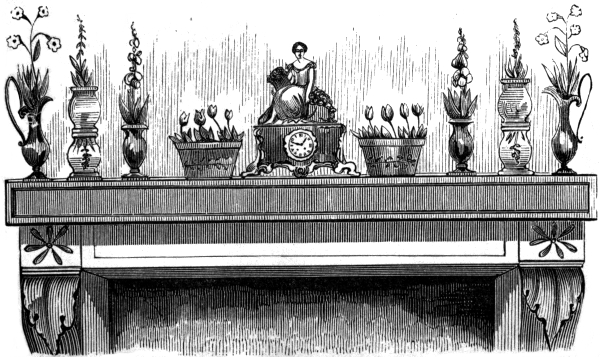
THE MANTEL-PIECE GARDEN.
Plants which will do for it.—Choice of Flower Bulbs.—Hyacinths
blooming under the Water.—Disposition of the Vases for this
Experiment.—Planting the Bulbs.—Hyacinths forced, in Water.—Jonquil.—Crocus.—Van
Tholl Tulips.—Flower Pots for the
Garden on the Mantel-piece.—Care of the Bulbs after Flowering.—Separating
the Tufts of Crocus.—Vanilla Tussilago.[2]—Hepaticas.
YOU HAVE no idea, ladies, of the amount of
instructive and agreeable hints I am to give
you in this chapter: its title is not in the least
deceptive; you can really make for yourself a
garden, without any other place at your disposal
than your mantel-piece. I take for granted, that
you will begin in good time to kindle your fires,
and that they will be kept up until spring has
fully taken possession of the outer atmosphere.
On this condition, there will be no disappointment
for you, in the resources that your garden on
the mantel-piece will afford.
Choice of Flowering Bulbs.
By the end of September, the evenings in some
of the states are cool; a little fire is indispensable
after sunset. It is now time to procure good roots
of hyacinths, crocuses, Van Tholl tulips, and
jonquil. You must not choose the largest among
these bulbs, which are not always the best by a
great deal; but those of medium size of their
species—firm, smooth, shining, free from spots or
bruises, and from softness. Those which give
premature signs of vegetation ought to be rejected.
A Hyacinth blooming under Water.
Having made your choice among the brightest
shades of blue, red, and yellow, you must give
your greatest care to a charming experiment which
will be the source of a very agreeable amusement
for you all the winter. You can procure, at a
small expense, two vases of plain, clear, uncolored
glass; both of the same form, except that
one has no bottom, and is a little smaller than the
other. They are to be used as follows: Put into
the one that is open at both ends one of the finest
of your hyacinth roots; suppose you take one
of a fine red—a sultan Soliman for instance;
place this bulb in a position inverse to its natural
position, that is, with the bottom up, and the top,
from which the leaves and flowers are to come,
downwards, even with the orifice at the bottom
of the vase. Then you must crumble a mixture
of good garden earth and leaf mould over the
bulb until the vase is three quarters full. A
second bulb with a flower in strong contrast to
the first, say a blue if the flower of the first is
red, and vice versa, must be next placed in the
vase, so that the top shall be even with the upper
orifice. You have nothing more to do than to
place the vase thus prepared upon the first vase,
full of water.
Two similar couples look very well, placed upon
the two ends of the mantel-piece of a room in
which people habitually sit, and where, consequently,
fire is constantly made while the cold
season lasts. The earth in the upper vase should
be moderately watered as soon as the bulbs are
placed in it, and then kept constantly moist,
avoiding excess, by renewed watering whenever
you perceive that the earth is getting dry.
At the end of two days, the crowns of the two
bulbs will both send out straight, white roots;
those of the reversed bulb turn down in curves,
but do not fulfil their functions worse for that.
Very soon the two bulbs placed in a contrary
position to each other put forth leaves—the one
into the air, the other in the water; then you
will see appear in the midst of the transparent
liquid the buds on the floral stalk, and finally
the flowers, as beautiful, as well formed, of as
rich a color, surrounded by leaves of as fine a
green as the corresponding parts possess, of the
other flower planted in the ordinary manner,
and vegetating and developing in the air, its
natural element. It is true that time is necessary
for all this to be accomplished: bulbs
planted in October will flower fully in February
or March; but is it not a pleasure to watch
day by day the phases of their development,
above all that of the hyacinth which ends by
blooming in the water, head downwards?
Hyacinths forced in Water.
While these curious phenomena in vegetation
are being accomplished, you should place other
hyacinth roots in bulb glasses, either blue or colorless,
of the form adapted to this purpose, which
you must not fail to keep constantly filled with
water, so that the liquid shall be even with the
crown—that is, with the edge of the flat part of
the bulb—without ever passing it. For filling
these glasses, as for watering the earth where the
bulbs grow one above the other, one upright and
the other reversed,—remember that you must use
only water of the temperature of your room.
Without this precaution you will spoil all, and
the bloom of your bulbs will be miserable.
Jonquil—Crocus.
The roots of the jonquil should be treated like
the hyacinth roots,—using pure water. As you
cannot count with certainty on the blooming of
all roots, it is prudent to put at least three in
the same glass—placing them on a flat, thin,
round piece of wood with three holes cut in it.
They bloom at the same time with the hyacinths.
In the spaces between the glasses containing the
bulbous plants nourished by nothing but water,
place pots full of earth, mixed half and half with
garden manure; leaf mould would not be strong
enough. Plant in these crocus bulbs, taking care
to group in the same pot the varieties of fine colors—pure
white, white striped with violet, and
plain violet. The flowers of these plants, which
precede the development of their leaves, contrast
agreeably, by the vividness of their colors, with
the pale yellow of the jonquil.
Van Tholl Tulips.
Other pots like the first, and filled with the
same mixture, must have in them roots of the
Van Tholl tulips, a charming little tulip with a
dwarf stem and petals of a bright red bordered
with golden yellow. All these flowers develop
at the same time, presenting a happy variety of
forms and shades in the bloom of a mantel-piece
garden, whilst Nature is at work without, preparing
her more abundant supply of flowers in
the open air.
Flower Pots for the Mantel-piece Garden.
Whatever may be your taste for elegance, believe
in the experience of an old gardener, and
never plant your crocuses and Van Tholl tulips
on your mantel-piece in any thing else than the
ordinary earthenware flower pots, which cost a
few cents, varying in price according to their
size. Conceal their coarse surfaces with coverings
of glazed paper, folded and cut at their
upper edge, and place under each pot a porcelain
saucer; and this is the utmost extent you can
be permitted to go in sacrifices to elegance. If
you plant these poor bulbs in rich vases of varnished
sheet iron or porcelain, painted and gilt,
they will languish, and your hopes will be completely
deceived; for they will bloom badly, or
not bloom at all. The porous nature of the ordinary
earthenware flower pots is perfectly well
adapted to the vegetation of the roots of ornamental
plants. If you place these roots in iron
or porcelain, you will not obtain, however sedulous
your care, any satisfactory result; no more
in the garden on the mantel-piece than elsewhere.
Care of Bulbs after the Bloom is over.
Bulbs which have vegetated in water do not
necessarily perish after blooming. Do not wait
until their leaves turn yellow and fade before you
take them out of the water. When you have
done this, let them drip well; cut off the fibrous
roots, the leaves, and the flower stalk, and place
them in a drawer where they will be protected
from moisture. The next year, those which have
not turned soft should be planted in earth, out in
the open air, that they may recover if they have
strength enough to do so, or to give offsets or
young bulbs to replace them in time. The bulbs
which were planted in earth will not have suffered
in any manner from having been forced in
the mantel-piece garden. Before taking them out
of the earth, you must wait until their leaves are
half turned yellow after they have bloomed; then
let them lose, by drying in the air, a part of the
moisture they had while vegetating; after which
clean them and put them away with the others;
they will serve perfectly a second or third time
for the same sort of culture.
If you like crocuses,—and if you do not, you
are too hard to please, for there is not a spring
flowering plant fresher or prettier than the crocus,—you
must continue to water them after the
bloom. Their leaves, of a fine green marked
throughout their length with a white line, will
not be amiss as part of the decoration of your
mantel-piece garden. When the leaves begin to
turn yellow, you must cease entirely to water
them; but you must not take up the crocus
roots. They must be left in the dry earth until
next year. They will keep there very well, surrounded
by their young family; for they produce
every year a certain number of little ones,
which will bloom in their first spring. These
bulbs ought only to be taken up every three
years, and then for the purpose of separating the
clusters; without which the pots would be too
full—there would not be nourishment for the
whole family. When managed in this manner,
the tufts of forced crocuses are more beautiful
the second year than the first, and still more
beautiful the third year; after which you must
renew the plantings.
The very easy gardening, of which we have
just described the process, will bring you to the
fine weather; and then, if you go to the country
to pass the summer, the mantel-piece may remain
widowed of its garden until autumn. But if you
remain, you may put upon the mantel-piece some
of your prettiest flowers, whenever you have too
many for your balcony. They will there require
attentions of which we will tell you in the part
of this work particularly devoted to the garden
at the window.
Vanilla Tussilago—Hepaticas.
Has your mantel-piece room enough to admit
of two or three supplementary pots? Then put
there—if you are not afraid of sweet, penetrating
perfumes, a pot of vanilla tussilago. The flower
is ugly, but of an odor equal to that of the sweetest
orchises, and it does not affect the head.
If you are afraid of odors, even the delicate
and inoffensive, substitute for the vanilla tussilago
rose-colored and blue hepaticas, which are
charming in form and color, and have no perfume.
With these resources there is abundant
material to give you a taste for the culture of
flowers in the mantel-piece garden. The vanilla
tussilago and the hepatica are flowers of a most
accommodating disposition; nothing more is necessary
to them than half a glass of water every
two days, and for the temperature of your chamber
to be such as suits yourself.
CHAPTER III.
THE ÉTAGÈRE GARDEN.
Gardening on the Étagère.—Succulent Plants.—Peculiarities of
their Organization.—Dwarf Succulent Plants.—Quantity of
Earth of which they have need.—Aliments that they draw
from the Air.—Cactus.—Opuntias, (Prickly Pear.)—Melocacti,
(Melon Thistle.)—Echinocacti.[3]—How the Goats of
Jamaica make them drop their thorns.—Stapelias.—Strange
Shape of the Flower.—Its Smell.—Proof of the Sense of Smell
in Flies.—Sedums.—Mesembryanthemums.—Ice Plants.—Crassulas.—Culture
of Dwarf Succulent Plants.—Necessity
of depriving them of Water during their Sleep.
Gardening on the Étagère.
IT IS but a few years since the fashion of étagères
has become general. People began by
covering them with all sorts of curiosities and
specimens of natural history—a custom which
exists still. Then they fabricated out of wire, gilt,
silvered or bronzed, charming little étagères in
open work, which took up little room, could be
hung up any where, and hold a whole collection
of little ornamental plants.
This series of plants belongs, for the most part,
to an order of vegetation having a very peculiar
organization, and endowed with extraordinary
vital energy. They are commonly called succulent
plants, and are remarkable for the thickness
of their fleshy and persistent leaves. Among a
great many of these plants, the stalk and the
leaves are one and the same organ: the leaves,
when leaves exist, fulfil the functions of the
stalk; and reciprocally, when the leaves are
wanting, their vegetative duties are fulfilled by
the stalk.
Dwarf Succulent Plants.
You have no idea, my dear madam, how much
skill and patience the horticulturists by profession
have displayed in dwarfing these pretty plants;
some of which, when left to follow their own
notions, in their native country, attain to colossal
dimensions.
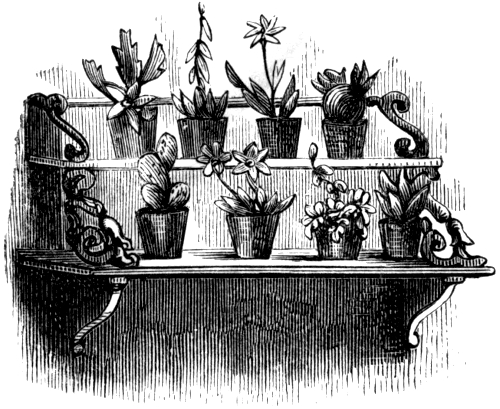
Fig. 2.—Etagère with dwarf succulent plants.
Quantity of Earth requisite for Dwarf
Succulent Plants.
A fact which, above all others, must strike us
in examining a collection of dwarf succulent
plants, is the extremely small quantity of earth
allowed to them. Of those which come most
properly under this head, some will live in pots
of the size of an ordinary tumbler; whilst others
are cooped up in still narrower lodgings, their
domicile not exceeding the dimensions of a small
wine glass. It is because in general the succulent
plants, dwarfed or not, scarcely live by their
roots. Then, you will say, on what do they live?
They sustain themselves on an aliment with which
neither you nor I would content ourselves; they
live on the air of the heavens—literally, and
without rhetorical figure. By the way, permit
me to remark to you, that all plants, without
exception, live more or less on the air; even those
which derive the greater part of their nourishment
from the earth.
Suppose some immense tree felled, split, and
cut up into small pieces, and converted into charcoal;
it would make an enormous mass of it.
Do you imagine that the tree could have drawn
this mass of carbon from the soil where it grew,
which does not contain a particle of carbon in its
composition? No, it drew this material from the
atmosphere, by decomposing the air with its
leaves. That is what our pretty little dwarf succulent
plants do; and without this faculty, which
they possess in a very high degree, they would not
live.
Cactus—Opuntias.
Consider first those which belong to the numerous
and strange family of the cactuses; all of
them natives of the warmest parts of America.
See the opuntias, whose leaf-stems, or stem-leaves,
whichever you please to call them, have
the form of so many battledoors placed alongside
of each other. These little plants represent to
you in miniature those on which, in Mexico and
in the Island of Madeira, lives the insect called
cochineal, that furnishes to dyers and painters
their finest red, under the name of carmine; from
which also, by the by, is made that rouge which
occasionally serves in giving color to the complexion
of ladies towards whom mother Nature
was stingy when she painted their cheeks. I do
not mean, however, my dear young ladies, to intimate
that this was, by any means, the case with
either of you.
Melocacti and Echinocacti.
To the same family belong also the melocacti
and echinocacti. Their rounded forms composed
of prominent ridges, their pretty crown of little
satiny flowers, of a fine golden yellow, resemble
those of no other family. In the mountains
of the interior of Brazil, and in those of the
centre of the Island of Jamaica, these same
plants,—plants of the same species,—that you
here see reduced to such exceedingly small proportions,
grow upon the slopes of the most arid
rocks, and become very large. Knowing this,
you will understand that their bunches of thorns,
inoffensive in the dwarfed plants because of their
minute size, constitute defensive weapons whereby
they are preserved from the teeth of animals.
Nevertheless, these arms prove useless to them
against the wily attacks of the numerous herds
of goats kept by the English colonists of Jamaica.
The goats, animals essentially climbers by
nature, climb up the most abrupt declivities of
the rocks covered with melocacti and echinocacti.
There, using their horns for the purpose, they
root up these plants, and roll them down into the
valley, where, as a preparation for eating them,
they play with them as a child would play with
a toy balloon, until, by dint of rolling and tossing
them about on the pebbles, the thorns have been
all shaken out. Then the goats are able to feast
upon them without damage to their mouths, just
as though the thorns of the colossal cactuses
were as little to be dreaded as are these downy
representatives of those hard and tough spikes,
produced by their sisters in miniature.
Stapelias.
There are other plants, of a different family,
but the forms of which recall those of the cactuses:
these are the stapelias. You will not fail
to remark their strange flowers—thick, fleshy,
violaceous, set with rough hairs, and having the
form of a star. Do not approach too near this
plant while it is in flower; for its odor is not
agreeable. This peculiarity, however, should not
induce you to exclude it from your étagère, where
it will be very well placed, because of the singularity
of its form. As to its smell,—which is
not strong enough to incommode you,—I should
not have mentioned it, but for the circumstance of
its having caused this flower to be mistaken for a
very different thing by the flies called flesh-flies;
which mistake has given rise to quite a curious
observation in natural history.
Have flies noses? you will say, ladies.
I must acknowledge that I do not know whether
they have or have not noses; although entomology,
together with botany, are my favorite studies.
This much, however, I do know—that they have
the sense of smell. That this is certain you can
ascertain for yourselves, by having a stapelia in
bloom upon your étagère. The flower of the stapelia
smells like meat that has been kept too long;
and flesh-flies, who lay their eggs on spoiled meat,
are attracted to this flower by its smell. These
eggs give birth to worms destined to become flies
in their turn. If you shut flesh-flies up in a
chamber where there is a stapelia flower, they
will come and lay eggs on this flower, taking it
for flesh—an error which they cannot be led
into by the sense of sight, for the stapelia flower
does not resemble in any respect a piece of meat.
Consequently this mistake can only arise from
their being deceived by the smell; from which
fact naturalists draw the conclusion, not that they
have noses, but that they have the sense of smell.
Sedums and Mesembryanthemums.
There is another family of plants, no less various,
no less rich in pretty and copiously flowering
species, than the cactus family itself. These are
the sedums; among which I have already made
you acquainted with the pretty, yellow, star-flowered
sedum, (stone-crop,) which blooms without
earth and without water, suspended by a
thread to the wall of a room.
Another species, that of the mesembryanthemums,—with
numerous flowers of all the shades
of red, from the color of fire to the palest rose,—belongs
also to the series of succulent plants. The
prettiest varieties have been rendered dwarf by
the horticulture of our day. If their name—a
little long and a little learned—seems disagreeable
to you to pronounce, call them plainly ice-plants.
This is the common name of the variety
that is the most extensively cultivated, and the
leaves of which, with the stalk also, are powdered
white, as if covered with frost.
There are also the crassulas, with their leaves
elegantly imbricated, and their little bunches of
flowers of the deepest red. You will find some,
also, of a pale rose-color. Both are as perfect in
form, and as brilliant in color, as the same plants
are in their natural dimensions, of half a yard or
more in height.
I pass over some of the best. But when you
have made your choice among the prettiest dwarf
varieties of cactuses—of the kinds of opuntia,
melocactus, echinocactus,—and when you have
added to these stapelias, sedums, ice-plants, and
crassulas, confining yourself to the finest varieties,—you
will have not only a sufficiency to decorate
your étagère, even if it be a large one, but also
enough to fill an elegant basket, which will produce
the best effect in the middle of your stand.
And then, during more than half of the year, you
will constantly have some of your dwarf succulent
plants covered with pretty flowers.
Culture of the Dwarf Succulent Plants.
It only remains to give you some hints about
the way of managing them. For this purpose it
is necessary to say a few words about their temperament.
Cactuses, in their native country, bear
excessive heat and dryness for six or seven months
without interruption, followed by deluges of rain.
The most violent storm-rains in our latitudes
afford but a very faint idea of those tropical deluges.
During the dry season, the vegetative life
of the cactuses is almost quite suspended. Their
sleep is then much more profound than that of the
plants with us which lose their leaves in winter.
Now, from the knowledge of these facts, we perceive
what sort of management is most suitable
for them. All those which give no sign of active
vegetation—on which neither young shoots nor
flower buds make their appearance—ought to be
watered only once a week. You may abstain
altogether from watering them; there will be
neither more nor less budding for it when the
proper time comes. Continue the same treatment
if, at the return of warm weather, the cactuses
show no signs of flowering: leave them dry a
month or two; they will not die for it—no danger
of this. When they begin spontaneously to
vegetate, begin to water them with water of the
temperature of the room; at first moderately,
afterwards a little more freely, but never to excess.
The floods of rain that they get in their
native country do not hurt them there, because
the tropical climate renders evaporation rapid. It
would not be the same in your house. The quantity
should be, a tablespoonful of water for the
pots of the size of a tumbler, and a teaspoonful
for those the size of a wine-glass.
Necessity of depriving them of Water during
their Sleep.
That you may perfectly understand the necessity
of not watering your cactuses during the
sleep of their vegetation, I will relate to you what
happened to a botanist, who, being extremely
fond of cactuses, had a very fine collection of
them. A friend sent him a box of cactuses from
the province of Minas Geraes, in Brazil, which he
hastened to put in pots in his conservatory, and
at the same time put by in a drawer a double set
of specimens, which he proposed to make presents
of. Forced to set out on a long journey, he forgot
the cactuses in his drawer; and on his return
home, after an absence of several months, he
found them there, faded, withered, in so deplorable
a state that he thought them lost. Nevertheless,
he planted them, and began to water
them by degrees. All recovered and flowered
abundantly; while those which had been planted,
and taken care of ever since their arrival, only
flowered in part; many did not flower at all.
His gardener had been afraid of letting them
suffer from thirst, and had given them too much
to drink.
Keep in mind, then, ladies, that in order that
your cactuses may bloom, it is necessary that
the periodic sleep of their vegetation should be
complete; and that it cannot be so if they be
watered at the wrong time. As to temperature,
they are of a temperament that accommodates
itself very well with what suits yourself. When
they bloom during the warm weather, put the
étagère before the open window some hours every
day; your cactuses will be the better for it;
their bloom will be more brilliant and of longer
duration.
The stapelias must be treated like the cactuses—no
difference. The other succulent plants require
a little more water in winter; their sleep
being never so absolute as that of the cactuses
and stapelias. Nevertheless, if you would have
them to flower well when they wake, let them
sleep. Do not water them during their sleep,
except when they appear evidently to be suffering
from thirst; and then give them only just so
much as is necessary to relieve their suffering.
CHAPTER IV.
THE FLOWER-STAND GARDEN.
Manner of keeping it.—Plants bought in Bloom.—Plants to cultivate
on the Flower-stand.—Its Dimensions.—Climbing Plants.—Passion-flower.—Mandevillea
suaveolens.—Wood Pink.—Thunbergia
alata.—Climbing Double Violet.—Manner of cultivating
it.—Plants for the Middle Part of the Flower-stand.—Camellia.—Methods
to prevent the Buds from falling.—Management
in cultivating.—Ericas or Cape Heaths.—Pimeleas.—Mignionette
as a Tree.—Manner of forming it.—Its Duration.—Necessity
of loving Flowers in order to take good Care of
them.
Manner of keeping a Flower-stand furnished
with Flowers.
A FLOWER-STAND is a very pretty piece of
furniture, which may be a little more simple
or a little more ornamented, according to the degree
of simplicity or elegance of the furniture
around it, with which it should harmonize. It
makes a necessary part of that furniture. There
are two different ways of making use of it: these
must be considered separately. If you merely wish
flowers while you can get them from the gardeners,
agree with a gardener by profession, and he
will keep your flower-stand furnished at all seasons
with blooming plants. Your care will be
confined to watering them and keeping them free
from the dust. You will enjoy them; but they
will not be your work.
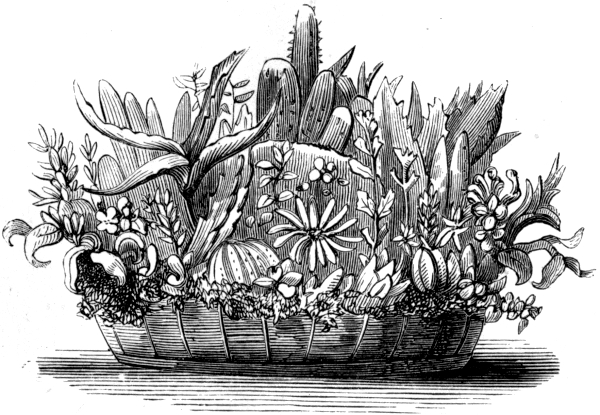
Fig. 3.—Parlor Flower-stand.
Plants to cultivate on the Flower-stand.
You will do better than that, if, having the
leisure, you have the will also, to give assiduous
attention yourself to the cultivation of the plants
that are to adorn your flower-stand. I imagine
this to be the case—that you are disposed to
take a little of that trouble which is a pleasure,
and to make of your flower-stand a real garden
of your own. We will begin, if you please, in
the month of November—at the time when the
fall of the leaves brings back to the cities those
who have passed the fine season in the country.
Climbing Plants.
Choose a flower-stand as large as the space you
have to give it will allow; keep it constantly
with one side against the wall, so that you can
put into it a trellis, shaped like a fan. The first
thing now to be done is to cover this trellis with
climbing plants; they will not be the least interesting
part of this miniature flower garden. Plant
a passion-flower, as the principal ornament of this
trellis; let it be as wide and as high as it may,
the passion-flower will soon cover the greater
part of it. You must add to this a somewhat
rare plant, the Mandevillea suaveolens, and a very
common plant, the wood pink. These three
plants—the passion-flower, the Mandevillea, and
the wood pink—bloom principally at the top;
and that the whole trellis may be ornamented
equally with flowers, plant at each end a Thunbergia
alata, and in the middle a double violet.
The Thunbergia lays hold of any thing that is
within its reach, without ever rising very high.
It becomes covered with charming flowers, of a
fine nankeen yellow, set off with a black spot in
the middle. You find it, as well as the passion-flower
and the Mandevillea, at all the greenhouses.
The price of these plants is never very
high, and they accommodate themselves very well
to the artificial climate of an inhabited room.
Take good care not to buy them in bloom, even
though you should be able to get them in full
flower; take them at most in the bud; it will
be much more agreeable to make them bloom
yourself.
Climbing Double Violet.
Possibly you may never have seen a violet
climbing on a trellis. The culture of the double
violet in this form is very common in Belgium
and in all the north of France. It is not difficult.
The double violet produces naturally, every
year, a certain number of runners, like those by
which the strawberry is propagated. Attach to
the trellis those runners which are so situated as
to be able to take hold of it easily, and destroy all
the others. The tufts in which each runner terminates
will flower abundantly in this position.
After they have bloomed, other runners will come
out, which you must attach to the trellis as you
did the first; so arranging them as that they shall
not take possession of the space reserved for the
other climbing plants. By this system, continued
for some years, (time is necessary for every thing
in horticulture,) the runners which have been
raised and attached to the trellis will become
nearly woody; and every year, from the end of
winter to the middle of spring, you will be able to
gather from them a profusion of forced double
violets, whose fragrance for you will far surpass
that of the violets forced by the gardener, and
which he makes you a present of for your money.
Plants for the Middle Part of the Flower-stand.
The middle part of the flower-stand is yet
empty. To fill it well, place in the centre a fine
camellia; a Donkolerii; or, if rose color be a
favorite of yours, a marchioness of Exeter; if you
prefer white, an alba flore plena, a fimbriata, or an
ochroleuca. There are at least five or six hundred
kinds of camellias, with flowers very different
from each other. Make what choice you
please; only avoid taking for your flower-stand
a plant that is inclined to grow too tall; it will
injure the ornamental effect of the occupants of
the trellis.
Management of Camellias.
When you buy your camellia it should be full
of buds that have attained to about half their size.
If there are too many buds, above all, if there are
two or three in a bunch close together, you must
not hesitate to sacrifice a portion of them. But,
as the very short stem by which the flower bud
of the camellia is attached to the branch, is precisely
the most delicate part of it, unless you
observe great caution in detaching the superfluous
ones, all will fall, one after the other, and you will
not obtain a single flower. Happily, it is easy to
avoid this annoying result. With a very sharp
penknife, cut off, horizontally, the upper half of
the buds which you do not wish to preserve,
taking care to shake the plant as little as possible,
and especially not to touch the bud stems. The
remaining half of those buds will very soon fall of
itself, without occasioning the fall of the entire
buds. These will bloom perfectly a month or two
later. Moreover, take care not to water your
camellia with water that is too cold. This injunction
is so important, that I am not afraid of
repeating it too often. Should its vegetation seem
to you not vigorous enough, give to it, now and
then, half a tumbler of the water that the dishes
have been washed in. Frequently wash and wipe
its leaves on both sides. Do all this, and it will
bloom as beautifully in your flower-stand as if it
had never quitted the greenhouse of the gardener
who sold it to you.
Mignionette as a Tree.
Some pretty plants of Erica (cape heath) of
the medium size varieties, and one or two pimeleas,—one
with a white hanging flower, the other
with a rose-colored, upright one,—will complete
the filling of the flower-stand. Do not fail to
reserve, at each end, a little place for a plant of
mignionette as a tree. You have probably never
seen mignionette otherwise than in the ordinary
form of an herbaceous plant; and, as you do not
live in the north of France, where these pretty
shrubs are very much in fashion, it will be difficult
for you to procure two tree mignionettes
already formed. You must, therefore, form them
for yourself. To do this, proceed as follows:
Buy a pot of ordinary mignionette. This pot
will probably contain a tuft composed of many
plants, produced from seeds. Pull up all but
one; and, as the mignionette is one of the most
rustic of plants, which may be treated without
any delicacy, the single plant that is left in the
middle of the pot may be rigorously trimmed,
leaving only one shoot. This shoot you must
attach to a slender stick of white osier. The
extremity of this shoot will put forth a bunch
of flower buds, that must be cut off entirely,
leaving not a single bud. The stalk, in consequence
of this treatment, will put out a multitude
of young shoots, that must be allowed to
develop freely until they are about three inches
and a half long. Then select out of these, four,
six, or eight, according to the strength of the
plant, with equal spaces between them. Now,
with a slender rod of white osier, or better,
with a piece of whalebone, make a hoop, and
attach your shoots to it, supported at the proper
height. When they have grown two or three
inches longer, and are going to bloom, support
them by a second hoop, like the first. Let them
bloom; but take off the seed pods before they
have time to form, or the plant may perish. It
will not be long before new shoots will appear
just below the places where the flowers were.
From among these new shoots choose the one on
each branch which is in the best situation to replace
what you have nipped off. Little by little,
the principal stalk, and also the branches, will
become woody, and your mignionette will no
longer be an herbaceous plant, except at its upper
extremities, which will bloom all the year without
interruption. It will be truly a tree mignionette,
living for an indefinite period; for, with
proper treatment, a tree mignionette will live
from twelve to fifteen years. I have seen them
in Holland double this age.
Resources that the Flower-stand offers.
Ornamented and managed as I have directed,
your flower-stand will be a continual source of
agreeable recreation. There will always be work
about your plants. The pleasure of providing
for their wants will be as agreeable to you as
that of seeing them flower, one after another.
Their bloom will be the fruit of your own labor;
it will have been merited by the act of cultivating
them. They will have for you a hundred times
the value that the most beautiful plants would
have which you bought, in bloom, from the
gardener, and replaced by others without your
having a hand in producing them.
Moreover, young ladies, besides the plants
with which I have just advised you to adorn
your flower-stand, you have an immense latitude
and many resources—unlimited, we may
say—-in the many varieties of the different species
of other plants, equally worthy of your care.
As we shall, in the course of this treatise, when
engaged upon the subject of multiplying and cultivating
plants, have occasion to make special
mention of those just referred to, this need not
be done here. I shall take care to make you
acquainted with such as would figure to advantage
in the flower-stand of your apartment;
which, if its situation be favorable enough, may
form a companion to the garden on the mantel-piece,
in addition to the garden on the étagère.
And pray observe, mothers,—to you do I now
address myself,—that flowers are like children:
in order to bring them up well, you must love
them. If there be among you any who do not
love flowers enough to bestow upon them the attentions
that they require, neither the preceding
counsels nor those of the following chapters will
be intended for any such.
CHAPTER V.
THE PORTABLE GREENHOUSE.
Its Construction.—Plants that can be cultivated there.—Its Principal
Utility.—Propagating Ornamental Plants.—Sowing.—Sowing
of Azalea Seed.—Transplanting and Rearing the Young
Plants.—The same as regards Rhododendron Seeds.—Sowing
Orange Seeds.—Rearing the Plants.—Sowing the Seeds of
Flemish Pinks.—Sowing of Ranunculus Seeds.—Separation
of the Young Offsets.—Time of their First Flowering.
THE VARIETY of plants that may be cultivated
in an apartment is greatly increased,
when, instead of ornamenting the stand of the
parlor with a large basket filled with an assortment
of dwarf succulent plants, the same spot is
devoted to a portable greenhouse. Greenhouses
of this kind may, as well as flower-stands, be
ornamented externally in any manner conformable
to the style of the rest of the furniture. This
point depends entirely on the taste and fortune of
those who propose to make use of them.
The Cold Portable Greenhouse.
The portable greenhouse may be cold; that is,
without any special means of warming it. It may
also be tempered; that is, furnished with an apparatus
for producing artificial heat. Except for
the size and the decoration, more or less elegant,
it is nothing more than a great hand-glass,[4] of
which the panes of glass, supported on a light iron
frame, are arranged by means of slips of lead.
Many of the upper panes should be made to open
by sliding, as well to let air into the interior, as
that you may be able to tend and cultivate the
plants within.
A multitude of interesting experiments in horticulture
may be made, and charming results obtained,
in the small space contained within a cold
portable greenhouse. Its pots, none of them
exceeding the medium size, may contain a complete
assortment of the finest plants that are found
in greenhouses,—not only in such as are not, but
in such as are, warmed by artificial means. If the
portable greenhouse has not a special apparatus
for warming it, it must be placed in a room where
people habitually sit, of which it must necessarily
take the temperature; and this temperature is
pretty nearly that of the artificially warmed
greenhouse.
Principal Utility of the Cold Portable Greenhouse.
It is quite probable, ladies, that many of your
familiar acquaintance are, like yourself, fond of
parlor gardening. If you possess a cold, portable
greenhouse, you may, if you please, multiply
indefinitely the choicest ornamental plants; and,
after having reserved for yourself the quantity
necessary for keeping up your own stock, there
will remain a large supply, which will afford you
the means of contributing to the enjoyment of
your friends by furnishing them with plants.
We must first fill the pots with good sandy
heath soil,[5] and then we can proceed with our
work at our ease. Nothing is more agreeable,
whether we keep the products or give them away,
than to see them arrive at a presentable degree
of development.
For the purpose of propagation you have three
methods at your option: by sowing, by slips, and
by grafting. Neither of these is difficult in itself;
attention and a great deal of patience are the only
requisites to success in all three.
Sowing.
The list of ornamental plants which can be
propagated in pots in the portable greenhouse is
very long, even if we limit ourselves to gardening
in the house alone. We will select from among
those most worthy of attention; and their propagation
by seeds will give a just idea of how you
should proceed with any others that you may
have a fancy for.
Sowing of Azalea Seed.
Let us begin with azaleas. Procure seeds of
the most admired variety; they will not always
produce a shrub exactly like that from which the
seeds were gathered. But so much the better.
When your young plants bloom for the first time,
you will be agreeably surprised to find remarkable
novelties, either in the larger size of the corolla or
in the brilliancy or delicacy of the colors. Those
whose bloom does not seem to you satisfactory—and
this will be the smaller number—can be
made use of as stocks to receive the grafts of such
varieties as you may prefer. Take care not to
cover the azalea seed with more than the eighth
of an inch of earth, which you must keep constantly
damp, without excess of moisture, by watering
often and giving very little water at a time.
In your portable greenhouse the pots containing
the azalea seeds come in contact only with air
loaded with moisture, which being seldom changed,
scarcely any evaporation takes place; whilst, the
temperature there being mild and very equable,
the conditions are the best possible for obtaining
a good germination of the seeds. Each pot having
received but a small number of seeds, the young
azaleas will sprout at their ease, without crowding
one another. As soon as they have acquired consistence
enough to bear transplanting, pull them
up, one by one, and plant them singly in little pots,
where they will continue to grow until they have
become too large to remain in the portable greenhouse.
Then take your share, and distribute the
rest; it is a sort of present that cannot fail to be
acceptable.
The seeds of rhododendrons are sowed exactly
in the same manner as the seeds of azaleas, and
with the same results.
Sowing of Orange Seeds.
Among the shrubs that are easily propagated
by seeds in the portable greenhouse is the orange.
Sow, for this purpose, seeds of very ripe oranges
or lemons; these last are most easily reared.
Instead of pure heath soil, these seeds require a
mixture of heath soil and good manure. By
those who carry on gardening as a trade, the pots
in which orange and lemon seed are sown are
buried in a hotbed, covered with a glazed frame;
but this is because they are in haste: for them, to
gain time is to gain money. You, ladies, who
are not under the empire of the same necessities,
by sowing your seeds in February, a time of the
year when there is fire in your apartment, will have
the temperature of the interior of your portable
greenhouse sufficiently high for them to come
up in fifteen or twenty days. Your young trees
will be much better off under the shelter of your
portable greenhouse than any where else; air or
light in excess would hurt them during the first
period of their growth. You will have the pleasure
of seeing them grow fast enough if you water
them moderately. Towards the month of July
they will already be strong; the panes of the
greenhouse ought frequently to be kept open, to
habituate the young orange trees to contact with
the air. Some of them can be grafted towards
the first of November; the others in the spring of
the following year; and when you see the first
flowers open, this will give you more pleasure
than all the orange flowers that could be brought
to you.
Sowings of Flemish Pink Seed.
Side by side with your sowings of azaleas, rhododendrons,
and orange, sow seeds of Flemish
pinks in the same mixture of heath soil and
manure that I have directed as the most suitable
for oranges and lemons. Transplanted when an
inch or two high, the plants will, the ensuing
year, bear the choicest pinks, and these will be
among the finest ornaments of your garden.
Sowings of Ranunculus Seed.
Sow also ranunculus seeds. This flower is a
charming one—faultless in both form and color;
nothing is wanting in it but perfume; and for
chamber gardening this is scarcely a defect. For
the sowings of ranunculus seeds, procure a little
cowdung, very dry and reduced to powder. After
having slightly wet this manure, sow the seeds,
with but a very shallow covering. They will
come up in a few days. When you see the little
leaves of the seedling wither and turn yellow,
cease altogether to water them. A few days
afterwards, when the contents of the pots are
perfectly dry, take the pots out of the cold portable
greenhouse; crumble these contents carefully,
and pass them through a tin colander with
very small holes. There will remain in the colander
little plants of ranunculus, each one not
more than an inch or two long.
You are afraid, perhaps, ladies, that these so
very delicate plants will make you wait a long
time for their bloom. You are mistaken. When
spring sets in, plant them in pots of the common
size, in a mixture of good ordinary garden earth
and manure; they will all bloom before the end
of the warm weather.
You see how many things you can accomplish
in horticulture, under the cold portable greenhouse,
with nothing more than sowings. Slips
offer you pleasures not less varied. Grafting,
which your taper fingers, habituated to delicate
work, can execute to such perfection, will add
to your stock of enjoyments. You will after
some time—not a long one—have around you
a whole generation of ornamental plants, full of
vitality, that your care will have brought into
life, and your solicitude will have made to prosper.
It will end in your becoming attached to all
these charming vegetable productions, as to so
many friends of your own creation.
CHAPTER VI.
SLIPS IN THE PORTABLE GREENHOUSE—
COLD
OR HOT.
Art of sticking Slips.—How the Slips take Root.—Slips in the Cold
Portable Greenhouse.—Slips of Dwarf Succulent Plants.—What
is necessary to make them take Root.—Slips from Leaves
and Fragments of Leaves.—Slips of Begonias.—Slips of Dwarf
Bengal Roses.—Of China Roses.—Of Pelargoniums.—Of Indian
Chrysanthemums.—Slips in the Hot Portable Greenhouse.—How
this Greenhouse is constructed.—Slips of Camellias
destined to be Grafted.
Art of Sticking Slips.
THE prodigious multiplicity of resources contrived
by Nature for the propagation of
plants is assuredly one of the most curious of all
the facts revealed by the study of vegetable physiology.
Life is disseminated with such profusion
in all the parts of plants, that with many
of them the least fragment placed in favorable
circumstances becomes a complete plant. The
art of rearing from slips rests upon the knowledge
of facts of this nature. If it has never happened
to you to stick any, or to see any stuck,
I will inform you that a slip is a part of a plant
detached from the mother plant and put in the
earth, in the hope that it will be able to take
root there.
What is necessary to make a slip take root?
It is necessary for it to live long enough on its
own vital energy for young roots to form, and
to draw nourishment from the soil. When the
tissue of the plant is soft, and contains a good
deal of water, and when the branch that is detached
to serve as a slip remains exposed to the
air, the slip will not take root; it dries too rapidly;
the operation fails. On the contrary, roots
always form when, by the exclusion of the external
air, evaporation is abated; whilst, at the
same time, the lower part of the slip is in a
medium kept constantly moist, which solicits its
taking root.
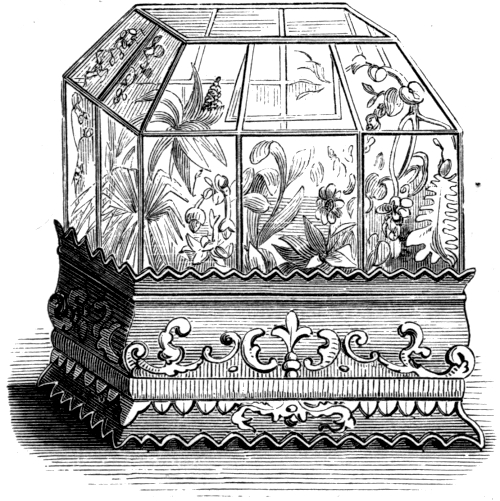
Fig. 4.—Cold Portable Greenhouse.
Slips in the Cold Portable Greenhouse.
Already, from what I have said, ladies, you
have a glimpse of the utility that your cold
portable greenhouse will possess for propagating
every kind of plant by slips. We may begin
by your pretty dwarf succulent plants, detached
fragments of which will, under the shelter which
it affords, take root with marvellous docility.
Take, for example, a charming opuntia, and separate
one of its little shoots, by cutting it at the
base with a very sharp penknife. If you put this
shoot in the earth as a slip at the moment that
you cut it, the surface of the wound in contact
with the earth will rot, and not a root will come
forth. To be successful, you must lay the slip
on one of the shelves of your étagère, and leave
it for two or three days, that the wound may
begin to scar over before it is planted; when
this takes place, plant it as if it had roots—and
indeed it will not be long before it has them.
To assure yourself of this, you need not pull it
up, as children do, who, when they have put a
bean in the earth, take it up once or twice a day
to see if it is going to sprout—so that it never
comes up. So soon as your slip has taken possession
of the earth with its young roots, it will
not fail to advise you of it by giving birth to
little shoots at the upper part. The growing of
the upper part of any plant whatever, propagated
by slips, is the most certain sign of the existence
of young roots. All the dwarf succulent plants
of the garden on the étagère can, like the opuntia,
be propagated by slips, in the cold portable
greenhouse; only taking care that the part separated
as a slip be allowed to dry and begin to
form a scab by contact with the air before
planting it.
Slips from Leaves.
If you have renewed the contents of your
flower-stand every season, you will have at the
proper time achimenes in bloom. This pretty
plant is easily cultivated; and its numerous tubulated
flowers, nearly the same in form with those
of the paulownia, are in color of a beautiful
light violet, or of a fiery red, regularly marked
with yellow and purple within. Take off a leaf
of achimenes and stick it by its stem; it will take
root, and this single leaf will in a short time become
a perfect plant, similar to the one from
which it was detached. But if the species that
you desire to propagate by this means is rare,
and you possess but one leaf, for which you are
indebted to the kindness of an amateur, split
this leaf down through the principal rib; split
afterwards the two halves in four or five pieces,
through the side ribs; and these fragments,
treated as slips, will not fail to take root. But,
as this plant is of very loose tissue, and evaporation
might cause the slips to perish in a few
days, even in your cold greenhouse, you will act
prudently if, besides the shelter which it affords,
you cover them separately, each with a small glass
turned upside down.
Slips of Begonia.
Another genus of plants, not less agreeable, the
genus Begonia, is propagated by slips of leaves
in a manner somewhat different. The stems of
the leaves of begonias are of a cylindrical form;
those of the begonia manicata, or cuffed begonia,
are ornamented with an elegant fringe for about
one half of their length. If you stick one of
these leaves in your portable greenhouse, do not
be frightened, if, after the lapse of some days, the
entire leaf fades and then draws up as if it had
been shrivelled by a violent sun-stroke; the
vegetable life has withdrawn into the stem; the
operation has not been necessarily unsuccessful.
When the leaf is dry, take the stem out of the
earth; it will not yet have roots, properly speaking,
but all around its lower edge you will distinguish
little swellings composing a sort of roll,
tolerably prominent: these are the rudiments of
the roots ready to come out. This leaf-stem,
although hollow within, is thick and fleshy.
Split it into five or six slips, down its length;
and each of these slips, provided it has at its
base a portion of that little roll from which the
roots are to come out, will become, in a short
time, a fine plant of begonia manicata. Just as
many pieces as you have been able to split that
stem into, just so many thriving slips will you
have; all will take root.
An indefinite variety of plants, as well those
generally found only in warmed greenhouses as
those which are seen in others, can be thus propagated.
It will be for you an inexhaustible source
of recreation, and at the same time a precious
resource from which to renew the contents of the
flower-stand and étagère, at all seasons.
Rose Slips.
To the above you can add a large collection
of roses of diminutive size, selected from the
series of Bengalese and Chinese roses; the Lilliputian
Bengals, which are reared in a pot of the
size of an egg-cup; the Chinese dwarfs, of a
bright red, which live very well in a tumbler
of the ordinary size. The least fragment of a
branch of one of these, stuck in the cold portable
greenhouse, will take root and display its flowers
the first year.
Slips of Pelargoniums and Chrysanthemums.
Do not forget to stick also a full supply of
the prettiest species of fancy pelargoniums and
chrysanthemums of India; especially pompone[6]
chrysanthemums, charming little plants, very prolific
in flowers. They bloom all the winter, and
present, we may say, with the exception of pure
blue, all the shades of the rainbow, and, in addition
to these, the purest white, and a deep purple,
so deep as to be almost black.
These chrysanthemums possess, as regards slips,
a peculiar property, worthy of your attention; they
furnish slips at all the various stages of their vegetation.
Of such kinds as accord, in their natural
dimensions, with the space that you have reserved
for them, take, for sticking, young shoots between
one and two inches in length. These slips will
quickly take root, and in due time attain the normal
size of their species; after which they will
bloom. On the other hand, if you wish to stick
some whose dimensions greatly exceed the space
that can be disposed of in their favor, wait until
the flower buds terminating the upper extremities
of branches have attained about half of their size.
Then detach such branches for slips, and plant
them in pots, where they will very soon take root;
their buds will continue to develop, and you will
obtain as fine a bloom as that which remains on
the entire plant. These slips, however, will not
grow; they remain of the same size as when first
planted.
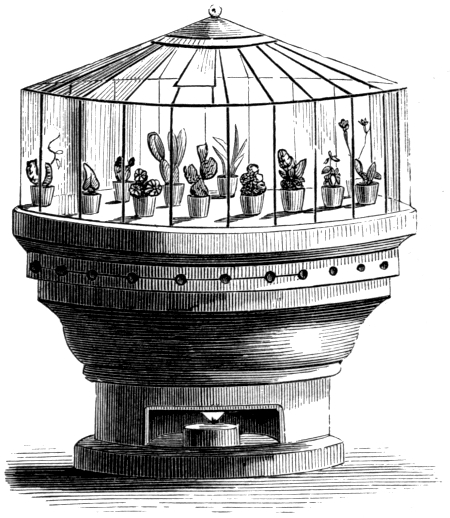
Fig. 5.—Warm Portable Greenhouse.
Slips in the Warm Portable Greenhouse.
Until now, ladies, I have spoken to you of such
slips only as can be reared with success in the
cold portable greenhouse. But you may rear a
great many more, and these taken from the most
interesting plants, if, for your cold greenhouse a
warm one be substituted.
To say nothing of form, which may vary according
to taste, the essential difference between
these two portable greenhouses consists in one
of them being warmed at will; to which purpose
its shape and construction must, of course,
be adapted. It must contain a lamp and a little
reservoir for water; this reservoir having an
earthen-ware cover, upon which the pots with
the slips are placed. This cover is pierced with a
hole, into which a funnel may be placed, for
the purpose of renewing the water as it evaporates;
and there must be lateral holes in the reservoir,
for the steam to escape through. Underneath
this apparatus is the place for the lamp,—generally
a spirit lamp,—which is lighted only
when you wish to raise the temperature of the
greenhouse. Although the heat produced by the
flame of the lamp is not very great, it suffices to
warm the water in the reservoir, and the other
contents of the greenhouse, to the degree requisite
for maintaining its atmosphere at the proper temperature—say
at from fifty-three to sixty-four
degrees of the thermometer.
Slips of Camellias.
Provided with this addition to your resources,
you may now add greatly to the variety of your
floral decorations, and, whilst doing this, enjoy
the pleasure of watching the growth of plants
which refuse to take root in the cold greenhouse,
but prove perfectly conformable to your wishes in
this respect when provided with lodgings better
suited to their tastes.
Let us begin by sticking slips of camellia there.
This king of the shrubs of the cold greenhouse
experiences great difficulty in making his start in
life there. The labor of striking root proves generally
too great for his vital powers, unless aided
by artificial heat. Thus aided, however, as they
now are in your warm portable greenhouse, these
slips will form their roots in the space of from
fifteen to twenty days.
You are already aware, ladies, that the most
beautiful varieties of the camellia, although they
can take root from the slips, produce, by this
means of propagating them, only ill-shaped, puny
plants, that are little disposed to flower well. Your
slips should be taken only from single-flowered
camellias; or, if from the double-flowered, then
the white or the pink only. From these you can
obtain all the slips you need; and these slips will
become shrubs as vigorous as you can desire. By
grafting on these shrubs, when a year or eighteen
months old, you may multiply the choicest species
and varieties; their bloom will be all that you
can wish.
Grafting is another charming operation of horticulture,
which you could not easily realize in
the cold portable conservatory. In the warm one,
on the contrary, you may graft all sorts of ornamental
shrubs, and the success of your grafts is
assured beforehand; not one will fail.
CHAPTER VII.
GRAFTS IN THE PORTABLE GREENHOUSE.
Of Grafting in general.—Resources that it offers for fixing the Fugitive
Sub-varieties.—Extent to which Grafting is possible.—Tomatoes
upon Potatoes.—Rice Upon Phalaris.—Orange Graft.—Manner
of Operating.—Wrappings of Woollen Tarn.—Applications
of the above Process.—Pontoise Graft.—Grafting the
Camellia.—The Camellia in its Native Country.
Of Grafts in general.
BEFORE learning how to perform the different
modes of grafting which belong to the domain
of parlor horticulture, you may, perhaps, ladies,
wish to be informed what grafting itself is, considered
in a general point of view. Grafting,
then, is, if I may be permitted to use the expression,
a forced marriage, often very badly assorted.
Of this particular kind of forced marriage,
the consequences cannot be happy, except
when the two individuals, united without having
been consulted, are very near relations; that is to
say, when they belong to species or varieties very
proximate to each other. In the portable greenhouse,
both cold and warm, we have just been
practising, with complete success, the operation
called slipping, in a variety of ways. Well, then,
grafting is still another kind of slipping. Instead
of putting the slip in the earth, that it may there
live by its own roots, we join it on to another
plant, where a piece has been cut away to make
room for it. Then, instead of putting out roots
of its own, that it may draw from the earth the
sustenance which it requires, the graft incorporates
itself with the plant to which it has been
attached, and feeds upon the stores provided by
the latter for its own support. This it does
without changing its own nature, or modifying in
any way that of the other. You may have remarked
this in gardens. If a plum stock, upon
which an apricot has been grafted, puts out young
shoots below the graft, these are plum shoots.
In like manner, a sweetbrier stock with a rose
grafted on it, produces only branches of sweetbrier,
exactly such as they would have been had
the plant never been grafted upon. On the other
hand, the graft, and all produced by it, retains
the nature of its parent plant as perfectly unchanged
as if it had continued to form part of
it. Owing to this law, results the most curious
and precious are easily obtained in horticulture.
Varieties, and fugitive sub-varieties, which it is
impossible to reproduce by sowing, difficult even
to preserve by slips, are fixed and propagated
indefinitely.
Survey of Grafts that are possible.
That I may not have to repeat, I will remark
now, ladies, that the domain of grafting, the
extent to which successful grafting is possible,
is very great; so great that it has not yet been
completely explored. You know, as every body
does, that fruit trees and roses are grafted. I am
going to have the pleasure of making you graft,
in your portable greenhouse, oranges and camellias,
wherewith to furnish your balcony garden
when it shall come to be established. I am going
also to make you plant a simple and modest
potato in a box, that you may have the pleasure
of grafting on its stalks shoots of tomatoes.
Yes, shoots that will bloom and produce their
fruit, while the vegetation of the potato is running
its career and continuing to form its tubers.
On closing the account, you will gather potatoes
enough for a dish, and tomatoes enough to make
a sauce for the beef stew, to be served with the
potatoes. I will lay a wager, madam, that this
tomato sauce will have a more exquisite flavor
for your palate than any your cook ever prepared
before, let her be the very best of all possible
cooks.
When you procure an aquarium, you may cultivate
rice in it, which will come to perfect maturity.
You must graft shoots of this rice upon
seeds of the species phalaris; and you will see
that they will not grow the less healthily, nor form
their ears the less perfectly for being grafts. I
tell you all this beforehand, in order that you
may at once form an idea of what it may be possible
to accomplish by grafting, even when restricted
to the narrow limits of horticulture in
the parlor.
Orange Grafts.
Here are the young stocks, the product of the
orange and lemon seeds sown by you a year
ago. They are the size of a quill; their wood has
consistence, their vegetation is vigorous; it is
time to graft on them. Let us take for grafts
young shoots of a myrtle-leaved China orange—one
of the prettiest varieties to cultivate in an
apartment, whether on account of its numerous
flowers, which are fragrant, but not too strongly
so, or on account of the fruits that succeed these
flowers, and which, preserved in sugar or in
brandy, are a favorite treat for a numerous class
of consumers.
About half way up the stock, you make choice
of a leaf very green and well formed; at the fork
of this leaf—that is to say, at the point where it
connects with the stalk—there is an eye, which
eye, if left there, would produce a side branch.
With a newly-sharpened penknife, cut a little
way into the wood, above and below the eye,
making these cuts slanting, so that a small portion
of the stalk, containing that eye, shall be separated
and fall, without the leaf being detached.
Now you have a cutting, the size and form of
which you must examine with care. This being
done, you must then, for the graft that is to occupy
the vacancy just made by you, select a little
branch of myrtle-leaved orange, and the lower
end of this must be cut into such shape as to fit
very exactly into the place cut in the stock. As
the graft, if left there after being fitted, would
fall apart at the least shake, it requires to be
fastened in its place, until it shall have taken firm
hold and incorporated itself with the stock. This
is effected by putting a bandage on. But here a
difficulty presents itself, which has caused many
a failure, but may, however, easily be surmounted
by a little attention. If you do not draw the
bandage tight enough, it will not hold the two
surfaces in contact, and this would prevent the
success of the operation. If, on the other hand,
you draw it too tight, this will interfere with
the circulation of the sap; your graft will be
strangled, as the gardeners say. Take care, then,
to adjust your bandage perfectly—avoiding both
extremes; tight enough, but only just tight
enough, to keep the graft firmly in its place. Employ
for this purpose untwisted woollen thread,
which, in case you have drawn it somewhat too
tight, will, from its elasticity, accommodate itself
to what the sap requires, and prevent strangling.
Applications of the above Method of Grafting.
All graftings of this sort that can be made
on other shrubs with persistent leaves, besides
orange trees, and especially upon daphnes and
myrtles, will prove completely successful, provided
that at the time you graft them these shrubs
are in full sap—that is, that their vegetation is
in full activity. Strictly speaking, in ornamental
shrubs with persistent leaves, the sap is never
completely stationary, as it is in winter with
those that lose their leaves. They have, however,
a half repose in winter; after which their
sap begins to flow again with renewed energy.
This is the most favorable time for grafting them.
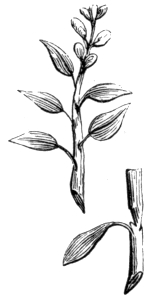
Fig. 6.—Graft à la Pontoise.
Grafting a la Pontoise.
As to the orange, its vital principle is so very
active that you can, without fear, trust a graft
quite full of flower buds ready to bloom, to a
seedling stock a year or eighteen months old.
The graft should be of a diameter nearly equal
to that of the stock; it will take directly. The
course of the sap is not sensibly interrupted, and
the buds will open as if they had remained upon
the shrub from which they were detached. In
all cases, the entire stock above the graft should
be removed, so that the portion of the stock below
the graft shall form merely the lower part of
the trunk of the tree, whilst all above shall be
formed from the graft exclusively. If this sort
of grafting, named by the French gardeners grafting
à la pontoise, were conducted in the open air,
the evaporation from the leaves would kill the
graft before it took. It can succeed only when
excluded from contact with the air. Your orange
trees grafted in this manner will be perfectly
sheltered under the glass of your portable greenhouse;
which you must take care to keep close
shut, until your grafts, by continuing to grow,
give you assurance that they have taken.
Grafting Camellias.
Now, ladies, that you know how to graft
orange trees, you can, without further teaching,
graft the single camellias that you have multiplied
by slips; the proceeding is exactly the
same. You must not, however, take for grafts—as
you did for the orange—branches bearing
flower buds; the flower buds would not bloom,
and the flower-bearing branches would with difficulty
be made to grow to the stock. You also
already know that the bud of the camellia only
takes with certainty in the warm greenhouse;
unaided by artificial heat, the sap of the camellia,
much less active than that of the orange, would
not suffice to assure the success of the grafting.
Moreover, I would have you remark, ladies,
that grafting offers you infinite resources for rejuvenating
old camellias that have gone out of
fashion. Graft upon their boughs, whatever their
age may be, young shoots of camellia, of the kind
that may be most in fashion at the time. Camellias,
like yourselves, are subject to the caprices
of fashion. These grafts will always take; the
camellia in its native country being a sturdy tree,
of a very robust temperament, which it partly
preserves in the conservatories of Europe and
America. If it should ever happen to you to
make a pleasure trip to Japan,—it might so happen
to any body,—you would see that, although
the camellia is a sacred tree, which they plant
round the temples, while its flowers are used in
making garlands for religious festivals, they treat
it in other respects with but little ceremony.
You would see entire woods of them, of great
extent, where every camellia is trimmed up to a
single stem, as straight as a hop-pole. Do you
know what they do when these camellias are of
an age to be cut down? They make of them,
ladies, simply handles for brooms, or spades, or
other utensils; they are intended for nothing else.
Do not expect, in going to Japan, the country
of the camellia, to see this charming shrub such
as you see it here. The Japanese gardeners do
not trouble themselves much in bringing it to
perfection. Your camellias, that you have reared
from slips and grafted with your own hands,
might serve as models to those that figure in the
gardens of the Emperor of Japan.
CHAPTER VIII.
THE HOUSE AQUARIUM.
Aquariums.—Travelling Botanists.—The Victoria Regia.—The
House Aquarium.—Its Construction.—What causes the Corruption
of Stagnant Water.—Means of avoiding it in the House
Aquarium.—The Cobbler.—Interesting Habits of this Fish.—Aquatic
Plants for the Aquarium.—Hydrocharis.—Pontederia.—Mimosa
Pudica, or Aquatic Sensitive Plant.—Rice grafted
upon Phalaris.—Manner of grafting it.—Aquatic Ranunculus.—Its
Manner of Vegetation.
The Aquarium.
ALL OF you, ladies, are acquainted with aquariums;
most of you have little ones of your
own, got up without expense, and I do not propose
to you to attempt having them on the grand
scale that Mr. Ysabeau describes. His description,
however, is so interesting, that I will not omit it.
He says,—speaking of large gardens,—that an
aquarium is a conservatory, of a square or oval
form, with a ridged roof, the interior of which
encloses a basin in which ornamental aquatic
plants are cultivated. You exclaim at this word,
and stop me short by observing that the culture
of aquatic plants is beyond the powers of the parlor
gardener. If this be your opinion, ladies,
permit me to say, that you are under a great
mistake, and I shall endeavor to convince you of
it. But let me first inform you, a little more in
detail, what an aquarium is.
There exists among the learned men a class,
essentially adventurous, who have a horror of the
fireside, security, and repose. These are the travelling
botanists; men who are always on the
road, (when they happen to be in a country where
there are roads,) to discover vegetable rarities
and novelties. I have had occasion to call your
attention to them in speaking of dwarf succulent
plants of the cactus family. Among the novelties
with which these indefatigable seekers have been
enriching our collections for some years past, are
found quite a large number of aquatic plants from
the tropical regions. Among these is the great
nenuphar of the River of the Amazons, the Victoria
regia—true queen of the tropical waters.
So long as the number of hothouse aquatic
plants was not too great, people contented themselves
with lodging them in the reservoir where
the water destined for watering was kept. But
when the Victoria regia arrived in Europe, the
leaves of which, unfolded upon the tranquil waters,
measured more than a yard in diameter, the botanists
perceived the propriety of lodging it and
other beautiful tropical aquatic plants of large
dimensions, conformably to their rank, in basins
of tepid water, within hothouses, which are, at
present, very numerous in Europe, and are designated
under the name of aquariums.
You understand, ladies, that this preamble is
not at all designed to pave the way to counselling
you to convert your parlor into a basin; which,
by the help of a thermo-siphon, being kept at the
temperature of the waters of the River of the Amazons,
you might have the satisfaction of seeing
grow and bloom there the Victoria regia. I am
going to propose something less impracticable.
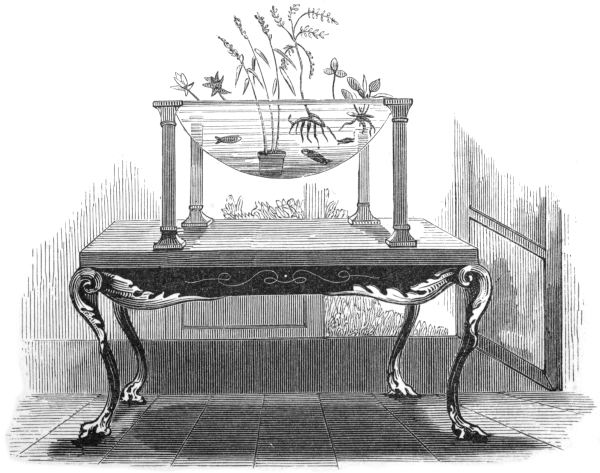
Fig. 7.—Parlor Aquarium.
House Aquarium.
The house which you occupy is one into which
water is brought. You have a parlor on the
ground floor, and a vaulted cellar under this parlor.
These circumstances permit you to have a
house aquarium, of which it is now my business
to show you the advantages in regard to parlor
horticulture.
In the middle of your parlor you must place a
table, with four legs, in the form of columns, two
of which legs must be hollow, and have pipes
within them; one to receive the water when it
comes, and the other to conduct it off. In the
middle of this table, an elegant glass basin, thick
enough to be strong, must be supported by four
hollow columns of polished brass, similar to those
which sustain the beam of a pair of scales. The
pipe enclosed in one of the legs of the table must
be prolonged through one of these columns, and a
swan’s beak at the top of the column will pour a
continued stream of water into the basin, which
water will escape by an opening of a suitable
diameter, contrived for the purpose, in one of the
columns at the opposite side of the basin.
Fish that ought to be put in it.
Before speaking to you of the plants that the
water of your aquarium can nourish, and of the
culture of these plants, I will answer an objection
which naturally presents itself here: the water
of your basin, you will say, although renewed by
a continued stream, cannot fail to be corrupted,
and to fill your house with a marshy smell, which
will be as disagreeable as unhealthy.
Here is another mistake; and so you will acknowledge,
if you permit me to give you some
words of explanation on the subject of stagnant
water. When water exhales an odor of putridity,
it is not the water itself that is corrupted; it
is the animal matter which it holds in suspension;
it is, above all, the thousands of animalcula
which are born, live, multiply, and die there
with a prodigious rapidity, and of which water,
to all appearance most pure, contains hordes
without number. But, if you place in the aquarium
living fish, they will nourish themselves
with these animalcula as well as with the animal
and vegetable matter held in suspension in the
water; and that of the aquarium will never exhale
the odor of stagnant water.
If you do not like one fish better than another,
and have no preference for the gold fish of China,
who are in possession of the privilege of constantly
peopling the basins, I would advise you,
ladies, to adopt the pretty little fish named by the
naturalists epinoche, and well known under its
vulgar name of cobbler, because of the point, in
the shape of an awl, with which its back is
armed. The manners of this fish, that you can
study at leisure through the transparent walls of
your aquarium, are very interesting. It alone,
among all the known fish, makes a nest, which
it does out of the refuse parts of the aquatic
plants, and in this nest the female deposits her
eggs. Both male and female, after the eggs are
hatched, take assiduous care of the young family.
Plants to put in the Aquarium.
Pardon an old professor of natural history,
ladies, for this short excursion into the domains
of ichthyology. I have wandered from parlor
gardening; I hasten back as quickly as I can.
There is a crowd of charming plants among
which you may choose to fill the water of your
aquarium, such as the hydrocharis, pontederia,[7]
and many others. One word only upon those
most worthy of attention. You are, doubtless,
acquainted with the sensitive plant, or mimosa
pudica, the leaflets of which withdraw and contract
when they are touched. There exists an
aquatic species of this, which you can have floating
upon the parlor aquarium, for it is very
small. Its leaflets are exactly similar to those of
the terrestrial sensitive, and possess the same
retractile properties.
Manner of grafting Rice.
If you put at the bottom of your aquarium a
pot filled with good earth, where you have sowed
some grains of rice which have not had the husk
taken off, they will come up; and you can have
the pleasure of grafting the plants from these
seeds upon reeds. For this purpose you must
cut, by a slanting cut at one of its joints, a rice
straw having its ear half developed; then, in a
contrary slant, cut a joint of the phalaris reed,
which is to be the stock of your graft, and fit one
to the other, wrapping them with a thread of
very fine woollen yarn. The whole, for greater
security, must be attached to a rod for a support.
You will thus see the rice stalk, nourished by the
phalaris, ripen its grain as well as that which is
not grafted.
There is a little plant, the aquatic ranunculus,
common in all our streams, which, if you follow
my advice, you will admit into the society of the
rarest plants. What recommends it is its peculiar
mode of vegetation. After springing from
the seed at the bottom of the basin, the stalk, as
it progresses in its growth, puts forth, in place of
leaves, elegant filaments of a fine, pale green;
and this continues to be the case until it has become
long enough to reach the surface of the
water, and come in contact with the air. Then,
as if transformed suddenly into a different plant,
its whole appearance changes; no more filaments
to be seen; they have become metamorphosed into
leaves cut in segments, which lie floating upon
the tranquil water, and amidst which rise the
floral stalks, bearing little single flowers—white,
with a yellow mark at the base of each petal.
Common as it is, the aquatic ranunculus may,
with its European physiognomy, hold its place
very well in the midst of the most beautiful
aquatic plants of foreign origin.[8]
Take notice, I beg you, ladies, that I do not in
any way pretend that there is no objection to a
house aquarium; it costs a good deal, and causes
derangements—particularly for its first establishment—which
would prevent its being admitted
every where; but it incontestably forms a part of
parlor gardening for all such as can afford the
expense, and are willing to submit to the inconveniences
occasioned by it for the sake of the
pleasures that it will yield in return.
CHAPTER IX.
THE GARDEN AT THE WINDOW.
THE GARDEN UPON THE BALCONY.
Exposure of the Balconies.—The Balcony to the North.—Irish
Ivy, Hepaticas, Digitalis (Foxglove), Mimulus (Monkey Flower),
Hypericum (St. John’s-wort), Nemophila, Violets, Periwinkles.—The
Balcony to the East.—Cobæa, Spanish Beans, Volubilis.—Suspended
Flower Vases.—Disposition of the Flowers upon
the Balcony to the East.—Lilacs, Gillyflowers, Pinks, Pansies,
Mignionette.—The Balcony to the West.—Sticking Slips of
Pelargoniums and Chrysanthemums.—Management of the
Growth of the Slips of Pelargonium.—Of the Slips of Chrysanthemums.—Chinese
Method.—European Method.—The Balcony
to the South.—Sowing Seeds.—Precautions against the
Sun.
Exposure of the Balconies.
THE TITLE of this work imposes on me the
obligation of first saying something to you of
all that it is possible to do in horticulture without
leaving your house. I hope I have showed you,
ladies, that to satisfy your enlightened taste for
beautiful, ornamental plants, and to occupy a part
of your leisure time very agreeably, nothing more
is necessary than gardening in a parlor. But this
in no way prevents your giving also some of your
attention to the only out-door garden which is possible
to the greater portion of the inhabitants of
large populous cities—the garden at the window.
Before any thing else, you must consider the
exposure of your windows; for the question is no
longer how to cultivate living plants in the artificial
atmosphere of an inhabited chamber, or a
portable greenhouse. The garden plants at the
window are destined to live in the open air, if,
indeed, the gaseous fluid of cities, which is alone
at their disposal, merits the name of air. The
greater part of the time, however, they do not live
there: reared in real gardens by real gardeners,
bought in full flower to shine for some days only,
they make haste to die in a medium that is not
really air, and where, consequently, one cannot
exact of them to live. Your windows are either
exposed to the north, to the east, the west, or the
south; or their exposure is intermediary between
these four points.
The Balcony to the North.
A balcony with a full northern exposure, particularly
if it looks out on a street of only moderate
width, and is situated too low down to escape
from the emanations below, is in a position presenting
the worst conditions as regards horticulture.
Does this mean that we need not attempt
gardening there? Far from it. It means only
that the choice of plants with which it is possible
to adorn our garden is very limited; for all have
need, more or less, of contact with the rays of
the sun.
First, you must surround the balustrade and
the framework of the window with a decoration
of ivy, which will give you a perpetual verdure.
There are several varieties, the best of which is the
Irish ivy; its growth more rapid, and its green
less sombre, than the common sort. If you take
care to curtail such shoots as grow too long, and
to pull off such leaves as turn from green to
yellow, the Irish ivy will surround your window
to the north with a drapery of ever-verdant vegetation,
which will serve to bring out advantageously
the few flowers that it is possible to cultivate in
this exposure. The hepaticas, blue and rose-colored—the
lily of the valley—the digitalis, (foxglove,)
violet and white—the mimulus, (monkey
flower,)—the large flowered hypericum, (St. John’s-wort,)—and
the charming nemophila,—are all
plants which, as they grow naturally by the side of
great forests, may consequently do without the sun.
These, with the violet and the periwinkle for their
modest companions, will be the principal elements
of decoration for your garden at the window with
a northern exposure.
If, regardless of expense, you be fully determined
to have on this balcony all the plants of the
season, then procure and place them there, despite
of the short duration of flowers in this exposure.
You will do this knowing beforehand that the
plants will die some time after flowering—an annoying
result, which, however, cannot be avoided;
it forms part of the cost which must be paid for
the pleasure of having them there.
The Balcony to the East.
On a balcony to the east—if the street be a
tolerably wide one, and the balcony belong to a
story high enough to receive a ration of air, if
not very pure, at least supportable—gardening
can be practised on a grand scale.
The window may be surrounded with climbing
cobœa, instead of ivy. This is a plant of very
elegant foliage, although its flowers have but little
brilliancy. You can give to it for companions
Spanish beans and volubilis. These two would
not have flowered at all to the north; nor will
they flower to the east either, as they would do
to the west or the south. Their flowers, nevertheless,
will, by their lively tints, make an agreeable
variety of colors in the decoration of your
window with the eastern exposure.
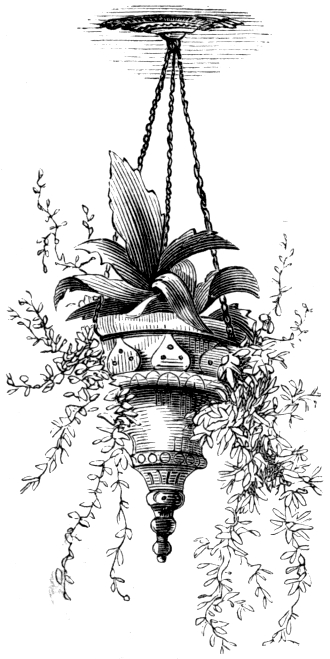
Fig. 8.—Hanging Flower-vase.
Suspended Flower Vases.
Giving to this decoration the graceful form of
an arch, by means of a simple hoop nailed to the
two frames of the window, you must join with
it the accessory ornament of an earthen-ware vase
of elegant form, in which to place a common
flower pot containing ornamental plants; some
with straight stalks—such as petunias or red-flowered
geraniums; others with hanging stems—such
as Chinese saxifrage, the runners of which,
like those of the strawberry, bloom at each joint
while floating freely in the air. Similar vases are
appropriate ornaments for the windows of all
other exposures except the northern. During the
cold season they can be taken in, and hung to
the ceiling like chandeliers; and it is easy to
procure such as will perform the office of veritable
chandeliers, being set round with sockets
for holding candles, choice plants—agaves, for
instance—occupying the centre, whilst hanging
plants, pouring over, as it were, through the
spaces between the candles, depend from the rim
of the vase.
Disposition of the Flowers on the Balcony to
the East.
On the eastern balcony, besides the plants before
pointed out for the northern exposure, a
great variety of common plants—which are not
the less agreeable for being common—may succeed
each other all the year round. That you
may not deprive yourself of the use of the balcony,
in case of your liking occasionally to stand
there, you must take care to place such shrubs
as roses and Persian lilacs at the two ends; next
to them, such herbaceous plants as are somewhat
tall—gillyflowers or pinks, for instance; then the
rest in the middle. The very low ones—pansies,
auriculas, or mignionette—should be in a shallow
zinc vessel, such as is used for flower-stands.
Thus, when at your window, you feel as if surrounded
by all the perfumery of your toilet; and
you will not be deprived of the use of your balcony,
when it pleases you to go out upon it to
breathe there the best air that the city affords at
this season—that is, a compound consisting of a
little air and a great deal of dust. As you would
not wish to quarrel with your neighbors, nor
your landlord, nor the police, you must take care
to keep under the pots and boxes ornamenting
your balconies vessels of varnished earthen ware,
sufficiently deep to hold the overflowings of the
waterings; you will thereby avoid staining the
front of the house, and giving to passers-by a
sort of shower bath which may not be to their
taste. During prolonged droughts the foliage of
the plants of your garden at the window may
probably change from green to gray—thanks to
a thick coat of dust; in which case, you must,
at least once a week, have these plants taken, one
by one, to the sink in your kitchen, and there, by
means of a watering-pot with a rose pierced with
very small holes, give them, one after the other,
a good washing, such as they receive from a
pretty long shower of rain.
All the flowers of the season—from the violet
of March to the chrysanthemum of December—may
succeed one another on the balcony exposed
to the east. Perhaps the heliotrope (which requires
a great deal of sun) and the lantanas, and
some others, may be exceptions; these will, at
any rate, do better to the west and south.
The Balcony to the West.
On the western exposure you have carte
blanche; every ornamental plant may pass the
warm season there. You can place there, for the
whole summer, myrtles, oranges, rose laurels,
pomegranates, camellias, kalmias, and azaleas,
which belong in winter to the garden in the
house. Two sorts of plants, alike agreeable,—the
pelargoniums and the Indian chrysanthemums,—can
be easily propagated there, by slips stuck
in the way I have already shown you. Nor is
there any need of a portable greenhouse this
time: you may stick them simply in pots filled
with good earth, taking care to place over your
slips, for the first eight or ten days, a tumbler
turned upside down, pressing down the edge
slightly into the earth. After the slips have
taken, remove the tumblers, and water the young
plants once or twice a week with a good glass of
dish-water that you have had put aside for this
purpose by the cook; you will see with what
vigor they put out. I shall take this occasion
to give you some advice that will be useful to
you, on the manner of training the pelargoniums
and chrysanthemums that you have propagated
by slips.
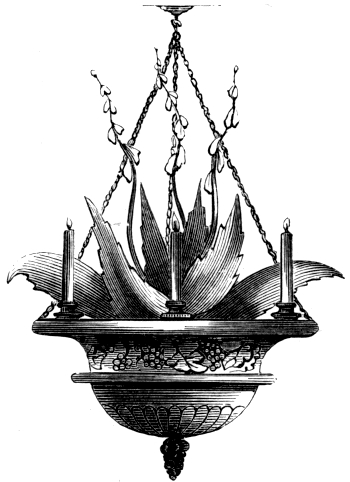
Fig. 9.—Chandelier Flower-vase.
Method of training the Pelargonium Slips.
A slip of pelargonium, left to itself, shoots at
hazard right and left, puts forth a quantity of
foliage and flowers badly: this is what the French
gardeners, adopting a term applied generally to
colts, call badly broken. When you see it well
rooted, and beginning to shoot vigorously, pinch
off the top. The two or three shoots next below
this will develop in side branches of nearly
equal strength; destroy all that put out below
these, retaining them alone to form a regular
head. If one of these branches runs up, and
is impatient to pass the others, do not hesitate to
pinch it off. Below this point two shoots must
be left at first—one of them to be taken off at
the end of eight or ten days. Thus will equality
in the vegetation of the pelargonium be maintained.
These attentions will be a true pleasure
to you; you will witness their effect immediately;
and the flowering of your pelargoniums thus managed
will be as equal and as perfect as is natural
to the different species of this beautiful genus.
Training Chrysanthemum Slips.
Chrysanthemums propagated by slips should be
treated in the same manner, according to the same
principles. If you belonged, ladies, to the good
society of Pekin, instead of to that of our country,
the following is the way you would treat
your chrysanthemums: After having planted each
one of your slips in a deep and slender vase, you
would direct your care to the development of the
terminal shoots; as shoots made their appearance,
they would be pitilessly destroyed. The chrysanthemum
thus treated will gain a great deal in
height, and will end by forming at its summit a
single tuft of flowers, of which flowers one only
must be allowed to remain: this one will arrive
at a most extraordinary degree of development.
It is thus that the wives of the mandarins cultivate
the chrysanthemum—the flower of their
special predilection. Every year, in the great
cities of the Celestial Empire, there are exhibitions
specially for chrysanthemums, where every body
sends their flowers, and where prizes are decreed
for the tallest plants; not as to the most beautiful
flowers, but to the most beautiful flower, each
plant having but one.
To every country its custom, the proverb says.
To ourselves, “outside barbarians” as we are,
the chrysanthemum, cultivated in the Chinese
fashion, appears, and with reason, completely devoid
of grace. You will take care, then, by
means of the same pinching process practised
upon the pelargoniums, to compel your chrysanthemums
to form a head consisting of three or
four branches of equal strength, well furnished
with flowers, making the plant of such a height
from the ground as may be suited to the disposable
place on your balcony, and leaving to each
branch the number of flowers which it sees fit to
have.
The Balcony to the South.
It is upon the balcony exposed to the south,
ladies, that you can practise the most varied horticulture—a
balcony to the south being the border
of a parterre on a reduced scale. There, in
pots filled with an equal mixture of earth and
manure, you may produce, by sowing, all the
annual ornamental plants—pansies, Queen Margarets
(China-asters), balsams, tagetis (French
and African marigolds), petunias, and coreopsis;
and to these sowings you will be indebted for this
part of the decoration of all your balconies and
of your flower-stand. For, upon a balcony with
a southern exposure, may be made to grow, from
the seed, plants, not only for yourself, but for all
your friends and acquaintances besides.
Precautions against the Sun.
But the success of this part of your gardening
depends on one precaution, for the want of which
all would fail. The ardent sun of the summer
must never strike directly on the outside of your
pots.
In their natural situation, the roots of plants,
plunged into the soil, receive only a heat tempered
by the coolness imparted to them by the
soil beneath. In pots, on the contrary, the extremities
of these roots, which line the inside of
the pot, and which are the most tender part of
them, are literally burnt when the sun shines on
its external surface. You must not think that
repeated waterings will remedy this: if you water
the plants often, the roots in pots exposed to the
sun, being then in contact with hot water, will be
boiled instead of being roasted, which will come
exactly to the same thing, so far as their life is
concerned. It is then indispensable to have a
plank, inside of the balustrade of your balcony
facing the south, which plank, its edge touching
the floor, must reach as high as the top of the
largest pots. The outside of the pots being
shaded by this plank, the roots of the plants will
experience only a moderate degree of heat; for
any excess of this may then be prevented by frequent
waterings. So says our author with
reference to the climate of Europe. In ours,
however, plants in pots require an additional
protection from the sun—the shade of a tree, or
an awning, or something of the sort.
CHAPTER X.
THE GARDEN UPON THE LARGE BALCONY.
The Terrace Balcony.—Boxes to furnish it.—Running Shrubs:
Glycine (Wisteria), Virginia Creeper, Buddleya, Clianthus
(Crimson-glory Pea).—Assorted Plants.—Seedling Ranunculus.—Manner
of assorting the Shades.—Use made of the Plants
propagated in the Portable Greenhouse: Pinks, Hyacinths,
Tulips, Crocuses, Pelargoniums, Chrysanthemums, Fuchsias,
Lantanas, Heliotropes, Mignionette.—Utility of this last.—Winter
Dress of the Terrace Balcony.—Galanthus (Snowdrop).—Japan
Quince.—Hellebore.—Christmas Rose.—Variegated
Holly.
HAPPY the person, who, in the interior of
any large city, possesses a large balcony,
with an exposure ever so little to the south. It
is almost equal to the possession of a garden.
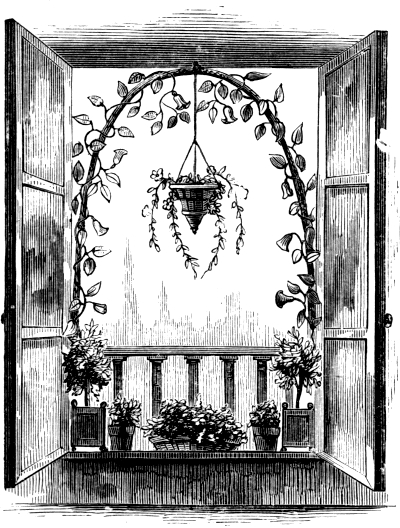
Fig. 10.—The Balcony Garden.
The Terrace Balcony.
We may consider as garden terraces those long
and wide balconies, extending, if not all along
the front of the house, at least for a sufficient distance
to admit of our gardening there in a far less
confined space than in the mere veranda of a
window. Access to such balconies being had
through windows reaching down to the floor, before
each window an interval should be reserved,
to allow you to approach the balustrade and lean
on your elbows whilst looking out. Should it
be your good fortune to occupy a lodging rendered
at once healthy and agreeable by such an
appendage as a spacious balcony with a good
exposure, the side spaces, intermediate to those
kept open in front of the windows, may be supplied
with wooden boxes, longer than they are
wide, painted green, and filled with good garden
earth, mixed with manure. You have but to
consider these boxes as the borders of a parterre,
and proceed to garden there accordingly, as you
would on the ground.
Plants for the Balcony Garden.—Wisteria
and Virginia Creeper.
At each end of the balcony a box,—its length
equal to the width of the balcony,—which two
boxes have a special destination: it is there that
you must plant a glycine of China—(Wisteria),
and a bignonia, or Virginia creeper (trumpet
flower),—the running stems of which are to be
trained parallel to each other along the balustrade.
Thus, without encumbering the balcony, you will
have, in the spring, the beautiful bunches of
amethyst flowers of the Wisteria, hanging gracefully
outside, and shedding an odor the most
delicately sweet of almost any of the whole vegetable
kingdom; and in autumn the flowers of
the Virginia creeper, in bunches of a rich red,
will renew the decoration. During the intermediate
heats, the abundant foliage of these two
plants will very advantageously protect the boxes
of ornamental plants from the burning contact of
the solar rays. You need not contrive any other
shelter for them.
Buddleya and Clianthus.
To procure still more shade, add to the above
a robust plant of buddleya on one side, and a red
flowered clianthus on the other.
The buddleya, attached to a solid stick, upwards
of a yard and a half high, and left to itself from
this height, will fall in all directions, with as much
grace as do the flexible branches of the weeping
willow. At each extremity of slender and supple
branches will open a long bunch of flowers, of
a fine violet color. Should it so happen that
some of these flowered branches, in the exuberance
of their spirits, stray off so far as to pay a
visit to your next door neighbors, these, especially
whilst taking the air at their windows, will have
no cause to complain of the intrusion.
The clianthus—to which you must give, as a
support, four rods of white osier tied together—will
very soon hide this support under its abundant
vegetation, adorned with a profusion of
flowers of the finest carnation color.
If these two shrubs occupied the middle of the
balcony, they would take up too much room, and
prevent your seeing out; but, placed at the two
angles, they give a little shade, fresh and perfumed,
which contributes to render more delightful
still those moments of the day that one likes
to pass, book in hand, upon the balcony in the
midst of flowers.
Other Plants.
The various ornamental plants of each season—the
principal of which I have indicated
to you as being suitable for making a show in
the garden at the window, at the different exposures—can,
of course, be made use of in decorating
a balcony large enough to serve the purpose
of a terrace.
Seedling Ranunculuses.
If, as I advised, you have amused yourself in
rearing in the cold portable greenhouse of your
parlor a supply of young roots of the ranunculus,
obtained from seeds, you will, after having
used such of these little roots as were requisite
for the ornamenting of your flower-stand, have
a considerable number of them left. In the
spring, when you have no longer cause to dread
the appearance of any more last lingering colds,
plant this residue of those little roots in one of
the boxes on your balcony. They will give you,
for a month’s time, a profusion of flowers, of
varied shades, some deep and lively, the others
pale and delicate. The first year, these shades
will necessarily be mingled together at hazard.
When you come to pull up the roots, after the
bloom, you must observe the color of the flowers
of each plant, and write these colors in a list,
with a number affixed to each color. Prepare
papers, in which to wrap the roots, by marking
each paper with one of the numbers on your list;
and when you wrap up the roots, for putting by
till the following spring, place all of the same
color and shade together in one paper, bearing
the proper number. By this means, when they
are to be planted the second year, you will be
enabled to arrange the deep and light colors artistically.
The deep colors are always the least
numerous.
Observe, I beg of you, ladies, that if you take
care of your ranunculuses when in bloom, watering
them at the proper times, and do not allow
them to be wasted in bouquets by indiscreet visitors,
the finest among them will give you a good
supply of fertile seed. The plants that you will
obtain by sowing these seeds will not reproduce
exactly the colors of the parent flowers; but, by
sowing those seeds only which come from the
choicest flowers, you will be sure to have a
beautiful mixture, presenting the finest shades
in proper proportions.
Plants propagated in the Portable Greenhouse.
The boxes of the great balcony—I suppose
them to be large enough—will naturally be the
receptacle for the plants reared in your portable
greenhouse; and among these will be your seedling
pinks, that will all find an appropriate place
there. A group of variegated tulips; another of
hyacinths, blue, rose, and pale yellow; elegant
borders of crocuses, which you have taken care
to alternate, white, violet, and golden yellow;—these
will enamel your parterre from the very setting
in of spring. Do not be afraid to multiply
by slips your pelargoniums, chrysanthemums,
fuchsias, lantanas, and heliotropes, in order that
your boxes may be kept constantly filled with
plants in flower. You will never have too many,
if you be sedulous not to leave empty places in
them. With this view, be always careful to sow
seeds in the place of the plants you have transplanted.
You will be surprised to see how very
large a quantity of plants a space apparently so
small can hold, if you do what is requisite to
make each one of your boxes present constantly,
from spring to autumn, a full bouquet, rich in
its variety of colors and of perfumes. As regards
perfume, sow mignionette every where. It
thrives in the shade of the other plants, takes up
but little room, and keeps out of sight, its perfume
only disclosing its presence; and provided
that you take care not to let it exhaust itself in
producing too many seeds,—the production of
seeds being the business of your garden,—it will
continue to bloom until the end of October, holding
on till after the first serious freeze. The previous
white frosts will then have already killed
first the balsams and the Queen Margarets, then
the tagetes and the ageratums of Mexico, afterwards
the petunias; the chrysanthemums alone
will remain. Then it is that you will congratulate
yourself for having sowed a great deal of
mignionette. So long as it continues to bloom
it will contribute largely—now in a far larger
proportion than before—to the pleasantness of
the visits you will continue to pay, in November,
to your balcony garden, on the few fine days
which the departing year may yet have in store
for you.
The Winter Dress of the Balcony Garden.
Winter is decidedly come. Your faithful little
mignionette, yielding at length to what the jurists
call force majeure, has abandoned you, and disappeared
from your boxes; your chrysanthemums
have taken shelter within doors, that they
may there continue to present you with flowers.
Now, then, as they can no longer wear their
summer garments, give to the borders of your
balcony parterre their winter dress, which, though
much less variegated, is far from being without
charms. Plant there those beautiful tufts of the
galanthus, its white flowers bordered with green.
Its common name, snowdrop, may perhaps be
more familiar to your ears; and this name its
robust temperament fully justifies, for it is endowed
with a most hardy constitution—one that
enables it to bloom bravely between two freezings,
so that when a pale ray of sunshine comes
to melt a thick layer of snow, one is agreeably
surprised to find the snowdrop in full flower.
One or two little bushes of Japan quince,
some plants of the Christmas rose, two or three
hollies, with their variegated leaves, green and
white, among which the fruit shines like coral
beads,—these will clothe your great balcony with
attractions that may tempt you out there to inhale
the wintry air, except on the worst days of
this worst of the seasons. You will have received
there from Autumn the last of her flowers
as a souvenir of past joys. You will now obtain
there, from her grim successor, a present, acceptable
in itself, and yet more so as a harbinger of
the coming spring.
And thus, ladies, the refined and refining pleasures
which the practice of gardening affords will
have been enjoyed by you, in all their variety,
without your leaving the house.
CHAPTER XI.
THE GARDEN UPON THE
TERRACE.
The Terrace Garden.—How it takes the Place of a Garden.—Terrace
exposed to the North.—Its Trellised Roof.—Irish Ivy to
cover it.—Shrubs to fill the Boxes.—Variegated Holly, Alaternus
(Buckthorn), Rhododendrons, Great Periwinkle.—Terraces
of a good Exposure.—Running Plants: Honeysuckle, Clematis,
Boursault Rose, Bougainville, Chinese Glycine, Virginia
Creeper, Buddleya, Clianthus, Delphinium, Hibiscus.—Summer
Pruning of the Persian Lilac.—Watering.
The Terrace Garden.
TERRACES on the roofs of houses are not
common with us. I shall, however, not
omit what our author says about gardening on
terraces; for, besides that it is very interesting,
the flat roofs of extensions and back buildings
answer every purpose so far as gardening is concerned.
Terraces, like the windows of your house, may
be exposed to the north, the east, the west, or
the south. You already know that, for gardening
purposes, the two last exposures are the most
favorable; particularly if your terrace has open
space enough before it to permit the air and the
sun to reach it without much obstruction.
Terrace exposed to the North.
Let us take the worst hypothesis first: your
terrace is fully to the north; in all other directions
it is hemmed in by lofty buildings, so that
the sun has the right to visit it the 35th of every
month, and then only. You have, however, done
very well, ladies, to have a terrace constructed,
even under these unfavorable conditions. At its
centre have a wooden column erected, which is
to sustain a trellised roof consisting of four triangular
parts. The Irish ivy will quickly overrun
this, covering it with its thick verdure. A
round table, through the centre of which the
column passes, will be a convenience for placing
your books and work upon, also for taking
breakfast and tea there, when, oppressed within
doors by the heats of summer, you take refuge
in the open air, under the shelter afforded by that
dense foliage. One side of the terrace being
closed by the wall of the house of which it is an
appendage, in which wall are the doors and windows
opening upon it, erect, at each of the other
sides, two arches, from the centres of which vases
are to be suspended.
Shrubs blooming in the Shade.
Just within the balustrade, or the parapet (if it
be a parapet) of your terrace, we must have a
range of boxes similar to those on the great balcony,
which, by our joint endeavors, we have
been getting all the good out of that we could.
This terrace garden of yours being a northern
one, its boxes must be filled with heath soil; and
we must rear there shrubs with persistent leaves—variegated
hollies, alaterni, rhododendrons.
These are among the shrubs which tolerate the
shade, and whose robust temperament does not
fear the cold, and, with the great periwinkle for
their associate, they will constitute the basis of
the decoration of your garden. Add to them
whatever ornamental plants I have previously
made known to you, as being able to bloom
passably well without the help of the sun.
When the heat of the dog days renders coolness
precious, your friends will be glad to come and
partake with you of that which your ivy-clad
arbor affords: for three months its freshness will
be a source of delightful feelings for them as well
as for yourself. Do you say this is no great
thing? Agreed. But, on your side, you will
have to admit that it is a great deal better than
nothing at all, and that, as a general rule, it is
wise not to ask of any thing more than it can
give you—a rule which, applying as it does to
your terrace with a north exposure, as to all other
things, must be its protection against unwise
exactions.
Terraces of a good Exposure.
What we have effected, in the way of gardening,
upon your balconies to the east, west, and
south, you have only to repeat on a larger scale,
if your terrace garden has one of these exposures.
Here, however, is the place for some advice respecting
certain plants, of medium and large size,
that we have not been able to cultivate before,
for want of room.
Running and Climbing Plants.
That trellis roof, when it has the good fortune
to be removed to a terrace with a good exposure,
admits of being clad in a garment composed of
the most agreeable mixture of climbing and running
plants, in place of the Irish ivy, which, in
the northern exposure, was its only covering.
Do not be afraid, ladies, to vary and multiply these
plants; they will agree very well with each
other; each one will take its just share of air and
of sun; each will bloom in its own proper time;
vying with each other, in the most amicable
spirit possible, in their joint task of weaving over
your head the most charming canopy that can be
conceived.
At the corners of your terrace plant honeysuckles,
clematis, Boursault roses, and Bougainville,
to which you may add the glycine of
China, and the Virginia creeper. Whilst climbing
up the pillars that sustain the arches of
the trellis, the buddleya and the clianthus will
feel entirely at home; nor will they be incommoded
by the company of a tall hollyhock
and a fine Ajax delphinium, attended by two
or three hibiscuses.[9]
The room which all these will possess themselves
of, on the balustrade of the terrace, will
still leave enough there for yourself when you
wish to lean on it, and look down upon whatever
there may be worth seeing below.
Summer Pruning of the Persian Lilac.
On terraces having a western or a southern exposure,
besides the boxes serving as the border
beds of your garden, there may be others, of a
medium size, for receiving oranges, myrtles, pomegranates,
rose laurels, and even a few fine Persian
lilacs.
When the elegant spring bloom of these last is
over, do not omit to subject them to the summer
pruning. This is a happy innovation, introduced
into our horticulture but a few years ago, and
already generally adopted. The process is as
follows:—
When the flowers of the Persian lilac have
faded, we do not, as formerly, content ourselves
with merely cutting off the bunches from which
the flowers have fallen; we cut off the tops of
every branch of the plant, and, moreover, every
thing that is green upon it, the lilac thereby finding
itself stripped entirely—no less perfectly
naked than at Christmas. But very soon the inherent
energy with which the Persian lilac is
endued manifests itself in a most vigorous vegetation:
young shoots, all of equal length, all
equally floriferous for the next year, replace the
pruned-off branches; and you have a plant the
very best of its kind. A necessary precaution,
with respect to lilacs and other shrubs cultivated
in separate boxes, is, to turn the box
partly round twice a week, so that each side of
the plant may receive by turns its just share of
air and of light. Otherwise the natural propensity
of plants to grow most vigorously on the
best lighted side will cause them to shoot out
mostly on one side, whereby the symmetry of
their heads would be entirely spoiled, and in the
course of a single summer they would be altogether
deprived of grace. When the boxes are
turned often enough, the annual growth cannot
get a wrong set.
Watering.
When your terrace has a southern exposure, the
earth contained in the boxes forming the border
requires watering two or three times a day; the heat
reflected from the floor of the terrace, especially
when of metal, causing a far more rapid evaporation
than would take place in the borders of a
parterre having a similar exposure. These waterings,
the sowing of seeds, sticking slips, transplanting,
removing day by day the faded flowers,
and gathering of seeds for next year, will be just so
much healthful exercise for you in the open air of
your terrace garden.
These attentions and this work—of which you
must be careful to do no more than you can do
without over-fatigue, without occasioning feelings
of exhaustion—will imbue you with a taste for
ornamental plants; which, becoming more and
more lively as you proceed, will finally expand
into a real love, such as that with which we
love living beings reared by our care. With your
sex it is matter of instinct to love all that is gentle,
tender, elegant, and graceful.
Do not imagine, ladies, that the above is all that
the garden on the terrace can yield for you in the
shape of pleasure arising from the practice of horticulture;
there is, besides, quite a different series
of facts, which you will appreciate if you will take
the pains to read the following chapter.
CHAPTER XII.
FRUITS UPON THE TERRACE.
Fruits that we can have on the Terrace.—Alpine Strawberry.—Buisson
de Gaillon.—Virginia Scarlet Strawberry.—Strawberry
of Chili.—Superb Wilmot.—Goliah.—Bicton White.—Queen
of Great Britain.—The Vine.—Pruning.—Thinning out the
Grapes.—Thinning out the Leaves.—Cherry Trees.—Plum
Trees.—Currants.—Raspberries.—Forced Fruit on Dwarfs.—Cutting
the Dwarf Fruit Trees on the Terrace.—Management
of Cherry Trees, Plum Trees, Strawberries, Raspberries.—Form
that suits the Raspberry in a Pot on the Terrace.
Fruits that it is practicable to have on a
Terrace.
WHO IS not a little of an epicure? Epicurism
and idleness—the love of those pastimes
often called idle—are the least of the seven
mortal sins; as to the others I will say nothing,
being averse to dealing in scandal. A little gluttony
as regards fruits is so natural! As to myself,
I cannot honestly deny, and therefore frankly
confess, that I sympathize with our mother Eve.
The fruits, however, of which I am about to
speak, have the merit of not being forbidden;
they are, on the contrary, among the most admissible
of things.
Now, you are going to ask me if I pretend to
make you engage in planting fruit trees on your
terrace, such as there—perhaps—were in those
famous “Hanging Gardens” of Queen Semiramis;
which gardens, by the by,—supposing them
to have ever existed,—were nothing more nor
less than terrace gardens, such as your own;
only, in a degree,—never mind what precise degree,—more
spacious. I have no such grand
enterprise to propose to you, ladies; no scheme
of the sort is in my mind. I desire merely to call
your attention to a small number of excellent
fruits, of which you can easily have a harvest,—I
do not promise that it shall be large enough to
load a ship,—upon your terrace.
In the first place, then, an assumption on my
part. I assume that your terrace is sufficiently
spacious to admit of your border boxes being large
enough to afford room for the worship of Pomona,
as well as for that already appropriated to Flora;
and this without the least encroachment upon the
rights of the lady last named. This pretty little
figure of speech—a perfect statuette, is it not?—is
not original with me: I beg you to understand,
ladies, that I lay no claim to its authorship; it
belongs to the late Rousselon, and first appeared
in his Annals of Flora and Pomona.
Now,—to descend from the airy heights of
fancy, and engage in our work upon material
realities,—you will find that a few strawberry
plants will not be at all in the way of your ornamental
ones. And this being the case, will it not
be pleasant to you, while engaged in your horticultural
labors, to find, now and then, under your
hand, a fine, ripe strawberry or two? And these
of your own production!
Strawberries.
If you open the catalogue of a horticulturist by
profession, you will be frightened at the innumerable
varieties of the strawberry; each variety
asserted by the venders to be perfect; whilst, in
point of fact, the fruit produced by the greater
part of them will prove to be either flavorless or
sour; or—in fine, with some defect or other,
rendering it not worth cultivating. I—who am
very cautious on this score, and who, as the result
of long experience, generally eschew all such—can
safely recommend to you, as among the most
desirable, the old-fashioned alpine, which is a
monthly bearer, the Virginia scarlet, the Chili,
and those English varieties called, respectively,
Wilmot superb, Goliah, Bicton white, and queen
of Great Britain. This last is noted for its extraordinary
fecundity. It is of the strawberry—mind
you—that I state this. You will recollect
that plants—plants exclusively—constitute
the subject of our present discourse; and you
must not let your thoughts stray off into other
fields.
By adopting these varieties, and planting here
and there among your flowers a couple of plants
of each of the eight[10] above named, you will
have in all sixteen; each one of which will give
you on an average six fruits. This will be
ninety-six strawberries—in round numbers, a
hundred—that you will enjoy the flavor of, one
by one, as they successively ripen, and as the climax
to the pleasure you will have been experiencing
all the while in watching their growth and
ripening. As respects the latter point, great self-control
on your part is indispensable. I warn
you of this beforehand; for if, through impatience,
you gather them too soon, even so much
as a single day too soon, you will lose by it, I
assure you. Their flavor cannot do justice to its
own merits at any point short of the most perfect
maturity. Your strawberry plants will require
no other attention than that of taking off the runners
by which they propagate themselves. As to
water, they will take care of themselves, drinking
their fill from the supplies placed within their
reach in watering the other plants. You must
remember to renew them every two years, by
means of runners that you will reserve for the
purpose.
Grape Vine.
Of all your fruit-bearers, the one that will
yield the most bounteously is the grape. For
some years past the vine has been a good deal
cultivated in pots, in order that it may be forced;
that is, be compelled to produce fruit long before
the time when it will be produced in the open air.
This forcing consists simply in cultivating the vine
in a hothouse, or tempered greenhouse. Buy
vines, if you can, all trimmed and ready for bearing,
and place the pots containing them at the
foot of the posts supporting the arches of your
terrace arbor. They will there find a suitable
support in the situation the most favorable to the
ripening of the fruit. Train them so as to make
them grow in festoons. In due time grapes will
be there, within reach of your hand, hanging in
golden bunches, all the way from the base of the
pillars up to where the vases are suspended at
the centre of the arches.
Will not this be charming?
Trimming and Thinning.
Two things are indispensable to make your
grapes as good as they ought to be—to cut off
the top of the vine, which must be done as soon
as its young grapes are formed, and as large as a
pea, and to thin out the grapes when too thick in
the bunch.
This last operation is as follows: When the
vine grows in good earth, in a good exposure,
and has been skilfully pruned, and when too
much fruit—too many bunches—has not been
left upon it, each blossom will produce its fruit.
As they expand the young grapes crowd each
other; they get squeezed together, and pressed
out of shape; the air and light can get only to
those on the outside of the bunch. The consequence
is, that the bunch has not half the value
at market that it would have, had the matter been
differently managed. Do you know, ladies, what,
in order to avoid this misfortune, is done by the
wives and daughters of the gardeners of Thomery?
Thomery is a little village where those
unrivalled grapes are produced, which are sold at
Paris under the name of “grapes of Fontainebleau.”
These women, each armed with a pair of
pointed scissors, patiently cut out, from each of
those little bunches of which every distinct bunch
is composed, one young grape in every three.
And this is the way I now advise you to treat all
bunches produced, by the vines on your terrace.
You will, I acknowledge, have but four vines
growing in so many pots, and you may perhaps
fancy that the produce, however good in quality,
must needs be insignificant in quantity. Let us,
then, make a little calculation. Arithmetic, you
see, will thrust itself into all human affairs, horticulture
not excepted. Well, then, each one of
your four distinct vines will have four main
branches, (that are cut down short, say to about
six inches in length;) from each one of these
branches there will be two running vines, and
each one of these running vines will bear two
bunches of grapes. If all turns out well, as you
have reason to hope, you will then have to gather
in September or October—how many bunches?
Why, if arithmetic be a reliable prophet, you will
have no less than sixty-four bunches of grapes.
Is not this number large enough to warrant your
inviting, if not all your acquaintances, yet at
least the whole circle of your most intimate
friends, to aid you in the joyous labors of your
vintage?
Thinning out the Leaves.
About a month before vintage time you will
have to perform upon your vines a chirurgical
operation which requires considerable judgment
in the execution. By the French it is called
épamprer, which signifies to unleaf; consisting,
as it does, in taking off such leaves as prevent
the sun from striking directly on the grapes,
which solar action is indispensable to their being
gilded with their proper rich yellowish hue, and
to their possessing that richness of flavor of which
this hue is the only guarantee. If the bestowing
of all these attentions upon your vines be not an
amusement for you, then,—permit me to say it,—you
do not deserve to enjoy the eating of a
good bunch of chasselas.[11]
Cherry Trees, Plum Trees, Currant Bushes,
Raspberries.
Are strawberries and grapes all the fruits that
you can have on your terrace? No, certainly.
There are beautiful dwarf trees, about the culture
of which I am going to give you some
hints, which, if you profit by them, will enable
you to have, in addition, cherries and Mirabelle
plums; and your variety of terrace garden fruits
may be further increased by adding to these
dwarf trees a couple of currant bushes,—a
white and a red,—and three or four raspberry
plants. The dwarf cherries and plums, cultivated
in large pots or in boxes, like the pomegranates
and Persian lilacs, will bloom perfectly
on the terrace. You can purchase them all prepared.
They will “load heavily,” as the French
gardeners say, and it will be a lively satisfaction
to you to gather their ripe fruits, some time before
the usual time of their ripening; for, placed on
the terrace, they are in the best of situations for
enabling them to work energetically, and force
their fruits forward to early maturity.
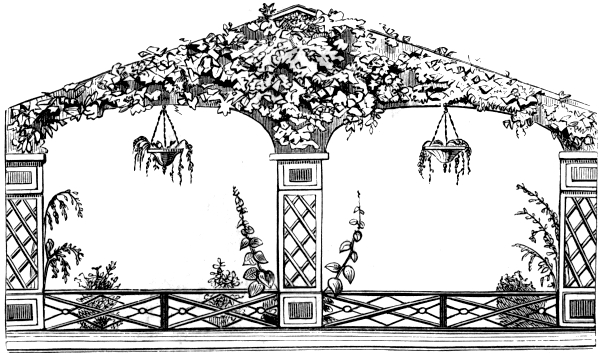
Fig. 11.—Terrace Garden.
Forced Dwarf Fruit Trees.
Is it your desire to have ripe cherries and
plums to eat so early as April or May?—a
time when, if you have to buy these fruits, you
must pay very extravagant prices for them.
If this be your wish, it is very easily gratified.
About a fortnight after their leaves have fallen,
in autumn, remove your dwarf fruit trees (which
I suppose to be in pots) from the terrace into the
house. They will soon begin again to vegetate,
and by January or February they will be in
bloom, which, of itself, will be very agreeable
to you; and they will ripen their fruits a month
or two before those in the open air. To enable
them to do this, the only assistance they require
from you is to be placed near the windows, and
to be turned every day, so that each side may
receive its share of light, and to have the air
they breathe kept up at a constant temperature
of from sixty-two to sixty-three degrees of
Fahrenheit’s thermometer. This will be about
the temperature of your room; the one at which
it would be kept as being the most pleasant to
yourself, and the best for your health, as well
as comfort; so that you will not be put to any
additional expense, nor have to derange your
habits in any way for the sake of these dwarf
fruit-bearing pets of yours.
You see now that fruits, no less than flowers,
have their part to play on your terrace,
although the principal part appertains to the
flowers. When you receive your friends, will
it not be very pleasant to have cherries, and currants,
and raspberries to offer them, at a season
when they are great rarities in the market, and
to be had there only at prices which the Crœsuses
of the stock exchange can alone afford to pay?
Will not your guests be delighted to assist you
in gathering these nice fruits from the tree with
their own hands? And, when placed upon your
table, as its central ornament, will they not look
far more beautiful than if they had been bought
with money?
Pruning Fruit Trees on the Terrace.
Don’t trouble yourselves about pruning your
dwarf cherries and plums. The gardeners have
a saying, that these trees—whose wood always
contains a great deal of gum—do not “love the
knife;” they ought, therefore, to have it applied
to them as seldom as possible. As seldom as
possible is still too often; in a word, so far as
they are concerned, keep your pruning-knife in
your little gardener’s tool-chest; they will thrive
all the better for its being left there—be all the
more productive.
The raspberries, which are simple shrubs, have
their own way of vegetating; they are perennial
in their roots only. The annual stalk, after
having borne its fruit, dies in autumn; and it
ought then to be cut down level with the earth
in the pots. The root puts forth every year, in
great superfluity, young shoots which are destined
to bear fruit the following year; and, of
these shoots, but three only must be allowed to
remain on each plant—that is to say, if you
wish to have a good crop of really fine raspberries.
In the spring, cut off about a quarter
from the length of these reserved shoots; the
buds at the middle of the stalk will now develop
better than if it had been left entire; and it is
from these buds always that the finest of the
fruit comes.
Currants require only to be freed from the old
wood—that is to say, the exhausted branches,
which will no longer bloom, and which, with
their tops supported on a single stalk, encumber
the inside of the bush. By their being trimmed
in this manner, the fruit will come out at a good
height, far enough from the earth not to be soiled
by the spattering of earthy particles during heavy
showers and waterings; this, therefore, is the
best way of trimming currants on the terrace.
Now, ladies, I hope you will agree that the
culture of fruits on your terrace, if you keep
them in their proper place, has its merit as well
as that of the flowers.
CHAPTER XIII.
THE DOUBLE WINDOW.
Advantages of a Double Window.—Their Use in the North.—The
Manner of decorating them.—Glass Stands.—Plants proper for
the Double Window.—Grevillea, Kennedia, Blue Lobelia, Gesneria,
Gloxinias, Achimenes, Brunfelsias, Torrenia Asiatica,
Ixora, Echmea, Begonias.—Sparmannia.—Retractility of its
Stamens.
Advantages of a Double Window.
AFTER having done our gardening in the parlor,
wishing for a little more room in which
to pursue it still further, we came out of doors.
Here also our work is completed. Let us then
go in again.
In all countries where Winter brings in his
train a long succession of vigorous colds, in
order to guard the better against these, the inhabitants,
instead of having in their windows but
a single sash, use the wise precaution of having
two—the outer one even with the outside of the
house, the inner one even with the inside wall of
the apartment. Thanks to this arrangement, the
cold reigning without is so far excluded that a
mild temperature is preserved in your chamber,
while, at the same time, there remains between
the two sashes a vacant space which is at your
disposal for any uses to which it is susceptible
of being put. It is the very thing for our gardening
purposes.
The English like to keep avadevats there; by
the Dutch, this space is dedicated to canary
birds, which they understand perfectly how to
rear, Holland being the country of all others
where these birds do most abound. There is
nothing, however, ladies, to prevent you from
appropriating it to your favorite pets—flowers.
It is evident that whenever the interior sash is
kept open, the interval between the two sashes
receiving, as it then does, a portion of the atmosphere
of the chamber, will of course be of the
same temperature. This space, then, is equivalent
to a little conservatory, either merely tempered
or hot, according as the person who occupies
the chamber is more or less chilly; and in
this temperature all the cultures that can be conducted
on a large scale in greenhouses, tempered
merely, or hot, are equally possible on a small
scale in the double window.
Manner of decorating it.
Before filling it with flowers, you must suspend
there an elegant earthen-ware vase in which to put
a plant from the order bromeliaceæ[12]—a Guzmannia,
for instance, the leaves of which plant
resemble those of the ananas; and in the centre
of this foliage there appears a flower of so brilliant
a red that one cannot steadfastly gaze at it
without its fatiguing the sight. The size of this
vase must be proportioned to the width of the
window, and to the dimensions of the plants that
you propose to cultivate there. It is best that the
small pots which you have at the two sides be
supported on shelves formed of panes of glass,
because wooden stands would intercept the light
too much. I think you would do well to follow,
in arranging the plants in the double window, the
advice I gave with regard to those in the garden
at the window.
Plants proper to be placed here.
Place on the shelves of the glass stands at the
two ends of the window-sill plants of a low and
tufted nature: first, on the upper shelves, such
as, without being precisely climbing or running
plants, are taller than they are broad. There is
nothing of this sort more graceful than the shrubs
of the genus Grevillea. On the front or lower
shelves place small plants which bear many flowers,
such as the Kennedias and the blue lobelias
of Surinam. Arranged in this manner, they will
not be in your way when you wish to stand close
to the outer sash to look out at the wintry scene,
as a contrast to your tropical garden within.
Your double window is an excellent place also
for making a display of the plants you have obtained
from seeds and slips reared in the hot
portable greenhouse. Your choice is not a limited
one by any means. In the course of my
instructions, I name only some of those which I
consider as most worthy of your attention. What
I shall say in regard to their culture will be a sufficient
guide to you, should you desire to admit
into their society others that require the same
temperature.
Gesneriaceæ.
The double window can also lodge, very much
at their ease, plants of the order Gesneriaceæ,[13] of
the three genera, Gesneria, Gloxinia, and Achimenes.
I have already had occasion to remark with what
perfect docility a leaf, or a mere fragment of a
leaf, from a plant of this last named genus will
take root when we wish to propagate it by
slips.
The gloxinias are not less accommodating:
their foliage resembles the most beautiful green
velvet, and their flowers, in the form of a goblet,
have in the inside a large spot, which is always of
a different shade from the flower itself. The gesneriaceæ
require a great deal of water and of
heat; they must be watered several times a day,
and whenever you have reason to fear that they
may be seriously injured by the cold at night,—which
would happen only when it freezes very
hard outside,—you will take the precaution of
placing them on your mantel-piece for the night.
Their bloom continues very long, and will fully
recompense you for your trouble. Treat in the
same way the Brunselsias, the torrenia Asiatica,
the yxoras,[14] the æchmeas, and the small begonias,
which, in company with each other, inside
of your double window, will constitute there a
charming little parterre taken from the tropical
flora.
Sparmannia.
Do not forget to add to the above one or two
plants of the Sparmannia, a native of the Cape
of Good Hope. In this pretty plant you may
observe, while it is in bloom, the phenomenon of
retractility,—with a contrary effect, however,—which
renders the sensitive plant so curious.
Touch delicately with the end of your finger the
summit of the stamens of a flower of Sparmannia
in full bloom: instead of modestly closing, in
imitation of our gentle mimosa, they will forthwith
scatter, spreading out in every direction
with a brusque and instantaneous movement.
Some time after they will return to their former
position. This property of the stamens of
the Sparmannia, less generally known than that
which manifests itself in the closing of the leaves
of the sensitive plant, is not less curious or interesting
to observe.
Forced Strawberries.
If you have two or three double windows
instead of one, place pots of strawberries upon
the glass stands of one of them; they will bloom
in January, and will give, each one, five or six
strawberries in February, when out of doors the
earth will perhaps yet be hard frozen, or covered
with snow, and the river will be covered with
skaters. At such a time a single strawberry,
gathered from a plant forced by your care, in one
of your double windows, will have the right to
seem supremely delicious to you.