FIFTY years ago there lived at Munich a poor fellow, by name Aloys
Senefelder, who was in so little repute as an author and artist, that
printers and engravers refused to publish his works at their own
charges, and so set him upon some plan for doing without their aid. In
the first place, Aloys invented a certain kind of ink, which would
resist the action of the acid that is usually employed by engravers, and
with this he made his experiments upon copper plates, as long as he
could afford to purchase them. He found that to write upon the plates
backwards, after the manner of engravers, required much skill and many
trials; and he thought that, were he to practise upon any other polished
surface—a smooth stone, for instance, the least costly article
imaginable—he might spare the expense of the copper until he had
sufficient skill to use it.
One day, it is said that Aloys was called upon to write—rather a humble
composition for an author and artist—a washing-bill. He had no paper at
hand, and so he wrote out the bill with some of his newly invented ink
upon one of his Kilheim stones. Some time afterwards he thought he would
try and take an impression of his washing-bill: he did, and succeeded.
Such is the story, which the reader most likely knows very well; and
having alluded to the origin of the art, we shall not follow the stream
through its windings and enlargement after it issued from the little
parent rock, or fill our pages with the rest of the pedigree. Senefelder
invented Lithography. His invention has not made so much noise and larum
in the world as some others, which have an origin quite as humble and
unromantic; but it is one to which we owe no small profit and a great
deal of pleasure; and, as such, we are bound to speak of it with all
gratitude and respect. The schoolmaster, who is now abroad, has taught
us, in our youth, how the cultivation of art ‘emollit mores nec sinit
esse’—(it is needless to finish the quotation); and lithography has
been, to our thinking, the very best ally that art ever had; the best
friend of the artist, allowing him to produce rapidly multiplied and
authentic copies of his own works (without trusting to the tedious and
expensive assistance of the engraver); and the best friend to the people
likewise, who have means of purchasing these cheap and beautiful
productions, and thus having their ideas ‘mollified’ and their manners
‘feros’ no more.
With ourselves among whom money is plenty, enterprise so great, and
everything matter of commercial speculation, lithography has not been so
much practised as wood or steel engraving, which, by the aid of great
original capital and spread of sale, are able more than to compete with
the art of drawing on stone. The two former may be called art done by
machinery. We confess to a prejudice in favour of the honest work of
hand, in matters of art, and prefer the rough workmanship of the
painter to the smooth copies of his performances which are produced, for
the most part, on the wood block or the steel plate.
The theory will possibly be objected to by many of our readers: the best
proof in its favour, we think, is, that the state of art amongst the
people in France and Germany, where publishers are not so wealthy or
enterprising as with us,[4] and where lithography is more practised, is
infinitely higher than in England, and the appreciation more correct. As
draughtsmen, the French and German painters are incomparably superior to
our own; and with art, as with any other commodity, the demand will be
found pretty equal to the supply: with us, the general demand is for
neatness, prettiness, and what is called effect in pictures, and these
can be rendered completely, nay, improved, by the engraver’s
conventional manner of copying the artist’s performances. But to copy
fine expression and fine drawing, the engraver himself must be a fine
artist; and let anybody examine the host of picture-books which appear
every Christmas, and say whether, for the most part, painters or
engravers possess any artistic merit? We boast, nevertheless, of some of
the best engravers and painters in Europe. Here, again, the supply is
accounted for by the demand; our highest class is richer than other
aristocracy, quite as well instructed, and can judge and pay for fine
pictures and engravings. But these costly productions are for the few,
and not for the many, who have not yet certainly arrived at properly
appreciating fine art.
Take the standard ‘Album,’ for instance—that unfortunate collection of
deformed Zuleikas and Medoras (from the ‘Byron Beauties,’ the Flowers,
Gems, Souvenirs, Caskets of Loveliness, Beauty, as they may be called);
glaring caricatures of flowers, singly, in groups, in flower-pots, or
with hideous deformed little Cupids sporting among them; of what are
called ‘mezzotinto’ pencil-drawings, ‘poonah-paintings,’ and what not.
‘The Album’ is to be found invariably upon the round rosewood
brass-inlaid drawing-room table of the middle classes, and with a couple
of ‘Annuals’ besides, which flank it on the same table, represents the
art of the house; perhaps there is a portrait of the master of the house
in the dining-room, grim-glancing from above the mantelpiece; and of the
mistress over the piano upstairs; add to these some odious miniatures of
the sons and daughters, on each side of the chimney-glass; and here,
commonly (we appeal to the reader if this is an overcharged picture),
the collection ends. The family goes to the Exhibition once a year, to
the National Gallery once in ten years: to the former place they have an
inducement to go; there are their own portraits, or the portraits of
their friends, or the portraits of public characters; and you will see
them infallibly wondering over No. 2645 in the catalogue, representing
‘The Portrait of a Lady,’ or of the ‘First Mayor of Little Pedlington
since the Passing of the Reform Bill;’ or else bustling and squeezing
among the miniatures, where lies the chief attraction of the Gallery.
England has produced, owing to the effects of this class of admirers of
art, two admirable, and five hundred very clever portrait-painters. How
many artists? Let the reader count upon his five fingers, and see if,
living at the present moment, he can name one for each.
If, from this examination of our own worthy middle classes, we look to
the same class in France, what a difference do we find! Humble cafés
in country towns have their walls covered with pleasing picture papers,
representing, ‘Les Gloires de l’Armée Française,’ the ‘Seasons,’ the
‘Four Quarters of the World,’ ‘Cupid and Psyche,’ or some other
allegory, landscape, or history, rudely painted, as papers for walls
usually are; but the figures are all tolerably well drawn; and the
common taste, which has caused a demand for such things, undeniable. In
Paris, the manner in which the cafés and houses of the restaurateurs
are ornamented, is, of course, a thousand times richer, and nothing can
be more beautiful, or more exquisitely finished and correct, than the
designs which adorn many of them. We are not prepared to say what sums
were expended upon the painting of ‘Véry’s’ or ‘Verfour’s,’ of the
‘Salle Musard,’ or of numberless other places of public resort in the
capital. There is many a shopkeeper whose sign is a very tolerable
picture; and often have we stopped to admire (the reader will give us
credit for having remained outside) the excellent workmanship of the
grapes and vine-leaves over the door of some very humble, dirty,
inodorous shop of a marchand de vin.
These, however, serve only to educate the public taste, and are
ornaments, for the most part, much too costly for the people. But the
same love of ornament which is shown in their public places of resort,
appears in their houses likewise; and every one of our readers who has
lived in Paris, in any lodging, magnificent or humble, with any family,
however poor, may bear witness how profusely the walls of his smart
salon in the English quarter, or of his little room au sixième in
the Pays Latin, has been decorated with prints of all kinds. In the
first, probably, with bad engravings on copper from the bad and tawdry
pictures of the artists of the time of the Empire; in the latter, with
gay caricatures of Granville or Monnier; military pieces, such as are
dashed off by Raffet, Charlet, Vernet (one can hardly say which of the
three designers has the greatest merit, or the most vigorous hand); or
clever pictures from the crayon of the Deverias, the admirable
Roqueplan, or Decamp. We have named here, we believe, the principal
lithographic artists in Paris; and those—as doubtless there are
many—of our readers who have looked over Monsieur Aubert’s portfolios,
or gazed at that famous caricature-shop window in the Rue du Coq, or are
even acquainted with the exterior of Monsieur Delaporte’s little
emporium in the Burlington Arcade, need not be told how excellent the
productions of all these artists are in their genre. We get in these
engravings the loisirs of men of genius, not the finikin performances
of laboured mediocrity, as with us: all these artists are good painters,
as well as good designers; a design from them is worth a whole gross of
‘Books of Beauty;’ and if we might raise a humble supplication to the
artists in our own country of similar merit—to such men as Leslie,
Maclise, Herbert, Cattermole, and others—it would be, that they should,
after the example of their French brethren and of the English landscape
painters, take chalk in hand, produce their own copies of their own
sketches, and never more draw a single ‘Forsaken One,’ ‘Rejected One,’
‘Dejected One,’ at the entreaty of any publisher, or for the pages of
any Book of Beauty, Royalty, or Loveliness whatever.
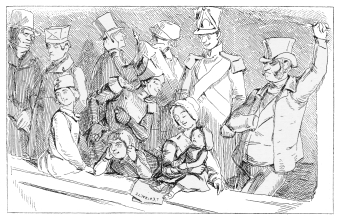
Can there he a more pleasing walk in the whole world than a stroll
through the Gallery of the Louvre on a fête-day? not to look so much at
the pictures as at the lookers-on. Thousands of the poorer classes are
there: mechanics in their Sunday clothes, smiling grisettes, smart
dapper soldiers of the line, with bronzed wondering faces, marching
together in little companies of six or seven, and stopping every now and
then at Napoleon or Leonidas as they appear in proper vulgar heroics in
the pictures of David or Gros. The taste of these people will hardly be
approved by the connoisseur, but they have a taste for art. Can the
same be said of our lower classes, who, if they are inclined to be
sociable and amused in their holidays, have no place of resort but the
taproom or tea-garden, and no food for conversation except such as can
be built upon the politics or the police reports of the last Sunday
paper? So much has Church and State puritanism done for us—so well has
it succeeded in materialising and binding down to the earth the
imagination of men, for which God has made another world (which certain
statesmen take but too little into account)—that fair and beautiful
world of art, in which there can be nothing selfish or sordid, of
which Dulness has forgotten the existence, and which Bigotry has
endeavoured to shut out from sight—
‘On a banni les démons et les fées,
Le raisonner tristement s’accrédite:
On court, hélas! après la vérité:
Ah! croyez-moi, l’erreur a son mérite!’
We are not putting in a plea here for demons and fairies, as Voltaire
does in the above exquisite lines; nor about to expatiate on the
beauties of error, for it has none; but the clank of steam-engines, and
the shouts of politicians, and the struggle for gain or bread, and the
loud denunciations of stupid bigots, have well-nigh smothered poor Fancy
among us. We boast of our science, and vaunt our superior morality. Does
the latter exist? In spite of all the forms which our policy has
invented to secure it—in spite of all the preachers, all the
meeting-houses, and all the legislative enactments—if any person will
take upon himself the painful labour of purchasing and perusing some of
the cheap periodical prints which form the people’s library of
amusement, and contain what may be presumed to be their standard in
matters of imagination and fancy, he will see how false the claim is
that we bring forward of superior morality. The aristocracy, who are so
eager to maintain, were, of course, not the last to feel, the annoyance
of the legislative restrictions on the Sabbath, and eagerly seized upon
that happy invention for dissipating the gloom and ennui ordered by
Act of Parliament to prevail on that day—the Sunday paper. It might be
read in a club-room, where the poor could not see how their betters
ordained one thing for the vulgar, and another for themselves; or in an
easy-chair, in the study, whither my lord retires every Sunday for his
devotions. It dealt in private scandal and ribaldry, only the more
piquant for its pretty flimsy veil of double entendre. It was a
fortune to the publisher, and it became a necessary to the reader, which
he could not do without, any more than without his snuff-box, his
opera-box, or his chasse after coffee. The delightful novelty could
not for any time be kept exclusively for the haut ton; and from my
lord it descended to his valet or tradesmen, and from Grosvenor Square
it spread all the town through; so that now the lower classes have their
scandal and ribaldry organs, as well as their betters (the rogues, they
will imitate them!); and as their tastes are somewhat coarser than my
lord’s, and their numbers a thousand to one, why of course the prints
have increased, and the profligacy has been diffused in a ratio exactly
proportionable to the demand, until the town is infested with such a
number of monstrous publications of the kind as would have put Abbé
Dubois to the blush, or made Louis XV. cry shame. Talk of English
morality!—the worst licentiousness, in the worst period of the French
monarchy, scarcely equalled the wickedness of this Sabbath-keeping
country of ours.
The reader will be glad, at last, to come to the conclusion that we
would fain draw from all these descriptions—why does this immorality
exist? Because the people must be amused, and have not been taught
how; because the upper classes, frightened by stupid cant, or absorbed
in material want, have not as yet learned the refinement which only the
cultivation of art can give; and when their intellects are uneducated,
and their tastes are coarse, the tastes and amusements of classes still
more ignorant must be coarse and vicious likewise, in an increased
proportion.
Such discussions and violent attacks upon high and low, Sabbath Bills,
politicians, and what not, may appear, perhaps, out of place, in a few
pages which purport only to give an account of some French drawings: all
we would urge is, that, in France, these prints are made because they
are liked and appreciated; with us they are not made, because they are
not liked and appreciated; and the more is the pity. Nothing merely
intellectual will be popular among us: we do not love beauty for
beauty’s sake, as Germans; or wit, for wit’s sake, as the French: for
abstract art we have no appreciation. We admire H. B.’s caricatures,
because they are the caricatures of well-known political characters, not
because they are witty; and Boz, because he writes us good palpable
stories (if we may use such a word to a story); and Madame Vestris,
because she has the most beautifully shaped legs;—the art of the
designer, the writer, the actress (each admirable in its way), is a very
minor consideration; each might have ten times the wit, and would be
quite unsuccessful without their substantial points of popularity.
In France such matters are far better managed, and the love of art is a
thousand times more keen; and (from this feeling, surely) how much
superiority is there in French society over our own; how much better
is social happiness understood; how much more manly equality is there
between Frenchman and Frenchman, than between rich and poor in our own
country, with all our superior wealth, instruction, and political
freedom! There is, amongst the humblest, a gaiety, cheerfulness,
politeness, and sobriety, to which in England no class can show a
parallel; and these, be it remembered, are not only qualities for
holidays, but for working days too, and add to the enjoyment of human
life as much as good clothes, good beef, or good wages. If, to our
freedom, we could but add a little of their happiness!—it is one, after
all, of the cheapest commodities in the world, and in the power of every
man (with means of gaining decent bread) who has the will or the skill
to use it.
We are not going to trace the history of the rise and progress of art in
France: our business, at present, is only to speak of one branch of art
in that country—lithographic designs, and those chiefly of a humorous
character. A history of French caricature was published in Paris, two or
three years back, illustrated by numerous copies of designs, from the
time of Henry III. to our own day. We can only speak of this work from
memory, having been unable, in London, to procure the sight of a copy;
but our impression, at the time we saw the collection, was as
unfavourable as could possibly be; nothing could be more meagre than the
wit, or poorer than the execution, of the whole set of drawings. Under
the Empire, art, as may be imagined, was at a very low ebb; and aping
the Government of the day, and catering to the national taste and
vanity, it was a kind of tawdry caricature of the sublime; of which the
pictures of David and Girodet, and almost the entire collection now at
the Luxembourg Palace, will give pretty fair examples. Swollen,
distorted, unnatural, the painting was something like the politics of
those days; with force in it, nevertheless, and something of grandeur,
that will exist in spite of taste, and is born of energetic will. A man,
disposed to write comparisons of characters, might, for instance, find
some striking analogies between Mountebank Murat, with his irresistible
bravery and horsemanship, who was a kind of mixture of Duguesclin and
Ducrow, and Mountebank David, a fierce powerful painter and genius,
whose idea of beauty and sublimity seem to have been gained from the
bloody melodramas on the Boulevard. Both, however, were great in their
way, and were worshipped as gods in those heathen times of false belief
and hero-worship.
As for poor caricature and freedom of the press, they, like the rightful
princess in a fairy tale, with the merry fantastic dwarf, her attendant,
were entirely in the power of the giant who ruled the land. The Princess
Press was so closely watched and guarded (with some little show,
nevertheless, of respect for her rank), that she dared not utter a word
of her own thoughts; and, for poor Caricature, he was gagged, and put
out of the way altogether: imprisoned as completely as ever Asmodeus was
in his phial.
How the Press and her attendant fared in succeeding reigns, is well
known; their condition was little bettered by the downfall of Napoleon:
with the accession of Charles X. they were more oppressed even than
before—more than they could bear; for so hard were they pressed, that,
as one has seen when sailors were working a capstan, back of a sudden
the bars flew, knocking to the earth the men who were endeavouring to
work them. The Revolution came, and up sprang Caricature in France; all
sorts of fierce epigrams were discharged at the flying monarch, and
speedily were prepared, too, for the new one.
About this time there lived at Paris (if our information be correct) a
certain M. Philipon, an indifferent artist (painting was his
profession), a tolerable designer, and an admirable wit. M. Philipon
designed many caricatures himself, married the sister of an eminent
publisher of prints (M. Aubert), and the two, gathering about them a
body of wits and artists like themselves, set up journals of their
own:—La Caricature, first published once a week; and the Charivari
afterwards, a daily paper, in which a design also appears daily.
At first the caricatures inserted in the Charivari were chiefly
political; and a most curious contest speedily commenced between the
State and M. Philipon’s little army in the Galerie Véro-Dodat. Half a
dozen poor artists on the one side, and his Majesty Louis Philippe, his
august family, and the numberless placemen and supporters of the
monarchy, on the other; it was something like Thersites girding at Ajax,
and piercing through the folds of the clypei septemplicis with the
poisonous shifts of his scorn. Our French Thersites was not always an
honest opponent, it must be confessed; and many an attack was made upon
the gigantic enemy, which was cowardly, false, and malignant. But to see
the monster writhing under the effects of the arrow—to see his uncouth
fury in return, and the blind blows that he dealt at his diminutive
opponent!—not one of these told in a hundred; when they did tell, it
may be imagined that they were fierce enough in all conscience, and
served almost to annihilate the adversary.
To speak more plainly, and to drop the metaphor of giant and dwarf, the
King of the French suffered so much, his Ministers were so mercilessly
ridiculed, his family and his own remarkable figure drawn with such
odious and grotesque resemblance, in fanciful attitudes, circumstances,
and disguises, so ludicrously mean, and often so appropriate, that the
King was obliged to descend into the lists and battle his ridiculous
enemy in form. Prosecutions, seizures, fines, regiments of furious legal
officials, were first brought into play against poor M. Philipon and his
little dauntless troop of malicious artists; some few were bribed out of
his ranks; and if they did not, like Gilray in England, turn their
weapons upon their old friends, at least laid down their arms, and would
fight no more. The bribes, fines, indictments, and loud-tongued avocats
du Roi made no impression; Philipon repaired the defeat of a fine by
some fresh and furious attack upon his great enemy; if his epigrams were
more covert, they were no less bitter; if he was beaten a dozen times
before a jury, he had eighty or ninety victories to show in the same
field of battle, and every victory and every defeat brought him new
sympathy. Every one who was at Paris a few years since must recollect
the famous ‘poire’ which was chalked upon all the walls of the city,
and which bore so ludicrous a resemblance to Louis Philippe. The poire
became an object of prosecution, and M. Philipon appeared before a jury
to answer for the crime of inciting to contempt against the King’s
person, by giving such a ludicrous version of his face. Philipon, for
defence, produced a sheet of paper, and drew a poire, a real large
Burgundy pear: in the lower parts round and capacious, narrower near the
stalk, and crowned with two or three careless leaves. ‘There was no
treason at least in that,’ he said to the jury; ‘could any one object
to such a harmless botanical representation?’ Then he drew a second
pear, exactly like the former, except that one or two lines were
scrawled in the midst of it, which bore, somehow, a ludicrous
resemblance to the eyes, nose, and mouth of a celebrated personage; and,
lastly, he drew the exact portrait of Louis Philippe; the well-known
toupet, the ample whiskers and jowl were there, neither extenuated nor
set down in malice. ‘Can I help it, gentlemen of the jury, then,’ said
he, ‘if his Majesty’s face is like a pear? Say you, yourselves,
respectable citizens, is it, or is it not, like a pear?’ Such eloquence
could not fail of its effect; the artist was acquitted, and La Poire
is immortal.
At last came the famous September laws: the freedom of the Press,
which, from August 1830, was to be ‘désormais une vérité,’ was calmly
strangled by the monarch who had gained his crown for his supposed
championship of it; by his Ministers, some of whom had been stout
Republicans on paper but a few years before; and by the Chamber, which,
such is the blessed constitution of French elections, will generally
vote, unvote, revote in any way the Government wishes. With a wondrous
union, and happy forgetfulness of principle, monarch, Ministers, and
deputies issued the restriction laws; the Press was sent to prison; as
for the poor dear Caricature, it was fairly murdered. No more political
satires appear now, and ‘through the eye, correct the heart;’ no more
poires ripen on the walls of the metropolis; Philipon’s political
occupation is gone.
But there is always food for satire; and the French caricaturists, being
no longer allowed to hold up to ridicule and reprobation the King and
the deputies, have found no lack of subjects for the pencil in the
ridicules and rascalities of common life. We have said that public
decency is greater amongst the French than amongst us, which, to some of
our readers, may appear paradoxical; but we shall not attempt to argue
that, in private roguery, our neighbours are not our equals. The
procès of Gisquet, which has appeared lately in the papers, shows how
deep the demoralisation must be, and how a Government, based itself on
dishonesty (a tyranny that is under the title and fiction of a
democracy), must practise and admit corruption in its own and in its
agents’ dealings with the nation. Accordingly, of cheating contracts, of
Ministers dabbling with the funds, or extracting underhand profits for
the granting of unjust privileges and monopolies,—of grasping, envious
police restrictions, which destroy the freedom, and, with it, the
integrity of commerce,—those who like to examine such details may find
plenty in French history; the whole French finance system has been a
swindle from the days of Louvois, or Law, down to the present time. The
Government swindles the public, and the small traders swindle their
customers, on the authority and example of the superior powers. Hence
the art of roguery, under such high patronage, maintains in France a
noble front of impudence, and a fine audacious openness, which it does
not wear in our country.
Among the various characters of roguery which the French satirists have
amused themselves by depicting, there is one of which the greatness
(using the word in the sense which Mr. Jonathan Wild gave to it) so far
exceeds that of all others, embracing, as it does, all in turn, that it
has come to be considered the type of roguery in general; and now, just
as all the political squibs were made to come of old from the lips of
Pasquin, all the reflections on the prevailing cant, knavery, quackery,
humbug, are put into the mouth of Monsieur Robert Macaire.
A play was written, some twenty years since, called the Auberge des
Adrets, in which the characters of two robbers escaped from the galleys
were introduced—Robert Macaire, the clever rogue above mentioned, and
Bertrand, the stupid rogue, his friend, accomplice, butt, and scapegoat,
on all occasions of danger. It is needless to describe the play—a
witless performance enough, of which the joke was Macaire’s exaggerated
style of conversation, a farrago of all sorts of highflown sentiments,
such as the French love to indulge in—contrasted with his actions,
which were philosophically unscrupulous, and his appearance, which was
most picturesquely sordid. The play had been acted, we believe, and
forgotten, when a very clever actor, M. Frédéric Lemaître, took upon
himself the performance of the character of Robert Macaire, and looked,
spoke, and acted it to such admirable perfection, that the whole town
rung with applauses of his performance, and the caricaturists delighted
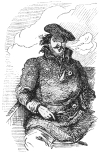
to copy his singular figure and costume. M. Robert Macaire appears in a
most picturesque green coat, with a variety of rents and patches, a pair
of crimson pantaloons ornamented in the same way, enormous whiskers and
ringlets, an enormous stock and shirt-frill, as dirty and ragged as
stock and shirt-frill can be, the relic of a hat very gaily cocked over
one eye, and a patch to take away somewhat from the brightness of the
other—these are the principal pièces of his costume—a snuff-box like
a creaking warming-pan, a handkerchief hanging together by a miracle,
and a switch of about the thickness of a man’s thigh, formed the
ornaments of this exquisite personage. He is a compound of Fielding’s
‘Blueskin’ and Goldsmith’s ‘Beau Tibbs.’ He has the dirt and dandyism of
the one, with the ferocity of the other: sometimes he is made to
swindle, but where he can get a shilling more, M. Macaire will murder
without scruple: he performs one and the other act (or any in the scale
between them) with a similar bland imperturbability, and accompanies his
actions with such philosophical remarks as may be expected from a person
of his talents, his energies, his amiable life and character.
Bertrand is the simple recipient of Macaire’s jokes, and makes vicarious
atonement for his crimes, acting, in fact, the part which Pantaloon
performs in the pantomime, who is entirely under the fatal influence of
Clown. He is quite as much a rogue as that gentleman, but he has not his
genius and courage. So in pantomimes (it may, doubtless, have been
remarked by the reader), Clown always leaps first, Pantaloon following
after, more clumsily and timidly than his bold and accomplished friend
and guide. Whatever blows are destined for Clown fall, by some means of
ill luck, upon the pate of Pantaloon; whenever the Clown robs, the
stolen articles are sure to be found in his companion’s pocket; and thus
exactly Robert Macaire and his companion Bertrand are made to go through
the world; both swindlers, but the one more accomplished than the other.
Both robbing all the world, and Robert robbing his friend, and, in the
event of danger, leaving him faithfully in the lurch. There is, in the
two characters, some grotesque good for the spectator—a kind of
Beggars’ Opera moral.
Ever since Robert, with his dandified rags and airs, his cane and
snuff-box, and Bertrand with torn surtout and all-absorbing pocket, have
appeared on the stage, they have been popular with the Parisians; and
with these two types of clever and stupid knavery, M. Philipon and his
companion Daumier have created a world of pleasant satire upon all the
prevailing abuses of the day.
Almost the first figure that these audacious caricaturists dared to
depict was a political one: in Macaire’s red breeches and tattered coat
appeared no less a personage than the King himself—the old Poire—in
a country of humbugs and swindlers the facile princeps; fit to govern,
as he is deeper than all the rogues in his dominions. Bertrand was
opposite to him, and having listened with delight and reverence to some
tale of knavery truly Royal, was exclaiming with a look and voice
expressive of the most intense admiration, ‘Ah, vieux blagueur!
va!’—the word blague is untranslatable—it means French humbug, as
distinct from all other; and only those who know the value of an epigram
in France, an epigram so wonderfully just, a little word so curiously
comprehensive, can fancy the kind of rage and rapture with which it was
received. It was a blow that shook the whole dynasty. Thersites had
there given such a wound to Ajax, as Hector in arms could scarcely have
inflicted: a blow sufficient almost to create the madness to which the
fabulous hero of Homer and Ovid fell a prey.
Not long, however, was French caricature allowed to attack personages so
illustrious: the September laws came, and henceforth no more epigrams
were launched against politics, but the caricaturists were compelled to
confine their satire to subjects and characters that had nothing to do
with the State. The Duke of Orleans was no longer to figure in
lithography as the fantastic Prince Rosolin; no longer were multitudes
(in chalk) to shelter under the enormous shadow of M. d’Argout’s nose;
Marshal Lohan’s squirt was hung up in peace, and M. Thiers’s pigmy
figure and round spectacled face were no more to appear in print.[5]
Robert Macaire was driven out of the Chambers and the Palace—his
remarks were a great deal too appropriate and too severe for the ears of
the great men who congregated in those places.
The Chambers and the Palace were shut to him; but the rogue, driven out
of this rogue’s paradise, saw ‘that the world was all before him where
to choose,’ and found no lack of opportunities for exercising his wit.
There was the Bar, with its roguish practitioners, rascally attorneys,
stupid juries, and forsworn judges; there was the Bourse, with all its
gambling, swindling, and hoaxing, its cheats and its dupes; the Medical
Profession, and the quacks who ruled it, alternately; the Stage, and the
cant that was prevalent there; the Fashion, and its thousand follies and
extravagances. Robert Macaire had all these to exploiter. Of all the
empire, through all the ranks, professions, the lies, crimes, and
absurdities of men, he may make sport at will: of all except of a
certain class. Like Bluebeard’s wife, he may see everything, but is
bidden to beware of the blue chamber. Robert is more wise than
Bluebeard’s wife, and knows that it would cost him his head to enter it.
Robert therefore keeps aloof for the moment. Would there be any use in
his martyrdom? Bluebeard cannot live for ever; perhaps, even now, those
are on their way (one sees a suspicious cloud of dust or two) that are
to destroy him.
In the meantime Robert and his friend have been furnishing the designs
that we have before us, and of which perhaps the reader will be edified
by a brief description. We are not, to be sure, to judge of the French
nation by M. Macaire, any more than we are to judge of our own national
morals in the last century by such a book as the Beggars’ Opera; but
upon the morals and the national manners, works of satire afford a world
of light that one would in vain look for in regular books of history.
Doctor Smollett would have blushed to devote any considerable portion of
his pages to a discussion of the acts and character of Mr. Jonathan
Wild, such a figure being hardly admissible among the dignified
personages who usually push all others out from the possession of the
historical page; but a chapter of that gentleman’s memoirs, as they are
recorded in that exemplary recueil—the Newgate Calendar; nay, a
canto of the great comic epic (involving many fables, and containing
much exaggeration, but still having the seeds of truth) which the
satirical poet of those days wrote in celebration of him—we mean
Fielding’s History of Jonathan Wild the Great—does seem to us to
give a more curious picture of the manners of those times than any
recognised history of them. At the close of his history of George II.,
Smollett condescends to give a short chapter on Literature and Manners.
He speaks of Glover’s Leonidas, Cibber’s Careless Husband, the poems
of Mason, Grey, the two Whiteheads, ‘the nervous style, extensive
erudition, and superior sense of a Cooke; the delicate taste, the
polished muse, and tender feeling of a Lyttelton.’ ‘King,’ he says,
‘shone unrivalled in Roman eloquence; the female sex distinguished
themselves by their taste and ingenuity. Miss Carte rivalled the
celebrated Dacier in learning and critical knowledge; Mrs. Lennox
signalised herself by many successful efforts of genius both in poetry
and prose; and Miss Reid excelled the celebrated Rosalba in
portrait-painting, both in miniature and at large, in oil as well as in
crayons. The genius of Cervantes was transferred into the novels of
Fielding, who painted the characters and ridiculed the follies of life
with equal strength, humour, and propriety. The field of history and
biography was cultivated by many writers of ability, among whom we
distinguish the copious Guthrie, the circumstantial Ralph, the laborious
Carte, the learned and elegant Robertson, and, above all, the ingenious,
penetrating, and comprehensive Hume,’ etc. We will quote no more of the
passage. Could a man in the best humour sit down to write a graver
satire? Who cares for the tender muse of Lyttelton? Who knows the signal
efforts of Mrs. Lennox’s genius? Who has seen the admirable
performances, in miniature and at large, in oil as well as in crayons,
of a Miss Reid? Laborious Carte, and circumstantial Ralph, and copious
Guthrie, where are they, their works, and their reputation? Mrs.
Lennox’s name is just as clean wiped out of the list of worthies as if
she had never been born; and Miss Reid, though she was once actual flesh
and blood, ‘rival in miniature and at large’ of the celebrated Rosalba,
she is as if she had never been at all; her little farthing rushlight of
a soul and reputation having burnt out, and left neither wick nor
tallow. Death, too, has overtaken copious Guthrie and circumstantial
Ralph. Only a few know whereabouts is the grave where lies laborious
Carte; and yet, O wondrous power of genius! Fielding’s men and women are
alive, though History’s are not. The progenitors of circumstantial Ralph
sent forth, after much labour and pains of making, educating, feeding,
clothing, a real man child, a great palpable mass of flesh, bones, and
blood (we say nothing about the spirit), which was to move through the
world, ponderous, writing histories, and to die, having achieved the
title of circumstantial Ralph; and lo! without any of the trouble that
the parents of Ralph had undergone, alone perhaps in a watch-or
spunging-house, fuddled most likely, in the blandest, easiest, and most
good-humoured way in the world, Henry Fielding makes a number of men and
women on so many sheets of paper, not only more amusing than Ralph or
Miss Reid, but more like flesh and blood, and more alive now than they.
Is not Amelia preparing her husband’s little supper? Is not Miss Snap
chastely preventing the crime of Mr. Firebrand? Is not Parson Adams in
the midst of his family, and Mr. Wild taking his last bowl of punch with
the Newgate Ordinary? Is not every one of them a real substantial
have-been personage now?—more real than Reid or Ralph? For our parts,
we will not take upon ourselves to say that they do not exist somewhere
else, that the actions attributed to them have not really taken place;
certain we are that they are more worthy of credence than Ralph, who may
or may not have been circumstantial; who may or may not even have
existed, a point unworthy of disputation. As for Miss Reid, we will take
an affidavit that neither in miniature nor at large did she excel the
celebrated Rosalba; and with regard to Mrs. Lennox, we consider her to
be a mere figment, like Narcissa, Miss Tabitha Bramble, or any hero or
heroine depicted by the historian of Peregrine Pickle.
In like manner, after viewing nearly ninety portraits of Robert Macaire
and his friend Bertrand, all strongly resembling each other, we are
inclined to believe in them both as historical personages, and to
canvass gravely the circumstances of their lives. Why should we not?
Have we not their portraits? Are not they sufficient proofs? If not, we
must discredit Napoleon (as Archbishop Whateley teaches), for about his
figure and himself we have no more authentic testimony.
Let the reality of M. Robert Macaire and his friend M. Bertrand be
granted, if but to gratify our own fondness for those exquisite
characters: we find the worthy pair in the French capital, mingling with
all grades of its society, pars magna in the intrigues, pleasures,
perplexities, rogueries, speculations, which are carried on in Paris, as
in our own chief city; for it need not be said that roguery is of no
country nor clime, but finds ὡς πανταχοὑ γε πατρἱς ἡ βὁσκουσα γἡ, is a citizen of all countries where the quarters are good; among
our merry neighbours it finds itself very much at its ease.
Not being endowed, then, with patrimonial wealth, but compelled to
exercise their genius to obtain distinction, or even subsistence, we see
Messrs. Bertrand and Macaire, by turns, adopting all trades and
professions, and exercising each with their own peculiar ingenuity. As
public men, we have spoken already of their appearance in one or two
important characters, and stated that the Government grew fairly jealous
of them, excluding them from office, as the Whigs did Lord Brougham. As
private individuals they are made to distinguish themselves as the
founders of journals, sociétés en commandite (companies of which the
members are irresponsible beyond the amount of their shares), and all
sorts of commercial speculations, requiring intelligence and honesty on
the part of the directors, confidence and liberal disbursements from the
shareholders.
These are, among the French, so numerous, and have been, of late years
(in the shape of Newspaper Companies, Bitumen Companies, Galvanised-Iron
Companies, Railroad Companies, etc.), pursued with such a blind furor
and lust of gain by that easily excited and imaginative people, that, as
may be imagined, the satirist has found plenty of occasion for remark,
and M. Macaire and his friend innumerable opportunities for exercising
their talents.
We know nothing of M. Emile de Girardin, except that, in a duel, he shot
the best man in France, Armand Carrel; and in Girardin’s favour it must
be said, that he had no other alternative; but was right in provoking
the duel, seeing that the whole Republican party had vowed his
destruction, and that he fought and killed their champion, as it were.
We know nothing of M. Girardin’s private character; but, as far as we
can judge from the French public prints, he seems to be the most
speculative of speculators, and, of course, a fair butt for the malice
of the caricaturists. His one great crime, in the eyes of the French
Republicans and Republican newspaper proprietors, was, that Girardin set
up a journal, as he called it, ‘franchement monarchique,’—a journal in
the pay of the monarchy, that is,—and a journal that cost only forty
francs by the year. The National costs twice as much; the Charivari
itself costs half as much again; and though all newspapers, of all
parties, concurred in ‘snubbing’ poor M. Girardin and his journal, the
Republican prints were by far the most bitter against him, thundering
daily accusations and personalities; whether the abuse was well or ill
founded, we know not. Hence arose the duel with Carrel; after the
termination of which, Girardin put by his pistol, and vowed, very
properly, to assist in the shedding of no more blood. Girardin had been
the originator of numerous other speculations besides the journal: the
capital of these, like that of the journal, was raised by shares, and
the shareholders, by some fatality, have found themselves woefully in
the lurch; while Girardin carries on the war gaily, is, or was, a
member of the Chamber of Deputies, has money, goes to Court, and
possesses a certain kind of reputation. He invented, we believe, the
‘Institution Agronome de Coetbo,’[6] the ‘Physionotype,’ the ‘Journal
des Connaissances Utiles,’ the ‘Panthéon Littéraire,’ and the system of
‘Primes’—premiums, that is—to be given, by lottery, to certain
subscribers in these institutions. Could Robert Macaire see such things
going on, and have no hand in them?
Accordingly Messrs. Macaire and Bertrand are made the heroes of many
speculations of the kind. In almost the first print of our collection,
Robert discourses to Bertrand of his projects. ‘Bertrand,’ says the
disinterested admirer of talent and enterprise, ‘j’adore l’industrie. Si
tu veux, nous créons une banque, mais là, une vraie banque: capital,
cent millions de millions, cent milliards de milliards d’actions. Nous
enfonçons la banque de France, les banquiers, les banquistes; nous
enfonçons tout le monde.’ ‘Oui,’ says Bertrand, very calm and stupid,
‘mais les gendarmes?’ ‘Que tu es bête, Bertrand: est-ce qu’on arrête un
millionnaire?’ Such is the key to M. Macaire’s philosophy; and a wise
creed too, as times go.
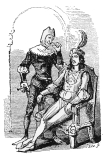
Acting on these principles, Robert appears soon after; he has not
created a bank, but a journal. He sits in a chair of state, and
discourses to a shareholder. Bertrand, calm and stupid as before, stands
humbly behind. ‘Sir,’ says the editor of La Blague, journal
quotidienne, ‘our profits arise from a new combination. The journal
costs twenty francs; we sell it for twenty-three and a-half. A million
subscribers make three millions and a-half of profits; there are my
figures; contradict me by figures, or I will bring an action for libel.’
The reader may fancy the scene takes place in England, where many such a
swindling prospectus has obtained credit ere now. At Plate 33, Robert is
still a journalist; he brings to the editor of a paper an article of his
composition, a violent attack on a law. ‘My dear M. Macaire,’ says the
editor, ‘this must be changed; we must praise this law.’ ‘Bon, bon!’
says our versatile Macaire. ‘Je vais retoucher ça, et je vous fais en
faveur de la loi un article mousseux.’
Can such things be? Is it possible that French journalists can so forget
themselves? The rogues! they should come to England and learn
consistency. The honesty of the Press in England is like the air we
breathe, without it we die. No, no! in France the satire may do very
well; but for England it is too monstrous. Call the Press stupid, call
it vulgar, call it violent,—but honest it is. Who ever heard of a
journal changing its politics? O tempora! O mores! as Robert Macaire
says, this would be carrying the joke too far.
When he has done with newspapers, Robert Macaire begins to distinguish
himself on ‘Change,[7] as a creator of companies, a vendor of shares, or
a dabbler in foreign stock. ‘Buy my coal-mine shares,’ shouts Robert;
‘gold mines, silver mines, diamond mines, “sont de la pot-bouille, de la
ratatouille en comparaison de ma houille.”’ ‘Look,’ says he, on another
occasion, to a very timid open-countenanced client, ‘you have a property
to sell! I have found the very man, a rich capitalist, a fellow whose
bills are better than bank-notes.’ His client sells; the bills are taken
in payment, and signed by that respectable capitalist, Monsieur de Saint
Bertrand. At Plate 81, we find him inditing a circular letter to all the
world, running thus:—‘Sir,—I regret to say that your application for
shares in the Consolidated European Incombustible Blacking Association
cannot be complied with, as all the shares of the C.E.I.B.A. were
disposed of on the day they were issued. I have, nevertheless,
registered your name, and in case a second series should be put forth, I
shall have the honour of immediately giving you notice. I am, sir,
yours, etc., the Director, Robert Macaire.’—‘Print three hundred
thousand of these,’ he says to Bertrand, ‘and poison all France with
them.’ As usual, the stupid Bertrand remonstrates—‘But we have not sold
a single share; you have not a penny in your pocket, and——’
‘Bertrand, you are an ass; do as I bid you.’
Will this satire apply anywhere in England? Have we any Consolidated
European Blacking Associations amongst us? Have we penniless directors
issuing El Dorado prospectuses, and jockeying their shares through the
market? For information on this head, we must refer the reader to the
newspapers; or if he be connected with the City, and acquainted with
commercial men, he will be able to say whether all the persons whose
names figure at the head of announcements of projected companies are as
rich as Rothschild, or quite as honest as heart could desire.
When Macaire has sufficiently exploité the Bourse, whether as a
gambler in the public funds or other companies, he sagely perceives that
it is time to turn to some other profession, and, providing himself with
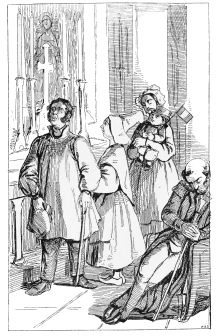
a black gown, proposes blandly to Bertrand to set up—a new religion.
‘Mon ami,’ says the repentant sinner, ‘le temps de la commandite va
passer, mais les badauds ne passeront pas.’ (O rare sentence! it
should be written in letters of gold!) ‘Occupons-nous de ce qui est
éternel. Si nous fassions une religion?’ On which M. Bertrand remarks,
‘A religion! what the devil—a religion is not an easy thing to make.’
But Macaire’s receipt is easy. ‘Get a gown, take a shop,’ he says,
‘borrow some chairs, preach about Napoleon, or the discovery of America,
or Molière—and there’s a religion for you.’
We have quoted this sentence more for the contrast it offers with our
own manners, than for its merits. After the noble paragraph, ‘Les
badauds ne passeront pas. Occupons-nous de ce qui est éternel,’ one
would have expected better satire upon cant than the words that follow.
We are not in a condition to say whether the subjects chosen are those
that had been selected by Père Enfantin, or Chatel, or Lacordaire; but
the words are curious, we think, for the very reason that the satire is
so poor. The fact is, there is no religion in Paris; even clever M.
Philipon, who satirises everything, and must know, therefore, some
little about the subject which he ridicules, has nothing to say but,
‘Preach a sermon, and that makes a religion; anything will do.’ If
anything will do, it is clear that the religious commodity is not in
much demand. Tartuffe had better things to say about hypocrisy in his
time; but then Faith was alive; now, there is no satirising religious
cant in France, for its contrary, true religion, has disappeared
altogether; and having no substance, can cast no shadow. If a satirist
would lash the religious hypocrites in England now—the High Church
hypocrites, the Low Church hypocrites, the promiscuous Dissenting
hypocrites, the No-Popery hypocrites—he would have ample subject
enough. In France, the religious hypocrites went out with the Bourbons.
Those who remain pious in that country (or, rather, we should say, in
the capital, for of that we speak) are unaffectedly so, for they have no
worldly benefit to hope for from their piety; the great majority have no
religion at all, and do not scoff at the few, for scoffing is the
minority’s weapon, and is passed always to the weaker side, whatever
that may be. Thus H. B. caricatures the Ministers: if by any accident
that body of men should be dismissed from their situations, and be
succeeded by H. B.’s friends, the Tories,—what must the poor artist do?
He must pine away and die, if he be not converted; he cannot always be
paying compliments; for caricature has a spice of Goethe’s Devil in it,
and is ‘der Geist, der stets verneint,’ the Spirit that is always
denying.
With one or two of the French writers and painters of caricatures, the
King tried the experiment of bribery; which succeeded occasionally in
buying off the enemy, and bringing him from the Republican to the Royal
camp; but when there, the deserter was never of any use. Figaro, when so
treated, grew fat and desponding, and lost all his sprightly verve;
and Nemesis became as gentle as a Quakeress. But these instances of
‘ratting’ were not many. Some few poets were bought over; but, among
men following the profession of the Press, a change of politics is an
infringement of the point of honour, and a man must fight as well as
apostatise. A very curious table might be made, signalising the
difference of the moral standard between us and the French. Why is the
grossness and indelicacy, publicly permitted in England, unknown in
France, where private morality is certainly at a lower ebb? Why is the
point of private honour now more rigidly maintained among the French?
Why is it, as it should be, a moral disgrace for a Frenchman to go into
debt, and no disgrace for him to cheat his customer? Why is there more
honesty and less—more propriety and less?—and how are we to account
for the particular vices or virtues which belong to each nation in its
turn?
The above is the Reverend M. Macaire’s solitary exploit as a spiritual
swindler; as Maître Macaire in the courts of law, as avocat,
avoué—in a humbler capacity even, as a prisoner at the bar, he
distinguishes himself greatly, as may be imagined. On one occasion we
find the learned gentleman humanely visiting an unfortunate détenu—no
other person, in fact, than his friend M. Bertrand, who has fallen into
some trouble, and is awaiting the sentence of the law. He begins—
‘Mon cher Bertrand, donne-moi cent écus, je te fais acquitter d’emblée.’
‘J’ai pas d’argent.’
‘Hé bien, donne-moi cent francs?’
‘Pas le sou.’
‘Tu n’as pas dix francs?’
‘Pas un liard.’
‘Alors donne moi tes bottes, je plaiderai la circonstance atténuante.’
The manner in which Maître Macaire soars from the cent écus (a high
point already) to the sublime of the boots, is in the best comic style.
In another instance he pleads before a judge, and, mistaking his client,
pleads for defendant, instead of plaintiff. ‘The infamy of the
plaintiff’s character, my luds, renders his testimony on such a charge
as this wholly unavailing.’ ‘M. Macaire, M. Macaire,’ cries the
attorney, in a fright, ‘you are for the plaintiff!’ ‘This, my lords, is
what the defendant will say. This is the line of defence which the
opposite party intend to pursue; as if slanders like these could weigh
with an enlightened jury, or injure the spotless reputation of my
client!’ In this story and expedient M. Macaire has been indebted to the
English bar. If there be an occupation for the English satirist in the
exposing of the cant and knavery of the pretenders to religion, what
room is there for him to lash the infamies of the law? On this point the
French are babes in iniquity compared to us—a counsel prostituting
himself for money is a matter with us so stale, that it is hardly food
for satire: which, to be popular, must find some much more complicated
and interesting knavery whereon to exercise its skill.
M. Macaire is more skilful in love than in law, and appears once or
twice in a very amiable light while under the influence of the tender
passion. We find him at the head of one of those useful establishments
unknown in our country—a Bureau de Mariage: half a dozen of such places
are daily advertised in the journals: and ‘une veuve de trente ans ayant
une fortune de deux cent mille francs,’ or ‘une demoiselle de quinze
ans, jolie, d’une famille très distinguée, qui possède trente mille
livres de rentes,’—continually, in this kind-hearted way, are offering
themselves to the public; sometimes it is a gentleman, with a ‘physique
agréable,—des talens de société’—and a place under Government, who
makes a sacrifice of himself in a similar manner. In our little
historical gallery we find this philanthropic anti-Malthusian at the
head of an establishment of this kind, introducing a very meek
simple-looking bachelor to some distinguished ladies of his
connaissance. ‘Let me present you, sir, to Madame de St. Bertrand’ (it
is our old friend), ‘veuve de la grande armée, et Mdlle. Eloa de
Wormspire. Ces dames brûlent de l’envie de faire votre connoissance. Je
les ai invitées à dîner chez vous ce soir: vous nous menerez à l’opéra,
et nous ferons une petite parte d’écarté. Tenez-vous bien, M. Gobard!
ces dames out des projets sur vous!’
Happy Gobard! happy system, which can thus bring the pure and loving
together, and acts as the best ally of Hymen! The announcement of the
rank and titles of Madame de St. Bertrand—‘veuve de la grande
armée’—is very happy. ‘La grande armée’ has been a father to more
orphans, and a husband to more widows, than it ever made. Mistresses of
cafés, old governesses, keepers of boarding-houses, genteel beggars,
and ladies of lower rank still, have this favourite pedigree. They have
all had malheurs (what kind it is needless to particularise), they are
all connected with the grand homme, and their fathers were all
colonels. This title exactly answers to the ‘clergyman’s daughter’ in
England—as, ‘A young lady, the daughter of a clergyman, is desirous to
teach,’ etc.; ‘A clergyman’s widow receives into her house a few
select,’ and so forth. ‘Appeal to the benevolent.—By a series of
unheard-of calamities, a young lady, daughter of a clergyman in the west
of England, has been plunged,’ etc. etc. The difference is curious, as
indicating the standard of respectability.
The male beggar of fashion is not so well known among us as in Paris,
where street-doors are open; six or eight families live in a house; and
the gentleman who earns his livelihood by this profession can make half
a dozen visits without the trouble of knocking from house to house, and
the pain of being observed by the whole street, while the footman is
examining him from the area. Some few may be seen in England about the
Inns of Court, where the locality is favourable (where, however, the
owners of the chambers are not proverbially soft of heart, so that the
harvest must be poor); but Paris is full of such adventurers,—fat,
smooth-tongued, and well-dressed, with gloves and gilt-headed canes, who
would be insulted almost by the offer of silver, and expect your gold as
their right. Among these, of course, our friend Robert plays his part;
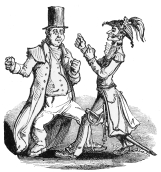
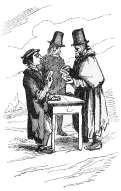
and an excellent engraving represents him, snuff-box in hand, advancing
to an old gentleman, whom, by his poodle, his powdered head, and his
drivelling, stupid look, one knows to be a Carlist of the old régime.
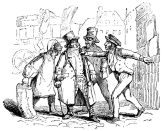
‘I beg pardon,’ says Robert; ‘is it really yourself to whom I have the
honour of speaking?’—‘It is.’ ‘Do you take snuff?’—‘I thank you.’
‘Sir, I have had misfortunes—I want assistance. I am a Vendéan of
illustrious birth. You know the family of Macairbec—we are of Brest.
My grandfather served the King in his galleys; my father and I belong,
also, to the marine. Unfortunate suits at law have plunged us into
difficulties, and I do not hesitate to ask you for the succour of ten
francs.’—‘Sir, I never give to those I don’t know.’—‘Right, sir,
perfectly right. Perhaps you will have the kindness to lend me ten
francs?’
The adventures of Doctor Macaire need not be described, because the
different degrees in quackery which are taken by that learned physician
are all well known in England, where we have the advantage of many
higher degrees in the science, which our neighbours know nothing about.
We have not Hahnemann, but we have his disciples; we have not Broussais,
but we have the College of Health; and surely a dose of Morison’s pills
is a sublimer discovery than a draught of hot water. We had St. John
Long, too,—where is his science?—and we are credibly informed that
some important cures have been effected by the inspired dignitaries of
‘the church’ in Newman Street—which, if it continue to practise, will
sadly interfere with the profits of the regular physicians, and where
the miracles of the Abbé Paris are about to be acted over again.
In speaking of M. Macaire and his adventures, we have managed so
entirely to convince ourselves of the reality of the personage, that we
have quite forgotten to speak of Messrs. Philipon and Daumier, who are,
the one the inventor, the other the designer, of the Macaire Picture
Gallery. As works of esprit, these drawings are not more remarkable
than they are as works of art, and we never recollect to have seen a
series of sketches possessing more extraordinary cleverness and variety.
The countenance and figure of Macaire and the dear stupid Bertrand are
preserved, of course, with great fidelity throughout; but the admirable
way in which each fresh character is conceived, the grotesque
appropriateness of Robert’s every successive attitude and gesticulation,
and the variety of Bertrand’s postures of invariable repose, the
exquisite fitness of all the other characters, who act their little part
and disappear from the scene, cannot be described on paper, or too
highly lauded. The figures are very carelessly drawn; but, if the reader
can understand us, all the attitudes and limbs are perfectly
conceived, and wonderfully natural and various. After pondering over
these drawings for some hours, as we have been while compiling this
notice of them, we have grown to believe that the personages are real,
and the scenes remain imprinted on the brain as if we had absolutely
been present at their acting. Perhaps the clever way in which the plates
are coloured, and the excellent effect which is put into each, may add
to this illusion. Now, in looking, for instance, at H. B.’s slim vapoury
figures, they have struck us as excellent likenesses of men and women,
but no more: the bodies want spirit, action, and individuality. George
Cruikshank, as a humorist, has quite as much genius, but he does not
know the art of ‘effect’ so well as Monsieur Daumier; and, if we might
venture to give a word of advice to another humorous designer, whose
works are extensively circulated—the illustrator of Pickwick and
Nicholas Nickleby,—it would be to study well these caricatures of
Monsieur Daumier; who, though he executes very carelessly, knows very
well what he would express, indicates perfectly the attitude and
identity of his figure, and is quite aware, beforehand, of the effect
which he intends to produce. The one we should fancy to be a practised
artist, taking his ease: the other, a young one, somewhat bewildered: a
very clever one, however, who, if he would think more, and exaggerate
less, would add not a little to his reputation.
Having pursued, all through these remarks, the comparison between
English art and French art, English and French humour, manners, and
morals, perhaps we should endeavour, also, to write an analytical essay
on English cant or humbug, as distinguished from French. It might be
shown that the latter was more picturesque and startling, the former
more substantial and positive. It has none of the poetic flights of the
French genius, but advances steadily, and gains more ground in the end
than its sprightlier compeer. But such a discussion would carry us
through the whole range of French and English history, and the reader
has probably read quite enough of the subject in this and the foregoing
pages.
We shall, therefore, say no more of French and English caricatures
generally, or of Mr. Macaire’s particular accomplishments and
adventures. They are far better understood by examining the original
pictures by which Philipon and Daumier have illustrated them, than by
translations first into print and afterwards into English. They form a
very curious and instructive commentary upon the present state of
society in Paris, and a hundred years hence, when the whole of this
struggling, noisy, busy, merry race shall have exchanged their pleasures
or occupations for a quiet coffin (and a tawdry lying epitaph) at
Montmartre, or Père la Chaise; when the follies here recorded shall have
been superseded by new ones, and the fools now so active shall have
given up the inheritance of the world to their children: the latter
will, at least, have the advantage of knowing, intimately and exactly,
the manners of life and being of their grandsires, and calling up, when
they so choose it, our ghosts from the grave, to live, love, quarrel,
swindle, suffer, and struggle on blindly as of yore. And when the amused
speculator shall have laughed sufficiently at the immensity of our
follies, and the paltriness of our aims, smiled at our exploded
superstitions, wondered how this man should he considered great, who is
now clean forgotten (as copious Guthrie before mentioned); how this
should have been thought a patriot who is but a knave spouting
commonplace; or how that should have been dubbed a philosopher who is
but a dull fool, blinking solemn, and pretending to see in the dark;
when he shall have examined all these at his leisure, smiling in a
pleasant contempt and good-humoured superiority, and thanking Heaven for
his increased lights, he will shut the book, and be a fool as his
fathers were before him.
It runs in the blood. Well hast thou said, O ragged Macaire,—‘Le jour
va passer, MAIS LES BADAUDS NE PASSERONT PAS.’