By Pansy.
AS a matter of fact there wasn’t a cake
left. Neither doughnut nor gingersnap;
hardly a crumb to tell the successful
tale. Nettie surveyed the
empty shelves the next morning in
astonishment. She had been too busy the
night before to realize how fast things were going.
Naturally the number and variety of
dishes in the Decker household was limited and
the evening to Nettie was a confused murmur
of, “Hand us in some more cups.”
“Can’t you raise a few more teaspoons somewhere?”
“Give us another plate,” or, “More
doughnuts needed;” and Nettie flew hither and
thither, washed cups, rinsed spoons, said, “What
did I do with that towel?” or, “Where in the
world is the bread knife?” or, “Oh! I smell
the coffee! maybe it is boiling over,” and was
conscious of nothing but weariness and relief
when the last cup of coffee was drank, and the
last teaspoon washed.
But with the next morning’s sunshine she
knew the opening was a success. She counted
the gains with eager joy, assuring Jerry that
they could have twice as much gingerbread next
time.
“And you’ll need it,” said Norm. “I had to
tell half a dozen boys that there wasn’t a crumb
left. I felt sorry for ’em, too; they were boarding-house
fellows who never get anything decent
to eat.”
Already Norm had apparently forgotten that
he was one who used frequently to make a similar
complaint.
There was a rarely sweet smile on Nettie’s
face, not born of the chink in the factory bag
which she had made for the money; it grew
from the thought that she need not hide the bag
now, and tremble lest it should be taken to the
saloon to pay for whiskey. What a little time
ago it was that she had feared that! What a
changed world it was!
“But there won’t be such a crowd again,”
she said as they were putting the room in order,
“that was the first night.”
“Humph!” said that wise woman Susie with
a significant toss of her head; “last night you
said we mustn’t expect anybody because it was
the first night.”
Then “the firm” had a hearty laugh at Nettie’s
expense and set to work preparing for evening.
I am not going to tell you the story of that
summer and fall. It was beautiful; as any of
the Deckers will tell you with eager eyes and
voluble voice if you call on them, and start the
subject.
The business grew and grew, and exceeded
their most sanguine expectations. Mr. Decker
interested himself in it most heartily, and
brought often an old acquaintance to get a cup
of coffee. “Make it good and strong,” he
would say to Nettie in an earnest whisper.
“He’s thirsty, and I brought him here instead
of going for beer. I wish the room was larger,
and I’d get others to come.”
In time, and indeed in a very short space of
time, this grew to be the crying need of the
firm: “If we only had more room, and more
dishes!” There was a certain long, low building
which had once been used as a boarding-house
for the factory hands, before that institution
grew large and moved into new quarters, and
which was not now in use. At this building
Jerry and Nettie, and for that matter, Norm,
looked with longing eyes. They named it “Our
Rooms,” and hardly ever passed, that they did
not suggest some improvement in it which could
be easily made, and which would make it just
the thing for their business. They knew just
what sort of curtains they would have at the
the windows, just what furnishings in front and
back rooms, just how many lamps would be
needed. “We will have a hanging lamp over
the centre table,” said Jerry. “One of those
new-fashioned things which shine and give a
bright light, almost like gas; and lots of books
and papers for the boys to read.”
“But where would we get the books and
papers?” would Nettie say, with an anxious
business face, as though the room, and the
table, and the hanging lamp, were arranged for,
and the last-mentioned articles all that were
needed to complete the list.
“Oh! they would gather, little by little. I
know some people who would donate great
piles of them if we had a place to put them.
For that matter, as it is, father is going to send
us some picture-papers, a great bundle of them;
send them by express, and we must have a table
to put them on.”
So the plans grew, but constantly they looked
at the long, low building and said what a nice
place it would be.
One morning Jerry came across the yard with
a grave face. “What do you think?” he said,
the moment he caught sight of Nettie. “They
have gone and rented our rooms for a horrid
old saloon; whiskey in front, and gambling in
the back part! Isn’t it a shame that they have
got ahead of us in that kind of way?”
“Oh dear me!” said Nettie, drawing out each
word to twice its usual length, and sitting down
on a corner of the woodbox with hands clasped
over the dish towel, and for the moment a look
on her face as though all was lost.
But it was the very same day that Jerry
appeared again, his face beaming. This time it
was hard to make Nettie hear, for Mrs. Decker
was washing, and mingling with the rapid rub-a-dub
of the clothes was the sizzle of ham in
the spider, and the bubble of a kettle which
was bent on boiling over, and making the half-distracted
housekeeper all the trouble it could.
Yet his news was too good to keep; and he
shouted above the din: “I say, Nettie, the man
has backed out! Our rooms are not rented,
after all.”
“Goody!” said Nettie, and she smiled on the
kettle in a way to make it think she did not
care if everything in it boiled over on the floor;
whereupon it calmed down, of course, and behaved
itself.
So the weeks passed, and the enterprise grew
and flourished. I hope you remember Mrs.
Speckle? Very early in the autumn she sent
every one of her chicks out into the world to
toil for themselves and began business. Each
morning a good-sized, yellow-tinted, warm, beautiful
egg lay in the nest waiting for Jerry; and
when he came, Mrs. Speckle cackled the news
to him in the most interested way.
“She couldn’t do better if she were a regularly
constituted member of the firm with a
share in the profits,” said Jerry.
The egg was daily carried to Mrs. Farley’s,
where there was an invalid daughter, who had
a fancy for that warm, plump egg which came
to her each morning, done up daintily in pink
cotton, and laid in a box just large enough for
it. But there came a morning which was a
proud one to Nettie. Jerry had returned from
Mrs. Farley’s with news. “The sick daughter
is going South; she has an auntie who is to
spend the winter in Florida, so they have decided
to send her. They start to-morrow morning.
Mrs. Farley said they would take our
eggs all the same, and she wished Miss Helen
could have them; but somebody else would
have to eat them for her.”
Then Nettie, beaming with pleasure, “Jerry,
I wish you would tell Mrs. Farley that we can’t
spare them any more at present; I would have
told you before, but I didn’t want to take the
egg from Miss Helen; I want to buy them
now, every other morning, for mother and
father; mother thinks there is nothing nicer
than a fresh egg, and I know father will be
pleased.”
What satisfaction was in Nettie’s voice,
what joy in her heart! Oh! they were poor,
very poor, “miserably poor” Lorena Barstow
called them, but they had already reached the
point where Nettie felt justified in planning for
a fresh egg apiece for father and mother, and
knew that it could be paid for. So Mrs. Speckle
began from that day to keep the results of her
industry in the home circle, and grew more
important because of that.
Almost every day now brought surprises. One
of the largest of them was connected with Susie
Decker. That young woman from the very first
had shown a commendable interest in everything
pertaining to the business. She patiently did
errands for it, in all sorts of weather, and was
always ready to dust shelves, arrange cookies
without eating so much as a bite, and even wipe
teaspoons, a task which she used to think beneath
her. “If you can’t trust me with things
that would smash,” she used to say with scornful
gravity, to Nettie, “then you can’t expect
me to be willing to wipe those tough spoons.”
But in these days, spoons were taken uncomplainingly.
Susie had a business head, and was
already learning to count pennies and add them
to the five and ten cent pieces; and when Jerry
said approvingly: “One of these days, she will
be our treasurer,” the faintest shadow of a
blush would appear on Susie’s face, but she
always went on counting gravely, with an air
of one who had not heard a word.
On a certain stormy, windy day, one of
November’s worst, it was discovered late in the
afternoon that the molasses jug was empty, and
the boys had been promised some molasses candy
that very evening.
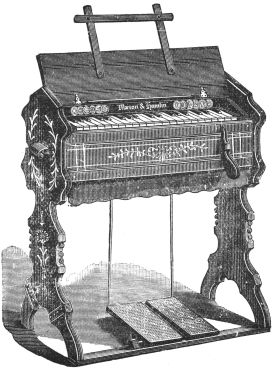
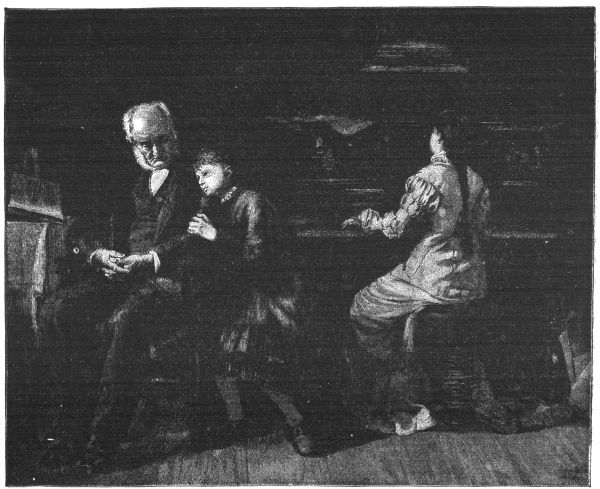
THE LITTLE HOUSE ORGAN.
“What shall we do?” asked Nettie, looking
perplexed, and standing jug in hand in the middle
of the room. “Jerry won’t be home in
time to get it, and I can’t leave those cakes to
bake themselves; mother, you don’t think you
could see to them a little while till I run to the
grocery, do you?”
Mrs. Decker shook her head, but spoke sympathetically:
“I’d do it in a minute, child, or I’d
go for the molasses, but these shirts are very
particular; I never had such fine ones to iron
before, and the irons are just right, and if I
should have to leave the bosoms at the wrong
minute to look at the cakes, why, it would spoil
the bosoms; and on the other hand, if I left
the cakes and saved the bosoms, why, they would
be spoiled.”
This seemed logical reasoning. Susie, perched
on a high chair in front of the table, was counting
a large pile of pennies, putting them in
heaps of twenty-five cents each. She waited
until her fourth heap was complete, then looked
up. “Why don’t you ask me to go?”
“Sure enough!” said Nettie, laughing, “I’d
‘ask’ you in a minute if it didn’t rain so hard;
but it seems a pretty stormy day to send out a
little chicken like you.”
“I’m not a chicken, and I’m not in the leastest
bit afraid of rain; I can go as well as not if
you only think so.”
“I don’t believe it will hurt her!” said Mrs.
Decker, glancing doubtfully out at the sullen
sky. “It doesn’t rain so hard as it did, and she
has such a nice thick sack now.”
It was nice, made of heavy waterproof cloth,
with a lovely woolly trimming going all around
it. Susie liked that sack almost better than
anything else in the world. Her mother had
bought it second-hand of a woman whose little
girl had outgrown it; the mother had washed
all day and ironed another day to pay for it, and
felt the liveliest delight in seeing Susie in the
pretty garment.
The rain seemed to be quieting a little, so
presently the young woman was robed in sack
and waterproof bonnet with a cape, and started
on her way.
Half-way to the grocery she met Jerry hastening
home from school with a bag of books
slung across his shoulder.
“Is it so late as that?” asked Susie in dismay.
“Nettie thought you wouldn’t be at
home in a good while; the candy won’t get
done.”
“No, it is as early as this,” he answered laughing;
“we were dismissed an hour earlier than
usual this afternoon. Where are you going?
after molasses? See here, suppose you give me
the jug and you take my books and scud home.
There is a big storm coming on; I think the
wind is going to blow, and I’m afraid it will
twist you all up and pour the molasses over
you. Then you’d be ever so sticky!”
Susie laughed and exchanged not unwillingly
the heavy jug for the books. There had been
quite wind enough since she started, and if
there was to be more, she had no mind to brave
it.
“If you hurry,” called Jerry, “I think you’ll
get home before the next squall comes.” So
she hurried; but Jerry was mistaken. The
squall came with all its force, and poor small
Susie was twisted and whirled and lost her
breath almost, and panted and struggled on, and
was only too thankful that she hadn’t the molasses
jug.
Nearly opposite the Farley home, their side
door suddenly opened and a pleasant voice
called: “Little girl, come in here, and wait
until the shower is over; you will be wet to the
skin.”
It is true Susie did not believe that her waterproof
sack could be wet through, but that
dreadful wind so frightened her, twisting the
trees as it did, that she was glad to obey the
kind voice and rush into shelter.
“Why, it is Nettie’s sister, I do believe!”
said Ermina Farley, helping her off with the
dripping hood.
“You dear little mouse, what sent you out in
such a storm?”
Miss Susie not liking the idea of being a
mouse much more than she did being a chicken,
answered with dignity, and becoming brevity.
“Molasses candy!” said Mrs. Farley, laughing,
yet with an undertone of disapproval in
her voice which keen-minded Susie heard and
felt, “I shouldn’t think that was a necessity of
life on such a day as this.”
“It is if you have promised it to some boys
who don’t ever have anything nice only what
they get at our house; and who save their pennies
that they spend on beer, and cider, and
cigars to get it.”
Wise Susie, indignation in every word, yet
well controlled, and aware before she finished
her sentence that she was deeply interesting her
audience! How they questioned her? What
was this? Who did it? Who thought of it?
When did they begin it? Who came? How
did they get the money to buy their things?
Susie, thoroughly posted, thoroughly in sympathy
with the entire movement, calm, collected,
keen far beyond her years, answered clearly
and well. Plainly she saw that this lady in a
silken gown was interested.
“Well, if this isn’t a revelation!” said Mrs.
Farley at last. “A young men’s Christian
association not only, but an eating-house flourishing
right in our midst and we knowing nothing
about it. Did you know anything of it,
daughter?”
“No, ma’am,” said Ermina. “But I knew
that splendid Nettie was trying to do something
for her brother; and that nice boy who used to
bring eggs was helping her; it is just like them
both. I don’t believe there is a nicer girl in
town than Nettie Decker.”
Mrs. Farley seemed unable to give up the
subject. She asked many questions as to how
long the boys stayed, and what they did all the
time.
Susie explained: “Well, they eat, you know;
and Norm doesn’t hurry them; he says they
have to pitch the things down fast where they
board, to keep them from freezing; and our
room is warm, because we keep the kitchen
door open, and the heat goes in; but we don’t
know what we shall do when the weather gets
real cold; and after they have eaten all the
things they can pay for, they look at the pictures.
Jerry’s father sends him picture papers,
and Mr. Sherrill brings some, most every day.
Miss Sherrill is coming Thanksgiving night to
sing for them; and Nettie says if we only had
an organ she would play beautiful music. We
want to give them a treat for Thanksgiving;
we mean to do it without any pay at all if we
can; and father thinks we can, because he is
working nights this week, and getting extra
pay; and Jerry thinks there will be two chickens
ready; and Nettie wishes we could have an
organ for a little while, just for Norm, because
he loves music so, but of course we can’t.”
Long before this sentence was finished,
Ermina and her mother had exchanged glances
which Susie, being intent on her story, did not
see.
She was a wise little woman of business;
what if Mrs. Farley should say: “Well, I will
give you a chicken myself for the Thanksgiving
time, and a whole peck of apples!” then indeed,
Susie believed that their joy would be
complete; for Nettie had said, if they could
only afford three chickens she believed that
with a lot of crust she could make chicken pie
enough for them each to have a large piece, hot;
not all the boys, of course, but the seven or
eight who worked in Norm’s shop and boarded
at the dreary boarding-house; they would so
like to give Norm a surprise for his birthday,
and have a treat say at six o’clock for all of
these; for this year Thanksgiving fell on Norm’s
birthday. The storm held up after a little, and
Susie, trudging home, a trifle disgusted with
Mrs. Farley because she said not a word about
the peck of apples or the other chicken, was met
by Jerry coming in search of her. The molasses
was boiling over, he told her, and so was her
mother, with anxiety lest the wind had taken
her, Susie, up in a tree, and had forgotten to
bring her down again. He hurried her home
between the squalls, and Susie quietly resolved
to say not a word about all the things she had
told at the Farley home. What if Nettie should
think she hadn’t been womanly to talk so much
about what they were doing! If there was one
thing that this young woman had a horror of
during these days, it was that Nettie would
think she was not womanly. The desire, nay,
the determination to be so, at all costs had well
nigh cured her of her fits of rage and screaming,
because in one of her calm moments Nettie
had pointed out to her the fact that she never
in her life heard a woman scream like that.
Susie being a logical person, argued the rest of
the matter out for herself, and resolved to
scream and stamp her foot no more.
Great was the astonishment of the Decker
family, next morning. Mrs. Farley herself came
to call on them. She wanted some plain ironing
done that afternoon. Yes, Mrs. Decker
would do it and be glad to; it was a leisure
afternoon with her. Mrs. Farley wanted something
more! she wanted to know about the
business in which Nettie and her young friend
next door were engaged; and Susie listened
breathlessly, for fear it would appear that she
had told more than she ought. But Mrs. Farley
kept her own counsel, only questioning Nettie
closely, and at last she made a proposition
that had well nigh been the ruin of the tin of
cookies which Nettie was taking from the oven.
She dropped the tin!
“Did you burn you, child?” asked Mrs.
Decker, rushing forward.
“No, ma’am,” said Nettie, laughing, and trying
not to laugh, and wanting to cry, and being
too amazed to do so. “But I was so surprised
and so almost scared, that they dropped.
“O Mrs. Farley, we have wanted that more
than anything else in the world; ever since
Mr. Sherrill saw how my brother Norman
loved music, and said it might be the saving of
him; Jerry and I have planned and planned,
but we never thought of being able to do it for
a long, long time.”
Yet all this joy was over an old, somewhat
wheezy little house organ which stood in the
second-story unused room of Mrs. Farley’s
house, and which she had threatened to send
to the city auction rooms to get out of the
way.
She offered to lend it to Nettie for her
“Rooms,” and Nettie’s gratitude was so great
that the blood seemed inclined to leave her
face entirely for a minute, then thought better
of it and rolled over it in waves.

A PACKAGE FOR ROSE. — NO. II. — THE PERFUMED MANTLE.
THEY found the scissors in Mrs. Harrison’s
work basket and then sat down
together on the doorstep to open the
package. When the outside paper was
taken off they saw there were really two
small packages, both wrapped alike in white
paper, but one was square and flat, and the
other round and slender,—indeed one might
almost have guessed it to be, as Rose said, a very
large stick of candy.
“Oh, let me open the round one!” cried Priscilla.
“No, I want to open that myself,” said Rose,
“but I’ll let you open the other.”
“Well,” answered Priscilla pleasantly, “I
will.”
So saying, she began to tear off the paper,
but stopped at an exclamation from Rose.
“See! see! Priscilla, this is old gold satin!”
Sure enough. The round roll proved to be a
banner, fastened to a slender brass rod, and finished
with a fringe of bright little stars. There
was a spray of blue forget-me-nots painted upon
it, and as Rose held it up in the sunlight, both
girls declared that it was very beautiful indeed.
“Isn’t aunt Alice lovely to send me this,”
cried Rose, after they had examined it to their
full satisfaction. “But I can’t see how it’s an
answer to my letter.”
“Maybe this is the answer,” said Priscilla,
taking up the other package. “See, it’s just
sheets of paper, fastened together, and lots of
writing on them.”
“Yes,” said Rose, “it’s a letter. Why, no it
isn’t,” she added. “Oh goody! goody! it’s a
story! aunt Alice does tell splendid stories, but
I never thought of her writing one. Come, let’s
read it.”
The pages of the paper were neatly fastened
together, and every word was so plainly written
that the two girls could easily read them.
Rose began as follows:
Long ago, in a small village whose cottages
clustered upon a mountain slope, a great number
of people had come together to celebrate a fair
which was held each year for the benefit of that
district.
Some had come to sell and some to buy, but
many were there for pleasure only. Hucksters
and villagers, peasants, and venders of trinkets,
or of useful articles—all were there in bustling
confusion.
Among the crowd had come a man whom no
one could recollect having seen before, and yet
he spoke to each whom he met, calling him by
name. His manner was dignified, quiet and
gentle, and he said that he came neither to buy
nor sell, but that he had a wonderful cloak
which he would give for the asking. He said,
moreover, that it was the safeguard which all
travellers wore who journeyed to the Pleasant
Land.
Now this kingdom, as the people well knew,
lay just beyond their own boundary, toward
the setting of the sun; and indeed many of
them had wished that they might sometime go
thither, for they had heard wondrous reports
of its beauty and of the happiness of its people.
But they had been deterred from setting out by
their affairs at home, and by certain sayings
that had got abroad concerning the difficulties
of the way. So when the stranger spoke thus,
a large number of the people gathered around,
and began to comment on the cloak, which hung
upon the man’s arm and was of some soft woollen
goods. It gave out too, a scent more delicate
and sweet than the fragrance of any flower that
blooms.
Their criticisms were various. One old peasant
said that while he should like to own the
cloak, he feared its elegance might excite the
contempt of his neighbors, who heretofore had
never seen him clothed in anything but coarse
garments.
A woman at his elbow also had a voice in the
matter.
“The opinion of the neighbors,” said she,
“would have little weight with me. But such
a cloak hanging from the shoulders would greatly
hinder one when at work.”
“Yea, that it would,” answered another, “and
work we must, if we would lay up dowries
for our daughters, or buy a bit of land for our
sons. We have none of us time to journey
towards that Western country,” she added reflectively.
Just then a youth wearing the heavy shoes
and blouse of a workman drew near. After
asking some questions, of the way that led to
the Pleasant Land, he declared his intention of
setting out that very hour, but added that he
should have no need of the mantle, for he was
young and sturdy and used to depending upon
himself.
“Yet take the cloak!” urged the stranger,
“for I have never known any traveller to reach
the kingdom without one.”
The youth, however, shook his head, and,
laughing lightly, waved his hand in farewell to
the people.
He turned his face confidently toward the
West, taking a narrow path that led over the
mountain, and thence into a little valley.
It was a quiet, peaceful way bordered by grass
of a tender green and by flowers whose delicacy
showed that they were the blossoms of spring.
One end of the vale was almost shut in by the
rocky walls of two high mountains, and the
pass between them was barred by a massive
gate. Toward this gate the narrow footpath
tended. The youth still felt fresh and vigorous
and it was not long ere he had reached the portal
where at each hand he now beheld a sentinel.
“Few are the days of the journey,” said the
first.
“And, alas! wearisome and profitless to him
who weareth not the mantle of loving kindness,”
said the second.
Immediately the great gate turned noiselessly
on its hinges, and when it closed again the
youth had entered what proved to be a busy
city, with people of all descriptions hurrying
along the streets. Two things were most noticeable:
there was no one amid all the throng who
did not carry a burden of some kind, and there
was not one who had not something peculiar to
himself which was an annoyance to all whom he
met.
“Ah ha!” cried the youth, “I see how it is.
If one wants to get through this crowd in any
comfort he must use a sharp tongue, and elbows
or fists to the best advantage.”
So saying, he set out again upon his way, but
was soon met by a band of merry-makers, who
seemed inclined to take up most of the path.
“Now for it!” said the youth to himself, and,
setting his arms akimbo he attempted to push
his way among them. But it was not without
several hard blows that he escaped and passed
on, so perfectly did the company imitate his
manner and attempt to bar his way.
The next to claim his attention was a woman
carrying a heavy basket—and more especially
as the basket was set around with thorns.
“Let me but escape their sharp points,” cried
the youth, “and I care little how hard they
press her.”
The result of the encounter was some scratches
to both travellers, which might have been saved
if each had sought to spare his neighbor pain.
Thus it went from day to-day, sometimes with
sharp words, occasionally with blows, but oftener
a slight push from one passer to the other, until
at last we must leave the youth to pursue his
hopeless journey, while we return to the village
whence he had set out.
Hazlett.
MOZART. — PART I.
NOW I seem to see some of you Pansies
skipping this article, because you think
is a biographical sketch of the great
musician Mozart, and possibly you “don’t like
biographical sketches.” Or if you do, those of
you who are members of the “P. S.” have read
all about Mozart in your book—“Great Composers.”
But let me assure you at the beginning
that while this is a biographical sketch, and
as true a one as ever was written, and about a
person named Mozart, who was something of a
musician, possibly you will not pass it by so
scornfully when I tell you this Mozart is a cat!
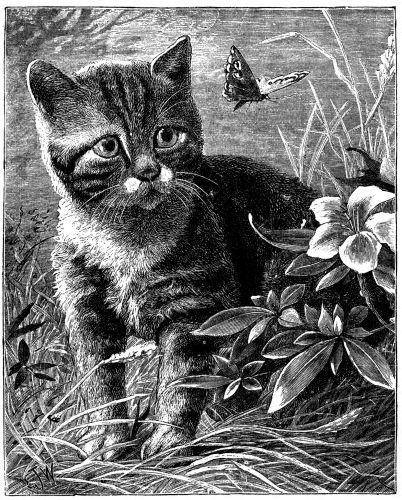
MOZART.
He belonged to a family which is quite small,
I believe, though its members are very large, so
that when he was but two or three months old,
he was as large as many ordinary cats, while his
mother was positively colossal!
The way I came to get Mozart was this: his
mother, brothers and sisters, and he, were owned
by my auntie May, and this same auntie was,
once upon a time, about to move from her home
in New York, to New Jersey. Knowing how
I loved cats, when my
mother was visiting her,
she proposed that one of
the kittens should be taken
home to me. So, on the
morning of my father and
mother’s start, one was procured,
and imprisoned in a
willow basket which was
tied with strong cord. Just
as the good-bys were being
said, when the basket was
reposing in the bottom of
the sleigh, and as the driver
was raising his reins preparatory
to the start, my
uncle called out, “Don’t
step on the kitten!” To
which the driver responded,
“It ain’t here!” and grinned
broadly, as the disappointing
animal jumped to the
ground, and sped across the
snow to the stable. There
was no time to recapture
him, for they were then
almost afraid they would
miss the train, and the
sleigh-bells jingled as the
sleigh ran down the hill to
the depot, the occupants
thereof looking curiously
at the empty basket in the
bottom. “How did he get
out?” was the question; and became the question
for discussion on the train, as all day my
mother and father whizzed along from New York
into Pennsylvania. The basket had been found
to be just as securely tied as it was when the kitten
had first been placed therein, and the only explanation
that could be given when my parents
reached home was, that the kitten had been in
the basket, and was not! Which explanation
was, as you may not be surprised to hear, exceedingly
unsatisfactory to me, for I dearly
loved, and do dearly love all members of the
feline kingdom. I never see one but I feel that
I must stop and pat its soft fur.
But so far, instead of telling you how I did
get Mozart, I have been telling you how I did
not get him!
It was about a week after my father and
mother had reached home, when, one morning,
as we were seated at the breakfast table, the
door-bell rang, and an expressman appeared,
with a grin on his face that seemed literally to
reach from one ear to the other! “’Ere’s a cat!”
he exclaimed, and forthwith produced a box
a foot or two square, the top of which was
decorated, in good-sized letters, with this injunction:
“THIS SIDE UP WITH CARE!”
As the official brought it into the hall, the listeners
and lookers-on heard a prolonged “Waa-a-a-a-a-a!”
which seemed to echo and re-echo,
and at last died away into silence.
“It is the kitten that we didn’t bring!” said
my mother, while I ran for a hammer and chisel
with which to open the box. When the operation
was performed, there jumped out a large,
yellow, cat-like kitten, which escaped as far as
possible from us, as we tried to grasp it, repeating
its mournful, yet decisive cry of—“Waa-a-a-a-a-a!”
Strange to say, he did not recognize us as
friends, immediately, but preferred to wait until
he formed a closer acquaintance before he was
victimized by our embraces or pettings, so he
was consigned to the cellar, where he spent
much of his time. When we would try to get
him up, unless we succeeded in finding him
asleep, he would climb a beam, and with great
agility elude our efforts to capture him.
Having heard many stories of cats returning
to their former homes, and having had some
experience in that line ourselves, we were careful
to keep Mozart in the house, lest he should
make his escape and be seen no more. If he did
manage to get out of the kitchen door in a
clandestine manner, a ridiculous procession was
formed of the bareheaded members of our family,
and no peace was given the poor animal, until,
after racing around the yard once or twice, he
surrendered to our clutches. Truly our anxious
efforts to capture the unwilling prisoner must
have been a ludicrous sight to any unsympathizing
spectator.
We let Mozart sleep in the kitchen, and this
gave him the chance he apparently coveted, of
sleeping on the table, which he did so obstinately,
that we were finally compelled to resort to the
expedient of turning the table on its side every
night, so that if he slept on it, it would have to
be in direct resistance to the law of gravitation!
Mozart also showed a great desire to make
the table his dining-room, though this freak
was explained on the arrival of my auntie May,
who said that he had eaten on an old table in
the barn at home. He also probably slept
there. But with us he was obliged to make his
couch on some old pieces of carpeting.
I now remember that I have not yet given a
thorough description of my hero, and as that is
properly one of the first things to do in a sketch
of this kind, I must hasten to it. Mozart was
clothed with a stationary garment of brownish-yellow
fur—I do not know whether the artists
would call it chrome yellow, yellow ochre, Naples
yellow, or what. This garment was at
regular intervals striped with rings of a darker
shade, and these went completely around his
body.
These rings reached their abrupt termination
at the tip of the wearer’s tail. It is quite proper
to insert just here the fact that once upon a
time one of them fell off, and was found, a little
wad of dark yellow fur, on the floor of the dining-room.
Mozart had eyes of a rather uncertain color
(a peculiarity of his family, which you perhaps
have observed), but they were probably
nearer the color of his fur than any other of
which I think. His head was shapely, and his
ears and caudal appendage were graceful.
Thus endeth the description of his personal appearance.
The reason for naming Mozart as I did, will
be obvious when I state that he had unmistakable
musical talent. As I cannot conscientiously
praise his voice, I will remain silent about it,
simply saying that it was very expressive, and
that is more than can be said of some of the so-called
fine singers of this country. His vocal
organs seemed exceedingly devoid of elasticity,
for their use was always confined to the one
syllable and note—“Waa-a-a-a-a-a!” differing
only in pitch and the length of time it was prolonged.
This difficulty prevented us from always comprehending
Mozart’s language, save by his
accompanying gestures and actions, and by the
surrounding circumstances. But I have said
more about his voice than I intended. As I
said before, he had unmistakable musical talent.
If he had not a musical voice, he had a musical
ear (two of them, indeed!) and would listen
with rapturous delight to any music. If anyone
was playing on my piano, he would come and
sit by the side of it, and either listen intently or
try to find out by his whiskers from whence the
sound proceeded. But if, while he was making
these investigations, the piano would play very
loud for a moment, he would shrink away, much
frightened by the noise. If it was a special
friend of his who was playing, he would sometimes
jump into the person’s lap, getting as near
as possible to the keys. Any rational and unprejudiced
persons giving heed to these statements,
will believe what I said about Mozart’s
ears, I am sure.
Unlike most of his sex, the second John
Chrysostom Wolfgang Theophilus Mozart (for
we had given him the full name of the great
musician, calling him simply Mozart for short)
seemed to take an interest in the art of sewing.
I may record as a proof of this that when my
aunt Julia would be sewing on her machine, my
hero would jump up into the vacancy between
her spinal column and the chair, and there
remain until he was dismissed. If he had
been allowed a longer time to stay there than
was given him, he would, probably, not have
left so soon, but as to that I cannot positively
speak.
Before recording the following incident I will
repeat the aforesaid statement that every word
of this biographical sketch is strictly true, and
unto that fact I will set my signature and seal,
any time you wish. (Possibly that is one particular
in which this differs from most biographical
sketches.)
Mozart’s saucer from which he was in the
habit of eating and drinking, stood out in the
kitchen by the sink. On the day of which I
speak, he came in and told in plaintive accents
that something was the matter. As I have remarked
heretofore, he always left us in uncertainty
as to what, for a time, at least. When
questioned, however, he earnestly smelled of his
empty saucer, and then, jumping up on the sink,
put his paw on the cold water faucet, and then,
descending, repeated his summons for aid. The
saucer was speedily filled with water, and he
drank long and eagerly.
This same incident was repeated in every
particular, at another time, with the faucet in
the bath-room upstairs.
On one occasion Mr. Mozart did a most disgraceful
thing—one that was enough to bring
disrepute on any family—namely, he ran away.
There were several cats living around our barn
in those days, and whether he eloped with one
of them or not, I never heard, but certain it was
that he disappeared, and no trace of him could
be found.
But after sin, remorse is sure to come, and
conscience speaks earnestly to the sinner, so “in
the stilly night,” when “slumber’s chains had
bound” the inmates of our house, some of them
were awakened by mournful and heart-rending
sounds coming from the rear of the house.
Under some circumstances, we might have
thought we were being serenaded; one of the
members of the household was despatched to
the back door, to admit the runaway! The lost
had returned! the prodigal had come home!
And as he rested once more on his couch of carpeting,
how sweet it must have smelled to him
(in which respect he would have differed from
us), and how soft it must have felt, because his
conscience was at rest, and because he could
once more sleep the sleep of the innocent! Some
of his feline friends had returned to the door
with him, and had uplifted their voices with his,
but only the proper inhabitant of the house was
admitted.
Paranete.
SOME REMARKABLE WOMEN. — P.—PRENTISS, ELIZABETH.
IN a volume of nearly six hundred pages,
the husband of this gifted woman tells
the story of her life, or rather he lets her
tell it in extracts from her letters and journal.
In the little space allotted me for a sketch
of Mrs. Prentiss, I can only give you a few facts
of her life. When you are older you must read
this volume and learn more about her. She was
the daughter of a clergyman, a highly gifted
man, and one who was no less remarkable for
his piety than for his learning, and after reading
a sketch of Edward Payson, one is not surprised
that the daughter of such a man should develop
into a remarkable woman. Mrs. Prentiss was
born at Portland, Maine, October 26, 1818.
You would like to know about her as a child?
She is described as “a beautiful child, slender,
dark-eyed, light-footed, very quiet, evidently
observant, saying little, affectionate, yet not
demonstrative.”
She was devotedly attached to her father, and
the impression which the teachings of his beautiful,
godly life made upon her childish mind
was never effaced. Though he died when she
was only nine years old, her recollections of him
are said to have been remarkably vivid.
She could tell how he looked and talked and
acted, things he said and did. Once coming
upon him suddenly she found him engaged in
prayer, and so lost in communion with God that
he did not become conscious of her presence;
and she afterwards said that she never forgot
the scene, neither did its influence upon her
cease while she lived. She was never strong,
having inherited a nervous temperament along
with a feeble constitution. Once when she was
grown to womanhood she said, “I never knew
what it was to feel well.”
At the age of twelve years she was very ill
with a fever, so ill that the family thought the
hour had come when they must part with Elizabeth.
But she was spared, perhaps in answer
to the mother’s prayers, for that mother recorded
in her journal the circumstance of her illness
and restoration with a comment upon God’s
goodness in sparing the child, wondering whether
it might be to the end that she would one day
devote herself to the Saviour and do something
for the honor of religion. And in the spring of
the following year, this child of many prayers,
publicly confessed her faith in Christ, and was
enrolled among his people.
She grew to girlhood developing a lovely
Christian character, also showing a marked
talent in composition. She contributed when
quite young to the Youth’s Companion. As
she passed on through her girlhood into womanhood
she became her mother’s faithful friend
and assistant, thoughtful for her comfort, and
also a tender sympathizing friend towards her
brothers.
I want to copy for you a little bit of verse
which she wrote for the Youth’s Companion,
which I think will please some of our little
folks.
What are little babies for?
Say! say! say!
Are they good-for-nothing things?
Nay! nay! nay!
Can they speak a single word?
Say! say! say!
Can they help their mother’s sew?
Nay! nay! nay!
Can they walk upon their feet?
Say! say! say!
Can they even hold themselves?
Nay! nay! nay!
What are little babies for?
Say! say! say!
Are they made for us to love?
Yea! yea! YEA!!!
A friend says of her: “Human nature seems to
have been her favorite study. There seemed
to be no one in whom she could not find something
to interest her, none with whom there was
not some point of sympathy.”
And now I wonder if you have guessed, or if
you knew all the while that this remarkable
woman was the author of some of your favorite
books!
The Susy books! ah! your mothers will
tell you that these books were their favorites
as well as your own! Susy’s Six Birthdays
was published thirty-three years ago, then followed
the others of the series, and Flower of
the Family, and Peterchen and Gretchen, and
Tangle Thread, Silver Thread and Golden
Thread, besides many others, up to twenty-five
volumes. The book which has been more widely
read than any other of her works is probably
“Stepping Heavenward.”
More than seventy thousand copies have been
sold in this country, and the work has also
been translated into the French and German
languages.
Mrs. Prentiss’ books were all written after her
marriage to Rev. George L. Prentiss, which occurred
in 1845. Mr. Prentiss was the pastor of
a church in New Bedford. Afterwards they
lived in New York and, in the year 1866, they
went to a quiet place among the Green Mountains
to spend the summer, and so delighted
were they with the beauties of Dorset that they
made it their summer home, building a cottage
there in which Mrs. Prentiss died about twelve
years later.
It is impossible to give you any account of
the varied scenes of her life in such a brief
sketch. She was called to pass through many
sorrows. The death of the father to which I
have already referred; later the loss of her
mother, sister, brother and children.
These bereavements came one after another,
yet her Christian character only shone out the
brighter.
“Though the death of her children tore with
anguish the mother’s heart, she made no show of
grief, and to the eye of the world her life soon
appeared to move on as aforetime. Never
again, however, was it exactly the same life.
She had entered into the fellowship of Christ’s
sufferings and the new experience wrought a
great change in her whole being.” She was remarkably
happy in the children spared to her,
and in all her home life. A friend has written
of her:
“I have ever regarded her as favored among
women, blessed in doing her Master’s will and
in testifying of Him, blessed in her home, in her
friends, in her work and blessed in her death.”
Faye Huntington.
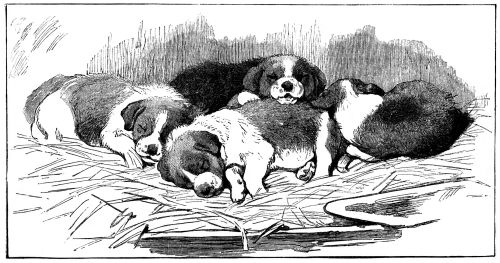
SLEEPY LITTLE FELLOWS!
Volume 13, Number 43.
Copyright, 1886, by D. Lothrop & Co.
August 28, 1886.
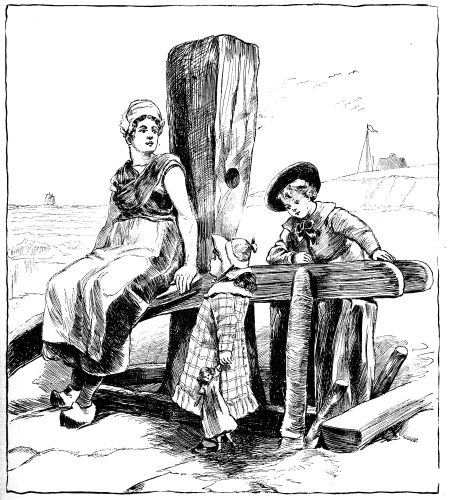
NORMANDY WOMAN IN WOODEN SHOES.
ST. GEORGE AND THE DRAGON. — X.
By Margaret Sidney.
GEORGE EDWARD ALLEN was now
sixteen; hale, hearty, and full of fun.
Truth compels me to state that he did
not take first prize for English Composition,
Latin, Mathematics, or even for
general deportment, at the close of the summer
term just past. He had no gold medals to
carry home to his admiring parents, to be afterward
hung up in his room for the delectation of
any who might choose to examine. He was
only an industrious, even-tempered boy of ordinary
steady ability, but without the least capacity
for shining before a large audience with the
splendor of the examination hour.
He did have bestowed upon him, however, at
the last moment, in various little rencontres
with master and under teachers, several little
pleasant attentions that made his heart thrill,
and the warm blood mount his brown cheek.
“Allen, I must say I could give you a prize
for loving the right, with all my heart.” This
from the master, with that peculiar light in his
gray eyes that seldom came; and because so
seldom, was treasured deep by the one who
brought it there. He went further: “My boy,
I would give ten years of my life for such a son
as you are.” They were in a side recitation
room alone, and the master’s hand laid on the
lad’s shoulder, no one saw, much less heard the
words.
George Edward looked up quickly and gratefully.
“Good-by,” said the master. “If you want
any help in vacation over a tough spot in any
study, just drop me a hint of it.” There was a
smile in the overworked face, that lighted up
each hard line.
“Good-by, Allen,” said an under teacher regretfully,
as George Edward ran down the
passage, “I wish you were to be near me this
summer; I shall miss you,” and Mr. Bryan put
himself in the way of the boy’s advancement.
“I want to thank you for your good influence
in the class-room. For you have done more
than the teacher sometimes,” he frankly added.
George Edward tried to protest, but it was no
use. “Don’t be discouraged,” added the teacher
kindly, “if prizes do not fall to you now; but
keep on.”
“I should have liked to carry one home to
father and mother,” said George Edward honestly.
“Of course; who of us does not?” assented
Mr. Bryan. “Let me tell you though, my boy,
that the prizes, though late often, that fall to industry
and conscientious work, are better worth
getting. Take that with you to think of this
summer.”
The boys made loud protestations of regret,
which goes without saying, at the necessary
parting to come. How long the vacation
seemed, looking from the standpoint of June.
How impossible to wait till September before
George Edward’s round countenance should
burst upon them like a ray of sunshine, and his
cheery voice call to some sport, in which they
could see no hint of fun if he did not lead off.
But all things are finally pronounced ended.
So at last George Edward found himself at
home, with the only prospect of enjoyment
ahead of him, an invitation to visit at Uncle
Frost’s.
“I’m sorry it’s all the outing we can give you
this summer, my boy,” said Mother Allen
soberly; “your father intended to take you if he
went on the Maine trip, but Mr. Porter wanted
the Western business done now, and that is altogether
too expensive to be thought of.”
George Edward’s eyes glistened. That
Western trip would have made a vacation beating
every other boy’s that he had known. He
broke out eagerly, “O mother—” then
stopped. She looked pale and troubled.
“It’s a good enough place at Uncle Frost’s,”
he finished indifferently; “when do I start?”
“No, it isn’t very pleasant,” said Mrs. Allen
truthfully. “I’m sorry you couldn’t have gone
into the country; but we can’t afford it unless I
go and shut up the house, and I can’t do that,
because grandma isn’t well, and must come
here.”
“Never mind,” said George Edward, “there’s
some fun in it, anyway. We’ll call it bully.”
“It will be a change,” said his mother, “and
that’s all you can say, and you’ll have a chance
to learn something new, and see other people.”
“When does he want me to come?” asked
George Edward, dashing at the letter again.
“Next week,” said Mrs. Allen.
“All right; I’ll put my traps together, and
be off. Gainesburg is the cry now,” cried
George Edward.
But for once the boy was in luck. Two days
after Uncle Frost’s house had received him, Mrs.
Allen was reading the following letter:
My Dear Mother:
Hurrah—hurrah—hurrah! Uncle Frost is a brick (beg
pardon, mother)! He’s given me a royal, out-and-out invite to go
to the White Mountains with the family. Expenses all thrown
in, etc., etc. Start on Saturday. Telegraph “yes” please.
Your affectionate Son,
George Edward.
“Yes” was telegraphed over the hills on
Thursday, and for two weeks our boy revelled
in the bliss of mountain life, with quantities of
fun, frolic and adventure thrown in by the way,
to return all made over, to Uncle Frost’s, there
to meet the ill news travelling fast over the
electric wires:
“Your father died suddenly at St. Paul.
Come at once.”
Had it come so soon? George Edward
looked life in the face this vacation time, accepted
his cross, bade good-by to all hopes of
ever entering school or college life again, and
thanked God for the situation in the drug store
that the apothecary around the corner gave
him.
His father’s affairs, well looked over, gave
no hope of anything but the direst economy
for the widow. As for the son, he must go to
work, and at once.
“Now we will see if he holds out a saint,”
one boy was mean enough to think, seeing
George Edward hurry to his place of work
every morning bright and early. Other eyes
quite as sharp, though far from cruel, were on
him. It was an awful ordeal for any boy to pass
through; most of all, because of the commonplaceness
of the sacrifice he was daily making.
Had he marched up to the cannon’s mouth, and
courted death to save his mother’s life, this
would have been easy compared to the monotonous
dead-level existence he was enduring. For
to the active boy, alert for an excitement, wide
awake for novelty, with every muscle crying out
for exercise and change, the close confinement
of the small store, and the routine work, were
torture indeed. He began to show the effects of
such a life, and in three weeks his mother was
aghast to find that her boy had grown suddenly
thin and pale.
“Why, George Edward,” she cried, “you
can’t stay in that store.”
“I must,” said George Edward doggedly.
“But you will die,” cried poor Mrs. Allen,
“then what shall I do?” And the tears began
to come.
George Edward thought a bit. Then he said
“There isn’t anything else, mother, only work
on a farm. But it’s August now, who’d give
me a chance at it, pray tell?”
“I shall try,” said his mother, rousing herself,
“you will die where you are.” And she seized
paper and pen and wrote the following:
A boy of sixteen who has just lost his father wishes a place
to work on a farm for the remainder of the season. Only those
persons of unexceptional references who wish such a farm hand
not afraid to work, need apply to
Mrs. E. C. Allen,
—— ——
George Edward was in a fever of excitement,
though he tried not to show it, all the next three
days. His mother met with such poor success
in her efforts to conceal her state of mind, that
she went around the house, a bright spot in
either cheek, scarcely able to set herself with
calmness at any task. At last, on the evening
of the third day, this letter was drawn from the
post-office:
Respected Madam:
If your son really wants to work, send him on. Here’s a
letter from my paster, maybe that will be satisfyin’. Three
dollars a week an’ board. That’s what I pay. Yours to command,
Job Stevens,
Blueberry Hill.
The “paster’s” letter reading remarkably
well, and a friend investigating the matter with
thoroughness for Mrs. Allen, finding it all right,
George Edward’s trunk was packed, and he at
once dispatched for Blueberry Hill.
It was evening when he arrived there.






















 Specimen copies of