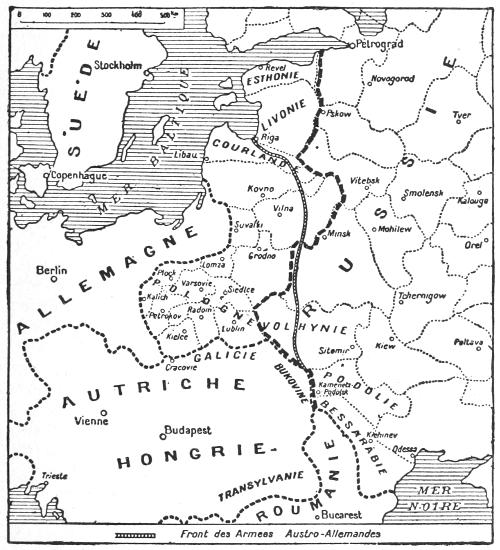
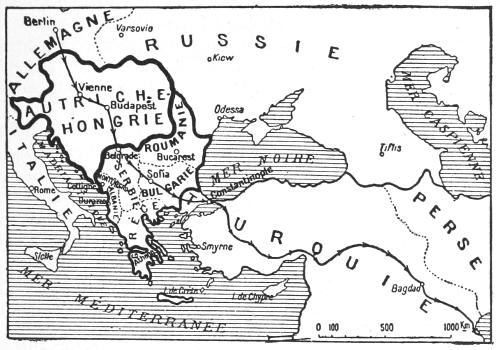
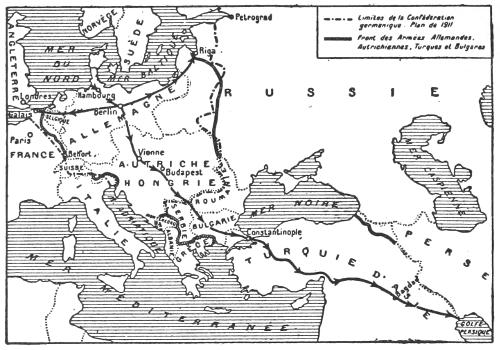
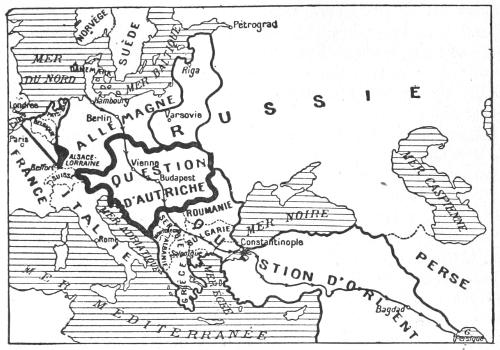
THE PANGERMAN PLOT UNMASKED — PUBLISHER’S NOTE — TABLE OF CONTENTS — MAPS — INTRODUCTION. — PREFACE. — PROLOGUE. PANGERMANISM AND WILLIAM II.
THE PANGERMAN PLOT
UNMASKED
BERLIN’S FORMIDABLE PEACE-TRAP OF
“THE DRAWN WAR”
BY
ANDRÉ CHÉRADAME
WITH AN INTRODUCTION BY
THE EARL OF CROMER, O.M.
WITH MAPS
NEW YORK
CHARLES SCRIBNER’S SONS
1917
Copyright, 1916, by
CHARLES SCRIBNER’S SONS
Published January, 1917
All Rights Reserved
As will be understood from the author’s preface,
M. Chéradame’s book was published in Paris in the
summer of this year, before the important occurrences
in the Balkans accompanying and following
Roumania’s entrance into the war. In issuing this
translation no consideration of these events has been
added; but their bearing on M. Chéradame’s forecast
will be noted by the reader.
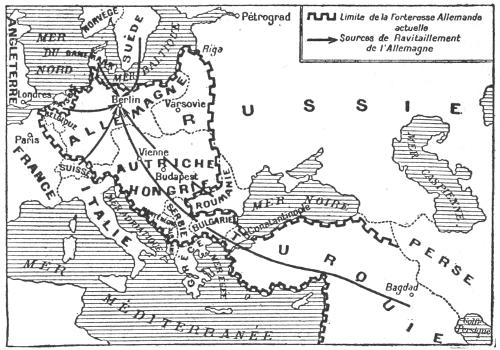
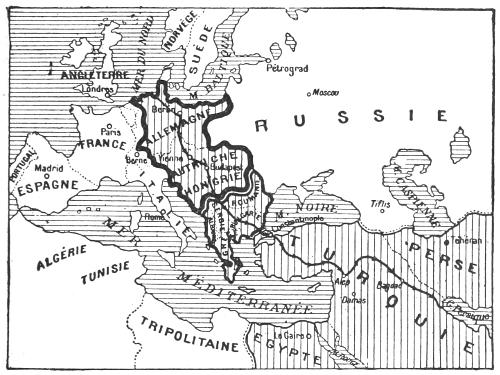
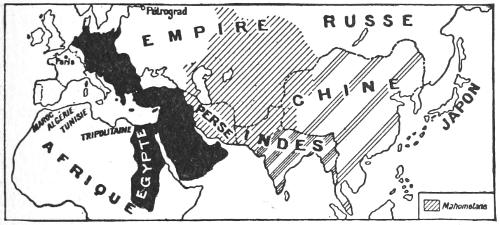
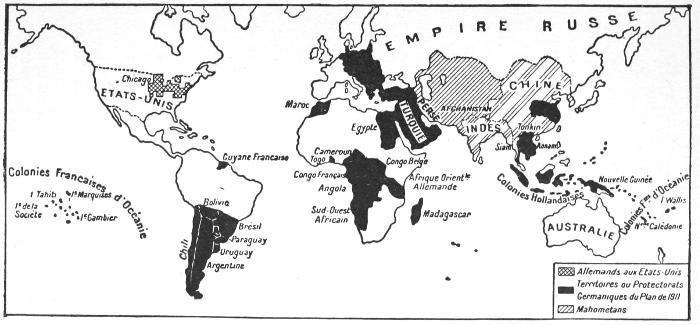
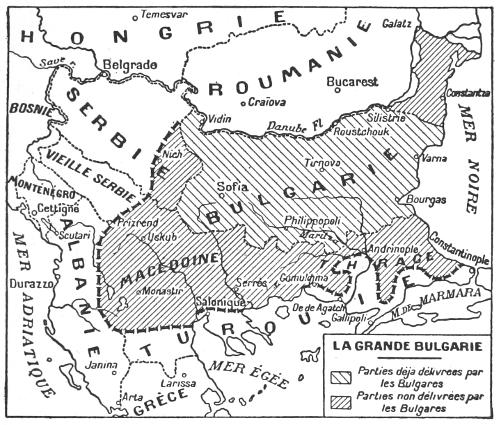
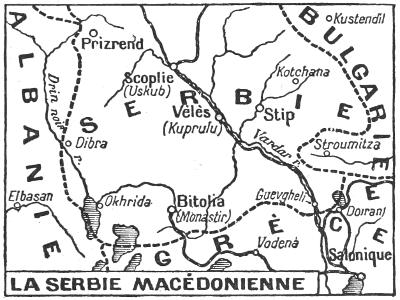
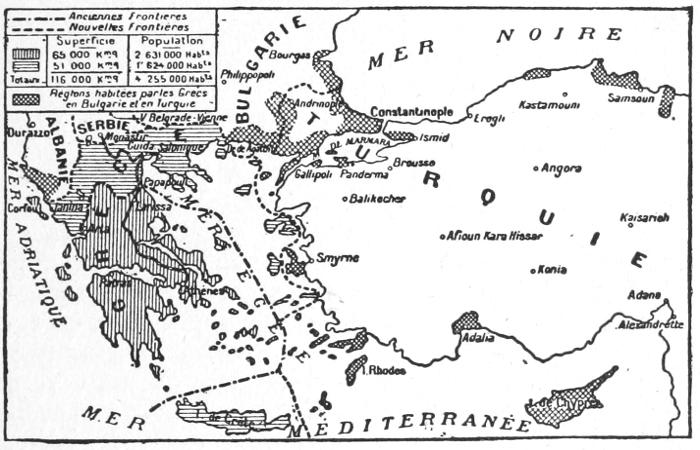
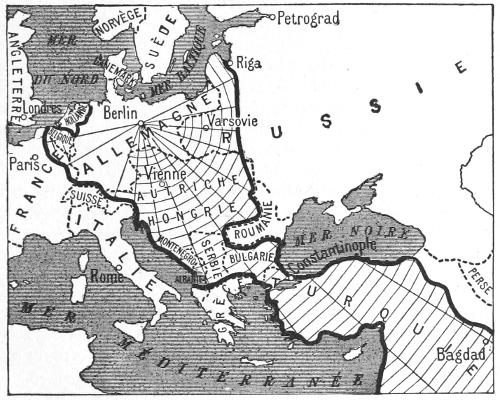
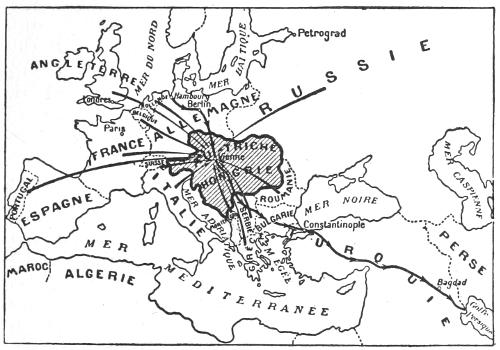
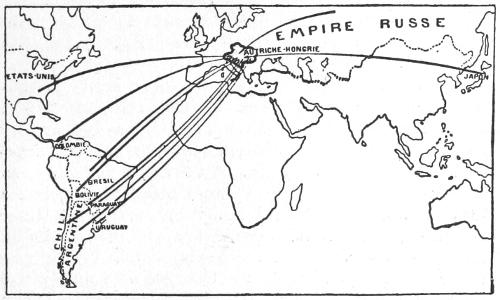
The maps have been reproduced direct from the
French edition, without translating the names into
English, as they answer their purpose perfectly well
in their present form.
I. Why the Treaty of Bukarest suddenly raised a formidable
obstacle to the Pangerman plan, p. 26.—II. How it was that
the internal state of Austria-Hungary drove Germany to let
loose the dogs of war, p. 31.—III. General view of the causes
of the war, p. 37.
CHAPTER III
How far the Pangerman plan was carried out at
the beginning of 1916
I. German pretensions in the West, p. 45.—II. German pretensions
in the East, p. 52.—III. German pretensions in the South
and South-East, p. 56.—IV. General view of the execution of
the Pangerman plan from 1911 to the beginning of 1916, p. 62.
CHAPTER IV
Special features given to the war by the
Pangerman plan
I. All the great political questions of the old world are raised and
must be solved, p. 67.—II. As the war is made by Germany
in order to achieve a gigantic scheme of slavery, it follows that
it is waged by her in flagrant violation of international law,
p. 69.—III. A struggle of tenacity and of duplicity on the side
of Berlin versus constancy and solidarity on the side of the
Allies, p. 71.
CHAPTER V
The Dodge of the “Drawn Game” and the scheme “from
Hamburg to the Persian Gulf”
I. What would really be the outcome of the dodge called the
“Drawn Game,” p. 78.—II. The financial consequences for
the Allies of this so-called “Drawn Game,” p. 83.—III. The
Allies and the scheme “from Hamburg to the Persian Gulf,”
p. 88.—IV. Panislamic and Asiatic consequences of the
achievement of the scheme “from Hamburg to the Persian
Gulf,” p. 94.—V. Consequences for the world of the achievement
of the scheme “from Hamburg to the Persian Gulf,”
p. 100.
I. The obligation which the threat of the scheme “from Hamburg
to the Persian Gulf,” imposes on the Allies, p. 108.—II.
The capital importance of the question of Austria-Hungary,
p. 114.—III. All the racial elements necessary for the
destruction of the Pangerman plan exist in Central Europe,
p. 121.
I. The connexion between the Pangerman plan and the plan of
Bulgarian supremacy, p. 132.—II. Greece and Pangerman
ambitions, p. 146.—III. Roumania and the Pangerman plan,
p. 152.
CHAPTER VIII
German manœuvres to play the Allies the trick of the
“Drawn Game,” that is, to secure the accomplishment of the “Hamburg to
the Persian Gulf” scheme as the minimum result of the war
I. The exceptional importance of the economic union of the Central
Empires, and the danger for the Allies of establishing a
connexion between that union and their own economic measures
after the war, p. 159.—II. Reasons for the Turko-German
dodge of making a separate peace between the Ottoman empire
and the Allies, p. 167.—III. Why a separate and premature
peace with Bulgaria would play the Pangerman game,
p. 174.
CHAPTER IX
The still neutral States whose independence would be directly
threatened by the achievement of the “Hamburg to the Persian Gulf” scheme and
therefore by Germany’s capture of Austria-Hungary
I. The example of Portugal, p. 183.—II. Holland, p. 187.—III.
Switzerland, p. 191.—IV. The States of South America, p. 193.—V.
The United States, p. 198.
CONCLUSIONS
What has been set forth in the preceding nine chapters appears to justify the
following conclusions
My reasons for commending M. Chéradame’s
most instructive work to the earnest attention of
my countrymen and countrywomen are three-fold.
In the first place, M. Chéradame stands conspicuous
amongst that very small body of politicians
who warned Europe betimes of the German
danger. The fact that in the past he proved a true
prophet gives him a special claim to be heard when
he states his views as regards the present and the
future.
In the second place, I entertain a strong opinion
that M. Chéradame’s diagnosis of the present
situation is, in all its main features, correct.
In the third place, in spite of the voluminous war
literature which already exists, I greatly doubt
whether the special aspect of the case which M.
Chéradame wishes to present to the public is fully
understood in this country; neither should I be
surprised to hear from those who are more qualified
than myself to speak on the subject that the same
remark applies, though possibly in a less degree, to
the public opinion of France.
It is essential that, before the terms of peace are
discussed, a clear idea should be formed of the
reasons which led the German Government to provoke
this war. It is well that, if such a course be at
all possible, those who are personally responsible
for the numerous acts of barbarity committed by
the Germans should receive adequate punishment.
But attention to points of this sort, however rational
and meritorious, should not in any degree be allowed
to obscure the vital importance of the permanent
political issues which call loudly for settlement.
Otherwise, it is quite conceivable that a peace may
be patched up, which may have some specious
appearance of being favourable to the Allies, but
which would at the same time virtually concede to
the Germans all they require in order, after time
had been allowed for recuperation, to renew, with
increased hope of success, their attempts to shatter
modern civilization and to secure the domination of
the world.
M. Chéradame explains—and I believe with
perfect accuracy—the nature of the German objective.
It is, in his opinion, to lay secure and stable
foundations for the system known as Pan-Germanism.
What is Pan-Germanism? It may be
doubted whether all that is implied in that term is
fully realized in this country. One interpretation
may be given to the word, which is not merely
innocuous, but which may even reasonably appeal
to the sympathies of those who approve of the new
map of Europe being constituted with a view to
applying that nationalist principle, which finds
almost universal favour in all democratic countries.
It cannot be too distinctly understood that the
political programme now advocated by Germany
has no sort of affinity with a plan of this sort. The
Germans contend not only that all those who are
generally denominated Germans by the rest of the
world should be united, but that all who are of
what is termed “German origin” should be brought
into the German fold. Moreover, they give to
this latter phrase an expansion and a signification
which is condemned and derided by all who have
paid serious attention to ethnological studies. This,
however, is far from stating the whole case. The
object of the German Government is to effect the
whole or partial Germanization of countries inhabited
by races which cannot, by any conceivable
ethnological process of reasoning, be held to be of
German stock. In fact, M. Chéradame very
correctly describes Pan-Germanism when he says
that its object is to disregard all questions of racial
and linguistic affinity and to absorb huge tracts of
country the possession of which is considered useful
to advance Hohenzollern interests. In other words,
what they wish is to establish, under the name of
Pan-Germanism, a world system whose leading and
most immediate feature is the creation of an
empire stretching from the Persian Gulf to the
North Sea.
That this project has for a long while past been
in course of preparation by the Kaiser and his
megalomaniac advisers cannot for a moment be
doubted. When, in November, 1898, William II.
pronounced his famous speech at Damascus, in
which he stated that all the three hundred millions
of Mohammedans in the world could rely upon him
as their true friend, the world was inclined to regard
the utterance as mere rhodomontade. It was
nothing of the sort. It involved the declaration of
a definite and far-reaching policy, the execution of
which was delayed until a favourable moment
occurred and, notably, until the Kiel Canal was
completed. The whole conspiracy very nearly
succeeded. In spite of their careful attention to
detail, their talent for organization, and their
elaborate preparations to meet what appears to
them every contingency which may occur, the
Germans seem to have a constitutional inability
to grasp the motives which guide the inhabitants of
other countries. A very close analogy to the mistake
made by the Kaiser is to be found in an incident
of recent English history. It is alleged, I know not
with what truth, that when, in 1886, Lord Randolph
Churchill resigned his position as Chancellor
of the Exchequer in Lord Salisbury’s administration,
he “forgot Goschen,” who, as it will be
remembered, was speedily nominated to succeed
him. The Kaiser forgot England. For various
reasons, which are too well-known to require
repetition, he and his advisers were firmly convinced
that England would not join in the war. The
programme was, first, to destroy the power of
France and Russia, and then, after that had been
done, to fall upon England. In one sense it was
fortunate that the Germans committed the gross
international crime of invading Belgium. Had
they not done so, it is quite possible that the English
nation would not have woke up to the realities
of the situation. As it was, however, it became
clear, even to the most extreme pacificists, that
honour and interest alike pointed to the necessity
of decisive action. Thus as M. Chéradame indicates,
the original German plan was completely
upset. The advance on Paris had to be stayed.
But the programme, which was the result of long
and deliberate contemplation, has by no means
been abandoned. On the contrary, with the
adhesion of the Bulgarians, who will eventually,
unless the Allies secure a decisive victory, become
the victims of Pan-Germanism, and also that of the
Turks, who were manœuvred into the war by an
adroit and absolutely unscrupulous diplomacy, a
very considerable portion of the plan has already
been put into execution.
M. Chéradame states with great reason that
France, Italy, Russia, England, and all the minor
Powers are vitally interested in frustrating the
German project of establishing their dominion
from the Persian Gulf to the North Sea. He also
warns us against making a separate peace with
either Austria-Hungary or Turkey, both of these
Powers being merely vassals of Germany. He is
very clearly of opinion that the mere cession of
Alsace-Lorraine to France and the rehabilitation
of Belgium cannot form the foundations of a durable
peace. If peace were concluded on this basis, the
Germans would have achieved their main object,
and, as Herr Harden pointed out last February,
even if Germany was obliged, under pressure, to
cede Alsace-Lorraine, there would still be seventy
millions of Germans firmly determined to regain
possession of those provinces at the first suitable
opportunity. In fact, the realization of the German
project, although accompanied by certain
temporary disabilities from the German point of
view, would eventually enable Germany to strangle
Europe.
I need not dwell upon all the proposals set forth
by M. Chéradame with a view to the frustration of
this plan, but the corner-stone of his programme is
similar to that advocated with great ability in this
country by Mr. Wickham Steed and Mr. Seton
Watson. It is to create a Southern Slav State,
which will afford an effectual barrier to German
advance towards the East. It is essential that
the immense importance of dealing with the territories
of the Hapsburgs as a preliminary to a final
settlement of all the larger aspects of the Eastern
question should be fully realized. It constitutes
the key of the whole situation.
For these reasons, I hope that M. Chéradame’s
work, which develops more fully the arguments
which I have very briefly stated above, will receive
in this country the attention which it certainly
merits. I should add that the book is written in a
popular style, and that M. Chéradame’s arguments
can be easily followed by those who have no special
acquaintance either with Eastern policy or with
the tortuous windings of Austrian and German
diplomacy during the last quarter of a century.
Cromer.
September 4, 1916.
The Pangerman plot is the only cause of the war.
It is, in fact, the cause at once of its outbreak and
of its prolongation till that victory of the Allies
has been won which is indispensable to the liberty
of the world. In this book I propose to demonstrate
this truth by a series of documents, precise,
clear, and intelligible to all. The fate of every man
in the allied countries, and even in some of the
countries which are still neutral, really depends on
the issue of the formidable war now being waged.
This cataclysm, unprecedented in history, let loose
by Prussianized Germany, will have infinite reverberations
in every sphere, reverberations which
will affect every one of us individually for good or,
alas! too often for ill. Every one, therefore, has
a direct interest in knowing clearly why these inevitable
reverberations of the immense struggle
will be produced, and on what fundamental
conditions those of them which bode ill for the
Allies, and are yet but imperfectly understood, can
and must be avoided. Hence every one of the
Allies should acquire an exact notion of the present
realities. Once fortified by the evidence, his
opinion will become a force for the Allied Governments;
it will then contribute to the victory and
to the imposition of the conditions necessary for
the peace.
In writing this popular book my aim has been to
bring home, even to those who are least versed in
foreign affairs, the formidable problems raised by the
war. In my opinion this work is addressed to women
quite as much as to men. The reading of it may
perhaps bring not only instruction but consolation
to those whose affections have been so cruelly
wounded. When they comprehend better by what
an atrocious plan of slavery the world is threatened,
they will understand more fully for what a sublime,
what a stupendous cause their husbands, their
sons, their plighted lovers, are fighting or dying
with such heroic self-sacrifice. May that larger
understanding of the formidable events now occurring
yield to the women of the Allies at least some
alleviation of their sufferings.
But if this book is a popular work, I beg my
readers to remark that it is not the result of a
hasty effort, vamped up by a mere desire to treat
of the moving, the tragic subject of the hour. The
book is, indeed, the logical conclusion of a labour
on which I have been engaged for twenty-one
years. As my readers have an interest in knowing
how far they may trust me, they will allow me to
explain to them how I was led to concentrate my
studies on the Pangerman policy of Germany, what
has been the result of my efforts, and how they are
linked together.
In former days I was the pupil of Albert Sorel at
the Free School of Political Science. That great
master was good enough to admit me to his intimacy;
and he brought to light and maturity the
latent and instinctive propensity which I had for
foreign politics. My practical studies abroad led
me to Germany in 1894, just at the time when the
Pangerman movement had begun. As the movement
was manifestly the modern development of
the Prussianism of the Hohenzollerns, I was then
extremely struck by its importance. The movement
appeared to me so threatening for the future
that I resolved to follow all the developments of
the Pangerman plot, which was already the
consequence of the movement, and which from
1895 onward had taken definite shape. The task
which I thus laid on myself was at once arduous,
vast, and thrilling, for from that time it was certain
that the Germans based their political and military
Pangerman plan on a study of all the political,
ethnographical, economic, social, military and naval
problems not only of Europe but of the whole
world. In truth, the intense labour accomplished
in the cause of Pangermanism by the Germans in
the last twenty-one years has been colossal. They
have carried it out everywhere with a formidable
tenacity and a methodical thoroughness which will
be the astonishment of history. Indisputably, the
Pangerman plan, which is the result of this gigantic
effort, is the most extraordinary plot which the
world has ever witnessed.
I made the study of that plot for twenty-one
years the work of my life, convinced as I was, in
spite of the scepticism which long greeted my
efforts to give warning of the peril, that the study
would serve a useful purpose one day.
The study has necessitated very many and very
long journeys of inquiry. I was obliged in fact to
go and learn, on the spot, at least the essential
elements of the complex problems mentioned
above, which have been the base of the Pangerman
plan, in order that I might be able to grasp the
most distant ramifications of the Prussian programme
for dominating the world.
This obligation led me to sojourn in very different
countries. That the reader may have an idea of
at least the material extent of my inquiries, I will
indicate the number of the towns in which I have
been led to work for the purpose of discovering the
constituent elements, direct and indirect, of the
Pangerman plan.
In these towns, according to the requirement of
my studies, I passed days, weeks, or months, often
on repeated occasions. I endeavoured, so far as
the opportunities and the time admitted of it, to
enter into direct relations with the acting ministers,
the leaders of the various political parties, the
diplomatists and the consuls, both French and
foreign, some heads of states, influential journalists,
officers of repute, military and naval attachés,
well-informed merchants and manufacturers. It
was thus that, by means of information of many
sorts drawn from the most diverse sources, and
checked by comparison with each other, I have
attempted to set forth the Pangerman political and
military plan.
Since 1898 I have endeavoured to draw the
attention of the public to the immense danger
which that plan was laying up for the world, as my
former works testify, particularly L’Europe et la
Question d’Autriche au seuil du XXe Siècle, which
appeared in 1901, therefore fifteen years ago, and
contained an exposition, as precise as it was then
possible to make it, of the Pangerman plan of
1895, summed up in the formula “Hamburg to the
Persian Gulf”; also Le Chemin de fer de Bagdad,
published in 1903, wherein I set forth the danger
of that co-operation between Germany and Turkey,
which was then only nascent, but which we see
full-fledged to-day.
I attempted also by numerous lectures to diffuse
among the public some notion of the Pangerman
peril. I did not content myself with warning my
countrymen. I am proud to have been one of the
first Frenchmen to preach a cordial understanding
between France and England at a time when there
was perhaps some merit in doing so. I deemed it,
therefore, a duty to inform the British public, so far
as it lay in my power, that the Pangerman peril
concerned Great Britain quite as much as France.
In 1909 the Franco-Scottish Society kindly invited
me to lecture to its members at Edinburgh, Glasgow
and Aberdeen. I seized the opportunity, and took
for the subject of my lectures, “The problem of
Central Europe and universal politics.”
The Aberdeen Free Press, of May 8th, 1909,
summed up very exactly as follows the substance
of what I said, seven years ago, to my British
hearers:
“ ... The lecturer attached enormous importance
to the Pan-German movement, which he
regarded as the decisive factor in the situation, and
he pointed out that the propaganda which had
gone on in Germany and in Austria was part of a
great policy to extend the boundaries of the German
State and dominate middle and south-eastern
Europe. The rapport personnel established in
recent years between Berlin and Vienna pointed, he
said, to the conclusion that Germany and Austria
were working hand in hand. In the recent Balkan
crisis he described Aehrenthal as playing a partie
de poker, in which his bluff had been crowned with
success. The off-set to the Pan-German movement
was to be found in the Triple Entente between
England, France and Russia, and it followed from
a consideration of European politics that the
questions confronting England with regard to the
supremacy of the sea were intimately bound up
with the question which concerned the land powers
of Europe. In particular, the speaker thought that
the Pan-German aspirations would be effectually
combatted by the growing social and political
development of the various minor Slav peoples in
the south-east of Europe. The development of
these peoples was a thing which it was with the
interests of England, France and Russia to encourage
to the utmost.”
My Scottish hearers gave me a very kind reception,
of which I have preserved a lively recollection.
But truth compels me to declare that I had the
impression that the great majority of them did not
believe me. I strongly suspect that they then saw
in me simply a Frenchman, who, moved by the
spirit of revenge, tried above all to stir up the
British public against Germany. The impression
did not discourage me any more than many
similar instances of want of success. In 1911 the
Central Asian Society did me the honour of inviting
me to express my views in London (22nd March)
on the Bagdad railway. I used this fresh opportunity
to expound a method of Franco-English
co-operation which seemed to me necessary to
parry the dangers of the near future.
“Such is,” I then said, “broadly speaking, the
affair of Bagdad. The most moderate conclusion
which, in my judgment, inevitably follows is that
from beginning to end the logical and methodical
spirit of Germany has got the better of the French,
English, and Russian interests, which have been
compromised by our slowness to grasp the importance
of the problem confronting us, and by the
lamentable want of cohesion between the diplomacies
of the three countries.
“The lesson apparently to be drawn from these
considerations is, that for the future we ought no
longer to be satisfied with a hand-to-mouth policy
and with seeking solutions only when the difficulties
take an acute form.
“If we wish to serve and defend our interests
effectually, we must, as Talleyrand said, keep the
future in mind, and learn something of that German
method of which the good results are incontestable.
“So far as the eye can range to the visible
political horizon, the essential interests of England,
France, and Russia are in agreement; it is, therefore,
to all appearance, absolutely necessary that
the men who exercise an influence on public
opinion in this country, in France, and in Russia,
should enter into personal relations in order to
discuss the great national interests which they have
in common, and to adopt a useful line of conduct,
while there is yet time. Such a course would be
effectual, because it would be determined before
the decisive events instead of after them, that is to
say, when it is too late.
“Were we to adopt this method, which after all
is very simple, the future attempts of our adversaries
against our interests would encounter effectual obstacles,
and we should no longer have to regret miscarriages
such as those of which the Bagdad affair is
an example.”
Has the method thus recommended been followed?
Apparently not; otherwise could France
and England have been surprised by the war?
My propaganda having had little practical result,
I endeavoured at least to keep myself well informed
of the events that were happening.
In December, 1913, and January, February, and
March, 1914, I made new and minute inquiries in
Central Europe, the Balkans, and Turkey, and
these inquiries were of particular value to me.
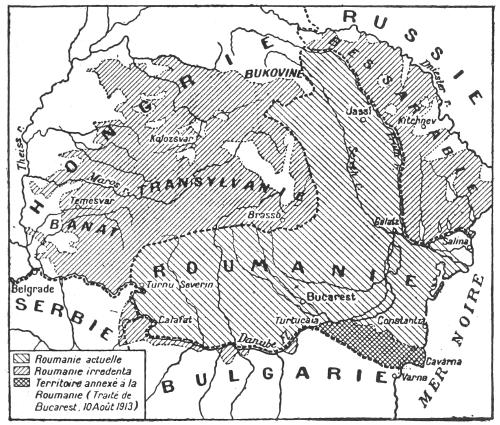
The truth is, that the treaty of Bukarest of August
10th, 1913, by reason of its far-reaching and important
consequences, had completely upset the
former state of affairs, so much so that without my
journey of 1914, I should certainly have been
unable to understand the new situation. In the
course of my journey I set myself to apply, with
great rigour, my method of research, which consists
essentially in trying to see the situations as they
are, without preconceived ideas, while listening to
all opinions in order to compare them afterwards
and extract, if possible, the average truth. In
Serbia, in Greece, in Turkey, in Roumania, in
Bulgaria, where for a long time I had been in
personal relations with people of many different
sorts, I was able to have long talks with persons
in the most diverse walks of life. In particular, I
had the good fortune to be graciously received by
the sovereigns and princes of the Balkans: King
Peter of Serbia (23rd December, 1913), Prince
Alexander, heir of Serbia (December, 1913), King
Constantine (25th January, 1914), Prince Nicholas
of Greece (28th January), King Charles of
Roumania (18th February), Tsar Ferdinand (28th
February), Prince Boris, heir of Bulgaria (29th
February). If I record the audiences which these
high personages were so good as to grant me, it is
because they were really not commonplace. These
sovereigns and princes knew that I had long
studied their country impartially, and they consented
to speak with me of the great interests
which guided their policies. During these various
audiences, which lasted from half an hour to two
hours, I heard many points of view of real importance
set forth. No doubt each of my various
interlocutors only said to me what he wished to say;
but, thanks to the multiplicity of the opinions
expressed and to the variety of my sources of
information, I was able at least to construct a
general picture of the true Balkan situation, and to
connect it afterwards with the problem of Central
Europe and the general policy of Germany.
This inquiry, which in returning I completed in
Hungary and Austria, convinced me that, contrary
to the opinion which has been held down to quite
recent times in many Allied circles, the treaty of
Bukarest by no means constituted an injustice, as
the Allies have supposed—a belief which has been
the source of most of their mistakes in the Balkans
in 1915. On the contrary, the treaty of Bukarest,
particularly because it for the first time drew
Roumania out of the German orbit, appeared to me
the most astonishingly favourable event which had
happened on the Continent since 1870, and which was
entirely in accordance with the interests of France,
England, and Russia. The consequences of this
treaty formed in fact, as we shall see, the most
effectual arrangement that could be conceived for
arresting the Pangerman danger and maintaining
peace in Europe. But this pacific dam to keep back
the Pangerman flood was only possible on condition
that the Entente powers held themselves ready for
war, which would probably have sufficed to prevent
it, and that at the same time they resolutely and
unanimously supported Greece, Roumania, and
Serbia.
On the other hand, the check which the treaty of
Bukarest gave to the Pangerman plan in Europe,
appeared to me so pregnant with consequences that
I considered it highly probable that the Government
of Vienna, instigated by that of Berlin, would
not shrink from war for the purpose of undoing the
treaty of Bukarest, with its far-reaching effects,
at the earliest possible moment, unless the other
powers put themselves on their guard. On my
return to France I tried to explain the imminence
of the danger, but no one would believe it.
In truth, German aggression caught the present
Allied countries napping for the following fundamental
reason. No doubt, before the war, Pangermanism,
as a doctrine, was well enough known
in some circles, but the political and military
Pangerman plan, the application of which has been
pursued methodically by the government of Berlin
since the opening of hostilities, had not been
studied and taken very seriously except by an
extremely small number of private persons in
France, England, and Russia.
The efforts made by these private persons to
convince the men at the helm in the now Allied
countries of the awful danger ahead, were vain. The
principal reason why their warnings fell unheeded
was this. When by the help of documents they
explained that William II.’s ultimate aim was the
establishment of German supremacy on the ruins
of all the great powers, they were taken for crazy
dreamers, so chimerical did such formidable projects
appear.
That is why among the Allies the political and
military Pangerman plot was ignored in its true
character and its extent, down to the outbreak of
war. This lack of knowledge in France is proved
by a statement in Le Temps of 16th December,
1915. Before the war, “we did not believe in the
possibility of a war, and we took no pains to prepare
for that redoubtable event.” It was absolutely the
same in England, as was demonstrated by the
complete surprise of Great Britain at the German
aggression.
More than that, the Kaiser’s entire plan has
continued to be misunderstood in the Allied
countries down to a date which seems quite recent.
In fact, Sir Edward Carson, when explaining his
resignation in the House of Commons, November
2nd, 1915, said: “I hope that the new plan of
campaign has been definitely settled, for while I
was a member of the Cabinet, the Cabinet had no
plan” (quoted by Le Temps, 4th November, 1915).
But if the Pangerman plan had been known in
London, the English and consequently the French
would certainly have long ago adopted the counter-plan
which could not have failed to destroy it; for
the Pangerman plan consists of such definite and
precise elements that the mere recognition of them
at once suggests the means of frustrating it; in
particular, the advantages and the necessity of the
Salonika expedition, which has been so sharply
opposed and so tardily undertaken, would have
been understood from the beginning of 1915, when
M. Briand recommended it in principle. Besides, as
anybody may convince himself, if the Pangerman
plan had been fully known, it is highly probable
that the Allies would never have perpetrated the
blunders which they have committed in the
Balkans, the Dardanelles, and Serbia. It appears
that the magnitude of the Pangerman plan, and
particularly the part which is masked behind the
pretended “drawn game,” has not even yet been
clearly apprehended in many circles which imagine
themselves well acquainted with the aims pursued
by Germany in the war. In fact, quite recently,
in France and in England, certain important
organs, though not, it is true, of an official character,
have argued that since Germany means to extend
her Zollverein to Austria-Hungary, the Allies ought
to form a powerful economic league with the
view of combatting the Austro-German union
after the war. But as we shall see, the question
really could not, except by some deplorable inadvertence,
be stated in these terms in the Allied
countries. No connexion should be voluntarily
established by them between the economic union
of the Allies, however natural it may be, and the
economic union of Central Europe. In truth, to
permit the future extension of the German
Zollverein to Austria-Hungary, in other words, to
acquiesce in that economic alliance, under any form,
between the two Central empires, which has formed
the base and condition of the whole Pangerman
plot for twenty-one years (the plot of 1895), would
be to permit implicitly the seizure by Germany of
fifty millions of inhabitants, of whom nearly three-fourths
are not Germans; the inevitable consequence,
as I shall prove, would be to accept the
German supremacy over the Balkans and Turkey.
Now it is manifest that such results would be in
absolute contradiction to the declarations of the
Allied governments, which have proclaimed that
their object in waging the war has been to destroy
Prussian militarism and not, consequently, to
allow such a new state of things as the seizure,
direct or indirect, of Austria-Hungary by Germany,
which would multiply her power ten-fold.
The fact that such “inadvertences” can still
be committed, after twenty months of war, in
circles which, though not official, are nevertheless
important, suffices to prove that the widest possible
publicity of the Pangerman plot throughout the
great masses of the enlightened public in the
Allied countries is really needful, if not indispensable.
It is also extremely desirable that neutrals
should know exactly what the Pangerman plot is in
its nature and in its extent. In particular, those
Americans who imagine that they can stand aloof
from the present formidable conflict, will then
clearly understand that their future liberty really
depends on the victory of the Allied soldiers, who
are fighting not only for their own independence,
but in reality for the independence of the whole
civilized world, and particularly for that of the
United States.
I earnestly trust that the English edition of this
book may contribute to bring about this result.
Its object is to inform public opinion exactly, so far
as the English tongue is spoken, as to the Berlin
plot for the domination of the globe. Moreover,
an exact knowledge of the Pangerman political and
military plot throws a flood of light on all the
essential problems of the war: it brings out the deep-seated
cause of the war; it explains the immediate
causes, which are still almost unknown; it shows
why it is indispensable to the freedom of the world
that the Allies should achieve, not a hollow and
treacherous peace, but a complete victory resulting
in the destruction of Prussian militarism, which
alone can put an end to the great armaments in
Europe and ensure a really lasting peace.
In order that the demonstration may be as
convincing as possible, I shall refrain, as far as I
can, from giving my readers my own personal
opinions and impressions. I shall do my utmost,
above all, to lay before them exact documents and
arguments intelligible to all, thus furnishing them
with facts which will enable them to form a judgment
for themselves.
In any case, this work has no other aim than to
speak the truth, and to serve a cause the justice of
which will appear more and more manifest to a
world long deceived by the energetic and astute
propaganda of Germany.
5th August, 1916.
I. — II. — CHAPTER I. THE PANGERMAN PLAN.
I. The Pangerman Doctrine.
II. The Kaiser as originator of the Pangerman plan.
The Germans are truly methodical people. In
every department of life their plans are based on a
theory; it may be a true one or a false one, but
once they have conceived it they forge ahead with
bull-dog tenacity. It is therefore necessary for us
to grasp the exact meaning of the Pangerman
doctrine, for the whole universal Pangerman plot,
both political and military, springs from that tenet.
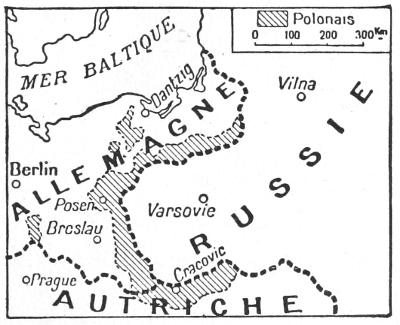
THE POLES IN THE EAST OF GERMANY.
It might be supposed that the expression Pangermanism
embodies the theory in virtue of which
the Germans claim to annex only the regions inhabited
by dense masses of Germans, on the borders
of the Empire, which, after all, would be in accordance
with the principle of nationalities.
But Pangermanism has by no means such a restricted
and legitimate aim. Again, it might be
thought that its object was to gather within the
same political fold the peoples who are more or less
Germanic by origin. Such a claim would of itself
be quite inadmissible. But Pangermanism is more
than that. It is really the doctrine, of purely
Prussian origin, which aims at annexing all the
various regions, irrespective of race or language, of
which the possession is deemed useful to the
power of the Hohenzollerns.
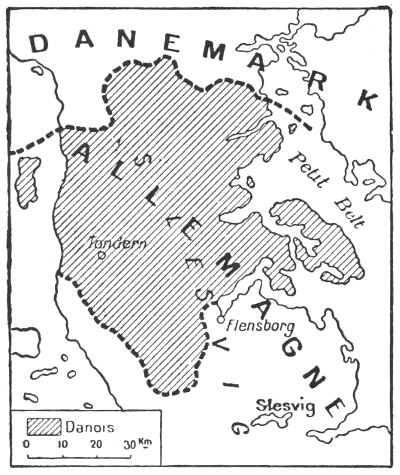
THE DANES IN PRUSSIA.
It was in the name of Pangermanism, a theory
bred of cupidity and wanton greed, that Prussia
charged the Parliament of Frankfort to claim as
German lands the Eastern Provinces, where in
reality the Slavs predominate to such an extent,
that they still contain a population of about four
million Poles.
It was in the name of Pangermanism that in 1864
Prussia seized that part of Schleswig which was
entirely Danish.
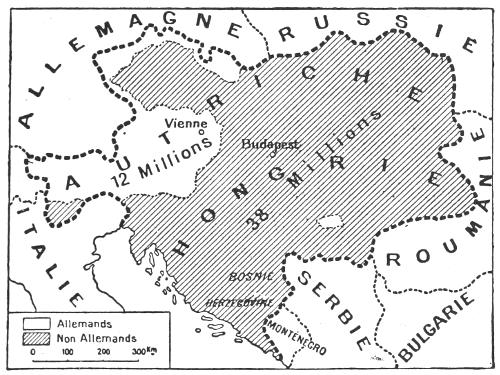
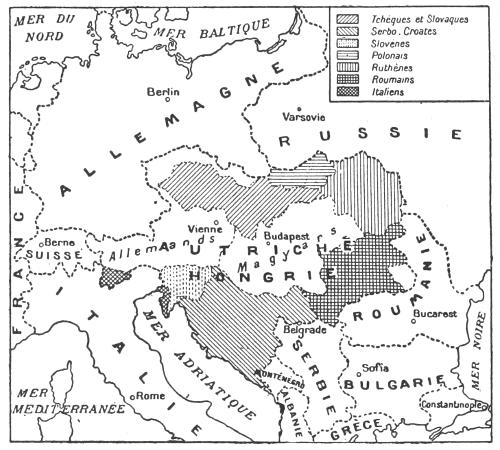
THE GERMANS AND THE NON-GERMANS IN AUSTRIA-HUNGARY.
It is in the name of Pangermanism that Austria-Hungary
has been for long the object of German
covetousness, although the Germans in that country
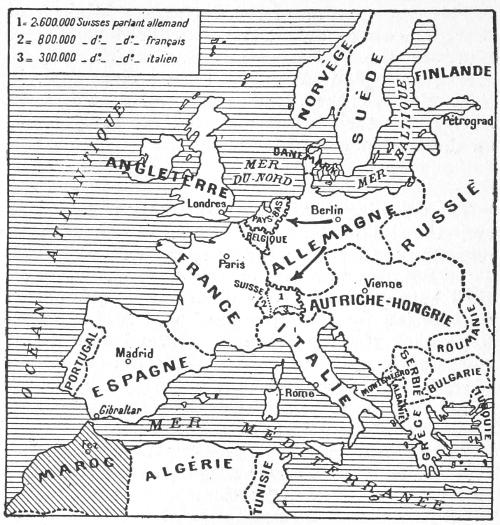
are in a very small minority. Statistics show 12
millions of Germans against 38 millions of non-Germans,
and that must be above the mark, for
we have to remember that German statistics
systematically exaggerate the number of Germans
dwelling in the Hapsburg Monarchy.
Already in 1859 the Augsburg Gazette avowed the
object of Germany’s designs on Austria with
absolute cynicism:
“We loudly declare that if Austria[1] were not a
member of the Confederation; if it were not
Austria who happened to be the legitimate owner
of these non-German regions, it would be the duty
of the German nation to conquer them at all costs,
because they are absolutely necessary for her
development and for her position as a great power.”
The future Marshal von Moltke, also inspired by
Pangermanism, had written, as far back as 1844:
“We hope that Austria will uphold the rights and
protect the future of the Danube lands, and that
Germany will finally succeed in keeping open the
mouth of her great rivers” (see V. Moltke Schriften,
t. II., p. 313).
The author of a pamphlet published in 1895, i.e.
exactly twenty-one years ago, inspired by this
doctrine of fraud and protected by the Alldeutscher
Verband, the most powerful Pangerman Society,
after expounding the main plan of future annexations,
concludes with simple effrontery thus:
No doubt the newly-constituted Empires will not
be peopled merely by Germans, but: “Germans
alone will govern; they alone will exercise political
rights; they alone will serve in the Army and in the
Navy; they alone will have the right to become
landowners; thus they will acquire the conviction
that, as in the Middle Ages, the Germans are a
people of rulers. However, they will condescend
so far as to delegate inferior tasks to foreign subjects
subservient to Germany” (see Grossdeutschland und
Mitteleuropa um das Jahr 1950, published by Thormann
und Goetsch, Berlin, p. 48).
Identity of race and language served for a long
time to justify Pangermanism; but the facts we
have shown and the explicit declarations we have
quoted prove clearly that race and language were
merely a pretext for the diffusion of the Pangerman
doctrine inspired by Prussia. If we dissect this
doctrine we find it is composed of cupidity both
political and economic. The truth is that Pangermanism
is a scheme of piracy to be carried on
for the benefit of the Prussian monarchy. Its
object is, by successive and indefinite expansions of
territory to include within the same boundaries,
at first economic but afterwards political, such lands
and such peoples as are likely to prove a profitable
possession to the Hohenzollerns themselves and to
their main support, the German aristocracy.
To sum up, Pangermanism is a doctrine of
international burglary, and therefore it is exactly
the reverse of the principle of nationality, that
noble idea ushered into the world by the French
Revolution.
From the Pangerman doctrine the military and
political Pangerman plot was bred and stage-managed
by William II. Outside of Germany, the
Kaiser was looked upon, for a long time, as a peace-loving
monarch. It is difficult to explain how such
a very serious error could have arisen. Shortly
after his accession in 1888, William II. was secretly
hatching that plot which so recently has caused
the European conflagration, and subsequently, by
his public utterances, he has clearly showed his
Pangerman tendencies.
On August 28th, 1898, in reply to the Burgomaster
of Mayence’s speech, the Kaiser declared
that his wish was to keep inviolate the heritage
bequeathed by his “immortal grandfather.” “But,”
added William, “I can only reach that goal if our
authority firmly keeps sway over our neighbours.
For this object the unity and the co-operation of
every German tribe is required.” On the 4th
October, 1900, William II., on laying the foundation
stone of the Roman Museum of Saalburg,
again said:
“May our German Fatherland become in the
future as strongly united, as powerful, as wonderful
as was the Roman universal empire; may this
end be attained by the united co-operation of
our princes, of our peoples, of our armies and of
our citizens, in order that in the times to come it
may be said of us as it used to be said of yore:
Civis Romanus sum.”
On the 28th October, 1900, speaking at an
officers’ mess, William II. affirmed: “My highest
aim is to remove whatever separates our great
German people.” Now, in September, 1900, at
Stettin, the Kaiser had just declared: “I have
no fear of the future. I am convinced that my
plan will prove successful.” In the Kaiser’s mind
the whole matter was summed up in the chief
formula of Pangerman domination: From Hamburg
to the Persian Gulf. To accomplish this object
the Kaiser had decided to forge closer and
still closer links between Austria-Hungary and
Germany. In order to consolidate his supremacy
over the Balkan peoples he reckoned on the co-operation
of such of their Kings as were Germanic
by origin (Bulgaria and Roumania), or on others
who were strongly influenced by Germany—in
reality by himself.
Thus he arranged the marriage of his own sister,
Sophia, in 1889, with the heir of the Throne of
Greece, King Constantine of to-day. Finally, almost
immediately after his accession he had begun
to think of showering his Imperial favours on the
Turks and the Musulmans; this was with the
object of seizing the Ottoman Empire, later on, and
of making use of the Mahometans of the whole
world as a mighty lever against all other powers.
On November 8th, 1898, at Damascus, William
II. pronounced the famous words, the full significance
of which is only made clear now that we
have seen the German action develop in Turkey and
Persia, and that we have learnt about William’s
endeavours to cause an agitation among the
Musulmans of Egypt, India and China:
“May His Majesty the Sultan, as well as the
three hundred millions of Musulmans who venerate
him as their Khalifa, be assured that the German
Emperor is their friend for ever.”
The adulation of the sanguinary Sultan Abdul-Hamid
proved of practical use to William II. He
obtained on the 27th November, 1899, the first
concession of the Bagdad railway; now that railway,
although still unfinished, has just been
utilized by the German offensive both against
Russia and England.
All over his Empire William II. had encouraged
the formation of military and naval leagues—which
number millions of members who, for the
last twenty years have carried on an incessant
propaganda in favour of such German armaments
by land and sea—as were wanted by the Kaiser.
Again, William II. encouraged the creation of the
Alldeutscher Verband. This association or Pangerman
Union, counts among its members a large number
of important and influential persons, and at
the door of this society must be laid the most
overwhelming responsibility for the outbreak of
the war. Founded in 1894, it has organized
thousands of lectures besides scattering broadcast
millions of pamphlets to spread Pangerman
notions and to get the masses of the people to
favour schemes of aggrandizement. It was due to
the Alldeutscher Verband that all the Germans
living outside the Empire were formed into a
systematic organization for the present war; this
being specially the case in Austria and in the
United States.
Is it possible to believe that such an autocrat
as William II. had not desired this end? How
could three powerful associations, with ever-growing
means of action, have carried on a most costly, as
well as a most violent propaganda, in a police-ridden
country like Germany, unless they had been
approved of by the authorities usually so meddlesome
or so vigilant?
As to the hour of the war, who set the clock
going, if it were not the Kaiser? As a matter of
fact he put the hands of the dial forward (see
Chapter II).
From November, 1913, onward, the Kaiser was
busy preparing for early hostilities; he was aware
that the enlargement of the Kiel Canal would be
complete by July, 1914—therefore he arranged to be
ready by that date, and as we know war was
declared on August 1st, i.e., a few days after the
completion of the Kiel Canal. The Arch-Duke
Francis-Ferdinand, the heir to the Austria-Hungarian
throne, tempted by the Kaiser, is dazzled by
the mirage of great profits which were to accrue
from a joint action of the Central Powers. In
April, 1914, the Kaiser goes on a visit to the Archduke
at Miramar, near Trieste. Again he meets
him at Konopischt in June, 1914, and is then
accompanied by von Tirpitz, that notorious Chief
of Pirates, that submarine Corsair. Now comes
the right moment for drafting the bold main lines
of the combined action of the German and Austrian
forces by land and sea. The murder of the Arch-Duke
Ferdinand, on June 28th, 1914, made no
change in the Kaiser’s plans, it merely precipitated
events by furnishing an excellent pretext for
intervention against Serbia. Thus the criminal
action of the Kaiser stands revealed; for twenty-five
years he had been elaborating the Pangerman
plan.
According to Baron de Beyens, who before the
war was Belgian Minister at Berlin, “it has been
maintained that William II. was an unconscious
tool in the hands of a caste and of a party who
needed war in order to assert their own power.
William has, indeed, listened to them, but he has
lent them an ear because their designs chimed in
with his own. In the judgment of history it is he
who is doomed to bear the responsibility for the
disasters by which Europe has been overwhelmed”
(Baron Beyens, L’Allemagne avant la guerre, p. 41,
G. Van Oest, Paris).
For twenty-five years, and by order of the Kaiser,
a violent Pangerman propaganda had been carried
on throughout the Empire; therefore, let there be no
mistake, William II., in declaring war, was supported
in his decision, not only by the influential
circles of German opinion, but by the large majority
of the German people. A very notorious German,
Maximilian Harden, has explicitly acknowledged
this fact in his review Zukunft of November, 1914:
“This war has not been forced on us by surprise;
we have desired it, and it was our bounden duty
thus to desire it. Germany wages war because of
her immutable conviction that greater world expansion
and freer outlets are due to her by right
of her own works” (quoted by Le Temps, 20th
November, 1914).
Having thus formed and perfected for twenty
years the Pangerman plot of a European conflagration,
William II. had the prodigious audacity to
declare, in his Manifesto to the German people
(August 1st, 1915), after drenching Europe with
streams of blood for a whole year: “Before God
and before History, I swear that my conscience is
clear. I did not desire war.”
I. — II. — III. — CHAPTER II. THE CAUSES OF THE WAR.
I. The Pangerman plan of 1911.
II. The stages by which it has been effected.
III. Why it has been ignored.
The Pangerman plot in its broad outlines was
laid as early as 1895, but since that date events
have happened throughout the world, which encouraged
Pangermans to enlarge the structure of
their scheme.
In 1898 the Fashoda incident almost caused a
breach between France and England. In 1905
Japan compelled Russia to sign peace after a long
war which exhausted all the Tsar’s military
resources and disturbed the balance of power in
Europe for a long time to the advantage of Germany.
In 1909 the Vienna Government, under
cover of the veiled ultimatum which Berlin sent to
the Tsar, carried out the annexation of Bosnia and
Herzegovina, countries which are almost entirely
peopled by Serbians. This seizure of a huge Slav
territory was a great triumph for Germanism. On
November 3rd, 1910, at the Potsdam meeting, the
Kaiser obtained from the Tsar’s Government the
abandonment of all opposition to the completion
of the Bagdad railway. England and France took
up the same attitude. On July 1st, 1911, the
Kaiser ventured on the Agadir episode, which was
clearly an attempt to force a quarrel on France. It
led to the Franco-German treaty of November 4th,
1911, which ceded to Germany 275,000 square
kilometres of the French Congo, while at the same
time the commerce of Morocco was heavily mortgaged
in favour of Germany.
These various events deeply injured the interests
of France, England and Russia; but these powers
preferred to submit to the hardest sacrifices rather
than undertake the dreadful responsibility of
letting loose a fearful war on Europe. The Pangermans
misread this attitude as a sign of weakness,
and of a desire to keep the peace at all costs; and
accordingly they were encouraged to entertain high
hopes of huge success in a near future. That is why
the original Pangerman plan of 1895, considerably
altered, became the perfected plan of 1911.
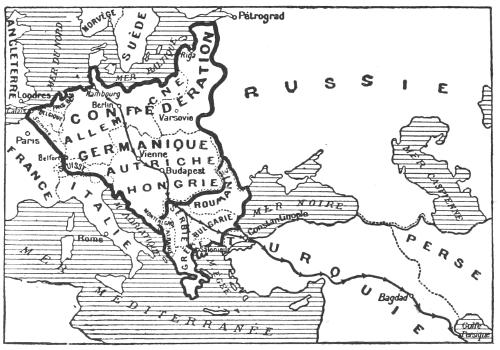
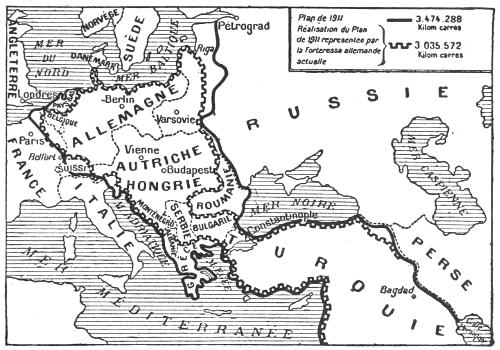
THE PANGERMAN PLAN OF 1911.
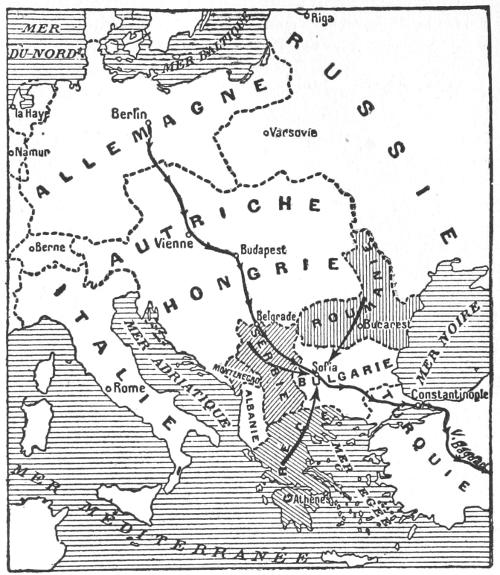
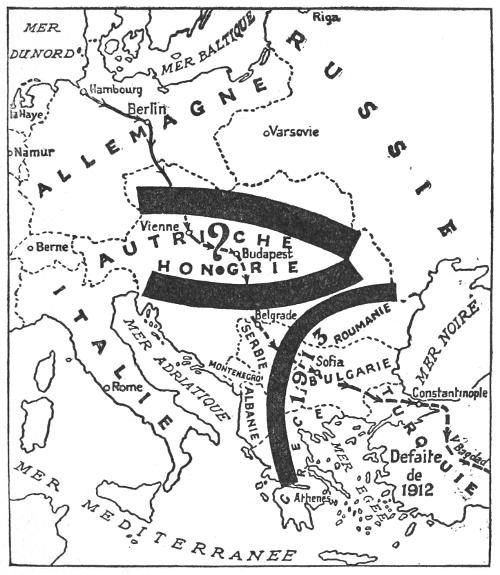
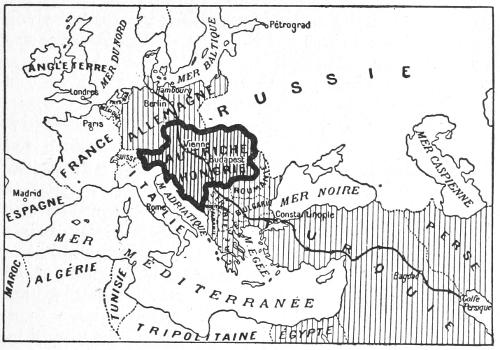
This plan of 1911 (see map) provided in Europe
and in Western Asia:
1º. The establishment, under German rule, of a
vast Confederation of Central Europe, comprising:
Square Kilometres.
Inhabitants.
In the West:
Holland
38,141
6,114,000
Belgium
29,451
7,500,000
Luxemburg
2,586
260,000
Switzerland*
41,324
3,800,000
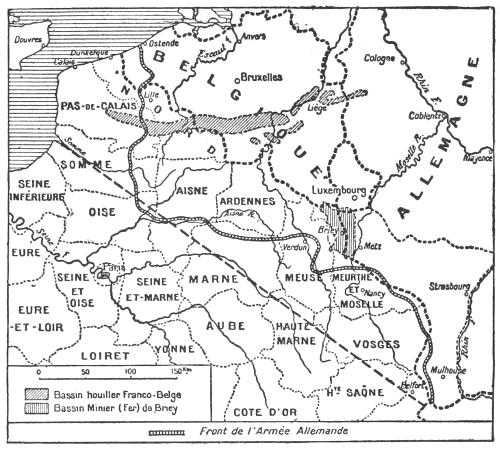
The Departments of the North of France to the N.E. of a line
drawn from the S. of Belfort to the mouth of the Somme
about
50,271
5,768,000
Total
161,773
23,442,000
To the East:
Russian Poland
127,320
12,467,000
Baltic Provinces, Esthonia, Livonia, Courland
94,564
2,686,000
The three Russian Governments of Kovno, Vilna, Grodno
121,840
5,728,000
Total
343,724
20,881,000
To the South-East:
Austria-Hungary†
676,616
50,000,000
These three groups form a grand total of 1,182,113
Square Kilometres and 94,323,000 inhabitants.
* Minus eventually the French and Italian Cantons which the
Pangermans declare that they do not care to annex.
† Minus the Italian regions of the Trentino, which Berlin
decided to cede (at the expense of Austria) to Italy as the
price of her neutrality.
This confederation was thus to group under German
supremacy
Square Kilometres.
Inhabitants.
Actual German Empire
540,858
68,000,000
New territories of the Confederation
1,182,113
94,000,000
Total
1,722,971
162,000,000
of whom only 77 millions are Germans and 85
millions non-Germans.
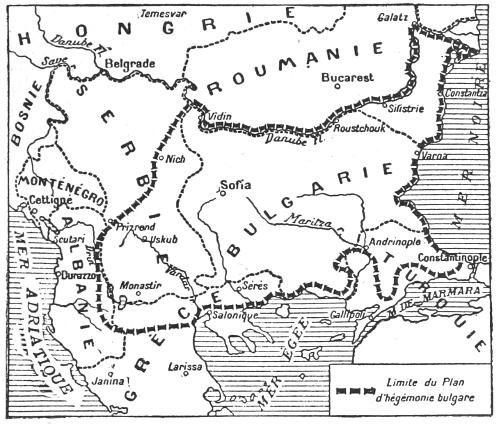
2º. The absolute subordination of the Balkan
countries (containing 499,275 square kilometres and
22 millions of non-Germans) to the Great Central
European Confederation. The Balkan States to
become mere satellites of Berlin.
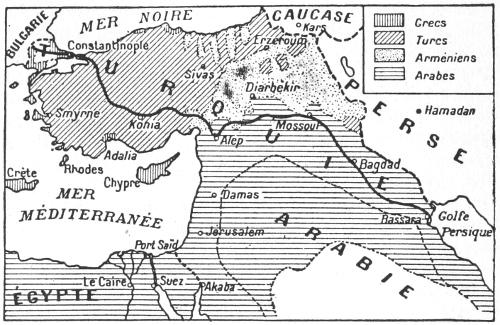
3º. Germany’s political and military seizure of
Turkey, which was afterwards to be enlarged by the
annexation of Egypt and Persia. It was provided
that Turkey should be dealt with in two successive
stages. During the first, the handful of “Young
Turks” who have ruled the Ottoman Empire since
1908, and who play the German game, were to
remain in power merely as figure-heads. Turkey
was to retain a nominal independence during this
phase, though in reality she was to have been tied
to Germany by a treaty of military alliance. Under
pretence of effecting reforms, numerous German
officials were to be placed at the head of all the
Ottoman administrations, and that would have
paved the way for the second stage. The latter
had for its aim the putting of Turkey, with her
1,792,000 square kilometres and her 20 millions of
non-German inhabitants, under the strict protectorate
of Germany, to say nothing of the subject
provinces, Egypt and Persia.
The Germanic Confederation of Central Europe
was to form a huge Zollverein or Customs Union.
Treaties of Commerce of a special character imposed
on the Balkan States and on subjected
Turkey would have provided for Great Germany
an economic outlet and reserved for her exclusively
those vast regions.
Finally, we can sum up the Pangerman plan of
1911 in four formulas:
The union of the three groupings—Central Europe,
Balkan States and Turkey—would have placed
under the predominating influence of Berlin 4,015,146
square kilometres and 204 millions of inhabitants,
of whom 127 millions were to be ruled directly or
indirectly by merely 77 millions of Germans.
This continental Pangerman plan of 1911 was to
have been completed by colonial conquests of great
magnitude, of which an account is given at the end
of Chapter V.
William II. was well aware that such a project
could only become an enduring reality if all other
great powers disappeared from the face of the earth.
The Kaiser had therefore positively resolved, when
hatching his Pangerman plot, to accomplish the
destruction of five great powers. It is necessary
to grasp fully this fundamental truth, if we wish
to understand the nature of the present war. It
was foreseen that Austria-Hungary would disappear
by her absorption under cover of entrance into the
German Zollverein. France and Russia were to
have been totally ruined by means of a furious
preventive war which would entirely destroy their
military forces. England was to be put out of
action by a subsequent operation, which would
have been an easy matter when once France and
Russia had been dismembered and reduced to utter
impotence. As to Italy—destined to become a
vassal state—she was not considered as being
capable of hindering in the least the Pangerman
ambitions. One of the Kaiser’s agents for propagating
this scheme wrote in 1900: “Italy cannot
be looked upon as a rival for she is too incompetent
in warfare” (Deutschland bei Beginn des 20 Jahrhunderts,
p. 53. Military publishers, R. Felix,
Berlin, 1900).
It must be added that the Pangerman plot of
1911 did not include war with England. When he
declared hostilities in August, 1914, William II.
was convinced that England would take no share
in them, at least not immediately. The Kaiser
had laid every conceivable kind of trap to add
fuel to the flames of all internal English disturbances
and to deceive the London Cabinet. At one
moment he almost succeeded in his endeavours.
England’s decision to participate without delay in
the struggle only hung by a thread, but that thread
was broken. If England had tarried, if she had
tarried only for a few days, German landings in
Normandy, Brittany, and as far as Bordeaux would
have been effected. France being thus rendered
quickly powerless on all sides, the English intervention
would have proved futile at a later stage,
and the Pangerman plan of 1911 would thus have
been fully achieved. But in going to war just at
the right moment and in controlling the sea, Great
Britain has, while saving herself, furnished to
civilized humanity the means of avoiding the Prussian
yoke. The initial German plan has truly been
upset by English intervention following on the
respite gained by the splendid resistance of Belgium
in arms.
But the Germans are clever, they are stubborn
and crafty. Adapting themselves to new conditions
thrust on them, they are still endeavouring to
make an enormous profit out of the war. We must,
therefore, try to understand what operations they
have devised for carrying out, even now, the Pangerman
plot almost in its entirety.
As it is necessary to open the eyes of neutrals,
many of whom have been misled by the German
propaganda, we must try to expose very clearly the
inner workings of the Pangerman plot as it is
revealed to us in the searchlight of facts.
From 1892 down to the outbreak of the War,
that is to say, for twenty-two years, the Pangerman
movement has developed with ever growing intensity;
a multitude of publications, giving full
details of the plan, were scattered among the German
people, in order to excite in them the greed
of conquest and so prepare them for the struggle
through the allurement of plunder. Of these publications
two are of special importance: first, the
pamphlet published under the auspices of the
Alldeutscher Verband: namely, Grossdeutschland
und Mitteleuropa um das Jahr 1950 (Thormann
und Goetsch, Berlin, 1895), which gives the Pangerman
plan of 1895: second, the book of Otto
Richard Tannenberg: Grossdeutschland, die Arbeit
des 20ᵗᵉⁿ Jahrhunderts (Bruno Volger, Leipzig-Gohlis,
1911), which gives all suitable details
of the plan of 1911.
Unfortunately, although this Pangerman literature
is very considerable, full of documentary
evidence and spread broadcast among the masses
by most powerful associations, whose patrons are
the highest authorities in the land, few people outside
of Germany would believe in its extreme importance.
But now the facts speak for themselves.
The reality, the extent, and the successive stages
of the Pangerman plan of 1911 are shown by:
1º. The course which Germany has taken since
August 1st, 1914, in her political and military
operations which have for their object not, as many
have supposed, the obtaining of securities, but the
annexation of territories in the manner set forth in
Tannenberg’s book, and more or less in accordance
with the plan of 1911.
2º. The memorial delivered on May 20th,
1915, to the German Chancellor by the League of
Agriculturists, the League of German Peasants,
the Provisional Association of Christian German
Peasants, now called the Westphalian Peasants’
Association, the Central German Manufacturers’
Union, the League of Manufacturers, and the
Middle-Class Union of the Empire (seeLe Temps,
12th August, 1915). The importance of this document
cannot be overrated, for it is issued by the
most powerful associations of the Empire, including
all the influential elements of the German nation,
specially the agrarians and the iniquitous Prussian
squires. Now the purport of that memorial, as will
be shown, is to demand all such annexations mentioned
in the Pangerman plan of 1911, as the
development of military operations has so far
rendered feasible. Any one who knows Germany
can hardly doubt that this memorial was not
handed in to Bethmann-Hollweg without a
previous understanding with him. Doubtless it
was intended that this document should seem to
exercise an overmastering pressure of public opinion
on William II.’s government. But if the ideas expressed
in this memorial reflect, as they certainly
do, the wishes of influential German circles, it is
also unquestionable that they correspond very
closely to the scheme of aggrandizement, which
William II. has been nursing for over twenty
years.
3º. The declarations made at the sitting of the
Reichstag of the 11th December, 1915, prove the
exactitude of this statement. The Imperial Chancellor
said:
“If our enemies will not submit now, they will
be obliged to do so later on.... When our enemies
shall offer us such peace proposals as are compatible
with the dignity and security of Germany we shall
be ready to discuss them.... But our enemies must
understand that the more unrelentingly they wage
war, the higher will be the guarantees exacted.”
Bethmann-Hollweg could hardly have spoken
more explicitly, but his diplomatic game was
naturally to unmask Germany’s enormous pretensions
only bit by bit, in order that the eyes of
neutrals should not be opened to the Pangerman
monster in all its horror until the last moment. But
hardly had the Chancellor finished his speech than
the Deputy Spahn explained the real drift of it
with great precision:
“We await,” said Herr Spahn, “the hour which
will allow of peace negotiations which will safeguard
in a permanent way and by all means,
including the needful territorial annexations, all
military economic and political interests of Germany
in its total extent.”
The thundering applause which greeted these
words proves that they echoed the sentiments of
the overwhelming majority of the German deputies,
who at that moment still believed that it was
possible for Germany to achieve enormous annexations.
The preparation of the Pangerman plan has
required for over twenty years a huge propaganda
among the German masses as well as a world-wide
organization. How is it that this plan has been
ignored in its nature and in its extent by the
diplomats of France, England and Russia? Such,
however, has been the case, for otherwise the war
could not have come upon these three powers as a
surprise. We deal here with a matter which at
first sight seems improbable and which, therefore,
needs explanation.
The diplomatic agents of the Allies are certainly
not inferior personally to those of William II., but
the Kaiser’s foreign service, as a whole, includes
novel instruments of observation and influence
by which, for the last twenty years, the Government
of Berlin has seconded its official diplomacy
without allowing the connexion between it
and them to transpire. None of the Allied
countries have employed similar instruments, the
result being that the Entente is considerably
inferior in this department of foreign policy.
The Pangerman plan is founded on a very exact
knowledge of all political, ethnographical, economic,
social, military and naval problems, not only of
Europe, but of the whole world; the Germans have
acquired that knowledge by means of an intense
labour of over twenty-five years. But this task has
not been performed by the official German diplomats;
it has been carried out either by the members of the
Alldeutscher Verband, the Pangerman Union, or
by the agents of the German secret service, which
has been enormously extended. These agents
might be called connecting links between the
regular spies and the official diplomats; Baron von
Schenk, who worked at Athens from 1915-1916, is a
sample of that category of agents who have studied
methodically all the root questions of the Pangerman
plan, who have prepared means to delude the
minds of neutrals, to paralyze the revolt of the
Slavs in Austria-Hungary, to corrupt all such
neutral individuals or neutral newspapers as were
susceptible of corruption, etc. After these numerous
agents had made their reports, and when once
these had been examined and summarized, they
were sent to the Wilhelmstrasse, to the great
German General Staff, whose concerted operations
are always so combined as to answer both to political
and to military needs. At the same time the reports
reached William II.’s private study, and his
brain was thus able to store up all technical means
necessary for the achievement of his plan of
domination.
Was the diplomatic corps of the Allies so well
served that it could grasp in its universal significance
the immense work of preparation accomplished
by the secret Pangerman agents? Indeed,
they were not properly supplied with the right
tools for such a task, and we shall see why it was so.
First of all it is necessary to dispel a false notion
which “the man in the street” has of diplomacy.
He fondly thinks that diplomats, while preparing
clever and mysterious combinations, fashion History.
Now the experience of centuries shows that
as a general rule diplomats merely chronicle
History but do not make it. My teacher, Albert
Sorel, neatly expressed that truth by saying:
“Diplomats are History’s attorneys.” In fact, the
diplomacy of any country helps to prepare and to
fashion history only when there happens to be at
its head a great man of large and just ideas, who
knows how to apply these ideas by all the means
available in his time.
It is a strange fact and worthy of notice, that
such a great man is rarely, if ever, a professional
diplomat. For example, Richelieu, Napoleon,
Palmerston, Disraeli, Cavour, Bismarck, who all
prepared and fashioned History, were not trained
diplomatists. Unfortunately, it does not seem that
Fortune has endowed any of our Allied countries,
either before or since the war, with a head capable
of leading, on grand lines, the diplomatic affairs of
the Entente. The latter therefore has been only
served by those diplomats who are mere officials,
and who as such await instructions from higher
quarters, and these instructions are very often
found wanting.
Besides, the diplomacy of the Allies, not being
seconded, like that of Germany, by novel means of
observation, can only obtain the information it
needs by methods still so old-fashioned that they
are almost identical with those used a century ago.
They are totally inadequate to point out the
sequence of ideas or the rapid development of
events which in Central Europe and the Balkans
have been, as will be seen, the immediate causes
of the war; nor are the means employed by our
diplomats at all sufficient if they wish to recognize
what forms the whole chain of the Pangerman
organization. Just because this organization is
huge, just because it is so complex, its total importance
cannot be properly gauged unless the
connecting links between the varied elements are
clearly perceived.
The typical professional diplomat lives in a
world of his own. Either his information comes
from the office or it is second-hand; it rarely is
reached by direct observation of people or facts.
The secretaries at the Embassies divide their time
between office work, copying documents in copper
plate hand, or social functions, pleasant enough
but confined to a particular and narrow set. Few
of the secretaries know the language of the country
in which they reside, fewer still travel in the
interior of the land in order to study it.
The events which have led to the European
conflagration spring from two main causes: the
stupendous scope of the German ambitions and the
progress of the Austro-Hungarian and Balkan
nationalities. Now both these factors have been
revealed on many occasions, by purely local events
which, to a keen observer, would have betrayed
most significantly the end in view, but they have
occurred for the most part in places far removed
from capital cities, and to appreciate fully their
importance would have needed direct observation
on the spot.
This is quite contrary to the tradition followed by
official diplomats. Those of the Entente had not,
at their disposal, agents who could go and, for
instance, hear the numerous lectures given by the
Pangerman propaganda, and who could have procured
and translated for them the illuminating
pamphlets of the Alldeutscher Verband. Also they
had no means of getting into personal touch with
the party leaders, either Slav or Latin, of Austria-Hungary;
often these leaders were men without a
place in parliament, frequently without fortune or
social rank; all they had was their national ideal,
their strength of conviction, but they were real
and novel forces, for they acted on the popular
masses with whom they were in complete intellectual
sympathy.
As the diplomatic corps of the Entente was not
provided with that indispensable aid—an organization
of secondary agents of observation—they have
been reduced to accept information of a superficial
and incomplete nature. Often it was merely
provided by press cuttings and even those were
frequently from papers written in a tongue which
the diplomats could not read; at best these cuttings
were without any connecting link and quite insufficient
to warn them of the approach of a great
peril. We must add that in diplomatic circles of
all periods—unless they are led by some eminent
man—there are certain formulas current, such as:
“No fuss,” “it is necessary to wait and see,”
“we must not believe that it has happened,”
which have had a baneful influence. The result
has been a sceptical attitude which in diplomatical
circles passes for essential and in good taste. If we
add to this frame of mind the absence of varied,
direct and coherent information, we can understand
how it was that before the war, when any one tried
to persuade a professional diplomatist that William
II.’s political aim was nothing short of the establishment
of German supremacy over the whole
world, he was soon set down as a visionary with a
head stuffed full of groundless suspicions.
Finally, we must realize that the system by which
a diplomat is sent from pillar to post, often to the
antipodes, every four or five years, is not conducive
to the acquirement of a general and exact knowledge,
founded on documentary evidence, of events
still in progress, in a wide zone, so complex and so
difficult to study as Central Europe and the Balkans.
These various considerations help us to understand
why, during the twenty-five years which
preceded the war, no diplomat of the Allies has
been able to grasp the total Pangerman plan in its
nature and in its extent, though possibly a few of
them may have indicated in their reports now and
then some local Pangerman act which aroused
suspicion. These considerations explain also, at
least in part, the failure of the diplomatic corps
of the Entente in the Balkans.
To sum up, allied official diplomats are not
personally inferior to German official diplomats, but
the latter have an enormous advantage over their
colleagues of the Entente in knowing the general
plan of the Berlin policy, in knowing, each in his
own post, in what direction to proceed and what
must be done or prevented in order to attain the final
end. During the last twenty-five years the Kaiser’s
foreign policy has been constructive and framed on
a definite plan, while the diplomats of the Allies,
reflecting the policy of their Governments without
concrete plans, have been hampered, because they
believed obstinately in Peace, in a vague and stagnant
defensive.
On the other hand, the allied diplomacy, regarded
as an instrument of observation, confined to old-fashioned
methods, is like an ordinary magnifying
glass which shows nothing but the largest objects.
On the contrary, the German foreign policy, thanks
to the new, busy and secret organs, by which the
German diplomacy has been seconded, may be compared
to a workshop provided with powerful microscopes
by which facts can be studied not only in
their general aspect, but also in their most minute
details, details which often are not without their
importance.
Finally, the allied diplomacy, regarded as an
instrument of action, still clinging to antiquated
traditional methods, may be compared to an army
which possesses only field guns, while the foreign
diplomacy of Germany, in its totality, is comparable
to an army equipped both with heavy and with
field artillery.
I. — II. — III. — CHAPTER III. HOW FAR THE PANGERMAN PLAN WAS CARRIED OUT AT THE BEGINNING OF 1916.
I. Why the Treaty of Bukarest suddenly raised a formidable
obstacle to the Pangerman plan.
II. How it was that the internal state of Austria-Hungary
drove Germany to let loose the dogs of war.
III. General view of the causes of the war.
Although the Pangerman plan is unquestionably
the chief ultimate cause of the war, yet when
William II. started it in August, 1914, he did so for
nearer and for secondary reasons which we must
examine carefully if we wish to have a clear view
of events.
Up to 1911, when Tannenberg published the
programme of annexations, all previous great
events had favoured William II.’s aims; but from
1912 onward events suddenly raised very serious
and quite unexpected obstacles to the execution of
the Pangerman plan.
In 1912, Italy conquered Libya at the cost of
Turkey and against the will and pleasure of Berlin.
Again in 1912 Greece, Montenegro, Serbia and
Bulgaria became united against the Ottoman
Empire; this also was contrary to the will and
pleasure of Berlin. What was quite unexpected
by the Kaiser’s Staff was the victory of the Balkan
peoples over the Turks. As Germany had upheld
the latter she felt profoundly humiliated. Then,
in order to hinder the foundation of an efficient
Balkanic Confederation—that is, one constituted
on the principle of a fair balance—Vienna, and
above all, Berlin, used as their tool the Tsar Ferdinand’s
well-known ambition to establish Bulgarian
supremacy in the peninsula. Accordingly instigated
by the Germanic powers, the Bulgarians in
June, 1913, attacked their allies, the Serbians and
Greeks. But once more the Kaiser’s calculations
were upset. Roumania, escaping for the first
time from German leading strings, intervened
against Bulgaria, which was struggling with her
former allies, and thus Bulgaria was vanquished.
Now, the new condition of things which arose from
the Bukarest treaty of August 10th, 1913, suddenly
formed a formidable obstacle to the Pangerman
scheme in the East, and this is the reason:
The treaty of Bukarest created in the peninsula
two groups of states sharply opposed to each other.
The first was formed of the beaten and sullen
participants in the Balkan wars, Bulgaria and
Turkey. The second group was composed of those
peoples who had benefited by the wars and were
satisfied with the result, to wit, Roumania, Serbia,
Montenegro and Greece. These four last states,
seeing that their vital interests had become closely
bound together by the territorial annexations
made at the cost of the common enemy, had joined
all their forces to insure the maintenance of the
Bukarest treaty which they considered inviolable.
On the other hand, this sharp division of the
Balkan States into two groups whose interests were
diametrically opposed, reacted deeply on general
European politics. The force of events led the
conquered states of 1912 and 1913, Turkey and
Bulgaria, to support Germanism in the Balkans;
on the contrary, Roumania, as well as Serbia,
Montenegro and Greece, because of their recent
acquisitions, were leaning more and more towards
the Triple Entente, quite contrary to the views of
Berlin and at the cost of Turkey, which even then
was bound hand and foot to Germany.
THE ANTIGERMANIC BARRIER IN THE BALKANS AFTER THE
TREATY OF BUKAREST (10th August, 1913).
Previous to the Balkan wars the Triple Entente
enjoyed an influence in the peninsula, vastly
inferior to that of Germany; after the treaty of
Bukarest, however, the Entente found support
in that group of states which was most powerfully
organized and which presented (see map) a very
solid barrier to the accomplishment of Pangerman
designs in the East.
This new order of things lashed Berlin into a fury
which though outwardly restrained was none the
less intense because the only group (Turkey and
Bulgaria) which was still under German influence,
was bound to remain for a very long time to come
practically impotent and powerless to make singly
any attempt against the other group which favoured
the Entente.
Indeed, Turkey, which in her defeats had lost
almost the whole of her military stores, could
hardly, at the beginning of 1914, put 250,000 men
under arms. Her financial difficulties were such
that, if left to her own resources, it would have
taken her many years to replace her military power
on a solid basis.
Bulgaria was in a similar financial predicament.
Besides, if she had taken action it would have been
at great risk to herself, in as much as those states
which profited by the Bukarest Treaty (Roumania,
Serbia and Greece), surrounding as they do (see the
arrows of the map) Bulgaria on three sides, could
then have delivered a concentric attack on Sofia.
Finally, great was the disproportion of men
eligible for the army or capable of bearing arms
between the two groups.
Germanophile Group.
Group of the Entente.
Turkey
250,000
Greece
400,000
Bulgaria
550,000
Serbia
400,000
Montenegro
50,000
Roumania
600,000
800,000
1,450,000
These figures, taken in conjunction with the
geographical situation, show clearly that, left to its
own resources, the Germanophile group could
attempt no attack on the Entente group.
The new balance of military forces in the Balkans
which was the outcome of the Bukarest treaty,
therefore reduced almost to naught Germany’s
power of intrigue in the Peninsula.
Had peace reigned for a few years, the new
Balkan situation would have been consolidated
and the obstacle to Pangerman ambition in the
East would have been still more serious. It was
for these varied reasons that Berlin decided to
intervene directly. Without doubt Serbia was
the pivot on which turned the new Balkanic
equilibrium. It was therefore decided to destroy
her without delay, kindling at the same time the
European conflagration, and thus by one single
blow to accomplish the plan of 1911.
The Bukarest treaty was signed on the tenth of
August, 1913. On November 6th, 1913, King
Albert of Belgium was at Potsdam, and the Kaiser
said to him that in his opinion war with France
was near and unavoidable (see Baron Beyen’s
L’Allemagne avant la Guerre, p. 24).
From this survey it follows that, if the treaty of
Bukarest, through its consequences, proved disastrous
to the Pangerman aims, it was, on the
contrary, extremely advantageous to the powers of
the Triple Entente, for it brought to their side the
majority of the Balkanic forces.
Unfortunately the diplomacy of the Entente
had not even a notion how favourable the situation
was to them. This ignorance was due to the old-fashioned
methods of observation still used by
diplomats which prevented them from believing
in the Pangerman scheme, and which also hindered
them from entertaining general and correct views of
the varied problems which form such a tangle in
that large territorial zone. Indeed, though one of
the immediate causes of the war was Germany’s
wish to upset the Bukarest treaty, because the
consequences of that treaty ruined the Pangerman
aims in the East, the Triple Entente powers were
no sooner at war with Germany than they did all
in their power during ten months to cancel in like
manner the consequences of the Bukarest treaty;
for that was in fact the result of the Entente’s
ingenuous wish to satisfy Bulgaria at all costs.
Theoretically, the attempt inspired by the noble
thought of avoiding the horrors of war in the
Balkans, was just, but in practice it was an impossibility
owing to the fierce hatred the Bulgarians
entertain towards their conquerors of 1913, and
above all towards the Serbians.
What is certain is that the diplomacy of the
Allies, during the first year of war, followed such a
policy in the Balkans that, evidently without
knowing it, they played entirely into the hands of
Berlin.
Not only were the consequences of the Bukarest
treaty disastrous to Pangerman ambitions in the
Balkan peninsula, they also, to the boundless fury
of William II., considerably accelerated that internal
political evolution of Austria-Hungary which
of itself had already threatened to upset all his
plans.
Unfortunately the notions held about Austria-Hungary
in France, and above all, in England, have
far too long been of a very vague nature. Public
opinion in France and England was totally unable
to grasp the situation, when war broke out. It was
incapable of seeing the important part played
during the war, and to be played after the war, by
the populations living in the Hapsburg Monarchy.
The vast majority of these peoples devoutly pray
for the victory of the Triple Entente, for they only
fight against it because they are forcibly constrained
to do so. At heart they look to the victory of the
Allies for deliverance from a hateful yoke which has
weighed on them heavily for centuries. That is
why it is of the utmost importance to educate public
opinion in the allied countries as to the actual racial
facts in Austria-Hungary. Then it will be clearly
understood of what abominable treason Francis
Joseph was guilty against his peoples; then it
will be clearly understood also that as these peoples
were more and more inclined, before the war, to lean
to the side of France and England, quite as much
as to that of Russia, William II. had a strong
additional motive for precipitating hostilities.
THE NATIONALITIES IN AUSTRIA-HUNGARY.
The nine different nationalities who live in the
Hapsburg Monarchy can be divided into four races:
Germanic.
Germans
12,000,000
Magyar.
Magyars (peculiar race of Asiatic origin)
10,000,000
Latin.
Italians
1,000,000
Roumanian
3,000,000
4,000,000
Slav.
Czecks and Slovak
8,500,000
Poles
5,000,000
Ruthenes
3,500,000
Slovenes
1,000,000
Serbo-Croats
6,000,000
24,000,000
In a political sense the Germans and Magyars,
forming a total of 22 millions, have agreed since
1867 to exercise and maintain for their own profit
the supremacy over the Slavs and Latins, although
these latter form the majority of the subjects of
the Monarchy, since they constitute a group of
28 million inhabitants.
Now, it is needful to note and it is important to
remember, that the figures which I quote, are incorrect,
because they are those furnished by the
Government statistics at Vienna and at Budapest
by German and Magyar officials. These have their
instructions to use various artful tricks for falsifying
systematically the true statistics in favour of their
own races, in order to contribute by that stratagem
to the maintenance, as long as possible, of the
supremacy held by the Germans and the Magyars.
In truth, there are in Austria-Hungary far less
than 22 million Germans and Magyars, and far more
than 28 Slavs and Latins. What again is certain,
is that for centuries the Slavs and Latins have been
oppressed in Austria-Hungary in the most odious
fashion by a feudal aristocracy, who engross enormous
landed properties, and who exercise in the
Hapsburg Monarchy as baneful a social influence
as that of the Junkers in Prussia.
With the exception of the Polish aristocracy of
Galicia and a small group of Ruthenes, who since
1867 joined hands with the Germans, all these Slavs
and Latins have been endeavouring to the very
utmost, especially for the last thirty years, to obtain,
in accordance with modern justice, such political
rights as are proportionate to their numbers. In
that way they hope to win for themselves in the
Monarchy the legal majority that is their due, by
reason of their being human flesh and blood liable
to be taxed and to be called on for service at the
will of the Government.
These tendencies have long excited extreme
alarm in William II. and his Pangermans. This
is readily understood, for, if the political power, in
the Hapsburg Monarchy, were vested, as justice
demands, in the Slavs and Latins, who hate
Prussianism, that in itself would have been the
ruin of the Kaiser’s plan for the economic absorption
of Austria-Hungary. Yet this very absorption
is indispensable to William II. if he is to carry
out his inadmissible plans of exclusive influence
in the Balkans and in the East. His game has
therefore been, especially since 1890, to say, in the
main, to Francis Joseph and to the Magyars:
“Above all, do not concede the claims of your Slav
and Latin subjects. Keep up absolutely the
Germano-Magyar supremacy. I will uphold you,
with all my power, in your struggle with the Slav-Latin
elements.” For a long time these tactics of
the Kaiser were successful but they were on the
point of breaking down a short time before the
war.
In spite of the most ingenious and cynical
obstacles raised by the Germans and Magyars the
culture of the Slavs and Latins kept growing; their
national organizations kept progressing; also they
were much more prolific than their political rivals.
All these conditions together gave Francis Joseph
and his henchmen at Budapest increasing trouble
in their efforts to resist the enlarged demands of
their Latin and Slav subjects. Berlin had already
become anxious on that score, when the mental
effervescence stirred up among the Slavs and Latins
of Austria-Hungary by the result of the Bukarest
treaty suddenly changed for the worse the outlook
of the Pangerman scheme.
As a matter of fact, almost the whole of the 28
million Slav and Latin subjects of the Hapsburgs
had been roused to enthusiasm by the victories
of the Slavs in the Balkans in 1912, and by the
success of Roumania in 1913; for they saw, above
all, in these events, the triumph of the principle of
nationality, that is, their very own cause. Hence
they became more than ever determined in their
endeavours to obtain from Vienna and Budapest
those political rights, proportionate to their number,
which the Germano-Magyars persisted in refusing,
although of late years that refusal had lost much
of its energy.
If peace had been maintained, the effect of the
Bukarest treaty on Austria-Hungary would have
lent irresistible force to the claims of the Slav and
Latin subjects of Francis Joseph. On the other
hand, Roumania, exulting in her annexation of the
Bulgarian Dobrudja, cast longing eyes on Transylvania,
and hoped to secure it at the expense of
Hungary. The moment appeared opportune when
a thorough transformation of the Hapsburg Monarchy
might be effected, and that transformation
seemed relatively so near that Roumania already
looked upon Transylvania as a ripe fruit which
merely needed gathering.
If this new order of things resulting from the
treaty of Bukarest had been allowed to develop
fully, the influence of Germanism would have been
infallibly ruined in the Hapsburg Monarchy, just as
had happened in the Balkans. Under the growing
pressure of her Slav and Latin elements the partition,
or at any rate, the evolution towards federation
of Austria-Hungary would have become a necessity.
This federalism would not have affected the frontiers
of the Hapsburg Dominions, but it would necessarily,
and without doubt, have given political preponderance
to the Slav and Latin elements, which
were the most numerous and the most prolific.
Now, those elements form an enormous majority,
which was and is resolutely hostile to any alliance
with Germany. Thus, progressively, the Hapsburg
Monarchy in evolution would have become more
and more independent of Berlin in regard to her
foreign policy, and as it gradually shook itself free
from its bondage to Berlin, it would, as a necessary
consequence, have drawn closer and closer to
Russia, France and England. Thus Germany
would have been deprived of the artificial prop
which she has found at Vienna and at Budapest
ever since the days of Sadowa through the Germano-Magyar
predominance. Finally, as a result of
peaceful development, William II. would have been
confronted by a state of things in Austria-Hungary
which would have opposed a far more formidable
barrier to his oriental ambitions than that which
was created in 1913 in the Balkans, as a consequence
of the treaty of Bukarest.
If we bear in mind the powerful and extraordinarily
important series of after-effects which
must have followed on the new situation produced
by the treaty of Bukarest and its inevitable influence
on the 28 million Slavs and Latins of Austria-Hungary,
we can readily understand that had
the European peace been maintained, the chances
of executing the Pangerman plan would have been
totally and simultaneously ruined in Turkey, in
the Balkans, and in Austria-Hungary; that is to
say in the three territorial zones which, as will be
seen from Chapter III, constituted by far the most
important part of the regions mapped out for
Pangerman operations in the plan of 1911.
Thus we see how the internal evolution of Austria-Hungary
had reached a point at which, as the
result of the treaty of Bukarest, it was just about to
escape for ever from the influence of Berlin; this
would have broken the pivot on which all the Pangerman
combinations revolved. It was that consideration
which decided William II. to make war at
once.
The Allies will, in accordance with the general
principles of justice, bring Germany to account for
her unheard of crimes, and will exact a full reparation
for the enormous moral and material injuries
which she has done them. Therefore it is necessary
to set forth the causes of the war by a general
survey of the facts, to the end that in the eyes of the
civilized world, it may be clearly demonstrated that
Germany must pay, and legitimately so, the price
of a responsibility which, in all justice, should rest
on her and on her alone.
To understand the practical necessity of such a
survey, if we are to influence the opinion of neutrals,
it is needful to bear in mind that all discussions
which, so far, have been held on the causes of war,
have been merely based on diplomatic documents
published by the various belligerents, and that these
documents merely refer to facts which preceded
the outbreak of war only by a few weeks. But
in a discussion which turns on a multitude of texts,
belonging to different dates, all more or less near
each other, and therefore liable to be confused,
nothing is easier than for subtle, interested and
dishonest reasoners like the Germans, to interpret
the same facts in different ways, and so to arrive
at conclusions diametrically opposed to the truth.
In fact, this is exactly what has happened.
Thanks to its intense intellectual mobilization,
which has been foreseen and carried out as powerfully
as its military mobilization, Germany has succeeded,
by fallacious interpretations of diplomatic
documents, in profoundly misleading neutrals,
even honest neutrals, as to the real responsibility
for the outbreak of war. Nothing could give a
better idea of the effect thus produced by Germany
than the following remarks of the Swiss Colonel
Gortsch published in the Intelligenzblatt of Berne:
“The events which happened at the end of July
have convinced every reasonable man that Germany
has been provoked to war, and that the Emperor
William II. has waited long before he took up this
challenge. History will lay the main guilt of the
war and its intellectual responsibility on England;
Russia and France will be considered as her accomplices.... It
is the British policy, openly and
selfishly free from any scruples, which has caused
the World-War” (quoted by the Echo de Paris,
3rd January, 1916).
This is exactly the proposition which Bethmann-Hollweg
wishes neutrals to believe. It is an absurd
proposition to be entertained by any one who knew
England intimately in the years before the war.
During that period the leaders of the British
Government were led by the one guiding thought—pleasant
enough in itself, but entirely inaccurate—that
war would not occur, since Great Britain did
not wish war. The whole foreign policy of Great
Britain has been inspired by this conception. It
explains the attitude of extreme conciliation taken
by the London Cabinet towards Germany at the
time of the annexation of Bosnia and of Herzegovina
(1909), during the Balkan wars (1912-1913), and
also when it came to the question of the Bagdad
railway, which most obviously threatened the road
to India. The Liberal Cabinet of London reflected
the dominant British opinion, which believed
implicitly in Lord Haldane’s assurances. He was
considered, though quite wrongly so, to have
a most perfect knowledge of Germany, and in a
speech at Tranent he affirmed to his countrymen:
“Germany has not the slightest intention of invading
us” (quoted by the Morning Post, 16th December,
1915). Up to the declaration of war, Sir Edward
Grey, always inclined to believe in the acumen of
his friend Lord Haldane, had resorted to every
conceivable combination which might have allowed
peace to be maintained if William II. had really
wished to maintain it. Finally, does not the total
unpreparedness of England for a continental war,
which has been evident since the outbreak of
hostilities, furnish the best proof of her sincerely
pacific intentions before the war?
Other neutrals, and even some Frenchmen, still
think that the struggle is a result of the so-called
Delcassé policy. They say: “The Emperor
William frequently tried to show himself friendly
to France. If his advances had been accepted, war
would have been avoided.” It is undeniable that
at certain moments William II. has tried to draw
France into his own orbit, but it was precisely in
order the better to insure the accomplishment of
the Pangerman plan, which has been his main
pre-occupation ever since his accession. The
present military events show clearly that if France
had been beguiled by the smile of the Berlin tempter,
any further efficient coalition of the great powers
against Germany would have been a sheer impossibility.
As to France, if she had believed in William
II. she would not have suffered from war, for war
would have been useless for German ends. Indeed,
without a struggle, France would have practically
been reduced to such a state of absolute slavery as
has never yet been achieved in history except as
the result of a totally ruinous war. Facts which
have come to light enable us to convince ourselves
by the most indisputable evidence, that such would
have been the outcome of a “reconciliation”
between France and Germany. We now know to
what extent the Germans had already gained a
footing in the greater part of the organic structure
of French finance and industry. If the Paris
Government had come to terms with Berlin nothing
could have stopped the total pacific permeation of
France by Germany. Little by little France would
have ceased to be her own mistress; at the end of
a few years she would have been exactly in the
same position as Austria-Hungary, unable to free
herself unaided from the Prussian hug.
Finally, can we believe for a moment that, had
France carried out such a policy of “conciliation”
with Berlin, it would have induced William II. to
relinquish his dreams of domination? On the
contrary, his easy capture of France in full enjoyment
of peace, would merely have whetted the
hereditary appetites of the Hohenzollerns. Had
France once been disposed of by reason of her
pacific permeation by Germany, the bulwark which
she now forms against the Prussian domination
would have been broken. The execution of the rest
of the Pangerman plan, at the expense of Russia
and England, could then have been effected without
encountering any insuperable obstacle.
It is therefore not the policy called after
M. Delcassé which has caused the war. M. Delcassé
will have quite enough to answer for in regard to
the application of his policy before and during war,
without being reproached for a general principle
which evidently was theoretically sound.
In upholding the alliance with Russia, in bringing
about the slackening of tension with Italy, in
achieving the Entente Cordiale, M. Delcassé has
followed a policy, the principles of which are just.
Actual events prove it convincingly.
Having laid bare the fallacy of the German
argument, let us now, for the benefit of honest
neutrals, attempt to give a general view of the true
causes of the war, and to indicate their sequence.
Let us distinguish between the deep-seated and
the immediate causes of the struggle.
The war can be traced to a single deep and remote
cause, namely, the will of William II. to achieve the
Pangerman plan; all secondary causes, that is
to say, the economic ones, spring from it. One
aim of the Pangerman plan was actually to put an
end to the enormous difficulties which Germany
had created for herself by the hypertrophy of her
industries, and by thus upsetting the proper balance
which had formerly existed between her agricultural
and her industrial productions.
The truth of this deep-seated and unique cause
of the war is demonstrated by:
1º. The intellectual preparation, in all domains,
of the Pangerman plan for twenty-five years.
2º. Such explicit and ancient avowals as the
following. In 1898 Rear-Admiral von Goetzen, an
intimate friend of the Kaiser, being at Manilla,
said to the American, Admiral Dewey, who had just
destroyed the Spanish fleet before Manilla: “You
will not believe me, but in about fifteen years my
country will begin war. At the end of two months
we shall hold Paris; but that will only form one step
towards our real goal—the overthrow of England.
Every event will happen exactly at its proper time,
for we shall be ready and our enemies will not”
(quoted by the Echo de Paris, 24th September,
1915, from the Naval and Military Record).
3º. The material facts of world-wide preparation,
obviously for war, made several months
previous to its outbreak, but not till the Kaiser had
decided to start it, that is, towards November, 1913.
(Proofs: declaration of William II. on 6th November,
1913, to King Albert of Belgium; interview of
the Kaiser with the Arch-Duke Ferdinand, April,
1914, at Miramar, and in June, 1914, at Konopischt,
where Admiral Tirpitz accompanied the Kaiser.)
These material facts are endless, but it will
suffice to recall the following as truly significant,
because they have required a long and complicated
effort: first, the organization for the victualling
of the piratical German cruisers on all the seas of
the globe, in view of a long war of piracy; and
second, the preparation of the revolt against
England in South Africa.
The immediate causes which decided William II.
to precipitate the war are:
1º. The defeat of Turkey in 1912 by Italy and
the Balkan peoples—a defeat which, by threatening
Berlin influence in Constantinople, endangered
the hold which Germany already had on the Ottoman
Empire.
2º. The consequences of the Bukarest treaty,
which in 1913 had erected automatically a formidable
barrier against the Pangerman pretensions in
the Balkans.
3º. The internal evolution of Austria-Hungary,
which, because of the steady progress made by the
Latin and Slav subjects of Francis Joseph, threatened
shortly to free the Hapsburg Monarchy from
the tutelage of Berlin.
THE THREE BARRIERS OF ANTIGERMANIC PEOPLES IN THE
BALKANS AND IN AUSTRIA-HUNGARY.
The facts of the last two groups would have
completed in Central Europe and in the Balkans
the three anti-German barriers indicated on the
map (see p. 43) by deep black lines. Now, these
barriers would have hindered once and for ever the
achievement of the Pangerman plan.
To parry these blows only one resource remained
to William II., and that was war—“the national
industry of Prussia,” as Mirabeau used to say, and
his very pithy and apt remark has been too long
forgotten.
I. — II. — III. — IV. — CHAPTER IV. SPECIAL FEATURES GIVEN TO THE WAR BY THE PANGERMAN PLAN.
I. German pretensions in the West.
II. German pretensions in the East.
III. German pretensions in the South and South-East.
IV. General view of the execution of the Pangerman plan from
1911 to the beginning of 1916.
In this chapter we shall inquire what relation
existed between the actual gains and the pretensions
of the Pangermans at the beginning of
1916, and those which were foreseen in the 1911
plan. In order to be quite explicit we shall analyse
successively those gains and pretensions in the
west, east, south, and south-west. This analysis
will enable us finally to present a general view of
the execution of the Pangerman plan at the period
under consideration.
The map (p. 46) sums up Prussianized Germany’s
pretensions which she still expected to carry out
west of the Rhine at the beginning of 1916.
The best way to prove this intention is by means
of extracts from the memorial sent by the most
powerful German associations on May 20th, 1915,
to the Imperial Chancellor (quoted by Le Temps,
12th August, 1915). I have mentioned (see page
18) why this document must be looked upon as of
extremely exceptional importance.
THE GERMAN CLAIMS IN THE WEST (Beginning of 1916).
As to what concerns Belgium the memorial says:
“Because it is needful to insure our credit on
sea and our military and economic situation for
the future in face of England, because the Belgian
territory, which is of the greatest economic importance,
is closely linked to our principal industrial
territory, Belgium must be subjected to the
legislation of the Empire in monetary, financial
and postal matters. Her railways and her water
courses must be closely connected with our communications.
By constituting a Walloon territory
and a Flemish territory with a preponderance of
the Flemish, and by putting into German hands
the properties and the economic undertakings which
are of vital importance for dominating the country,
we shall organize the government and the administration
in such a manner that the inhabitants
will not be able to acquire any influence over the
political destiny of the German Empire.”
In a word, it is slavery that is promised to the
Belgians. In order to prove clearly that this
means exactly the achievement of the plan Berlin
had elaborated for twenty-five years, it is important
to notice that the fate of the annexed populations,
meted out in the above memorial, is exactly
the same fate mentioned in the pamphlet published
under the auspices of the Alldeutscher Verband,
the Pangerman Union, wherein the Pangerman
plan of 1895 is set forth (see the text already
quoted, p. 4).
The only difference to be noticed in the evolution
of the Pangerman ideas between 1895 and 1916 is
that after their experience with the Slavs and Latins
of Austria-Hungary, the Germans deem it possible
and advantageous, by an application of Prussian
methods of terrorism, to compel non-Germans to
fight for the benefit of Pangermany; true, these
people shudder with horror at the notion, but
stiffened by a strong infusion of Germans, they are
forced to march to the shambles in order to secure
slavery and bread for their families under the
German yoke.
“As to France,” continues the memorial of
the 20th May, 1915, to the Imperial Chancellor,
“always in consideration of our position towards
England, it is of vital interest for us, in respect of
our future on the seas, that we should own the
coast which borders on Belgium more or less up to
the Somme, which would give us an outlet on the
Atlantic Ocean. The Hinterland, which it is
necessary to annex at the same time, must be of
such an extent that economically and strategically
the ports, where the canals terminate, can be utilized
to the utmost. Any other territorial conquest in
France, beyond the necessary annexation of the
mining basins of Briey, should only be made in
virtue of considerations of military strategy. In
this connection, after the experience of this war, it
is only natural that we should not expose our
frontiers to fresh enemy invasions by leaving to the
adversary fortresses which threaten us, especially
Verdun and Belfort and the Western buttresses of
the Vosges, which are situated between those two
fortresses. By the conquest of the line of the Meuse
and of the French coast, with the mouths of the
canals, we should acquire, besides the iron districts
of Briey already mentioned, the coal districts of the
departments of the Nord and of the Pas de Calais.
This expansion of territory, quite an obvious matter
after the experience obtained in Alsace-Lorraine,
presupposes that the populations of the annexed
districts shall not be able to obtain a political
influence on the destiny of the German Empire,
and that all means of economic power which exist
on these territories, including landed property, both
large and middling, will pass into German hands;
France will receive and compensate the landowners.”
In order to justify these formidable annexations
the memorial of the 20th May, in harmony
with the frank cynicism of the Pangerman doctrine,
adduces no argument but the convenience of Prussia
and the profitableness of the booty to be got.
“If the fortress of Longwy, with the numerous
blast furnaces of the region, were returned to the
French, and if a new war broke out, with a few long
range guns the German furnaces of Luxemburg
(list of which is given) would be paralyzed in a few
hours.... Thus about 20% of the production of
crude iron and of German steel would be lost....
“Let us say, bye the bye, that the high production
of steel derived from the iron-ore gives to
German agriculture the only chance of obtaining
the phosphoric acid needed when the importation
of phosphates is blockaded.
“The security of the German Empire, in a future
war, requires therefore imperatively the ownership
of all mines of iron-ore including the fortresses of
Longwy and of Verdun, which are necessary to
defend the region.”
These various declarations, made on high authority
enable us to affirm, that on the whole the annexations
which the Pangermans intended to make in the
West would have extended in France more or less
to a line drawn from the South of Belfort to the
mouth of the Somme, that is, so far as concerns
France, they would comprise a total area of 50,271
square kilometres, which, before the war, held
5,768,000 inhabitants.
Further, as regards France, the intended
annexations were, according to Pangerman conceptions,
to have had a double effect.
1º. By taking over the richest industrial and
mining French regions, Germany would secure an
enormous booty.
2º. Deprived of her most productive departments,
which bear the main burden of taxes, and
which hold mining elements indispensable to economic
life, France would have been maimed and
reduced to a state from which it would have been a
sheer impossibility for her to recover or ever again
to become a power capable of thwarting in any
shape whatsoever the future determinations of
Germany.
A few figures will enable us to verify this forecast.
At the beginning of 1916 the Germans were holding
138,000 hectares of the coal basin of the department
of the Nord, being 41% of the total superficies
worked in France (337,000 hectares), or about
three-fourths of the total French production. The
Germans also occupied 63,000 hectares of the iron-ore
basin of Lorraine which represents 75% of the
superficies of all the iron beds worked in France
(83,000 hectares), and nine-tenths of the total
production. It is clear, that were such a state of
things to continue, economic and therefore national
life would be made radically impossible in France,
shorn of her vital organs. In reality France
would be in a position of entire dependence on
Germany in accordance with the Pangerman
schemes for the future.
It is still necessary to mention that in the
territories occupied by Germany in the West, as
well as everywhere else, the measures already taken
by the Germans in 1916 were not merely measures
of military defence, but measures for the organization
and permanent possession of the said territories.
These measures to ensure permanent possession
may be classed in the following categories:
Measures of terrorism applied in Prussian fashion
so as to bring into subjection all refractory elements.
Measures of division, such as in Belgium, the
Germans take in order to rouse, by all possible
means, opposition between the Flemish and the
Walloons for the purpose of neutralizing the one by
the other.
Measures of strict and regular administration in
order, by the bait of some external or economic
advantages, to accustom to the German yoke those
elements of the population whose moral resistance,
in the opinion of Berlin, can be most easily broken.
Measures tending to prepare the German colonization
of the new territories. These have mostly
consisted in applying the Pangerman theory of
Evacuation, that is, by systematically transporting
the unfortunate women or old people whom Germany
considers absolutely useless in her future possessions.
She found it, for instance, very convenient to rid herself
without delay of these poor creatures especially
when the question of feeding them cropped up; so
these “useless mouths” were promptly transferred
to the shoulders of the enemy, whom Germany
already looked upon as vanquished. That is the
theory of Evacuation, which explains to a large
extent why the German authorities have sent back
to France that part of the populations of the
occupied territories in France and Belgium whom,
on exact inquiry, they regarded as human wastage.
No doubt, as is shown on map (p. 46), Germany
did not at the beginning of 1916 occupy quite all the
territories she coveted. She missed Calais, Belfort,
and Verdun, but it is easy to see that she did so only
by a hair’s breadth.
The Western territories which were to enter
into the Germanic Confederation of the 1911 plan
include:
Square Kilometres.
Holland
38,141
Belgium
29,451
Luxemburg
2,586
French Departments
50,271
Total
120,449
Now Luxemburg and Belgium were entirely
occupied (excepting a patch of Belgium). If
Germany was to hold Belgium, Holland, which is
not occupied, but which is geographically invested,
would inevitably be forced to enter into the
Germanic Confederation. We must, therefore, consider
Holland as being virtually under Germany’s
thumb. As, on the other hand, out of 50,271 square
kilometres which she wished to annex at the expense
of France, Germany, at the beginning of 1916,
occupied 20,300, we conclude that the German
enterprises in the West, which, according to programme,
ought to have comprised 120,449 square
kilometres, in point of fact extended directly or
indirectly over 90,478 square kilometres.
Germany therefore, early in 1916, had achieved
in the West an occupation foreseen by the plan of
1911 and at the expense of non-Germans in the
proportion of 76% or three-fourths.
The Pangerman plan of 1911 had provided for the
permanent exclusion of Russia as a great power
by means of two measures:
1º. To carve out of the Empire of the Tsars
and annex to the German Confederation a slice of
territory large enough to cut off Russia entirely
from the West.
2º. To constitute at the expense of Russia, thus
reduced, new States which should bow the knee to
Berlin.
Mr. Dietrich Schaefer, the well-known historian,
in the Review Panther, affirmed, early in February,
1915: “It is absolutely necessary for us to expand
the sphere of our power, especially eastward ... the
immense Russian force must recede behind
the Dnieper” (quoted by L’Information, 5th
February, 1915).
A Swedish pamphlet, ascribed to the Germanophile,
Adrian Molin, explained, also early in 1915,
that Germany, with the help of Sweden, was to
have given the finishing stroke in separating Russia
from Europe by means of a barrier formed of
Buffer-States, to wit, Finland and the Ukraine.
Now, for the last twenty-five years in particular,
the Pangerman agents have endeavoured to sow
the seeds of rebellion among the 20 millions of
Small-Russians who live in the Russian Governments
grouped around Kieff. Finally, the Moslem
regions of Russia (Caucasus, Central Asia, etc.)
were to form special States under the sway of
Turkish suzerainty, and, through that channel, to
bear the yoke of German influence.
THE GERMAN CLAIMS IN THE EAST.
Such were the means elaborated at Berlin to
bring about the annihilation of Russia as a great
power, when once her armies had been destroyed;
and this might have happened perhaps, if the English
intervention, by enabling France to make a stand,
had not prevented Germany from first smashing
France and then concentrating all her forces against
the Empire of the Tsar, in accordance with the
plan of the General Staff of Berlin.
We can form an estimate of the annexations
which Germany, as late as the beginning of 1916,
still hoped to effect at the cost of Russia by examining
the memorial of May 20th, 1915, addressed to
the Imperial Chancellor; although the phraseology
in which it is drawn up aims at concealing the full
extent of the Pangerman demands, it yet tallies, in
its tendencies, with the programme published by
Tannenberg in 1911:
“With regard to the East,” says that memorial,
“the following consideration must guide us:
For the great increase of industrial power which we
expect in the West we must secure a counterpoise
by the annexation of an agricultural territory of
equal value in the East. It is necessary to strengthen
the agricultural basis of our national economy; to
secure room for the expansion of a great German
agricultural settlement; to restore to our Empire
the German peasants living in a foreign land,
particularly in Russia, who are now actually
without the protection of the law; finally, we
must increase considerably the number of our
fellow countrymen able to bear arms; all these
matters require an important extension of the
frontiers of the Empire and of Prussia towards the
East through the annexation of at least some parts
of the Baltic provinces and of territories to the
South of them, while keeping in view the necessity
of a military defence of the Eastern German
frontier.
“As to what political rights to give to the
inhabitants of the new territories and as to what
guarantees are necessary to further German influence
and economics, we will merely refer to what
we have said about France. The war indemnity
to be exacted from Russia should to a large extent
consist in the surrender of territory” (see Le Temps,
12th August, 1915).
In his speech of 11th December, 1915, William II.’s
Chancellor, in a sentence full of significance, gave
his hearers to understand that such were indeed the
pretensions of Germany:
“Our troops,” said he, “in conjunction with the
Austro-Hungarian, are taking up strongly fortified
positions of defence far within the Russian territory.
They are ready to resume their forward
march.”
Just as in the West, all the measures taken by the
Germans in the East have been not only for defence,
but for organization in view of keeping the occupied
territories. These measures come under the various
heads I indicated. (See p. 50.)
With the Poles, the Germans used the same
tactics as with the Flemish people of Belgium.
After having terrorized the Poles, the Prussian
authorities granted them, in the use of their own
language for scholastic purposes, certain privileges
which compare advantageously with the former
state of things resulting from that detestable
bureaucratic régime of Russia, which, with a
complete lack of foresight, had by its vexatious
measures seriously imperilled in Poland the true
interests of the empire of the Tsars. Again, in the
East the Germans promoted husbandry. They
constructed railroads and coach roads. No doubt
all these steps were taken mainly in the interest of
Germany. It is quite clear that the advantages
conceded to the Poles can only be considered as
temporary. This is proved sufficiently by the
Prussian system so long pursued in Posen. However,
the Germans flatter themselves that by these
measures they favourably impress some portion of
the Poles, who are simple enough to imagine that
Germany will reconstitute a Polish State of 20
millions of inhabitants in order to give this State to
the Poles at the expense of Russia. It was with
such an end in view that Berlin thought of proclaiming
the autonomy of Poland. At the same
time Germany reckons on establishing in Poland a
system of conscription so as to utilize, by force if
necessary, the Polish recruits, just as she has done
with the Slavs of Austria-Hungary, in the interest
of Pangermany.
From the territorial standpoint the Pangerman
pretensions of the 1911 plan in the East are summarized
in the following table:
Square Kilometres.
Inhabitants.
The ten Governments of Russian Poland
127,320
12,467,000
Three Baltic Provinces (Esthonia, Livonia, Courland)
94,564
2,686,000
The three Russian Governments at the South of the Baltic Provinces (Kovno, Vilna, Grodno)
121,840
5,728,000
Total
343,724
20,881,000
Now at the beginning of 1916, out of these
343,724 square kilometres, as the map will show,
the Germans occupied about 260,000. They therefore
had carried out in the East the plan of 1911 at
the cost of non-German populations to the extent
of 75% or three-fourths.
The zones of absolute influence, whether direct or
indirect, which Germany, in accordance with the
1911 plan, has tried to secure for herself in the
South and South-East of her present frontiers,
comprise three totally distinct groups of territory:
Austria-Hungary, the Balkans, and Turkey.
It is therefore advisable to examine separately how
at the beginning of 1916 Germany stood in respect
of each of these three groups.
THE GERMAN CLAIMS IN THE SOUTH AND SOUTH-EAST.
1º. Austria-Hungary.
Let us make no mistake, Austria-Hungary is
actually as much under William II.’s domination as
is Belgium. The European conflict has enabled
Germany artfully to occupy the Empire of the Hapsburgs
under the pretence of defending it, in fact to
seize it as provided for by the plan of 1911. Since
the beginning of 1915 all the troops of Francis
Joseph have been entirely under the orders of the
Berlin General Staff. Even if Austria-Hungary
wished to make a separate peace, she could not do so,
for all her motive power, diplomatic and military, is
exclusively controlled by the Kaiser’s agents. The
Austro-German alliance is merely a piece of stage
scenery. The much-talked of device of smuggling
the Hapsburg Empire into Germany by a back door,
that is, by her entrance into the Zollverein or
Customs Union, is a broad farce. It can merely
deceive those, alas still too numerous, who are
insufficiently informed of the true facts in Austria-Hungary.
The Austro-German fusion in the shape
of a Customs Union is besides no novelty. The
process of absorbing Austria-Hungary was foreseen
and described in detail in the Pangerman
pamphlet of 1895, showing the fundamental lines
of the plan of that date. All the fuss made at the
beginning of 1916 by the German Press about the
so-called wishes of the Austro-Hungarians to enter
into the Zollverein has been the most “Kolossal”
and the most dishonest of bluffs. In truth, nearly
three-fourths of the populations at present subject
to Francis Joseph do not want to be absorbed into
Germany at any price, neither in a political, nor in
an economic fashion. All the stir made in the
Central Empires about the entrance of the Hapsburg
Monarchy into the Zollverein, has been the
doing of Pangerman bear leaders at Berlin or
Vienna and of the Magyar aristocracy, and not at
all of the Magyar people, which is not the same
thing. Let us therefore not be duped by the bluff
of the German press on the Zollverein question. The
microscopic minority who wish it in Austria-Hungary
plays the Berlin game. What is undeniable
is that at present Austria-Hungary is entirely
under the Prussian thumb.
2º. The Balkans.
The whole of Serbia has been overrun by the
Germans. The predicament of the Serbian population
is extremely cruel. Either they have been
massacred, or systematically famished or deported
to Germany to work in the factories or on the
German land. These appalling measures of coercion
have not prevented the Kaiser from addressing a
manifesto: “To my noble and heroic Serbian
People.” The aim was, by fine words, to disarm
morally the remainder of the Serbian population,
terrorized by a series of sufferings unsurpassed in
history. As to Serbia, the Kaiser offered part of it
to Austria, always in accordance with the plan of
1895 which provided for this solution; for to give a
fraction of Serbia to Austria as a member of the
Zollverein, is practically to put it under the direct
domination of Germany.
As to Bulgaria, the ally of Germany, she is entirely
absorbed, and the Germans there behave as
rulers so far as they possibly can. Heroic Montenegro
has suffered exactly the same fate as Serbia,
one part of Albania is also occupied. If the Allies
had been fatuous enough not to understand, at the
eleventh hour, the importance of Salonika, Greece
and Roumania, where Germanophile elements are
not numerous but very influential, would already
have obeyed to the letter the orders of Berlin.
Supposing, for argument’s sake, that there
were a German victory, we would immediately
see Germany constituting a Balkan Confederation
under the headship of Austria, considered as a
Balkan power, simply because, under the name of
Austria, it would really be Germany who would
impose her will on the future confederation.
3º. Turkey.
At the beginning of 1916, before the Russian
advance in Armenia, the Ottoman Empire throughout
its entire length was subjected to the influence
of Germany; that influence had even spread to
Persia. We have here an event which would have
had an extreme importance for the development of
the Panislamic movement directed simultaneously
against Russia, France and England, if the Anglo-Russian
attitude had not recently put a stopper on
German intrigues in the Shah’s Empire.
“The establishment of direct relations with
Turkey is of inestimable military value,” said the
German Chancellor in his speech of December 11th,
1915, “while on the economic side the possibility
of importing goods from the Balkan States and
from Turkey will increase our supplies in a most
satisfactory way” (see Le Temps, 11th December,
1915). It would be a mistake to see in these
words the result of a mere bluff, of which the
Germans are so often lavish. If the Allies left
Germany time to draw from Turkey all the military
and economic resources expected from her at
Berlin, future events would evidently prove that
the Imperial Chancellor’s words deserve to be taken
seriously.
To sum up, the Pangerman plan of 1911 provided
in the South and South-East for:
Square Kilometres.
Inhabitants.
The absorption of Austria-Hungary
676,616
50,000,000
The establishment of immediate and absolute German influence on the Balkan States
490,275
22,000,000
The establishment of exclusive German influence on Turkey
1,792,900
20,000,000
Total
2,959,791
92,000,000
Now, at the beginning of 1916, the plan of 1911
was carried out in the following proportions:
Austria-Hungary had her 676,616 square kilometres
occupied (minus the small area in the hands
of the Italians), being more or less 100%.
In the Balkans, at the same date, under direct
German influence, we have:
Square Kilometres.
Bulgaria
114,105
Serbia
87,300
Montenegro
14,180
Total
215,585
equalling 43% of the total of the Balkan States’ territory.
In Turkey the German influence was exerted over
almost the entire territory, therefore in the proportion
of 100%.
If we now add the figures belonging to the three
territorial groups aimed at by the 1911 plan in the
South and South-East we shall see that Germany has
carried out her programme on
Square Kilometres.
Austria-Hungary
676,616
Balkans
215,585
Turkey
1,792,900
Total
2,685,101
As the total plan aimed at the German direct or
indirect seizure of 2,968,791 square kilometres, we
see that, considered in that light, the goal of the 1911
plan has been reached in the South and South-East
in the proportion of 89%, being roughly nine-tenths.
Now I have shown (pp. 52 and 56) that Germany
occupied or controlled early in 1916:
In the West over 90,478 square kilometres.
In the East over 260,000 square kilometres.
We have just seen that in the South and South-East
the German plan has been achieved over
2,685,101 square kilometres.
Of course all the territories included in that
last figure are far from having the same value,
especially those of part of Turkey, but in that
figure Austria-Hungary alone claims 676,616 square
kilometres, that is, she alone represents a seizure,
disguised it may be, yet not less real, which is
infinitely more considerable than the German
occupations in the West and East.
From these calculations it clearly follows that the
part of the Pangerman plan which concerns Austria-Hungary,
the Balkans and Turkey, that is, Central
Europe and the East, forms by far the main part
of the Pangerman scheme. That is an observation
of extreme importance for the Allies and for
Neutrals, because of the world-wide consequences
which flow from the scheme summed up in the
formula, “From Hamburg to the Persian Gulf.”
These consequences will be stated in Chapter V.
The Pangerman plan of 1911 (see map, p. 12)
included:
1º. The formation of a great German Confederation
which was to put under the absolute supremacy
of the present German Empire (540,858 square
kilometres and 68 million inhabitants) foreign
territories situated around Germany, which form a
superficies of 1,182,113 square kilometres and hold
94 million inhabitants.
The figures given (pp. 52, 56 and 61) suffice to
prove that the German seizure of these territories
extended at the beginning of 1916:
Square Kilometres.
To the West
90,478
To the East
260,000
To the South (Austria-Hungary)
676,616
Total
1,027,094
Germany has therefore, so far as concerns the
territories to be absorbed into the Germanic
Confederation, achieved her programme in the
proportion of 86%, or about nine-tenths.
2º. The absolute subordination to Germany of
all the Balkan States, whose superficies is 499,275
square kilometres, holding 22 million inhabitants.
We have seen above (p. 61), that the German
seizure actually extends over 215,585 square kilometres.
The German programme, therefore, as regards
the Balkans, has been achieved in the proportion
of 43%.
3º. The more or less veiled seizure by Germany
of the Ottoman Empire, being 1,792,900 square
kilometres, holding 20 million inhabitants. Now,
early in 1916 the exclusive German influence was
felt over the whole of Turkey. As regards her the
German plan had therefore been achieved in the
proportion of 100%.
Let us now group the figures which will enable us
to show in what proportion the whole Pangerman
plan of 1911 has been actually achieved by Germany:
Provisions of the 1911 plan. Square Kilometres.
Actual achievements. Square Kilometres.
1. Territories to be absorbed in the great Germanic Confederation
1,182,113
1,027,094
2. Balkans
499,275
215,585
3. Turkey
1,792,900
1,792,900
Total
3,474,288
3,035,579
These figures prove to demonstration that early
in 1916 Germany had achieved the Pangerman plan
of 1911 in the enormous proportion of 87%, or
about nine-tenths.
This figure is graphically confirmed by the
annexed map; we can see at a glance the geographical
as well as superficial relations which
exist between the boundaries of the plan of 1911
and the fronts occupied early in 1916 by armies
exclusively subordinate to Berlin.
THE PLAN OF 1911 AND THE EXTENT OF ITS EXECUTION
AT THE BEGINNING OF 1916.
These geographical and mathematical considerations,
the importance of which cannot escape
us, explain why and under what conditions Germany
wished to make peace. She wished it simply
because, as the Frankfurter Zeitung owned, without
mincing matters, in December, 1915, the goal
of the war had been reached.
Nine-tenths of the whole of the Pangerman plan
of 1911 having been practically achieved, in spite
of England’s intervention, which, however, had
upset the German Staff’s plan, it is absolutely clear
that the results obtained by Germany have been
considerable in the extreme. Nothing could therefore
be more to her advantage now than to succeed
in putting an end to the war at a time when German
influence extends unchecked over almost the whole
of the invaded territories.
These statements again explain why Berlin has
for such a long time been occupied with the most
subtle and most complex manœuvres for the
opening of peace negotiations—attempts at a
separate agreement with Russia, efforts to obtain
the Pope’s intervention, advances made by the
pseudo-socialists of the Kaiser towards their former
comrades of belligerent countries, incitements to
pacificists of all neutral countries, etc. Germany
would have concluded peace at the moment which
was most favourable to her, so as to be able to impose
on the territories which she has either conquered or
controls the special status provided for each of
them by the Pangerman plan. But of course
Germany would only have made such treaties as
were compatible with her retention of all the
regions she occupied at the time. As Major Moraht
said very clearly in the Berliner Tageblatt: “Our
military chiefs are not in the habit of giving back
what we have acquired at the price of blood and of
sacrifice” (Le Matin, 27th December, 1915).
Lastly, the chief reason why Berlin wanted
peace is that the prolongation of the war can only
compromise and finally ruin all the results obtained
by Germany.
I. — II. — III. — CHAPTER V. THE DODGE OF THE “DRAWN GAME” AND THE SCHEME “FROM HAMBURG TO THE PERSIAN GULF.”
I. All the great political questions of the old world are raised
and must be solved.
II. As the war is made by Germany in order to achieve a
gigantic scheme of slavery, it follows that it is waged by
her in flagrant violation of international law.
III. A struggle of tenacity and of duplicity on the side of Berlin
versus constancy and solidarity on the side of the Allies.
The Diplomatic Corps, having ignored the Pangerman
plan for reasons already shown (pp. 19et seq.),
it is quite natural that the General Staffs and the
public opinion of Allied countries should have been
equally ignorant. From this general absence of
knowledge there has resulted a vagueness and inadequacy
in the view taken of the ultimate aims
of Germany in the war; and in consequence the
co-ordination of the Allied efforts has remained for
a long while very imperfect. Each of the Allied
nations, in fact, was at first so taken up with its
own interests that they all lost sight of what ought
to have been the common object of their common
action.
The Russians entered into the struggle against
the Germans especially to prevent Serbia from
being crushed, and at the same time to put an end
to those veiled but profoundly humiliating ultimatums
which Berlin for some years has delivered
to Petrograd. The Italians, specially fascinated
by Trent and Trieste, have long thought that they
could limit their war to a conflict with the house of
Hapsburg, when in reality the only and true enemy
of the Italian people—as now the latter is more and
more clearly aware—is Prussian Pangermanism.
As for the English, they entered the lists for two
fundamental reasons: the violation of Belgium’s
neutrality aroused their indignation, and a just
sense of their own interests has convinced them
that they could not allow France to be crushed
without at the same time acquiescing in the ultimate
disappearance of Great Britain. Completely unprepared
for Continental war, England has very
well understood from the beginning of hostilities
that these might be very much prolonged, but she
had not the slightest notion that British interests
would be as completely threatened as they have
been in Central Europe, in Turkey, in Egypt, and in
India. As to the French, the German aggression
immediately raised in their minds and in their
hearts the question of Alsace-Lorraine. This has
hypnotized them to such a degree, to their own
loss, that they have too long considered the fight
merely a Franco-German war, whereas they ought
to have viewed the European conflagration in its
full dimensions.
This piece-meal way of looking at the facts has
been of the greatest disservice to all the Allies.
Indeed it has had the effect of preventing them from
discerning at the right time the special character
which the extraordinary extent of the Pangerman
plan must necessarily give to the war.
The very vastness of the Pangerman plan of 1911,
demonstrated beyond dispute by the facts that have
come to light, suffices to prove that Berlin meant to
solve for her own profit, at one single blow, all the
great political questions latent in the old world.
THE GREAT POLITICAL QUESTIONS RAISED BY THE WAR.
The claims of Germany on the East, shown on
the accompanying map by the thinner black line,
raised the question of Poland in its immense extent
and in all its complexity. The claims of Germany
towards the West, also shown on the map by
the thinner black line, involved the independence
of Holland, of Belgium, of Luxemburg, of
France, threatened with the loss of vital territories.
Further, towards the West the German aggression
has brought forward the question of Alsace-Lorraine
from the French point of view. Moreover,
since Germany aims at establishing her absolute
supremacy from Hamburg to the Persian Gulf, in
order to stretch her political tentacles to the Far
East and to the whole world by means which will be
shown in Chapter V. the present war compels the
powers to face the whole Eastern question (Balkans
and Turkey, shown on the map by similar black
lines), and also the whole question of Austria.
(Used in this sense the expression Austria indicates
the whole of the Hapsburg Dominion, that is,
the territory enclosed by a thick black line.) In
short, the whole of the great foreign questions are
raised at one blow before the world by the aggression
of the Berlin Government.
The Germans, having studied thoroughly for a
very long time all these problems, have also provided
for each of them a solution in accordance with their
most cynical interests. The result is that all these
political problems, raised simultaneously, form a
tangled skein, and that the Allies will never be
really victorious till they can compel the Germans
to accept those solutions of the great problems which
by the nature of things must be the direct contrary
of those foreshadowed by Berlin. The Eastern
question which is now raised in Europe is no
longer the old orthodox question but a Prussianized
Eastern question coloured in all its aspects by the
present and future ambitions of the Hohenzollerns.
In the same way the question of modern Austria
is no longer the old Austrian question which
consisted in the traditional struggle of the Hapsburgs
with their various nationalities. What
the Allies have now to consider in Central Europe
is the question of Austria Prussianized by means of
two essential facts: the covert but exclusive influence
which Berlin has increasingly exercised over
Vienna, especially for the last fifteen years, and
the hold which the Hohenzollerns have got by
means of the war over the whole of the Hapsburg
Monarchy, which includes 28 millions of Slav and
Latin populations bowed under the yoke, with no
hope of deliverance except through the crushing of
Prussian militarism.
The Pangerman plan finally gives to the struggle
which it has initiated a character of sanguinary
horror without parallel in history.
In short, William II., after having roused by
means of Pangerman propaganda amongst his
people violent desires of conquest and plunder, has
declared war with the fixed idea that it will lead in
Europe and in Turkey to the supremacy of 77
millions of Germans, over 127 millions of non-Germans.
The small but violent Prussophile
Camarilla of Vienna, a group of Magyar aristocrats
in league with Count Tisza, a handful of pseudo
young Turks bought by Berlin, have been
the Kaiser’s accomplices. Finally, it is these few
men alone who have drawn into war 50 million
Austro-Hungarians and 20 million Ottomans, that
is, 70 million belligerents, the vast majority of
whom certainly did not wish for a sanguinary conflict.
From all this it is clear that these peoples
were betrayed into the war by their Kings or
their Turco-Magyar governments.
The origin as well as the object of the war make
it therefore the most cruelly reactionary enterprise
conceivable. It is so to such a degree that those
who in France are called reactionaries and who
compared to the Prussian Junkers are great
Liberals, find themselves in close agreement with
the most ardent Socialists in desiring the total ruin
of an enterprise which, if successful, would put the
modern world back into the Middle Ages in the
most odious fashion. But this time it would be a
mediæval state of things made immutable through
the force of the most modern science, which would
stop the clock of progress. The death-dealing
electric current which runs in the metallic wires
actually forming an impassable barrier between
Belgium and Holland forms a perfect symbol of
what the Pangerman prison would be for those who
do not belong to the German nationality.
On the other hand, the very fact that they
pursue a plan of gigantic and unheard of slavery has
logically led the Germans, first cynically to violate
all the laws of war between belligerents, and then
systematically to commit abominable crimes against
common law, whether at the expense of neutrals
whom they would terrorize, such as the factory
hands of the United States, or at the expense of the
unhappy civil populations of the “burglared”
regions, populations whose sufferings are indescribable.
The events resulting from Pangerman
terrorism are so numerous and so unutterably
atrocious that historians will find the greatest difficulty
in painting the Dantesque picture of all these
crimes in their colossal horror. Undoubtedly the
Germans wage war in a manner which assimilates
them to vulgar burglars and assassins, and therefore
to common criminals. They have thus placed
themselves beyond the pale of humanity, and those
who outside of Germany knowingly help them in
their task of enslaving Europe are nothing more or
less than accomplices and should be dealt with as
such.
On January 19th, 1916, in the Reichstag, Deputy
Martin stated that “The German nation would be
very ill-pleased if Germany were to restore the territories
she now occupies” (Le Temps, 21st January,
1916). This sentence summarizes the opinion
prevalent beyond the Rhine.
In their endeavours to retain the greater part of
the territories occupied by them at the beginning of
1916 the Germans have combined military measures
with political manœuvres.
THE GERMAN FORTRESS AT THE BEGINNING OF 1916.
They have entrenched themselves tremendously
on all fronts which the Allies could possibly attack.
By the accumulation everywhere of defensive
works, machine-guns and heavy artillery, the
Germans hope to counter-balance the losses
of their troops and thus to persevere in their
resistance to the allied attacks, till the enemy grow
weary of the dreadful struggle. The experience
of the war having proved how extremely difficult it
is to pierce strongly fortified lines, the German
Headquarters Staff appears to have taken this
knowledge as the base of the following calculation:
“We have achieved nine-tenths of the annexations
on which we counted; only Calais, Verdun,
Belfort, Riga and Salonika are wanting. We will try
to obtain possession of these places if opportunity
offers; if not, in order to avoid excessive risks, we
shall remain everywhere in Europe on a keen
defensive, but we will pretend, all the time, to
wish to take the offensive, so as to mislead our
adversaries. If the Franco-English insist on concentrating
their efforts, above all against our lines
of the Western front, as these lines are manifold and
very strong, the enemy losses will be such, that even
if they succeed in throwing us back, they will
finally be so utterly exhausted as to be unable to
cross the Rhine. Therefore, they will be powerless
to dictate peace to Germany.”
Surely the Allies, taught by experience, can foil
this probable calculation of their antagonists by
well managed, simultaneous attacks on the whole
accessible circuit of the German fortress. In
fact this is what the Allies seem more and more
inclined to do.
The indented line on the map (p. 72) shows what
a strange shape is assumed by the enormous territories
which build up that fortress. For alimentary
purposes it is victualled, firstly, by the resources of
non-German countries which are occupied and most
thoroughly drained, and secondly by importations;
which come through the channel of neutral countries—Holland,
Denmark, Sweden, Roumania, and Switzerland—which
have responded, more or less liberally,
whether voluntarily or not, to the pressing applications
of Germany.
On the other hand, thanks to the passage through
the Balkans, the German fortress, early in 1916, had
a wide open door on Persia, the Caucasus, Central-Russian
Asia, Afghanistan, India and Egypt. After
having armed all the Moslems on whom they could
lay hands, and who were able to shoulder a gun, the
German Staff reckoned on striking at Great Britain
and Russia in all these directions. The successes
obtained by the Tsar’s troops in Eastern Turkey
have, since then, baffled these projects.
On the other hand, as Germany has nothing
whatever to gain by a prolongation of the war, she
will continue to aim at a rupture of the Coalition by
means of every possible political manœuvre. It is
clear that the defection of one of the principal Allies
would necessarily place all the others in vastly
more difficult positions for continuing the struggle.
Assuming that such a thing were to happen, the
Germans could, indeed, hope to discuss peace on the
base of the territories which they actually occupy.
They will therefore repeat and increase their bids
for a separate peace with one or other of their
adversaries. When once their position becomes very
difficult the Germans, so as to shatter at all cost the
Coalition, will make propositions of separate peace
to one of the Allies, offering that one country almost
complete satisfaction in the hope that, swayed
perhaps by a section of their people who have grown
weary of war, that Allied country will lay down
her arms.
The Allied State which, contrary to its plighted
faith, should separately treat with Berlin, would
soon be punished for its infamy. By allowing
Germany to conclude peace more or less on the
basis of the territories she at present holds, the
traitor State would find itself afterwards confronted
by a formidable German Empire, and would
inevitably become one of its first victims.
The Germans will perhaps try to play on the
Allies the “armistice trick.” Here, again, we
should have a cunning calculation founded once
more on the weariness of the combatants. It is,
indeed, conceivable that a simple armistice might
end in allowing Germany to hold finally most of her
actual territorial acquisitions; but it could so end
only by means of a manœuvre which we must now
expose.
No doubt they must make at Berlin the following
calculation, which theoretically has something to
be said for it: “If an armistice were signed, the
Allied soldiers would think: ‘They are talking,
therefore it means peace, and demobilization will
soon follow.’ Under these conditions the effect will
be the moral slackening of our adversaries.” The
Germans could not ask for anything better. They
would open peace negotiations with the following
astute idea. To understand the manœuvre we
must remember the proposals of peace which that
active agent, Dr. Alfred Hermann Fried, of Vienna,
was charged to throw out as a sounding-lead on the
27th December, 1915, in an article of the Nouvelle
Gazette de Zurich, which made a great stir. These
proposals were mixed up with provisoes, which
would allow the discussion to be opened or broken
off at any moment desired. For example, Belgium
would preserve her independence, but “on condition
of treaties, perhaps also of guarantees, which
would render impossible a repetition of the events
of 1914.” The occupied departments of France
would be restored unconditionally to France, but
“some small rectifications of frontiers might
perhaps be desired in the interests of both parties”
(Journal de Genève, 29th December, 1915).
Assuming that the Allies committed the enormous
mistake of discussing peace on such treacherous
terms, Germany still entrenched behind her fronts,
which would have been rendered almost impregnable,
would say to the Allies, “I don’t agree with you.
After all you cannot require of me that I should
evacuate territories from which you are powerless
to drive me. If you are not satisfied, continue the
war.” As, while the negotiations were pending, all
needful steps would have been taken by the German
agents to aggravate the moral slackening of the
soldiers of such Allied countries as might be most
weary of the struggle, the huge military machine of
the Entente could not again be put in motion as
a whole. The real result would be, in fact, the
rupture of the Anti-Germanic Coalition, and finally
the conclusion of a peace more or less based on
actual occupation. Berlin’s goal would thus have
been reached.
Finally, when the “armistice trick” shall have
also failed, and the situation of Germany shall have
grown still worse, we shall see Berlin play her last
trump. Petitions against territorial annexations
will be multiplied on the other side of the Rhine.
In an underhand way they will be favoured by the
Government of Berlin, which will end by saying to
the Allies: “Let us stop killing each other. I am
perfectly reasonable. I give up my claims on such
of your territories as are occupied by my armies.
Let us negotiate peace on the basis of the ‘drawn
game.’”
The day when this proposal will be made, the
Allies will have to face the most astute of the
Berlin tricks, the most alarming German trap.
At that moment the tenacity, the clearsightedness,
and the solidarity of the Allies must be put forth to
the utmost. To show the extreme necessity of
this, in the case supposed, I must baffle the German
manœuvre in advance by proving clearly in the following
chapter that the dodge of the drawn game,
if it succeeded, would mask in reality a formidable
success for Germany and an irreparable catastrophe
for the Allies and for the freedom of the world.
I. — II. — III. — IV. — V. — CHAPTER VI. THE CRUCIAL POINT OF THE WHOLE PROBLEM.
I. What would really be the outcome of the dodge called
the “Drawn Game.”
II. The financial consequences for the Allies of this so-called
“Drawn Game.”
III. The Allies and the scheme “From Hamburg to the Persian
Gulf.”
IV. Panislamic and Asiatic consequences of the achievement
of the scheme “From Hamburg to the Persian Gulf.”
V. Consequences for the world of the achievement of the
scheme “From Hamburg to the Persian Gulf.”
If the Allies really wish, as their Governments
have often proclaimed, to put an end to the peril
of Prussian militarism, they must resolutely face
the facts as they are, even when these are
unpalatable to their self-esteem. They must
understand fully that the chance of carrying out
the Pangerman plan rests in a large measure on
the ignorance of the Allies. Berlin knew that
before the war the countries now allied were
unaware of the totally new face which within
recent years has been put on all the political
problems of the Balkans and Austria-Hungary by
the labours of Pangermanism and the movement
of nationalities. Undoubtedly that ignorance of
the Allies has been as minutely studied and
appraised as were their military deficiencies; the
conviction that the Allies did not understand
how to grapple with the situation has certainly
contributed to Berlin’s decision to unloose the dogs
of war. Now, the dodge of the “Drawn Game,”
the last trump of the Berlin Government, is a fresh
gamble based on the ignorance of the Allies about
foreign affairs.
The dodge of the “Drawn Game” will be based
on the following train of reasoning, which unquestionably
prevails in Berlin:
“The Allied diplomats have grasped neither our
plan, nor our Pangerman organization, although
that has required a preparation lasting twenty
years. The Allied diplomats have understood
neither the true position of the Balkans after the
treaty of Bukarest (though that position was so
favourable to themselves), nor the importance of
the Balkan forces for the issue of the war. Still
less do the Allied diplomats and the public of their
respective countries know about the real state of
affairs in Austria-Hungary. In France, and above
all in England, a considerable proportion of the
public continue to believe that Austria-Hungary is
chiefly a German country, and that its more or less
formal union with the Empire is a natural and
almost inevitable event. Therefore, if we are compelled
to give way in the East and in the West we
may still, if we are clever, have a chance of achieving
the third part of our Pangerman plan. The
Allies will not understand the future danger in
store for them if we carry out that part which is,
indeed, the principal part of our scheme, namely,
our designs on the South and South-East, symbolized
by the formula: From Hamburg to the Persian
Gulf.”
Indeed, the dodge of the “Drawn Game” aims
at nothing less than at that result. We must own
that the German argument which has just been
summarized is not devoid of foundation; for up to
now the Press of the Allies has published articles
on Austria-Hungary revealing a total misconception
of the facts, and they have thus unconsciously
encouraged the Pangerman project as regards the
Hapsburg Monarchy.
THE CONSEQUENCES OF THE DODGE CALLED
THE “DRAWN GAME.”
In the Allied Press, also, the expression:
“Drawn Game” is currently employed to mean
that Germany might be considered as vanquished
if she evacuates the now occupied territories in the
East and in the West; but nobody has yet pointed
out with the necessary precision that the so-called
“Drawn Game” would not be a draw at all, since
it would allow Germany to effect enormous acquisitions,
which would make her much more powerful
than before the war.
And yet the Allies ought not to be again the
dupes of a German stratagem; which, if it succeeded,
would involve consequences infinitely more serious
than all the former errors of the Allies. To ward off
that danger it suffices to look it full in the face and
thoroughly to fathom what would be the outcome of
a peace negotiated on the so-called principle of a
“Drawn Game.”
The term “Drawn Game” evidently denotes that
each country would keep the frontiers which existed
before the war; also that each country would
bear the burden of the outlays it has made during
the struggle. But we will argue on a hypothesis
infinitely more favourable for the Western Allies
than that of the so-called “Drawn Game” in order
to demonstrate super-abundantly and as decisively
as possible what would be concealed behind
this apparent and partial German capitulation.
Let us suppose (see map, p. 79) that, in consequence
of victorious offensives of the Allies, Germany
should declare herself disposed, not only to
evacuate totally Poland, the French Departments,
Belgium, and Luxemburg, but also to restore
Alsace-Lorraine to France, and even to give, as an
indemnity all the rest of the left bank of the Rhine,
under the sole and tacit condition that Germany
should keep her preponderant influence, direct or
indirect, over Austria-Hungary, the Balkans and
Turkey.
There are surely in the Allied Western countries
many worthy people who, at present, no more
see the result of such a peace, than a year ago they
understood the enormous influences which the
Balkans would exert on the course of the war.
These good creatures, weary of the prolonged strife,
would at once say: “After all, these are most
acceptable terms: Alsace-Lorraine, the left bank
of the Rhine!... let us make peace.”
If matters are probed to the bottom it will be
easily seen that, should the Allies negotiate peace
with Germany on such a basis, the restitution of
Alsace-Lorraine could only be temporary; for
with such a peace as that, Germany would secure
all the elements of power which might enable her,
after a very short respite, to retake Alsace-Lorraine,
and in the end to overcome all the Allies and to
achieve in its entirety the Pangerman plan, not only
in Europe, but in Asia, nay in the whole world.
To relinquish the left bank of the Rhine, according
to our hypothesis, would mean for Germany
that she would lose:
Provinces.
Square Kilometres.
Population.
Rhenish-Prussia
27,000
7,000,000
Rhenish-Bavaria
5,928
1,000,000
Alsace-Lorraine
14,522
2,000,000
Total
47,450
10,000,000
The present German Empire would therefore be
reduced to 493,408 square kilometres and 58
million inhabitants. But this loss in the West
would be far more than counterbalanced by that
close union of Austria-Hungary to the German
Empire, which would be none the less real because
it would be disguised. On this reckoning Berlin’s
influence would be exercised directly and absolutely
over:
Square Kilometres.
Population.
German Empire curtailed in the West
493,408
58,000,000
Austria-Hungary
676,616
50,000,000
Total
1,170,024
108,000,000
It is evident that a solid block of States, established
in Central Europe under the direction of
Berlin, would exercise, simply by contiguity an
absolutely preponderant pressure on:
Square Kilometres.
Population.
The Balkans
499,275
22,000,000
Turkey
1,792,900
20,000,000
Total
2,292,175
42,000,000
Therefore Berlin’s preponderant influence would
be wielded, directly or indirectly, over 3,462,199
square kilometres and over 150 million inhabitants.
We now see clearly that in the end the dodge of
the “Drawn Game” would lead in reality to an
enormous increase of the German Empire, and to
the achievement of the principal part of the
Pangerman plan summarized in the formula “from
Hamburg to the Persian Gulf” (p. 109 of original).
What then would be the general position of Great
Germany thus constituted?
“Having cut Europe in two, mistress of the
Adriatic as well as of the North Sea, secure in her
fleets and in her armies, Great Germany would
be an incubus on the world. Trieste, the Hamburg
of the South, would feed her in peace and revictual
her in war. Her industry, equipped with plant of
incomparable power, would flood with her wares
those very countries which she now schemes so artfully
to monopolize:—Holland and Belgium, which
are already penetrated; Hungary, her client;
Roumania, her satellite; Bulgaria, a broken
barrier; Bosnia and Herzegovina, the portals of
the East. And, beyond the Bosphorus, Germany
would reach Asia-Minor, that immense quarry of
wealth. The huge German railroad projected to
run from Hamburg to the Persian Gulf without a
break, would link Berlin to the Far East. Then
would the Emperor William’s Brobdingnagian
dream be fulfilled. Germany would rule the world
by her might and by her commercial wealth.
The state of things which then would exist
might be described by slightly modifying what
Metternich wrote of Napoleonic France: ‘The
German system which to-day is triumphant is
directed against all the great states in their entirety,
against every power able to maintain its own
independence.’”
Such are the words which I published fifteen years
ago in my book, L’Europe et la Question d’Autriche
au seuil du XXᵉ siècle, p. 353 (Plon, Nourrit,
editeurs, Paris). A careful study of the Pangerman
plan of 1895 had then convinced me that
the whole future policy of Berlin would tend to
carry out the plan laid down in the formula
“from Hamburg to the Persian Gulf.” In what
I then wrote a few minute discrepancies may now
be detected, but, unfortunately, the facts of to-day
show that still on the whole my words correspond
exactly with events. The dodge of the “Drawn
Game,” which the Germans keep up their sleeve,
hoping still to profit by the ignorance or the
weariness of some of the Allies, would indeed
have for its indisputable object the achievement of
that huge plan.
The terrible danger which this would bring
upon the Allies will be better perceived (supposing
they fall into the trap laid for them)
when we shall have demonstrated with precision,
what would be the consequences for them if the
scheme “from Hamburg to the Persian Gulf”
were to succeed.
If we suppose for the sake of argument that
the dodge of the “Drawn Game” were to succeed
so far as to allow the Germans, by binding Austria-Hungary
to the German Empire, to carry through
their plan “from Hamburg to the Persian Gulf,”
their success would involve certain general
financial consequences. These we must unfold, if
we would clearly understand the full extent of the
craft hidden under the cloak of that manœuvre
called the “Drawn Game,” which is still to be
played.
The Germans having failed to crush the Allies,
begin to think that the expenses of war may possibly
fall on themselves. The Berlin Post has already
calculated: “If we do not receive a war indemnity
we must reckon on a yearly increase of taxes of at
least four milliard marks,” being five milliard
francs for 68 million inhabitants (Le Temps, 1st
February, 1916).
The disappointment is certainly keen for the
Germans who counted on exacting from France alone
an indemnity of 35 milliard francs; but we must
nevertheless fully understand that the dodge of the
“Drawn Game” (which, for the sake of argument,
we suppose to have succeeded) would place Germany
in a financial position vastly more advantageous
than that of the Allies.
As a matter of fact, the cost of war has been much
less for Germany than for her adversaries. This is
a point which must be fully considered, all the more
because it helps to explain why the economic
resistance of Germany is more prolonged than was
generally expected.
From the beginning of hostilities, Austro-German
troops have lived at the vast expense of enemy or
Allied territories, such as Turkey and Bulgaria,
whose accumulated resources they slowly drain.
Besides, in enemy countries, particularly in Belgium
and in France, which are the richest regions on
earth, the Germans have collected a large amount
of plunder. On Belgium alone they have levied a
war contribution in specie of 480 million francs a
year. Out of Belgium and France the Germans
draw large quantities of coal and iron scot free.
In both these countries they have purloined raw
goods, machines, furniture, valuables, representing
the value certainly of several milliard francs.
In the French towns of the Nord alone the
Germans have stolen about 550 million francs worth
of wool. Everywhere they have seized innumerable
securities which they have already tried to convert
into money, though with small success, in the
United States. But if a complete victory did
not compel the Germans to restore those bonds
to the Allies who own them, some at least
of them would suffer a heavy loss of capital, by
the mere fact of their warrants being detained;
the effect of this would unavoidably react on
the general wealth of the Allied countries. To
these losses would probably be added those of
the numerous milliards of francs, lent by the French
or English to Austria, to the Balkan States, and
to Turkey, and represented by bonds which at
present are, it is true, in Allied lands, but whose
value would become exceedingly uncertain and
hazardous the day that Germany ruled from
Hamburg to the Persian Gulf. Teutonic good
faith would then serve as the only guarantee that
dividends would be paid. The war, therefore, has
put within Germany’s power not only vast territories
which have enabled her to carry on the struggle
with far less expense than the Allies, but also the
Germans have been able to lay their hands on
enormous wealth, representing tens of milliards of
francs, which, being partly convertible into specie,
have reduced by that amount the direct financial
war outlay of Germany.
Clearly, the Allies are not in an equal position.
Always supposing, for the sake of argument, that
peace were concluded with Berlin on the basis of the
“Drawn Game,” each one of the Allies would have
to bear, without any reduction, the immense
expenses incurred to maintain a war made by
Germany. It is easy to perceive that these war
costs have been and are considerably higher for
each of the Allies and more miscellaneous than has
been the case for Germany. The Allies found it
necessary to improvise an enormous war plant
under most costly conditions, while Germany had
been able during peace, that is, under relatively
economical conditions, to produce all the material
of her fighting equipment.
The Allies are bound to take care of and to maintain
millions of refugees from invaded regions,
whereas the Germans have only temporarily borne
such a burden and merely for a small part of
Eastern Prussia. After the war, Belgium, Russia
and especially France will have to provide for some
tens of milliards of francs worth of extra charges for
repairs of the colossal damages done by the Germans
in invaded territories, to private persons, State
properties, railways, roads, etc. The Germans
would not have a similar outlay, at least not anything
like in the same proportion. In their conception
of the “Drawn Game” the Germans
certainly reckon that these financial differences
would almost ensure, after peace, the ulterior
impotence of the Allied countries as against Great
Germany.
What, for instance, would be the position of
France if a war indemnity were not paid to her?
A few familiar figures, which everyone can check,
will enable us to form an opinion on that score. If
the struggle lasts, let us say, for two years, we can
estimate at 50 milliards of francs the direct outlay
for France, and about 20 milliards would be required
for her indirect expenditure, that is, what must
be paid after peace for repairing the prodigious
damage caused to individuals and to the State—remaking
of roads, rebuilding of railways, etc., the
total of the expenses mounting up to some 70
milliards of francs. As the national debt of France,
before the war, was 30 milliards of francs, it would
therefore have increased after peace to about 100
milliard francs.
On the other hand the budget of France in 1914
was in round figures five milliard francs. The single
item of the rise in price of daily commodities
will in itself inevitably be increased after war at
least by 10%, therefore the budget after peace will
require, let us say, an initial increase of 500 million
francs. On the other hand, this same budget would
have to bear interest at 5% on the 70 milliard
francs of newly incurred war debts; this would
make a yearly outlay of 3,500 million francs.
Finally, it is clear that pensions to be given to the
wounded, to widows of combatants, will burden
the budget by a yearly outlay of at least a milliard
francs. Probably even that figure will be insufficient.
Altogether the French budget of five milliard
francs, as it was in 1914, would have to be increased
by about five milliard francs; in other words, it
will have to be doubled. Already we well know that
this figure is much below what would be needed.
And yet that enormous increase makes no allowance
for sums required to effect important social reforms,
nor for the great improvements necessary to bring
up the economic national plant of France to a proper
standard for resuming business actively.
We remember how hard it was in France before
the war to find, by means of taxes, even the 500
million of francs needed for new expenditures. How
could we find annually an additional sum of five
milliard francs of taxes in a country cruelly devastated
by the struggle and where the re-organization
of economic life would have to be complete? It
is obvious that the most crushing taxes levied on
every person would not suffice for such a sum
to be regularly raised.
Such a situation must inevitably tend to
raise for the State and for every Frenchman
individually considerable financial difficulties.
The same would apply to economic undertakings.
Thousands of these, at present in the hands
of shareholders or bond-holders, would be in
a most precarious condition, or the securities would
be immensely depreciated. Landed property, overburdened
by taxes and specially affected by the
shortage of labour, would lose a great part of its
value. This situation would lead to a general rise
in prices for the commodities of daily life, and that
again would lay a fresh burden on the back of every
Frenchman. The financial position would be analogous
for the Russians and for the English, who of
all the belligerents have spent most on the war.
The Germans, in trying their “Drawn Game”
trick, reckon oil these financial consequences to
reduce the Allies to ultimate impotence. The only
way to avoid this danger is to win that complete
victory which all the Allies desire, since it would
enable them to impose on Germany the payment of
the war indemnity which she unquestionably owes,
as she is responsible for the hostilities. Annuities
paid to each of the Allies will be used as the basis of
loans, which will help to tide over the serious
financial difficulties that infallibly await all the
belligerents after the war.
The menace involved in the scheme “from
Hamburg to the Persian Gulf” creates between
the Allies in Europe, a common bond of interest,
which is far superior to their own individual
interests, and which ought to keep them firmly
united to the end.
France, England, Russia and Italy have an
identical and an absolutely vital interest in defeating
for ever the scheme of an empire that should
reach from Hamburg to the Persian Gulf. This is
quite apart from the purely humanitarian consideration
that the numerous non-German peoples
who live between Bohemia and the Persian Gulf
should not be finally subservient to Germany.
The achievement of the “Hamburg to the Persian
Gulf” scheme threatens all neutral states, for it
would guarantee to Germany, as we shall see
presently, her domination over the world.
Always on the supposition that this scheme
succeeded, it would, regarded from the general
economic point of view, place Germany in every
respect in an infinitely superior position to that of
the Allies. Her direct or indirect seizure of Austria-Hungary,
of the Balkans and the Ottoman Empire
would secure for Germany an extraordinary
economic power, against which all eventual
combinations of the Allies would be impotent.
The German dogged power of work, spirit of
enterprise and organizing skill need no further
demonstration. We must therefore not doubt for
a moment that they would draw, to their enormous
advantage, all possible profits from Austria-Hungary,
vast regions of which can still be turned to account.
The same would apply to the Balkan countries,
many of which are still quite virgin, and contain, to
a considerable extent, unexplored sources of wealth,
both agricultural and mineral. This would also be
true of Asiatic Turkey. As early as 1886 the
German Orientalist, Dr. Spenger, stated: “Asia
Minor is the only territory of the world which has
not yet been monopolized by a Great Power. And
yet it is the finest field for colonization. If Germany
does not miss the opportunity and seizes it before
the Cossacks grab it, she will have secured the best
part in the division of the world.”
It is an illusion to imagine that the Turks would
seriously raise obstacles to the economic exploitation
of their country by Germany. If the Germans
were masters of Central Europe and the Balkans,
they would be in a position to sweep away all
obstacles. The Prussian Pangermans are quite sure
of it, thanks to their liege-men of Constantinople.
This is proved sufficiently by the way in which the
hereditary prince of Turkey, Yussuf-Izzedin,
was “suicided” at the end of January, 1916,
because he was anti-German. The Germans would
perfectly understand the art of showering, as
hitherto, the amplest personal advantages on the
handful of Young Turks of Enver Pasha’s clique,
while at the same time they would grant such
nominal concessions as would enable Berlin under
the same to exploit thoroughly the Ottoman Empire.
Do not let us be deceived, if the scheme “from
Hamburg to the Persian Gulf” succeeded, it would
place in Berlin’s hands every element of a formidable
economic power unprecedented in history. It
would secure, in fact, to Germany the exclusive
monopoly of economic influence on about three
million square kilometres of European and Asiatic
lands (Austria-Hungary, Balkans, Turkey), and it
would include, beside, the seizure of numerous
strategical places of the highest importance (the
coasts of the Adriatic and the Ægean Sea, the
Dardanelles, etc.).
Now the permanence of these enormous advantages
would be assured to Great Germany through
the expansion of Prussian militarism. For it must
be clearly understood—the point is essential—that
Prussian militarism would become considerably
more powerful than it was in 1914, if the
scheme “from Hamburg to the Persian Gulf”
were achieved. Yet it is the destruction of
Prussian militarism which is the true, legitimate,
and necessary object of the war, an object infinitely
above any mere territorial annexation whatsoever.
The increase of power which would accrue to
Prussian militarism through the accomplishment
of the scheme “from Hamburg to the Persian
Gulf” is readily intelligible. The close attachment
of Austria-Hungary to Germany, by placing
under the immediate authority of the Headquarters
Staff of Berlin a population of 108 millions, would
enable it to mobilize at least 10 millions of soldiers.
Now, in virtue of the central geographical position
of the two empires, and of the network of Austro-German
railways, which would be brought to
the highest degree of technical perfection, this
immense army might, even more easily than to-day,
be very rapidly concentrated on any point of the
periphery of the Germanic confederation. But
that is not all. The predominance of Berlin over
the Balkans and Turkey, by means of political
alliances forced on the satellite states of the South-East,
would give in addition to the Berlin Staff
control of 42 million inhabitants, that is to say, of
about four millions of soldiers.
Supposing then that the mobilization applied to
only ten per cent. of the population, the accomplishment
of the scheme “from Hamburg to the Persian
Gulf” would place under the influence, direct or
indirect, of the Hohenzollerns, a total of about
fifteen millions of soldiers. If the mobilization
applied to fourteen per cent. of the population,
which is the proportion attained by Serbia and
apparently by Austria-Hungary, the figure would be
21 millions of soldiers.
Now the course of the present war proves incontestably
that the control of great military
masses, placed in a single hand and elaborated as
minutely as the Berlin Staff, forms a power infinitely
greater than that of far more numerous masses
under a control which is not sufficiently co-ordinated.
Hence the accomplishment of the scheme “from
Hamburg to the Persian Gulf” would place
Germany in a military position considerably superior
to that of all the Allied countries together.
In any case, those who are fighting for the
purpose of putting an end to great armaments
would find themselves once more plunged into the
vortex of the most rigorous militarism, for they
could not contend with Great Germany except at
the cost of formidable armaments, which would
absorb all their resources and all their attention.
Now, would they be in a position to undertake such
armaments in the infinitely difficult financial
situation in which, according to hypothesis,
they would stand? (see p. 86). Would they even
have the resolution to undertake them, after the
frightful moral disappointment of their peoples,
who would learn too late the enormous mistake
committed by their governments in negotiating
peace on the basis of the so-called “Drawn Game,”
which would have enabled Berlin to carry out its
scheme of domination “from Hamburg to the
Persian Gulf”?
Besides, even if the Allies were willing to attempt
once more the overthrow of the atrocious Prussian
militarism, now much more oppressive than before
the war, Great Germany would certainly not give
them time to prepare for it.
We may be quite sure that the day peace was
concluded on the basis supposed, Berlin would set
about organizing economically and militarily, with
the utmost speed, the immense territory over which
its supremacy would be extended. Supposing that
Russia, France, England and Italy were disposed
to renew the conflict, they would, in the assumed
financial and moral situation, be certainly reduced
to impotence before they could make head against
the new German colossus.
Finally, it would be ignoring completely the
tenacity and ambition of the Hohenzollerns to
imagine that Great Germany, once mistress of an
empire from Hamburg to the Persian Gulf, would
sincerely renounce the ambition of dominating the
North Sea and the English Channel. Hence the
evacuation of Belgium and the retrocession of
Alsace-Lorraine, which on our hypothesis Germany
would have yielded to France, would only have been
temporary. The apparent capitulation of Berlin
would have been, therefore, nothing but a cunning
device to allow Germany, driven almost to bay, to
recover herself for a renewal of the struggle. Indeed,
she is already preparing for it in union with her
actual allies. La Nation Tchèque, of 15th March,
1916, an excellent review edited by M. Ernest
Denis, professor at the Sorbonne, brought to light
the following fact. On the 29th February, 1916,
the Chamber of Commerce of Budapest met, all
members being present, in order to study what
measures to take for a future war intended to
complete the insufficient results of a peace, looked
upon as “imperfect.” In this discussion it was
stated that with the prospect of a fresh conflagration
the States allied to Germany in the present
war must form an Economic Union.
Thus, already, the Hohenzollern are stirring up
even their allies to organize the future conflagration
which they will set ablaze if the Allies do not crush
Prussian militarism. William II. and his Pangermans
want, at all costs, to carry out the scheme
known as “from Hamburg to the Persian Gulf”
because they know very well that the completion of
that scheme, as we shall see presently, would
suffice to provide them with all the means of afterwards
accomplishing in its entirety their programme
of universal domination.
The Pangerman plan of 1911 provides that the results
of the “Hamburg to the Persian Gulf” scheme
should be made the most of even in the furthest
points of the Far East. Facts to hand and well-known
Pangerman programmes enable us to form
an idea of what help Germany meant to find in
Asia during the war, and what profit would have
accrued to her afterwards from the said scheme, if
she had succeeded in finally carrying it out.
William II. tried to play the Panislamic card,
which is one of the leading trumps of the Pangerman
game. In a word, the object was to stir up a
Panislamic movement, both political and military,
which would help Germany to vanquish the Entente
powers, since these hold among their possessions
numerous Moslem subjects: France, particularly
in Tunis, Algiers and Morocco; Italy in Libya;
Russia in the Crimea and in the Caucasus, in the
region of Kazan, in Central Asia and in Siberia;
England in Egypt, in India, in Burma, in the
Straits Settlements and in the greater part of her
African Colonies.
As Panislamism is ostensibly founded on the
restoration and considerable extension of the
influence and powers of the Sultan of Constantinople,
Commander of the Faithful, it could not fail
to flatter deeply the neo-nationalism of the Turks,
which has manifested itself particularly since the
failure of the Allies at the Dardanelles. The result
is that, thanks to Panislamism, the Kaiser’s interests
have been well served by the Sultan’s Moslem
subjects; a clever propaganda has dazzled their
eyes with a prospect of the restoration of a great
empire, even greater than in days of old.
ASIATIC CONSEQUENCES OF THE ACCOMPLISHMENT OF THE
SCHEME “FROM HAMBURG TO THE PERSIAN GULF.”
The Panislamic movement, minutely and long
prepared during peace by Germany, was started by
her as soon as hostilities began. On the advice of
Berlin, the Sultan proclaimed, as early as the end
of 1914, the Jehad or Holy War. No doubt the
Moslem insurrection has not become general, but
the Islamic agitation has nevertheless yielded
local results, which will be better understood after
the war, and which have hampered the Allies in
India, in Egypt, in Libya and in the French possessions
of North Africa. Particularly in April, 1915,
an insurrection of British Indian troops at Singapore
very nearly succeeded. About the same time
in Siam, numerous German officers, with the assistance
of Indian and Burmese revolutionaries, had
begun to muster a small army of 16,000 men,
who, after being armed, were to attack British
Burma. This Islamic agitation was threatening
to assume serious proportions, when the success of
the Russians in Armenia and in Persia fortunately
checked it by striking a heavy blow at the
prestige of the Sultan, the Commander of the
Faithful.
Nevertheless, what Berlin has already attempted
to achieve with the help of Islam, should serve the
Allies as a strong warning of what Germany would
certainly do in time to come, if the future peace left
her the necessary means. As soon as the Turco-German
junction had been effected across Serbia in
October, 1915, the Panislamic policy of the Kaiser
assumed a more decided form. At the behest of
the Kaiser, his familiar spirit at Constantinople,
Enver Pacha, who then was all-powerful, mobilized
the whole of such of his Ottoman subjects as
were able to carry the arms provided for them,
which only at the beginning of 1916 began to pour in
from the Central Empires, after communications had
been established across invaded Serbia. At the
same time, hundreds of thousands of Armenians
were systematically massacred, in order to eliminate
a non-Moslem population, which thwarted the
Turco-German plans for the future. As to the
military and Panislamic activity of the Turks,
directed by the Germans, it has endeavoured to
radiate from Constantinople in many directions
towards Egypt, the Caucasus, Persia, Central-Russian
Asia, Afghanistan and India.
After the war, if by our hypothesis, peace were
made on the basis of a “Drawn Game,” that is to say,
if the scheme “from Hamburg to the Persian Gulf”
were carried out, all these other plans would be
taken up again. How would the Turks free themselves
from the German clutches? Their financial
position binds them entirely to Germany. Such
large personal advantages as the Kaiser’s agents
would inevitably offer to all Turks whose help
would be considered useful, would suffice to ensure
Berlin’s predominance in the Sultan’s Empire, that
classical land of backsheesh (see map, p. 95).
Now, there are in Persia, in the Azerbijan, about
400,000 men who would make quite useful soldiers,
and who would provide what is necessary for an
offensive against Russia; in Afghanistan 500,000
first class combatants would be found. Once
armed they could be let loose in Northern India,
which contains about 50 million Moslems. These,
so far, have collectively remained loyal to Great
Britain, but their feelings might be subject to a
change if, as a fact, Germany appeared to be
victorious by remaining mistress of the route from
Hamburg to the Persian Gulf. Hence we conclude
that very soon after a peace negotiated on such a
basis, the English and the Russians might have to
face very grave difficulties.
That is not all; German propaganda has extended
to the whole of China by various means.
First of all the 20 to 30 million Moslems who dwell
in the Celestial Empire, have been worked up by
Turco-German agents in the same way as the
Moslem population in other Islamic regions. But
as the Chinese Moslems are geographically not well
grouped to form a sufficiently powerful basis for the
German agitation, the latter has fastened on the
vital and motor organs of China. The German
agents have bought in China, as elsewhere, all the
newspapers which could be utilized for their object,
particularly the Peking Post, written in English,
and the Chinese review, Hsie-Ho-Pao. They have
also made use of the Ostasiatische Lloyd, which
was published at Tien-Tsin before the war. Since
its outbreak they have founded the German China
Gazette. All these organs have propagated everywhere
in the Celestial Empire the doctrine of
German invincibility. Thanks to this, says the
Frankfurter Zeitung, “every coolie knows by now
that Germany is victorious.”
For the moment the policy which Germany
pursues in China consists in stirring up everywhere
trouble and unrest. In Northern China it upholds
the President Yuan-Shi-Kai.[2] In his set the Germans
have gained numerous followers. Thanks to
their influence, German officers already occupy
very important posts in the Chinese army. But in
Southern China, Germany is rousing the populations
against the authority of Yuan-Shi-Kai. The
aim of Berlin in this apparent contradictory policy,
is to create such a position in China that it will
engross the attention of Japan, and prevent her
from intervening with her troops in Europe; such
an intervention has been already contemplated
and would be still possible.
The present Berlin policy in the Celestial Empire
has also for its object to prepare the German policy of
the future in the Far East. When once peace is
concluded, on the basis on which she counts,
Germany would pursue in China exactly the same
policy which she intends to pursue in Turkey.
Then Berlin will say to the Chinese, as she now says
to the Turks, “See, we are bold financiers, enterprising
manufacturers, energetic business men. We
will help you to turn your country to account.
We shall procure for you the experts whom you
need. We will give you the means of defending
yourselves against your neighbours. We, who are
the finest soldiers in the world, will bring up to a
proper standard your endless and magnificent
military forces, now in embryo. With your 300
millions of inhabitants you can be the absolute
rulers of all Asia. We will, therefore, build up for
you a formidable army and a very powerful navy.”
It is easy to perceive what is hidden behind this
programme, with its obvious attraction for the
Chinese. In reality, it is a preparation for the
seizure by Germany of part of China, and her
economic exploitation under exactly the same conditions
and by the same measures as those already
employed in Turkey. Moreover, this policy is a
signal vengeance which Germany means to wreak in
the future on Japan after the victory of which she
thinks herself assured. No doubt, in order to break
the union of her adversaries, Berlin has already
hinted to Tokio the idea of a separate peace, but
that is merely a piece of tactics exacted by the need
of the moment.
Never would a Great Germany, mistress of the
route from Hamburg to the Persian Gulf, and
exercising a predominant influence in China, forgive
Japan for having driven her out of Kiao-Chau.
Now, if and when an immense Chinese army
shall have been created, under the direction of
German officers, Japan, in spite of the bravery of
her soldiers, would at once be unable to avoid the
consequences of the intolerable situation in which
she would be placed through the relative smallness
of her population (70 millions, with her colonies,
against 300 millions of Chinese). Japan is, therefore,
directly aimed at by the scheme of domination
from Hamburg to the Persian Gulf, which really
endangers her future.
Finally, we can see that thanks to a combination
of Panislamism and a Chinophile policy, at least
one that is outwardly so, the achievement of the
scheme of domination from Hamburg to the
Persian Gulf, would assure to Germany the means
not only of dominating Europe, but also of exercising
a preponderant influence over the whole of Asia.
After having obtained for herself in Europe the
possibility of drawing exclusive profit from strategic
positions of inestimable value, such as the shores of
the Adriatic, the Ægean, and the Dardanelles,
Germany would be mistress, by mere force of
circumstances, of the Suez Canal and would command
besides numerous vantage points on the
Chinese coasts. Thus the defeat of the “Hamburg
to the Persian Gulf” project is a vital question not
only for France, England, Russia, and Italy, but
also for Japan.
In order to demonstrate the really extraordinary
importance of the scheme “from Hamburg to the
Persian Gulf,” we have still to show how its achievement
would not only make Germany mistress in
Europe and preponderant in Asia, but would carry
with it the accomplishment of the Pangerman
plan in its world-wide form. The world-wide
elements of this plan, graphically shown on the map
herewith, have been set forth in the book of Otto
Richard Tannenberg, The Greater Germany, the
Work of the 20th Century,[3] which appeared at
Leipsic in 1911. As this book, which bearing date
1911, contains the exact programme of the seizures
to be effected in Europe and Turkey, nine-tenths
of which the German General Staff has already
carried out to the letter, the exceptional importance
of Tannenberg’s book is indisputable. It is demonstrated,
in fact, that the annexations and seizures
which he advocated in 1911 correspond as completely
as possible with the execrable ambitions of
the government of Berlin.
WORLD-WIDE CONSEQUENCES OF THE “HAMBURG TO THE PERSIAN GULF” SCHEME,
AS PROVIDED FOR BY THE PLAN OF 1911.
As for the territorial acquisitions which Tannenberg
advocates in Asia, in Africa, in Oceania, and
in America, they would be the perfectly logical
consequences of the accomplishment of the “Hamburg
to the Persian Gulf” project. If that project
became a reality, it would be because the European
Allies, through their blunders in the management of
the war, would have had to forego the notion of
beating Germany and to leave the German General
Staff to command an army of from 15 to 21
millions of men (see p. 91). Therefore, it is
obvious that on this hypothesis the Allied peoples,
after a treacherous peace, morally and financially
exhausted, having to face the formidable armies of
Pangermany, would be unable to oppose the
accomplishment of those colonial schemes, which
the success of the “Hamburg to the Persian
Gulf” plan would afford to Great Germany the
means of carrying out, since, always on the
assumption in question, they would have given
way on an issue much more vital for them—that of
the independence of Europe.
Once grant this supposition, and we shall be convinced
that Tannenberg’s world-wide plan of Pangerman
annexations is quite stripped of that
chimerical character which at first sight we might
be disposed to ascribe to it.
Besides, we must add that the programme, which
is fully described below, was drawn up by Tannenberg
on the supposition, on which the Berlin
Government also reckoned, that England would
not take part in the war. In order to purchase her
neutrality, Tannenberg advocated dividing the
colonies of the other European powers between
London and Berlin. But now that England has
thrown herself into the struggle, it is clear that,
assuming Germany to be victorious, she would
take possession also of those colonies which
Tannenberg proposed to assign to Great Britain,
since Britain would be incapable of resisting. It
follows that the world-wide acquisitions of Pangermany,
sketched in the plan of 1911 and summarized
below, are in fact less than Germany would be
able to effect, since having presumably accomplished
the scheme of domination “from Hamburg
to the Persian Gulf,” no organized force on earth
would be powerful enough to curb the boundless
ambition of Berlin.
We have proved above that if the Allies allowed
Germany to secure her hold on Austria-Hungary,
the predominant and exclusive influence of Berlin
over all the Balkans and Turkey would be inevitable.
Tannenberg (op. cit., p. 323) explains that finally
Asia Minor, Syria, and Mesopotamia, Palestine,
Western Persia, and the larger part of Arabia
would pass under the absolute protectorate of the
German Empire, making a total of, say, 3,200,000
square kilometres and 16,500,000 inhabitants.
Once masters of the coasts of the Adriatic, the
Ægean, the Dardanelles, and Aden, helped by the
Panislamic propaganda, the Turco-German seizure
of Egypt, and therefore the Suez Canal, would
necessarily follow. Germany, if she commanded
these essential strategical points, would then
obviously be able to retake her colonies in Africa
and Oceania.
Square Kilometres.
Native Population.
Togo
87,000
1,003,000
Kameroon
790,000
2,540,000
South-West Africa
835,000
87,000
Eastern Africa
995,000
7,510,000
Kaiser Wilhelm Land, Bismarck Archipelago,
Caroline Islands, Marshall Islands, the Marianes, Samoa
245,000
647,000
Making a total of
2,952,000
11,787,000
Always on the assumption which we have made,
the Allies, having given way in Europe, could not
prevent Great-Germany from snatching, according
to Tannenberg’s programme, the Belgian, Portuguese,
and Dutch Colonies, namely:
Square Kilometres.
Native Population.
Belgian Congo
2,365,000
15,000,000
Portuguese Angola
1,270,000
4,200,000
Dutch East Indies
2,045,000
38,106,000
Total
5,680,000
57,306,000
Next would come the turn of those French
colonies, the cession of which to Great Germany
was foreshadowed by Tannenberg, op. cit., p. 313.
Square Kilometres.
Native Population.
Morocco
416,000
3,000,000
French Congo
1,439,000
9,800,000
Madagascar
585,000
3,232,000
Mayotta and the Comoros Islands
2,000
97,000
Reunion
2,000
173,000
Obok and dependencies (East Africa)
120,000
208,000
Indo-China
803,000
16,990,000
French Islands of Oceania
24,000
88,000
Making a total of
3,391,000
33,588,000
The combination of Panislamism and the so-called
Chinophile movement would prepare for the German
seizures in Asia. As we have seen (p. 99), the
Berlin plan consists first in arming China powerfully
enough under the orders of German officers, to expel
the Japanese from Kiao-Chau and from the province
of Shantung. Germany would thus inflict a first
and striking vengeance on the Empire of the Rising
Sun. But that would not be all. The policy
which Berlin foreshadows with regard to China is
identical with the one which it is now pursuing in
Turkey. If Germany armed China, it would be
under conditions such that the Celestial Empire
would have to submit to the strict influence of
Pangermany. Tannenberg (op. cit., p. 321) tells
us that the outcome of these tactics would be the
establishment of a vast zone of special German
influence on the whole lower course of the Yangtse-Kiang
and the Hoangho, that is to say, over
that vast portion of China which forms the hinterland
of Kiao-Chau, making a total of about 750,000
square kilometres and 50 millions of inhabitants.
Tannenberg finally gives an exact enumeration
of the various German protectorates which would
be established in the southern part of South
America, where dwell many German colonists,
whose aggressive tendencies are already plain
enough. “Germany,” says Tannenberg literally,
“takes under her protection the republics of
Argentina, Uruguay, and Paraguay, the southern
third of Bolivia, so far as it belongs to the basin of
the Rio de la Plata, together with that part of
southern Brazil, in which German culture is
dominant” (op. cit., p. 321).
Square Kilometres.
Population.
Argentina
2,950,000
7,091,000
Chili
757,000
3,415,000
Uruguay
187,000
1,225,000
Paraguay
253,000
800,000
⅓ Bolivia
500,000
666,000
⅕ Brazil
1,700,000
5,000,000
Making a total of
6,347,000
18,197,000
“German South America,” concludes Tannenberg,
“will provide for us in the temperate zone a
colonial region where our emigrants will be able to
settle as farmers. Chili and Argentina will preserve
their language and their autonomy. But we
shall require that in the schools German shall be
taught as a second language. Southern Brazil,
Paraguay, and Uruguay are countries of German
culture. German will there be the national tongue”
(op. cit., p. 337).
Even during the war, Germany has laid the train
for some of these explosions. The Chicago Tribune
has learned that the Committee of Foreign Affairs
for the Senate of the United States possesses the
proofs of German intrigues carried on in the
American hemisphere in defiance of the Monroe
doctrine (Le Temps, 16th February, 1916). These
official Pangerman machinations, proved up to the
hilt and entirely in harmony with Tannenberg’s
American plan of campaign, demonstrate the
identity of his colonial views with those of the
government of Berlin.
To sum up, the result of the Pangerman programme
for countries outside of Europe would be
to assure to Germany, under the form of colonies,
protectorates, or zones of special influence:
Square Kilometres.
Population.
In Asia
4,753,000
83,490,000
In Africa
8,906,000
46,850,000
In Oceania
2,314,000
38,841,000
In America
6,347,000
18,197,000
Making a total of
22,320,000
187,378,000
Germany, which occupied or controlled, at the
beginning of 1916, in Europe, 3,576,237 square
kilometres, including the Empire, and more than
160 millions of inhabitants, would then have a
universal domain of influence reaching over
25,896,237 square kilometres and 347 millions of
inhabitants. This figure includes at the utmost 90
millions of Germans; therefore, these will exercise
their supremacy over 257 millions of non-Germans.
It must be clearly understood also that the
enormous possessions of Pangermany in both
hemispheres would be thoroughly under the domination
of Berlin; indeed, a glance at the map (p. 101)
will show that the universal Pangerman plan aims
at seizing all the essential strategic points which
command the seas of the world, especially, in
addition to those already mentioned, the Straits of
Gibraltar from the side of Morocco, Cape Horn,
Madagascar, and all the naval bases of Oceania.
To sum up, the complete Pangerman plan aims
at procuring for Germany all the means of domination
by land and sea, which would enable Pangermany
to hold the entire world in the dreadful
hug of Prussian militarism screwed up to its highest
degree of power.
Not for a moment do the Pangermans pause
to reflect how criminal is this programme of universal
slavery. “War,” says Tannenberg, with his monstrous
cynicism, “must leave nothing to the
vanquished but their eyes to weep with. Modesty
on our part would be purely madness” (op. cit., p.
304). Now, it is a fundamental truth, of which I
should like to convince my readers, that the
universal Pangerman plan is solely and wholly
based on the achievement of the scheme “from
Hamburg to the Persian Gulf,” which forms its
backbone. If this is broken, the whole of the
Pangerman plan falls to the ground, and the
projects of Prussian domination are destroyed for
ever. The principal problem which the Allies have
to solve, if they wish to ensure their liberty and that
of the whole world, is to make impossible the
achievement of the plan “from Hamburg to the
Persian Gulf.”
I. — II. — III. — CHAPTER VII. THE BALKANS AND THE PANGERMAN PLAN.
I. The obligation which the threat of the scheme “from
Hamburg to the Persian Gulf” imposes on the Allies.
II. The capital importance of the question of Austria-Hungary.
III. All the racial elements necessary for the destruction of the
Pangerman plan exist in Central Europe.
Now that they have laid their hands on nine-tenths
of the territories which they coveted (see
p. 63), the Germans will only give in at the last
extremity. Maximilian Harden has peremptorily
declared: “Every means will be enthusiastically
employed against her enemies by the German
people. We will go back to the times of savagery
when man was a wolf for his fellow man” (quoted
by Le Temps, 9th February, 1916). In face of this
firm resolution of the Germans to achieve at all
costs the plan of universal domination, a plan of
which the “Hamburg to the Persian Gulf” project
is the necessary and sufficient backbone, the real
destruction of Prussian militarism becomes more
than ever a duty. Only this result can repay the
sacrifices of the admirable “Tommies” of the
Allied armies. If they are determined to hold on
as long as necessary, it is not to cover themselves
with military glory; it is to acquire the certainty
“that it shall not begin again, that their children
shall not know horrors like those of the hellish
struggle initiated by Prussianized Germany.”
The Allies will certainly issue as conquerors from
this dreadful war, but on condition that in future
the struggle should be directed by the lessons of
experience. These essential lessons are the outcome
of the geographical, ethnographical, economic,
and strategical elements which constitute the
Pangerman plan of 1911, temporarily accomplished.
Now, these lessons of experience show that the
Allies could not possibly be content with a half-and-half
victory; a complete victory alone can
guarantee them against any aggressive revival, after
peace, of Prussian militarism.
The following considerations appear strongly to
justify this opinion:
“If in France,” declares Harden, “they think
that the re-establishment of peace can only be made
possible by the restoration of Alsace-Lorraine, and
if necessity should oblige us to sign such a peace,
the 70 millions of Germans would very soon tear
that peace to tatters” (quoted by Le Temps, 9th
February, 1916). Is there a single living Frenchman
of sense who would be willing to recover
Alsace-Lorraine under such conditions that it
would be necessary afterwards to make incessant
and exhausting military efforts in order to keep the
restored provinces? Certainly not. The restoration
of Alsace-Lorraine will only become of value
for France when the annihilation of Prussian
militarism shall guarantee her a legitimate and
peaceful possession of the territories in question.
Now, as I think I have proved, it would be impossible
to reckon on this security if France allowed
Berlin to carry out the scheme “from Hamburg
to the Persian Gulf,” which would furnish Germany
with superabundant means to retake Alsace-Lorraine
after a short respite.
The imperious necessity of avoiding financial
ruin further forces the Allies to seek a complete
victory. Indeed, such a victory alone will enable
them to escape the most frightful impoverishment,
which otherwise threatens the Allied States and
their citizens. The fabulous expenses which the
present war necessitates distinguish it, financially
speaking, by a vast gulf from all the wars that have
gone before.
After 1870, France was able very quickly to
recover her position, and in spite of the misfortunes
of the country, individuals were able, on the
morrow of the peace, to promote the prosperity
of their business. But after the present war, if the
Allies did not win a complete victory, our States,
like our individuals (see p. 88), would be faced by
almost inextricable pecuniary difficulties. The
endless economic consequences resulting from crushing
taxes, which could not be regularly and permanently
collected, would be such that the States and
most individuals in the Allied countries would see
themselves reduced to impotence and therefore to
poverty. This, however, is truly the situation with
which the Allies would be confronted if Germany
were to achieve her plan of domination “from
Hamburg to the Persian Gulf,” since that solution
would enable her to retain her enormous spoils of
war and to lay hands on considerable sources of
wealth (see p. 85).
Now, would it not be a monstrous iniquity that
the people of France, England, Russia, and Italy
should be reduced for tens of years to terrible
poverty because it suited the execrable ambition of
the Hohenzollerns to reduce Europe to slavery?
Only a complete victory can save the Allied
countries from financial ruin, because, no matter
what some people say, Germany will be able to pay
the cost of the struggle she has initiated. As she is
responsible for the war, Germany already owes to the
united Allies a colossal sum which can be estimated
roundly at between 250 and 300 milliards of francs.
But if the credit of the German Empire is doomed to
disappear on the day of her defeat, the material
riches of Germany, which are very considerable, will
continue. They represent much more than 300
milliards of francs. Of course Germany will only
be able to pay her fabulous debt very gradually.
But when means for collecting the German revenues
shall have been systematically and leisurely studied
by the conquering Allies, when these collections of
revenue shall have become assured, of course not
by written German promises, worthless scraps of
paper, but by real guarantees in harmony with
those precedents of history, which the government
of Berlin strongly contributed to establish in 1870,
Germany will be perfectly able to hand to each of
the great conquering Allies about two milliards of
francs a year. This annuity, thanks to modern
financial combinations, will be sufficient to allow
each Allied state to raise annual loans at relatively
low rates and therefore easily procurable; and
these will permit each State to spare its citizens the
burden of taxes which would be not only crushing
but fatal, and which would be inevitable if the
country had to relinquish the hope of being recouped
for its war expenses by Germany.
Now, a truly complete victory like this, which is
indispensable from so many points of view to the
Allies, is perfectly possible in spite of the faults
committed by the Allies, which alone have delayed
it.
A line of argument will set this possibility in a
proper light. Harden himself has been constrained,
as we have already seen, to face the hypothesis of a
cession of Alsace-Lorraine to France. It is obvious
that when they have come to that pitch at Berlin,
it will mean that Germany at bay, on the brink of
absolute disaster, will try to negotiate with the
Allies in order to save her plan of domination
“from Hamburg to the Persian Gulf.” This
would enable her, after a short respite, to recover
Alsace-Lorraine from France, as Harden also
indicates. Therefore, the effort needed at the
present moment, if the Allies wish to secure a
complete instead of a doubtful victory, which in
reality would mean for them a catastrophe, would
be comparatively slight. That effort would probably
only represent the hundredth part of all
those already made by the Allies. We should be
mad or criminal not to make it, because it is that
last effort which will put an end to the horrible
nightmare conjured up all over the world by
Prussian militarism.
In order to make sure of this complete victory,
we need only draw the appropriate lesson from the
mistakes that have been made. As M. Briand said
in Rome, the solidarity of the Allies should be
closer than ever. “They ought to pool all their
resources, all their energies, all their vital forces.”
But that co-ordination of the efforts of the Allies,
which is called for on every side, would be greatly
facilitated, if the common objective of the common
action of all the Allies were thenceforth clearly
defined in its geographical, military, and political
aspects.
The German aggression took the Allies by surprise,
and their first duty was to resist it. Afterwards,
through the mere force of circumstances, the
operations of each of them were directed mainly to
the particular objects which each had in view.
England and France have reasons of honour and of
interest for defending the absolute independence of
Belgium. France must recover its invaded departments
and liberate Alsace-Lorraine. Russia must
not only reconquer its frontiers on the West, but
free the whole of Poland, to which she has promised
autonomy. The empire of the Tsars must also put
an end, once for all, to the Turco-German menace
on the south of the Caucasus. Italy must recover
her lost lands—Italia irredenta—from the clutch of
the Hapsburgs. But all these particular objects,
however legitimate and necessary, have long prevented
the Allies from seeing the war in its European
dimensions, and have therefore diverted their
attention from what, alike from the geographical,
the military, and the political point of view, should
be the common objective of all their efforts, an
objective of supreme importance, since its attainment
would deliver them at once from the menace
of the “Hamburg to the Persian Gulf” project,
which threatens all the Allies alike; and by striking
a decisive blow at Prussian militarism it would
assure the accomplishment and the permanence of
the practical results aimed at by each of the Allies
individually.
THE CRUCIAL POINT OF THE EUROPEAN PROBLEM.
Now this common objective, this geographical,
military and political crux of all the problems
which the Allies have to solve, is represented by
Austria-Hungary. On that subject the diplomacy
of the Allies, thanks again to M. Briand and
his colleagues, appears to have entered on the
right path. The Matin of 4th February, 1916,
reported the reception by M. Briand of Professor
Masaryk, one of the most highly esteemed leaders
of Bohemia. In reference to this meeting the
Matin added the following significant words, which
deserve to be borne in mind: “M. Briand encouraged
M. Masaryk to persevere in his propaganda,
and expressed to him his good wishes and
his sympathy with the legitimate claims of the
Czech-Slovak people.” But Bohemia is the corner-stone
of that group of non-German peoples included
in Austria-Hungary, whose independence is one of
the conditions indispensable to the destruction of
Prussian militarism. Therefore public opinion in
the Allied countries should henceforth clearly
understand the close relation which, as I have
shown above, exists between the little understood
question of Austria-Hungary and the end of the
Pangerman nightmare. It will then have a fresh
and extremely powerful reason for the conviction,
that the complete victory, which the Pangerman
plan renders indispensable for the Allies, cannot fail
to be theirs, provided they set their heart on it
and avoid further mistakes.
In Austria-Hungary lies the crucial point of the
European and even of the world-wide problem
raised by the German aggression, because:
1. Austria-Hungary has entered into the struggle
in very peculiar circumstances. This State is not
an enemy of the Allies, except at the bidding of the
Hapsburg dynasty, which, by yielding to the injunctions
of Berlin, has betrayed its own peoples.
In fact, Francis Joseph declared war without even
daring to consult his parliament, for he knew very
well that nearly three-fourths of his subjects,
sympathizing with Russia, France, and England,
and being definitely hostile to Germany, would have
opposed, by the voice of their representatives, any
sanguinary conflict destined to turn to the advantage
of Germanism.
2. It is manifest that Germany cannot maintain
a war against Europe except with the help of
the Austro-Hungarian soldiers, whom she has
dexterously contrived to enlist in her cause, and of
whom the vast majority only fight because they are
forced to do so by the brutal German Staff Officers
who command them.
3. It is clear that after the peace, if Germany
were to evacuate all the territories she now occupies
in the East and the West, to restore Alsace-Lorraine
to France, and yet to keep her hold, more
or less disguised, on Austria-Hungary, Berlin
would possess all the means for retaking, after a
short delay, Alsace-Lorraine from France, since,
as we saw in the foregoing chapter, the German
hold on Austria-Hungary inevitably implies the
accomplishment of the scheme “from Hamburg to
the Persian Gulf.”
4. From this last consideration it follows that
if after the peace Germany were to retain her disguised
hold on Austria-Hungary, the solemn promise
given by France, England, and Russia, to re-establish
Serbia in its independence and its integrity,
would be practically incapable of fulfilment.
5. On the contrary, if the freedom from German
control of at least the majority of the Austro-Hungarian
territories were assured after the peace,
this would absolutely prevent for the future any
aggressive revival of Prussian militarism. For by
the very fact of that independence the General
Staff of Berlin would be deprived of troops which
are indispensable to the forcible execution of the
Pangerman projects.
6. A glance at the map (p. 113) will show that
in virtue of their geographical situation nothing but
the freedom of the majority of the Austro-Hungarian
territories from German control could enable the
Allies to keep their promises to Serbia, and, by
definitely breaking the backbone of the Pangerman
plan, to prevent the immense danger of the “Hamburg
to the Persian Gulf” plan, the accomplishment
of which all the Allies, without any exception
(France, England, Russia, Italy, Japan, Belgium,
Serbia, Montenegro) have a really vital interest to
prevent. But, as we shall see at the end of the
volume, their interest in this matter is also the
interest of the whole civilized world.
The fact that public opinion in the Allied countries
is not yet fully alive to the capital, the essential
importance of the Austro-Hungarian question for
the issue of the war and the future of Europe, is due
to a variety of causes which must be enumerated.
In the first place, the question of Austria-Hungary,
an empire composed of very complex racial and
social elements, is undoubtedly very difficult to
grasp.
In the next place, the lamentable want of interest
in foreign affairs, which before the war prevailed
in the Allied countries, is responsible for the
extreme inaccuracy of those current beliefs on the
subject, which the German press agents have
successfully palmed off on the newspapers of the
present Allies.
As a result, many people in these countries,
especially in England, still imagine that Austria-Hungary,
with a population of fifty millions, is a
country mainly German, which is a radically false
idea. This serious mistake is sometimes made, to
my knowledge, even by men occupying very
important posts.
Evidently a large part of the public is no longer
quite so ignorant as that. Nevertheless, even for
them the Austro-Hungarian question is still full of
obscurities. Need we wonder at it? The official
diplomatists themselves in general, whatever their
personal intelligence, have been able to acquire but
a very superficial insight into the internal affairs of
the Hapsburg empire. The reasons for the
deficiency have been already set forth (Chapter I.,
§ 3); they include the old-fashioned means of
observation and information which the diplomatists
have been constrained to employ.
Finally, the learned men who have studied
Austria-Hungary only as historians, that is to say,
as foreigners and in books, whatever their qualifications,
have not been able to acquaint themselves
with the exact internal condition of the country,
which has been completely transformed, especially
within the last ten years. But it is just this present
condition which it is important, and alone important,
to comprehend.
This want of clear notions on the Hapsburg
empire involves a very great danger for the Allies.
It has contributed largely to the very grave mistakes
which they have made in the general conduct
of the war. An end must be put to this ignorance.
In regard to Austria-Hungary the Allies must on no
account continue to commit such a series of blunders
as those which made up their policy towards the
Balkans. Their punishment for such repeated mistakes
would be even more severe than it has been.
The only way of avoiding these mistakes is to
listen to the opinions of the few men, citizens of the
Allied states, who in recent years, in virtue of their
thorough-going studies and of their extensive travels
in the whole of Austria-Hungary, have been able
to acquire a really exact and general knowledge of
the facts as they are at present.
Those who possess these qualifications are far
from numerous. I will mention first two Russians:
M. de Wesselitsky, correspondent of the Novoe
Vremya in London, who knows not only Austria-Hungary,
but all Europe, and has very profound
views; and M. Briantchaninoff, of Petrograd. I
know that in official circles the ideas of the latter
gentleman are deemed too violent or extreme, but
he is one of the few Russians who have travelled
much for the purpose of acquainting themselves
with foreign affairs. A very intelligent Liberal and
a clearsighted man, he has for a very long time
advocated the concession by Russia of the largest
and the most genuine autonomy to Poland. His
opinion with regard to Austria-Hungary, which he
has often visited, deserves to be listened to.
Two Englishmen in particular possess an excellent
knowledge of the Hapsburg empire: Mr. Wickham
Steed, foreign editor of The Times, who was for ten
years the remarkable correspondent of that powerful
organ at Vienna; Mr. Seton-Watson, who, under
the name of Scotus Viator, has published, within the
last ten years, the results of his manifold inquiries
in works of the highest value dealing with the
nationalities subject to the German-Magyar yoke.
In France we find M. Louis Léger, Member of the
Institute,[4] who for fifty-one years past, has devoted
special study to all the peoples of Austria-Hungary
and knows them thoroughly. Further, M. Ernest
Denis, professor at the Sorbonne, has written a
remarkable history of Bohemia. In studying on
the spot for the purpose of writing this book, he has
acquired a very full knowledge of the Czech nation,
which by its geographical position in Bohemia and
Moravia, forms the indispensable basis of every
reconstitution of Austria-Hungary in a modern
form. Finally, may I be allowed to cite myself, since
for twenty-two years, by a series of manifold
inquiries on the spot, I have endeavoured to understand
in their detail the very complex problems
which form the Austro-Hungarian question?
Now, I have reason to believe that these men, who
have thoroughly studied Austria-Hungary, and
whom therefore we ought to trust, are agreed on the
general lines of the policy which the Allies should
pursue in regard to the Hapsburg monarchy. I
think that I am not mistaken when I say that the
opinions which I am about to express are on the
whole in harmony with the views of these gentlemen.
Let us first understand that those who still uphold
the doctrine of the maintenance of Austria-Hungary
as she is, that is, in subjection to the
Hapsburg dynasty, are at least twenty years behind
their time. To adopt this solution would be to
play the German game; for it is practically impossible
to separate the Hapsburgs from the
Hohenzollerns. It would establish the Germanic
yoke on the Slav and Latin subjects of the Hapsburgs,
thus facilitating the accomplishment of the scheme
“from Hamburg to the Persian Gulf.”
Finally, the Hapsburg dynasty has given too
many proofs of its incapacity, its duplicity, and its
submissiveness to the suggestions of Berlin, to allow
us to consider seriously its maintenance at the head
of the Austro-Hungarian peoples.
In no way must the Allies be dupes of the comedy
which the Pangermans of Berlin, Vienna, and
Budapest are getting up now in order to profit by the
ignorance of the Allies as to Austro-Hungarian facts.
All the measures tending to force Austria-Hungary
into the German Zollverein, which would
make its political absorption inevitable, must be
looked upon as a farce, a simple act of criminal
violence done to the wishes of the immense majority
of the populations in the Hapsburg monarchy. So
true is this, that certain Magyar noblemen, who up
to the present have been decided allies of Berlin, are
already uttering protests against the Prussian yoke,
understanding at last that it is to be imposed upon
them. Count Theodore Batthyany, vice-president
of the Independent Left of the Hungarian Chamber,
declared at the end of March, 1916: “It is often
said among us that the future Customs-Union
would create in our country better economical
conditions. This is much more true for Germany,
who will hold both the reins and the whip in the
combination.... Besides the Germans make no
secret of it that in the proposed compact there will
be other agricultural states which will be our future
competitors (in allusion to Turkey and the Balkan
States). Certainly, from the time that the union
is concluded, all capital will come to us from Germany
and never from elsewhere. The Germans
will have the monopoly of capital among us, and
you know what a monopoly is and what it costs.
The money will cost us dear” (Le Temps, 1st
February, 1916).
In Austria, M. Nemetz, President of the Chamber
of Commerce at Prague, declared: “None of the
arguments adduced in favour of a Customs-Union
with Germany will for a moment bear the light of
criticism. An insuperable obstacle is opposed to
an intimate Customs-Union between the two
empires: their interests are not identical but on
the contrary competitive” (quoted by Le Temps,
9th February, 1916).
These categorical declarations prove what resistance
the Pangerman manœuvre has already to
encounter. The Allies have much to gain from
these statements, for they prove the reality of the
deep opposition existing between the interests of
Pangerman Germany and those of the majority of
the Austro-Hungarian peoples.
But there remains an essential point to prove, for
it gives rise to special anxiety in the minds of that
part of the public in the Allied countries which
still harps on the false idea that Austro-Hungary
is a specially German country. This section of the
public doubts whether the application of the
principle of nationalities, which the Allies demand,
would not have the effect of necessarily and considerably
increasing Germany by incorporating in
it the Germans of the Hapsburg empire.
It is, therefore, necessary to demonstrate by
means of figures and accurate geographical and
ethnographical arguments that this fear is quite
chimerical. Austria-Hungary contains all the elements
of a new State which can be constituted on
just and lasting foundations, and under such conditions
that it would form for the future an insurmountable
barrier to Pangermanism. It is there,
as we shall see, on the road from Hamburg to the
Persian Gulf, in Central Europe, and nowhere else
that we shall find the solution of the problem set to
the world by the hateful ambition of the Hohenzollerns.
Let us examine in figures what would be the
result in Central Europe of the application of the
principle of nationalities, which ought to form the
moral base of the Allies for the reconstitution of
future Europe. The French Socialist Congress at
the end of 1915, in my opinion, gave an excellent
definition of the principle of nationalities as we see
it at work in the present war. The manifesto of
the Congress declared: “No durable peace unless
the small martyrized nations are restored to their
political and economic independence.... No durable
peace unless the oppressed populations of
Europe have restored to them the liberty of shaping
their own destinies” (L’Humanité, 30th December,
1915).
As nothing in this world is absolute, it is clear that
the principle of nationalities cannot always receive
in practice a complete application. In order to
constitute States with a potentiality of life, we must
take into account not only the nationalities but also
the strategical, defensive, historical, and economical
needs of the majority. There are besides countries
like Macedonia and like certain regions of Austria-Hungary,
where the nationalities are so intermingled
that the application of the principle of
nationality can only be relative.
On the other hand, sacrifices must sometimes be
made at the cost of the principle of nationalities
for the sake of the general European interest.
Thus, for example, France cannot think of incorporating
those who speak French in Belgium and
Switzerland. The first of those people wish to
remain Belgians and the second wish to remain
Swiss. Their wish must be all the more respected
since the maintenance of the Belgian state and of
the Swiss state is necessary to the balance and the
peace of Europe. There are, moreover, other parts
of the continent where this consideration outweighs
the principle of nationalities.
Having given these explanations and made these
reservations, let us see what would be obtained in
the main by the application of the principle of
nationalities to the German empire. In virtue of
this principle the Germans ought to restore liberty
to those peoples who are included by force within
their boundaries, that is to say about
Inhabitants.
Poles
5,000,000
Inhabitants of Alsace and Lorraine
1,500,000
Danes
200,000
Total
6,700,000
The Germany of to-day, which numbered 68
millions of inhabitants in 1914, including the non-Germans,
would be brought down to about
61,300,000, in round figures, 61,000,000 of genuine
Germans.
But the logical application of the principle of
nationalities would give to that Germany the
liberty of absorbing those Germans of the Hapsburg
monarchy who on historical, strategical, and
geographical grounds can be legitimately added to
Germany after its reduction from 68 to 61 millions
of inhabitants. What would be the result?
Let us look back to p. 32 and examine the map
which sums up the ethnographical situation of
Austria-Hungary. On this map the Slav and Latin
nationalities subject to the Hapsburgs, named in
the margin, are indicated by different shadings.
The region inhabited by Germans and that inhabited
by the Magyars have been left blank. The
two last ethnographic groups are separated by a
dotted line. This map only gives a very imperfect
idea of the ethnographic facts, because it is drawn
from ethnographic documents which are German
and Magyar, and which are purposely falsified. In
reality the Slav regions are a good deal more extensive
than is indicated by the blank zones (Germans
and Magyars). This is particularly true in the
blank zone to the north and north-west of the
purely Czech region.
Vienna, which, however, is in the centre of a
perfectly blank zone, is by no means, as is generally
believed, a purely German city. Her population
is Slav to the amount of about one-third (Poles and
especially Czechs). This fact, which is certain, is
yet not recognized by any official Austrian statistics,
because these are drawn up by German functionaries
who have orders to falsify them. Their
principal mode of garbling the figures is as follows:
In the whole of Austria every Slav or Latin, who
merely knows a few words of German, is styled,
much against his own will, a German. Now, all
the Slavs who live in Vienna know a few words of
German. This allows the German statisticians of
the Austrian Government to conclude that there
are no Slavs in Vienna, and to set down the number
of the Slavs in all the rest of Austria at a figure considerably
below the truth.
In Hungary the statistics are garbled with the
same effrontery by the functionaries of the Budapest
government in favour of the Magyar element.
The following, however, are the results given for
the whole of the Hapsburg monarchy by the official
Germano-Magyar statistics in the census of 1910:
Round figures in tens of thousands.
Austria.
Germans
9,950,000
Czechs
6,440,000
Poles
4,970,000
Ruthenians
3,520,000
Slovenes
1,260,000
Serbo-Croatians
790,000
Italians
770,000
Roumanians
280,000
Total
27,980,000
Hungary.
Magyars
10,050,000
Roumanians
2,950,000
Serbo-Croatians
2,940,000
Germans
2,040,000
Slovaks
1,970,000
Ruthenians
480,000
Total
20,430,000
Bosnia and Herzegovina.
Serbo-Croatians (orthodox, or Moslems of Serbian origin)
2,000,000
According to these figures there are 12 millions of
Germans in the Hapsburg empire, but we shall see
that not nearly all these 12 millions of Germans
could be united to Germany. In fact:
1. As the table shows, rather more than two
millions of Germans are in Hungary, where they are
scattered in small groups among the other nationalities.
They could not therefore be united to
Germany.
2. Out of the 10 millions, roughly speaking, of
Germans in Austria, those of Bohemia, to the north
and north-west of the purely Czech zone, could not
be united to Germany, because in that zone they
are mixed up with numerous Czechs, and because
the dotted line, which on the map (p. 68) separates
Bohemia from the German empire of to-day, represents
the historical and strategical boundaries of the
kingdom of Bohemia. Now it would be impossible
without these boundaries to assure the independence
of the Czecho-Slovaks. Clearly we could
not think of sacrificing nearly 9 millions of Czecho-Slovaks
to 1 million of Germans in Bohemia,
especially as these same Germans simply squatted in
the country long ago by sheer violence and fraud.
3. By this fact the 10 millions of Germans, who
might seem to be eligible for incorporation in
Germany, are reduced to about 9 millions. These
form on the map the blank group which stretches
from Switzerland to the dotted line which marks
the Magyar ethnographical boundary. But there
are serious reasons for thinking that were a thorough
investigation made of the ethnographical facts, that
is to say, of the mixture of Slavs and Germans to the
east of this group, and consequently between the
purely Czech group to the north of Vienna and the
purely Slovene group to the south of Vienna, the
result of such an investigation would be to show
that this German group could not in its entirety
be united to Germany. As it would be out of the
question here to enter into these very difficult
ethnographical details, we shall, under all possible
reserve, and purely for the convenience of demonstration,
make the supposition that the whole of
this German group should be united to Germany.
But from these 9 millions of Germans we should
certainly still have to subtract the Slavs who are
included in this figure through the systematic
garbling of the Austrian statistics. The typical
example of the city of Vienna, cited above, proves
this necessity. As this deception is practised on an
enormous scale at the expense of the Slavs, we may
allow that the true number of Germans in this part
of Austria who could be geographically incorporated
in Germany, amounts to not more than 7 or 8
millions. Let us take this last figure. If these 8
millions of Germans were incorporated in Germany,
then Germany of to-day, reduced for the reasons
indicated on p. 123 to 61 millions, would be enlarged,
at the expense of Austria, by 8 millions of
inhabitants. She would then have a total of 69
millions of inhabitants.
Therefore, as the present German empire had in
1914 a population of 68 millions of inhabitants, we
see that the application of the principle of nationalities
would allow Germany to gain on the south-west
just about the equivalent of what the same
principle would take from her on the circumference
of the existing empire.
Would a Germany of 69 or 70 millions of genuine
Germans be really dangerous for Europe? I do
not think so, for, as we shall see, the application
of the principle of nationalities would have the
effect of withdrawing totally from the influence of
Berlin’s Pangermanism all the rest of the inhabitants
of Austria-Hungary.
In fact, if out of the 50 millions of inhabitants in
Austria-Hungary of to-day about 8 millions joined
Germany, 42 millions of Austro-Hungarian subjects
would remain. Of this number:
Five millions of Poles would join Poland;
Four millions of Ruthenians would join Russia;
Three millions of Roumanians would join
Roumania;
One million of Italians would join Italy;
Making a total of 13 millions of inhabitants.
There would therefore remain a compact group
composed of 29 millions of inhabitants, made up of
Czech-Slovaks, Magyars, and Germans, these last
diluted in the solid mass of Magyars and Serbo-Croatians.
As the Magyars and Serbo-Croatians
wish to unite with the 5 million Serbians of
Serbia, we thus deduce the presence in Central
Europe of a mass of 34 million inhabitants, containing
an infinitesimal proportion of Germans
and so situated geographically that they could
perfectly form United States, in which the rights
of each nationality and the form of government of
each State would be respected, and which, nevertheless,
would constitute an economic territory extensive
enough to correspond to modern needs.
The obstacle to the creation of such United
States might seem to be the reluctance of the
Magyars, who at present play the German game, to
come to an understanding with the neighbouring
nationalities. This objection disappears when we
know what is unfortunately known to none but a
small number of experts. Out of the 10 millions of
Magyars, there are about 9 millions of poor labourers,
almost all agricultural, cynically exploited by the
Magyar nobility, who possess nearly all the land.
Now it is these nobles, owners of enormous landed
estates, who, with the Magyar functionaries whom
they nominate, are Prussophile, and not even all of
them are that. It must also be known that the
9 millions of Magyar proletariat are not so much as
represented in the parliament at Budapest, for
elections in Hungary are neither more nor less than
barefaced swindles practised for the benefit of the
million Magyars who sweat their poor compatriots.
Now these 9 millions of unhappy peasants by no
means love the Prussians. More than that, they
are quite ready to fraternize with the other democratic
masses represented by the nationalities
which surround them. Therefore, on the day when
the true Magyar people shall be delivered from the
feudal nobility who oppress them, and shall become
in their turn masters of their own destinies, they will
certainly not stand out against the creation of the
United States here adumbrated. I am quite sure
of the popular feeling on this subject, for on my last
visits to Budapest I was able to put myself in
communication with the leaders of the Magyar
democratic organizations. It was thus that I
learned that even before the war they had been
trying to find a basis for a mutual understanding
with the other Slav nationalities of Hungary. So
strong indeed was this tendency that it furnished
the nefarious Count Tisza with a motive for declaring
war in order to elude the democratic movement,
which threatened the privileges of the Magyar
nobility, of which he is one of the leaders.
In short, we may conclude that there is in
Austria-Hungary and in Serbia a mass of 34
millions of inhabitants, who are practically free
from Germanic elements and could form in Central
Europe a confederacy of United States that might
in time develop into the United States of Europe.
Thus there undoubtedly exist all the ethnographical
elements which could render possible the
erection in Central Europe of a very powerful
triple barrier against every aggressive revival of
Pangermanism (see p. 43). The erection of this
barrier would form the solution of the great problem
set us by the Pangerman peril. It would free for
ever numerous nationalities from the Prussian
yoke. It would coincide not only with the interests
of all the Allies, but also with those of the whole
world. For as I hope to prove in Chapter IX, the
inhabitants of both South and North America
would be not less vitally affected than the European
Allies and Japan by the achievement of the scheme
“from Hamburg to the Persian Gulf.”
Therefore, the necessary but sufficient backbone
of the Pangerman plan, as represented by the
formula “Hamburg to the Persian Gulf,” can be
certainly destroyed in Central Europe and there
only. The net result is that the question of Austria-Hungary
constitutes the crucial point of a problem
which is not only European but universal, set to all
the civilized States by the war which Prussianized
Germany has initiated and by the execrable
ambition of the Hohenzollerns.
The question of Austria-Hungary has besides an
aspect of social and universal interest, which the
Liberals and Socialists of Allied or neutral countries
have not yet perhaps sufficiently contemplated.
The supremacy of Germany over Austria-Hungary
would have, in fact, a social consequence of infinite
importance: a new lease of crushing and strengthened
power would be ensured to the German-Austrian
aristocracy, to the Magyar aristocracy of
Hungary, to the German aristocracy of the German
empire, and above all to the execrable Prussian
Junkers, who are principally responsible for the
war. This great and insolent triumph of the
Junker spirit, supported by the means of universal
domination which would be put at the disposal of
the Berlin government as a consequence of the
accomplishment of the scheme “from Hamburg
to the Persian Gulf,” would have a disastrous after-effect
by repressing those democratic and liberal
movements, which are at present developing
legitimately and necessarily, not only in the Allied
countries but in the whole world. Finally, it would
entail fresh revolutionary crises, causing disturbances
which it is of serious interest to avoid, lest
ideas of social justice should lose the vantage ground
of liberty which they have so painfully conquered.
These considerations, therefore, lead us to the
conclusion that the final liberation of all the Latin
and Slav peoples of Austria-Hungary from the
German yoke is a matter of universal social interest.
In fact, it constitutes an essential condition of the
progress of liberal ideas, of the pacific development
and organization of democracy in the whole world.
I. — II. — III. — CHAPTER VIII. GERMAN MANŒUVRES TO PLAY THE ALLIES THE TRICK OF THE “DRAWN GAME,” THAT IS, TO SECURE THE ACCOMPLISHMENT OF THE “HAMBURG TO THE PERSIAN GULF” SCHEME AS THE MINIMUM RESULT OF THE WAR.
I. The connexion between the Pangerman plan and the plan
of Bulgarian supremacy.
II. Greece and the Pangerman ambitions.
III. Roumania and the Pangerman plan.
In virtue of the geographical position which they
occupy in the zone “from Hamburg to the Persian
Gulf,” the Balkan States are of extreme importance
for the making or the marring of the whole Pangerman
plan. Moreover, events have proved to the
satisfaction of the most sceptical the influence
which these States exert on the issue of the struggle.
Public opinion, therefore, both in Allied and neutral
countries, should note very clearly the intimate
relation which exists between the Balkan factors
and the universal Pangerman plan.
I can here touch only on the fundamental Balkan
factors, those that have a durable and permanent
character, not on the attitude of certain governments
in the Eastern peninsula. That attitude for the last
year has been singularly vacillating. It shifts, in
fact, under the action of those parasitic German
influences which, through the dynastic ties of the
reigning families, backed by the threats of Berlin,
sway these governments in opposition to the
national interests which it is their bounden duty to
defend. Moreover, simple justice compels us to
acknowledge, that the diplomatic mistakes made
by the Allies, especially in 1915, in consequence of
their imperfect acquaintance with Balkan facts,
has been singularly favourable to the success of the
German influences.
Thus, for example, at Athens, the present
Cabinet, formed after the arbitrary dissolution of
the Greek parliament, and therefore destitute of all
constitutional authority, has been instigated by
King Constantine, brother-in-law of the Emperor
William II., to persevere in a policy which all
influential Greeks who are free to speak their minds
regard as disastrous to the true interests of Hellenism.
Similarly at Bukarest the attitude of the
Bratiano cabinet is subjected by eminent Roumanians
to searching criticism. Thus La
Roumanie, the organ of M. Take Jonescu, speaking
of the commercial agreement between Germany and
Roumania, has recently said: “This agreement
makes Roumania the dupe of Germany”[5] (see Le
Journal, 20th April, 1916). The final decision of
certain Balkan governments is, therefore, for the
moment still in suspense, but whatever it may be,
each of the Balkan peoples would infallibly see its
future interests thwarted or menaced by the triumph
of the Pangerman plan. It is important to clear
up these prospects. So far as Montenegro and
Serbia are concerned, any discussion would be
superfluous, so evident is it that a German victory
would mean for these two States their definite and
final disappearance.
It is otherwise with Bulgaria. Indeed, the key
of the whole Balkan situation lies in the plan of a
Bulgarian supremacy, which, as we shall see, is
closely bound up, at least in principle, with the
Pangerman plan.
It was said long ago that the Bulgarians are the
Prussians of the East. Now it is just their fixed
idea of achieving at any cost their dream of dominating
the Balkans which has led the Bulgarians to
throw in their lot with Berlin, without perceiving
that, though they might benefit by the first phase
of this combination, they would finally fall victims
to Pangermanism.
GREAT BULGARIA.
The pretensions of Bulgaria to supremacy,
though even less has been known about them
than about the Pangerman plan, are nevertheless
relatively old, as is conclusively proved by the
following facts:
The map printed above is a document of the
highest importance, for it enables us to detect the
real policy, first of Bulgaria, and next of the other
Balkan States. This map is an exact translation
and reproduction of the map which is to be found
on p. 56 of the historical part of a book published in
Bulgarian at Sofia and called: The Soldier’s Companion,
Manual for the Soldiers of all arms. This is
an official work of propaganda in the army, and
therefore in the whole Bulgarian people, since
all Bulgarians go through the ranks; and it
was published in obedience to order No. 76 of
March 14th, 1907, issued by the Bulgarian Ministry
of War, approved and authorized by the Chief of
the Headquarters Staff of the Bulgarian army.
This manual has been recommended by the Bulgarian
Ministry of War, in circular No. 28 of March
21st, 1907. Hence we are confronted with an official
Bulgarian book dating from 1907, which proves
very clearly beyond the possibility of dispute the
ideas which have been systematically instilled into
the whole Bulgarian people for at least nine years.
In this map, entitled Great Bulgaria, which is
coloured in the eighth edition of the Bulgarian
original, the part said to be “already set free by
the Bulgarians” is coloured pink (represented by
large hatchings on our map), and the parts said to
be “not set free by the Bulgarians” are coloured
red (represented by closer hatchings on our map).
This official Bulgarian document helps us to understand,
both what happened in the Balkan wars,
and the conduct of the government of Sofia during
the European war.
In fact, when in 1912 the Bulgarians entered into
an alliance with the Greeks and Serbians against
Turkey, they were not even then true to their
Allies. At that time they had a very low opinion
of the Greeks and Serbians as soldiers. But they
thought it very expedient to employ the forces of
these nations against the principal enemy, Turkey,
intending afterwards to settle accounts with their
temporary allies by means of the increase of power
which they expected to gain at the expense of
Turkey. As these intentions were suspected at
Belgrade and Athens, it may easily be conceived
that from the very beginning of their joint action
the Greek and Serbian governments did not repose
full confidence in that of Sofia. The distrust of the
Greeks and Serbians was, moreover, thoroughly
aroused when King Ferdinand, before he allowed
his troops to hurl themselves against the lines
of Chataldja, disclosed his claim to enter Constantinople,
with the evident intention of staying
there if he could.
Given the Bulgarian claims in the west, which are
set forth in our map, we can further explain why
in 1913 the Bulgarians, whose character is hard
and unyielding, refused all compromise when
the Serbians, excluded by Europe from the Adriatic,
demanded from the Bulgarians an equitable compensation
to the south of Uskub.
Moreover, always instigated by their desire of
supremacy, and stirred up by Vienna and Berlin,
the Bulgarians thought that the moment had come
to annihilate the Serbians and Greeks. So they made
the sudden attack of June 17-30, 1913, on their
former allies. But the wary Serbians and Greeks
were ready for the encounter. Roumania, as little
inclined to tolerate Bulgarian supremacy as Greece
or Serbia, marched her troops to within ten kilometres
of Sofia. The Bulgarians were crushed by
the Serbians at Bregalnitza, and were compelled to
sign, on August 10th, 1913, the treaty of Bukarest.
But from that moment, animated by a boundless
hatred of their conquerors, they had but one desire,
and that was to take vengeance on the victors, one
after the other, and above all to destroy the treaty
of Bukarest at the first favourable opportunity.
Hence
1º. The treaties made by Sofia with Berlin
and Constantinople, before April, 1914, as M.
Radoslavoff has disclosed (see Havas, quoted by
Le Petit Parisien, 26th March, 1916, and Le Temps,
10th April, 1916).
2º. Bulgaria’s participation in the European
war on the side of Germany, whose plans for the
future, like the Bulgarian ambitions, were threatened
by the consequence of the treaty of Bukarest (see
Chapter II, § 1).
An examination of the Bulgarian map, which
serves us as a document, proves that the Bulgarian
pretentions to supremacy, like those of Pangermanism,
aim at absorbing, regardless of language
or race, the regions whose possession is deemed
useful to Bulgaria. Thus the rapacious doctrine
of the Bulgarians is absolutely identical with
that of the Prussians. This identity has
facilitated the understanding between the two
peoples. In fact, the Great Bulgaria of our official
document of 1907 (see the map on p. 133) includes
the following: the Roumanian Dobrudja as far as
Galatz and Sulina, on which clearly the Bulgarians
can lay no justifiable claim; the shores of the
Ægean Sea; the territory from Serres to Gumuldjina,
where the Greek element is dominant; the
region of Nisch, which is Serbian; the region of
Prizrend, which had been recognized as Serbian by
the Bulgarians themselves in their treaty of
alliance with the Serbians in 1912. As to the region
of Uskub as far as Lake Ochrida, near Albania, the
Bulgarians in their treaty with the Serbians
admitted it to be disputable. Its allotment was to
be referred to the arbitration of the Emperor of
Russia, which the Bulgarians never seriously
desired, and to which they opposed a solid
obstacle by their attack on the Serbians in June,
1913. Lastly, the region south of Uskub, that is,
the portion of Macedonia which forms the south
of the present Serbia, requires a detailed exposition
by itself. This is essential, for concerning
Serbian Macedonia many misconceptions have
been propagated by the Allied Press and have
been the source of the mistakes committed by
the Allies in the Balkans in 1915. It is therefore
absolutely necessary to correct these misconceptions,
if the Allies would avoid falling into fresh
mistakes in the Balkans, for which they would
again have to pay a heavy price.
SERBIAN MACEDONIA.
In short, to look the difficulties clearly in the face,
we must answer the question, Is the south of Serbia
Bulgarian? (see the map, above).
The territory in the south of Serbia on which
divergent opinions have been expressed is represented
with tolerable exactness:
1º. By a triangle of which the apex lies a little
to the north of Veles, and of which the other angles
are formed by Guevgheli on the east and Lake
Ochrida on the west.
2º. By a strip of territory which lies to the east
of this triangle, and which, between the left bank
of the Vardar and Bulgaria, contains the regions of
Kotchana, Stip, and Stroutmitza-gare. The Bulgarians
contend that all the territory formed by
this triangle and this lateral strip is incontestably
Bulgarian; last year some Allied writers supported
this contention. In the first place, it was said, the
treaty of San Stefano (1878) assigned to Bulgaria
what is now the south of Serbia. They forgot that
in 1878 the ethnographic study of the Ottoman
empire had not yet begun, and that at that time the
Russians and the English were both inclined, for
different reasons, to consider almost all the inhabitants
of European Turkey as Bulgarians, without
inquiry or distinction. The Russians, who then
aimed at establishing themselves ultimately in the
Balkans, were impelled by this aim to regard the
Bulgarians as extremely numerous. As for the
English, burning with indignation at the “Bulgarian
atrocities” of Gladstone, they very generously
thought of nothing but liberating from the
Turkish yoke as many Christians as possible, and
these in Macedonia were labelled indiscriminately
Bulgarians.
Be that as it may, it was only after the treaty of
San Stefano that the ethnographical study of
Macedonia was taken up in earnest. Moreover, it is
proper to add that most of the writers who have
discussed the subject have drawn their information,
not from inquiries on the spot, but from Belgrade,
Athens and Sofia. In these three centres they
were supplied with minute statistics, very well
printed, and to all appearance perfectly convincing,
but which laboured under the serious disadvantage
that they flatly contradicted each other.
For my own part, I acknowledged that I was not
able to arrive at a comparatively clear idea of the
complicated ethnography of this part of Macedonia
till I had carried out my inquiries of 1914, not as
before in the Balkan capitals, but on the spot, at
Uskub, at Prizrend, at Prichtina, at Monastir, at
Ochrida, and at Strouga.
This inquiry, conducted six months before the
war, led me to the following conclusions. Serbian
Macedonia contains two quite distinct groups of
population.
1º. The one is formed of Turks, Albanians,
Kutzo-Wallachians or Roumanians, Greeks, Jews,
and Gipsies, who are scattered all over the country.
2º. The second group is composed of the Macedonian
Slavs.
In the absence of trustworthy statistics it is
impossible to say which of these two groups is
numerically the stronger. Thus, at Uskub, the
Turks and the Jews alone were reckoned as numerous
as the exarchists, that is to say, as those who,
attending the churches and schools of the Bulgarian
exarchate, were considered to be Bulgarians.
But what is quite certain is that the Serbs and
the Bulgarians are found in the second group of the
population, that of the Macedonian Slavs. Now
this group itself comprises four sections, namely,
native Serbs, native Bulgarians, “floating” Serbs,
and “floating” Bulgarians. The two “floating”
sections seem to be more numerous than the two
native sections. This singular expression, “floating,”
is justified by the following explanation. In
1870 the Bulgarians of Macedonia, then Ottoman
subjects, obtained from the Sultan leave to be
considered, from the religious point of view, not as
before members of the Greek Orthodox Church,
but as members of a separate and autonomous
church, the Bulgarian Exarchate, of which the seat
was fixed at Constantinople. The Bulgarians of
Bulgaria, who also joined the new church, took
advantage of the condition of things which resulted
from this creation to organize in Macedonia a propaganda
nominally religious but really political, being
designed to gain over to the Bulgarian nation
as many Macedonian Slavs as possible; and this
propaganda was directed and actively assisted by
the Bulgarian Exarch, Mgr. Joseph, who resided in
Constantinople and was an Ottoman subject. In
those days the Macedonian Slavs were very poor
peasants, who had been oppressed by the Turks for
centuries, and the greater number of them did not
care a straw whether they belonged to one nationality
or to another. The propaganda of the Bulgarian
Exarchate in Macedonia came into conflict
with the Greek propaganda, and a little later
with the Serbian propaganda, which two propagandas,
the one directed from Athens and
the other from Belgrade, had one and the same
object. All three propagandas together employed
in Macedonia the most diverse means—money,
schools, and terrorism—to win over the Macedonian
Slavs, who were still hesitating, to the
national Bulgarian cause, to the national Greek
cause, and to the national Serbian cause.
These various propagandas very often led to
extraordinary results, which proved, the artificial
character of the movements. For example, before
the European war you might find in many Macedonian
villages families of three blood brothers, of
whom one would say he was a Greek, the second
would solemnly affirm that he was a Serb, and the
third would swear he was a Bulgarian. Frequently,
under the influence of the forcible arguments applied
to them, their national convictions would undergo
a sudden and radical change, so that the man who
yesterday was a Serb, to-day would give himself out
as a Bulgarian, or contrariwise. It is to persons
whose nationality is of this unstable and erratic
character that the adjective “floating” is appropriately
applied. At the same time there is no
question that the Serbian propaganda, having
started business in Macedonia about fifteen years
later than its Bulgarian rival, had gathered into the
fold fewer of those “floating” sheep, who were still
sitting on the nationalist fence, not yet having made
up their minds whether to come down on the Serbian
or the Macedonian side. The two elements which
compose the Bulgarian group in Macedonia, namely,
the genuine Bulgarians and the “floating” Bulgarians,
have, besides, a geographical distribution
which is comparatively definite. Though mixed up
with Turkish elements, the inhabitants of the region
of Kotchana and Istip (Stip in Serbian), on the
right bank of the Vardar and on the Bulgarian
boundary (see the map on p. 137) are for the most
part indisputably genuine Bulgarians. If at the
time of the treaty of Bukarest the Serbians claimed
these mountainous regions, they did so for strategical
reasons, in order to ensure the defence of the
railway, which, passing through the valley of the
Vardar, connects Belgrade, Nisch, and Uskub with
Salonika, and is therefore of vital importance for
Serbia. The present war has proved that this
point of view was not without justification.
On the other hand, on the right bank of the
Vardar, and therefore in the greater part of Serbian
Macedonia, the Bulgarian elements, whether genuine
or “floating,” are more or less scattered among all
the other racial elements. Undoubtedly there are
to the west of the Vardar some Bulgarians whose
descent is very ancient and beyond dispute. A
certain number, who have emigrated from these
regions, exercise a predominant political influence
even in Bulgaria. Thus General Boyadjeff was
born at Ochrida, and M. Genadieff was born at
Monastir. But these Bulgarians by descent are
certainly a minority in the whole population of
Macedonia. For example, at Monastir, in 1914, out
of 60,000 inhabitants about a third were Bulgarians.
It is true that round about Monastir and
Uskub you might find villages inhabited almost
entirely by Bulgarians, but beside these villages
were others formed of different Macedonian nationalities
(Serbs, Roumanians, etc.).
As for the “floating” Bulgarians, after a Serbian
occupation which had lasted only five months since
the treaty of Bukarest, many of them already proclaimed
themselves Serbs. For example, the
Serbian mayor of the little town of Strouga had
been in Turkish times the pillar of the Bulgarian
propaganda in the district of Strouga. Similar
cases were very numerous. The Bulgarians of
Sofia, unable to deny this wholesale transformation
into Serbians of quondam Bulgarians who had been
raked into the fold by the propaganda of the
Exarchate, gave out that this sudden conversion
was the effect of that reign of terror which, according
to them, the Serbians resorted to for the purpose
of establishing their dominion in Macedonia. The
allegation seems to me untenable. I traversed
most of the roads of Serbian Macedonia in the
winter (January, 1914), accompanied only by one
or two persons. I very often met Serbian soldiers,
who came from the garrisons on the Albanian
frontier and were going on furlough to Northern
Serbia. Now these soldiers were travelling singly
or in groups of two or three. With nothing but a
walking-stick in their hand they were making their
way over the 60 or 70 kilometres which separated
them from the nearest railway. If the country had
really been inhabited by convinced Bulgarians who
detested the Serbians, is it not evident that there
would have been attacks on these isolated and
defenceless Serbian soldiers? But there were no
such attacks, and from personal observation I can
affirm that the most complete tranquillity prevailed
in Serbian Macedonia, which in the days of the
Turks had been the scene of incessant murders;
and these murders were generally brought about
by the terrorist means employed by the Bulgarian
propaganda.
What is certain is, that at the beginning of 1914
the “floating” Bulgarians, who were in fact the
more numerous, acquiesced without resistance in
the Serbian rule and called themselves Serbians.
The Bulgarian Exarch, Mgr. Joseph, who had
organized and directed the Bulgarian propaganda
since 1870, was not at all surprised at this result.
He acknowledged to me at Sofia, in February, 1914,
that the Bulgarian game was up in the south of
Macedonia, and that in a short time most of the
adherents whom he had enlisted in former days
would prove themselves very good Serbians. Indeed,
he had made up his mind to it, for he had
been opposed to the attack of June, 1913, on the
Serbians and the Greeks, and he thought that
Bulgaria should accept a situation for which she
herself was responsible, and of which she must
bear the consequences.
For these manifold reasons it is impossible to say
that the south of Macedonia is Bulgarian. But the
Bulgarian people of Bulgaria has been completely
intoxicated by the intense propaganda which has
been organized, especially during the last thirty
years, in Bulgaria itself by Bulgarians who are
natives of Ottoman Macedonia. These men, most
of them very energetic, have in reality engrossed all
the important posts, military, political, and administrative,
in Bulgaria. So well have they done the
business of propaganda that the lowest Bulgarian
peasant of Bulgaria believes in his heart and soul
that all Serbian Macedonia is Bulgarian. It is easy
to understand how German policy at Sofia has been
able to turn this state of mind to account for the
purpose of hurrying the Bulgarian people into the
war on the side of Pangermanism.
To recapitulate, the south of Macedonia is really
Macedonia, that is to say, it is a territory inhabited
by motley peoples, who are almost everywhere
jumbled up together. The Bulgarians who live there
cannot therefore rightfully claim that the treaty of
Bukarest violated the principle of nationalities to
their detriment by assigning South-Western Macedonia
to Serbia. In fact, just because it is Macedonia,
that is, an extraordinary jumble of heterogeneous
peoples, the principle of nationalities
cannot possibly be applied to Macedonia. In
strict justice, the destiny of this peculiar country
should be settled simply and solely with reference
to the general strategical and economic needs of the
surrounding States. Now if there are Bulgarians
in Macedonia there are also Serbians, and neither
strategically nor economically is the south of Macedonia
necessary to Bulgaria. On the other hand,
Serbia has a really vital interest, both economic and
defensive, in maintaining a direct geographical
contact with Greece, in order to have by means of
Salonika that access to the Ægean Sea which is for
her indispensable.
What proves, moreover, in ample measure that
the exorbitant Bulgarian pretensions are not
founded on a racial basis is that at present the
ambitions of the government of Sofia considerably
exceed even the extreme limits of the map which
serves us as a document (see p. 133). Indeed, not
only does Bulgaria desire to keep the region of
Nisch, but she aims at expanding as far as Hungary,
which in her turn also wishes to encroach on Serbia.
In February, 1916, Mr. Take Jonescu declared at
Bukarest that he had it from a sure source that
Germany had just promised to Bulgaria the
possession of Salonika and the Roumanian
Dobrudja as far as Sulina (see Le Matin, 25th
February, 1916), that is, exactly that part of the
Roumanian Dobrudja which, according to our
documentary map the Bulgarians have coveted ever
since 1907 at least. As to King Ferdinand, he
wishes to obtain for his son the whole of central
Albania, which would allow Bulgaria under colour
of an eventual arrangement, more or less forced on
a few Albanian tribes, to spread from the Black
Sea to the Adriatic—an old plan familiar to all who
are versed in the ambitions of the Coburg prince at
Sofia. It is, moreover, probable, so far as Albania
and the Roumanian Dobrudja are concerned, that
the Berlin government will curb the Bulgarian
ambitions in order not to hurt the feelings of
Vienna, and to prolong the neutrality of Roumania
by nursing the illusions of the Bratiano cabinet.
There will be plenty of time afterwards to punish
Roumania for hesitating to submit to the German
yoke, when the hour for freeing herself from it
shall have passed for ever.
The secret treaty, the negotiations for which
between the Kaiser and the Tsar Ferdinand were
revealed by Le Temps of 29th February, 1916,
would ensure to Ferdinand the means of ultimately
putting the last touches to his plan of
Bulgarian supremacy. But this treaty, linking the
fate of Bulgaria to that of Germany in a military,
economic, and political aspect, would involve the
inclusion of Bulgaria in the Germanic Confederation.
Therefore, finally, always in pursuance of the plan of
1911, Bulgaria would serve as a broad bridge between
the Germanic Confederation of Central Europe and
Prussianized Turkey.
This recent revelation completes the demonstration
of the mode and form in which the plan
of Bulgarian supremacy is closely bound up with
the Pangerman plan of world-wide domination.
The evidence of the facts as they now stand
appears to be bringing the Greeks to recognize,
that if the Allies have committed faults in the
Balkans—through excess of candour, misconception
of the mental factors, and with the best
intentions in the world—the government of Athens
has been equally deceived as to the surest means
of safeguarding Hellenic interests.
According to the treaty of alliance with Serbia
of 16-29th June, 1913, Greece was bound to come to
the help of her ally, in case the latter were attacked
by any third power. This article was clear. It is
needless to harp on the point, for even without a
treaty, it was a vital necessity for Greece not to
let the Bulgarians upset the balance of power, to
her detriment, in the Balkans and intrude themselves
between her and Serbia. That necessity
imperiously required the government of Athens
not to suffer Serbia to be crushed. Now, as we
know, the allied armies under General Sarrail at
the end of 1915 very nearly effected a junction with
the troops of the Voivode Putnik. It is, therefore,
manifest that if, on the landing of the Allies at
Salonika, Greece had joined her efforts to theirs,
Serbia would have been saved. That is a truth
which M. Venizelos and a great part of Greek public
opinion well understood, but King Constantine
would not admit it. History will prove whether
in this grave crisis of his country his relationship of
brother-in-law to the Kaiser did not greatly prejudice
the judgment of the King of Greece. What is
certain is, that no rational explanation has yet been
given of King Constantine’s conduct, and that his
policy has elicited the protests of Greek colonies in
foreign countries, which, being free to speak,
declared, in an appeal drawn up by their congresses
in February, 1916:
“While we nurse a meaningless neutrality which
provokes derision, we run the risk, not only of
failing to achieve the aspirations bequeathed to
us by our fathers, but also of losing our independence”
(quoted by Le Temps, 26th February, 1916).
GREECE AFTER THE TREATY OF BUKAREST.
The vehemence of these protests is intelligible, for
just in virtue of the policy which for some months
the government of Athens has pursued, Greece is
now confronted by vital problems which she must
absolutely solve without delay, if she would ensure
her future.
The annexed map, which represents the state of
Greece before and after the war, will render intelligible
the essential interests which Greece has to
defend.
Greece has always taken deeply to heart the
many Greeks living in the East outside her boundaries.
She would either incorporate them or at
least ensure them a tolerable existence.
These Greeks are to be found in the ethnographical
regions indicated by cross hatchings on the map,
which I have copied exactly from the map No. 2 in
the Pangerman Atlas of Paul Langhans, published
at Gotha by Justus Perthes in 1900. Thus the
Pangermans themselves recognize the presence of
many Greeks in the south of Albania and especially
in Bulgaria and Turkey. No doubt, since the
Balkan wars the density of the Greeks in the
Hellenic regions of Bulgaria and Turkey has undergone
serious modifications. Many of these Greeks
have been massacred either by the Turks or by the
Bulgarians. Under the pressure of these Turko-Bulgarian
persecutions about 500,000 Greeks
have been obliged, since 1912, to take refuge in
Greece. But the Greeks who have sources of exact
information estimate that there still remain about
200,000 Greeks on the Ægean coasts of new Bulgaria,
and 2,300,000 in the Ottoman empire. It is
clear that if Bulgaria and Turkey, by the help of
Germany, were finally victorious, these 2,500,000
Greeks would be lost once and for all to Greece.
Therefore, if the government of Athens would save
the Greeks, it has a primary and fundamental
reason for speedily withstanding the progress of the
Bulgarians as well as of the Turks. In point of fact
the Ottoman Greeks are actually harassed most
systematically by the fanatical young Turks. On
the other hand the Russian successes in Armenia
make a profound impression on public opinion at
Athens, if not on the government of King Constantine.
The Greeks of Greece are too well acquainted
with the decadence of the Ottoman empire not to
know that its days are numbered. The majority
of Greeks understand that the moment is approaching
when, by joining the Allies, the adversaries of
Turkey, Greece should secure for herself a voice
in their councils, in order that, when peace is concluded,
she may be able to shape the destinies of the
Greeks of Turkey in conformity with Greek interests.
This is all the more necessary because these Greeks
of Turkey, as the map shows, are in the peculiar
position of being dispersed in small groups over the
Ottoman coasts, without anywhere forming an
aggregate large enough to confer the right of being
treated as a definite part of the Ottoman empire.
With regard to Bulgaria, the interest of Greece is
twofold. It consists, in the first place, in preventing,
as speedily as possible, a continuation of those
systematic persecutions, deportations, outrages and
robberies of which the Greeks of Turkey and of the
invaded regions of Serbia are at present the victims.
But, above all, Greece has a really vital interest in
preventing the government of Sofia from carrying
out its plan of supremacy in the Balkans (see the map
on p. 133). It is well known at Athens that the
Bulgarians covet Salonika, and that if, even without
including that city, Great Bulgaria extended to
Albania, Greece would thereby be cut off from the
north of Europe by a rancorous and implacable
neighbour, and would thus find herself in an untenable
position, alike from the military and the
economic point of view. It is this serious danger
that is emphasized by the organs of M. Venizelos,
who since 1909 has been truly the saviour of Greece.
As this conviction is deeply rooted in the heart of
almost all Greeks, who view with irreconcilable
aversion the Bulgarians as their hereditary enemies,
it constitutes a mental factor which, more than any
other motive, will at last, in all probability, open
the eyes of Greece to the danger which she incurs
through the alliance of the Bulgarians and the
Germans.
But though the Pangerman plan in itself threatens
the interests of Greece most directly, we must
recognize that this truth has not yet been sufficiently
apprehended by Greek public opinion. Nevertheless,
it is manifest that Great Germany’s ultimate
aim is to rule at Salonika, perhaps not at first
directly, but at all events through the agency of the
Prussianized Bulgarians. But the great railway
which, starting from Vienna, goes by Belgrade,
Nisch, Uskub, and Salonika, now ends at the
Piræus, since, quite lately, the junction has been
effected by the continuation of the Greek line of
Larissa from Papapouli to Guida, a station on the
trunk line from Salonika to Monastir. In consequence
of this junction line, 96 kilometres long, a
great Continental railway has just been completed,
which, after peace has been concluded, will have a
considerable economic importance for Greece and
even for the whole of Europe. In fact, the distance
of Marseilles from Alexandria is 1,404 sea miles, that
of Brindisi from Alexandria is 836, and that of
the Piræus from Alexandria is only 514. Supposing,
then, that the average speed of the mail steamers is
15 miles an hour, we infer that the voyage to
Alexandria takes about 93 hours from Marseilles,
55 from Brindisi, and only 34 from the Piræus. The
new railway will therefore be greatly preferable, not
only for travellers, but for perishable goods and for
the post. Hence it is indisputable that, after the
peace, part of the sea traffic of Europe will be transferred
from Marseilles and the Italian ports to the
Piræus. From this transference of economic activity
certain and important profits will accrue to
Greece, to say nothing of the considerable portion
of the wealthy classes of the Continent, who spend
some months of every year in Egypt, and who will
then stop at Athens before embarking and make
tours to the classical ruins, leaving behind them,
as tourists do, quite appreciable sums of money,
which will be a clear gain to the country. If Serbia
is re-established, Greece is certain to draw all the
profits from this new situation. On the contrary,
were the Pangerman designs in the Balkans to
succeed, it would be Great Germany that would
secure for herself all the advantages to be got from
the great new trunk railway through the Balkans,
the control of which she covets as usual. But it is
clear that if Germany triumphed, nothing could
prevent her from stretching her economic tentacles
over Salonika, the Piræus, and the whole of Greece,
so that in this form also the independence of
Greece would be doomed.
Consequently, the Pangerman plan threatens all
the vital interests of Greece, since its success would
necessarily entail for that country an economic
invasion, the ruin of Hellenism, and Bulgarian
supremacy in the Balkans. On the contrary,
nothing but a victory of the Entente powers can
save Greece from these dangers. Greek public
opinion understands this better and better. Moreover,
in a letter published by Le Temps of 20th
February, 1916, Prince Nicolas of Greece, the able
diplomat of the royal family, plainly proposed to
clear up loyally the misunderstandings that exist
between the government of Athens and the Entente.
In this letter the following declarations are particularly
memorable, because coming from the brother
of the King of Greece, they have a bearing which is
sufficiently obvious. “There are only two currents
in Greece: the one impels Greece to throw herself
into the struggle on the side of the Entente, the
other favours neutrality. But nobody has ever
uttered the thought that in this war we should have
taken part on the side of the Central Powers.
Greece has remained neutral. She has never
declared that nothing could induce her to abandon
her neutrality.”
On March 9th, the Patris of Athens published an
article of General Danglis, formerly Minister of War
in the Venizelos Cabinet, which concluded thus:
“Greece ought without delay to proceed to the
revision of all the classes of her army capable of
being called up for service; for without any doubt
Greece will be obliged to employ her forces during
the present war” (see Le Temps, 10th March, 1916).
The serious consequence which Germany’s
alliance with Bulgaria would entail on Roumania,
must ultimately oblige that country, despite the
temporizing attitude of its government, to defend
its vital interests. These interests now stand out
more and more clearly. In the first place it is
certain that the plan of Bulgarian supremacy in
the Balkans (see p. 133) is as little acceptable to
the Roumanians as to the Greeks. The frontier
incidents, which have multiplied lately, between
the Bulgarians and the Roumanians are manifest
symptoms of the mutual and irreconcilable dislike
of the two peoples. Besides, the Roumanians have
been specially alarmed by what has happened in the
part of the Dobrudja which Bulgaria was compelled
to cede to Roumania in 1913 (indicated by crossed
hatchings on the subjoined map). The syndicates
of Bulgarian peasants in this region have plainly
shown their separatist tendencies. Further, it has
lately been discovered that in the New Dobrudja,
the Bulgarian system of espionage has been worked,
under colour of archæological excursions, by
Germans, who afterwards transmitted to the
Bulgarian military authorities photographs and
plans of great importance. Lastly, at the beginning
of 1916 Mr. Take Jonescu made known at
Bukarest that Germany had promised to Bulgaria,
at the expense of Roumania, not only the territory
which Bulgaria had lost in 1913, but also the
Roumanian Dobrudja as far as Galatz and Sulina.
Since then Berlin has been obliged to throw a sop
to Roumania by assuring Bukarest that Germany
will put a curb on Bulgarian ambition. But this
promise, a sort of blackmail extorted by the needs
of the moment, forms but a very precarious guarantee
for the Roumanians. They feel themselves
threatened by Bulgarian ambitions, and there seems
little reason to doubt that as soon as circumstances
shall appear favourable, Roumania will make an
end of the Bulgarian peril, as “she ought to
have done in 1913,” if the Roumanian Government
does not allow itself to be “hypnotized” by that
of Berlin, to use the language of the Universal,
the official connection of which with the military
authorities at Bukarest is well known (quoted by
Le Temps, 19th March, 1916).
GREAT ROUMANIA.
On the other hand the national policy of Roumania
is influenced in the highest degree by the two
questions of Bessarabia and Transylvania. As
the map on the opposite page shows, Roumania
irredenta is composed of two great racial and territorial
elements: about 1,000,000 Roumanians live
in Russian Bessarabia, but 3,700,000 Roumanians
inhabit Transylvania and Bukovina, that is to say,
vast regions of Hungary and Austria. The Roumanian
ideal, in its entirety, would evidently be to
incorporate at the same time the Roumanian
brothers of the East and the West, but as the ideal
is not practicable, a choice must be made. The
partisans of Germany at Bukarest, led by M.
Carp and Marghiloman, maintain that Roumania
should elect for Bessarabia and therefore march
against Russia. To this the practical politicians
of Bukarest reply: “We should certainly be glad
to incorporate the Roumanians of Bessarabia also,
but that policy would only be possible if Russia
were completely destroyed by Germany, which
has not been done and cannot be done, for the facts
so far prove that Russia could not be decisively
beaten. Therefore Roumania cannot be such a
fool as to incur the permanent hostility of the enormous
empire of the Tzar. Moreover, in order to
incorporate the 1,000,000 Roumanians of Bessarabia,
we must abandon the 3,700,000 Roumanians
of Transylvania, besides accepting into
the bargain the supremacy of the Bulgarians in the
Balkans, since they are the allies of the Central
Empires.”
Such are the essential arguments which incline
Roumanian opinion to make a decided choice for the
acquisition of Transylvania. In order that the relations
between Russia and Roumania should
become cordial enough to permit of an alliance
between St. Petersburg and Bukarest it remains,
perhaps, for Russia to reassure Roumania with
regard to the control of the Straits. It is certainly
well understood at Bukarest that after the
enormous sacrifices which she has made Russia
cannot consent to remain bottled up by the Turks
in the Black Sea, and that after the peace she must
hold a preponderant position at Constantinople.
On the other hand, it is the interest of all Europe
and of Russia herself that she should ensure for the
future a large amount of liberty in the control of the
Straits. I cannot see, therefore, why Bukarest and
Petrograd should not come to an understanding on
this important subject.
In order to prevent, or at least retard, the intervention
of Roumania, of which Berlin is much
afraid, the Kaiser’s diplomacy is putting pressure
on Vienna and on Budapest in order to obtain
“large concessions” in favour of the Roumanians
of Transylvania and Bukovina. But at Bukarest
people know by experience the value to be attached
to the promises of Vienna, and especially to those of
the Magyar nobility. Besides, as Roumania desires
the annexation, pure and simple, of Transylvania
and of the Roumanian region of Bukovina, she
could not be content with mere concessions. So
the offers of the Central Empires at Bukarest have
little chance of being seriously considered.
They will have still less, if the Roumanians yield
to the force of evidence by recognizing, that even
if the Pangerman plan were to provide for the
cession of Transylvania to Roumania, at the
expense of Hungary, that plan would still threaten
their independence in the most direct and indisputable
manner. In her attempt to win Roumania to
her side, Berlin has promised to give Bessarabia,
with Odessa, to Roumania at the expense of Russia.
In order to appreciate the character and the sincerity
of this offer, the Roumanians need only refer
to the pamphlet long ago circulated by the Alldeutscher
Verband, which sets forth the fundamental
plan of 1894, and which I have often quoted. It
bears the title, Great Germany and Central Europe
in 1950. On p. 36 that work defines as follows the
fate which Pangermanism has in store for Roumania
on the East. “In the case of a victorious war
against Russia, Roumania might get Upper Bessarabia
as far as the Dniester. Austria would annex
Lower Bessarabia in the form of a Margraviate of
Bessarabia, and by means of the German colonies,
which already exist, she would transform it into a
purely German region. The boundaries of this
Austro-German Margraviate of Bessarabia would
include the cities of Odessa, Bender, Borodino,
Formosa, Beni, Ismail, and the mouths of the
Danube at Sulina. A reciprocal exchange of
populations with the neighbouring countries would
easily ensure the exclusively German colonization
of this Margraviate. German ships of war would
mount guard at the mouth of the German Danube.”
This fundamental plan, which dates from twenty-one
years ago, would now be completed, as we saw
(p. 133) by the ultimate establishment in the Roumanian
Dobrudja of the Bulgarians, who would
thus be in direct contact with the new Margraviate
of Prussianized Austria.
Hence, supposing the Germans were victorious,
the Roumanians, who have been much alarmed by
the idea of seeing the Russians installed at
Constantinople, would be confronted by the danger of
being soon entirely cut off from both the Black Sea
and from the Mediterranean. The Bulgarians
would take possession of the Roumanian Dobrudja,
the Germans would remain at Constantinople and
the Dardanelles, where they are already, and besides
they would be dominant at Odessa and the mouths
of the Danube, according to the plan drawn up, as
far back as 1844, by the future Marshal Moltke
(see p. 4). The authority of that name may
satisfy the Roumanians that the scheme is no mere
fantasy.
Moreover, it is plain enough that were Roumania
once encircled, she could no longer dream of creating,
as she so ardently desires to do, a national
industry, since she would be no more than an
economic territory reduced to impotence, a mere
dumping-ground for goods made in Pangermany.
To sum up, we see that this is really a question of
life or death for Roumania. A Prussian victory,
in fact, would imperil her national independence in
the most direct and indubitable manner. It
appears that the general opinion in Roumania is
alive to the danger and to the necessity of Roumanian
intervention in the conflict. It remains
to be seen whether German influences at Bukarest
will be adroit enough and powerful enough to
delude the Roumanian authorities into shilly-shallying
till the decisive hour shall have come and
gone.
I. — II. — III. — CHAPTER IX. THE STILL NEUTRAL STATES WHOSE INDEPENDENCE WOULD BE DIRECTLY THREATENED BY THE ACHIEVEMENT OF THE “HAMBURG TO THE PERSIAN GULF” SCHEME, AND THEREFORE BY GERMANY’S CAPTURE OF AUSTRIA-HUNGARY.
I. The exceptional importance of the economic union of the
Central Empires, and the danger for the Allies of establishing
a connexion between that union and their own
economic measures after the war.
II. Reasons for the Turco-German dodge of making a separate
peace between the Ottoman empire and the Allies.
III. Why a separate and premature peace with Bulgaria would
play the Pangerman game.
At the moment when this book is published, the
Germans have certainly not renounced the hope of
keeping and establishing a definite claim to the
territories which they actually occupy on the West
and on the East; but with their usual foresight they
nevertheless contemplate the possibility of their
having to consent to evacuate on the West, let us
say, 90,478 square kilometres, and on the East
260,000 square kilometres, in order to preserve
almost entire the principal part of the Pangerman
acquisitions, that is to say, the gains made, directly
or indirectly, to the South and South-east, namely,
Austria-Hungary (676,616 square kilometres), the
Balkans (215,585 square kilometres), Turkey (about
1,792,000 square kilometres). Total, 2,684,201
square kilometres.
To maintain its dominion over these territories,
the government of Berlin is from now onward
directing its energies to three sorts of manœuvres,
all very astute, and very well co-ordinated, though
they wear different aspects, each corresponding to
each of the three territorial stages essential to
the achievement of the scheme “from Hamburg
to the Persian Gulf.” These three stages are
Austria-Hungary, Turkey, and Bulgaria, which last
forms the bridge between the two other stages.
As regards Austria-Hungary the Berlin programme
may be summed up as follows: to take
advantage of the occupation of the territories of the
Hapsburg Monarchy by the troops of William II. in
order to impose, by all possible means, both on Hungary
and on Austria, a series of measures called an
economic union with Germany, which would leave
Austria-Hungary an appearance of independence
sufficient to throw dust in the eyes of the Allies, while
at the same time it would in fact subject that empire
absolutely to the will of Berlin.
So far, these tactics have not succeeded in putting
on a semblance of legality. Since the outbreak
of war, the Pangermans of Vienna have not
even dared to summon the Austrian parliament,
knowing very well that the Slav and Latin deputies
would protest most vehemently against the subjection
of their respective countries to the German
empire. At present the Germans of Vienna, while
they terrorize the Austrian Slavs and try to persuade
them that the Allies have forsaken them,
are striving to prepare a meeting of the Reichsrath
which might seem to sanction all that has been
done. But the reader will understand that it is
no easy matter to get up this farce, when he learns
that even the Magyars, who have linked themselves
closely to Germany, are beginning to resist, now that
Berlin is forced to disclose those measures of enslavement,
of which Hungary must feel the effects,
like the other States destined to pass under the
Pangerman yoke. It is said that William II.’s
great Magyar accomplice, Count Tisza himself, is
protesting. At all events in the Pesti Hirlap of
Budapest, of 12th April, 1916, we are assured that
his friend, the Senator Eugène Rakosky, has just
published the following lines, which are particularly
significant:
“All this Central European ferment will have no
other result than compelling the Hungarians to
pull the chestnuts out of the fire for the Germans.
They want us to make high roads for the Germans to
the East. All these Central European alliances
and unions mean nothing but that we are expected
to sell our national soul and pass under the German
yoke” (quoted by Le Temps, 19th April, 1916).
But the Allies should have no illusion on this head.
The most vehement protests of the Magyars will be
of no avail. The Germans are in occupation of
Austria-Hungary and they have the power. They
may disguise their enslavement of this vast empire
under various formulas, such as extension of the
Zollverein, economic union of the Central Empires,
unification of the commercial laws of Austria and
Germany, etc.; or they may even, as a subterfuge,
to lull the fears of the Allies to sleep, give up the use
of any positive formula, the final result will always
be the same, the political seizure by Germany of
the Hapsburg Monarchy cloaked under the decent
pretext of economic measures.
To this object the Germans cling above everything
else, because it has been the basis of the whole
Pangerman plan since 1895, and the indispensable
condition of achieving the scheme “from Hamburg
to the Persian Gulf,” as the reader will find explained,
with the reasons in full, in my book
published fifteen years ago, L’Europe et la Question
d’Autriche au seuil du XXᵉ siècle; they cling to it,
too, because Germany has made war for the
very purpose of effecting at least this seizure of
Austria-Hungary, which is absolutely indispensable
to the plans of William II.
Nothing but the complete victory of the Allies
can compel Berlin to renounce this plan of domination
and liberate the non-German peoples of the
Hapsburg Monarchy. Meantime the Germans are
taking all possible precautions against such an
event. We have seen (p. 93) how already, under
their pressure, the Magyars are concerting with them
the economic measures to be taken in view of that
future war, which is to complete the results of a
peace which Berlin already thinks bound to be
“imperfect.” Accordingly, the Allies cannot have
the faintest doubt as to the new war which as sure
as fate will follow, sooner or later, from the economic
and necessarily political union of the Central
Empires. In Chapter V we saw that the certain
consequence of this economic union would be:
1º. To secure to Germany the spoils of war and
a trade monopoly over nearly 3 millions of square
kilometres containing wealth untold.
2º. On the contrary, to leave the Allies to pay
all their expenses in the war, which is equivalent
to condemning their peoples to ruin.
3º. To make Prussian militarism more powerful
than ever, since, radiating from the block of Central
Europe, it could command an army of from 15 to 21
millions of soldiers.
4º. To give Germany the supremacy over the
majority of essential strategic points on land and
sea, which would provide Berlin with all the means
for executing gradually and completely its plan of
world-wide domination.
But it seems that these formidable consequences,
which flow from the seizure of Austria-Hungary by
Germany, have not yet been sufficiently understood
in the Allied countries. That is the conclusion
indicated by the following opinions which have
been published in some French and English newspapers:
“The declarations of Mr. Runciman,
President of the Board of Trade in the United
Kingdom,” says Le Temps of 25th March, 1916,
“prove that Great Britain is resolved to work
without delay for the formation of an economic
alliance against the powers of Central Europe.”
Mr. Hughes, Prime Minister of Australia, in an
address at the Carlton Club, gave his hearers to
understand that the German Empire must not be
allowed to hope to reduce other countries to a state
of commercial dependence upon it (see Le Temps,
23rd March, 1916). In consequence of these
declarations an idea was formed of an economic
understanding between the Allies in order, according
to Le Petit Parisien, “to make an effective reply
to the project of a Central Europe conceived by our
enemies.”
M. Jules Siegfried, in a letter to the Temps, 3rd
April, 1916, affirmed, with reference to this:
“Germany, aware of the danger, is seeking to form
a Customs-union with Austria, Bulgaria, and
Turkey. It is therefore necessary for us to guard
against this danger.” Mr. Hewins, chairman of the
Business Committee of the House of Commons,
stated at London on April 6th: “But France and
England, after their victory, will possess a preponderance
over the Austro-German union which
will enable them to dictate their tariffs, etc.”
(see L’Echo de Paris, 7th April, 1916). M. Edmond
Théry, in Le Matin of 13th April, 1916, discussing
the same problem, concluded: “If, therefore, the
Allied nations will erect simultaneously and under
identical conditions a powerful Customs barrier
between their respective home markets and the
products of Germany and her accomplices, this of
itself will suffice to strike a mortal blow at German
industry, commerce, and credit.”
These declarations are amazing. How can the
economic problem to be solved by the Allies be
placed, even through an obvious “inadvertence,”
on a basis so manifestly inaccurate? How, in
fact, can we voluntarily admit the least connection
between the economic conference of the Allies and
the economic union of the Central empires, since
that union is clearly in flagrant contradiction with
the general object of the war, which nevertheless,
the Allies are perfectly at one in pursuing? In
fact, to keep repeating that the Allies must form
an economic alliance of the Allies to compete after
the war against the economic union of Central
Europe, and to prevent the German Empire from
reducing other countries besides Austria-Hungary
to a commercial dependence on itself, this is, in
strict logic, to assume that the Allies agree to let
Prussianized Germany lay hands on the 50 million
inhabitants of Austria-Hungary, which would
secure for Berlin the means of carrying out her
scheme of domination “from Hamburg to the
Persian Gulf.” But it is clear that this result is
radically incompatible with the higher ideal aim of
the war which the Allies propose as their goal,
the aim which their governments incessantly proclaim,
that is, the destruction of Prussian militarism.
There has therefore unquestionably been a mistake
on the part of some French and English
authorities, who are in other respects well qualified,
in the way they have put the question and in the
association of their ideas. This mistake is doubtless
explained by the fact that in England loose
ideas are still prevalent as to the Pangerman plan
and Austria-Hungary. Many people on the other
side of the Channel still imagine that the majority
of the population of that Empire is German, whereas
on the principle of nationalities, Germany could at
most incorporate 7 or 8 millions of Germans at
present subjects of the Hapsburg (see p. 126).
These loose ideas prevalent in England are very
difficult to eradicate. It is these ideas which are at
the root of the mistakes made by our British Allies
in regard to the Balkans and Salonika, whereas, on
account of Egypt and India, England was more
interested than all the other Allies in the rapid
execution of that expedition.
Be that as it may, as the Allies cannot indulge
in the sanguinary luxury of fresh serious blunders,
it is necessary to show why the project of an economic
understanding between the Allies should be
absolutely independent of the Berlin project of a
Central European Union.
In point of fact, if this separation is not clearly
effected, it will entail the following baneful consequences,
which will delay still further the victory to
gain which the Allied peoples are making such
gigantic sacrifices.
1º. To allow it to be understood in the newspapers
of the Allies, even by inadvertence, that the
Allies could possibly admit of the economic union
which Germany intends to force on Austria-Hungary,
would be to furnish the German newspapers
with a cordial for reviving the fainting
spirits of the German nation; for in that case the
German journalists would point out to their people
that they can still count on carrying out the main
part of the Pangerman plan, which they regard as
the essential object of the war.
2º. The German scheme of capturing Austria-Hungary
in an economical net is radically incompatible
with the pledges which the Allies have given
to Serbia. In his toast to the Prince of Serbia,
M. Poincaré declared: “Acting with the Serbian
army, the Allies will liberate the Serbian territory,
will re-establish the independence and the
sovereignty of your noble country on a solid foundation,
and will vindicate the rights which have been
infringed” (see Le Temps, 23rd March, 1916).
Now a mere glance at the map (p. 79) suffices to
show that the capture of Austria-Hungary by
Germany would render the fulfilment of that
solemn promise impossible. Once in contact with
the Balkans, Germany would be the mistress of
these countries, and for Serbia that would be a
sentence of death.
3º. To allow it to be supposed that the project
of an economic union between Germany and
Austria-Hungary could be even contemplated by
the Allies, would be to give over to an agony of
despair the 28 million Slav and Latin subjects of the
Hapsburg Monarchy, who look to the Allies as their
deliverers, and who, just because of their sympathies
with the Allied cause, are subjected to the most
atrocious persecution. There can be no doubt that
the German press would catch at any ambiguous
phrases in the utterances of the Allied press about
the “economic union” of Central Europe in order
to persuade these poor wretches that the Allies
have forsaken them for good and all, and that there
is nothing left for them, but to bow their neck to
the German-Magyar yoke. But it is manifestly
the political and military interest of the Allies at
the moment to let the Slavs and Latins of Austria-Hungary
know at once that they may rely on the
Allies, and that the victory of the Allied cause
would mean the end of their own serfdom. To
attain that result of the war is unquestionably a
moral duty for the Allies; but more than that it is
in strict conformity with their own future interest,
for the independence of 28 million Slavs and Latins
of Austria-Hungary is absolutely indispensable to
the establishment of a new and lasting Europe,
founded on the principle of nationalities, and
capable of forming at the same time in Central
Europe a barrier, which Pangermanism in arms will
for the future be powerless to overleap.
4º. Every mistake, or appearance of a mistake,
as to the treatment which the Western Allies intend
to mete out to Austria-Hungary would excite the
liveliest protests among our Russian Allies. As
M. Milioukoff well said in a speech to the Duma:
“When we have wound up bankrupt Turkey, as
we are now doing, it will be necessary to wind up
another bankrupt concern, and that is Austria-Hungary.
We are certain that the numerous
nationalities which form part of the Dual Monarchy
will receive their liberty at the hands of Russia”
(quoted by Le Temps, 27th March, 1916). But the
point of view set forth by M. Milioukoff, which is
that of everybody who really knows Austria-Hungary
(see p. 118), must be shared by all the
Allies, since they intend to destroy Prussian
militarism and clearly do not wage the most frightful
of all wars for the purpose of seeing militant
Prussia emerge from the struggle infinitely more
powerful than she entered into it.
These many and forcible reasons make it clear
how necessary it is that there should be no possible
ambiguity in the Allied press as to the economic
conference of the Allies. It is all very well for the
conference to look ahead to the time when peace
shall have been concluded, to take “concerted
measures to counteract the dirty tricks by which
Germany has compassed the destruction of her
rivals,” to forestall fresh German depredations, in
time of peace, on the financial establishments of the
Allies, to prevent the Germans from manipulating
the Custom-house tariffs, with all their usual
dexterity, and so forth. This is all very well;
nothing better; but on no account let there be,
even in appearance, the least connexion between
these theoretical measures of the Allies and the
pretensions of Berlin to establish the economic
union of Central Europe. Besides, as Mr. Lloyd
George has said, with his robust good sense:
“Before discussing the commercial system to be
adopted after the war, we must first win the
war. Everything depends on that” (quoted by
Le Temps, 25th March). But the war will not be
really won till every revival of aggressive Pangermanism
shall have been rendered impossible;
and this implies nothing less than the most energetic
opposition to Germany’s attempt to capture the
majority of the countries which actually compose
the empire of the Hapsburgs.
A cunning manœuvre for saving the future of
Pangermanism and of Enver Pasha’s gang in
Turkey has already been broached by the Germans.
As it will certainly be attempted again, should it
be in the interest of Berlin to push it through (and
everything points that way), it becomes necessary
to unmask it completely beforehand. In February,
1916, numerous Turkish agents, installed in Switzerland
and apparently working through spies in the
Allied countries, began to set afloat a rumour that
Turkey was ready to conclude a separate peace.
Enver Pasha had been assassinated (which of course
was a lie), and so forth. The aim of this manœuvre
was to secure in the Allied countries the assistance
of those incorrigible fools, armed with the panoply
of crass ignorance on the affairs of the East, who
nevertheless are not always without influence on
men at the head of affairs. If I am rightly informed,
this clever dodge of the Turkish agents did
really succeed for a time in enlisting some of the
fools I speak of. In the opinion of these gentry the
conclusion of a separate peace with Turkey would
have been a very good move, since it would have
deprived Germany of the help of her Ottoman ally,
etc. These are very dangerous illusions, and it is
necessary to show how and why this measure would
play the game of Berlin and gravely imperil the
victory of the Allies.
The Turks, greatly alarmed by the Russian
successes in Armenia, see at the same time their
dream of a Panislamic movement fading away.
They are obliged to acknowledge to themselves that
the Germans are cynically using them for their own
selfish ends, are driving them along the road to
famine by making a clean sweep of all their food
supplies, and are sending them to slaughter for the
higher interests of Pangermany. But while the
mass of the Turks may very well feel their anger
beginning to rise against the Germans, they are
completely in the hands of the Young-Turk ringleaders,
who in their turn are bound over, hand and
foot, to the Germans; and more and more the
Germans are masters of the organs of administration
and government in Turkey. Therefore there
is no counting on an effective revolt of the Turkish
population, who moreover are entirely destitute of
the spirit of organization. On the other hand, the
Germans are far-seeing people and perfectly understand
that Turkey is hastening towards a catastrophe.
But to bring about a separate peace between
Turkey and the Allies would be equivalent to inducing
the Allies to recognize the permanence of the Ottoman
empire; it would thus save that empire from disaster,
and leave the door open for Berlin to re-open its old
intrigues after the conclusion of a peace on the basis
of the “drawn game” (see chap. V).
On the contrary, if the question of the Ottoman
East is logically settled once for all, all hope of
carrying out at a later time the Pangerman dream
“from Constantinople to the Persian Gulf” is
finally shattered. Moreover, a separate peace
would also serve the turn of the Young-Turk ringleaders,
for clearly nothing else could enable them
to keep their hold on the reins of power, or could
save them from being massacred by their fellow
countrymen the day that the Ottoman crash comes.
We see therefore why the rumours of a separate
peace between Turkey and the Allies, which have
been circulated and afterwards denied, only to be
started again, at some other time, are really a
Turko-German manœuvre. Besides, the Arabian
journal Al-Mokattan of Cairo (22nd April, 1916)
has remarked that “a separate peace with Turkey
would cause Germany no uneasiness, since the
retirement of Turkey from the arena would relieve
Germany from the need of helping the Turks, as she
does at present.” Finally, the Vossische Zeitung
has confessed that “a separate peace between
Turkey and the enemies of Germany would in no
way prejudice Austro-German interests” (quoted
by Le Journal de Genève, 25th April, 1916).
However, it is not to be supposed that the leaders
of the Entente will allow themselves to be caught
in the Turko-German trap. The Eastern question
is a regular ulcer, which has envenomed European
policy for a hundred years; it is the nightmare of
the chanceries. Every attempt to reform the
Ottoman empire has always failed. The fact is
that this dry-rotten State has only been bolstered
up by the mutual rivalries of the great powers.
Since the victory of the Allies is bound to secure for
the Old World a very long period of peace, that
perennial source of troubles and wars, the Turkish
empire, must be stopped for good. Moreover,
justice in its broader aspect demands the same
solution of the problem.
THE NATIONALITIES IN TURKEY.
In Turkey, as elsewhere, if the new settlement is
to be endowed with a potentiality of life, the
principle of nationalities must be followed as far as
is practicable. Now, out of the 20 million inhabitants
of the Ottoman empire, four great nationalities
(see the accompanying map) account for
about 18 millions. In the absence of statistics on
which any reliance can be placed, it is estimated that
there are in Turkey about:—
Two millions of Levantines, of Europeans, of
Jews, and of miscellaneous races.
Two millions of Greeks.
Two millions of Armenians.
Eight millions of Arabs.
Six millions only of Turks.
As for the Greeks, who unfortunately do not form
a coherent body (see p. 147), there are several
solutions to be considered, with a view to giving
them a fraction of the Ottoman empire, if they
throw themselves into the struggle in the Balkans
on the side of the Allies. With regard to the Arabs,
they detest the Turks, who have oppressed them
for centuries. The liberation of the Arabs from the
Turkish yoke should therefore be carried out so far
as it is at all possible. As for the Armenians, of
whom several hundreds of thousands have just been
massacred by the Turks, it is clearly impossible to
contemplate the continuance of the remnant of this
unhappy people under the iron heel of Enver
Pasha, Talaat, and the rest of that gang. With
regard to the six millions, or thereabouts, of Turks,
who represent less than the third of the population
of the Ottoman empire, they really inhabit only
Anatolia, that is to say, the portion of the Ottoman
empire included between the Black Sea and the
Mediterranean. Everywhere else the Turks are
merely hated officials, who, ever since the conquest
by the Osmanli Sultans, have cynically sucked dry
the other populations of the Ottoman empire. No
doubt the Turkish peasant of Anatolia, when he is
not a prey to one of those paroxysms of religious
fanaticism which seize him periodically, is generally
a good fellow. Very sober and long-suffering he
makes an excellent soldier, but the mental apparatus
of your Anatolian Turk is several centuries
behind the time. He is incapable of self-government
in our modern age. It is true that there are
some thousands of Turks who make excellent
employees in the service of the Ottoman Debt, but
only on condition of their being constantly supervised
and directed by European heads of departments.
Among the Turks of Constantinople there
is not a single group offering any serious guarantee
for the guidance of the Turkish masses. If the
Turkish peasant of Anatolia is undoubtedly endowed
by nature with some sterling qualities, it is equally
certain that the Turks of Constantinople, with few
exceptions, are corrupt to the marrow of their
bones. In these circumstances to imagine that a
really independent Turkish empire could be set up
is to nurse an absurd chimera. As for Constantinople,
it is not even a Turkish city; it is essentially
cosmopolitan. Its 1,200,000 inhabitants consist
of Turks (43 per cent.), Armenians (18 per cent.),
Greeks (17 per cent.), Jews (16 per cent.), Europeans,
Levantines, and miscellaneous peoples (6
per cent.).
On the other hand, it is plain enough that this
amazing war cannot close without allowing Russia
to acquire a predominant position at Constantinople.
Russia certainly did not want the war, but
she has been compelled to wage it and to send
millions of men to their death, while she has had to
support a formidable financial burden. For these
gigantic sacrifices Russia must receive compensation.
The toll which Russia will take of Poland in
return for the autonomy granted to her—a toll
which is both just and conformable to the common
interest of the Poles as well as of the Russians—evidently
cannot repay Russia for her enormous
sacrifices. That necessary compensation, therefore,
Russia must look for elsewhere. Now a glance
at the map, combined with a knowledge of the
cosmopolitan character of Constantinople, will
convince anybody that Russia cannot continue to be
bottled up in the Black Sea. While it is necessary
to the peace of the new Europe that the control of the
Straits should be exercised under the direction of
Russia on as liberal principles as possible, it is no
less necessary for the West to understand that
justice demands for Russia a preponderant position
at Constantinople, even though the Western powers
must make some undoubted sacrifices to secure
that object. If the soldiers of the Tsar have given
proof of unparalleled self-sacrifice, if, despite some
cruel reverses, they display an inflexible tenacity,
it is because they are stirred by two motives—a
hatred of the Germans who have poisoned the
Russian bureaucracy, and the ardent wish for the
fulfilment of that hope which animates the poorest
peasant in Russia, the hope of securing for Russia
a free outlet on the Mediterranean. These are the
feelings, the depth and power of which M. Milioukoff
put into words when he said to the Duma: “We
shall not end the war without securing an outlet to
the open sea. The annexation of the Straits will
not be a territorial annexation, for vast Russia has
no need of new territories, but she cannot prosper
without access to the open sea” (see Le Journal de
Genève, 28th March, 1916). But in spreading the
rumour of a separate peace with Turkey the
Germans expect to derive the following advantage
from the manœuvre. They reckon that some
Allied newspapers in the West will receive the idea
favourably. The Germans would immediately take
advantage of that to stir up in Russia a violent storm
of indignation and doubt against the Western
Allies. The example of 1915 ought to serve the
Allies as a warning against any imprudence in the
press. It is not sufficiently known in France that
last year the Germans traded largely on the
apparent inactivity of the French troops, at the
time when the Russians were obliged to endure their
long retreat of five months. That inactivity was
certainly not the effect of any ill will of the French
towards their Russian allies; it was the consequence
of that baneful theory of the Western front considered
as the principal and exclusive theatre of
war, a theory which prevented the intervention by
way of Salonika, at a time when it might still have
been easily effected, between May and July, 1915.
Nevertheless, that apparent inactivity has been
used by the Germans to excite discontent in Russia
against the French, and their efforts have not been
unsuccessful, for during a long time many Russians
were much annoyed with the French for an inactivity
which seemed to them inexplicable. This instance
may help us to understand what a disastrous
effect would be produced in Russia by the news that
in the West the newspapers or influential circles
contemplate as possible a separate peace with
Turkey at the very moment when the Russian
arms are more and more successful in Armenia, and
when these successes not only console the soldiers
of the Tsar for their former reverses, but also
render the Allies a substantial service by draining
the Balkan peninsula of Turkish troops, and thus
facilitating the Allied offensive from Salonika
Northward.
Such are the various results aimed at by the
astute new dodge of a separate peace with the
Ottoman empire. Surely it is only necessary to
recognize them to prevent the Allies from being
caught in the new Turko-German trap.
Contemporaneously with the rumour of a separate
peace with Turkey, in February, 1916, a suggestion
was mysteriously made to the Western Allies that
the Bulgarians also wished to treat with them. The
two manœuvres, as we shall see, are in fact closely
connected. If the Bulgarians were to come and
say to the Allies: “We have been deceived,
deluded by Berlin, we have pursued an odious
policy. As a proof of our good faith we will evacuate
immediately the Serbian territories which we have
invaded, and we will do all in our power to undo
the mischief we have done. Grant us peace on
these terms”; in that case, clearly enough, there
would be some reason for listening to Sofia. But
it would be entirely to mistake the character of the
Bulgarians and of their government to imagine that
they could even dream of such a proposal. What
the Bulgarians would like well enough would be a
peace with the Allies, which should allow them to
retain their territorial acquisitions, the permanent
character of which was proclaimed by M. Radoslavoff
on March 1st, 1916. Such a settlement, moreover,
as we shall see, would square exactly with the
interests of Sofia and Berlin.
At heart, the Bulgarians would be very glad of
peace, since a continuation of the war can hardly
procure for them any accession to what they already
hold. On the other hand, the offensive of the
Allies from Salonika, if it is well organized, ought
to mete out to the Bulgarians the chastisement
which they dread, especially since the check to the
Germans before Verdun and the Russian successes
in Armenia. The Bulgarian people is moreover
deeply discontented at the heavy losses which it has
already sustained by the sword and by disease
in the campaign against Serbia. They see the whole
of Bulgaria in the hands of German officers. As for
the Bulgarian army, it is in a very unsatisfactory
state, which has already led to local mutinies and
many desertions. In these circumstances Bulgaria
would evidently on all accounts do a good piece of
business if she were to make a separate peace with
the Allies. It must be clearly understood that this
Bulgarian manœuvre is not openly avowed at
Sofia; it is only carried on underhand, and probably,
for the reasons we shall see, with the connivance
of Berlin. Nevertheless, it is very dangerous,
for, it must be said in the interest of the common
Allied cause and of the truth, it has found supporters
in the Allied countries among those who combine
an invincible fatuity with ideas on the Balkans
which are forty years behind the time.
There are also some Russians who still imagine
that in 1915 the Allied diplomacy made a mistake
in not undoing the consequences of the treaty of
Bukarest; whereas in point of fact that is just what
has been done, and what, as we saw in Chapter II.,
§ I., constituted the fundamental error of the Allied
policy in the Balkans. According to these Russians
the treaty of Bukarest should have been set aside in
order to restore Bulgaria to the limits assigned to
it by the treaty of San Stefano. This is the point
of view maintained as late as March, 1916, by M.
Milioukoff from the tribune of the Duma. I have
explained (p. 138), why on the west the Bulgaria of
the San Stefano treaty by no means corresponded
to the racial facts, and for what reasons Macedonia,
forming the south of Serbia, is very far from being
Bulgarian. A striking proof of it is that the
Bulgarians have just massacred there a quantity
of Serbians. With regard to the ethnography of the
region we may introduce into the discussion a new
argument, as original perhaps as it is convincing.
To tell the truth the most accurate account of the
ethnographic position of Macedonia is that which
has been handed down to us for generations by the
Cooks—it is a Macédoine. In the great dictionary
of Larousse, vol. x, p. 855, edition of 1873, and
therefore anterior by five years to the treaty of San
Stefano (1878), we read: “Macédoine (Macedonia),
a dish composed of a great number of different
vegetables or fruits. ‘This word,’ says Ch. Nodier,
‘was probably first applied to a very miscellaneous
dish in allusion to the incredible medley of peoples
on whom Philip and Alexander imposed the laws of
Macedonia.’”
Now these various peoples are the Turks, the
Albanians, the Bulgarians, the Jews, the Roumanians,
and the Serbians, who inhabit the south
of Serbia. Thus the ancient tradition handed down
by the cooks, whose impartiality in matters of
ethnography will not be disputed, undoubtedly
contradicts the theory of the ethnographical unity
of Bulgaria mapped out by the treaty of San
Stefano; and it must be remembered that in 1878
Russian diplomacy had special reasons, which no
longer exist, for treating the whole of that Bulgaria
as exclusively Bulgarian. The words of M.
Milioukoff prove that the erroneous ideas of 1878
still linger in the minds of some Russians. Happily
among the vast majority of our Eastern Allies the
logic of facts has dissipated those sentimental
leanings to Bulgaria which were once so strong.
Indeed, the Bulgarians themselves have powerfully
assisted the Russians to arrive at a juster appreciation
of the true situation. At the end of 1915, in
the first effervescence of their affection for Germany,
the newspapers of Sofia announced that the
Bulgarians are not Slavs but Tartar-Mongols, and
that this racial consideration, added to all the rest,
goes to show that along with the Turks and the
Magyars they should form the “Turanian block,”
which, in association with Germany, will master and
hold down the Slavs and Latins in Europe. Hence
the Bulgarian dodge of a separate peace with the
Allies has very little chance of being seriously
considered in Russia. But unfortunately some of
those same Englishmen, whose erroneous information
greatly contributed to the Balkan mistakes of
1915, are actually supporting it. I shall only refer
here to Englishmen who have no official position.
Among them must particularly be named the
brothers Charles and Noel Buxton, who have long
been at the head of a committee which is called the
Balkan Committee, but which in fact has always
been systematically Bulgarophile. Now by an
odd coincidence the brothers Buxton have into
the bargain Germanophile leanings. Le Temps
of January 10th, 1916, noticed a curious book of
theirs which had lately appeared, and which the
journal described as “pacificist dreams.” These
gentlemen appear to advocate a premature peace
with Berlin as well as with Sofia, a policy which
is characteristic of them. Still more dangerous
is the activity of some underground workers
who masquerade as correspondents of English
newspapers in the Balkans. Amongst them are
some who, holding views that were true enough in
the time of Gladstone but are wrong to-day,
systematically favour the Bulgarians. Such is
their prejudice that they have failed to see the
bearing of the treaty of Bukarest, and did not
so much as suspect the existence of the treaties
which Bulgaria concluded with Germany and
Turkey in the spring of 1914, and which have
just been disclosed by M. Radoslavoff (see p. 154).
These correspondents, in virtue of the undeserved
credit given them in London, contributed in large
measure to delude the British authorities in 1915 as
to the true intentions of Bulgaria down to the moment
when it stepped into the arena at the side of
Germany. From this grievous error has resulted
the crushing of Serbia, with its manifold consequences.
In spite of these plain facts staring them
in the face, some incorrigible Englishmen are still
unconvinced. While they acknowledge the very
great difficulties of the actual situation of the
Bulgarians, they nevertheless arrive at this paradoxical
conclusion that the Allies should make
peace with the Bulgarians and suffer them to
retain their present conquests.
Be that as it may, this underhand agitation
lately carried on in London by a few but very
active agents, has naturally been reprobated by
well-informed British opinion. The English who
in April, 1916, gave so warm a reception to the
Prince of Serbia, are apprehensive lest a new
blunder should be perpetrated in the Balkans. To
prevent that contingency a question was put in the
House of Commons on March 28th: “A member
asked for an assurance that Bulgaria would not be
admitted to a separate peace, and especially that
she should not be permitted to acquire territories
at the expense of the peoples who have fought on
the side of the Allies during the war” (see L’Œuvre,
29th March, 1916). This British resolution is in
harmony with the interests, moral and material,
recent and future, of the Allies.
In the first place, it is useless to reckon, as some
misguided people have done, on a really effective
popular Bulgarian rising against the government.
Tsar Ferdinand has always done just what he
pleased in Bulgaria, and now that he is hand in
glove with Berlin, the Germans will furnish him
with the force needed to keep him on the throne.
As for the Bulgarian people, they are no doubt the
victims of the present situation, but so they will
remain. Unquestionably they possess some sterling
qualities. They are industrious, energetic,
and sober. But they resemble the Prussians in
many points, as the new German minister to Sofia
announced recently (see Le Temps, 18th March,
1916). In fact the Bulgarian people has the keen
eye to the main chance, the duplicity, and the
domineering spirit of the Brandenburgs. Moreover,
the Bulgarian people is the prey of the
Bulgarian politicians, who, with the stubbornness
of mules and a doggedness of which it is impossible
to convey an idea, are perfectly irreconcilable
on the question of Macedonia. No
doubt the most astute among them might very
well, as in 1915, pretend to negotiate with the
Allies for the purpose of delaying the attack from
the side of Salonika, of which Berlin is extremely
afraid; but to believe it possible to come to a
sincere and durable understanding with Bulgaria
is merely to nurse the most pernicious of chimeras.
To conclude a premature peace with Bulgaria
would also entail on the Allies other fatal consequences,
which it is easy to demonstrate. A
treaty with the Bulgarians, who in complicity with
the Germans have just massacred systematically
an enormous number of Serbians, would be a
manifest act of treason to Serbia; it would be to
treat the crimes of the Bulgarians as if they actually
conferred rights on the criminals. Clearly the
public opinion of the Allied nations would never
tolerate such an infamy. Besides, from a military
point of view the calculation would be wrong. In
order to avoid giving battle to 350,000 Bulgarians,
whose forces must be divided between the Roumanian
front and the Salonika front, the Allies
would be obliged, in the first place, to dispense with
the assistance of 150,000 Serbian soldiers, who
obviously would refuse to march the day that the
Allies entered into negotiations with the Bulgarians.
Moreover, an understanding with Bulgaria would
have the effect, at once political and military, of
undermining the favourable disposition of the
Greeks and Roumanians towards the Entente.
As I have shown in Chapter VII, the hatred of the
Roumanians and the Greeks for the Bulgarians is
the great psychological factor in the Balkans.
The official plan of Bulgarian supremacy, set
forth on the accompanying map, may serve to
explain that hatred, for it shows that Bulgarian
ambition encroaches considerably on the territories
of all her neighbours. It now even extends
by way of Albania to the Adriatic. We can therefore
readily understand that this plan of Bulgarian
supremacy is the nightmare of the Greeks and the
Roumanians. But these Bulgarians, like the
Prussians, because of the similarity of their characters,
will never renounce their programme of
dominion until they shall have received at the
hands of the Allies, with the help of the Greeks and
Roumanians, the sound thrashing which they have
earned a hundred times over, and which is essential
to the establishment of lasting peace in the Balkans.
But it is clear that if negotiations were opened for a
separate peace with the Bulgarians, the Greeks
(250,000 men) and the Roumanians (600,000 men),
seeing their interests once more misunderstood by
the Allies, would refuse once and for all to fight on
their side.
ENCROACHMENTS PLANNED BY BULGARIA ON
NEIGHBOURING STATES.
Finally, a separate peace which left Bulgaria in
possession of her conquests, would enable her to
build and buttress the bridge which is to join the
Central Empires to Turkey. That is just what
Berlin wants in order to execute its scheme of
domination “from Hamburg to the Persian Gulf.”
In the light of that aim, the secret attempts of
Bulgaria to conclude a separate peace are seen to
be the Bulgaro-German counterpart of the Turko-German
manœuvre which I have exposed above (see
p. 167).
Evidently the Allies will not allow themselves to
be taken in by these clumsy tricks. The lesson
taught by the faults committed in the Balkans in
1915 is so plain that it will prevent the Allied leaders
from perpetrating any fresh blunder on a large
scale. Moreover, the victory of the Allies cannot
be won, and a lasting peace cannot be established
in Europe, unless the German dodge of the “drawn
game” is frustrated.
I. — II. — III. — IV. — V. — CONCLUSIONS. WHAT HAS BEEN SET FORTH IN THE PRECEDING NINE CHAPTERS APPEARS TO JUSTIFY THE FOLLOWING CONCLUSIONS. — I. — II. — III. — IV. — V. — VI. — VII. — FOOTNOTES
I. The example of Portugal.
II. Holland.
III. Switzerland.
IV. The States of South America.
V. The United States.
Almost all the neutral States, though as yet they
are hardly aware of it, have a vital interest, not only
in compelling Germany to abandon her conquests
in the East and in the West, but also in preventing
her from establishing her supremacy over Austria-Hungary
by means of the war. This latter aim is
perfectly logical, since the German supremacy over
Central Europe would secure for the government of
Berlin formidable means of domination both by
land and sea (see p. 106). One of the effects of the
colossal upheaval in the mutual relation of the
forces of the States involved, in view of the abnormal
concentration of the sources of power in German
hands, would be that the independence of the
neutral States would inevitably be gravely imperilled.
In this chapter we shall consider the
situation of countries still neutral, which would
be particularly affected by the achievement of the
scheme “from Hamburg to the Persian Gulf.”
The case of Portugal is typical, because here we
have a small State which, in the opinion of many,
seemed for a long time as if it could keep out of the
conflict; whereas on the contrary the necessity of
defending itself against the German schemes for
swallowing it up, compelled it at last to plunge into
the war.
Ever since the opening of hostilities in Europe,
Portugal has been the scene of German intrigues
carried on with the greatest activity; indeed, even
before the outbreak of the European conflagration
the train had been laid as carefully in Portugal as
elsewhere. Working through reactionary centres,
these intrigues ostensibly aimed at the restoration
to the throne of Emmanuel of Saxe-Coburg and
Gotha-Bragança, who had been dethroned, on
October 5th, 1910, by the revolution which gave
birth to the Portuguese Republic. Afterwards, on
the 4th of September, 1913, he married the German
princess Augustine-Victoria, of Hohenzollern Sigmaringen.
The German agents also brought
influence to bear on certain Portuguese anarchists
in order, by every possible means, to stir up trouble
in the country which had been marked out for ruin
by the Pangerman plot of 1911. We have seen
(p. 103) what Portuguese colonies that plot had
specially in view. Now in 1912 the government of
Berlin, eagerly and astutely plotting its European
war on the assumption that England would stand
out of it, and that she might be lulled into acquiescence
by the bait of temporary colonial gains,
availed itself of the official negotiations with Lord
Haldane to propose to the English Cabinet that
England and Germany should divide the Portuguese
colonies in Africa between them.
These colonies (the Azores, Madeira, Cape Verd,
Princes Island, St. Thomas, Guinea, Angola,
Mozambique) shown on the accompanying map,
are of great importance to Portugal. With their
two millions of square kilometres, and their
8,300,000 inhabitants, they are the still important
relics of the once magnificent colonial empire of
Portugal; they are accordingly an essential base
for Portuguese commerce, and especially for a
future commercial revival of Portugal, which the
government of Lisbon is naturally anxious to
promote.
PORTUGAL AND COLONIAL PANGERMANISM.
At the very commencement of hostilities in
Europe, the Germans, discounting their victory in
Europe, invaded Angola, and it is only lately that
the Portuguese soldiers succeeded in driving them
out. Thus in point of fact a state of war has long
existed between Portugal and Germany, and it is
Germany that took the offensive. Hence from the
outset the Portuguese government has had many
excellent reasons for wishing well to the cause of
the Allies; and Portugal has effectively proved her
good will by all the means in her power.
By way of reprisals for the incessant German
intrigues in Portugal itself, and for the acts of war
committed on her colonial territory by the soldiers
of William II., Portugal at last seized the numerous
German vessels which had been interned in her ports
since the outbreak of the European conflagration.
Germany replied in March, 1915, by an official
declaration of war, which in fact did nothing but
legalize a state of things that had long existed in
consequence of the German aggression on Angola.
After this official rupture Portugal perfectly
understood that, if she wished to save her very
existence, she must range herself completely on the
side of the Allies. On March 25th, 1916, the
Portuguese Minister of War issued an order to the
army, in which he said:
“No one who has followed with patriotic anxiety
the acts of Germany ever since the conference of
Berlin in 1885, can doubt that her victory would
involve the loss of our colonies, perhaps even of our
nationality. Therefore we must all impress it
clearly on our minds, that the battles now being
fought in so many parts of the world touch us very
closely; that this war is our war, a war for our
liberty, for our independence, for the integrity of the
territory of our native land, and that we should
wage it wherever our forces can strike the heaviest
blow at the power of Germany. The hatred of
our barbarous foes, the Germans, should pervade
every heart, and that it may strike root and penetrate
into the army, it is necessary to explain to
the soldiers the reasons of the war, to enumerate
the injuries that have been done us by the Germans,
and to set forth clearly the intentions and schemes
which Germany cherishes in regard to small nations,
like Belgium, Serbia, and Portugal.”
This proclamation of the Portuguese Minister of
War deserves to be remembered, for it accurately
expresses the general sentiments which will be
shared more and more by States still neutral, in
proportion as they understand more and more
clearly that their future independence really hangs
on the total defeat of Germany.
The following words give a summary of the views
and the tactics adopted by the Germans with
regard to the Dutch in the Pangerman plan of 1895.
“When our brothers of the Low German race
shall have got over their almost childish fright at
‘annexation by the Prussians,’ they will acknowledge
that the admission of Holland into Great
Germany is advantageous to both parties. Moreover,
in the bosom of Great Germany, the Dutch
would be able to preserve, to a reasonable extent,
their own particular characteristics.
“The Kingdom of the Low Countries, on entering
into not only the German Customs Union but also
the Pangerman Confederation, with the retention
of all its rights, will cease to maintain an independent
fleet, but will organize an independent Army
Corps, with privileges like those of Bavaria, and
also a colonial army. It will remain in possession
of its colonies, and might even undertake the
administration of New Guinea and of all the German
colonies in the Pacific.
“The official language will remain Low German
(Dutch) for the legislation and the administration in
State, School, and Church. High German will not
be employed except in matters that concern the
Confederation. Besides it is obvious that its use
will spread rapidly, but voluntarily, in commerce
and the sciences.
THE NEUTRAL STATES OF EUROPE AND PANGERMANISM.
“If the Rhine from its source to its mouth
becomes a truly German river, it will then be the
Low German (or Dutch) commercial towns and
seaports near its mouth, which will chiefly benefit
thereby.
“It will thus be seen that a singularly attractive
prospect for the economic and political future of the
Low Countries, is being opened up, if they will only
consent to become members of the Pangerman
Confederation. God grant that our Low German
cousins may at last abandon that jealous regard for
their independence as a separate State, which we,
the Germans of the Empire, also felt down to the
years 1866 and 1870” (see Grossdeutschland und
Mitteleuropa um das Jahr 1950, p. 13, Thormann
und Goetsch, S.W. Bessel-Strasse 17, Berlin, 1895).
So it seems that twenty years ago the Germans
trusted to moral suasion to open the eyes of the
Dutch to the intrinsic beauties of Pangermany.
The hope was built on the familiar fact that many
Dutchmen, addicted, like their ancestors for ages
before them, to the profitable occupation of foreign
trade, devote their energies to the pursuit of gain,
and have very little time, and even less taste, for
situations that call for bellicose resolutions. The
same turn of mind explains why ever since the
outbreak of war the Germans have easily found
in Holland plenty of enterprising firms, which have
smuggled ample supplies of all sorts into Germany
and snapped their fingers at the blockade.
However, 1895 is a long time ago, and since then
Pangerman ideas have marched with the time. As
we have seen (p. 103), the plan of 1911 provides for
the “conveyance” of the Dutch colonies to Pangermany
under conditions which would not allow
the Low Countries to cherish the least illusion as to
the ultimate preservation of their independence.
But the revelation of the German plans for the
perpetration of burglary and the appropriation of
other people’s goods, has had its effect, and even the
Dutch, in spite of their intense desire not to be
drawn into the great war, are now forced to look
hard facts in the face.
In truth, the moral situation of the Dutch is
hard, for they are pulled in opposite directions by
sentiments which logically lead to contradictory
decisions. On the one side, historical memories
and ancient rivalries in the commerce of the sea
still inspire them with a lively dread of England;
on the other side, they are constrained to admit
that the Pangerman peril has grown imminent for
their country. It is plain, in fact (see the map on
p. 188) that if Germany were to tighten her grip on
Belgium, or if she emerged from the war much
strengthened by the establishment of her supremacy
over Austria-Hungary, Holland would soon inevitably
be forced, even in time of peace, to
acquiesce in vassalage to her formidable neighbour,
Pangermany.
The Dutch are all the more perplexed and irresolute,
before they can screw their courage up to the
sticking point, because they are sometimes disconcerted
by the action of their government, which,
as everybody knows, is open to both direct and
powerful German influences. The situation is
described as follows in a few paragraphs of the
Telegraaf, which earned for their author a series of
prosecutions on the pretext that they endangered
the neutrality of the country:—
“For our part,” said the Telegraaf, “we shall
not cease to oppose a Government and its accomplice
Press, who under the cloak of a ‘dignified
neutrality’ are pursuing a rash policy of exportation
and provisioning Germany with articles of
prime necessity, thereby enabling that country to
continue the war, and betraying not only the
interests of their own country but also the cause of
humanity” (quoted by Le Temps, 30th March, 1916).
As for the general and dominant tone of Dutch
public opinion, Mr. Holdert, the editor of the
Telegraaf, who is particularly well qualified to form
an opinion on the subject, sums up as follows:
“Every time an incident occurs that might lead
Holland to take a grave decision, before you
venture to predict, remember that the people over
there do not want war. With us, business, money,
gain, and all that sort of thing, is considered extremely,
supremely, infinitely important.
“To-day the majority of my fellow countrymen
are rolling in money. Why trouble about anything
else?
“Yes, eighty per cent. of the population are in
favour of the Allies. France especially is loved,
and she could ask but little of us which we would
not give. But that affection, though real, is so to
speak, remote. We quickly turn over the page
which contains the news of the war” (see Le Journal,
5th April, 1916).
Thus Dutch opinion seems stagnant, yet it
moves, though very, very slowly; for people are
beginning to ask themselves whether, despite all
their efforts, all their intense desire for peace, this
dreadful war can end with the Dutch sword still in
the scabbard.
No doubt the military measures taken by the
Hague government have been dictated purely with
the intention of defending Dutch neutrality. But
facts such as the torpedoeing of the Tubantia go
far to add to the number of those clearsighted and
energetic patriots, who, like the admirable and
vigorous artist Raemaekers, acknowledge and proclaim
that for the sake of her honour as well as of
her interest Holland is bound to do all in her power
to favour and hasten the victory of the Allies.
The Pangerman aims with regard to Switzerland,
as set forth in the plan of 1895, are summed up as
follows:—
“We may then leave Switzerland to choose,
whether she shall enter the German Customs Union
and the Pangerman Confederation bringing all her
cantons or only the German ones with her, or
whether she shall form part of the German Empire
on equal terms as a Federal State” (see Grossdeutschland
um das Jahr 1950, p. 17).
The Pangerman programme is, therefore, definitely
directed against Switzerland (see the map on
p. 188), but Berlin has always flattered itself with
the hope of absorbing this little State, like Holland,
without resort to force, simply in the course of
nature and as a consequence of the defeat of the
great European powers.
What is certain is that before the war the prestige
of Germany in German Switzerland was so great,
and the organization of the German propaganda in
this part of Helvetia was so perfect, that all the
excuses published by the Berlin government to
explain and justify the violation of Belgium were
swallowed without winking by the German Swiss.
But since then a slow change of sentiment has
taken place. The enormous annexations contemplated
by Germany, the atrocious manner in which
she is waging the war, and, above all, the terrible
horrors perpetrated in Serbia, have at last convinced
an increasing number of Swiss that a victory
for Germany would create a formidable danger for
the whole civilized world in general, and for the
independence of Switzerland in particular.
A gentleman at Zurich, whose position affords
him ample opportunity for forming a just appreciation
of the state of affairs, gave me recently the
following concise statement of the real feeling in
German Switzerland: “The majority of the intellectuals,
almost all of whom have studied in
Germany, and a part of the business men, are the
only resolute champions of Prussia. They would
be quite willing to see Switzerland absorbed in
Pangermany. But the Swiss who hold that view
are only a small minority. In German Switzerland
most of the manufacturers, almost all of whom have
suffered very heavily in recent years through the
keenness of German competition, desire a German
defeat, which would be in harmony both with their
opinions as liberals and with their interests as
manufacturers, by relieving the strain of the present
fierce competition in business. As for the mass of
the German Swiss—and that is the important point—they
are by no means in love with the Prussians,
as people in France wrongly imagine. They are
before all things Swiss.”
The Swiss have resolved to defend their neutrality
against the first of their neighbours that
shall violate their frontier. The Allies wish for
nothing more than that. They only desire that
the Swiss should impress this truth more and more
clearly on their minds, that in presence of the formidable
Pangerman ambition the victory of the
Allies is a condition essential to the maintenance of
the Helvetic Confederation.
The accompanying map summarizes and recalls
the Pangerman claims to such direct German protectorates
in South America as were provided for
by the plan of 1911 (see p. 105).
It is important to observe that the German
designs on South America began just at the time
when the European nations, acquiescing in the
Monroe doctrine, renounced all intentions of appropriating
any part of the New World. This
renunciation took place about 1898, the date of the
war between Spain and America. That was the
very moment when the Pangermanists of Berlin
conceived and prepared to execute the plan of extending
in the future the power of the Hohenzollerns
to Cape Horn. This fact, taken in conjunction
with many others, serves to demonstrate
the spirit of conquest and aggression, the boundless
ambition which animates the Germany of William II.
The preparations for carrying out the Pangerman
plans in South America were, as everywhere else,
conducted by the organizers of the movement most
methodically.
COLONIAL PANGERMANISM AND SOUTH AMERICA.
Having thus settled on their plan of 1895, they
proceeded to draw up an actual register of all the
Germans existing on the face of the terrestrial
globe, in order to pick out from them such as were
likely to prove the most serviceable tools in executing
the Pangerman scheme. The general results
of this register of Germans all over the world are to
be found, in a concentrated form, in the Pangerman
Atlas of Paul Langhans, published by Justus
Perthes at Gotha in 1900.
So far as relates to South America, this document
proves that there were
In Peru
in 1890
2,000
Germans
In Paraguay
in 1890
3,000
”
In Colombia
in 1890
3,000
”
In Uruguay
in 1897
5,000
”
In Venezuela
in 1894
5,000
”
In Chili
in 1895
15,000
”
In Argentina
in 1895
60,000
”
In Brazil
in 1890
400,000
”
These Germans have been strongly inoculated, especially
since 1900, by the Pangerman Societies.
They have been organized with particular care in
the countries which, like Argentina, and, above all,
Brazil, were intended to be the principal German
protectorates in South America.
The German law, called Delbrück’s law, of
July 22nd, 1913, dealing with the nationality of
the Empire and the nationality of the State, has
greatly favoured the Pangerman organization in
America. Hence it is needful to be acquainted
with at least the substance of the Delbrück law,
since it formed the last stage, and a very significant
one, in the Pangerman organization all over the
world before the outbreak of war.
The second part of article 25 of that law runs as
follows:—“If any person before acquiring nationality
in a foreign State, shall have received the
written permission of a competent authority of his
native State to retain his nationality of that State,
he shall not lose his nationality of the said native
State. The German consul shall be consulted
before granting the said permission.”
These words afford us a measure of the depth of
German astuteness. According to this provision,
a German may become a naturalized subject of a
foreign State, but if he obtains a written permission
from the competent authorities of his native German
State, he continues, in spite of this naturalization,
to enjoy, for himself and his descendants, all the
rights of a German citizen and all the protection of the
German Empire.
These provisions being contrary to all the general
principles of international law on the subject of
nationality, a German citizen who benefits by them
will take very good care not to acquaint the foreign
State whose nationality he has acquired, with the
highly peculiar situation in which he stands. By
this process Germany has been able to have in
every State agents devoted to her aggressive
policy, without these States being aware of the
danger they run through this secret service. In
fact, these States had, to all appearance, to do only
with fellow countrymen whom they had no right
to suspect. It was only after many months of war,
when their criminal action compelled them to take
off the mask, that the dangerous power of these
Germans disguised as foreigners appeared in all its
formidable and insufferable dimensions.
This state of things explains why, during the first
months of the war, intoxicated by the powerful
German propaganda, and ignorant of the disasters
with which Europe and still more themselves were
threatened by the Pangerman plot, the States of
South America were unable to perceive the peril at
their door and to understand that they had a direct
interest in the issue of the European war. But now
public opinion in these countries is advancing
steadily towards a complete apprehension of the
truth.
Peru and Chili, one after the other, are slipping
through the meshes of the German net.
In Argentina the movement in favour of the
Allies is also growing rapidly. But it is above all
in Brazil, the southern part of which is most particularly
coveted by the Germans, that the progress
of enlightenment is especially interesting to watch.
For a long time the Germans have concentrated
their colonial efforts particularly on three Brazilian
States, to wit, Parana (60,000 Germans), Santa
Catarina (170,000), and Rio Grande do Sul (220,000).
In these rich provinces, the Germans, preserving
the language, the traditions, the prejudices of the
Fatherland, are almost absolute masters. Only
47,000 of them are openly citizens of the German
Empire; the rest, about 400,000, are apparently
Brazilian subjects, but in virtue of the Delbrück
law a considerable part of them have in reality
remained or become once more liege-men of William
II. Moreover, the budget of the German
Empire included a sum of 500,000 marks to be
devoted to the establishment or the support of
German schools in Brazil. In 1912 Prince Henry
of Prussia, brother of William II., in the course of
his cruise, landed at the port of Itajahy to pay a
visit to his fellow countrymen in Santa Catarina.
Since the outbreak of the European war the game of
the Germans in Brazil has been gradually revealed
in its true colours, and it has been lately discovered
that the numerous Rifle Clubs were in fact societies
for military drill and dangerous enough to necessitate
their disarmament.
In the rest of Brazil, outside the three provinces
mentioned above, the Germans are not numerous,
but they fill most of the principal posts in business
houses and banks. In the first period of the war
these Germans founded Germanophile newspapers
published in Portuguese, and thereby prevented
Brazil from getting accurate information as to the
origin and course of the conflict.
But despite this clever opposition, ever since the
battle of the Marne the cause of the Allies has been
steadily gaining ground in Brazil. A powerful
impulse to the movement has been given by the
action of Portugal in taking up arms, for there are
600,000 Portuguese in Brazil.
Thus in South America the tide is clearly running
in favour of the Allies. A new stage will be reached
when these States come clearly to understand that
in view of Pangerman colonial ambitions, which
threaten them personally, they have a direct interest
in the complete victory of the Allies, which alone
can deliver them from the fear of the German peril.
They will then reach the same definite and sound
conclusion at which, as I shall show further on, the
United States is logically bound to arrive.
When that is so, it is possible, if not probable,
that these South American States, or at least the
principal among them, will no longer be satisfied to
remain neutral. They will then acknowledge that
a true view of their own interest compels them to
strike, with all their might, a blow for the common
freedom.
President Wilson, by his note to Berlin of April
20th, 1916, concerning submarine warfare, which
had the character of an ultimatum, committed the
United States to a first act of intervention in the
European war. The fact that a consideration of
their interests has compelled the Germans, at least
for the moment, to bow to the mandate of the
United States, seems to some people to have already
closed the American intervention. Those who hold
this opinion may support it by reference to the
speech which President Wilson delivered to the
Press Club at Washington, on May 18th, 1916:
“There are two reasons,” said the President, “why
the chief desire of the Americans is for peace. One
is that they love peace, and have nothing to do with the
present quarrel; the other is that they believe that
the parties to the quarrel have been forced to go to
such lengths that they can no longer keep within
the limits of responsibility. Why not let the
storm go by, and then, when all is over, make up
the account?” (quoted by Le Temps, May 22nd,
1916).
The need for reserve, which his official position
lays on President Wilson, has evidently hindered
him from disclosing his thoughts fully; for, as we
shall see immediately, it would be particularly
dangerous for the United States to imagine that
they have nothing to do with the present quarrel,
and to wait for the end of it in order to make up
the account.
In reality, the true question for the United States
goes far beyond that of German piracy in submarine
warfare. That question really involves two quite
distinct American interests; one of a moral, the
other of a material or political nature.
From the moral point of view the United States
must consider the barbarity with which Germany
wages war, not only on the sea, but everywhere.
Not only does she constantly violate the laws of
war between belligerents, but also and above all
the German authorities subject to a frightful reign
of terror all the civil anti-Germanic populations in
the territories now occupied by Pangermany from
the North Sea to Bagdad. The sufferings inflicted
by the Germans on the Belgians, the Slavs of
Austria-Hungary, the Serbians, and the Armenians
(whom they have caused to be massacred wholesale)
amount to millions of indescribable pangs, of odious
crimes, of atrocious martyrdoms. The Americans
have intervened in the submarine warfare in the
name of humanity. Can they remain neutral in
face of this “ocean of crimes” committed by the
Germans, without the smallest excuse, over enormous
stretches of territory?
From the point of view of defending their own
material interests, it is not certain that enough
Americans even yet understand the magnitude of
the formidable problem which the European war
compels them to face and solve. It is quite natural
that it should be so. In many circles of France
and England it is only quite lately that people
have come clearly to apprehend, as a whole, the
real, the gigantic objects pursued by Germany in
the war. Hence it is not surprising that the
enormity of the German plot has not yet been
grasped by the Americans of the United States,
whose ideas about Europe at the beginning of the
conflict were necessarily just as vague as the ideas
of Europeans about the United States.
DISTRIBUTION OF GERMAN-BORN GERMANS IN THE UNITED STATES.
The accompanying map will enable the reader
readily to appreciate the basis of the real problem
which the war presents to the United States. As I
have explained (p. 194), the Germans set themselves
after 1895 to make a regular register of all
the Germans scattered over the whole world. Our
map is drawn up in accordance with the data of
map 5 in the Pangerman Atlas of Paul Langhans,
which gives the results of the register. The map
shows what proportion the Germans, who had
been born in Germany and had emigrated to the
United States, bore to the American population
about the year 1890. We can see that the proportion
was considerable, since at some points (see
the map) it amounted to 35%. Further, the
general view presented by the map enables us to
observe that in the United States the Germans have
planted themselves by preference in the industrial
and commercial regions of the East and of the
Great Lakes. We can therefore understand what
followed. Ever since 1900 the Alldeutscher Verband
or Pangerman Union, in obedience to secret instructions
from the official authorities in Berlin,
has laid itself out to select from this mass of
Germans in the United States all such as might
best serve the cause of Prussian militarism at any
given moment, in the most diverse domains, as
soon as the European conflagrations should have
broken out. Hence for the last twenty years most
of the ten to fifteen million Americans of German
origin have been organized. Little by little, in the
midst of the great American Republic, there has
grown up a State within a State, a State endowed
with the most powerful means of influence. In point
of fact, among the German-Americans there are
manufacturers, merchants, and bankers of colossal
fortunes, who control the lives of hundreds of
thousands of workmen or employees living in
dependence upon them. The German-Americans
also own many newspapers and associations.
They have therefore been able to exert a considerable
influence on the policy of the United
States, and even to secure the election to Congress
of members devoted to their interests. The
Delbrück law (see p. 195) has completed the
German organization in the United States, by
enabling an influential party of German-Americans
to preserve the appearance of American citizens,
while all the time they remain pledged heart and
soul to forward the Kaiser’s scheme of universal
slavery.
As the total population of the United States is
100 millions, it is easy to see what may be the power
of 10 to 15 million German-Americans systematically
organized for a definite purpose, when these
are opposed to 90 million Americans who, never
suspecting the Pangerman peril, have taken no
kind of special precaution against their fellow citizens
of German origin.
This very peculiar state of affairs explains the
strange position occupied by the United States
since the outbreak of the European War. From
that time the German-Americans, in virtue of the
immense means of influence and of action which
they had prepared beforehand, have carried on a
multifarious campaign, with extraordinary audacity
in furtherance of the German game. Thus the
German Ambassador, Count Bernstorff, and his
military attachés von Papen, Boy-Ed, etc., have
aided and abetted in the task of subverting the
United States by a multitude of German-American
spies and agents.
During the first months of the war the German
propaganda, carried on with extraordinary activity,
was easily able to deceive a considerable part of
American opinion as to the true origin of, and the
responsibility for, the carnage going on in Europe.
Afterwards, when the war dragged on, and the
Allies placed considerable orders in the United
States, the understrappers of the professional
German spies engaged in an extraordinary series
of outrages in order to terrorize the American workmen
employed in executing the orders of the Allies.
The object of these acts of violence, combined with
the frivolous and interminable discussions which
Count Bernstorff carried on with the Government
of Washington, was first to induce the United
States to issue an order prohibiting the Allies from
arming their merchant ships for the purpose of
self-defence against the German submarines;
second, to persuade the Americans that the blockade
of Germany by England was maintained in a
manner contrary to the rules of international law;
third, to slacken or stop the production of munitions
of war destined for the Allies; and lastly, supposing
that the principal acquisitions contemplated by Pangermany
had been effected in Europe, to induce
President Wilson to intervene in favour of peace
under colour of putting an end to the European
butchery—an intervention which, if it took place,
would have the practical result of opening the
negotiations for peace under conditions eminently
favourable to the German plans of annexation.
But at last the crimes of violence committed by
the Germans in the United States opened the eyes
of the American people and roused them to anger.
We must understand that it was only gradually,
and in spite of great difficulties, that the real citizens
of the United States, hemmed in by the German
organization as by a ring fence, were able to acquire
true notions as to the European war. This progress
of American opinion was further retarded by the
circumstance that before the war, for various
reasons, the Allied countries unquestionably occupied
a much lower place in the esteem of the
United States than Germany, which had gained
for herself very great prestige by her extraordinary
activity in commerce, industry, and science.
As to Russia, the Americans knew scarcely anything
about it except the hardships of which the
Jews in that country complained. As many of
these people have emigrated to the United States,
and there exercise a great influence on the press,
they have naturally fostered anything but a sympathy
for the Empire of the Tsars. The Irish-Americans
devoted themselves to the similar task
of blackening England, from which the United
States had in days gone by to extort her independence.
As to France, the Americans, on the faith
of superficial observations, considered her to be in
a state of hopeless decadence. The flagrant atrocity
of the prodigious German crimes committed in
the United States; on the high seas against neutral
passengers; in Belgium against the Belgians; in
Serbia against the Serbians; in Armenia against the
Armenians; and, on the other hand, the magnificent
resistance of the Allies, these things have at
last produced a revulsion of feeling. The prejudices
of the Americans against Russia and England have
been to a great extent mitigated, and the grand,
the noble attitude of the people of France, the
tenacity and the heroism of her soldiers, have
proved that France is far indeed from decadent.
To-day we may say, for it is the truth, that France
has won the deep and enthusiastic admiration of
all the really independent American citizens of the
United States. This progressive change of opinion
has ranged the Americans more and more on the
side of the Allies.
But American opinion has still one stage to
travel. It is this. The American people must
understand with the utmost clearness that the
victory of Germany would unquestionably mean the
end of the independence of the United States.
Indeed, some Americans, more clearsighted than
the rest, have already travelled this last stage on
the road to truth. In March, 1916, Dr. Elliot,
formerly President of Harvard University, and an
intimate friend, we are told, of President Wilson,
declared in the New York Times: “The quickest,
the best, the surest means for Americans to defend
themselves against a German invasion is to conclude
with France and England a permanent alliance,
offensive and defensive, having for its aim the maintenance
of the freedom of the seas for the Allies, and
resistance to any maritime attack. It is time for all
Americans to take sides openly with the European
peoples who for so many long months have been standing
up against the military despotism of Prussia.”
(Quoted by Le Temps, 15th March, 1916.)
Dr. Elliot has thus stated in terms as exact as
they are complete the real problem which the
Americans have to solve. Clearly it reached far
beyond the controversies about the submarine
warfare. It is not enough, indeed, for the Americans
to constitute themselves the champions of
right and justice against Teutonic barbarity; they
must understand that the maintenance of the independence
of the United States absolutely depends on the
complete victory of the Allies in Europe. Already
many Americans come near to accepting this view.
Thus at Carnegie Hall, New York, at the end of May,
1916, Major Putnam, addressing 3000 members
of the “Committee of American Rights,” excited
great enthusiasm by demanding that America
should at once take part in the war on the side of
the Allies. His chief argument was: “If Germany
wins in this war, her next aggression will be against
our Republic.” (Quoted by Le Temps, May 22nd,
1916.)
But these clear ideas, involving immediate and
decisive action, are as yet shared only by a minority
of Americans, better informed than the rest.
The progress of American opinion in general will
be complete when from a general view of the facts
of the war, as these have occurred in America as
well as in Europe, the people shall logically infer
the formidable consequences which a German
victory would entail on the United States.
That general view, which the great American
Republic will probably take in time, is as follows.
It will necessarily be based on an exact knowledge of
the German plan for dealing with the United States,
a plan, by the way, which is of long standing.
In 1898, before Manilla, the German Rear-Admiral
von Goetzen, a friend of the Kaiser, said to
the American Admiral Dewey: “In about fifteen
years my country will begin a great war.... Some
months after we have done our business in Europe
we shall take New York and probably Washington,
and we shall keep them for a time. We do not
intend to take any territory from you, but only to
put your country in its proper place with reference
to Germany. We shall extract one or two billions
of dollars from New York and other towns.” (See
Naval and Military Record, quoted by L’Echo de
Paris, September 24th, 1915.) These words at
the time were regarded as mere gasconade. But now
it is indisputable that even before 1898 the Germans
of Berlin had, by means of the processes described
above (p. 200), been systematically laying the
foundations of a State within the United States, a
State that has long been silently sapping the ground
on which stands the American Republic.
A multitude of recent and striking facts—pressure
brought to bear on politicians, monster strikes,
plots and outrages against public order executed
by order of the official agents of the Kaiser, such as
von Papen, Boy-Ed, von Igel, &c—have abundantly
demonstrated that the German organization in
America threatens the independence of the United
States, and is of a definitely criminal and treasonable
character. A phrase in a letter of Baron de
Meysenburg, German consul at New Orleans,
written on December 4th, 1915, to von Papen,
German military attaché at Washington, who organized
the principal outrages in the United States,
proves that in the minds of Germans behind the
scenes the turn of the United States was to come in
due course. The latter was lately seized by the
English: “May the day of the settling of accounts
come here also, and when that day comes may our
Government have found again that will of iron
without which no impression can be made on this
country.” (Quoted by Le Temps, January 17th,
1916.)
On the other hand the Americans cannot shut
their eyes to the extreme gravity of the recent
Pangerman manœuvres in the States of South
America, particularly in Argentina and Brazil,
which are regarded as destined ultimately to become
German protectorates; also in Nicaragua,
where the Kaiser’s agents have tried to get a concession
of territory for the construction of a canal
to compete with the Panama canal. Lastly, there
is the undeniable fact, which brings the danger still
nearer home, that a few months ago Germany
plotted the military invasion of Canada, with the
complicity of her subjects disguised as American
citizens. Common sense, therefore, tells us that,
assuming that the Allies were beaten in Europe,
Germany would be the mistress of Canada, and
would practically dominate the United States.
The extraordinary series of formidable outrages
which the German-Americans have already concocted
and executed on the soil of the great American
Republic, is proof patent that the existence of
Pangermany would be incompatible with the independence
of the United States.
All that is more or less clearly understood in the
United States; but what American opinion still
needs to be enlightened on is the immense danger
which the United States would incur through the
formidable Berlin trap called “the Drawn Game,”
the most dangerous trick which the Germans still
keep up their sleeve. Seeing that many of the
Allies do not yet understand the enormous peril
of a Germany yielding temporarily on the East
and on the West in order to make herself mistress
once and for all of Central Europe, the Balkans,
and Turkey, it is natural enough that the Americans
should not yet have fully “realized” the vast
bearings of the dodge called “the Drawn Game.”
The map on p. 101 enables the reader to see what
would be the great danger from the American point
of view. As I have explained in Chapter V, the
pretended “Drawn Game” would enable Germany
to carry out her scheme of domination “from
Hamburg to the Persian Gulf,” and would thereby
secure for Berlin the means of laying hands successively
on all the important strategical points
which command the seas of the whole world. The
consequence for the United States would be that
with the keys of all the seas in her hand, Germany
would be able to prosecute her intrigues on a much
greater scale in South America, Canada, and therefore
in the United States.
It is deeply to be regretted that the very distinguished
American Admiral Mahan is no more.
If I may judge by his powerful book, The Interest of
America in Sea Power Present and Future, the tenor
of which was admirably expounded by M. Jean
Izoulet some time ago, I believe that I am not
going too far when I affirm that were Admiral
Mahan now alive he would, on a review of the whole
situation, sketch as follows the line of conduct which
the government of Washington ought to follow
with reference to the European war. Admiral
Mahan would doubtless tell his countrymen: “At
no price, under no pretext, should the United
States suffer Germany to execute her project
from Hamburg to the Persian Gulf, and that
because of the consequences which the achievement
of that plan would entail on sea power all over the
world. As the only sure guarantee against the
accomplishment of that plan is to be found in
Central Europe (see p. 129), the United States has
a direct and first-hand interest in solving the question
of Austria-Hungary on the basis of nationalities,
that solution being over and above indispensable
if the world is to see the end of the
Pangerman peril and of the great armaments.”
Hence, taking everything into account, we
conclude that, apart from any question of humanity
and justice, the United States have an absolutely
vital interest, not only in a partial victory of the
Allies in Europe, but in their complete victory. It
is desirable that this truth should be admitted as
soon as possible, for then the measures, which the
Government of Washington could not fail to take,
would signally hasten the end of the European
carnage.
Plain good sense suffices to forecast what these
measures would be.
It is as clear as daylight that the expedition to
Mexico is a German trap; hence the United States
have every reason for awaiting the end of the
European war before committing themselves further
in that direction. On the other hand, now that the
Allies have gripped Germany by the throat, the
Government of Washington should avail itself of
this exceptional opportunity for carrying out with
the utmost speed the destruction of that criminal
and parasitic organization which the Germans have
contrived to plant in the soil of the United States.
To arrest the ringleaders who have been guilty
of inciting to treason and crimes against the
common law, whatever their social position or
wealth may be; to suppress the associations
which are nothing but agencies of the Berlin
government—these are tasks which the Americans
have every motive for accomplishing without delay.
Obviously, too, when the United States shall have
wakened up to the truth, they will acknowledge it
to be at once their interest and their duty to give
the Allies all material succour, since nothing but
their complete victory over Germany can safeguard
for the future the independence of the United States.
In the financial sphere the United States can
offer the Allies immense facilities for raising loans,
which would be particularly opportune.
Mr. Guthrie, Vice-President of the French-American
Committee at New York, has explained
as follows the method, at once delicate and ingenious,
whereby the United States could and
should, according to him, give their financial
support to France. “The historian Perkins,”
says Mr. Guthrie, “states that the expenses incurred
by France in liberating America amounted
to 772 million dollars. Of this enormous outlay,
which ruined the Royal Treasury, not a stiver was
ever repaid to France. She never claimed it, and
to-day she would proudly refuse to be repaid,
reminding us that, in the treaty of alliance of 6th
February, 1778, she stipulated that she should receive
no indemnity for her help and her sacrifices....
The generosity of that treaty was unprecedented in
the history of the world.... Would it not be
supremely just if the American people, a hundred
and thirty-four years after the battle of Yorktown,
recognized that service—I will not call it debt—by
offering the French people commercial credit to the
amount of the principal, that is to say 772 million
dollars, to be repaid at France’s convenience? It
would be only the equivalent of a contribution of
seven and a half dollars from each citizen of the
United States, much less than the tax that was
voluntarily and cheerfully paid by the French
people to help us in the eighteenth century. Would
it not be noble and glorious, honourable alike to
head and heart, if the great American bankers
could have proclaimed to the world that they had
fixed the figure at 772 million dollars in gratitude
for the past?” (see Revue du XVIII. siècle,
janvier-avril, 1916).
In the matter of munitions of war the United
States might evidently increase her production.
Lastly, as has been said already, the United States
would be in a position to furnish the Allies with
men, since this unprecedented war requires such
vast numbers of soldiers. But, as we know, the
United States have not got a large army, and it is
not certain that they either would or could rapidly
improvise one. A much simpler solution might
enable the United States to furnish a very considerable
body of men to the Allies. This could be
effected if the Government of Washington were to
grant leave to American citizens to enlist as volunteers
in the Allied armies, on such terms as might
be agreed upon. Not only would English-speaking
Americans be glad to come and fight the Teutonic
barbarians, but—and this is a fact not generally
known—there are among American citizens millions
of Slavs who emigrated formerly from Austria-Hungary
and the Balkans. These American Slavs
are ardent partisans of the Allies, and many a time
in the last few months these men, working in the
American munition factories, have frustrated the
German attempts at outrages. Probably hundreds
of thousands of these Slavs would gladly come as
volunteers to fight in Europe for the liberation of
Austria-Hungary and the Balkans, their native
land, which they quitted as exiles long ago to
escape the German-Magyar yoke. We see then
that by such voluntary enlistments the United
States could very soon contribute troops for the
conflict in Europe without laying on its own
shoulders the enormous burden of creating a great
army.
Succours of these various sorts, furnished by
America, would evidently hasten the course of
events. We may reasonably treat them as possible,
since it is certain that a German victory would put
the independence of the United States in jeopardy.
The temporary achievement of nine-tenths of the
Pangerman plan in accordance with the programme
of 1911 serves to refute the lies disseminated by the
German propaganda as to the cause and authors of
the war.
The intellectual mobilization of Germany, as
powerfully organized and carried out as her military
organization, has enabled her utterly to deceive
many neutrals in the world as to the responsibilities
for the outbreak and prolongation of the war. The
Allies do not yet fully understand how prejudicial
to them this German propaganda has been, and
what dangers it still involves for the conduct of the
struggle and the conclusion of peace.
This German propaganda has been all the more
successful because for a very long time it encountered
no serious opposition on the side of the Allies.
For they, ingenuously confident in the justice of
their cause, which seemed to them self-evident,
have not attempted any real intellectual mobilization.
Only quite lately have the Allies begun to
organize the propaganda which must and ought to
be carried on in foreign countries; substantial
progress may be anticipated in this direction.
Six main arguments have been employed to back
the German propaganda.
1º. Germany has been forced to wage the war
in order to resist a coalition treacherously contrived
by England. Therefore Germany, a country of intellectual,
scientific, and economic activity, obliged
to right for its existence, deserves the sympathies of
the whole world.
2º. If the neutrals are seriously injured by the
war and its prolongation the responsibility rests on
the Allies, who desire to destroy the German people.
The neutrals should therefore take common action
and bring pressure to bear on the Allies for the
purpose of inducing them to acquiesce in the German
victory, thus ensuring the speedy restoration of
peace.
3º. To hasten this result the neutrals, and especially
the United States, ought to oppose the
maritime blockade which England is maintaining,
under conditions the legitimacy of which, from the
point of view of international law, is open to question.
By refusing to supply munitions to the
Allies, the United States would put an end to the
butchery and thus serve the cause of humanity.
4º. Germany is really conciliatory, she wants
nothing but an equitable peace. “We Germans,”
declared Herr von Bethmann-Hollweg, December
11th, 1915, “do not wish to set the peoples by the
ears; on the contrary each will bear his share in
the peaceful labour of all and in the progress of the
nations.”
5º. The neutrals ought all the more to help
Germany because she is fighting to ensure for all
the freedom of the seas, which at present hateful
England keeps in her own hands. The Berliner
Tageblatt (quoted by Le Matin of February 18th,
1916), did not scruple to assert that the achievement
by Germany of her favourite scheme “from
Hamburg to the Persian Gulf” would secure for
all nations the freedom of the sea. “If the economic
mission of Germany,” said that journal,
“is to guard the freedom of the road which leads
from the North Sea through Central Europe
to Asia Minor, and to render it more and more accessible,
in the interest of all who reside along the
road in question, then it is a necessary consequence
of this our mission that we should have a vital
interest in the sea likewise, since the Continental
road in Central Europe is merely its continuation.
Our interest requires that the sea shall be freed
from the supremacy of a single people, that it shall
be open to all honest competition.”
6º. The Allies pretended that they made war
on Germany because we violated the neutrality of
Belgium. This cant only serves as a cloak for
their own hypocritical cupidity. It is not for the
Allies to reproach Germany, seeing that they have
themselves violated the neutrality of Greece.
To the Allies, who can have no doubt as to the
premeditated character of the German aggression,
these main arguments, on which the German propaganda
rests, of course, are nothing more nor less
than “colossal” lies, as absurd as they are cynical.
Nevertheless we must bear in mind that repeated
indefatigably under every form to Germanophile
neutrals in Europe or to neutrals in America and
Asia, who naturally have but vague ideas on the
complex affairs of Europe, they have enabled the
Germans gravely to prejudice the cause of the
Allies through the moral, economic, and military
effects which they have produced. Hence the
Allies are deeply concerned in frustrating the
world-wide German propaganda with all possible
speed. Now that great object, as we shall see later
on, the Allied Governments could, if they chose,
very quickly accomplish by pointing to the temporary
success of the Pangerman plot.
Pangermanism and the dangers which it involves
for the future are now well enough known in some
neutral countries, but the knowledge is still somewhat
vague, it still lacks that clear definition and
that sense of imminent peril which arouse strong
convictions and prompt actions. But if the Pangerman
plan of 1911, in all its definiteness and extent,
has been ignored down to a very recent date
in the Allied countries, which nevertheless above
all others are interested in knowing it, we can
easily understand that this nefarious plot for enslaving
the whole world has not yet been fully
apprehended by neutral nations. But the temporary
accomplishment of the Pangerman plan in
Europe, to the enormous extent of nine-tenths,
furnishes the Allies with demonstrative arguments
of the utmost cogency, and thus puts it in their
power speedily to counteract the effect of the German
lies all over the world, and to prove the danger
which Pangermanism creates for all civilized States.
To achieve this object it would be enough if the
Allied propaganda, which has begun to be organized,
were to be co-ordinated and founded on a small
number of positive arguments drawn from the results
already attained by Pangermanism; for these
results would reveal to everybody Germany’s long
premeditation, and therefore her responsibility and
the scheme of world-wide domination which she
pursues.
This Allied propaganda ought to be firmly established
by the practical and indisputable proof
afforded by the geographical superposition of the
1911 plan on the territories actually taken possession
of by Germany in the course of the war; thus
compared, it will be seen that the plan and its execution
tally almost exactly.
RELATION BETWEEN THE PANGERMAN PLAN OF 1911 AND THE
PANGERMAN GAINS AT THE BEGINNING OF 1916.
The accompanying map exhibits this incontestable
truth in a graphic form by showing the outlines
of the actual German fortress compared with the
outlines contemplated by the 1911 plan. According
to it the German conquests were to have extended
to 3,474,288 square kilometres, in addition
to Germany itself. But these conquests and
seizures at the beginning of 1916 were accomplished
over an area of 3,035,572 square kilometres. This
geographical proof is confirmed by many manifestoes
which have appeared on the other side of the
Rhine advocating a policy of annexation. Amongst
these may particularly be noted:—
1º. The famous memorial of May 20th, 1915,
which the Imperial Chancellor caused to be presented
to himself by the most important associations
of Germany (see p. 17).
2º. Germany’s manifest desire to get possession
successively of Riga, Calais, Verdun, Belfort, and
Salonika, in order to complete the plan of 1911 by
holding the strategical points necessary for the preservation
of the territories over which she has cast
her net.
3º. The declarations made in the Reichstag on
April 5th, 1916, by the Imperial Chancellor, Herr
von Bethmann-Hollweg, which lend the force of
demonstration to the geographical proof.
To any plain man these declarations appear to
amount to an official avowal of Germany’s intention
to execute the Pangerman plan. The phrases of
the Imperial Chancellor leave no room for ambiguity.
“After the war Poland will no longer be the
Poland out of which the Russian usurers have been
cleared.... No. Never again must Russia be able
to march her armies to the defenceless frontier of
East Prussia, nay, of West Prussia (thunders of
applause). Just as little is it to be supposed that
in the West we shall give up the lands where our
people’s blood has flowed, unless we receive solid
guarantees for the future. We mean to create solid
guarantees in order that Belgium should not become
a vassal State of England and France, that it should
not be turned into an outwork against Germany
from the military as well as the economic point of
view.” (Loud applause.) (Quoted by Le Temps,
April 8th, 1916.)
The Imperial Chancellor could not assert more
categorically the territorial claims of Germany on
the East and on the West. As for the claims
towards the South and South-East, consequent
upon Germany’s seizure of Austria-Hungary, Bulgaria,
Serbia, and Turkey, Herr von Bethmann-Hollweg
made no allusion to them. His silence is
intelligible. In the first place, it was too much to
expect that the Imperial Chancellor should make a
clean breast of the burglaries which Germany has
committed on the territories of her own Allies; in
the second place, Berlin affects to consider these
forcible acquisitions to the South and South-East
as permanent and therefore beyond the reach of
discussion.
Moreover, Deputy Spahn, leader of the Centre,
who on April 5th, 1914, and again on December
11th, 1915, took on himself to reply to the Chancellor
and to say outright what the exigencies of office
obliged that gentleman only to hint at, left no doubt
as to Germany’s intentions with regard to Central
Europe. “We must,” said Herr Spahn, “bring
about a lasting union with Austria-Hungary. We
must have at our command territories larger than
the German Empire. This war, which has been
forced upon us, must secure for us a position of
world-wide power.” (See Le Temps, April 7th,
1916.)
Thus irrefragable proofs, both material and moral,
combine to demonstrate, beyond a shadow of doubt,
that Germany made and continues to wage the war
for the purpose of carrying out the Pangerman plan
which she elaborated from 1895 to 1911.
Nine-tenths of the Pangerman plan of 1911 having
been for the moment achieved, the Allies can avail
themselves of this fact as evidence to counteract
speedily and everywhere, the effects of the German
propaganda, and to prove to the civilized world the
legitimacy and the necessity of their military action
against Prussianized Germany.
Starting from the practical proofs and the German
declarations, both of them indisputable, which we
have just set forth, the propaganda of the Allies
should be able speedily to demonstrate to neutrals
the absolute falsehood of the German allegations.
Hence it should prove that:
1º. Germany made the war, after very long premeditation,
solely for the sake of executing the
Pangerman plan of 1895-1911, the aim of which is
to effect formidable conquests and to subject in
Europe and Turkey 127 millions of non-Germans
to the yoke of 77 millions of Germans (see p. 15).
2º. If the war is prolonged, it is only because
Germany has not renounced her plan of universal
domination.
3º. In claiming to carry out her scheme “from
Hamburg to the Persian Gulf,” Germany by no
means aims at securing for the world that freedom
of the seas which, according to her, has been
usurped by England; on the contrary, the intention
of the Berlin government is, by means of the
inevitable consequences of the “Hamburg to the
Persian Gulf” scheme, to get possession of all the
strategical points necessary to ensure the command
of the sea all over the world (see p. 106).
4º. In virtue of these consequences, the
accomplishment of the “Hamburg to the Persian
Gulf” scheme would directly threaten the independence
of all the civilized States in the world,
especially of Japan, the States of South America,
and the United States.
5º. No comparison is possible between the violation
of Belgian neutrality by Germany and the
Allies’ occupation of Salonika.
The Allies did not go to Greece to take possession
of the country, as the Germans did to Belgium.
The Allies went to Greece to assist their ally Serbia,
which, moreover, was the ally of Greece, and to
oppose the spoliation of Austria-Hungary, the
Balkans, and Turkey, by Germany. The treaties
which give Turkey, France, England, and Russia
the right of protecting the Hellenic constitution,
greatly endangered by German influences at Athens,
are sufficient to justify, on the ground of international
law, the presence of the Allies in Greece. But it is
necessary, further, to state clearly that they are
there in virtue of a still higher right, that of safeguarding
the collective liberty of the nations. A
comparison will enable us to appreciate this point
of view, the statement of which is perhaps novel.
According to the civil law, private property is
inviolable. But if any man, passing a garden
which the right of private property forbids him to
enter, sees on the other side of the garden a ruffian
in the act of murdering a person for the purpose of
robbing him, he not only has a moral right, but is
in duty bound to cross the garden to help his
fellow who is in danger of his life. There is not a
court of justice in the world that would blame the
worthy and courageous citizen for having violated
the rights of private property in succouring his
fellow man. But the Allies went to Salonika with
exactly the same intention. They have passed
through Greece in order to seize by the throat the
Pangerman ruffian who is violently robbing Austria-Hungary,
the Balkans, and Turkey; who is destroying
by millions in these countries the Antigermanic
civil populations; who, shrinking from no crimes,
however heinous, claims to lay hands on riches untold,
and to secure his illgotten gains by capturing
the whole region from Vienna to the Persian Gulf,
which would furnish Germany with the means of
maintaining her world-wide dominion (see p. 106).
Now, as my readers have been able to see for
themselves, there is, by reason of the temporary
success of the Pangerman plot, abundance of unimpeachable
arguments, numerical, geographical,
ethnographical, in support of these conclusions.
These irrefragable arguments are therefore calculated
to make the greatest impression on neutrals,
because they are of a nature to appeal to their
higher feelings and at the same time to show how
their own interests are jeopardized. If the Allied
propaganda is once co-ordinated and fortified by
these arguments, set forth methodically, the moral,
economic, and military effects, which the German
propaganda has undoubtedly produced to the advantage
of Germany, would soon be annulled, and
the Allies would justly reap similar advantages,
which would hasten the victory.
Henceforth the Allies and the neutral states must
bear constantly in mind not only Germany’s present
gains on the East and on the West, but also her Pangerman
gains as a whole.
The accompanying map furnishes the justification
of this conclusion. It is obvious that the German
gains on the West and the East, important as
they are, are relatively small by comparison with
the enormous seizures which Germany has effected
at the expense of Austria-Hungary, of half the
Balkans, and of Turkey. We must fully understand
that these countries, especially Austria-Hungary,
though they are allies of Germany, are
nevertheless as truly under the German heel as
Belgium, Poland, or the invaded departments of
France. There is therefore good ground for making
no distinction between the Pangerman gains
achieved by Germany at the cost of her open
enemies (France and Russia) and those which the
Government of Berlin has treacherously effected at
the expense of her own allies, like Austria-Hungary.
What the Allies and the neutral states have to
consider is the Pangerman gains taken as a whole,
in order to discriminate those which are calculated
to upset the balance of power in the world, and consequently
to establish German supremacy.
THE PANGERMAN GAINS AT THE BEGINNING OF 1916.
Now it is certain that if Germany were to give up
her gains in the East and the West, while maintaining
her seizures in the South and South-East, her
power would at that moment be formidably increased
as compared with what it was before the
war. That, therefore, would be an indisputable
and enormous victory for Pangermanism. The
sketch map, inserted below, represents this truth
in a graphic form. From Berlin radiate the lines
on which are stretched the threads of that immense
spider’s web which covers the whole of the enormous
Pangerman gains achieved by Germany in the
course of the war. These gains she has been able
to effect by means of
1º. The very skilful political turn which she has
adroitly given to her military operations.
2º. The ignorance of the Pangerman plan
among the Allies. The knowledge of it would in
fact have suggested to them from the very beginning
of the campaign the need of intervening
through Salonika and the south of Hungary, which
would have destroyed the chief part of the German
plan by rendering impossible the junction of the
Central Empires with Bulgaria and Turkey.
The temporary achievement, almost in its entirety,
of the Pangerman scheme “from Hamburg to the
Persian Gulf,” proves that the complete victory of the
Allies is necessary for the freedom of the world.
As it is no longer possible to question either the
reality or the extent of the plan of universal domination
pursued by the Germans, it follows that all
civilized States are undoubtedly concerned in the
defeat of Prussianized Germany, since a German
victory would have a most detrimental effect on
their interests. Accordingly, the Neutral States
whose independence would be especially threatened
by the accomplishment of the “Hamburg to the
Persian Gulf” scheme, have a really vital interest
in the continuance of the war by the Allies till a
complete victory crowns their arms. Such a
decisive victory is a necessity not only for Europe,
but for the whole world, since the achievement of
the “Hamburg to the Persian Gulf” scheme would
have world-wide consequences (see p. 107). That
victory should have for its main object to deliver the
world from the Pangerman peril, and therefore to
prevent any future outbreak of the intolerable ambition
of the Hohenzollerns. The victory of the
Allies involves a pledge to destroy the “Hamburg
to the Persian Gulf” project, which forms the indispensable
but sufficient basis of the whole Pangerman
plan.
The plan of slavery pursued by Germany is now so
manifest that neutrals or Germanophile groups are
henceforth morally responsible for their sentiments
before the civilized world.
The neutrals who, in the first part of the war,
displayed sympathy for Germany, were excusable
because they were deceived; but now they are in
a different position. The facts are patent. It is
no longer possible for anyone to see in Prussianized
Germany anything but a ferocious burglar and
assassin practising his trade of robbery and murder
at the expense of the whole commonwealth of
nations. In the fine phrase of M. Paul Hyacinthe
Loyson, Can neutrals be neutral in the face of
crime? Clearly not. As the Daily Telegraph said
very justly: “Those who refuse to occupy a vacant
seat at the Round Table of chivalry will have to render
an account at the judgment bar of Humanity.” As
matters now stand, in face of the crimes committed
by the “miscreants of Central Europe”—the phrase
is that of the Dutchman M. Schroeder—neutrals
cannot support Germany in any way without
rendering themselves her accomplices.
This truth is made so manifest by the course of
events that already a change is coming over two
neutral countries, which had been thought Germanophile.
Spanish opinion, a part of which had long
been deceived by the German propaganda, is coming
round more and more. Sweden, which the pressure
and the audacious temptations of Berlin all but
plunged into the strife, to the great benefit of Pangermany,
is now anxious not to separate her cause
from that of civilization; her responsible leaders
have just proclaimed that Sweden will maintain a
strict neutrality.
The declarations of the Allies, the accomplishment
of the “Hamburg to the Persian Gulf” scheme, and
the question of Austria-Hungary.
In receiving the French deputies in London, on
April 11th, 1916, Mr. Asquith declared: “I have
said already in November that we would not sheathe
the sword till the military domination of Prussia has
been destroyed once and for all. In this struggle
we are the champions not only of the rights of
treaties but of the independence and the free
development of the weaker countries.” (See
L’Œuvre, April 12th, 1916.)
Sir Edward Grey, in an interview with a correspondent
of the Daily News of Chicago affirmed:
“We and our Allies are fighting for a free Europe,
an Europe freed not only from the domination of
one nation by another, but also from a hectoring
diplomacy, from the danger of war, etc. The Allies
cannot tolerate any peace which would leave the
wrongs done by this war unrighted. We desire a
peace that will do justice to all.” (Quoted by Le
Temps, May 17th, 1916.)
M. Sazonoff, speaking in the name of Russia, said:
“Our victory must be absolute. The Allies will
continue to fight till mankind is rid of Prussianism.”
(Quoted by Le Temps, February 27th, 1916.)
At Nancy, on May 13th, 1916, M. Poincaré
declared: “France will not surrender her sons to
the danger of fresh aggressions. We do not wish
the Central Empires to offer us peace, we wish that
they should ask it of us; we will not submit to
their conditions, we will impose ours on them; we
do not want a peace that would leave Imperial
Germany free to begin the war again and to hang
a sword for ever over the head of Europe; we want
a peace which shall receive at the hands of Justice,
restored to her own, solid guarantees of permanence
and stability. So long as that peace is not assured
to us, so long as our enemies shall not confess themselves
vanquished, we shall not cease to fight.”
(Quoted by Le Temps, May 15th, 1916.)
On May 22nd, 1916, in replying to the members
of the Russian Duma, M. A. Briand, President of
the French Council, similarly declared:—
“I have said, and I repeat, while rivers of blood
are flowing, while our soldiers are sacrificing their
lives with such forgetfulness of self, the word peace
is a sacrilege, if it means that the aggressor will not
be punished, and if tomorrow Europe shall run the
risk of being handed over once more to the humours
and the caprices of a military caste bloated with
pride and athirst for power. It would be a dishonour
to the Allies. What answer should we
have to make if tomorrow, after having concluded
such a peace, our countries were again swept into
the frenzy of armaments? What would the generations
to come say if we were to commit such a folly,
and if we let slip the opportunity which now presents
itself of establishing a lasting peace on a solid
basis? Peace will result from the victory of the
Allies, it can result from nothing but our victory.”
(See Le Temps, May 24th, 1916.)
From all these declarations of the Allies two
fundamental ideas stand clearly out:—
Prussian militarism must be destroyed;
The nationalities of Europe must be liberated
from the Prussian yoke.
But, as we have proved, the accomplishment of
the “Hamburg to the Persian Gulf” scheme has
two essential objects:—
A formidable extension of Prussian militarism,
which would have at its disposal an army
of 15 to 21 million men (see p. 91);
The enslavement to Germany of all the non-German
nationalities lying between the
south of Saxony and the Persian Gulf.
The objects of the war pursued by the Allies
and those of the government of William II. are
therefore fundamentally opposed to each other.
This opposition has been by implication excellently
stated by M. Marcel Cachin, Socialist deputy,
in an article which appeared in L’Humanité, of
May 9th, 1916, under the title “Central Europe.”
“The general plan of our enemies can be clearly
defined. In case they were victorious, they would
establish in the heart of Europe a formidable power
under the supremacy of Germany, a power which,
with the annexations avowedly aimed at, would
comprise more than 130 millions of inhabitants.
“It needs no big words to show the danger
which the whole of Europe would run were such a
design executed. It would be an eternal menace to
our country. No one can for a moment doubt that
so long as the existing political systems of Germany
and Austria endure, such a monstrous combination
would be a permanent danger against which we
should constantly be obliged to be on our guard.
And as for the Slav populations reduced again to
slavery, as for the Czechs, the Poles, the Yougo-Slavs,
the Serbians, they would naturally think of
nothing but of revenge in order to escape from
serfdom and recover their national rights, which
had been trampled under foot. Were such a brutal
unification as is summed up in Mitteleuropa to be
unfortunately accomplished by fire and sword, we
might talk of peace after the storm, but it would
be talk in vain; it would be war again, fatal war.”
There spoke sound sense. It is clear that to
have done once for all with Prussian militarism is
the only way open to the Allies to procure a reasonable
guarantee that so atrocious a war shall never
be waged again, and that millions of men shall not
once more be sacrificed to the Moloch of Pangermanism.
Hence the official declarations of the Allies,
quoted above, are not the product of blind obduracy,
as the German propaganda would make
some neutrals believe. In view of the formidable
plan of universal domination which the Germans
still cling to, the seeming obduracy of the Allies is
on their part the highest wisdom.
The question of Austria-Hungary, being the crucial
point of the whole problem to be solved after the war,
may become the common ground on which all common
efforts should be concentrated, not only by the present
Allies, but also by the still neutral States which are
virtually threatened by the accomplishment of the
“Hamburg to the Persian Gulf” scheme.
It is probable that Prussian militarism would
have been already destroyed, or on the point of
being so, if in the first part of the war the leaders
of the Allied countries had not committed the three
capital mistakes which to-day are generally acknowledged—the
Balkan policy of 1915, the Dardanelles,
the delay in sending reinforcements to Serbia.
It is evident that these three calamitous mistakes
have entailed a considerable prolongation of the
struggle and allowed Germany to build up the
immense fortress which extends from Dunkirk on
the north to Egypt on the south, and from the south
of Riga to Bagdad (see the map on p. 72). In
order to overthrow the mighty walls of this formidable
fortress, the Allies must consent to sacrifices
much greater and more prolonged than would have
been necessary if the mistakes now generally acknowledged
had not been committed. These sacrifices
the Allied peoples accept with a devotion and
heroism which will win the imperishable admiration
of posterity. But just because the faults committed
have lengthened the duration of the struggle, the
leaders of the Allied countries are in duty bound
to do everything they can to accelerate a complete
victory. That victory would be considerably
hastened by the accession of the forces, whether
economic or military, of the still neutral countries
which, though they are even yet not fully aware of
it, would be directly endangered by the success of
the Pangerman plan.
I have shown on p. 219 how a systematic propaganda
of the Allies, taking as its text the temporary
accomplishment of the Pangerman plot, might
speedily demonstrate to neutrals the falsehood of
the German sophistries by which they have been
cajoled. The same propaganda should have for
its second object to convince these neutrals that
they have as much to gain as the Allies by the
destruction of Prussian militarism and of the
“Hamburg to the Persian Gulf” project. If once
this were clearly demonstrated it would be both
legitimate and possible to request of these neutrals
that they should contribute, in the measure of
their power, to the common task of saving the
civilization of the world.
In order rapidly to secure practical results from
a convincing propaganda, it is necessary to define
very clearly what in the vast welter of the present
struggle is the point of vital interest common to all
the States of the World. As I have shown in the
course of this book, what would provide Germany
with the means of establishing her universal dominion
would be the accomplishment, whether direct,
or indirect, of her scheme “from Hamburg to the
Persian Gulf.” On the other hand, I believe I have
demonstrated that to prevent the accomplishment
of that scheme it is enough, but it is necessary, that
the Latin and Slav peoples of Austria-Hungary
should be freed, once for all, from the yoke which
Germany has imposed on them through the opportunity
given her by the war. For if the majority
of these peoples were to be combined as a State in
place of Austria-Hungary, probably in a federal
form, there would at once be set up in Central
Europe an immovable barrier which would ensure
the world against any revival of Pangerman aggression
(see the map on p. 43). On the other
hand, if the independence of the Slav peoples of
Austria-Hungary were not secured against Berlin,
the extension of Prussian militarism to the Balkans
and Turkey would be inevitable; the Allied peoples
would have made all their unheard-of sacrifices in
vain, and the struggle against Prussianism would
be bound to continue.
EUROPEAN STATES INTERESTED IN THE SOLUTION OF THE
AUSTRO-HUNGARIAN QUESTION.
From these considerations it follows that the
question of Austria-Hungary, just because its
solution implies the downfall of the “Hamburg to
the Persian Gulf” castle-in-the-air, constitutes the
crucial point not only of the European problem,
but of the whole problem which the Pangerman
plan of universal domination raises for all civilized
States. Consequently the solution of the question
of Austria-Hungary, on the basis of the principle
of nationalities, forms the bond of common interest
not only between the belligerent Allies but also
between all the still neutral States of the world
who are threatened in any degree by the accomplishment
of the scheme “from Hamburg to the
Persian Gulf.”
The annexed maps show clearly the States of the
world for which the solution of the question of
Austria-Hungary has an interest greater or less in
degree but substantially identical.
It is clear that if Germany could keep her hold
permanently on Austria-Hungary, Russia would be
constantly threatened. In consequence of the
extension of Prussian militarism which would
result therefrom, England would be forced to
continue to maintain the formidable armaments
which she has accepted only as a temporary measure.
As for France, no restoration of Alsace-Lorraine
could be lasting, if the vassal regiments of
Austria-Hungary should give the government of
Berlin, after a brief breathing-space, the power to
wrench again from France the provinces which had
been temporarily ceded. Belgium would be threatened
for the same reason. As for Italy, German
supremacy over Central Europe would be the end
of all Italian hopes on the Adriatic, and of all
Italian expansion over the Eastern Mediterranean.
As for Serbia and Montenegro, that dominion
would be a sentence of death without appeal. For
Portugal, it would imply the loss of her territories
beyond the sea in virtue of the consequences which
would follow the achievement of the plan “from
Hamburg to the Persian Gulf.”
But countries still neutral, such as Greece, Roumania[6],
Holland, and Switzerland, at which the
Pangerman musket is levelled point-blank, ought
also to be convinced that their most solid interests,
in complete harmony with their moral obligations
to the cause of civilization, make it their duty to
lend the Allies all the support they can, whether
it be moral, economic, or military.
THE STATES OF ASIA AND AMERICA, INTERESTED IN THE
SOLUTION OF THE AUSTRO-HUNGARIAN QUESTION.
The second map shows the group of States in
Asia and America which, menaced by the world-wide
consequences of the “Hamburg to the Persian
Gulf” scheme, have also a high and direct interest
in the solution of the Austro-Hungarian question.
Japan is already helping the Allies notably, but
her assistance might be still ampler, more effective
and more direct. The strictest view of her interest
should compel her to enlarge the scope of her
succour, since nothing but the total defeat of
Germany in Europe can prevent Japan from witnessing
a long series of disturbances fomented at
her expense in the Chinese Empire (see p. 98). As
I have already shown (p. 105) many States in South
America are directly aimed at by the Pangerman
plan of 1911. But that plan can never be really
formidable for these States, unless Germany should
one day have at her disposal the powerful resources
which would accrue to her from the accomplishment
of the scheme “from Hamburg to the Persian
Gulf.” Chili, Argentina, Uruguay, Paraguay, Bolivia,
Colombia, Brazil, have all been the object of
preparatory Pangerman manœuvres. That warning
ought to convince them without delay that
they have an undoubted interest in co-operating,
to some extent, in the common cause. They could
do so, particularly Argentina and Brazil, to good
purpose in the economic sphere.
As for the United States, we have seen (p. 208)
that the accomplishment of the scheme “from
Hamburg to the Persian Gulf” would really
jeopardize their independence in the gravest manner.
No doubt that point of view has not yet been
generally apprehended in the United States, but a
propaganda which could easily be carried on, since
the arguments in its favour are abundant, should
serve to convince the Americans that in fighting on
the battlefields of Europe the Allied soldiers are
really safeguarding the future of the great American
Republic. On the day when that conviction
becomes general, the Americans will not hesitate
to lend the European Allies such assistance of
various sorts as must hasten the coming of complete
victory.
To recapitulate, a series of deductions, all based
on acknowledged facts and all easily verifiable,
leads to the conclusion that the formidable problem
with which German aggression has confronted the
civilized world is summed up in the solution of the
Austro-Hungarian question, because that solution,
which can be worked out without prejudice to the
legitimate interests of the German people (see
Chapter VI § 111), is the only means of putting an
end to the Hohenzollern plan of universal domination,
founded on the scheme “from Hamburg to
the Persian Gulf.”
But when the question of Austria-Hungary shall
have been solved, the problems peculiar to each of
the Allies will by way of corollary be solved also.
And in general, by securing the independence of
the non-German peoples of Central Europe—a
measure the justice of which is indisputable—we
shall effectually protect the world as a whole
against any future eruption of the intolerable Pangerman
ambition.
[1] At that date the designation Austria was comprehensive of
what we now call Austria-Hungary.
[2] This passage was written before Yuan-Shi-Kai’s death. Translator’s
Note.
[3] A French translation of this work, by M. Maurice Millioud, of
Lausanne, has been published by the firm of Payot.
[4] He has published an excellent pamphlet with the significant
title, The Liquidation of Austria-Hungary. Felix Alcan, Paris.
[5] Since this was said, Roumania has joined the Entente Powers
in the war. Translator’s Note.
[6] This passage was written before Roumania joined the Allies
in the war. Translator’s Note.