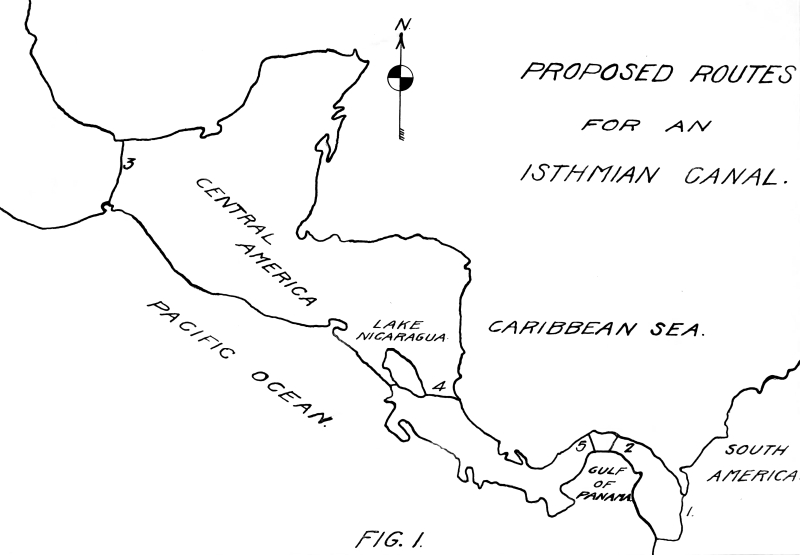
The Panama route as a line of transit was first established between
the years 1517 and 1520. The first settlement on the site of old Panama, six
or seven miles east of the present city, was made in 1517. The Atlantic end,
called Nombre de Dios, was built in 1519. Here Balboa was tried and executed.
It grew rapidly in importance and in 1521 became a city by royal decree.
Even at that early date a road was established across the Isthmus. It,
however, did not enter the city of Panama, but at the Pacific end passed through
a small town called Cruces on the Chagres river about 17 miles distant, and at the
Atlantic end passed through Nombre de Dios. The latter terminus did not prove
satisfactory so the town of Porto Bello was made the Atlantic Port in 1597. This
also was subsequently abandoned. At least part of this road was paved, and
bridges were built over the streams. Even today its course is well defined.
As early as 1534 boats began to pass up and down the Chagres river between
Cruces and its mouth on the Caribbean shore and thence along the coast to
Nombre de Dios, and later to Porto Bello. The commerce thus begun increased
rapidly during the sixteenth century and Panama became a very important commercial
center with a trade extending to the Spice Islands and the Asiatic coast.
It was at the height of its power in 1585 and was called the “toll-gate between
western Europe and Eastern Asia.”
In time this commercial prosperity, which enriched Spain, called the
attention of her rulers and others to the possibility of constructing an interoceanic
ship-canal. Tradition says that Charles V ordered a survey in 1520 to
determine the feasibility of a canal, but that the governor reported such an
undertaking absolutely impossible for any monarch.
From that time the prosperity of Panama increased rapidly. Lines of
trade were established with the west coast of South America and the Pacific ports
of Central America. Its glory came to a sudden end when, on the sixth of February,
1671, it was sacked and burned by Morgan’s buccaneers. A new city, the
present Panama, was founded in 1673, but the old one was never rebuilt.
The project of a canal on this route, because of its romantic and commercial
interest, was kept alive for more than three centuries without definite
action being taken. Finally, in 1876, a French Company was organized at Paris
to make surveys preparatory to building a ship canal across the Isthmus.
Lieutenant L. N. E. Wyse, a French naval officer, had immediate charge
of the work. He obtained a concession, known as the Wyse Concession, from
Colombia giving France the necessary rights for the construction of a canal.
In May, 1879, an international congress was convened in Paris under the
auspices of Ferdinand de Lesseps, to consider the question of the best location
and plan for the canal. This congress, after a two weeks session, decided in
favor of a sea-level canal without locks to be located on the Panama route.
Immediately after this action the Panama Canal Company was organized
under the general laws of France with Ferdinand de Lesseps as its president. The
Wyse concession was purchased by the company, and after two attempts the stock
was successfully floated in December, 1880. Two years were then devoted to surveys
and preliminary work. In the plan first adopted the canal was to be 29.5
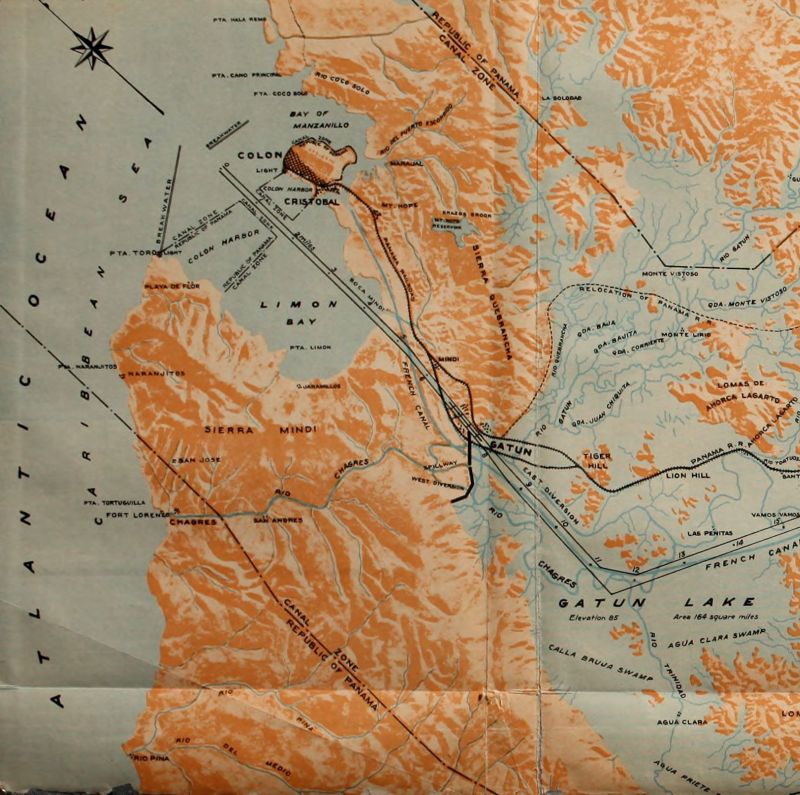
feet deep and 72 feet wide at the bottom. Leaving Colon, the canal passed
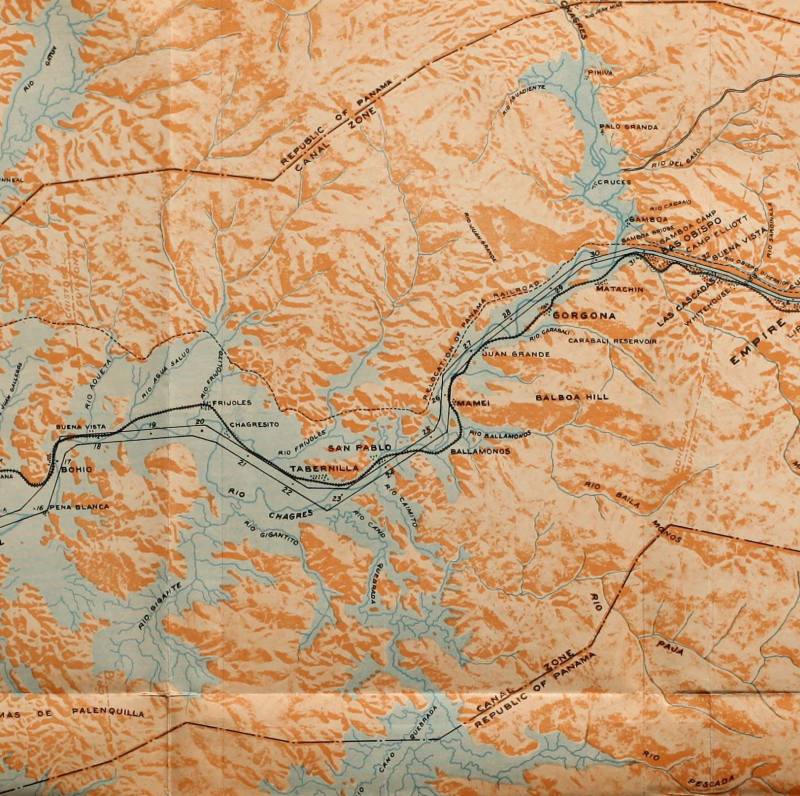
through low ground to the valley of the Chagres river at Gatun; thence through
the valley to Obispo where it left the river and crossed the continental divide
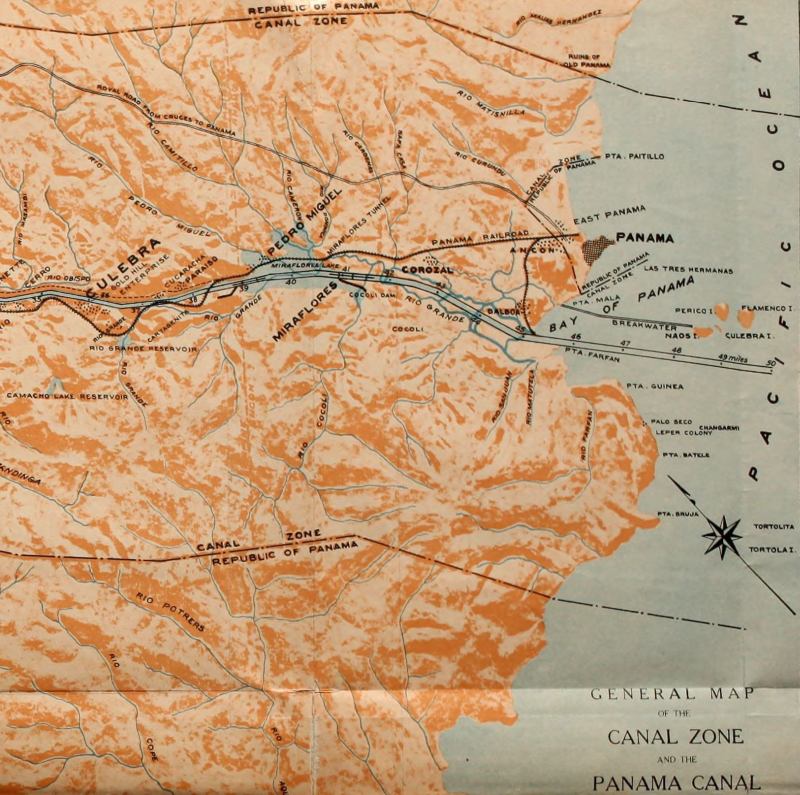
by means of a tunnel and reached the Pacific through the valley of the Rio Grande.
The tides on the Pacific were to be overcome by sloping the bottom of the Pacific
end of the canal. No provision was made for controlling the Chagres.
Early in the eighties a tidal lock near the Pacific was added to the
plan, and various schemes for the control of the Chagres were proposed, the one
most favored being the construction of the dam at Gamboa. The tunnel idea was
soon abandoned.
The French engineers estimated that the excavation would be about
157,000,000 cubic yards, that eight years would be required for completion, and
that the cost would be $127,600,000. Work proceeded continuously until 1887,
when a change to the lock type was made in order to secure the use of the canal
as soon as possible, it being understood that the construction of a sea-level
canal was not to be abandoned but merely deferred until financial conditions
would allow its completion. This new plan placed the summit level above the
Chagres river, and proposed to supply this summit level with water pumped from
that stream. Work went on until 1889 when the company became bankrupt; and on
February 4, a liquidator was appointed to take charge of its affairs. Work was
stopped on May 15, 1889.
The liquidator appointed a commission of eleven engineers to give him
technical advice as to the condition of the work and the best methods for its
completion. Five of these commissioners visited the Isthmus and reported on
May 5, 1890. The report contained plans for the completion of a lock canal and
emphasized the necessity for more complete examinations before beginning work.
This advice was followed by the liquidator who at once took steps for the formation
of a new company, and at the same time continued to take careful observations
on the Isthmus, and these observations have been of great value since then.
The New Panama Canal Company was organized in October, 1894. It proposed
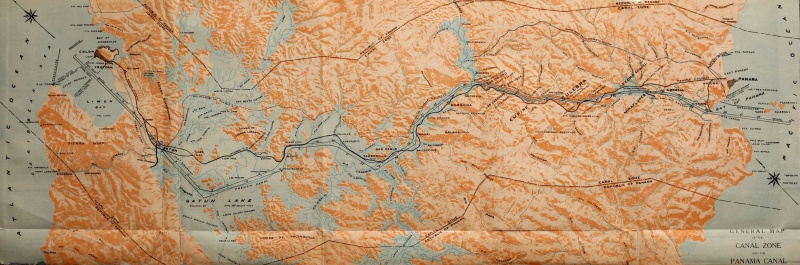
to construct a sea-level canal from the Atlantic as far as Bohio (See Map,
pp 45), where a dam was to form a lake as far as Bas Obispo, the difference in
elevation being overcome by two locks. The summit level extended from Bas
Obispo to Paraiso, and was reached by two more locks and received water from an
artificial reservoir formed by a dam at Alhajuela in the upper Chagres valley.
Four dams were located on the Pacific side, the two middle ones at Pedro Miguel
combined in a flight.
Work continued on this plan up to the time of the Spanish-American War
in 1898. About that time a “Comite Technique”, as it was called, composed of
seven French and seven foreign engineers who had been appointed by the Board of
Directors of the New Company, submitted its final report upon the canal. It was
estimated that, at a cost of $100,000,000 a canal suitable for all commercial
needs could be completed in 10 years.
Had matters continued as before it is probable that the New Canal Company
would have completed the canal as it had planned. But the Spanish-American
War developed wholly new conditions. The trip of the Oregon around Cape Horn
drew the attention of the American people to the importance of an interoceanic
canal. Prior to this time the Board of Directors of the New Company, although
aware that the Maratime Canal Company was actively engaged in securing funds
from the United States Congress for the Nicaragua route, were so confident that
a canal by that route could never seriously compete with their own that they
gave little attention to the efforts of their rival. Now, however, if the newly
awakened popular demand for a canal should induce the American government to
undertake the work, the New Company would face two formidable conditions, namely,
the difficulty of raising funds for the completion of the Panama Canal would be
greatly increased if the parallel route were supported by the United States and
the question of labor would become greatly complicated.
Knowing that the favorable conditions created by the French at Panama
were unknown in the United States and certain that if known the United States
would assist rather than retard the work the Board of Directors, on December 2,
1898, sent a complete copy of the report of the “Comite Technique” to President
McKinley and offered to explain the exact conditions to any body of men appointed
for the purpose. This offer came at the proper time since Congress was then
ready to pass a bill to aid the Maratime Company in the construction of a canal
on the Nicaragua route. On February 27, 1899 the representatives of the New
Company were granted a hearing in the House of Representatives. They presented
a technical exhibit, and stated that their company was authorized to reincorporate
as an American company under American laws. So ably did they present their
case that ultimately on March 3, 1899, by act of Congress a commission, known as
the “Isthmian Canal Commission” was appointed by the President to determine the
“most practicable and feasible route for an Isthmian canal, with the cost of constructing
the same and placing it under the control, management, and ownership
of the United States.”
The original intention of the New Panama Canal Company in bringing the
subject before the United States was not to sell its rights on the Isthmus but to
reincorporate and receive the support of American wealth. However, it was evident
that the United States desired absolute control, and accordingly the consent
of Colombia to a transfer was obtained and the Company prepared a classified list
of its properties which it placed before the Isthmian Canal Commission on October
2, 1901 with the statement that the sums given were not to be considered as final
but were merely presented as a basis for discussion. The Commission, however,
refused to take this view of the matter and persisted in considering the prices
offered as constituting, when summed up, a definite lump sum for which the Company
would sell its property. This lump sum was $109,141,500. The Commission’s
valuation was $40,000,000. Consequently when the Commission made its final report
it closed with these words, “Having in view the terms offered by the New
Panama Canal Company this Commission is of the opinion that the most practicable
and feasible route for an Isthmian Canal to be under the control, management,
and ownership of the United States is that known as the Nicaragua route.”
When the French Company heard this report it immediately offered to
sell its property for $40,000,000. Accordingly the Commission made a supplementary
report on January 18, 1902 stating that “After considering the changed
conditions that now exist, the Commission is of the opinion that the most practicable
and feasible route for an Isthmian canal to be under the control, management,
and ownership of the United States is that known as the Panama route.”
Thus it came about that the United States was authorized to obtain permanent
possession of the concessions and properties of the New Panama Canal Company
at a very low price.
Congress meanwhile had not waited for the report of the Commission but
had passed a bill known as the Hepburn Bill, authorizing the President to acquire
the right to construct a canal at Nicaragua and to begin the actual construction.
Ten million dollars were appropriated and contracts for material and work to the
sum of $140,000,000 authorized. Many discussions arose in the Senate; and a
strong feeling in favor of the Panama route became apparent. Senator Hanna was
especially active. He sent letters to eighty shipowners, shipmasters, officers
and pilots, in which he enclosed a description of the two routes and a list of
questions intended to bring out their relative merits from a practical viewpoint.
Their answers were all in favor of the Panama route. As a result of the long
debate a bill was passed June 26, 1902 with the President’s approval. In effect
it was as follows. The President is authorized to acquire for the sum of
$40,000,000 or less the rights and property of the New Panama Canal Company, and
by treaty with Colombia, the perpetual control of the strip of territory necessary
for operating the canal and is then instructed to proceed and complete the work
under an Isthmian Canal Commission of seven members to be appointed by him. One
hundred and forty-five million dollars was pledged for this purpose.
The Hay-Herran treaty with Colombia was signed January 22, 1902, but
failed of ratification by Colombia. In November, 1903, however, there was a
successful revolution upon the Isthmus and a republican form of government was
adopted. The Hay-Bunan-Varilla treaty was thereupon made on November 18, 1903.
It was ratified by both governments on February 26, 1904. It gave the United
States control of a strip of land ten miles wide, five on each side of the canal.
Since then the work has proceeded under the complete control and supervision
of the United States. The President, whose duty it was to provide for
the government of the Canal Zone, put that as well as the engineering into the
hands of the Commission of seven members which he had appointed. It has remained
there. The office of chief engineer has been held by three men, J. F.
Wallace, J. F. Stevens and G. W. Goethals, the first two of whom resigned.
The question of a sea-level canal was again agitated and became so insistent
that the President appointed an international board of engineers, consisting
of thirteen members, to assemble in Washington September 1, 1905 to consider
the various plans for the construction of the canal submitted to it. The
board consisted of five foreign and five United States engineers, three of the
latter having formerly served on the canal commission. The Board visited the
Isthmus on September 28, had some examinations made for its enlightenment and in
November submitted a majority report signed by the five foreign engineers and the
three former members of the commission, and a minority report, the former advocating
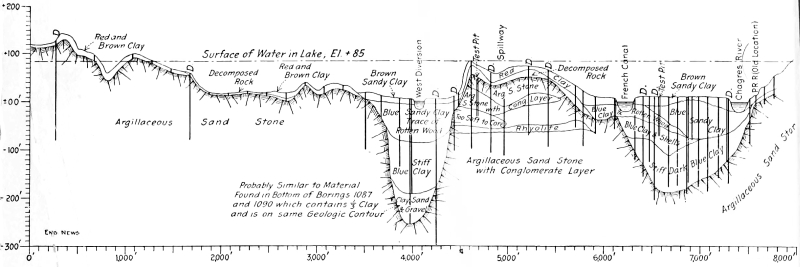
a sea-level canal and the latter a lock canal with the summit level 85’
above the sea. The Isthmian Canal Commission with but one dissenting voice
recommended the adoption of the lock type proposed by the minority.
On June 29, 1906 Congress in opposition to the majority report of the
engineers, provided that the 85-foot lock type of canal be constructed across
the Isthmus; and work has since continued on that plan. This final decision,
however, was made with reluctance by many congressmen and some of them are regretting
it today.
This Congress also decided that all materials used in building the
canal should be purchased in the United States.
Early in 1909 a special body of engineers appointed by the President
accompanied W. H. Taft on an inspection trip to Panama particularly with a view
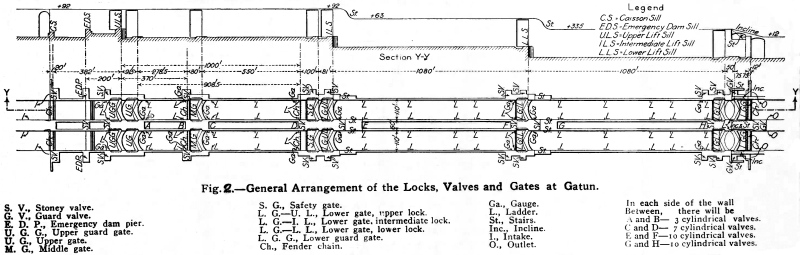
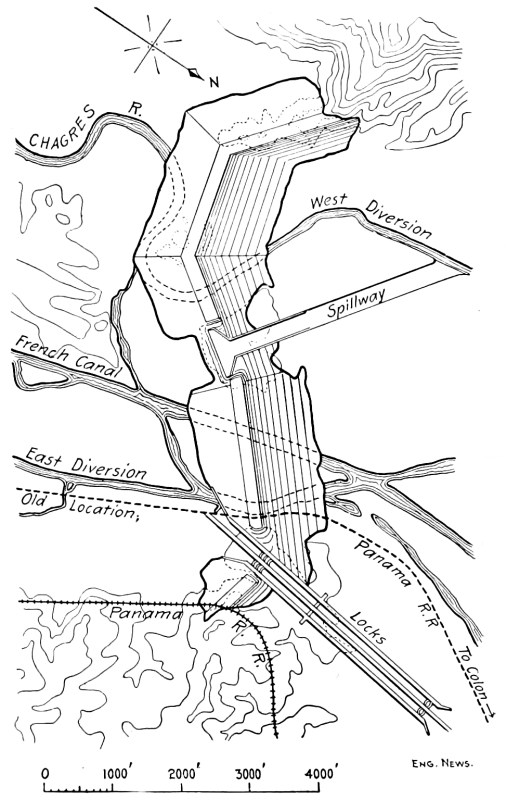
to determining the feasibility of the Gatun dam project. In a report made
February 16 they unanimously approved the plans for the various changes in the
original project made by the engineer. This included the widening of the locks
to 110 feet and constructing the Pacific dams at Miraflores instead of at La
Boca.