Of all subjects now occupying the attention of the world
at large, and of importance not only to the State of California,
but to all the territory west of the Rocky mountains
and the islands and coasts of the Pacific Ocean, over which
the American flag floats in sovereignty, none is paramount
to the construction of the Panama Canal. The completion
of the canal, while a world event, will, of course, be of
peculiar significance and importance to that portion of the
globe which borders on the Pacific Ocean. Countries,
islands, coasts and States that for centuries have been
isolated and far distant by water routes from the centers
of population of Europe and Eastern United States, will
be brought thousands of miles nearer to, and consequently,
into more intimate social, industrial and business relations
with the more highly organized governments of Europe and
America.
In effect, the opening of the canal in 1915 to the commerce
and trade of the world will be the realization of the
dream of Columbus, who sailed across the Atlantic in 1492
to discover a shorter water route between Europe and Asia,
and the fulfillment of the prophecy of Baron von Humboldt,
who, between the years of 1799 and 1805, explored and surveyed
a great portion of Central and South America. Humboldt,
as a result of his explorations, predicted that within
a reasonable period of time the two largest oceans of the
world, the Atlantic and the Pacific, would be united by an
artificial water-way. This water-way, in his opinion, as expressed
in a letter to his friend, the German poet Goethe,
would be constructed by the little republic at the north, the
United States, even then beginning to take an important
place among the powers of the world.
In 1867, the energy and foresight of Seward acquired
Alaska as an addition to American territory; and though
Seward was laughed at and reviled as a foolish dreamer
because of his purchase of a so-called iceberg and a fog-bank,
nevertheless, that able statesman and diplomat pointed
out to the people of the United States that some day the
Pacific Ocean must become the world’s greatest sea of
commerce and trade, and that in that day Alaska would become
one of the most valuable possessions of the American
nation.
Those dreams and prophecies today are reaching their
culmination and fulfillment in the opening of the Panama
Canal, which will be celebrated in San Francisco,—yes, not
only in San Francisco, but throughout all California and the
sister States of the western coast—by the greatest international
exposition ever conducted in the history of civilization.
It will be a jubilee celebration in which all the
States and principalities, nations and empires of the world
will join in proud and thankful participation.
The idea of constructing an artificial water-way between
the Caribbean Sea and the Gulf of Panama is as old as the
discovery of America. Christopher Columbus, in early life,
became converted to the idea that the world was round,
and his studies led him to believe that by sailing in a direct
course and sailing far enough, he could circumnavigate the
globe and come back to the point from which he started,
provided he could keep on that straight course. This belief
naturally led him to the conclusion that by sailing
westward from Spain, across the Atlantic, he could reach
the coasts and the islands of Asia, which about that time
were coming into great prominence as a desired market
for the exchange of the wares of the producers and the
manufacturers of Europe.
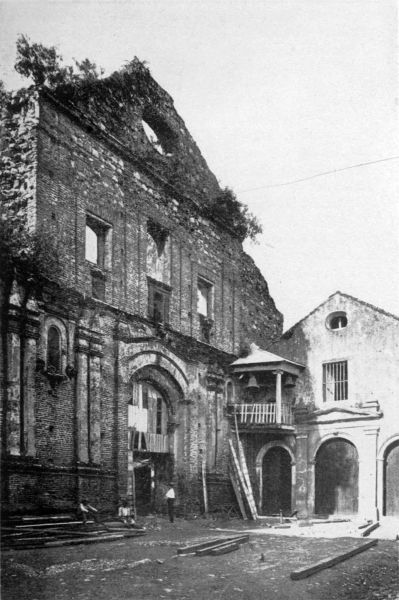
RUINS OF SANTA DOMINIE CHURCH, PANAMA.
The only mistake made by Columbus was that he estimated
the circumference of the world at about 8,000 miles,
instead of over 24,000. Following his theory, Columbus
embarked on his first and greatest voyage, and was successful,
as we know, in discovering one of the islands of the
West Indies. Columbus made four voyages in all to the
newly discovered land, but it is doubtful as to whether
or not he ever reached the mainland of America. One of
his historians claims that on his last voyage he landed upon
the coast of Honduras in Central America, and on the land
now known as Venezuela, farther toward the south. This
fact is of little importance to us at this time. We do know,
however, that Columbus died in ignorance of the fact that
he had discovered a great continent instead of some of the
islands of the East Indies.
Immediately following the death of Columbus, his enterprising
lieutenants, men like Vespucci, Ojeda, Balboa, and
others of equal prominence, pushed their explorations
farther westward, and Balboa, the boldest of the Spanish
conquistadores, fitted out an expedition in Hispaniola,
which island was then the base of operations of Spanish
exploration and conquest, and sailed across the narrow sea
to the coast of that portion of Central America we now
call Panama.
Balboa established a rendezvous and base of supplies
and operations on the coast, and thence continued his
journey inland, and on the 23rd of September, 1513, surmounted
the heights of Darien, and from that eminence beheld
the expansive stretches of watery waste known today
as the Pacific Ocean. Balboa, continuing his explorations
along the coasts of Panama, soon discovered that the land
was not an island, but a continent, and becoming acquainted
with the Indians who inhabited the country, he learned
that there were two large bodies connected by a smaller
body.
Balboa understood this statement to mean two large
bodies of water connected by a smaller body of water, and
therefore, naturally came to the conclusion that the Indians
meant that the Pacific and the Atlantic Oceans were connected
at some point or other along the isthmus by a natural
water-way. What the Indians really meant was that there
were two large bodies of land, to the north and south, and
that these large bodies were connected by a long, narrow
strip of land, part of which he was then exploring.
The Spaniards, naturally eager to extend their explorations
into the great western ocean, began to search for the
connecting water-way, and this quest was continued by
them for nearly half a century; but they finally realized
that the two great oceans of the world were separated by
the impassable barrier of a continuous chain of mountainous
land. The conquerer of Mexico, Cortez, after finishing
the subjugation of the Indians of that part of the Spanish
possessions, in 1526, was commanded by the King of Spain
to proceed to the Isthmus and to assist in the search for
the secret water-way.
Cortez answered the command of the King by saying
that if he could not find the natural water-way he would
proceed to make one. The brave old soldier, all his life
trained in the habit of surmounting great difficulties, declared
that if there were obstacles and mountains, there
were also men with brains and hands, and that if he could
not find the water-way as commanded by the King, he
would carry out the order by constructing a canal to connect
the two oceans. And so, the idea of Columbus being
to find a short water-route between Europe and the East
Indies and coasts of Asia, by the completion of the Panama
Canal, the United States is carrying out the original purpose
of efforts of the discoverer of America and the orders
of the King of Spain to Cortez, to make an artificial water-way
which will shorten the lines of trade and commerce
around the globe.
Between those early days and the present time every
great maritime nation of the world has been interested in
isthmian canal construction—Spain, Portugal, Holland, Germany,
France, Great Britain and Italy have all, at one time
or another in the intervening years, considered the advisability
and feasibility of constructing a canal somewhere
across the narrow territory between the Atlantic and Pacific.
In all, nine routes have been surveyed or considered by
some nation or some company. The first route to the north
is known as the Tehuantepec route, which extends across
Mexico from the Gulf of Mexico to the Pacific Ocean, a
distance of nearly 200 miles, and over which route an English
syndicate, headed by the Pearsons, is now operating
a splendid railroad system. Captain Eads, one of the most
prominent of American engineers of his time, advocated
the building of a ship railway over this route, a railway
so constructed that cars could be let down into the water
under the bottoms of ships, drawing them out of the water
and across the land to the ocean on the other side.
Of course, this project might have been feasible with the
smaller sized merchant ships of forty years ago, but it
would hardly be so for transporting the gigantic freighters
and passenger vessels that now traverse the seas.
The second route, towards the south, was called the
Honduras Bay route, a route across the Republic of Honduras
from Honduras Bay on the east to the Pacific.
The third route came to be known as the Nicaraguan
route. For a long time this was the most popular of all
the routes with the American Congress and the American
people. The Nicaraguan route contemplated the utilization
of the San Juan River on the east, between the Atlantic
Coast and the Nicaraguan lakes, the Nicaraguan lakes as
far as they extended westward, and thence through a canal
across the dividing land from the upper lake to Nicaragua
to the Pacific Ocean at Brita. The Nicaraguan route would
be 377 miles shorter between San Francisco and New York
than is the Panama route, along which the United States
is now constructing a canal.
A fourth route was surveyed between the Chirique Lagoon
on the eastern side to the Pacific Ocean.
Three routes across the Isthmus of Panama have been
surveyed and considered—two besides the one which the
United States is now utilizing; and farther south two possible
canal routes have been surveyed across the territory
of Colombia. The two southern routes would use the Atrato
River as a part of their course, and from that river
across to the separating lands an excavation would be required.
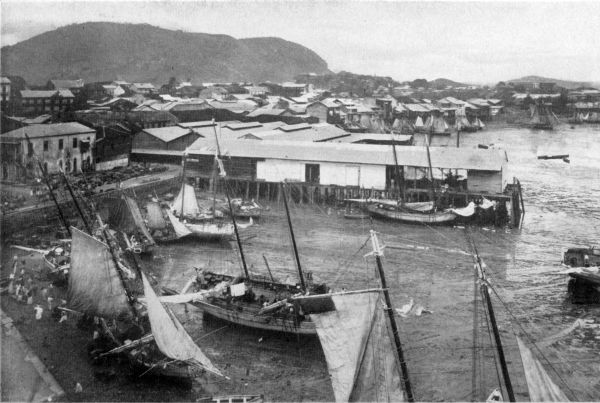
WATER FRONT, PANAMA.
Of these nine routes only three have been seriously
contemplated by the engineers of the various governments
and companies who have examined them. The three are
the Tehuantepec, the Nicaraguan, and the Panama Canal
route.
In the year 1800 all South American territory, with the
exception of Brazil and a few colonies, was under the
sovereignty of Spain, but about the year 1811 a series of
revolutions broke out in various parts of Central and South
America, having for their object the establishment of independent
republics, and by 1823 all Central and South
American countries had achieved independence. The province
of Panama secured her independence in the year 1823,
maintained that independence for a short time and then
merged with the Republic of New Granada.
Panama remained a part of New Granada for several
years, and then became a part of the New Granadan and
Colombian confederacy, and continued to be a part of that
confederacy through various vicissitudes of fortune and
misfortune arising out of revolutions and war until November
3, 1903, when she seceded from the Colombian confederacy,
hoisted her old flag, and resumed her ancient nationality.
In 1825, the South and Central American Republics, desiring
to bring themselves into closer relations and sympathy
so that trade and commerce and industry might be
better developed, conceived the idea of holding a convention
in the City of Panama, in the year 1826. The United States
Government was invited to participate and take a prominent
part in that convention, and in order to induce the President
of the United States to send his representatives, the subject
of canal construction across the Isthmus was to be one
of the most prominent subjects considered.
Henry Clay, the Secretary of State of the United States
at that time, was at first very eager to participate in the
Pan-American convention, but was prevented by objections
of the President from sending representatives to Panama.
However, he sent a note of felicitation and encouragement
and promised the support of the United States in any mutual
project that would be to the advantage of all the countries,
and particularly pledged that support to any feasible
project of canal construction. This was the first official
interest taken by the United States in the construction of
an Isthmian Canal.
Like nearly all conventions, the one that was held in
Panama in 1826 met and resoluted a great deal and indulged
in much oratory, but adjourned without accomplishing
very much of practical value. However, a congress
composed of representatives of several of the South and
Central American States authorized the construction of
an Isthmian Canal, and actually went so far as to enter
into negotiations with a prominent engineer for the purpose
of having one constructed, at some point to be decided upon
later; but owing to revolutions and disorders soon after
developing, plans for the project were for the time abandoned.
In 1837 the Congress of the United States authorized
canal surveys to be made and a commission was appointed
for the purpose of surveying and exploring the Central
American country so that data might be secured that would
give the American Congress information as to the practicability
of the different routes that might be utilized. From
that time on, until today, the subject of Panama Canal construction
has been almost constantly before the American
Congress.
Of course, action in that body was more or less sporadic.
The subject would be taken up from time to time when
some pressing need for quicker and cheaper transportation
to the Pacific Coast made itself apparent.
In 1846 the United States entered into war with Mexico,
which engaged the energies of the nation for the time
being and canal legislation was forgotten. After the war
with Mexico came the discovery of gold in California, and
the rush of the argonauts to the Golden State made it
necessary that quicker and cheaper routes be established
than those around Cape Horn by water, or the long trail
over the plains and mountains to the Pacific Slope. A company
was organized in New York which established a line
of transportation by means of steamers from New York
to Greytown, thence through the San Juan River to the
lakes of Nicaragua, and thence by the stage lines to the
Pacific Coast, where again vessels were taken for San
Francisco Bay and for the coasts of Oregon and Puget
Sound.
About the same time a railway company was formed in
the United States which secured a concession from the Republic
of Colombia for the purpose of constructing the railway
system across the Isthmus, which is now known as the
Panama Railroad. This railroad was completed in 1856,
and this addition to the means of transportation to the
Pacific Coast again indefinitely postponed the necessity
for canal construction.
In 1861 the United States drifted into the Civil War,
and once more the subject of canal construction was forgotten.
After the close of the Civil War the transcontinental
railroads, headed by the Union and Central Pacific
Companies, pushed their lines westward until they reached
the Pacific Coast, and as soon as the first railroad had
crossed the continent active opposition to canal construction
began to show itself in the American Congress.
The transcontinental railroads, fearing opposition in
transportation, from that day until the Spooner bill was
passed, June 28, 1902, maintained an active lobby at
Washington, and whenever canal legislation was suggested,
having for its object the construction of an Isthmian Canal
at any point, this railroad opposition manifested itself in
every form, and no doubt canal construction by the United
States was postponed for many years by that agency.
However, in 1889, Congress authorized the incorporation
of a company known as the Maritime Canal Company
of the United States, and under that authority Hiram Hitchcock,
of New York, as president, together with Warner
Miller and several other capitalists, proceeded to raise about
six million dollars, which was actually used in obtaining
franchises and concessions from Costa Rica and Nicaragua
for a canal route through these countries. Some money
was also spent in doing necessary preliminary work.
The Maritime Canal Company was a favorite in the
United States for a great many years, principally because
it was championed by Senator J. T. Morgan, of Alabama.
Senator Morgan made this the dearest project of his later
life, and no doubt his last years of public service were embittered
by his failure to secure Government co-operation
for the building of the canal through Nicaraguan territory.
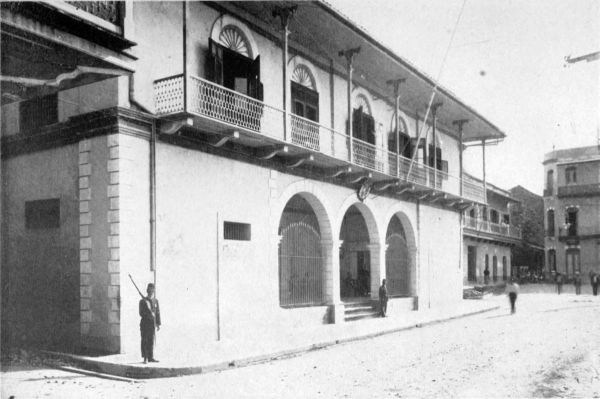
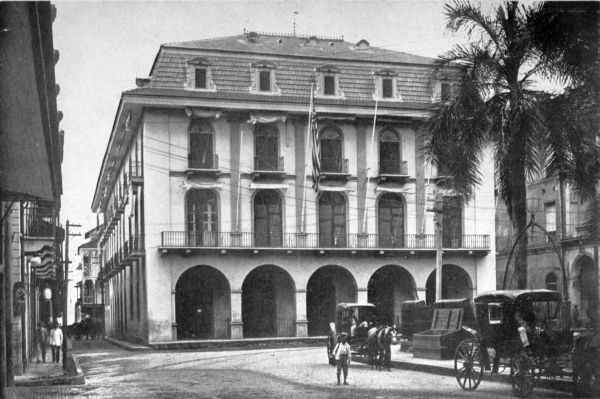
PRESIDENT AMADOR’S RESIDENCE, PANAMA.
In the meantime Count Ferdinand de Lesseps, the brilliant
and successful French engineer, having completed the
Suez Canal, turned his attention to the Isthmian country.
After a thorough investigation of all the possible routes,
through a series of negotiations, he succeeded in securing
a franchise from the Republic of Colombia, giving him
authority to organize a French company and the right to
construct a canal between the little city of Aspinwall (now
known as Colon) on the eastern side, and the City of Panama
on the Western side.
So great was the popularity of de Lesseps that he had
no difficulty in forming a strong company in France. The
stocks offered to the French public were subscribed for
rapidly. The French are a frugal people, and even the
poorest of the French peasants and working men have
always a little hoard of savings. The French people had
such confidence in de Lesseps’ ability to complete successfully
his great American enterprise that the first issue of
his stocks were taken almost at par.
De Lesseps’ plan contemplated the building of a sea-level
canal, 42 miles in length, from shore to shore, 100
feet wide and 28 feet deep. His authority from the Colombian
Government amounted to merely a right to excavate
the canal, the Colombian Government retaining jurisdiction
over the soil and the people. The estimate of the
cost of the type of canal proposed was fixed by the French
company at $120,000,000. The work of construction was
inaugurated on February 1, 1881, with ceremony by the
officers of the French company, and was participated in
by officials of France, Panama and Colombia. But within
a very short time, owing to the magnitude of the scale of
operations, coupled with wasteful business methods, the
first fund of $120,000,000 was expended.
The company put out a second issue of stock which they
offered to the people of France as the first issue had been
offered. This second issue was taken up as the first had
been, but with some suspicion on the part of the buyers.
The second issue sold at a considerable discount; still they
found purchasers, and again the coffers of the company
were supplied with cash.
But the wastefulness and extravagance of the company
continuing, the proceeds from the second issue of stock
were soon exhausted and a third issue was offered. The
sale of the third issue was made with a great deal of difficulty,
and premiums were given to prominent men of influence
or authority, or any line of business, providing they
would use that influence in the marketing of the company’s
shares. So flagrant did these irregularities become that
they culminated in criminal prosecutions.
The sum total of the capital stock subscribed to by the
buyers of the French Panama Company’s shares was $393,505,100.
This great volume of stock sold to the purchasers
produced for the company only $201,546,740, the difference
of $191,958,360 being lost in discounts and premiums paid
in marketing the stock.
This appalling exhibition of criminal wastefulness and
unlawful business methods caused the utter collapse of confidence
in the success of the enterprise, not only of the investing
public of France, but of the world as well, and hastened
the time when such methods must reach their logical
conclusion in bankruptcy. The old timers on the Isthmus
will tell the inquirer that of the enormous sum of money
raised by the French Canal Company, one-third was wasted,
one-third grafted and one-third probably used in actual
work.
It seemed as if anyone who had any sort of influence
might sell that influence to the Panama company for some
kind of a consideration. On the Isthmus today they will
show you a storehouse containing about half a ship’s cargo
of snow shovels which a manufacturing company in France
succeeded in selling to the French Panama Company, no
doubt in return for the influence they might be able to give
in assisting in the sale of the French Panama Company’s
stocks. Of course, one can easily see the ridiculous side
of the purchase of half a cargo of snow shovels to be used
in the tropics.
Practical bankruptcy came in the year 1889, and from
that time on the French Canal Company simply held its
franchise and concessions from the Republic of Colombia
for speculative purposes only. Then the officers of the
French company, seeing that the United States Congress
was beginning to take a lively interest in canal construction,
and was showing signs of a disposition to pass legislation
that would commit the United States as a Nation to the
building of a canal, began to look toward the United States
as a prospective customer for their uncompleted canal project
at Panama. In the meantime the Nicaraguan company
had gone upon the rocks of bankruptcy, and they, too, were
offering their concessions and franchises to the American
Government. And so with these two propositions before
Congress, time drifted on to the opening of the war between
our country and Spain.
When the Spanish war was declared, it was reported in
the United States that a Spanish fleet was cruising in
Asiatic waters. Of course, it was not known how strong
that fleet might be. There was no way of knowing whether
or not it would be able to cross the Pacific and take San
Francisco or some of the other cities or ports of the western
coast of the United States. So the Secretary of the Navy
ordered the crack battleship of the navy, the “Oregon,” to
maintain her station in San Francisco Bay with steam up,
prepared to go into action at any moment.
Everyone who lived around the Bay of San Francisco
in those days remembers what relief the news in the papers
brought on a bright May morning that Admiral Dewey, in
response to an order from Secretary J. D. Long had proceeded
to Manila and destroyed the Spanish fleet. This
meant there was no longer any danger of the bombardment
of San Francisco.
There was no longer any necessity for holding the “Oregon”
in Pacific waters, and so quickly followed the order
from the Secretary of the Navy that she should at once
take her departure to the coasts of Cuba and join the American
squadron operating there. The citizens of San Francisco
swarmed the hilltops to see the departure of their favorite
battleship. She sailed majestically out through the
Golden Gate and turned her prow southward. The patriotic
hearts of the men and women of California followed her
course as they read each morning in the newspapers the
description of her successful voyage down the western
coasts of Mexico and Central America, on past Panama
and along the coasts of South America, through the Straits
of Magellan, then to the northward to her station on the
coast of Cuba. But they noted that this voyage consumed
sixty-five days of time.
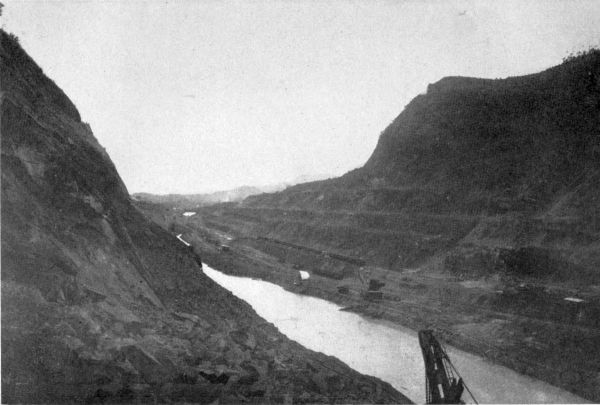
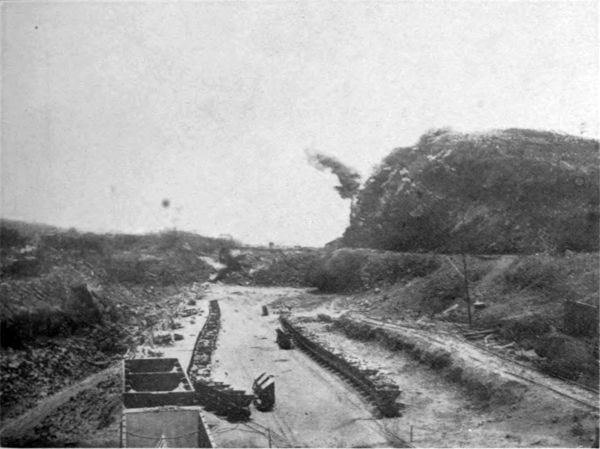
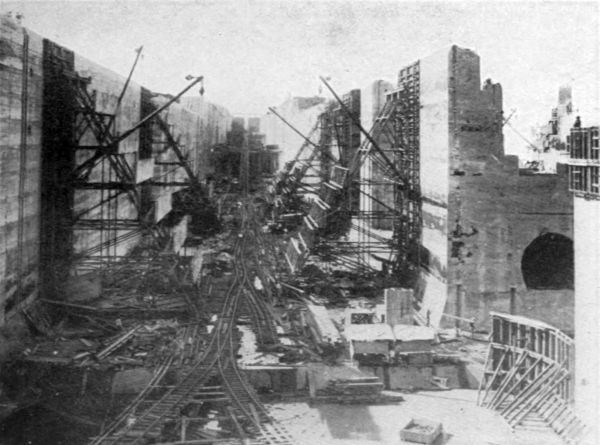
THE CULEBRA CUT, LOOKING NORTH.
Then the President, the American Congress, and the
American people awoke to the fact that if the safety of the
cities of the seaboards of the Atlantic and the Pacific depended
upon naval protection, and that if such a long
voyage would have to be taken by ships stationed upon the
opposite coast, it might mean the destruction of incalculable
wealth.
The entire Nation began to realize that if the “Oregon”
could have sailed from San Francisco to Panama and passed
through the isthmus by means of a canal such as we
are now constructing, she could have made the voyage from
San Francisco to the coasts of Cuba, consuming three days
at Colon or Panama to take on stores and ammunition, and
still could have been at her station on the coasts of Cuba in
sixteen days’ time. The people of the country began to
realize that the difference between sixteen and sixty-five
days might mean the safety of the Nation, and especially so
if we were at war with a maritime power such as Great
Britain, Germany and Japan.
This startling demonstration of the absolute necessity
for a Panama Canal from the standpoint of American
national safety, at once swept aside all opposition at Washington
to canal construction. Immediately a universal
wave of sentiment in favor of a national American Isthmian
Canal swept over the land and found its expression in instructions
by every constituency in the Union to Congressmen
and to Senators to do all in their power to assist in
bringing canal legislation to a successful termination.
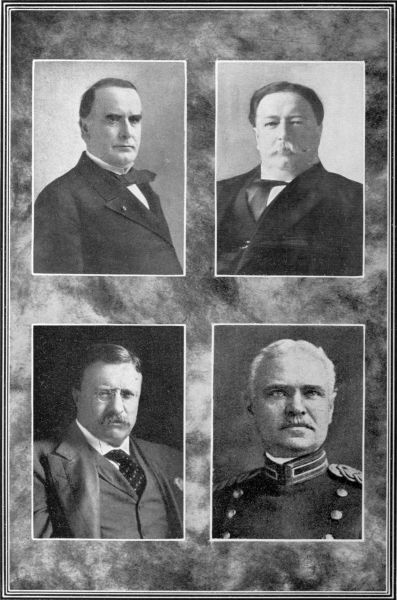
Immediately thereafter President William McKinley
was authorized by Congress to send a commission to Panama
and Nicaragua to examine those two routes and to
receive offers from the different companies as to the
amounts the different projects could be purchased for.
The result of the investigations of the commission was
that the Panamanian Company offered their uncompleted
canal, their franchises, their plans and specifications, the
Panama Railroad, which was worth about $12,000,000, and
a line of steamships from Colon to New York, consisting
of five medium-sized steel vessels of modern construction,
for the sum of $110,000,000. The Nicaraguan Company
offered their concessions from Costa Rica and Nicaragua,
in addition to all their other property, for $6,000,000. They
simply desired to be reimbursed for the amounts spent in
securing their concessions and making their preliminary
surveys.
After careful consideration the commission recommended
the purchase of the Nicaraguan proposition. It was at
this critical state of the negotiations that President McKinley
was removed by the bloody hand of the assassin, and
as a result Vice-President Roosevelt took his place as the
head of the American Government. President Roosevelt decided
on the Nicaraguan proposition; but before the matter
was closed the French Panama Company came fully to the
realization that if the United States purchased the concessions
of the Maritime Canal Company and began the construction
of a canal through the Nicaraguan territory, without
any question that project would be completed in a
reasonably short space of time, as it would have the power
of the entire American Government behind it.
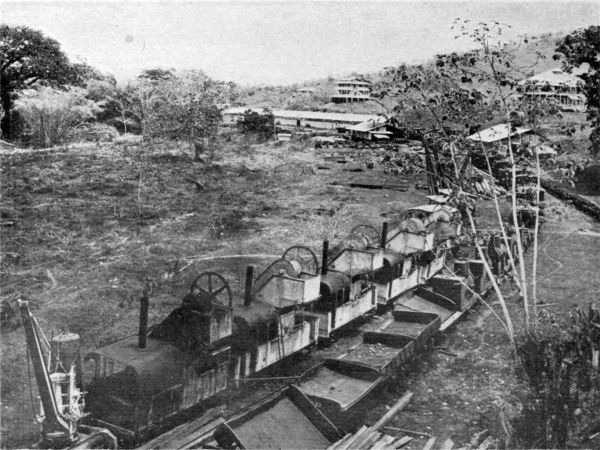
BONEYARD OF THE OLD FRENCH MACHINERY.
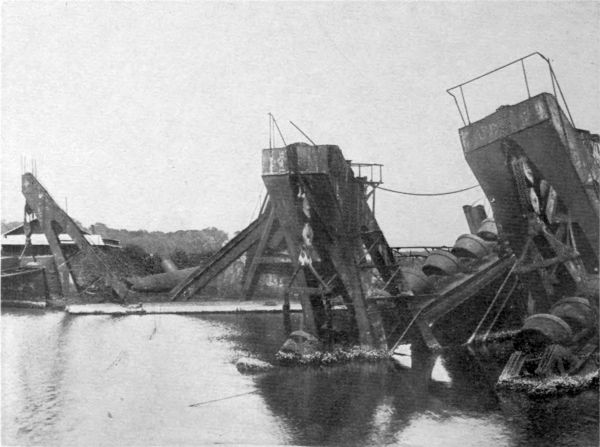
BONEYARD OF THE OLD FRENCH MACHINERY.
They also realized that if the Nicaragua Canal was constructed
it would probably make their holdings in Panama
of far less value; and as they were practically bankrupt then,
they begged an opportunity to submit a lower price for
their property. This opportunity was granted, and the
result was that the French company offered their franchises
and holdings, including the railroad and the steamship line,
for the sum of $40,000,000.
This amount was so much lower than the amount originally
demanded that it caused a reconsideration by the
President and Congress, which terminated in the decision
of the President and Congress to purchase the rights and
the property of the French Company.
The next step was to ascertain whether or not the
French company could convey a valid title to the United
States, and Attorney-General Knox was instructed to go to
France and consult with the proper French authorities and
determine if such a legal conveyance could be made. As a
result of his investigations, General Knox on October 30,
1902, decided that the French company could convey an
absolute title to the American Government.
A great nation such as the United States could not contemplate
becoming the tenant of any other country under
the sun, much less a feeble republic of Central America.
The dignity of the United States required absolute sovereignty
over any territory through which the American
Nation might decide to construct an isthmian canal. Absolute
sovereignty over an isthmian canal, however, on the
part of the United States had been waived by the terms of
the Clayton-Bulwer treaty entered into with Great Britain
a half century before. The terms of this treaty provided
that in case either nation should construct an isthmian
canal, such canal should not be fortified nor controlled by
either power; and that should any other nation construct
an isthmian canal, the United States and Great Britain
should join in preserving its neutrality.
Before the United States could exercise absolute sovereignty
over any strip of territory across the isthmus, the
Clayton-Bulwer treaty would have to be abrogated, and to
accomplish this Secretary of State Hay entered into negotiations
with Great Britain. He found the representatives
of that country very willing to meet every reasonable demand.
After a short series of negotiations he succeeded
in having passed and ratified by both countries the Hay-Pauncefote
treaty. Under the terms of this treaty Great
Britain waived all claims to sovereignty and control over an
Isthmian Canal, and substantially agreed to the jurisdiction
and control of the United States over any canal that might
be constructed by that country.
When this obstacle was removed the next step was to
secure a canal zone, and the United States entered into
negotiations with the Government of Colombia with
that end in view. The result of the negotiations
was that an agreement was reached by which the Republic
of Colombia agreed to convey to the United States a
strip of land thirty miles wide and extending a marine
league into the waters on either side of the isthmus. The
terms of the treaty were that the United States, in consideration
of the zone proposed to be transferred, should pay to
the Republic of Colombia ten million dollars in cash on the
ratification of the treaty by the separate governments, and
commencing nine years from the date of ratification, the
sum of one hundred thousand dollars a year for all time.
This tentative treaty found great favor in Washington, D.
C., and was immediately ratified by the American Senate,
and then sent back to Bogota for ratification by the Colombian
authorities. But much to the astonishment and chagrin
of the people of the United States, and to the extreme disappointment
of the people and the authorities of Panama,
this so-called Hay-Herran treaty was refused ratification by
the Colombian Senate.
The refusal of this ratification ultimately led to the secession
of Panama from its allegiance to the Republic of Colombia
and the acquirement of independence.
While on the Canal Zone in 1907 on an official visit I
came into close contact with the officials of Panama, particularly
President Amador, the first President of the Panama
Republic, and General Arrias, who held the combined
offices of Secretary of State and War for the new republic.
At a dinner given by the American Minister, being placed
beside General Arrias, I took occasion to inquire of him
the reasons why the Hay-Herran treaty was refused ratification
by the Senate of Colombia, after it had been tentatively
agreed to by the Colombian authorities.
General Arrias’ explanation was to the effect that there
were four reasons why the Hay-Herran treaty was refused
ratification on its return to the Colombian Senate. The
first was that the German influence was strong in Colombia,
and the German merchants and diplomats were very much
opposed to the extension of American influence down the
west coast of South America, particularly in the Colombian
Republic. The German merchants, seeing the collapse of
the French Canal Company near at hand, hoped that a
German company might purchase the wreck of the French
enterprise and carry the canal to completion, realizing that
this course would mean much in the way of German aggrandizement.
The second influence, according to General Arrias, was
that of the old transcontinental railroad management of the
United States. Popular demand for an isthmian canal having
swept away all obstruction at Washington, D. C., the
scene of operations was shifted to Bogota, and railroad influence
and railroad money were probably used to induce
some of the Senators to refuse to vote for the ratification
of the treaty.
The third influence was that of patriotism. Some of the
Colombian Senators were opposed to a transfer of any
portion of Colombian soil to a foreign power, more especially
as the Colombian constitution contained a clause
making it treason for any Colombian subject to become a
party to the alienation of any part of Colombian territory to
another country.
The fourth and the most potent influence was the fact
that the French Panama Canal Company had failed in every
respect to keep the terms of their contract with the Colombian
Government. Not only had they failed to complete
the canal at the time specified in their franchise, but having
obtained an extension of that time, had failed to observe
the terms by which the extension had been secured.
Therefore the Colombian Government might very properly
proceed to a forfeiture, which could be obtained through
due process of law in something less than ten months’ time.
Many of the Colombian Senators took the position that
it would be lawful and more expedient to declare a forfeiture
upon the French company, and take over the canal
under the terms of such forfeiture as provided by the franchise.
The Republic of Colombia would then be in a position
to sell the same to the American Government for forty
million dollars, and since then they would secure ten million
dollars for a zone and a perpetual rental of a large sum annually,
the financial condition of the country would be very
much improved. As the finances of the Republic of Colombia
were at that time in a desperately depleted condition,
this prospect of their rehabilitation must have had powerful
effect with many of the Senators.
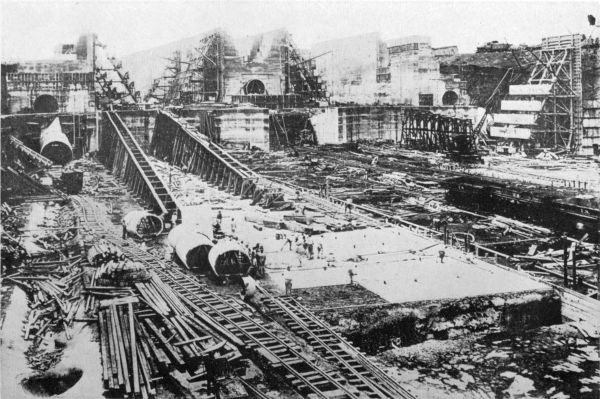
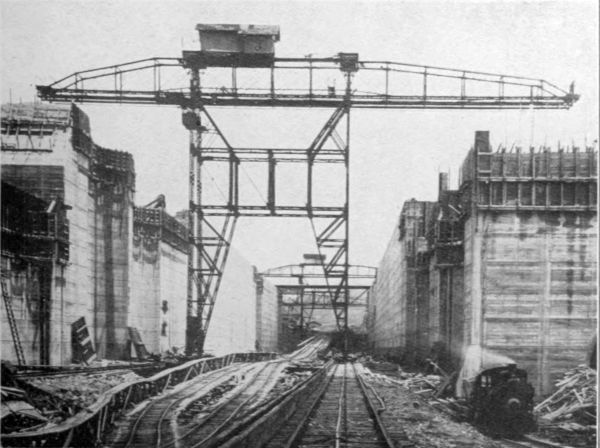
GATUN MIDDLE LOCK, LOOKING SOUTH FROM EAST BANK.
These four reasons operating, no doubt caused the
Colombian Senate to refuse ratification to the Hay-Herran
treaty.
But in Panama the people and the authorities were determined
not to submit to the action of the Colombian
Senate. The Panamanians were aware of the fact that the
President of the United States had been authorized by Congress
to make a choice between either the French Panama
or the Nicaraguan route, and that under that authority he
would at once proceed to close a contract with the Maritime
Canal Company of Nicaragua if he could not secure a canal
zone. They also realized that if once the American Government
began the work of excavating a canal through
Nicaraguan and Costa Rican territory, in all human probability,
the French Panama Company’s project would be
abandoned.
Thus the cities of Colon and Panama, and the territory
surrounding, would be relegated to obscurity so far as
world’s trade was concerned, for many years. This the
Panamanians were determined to prevent if possible, so
they took every step necessary to inaugurate and successfully
carry out a revolution in case of the refusal of the
Colombian Government to ratify the Hay-Herran treaty.
They sent Dr. Varilla as their representative to New York
and instructed him to remain in close touch with the cable,
and should he receive a cablegram that Panama had thrown
off her allegiance to Colombia and had resumed her old-time
independence, he should proceed at once to Washington,
D. C., notify President Roosevelt of the fact, demand
recognition of the new Republic of Panama as an independent
power, and enter at once into negotiations with the
United States for the recognition of that independence and
the transfer of a canal zone.
This program was carried out later on. The Panamanians
had very little trouble in overawing the few Colombian
officers within their territory. They knew that the
Colombian Government had no navy, from the fact that a
year before the Colombian navy had been sent to the City
of Panama to coerce the authorities there who were disputing
with the Colombian Government over some items of
revenue which were an issue; and meeting force with force
the authorities of the City of Panama had succeeded, with
the assistance of a small tug-boat and one piece of cannon,
in sweeping the seas of the entire Colombian naval power,
and as evidence of their success the two masts of the Colombian
navy were sticking up out of the mud-banks of Panama
Bay.
Nor were the inhabitants of Panama or Colon much concerned
as to a possible attack from a Colombian army. That
would entail a long march of hundreds of miles through
morass and jungle, and could not be successfully accomplished
in less than a year’s time. And so the Panamanians
were free to act in their purposes of securing independence
without danger of very much interference from the home
government.
The result of the revolution was very gratifying to the
Panamanians. As soon as they learned that the treaty had
been refused ratification, they immediately wired to Dr.
Varilla at New York. He apparently was at his post waiting
the news, for it was whispered in Washington that he
took the night train from New York, reached Washington
in the morning, and arrived at the White House early in the
forenoon. And from all indications President Roosevelt
must have been waiting just inside the door to receive him,
for it is said that the President was on hand to grasp Dr.
Varilla by the hand and welcome him to the White House,
and that when he came out two hours later, Panama was
virtually recognized as an independent government. Within
a few days a treaty was negotiated between Panama and
the United States.