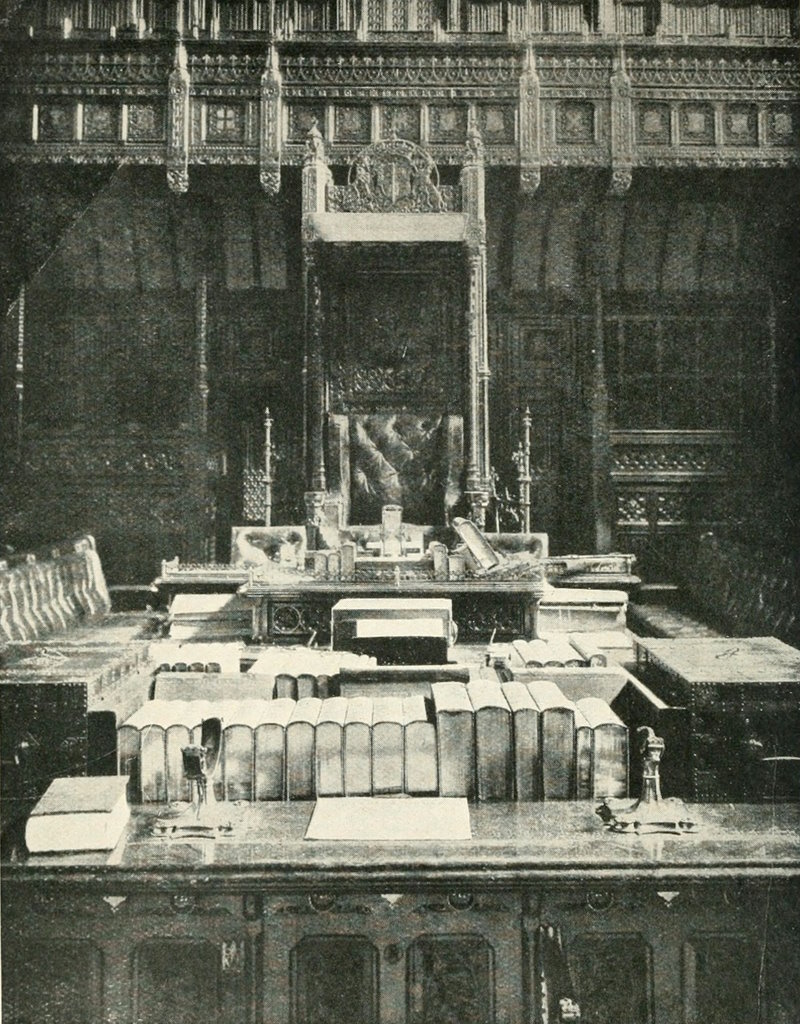
The Speech from the Throne, or, as it is popularly called,
“The King’s Speech,” which at the opening of every session
of Parliament is read to Peers and Commons assembled in
the House of Lords by the Sovereign himself, is always
awaited with considerable interest, and, at times of high
political excitement, with some apprehension not unmingled
with vows of defiance. For in it the legislative programme
of the Government is disclosed. As such it is the text on
which the Opposition develop their attack.
To call the Speech the “King’s Speech” is a polite fiction—aye,
though, should his Majesty be absent, the Lord Chancellor,
before he reads it, is careful to say—following an ancient
custom, which changes in the Constitution have long since
deprived of its old significance—that it is in “his Majesty’s
own words.” The Sovereign has practically little or no
share in its original composition. It is really the Speech
of the Cabinet. But there was a time when the King really
spoke in the Speech. Parliament could not then assemble
until the King thought fit personally to summon it. When it
did meet, the King appointed and declared the business in
his Speech, and Lords and Commons were expected to confine
themselves strictly to the tasks thus prescribed. This
prerogative is still theoretically vested in the Crown. Parliament
can be summoned only by the Sovereign, but since
the Revolution of 1688 the Sovereign in summoning it has
acted on the advice of the Ministers. Parliament cannot
proceed with business until the Speech from the Throne
has been delivered; but since the Revolution, also, neither
House—as we shall see later—is bound to confine itself
to the “causes of summons” set forth in the Speech.
The first draft of the Speech is usually written by the
Prime Minister. What Bills are to be submitted to Parliament
is first decided by the Cabinet, but the general contents
of the Speech, and certainly its phraseology, may be ascribed
to the head of the Government. The draft is submitted
to a full meeting of the Cabinet, where it is discussed point
by point; and probably undergoes some alteration in
the way of an omission here, an addition there, or a qualification
of some particular statement. Then a copy of the
Speech is sent to the King for his approval. In Selections
from the Correspondence of Queen Victoria (published 1907)
there is a memorandum, written by Prince Albert and dated
December 9, 1854, of an interview with Lord Aberdeen,
then Prime Minister, which describes a “scene” in the
Cabinet Council over the preparation of the Speech that
Queen Victoria was to read at the opening of Parliament.
Lord John Russell had to withdraw a scheme of parliamentary
reform at the outbreak of the Crimean War, and now wanted
to bring it on again, greatly to the annoyance of Lord Palmerston,
for the War was not yet over. Prince Albert
writes:
Later, when they came to the passage about Education, Lord
John made an alteration in the draft, adding something about
strengthening the institutions of the country. Lord Palmerston
started up and asked: “Does that mean Reform?” Lord John
answered: “It might or might not.” “Well, then,” said Lord
Palmerston, with a heat of manner which struck the whole Cabinet,
and was hardly justified by the occasion, “I wish it to be understood
that I protest against any direct or indirect attempt to bring forward
the Reform question again!” Lord John, nettled, muttered to himself,
but loud enough to be heard by everybody: “Then I shall bring
forward the Reform Bill at once.”
That the “King’s Speech” is the Speech of the Ministers
has been admitted by reigning Sovereigns even in the
eighteenth century when constitutional monarchy was not
quite firmly established, and, at any rate, when Kings were
disposed to act independently of their advisers. In 1756, a
too enterprising and most audacious bookseller was prosecuted
for publishing a spurious Speech on the eve of the opening
of Parliament. “I hope,” said George II, “the fellow’s
punishment will be light, for I have read both Speeches, the
real and the false, and, so far as I understand them, I like the
printer’s speech better than my own.” The fellow was heavily
fined and sent to Newgate by the Lords and the mock Speech
was burnt by the common hangman in New Palace Yard and
at the Royal Exchange as a “scandalous libel and a high
contempt of his Majesty.” But the King had the fine remitted
and the term of imprisonment curtailed. “Well, Lord
Chancellor,” said George III to Lord Eldon, as he was leaving
the House of Lords after opening Parliament, “did I deliver
the Speech well?” “Very well indeed, sir,” was the reply.
“I’m surprised at that,” said the King, “for there was
nothing in it.” The voice was the voice of the King, but
the words were the words of his Ministers. Still, the King
must surely be allowed some latitude of opinion in regard
to the King’s Speech beyond a formal expression of approval.
The truth is that if he chooses he may suggest alterations,
and insist upon them, no doubt, provided modifications of
policy are not implied. He probably softens an expression
now and then, or adds a gracious sentence. Did not George
III insert in his first Speech the famous words, “Born and
bred in this country, I glory in the name of Briton!” He
was the first English-born King since the Revolution.
George I could not speak a word of English. He and his
Prime Minister, Walpole, discussed affairs of State in bad
Latin. George II publicly proclaimed himself a foreigner
every time he read the Speech to the “Gendlemen of de
Houze of Gommons.” The historic phrase of George III
has been ascribed to the influence of his early friend and
adviser, the Scottish John Stuart, third Earl of Bute, which,
it was said, explained the degradation of the proud name
of “Englishman” into the commonplace “Briton.” But
the King always insisted that the inspiration of the sentence,
as well as its composition, was entirely his own. A story
is told which lends confirmation to his claim. Notwithstanding
the birth and training in which he gloried, he
wrote English ungrammatically and was a bad speller; and
thus “Briton” in the renowned sentence, as written by
the royal hand, was actually misspelt “Britain.” “What
a lustre does it cast upon the name of Briton when you,
sir, are pleased to esteem it among your glories,” said the
House of Lords in their Address thanking the King for his
Speech.
That there have been many cases of dispute between
the Sovereign and his Ministers, in recent years, at least,
as to either the measures set out in the Speech or the phraseology
of its sentences is very unlikely. Only two instances
during the long reign of Queen Victoria have come to
light. In 1859, Austria, struggling to maintain her position
in Italy, was at war with Sardinia, and the intervention of
France on the side of Sardinia was regarded in some circles
in this country as a characteristic act of aggression by the
Emperor, Louis Napoleon. The draft of the proposed Speech
from the Throne submitted to Queen Victoria contained
the following passages:
Receiving assurances of friendship from both the contending
parties, I intend to maintain a strict and impartial neutrality, and
hope, with God’s assistance, to preserve to my people the blessing of
continued peace.
I have, however, deemed it necessary, in the present state of
Europe, with no object of aggression, but for the security of my
dominions, and for the honour of my Crown, to increase my Naval
Forces to an amount exceeding that which has been sanctioned by
Parliament.
The Queen sent to the Premier, Lord Derby, the following
criticism:
Buckingham Palace,
June 1, 1859.
The Queen takes objection to the wording of the two paragraphs
about the war and our armaments. As it stands, it conveys the
impression of a determination on the Queen’s part of maintaining
a neutrality—à tout prix—whatever circumstances may arise which
would do harm abroad, and be inconvenient at home. What the
Queen may express is her wish to remain neutral, and her hope that
circumstances may allow her to do so. The paragraph about the
Navy, as it stands, makes our position still more humble, as it contains
a public apology for arming, and yet betrays fear of our being
attacked by France.
The Queen then suggested two amended forms for these
passages, in which she said she had taken pains to preserve
Lord Derby’s words, as far as was possible, with an avoidance
of the objections before stated:
I continue to receive, at the same time, assurances of friendship
from both contending parties. It being my anxious desire to preserve
to my people the blessing of uninterrupted peace, I trust in God’s
assistance to enable me to maintain a strict and impartial neutrality.
Considering, however, the present state of Europe, and the complications
which a war, carried on by some of the Great Powers, may
produce, I have deemed it necessary, for the security of my dominions
and the honour of my Crown, to increase my Naval Forces to an
amount exceeding that which has been sanctioned by Parliament.
Lord Derby, in his reply, contended that the country
was unanimous in favour of a strictly neutral policy. Its
sympathies were neither with France nor with Austria,
but, were it not for the intervention of France, it would
generally be in favour of Italy. He went on to say that
the Opposition Press were insinuating that the neutrality
of the Government covered wishes and designs in favour
of Austria; and any words in the Speech from the Throne
which should imply a doubt of strict impartiality would
certainly provoke a hostile amendment in the interest of
Sardinia, which might possibly be carried, and in such
circumstances her Majesty would be placed in the painful
position of having to select an Administration pledged against
the interests of Austria and of Germany. He thought the
Queen’s suggested words in regard to the Navy—“complications
which a war carried on by some of the Great Powers
may produce”—would inevitably lead to a demand for an
explanation of the “complications” which the Government
foresaw as likely to lead to war. The Prime Minister went
on to say:
In humbly tendering to your Majesty his most earnest advice that
your Majesty will not insist on the proposed Amendments in his draft
Speech he believes that he may assure your Majesty that he is expressing
the unanimous opinion of his colleagues. Of their sentiments
your Majesty may judge by the fact that in the original draft he had
spoken of your Majesty’s “intention” to preserve peace “so long as
it might be possible”; but by universal concurrence these latter words
were struck out; and the “hope” was, instead of them, substituted
for the “intention.”
In answer to this letter, Queen Victoria wrote that there
was, in fact, no difference between her and Lord Derby.
She had suggested the verbal amendments merely with a
view to indicate the nature of the difficulty as it presented
itself to her. Whatever decision Lord Derby might on
further reflection come to, she was prepared to accept.
In the Speech read by the Queen from the Throne the two
paragraphs were somewhat modified in the sense her Majesty
desired.
Five years later, in 1864, another difference arose between
Queen Victoria and her advisers in regard to statements
in the Speech. Denmark and Germany were at war over
the right to the Duchies of Schleswig and Holstein—obtained
finally by Germany—and the draft of the Speech submitted
to Queen Victoria contained a paragraph plainly, if not
menacingly, expressing the sympathy of England with
Denmark. To this the Queen objected. In her opinion
the best policy for this country was to stand neutral, and
though the stubborn Palmerston, who was then Prime
Minister, was, as usual, disposed to show fight, she finally
had her way. The Speech as read in the House of Lords
declared that—
Her Majesty has been unremitting in her endeavours to bring
about a peaceful settlement of the differences which on this matter
have arisen between Germany and Denmark, and to ward off the
dangers which might follow from a beginning of warfare in the North
of Europe, and her Majesty will continue her efforts in the interest
of peace.
It is not sufficient for the King formally to express
approval of the draft of the Speech submitted to him by his
advisers. He must sign the Speech in the presence of the
Ministers, thus giving them a guarantee of assurance that
he will deliver that particular Speech, and no other, to the
two Houses of Parliament. Consequently, at a meeting of
the “King in Council,” or, in other words, the Privy Council,
at which, however, only Cabinet Ministers are present,
the King endorses the Speech with his signature. When
next his Majesty sees the Speech, a printed copy of it is presented
to him on the Throne of the House of Lords by the
kneeling Lord Chancellor in the presence of the Commons.
The Speech is written in a prescribed form. Each one
bears the closest resemblance outwardly to its predecessors.
It is divided into three sections. The first section, addressed
generally to Members of both Houses, “My Lords and
Gentlemen,” deals exclusively with foreign affairs; then
there is a brief paragraph referring to the Estimates, which
specially concerns “Gentlemen of the House of Commons,”
as the sole custodians and guardians of the public purse (or
“Members of the House of Commons” as the phrase became
when the first female Member, Lady Astor, was elected in
1919); and the third section, which opens again with “My
Lords and Gentlemen,” contains some general remarks
on home affairs, and sets out the legislative programme of
the Session. “I pray,” the Speech usually concludes, “that
Almighty God may continue to guide you in the conduct
of your deliberations, and bless them with success.”
These Speeches possess a double interest, as the literary
compositions and the political manifestoes of the most
eminent statesmen of the Nation. To me it has been a
pleasant occupation dipping into them, here and there, in
the volumes of Hansard and extracting a few notes personal
to the Sovereign, or references to some of the
great political issues of the latter half of the nineteenth
century and the opening decades of the twentieth. There
is a popular supposition that “the King’s Speeches” are
the worst possible models of “the King’s English.” The
condemnation is too sweeping. Unquestionably there are
Speeches with sentences doubtful in grammar, as well as
feeble and pointless. The writing of most of them, however,
is pure and concise. It is possible to trace in them the
characteristic styles and different moods of mind of the
Prime Ministers by whom they were written. Disraeli’s
Speeches stand put as the most ornate. He used more
rhetoric than other Premiers deemed to be necessary or
desirable. In one there is a picture of “the elephants of
Asia carrying the artillery of Europe over the mountains
of Rasselas”; in another the founding of British Columbia
calls up a vision of her Majesty’s dominions in North America
“peopled by an unbroken chain, from the Atlantic to the
Pacific, of a loyal and industrious population of subjects
of the British Crown.” Nothing could be more effective
from an elocutionary point of view. The “Speeches”
of Lord Melbourne trembled at times on the verge of
puerility. Palmerston’s waved the Union Jack in relation
to foreign affairs, and his off-hand “Ha, ha!” was heard
in references to things domestic. Gladstone and Salisbury
drafted “Speeches” equally noted for freshness and strength
of expression. Lloyd George composed the longest and most
comprehensive and possibly the most historic “Speeches”—those
that immediately followed the conclusion of the
World War. They were obviously addressed not so much
to Lords and Commons as to the people at large.
The early age at which I am called to the sovereignty of this Kingdom
renders it a more imperative duty that under Divine Providence
I should place my reliance upon your cordial co-operation, and upon
the loyal affection of all my people. I ascend the Throne with a deep
sense of the responsibility which is imposed upon me; but I am
supported by the consciousness of my own right intentions, and by
my dependence upon the protection of Almighty God.
These are the concluding words of the Speech from the
Throne read by Victoria, the girl-Queen, to her first Parliament,
on November 20, 1837. “Never,” wrote Mrs. Kemble,
“have I heard any spoken words more musical in their
gentle distinctness than the ‘My Lords and Gentlemen’
which broke the breathless stillness of the illustrious assembly,
whose gaze was riveted on that fair flower of Royalty.”
It was a new Parliament, fresh from the country, after the
General Election which, as the law then required, followed
the demise of the Crown owing to the death of William IV.
The scene on that historic occasion in the old House of
Lords was most brilliant. To the right of the young Queen
stood her mother, the Duchess of Kent. On her left was
Viscount Melbourne, the Prime Minister. At the foot of
the Throne were grouped other great officers of State. The
benches were crowded with peers in their robes—amongst
whom Wellington, Brougham, Lyndhurst, were distinguished
figures—and with peeresses in Court plumes and diamonds.
At the Bar were assembled the Commons, Mr. Speaker Abercromby
at their head, and in the throng might be seen such
eminent statesmen and notabilities as Lord John Russell,
Sir Robert Peel, Lord Palmerston, Daniel O’Connell, Stanley
(afterwards Lord Derby), and two young Members, Gladstone,
who already had four years’ experience of Parliament,
and Disraeli, just returned at the General Election for Maidstone,
who were destined to become the two greatest political
protagonists of the nineteenth century. Writing to his
sister on November 21, 1837, Disraeli thus comically describes
how the Commons went to the House of Lords, and
what they saw there:
The rush was terrific; Abercromby himself nearly thrown down
and trampled upon, and his macebearer banging the Members’ heads
with his gorgeous weapon and cracking skulls with impunity. I
was fortunate enough to escape, however, and also to ensure an entry.
It was a magnificent spectacle. The Queen looked admirable; no
feathers, but a diamond tiara. The peers in robes, the peeresses and
the sumptuous groups of courtiers rendered the affair most glittering
and imposing.
What a contrast between this splendid and joyful ceremony
and the pathetic scene that was witnessed in the
same Chamber, just a year earlier, when Parliament was
opened by William IV for the last time! The aged King,
wrapped in his ample purple robes, and his grey locks surmounted
by the Imperial Crown, stood on the Throne
struggling with dim eyes in the twilight of the Chamber
to read the Speech prepared for him by Lord Melbourne.
He stammered slowly, and almost inaudibly, through the
first few sentences, pausing now and then over a difficult
word, and querulously appealing to the Prime Minister
“What is it, Melbourne?” loudly enough to be heard by
the Assembly. At last, losing all patience, he angrily
exclaimed, in the full-blooded language of the period, “Damn
it, I can’t see!” Candles were instantly brought in and
placed beside the King. “My Lords and Gentlemen,”
said he, “I have hitherto not been able, for want of light,
to read this Speech in a way its importance deserves; but
as lights are now brought me, I will read it again from the
commencement, and in a way which, I trust, will command
your attention.” Then in a pitiful effort to prove to Peers
and Commons that his mental and physical powers were
by no means failing, he commenced the Speech again and
read it through in a fairly clear voice and with some emphasis.
It was at the opening of the third session of the first
Parliament of Queen Victoria, on January 16, 1840, Lord
Melbourne being still Premier, that her Majesty read from
her Speech the announcement of her approaching marriage
to Prince Albert. Writing to the Prince a few days previously,
she said the reading of the Speech was always a nervous
proceeding, and it would be made an “awful affair” by
the announcement of her engagement. “I have never
failed yet,” she added, “and this is the sixth time that
I have done it, and yet I am just as frightened as if I had
never done it before. They say that feeling of nervousness
is never got over, and that William Pitt himself never got
up to make a speech without thinking he should fail. But
then I only read my speech.” The passage in the Speech
from the Throne in reference to her marriage is as follows:
My Lords and Gentlemen,—Since you were last assembled I have
declared my intention of allying myself in marriage with Prince Albert
of Saxe-Coburg and Gotha. I humbly implore that the Divine blessing
may prosper this union, and render it conducive to the interests of
my people, as well as to my own domestic happiness; and it will be
to me a source of the most lively satisfaction to find the resolution
I have taken approved by my Parliament. The constant proofs
which I have received of your attachment to my person and family
persuade me that you will enable me to provide for such an establishment
as may appear suitable to the rank of the Prince and the
dignity of the Crown.
Mrs. Simpson, in her Many Memories of Many People,
writes that her first recollection of the opening of Parliament
was on this auspicious occasion. “I sat up in a little gallery
over the Woolsack between the beautiful Lady Dufferin
and Miss Pitt,” she says. “I remember well the Queen’s
sweet voice and that the paper shook in her hand. By
her side stood Lord Melbourne, repeating inaudibly—we
could see his lips move—every word she uttered.”
On the next occasion her Majesty opened Parliament,
February 3, 1842, Sir Robert Peel being Prime Minister,
she announced in the Speech another joyful event in her
domestic life, the birth of the Prince of Wales, which took
place on November 9, 1841. The Speech said:
My Lords and Gentlemen,—I cannot meet you in Parliament
assembled without making a public acknowledgment of my gratitude
to Almighty God on account of the birth of the Prince, my son—an
event which has completed the measure of my domestic happiness,
and has been hailed with every demonstration of affectionate attachment
to my person and government by my faithful and loyal people.
The Prince Consort died on December 14, 1861, at the
early age of forty-two years. At the opening by Commission
of the next session of Parliament, Lord Palmerston being
Prime Minister, the domestic affliction of the Sovereign was
thus announced in “the Queen’s Speech”:
My Lords and Gentlemen,—We are commanded by her Majesty
to assure you that her Majesty is persuaded that you will deeply
participate in the affliction by which her Majesty has been overwhelmed
by the calamitous, untimely and irreparable loss of her beloved Consort,
who has been her comfort and support. It has been, however,
soothing to her Majesty, while suffering most acutely under this
awful dispensation of Providence, to receive from all classes of her
subjects the most cordial assurances of their sympathy with her
sorrow, as well as their appreciation of the noble character of him,
the greatness of whose loss to her Majesty and to the nation is so
justly and so universally felt and lamented.
Six years elapsed before Queen Victoria was seen again
at Westminster. She opened the Conservative Parliament
which assembled on February 10, 1866. The ceremony,
by her command, was plain and simple. She declined to
wear the purple robe of State, and had it placed over the
Chair of the Throne. Her attire consisted of a black dress
and a widow’s white cap, the only touch of bright colour
being the blue sash of the Garter across her breast. For
the first time also she did not read the Speech from the
Throne. She reverted to an ancient practice by deputing
the Lord Chancellor, Cranworth, to read it. The Speech
announced the termination of the long and bloody Civil
War in America. “The abolition of slavery,” it added,
“is an event calling forth the cordial sympathies and congratulations
of this country, which has always been foremost
in showing its abhorrence for an institution repugnant to
every feeling of justice and humanity.”
Queen Victoria next opened the first session of the
Liberal Parliament on February 11, 1869, in which Gladstone
for the first time was Prime Minister. The great measure
of that session was the Bill for the disestablishment and
disendowment of the Church in Ireland. “The ecclesiastical
arrangements of Ireland,” said the Queen’s Speech, “will
be brought under your consideration at a very early date.”
It went on to say:
I am persuaded that in the prosecution of the work you will bear
careful regard to every legitimate interest which it may involve,
and that you will be governed by the constant aim to promote the
welfare of religion through the principles of equal justice, to secure
the action of the individual feeling and opinion of Ireland on the
side of loyalty and law, to efface the memory of former contentions
and to cherish the sympathies of an affectionate people.
As the time approached for the meeting of Parliament
in the following year, 1870, Gladstone was most anxious
that it should be opened by the Queen. The chief business
was to be a Bill dealing with the Irish land question. Gladstone
said to Lord Granville: “It would be almost a crime
in a Minister to omit anything that might serve to mark
and bring home to the minds of men the gravity of the
occasion.” “Moreover,” he added, “I am persuaded that
the Queen’s own sympathies would be—not as last year—in
the same current as ours.” This shows how important
it was for the success of the Government’s legislative programme
that Parliament should, in the opinion of Gladstone,
be opened with the impressiveness that attends the ceremony
when it is performed by the Sovereign in person. But
her Majesty was unable, or disinclined, to comply with his
request. The opening passage of the Speech from the Throne
is significant, in the light of what happened—as we now
know—behind the scenes. It runs: “We have it in command
from her Majesty again to invite you to resume your
arduous duties, and to express the regret of her Majesty
that recent indisposition has prevented her from meeting
you in person, as had been her intention, at a period of
remarkable public interest.”
The last time that Queen Victoria appeared at Westminster
was on January 21, 1886, at the assembling of a new Parliament,
with the Conservatives in office but not in power.
“The Queen’s Speech” which was read on that occasion
was perhaps—having regard to what occurred subsequently
in Parliament—the most remarkable of Victoria’s long reign.
The session of 1886, which was destined to be made historic
by Gladstone’s first attempt to carry Home Rule, was opened
with a Speech from the Throne strongly reprobating any
disturbance of the Legislative Union.
The events which led up to this extraordinary constitutional
situation may be briefly related. In June 1885
the Gladstone Administration, defeated on an amendment
to their Budget condemning the increases proposed in the
beer and spirit duties, resigned, and they were succeeded
by a Conservative Government, with Lord Salisbury as
Prime Minister for the first time. There was a General
Election in November, and the Liberals came back from the
polls in triumph. The Government, although in a minority,
did not resign. They decided to meet Parliament, not to
put their fortune to the test, for they knew that was hopeless,
but in order to have a Speech from the Throne in which there
should be an emphatic declaration against any attempt to
disturb the legislative relations between Great Britain and
Ireland, and the session was opened in person by Queen
Victoria to show her sympathy with the maintenance of the
Union. The Speech from the Throne, as in every instance
of the opening of Parliament by the Queen since the death
of the Prince Consort, was read by the Lord Chancellor.
The principal passage, relating to the Irish situation, was
as follows:
I have seen with deep sorrow the renewal, since I last addressed
you, of the attempt to excite the people of Ireland to hostility against
the Legislative Union between that country and Great Britain. I
am resolutely opposed to any disturbance of that fundamental law,
and in resisting it I am convinced that I shall be supported by my
Parliament and my people.
That Gladstone was committed to Home Rule was well
known at the time, and it was hoped by the Conservatives that
this declaration would prove embarrassing to him. Five
days later the Government were defeated on an amendment
to the Address in reply to the Speech in favour of small
allotments for agricultural labourers. Gladstone once again
returned to office. The new Liberal Government accepted
the Address in reply to the Speech from the Throne, drawn
up by their Conservative predecessors, only adding to it
the amendment expressing regret that there was no promise
in the Speech of legislation to enable agricultural labourers
to obtain allotments and small holdings. At that time the
Address was an echo of the Speech itself. The Sovereign
was thanked, separately and specifically, for every expression
of promise, hope or regret contained in the Speech. Here
is one sentence from the Address, agreed to by the Liberal
Government, which, in view of the introduction of the Home
Rule Bill by Gladstone as Prime Minister a few months
later, is one of the curiosities of constitutional history:
We humbly thank your Majesty for informing us that your Majesty
has seen with deep sorrow the renewal, since your Majesty last
addressed us, of the attempt to excite the people of Ireland to hostility
against the Legislative Union between that country and Great Britain;
that your Majesty is resolutely opposed to any disturbance of that
fundamental law; and that in resisting it your Majesty is convinced
that your Majesty will be heartily supported by your Parliament
and your People.
Sure enough, the Home Rule Bill brought in by the Prime
Minister in June was rejected by a majority of thirty.
King Edward VII opened his first Parliament on February
14, 1901, the Unionists being in office and Lord Salisbury
Prime Minister. His Majesty said:
I address you for the first time at a moment of national sorrow,
when the whole country is mourning the irreparable loss which we
have so recently sustained, and which has fallen with peculiar severity
upon myself. My beloved Mother, during her long and glorious reign,
has set an example before the world of what a monarch should be.
It is my earnest desire to walk in her footsteps.
Of the Speeches of King George V, one of the most
interesting was that which he read at the opening of Parliament
in 1914—six months before the outbreak of the Great
War—when the country was in turmoil over the question
of Home Rule and seemed to be drifting into Civil War. One
of its passages was said at the time to have been personally
written by the King, with a view to mitigating the excesses
of Party spirit. It runs:
I regret that the efforts which have been made to arrive at a solution
by agreement of the problems connected with the Government
of Ireland have, so far, not succeeded. In a matter in which the
hopes and the fears of so many of my subjects are keenly concerned,
and which, unless handled now with foresight, judgment, and in the
spirit of mutual concession, threatens grave future difficulties, it is
My most earnest wish that the good will and co-operation of men
of all Parties and creeds may heal dissension and lay the foundations
of a lasting settlement.
It was the good fortune of George V to be able to announce
at the opening of the new Parliament on February 11, 1919,
“the end of the struggle between German tyranny and
European freedom” and “the dawn of a new era.” The
Speech was of unprecedented length, as well as of historic
importance. One of its most striking passages was this:
To build a better Britain we must stop at no sacrifice of interest
or prejudice to stamp out unmerited poverty, to diminish unemployment
and mitigate its sufferings, to provide decent homes, to improve
the nation’s health, and to raise the standard of well-being throughout
the community.
Never before was the question of the condition of the
people enlarged upon so emphatically and boldly in the
Speech from the Throne. His Majesty added the warning:
We shall not achieve this end by undue tenderness towards acknowledged
abuses, and it must necessarily be retarded by violence and
even by disturbance.
For many years the Commons went to the House of
Lords in a way that was most unseemly in answer to the
message of Black Rod, to hear the Speech from the Throne
read by the Sovereign. So great was the rush and crush
at one of the earlier openings of Parliament by Queen Victoria,
that Joseph Hume, as he bitterly complained in the House
of Commons, neither saw her Majesty nor heard her voice,
although he was within touch of the Speaker as he stood
at the Bar. “I was crushed into a corner,” he said, “my
head being knocked against a post, and I might have been
much injured if a stout Member had not come to my assistance.”
Dickens, who was present at the ceremony a few
years later, said the Speaker was like a schoolmaster with
a mob of unmannerly boys at his heels. “He is propelled,”
the novelist wrote, “to the Bar of the House with the frantic
fear of being knocked down and trampled upon by the rush
of M.P.’s.” In 1851 the Speaker was so pushed and hustled
that his wig was knocked awry and his robe torn. Frank
Hugh O’Donnell relates in his book on The Irish Parliamentary
Party how at one opening of Parliament in the
later ’seventies he saved Disraeli from being knocked down
by squaring his shoulders and elbows to keep off the pressure
of the mob of M.P.’s from the frail person of the Prime
Minister. Disraeli sent his secretary, Montagu Cory, to
thank O’Donnell. The last time such a scene was enacted
was in 1901, at the first opening of Parliament by King
Edward. Since 1902 the Strangers’ Gallery of the House of
Lords has been set apart for Members of the House of
Commons, and they are allowed access to it before the
King appears in the Chamber and Black Rod is sent
to command the attendance of the Commons at the Bar.
It is a spectacle well worth seeing—the King crowned and in
his purple robes and standing on the Throne, surrounded by
his Ministers, addressing the assembled Lords and Commons.
It is the most noble and impressive sight to be seen at
Westminster.
The Speech is read in both Houses—in the Lords by
the Lord Chancellor, in the Commons by the Speaker—when
they reassemble after the ceremony of the opening of Parliament
by the King. But before this is done each House gives
a first reading to a Bill, in obedience to a Standing Order
in the Lords, and in the Commons by ancient custom. The
incident escapes the attention of most Lords and Commons,
so unostentatiously is it done, and probably its constitutional
significance is lost to most of those who may chance to notice
it. In the Lords the Bill is called “Select Vestries Bill,”
and in the Commons the “Bill for the more effectual Preventing
of Clandestine Outlawries.” It may seem a matter
of form, the procedure being that the Clerk in each House
simply reads the title of his Bill, but it is meant to assert
the right of Parliament to act as it thinks fit, without reference
to any outside authority, to debate matters other than “the
causes of summons” set forth in the Speech from the Throne.
Neither of these Bills is ever heard of again during the
session. The Outlawries Bill, which does service in the
House of Commons, has been preserved in the drawers of
the Table since the opening of the present Chamber in 1852.
For one moment, at the opening of each session, it is produced
by the Clerk, and is seen no more for another twelve months.