By
GOUVERNEUR MORRIS
Author of
“Tom Beauling” and “Aladdin O’Brien”
Illustrated by JOHN RAE
New York
A. S. BARNES & COMPANY
1904
COPYRIGHT, 1904, BY A. S. BARNES & COMPANY
ALL RIGHTS RESERVED
SEPTEMBER
DEDICATION
To M. B. H. and F. B. H.
Under a wide roof, in the midst of flowers, trees,
sunshine, horses, dogs, meat, wine, wit, friendly
faces and all good things, whither my affection
had brought me at the invitation of yours, this
violent story of the Pagan born to darkness,
and progressing to the first glimmer of light, was
written. But you must do me the further kindness
to believe that it is with no thought of squaring
accounts that I dedicate it to you. Except in
the valvy heart, there is no squaring of accounts
among friends; except in that lively organ,
there is no bringing of the credits and debits
of intercourse to an honest balance and a delicate.
It is my pleasure to owe you far more than I
can pay ever. In dedicating this story, it may
be that I am adding grossly to that debt. If
so, I ask your most lenient consideration. If
not, I still ask your consideration—not for the
dedication of my Pagan, but for the affection
with which he is dedicated. For I believe this:
that without affection, the world, Pagan and
Christian, would become like unto the tottering
moon, “staple in desolation.”
G. M.
PREFACE — II — III
Those to whom he had
been charitable brought
the body of the great hunter
to his cave, and laid it within.
But first they carried out the
clubs and the nets and the
fish spears and the war spears,
and all that was of use, to be
divided among them, for the
great hunter would not need
such things any more.
Dissolution—decay—dust—nothing.
It was thus that
they conceived the end of man.
No brutish face in that
hairy circle looked upward;
no eagle eye saw aught but the
cadavre, the cave, the weapons
and the surrounding forest.
The great hunter was dead;
the keen eyes closed, the sensitive
ears deaf, the nostrils still.
Bring down the roof of the
cave and cover him, close up
the mouth of the cave and
forget him. He is dead and
done for. Give his weapons
to those that can use them.
The great hands are inert; the
mighty thighs have lost their
springs. He will run no
more on any trail. His hunting
is over. He has made
his last journey to a dark place
and a long sleep.
For you, tribesman, a short
span wherein to shout the war
cry and swing the club, a little
sunlight to see by, a few
springs of desire, a few rains,
a few snows. The longer
the better, for after,—all will
be at an end. Like the
great hunter, insensate and
unaware, you will lie in the
dark for the ages of ages.
Wail, tribeswomen and beat
your breasts! You shall bring
life into the world, but you
shall not take life away.
The sleep of life is a good
sleep, for man awakens therefrom
happy and refreshed.
But from the sleep of death
there is no awakening. Man
born to light, dies into darkness.
Thus it was in the forest
ten million years ago.
There lies to-day, in the
midst of a great house, the
body of a man awaiting the
last honors which can be rendered
to it.
A week ago the doings of
that man stirred two countries;
two countries, to-day, are
shaken by the news of his
death. The hundreds to whom
he was good and generous,
mourn it; those who bore
him ill-will are shocked by it;
the world regrets it. For all
join in remembering that the
man, human and frail as other
men, was still broad, brilliant
and fabulous, a choice and
master spirit of his age.
There he lies, the great
man, in the midst of his earthly
treasures. Presently he will
be laid in the narrow house,
and they will remain behind.
Nothing of the man shall go
with him out of the world
but that which he brought into
the world with him. And
tho’ it may be that there is
none so presumptuous as to
proclaim where and how the
man shall arise, yet there are
few indeed so obstinate as to
believe that he has perished
utterly.
For we know that all things
move onward and upward.
The cell became the ape, the
ape became the man, and the
man shall become—what?
That we must not know clearly.
But we must know that it
will be something above man,
and beyond.
Who is so beholden to life
as not to look upon the idea
of death with comfort? Not
to-morrow, but in the course
of years, services and honors?
By all means, when the trumpet
calls, let us pass comfortably
upward into death. For
this death is no descent into
darkness, but rather a progress
of time and soul; and the body
of the barren woman shall be
fertile in death, and the soul
of the wicked man shall be
cleansed. And we that were
born to darkness shall die into
the light.
Thus it is to-day after the
schooling of the ages.
Read then, how Sunrise,
the pagan, was born in the
dark, and having suffered at
the hands of death, came to
see the light glimmering
beyond, and the life.
Old One Eye sat in the
mouth of his cave and
blinked. Though he blinked
both eyes, he could see only
out of one of them. Years
ago, when One Eye was called
Swift Foot, and could run
down a deer in the open, the
other had been pierced by a
thorn and destroyed.
It was wonderful when
you came to look at him, to
think that old One Eye ever
could have been a swift runner,
for his legs were no
longer nor bigger than his
arms. His body was long,
heavily paunched and massive;
his head hung forward on
his hairy chest and he sat
hunched over like an ape.
In truth, One Eye looked
very much like an ape. His
forehead was flat and retreating,
his jaw undershot and
powerful, and he was covered
with matted hair pretty
much all over.
His one eye at times was
beady black with intelligence,
and the next minute it
would waver and become
plaintive and unreasoning like
the eye of a frightened little
child. His manner of life
was like his eye.
At times he would behave
after a cunningly-thought-out
schedule, and the next minute
he would be doing something
that was purely instinctive.
As he sat in the mouth of
his cave blinking, and scratching
his stomach with a blunt
flint, he was revolving a
mighty question. One Eye
had a daughter.
According to our notions
she was very ugly, but the
men of the tribe to which
One Eye belonged were after
her. It was the mating
season and she was of suitable
age to pair. She looked like
her father, but was not so
hairy. Her mother had been
eaten by wolves when Maku
(for that was the girl’s name)
was only a few years old.
And so she had been brought
up by her father, who was
very fond of her. And now
that it was time for them to
part, he naturally wanted a
considerable compensation for
the loss of his daughter. She
made him very comfortable.
Strong Hand had offered
three very finely balanced
clubs. You had only to
swing one to be confident of
getting your
man. And
One Eye
wanted the
clubs very dearly. He loved
to fight—and get the best of it.
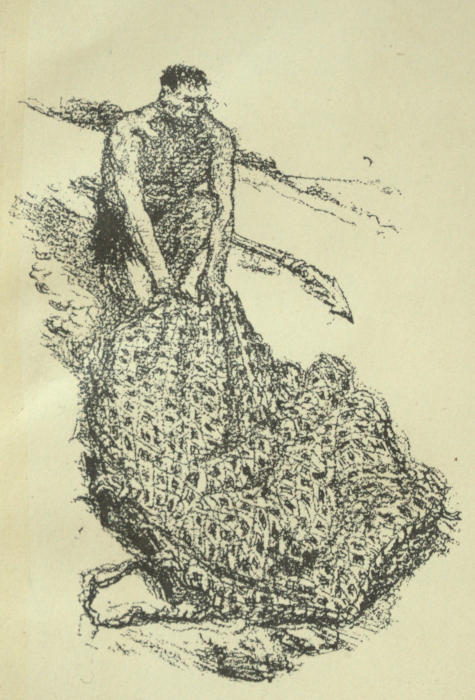
But then, Fish Catch, the renowned
maker of nets, had
offered him one of his best
for the girl. And One Eye,
who could not make nets
himself, knew that his own
private net was so rotted as
to be useless, and that in
order to live comfortably it
was necessary to have a net—for
a good net meant good
food. So he was sadly torn
in his mind.
There had been other offers
for the girl, but none so glittering.
And One Eye had
promised on this very afternoon
to decide between
Strong Hand and Fish Catch.
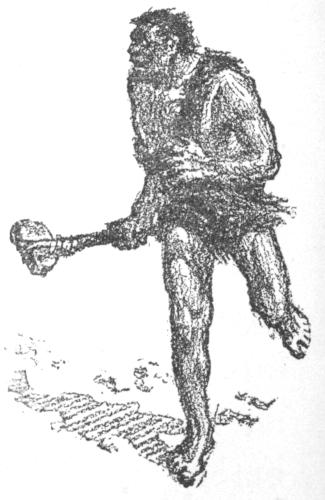
When they came up,
stooping, hairy, bent of knee,
and stealthy, the one bearing
the net, the other the clubs,
One Eye had not come to
any decision.
They sat down before him,
without salutation, and for
some moments blinked and
dug at the earth with their
toes. Strong Hand was the
first to speak.
“With any of these clubs—”
he began.
But Fish Catch broke in.
“Clubs!” and grunted.
“What are the use of weapons
to one that is without means
of procuring food. It is
well known that One Eye is
too old to hunt with success.
If he would live he must fish.
Now this net—see it is of
the best fibre, and knotted as
I alone can knot. It will
last you twenty years—maybe
twenty-five—”
“One Eye,” said Strong
Hand, “is first of all a fighter.
If he gives me the girl I will
see to it that he never wants
for food.”
“That is the best talk
yet,” said One Eye.
“Then you give her to
me?” said Strong Hand.
“Slowly—slowly,” said
One Eye. “I must have time
to consider. But whom have
we here?”
CHAPTER II NO MAN
The three paused to listen.
The intelligent look
went out of their eyes, and
gave place to the plaintive
child look—the animal look.
“That will be No Man,”
said Fish Catch presently.
Now if you or I had been
in the glade in front of One
Eye’s cave, we would not
have known that there was
anybody but One Eye,
Strong Hand and Fish Catch
within a hundred miles. But
these three men having the
acuteness of dogs, had heard
footsteps that were half a
mile away, and not only that,
but they had almost instantly
known to whom the footsteps
belonged. If the wind had
been right, they could have
told also by sense of smell.
“He is coming in this
direction,” said One Eye.
“He steps stronger with
one foot than the other,”
said Strong Hand. “He is
carrying something heavy.”
“Perhaps No Man wants
One Eye’s daughter,” said
Fish Catch with an ugly laugh.
“I wonder what he is
carrying?” said One Eye.
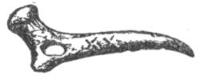
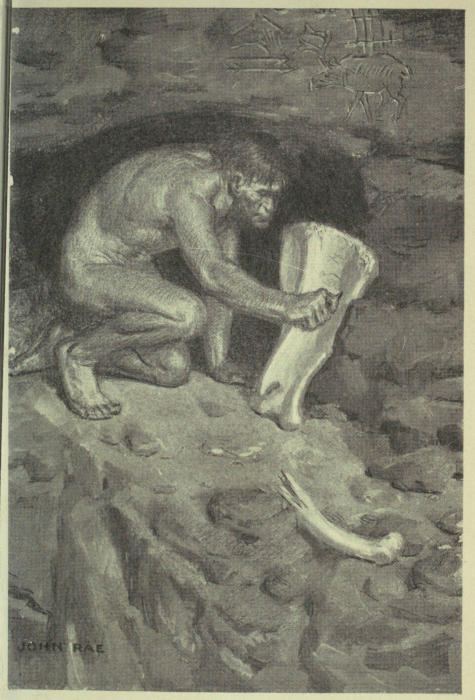
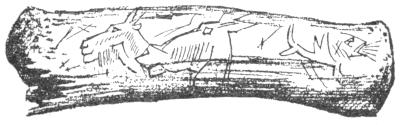
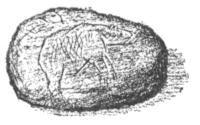
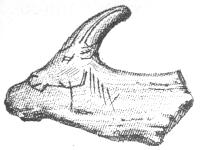
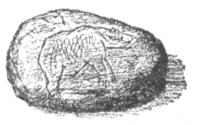
HE SCRATCHED PICTURES ON BONE
This No Man was so called,
because he would neither
hunt, fish, make weapons,
nets, or marry. Therefore he
was No Man. He lived on
charity, and scratched pictures
on bone. That was the only
thing that interested him.
He was suffered to live only
because he was mysterious
and because the tribe liked to
go to his cave and look at
the pictures when there was
nothing better to do.
Presently he came out of
the woods, slope-shouldered
and long-armed like the
others, but not so heavily
built, nor so apishly skulled.
He seemed, besides, less
stealthy, but more timid.
He had tucked under his
right arm a huge flat bone.
This he laid before One Eye.
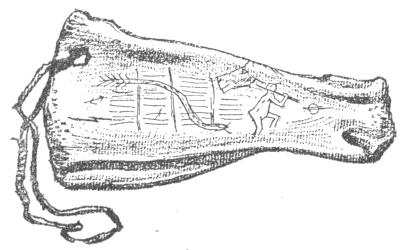
It was covered with little
etched scenes of the chase
and of the fight—throughout
which a man, palpably having
but one eye, deported
himself with the utmost
heroism—now strangling a
bear, and now beating the
life out of an enemy.
“This,” said No Man, “is
the whole story of One Eye
from the beginning. It is
the most beautiful picture bone
that has ever been made in the
world. Sitting alone in my
cave, it befell on a time that a
great loneliness came upon me.
And the woman whose image
rose most often before me,
was the daughter of One Eye.
Therefore I have wrought the
bone, sparing no labor, and
now I offer it to One Eye for
the loss of his daughter.
It is a thing which will keep
him company in his old age.
For to look upon it is to be
reminded of his glorious
deeds.”
As One Eye examined the
picture bone, the intelligence
went out of his one eye. It
wavered and became plaintive.
Reason told him that nets
were more valuable than clubs
and clubs more valuable than
pictures. But desire, which
is a thing apart from reason,
clamored for the bone.
“I wish this picture bone,”
he said presently. “It is of
no use, neither is it of any
value. Yet I wish it.”
Strong Hand and Fish Catch
looked at one another stealthily
and then at No Man. It
would be impossible to say
which sprang upon him first,
nor at whose hands he suffered
the most. They so choked,
beat and clubbed him that he
screamed for mercy. One
Eye blinked in the mouth
of his cave and chuckled.
“Is it enough?” cried
Strong Hand presently,
“Filthy-do-nothing—Marrowless-bone.”
“It is enough,” said No
Man, and they let him go.
Directly he had gained his
feet, he ran from that place
with incredible swiftness, and
howled as he ran.
“The picture bone,” said
Fish Catch to One Eye, “is
now ours, but knowing that
you desire it, we give it to
you to be a solace in your old
age. And now it remains
for you to choose between
those admirably balanced but
somewhat antiquated clubs
which Strong Hand offers and
this invaluable net knotted by
myself.”
“Fish Catch—Strong
Hand,” said One Eye, “I
have thought of a way by
which we may all be satisfied.
The thought came to me when
you fell upon No Man. Let
each one of you take a club,
and at the word fight, the one
who wins shall give me his
present and take the girl.”
Fish Catch measured
Strong Hand with his eye;
Strong Hand measured Fish
Catch. They nodded, which
meant that what the old man
said was good talk.
The latter called over his
shoulder into the cave.
“Maku, come out! There
will be a fight!”
Maku came at once, eagerly.
She was, as we have said, the
image of her father, only less
hairy. She was considered
very alluring by the young
men of the tribe.
Meanwhile Strong Hand and
Fish Catch had each taken a
club and backed away from
each other.
“Is it about me?” asked
Maku.
“It is.”
She laughed happily.
“Fight!” commanded
One Eye.
At the word Strong Hand
and Fish Catch sprang forward
and fell upon each other with
roars and blows. There was
no question of fence involved,
only the ability to hit hardest
and take the most punishment.
As they fought they
became beasts, yelping, snarling,
snapping and foaming—totally
unlike articulate men.
Blows that would have splintered
a modern skull to atoms
were given and taken. Now
the clubs cracked upon bone
and now thudded upon muscle.
One Eye and Maku roared
with laughter and screamed
with pleasure. The fight
ended with a blow that broke
Fish Catch’s forehead into two
halves. But, although he fell
as if struck by lightning, he
did not die at once; he moaned
and his lips twitched. His eyes
were plaintive and uncomprehending
like those of a frightened
child. He blinked, too,
as he died.
Strong Hand tossed his club
down at One Eye’s feet.
“The girl is yours,” said
One Eye.
Strong Hand’s eyes glittered
and he looked the girl over.
He reached forward a vast hairy
hand and took her by the
shoulders. But she wrenched
loose, half laughing, half
screaming, and fled into the
cave. Strong Hand followed.
One Eye chuckled and thought
upon the days of his youth.
In the darkness of the cave
there was a sudden fierce
struggle, a cry of pain from
Strong Hand, and Maku,
bounding from the entrance,
made swiftly down the slope
toward the forest. But
Strong Hand, bleeding on
the shoulder where her
teeth had met, was close
behind. Swift as she was, he
caught up with her in a few
bounds and felled her with a
blow on the head. Stunned and
motionless she lay at his feet.
Strong Hand twined his left
hand in her long black hair and
dragged her after him until the
trees had closed behind them
both.
When One Eye had done
laughing, for the whole scene
had seemed very humorous to
him, he gathered together his
treasures and hid them in the
cave.
“I now have,” he said, “the
clubs, the net, the strongest
among three for a son-in-law,
and also the picture bone. I
am, therefore, the richest man
in the tribe, save only Moon
Face, and than him there is
none richer in all the forest.”
When One Eye thought
about the clubs his eye flashed
and he clinched his hands.
When he thought about the
net he scratched his stomach—either
with hand or foot. But
when he thought about the
picture bone, the reason went
out of his eye, and it became
strange and plaintive.
And as for Maku, it was
not long before she followed
her husband like a dog, whimpering
and laughing when he
spoke to her, craving his caresses
and enjoying his blows.
CHAPTER III THE BLASTED TREE AND THE BLUE-JAY
No man was very sore
because he had been
beaten and robbed. Fish
Catch being dead, he particularly
hated Strong Hand
and wanted Strong Hand’s
blood. But he was afraid to
go and take it, and so he
dwelt in his cave and plotted
mischief.
And because no artist can
work when he is angry, he
gave up scratching pictures on
bone.
No Man was undoubtedly a
coward, but he was very cunning.
He had schemes in his
head that nobody else had yet
thought of. He had the creative
spirit.
So far it had been useful
only in evolving pictures and
ingenious ways of scratching
them on bone; but now, so
No Man swore, it should
evolve him a weapon against
which none could stand and
his vengeance would be accomplished.
He thought over the different
kinds of weapons then
in use; clubs with stone-heads,
wooden clubs, smooth
round stones for throwing,
and spears.
These last were just coming
into fashion, we may say.
They were short, stiff shafts
with heads of chipped flint
lashed to them with deer
sinew, which if put on wet
and allowed to dry, shrank
and became as tight and
hard as wire. No Man
thought these over, and resolved
to think of something
entirely new. Clubs and
spears brought you to close
quarters, and that was not
the way No Man wanted to
fight. Throwing stones required
a proficiency which he
did not possess, and was not
often fatal—even at best.
He went back to the spear.
Why not throw it? This
was an entirely new idea.
No use. Same business as
stones—uncertain.
Then he pictured in his
agile mind, how, the spear
having missed, Strong Hand
would chase him with a
club and beat his brains out.
He went so far as to
dream this unpleasant scene
several times at night.
When this happened he
howled in his sleep.
No, he must have something
entirely new, something
that would kill—unerringly—at
a good distance. But with
all his cleverness, he could
not think of just the right
thing.
And if his fellow-tribesmen
had not been charitable, he
would have starved to death
while he was thinking.
One day the big nut tree
in front of No Man’s cave was
struck by lightning, and when
he got the courage to go and
look, he discovered that it
had been split into fine
wands, half as big as his
wrist. He tried to break
one but it would only bend.
When he let go it sprang
back nearly straight, but not
quite because it was sappy
and unseasoned.
No Man sat down and
thought. His face was all
covered with puzzle wrinkles.
He knew that he had
an idea, but he did not know
what it was.
“Never mind,” he said,
“I will take some of these
sticks and play with them
and, perhaps, that idea will
come out.”
So with grunts and twists
and heaves, he managed to
break off half a dozen of the
sticks. But it was hard
work, for the wood was as
tough as hickory—which was
just the kind of wood it happened
to be.
No Man played with his
sticks and became very fond
of them. At night he hid
them in his cave, but all day
he had them out in the sunshine,
where he could bend
them and let them snap
straight, and think about the
idea that wouldn’t come out.
The dryer the sticks got, the
tougher they got, the more
bendable and the more springy.
Sometimes No Man got angry
with his sticks for the
very bendiness that he loved
in them.
“Why don’t you stay bent,
when I bend you?” he said.
“Perhaps you don’t think I’m
the master here? I’m going
to take you”—he addressed
the biggest and
most refractory—“and
bend you and tie your
ends together with deer
sinew and then you’ll I
stay bent.”
He was as good as
his word. He lashed
one end of the deer
sinew to one end of
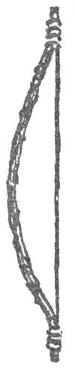
the stick, bent the stick, took
a hitch round the other end,
and made fast. Then he
took the stick by the middle
with one hand, the sinew
with the other, pulled and
let go. The sinew twanged
loudly.
“This is a good thing that
I have made,” said No Man,
and then like a flash the idea
that had been struggling in
his head came out.
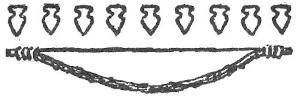
First he looked about cautiously,
then he listened, and
as he listened his nostrils quivered
and you could see that he
was scenting as well. There
was nobody near. He then
fitted a straight stick to the
string of his bow, pulled and
let fly. The stick sprang into
the air, and travelled what
seemed a great distance to No
Man—but it did not fly true
and it wabbled. “That,” he
said to himself, “is because
the spear is not even all over,
and because the twang thing
is not properly made. These
things require much thought.”
So he thought, and labored
and experimented, and hid in
his cave and glowed with the
joy of creation. In time he
had made a proper enough
bow. But it was so powerful
that no man of our time
could have bent it, and No
Man chuckled when he saw
the power with which it
hurled the little equal shafts
which he had made.
But they did not fly as
straight as he wished. Often
the back end of the shaft
would somersault over the
front end, or the shaft would
hit the object aimed at with
its side instead of with its
point. One day, as he was
trying to perfect this part of
his weapon, a blue jay came
and sat a little way off on the
top of a little pine, spread its
tail feathers and laughed at
him.
“Now I will show you
what flying is really like,” he
said. And he let fly, and the
shaft flew as straight as a bird,
but much more swiftly. Then
No Man rolled on the ground
and laughed. Then he sat up
and crooned, a long inarticulate
croon of triumph. And
he finished up by saying:
“I am the greatest man in
the world. Nobody else is
nearly as great. There is
nobody of whom there is any
record that is so great. I will
soon kill Strong Hand and take
his woman to my cave. It is
not good to live alone when
one is great. No, I will not
take Strong Hand’s woman,
I will get a woman that is all
new, and she shall be mine.
But first I must get some
sharp points for these things.
And there is no one so clever
with flint as No Foot and to
him I will go.”
CHAPTER IV NO MAN AND NO FOOT
And so he hid away his
secret invention and
started off to the flinty hillside
where No Foot had his
work shop.
This No Foot had once
been a mighty hunter, but as
luck would have it a great
stone had rolled upon him
as he climbed a hill and
smashed one of his feet so
that it dragged after him.
Forced to abandon the chase,
he studied how best to work
in flint, and became in time
so clever that he made the
best knives and clubs of
which there was any record.
He invented the spear. In
return for his work, the tribe
gave him fish and meat, nuts
and berries, so that he lived
on the fat of the land and
was held in great esteem.
But he was a surly old beggar,
difficult to approach,
avaricious and susceptible to
nothing but flattery. He had
an ugly old wife who kept
cave for him. No Man
found No Foot sitting in
the midst of his chipped
flints, chipping busily. A
goodly row of sharp polished
knives and spear heads spoke
also of his industry. He did
not look up as No Man
approached tho’ undoubtedly
he both heard and smelt him.
No Man squatted directly
in front of No Foot, and
blinked at him. No Foot
blinked at the flint that he
was chipping.
“These are the most
beautiful flints that I have
ever seen,” said No Man
presently.
“You are not telling me
anything new,” said No Foot
in a surly voice. Tho’ he
was very much flattered inside.
“But how large they are,”
said No Man.
“They are for men,” said
No Foot, “not for bone
scratchers.”
“I have thought,” said No
Man, without taking offence,
“that you made them of this
size, because you were unable
to make them smaller.”
“Unable!” said No Foot,
flaring up, “I can make them
of any size I choose.”
No Man laughed provokingly.
“Go back to your cave,
Do nothing, No Man,” said
No Foot. “You are between
me and the light.
Furthermore your person is
offensive and your face of
appalling ugliness.”
No Man continued to
laugh. Then he addressed
the hillside.
“He is angry,” he said.
“Ho-Ho—because he can’t
make them small. He has
three feet and two of them
are hands. Ho-Ho. He has
three feet but he cannot run
on legs. He has two hands
but he cannot make little
spear heads. He is a lump
of mud, a filthy bear, a litterer
of the ground. Furthermore,
if he were not so humorous
to look at, I could
not bear the neighborhood
of him.”
Even to No Foot this
seemed a clever sally, and
he could not help laughing.
“Why do you want me to
make little spear heads?” he
said presently.
“I will tell you,” said No
Man, “but do not repeat it.
I want them to put on little
spears.”
“You have a ready
tongue,” said No Foot, “considering
that you are a filthy
ne’er-do-well.”
“I want three of them,”
said No Man.
“And what will you give
me in exchange for my time
and my flint.”
“I will come sometimes
and talk to you,” said No
Man.
“You will get a clubbing
between the eyes, if you do.”
“I will draw the story
of your life on a nice white
bone, and give it to you.
It will consist entirely of
hunts and fights in which you
get the best of it.”
“That is something,” said
No Foot, and he scratched
his stomach thoughtfully.
“I will also,” said No
Man, “put in a great many
pictures of very beautiful
women who have run away
from their husbands for desire
of you.”
No Foot grinned.
“You shall have the little
spear heads.”
“They must be of this
bigness,” said No Man, and
he showed No Foot just
what he wanted.
“And when do I get my
bone?”
“I shall labor hard, but it
will be some time. When
do I get my flints?”
“On the very day that I
get my bone.”
“I would like them in two
days.”
“You can’t have them—not
till I get my bone.”
And No Man was obliged
to be content with that. So
he ran all the way to his cave,
got him a flat, white, clean
bone and fell to scratching
upon
it the
totally
imaginative
life of No
Foot, his mighty deeds, and
his mighty virtues. When
it was finished he carried it
to No Foot, and received in
exchange three beautiful little
spear heads of sea green flint.
“I have no doubt you will
become a hunter,” said No
Foot politely, for he was
pleased with his bone.
“These flints are even better
than what I expected from so
clever a maker,” said No Man.
“And as for this bone,”
said No Foot, “it makes
me feel as if I were young
again and two-footed.” And
so with mutual compliments
they parted.
CHAPTER V THE MOOSE
But No Foot carried the
flints to his cave, and
fitted them to his arrows,
and he fitted feathers to the
string ends, and having devoured,
raw, a seven pound
fish that had been given him
(for fire and cooking had not
yet been discovered) he lay
down and slept till the hour
before sunrise.
As he slept, his brow
wrinkled and unwrinkled, his
hands and feet twitched and
contracted. Sometimes he
made a noise in his throat
that was like growling,
sometimes he started as if in
fear.
For when the first men
dreamed, they dreamed, for the
most part, about the ancient
ages when they had not been
men; of long, cool leaps
from tree to tree; of feet
that had the grip of strong
hands, and of the great fear
that had driven them to become
men—fear of the other
beasts, fear of the night.
That which turned into
man, differed only from the
other beasts in the acuteness
of its sensations. Fear,
pain, shadows, and lust.
Fear worked upon its intelligence
and it survived,
where nobler and stronger
and more courageous animals
perished—the ship-size creatures
of the deep, and the
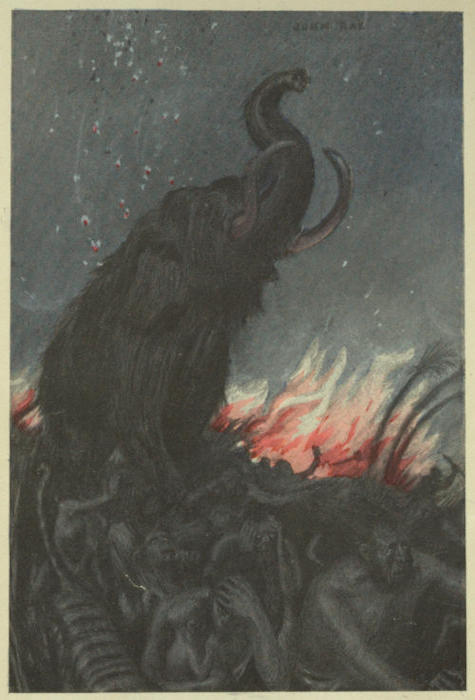
mastadon and the mammoth.
Man in his fear found out
many inventions by which
he proved his fitness to survive.
And the battle did
not go to the strong.
But when No Man awoke,
he did not remember his
dreams. He arose, shook
himself, took up his bow and
his arrows, and trotted
into the forest. He trotted
with caution, for he wished
his secret to be his secret,
until the sun stood over his
head and he was far from
the caves of his tribe. Then
he began to hunt.
He had probably less notion
of hunting than any member
of the tribe, but if we
had seen him and had not
seen the others, we would
have thought him the most
astute hunter imaginable.
He had the instinct of the
chase, dormant in all of us,
but better, he had senses nearly
as acute as those of a dog.
Eyes that could see in the
dark, ears that could hear the
rose-leaf footfall of a wolf
on soft ground, and a nose
that could scent that same
wolf half a mile away if the
wind blew right.
All the time that he had
been running, from sunrise
to high noon, his nose and
ears had been twitching with
the smells and sounds of the
forest. But now he ran in
a great circle, with his eyes
on the ground, and paid strict
attention.
Presently clear, deep,
black, and shining in the wet,
rank ground by a stream, he
saw where a moose had
stepped. The track pointed
into the wind, and was fresh
and clear. He followed,
twitching and silent.
The track followed the
stream bed, and then turned
a steep angle and made for
the deep shades of the forest,
where the moose goes to rest
during the heat of the day.
No Man came upon him
lying on his side among cool,
green bushes. Trees, two
hundred feet high and straight
as masts, towered above in a
twilight of their own making.
And there was a mighty hush
and silence, the silence of
high noon in the forest where
no beast stirs save only man.
Then there was a twanging
jar and the sound of an
arrow cleaving the air and
jolting into flesh and muscle.
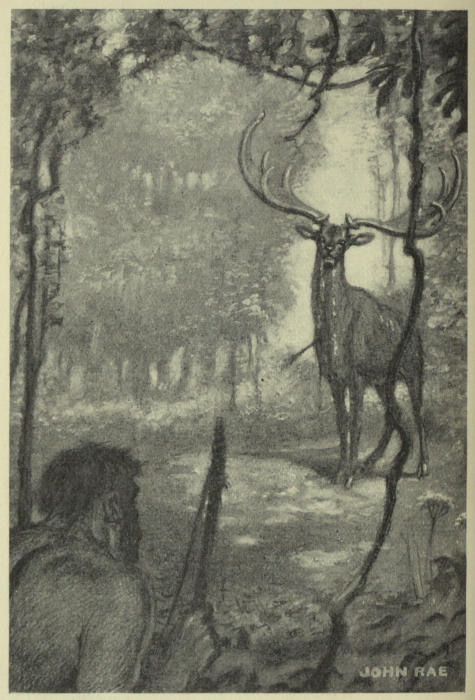
The great moose rose to
his feet, very black, maned,
bearded, extended of horn and
terrible. He searched for
his enemy with little, venomous,
blood-shot eyes. But he
swayed as he searched, for
just behind his fore-shoulder,
as if part of him, as if something
that had mysteriously
grown out of him, there projected
a bunch of bright blue
feathers, and dark blood
throbbed forth like a spring
at their root.
UNCONQUERED—BLEEDING TO DEATH
No Man, for he knew that
the moose is not good at seeing,
had hidden himself among
the bushes, and he looked
cautiously between the leaves
to watch his victim die.
For an hour he did not
move. And the moose, save
for swaying of the head from
side to side, and dartings of
his dimming eyes, did not
move either. He stood
grandly in his tracks, arrogant,
fearless, unconquered,
and bleeding to death. At
the end of the hour he had
staggered and recovered. But
he only stiffened his legs
and held his head the more
proudly.
A little later, dizziness
overcame him and he fell like
a thing struck. But instantly
he sprang to his feet, alert
and menacing. But he knew
that the end was near.
Once he turned his head
and sniffed at the thing that
was killing him—not angrily,
not even impatiently, but
curiously, to see what it
was. Then when he felt that
unsupported he must fall, he
walked slowly and quietly
to a great tree and leaned
against it.
He remained there till late
in the afternoon, then his
knees buckled, and he fell,
and when No Man went to
him, he was dead.
No Man drew the arrow
from the moose and withdrawing
a little distance shot
it into him again, together
with his two other arrows.
And he kept this up till dark;
for it was in his mind that
it would be best not to miss
when it came to shooting at
Strong Hand.
When night came, No
Man tore meat from the
moose and ate till he was
full; then he went back to
the stream and drank deep;
then he returned to the
moose’s carcass and, lying
against it, slept.
Wolves came up thro’
the forest, and looked longingly
at the dead moose, and
smelt him—at a safe distance;
but it was the summer season
and they were not hungry
enough to run straight
into the smell of man. And
they withdrew, coughing,
whining, snarling, and returned
again to feast in imagination.
When the moon rose, they
went to an open space in
the forest and howled dismally,
so that No Man twitching
as to ears and nose
awoke. It was some little
time before he composed himself
to sleep, for his mind was
teeming with thoughts. But
he did not think of Strong
Hand and woman and revenge
as had been his wont
of late. He thought rather
of the pictures that he made
upon bone, for what little
soul he had was the soul of
an artist. And he planned
in the dark of the night, how
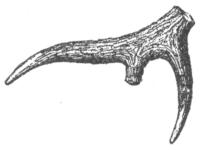
upon a great, clean bone,
the shovel of its own antlers,
he would inscribe the moose
with the arrow in him, standing
arrogantly among the
bushes as he bled to death,
and leaning unconquered
against the tree. Then fear of
the night descended upon No
Man, and he closed his eyes
and slept—twitching, coughing
and snarling as the dreams
of ancient days possessed him.
But when he awakened in
the strong light of day, he
thought of the bow and arrows
which he had made, of how
he was going to hunt man,
and of the sweetness which
is revenge. But he put off
that hunt until another day.
CHAPTER VI SHE WOLF
She Wolf was the name
of a woman. She lived
in a cave of her own, and
supported herself by hunting
and fishing. Men had wooed
her, but had been so ferociously
rejected, that they had
been content thereafter to
leave her strictly alone.
She could run, swim,
climb, use the club or jab
the spear nearly as well as a
man, and it was said that she
lived apart because she was
barren and ashamed. She was
long of arm and flank, deep-breasted,
deep-bellied, hairy
and powerful. No Man cast
his eyes upon this woman, who
was more man than himself,
and desired her. He hung
about her cave, as a bear hangs
about a tree full of honey—and
bees. He stuck bright
feathers in his hair and smiled
and nodded whenever she
cast a glance in his direction.
He scratched upon
bone scenes in which she
figured as a heroine and he
left them in places where
she would find them. He
grew sick with
lust and forgot
all about Strong
Hand and the vengeance which
was ripe. He made attempts
to enter into conversation
with her, only to be cut
short.
The less his suit prospered
the more keenly did he
wage it. But when he found
that ordinary methods were
of no avail, he turned to that
old friend of his, cunning,
and thought out a plan.
Early upon a morning
before the sun had risen, he
took his bow and arrows,
and went in silence and sat
down before the mouth of
She Wolf’s cave. Then he
laid his arrows on the
ground and began to twang
the string of his bow. At
the first twang, She Wolf
woke twitching; at the
second, she crawled to a
place where she could see
what was going on outside
the cave and yet not be seen.
When she saw that it was
only No Man, playing the
fool, with a bent stick and a
stretched skin, she was disgusted.
No Man knew perfectly
well that he was being
watched, and so the next
time he twanged the bow,
he closed his eyes and rolled
his head, as if pleasure unutterable
possessed him. Then
She Wolf’s curiosity was
aroused and she came out of
the cave, and in the white
mist of the morning she
seemed wonderfully alluring
to No Man, so that little
shivers ran thro’ him.
But he twanged his string
and pretended that he found
it more interesting than the
woman.
“This is something that
I do not understand,” said
She Wolf to herself. And
aloud, “What are you doing,
No Man?” It was the first
time she had ever spoken to
him.
“This string,” said No
Man, without looking up,
“is telling me how to get all
the things that I wish; the
beasts of the forest, the blood
of my enemies, and the woman
I desire.”
“It is telling you lies,
then,” said She Wolf. “For
altho’ it may go on talking
’till night, it will not tell you
how to get me.”
“Listen,” said No Man,
and he twanged the string.
“Well?” said She Wolf.
“It has just told me how
to get you,” said No Man.
“Then it is still lying,”
said She Wolf. “For I do
not wish to go to your cave
and I am stronger than you.”
“That is as it may be,”
said No Man, and he
twanged his string, and closed
his eyes, and rocked his
head.
“Let me see it,” said She
Wolf.
“You do not understand
it,” said No Man, “and it
would turn against you.”
“I am not afraid,” said
She Wolf, but she did not
speak the whole truth.
“In my hands,” said No
Man, “this thing is stronger
than any man or beast, but in
another’s hands it is only a
bent stick and a length of
stretched hide.”
“I do not believe you,”
said She Wolf, but she half
believed.
“Let us hunt together,”
said No Man, “and I will
show you.”
She Wolf went into the
cave and came out with her
club and her spear and her
flint knife.
“I am ready,” she said.
CHAPTER VII THE WOOING OF SHE WOLF
And so they trotted into
the forest. But She
Wolf ran ahead of No Man
to show that she was not
afraid of him.
Old One Eye, who was
just awake, heard them as
they passed up the valley
below his cave. And he said,
“that is No Man and he is
running with She Wolf, I do
not see why she has accepted
the advances of such a weak
good-for-nothing. He will
make her do the hunting
while he sits in the cave and
scratches on bone.”
She Wolf and No Man
trotted steadily for two hours
until they had come to a
good hunting ground. And
as they ran their noses and
ears twitched.
Presently and of one accord
they stopped, and She Wolf
pointed to a dense thicket of
alders that stood about a pool
of a stream. They could
hear the occasional clink of
hoofs on submerged stones,
and a sound of cropping and
munching.
She Wolf and No Man
dropped to the ground, and
crawled to the alders and into
them as silently as two serpents.
A buck with a fine
head was wading in the midst
of the pool and feeding
among the lily pads.
There was no way in
which She Wolf could get
at him with club or spear,
and she had about made up
her mind to rush into the
pool, on the chance of striking
before he could get away.
But it was a poor chance and
she knew it. Still she gathered
herself to spring, and
just then—twang—she turned
with a snarl, for she had
forgotten all about No Man
and his bent stick. No Man
was looking innocently at his
right hand, and holding the
bow in his left.
“You don’t even know
enough to keep still,” said
She Wolf angrily, “no
wonder everybody despises
you.”
“Look in the pool,” said
No Man imperturbably.
The open place that the
buck had occupied among the
lily pads, was red and oily
with blood. But the buck
had gone.
“He went out upon the
other side,” said No Man.
“Let us follow him.”
So they waded thro’ the
pool and the stones clicked
under their feet, but this time
it was No Man who went
ahead.
Here and there the leaves
of the alders were splashed
with blood, and some of the
sharp tracks that the buck had
made as he leaped were full of
blood.
The track led out of the
alders, across a gray marsh and
into a thicket of beechnut
bushes and wild raspberries.
Out of the midst of this
thicket the buck suddenly
sprang, clear to the hooves,
and leaped away. His antlers
were laid back on his shoulders
and he made a noise that
was between a whimper and
a scream.
They came upon him
further on in another thicket,
but he could not get up,
he could only look at them
with his great brown eyes,
and tremble.
There was a bunch of
blue feathers that seemed to
be sprouting from his side.
Every now and then the buck
turned his head and licked
the feathers with his rough
tongue.
She Wolf was now thoroughly
afraid of No Man and
she was sorry she had come
into the forest with him.
Therefore, to give herself
heart she stepped forward and
hit the buck a terrible blow
with her club, right between
the eyes.
“Take your knife and cut
off some meat,” said No
Man, “for it is a good time
to eat.”
She Wolf did what she
was told, and for the first
time in her life. When they
had eaten as much as they
could, No Man said:
“Now, we will go and
drink.”
They found a place above
the alder pool, where the
brook grass was sweet and
soft to lie in, and the brook
tinkled clear and cold among
the stones.
No Man lay on his belly
and drank till he swelled.
Presently he rose with dripping
face and mouth.
“When I have drank,”
said She Wolf, “I shall
sleep as is my custom. But
if you come near me, I will
take my club to you.”
“Drink,” said No Man.
She Wolf placed her club
and her spear and her knife
carefully to one side, and
lay down to drink. When
she had finished she started
to rise, pushing against the
ground with her hands. But
No Man who had possessed
himself secretly of the club,
now brought it down on her
head so that she pitched face
downward into the stream.
No Man dragged her out
and waited patiently for her
to recover consciousness.
After a time she came to,
but she was dazed and
looked about uncomprehendingly.
“Which is the stronger of
us?” said No Man. Then
She Wolf knew that No
Man had struck her, and she
sprang at him furiously, her
big sharp teeth flashing, and
her lips curling. But her
hands were empty and No
Man struck her again with
the club.
“They are all alike,” he
repeated as she lay for the
second time insensible on the
grass. “Some are stronger
than others, but no one of
them is so strong as a man.”
As she lay insensible, her
lips twitched and she groaned.
“She will not wish to
fight with me any more,”
said No Man.
She opened her eyes. But
they were not the eyes of a
woman; they were those of a
frightened animal.
“Which is the stronger of
us,” said No Man.
“You are the stronger,”
said She Wolf.
And she crawled to his
feet, whining and moaning.
“Will you come and live
in my cave?” said No Man.
But She Wolf was not yet
conquered, and she made a
crafty snatch for the club.
Failing in this she flung herself
on the ground, for she
made sure No Man would
kill her.
“I will show you who
is the master,” said No
Man.
And he took up the spear
and beat her with the handle.
But She Wolf did not scream
or cry out. She grunted
only and moaned a little, for
knowing that she had found
her master, she took a certain
pleasure in the blows.
No Man did not stop beating
her until he was tired of
plying the spear handle.
For the second time she
crawled to his feet whimpering
and seeking to ingratiate
herself with him.
“I will go to your cave,”
she said.
“That is good talk,” said
No Man “and I will not
beat you any more to-day.”
She Wolf whimpered and
touched his feet.
“There is a thorn in your
foot,” said No Man, and he
drew it out for her.
At that tears gushed from
She Wolf’s eyes and she
sobbed, and it was because her
master had been kind to her.
“This,” said No Man to
himself, “is something that I
have never seen before. It
may be that I have struck her
too hard and that she will
die. And that will be a
great trouble for she is very
alluring.”
But She Wolf did not die;
and she abode with No Man
for three days in that place,
and afterward she went with
him to his cave, and fawned
upon him.
CHAPTER VIII THE FAINT HEART OF NO MAN
No Man and She Wolf
kept the secret of the bow
safe in their cave, and in the
early mornings She Wolf
went forth to hunt armed with
spear and club, while No Man
sat in the sun, and scratched
the story of his life upon a
fine white bone.
He scratched away with
much boastful imagination;
picturing in
order all
the clever
things that
he really
had done and as many others
that he hadn’t as he could
possibly think of.
Whenever She Wolf came
back from the hunting, she
would admire the progress of
the bone, and think to herself
that No Man was the bravest
and cleverest man of whom
there was any record.
For the most part No Man
was kind to her, but when
she returned empty handed,
or his work did not please
him, he would beat her till
she was half dead. And she
loved him alike for the
caresses and the blows.
The pictures that she liked
best were those in which she
herself figured—first savage,
untamable and to be feared—then
hunting with No Man
in the forest, then lying insensible
by the brook, then
fawning at No Man’s feet,
and then following him to his
cave.
That was the last scene
depicted on the bone, but No
Man had taken care to leave
space for one scene more.
And when She Wolf asked
what it was he would not
tell her.
So he put the bone aside
and went to work on others.
And the most of a year passed,
and the rest of the tribe began
to think well of No Man,
for he hunted occasionally
and always he killed.
One day, She Wolf said
that she did not wish to go
hunting. But No Man struck
her and made her go.
“Do not come back,” he
said, “without two haunches
of moose for I have promised
one to No Foot in return
for some flints which he is
making for me. And the
other one we will eat ourselves.”
When the sun was high,
No Man started on a round
of visits, for he dearly loved
conversation, and boasting.
But he got no further than
the cave of old Moon Face,
for there he heard news
which sent him packing after
his bow and arrows.
Moon Face was the oldest
man in the tribe and the
richest. He looked precisely
like a baboon, only the hairs
fringing his face were white,
and that was why he was
called Moon Face. Moon
Face never let go of anything
that he got his hands on.
All his life he had been a
collector. His cave was full
of clubs, nets, spears, flints,
bright-colored feathers, and
smooth round stones for
throwing. He was very
stingy and never exchanged
except at advantage to himself.
He had outlived a number
of wives, and there were
many of his descendants among
the tribe. His youngest son,
and his last wife, a half grey,
apish old creature, lived in the
cave with him; the boy hunted
and the woman attended to the
wants of all three.
No Man found Moon
Face blinking in the sunlight
before his cave. No
Man squatted and waited for
his host to begin.
“How are your affairs
getting on?” said the old
man presently.
“I have nothing to complain
of,” said No Man.
“And how is it with you?”
“I do not get the attention
to which I am entitled,” said
Moon Face. “But I am able
to exist.”
Now he squirmed and fell
to scratching himself between
the shoulder blades.
“Maybe I can help you,”
said No Man.
“It is nothing,” said Moon
Face. But he only squirmed
and scratched the harder.
No Man approached, bent
over the old man, and began
to search thro’ the snarled mat
of hair that covered his back.
Presently he crushed something
between his thumb and
forefinger and threw it away.
“That is a great relief,”
said Moon Face, “I have
been after that fellow all the
morning. And now we can
talk at our ease. Have you
heard what has at last happened
in Strong Hand’s
cave?”
“No,” said No Man, betraying
no interest, “I have
not heard of him or seen him
in a long time.”
“Well, at last he has a
child,” said Moon Face.
“A daughter I should imagine,”
said No Man spitefully.
“Yes. A daughter.”
“They have been a long
time about it,” said No Man.
“I was beginning to think
they were both as dry as old
bones.”
“Strong Hand passed this
morning,” said Moon Face,
“on his way to the hunt.
He was strutting like a cock
partridge. You might have
thought that his was the first
child of which we have any
record.”
“So he has gone hunting,
has he?” said No Man. “I
think I will drop round to
his cave and have a look at
the child.”
“Anything that has taken so
long to make should be worth
looking at,” said Moon Face.
And they laughed heartily,
and parted with mutual compliments
and good will.
But No Man did not go
at once to Strong Hand’s
cave. First he went to his
own and got his bow and
arrows. And then he hid
himself in a clump of birches
and poplars that Strong Hand
would have to pass on the
way home.
“This is just the time for
killing,” said No Man.
“Strong Hand is very proud
and I will strike him. When
he is dead there will be no
one to hunt for his woman;
and her milk will give out
and the child will also die.
Matters could not have been
better arranged.”
He waited patiently all
thro’ the afternoon and reviewed
the prospective scene
of his vengeance. It was the
scene for which he had left a
blank space on the big clean
bone. Here would be the
runway that
Strong Hand
must follow, here the thicket
where he himself lay in
hiding with his bow and
arrows.
But it began to grow dark,
and No Man was disturbed
for at heart all men fear the
dark. And when he heard
Strong Hand strolling up the
runway he was even more
disturbed. But he steadied
himself and waited.
Suddenly he heard Strong
Hand calling his name.
“What are you doing in
there, No Man?”
No Man was seized with
fear. And he said to himself,
“I am a fool, for the wind
was blowing from me to him
all the time and he has smelled
me out.”
He went out of the thicket
and yawned when he saw
Strong Hand. Strong Hand
had slung a doe over his
back and in his free hand
were two spears and a club.
“I have been asleep,” said
No Man. “It was cool in
the thicket and I was weary.”
“Come to my cave?” said
Strong Hand. “And I will
give you a piece of meat and
show you something.”
So he trotted along with
Strong Hand to his cave, and
was given meat and shown
the girl-child. After which
they parted with mutual compliments.
“May She Wolf bear you
a son,” Strong Hand called
after him.
But No Man went home
to his cave raging, for he
had played the fool and the
coward and his vengeance was
no nearer than ever.
When he got to his cave
and found that She Wolf had
not come back, his anger
turned from himself to her.
And he promised himself to
give her a taste of the great
stick which he kept for the
purpose.
He sat in the cool, waiting
and glowing like a coal.
CHAPTER IX THE BIRTH OF SUNRISE
After a time she came
wearily, and slowly.
With her left hand she
dragged along the ground two
great haunches of moose. In
her right hand she held her
club and her spear and her
knife, and
in the hollow
of her right arm there
was a downy bundle that
moved a little.
Her face was ever turned
toward it.
No Man called to her angrily,
and reached for his
stick.
“Don’t strike me, No
Man,” she said, “for I
have brought you a good
thing.”
“What good thing have
you brought?” asked No
Man.
“I have brought the moose-meat,”
she let it fall to the
ground as also her weapons,
“and I have brought
this.”
“But it is alive,” said No
Man, “where did you get it?”
“It is mine—mine,” said
She Wolf, “see how little
it is—but already it is very
strong and clings with its
hands.”
Then she knelt before No
Man and showed him the
fruit of her deep forest labor.
“So that was why—” said
No Man.
“Yes, that was why, and I
am very weary,” said She
Wolf. “Take him in your
hands, for he is yours also.”
Then No Man forgot his
anger, and his breast swelled
with pride, and for once he
was grateful to She Wolf.
“I was not so long about
it as Strong Hand,” he said,
and there was a kind of strut
in his voice, “and furthermore
it is a man-child while
his is but a girl.”
Then he took the child and
held it clumsily. It was very
little and covered with soft
down, for all the world like
a tiny monkey, and it clung
to No Man’s fingers with its
little hands.
“He has not cried out
once,” said She Wolf. “He
came to me in the morning
as the sun rose, but I dared
not come back without the
moose-meat, and therefore all
the day we have hunted together,
I and the man.” Her
bosom swelled with pride.
“Already he has hunted the
moose,” she cried, “and because
he came with the sun,
we will call him Sunrise, and
he will be a mighty hunter.
Give him back to me—give
him to me.”
CHAPTER X THE DEATH OF NO MAN
No Man was out bright
and early the next morning
visiting this cave and
that to boast of his good fortune.
He strutted and made such
a fuss generally that Old
Moon Face said one might
think No Man’s was the first
man-child of whom there was
any record.
When he had finished strutting
and boasting, No Man
trotted off into the woods to
get what he needed for the
safe accomplishment of the
deed which he was still minded
to do. And late in the
afternoon he crept into a
thicket near Strong Hand’s
cave and lay in wait.
But this time he had
smeared himself from head to
foot with moose dung, and
he knew that it would take
a keener nose than Strong
Hand’s to detect him.
Strong Hand had not killed
that day, and as he drew near
his cave, the strong smell of
moose came to him from a
thicket on the left of the runway.
Ears and nose twitching
and eyes alert he turned
cautiously into the thicket.
Almost in his face there was
a loud twanging jar, and at
the same instant a pain like
fire darted through his entrails,
and he knew that he
had been struck to death.
He dropped his spear, and
felt foolishly at the little tuft
of feathers that had suddenly
become attached to him at a
point just below the breast
bone, and midway between
the curling of the ribs.
Then his eyes grew red,
and a roar that shook the
thicket burst from his lips.
He seized
his club and
rushed forward—and
to the right,
crouching,
sneaking
and whimpering
with
fear he saw
No Man running for dear
life.
Once more Strong Hand
bellowed, and when he heard
that bellow No Man screamed,
and dropping his bow and
arrows, fled with redoubled
speed. But Strong Hand
was hard after him.
No Man was so frightened
that he did not follow the
runways and glades of the
forest tho’ these were well
known to him. He ran aimlessly
and without husbanding
his strength, slashing into
bushes and through them,
crashing into thickets of
young trees, doubling and
running in circles.
They crossed a brook that
was waist deep, and No Man
bounding up the further bank
turned his head to locate
Strong Hand and smashed
straight into a tree. He was
a moment recovering himself,
during that moment Strong
Hand gained.
A few minutes later Strong
Hand tripped on a rock and
fell at full length, so that his
club whirled out of his hand
and dropped at a distance.
He arose and pursued unarmed.
But No Man had
gained. Still Strong Hand
was the swifter runner, and
if he had not been wounded,
No Man could never have
kept away from him so
long.
Both were panting, and
catching at the air with gulping
mouths; but No Man
was the more distressed, and
his speed was diminishing.
Inch by inch Strong Hand
reduced the distance between
them. The smell of the
moose dung with which No
Man had smeared himself became
nearer, more pungent.
Now Strong Hand was only
four leaps behind, now three,
now two—but his strength
was going.
Then No Man tripped and
fell screaming, and Strong
Hand crushed down on him.
They lay there for a little,
and panted.
Presently, but slowly and
cautiously Strong Hand raised
himself until he was sitting
astride of No Man. He dug
his knees into No Man’s
sides, and he dug his fingers
into the long matted hair of
No Man’s head.
They had fallen, as chance
would have it, upon ground
covered with jagged and broken
rocks.
Strong Hand lifted No
Man’s head until it was level
with his own breast, and then
he smashed it down upon the
rocks. And after that first
blow No Man had no face,
and after the second, the life
went out of him.
But lest there be any mistake
Strong Hand turned him
over, and with his sharp,
thick nails and gorilla fingers,
tore him open, and dragged
out his entrails and scattered
them upon the rocks.
Then he withdrew to a
little distance and leaning his
back against a tree, prepared
to die in peace. He tried
many times to draw the arrow
from him but could not and
he fell to fingering the feathers
foolishly and stroking
them smooth. Then he began
to itch between the shoulder
blades, and he was so
weak that he could not scratch
the place, so that it troubled
him a great deal.
CHAPTER XI THE DEATH OF STRONG HAND
It grew cold and dark and
there was a singing in
Strong Hand’s ears so that
he could distinguish no longer
any but the most pronounced
sounds of the forest; for
instance, the plat-plat of soft
padded feet on the fallen
leaves.
The sound of these feet
were very near and all around
him. As it grew darker he
occasionally saw fiery eyes
regarding him.
There was a whole circle
of them, and the singing grew
stronger and more loud in his
ears. All at once from the
place where he had left the
body of No Man, arose
whines, snarls, snappings,
coughing, barking, and all the
noises that wolves make when
they quarrel over their meat.
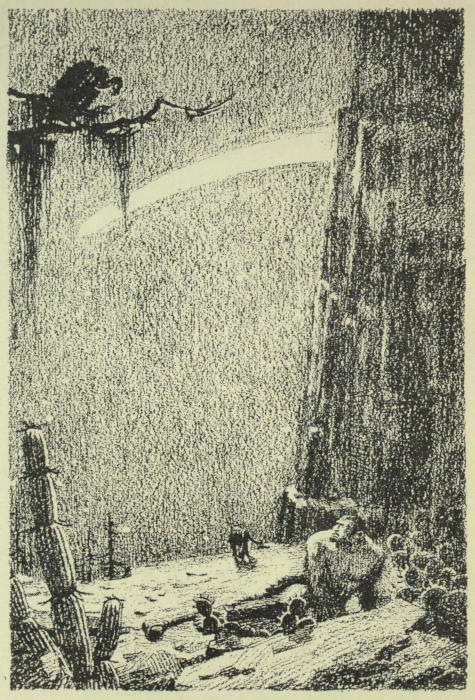
“NOT TILL I AM DEAD”
“Not till I am dead,”
said Strong Hand. “Not
till I am dead,” and his eyes
became mysterious and plaintive
like those of a child that
is in trouble and he turned
them upward
and
saw where
The Cause
into which
he was returning
had
cast a scarf-of-stars
across the sable shoulders
of the night.
CHAPTER XII MAKU AND SHE WOLF
When the night, the day
following, and the
next night had passed, She
Wolf took her son in the
hollow of her arm and
went to look for No Man.
It was beginning to be autumn
in the forest, the veins of the
big mosswood leaves were
already scarlet; the sassafras
were yellow and red; the
beeches yellow and crimson;
the birches white and gold;
the sky thinly blue, with
wispish puffs of cloud gusting
over it. The air was
fine and keen.
She Wolf ran in a great
circle, but slowly for she was
very hungry, and came upon
No Man’s stale track in the
thicket where he had lain in
wait for Strong Hand.
The track tho’ stale was
very plain, for no rain had
fallen on it, and No Man had
been running with all the
weight of despair. She Wolf
followed a little way, and
stooping picked up No Man’s
bow and ten arrows which he
had dropped in his flight.
Here the track was joined
by Strong Hand’s track, and
She Wolf was puzzled and
did not understand any of it.
“Why did he drop his
weapons?” she said.
And she went on. But she
sat down in a sunny place by
the brook to nurse her son,
who had begun to pipe aloud
and clutch at her breasts with
his tiny paws. As he snuggled
and sucked and gasped,
she crooned a song over him,
making it up as she went
along.
“We went into the forest,
The Man and I
We were looking for No Man
Who had not come back from the hunting
We came on his track
The Man and I
And we found his weapons strewing the ground.
And we do not understand—”
She stopped in the middle,
quivering and twitching for
she heard footsteps behind her.
It was Maku carrying her
little daughter and out to look
for Strong Hand.
“Have you seen anything
of Strong Hand?” she said.
“His track is with No
Man’s,” said She Wolf. “I
have followed them both to
this place.”
“The tracks are of the
same age,” said Maku.
“They were doubtless running
together on the same
hunt.”
“Then let us follow them
together,” said She Wolf.
“Have done suckling,” and
she looked up and smiled at
Maku. “He would drain
me as dry as a bone if I would
let him,” she said.
“The girl, too, is always
hungry,” said Maku with
pride.
“They are of an age,”
said She Wolf. “It may be
that one day—”
And so talking and gossipping
pleasantly, as women
will, even when anxious, they
waded across the brook and
followed the broad trail of
No Man and Strong Hand.
But when the trail ended
they found nothing but bones,
and not the whole of a skeleton
at that, for the wolves
snarling, had carried away
many of the lesser bones.
They found Strong Hand’s
bones under the tree where
he had died, but some wolf
had carried off the blood-smeared
arrow that had killed
him. When the women knew
that they were alone in the
world, they beat their breasts
and howled, and threw themselves
repeatedly upon the
ground.
All day they wailed for the
hunters who would not come
any more, and in the dark
they scraped out a hollow on
the hill side, and collecting
the bones of No Man and
Strong Hand, placed them
therein like the bones of
brothers and covered them
with earth and stones and tears.
All this time the babies,
curled like hedgehogs, and
twitching, had slept nose to
nose in a sheltered place.
They gripped each other with
tiny paws, and would not let go.
“See,” said Maku, thro
her tears, “the little ones are
already friends.”
“Let them be so,” said
She Wolf, “and in order that
we may not all perish, let us
all go to your cave to live.
You shall tend the cave and
look to the children, and I
will be the man and find food,
for I am good at hunting.”
So they went to Maku’s
cave.
“What is the girl’s name?”
asked She Wolf.
“We—she is not yet
named,” said Maku.
“The man’s name is Sunrise,”
said She Wolf, “because
he came with the sun.
Let us therefore call the girl
Dawn, for I am minded to
think that when they are well
grown the sunrise will still
follow the dawn.”
CHAPTER XIII THE WEAKNESS OF MAKU
A number of years
passed, and Maku kept
the cave while She Wolf did
the hunting. She Wolf was so
occupied with the business of
provider, meat-getter and fish-catcher,
that she did not have
time to think about any of
the other business of life.
But it was otherwise with
Maku.
There was not much for
her to do after the children
were weaned and she sat
lazily in the sun and allowed
her mind to run on old days.
It happened that a man
began to hang about the cave.
He had bright feathers in his
hair, and whenever Maku
looked at him, he blinked
and nodded and showed his
sharp white teeth, and sometimes
she cast him a word and
then he would boast and tell
her of his mighty deeds.
Sometimes Maku dreamed
about this man at night; but
she put off going with him
as long as she could, for that
is the way with a woman.
But one day she got to thinking
about Strong Hand, and
the caresses and the beatings
that were equally sweet, and
her blood began to run the
more swiftly.
And she thought too, on the
pains of labor which are so
terrible that they are akin to a
mighty joy, and of the downy
little face that had snuggled
in her bosom, and of the
little hands that had gripped
and tugged at her hair, and of
the tiny voice that had piped
in the night because of hunger.
And thinking of these
things and remembering, she
could not resist any longer.
And the very next time the
man presented himself before
the cave she went with him,
to be caressed, and to be
beaten, and to find her happiness.
When She Wolf came back
with the kill, the children
ran out to meet her and they
told breathlessly, and at one
and the same time, how a
man, adorned as to his head
with bright feathers, had
come and taken Maku away
with him.
She Wolf was very tired,
for the hunt had been long.
“It is well,” she said “for
now there is one less mouth
to feed.”
CHAPTER XIV SUNRISE AND DAWN
When the children were
old enough, She Wolf
took them with her on little
hunts, and taught them the
signs of the forest, and the
ways of the beasts and as
much as she knew of the
ways of men.
Sunrise was an apt scholar,
for he had the strength and
hunting instincts of his
mother, and all the cleverness,
with none of the cowardice,
which had distinguished
his father. But
Dawn did not take very
kindly to the life into which
she had been born.
As much as people of those
times could be, she was a
dreamer. She would pull out
from a clear track to chase a
butterfly, and she preferred
wild raspberries to moose-meat,
but then she was only a
little child, and not very
strong. This was a curious
fact, considering her parentage.
She tired easily, and she
had a habit of walking in the
night and crooning to herself.
Altogether she was a trying
pupil and She Wolf rather
despised her. But it was
different with Sunrise.
As She Wolf had predicted,
he followed Dawn, and
was unhappy away from her.
She Wolf gave up the chase,
and Sunrise armed with his
father’s bow and arrows did
the hunting for the cave.
A time came when the
nice collection of flints which
No Man had left behind him
was almost entirely dispersed.
Many of the flints
had been broken,
many lost and it
behooved Sunrise
to replenish the supply.
So without saying anything
to She Wolf he took his bow,
some arrows with broken
heads, and one good arrow
for a model, and trotted off
to old No Foot’s workshop
on the flinty hillside.
“Please,” said Sunrise, “I
am nearly out of flints, and
I must have new ones or
else She Wolf and Dawn
will starve for want of
meat.”
“Who are you to talk so
big of hunting?” said No
Foot, looking up.
“I am Sunrise, the son of
No Man and She Wolf,”
said Sunrise, “and I am hard
put to it for flints.”
“And what do you offer
me in exchange for my
trouble and my flints.”
“For so many,” said Sunrise
and he opened his right
hand twice “I will give you
as much moose-meat as I can
bring hither in two trips.”
“I do not lack for meat,”
said No Foot, “offer me
something else.”
“But I do not know of
anything else to offer,” said
Sunrise with a catch in his
voice.
“What is that in your
hand,” said No Foot and he
indicated the bow.
“I do not know its name,”
said Sunrise, “but with it
I can strike things that are
far off.”
No Foot took the bow in
his hands but could make
nothing of it.
“It is some childishness,”
he said.
In the hillside at the
base of a flinty boulder a
chipmunk had his hole and
was out sunning himself.
“If,” said Sunrise, “standing
here I show you how to
kill that chipmunk will you
give me the flints.”
“If you strike him from
here,” said No Foot, “you
shall have them.”
Sunrise took his one good
arrow and fitted it to the
string. Then he drew it to
the head, aimed a moment
and let fly.
The flint point of the arrow
struck a shower of sparks out
of the flint boulder just above
the chipmunk’s head and the
shaft was shattered into pieces.
The chipmunk dove into his
hole, unharmed.
Sunrise was ready to cry
with vexation, but when he
turned to No Foot, he saw
that the old man’s face was
wrapped with wonder.
“I am old,” said No Foot
presently and slowly. “I
have struck blows and I have
seen blows struck, but this
blow was the most mighty.”
“It was badly aimed,” said
Sunrise. “I am sorry, and
it was my last good flint.”
“Flints!” said No Foot.
“Flints—you shall have flints.
But strike me another blow—mighty
one.”
Again Sunrise smote the
boulder mightily so that
sparks flew, and the shaft was
shivered.
“He shivers the shafts,”
said No Foot.
“My father, No Man,
made this thing,” said Sunrise,
“and now it is mine.”
“I, too, will make one and
again others,” said No Foot,
“and after this day, men will
no longer hunt with spear and
club. But to him who
first makes these things great
wealth will accrue, and because
the thing is young and
was your father’s before you,
you shall have half whatever
men bring to me in exchange.
Of what wood is it made?”
And so old No Foot got
hold of the bow. But he
improved upon it, both in
workmanship and design, and
he waxed very rich, but he
gave a fair half to Sunrise
and many beautiful flints besides.
CHAPTER XV FIRE
Sunrise went away from
No Foot’s cave, and his
mind was full of the sparks
which his arrow head had
struck from the boulder.
“They were like stars,”
he told She Wolf, “only
more bright; yet when I
went to pick them up there
was nothing. Nor could old
No Foot instruct me, tho’ he
said that in working with
flints he had often seen the
like before.” But She Wolf
was not interested and Sunrise
told the tale of the stars
to Dawn, and she lent him
both her ears, and opened her
mouth besides.
It befell after this, that
often when Sunrise had a flint
that was damaged he would
shoot it into a rock, for joy
of seeing the sparks. And it
must be confessed that sometimes,
when the desire of the
sparks was too heavy to bear,
he would sacrifice a perfectly
good arrow on the flinty altar
of his passion. But that did
not matter much, because
Sunrise was now a very
wealthy young man, and could
afford to pay for his pleasure.
He had one other greatest
pleasure in life and that was
the scratching of pictures on
bone.
She Wolf had carried away
many of the best examples by
No Man from the
old cave, and
Sunrise had been
brought up on this gallery.
Many a rainy day he stayed
at home imagining scenes and
etching them into the bone,
while She Wolf and Dawn
looked on and admired.
In time he excelled his
father, and made the most
wonderful pictures of which
there was any record.
And so matters went on
until the summer of the big
dryness. That was a terrible
time. No rain fell during
the birth, life and death of
two moons. The grass
turned yellow and brown,
the little brooks dried up
completely, the rivers
sank and became chains of
pools, the pools sank and
retreated from each other,
game became scarce, the wild
raspberries and blackberries
and strawberries did not come
to full fruition because of the
lack of water, and the struggle
for existence became
fierce and intolerable.
But Sunrise was quite
happy, for he had just discovered
that any two flints
struck together with violence
emitted stars, and wherever
he went, he carried two flints
to be his solace in the heat
of the noon. It was no
longer necessary to sacrifice
good arrows. One day he
halted for rest in a valley not
far from the caves of his
tribe, and taking his flints,
one in each hand, fell to
striking them lustily.
As luck would have it the
sparks fell on a bed of tinder-dry,
dusty white lichen, and
made black marks on it.
This interested Sunrise
and he struck again and again.
Then he examined the black
marks and wondered at the
why and the wherefore.
Of a sudden he noticed that
one of the marks was growing—it
spread rapidly in all directions,
and its edges curled
upward and were red. Then
a gust of wind whirled up the
valley and the whole bed of
lichen burst into flame. Sunrise
tried to catch the flames in
his hands, and sprang away
with a yelp, for it seemed as
if a snake had bitten him.
The flames sprang into a
bush and roared. Sunrise
backed away holding his
hands before his face. The
wind and the flames seemed
to increase together. The
whole side of the valley
began to burn, brightly and
fiercely, the flames leaped
up creepers and among the
branches of trees, and the
roaring of them increased in
power. And Sunrise, held by
wonder and driven by fear,
backed slowly away; but fire
and the fierce heat rushed at
him and billows of smarting
smoke swept over him and
presently he turned and ran
for his life. And the fire that
he had kindled, snapped and
roared on his trail.
CHAPTER XVI THE FLIGHT OF THE TRIBE
Panting he bade She
Wolf and Dawn leave
the cave and run till they
could run no further, and he
dashed from cave to cave
and called upon his people
to run for their lives.
And the people looking to
the southward beheld the
black smoke and heard the
roaring of the fire, and
snatching up whatever was
dear to them, turned and
fled howling into the North.
There was no cave to
which Sunrise did not run
and when he had visited the
last cave of all, he struck
out in a great circle, until
he crossed the trail of She
Wolf and Dawn and then he
followed, running at full
speed, crouching, and frenzied
both with wonder and with
fear.
He overtook slower runners,
men overladen, women
with children, little children—and
his heart became sick
and heavy as he ran, for he
knew that in that hunt many
must be overtaken. And
he knew that the fault was his.
For the slow there was no
mercy. The oldest, the
youngest and the dearest
possessions were abandoned
to the rapid fire. With
despair, dormant instinct came
to life. For men sought
safety in the tops of trees,
and fell presently to the
ground charred and shrivelled.
No Foot, trailing his
crushed foot after him was
one of the first to start into
the North, but he went at
a snail’s pace, and was soon
distanced by the others.
The old man’s arms were
full of unfinished bows, and
his good tools
and his precious flints. He
walked along, limping at the
very tail of the procession,
and gradually dropping further
and further behind.
And after a little as he was
stumping along and dragging
his crushed foot after him,
the fire caught up with him
and threw him on his face,
and passed on.
So many thousands of
years after No Foot died,
that we may not even guess
at their number, men digging
for a railroad came upon
a skeleton lying face down
upon a pile of half finished
flints.
The left foot of the skeleton
was curiously twisted and
deformed; but presently, on
being exposed to the air, the
bones turned to powder and
nothing remained but the
flints. At first the men
thought that they had opened
a prehistoric grave; but considering
that the skeleton was
lying face downward, in a
sprawling attitude, and that
the flints upon which it lay,
were but half finished and
were charred by fire, something
like the truth dawned
upon the workmen, and
they wondered over their
cans of noonday food what
manner of man the lame flint
maker had been and what life
had been like in the old days.
But we know that the lame
flint maker was old No Foot,
and that first, last and always
he was a good workman.
CHAPTER XVII COLD AND HEAT
All that were left of the
tribe, foot sore and uncomprehending,
came at length
to rest on a high and barren
plateau.
Miles behind them, to the
southward, the fire still raged
on their trail. East and West
as far as the eye could travel,
black smoke poured upward,
but thro’ and above the smoke
to the westward, the heavens
flamed with the glory of the
setting sun.
To the North, the whole
country pitched barrenly
downward, and then became
an undulating level bare of
trees and water courses; beyond
this desert expanse, rose
a barren of purple mountains
capped with snow.
It was not until he reached
the plateau that Sunrise came
up with She Wolf and Dawn.
She Wolf was keeping an
anxious eye out for him; but
Dawn, broken with fatigue,
had thrown herself face
downward and was asleep.
Sunrise, sick with grief,
greeted She Wolf, and went
about counting heads. Many
had been overladen in that
hunt; old men, women and
children. One Eye had saved
his skin, but Moon Face had
perished with his riches.
Maku was missing, and No
Foot, and there were many
others.
Sunrise urged this man
and that to travel forward
in the night, and put the
miles between them, and the
hunter flames, but altho’ it
was bitter cold on the plateau,
he could persuade no
one to move.
The tribe was so tired
that it could hardly stand
up. Men, women and children
came close together for
warmth, and in a tangled
huddle prepared to pass the
night. It became colder, and
the stars began to appear here
and there in the heavens.
The fire advanced upon
the base of the plateau, and
Sunrise raged at the people,
who cuddling against each
other for warmth, sat stupidly
and regarded it.
But, in spite of his rage,
he cuddled with them for the
cold was now intense. He
sat and reflected upon the
roaring and vindictive enemy
which he had aroused, and the
cold increased. He recalled
the warmth of the fire in his
face, and he would have
given something for a little
of that warmth to stretch his
hands against.
“And yet,” he said to
himself, “in a little I shall
be running at full speed from
that same warmth. It will
not be long before the sons
of my stars come raging and
roaring up the side of this
hill, clearing the rocks and
the earth, and the moss and
whatsoever is on the hill.
And yet the warmth was
pleasant.”
His spine twisted him
with a shiver. “If there
were water here,” he said,
“it would be turned into
stone by the cold.”
All of a sudden one of the
women fell to howling and
beating her breasts; and the
rest knew some one had died.
It was the woman’s son, a
boy, nearly a year old, whom
she had lugged all the way
from the caves. The cold
had killed him.
“Be still, woman!” said
old One Eye, coughing. “In
a little we shall all be dead
either from the heat yonder
or the cold here. Beat your
breasts as much as you wish
for that will warm you; but
do not howl, for some of us
are weary, and wish very
much to sleep.”
So the woman’s howl became
a whimper, but she continued
to beat her breasts.
And the night went on, and
the child lay frozen at her
feet.
And now far below them,
two thousand feet and more,
the fire glowed in broken
curves along the base of the
plateau: but beyond that it
did not seem to advance. The
night wind blowing in the
reverse direction rolled the
smoke back upon its tracks
and kept the view clear.
“Better the warmth than
the cold,” said Sunrise, and
his teeth chattered. “I am
going down the hill to warm
myself. Who comes?”
But the fear of the fire
was on the people, and they
whimpered and whined and
smote themselves, and told
him that he was mad and
would be killed. He could
not budge them.
“In a little,” said old One
Eye, “we shall be rested and
have strength to go on—but
not back.”
“Then I go alone,” said
Sunrise, and he arose and
called his mother by name.
“I am here,” answered
She Wolf, “but I think the
girl is dead, for she is cold
to touch and will not answer.”
Sunrise fell as tho’ his
belly had been filled with
stones, so heavy was his
dread.
He knelt by Dawn and
felt of her and listened for
her breath. He could feel
her heart beating feebly
against the palm of his hand,
but she was very cold.
He gathered her in his
arms, and strode down the
hill toward the fire. She
Wolf limped behind, (a thorn
had pierced her foot) beating
her breasts and whimpering.
But with every step of the
descent the air became warmer
and in their faces was a
pleasant glow from the fire.
A number of hundred feet
from the fire they halted, for
the heat was becoming too
great to bear. Sunrise bade
his mother sit and he laid
Dawn in her arms.
“She will not die,” he
said. Then with his hands
before his face, he descended
further. And for a very long
time he stood peering between
his fingers and observing
the actions of the fire.
Suddenly he cried aloud for
joy and turning bounded up
the hill to where his mother
sat with Dawn in her arms.
“It does not eat the
stones,” he cried, “nor the
earth—I have watched a long
time and it has not come
forward by the breadth of my
arm. It springs only upon
trees and bushes and things
which grow.”
“Then we are safe here!”
said She Wolf.
“We are safe, and warm,”
said Sunrise, and he felt of
Dawn.
“Dawn!” He said,
“Dawn!”
She opened her eyes and
smiled upon him.
“Are you warm now?” he
said. “Are you warm?”
“I am warm,” she said,
“but very weary and it may
be hungry.”
“Sleep, then,” he said,
“for there is no food, and in
the morning there will be a
hunt.”
Then, his heart light with
happiness, he turned and ran
up the hill. In his absence
two more children had died
of the cold.
“O people!” he cried.
“Below there is warmth and
safety, for the stones and the
earth fighting for us have
turned back the mighty hunter
who sought to devour
us.”
The querulous voice of
One Eye was heard in
answer.
“Be still! Sunrise,” he
said. “This is as good a
place for dying as any.
Furthermore, we are weary,
and some of us wish very
much to sleep.”
“You at least,” said Sunrise
furiously, “shall not die
here, for I shall drag you
down the hill by the hair of
your head and with such
force that you will die on
the way.... Who follows
me?”
But the people only whimpered.
Sunrise caught up a spear
and brought down the handle
on the nearest back.
“You shall not follow,”
he cried in a mighty voice.
“You shall go before, and I
will drive you.”
And he fell upon them
with the handle of the spear.
Now the people, up to the
boldest hunter among them,
were numb with cold and
had no fight in them.
So the fear of Sunrise fell
upon them, and they went
before him like herded sheep.
And he kept smiting the backs
of those who brought up the
rear.
Old One Eye was not one
of these. Indeed he was one
of those who led the route.
When they came to where
She Wolf and Dawn lay
sleeping in the warmth, Sunrise
left off beating them, and
they settled down with their
hands before their faces.
Delicious warmth crept
into the icy crannies of their
bones, and they slept.
CHAPTER XVIII THE DEATH OF ONE EYE
From now on Sunrise
was the leader of his
people. They never got
over the bullying which he
gave them, when they were
numb and empty of fight.
He only had to command and
he was obeyed; only once
was there anything like grumbling.
They crossed the plateau,
and descended into the barren
plains upon the other side.
Here night overtook them;
and as before a bitter frost
threatened them with death.
It was then that they grumbled.
At least, they said,
they might have remained by
the fire and have died warm,
and they cursed Sunrise for
having disturbed them. Sunrise
retorted that they were
little children and not hunters,
chipmunks but not men,
four-footed do-nothings who
were a stench in his nostrils.
Then he went apart in bitterness
and gathering lichens
and moss and sage brush,
made a heap, and placed rocks
about the heap in a circle.
He struck flints together,
and after no little toil, kindled
a fire, and they, sitting
about it were warmed and
comforted, and held their
hands before their faces and
wondered.
Game was very scarce in
the plains, but after a number
of days, thirsty, and half
starved, Sunrise led his
people in among the foothills
of the purple mountains with
the snow tops.
There the gullies and the
natural runways were pricked
thick with the tracks of
moose, elk, deer, and
bear, streams were
abundant, teeming with trout,
and best of all, for the tribe
was a forest tribe, the whole
country was covered with
splendid trees.
Men, women and children
fell to burrowing out homes
in the hillsides. Long Arm,
a disciple of old No Foot,
gathered sea-green flint and set
up a workshop; Hunch Back,
his son, established himself
near at hand and went in for
manufacture of bows; Fish
Catch, the nephew of Fish
Catch, collected tough fibres
and began the intricate knitting
of nets; and Sunrise in
an open rocky place experimented
with fire, and brought
it under complete control.
THE KNITTER OF NETS
One day as Sunrise, with
smarting eyes, sat feeding his
fire, a little boy no higher
than a man’s waist, came
trotting up with the roughest
kind of a bowl shaped of
grey white clay in his hands.
“See what I have made,
Sunrise,” he said.
“But what is the use of
it?” said Sunrise.
“I wish to lay it near your
fire,” said the little boy, “for
that will make it hard and
then it will hold water.
The sun at this season is not
hot enough to do this.”
“What is your name?” said
Sunrise, “for you seem very
thoughtful, for so little a
child.”
“I have no name,” said the
child.
“I will call you, Shaper,”
said Sunrise, “for you have
taken clay and shaped it; not
foolishly as it is customary for
little children to do, but with
a purpose.”
They baked the bowl before
the fire, and it became hard
and brittle, and altho’ parts
about the edges of it crumbled,
leaving it very shapeless, they
found on trial that it would
hold water.
“I will teach you,” said
Sunrise, “how to take care
of a fire of your own. You
shall make many things of
this kind and I will see to it
that people give you valuable
presents in exchange. For I
think that after this when a
man wakes in the night and is
thirsty, it will be possible for
him to drink without running
to the river for the water.”
When the shaper had been
taught how to build and tend
a fire, he started a little workshop
near the place where
he had found
the clay, and
worked busily
at the making
and baking of bowls. And
in both branches of trade he
made astonishing progress.
But this shaper was a remarkable
child, for no sooner
was he an adept at the
making of bowls than he
wearied of it, and would
sooner have starved than make
any more. But for that matter
he was not in the least
bent on starving. So what
did he do, but take two
disciples of his own age,
teach them the craft, lie all
day sleeping in the warmth
of the fire, and, to use a
modernism, pocketing four-fifths
of the profits. He became
so fat and lazy that he
could hardly walk, and at the
age of twelve was already
annoying the women with
his attentions.
The tribe was more comfortable
than ever it had been
before. Bows and arrows
supplied game, bowls full of
cold water stood handy in
every cave, and as the season
advanced in severity fires were
kindled and kept going.
One day Sunrise went to
One Eye’s cave bearing a gift
of venison. This was after
the first snow, and the weather
was bitterly cold. In front
of One Eye’s cave was a
cheery fire, and in the cave
itself lay the old man dead.
He had died in the night of
his great age and of the cold.
Now this is deserving of
mention. That when One
Eye fled from the great fire, he
carried with him but one treasure,
and that was neither club,
nor spear, nor bow, nor net,
but the flat bone upon which
his own glorious deeds had
been recorded by the clever
fingers of No Man.
At no time had his weariness
or suffering been so great
as to make him part with this
heavy article. Now he lay
dead with the bone clenched
in his frozen hands.
“One Eye is dead and done
with,” said Sunrise, musing.
“There is no woman to howl
over him. He will never see
with his one eye any more.
He will not hear the sounds
of the forest any more; nor
will he lick his lips at the
smell of meat.”
“When we have brought
down the roof of his cave
upon him, he will be hidden
to the eye, and forgotten by
the mind. Yet I am told that
he was once the swiftest of
all runners, a mighty hunter
and a striker of terrible blows.
These things and others which
are true and untrue have been
recorded on this bone which
even in death he clings to.”
“The hands which kindled
this fire are dead and in a little
the fire too will be dead for
want of nourishment. Yet if
I throw wood upon it, it will
live, and if I had the will I
could keep it alive, as long as
my own life lasted, and afterward
my son could do likewise
and after him his son.”
“Thus many years after old
One Eye had become powdered
bone in a filled up cave,
the fire which he started,
would still be burning. And
it might happen that one, half
dead of the cold, should be
laid before that fire and
brought back to life. And
would that be the work of him
who lies here without breath
or motion, or would it be my
work who gave food to the
fire when it was dying, or
would it be the work of my
son, or of him who brought
the half dead one and laid
him in the warmth?”
Such were the thoughts
that passed thro’ the mind of
Sunrise, tho’ he did not say
them out in words as I have
done. He simply stood and
wondered about death, and
that is one of the reasons that
man has become man. Like
the other animals he accepted
all things, but unlike them,
he wondered about them, and
asked questions.
Sunrise bent and regarded
the fire closely. Then he
thrust his hand into it, and
laughed.
“Food will not recover it
now,” he said, “for it is
dead, and that is the end of
One Eye.”
CHAPTER XIX THE COURTING OF DAWN
When Sunrise got back
to his cave, he found
She Wolf sitting alone by the
fire.
“Where is Dawn?” he
said, for She Wolf was not
first in his affections.
“She has gone to fish thro’
the ice,” said She Wolf, “and
she will return soon.”
“I have just found One
Eye dead in his cave,” said
Sunrise.
“It is well,” said She
Wolf, “for now there is one
less mouth to feed.”
“One mouth more or less
matters little.”
“What you think, I think,”
said She Wolf, “and therefore
as you say a mouth or two
more in this cave would not
matter.”
“Whom do you wish to bring
to this cave?” said Sunrise.
“I wish you and Dawn to
bring the extra mouth,” said
She.
“I do not understand,”
said Sunrise.
“The matter is simple,”
said She Wolf, “and Dawn
will not say no to you.”
Sunrise sat and thought.
“There is a time for all
things,” he said presently,
“Hitherto I have been very
busy with a number of things.
But I have always intended
one day to make a cave of
my own and take Dawn to it.
For always when I am away
from her there is a something
which keeps calling me back
to her side. But she is very
young still, and not strong,
and I will wait.”
“You are of an age,” said
She Wolf, “and even if you
are willing to wait, I know
of others that are not willing.”
“Who?” said Sunrise suspiciously.
“Dawn,” said She Wolf.
“You spoke of others.”
“When you are at a distance,”
said She Wolf,
“certain young men, sticking
bright feathers in their hair,
come and hang about this
cave.”
“They do, do they,” said
Sunrise angrily. “And what
do they want.”
“It may be that they want
me,” said his mother with a
grin, “but I do not think so.
Listen then. Whenever Dawn
shows herself, these young
men, fall to blinking and
nodding their heads and showing
their teeth—.”
“I will kill them,” cried
Sunrise and he reached for
his bow.
“There is an easier way.”
“Name it.”
“Take her yourself.”
“Tell me one thing,” said
Sunrise, “does she throw
looks and words to these
young men.”
“She does not,” said She
Wolf.
“Then,” said Sunrise, “I
will not kill them, and when
the spring comes, I will hollow
a cave and take Dawn to
live in it. But now the
ground is like stone and no
man may dig it. Furthermore
it is customary to wait until
the spring. Let these things
be understood.”
When Sunrise saw Dawn
coming up from the river
with her catch, he knew that
she must be cold. Therefore
he threw sticks and brush
upon the fire so that it shot
upward and gave out delicious
warmth.
“Behold!” said Dawn, “I
have caught three fishes, one
for each. But they are very
little.”
“You are a mighty fisher,”
said Sunrise, “and when we
have a cave of our own, you
shall do the fishing and the
hunting, while I lie in the
sun or before the fire.”
Thus in a bantering voice
Sunrise proposed to Dawn.
And she turned away her
face and was silenced. And
thus she accepted him. She
Wolf took the fish and went
aside to clean them.
“It will be in the spring,”
said Sunrise, “when the earth
is soft for digging and the
leaves are green on the trees.
Are you willing?”
She turned and looked him
full in the face.
“I am willing,” she said.
Her eyes clung to his and
his to hers. He tried to
speak but his voice choked in
his throat, and for the first
time in his life, desire like a
flame swept him from head to
heel. And mingled with the
desire was a nameless shrinking
and terror—a shrinking
from himself and a terror of
Dawn.
He mastered himself and
spoke in a thick voice.
“Dawn,” he said, “after
this I will hunt for this cave,
and collect wood for this fire,
but I will not live here any
more.”
He rose and went silently
into the forest.
“Where is he going,”
asked She Wolf from a distance.
“He is not going to live in
this cave any more,” said
Dawn. “But he will come
every day and bring us meat
and wood for the fire.”
Then She Wolf chuckled
and went on cleaning the fish,
but Dawn ran into the cave
and hid herself.
CHAPTER XX SUNRISE DIGS A CAVE
Sunrise went to the cave
of Fish Catch—a young
man a few years older than
himself, who was so ugly
that no woman would have
him, and who therefore lived
alone. Fish Catch was busy
with a net.
“Fish Catch,” said Sunrise,
“may I live with you
until spring? I will see that
you do not lack for food.”
Now in winter when the
rivers were frozen people did
not have very much use for
nets, and Fish Catch consequently
was often hard put
to it for food. Therefor this
proposal met with his entire
approval, and he said so.
“But what,” he said, “is
the matter with your own
cave?”
“It is a small cave at
best,” said Sunrise, “and we
were crowded.”
Fish Catch laughed cynically.
He thought it not
unlikely that Dawn had taken
a club to Sunrise and driven
him away from her. But he
was afraid to say so openly.
One day Sunrise killed a
bear and he hastened to She
Wolf and Dawn, taking the
four feet with him. Usually
he did not return from the
hunting till dark, but on this
occasion he had killed early
and was back by noon.
Squatting in the snow in
front of the cave, he saw two
young bachelors with bright
feathers stuck in their hair.
They were waiting for Dawn
to come out. Sunrise strode
up to them in a fury.
“Be off!” he cried, “I
will have none of this. Let
me catch you making eyes at
Dawn and I will strike to
kill. Let this be clearly understood.”
They saw the fury in his
eye and scuttled off.
“Do not come within
shouting distance of this
cave,” he shouted after them,
“for the sound or sight of
you is not to be borne.”
She Wolf, sitting in the
mouth of the cave, chuckled
and grinned.
“They are always here,”
she said.
Sunrise turned on her
fiercely.
“Are you, too, against
me?” he cried. “Faugh—you
have a bow and arrows.
Use them.”
“The next time they
come,” said his mother in a
conciliating voice, “I will
use the bow and the arrows.”
But she did not. Nor
the next time—nor the next
time—nor the next.
But Sunrise went away
appeased.
And when the frost went
out of the ground he selected
the side of a hill where the
sun smote from early morning
till late afternoon and
fell to burrowing and digging a splendid
cave, which
was to be the
very largest
and most splendid cave of
which there was any record
up to that time.
But the work progressed
slowly, for he was obliged
to hunt betimes, and the cave
was to be of splendid proportions.
It was not finished
until the spring was well
advanced.
Tall violets stood by the
brooks, flowers crowded between
stones, and grew over
the open places, trees, bushes,
hills, valleys and forests were
misty with new green.
Sunrise arose in the
sparkling dawn and took up
his bow and his arrows.
Birds were trilling in the
forest.
“To-day,” he said, “I will
hunt, and to-night—to-night—.”
Then he ran into the
forest laughing and singing.
The sun was going down
when Sunrise presented himself
joyously before the cave
where She Wolf and Dawn
lived. But when he called
to them, they did not answer,
and when he went into the
cave, he found that She Wolf
had been shot unto death, and
that Dawn had vanished away.
Sunrise knelt by his mother
and called her by name and
felt of her. And presently
by the coldness of her body
he knew she had been dead
a long time.
He went out of the cave
and ran in a great circle.
After a little he came upon
the trail of Dawn and a man,
and it pointed away from the
caves of the tribe and was
straight, like the flight of an
arrow.
But Sunrise flung himself
along the trail, and all night
he ran like a wolf.
“They will not dare stop,”
he said, “and it may be
that I shall not be too late.”
With the first light he
came to a flowery, grassy glade
in the forest. But the grass
was greatly trampled and
many of the flowers were
broken, for there had been a
terrible struggle in that place.
And Sunrise read the signs
of it as we read printed
words in a book.
“She fought against him,”
he cried, “she fought against
him!”
He smiled a little then and
looked upward, but after that
in his life he was to smile
but once more.
He lay face downward,
digging and tearing at the
ground until the nails of his
fingers were broken and
bloody.
Birds sang and the sun
rose.
CHAPTER XXI THE TRAIL OF TWO
Sunrise ran in a great
circle and found where
the trail of Dawn and the
man left the grassy glade, and
bending to the right, wound
along among the foothills of
the mountains.
“One runs faster than
two,” said Sunrise, “and
there is now no need of
hurry.”
And he thought of what
he would do when he caught
up with them.
He was now in the complete
possession of his abilities,
calm deliberate and constructive.
By stepping in the man’s
tracks Sunrise was able to
calculate his stride and the
speed at which he had been
going.
“It is little better than a
walk,” he said, “and if I run
slowly, I shall gain fast.”
Running, therefore, slowly,
he suddenly stopped all
a-quiver, for he smelt blood.
There was a little splash of
it on the leaves of a young
moose-wood. Sunrise considered
the blood to mean this:
“Dawn,” he said, “does
not go willingly, the man is
forcing her to run ahead of
him, and here he found it
necessary to prick her with
his spear. She is still fighting
against him,” he said,
and that surmise shot a pitiful
little spasm of joy into
his sick heart. He ran on.
“After a time,” he reflected,
“the man will be
obliged to hunt. It may be
that I shall find Dawn bound
to a tree waiting for his
return. In that case I, too,
will wait for his return. But
lest he smell me out I will
take up the next fresh moose
dung that I find and smear
myself with it.”
In the cool bottom of a
valley Sunrise found a confusion
of tracks. Two sets
led from the valley and one set
led in the reverse direction,
that is, back to it.
“They passed this place
and went on,” said Sunrise.
“Then they came back, then
they turned and went on
again.”
He thought hard and when
he had puzzled it out he
laughed a short, harsh laugh.
“The man,” he said,
“made up his mind to hunt,
but, being a fool, he either
did not tie Dawn to a tree or
he tied her like a fool and she
broke loose. As soon as he
had gone, she followed the
trail backward, running as hard
as she could, for see these return
tracks are far apart. The
man, coming back from the
hunt, found that she had
gone, and followed. Here
he caught up with her and
made her turn again. But
he had to prick her with his
spear to make her go—see,
here is more blood. I am
not far behind.”
The solution proved correct,
and Sunrise even found
the thongs with which Dawn
had been insecurely bound,
and the tree which the man
had selected to bind her to;
the bark here and there was
stained darkly.
After this he increased his
pace.
“Dawn,” he said presently,
“is growing weak for she no
longer steps out steadily. It
is probable that she will die
of her wounds and of her
weariness, and it is better so.
But I would like to speak
with her before she dies, for
she is little more than a
child.”
Sunrise was very hungry,
and being now sure of his
quarry, he stopped to hunt,
and when he had killed, he
ate, but sparingly, drank deep,
and slept for a few hours.
He rose greatly refreshed,
and taking a lump of meat
with him, ran swiftly on into
the night.
Toward morning he was
aware that Dawn and the man
were increasing their pace.
But Dawn had begun to run
very unsteadily, and in two
places the trail showed where
she had tripped and fallen.
“He knows that I am on
his trail,” said Sunrise, “and
his belly is cold with fear.
Soon he will leave the
woman and go on alone, but
he will not get away. And
it were better for him that
he had not been born. I am
minded to do things with
him that have never been
done to any man before.”
But it was not until noon
that he came upon Dawn in
the place where the man had
deserted her. She called to
him before he saw her, tho’
he already knew that she was
near. And what she called
to him was this:
“I fought against him,
Sunrise—I fought against
him.”
SHE SOBBED IN HIS ARMS
He knelt by her, his eyes
swimming with tears and pity,
and fondled her and comforted
her.
“Here is meat,” he said,
“only live till I return from
this hunt, and I will look
after you.”
“You will take me—even
now,” she said.
“Even now,” said Sunrise,
“for the fault is not
yours. And between us two
it shall be as tho’ this thing
had never happened.”
She sobbed in his arms.
“Only live,” he said.
“Only live—and I will return
as soon as I may.”
As he turned tenderly from
her, and shot along the trail,
it seemed to Dawn that Sunrise
was shining with strength
and beauty.
All that afternoon he ran,
and all that night, and even
to him it seemed wonderful
that it should be so. His
breath came and went softly
like that of a sleeping child,
his muscles were like those
of a man who has eaten and
drunk and slept deep. There
was no labor in his movements.
He was like a fire
that feeds on its own progress.
He was running on
the tireless feet of love and
hate.
In the morning, he came
out on a cup-like and barren
plain that was between the
foothills of the mountains and
the mountains themselves, and
a mile before him, running
on the feet of fear, waist deep
in the white mist of the
morning, he saw the man.
CHAPTER XXII THE TRAIL OF ONE
Fear and hate and love
eats up the miles even as
the sun eats up the white
mist of the morning. But
the distance that was between
the two men neither increased
nor diminished; it became
terribly hot, and the going
was arduous. Tough, spiky
bushes covered the plain to
the height of a man’s knee
but they seemed less to grow
out of the deep, shifting dust,
than to be stuck into it.
The progress the men made
was rather by a succession of
leaps than by straight running.
It was like trying to
make speed over an unequal
beach covered with knee-deep
water, and it told upon
them fearfully.
A hot wind was blowing
with fierce gusts. Sometimes
it sent spinning columns of
dust high into the air, and
with the same breath destroyed
them and hurled the dust
fragments into the faces of
the men. Now and again,
above the gusting of the
wind, the pulseless, clicking,
singing signals of rattle snakes
could be heard.
As the day advanced, black
clouds shot with lightning
began to bank up in the
West, and thunder no louder
than the purring of a cat made
itself heard. And still the
men staggered on, but their
speed now was no more than
that of a fast walk.
Their throats and the roofs
of their mouths were as if
calcined by fire; their eyes
were red, burnt and dry.
And those two valiant feet of
Sunrise, Hate and Love, began
to doubt each other. “It
may be,” they said, “that Fear
is stronger than we.” But
they went on, bleeding and
bruised. And it was not
otherwise with the feet of
Fear. “We are done for,”
they said. But they went
on.
And now the black,
thunder-bearing clouds, rushing
up from the west, came
between the sun and the
plain, darkened the bushes
and the dust and the figures
of the men. But the heat
did not diminish. And the
men crept on.
Between them the distance
was now no more than the
half of a mile. Their pace
had become that of children
learning to walk. But of the
two children Sunrise was the
more advanced in walking.
And the world grew darker,
the wind began to howl, and
a continuous cloud of stinging
dust smote into their
faces.
There was no longer any
blue sky, for the black thunder
clouds had covered it
from one horizon to the
other, and the mountains
themselves were hidden. The
plain was like the floor of a
great dark cave, and in the
midst of it were two little
children that stumbled forward,
staggered, fell, and rose
again. But Hate and Love
was stronger than their
brother Fear, and he staggered
to more purpose, and he did
not fall so often.
And presently he began to
call upon Fear to stop and
face him.
It was then that the whole
cave was filled with a blue
glare that shook and was more
bright than the light of the
sun. And at the same
moment there was a detonation
of thunder, more loud
and terrible than the falling-in
upon themselves of mountains.
And the hearts of the
men stood still in their
breasts.
And long after the darkness
had closed in again, their
eyes were filled with the
shaking blue glare, and their
ears with the thunder.
There was a long hush—even
the wind ceased. Then
again the glare—but more
bright, and again the thunder,
but more terrible. And glare
followed glare, and the thunder
became continuous, and
the wind came with redoubled
fury, and the dust rose in
clouds and hid the men, the
one from the other.
Then came the rain, but
not in drops and jets. Its
fall was more like that of a
solid, and the whole earth
rose in smoke to meet it.
The blackness was now like
the blackness of night, and a
man could no longer see the
distance that is between two
trees standing in a thick
forest.
Sunrise lay upon his face,
and sobbed in the storm, for
he made sure that his vengeance
would escape him.
He did not feel the cold rain
on his parched body; he no
longer feared the lighting and
the thunder. Time and again
he rose and tried to pierce
the blackness of the storm.
But the man was hidden.
Now the curtain of the
elements that was breaking
the heart of one man, was as
a mighty stimulant to the feet
of the other, and he made a
crafty turn and went forward.
The rain and the cool
refreshed him and he made
sure that he would escape.
But he was too crafty by a
half, for he lost his way in
that storm, and after a little,
with triumphant and relieved
heart, he staggered straight
into the place, that of all
places in the world he was
most anxious to avoid. And
that was the place where Hate
and Love stood with Despair
and sought to pierce the
storm.
A few feet away, through
the smoking deluge of the
rain, Sunrise saw the crouching
figure of a man. It was
outlined in a white steam,
and was coming on. At
first Sunrise could not realize
that it was The Man. When
he did he smiled peacefully
and he stepped forward, and
taking the man gently by the
shoulder turned his face upward
and looked upon it
long, and quietly.
When the man felt the
hand on his shoulder, and saw
the face that regarded him,
hope that had sustained him
perished. His fingers twitched
foolishly, and after a little,
he sobbed once, and shivered
and was still. Then he collapsed
and fell.
Sunrise sat down beside
him.
“We must rest for a while,”
said Sunrise, “I have not
now the strength to do that
which I have come to do.”
The man nodded.
And after that, for a long
time, no word was spoken
and no sign made.
The man lay on the ground
breathing hard, and Sunrise
sat beside him. The rain
fell drenchingly upon them.
About them the storm raged,
and above.
“Put your feet close together,”
said Sunrise, when
he was rested enough. “I
am going to tie you.”
So the man put his feet
close together, and Sunrise
bound them with the thongs
that had bound Dawn.
“Now lie on your breast,”
said Sunrise, “and cross your
hands upon your back.”
And he bound the hands.
Sunrise turned the man
over, and after that the man
kept his eyes on Sunrise, to
see what he was minded to
do.
For hours screams pierced
the storm, and could be heard
above thunder.
CHAPTER XXIII THE LONG TRAIL
Sunrise, carrying his
bow and arrows, toiled
over the plain heavy with moo
the recent rain. The sun
shone strongly and the sky
was blue. Behind him the
snow capped mountains glistened
in the bright light, before
him a barrier of lofty
forest, fresh and green,
marked the termination of the
plain. He was bent low to
the ground, and extreme exhaustion
marked his going.
His hands and forearms were
dark and clotted with that
which was drying on them.
“If she will only live till
I come,” he said, “if she will
only live till I come.”
The sun blazed; the feet
of the man were springless;
his eyes, deep sunken, burned
like red coals.
“If she will only live till
I come,” he said, “if she
will only live till I come.”
He was following the
back-trail by memory and
instinct, for the rain had
wiped all signs of the pursuit
from the face of the earth.
At times Sunrise thought of
what he was leaving behind
him; at times of the work
that was still to do.
These two thoughts, so
opposite that it was paradoxical
for them to be contained
in one skull, supported him
thro the cruel toil of his
going.
When he came to the
forest it was wet and green
and full of bird singing: for
at this time the birds were
mating and it seemed sweet
to them.
That day he killed, ate
greatly and drank deep.
After which he slept; and
there was no log in the
forest which lay more still.
It was as tho’ he had died.
In the night wolves came
and sniffed at him and could
hardly believe the noses
which told them that he was
alive and not for them. In
the morning he came to life,
and tho’ still aching in every
bone, took up the back-trail
at the trot.
The going was easier in
the forest and more secure,
for there the rain had not
fallen so violently, and the
tracks were still visible—his
own tracks and the tracks of
those feet which would not
press into moss any more.
He went on all that day, and
the next night.
He came at length to the
place where he had left Dawn,
but she was not there. He
knew that she would not
be, and yet somehow his
heart sank.
“She had no weapons,” he
said. “Furthermore she was
very weak and it may be that
the meat was not sufficient.”
For an hour or more,
running swiftly, he followed
a winding and rambling trail.
“She was searching for
food,” he said, “but at this
season there are no berries,
and she was without weapons.”
The trail finally turned
abruptly downward into a
gully filled with young trees,
from whose midst could be
heard the chattering of a brook.
Sunrise paused on the
brink. His head sank on his
chest; his muscles relaxed.
He all but dropped his bow.
As he stood thus the days of
his youth went from him
forever.
“I shall find her below,”
he said presently, “but she
will not speak to me. I
have been too long in coming.”
He descended into the
gully, slowly, like one in a
dream.
She had died among the
violets by the brook, and
she was not yet cold. In
her hand was a branch of birch
half stripped of its leaves; for
she had eaten them to stave
off starvation.
He sat for a long time
with her head on his knees.
“I should have stayed with
you, Dawn,” he said. “I
should have let the man go.”
And later.
“There will never be any
solace to me in thinking of
what I have done. My cave
will be always empty now.
There will be no son to cling
to my fingers with his little
hands. There will be nothing
for me now. For I shall
always be finding you silent
among the violets by the
brook.”
For a long time the strong
man was shaken with sobs,
so that it seemed as if they
would kill him. After that
a kind of exaltation possessed
him and he saw visions of
her. Wherever he looked
he saw her coming to him
thro the young trees.
“She is not dead,” he
cried, “she is not dead.”
But the corpse at his feet
was now icy cold.
Then he seemed to see her
going thro a strange forest
alone, and she was without
weapons or food. He called
to her, but she only shook
her head and fell to the
ground.
“She is starving,” he cried.
But she staggered to her
feet and went on. And now
she was crossing an arid
plain, but upon the other side
were the fires of a strange
tribe, and in the mouths of
all the caves meat was hanging.
The people beckoned to
her and called and she
stretched out her arms to
them, but it seemed impossible
that she should reach
them, so slowly she went and
so wearily she dragged her
feet.
But the vision went out,
and the brook was loud in his
ears.
“If she had had food,”
he said, “she might have
reached that friendly tribe and
they would have given her a
cave to rest in and cool water
to drink.”
As he spoke a young deer
stepped into the brook with
a clinking of hooves upon
stones. Sunrise loosed an
arrow, and the deer pierced
thro the heart, fell shapelessly
in the shallow water.
“She shall not go on this
journey without food,” said
Sunrise.
He cleaned the kill and
then toiling till his back was
like to break, he made a
great excavation in the side
of the gully, and therein he
laid Dawn and the young
deer.
Then he looked
lovingly upon his faithful
bow and his good
arrows.
“It may be,” he
said at length, “that the
journey is very long
and the deer will not
suffice.”
And he opened
Dawn’s left hand and
clasped it about the grip of
the bow and in her right hand
he laid the arrows.
“It may be,” he said,
“that one day I shall follow
on your trail again.”
Then he began to close the
grave. But twice that he
might look once more on
Dawn he desisted and undid
what he had done. When
the work was finished, he
turned slowly away.
“Now I will go back to
my people,” he said.
The fires of the tribe were
days distant, and, without food
or weapons, he was naked
as he had come into the
world. But he set his valiant
feet upon the long trail. And
as he went he kept finding her
silent among the violets.