. . . stared at the Pacific—and all his men
Looked at each other with a wild surmise—
Silent, upon a peak in Darien.
Exactly four centuries after the event immortalized
by Keats, I outstripped Balboa's most fantastic
dreams by setting out upon the Pacific and traversing
the length and breadth of it. "It is a sight," we are
told, "in beholding which for the first time any man
would wish to be alone." I was. But whereas Balboa's
desires were accomplished in having obtained sight of
the Pacific, that achievement only whetted mine. He
said:
You see here, gentlemen and children mine, how our desires are
being accomplished, and the end of our labors. Of that we ought to
be certain, for, as it has turned out true what King Comogre's son told
of this sea to us, who never thought to see it, so I hold for certain
that what he told us of there being incomparable treasures in it will
be fulfilled. God and His blessed Mother who have assisted us, so
that we should arrive here and behold this sea, will favor us that we
may enjoy all that there is in it.
The story of how far he was so assisted is part of the
tale of this book, for in all the wanderings which are
the substance of my accomplishment I can recall having
met with but a half-dozen of Balboa's kinsmen. Instead
there are streaming backward and forward across the
Pacific descendants of men Balboa hated and of others of
whom he knew nothing.
Balboa was the first to see the ocean. He had left
his men behind just as they were about to reach the peak
from which he viewed it. But he was not the first to step
upon its shores. He sent some of his men down, and
of them one, Alonso Martin, was the first to have
that pleasure. Martin dipped his sword dramatically
into the brine and took possession of it all as far as his
mind's eye could reach. Yet to none of the men was this
vast hidden world more than a vision and a hope, and
the accidental name with which Magellan later christened
it seems, by virtue of the motives of gain which dominated
these adventurers, anything but descriptive. To be
pacific was not the way of the kings of Castile; nor, sad
to say, is it the way of most of their followers.
What was it that Balboa took possession of in the
name of his Castilian kings? Rather a courageous gamble,
to say the least. The dramatic and fictional possibilities
of such wholesale acquisition are illimitable. In
the mid-Pacific were a million or more savage cannibals;
in the far-Pacific, races with civilizations superior to his
own. At that very time China was extending the Great
Wall and keeping in repair the Grand Canal which had
been built before Balboa's kings were chiefs. Japan
was already a nation with arts and crafts, and a social
state sufficiently developed to be an aggressive influence
in the Oriental world, making inroads on Korea through
piracy. Korea was powerful enough to force Japan to
make amends. Four years after Balboa's discovery the
Portuguese arrived in Canton and opened China for the
first time to the European world. The Dutch were beginning
to think of Java. It was hardly Balboa's plan to
make of all these a little gift for his king: his act was but
the customary flourish of discoverers in those days. Men
who loved romance more than they loved reality were
ready to wander over the unknown seas and rake in their
discoveries for hire. Balboa, Magellan, Drake, roamed
the seas out of sheer love of wind and sail. Many a man
set forth in search of treasure never to be heard from
again; some only to have their passage guessed by virtue
of the signs of white blood in the faces of some of
the natives. For two hundred years haphazard discoveries
and national jealousies confused rather than enlightened
the European world. But late in the eighteenth
century, after a considerable lessening of interest in
exploration, Captain James Cook began that memorable
series of voyages which added more definite knowledge to
the geographical and racial make-up of the South Seas
than nearly all the other explorers put together. The
growth of the scientific spirit and the improvement in
navigation gave him the necessary impetus. Imbued
with scientific interest, he went to observe the transit of
Venus and to make close researches in the geography of
the Pacific. But to George Vancouver falls the praise
due to a constructive interest in the people whose lands
he uncovered. Wherever he went he left fruits and
domestic animals which contributed much to the happiness
of the primitives, and probably laid the foundation
for the future colonization of these scattered islands by
Europeans.
Backward and forward across the Pacific through four
centuries have moved the makers of this new Atlantis.
First from round Cape Horn, steering for the setting
sun, then from the Australian continent to the regions
of Alaska, these shuttles of the ages have woven their
fabric of the nations. Now the problem is, what is going
to be done with it?
I suppose I was really no worse than most people in
the matter of geography when I set forth on my venture.
Though the Pacific had lain at my feet for two
years, I seem to have had no definite notions of the "incomparable
treasures" that lay therein. Japan was
stored away in my mind as something to play with.
Typee, the cannibal Marquesas—ah! there was something
real and vigorous! Then the South Sea maidens!
Ideal labor conditions in New Zealand! Australia was
Botany Bay; the Philippines, the water cure. Confucius
was confusion to me, but Lao-tsze, the great sage of
China—in his philosophy I had found a meeting-ground
for East and West.
But I was sizzling with curiosity. I wanted to bring
within my own range of experience that "unplumbed,
salt estranging sea" with its area of seventy million
square miles, equivalent to "three Atlantics, seventy
Mediterraneans," and—aside from the hundreds of millions
of people round its shore—the seventy-odd millions
within its bosom. Yet of the myths, the beliefs,
the aspirations of these peoples, even the most knowing
gave contradictory accounts, and curiosity was perforce
my compass.
Something in a voyage westward across the Pacific
gives one the sense of a great reunion; it is not a personal
experience, but an historic sensation. One may
have few incidents to relate, there may be only an occasional
squall. But in place of events is an abstraction
from world strife, a heading for the beginning of a cycle
of existence—for Asia, the birthplace of the human
race. The feeling is that of one making a tour of the
universe which has lasted ten thousand centuries and is
but at the moment nearing completion. For eons the
movement has been a westward one. Races have succumbed
to races in this westward reach for room. Pursuing
the retreating glaciers, mankind snatched up each
inch of land released, rushing wildly outward. After
the birth of man there was a split, in which some men
went westward and became Europeans, some eastward
and became Asiatics. The Amerindians were the kick of
that human explosion eastward which occurred some
time during the Wurm ice age.
One cannot grasp the significance of the Pacific who
crosses it too swiftly. Every mapped-out route, every
guide-book must be laid aside, and schedules must cease
to count. With half a world of water to traverse, its
immensity becomes a reality only when one permits oneself
to be wayward, with every whim a goal.
A fellow-passenger said to me, "My boss has given
me two weeks' vacation."
"Mine has given me a lifetime," I answered.
In that mood I watched the Lurline push its way into
the San Francisco fogs and out through the fog-choked
Golden Gate. The fogs stayed with us a space beyond
and were gone, and the wide ocean lay in every direction
roundabout us.
I was bound for Japan by relays. Unable to secure
through passage to the Land of the Rising Sun, I did the
next best thing and booked for Honolulu. There I
planned to wait for some steamer with an unused berth
that would take me to Kyoto, Japan, in time to attend the
coronation of the Tenno, the crownless Emperor. After
all, Honolulu was not such an unfavorable spot in which
to prepare my soul for the august sight of emperor-worship
on a grand scale, I thought.
And at last I was out upon the bosom of the Pacific,
sailing without time limit or fixed plan, sailing where
did Cook and Drake and Vancouver, and knowing virtually
as little of what was about me as did they. Our
ship became the axis round which wheeled the universe,
and progress "a succession of days which is like one
day." We went on and on, and still the circle was
true. We moved, yet altered nothing. When the sky
was overcast, the ocean paled in sympathy; when it was
bright, the whitecapped, cool blue surface of the sea
abandoned itself to the light. At night the cleavage between
sea and sky was lost. Then we lost distance, altitude,
depth, and even speed. All became illusive—a time
for strong reason.
Then came a storm. The vast disk, the never-shifting
circle shrank in the gathering mist. From the prow of
the ship, where I loved most to be, the world became
more lonely. The iron nose of the vessel burrowed into
the blue-green water, thrusting it back out of the way,
curling it over upon a volume of wind which struggled
noisily for release. The blue became deeper, the
strangled air assumed a thick gray color and emerged
in a fit of sputtering querulousness. But the ship lunged
on, as unperturbed as the Bhodistava before Mara, the
Evil One, sure that he was becoming Buddha.
We were dipping southward and soon tasted the full
flavor of the luscious tropical air. The ship never more
than swayed with the swells. During the days that followed
there was never more than the most elemental
squall. The nights were as clear and balmy as the days.
For seven days we danced and made merry to Hawaiian
melodies thrummed by an Hawaiian orchestra, or
screeched by an American talking-machine, or hammered
by a piano-player. The warm air began to play the devil
with our feelings.
Thus seven days passed. I had taken to sleeping out
on deck, under the open sky. The moon was brilliant,
the sea as smooth as a pond. I was awakened by whispered
conversation at five o'clock of that last day and
found a group of women huddling close on the forward
deck. Their hair was streaming down their backs, their
feet were bare, and their bodies wrapped in loose kimonos.
Some of the officers were pointing to the southwestern
horizon, where a barely perceptible streak of smoke
was rising over the rim of the sea. It was from Kilauea,
the volcano on the island of Hawaii, two hundred miles
away.
The air was fresh and balmy as on the day the earth
was born. Rolling cumulous clouds sought to postpone
the day by retarding the rising sun. Lighthouse lights
blinked their warnings. Molokai, the leper island,
emerged from the darkness. A blaze of sunlight broke
through the clouds and day was in full swing. And as we
neared the island of Oahu, a full-masted wind-jammer,
every strip of sail spread to the breeze, came gliding
toward us from Honolulu.
By noon we were in the open harbor,—a fan-spread
of still water. The Lurline glided on and turned to the
right and we were before the little city of Honolulu.
I can still see the young captain on the bridge, pacing
from left to right, watching the water, issuing quiet directions
to the sailor who transmitted them, by indicator,
to the engine-room. We edged up to the piers amid a
profusion of greetings from shore and appeals for coins
from brown-skinned youngsters who could a moment
later be seen chasing them in the water far below the
surface.
This, then, is progress. In 1778, Captain Cook was
murdered by these islanders. To-day they "grovel" in
the seas for petty cash. One hundred and forty years!
Seven days!
But Hawaii was only my half-way house. I was still
reaching out for Japan. According to the advice of
steamship agencies I might have waited seven years
before any opportunity for getting there would come
my way. At twelve o'clock one day I learned that the
Niagara was in port. She was to sail for the Antipodes
at two. By two I was one of her passengers. Hadn't
"my boss" given me a lifetime's vacation?
The world before me was an unknown quantity, as it
doubtless is to at least all but one in a million of the
inhabitants of our globe. My ticket said Sydney, Australia.
How long would it take us? Two weeks? What
should we see en route? Two worlds? Here, in one single
journey I should cut a straight line across the routes
of Magellan, Drake, Cook, and into those of Tasman,—all
the great navigators of the last four hundred years.
Here, then, I was to trace the steps of Melville, of Stevenson,
of Jack London,—largely with the personal recommendations
of Jack,—and of one then still unfamed,
Frederick O'Brien. All the courage in the face of the
unknown, all the conflicts between the world civilizations
in their various stages of development, all the dreams of
romance, of future welfare and achievement, would unfold
in my progress southward and fall into two much-talked-of
and little-understood divisions—East and
West. I was to discover for myself what it was that
Balboa and his like had taken possession of in their grandiloquent
fashion and were ready to defend against all
comers. Yet the flag at the mast was not Balboa's flag,
nor Tasman's, and the passengers among whom fate had
wheeled me were, with one exception, neither Spanish
nor Dutch, but British. As long as I moved from San
Francisco westward and as long as I remained in Honolulu,
I was, as far as customs and people were concerned,
in America. But from the moment I considered striking
off diagonally across the South Seas in the direction of
the Antarctic I was thrown among Britons. The clerk in
the steamship office was Canadian, the steamer was
British, the passengers were British, and the cool, casual
way in which the Niagara kicked herself off from the pier
and slipped out into the harbor was confirmation of a
certain cleavage. For there was none of the gaiety which
accompanies the arrival and departure of American
vessels,—no music, no serpentines, no cheering. We
just took to our screws and the open sea as though glad
to get away from an uncordial "week-end." This was a
British liner that was to cut across the equator, to climb
over the vast ridge of earth and dip down into the Antipodes.
We were to leave America far behind. Henceforward,
with but the single exception of tiny Pago Pago,
Samoa, we could not enter an American owned port,—and
on this route would miss even that one. And now that
mandates have become the vogue, there is in all that world
of water hardly an important spot that does not fly the
Union Jack. The sense of private ownership in all that
could be surveyed gave to the bearing of the passengers
an air of dignity which was not always latent in the individual.
Meanwhile the ship pressed steadily on, coldly indifferent,
fearless and emotionless. We were nearing the
equator, and the days in its neighborhood steeped us all
in drooping feebleness. Climate gets us all, ultimately.
We forgot one another beneath the heavy weight of
nothingness which hangs over that equatorial world.
Sleep within my cabin was impossible, so I had the
steward bring me a mattress out on deck. At midnight
a heavy wind turned the air suddenly so cold that I had
to secure a blanket. The wind howling round the mast
and the flapping of the canvas sounded like a tragedy
without human agency. The night was pitch-black and
the blackness was intensified by intermittent streaks of
lightning. But there was no rain.
It was Tuesday, yet the next day was Thursday.
Where Wednesday went I have never been able to find
out. We had arrived at the point in the Pacific where
one day swallows up another and leaves none. The
European world, measuring the earth from its own
vantage-point, had allotted no day for the mid-Pacific,
so that instead of arriving at Suva, Fiji, in proper
sequence of time, we were both a day late and a day
ahead. We had cut across the 180th meridian, where
time is dovetailed.
That afternoon we sighted land for the first time in
seven days. Alofa Islands, pale blue, smooth-edged, were
a living lie to reality. A peculiar feeling came over me
in passing without touching terra firma. It was like the
longing for the sun after days and days of gray, the
longing for rain in the desert. It was the longing for the
return to the actualities of life after days on the unvariable
sea. And presently I was in Fiji, and the Niagara
sailed on without me. Once again I changed my course
to wander among the South Seas and leave Sydney for
the future.
Yet even on land he who has been brought up on a continent
cannot escape a feeling of isolation, the consciousness
of being completely surrounded by water. After
you have had the deep beneath you for seven days, and
again seven days, you begin to feel that even the islands
are but floating in the same fluid. The fact that you cannot
go anywhere without riding the waves, and that it
takes two whole days by steamer to get from Fiji to
Samoa, and four from Fiji to New Zealand, and then four
again between New Zealand and Australia, a water-consciousness
takes possession of you, and the islands become
mere ledges upon which you rest occasionally.
Something of the joy of being a bird on the wing is the
experience of the traveler in the Pacific seas.
Imagine, then, my delight and surprise, early one
morning on my return trip from Samoa to Fiji, to find
the Talune sidling up to an unknown isle considerably
off our course. It was, we were told, the island of Niuafoou,
and was visited every month or so to deliver and
take off the mails. It was a chill morning. Everything
was blue with morning cold. The waves dashed in desperation
against the cliffs. Glad was I that we were not
run ashore, for I have never yet been able to see the
virtue in ice-cold sea-water. Fancy our consternation
when down slid a native, head first, from the bluff half
a mile away into the water, as we slide into a swimming-pool.
For a moment he was lost behind the tossing
crests. Then we saw him coming slowly toward us, resting
on a plank and paddling with his free hand, seeming
like a tremendous water-spider. Tied to a stick like to a
mast was a tightly wrapped bundle of mail. The Talune
kept swerving like an impatient horse, waiting for the
arrival of that amphibian. When he came alongside he
dropped the little bundle into a bucket let down to him
at the end of a rope, and kicked himself away. A second
man arrived with a packet,—the parcels-post man of
Niuafoou. A third came merely as an inspector. Meanwhile,
on the bluff the whole community had gathered
for the irregular lunar event.
Or, days later, after my second call at Fiji as the ship
pressed steadily on toward Auckland, New Zealand, we
passed the island of Mbenga where dwell the mystic fire-walkers
so vividly portrayed by Basil Thomson in his
"South Sea Yarns." I wished that I had had a "callous"
on my habits in cleanliness to protect me from the unpleasantnesses
of the vessel, as have those Fijian fire-walkers
on their soles, then I should have been happier.
Their soles are half an inch thick. I should have needed
a callous at least two inches thick to endure the Talune
more than the six days it took us to get from Samoa to
Auckland.
Early in the morning of the fourth day of our journey
from Suva, Fiji, we passed the Great Barrier Island,
which stands fifty miles from Auckland. We crept down
the Hauraki Gulf, passed Little Barrier Island, and
entered Waitemata Harbor, where we dropped anchor,
awaiting the doctor's examination. Just from the tropics,
I was taken by surprise to find the wind biting and
chill as we went farther south, and here at the gates of
Auckland the coat I had unnecessarily carried on my arm
for months became most welcome. Before I could adjust
myself to the new landing-place, I had to readjust my
mind to another fact which had never been any vital
part of my psychology,—that henceforth the farther
south I should go the colder it would feel, and that though
it was the sixth of November, the longer I remained the
warmer it would become. In the presence of such phenomena,
losing a thirteenth day of one's month while
crossing the 180th meridian was a commonplace. The
habits of a short lifetime told me to put on my coat, for
winter was coming. But here I had come amongst queer
New Zealanders who told me to unbutton it, even to shed
it, for spring, they assured me, was not far behind.
And then for the first time in months I felt the spirit
of the landlubber work its way into my consciousness
again. I had cut a diagonal line of 6,000 miles across a
mysterious, immeasurable sea, and my reason, my heart
and my body longed for respite from its benumbing influence.
I had seen enough to last me a long time. I
fairly ached for retirement inland, for sight of a cool,
still lake, for contact with snow-capped mountain peaks.
More than all else, I yearned for the cold, for the scent of
snow, for the snug satisfaction of self-generated warmth.
My soul and my body seemed seared and scorched by the
blazing tropical sun under the wide, unsheltered seas.
Later, when I should be "well" again, I thought, I would
risk the climb up over the equator, the curve of the world
that lies so close to the sun.
And now that I was settled I had time to reflect on all
I had seen. I had cut a diagonal line through the heart of
the Pacific, and had seen in succession the various types
of native races—the Hawaiians, the Fijians, the Samoans—while
all about me were the Maories. So I reviewed
and classified my memories before I started north on another
diagonal course which led me among the transplanted
white peoples of Australia and Asia. Yet one
question preceded all others: whence came these Pacific
peoples and when? The answer to that must be given
before specific descriptions of the South Sea Islanders
can be clear.
Not even the speed of the fastest steamer afloat can
transport the white man from his sky-scraper and
subway civilization over the hump of the earth and down
into the South Seas without his undergoing a psychological
metamorphosis that is enchanting. He cannot
take his hard-and-fast materialistic illusions along with
him. Were he a passenger on the magic carpet itself,
and both time and space eliminated, the instant he found
himself among the tawny ones he would forget enough
of square streets and square buildings, square meals and
square deals, to become another person. Upon that cool
dewdrop of the universe, the Pacific, the giant steamer
chugs one rhythmically to rest and one dreams as only
one in a new life can dream, without being disturbed by
past or future.
One slumbers through this adolescent experience with
the smile and the conceit of youth. At last one arrives.
The enormous ship, upon whose deck have shuffled the
games of children too busy to play, slips away from the
pier and is swallowed up in the evening twilight. Left
thus detached from iron and certainty, one wonders what
would happen if there never should be iron and certainty
again in life. What if that ship should never return,
nor any other, and the months and years should lose
track of themselves, and memory become feeble as to
facts and fumble about in hyperbolic aspirations? What
if the actualities that knotted and gnarled one's emotions,
or flattened them out in precise conventions, should
cease to affect one's daily doings? What if, for you,
never again were there to be factories and dimensions of
purse, or ambitions that ramble about in theories and
ethics, but only the need of filling one's being with food
and converting it into energy for the further procuring
of food, and the satisfaction of impulses that lead only
to the further vent of impulse,—and in that way a thousand
years went by? What would the white man be when
the lure of adventure and discovery suddenly revealed
him to a world phenomenally different from the one he
left behind in the bourn of his forgotten past?
As I let myself loose from such moorings as still held
me in touch with my world, the wonder grew by inversion.
When the Niagara, wingless dinosaur of the deep,
slid out into the lagoon beyond, I felt overcome with a
sense of drooping loneliness, like one going off into a
trance, like one for whom amazement is too intoxicating.
It had not been that way in Hawaii, for there already
the grip of the girder has made rigid the life of nature
and the people. But down beneath the line one could still
look over the corrugated iron roofs of sheds and forget.
Everywhere in the Fiji or the Samoan islands something
of antiquity cools one's senses with unheard questionings.
Instantly one wants to know how it happens that
these people came to be here, what accident or lure of
paleolithic life led them into this isolation. One cannot
get away from the feeling—however far inland one may
go—that the outer casings of this little lump of solid
earth beneath us is a fluent sea, a sea endless to unaided
longing. Homesickness never was like that, for ordinary
homesickness is too immediate, too personal. But this
longing for contact which comes over one in the mid-Pacific
islands is universal; it is a sudden consciousness
of eternity, and of the atom. One begins to conceive of
days and events and conditions as absolutely incompatible
with former experience. One's mind is set aglow
with inquiry, and over and over again, as one looks into
the face of some shy native or some spoiled flapper, one
wonders whence and how. And a slight fear: what if I,
too, were now unable ever to return, should I soon revert
to these customs, to the feeling of distance between men
and women, to the nakedness, not so much of body as of
mind?
That was what happened to Tahiti, to Maoriland, to
Hawaii, to the popping peaks of illusive worlds which to
ante-medieval isolated Europe could not exist because it
did not know of them. For thousands of years these
innumerable islands in the Pacific had been the habitation
of passionate men, of men who had come out in
their vessels from over Kim's way with decks that carried
a hundred or more persons; persons who doubtless
also entertained themselves with games because too busy
to play; persons with hopes and aspirations. A thousand
and more years ago the present inhabitants of Polynesia
may have dreamed of rearing a new India, a wider Caucasia,
just as the Pilgrims and the persecuted of Europe
dreamed, or the ambitious Englanders of New Zealand.
Welcomed here and ejected there, they passed on and
on and on, as far as Samoa and Tahiti. And slowly the
film of forgetfulness fixed their experiences. The big
ships and the giant canoes rotted in the harbors. They
had come to stay. The sun was burning their bridges
behind them. What need for means of going farther?
Eden had been found. And the soft, sweet flesh of young
maidens began, generation after generation, to be covered
with the tattooings of time, the records of the number
of times the race had been reborn. So, while the
nakedness of youth was being clothed, mind after mind
stored up unforgettable tales of exploit and of passion,
till fancy sang with triumph over things transitory, and
tawny men felt that never would they have to wander
more.
Is not this the history of every race on earth? Has
not every nation gloated over its antiquity and its security?
Was not permanence a surety, and pride the father
of ease? And have not song and story been handed down
from generation to generation, or, with the more skilled
and the more proud races, been graved in stone or wax or
wood? And have not the more mighty and the more
venturesome come over the pass, or over the crest and
invaded and conquered and changed?
So it was when Polynesia awoke to see that which could
only be a god, because fashioned in the form of its own
imaginings, swept by its gorgeous sails into view,—the
ship of Captain Cook. Thus the racial memories that
had lain dormant in the Polynesians for centuries were
revived by Europeans. Narrative renders vividly their
surprise and wonder, especially on seeing the vessel girt
in iron such as had drifted in on fragments from the
unknown wrecks and had become to these natives more
precious than gold.
It seems to me that in the hearts and minds of heliolithic
man when he ventured eastward across the chain
of islands which links, or rather separates, Polynesia
and Melanesia from its home in Asia, he must have felt
just as Cook and Vancouver and Magellan felt. Bit by
bit I picked up those outer resemblances which give to
men the world over their basic brotherliness. They may
hate one another justly, but they cannot get away from
that fraternity. And they generally reveal relationship
when they least expect it.
Thus, as we kicked our way up the smooth waters of
the Rewa River, Fiji, in a launch laden with black faces
and proud shocks of curly hair, mixed with sleek people
of slightly lighter-hued India, a suggestion of the origin
of these people came to me. As these alien Indians, so
must have come these native negroids. I should have
felt successful in my method of inquiry, hopeful of feeling
my way into a solution of this wondering, had not an
outrigger canoe dragged itself across our course with a
dilapidated sail of bark-cloth.
"Where did they learn to sail?" I asked the white
skipper.
"They have always known it," he answered. "But
you seldom see these sails nowadays."
I wanted to take a snap-shot of it, but the lights of
evening, as those of tradition, were against me, and we
were clipping along too rapidly. The last example of an
art which brought the whole race eastward was being
carelessly retained.
A few days later I caught another glimpse of a past
that was working my sun-baked brain too much. We
were going up the river in a comfortable launch, some
missionaries and I, their unknown guest. We were about
twenty or thirty miles up the Rewa. With us was a
young native who spoke English rather well. I plied
him with questions, but his shyness and reticence, so
characteristic of isolated human beings, inhibited him.
At last he spoke, with an eye to my reactions, of the methods
of warfare along the palisades of the river.
"In my boyhood days," he said, "nobody knew anything
of his neighbor. People lived just a mile apart,
but you white people were not much stranger to us than
they were to one another. There was constant war. We
children were afraid to venture very far from our village."
"Has that always been the way?"
"I suppose so, but I don't know," and that was all I
could get out of him. Yet it has not always been so, for
nothing is always so among people, and the Melanesian-Fijians
in many cases have welcomed and received among
them Samoans and Tongans, races distinctly different
from them. There is a definite separation, however, between
ourselves and the Fijians that is obvious even to
the casual tourist, and affords no easy solution of the
whence and why.
Not so among the Polynesians as in Samoa, where one
instantly feels at home. That which attracted me to the
Fijian was his incompatibility, his unconscious aloofness,
his detachment.
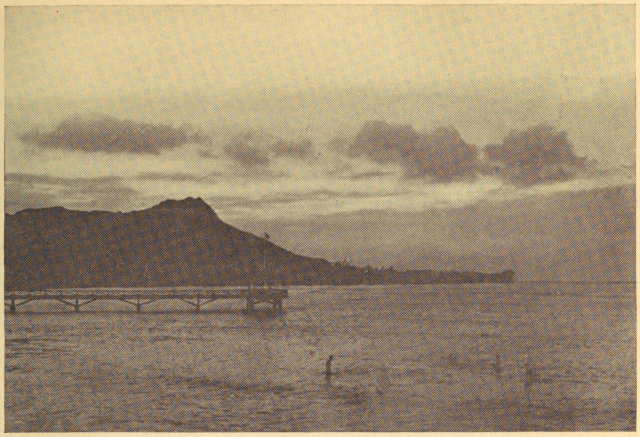
DIAMOND HEAD, NEAR HONOLULU
Once a volcano, now a fortress
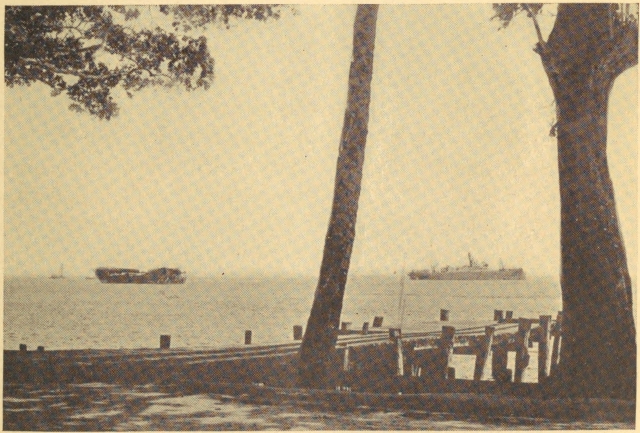
THE HULK OF THE GERMAN MAN-OF-WAR, THE ADLER
Wrecked in the hurricane of 1889 at Samoa
There is, however, not much greater difference between
some of the races in the Pacific and the white men than
there is between any two of the European peoples themselves.
There is less difference between an Hawaiian
and a Maori, though they are separated by nearly four
thousand miles of unbroken sea, than there is between an
Englishman and a Frenchman with only a narrow channel
between them. In the Pacific, the chain of relationship
between races from New Zealand to Hawaii is somewhat
similar to that running north and south in Europe.
The variation becomes similarly more pronounced in the
latitudinal direction. In other words, the diversity existing
between European and Turk is something akin to
that between Samoan and Fijian,—from the point of
view of appearances.
Something of the kinship of peoples scattered over the
millions of square miles of Pacific seas becomes evident,
not so much in their own features and customs as in the
way in which they lend themselves to fusion with the
modern incoming nomads of the West. Something of the
possible migrations said to have taken place in that unromantic
age of man somewhere back in Pleistocene days
may be grasped from the streams that now flow in and
become part of the life of the South Pacific. Scientists
detect in the Melanesian-Fijian slight traces of Aryan
blood without being definite as to how it got there. When
I ran into a little fruit shop in Suva, just before sailing,
to taste for the last time the joys of mummy-apple, I
glimpsed for a second the how. For the proprietor was
a stout, gray-haired, dark-complexioned individual from
the island of St. Helena. In a vivid way he described to
me the tomb of Napoleon, spicing his account with a few
incidents of the emperor's life on the island. Should
no great flood of Europeans come to dilute the present
slight infusions, the centuries that lie in waiting will
perhaps augment this accidental European strain into
some romantic story. In a thousand years it would not
at all be impossible for this story of Napoleon to become
part of Fijian legend, and for children to refer to that
unknown god of war as their god and the father of their
ideals. This genial islander from St. Helena will puzzle
anthropologists and afford them opportunities for conjecture,
fully as much as the evidence of Aryan and
Iberian races in Asia and the islands east of it does
to-day.
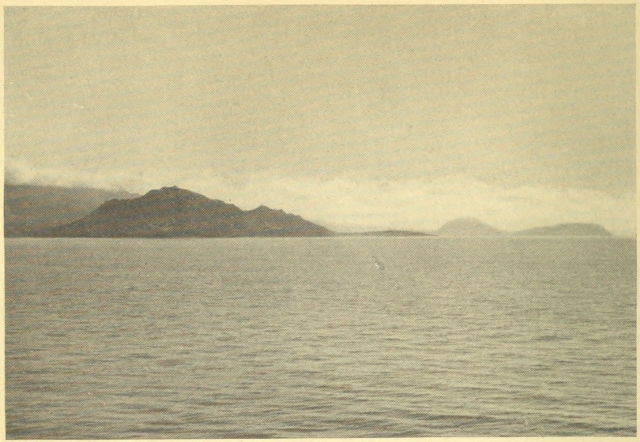
AFTER SEVEN DAYS OF SEA—THIS EMERGED
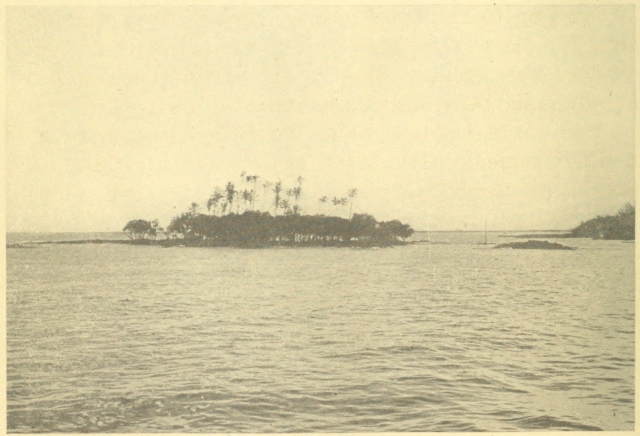
HILO, HAWAII
An oasis in the desert of the Pacific
Or the wail of the Indian, into whose shop I strayed
to get out of the sun, at the downfall of "his" empire,
may be the little seed of thought out of which the aspirations
of a Fiji reborn will spring.
According to the traditions of almost every race on
earth, the place of its nativity is the cradle of mankind.
Nor does mere accident satisfy. In nearly every instance
not only is the belief extant among natives that their race
was born there, but that, be the birthplace island or continent,
it came into existence by some form of special
creation as an abiding-place for a chosen people. The
Japanese kami, Izanagi and Izanami, were commissioned
by the other gods to "make, consolidate, and give birth
to the drifting land." "According to the Samoan cosmogony,
first there was Leai, nothing; thence sprung
Nanamu, fragrance; then Efuefu, dust; then Iloa, perceivable;
then Maua, obtainable; then Eleele, earth; then
Papatu, high rocks; then Maataanoa, small stones; then
Maunga, mountains. Then Maunga married Malaeliua,
or changeable meeting-place, and had a daughter called
Fasiefu, piece of dust." The more primitive Melanesians,
the Fijians, and the Australoids are less definite in
their conceptions of whence they came, having in many
cases no traditions or myths to offer.
With all our scientific inquiry, we are to-day still lost
in the maze of probable origins of various races. The
birthplace of man is as much of a mystery as it ever was.
Ninety years ago, Darwin said of the South Pacific:
"Hence, both in space and time, we seem to be brought
somewhat near to that great fact—that mystery of
mysteries—the first appearance of new beings on this
earth." And in 1921 Roy Chapman Andrews set out
upon a third expedition to Mongolia in search of relics
and fossils of the oldest man. He writes:
With the exception of the Java specimen, all fossil human fragments
have been discovered in Europe or England. Nevertheless, the leading
scientists of the day believe that Asia was the early home of the human
race and that whatever light may be thrown upon the origin of man
will come from the great central Asian plateau north of the Himalaya
Mountains.
Thus his antiquity will doubtless interest man to his
dying day. Slogans epitomizing the spirit of races fan
the flames of human conflict. Conflict wears down the
differences between them, or shatters them and scatters
them to the whirling winds. Doubtless the records which
seem to us so lucid and so permanent will vanish from
the earth in the next half-million years, and our descendants
will mumble in terms of vague tradition expressions
of their beginning. Or perhaps their linguistics will
make ours vulgar and primitive by comparison. Possibly,
if our progress and development are not impeded,
the hundreds of tongues now spoken on this globe will
seem childishly incomplete, and in their stead will be
one extremely simple but flexible language spoken in
every islet in the seas.
What our present world will seem to the man of the
future, the world of the Pacific, wreathed in races of
every hue—Asia, Australasia, the Americas—seems to
us now. In the wide spaces of the Pacific we have several
thousands of islands, anchored at various distances from
one another in about seventy million square miles of sea.
Grouped with a healthy regard for the freedom of individual
needs there are enough separate races, speaking
separate languages and abiding by separate customs, to
make the many-colored map of Europe seem one primary
hue by comparison. Yet all the romance which brightens
the pages of European history and its intake of Asiatic
culture is ordinary beside the mysterious silence that
steeps the origin and age of the cultures of the Pacific.
There, beneath the heavy curtain of unknown antiquity,
dwell innumerable people who, if they are not the Adams
and Eves of creation, have wandered very little from
the birthplace of the human race. It seems as though
the overflow of living creatures from the heart of Asia
had found an underground channel back into the Garden
of Eden, like some streamlet lost in the sands of the seashore,
but worming its way into the very depths below.
Polynesia, Micronesia, Melanesia, are the names by
which we know them. The drawer of water, as he lets
his bucket down to the farthest reaches of the wells of
antiquity, finds in his vessel evidence of kinship with
races now covering the whole of Europe. Romance has
it that the Amerindians are descendants of the Lost
Tribes of Israel and Mormon missionaries are carrying
that charm among the Polynesians. They are very successful
in New Zealand among the Maories. Like a great
current of warm water in the sea, the Polynesian races
have run from Hawaii to Samoa, the Marquesas, Tahiti,
and Maoriland. How they got there is still part of conjecture.
To most of us, the South Seas mean simply cannibals
and naked girls. Dark skins and giant bodies are synonymous
with Polynesians. The grouping of these peoples
into Poly-Mela-Micronesian has some scientific meaning
which, if not esoteric and awe-inspiring, slips by our
consciousness as altogether too highbrow to deserve consideration.
Or we are satisfied with pictures such as
Melville and O'Brien have given us, pictures that as long
as the world is young will thrill us as do those of Kinglake
and Marco Polo. But, those of us who have gone
beyond our boyhood rhymes of "Wild man from Borneo
just come to town" and have been White Shadows ourselves,
are keenly interested in the whence and the why
of these people. Can it be that Darwin was right? Have
we approached the spot whereon man made his first appearance
on the earth? Or are others right whose soundings
divulge a hidden course that gives these people a
birthplace ten thousand miles away, in central Asia? Is
it that all the people of the world were first made men
on land that is now beneath the waters of the Pacific,—men
who, because of geological changes, fell back across
Asia, leaving scattered remnants in the numerous island
peaks now standing alone in that sun-baked world?
"There is ground for the belief," says Griffith Taylor,[1]
"that the Pacific Ocean was smaller in the Pleistocene
period, being reduced by a belt of land varying in width
from 100 to 700 miles." Or are the further calculations
more accurate,—that there have been constant migrations
of people from Asia?
Slowly scientists are groping their way through legend.
No one who has been among the South Sea people,
and those of the western Pacific islands, can help being
impressed with certain remarkable likenesses between
them and European people. Present-day anthropologists
are at variance with the old evolutionary school
which believed in "a general, uniform evolution of culture
in which all parts of mankind participated." "At
present," according to Franz Boas, "at least among certain
groups of investigators in England and also in
Germany, ethnological research is based on the concept
of migration and dissemination rather than upon that of
evolution." In connection with Polynesia and the Pacific
peoples, it seems to be fairly well known that they drifted
from island to island in giant canoes. They had no sails
nor compass, but, guided by stars and directed by the
will of the winds, they roved the high seas and landed
wherever the shores were hospitable. During ages when
Europe dreaded the sea and hugged the land, when the
European universe consisted of a flat table-like earth and
a dome-like heaven of stars,—even before the vikings
ventured on their wild marauding excursions, the Polynesians
made of the length and breadth of the Pacific a
highway for their canoes. "Somewhat before this
(450 A.D.) one bold Polynesian had reached polar ice in
his huge war canoe."[2] Our Amerindians dared the
swiftest rapids in their frail bark canoes; but what was
that compared with the courage and love of freedom
which sent this lone Polynesian out upon the endless
waters of the Pacific? Some day a poet will give him his
deserving place among the great heroes.
Dr. Macmillan Brown tells us that the Easter Islands
were once the center of a great Pacific empire. Here
men came from far and wide to pay tribute to one ruling
monarch. He builded himself a Venice amid the coral
reefs, with canals walled in by thirty feet of stone. Fear
of the control over the winds which this monarch was
said to possess, and superstitious dread of his ire brought
the vassal islanders to him with their choicest possessions,
though he had no military means of compelling
respect. This monarch, like the Pharaohs who
built the pyramids, must have had thousands of laborers
to have been able to cut, shape, and build the giant platforms
of stone or the great canals which are referred to
as the Venice of the Pacific. It must have taken no little
engineering skill so to adjust them to one another as to
require no mortar to keep them together. In the Caroline
Islands, now under Japanese mandate, there still
stand remains of stone buildings of a forgotten day's
requirements.
These relics of unknown days make it reasonably certain
that after having been "shot" out from the mainland,
the early people of the Pacific reached all the way
across to the island of Savaii, in the Samoan group, and
later as far as Tahiti. Why they did not go on to the
Americas is hard to say. Perhaps the virginity of the
islands and the congenial climate offered these artless
savages all they desired. Beyond were cold and drudgery.
Here, though labor and war were not wanting, still
there was balmy weather. Probably they were the tail-end
of the great migration of the Wurm ice age. More
venturesome than most, and having arrived at lands
roomy enough for their small numbers, they must have
called themselves blessed in that much good luck and
decided to take no further chances with the generosity
of the gods.
Linguistic and ethnological data link the Polynesians with the
Koreans, Japanese, Formosans, Indonesians, and Javanese. Legends
and genealogies show that about the dawn of our era the early Polynesians
were among the Malay Islands. By 450 A. D. they had reached
Samoa and by 850 A. D., Tahiti.... In 1175 A. D. the primitive Maoriori
were driven out of New Zealand to the Chatham Isles. No doubt New
Zealand was first reached several hundred years before this. Tahiti
seems to have been a center of dispersal, as Percy Smith has pointed
out in his interesting book "Hawaiki." We must, however, remember
that Melanesians preceded the Polynesians to many of these islands
at a much earlier date.[3]
However, mutation is the law of life. Even these
small groups split into smaller factions. Some went south
to the islands of the Antipodes and called themselves
Maories; others went north of the equator and called
themselves Hawaiians. The physical distribution of all
the races in the Pacific, rooting, as we have seen, in
Asia, represents a virile plant the stem of which runs
eastward and is known as Micronesia and Melanesia,
with the flowers, in all their diversified loveliness,
Hawaii, Samoa, Tahiti, the Marquesas, and Maoriland.
What made them what they are? How is it that being,
as it seems, people of extraction similar to that of Europeans,
they have remained in such a state of arrested
development? How is it that they became cannibals,
eaters of men's flesh? Again the answer is not far to
seek. Just like the Europeans, they followed the line of
least resistance, having as yet developed no artificial or
brain-designed weapons against the stress of nature.
Europeans, in time of great famine, have not themselves
been above cannibalism. In our Southern States we have
isolated mountaineers to show us what men can revert to.
And in northern China to-day, essentially Buddhist and
non-flesh-eating, cannibalism was reported during the
famine last year.
But Europe had what Polynesia did not have. Driven
by the force of necessity out of continental Asia, Polynesia
hid itself away in the cracks and crannies of the
Pacific; Europeans spread over a small continent and
broke up into innumerable warring and learning tribes.
Backward and forward along peninsular Europe, men
communicated to one another their emotional and objective
experiences. The result has been a culture amazing
only in its diversity,—amazing because, with contact and
interchange of racial experiences, the coursing and recoursing
of the same blood, stirred and dissolved, it is
amazing that such diversity should persist.
But in Polynesia, Melanesia, Micronesia,—in all the
distant land-specks of the Pacific,—contact was impossible
in the larger sense. Though canoes did slide into
strange harbors or drift or row in and about the atolls,
they afforded at most romantic stimuli to these isolated
groups. Infusion of culture was very difficult. At most,
these causal meetings added to or confused the stories
of their origin. And in a little time the different island
groups forgot their beginnings.
Presently, the pressure upon their small areas with
the limited food supply began to make itself felt. Some
method had to be devised for the limitation of population
and to keep in food what few numbers there were. There
seem to have been no indigenous animals anywhere in
the islands. Darwin found only a mouse, and of this he
was uncertain as to whether it really was indigenous.
Except for a few birds, and the giant Moa which roamed
the islands of New Zealand, animal life was everywhere
insufficient to the needs of so vital a people as were these.
But much less is heard to-day of the cannibalism said to
have run rampant among them. It is even disputed.
The fruits of the tropics, doubtless rich in vitamines, are
peculiarly suited to the sustenance of so spirited a race.
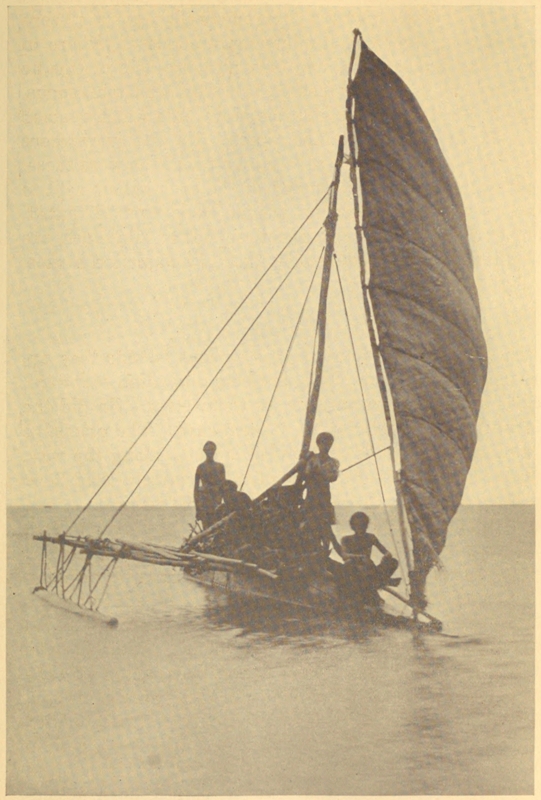
F. W. Caine, Photo
EVEN FIJIANS ARE LOATH TO FORGET THE ARTS OF THEIR FOREFATHERS
The Polynesians found in the various islands they approached,
during that slow, age-long migration eastward,
tribes and islanders inferior to themselves. So did the
Europeans in their movement westward. The primitive
Caucasians remained and mixed slightly along the way,
leaving here and there traces of their contact. And their
ancestors in Asia forgot their exiled offspring.
With the landing of Cook at Tahiti, at Poverty Bay,
at Hawaii, the counter invasion of the Pacific began. For
over a hundred years now the European has been injecting
his culture, his vices, his iron exactitude into the so-called
primitive races. These hundred years make the
second phase of civilization in the Pacific. It might have
been the last. It might have meant the reunion of Caucasic
peoples, their blending and their amalgamation,
and the world would have lived happily ever after. But
the eternal triangle plays its part in politics no less than
in love, and the third period, the period of rivalry and
jealousy, of suspicion and scandal, of still-born accomplishment
in many fields has set in. And tragedy, which
men love because it is closest to truth, is on the stage.
The third period dates largely from the discovery and
the awakening of Japan. It is the blocking of the European
invasion of the Pacific, and the institution of a
counter move,—that of the expansion of Asia into the
Pacific,—which will be treated in the last section of this
book.
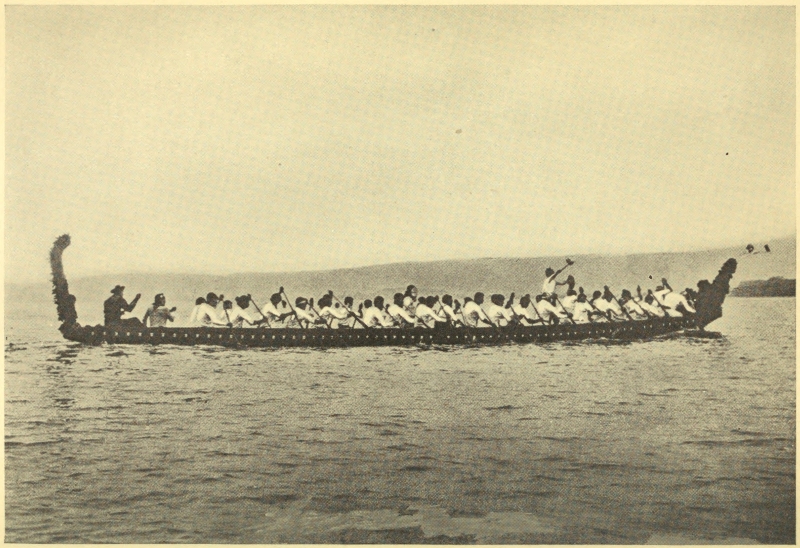
Photo, H. Winkelmann
IN GIANT CANOES HELIOLITHIC IMMIGRANTS ROAMED THE SOUTH SEAS
To-day, Polynesia is barely holding its own. Its sons
have studied "abroad," they have been in our schools
and universities, they have fought in "our" war. Rapidly
they are putting aside the uncultured simplicity of
adolescence. For long they treasured drifts of iron-girded
flotsam which the waves in their impartiality cast
upon their shores; to-day iron is supplanting thatch,
and a belated iron age is reviving their imaginations,
just as iron guns and leaden bullets shattered them a
century ago. In the light of their astonishment, Rip
Van Winkle is a crude conception; Wells has had to
revise and enlarge "When the Sleeper Wakes" into
"The Outline of History." No man knows what is pregnant
in the Pacific; nor will the next nine eons reveal the
possibilities.
Honolulu marks our frontier in the Pacific.
Honolulu has been conquered. If the conquest is
that of love, then the offspring will be lovely; if of mere
force, or intrigue, then Heaven help Honolulu! As far
as outward signs go, we are in a city American in most
details. The numerous trolleys, the modern buildings,
the motor-cars, the undaunted Western efficiency which
no people is able to withstand has gripped Hawaii in an
iron grip. True that the foreign (that is, Hawaiian,
Chinese, Japanese, Portuguese) districts are steeped in
squalor, but this is old Honolulu. The new is a little
Los Angeles with all its soullessness, and it has taken
all the illusions of modern civilization to accomplish it.
The first illusion was that the natives would be better
off as Americans than as Hawaiians; the second, that
Hawaiians were lazy and Japanese and Chinese were
necessary; the third, that cleanliness is next to godliness.
How have these things worked out? The Hawaiians are
in the ever-receding minority, the Japanese in the unhappy
majority, and enjoyment of cleanliness has made
most men forget that it is only next to something else. If
the invited are coming to Honolulu expecting money-grabbers
to turn to poetry and petty politicians to philosophy,
they had better save their fares. If readers of
magazines expect to find a melting-pot in which all
the ingredients are dancing about with their arms round
one another's neck, they had better remain at home.
For the first and foremost effect of the tropics is to
individualize things. In colder climes people huddle together
to conserve warmth; here they give one another
plenty of space. Virtually one of the first things the
new-comer does is to name and separate things from the
mass. Every little thing has its personality. Plants
grow in profusion, but each opens out to its utmost. One
is much more inclined to ask what this flower is called
in Honolulu than in America, for each stands out, and one
stands out to each. Honolulu exudes moisture and fragrance,
stirring the passions as does the scent of a clean
woman. It limbers up one's reasoning faculties and
arouses one's curiosity.
On the street every Chinese and every Japanese comes
in for his share of attention. One begins to single out
types as it has never occurred to one to do in New York.
In Honolulu all intermingle, flower in a sort of unity, but
in the very mass they retain their natural variations.
The white people are ordinarily good, they have mastered
the technique of life sufficiently and play tolerably
well to an uncritical audience. While the Hawaiian
policeman in charge of the traffic stands out in bold relief
because the dignity and importance of his position have
stiffened the easy tendencies of his race,—he is self-conscious.
Monarch of Confusion, arrayed in uniform,
tall and with the manner of one always looking from
beneath heavy eyebrows, it is said that he causes as much
trouble as he allays. But that is mere prejudice. Who
would dare ignore his arm and hand as he directs the
passing vehicle? He fascinates. He commands. His
austere silence is awe-inspiring. When he permits a
driver to pass, there is a touch of the contemptuous in
that relinquishment. Nor dare the driver turn the corner
till, in like manner, this human indicator points the direction
for him. The finger follows now almost mockingly,
until another car demands its attention, and it becomes
threatening again.
One hears of the all-inclusive South Seas as though
it were something totally without variation. The average
tourist and scribe soon acquires the South-Sea style.
But the more discriminating know full well that the expressions
which describe one of the South Sea islands fall
flat when applied to another. "Liquid sunshine" is a
term peculiarly Hawaiian. It would never apply to Fiji,
for instance, for there the words "atmospheric secretion"
are more accurate. Hence, it is more than mere
political chance that has made Hawaii so utterly different
from the Philippines and the litter of South Seas.
Honolulu is essentially an American city. The hundreds
of motor-cars that dash in and about the streets
do so just as they would in "sunny California." The
shops that attract the Americans are just like any in
America,—clean, attractive, with their best foot forward.
So meticulous, so spotless, so untouchable are they that
the soul of the seeker nearly sickens for want of spice
and flavor. To have to live on Honolulu's Main Street
would be like drinking boiled water. One imagines that
when the white men came thither, finding disease and uncleanliness
rampant, they determined that if they were to
have nothing else they would have things clean. All newcomers
to Oriental and primitive countries cling to that
phase of civilization with something akin to terror. Generally
they get used to the dirt. They have not done so in
Honolulu. It may be that mere distance has something to
do with the different results, but certain it is that Manila,
under American control just as is Honolulu, has none of
these prim, not primitive, drawbacks. Twenty years of
American rule have done little really to Americanize
Manila, while they have utterly metamorphosed Honolulu.
The man-made machine has now outlived the vituperation
of idealists. The man-made machine is running,
and even the most romantic enjoys life the better for it.
Clean hotels, swimming-pools within-doors, motor-cars
that bring nature to man with the least loss of time and
cost of fatigue,—these are things which only a fool would
despise. But one longs for some show of the human
touch, none the less, and cities that are built by machine
processes are, despite all their virtues, not attractive. At
least, they are not different enough from any other city
in the modern world to justify a week's journey for the
seeing. One hears that steamers and trains and airplanes
are killing romance. That is so, but not because
they in themselves conduce to satiety, but because they
destroy indigenous creations and substitute importations
and iron exactitude. Within the next few generations
there will, indeed, be a South Seas, indistinguishable and
without variety. Honolulu is an example. But Honolulu
is not Hawaii! It is only a bit of decoration. So we
shall leave this phase of Hawaii for consideration at a
time when, having seen the things native to the Pacific,
we reflect upon the meaning and purport of things alien.
In Hawaii, we are told,—and without exaggeration,—one
can stand in the full sunshine and watch the rain
across the street. So, too, can one enjoy some of the
material blessings of modern life, yet be within touch of
nature incomparably exquisite.
He was only a street-car conductor. Every day he
journeyed from the heart of Honolulu, like a little blood
corpuscle, through arteries of trade hardened by over-feeding,
in a jerking, rocking old trolley car, to the very
edge of Manoa Valley. His way lay along the fan-shaped
plane behind the sea, and was lined with semi-palatial
residences and Oahu College. Palms swayed
in the breeze, and the night-blooming cereus slept in the
glittering sunlight upon the stone walls. He was only
a street-car conductor, furnished with his three spare
meals a day and his bed, but he fed along the way on
sweets that no street-car conductor in any other place in
the world has by way of compensation. He was carved
with wrinkles and his frail frame bent slightly forward,
but his heart was young within him, and he acted like
a plutocrat whose hobby was gardening and whose gardens
were rich with the finest flowers on earth. The
delight he took in the open country, barely the edge of
which he reached so many times a day, was pathetic.
When I asked him to let me off where I could wander on
the open road, he beamed with pleasure and delight, and
told me where I should have to go really to reach the
wild. There may be other places in the world as beautiful
and even more so, but no place ever had such a
street-car conductor to recommend it. And no recommendation
was ever more poetic and inspiring than this,—not
even that of the Promotion Committee of Honolulu.
And, strange to say, I have never been guided more
honestly and more truthfully than when that street-car
conductor advised me to go to Manoa Valley. I lived
an eternity of joy in the few hours I spent there. I knew
that not many miles beyond I should again be blocked
by the sea. I could not see it because of the hills which
spend three hundred and sixty-five days of every year
dressing themselves in their very best and posing before
the mirror of the sky. Not more than one or two natives
passed me, nor did any other living creature appear.
I could only romance with myself, refusing to be fooled
by the talk about fair maidens with leis round their necks.
I was certain that back home there were maidens whose
beauty could not be equaled here; whose soft, white skins
and shapely forms were never excelled by tropical loveliness.
But I was just as certain that there was nothing
at home that compared to nature as it is lavished upon
man here in Hawaii, and especially in Manoa Valley.
We all have our compensations, and I have even shown
preference for a return to the joys of genuine human
beauty which the maker of worlds gave to America,
and to leave to the mid-Pacific verdure and altitudes
whose combination stirs my mind with passionate adoration
to this very day. Still, I shall ever be grateful to
that wizened street-car conductor for having suggested
that I visit his little valley, which he himself can enter
only after paying a penalty of sixteen journeys between
Heaven and Honolulu every day, carrying the money-makers
backward and forward. Perhaps he does not
regard it as a penalty. Perhaps he feels himself fully
compensated if one or two of his human parcels asks him
where may be found the Open Road.
Sullen and less concerned with emotional or spiritual
values was the driver of the motor-bus whom we exhumed
one day from the heart of Honolulu's "foreign"
section. He evidently regarded nature on his route as too
great a strain on his brakes, though he, too, must have
felt that compensation was meted out to him manifold.
For few people come to Hawaii and leave without contributing
some small share to his support, as he is the
shuttle between Honolulu and Kaneohe, and carries the
thread of sheer joy through the eye of that wondrous
needle, the Pali.
At the Pali one senses the youth and vigor of our
earth. Its peak, piercing the sky, seems on the point
of emerging from the sea. It has raised its head above
the waters and stands with an air of contempt for loneliness,
wrapped in mist, defying the winds. The world
seems to fall away from it. It has triumphed. There is
none of that withdrawing dignity of Fujiyama, the great
man who looks on. The Pali imposes itself upon your
consciousness with spectacular gusto, like the villain
stamping his way into the very center of the stage and
gazing roundabout over a protruding chin.
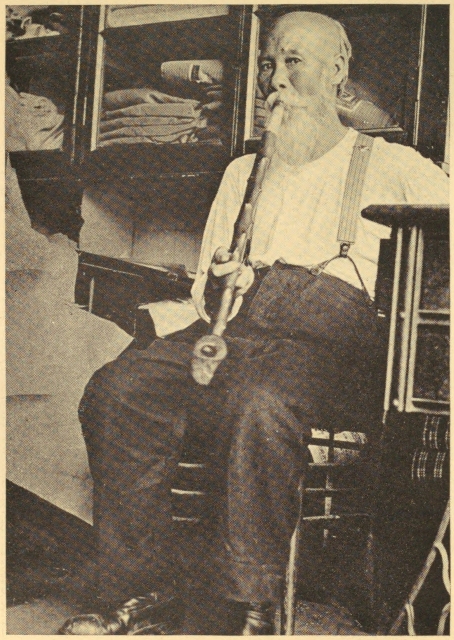
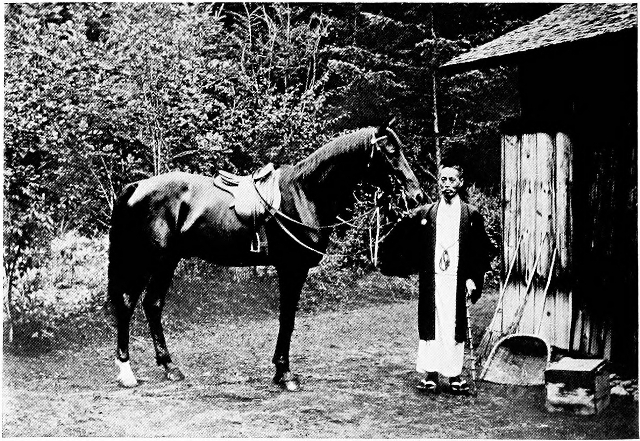
A SAGE IN A CHINA SHOP AT HONOLULU
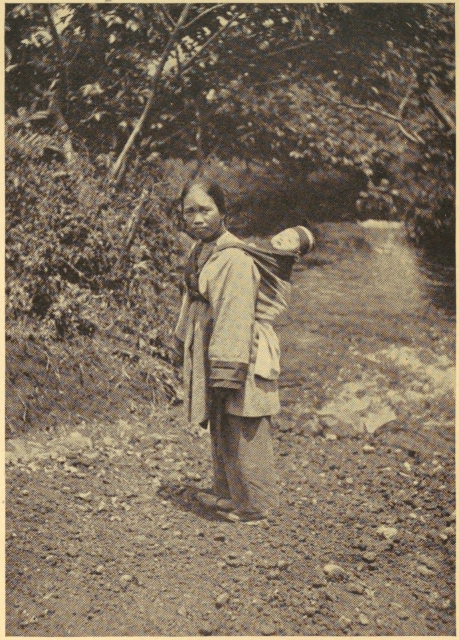
THERE ARE ONLY A FEW CHINESE WOMEN IN HAWAII
The palm-trees bow solemnly before changeless winds,
in the direction of Honolulu, which lies like an open fan
at the foot of the valley near the sea. Color is in action
everywhere,—spots of metallic green, of volcanic red,
filtered through a screen of marine gray. Honolulu lies
below to the rear; Kaneohe, beyond vast fields of pineapple,
before us; the sea, wide, open, limitless except
for the reaches of the heavens, binding all. And then
there is an upward, circular motion,—that of the rising
mists drawn by the burning rays of the sun pressing
landward and dashing themselves into the valley and
falling in sheets of rain upon the earth. Wedged into
a gully, as though caught and unable to break away, was
a heavy cloud,—but it was being drained of every drop
of moisture as a traveler held up by a gang of highway-men.
This circular motion is found not only in inanimate nature.
Once, at least, it has whirled the Hawaiians into
tragedy. Here, history tells us, Kamehameha I (the fifth
from the last of Hawaii's kings) hurled an army of native
Oahu islanders over this bluff, back into the source of
their being. Without quarter he pressed them on, over
this pass; while they, unwilling to yield to capture, chose
gladly to dash themselves into the valley below. One is
impressed by the striking interplay of emotion with sheer
nature. The controlling element which directs both man
and mountain seems the same. States and stars alike
emerge, crash, and crumble.
We rolled rapidly down into the valley past miles and
miles of pineapple fields. Then we came, as it were, to
the land's end. Nothing sheer now before us, nothing
precipitate. A bit of freshness, of coolness, and an imperceptible
tapering off. The sea.
Here at Kaneohe dwelt Arthur Mackaye, brother of
the poet, whose name was vaguely known to me. He was
slender, bearded, loosely clad, with open collar but not
without consciousness and conventionality,—a
conventionality in accordance with prescribed notions of freedom.
Refreshing, cool as the atmosphere roundabout,
distinct from the tropical lusciousness which is the general
state of both men and nature in and about Honolulu,
the personality of this lone man—this man who had flung
everything aside—was a fit complement to the experience
of Manoa Valley and the Pali.
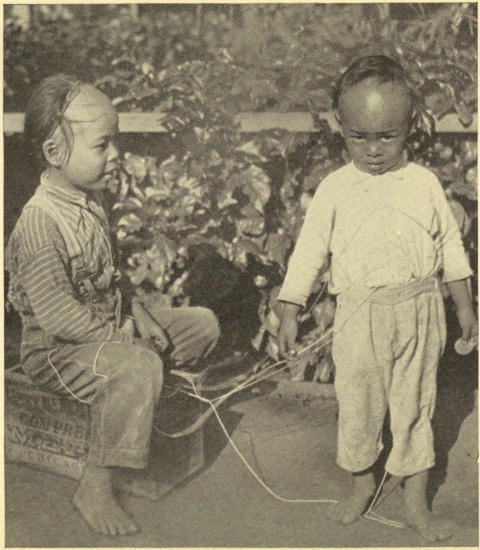
WHOA! LET'S HAVE OUR PICTURE TAKEN
We don't know whether we're Hawaiian, Chinese or American, but who cares.
Giddap!
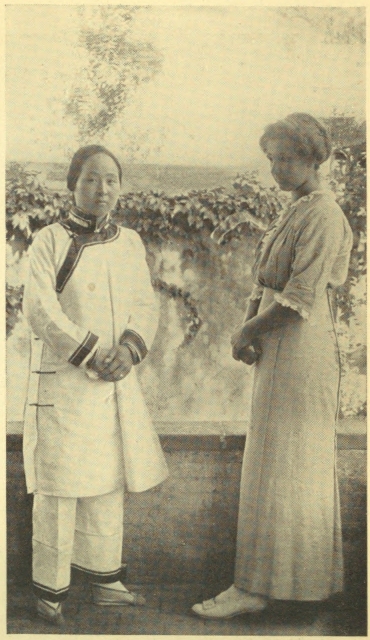
FEMININE PROPRIETY
Oriental and Occidental versions
He conducted a small sight-seeing expedition on his
own. The proprietor of a number of glass-bottomed
launches, he took me over the quiet waters of the reefs.
Throwing a black cloth over my head to shield me from
the brilliant sky, I gazed down into the still world within
the coral reefs. There lay unimaginable peace. What
the Pali affords in panorama, the bay at Kaneohe offers
in concentrated form. Pink-and-white forests twenty to
forty feet deep, with immense cavities and ledges of
delicate coral, fringe the shore. Fish of exquisite color
move in and out of these giant chambers, as much at
home in one as in another. Droll, sleepy sponges, like
lumps of porous mud, lie flat against the reefs, waiting
for something edible to come their way. Long green
sea-worms extend and contract like the tentacles of an
octopus in an insatiable search for food.
An unusual silence hangs over the memory of that
trip. I cannot recall that the unexpected companion I
picked up in Honolulu said anything; the lonely one who
furnished the glass-bottomed boat certainly said nothing;
the fish and sponges emphasized the tone of silence
associated with the experience. But the Pali shrieked;
it was the one imposing element that defied stillness.
And below it is Honolulu, where silence is not to be
found.
For the Honolulu spirit is averse to silence. Honolulu
is the most talkative city in the world. The people seem
to talk with their eyes, with their gait, with their postures.
Night and day there stirs the confusion of people
attending to one another's wants. One is in a ceaseless
whirl of extraverted emotions. One cannot get away
from it. The man who could be lonely in Honolulu would
have to have his ears closed with cement. If New York
were as talkative as Honolulu, not all of America's Main
Streets together would drown it out.
For Honolulu teems with good-fellowship. It is the
religion of Honolulu to have a good time, and every one
feels impelled before God and Patria to live up to its
precepts. Everybody not only has a good time but talks
having a good time. Not that there are no undercurrents
of jealousy and gossip. By no means. The stranger is
let into these with the same gusto that swirls him into
pleasurable activities. It is a busy, whirligig world.
Even the Y.M.C.A. spirit prevails without restraint. I
had found the building of the association very convenient,
and stopped there. That put the stamp of goodness
on me, but it did not exclude me from being drawn
into a roisterous crowd that danced and drank and dissipated
dollars, and heaved a sigh of relief that I did not
preach to it. Its members were glad that I was just
"stopping" at the Y. They didn't see how I could do
it, but that was my affair. If I still managed to be a good
fellow,—well, I belonged to Honolulu.
Charmian London had given me a note of introduction
to a friend, Wright, of the "Bulletin." Wright was a
bachelor and had a little bungalow across from the
Waikiki Hotel on the beach. There we met one evening.
It had every indication of the touch of a woman's hand.
It was neatly furnished, cozy, restful. Two nonchalant
young men came in, but after a delightful meal hurried
away to some party. Wright and I were left. What
should we do? Something must be done.
He ordered a touring-car. We whirled along under
the open sky with a most disporting moon, and it seemed
a pity we had none with us over whom to romanticize.
Quietly, as though we were on a moving stage, the world
slipped by,—palms, rice-fields ashimmer with silver
light. Through luxuriant avenues, we passed up the road
toward the Pali. Somewhere half-way we stopped. The
Country Club. A few introductions, a moment's stay,
and off we went again, this time to avoid the dance that
was to take place there. Slipping along under the moonlight,
we made our way back to Waikiki beach, dismissed
the car, and took a table at Heinie's which is now, I understand,
no more.
But we had only jumped from the frying-pan into the
fire. Others, bored with the club dance, had come to
Heinie's for more fling than dancing afforded. The hall
was not crowded, so we were soon noticed. Mr. Wright
was known.
"They want us to come over," he said. "Just excuse
me a moment."
Presently he returned. I had been specifically invited
over with him. I accepted the invitation. Then, till there
were no more minutes left of that day, we indulged in
one continuous passing of wits and wets. Before half
the evening was over, I was one of the crowd in genuine
Honolulu fashion, and nothing was too personal for expression.
But one there was in the group to whom all her indulgences
were obviously strange, though she seemed well
practised. She was a romantic soul, and sought to counteract
the teasing of the others. Her deprecation of
whisky and soda was almost like poor Satan's hatred of
hell. She vibrated to romantic memories like a cello G
string. When she learned that I was westward bound,
she fairly moaned with regret.
"China!—oh, dear, beloved China! I would give anything
in the world to get back there!" she exclaimed,
and whatever notions I had of the Orient became exalted
a thousandfold. But my own conviction is that she
missed the cheap servants which Honolulu lacks. In
other words, there were still not enough leisure and
Bubbling Well Roads in Honolulu, nor the international
atmosphere that is Shanghai's. But that is mere conjecture,
and she was a romantic soul, and good to look at.
But there were two others in the crowd who did not,
in their hilarious spirits, whirl into my ken until some
time afterward. Their speed was that of the comet's,
and what was a plodding little planet like myself to do
trying to move into their orbit? They were not native
daughters of Honolulu; most of their lives they had
spent in California, which in the light of Hawaii is a
raw, chill land. There they carried on the drab existence
of trying to earn a living,—just work and no play. But
evidently they had never given up hope. They were tall,
thin, fair, and jolly. They invested. They won. It was
only two thousand dollars. They earned as much every
year, no doubt, but it came to them in instalments. Now
they had a real roll. Bang went the job! American industry,
all that depended on their being stable, honest
producers, the smoothness of organization, was banished
from their minds. Let the country go to the dogs; they
were heading for Honolulu for a good time. And when
they got there they did not find the cupboard bare, nor
excommunication for being jobless.
For as long as two thousand dollars will last where
money flows freely (and there are plenty of men ready
to help stretch it with generous entertainment) these
two escaped toilers from the American deep ran the
gamut of Honolulu's conviviality. Night after night
they whispered amorous compliments in the ears of the
favorite dancers; day after day they flitted from party
to party. I had met them just as their two thousand
dollars were drawing to a close, but the only thing one
could hear was regret that they could not possibly be
extended. Honolulu was richer by two thousand; they
were poorer to the extent of perpetual restlessness and
rebellion against the necessity of holding down a job.
Yet the "Primer" published by the Promotion Committee
tells us that Hawaii is "not a paradise for the jobless."
These folk had no jobs, yet they certainly felt
and acted and spoke as though they were in Paradise.
Witness the arrivals and departures of steamers.
The crowds gather as for a fête or a carnival.
Bands play, serpentines stream over the ship's side, and
turn its dull color into a careless rainbow. Hawaiian
women sell leis, necklaces of the most luscious flowers
whose scent is enough to empassion the most passionless.
But as to jobs,—why, even the longshoremen seem to be
celebrating and the steamer moves as by spirit-power.
Visit Waikiki beach, and every day it is littered with
people who enjoy the afternoon hours on the tireless
breakers. Go to the hotels, and hardly an hour finds
them deserted. The motor-cars are constantly carrying
men and women about as though there was nothing in the
wide world to do. Even those who are unlucky enough
to have jobs attend to them in a leisurely sort of way.
Yet these jobless people hold up their hands in warning
to possible immigrants that there is no room for them,
that "Hawaii is not a paradise for the jobless."
Who, then, does the work of the island? It is obvious
that it is being done. There isn't another island in the
whole Pacific so modernized, so thoroughly equipped, so
American in every detail, so progressive and well-to-do.
It is the most sublimated of the sublime South Seas.
One wonders how white men could have remained so
energetic in the tropics, but one is not long left uninformed.
Honolulu is an example of a most ideal combination
of peoples, the inventive, progressive, constructive
white man with the energetic, persistent, plodding
Oriental. Without the one or the other, Honolulu would
not be what it is; both have contributed to the welfare of
the islands in ways immeasurable.
It is not surprising, therefore, to find the Oriental elements
as much in evidence as the Occidental. One hardly
knows where one begins and the other ends. As spacious
and individualized as are the European sections, so the
Asiatic are a perfect jumble of details. The buildings
are drab, the streets are littered, the smells are insinuating,
the sounds excruciating.
A most painful noise upon an upper balcony of an
overhanging Chinese building made me come to with a
sudden clapping of my hands against my ears. As noise
goes, it was perfect,—without theme or harmony. It
could not have been more uncontrolled. What consolation
was it that in China there was more of it! Gratitude
awakened in me for the limitations a wise joss had placed
upon the capacities of the individual. Yet men are never
satisfied. These Chinese weren't, and combined their
energies. What one man couldn't accomplish, several
could at least approach. So we had a band. I should
certainly never have thought it possible, myself.
However, they were trying to achieve something. It
was neither gay nor mournful; nor was it sentimental.
What purpose could it possibly have served? Surely
they had no racial regrets or aspirations, they who
played it! The bird sings to his mate, but what mate
would listen to such tin-canning and howling, and not
die?
To me there was something charming in this shamelessness
of the Chinese, something childlike and naïve.
I had never realized the meaning of that little rhyme,
I would not give the weakest of my song
For all the boasted strength of all the strong
If but the million weak ones of the world
Would realize their number and their wrong.
The thought is almost terrifying when applied to the
teeming hordes of the world, whether of Asia, Europe,
or the South Seas. If sheer numbers are any justification
of supremacy, God had better take His old world
back and reshape it nearer something rational. One
becomes conscious of this welling up of the world in
Hawaii. Not that the Chinese and the Japanese haven't
the same right to life and to its fulfilment in accordance
with latent instinct and ability, with all its special racial
traits and customs, but one doesn't just exactly see how
numbers have anything to do with it. Yet here are the
Chinese and Japanese slowly, quietly, persistently out-distancing
the white by a process of doubling in numbers,
where mentality and ingenuity would doubtless fail.
One hears much about the progress of the Orient.
That is, white folk talk much about the way in which the
East is taking to Western ways, and call that progress.
One would not expect that sort of progress to proceed
with any great velocity in the East itself, but it is only
necessary to observe the ingrowing tendencies of life in
Hawaii, however superficially, to see how foolishly optimistic
is the expectation of such progress. For even in
Hawaii, where everything has had to be built afresh,
where everybody is an alien—with very few exceptions—and
where the dominant element is European, the East
is still the East, and the West the West. There is a
slight overlapping, but not enough to make one lose
one's way,—to make a white man walk into a Chinese
restaurant and not know it. The fastidious white man
whose curiosity gets the better of him, moves about the
Chinese and Japanese districts fully conscious of his
own shortcomings. He is less able to feel at home there
than the Oriental on the main street; but why doesn't
the Oriental build for himself a main street?
I was abroad early one Sunday morning, headed for
the Chinese section. Lost in thought, I went along,
gazing on the ground. Had Charlie Chaplin's feet suddenly
come into my range of vision I should not have
been more surprised than I was when two tiny shoes,
hardly bigger than those of a large-sized doll, and with
some of that stiff, automatic movement of the species
mechanicus, dissipated my reflections. I raised my eyes
slowly, as when waking, up, up, up,—hem of skirt, knees,
waist-line, flat bosom, narrow shoulders, sallow face, and
slit eyes! A Chinese woman! She was as big as a fourteen-year-old
girl, but her feet were a third of their due
proportion. How many thousands of years of natural
selection went into the making of those little feet? Yet
she was a rare enough exception to astound my abstracted
mind. About her strolled hundreds of others of
her race, who would have given much of life to possess
those two little feet.
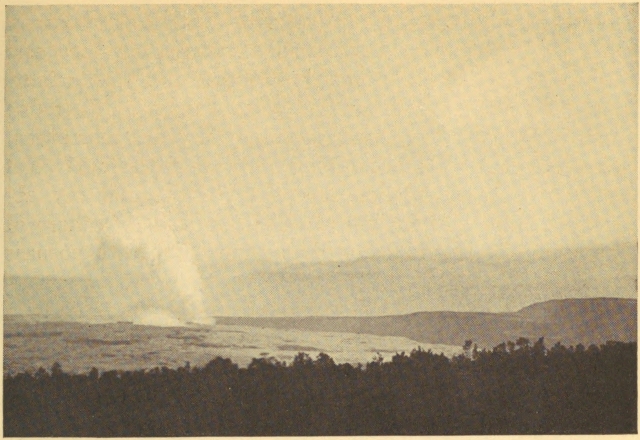
MILES AWAY ROSE THE FUMES OF KILAUEA
During the day they were ashen and at night like rose dawn
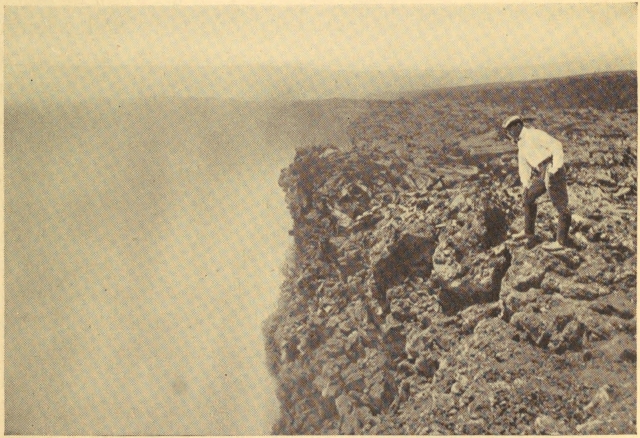
THE LARGEST CAULDRON OF MOLTEN ROCK ON EARTH
Eight hundred feet below it seethed
Differences abound in Hawaii. The Chinese is no twin
brother of the Japanese. In fact, there is probably as
much relationship between the Hawaiian and the Japanese
as there is between these two "Oriental" races. The
major part of the Japanese being Malay and the Polynesian
Hawaiians having at least lived with the Malays
some hundreds of years ago and infused some of their
Caucasic ingredients into them, there is more of "home-coming"
when "Jap" meets "Poly," than when he meets
"Chink." But notwithstanding proximity and propinquity,
over which diplomatic letter-writers labor hard,
when the Chinese and the Japanese and the Hawaiian
come together, the Hawaiian "vanishes like dewdrops
by the roadside," the Chinese jogs along, and the Japanese
runs motor-cars and raises children. The Japanese
obtrudes himself much more upon the life of the community
than the other two races, but with no more relinquishment
of his own ways. He drives the cars and
he drives white men to more activity than they really enjoy.
And the Hawaiian sells necklaces of luscious flowers
under the shaded porticoes of the buildings along the
waterfront.
Aside from the adoption of our trousers and coat and
hat, and a few other unimportant aspects of our civilization,
the observer on the streets of Honolulu sees no
mingling of races. The only outward sign of this mixing
is the Salvation Army. There, large as life, with the
usual circular crowd about them, stood these soldiers of
misfortune, praising the Lord in English. A row of unlimited
Oriental offspring upon the curb; a few grown-ups
on the walk; a converted Japanese who looked as
though his Shinto father had disowned him; a self-conscious
white boy who confessed to having been converted
just recently; two indifferent-looking soldiers; a
distrustful-looking leader and a hopeless-visaged white
woman. Twenty feet away, a saloon. I wonder what the
Salvation Army is going to do now that that object of
attraction is no more.
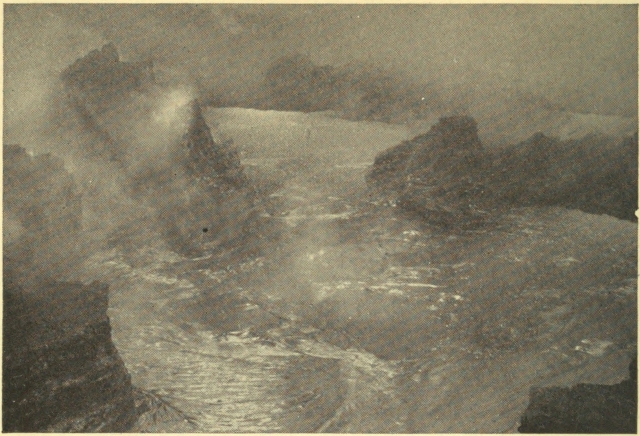
Photo, Otto C. Gilmore
A RIVER OF ROCK POURING OUT INTO THE SEA
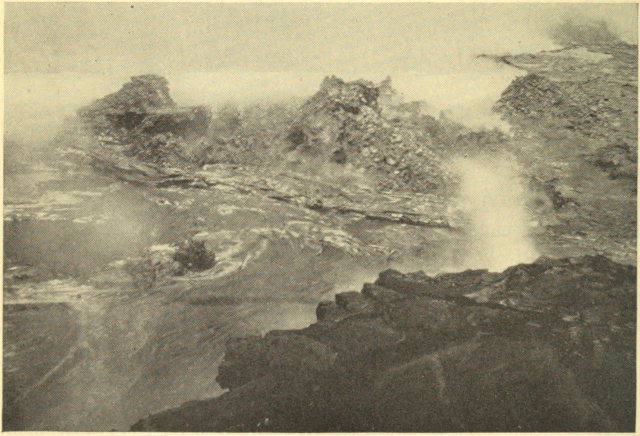
Photo, Otto C. Gilmore
WHIRLING EDDIES OF LAVA UNDERMINING FROZEN LAVA PROJECTIONS
As far as Honolulu was concerned, it seemed to me that
barter and trade were more intoxicating to the majority
than was drink. The world everywhere about seemed
a-litter with boxes and bales and shops and indulgences.
How much of all the things exchanged, how many of the
things for which these people toil endlessly, are worth
while or essential, or even truly satisfying? The dingy
stores, their only worth their damp coolness; the huddling
and the innocent dirt; the inextricable mesh of little
things to be done,—only the Chinese sage who posed for
my camera in front of his wee stock of yarns was able to
tell their value to life. His long, thin, pointed beard,
his lack of vanity in accepting my interest in him, his
genial smile and fatherly disinterestedness symbolized
more than anything I saw in Honolulu the virtue and endurance
of race. Beside the eager, grasping Japanese
and the rolling, expanding white men, he looked like the
overtowering palm-tree that seems to grow out of the
monkey-pod in the park.
To a creature from another world, hovering over us
in the unseen ether, watching us move about beneath the
sea of air which is life to us, Honolulu would seem like
a little glass aquarium. The human beings move about
as though on the best of terms with one another. Some
look more gorgeous than others, but from outward appearances
they are as innocent of ill intentions against
one another as the aquatic creatures for which Hawaii is
famous, out in the cool, moist aquarium at Waikiki.
Kihikihi, the Hawaiians call one of them, and his
friends the white folk have christened him Moorish Idol.
I don't know what Kihikihi means, but as to his being
an idol, I can't accept that for a moment, except in so far
as he deserves to be idolized. For about him there is no
more of that static, woodeny thing which idols generally
are than there is about Pavlowa. Yet he is only a fish,
and not so very large at that. He is moon-shaped, but
rainbow-hued. He is perhaps three-quarters of an inch
across the shoulders, but six inches up and down, and
perhaps eight from nose to the ends of his two tails.
And so he looks like a three-quarter moon. Soft, vertical
bands of black, white, and egg-yellow run into one another
on both sides, and a long white plume trails downward
in a semicircle. He is the last word in form, translucent
harmony of color and of motion. He moves about
with rhythmic dignity and grace. At times his eyes
bulge with an eagerness and self-importance as though
the world depended on him for its security. Though he
is constantly searching for food, he does not seem avaricious;
and while he admits his importance, he is not
proud.
Kihikihi has a rival in Nainai, who has been given an
alias,—Surgeon Fish, light brown with an orange band
on his sides. Nainai is heavier than Kihikihi, more
plump. His color, too, is heavier and therefore seems
more restrained. It is richer and hence stimulates envy
and desire.
Lauwiliwili Unkunukuoeoe has no aliases, thank you,
but he has a snout on which his Hawaiian name could
be stamped in fourteen-point type and still leave room
for half a dozen aliases. Only a water-creature could
possess such a title as this and keep from dragging
it in the mud. Knowing that he would be called by that
appellation in life, his Creator must have compensated
him with plenty of snout.
But it is better to have one long snout than eight. And
though no one would give preference to any devil-fish,
this long-snouted creature is the rival by an inverse ratio
of that eight-snouted glutton. The octopus, the devil of
the deep, is an insult to fishdom. The Moorish Idol and
this Medusa-like monster in the same aquarium make a
worse combination than Dr. Jekyll and Mr. Hyde. This
ugly, flabby, boneless body, just thick skin and muscle,
with a large bag for a head,—eight sea-worms extending
and contracting in an insatiable search for food is the
paramount example of gross materialism. If only the
high cost of living would drive to suicide this beast with
hundreds of mouths to feed, the world might be rid of a
perfidious-looking monster. But his looks do him great
injustice, and were the Hawaiian variety—which is, after
all, only squid—to disappear, the natives would be deprived
of one of their chief delicacies. At the markets—that
half-way house between aquaria and museums—numerous
dried octopus, like moth-eaten skins, lie about
waiting for the housewife's art to camouflage them. But
I shall have something to say elsewhere about markets
and museums, and now shall turn, for a moment, to more
startling wonders still.
An artist is delighted if he finds a study with a perfect
hand or a beautiful neck; or, in nature, if a simple charm
is left undisturbed by the confusion of human creation.
Yet at night as our ship passed the island of Maui, it
seemed to me that all the sweet simplicities that make
life worth while had been assembled here in the beginning
of the world and left untouched. The moon rose on
the peak of the cone-shaped mountain, and for a time
stood set, like a moonstone in a ring. The pyramid of
night-blue earth was necklaced in street lights, which
stretched their frilled reflections across the surface of
the sea; and just back of it all lay the crater of Haleakala,
the House of the Sun.
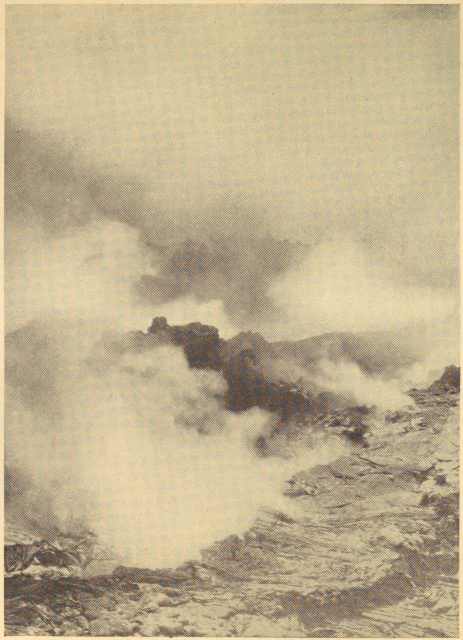
Photo, Otto C. Gilmore
A BLIZZARD OF FUMING HEAT
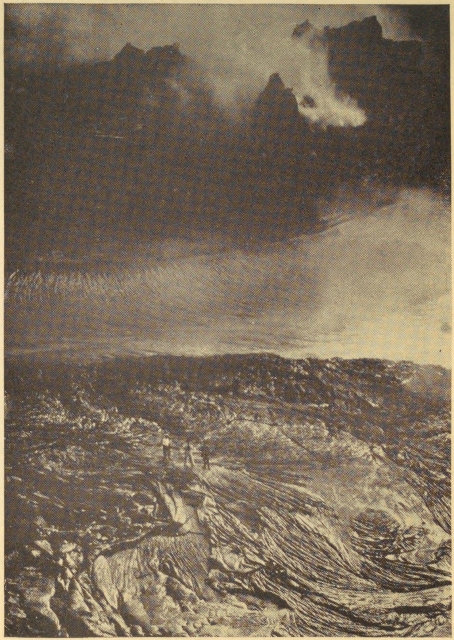
Photo, Otto C. Gilmore
WHERE THE TIDES TURN TO STONE
At sunrise next morning we were docked at Hilo on
the island of Hawaii, two hundred miles from Honolulu.
There was nothing here impressive to me, despite the
waterfalls. For two and a half hours we drove by motor
over the turtle-back surface of Hawaii toward Kilauea.
Tree-ferns, palms, and plantations stretched in unending
recession far and wide. A sense of mystery and awe
crept slowly over me as we neared the region of the volcano.
At eleven we arrived at the Volcano House.
Yet, in a mood of strange indifference I gazed across
the five miles of flat, dark-brown frozen lava which is the
roof of the crater. Ash-colored fumes rose from the field
of fissures, like smoke from an underground village.
Sullen, sallow vapors, these. Sulphur banks, tree molds
cast in frozen lava, empty holes! Nothing within left to
rot, but fringed with forests and brush, sulphur-stained
or rooted in frozen lava. Everywhere promise of volcanic
fury, prophecy of the end of the world.
The road lay like a border round the rim of an antique
bowl which had been baked, cracked, chipped, but shaped
to a usefulness that is beauty. All day long we waited,
watching the clouds of gray fumes rise steadily, silently,
and with a sad disinterestedness out of the mouth of the
crater.
Frozen, the lava was the great bed of assurance, a
rock of fearlessness. It seemed to say to the volcano:
"I can be indifferent. Down there, deep down, is your
limitation. Rise out of the pit and you become, like me,
congealed. There, down in that deep, is your only hope
of life. This great field of lifeless lava is proof of your
effort to reach beyond your sphere. So why fear?" And
there was no fear.
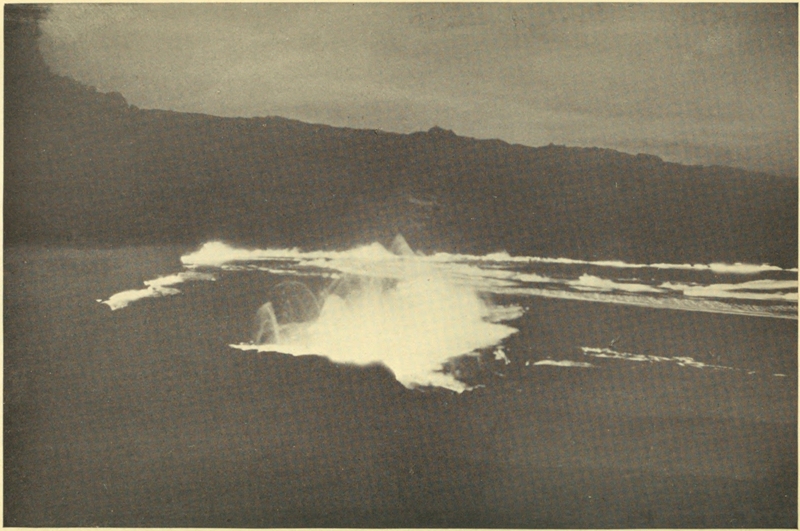
Photo, Otto C. Gilmore
THE LAKE OF SPOUTING MOLTEN LAVA
In the volcano of Kilauea. At night the white here shown is pink and terrifying
As night came on the gray fumes began to flush pink
with the reflection of the heart of the crater. We set out
in cars for the edge. Extinct craters yawned on every
side, their walls deep and upright. Some were overgrown
with green young trees, but as we came nearer
to the living crater, life ceased. Great rolls of cloud-fumes
rose from the gulch to wander away in silence.
What a strange journey to take! From out a boiling
pit where place is paid for by furious fighting, where
pressure is father of fountains of boiling rock, out from
struggle and howling fury, these gases rose into the
world of living matter, into the world of wind and water.
Out of the pit of destruction into the air, never ceasing,
always stirring down there, rising to where life to us is
death to it. The lava, seething, red, shoots aimlessly
upward, only to quell its own futile striving in intermittent
exhaustion.
We stood within a foot of the edge. Eight hundred
feet below us the lava roared and spit. In the night, the
entire volcano turned a pink glow, and before us lay
three-quarters of a mile of Inferno come true. The red
liquid heaves and hisses. Some of it shoots fully fifty
feet into the air; some is still-born and forms a pillar of
black stone in the midst of molten lava. From the other
corner a steady stream of lava issues into the main pool,
and the whole thumps and thuds and sputters and spouts,
restless, toiling eternally.
On our way to the crater we were talkative. We joked,
burnt paper over the cracks, discussed volcanic action,
and expressed opinions about death and the probability
of animal consciousness after death. But as we turned
away from the pit we fell silent. It was as though we had
looked into the unknown and had seen that which was not
meant for man to see. And the clouds of fumes continued
to issue calmly, unperturbed, with a dreadful persistence.
Just as our car groped its way through the mists to
the bend in the road, a Japanese stepped before us with
his hands outstretched. "Help!" he shouted. "Man
killed." We rushed to his assistance and found that a
party of Japanese in a Ford had run off the road and
dropped into a shallow crater. Down on the frozen bed
below huddled a group of men, women, and children,
terrified. As we crawled down we found one Japanese
sitting with the body of his dead companion in his arms,
pressing his hot face against the cold cheek of his comrade.
A chill drizzle swept down into the dark pit. It
was a scene to horrify a stoic. To the wretched group
our coming was a comfort the richness of which one could
no more describe than one could the torture of lava in
that pit over yonder.
Japanese are said to be fatalists. They hover about
Kilauea year in and year out. One man sat with a baby
in his arms, his feet dangling over the volcano. Playfully
he pretended to toss the child in, and it accepted all
as play. The same confidence the dead man had had in
the driver whose carelessness had overturned the car.
And now it seemed that his body belonged in the larger
pit at which he had marveled not more than half an hour
earlier.
As I look back into the pit of memory where the molten
material, experience, has its ebb and flow, I can still see
the seething of rock within a cup of stone, the boiling
of nature within its own bosom. Where can one draw
the line between experience past and present? Wherever
I am, the shooting of that fountain of lava is as real as
it was to me then; nor can conglomerate noises drown
out the sound of lava pouring back into lava, of undermined
rock projections crashing with a hissing sound
back upon themselves. It is to me like the sound of
voices when King Kamehameha I forced the natives of
the island of Oahu over the Pali, and the group of terrified
Japanese were like the fish in the coral caves at
Kaneohe when aware of the approach of a fish that feeds
upon them.
Yet there is a sound rising clear in memory, perhaps
more wonderful even than the shrieking of tortured
human beings or the hissing of molten lava. As I stood
upon the rim of Halemaumau there arose the vision of
Kapiolani, the Hawaiian girl who, defying superstition,
ventured down into the jaws of the crater and by her
courage exorcised Kilauea of its devils. What in all
the world is more wonderful than frailty imbued with
passion mothering achievement? Kapiolani may be
called Hawaii's Joan of Arc. Unable to measure her
strength with men, she defied their gods. A world of
prejudice, all the world to her, stood between her and
Kilauea. Courage triumphant had conquered fear. In
defiance of her clan and of her own terror, she was the
first native to approach the crater, and in that she made
herself the equal of Kilauea. As she cast away the
Hawaiian idols, herself emerged an idol.
Fiji is to the Pacific what the eye is to the needle.
Swift as are the vessels which thread the largest
ocean on earth, travelers who do more than pass through
Fiji on their way between America and the Antipodes
are few. Yet the years have woven more than a mere
patchwork of romance round these islands. In climate
they are considered the most healthful of the South Sea
groups, though socially and from the point of view of
our civilization they do not occupy the same place in our
sentiments as do Samoa, Tahiti, the Marquesas, and the
Sandwich Islands. Largely, I suppose, because of the
ethnological accident that planted there a race of people
that is farther from Europeans than the Polynesians.
The Fijians are Melanesians, a negroid people said by
some to be a "sub-branch" of the Polynesians. They
have been slightly mixed through their contact with the
Tongans and the Samoans, but they are not definitely
related to either and full mixture is unlikely.
A century ago a number of Australian convicts escaped
to Fiji. They brought to these savage cannibal islanders
all the viciousness and arrogance of their type, and
imposed themselves upon the primitive natives. The
effect was not conducive of the best relations between
white people and natives, nor did it have an elevating influence
upon the latter. However, despite their cannibalism
and their unwillingness to yield to the influence
of our benign civilization, the Fijians are a people in
many ways superior to both the Polynesians east of them
and the true Melanesians or Papuans to the west. They
are more moral; they are cleanly; their women occupy a
better position in relation to their men; and in character
and skill they are superior to their neighbors. I was
impressed with this dignity of the Fijians, conscious and
unconscious, from the time I first laid eyes on them. I
felt that, notwithstanding all that was said about them,
here was a people that stood aloof from mere imitation.
Yet such is the nature of reputation that when I announced
my intention of breaking my journey from Honolulu
to Australia at Fiji, my fellow-passengers were inclined
to commiserate with me. They wondered how one
with no special purposes—that is, without a job—could
risk cutting loose from his iron moorings in these savage
isles. Had they not read in their school geographies of
jungles and savages all mixed and wild, with mocking
natives grinning at you from behind bamboo-trees, living
expectations of a juicy dinner? They warned me about
dengue fever; they extolled the virtues of the Fijian
maidens, and exaggerated the vices of the Fijian men.
The word "cannibals" howled round my head as the impersonal
wind had howled round the masts of the steamer
one night. But the adventurer soon learns that there is
none so unknowing as the average globe-trotters (the
people who have been there); so he listens politely and
goes his own way.
When, therefore, I got the first real whiff of tropical
sweetness, mixed though it was with copra and mold, all
other considerations vanished. From the cool heights
the hills looked down in pity upon the little village of
Suva as it lay prostrate beneath the sun. If there was
any movement to be seen, it was upon the lapping waters
of the harbor, where numerous boats swarmed with black-bodied,
glossy-skinned natives in that universal pursuit
of life and happiness. As the Niagara sidled up to the
pier and made fast her hawsers, these black fellows
rushed upon her decks and into the holds like so many
ants, and what had till then been inanimate became as
though possessed.
I had been under the impression that the natives were
all lazy, but the manner of their handling of cargo soon
dissipated that notion. Further to discredit the rumor-mongers,
three Fijians staged an attempt to lead a donkey
ashore which would have shamed the most enthusiastic
believer in the practice of counting ten before getting
angry and trying three times before giving up. The
Fijian is as indifferent to big as to little tasks, and seems
to be alone, of all the dwellers in the tropics, in this
apathetic attitude toward life. There is none in all the
world more lazy, indolent, and do-nothing than the white
man. As soon as he comes within sight of a native anywhere,
that native does his labor for him; you may count
on it.
So it was that with fear and trembling I announced to
the stewards that I had a steamer trunk which I wanted
ashore with me. They grunted and growled as the two
of them struggled with it along the gang-plank and
dropped it as Atlas might have been expected to drop
the earth, and stood there with a contemptuous look of
expectation. I took out two half-dollars and handed one
to each. The sneer that formed under their noses was
well practised, I could see, and they took great pains to
inform me that they were no niggers, they would not
take the trunk another foot. There it was. I was lost,
scorned, and humiliated. Why did I have so much worldly
goods to worry about? Just then a portly Fijian
stepped up. Beside him I felt puny, doubly humble now.
Before I had time to decide whether or not he was going
to pick me up by the nape of the neck and carry me off to
a feast, he took my trunk instead. Though it weighed
fully a hundred and sixty-five pounds, it rose to his shoulders—up
there a foot and a half above me—and the giant
strode along the pier with as little concern as though it
were empty. The two stewards stood looking on with
an air of superiority typical of the white men among
colored.
I cannot say that mere brawn ever entitles any man to
rank, and that the white generally substitutes brain for
brawn is obvious. But I failed to see wherein they justified
their conceit, for to men of their type the fist is
still the symbol of their ideal, as it is to the majority
of white men. And as I came away from the ship again
that afternoon I found a young steward, a mere lad,
standing in a corner crying, his cheek swollen and red.
I asked him what happened. "The steward hit me,"
he said, trying to restrain himself from crying. "I
thought I was through and went for my supper so as
to get ashore a bit. He came up and asked me what I
was doing. I told him, and he struck me with his fist."
Yet the stewards thought themselves too good to do any
labor with black men about. No ship in a tropical port
is manned by the sailors; there they take a vacation, as
it were.
From the customs shed to my hotel the selfsame Fijian
carried my trunk majestically. I felt hopeful that for
a time at least I should see the last of stewards and their
ilk. But before I was two days in Suva I learned that
shore stewards are often not any better, and was happy
to get farther inland away from the port for the short
time I could afford to spend in the tropics.
Meanwhile, some of the younger of my fellow-passengers
came on shore and began doing the rounds, into
which they inveigled me. From one store to the other
we went, examining the moldy, withered, incomplete
stocks of the traders. Magazines stained brown with
age, cheap paper-covered novels, native strings of beads
formed part of the stock in trade. We soon exhausted
Suva.
At the corner of the right angle made by Victoria
Parade and the pier stood a Victoria coach. A horse
slept on three legs, in front of it, and a Hindu sat upon
the seat like a hump on an elongated camel. We roused
them from their dozing and began to bargain for their
hire. Six of us climbed into the coach and slowly, as
though it were fastened to the ground, the horse began to
move, followed by the driver, the carriage, and the six
of us. For an hour we continued in the direction in
which the three had been standing, along the beach, up a
little knoll, past corrugated-iron-roofed shacks, and down
into Suva again; the horse stopped with the carriage behind
him in exactly the same position in which we had
found them, and driver and beast went to sleep again.
Much is heard these days about the effects of the railroad
and the steamer and the wireless telegraph on the
unity of the world, but to those travelers and that Hindu
and to the Fijians whom we passed en route, not even the
insertion of our six shillings in the driver's pocket has,
I am sure, as much as left the faintest impression on any
of us except myself. And on me it has left the impression
of the utter inconsequence of most traveling.
Thus Suva, the eye of Fiji and of the needle of the
Pacific, is threaded, but there is nothing to sew. The
unexpected never happens. There are no poets or philosophers,
no theaters or cabarets in Suva, as far as mere
eye can see,—nothing but smell of mold and copra (cocoanut
oil).
In Suva one cannot long remain alert. The sun
is stupefying. The person just arrived finds himself
stifled by the sharp smells all about him as though the
air were poisoned with too much life. The shaggy green
hills, rugged and wild in the extreme, show even at a
distance the struggle between life and death which moment
by moment takes place. Luxuriant as on the morning
of creation, the vegetation seems to be rotting as after
a period of death. In Suva everything smells damp and
moldy. You cannot get away from it. The stores you
buy in, the bed you sleep in, the room you eat in,—all
have the same odor. The books in the little library are
eaten full of holes through which the flat bookworms
wander as by right of eminent domain. Offensive to the
uninitiated is the smell of copra. The swarms of Fijians
who attack the cargo smell of it and glisten with it.
The boats smell of it and the air is heavy with it. If
copra and mold could be banished from the islands, the
impression of loveliness which is the essence of the South
Seas would remain untainted. Yet to-day, let me but
get a whiff of cocoanut-oil from a drug store and I am
immediately transported to the South Seas and my being
goes a-wandering.
I seldom dream, but at the moment of waking in
strange surroundings after an unusual run of events my
mind rehearses as in a dream the experiences gained during
consciousness. When the knuckles of the Fijian—and
he has knuckles—sounded on my door at seven to announce
my morning tea, I woke with a sense of heaviness,
as though submerged in a world from which I could
never again escape. At seven-fifteen another Fijian
came for my laundry; at seven-thirty a third came for
my shoes. Seeing that it was useless to remain in bed
longer, I got up. I was not many minutes on the street
before I realized the urgency in those several early visits.
Daylight-saving is an absolute necessity in the tropics,
for by eight or nine one has to endure our noonday sun,
and unless something is accomplished before that time
one must perforce wait till late afternoon for another
opportunity. To keep an ordinary coat on an ordinary
back in Suva is like trying to live in a fireless cooker
while angry. Even in the shade one is grateful for white
duck instead of woolens, so before long I had acquired
an Irish poplin coat. Yet Fiji is one of the most healthful
of the South Sea islands.
Owing to the heat, most likely—to give the white devils
their due—procrastination is the order of life. "Everything
here is 'malua,'" explained the manager of "The
Fiji Times" to me. "No matter what you want or whom
you ask for it, 'wait a bit' will be the process." And
he forthwith demonstrated, quite unconsciously, that he
knew whereof he spoke. I wanted to get some information
about the interior which he might just as easily have
given me off-hand, but he asked me to wait a bit. I
did. He left his office, walked all the way up the street
with me to show me a photographer's place where I
should be able to get what I was after, and stood about
with me waiting for the photographer to make up his
mind whether he had the time to see me or not. There's
no use rushing anybody. The authorities have been several
years trying to get one of the off streets of Suva
paved. It has been "worked on," but the task, turned to
every now and then for half an hour, requires numerous
rest periods.
In Fiji, every one moves adagio. The white man looks
on and commands; the Indian coolie slinks about and
slaves; the Fijian works on occasion but generally passes
tasks by with sporty indifference. Yet there is no absence
of life. Beginning with the noise and confusion
at the pier, there is a steady stream of individuals on
whom shadows are lost, though they have nothing on
them but their skins and their sulus. The Fijian idles,
allows the Indian to work, happy to be left alone, happy
if he can add a shilling to his possessions,—an old vest,
a torn pair of trousers of any shape, an old coat, or a
stiff-bosomed shirt sans coat or vest or trousers. Tall,
mighty, and picturesque, his coiffure the pride of his life,
he watches with a confidence well suited to his origin and
his race the changes going on about him.
Thus, while his island's fruits are being crated and
carted off by the ship-load for foreign consumption, he
helps in the process for the mere privilege of subsidized
loafing. All the fun he gets out of trade in the tropics
seems to be the opportunity of swearing at his fellows
in fiji-ized versions of curses taught him by the white
man. Or he stands erect on the flat punt as it comes in
from regions unknown, bearing bananas green from the
tree, the very picture of ease and contentment. Yet one
little tug with foreign impertinence tows half a dozen
punts, depriving him even of this element of romance
in his life.
Still, there is nothing sullen in his make-up. A dozen
mummy-apples—better than bread to him—tied together
with a string, suffice to make his primitive heart glad.
Primitive these people are; their instincts, never led
astray very far by such frills and trappings as keep us
jogging along are none the less human. Unfold your
camera and suggest taking a picture of any one of
them and forthwith he straightens up, transforms his
features, and adjusts his loin-cloth; nor will he forget
to brush his hair with his hand. What a strange thing
is this instinct in human nature anywhere in the world
which substitutes so much starch for a slouch the moment
one sees a one-eyed box pointing in his direction! None
ever hoped to see a print of himself, but all posed as
though the click of that little shutter were the recipe for
perpetual youth.
The motive is not always one of vanity. Generally,
at the sound of the shutter, a hand shoots out in anticipation
of reward. In the tropics it is no little task to
bring oneself together so suddenly, and the effort should
be fully compensated. The expenditure of energy involved
in posing is worthy of remuneration. Nevertheless,
vanity is inherent in this response. The Fijian is
a handsome creature, and he knows it. He knows how to
make his hair the envy of the world. "Permanent-wave"
establishments would go out of business here in America
if some skilled Fijian could endure our climate. He
would give such permanence to blondes and brunettes
as would cost only twenty-five cents and would really
last. He would not plaster the hair down and cover it
with a net against the least ruffle of the wind. When he
got through with it it would stand straight up in the
air, four to six inches long, and would serve as an insulator
against the burning rays of the sun unrivaled anywhere
in the world. While I squinted and slunk in the
shade, the native chose the open highway. Give him a
cluster of breadfruit to carry and a bank messenger
with a bag of bullion could not seem more important.
The Fijians, notwithstanding the fact that they take
less to the sentimental in our civilization than the Samoans,
are a fine race. Their softness of nature is a surprising
inversion of their former ferocity. What one
sees of them in Suva helps to fortify one in this conclusion;
a visit farther inland leaves not a shadow of doubt.
And pretty as the harbor is, it is as nothing compared
with the loveliness of river and hills in the interior.
I was making my way to the pier in search of the launch
that would take me up the Rewa River, when a giant
Fijian approached me. He spoke English as few foreign
to the tongue can speak it. A coat, a watch, and a cane—a
lordly biped—he did not hesitate to refer to his virtues
proudly. He answered my unspoken question as
to his inches by assuring me he was six feet three in
his stocking feet (he wore no stockings) and was forty-five
years old. For a few minutes we chatted amicably
about Fiji and its places of interest. There was never
a smug reference to anything even suggestive of the lascivious—as
would have been the case with a guide in
Japan, or Europe—yet he cordially offered to conduct
and protect me through Fijiland. Had I had a billion
dollars in gold upon me I felt that I might have put
myself in his care anywhere in the world. But I was
already engaged to go up the Rewa River and could not
hire him. Cordially and generously, as an old friend
might have done, he told me what to look for and bid
me have a good time.
I took the launch which makes daily trips up the Rewa.
The little vessel was black with natives—outside, inside,
everywhere, streaming over to the pier. It was owned
and operated by an Englishman named Message. Even
in the traffic on this river combination threatens individual
enterprise. "The company has several launches.
It runs them on schedule time, stopping only at special
stations, regardless of the convenience to the Fijians.
It is trying to force me out of business," said Mr. Message,
a look of troubled defiance in his face. "But I am
just as determined to beat it."
So he operates his launch to suit the natives, winning
their good-will and patronage. It was interesting to see
how his method worked. No better lesson in the instinctive
tendency toward coöperation and mutual aid could
be found. He had no white assistant, but every Fijian
who could find room on the launch constituted himself a
longshoreman. They enjoyed playing with the launch.
They helped in the work of loading and unloading one
another's petty cargo, such as kerosene, corrugated iron
for roofing (which is everywhere replacing thatch), and
odd sticks of wood. And the jollity that electrified them
was a delightful commentary on this one white man's
humanity.
Delight rides at a spirited pace on this river Rewa.
The banks are seldom more than a couple of feet above
the water. The launch makes straight for the shore
wherever a Fijian recognizes his hut, and he scrambles
off as best he can. Here and there round the bends natives
in takias (somewhat like outrigger canoes with mat
sails, now seldom used), punts, or rowboats slip by in
the twilight.
The sun had set by the time all the little stops had been
made between Suva and Davuilevu, the last stopping-place.
Each man, as he stepped from this little float
of modernism, clambered up the bank and disappeared
amid the sugar-cane. What a world of romance and
change he took into the dark-brown hut he calls his own!
What news of the world must he not have brought back
with him! A commuter, he had probably gone in by
that morning's launch, in which case he spent three full
hours in "toil" or in the purchase of a sheet of corrugated
iron or a tin of oil. He may have helped himself
to a shirt from somebody's clothes-line in the spare time
left him. One thing was certain, there were no chocolates
in his pockets, for he had no pockets, and I saw no
young woman holding a baby in her arms for daddy to
greet.
Yet even from a distance one recognized something of
family affection. To enter and examine closely would
perhaps have made a difference in my impressions. I
was content with these hazy pictures, to see these dark-skinned
people merge with their brown-thatched huts curtained
by shadows within the cane-fields. When night
came on all was dissolved in shadow, and voices in song
rose on the cool air.
The Rewa River runs between two antagonistic institutions.
At Davuilevu (the Great Conch-Shell) there is
a mission station on one side and a sugar-mill on the
other. Both are deeply affecting the character and environment
of the Fijians, yet the contrast in the results
is too obvious to be overlooked by even the most casual
observer.
As I stepped off the boat a young New Zealander
whose cousin had come down with us on the Niagara
and whom I had met the day of our arrival in Suva,
came out of a building across the road. He was conducting
a class in carpentry composed of young Fijian
students of the mission. They were so absorbed in their
work that they barely noticed me, and the atmosphere
of sober earnestness about the place was thrilling. From
time out of mind the Fijians have been good carpenters,
the craft being passed down from generation to generation
within a special caste. Their shipbuilding has always
been superior to that of their neighbors, the Tongans.
It was not to be wondered at, therefore, that the main
department here should be that of wood-turning, and
some of the work the students were doing at the time
was exceptionally fine.
The buildings of the mission had all been constructed
with native labor under the direction of the missionaries.
They were simply but firmly built, the absence of architectural
richness being due fully as much to the spirit
of the missionaries as to the lack of decorativeness in
the character of the natives.
However, there was something to be found at the mission
which was harshly lacking at the sugar-mill. The
students moved about in a leisurely manner, cleanly and
thoughtful; whereas across the river not only were the
buildings of the very crudest possible, but the Hindus
and the Fijians roamed around like sullen, hungry curs
always expecting a kick. Those who were not sullen,
were obviously tired, spiritless, and repressed. Their
huts were set close to one another in rows, whereas the
mission buildings range over the hills. The crowding
at the mill, upon such vast open spaces, gave the little
village all the faults of a tenement district. Racial clannishness
seems to require even closer touch where space
is wide. The very expanse of the world seems to intensify
the fear of loneliness, so men huddle closer to sense
somewhat of the gregarious delights of over-populated
India. But there is also the squeezing of plantation-owners
here at fault, and the total disregard of the needs
of individual employees.
The mill is worked day and night, in season, but it is
at night that one's reactions to it are most impressive.
The street lamps, assisted by a dim glow from within
the shacks, the monotonous invocation of prayer by
Indians squatting before the wide-open doors, the tiny
kava "saloons," and the great, giant, grinding, grating
sugar-mills crushing the juice out of the cane and precipitating
it (after a chain of processes) in white dust
for sweetening the world, are something never to be forgotten.
The deep, pulsating breath of the mill sounded
like the snore of a sleeping monster. Yet that monstrous
mill never sleeps.
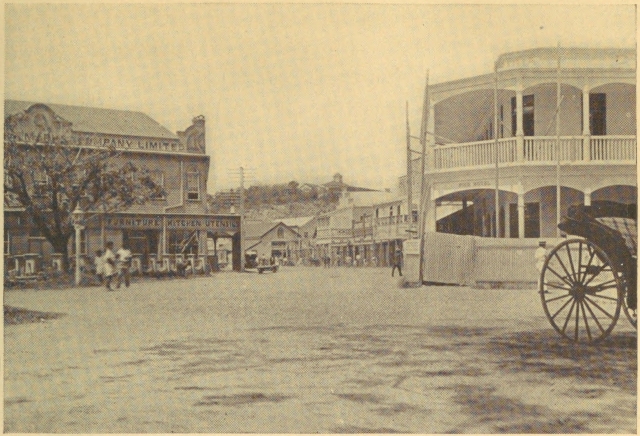
A CORNER OF SUVA, FIJI
The unexpected happened—the cab moved
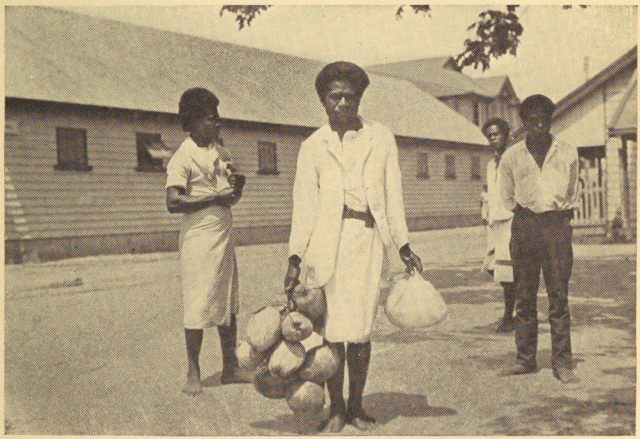
FOOD FOR A DAY'S GOSSIP
The sound did not cease, but rather, became more pronounced
after I returned that night. Deeply imprinted
on my memory was the figure of a sullen-looking Indian
at his post—small, wiry, persistent—with the whirring of
machinery all about him, the steaming vats, the broken
sticks of cane being crunched in the maw of the machine.
The toilers sometimes dozed at their tasks. I was told
that once an Indian fell into one of the vats in a moment
of dizzy slumber. The cynical informer insisted that the
management would not even stop the process of turning
cane into sugar, and that into the tea-cups of the world
was mixed the substance of that man. My reflection was
along different lines,—that into the sweets of the world
we were constantly mixing the souls of men.
But unfortunately those who look after the souls of
these men at the mission are apt to forget that they have
bodies, too, and that body is the materialization of desire.
There is something wonderful, indeed, in the sight of
men known to have been of the most ferocious of human
creatures going about their daily affairs in an attitude
of great reverence to the things of life. And reverence
added to the extreme shyness of the Fijian is writ large
in the manner of every native across the way from the
mill. Sometimes I felt that there was altogether too
much restraint, too much checking of wholesome and
healthy impulses among them for it to be true reverence.
That was especially marked on Sunday morning, when
from all the corners of the mission fields gathered the
sturdy black men in the center of the grounds where
stood the little church.
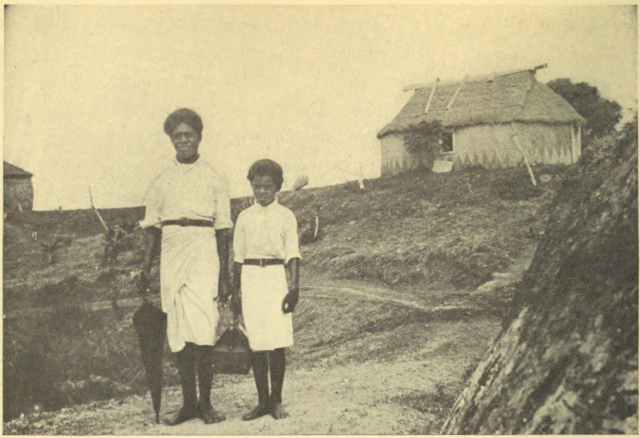
THE LONG AND THE SHORT OF IT
My Fijian guides
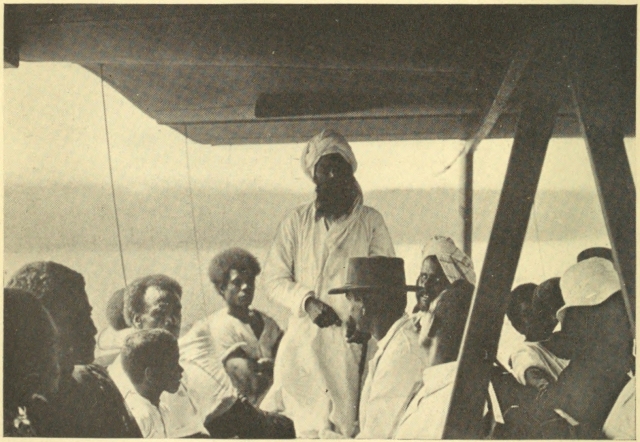
A HINDU PATRIARCH
On board the launch going up the Rewa River, with shy Fijians all about
They were a sight to behold, altogether too seriously
concerned to be amusing, and to the unbiased the acme
of gentleness. There they were—muscular, huge, erect,
and black, their bushy crops of coarse hair adding six
inches to their heads; dressed in sulus neatly tucked
away, and stiff-bosomed white shirts over their bodies.
Starched white shirts in the tropics! And the Bible in
Fijian in their hands. In absolute silence they made
their way into the church, the shuffle of their unshod feet
adding intensity to that silence. When they raised their
voices in the hymns it seemed to me that nothing more
sincere had ever been sung in life. But then something
occurred which made me wonder.
From the Solomon Islands had come on furlough the
Rev. Mr. Ryecroft and his delicate wife. He was a man
of very gentle bearing and great fervor. He and
his plucky wife had suffered much for their convictions.
All men who really believe anything suffer. The missionary
is as much anathema in his field as the anarchist
is in America, and is generally as violent an agent for
the disruption of custom. Mr. Ryecroft rose to speak
before the congregation. He spoke in English and was
interpreted by the missionary in charge. He told of
his trials in the Solomon Islands, and appealed for Fijian
missionaries to go back with him and save the blood-thirsty
Solomons. I watched the faces of these converted
Fijians. Some of them were intent upon the speaker,
repugnance at the cruelties rehearsed coming over them
as at something of which they were more afraid as a
possible revival in themselves than as an objective danger.
Some, however, fell fast asleep, their languid heads
drooping to one side. I am no mind-reader, nor is my
observation to be taken for more than mere guess-work,
but I felt that there were two conflicting thoughts in the
minds of the listeners, for while Mr. Ryecroft was urging
them to come arrest brutality in the Solomons there were
other recruiters at work in Fiji for service in Europe.
While one told that the savage Solomon Islanders
swooped down upon the missionary compound and left
sixteen dead behind them, in Europe they were leaving
a thousand times as many every day, worse than dead.
To whom were they to listen!
That afternoon Mr. Waterhouse, one of the missionaries,
asked me to give the young men a little talk on
my travels, he to interpret for me. I asked him what he
would like to have me tell them and he urged me to advise
them not to give up their lands. I complied, pointing
out to them how quickly they would go under as a race
if they did so. The response was more than compensating.
The outlook is all the more reassuring when you sit
of an evening as I did in the large, carefully woven native
house, elliptical in shape, with thatched roof and soft-matted
floors, which serves as a sort of night school for
little tots. The children, who were then rehearsing
some dances for the coming festival, sat on tiers of
benches so built that one child's feet were on a level
with the shoulders of the one in front. Like a palisade
of stars their bright eyes glistened with the reflections
of the light from the kerosene lamps hanging on wires
from the rafters. Lolohea Ratu, a girl of twenty, educated
in Sydney, Australia, spoke to them in a plaintive,
modulated voice, soft and low. All Fijian voices are
sad, but hers was slightly sadder than most of them,
tinged, it seemed, with knowledge of the world. She had
studied the Montessori method and was trying to train
her little brothers and sisters thereby. But she was not
forgetful of what is lovely in her own race, primitive as
it is, and was preparing these children in something of
a compromise between native and foreign dances. Round
and round the room they marched, the overhanging lamps
playing pranks with their shadows. Others sat upon
the mats, legs crossed, beating time and clapping hands
in the native fashion. Their glistening bodies and sparkling,
mischievous eyes, their response to the enchanting
rhythm and melody borrowed from a world as strange
to them as theirs is to us, showed their delight. I wondered
what strange images—ghostly pale folk—they
were seeing through our songs. Perhaps the music was
merely another kind of "savage" song to them, even a
wee bit wilder than their own. On the following day
they were to sing and dance to the amazement of their
skeptical elders.
Thus does Fijian "civilization" steer its uncertain
course between the two contending influences from the
West—the planters and the missionaries—just as the
river Rewa runs between them over the jungle plains,
struggling to supplant wild entangling growths with
earth culture.
And that "civilization" leans at one time toward the
mill and at another toward the mission. Frankly, Fiji
grows more interesting as one gets away from these two
guy-wires and floats on the sluggish river. My opportunity
of seeing that Fiji which is least confused by either
influence came unexpectedly. The missionaries generously
invited me to go with them up the river in their
launch early Monday morning. Everywhere along the
banks of the broad, deep stream stood groups of huts
and villages amid the sugar-cane fields. I gazed up the
wide way of the river toward the hazy blue mountains
which stood fifty miles away. They seemed to be a thousand
miles and farther still from reality. The Himalayas
which lured the Lama priest and Kim could not
have been more enticing. Because of the cloying atmosphere
of the day, this distant coolness was like an
oasis in the desert, and I longed for some phantom ship
to bear me away on the breeze.
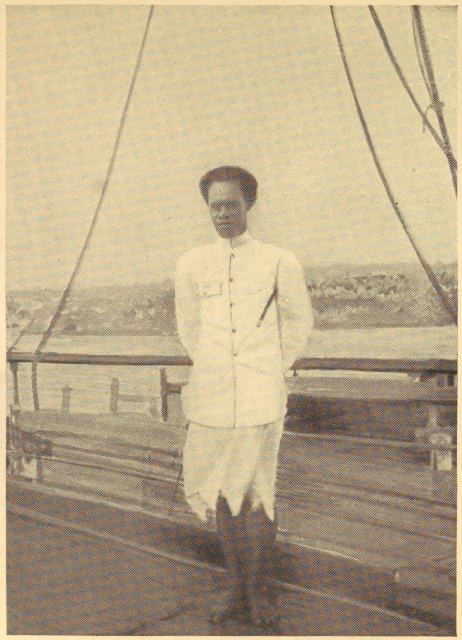
INSTRUCTOR OF THE FIJIAN CONSTABULARY
At Suva
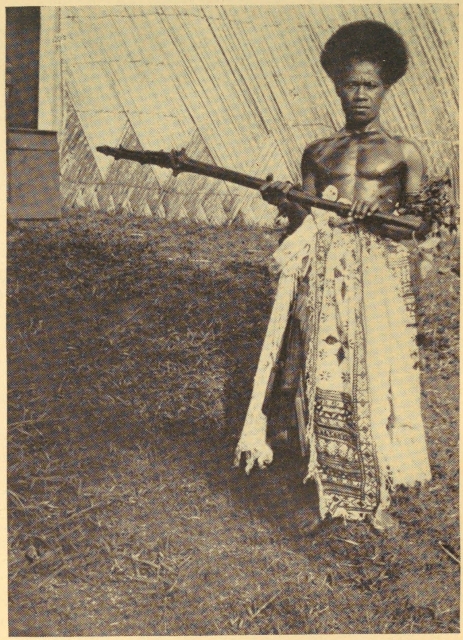
THE SCOWL INDICATES A COMPLEX
For he is not quite certain that the missionaries are right about
that club not being a god
For twenty miles we glided on through cane plantations,
banana- and cocoanut-trees, and miniature palisades
here and there rising to the dignity of hills. We
landed, toward noon, at a village which stood on a little
plateau,—quiet, self-satisfied, though in no way elaborate.
The best of the huts stood against the hill across
the "street" formed by two rows of thatch-roofed and
leaf-walled huts. It belonged to the native Christian
teacher. He turned it over to us, himself and his wife
and baby disappearing while we lunched. Much of our
repast remaining, the missionary offered it to the
teacher, but I noticed that he looked displeased and
turned the platter over to the flock of children which
had gathered outside,—a brood of little fellows, their
bellies bulging out before them, not even the shadow of a
garment covering their nakedness.
I returned to the hut a little later for my camera, not
knowing that any one was there. Inside, in one corner,
lay the teacher's wife, stretched face downward, nursing
her baby, which lay on its back upon the soft mats. She
smiled, slightly embarrassed, and I withdrew. Here,
then, was the place where civilization and savagery met.
There were few Fijians in the village, mostly children
and several old women. A Solomon Islander, who had
got there during the days when blackbirding or kidnapping
was common, moved among them. He had quite
forgotten his own language and could not understand
Mr. Ryecroft when the missionary spoke to him. An
elderly man beckoned to me from his hut and there offered
to sell me a heavy, ebony carved club that could
kill an ox, swearing by all the taboos that it was a sacred
club and had killed many a man in his father's time.
A narrow path climbing the hill close behind the village
led us to a view over the long sweep of the river
and its valley. The utmost of peace and tranquillity
hung, without a tremor, below us. Twenty huts fringed
the plateau, forming a vague ellipse, interwoven with
lovely salvias, coleuses, and begonias. The village seemed
to have been caught in the crook of the river, while a
field of sugar-cane filled the plain across the stream,
the shaggy mountains quartering it from the rear. Distant,
reaching toward the sun, ranged the mountains
from which the river is daily born anew.
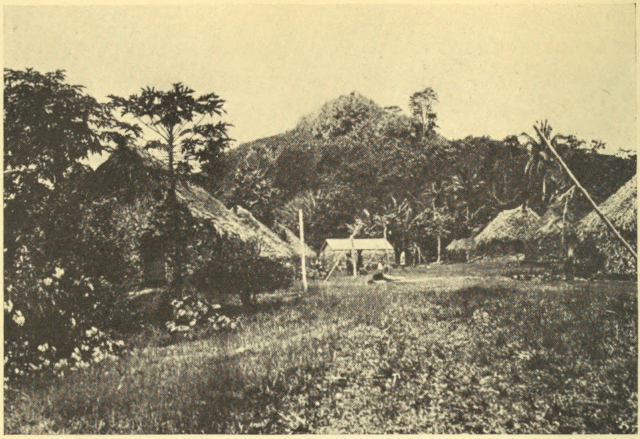
A FIJIAN MAIN STREET
The corrugated iron-roofed shack is the one we ate our lunch in
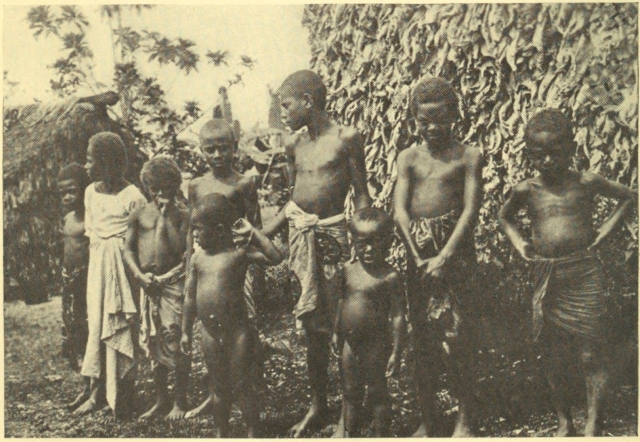
LITTLE FIJIANS
The only things some of these had on were sores on the tops of their heads
As our launch chugged steadily, easily down-stream,
and the evening shadows overstepped the sun, Fiji
emerged fresh and sweet as I had not seen it before. The
missionaries, till then sober and reserved, relaxed, the
men's heads in the laps of their wives. Sentimental
songs of long ago, like a stream of soft desire through
the years, supplanted precept in their minds, and I realized
for the first time why some men chose to be missionaries.
It was to them no hardship. The trials and
sufferings were romance to their natures, and the giving
up of everything for Christ was after all only living out
that world-old truism that in order to have life one must
be ready to surrender it.
Next day Mr. Waterhouse and I wandered about the
village of the sugar factory. At the bidding of several
minor chiefs who had described a circle on the mats, we
entered one of the dark huts by way of a low door. In a
corner a woman tended the open fire, and near an opening
a girl sat munching. The room was thick with smoke,
the thin reeds supporting the roof glistening with soot.
Everything was in order and according to form. They
were making kava (or ava or yangana), the native drink.
This used to be the work of the chieftain's daughter, who
ground the ava root with her teeth and then mixed it
with water. The law doesn't permit this now; so it is
crushed in a mortar (tonoa). Specialization has reached
out its tentacles even to this place, so that now the captain
of this industry is an Indian.
The ava mixed, it was passed round in a well-scraped
cocoanut-shell cut in half. As guests we were offered
the first drink. Extremely bitter, it is nevertheless refreshing.
After I made a pretense of drinking, the
bowl was passed to the most respected chief. With
gracious self-restraint he declined it. "This is too full.
You have given me altogether too much." A little bit
of it was poured back, and he drank it with one gulp.
He would really have liked twice as much, not half, but
there is more modesty and decorum among savages than
we imagine. In fact, our conventions are often only
atrophied taboos.
But the women, not so handsome nor so elegantly
coifed as the men, were excluded from a share in the
toast. They were not even part of the entertainment.
The sexes seldom meet in any form of social intercourse.
The boys never flirt with the girls, nor do they ever seem
to notice them. In public there is a never-diminishing
distance between them. A world without love-making,
primitive life is outwardly not so romantic as is ours.
The "romance" is generally that of the foreigner with
the native women, not among the natives themselves.
The daughter of the biggest living Fijian chief wandered
about like an outcast. She wore a red Mother-Hubbard
gown, and nothing else. Her hair hung down
to her shoulders. Having gone through the process of
discoloration by the application of lime, according to the
custom among the natives in the tropics, it was reddish
and stiff, but, being long, had none of the leonine quality
of the men's hair. Andi Cacarini (Fijian for Katherine),
daughter of a modern chief, spoke fairly good English.
She wasn't exactly ashamed, but just shy. The better
class of Fijians, they who have come in contact with white
people, all manifest a timid reticence. Andi Cacarini
was shy, but hardly what one could call bashful or fastidious.
She posed for me as though an artist's model,
not at all ungraceful in her carriage or her walk.
The male Fijian is extremely timid, but none the less
fastidious. The care with which he trains and curls his
hair would serve as an object-lesson to the impatient
husband of the vainest of white women. This doesn't
mean that the Fijian man is effeminate in his ways, but
he is particular about his hair. The process of discoloring
it is exact. A mixture of burnt coral with water
makes a fine substitute for soap. When washed out and
dried, the hair is curled and combed and anointed. From
the point of view of sanitation, the treatment is excellent,
and from that of art—just watch the proud male
pass down the road!
No matter where one goes in Fiji—or any of the South
Sea Islands—the dance goes with one. Here at Davuilevu
one afternoon in the hot, scorching sun, the natives
gathered on the turf for merrymaking. It was no special
holiday, no unusual event. To our way of thinking it is
a tame sort of dance they do. We hear much of the
freedom between the sexes in the tropics, and one gains
the impression that there are absolutely no taboos. But
just as there is nothing in all Japan—however delightful—to
compensate the child, or even grown-ups, for the
lack of the kiss, so none of the Fijian dances fill that
same emotional requirement which with us is secured
through the embrace of men and women in the dance.
From the Fijian point of view, the whirling of couples
about together must be extremely immodest, if not immoral.
Sitting in a double row, one in front of the other, were
oiled and garlanded Fijians. Behind them and in a circle
sat a number of singers and lali-players. As they
began beating time, the oiled natives began to move from
side to side rhythmically. Their arms and bodies jerked
in a most fascinating and interpretative manner. No
voices in the wide world are lovelier than the voices of
Fijians in chorus; no other music issues so purely as the
Fijian music from the depths of racial experience. Sometimes
the dancers swung half-way round from side to
side, with arms akimbo, or extended their arms in all directions,
clapping their hands while chanting in soothing,
melodious deep tones.
Judging from what I heard of the music of the Tongans,
the Samoans, and the Fijians, I give the prize to
the Fijians for richness of tone. More primitive than
the plaintive Tongans, the Fijian music is a weird combination
of the intellectual, the martial, and the industrial,—more
fascinating than the passionate, voluptuous
tunes and dances of the Samoans and the Hawaiians.
The Polynesians, probably because of their close kinship
with the Europeans, are much more sentimental in their
music. The Fijian is more vigorous and to me more
truly artistic.
No study, it seems to me, would throw more light on
the history and unity of the human race than that of the
dance and music. Why two races so far apart as the
Japanese and the Maories of New Zealand should be so
strikingly alike in their cruder dances, is hard to say.
And the Fijians seem in some way the link between these
two. The Fijian doubtless inherits some of his musical
qualities from his negroid mixture, but he has certainly
improved upon it if that is so. He has no regrets, no
sentimental longings, and in consequence his songs are
free from racial affectation.
The Fijians always sing. The instant the day's work
is done and groups form they begin to sing. Half a
dozen of them sit down and cross their legs before them,
each places a stick so that one end rests lightly on one
toe, the other on the ground; and while they tap upon
these sticks, others sing and clap hands, swaying in an
enchantment of loveliness. One carries the melody in a
strained tenor, the others support him with a bass drawl.
Once in a while an instrument is secured, as a flute, and
the ensemble is complete. Even the tapping on the
stick becomes instrumental in its quality.
As the day draws to a close, from the cane-fields smoke
rises in all directions. The plantation workers have
gathered piles of cane refuse for destruction. Like miniature
volcanoes, these, with the coming of darkness,
shine in the lightless night. It makes one slightly sad,
this clearing away of the remnants of daily toil, this
purification by fire. Then the sound of that other lali
(the hollow tree-trunk), once the war-alarum or call to a
cannibal feast, now at Davuilevu the invitation to prayer,
the dampness, and the sense of crowding things in
growth,—this is what will ever remain vivid to me.
Poor untroubled Fijians! This simple love of harmony,
a majestic sense of force and brutality,—yet,
withal, so naïve, withal so easily satisfied, so easily led.
Once a foreigner met a native who seemed in great haste
and trembling. The native inquired the time, in dread
lest he miss the launch for Suva. In his hand he carried
a warrant for his own arrest, with instructions to present
himself at jail. When the foreigner told him that it
was up to the jailer to worry about it, he seemed greatly
shocked. One of the missionaries had been asked to
keep his eye on a friend's house. In the absence of the
owner, the missionary found a Fijian in the act of burglarizing.
When questioned it was found that the native
wanted to get into jail, where he was sure of three meals
and shade, without worry. This is almost worthy of
civilized man, by whom it is perhaps more commonly
practised.
But the kind of jail in which men were at that time
incarcerated was not enough to frighten the most liberty-loving
individual. Because of the humidity and dampness,
the structure was left open on one side, only three
substantial walls and a roof being practical. Before the
white man got full control and the native had some iron
injected into his nature, it was not an arduous life the
prisoners led. The missionary told me that once the
head jailer was found sitting out of sight, with the officer
in charge of the prisoners, tilting his chair against the
wall of the jail. The prisoners had been ordered to
labor. The officer in charge was to execute the command.
Between puffs of tobacco, he would shout: "Up
shot!" and rest a while; then "Down shot!"—more rest.
Not a prisoner moved a muscle, the weights never rose
from the ground. The men were deep within the
shadows. The period of punishment over, they were ordered
into their heaven of still more rest and more shade.
From our way of thinking, these are flagrant deceptions.
But to the Fijian (and to most South Sea races)
the inducements for greater exertion are simply non-existent.
His revelries have been tabooed, his wars
have been stopped, his native arts are in constant competition
with cheap importations from our commercialized,
industrialized world. What is there, then, for him
to do? Little wonder that his native indifference to life
is growing upon him. His conception of life after death
never held many horrors. Even in the fierce old days it
was easy for a Fijian to announce most casually that he
would die at eight o'clock the following day. He would
be oiled and made ready, and at the stated time he died.
Most likely a state of catalepsy, but he was buried and
none thought a second time about it. One boy was recently
roused from such a condition and still lives.
The only means of counteracting this apathy are education
and the awakening of ambition through manual
training and the teaching of trades. This, the head of
the mission told me, was his main object. Missionary
efforts, according to one man, were directed more to this
purpose than to the inculcation of any special religious
precepts. And there is no question that that will work.
The will to live may yet spring afresh in the Fijian.
From the nucleus formed by the mission is growing a
more elaborate educational system. Recently the several
existing schools have been amalgamated under a new ordinance.
A proposal in reference to a more efficient system
of vernacular or sub-primary schools was embodied
in a bill put before the legislative council. A more satisfactory
method of training teachers was deliberated upon.
The Fijians are, it is seen, outgrowing the kindergarten
stage, but the grown-ups are largely children still.
A fortnight after I landed in Suva I was steaming for
Levuka, the former capital of the islands, situated on
a much smaller land-drop not many hours' journey away.
These are the only two important ports in the group,
and inter-island vessels seldom go to one without visiting
the other. Levuka is a much prettier place than
Suva. Its little clusters of homes and buildings seem
to have dug their heels into the hillside to keep from
sliding into the sea.
Along the shore to the left stood a group of Fijian
huts,—a suburb of Levuka, no doubt. Only a few old
women were at home, and one old man. Nothing in the
wide world is more restful to one's spirit than to arrive
at a village which is deserted of toilers. Nothing is
more symbolic of the true nature of home, the village
being more than an isolated home, but a composite of
the home spirit which is not tainted by any evidence of
barter and trade.
On the other side of Levuka, however, was an altogether
different kind of village, that of the shipwrights.
Upon dry-docks stood the skeletons of ships, fashioned
with hands of love and ambition. In such vessels these
ancient rovers of the sea wandered from island to island,
learning, teaching, mixing, and disturbing the sweetness
of nature, with which no race on earth was more blessed.
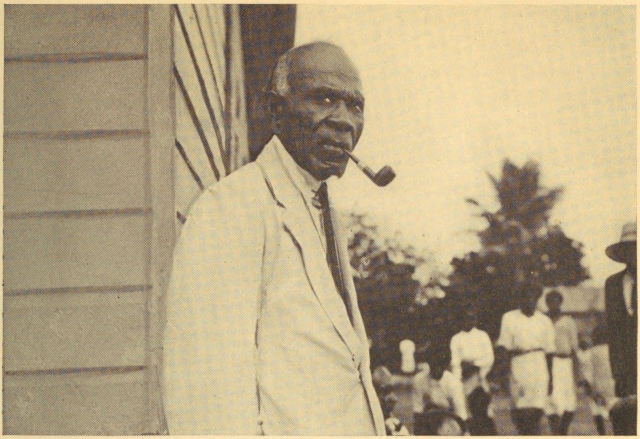
ONE OF THE MOST GIFTED OF FIJIAN CHIEFS
But who said that the wearing of hats causes baldness (?)
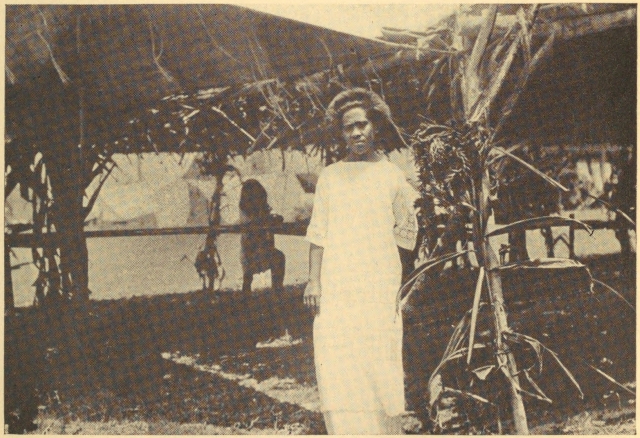
CACARINI (KATHERINE), THE CHIEF'S DAUGHTER
In her filet gown of Parisian simplicity
The Atua, on which I had sailed from Suva, was a
fairly large inter-island steamer that made the rounds
of all the important groups. She was bound for Samoa,
whither I had determined to go. There is no better opportunity
of getting a glimpse of the contrast between
the natives of the various South Sea islands than on
board one of these inter-island vessels. They are generally
manned by the natives of one of the groups,—in
this case, the Fijians. These men handle the cargo at
all ports, and remain on board until the vessel returns
to Fiji en route to the Antipodes. They feed and sleep
on the open deck and make themselves as happy and as
noisy as they can. A gasoline tin of tea, baked potatoes,
hard biscuit, and a chunk of fat meat, which is all placed
before them on the dirty deck (they are given no napkins),—that
is Fijian joy.
After their work, which in port sometimes keeps them
up till the morning hours, these strange creatures, untroubled
by thought, stretch themselves on the wooden
hatchway and sleep. There I found them at half-past
five in the morning, all covered with the one large sheet
of canvas and never a nose poking out. Air! Perhaps
they got some through a little hole in the great sheet.
Some stood and slept like tired, overworked horses.
One queer Fijian with turbaned head grinned in imitation
of none other than himself, a vague, undefined
curiosity rolling about in his skull. He followed me
everywhere, his white eyes staring and his mouth wide
open. Here was a future Fijian statesman in the process
of formation. His nebular, chaotic mentality was
taking note of a creature as far removed from his understanding
as a star from his reach.
One white soldier, an elderly man, wished to protect
himself from the wind, and asked a Fijian to haul over
a piece of canvas. The black man did so, but when the
boatswain saw it, he was enraged. The Fijian took all
the scolding, said never a word, and quickly replaced the
sheet. As the boatswain moved away, the soldier handed
the native a cigarette, saying: "Have one of these, old
sport. One must expect reverses in war." The native
grinned and felt the row was worth while.
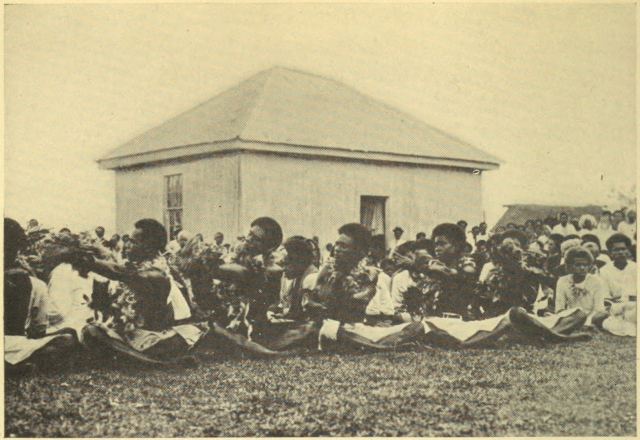
FIJIANS DANCE FROM THE HIP UP
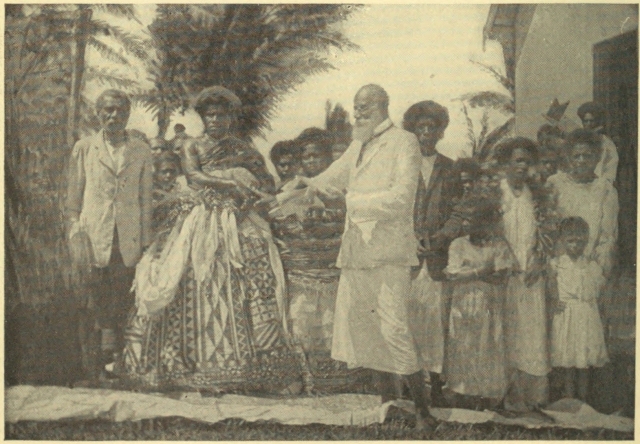
A FIJIAN WEDDING
Puzzle: find the bride. No, not the one with the hoop-skirt; that's the groom
There were Tongans, Indians, Samoans, and whites
on board, and though these are nearer kin to us, I liked
the Fijians most. Yet the Tongans are an attractive lot,
refined in feature, in manner, and in person. Perhaps
that is why they have the distinction of being the only
South Sea people with their own kingdom, a cabinet, and
a parliament.
The noise the Fijians make while in port is excruciating.
It is something unclassifiable. They roll their r's,
shout as though mad with anger, and then burst out in
childish laughter at nothing. These boyish barbarians
enjoy themselves much more in yelling than they would
in chorus with a Caruso. How torrential is the stream
of invective which issues against some fellow-laborer!
With what a terrific crash it falls upon its victim! But
how utter the disappointment when, after one has expectantly
waited for a scrap, a gurgle of hilarity breaks
from the throats which the moment before seemed such
sirens of hate and malice!
And so they toil, happy to appear important, busy,
honestly busy, loading the thousands of crates of green
bananas, the cargo which passes to and fro. Happier
than the happiest, sharing the scraps of a meal without
the growl so common among our sailors, each always
seems to get just what he wants and helps in the distribution
of the portions to the others. The missus never
bothers him, no matter how long he is away, and instantly
labor ceases the group is "spiritualized" into a singing
society and the racial opera is in full swing.
I had anticipated relief at their absence when the
steamer set off for the colder regions south. Yet something
pleasant was gone out of life the moment the ship
steamed out. The sailors moved about like pale ghosts
who had mechanically wandered back to a joyless life.
The white man's virtues are his burdens. His tasks
are done so that he may purchase pleasure. The ship
was orderly, everything took its place, even the cursing
and yelling came within control. We were heading
again for civilization.
I felt somewhat like the old folks after their wish had
rid the town of all mischievous little boys, and my heart
strained back for an inward glimpse of the life behind.
The smell of mold and copra returned; the damp beds;
the cool, clear night air; the moonlight upon the shallow
reefs; dappled gray breakers, playing upon the shore as
upon a child's ocean; in the dark, along Victoria Parade,
the shuffle of bare feet in the dust, the dim figures of tall,
bushy-haired men and slim, wiry Hindus; the thud of
heeled boots on the dry earth. And far off there, the
sound of the lali, the singing of deep voices, the vision
of an earthly paradise,—shattered by the sighting of
land ahead.
On the Niagara was a troupe of Samoan men and
women who had been to San Francisco demonstrating
their arts at the Panama-Pacific Exhibition. This,
our meeting on the wide, syrup-like tropical sea seemed
to me almost a welcome, a coming out to greet me and
to lead me to the portals of their home. They were en
route to Suva, Fiji, where they were to await an inter-island
vessel to take them to Samoa. They were traveling
third class, and the way I discovered them is not to their
discredit. We were becoming more or less bored with
life on deck, the games of ship tennis and quoits being
too obviously make-believe to be entertaining. At times
I would get as far away from the gregarious passengers
as possible, and again a number of us would gather upon
the hatchway and read or chatter. It was a thick latticed
covering, and the warm air from below none too
agreeable. But with it rose strains of strange melodies,
as from Neptune's regions of the deep. Peering down,
we espied a number of Samoan men and women, lounging
upon the floor of the hold. We took our reputations in
our hands and made the descent.
There were big, burly men and broad, sprawling
women, half-naked and asleep. One could see at a glance
that they had been spoiled by the attention they had received
while on exhibition at the fair, but the freedom
of life among third-class passengers somewhat softened
the acquired stiffness, and they relaxed again into native
ways. Hour by hour, as the vessel moved southward,
they seemed to come back to life, to thaw out as it were,
while we were wilting by degrees.
The scene was one which could have been found only
in tropical waters under the burning sun. Smoke, bare
feet, nakedness, people fat with the sprawly fatness which
is the style of the South Seas, unwashed sailors,—a
medley of people and cargo and steamer stench. But
also of the sweetly monotonous song of the Samoan girl,
the swishing of the water against the nose of the ship
in the twilight without, and the steady push of the vessel
toward the equator.
I whiled away many a pleasant hour, learning a few
of the native words in song and gossip. It is hard to distinguish
one native from the other at first, but Fulaanu
stood out above the rest like a creature over-imbued with
good-nature. She was flat, flabby, with a drawl in speech
that had the effect not only in her voice but her entire
bearing of a leaning Tower of Pisa. Her body bent
backward, her head was tilted up, and her long, prominent
nose also slanted almost with pride. She was an enormous
girl, plain, soft, with absolutely no fighting-spirit
in her, but she stood her ground against all masculine
advances with a charm that was in itself teasingly alluring.
She was always flanked on each side by a sailor.
They pretended to teach her the ukulele, they proffered
English lessons, they found one excuse after another for
being near her, and she never shooed them away; but
I'd swear by all the gods that not one of them ever more
than held her hand or leaned lovingly against her.
Yet Fulaanu was as sentimental a maiden as I have
ever laid eyes on. She was constantly drawling some sentimental
song she had learned in California, the ukulele
was seldom out of her hands, she never joined in any
of the card games going on constantly roundabout her,
and she was always ready to swap songs with any one
willing to teach her.
"I teach you my language," she said to me, and slowly,
with twinkling eyes, she pronounced certain words which
I repeated. We had often taught French to our boys
at our little school in California in that way,—the Marseillaise,
for instance,—and the method was not strange
to me. She used the song method, too, an old English
song that was just then the rage in Samoa. The English
words run somewhat like this:
And you will take my hand
As you did when you took my name;
But it's only a beautiful picture,
In a beautiful golden frame.
I'm sure I have them all muddled, but let me hum this
tune to myself and immediately Fulaanu, the hold,
Fiji, Samoa, and all the scents and sounds of savagedom
come instantly to my mind. For everywhere I went
they were singing this song, through their noses but with
all the sentimental ardor of the young flapper; as at a
summer resort in America when a new song hit has been
made, the sound of it is heard from delivery boy to housemaid
and as many different renderings of it as individual
temperament demands.
There was Setu, too,—tall, straight, with that easy
grace known only among people free of clothes. Setu
spoke English very well, and was as companionable a
chap as one could pick up in many a mile. But Setu's
heart was not his own; he stood guardian over a treasure
he had found in San Francisco. Not an American girl,
no, sir! These savage boys did not play the devil in our
land as our savages do in theirs. But Setu was the personification
of chivalry, and, what was more, he was in
love. To look at him and then at her was to despair of
human instinct of natural selection. How an Apollo of
his excellence should have been unable to find a more
handsome objet d'amour, I cannot imagine. She was
short, well rounded, with a head as square as Fulaanu's
was oblong, and a nose as snubby as Fulaanu's was romanesque.
She was evidently committed, body and soul,
to Setu for she was as devoid of charm for the others
as Fulaanu was full of it. And so all day long, Setu and
his sweetheart hugged each other in a corner, as oblivious
of the presence of a ship-load of people as though
they had been ensconced in a hut of their own. They
were evidently taking advantage of proximity to civilization,
for such immodest behavior is not frequent in the
tropics. Civilization had taught the savages some things
at least. Whenever Setu was free from love-making, he
would spare a moment to me, and on those rare occasions
he stirred my spirit with promises of guidance in
his native island that threatened to exhaust my funds.
The romantic associations we have with the South Seas
were in this group reversed, for to these primitive people
the greatest romance imaginable came with their
journey to America. There young people from different
islands met and fell in love with one another; there, under
the benign influence of American spooning, one couple
was married, and there their first baby was born,—an
American subject, brought back to Pago Pago (American
Samoa) to resume his citizenship. There they learned
true modesty, which comprised stockings and heavy
boys' shoes; the art of playing solitaire, in which one fat,
matronly-looking woman indulged all day as though she
had been brought along as chaperon and felt herself
considerably out of it; and even en route for home they
were learning the art of striking by calculation and without
passion or frenzy.
I was sitting on the hatch with Fulaanu, who was strumming
away on her ukulele, when a ring was formed in the
middle of the hold and a young white man began boxing
with a Samoan. The white boxer was obviously an
amateur, bearing himself with all the unpleasant mannerisms
of his profession,—a haughty, pugnacious, overbearing
self-conceit. He had every advantage in training
over his antagonist, whom he peppered vigorously.
He kept it up when it was evident that the young Samoan
was going under. One last blow and the fellow doubled
over, bleeding from nose and mouth. It took ten minutes
to bring him round. In the meanwhile, the victor
of the unfair bout strutted around as though he had
accomplished something remarkable.
It was interesting to see the effect this had on the
"primitive" Samoans. There was consternation among
them; a hush came over the hold. The vibration of the
steamer and the splashing of the water against its iron
side alone broke the stillness. The Samoan girls, though
they did not grow hysterical, were most decidedly displeased,
turning in disgust from the sight of blood.
Yet according to our notions they are primitive, and the
fact is that a few generations ago they were savages.
But they were not long in distress. The spell of the
equatorial sun was upon them, and they soon relaxed.
There upon mats, as in their own huts, lay rows of fat,
large, voluptuous men and women; nor was there even a
rope to separate the sexes as in an up-to-date Japanese
bath. They seemed to sleep all day, in shifts governed
by impulse only. A woman would rise and move about
a while, then go back to lounge again. Enormous, broad-shouldered
and black mustached men would snore
gently, rise and inspect life, and decide that slumber
was better for one's soul. But Fulaanu lounged with her
ukulele, surrounded by amorous sailors who gazed
longingly into her eyes.
One night we arranged for a meeting of the "classes."
We promised the Samoans a good collection if they would
come and dance for us on deck. We invited the first-class
folk to come, too. They stood as far to one side of
us as was consonant with first-class dignity represented
by an extra few pounds sterling in the price of the ticket.
But for a moment we forgot that there were class and
race in the world.
It was not one of those interminable revelries one
reads about, that begin with twilight and end with twilight.
On the contrary, it was a little squall of entertainment,
one that breaks out of a clear sky and leaves
the sky just as clear in a trice. There was no occasion
for self-expression here. They had been asked to dance
for our entertainment, not for theirs. There we stood,
ready to applaud; there they were, ready to be applauded,
to receive the collection promised. It was another little
thing they had picked up in our world, from our civilization,—the
commercialization of art. Our artists,
scribes, and entertainers have been considerably raised
above prostitution of their talents by a certain commercialization,
by the translation of their worth in dollars
and cents; and we need a little more of it to free art from
bondage to patronage. But in the tropics, where the
dance and jollity are no private matters, there is something
sterile in commercialization. No doubt to the natives
there is little difference between a woman giving
herself for gain and a man dancing for the money there
is in it without the whole group becoming part of the
performance: the dancer feels that his purchaser, his
public, is cold and unresponsive. And so it seemed to me
at this dance. They finished, they expected their money,
they got it and departed, and there seemed something
immoral to me in the exploitation of their emotions.
What a different lot they were one night when I visited
the little house they rented in Suva while waiting for the
Atua to arrive from New Zealand and take them on to
Samoa. There it was song and dance out of sheer ecstasy:
life was so full. They were again in their home
atmosphere, and their voices only helped swell the volume
of song which issued forth everywhere about,—an
electrification of humanity all along the line, in village
after village.
They hung about the pier before sailing for Samoa
till after midnight, singing sentimental songs and hobnobbing
with the Fijians. The Fijian constable joined
them with a flute, and the lot of them tried to drown out
the voices of the natives loading and unloading cargo.
Not until notice was given that the ship was about to get
under steam did they think of going aboard. They
looked as though ready for rest, but by no means dissipated,
by no means weary. The spell of song was still
upon them.
When we woke next morning, we were tied up to a pier
at the foot of the hills of Levuka. But I have already
dwelt upon the features of this former capital, and am
only concerned with it here as it was reflected in the
eyes of the Samoans. Levuka to me was one thing; to
them it was quite another. The moldy little stores afforded
them more interest than the village to the left,
or the shipyards to the right which were to my Western
notions commendable.
I followed in the wake of these gliding natives as we
left the steamer. They looked neither to the right nor
to the left, but wended their ways, like cattle in the pasture,
straight toward the shops. Into one and out the
other they went, bargaining, pricing, buying little trinkets
and simple cloths, chatting with the Fijians as
though friends of old.
Setu's sweetheart and the pretty mother of the young
American citizen, who was left in the care of the fat
"chaperon," set off by themselves through the one and
only street of Levuka. It was obvious that they were
quite aware of whither they were going,—so direct was
their journey. My curiosity was roused and I wandered
along with them. They said never a word to me, nor
objected to my presence. We turned to the left, off into
a side street that began to insinuate its way along the
bed of a stream lined with wooden huts and shacks.
Some of these were fairly well constructed, with verandas,
like the houses of a miniature American town,
garlanded in flowers. Just above the village, where the
stream began to emerge from behind a rocky little gorge,
the two women turned in at a gate to a private cottage.
A bridge led across the stream to the little house, the
veranda of which extended slightly over the stream.
Beneath, in a corner formed by a projecting boulder, lay
a quiet little pool of water—clear, cool, fresh and deep.
Without asking permission from the owners, the
women began slowly, cautiously to wade into the pool.
Seeing that I had no thought of going, they put modesty
aside, slipped the loose garments down to their waists
and immersed themselves up to their necks. One of
them was tattooed from below her breasts to her hips;
the other's breasts alone bore these designs. They
dipped and rose, splashed and spluttered, but there was
none of that intimacy with their own flesh which is the
essence of cleanliness and passion in our world. There
was no soap, no scrubbing. It was something objective,
almost, a contact with nature like looking at a landscape
or listening to a storm.
Presently some of the inmates of the cottage, evidently
well-to-do Fijians, came out to greet them. I could not
tell whether they were friends or not, but the women
were invited in,—and I turned into town through back
roads and alleys that were just like the back roads and
alleys anywhere in the world.
That afternoon we steamed out again for Apia, Samoa.
The sea was disturbed somewhat and gave us various
sensations; but the vile odors that threatened my nautical
pride never changed.
Most of the Samoans were under the weather. They
did not look cheerful, and all song was gone out of them.
Setu and his sweetheart were here even more inseparable
than on the Niagara. She was not very well and
stretched out on the bench on the edge of which he took
his seat. In her squeamish condition she could hardly
be expected to pay much attention to proprieties she had
acquired in less than a year's residence in America.
Her sprawly bare feet on several occasions made too
bold an exit from beneath the loose Mother-Hubbard
gown she wore, and each time Setu would draw the skirt
farther over them, affectionately pressing them with his
hand. This one instance, exceptional as it was, made me
notice more consciously the absence of that public
intimacy which is the bane of the prude with us. Not all
the charm of the tropics which is so real to me can take
the place of the cleanliness of the West, the tenderness
of clean men and women in public, to be observed even on
our crowded subways, the loveliness of white skin tinged
with pink and scented with the essence of flowers.
I did not see them again before we arrived at Samoa
the next day; the sea was too choppy. But in the afternoon
Setu came out with a pillow held aloft over his head,
and declared he would take a nap. There was childish
glee in his face at the prospect, and he stretched out on
the hard deck in perfect ease. And long after I ceased
to figure in his fancies, the beaming, sparkling eyes and
merry grin seemed to light up the soul within him.
Toward sundown we passed the first island of the
group,—Savaii, the largest. It lay at our left, Mua Peak
emitting a sluggish smoke from reaches beyond the depth
of the waters which had nearly submerged it, and as the
sea made furious charges into blow-holes or half-submerged
caverns, the earth spit back the invading waters
with an easy contempt.
At our right lay the island of Manono, much smaller,
and nearer our course. Shy Samoan villages hid in
little ravines, almost afraid to show their faces.
Shortly after eight o'clock we neared the island of
Upolu. The troupe of Samoans came out on deck with
the eagerness in their eyes that marks such arrivals at
every port of the world. The lights of the village of
Apia pricked the delicate evening haze. One strong,
steady lamp, like a planet, shone from above the others.
Setu called to me eagerly, his right hand pointing
toward it.
"That is from Vailima, Stevenson's home," he said,
with some pride.
When at last we anchored just outside the reefs before
Apia, these natives, who had grown close to one another
during the year of their pilgrimage, began bidding one
another farewell before slipping back to the little separate
grooves they called home. The women kissed one
another, cheek touching cheek at an angle, a practice
common both at meeting (talofa) and at parting (tofa).
But with the men they only shook hands. Then, clambering
over into canoes, they were borne across the reefs
to their homes. And as long as Polynesia is Polynesia
there will echo the stories of this journey to the land of
the white man and all children will know that what the
white man said about his lands is true.
The reader who has never entered a strange port nor
come home from foreign lands will not be able to imagine
the psychological effect of my entry of Samoa. Not only
did the thousands of eyes of the natives seem to turn
their gaze upon me, but it seemed, and I was quite sure,
that at least two thousand pale faces with as many bayonets
were fixed upon me. Samoa was under occupation.
I asked the captain of the forces what I could do to
avoid trouble.
"See that you don't get shot," he said. I assured him
there was nothing nearer my heart's desire, and, seeing
that I looked harmless, he ventured to reassure me: "Oh,
just keep away from the wireless. That's all." I had
come to see the natives, not electric gymnastics, so I
found it very easy to keep away from the wireless.
What there was of Apia was essentially European and
lay along the waterfront. Here stood the three-story
hotel, built and until then managed by Germans. Diagonally
across from it and nearer the water's edge, was a
two-story ramshackle building even then run by Germans.
The little barber to whom I had been directed
spoke with a most decided German accent. He cut and
shampooed my hair, but let me walk out with as much
of a souse on top of my head as I ever had in a shower-bath.
Wherever I went were Germans,—and yet they
said the islands were under occupation. Turn to the
right and there, back off the street within a small compound
that seemed to lie flat and low, was a German
school still being conducted by black-bearded German
priests. But to the left, within the dark-red fence, stood
the dark-red buildings of the German Plantation Company,
closed, and the little building that once was
the German Club had become the British Club; while at
the other end of the street were the office buildings of
the military staff, where once ruled the German militarists.
In between, in a little building a block or two
behind the waterfront, was the printing-office,—where,
strange to say, the daily paper was still being printed in
both German and English. With the few structures that
filled in the gaps between these outposts we had small
concern. They were the nests of traders, the haven of
so-called beach-combers and the barracks and missionary
compounds. And alien Samoa is at an end.
Mindful of the mild instructions not to get myself shot,
I took as little interest in the details of occupation as
was compatible with my sense of freedom; but this course
was precarious, for at the time any one who was not
with us was against us. However, details of such differences
must be reserved for a later chapter. Here we
are interested in Samoa itself. But in my very interest
in the place I struck a snag, for every other day Germans
were being deported or coraled for attempting to stir
up a native uprising. Still, inasmuch as I could not
acquire the language in so short a time, I felt secure, and
took to the paths that led to the Stone Age as a Dante
without a love-affair to guide him.
The island is hemmed in by coral reefs on the edge of
which the waves break, spreading in foam and gliding
quietly toward shore. As they sport in the brilliant sunlight,
it seems as though the sea were calling back the
life lost to it through evolution. The tall, gaunt palms
which lean toward the sea, bow in a humble helplessness.
There, a quarter of a mile out, upon the unseen reefs,
lies the iron skeleton of the Adler, the German man-of-war
which was wrecked on the memorable day in 1889.
Such seems to be the fate of the Germans: even their
skeletons outlive disaster. But the sea has been the
protector of the natives. It would be interesting to
speculate as to what course events about the South Seas
would have taken had not that hurricane intervened.
The natives are indifferent to such speculations; for, as
far as they were concerned, one turn was as good as
another. Borne over the swelling waves from island
drift to island drift, the ups and downs of eternity seem
to leave no great changes in their lives.
Roaming along the waterfront to the left of Apia
with the sun near high noon, all by myself, I met with
nothing to disturb the utter sweetness and glory of life
about. I wavered between moods of exquisite exhilaration
and deep depression. Bound by the encircling consciousness
of the occupation, the sense of wrong done
these natives who had neither asked for our civilization
nor invited us to squabble over their "bones," I felt that
but for the presence of the white man this would have
been the loveliest land in the world. For here one
becomes aware of nature as something altogether different
from nature anywhere else. That distant pleading
of the sea; the gentle yielding of the palms to the landborn
breezes,—there was much more than peace and
ease; there was absolute harmony. But where was man?
I became restless. Nature was not sufficient. I went
to seek out man, for at that hour there was none of him
anywhere about. I was, for all intents and purposes,
absolutely the only human being on that island. Every
one else had taken to cool retreats. But where should I
go? I wondered. I knew no one, and the sense of loneliness
I had for a while forgotten came back to me with
a rush. For a moment I was again in civilization, again
in a world of fences and locked doors. "I will go and
look up Setu," I thought. "He promised to guide me
about Samoa. I have his address. I'll look up Setu."
So I turned back toward the hills and in among the palm
groves, where I could see the huts of the village of
Mulinuu, where Setu lived.
When I arrived I realized why I had suddenly become
conscious of my loneliness. Throughout the village there
wasn't a soul abroad. The domes of thatch resting on
circles of smooth pillars were deserted, it seemed, and
the fresh coolness that coursed freely within their shade
was untasted. Nowhere upon the broad, grassy fields
beneath the palms was there a walking thing; and I was
a total stranger. It was slightly bewildering, as though
I were in a graveyard, or a village from which the
inhabitants had all gone. I approached one of the huts
and found, to my satisfaction, that there was a human
being there. It was a woman, attending to her household
duties. She was just under the eaves on the outside,
beside the floor of the hut, which was like a circular stage
raised a foot or two above the ground, and paved with
loose shingles from the shore. I hardly knew how to
approach her, not thinking she might know my language.
"Good afternoon," she said in perfect English. "Sit
down." The shock was pleasant. So there were no
fences or doors to social intercourse in Samoa, after all.
Still, I must find Setu. I asked her where I could locate
his home. Before directing me, she chatted a while and
assured me that I could go to any one of the huts about
and make myself comfortable. I was not to hesitate, as
it was the custom of the country and in no way unusual.
She was a fine-looking woman, robust and tall, genial
and attentive, as housewifely a person as could be found
anywhere. I have since had occasion to talk with many
a housewife in New Zealand and Australia when searching
for private quarters and cannot say that their manners,
their dress, their regard for a stranger's welfare
in any way exceeded those of this woman who had nothing
to offer me but rest and no wish for reward but my
content.
Taking her directions, I turned across the village to
where she said Setu could be found. Beneath the shade
of a palm squatted a group of men who when they spied
me called for me to come over to them. Had I not been
on curiosity bent, I should have regarded their request
as sheer impudence, for when I arrived they wanted me
to employ them as guides. It was amusing. Instead of
running after hire, they commanded the stranger to come
to them. It was too comfortable under the spreading
palm branches. I told them that I had arranged with
Setu to guide me and was in search of him. They began
running Setu down. He was untrustworthy, they assured
me, and would charge me too high a price. Then they
asked me what my business was, what Setu had said,
when he was going,—everything imaginable. But never
an inch would they move to show me the way to Setu's
house. I wandered about for a while, inquiring of one
stray individual and another, but no one had seen Setu,
and at last I learned that he had left the village early
that morning for his father's place, far inland, and
would not return. Setu had gone back on me. He had
promised to call for me with his horse and buggy and
convey me over the island. But Setu had forsaken me,
and there was nothing to do but to make the best of the
day right there.
Taking the word of the well-spoken woman, I
approached the most attractive-looking hut, where sat a
number of people roundabout the pillars. It was a
mansion-like establishment even to my inexperienced
judgment of huts. It was roofed with corrugated iron
instead of thatch, and the pillars were unusually straight
and smooth. The raised floor was very neatly spread
with selected, smooth, flat stones four to five inches in
diameter, and framed with a rim of concrete. Fine straw
mats lay like rugs over a polished parquet floor at all
angles to one another, and straw drop curtains hung
rolled up under the eaves, to be lowered in case of rain
or hurricane. The floor space must have been at least
thirty-five feet in diameter, and it was plain that each
inhabitant occupied his own section of the hut round the
outer circle.
I was cordially greeted and invited to rest, which I
did by sitting on the ground with my legs out, and my
back to a pillar for support. From the quiet and decorum
it was evident that the householders were entertaining
guests. Each couple or family sat upon its own mats.
There were twelve adults and three children. It happened
that the man who greeted me and bade me be
seated was the guest of honor, a gentleman from Rarotanga,
passing through Samoa on his way to Fiji. He
was a very refined-looking individual, and made me feel
that the Rarotangans were a superior race, but the contrary
is true. However, his regular features and courtly
manners were a distinction which might well have
led to such a supposition. His handsome wife, who sat
with him, was as retiring as a Japanese woman, and as
considerate of his comfort.
The others were set in pairs all round the hut. At
the extreme left were two women, sewing; opposite us,
a man and woman apportioning the victuals; to my
right, a man and a woman grinding the ava root preparatory
to the making of the drink. Farther way squatted
a very fat woman, with barely a covering over her
breasts, which were full as though she were in the nursing-stage.
The children moved about freely neither
disturbing nor being curbed. In the center of the company
sat two men, one evidently the head of the family,
with his back up against a pillar, the other his equal in
some relationship.
The dinner was being served by a portly individual,
a man who could not have been exactly a servant, yet
who did not act as though he were a member of the
family. He passed round the ample supply of fish,
meats, and vegetables on enamel plates, his services
always being acknowledged graciously. No one looked
at or noticed his neighbor, but indulged with the aid of
spoon or finger as he saw fit, and had any made a faux
pas there would have been none the wiser. That, I
thought, was true politeness.
Dinner over, the remains were removed and each person
leaned back against the nearest pillar. After a slight
pause, the eldest man, he in the center of the hut, clapped
his hands, and uttered a gentle sound, as one satisfied
would say: "Well! Let's get down to business." But it
was nothing so serious or so material as that. It was
ava-drinking time. The polished cocoanut bowl was
passed round, by the same old waiter, to the man whose
name was called aloud by the head of the household, and
each time all the rest clapped hands two or three times to
cheer his cup. It was like the Japanese method of "ringing"
for a servant, not like our applause. Then fruits
were passed around. Cocoanuts, soft and ripe, the outer
shell like the skin of an alligator pear and easily cut with
an ordinary knife, were first in order, after which the
companion of the man in the middle of the hut, like a magician
on the stage, drew out of mysterious regions an
enormous pineapple which may have been thirty inches
in circumference. It might have had elephantiasis, for
all I knew, but it was the cause of the only bit of disharmony
I had noticed during the entire time I rested
with them. The man to whom it fell to dispense its juicy
contents—he who had sat unobtrusively beside the head
of the house now found it necessary to stretch his legs
in order the better to carve the fruity porcupine. The
shock to my sense of form the moment I caught sight
of those legs was enough to dissipate my greediest interest
in the pineapple. They were twice the size of the
fruit, and as knotty. He was suffering from elephantiasis
of the legs, poor man,—a disease, according to the
encyclopædia, "dependent on chronic lymphatic obstruction,
and characterized by hypertrophy of the skin and
subcutaneous tissue." Morbid persons seem to enjoy
taking away with them photographs of people affected
by this hideous disease in various parts of the body, but
it was enough for me that I saw this one case; and sorry
enough was I that I saw it at that quiet, peaceful hut,
from which I should otherwise have carried away the
loveliest of memories.
For as soon as the meal was over, and the ava-drinking
at an end, pleasures more intellectual were in order.
Neighbors began to arrive, including the fine woman who
had urged me to rest wherever I wished. As each new
guest appeared, he passed round on the outside and
shook hands with those to whom he was introduced,
finally finding a quiet corner.
When the interruptions ceased, the head of the house
began to speak in a low, reflective tone of voice. All the
others relaxed, as do men and women over their cigarettes.
My Tongan neighbor acted as interpreter for me,
being the only person present who could speak English.
The head of the house was telling some family legend,
the point of which was the friendship between his forefathers
and the fathers of this Tongan guest. Then one
at a time, quietly, in a subdued tone, each one present
expressed his gratitude for the hospitality extended, or
recited some family reminiscence. There wasn't the
slightest affectation, nor the semblance of an argument.
Here, then, was Thoreau's principle of hospitality
actually being practised. As each one spoke he gazed
out upon the open sky decorated with the broad green
leaves of the palm. Sometimes the listeners smiled at
some witticism, but most of the time they were interested
in a sober way. Last of all arose the companion of the
head of the house, upon his heavy, elephantine legs, and
in a dramatic manner—probably made to seem more so
by the tragic distortion of his limbs—related a story,
several times emphasizing a generalization by a sweep
of the hands toward the open world about.
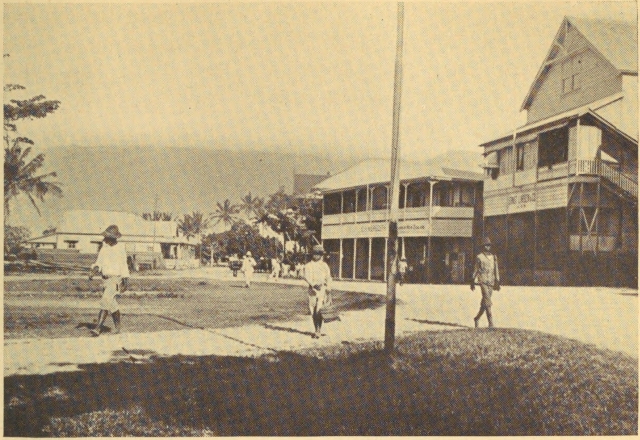
THE STREET ALONG THE WATERFRONT OF APIA, SAMOA
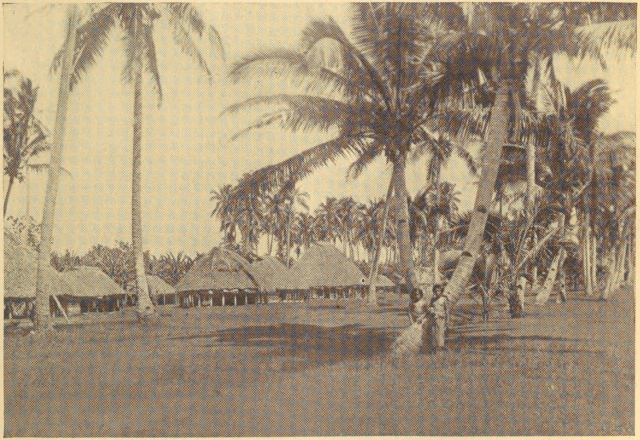
I THOUGHT THE VILLAGE BACK OF APIA, SAMOA, WAS DESERTED, BUT IT
WAS ONLY THE NOON HOUR
A gentle breeze crept down from the hills and swept
its way among the pillars of this peaceful hut and
skipped on through the palms out to sea. As far as the
eye could reach through the village there was no sign
of uncleanliness, no stifling enclosures, no frills to catch
the unwary.
The afternoon was well-nigh gone when I moved
reluctantly away from this charmed spot. Slowly life
was becoming more discontented with ease and bestirred
itself to the satisfaction of wants. A few hours of toil,
in the gathering of fruits, and one phase of tropical life
was rounded out. It might be more pleasant to believe
that that is the only side, but such faith is treacherous.
The life of the average South Sea islander is as arduous
as any. Fruits there are usually a-plenty, but they must
be gathered and stored against famine and storm. Be
that as it may, the open life, the things one has which
require only wishing to make them one's own, the
uncramped open world,—by that much every man is
millionaire in the tropics, and it is pleasant to forget
if one can that there is exploitation, despoliation, and
oppression as well, both of native and of alien origin.
But for the time at least we may as well enjoy that
which is lovely.
That night I witnessed the usual events at the British
Club. The substance of the evening's conversation,
every word of which was in my own language, was quite
foreign to me. It comprised "Dr. Funk" and his special
services in counteracting dengue fever. The aim and
object of every man there seemed to be to make me drink,
quite against my will. A visiting doctor added the
weight of his learning to induce me to turn from heedlessly
falling a victim to fever by engaging "Dr.
Funk." I was inclined to dub him "Dr. Bunk," but why
arouse animosity in the tropics? there is enough of it.
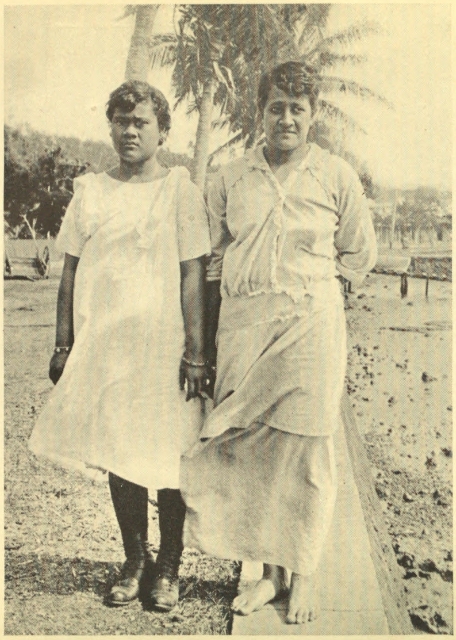
CONTACT WITH CALIFORNIA CREATED THIS COMBINATION
OF SCOWL, BRACELETS AND BOY'S BOOTS—BUT FULAANU BESIDE HER WAS UNCORRUPTIBLE
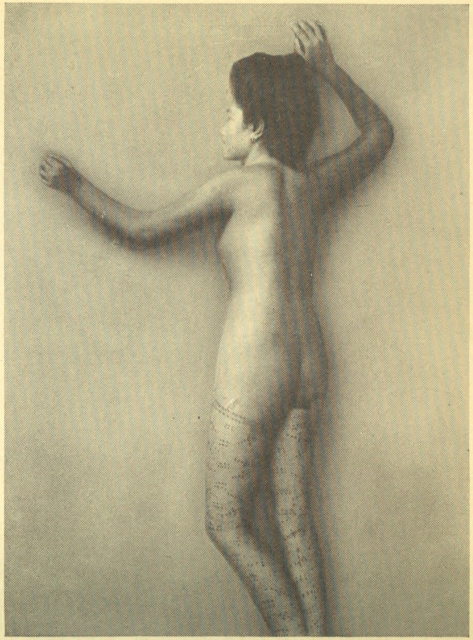
TATTOOING OF THE LEGS IS AN ESSENTIAL IN SAMOA
But I couldn't help contrasting in my own mind the
little gathering on the shingle-paved floor of that corrugated
iron hut with the more elaborate club that changed
its name from German to British with no little hauteur.
More than once I wished that I had had command of the
language of those people in the hut where allegory, mixed
with superstition but seasoned with gentle hospitality—and
not rum—was the order of the day.
Weary of refusing booze and more booze, I set off
for the shore. Though military order forbade either
natives or Germans or any one else without a permit to
be out after ten o'clock, I had had no difficulty in securing
a permit to roam about at will, day or night. The
new military Inspector of Police strolled out with me
and we took to the road that led out of Apia to the left,
past the barracks, past the school, and the church, past
all the crude replicas of our civilization.
"Oh, how I loathe it all!" said Heasley to me. "God,
what wouldn't I give to be back with my wife and kiddies!
This everlasting boozing, this mingling with
people whom I wouldn't recognize in Wellington, being
herded with the riffraff of the world. They talk of the
lovely maidens. Tell me, Greenbie, have you seen any
here you'd care to mess about with? The tropics!—rot!"
I saw that I had to deal with a frightfully homesick
man, and there was no point in running counter to him.
The fact that to me the tropics were lovely only when
seen as an objective thing, not as something to feel a part
of, would have made little impression on his mind. He
was condemned to an indefinite sojourn, whereas I was
foot-loose, had come of my own free will, and was going as
soon as I had had enough of it. To him the daily round
of drink and cheap disputes, the longing for his wife
and kiddies, the heat, the mosquitos, the mold, the cheap
beds and unvaried fare, the weeks during which the
British troops had virtually camped on the beach in the
steady downpouring tropical rains; the inability to dream
his way into appreciation of South Sea life; the necessity
of looking upon the natives as possible rebels; suspicions
of the few Germans there, suspicions of every new-comer,
suspicions of even the death-dealing sun,—no wonder
there was nothing romantic about it to him!
But as we wandered along, chatting in an intimate
way, as only men gone astray from home will chat when
they meet on the highways of the world, he seemed to
grow more cheerful. Time and again he told me what a
relief I was to him, how being able really to talk freely
with me was balm to his troubled spirit. I knew that
an hour after my departure he would forget all about me,
that there was nothing permanent in his regard, that I
really meant nothing to him beyond an immediate release
for his pent-up mind,—but I felt that he was sincere.
As we kicked our way along the dusty road we came
to a stretch where the palm-trees stood wide apart. The
smooth waters covered the reefs, and a million moonbeams
danced over them. Within the palm groves camp-fires
blazed beneath domes of moon-splattered thatch,
and from all directions deep, clear voices quickened the
night air. We of the Northern lands do not know what
communal life is. We move in throngs, we crowd the
theaters, we crowd the summer resorts,—but still we do
not know what communal life is. We are separate icicles
compared with the people of the tropics. Only to one
adrift at night within a little South Sea village is the
meaning of human commonalty revealed. It seemed to
touch Heasley as nothing had done before. After our
little conversation he appeared relieved and receptive.
We wandered about till long after midnight, long after
the village had sung itself to sleep, even then reluctant
to take to our musty beds.
Thus did one day pass in Samoa, and every day is like
the other, and my tale is told.
I tapped one man after another in Samoa for some
personal recollections of Stevenson, but without success.
At last I heard of an American trader who had been an
intimate friend of R. L. S. and knew more about him
than any other. So to him I went. He was a round-headed,
red-faced, bald individual in the late fifties,
deeply engrossed in the sumptuous accumulations he had
made during more than a quarter-century of residence
in Samoa. His reactions to my declaration of interest
in Stevenson made me think he was turning to lock his
safe and order his guard, but instead he really opened
the safe and dismissed all pretense. In other words, he
realized, it seemed to me, that he had another chance of
adding luster not to Stevenson, but to himself. Stevenson
he dismissed with, "Well, you know, after all he was
just like other men. Often he was disagreeable, ill-tempered,"
etc. The thing worth while was the fact that
he had written a book about Stevenson, in which he had
exhausted all he knew of the man, so why did I not read
that and not bother him about it! I felt apologetic,
almost inclined to bow myself out, backward, when he
announced that he too had written stories of the South
Seas. My interest was whetted. I asked to be shown.
He drew from among his bills and invoices a packet of
manuscripts, and handed one to me to read. I thought of
Setu and his enthusiasm at the recognition at sea of the
light from Vailima, and felt that, as far as Stevenson's
own life went, Setu was, to me at least, more important.
Notwithstanding all the cynics who laugh at those who
come to Samoa to climb to Stevenson's grave, I was
determined to make the ascent. I could get no one to
make it with me. At five o'clock in the morning I mustered
what energy I had left from the North, ready to
spend it all for the sake of seeing Stevenson's grave.
By six, the wind was already warm and dragged behind
it heavy rain-clouds. Hot and brain-fagged, I pressed
on, my body pushing listlessly forward while my mind
battled with the temptation to turn back. Near the end
of European Apia I turned toward the hills, into a wide
avenue cut through the growths of shaggy palms. Suddenly
opening out from the main street, it as suddenly
closes up, an oblong that dissipates in a narrow, irregular
roadway farther on. It was too overgrown to indicate
any great usefulness, yet in the history of roads, none,
I believe, is more unique. In the days when Samoa was
the scene of cheap international squabbles among England,
France, Germany, and America, Stevenson, the
Scotsman, mindful of the fate of Scotland and of the
similarity between his adopted and his native land, stood
by the natives as against the foreign powers (Germany
in particular). He took up the challenge for Mataafa,
courageously cuddled these children while in prison, and
won their everlasting good-will. Later, as a mark of
gratitude, they decided voluntarily to build a wide road
to Vailima, Stevenson's home. Their ambitions did not
live long. The road was never finished. But this is
indicative not of diminished gratitude, but of the overwhelming
hopelessness of their situation in face of
foreign pressure and native temperature.
For everything in the tropics seems on the verge of
exhaustion, a keen enthusiasm in life which finds its ebb
before it has reached high tide. Only a supreme
endeavor, a will sharper than nature, can overcome the
spirit of non-resistance which condemns native life from
very birth. And it was the remnant of determination
bred in another climate that carried me on toward the
remains of the object of that gratitude which this road
symbolized.
Vailima was four miles from Apia, hidden within a
rich tropical growth well up the mountain side. Half
the time I rested in the shade, taking my cue from my
idol that it was better to travel than to arrive. No one
was about, except here and there a child in search of
fruit dropped from the tall trees. Presently I came to
a set of wooden buildings on the road which upon investigation
turned out to be the temporary barracks for
the guard of Colonel Logan, commander of the forces of
occupation. The soldiers directed me most cordially to
a path near the barracks, and there a board sign
announced the way to "Stevenson's Grave."
Crossing a creek and turning to the right, I found
myself immediately at the foot of Mount Vaea. At this
juncture lay a small concrete pool obviously belonging
to the cottage, well-preserved and clean. So was the
path upward. Strange contrasts here, for both pool and
path were the result of the private interest of the German
Governor of Samoa who, despite Stevenson's bitter
opposition to German possession of the islands, had
generously had the path cleared and widened so that
lovers of the great man might visit his tomb with ease.
It had been neglected for ten years until this German
reclaimed it.
For a decade the grave lay untended. At the moment
of death, the silence is deep. The pain is too fresh. Out
of very love neglect is justifiable, for it is the train of
dejected mourners who cannot think of niceties. But then
come the "knockers at the gate," they who know nothing
of the frailties of men and revel in an immortality that
is memory.
I paused frequently during that half-hour climb. Cooing
doves called to one another understandingly across
the death-like stillness which filled the valley below.
From the direction of Apia came the sound of the lali,
which seemed only to quicken mystery into being. I
breathed more heavily. There, alone on the slopes of
that peak, with the only thing that makes it memorable
beneath the sod on the summit, I felt strangely in touch
with the dead. The isolation gave distinction to him
who had been laid there, which no monument, however
superb, can give in the crowded graveyard. The personality
of the departed hovers round in the silence.
Still, the thought of death itself is alien here. Fear is
barren. One climbs on with an easy, smiling recognition
of the summit of all things,—not as death, but as life.
Oh, the sweet silence that muffles all!
A strange relapse into the ordinary came to me as I
reached the top. I took a picture of the tomb, gazed out
across the hazy blue world about,—and thought of nothing.
I was not disappointed, nor sad. Had I found myself
sinking, dying, I believe that it would not have ruffled
my emotions any more than the flight of a bird leaves
ripples in the air. Below, five miles away, the waves
broke upon the reefs and spread in smooth foam which
reached endlessly toward the shore. "It is better to
travel than to arrive," they seemed to say to me across
the void.
The red hibiscus was in bloom around the tomb. A
sweet-scented yellow flower made the air heavy with its
rich perfume. The trees speckled the simple concrete
casing over the grave with their restless little shadow
leaves. The spot was cool and free from growths. And
it was, then, a symbol of a quarter of a century made real.
Glad did I live and gladly die
And I laid me down with a will.
Savage, child, romancer, literary stylist,—all have
been under the influence of this wandering Scotsman, and
the manner of showing him love and gratitude has been
not in imitation only. At Monterey in California he was
nursed by an old Frenchman through a long period of
illness; in semi-savage Samoa men untutored in our
codes of affection beat not a path but a road to his door,
and carried his body up the steep slope of Mount Vaea.
And the month before I stood beside his tomb, the ashes
of his wife and devoted helpmate were deposited beside
him by his stepdaughter, who had journeyed all the way
from California to unite their remains.
Tusitala, the tale-teller, the natives called him, and in
the sheer music of that strange word one senses something
of the regard it was meant to convey. And in the
years to come, when Samoans become a nation in the
Pacific, part of the Polynesian group, Tusitala will doubtless
be one of the heroes, tales of whose beneficence will
light the way for little Polynesians growing to manhood.
It was becoming too hot up there on the peak for me
before breakfast-time was over, so I slipped down into
the valley. At the barracks the soldiers invited me to
have a bite with them. The simple porridge, the crude
utensils, the bare benches would elsewhere after so long
a walk and so steep a climb have been a Godsend; but
here, in the tropics, it seemed that more would have
been a waste of human life. The sergeant-at-arms asked
me if I should like to have some breadfruit. He stepped
out into the yard and gathered a round, luscious melon-like
fruit which, when cut, opened the doors of alimentary
bliss to me. The trees grow in bisexual pairs, male and
female, the female tree bearing the fruit.
The sergeant then took me to Vailima, Stevenson's
last home, now the residence of the governor-general.
It was, of course, stripped of everything which once was
Stevenson's, and had acquired wings and porticos, gaunt
and disproportioned. I could not work up any sentimental
regret at this change, for that is what Stevenson
himself would have wished. The best way to preserve
a thing is to keep it growing. Stevenson worked here
for four years; others may tamper with it for four
hundred years without completely obliterating the character
given it by its first maker.
When I entered I was somewhat surprised at the
hangings on the walls. Pictures of the kaiser, pretty
scenes along the Rhine, German castles,—what had they
to do with Stevenson? what with Colonel Logan and
British occupation? The chambers are so large and the
woodwork is so somber that these pictures fairly shrieked
out at one, like a flock of eagles in high altitudes. I felt
almost guilty, myself, simply for being in the presence
of such enemy decorations, and remarked about them to
my guide.
"The colonel won't touch them," he said, respectfully.
"They are the property of the German Governor, and
till the disposition of the islands is finally settled, the
colonel won't move them. He's a soldier, y'know."
We came out again upon the veranda just in time to
see Colonel and Mrs. Logan arrive in their trap. He
was tall, straight, an icy chill of reserve in his bearing.
Mrs. Logan was a pretty young woman, as warm and
cordial as he was stiff. He preceded her up the steps
and was saluted by the sergeant with the explanation of
my presence.
"Am showing this gentleman round a bit," he said.
"Has he had a look round?" said the colonel, perfunctorily,
saluted stiffly, and passed by as though I
didn't exist. As Mrs. Logan came up behind she suppressed
a smile that threatened to make her face still
more charming, and the two passed within.
I smiled to myself. How should I have been received
had Stevenson come up those steps that day? To the
colonel there was nothing in my journey to the tomb.
Nor was there anything in it to the soldiers at the barracks.
Yet the fact that I had been there made me one
of them.
"How'd ye like it?" asked a soldier on my return,
with the same manner as though I had gone to see a
cock-fight. "Blaim me if Oi'd climb that yer 'ill on a
day as 'ot as this to see a dead man's grave."
They asked me if I'd like to take a swim in the stream
Stevenson liked so well, and on the strength of my great
interest three of them got leave to accompany me. They
winked to me when the sergeant agreed. We wandered
along, jumping fences, crossing a grassy slope, and
cutting through a spare woods. The bamboo-trees
creaked like rusty hinges. Cocoa plantations stood ripe
for picking. The luscious mango kept high above our
reach, so that we were compelled to devise means of
getting at it. The soldiers seemed concerned about
my seeing everything, tasting everything, learning everything
the place afforded. We chatted sociably, plunging
about in the stream, with only a few stray natives
looking on. Then we made our way back as leisurely
as possible, they being in no hurry to return to the barracks.
How I got back to Apia I haven't the faintest recollection.
I had set out to see the world without any definite notion
of whither I was drifting. I had bartered the liquid
sunshine of Hawaii for Fiji's humid shade, and twisted a
day in a knot between Suva and Apia so that I hardly
knew whether or not Fiji was more devilishly hot than
Samoa. And then for four days I endured the stench
of ripening bananas in the hold of a resurrected vessel
which, if ships are feminine, as sailors seem to believe,
was decidedly beyond the age of spinsterhood. I was
headed for New Zealand. Little wonder, then, that when
I found that we had finally arrived with our olfactory
senses still sane and were about to land in a real country
with real cities and a social life dangerously near perfection,
I felt as though I were coming to after ether.
When I suddenly found myself alone on the streets
of Auckland, a sense of the icy chill of reserve in civilization
came over me. The weeks in the tropics were of
the past. There, though the faces were more than
strange to me and the speech quite unintelligible, there
was a sense of human kinship which stole from man
to man through the still air. There was the lali thumping
its way across the valley; the chatter of voices by
day, the mutter of voices by night when the people gathered
beneath their thatched roofs; the gradual infusion
of native melody with the swish of palms and the hiss
of the sea; call answering call across the village; songs
with that deep, primitive harmony which effects a ferment
of emotion not in one's heart, but in the pit of the
stomach. In such a place, the word alone has no meaning.
One cannot be a stark outsider. Everything is
done so freely and sociably that even the stranger, despite
thousands of years of restraint in civilization, merges
into an at-one-ment known to no group in our world.
Social life in New Zealand (as in all white communities)
contained no such admixture. Not even on Sunday,
on which day I landed, did the crowds that sauntered
up and down the street, present any kindred closeness.
People just sauntered back and forth across the
three or four business blocks known as Queens Street.
The sweeps and curves and windings which were its
offshoots made a short thoroughfare look picturesque,
but they were just flourishes. They did not lead to anything.
And one immediately returned to Queens Street.
There, the wheeled traffic having been withdrawn, the
people leaving church flooded the wide way, coursing up
and down in what seemed to me an utterly aimless journey
between the monument at the upper fork in the street
and the piers at its foot. As a white man's city goes,
in the three-story structures and spacious business
fronts, and the massing of architecture tapering in an
occasional turret, there was stability enough in the
appearance of things.
There were jolly flirtations, girls singly and in pairs,
some mere children in short skirts, gadding about with
eyes on young men whom they doubtless knew, and of
whom they seemed in eternal pursuit. Groups gathered
for political or religious argument; platitudes and pleasantries
were exchanged, some interesting, some dull, seldom
truly cordial. A vague suspicion one of another
was manifest in every relationship.
Suddenly the crowd vanished. A few persistent ones
hung about the lower extremity of the street or lurked
about the piers, spooning. The street became deserted.
Not a sound from anywhere. No joyous singing under
the eaves, no flickering lamp-lights beneath thatched
roofs. Blinds drawn, doors locked. Sunday evening in
civilization! I had returned.
There are no holy places in New Zealand, none of
the worn and curious trappings of forgotten civilizations
to search out and to revere. There are no signposts
which lead the wanderer along, despite himself, in
search of sacred spots; no names which make life worth
while. Whom shall he try to see? Is there a Romain
Rolland or a Shaw, or an Emerson to whom he could
bow in that reverence which invites the soul rather than
bends the knee?
There are only boiling fountains and snow-packed
ranges and wild-waste places to which neither man nor
beast go willingly. Yet an unknown urge pushes one
on, that urge which from time immemorial has impelled
saint in search of salvation, and age in search of youth,
as well as youth in search of adventure, to the most inaccessible
reaches of the world. All of us bring back accounts
of what we've seen, but which of us can answer
why we went?
First impressions in older countries are generally
confusing. Ages of accumulations pile up, covered with
the dust of centuries which has gone through innumerable
processes of sifting. But the stranger in the Antipodes
is plunged into a bath of youth. Every aspect
of the country is young. The volcanoes are mostly
extinct, but about them lurks the warmth of the camp
fire just died down. In mountain, bush, and plain something
of the childhood of Mother Earth is still felt; at
most, an adolescence, rich in possibilities. One almost
feels that the very rivers are only the remnants of the
receding floods after the rising of the land from beneath
the sea. There is nothing old anywhere. Instead of
being disappointed at the apparent paucity of man-made
products, one is greatly surprised that so little and young
a country should have so much. There is room, much
room, ample acres which lie fallow, the winds of opportunity
blowing over them, wild with abandon.
New Zealand, as I said, was a kind of resting-place. It
was the point where the lines of interest in the native peoples
of the Pacific, and those of the efforts of the white
men, intersected, just as later I was to find a point of
intersection between the white men and the Orientals at
Hongkong. For here the new social life of the South
Pacific, and the remnants of the old races of the Pacific
equally divide the attention.
I had some little difficulty locating Auckland from the
steamer, so many suburbs littered the forty miles of irregular
bluff which surrounds the harbor. The homes
upon the hills seemed reserved and unambitious. There
were no streams of smoke from factory and mill. One
felt, at the moment of arrival, that were it morning, noon,
or night, whatever the season, Auckland would still be
the same, and New Zealand would continue to be proud of
the resemblance the youngest of its cities has for its parent.
All seemed quiet, restful and inactive.
If all these were inactive, not so the human elements.
Their rumblings on localisms were to be heard even
before we landed. As a new-comer, I was made aware
of Wellington, the capital, and its winds; of the city of
Christchurch and its plains; of prides and jealousies
which provincial patriots acclaimed in good-natured
playfulness. Dunedin's raininess was said to have been
a special providence for the benefit of the Scotch who
have isolated themselves there. The wonders of this
place and the beauty of that broke through the mists of
my imagination like tiny star-holes through the night.
I had returned to civilization, and though all my
instincts settled into an assurance which was comforting,
a feeling that dengue fever was no more, that damp
and moldy beds and smell of copra would not again be
mingled with my food and slumber, still, I knew I was not
a part of it. Almost immediately my mind began moving
spiral-like, outward and upward, to escape. I was
to do it all in a month. I was to see Auckland, with its
neighbor, Mt. Eden, an extinct volcano; I was to visit
the other large cities,—vaguely their existence was
becoming real to me,—I was to penetrate at least some
of New Zealand's dangerous bush, to see the primitive-civilized
lives of the native Maories. But, strange to say,
return to civilization had the identical effect on me that
return to primitive life is said to have on the white man.
It entered my being in the form of indolence. I did not
want to move. I wanted to rest. To stay a while in
that place, to make myself part of the life of the city,
to remain fixed, became a burning desire with me. And
days went by without my being able to stir myself on
again.
The life in the Dominion was conducive to ease and
dreaming. Nobody seemed in any hurry about anything,
least of all about taking you in. Every one went upon
a way long worn down by the tread of familiar feet. The
conflicts of pioneer aggressiveness were over. The differences
between the aboriginal and the foreign elements
were lost in the overpowering crowding in of the alien.
The stone and wooden structures, the railways and the
piers, the homes wandering along over the hills as far
as the eye could see, completely concealed that which
originally was New Zealand.
I spent one month wandering up and down Auckland's
one main street, and I can assure you it was like no
other main street in the world, except those of every
other city in New Zealand. There were the carts and
the cars by day, and the clearing of the pavement of
every vehicle for pedestrian parades by night. There
were the carnivals and the fêtes on Queens Street, and
on every other royal highway during the summer months;
and during the two hours which New Zealanders require
for lunch, there was nothing to be done but to lunch too.
And then on Sunday nights there was the confusion of
cults and isms each with its panacea for spiritual and
social ills. Nobody was expected to do anything but go
to church; hence the street cars didn't run during church
hours, and the bathing-places were closed. And after
ten o'clock it was as impossible to get a cup of tea outside
one's own home as it is to get whisky in an open
saloon in New York to-day.
On the Niagara I had been assured by a young lady
from New Zealand that we Americans didn't know what
home life was and that she would show me the genuine
thing when I got to her little country. She did, and I
have been most grateful to her for it. It was sober and
clean and quiet, and I accepted with great satisfaction
every invitation offered me, because it was a thousand
times better than being alone on the deserted streets.
But the good Lord was wise when He made provision for
one Sunday a week, as His human creation could hardly
endure it more frequently; and that is what one might
say of New Zealand home life. It is all that is good
and wholesome, all that is necessary for the rearing of
unobstreperous young, but red blood should not be made
to run like syrup, though I quite agree with my New
Zealand friend that it should not be kept at the boiling-point,
either. Our evenings were usually spent in quiet
chatting on safe generalities interspersed with home
songs and nice cocoa; and at ten o'clock we would separate.
I hope that my New Zealand friends will not feel
hurt at what I say. Let them put it down to my wild-Americanism.
But home life on a Sunday evening was
not worth going all the way diagonally across the Pacific
to taste.
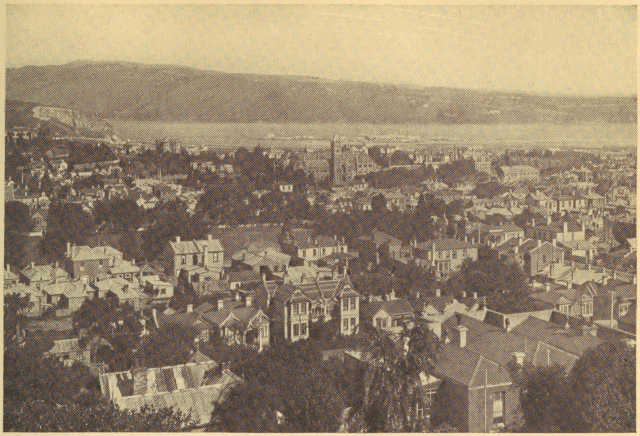
DUNEDIN, NEW ZEALAND
From the belt of wild wood that girdles the city
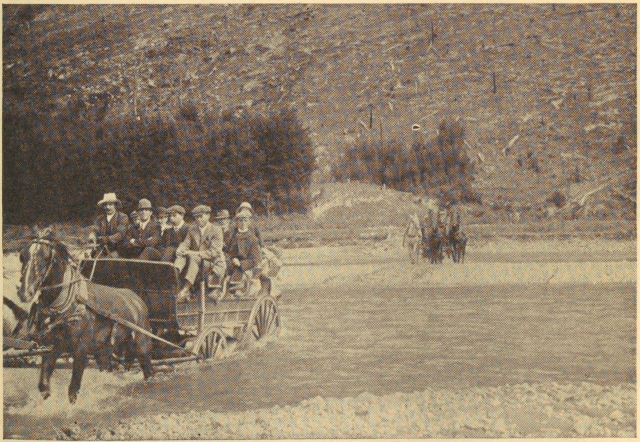
BRIDGES ARE STILL LUXURIES IN MANY PLACES IN NEW ZEALAND
Hence, a month in Auckland was quite enough for me.
By that time the call of the mountains and lakes had
come to me, and in natural beauty New Zealand can rival
any other country of its size I have ever been to, except
Japan. In answering that call I accepted the swagger's
account of how life should be lived and took to the open
road. In the year that followed I filled my memory
with treasures that cannot be classified in any summary.
From Auckland in the North Island to Dunedin
in the South Island I journeyed on foot through three
long months, zigzagging my way virtually from coast to
coast, dreaming away night after night along the great
Waikato River, holding taut my soul in the face of the
mysteries of the hot-springs districts, and quenching
feverish experiences upon the shores of placid cold lakes
and beneath snow-covered peaks of mountain ranges
thirteen thousand feet high; gripping my reason during
long night tramps in the uninhabited bush (forests)
or in Desolation Gully, forty miles from nowhere. I
know what wild life in New Zealand is, as well as tame.
It is not all that it used to be when men left their home
lands for that new start in life which Heaven knows
every man is entitled to, considering what our notions
of childhood are and the eagerness of man to pounce
upon any one who has not reached insurmountable success.
In between I saw the courageous struggles these selfsame
men have gone through and are still enduring in
order to make of the whole of New Zealand what it is
as yet only in parts. Those parts are rich farm lands,
with swiftly scouting motor-cars used by great capitalist-farmers
who have more than one station to look after.
It is a strange phenomenon of New Zealand life that
the small farm towns are generally much more alert and
progressive than the big cities. The New Zealanders
build houses that look like transplanted suburbs from
around New York, and bring to their villages some of
the love of plant life that the city-dweller is soon too
sophisticated to share. They draw out to themselves
the moving-picture theaters, which are now the all-possessing
rage in the Dominion as elsewhere, and read the
latest periodicals with the interest of the townsman.
There are over a thousand newspapers in the Dominion,
which for a population of a million is a goodly number,
though one cannot regard this as too great an indication
of the intellectual advancement of the people. Yet literacy
is the possession of the farmer as much as and
frequently more than the city-dweller in New Zealand.
His children go to school even if they have to use the
trains to get there; free railway passes on these are
accorded by the Government. And on the whole the
farmer's life in New Zealand is richer than that of most
rural communities. But the struggle is still great. I
have seen some who do not feel that the promise is
worth it.
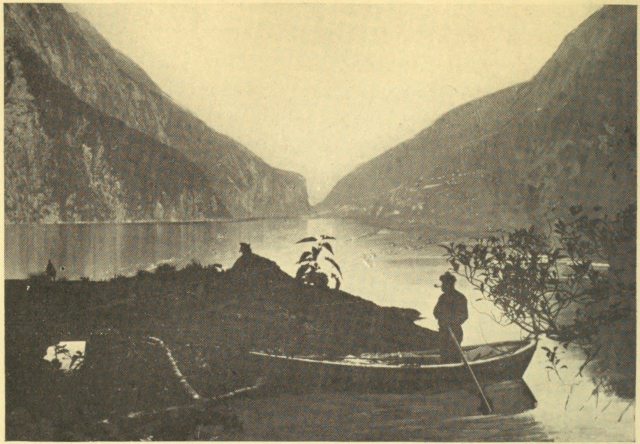
Post Card. J. B. Series No. 205
THE FIORDS AND SOUNDS OF NEW ZEALAND
The pride of the Dominion
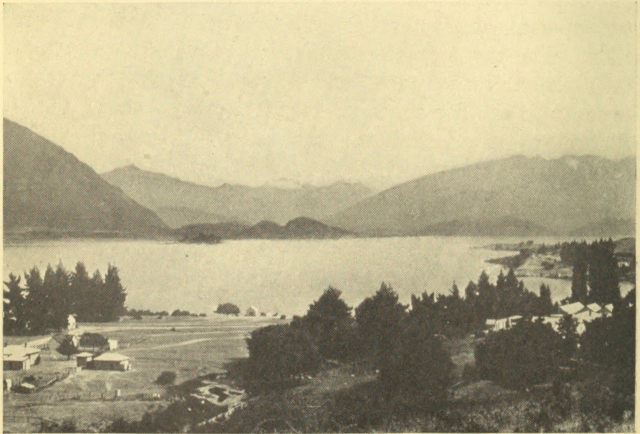
LAKE WANAKA, NEW ZEALAND
Though each of the big cities in the Dominion has its
own special characteristics, they are all considerably
alike. The three chief ones are all port cities of about
80,000 inhabitants each, and except for the fact that
Dunedin in the far south is essentially Scotch and somewhat
more stolid than the rest, and Wellington in the
center is the capital of the Dominion and therefore suspicious,
one may go up and down their steep hills without
any change in one's social gears. The colonial
atmosphere is at once charming and chilling. There is
a certain sobriety throughout which makes up for lack
of the luxuries of modern life. But one cannot escape
the conviction that regularity is not all that man needs.
Everything moves along at the pace of a river at low
level,—broad, spacious, serene, but without hidden places
to explore or sparkling peaks of human achievement to
emulate. One paddles down the stream of New Zealand
life without the prospect of thrills. One might be
transported from Auckland in the north to Wellington
or Dunedin in the south during sleep, and after waking
set about one's tasks without realizing that a change had
been made.
Every city is well lighted; good trams (trolley-cars)
convey one in all directions, but at an excessively high
fare; the water and sewerage systems are never complained
of; the theaters are good and the shops full of
things from England and America. There are even many
fine motor-cars. But there are few signs of great wealth,
though comparatively big fortunes are not unknown. It
is rumored that ostentation is never indulged in, as the
attitude of the people as a whole is averse to it.
On the other hand, neither are there any signs of
extreme poverty, though it exists; and slums to harbor
it. While the usual evils of social life obtain, the small
community life makes it impossible for them to become
rampant. Every one knows every one else and that
which is taboo, if indulged in, must be carried out with
such extreme secrecy as to make it impossible for any
blemish to appear upon the face of things.
In these circumstances, one is immediately classified
and accepted or rejected, according as one is or is not
acceptable. Having recognized certain outstanding features
of the gentleman in you, the New Zealander is
Briton enough to accept you without further ado. There
is in a sense a certain naïveté in his measurement of the
stranger. He is frank in questioning your position and
your integrity, but shrinks from carrying his suspicions
too far. He will ask you bluntly: "Are you what you
say you are?" "Of course I am," you say. "Then come
along, mate." But he does not take you very far, not
because he is niggardly, but because he is thrifty.
As a result of this New Zealand spirit I found myself
befriended from one end of New Zealand to the other
by a single family, the elder brother having given me
letters of introduction to every one of his kin,—in Hamilton,
Palmerston North, Wellington, Christchurch, and
Dunedin. And with but two or three exceptions I have always
found New Zealanders generous and open-hearted.
Wherever I went, once I broke through a certain shyness
and reserve, I found myself part of the group, though
generally I did not remain long, because I felt that new
sensations could not be expected.
My one great difficulty was in keeping from falling in
love with the New Zealand girls. Rosy-cheeked, sturdy,
silently game and rebellious, they know what it is to be
flirtatious. For them there is seldom any other way
out of their loneliness. Only here and there do parents
think it necessary to give their daughters any social life
outside the home. In these days of the movies, New
Zealand girls are breaking away from knitting and home
ties. But even then few girls care to preside at representations
of others' love-affairs without the opportunity
of going home and practising, themselves. Hence the
streets are filled with flirtatious maidens strolling four
abreast, hoping for a chance to break into the couples
and quartets of young men who choose their own manly
society in preference to that of expensive girls. I have
seen these groups pass one another, up and down the
streets, frequent the tea-houses and soda fountains, carry
on their flirtations from separate tables, pay for their
own refreshments or their own theater tickets; but real
commingling of the sexes in public life is not pronounced.
At the beaches! That is different. There the dunes
and bracken are alive with couples all hours of the day
or night during the holiday and summer seasons.
Thence emerge engagements and hasty marriages, nor
can parental watchfulness guard against it.
The most difficult thing in all my New Zealand experiences
was to reconcile the latent conservatism of the
people with their outstanding progressiveness. It would
be easy to assert without much fear of contradiction that
notwithstanding all the talk of radicalism in the matter
of labor legislation there is little of it in practice in the
Dominion. The reason for this is twofold. First, New
Zealand, unlike Australia and America, was not a rebellious
offshoot of England, not a protest against Old-World
curtailment. Quite the contrary, it was made
in the image of the mother country, and natural selection
for the time being was dormant. Furthermore, it was
simple for labor to dominate in a country where labor
was to be had only at that premium.
Nowhere in the whole Dominion did I come across concrete
evidence of awakened consciousness on the part
of the masses to their opportunities. None of that feverish
haste to raise monuments of achievement to accompany
the legislative enactments which have given New
Zealand an illustrious place among the nations. True,
the country is young; true, there are not enough people
there to pile creation on creation. But that is not it. It
is that they are not keyed up to any great notions of what
they ought to expect of themselves, but are content with
what freedom and leisure of life they possess.
Throughout the length and breadth of the two islands,
islands more than two thirds the size of Japan, there
isn't an outstanding structure of any great architectural
value; there isn't a statue or a monument of artistic importance;
there is hardly a painting of exceptional quality;
nor, with all the remarkable beauty of nature which is
New Zealand's, is there any poetic outpouring of love
of nature that one would expect from a people heirs to
some of the finest poetry in the world. Even British
India has its Kipling and its Tagore. With all the excellence
of their efforts to solve the problem of the welfare
of the masses, New Zealanders show no excessive
largeness of heart in the sort of welcome they extend to
labor of other lands. Here, it would seem, is a land
where the world may well be reborn, where there is
every opportunity for the correction of age-long wrongs
that have become too much a part of Europe for Europeans
to resent them too heartily. Yet what is New
Zealand doing and what has it done in seventy-five years
to approximate Utopia?
This is not meant as a criticism of New Zealand; rather
is it meant to let New Zealand know that the eyes of the
world are upon it and expect much from it. Possession
may be nine points of the law; but the utilization of opportunity
which possession entails is the tenth point
toward the retention of that which one has.
Babies are cared for better in New Zealand than any
other place in the world, yet boys and girls still receive
that antiquated form of correction, corporal punishment,
and thought of letting the youth find his own salvation,
with guidance only, not coercion, is still alien to the New
Zealand pedagogic mind. Women have had the vote for
over twenty-five years, but the freedom of woman to seek
her own development, to become a factor in the social
life of the community apart from the man's, is still a
neglected dream. And young women are dying of ennui
because they aren't given enough to do. The country
is fairly rich, with its enormous droves of sheep, great
pastures full of cattle, its coöperative capitalistic farming-schemes;
but the human genius for beauty and self-expression
must find opportunity in Britain or America.
And even the old romance of pioneer life is virtually of
the past. In all my wanderings I came across only one
home that made me throw out my emotional chest to
contain the spirit of the pioneer life of which we all love
to hear. It was a house as rough as it was old, laden
with shelving and hung with guns, horns, and lithographs,
and cheered by a blazing open fire,—an early
virility New Zealand has now completely outgrown.
The house must have been fifty years old, to judge from
the Scotsman living there. He was keen, alert, and
quick, a most interesting opponent in discussion, most
firm in his beliefs without being offensive. Here, in
the very heart of one of the earliest of New Zealand's
settlement districts in the South Island, he lived with
his family; and something of the old sweetness of life,
the atmosphere of successful conquest, obtained. And
ever as I dug down into New Zealand's past, I found it
charming. The present is too steeped in cheap machine
processes to be either durable or really satisfying.
Discouraging as this may sound, he who has lived in
the little Dominion and has learned to love its people and
their ways, hastens to contradict his own charges. For
in time, as one becomes better acquainted, one finds a
healthy discontent brewing beneath that apathetic exterior.
Just as the Chinese will do anything to "save
face" so the Briton will do anything not to "lose face."
He loses much of his latent charm in so restricting himself,
but when assured that a new convention is afoot
and that it is safe for him to venture forth with it, he
will do so with a zest that is itself worth much.
Furthermore, there is in the atmosphere of staid New
Zealand life a passion for the out-of-doors which is worth
more than all the Greenwich Village sentiment twice
over. Girls are always just as happy in the open and
more interesting than when indulging in cigarettes and
exposing shapely legs in intellectual parlors. Given
twenty million people instead of one New Zealand would
blossom forth into one of the loveliest flowers of the
Pacific.
In the Auckland (New Zealand) Art Gallery hangs
a picture representing the coming of the Maories to
New Zealand. Their long canoe is filled with emaciated
people vividly suggesting the suffering and privation
they must have undergone in coming across the mainland
some four hundred years ago. Venturing without
sail or compass, these daring Polynesians must have
possessed intrepid and courageous natures.
Yet at the time I was in that gallery the place was full
of stifled boyish laughter. A half-dozen little tots, with
spectacles and school-bags, one with blazing red hair,
had come to see the pictures. They were not Maori
children, but the offspring of the white race, which less
than a hundred years ago came in their sailing-vessels
and steamers, with powder and lead, and took with comparative
ease a land won by such daring travail.
I had heard much of these natives,—idyllic tales of
their charm and the lure of their maidens. Those lovely
Maori girls! I expected to see them crowding the
streets of Auckland. But they were conspicuous by
their absence. Occasionally a few could be seen squatting
on the sidewalks, more strangers to the city than I,
more outstanding from the display of color and manner
which thronged Queens Street than any American could
be in so ultra a British community as dominates New
Zealand. Where are the Maories? I wondered. Upon
their "reservations" like our own Amerinds, or lost to
their own costumes and even to their own blood and color?
I had returned to Auckland from a visit with a friend
whose wife was Maori, in the company of her nephew.
He carried with him a basket of eels as a gift to his
mother, and walked up the street with me. At a corner
he was hailed by a dark-skinned man in a well-cut business
suit, and said, "There is my father. I must leave
you." In another moment he was in a large touring car
and was whizzed away by his Maori father at the wheel.
No wonder I hadn't been able to see any Maories.
I visited a school where Maori boys are being encouraged
to artificial exercises,—sports, hurdle-jumping,
running. I watched them make ready, eager for the
petty prizes offered. Off went their shoes, out went their
chests, expanded with ancestral joy. In their bare feet,
still as tough as in former days before they were induced
to buy cowhides, they skipped over the ground,
filled for the moment with the glory of being alive. Their
faces broke out in fantastic, native grimaces and contortions
as though an imaginary enemy confronted them.
But alas, they were seeking him in the wrong direction!
The enemy comes with no spears, and no clang, but he
is more deadly. He is not without but within. He makes
them cough. They fall behind.
"They do not last long," said the Briton who was instructing
them. "They are dying rapidly of consumption.
As long as we keep them here in school they are
all right. Finer specimens of human physique could not
be found anywhere. But as soon as they return to their
pas, and live in the squalor of the native villages, they
return to all the old methods of life and soon go under."
I set out on my tramp through New Zealand. At
Bombey, a few days' jaunt from Auckland, I met an
old settler, whose accounts of the great and last war of
the redcoats with the fierce fighters of Maoriland dated
back to our own Civil War, 1861-64. Until that time
both Maories and Britons said, with few exceptions,
"Our races cannot mix. One or the other of us must
give away." Naturally, the Maories had the prior
claim, but they finally yielded, surrendering their lands
to the aliens at Ngaruawahia, "The Meeting of the
Waters," that little hamlet lying in the crotch between
the beautiful Waikato River and one of its tributaries.
And henceforward, the two races were constrained to
meet, and rush down together into that green sea of
human commonalty, albeit one of them contributes the
dominant volume.
Maori legend has it that the Maories are the descendants
of the great Rangatira (chief) who was the offspring
of a similarly great Tanewa (shark). He was
born in the dark southern caves of the Tongariro Mountains,
and the spirits of their ancestors have always
dwelt along the broad Waikato. Along this river I wandered
for many days, but I found few of the Rangatira's
descendants. If one is quiet and alone the voice of the
great Tanewa will call softly through the marsh rushes
from out of the heart of the quivering flax. It is peaceful
and encompassing, modest and almost afraid. I
heard it and I am sure those Maories hear it who are
not too engrossed in the scramble after foreign trinkets.
It said: "The last mortal or man descendant of mine will
be the offspring of a Pakeha-Maori (a white man who
lives among the Maories) who will live in the cities and
rush about in motor-cars, but I shall remain in the
marshes, the calm rivers, and near the glittering leaves
of flax."
A few miles farther on I came to Huntley, and hearing
that there was a native village across the Waikato River,
I turned thither by way of the bridge. I overtook two
wahines, slovenly, indolent, careless in their manners.
They spoke to me flippantly. They wanted to know if I
was bound for the missionaries' place. This led to questions
from me: Why were they turning Mormon? Which
sect did they prefer? But I could obtain answers only
by innuendo. I left these two women behind and found
three others chasing a pig in an open field, three boys
bathing a horse in the deep river. All about the village
was strewn refuse; vicious dogs slunk hungrily about,—neglect,
neglect, on every hand. But instead of flimsy
native huts there were wooden shacks with corrugated
iron roofs, the longer to remain unregenerate, breeders
of disease and wasters of human energy.
But the more elaborate native village at Rotorua, at
the other end of the island, where visitors are frequent,
was more up-to-date and cleaner. And on a little knoll
was a model of an old Maori pah, such as was used in
the days before guns made it possible to fight in ambush
and in the valleys, and brought the sturdy savages down
not only from their more wholesome heights but from
their position of vantage as a race.
Here I met an odd sort of article in the way of human
ware. Only seventeen, he was twice my size, and lazy
and pliable in proportion. He would come into my
room and just stay. With a steady, piercing, yet stolid
and almost epileptic stare, cunning, yet not shrewd, not
steady, nor guided by any evident train of thought, he
would watch me write. I was a mystery to him, and he
frankly doubted the truth of things I told him.
First he said I had the build of a prize-fighter; then,
perhaps on thinking it over, he doubted that I had ever
done any hard work in my life. As to himself, he said
he loved to break in wild horses. His father, according
to one tale, was wealthy; two of his brothers were engineers
on boats. But he hated study. He was altogether
lacking in any notion of time, but he was not lazy. He
was even ready to do work that was not his to do.
One afternoon he was in a most jovial mood. He was
about to have a tent raised in which he would spend the
summer, instead of the hotel room allotted to the help.
He was full of glee at the prospect. Primitive instincts
seemed to waken in him. But there was a sudden reaction,—whimsical.
We had stepped upon the lawn which
afforded an open view across Lake Rotorua.
"Strange, isn't it," he said without any preamble,
"how money goes from one man to another, from here
to Auckland and to Sydney? So much money." He became
reminiscent: "Maories didn't know a thing about
money. They were rich. See, across this lake,—that
little island,—the whole was once a battle-field. The
Maories went out in their canoes and fought with their
battle-axes. What for? Oh, to gain lands. But now
they are poor. Things are so dead here now. Nothing
doing." A moment later he was called and disappeared.
It was the only time he was ever communicative. The
tent had roused in him racial regrets.
One evening he came up to my door and told me there
was a dance at the hall, and that he was going to it.
Again that strange revival of racial memories, but these
of hope and prospect, came into his face, "I'm going to
take my 'tart' (girl) with me," he announced. And later
in the evening, as I sat alone, watching the moon rise over
the lake, the laughter of those Maories rang out across
the hills.
Though I wandered for many miles, running into the
hundreds, the number of Maori villages and people I
came across were few and far between. Yet records
show that once these regions were alive with more than
a hundred thousand fighting natives. At Rotorua, the
hot-springs district in the North Island, the pah was in
exceptionally good condition, but it was so largely because
the New Zealand Government has made of the
place one of its most attractive tourist resorts and the
natives are permitted to exact a tax from every visitor
who wishes to see the geysers. Elsewhere the villages
are dull, dreary, and neglected: the farther away from
civilization, the worse they get. The consequence is not
surprising.
According to the census of 1896, there were 39,854 people
of the Maori race: 21,673 males, 18,181 females, of
which 3,503 were half-castes who lived as Maories, and
229 Maori women married to Europeans. The Maori
population fell from 41,993 in 1891 to 39,854 in 1896, a
decrease in five years of 2,139. But in 1901 it had risen
to 43,143, going steadily up to 49,844 in 1911, and dropping
to 49,776 in 1916 on account of the European war.
There was considerable discussion in the New Zealand
Parliament on the question of whether the Maories should
be included in the Draft Act, most white men declaring
that a race which was dying, despite this seeming increase,
should not be taxed for its sturdiest young men
in a war that was in truth none of its concern. But the
Maories—that is, their representatives—objected, saying
they did not wish to be discriminated against.
Among the young men, however, I found not a few who
were inclined to reason otherwise. So it was that while
I was talking to the young fellows who were washing
their horse in the Waikato, one of them said to me:
"Yes. Years ago the white men came to us with
guns and cannon and powder and compelled us to give
up our warfare, which kept us in good condition individually
and as a race. We put aside our weapons.
Now they come to us and tell us we must go to Europe
and fight for them." And he became silent and thoughtful.
As I came back into Huntly from my visit to the pah I
passed the little court-house, before which was a crowd
of Maories. Some of the wahines sat with shawls over
their heads smoking their pipes as though they were in
trousers, not skirts. I chatted with the British Bobby
who stood at the door, asking him what was bestirring
Maoriland so much.
"Oh, that bally old king of theirs has been subpoenaed
to answer for his brother. The blighter has been keeping
him out of sight so that he won't be taken in the
draft."
"But," I protested—democrat though I was, my heart
went out to the old "monarch"—"can't the king get his
brother, the archduke and possible successor to the
throne, out of performing a task that might hazard the
foundation of the imperial line?"
"King be damned! Wait till we get the blighter in
here," said the servant of the law, pressing his heels
into the soft, oozy tar pavement as he turned scornfully
from me.
A few days later I was cutting my way through a luxuriant
mountain forest above Te Horoto in the North
Island, listening to the melodious tui, the bell-bird, and
to the song of the parson-bird in his black frock of
feathers with a small tuft of white under his beak, like
the reversed collar of a cleric. No sound of bird in any
of the many countries I have been to has ever filled me
with greater rapture than did this. There are thousands
of skylarks in New Zealand, brought from England,
but had Shelley heard the tui he might have written
an ode more beautiful even than that to the "blithe
spirit" he has immortalized. Yet, like the human natives,
these feathery folk have vastly decreased since the
coming of the white man. No wonder Pehi Hetan Turoa,
great chief of a far country on the other side of the
island, in complaining of the decay of his race, said:
"Formerly, when we went into a forest, and stood under
a tree, we could not hear ourselves speak for the noise
of the birds—every tree was full of them.... Now,
many of the birds have died out."
Enraptured with the loveliness of the native bush and
the clear, sweet air, I pressed up the mountain side with
great strides. Presently I passed a simple Maori habitation.
It was about noon. Seeing smoke rise out of an
opening in the roof, indicating that the owners were at
home, I entered the yard. My eyes, full of the bright,
clear sunlight, could not discern any living thing as I
poked my head in at the door, but I could hear a voice
bidding me enter. I stepped into a sort of antechamber,
a large section of the hut with a floor of beaten earth and
a single pillar slightly off the center supporting the roof.
Gradually, as my eyes became accustomed to the subdued
light, I saw an aged couple within a small alcove on the
farther side. An open fire crackled in the center of its
floor. The old woman sitting on her bed-space, was
bending over the flame, fanning it to life. The old man,
who was very tall, lay on a mat-bed to the right, his
legs stretched in my direction. The two beds, the fire,
and the old couple took up the entire space of the alcove,—a
sort of kitchenette-bedroom affair like our modern
"studio" apartments.
"Where are you from?" asked the old man, after I
had seated myself before the fire. "America," I said.
My reply evoked no great surprise in him.
"The village is quiet," I said. "Where are the people?"
"Oh, down in the valley, working in the fields."
"Don't you go out, too?" I asked.
"Oh, I'm too old now. My legs ache with rheumatism.
I go no more. Let the young fellows work. Stay
and have tea with us," he urged.
I looked at their stock. They did not seem to have
any too much themselves, and the old woman seemed a
little worried. I knew that the heart of the hostess was
the same the world over, so I assured them I had had
my meal, and only wished to rest a while away from the
sun. The old woman showed relief.
We chatted as cordially as it is possible where tongues
cannot fully make themselves understood. I learned
that the man was an old chief. He could not fall in with
the times, acknowledged his inability to direct the affairs
of this strange world, and only asked for rest and
quiet, and the respect due one of his position. He did
not expect to live long, nor did he much care. "These
are not days for me," he said with a smile. He did not
speak of the former glories of his race. Doubtless he
could not exactly make up his mind whether to look before
or after: if there were great chiefs before, are there
not big M.P.'s now?
The fire was burning low, and I knew that the old
woman would have to go for more wood unless she hurried
with the preparation of her meal, and that as long as
I was there I was delaying her. So I rose to go. The
old man excused himself for not rising by pointing to
his lame legs. She saw me to the gate, and as I struck
down the road she waved her hand after me in farewell,
and remained behind the screen of trees round which I
veered.
Down in the valley lying almost precipitately below
me were a number of natives working in their fields; but
my road led me on to the cities, and it is there that the
future of this race hangs in the balance.
Some months later, while I was living in Dunedin in
the far south of the South Island, the newspapers came
out in a way almost American, so exciting was the bit of
news. The editorial world forgot all decorum and dignity
and pulled out the largest type it had on hand. It
was announced that the Maori priest, Rua, was caught.
Several persons were wounded and one, I believe, was
killed in the process. The priest was treated with no
respect and little consideration and thrown into prison,—all
because he believed in having several wives as his
men-folk always had, if they were chiefs and priests,
and was trying to put a little life into his race, trying
to stir it up to casting out these "foreign devils." He
had built himself a temple that was an interesting work
of art, but it holds worshipers no more, even though the
priest has since been released. His efforts to rouse his
people failed. Such efforts are only the reflex action
of a dying race.
Dark is the way of the Eternal as mirrored in this world of Time:
God's way is in the sea, and His path in the great deep.—Carlyle.
More than a year went by before I began drawing
in the radial thread that held me suspended from
the North Star under the Southern Cross,—a year
replete with lone wanderings and searching reflections.
During all those months not a single day had passed
without my surveying in my mind's eye the reaches of
the Pacific that lay between me and the Orient. Roundabout
New Zealand I had become familiar with the Tasman
Sea looking toward Australia, on the shores of which
I had spent some of the most mysterious nights of my
life; on Hawkes Bay looking out toward South America;
and across the surging waters of Otago Harbor at Dunedin,
looking in the direction of the frozen reaches of
Antarctica.
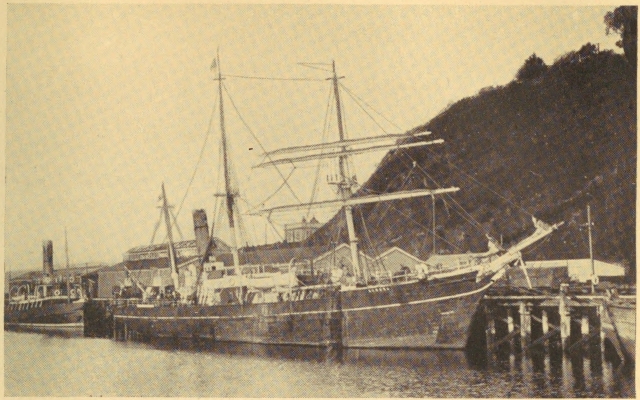
THE S. S. AURORA
Just arrived at Port Chalmers, N. Z., from the South Pole
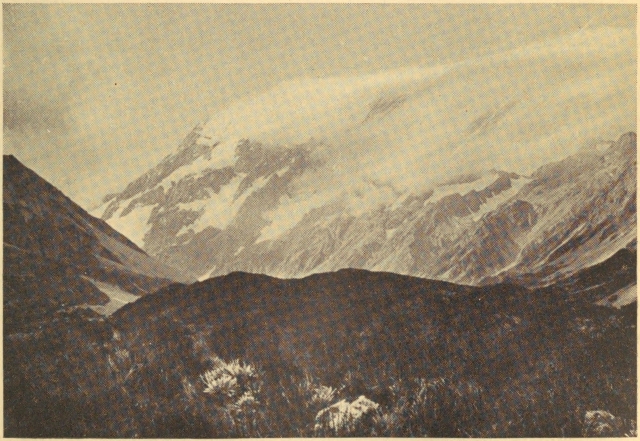
MOUNT COOK OF THE NEW ZEALAND ALPS IN SUMMER
Once staid Dunedin was thrilled by a wireless S.O.S.
from the direction of the South Pole. The Aurora,
Shackleton's ship which had gone down to the polar
regions, was calling for help. She had snapped the
cables which tied her to land when the ice-packs gave way
and had drifted out to sea. Fortunately, most of the
officers and crew were at the moment on board, but sixteen
men were left marooned. To add to the prospect of
tragedy, the ice smashed the rudder, and a jury-rudder,
worked by hand from the stern deck, had to be improvised.
With these handicaps the vessel made her way
slowly till within five hundred miles of New Zealand, the
reach of her wireless. Here she was rescued by a Dunedin
tug and brought to Port Chalmers.
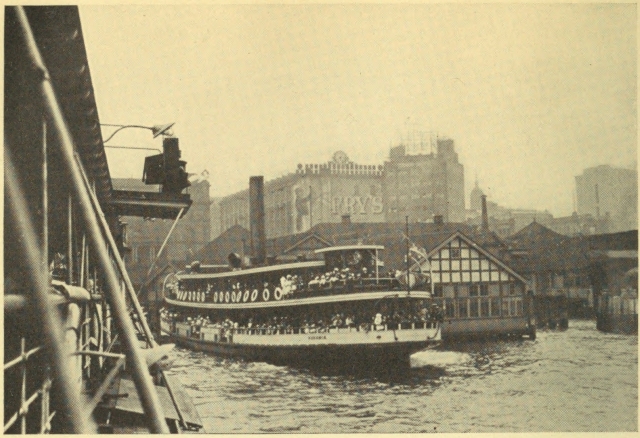
CIRCULAR QUAY, SYDNEY, AUSTRALIA
A whirl of pleasure-seeking and business
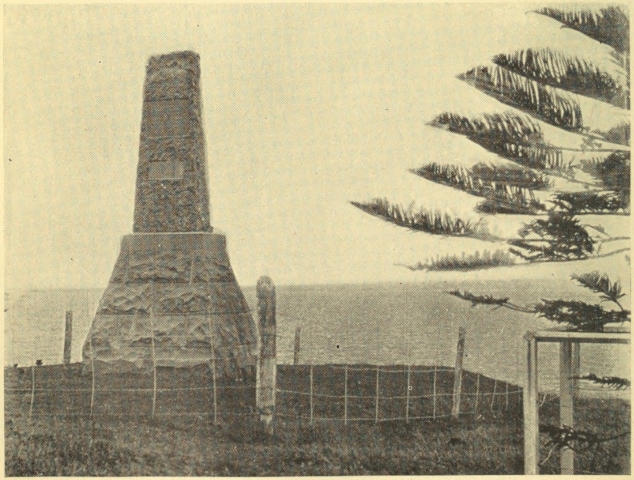
MONUMENT TO CAPTAIN COOK
At Botany Bay, Australia
I made friends with the mate and the chief engineer
and gained access to their superb collection of Emperor
Penguin skins and an unusual number of photographs.
Months afterward they wanted four men to complete the
crew necessary for another journey south and I was
tempted to join them, but tallow and bladder and a
repressed pen were the negatives, while China and Japan
were the positives. So I sailed away with the rising sun
in the direction of the great West that is the Far East.
Crisp and clear in the bright morning air shone the towering
peaks of the New Zealand Alps as I sailed toward
Australia and to Botany Bay,—not, however, without
being nearly wrecked in the fog which had gathered in
Foveaux Strait, which separates Steward Island from
the South Island in New Zealand. Bluff, the last little
town in New Zealand, is said to have the most southerly
hotel in the world. I saw it.
Four days from Bluff to Melbourne on a sea that
seemed on the verge of congealing into ice. It was not
cold, yet autumn-like. And the passengers seemed the
fallen leaves. The stewards maintained the reputation
for impudence and unmannerliness of the Union Steamship
Company crews, but I had grown used to that, and
thanked my stars that this was the last coupon in the
ticket I had purchased in Honolulu more than a year before.
Of human incidents there was therefore none to
relate.
But chill and melancholy as that Southern sea was,
there hovered over it a creature whose call upon one's
interest was more than compensating. Swooping with
giant wings in careless ease, the albatross followed us
day in and day out. Always on the wing, awake or
asleep, in sunshine or in storm, the air his home as the
water is to fish, and earth to mammal. Even the ship
was no lure for him by way of support. He followed it,
accepted whatever was thrown from it, but as for dependence
upon it,—no such weakness, you may be sure. His
sixteen feet of wing-spread moved like a ship upon the
waves, like a combination of a ship and sails. Swift,
huge, glorious, unconsciously majestic, he is indeed a
bird of good omen. How he floats with never a sign of
effort! How he glides atop the waves, skims them, yet
is never reached by their flame-like leapings; simulates
their motion without the exhaustion into which they sink
incessantly.
The albatross had left us, and now the swarming
is his artistry, so refined his "table manners." He does
not gorge himself as does the sea-gull, nor is he ever
heard to screech that selfish, hungry, insatiable screech.
Silent, sadly voiceless, rhythmic and symbolic without
being restrained by pride of art, he exemplifies right
living. He is our link between shores, the one dream of
reality on an ocean of opiate loveliness wherein there is
little of earth's confusion and pain. For the traveler
he keeps the balance between the deadly stability of land
life and the dream-like mystery of the sea. But for him
it were impossible to come so easily out of an experience
of a long voyage. Away down there he is the only
reminder of reality. Which explains the reverence
sailors have for him and their superstitious dread of
killing him. It is like the dread of the physician that
his knife may too sharply stir the numbed senses of his
patient under anæsthesia.
Land may be said to begin where the albatross is seen
to depart. He knows, and off he swoops, ship or no ship
to follow and to guide; back over the thousand miles of
watery waste, to measure the infinite with his sixteen-foot
wings, glide by glide, with the speed of a twin-screw turbine.
Only when the female enters the breeding season
does she seek out a lost island to rear her young. Independent
of the sea, these birds are utterly confined to it,
a mystery floating within mystery.
The albatross have left us, and now the swarming
gulls abound. Why they are dignified with the Christian
name "Sea" when they are such homely land-lubbers,
is a question that I cannot answer. Pilots, rather, they
come to see us into the harbor, or, with their harsh
screeching, to frighten us away.
But something within me would not know Australia,
nor any lands, just then. Perhaps it was that my unconscious
self was still with the albatross; for strange as
it may seem I could not sense any forward direction at
all that day, but only one that pointed backward,—toward
home. Try as I would to realize myself on my way to
Australia, still my mind persisted in pointing toward
America. Not until we got the first sight of land ahead
was my soul set right. Then it was the Sister Islands,
Wilson's Promontory, the Bass Straits, with Tasmania
barely in sight, Cape Liptrap, and finally Port Phillip.
And Australia was on all fours, veiled in blue,—a thin
rind of earth steeped in summer splendor.
Flag signals were exchanged with the lonely pilot-ship
that hung about the entrance. All being well, we passed
on, crossing that point at the entrance where five strong
water-currents meet and vanquish one another, turning
into a smooth, glassy coat of treachery. The Wimmera
hugged the right shore of the largest harbor I have ever
seen. In places the other shore could not be seen with
the naked eye. But it is very shallow and innumerable
lights float in double file to guard all ships from being
stranded.
Just as we entered, the sun set. A stream of color
unconstrained obliterated all detail as it poured over
the point of the harbor, filling the spacious port. Clots
of amber and orange gathered and were dissipated, softened,
diffused, till slowly all died down and were gone.
Darkness and the blinking lights of the buoys remained.
Two big ships, brilliantly lighted, flinging their manes
of smoke to the winds, passed, one on its way to Sydney,
the other to Tasmania and Adelaide in the south. Far
in the distance ahead we could see the string of shore
lights at Port Williamson. It took us three hours to
overtake them, and we arrived too late to receive pratique.
For half an hour the captain and the customs
carried on a conversation with blinking lights. The
winches suddenly began their rasping sound, and the
anchor dropped to the bottom. We did not debark that
night.
I spent nearly six months in Melbourne and Sydney,
those two eastern eyes of that wild old continent, and
for the first time in a twelvemonth the sense of security
from the sea obtained. For a fortnight I occupied a
little shack on Manly Beach, near Sydney, but oh, how
different it was there from the sand-dunes on the shores
at Dunedin, in New Zealand! In the Dominion one had
to hide within the interior to get away from the sea:
on the beach one felt about to slip into Neptune's maw.
But at Manly, Bondi, Botany Bay, the sea might hammer
away for another eternity without putting a landlubber
off his ease.
But we shall return to Australia in another section.
The sea is still much in the blood, there is still a vast
length that lies close to Asia and marks off another line
of our imaginary triangle. Here are no landless reaches,
but all the way to Japan one passes strip after strip, as
though some giant earthquake had shattered part of the
main.
Months afterward I took passage once more, this time
on the Eastern, bound for Japan.
There was no mistaking the side of the world I was
on and the direction of my journey from the moment I
stepped upon the pier to which the Eastern was made
fast. Hundreds of Chinese, with thousands of boxes and
bundles, scurried to and fro in an ant-like attention to
little details. Then as the steamer was about to depart,
mobilization for the counting of noses took place, and
veritable regiments of emaciated yellow men lined the
decks. Here and there a fat, successful-looking Chinese
moved round the crowd, an altogether different-looking
species, more as one who lives on them than as one who
lives with them. On the dock stood several groups waiting
to wave farewell to their Oriental kin. One of these
groups was composed of a stout white woman with two
very pretty Eurasian daughters,—as handsome a pair of
girls as I saw in Australia. Their father was a well-to-do
Chinese merchant taking one of his regular trips to China.
In Australian fashion they were ready for a mild flirtation,
spoke Australian English with Australian slang,
and, aside from their pater, they were native to all intents
and purposes. And in Australia they remained.
Of those who departed, the major number likewise
remained native—though to China—despite years and
years of residence in Australia. It is a one-sided argument
to maintain that because of that the Chinese are
unassimilable. There is no ground for such a deduction,
because they arrived mainly after maturity, and the
Chinese could challenge any white man to become one of
them after he has fully acquired his habits and prejudices.
But we had not been many minutes at sea before
it was our misfortune to find that we had among us a
Chinese boy who was born and brought up in New Zealand
and was just then going to China for the first time.
Here I had ample opportunity of observing the assimilability
of the Oriental. And here I bow before the
inevitable.
He had assimilated every obnoxious characteristic of
our civilization, the passion for slang, the impertinence,
the false pride, the bluff which is the basis of Western
crowd psychology. He was not a Chinese,—that he
denied most vehemently,—he was a New Zealander, and
by virtue of his birth he assumed the right to impose
his boyish larrikinism upon all the ship's unfortunate
passengers. He banged the piano morning, noon, and
night; he affected long, straight black hair, which was
constantly getting in his way and being brushed carefully
back over his head; and he took great pains to make
himself as generally obnoxious as possible. He was not
that serious, struggling Chinese student who comes to
America afire with hope for the regeneration of his race.
He was a New Zealander, knew no other affiliations, had
no aspirations, and lorded it over "those Chinese" who
occupied every bit of available space on the steamer.
In his way he was also a Don Juan, for he hovered over
the young half-Australian wife of a middle-aged Chinese
merchant who was taking her back to China for her confinement.
She was morose, sullen, as unhappy a spirit
as I have seen in an Oriental body. Obviously, China
held few fine prospects for her. She was seldom seen in
her husband's company, for he was generally below playing
fan-tan or gambling in some other fashion. And the
Australian half of her was longing for home. It seemed
to devolve upon our young Don Juan to court this unhappy
creature, and court her he did. But she had no
resilience, no flash, her Chinese half-self offering him as
little reward for his pains as a cow would offer the sun
for a brilliant setting.
I expected any hour of the day to see that woman throw
herself into the sea, or that husband stick a knife into
the bold, bad boy, but nothing happened; the husband
and the wife were seemingly oblivious of the love-making,
and all went well.
Besides the Chinese crew and passengers there were
perhaps a dozen white people, including the officers. An
old English army captain whose passport confirmed his
declaration that he was seventy-three years old, was taking
a little run up to Japan. His only reason was that
Japan was an ally, hence he wanted to see it. Such is
the nature of British provincialism. Otherwise, there
were but two or three young Australians bound for
Townsville, and the stewardess. Somewhere along the
coast we picked up a Russian peasant, who with his wife
had been induced to emigrate to Australia, but who was
now going home to enlist. As though there weren't already
enough men in Russia armed with sticks and stones!
At still another port we commandeered a veritable regiment
of Australian children, colloquially called larrikins.
These were bound for the Philippines, where their father
had preceded them some months before. Their exploits
deserve an exclusive paragraph.
Suddenly, out of a clear sky, there would be a shriek
like the howl of a dingo on the Australian plains. There
would be a rush to the defenses by an excited female,—the
mother. There would follow such a slapping as
would delight the English Corporal Correction League,
except that it wasn't done cold-bloodedly enough. And
thereafter for half an hour there was bedlam all around.
After exhaustion, a new series of pranks set in. This
time they were playing a "back-blocks" game which
entailed a hanging. One of them needs must be hanged,
and was rescued just in time by an ever-swooping mother.
After hours of hunger-stimulating escapades on deck,
the dinner-bell sent them scurrying down into the saloon.
Before any of us had time to be seated all the fruit on
the table was divided according to the best principles of
individual enterprise. Beginning with the first thing on
the menu, they went down the sheet, leaving nothing
untasted; nor did it matter much whether it was breakfast
or dinner,—steak enough for a meal in itself comprised
the entrée. And the littlest kept pace with the
biggest. Nor did afternoon and morning tea escape
them. Fully stoked up, they were ready for another
beating and another hanging on deck.
In contrast were the little Chinese children,—quiet,
shy, never spanked; and though they put away enough
within their Oriental bread-baskets, one never saw that
same wild struggle for existence which told the tale of
life on an Australian station better than anything I
wot of.
We had now reached Brisbane, 519 miles from Sydney,
a distance which took the Eastern from noon of the
8th to sunrise of the 10th of October to negotiate. And
from the outer channel to the docks on the Brisbane River
we steamed till half-past one in the afternoon. Here we
were "beached" in the mud when the tide went out and
had to wait twenty-four hours before floating out again.
In the meantime we picked up two more gems,—mature
larrikin this time. One of them was so drunk he couldn't
see straight, the other was sober enough to bring him
on board. Unfortunately for me, they were placed in
my cabin, and from then on, after the youngsters had
turned the day into chaos, these two would come in to
sleep, and the cursing, the spitting, the reference to
women with which they consoled their souls, would have
shocked the most hardened beach-comber, I am sure.
To avoid annoyances I explored every nook and corner
of the vessel. At last I discovered a sanctuary on the
roof of the unused hospital. It could not be called a
model of order and comfort, for various air-tanks and
stores of sprouting potatoes belittered it. But it was
like the holy of holies to me, for there I might just as
well have been on a lone craft of my own. No sound
reached me from any living thing,—except an occasional
extra-loud shriek from the youngsters. Above and about
me there was nothing to obstruct my view, and within,
absolute peace.
On the following day we were on the Great Barrier
Reef, grayish green in color, languid in temperament,
shallow and therefore dangerous in make-up. Numerous
islands, neutral in color and sterile of vegetation, seemed
to stare at us and at one another in mute indifference.
For the first time the storied reality of being stranded on
a desolate island came home to me. As I sat watching
this filmy show, I became conscious of a familiar something
in the world about me, be it warmth or color, a
something which immediately brought the picture of
Santa Anna Valley in California back to mind. Sometimes
we come across a face we feel certain we have seen
before: that was the case with the atmosphere along the
Great Barrier Reef. The setting is that of the island
home of Paul and Virginia. Near and far, lowly and
majestic, in generous succession on each side, were
islands and continent,—an avenue wide, spacious, and
clear. Occasional peaks along the mainland recalled old-fashioned
etchings,—dense clouds, heaven-reaching
streaks and shafts of twice-blended astral blue; rain-driven
mountain fiords.
Early one day, an hour before dawn, the Eastern
moored before Magneta Isle with her stern toward
Townsville, as though ready for instant flight, if necessary.
With an early-morning shower of filthy words,
one of my cabin-mates pulled himself together and
dressed. Shortly afterward he slipped over the side
of the ship into a tossing and pitching launch and was
rushed to Townsville. His rousing me at that hour was
the only thing I had reason to be grateful to him for in
our short acquaintance.
For the world was exquisitely beautiful in its delicate
gown of night. Dawn was but waking. Four-o'clock
stupor superintended the easy activities. A few lights
in a corner, a bolder and more purposeful flash from a
search-light, and all set in twilight. A ring of islands—the
Palm Isles—stones set in a placid bay. That was
all I saw of Townsville.
And perhaps it is just as well. It may have been
"ordained" that my ignorance obtain, be the city's virtues
and its right to fame what they may. What if I had
gathered closer impressions, added meaningless statistics
or announced the prevalence of diphtheria throughout
Queensland, or discovered the leading citizen of
Townsville to an apathetic world? But it may be of
interest to hear that Townsville claims one distinction.
It is the Episcopal See of Australia and the seat of the
Anglican Bishop and possesses a cathedral.
On the afternoon of the following day a heavy wind
or squall came up. This time the ship did not defy it.
No foolhardy resistance here. The reefs are too near
and they stretch for thirty miles seaward. Again we
anchored. The horizon contracted like a noose of mist;
it stifled one. The ship seemed to crouch beneath the
winds. An hour, and the anchor was heard being lifted
and the propellers were slowly revived to action. A
little later we anchored again. A light was hoisted to
the stern mast and twilight lowered on a calm gray sea.
Distant little flat islands loomed through the mist. Two
sailing-vessels at anchor, moored in companionship,
rested within an inlet. A gentle swish, a murmur of
human voices, and our little world was swaying gently
upon a curious world. And there we remained all night.
As the sun gave notice of day, we moved off, and all
day the sea was so still that but for the vibration of the
screws it would have been hard to realize that the ship
was in motion. Here we came to where the jagged coastline
has run down. Tiny islets, flat and low, most of
them but a landing-place for a few tropical trees. Summer
calm, with barely a ripple of the sea. That night
we anchored again, having come, it was said, to the most
dangerous pass on the reefs.
Ten days after having left Sydney we arrived at the
last port in Australia, Thursday Island. A cloudy
morning had turned clear for us, but on ahead to the
northwest hung heavy mists. Because of these, I was
later told by two soldiers on guard atop the mountain
fortification, they could not see us coming. They saw
our smoke, but the steamer was hidden from them by
mist. Then suddenly we shot into view. All the while
we had been in the clearest sunshine, the sea glassy and
the flying-fish darting about. It was no place for speed.
We moved just fast enough to leave the scene undisturbed.
And thus we stole into Torres Straits.
Of all the numerous harbors I have entered in the
Pacific, none, with the exception of the Inland Sea in
Japan, is more picturesque than that at Thursday Island.
Shelter, space, and depth, and stillness! One's eyes
sweep round this pearly promise with greed for its
beauty. Seventy-five sail-boats, their sailless masts
swaying with the swells, are anchored on the reefs. It
is Sunday and they are at rest, but what enchantment lies
hid in those folded sails! I wish for the power to utter
some word which could put them to flight; but that
remains for Monday, when "the word" is spoken.
And on Monday, too, immediately upon leaving port
at ten o'clock, the ship's time was returned to standard
time, leaving Australia and its "bunkum" daylight-saving
time behind. Thence we lived again by "dinkum"
time. The ship about-faced and left the channel the
same way it had entered, and shortly afterward we struck
across the Arafua Sea.
From that day until I reached Japan it was all I could
do to keep track of the seas we passed through,—Arafua,
Banda, Molucca, Celebes, Sulu, China, and the Inland
Sea.
As we neared the equator again, there was nothing to
disturb the peaceful splendor of life, except the little
hoodlums on board. About sixty miles south of it a
tiny creature, like a turtle, sailed along the still surface;
the flying-fish blistered the water, the scars broadened
and healed again just as the sportive amphibians pierced
it and disappeared. What a contrast to the albatross!
Then the miracle occurred. From the west, hidden
from me by the ship, the sun reached to the eastern
clouds, dashing them with pink and bronze and blue.
I could not tell where the horizon went to, and was roused
to curiosity as to what kind of sunset could effect such
lovely tints. It wasn't a sunset, but a sunfall, a revelation.
Where suggestion through imitation glistened on
the eastern side, daring prodigality of color swept away
emotion on the western side. It was neither saddening
nor joyous. It was a vision of a consciousness in nature
as full of character, as definitely meaningful and emotional
as a human face. There was something almost
terrifying in the expression of that sunset face. One
could read into it what one felt in one's own soul. And
a little later a crescent moon peeped over the horizon.
At about midnight of the seventeenth day after leaving
Sydney we crawled over the equator, and no home-coming
ever meant more to me than seeing the dipper
again and the Northern stars. During all those days
nothing wildly exciting had happened at sea; but just
after we left the equator we passed a series of water-spouts—six
in all—which formed a semi-circle east, south,
and west. The spout to the east seemed to me to be at
least two or three hundred feet high, and tremendous
in circumference. It drew a solid column of water from
the sea far into a heavy black cloud. On the sea beneath
it rose a flutter of water fully fifty feet high, black as
the smoke produced by a magician's wand. Weird and
illusive, the giants beggared description as they stalked
away to the southeast, like animated sky-scrapers.
Then we reached Zamboanga, the little town on the
island of Mindanao of the Philippines. From there, for
twelve hours, we crept long the coast till we entered
Manila Harbor.
There remained but two days' voyage before I would
reach Asia, the object of my interest for years, and of
all my efforts for two. But it was not so easy as all
that, for two days upon the China Sea are worth a year
upon the Atlantic. Riding a cyclone would be riding a
hobby-horse or a camel compared with the Yellow Sea,
and though I was the only passenger who missed only
one meal during the whole period, I was beaten by the
seventy-three-year-old English captain,—who managed
all but half a meal. The sea would roll skyward as
though it were striving to stand on end and for a moment
the ship would lurch downward as though on a loop-the-loop.
Sometimes it seemed as though the world were
turning completely over. Yet I was told this was only
normal, and that typhoons visit it with stated regularity.
The China Sea is "the very metropolis of typhoons."
A month had well-nigh gone before we reached Hong-Kong,
the British portal to Cathay, a month of dreamy
weather. Only one thing more,—a thing more like a
scene in the Arabian Nights. Toward the end of the
journey I discovered where the five hundred Chinese
whose noses had been counted when we left Sydney had
gone. Going forward, I looked over into an open hatchway,
down into the hold, and there was a sight I shall
never forget. These hundreds of deck passengers were
all in a muddle amid cargo, parcels, hundreds of birds in
cages, parrots, a kangaroo,—yet oblivious of everything.
For the entire voyage nothing that I tell of could possibly
have come within their ken, as during those days
their minds were bent on one thing and one alone,—on
playing fan-tan. There in the bottom of the hold hundreds
of gold sovereigns passed from hand to hand in a
game of chance. And at last they were to be released,
to spread, a handful of sand thrown back upon the beach.
As for myself, with my arrival at Hong-Kong and a
visit to Shanghai ended the longest continuous voyage I
had made upon the Pacific, and the second side of that
great Pacific Triangle was drawn. But meanwhile let me
review in detail the outposts of the white man in the far
Pacific—the lands I had passed on the white man's side
of the triangle, ending in Hong-Kong, where white man
and Oriental meet.
In the normal course of human variation, there should
have been virtually no change of experience for me in
going from New Zealand to Australia, notwithstanding
the twelve hundred miles of sea that separate them.
And though the sea is hardly responsible, there was a
difference between these two offshoots of the "same"
race for which distance offers little explanation. To me
it seemed that regardless of the pride of race which
encourages people to vaunt their homogeneity, the way
these two counterparts of Britain have developed proves
that homogeneity exists in wish more than in fact. It
seems to me that the New Zealander has developed as
though he were more closely related to the insular Anglo-Saxon,
and the Australian as though he were the continental
strain in the Englishman cropping out in a new
and vast continent. However, this is sheer conjecture.
All I can do is to offer in the form of my own observations
reasons for the faith that is in me.
From the moment that I set foot in Australia I felt
once again on a continent. Melbourne is low, flat, and
gave me the impression of roominess which New Zealand
cities never gave. They, with the exception of Christchurch
on the Canterbury plains, always clambered up
bare brown hills and hardly kept from slipping down
into the sea. But in Australia I felt certain that if I set
out in any direction except east I could walk until my
hair grew gray without ever coming across a mountain.
It was a great satisfaction to me that first day, for it
was intensely hot and I had a heavy coat on my arm
and two cameras and no helmet. Added to my difficulties
was the cordiality of an Australian fellow-passenger
who was determined that I should share with him his
delight at home-coming. He was a short, stout, olive-skinned
young man of about twenty-three who had a
slightly German swing in his gait and accentuated his
every statement with a diagonal cut outward of his right
hand, palm down.
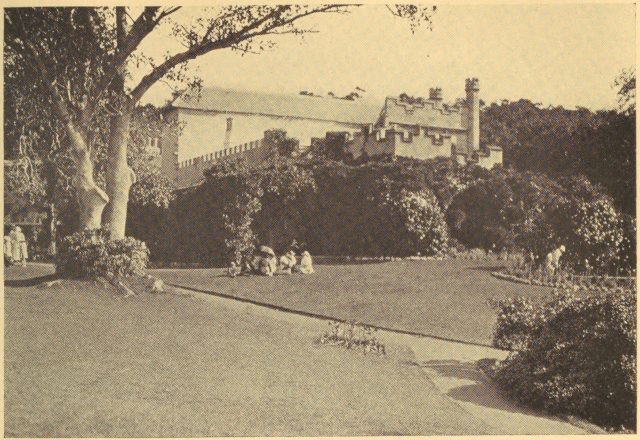
ONE OF THE OLDEST AUSTRALIAN RESIDENCES IS NOW A PUBLIC DOMAIN
THE INTERIOR OF A WEALTHY SHEEP STATION OWNER'S HOME IN
MELBOURNE
He lured me from one end of Melbourne to the other,
made me lunch with him at a vegetarian restaurant,—which
is a very popular resort in Melbourne,—introduced
me to Cole's Book Arcade, to the Blue-bird Tea
Rooms, where fine orchestral music flavors one's refreshments,
to the latest bank building and even to the station
of the railway, which "carries the largest suburban passenger
traffic of any in the world." "Meet me under
the clock," is the Melbournian motto. How they can all
do so is beyond me, for the half-dozen stone steps that
lead to the narrow doors at the corner of the station
could not, I am sure, afford a rendezvous for more than
thirty people at one time; yet the old clock ticks away
in patience,—the most popular and most persistent thing
in Melbourne.
I had so much trouble keeping pace with this Australian,
who seemed to grow more energetic the hotter it
became, that I was grateful when he said he would have
to leave me, and I was alone again. Then I realized
for the first time that I could really like Melbourne; that
it had long, broad, spacious streets with clean, fresh-looking
office and department-store buildings, that even
the narrower side streets were clean and inviting, and
that the street cars were propelled by cables and not by
trolley wires. So easy were these cars and so low that
no one ever waited for them to stop, but hopped aboard
anywhere along the street. Melbourne was to me a
perfect bath in cleanliness and orderliness,—just what
a city ought to be. Even in the very heart of the city
the homes had a suburban gentility about them, and
there were no unnecessary noises, no smoke, and no end
of pretty girls. The people were a joy to look at.
Something of the tropical looseness in both dress and
flesh, as though their skins were always being fully ventilated,
made them attractive. The New Zealanders
made me feel as though I were in a bushel of apples;
the Australians, carefully packed yellow plums. I have
never enjoyed just being on the street more than I did
in Melbourne.
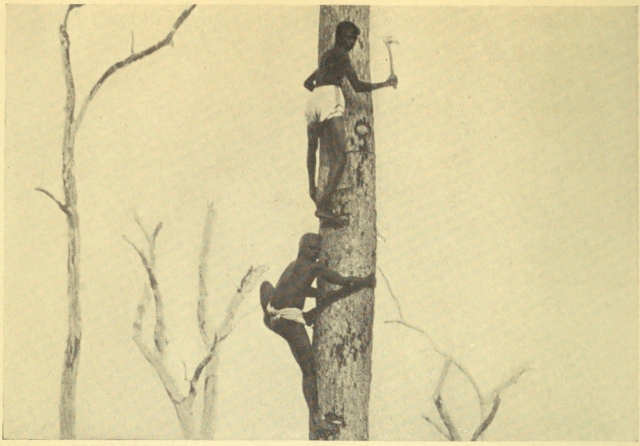
A. A. White, Brisbane
AUSTRALIAN BLACKS IN THEIR NATIVE ELEMENT
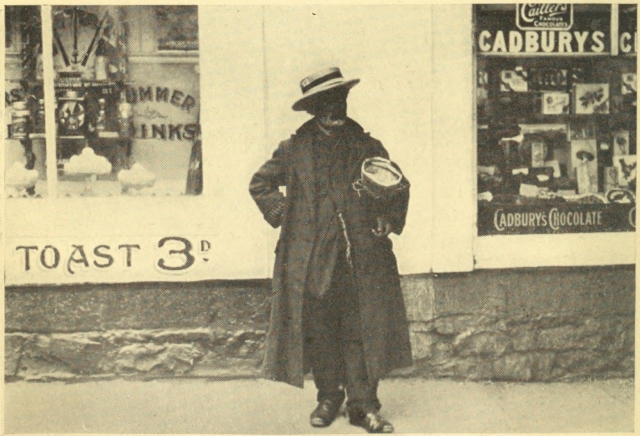
AN AUSTRALIAN BLACK IN MELBOURNE
Out of his element but happy none the less
On Bourke Street, in the very midst of the pushing
crowd, a soft-voiced lad approached me for some information
and strutted off, tall in his self-confidence. Victorian
belles, tall, graceful, russet-skinned, plump but
not flabby, moved with a fine air of self-reliance. On
closer acquaintance, I found that these girls were not
silent and opinionless as were most of the New Zealand
girls. Whatever the issue before the public, they had
their defined opinions concerning it, and they were not
sneered at by the men. Then, too, there was a companionship
between the boys and girls, without reserve,
that was balm to my soul after the year in New Zealand.
Melbourne was the home of Madame Melba, and in
consequence the city is the most musical of any I lived in
in the Antipodes. Even the babies sing operatically on
the streets, and the voices one hears from open windows
are not the head-voices of prayer-meetings, but those of
people who seem to know the value of the human larynx.
During the two weeks that I was in Melbourne, I was,
whenever I chose, a guest of the Master of the Mint,
Mr. Bagg, who was the uncle of a New Zealand girl of
my acquaintance; lunched, dined and afternoon tea-ed
with his family whenever I felt like it; was rushed to the
theater to see an old pioneer play; and went to attend
public meetings at which the mayor and the prime minister
spoke; visited the beaches, and knew the joy of the
most refreshing companionship it was my good-fortune
to meet with in all my wanderings,—though there were
others. And it was so with whomever I met in Melbourne,
from the clerk in the haberdashery, who acquainted me
with the jealousy that exists between Sydney and Melbourne,
to the woman in whose home I roomed on Fitzroy
Park, or the young couple with the toddling baby and the
glorious sheep-dog, who engaged me in conversation on
the lawn near the beach at St. Kilda.
And so I still see Melbourne in memory as a place I
should enjoy living in. I was often alone, but never
lonely in it. And I see it from its Botanic Gardens, with
the broad Yarra Yarra River slowly cleaving it in two,
its soft, semi-tropical mists hanging over it, its temperate
climate, its cleanliness and its low, rolling hills where
it hides its suburbs.
I didn't go to see Adelaide, in South Australia, because
I was destined to live in Sydney, in New South Wales.
It is more than mere accident that Victoria has
broader-gaged railways than New South Wales, and that
travelers from one state to the other must get off at
Albury and change, or between New South Wales and
Queensland to the north of it. It is not mere accident,
I am sure, for there is a like difference in the width of
streets between Melbourne and Sydney.
Sydney is hilly, exposed, bricky, and crowded, and
though it is the premier city of Australia, it grows without
changing. There is a conservatism about it which,
in view of the activity of Australians, is inexplicable.
Sydney is almost an old city. Its streets wind as though
the settlers had been uncertain of the prevailing winds;
and the hills tend to give it an appearance of huddling.
The red roofs of the cottage-like houses, and their architectural
style give it a European tone, slightly like an
English city. It has none of the fresh, "hand-me-down"
regularity of the American, nor the sober coziness of the
English, village. Every street leads one to the center of
the city, and wind as it will there is hardly any relief
from commonplaceness. The thoroughfares are crowded
with street cars which cross and circumambulate, some
of the main streets are too narrow for more than single-track
lines. Yet instead of seeing the earlier error and
trying to correct it by prohibiting the erection of buildings
on the present curb lines, the authorities have permitted
one of the finest office buildings in the city—the
Commonwealth Bank Building, to be placed on the same
line as the rest of the old structures. It is hardly to be
expected that such methods will ever broaden the streets.
There are no tenements in Sydney, in the New York
sense of the term, but the average home as I saw it on my
usual rounds in search of quarters, was ordinary. The
rooms were small, and there were few conveniences.
But this is Sydney proper. Newer Sydney, with its
suburbs and homes along the numerous peninsulas projecting
into the waters of Port Jackson, is modern, clean,
and airy, and really convenient. Man is a lazy animal
and prone to dote on nature's beauties, neglecting his
responsibilities to nature. Sydney, proud of its harbor,
builds there and forgets its city-self. There are no fine
structures to speak of, no monuments, no art, and even
the library has to borrow a roof for itself in a building
essentially excellent but neglected as a municipal white
elephant. But there is a municipal organ in the Town
Hall, and that makes up for much that is wanting in
Sydney.
I took up my quarters across the water from Sydney,
and from there I could see the city through the glory-lens,
its harbor. Little peninsulas, crossed in but a few
minutes, project into the waters of the harbor, making
it look like an oak-leaf and affording sites for the splendid
homes that have been built there. Crowding is impossible;
views of the water may be had from all angles.
And here, in a borrowed nest, I sat for hours perched
above the water, noting and gloating over its moods and
character. What charm it works, when in the blood-red
streaks of sunset the tidal floods cool the peaceful turquoise;
when the busy little ferries of day become fairy
transports with streaks of shimmering light as escort,
moving across the still waters; when on Sunday morning
Sydney across the way relaxes, amazing with revelations.
With street and sky-line clear, quiet hangs in the air;
or on more windy days, myriad whitecaps royne at the
numerous ships which cross and recross one another's
paths. In one direction, industry is idealized; in others,
nature and beauty lie naked, above idealization.
For two weeks I lived out at Manly Beach, nine miles
by ferry from Sydney, and went in and out every day.
The Heads lie to the right, and as we made our way
across, the swells from the sea beyond rolled the little
ferry teasingly. At times, when the swells were heavier
and the crowds excessive, a sort of panic would spread
over them, but some of the inevitable minstrels that
swarm the streets and by-ways of Sydney, would counteract
contagion with music and song.
The beaches are always crowded. Annette Kellerman
is Australian, and somehow, whether as cause or effect,
Sydney people are the most amphibious folk in the world.
They seem to live in the water. Every spare hour is
spent on the wide stretches of sand that lie warm and
white in the blazing sun. But nothing takes precedence
over the harbor in the adoration of Sydneyites.
Sydney is known for its gaiety, yet I was lonely in
Sydney,—bitterly so. Perhaps people are too gay to
think of others, perhaps their gaiety made me exaggerate
my loneliness. "Nothing like the Australian larrikin
when he gets going," you will be told. But what struck
me was the latent distemper that lurked beneath much
of the hilarity that I saw in Sydney. Australia is not
very different from any of us,—a little more imitative,
a little more outspoken, a little more gruff, a little more
youthful. But wildness is not specially Australian; nor
is bluntness; nor yet youthfulness. The Australian is
perhaps a little more reckless, individually or en masse,
than the people of other lands, but he puts up with the
same social inconveniences; he reasons falsely at times
and gets fooled; he gloats over the spectacular, becomes
intensely excited over nothing,—and suddenly relapses.
In a crowd he sometimes becomes belligerent, yet is
easily led and easily relinquishes. But, above all else,
he is gregarious. And it is because of this that he takes
you in in Sydney,—and drops you out before you have
known what has happened to you. Hence he is an inveterate
sportsman, a heavy drinker, a perpetual gambler
at the races,—faithful to his whimsicalities.
Intellectually he is a fanatic, but tolerates all sorts of
fanaticisms. A Sunday morning on the beautiful
grounds of the Public Domain is enough to convince you
that Sydney would welcome the most freakish freak in
the world, imprison him for the fun of it, then sympathize
with him if he dies in prison, as did the famous naked
man, Chidley. I have seen Sydney men who seemed to
me men without hearts, as soft and gentle as women in
the face of another man's hurt. Yet when a well-known
army officer stole funds that belonged to wounded soldiers
and their needy families, I heard respectable Sydney
men say they were glad he got away with it. I have
seen girls at carnivals, who at ten o'clock went about
tickling strange men under the chin, snarl at them at
eleven and order them to "Trot along, now." I have
heard Australians say harsh things of themselves in
criticism, but true loyalty is widely prevalent among
Australians. An Australian always wants a mate,
"some one who would stick like lead" if he were up
against it. The self-criticism comes rather from the
more thoughtful Australians, who, looking out upon the
future, want to see their country hold on to the prize it
has won, and grow and become a leader in the affairs
of the Pacific.
But though Sydney and Melbourne are the leading
cities of the commonwealth, he who has to judge of the
nation by them wonders where that leadership is to come
from. The love of pleasure is a sign of health in any
people; and Australia is in that sense most healthful.
Material progress is the next best indication of the state
of a nation; and Australia is universally prosperous. But
it is in the outlook on life that a country justifies its existence
and insures itself against decay. Until the war,
all reports of Australia on that score were negative.
Provincialism, of the most ingrowing kind, obtained.
Every state thought chiefly of itself; every city of itself
only; every district of none other than itself. But with
the war Australia took a tremendous leap forward. For
the first time in her history, her men had a chance to
leave the land which intellectually was little more than
a sublimated prison to them. Half a million men left
Australia for Europe and other sections of the globe.
And if Australia knew what she was about she would now
send the rest of her men and women abroad with the same
end in view,—the education of the people for the place
they occupy in the world.
Much criticism is flung at Australia because her young
men and women are inclined to enjoy life rather than
burden themselves with a succeeding generation. If the
beginning and end of life is reproduction, then that is a
just criticism. But the welfare of the living is as important
as the welfare of civilization. The greatest
criticism is not that people will not bear children in the
face of trying economic conditions, but that, having exceptionally
favorable circumstances, they show no special
inclination to become parents, and that nothing is being
done to create conditions under which the bearing of
young would be no handicap. But that requires an intellectual
outlook which is at present wanting in the cities
of Melbourne and Sydney. There is an over-emphasis
of pleasure per se, a lack of seriousness in the concerns
of life.
Sydney lures men and women from the back-blocks
and makes them feel human again, makes them forget
the plains are sear, and that manliness is next to cleanliness.
It affords dull station-owners a chance to mix
with folk where sweetness and refinement, and not crudeness,
is the order of the day and of life. It takes men
and women who have been told that to increase and multiply
is the only contribution they can make to the welfare
of the community and shows them that there is
something in life besides that. So when I think of what
Sydney means to the world that lies behind it I cannot
refrain from offering my contribution of praise. But
then I ask myself and Sydney what it has done to make
the back-blocks better, what it is doing to build up the
country, and the fact becomes evident that it is only
draining it. Fully 51 per cent of the inhabitants of Australia
live in cities. It is for these cities to lay railroads
and highways and to open the vast continent; and that
can be done only by putting prejudices aside, by adding
to recreation real creation and a soberness in the affairs
of life which alone will win for Australia its place in
the affairs of the Pacific.
What, socially and individually, then, is the contribution
of Australia to the civilization of the Pacific? Is
her position to be one of eminent leadership commensurate
with the welfare of the individual members of the
Commonwealth, or is their joyousness going to make her
citizens forget ambition and their ruling destiny? This
much must not be forgotten,—that born as a convict
colony, Australia has more than justified itself; that the
term "convict colony" is now no more applicable to
Australia than it is to Virginia. That handicap notwithstanding,
Australia to-day is as far advanced as any
nation in the world. The people do not generally take
to higher mathematics, to philosophical thinking, or to
science, but illiteracy is rare in Australia. Given a continent
wherein nothing of civilization was to be found,
Australia has made of it, in a little more than a century,
a land productive, healthful, and promising. Much
praise is due Japan for what she has accomplished along
material lines in seventy years; how much more praise
is due Australia for what she has done in about the same
time!
As one journeys north along the Australian coast, life
begins to thin out. Fate must have been in a comic
mood when it apportioned me my experiences as I was
leaving that island continent, for in Brisbane it allotted
me an august funeral, and in Thursday Island it sent a
missionary out to "attack me." Thereby hang two
tales.
I had walked what seemed to me fully two miles from
the pier in the Brisbane River to the heart of town
and was rather overheated. My septuagenarian Englishman
trudged along by my side. When we arrived in
the central thoroughfare I took note of the fact that
things looked fresh and clean, that there was a tendency
toward pink paint, but that otherwise I might have saved
myself the journey. Alas, it was Saturday afternoon,
and a half-holiday! Leaving my venerable comrade behind,
I strode along at my own pace in search of adventure,
my camera across my shoulder. I had taken to a
hilly side street, and must have looked like a professional
tourist. Absorbed in seeking, I was startled by an appealing
voice behind me. Turning, I found the owner of
that voice gazing intently at my camera.
"That's a camera you have there, sir."
I admitted my guilt, wondering what crime lurked in
the possession of a camera.
"I've been trotting all over town trying to find a photographer,
sir, but their shops are all closed. Would you
mind coming along with me, sir, and taking a picture of
a funeral as the mourners come out of church. Lady
---- is so anxious to have a picture of them just leaving
church. The deceased, sir, her husband, was a very
much beloved gentleman, a prominent official, and devoted
to the church in which now lie his remains, and she
would be so pleased if you would come and taik a fouto
for her." In his excitement, he slipped into the use of
cockney, so prevalent in Australia. I threw out my chest
and thought to myself: "See here, old man, do you think
I've lived in New York and London and Paris, and
Sydney, and —— to be sold a gold brick in Brisbane?
But I'll show you I'm game." And I followed him up
the street. But sure enough, there at the top of the hill,
from an imposing church, emerged a funeral, posing
to be taken. It did not matter to this man that I told
him my ship was in port only for the day and that before
I could possibly make a print I should be either in China
or Japan. But just then Fate thought she was carrying
the joke too far and sent along a native son with a
camera, and I was released. I set out for the ship.
In the little gullies that lie along the way were shacks
or cottages, raised on piles, with inverted pans between
them and the floor beams. White ants were eating to
pulp these supports. We were in the tropics again.
Fate must have chuckled. She is fond of practical
jokes. The next time she tried one on me, I was in
Cairns. Having entered Australia on the ground floor,
Melbourne, I suppose Cairns might be said to be the
fifth-story window. I left the ship the moment she was
made fast, keyed up with expectation of seeing the tropics
again. Ashore, the spirit hovering about tropical villages
took me in hand. No better guide can be found
on earth. With a voice subdued, it urged me to pass
quickly through the town, which was still asleep except
for the saloons and their keepers. The spirit leading me
complained of that other spirit which leads and captures
most men in the tropics. My spirit, happy to have a
patron, offered me luxurious scenes, melodious sounds,
and mellow colors,—happy in receiving a grateful
stranger. While pressing through the little village, I
noticed the mission type of architecture of the post-office;
the concrete columns guarding the entrance of the newspaper
office; the arched balconies of a hotel; the delicate,
dainty cottages raised on wooden piles, the verdure hiding
defects, and the main building lost in a massive
growth of yellow flowers overgrowing roof and all. A
small opening for entrance and a pugnacious corner were
the only indications of its nature as a residence. Then
there were a "School of Arts" and a double-winged
girls' school. The whole town was pretty and in concord
with the scenes about.
But I was not held. I pressed on toward the hills,
to the open road. Allons! But alas! I betrayed myself
by doubting the "spirit of the tropics" which was guiding
me. I resorted to a tiny mortal for information,
and in that way angered the spirit, which instantly deserted
me. Not content with whisperings, I had sought
definition, asked for distance,—Where? Whence? How?
And I lost!
He was a little man, with worn shoes from the holes
of which peeped stockingless feet. In the early morning
he had slipped on shoes which would not deprive
him of the dew. He had covered his little legs with a
dark pair of dirty trousers, his body with a soiled white
coat, and his mind with misunderstood scripture. His
bulging eyes betrayed his inward confusion.
Upon inquiring, he informed me that the road led to
the hospital and would take me fifteen minutes to negotiate.
Then he wanted to know if I came off the Eastern.
"Any missionaries on board?" he asked. "I don't
know," I answered. "I suppose that is something you
don't trouble much about." I agreed. "Ah, that's just
it. Don't you know the Bible says, 'Be prepared to meet
thy Maker?' How do you know but what any moment
you may be called?" "Well, if I am, I have lived well
enough to have no fear." "Yes, that is just it. You
live in carnal sin. You have no doubt looked upon some
woman with lustful eyes this very morning. I sin, too,
every moment." Heaven knows I had not been tempted.
I hadn't seen any woman to look at, and nothing was
further from my mind just then. And so it was,—sin,
assumption and condemnation. I talked with him a few
minutes, asserted my fearlessness, the consciousness of
a reasonably good life. But nothing would do. The
poison of fear with which he contrived to wound me I
now had to fight off. I had come out all joy and happiness
in the new day, the loveliness of life. If worship
was not on my lips it was in my heart, and he had tarnished
it. He brought thoughts of sin and death to my
mind, which, at that moment, if at any time in my life,
was free from selfishness and from unworthy desires.
I cut across to the sea,—not even an open avenue
being fresh enough for me now. It was as though I had
suddenly inhaled two lungfuls of poison gas and
struggled for pure air. I turned back to the boat, not
caring to go too far lest she leave port. A tropical
shower poured its warm water over me as though the
spirit of the tropics felt sorry, and forgave me. I returned
to the ship, and quarter of an hour later we were
moving out into the open sea again.
The next and last time that I landed on Australian soil
was at Thursday Island, one of the smallest of the Prince
of Wales group, north of Cape York Peninsula, in the
Torres Strait. German New Guinea (now a British
mandatory) lies not far away. There is not much of a
village and most of the buildings are made of corrugated
iron. But there was not at that time that stuffy,
damp odor which pervades Suva; nor, in fact, was there
much of that mugginess that is Fiji. Yet it is only
eleven degrees from the equator, whereas Fiji is thirteen.
The street is only a country road, and dozens of
goats and kids pasture upon it. The few stores (closed
on Sunday) were not overstocked. There are two large
churches. One was built from the wreckage of a ship
that had some romantic story about it which I cannot recall.
There was also another institution, the purpose of
which I could not discern. It was musty, dirty, dilapidated,
with shaky chairs and shelves of worm-eaten books.
I suppose it was a library. Hotels there were galore, and
though bars were supposed to be closed on Sunday, a
small party of passengers succeeded in striking a
"spring."
I wandered off by myself. Slowly the great leveler,
night, crept into the heart of things, and they seemed
glad. Orientals and natives from New Guinea lounged
about their little corrugated iron houses, obedient to
law and impulse for rest. Japanese kept off nakedness
with loose kimonos. One of them lay stretched upon the
mats before the open door, reading. Others squatted on
the highway. Tiny Japanese women walked stiffly on
their wooden geta as they do in Japan. Tiny babies
wandered about alone like wobbling pups. Upon the
sea-abandoned beach groups of New Guinea natives
gathered to search for crabs or other sea-food. A cow
waded into the water to cool herself. And the sail-boats,
beached with the receding tides, lunged landward.
Peace and evening. Nay, more. There is not only
indolent forgetfulness here; there is more than mere
ease in the tropics: there is affluence in ease. A something
enters the bone and sinew of moving creatures
which awakens and yet satisfies all the dearest desires.
And nothing remains when night comes on but lamplight
and wandering white shadows.
Late that night I returned to the ship. Deep, familiar
sounds revived my memory of Fiji, on the other line
of my triangle. A chorus of New Guinea voices,—rich,
deep, harmonious, and rhythmic—rose from a little boat
beside us. In it were a half-dozen natives, squatting
round a lantern, reading and singing hymns in their own
tongue. Such mingled sadness with gladness,—one does
not know where one begins and the other ends. Shiny
black bodies crouching and chanting. Hymns never
seemed more sincere, more earnest.
They were waiting there for midnight to come, when
Sunday ends for them, and toil begins. The ship must
be loaded. Then voices will rattle with words and curses.
All night long they labored with good things for other
men. When I came out in the morning they breakfasted
on boiled yams and turtle, a mixture that looked like
dough. Instead of using their fingers, they employed
sharp pointed sticks, doubtless in imitation of Japanese
chop-sticks. Progress!
Shortly afterward we struck across the Arafua Sea,
and saw Australia no more.
Venturing round the Pacific is like reincarnation.
One lives as an Hawaiian for a spell, enters a
state of non-existence and turns up as a Fijian; then another
period of selflessness, and so on from one isle to
another. From such a period of transmigration I woke
one morning to the sight of Zamboanga, and knew myself
for a moment as a dual personality,—a Filipino and an
American in one. All day long we hugged the coast of
the islands of the group—Mindanao, Negros, Panay,
Mindoro, Luzon—the cool blue surface of the choppy
sea between us and reality. After so many days' journey
along the coast of Australia, through sea after sea,
it seemed unreasonable to require a turn of the sun in
which to outstrip a few Oriental islands. Then we swung
to the right. Ahead of us, we were told, lay Manila,
but even the short run to that city seemed interminable.
At last the unknown became the known. A red trolley-car
emerged from behind the Manila Hotel. Life became
real again.
Our ship had hardly more than buoyed when a fleet of
lighters surrounded her,—flat, blunt, ordinary skiffs;
long, narrow, peculiar ones. The former I thought represented
American efficiency; the latter, Filipino whimsicality.
The Filipino craft were decorated in black,
with flourishes and letters in red and white. Over their
holds low hoods of matting formed an arch upon which
swarmed the native owners. How business-like, yet
withal attractive. And business became the order of the
night.
From beneath the matted hoods of the lighters flickered
glimmers of faint firelight. Life there was alert,
though quiet. It hid in the shadows of night; confined
in the holds, dim candles and lanterns quivered: peace
reigned before performance. A quiet harbor; moon and
stars and mast-lights above; a cool, refreshing breeze.
That was my first night in Manila Harbor.
Morning. Not really having stretched my legs in
nearly three weeks, since sailing from Sydney, Australia,
I naturally felt in high spirits upon landing. The mists
which hung over Manila quickened my pace, for I knew
that before I could see much of that ancient town they
would be gone, dissipated by the intense heat of the
tropical sun. I was eager to put on my seven-leagued
boots to see all that I had selected years before as the
things I wanted to stride the seas to see. But I soon
discovered that I was only a clumsy iron-weighted deep-sea
diver. All round the Pacific I had traveled alone.
I wanted no mate but freedom. But the three weeks en
route from the Antipodes, on board a small liner whose
major passenger list was made up of monosyllabic
Oriental names drove me, willy-nilly, into the companionship
of the septuagenarian English captain.
On account of the keying down of my reactions to the
tempo of seventy-three plus British sedateness, I wrote
many things in my book of vistas that seem to me now
mere aberrations. Just to indicate what the effect was
I shall confess that as I approached the Walled City I
conceived of myself as almost a full-fledged Don Quixote
storming the citadel of ancient aggression. But my
elderly Sancho Panza held me back lest the shafts of
burning sunlight strike me down.
Standing before the gates of antiquity, even the most
haughty of human beings moves by instinct back along
the line of the ages, like a spider pulling himself up to
his nest on his web. Round the black stone wall which
encircles the old Spanish city, that which was once a moat
is now a pleasant grass-grown lawn. The wall itself, still
well preserved, has been overreached by two-story stone
houses with heavy balconies which seem to mock the pretenses
of their "protector." Outwardly, things look
old; within change has kept things new. Mixed with surprised
curiosity at two Antipodes so close together comes
a feeling of contact with eternity, the present of yesterday
linking itself with the antiquity which is to be.
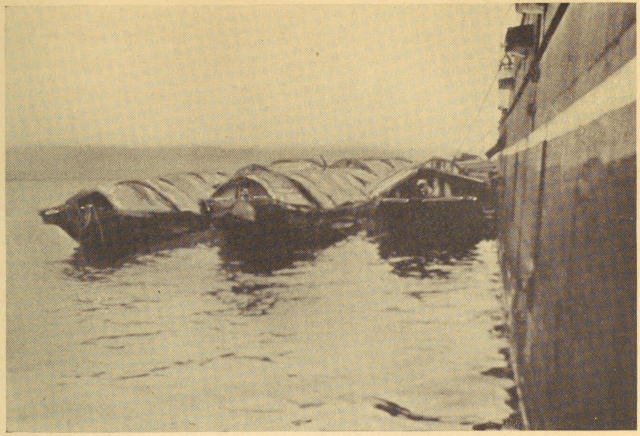
FILIPINO LIGHTERS DROWSING IN THE EVENING SHADOWS
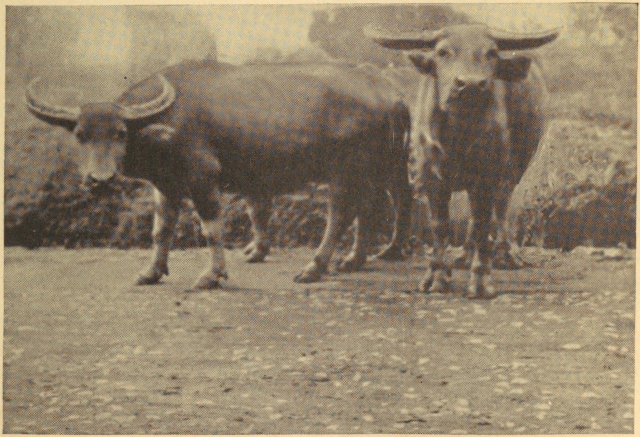
THE DOCILE WATER BUFFALO IS USED TO WALKING IN MUD
A long, narrow street stretched across the city. Spanish
buildings tinted pink and delicately ornamented,
lined the sides. White stone buildings, chipped and
seamed with use and age, lined the way. Broad entrances
permitted glimpses of sumptuous patios, refreshed by
tropical plants; low stone steps leading up to dark vault-like
chambers; windows barred but without glass,—spacious
retreats built by caballeros who thought they
knew the value of life. Indeed, they knew how to build
against invasion of the sun and the Oriental pirate, but
not against the invasion of time. Perhaps they live
better as Spaniards to-day than they lived as conquerors
yesterday.
Here, within the walled city, everything looks as though
change were not the order of eternity. Everything is
as it was, yet nothing is so. Trolley-cars clank, motor-cars
of the latest models throb quietly, pony-traps and
bullock-carts stir the ancient quiet. One wonders how
so much new life can find room to move about in such
narrow streets with their still narrower sidewalks that
permit men to pass in single file only, and angular corners
and low buildings. But there they are, and there
they bid fair to remain. Even the unused cathedrals,
whose doors are here and there nailed shut, stand their
ground. Some of them even close the street with their
imposing fronts, the courage of fervent human passion
in their crumbling façades.
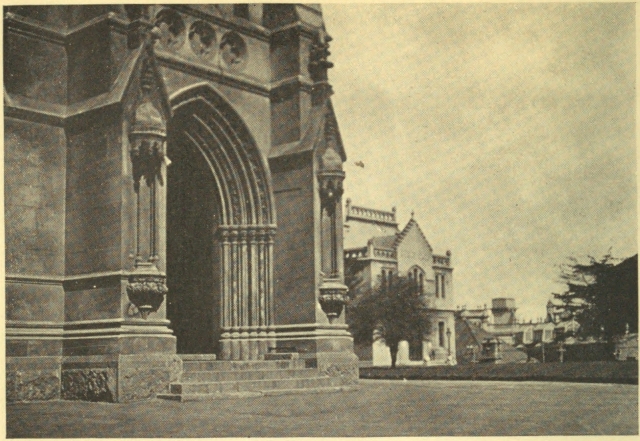
ONE CAN THROW A BRICK AND HIT SEVEN CATHEDRALS IN MANILA
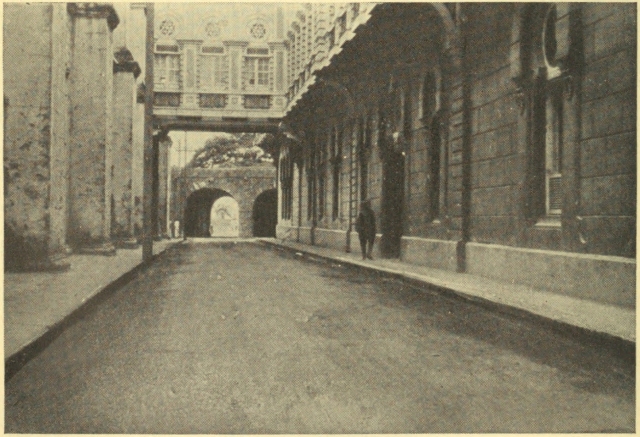
COOL AND SILENT ARE THE MOSSY STREETS OF THE WALLED CITY OF
MANILA
At that early hour there was little sign of human life.
Into some of the cathedrals native women crept for
prayer. Here and there a confined human being passed
across the glassless windows; here and there a tourist
flitted by in search of sights. And I soon realized that
within the walls, intramuros, there was nothing. Across
the park, across the Pasig River, there one finds life.
Yet within that ancient crust there is new life. Some
old buildings have been turned into government offices,
high schools, a public library fully equipped, an agricultural
institute, everything standing as in days of old,
but new flowers and plants growing in those crude pots,—old
surroundings with a new spirit. Something mechanical
in that spirit,—typewriters clicking everywhere
under native fingers; still, typewriters don't click without
thoughts.
Here, then, is the conflict in growth between the ends
of time, heredity struggling with environment, the fountains
of youth washing the bones of old ambitions. They
may not become young bones, but may we not hope they
will at least be clean? May not time and patience remold
antiquity, absorb its bad blood and rejuvenate it?
Typewriters clicking everywhere; tongues born to Filipino,
then turned to Spanish, now twisting themselves
with English. The trough has been brought to the horse.
Will he drink? The library was full of intelligent-looking
young Filipinos, the cut of their clothes as obviously
American as the typewriters clicking behind
doors. Both typewriters and garments indicated efficiency,
but I could no more say what was the impulse
in the being within those clothes than what thoughts were
being fixed in permanence to the sound of an American
typewriter.
The most symbolical thing of all was the aquarium
built beneath one wing of the great wall round this little
village. If in the hard shell of American possession arrangement
can still be made for the freedom, natural and
unconfining, of the native Filipinos, we shall not lay
ourselves open to censure. The natives may not be satisfied,
they may prefer the open sea; but that is up to
them to achieve. As long as we keep the water fresh
and the food supplies free, they can complain only of
their own crustaceous natures and nothing else.
All Manila does not live within the walls, however,—not
even a goodly portion of it,—and the exits are numerous.
Passing through the eastern gate, one comes
into a park which lies between the walled city and the
Pasig River. Beyond the river and on its very banks
is Manila proper. As I got my first glimpse of the
crowded, dirty waterway, I could not say much in reply
to my companion, whose patriotic fervor found expression
in criticism of American colonization. It was like
looking into a neglected back yard. The Englishman
did not seem to see, however, that to have done better in
so short a time would have been to inflict hardships on
the natives which no amount of progress ever justifies.
Still, with memories of Honolulu as a basis for judgment
I was not a little disappointed. How to change
people without destroying their souls,—that is the problem
for future social workers for world betterment to
solve.
Meanwhile I had succeeded in eluding my burden of
seventy-three years and opened my eyes to the life round
about me. There was still a bridge to cross. It was
narrow, wooden and crowded. It was only a temporary
structure, built to replace the magnificent Bridge of
Spain which was washed away in the great flood of September,
1914. During the few minutes it took me to
saunter across it, the traffic was twice blocked. Perhaps
to show me how full the traffic was, for in that
moment there lined up as many vehicles and people and
of sufficient variety to illustrate the stepping-stones in
transportation progress. There were traps, motor-cars,
carts drawn by carabao, or water-buffalo, bicycles, and
trolley-cars. Everybody seems to ride in some fashion.
Yet everybody seems to walk, and in single file at
that. Gauze-winged Filipino women,—tawdry, small
and ill-shod, or, rather, dragging slippers along the pavement—insist
on keeping to the middle of the narrow
walks. Frequently they are balancing great burdens on
their heads, with or without which they are not over-graceful
or comely. Their stiff, transparent gauze
sleeves stand away from them like airy wings. One
hasn't the heart to brush against them lest these angelic
extensions be demolished, and so one keeps behind them
all the way.
The men also shuffle along. They wear embroidered
gauze coats which veil their shirts and belts and trousers.
There is something in this lace-curtain-like costume that
seems the acme of laziness. Neither stark nakedness
nor the durability of heavy fabrics seem so prohibitive
of labor as does this thin garment. No inquiry into the
problem of the Philippines would seem to me complete
without full consideration of the origin of this costume.
But one is swept along over the bridge, and is dropped
down into Manila proper by way of a set of steps,
through a short alley. The main street opens to the
right and to the left. It is brought to a sudden turn one
block to the left and then runs on into the farther reaches
of the city; to the right it winds its way along till it encompasses
the market-place and confusion. This chiseling
out of streets in such abrupt fashion is puzzling to
the person with notions of how tropical people behave.
Why such timidity in the pursuance of direction and desire?
The obstruction of the bridge promenade by the
main street and of the main street by a side street have
a tendency to shoot the seer of sights about in a fashion
comparable to one of those games in which a ball is shot
through criss-cross sections so that the players never
know in what little groove it will fall or whether the number
will be a lucky one or not.
I first fell into a bank, and the amount of money one
can lose in exchanging Australian silver notes into American
dollars is sufficient to dishearten one. The shops
were too damp and insignificant to attract me much,
however, so I ventured on into the outer by-ways of
the city. There the dungeon-like stores and homes and
Chinese combinations had at least the virtue of ordinary
Oriental manner in contrast to our own. The Chinese
cupboard-like stores, that seem to hang on the outside
of the buildings like Italian fruit-stands, held few attractions.
There was an obvious utilitarianism about
them which, strange as it may seem, is the last thing
the man with no fortune to spend enjoys. Shops and
museums afford the unpossessing compensation for his
penury.
As I made my way ahead to a small open square, my
attention was arrested by a performance the full significance
of which did not at first appear to me. At the
gateway of a large cigar-factory from which came strolling
male and female workers, sat two individuals—two
women at the women's gate, two men at the men's—and
each worker was examined before leaving. As a
woman came along, the inspector passed her hands down
the side of the skirts, up the thighs, over the bosom,—then
slapped her genially and off she went. Through it
all, the girls assumed a most dignified manner, absolutely
without self-consciousness and oblivious of the gaze of
the passers-by. What is more certain to break down
a man's or a woman's self-respect than becoming indifferent
to the opinion of the public as to the method of being
searched? A Freudian complex formed to the point
of one's believing oneself capable of theft, the next thing
is to live out that unconscious thought of theft and to
care nothing for the censure of the world.
When at work, these girls possessed a sort of sixth
sense. The cigarettes are handed over to them at their
benches to be wrapped in bundles of thirty. They never
stop to count them—just place the required number in
their left hands encircling them with thumb and fingers,
reject an odd one if it creeps in, and tie the bundle. I
counted a dozen packets, but did not find one either short
or over, and the overseers are so certain of this accuracy
that they never count them either.
But what a different world is found at the public school
not very far from the factory! The building was not
much of a building,—just an old-fashioned wooden structure
with a court. Its sole purpose seemed to be to furnish
four thousand children with training in the use of
a new tongue. "Speak English," stared every one in
the face from sign-boards nailed to pillars. I listened.
The command was honored more in the breach than in
the observance, yet where it was respected strange English
sounds tripped along tongues that were doubtless
more accustomed to Tagalog and Spanish. There was
nothing shy in the behavior of these boys and girls. They
moved about with a certain monastic self-assurance, less
gay than our children, more free than most Oriental
youngsters. In a few years they will be advocating Filipino
independence, in no mistaken terms,—if they have
not been caught by the factory process.
I went straight ahead and found myself on my way
back into the city,—but from a side opposite that from
which I had left it. The squalor and the dungeon-like
atmosphere were indeed nothing for American efficiency
to be proud of. Slums in the tropics fester rapidly.
One cannot say these places were slums; but they certainly
were not native villages. One felt that here in
Manila America's heart was not in her work. Why build
up something that would in the end revert to the natives,
to be laid open to possible aggression and conquest!
One felt further that the Filipinos did not exactly rejoice
in being Americans. What they actually are they have
long since forgotten. Once foster-children of Philip
of Spain. To-day the adopted sons of America. To-morrow?
How much more fortunate their Siamese
cousins or relatives by an ancient marriage! Yet all
who know Manila as it was ten years ago agree that
there have been vast improvements in a decade. One
does not include in this generalization the residences and
hotels of the foreigners, for obvious reasons; still, the
welfare of a community is raised by good example.
That afternoon I stretched in the shade of one of the
walls of the old walled citadel with its fine gateways.
I pondered the significance of those stones against which
I was resting. One gains strength from such structures
as one does from the sea,—not only in the actual contact,
but in the thought that that which human effort accomplished
human effort can do again. My septuagenarian
had returned to the ship for rest. I thought of his
criticisms of the American occupation of Manila, of his
suggestions that England would have made of it a fine
city. I wondered what drove the Spanish to build this
wall. To protect themselves against Chinese pirates?
There is not a country in the world that has not tried to
safeguard itself against invasion by the process of invasion.
Yet any attempt to do otherwise is decried as impractical.
All the while, decay weakens the arm of the
conqueror.
But more luring scenes distracted my thoughts. The
sinking sun stretched the lengthening shadows of the
wall as a fisherman, at sunset, spreads his serviceable
nets. Filipinos passed quietly to and fro; cars, motor-cars,
and electric cars cut a St. Andrew's cross before me.
The scent of mellow summer weighted the air. Slowly
everything drew closer in the net of night.
Two days later I was in Hong-Kong, where the Oriental
dominates the scene. I was at the third angle of the
triangle, and hereafter the subject is Asia.
To one who had received his most vivid impressions
of China from her noblest philosopher, Lao-tsze,
it was somewhat disconcerting to peep through the porthole
just after dawn and find oneself the center of a confusion
indescribable. The sleepy, heaving sea was more
in tune with the mystic "Way" of the great sage. I
had not anticipated being thrust so suddenly among the
masses and the babel on which Lao-tsze, that gray-beard
child, had tried to pour some intellectual oil.
Yet, I had been living on the top floor of a Chinese
"den" for twenty-six days between Sydney and Hong-Kong.
On board I was ready to blame the steamship
company for the crowding and the uncleanliness. Had
there been a dozen murders, I should not have regarded
it as unnatural. Had I been compelled to spend three
weeks in such circumstances, I should either have committed
hara-kiri or killed off at least four hundred and
fifty-five to make the decent amount of room necessary for
the remaining fifty. So I was prepared to exonerate
them, to praise them for their pacifism and their orderliness
in such conditions.
But when I peeped out of the porthole that morning
and saw the swarming thousands struggling with one
another to secure a pittance of privilege, which these
five hundred had to offer by way of baggage, my heart
went out to the great sage of 650 B. C. He must have
been courageous indeed.
Full families of them on their shallow sampans cooperating
with one another against odds which would
sicken the stoutest-hearted white folk. Yet in that
Oriental mass there was the ever-present exultation of
spirit. Laughter and good-natured bullying, full recognition
of the other man's right to rob and be robbed.
No smug morality teaching you to be shy and generous
in the face of an obviously bad world, a world ordered so
as to make goodness the most expensive instead of the
least expensive quality. But I soon discovered that beneath
that external jollity only too frequently fluttered a
fearful heart, filled with dread of the slightest change
of circumstances.
The distance between the ship and the shore was not
like Charon's river Styx, but it was a way between the
Elysium of an alien metropolis and a Hades of hopeless
nativity, none the less. Beyond stood the towering hills
of Hong-Kong with its massive palaces in marble at the
very summit. Chinese will to live had builded these,
but the people had not, it seems, enough will left to build
for themselves. From the very foot of the hills upward
rose a steady series of buildings which looked surprisingly
familiar, yet somewhat alien to my expectations.
It was something of a shock to me to find that Hong-Kong
was Chinese in name and character only, while being
European-owned and ordered. I felt fooled. I had
gone to see China, but found only another outpost of
Great Britain. My American passport had had most
fascinating Chinese characters on the back of it. But
the "Emergency Permit" issued to me in Sydney, had
none. Between British ports one can always expect
British courtesy and that largeness of heart which comes
from having taken pretty nearly all there is worth while
in the world without being afraid of losing it. So I made
some hurried mental adjustments as we chugged our
way across, amidst bobbing sampans, and convinced myself
that it might have been worse.
In that great future which will put modern civilization
somewhere half-way between the Stone Age and itself,
the stones of Hong-Kong will give investigators much to
think about. Everything in Hong-Kong is concrete and
stone. From the spacious office buildings that stand
along the waterfront, to the palaces upon the peak, stone
is the material out of which everything is built. What
achievement! What a monument to Britain! But as the
stones become harder beneath one's feet, one senses the
toil embodied in them. Male and female coolies still
trudge over these stony paths, carrying baskets of
gravel, tar, or sand higher and higher. These structures
seemed to me like human bridges which great leaders of
men sometimes lay for their armies to pass over. Where
do they lead to? Perhaps to England's greatness; perhaps
to the world's shame.
At first one is prone to be rigid in one's judgment.
There seems too much evidence of desire to build
securely, rather than humanely or beautifully. The
Orient, one hears, builds more daintily, more softly, more
picturesquely; America builds more comfortably and
more thoroughly. One might add, apologetically, that
had not the masters driven these coolies to such stony
tasks, the poor creatures would simply have built another
Chinese wall at the behest of one of their own tyrants.
Cheap labor makes pyramids and walls, and palaces on
the peaks of Hong-Kong. But it also makes an unsightly
slough of humanity about itself. Considering how costly
pyramids and palaces such as those at Hong-Kong are,
considering the plodding toil it took to build them, for
the sake of humanity it is better that they were built of
stone, so that rebuilding may never be necessary.
Everywhere as we climb we pass rest stations, coolies
buying a few cents' worth of food, coolies carrying
cement. While far beneath lies murky, moldy Hong-Kong
with its worm-like streets, its misty harbor waters,
its hundreds of steamers, sail-boats, sampans, piers, and
dry-docks, and all around stand the peaks of earth and
the inverted peaks of air. Returning by another route,
down more winding and more precipitous paths, one
passes great concrete reservoirs, tennis-courts, an incline
railway, water-sheds,—and the city again.
The days draw on even here, and sunlight is curtained
by dim night. The din of human voices loses its shrill
tone of bargaining, the rickshaw men trot regularly but
more slowly. Carriers of sedan-chairs lag beneath their
loads; their steps slow down to a walk. Women by the
dozen slip by, still with their burdens, but their voices
have a note of softness, pleasing sadness. And now
comes the time of day when no matter in what station
one's life may be cast, spirit and body shift to better
adjustment. And through the dim blue mist the shuffling
of feet is heard, or the sounding of loose wooden slippers
like drops of water in a well. Whatever revived activities
may follow this twilight hour, now, for the world
entire, is rest,—even in toil-worn, grubbing, groveling
China, which seems not to have been born to rest.
"Business" is not yet gone from the streets of Hong-Kong,
though it is now wholly dark. Every one is working
as though the day were but just beginning and it were
not Sunday night. It is impossible to select "important"
things from out this heap of human debris. Filth,
odors, activity, jewelry, dirty little heaps and packets
of food,—all are handled over and over again, and each
one is content with a lick of the fingers for the handling.
Then when quite worn out one may rest his bones on
the pavement covered with straw or mat, or if more
fortunate, may have a hovel or a house in which to breed.
The number of homeless wretches sleeping on the inclined
stone pavements of Hong-Kong was simply appalling.
And Hong-Kong is British made. Hong-Kong was a
barren island twenty-nine miles in area when seventy-five
years or so ago Britain demanded it from China;
to-day its population is nearly a tenth of that of the
whole continent of Australia. But what a difference in
the status of that population! Certainly no man who
sees the result of over-population in proportion to a
people's industrial ingenuity can blame Australia for
keeping herself under reproductive self-control.
A few of the things one sees as a matter of course
in Hong-Kong will illustrate. As I was coming down
Pottinger Street I was horror-struck at the sight of a
small boy on his knees groaning and wailing as though
he were in unendurable agony. I thought at first he
was having a fit, but it became obvious that there was
method in his madness. He was repeating some incantation,
bowing his head to the ground, tapping frantically
with a tin can on the stones, and chanting or
shrieking out his blessings or his curses, which ever the
case may have been. He was a blind beggar, and though
he must have received more money than many a coolie
does (for even Chinese have coins to give) and in a way
certainly earned it, I could not but smile at his wisdom,—for
at its worst it was no worse than the labor of the
coolie. Yet from many passers-by he evoked only slight
amusement.
Upon some steps in an unlighted thoroughfare stood
a Chinese haranguing a crowd. His voice was not
unpleasant, his manner was persuasive. But what to?
Had he been urging China to stop breeding, to cease this
worm-like living and reproducing, I should have regarded
him as a public benefactor. For it made me creepy, this
proximity to such squirming numbers.
Beside a dirty wall around the corner was a medicine
man selling a miraculous bundle of herbs. He screeched
its powers, gave each a smell, which each one took since
it cost nothing, and then he went into frightful contortions
to demonstrate that which these herbs could allay. But
from the expression on his face it was obvious they could
not allay his disappointment that the purchasers were
few.
At an open store was a crowd. I edged my way up to
see the excitement. It was a "doctor's operating-room."
Upon a bench sat an old man, gray-haired and almost
toothless. The "doctor" stood astride the patients' knees
and with a steel instrument, somewhat rusty, calmly and
carelessly stirred about in the old man's eyeless socket.
All the sufferer did was to mutter "Ta, ta, ta," pausing
slightly between the ta's, but never stirring. No guarding
against infection out on the open, dusty, dirty
thoroughfare.
The crowd looked on without any sign of emotion. A
few women sat on a bench inside, but seemed quite indifferent.
There was one exception. A little mother with
a boy of about six contemplated the performance with a
pained expression. Her boy's eyes were crossed and
turned upward. He had to be treated, too.
Finally even these things end. It is nine o'clock.
Shops are closing, the crowds on the streets die down.
And for one brief spell the world will rest.
Here we have four examples of life in China. When
we examine them closely, haphazardly chosen as they
have been, there is a strange uniformity and contradiction
in their basic situations. The blind beggar-boy, the
charlatan advocate and medicine man, the careless surgeon,—at
bottom all charlatans, yet all essentially sincere.
That ranting little beggar howled his lying
appeals, but at home, no doubt, were other mouths to be
fed for which he—blind head of the family—was responsible.
The herb-specialist seemed, from the tone of his
voice, sincere in the belief in his remedies; the surgeon,
certain of his operation. Yet that is what China is suffering
from most, and because of the faith in their crude
panaceas and the conviction that five thousand years of
tradition gives folk, the Rockefeller Foundation will have
to work for many generations before it will make China
prophylactic.
There was another incident that illustrated, to me at
least, China's ailment. Hong-Kong seemed possessed
one night. I thought a riot or a revolution had broken
out, but it was only a house on fire. Thousands of Chinese
scurried about like rats looking for ways of escape.
From the littered roof and balcony of a five-story tenement
a flame leaped skyward as though itself trying to
escape from the unpleasant task of consuming so dirty
a structure. The curious collected in hordes from everywhere.
I made my way into this mass not unaware of being
quite alone in the world. It was interesting to be in
this sort of mob. The reason for China's subjugation
showed itself in the ease with which it was controlled.
One single white policeman, running back and forth along
the length of a block, kept the whole mob well along the
curb. It was amazing to watch the crowd retreat at the
officer's approach and then bulge out as soon as he
passed by. One young Chinese stood out a little too far.
The officer came up on his rear, yanked him by the ear,
and sent him scurrying back into the mob. They who
dared rushed timidly across the street. I remarked this
to the policeman. He was pleased. "If you want to get
closer up, just walk straight ahead," he said. And so
I did, as did other white men who arrived, without being
stopped. That was it: we were quite different; we could
go. Later a host of special police, Chinese and Indian
regulars, arrived and relieved this lone white officer.
This incident seemed to me to symbolize China's present
state. No leader, no cohesion, no common thinking.
Had the mob been resentful,—what then! It was a mob
the like of which I had never seen before. A dull murmur
sounded through all the confusion. It seemed to be
of one tone, as though all the notes of the scale were
sung at once and they blended into one another like the
colors of the spectrum. The people seemed wonderfully
alert. Their hearing was keen. Two tram-car conductors
conversed forty feet away from each other, with
dozens of yapping Chinese between.
Thus, China enjoys a oneness like that of water. Easily
separated, lightly invaded, rapidly reunited, her masses
flow on together when directed into any channel, and it
matters little where or why. And the white policeman
assured me that when the Chinese still wore queues a
policeman raided a den and tied the queues of fifteen
Chinese together and with these as reins drove them
to prison.
Yet, what nation or race in the world has maintained
such indivisibility against so much separation! Think
of what the family is and has been to China,—its creeds,
its government, its entire existence. Yet the family and
concubinage obtain side by side.
There was evidence of this in British Hong-Kong.
Upon the street one day I saw another crowd. It was
waiting for the appearance of the Governor of Canton.
When the worthy governor emerged from a very
unworthy-looking building, the crowd cheered and gathered
close around the automobile.
A well-dressed young Chinese in European clothes
emerged from the hall. I asked him what was toward,
surmising his understanding. He spoke English fluently
and seemed pleased to inform me. So we strolled down
the street together. He was not very hopeful about
Chinese democracy as yet, but believed in it and
expressed great admiration for America. Britain, he
said, was not well liked. He spoke of his religion, his
belief in Confucianism. He regretted that Hong-Kong
had no temples and that he and his friends were compelled
to meet at the club for prayer.
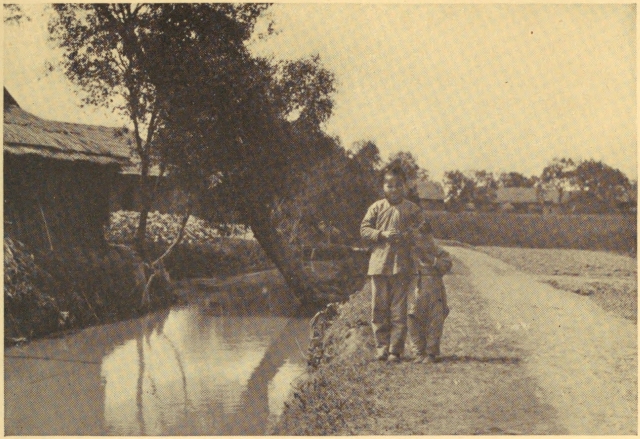
IN CHINA DRINKING-WATER, SOAP-SUDS, SOUP AND SEWERS ALL FIND
THEIR SOURCE IN THE SAME STREAM
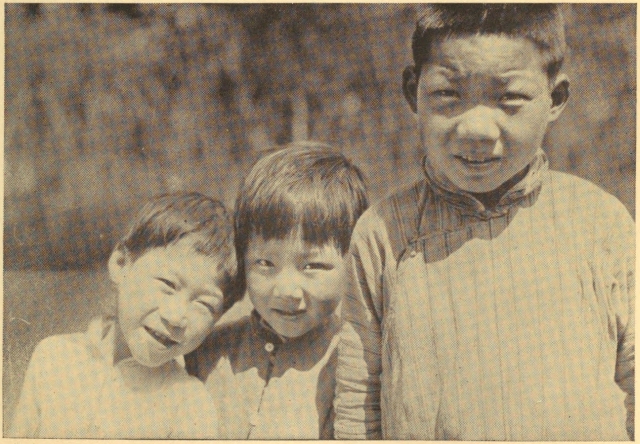
SHANGHAI YOUNGSTERS PUTTING THEIR HEADS TOGETHER TO MAKE
US OUT
Yet though he was a Confucianist, he decried the
family system. "Chinese cling too much to family," he
said. "One man goes to America, then he sends for a
brother simply because he is a relative. The brother
may be a very bad character, but that doesn't matter.
So it is in official circles in China to-day. Graft goes on,
jobs are dispensed to relatives worthy or unworthy, efficient
or inefficient. And the country is getting deeper
and deeper into difficulties."
As though to prove the truth of his assertions, he told
me of his own experiences as a child. "Chinese obey,"
he said. "My father paid for my education, therefore
my duty toward him should know no bounds." His
father had had ten children, only two of whom survived,—he
and an elder sister. When his father died,
he became the head of the family. Therefore he had to
marry, even though then only fifteen years of age. He
had been married for sixteen years. I should never have
believed it, to judge from his appearance. He seemed no
more than a student himself, but he assured me he had
five children,—one daughter fifteen years old. Birth-control!
Limitation of offspring! Why bother? If
his father could "raise" a family of ten on "nothing"
and then just let them die off,—why not he? So does
duty keep the race alive.
And duty tolerates that which is sapping the very
foundation of the race,—not only the enslavement of the
wife in such circumstances, but the entertainment of the
concubine. I saw the way that works.
At the opposite end of the city is the quarter where
the concubines abound. Life there does not begin till
eight o'clock in the evening, if as early. The clanging
of cans and the effort at music is terrifying. Hotels of
from four to five stories, with all their balconies illuminated,
gave an effect of festive cheerfulness which the
rest of the city lacked utterly.
Upon the ground floors, which opened directly upon
the street, the women could be seen dressing for the
evening. Nothing in their behavior or dress would indicate
their profession,—so unlike the licensed districts
of Japan. The women never as much as noticed any
stranger on the street. At the appointed time each little
woman emerged, dainty, clean and sober, and passed
from her own quarters to the hotels and restaurants
where she was to meet her chartered libertine. Her
decorum approximated saintly modesty, and she moved
with a childlike innocence. There was throughout the
district no rowdyism, no disorderliness. Everything was
businesslike and according to regulation. Strange, that
with so much self-control should go so much licentiousness.
But it is part of the mystery of the Orient.
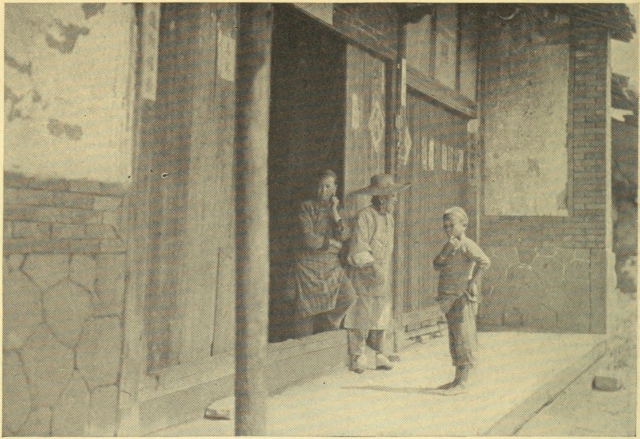
THIS OLD WOMAN IS LAYING DOWN THE LAW TO THE WILD YOUNG
THINGS OF CHINA
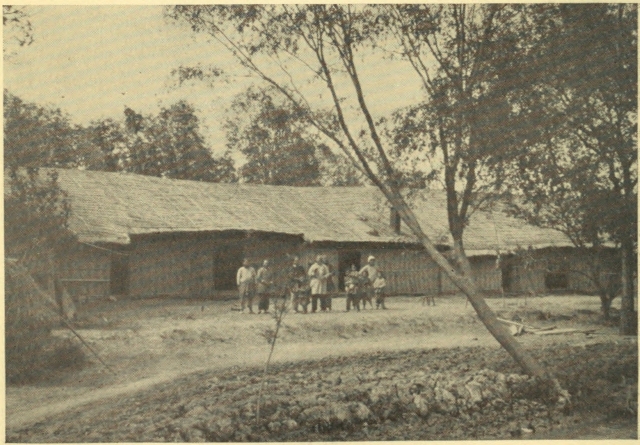
CHINA COULD TURN THESE MUD HOUSES INTO PALACES IF SHE WISHED—SHE
IS RICH ENOUGH
Yet, this is no stranger than that with so much of excellence
in Hong-Kong, there should also go the perpetuation
of coolieism; to paraphrase, that with so much
dignity and honesty in trade should go so much inhumanity
in the treatment of men. That is the mystery of
Britannia,—and her success. America went into the
Orient and immediately began educating it. In answer to
a German criticism of British educational work in Hong-Kong,
the "Japan Chronicle" (British) says:
Considering how much greater British interests in China have hitherto
been than American, the Americans are far more guilty of the
abominable crime of educating the Chinese than the British, having
spent a great deal of money, and induced young Chinese to come to
America and get Americanized. Most people, including impartial
British subjects, would find fault rather with the narrow limits of
English education in China than with its intentions. Hongkong has
been for many years the center of an enormously profitable trade,
and had things been done with the altruism that one would like to
see in international relations, there would be ten universities instead
of only one and a hundred students sent to England for college or
technical training where only one is sent to-day.
Hitherto, it has been Britain's success that she has not
interfered with the habits of the races she has ruled. In
Hong-Kong she has built a modern city out of nothing,
but has permitted Asiatic defects to find their place
within it.
For instance, there was no sewerage system in Hong-Kong,—a
fact than which no greater criticism could be
made of Britain, or of any other nation pretending to be
civilized. In this no question of altruism is involved, but
purely one of self-interest. And if greater concern for
such matters were manifest, doubtless it would work
its way back through concubinage, ancestor worship,
charlatanism in public and private life.
Having taken my chances with criticism, I shall risk
praise. Englishmen have never, to my knowledge, been
given credit for the possession of romantic souls; yet
nothing but a deep love of romance could be responsible
for the manner in which Britain has preserved Hong-Kong's
Chinese face. Despite the fact that it is entirely
Western in its structure, I never felt the Oriental flavor
more in all Japan than I did at Hong-Kong. The sedan-chairs
that take one up the steeps and remind one of
the swells on the China Sea in their motion, the thousands
of rickishaws that roll swiftly, quietly over smoothly
paved streets, the particularly attractive Chinese signs
that lure one into dazzling shops with unmistakable
Eastern atmosphere, the money-changers and the markets
dripping with Oriental messes, left an impression
on my mind that none of my later experiences can dispel.
Under the benign influence of a Salvation Army
captain, my feet were guided safely through some
of the lesser evils of Shanghai. The greater could not
be fathomed in the short time allotted to me in the European
capital of China. Miss Smythe, who resented
being called Smith, in a manner that revealed she had
long since ceased to be shy of mere man, belonged to
New Zealand by birth and heaven by adoption. She
chose Hong-Kong, Shanghai, and Tokyo as temporary
resting-places. It was her task, every five years or so,
to make a complete tour of the Orient to collect funds
for the Salvation Army. Hence her captaincy.
I was walking along Queens Street, Hong-Kong, somewhat
lone in spirit, when a rickshaw passed quickly by.
The occupant, a fair lady, bowed pleasantly to me and
disappeared in the mêlée. I could not recall ever having
seen her face and wondered who in Hong-Kong she could
be. Then it struck me that she wore a hat with bright
red on it. Later that day, as I stepped into the launch
to be taken across to the Tamba Maru, who should appear
but this selfsame lady. We greeted each other, both surprised
at the second meeting and at the coincidence of
our joining the same ship.
"I thought I had met you when I greeted you on the
street this morning," she said.
All the way from Hong-Kong to Shanghai she was as
busy going from class to class as she was on shore,
spreading the faith, placing literature where it could be
found and read, organizing hymn parties and discouraging
booze. The Japanese on board took her good-naturedly.
She spoke their language fluently, but I could
not see that they drank one little cup of saké the less
for her.
When we arrived at Shanghai she would have nothing
else but that I should go with her to some friends of
hers for dinner. Into one rickshaw she loaded her bags,
into another me, with the manner of one handling cargo,
and then deposited herself in a third. The train made
its way along the Bund and out of confusion. And that
was the way I was shanghaied.
Somewhere in a street that might for all the world
have been in Chicago, our train drew up. It was quiet,
had a little open park in it, where two streets seemed
to have got mixed and, scared at losing their identity
like the Siamese twins, ran off in an angle of directions.
Here at a brick-red building with balconies and porticoes,
and a dark, damp door, we made our announcement and
were received. Now what would the world have thought
if a Salvation Army man had picked up a strange young
woman on a steamer and haled her into a strange house?
None but a Salvation Army Lassie could have done what
Miss Smythe,—not Smith, mind you!—dared to do. We
were welcomed as though the appearance of a stranger
were in the usual course of events, and I was asked to
stay for dinner. The hostess, a quiet woman, with her
pretty young daughter, kept a boarding-house, and was
always prepared for extra folk.
It was a boarding-house like any I should have
expected to find in America. The rooms were spacious,
hung with framed prints, and dark and slightly damp,
according to Shanghai climate. There was something
haunting about the house, but to a homeless vagabond
like myself it seemed the acme of comfort. And to one
who had had no real home meal in five weeks or more,
but only ship's food, the spread we sat down to was
delicious.
Miss Smythe did not enjoy her dinner as much as I
did, for she feared all along that she would not be able
to get to church on time. Then it was too late for me
to regain my ship, so I was invited to spend the night
under a roof instead of a deck.
The next day I wandered off by myself, but not till
I had promised to return for Chinese "chow." In the
meantime Miss Smythe had spread my fame among
others of her profession, and made a date for me to go
to a "rescue house" or some such place that evening.
It was a mission home for Japanese, run by a woman
who, if she wasn't from Boston, I'm sure must have
come from Brookline. The only thing Oriental about
that mission was its Japanese. A sumptuous dinner was
served which, despite the fact that I had had "chow"
only twenty minutes before, I was compelled to eat. With
two heavy meals where one is accustomed to berth, accommodations
were somewhat crowded.
Everything would have gone well if I hadn't promised
to give the residents a talk on my travels. I began. Miss
Smythe felt that I wasn't emphasizing the presence
of God in the numerous regions I had visited. I took
His omnipresence for granted, but she kept breaking
into my talk at every turn. Two meals inside of two
people who both tried to lecture at once didn't go
very well, especially at a mission in China run by
Europeans and attended by Japanese. It seemed that
there was not over-much love lost on the part of the
sons of Tenno for those of the Son of Heaven, nor
did the European missionaries at this place encourage
the intermarriage of these illustrious spirits. The
Bostonian in exile on more than one occasion spoke
disparagingly of the cleanliness of the Chinese, much to
the satisfaction of the Japanese. But then, she was winning
and holding them to the Son of God, and when they
reached heaven they would all be one. Miss Smythe
afterward apologized to me for interrupting me during
my talk, and we parted as cordially as we had met. Some
months later I found her roaming the streets of Kobe,
Japan, as active as ever in the militant cause. Her
insinuations about what goes on in Japanese inns seemed
to me unjustifiable. So I asked her whether it was fair
to the Japanese and Chinese for her to be forever repeating
hearsay when she would resent it were I to repeat
what I had heard about the morality of the Australians.
It took her aback, but I am sure that she is still pursuing
vice and drink and irreverence, aided and abetted by the
dollars which she extracts from foreign business men
and reprobates throughout the East.
But I must get back to Shanghai, even though Miss
Smythe is so attractive. As long as I remained under
her wing I had taken virtually no notice of China. So
it is in Shanghai; one cannot see the Orient for the Occidentals.
For if Hong-Kong is an example of adulterated
British imperialism, Shanghai is one of European
internationalism grafted upon China. At Shanghai the
forces of two contending racial streams meet, like the
waters at the entrance of Port Philip, and here, though
the surface is smooth and glassy, there are eddies and
whirlpools within, which are a menace to any small craft
that may attempt to cross.
How strange to wander about streets and buildings
quite European but to see only here and there a white
face! It is an ultra-modern city built upon a flat plain.
The streams of Chinese that come wandering in from
regions unknown to the transient, give him a sense of
contact with a vast, endless world beyond. They might
be coming from just round the corner, but their manner
is of plainsmen bringing their goods and chattels to
market. In comparison with the Southern Chinese, these
are giants, but still dirty and most of them chestless. In
constant turmoil and travail, beggars pleading for a
pittance with which to sustain their empty lives, limousines
making way for themselves between rickshaws and
one-wheeled barrows, coolies pulling and carrying loads,
some grunting as they jig their way along, others chanting
in chorus,—yet all in the "foreign" settlement, amid
buildings that are alien to them, and largely for men
who see only the gain they here secure. I wonder if
the Chinese say of the Europeans as Americans are often
heard to say of Italians and Orientals,—that they come
only to make money and return to spend it?
Yet the white have built Shanghai. Shanghai is not
Chinese. Had it not been for the white men, the plain
would still be swampy, would still be a litter of hovels
with here and there a mansion flowering in the mud. The
mud still messes up the edge of things in Shanghai. The
creek is an example. There are the sampans and barges,
some loaded with pyramid-like stacks of hay, some with
heavy, thick-walled mahogany coffins, the myriads of
families huddling within the holds, and the murky tides
washing in and washing out beneath them. Here the
sexes live in greater intimacy, it seemed to me, than in
Hong-Kong. I actually saw one woman place her hand
in what I was sure was an affectionate way on the
shoulder of a man: and some were mutually helpful. But
otherwise, despite the great conglomeration and greater
coöperation, in the entire mass one cannot see how ancestor-worshipers
can show so little regard for one another.
In the market-place the confusion is more orderly.
Here even white women come to stock up their kitchens,
and here Japanese women move about, sober by nature
and by virtue of the superiority they possess as conquerors
in their husbands' rights. Two girls are quarreling
vociferously and the more self-controlled look on
both sympathetically and antipathetically. The washed-down
pavement of the market floor is no place, however,
for a serious bout.
Through the long hours of early evening I wandered
into one street and out the other. I had become more
or less reconciled to the alien aspects of Shanghai, to
good stores selling good goods, to fashionable hotels and
spacious residences, but one thing was inalienably alien
to it, and that was a second-hand book-shop. It had not
occurred to me that foreigners in China would part with
their books if they ever got hold of them. And for a
moment I was altogether transported, and my magic
carpet lay in San Francisco, in Chicago, in New York
all at once. But it was chilly and the rain made the city
worse than a washed-down market, for it depopulated
the streets, leaving me as dreary in heart as in body.
I was glad when the hour came for me to make my
appearance at the kind woman's house for chow.
Though I was sorry to hear the missionary at the mission
decry the Chinese to the satisfaction of her Japanese
patrons, and felt that it turned me slightly against both,
still both Japanese and missionaries were kind and attentive
to me. In the evening, a young Japanese business
man called for a motor-car and took us out in the bleak,
wet night to see the great white way of Shanghai. The
rain deflected the strange glimmers of electric light
through the isinglassed curtains of the car. For a time
we skidded along over slushy streets, turning into the
theater district as the attraction supreme. Here the gonfalons
drooped in the watery air, while Chinese mess merchants
stood in out of the rain with their little wagonettes
of steaming portions. In a whirl we were through the
cluttering crowds and making for the residential districts.
Then wide avenues opened out in serpentine ways, shaggy
trees dripping overhead, the slippery pavement swinging
us from side to side as our dare-devil Chinese driver sped
on to Bubbling Well. For an hour we rode, I did not
know whither, but everywhere at my right and left were
palatial Chinese and foreign residences. Without knowing
it we had turned and were back in Shanghai, and
presently within doors again,—and asleep.
Next day, this same Japanese business man volunteered
to escort me to Chinese City. I would have gone
by myself, but every one looked horrified at the idea; so
I accepted this knightly guide. At the appointed time I
presented myself at his office. He had asked his Chinese
clerk to accompany us for protection, and ordered three
rickshaws. Though he had lived in Shanghai for years,
he had never gone to see Chinese City, and was glad to
avail himself of an excuse for doing so now. The Japanese
is a natural-born cicerone.
In a few minutes we had left the international section
of the settlement—that jointly occupied by Britain and
America—and wobbled into the French district. Suddenly
we stopped, and our carriers lowered their shafts
to the ground. We were at a narrow opening three or
four feet wide, and I could not understand why we should
pay our respects to it. "From here we have to walk,"
said the Chinese, and in single file we entered, dropping
out of Shanghai as into a bog. That was real China,
but only as little Italy in New York is real Italy.
The whole of Chinese City can be summed up hastily
and in but a few words. Narrow, dirty little thoroughfares
laid out in broken stone paving, tiny shops where
luxuries, necessities, and coolie requisites are sold,—dark,
dirty, open to the damp! What destitution is the
inheritance of these thousands of years of civilization!
The first thing to greet us, standing out against the
general wretchedness, was not beautiful. To one accustomed
to hard sights and scenes, to one not easily perturbed
by human degradation, that which passed as we
entered was sufficient to unnerve him. Upon the wet,
filthy street rolled a legless boy. He had no crutches;
his business required none. He was begging: howling,
chanting, and rolling all at the same time. I could not
say "Poor child!" Rather, poor China, that it should
come to this!
Immediately after, though having no business connections,
came an old man. Came? Walked crouching,
bowing his gray head till it touched the filthy pathway.
He was kotowing before the menials of China, not its
empress.
The third was the worst of all. One old, ragged,
broken beggar was carrying on his back what might have
been a corpse, but was another beggar; the two—one on
top of the other—were not more than four feet above
the ground.
I felt as though Mara, the Evil One, was trying to
frighten me by an exhibition of his pet horrors so that
I might not go farther. I was not being perturbed, the
horrors ceased.
But what beauties or treasures were they meant to
guard? What was there that I was not to see? What
ogre dwelt within? Nothing but a bit of business, so
to speak, in a social bog.
Beside a tideless creek, advertised as a lake, stood a
pagoda-like structure, just a broken reflection imaged
in the mud. As we approached we were immediately
taken in charge by a Chinese guide and led along a path
crudely paved with cobblestones into an "ancient" tea-garden.
The wall around it was topped with a vicious-looking
dragon that stretched around it. A tremendous
monster of wood, it lay there; and perhaps it will continue
to lie there long after China shall have forsaken the
dragon. Then from chamber to chamber we strolled, past
tables of stone and shrines and effigies, and into the heart
of China's superstitious soul. Though in itself not ancient,
what a peep it afforded into antiquity,—dull, dead,
yet powerful!
For within these secret chambers there were displayed
endless numbers of emperors and their dynastic celebrities.
In one chamber, blue with smoke and stifling
incense, lighted with red candles, burning joss-sticks,
behung with lanterns, and crowded with lazy Chinese,
we found several "emperors" with red-painted wooden
effigies of their wives. To me the smoke was choking;
not so to them. The incense was sweet in their nostrils,
and nourishing. And in payment for the sacrificial generosity
and the prayers of fat, wealthy Chinese women
who fell upon their knees, rose, and fell again, bowing
and repeating incantations, they were to make the husbands
of these women—too busy to come themselves—meet
with success in business. Seriousness and earnestness
marked the features of these women, and who can
say their faith was ignored?
We emerged from this underground chamber upon
another thoroughfare, pursuing which we came upon
an open, unused plot. Here a circus had attracted a
crowd. A three-year-old baby, a pretty little sister, a
feminine father, and a masculine mother were the entertainers.
They were acrobats. A family row—which, it
would seem, is not unknown in China—was enacted without
any of the details being omitted; nor did they stop
at coarse and vulgar acts which would have brought the
police down upon them in America. Yet the audience
seemed highly amused, while some of the spectators
might easily have posed for paintings of Chinese bearded
saints, or have been models for some of the sacred effigies
which, not more than a block away, were idols in
the temple.
These are the high spots in Chinese City, a city into
which I was urged not to venture alone. That human life
should be considered of little worth here is not marvelous;
but that any one there should consider the prolongation
of his own a bit worth the taking of mine, is
one of the inexplicable marvels of the world.
Is this China? By no means. It is merely the back-wash
of the contact with European life which has been
imposed on China without sufficient chance for its absorption.
It is no more typical of China than our metropolitan
slums are really typical of American life. True, they
are the result of it, but where the rounding out of relationships
and conditions have been accomplished there
follows a graduation of elements to where good and evil
obtain side by side. And Chinese City is but the worst
phase of Chinese slums plastered upon Shanghai.
Poverty in Chinese City is one thing; in Shanghai
it is another. It is all a matter of the background.
Buddha the beggar is still Buddha the Prince.
After I came out of Chinese City I took much greater
note of the details of the life of the coolie, the toiler in
Shanghai proper. I was out on the Bund. The stone
walls hemming in the river Whang-po rise at a level
round the city. For five feet more the human wall of
coolies shuts out the tide of poverty and despair from
a world as foreign to China as water is alien to stone.
From both walls a murmur reaches the outer world: the
swish of the tide, the hum of coolie consolation. I let
myself believe that they chant beneath their burdens to
disguise their groans. Up and down the Bund they
course, here at exporting, there at importing. Their
gathering-places are at the godowns, and in and out
they pass up and down inclined planks, each with a sack,
or in couples with two or more sacks hanging from their
shoulders, never resting from these rounds.
At another point they are delivering mail to the ship's
launch. Two cart-loads arrive. Coolies swarm about
the carts, waiting for orders. Some are mere boys, but
already inured to the tread. As each lifts a bag of mail
he passes a Japanese, who hands him a stiletto-shaped
piece of wood with some inscription on it,—painted green
to the hilt. He takes two steps and is on the gang-plank,
two more, and he has burdened himself with
three bags of mail, and returns; he received and returns
three sticks. That is the way count is kept of the mail.
I couldn't understand this close precaution. Could the
coolie possibly abscond with a bag of mail under the very
eyes of an officer?
Two small boys eagerly rushed a distance on, to pick
up some bags that had been left there. They were acting
without order,—spontaneously. They would have saved
themselves some labor in that way. But the officer in
charge shrieked his reprimand at them. One, in his
enthusiasm, ignored the command. The officer rushed
after him and boxed his ears. The boy received the
punishment, but went right ahead with his burden. Hardened
little sinner! calloused little soul! poor little ant!
One youngster came up, chanting the sale of some
sweet-cakes. Looking into his face, I wondered what
he was thinking just then. He must think! No one
could be so young and have such a cramped neck, such
sad eyes, such furrowed brows without hard thoughts
to make them so.
In the slush and rain, under semi-poverty and destitution,
barefoot, ragged, and in infinite numbers,—still they
toil. Yet against the background of sturdy Shanghai,
their labor and their travail does not hurt as much as
it does in Chinese City. The perplexities of life—national,
racial, of caste—pervaded my thoughts. Why
has China remained dormant so long? Why is she now
waking? How will she tackle the problem of poverty?
To me it seems that nations rise and fall not because
fluctuation is the inherent law of life, but simply because
universally accepted glory and prestige are positions
generally paid for by accompanying poverty and disease.
No nation can dominate for a long time with such coolieism
as that in China.
China has standards all her own. We come with our
ways and claim superiority. China grants it, yet goes
her own way. And when we see her sons we like them,
though we may criticize, condemn, and try to change
them. This is the oneness of China and the consensus
of opinion is that it is lovable. People come, employ
Chinese as servants, and try to train them. They may
take that which they think you do not need, carry out
their own and not your ideas. You in turn rave and
roar, but in the end they are still there as servants and
you as master. But they have educated you, you have
not changed them. And when you leave China you long
for them as did that American woman I met in Honolulu
who fairly wailed her longing aloud to me. China has
done this with whole nations, and, to the very end of
time, whatever nation sets out to rule and conquer that
new republic must make up its mind to be lost.
And so behind Shanghai is Chinese City, and behind
that there is China, out upon the flat plains. There is
another China yet beyond, and still another and as many
as there are billows on the sea. Build modern buildings
and cities, and the Chinese take them and turn them
inside out, and they are what he wants them to be. This
plastic people,—what is their destiny? And what, still,
is there awaiting the world as they fulfil that destiny?
How strange it feels to call her republic! Yet China
has taken to republicanism as though it had been brewing
in her these thousands of years. From outward
appearances one would never know that she is a republic
to-day. Some say she really isn't. Coolies still are
coolies, and Chinese, Chinese. And I dare say she is
both empire and republic, two in one.
For centuries China has lain dormant as though stung
by a paralyzing wasp. Centuries have been lost in sleep.
But what are centuries, when waking is so simple and
is always possible? China has wakened. She is rising.
An hour's work has been accomplished in the first fresh
flush of the new dawn. Perhaps that is all that will be
done that day, the house put in a little better order.
To-morrow is time enough for real work. A Chinese
junk comes out of its night-mist retreat with its own dim
lights. A shrill whistle of a passing launch echoes across
the flat plains about Shanghai. The rain of yesterday
remains only as a sorry mist. A vision of clearer day
shimmers through, but soon grows dull again. China
seems to have shaped her climate in her own image.
A two-days' steam to Moji, Japan, on the bosom of
that heaving mistress the China Sea, and my journey
was over for a long while. The sea was black, the sky
somber; even the sun was sad as it stooped that evening
to kiss the cheek of Japan good night. I did not know
just then that I was to say farewell to the sea for two
and a half years,—a farewell that resulted in Japan:
Real and Imaginary.
... For surely once, they feel, we were
Parts of a single continent.
Now round us spreads the watery plain—
Oh, might our marges meet again!
I had gone out to the Katori-maru to inspect my
quarters. I always loved to get away from shore,
even if only in a launch or sampan; it was so much
cleaner and fresher on the bay. That afternoon it was
altogether too attractive out there, and the city of Kobe
lay so snugly below the hills that I decided to remain on
board till late in the evening, and missed the last launch.
I hailed a sampan. In this, with the wind splashing the
single sail and the spray scattering all about us, we
slipped romantically back to the American Hatoba. It
was my last entrance to Kobe.
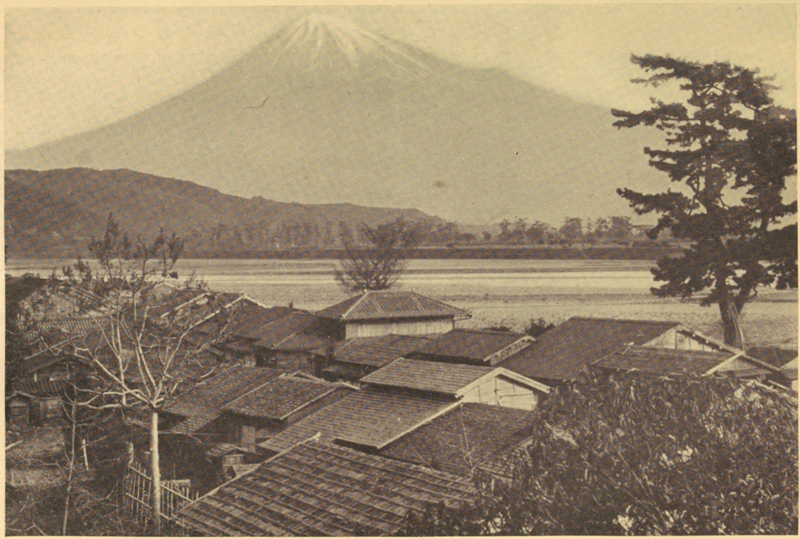
Photo from Brown Bros.
FUJIYAMA
Japanese roofs may be monotonous—but never so is Fujiyama
All of the next day I kept changing trains and creeping
over Japanese hills and rice-fields in my devious and
indirect route to Yokohama by way of Japan's national
shrine, Yamada Ise. A few days later I was on board
the Katori-maru, the newest type of Japanese shrine,
the modern commercial floating shrine, named after one
of the most ancient of shrines in Japan. The Katori
shrine is said to have been founded some twenty-five
hundred years ago during the reign of the mythical first
emperor, Jimmu Tenno. It was dedicated to deities who
possessed great military skill and has always been patronized
mainly by soldiers. Transferring shrines from
land to sea is a hazardous procedure. For me, however, I
was ready to give my offering most willingly as long as
it brought me to Seattle. There were too many people
willing to patronize floating shrines at that time for me
to be too particular about deities.
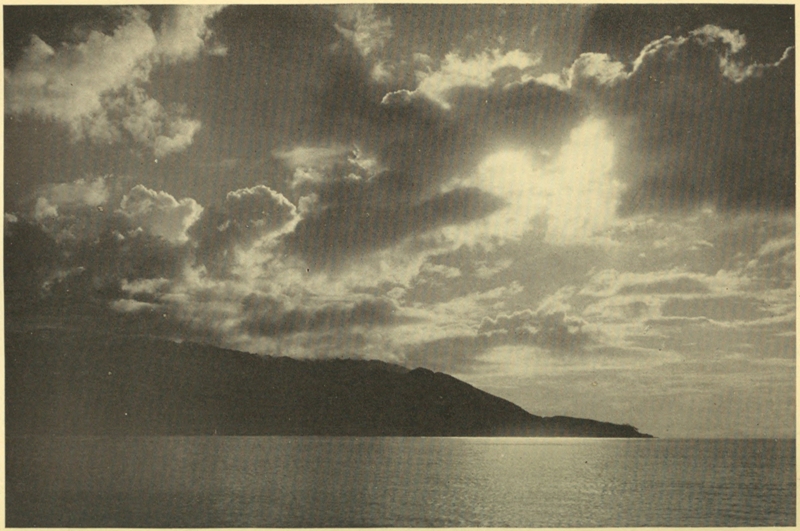
Photo from Brown Bros.
SEA, EARTH AND SKY
All are one in this glorious Pacific World
For a moment, as we slipped away from the pier, I
felt what a dying man is said to feel when the flash-like
review of life's experiences course through his sinking
consciousness. I saw Japan and all its valleys, its dirt
and its sublimity; and with all its past confusions I
loved it.
Waiting for a final glimpse of Fuji left me idle enough
to observe the little things about me. There was, for
instance, the two-by-two-by-five sailor who was showing
two Japanese girls through the "shrine" he was serving.
I followed them about the ship. He was explaining
to them various mysteries.
The Sailor: "Kore wa otoko no bath. [This is the
men's bath.]" To the minds of these Japanese maidens
such a distinction was surprising.
The Sailor: "Kore wa second class. [This is second
class.]" This was like treading on sacred ground to
these lowly born mites.
The Sailor: "Kore wa kitsu en shitsu. [This is the
smoking-room.]" Why a special room for so simple
a service—and why men only?
He led them above to the hospital. He never made
any comments, they asked him no questions, but followed,
single file, as is proper for Japanese girls, agape with
curiosity. They passed the life-saving equipment. A
tiny voice ventured a question. An amazed member of
the Japanese Government (it was a government subsidized
vessel) said, with semi-scorn:
"Kore wa? Boat. [This? Boat.]" And they went
below.
All of that forenoon, waiting for the Katori-maru to
slip away from the pier, I watched for Fujiyama, that
exquisite pyramid (to the summit of which I had climbed
twice), but it was veiled in mist. I wanted to see what it
looked like from the sea, just as I had seen what the sea
and the universe looked like from its peak. All afternoon,
as Japan was receding into the past, I tried to distinguish
old Fuji, but there was only a glittering edge, like a
sword, beneath the low, bright sun. After dinner I went
on deck and there in all that simple splendor which has
made it the wonder of the world, stood Fujiyama, with a
soft, sunset glow beneath its peak. The symbolic sword
had vanished. And I felt that in all those years and
miles and space which gather in my memory as that
single thing—the Pacific Ocean—nothing transcends in
loveliness the last view of Fuji from the sea.
Then for two days the world seemed to swoon in mist.
The fog-horn kept blowing drearily every two minutes;
yet the steamer never slackened its speed for a moment;
in fact, we made more miles those two days than during
the clear days that followed. We had taken the extreme
northern route and were soon in a cold latitude. The
fog became crisp, as though threatening to crystallize,
and when I stood on the forward deck it was almost like
being out in a blizzard. The siren continued to emit its
melancholy wail across a wilderness of waves lost in
mist. One could not see the length of the ship. At midnight
I woke, startled by the sudden cessation of the
propellers. For three hours we were stationary, owing
to engine trouble. The steamer barely rocked, giving
me the sensation of the deep as nothing ever did before.
It was at once weird and lovely, and in the darkness I
could imagine our vessel as lone and isolated, a thing lost
in an open wilderness of space. The siren continued
moaning like the wail of a child in the night, and once I
thought I heard another siren off in the distance. We
started off again and from then on didn't once slacken
our speed in the least, so large, so spacious, so unfrequented
is the Pacific in these days.
The fog hung close for so many days that a rumor
went round that the captain was unable to get his bearings.
With neither sun nor stars to rely on men's best
instruments are altogether inadequate. At half-past
nine o'clock one evening, however, the steel blinds were
closed over the port-holes. The ship began to pitch and
roll. The waves rushed at us and broke against the
iron cheek of the vessel. The fittings on deck rolled back
and forth, and those passengers unused to the sea clung
to their berths.
Only when we were within three days of the American
coast did the sun come out. For over a week we had
been in a dull-gray world which was becoming terribly
depressing. We were considerably farther north than
I had expected to be.
Five days after our departure, I was again at the
180th meridian, and enjoyed what only a very eager,
active person could enjoy,—a forty-eight-hour day. This
time, going eastward, we gained a day. I also had the
pleasure of being within fifty degrees of the north pole
just as three years before I had been within fifty degrees
of the south pole. In other words, I had touched two
points along the 180th meridian which were six thousand
miles away from each other, or twice the distance from
New York to San Francisco.
Calculations are somewhat misleading at times. For
instance, when we were near the Aleutian Islands, I
chanced to compare the records of that day's run as
posted in the first saloon with those posted in the second
saloon. The first read 4,240 miles from Yokohama; the
second, 4,235 miles. Japanese handling of figures made
the prow of the ship five miles nearer its destination
than the stern. Japanese historians also have a tendency
to make such innocent mistakes in their imperialistic
calculations. Japan's feet do not seem to be able
to keep pace with her desires.
As though to investigate this phenomenon, a little
bird,—slightly larger than a sparrow, with the same kind
of feathered back, but with a white breast, flitted down
upon the deck before me,—and began hopping about. It
approached to within two feet of me, then sneaked into
a warm place out of sight. A stowaway from birdland,
stealing a ride and planning, most likely, to enter
America without a passport. Perhaps it thought that
being near the stern of the boat, according to the calculations
above quoted, it could still remain beyond the
three-mile limit.
Then the homeward-bound spirit took possession of
me,—that selfsame realization of my direction which
had come over me upon sight of the Australian coast three
years previously, a psychological twisting which baffled
me for a time. Another day and we were within the
last square marked off by the latitudinal and longitudinal
lines,—the nearest I had been to America in nearly five
years. To remind me of my wanderings, the flags of
the nations hung in the dining-saloon: under nearly every
one of them I had at some time found hospitality.
The reader who has followed me thus far has been with
me about three months on the sea. What to the Greeks
and the Romans was the Mediterranean, the Pacific will
be to us seventy times over. Already there is a wealth
of literature and of science which has come to us through
the inspiration of that great waterway. For Darwin
and Stevenson and O'Brien the Pacific has been mother
of their finest passions. In the near future, our argosies
will cross and recross those tens of thousands of miles
as numerously as those of the Phœnicians on the Mediterranean
in antiquity. They will bring us back the teas and
spices and silks of the Orient. But there are those of us
who have watched the "White Shadows" of the Pacific
who would wish that something were brought away besides
the ephemeral materials. For there is in the sea
a kinship with the infinite and the absolute, and who
studies its moods comes nearer understanding life.
I wandered along one night with a New Zealand man,
without knowing where he was leading me. Suddenly
we came, by way of a narrow pathway, against a wall of
darkness. We were at the seashore. It was as though
we had come to the world's end and the white glistening
breakers arrived as messengers from eternity, warning
us against venturing farther. I strained my eyes to see
into that pitch-black gulch, but I might just as well have
shut my eyes and let the persistent breakers tell the
story of the sea in their own way. Afterward I often
made my way out to that beach and sat for hours, or
trod the sands till night left of the sea nothing but mournful
whisperings.
One day in August, when the first snow fell over our
little winter world in the far South, I had climbed the
hills up to the belt of wildwood that girds the city of
Dunedin. The very joy of life was in the air. Keenly
I sensed the larger season,—that of human kinship
merged in the centuries. I looked across the hills to
mountains I had known; but it was then not the Alps
I saw, not the Rockies, the Aeta Roa under the Southern
Cross, nor yet the Himalayas nor the snow-packed barriers
of the Uriankhai, the unrenowned Turgan group.
In truth, I was not seeing impassable peaks at all, but
imprisoned ranges which were themselves trying to outreach
their altitudinal limitations. It was a world consciousness
which was mine, and I towered far above the
highest peaks, above the world itself. I saw no single
group, no political sections nor geographical divisions,
the conquest of ridges, the commingling of noises, the
concord of peoples. And when men come to this world
consciousness they will recognize and accept all, include
the barrier and the plain. They will see these great,
sheer rugged peaks knifing the floating clouds, yielding
to the creeping glaciers, yet one and all, when released
sweeping down the valleys as impassioned rivers, filling
the lowest depths of earth, depths deeper than the sea,
lower than the deserts. In such moments of world consciousness
men will have to step downward from the bottom
of the sea and upward from the summit of McKinley.
Then barriers will become beacons. Mankind lives
at sea-level. We care little about our neighbors over
the ranges. That mental attitude makes barriers real
and valleys dark. But when we turn them into beacons
we shall climb the barriers in order to look into the
valleys of our neighbors and they will become the ladders
of heaven and the light unto nations. That is the lesson
of the sea.
At present we live at a sea-level, but beneath and behind
the barriers, are the peaks of earth. Hence walls of
houses are as great barriers as mountains. Hence even
thoughts are barriers and ideals become terrible, cold,
insurmountable prominences.
But in world consciousness, which is the lesson of the
sea, we do not reject anything,—the religions, the political
parties, the anti-religions, and the negations,—but we
bring them to the level of human understanding by
absorption, by taking them in. That is the story of
the sea.
The ocean breaks incessantly before us, but only the
one majestic wave thrills as it rises and overleaps the
rocky barrier. A forest is densely grown, yet only the
stately, beautiful tree stirs the forest-lover. The street
swarms with human beings all of whom are material for
the friend-maker, yet only one of the mass, in passing,
steeps the day's experience in the essence of love. But
loving that one wave, or tree, or being does not shut us
against the source of its becoming; rather does it teach
us the possibilities latent in the mass. That is the moral
of the sea.
But what is the sea? How can we know the sea? Is
it water, space, depth? Can we measure it in miles, in
the days required to traverse it, in steamship lines, by
the turning of the screws, or by the system of the fourth
dimension? To me who have been round the greatest
sea on earth comes the realization that I have seen only
a narrow line of it, and that I can only believe that the
rest is what it has been said to be. Yet my faith is
founded on my knowledge of the faithfulness of the sea.
The sea, we sometimes say, has its moods, but rather
should they be called enthusiasms. It is really not the
sea at all to which we refer, but to something which in
the vague world of infinitude is in itself a sea whipping
the surface of an unfathomable wonder. The sea's
moods are not in its breakers, any more than is the surface
phenomenon which floors the region between our
atmosphere and ether, the story of our earth. We cannot
reach down beneath the breakers and learn the secret
of the heart of the sea. In ourselves, as in the sea, we
obtain a record of that tremendous silence which is the
harbinger of all sound, as the heavens are of all color.
One day in New Zealand I witnessed a conflict between
the earth and the sea. A tremendous wind swept north-westward,
and pressed heavily down upon the shore. It
sent the sand scurrying back into the sea. Even the
breakers, like the sand, fell back in furious spray like
the waves of sea-horses,—back into the ocean. The entire
length of the beach for three miles was alive with
retreating spray, mingled with the bewildered sand-legions
scurrying at my ankles.
One night, on the shores of Otago Harbor, the moon,
blasted and blunted by heavy clouds, had started on its
journey. In a little cave huddled a cloud of black night.
We had spread the faithful embers of our camp fire so
they could not touch one another, and wanting touch they
died in the darkness. We had put the curse of loneliness
upon each of them. The little cave had become only a
darker spot on a dark landscape,—a landscape so rough,
so rare and rugged, reaching the sea and the western sky
of night. So rough, so unformed, so uncompleted. The
maker of lands was beating against it impatiently, rushing
it, forming it. What uncanny projections, what
sandy cliffs! For ages the wind and sea have been
whipping them into shape. Yet man could remove them
with a blast or two. For thousands of miles, all round
the rim of the great Pacific, the same process is going
on, day and night. While upon land, man has continued
working out his mission in the same persistent,
unconscious manner.
O Maker of lands' ends, O Sea, when will man be
formed? When will the conflicts among men cease?
They have tried to curb one another and to subject one
another to slavish uses, even and kempt. But still,
after ages of whipping and lashing, they are still unfinished
as though never to be formed. Are the various
little groups which lie so far apart, scattered by some
ancient camper, to die for want of the touch of comrade,
like those embers in the darkness of that empty
cavelet?
Here round the Pacific we dwell, each in his own little
hollow. May not this vast, generous ocean become the
great experiment station for human commonalty, for distinction
without extinction? The dreams that centered
in the other great seas—the Mediterranean, the Atlantic—were
only partially fulfilled. But here at the point
where East is West, it ought to be possible, because of
the very obvious differences, to maintain relations without
irritating encroachment. There was a time when passionate
desire justified a man taking a woman from another
with the aid of a club. To-day the decent man knows
that however much he may love, only mutual consent
makes relationship possible. And from the frenzy of untutored
souls let those who feel repugnance withdraw till
the force of a higher morality makes the rest of the world
follow in its wake.
... now I only hear
Its melancholy, long, withdrawing roar,
Retreating to the breath
Of the night-wind down the vast edges drear
And naked shingles of the world.
Ah, love, let us be true
To one another! for the world, which seems
To lie before us like a land of dreams,
So various, so beautiful, so new,
Hath really neither joy, nor love nor light,
Nor certitude, nor peace, nor help for pain:
And we are here as on a darkling plain
Swept with confused alarms of struggle and flight,
Where ignorant armies clash by night.