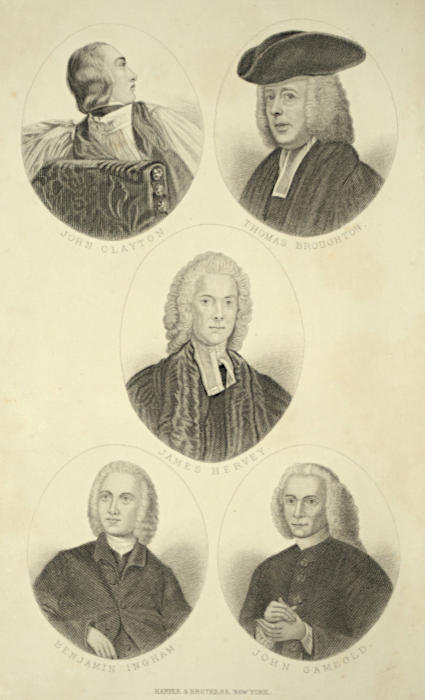
THE REV. JOHN CLAYTON, M.A., THE JACOBITE CHURCHMAN.
God has wisely and graciously hidden the future from
us. We may form guesses concerning it; but we have
not the slightest certainty that our guesses will be realised.
Who, in 1732, could have foretold the future career of the Oxford
Methodists? If the members of the Methodist fraternity
could have seen beforehand the events of the next fifty
years, what would have been the issue? Would the fellowship
of the Hanoverian and Jacobite, the Methodist and
Moravian, the Churchman and Dissenter, the Arminian and
Calvinist, the itinerant Evangelist and the parish Priest, have
been continued? That fellowship was of incalculable importance;
but its maintenance depended upon the shortsightedness
of those who were united in it. The drawing
aside of the veil of futurity would, in all likelihood, have
converted the loving brotherhood into an Ishmaelitish band,
endangering, not only its future usefulness, but its present
existence, by its own internecine fights. As it was, there went
forth a number of brave-hearted men, all of them the better
for their godly meetings in Wesley’s comfortable room in
Lincoln College; and, though their courses were divergent,
yet, in the main, they continued faithful to the cause of truth,
and, with few exceptions, were always loyal to their great
Master, Christ. In a qualified sense, we may apply to Oxford
Methodism the words of the sacred text: “A river went
out of Eden to water the garden; and from thence it was
parted, and became into four heads” (Gen. ii 10). Let us
follow one of the out-flowings:—
John Clayton was the son of William Clayton, a bookseller
in Manchester;[15] was born in 1709, and was educated
by the Rev. John Richards, M.A., at the Grammar School
in that important town. He entered Brazenose College in
1726, and became Hulme’s exhibitioner in 1729.[16] He was introduced
to Wesley in 1732; and, by his recommendation,
the Oxford Methodists took another important step, that of
fasting twice a week. Wesley writes,—
“On April 20, 1732, Mr. Clayton meeting me in the street, and giving
Mr. Rivington’s[17] service, I desired his company to my room, and then
commenced our acquaintance. At the first opportunity, I acquainted him
with our whole design, which he immediately and heartily closed with;
and, not long after, (Mr. Morgan having then left Oxford,) we fixed two
evenings in a week to meet on, partly to talk on that subject, and partly
to read something in practical divinity. The two points whereunto, by
the blessing of God, we had before attained, we endeavoured to hold fast:
I mean, the doing what good we can; and, in order thereto, communicating
as often as we have opportunity. To these, by the advice of Mr.
Clayton, we added a third,—the observing the fasts of the Church; the
general neglect of which we can by no means apprehend to be a lawful
excuse for neglecting them. And in the resolution to adhere to these and
all things else, which we are convinced God requires at our hands, we
trust we shall persevere till He calls us to give an account of our stewardship.
As for the names of Methodists, Supererogation-men, and so on,
with which some of our neighbours are pleased to compliment us, we do
not conceive ourselves to be under any obligation to regard them, much
less to take them for arguments. ‘To the law and to the testimony’ we
appeal, whereby we ought to be judged. If by these it can be proved we
are in error, we will immediately and gladly retract it: if not, we ‘have
not so learned Christ,’ as to renounce any part of His service, though men
should ‘say all manner of evil against us,’ with more judgment and as
little truth as hitherto. We do, indeed, use all the lawful means we
know to prevent ‘the good which is in us’ from being ‘evil spoken of:’
but if the neglect of known duties be the one condition of securing our
reputation, why, fare it well; we know whom we have believed, and what
we thus lay out He will pay us again.”[18]
These were brave Christian words; the noble utterance of
an earnest, conscientious, godly man. The Methodist brotherhood,
thus portrayed, present an example which all who are
right-minded cannot but admire. There is no taking for
“doctrines the commandments of men;” no ridiculous toying
with ecclesiastical or superstitious trifles; but a stout-hearted
adherence to great, scripture principles. Wesley
and his friends were not pious for the purpose of being
singular, but because they felt it to be a duty. To be
laughed at was far from being pleasant; but they were quite
prepared to sacrifice even their reputation, rather than dishonour
the religion of their great Master. Men might brand
them with opprobrious epithets; but that with them was of
trifling importance, if only at the day of judgment, Christ
acknowledged them as friends. They knew they were not
following “cunningly devised fables;” they were not flippant
dabblers in “doubtful disputations;” but earnest men who
knew that what they held was truth, and who, at all hazards,
were resolved to practise it.
Clayton had spent six years at Oxford, and was now a
college tutor.[19] The following letter was addressed to Wesley
about three months after he and Clayton became acquainted.
It is long, but is full of interest, and casts considerable light
on the doings and difficulties of the Oxford Methodists.
Wesley, at the time, seems to have been in London; where he
was now made a member of “The Society for the Propagation
of Christian Knowledge,” and also formed a friendship
with William Law.
“Oxon, August 1, 1732.
“Rev. and dear Sir,—Excuse me for not interrupting you from
attending to the noble work you have taken in hand, whilst I give you an
account of the present state of our affairs at Oxford.
“I cannot but think it an extraordinary piece of Providence that, when
we had lost our best advocate and patron, all opposition against us should
immediately cease; for, since you left us, nobody has thought it worth
while to attack either Mr. Smith or me,[20] or to endeavour to remove us
from those principles wherein you, by the grace of God, have fixed us.
I have gone every day to Lincoln, big with expectation to hear of some
mighty attack made upon Mr. Smith; but, I thank God, I have always
been disappointed; for not one of the Fellows has once so much as tried
to shake him, or to convert him from the right way, wherein, I hope, he
at present walks. Indeed, on Sunday, he met with a rub from Mr.
Veesy, who refused to read Prayers for him in your chapel, for fear of
contributing anything to his going to Christ Church. But Mr. Smith had
the heart to desire that favour of the Rector which Mr. Veesy had
denied him, who immediately promised to read for him, and encouraged
him to proceed in the way he was in, and, if possible, to make further
progress in virtue and holiness. He goes out of town to-morrow morning,
and so will be entirely out of danger from the Fellows of Lincoln.
We had conversation this morning, whilst we were at breakfast together,
concerning the temptations which may arise from strange company and
travelling; and Mr. Smith seems to be fore-armed against, and determined
to oppose them to the utmost of his power. He joins with me in
best respects to your brother and you, and desires you won’t forget to
send the bands and the poems you promised him.
“Poor Mr. Clements[21] is still recovering. He was with me last night
two hours, but I doubt to no purpose.
“My little flock[22] at Brazenose are, God be praised, true to their principles,
and I hope to themselves too.
“Bocardo,[23] I fear, grows worse upon my hands. They have done nothing
but quarrel ever since you left us; and they carried matters so high on
Saturday, that the bailiffs were sent for, who ordered Tomlyns to be fettered
and put in the dungeon, where he lay some hours, and then, upon
promise of his good behaviour, was released again. He has been much
better ever since that time, and I hope will be better for it all his lifetime.
Wisdom has never been to hear me read, notwithstanding his promise.
I sent for him yesterday, but he would not come down; and when I had
done reading, I went upstairs to him, and upbraided him with breaking
his promise, upon which he very easily replied, that he had thought better
of it since he had seen me, and was determined never to come near Blair,
lest his indignation should rise at the sight of him.
“The Castle is, I thank God, in much better condition. All the felons
were acquitted, except Salmon, who is referred to be tried at Warwick,
to our great disappointment,—and the sheep-stealer, who is burnt in the
hand, and who, I verily believe, is a great penitent. I got Mrs. Jopping
a copy of her son’s indictment at the assizes, which has made her mighty
easy ever since; and she is now endeavouring to bring her mind into a
due frame for the devout participation of the holy communion on Sunday
next. Jempro is discharged, and I have appointed Harris to read to the
prisoners in his stead. Two of the felons likewise have paid their fees,
and are gone out, both of them able to read mighty well. There are only
two in the jail who want this accomplishment,—John Clanvills, who reads
but moderately, and the horse-stealer, who cannot read at all. He knows
all his letters, however, and can spell most of the common monosyllables.
I hear them both read three times a week, and I believe Salmon hears
them so many times a day.
“One of my college scholars has left me, but the others go on mighty
well. The woman, who was a perfect novice, spells tolerably, and so
does one of the boys, and the others make shift to read with spelling every
word that is longer than ordinary. The boys can both say their Catechism
as far as the end of the Commandments, and can likewise repeat the morning
and evening prayers for children in ‘Ken’s Manual.’
“Mrs. Tireby has been very ill this last week, so that she has made no
great proficiency. I am to go down at six o’clock to hear the determination
of a meeting of St. Thomas’s parish, respecting separating Bossum
and his wife. When I had promised to give a crown towards clothing
the woman, and the overseer had determined to take her in upon that
condition, the churchwarden would needs have him try to put the man
upon me too, to get a crown towards clothing him; but, as he is able to work
for his living, I don’t think him a proper object for charity; nor can I at
this time afford to do anything for him, because I am apprehensive that I
must be forced to contribute to Salmon’s relief, who will want near twenty
shillings to subpœna proper witnesses to Warwick at his trial; and I
cannot but think it a much greater act of charity to relieve a suffering
innocent than to relieve an idle beggar.
“I have been twice at the school,—namely on Tuesday and Saturday
last, and intend to go again as soon as I have finished this letter. The
children all go on pretty well, except Jervaise’s boy, who, I find, truants
till eleven o’clock in a morning. I threatened the boy what we would do
to him if ever he truanted any more, and he has promised (as all children
do) that he will do so no more; nay, his mother assures me that she will
take care for the future that he shall not. I got a shilling for her from
our Vice Principal, and gave her sixpence myself, to preserve the gown
that is in pawn from being sold; and the woman who has it promised
not to sell it, provided Jervaise will bring her sixpence a week towards
redeeming it.
“I have obtained leave to go to St. Thomas’s workhouse twice a week;
and, indeed, I cannot but hope it will be a noble field of improvement.
I am sure the people stand much in need of instruction, for there is hardly
a soul that can read in the whole house, and those that can, don’t understand
one word of what they read.
“I think I have nothing further to add about our affairs; only I must
beg the favour of you, if you can conveniently, to pay Mr. Rivington
thirty shillings for my use, and I will repay it when you come to Oxford.
Pray don’t forget a few Common Prayer Books for the Castle.
“You cannot imagine the pleasure it is to me to know that you are
engaged every morning in prayer for me. I wish for nine o’clock more
eagerly than ever I did before, and I think I begin to perceive what is
meant by that union of souls which is so much talked of in Père Malebranche
and Madam Bourignon, which I never understood before. Good
sir, continue your prayers for me, for I feel that I am benefited by them.
“I do not envy you the happiness, which I know you will have from
the conversation of so many pious men as you will meet with in London,
because I assure myself that I shall have the benefit of it when I have the
pleasure to see you again at Oxford.
“Mr. Hall is not yet come home, so that I am pretty much taken up
amongst the poor people and the prisoners, and have not yet had time to
consider of any improvements or additions to be made to the list of books
for our pupils.
“I thank God that I have fully conquered my affection for a morning’s
nap, and rise constantly by five o’clock at the farthest, and have the pleasure
to see myself imitated by the greatest part of my pupils. I have
talked with Mr. Clements, and I hope have made him a proselyte to early
rising, though I cannot to constant communion.
“Pray God prosper all those designs you have undertaken of doing
good at London, and send you a good journey to Oxford.
“I am, rev. and dear sir, your most affectionate friend, and most
obliged humble servant,
“J. Clayton.”
“I hope you will not forget to pay my due compliments to Sir John
Philips, Mr. Wogan, and all my other good friends.
“To the Rev. Mr. John Wesley. To be left with Mr. Rivington, bookseller,
in St Paul’s Churchyard, London.”
This long epistle, besides unfolding Clayton’s character,
helps us to a better understanding of the position and practices
of the Oxford Methodists. The debtors in Bocardo, the
prisoners in the Castle, and paupers in the streets were objects
of their beneficent compassion. They had their schools for
the children of the poor; and, in their mission of mercy, were
about to visit the workhouse of St. Thomas’s. Early rising
was a habit, and prayer for each other a daily practice. Constant
communion was enforced; though the dogma of the
real presence of the body and blood of Christ was, as yet at
least, no article of their faith.
Wesley being absent, there was a lull in the storm of
Methodist persecution; but this was of short duration.
Within a month after the date of Clayton’s letter, poor William
Morgan died; an event which furnished an occasion
for a violent attack upon the Oxford brotherhood, in what
was then one of the most literary and respectable papers
published,—Fogg’s Weekly Journal. They were accused of
mopishness, hypocrisy, censoriousness, enthusiasm, madness,
and superstitious scruples. “Among their own party,” says
the writer, “they pass for religious persons and men of extraordinary
parts; but they have the misfortune to be taken
by all who have ever been in their company, for madmen
and fools.”
Hardly any evil is without a good. The virulence of Fogg’s
Weekly Journal excited the curiosity of a gentleman who had
no acquaintance with the Methodists, but who now sought an
interview with them, and shortly after published an octavo
pamphlet of thirty pages, entitled,—“The Oxford Methodists:
Being some account of a Society of young Gentlemen, in that
City, so denominated: setting forth their Rise, Views, and
Designs.” In this first defence of Methodism ever published,
the slanderous accusations cast upon Wesley and his friends
were refuted; and the Methodists were described as follows:—
“There are three points to which these gentlemen think themselves
obliged to adhere:—1. That of visiting and relieving the prisoners and the
sick, and giving away Bibles, Common Prayer Books, and the ‘Whole Duty
of Man’; and of explaining the Catechism to the children of poor families,
and of dropping a shilling or so to such families where they deem it
needful. 2. That of weekly communion. 3. That of observing strictly
the fasts of the Church, which has caused some to call them ‘Supererogation
Men.’”
To return to Clayton. About the time of the publication
of this pamphlet (the beginning of 1733), Clayton removed to
Manchester; where, during the ensuing summer, he was visited
by Wesley, who, on Sunday, June 3rd, preached thrice in
three different churches, namely, the Cathedral, and Salford,
and St Anne’s churches. Whether these pulpits were obtained
through Clayton’s influence, there is no evidence
to show; but, remembering the odium connected with the
name, it certainly is a curious fact, that in the populous and
thriving town of Manchester, the Oxford Arch-Methodist
was allowed to occupy so prominent a position.
When Clayton left Oxford, Clayton’s pupils left Methodism.
Ten days after his visit to Manchester, Wesley wrote,—
“1733, June 13th.
“The effects of my last journey, I believe, will make me more cautious
of staying any time from Oxford for the future. One of my pupils
told me at my return, that he was more and more afraid of singularity;
and another, that he had read an excellent piece of Mr. Locke’s, which
had convinced him of the mischief of regarding authority. Our seven
and twenty communicants at St. Mary’s were on Monday shrunk to five;
and the day before, the last of Mr. Clayton’s pupils who continued with
us, informed me that he did not design to meet us any more.”[24]
This was somewhat discouraging. Meanwhile, besides
keeping two fast days every week, Clayton, and also Wesley,
began to evince other High Church proclivities. Hence the
following, sent to Wesley only a month after his visit to
Manchester:—
“July, 1733.
“Rev. and dear Sir,—I have been thinking upon the two points
which you proposed to my consideration in your last, and must acknowledge
myself to be utterly unable to form any judgment upon them which
will be serviceable to you.
“My own rule is to spend an hour every Friday in looking over my
diary,[25] and observing the difference between it and the preceding week;
after which, I examine the resolutions set down in the account of my last
weekly examination, and inquire how I have kept them, and then see
what others are necessary to be formed, which I write down at the end of
my diary for every week, that so they may be materials for my subsequent
examination.
“As to your question about Saturday,[26] can only answer it by giving
an account how I spend it. I do not look upon it as a preparation for
Sunday, but as a festival itself; and, therefore, I have continued festival
prayer for the three primitive hours, and for morning and evening, from
the Apostolical Constitutions, which, I think, I communicated to you
whilst at Oxford. I look upon Friday as my preparation for the celebration
of both the Sabbath and the Lord’s-day; the first of which I observe
much like a common saint’s day, or as one of the inferior holidays of the
Church. I bless God, I have generally contrived to have the Eucharist
celebrated on Saturdays as well as other holidays, for the use of myself
and the sick people whom I visit.
“Dr. Deacon[27] gives his humble service to you, and lets you know that
the worship and discipline of the primitive Christians have taken up so
much of his time, that he has never read the Fathers with a particular
view to their moral doctrines, and therefore cannot furnish you with the
testimonies you want out of his collection. However, if you will give me
a month’s time, I will try what I can do for you. I have made some progress
in the earliest authors, and should have made more had I not been
interrupted; first, with the public ceremony of the bishop’s triennial
visitation; and, secondly, with the blessing of a visit which the truly
primitive Bishop of Man made to our town; with both which affairs
the clergy have been almost wholly taken up for a week.
“I was at Dr. Deacon’s when your letter came to hand; and we had a
deal of talk about your scheme of avowing yourselves a society, and fixing
upon a set of rules. The doctor seemed to think you had better let it
alone; for to what end would it serve? It would be an additional tie
upon yourselves, and perhaps a snare for the consciences of those weak
brethren that might chance to come among you. Observing the Stations[28]
and weekly communion are duties which stand upon a much higher
footing than a rule of a Society; and they, who can set aside the command
of God and the authority of His Church, will hardly, I doubt, be
tied by the rules of a private Society.
“As to the mixture, Mr. Colly told me he would assure me it was
constantly used at Christ Church. However, if you have reason to
doubt it, I would have you to inquire; but I cannot think the want of
it a reason for not communicating. If I could receive where the mixture
was used, I would; and, therefore, I used to prefer the Castle to Christ
Church; but, if not, I should not think myself any further concerned in
the matter than as it might be some way or other in my power to get it
restored.[29]
“Pray be so kind as to call on Mr. Hollins, head of our college,
for four pictures of mine, namely, ‘Whitechapel Altar-piece,’ ‘Mary
Magdalene,’ and our two founders; and get them sent up, by any
convenient opportunity, to Mr. Rivington, who will send them down
to me.
“My best respects attend your brother. I must beg the favour of him
to give himself the trouble of writing out the hymns to ‘God the Father
and God the Son,’ for me. A person of quality, Lady Catherine Gray,
borrowed mine, and has lost them.
“I am, dear sir, your most affectionate friend and servant,
“J. Clayton.”
This is an important letter, not only as exhibiting the
religious earnestness, but also the high churchism of the
Oxford Methodists. The following, which was written two
months later, is likewise full of interest. It was addressed,
like the former one, “to the Rev. Mr. Wesley, Fellow of
Lincoln College, Oxon.”
“Manchester, September 10, 1733.
“Rev. and dear Sir,—I was last week at Dr. Lever’s, where I but
narrowly missed of seeing Mr. Brooke, of our college, who came the
evening after I left Alkrington. I saw Dr. Lever to-day, who joins with
me in sincere respects to your brother and yourself. His new dignity and
his being put in Commission of the Peace, have, at present, quite unfitted
him for serious talk; and, therefore, I must wait for a more favourable
opportunity of pressing those virtues, which you first convinced him of
the necessity of.
“Dr. Deacon tells me, that, he had no view in fixing the Psalms for
common days; but, after reading your letter, is convinced of the expediency
of serving any of those three ends you mention. The feasts and the
fasts were the days he principally regarded; but he would take it as a
favour from you if you would communicate to me any improvements you
may possibly make in it. He thinks your third rule would be most
expedient,—namely, to put together such psalms as best explain and
illustrate each other. And he knows not but that on this scheme the
proper psalms for festivals and fasts may be more advantageously fixed,
by transposing some from the first, second, and other Sundays, etc., to
those which have psalms which better answer them. He will consider
this point as soon as he has leisure, but desires, in the meantime, that you
would let us know your thoughts upon the matter, because his order for
reading the Psalter is likely soon to see the light, being to be published
with a collection of Primitive Devotions, both public and private, which is
even now in the press.[30]
“Poor Miss Potter![31] I wonder not that she is fallen. Where humility
is not the foundation, the superstructure cannot be good. And, yet, I am
sorry to hear the tidings of her, especially that she has a great man for
her confessor, who dissuades her from constant communion. I am sure,
she has great occasion to use all the means of grace, which Providence
provides for her, and hope that God will in time open her eyes to see the
great need she has of help from above. I would not persuade you to
leave off reading with her. Who knows whether you may not raise her
again to the eminence from which she has fallen? At least, though she
neglect the weightier matters of the law, yet keep up in her that reverend
respect she bears it, even by the tithing of ‘mint, anise, and cummin.’
“As to reading the ancients, I fancy ‘Cotelerii[32] Biblioth. Patrum
Apostol.’ would be the best book to begin with; for, though I will not say,
that, all the works there contained are genuine, yet I dare avow them to
be very ancient, and to contain the primitive doctrine and discipline of
the Church, though published under feigned names. You will find a
dissertation upon every work, which contains the several testimonies of
Fathers and Councils, whereby the authority is confirmed; and, according
to the evidence produced, you must judge of the authenticity of the several
pieces. The Epistles of St. Clement are universally owned to be his; and
so are the smaller Epistles of St. Ignatius; and, indeed, I think, Whiston,
in his ‘Primitive Christianity,’ has urged such arguments in defence of
the larger as can never be answered. St. Barnabas’s Epistle, and Hermas’s
Pastor are works of the Apostolic age, as may be proved by the internal
characters both of language and doctrine, whether they be the works
of the venerable authors they are ascribed to or not. The Apostolical
Canons are learnedly defended by Bishop Beveridge, and they sufficiently
vindicate the Constitutions.[33] The Recognitions[34] of Clement are generally
reckoned the most modern piece in these two volumes, but they are really
a most admirable work.
“And now for the last page of your letter. I would answer it; and,
yet, for my unworthiness, I dare not,—for my ignorance, I cannot. How
shall I direct my instructor in the school of Christ? Or teach you, who
am but a babe in religion? However, I must be free to tell you my
sentiments of what you inquire about. On Wednesday and Friday, I
have, for some time, used the Office for Passion week out of ‘Spinckes’[35]
Devotions,’ and bless God for it. I found it very useful to excite in me
that love of God, and sorrow for having offended Him, which makes up
the first great branch of repentance. You know it consists of meditations
on our Saviour’s life, all the meditations being joined with proper devotions.
I could only wish, I was provided with two such Offices, one for
Wednesday, and the other for Friday.
“Refer your last question to Mr. Law. I dare not give directions for
spending that time which I consume in bed, nor teach you, who rise at
four, when I indulge myself in sleep till five.
“Dear Sir, pray for me that I may press forward in the paths of
perfection, and, at length, attain the land of everlasting life. Adieu!
“John Clayton.”
“I believe you will see a young gentleman of my acquaintance, who is
a very pious man, but who greatly stands in need of Christian prudence
to direct him. In particular, with regard to his conduct towards his
parents, his religion sometimes seems to savour of self. Will you instruct
and save him?”
These letters are long, perhaps also dry and tedious;
but they are useful in casting considerable light on Oxford
Methodism. We learn, that the godly brotherhood, though
unevangelical, were, in the highest degree, conscientious and
devout. In this respect, they put to shame, not only the
great bulk of professing Christians, but, many who, at the
present day, are known by the name of Methodists. Doubtless,
they sought salvation by the practice of piety and good
works; but the piety and good works themselves are not to
be censured, but commended. Self-examination, prayer,
sacramental attendance, fasting, diligence, kindness to the
poor, deep concern for the conversion of sinners, and early
rising, are not things of slight importance; but deserve far
more practical recognition than what they get.
As to the special religious observance of saint days and
of the Jewish Sabbath; and the sacred adoption of ecclesiastical
canons and decretals, opinions will differ; but most
Methodists will concur in the Methodist Preachers’ opinions,
as stated by Wesley himself, in 1755:
“They think the Decretals are the very dregs of Popery; and that the
Canons of 1603, are as grossly wicked as absurd. They think—1. That,
the spirit which they breathe is, throughout, truly Popish and anti-Christian.
2. That, nothing can be more diabolical than the ipso facto excommunication
so often denounced therein. 3. That, the whole method of
executing these Canons, the process used in our Spiritual Courts, is too
bad to be tolerated (not in a Christian, but) in a Mahometan or Pagan
nation.”[36]
Dr. Deacon, the non-juring clergyman, was Clayton’s bosom
friend, and Wesley’s chosen counsellor. William Law, another
non-juror, was consulted as their guide. Mr. Spinckes’ volume,
made up of extracts from the works of the most eminent of the
high-church party, was one of their books of devotion. Under
such circumstances, it is not surprising to find them plunging
into the authentic and unauthentic writings of the Christian
Fathers; listening to Apostolical and other Canons as to the
voice of oracles; displaying ridiculous anxiety about sacramental
wine being mixed with water; and assuming an arrogant
willingness to become auricular confessors. Up to the
time of Clayton’s admission among the Oxford Methodists,
we find none of these proclivities. The Bible had been their
sole supreme authority in faith and morals; and, hence,
though their views of evangelical truth were unquestionably
defective, their lives were free from the practice of popish
follies. Now it began to be otherwise. Some of the young
men were priests; and priests, according to the Canons of
the Church, were invested with the terrible prerogatives of
enforcing auricular confession, of pronouncing divine absolution,
and of administering the body and blood of the blessed
Jesus! “Poor Miss Potter” had a confessor, who, though a
great man, was, evidently in Clayton’s estimation, heretical.
Emily Wesley indignantly and righteously refused all confessors,
her brother not excepted. Well would it be if the
priests of the present day, who “creep into houses, and lead
captive silly women,” were answered, as this noble-minded
young lady answered Wesley, the Arch-Methodist. She
writes:—
“To open the state of my soul to you, or any of our clergy, is what I
have no inclination to at present; and, I believe, I never shall. I shall
not put my conscience under the direction of mortal man, frail as myself.
To my own Master I stand or fall. Nay, I scruple not to say, that all
such desire in you, or any other ecclesiastic, seems to me like church
tyranny, and assuming to yourselves a dominion over your fellow-creatures,
which was never designed you by God.... I farther own, that,
I do not hold frequent communion necessary to salvation, nor a means of
Christian perfection. But do not mistake my meaning: I only think communing
every Sunday, or very frequently, lessens our veneration for that
sacred ordinance; and, consequently, our profiting by it.”
This was a sensible rebuke of priestly pretensions.
Clayton was young, only twenty-four; but, besides his
scholarship, he was evidently a man of extensive reading. As
the son of a bookseller, he had had the opportunity of gratifying
literary cravings from his earliest days. He was a man
of energy; and, though he reproaches himself for his sluggishness
in not rising earlier than at five o’clock, he was exemplary
for his diligence. All this had already made him a man of
mark. In this very year, 1733, he was appointed to preach
the ordination sermon in Manchester cathedral; and was so
ardent in the enforcement of the rubrics of the Church, and
so successful in his ministerial and pastoral office as to bring
seventy old people, all of them above sixty years of age, to
be confirmed by the bishop in Salford church.[37]
Three years later, he was selected to occupy another important
post. Darcy Lever, Esq., LL.D., has been already mentioned
as one of the friends of Clayton and of the two
Wesleys. This gentleman, being appointed, in 1736, to fill
the distinguished office of High Sheriff of Lancashire, made
Clayton his chaplain. In such a capacity, Clayton had to
preach at the Lancaster assizes; and chose for his text, the
words,—“He beareth not the sword in vain; for he is the
minister of God, a revenger, to execute wrath upon him that
doeth evil” (Rom. xiii. 4). This was a ticklish subject for so
young a man; but the chaplain was not without courage;
and gave utterance to sentiments, which, at the present day,
would scarcely be popular. The discourse was printed, and
the title will suggest an idea of the preacher’s faithfulness.
“The Necessity of duly executing the Laws against Immorality
and Profaneness: Set forth in a Sermon, preached at
the Assizes held at Lancaster, before the Honourable Sir
Lawrence Carter, one of the Barons of his Majesty’s Court
of Exchequer. By John Clayton, A.M. late of Brazenose
College, Oxon. Published at the request of the High Sheriff,
and the Gentlemen of the Grand Jury. London. 1736.” 8vo,
29 pp. Two or three extracts may be useful, as serving to
illustrate Clayton’s views and style, and also the alarming
wickedness of the nation.
“If drunkards, swearers, and debauchers were constantly brought to
justice, it would doubtless lessen the number of criminals, and abate the
commonness of the vices. Many a poor family would be rescued from
beggary and starving, were the drunken, idle master of it properly corrected.
Besides, this strict execution of the penal laws against these
lesser crimes, would be a most probable means of preserving us from
those more dreadful vices of perjury, robbery, and murder; and would
make sanguinary laws less needful, and capital punishments less frequent;
for experience teaches us that vice, as well as virtue, is of a progressive
nature” (p. 15).
Again,—
“The fountain from which the Magistrate draws his power, for the
punishment of wickedness and vice, is none other but God himself. All
power, whether spiritual or temporal, is originally derived from the Supreme
Monarch of the world, who is King of kings, and Lord of lords. Since,
therefore, every Power, whether it be supreme or subordinate, does primarily
and originally derive all its authority from above, surely the gift of
God ought to be used to His honour and glory. Authority is a sacred
thing, of divine original, and, therefore, as it may not be resisted by subjects
without danger of damnation, so neither may it be lightly neglected,
nor wantonly misapplied by those entrusted with it; lest they provoke that
God to anger, who putteth down one Ruler, and setteth up another”
(p. 17).
Again,—
“Wickedness is grown to such a head in the world,—immorality and
profaneness are become so epidemical among us, that, it is much to be
feared, nothing but discipline and wholesome rigour can prove a cure for
it. The infection of vice is extended so far and wide, and the contagion
of sin spreads so prodigiously fast, that it seems necessary to use severe
methods towards the corrupted parts, if we hope either to recover them,
or to save those that are as yet untouched with the disease. God knows,
the flagrant impiety of our days, the excessive corruption of these dregs of
time,—this rust of the iron age, into which we are fallen,—is such as every
good man must complain of, and for which charity itself can find no sufficient
excuse or extenuation” (p. 7).
Advocates of political expediency may object to these
high-toned sentiments; but there are still a few who have
old-fashioned hardihood enough to exclaim with the Psalmist,
“Who will rise up for me against the evildoers? or who will
stand up for me against the workers of iniquity?” (Psalm
xciv. 16).
The friendship between Clayton and the Wesley brothers
was unbroken until the latter departed from Church usages,
and became out-door evangelists. In 1735, when urged by
Oglethorpe and others to go to Georgia, Wesley, not only
sought advice from his brother Samuel and William Law,
but went to Manchester to consult with Clayton and others
whose judgment he respected; and, six weeks after his return
from the Georgian colony, we find him spending several days
with his old Oxford friend. He writes:—
“1738. March 15. I set out” (from Oxford) “for Manchester, with
Mr. Kinchin, Fellow of Corpus Christi, and Mr. Fox, late a prisoner in
the city prison. Friday, the 17th, we spent entirely with Mr. Clayton, by
whom, and the rest of our friends here, we were much refreshed and
strengthened. Mr. Hoole, the Rector of St. Ann’s church, being taken
ill the next day, on Sunday, 19th, Mr. Kinchin and I officiated at Salford
chapel in the morning, by which means Mr. Clayton was at liberty to perform
the service of St. Ann’s; and, in the afternoon, I preached there on
those words of St Paul, ‘If any man be in Christ, he is a new creature.’”[38]
Two months after the date of this extract from his journal,
Wesley, ceasing to rely on the merit of his own good works,
and trusting solely for salvation in the infinitely meritorious
sacrifice of Christ, experienced an amazing change. His own
words must be quoted. After relating that, for “above ten
years,” he had “dragged on heavily,” “trusting to his own
works and his own righteousness,” “in a refined way, zealously
inculcated by the mystic writers,”[39] he remarks:—
“1738. May 24. In the evening I went very unwillingly to a society in
Aldersgate Street, where one was reading Luther’s preface to the Epistle
to the Romans. About a quarter before nine, while he was describing
the change which God works in the heart through faith in Christ, I felt
my heart strangely warmed. I felt I did trust in Christ, Christ alone, for
salvation; and an assurance was given me, that He had taken away my
sins, even mine, and saved me from the law of sin and death.”[40]
This was the turning point in Wesley’s history. Hitherto,
like his friend Clayton, he had hoped to be saved by works;
now he was saved by faith. This new experience confirmed
his new conceptions of gospel truth, and he began to preach
accordingly. He insisted upon good works as much as ever;
but he henceforth taught, that man is saved, not by these, but
by faith in Christ only. His new doctrine was the means
of his being shut out of churches; and this led to his preaching
in the open air; and the whole resulted in a rupture
of the friendship between him and Clayton, who, so far as
there is evidence to show, went on to the end of life,
as he and Wesley had begun at Oxford,—a sincere, earnest,
self-denying, devout, and laborious Pharisee, trusting in
his own righteousness, instead of trusting solely in Christ
Jesus.
After the date of Wesley’s conversion, we hear of no further
friendly meetings. Clayton’s death did not occur till 1773,
but, during this long interval of thirty-five years, though
Wesley’s visits to Manchester were numerous, there is no
mention made of any interview between the two Oxford
Methodists. No proof exists, that Clayton ever ranked himself
among Wesley’s opponents and slanderers; but, from this
period, he ceased to be one of Wesley’s friends. Coldness
sprang up, and separation. In 1756, Charles Wesley spent
nearly a fortnight among the Manchester Methodists, the
object of his visit being to prevent their seceding from the
Established Church. He himself attended the Church services,
and took with him as many of the Methodists as he could.
He heard Clayton preach “a good sermon on constant
prayer,” and, at the same service, by the senior chaplain’s
invitation, went “with the other clergy” present to the communion
table, and received the sacrament; but even this was
not enough to regain Clayton’s favour; and, hence, the following
entries in Charles’s journal:—
“1756. Tuesday, October 26. My former friend, Mr. Clayton, read the
prayers at the Old Church, with great solemnity.” “Saturday, October 30.
I dined with my candid friend and censor, Dr. Byrom. I stood close
to Mr. Clayton in church (as all the week past), but not a look would he
cast towards me;
“So stiff was his parochial pride,”
and so faithfully did he keep his covenant with his eyes, not to look upon
an old friend when called a Methodist.”
It has been already shown, that Clayton was an intimate
friend of Dr. Deacon, the non-juror; and there can be no
doubt that, substantially, the ecclesiastical and political
opinions of both were identical. Hence, it is not surprising
that both were implicated in the rebellious proceedings of
1745.
Charles Edward Stuart, a young man of twenty-five, with
a few attendants, five or six hundred broad-swords, about
two thousand muskets, and rather less than £4,000 in cash,
set out from France, to overturn the government of Great
Britain, and, on behalf of his father, to demand its throne.
Such was his success, that, on September 16th, he entered
Edinburgh. Three days afterwards, the battle of Preston Pans
was fought; and, immediately, the handsome Young Pretender
began, as prince regent, to exercise various acts of sovereign
authority. He appointed a council; ordered regiments to be
levied for his service; and held drawing-rooms, which were,
for the most part, brilliantly attended, and generally ended
in a public supper and a ball. On the last day of October,
Charles Edward quitted Edinburgh, at the head of six
thousand men; and, in a fortnight, took Carlisle. On
November 29th, he and his troops reached Manchester; and
then proceeded, by regular marches, to Derby, where they
arrived on December 4th. This was their nearest approach
to London. Before the year was ended, they were hastily
retreating to Carlisle, Glasgow, Stirling, and the Highlands.
There we leave them, and return to Manchester. A
local authority[41] has stated, that, previous to the rebellion
of 1745, Charles Edward had passed several weeks at Ancoats
Hall, the seat of Sir Oswald Moseley; and, that, the
leading inhabitants, the clergy of the Collegiate Church,
together with Dr. Deacon and his followers, were all warm
adherents of the cause of the exiled Stuarts, and recognised,
as their political leaders, Colonel Townley, Dr. Byrom,
Mr. Dickenson, and others; who were accustomed to hold their
meetings in a public-house, contiguous to Jackson’s Ferry,
near Didsbury.
To what extent Clayton was associated with these sympathising
and plotting Jacobites, it is impossible to determine;
but, when the prince marched through Salford, in 1745, this
high churchman, with more hardihood than prudence, fell
upon his knees before him, and prayed for the blessing of
God on the adventurous Chevalier.[42] Charles Edward made
the “Palace” hostelry, in Market Street Lane, his residence;
and hither Jacobites of both sexes flocked to welcome him.
Three sons of Dr. Deacon, true to their father’s principles, enlisted
beneath the Pretender’s banner; Charles Deacon being
placed at the head of the recruiting department, and Thomas
and Robert Deacon being made Lieutenants.
The results were disastrous. Charles, Thomas, and Robert
Deacon fell into the hands of the Royalists, at Carlisle; were
tried, condemned, and executed in London, in July, 1746; the
head of the eldest, together with that of Adjutant Siddal, being
sent to Manchester, and fixed on the Exchange. Townley,
the colonel of the Manchester Jacobinical regiment, was
hanged on Kennington Common, had his bowels torn out,
and his heart cast into a fire; and eight of his officers and
men were treated in the same barbarous manner.[43]
Great excitement followed. People on both sides were
roused. Whitworth’s Manchester Magazine, the only newspaper
published in the town, took the part of the Government;
Dr. Deacon, Dr. Byrom, Clayton, and others, were obliged
to send all their attacks, replies, and other Jacobite outpourings
to the city of Chester, where they obtained insertion
in the Chester Courant. For two years, this paper warfare was
continued; and, in 1749, the whole of what had been printed,
both in Manchester and Chester, was collected and published,
in a 12mo volume of 324 pages, entitled, “Manchester
Vindicated; being a complete Collection of the Papers
lately published in Defence of that Town in the Chester
Courant, together with all those on the other Side of the
Question, printed in the Manchester Magazine, or elsewhere,
which are answered in the said Chester Courant, Chester,
1749.”
In Whitworth’s Magazine of September 23rd, 1746, we
find the following:—
“Last Thursday, about five in the morning, the heads of Thomas
Siddal and Thomas Deacon were fixed upon the Exchange. Great
numbers have been to view them; and yesterday, betwixt eight and nine,
Dr. Deacon, a non-juring priest, and father to one of them, made a
full stop near the Exchange, pulled off his hat, and made a bow to them
with great reverence. He afterwards stood some time looking at them.
A gentleman of the town was with him, and a considerable number
of spectators were present. He and some of his flock have been seen to
do so before several times.”
This act, innocent and natural enough in itself, was regarded
as popery—a worshipping of saints—and gave birth
to not a few squibbs and verses. The following was by a
Quaker:—
“Doffing the hat I hold no sign of grace,
Saving in prayer, which was perhaps the case;
But yet, my friend, I hope it may be said,
I’d rather see a hat off than a head.”
Another letter, dated October 11, 1746, says:—
“The two rebel heads are revered, and almost adored, as trophies of
martyrdom. The father of one of them (who is a non-juring bishop), as
he passes by, frequently pulls off his hat, and looks at them above a
minute, with a solemn, complacential silence. Some suppose, he offers
up a prayer for them; others, to them. His church daily increases, and
he is in the highest credit and intimacy with the most of our clergy.”
This was replied to in a somewhat long article. The writer
says, Dr. Deacon has told him that he “never passed by his
son’s head but once; and then, indeed, he did pull off his
hat.” In reference to Deacon’s large and growing church, it
is added:—
“I cannot find above a score, and those of no great figure or substance,
who are partakers with him in his religious singularity. Besides, what
connection is there between politics and the Doctor’s restoring primitive
ecclesiastical usages? What has the mixt-cup, infant communion, trine-immersion,
etc., to do with King George and the Pretender?”
The writer continues:—
“The Doctor, I own, is respected by most of the clergy; and, I will add,
by most of the laity too; but what then? I could name in turn several rigid
Dissenters in the highest credit and intimacy with some of our clergy;
and, if it be wrong (which is indeed a new doctrine to me) for the clergy
to respect and converse with persons of different opinions in religion, I
think the character of a clergyman of the Church of England in much
less danger from his acquaintance with a non-juring bishop than with a
Calvinistical Dissenter.”
In a letter, dated December 9, 1746, Dr. Deacon writes:—
“I have not adopted the political principles of indefeasible and hereditary
right into my religion, and make these an essential part of it;
and that none can become members of the Church to which I belong,
that are not enemies to the present government. I do hereby declare
that the same is utterly false. I adopt no political principles into my religion
but what are expressed in our own Common Prayer Book, entitled,
“A Compleat Collection of Devotions.”
Much recrimination followed. It was broadly stated in
Whitworth’s Magazine, and absolutely denied in the Chester
Courant, that, whilst the Rebels were at Manchester, Dr.
Deacon “had the very distinguished honour paid him of
being escorted by a file of musqueteers to the Pretender’s
lodgings;” and one of Whitworth’s poetasters favoured the
public with the following:—
“The de’il has set these heads to view,
And put them upon poles;
Poor de’il, ’twas all that he could do,
When God had ta’en their souls.”
Further quotations would be useless and wearisome. Many
of the poetical scraps strongly resemble the poetry of Dr.
Byrom, an undoubted Jacobite and a friend of Clayton. His
three poems,—“A Dialogue, occasioned by the March of
the Highlanders into Lancashire, in the Year 1745”; “A
Dialogue about compelling a Person to take the Oaths to the
Government”; and “A Genuine Dialogue, between a Gentlewoman
at Derby and her Maid, in the beginning of December,
1745,” are ample proofs of his sympathy with the non-jurors,
and of his ardent attachment to the Stuarts; and, though it
might be rash to assert with positiveness that he was actually
the author of the Jacobite versicles in the Chester Courant,
it is not unwarrantable to affirm that they bear a striking
similitude to his well-known lines:—
“God bless the King, and bless the Faith’s Defender!
God bless—no harm in blessing—the Pretender!
But who Pretender is, and who is King,
Why, bless us all, that’s quite another thing.”
Of Clayton’s participation in this Jacobinical controversy
there can be little doubt. In fact, he is said to have assisted
in procuring a printing press for Joseph Harrop, who had
been one of Whitworth’s apprentices. Harrop began the
publication of a paper, in opposition to that of his late master,
and to that paper Clayton was an important contributor.[44]
Clayton’s Jacobite leanings were notorious. In Whitworth’s
Magazine, for November 20, 1746, he was publicly rebuked,
because one of his senior scholars had recently affronted a
lady at the close of public service in the church by shouting,
“Down with the Rump;” an affront, however, which was “very
pardonable in the scholar, since that was a health at the
master’s table.”
Clayton’s praying for the Pretender, in the public streets of
Salford, has been already mentioned. It is also said, by one
who knew him personally,[45] that he visited Prince Charles at
the Palace Inn, paid him profound respect, and was regarded
as a sort of royal chaplain. Wheeler, in his “History of
Manchester,” asserts that when the government sent to Manchester
to search for those who had shown disloyalty to the
House of Brunswick, Clayton absconded. Be that as it may,
he was placed under suspension by his bishop, and was subjected
to the painful penalty of a long-continued silence in
the church.[46] On resuming his ministerial duties, after his
inhibition was ended, he displayed considerable keenness, and,
perhaps, some degree of irreverence in the selection of his text.
The Bishop of Chester, having commanded him to preach
before him, the bold Jacobite, who had so long been silent,
but was now again allowed to speak, somewhat startled both
the bishop and the congregation by reading as his text, “I
became dumb, and opened not my mouth, for Thou didst it.”[47]
There can be no question of the purity of Clayton’s
motives, but his openly avowed adherence to the cause
of the Pretender involved him in serious troubles. To say
nothing of his ministerial suspension, he was, for years afterwards,
the target of his townsmen’s malice. Some hated him,
but others loved him; and the two united turned his life into
a turmoil. Hence the following, taken from a work entitled,
“Jacobite and Non-Juring Principles freely examined,” and
published, in Manchester, against Dr. Deacon, by J. Owen, in
1748. Speaking of Clayton, Owen asks:—
“If you are the loyal people you represent yourselves to be, whence
happens it that there has been such a flush of joy, discovered by your
friends, for a little, seditious priest, by virtue of the Act of Indemnity,
escaping that justice which was upon the wing to pursue him? Whence
was it that the bells rang on the occasion for days together? Was it not
by way of grateful Te Deum, for the great and undeserved deliverance?
Whence was it that this,—shall I call him Reverend Teacher of Babes,—has
such numbers of his young fry, as I am informed he has, clad in the
livery of rebellion? Is it not to convince the world that there is no heresy
in Scotch plaid, when wore only as a badge of Romish superstition? It
must be so, unless you can believe,—and believe it who can!—that plaid,
politics, and popery are this gentleman’s aversion.”
Clayton’s school has just been mentioned,—a school, perhaps,
commenced in consequence of his clerical suspension.[48]
His residence was in Greengate, Salford, and the present
well-known Methodist Chapel, in Gravel Lane, stands on
what was once his garden. Here he ably conducted his classical
academy, not a few of his pupils becoming graduates at
the Oxford University. Here he kept a favourite monkey
which came to a cruel and untimely end; for his pupils, either
in wanton mischief or temporary spite, seized poor Pug, and
fastened him to a stake in the vicinity of a hive of bees; and
then so exasperated the apiarian insects, that the excited and
miserable monkey was literally stung to death. At Kersall
Cell, the seat of the Byrom family at Manchester, there is a
large original oil-painting representing the interior of Clayton’s
School in Salford, and a full-length portrait of Clayton
himself, dressed in a blue velvet gown, and surrounded by
his scholars.
Little more remains to be said of this sincere and earnest
high church clergyman. He was stiff in his churchmanship,
but was greatly respected. His Jacobite inclinations
might be foolish, but they were not wicked, and were not
peculiar to himself. Many of the most learned and pious
and useful men then existing entertained the same sentiments
and feelings. They were doubtless mistaken; but they were
honest, and merited forbearance more than punishment. It is
said that, in after years, Mr. Clayton’s opinions were greatly
modified; and that, in fact, he became a Hanoverian. Perhaps
there is no absolute proof of such a politico-religious
change; but a caricature (now extremely scarce) was published,
in which he was represented as standing on a pedestal, with
two faces looking in opposite directions; on his breast was
inscribed, “The art of trimming;” in his left hand was a
scroll with “God bless King James III.” upon it; and in his
right another, bearing the inscription of “Charles III.” The
remainder of the picture consisted of a view of Manchester
Old Church, the initials of Prince Charles, sundry portraits, a
box and dice, a schoolmaster’s birchen rod, a broken punch-bowl,
a dog snatching at a shadow, and finally two fighting
cats. At the foot of the engraving was written:—
“Lye on! while my revenge shall be
To speak the very truth of thee.”
For twenty years, Clayton was chaplain of the Collegiate
Church of Manchester; and, in 1760, was elected a fellow
thereof, in the place of Mr. Crouchley, deceased.[49] Nine
years afterwards, in 1769, he preached the sermon at the
consecration of St. John’s Church, Manchester, founded by
Edward Byrom, Esq., the son of his warmly attached friend,
Dr. Byrom. He died September 25, 1773. His funeral
sermon was preached by his intimate friend, the Rev. Thomas
Aynscough, M.A., from the words, “We took sweet counsel
together, and walked unto the house of God in company.”
His old pupils erected a monument to his memory, in the
Collegiate Church, bearing the following inscription:—
“Sacred to the Memory of the Rev. John Clayton, M.A.,
Successively Chaplain and Fellow of this Church,
Who died September 25th, 1773, Aged 64 Years.
This Monument is erected by his Scholars,
A grateful Token of their Affection and Esteem.
He had endeared himself to them
by his manly Cheerfulness, and strict Integrity,
diffusive Charity, heroic Forgiveness,
and Serenity of Temper under Disappointments;
his judicious Fidelity to guard against
the Dangers of Vice, and Follies of Ignorance,
by forming the Man, the Scholar, and the Christian,
in every Mind submitted to his Cultivation;
his ardent Zeal for true Religion;
warm Attachment to the Church of England;
and unwearied Discharge of all the Labours
of a conscientious Parish Priest;
by the uncommon Lustre of his declining Years,
wherein he bore the sharpest Agonies
of a painful and humiliating Disease,
with the Fortitude of Faith, the Resignation of Hope,
and the strong Consolation of a well-spent Life.”
This is high praise, but not unmerited,—given not by
strangers, who never saw him, but by those who knew him
best. Old Manchester Methodists used to describe him as
being about five feet eight inches in stature, somewhat portly,
dignified in gait, wearing an enormous wig, always deeply
serious, a rigid disciplinarian among his scholars and choristers,
a pattern of canonical regularity in the performance of
his ministerial duties, and very venerable in appearance at the
close of life.
Though a scholar and a man of considerable mental power,
he seems to have published nothing, except the Sermon
already mentioned, his Jacobinical strictures in the Chester
Courant, and a sixpenny pamphlet, with the following title,
“Friendly Advice to the Poor; Written and Published, at
the Request of the late and present Officers of the Town of
Manchester, by John Clayton, M.A. Manchester: Printed by
Joseph Harrop, opposite the Clock End of the Exchange;
for Messrs. Newton’s, Booksellers, 1755.” 47 pp.
Clayton was a faithful and fearless friend. He had no
notion of using lollipops when bitters were required. His
“advice” was “friendly”; but the opposite of fulsome. In
his municipal publication, he delivers himself in no measured
terms. He writes:—
“If in any passage of the following Address, the Poor may seem to be
treated with rigour, let it not be censured as proceeding from sourness
and severity of temper; but be considered as a proof, that the author is in
earnest, and desirous of recommending this Tract to the serious unprejudiced
consideration of his readers. He has upon all proper occasions
shown himself ready to plead the cause of the poor and needy; and,
therefore, hopes he may be considered as still walking charitably, though
he does, with all plainness of speech and befitting Christian liberty,
rebuke that spirit of laziness, luxury, and mismanagement, which is gone
out into the world, and which particularly reigns amongst the poor of this
town, and to which, in a great measure, all their miseries are owing.”
After this exordium, follows his castigation. He reminds
his readers of the numerous charitable institutions of the
town, for “lodging, clothing, and feeding the poor; for breeding
up their children in useful Christian knowledge, and putting
them out to proper trades; for helping young people at
their first setting out in the world; for maintaining and relieving
the sick and maimed; and, lastly, for succouring and
supporting the impotent and aged.” He tells them, that, the
town abounds
“With such variety of manufactures, as, one would think, might furnish
every one, that is able and willing to work, with employment and sustenance.
Nay, there are many branches of business that require so little
skill or labour, as that neither children nor old people need to be totally
excluded from their share of them; so that a numerous family,—that
common occasion of distress,—far from being a burden here, seems
rather to be a blessing to its master; for most of the members of it, if
properly managed, are able to get their livelihood; and, by the overplus
of their gains, may contribute to maintain the impotent part of the
household.”
“Many of the poor, however, refuse or neglect to help themselves, and
thereby disable their betters from effectually helping them. They have
an abject mind, which entails their miseries upon them; a mean, sordid
spirit, which prevents all attempts of bettering their condition. They are
so familiarized to filth and rags, as renders them in a manner natural; and
have so little sense of decency, as hardly to allow a wish for it a place in
their hearts.”
Clayton acknowledges, that, there are many exceptions of
“edifying examples of industry, frugality, and good economy;”
but he maintains, that, generally speaking, his description is
painfully correct. The town swarmed with “loiterers”; and
“common custom had established so many holidays, that few
of the manufacturing work-folks were closely and regularly employed
above two thirds of their time;” the result being “that
every little accident, that prevented a single week’s work, reduced
them absolutely to the state of paupers.” Besides this,
“it frequently happened, that, the week’s labour of an industrious
family, were swallowed up in a day’s debauch of the extravagant
master.” Vice is contagious, and the pestilent example
of masters filled the streets of Manchester “with idle, ragged
children; who were not only losing their time, but learning
habits of gaming; which constantly produced lying, quarrelling,
profane swearing and cursing; and frequently, led to
pilfering and stealing, and every degree of wickedness and
enormity.” Added to this, while “the husband wasted his
time and squandered his substance at the alehouse, the wife
was as often wasteful at the tea-table, as the other was prodigal
over his cups; for, strange as it might appear, it was a
truth that even this wretched piece of luxury, this shameful
devourer of time and money, had found its way into the
houses of the poor; and it was no unusual thing to find a
miserable family, with hardly rags to cover their nakedness,
in a wretched garret, or more loathsome cellar, fooling away a
precious hour, and spending more money over this confessedly
hurtful food,” (beverage) “than would have furnished a good
meal or two of wholesome diet.” In fact, “ale, gin, and tea
mainly swallowed up that slender income, which might have
been turned to much better account, had it been laid out with
the baker and the butcher.”
Clayton adds mismanagement to his charges of idleness
and luxury. There was a want of “good housewifry,” of
“frugal cookery,” and of domestic cleanliness.
Another extract must suffice:—
“We cannot walk the streets without being annoyed with such filth as is
a public nuisance; as well as seeing such objects as provoke resentment and
aversion. We are grown infamous for a general want of good manners in
our populace; and no wonder, because they are bred up in such habits of
nastiness, as, in a manner, break through the ties of natural modesty, and
set them beyond all sense of shame. The streets are no better than a common
dunghill; and more sacred places are most shamefully polluted. Our
very church-yards are profaned with such filth as was once intended to
create a detestation and abhorrence even of idol temples;—I mean they
are rendered no better than errant draught-houses. Common decency
will not allow me to be more particular upon so loathsome a subject; and,
if enough is said to be understood, it is to be hoped it will effect a
reformation.”
Clayton, besides being an able instructor of the young, and
an indefatigable parish priest, wished to be a social reformer;
and, certainly, his services, in this respect, were greatly
needed. His picture of Manchester, a little more than a
hundred years ago, is far from savoury; but there can be
little doubt of its being true. Clayton’s plain speaking would
hardly be tolerated at the present day; but, notwithstanding
that, perhaps, it might be useful. At all events, one cannot
but admire the stern fidelity of this really kind and exemplary
visitor of the poor and friendless, in dealing so faithfully with
his fellow-townsmen, who, by their idleness and extravagance,
systematically reduced themselves to rags and ruin; and, if
the above extracts answer no other purpose, they will not be
useless in helping to illustrate the character and principles of
this Oxford Methodist.[50]
Clayton’s life was not mis-spent; but it might have been
much more useful if his friendship with the Wesleys had not
been broken. John Wesley, between the years 1738 and
1773, visited Manchester more than twenty times; and some
of these visits were so memorable, that, Clayton must have
heard of them; and, yet, there is not the slightest evidence of
any renewal of that fraternal intercourse which was interrupted
when Wesley began to preach salvation by faith only,
and, in consequence, was excluded from the pulpits of the
Established Church. This was heresy too great for a high
churchman to overlook. To be saved by faith in Christ,
instead of by sacraments, fasts, penances, ritualism, and good
works was an unpardonable novelty, deserving of Clayton’s
life-long censure; and hence, after 1738, the two old Oxford
friends seem to have been separated till they met in heaven.
It is rather remarkable, that, Wesley’s first visit to Manchester,
subsequent to his conversion, was at the very time
when the Jacobite controversy, already mentioned, was at its
height; and that Wesley preached at Salford Cross, immediately
adjoining Clayton’s residence. He writes:—
“1747, May 7.—We came to Manchester between one and two. I had
no thought of preaching here, till I was informed, John Nelson had given
public notice, that I would preach at one o’clock. Their house would not
contain a tenth part of the people; and how the unbroken spirits of so
large a town would endure preaching in the street, I knew not. But after
considering, that, I was not going a warfare at my own cost, I walked
strait to Salford Cross. A numberless crowd of people partly ran before,
partly followed after me. I thought it best not to sing, but, looking
round; asked abruptly, ‘Why do you look as if you had never seen me
before? Many of you have seen me in the neighbouring church, both
preaching and administering the sacrament.’ I then began, ‘Seek ye the
Lord while He may be found; call upon Him while He is near.’ None
interrupted at all or made any disturbance, till, as I was drawing to a
conclusion, a big man thrust in, with three or four more, and bade them
bring out the engine. Our friends desired me to remove into a yard just
by, which I did, and concluded in peace.”
Clayton at the time was suspended from exercising ministerial
functions by his bishop; but he was probably in Manchester,
and in a neighbouring house; but there was no
recognition of his quondam friend. Wesley might have
called upon him; but perhaps Clayton’s dubious position, as a
clergyman suspended for his Jacobinical leanings, prevented
this. Wesley himself had been falsely accused of being a
friend of the Pretender, and common prudence dictated the
inexpediency of seeking the company of one who had shown
Charles Edward such marks of sympathy and respect.
At his next visit but one, Wesley writes:—
“1752, March 27.—Being Good Friday, I went to the Old Church, where
Mr. Clayton read Prayers; I think the most distinctly, solemnly, and
gracefully of any man I ever heard; and the behaviour of the whole congregation
was serious and solemn in every part of the service. But I was
surprised to see such a change in the greater part of them, as soon as the
sacrament was over. They were then bowing, courtesying, and talking to
each other, just as if they were going from a play.”
Did Wesley join in this sacramental service? Was Clayton
one of the administrators? Was there any intercourse between
the two?
Another of Wesley’s visits was in 1755, the year in which
Clayton published his “Friendly Advice to the Poor”; and
Wesley’s entry in his journal shows that reformation was
needed not only among the working-classes, but their superiors.
“1755, April 9.—In the evening I preached at Manchester. The mob
was tolerably quiet as long as I was speaking, but immediately after raged
horribly. This, I find, has been their manner for some time. No wonder;
since the good justices encourage them.”
It was a year after this, when Charles Wesley attended the
Collegiate church every day for a whole week, and every day
stood close to Clayton, and yet the latter would not even
look at him.
Here we must leave the Jacobite Churchman. Of his
sincerity, and of his earnest purpose faithfully to fulfil his
office as a minister of the Church of England, there can be
no question; but, remembering the sacred associations and
Methodist meetings of Oxford, this priestly superciliousness
was not to be commended, even though his two former
friends were now excluded from Church of England pulpits,
and were so ecclesiastically irregular as to preach in the open
air.
REV. BENJAMIN INGHAM, THE YORKSHIRE EVANGELIST.
Benjamin Ingham was born at Osset, in Yorkshire,
June 11th, 1712. Like the Wesleys, he was a descendant
of one of the ministers ejected from the Church of England
by the black Bartholomew Act of 1662.[51] Having
received a liberal education at the grammar-school, Batley,
he was sent, when about eighteen years of age, to Queen’s
College, Oxford. Two years afterwards, he joined the
Methodists. None of that godly brotherhood were more
diligent and devout than this young Yorkshireman. Hence,
the following letter addressed to his friend Wesley:—
“Osset, February 27th, 1734.
“Honoured Sir,—I meet with many cases of conscience in the country,
though I can find no casuist to solve them. I did not altogether
know the advantage of living at Oxford so well before as I do now.
They that have it in their power to reside there, are wise if they do so.
To act well in the country, requires more knowledge, prudence, and a
great deal more zeal. It is scarce possible to imagine how wicked the
world is. The generality are dead in trespasses and sins. Even those
who would pass for good Christians, are sunk deep in a dead indifference.
Sincerity is as rare as a black swan. Since I left your good brother, I
have only met with one person that is in good earnest for heaven, except
that poor rug-maker. God, indeed, is chief in his heart. The most
wholesome discipline and best discourses have no effect upon most people.
They are no more moved and concerned than a stone. Reflecting
frequently on this, has confirmed my belief of an election of grace. I
should be glad to know your thoughts on the subject at a convenient
opportunity.
“Since my coming into the country, I have frequently been much
affected with lively meetings; which has compensated me much, and
made me easy and cheerful. What dejects me most is when I lie long, or
am idle, or in company where I can do no good. I desire to know how I
ought to act when I am in company with superiors, who talk only about
trifles. Alas! Sir, I am vastly deficient in this singularity, which is a
material point; though, blessed be God! I have now a footman to call
me, who visits me early, so that I hope to mend.
“I have methodized my time according to the following scheme. Suppose
I rise at five, or sooner, I spend till six in devotion,—repeating a
hymn, and chanting a psalm, then praying and reading the Holy Scriptures.
At six, Christian treatises. At seven, we breakfast. I then get a
lesson out of the New Testament, then a Collect, and most of the Common
Prayer. Then forty-two poor children come to me to read. I propose
to observe the three ancient hours of prayer when at home. From
nine to eleven, I read in the Greek Testament, according to Frank’s. At
eleven, I go to teach the rug-maker’s children to read. Twelve, dine;
read Morris’s ‘Shorthand.’ Two, Greek Testament. Four, walk. Five,
devotion. Six, Monday, I choose the subject beforehand. Seven, supper;
and read Milton and other religious books with the family. Nine, pray
for myself and friends. On Wednesday and Friday, from eight to nine,
meditate on my sins; twelve to one, on Christ’s sufferings; two to three,
read Morris. On Sunday, spend two hours in reading with the family or
some poor neighbours.
“I shall readily submit to your better directions. Supposing a friend to
visit me on a stationary day,[52] how must I behave myself? In eating and
drinking, should I confine myself to such a quantity, when with strangers?
Your directions in these cases will be very useful.
“My hearty love to your brother, and all friends. I have received a
letter from Mr. Smith. He says he will acquaint his tutor with all his
concerns. I design shortly to write to Mr. Ford and Watson. I earnestly
desire the hearty prayers of all friends.
“From your most obliged and affectionate friend and servant,
“B. Ingham.”
Here we have another glimpse of Oxford Methodism,—intense
conscientiousness, concern on account of surrounding
wickedness, early rising, religious employment of every hour,
devout study, care for neglected children, and observance of
the weekly fasts; but not a word respecting the great truth,
that sinners are saved by the alone merits of Jesus Christ,
and by a penitential trust in His all-sufficient sacrifice.
These were truths which the Oxford Methodists had yet to
learn. Ingham, like Kirkham, the Morgans, and Clayton,
looked to Wesley for guidance; but, in this respect, Wesley
as yet was an incompetent instructor.
Ingham mentions his teaching forty-two children how to
read, and his Sunday meetings among the poor people at
Osset. Such efforts to improve his neighbours deserve to
be commended; and it is a pleasant duty to relate, that, his
benevolent endeavours were attended with great success.
Numbers of persons were convinced of their lost condition
as sinners: and thus was commenced a religious movement
akin to that, which, eight years afterwards, seemed to upheave
a large portion of the West Riding of the county of
York.
Notwithstanding his prayers, fasts, scripture reading, and
diligence, Ingham was not happy; and no wonder. He was
a conscientious, earnest Pharisee, seeking to be saved by
works of righteousness, rather than by penitential faith in
Christ. The following letter, also addressed to Wesley, and
written nine months after the former one, shows how dissatisfied
he was with his present religious state; and reveals
a scrupulousness of conscience in reference to shooting and
Quakers, which is somewhat amusing:—
“Osset, November 30, 1734.
“Rev. Sir,—Such is the wretchedness of my station at present, that, if
I durst, shame would persuade me to conceal it from my best friends. God,
of His great goodness, has been pleased to chastise me, for my sins, with an
ague. I am afraid, I shall make but a very indifferent use of this Fatherly
correction. It may justly be expected that I should be more dead to the
world, and filled with more fervent longings and thirstings after God;
that my diligence would have been quickened, and my devotion inflamed.
But, alas! sir, I am become more sensual, more indulgent, and more subject
to vanity. To early prayer I am now a stranger. I think it well to
rise at seven. In my sickness, my thoughts, for the most part, were
monstrous and trifling. I would fain make my distemper an excuse;
and, though it weakened my body, it is strange that it should disorder my
soul. To give you one instance of my weakness: When I was pretty
well recovered, I could not deny myself so much as to walk out for my
health; and yet, with but little persuasion, I went several times a shooting.
Nay, I thought it necessary, though I had renounced it. But it
pleased God graciously to let my distemper relapse, which took away the
power, though not the desire of going.
“At present, I keep altogether at home, scarcely stirring out of doors.
My eyes are weak; yet I am in a fair way of recovering my bodily health.
The only thing in which I have not been much deficient, is in teaching
the children, and conversing at night with the neighbours, when able to
do it. And, indeed, this has been a means of saving myself from utterly
sinking. God hath been pleased to bless my weak endeavours with
pretty good success; and, I find, that, He manifests the effects when we
least expect it, hereby telling us that not our endeavours, but His
Almighty arm doth the work.
“The honest rugmaker makes very slow advances in learning. I think
to dissuade him from it, unless you advise me to the contrary.
“My sister proceeds excellently, and, by her example, provokes me to
what otherwise I should not do.
“I desire you to resolve me: Will it be lawful to sell a thing above its
worth, purely because the buyer hath a desire of it? Also, whether it be
convenient or lawful for a Christian to dwell with a Quaker when under
no necessity? Also, whether persons ought to eat, or openly declare they
fast, when no necessity puts them upon it?
“Dear Sir, let me beg your earnest prayers for your unworthy, most
obliged Friend and Servant,
“B. Ingham.
“My love to your good brother, etc.
“I have heard from Mr. Burton. Mr. Wogan joins with him in service
to you and your brother. He expects to return by Oxford about Christmas.
They were indifferently in health. If I recover my health perfectly,
would you advise me to visit Mr. Clayton before I return to
Oxford? Our family send their service.
“For the Rev. Mr. John Wesley,
“Fellow of Lincoln College, Oxon.”
From the above, it is quite evident that the Oxford
Methodists regarded the Quakers as not Christians; yea,
as people, in whose houses, it was doubtful whether Christians,
except in cases of necessity, ought to dwell. This
was not surprising. Sacraments, fasts, and feast days were
essentials among the Oxford Methodists; among the
Quakers they were utterly neglected. The religion of the
Methodists, to a great extent, consisted in the observance
of outward forms; the religion of the Quakers, to an equal
extent, in the neglect of them.
Ingham returned to Oxford in February, 1735; and was
ordained in Christ Church, by Bishop Potter, on the 1st of
June following. On the day of his ordination, he preached
his first sermon, his congregation consisting of the prisoners
in Oxford Castle. On the 4th of the same month, he proceeded,
with Mr. Gambold, to London, where he was engaged
as the “reader of public prayers at Christ Church, and at
St. Sepulchre’s,” Newgate Street. Ingham’s zeal was too
fervent to be pent up in the reading-desks of these city
churches. His age was only twenty-three; he was full of
youthful buoyancy, and longed for a wider sphere of action.
In Yorkshire, he had held conversational meetings in his
mother’s house; but now, for the first time, he was allowed
to mount the pulpit, and to preach. Christ Church and St.
Sepulchre’s had other, probably older, men than himself as
preachers; but, rather than be silent, away he went, on a
sort of ecclesiastical itinerancy, far beyond the precincts of
London proper, and preached in many of the surrounding
villages, and with such singular success, that great numbers
of the people were powerfully impressed, and had eternal
cause to be grateful for his youthful and fervid ministry.[53]
The Oxford Methodists were already scattered. In consequence
of his father’s death, on April 25, 1735, Wesley
had gone to Epworth. His brother Charles, ordained about
the same time as Ingham, had also taken his departure
from Oxford. Clayton was in Manchester; Hervey at
home; Gambold in London. The following letter, addressed
to Wesley, and written a fortnight after Ingham’s
ordination, contains interesting references to this religious
brotherhood.
“Mr. Lisson’s, George Yard, Snow Hill, London, June 17, 1735.
“Rev. Sir,—The chief intent of this is to express my respect and
gratitude to you, and dear Mr. Charles, as at your departure from Oxford
there might seem to be some indifference between us; but, according to
the old saying, Amantium irae amoris redintegratio est; my affections
have the more inflamed since that, and I have often thought of writing to
inform you of it, but hitherto have delayed. I have reason to believe you
have met with a variety of trials at Epworth, and I have heard you evil
spoken of abroad; and, for these reasons, I do assure you I love you the
more, and pray the more earnestly for you. You have heard of the
fluctuating condition of some acquaintance at Oxford. London friends
have much the same esteem for you: ‘You are a good man, but you are
too rigid,’ etc. ‘Master, in so saying, thou reproachest us also.’
“But to give you some good news. Mr. Salmon[54] is a sincere friend.
Mr. Whitefield is well known to you. I contracted great intimacy with
him since your departure. He is zealous in a good cause. All friends at
Queen’s College I left in a hopeful condition. Their number is increased,
and, I verily believe, will increase. Mr. Hervey fights manfully in Northamptonshire.
Mr. Broughton is really a holy man. Mr. Morgan (I suppose
you have heard his case, how he is forbid all conversation with you
or your friends, etc.), I hope, will make a good Christian. Our friends at
Osset go on very well. I baptized Piggot, and preached at the Castle the
day I was ordained. I think there were thirty, save one, at the sacrament
at St Mary’s the day before I came to London. Piggot and some of our
friends were confirmed on Sunday. Mr. Gambold came with me to
London, and is with me at Mr. Lissons’s. He returns to Oxford with Mr.
Hall, who has been here a considerable time, on Saturday. On Friday, I
shall set forward for Matching.[55] I cannot tell how long I shall stay
there. I have thoughts of visiting my friends in Yorkshire; and, if you
continue at Epworth, I think to come and see you. I have also a desire
to see Mr. Clayton, at Manchester. I have been with Mr. Gambold and
Hall to see Mr. Law.[56] We asked him some questions; but he talked
only about man’s fall, and the one thing necessary. He is a divine
man.
“I like several of the religious people in London pretty well; but I
must confess they are not over zealous. I have had a great many turns
and changes since I saw you. I believe I must be perfected through
sufferings. Notwithstanding, by the blessing of God, I hope to press on,
and persevere in the constant use of all the means of grace. I intend,
at present, to read the Scriptures in English, together with Mr. Law’s
books.
“My hearty respects to your brother and mother. Mrs. Lissons sends
her service. Pray let me hear from you shortly. When I shall have
the happiness of seeing you, or your brother, I shall acquaint you with
many particulars which I cannot now mention. In the meantime, I rest,
dear Sir, your sincere and affectionate friend, and brother in Christ,
“B. Ingham.”
“For the Rev. Mr. John Wesley, at Epworth, to be left at the Post
Office in Gainsborough, Lincolnshire.”
“A man’s heart deviseth his way, but the Lord directeth
his steps.” Within three months after this, Wesley wrote to
Ingham, in substance, as follows:—“Fast and pray; and then
send me word whether you dare go with me to the Indians.”
Ingham’s answer will be found in the following long letter,
or journal, dated “Savannah, May 1st, 1736;” and which is
now, for the first time, published at full length. The substance
of it was given in the “Wesley Banner” for 1852; but
it is here printed verbatim, and without abridgment. Perhaps,
and indeed, probably, the letter was an extract from
a longer journal; but if so, the journal is unknown. The
document is long, and somewhat loosely written; but, besides
illustrating Ingham’s character, it contains a considerable
amount of interesting information, and will serve to
confirm the journals of Wesley and his brother, and to fill
up gaps in them:—
“Savannah, May 1st, 1736.
“To my much-honoured Mother, my dearly beloved Brethren and
Sisters, and all my Christian Friends:—Grace, mercy and peace be multiplied
from Almighty God, the Father, and from our Lord Jesus Christ,
with the Holy Ghost; to whom be glory, honour, and praise for ever and
ever. Amen.
“Blessed, for ever blessed be the God and Father of our Lord Jesus
Christ, the Father of all mercy, and the God of all consolation, who, of
His great goodness, has been graciously pleased to conduct us safe
through the terrors of the great deep! ‘They that go down to the sea
in ships, and occupy their business in great waters, these men see the
works of the Lord, and His wonders in the deep, for, at His word, the
stormy wind ariseth, which lifteth up the waves thereof. They are
carried up to the heavens, and down again to the deep. Their soul
melteth away because of the trouble. They reel to and fro, and are
tossed up and down, so that they are at their wit’s end. Then they cry
unto the Lord in their trouble, and He delivereth them out of their distress.
For He maketh the storm to cease, so that the waves thereof
are still. Then are they glad, because they are at rest; and so He
bringeth them unto the haven where they would be! O! that men
would therefore praise the Lord for His goodness, and declare the
wonders that He doeth to the children of men!’
“I can now inform you that we are all arrived in safety in Georgia.
But, because I believe that a relation of our voyage will not be unacceptable
to you, I shall, with God’s assistance, set down both the chief
occurrences thereof, and also the reasons which moved me to undertake
it. But, lest you should think of me, or my designs, more highly than
you ought to think, I do assure you that I am a very grievous and
abominable sinner, proud, sensual, and self-willed. And, oh! that I was
truly sensible, and heartily sorry of being so! Oh! that it would please
Almighty God, of His great grace, to make me thoroughly humble and
contrite! Oh! that my sins were done away; that my nature was changed;
that I was a new creature in Christ Jesus! Then, perhaps, God would
make me an instrument to His glory. Oh! my dear friends, I beg of you,
I entreat you, I beseech you, pray mightily to God in my behalf, that I
may not be a castaway.
“About six weeks before we took shipping for Georgia, I received a
letter from the Rev. Mr. John Wesley, Fellow of Lincoln College, Oxford,
the substance whereof was as follows: ‘Fast and pray; and then send
me word whether you dare go with me to the Indians,’ Having observed
his directions, about three days after the receipt of this, I answered him
to this effect: ‘I am satisfied that God’s providence has placed me in my
present station. Whether He would have me go to the Indians or not,
I am not as yet informed. I dare not go without being called,’ I kept
his letter secret for some days. I was utterly averse from going. I
thought we had heathens anew at home. However, I continued to pray
that God would be pleased to direct me, whether He would have me go,
or not.
“About a fortnight after this, Mr. John Wesley came to London, as
also his brother Charles, and Mr. Salmon, a gentleman of Brazen-Nose
College, Oxon. The first time I was with them, I desired to know the
reasons which moved them to leave England. They answered, they
thought they could be better Christians, alleging particular advantages
which they might reasonably expect would further their spiritual progress,
by going amongst the Indians. Some of their reasons I approved of;
to others I objected, alleging that a man might be a Christian in any
place, but chiefly insisting upon this, that no one ought to go without
being called of God. They told me, if I required a voice or sign from
heaven, that was not now to be expected; and that a man had no other
way of knowing God’s will, but by consulting his own reason, and his
friends, and by observing the order of God’s providence. They, therefore,
thought it a sufficient call to choose that way of life which they had
reason to believe would most promote their Christian welfare. Our conversation
being ended, they lent me several letters, written by Mr. Oglethorpe,
relating to the Indians, their manner of living, their customs,
and their great expectation of having a white man come amongst them
to teach them wisdom. All this moved me a little, but I had no mind to
leave England. However, I now began to pray more frequently and
fervently that God would be pleased to direct me to do His will.
“Besides the three gentlemen aforementioned, there was also one Mr.
Hall, brother-in-law to Mr. Wesley, resolutely determined to go. When
they had been in London about ten days, in which time I frequently conversed
with them, I found my heart so moved one night, by being with
Mr. John Wesley, that, almost without thinking it, I said to him, ‘If
neither Mr. Hall nor Mr. Salmon go along with you, I will go.’ At that
time, there seemed no probability that either of them would draw back.
They were both of them ordained by the Bishop of London in order to
go: Mr. Salmon, deacon; Mr. Hall, both deacon and priest.
“But, lo! Mr. Salmon was immediately seized upon by his relations in
town, and was sent down, post haste, to his parents in Cheshire. Upon
his arrival, his father left the house, furious and distracted, protesting
he would not return unless his son would stay. His mother, also, was
labouring under a fever. In this distress, he knew not what to do; but
he promised his parents to stay, and wrote Mr. Wesley word that he
hoped to follow him next spring, though since then he has writ to him,
telling him he doth not think himself as yet at liberty to leave father and
mother.
“However, Mr. Hall still continued steady. Neither his wife, nor
mother, nor brother, nor uncle, nor all his friends, either by prayers,
tears, threats, or entreaties, could, in the least, turn him aside from his
purpose.
“A few days after this, Mr. Wesley began to be more importunate with
me, urging me with my promise, telling me he had now little hope of
Mr. Salmon; and, as for Mr. Hall, he could not properly be said to go
with him, for his design was to go amongst the Indians, whereas Mr.
Hall was only to go to Savannah, and be minister there; and as for his
brother Charles, he went over only as secretary to the trustees for the
colony of Georgia.
“I still refused, telling him, ‘If Mr. Hall went, I would not go.’ Nevertheless,
I prayed very earnestly, almost night and day revolving upon it.
My heart began to be now more and more affected. It pleased God to
let me see I might be a better Christian by going with Mr. Wesley. I
thought, by living with him and having his example always before mine
eyes, I should be enabled to rise regularly and early, and to spend all my
time carefully, which are great and necessary points in Christianity, and
wherein I grew very deficient by living in London. Besides these, there
were three other reasons which moved me. I thought, I should not meet
with so many temptations, to sensuality and indulgence, among the
Indians as in England. Hereby, likewise, I saw I should be freed from
the slavery of worldly interests, and the danger and drudgery of hunting
for preferment, which hinders so many from being Christians, making
them to betray the Church to serve the State, and to deny Jesus Christ to
please worldly-minded men. The last and chief reason was the goodness
of the work, and the great and glorious promises that are made to those
who forsake all for the sake of the gospel.[57]
“Notwithstanding all these reasons, I was not yet fully determined to
go; but, what is very remarkable, the Psalms, the Lessons, and all that
I then read suggested to me that I should go. So that, being at Morning
Prayers in Westminster Abbey, on Tuesday, October 7th, 1735, the tenth
chapter of St. Mark, which was then read, made so strong and vigorous
an impression upon me, that, at the hearing of these words, ‘And Jesus
answered and said, Verily, I say unto you, there is no man that hath left
house, or brethren, or sisters, or father, or mother, or wife, or children, or
lands, for my sake, and the gospel’s, but he shall receive an hundred-fold
now in this time, houses, and brethren, and sisters, and mothers, and
children, and lands, with persecutions; and in the world to come eternal
life,’—I determined in my heart that I would go. I may likewise observe
that, without any intention or design, I read the same chapter the next
day at St. Sepulchre’s Church, which did not a little strengthen my resolution.
“Though I was thus determined in my own mind, yet I did not make
known my purpose to Mr. Wesley; but told him there were three objections
against my going. My mother and Mr. Nicolson knew nothing
of the matter; whereas I ought to have acquainted them both and obtained
their consent. To these Mr. Wesley answered, he did not doubt
but God would provide better for the school in my absence than if I
stayed, especially if I recommended it to His care in my prayers, which I
have constantly done. Mr. Morgan, likewise, a gentleman of Lincoln
College, Oxford, who came up to London to take leave of Mr. Wesley, a
zealous and sincere Christian, being very earnest with me to go, promised
himself to make a journey into Yorkshire to see my mother, and to do
what he could towards settling the school. As to having my mother’s
consent, he said, if I thought it was God’s will, I must obey my Master,
and go wherever I could do Him service, whether my relations were
willing or not. But, however, I could not go without Mr. Nicolson’s
knowledge and consent, because that would be leaving the parish unprovided,
which would be unlawful. We therefore put the matter upon
this issue,—if Mr. Nicolson consented, I might go; if not, then there was
a reasonable hindrance against my going at this time. Mr. Nicolson
had been some weeks at his parish of Matching, in Essex, whereof I was
curate. He usually came to town on Saturdays, but, by a wonderful
Providence, he was now brought to town on Monday night. His intent
was to have returned the next day, but he was strangely detained, by one
thing or other, till Wednesday. I would gladly have met with him on
Tuesday, but could not find him at home. However, I writ a letter, and
ordered it to be given him as soon as he came. Next morning, he came
to my lodgings at Mr. Lissons’s. He told me he had received my letter,
which had acquainted him with my designs. He was sorry to part with
me; my warning was short; my departure was sudden; yet, as I was
going about a good work, he would not oppose me; and, provided I could
preach the Sunday following, he would give me his consent. I went to
Mr. Oglethorpe to know if I could stay so long. He said, I might. I returned,
acquainted Mr. Nicolson, and so parted with him very friendly,
he going directly into the country.
“After this, I made known my designs, and got things in readiness
as fast as I could. My friends in town endeavoured to persuade me; but
I did not consult them, but God.
“On Friday, October 10, 1735, I made my will, which I sent inclosed
in a letter to you at Osset.
“Sunday, October 12, I preached at St. Mary Somerset[58] in the morning,
and at St. Sepulchre’s in the afternoon. Service being ended, I took
leave of my good old friend, Mrs. Lissons, and her family, who wept
much—my cousin, Robert Harrap, and some other friends. Thence I
went to Sir John Philips’, a very worthy gentleman, and a devout Christian,
who showed me a great deal of respect, and did me many favours
when I was in London, where, having exhorted one another, we kneeled
down to pray, and so parted. Thence I went with Mr. Morgan to
Mr. Hutton’s, a good family in Westminster, where we spent the next
day with Messrs. Wesley, chiefly in private. But there happened such
a remarkable circumstance on it, as I cannot pass over in silence. Mr.
Hall, who had made great preparations for the voyage, and had now
got all things ready for his departure, having this very morning hired
a coach to carry himself and wife down to Gravesend, where the ship lay,
at the very hour wherein they should have gone, drew back. He came
unexpectedly, and told Mr. Oglethorpe, his uncle and mother would
get him a living, and, therefore, he would not go. So he, whom all
his friends could not dissuade before, lost himself, and dropped all his
resolutions in the very last moments.
“This strange occurrence, which was so much beyond all expectation,
was a strong and fresh demonstration to me, that it was God’s will I
should go. Because, as I observed, I had said to Mr. Wesley some time
ago, ‘If neither Mr. Hall nor Mr. Salmon go along with you, I will go.’—And
again, ‘If Mr. Hall goes, I will not go.’
“Having now no further doubt, but, that, I was intended by Providence
to accompany Mr. Wesley, on Tuesday, October 14, he, his brother,
Mr. Charles, myself, and Mr. Delamotte, son of a merchant in London,
who had a mind to leave the world, and give himself up entirely to God,
being accompanied by Mr. Morgan, Mr. Burton, (one of the trustees), and
Mr. James Hutton, took boat at Westminster, for Gravesend. We arrived
there about four in the afternoon, and immediately went on board the
ship, called the Symmonds.
“We had two cabins allotted us in the forecastle; I and Mr. Delamotte
having the first, and Messrs. Wesley the other. Theirs was made pretty
large, so that we could all meet together to read or pray in it. This part
of the ship was assigned to us by Mr. Oglethorpe, as being most convenient
for privacy.
“Wednesday and Thursday we spent chiefly with Mr. Morgan and
Mr. Hutton, exhorting and encouraging one another. We also received
the Lord’s Supper with them each day, thereby to strengthen our spiritual
strength and resolutions. They were both sorry to part with us; and,
I believe, Mr. Morgan would have been very glad to have gone along
with us.
“Friday, October 17, Mr. John Wesley, began to learn the German
tongue, in order to converse with the Moravians, a good, devout, peaceable,
and heavenly-minded people, who were persecuted by the Papists, and
driven from their native country, upon the account of their religion. They
were graciously received and protected by Count Zinzendorf, of Hernhuth,
a very holy man, who sent them over into Georgia, where lands will
be given them. There are twenty-six of them in our ship; and almost
the only time that you could know they were in the ship, was when
they were harmoniously singing the praises of the Great Creator, which
they constantly do in public twice a day, wherever they are. Their example
was very edifying. They are more like the Primitive Christians than
any other church now in the world; for they retain both the faith,
practice, and discipline delivered by the Apostles. They have regularly
ordained bishops, priests, and deacons. Baptism, confirmation, and the
eucharist are duly administered. Discipline is strictly exercised without
respect of persons. They all submit themselves to their pastors, being
guided by them in everything. They live together in perfect love and
peace, having, for the present, all things in common. They are more
ready to serve their neighbours than themselves. In their business, they
are diligent and industrious; in all their dealings, strictly just and
conscientious. In everything, they behave themselves with great meekness,
sweetness, and humility.
“Saturday, October 18. This morning, Mr. John Wesley and I began
to read the Old Testament, which we finished during our voyage.
Mr. Wesley likewise baptised a man of thirty, who before only had
received lay baptism.[59] I was witness.
“Sunday, October 19. Mr. John Wesley began to preach without notes,
expounding a portion of Scripture extempore, according to the ancient
usage. During our passage, he went over our Saviour’s Sermon on
the Mount. He also constantly explained the Second Lesson, except when
he catechized the children; whereby, all that heard, with sincere hearts,
were much edified. To-day, being the first time we celebrated the Lord’s
Supper publicly, (which we did constantly every Lord’s-day afterwards,)
we had but three communicants besides ourselves;—a small number, yet
God has been graciously pleased to add to them. All love, all glory, be
to Thee, O Lord!
“Monday, October 20 I began to teach and catechize the children on
board our ship, being in number about twelve. I likewise helped two or
three of the Moravians[60] to learn English. This I continued to do several
weeks, till we came out to sea, and then I could but do it seldom, by reason
of the rolling of the ship. O that we were all like little children, willing to
be instructed and guided by our Heavenly Father! O that we were truly
sensible of our own ignorance, and how very little the wisest of us knows
that is worth knowing! It is God that teacheth man knowledge.
“Tuesday, October 21. We left Gravesend, and went down the
river, though but very slowly, the wind not being favourable to us.
“We now began to be more in earnest. We resolved to rise early, and
to spend our time regularly and carefully. The first hour, we allotted
ourselves, was to pray for ourselves and absent friends. The next, we
read the Scriptures; and, from six to breakfast, we generally read something
relating to the Primitive Church. At eight, we had public prayers.
The forenoon I spent either in teaching and instructing the children,
or reading antiquity; Mr. John Wesley, in learning German; Mr.
Charles Wesley, mostly in writing; Mr. Delamotte, in learning Greek, or
Navigation. At twelve, we all met together, to join in prayer, and to
exhort one another, consulting both how to profit our neighbours and
ourselves. After dinner, I taught the children, or conversed religiously
with some of the passengers, as also Mr. Wesley constantly did. At four,
we had public prayer. From five to six, we spent in private; then
we supped. At seven, I read to as many of the passengers as were
willing to hear, and instructed them in Christianity. Mr. John Wesley
joined with the Moravians in their public devotions. At eight, we all met
together again, to give an account of what we had done, whom we
had conversed with, deliberating on the best method of proceeding with
such and such persons; what advice, direction, exhortation, or reproof
was necessary for them; and sometimes we read a little, concluding with
prayer; and so we went to bed about nine, sleeping soundly upon mats
and blankets, regarding neither the noise of the sea or sailors. “The
angels of the Lord are round about them that fear Him.”
“Monday, October 27. We sailed from Margate Road to the Downs. A
gentleman passenger strongly opposed our having prayers in the great
cabin; and, indeed, he half carried his point, so that we were forced to
submit to the inconvenience of having them between decks in the afternoons,
till it pleased God to remove him out of the ship.
“Sunday, November 2. We passed the fleet at Spithead, and came into
Cowes Road, off the Isle of Wight, where we lay till the 10th of December.
During our stay here, we had an excellent opportunity of promoting
the work of God among our fellow passengers. We met with both opposition
and success, passing through evil report and good report. May it
please the Almighty to give us all an abundant measure of His grace, to
persevere zealously in His service to the end of our days! Every
Christian must be perfected through sufferings, either inward or outward,
for even the Captain of our salvation was made perfect through suffering;
and we are to be like Him.
“Mr. Charles Wesley, being known to the minister at Cowes, preached
several times in the island, and read at a poor woman’s house to a good
number of the people there assembled. Before we came away, he left
a few books among them. The poor people were very glad, expressed
much thankfulness, and, I believe, were not a little edified by his admonition
and exhortation.
“Monday, November 3. We took a walk into the Isle, where we
agreed upon the following resolutions:—
“‘In the name of God, Amen.
“‘We whose names are here underwritten, being fully convinced,
that, it is impossible, either to promote the work of God among the
heathen without an entire union amongst ourselves; or, that, such an
union should subsist unless each one will give up his single judgment
to that of the majority, do agree, by the help of God:—
“‘First. That none of us will undertake anything of importance
without first proposing it to the other three.
“‘Second. That, whenever our judgments or inclinations differ, any one
shall give up his single judgment or inclination to the others.
“‘Third. That, in case of an equality, after begging God’s direction,
the matter shall be decided by lot,
“‘John Wesley,
C. Wesley,
B. Ingham,
C. Delamotte.’
“The wind was now fair, but the man-of-war, that was to convey us
over, was not yet ready. The passengers grew impatient of delay; but
our Heavenly Father intended it for our good. Known unto God are all
His works from everlasting. Unsearchable are Thy ways, O Lord God
of hosts. Blessed art Thou for ever.
“Saturday, November 8. I went upon quarter-deck, after dinner, to
teach the children; but, because some gentlemen were there who laughed
at me for it, I was ashamed to proceed. O! what a dreadful thing is the
fear of man! How does it defeat our best purposes, and stagger our
stoutest courage! O! how deceitful is my heart! If Thou, O Lord,
shouldest withdraw Thy grace from me but one day, I should utterly
renounce Thee, and commit the most enormous crimes!
“Sunday, November 16. Mr. John Wesley baptized Thomas Herd and
Grace, his wife, Mark, his son, and Phœbe, his daughter, both adults,
having prepared them for it by private instruction. To this, I was a
witness. They were brought up Quakers; but are now serious people and
constant communicants. Praised be the Lord! who has turned their
hearts from error, and put them in the right way.
“Thursday, November 20. The man-of-war being come, we left Cowes
and got down to Yarmouth, where they cast anchor. But next morning,
the wind being contrary, we were forced back again into Cowes Road.
During this our latter stay here, there were several storms, in one of
which, two ships, that ventured out, were stranded upon the island. Notwithstanding
this, several of our people murmured at the delay. If God
should deal with us according to our deservings, we should be consumed
in a moment.
“Sunday, November 23. We had, besides ourselves, eight communicants.
The Tuesday following, I got a boy well whipped, by Mr. Oglethorpe’s
orders, for swearing and blaspheming. Private admonition had
no effect upon him, so that I was forced to have recourse to public
correction.
“Sunday, November 30. I preached on board the other ships, and read
prayers, which I did several times while we lay at Cowes. We now again
had prayers in the great cabin, the gentleman afore-mentioned having
yesterday left the ship. Blessed be God! who delivered us from him, for
he very much opposed us. I did think, and I told it my friends, that, we
could not sail while he was in the ship. This, perhaps, might be one
reason why we were kept so long from sailing.
“Monday, December 1. We agreed upon the following resolution,—‘If
any one upon being reproved, or upon any other occasion, shall feel any
sort or degree of anger or resentment, he shall immediately, or at the
next meeting, frankly and fully confess it.’
“Saturday, December 6. The second mate, a very insolent and ill-natured
fellow, who had abused many of the passengers and also Mr.
Wesley, at last affronted even Mr. Oglethorpe to his face. The next
day, he was sent on board the man-of-war. The people rejoiced at this;
and praised be God! who delivered them from his power. ‘The fierceness
of man shall turn to Thy praise; and the fierceness of them shalt
Thou restrain.’ This, I think, was another reason why we were kept still
at Cowes.
“Sunday, December 7. We were fifteen communicants. This evening,
we resolved to leave off eating suppers, till we found some inconvenience
from it; which none of us did to the end of the voyage. Since our settling
in America, Messrs. Wesley and Mr. Delamotte have resumed them. As
yet, it agrees perfectly with my health, and I still continue it.
“Monday, December 8. A young man, very providentially, was taken
into our ship. I, perceiving that he was a stranger, began to converse
with him. He gave me an account of himself, and the reason of his
coming. He had left his parents, he said, who were rich, (though he was
their only son,) because they would not let him serve God as he had a
mind. He used to spend a good part of the night in prayer, not having
opportunity to do it by day. When he left home, he did not know where
he should go, having no clothes with him; but he did not seek for money
or worldly enjoyments; he desired only to save his soul. When he
was travelling, he prayed that he might go to some place where he could
have the advantage of public prayers and the Holy Sacrament. Several
times he had thoughts of turning hermit; but Providence had brought
him to us; and he was glad to meet with ministers with whom he could
freely converse about spiritual things; and, indeed, I was glad to meet
with him. This, I think, was another reason for our delay. All love, all
glory be to Thee, O Lord!
“Wednesday, December 10. Now, at length, it pleased our Heavenly
Father to send us a fair wind. We left Cowes about nine in the morning.
Two gentlemen passengers of the other ship were left behind, having, the
night before, gone to Portsmouth. We waited for them near two hours;
but, they not coming, we made the best of our way, running between
seven and eight miles an hour. Friday, in the forenoon, we left the man-of-war,
he not being able to sail as fast as our ships. Most of the
passengers were now sick; I was so for about half an hour; Mr. John
Wesley scarce at all.
“Friday, December 19. Messrs. Wesley and I, with Mr. Oglethorpe’s
approbation, undertook to visit, each of us, a part of the ship, and daily to
provide the sick people with water-gruel, and such other things as were
necessary for them. At first, we met with some difficulties; but God
enabled us to persevere in the constant performance to the end of the
journey. Mr. Oglethorpe himself went several times about the ship to
comfort and encourage the people; and, indeed, he has never been
wanting in this respect. He is a pattern of fatherly care and tender compassion,
being always ready, night and day, to give up his own ease and
conveniences to serve the poorest body among the people. He seldom
eats above once a day, and then he usually chooses salt provisions,
(though not so agreeable to his health,) that, he might give the fresh to
the sick. But more will appear from the following instance. One Mrs.
Welch, who was believed to be at the point of death, being big with child,
in a high fever, attended with a violent cough, was, by Mr. Oglethorpe’s
order, removed into his own cabin, which was the best in the ship, he
himself lying several nights in a hammock, till another cabin was got
ready for him. He also constantly supplied her with all the best things
in the ship. Some of the gentlemen seemed disgusted at this; but that
made him only the more resolute. Yet, notwithstanding all possible care
was taken of her, human means failed; the doctor gave her up; everybody
thought she would die; Mr. Oglethorpe only continued in hope. Nay, he
said, he was sure God would raise her up to manifest His glory in her.
She had a desire to receive the Lord’s Supper before she died; and, lo!
from the moment she received, she began to recover, and is now safely
delivered of a daughter, and in perfect health. ‘Gracious is the Lord, and
merciful, long-suffering, and of great goodness; the Lord is loving to
every man, and His mercy is over all His works.’
“Sunday, December 21. We were twenty-one communicants. This, as
well as yesterday, was an exceedingly calm and pleasant day. The sky
appeared to me more beautiful than ever I had observed it in England.
We were likewise got so far to the southward, that, the weather was as
warm now as it is in the spring at home. This being Mr. Oglethorpe’s
birthday, he gave a sheep and wine to the people, which, with the
smoothness of the sea, and the serenity of the sky, so enlivened them,
that, they perfectly recovered from their sea sickness. On Christmas-day,
also, Mr. Oglethorpe gave a hog, and wine to the people.
“Monday, December 29. We are now past the latitude of twenty-five
degrees, and are got into what they call the Trade winds, which blow
much the same way all the year round. The air is balmy, soft, and sweet.
The ship glides smoothly and quietly along. The clouds are finely
variegated with numbers of pretty colours. The nights are mild and
pleasant, being beautifully adorned with the shining hosts of stars. ‘The
heavens declare the glory of God, and the firmament showeth His handywork.
One day telleth another; and one night certifies another.’
“What, though, in solemn silence, all
Move round this dark, terrestrial ball;
What, though nor real voice nor sound
Amidst their radiant orbs is found;
In reason’s ear they all rejoice,
And utter forth a glorious voice,
For ever singing as they shine,
‘The Hand that made us is divine.’
“1736, Sunday, January 4. A gentleman was very angry with me for
accusing his servant, of swearing, before Mr. Oglethorpe.
“The next day, Mr. John Wesley began to catechise the children
publicly, after the Second Lesson evening service, which he continued to
do every day for about three weeks.
“Monday, January 12. I began to write out the English Dictionary, in
order to learn the Indian tongue. O! ‘who is sufficient for these things?’
“When the ship rolled so that we could not well go about to visit the
people, we generally spent the evening in conversation with Mr. Oglethorpe,
from whom we learnt many particulars concerning the Indians.
“Saturday, January 17. The wind was very strong. About half an
hour after ten at night, we encountered such a wave as we did not meet
with in all our passage besides. It shook the whole frame of the ship,
from stem to stern. The water sprung through the sides of the ship,
which before were tight, and, also, above the main-yard. Falling down,
it covered the decks, broke into the great cabin, and filled Mrs. Welch’s
bed. Mr. Oglethorpe was gone to bed, and resigned his own dry cabin
to the sick, betaking himself once more to his hammock. Hitherto, we
had had a very fine passage; but now, approaching near land, we met
with contrary winds, which kept us above a fortnight longer at sea than
otherwise we should have been.
“Tuesday, January 20. I baptized a child, which was thought to be at
the point of death; nay, some thought it was dead; but, from the moment
it was baptized, it began to recover.
“Wednesday, January 21. This evening, Mr. Oglethorpe called together
the heads of families, as he also did at some other times, and gave
them several excellent and useful instructions relating to their living in
Georgia, exhorting them likewise to love God and one another.
“Sunday, January 25. We were twenty communicants. Towards
evening, we had a terrible storm, which lasted several hours. I observed
it well; and, truly, I never saw anything hitherto so solemn and majestic.
The sea sparkled and smoked, as if it had been on fire. The air darted
forth lightning; and the wind blew so fierce, that, you could scarcely look
it in the face, and draw your breath. The waves did not swell so high as
at some other times, being pressed down by the impetuosity of the blast;
neither did the ship roll much; but it quivered, jarred, and shook. About
half an hour past seven, a great sea broke in upon us, which split the
main-sail, carried away the companion, filled between decks, and rushed
into the great cabin. This made most of the people tremble; and, I
believe, they would then have been glad to have been Christians, how
light soever they made of religion before. I myself was made sensible,
that, nothing will enable us to smile in the face of death, but a life of
extraordinary holiness. I was under some fear for a little while; but I
recollected myself again, by reflecting that every thing came by the will of
God; and that whatever He willed was the best for me. If, therefore, He
was pleased to take me off at this very time, so much the better:—I should
be delivered from many evils, and prevented from committing many sins
to come. Betwixt eleven and twelve, I recommended myself to God, and
went to bed, resting satisfied with whatever should befal me. Towards
three, the wind abated. In the morning, we returned public thanks for
our deliverance; and, before night, most of the people had forgotten, that,
they were ever in a storm. ‘If they hear not Moses and the prophets,
neither will they be persuaded, though one rose from the dead.’[61]
“Wednesday, January 28. Being a calm day, I went on board the other
ship, read prayers, and visited the people. At my return, I acquainted
Mr. Oglethorpe with their state; and he sent them such things as they
needed.
“Sunday, February 1. Three sail appearing, we made up towards
them, and got what letters we could write, in hopes some of them might
be bound for England. I writ a short one to you at Osset. One of them,
that was bound for London, made towards us, and we put our letters on
board her.
“On Tuesday, we found ground; on Wednesday, we saw land; and, on
Thursday afternoon, 5th of February, we got safe into Tybee-road, in the
mouth of the river Savannah, in the province of Georgia, in America.
Messrs. Wesley, Mr. Delamotte, and I had some discourse about our
manner of living in this new country. I was struck with a deep, religious
awe, considering the greatness and importance of the work I came upon,
but was comforted with these words in the Psalms:—‘O! tarry thou the
Lord’s leisure; be strong, and He shall comfort thy heart; and put thou
thy trust in the Lord.’ From the whole service, I was moved to think,
that, the Gospel would be propagated over the whole world. May God,
of His great mercy, graciously be pleased to grant it!
“February 6. We went on shore, and had prayers, where we were comforted
by the Second Lesson. Next day, I received a letter from my brother
William, one from my sister Hannah, and another from Mr. H. Washington,
whereby I was very much comforted. I called to mind several things
past; reflected upon the sweet happiness of true friendship; and prayed
earnestly for my dear friends in England, with tears.
“Saturday, February 14. This morning, as well as yesterday, we met
with several remarkable passages, in our course of reading the prophets,
relating to the propagation of the Gospel, which not a little comforted and
encouraged us. I was also strongly affected by the Second Lesson, Mark
xiii.
“A little after noon, some Indians came to make us a visit. We put on
our gowns and cassocks; spent some time in prayer; and then went into
the great cabin to receive them. At our entrance, they all rose up; and
both men and women shook hands with us. When we were all seated,
Toma-Chache, their king, spoke to us to this effect. (His interpreter was
one Mrs. Musgrove, who lives about five miles above Savannah. She is
descended of a white man by an Indian woman. She understands both
languages, being educated amongst the English. She can read and write,
and is a well-civilized woman. She is likewise to teach us the Indian
tongue.)
“‘Ye are welcome. I am glad to see you here. I have a desire to hear
the Great Word, for I am ignorant. When I was in England, I desired
that some might speak the Great Word to me. Our nation was then
willing to hear. Since that time, we have been in trouble. The French
on one hand, the Spaniards on the other, and the Traders that are amongst
us, have caused great confusion, and have set our people against hearing
the Great Word. Their tongues are useless; some say one thing, and
some another. But I am glad that ye are come. I will assemble the
great men of our nation, and I hope, by degrees, to compose our differences;
for, without their consent, I cannot hear the Great Word. However,
in the meantime, I shall be glad to see you at my town; and I would
have you teach our children. But we would not have them made Christians
as the Spaniards make Christians; for they baptize without instruction;
but we would hear and be well instructed, and then be baptized when we
understood.’
“All this he spoke with much earnestness, and much action, both of his
head and hands. Mr. John Wesley made him a short answer,—‘God only
can teach you wisdom, and, if you be sincere, perhaps, He will do it by
us.’ We then shook hands with them again, and withdrew.
“The Queen made us a present of a jar of milk, and another of honey;
that we might feed them, she said, with milk; for they were but children;
and that we might be sweet to them.
“About three next day, in the afternoon, just before they went away, we
put on our surplices, at Mr. Oglethorpe’s desire, and went to take leave of
them.
“Monday, February 16. About seven this evening, I set forward with
Mr. Oglethorpe, and some others, in a ten-oared boat, for the Alatamahaw
river, the southernmost part of Georgia. At eleven, we arrived at a place
called Skiddowa, where we went ashore into the woods, and kindled a fire
under a lofty pine-tree. Having written some letters, and eaten something,
we lay down to sleep upon the ground, without either bed or board, having
no covering, besides our clothes, but a single blanket each, and the canopy
of heaven. About eight next day, we set forward again, passing several
marshes, beset on both sides with trees of various sorts, whose leaves,
being gilded with the glorious rays of the sun, yielded a beautiful prospect.
About twelve, the wind blew so high, that, we were driven upon an oyster
bank, where we could not get a stick to make a fire. Here we dined very
comfortably. Near two, we set forward again, and, with great difficulty,
crossed over the mouth of the river Ogechee. The wind was exceeding
high, and the water very rough. Almost every wave drove over the side
of the boat; so that every moment we were in jeopardy of our lives; and,
truly, if Mr. Oglethorpe had not roused up himself, and struck life into the
rowers, I do not know but most of us might here have made our exit.
Towards six, we got to a little place, called Boar’s Island, where we encamped
all right, round a roaring fire, in a bed of canes, where the wind
could not reach us. Here also we came up with a large boat, called a
Pettiangur,[62] loaded with people for the Alatamahaw, who had set out
before us. Next morning, after prayers, Mr. Oglethorpe, considering, that,
our own boat was overladen, and also that I might probably be of some
service to the people, asked me if I was willing to go on board the Pettiangur,
whereto I readily consented. Here, during the remainder of our
passage, I read to the people, and instructed them as I had opportunity.
This evening, we lay upon St. Catherine’s, a very pleasant island, where
we met with two Indians a-hunting. I took one of them on board the
Pettiangur, and gave him some biscuit and wine, and he, in return, sent
us the greatest part of a deer.
“On Sunday morning, February 22, we arrived at the island of St.
Simons, upon the river Alatamahaw, a pleasant and fertile place, which
Mr. Oglethorpe had reached the Thursday night before. Several of the
people were firing guns, but, upon my landing, I asked Mr. Oglethorpe
if Sunday was a proper day for sporting. He immediately put a stop to
it. Having breakfasted, we joined in the Litany, and then he returned
to Savannah, having already put the people in a method of proceeding.
“Next day in the forenoon, we were alarmed by a sail appearing in the
river. We called all the people together; and, after consultation, we
threw up a trench, strengthening it with barrels of beef and pork, which
we had here in abundance. We also sent a canoe down the river, and
several men into the woods for scouts, to bring us intelligence. In the
meantime, we got all our arms in readiness, providing for the worst.
About half an hour past twelve, the canoe returned, and brought us word,
it was the sloop which brought the provisions, that had returned to take in
ballast.
“Two or three of the first days, the people spent in building palmetto
bowers. We enclosed a little round place with myrtles, bays, and laurels,
in the midst whereof we nightly kept a great fire, round which I lay several
weeks in the open air, my whole bed consisting of two blankets; and I
never had health better in my life. Now we had short prayers early in the
morning, before they began; and at night, after they had done working.
My chief business was daily to visit the people, to take care of those that
were sick, and to supply them with the best things we had. For a few
days at the first, I had everybody’s good word; but, when they found I
watched narrowly over them, and reproved them sharply for their faults,
immediately the scene changed. Instead of blessing, came cursing, and
my love and kindness were repaid with hatred and ill-will.
“Sunday, February 29. After morning prayers, which we had pretty
early, I told the people that, it was the Lord’s day, and, therefore, ought
to be spent in His service; that, they ought not to go a-shooting, or walking
up and down in the woods; and that, I would take notice of all those
who did. One man answered, that, these were new laws in America!
This man, as well as several others went out; but he, I think, was two
days before he could find his way back again. I reproved most of them
afterwards, in a friendly manner, laying before them the heinousness of
the sin, and the dreadful consequences that would necessarily follow.
One or two took my advice well; but the rest were hardened, and, instead
of reforming, raised heavy complaints and accusations to the gentleman,
that was left chief in commission, that, I had made a black list; and that,
I intended to ruin them. This caused a very sharp contest between that
gentleman and me; wherein God enabled me, boldly and courageously, to
vindicate the honour of His day and worship, without regarding the favour
of any man. So soon as I was retired, I prayed earnestly from my heart,
that, God would forgive him, and also give him a new mind; which prayer
God heard (blessed be His goodness!) for, since I came away, he frankly
confessed, that, he was in the wrong; that, his passions carried him to too
great a height; that, I was certainly in the right, and had only done what
was my duty. I mention this to show the great use of praying for our
enemies. Who knows how much such prayer will avail before God?
Certainly, it purifies our own heart, and is the only sure enemy to keep
out hatred, malice, and revenge.
“Tuesday, March 2. This morning, I prayed that God would be pleased
to send home the lost man, and also make him sensible of his sin. About
breakfast time, he came looking very ghastly, sadly affrighted, telling me
he was resolved never more to profane the Sabbath. God grant he may
keep his word! This example would not make others take warning.
Next Sunday, three more went a-shooting, who were all lost till next day.
Nothing but the almighty grace of God is sufficient to turn a sinner from
the error of his ways.
“Monday, March 8. Mr. Oglethorpe arrived, with four Pettiangurs;
and, next day, my dear friend, Mr. C. Wesley, with another, wherein were
all the married men and women, and children, that came over in our two
ships. Mr. Oglethorpe immediately laid out the new town, Frederica, in
a neat and regular method; and kept the people to strict work in building
themselves palmetto houses. During the three weeks longer, which I spent
here, there happened such a variety of incidents, that, it would be too tedious
to relate them. Only I will add, that, Mr. C. Wesley and I had the
happiness of undergoing, for the truth’s sake, the most glorious trial of
our whole lives, wherein God enabled us exceedingly to rejoice, and also
to behave ourselves throughout with undaunted courage and constancy;
for which may we ever love and adore Him! The book of God was our
support, wherein, as our necessities required, we always met with direction,
exhortation, and comfort—‘Thy Word is a lantern to my feet, and a
light unto my paths. In God’s Word will I comfort me.’[63]
“Sunday, March 28. About seven in the evening, I left Frederica, and
took boat for Savannah. We had a fair wind; and, if we had not run
twice aground, I believe we should have got thither in twenty-four hours.
Towards four on Tuesday morning, it began to thunder, and lighten, and
rain in the most dreadful manner I ever beheld since I was born. Ours
was a little open boat, without any cover. The rest of the people wrapped
themselves up, head and ears, in blankets and sails, whatever they could
get, and laid down in the bottom of it. I plucked up a good heart, threw
my cloak over me, and stood up, as stiff as I could, in the midst of it, that
I might behold the majesty of God in thunder; and, truly, so glorious a
scene I never saw. I dare not attempt to describe. However, I passed
the time very comfortably in praising God; and, whereas, all the rest were
well wet, I was pure and dry all over, excepting only my cloak and shoes.
Betwixt seven and eight, we arrived at Savannah, where I was kindly received
by Mr. John Wesley and Mr. Delamotte. The latter had began to
teach a few little orphans; and the former had brought the people to short
prayers morning and night I now again entered upon a manner of life
more agreeable to me than what I spent at Frederica, having both time
and convenience for regular retirement.
“Sunday, April 4. This afternoon, Mr. Wesley and Mr. Delamotte,
took boat for Frederica. In their absence, I took care both of the church
and school.
“Monday, April 5. After evening prayers, I begun to catechize, at our
own house, all young persons that were willing to come, as well children as
servants, and apprentices, who would not come in the day time. I have
continued to do this every night since. On Sundays, I do it after dinner,
and also publicly in the church after the Second Lesson.
“Sunday, April 11. After evening service, I made a visit to a few
people, who had formed themselves into a Society,—meeting together on
Wednesday, Friday, and Sunday nights. I found their design was good.
They read, prayed, and sung psalms together. Accordingly, I exhorted
them to go on, promising myself to meet with them sometimes, and to give
them such helps and directions as I could. I have joined them every
Sunday since; and I hope it will be a means of some good. God grant
it!
“Sunday, April 18. This afternoon, there was an alarm made in time
of Divine service, whereupon, several people went out of church. The
cause of it was a young lad that had run away from his master. He had
broken into our house, under which, he said, he had laid a fortnight, and
stolen provisions when I was at prayers. He had taken down a pistol,
and loaded it, with a design, I suppose, to shoot in the woods; for he had
gotten the powder flask, and, as he was getting out of the window, somehow,
he slipped, and fired off the pistol, which broke his arm to shivers.
He then called out aloud for help; whereupon, some people that heard,
went to see what was the matter. He begged of them to drag him out at
the window, which they did, and found him in a bad condition. They
carried him to a surgeon, who cut off his arm. In the night, not having
due attendance, he loosed it, whereby, he lost so much blood, that, he died
next morning. I was very sorry for the unfortunate wretch, for he came
to be catechized the night before he run away, and I, being informed that
he had done so several times before, talked to him a good while, to behave
himself well, and to obey his master. But, not having grace, he did the
very reverse to what I exhorted him. A sad example, whereby others
ought to take warning.
“This being the great and holy week, I dedicated it to devotion, observing
the discipline of the Primitive Church.
“On Tuesday evening, Mr. John Wesley and Mr. Delamotte arrived
from Frederica. Next day, Mr. Wesley gave me an account of what had
passed there since my departure. O what secrets will come to pass in the
last day!
“Easter Sunday, April 25. We were thirty-four communicants. Our
constant number is about a dozen. Next day, Mr. Wesley and I went up
to Cowpen, in a boat, bought for our use, to converse with Mrs. Musgrave
about learning the Indian language. I agreed to teach her children to
read, and to make her whatever recompence she would require more for
her trouble. I am to spend three or four days a week with her, and the
rest at Savannah, in communicating what I have learned to Mr. Wesley;
because he intends, as yet, wholly to reside there.
“The Moravians, being informed of our design, desired me to teach one
of the brethren along with Mr. Wesley. To this I consented at once, with
my whole heart. And who, think ye, is the person intended to learn?
Their lawful bishop.[64] ‘The right hand of the Lord hath the pre-eminence;
the right hand of the Lord bringeth mighty things to pass.’
“Friday, April 30. Mr. Wesley and I went up again to Cowpen, taking
along with us, Toma-Cache and his Queen. Their town is about four
miles above Savannah, in the way to Mrs. Musgrave’s. We told them
we were about to learn their language. I asked them, if they were willing
I should teach the young prince. They consented, desiring me to check
and keep him in; but not to strike him. The Indians never strike their
children; neither will they suffer any one to do it. I told them, I would
do my best, as far as gentleness and good advice would go. How I shall
manage, God alone can direct me. The youth is sadly corrupted, and
addicted to drunkenness, which he has learnt of our Christian heathen.
Nay, the whole Creek nation is now generally given to this brutal sin,
whereto they were utter strangers before Christians came among them.
“Oh! what a work have we before us! Who is sufficient for these
things? I am nothing. I have nothing. I can do nothing. O! my
dearest friends, pray for us. Pray earnestly for us; and more especially
for me, your very weak, though most dutiful son, and affectionate brother,
“Benjamin Ingham.”
This lengthened document needs no apology. It exhibits Ingham
as a sincere, earnest, self-denying, zealous servant of the
Divine Redeemer. It helps to justify the suddenness of his departure
from his native country, without obtaining the consent
of his family and friends, and even without consulting them.
It shows, that, he was a firm believer in the sacred text—“In
all thy ways acknowledge Him, and He shall direct thy paths.”
Who can doubt that Ingham was divinely guided in embarking
for America? The service that he rendered there, might be
comparatively small; but, at that period, it required no ordinary
courage, for a young man of three and twenty, to encounter
the storms of the Atlantic, and to live with wild
Indians in the woods of Georgia. The results of Ingham’s
ministerial labours in the new colony might be few; but the
mission there brought him into the society of a set of simple-minded,
earnest, godly men, by whom the current of the whole
of his subsequent life was changed; and the rough experience
of the few months spent among colonial settlers and untutored
savages, was a useful training for the hard labours and hard
treatment awaiting him in his native country. If Ingham had
not embarked for Georgia, the probability is, he would not have
been brought into fellowship with Moravians; and, therefore,
would not have become a Moravian Evangelist among the
masses of the north of England. The Providence, which sent
him to Georgia, separated him from the Established Church;
but, as in the case of Wesley, it made him the Founder of a
large number of religious societies, which exercised a mighty
influence on the people of Yorkshire, and of the neighbouring
counties.
As yet, Ingham, like the Wesleys, was seeking to be saved
by works, rather than by penitent faith in Christ Jesus; but
the very fact that he hoped to be saved thus, served as an
incentive to the practice of self-denial and other austerities,
and to the use of diligence and faithfulness in his ministerial
office which have seldom been surpassed. The man had a
large heart, brim-full of benevolent feeling; and regarded it
as the highest honour and happiness of his life to be of service
to the cause of God, and to the welfare of his fellow-creatures.
Without doubt, he was what would be called a high churchman
when he set sail for Georgia; but his sympathies were too
large to be ice bound with high church bigotry. His description
of the twenty-six psalm-singing Moravians is just and
generous. He was willing to admit the fact, and to rejoice
in it, that there were as good Christians without the pale of
his own Church, as there were within it. Like all men of noble
mind, he was not too much a man to bend to a little child.
Teaching and catechizing children was a self-imposed, but
happy task, while on the waves of the Atlantic Ocean; and it
was equally one of his pleasant toils in Georgia. Idleness and
he were strangers to each other. Early rising, abstemious diet,
and constant working, were, with him, not accidents, but principles.
They were part and parcel of his religion. The Bible
was his daily study; and prayer, for himself, and for others,
his highest privilege and duty. The two combined inspired
him with a confidence in God, which never faltered; and which
kept him calm in the greatest dangers. Let us follow him.
Ingham landed in Georgia, on February 5, 1736: he re-embarked
for England on February 26, 1737. Nearly three
of the thirteen months he spent in Georgia, are comprehended
in the Journal already given. The details of the other ten are
few and scanty.
Both he and Wesley intended and wished to be, not chaplains
among the English colonists, but, missionaries among
the wild Indians; and, accordingly, at the end of the first
three months of their Georgian residence, we find Ingham
arranging to spend three days a week in learning the Indian
language from a half-caste woman; and the other three in
teaching what he learnt to Wesley, and to Nitschmann, the
Moravian bishop. Their design was Christian and heroic;
but it was not realised.
On May 16, 1736, Charles Wesley, unexpectedly, came to
his brother, and Ingham, and Delamotte, at Savannah; and,
for want of better accommodation, each of the four “retired
to his respective corner of the room, where, without the help
of a bed, they all slept soundly till the morning.”[65] Charles
had now left Frederica for ever; and, ten weeks later, he embarked
for England.
Frederica was left without a minister; and it was agreed,
that, Wesley and Ingham should take Charles’s place in turns.
Wesley went off at once; and remained at Frederica till June
23rd. He and Ingham now hoped to obtain permission to live
among the Choctaw Indians; but Oglethorpe objected; first,
on the ground, that, they would be in danger of being intercepted
or killed by the French; and, secondly, because it was
inexpedient to leave Savannah without a pastor. This induced
them to remain where they were; but, in the meantime,
they had a most interesting interview with a number of Chicasaw
Indians, the details of which, Wesley has related in his
Journal.
On August 4, Wesley again went to Frederica, leaving
Savannah to the care of Ingham and Delamotte; and thus
things continued till February, 1737; Wesley and Ingham
ardently wishing to proceed as missionaries among the Indians;
but not able to fulfil their wish, because there was no minister
to occupy their places at Savannah and Frederica.
Ingham had been an apt and diligent pupil of Mrs. Musgrave’s;
and had formed a vocabulary of about one half of the
words in the Indian language; but, unless Savannah and
Frederica could be supplied by other ministers, all his fagging
to acquire this barbarous language was likely to be useless.
What was done? The following is an extract from a letter,
addressed to Mr. ⸺, in Lincoln College, Oxon.
“Savannah, February 16, 1737.
“Dear Sir,—Mr. Ingham has left Savannah for some months; and
lives at a house built for him a few miles off, near the Indian town.[66] So
that I have now no fellow-labourer but Mr. Delamotte, who has taken
charge of between thirty and forty children. There is, therefore, great
need, that God should put it into the hearts of some, to come over to us
and labour with us in His harvest. But I should not desire any to come
unless on the same views and conditions with us,—without any temporal
wages, other than food and raiment, the plain conveniences of life. And
for one or more in whom was this mind, there would be full employment
in the province; either in assisting Mr. Delamotte or me, while we were
present here; or in supplying our places when abroad; or in visiting the
poor people, in the smaller settlements, as well as at Frederica; all of
whom are as sheep without a shepherd.
“By these labours of love, might any, that desired it, be trained up for
the harder task of preaching the Gospel to the heathen. The difficulties
he must then encounter God only knows; probably martyrdom would
conclude them. But those we have hitherto met with have been small,
and only terrible at a distance. Persecution, you know, is the portion
of every follower of Christ, wherever his lot is cast. But it has hitherto
extended no farther than words with regard to us, unless in one or two
inconsiderable instances. Yet, it is sure, every man ought, if he would
come hither, be willing and ready to embrace (if God should see them
good) the severer kinds of it He ought to be determined, not only to
leave parents, sisters, friends, houses, and lands, for his Master’s sake,
but to take up his cross too; cheerfully submit to the fatigue and danger
of (it may be) a long voyage, and patiently to endure the continual
contradiction of sinners and all the inconveniences which it often
occasions.
“Would any one have a trial of himself, how he can bear this? If he
has felt what reproach is, and can bear that but a few weeks, as he
ought, I shall believe he need fear nothing. Other trials will afterwards
be no heavier than that little one was at first; so that he may then have
a well-grounded hope, that he will be enabled to do all things through
Christ strengthening him.
“May the God of peace Himself direct you to all things conducive to
His glory, whether it be by fitter instruments, or even by your own friend
and servant in Christ,
“John Wesley.”[67]
Wesley’s standard of a Christian missionary was enough to
appal ordinary men; but who will say that the standard was
too high? He himself and also his friend Ingham answered
to this description; but it was doubtful whether others could
be found, among their old associates, who were like-minded.
Accordingly, ten days after the date of the above letter,
another step was taken. Wesley writes:—
“1737. February 24. It was agreed Mr. Ingham should go for England,
and endeavour to bring over, if it should please God, some of our
friends, to strengthen our hands in this work. February 26. He left
Savannah.”
The Oxford Methodists were scattered when Ingham
arrived in England; but they were still a loving and confiding
brotherhood. In July, 1737, Charles Wesley and James
Hutton spent some days at Oxford; and, accompanied by
Mr. Morgan and Mr. Kinchin, set out, on the 29th of that
month, for London, where, at the house of Hutton’s father,
in College Street, Westminster, they found their “old, hearty
friend, Benjamin Ingham.”[68] The last mentioned also visited
the Delamotte family at Blendon. Hence, under the date of
September 10, 1737, C. Wesley writes:—
“I took coach for Blendon. My friend, Benjamin, had been there
before me, and met with such a reception as encouraged me to follow.
He had preached to them with power, and still more powerfully by his life
and conversation. The eldest sister, and the Cambridge scholar,[69] were
struck to the heart. The first evening passed in discourse of my namesake[70]
in America.”
Immediately after this, Ingham was at his own home, in
Yorkshire. No more faithful and honest friend existed; but,
like many Yorkshiremen, he was sometimes almost blunt.
The following letter, addressed to Wesley, in Georgia, supplies
evidence of this, and also contains references to Wesley and
the Oxford Methodists, of considerable interest:—
“Osset, October 19, 1737.[71]
“Dear Brother,—By your silence, one would suspect that you were
offended at my last letter. Am I your enemy because I tell you the
truth? But perhaps I was too severe. Forgive me then. Be lowly in
your own eyes. Humble yourself before the Lord, and He will lift you
up. I do assure you, it is out of pure love, and with concern that I write.
I earnestly wish your soul’s welfare. O pray for mine also. The Lord
preserve you!
“Could you, think you, live upon the income of your fellowship? If
you can, do. The trustees are, indeed, very willing to support you, and
they would take it ill should anybody say that you have been too expensive.
But the Bishop of London, as I have heard, and some others, have been
offended at the expenses, and not altogether without reason, because you
declared, at your leaving England, you should want scarce anything. I
just give you these hints. Pray for direction, and then act as you judge
best.[72]
“Charles is so reserved; I know little about him. He neither writes to
me, nor comes to see me. What he intends is best known to himself.
Mr. Hutton’s family go on exceedingly well. Your friend Mr. Morgan,
I hear, either has, or, is about publishing a book, to prove that every one
baptized with water is regenerate. All friends at Oxford go on well. Mr.
Kinchin, Mr. Hutchins, Mr. Washington, Bell, Hervey, Watson, are all
zealous. Mr. Atkinson labours under severe trials in Westmoreland, but is
steady and sincere, and an excellent Christian. Dick Smith is weak, but not
utterly gone. Mr. Robson and Grieves are but indifferent. The latter is
married to a widow, and teaching a school at Northampton. Mr. Thompson,
of Queen’s, has declared his resolution of following Christ.
“Remember me to Mr. Wallis, Mark Hird, and the Davison family,
Mrs. Gilbert Mears, Mr. Campbell, Mr. and Mrs. Burnside, Mr. and Mrs.
Williamson.
“Yours in Christ,
“B. Ingham.”
Ingham still purposed to return to Georgia. He longed
to preach the gospel of his Saviour to the heathen, and
was busily employed in mastering their language. He sought
spiritual fellowship among his Christian friends in Yorkshire;
and, as opportunity offered, occupied the pulpit of the Established
Church. His preaching created great sensation;
and his private labours, among his neighbours, were not without
results. A man with a soul like his,—burning with a zeal
which would have led him gladly to sacrifice his life among
the wild Indians of America,—could scarcely fail to be an
earnest, successful evangelist in his own country. As already
stated, his intention to return to Georgia was not fulfilled.
Perhaps Wesley’s departure from that colony, about six
weeks after the date of the above letter, was one of the
things which prevented it. Be that as it might, he was quite
prepared for hard work, and for rough usage, in other places.
In the letter just given, he complains of the silence and
reserve of Charles Wesley. At the very time, however,
Charles was writing to him; and, three days afterwards,
Ingham addressed to him the following reply, full of the
Christian fire of the first Methodists:—
“Osset, near Wakefield, October 22, 1737.
“My dear Brother,—Your letter is just come to my hands. I
rejoiced over it, because it came from you. I was afraid you had been
almost lost; but, since I see you are desirous to make full proof of your
ministry, I greatly rejoice. Blessed be the Lord, who, by His grace,
preserves me from falling, amidst the deceitful and alluring, bewildering
temptations of worldly preferment. May He still continue His loving-kindness
towards you! May He thoroughly settle and establish you!
May you have power to overcome the world, the flesh, and the devil, and,
like a brave soldier, manfully to fight under Christ’s banner! May your
one desire of living be for Christ’s sake, and the gospel!
“I have no other thoughts but of returning to America. When the
time comes, I trust the Lord will show me. My heart’s desire is, that the
Indians may hear the gospel. For this I pray both night and day.
“I will transcribe the Indian words as fast as I can. I writ to Mr.
William Delamotte three weeks ago. If he did not receive the letter, it
miscarried. I wish you could inform me, that I might write again.
“I have just now been talking to Mr. Godly, curate of Osset. (You
know, I believe, that he is misnamed.) I was all on a tremble while I
talked to him, and for a good while after. He took my reproof very
uneasily. But, however, he trembled as well as me. I have lent him
‘The Country Parson’ to read; and, since he went away, I have been
praying for him in agony. I seem to be full of hope, as if God would
turn his heart; and O that He may! One of the wickedest women in
all Osset is turned since I came down; and, I believe, she will make a
thorough convert. She says, she is sure God sent me to turn her heart.
To His holy name be all the glory! There is another poor soul too here,
that is under the most severe agonies of repentance. Cease not to pray
for these, and the rest of your Christian friends at Osset, who pray constantly
for you.
“Last Sunday, I preached such a sermon at Wakefield church as has
set almost all about us in a uproar. Some say, the devil is in me; others,
that I am mad. Others say, no man can live up to such doctrine; and
they never heard such before. Others, again, extol me to the sky. They
say, it was the best sermon they ever heard in all their life; and that I
ought to be a bishop.
“I believe, indeed, it went to the hearts of several persons; for I was
enabled to speak with great authority and power; and I preached almost
the whole sermon without book. There was a vast large congregation,
and tears fell from many eyes. To-morrow, I preach there again.
“Every day, I undergo several changes within me. Now I am under
sufferings, sometimes just ready to sink; then again I am filled with joy.
Indeed, I receive so much pleasure in conversing with some Christians
here, that I have need of sufferings to counterbalance it. Last Saturday
night, we were sixteen that sat up till after twelve. We have to meet
again to-night, after the rest are gone; and we shall pray for you, and
the rest of our Christian friends everywhere. You would think yourself
happy to be but one night with us.
“Give my sincere love to Mr. Hutton’s family, whom I never forget.
Are they all well? The Lord bless them all! Greet brother Whitefield.
My heart will be with you on the seas, and everywhere. Never be discouraged.
“Yours sincerely and affectionately,
“B. Ingham.”[73]
On May 24, 1738, Wesley, by simple “trust in Christ
alone for salvation,” received “an assurance that Christ had
taken away his sins.” This, to him, was a new experience;
but, perhaps, not to Ingham. It is a well-known fact, that,
Peter Böhler, who was now on his way to the Moravians in
Georgia, was of the utmost service to Wesley in teaching
him the doctrine of justification by faith only. Besides this,
both Wesley and Ingham had been brought into close communion
with the Moravian bishop, David Nitschmann, and
his Christian fraternity, during their voyage across the Atlantic.
In Georgia, also, they had met with the Moravian
elder, the Rev. August Gottlieb Spangenberg, a man of high
position among the Brethren. The result of the whole was,
that Wesley and Ingham, on June 13, 1738, embarked for
Germany, principally for the purpose of becoming better
acquainted with the Moravian churches in that country.
They were accompanied by John Toltschig,[74] one of the
fugitives, who fled to Hernhuth, from the fierce persecution
in Moravia, in 1724; who became one of Ingham’s co-evangelists
in the county of York; and was a man of great influence
among the English Moravians. At Ysselstein, they
had an interview with Baron Watteville, who had been a
fellow student of Count Zinzendorf, and became a Moravian
bishop. On the 4th July, they reached Marienborn, the
residence of Zinzendorf, where they remained a fortnight.
Whilst here, Ingham, in a letter to Sir John Thorold,[75] London,
observed:—
“The worthy count is occupied day and night in the work of the
Lord; and, I must confess, that the Lord is really among the Brethren.
Yesterday, a boy of eleven or twelve years of age was baptized; and such
a movement of the Holy Spirit pervaded the whole assembly, as I have
never seen at any baptism. I felt that my heart burned within me, and
I could not refrain from tears. I saw that others felt as I did, and the
whole congregation was moved. The Brethren have shown me much
affection; they have taken me to their conferences, and have not left me
in ignorance of anything concerning their Church. I am much pleased
with my journey.”
Ingham was pleased with the Moravians; and the Moravians
were pleased with him. In fact, Ingham was preferred
to Wesley, and was admitted to partake of the holy communion,
while Wesley was rejected. The reasons assigned
for admitting Ingham were, (1) that he had already shown an
inclination to leave the English Established Church, and to
join the Brethren; and (2), “that his heart was better than
his head.” The reasons for rejecting Wesley were, (1) he
was “homo perturbatus; (2) his head had gained an ascendency
over his heart; (3) he claimed to be a zealous English
Churchman, and they were not desirous to interfere with
his plan of effecting good as a clergyman of the English
Church.”[76]
Ingham, as well as Wesley, visited Hernhuth, where he
spent a fortnight, and was “exceedingly strengthened and
comforted by the services and conversation of the Brethren.
Towards the end of the year, he returned to England.”
It is a curious fact that Wesley and Ingham were not the
only Oxford Methodists who began to associate with the
Moravians. On the first day of the year 1739, we find not
fewer than seven of the Oxford brotherhood—the two
Wesleys, Ingham, Whitefield, Westley Hall, Kinchin, and
Hutchins,—present at a Moravian lovefeast in Fetter Lane,
respecting which Wesley writes:—
“About three in the morning, as we were continuing instant in prayer,
the power of God came mightily upon us, insomuch that many cried out
for exceeding joy, and many fell to the ground. As soon as we were
recovered a little from the awe and amazement at the presence of His
Majesty, we broke out with one voice, ‘We praise Thee, O God; we
acknowledge Thee to be the Lord.’”[77]
This was a memorable beginning of what will ever be a
memorable year in the history of the Methodistic movement.
Four days afterwards, the same clergymen, joined by Mr.
Seward, had a conference at Islington, and, without effect,
tried to prevail on Charles Wesley to settle at Oxford. Whitefield
writes:—
“We continued in fasting and prayer till three o’clock, and then parted,
with a full conviction that God was about to do great things among us.
O that we may be any way instrumental to His glory! O that He would
make us vessels pure and holy, meet for such a dear Master’s use!”[78]
The men evidently were willing to be used in any way
which Providence might appoint; and their conviction of the
coming of great events was not falsified.
On Ingham’s return to Osset, his native place, he renewed
his labours, and preached in most of the churches and chapels
about Wakefield, Leeds, and Halifax. Private religious
meetings also were greatly multiplied. Large numbers of
persons were convinced of sin, and were converted. It was
pre-eminently a day of divine visitation. The clergy, however,
instead of rejoicing at an enlargement of the work of God,
were envious and malignant; and, at a Church congress,
held at Wakefield, June 6, 1739, Ingham was prohibited from
preaching in any of the churches in the diocese of York; and
was thus placed in the same position as Wesley had been compelled
to occupy in London. Both were ordained clergymen,
and both longed to preach the gospel of God their Saviour; but
both were without a church of their own, and both were now
uniformly shut out of the churches of others. What Wesley
began to do at Bristol, Kingswood, and elsewhere, Ingham
began to do in Yorkshire. Village greens, the public streets,
fields, barns, cottages, and houses of all descriptions became
his preaching places; and, such was the divine power which
attended his ministry, that not fewer than forty religious
societies were formed.
Ingham was reviled, but he reviled not again. The following
letter illustrates his fine Christian spirit, at the period
of which we are now writing. It probably was addressed to
Wesley. At all events, Wesley published it in the first
volume of his Arminian Magazine (p. 181).
“Osset, Sept. 14, 1739.
“My dear Brother,—Wait the Lord’s leisure, and be still. His
time is the best time. ‘Be strong, and He shall comfort thine heart; and
put thou thy trust in the Lord.’
“I shall be very glad to see you, when the Lord pleases that we shall
meet together. O that we may do and suffer His will in all things! It
is following our own wills that creates us trouble and confusion.
“All your opposition will work together for good. The more the clergy
oppose the truth, the more it will prevail. Their preaching against us
and our doctrines excites a curiosity in the people to hear us, and to see
if these things be true, whereby many have their eyes opened. If this
work is of God, it cannot be overthrown: if it be of men, I wish it may
speedily. We have nothing to do but to follow our Leader. O that He
may direct all our ways aright!
“I say very little about the clergy in public. I preach the truth
of the gospel, according to the light the Lord has given me into it,
and leave it to the Lord to bless it as He pleases. I take no notice of
lies and calumnies, unless I am asked whether or no they are true. It is
endless to answer all that is said. Our Saviour says, ‘Let them alone.’
He is concerned for the welfare of His Church; let us, therefore, depend
upon Him, and let us mind what He says to us in His holy word. Let
us love our enemies, and pray for them; and let us love one another;
and thereby shall all men know that we are His true disciples. We must
be hated in this world; let us, therefore, take great care to secure ourselves
an inheritance in the next.
“Benjamin Ingham.”
While the above exhibits Ingham’s spirit, the subjoined
clearly shows that his ideas on the Methodist doctrines were
as yet imperfect. It is a well-known fact, that Wesley himself
was sorely perplexed with the doctrine of what is called
“the witness of the Spirit,” and that his intercourse with the
Moravians rather increased his mistiness than scattered it. In
1738 he had a lengthened and very important correspondence
with his brother Samuel on the subject; and now he consulted
Ingham, who replied as follows:—
“Osset, February 20, 1740.
“My dear Brother,—The most dangerous time in the Christian
race, seems to be when a person receives the forgiveness of sins, especially
if he is filled with great joy, and of long continuance. Indeed, all states
of great joy are dangerous, if not humbly received. If persons have not
now a guide, or are not guidable, it is ten to one but they run into error and
by-paths. Many souls miscarry here, and never get further in their spiritual
progress. They run on till their joy and strength are spent, and then
they lose themselves, and are all in confusion. I have met with several
persons with whom it has been thus, and how to help them I know not.
They do not get forward. I believe, indeed, that they will be saved, yet
their degree in glory will be low. They are but in the first stage of the
new birth.
“You ask, What are the marks of a person who is justified, and not
sealed?[79]
“I cannot give you any certain, infallible marks; but a person to whom
the Lord has given the gift of discerning will tell; and, without the gift,
we shall never be able to know surely. However, such persons are meek,
simple, and childlike; they have doubts and fears within; they are in a
wilderness state. In this state, they are to be kept still and quiet; to
search more deeply into their hearts, so that they become more and more
poor in spirit, or humble. They are likewise now taught to depend wholly
on Christ. By all means, keep them from confusion. If they come into
confusion (as they are apt to do), they receive inconceivable damage; but,
if they continue still meek and gentle, searching into their hearts, and
depending upon Christ, they will find their hearts to be sweetly drawn
after Christ; they will begin to loathe and abhor sin, and to hunger and
thirst after righteousness; they will get strength daily; Christ will begin
to manifest Himself by degrees; the darkness will vanish, and the day-star
will arise in their hearts. Thus they go on from strength to strength,
till they become strong, and then they will begin to see things clearly, and
to understand what the Lord has done for them; so, by degrees, they will
come to have the assurance of faith.
“You ask whether, in this intermediate state, they are ‘children of
wrath, or heirs of the promises’?
“Without doubt, they are children of God; they are in a state of salvation.
A child may be heir to an estate before it can speak, or know what
an estate is; so we may be heirs of heaven before we know it, or are
made sure of it. However, the assurance of faith is to be sought after.
It may be attained; it will be given to all who go forward. We must
first be humble and poor in spirit. We must be deeply so. We must
have a constant, fixed, abiding feeling,—a sense of our weakness and
unworthiness, corruption, sin, and misery. This it is to be a poor sinner.
“If I were with you, I would explain things more largely; but I am a
novice,—I am but a beginner,—a babe in Christ. If you go amongst the
Brethren, they are good guides; but yet, after all, we must be taught of
God, and have experience in our own hearts; or else it will not do. May
the Spirit of truth lead us into all truth!
“I am your poor, unworthy brother,
“B. Ingham.”
The above is given verbatim from the manuscript letter, and
is of great importance as revealing the views, doubts, and difficulties
of the leaders of the Methodist movement.
Before proceeding further, it may be added that Ingham
was not forgotten by his old friend Whitefield, who wrote to
him as follows:—
“Savannah, March 28, 1740.
“How glad I should be of a letter from dear brother Ingham. When
shall my soul be refreshed, with hearing that the work of the Lord prospers
in his hand? I suppose before now you have received my letters and
seen my journal. I believe God is yet preparing great things for us.
Many at Charles-Town lately were brought to see their want of Jesus
Christ. The Orphan House goes on bravely. I have forty children to
maintain, besides workmen and their assistants. The great Householder
of the world does, and will, I am persuaded, richly provide for us all.
The colony itself is in a very declining way; but our extremity is God’s
opportunity. Our brethren, I trust, go forwards in the spiritual life. I
have often great inward trials. I believe it to be God’s will that I should
marry. One, who may be looked upon as a superior, is absolutely
necessary for the due management of affairs. However, I pray God, that
I may not have a wife, till I can live as though I had none. You may
communicate this to some of our intimates; for I would call Christ and
His disciples to the marriage. If I am deluded, pray that God would
reveal it to your most affectionate brother and servant,
“George Whitefield.”
In the midst of all this, a new evangelist sprang up, who,
without the educational advantages of the Oxford Methodists,
had a kindred soul.
John Nelson, the brave-hearted Yorkshire stonemason, after
hearing almost all sorts of religionists,—Church of England
men, Dissenters, Papists, and Quakers,—had been brought to
a knowledge of the truth by Wesley. This was under the
first sermon preached by Wesley in Moorfields. In 1740,
Nelson returned to Yorkshire, and related to his friends his
happy experience. He writes:—
“They begged I would not tell any one that my sins were forgiven, for
no one would believe me, and they should be ashamed to show their
faces in the street. I answered, ‘I shall not be ashamed to tell what God
has done for my soul, if I could speak loud enough for all the men in the
world to hear me at once.’ My mother said, ‘Your head is turned.’ I
replied, ‘Yes, and my heart too, I thank the Lord.’”
He went to Adwalton, to hear Ingham preach; and remarked:—
“As soon as I got into the house, he called me into the parlour, and
desired the company that was with him to go out, for he had something
to say to me. When they went, he rose up, barred the door, then sat
down, and asked me, ‘Do you know your own heart, think you?’ I
answered, ‘Not rightly; but I know Jesus Christ, and He knows and has
taken possession of it; and though it be deceitful, yet He can subdue it
to Himself; and I trust He will’. He said, ‘Have you not deceived yourself
with thinking that your sins are forgiven, and that you are in a state
of grace? I was three years seeking before I found Him.’ I replied,
‘Suppose you were, do you confine God to be three years in converting
every soul, because you were so long? God is able to convert a soul
in three days now, as He was to convert St. Paul seventeen hundred
years ago.’ I then began to tell him what I had seen at London under
Mr. Wesley’s preaching. He said he pitied poor Mr. Wesley, for he was
ignorant of his own state; and he spoke as if he believed Mr. Wesley to
be an unconverted man; at which words my corrupt nature began to stir.
But it came to my mind, ‘The wrath of man worketh not the righteousness
of God’; and I lifted up my heart to the Lord, and my mind was calmed
in a moment. He said, ‘You ought not to tell people that they may
know their sins forgiven, for the world cannot bear it; and if such a thing
were preached, it would raise persecution.’ I replied, ‘Let them quake
that fear. By the grace of God, I love every man, but fear no man; and
I will tell all I can, that there is such a prize to run for. If I hide it, mischief
will come upon me. There is a famine in the land; and I see myself
in the case of the lepers that were at the gate of Samaria, who found
provisions in the enemy’s camp; and, when they had eat and drank, and
loaded themselves, said, “We do not well; for this is a day of glad tidings,
let us go and make it known to the king’s household.” When I found
God’s wrath removed, for the sake of His dear Son, I saw provision
enough for my poor fainting soul, and for all the world if they would
come for it. I believe it is a sin not to declare to the children of men
what God has done for my soul, that they may seek for the same mercy.’
He told me, I had nothing to do with the Old Testament, or to make
comparisons from anything in it. I answered, ‘I have as much to do with
it as with the New Testament.’ He replied, ‘I would not have you speak
any more to the people till you are better acquainted with your own
heart.’ I told him, I would not in his societies, unless I was desired; but
what I did in my own house, or any other person’s that requested me, he
had no business with. I added, ‘I do not belong to you; and though I
have heard you several times, it is no benefit to me; for I have experienced
more of the grace of God than ever I heard you preach of it, or
any one else since I left London.’”
Nelson here obviously refers to his enjoyment of the Holy
Spirit’s witness to the fact that his sins were pardoned; and
hence he continues,—
“Soon after Mr. Ingham came out and began to preach; when I was
greatly surprised; for what he had forbidden me to do, he himself did
directly; for he told the people, that night, they must know their sins forgiven
in this world or go to hell.”[80]
Soon after this, Ingham went to London, where the Wesleys
were in painful conflict with the Moravians. Philip
Henry Molther, who had been the private tutor of Zinzendorf’s
only son, was preaching, to large congregations, four
times every week, and was much more popular than his
talents or his misty doctrines merited. The chief controversy
between him and Wesley was concerning the use of the
means of grace. Molther recommended penitent inquirers
to “be still;” that is, not to search the Scriptures, not to pray,
not to communicate, not to do good; for it was impossible to
use means, without trusting in them. Wesley, on the other
hand, recommended and enforced just the opposite. The
contention among their partisans was fierce and furious; and
the object of Ingham’s visit to the metropolis seems to have
been to reconcile the irritated disputants. Charles Wesley
writes:—
“1740. May 22.—I found our dear brother Ingham at Mr. West’s. The
holiday mob were very outrageous at the Foundery. God filled my mouth
with threatenings and promises; and, at last, we got the victory, and the
fiercest rioters were overawed into silence.
“May 25.—At the lovefeast, I was overwhelmed with the burden of our
brethren, with such visible signs of dejection, that several, I was since
informed, were in great hopes that I was now coming down in my pride,
or unsettling, and coming into confusion. Indeed, my faith did well-nigh
fail me; for in spite of the seeming reconciliation which brother Ingham
forces them into, it is impossible we should ever be of one mind, unless
they are convinced of their abrogating the law of Christian ordinances,
and taking away the children’s bread.
“May 27.—I rejoiced to find no difference betwixt my brother Ingham
and me. He has honestly withstood the deluded brethren; contradicted
their favourite errors, and constrained them to be still. That blot he
easily hit: ‘You say no man must speak of what he has not experienced;
you, Oxley and Simpson, say that one in the Gospel-liberty can have no
stirrings of sin.’ ‘Yes.’ ‘Are you in Gospel-liberty?’ ‘No.’ ‘Then out
of your own mouth I judge you: you speak of things which you know
not of.’
“June 2.—I preached up the ordinances, as they call it, from Isaiah
lviii.; but first, with the prophet, I preached them down. Telchig” [Toltschig],
“Ingham, etc., were present, which made me use greater plainness,
that they might set me right, if I mistook.
“June 11.—I returned” [from the Delamotte family at Blendon] “to be
exercised by our still brethren’s contradiction. My brother proposed
new-modelling the bands, and setting by themselves those few who were
still for the ordinances. Great clamour was raised by this proposal. The
noisy still ones well knew that they had carried their point by wearying
out the sincere ones scattered among them; so that a remnant is scarcely
left. They grudged us even this remnant, which would soon be all their
own, unless immediately rescued out of their hands. Benjamin Ingham
seconded us, and obtained that the names should be called over, and as
many as were aggrieved put into new books.
“We gathered up our wreck,—raros nantes in gurgite vasto; for nine
out of ten are swallowed up in the dead sea of stillness. O, why was not
this done six months ago? How fatal was our delay and moderation!
‘Let them alone, and they will soon be weary, and come to themselves of
course,’ said one,—unus qui nobis cunctando restituet rem! I tremble at
the consequence. Will they submit themselves to every ordinance of
man, who refuse subjection to the ordinances of God? I told them
plainly, I should only continue with them so long as they continued in the
Church of England. My every word was grievous to them. I am a thorn
in their sides, and they cannot bear me.
“They modestly denied that we had any but hearsay proof of their
denying the ordinances. I asked them all and every one, particularly
Bray, Bell, etc., whether they would now acknowledge them to be commands
or duties; whether they sinned in omitting them; whether they
did not leave it to every man’s fancy to use them or not; whether they
did not exclude all from the Lord’s table, except those whom they called
believers. These questions I put too close to be evaded; though better
dodgers never came out of the school of Loyola. Honest Bell and some
others spoke out, and insisted upon their antichristian liberty. The rest
put by their stillness, and delivered me over to Satan for a blasphemer, a
very Saul (for to him they compare me), out of blind zeal persecuting the
Church of Christ.”[81]
Ingham continued among these angry people a week
longer, when John Wesley wrote:—
“1740. June 18.—I went to our own society, of Fetter Lane, before
whom Mr. Ingham (being to leave London on the morrow) bore a noble
testimony for the ordinances of God, and the reality of weak faith.[82] But
the short answer was, ‘You are blind, and speak of the things you know
not.’”[83]
Matters now reached a crisis. For about two years, Wesley
had been a sort of member and minister of the Moravian
Society in Fetter Lane. Five weeks after this, by a vote
of the Brethren, Wesley was expelled; and Molther, his rival,
was left in full possession. Those who sympathised with
Wesley were, in number, about twenty-five men and fifty
women, all of whom seceded with him, and, on July 23rd, 1740,
met, for the first time, at the Foundery, instead of at Fetter
Lane; and thus the Methodist Society was founded.
Whitefield was in America; but, in the midst of these
wretched squabbles, wrote to Ingham the following Calvinistic,
and not too luminous epistle:—
“Boston, September 26th, 1740.
“My dear Brother Ingham,—I thank you for your kind letter. It
is the first I have received from you since I left England. I bless God,
that the work goes on in Yorkshire. May our glorious, sin-forgiving Lord,
bless you and your spiritual children more and more!
“I find our friends are got into disputing one with another. O,
that the God of peace may put a stop to it! I wish many may not
be building on a false foundation, and resting in a false peace. They
own free justification, and yet seem to think that their continuance in
a justified state depends on their doings and their wills. This, I think, is
establishing a righteousness of our own. My dear brother, if we search
the Scriptures, we shall find that the word justified implies, not only
pardon of sin, but also all its consequences. ‘Thus,’ says St. Paul, ‘those
whom He justified, them He also glorified;’ so that, if a man was once
justified, he remains so to all eternity. There lies the anchor of all my
hopes,—our Lord having once loved me, He will love me to the end. This
fills me with joy unspeakable and full of glory. I now walk by faith.
I work not to keep myself in a justified state, (for men nor devils can
pluck me out of Christ’s hands,) but to express my love and gratitude for
what Jesus hath done for my soul. This, I think, is what the apostle calls,
‘faith working by love.’
“My dear brother, my heart’s desire and prayer to God is, that we may
all think and speak the same things; for, if we are divided among
ourselves, what an advantage will Satan get over us! Let us love one
another, excite all to come to Christ without exception, and our Lord will
show us who are His.
“With difficulty, I get time to write this, but I must answer dear brother
Ingham’s letter. May the Lord Jesus be continually with your spirit, and
make your soul brimful of peace and joy in the Holy Ghost! I love
you in the bowels of the crucified Lamb. May He unite us more and
more intimately to His dear self, and to one another! Salute all that
love Him in sincerity. That you may be kept by God’s power to eternal
salvation, is the prayer of your most affectionate, though unworthy brother
and poor weak servant in Christ,
“George Whitefield.”
It is needless to say, that some of the doctrines in the
above letter were not held by Wesley; but let that pass.
Ingham returned to Yorkshire with broader views and sympathies
than he had when he left for London. Sending
for John Nelson to one of his meetings, he said, “John, I
believe God has called you to speak His word; for I have
spoken with several since I came back from London, who,
I believe, have received grace since I went; and I see God
is working in a shorter manner than He did with us at the
beginning; and I should be sorry to hinder any one from
doing good.” Then, turning to the assembled brethren and
sisters, Ingham continued, “Before you all, I give John leave
to exhort in all my societies;” and, taking the rough hand of
the Yorkshire stonemason, he added, “John, God hath given
you great honour, in that He hath made use of you to
call sinners to the blood of our Saviour; and I desire you
to exhort in all my societies as often as you can.”
Thus, in the employment of lay preachers, Ingham co-operated
with his friend Wesley. Both were clergymen
of the Church of England; and both were willing to have
lay helpers. Nelson’s preaching was attended with great
success. “Nine or ten in a week were brought to experience
the love of Jesus.”[84] John was no proselytizer. Those of
his converts, who belonged to the Church of England, he
“exhorted to keep close to the Church and sacrament;”
and those who were “Dissenters, to keep to their own meetings,
and to let their light shine before their own community.”
In this respect, he was somewhat in advance of his reverend
patron; for Ingham advised just the contrary, and several
acted on his advice, which, says Nelson, “made me very
uneasy.” Nelson firmly adhered to the Church of England,
and wished to avoid a schism. Ingham, on the other hand,
had already virtually seceded, and was at the head of the
Moravian sect in Yorkshire. The priest and the mason found
it difficult to work in harmony. Besides, though always
actuated by the best intentions, Ingham was somewhat fickle,
and easily influenced by his Moravian helpers. Nelson
was just the opposite; and, yet, his steadfastness was not
stubbornness. He was firm, because he felt that the ground
he occupied was right. As already stated, Ingham, on
his return from London, publicly authorised, and even
requested, Nelson to exhort in all his societies; but, shortly
afterwards, the authorization was withdrawn. Why? Because
Ingham was no longer the commander-in-chief of the
Yorkshire converts, but a merely co-ordinate member of
a common-council. He could no longer act as he liked;
but must proceed in harmony with the decisions of those
to whom he had allied himself. Here an explanation is
necessary.
In 1740, Ingham wrote:—
“There are now upwards of fifty societies, where the people meet for
edification; and of two thousand hearers of the gospel, I know, at least,
three hundred on whose hearts the Spirit of God works powerfully; and
one hundred who have found grace in the blood and the atonement of
Jesus.”
The work begun by Ingham bid fair to exceed that in
London. Hitherto the rendezvous of the English Moravian
ministers had been the metropolis; now it became a farm-house
in Yorkshire. About four miles east of Halifax stood
a spacious dwelling, with extensive outbuildings, and a large
farm attached. This the Moravians rented, that it might
serve as a place of residence for those Moravian pastors to
whom the spiritual affairs of the societies were committed,
and as a common centre of union. They entered on the
occupancy of the premises in 1741; and, shortly after, Ingham,
who had hitherto had the chief care of the Yorkshire societies,
urgently, and in writing, requested the Brethren to take
the entire direction of them into their own hands, so that
he might devote himself wholly to the work of preaching.
To carry out his purpose, a public meeting was convened,
on July 30, 1742, which was attended by about a thousand
persons, belonging to these societies. Ingham’s proposal was
submitted to them, and was heartily accepted. A document
was drawn up, which, after referring to Ingham’s faithful
labours, expressed a desire to be served in future by the
ministers of the Brethren’s Church, “whom,” said the twelve
hundred persons who signed it, “we not only desire to preach
publicly amongst us, but also to visit us in private, put us
to rights, and make such orders amongst us as they shall see
useful and necessary, according to the grace the Lord shall
give them.”
Smith House, near Halifax, was now the head-quarters
of English Moravianism. Even members in London, elected
to fulfil sacred functions there, were sent all the way to Yorkshire
to be solemnly inducted into their respective offices.
The field, hitherto occupied by Ingham, Nelson, and other
co-operators, was divided into six principal districts, namely,
Smith House, Adwalton, Mirfield, Great Horton, Holbeck,
and Osset; and to each of these districts a Moravian minister
was appointed.[85]
We now return to Ingham, and his neighbour Nelson. The
latter tells us of a great Moravian meeting at Gomersal Field
House, at which Ingham desired him to be present. Nelson
went. The house was filled with five or six preachers, four
exhorters, and about a hundred of the principal members
of the Yorkshire societies. Not being able to gain admittance
to the house, and finding a large number of people outside,
the honest stonemason went into a field and preached.
At length, Ingham came out, and announced the decision
of the Brethren: namely, that it was not prudent to have
so much preaching, for fear it should engender persecution.
“I desire, therefore,” said he, “that none of the young
men will expound till they are desired by the Brethren; we
shall meet again this day month, and then we will let you
know what we are all to do.” He next spoke to the young
expounders, one by one, and said, “I hope you will be obedient.”
They all replied, “Yes, sir.” He then turned to Nelson,
saying, “John, I hope you will leave off till you have orders
from the Church.” “No, sir,” replied intrepid John; “I
will not leave off—I dare not; for I did not begin by the
order of man, nor by my own will; therefore, I shall not
leave off by your order; for, I tell you plainly, I should have
left off without your bidding, but that I believed, if I did,
I should be damned for disobedience.” Ingham answered,
“You see these young men are obedient to the elders,
and they have been blessed in their labours as well as
you.” Nelson said, “I cannot tell how they have been
blessed; but, I think, if God had sent them on His own
errand, they would not stop at your bidding.” At this point,
one of the preachers interfered, saying, “The spirit of the
prophets is subject to the prophets; therefore, they are right
and you are wrong, for they are subject.” John failing to be
convinced by the preacher’s logic, boldly answered, “You are
not obedient to the prophets of God that were of old, for God
saith by one of them, ‘I have set watchmen upon the walls
of Jerusalem that shall not cease day or night;’ but you can
hold your peace for a month together at man’s bidding.”
Then turning to Ingham, Nelson continued, “You know that
many have been converted by my exhorting lately, and a
great many more are under convictions; what a sad thing
would it be to leave them as they are.” Ingham’s lame reply
was, “Our Saviour can convert souls without your preaching.”
“Yes,” retorted John, “or yours either; and He can give
corn without ploughing or sowing, but He does not, neither
has He promised that He will.” Ingham rejoined, “Be still
one month, and then you will know more of your own heart.”
“With one proviso, I will,” said Nelson: “if you can
persuade the devil to be still for a month; but if he goes
about like a roaring lion, seeking whom he may devour, and
God hath put a sword into my hand, I am determined to
attack him wheresoever I meet him; and wheresoever I meet
sin, I meet Satan.” Further conversation followed; and,
at length, Ingham “charged all the people, as they loved
him and the brethren, that they should not let Nelson preach
in their houses, nor encourage him by hearing him elsewhere.”
This, on the part of Ingham, was painful and unworthy
conduct. The preaching of the stonemason had probably
been as greatly blessed and as successful as his own. The
man was no irreligious, rash intruder; but a real evangelist,
called and qualified by Him who, in all ages, has been wont
to choose “the foolish things of the world to confound the
wise; and the weak things of the world to confound the
things which are mighty; and base things of the world, and
things which are despised, and things which are not, to bring
to nought things that are; that no flesh should glory in His
presence; and that he that glorieth may glory in the Lord.”
Nelson was as divinely called to preach Christ’s glorious
gospel as Ingham was. His ministry had the seals of divine
approbation in the souls it had been the means of converting;
and Ingham’s effort to suspend it, even for a month only, was
a bold, bad act. Besides, the reason assigned for such an
interference with a commission, which Nelson had received
from God Himself, was a piece of cowardice unworthy of the
man who had braved the storms of the Atlantic Ocean, and
the hardships and miasmata of Georgia, solely for the purpose
of being useful to the wild Indians and to a portion of
England’s outcast population. For fear of persecution,
Nelson, whom God had used in saving sinners, was to be
gagged and silenced. The change which had come over the
naturally brave spirit of the Oxford Methodist was a painful
one; and also puzzling, except on the ground that he had
changed his company.
It is a mournful duty to have to mention another incident.
Ingham interdicted Nelson, though unsuccessfully. He further
renounced his old friend Wesley, and, for a season at
least, became intoxicated with the Moravian vanity, at that
time disastrously spreading. Hence, the following extract
from Nelson’s Journal:—
“I was desired once more to go to Gomersal Field House to speak to
Mr. Ingham. When I got there, David Taylor was with him, and spoke
kindly to me. When Mr. Taylor was gone, Mr. Ingham began to talk to
me about making division among the Brethren. I told him, I did not
want to make division; I wanted the people to be saved. He said, ‘We
cannot receive you or Mr. Wesley into our community[86] till he publicly
declares he has printed false doctrine, and you declare you have preached
false.’ I said, ‘Wherein?’ He then burst out into laughter, and said, ‘In
telling the people they may live without committing sin.’[87] I replied, ‘Do
you call that false doctrine?’ He answered, ‘I do, I do; and Mr. Wesley
has written false doctrine, teaching the same errors.’ He quoted some
words; then I said, ‘They are not Mr. Wesley’s, but St John’s words; it
is St. John who says, “Let no man deceive you; he that doeth righteousness
is righteous, and he that committeth sin is of the devil.” So, if St.
John be right, every one who preacheth contrary to what Mr. Wesley has
written here, and what I have preached, is a deceiver and betrayer of
souls.’ ‘If that be your opinion,’ said Mr. Ingham, ‘we cannot receive
you into our Church.’ I replied, ‘I don’t want to be one of you,
for I am a member of the Church of England.’ He answered, ‘The
Church of England is no Church; we are the Church.’ I said, ‘We!
Whom do you mean?’ He replied, ‘I and the Moravian Brethren.’ I
said, ‘I have no desire to have any fellowship with you or them; it has
been better for my soul since I have been wholly separated from you, and
God has blessed my labours more since I was told, they had delivered me
up to Satan, than ever before; therefore, I think it better to have their
curse than to have communion with them.’ He replied, ’ If you think so,
I have no more to say to you;’ and then, he turned his back on me.”
Thus did Ingham fully and finally sever himself from the
Methodists. Nelson continued preaching; souls were saved;
and, in 1742, Wesley, for the first time, visited the Birstal
stonemason. After giving an account how Nelson was led to
begin to preach, and of his success, Wesley adds:—
“Mr. Ingham hearing of this, came to Birstal, inquired into the facts,
talked with John himself, and examined him in the closest manner, both
touching his knowledge and spiritual experience; after which he encouraged
him to proceed; and pressed him, as often as he had opportunity,
to come to any of the places where himself had been, and speak
to the people as God should enable him. But he soon gave offence, both
by his plainness of speech, and by advising the people to go to church
and sacrament. Mr. Ingham reproved him: and, finding him incorrigible,
forbad any that were in his societies to hear him. But, being persuaded
this is the will of God concerning him, he continues to this hour working
in the day, that he may be burdensome to no man; and, in the evening,
‘testifying the truth as it is in Jesus.’”[88]
This is a long account; but not without interest; inasmuch
as it furnishes a glimpse of the way in which Ingham parted
with the Methodists, and of the beginnings of both Moravianism
and Methodism in the north of England. We only
add, that, though Ingham passed through Birstal during
Wesley’s visit, there was no interview between them.[89] Thus
was an old and close friendship severed.
It has been already stated, that, the differences between
Ingham and Nelson probably occurred in 1741; and that
Wesley’s visit to Birstal took place in 1742. This, in some
respects, was the most important period in Ingham’s life.
Far away from the miserable strifes of the Moravians in
London, we find him, in 1740, an humble, happy, loving, useful
Christian. The following letter is simple and beautiful:—
“Osset, September 20, 1740.
“My Dear Brother,—I have not heard anything of you this long
time. As to myself, I am exceeding happy.[90] The Lord Jesus, my
dear Redeemer, is abundantly gracious and bountiful towards me. I
have, and do daily taste of His goodness. I am ashamed before Him; I
am so very unworthy, and He is so very kind and merciful. My heart
melts within me, at the thoughts of Him. He is all love. I am a sinful,
helpless worm.
“In Yorkshire, the Lord still keeps carrying on His work. Many souls
are truly awakened: some have obtained mercy. The enemies are
engaged against us; but the Lord is our helper. We have great peace,
and love, and unity amongst ourselves. We have no differences, no
divisions, no disputings. May He, who is the giver of every good and
perfect gift, grant us always to be like-minded; and may we and our
friends grow in grace, and increase in love towards one another, that, by
this mark, all men may know that we belong to Christ!
“I remain your affectionate, though unworthy brother,
“B. Ingham.”[91]
If Ingham and John Nelson had been left to themselves,
Ingham’s prayer for continued unity might have been answered;
but Ingham wished for Toltschig, one of the ministerial
chiefs among the London Moravians; and Toltschig
doubtless went.
“We, in London,” writes James Hutton, “cannot spare Toltschig until
Spangenberg comes to us. We here all think he will be useful to Ingham
and the souls there. They must seize the opportunity presented. The
souls in Yorkshire are more simple-hearted than those in London, where
they are more knowing; and they do not, like those in town, quibble at
every word. Toltschig is known in Yorkshire, where the souls love him,
and he can speak to them with confidence. We want a thorough brother,
fundamentally correct, and of large experience, for the souls in London,
able to attend our bands and conferences, and to address our meetings.
Toltschig is very well in bands and conferences, but he cannot preach.”[92]
Did Toltschig carry the cantankerous contagion of the
London Moravians with him? We cannot tell; but there can
be no question, that, the “simple-hearted” Yorkshire brethren
caught it; and, that, in Yorkshire, as in London, a schism
among the Moravians led to the formation of the society of
Methodists.
Indeed, it is a curious fact, that, for a season, the spirit of
discord, among nearly the whole of the new religionists,
seemed rampant. No man ever lived who sighed for peace
more ardently than Whitefield. His large and loving heart had
room enough for every man. The language of the Psalmist’s
pen was pre-eminently the language of Whitefield’s life:
“Pray for the peace of Jerusalem: they shall prosper that
love thee. Peace be within thy walls, and prosperity within
thy palaces. For my brethren and companions’ sake, I will
now say, Peace be within thee.” And, yet, at this very time,
as if to make bad things worse, the quarrel, between the
London Moravians and Methodists, was followed by the
quarrel between Wesley and Whitefield, respecting Wesley’s
sermon on “Free Grace;” and, to complete the whole, and to
make the confusion more confounded, the Yorkshire converts,
so far away from the strifeful scene, began disputing; and the
frank, warm-hearted Ingham began to regard his old friend
Wesley with a suspicious eye, and presumptuously tried to
annul John Nelson’s divine commission to act as an evangelist
among his neighbours!
Ingham’s objection to Wesley’s doctrine of entire sanctification
has been already mentioned; but, besides this, there were
other points of difference. Wesley writes:—
“1741. August 1.—I had a long conversation with Mr. Ingham. We
both agreed,—1. That none shall finally be saved, who have not, as they
had opportunity, done all good works; and, 2. That if a justified person
does not do good, as he has opportunity, he will lose the grace he has
received; and, if he ‘repent’ not, ‘and do the former works,’ will perish
eternally. But with regard to the unjustified (if I understand him), we
wholly disagreed. He believed, it is not the will of God, that, we should
wait for faith in doing good. I believe, this is the will of God; and that,
they will never find Him, unless they seek Him in this way.”
Again:—
“1742, August 3.—I preached at Mirfield, where I found Mr. Ingham
had been an hour before. Great part of the day, I spent in speaking with
those who have tasted the powers of the world to come; by whose concurrent
testimony I find, that, Mr. Ingham’s method to this day is,—1. To
endeavour to persuade them, that they are in a delusion, and have indeed
no faith at all: if this cannot be done, then, 2. To make them keep it to
themselves; and, 3. To prevent them going to the church or sacrament;
at least to guard them from having any reverence, or expecting to find
any blessing in those ordinances of God. In the evening, I preached at
Adwalton, a mile from Birstal. After preaching, and the next day, I spoke
with more, who had, or sought for, redemption through Christ; all of whom
I perceived had been advised also, to put their light under a bushel; or to
forsake the ordinances of God, in order to find Christ.”[93]
Ingham’s wish to prevent persecution has been noticed.
On this ground, he requested Nelson and other exhorters to
desist from preaching for a month. What led to this? Perhaps,
the publication, in 1740, of a furious pamphlet of
eighty-four pages, with the following title: “The Imposture
of Methodism displayed; in a Letter to the Inhabitants of the
Parish of Dewsbury and Occasioned by the Rise of a certain
Modern Sect of Enthusiasts, (among them,) called Methodists.
By William Bowman, M.A., Vicar of Dewsbury and Aldborough
in Yorkshire, and Chaplain to the Right Honourable
Charles Earl of Hoptoun.”
This pastorly letter was avowedly written against the
Methodists; but the reverend author, like many others at
the time, employed an inappropriate word; for, at that
period, there were no Methodists at all, either in Yorkshire
or any other part of the north of England. His letter is
dated, “Aldbrough, August 15, 1740”; whereas, John Nelson,
the beginner of northern Methodism, did not commence
preaching to his neighbours for several months after this.[94]
The Vicar of Dewsbury meant Moravians; but, for reasons
of his own, he preferred to use the word Methodists.
Terrible was the anger which Ingham and his coadjutors
had excited in the Christian breast of their reverend neighbour.
The pamphlet is a rarity, and, perhaps, a condensed
account of it may be welcome.
It is a curious fact, that, the writer, while professing so
much interest in the spiritual welfare of his flock, acknowledges,
that, “for the greatest part of his time,” he is
“absent and remote from them.” He is, however, notwithstanding
this, greatly distressed on account of “the impious
spirit of enthusiasm and superstition, which has of late crept
in among” them, “and which sadly threatens a total ruin
and destruction of all religion and virtue.” Indeed, he had
himself been, “in some measure, an eye-witness of this
monstrous madness, and religious frenzy, which introduced
nothing but a confused and ridiculous medley of nonsense
and inconsistency.” It was true, that, “at present, the contagion
was pretty much confined to the dregs and refuse
of the people,—the weak, unsteady mob;” but, then, the
mob was so numerous in the west of Yorkshire, that, the
danger was greater than was apprehended. He next proceeds
to review “some of the chief doctrines” of “these
modern visionaries,” which he will not now determine
whether, “like the Quakers,” they “are a sect hatched and
fashioned in a seminary of Jesuits; or whether, like the
German Anabaptists, they are a set of crazy, distempered
fanatics.” “The first and chief principle they inculcated
was, that they are divinely and supernaturally inspired by
the Holy Ghost, to declare the will of God to mankind.” Mr.
Bowman attempts to demolish this “high and awful claim,”
and to demonstrate, that, its assertors are “a set of idiots
or madmen,” “only worthy of a dark corner in Bedlam, or
the wholesome correction of Bridewell.” “Another principle
doctrine of these pretended pietists was, that, for the sake of
a further Reformation, it was not only lawful, but incumbent
on the people, to separate from their proper ministers, and
adhere to them.” In refuting this barefaced heresy, the
Dewsbury vicar, quotes, at considerable length, in the Greek
and Latin languages, (which probably not half-a-dozen of
his parishioners understood), the testimonies of Clemens
Romanus, St. Ignatius, St Cyprian, St. Austin, and Irenæus,—on
“the necessity of Church unity.” He admits,
“that, all the clergymen of reputation in the neighbourhood”
of Dewsbury, had “refused these Methodists the
use of their pulpits;” but he was glad of this; and says
“this was not done till, by their extravagant flights and
buffooneries, they had made the church more like a bear-garden
than the house of God; and the rostrum nothing
else but the trumpet of sedition, heresy, blasphemy, and
everything destructive to religion and good manners.” “A
third mark of imposture propagated by these mad devotionalists
was, that it was lawful and expedient for mere
laymen, for women, and the meanest and most ignorant mechanics,
to minister in the Church of Christ, to preach and
expound the word of God, and to offer up the prayers of the
congregation in public assemblies.” To refute this, Mr. Bowman
favours his parishioners with a lengthy dissertation
on the three orders, bishops, presbyters, and deacons; and
comes to the charitable conclusion, that, the Methodists are
“the most impious cheats and impostors.” “A fourth doctrine
of these enthusiasts was, that, it is possible for a man
to live without sin; that themselves actually do so; and that
regeneration, or the new birth, necessary to salvation, consists
in an absolute and entire freedom from all kind of sin whatsoever.”
Mr. Bowman asserts, that, “intolerable pride and
presumption is the foundation of this unhappy delusion.”
“A fifth mark of imposture was, that cruel, uncharitable,
and consequently unchristian doctrine, which denounces eternal
death and damnation on all, who cannot conform to the
ridiculous sentiments of these mad devotionalists.” And
a sixth was, “that, in order to be true Christians, we are
absolutely to abandon and renounce all worldly enjoyments and
possessions whatsoever; to have all things in common amongst
one another; and entirely neglect everything in this life, but
prayer and meditation; to be always upon our knees, and at
our devotions.”
Such were the six charges of the Vicar of Dewsbury.
They consist of a little truth enveloped in a large amount
of scurrilous mendacity. After discussing them, Mr. Bowman
proposes to conclude with “some general reflections;”
one of which is, that, “the religion of the Methodists inculcates
violence, wrath, uncharitableness, fierceness, arbitrariness,
and affectation of dominion; and teaches men to hate,
reproach, and ill-treat one another.” Was this a dream of
Mr. Bowman’s? or was it a wicked invention? The reverend
writer finishes with a personal attack on Ingham, which must
have separate attention.
In the year 1740, bread was scarce, and prices were high.
Riots occurred in various parts of England; the military
were called out, and several persons killed. Yorkshire was
the scene of one of these disturbances. On April 26, a mob
of about five hundred people assembled at Dewsbury, broke
into a mill, and took away all the meal they found. On
the next day, which was Sunday, the rioters again appeared,
and sacked a second mill. Sir Samuel Armitage, who filled
the office of high-sheriff, and Sir John Kaye a magistrate,
read the proclamation, and endeavoured to disperse them;
but the mob threw stones; and, proceeding to another
mill in the parish of Thornhill, captured all the meal
and corn, partly pulled down the building, and stole all
the miller’s beef and bacon. Things were becoming
desperate; and the two gentlemen, already named, desired
the rioters to assemble at the house of Sir John Kaye, on
Monday, April 28th, where the neighbouring magistrates
would listen to their complaints. About a thousand came,
beating drums, and carrying colours. Nothing good resulted.
The mob retired, shouting; they neither cared for the magistrates
nor the high-sheriff. They hurried to three more
mills, and decamped with all the edibles the mills contained.
They next proceeded to Criggleston, and broke into the barn
of Joseph Pollard, and carried away a quantity of flour.
Pollard fired at them; and captured several prisoners. On
Tuesday, the 29th, Pollard took his captives to Wakefield,
to have them tried. The rioters assembled to release their
friends; and threatened to pull down Pollard’s house; to
“hang himself; and to skin him like a cat.” Captain Burton,[95]
however, boldly advanced to meet them; “knocked
down three or four of them with his stick; took six or seven
prisoners;” and marched them off to the house of correction.
On the same day, a detachment of soldiers were brought from
York; and, though great murmurings continued; outward
quiet was restored.[96]
Strangely enough, Ingham was accused as the chief promoter
of this disgraceful tumult. In the Weekly Miscellany
for June 8, 1740, the following anonymous communication,
from “Yorkshire,” was inserted. It was addressed to Mr.
Hooker, the editor.
“You have no doubt seen an account, in the public prints, of the riot
we had in this county. It took place at Dewsbury, where Mr. Ingham has
propagated Methodism. Some will have him to be the author of this
insurrection, by preaching up, as he certainly did, a community of goods,
as was practised by the Primitive Christians. How much he may have
contributed towards raising the mob, I will not pretend to say; but what
I am going to tell you of this clergyman, is matter of fact. I can prove it,
and you may make what use of it you think proper. A gentleman of
Leeds, who was one of Mr. Ingham’s followers, asked him what difference
there was between the Church of England and his way of worship? To
which Mr. Ingham replied, ‘The Church of England is the scarlet whore,
prophesied of in the Revelation; and there will be no true Christianity
as long as that Church subsists.’
“Your humble Servant.”[97]
In the then excited state of the country, and especially of
Yorkshire, it would have been unwise for Ingham to have
allowed such a publication to pass in silence. Hence, he
waited upon Hooker, the editor of the Weekly Miscellany,
who, says he, “received me in a genteel manner, and gave
me proof that the letter of June 8th was from Yorkshire.”
This is something to Mr. Hooker’s credit, especially when it
is borne in mind that, at that period, he was one of Methodism’s
bitterest opponents. The result of the interview was,
Ingham wrote, and Hooker published the following lengthy
letter:—
“London, June 14, 1740.
“Mr. Hooker,—In your paper of June 8, you inserted a letter from
Yorkshire concerning me. Had I followed my own inclination, I should
have taken no more notice of this than of another falsity that was printed
some time ago in the News, that the woollen manufacture in Yorkshire
was likely to be ruined, implying, by me; and of many more, spread up
and down, by common report, which often contradict one another. But
the advice of friends has prevailed with me to write this, in answer to
what the author of that letter charges me with.
“The author of the letter charges me with two things: directly and
indirectly:—
“As to the riot that was lately in Yorkshire, he does not say directly
that I was the cause of it; but he insinuates something like it, as being
the consequence of my doctrine. But if this person was not sure that
I was the cause of this insurrection, it is very unbecoming, either of
a Christian or a gentleman, to hint at such a thing. When the riot
happened, I was absent from Dewsbury parish, at the time and several days
after. I neither knew nor heard anything of it till it was over. As soon
as I heard of it, I spoke against it as a very wicked thing, and of dangerous
consequence. I inquired particularly whether any persons that frequented
the societies were in it. I heard of three. But one of them had
been turned out some weeks before for misbehaviour. The other two, I
ordered to be turned out directly, and publicly disowned; though, I
believe, they, as many more, were drawn to run among the rabble, through
weakness and curiosity. The gentleman says, some will have me to be the
author of the insurrection. It is true, they say so. And, indeed, everything
that comes amiss is laid to my charge. They said I was the
occasion of the wet season last summer; of the long frost in winter; of
the present war; and, if it blows a storm, some or other say I am the
cause of it. But this is the talk of the vulgar; men of sense know better.
Does not every one know that, they say, a common report is generally
false?
“But, further, to the second charge. Supposing I had preached up a
community of goods, as this gentleman positively asserts (which I never
did), would it thence follow, that people have a liberty to plunder; that
they may take away their neighbour’s goods by force? If the one was a
necessary consequence of the other, then the apostles and first Christians
were much to blame in what they did. If all were real Christians, yet it
would not be necessary to have a community of goods. None were
obliged to it in the apostles’ days. They entered into it willingly. But in
the present state of things, it would be both absurd and impracticable to
attempt such a thing. What might make some people think that I maintained
this doctrine, perhaps, was this. I once preached a charity sermon
at Leeds, I think, from these words: ‘And the multitude of them that
believed were of one heart and soul; neither said any of them that ought of
the things which he possessed were his own; but they had all things common.’
But I nowhere asserted therein, that we were now obliged to do as
they then did. I only exhorted my hearers to imitate the good examples
of the primitive Christians, and to contribute generously to the wants of
their poor brethren, according to their ability. Now, if this gentleman’s
mistake arose from this sermon, if he thinks it worth his while to come
over to Osset, after my return into Yorkshire,—I promise to let him see
the sermon, as I preached it (for it is not altered), that he may be fully
satisfied; for I neither did, nor do preach up a community of goods.
“The third thing which the author of the letter lays to my charge, and
which he says is matter of fact, and which he can prove, is this: A
gentleman of Leeds, who was one of my followers, asked what difference
there was between the Church of England and my way of worship? To
which, he says, I replied, ‘The Church of England is the scarlet whore,
prophesied of in the Revelation; and there will be no true Christianity
as long as that Church subsists.’ Now, supposing any gentleman should
have asked me such a question (which I do not remember), do these
words look like a pertinent answer to such a question? I never pretended
to set up a new way of worship. I still live in the communion of the
Church of England. My neighbours can testify that I go to church constantly,
and receive the sacrament. But, further, I am sure that I never
did, nor could say these words; for they are contrary to my settled judgment.
I may have said words like these, yet quite different in their
meaning.
“It has been a very common thing for people to misrepresent my
sense, and to run away with half a sentence. When I have been preaching
the doctrine of universal redemption, and asserting that God made
no man purposely to be damned, but that He would have all to be saved,
some have reported that I maintained, nobody would be damned. When
I have been declaring the riches of God’s love and mercy, in receiving
the greatest sinners, coming to Him through Christ, some have said that
I gave people liberty to live as they list. And, again, when I have been
speaking of that purity of heart and holiness of life which the gospel requires,
some have said (and it is the general outcry), according to my
doctrine, nobody can be saved. I scarce ever preach a sermon but somebody
or other misrepresents it. But, I am afraid, I have deviated too
much in mentioning these things.
“To return then. I have said that Babylon and the whore, mentioned
in the Revelation, relate to more Churches than one; and that the Church
of England is concerned therein as well as other Churches; but I never
said that she was the scarlet whore. I believe, indeed, that, by Babylon
and the whore, the Church of Rome is chiefly and principally
meant; but, yet, the Scripture saith, she sitteth upon many waters; i.e.,
people and multitudes, and nations and tongues, all sects and parties
(Rev. xvii. 15). For Babylon signifies confusion; and by the scarlet
whore is meant corruption, or departing from the truth either in principle
or practice (Hos. i. 2; ii. 5). Babylon, therefore, or the whore is in, and
may be applied to, every Church and person, where there is not a perfect
self-denial and entire resignation to God. And are there not multitudes
of persons in every Church in Christendom, and consequently in the
Church of England, who greatly depart from the truth as it is in Jesus?
“As to the latter part of this accusation,—‘There will be no true
Christianity as long as that Church exists,’—I absolutely deny that I
could say so; because I believe there always was, always will be, and now
is, a true Church of Christ, against which the gates of hell cannot prevail.
I believe, likewise, that many of the Church of England, and some out of
every sect and party, are members of this true Church of Christ. I have,
indeed, often said that there is a glorious state of the Church to come,
when the partition wall of bigotry, sect, religion, and party zeal will be
broken down; and the Jews will be called; and the fulness of the Gentiles
shall come in; and the whole earth shall be filled with the knowledge of
the Lord, as the waters cover the sea. I do not pretend to know when
this time will be; but whenever it commences there will be another face
of things in Christendom. The outward pomp and grandeur of the
Church will be diminished, and the inward beauty will appear the
brighter. The spirit of primitive Christianity will be revived; and, probably,
the last state of the Church will be more glorious than the first.
It will be happy for them who live in those days; but yet, in the meantime,
I believe and hope many will be saved out of all Churches or
societies of Christians, and meet together in that blessed place, where
there will be no difference or disputing, but all will be love and joy and
peace.
“I am, sir, your humble Servant,
“B. Ingham.”[98]
Mr. Hooker, the editor, inserted Ingham’s letter; but he
did so with reluctance. He snarled even while pretending to
be just and generous. Hence he appended an ill-tempered
article of his own, from which the following is an extract.
Having told his readers, that, “at Mr. Ingham’s request, he
had published his letter,” he proceeds,—
“If I recollect the many instances of the great want of simplicity,
sincerity, and regard to truth, which some other teachers among the
Methodists have discovered, I should naturally suspect that Mr. Ingham
may not have given a fair account of his case. Or, if I judge of his probity
in this instance by his conduct in others, the presumption of insincerity
must lie against him. Nay, I think, there are some grounds of suspicion
in his defence. But what I insist upon is this,—that his public conduct is
insincere and dishonest. While he owns that he communicates with the
Church of England, and by communicating with her, he subjects himself
to her authority, he sets up separate meetings in opposition to it, in
defiance of it, nay, in defiance of all authority, both civil and ecclesiastical.
By this illegal, disobedient behaviour to the laws of that Church and of
that civil society, of which he is a member, he has given just and great
scandal to all good Christians. In cases of public scandal, the laws of
Christianity and of common charity require the person who gives it to ask
public pardon, to alter his public conduct, or publicly to vindicate it.”
This was hard measure. Poor Ingham had been most
unjustly accused of being the author of the Yorkshire riot,
and had defended himself; and now the editor of the Weekly
Miscellany charges him with insincerity, dishonesty, and
causing public scandal; and officiously prescribes that he
should ask public pardon. Hooker was too much of a
partisan to discharge his editorial duties with even-handed
justice. Ingham made no reply to the Editor’s unwarrantable
attack; but the latter printed two other letters, in which the
same hostility was rampant. The first was dated, “Wakefield,
July 16, 1740,” and fills an entire folio page, and nearly
one third of another. In reply to Ingham’s statement, that
he was not in the parish of Dewsbury when the riot commenced,
nor for several days afterwards, the anonymous
letter-writer calls this “an equivocating way of talking,” for
three men of veracity had declared that he was all the while
at Osset, a township in the parish. Can this be true? We
cannot but disbelieve it. Ingham was incapable of such
equivocation. The following extracts also are too manifestly
malignant to be altogether truthful:—
“There were more of Mr. Ingham’s followers concerned in the riot than
he would have the world to believe. For one fellow, who had lived with him
several months under the same roof, was one of the ring-leaders of the
rioters,—a very busy man in breaking the miller’s utensils, and a kind of
helper of those to wheat flour who had no right to it. This godly man
fled from justice, and has not since been heard of. Another of Mr. Ingham’s
admirers at Osset very carefully helped himself at the mill; and he
also absconded, till, as he thought, the danger was over, and now he
appears again. A third of the Methodists concerned in this riot, was
taken up by some of his Majesty’s justices of the peace, and was sent to
York among other criminals, where he awaits his trial at the next assizes.
If Mr. Ingham had inquired as particularly as he pretends, he would have
ascertained that when these outrageous men gathered from several towns
to seize upon Mr. Pollard’s corn at Crigglestone, there were not only two,
but two hundred, perhaps many more, of his followers mixed with others
in the same wicked design.
“This gentleman denies that he ever preached up a community of
goods; and yet one of his former hearers at Osset, who is now returned
to the Church, assured me that Mr. Ingham had often done that, and had
told his auditors, ‘That none of them need to labour, for God would provide
for them; and that they must throw themselves upon Jesus Christ,
their whole life being spent in religious exercises being no more than
sufficient to save their souls; for they who were rich ought to supply the
wants of the poor.’ ‘So,’ says he, ‘had I followed Mr. Ingham’s advice,
I should not have been worth a groat.’ And even Mr. Ingham’s brother
declared, ‘If I mind our Ben, he will preach me out of all I have.’ This
information I had from Mr. Glover, of Osset. I am far from thinking Mr.
Ingham persuaded any to rise in this tumultuous manner, and charitably
hope he did not approve of the riot; yet, when all circumstances are laid
together, it is a great presumption that his preaching up a community of
goods to men of low condition, was an encouragement to them in this dear
season to make bold with more than their own.”
“As to the charge about ‘the scarlet whore,’ the writer acknowledges
that when the gentleman in Leeds, who had given the information, was
cross-examined, ‘he quibbled, gave ambiguous answers, and, in short,
could be fixed to nothing.’”
In reference to Mr. Ingham’s “new way of worship,” all
that the correspondent of the Weekly Miscellany can allege, is
the following:—
“Mr. Ingham has preached in a croft at Osset to a confused number of
people, drawn together from several parishes, which more resembled a
bear-baiting than an orderly congregation for the worship of God. When
Mr. Rogers,[99] one of his fellow-itinerants, came into these parts, he
accompanied him to Westgate-Moor, adjoining to Wakefield, and stood
by him, while the other harangued the mob from a stool or table. Mr.
Rogers, in preaching from ‘Beware of dogs,’ advised his hearers to
beware of the ministers of the present age; for all the ministers now-a-days
preach false doctrine to tickle their carnal ears, that they may fill their
coffers with money, and preach their souls to the devil. Another of Mr.
Ingham’s associates, Mr. Delamotte, who is still a laic, being asked by a
clergyman why he did not proceed regularly for a degree, and then for
orders, answered, ‘If you mean episcopal ordination, I assure you I think
the gospel of Jesus Christ has nothing to do with it.’ Rogers also told
the same clergyman, that he was ‘as much inspired as St. Paul was,
except the working of miracles; and that he could not commit actual sin.’
Besides all this, Mr. Ingham keeps his meetings, unauthorized by law, at
Dewsbury, Osset, Mirfield, and other places, particularly at Horbury, in
this parish, where he prays, sings, expounds, preaches, and visits the sick,
without the consent or knowledge of the minister who resides there,
though he is always ready to discharge his duty, and is much superior to
Mr. Ingham in every respect for the discharge of it. As to the services he
uses, it is a medley of his own; for though he makes use of the Common
Prayer, he disguises and spoils it by his own additions. Much more
might be said about his disorderly meetings, particularly locking himself
up with a select number of his hearers till midnight, or after.”
The writer thus concludes:—
“Let this intruder, who pretends to act as a minister of the Established
Church, say by what Canon in any General Council, by what Constitution
in any National Church, he takes upon himself to wander from place to
place, sometimes preaching in the fields, and sometimes creeping into
private houses, to the great disturbance and disquiet of the lawfully
appointed ministers, and raising schisms and distractions in a Church
established upon primitive antiquity.”[100]
The other letter was not dissimilar to the one already
quoted. It was dated, “Dewsbury, August 18, 1740,” and
signed “A Layman;” and was published in the Weekly
Miscellany, on August 30th. This charitably alarmed “Layman”
brands the Methodists as “hot-headed enthusiasts;”
speaks of Ingham and Delamotte as “those high pretenders
to purity and holiness;” and stigmatises the latter as an
“enthusiastic babbler,” pouring out “effusions of nonsense.”
The following is the concluding paragraph:—
“Whatever sorry evasions Mr. Ingham may make to extenuate his
wickedness in being instrumental to the riot at Dewsbury; yet, it is
certain that he is highly culpable, and was, if not at the bottom, the sole
cause of it. The principles he instils into his adherents are such as, when
known, no better consequences could be expected than those that have
followed: and what further mischief may ensue, if he be not restrained,
is shocking to consider:—no less than the introducing of Popery, or, at
least, some measures of his own destructive to the tranquillity and happiness
of the community.”
In the same month in which this layman’s letter was
published, Mr. Bowman, the reverend vicar of Dewsbury,
finished his furious pamphlet on “The Imposture of Methodism
Displayed;” and, of course, was too zealously honest to
be silent respecting the riot. Mr. Hooker’s correspondents
were meekness itself compared with this pamphleteering
pugilist. He declares, he “never met with so much downright
falsehood, such trifling evasions, and matter so foreign to the
purpose” as he had met with in Ingham’s letter in the Weekly
Miscellany. He asserts, that, during the riot, Ingham “had a
constant communication with several of the inhabitants, by
means of his nocturnal assemblies; and, that, he had rashly
given out, some little time before the riot happened, that, in a
few hours’ warning, he could have ten thousand men ready for
any emergency.” Mr. Bowman writes:—
“Ingham’s conduct was, at that time, so much taken notice of and
suspected, that the magistrates were almost determined to apprehend
him, as a disturber and incendiary; and, I believe, were only deterred
from it, in consideration of what might happen from the fierceness and
fury of his adherents. Were it requisite, I could name several of his
great favourites and abettors, who had no small share in these disturbances.
I myself heard two of his principal associates, three days before
the affair happened, insinuate that such a thing was shortly to be expected,
and that the people might be justified in what they did. Whence we may
reasonably presume, that this horrid villany could nowhere be hatched
but in these infernal assemblies.”... “I can prove by the incontestable
evidence of great numbers, both of his constant and accidental
hearers, that a community of goods is a common topic of discourse with
him, in his sermons, in his expositions, and in his private conversation
also. I know, that, he has endeavoured to persuade several of his
followers to sell their estates and possessions, as the first Christians did,
for the relief of their poor brethren; and that he has declared over and
over, That private property was inconsistent with Christianity; and that
as long as any one had anything of his own, he could not enter into the
kingdom of heaven.”... “It is surprising to the last degree that a
set of incorrigible wretches should be thus suffered to trample with
impunity on all laws, ecclesiastical and civil; to spread doctrines subversive
both to religion and the state; to form secret assemblies and cabals,
in order to disturb the repose of society, and throw everything into confusion
and disorder. No one in the world is a heartier friend to toleration,
or would make more favourable allowances to tender consciences, than
myself; but, God forbid! that, under the notion of toleration, we should
give opportunity to cheats and impostors to sow their hemlock and nightshade
among us; to extirpate all traces of true religion and virtue; or to
traitors and rebels to sap the foundation of our civil constitution; to
deliver up our king and our country to ruin.”
Thus, nolens volens, was Ingham branded as a Communist,
and the author of the Yorkshire riots. It was far from
pleasant to be pelted with such paper pellets; but there was
no help for it. In every age, the inspired text has been
literally fulfilled, “All that will live godly in Christ Jesus shall
suffer persecution.” We are not prepared to justify everything
which Ingham said and did; but we are prepared to
deny, with righteous indignation, that he was a communist and
a rioter. His enemies were too bitter to be truthful. His
utterances respecting the members of the primitive Church
were perverted to serve a malignant purpose. They might, on
some occasions, be unguarded; but they were not intended to
sanction communistic politics. He himself repudiated such
intention; but his adversaries persisted in their unrighteous
accusation, and made it worse by charging him with mendacity.
It was hard usage; but not uncommon among the
Moravians and Methodists. The newspaper controversy respecting
Ingham was ended; but, for ten months afterwards,
Mr. Hooker employed almost every number of his Weekly
Miscellany in abusing the Methodists, and Wesley and Whitefield
in particular.
This is a long account of what some may deem a comparatively
unimportant chapter in Ingham’s life; but, we trust,
it may not be altogether uninteresting and useless; first, because,
we believe, this was the only newspaper warfare that
fell to Ingham’s lot; and, secondly, and especially, because
it shows the unfavourable circumstances under which John
Nelson began to preach, and the difficulty there must have
been in instituting Yorkshire Methodism only a few months
afterwards.
Ingham’s ministerial labours were not confined to his native
county. John Bennett brought him into Derbyshire.[101] We
have also seen, that, he paid frequent visits to the metropolis.
Bedford, likewise, and the vicinity were favoured with his
preaching. His Christian sympathy was world-wide. Six
years before, he had crossed the Atlantic to convert the
Indians. He was an active member of the Moravian “Society
for the Furtherance of the Gospel”; and having, by some
means, become acquainted with the great Dissenter of the
day, the Rev. Dr. Doddridge, proposed him as one of its
corresponding members. Hence the following letter sent to
Doddridge:—
“London, August 6th, 1741.
“Dear Sir,—I have here sent you the letters I promised you. I am
also to inform you, that you are chosen to be a corresponding member of
the ‘Society for the Furtherance of the Gospel.’ Before you expressed
your desire to me, I had already proposed you to the committee, who all
approved of you; and, after the meeting was over, when I mentioned you
to the society, they all unanimously chose you without balloting; so that,
when you are in London, you will not only have the liberty to hear the
letters and accounts read, but also to meet with the members about
business,—and, further, to be in the committee. The brethren will be
glad to hear from you as often as you please, and they, from time to time,
will send you some accounts of the transactions of the Society. I gave
what you entrusted me with to the box. Mr. Moody gave a guinea.
Brother Spangenberg and all the brethren salute you.
“Your affectionate friend and brother in Christ,
“B. Ingham.”
Doddridge’s answer was as follows:—
“Northampton, August 8th, 1741.
“Rev. and dear Brother,—I am thankful to the ‘Society for the
Furtherance of the Gospel’ for their readiness to admit so unworthy a
member, and hope, as the Lord shall enable me, to approve myself
cordially affectionate, though incapable of giving much assistance.
“I did this day, in our Church meeting, publicly report some important
facts from Brother Hutton and others, as to the success of our dear
Moravian Brethren and their associates. We rejoiced in the Lord at the
joyful tidings, and joined in recommending them to the grace of God.
I hope Providence will enable me to be a little serviceable to this good
design. I shall gladly continue to correspond with the Society, and
gladly hope to have some good news from these parts ere long. In the
mean time, I humbly commend myself to your prayers and theirs.
“The conversation at Mr. Moody’s, on Monday morning, has left a
deep impression on my heart. Salute my dear brethren, Messrs. Spangenberg
and Kinchin, with Mr. Hutton, etc. I shall hope to hear when
that blessed herald of our Redeemer, Count Zinzendorf, arrives. We long
to see you. God brought me home in peace, and I found all well here.
My wife and other friends salute you in the Lord.
“I am, dear sir, your unworthy but affectionate friend in our gracious
Lord,
“Philip Doddridge.
“P.S.—I have looked over several of the letters with great pleasure,
and heartily thank you for sending them. Glory be to Him, who causes
His gospel to triumph, and magnifies the riches of His grace in getting
Himself the victory, by soldiers, who, out of weakness, are made strong.
If Christ raise to Himself a seed among the Negroes and Hottentots, I
will honour them beyond all the politest nations upon earth that obey
not His glorious gospel.”[102]
This Missionary Society, of which Ingham was one of the
chief members, though still in its infancy, had already accomplished
a most marvellous and blessed work. Its origin was
remarkable. In 1731, Count Zinzendorf visited Copenhagen,
for the purpose of being present at the coronation of Christian
VI., king of Denmark. Whilst there, some of the count’s
servants became acquainted with a negro, from the island of
St. Thomas, in the West Indies. The negro told them of the
ardent desire of many of the slaves in that island to be taught
the way of salvation; but added, that their labours were so
incessant that they had no leisure for religious instruction;
and that the only way to reach them was for the missionary
himself to become a slave, and to teach them during their
daily toils. This was related to the Brethren of Herrnhut;
and the result was, two young men, Leonard Dover and
Tobias Leupold publicly offered to go to St. Thomas’s, and
even to sell themselves as slaves, if they could find no other
way of preaching to the negroes. Thus began the Moravian
missions to the heathen; and, within ten years, at the
time when Ingham proposed Doddridge as a corresponding
member of the Society for the Furtherance of the Gospel,
missionaries had been sent to St. Thomas’s, to St. Croix, to
Greenland, to Surinam, to the Rio de Berbice, to several
Indian tribes in North America, to the negroes in South
Carolina, to Lapland, to Tartary, to Algiers, to Guinea, to the
Cape of Good Hope, and to Ceylon.
Among others greatly benefited by Ingham’s ministry, were
the four daughters of the Earl of Huntingdon, Lady Anne,
Lady Frances, Lady Catherine, and Lady Margaret Hastings.
While on a visit at Ledstone Hall, in Yorkshire, they were
induced, by motives of curiosity, to hear him preach in a
neighbouring parish. He was then invited to preach in
Ledsham Church; and became a frequent visitor at the Hall.
When in London, the Ladies Hastings attended the preaching
of the Moravians and first Methodists. Under this
ministry, they were given to see the insufficiency of their
own righteousness and the method of salvation on which
they had been resting, and were made willing to receive
the Lord Jesus Christ as the foundation of their hope and
trust. Lady Margaret was the first who received the truth;
and the change effected, by the Holy Spirit, on her heart
soon became visible to all. Considering the obligations
she was under to the grace of God, she felt herself called
upon to seek the salvation of her fellow-creatures, and the
promotion of their best and eternal interests. Next to her
own soul, the salvation of her own family and friends became
her care. She exhorted them faithfully and affectionately,
one by one, to “flee from the wrath to come;” and the Lord
was pleased to make her the honoured instrument of the
conversion of not a few of them. Her brother, the ninth
Earl of Huntingdon, had been married to Lady Selina
Shirley, second daughter of Earl Ferrers; and it is a fact
too interesting to be omitted, that, the conversion of this
remarkable woman was, under God, the result of a casual
remark which fell from Lady Margaret. The two conversing
one day, on the subject of religion, Lady Margaret observed,
“That since she had known and believed in the Lord Jesus
Christ for life and salvation, she had been as happy as an
angel.” This scrap of Methodist lovefeast-experience was
“a word spoken in due season.” It led to self-examination,
and to scriptural inquiry; and Selina, Countess of Huntingdon,
never rested until she also had found peace with God
through faith in Christ.
Lady Margaret Hastings was united in marriage to Mr.
Ingham, on November 12th, 1741, at the residence of her
brother, the Earl of Huntingdon, in London. The union was
a happy one. To the last moments of his life, Ingham
expressed the highest veneration and affection for his wife,
and was honoured with the intimate friendship of several
of her noble relatives. The marriage, in some aristocratic
circles, was considered a mésalliance, and furnished food
for scandal in the fashionable world. “The Methodists,”
said the Countess of Hertford, “have had the honour to
convert my Lord and Lady Huntingdon, both to their
doctrine and practice; and the town now says, that Lady
Margaret Hastings is certainly to marry one of their teachers,
whose name is Ingham.” “The news I hear from London,”
wrote Lady Mary Wortley Montague, from Rome, “is that
Lady Margaret Hastings has disposed of herself to a poor,
wandering Methodist preacher.” The higher classes of society
indulged in ridicule; the poor Moravians gave thanks to God,
and prayed for the newly-wedded couple. Ingham wrote
to inform the Brethren of his marriage, and the Brethren sang
for him the hymn beginning—
“Take their poor hearts, and let them be,
For ever closed to all but Thee,” etc.
Ingham had enemies, some of them, as already shown
extremely bitter; but one of them, at least, was doubtless
well pleased with Ingham’s marriage. By this event, the
Vicar of Dewsbury got rid of a neighbour who had greatly
troubled him; for Ingham now removed from Osset, the place
of his nativity, to Aberford, a village about five miles from
Tadcaster, and sixteen miles south-west of York; and here
he continued to reside until his death.
It has been already stated that, on July 30th, 1742, nine
months after his marriage, Ingham formally transferred his
Yorkshire and Lancashire societies, above fifty in number,
to the Moravians; and, henceforward, these societies were
placed under the control of the Moravian ministerial conclave
at Smith House, near Halifax.
Besides these societies, however, Ingham was connected
with others. A great work had been wrought in the midland
counties. The Rev. Jacob Rogers, a clergyman of the Established
Church, had preached with much power and success
at Bedford. Mr. Francis Okeley had assisted him; and
thither Ingham repaired, and preached several times in St.
Paul’s Church, to vast multitudes, who listened to him
with profound attention. The number of converts increased
daily, and were formed into societies, like those in Yorkshire.
Being formed, the next point was how to manage them.
Ingham was consulted; and, by his advice they, also, were
placed under the care of Moravian ministers. This prepared
the way for the settlement of the United Brethren at Bedford,
in 1745; and for the erection of their chapel there in 1751.
By these arrangements, Ingham freed himself from an
immense amount of personal responsibility. His old friend,
Wesley, was not only forming societies, but ruling them. On
the contrary, Ingham formed societies, and left them to be
ruled by others. By this means, Moravianism found admission
to the midland counties, and instituted a flourishing and
permanent Church in Yorkshire and the neighbourhood round
about. Ingham was left at liberty to be what he evidently
liked,—an evangelist at large. He was also helped by earnest
co-adjutors. There were the Batty Brothers,—Lawrence,
William, and Christopher, of Catherine Hall, Cambridge, sons
of Mr. Giles Batty, a man of considerable respectability, who
resided at Newby Cote, near Settle. The three brothers were
all eloquent and popular preachers. Then there was John
Nelson, the sturdy Methodist, whom Ingham left behind at
Birstal. Also David Taylor, formerly footman to Lady Ingham,—a
man who had been converted under Ingham’s ministry,
and who, notwithstanding certain vacillations, was a great and
successful preacher, and raised societies in Derbyshire, Leicestershire,
and in some parts of Lancashire and Yorkshire.
Others might be mentioned, if space permitted.
Ingham had no warmer friend than Whitefield, who watched
the steps taken by his old acquaintance with the utmost
interest. The following letter will not be considered out
of place:—
“London, May 6th, 1743.
“My dear Brother,—Your very kind letter I had not the pleasure
of receiving till yesterday. It was very acceptable, and knits my
heart closer to you than ever. I love your honest soul, and long for
that time when the disciples, of Christ, of different sects, shall be joined
in far closer fellowship one with another. Our divisions have grieved
my heart. I heartily approve of the meeting of the chief labourers together.
“I am just returned from a circuit of about four hundred miles. I have
been as far as Haverfordwest, and was enabled to preach with great power.
Thousands and tens of thousands flocked to hear the word, and the souls
of God’s children were much refreshed.
“I am glad the Lord hath opened fresh doors for you, my dear brother.
The rams’ horns are sounding about Jericho; surely the towering walls
will at length fall down. But we must have patience. He that believeth
doth not make haste. The rams’ horns must go round seven times. Our
divisions in England have the worst aspect, while they are now united in
Wales; but even this shall work for good, and cause the Redeemer’s glory
to shine more conspicuously. This is my comfort,—‘The government is
upon His shoulders,’ and He is a ‘wonderful counsellor.’
“But where am I running? Pardon me. I am writing to my dear Mr.
Ingham. I rejoice in the expectation of seeing you in town. I hope
to be in town at the time, and to enjoy some of our former happy seasons.
In the mean while, I salute you from my inmost soul; and desire, as often
as opportunity offers, a close correspondence may be kept up between you
and, my dear brother, your most affectionate unworthy brother and servant,
“George Whitefield.”
Ingham was now one of the most influential members of
the Moravian Church, in England; and, accompanied by
Mr. and Mrs. James Hutton, and the Sisters, Esther Kinchin,
Mary Bowes, and Martha Ireland, set out on May 20th, 1743,
to attend a Moravian Synod, to be held at Hirschberg, in
Germany, from the first to the twelfth of July inclusive. This
important Synod seems to have supervised the Moravian
operations generally; including not only the affairs of the
English Churches, but those of the Continent and Livonia,
where fourteen hundred labourers of the Brethren were
employed in endeavouring to bring men to a knowledge of
the truth as it is in Jesus.
So far as the English community was concerned, it was
determined:
“That, the London Church should be regarded as a choir of labourers
(distinct from the Society and its general meetings, etc.); each member of
which was to consider him or herself as in preparation, by the Lord, for
future service in any station, post, or office, to which He might call
them.
“That this Church, as a body of labourers, consisting of only a few souls
who were wholly devoted to our Saviour, might enjoy all the privileges and
discipline of a Church elsewhere, which the mere members of Society,
by reason of their not dwelling together, could not enjoy.
“That this Church should be in stillness, none knowing of it but such
as were in it. (See Rev. ii. 17.) This London Church, also, should cleave
to the Pilgrim Church, as the body to its soul.
“The Pilgrim Church was described as a congregation of labourers
who go hither and thither; whom no one knows but he to whom it is
revealed.[103] Every one who has a whole mind to our Saviour, is a member
of it. It is composed of persons who indissolubly cleave together, as a
testimony in the Saviour’s wounds, against all who are unfaithful; witnesses
whom the Lord will preserve in the hour of trial; souls who neither
have nor desire any abiding city in this life, and who labour for the good
of others among all religions, but never form themselves into a sect.
“This Church is not the Moravian Church, but its servants, sojourning
so long in it as the children and servants of God, or rather the
spiritual Church of God, has freedom of action and is acknowledged.
This relationship to the Moravian Church remains only so long as she
herself abides faithful.
“The connection between London and Yorkshire was thus defined:
That London, as a choir of labourers (a small flock hidden as yet and
acting quietly), should provide labourers for Yorkshire, and train up
souls which were to be sent from Yorkshire for the purpose; Yorkshire
being the county where our Saviour exhibited His Church openly, and
where, for the present, the congregation of the Brethren should be settled.
The London Church being private, was to have a particular connection
with Yorkshire, and be, in a measure, dependent upon it, inasmuch as the
chief elders were at this time there.”
The above are extracts from the Memoirs of James Hutton,
at that period, the chief of the London Moravians. It is difficult
for an outsider to understand and rightly interpret some
of the expressions; but, upon the whole, it appears, 1. That
the chief settlement of the Moravians was in Yorkshire; and,
2. That London was the training college of their ministers.
It is a well-known fact, that 1744 was a year of great
anxiety. England was threatened with a French invasion, and
with the unwelcome presence of the Jacobite Pretender. A
large number of loyal addresses were presented to the king.
Wesley wrote one on behalf of the Methodists, but his brother
Charles successfully objected to its presentation, because its
being sent, in the name of the Methodists, would constitute
them a sect, at least would seem to allow that they were a
body distinct from the Church of England. The same difficulty
was felt by the Moravians; and, on April 23, a Conference
of six persons met in London, respecting the Address.
Ingham went all the way from Yorkshire, to be present; and
seems to have been the presiding spirit. The Conference perceived
that, when so many addresses were being presented
to the king, the Moravians might be regarded with suspicion,
unless they also presented one; but the perplexity was how
to designate the Moravian community. The Wesleys were
unwilling for the Methodists to be regarded as Dissenters from
the Church of England, and so were the Moravians. Brother
Neisser, one of the Conference, attempted to solve the difficulty
by observing, that “the English brethren, who had joined
the Moravian Church, were not, on that account, Dissenters
from the English Church.” They had taken such a step
merely “to enjoy the blessed discipline of the Apostolic
Churches, which was wanting in the English Church.” This
was a solution scarcely sufficient to relieve the mind from
doubt; but an address was written; and, on April 27, Ingham
Hutton, and Bell went to Court, and, being admitted to the
chamber of audience, Ingham delivered into the hand of the
king the document which had been prepared. His Majesty,
smiling graciously, accepted the same, and Ingham kissed
his hand. The following is an extract:—
To the King’s Most Excellent Majesty.—The humble Address
of his Majesty’s Protestant subjects, the United Brethren in England, in
union with the ancient Protestant Episcopal Bohemian and Moravian
Church:—
“Presented to his Majesty by the Rev. Mr. Ingham, Mr. Hutton, Mr.
Bell, Registrar of the said Congregation in London.
“Most Gracious Sovereign,—May it please your sacred Majesty
graciously to accept this Address, which, with all humility, is presented
by your Majesty’s most dutiful and loyal subjects, the United Brethren in
England, in union with the Bohemian and Moravian Church.
“We are, though despised and hated, and few in number, a happy
people, consisting of persons out of several sects and parties of Protestants,
who, from an earnest concern for our own salvation, and a zeal for
the good of others, are united together; and, for the sake of her excellent
discipline, are in union with the ancient Protestant Episcopal Bohemian
and Moravian Church, one of the earliest witnesses against, and sufferers
by, the Papists; a sister of the Church of England; their doctrines also,
in the fundamental points, being the same.”
Having thus defined themselves, they then declare affectionate
loyalty to his “Majesty’s sacred person, family, and
government;” and their “abhorrence for Popery and Popish
pretenders,”—and conclude thus:—
“We, therefore, shall stand by your Majesty to the utmost of our
power, and especially by our prayers, which are our only weapons.
“May the Lord of hosts direct all your Majesty’s councils and
undertakings, and turn the design of all your enemies into foolishness!
The Lord our God be with you. Amen.
“Presented in behalf of all the United Brethren in England, in union
with the Bohemian and Moravian Church. April 27, 1744.”[104]
This Address will help to define the position in which
Ingham stood, with reference to the Moravian Church and the
Church of England.
There is another important fact belonging to the year 1744.
For some reason,—probably the disturbed state of the
country,—the Brethren were prohibited preaching in the open
air; and, from this period, Ingham relinquished all out-door
services. In this, also, he differed from his quondam friend
Wesley, who, for forty-seven years afterwards, persisted in
“field-preaching.”
It has been already stated that Smith House, near Halifax,
had been made the head-quarters of the Moravian community
in Yorkshire. This took place about the year 1741. In 1743,
Mr. Holmes, the proprietor of the place, died; and, on account
of his widow not being well-disposed towards her peculiar tenants,
the Brethren found it necessary to look out for another
and more permanent establishment. Just at this juncture,
Zinzendorf visited Yorkshire; and, one day, when climbing
a mountain on which Bank House, near Pudsey, stood, he
had such a sweet feeling and deep impression of the place,
that he called it “Lamb’s Hill,” fully believing, that, it would
become the site of a Moravian settlement. Strangely enough,
the Hill soon afterwards was advertised for sale; in 1744,
Ingham, at the request of a Moravian synod, bought it; and,
on the 10th of May, 1746, the foundation stone of “Grace
Hall, at Lamb’s Hill,” was laid amid great rejoicing. At six
in the afternoon, the whole congregation came together, and
sang a hymn, after which, Toltschig delivered an address.
A letter was read from Lady Ingham, expressing her great
satisfaction in regard to the building of the Hall; the stone
was to have been laid by Ingham, but, being unexpectedly
detained in Lancashire, the office was performed by Toltschig,
and the ceremonial was concluded with singing songs of praise.
The building was completed in 1748; choir houses and
schools were added; private dwellings were erected; and a
Moravian settlement was established, which, in 1763, was
called Fulneck, Ingham all the while being the proprietor of
the soil.[105] Wesley visited the place in 1747, and wrote:—
“We walked to the new house of the Germans. It stands on the side of
a hill, commanding all the vale beneath, and the opposite hill The front
is exceeding grand, though plain, being faced with fine, smooth, white
stone. The Germans suppose it will cost, by the time it is finished, about
three thousand pounds: it is well if it be not nearer ten. But that is no
concern to the English Brethren; for they are told (and potently believe),
that ‘all the money will come from beyond the sea.’”
Thirty-three years after this, Wesley paid another visit.
The following extract, from his Journal, will show how Fulneck
had increased:—
“1780. April 17.—I walked to Fulneck, the German settlement. Mr.
Moore showed us the house, chapel, hall, lodging-rooms, the apartments
of the widows, the single men, and single women. He showed us
likewise the workshops of various kinds, with the shops for grocery,
drapery, mercery, hardware, etc., with which, as well as with bread from
their bakehouse, they furnish the adjacent country. I see not what but
the mighty power of God can hinder them from acquiring millions; as
they, 1. Buy all materials with ready money at the best hand; 2. Have
above a hundred young men, above fifty young women, many widows,
and above a hundred married persons; all of whom are employed from
morning to night, without any intermission, in various kinds of manufactures,
not for journeymen’s wages, but for no wages at all, save a
little very plain food and raiment; as they have, 3. A quick sale for all
their goods, and sell them all for ready money. But can they lay up
treasure on earth, and, at the same time, lay up treasure in heaven?”
This is not the place to write a history of Fulneck; but
merely to show Ingham’s connection with it.
It was about this period (1746), that Ingham and Grimshaw,
of Haworth, became acquainted; and once, and sometimes
twice, a year, Grimshaw preached throughout Ingham’s
circuit. The Societies increased rapidly, and spread, not only
in Yorkshire, but also in Westmoreland, Cumberland, Lancashire,
Lincolnshire, Derbyshire, and Cheshire. General meetings
of the preachers and exhorters were held with frequency,
several of which were attended by the Countess of Huntingdon
and Lady Margaret Ingham. Grimshaw invariably
attended these meetings, and always preached, never troubling
himself to ask the consent of the minister, or caring whether
he liked it or not. Sometimes the two itinerant clergymen
met with treatment far from pleasant.
As a specimen, the following may be given. Ingham, and
Mr. Batty, one of his preachers, had been several times to
Colne, and had succeeded in establishing a small society.
Occasionally they were accompanied by Grimshaw; and, in
this instance, the three commenced a meeting by the singing
of a hymn. As soon as they begun, the Rev. George White,
the notorious vicar of Colne and Marsden, rushed into the
house, staff in hand, attended by the constable and a mob
collected from the lowest and most depraved people of the
town. White sprang towards Batty with intent to strike
him. Ingham, perceiving the danger of his friend, instantly
pulled him out of the reach of his clerical assailant, and
retired into an adjoining room. The vicar and the constable
threatened to put the master of the house into the parochial
stocks, and attempted to take him away by force. The man
demanded the constable’s authority; and the official, finding
that he had none, was obliged to release his prisoner. White
and his officer of the peace then insisted, that, Ingham and
Grimshaw should sign a paper, promising not to preach in
the parish of Colne during the next twelve months, under a
penalty of fifty pounds. The demand was met by a firm
refusal; and now the “Captain-General,” as White was designated,
ordered the mob to lead away their captives. This
was done, and, on the way, every friend who attempted to
speak to them was abused and beaten. New proposals were
made, that, Grimshaw and Ingham should give a written promise
not to preach at Colne for six months, and then two;
but without success. Magnanimously giving up the written
document, the mob asked a promise upon their word and
honour; but this proposal also was rejected. Finding it impossible
to coerce the three evangelists, the rioters let loose
their vengeance. Ingham, Grimshaw, and Batty were violently
dragged along the road, with clubs brandished about their
heads. They were pelted with mud and dirt; and, with Ingham’s
coat torn and hanging on the ground, were conducted
to the Swan Inn, there to receive magisterial justice at the
hands of the Rev. Mr. White.[106]
In 1747, the chief labourers, Ingham, Gambold, Hutton,
and Okeley, attended a Synod at Herrnhaag, in Germany.
Many English affairs were carefully considered, especially the
history of the English congregations since 1737, and the
gradual separation of the Brethren’s labours from those of
the Methodists. The peculiar choir regulations were gradually
introduced into England. The Discourses of Zinzendorf,
the Church Litany, the Liturgies, the Common Prayers of the
Brethren, and the Hymns of the Day, were translated into
English; and the more intimate the acquaintance of the
English Brethren became with German formularies, the more
the Methodistic element was banished from among them.
The Brethren and Methodists moved alongside of each other;
and, not unfrequently, there was considerable flank-firing.
In July, 1748, Whitefield arrived in England, after an absence
of nearly four years. Ingham wrote to his old friend,
who sent the following affectionate reply:—
“London, August 11, 1748.
“My very dear Mr. Ingham,—Your kind letter, which I received
but yesterday, having been taken a little tour in the country, both grieved
and pleased me. Glad was I to find, that, my dear old friend had not
forgotten me; and yet sorry, at it were, that, I had not written to him
first. I was just going to put pen to paper, when yours was brought to
my hands. I read it with joy; and now embrace the first opportunity of
answering it with the greatest pleasure. These words concerning our
Lord have always been weighty on my heart: ‘Having loved His own,
He loved them unto the end.’ They, therefore, that are most like Him,
will be most steady in their friendship, and not very readily given to
change. O my dear sir, what has the Redeemer done for us since we
used to take such sweet counsel together at Oxford! Blessed be His name
for giving you a heart still to preach among poor sinners the unsearchable
riches of Christ! May you go on and prosper, and, maugre all opposition,
see Dagon fall everywhere before the ark! As for me, I am a poor
worthless pilgrim, and thought long ere now to be with Him, who has
loved and given Himself for me. But it seems, I am not yet to die, but
live. Oh that it may be to declare the work of the Lord! I think, this
is the thirteenth province I have been in within this twelve-month, in
each of which our Lord has been pleased to set His seal to my unworthy
ministry. I came from Bermudas last, where I left many souls seeking
after Jesus of Nazareth. In London, Bristol, Gloucester, and Wales, the
glorious Emmanuel, since my arrival, has appeared to His people. In
about a fortnight, I purpose leaving town again, in order to go a circuit of
about five hundred miles. I need not desire you to pray for me: I need
not tell you how glad I shall be, whenever opportunity offers, to see you
face to face. In the meantime, let us correspond by letter. May Jesus
bless it to us both! I return cordial respects to Lady Margaret. I pray
the Lord to bless her and her little nursery. For the present, Adieu!
“I am, my dear Mr. Ingham, ever yours,
“George Whitefield.”
In course of time, Whitefield came to Yorkshire; and
Ingham and Batty accompanied him throughout the county,
and occasionally preached with him. They were also his
companions into Lancashire and Cheshire. He preached
four times at Aberford, the place of Ingham’s residence;
and everywhere immense crowds attended him. The tour
was a triumphal one; and, moreover, the two old Oxford
friends were reunited. In one place, Whitefield mounted a
temporary scaffold to address the thousands who stood before
him; and, with a solemnity peculiarly his own, announced his
text,—“It is appointed unto men once to die; but after this
the judgment.” No sooner had the words escaped his lips,
than a terrifying shriek issued from the centre of the congregation.
Grimshaw hurried to the place where Whitefield
stood, and shouted,—“Brother Whitefield, you stand among
the dead and dying,—an immortal soul has been called into
eternity,—the destroying angel is passing over the congregation,—cry
aloud and spare not.” A few moments elapsed,
and Whitefield re-announced his text; when another loud
shriek was heard; a shriek which, in this instance, came
from the spot where the Countess of Huntingdon and Lady
Margaret Ingham were standing. A second person had dropped
down dead. Consternation was general; but Whitefield
proceeded with the service, and, in a strain of tremendous
eloquence, warned the wicked to flee from the wrath to
come.[107] Who can adequately conceive, and paint the scene
just mentioned? Whitefield on a platform,—thousands
assembled before him,—two in the midst of them, in an
instant, struck with death,—the Incumbent of Haworth rushing
to the preacher with his irrepressible exclamation,—and
two noble ladies, with Ingham at their side, gazing at the
awful spectacle, their souls thrilled with feelings which no
language can describe. And yet, if not in regard to the
death occurrences, in point of solemn sublimity and religious
grandeur, Whitefield’s life was full of such scenic facts.
Mention has been made of Ingham and Whitefield becoming
reunited. During this same evangelistic tour, efforts were
used to reunite Ingham and his old friend Wesley. Seven
years before, they had separated. Both were intensely conscientious,
and were actuated by the purest religious motives;
but their course of action was different. Ingham was a Moravian:
Wesley was a Methodist. The two designations
were often used synonymously; and yet their meanings were
widely different. By order of Zinzendorf, an advertisement
had been published, in the Daily Advertiser, declaring, that,
the Moravians had no connection with the Wesleys. Angry
pamphlets, on both sides, had been issued; and angry feelings,
both among Moravians and Methodists, had been kindled. It
was hardly possible for Ingham and Wesley to live on the
same terms of intimate friendship as they had done at Oxford
and in Georgia. There is no evidence, that, they ever quarrelled;
but they were undoubtedly estranged. This was painful
both to themselves and to a certain circle of their friends;
and, as above stated, means were used to reunite them. Hence
the following, extracted from a letter, addressed to Wesley, by
the Rev. Mr. Milner, Incumbent of Chipping, in Lancashire,
who accompanied Whitefield, Ingham, and Grimshaw in their
glorious visits to Manchester, Stockport, and other places:—
“Chipping, January 11, 1750.
“My most dear and Rev. Brother, whom I love in the
truth,—I have had twice the pleasure of seeing Mr. Ingham; and
must say, there is a great deal of amiable sweetness in his whole behaviour.
I have often and earnestly wished that he was disentangled
from the Moravians, and cordially one with you in promoting the interests
of the gospel. The last time I saw him, he was employed in reconciling
two of the Brethren, who had run great hazards and suffered much hardship
in the service of the gospel. He allows you incomparably the preference
for prudence; but says, you have not done the count” (Zinzendorf)
“justice. He adds, that, he endeavoured to prevail with you not to
publish the Difference;[108] and thought he had prevailed, till he heard that
it was published;—and that he would gladly have been reconciled, and got
Mr. W⸺d” (Whitefield) “to go from his house to N⸺e” (Newcastle),
“to bring about a reconciliation; but you were not inclined to it,—‘the
time being not yet come.’ At first, I looked upon the difference, as that
betwixt Paul and Barnabas, which was a furtherance of the gospel of
Christ; but since I knew more of the doctrine of the still Brethren,
I have not had the same favourable opinion of them. Yet, I cannot help
thinking, Mr. Ingham is happy. May some good Providence bring you
speedily together! For, surely, such souls must glow with love at meeting,
and all unkindness fly at first sight!”[109]
So far as it concerned Ingham, things were now coming to
a crisis. For about a dozen years, he had been a Moravian;
but Moravianism, always eccentric, was now becoming arrogant.
Everything was carried on upon a higher scale, both
in diet and clothing, with a view to the benevolent but impracticable
design of abolishing the distinction between the
different stations in life. This, however, only tended to make
persons of low degree exalt themselves above their station in
society, which, in more respects than one, was really injurious.
Then there was also a season of trial, which is known in the
Brethren’s Church, under the name of ‘the great sifting,’—especially
from 1745 to 1749. The Yorkshire Diary of the
Brethren, 1747-1749, speaks of “the light and trifling spirit,
which had crept into almost all the congregations, both in
doctrine and practice;” and joins “in thanksgiving to the
Head of the Church, who had caused a deep shame and contrition
to take place in the hearts of the true Brethren and
Sisters.” In June, 1749, Zinzendorf addressed a pompous
letter to the Archbishop of Canterbury, giving him a catalogue
of the Moravian Bishops, Administrators of Tropuses,
and Evangelics. He spoke of himself as, “Lewis, by Divine
Providence, Bishop, Liturgus, and Ordinary of the Churches
known by the name of the Brethren; and, under the auspices
of the same, Advocate during life, with full power over the
hierarchy of the Slavonic Unity, Custos rotulorum, and Prolocutor
both of the general Synod, and of the Tropus of Instruction.”
In a postscript, he made a characteristic attack
on Sherlock, Bishop of London, as follows:—
“P.S. The Bishop of London has acted wrongfully and most injudiciously
for the interest of his own Church; inasmuch, as he has not only
declined intercourse with the Brethren, but likewise communicated a
private decision to a certain Deacon of our Church. He has sinned
against the first principles of uprightness, equity, and prudence; and, by
doing so, has done dishonour to the ecclesiastical order. It is not your
part to threaten and to act insolently, but cautiously; for your interest,
and not ours, is concerned.
“Lewis, Bishop, with his own hand.”
To say the least, this was hardly modest, on the part of a
foreigner, when addressed to the highest dignitary of the
English Church. It is also noticeable, that, in the list of
Bishops, Administrators of Tropuses, Evangelics, and Primary
Ministers, sent to his Grace of Canterbury, the name
of Ingham is not included. Why was this?
Further,—a new “Church Litany,” of great length, and
curious construction, had been published, and was now in
use in the Congregations of the Brethren. Lindsey House,
in Chelsea, was bought of Sir Hans Sloane; and, at a great
expense, was converted into the head-quarters of English
Moravianism. Zinzendorf was the pope of the English
Brotherhood. All bishops and elders were subordinate to
him; and, under the name “Papa,” he was exclusively the
ruler of their Church. He caused to be published a Hymn-book,
in two volumes; the second of which was filled with
doggerel of the worst description. He had had the effrontery
to ask the English Parliament to pass an Act, not only recognising
the Unitas Fratrum as an ancient Protestant Episcopal
Church; but also exempting them from taking oaths; from
being summoned as jurymen; and, in the American colonies,
from being called upon to engage in military service. Marvellous
to relate, all this was granted; but one demand of the
Moravian “Papa” was rejected. He asked for power to be
vested in himself, to enjoin upon the bishops and ministers of
the Church of England to give certificates, that, the parties
holding them, were members of the Unitas Fratrum; and,
therefore, entitled to the exemptions specified. The Lord
Chancellor objected to this putting of the prelates and clergy
of the Established Church beneath the power of a foreign
count. “Against the will of the king,” exclaimed this
modest man; “I would not like to press the matter; but a
limitation of the Act I will not accept. Everything or nothing.
No modifications.” This was German rodomontade;
for, rather than lose his Bill, he relinquished his claim to be
empowered to coerce the bishops and clergy of the English
Church to grant the certificates. The Act of Parliament
was passed on the 12th of May, 1749. A few months afterwards,
Zinzendorf published a folio volume, entitled “Acta
Fratrum in Angliâ,” and containing, besides the Moravian
public negotiations in England, an exposition of the Moravian
doctrine, liturgy, etc. The book was full of repulsive
jargon; and the less that is said respecting it the better.
Besides all this, an enormous debt had been contracted.
A crop of lawsuits sprung up. Zinzendorf and others were in
danger of arrest. Bankruptcy was imminent; disgrace was
great; and scandals of all kinds were rife. Henry Rimius,
“Aulic Counsellor to his late Majesty the King of Prussia,”
published an octavo pamphlet of 177 pages, in which Zinzendorf
was accused of flagrant falsehood. Wesley read the
pamphlet as soon as it was printed; and wrote, “I still think
several of the inconsiderable members of that” (Moravian)
“community, are upright; but I fear their governors wax
worse and worse,—having their conscience seared as with a
hot iron.”
Whitefield, in 1753, published “An Expostulatory Letter,
addressed to Nicholas Lewis, Count Zinzendorf, and Lord
Advocate of the Unitas Fratrum,” in which he charges Zinzendorf
and his friends with “Misguiding many honest-hearted
Christians; with distressing, if not ruining, numerous families;
and with introducing a whole farrago of superstitious, not to
say idolatrous, fopperies into the English nation.”
Another pamphlet was published, at the same time, and
created considerable excitement. Its long title will suggest
an idea of its contents. “A true and authentic Account of
Andrew Frey: containing the occasion of his coming among
the Hernhutters, or Moravians; his Observations on their
Conferences, Casting Lots, Marriages, Festivals, Merriments,
Celebrations of Birth-Days, impious Doctrines, and fantastical
Practices, Abuse of charitable Contributions, linen Images,
ostentatious Profuseness, and Rancour against any who in
the least differ from them; and the Reasons for which he
left them; together with the Motives for publishing this
Account. Faithfully transcribed from the German.”
Wesley writes,—
“1753, November 3rd. I read over Andrew Frey’s reasons for leaving
the Brethren. Most of what he says, I knew before; yet, I cannot speak
of them in the manner in which he does; I pity them too much to be bitter
against them.”
It would not be pleasant to enter into further details.
Enough has been said to show that, Ingham had sufficient
reasons to sever his connections with the Moravians. He had
found the money for the purchase of the land about Grace
Hall (Fulneck); and, in 1753, asked for the repayment; but
money was not forthcoming, and he agreed to receive a yearly
rental of £30 instead of it.[110]
The particulars of Ingham’s separation from the Moravian
community have not been published; but he now formed
a circuit of his own of about five hundred miles, and had
several thousand followers. Members were received by laying
on of hands; they had elders; and the feast of charity; and
the Lord’s Supper once a month.
Ingham was the chief of the new sect in Yorkshire and the
neighbouring counties. One of his principal co-workers was
Mr. J. Allen; who, in 1752, and when only eighteen years of
age, became a preacher in the Inghamite connexion. Allen
was the eldest son of Oswald Allen, Esq., of Gayle, in the
county of York. His father intended him for the ministry in
the Established Church, and placed him under the care of a
clergyman, whose inconsistency of conduct seems to have
shocked his pupil, and to have made him doubt the propriety
of entering into holy orders. In 1748, he was sent to Scorton
School, near Richmond, in Yorkshire, conducted by the Rev.
Mr. Noble. In the year following, he had the opportunity of
hearing Ingham preach, and was converted. In 1751, he was
admitted into St. John’s College, Cambridge; and, a year
afterwards, as already stated, began himself to preach. For
many years, he was one of the most useful and popular
preachers in Ingham’s connexion; and his conduct throughout
life was becoming a minister of Christ.[111]
Besides Allen, the three Battys, already mentioned, Lawrence,
William, and Christopher,—Ingham’s other coadjutors
were Hunter and Brogden, both of whom had been in
the British army; also James Hartley, Richard Smith, and
James Crossley, all of whom had been awakened under
the thundering preaching of Grimshaw, the Incumbent of
Haworth; and the first and second of whom ultimately became
pastors of Baptist congregations; and the third, a
minister of an Independent Church at Bradford. Mr. Molesworth,
likewise, of Thornhill, and Mr. Fleetwood Churchill,
gentlemen descended from families of rank, and moving in the
upper ranks of life, were faithful fellow-labourers. All these
were earnest evangelists, and most of them suffered serious
persecution for the Word of God, and the testimony which
they held.[112]
Ingham’s separation from the Moravians altered his relationship
to the Methodists; and, at Wesley’s Conference,
held in 1753, it was asked, “Can we unite, if it be desired,
with Mr. Ingham?—Answer: We may now behave to him
with all tenderness and love, and unite with him when he
returns to the Old Methodist doctrine.”[113] Two years after
this, Wesley held his yearly Conference at Leeds; and
Ingham summoned several of his preachers to meet him
there for the purpose of attending the Conferential sittings.
Wesley admitted Ingham; but his coadjutors were excluded.
Was it Ingham’s wish to amalgamate his Societies and
preachers with the Methodists? This is a question, we
cannot answer. One matter, however, was discussed in which
Ingham, as an ordained Clergyman of the Church of England,
must have felt interest. Wesley writes:—
“The point on which we desired all the preachers to speak their minds
at large was, ‘Whether we ought to separate from the Church?’ Whatever
was advanced, on one side or the other, was seriously and calmly considered;
and, on the third day, we were all fully agreed in that general
conclusion,—that, whether it was lawful or not, it was not expedient.”[114]
Supposing that Ingham wished for an amalgamation, this
was a decisive answer to his proposal, for already Ingham
had separated from the Church, not only by the formation
of societies and the employment of lay preachers, but also,
and especially, by the institution of separate sacramental
services.
Some time after the Conference at Leeds, Ingham went to
Derbyshire and Lincolnshire, and thence to Ashby, on a visit
to Lady Huntingdon. During his stay, he preached frequently,
at her ladyship’s and in the neighbourhood, to large
congregations. On his return to Yorkshire, the Countess
accompanied him, and visited most of his northern societies.
Whilst she was in Yorkshire, a conference of his preachers
was held at Winewall, when, as at Wesley’s first Conference,
in 1744, doctrine and discipline were discussed.
In reference to Doctrine, it was agreed:—1. That Justification
consists in the forgiveness of sins, and an imputation of
Christ’s righteousness; and, that, the instrumental cause of
this is faith in Christ. 2. That, sanctification consists, not in
holy actions, but, in the divine life, new heart and spirit,
which are given by Jesus Christ at our justification; and love,
joy, and peace, and all the graces or fruits of the Spirit.
3. That, all good works spring from this, as fruit from a tree.
With regard to Church Government, it was resolved, That,
there should be a general overseer, chosen and appointed by
the Trustees and by the consent of the Societies.
As was natural, Ingham was set apart to this office; and he
proceeded to elect one of the Batty brothers and Mr. Allen,
as fellow-helpers; who, after giving an account of their conversion
and call to the ministry, and, being examined respecting
the doctrines they had preached, and intended to preach
in future, were then and there solemnly ordained, by the laying
on of Ingham’s hands, and prayer.
In this respect, Ingham was far ahead of his old friend
Wesley; for it was not till twenty-eight years after this, that
Wesley assumed episcopal functions, by ordaining two of his
preachers for America.
From this period, Lady Huntingdon used to call Ingham
a Bishop; and, in doing so, her ladyship was not seriously
wrong. There can be little doubt, that, Ingham, like Wesley,
held the opinion, that, “bishops and presbyters are the same
order, and consequently have the same right to ordain”; and,
assuming this to be correct, there can be no question, that, he,
being an acknowledged Presbyter of the Church of England,
was also a Bishop.
But to let that pass. Lady Huntingdon, though on the
most friendly terms with Ingham, was very far from being
satisfied with several of the rules of the Inghamite Societies;
and, hence, whilst a visitor at Ingham’s house at Aberford,
she conferred with him respecting an amalgamation with the
Methodists. Whitefield proceeded to Newcastle-on-Tyne,
where, it is said, he met the two Wesleys, and was commissioned
by Ingham to offer them his house at Aberford,
for the purpose of discussing the subject. Charles Wesley
readily assented; but his brother as decidedly objected; and,
from that time forth, no further steps were taken to effect a
union with the Methodists.
Charles Wesley became an ardent friend and advocate of
Ingham. Hence the following extracts from his journal:—
“1756, October 1st.—I had an opportunity of vindicating my old friend,
Benjamin Ingham. It is hard a man should be hanged for his looks,—for
the appearance of Moravianism. Their spirit and practices he has as
utterly renounced as we have: their manner and phrase cannot as soon be
shaken off.”
Again:—
“1756, October 7th.—I rode on to Aberford. My old friend, Mr. Ingham,
was labouring in the vineyard; but I had the happiness to find Lady
Margaret at home, and their son Ignatius. She informed me, that, his
round takes in about four hundred miles; that, he has six fellow-labourers,
and one thousand souls in his Societies, most of them, converted. I
sincerely rejoiced in his success. Ignatius was hardly pacified at my not
preaching. We passed an hour and a half very profitably, and set out
again.”
The Rev. William Romaine, also, became one of Ingham’s
frequent visitors, and was received by him and Lady Margaret
with every mark of respect and affectionate attention. Indeed,
at a period when Romaine’s stipend was quite inadequate
to provide sustenance for his family, his necessities were often
liberally met by Lady Ingham’s bounty. Ingham sometimes
accompanied him in his preaching excursions into several
parts of the county of Durham; Romaine preaching wherever
he obtained a church, and Ingham in the Methodist Chapels
and private houses. Long after this, Romaine remarked in
reference to Ingham’s societies,—
“If ever there was a Church of Christ upon earth, that was one. I paid
them a visit, and had a great mind to join them. There was a blessed
work of God among that people, till that horrid blast from the north
came upon them and destroyed all.”
This horrid northern blast must be explained. In 1755,
Hervey published his “Theron and Aspasio,” in three octavo
volumes. In 1757, Robert Sandeman issued an elaborate
reply, in two volumes octavo, entitled, “Letters on Theron
and Aspasio, addressed to the Author of that Work.” Very
erroneous were some of the views of Sandeman, but, all
who have read his publication must admit that he was a
man of considerable ability. His work, however, was blemished,
not only by heterodox expositions of holy Scripture,
but by severe attacks on the chief evangelical preachers
and authors of the day. A furious controversy succeeded;
and a large number of pamphlets and tracts bearing on the
subject were printed. Sandeman’s volumes themselves were
in great demand, and, in less than five years, three editions
of them were published. His principal doctrine, from which
all his other erroneous teachings sprang, was his doctrine
of Christian faith. Hervey, Whitefield, Erskine, and others,
substantially acquiesced in Wesley’s definition, namely,
“Christian faith is not only an assent to the whole gospel
of Christ, but also a full reliance on the blood of Christ;
a trust in the merits of His life, death, and resurrection;
a recumbency on Him as our atonement and our life, as given
for us, and living in us.” Perhaps it would sound less
sectarian to say, that the whole of these distinguished men
held the doctrine of the Homilies of the Church of England:
“The right and true Christian faith is, not only to believe,
that holy Scripture and the articles of our faith are true, but
also, to have a sure trust and confidence, to be saved from
everlasting damnation by Christ; whereof doth follow a
loving heart to obey His commandments.” Or, again; a
man’s “sure trust and confidence in God, that, by the merits
of Christ, his sins are forgiven, and he reconciled to the favour
of God.” “Three things must go together in our justification.
Upon God’s part, His great mercy and grace; upon Christ’s
part, the satisfaction of God’s justice, by the offering His
body and shedding His blood, with fulfilling the law perfectly
and thoroughly; and upon our part, true and lively faith in
the merits of Jesus Christ. So that, in our justification, there
is not only God’s mercy and grace, but His justice also. And
so the grace of God doth not shut out the righteousness
of God in our justification; but only shutteth out the righteousness
of man; that is to say, the righteousness of our
works. And, therefore, St. Paul declareth nothing on the
behalf of man concerning his justification, but only a true and
living faith, which itself is the gift of God. And yet that
faith doth not shut out repentance, hope, love, and the fear
of God, to be joined with faith in every man that is justified.
But it shutteth them out from the office of justifying. So
that although they be all present together in him that is
justified; yet they justify not altogether.” (Homilies of the
Church of England.)
Sandeman’s views were widely different, as a few extracts
from his book will show:—
“Every doctrine which teaches us to do, or endeavour any thing toward
our acceptance with God, stands opposed to the doctrine of the Apostles;
which, instead of directing us what to do, sets before us all that the most
disquieted conscience can require, in order to acceptance with God, as
already done and finished by Jesus Christ. What Christ has done, is that
which pleases God; what He hath done, is that which quiets the guilty
conscience of man as soon as he knows it; so that, whenever he hears of
it, he has no occasion for any other question but this, ‘Is it true or not?’
If he finds it true, he is happy; if not, he can reap no comfort by it.
If, then, we slight the comfort arising from the bare persuasion of this, it
must be owing, at bottom, to our slighting this bare truth, and to our
slighting the bare work of Christ, and our considering it as too narrow
a foundation whereon to rest the whole of our acceptance with God.”
(Vol. i., p. 17.)
“Whatever doctrine teaches us to think, that our acceptance with God
is begun by our own good endeavours, seconded by Divine aid, or even
first prompted by the Divine influence, leads us to look for acceptance
with God by our own righteousness; for whatever I do, however assisted
or prompted, is still my own work. Aspasio tells us, ‘Faith is a real
persuasion that Christ died for me.’ This account of faith somewhat
resembles the arch of a bridge thrown over a river, having the one end
settled on a rock, and the other on sand or mud. That Christ died, is indeed
a truth fully ascertained in the Scriptures; that Christ died for me,
is a point not so easily settled. This is a point which the Scripture
nowhere ascertains; so far from it, that it often affirms the final perdition
of many, not merely hearers of the gospel, but who have heard and
received it with joy; yea of those who have made such progress, that their
only deficiency is, that their fruit came not to perfection.” (Ibid. p. 20.)
“Men are justified by the knowledge of a righteousness finished in the
days of Tiberius; and this knowledge operates upon them, and leads
them to work righteousness.” (Vol. ii., p. 190.)
“The change made upon a man by the gospel, is called repentance unto
life,—a change of a man’s mind to love the truth, which always carries in it
a sense of shame and regret at his former opposition to it.” (Ibid. p. 193.)
“No man can be assured, that his sins are forgiven him, but in as far
as he is freed from the service of sin, and led to work righteousness; for
the favour of God can only be enjoyed in studying to do those things
which are well pleasing in His sight.” (Ibid. p. 194.)
“When once the saving truth is admitted in the conscience of any man,
it becomes, as it were, a new instinct in him, encouraging him to draw
near to God, providing him with an answer to the condemning voice of
the law, which haunted his conscience before, and opposing the natural
pride of his heart, in the exercise of which he formerly lived. By this instinct,
he is led to desire ‘the sincere milk of the word, that he may grow
thereby.’ And he arrives at the proper consciousness and enjoyment of
life, when he comes to full age, and, by reason of use, has his senses exercised
to discern both good and evil.” (Ibid. p. 200.)
“If, notwithstanding our natural bias against the gospel, our heart condemn
us not, as destitute of love to that truth which the world hates, then
have we confidence toward God, even as much confidence as the testimony
of our own conscience can give us. Yet this is but one witness, and needs
to be supported. Here then the Spirit of the truth gives His testimony, as
a second witness supporting the former. And this He does, by shedding
abroad in the heart, such an abundant sense of the divine love as casts out
the anxious fear of coming short of life everlasting. Thus, that love to the
truth, which formerly wrought in the way of painful desire, attended with
many fears, is perfected, by being crowned with the highest enjoyment it
is capable of in this mortal state.” (Ibid. p. 203.)
“Perhaps it may be thought needful, that I should define what I mean
by the popular doctrine; especially as I have considered many as
preachers thereof, who differ remarkably from each other; and particularly
as I have ranked amongst them Mr. Wesley, who may justly be
reckoned one of the most virulent reproachers of God that this island has
produced. I consider all those as teachers of the popular doctrine, who
seek to have credit and influence among the people, by resting our acceptance
with God, not simply on what Christ hath done, but more or less on
the use we make of Him, and the advance we make toward Him, or some
secret desire, wish, or sigh to do so; or on something we feel or do concerning
Him, by the assistance of some kind of grace or spirit; or, lastly,
on something we employ Him to do, or suppose He is yet to do for us.
In sum, all who would have us to be conscious of something else than
the bare truth of the gospel; all who would have us to be conscious
of some beginning of a change to the better; or some desire, however
faint, toward such change, in order to our acceptance with God.” (Ibid.
p. 300.)
Perhaps, the reader has had enough of the misty dogmas
of Robert Sandeman. The foregoing extracts contain the
kernel of his heresy. By the obedience and sufferings of
Christ, a number of persons, the elect, are accepted or justified
of God. The gospel declares this. It is the sinner’s privilege
and duty to believe this general statement;—not to believe
on Christ as his Saviour (for he has no authority to do that),
but simply to become persuaded of the truthfulness of the
gospel’s general declaration, that a select number are accepted
of God, solely and entirely, because of the finished
work of Christ. This persuasion, in the course of time, and in
the case of the accepted persons, produces what Sandeman
calls repentance unto life. For a season, they have “anxious
fears of coming short of everlasting life.” Their love to
the truth works “in the way of painful desire, attended with
many fears.” At length, however, they attain to such a state,
that their conscience testifies, they are “not destitute of love
to that truth which the world hates;” and now “the Spirit
of the truth gives His testimony, as a second witness, by
shedding abroad in the heart such an abundant sense of
the divine love, as perfects their love to the truth, and crowns
it with the highest enjoyment it is capable of in this mortal
state.”
This, in brief, was Sandeman’s way of salvation—a huge
heresy tagged to the glorious truth, that man is accepted of
God solely through the meritorious work and sufferings of
Christ. This is not the place for its refutation. Suffice it to
remark, that, in 1759, Ingham read Sandeman’s “Letters on
Theron and Aspasio,” and also Glass’s “Testimony of the
King of Martyrs;” and that this was the means of bringing
upon Ingham’s societies the “horrid blast from the north,”
so strongly deprecated by the Rev. William Romaine.
The Rev. John Glass, about the year 1728, had been
expelled from the established Church of Scotland, and had
formed a number of Churches conformable, in their institution
and discipline, to what he apprehended to be the plan of the
first Churches of Christianity. Sandeman was an elder in one
of these Churches. The chief practices in which they differed
from others were:—their weekly administration of the Lord’s
Supper; their love feasts, of which every member was not
only allowed, but required to partake, and which consisted in
their dining together at each other’s houses in the interval
between the morning and afternoon services; their kiss of
charity, used on this occasion, at the admission of a new
member, and at other times, when they deemed it to be
necessary or proper; their weekly collection before the Lord’s
Supper, for the support of the poor, and defraying other
expenses; mutual exhortation; abstinence from blood and
things strangled; washing each other’s feet, the precept concerning
which, as well as other precepts, they understood
literally; community of goods, so far as that every one was
to consider all that he had in his possession and power as
liable to the calls of the poor and the Church; and unlawfulness
of laying up treasures on earth, by setting them apart for
any distant future, or uncertain use; the allowing of public
and private diversions so far as they were not connected
with circumstances really sinful; and the employment of a
plurality of elders, pastors, or bishops, in each Church, and
the necessity of the presence of two elders in every act of
discipline, but the administration of the Lord’s Supper. In
the choice of these elders, want of learning, and engagements
in trade, were not regarded as disqualifications for office, but
a second marriage was. The elders were ordained by prayer
and fasting, imposition of hands, and giving the right hand
of fellowship. In their discipline, they were strict and severe,
and thought themselves obliged to separate from the communion
of all such religious societies as appeared to them not
to profess the simple truth to be their only ground of hope,
and who did not walk in obedience to it. In every Church
transaction, also, they esteemed unanimity to be absolutely
necessary.
Such were the Glassites or Sandemanians more than a
hundred years ago. In an evil hour, after reading the publications
of Glass and Sandeman, Ingham sent his fellow-helpers,
Mr. Batty and Mr. Allen, privately to Scotland, for the purpose
of acquiring more distinct and detailed information
respecting this Scottish sect. At Edinburgh, they were introduced
to Sandeman; and at Dundee, to Glass; and returned
to Yorkshire thoroughly converted to the Sandemanian
theology and discipline. Warm debates took place in
Ingham’s societies respecting the nature of a true Church,
and respecting their former views of religious experience.
Many became jealous of the authority which Ingham exercised;
but he steadfastly adhered to the validity of his commission
as general overseer, and wished the dissatisfied to
withdraw. Frequent attempts were made to reconcile the
two contending parties: the Countess of Huntingdon wrote
letters; Romaine paid a personal visit; and Whitefield
prayed and wept; but all was ineffectual. Disputes without
end arose; excommunications followed; and thus the great
work over which Ingham had most religiously watched,
was nearly wrecked. Out of upwards of eighty flourishing
Churches, only thirteen remained under Ingham’s care. This
was probably the severest trial of his life, and was one
from the effects of which he never afterwards recovered.[115] It
would be incorrect and uncharitable to assert, that, all who
were excommunicated or seceded, ceased to be Christians.
Dr. Stevens says, “many of them were merged in the
Wesleyan or Dissenting bodies, especially in the class of
Scotch Presbyterians called Daleites.”[116] Mr. Allen formed a
number of them into a separate Church, and officiated as their
pastor until his death, in 1804. The Messrs. Batty also continued
to preach; and, in 1761, published, at Kendal, a
Hymn Book of 136 pp., entitled, “A Collection of Hymns
for the Use of those that seek, and those that have, Redemption
in the Blood of Christ.” Many of the hymns are
thorough doggerel. Some other of the seceding preachers
also “remained useful men; and the disaster was much
relieved by the consideration that Wesleyan Methodism took
general possession of Yorkshire, and by the fact, that two
Methodist orders were hardly necessary at the time of
Ingham’s failure.”
Efforts were not wanting to conserve and perpetuate the
work. In September, 1760, Lady Huntingdon and the Rev.
William Romaine joined Ingham, at a general meeting of his
societies, held at Wheatley, when the choice of Church officers
was determined by lot. They also visited, in company,
several of the brotherhoods in Yorkshire and Lancashire,
Ingham and Romaine preaching alternately, almost every
day. At Thinoaks, in Craven, where they remained several
days, there was a large assemblage of people, and two elders
were ordained. There, also, it was agreed to recommend to
the different societies in the connexion to make collections
every Sabbath; and the following circular was issued:—
“Dear Brethren,—Being mindful of the words of the Apostle Paul,
we have determined to recommend to our Societies to have voluntary
collections on the first day of the week, to defray all expenses relative
to the preachers, meetings, etc., etc. Farewell!”
Nothing more need be said of this unhappy schism, except
quoting a sentence from Wesley’s sermon, preached at the
laying of the foundation stone of City Road Chapel, in 1777.
With an undoubted reference to Ingham, he remarked:—
“Nearly twenty years ago, immediately after solemn consultation on
the subject, a clergyman, who had heard the whole, said, with great
earnestness, ‘In the name of God, let nothing move you to recede from
this resolution. God is with you for a truth; and so He will be, while
you continue in the Church; but whenever the Methodists leave the
Church, God will leave them.’ Lord, what is man! In a few months
after, Mr. Ingham himself left the Church, and turned all the societies
under his care into congregations of Independents. And what was the
event? The same that he had foretold! They swiftly mouldered into
nothing.”
Unlike his friend Wesley, Ingham made but little use of
the printing-press. In 1748, he published a Hymn Book, of
96 pp., 12mo, with the title, “A Collection of Hymns for
Societies. Leeds: Printed by James Lister, 1748.” The
book, now extremely scarce, contains eighty-eight hymns;
five of which are translations from the German, by John
Wesley; fifteen are by Watts; five by Cennick; and three by
Charles Wesley. How many Ingham himself contributed is
not known. The following serves as a sort of Preface:—
“In singing, two things ought to be regarded. The one is to sing in
outward harmony, keeping the tune; and, if we do not understand it, ’tis
better to be silent and hear others, or to sing low and after others, that
we may not make a discord, which is disagreeable, and causes confusion;
and, in general, it is not well to sing so very high and loud. But the other
and more material thing to be regarded is, seriously to mind what we are
about,—to be present with our thoughts,—to meditate upon the matter;
and, above all, to sing with grace in the heart to the Lord. This makes
singing sweet and heavenly; and, without this, our singing can neither be
edifying to ourselves nor to others.”
Ingham’s only other publication was a small volume,
entitled, “A Discourse on the Faith and Hope of the
Gospel. Leedes: Printed for the Author, by Griffith Wright,
1763.” 12mo, 207 pp.
This, though a small, was an important book, for it contained
the views of Ingham, on the chief doctrines of the Christian
religion, immediately after he had read the works of Glass
and Sandeman. There can be no question, that, he substantially
embraced the dogmas which they had so boldly
propounded. The following extracts are confirmative of this.
The reader will excuse the length of them, on the ground, that
they exhibit the principal articles of Ingham’s creed towards
the close of life. The book is pervaded by a fine Christian
spirit; and, here and there, almost waxes eloquent.
“Every true and real minister of Jesus Christ hath a divine commission,
or is sent of God.” (Preface.)
“I believe, that the whole counsel of God to the Church is faithfully
recorded in the holy Scriptures.” (Ibid.)
“I believe no servant of Christ hath now any new revelation to deliver;
but, I also believe, that no man can clearly comprehend or truly understand
the holy Scriptures without the illumination of the Holy Ghost.
Yet, the Holy Ghost neither revealeth, teacheth, impresseth, or applieth
anything to any person now, but what is either expressly written, or is
agreeable to the analogy of faith delivered, in the holy Scriptures.”
(Ibid.)
“It is my opinion, that, both the doctrine and also the very words of
Scripture, in the languages wherein they were originally written, were inspired
by the Holy Ghost. The translation of the Holy Scriptures into
the modern tongues hath been a great blessing, and of very great use to
the cause of Christianity. Yet, men of learning, who have studied the
originals, know that some places are falsely translated, and others weakly
and lamely. It would be well worth the labour of all the learned men
in every nation to conspire together to publish an accurate translation.”
(p. 5.)
“To believe a thing meaneth to assent to, and credit it as true. To
believe in a thing meaneth to confide or trust in it, to rely or depend on
it.” (p. 6.)
“The faith of the Gospel is the believing of God’s testimony concerning
Christ and His righteousness, and believing in Jesus Christ and His
most perfect and Divine righteousness, as the only sure ground of the
hope of eternal life.” (p. 9.)
“Sinners are neither justified for their own believing, nor their own
obeying, nor for both together; neither for the truth or sincerity of
their believing, or any act of faith, nor anything they have done, can do,
or ever will do. Neither are they justified for anything wherein they
differ from others, or excel others, nor for anything done or wrought in
them, or received by them; for the whole and sole cause of the justification
of sinners is the active and passive obedience of Jesus Christ,
called the righteousness of God, ‘which is unto all and upon all them that
that believe.’” (p. 13.)
“This work of Christ,—His most perfect and divine righteousness,—His
obedience in all things, and even unto death, is the whole and sole
cause of the salvation of sinners. There needeth no other requisite,
neither less nor more, neither little nor great. This alone is complete and
all-sufficient.” (p. 35.)
“Yet, the generality of men lay the greatest stress upon something else.
And even those who lay some stress upon it more or less connect something
else with it, whereon they also lay some stress, more or less. So that they do
not believe that God is well and fully pleased with the work of Christ, as
alone sufficient for salvation without anything else at all; but that God is
placable, or willing to come to terms with them, upon condition that they
themselves first perform those other things which they think necessary,
either in whole or in part, as preliminaries to make peace with God.”
(p. 39.)
“If any should object, and say, that the Lord Jesus and the apostles
connected repentance with faith and remission of sins, I allow it. Repentance
and faith are duties required by the gospel, because God commandeth
all men everywhere to repent and believe the gospel. It is man’s
duty to do whatever God commandeth.” (p. 40.)
“Repentance to life is the change made upon the mind by the gospel,
when a man is turned from darkness to light, and from the power of
Satan unto God. His understanding being enlightened, he ceases to work
for acceptance; he turns to God, believing that He is well pleased in His
beloved Son. This repentance, as well as faith, is the gift of God. And
they are both given at the same time.” (p. 40.)
“Some modern divines have defined faith to be a confidence that Christ
loved me and gave Himself for me; but this is not the faith of the
gospel, though it hath passed current for it with many for a long time. It
must indeed be granted that, if a person can say that Christ hath loved
him and given Himself for him, upon as good ground as the Apostle
Paul said it of himself, he is a true believer. Yet it is presumed that
many believe the gospel and will be saved, who neither can, in truth, nor
dare say this.” (p. 42.)
“No one hath the assurance of his eternal salvation upon his first believing
the gospel, or can have it, till his faith hath wrought some time, more
or less, by love. No man can be assured that he shall be eternally saved
without any possibility of falling away, but by the sealing, witness, or testimony
of the Holy Ghost. But that no one is sealed by the Spirit upon
his first believing the gospel is proved by Ephesians i. 13.” (p. 43.)
“Those, who have the faith of the gospel, have not obtained it by their
own labour, or by any acts exerted by their own minds; but it hath been,
freely given to them from above, by Him who of His own will begetteth His
people with the word of truth. So that it is as easy to believe in the
gospel, when Christ is revealed to any person, as it is to see or hear, when
a man hath eyes and ears.” (p. 60.)
“The faith of the gospel is a working faith. Justification and sanctification
are inseparably connected together.” (p. 90.)
“All true believers are sanctified, but they are not equally sanctified;
for there are children, young men, and fathers in Christ. They are sanctified
in all the faculties of their souls, but not completely sanctified as yet
in any one of them.” (p. 138.)
“Some argue, that God, in the word of the gospel, maketh an offer
of Christ and His righteousness, as a free gift, to all indefinitely who
hear the gospel; and also promiseth remission of sins and eternal life;
and, further, that God’s word is a sufficient warrant to every one
to lay claim to the gift, and that Faith is a receiving of the gift;
but then it must be an appropriating and applying faith. For no
man is possessed of a gift till he receives it; but, in receiving it, he
obtains a special interest in it, which he had not before. That God, by the
word of the gospel, maketh known to all indefinitely who hear it, that
He is well pleased in His beloved Son, and that He giveth His Son
and remission of sins and eternal life to all who unfeignedly believe the
gospel with understanding, is as surely true as God’s word is true. And,
that no man is possessed of a gift till he receives it, and that in receiving
it he obtains a special interest in it, is also true. It is also granted that
no man hath Christ, or a special interest in Him, but he that receiveth
Him. But, then, doth any man receive Christ before he believeth the
gospel? Coming to Christ, receiving or embracing Him, looking to Him,
trusting or confiding in, relying or depending upon Him and His divine
righteousness, belong to faith, and always accompany it; although they
may be deemed immediate consequent effects of it” (p. 142.)
“I cannot approve the doctrine, which some teach, that a man may
become perfect at once, or assured of his salvation, by putting forth
some sort of an act of faith.” (p. 155.) “God generally worketh gradually
both in nature and in grace.” (p. 156.)
“Believers, by keeping the Father’s commandment to believe on the
name of Jesus Christ; and by obeying the new commandment, not in word,
but in works,—attain the testimony of their own heart and conscience,
that they are of the truth. Herein, also, they have the sure testimony of
the word of God, whereby they are to try and judge themselves. And the
Holy Ghost, as the Comforter, will be given to them, by whose testimony
they will know and be satisfied that they are the children of God.”
(p. 171.)
“Be it observed that I have limited no time, how long it is, or how long
it must be, before any man is sealed by the Holy Ghost after he believeth
the gospel. This dependeth upon the good pleasure of Almighty God.”
(p. 175.)
“Those writers and preachers, who maintain that the assurance of salvation
cometh by a direct act of faith, or by the appropriating act of faith,
or by any other sort of an act of faith, are mistaken; for it cometh by no
act of faith, but by the testimony of a believer’s own conscience, and by
the testimony of the word and Spirit of God.” (p. 179.)
“Some writers and preachers lay down so many steps and stages of
conviction, and speak of so many different sorts of faith that they greatly
perplex the minds of serious people. But this is not the worst of it.
Such doctrine hath a tendency to teach people to establish their own
righteousness, and to turn away their minds from the atonement made by
the blood of Christ; for, when they hear such doctrine, they are very apt
to examine whether they have gone through such exercises of soul, and
whether they have put forth such acts of faith; and, if they think that
they have not, they are perplexed and distressed to no purpose; but, if
they think that they have, they are ready to build upon such things, which
may be nothing but their own workings and fancies, and so get into a
good conceit of themselves to their own loss and damage.” (p. 181.)
“True believers are too apt to live by other things than by Christ alone.
It is the duty of every believer to keep the faith, and constantly to live
by believing in Christ. This is a lesson not soon or easily learned. To
keep the faith, in opposition to the natural propensity which is in us all,
to live by our own righteousness, or something of our own, is the principal
part of the Christian warfare. It is like the pendulum in a clock,
which moves all the wheels. If the pendulum stops, then the whole
clock stands. All our strength to obey flows from believing in Christ.”
(p. 185.)
“All the heavenly frames, sweet sensations, manifestations of God’s love,
all the joys and comforts, are all and each of them valuable blessings,
for which God’s people should be thankful; but they should not live by
them, but by Christ. All the works and duties of believers, which are
done in faith and love, which is in Christ Jesus, are pleasing to God; all
the doctrines revealed in the book of God ought to be regarded and
believed; the promises, threatenings, and precepts of the word of God
should be used as the Lord Jesus used them when He was on earth; all
the ordinances and means of grace should be conscientiously observed;
but believers are not to make a Christ of any of these things, nor to live
by them, but by Christ Himself.” (p. 188.)
These extracts are long, but they serve to exhibit Ingham’s
views of the way of a sinner’s salvation. Substantially, they
are the same as Sandeman’s, and were doubtless derived from
him. One cannot but regret that Ingham suffered himself to
be led astray by the hazy dogmatisms of the new Scottish
sect, instead of adhering to the Scriptural views of his friend
Wesley.[117] Of his sincerity there cannot be a doubt; but, in
trying to make the salvation of a sinner more simple, he made
it vastly more dubious and difficult. How different were
these misty speculations to the plain, straightforward teachings
of the Methodists! Their adoption by the truly converted
and godly societies, raised up by Ingham and his
friends, was a fatal error, and renders it no matter of regret,
that, societies espousing and propagating such principles gradually
dwindled, and nearly became extinct.
Before taking our leave of Ingham’s book, a few lines may
be added concerning its general merits, apart from its doctrinal
heresies; and these shall be given as an extract from a review,
written by Samuel Drew, the able and honest editor of the
Imperial Magazine, for 1823. After adverting to Ingham’s
doctrinal peculiarities, Mr. Drew proceeds:—
“Notwithstanding these blemishes, Mr. Ingham’s treatise contains
innumerable excellencies, fully entitling it to the patronage which has
carried it through four editions. Though Faith and Hope form its
distinguishing characteristics, the practical part of religion is not forgotten.
This the author enforces by a variety of motives, and warns his readers
against the rock of Antinomianism on which thousands have struck to rise
no more. The language is simple and unadorned; it discovers spirit
without acrimony, and never degenerates into reproaches when he reprehends
the sentiments of others. On all occasions, he seems far more
intent upon what he says, than upon the manner in which it is said,
invariably paying a greater regard to truth, than to any fame which might
be purchased, by disregarding this jewel, while hunting after the flowers
of diction.”
Ingham’s active and useful work was now nearly ended.
In 1762, on the re-settlement of affairs, he was chosen elder
of the Church at Tadcaster, which office, in addition to that
of general overseer, he sustained to the end of life; but the
labours of himself and his coadjutors resulted in small success.
On July 23rd, 1766, Wesley wrote:—
“I went to Tadcaster. Here Mr. Ingham had once a far larger society
than ours; but it has now shrunk into nothing; ours, meantime, is continually
increasing.”
The state of his societies greatly affected poor Ingham’s
mind. The well-informed author of the “Life and Times of
the Countess of Huntingdon,” remarks, “The almost total
dispersion of the Yorkshire Churches, caused by the introduction
of the Sandemanian principles, had a sad effect on
Mr. Ingham’s mind. He was liable to sudden transitions
from the highest flow of spirits to the utmost depression, and
the peculiar character of his temperament was an extreme
accessibility to sudden attacks of melancholy.” The thing
which he had “greatly feared had come upon him.” He was
deserted by his spiritual children, and the thought distressed
him. “I am lost! I am lost! was his despairing cry.” It is
true, that, there were gleams of comfort. Lady Huntingdon’s
letters were soothing to his anguished spirit. “A thousand
and a thousand times,” he tells her, “do I bless and praise my
God, for the words of comfort and consolation which your
ladyship’s letters conveyed to my mournful heart, dismayed
and overwhelmed as it was by the pressure of my calamities.
‘Righteous art Thou, O Lord, and just are Thy judgments.’”
This was but the beginning of his sorrows. One of his
beloved and faithful friends was the laborious and devoted
Grimshaw. In the early part of the year 1763, Haworth was
visited with a malignant putrid fever, and, among its many
victims, Grimshaw was one. At great risk, Ingham repeatedly
visited the Christian veteran in his fatal illness; and, afterwards,
gave to Lady Huntingdon, the following account of
his several interviews:—
“From the moment he was seized with the fever, he felt the sentence
of death in himself. When I first saw him, he said, ‘My last enemy is
come! the signs of death are upon me, but I am not afraid. No! No!
Blessed be God, my hope is sure, and I am in His hands.’ When I was
pouring out my soul in prayer to the Lord, I mentioned the further prolongation
of his life, that he might have more opportunities of being
useful; and when I had concluded, he said, ‘My dear brother Ingham, if
the Lord should raise me up, I think I could do more for His glory than
I have hitherto done. Alas! what have my wretched services been? and
I have now need to cry, at the close of my unprofitable course—God be
merciful to me a sinner!’ At my next visit, I found him much worse, and
evidently sinking. I mentioned having received a letter from your ladyship,
and delivered your message. He seemed much affected, but, after a
few moments, revived a little. When I had prayed with him, he said, ‘I
harbour no desire of life,—my time is come,—and I am entirely resigned
to God.’ Then, lifting up his hands and eyes to heaven, he added, ‘Thy
will be done!’ At another time, he said, laying his hand upon his breast,
‘I am quite exhausted, but I shall soon be at home for ever with the
Lord—a poor miserable sinner redeemed by His blood.’ Mr. Venn
having arrived, I shortly after took my leave, but never after saw my dear
brother Grimshaw alive.”
Not long after this, Ingham had to mourn the death of
another and dearer friend. After twenty-seven years of connubial
happiness, his noble and Christian wife was taken from
him. During her fatal sickness,
“She continued to exercise those Christian graces for which she had
been long distinguished. Of herself and her efforts, her view was ever
humble, and every reference to her usefulness she met with grateful
acknowledgment of the sovereignty of that grace, that made her the
instrument of good to others. Her end, though painful, was triumphant.
She welcomed the hour—she longed to receive the prize of her high
calling. ‘Thanks be to God! thanks be to God!’ she exclaimed,
‘The moment’s come! the day is dawning!’ and thus, in holy ecstasy,
she winged her way to glory.” “When she had no longer strength
to speak to me,” (wrote Ingham), “she looked most sweetly at me and
smiled. On the Tuesday before she died, when she had opened her heart
to me, and declared the ground of her hope, her eyes sparkled with divine
joy, her countenance shone, her cheeks were ruddy: I never saw her look
so sweet and lively in my life. All about her were affected; no one could
refrain from tears, and yet it was a delight to be with her.”
Lady Margaret Ingham died on the 30th of April, 1768, in
the sixty-eighth year of her age.
Her sorrowing partner did not long survive. He, also, four
years afterwards, in 1772, passed away to that “rest which
remains to the people of God,” leaving behind him a son,
who, for a time at least, united himself with Wesley’s societies,
and officiated as a local preacher.[118]
“In person, Ingham is said to have been extremely handsome—‘too
handsome for a man’—and the habitual expression of his countenance was
most prepossessing. He was a gentleman; temperate, and irreproachable
in his morals; as a public speaker, animated and agreeable rather than
eloquent; studious of the good conversation of his people, and delicately
fearful of reproach to the cause of Christ.”[119]
His societies, once so flourishing, gradually dwindled. In
1813, when they became united to the Daleites, or Scotch
Independents, they were thirteen in number, assembling in
the following places—Wheatley, 56 members; Winewall, 41;
Kendal, 27; Nottingham, 25; Salterforth, 21; Bulwel, 17;
Tadcaster, 14; Howden, 11; Wibsey, 10; Leeds, 9; Rothwell,
8; Haslingden, 8; Todmorden, 5. So far as has been ascertained,
these, at the present moment, are reduced to six,—Winewall,
(the largest and most flourishing,) Wheatley,
Todmorden, Kendal, Tadcaster, and Leeds.[120]
REV. JOHN GAMBOLD, M.A., THE MORAVIAN BISHOP.
The whole of the Oxford Methodists intended to devote
their lives to the service of the Church of England.
This, at Oxford, was their highest wish and holiest ambition.
The future was hidden from them,—fortunately so. Without
this, their brotherhood would not have lasted for a single
week; and many of the results of their godly intercourse
would never have been realized. How different from the
course of Clayton was that of Ingham; and how different
again was that of Gambold from that of Whitefield and the
Wesley brothers; and again, how different was that of Hervey
and Broughton from any of the others! Men would have
ordered it otherwise; but who will say that the way of Providence
was not infinitely better? There may be much in
the lives of men that is mysterious and perplexing; but of
all the sincerely pious it may be confidently asserted,—“A
man’s heart deviseth his ways, but the Lord directeth his
steps.” The subject of the following memoir is no exception.
John Gambold was born April 10th, 1711, at Puncheston,
in Pembrokeshire, South Wales. His father, a clergyman of
the Church of England, lived an ornament to his profession,
and was greatly respected, for his unaffected piety and purity
of manners. The children of this devout minister were educated
with the utmost care and attention, and no pains were
spared to instil into their minds the principles and precepts of
the Christian religion.
Nothing is known of the early life of young Gambold,
except, that he was greatly benefited by his father’s instructions;
and, at the early age of fifteen, went to the University
of Oxford, where he entered as servitor in Christ Church
College, and soon became eminent for his diligent devotion
to reading and study. He was naturally of a vivacious and
active spirit; and, besides his attention to his collegiate exercises,
employed himself in an extensive perusal of the most
approved dramatists and poets in the English language.[121]
Two years after he went to Oxford, his father died; and
this event, together with the exhortations and counsels he
received from the dying minister in his last moments, so
affected him, that he at once abandoned poetry and plays,
lost his liveliness of disposition, sunk into a state of melancholy,
and made the salvation of his soul the chief business
of life. Painful experience was the inspirer of a short poem
of his, afterwards published in his collected works:—
“In nature’s ebbs, which lay the soul in chains,
Beneath weak nerves and ill-sufficing veins,
Who can support bare being, unendow’d
With gust voluptuous, or reflection proud?
No more bright images the brain commands,—
No great design the glowing heart expands,—
No longer shines the animated face,—
Motion and speech forget their conscious grace.
How can the brave, the witty, and the gay
Survive, when mirth, wit, courage die away?
None but the Christian’s all-comprising power
Subdues each chance, and lives through every hour:
Watchful, he suffers all, and feels within
All smart proportion’d to some root of sin;
He strikes each error with his Maker’s rod,
And, by self-knowledge, penetrates to God.”
Gambold entered Christ Church College in the same year
that Charles Wesley did, the latter being more than two
years older than the former. John Wesley also was a
member of the same college, and twelve months before, on
September 19, 1725, had been ordained a deacon. In 1729,
the society of Oxford Methodists was formed by Charles
Wesley; and, a year afterwards, Gambold, still only in his
teens, became one of them. He shall narrate his own story,
written when Wesley was in Georgia. The account is long;
but, containing as it does a full description of the rise and
peculiarities of the “Holy Club,” and a faithful delineation
of the character and influence of their confessed “curator,” it
is too important to be omitted. Gambold writes:—
“Mr. Wesley, late of Lincoln College, has been the instrument of so
much good to me, that, I shall never forget him. Could I remember him as
I ought, it would have very near the same effect as if he was still present;
for a conversation so unreserved as was his, so zealous in engaging his
friends to every instance of Christian piety, has left nothing now to be
said, nothing but what occurs to us as often as we are disposed to remember
him impartially.
“About the middle of March, 1730, I became acquainted with Mr.
Charles Wesley, of Christ Church. I was just then come up from the
country, and had made a resolution to find out some pious persons of
religion to keep company with, or else to instil something of it into those
I knew already. I had been, for two years before, in deep melancholy:
so God was pleased to order it, to disappoint and break a proud spirit,
and to embitter the world to me; as I was inclining to relish its vanities.
During this time, I had no friend to whom I could open my mind, to any
purpose. No man did care for my soul; or none, at least, understood its
paths. They, that were at ease, could not guess what my sorrow was
for. The learned endeavoured to give me right notions, and the friendly
to divert me. But I had a weight upon my heart, which only prayer
could in some degree remove. I prepared myself to make trial of the
value and comfort of society, being a little recovered. One day, an old
acquaintance entertained me with some reflections on the whimsical Mr.
Wesley, his preciseness and pious extravagancies. Though I had lived
with him four years in the same college, yet, so unable was I to take
notice of anything that passed, that I knew nothing of his character;
but, upon hearing this, I suspected he might be a good Christian. I
therefore went to his room, and, without any ceremony, desired the benefit
of his conversation. I had so large a share of it henceforth, that hardly
a day passed, while I was at college, but we were together once, if not
oftener.
“After some time, he introduced me to his brother John, of Lincoln
College. ‘For,’ said he, ‘he is somewhat older than I, and can resolve
your doubts better.’ This, as I found afterwards, was a thing which he
was deeply sensible of; for I never observed any person have a more
real deference for another, than he constantly had for his brother. Indeed,
he followed his brother entirely. Could I describe one of them, I
should describe both. And therefore I shall say no more of Charles,
but that he was a man made for friendship; who, by his cheerfulness and
vivacity, would refresh his friend’s heart; with attentive consideration,
would enter into and settle all his concerns; so far as he was able, would
do anything for him, great or small; and, by a habit of openness and
freedom, leave no room for misunderstanding.
“The Wesleys were already talked of for some religious practices,
which were first occasioned by Mr. Morgan, of Christ Church. From
these combined friends, began a little society; for several others, from
time to time, fell in; most of them only to be improved by their serious
and useful discourse; and some few espousing all their resolutions and
their whole way of life.
“Mr. John Wesley was always the chief manager, for which he was
very fit; for he not only had more learning and experience than the rest,
but he was blest with such activity as to be always gaining ground, and
such steadiness that he lost none. What proposals he made to any was
sure to charm them, because he was so much in earnest; nor could they
afterwards slight them, because they saw him always the same. What
supported this uniform vigour, was the care he took to consider well of
every affair before he engaged in it, making all his decisions in the fear
of God, without passion, humour, or self-confidence: for, though he had
naturally a very clear apprehension, yet, his exact prudence depended
more on humanity and singleness of heart. To this I may add, that he
had, I think, something of authority in his countenance; though, as he
did not want address, he could soften his manner, and point it as occasion
required. Yet, he never assumed anything to himself above his
companions. Any of them might speak their mind, and their words were
as strictly regarded by him as his were by them.
“It was their custom to meet most evenings, either at his chamber or
one of the others, where, after some prayers, (the chief subject of which
was charity,) they ate their supper together, and he read some book.
But the chief business was to review what each had done that day, in
pursuance of their common design, and to consult what steps were to be
taken the next.
“Their undertaking included these several particulars:—to converse
with young students; to visit the prisons; to instruct some poor families;
and to take care of a school, and a parish workhouse.
“They took great pains with the younger members of the University,
to rescue them from bad company, and encourage them in a sober,
studious life. If they had some interest with any such, they would get
them to breakfast; and, over a dish of tea, endeavour to fasten some
good hint upon them. They would bring them acquainted with other well
disposed young men. They would help them in those parts of learning
which they stuck at. They would close with their best sentiments,
drive on their convictions, give them rules of piety, when they would
receive them, and watch over them with great tenderness.
“Some or other of them went to the Castle every day; and another
most commonly to Bocardo. Whoever came to the Castle was to read in
the chapel to as many prisoners as would attend, and to talk to the man
or men whom he had taken particularly in charge. Before reading, he
asked: Whether they had prayers yesterday? (For some serious men
among the prisoners read family prayers with the rest.) Whether they
had read over again what was read last, and what they remembered of it?
Then he went over the heads of it to them; and afterwards went on in
the same book for a quarter of an hour. The books they used were the
‘Christian Monitor,’ the ‘Country Parson’s Advice to his Parishioners,’
and such-like. When he had done, he summed up the several particulars
that had been insisted on, enforced the advice given, and reduced it at
last to two or three sentences, which they might easily remember. Then
he took his man aside, and asked him, Whether he was in the chapel
yesterday? and other questions concerning his care to serve God, and
learn his duty.
“When a new prisoner came, their conversation with him, for four or
five times, was particularly close and searching. Whether he bore no
malice towards those that did prosecute him, or any others? The first
time, after professions of good-will, they only inquired of his circumstances
in the world. Such questions imported friendship, and engaged the man
to open his heart. Afterwards, they entered upon such enquiries as most
concern a prisoner. Whether he submitted to this disposal of Providence?
Whether he repented of his past life? Last of all, they asked him,
Whether he constantly used private prayer, and whether he had ever
communicated? Thus, most or all of the prisoners were spoken to in
their turns. But, if any one was either under sentence of death, or appeared
to have some intentions of a new life, they came every day to his
assistance; and partook in the conflict and suspense of those who should
now be found able, or not able, to lay hold on salvation. In order to
release those who were confined for small debts, and were bettered by
their affliction, and likewise to purchase books, physic, and other necessaries,—they
raised a small fund, to which many of their acquaintance
contributed quarterly. They had prayers at the Castle most Wednesdays
and Fridays, a sermon on Sundays, and the Sacrament once a month.
“When they undertook any poor family, they saw them, at least, once a
week; sometimes gave them money; admonished them of their vices;
read to them, and examined their children.
“The school was, I think, of Mr. Wesley’s own setting up. At all
events, he paid the mistress, and clothed some, if not all, of the children.
When they went thither, they enquired how each child behaved; saw their
work (for some could knit and spin); heard them read; heard them their
prayers and catechism; and explained part of it.
“In the same manner, they taught the children in the workhouse; and
read to the old people as they did to the prisoners.
“Though some practices of Mr. Wesley and his friends were much
blamed,—as their fasting on Wednesday and Friday, after the custom of
the Primitive Church,—their coming on those Sundays, when there was
no sacrament in their own colleges, to receive it at Christ Church,—yet
nothing was so much disliked as these charitable employments. They
seldom took any notice of the accusations brought against them; but, if
they made any reply, it was commonly such a plain and simple one, as if
there was nothing more in the case, but that they had heard such doctrines
of their Saviour, and believed and done accordingly,—‘Shall we be
the more happy in another life, the more virtuous we are in this? Are we
the more virtuous, the more intensely we love God and man? Is love, as
all habits, the more intense, the more we exercise it? Is either helping,
or trying to help man, for God’s sake, an exercise of love to God or man?
Particularly, Is the feeding the hungry, the giving drink to the thirsty,
the clothing the naked, the visiting sick persons, or prisoners, an exercise
of love to God or man? Is the endeavouring to teach the ignorant, to
admonish sinners, to encourage the good, to comfort the afflicted, to confirm
the wavering, and to reconcile enemies, an exercise of love to God or
man? Shall we be the more happy in another life, if we do the former
of these things, and try to do the latter? Or if we do not the one, nor
try to do the other?”
In the above extracts, the reader has the practices which
principally distinguished the Oxford Methodists from their
fellows. The account is full of interest, and of great importance,
being written by one of the members of this godly
brotherhood, and immediately after that brotherhood was
broken up. The remainder of Gambold’s narrative is chiefly
a defence and eulogy of Wesley, their “Curator;” and only
such parts of it will be given as affect the whole of these
earnest students. Gambold continues:—
“What I would chiefly remark upon, is the manner in which Mr. Wesley
directed his friends.
“Because he required such a regulation of our studies, as might devote
them all to God, he has been cried out upon as one that discouraged
learning. Far from that;—the first thing he struck at in young men, was
that indolence which would not submit to close thinking. Nor was he
against reading much, especially at first; because then the mind ought
to fill itself with materials, and try every thing that looks bright and
perfect.
“He earnestly recommended to them a method and order in all their
actions. After their morning devotions (which were at a fixed and early
hour, from five to six being the time, morning as well as evening), he
advised them to determine with themselves what they were to do all the
parts of the day. By such foresight, they would, at every hour’s end, not
be in doubt how to dispose of themselves; and, by bringing themselves
under the necessity of such a plan, they might correct the impotence of a
mind that had been used to live by humour and chance, and prepare it by
degrees to bear the other restraints of a holy life.
“The next thing was to put them upon keeping the fasts, visiting poor
people, and coming to the weekly Sacrament: not only to subdue the
body, increase charity, and obtain Divine grace; but (as he expressed it)
to cut off their retreat to the world. He judged, that, if they did these
things, men would cast out their name as evil, and, by the impossibility of
keeping fair any longer with the world, oblige them to take their whole
refuge in Christianity. But those, whose resolutions he thought would
not bear this test, he left to gather strength by their secret exercises.
“It was his earnest care to introduce them to the treasures of wisdom
and hope in the Holy Scriptures: to teach them not only to endure that
book, but to form themselves by it, and to fly to it as the great antidote
against the darkness of this world. For some years past, he and his
friends read the New Testament together at evening. After every portion
of it, having heard the conjectures the rest had to offer, he made his
observations on the phrase, design, and difficult places. One or two
wrote these down from his mouth.
“He laid much stress upon self-examination. He taught them (besides
what occurs in his Collection of Prayers) to take account of their actions
in a very exact manner, by writing a constant diary. In this, they noted
down in cipher, once if not oftener in the day, what chiefly their employments
had been in the several parts of it, and how they had performed
each. Mr. Wesley had these records of his life by him for many years
past. And some I have known, who, to seal their convictions and make
their repentance more solemn, would write down such reflections upon
themselves as the anguish of their soul at that time suggested, adding any
spiritual maxim which some experience of their own had confirmed to
them.
“Then, to keep in their minds an awful sense of God’s presence, with a
constant dependence on His help, he advised them to ejaculatory prayers.
They had a book of Ejaculations relating to the chief virtues, and, lying
by them as they stood at their studies, they at intervals snatched a short
petition out of it. But at last, instead of that variety, they contented
themselves with the following aspirations (containing acts of faith, hope,
love, and self-resignation at the end of every hour)—‘Consider and hear
me,’ etc.
“The last means he recommended was meditation. Their usual time
for this was the hour next before dinner.
“After this, he committed them to God. What remained for him to
do, was to encourage them in the discomforts and temptations they might
feel, and to guard them against all spiritual delusions. In this spiritual
care of his acquaintance, Mr. Wesley persisted amidst all discouragements.
He overlooked not only one’s absurd or disagreeable qualities,
but even his coldness and neglect of him, if he thought it might be conquered.
He helped one in things out of religion, that he might be more
welcome to help him in that. His knowledge of the world, and his insight
into physic, were often of use to us.
“If any one could have provoked him, I should; for I was slow in
coming into his measures, and very remiss in doing my part. I frequently
contradicted his assertions; or, which is much the same, distinguished
upon them. I hardly ever submitted to his advice at the time
he gave it, though I relented afterwards. One time he was in fear, that, I
had taken up notions that were not safe, and pursued my spiritual improvement
in an erroneous, because inactive, way. So he came over and
stayed with me near a week. He accosted me with the utmost softness,
condoled with me the incumbrances of my constitution, heard all I had to
say, endeavoured to pick out my meaning, and yielded to me as far as
he could. I never saw more humility in him than at this time. It was
enough to cool the warmest imaginations that swell an overweening heart.
It was, indeed, his custom to humble himself most before the proud,—not
to reproach them; but, in a way of secret intercession, to procure their
pardon.
“He had not only friends in Oxford to assist, but a great many correspondents.
He set apart one day at least in the week (and he was no
slow composer) for writing letters; in which, without levity or affectation,
but with plainness and fervour, he gave his advice in particular cases, and
vindicated the strict original sense of the Gospel precepts.”[122]
This long account does something more than give a general
idea of the Oxford Methodists and of their distinguished
leader. It exhibits the course of life adopted by Gambold in
his twentieth year. Like the rest of his youthful friends, he
became an earnest religionist; but he was not happy. “He
gave way to desponding thoughts; neglected his person and
apparel; confined himself as much as possible to his room;
and applied, in search of information and comfort, to the
works of such authors as he supposed could satisfy his
inquiries, namely, the fathers of the first ages of the Christian
Church. Of these, the most abstruse were his greatest
favourites, and particularly those which are called mystics.
Being well versed in the Greek language, he was much
pleased with that energy of expression in which it excels.
The deep speculations of these ancient writers, their beautiful
allusions, the richness of style with which they clothed their
ideas, and the strain of piety running through the whole,
suited his taste, and so far influenced his understanding, that
he adopted their sentiments, went the same lengths with
them in the scenes of imagination, and, by degrees, became so
much like one of them, that his cast of mind bore a nearer
resemblance to that which was peculiar in them, than to any
that appeared among the modern. By a close attention to
writers of this stamp, he contracted such a turn of mind, and
imbibed such an exalted notion of internal purity, that he
could not be satisfied with himself, unless he became such
a refined being as those philosophical Christians portrayed.
This being the state to which his aim was directed, he spared
no pains to model himself according to the idea which he had
formed of it. His exertions were abortive. Disappointment
occasioned great concern;” and it was not until after years of
laborious endeavour to form and establish a righteousness of
his own, that he was led to submit to “the righteousness of
God, by faith of Jesus Christ.”
In September, 1733, he was ordained, by Dr. Potter, Bishop
of Oxford; and, as soon as he was capable of holding a
living, was instituted to that of Stanton-Harcourt. In this
sequestered village, where his parochial duties were not numerous,
he had more leisure than was desirable to pursue his
philosophical inquiries. He loved retirement, and seldom
went abroad. But whenever he could prevail upon himself to
visit any of his friends, and, among the rest, Lord Harcourt,
he was received with much respect. His abilities, both
natural and acquired, were great, but his unfeigned humility
was so apparent to every one with whom he conversed, that,
his superior powers excited no dislike in any. Indeed, his
whole conduct was so inoffensive, that he very rarely, if
ever, made himself an enemy. Still, his philosophical and
platonic kind of religion failed to make him happy, and was
of little use to his rustic parishioners. Four years were spent,—almost
wasted,—in those high flights of imagination, deep
speculation, intense reflection, and metaphysical reasoning, to
which his natural disposition inclined him.
Meanwhile, his friendship with the Wesleys was continued.
Charles returned from Georgia in the month of December,
1736; and, in the following February, speaks of meeting his
“good friend Mr. Gambold,” at Oxford, who was “right glad to
see” him. In fact, at this period and more or less for at least
a year and a half afterwards, Kezziah Wesley, the youngest
surviving sister of John and Charles, was domiciled with
Gambold and his sister (who kept his house,) at Stanton-Harcourt.
Poor Kezziah, from childhood, had been delicate,
and her health had not been bettered by her residence at Lincoln,
where, at nineteen years of age, she became a teacher in
a boarding-school, and was painfully in want of both clothes
and money. Her life was a wandering one. For a time, she
lived in the house of the Vicar of Bexley, the Rev. Mr. Piers,
and, afterwards, she resided with an aunt at Islington. It
was not long that she needed the kindness of her friends, for,
at the age of thirty-one, nearly a year and a half before the
decease of her Christian mother, she peacefully expired, on
the 9th of March, 1741.[123]
John Wesley landed in England on February 1, 1738; and,
a week afterwards, met with Peter Böhler, just arrived from
Germany. Within a fortnight, the two Wesleys, accompanied
by Böhler, set out for Oxford, whence all the first brotherhood
of Oxford Methodists were now dispersed. The elder Wesley
writes:—
“I found not one of those who had formerly joined with me; and only
three gentlemen who trod in their steps, building up one another in the
faith.”
The nearest to Oxford was Gambold; and, accordingly,
on February 18th, Wesley says:—
“We went to Stanton-Harcourt, to Mr. Gambold, and found my old
friend recovered from his mystic delusion, and convinced that St. Paul
was a better writer than either Tauler or Jacob Behmen.”
Gambold was already returning to gospel simplicity; and
his acquaintance with Böhler rendered him service of the
highest importance. Böhler held meetings in Oxford, attended
both by members of the university and citizens. He
delivered discourses in Latin, and Gambold interpreted them
for the benefit of those of his audiences who were unfamiliar
with that language. This friendship with the newly arrived
German, proved the means, not only of the conversion of the
two Wesleys, but, ultimately of Gambold also.
“After many struggles and conflicting thoughts, arising from repeated
attempts to combine philosophy with the simplicity of the gospel; he, at
length, by the grace of God, yielded to the power of the latter. He saw
and lamented his natural depravity and consequent alienation from God,
and also the insufficiency of his best works to merit heaven. He rejoiced
in the sufficiency of the atonement of Jesus to sanctify and justify every
true believer in Him. His former melancholy was dissipated; his spirit
was made joyful in God his Saviour; and he became, in the fullest sense
of the term, a new man.”[124]
The following letters will show the change which took place
in Gambold’s views and feelings. The first was addressed to
Wesley, and has never before been published. As will be
seen, it was written three days before Wesley’s return from
Georgia, and, consequently, before Wesley and Gambold
became acquainted with Böhler. It is given here without
abridgment, and verbatim.
“January 27, 1737-8.
“Dear Sir,—The point you mention has long been a difficulty to me;
of which I could find no end, but that general solution of all doubt, and
cure of all anxieties, resignation to eternal Providence. Can I offer a
more particular solution now? No; but I will let you see, that I, and
doubtless many more, labour under the same perplexity; which will incline
one to believe, that, as God has a fire of grace to cleanse us from
our common pollutions, so he has also a light in reserve, (and the needs
of so many strongly call for it,) that would give a comfortable turn to our
common speculations.
“O, what is regeneration? And what doth baptism? How shall we
reconcile faith and fact? Is Christianity become effete, and sunk again
into the bosom of nature? Was the short triumph of it over flesh and
blood designed as the standing enjoyment, or standing humiliation of
succeeding ages? Was the Church to condemn the world as God does,
in order to meet and embrace it at last?
“What advantage would a deist make of the present appearance of
things? He would say, that, when the gospel, by setting up some particular
institutions, made a separation from natural religion, it was only
an economical enmity;—the new dispensation did operate upon the old,
as plaisters do upon the body, which, when they have spent their strength
in expelling its diseases, drop off, and leave it sound, clean, and beautiful.
That, the distance it stood in from it, was only a means to correct the
prejudices, and manage the affections of mankind; and, as these ends
were served, Christianity and natural religion were to come closer. That,
the former was to lose its name in the latter, when its whole light was
kindled up,—when the grace of a Redeemer, the inward touches of divine
power, and the obligations of penance and self-denial, which were received
for a while as extraneous appendages to natural religion, were
found to be involved in the very bowels of it. That, the restitution of all
things is the time when they shall fully be reconciled; when nature and
grace shall be at their height, and the perfection of both be the same
thing. That, this conclusion seems to be nigh us in the present age,
when evangelical and moral virtue, which formerly stood in points so
remote from each other, are so near falling into coincident lines, that,
men have much ado to make any distinction that will hold in fact.
“But to come to the point. That regeneration is the beginning of a
life which is not fully enjoyed but in another world, we all know. But
how much of it may be enjoyed at present? What degree of it does the
experience of mankind encourage us to expect? And by what symptoms
shall we know it?
“Let us consult our observation as to the gradual progress of a religious
life. At first, men are solicited with strong convictions of conscience:
the pain of these and the sensible pleasure they feel as rewarding their
acts of duty, are their bias to religion; while an overwhelming admiration
of divine things, and a view to the issues of eternity, check their natural
boldness and levity; at once abase and enlarge the understanding; and,
from the anguish of hope and fear, produce zeal. Then, having reformed
all crying disorders, and being prompt and expert in exercises of devotion,
there is less matter for vehement remorse or fear; and the peace and
congratulation of conscience hereupon being comfort sufficient, the more
transporting flashes of joy are withdrawn; and thus, the man, having no
religious passions, and being in war with corrupt passions, acquaints
himself with the measures, motives, and fitness of virtues, and acts them
in the strength of rational consideration.
“Here he labours long, and seems perhaps to have overcome all his
vicious inclinations; (unless some one may show itself, more to his secret
confusion and pain, than guilt,) being always in a posture of religious care,
severity of thought, and habitual regularity of life. But then he complains
of a general lukewarmness,—his intercourse with God is not enlivened
with any particular successes, tender affections, or noble discoveries. For
this he is much afflicted; yet, in the multitude of his thoughts within him,
there is a good hope towards God at the bottom, which becomes more
explicit by listening to the gospel. The redemption through Christ drops
like balm into his soul, and he scruples not now to confess that his religious
actions were but formal and worthless; yet, through gratitude to
his Saviour and joy in Him, he is more ready than ever to continue the
practice of them.
“Yet, he frequently falls into faintings and desolations. He is chiefly
troubled at the opposition which self-love and pride make to the spirit of
Christ within him. These make him unfaithful in the happy moments of
grace, and infest him continually in his weaker intervals. Yea, he can
trace them through every action of his life, and begin to see the depth
and extent of his depravity. Hereupon, he keeps himself in constant
recollection, to watch and resist it. He rejoices that, upon applying to God,
a temptation vanishes; yet, very often it dwells so obstinately upon his
mind, that his thoughts are shut up within the circle of their own folly
and baseness, and he can only send groanings that cannot be uttered after
the divine gift he once enjoyed. That gift, however, returns, and sometimes
so long together, that he is able to form some idea of a spiritual
life,—of the purity and long-suffering, the humility and charity, the
magnanimity and singleness of heart, that are suitable for one in whom
the Holy Spirit dwells. His desire insensibly sets him on work to procure
those dispositions, which follow upon his wish; for the soul no sooner
conceives the temper it would be in, but the body (being taught that
obsequiousness by the strong recollection lately used, which suspends,
clarifies, and determines the animal spirit) immediately furnishes the
sensation, air, and whole energy of that temper.
“These smooth and ready emotions of virtue, which seem to give a man
a more real and genuine possession of it than ever, do also encourage the
mind to launch out in sublime theories; wherein it is much assisted
by the repose and security it enjoys towards God, and by the delicate
philosophic joy overflowing all the faculties, which raises the imagination
to greater magnificence and sagacity. Here the grand system of Providence
and all its various dispensations; the correspondencies of heaven
and earth, of time and eternity; the gaiety and mournings of nature, and
the greatness and abjectness of man; the saving mystery of human life,
and the saving mystery of Christianity inserted into it;—all these are
inquired into, not out of vain curiosity, but at the instigation of love,
to salute the divine goodness in all its works. This is the meridian of the
religious man. His notions and his virtues are at the height, in their full
clearness and fervour. The love of holiness shines through him, and
unites under it all the movements of nature. It commands and pierces
all that converse with him. All, after this, is, to the eye of man, a decline
and a fall; but a decline by a regular appointed path, and a fall into the
arms of secret and infinite mercy. I need not explain to you what I mean;
so I will shut up the description.
“Now, where in all these stages shall we place our regeneration? And
what shall we say it is? There is reason to think, that, we have no more
real goodness (except experience) in one of these states than another,—in
the last than the first; we only fill our minds with new sets of ideas, and,
by a temporary force, drive our constitution into something that seems
answerable to them. Let this force cease, and we are the same as before;
when we are in the most plausible posture of virtue, let us but sleep upon
it, or otherwise remit the contention of the mind, and ’tis no more;
affectation gives place to nature.
“But, you will say, the operation of grace is a real thing. It is so;
but, for all the indications we commonly go by to prove the peculiar
presence of it, it may be nowhere or everywhere to be found. Most
people measure it by the relish they have for some particular schemes and
draughts of religion. Little do they think, that, the persons whom they
most condemn as unspiritual and deluded, abating for what is merely accidental,
are in the same state of heart as themselves. It may be the
same complexional turn of the soul, (God also speaking peace to it, and to
every man in his own language,) that makes the mystic happy in his
prayer and quietness, the solifidian in his imputed righteousness, and the
moral man in a good conscience. Nay, perhaps, what many a man calls
divine love and joy in the Holy Ghost, has nothing in it, beyond the
alacrity of youth or good blood in other people, but a set of phrases
and notions from the last book he read; which has given a determination
to that natural vigour and sweetness of temper, that were indifferent to any
other issue or exercise.
“I do not doubt but there is goodness in mankind, and a goodness
of God’s inspiring too; but, I believe it more evenly distributed among
them, and less annexed to particular ways of thinking and behaviour.
Nay, that it is not so annexed even to Christianity, (though it does
essentially depend on Christ, the universal Redeemer,) but, that, as it was
in being before this particular institution, so it might be obtained if the
initiating rite should happen to be wanting. Yet, this rite must always be
used, for the same reason as it was at first appointed, to be memorial
to mankind of what is continually done for them in their hearts. Therefore,
it was attended with such extraordinary effects at first, that, by these
manifestations of the divine life, the reality of it might be firmly believed
and depended on in succeeding times, as well as sacramentally acknowledged.
The same would still continue, if we had more faith in, and zeal
for, the Christian institution; for, according as men believe and expect,
God does unto them. But, at present, He seems to have let the Church
drop into the world, and does not so much distinguish some from the rest,
in righteousness and salvation.
“Whether this be a right state of things, I cannot tell; but it seems
unavoidable when every one that is born, is, of course, a member of the
Church. If the safety and tolerable piety of whole nations is thereby
better provided for, the exemplariness and instruction of an elect city set
upon a hill cease. It seems to be the order of Providence now, that none
should have much holiness, that all may have a little.
“Dear sir, I have given no particular answer to your questions; but
I have said something hastily, perhaps very wrong; but I know to whom
Miss Wesley[125] gives her love, and would have written, but she is somewhat
indisposed.
“Your affectionate brother and servant,
“J. Gambold.”
Such was Gambold’s philosophical religion, previous to his
acquaintance with Peter Böhler. He was sincere and in
earnest; but he was enveloped in a mystic fog. His was a
grand attempt to save himself, but how the thing was to
be accomplished he hardly knew. It was greatly to his
credit, as it was also to that of Wesley, that he was willing to
be taught, even by a German stranger. Twelve months after
the date of the foregoing letter, Gambold wrote another
equally important. In the interval, both he and the two
Wesley’s had been “brought out of” Pharisaic and Philosophic
“darkness into marvellous light.” The two letters
have only to be compared to see the surprising change in the
writer’s views. The following was addressed to Wesley’s
brother Charles:—
“January 23rd, 1738-9.
“Dear Sir,—I understand that you have written to me, but the letter
happened to be lost, and I did not receive it. Your brother desired me to
reed his sermon for him; which, God willing, I shall do next Sunday.
“I have seen upon this occasion, more than ever I could have imagined,
how intolerable the doctrine of faith is to the mind of man; how peculiarly
intolerable, even to most religious men. One may say the most unchristian
things, even down to deism; the most enthusiastic things, so they
proceed but upon mental raptures, lights, and unions; the most severe
things, even the whole rigour of ascetic mortification; and all this will be
forgiven. But if you speak of faith, in such a manner as makes Christ a
Saviour to the utmost,—a most universal help and refuge,—in such a manner
as takes away glorying, but adds happiness to wretched man; as
discovers greater pollution in the best of us than we could before acknowledge,
but brings a greater deliverance from it, than we could before
expect. If any one offers to talk at this rate, he shall be heard with the
same abhorrence as if he were going to rob mankind of their salvation,
their Mediator, and their hopes of forgiveness.
“I am persuaded that a Montanist, or a Novatian, who, from the
height of his purity, should look down with contempt upon poor sinners,
and exclude them from all mercy, would not be thought such an overthrower
of the Gospel, as he who should learn, from the Author of it, to be
a friend of publicans and sinners, and to sit down upon a level with them
as soon as they begin to repent. But this is not to be wondered at. For
all religious people have such a quantity of righteousness acquired by such
painful exercise, and formed at last into current habits, which is their
wealth both for this world and the next! Now all other schemes of
religion are either so complaisant, as to tell them they are very rich, and
have enough to triumph in; or else, only a little rough, but friendly in the
main, by telling them their riches are not yet sufficient, but by such arts
of self-denial and mental refinement, they may enlarge the stock. But
the doctrine of faith is a downright robber. It takes away all this wealth,
and only tells us it is deposited for us with some one else, upon whose
bounty we must live like mere beggars. Indeed, they who are truly
beggars, vile and filthy sinners till very lately, may stoop to live in
this dependent condition; it suits them well enough; but those who have
long distinguished themselves from the herd of vicious wretches, or have
even gone beyond moral men,—for them to be told, that they are either
not so well, or but the same needy, impotent, insignificant vessels of mercy
with the others,—this is more shocking to reason than transubstantiation;
for reason had rather resign its pretentions to judge what is bread or flesh,
than have this honour wrested from it, to be the architect of virtue and
righteousness.
“But whither am I running? My design was only to give you warning,
that, wherever you go, this foolishness of preaching will alienate hearts
from you, and open mouths against you. What are you then to do,
my dear friend? I will not exhort you to courage; we need not talk
of that, for nothing that is approaching is evil. I will only mention
the prejudice we shall be under if we seem in the least to lay aside universal
charity and modesty of expression. Though we love some persons
more than we did, let us love none less; and the rather, because we cannot
say any one is bad, or destitute of divine grace, for not thinking as we
do. He only less apprehends, less enjoys that in Christianity, which
is the refuge of the weak and miserable, and will be his when he finds
himself so. Indignation at mankind is a temper unsuitable to this cause.
If we are indeed at peace with God in Christ, let it soften our demeanour
still more, even towards gainsayers. Let them reject us: till then, and
(as far as it will be admitted,) afterwards, let our friendship with them
continue inviolate.
“Then as to expressions. What has given most offence hitherto,
is what, perhaps, may be best spared,—as some people’s confident and
hasty triumphs in the grace of God; not by way of humble thankfulness
to Him for looking upon them, or acknowledgment of some peace
and strength unknown before; but insisting on the completeness of their
justification, the completeness of their deliverance already from all sin,
and taking to them every apostolical boast in the strongest terms. I
do not deny but power over sin, and every Gospel privilege, are bestowed,
perhaps, in as large a degree, in the beginning of grace, as at any time
afterwards; for it depends upon the actual operation of the Spirit that
moment upon the heart, not on a mere federal or habitual union with
Him; and his operation is particularly strong at the first entrance upon a
new life. Yet, as such converts must remember, that, as this absolute degree
of innocence, excluding for the most part even the first motions of sin,
may soon depart from them, and be given them but sometimes; though
till they fall from God, they will still be free from wilful sins; so while
it continues, it is the most slippery and dangerous thing, among all
the blessings they receive, for themselves to reflect much upon, and the
most exceptionable that they can talk of to other men. Let us speak of
everything in such a manner, as may convey glory to Christ, without
letting it glance on ourselves by the way.
“John Gambold.”[126]
Though exception may be taken to some of the expressions,
yet the above is a most admirable letter; and shows
that Gambold had embraced the same faith as Wesley,—sinners
are saved solely through the merits of Christ Jesus;
and on the simple exercise of faith in Him. It was not
without a struggle that he was brought to this conviction.
Peter Böhler said to Wesley, “My brother, my brother,
that philosophy of yours must be purged away.” The
same might have been said to Gambold. His learning had
to give place to the simple teaching of the Word of God.
He had to relinquish philosophical theories; and submit to
the authoritative utterances of Christ and of His Apostles.
Reason had to bend to revelation. In the case of a sincere
and earnest man, like Gambold, this mental transformation
was not a trifle. He himself, in a letter without date, and
apparently addressed to Wesley, refers to the difficulties,
and obstacles he encountered. His very learning was a
hindrance in the way of his being saved; and he was reluctantly
convinced, that, when “the aphorisms of learning
pretend to describe and circumscribe the process of salvation,
then the words of any one who has but a good heart
and common sense, are generally more complete than those
of a finished divine; and tally better with the unsearchable
divine economy.” He continues:—
“These obstacles of nature’s education, I have often sighed under; and,
imagining I knew where the shoe pinched in your case also, I advised the
most artless, direct, and confident laying hold of the Scripture declaration,
without the ceremony and circuitions of a man of learning, and a man of
prudence, or a man of decorum, but simply as a plain man, who wants for
his own soul to experience the manifestation of redeeming grace. The
words of our Saviour and His apostles, which I said we are to take quite
simply, are such as these,—‘Come unto Me, all ye that labour and are
heavy laden, and I will give you rest.’ ‘Him that cometh unto Me, I will
in no wise cast out.’ ‘He that believeth, shall not come into condemnation;
but is passed from death unto life.’ ‘If thou canst believe, all things
are possible to him that believeth.’ ‘My grace is sufficient for thee; for
My strength is made perfect in thy weakness.’ ‘This is a faithful saying,
that Jesus Christ came into the world to save sinners,’ etc., etc.”
There is another letter, written by Gambold, during his
transition state, which further illustrates his views and feelings
at this important crisis. It was addressed “to a
studious young lady,”—probably Kezziah Wesley,—and concerning
it Wesley himself remarks:—“It well deserves
the attention of the serious and sensible reader. Indeed,
unless read with a good deal of attention, it will scarce be
understood, the thoughts are so deep, and so concisely expressed.”
The following are brief extracts:—
“I will no more speak against reading, since, as you say, you ‘take
pleasure in nothing else in the world.’ For, I cannot deny, but I should
be glad myself to have some object of pleasure in the world; something,
whether great or mean, I do not care, so it be innocent, that might be a
relief to my weary mind. In the situation I am in, not yet admitted to
the glorious comforts of faith, and yet sick of the burden of corrupt
nature, it seems necessary sometimes to set aside the dejecting prospect,
by some amusement, however low. The lower it is, the fitter for me, till
faith in Christ raises me from spiritual darkness and death. Then I would
hope for such solid consolation, as may well supersede the poor amusements
and delights of the natural man.”
“There is no such lumber in the world, as our last year’s notions, which
yet, in their day, were wonderfully fine and delightful. The fruit of the
Tree of Knowledge will not keep: it is pleasant enough when you first
pluck it; but, if you pretend to lay it up, it will rot. The man who has
discovered, as far as human thought can go, the manner how the world
was created, and how it shall be restored, the nature of the human soul,
and its state after death,—when he has done, what is he the better?
When the heat of thinking is over, will his heart be found in any better
or nobler condition, than other men’s? Unless some bye-reasons engage
him still to his old speculations (as the respect paid him upon that account
by the world and by his juniors), will not he confess, that he is
now never the happier for them? Will not he prefer plain common-sense
before all such subtleties? Alas, alas! Under the greatest accomplishments
of the head, the heart remains just the same as it was. This is
very true, though it does not presently appear to us. I cannot, therefore,
agree to that fine Platonical insinuation, that, ‘so much as we have of
truth, so much we have of God.’
“I heartily condole with you under the troubles of this life: I am ready
to sink under them myself. You suffered severely, while you lived with
us, from sickness and pain, bodily hardships, etc. It grieves me to think,
that ever it should be your lot to struggle with these. Yet, while you continue
in this world, you must expect to bear your cross. Comfort yourself
under it as well as you can, by applying arguments for patience; and if at
any time you should not have strength of mind to do this, God Himself
will either support and comfort you, or pity and accept you amidst your
weakness.”
“Now, after all this long talk, the chief thing, that, by my calling and
my conscience, I ought to have spoken of, and recommended to you, I
have passed over; and that is faith in Christ. This is the thing that I
ought to speak of with zeal and delight;—that ought to be the brightest
in my imagination, and nearest to my heart. How little do any other
speculations or reasonings conduce to this faith; and how insignificant
are they, if they do not conduce to it! I know, and actually make the
reflection upon myself, that, whatever I read, or write, or speak, upon any
other subject but this, I am a miserable trifler. Perhaps then I do very
ill, to trifle with you. It may be, you have felt the great work of faith,
cleansing you from all sin in the blood of Christ;—that, being righteous
before God, you have peace therefrom, which passes all understanding;—that,
all things are become new with you; and you have a new judgment
and taste, as well as new satisfactions and employments suggested to you
by the Spirit of wisdom and consolation. You seem to hint in the beginning
of your letter, that, either you are in this state, or the desire of
your heart is towards it; for you say, you now acquiesce in that, which
(by the description I could make of it), is the righteousness of faith. If
so, then you have cause to rejoice; and your joy no man taketh from you.”
Some may think, that, in these quotations, the importance
of human learning is unduly lowered; but all will admit that
the learned recluse at Stanton-Harcourt, had embraced the
simple method of human salvation, by a simple and sole reliance
on the sacrifice and merits of Christ Jesus. This is
the point which we are wishful to enforce; inasmuch as it,
not only is “the truth as it is in Jesus;” but, was the origin
of the great Methodist movement of the eighteenth century.
Without this, England would have been without its latest
religious reformation. On this ground, some other extracts
from the works of Gambold, may be useful.
It is a fact, not generally noticed, that, though Gambold’s
Tragedy,—the Martyrdom of Ignatius, was not published until
after the authors death,[127] it was written as early as the year
1740; and, hence, may be taken as an exposition of Gambold’s
views and feelings, at this early period of his life.
It certainly seems somewhat strange, that an earnest young
clergyman, twenty-nine years of age, and only recently brought
to the enjoyment of personal salvation, by penitent faith in
Christ, should employ his time and pen upon a dramatical
production; but it must be borne in mind,—(1) that, from
his youth, Gambold had had a great fondness for dramatic
pieces, both ancient and modern, (2) that, Gambold’s Tragedy
was never intended for the stage, (3) that, its sentiments are
unexceptionably pure and good; and (4) that, he was not the
first who had attempted to represent the principles and practices
of the Christian religion in such a form.
Gambold’s work may be a defective drama; but it is a
thoughtful poem, and deserves attention. Take the following
extracts, all bearing upon faith in Christ and its immediate
results.
“This is the sum, my brethren! Christ is all:
If e’er we lean to other things we fall.
Spirit, and rites, and reason too, are good,
If planted and if glorying in His blood.
Faith is so simple, whence all good doth spring,
Mankind can’t think it is so great a thing;
Still o’er this pearl steps their ambitious pride,
Pursuing gladly any form beside.”
“Come hither, ye, whom from an evil world
The name of Jesus draws! You count Him sweet,
And great, and mighty, by that glimm’ring light
Your novice minds have gained. You venerate
That full acquaintance, and that vital union
Whereby the faithful know Him; and to this
You now aspire. But can you then let go
Your manly wisdom, and become as babes,
To learn new maxims and the mind of Christ?
Can you forsake your former ease and sunshine,
T’ associate with a poor afflicted people,
The scorn of all mankind? Can you the weight
Of your whole souls, with all your hopes of God,
Rest on a long-past action; and that, such
As your Lord’s mystic but opprobrious death?”
“The friends of Christ
Don’t strive with sin, but trample under foot
Its poor, exploded, antiquated strength;
They don’t rely on some benign event
From the wide wheel of things; but pierce directly
Where Jesus now admits them, and ordains
Their thrones in bliss: hence they in spirit stand
Free from all spot, amidst the train of heaven,
And see God’s face, whose full and constant smile
Doth so attend them through the wilds of life,
That natural dejection, flitting fears,
And all vicissitude, are swallowed up
In one still dawn of that eternal day.”
“Are there not here
Men who can say, in soberness and truth,
That guilt is done away, and innocence,
Fearless and free, restored within their breasts?
That vice, with dark inextricable bands,
No more detains, nor drives to acts of shame
The blushing, reasoning, reluctant mind?
That, for the passions, which by turns inspire
The worthless life of nature,—anger, sloth,
And avarice, and pride,—pure love prevails,
Kindled by heaven, nor by a bad world quenched?
That, they have inwardly exchanged their climate,
And passed from death to life; so that their heart,
Healed and exulting, from its deep recess,
Returns this answer: That the power of evil,
The sting of pain, and terrors of the grave,
Are now no more, or but at distance rage
In faithless minds; while not a dart can reach
Their citadel of peace in Jesu’s love?
That they, in short, to God’s paternal face
And firm affection can appeal and look,
Nor earthly griefs dare intercept the prospect;
But still to every want they feel as men,—
To every priestly, charitable prayer
They breathe as saints of God; His ear and power
Are nigh; till, thus, by constant use and proof
Of aid celestial, heaven is, more than earth,
Their home, the country of their heart and commerce?”
More extracts are not needed. John Gambold, the learned,
moping, gloomy, philosophic Mystic, became an humble,
happy, trustful believer in Christ Jesus. He shall tell his
own story. Though he was introduced to Böhler in January,
1738, and became his interpreter when he preached, yet, for
two years after this, his state of mind was very painful. In
a letter dated April 3, 1740, he describes himself as being
“mostly pensive and dejected, surrounded with solitude, sickness,
and silence; not gathering strength, like the heroes,
from rich circumstances, but, like vulgar minds, contracting
an abjectness that blunts every finer sentiment, and damps
every nobler ardour of the soul.” The day of his deliverance,
however, was drawing nigh. Speaking of the Moravians, he
writes:—
“I looked upon them as a happy people, and their doctrine as fundamentally
true, but could not apply the comforts thereof to myself, being
discouraged from so doing by the deep sense I had of my own guilt and
depravity, and by being defeated in the hopes of being happy in the
notions which I had formerly imbibed. Therefore, I despaired of being
in a condition better than the generality of mankind, or different from
them. But, in December, 1740, my younger brother, having been with
the Brethren in London, came to see me. The account which he gave of
the happy course he observed amongst them, struck me with such an
agreeable surprise, that I could not but return with him thither. My
design was to see the order established, and to feel the spirit which prevailed
amongst them where several of them dwelt together. The purpose
of my visit was answered to my great satisfaction, and I could believe,
not only that they were right both in principle and practice, but that I
might have a share of the same grace which they enjoyed. After having
been again in their company, I perceived an impulse upon my mind to
devote myself entirely to Him who died for me, and to live wholly for
Him and to His service.”
It is a curious fact, that, in the same year in which Wesley
seceded from the London Moravians, Gambold became enamoured
with them. Philip Henry Molther had created
immense confusion and bitterness, by preaching the unscriptural
doctrine, that, “to search the Scriptures, to pray, or to
communicate, before we have faith, is to seek salvation by
works; and such works must be laid aside before faith can
be received.” Strangely enough, Gambold, and also Westley
Hall (another of the Oxford Methodists), adopted this
dangerous delusion. Hence the following from Wesley’s
Journal:—
“1741, January 28. Our old friends, Mr. Gambold and Mr. Hall, came
to see my brother and me. The conversation turned wholly on silent
prayer, and quiet waiting for God; which, they said, was the only possible
way to attain living, saving faith.
“Sirenum voces, et Circes pocula nosti?
“Was there ever so pleasing a scheme? But where is it written? Not
in any of those books which I account the oracles of God. I allow, if
there is a better way to God than the scriptural way, this is it. But the
prejudice of education so hangs upon me, that I cannot think there is.
I must, therefore, still wait in the Bible-way, from which this differs as
light from darkness.”
The reader has here a characteristic specimen of Wesley’s
refined irony, and determined adherence to the word of God.
In the latter, Gambold sometimes failed. He was still a
young man of only thirty; and yet not a few of the years of
his past life had been worse than wasted, by his indulging
in the philosophical speculations of the ancients, instead of
taking the Scriptures for his guide; and now, when he had
emerged from the mists of the early ages of the Christian
Church, he suddenly plunged into the delusive fog of the
newly-arrived Philip Henry Molther. How long he continued
there we have no means of knowing; but one thing is
certain, that, the above-named heresy occasioned contentions
which created a partial estrangement between him and his
old friend Wesley. In July, 1741, Wesley had to preach
before the Oxford University, in the church of St Mary’s;
and, being in doubt as to the subject of his sermon, whether
it should be from the text, “Almost thou persuadest me to
be a Christian,” or from, “How is the faithful city become an
harlot!” he went to Oxford, a month before the time of its
delivery, to advise with Gambold concerning it, but met with
a response far from friendly. Wesley writes:—
“He seemed to think it of no moment; ‘For,’ said he, ‘all here are so
prejudiced, that they will mind nothing you say.’”
Wesley adds:—
“I know not that. However, I am to deliver my own soul, whether
they will hear, or whether they will forbear.”
Even this was not all. Only a fortnight later, Wesley
wrote:—
“1741, July 2. I met Mr. Gambold again, who honestly told me he was
ashamed of my company, and, therefore, must be excused from going to
the society with me. This is plain dealing at last.”
Such was another of the disastrous results of Molther’s
visit to the London Moravians: Wesley and Gambold,
bound together by hundreds of endearing facts, were parted;
and, though not converted into foes, were no longer friends.
It is a melancholy fact, that this estrangement was not
temporary. Twelve months before, the friendship between
Whitefield and Wesley had been ruptured; but, in 1742, there
was a sincere and hearty reunion, which lasted until death.
In the case of Gambold, it was otherwise, but through no
fault of Wesley’s. On December 23, 1745, Charles Wesley
wrote as follows:—
“I met my old friend, John Gambold, at my printer’s, and appointed
to meet him to-morrow at Dr. Newton’s. I brought my brother with me.
I found the Germans had quite estranged and stole away his heart, which
nevertheless relented, while we talked over the passages of our former
friendship; but he hardened himself against the weakness of gratitude.
We could not prevail upon him to meet us again.”
Yea, more than this. Eighteen years afterwards, Wesley
himself made the following entries in his journal:—
“1763, November 5. I spent some time with my old friend, John.
Gambold. Who but Count Zinzendorf could have separated such friends
as we were? Shall we never unite again?
“December 16. I spent an agreeable hour, and not unprofitably, with
my old friend, John Gambold. O how gladly could I join heart and hand
again! But, alas! thy heart is not as my heart!”
Gambold would not resume the friendship; but, to the very
last, Wesley held him in high esteem. Only twelve months
before Gambold’s death, he spoke of him as being one of the
most “sensible men in England.”[128] But to return to Oxford,
where the breach first occurred.
Wesley’s sermon, before the University, was preached and
published; and it is a curious fact, that, of all the sermons
Gambold ever preached, only two have appeared in print,
and, that, one of the two was delivered in the same year, in
the same church, and before the same audience, as this of
Wesley’s was. Gambold’s sermon was founded upon the
text, “And the angel said unto them, Fear not: for behold
I bring you good tidings of great joy, which shall be to all
people;” and was entitled: “Christianity Tidings of Joy. A
Sermon preached before the University of Oxford, at St.
Mary’s, on Sunday, December 27, 1741. Published at the
request of Mr. Vice-Chancellor.”
The two sermons were widely different. Wesley’s was
intensely practical and faithful; an earnest and comprehensive
enforcement of experimental and practical religion,
with a direct, searching, personal application, which, under the
circumstances, was much more likely to be censured than
applauded. Gambold’s was much more than twice the length
of Wesley’s; but not half so simple and useful. Wesley’s
was full of the Methodist doctrine of the day; Gambold’s
was a metaphysical disquisition, which might, with consistency,
have been uttered by any of the Oxford divines
opposed to the Methodist movement. It would not be true
to say, that, his remarks were not pertinent; but they were
not what such an audience might have expected from a newly
converted Methodist. How to account for this we know
not. His sermon is long, learned, and able; but it fails to
reach the heart and conscience as Wesley’s does. Besides,
there is one sentence in it which, as coming from such a man,
is perfectly perplexing. He expressly asserts that “a man’s
sins are forgiven in baptism;” and that baptism, “the channel
of remission, is qualification enough for heaven, to those who
die upon it.” To reconcile the discrepancy between this and
Gambold’s own statements as already quoted, is difficult, if
not impossible. The fact seems to be, that, though he had
embraced the doctrine of salvation by faith only, he was still
infected with some of the High Church principles of the
Oxford Methodists; and his evangelical and able ministry
was marred and made misty by the philosophical speculations
and reasonings in which he had so long indulged. That he
was a trustful and saved believer in Jesus Christ, there cannot
be a doubt; but he failed to announce the great doctrines,
which he had been taught by Böhler, with the simplicity,
clearness, earnestness, and pathos that Wesley did. Wesley’s
heart was full of them; and, in all his wanderings, they were
almost the only theme of his daily ministry. Gambold held,
and also preached them; but, perhaps, from his metaphysical
cast of mind, they were not so clearly and forcibly presented
as by his quondam friend.
Nine months after the delivery of his sermon before the
University, Gambold formally severed himself from the
Established Church, and united with the Moravians. He
was the fifth of the Oxford Methodists who had joined the
Brethren. Of these, the two Wesleys had seceded,—or, it
might almost be said,—had been virtually expelled. The
third, Benjamin Ingham, in this very year, 1742, transferred
to the Moravians more than fifty societies, which he had been
the instrument of raising in two of the northern counties.
Westley Hall, the fourth, need not here be further mentioned.
Gambold, the fifth, was the only one who died in the Moravian
communion. The step he took was well-considered.
He might seem odd; but he was unquestionably sincere. The
Moravians in England were only of a few years’ standing, and
had many faults; but there was one thing in existence among
them, and practised by them, after which Gambold, newly
converted, longed with the utmost earnestness,—Christian
fellowship. Of this, there was none at Stanton-Harcourt; and
it was only now, in 1742, that his old friend Wesley thoroughly
succeeded in making such a provision for the Methodists, by
dividing their Societies into Classes. This was the thing for
which Gambold pined. It could be enjoyed nowhere except
among either Wesley’s people or the Moravians. Gambold
and Wesley were no longer friends; and, hence, the union of
Gambold with the Brethren. With this view, he applied to
them for admission, committing himself to their direction,
and having no choice with regard to any station or office to
be held by him in the future. In the beginning of October,
1742, he simply writes:—
“Having had assurance that such a favour might be granted, I left my
parish with a view to live wholly with the Brethren.”
Of course he had previously communicated his intention to
the Bishop of Oxford, and also to his patron, Lord Harcourt;
and both had strongly urged him to change his purpose: but
his resolution was fixed. In due form he resigned his living,
and issued an address to his parishioners, of which the following
is the substance:—
“It is not in consequence of any resentment, or of any worldly motive
that I give up my parish. I have not so implicitly given up my judgment
to others as to be prevailed upon, by their persuasion, to take this step.
The reason for my so doing is well grounded, and to my own satisfaction.
It does not, I assure you, proceed from any dislike that I have to the
worship of God in the Church of England. I find no fault with any
passage or clause in the Common Prayer Book. Nor can I, in justice, be
considered in the same light with such persons as slight and forsake one
party of Christians and go over to another without sufficient cause. But
that which has determined the choice I have made, was the earnest desire
I found in myself of that improvement in the knowledge of the Gospel,
and in the experience of the grace of Jesus Christ, which I stood in need
of. The blessings purchased by the blood of the Shepherd of our souls,
I longed to enjoy in fellowship with a little flock of His sheep, who daily
feed on the merits of His passion, and whose great concern is to build up
one another in their most holy faith, and to propagate the truth, as it is in
Jesus, for the good of others. His gracious presence, the power of His
Word, and the virtue of His blood, I wanted to have a more lively sense
of, for my own comfort and support in the Christian warfare; and I had
reason to hope for those means of happiness, especially where brethren
dwell together in unity, for there the Lord commandeth His blessing and
life for evermore. This is all I aim at in withdrawing myself from you;
and may this departure give no offence to any one.
“I now take my last adieu, and earnestly pray for you and for myself.
For myself, that I may be faithful to the grace of our Lord Jesus Christ,
and prove His servant, truly devoted to Him, where I am going; and
may you, where you remain, be as obedient to the influence of His Spirit
and the dictates of His word as I wish to be; so shall we one day rejoice
before the Great Shepherd of our souls, that merciful and compassionate
Saviour, in whom there is, in the meantime, life, peace, and joy for all
believers. I do not go from you because I cannot live in the Church of
England, as an outward profession, or because I prefer any other form of
ecclesiastical government before that which is by law established in this
kingdom; but the inducement which leads me to this change, is the great
concern I have for the attainment of a happy state of mind; and, to compass
this end, no means, through the blessing of God, appear to me so
proper as a free intercourse with those who are of the same principles
with my own, to whom I may communicate without reserve; and from
whom I can receive that assistance of advice and comfort, which is necessary
for a person encompassed with such infirmities as I am. I heartily
wish you may derive more benefit from the instructions of my successor,
than you have, or could have done, from mine; and I trust this will be
the case.”
Nothing need be added to this, except the remark that, in
these days, when the utility and necessity of meetings for
religious fellowship are so boldly called in question, an argument
in their favour may be taken from the yearning experience
of this Oxford Methodist.
Gambold spent twenty-nine years in close and active connection
with the Moravians; but his life, compared with the
career of Wesley and of Whitefield, was uneventful.
At the time of his admission, “the congregation of the
Lamb, with its officers and servants as settled in London,”
consisted of twenty-one married men, thirteen married women,
three widowers, five widows, sixteen single men, and fourteen
single women, a total of seventy-two persons. This was a
small affair. The Moravians had the start of Wesley’s society
in London; and yet that Society, in February, 1743, numbered
not fewer than 1950 members.[129] It is also a curious
fact, that, nearly one half of the Moravian Society were
office-bearers; that is, “Congregation Elders, Vice Elders,
Eldresses, Waiters, Choristers, Admonitors, Censors, Servants,
and Sick Waiters.” Excepting Gambold and James
Hutton, none seem to have had the advantages of education;
and, probably, all the men were tradesmen, journeymen, or
mechanics.[130] This was the society Gambold joined, for the
sake of Christian fellowship.
His stay in London was not long. On the 14th of May,
1743, he married, and, for eighteen months afterwards, abode
in Wales, chiefly at Haverfordwest, where he kept a school,
and preached occasionally.
Gambold returned to London in November, 1744; and
here, with trifling exceptions, he seems to have resided until
his death, in 1771. Here, at Fetter Lane, he preached with
power, eloquence, and sacred unction; and numbers were
benefited by his ministry. His views of baptism, and his
mode of administering it, may be gathered from a paragraph
in the “Memoirs of James Hutton,” where, under date of
September 13, 1745, it is said,—
“Gambold baptized Brother Fell’s little boy. He spoke on baptism,
and said, ‘it was a delivering a child over into the death of our Saviour.’
After prayer, he took the child into his arms, and, taking water three
times, he baptized him in the name of the Father, and of the Son, and of
the Holy Ghost; then, singing some verses, he carried the child round
to the labourers who were present, who blessed him by laying on of
hands.”
As already stated, the Moravian Society in London was
small; but its meetings were numerous. From a list of the
“public and private opportunities of the Brethren at London,
throughout the whole week,” in February, 1747, we learn that
they had four sermons every Sunday, two in English and two
in German; also German preaching every Tuesday, and
English every Tuesday and Thursday. Besides these services,
however, there were twenty-two others on Sunday, six
on Monday, five on Tuesday, thirteen on Wednesday, nine
on Thursday, five on Friday, and five on Saturday, making
seventy-two religious services every week, exclusive of monthly
general meetings, prayer days, children’s prayer days, and
sacraments. To what extent Gambold took part in these
Moravian meetings, it is impossible to say; but, numerically
considered, there was, beyond a doubt, sufficient scope to
gratify his longings for religious fellowship.
In 1747, Gambold, accompanied by Ingham, Okeley, Hutton,
and Cennick, paid a visit to Hernhaag, where he continued
for several months, and gained the respect and love of
all who knew him. His visit was at an important crisis in
the Brethren’s history; and, probably, was occasioned by the
disastrous fanaticism which had broken out in that important
settlement. In 1738, a building was begun at Hernhaag,
designed to serve as an asylum for persons educated in the
German Calvinistic Church, and persecuted on account of
their connection with the Brethren. In 1740, a congregation
was regularly organized; and, in a few years, Hernhaag contained
a greater number of inhabitants than Herrnhut. Here
boarding-schools were established for the education of the
children of the Moravian ministers, whether employed in the
service of the church at home or in foreign lands; and the
place altogether was one of great importance. In 1746, however,
there was the utmost danger of this Christian settlement
being ruined. Here began an evil, which soon became widespread,
and which required vigorous and long-continued efforts
to annihilate. The following is extracted from Holmes’ “History
of the Protestant Church of the United Brethren” (Vol.
i., p. 399).
“In their zeal to root out self-righteousness, the Brethren were not
sufficiently on their guard against levity of expression. The delight they
took in speaking of the sufferings of Christ, which arose from the penetrating
sense they had of their infinite value, by degrees degenerated into
fanciful representations of the various scenes of His passion. Their style,
in speaking and writing, lost its former plainness and simplicity, and
became turgid, puerile, and fanatical, abounding in playful allusions to
Christ as the Lamb, the Bridegroom, etc., by which He is described in
holy writ, and in fanciful representations of the wound in His side. In
describing the spiritual relation between Christ and His Church, the
highly figurative language of the Canticles was substituted in the place
of the dignified simplicity, used by our Saviour and His apostles, when
speaking on this subject. Some less-experienced preachers even seemed
to vie with each other in introducing, into their discourses, the most
extravagant, and often wholly unintelligible, expressions. This kept the
hearers in a state of constant excitement, but was not calculated to subject
every thought of the heart to the obedience of Christ. Religion,
instead of enlightening the understanding, governing the affections, and
regulating the general conduct, became a play of the imagination.
“This species of fanaticism first broke out at Herrnhaag, in the year
1746, and, from thence, spread into several other congregations. Many
were carried away by it, for it seemed to promise a certain joyous perfection,
representing believers as innocent, playful children, who might be
quite at their ease amidst all the trials and difficulties incident to the
present life. The effect produced was such as might be expected. The
more serious members of the church (and these after all formed the major
part) bitterly lamented an evil, which they could not at once eradicate.
Others, considering the malady as incurable, withdrew from its communion.
The behaviour of such as were most infected with this error,
though not immoral and criminal, was yet highly disgraceful to their
Christian profession. Had not God in mercy averted the impending
danger, a spirit of religious levity and antinomianism might, by degrees,
have sapped the very foundation of the Brethren’s Church, and completed
her ruin.”
What part Gambold took in this affair at Herrnhaag, and
with what results, we have no means of knowing; but certain
it is, that, this pestiferous lusciousness spread to England,
and, for many a long year afterwards, disgraced the Moravian
hymns, and justly exposed the Moravians themselves to the
censures and taunts of both friends and foes. It would be
easy to quote instances illustrative of this, from the English
Moravian Hymn Book, “published chiefly for the Use of the
Congregations in Union with the Brethren’s Church,” in
1754; but the reader would not be edified by such quotations.
The Moravians in England, when compared with the
Methodists, could hardly be considered a prosperous community.
From the first, a considerable number of their
members belonged to other churches; and, in 1749, an effort
was made to multiply such extra-ecclesiastical adherents, by
instituting what was called an English Tropus, the object
being to provide a means whereby the members of other
communities, and, notably, of the Church of England, might
be enrolled in the Moravian Brotherhood, without severing
themselves from the churches of which they already formed
a part. This was one of the subjects discussed at a synod
held in London in the above-mentioned year; and, to facilitate
the matter, Gambold addressed the following letter “To
Papa, i.e. Count Zinzendorf,” the beginning of which, to mention
nothing else, shows how far even Gambold had fallen
into the offensive use of the adulatory language of Moravian
sycophants.
“Most dear and paternal Heart.—A certain reflection has this
day arisen in my mind, which, such as it is, I wish to communicate to you.
I perceive that you and your faithful colleagues are earnestly labouring to
bring it about, that, those, who flee from the fold of the Anglican religion,
may not be completely cut off from the said religion; but still continue
in ecclesiastical bond with it; and, therefore, you propose to constitute
an Anglican tropus among the Brethren,—an object most dear to us, and
with the greatest propriety recommended; inasmuch as it is beginning,
as I imagine, to be thought desirable by the clergy of this country also. I
greatly fear, however, that there are, in their hierarchy, certain deficiencies
which may occasion some obstruction to the consent of the majority;
moreover, other considerations may oppose the arrangement, that one
prelate (the others being unconsulted, except, perhaps, synodically),
should be able to concede this privilege.
“Two special means, or symbols of union, are contained, as I understand,
under the word Tropus. One requisite is, that some prelate of
the Anglican Church should be invested with the office of examining into
such matters as the Brethren agitate, and, on the part of his Church, and
with the seal of the same, assisting at their ordinations. The other
requisite is, that the Liturgy, or Prayers of the Anglican Church should be
admitted in our assembly. The former involves the appointment of prudent
political men; the latter provides for the security of religious, pious
persons sustaining any injury from us; tending, moreover, to the abatement
of disaffection as respects both communities, and to their mutual
benefit and salvation. I, therefore, earnestly desire the accomplishment of
the design.
“What evil, in the mean time, could ensue if the whole Book of Prayers
of the Anglican Church should occasionally be used in public; not at this
time as prayers, but as text; and an explanation occasionally given as to
the passages which, with us, may seem to require some explanation? Certain
exceedingly grand portions of sacred Scripture which are intermingled
with these may, in this service, be omitted as being beyond all dispute;
and so, in six or eight prelections, or short discourses, the whole may be
finished. The service may, with propriety, be preceded by some such
introduction as the following:
“Inasmuch as we and some other nurslings of the Anglican Church,
who have embraced the spiritual aid of the Moravian Brethren, yet certainly
with no design, by so doing, of departing from our own proper
religion; being, however, in such situation, it manifestly follows that we
constitute an assembly which is extraordinary and extra-parochial, being
ecclesiastically made up out of various parishes; and that we, moreover,
have a sacred place of meeting, which certainly is not a parish church;
consequently many will immediately conclude that we are now of a
different mind, and that we have altogether forsaken the Anglican
Church. Such, however, would be an erroneous opinion. That we constitute
such a society or assembly as we have mentioned, arises from our
desire to exercise that salutary and vigorous discipline which the Anglican
Church pants for; but, by reason of its exceeding magnitude, cannot
maintain; that we have a place in which we assemble, and a pulpit,
arises from our delight in hearing the principal doctrine respecting the
death and grace of our Redeemer more clearly and more fully enunciated
there than can in these times be expected elsewhere, notwithstanding
the same doctrine is maintained in the primary article of the Anglican
Church. There is, therefore, no reason why we should be offended with
the Church of our fatherland; and let it not so tenaciously disallow to us
those superadded aids for our benefit and edification which we now enjoy,
and nothing will be more agreeable to us than (provided these be preserved
with a good conscience) henceforward still to preserve with it the
bond of unity. For we are able to do so both openly and sincerely. In
testimony of this, we are prepared to adopt in our assemblies the Liturgy
or Common Prayers of the Anglican Church. But, because, as we are
informed, the use of the Anglican Liturgy, beyond the ordinary churches,
will either be unlawful, or, at least, exceedingly offensive; and as a kind of
secret disaffection, rather than amity, might arise therefrom with those
whom, from the most sincere respect, we would not injure even in the
least, we must therefore defer the adoption of this Liturgy, in our
proseucha or house of prayer, until full liberty of using it be granted to
us by those who have the authority. In the meantime, however, in order
to its being made manifest that what we have asserted is true, that union
with the Church of our fatherland is possible, since no violence is thereby
done to our conscience (providing there be left to us discipline and evangelization,
neither one nor the other of which being opposed to the
Anglican Church; nay, perhaps, more closely allied to it than some
imagine),—let us proceed to examine in due order the whole liturgy of
the Anglican Church. As to what others, who, diverging into sects, have
departed from the Anglican fold, may have to object to this Liturgy I shall
take no notice, for they and we are neither affected nor aggrieved by the
same things. But, throughout this examination I shall make it my
special care to omit nothing which can, in accordance with our light and
principles, or indeed ever can, occasion any obstacle to any one of us.
To such passages I shall assign that sense and exposition which I judge
to have been, and to be, the true meaning; and, unless I am deceived,
such will be found neither grievous nor unreasonable to the mind which
is imbued with the dearer knowledge and love of the Saviour.’
“I have run out further than is suitable for an introduction; but, as if
carefully reviewing the whole matter in question, I have been imagining
what effect would result from the procedure: the same that you also
desire through the means of a Tropus, only more feebly and less constant.
But why, in any degree, less constant? Because it is sufficiently
constant, considering the novelty of the measure. Such a declaration
would sink into the memory, and would be preserved by all as a memorial
of the true mind and will of the Brethren.
“Your most respectful son, and desiring to be excused, though some
should prate beyond their measure,
“John Gambold”.[131]
This long and tiresome letter is not without its use. For
eight years, Gambold had been a Moravian; he was in the
vigour of his manhood; but his mode of thinking and style
of writing were not improved; nay, had become as murky as
the religious clouds in which he lived. Besides, he was only
eleven years the junior of Zinzendorf, and was naturally and
scholastically his equal, if not his superior; and, yet, contaminated
by the sycophancy of his associates, Gambold, the
Oxford student, the learned mystic, the dramatic poet, condescends
to use the offensive twaddle then so common, and
must needs address the ambitious foreigner as “Papa,” and
“Most dear and paternal Heart.” Think of Wesley, or even
of Ingham, employing such epithets as these! The manliness
of the man was being dwarfed by the fooleries of his
friends.
But, apart from this, Gambold’s letter is a curious production,
and not without interest at the present day, as containing
a scheme for a kind of amalgamation of some of the
Moravians with the Established Church. The Moravians
differed from the Methodists; for Zinzendorf, at the very
Synod held immediately after the date of Gambold’s letter,
formally announced that the English Moravians were “now
openly in the eye of the world acknowledged to be a Church;”
whereas Wesley, to the day of his death, denied this distinction
to the Methodists, affirming, in the strongest terms, that
the Methodists were not a Church, but only Societies within
a Church. Thus, the position of the two communities was
different. To be consistent, the Methodists might have
claimed, and, indeed, ought to have claimed, membership
with some existing Church, beyond the circle of the Society
enclosure; but, according to Zinzendorf and the London
Synod of 1749, the Moravians were themselves a Church;
and, hence, for any Moravian, like Gambold, to profess himself
a member of the Anglican Church, was, in point of fact,
to claim to be a member of two Churches instead of one.
This was a grave inconsistency; but, in accordance with
Gambold’s suggestions, an attempt was made to carry it into
effect.
The proposed Synod met in London, in September, 1749;
and “the Most Reverend Thomas Wilson, Bishop of Sodor
and Man,” already in the eighty-sixth year of his age, with
great formality, and with a pomp of language almost startling,
was “chosen into the order and number of the Anetecessors
of the General Synod of the Brethren of the Anatolic Unity.”
It was also decreed further, “that, the aforesaid Most Reverend
Prelate ought to be offered the administration of the
Reformed tropus in our hierarchy for life, with full liberty, in
case of emergency, to employ, as his substitute, the Rev.
Thomas Wilson, Royal Almoner, Doctor of Theology, and
Prebendary of St. Peter’s, Westminster.”
The good old Bishop, with joy and thankfulness, accepted
the office to which the Moravians had elected him;[132] and,
thus, Gambold and Zinzendorf succeeded in securing the
patronage of an English Prelate. Practically, the arrangement
was of little use, perhaps of none at all. Five years
afterwards, the venerable and pious Bishop was gathered to
his fathers, at the age of ninety-one.
Moravianism and its illustrious “Papa” had now arrived at
the zenith of their offensive ambition. It would be useless,
and also far from pleasant, to disinter the history of the
Moravian Brotherhood at this important crisis. A few of the
facts have been mentioned in Ingham’s Memoir; and nothing
more need now be added, except, that, while Zinzendorf was
almost idolatrously honoured by the Moravians themselves,
he was the subject of severe but just attacks outside the pale
of his own community. Prudently, though perhaps somewhat
arrogantly, he generally declined to defend himself,
partly on the ground that royalty always acted thus; but he
found it desirable to do something else which was almost
tantamount to this. In this same year, 1749, he published, in
his own private printing-office, a folio volume of 184 pages,
entitled, “Acta Fratrum Unitatis in Angliâ, 1749;” the
whole of which, with the exception of the sixth section of
the second part, was translated or edited by Gambold. The
first part of this curious work consists entirely of Acts of
Parliament and Reports of Parliamentary Committees in
reference to the Brethren, together with original documents
adduced as proofs of the propositions which had been made.
The second part embraces:—1. A paraphrase of the twenty-one
Articles of the Confession of Augsburg; 2. The Brethren’s
method of preaching the Gospel according to the
Synod of Berne; 3. The Moravian Litany; 4. Extracts
from the Minutes of Moravian Synods; 5. Zinzendorf’s
Rationale of the Brethren’s Liturgies; 6. Original passages
from the writings of the early fathers of the Church, and of
theologians of the middle ages.
This was not the only service which Gambold rendered to
Zinzendorf and the Moravians. On June 4, 1750, he sent to
Spangenberg a long letter, which was afterwards published in
a pamphlet, with the title, “An Essay towards giving some
just ideas of the personal character of Count Zinzendorf, the
present Advocate and Ordinary of the Brethren’s Church: In
several Letters wrote by Eye-Witnesses. Published by James
Hutton, late of Westminster, and now of Chelsea. London,
1755.” 8vo. Gambold’s letter is too long for insertion here;
but throughout it is a vindication of the Count,—the best
doubtless that Gambold could supply,—and a few extracts
may be useful:—
“There are a great number of thinking persons, who, if the bear-skin
could be taken off from the Brethren, would directly be well satisfied with
that somewhat extraordinary, but yet reasonable, zeal for the fundamentals
of Christianity, which, after all, is the Brethren’s whole mystery
and peculiarity.”
“The Brethren’s Church has, at present, an illustrious nobleman both
for her Advocate and Ordinary; and most of the hard imputations cast
upon her by her antagonists are levelled against him, and either arise
from or imply a misunderstanding of his true character. He is an extraordinary
person or genius, and, as such, requires to be looked at in a
particular point of view, if one will avoid error. I will, therefore, do
nothing else but set down to that end some remarks which occur to me,
from ten or eleven years’ acquaintance with him.”
“Count Zinzendorf has in him something unlike other people. But
what is it? A very tender and deep-rooted love to our blessed Redeemer,
and the highest and most honourable conceptions of His atonement.
He willingly believes, as the New Testament supposes, that the bitter
sufferings of the Saviour are alone able to enervate, as well as atone for
sin; and the contemplation and influence of His tormented person, to
effect our sanctification in all its branches. And all the hearty expressions
to the honour of Jesus, that are found in ancient Hymns, or Meditations
of pious Divines, (which, because mankind do not always keep up to
the same strain of truth, are unjustly looked upon as flights and raptures),
are with him serious principles.”
“Some have censured him for introducing, or suffering to be introduced,
some new Phrases, and delivering assertions which have the look
of Paradoxes; but these Phrases and Paradoxes, when examined to the
bottom, are orthodox; and, if not verbatim used in former ages, are, at
least, parallel to the always received theological language; and, upon
some occasions, are necessary, and happily effectual, to set people
a-thinking, and to recover in their minds the full idea belonging to many
terms and sayings over which they, by frequent repetition, have fallen
asleep, and forgot the force and import of them. In the same view, he
also likes very much to translate the Scriptures in a free, round manner,
and in modern words.”
“The same jealousy to keep the word of God from being robbed of its
energy, has led him to oppose another abuse. Many pious people, though
not sleepy and unmoved by the words they repeat, yet amidst their best
emotion, have only vague and indeterminate ideas, nor can it be known
precisely what they mean. Now, though a dealer in mere metaphors and
allegories may be a very good soul, yet, it is not for the honour of God,
that its doctrine should rest upon such a foundation; but all its assertions
must rather be literally ascertainable realities, in the same manner as
physical ones are, upon a nearer experience; and this is the motive of his
bringing spiritual matters to a point, under a clothing and illustration
somewhat philosophical, for a season, until the supposition that those
matters are only something shadowy, and not substance, is exploded.”
“His original design was purely to preach and recommend his Saviour
to mankind at large, wherever he could find audience. It was wholly
accidental, and by him unsought, that he has been entrusted with the
direction of a particular Church. However others may look upon the
occurrences in the Brethren’s congregation, he is always deeply struck
with reverence for our Saviour’s immediate guidance of, and benediction
over the whole, which occasions his using, sometimes about things which
others may account small or common, that magnificence of expression
which is observable in him. The same tender attention to his Master’s
mind and order, renders him sometimes, when he apprehends any deviation
therefrom, more vehement in his manner, than is incident to those
who have not zeal enough ever to be constrained in spirit. Upon this
account, he has been thought magisterial; but very unjustly, for, abstracting
from the fervour, which, in an agony of faithfulness, he may at such
times discover, he is ready to be informed by any one, distrustful of
himself, extremely moderate towards those against whom he may be
expected to be sharp, and not at all fond of power.
“Further, from a long experience in regard to congregations, he sometimes
delivers his opinion about the method of carrying on the Gospel
work in a very systematical manner, implying, one might think, a great
deal of policy; but, when his counsels are traced to their first idea, they
are always an inculcation of one or other of the known maxims of our
Saviour, with only a more direct application to special and present cases
than is common.
“He is deeply persuaded of the blessed ends attained by gathering
some of the children of God together into such little congregations as he
has the care of; but he is also fully convinced, not only that there are
many more of God’s children remaining scattered in the several Christian
parties and societies; but even that the establishments, confessions,
forms of worship, etc., in those societies, have a blessed effect for the
salvation of such. For which reason, if the hearts on all sides did but
permit things to go according to his mind, the souls who are quickened
to spiritual life, even through the necessity of the Brethren, should, notwithstanding,
remain generally in the communion and way they had
been brought up in, without the least affront or infringement offered
thereto.
“His noble way of thinking, in several other particulars, will not so
much recommend him at first sight, as expose him to censure; but noble
it is, however, and will be found best in the end. He is against using any
compulsion with hearts, who ought to be led by the love of the Saviour,
and by a new nature; and is endeavouring to bring the discipline of the
congregation to such a temperature, as that it may assist a work of grace
where it is, but not mimic it where it is not. In pursuance of which
principle, he rather tolerates (with secret grief and employing only distant
hints), several unessential faults of those about him, than correct them
with detriment to the ingenuity of spirit. These faults are charged upon
him; as for instance, a few ill-judged flights of spiritual joy and cheerfulness,
which he discerned to be such from the beginning, but would not
retrench them, because they would not subside of themselves; and the
true Christian gaiety of spirit is too valuable a jewel to hazard the breaking
of it, by a rough blow in the polishing. So far goes the generosity of
his conceptions, that he is resolved to drop the whole fabric of the congregation,
if ever the life and spirit should be found to have left it. No
wonder, then, that he insists upon adapting the outward worship, from
time to time, to the inward state of the members; so that the Liturgy,
from honesty and not from fickleness, is capable of many progressive
gradations, and even of retrogradations, rather than fall into hypocrisy.
“In short, the person I have been speaking of is a plain man, who proceeds
straight forward; and, amidst all the richness of his active and
extensive genius, will always be serving and inculcating one only point,
namely, the meritorious sufferings of our Creator,—a point by which
alone Christians are distinguished from Deists.”
How far this serves as a vindication or apology, the reader
must form his own opinion; but it exhibits the fidelity of
Gambold to his German leader, and also indicates some of
the principles which Gambold himself entertained at this
period of his history.
Gambold did more than this for the censured Zinzendorf.
In 1751, a five shillings volume was published, with the title,
“Maxims, Theological Ideas, and Sentences, out of the
present Ordinary of the Brethren’s Dissertations and Discourses,
from the year 1738 to 1747. Extracted by John
Gambold, M.A. 8vo.” In his Preface, Gambold writes:—
“Every one has heard, in some light or other, this noble person’s name
mentioned. To judge impartially of him, we are to look back at what he
has preached in a course of several years, especially since the discourses,
by their nature and circumstances, were such a free out-pouring of his
heart.”
To this there could be no objection; but it may be doubted
whether Gambold’s extracts were as impartial as he wished
them to be regarded.
In 1753, Gambold rendered another service to the Count,
by the publication of “The Ordinary’s Remarks upon the
manner of his being treated in Controversy. Translated from
the High-Dutch, with a Preface, by John Gambold, Minister
of the Moravian Chapel in Fetter Lane.”
And shortly after this, in 1754, Gambold issued, “A
Modest Plea for the Church of the Brethren,” of which
publication, Lavington, Bishop of Exeter, wrote:—
“The whole drift of this pamphlet is to commend their sect in general
terms, without answering any one accusation brought against them.”[133]
Lavington was a bitter antagonist, and what he says must
be received with caution; but still, the very title of Gambold’s
production indicates that the Brethren’s Church was hardly
perfect.
More than this. In 1754, was published the largest hymn-book
in the English language: “A Collection of Hymns of
the Children of God in all Ages, from the Beginning till now.
In two Parts. Designed chiefly for the Use of the Congregations
in Union with the Brethren’s Church.” Two Volumes,
pp. 380, and 390.[134] 8vo. Zinzendorf projected this; but
Gambold was his chief editor.[135] The Preface, which probably
was Gambold’s production, contains the following description
of the Brotherhood:—
“The Brethren’s grand topic, in their hymns, as every one may see,
is the Person and Propitiation of Jesus Christ. They collect, as in the
focus of a burning glass, what has descended to them from past ages, or
properly from the Bible itself, upon this head; and, that it may not be
evaded under the notion of dicta ardentia, they present it in a system,
and apply that system to practice. They affirm our free acceptance with
God as sinners, and through pure grace, and yet the necessity of, and
powerful assistances for, a most real holiness of life afterwards, with such
a warmth, upon each of these subjects successively, that many a reader
runs away with the supposition of their over-doing on that side he
happened to take notice of, for want of waiting the balance. They cherish,
as an hereditary platform from their ancestors, a very high persuasion of,
and very strict rules concerning, a New Testament Church. To mention
but one peculiarity more, they continually betray a burning propensity to
the work of propagating the Gospel of peace. If any one finds more
things uttered in this spirit, than he can make application of in his
sphere, let him remember that these are a people, very many of whose
members have such a call. Above a hundred of them have already
consumed and laid down their mortal tabernacles in ministering the
Gospel to the heathen.”
The last statement is remarkable, and greatly to the honour
of the Brethren’s Church, especially when it is remembered
that only thirty years had elapsed since the Church was
founded at Herrnhuth, in Germany.
From these brief notices of his literary labours, it will be
seen, that, Gambold was a faithful, unflinching friend of the
illustrious Count. The English Moravians were passing
through the terrible crisis already mentioned in the Memoir
of Ingham. They were nearly wrecked; and not undeservedly.
Ingham left them; but Gambold did his utmost
to defend them; and, as the chief English member of their
community, was ordained a “Chor-Episcopus,” in other words,
an Assistant Bishop. The ceremony took place at a Synod,
held at Lindsey House, London, in November, 1754; and
was performed by Bishops Watteville, and John and David
Nitschmann.[136]
Little more remains to be told of this sincere and devoted
man. For seventeen years, he wore the honours of his office
“with humility and diffidence.” The writer of the Memoir,
prefixed to Gambold’s works, remarks:—
“Such a Bishop would have justly been esteemed an honour to any
Church, whether ancient or modern, if disinterestedness of spirit, humility
of mind, devotion of heart, a benevolent disposition towards all men, and
a voluntary submission to the service, not only of the Church in general,
but of every member thereof, though in the most inferior situation, be
the proper qualifications and distinguished ornaments of the Christian
Episcopacy.”
It has been already stated, that, of the thousands of sermons
which Gambold preached, during the thirty-eight years of his
Christian ministry, only two were printed. One of these was
delivered, before the University of Oxford, in 1741; the
other, in Fetter Lane Chapel, London, on a National Fast
Day, in 1756.
At the latter period, the nation was in a state of great
excitement and alarm. War with France was inevitable.
February 6, 1756, was observed as a day of humiliation and
prayer. Such a fast in London had not been seen since
the Restoration. Business was suspended; and churches and
chapels everywhere were crowded. Gambold’s sermon was
founded upon the text, “Tremble, thou Earth, at the presence
of the Lord;” and, when published, was entitled,
“The Reasonableness and Extent of Religious Reverence.”
Though somewhat metaphysical in its style, and mode of
reasoning, it displays ability, and is worth perusing.
So far as is known, there are only two other works with
the publication of which Gambold was connected.[137] One
was a beautiful and comprehensive Catechism, of about
sixty pages, 12mo, published in the year 1765, with the
title, “A Short Summary of Christian Doctrine, in the Way
of Question and Answer: The Answers being all made in
the sound and venerable Words of the Common Prayer
Book of the Church of England. To which are added,
Some Extracts out of the Homilies. Collected for the
Service of a few Persons, Members of the Established
Church; but imagined not to be unuseful to others.” Two
facts are made manifest by this publication; namely, that,
Gambold’s creed was orthodox; and that, notwithstanding
his Moravian bishopric, he had still a warm affection for the
Church of England.
The other book, referred to above, was Cranz’s History of
Greenland. This was, in the first instance, published in
Germany; but the General Synod of 1765, directed that it
should be translated into English; and a great part of the
translation, and the whole of the editing was devolved upon
Gambold. The work was published, in London, in 1767,
with the following title: “The History of Greenland: containing
a Description of the Country and its Inhabitants;
and particularly a Relation of the Mission carried on, for
above thirty years, by the Unitas Fratrum at New Herrnhuth
and Lichtenfels, in that Country. By David Cranz.
Translated from the High Dutch; and illustrated with Maps
and other Copperplates. London, 1767. Printed for the
Brethren’s Society for the Furtherance of the Gospel among
the Heathen.” 8vo; vol. i., pp. 405; vol. ii., pp. 497.
About eighty copies were distributed among the nobility
and gentry, for the purpose of enlightening them respecting
the Moravian Mission; and the writer of the Memoirs of
James Hutton, says:—
“Although the work, in a pecuniary sense, was by no means profitable;
yet, the distribution of the copies among the higher ranks, produced the
happiest effects, by removing the prejudice which had been excited in the
public mind, through the writings of the Bishop of Exeter, and others.”
For ten years after his episcopal ordination, Gambold
resided chiefly in London, employing himself in every
branch of service for the congregation settled there, and
in regular correspondence with all his fellow-labourers of the
same communion throughout England.
In 1760, the death of Zinzendorf occurred; and four
years later, a General Synod was held at Marienborn, which
Gambold attended. Besides Himself, there were present,
eleven bishops, forty-six presbyters, deacons, and lay-elders,
and thirty-seven deputies from different congregations. It
was opened, with great solemnity, on the 1st of July, and
continued its deliberations, by several adjournments, in forty-four
sessions, till the 29th of August.
Ten years had elapsed since the last General Synod;
and, hence, many and momentous were the questions that
had to be considered. Their sphere of labour had been
considerably enlarged, especially in heathen countries. There
had been the long and embittered controversy in England.
Some of their Settlements had been disturbed and injured
by the existing war. Zinzendorf, their chief, had died; and
the debt of the Brethren’s Church amounted to the alarming
sum of £150,000.[138] It is unnecessary to enter into the details
of this important Conference. Suffice it to say, that, from
this period, Moravianism became a purer, healthier, and more
scriptural thing than it had been before.
Gambold secured the respect and love of the Brethren
composing this General Synod; and was in a position to be
of greater service to his community than ever. His work,
however, was nearly ended. After the sessions of the Synod
were concluded, he returned to London, where he continued
to reside till 1768, when he was seized with “a dropsical
asthma,” from which his sufferings were such, that his friends,
who were about him, apprehended that every day would be
his last. Hoping to be benefited by the change, he removed
to his native air; and, for a time, there were flickering hopes
of amended health. Wishing to render himself useful to the
Brethren’s Church at Haverfordwest, he exerted his failing
energies to the utmost. As far as he was able, he visited
the sick, and poor, and tried to comfort them in their distresses.
When he could, he preached; his last text being
“Set your affections on things above.” When not able to
preach in public, he explained the Scriptures in private, and
held fellowship with his Christian friends. His work was
done; and it only remains to see how the Oxford Methodist,
and Moravian Bishop died.
In a letter dated October 11, 1770, after stating that his
asthma was so relieved that he could now lie down in bed,
and obtain a little sleep, he continued:—
“I ought to be thankful for every mitigation of pain; but it becomes, I
think, plainer than ever, that I have a real attack of the dropsy, which
whether I shall get the better of it, or it, by and by, get the better of me,
is a question. I totter on my legs, and, though I look pretty well,
yet there are few intervals in the day wherein I have anything like
strength either of body or mind. However, I set no bounds to my Saviour’s
power, if He sees it good to continue me here a little longer; but
it is hardly to be any more expected in my case. I really do all I can
to support my impaired constitution, and walk, most days, a little in the
chapel or burying-ground, till I am ready to drop down. All that I can
properly desire of my gracious Lord is, that, He would be merciful to me
an unworthy sinner, wash me from all my unfaithfulness and transgressions
in His blood, keep me in communion with Himself and His people,
help me to behave rightly, at least not offensively, in my sickness, and be
perceptibly near to me in my last hour, whenever it is to be.”
In another letter, dated July 28, 1771, he wrote:—
“The writing of the few lines before the present, was the work of
several days, attended with more difficulty and pain than any one is able
to conceive, who does not feel what I have suffered. But to complain is
disagreeable to me. The constant prayer of my heart, most tenderly
united with yours, is for the welfare and prosperity of the Church of God,
and especially that part of it which is the immediate object of our care.
May our faithful and best Friend, who purchased it with His blood, and is
the supreme Head thereof, so defend His people amidst all opposition,
and support His servants who labour in the word and doctrine, and have
the general charge over His house, that the several members of it may increase
in faith, hope, and love, to their comfort and joy.
“With respect to myself, if I may judge from what I feel, I can think no
otherwise than that I am very near the end of my course. Therefore, all
my prayers are centred in this, that my gracious Lord may wash me,
a sinner, in His blood, and abide always near me, especially in my
last extremity.”
The last time that he attended the public celebration of
the Lord’s Supper, was only five days before his death. At
the conclusion of it, weak and wasted as he was, he commenced
singing a verse of praise and thanksgiving, and
the impression produced was such, that the whole congregation
began to weep.
From the nature of his disease, it was seldom he could
sleep; but he was always patient and confiding. “All He
does is well done,” said he; “let us only look to Him,
and the end will be blessed.” He was deeply thankful for
the kind offices of his friends, and especially for those of
his loving wife, who nursed him, in every stage of his illness,
with the greatest tenderness. Just before the close of all his
sufferings, he was heard to pray: “Dear Saviour! remember
my poor name, and come, come soon!” His prayer was
answered. Shortly after these words were uttered, he peacefully
expired, on September 13, 1771, leaving behind him,
besides his widow, two children, a son and a daughter, to
lament their loss.[139]
Gambold, like Wesley, wrote an epitaph on himself; and,
as it is a fair specimen of the better class of his poetical
productions, it is here subjoined:—
“Ask not, who ended here his span?
His name, reproach, and praise, was—Man.
Did no great deeds adorn his course
No deed of his, but show’d him worse!
One thing was great, which God supplied,
He suffered human life,—and died.
What points of knowledge did he gain?
That life was sacred all,—and vain;
Sacred, how high? and vain, how low?
He knew not here, but died to know.”
Though Bishop Gambold was a man of great learning, and
of extensive reading, especially in the early writings of the
Christian Church, he himself was not a voluminous author.
Excepting his translations, and the works he merely edited,
all that he published of his own were two sermons; his Short
Summary of Christian Doctrine; a few Prefaces; and some
brief Hymns and Poems. In this respect, he differed widely
from his old friend Wesley. Then again, though an able and
effective preacher, his pulpit exercises were almost entirely
confined to the small village of Stanton-Harcourt, and the
Brethren’s Chapel in Fetter Lane, London. In this also,
he differed, not only from Wesley, but from Whitefield.
Still, it would be incorrect to say, that his life, to a great
extent, was a useless one. Wesley, after publishing one
of Gambold’s poetic pieces, is reported to have said: “And
this light was buried under a bushel! How might he have
enlightened all Christendom!”[140] We scarcely concur in this.
Gambold, notwithstanding his learning and his piety, was constitutionally
too timorous and retiring to be the man to enlighten
all Christendom; but, at the same time, he was of such
service to the Moravian Church, that, it is an extravagance
to say, “his light was buried under a bushel.” With all
its weaknesses, follies, and faults, at the beginning of its
history, the Moravian Brotherhood set a Christian and heroic
example to other Churches, in its missions to the heathen;
and the man who chiefly helped to edify, purify, improve, and
perpetuate such a community, did no mean service to the
cause of the Divine Redeemer. Gambold’s poetry has been
over-estimated by Methodist and Moravian writers; and,
perhaps also, his natural ability and learning; but all must
admit, that he was an exceedingly devout and earnest Christian;
and that, though he might, for a season, be somewhat
tainted with the religious lusciousness of the early Moravian
society, his moral character, from first to last, was without a
speck.
Perhaps it ought to be added, that, a beautiful portrait
of Gambold was painted by Abraham Louis Brandt, an
earnest and laborious Moravian minister, and that an exquisite
engraving from the original picture was prefixed to
Gambold’s works, when first published in 1789.
REV. JAMES HERVEY, M.A., THE LITERARY PARISH-PRIEST.
James Hervey, with great appropriateness, was designated
by Charles Wesley, the “Isocrates” of the Oxford
Methodists.[141] The old Greek rhetorician was not an
orator; the weakness of his voice and his natural timidity
prevented that; but the polish of his style in writing and the
harmonious construction of his sentences obtained for him
a fame which seems to be undying. And so in regard to
Hervey. He lacked Whitefield’s eloquence, and Wesley’s
constructive faculty; but he had a peculiar mental quality,
which invested his productions with an air of gracefulness
beyond the power of either of his friends to imitate. Critics,
great and small, genuine and pretentious, have condemned
Hervey’s style; and yet, notwithstanding this, few books
have passed through more editions than his have done; and,
after the lapse of a hundred years since their author’s death,
few are greater favourites at the present day. Why is this?
Perhaps some of his censors can answer the question.
James Hervey, like the Wesleys and Gambold, was the
son of a country clergyman. He was born at Hardingstone,
near Northampton, on the 26th of February, 1714; his father
holding the two neighbouring livings of Weston-Favel and
Collingtree. His ancestors appear to have been highly
respectable. One of them was a judge; another had been
member of Parliament for the town of Northampton; and
the patronage of the above-mentioned livings had been, for
many years, in the possession of the family.
Until the age of seven, Hervey was under the tuition of his
mother. He then became a day-scholar in the free grammar
school at Northampton, where he displayed great dexterity in
the usual gymnastic exercises of boys like himself; and where,
in the course of ten years, he learned enough of the Latin
and Greek languages, to enable him to matriculate at the
Oxford University. His progress, however, would probably
have been greater than what it was, had it not been for the
execrable conduct of his master, who determined that no one
in the school should learn faster than his own stupid son.
“Hervey himself told me,” says Mr. Ryland, “that his master
never made but one remark in reading the Greek Testament,
and that was a very foolish one.”
When only a boy, seventeen years of age, Hervey, full of
youthful frolic, left the quietude of his father’s house for the
animated scenes, the high advantages, and peculiar dangers of
collegiate life. It was something infinitely more sacred than
an accident which led to his admission into Lincoln College,
where Wesley was a fellow and a tutor, and where, for the
last two years, the Methodists had frequently held their
meetings.[142]
The effects of the idleness enforced upon him at the Northampton
free grammar school, were felt at Oxford. It was
difficult for a sprightly and clever boy, like Hervey, to lay
aside, all at once, the unstudious habits of the last ten years,
and to devote himself, with unflagging earnestness, to the
academical pursuits which now demanded his attention. For
two years, from 1731 to 1733, he was idle at Oxford, as he
had been obliged to be idle at Northampton. At the end of
that time, he became acquainted with the Methodists, and
distinguished himself, as they also did, by his devotion to the
duties of religion, and to his collegiate studies. Wesley
rendered him considerable assistance, especially by giving
him instructions in the Hebrew language.
“Oxon, Sept. 2, 1736. I hereby thank you, as for all other favours, so
especially for teaching me Hebrew.”
Thus wrote Hervey, at the age of twenty-two, when he
had taken his degree of Bachelor of Arts, and was leaving the
university to enter upon the duties of the Christian ministry.
Eleven years afterwards, when in the midst of the fame arising
from the recent publication of his “Meditations among the
Tombs,” etc., he wrote to Wesley another letter:—
“Weston, near Northampton, December 30, 1747.
“Assure yourself, dear sir, that I can never forget the tender-hearted and
generous Fellow of Lincoln, who condescended to take such compassionate
notice of a poor under-graduate, whom almost everybody condemned;
and when no man cared for my soul.”[143]
Here we pause, to take a glance at Hervey during his five
years’ residence at Oxford. John Gambold, writing of him,
while he was still at college, says:—
“He is a man of surprising greatness of soul; and, if you look for his
virtues, you will not be able to discover them one by one, but you will see
that he walks before God with a reverence and alacrity which includes
them all.”[144]
Hervey became one of the Oxford Methodists in 1733,
when he was only nineteen years of age. In the same year,
he wrote as follows to his sister:—
“Lincoln College, Oxon, Sept. 16, 1733.
“Dear Sister,—Was there any occasion to apologize for the serious
purport of this, it would be sufficient to direct you to the date,[145] and the
time of its inditing, but I promise myself, that, to you anything of
this nature will be unnecessary; for, though we are in the very prime
and spring of our years, strongly disposed to admire, and perfectly
capacitated to relish the gaieties of youth, yet we have been inured to
moderate the warmth of our appetites, accustomed to anticipate in our
minds the days of darkness, and incessantly disciplined into a remembrance
of our Creator. For my part, I find no season so proper to address
one of the principal sharers of my heart, one of my nearest and dearest
relations, as that I have at present chose and made use of, when either an
universal silence composes the soul, and calms every turbulent emotion,
or the voice of joy and gladness, speaking through celestial music, invites
to adore the wonders of our Redeemer’s love, touches upon the strings of
the softest passions, and inspires the most sweet, most tender sentiments.
“As I was the other day traversing the fields in quest of health, I
observed that they had lost that profusion of fragrant odours which once
perfumed the air, and were disrobed of that rich variety of curious dyes
which surpassed even Solomon in all his glory. Not a single flower
appears to gladden the sight, to bespangle the ground, or enamel the
barren landscape. The clouds, that recently distilled in dews of honey, or
poured themselves forth in showers of fatness, now combine in torrents to
overflow the lifeless earth, and to bury or sweep away all the faint footsteps
of ancient beauty. The hills, that were crowned with corn the
valleys that laughed and sung under loads of golden grain, in a word, the
whole face of nature, that so lately rejoiced for the abundance of her
plenty, is become bare, naked, and disconsolate. As I was continuing
my walk, and musing on this joyless scene, methought, the sudden
change exhibited a lively picture of our frail and transitory state; methought,
every object that occurred seemed silently to forewarn me of
my own future condition.
“I dwelt on these considerations till they fermented in my fancy, and
worked themselves out in such-like expressions: ‘What! must we
undergo so grievous an alteration? We, whose sprightly blood circulates
in brightest tides? We, who are the favourites of time, on whom youth,
and health, and strength, shed their selectest influence? We, who are so
apt to look upon ourselves as exempt from cares, or pains, or troubles,
and privileged to drink in the sweets of life without restraint, without
alloy? Must we forego the sunshine of our enjoyments for anything
resembling this melancholy gloom? Must the sparkling eye set in haggard
dimness? the lovely features and glowing cheeks be obscured by pale
deformity? Must soft and gay desires be banished from our breasts, or
mirth and jollity from our conversation? Must the vigour of our age fall
away like water that runneth apace, and the blissful minutes of the prime
of our years vanish like a dream? If this be our case, in vain do we
boast of our superior felicity. In vain do we glory in being the darlings
of heaven. The inanimate creation droop indeed, sicken and languish,
for a time; but quickly revive, rejoice, and again shine forth in their
brightest lustre. It is true, they relinquish, at the approach of winter,
their verdant honours; but rest fully assured of receiving them with
interest from the succeeding spring. But man, when he has passed the
autumn of his maturity,—when he has once resigned himself into the cold
embraces of age,—bids a long, an eternal adieu to all that is entertaining,
amiable, or endearing. No pleasing expectations refresh his mind; not
the least dawnings of hope glimmer in to qualify the darksome looking-for
of Death.’
“I had not long indulged these bitter reflections before I espied a
remedy for those sore evils which occasioned them. Though I perceived
all our passionate delights to be vanity, and the issue of them vexation of
spirit; yet I saw, likewise, that virtue was substantial, and her fruits joy
and peace;—that, though all things come to an end, the ways of wisdom
were exceeding broad. The seeds of piety, if implanted in our tender
breasts, duly cherished, and constantly cultivated, will bud and blossom
even in the winter of our days; and, when white and red shall be no
more,—when all the outward embellishments of our little fabric shall
disappear,—this will still flourish in immortal bloom.
“To walk humbly with our God, dutifully with our parents, and
charitably with all, will be an inexhaustible source of never-ceasing comforts.
What, though we shall sometimes be unable to hear the voice of
singing men and singing women,—though all the senses prove false to
their trust, and refuse to be any longer inlets of pleasure,—it is now, dear
sister, it is now in our power to make such happy provisions as even
then, in those forlorn circumstances, may charm our memories with
ravishing recollections, and regale all our faculties with the continual
feast of an applauding conscience. What sweet complacency, what
unspeakable satisfaction shall we reap from the contemplation of an
uninterrupted series of spotless actions! No present uneasiness will
prompt us impatiently to wish for our dissolution, nor anxious fears for
futurity make us immoderately dread the impending stroke. All will be
calm, easy, and serene. All will be soothed by this precious, this invaluable
thought, that, by reason of the meekness, the innocence, the purity,
and other Christian graces which adorned the several stages of our progress
through the world, our names and our ashes will be embalmed; the
chambers of our tomb consecrated into a paradise of rest; and our souls,
white as our locks, by an easy transition, become angels of light.
“I am, with love to my brother, dear sister, your most affectionate
brother,
“James Hervey.”
This letter has been inserted without abridgment, 1. Because,
it evinces, that, even while in his teens, Hervey cultivated
that flowingly harmonious style, which was one of the
chief characteristics of all his publications. And, 2. Because,
it is thoroughly unevangelical, and, in spirit, such as might be
naturally expected from an Oxford Methodist seeking salvation
by his own good works. 3. It was written at the time
when Hervey first united himself with Wesley and his
Pharisaic friends.
There are several other letters, written during the years
of Hervey’s collegiate life; but, for want of space, they can
be only sparingly employed:—
(To his sister.)
“Lincoln College, Oxon, March 28, 1734.
“Dear Sister,—My fancy has often took its flight to Hardingstone,
and delighted itself with the imaginary conversation of you and my other
dear relatives. I have frequently recollected, and, as it were, acted over
again in my mind the many pleasing hours we have spent together in
reading holy and edifying books, or discoursing on pious and useful subjects.
“There is great reason for congratulation, on account of your being so
choice a favourite of heaven, as your frequent sicknesses, and often infirmities
speak you to be. How does the goodness of our gracious Father
endeavour, by the repeated, though lightest, strokes of His rod, to cure
whatever is disordered, to rectify whatever is amiss in you! Do not then
hold out against these kind calls to repentance; but suffer yourself, by
this loving correction, to be made great;—great in humility, holiness, and
happiness. Humble yourself under the mighty hand of God; and, by a
hearty sorrow for your past faults, and a firm resolution of obedience for
the future, let this fatherly chastisement bring forth in you the peaceable
fruits of righteousness.”
All good, so far as it goes, especially from a youth of
twenty; but not a word of Christ, or of being saved by His
mediatorial merits, and by the exercise of faith in Him.
His sister wished him to turn poet; but, instead of writing
poetry himself, he sent her “The Last Day,” by Dr. Young;
and wrote as follows:—
“Lincoln College, Oxon, May 2, 1734.
“Dear Sister,—I scarcely know any human composition more
likely to improve and edify, at the same time that it diverts and delights,
than this poem of “The Last Day.” If you would please yourself, refine
your taste, or have the practice of religion pleasing, instead of plays, ballads,
and other corrupt writings, read this almost Divine piece of poetry;—read
it (as I have done), over and over; think upon it; endeavour to
digest it thoroughly; and even to get by heart the most moving passages:
and then, I trust, you will find it answer the ends I purpose in sending it.
“You will excuse me from exercising my poetical talent; because, I perceive,
such an attempt will be either very absurd, or very dangerous. For,
should I tack together a few doggerel rhymes, this would be an affront to
you; whereas, should I succeed so well as to gain the applause of my
reader, this, I am sure, would portend very great harm, if not to you, yet,
most certainly, to me. For what can portend greater harm than the
words of praise, which, though smoother than oil, yet, are very swords?
What can be more destructive of that humble mind which was in Christ
Jesus,—that meek and lowly spirit which is in the sight of God of great
price? I am so far from carrying on my versifying designs, that, I
heartily wish I had never conceived any; and that those lines I sent to
my cousin had either never been made, or that I had never heard them
commended. Pride and vanity are foolish and unreasonable in dust and
ashes; and, which is worse, odious and detestable before infinite perfection
and infinite power.”
The next are extracts from a long letter, of six octavo
pages, entirely on the Christian eucharist, and addressed to
Whitefield:—
“Oxon, July 29, 1735.
“Dear Sir,—Is the sacrament indeed administered at one or other
of your churches every Sunday? Sure then the lot is fallen to you in a
fair ground; sure you have a goodly heritage. The holy eucharist is a
communion of the body and blood of Christ;—a participation of all the
benefits procured for us by His most meritorious passion. In this most
comfortable sacrament, pardon is freely offered to all. Has any one been
an enemy to God by wicked works? By this body shall he be reconciled.
By this blood shall his peace be made.
“Let me put this one question, and I have done. In the last great
day, on what will you rely for salvation? Will you seek to your good
thoughts and pious discourses? Alas! they are full of imperfection, and
cannot bear the severe trial. All your own righteousnesses are as filthy
rags, and will be utterly unable to gain your acceptance. To what then
will you have recourse? To whom will you fly in this great extremity?
Surely, to the sufferings of Jesus Christ. There is nothing else under
heaven whereby you can be saved, but His meritorious passion. Unless
His body plead in your behalf, you are covered with shame, and everlasting
confusion. Unless His blood make your peace, you are cast, you
perish, you are eternally undone. Think, oh, do but think deeply on this,
and then you will gladly embrace every occasion of partaking of the holy
communion.
“By exhibiting such benefits, by urging such motives, may we prevail
on all our neighbours to secure to themselves a resting place for their
souls, an anchor of their hopes, sure and stedfast.
“Yours in the Lord,
“James Hervey.”[146]
This was a letter widely different from those which Hervey
had written to his sister. In them, he wrote as a man trusting
for salvation solely in his own good works. In this, he propounds
the doctrine, that, salvation is entirely owing to the
sacrifice of Christ; and, that its blessings are obtained (not by
the exercise of faith, but,) in the participation of the Christian
sacrament. It need not be added, that, this was one of the
chief doctrines of the Oxford Methodists.
The two Wesleys and Ingham left Oxford in 1735, and the
time was now approaching for Hervey’s departure. Hence,
the following letter to his father:—
“April 8, 1736.
“Honoured Sir,—You reprove me for my dilatory way of proceeding,—very
justly I own. I hope, I shall, from this time, amend. I was
examined yesterday. I must do my juraments five times on Friday, and
be admitted to my degree on Monday. Mr. H⸺ tells me, I must wear
a bachelor’s gown.
“Mr. Farrer, a little while ago, asked me to resign my room to a pupil
of his, who is to come the middle of this month. To which proposal, I
have agreed, because I can live much cheaper out of college. I shall, by
this means, save the expense of calling up, of bed-making, etc., as well as
have a room at a cheaper rate, and pay for it only when I am resident:
on which account, I assure myself, this step, I have taken, will be approved
of by you and my mother.
“I am sorry to hear of your being obliged to go on with farming. I
could wish you would let it, though at some disadvantage, and though we
should suffer thereby something in our fortunes.
“As to the curacy near Bath, I can give you no determinate answer.
My friend, I believe, is a very sincere one, and will do me what service
he can. There is one person who has had the offer of it before me:
whether he will accept of it is not known. As soon as I know, you shall
know.
“I hope you will send me a letter next week, to wish me joy on being a
graduate.
“James Hervey.”
Though not ordained, when Hervey left Oxford, in June,
1736, and returned to his father’s house at Hardingstone, he,
at once, commenced holding meetings among his neighbours.
The following letter, addressed to Mr. Chapman, one of the
Oxford Methodists, refers to this, and contains Hervey’s
views on what ought to be Chapman’s behaviour among the
polite inhabitants of Bath, whither he was going:—
“Hardingstone, June 12, 1736.
“I humbly thank you for sending me the Journal,” (probably
Wesley’s, who was now in Georgia.) “Blessed be God, for His unspeakable
love to the poor Indians, and for His watchful care of our dear
friends! With what zeal and ardour do those glorious combatants run
the race that is set before them. May we, dear Mr. Chapman, may we
go and do likewise! go and improve our little stock of knowledge and
holiness, by imparting them to as many as want and are willing to
receive!
“I hope my evening assemblies are, and will be, prospered. I heartily
thank you for advising me to resume those means of instructing my
neighbours. I have had some comforting assurances that the sanctifying
Spirit has been among us, and blessed my discourses to the edifying of
the hearers. I have some from two parishes besides this, that attend
upon my little catechetical lectures, and am likely to have a young gentleman
from the academy at Northampton.
“If you are going to Bath, how must you behave yourself in such a
situation? I wish I could advise you aright; but, I fear, I am one of
those whom the apostle styles μυωπα ζοντες. Nevertheless, my opinion,
such as it is, I will freely give you.
“I think then, sir, great regard is to be had to the genius and temper
of the city. Since that is light and gay, I would accommodate myself to it
as much as possible, so it be consistently with innocence. I would, at all
times, endeavour to be perfectly cheerful and obliging and complaisant,
to the utmost of my power. I would be earnest with God to make my
countenance shine with a smiling serenity; that there might sit something
on my cheeks, which would declare the peace and joy of my heart. The
world has strange apprehensions of the Methodists. They imagine them
to be so many walking mopes, more like the ghost in a play, than sociable
creatures. To obviate this sad prejudice, be always sprightly and agreeable.
If a pretty turn of wit, or a diverting story offer itself to your
mind, do not scruple to entertain the company therewith. Everything
that borders upon sourness, moroseness, or ill-breeding, I would cautiously
avoid. And everything that may give a beautiful or amiable idea of
holiness, I would study to show forth. I see no manner of harm in
bowing at church, provided it be not in divine service, so as to interrupt
our devotions. I think Mr. Wilson disapproved of this; but I cannot
bring myself to believe, that, a modest and decent respect to our neighbours
is disparaging to God, but rather acceptable to Him. I do not
mean, by what I have said, that you should make all sorts of compliances.
A solicitation to join with your acquaintance in billiards, dice, cards,
dancing, etc., should be rejected.
“If Mr. Morgan is at Bath, pray present my thanks and love to him.
God Almighty make him and you bold as lions, wise as serpents, and
harmless as doves! If I had not heard you were at Oxon, this had been
sent by the post to Bath.
“James Hervey.”
Hervey was a churchman; but he was not a bigot. At
this period of his history, one of the students in Doctor
Doddridge’s Academy, at Northampton, was the celebrated
Rev. Risdon Darracott, then a youth, nineteen years of age.
Hervey and young Darracott had had an interview in the
house of a member of Dr. Doddridge’s church. Darracott
was endeavouring to form a religious society among Doddridge’s
students, somewhat similar to the society of Methodists
at Oxford; and the interview, just mentioned, led him to
write to Hervey for advice. The latter had recently left
Oxford, and the following is an extract from his answer:—
“Hardingstone, June 3, 1736.
“Dear Sir,—I think your proposal, as far as I can see into it, is very
proper; and if discreetly managed, and steadily persisted in, cannot fail
to be advantageous to yourself and others. This seems to be evident for
several reasons; four of which at present occur to my mind.
“1. Because we are ignorant and short-sighted, and oftentimes unable
to discern the things that are excellent. But God is pleased to reveal
to one what is concealed from another; so that, in a multitude of
counsellors, there is wisdom.
“2. Because we are lovers and admirers of ourselves, unwilling to
see our own errors, and, therefore, unlikely to amend them. Whereas,
our friends will, with a meek and impartial spirit, show us our faults.
“3. Because we are weak and irresolute; easily shaken from the most
laudable purposes, and apt to let go our integrity upon any opposition.
But a band of friends, who are like minded, inspires us with courage and
constancy.
“4. Because we are slothful and lukewarm in religious duties. But
a holy fellowship will kindle and keep alive a holy fervour. How often
have I gone into the company of my dear friends, listless and spiritless;
yet, when I came home, I have found myself quite another person;
vigorous and active, sanguine and zealously affected in good matters.”[147]
Hervey, as an Oxford Methodist, was doubtless speaking
from experience; and his reasons for religious fellowship are
well worth weighing.
A few weeks after the date of the above, Hervey proceeded
to Oxford to be ordained; and, whilst there, wrote again, to
this young Dissenter, as follows:—
“Lincoln College, Oxon, Sept. 1, 1736.
“Dear Mr. Darracott,—I wish you would suggest to me what
I must do to further the Gospel of God my Saviour. I employ, every
day, an hour or more with some well-inclined people of the poorer
sort. We read Mr. Henry on the Holy Scriptures, and pray together.
There is one set in one part of the city, and another in another. I meet
them at a neighbour’s house. Oh! that I could also open my mouth as
he did; so boldly, so powerfully!
“I am preparing to enter into holy orders, and to take upon me
the work of the ministry. That great, wonderful, and important work!
Help me with your prayers to the Lord God my Saviour, that I ‘may
receive the Holy Ghost not many days hence,’ by the laying on of hands;
even ‘the spirit of wisdom and understanding, the spirit of counsel
and might, the spirit of knowledge and of the fear of the Lord.’
“Dear sir, pray give my humble service, and best thanks to Dr.
Doddridge, and beg of him, when he is in the acceptable time, to remember
me, who am in the time of need. If he has any word of exhortation;
but, especially, if he has any treasures of instruction, proper for
a candidate of the ministerial office, how glad should I be if he would
please to impart them, and how gratefully should such a favour be always
acknowledged by his and your affectionate servant and brother in Jesus
Christ,
“J. Hervey.”[148]
Another letter, written previous to his ordination, shall
be given, at full length. Wesley was now in Georgia; and
Hervey addressed to him the following:—
“Oxon, Sept. 2, 1736.
“Rev. and Dear Sir,—I have read your Journal, and find that the
Lord hath done great things for you already, whereof we rejoice.
Surely, He will continue His loving-kindness to you, and show you
greater things than these. Methinks, when you and dear Mr. Ingham
go forth upon the great and good enterprise of converting the Indians,
you will, in some respects, resemble Noah and his little household going
forth of the ark. Wherever you go, you must walk among dry bones
or carcasses, among a people that are aliens from the life of God, buried
in ignorance, dead in trespasses and sins. Oh, may the blessing of that
illustrious progenitor of ours, and of that favourite with the Most High,
be upon your heads! May you be ‘fruitful and multiply,’ may you bring
forth abundantly in that barren land and multiply therein!
“As for me, I am still a most weak, corrupt creature. But blessed
be the unmerited mercy of God, and thanks be to your never to
be forgotten example, that I am what I am. As to my strength, and
activity with regard to others, I fear it may be too truly said, ‘It is to sit
still.’ I am at present one of the multitude; but I expect, before this
reaches you, to receive the office of a Deacon, and become a minister of
the New Testament. Oh, may I also ‘receive the Holy Ghost not many
days hence;’ and be made a faithful minister of those saving mysteries,
from that time forth and for ever! I hope, I shall then hear a voice
behind me, saying, ‘Awake thou that sleepest, from thy slumber, and
Christ shall give thee light.’ Christ shall be thy sanctification, Christ
shall be thy illumination. He shall stand by thee, and strengthen thee. He
shall give thee both to will and to do. Through the power of His grace,
thou shalt run and not faint; thou shalt be fervent in the business
and propagation of righteousness, nor ever give over, till thou givest
up thy soul to God, its Maker, and thy body return unto the dust,
as it was.
“That I may be obedient to such a heavenly call, is, I hope, ‘all my
wish and all my desire.’ This is, indeed, the treasure I value, the thing
that I long for. Do you, dear sir, put up your incessant prayers; and, oh,
let the mighty God set to His seal, that the thing may be established,
that it may be unto me according to my heart’s desire! Then, will I invite
you (my father, shall I call you, or my friend? For, indeed, you have been
both unto me), to meet me among the spirits of just men made perfect;
since I am not like to see your face in the flesh any more for ever! Then,
will I bid you welcome, yea, I will tell of your love, before the universal
assembly, and at the tremendous tribunal. I will hear with joy the Man
Christ Jesus say of you, ‘Oh, ye that are greatly beloved. Well done,
good and faithful servants; ye have served your Lord and your generation
with your might; ye have finished the work, which the eternal foreknowledge
of my Father gave you to do. If others have turned their thousands,
ye have turned your tens of thousands from the power of Satan unto God.
Receive, therefore, a glorious kingdom,—a beautiful and immortal crown
from my hand. Enter, with the children I have given you,—with the
souls that you have won. Oh ye blessed ones, ye heirs of glory, enter in
at those everlasting doors, and receive there the reward of your labours,
even the fulness of joy for ever and ever.’
“I am, and may I always be, dear sir, your son in the Lord Jesus
Christ,
“J. Hervey.
“P. S. I heartily thank you, as for all other favours, so especially for
teaching me Hebrew.[149] I have cultivated (according to your advice) this
study, and am, blessed be God, the giver of knowledge! somewhat
improved in this language. My prayers accompany you, and all that are
engaged with you in the same glorious design. Let me also have yours
and theirs for Jerusalem’s, for Christ’s sake.”[150]
Seventeen days, after the date of the above letter, Hervey
was ordained a deacon at Christ Church, by Dr. Potter,
Bishop of Oxford.[151]
One of the Oxford Methodists was Charles Kinchin, Fellow
of Corpus Christi College.[152] On leaving Oxford, he was
presented with the rectory of Dummer, near Basingstoke;
and now, in 1736, Hervey became his curate. This is not the
place to describe his curacy; but further extracts from his
letters, during the time he held it, will serve to illustrate
his character.
His brother, being desirous to be apprenticed in London,
received from him the following:—
“Dummer, June 27, 1737.
“Dear Brother,—I find you are at London looking out for a trade,
and a master to set yourself to. I hope, you pray earnestly to God
to guide you in your choice. Desire also your honoured mother, and
mine, to have a great regard to your soul. Let it be inquired, not only
whether such a tradesman be a man of substance and credit, but also,
whether he be a man of religion and godliness? Whether he be a lover
of good people, a careful frequenter of the Church? Whether his children
be well nurtured and educated in the fear of the Lord? Whether family
prayer be daily offered up in his house? Whether he believes that the
souls of his servants are committed to his trust, and that he will be
answerable for the neglect of them at the judgment-seat? It will be sadly
hazardous to venture yourself under the roof of any person, who is
not furnished with these principles, or is a stranger to these practices.
But, if he be contrary to all these, a despiser of God and goodness, wholly
devoted to carnal pleasure and worldly gain; if he not only omit the
religious care and oversight of his household, but also set them a wicked
and corrupt example, let nothing induce you to enter into his service.”
At the time when this letter was addressed to his brother,
he received a sort of petition, signed by the inhabitants of
Collingtree, one of his father’s parishes, praying him to
become their minister. In his long reply, dated June 29,
1737, he did not absolutely refuse to accede to their request;
but sketched what a minister of Christ ought to be, and
exhorted them to ask the great Head of the Church, to
supply them with such an one. The letter is too long for
insertion here; but, it shows, that, this young man of twenty-three
had correct and exalted notions of ministerial duty.
The standard of excellence was high, and but seldom
reached; but it was not higher than it ought to be.
Meanwhile, the services of Hervey were not confined to
Dummer. Even the Oxford Methodists, to some extent,
were itinerant ministers, and, by interchange, occupied each
other’s pulpits. Hence the following:—
“Dummer, October 26, 1737.
“Dear Mr. ⸺,—I received your last at Oxford. After that, I
removed to Stanton-Harcourt; and now am replaced at Dummer. These
frequent removals and changes of situation, I hope, will be some small
excuse for my dilatoriness in writing; for, you know, they occasion trouble
and take up time.
“Mr. Broughton, Mr. Gambold, and Mr. Kinchin, have been exercising
their ministry here. O may I not pull down, by my indiscretion or inactivity,
what they have begun to build!
“As to the making of sermons, I am deterred from writing them, not
because I look upon it as a useless employment; but because I feel, and
cannot help confessing, my absolute inequality to a task so important. I
entreat your intense and persevering prayers on my behalf, that the great
and good God, the dispenser of all wisdom, would vouchsafe to be a light
to my darkness, and strength to my weakness. Should these supplications
be graciously answered, my heart will then teem both with abundance of
matter, and propriety of expression; my pen too will be that of a ready
writer.
“I am, dear sir, your obliged and affectionate, but unworthy friend,
“J. Hervey.”[153]
In the early part of the year 1738, Hervey suffered from
enfeebled health; and accepted the invitation of Paul Orchard,
Esq., who resided at Stoke Abbey,[154] a beautifully situated old
mansion in Devonshire.
Taking Bristol on his way, he wrote as follows to Mr.
Orchard:—
“Bristol, February 3, 1738.
“Worthy Sir,—I have been at Bristol little less than a fortnight,
waiting of an opportunity of coming to Cornwall by water; but, the wind
still continuing contrary, I intend, this day, to set out for Exeter, on horseback.
I hope, by three or four easy stages, to reach it on Monday or
Tuesday next. Here I propose to rest, till I have the satisfaction of
hearing from my much-esteemed, though unknown patron. I expect,
sir, to be sorely fatigued, not being accustomed to travelling; and, if
you please to permit your man and horse (for I dare not presume to ask
for your chariot) to give me the meeting at Exeter, by the time he arrives,
I hope to have worn off my weariness. I beg my humblest service may
be accepted by your lady, and am, good sir, your obliged humble servant,
“James Hervey.”
The foregoing, to Mr. Orchard, was written three days after
Whitefield embarked for Georgia, and Wesley returned to
England. No sooner did Hervey hear of his friend Wesley’s
safe arrival, than he wrote him the following loving and
interesting letter:—
“Stoke Abbey, March 21, 1738.
“Rev. and Honoured Sir,—How agreeably surprising was the news,
which a letter of Mr. Chapman’s lately brought me. I am at a loss to
say, whether it was more unexpected or more grateful. It assured me
that Mr. Wesley was arrived in England; had visited Oxon; and was
coming to Bath: and shall I not hasten a congratulatory address, to
welcome the friend of my studies, the friend of my soul, the friend of all
my valuable and eternal interests? To do it cannot be deemed impertinency;
but not to do it would justly bring upon me the imputation of
ingratitude.
“I hope, sir, your health is not impaired by your travels. I dare say,
your experience is increased, and your knowledge enlarged; your faith
strengthened, and your zeal quickened. I do not doubt but the God
whom you serve, has shown you wonderful things in His righteousness;
His Almighty wisdom and goodness have dealt graciously with you, and
wrought marvellously by you. O! how greatly pleasing, and, perhaps,
not unprofitable would a relation of them be.
“I believe you had the pleasure of finding some of the Oxonians grown
considerably in grace. They have made haste, since your departure, to
improve their talents; and to edify their neighbours, as though they were
earnestly and resolvedly desirous to enjoy their company in a better world.
“You cannot but have heard, and, hearing, you cannot but rejoice at,
the successful zeal of our friend Whitefield. All London, and the whole
nation ring of μεγαλια του Θεου done by his ministry. But, alas! it will
damp your rising satisfaction to receive an account of useless, worthless
Hervey’s having run a round of sin and vanity; and, at length, weary and
giddy, being almost ready to drop into hell. Oh! it is not fit to be mentioned;
worthy of nothing but oblivion. Spare the narrative, and cure
the wretch. Send a line, and accompany it with a prayer, to warm my
frozen and benumbed soul; that, if there be any seeds of goodness latent,
any sparks of piety dormant in my breast, they may break forth to life,
and kindle into a flame.
“I am retired from the scene of action into a worthy and wealthy
gentleman’s family. Mr. Chapman will inform you, how much he deserves
your prayers, and the prayers of all who are mighty with God and prevail.
“Dear sir, if other business,—if other charitable employments will
allow you leisure, pray favour me with a letter. To none will it be more
acceptable; by none is it more needed, than by your most obliged humble
servant,
“James Hervey.”
Hervey’s health did not improve at the beautiful residence
of his friend, Orchard. Hence, four months after his settlement
at Stoke Abbey, he wrote to his sister as follows:—
“1738. June 19. My disorder is a languor and faintness, a feebleness
and inability for action, which is increased or lessened according to the
various temperature of the weather. I bless God Almighty! I am not
deprived of my appetite for food, neither are my bones chastened with
pain; so that, many impute all my complaints to a hippish and over-timorous
turn of mind,—to a distempered imagination, rather than a
disordered body.
“I have been about twenty or twenty-six miles into Cornwall, and seen
wondrous workmanship of the all-creating God. At Bideford, about
fourteen miles off, I am pretty well known, and am a little esteemed. It
is strange to tell, but let it be to the glory of God’s free and undeserved
goodness, though I am worthy of shame and universal contempt, that, I
find favour almost wherever I go.”
For upwards of two years, Hervey was the cherished guest
of Mr. Orchard and his family. David and Jonathan were
not warmer or more faithful friends than these. Hence the
following remarkable agreement:—
“We, the underwritten, whom God’s providence has wonderfully brought
acquainted with each other, for purposes, no doubt, of piety and everlasting
salvation, sensible how blind and corrupt our nature is, how forward to
fall into errors and iniquities, but how backward to discern or amend them;—knowing
also the great advantage of kind and affectionate, but, at the
same time, sincere and impartial reproof and admonition;—do oblige ourselves
to watch over each other’s conduct, conversation, and tempers; and,
whenever we perceive anything amiss therein,—any duty ill done, or not
done so well as it ought,—anything omitted which might be for our spiritual
good, or practised which will tend to our spiritual hurt,—in fine, any
thing practised or neglected, which we shall wish to have been otherwise
in a dying hour:—All this we will watch to observe, never fail to reprove,
and earnestly endeavour to correct in each other, that so, we may have
nothing to upbraid one another with when we meet in the eternal state.
We resolve to do all this with the utmost plainness, and all honest freedom;
and, provided it be done with tenderness, with apparent good-will,
and in private, we will esteem it as the greatest kindness we can show,—the
truest interest of sincere friendship that we can exercise, and the only
way of answering the gracious ends of Almighty wisdom in bringing us
together. In witness and confirmation of which resolution, we here subscribe
our names.
“Paul Orchard,
”James Hervey.”
“November 28, 1738.”
While Hervey was thus resting, and recruiting his health,
in Devonshire, Wesley and his brother Charles became acquainted
with Peter Böhler, found peace with God, associated
with the Moravians, and began to preach the doctrine of salvation
by faith only, with a fervour and earnestness, which
excited almost national attention, and brought upon them,
in varied forms, the malice of their enemies. Hervey, in his
beautiful retirement, heard of this, and wrote to Wesley as
follows[155]:—
“Stoke Abbey, December 1, 1738.
“Most Dear and Reverend Sir,—Whom I love and honour in the
Lord: indeed, it is not through any forgetfulness of your favours, or unconcernedness
for your welfare, that, you have not heard from me, but
through the miscarriage of my letter. Immediately on the news of your
first arrival in England, I made haste to salute you, and wondered why
your answer was so long in coming; but wondered more when I heard
you had left the nation a second time,[156] without being so condescending
as to own me, or so kind as to vouchsafe me a single line. But, now, sir,
that, I am assured under your own hand, that, you have escaped the perils
of the sea, the perils of foreign countries, the perils of those that oppose
the truth; and, that, you, restored in safety to your native country, are resettled
at Oxon, and both have been doing, and still are doing spiritual
and everlasting good to men,—I may truly say ‘my heart rejoiceth, even
mine.’
“O that I could give you a comfortable account of myself, and of my
zeal for God! Alas! I must confess, with shame and sorrow, ‘my zeal
has been to sit still.’ I am not strong in body, and am lamentably weak
in spirit. Sometimes, my bodily disorders clog the willing mind, and are
a grievous weight upon its wheels. At other times, the mind is oppressed
with sloth, and thereby rendered listless and indisposed for labouring in
the Lord. Pray for me, dearest sir, and engage all my friends to cry
mightily to Heaven in my behalf, if so be, this dry rod may bud and
blossom; this barren tree may bring forth much fruit.
“I live in the family of a worthy gentleman, who is a hearty well-wisher
to the cause of pure and undefiled religion; who desires no greater
happiness than to love the Lord Jesus Christ in sincerity; and who would
be glad of a place for himself and household in your prayers.
“Dear sir, will you permit me to inform you what is said, though I
verily believe slanderously said, of you? It is reported, that, the dearest
friends I have in the world are setters forth of strange doctrines, that are
contrary to Scripture, and repugnant to the Articles of our Church. This
cannot but give me uneasiness; and I should be glad to have my fears
removed by yourself. It is said, that, you inculcate faith, without laying
stress upon good works; and, that, you endeavour to dissuade honest
tradesmen from following their occupations, and persuade them to turn
preachers. Now, these calumnies I wish you would give me power to
confute, who am,
“Dear sir, your ever obliged and grateful friend,
“J. Hervey.”
The first of these rumours was a calumny; for, while
Wesley inculcated faith, he also strenuously enforced good
works. The second was not without foundation; for Wesley
himself writes:—
“Joseph Humphrey was the first lay preacher that assisted me in
England, in the year 1738.”[157]
The two Wesleys and Whitefield, full of the love of God,
and with faces beaming with peace and joy through believing
in Christ Jesus, were now about the most abused men in
England. All the churches were closed against them; and
fields, streets, and village greens were their chief preaching
places. The mob treated them with violence. The clergy
used the pulpit in denouncing them. The press was employed
in spreading scandalous reports concerning them. Some of
their old friends were puzzled, and began to stand aloof from
them. But, in the midst of all, they themselves were happy;
and were honoured, almost every day, in being made the
instruments of turning men from sin to holiness, and from the
power of Satan unto God.
Hervey’s health was such, that, even had he wished, he was
utterly unable to join his friends in this their bold and
marvellously successful out-door mission to the unconverted
masses. While they were preaching to assembled thousands
on Hannam Mount, Kennington Common, and Blackheath,
he was being nursed, with the greatest tenderness, amid the
comforts and beauties of Stoke Abbey; and was preaching,
as opportunity permitted, and as his strength allowed, in
some of the neighbouring churches, and especially in Mr.
Thompson’s, of St. Gennys, Cornwall. Though absent,
however, he was not forgotten. Whitefield, full of faith and
of the Holy Ghost, wrote to him, inquiring whether he had
found the same blessings, which he and the Wesleys had.
Hervey’s answer was so beautifully ingenuous; and, moreover,
is so important as bearing upon the subject of his conversion,
that, it is given here without curtailment.
“Stoke Abbey, April 4, 1739.
“Dear Mr. Whitefield,—Your kind favour, dated March 6, I
received not till yesterday, not returning sooner from worthy Mr. Thompson’s
charge. O that he may not find his dear flock gone back; but
adorned in Christian knowledge, during his absence from them!
“I thank you for the good news you sent me. Christ enable me to
praise, rejoice, and give thanks on this behalf!
“I am obliged for the searching questions you put to me. Before I
answer them, give me leave to exhort you in the words of the Psalmist,
‘Try me, my dear and faithful friend, try me, and seek the ground of my
heart, and examine my thoughts; look well if there be any way of wickedness
in me, and lead me in the way everlasting.’
“First question, Does the Spirit of God witness with your spirit that you
are a child of God? In truth, I cannot tell. I have sometimes a comforting
hope, that I am a child, and not an outcast; a true son, and no
bastard; but whether this persuasion cometh of Him that has called men
to salvation, I know not. Whether it be the testimony of the Holy Spirit
witnessing within me, or the whisper of a vain presumption speaking
peace where there is no peace, I am at a loss to determine. Tell me,
dear sir, by what touchstone I shall distinguish them.
“Second question, Have you peace and joy in the Holy Ghost? I sometimes
do rejoice, and not in carnal satisfactions, but in hope of the glory
which shall be revealed. But the bright prospect is quickly intercepted;
dark clouds of fear intervene; and sad misgivings of mind throw a damp
upon the rising joy. Sometimes I am blessed with inward peace, and
possess my soul in tranquility; but this also is like our April sun,—very
changeable and short-lived. The sweet calm is broken, and ruffling gusts
of peevishness and uneasiness discompose the tenour of my mind. I
must confess, that, I feel touches of envy (oh that I could mingle my tears
with my ink, as I write!), motions of pride, hankering after unnecessary
sensual delights; that, I too frequently am destitute of love to my
brethren, of a compassionate long-suffering zeal for their welfare, and
cannot perceive one spark of devotion kindled in my cold heart. For
these things, my soul is, at some intervals, disquieted within me. Such
sad experiences turn my peace into pain; they destroy my gladness, and
fill me with grief.
“Third question, Are we justified by faith only? I answer, By faith
only. Works can have no share in our justification, because there is
iniquity in our holy things. They are done after an imperfect manner, or
from improper views, or sullied with some secret self-glorying; and, therefore,
cannot recommend themselves, much less the sinful doers of them,
to infinite purity. Nay, if God should enter into strict and rigorous
judgment, I fear our best works would deserve punishment. And to
think, that, those performances, which deserve punishment, can merit,
either in whole or in part, in any measure or degree, an eternal reward, is
surely to misjudge the case. It seems to be as false as to fancy, that, the
addition of some dross would enhance the value, or increase the lustre, of
refined gold. Yet still I believe, that, these works, poor and mean and
imperfect as they are, are absolutely necessary, and that there is no
justification without them. A tenant upon lease must duly and punctually
pay his pepper-corn, though it be not considered, by the payer or receiver,
as of any worth at all. So, a Christian must exercise himself in all good
works, if he would obtain salvation, though that can add no worth to the
perfect, sufficient, and alone meritorious sacrifice of Jesus Christ. We must
be as careful to maintain good works, as if our salvation was the purchase
of them alone, and yet renounce them utterly, and rely upon the merits,
death, and intercession of our blessed Saviour, who is made unto them
that believe, not only wisdom, but righteousness, sanctification, and
redemption.
“If I am wrong, be pleased to inform me; and God Almighty give me
a child-like, unprejudiced, teachable spirit! Pray for me, dear sir, that,
my sins, which blind my understanding, may be subdued; and that;
together with a right spirit, I may have a right judgment in all things.
That text, James ii. 24, I dare not blot out of my Bible, and I cannot
put out of my mind. Indeed, it perplexes me. It makes me unsettled
and wavering. When I think of it, I am ready (ready! nay, ought I not
to be resolved, since the Apostle has put the words into my mouth?) to
alter my reply, and say, not by faith only, but by works (in conjunction
with it) a man is justified. Give me leave, henceforward, to become your
pupil in this important doctrine of Christianity, as I have long been, and
ever shall be,
“Your most affectionate friend,
“J. Hervey.”[158]
The friendship of these Oxford Methodists was most sincere
and cordial; but was not unruffled. All was not plain
sailing. Breakers were a-head. It is a well-known fact, that,
early in the year 1739, Whitefield and Wesley, being shut out
of the pulpits of the Established Church, commenced their
marvellous career of out-door preaching. Astonishing effects
followed. All sorts of rumours were current. Enemies were
active, and, as already stated, even friends were staggered.
In his Devonshire retreat, Hervey was excited, and wrote to
the Rev. Mr. Kinchin, of Dummer, an immensely long letter
from which the following is an extract:—
“Stoke Abbey, April 18, 1739.
“Dear Mr. Kinchin,—This day, a letter informs me, that, my worthy
and ever-esteemed Rector has hearkened to men of unsound opinions, and
is turning aside to their errors;—that, he is inclined to throw off his gown,
renounce the Church of England, relinquish his Fellowship and living,
and become itinerant preacher. And can I see a friend, who has been
kind to me as a father, is dear to me as a brother,—can I see such a friend
run away with such erroneous and pernicious notions, and sit silent and
unconcerned? No; my affections constrain me; and I cannot hold my
peace. I love him, and, therefore, must speak. I love him tenderly, and,
therefore, must speak freely.”
Here follow twelve printed octavo pages of remonstrance.
Hervey then adds:—
“There is no man living that I more sincerely love and honour than
Mr. Wesley. His memory is most dear and deservedly precious to me;
but, yet, I must frankly own, he is liable to mistakes,—mistakes in religion,
and dangerous ones too. I remember the time when he was fond
of the mystic writers; read one of their leading authors over and over
again; and commended what he read as the best book, next to those that
were given by inspiration. But, within the space of a few months, he saw
his error; retracted his opinions; and inveighed against them as studiously
as he ever extolled them. This I mention only to show, that, the
best designing men,—men of eminent learning and exemplary devotions,—may
be led into false apprehensions of things. He has arguments, I do
not doubt, to support his tenets, as he had in the former case, and can
manage them with a masterly skill; but, yet, he may be deceived, though
he means only the glory of Christ. Therefore, dear sir, withhold your
assent a little, and do not too easily fall in with his principles. At least,
suspend your determination for awhile; wait the event; and let that
speak for the attempt.
“You see how moderate I am in the matter. I do not exclaim against
the gentlemen who have brought these new doctrines to our ears. If truth
and purer Christianity be on their side, God forbid, but that I myself and
every true-hearted disciple should go over to their party! Only have a
little patience; tarry thou the issue of things; and let excitus acta
probet.
“I wonder why they dissuade you from cleaving to the Establishment.
Why do they find fault with our excellent Church? And why should they
entice you from your parish? Sure we are, that, the Holy Ghost made
you overseer over that little flock; but, that, He has released you from the
charge and called you to another sphere of labour, is not so evident.
There was a time when Mr. Wesley was a warm and able advocate of the
primitive institutions. I marvel, that, he is so soon removed to another
opinion. This is a fresh conviction how variable his mind is, and, though
burning with zeal for God, yet, given to change. And, having altered so
often already, why may he not alter again, and new-mould his present
sentiments as well as his former?
“They advise you to become an itinerant preacher. But why? I
would gladly know. Is greater perfection to be attained by wandering
into the wide world, and preaching in variety of places? Or will this way
of preaching be more successful and efficacious? I cannot bring myself
to believe this.
“Etc., etc.,
“James Hervey.”
To some extent, Hervey was evidently misinformed. It is
possible, it is not unlikely, that, Wesley and Whitefield had
advised their brother Methodist, Mr. Kinchin, to become an
itinerant preacher; but there is no evidence, that, they ever
wished either him or any of their friends to leave the Established
Church, or, that, they ever entertained the idea of
leaving the Church themselves. Still, there can be no doubt,
that Hervey had heard such reports as these, and was
intensely anxious on this account. Hervey refers to the diffusion
of “erroneous and pernicious notions.” These were,
probably, not so much the doctrines of justification by faith,
the witness of the Spirit, and cognate truths, as the things
mentioned in the following letter, addressed to Whitefield,
three weeks after the foregoing letter was sent to Mr. Kinchin:—
“Stoke Abbey, May 10, 1739.
“Dear Mr. Whitefield,—I sincerely thank you for your last letter.
I can hardly bring myself to assent to your whole account of justification
by faith. This, perhaps, may proceed from some obstinate prejudices,
rather than from reasonable and weighty scruple. However, I waive the
mention of my objections, and make the care of my own right faith give
place to a concern for the principles and practices of my dear friends.
“It is reported, and creditably reported, from Oxon, that, several
strange notions have been lately broached there, and have gained
proselytes and espousers among the most hopeful and promising part of
the University. They, who bravely stood their ground against sin, are
become an unhappy prey to error and delusion. I hope you are not fallen
from your once avowed steadfastness to the truth as it is in Jesus, and as
it is in our excellent Church. It is whispered, indeed, that, the seducers
are practising their arts upon you, and trying to subvert my dear Mr.
Whitefield’s orthodoxy.
“In a late letter, I gave an answer to some queries you were
pleased to put to me. Now, I beg the favour of your opinions concerning
the following doctrines: ‘That, the Distinction, Order, Degrees,
even Robes and Habits of the University are all Anti-Christian; that,
nothing is taught in it, but that learning and wisdom, which opposes the
power of God; that, whoso is born of God is also taught of God, not in
any limited sense, but, so as to make the use of natural means of no
effect; that, all human learning (however said to be sanctified of God)
entirely disqualifies us for preaching the true Gospel of Jesus Christ; that,
an Established ministry is a mere invention of men; that, our whole
Church and all its authority, are founded on, and supported by a lie; and,
that, all who receive power of preaching from it, are in a state of slavery,
and must throw off all obedience to it, before they can enjoy the freedom
of the Gospel.
“These tenets, extravagant and pernicious as they are, have been, I
find, studiously advanced; but let them not have the sanction of your
approbation. If they will get abroad into the world, let them go branded
with your dislike and censure.
“James Hervey.”
Remembering the rumours of the day, such a letter as the
above is not surprising. Falsehoods concerning Wesley and
his friends were rife. No report was too extravagant to be
believed. Unfortunately, Whitefield’s answer to Hervey is
not forthcoming; but the invalided recluse was soon led into
the way of truth. Hence, the following, also addressed to
Whitefield, pointing out the means by which Hervey had
been induced to renounce his Oxford Pharisaism, and to
embrace the doctrine of salvation by faith in Christ only.
The letter is too valuable to be abridged:—
“Yes, dear sir, with pleasure, I send another letter. I rejoice to find,
that, you remember me. I am thankful, that, you have not renounced a
correspondent, made odious by so much ingratitude.
“You are pleased to ask, How the Holy Ghost convinced me of self-righteousness,
and drove me out of my false rests? Indeed, sir, I cannot
precisely tell. The light was not instantaneous, but gradual. It did not
flash upon my soul, but arose like the dawning day. A little book, wrote
by Jenks, upon Submission to the Righteousness of God, was made serviceable
to me. Your Journals, dear sir, and Sermons, especially that
sweet Sermon upon ‘What think ye of Christ?’ were a means of bringing
me to a knowledge of the truth. And another excellent piece has been,
and I hope will be, as so much precious eye-salve to my dim and clouded
understanding,—I mean ‘Marshall’s Gospel Mystery of Sanctification.’
“These,—blessed be He, who is a light to them that sit in darkness!—have,
in some degree, convinced me of my former errors. I now begin to
see, that, I have been labouring in the fire, and wearying myself for very
vanity, while I have attempted to establish my own righteousness. I
trusted I knew not what, while I trusted in some imaginary good deeds of
my own. These are no hiding-place from the storm. They are a refuge
of lies. If I had the meekness of Moses, and the patience of Job, the
zeal of Paul, and the love of John, I durst not advance the least plea to
everlasting life on this footing. But as for my own beggarly performances,—wretched
righteousness,—gracious, adorable Emmanuel!—I am
ashamed; I am grieved, that I should thrust them into the place of Thy
Divine, Thy inconceivable precious obedience!
“My schemes are altered. I now desire to work in my blessed Master’s
service, not for, but, from salvation. I believe, that, Jesus Christ,
the Incarnate God, is my Saviour; that, He has done all which I was
bound to perform; and suffered all that I was condemned to sustain;
and, so, has procured a full, final, and everlasting salvation for a poor
damnable sinner. I would now fain serve Him who has saved me. I
would glorify Him before men, who has justified me before God. I would
study to please Him in holiness and righteousness all the days of my life.
I seek this blessing, not as a condition, but, as a part,—a choice and
inestimable part of that complete salvation, which Jesus has purchased
for me.
“Now, if at any time, I am fervent in devotion,—seem to be in a
gracious frame,—or am enabled to abound in the works of the Lord,—I
endeavour to put no confidence in these bruised reeds, but to rest upon
the Rock of Ages. Not in these, most blessed Jesus, but in Thy robes
of righteousness, let me be found, when ‘God shall call the heavens from
above, and the earth, that, He may judge His people.’
“When, on the other hand, I feel myself most deplorably dead and
deficient,—when I am apt to sigh for my unprofitableness, and cry out
with the prophet, ‘My leanness, my leanness!’ I no longer comfort myself
with saying, ‘Be of good cheer, soul, thy God requires only sincere
obedience, and, perhaps, to-morrow may be better than this day, and
more abundant in acts of holiness.’ Jesus is now become my salvation,
and this is my song in the house of my pilgrimage,—‘Why art thou cast
down, O my soul?’ Though imperfect in thyself, thou art complete in
thy Head. Though poor in thyself, thou hast unsearchable riches in
thy Divine Surety. The righteousness of Thy obedience, O Lord
Redeemer, is everlasting. O grant me an interest in this, and I shall
live.
“If overtaken by sin, or overcome by temptation, I dare not, as
formerly, call to mind my righteous deeds, and so think to commute
with Divine justice; or quit scores for my offences, by my duties. I do
not, to ease my conscience, or be reconciled to God, promise stricter
watchfulness, more alms, and renewed fastings. No; in such unhappy
circumstances, turn, O my soul! neither to the right hand nor to the left;
but fly instantly to Him, whom God has set forth for a propitiation.
Hide thyself in His wounded side, and be safe. Wash in His streaming
blood, and be clean.
“If in these, or in other points, I am otherwise minded, than corresponds
with the gospel of truth, cease not, dear sir, to pray, that, ‘God
may reveal even this unto me.’
“But why will not my dear friend come amongst us? Why won’t he
drop his word towards the west? Many, in these parts, long for your
arrival. Many long to hear the joyful sound from your lips. Many, I
am assured, would hail my dear brother with that acclamation, ‘How
beautiful are the feet of him that bringeth glad tidings; that bringeth glad
tidings of good things!’ O that it would please the Divine Providence
to direct your way unto us! Come, dear sir, come with the fulness of the
blessings of the gospel of peace. Come amongst living multitudes, who
will be attentive to hear you; and come, once more, into the arms of him
who dearly loves you.
“J. Hervey.”[159]
Hervey and Whitefield were young men, both twenty-five
years of age; but they were not novices in religious knowledge.
By extensive reading, by conversation, by docility,
above all, by the blessed Bible, and by the Spirit’s teaching,
they had, at this early period of their history, arrived at
theological conclusions, from which they never wavered to
the end of life. Exception may be taken to some of the
expressions of Hervey in the foregoing letter; and to the
Calvinistic views of both; but they believed what they
preached; and they undoubtedly thought and felt that their
doctrines were founded upon the Divine authority of the
sacred Scriptures. It is no part of the plan of the present
work to defend or to attack the doctrines taught by the men
whose histories are sketched; but simply to furnish honest
information respecting their manner of life, their teaching,
their religious experience, their success, and the termination
of their toil and suffering.
In 1740, Hervey’s health was sufficiently restored to justify
his undertaking the curacy of Bideford, where he continued
till about the month of July, 1743. His congregation was
large, but his stipend small, amounting to not more than £60
a year. Here he planned and partly executed his “Meditations
among the Tombs,” and his “Reflections on a Flower
Garden.” A ride from Bideford to Kilhampton suggested
the former; and the latter were, in part, composed in the
summer-house of a pleasant garden, belonging to the family
with whom he lodged. At his entrance upon his ministry at
Bideford, he wrote as follows to his friend, Mr. Orchard, in
whose hospitable mansion he had been so long a guest:—
“Your excellent proposal is not yet put into execution; we have no
evening prayers in public as yet; nay, I have not so much as communicated
the design to my rector. I am shamefully timorous: lions,
giants, and the sons of Anak are much in my thoughts. I dream (and
may it be no more than a dream, and not too real a presage,) of difficulties,
both in getting leave to attempt, and in getting strength to perform,
this spiritual service, which I owe to my little flock. Your zeal will
reproach me with cowardice; your faith upbraid me with unbelief; but,
O, let your charity and pity pray against both. I hope ere long to disclose
the matter to Mr. Nichols.”
Another letter, written at Bideford, and addressed to
Whitefield, will be welcome. It strikingly exhibits the
change in Hervey’s views and religious character:—
“Bideford, 1741.
“Dear Mr. Whitefield,—Your favour struck me with an agreeable
surprise. I verily thought my stubborn silence had razed me from your
remembrance; but, since you still have an affection for an ungrateful
friend, I take this opportunity of returning my grateful acknowledgments.
“I rejoice to hear the Redeemer’s cause revives. Set up Thyself, O
Incarnate God! above the heavens, and diffuse Thy glory through all the
earth! Let Thy enemies perish, O Lord! Let disappointments attend
the attempts of Thy foes and the devices of hell; but let Thy servants
be prosperous, and their message crowned with success!
“Dear sir, I cannot boast of trophies erected here by the Captain of
our salvation; but, I hope, the arm of the Lord will be revealed more and
more among us. I hope, the triumphs of free grace will have wider
spread and free course, and will prevail mightily over our unbelief. I
own, with shame and sorrow, that, I have been too long a blind leader of
the blind. I have perverted the good ways of God, and have darkened
the glory of redeeming merit and sovereign grace. I have dared to
invade the prerogatives of an all-sufficient Saviour, and to pluck the
crown off His head. I have derogated from the honours, the everlasting
and incommunicable honours of Jesus. I have presumed to give works a
share in the redemption and recovery of a lost sinner; and have placed
those filthy rags upon the throne of the Lamb; and, by that means,
debased the Saviour, and exalted the sinner.
“But, I trust, the Divine truth begins to dawn upon my soul. Was I
possest of all the righteous acts that have made saints and martyrs
famous in all generations,—could they all be transferred to me, and might
I call them all my own,—I would renounce them all that I might win
Christ. I would not dare to appear before the bright and burning eye of
God with such hay, straw, and stubble. No, dear sir, I would long to be
clothed in a Mediator’s righteousness, and ascribe all my salvation to the
most unmerited and freest grace.
“Dear sir, cease not to pray for me; desist not to counsel me; since,
I perceive, you cannot forbear to love me.
“I am,” etc.,
“J. Hervey.”
In the discharge of his ministerial duties at Bideford
Hervey was exemplary. He preached twice every Sunday;
and, on Tuesdays and Fridays, expounded part of one of
the Lessons for the day; except when he examined the
children, and gave explanations of the Church’s Catechism.
Like his friends Wesley and Whitefield, he also formed a
religious society, which continued to meet above forty years.
This brought upon him considerable reproach; but, “so far
from being ashamed” of what he had done, he wrote,—
“I am only ashamed of the inconsiderable assistance which I am able
to contribute to so worthy an attempt. Ashamed! no; but if it were
lawful for a Christian to glory in anything beside the cross of Christ, this
should be matter of glory and triumph to me. Their scorns, derision,
and mockery, I would bind on my head as a beautiful crown, and be
better pleased with such a character, than with an ornament of gold
about my neck.”[160]
Brave words were these! The Wesleys and Whitefield
were encountering murderous mobs in all directions; and, so
far from complaining, were “rejoicing, that, they were counted
worthy to suffer shame for the name of Jesus Christ.” The
feebleness of Hervey’s body rendered it impossible for him
to undertake the rough mission work, which was so zealously
undertaken by his friends; but, the Christian heroism of his
soul, rendered him not unworthy of their brotherhood. The
men, one and all, were animated with the spirit of “the noble
army of martyrs;” and, at any moment, were prepared to die
for the sake of the Lord Jesus. No wonder, that, such men
were successful, and, that, their memories are wreathed with
unfading laurels; while the names of their “enemies, persecutors,
and slanderers,” are either forgotten, or only remembered
with contempt.
The Rev. Mr. Nichols, the Rector of Bideford, died early
in the year 1741, only a few months after Hervey had entered
upon his labours there; and, as the Bideford living was a
valuable one, there were a considerable number of aspirants
after it. On March 2, 1741, Hervey wrote to a friend as
follows:—
“You have heard, I do not doubt, that, Mr. Nichols, my rector, is no
more: who will succeed him is yet a secret. Many, I believe, are eagerly
wishing for it, as a place of considerable profit, but few, perhaps, are
solicitously considering whether they are equal to the discharge of so
difficult and important a service. But hold, my pen: what have I to do
to judge others? Let it be all my care to approve myself faithful in my
appointed station.”
Shortly after this, Hervey was summoned home, on account
of the serious illness of his father. Hence the following:—
“Weston, May 30, 1741.
“Dear Mr. W.⸺,—’Tis late, midnight drawing on, and the Sabbath
approaches; but I must snatch a few minutes to tell my dear friend the
good news. My father is made whole; quite freed from his pains; quite
cured of his disorders; and almost in a new world. Deep, indeed, was his
distress; grievous his affliction; but now the clouds are over and gone,
and the voice of joy and health is restored to his dwelling.
“Now, therefore, I am free: I have no engagement here. My father,
it is true, offers me a curacy; but, if Mr. ⸺ chooses it, and my dear
people think it may contribute in any measure to their spiritual benefit,
nothing hinders but I may return to Bideford: Return, and address
them much in the same strain as Peter bespoke the impotent man: ‘Eloquence
and oratory, learning and accomplishments have I none; but such
as I have, in the name of Jesus, give I you,’
”From your affectionate friend,
“J. Hervey.”[161]
Hervey did return to Bideford; but, at the end of about
two years, the new rector dismissed him, against the united
request of his parishioners, who offered to maintain him at
their own expense. This, to a man of Hervey’s exquisite
sensitiveness of feeling, was no trivial trial. To the people
of Bideford he was devotedly attached. He writes, while
still among them:—
“I live in the very heart of the town. O that the immortal interests
of its inhabitants may be ever on my heart! May I covet no other prosperity,
and pursue no other happiness, than to be an instrument of doing
them some spiritual good! I hope, I shall never forget my dear people
of Bideford. I shall bear them upon my heart, when I retire into my
study for reading, when I walk solitary in the fields for exercise, and when
I bend my knees before the God and Father of our Lord Jesus Christ.”
And again, after he had left them:—
“I rejoice to hear that dear Mr. Thompson[162] proposes to make you a
monthly visit. O that his doctrine may distil as the dew! He will teach
you the way of God more perfectly, for he has the unction of the Holy
One, and knows the truth as it is in Jesus. There will not be wanting
those who will censure his righteous dealings, and ridicule his zeal for the
glorious Redeemer; but all those who have Jesus and His salvation, will
say, ‘The Lord prosper you!’ If any of my acquaintances think it
worth their while to hear from me, I shall, with as much pleasure, go to
my desk and write to them, as I formerly went to their houses and conversed
with them. I assure you, I would still seek to please my people for
their good to edification.”
Before following Hervey to his next sphere of labour,
further extracts from his correspondence, at and about this
period, will help to illustrate his character.
Hervey was an earnestly religious man, a devout student of
the holy Bible, and an extensive reader of pious authors, but
he was also a lover of at least some of the light and popular
literature of the age. Hence the following to his sister:—
“Bideford, October 12, 1742.
“See how our judgments and inclinations alter in process of time! I
once thought, I should make less use of the Spectator than you; but now,
I believe, the reverse of this is true; for we read one or more of these
elegant and instructive papers every morning at breakfast, and they are
served up with our tea, according to their original design. We reckon
our repast imperfect without a little of Mr. Addison’s or Mr. Steele’s
company.”
Such a confession is not surprising in a man who was now
employed in writing “Meditations among the Tombs,” and
“Reflections on a Flower Garden.”
Hervey seems to have left Bideford in the month of July,
1743; but, on his way to Northamptonshire, he halted at
Bath, where he resided several weeks, and wrote a number
of his most interesting letters. The following are extracts
from some of them:—
“Dear Mrs. A⸺,—I am got as far as Bath, in my way homeward;
and here I am likely to make a considerable stay. My friend, Mr. C⸺,[163]
has taken a trip into Devon, and left me entrusted with his flock: so that,
here is my abode till his return releases me.
“Sunday last[164] I spent at Bristol, attending Mr. Whitefield’s preaching.
Never have I seen, never have I read, so remarkable an accomplishment
of our Lord’s promise, as is evident in that indefatigable, powerful
preacher. He does indeed believe in his Divine Master, and out of his
heart flow rivers of living waters.
“This afternoon, some hopeful young persons came to visit me. They
seemed to be in the number of those who are pressing forward unto the
prize of their high calling in Christ Jesus. Perceiving them to be thus
minded, I introduced a discourse concerning growth in grace,” etc.[165]
The next furnishes a glimpse of Bath a hundred and thirty
years ago.
To Mrs. Orchard.
Bath, August 10, 1743.
“Madam,—I expected to have been at home before this time; but, as
I have dropped short at Bath, and am likely to continue here awhile, you
will give me leave to transmit my best wishes from hence.
“There is a good deal of company at Bath. A new mineral water is
found out, about a mile distant from the city. It is grown into considerable
repute, and is much frequented. Several of the nobility and
gentry drink it constantly. It will not bear bottling, and, for that reason,
must be used on the spot. It is called the Lincomb Spa.
“The latter season is approaching, which, you know, madam, brings
abundance of strangers with it. Some invalids resort to the English
Bethesda; some, as lovers of pleasure, to this mart for all manner of
diversions. Every one seems studious of making a gay and grand appearance.
It is, I think, one of the most glittering places I ever beheld.
‘Anointed with oil, crowned with rose-buds, and decked with purple and
fine linen,’ they sport away their days, chanting to the sound of the viol,
drinking wine in bowls, and stretching themselves on couches of ivory;
and, perhaps, never remembering the afflictions of Jesus, nor His love,
‘which is better than wine,’ nor His name, ‘which is as ointment poured
forth.’
“While they are contriving every art to embellish their persons, let us,
dear madam, give all diligence to be all-glorious within. While they are
studying to outvie the butterfly and the tulip, let us be animated by higher
views, and put on the Lord Jesus Christ,” etc....
“And now, madam, will you permit me to anticipate a remark which
you will naturally make. Shall I spare you the necessity of saying, Why
here is a sermon instead of a letter.
“Indeed, madam, if it be a sermon, the Bath finery has furnished me
with a text.
“And why, good madam, should not the world expect such sermon-like
epistles from us ministers? Why will not they let us be comformable
to ourselves, and act in character? Would you not expect to hear of
engagements and victories from a soldier just come from making a campaign?
Would any one be surprised to find a merchant discoursing of
foreign affairs, or canvassing the state of trade? Nay, is it not allowable
even for our tailor and milliner to talk of the newest fashions and most
modish colour? Why, then, should not the agents for the court of heaven
treat of heavenly things? Why should not their whole conversation
savour of their calling? Why should they be one thing when they bend
the knee, and another when they put pen to paper? Why act one part
when they speak from the pulpit, and quite a different one when they
converse in the parlour? To say the truth, madam, if you do not allow
me this liberty, I may pretend, indeed, but can never act the grateful, the
affectionate, the faithful, humble servant.”
The following is an extract from an enormously long
letter, of eighteen printed pages, addressed to a clergyman,
who had been preaching in the Abbey Church.
“Bath, August 27, 1743.
“Reverend Sir,—Sunday last, I happened not to be at the Abbey
Church in the afternoon; but, conversing with a gentleman who was one
of your auditors, I desired to have a summary account of your sermon.
And, truly, he gave me such an account as both astonished and grieved
me. You dignified worldly prosperity at so extraordinary a rate, and
almost canonized the prosperous man. On the other hand, you vilified
the glorious Jesus in so scandalous a manner, and set the Incarnate Godhead
to one of the most ignoble and abominable offices. This made me
encourage my friend to send you a word of admonition; and, when he
declined, I could not forbear undertaking it myself. For, it would be
unkind to you, sir, to perceive you under such grievous mistakes, and not
to warn you of the error of your ways. Nor would it be less unfaithful to
your Master, and my Master, to be informed of such preaching, and
suffer it to pass current, without any animadversion.
“I understand, you first exhorted people to rejoice, when their circumstances
were affluent and their worldly affairs prosperous. You enforced
this palatable advice by the precepts of Scripture; and, lest it should not
be received with a proper welcome, you further urged it on your hearers
by the example of our blessed Saviour.
“In opposition to this strain of teaching, permit me to observe,
1. That, worldly prosperity is no sufficient cause for a Christian to rejoice.
2. That, it is often one of the sorest evils that can befal a person. And 3.
Allow me to sketch out the true nature of spiritual prosperity; or discover
what is that solid ground for rejoicing, which the oracles of God recommend.”
These were the three points explained and enforced in
Hervey’s pungent and scorching letter, sent to the clerical
sycophant, who, because the sinners, in his crowded church,
were fashionable ones, imitated, not the honest Baptist of
Scripture history, but the dangerous Syren of ancient mythology,
and flattered the rich and elegantly dressed “children
of wrath” who sat before him, instead of reproving their sins,
and proclaiming their danger. Hervey was still young in
years; but the unfaithful preacher deserved all he got.
This was not the only rebuke which Hervey administered
during his brief residence in the gay city of the west. At
this period, Bath was, perhaps, the most fashionable place in
Great Britain; and the most renowned man in Bath was
Richard, commonly called “Beau,” Nash. Four years before,
this accomplished rake had endeavoured to prevent Wesley
preaching in the city where, by a sort of general consent, he
acted as the king of all the fops and fashionables there
assembled; but Nash was not a match for the poor, persecuted
Methodist; and, smarting from Wesley’s keen retort, and
stung by an old woman’s taunts, was glad to sneak away
from a scene of conflict of his own creating. Beau Nash was
still in power; and now young Hervey addressed to him the
following faithful, and caustic letter,—
“Sir,—This comes from your sincere friend, and one, who has your
best interest deeply at heart. It comes on a design altogether important,
and of no less consequence than your everlasting happiness; so that, it may
justly challenge your careful regard. It is not to upbraid or reproach,
much less to triumph and insult over your misconduct. No; it is pure
benevolence,—it is disinterested good-will which prompts me to write;
so that, I hope, I will not raise your resentment. However, be the issue
what it will, I cannot bear to see you walk in the paths that lead to death,
without warning you of your danger,—without sounding in your ears the
awful admonition, ‘Return and live;—for why will you die?’ I beg of
you to consider, whether you do not, in some measure, resemble those
accursed children of Eli, whom, though they were famous in their
generation, and men of renown, yet, vengeance suffered not to live. For
my part, I may safely use the expostulation of the old priest,—‘Why do
you such things? For I hear of your evil dealings by all this people; nay,
my brother, for it is no good report I hear; you make the Lord’s people to
transgress.’
“I have long observed and pitied you: and a most melancholy
spectacle, I lately beheld, made me resolve to caution you, lest you also
come into the same condemnation.
“I was, not long since, called to visit a poor gentleman, erewhile of the
most robust body and gayest temper I ever knew; but, when I visited
him, oh! how was the glory departed from him! I found him no more
that sprightly and vivacious son of joy which he used to be; but languishing,
pining away, and withering under the chastising hand of God: his
limbs feeble and trembling; his countenance forlorn and ghastly; and the
little breath he had left sobbed out in sorrowful sighs; his body hastening
apace to the dust, to lodge in the silent grave, the land of darkness and
desolation; his soul just going to God who gave it, preparing itself to
wing its way to its long home, to enter upon an unchangeable and eternal
state. When I was come up into his chamber, and had seated myself
on his bed, he first cast a most wishful look upon me, and then began, as
well as he was able, to speak. ‘Oh! that I had been wise, that I had
known this, that I had considered my latter end! Ah! Mr. H⸺y,
death is knocking at my doors; in a few hours more, I shall draw my
last gasp, and, then, judgment, the tremendous judgment! How shall I
appear, unprepared as I am, before the all-knowing and Omnipotent
God? How shall I endure the day of His coming?’ When I mentioned,
among other things, that strict holiness which he had formerly so lightly
esteemed, he replied, with a hasty eagerness, ‘Oh! that holiness is the
only thing I now long for. I have not words to tell you how highly
I value it. I would gladly part with all my estate, large as it is, or
a world, to obtain it. Now my benighted eyes are enlightened. I clearly
discern the things that are excellent. What is there in the place whither
I am going but God? Or what is there to be desired on earth but
religion?’ But, if this God should restore you to health, said I, think you
that you would alter your former course? ‘I call heaven and earth to
witness,’ said he, ‘I would labour for holiness as I shall soon labour for
life. As for riches and pleasures and the applauses of men, I account
them as dross and dung; no more to my happiness than the feathers that
lie on the floor. Oh! if the righteous Judge would try me once more;
if He would but reprieve and spare me a little longer;—in what a spirit
would I spend the remainder of my days! I would know no other
business, aim at no other end, than perfecting myself in holiness. Whatever
contributed to that,—every means of grace,—every opportunity of
spiritual improvement,—should be dearer to me than thousands of gold
and silver. But alas! why do I amuse myself with fond imaginations?
The best resolutions are now insignificant, because they are too late.
The day in which I should have worked is over and gone; and I see a
sad horrible night approaching, bringing with it the blackness of darkness
for ever. Heretofore, (woe is me!) when God called, I refused; when He
invited, I was one of them that made excuse; now, therefore, I receive
the reward of my deeds. Fearfulness and trembling are come upon me.
I smart; I am in anguish already; and yet this is but the beginning of
sorrows! It doth not yet appear what I shall be;—but sure I shall be
ruined, undone, and destroyed with an everlasting destruction.’
“This sad scene I saw with my eyes; these words, and many more
equally affecting, I heard with my ears; and soon after attended the
unhappy gentleman to his tomb. The poor breathless skeleton spoke in
such an accent, and with so much earnestness, that I could not easily
forget him or his words; and, as I was musing upon this sorrowful
subject, I remembered Mr. Nash;—I remembered you, sir;—for I discerned
too near an agreement and correspondence between the deceased
and yourself. They, are alike, said I, in their ways; and what shall
hinder them from being alike in their end? The course of their actions
was equally full of sin and folly; and why should not the period of them
be equally full of horror and distress? I am grievously afraid for the
survivor, least, as he lives the life, so he should die the death of this
wretched man, and his latter end should be like his.
“For this cause, therefore, I take my pen, to advise,—to admonish,—nay,
to request of you to repent while you have opportunity, if happily
you may find grace and forgiveness. Yet a moment, and you may die:
yet a little while, and you must die; and will you go down with infamy
and despair to the grave, rather than depart in peace, and with hopes
full of immortality?
“But I must tell you plainly, sir, with the utmost freedom, that, your
present behaviour is not the way to reconcile yourself to God. You are
so far from making atonement to offended justice, that you are aggravating
the former account, and heaping up an increase of wrath against
the day of wrath. For what say the Scriptures? Those books which, at
the consummation of all things, the Ancient of days shall open, and judge
you by every jot and tittle therein—what say these sacred volumes?
Why, they testify and declare to every soul of man, ‘That, whosoever
liveth in pleasure is dead while he liveth’; so that, so long as you roll on
in a continued circle of sensual delights and vain entertainments, you are
dead to all the purposes of piety and virtue; you are odious to God, as a
corrupt carcass putrifying in the church-yard; you are as far from doing
your duty, or working out your salvation, or restoring yourself to the
divine favour, as a heap of dry bones nailed up in a coffin is from vigour
and activity.
“Think, sir, I conjure you, think upon this, if you have any inclination
to escape the fire that never will be quenched. Would you be rescued
from the fury and fierce anger of Almighty God? Would you be delivered
from weeping, and wailing, and incessant gnashing of teeth? Sure you
would! Then, I exhort you as a friend; I beseech you as a brother; I
charge you as a messenger from the great God, in His own most solemn
words: ‘Cast away from you your transgressions; make you a new heart
and a new spirit; so iniquity shall not be your ruin.’
“Perhaps you may be disposed to contemn this and its serious import,
or to recommend it to your companions as a fit subject for raillery; but,
let me tell you beforehand, that for this, as well as for other things, God
will bring you into judgment. He sees me now write. He will observe
you while you read. He notes down my words in His book. He will
note down your consequent procedure. So that, not upon me, but, upon
your own self, will the neglecting or despising of my sayings turn. ‘If
thou be wise, thou shalt be wise for thyself; if thou scornest, thou alone
shalt bear it.’
“Be not concerned, sir, to know my name. It is enough that you will
know this hereafter. Tarry but a little, till the Lord, even the most
mighty God, shall call the heaven from above, and the earth, that He
may judge His people, and then you will see me face to face. There shall
I be ready, at the dread tribunal, to joy and rejoice with you, if you regard
my admonitions, and live; or to be—what God prevent—by not
inclining your heart to receive this friendly admonition.”
This was plain dealing; but was greatly needed. To write
such a letter, to such a man,—an accomplished gallant, exercising
sovereignty over nearly all the fashionable residents
of a gambling, dissipated city,—required no ordinary courage
in a young clergyman, who had not yet attained his thirtieth
year. How it was received, and what were its effects, we are
left to guess; but it is a curious fact, that, it was not destroyed,
but was found among Nash’s papers after his
decease.
Leaving Bath, Hervey, in October, 1743, became curate to
his father, at Weston-Favel, a small village of three or four
hundred inhabitants, near Northampton; and here, in this
rural seclusion, he continued to reside (with the exception
of a short interval) until his death, in 1758.
His pastoral duties were comparatively light; but his time
was not unoccupied. Compared with the career of Wesley and
Whitefield, who were living a rough, itinerant life, this settlement
of Hervey was a perfect contrast; but, it must be borne
in mind, that, Hervey was physically unfit for the out-door
preaching, which his two old Oxford friends were practising.
His voice was unsuitable for such exercises. The exposure
to rain, frost, and snow, would have made his brief life
briefer still. Besides, the delicate gentleness of his nature
totally disqualified him for encountering the hardships,
privations, and persecutions of Wesley and Whitefield’s
wandering life. It would be hasty to say, that, he was
lacking in faith, love, zeal, prayer, and religious energy. He
possessed all these in a far more than ordinary degree. In
this respect he had but few equals, and scarcely any superiors.
The spirit was willing, but the flesh was weak. To imitate
Wesley, Whitefield, Grimshaw, Berridge, was simply impossible;
but Hervey did all he could. He most conscientiously
cared for the souls of his handful of parishioners;
and as conscientiously employed his leisure, not only in
writing long religious letters to his absent friends, but, in
composing books, which, as every one admits, breathe the
devoutest piety, and which have been read, with pleasure and
with profit, by thousands belonging to each successive generation
during the last hundred and twenty years. Hervey’s
life was not a failure, because the last fifteen years of it
were spent in a secluded country village.
Apart from his ministerial duties, the first labour to which
his attention was devoted, after his settlement at Weston-Favel,
was the finishing and the publication of the well-known
works begun in Devonshire, namely, “Meditations among the
Tombs,” and “Reflections on a Flower Garden.” Hence the
following:—
“At Mr. Thomas Hervey’s, in Basinghall Street, London, May 23, 1745.
“Dear Mr. ⸺,—You will be surprised when you observe the place
from whence this letter is dated. Prevailed on by the kind solicitations
of my friends, I have taken a trip to London, where I propose to continue
about a fortnight.
“Your last two favours I received together. I thank you for the
specimen of types. I hope better paper is intended to be used, than
that whereon the types were printed; which I think coarse and slovenly.
I am most inclined to send abroad the pieces in a matrimonial state: I
mean, not in separate pamphlets, but united in a volume. They seem to
be a contrast to each other, and may, perhaps, mutually recommend one
another. Probably the ‘Meditations among the Tombs’ may carry too
doleful an aspect; and, if not enlivened a little with the brighter scenes
of ‘The Garden,’ may terrify the reader, and create disgust. I shall take
an opportunity of talking with Mr. Richardson on this affair; and shall,
if he takes the trouble of perusing it, put one of the letters into his hands:
though it must be the mourning piece, because I have no copy of the
gayer essay, but what is in shorthand. What you hint at, with regard
to the largeness of the character, that old and enfeebled eyes may be able
to read it, is perfectly right. I shall desire that this suggestion may be
observed.
“I hope your ingenious friend has examined the piece, with a kind
severity, by this time. It will be a favour if you will give me a line while
I abide in the city; and a greater, if you will inform me of Mr. S—h—m’s
opinion, and transmit me some of his remarks. Before I sent the
‘Reflections’ to Bath, Mr. Payne, brother to our old acquaintance, gave
them a reading. He frankly acquainted me, in a letter, both with what
he liked, and what he disapproved of. He advised me to expunge the
long note relating to Mr. Pope’s opinion.[166] He is a Fellow of King’s
College, and a very ingenious scholar. Upon the whole, he declared
himself pleased with the performance, and marked out several places that
struck his fancy in a peculiar manner.
“My heart’s desire and prayer to God is, that it may be, in some
degree, serviceable to the interests of religion: which end, of all others
most desirable and important, if it may be so happy as to promote, I
shall rejoice in the publication. Otherwise, may Providence, which
discerns the remotest consequences of every transaction, not give it an
imprimatur.
“I have no motto for the thoughts among the tombs.[167] Does any fine
passage, from the ancients or moderns, proper to introduce and give
credit to such serious remarks, occur to your mind?
“Now, perhaps, you will expect to hear how I proceed in London. I
intend, sir, to see and hear as much as I possibly can, in the space
allotted for my stay. I have thoughts of going, incog., to the places of
teaching and worship, frequented by persons of every denomination.
‘Try all things,’ is the Apostle’s permission; ‘Hold fast that which is
good,’ is his direction. I shall indulge myself in the one; may I be
enabled to put in practice the other!
“I believe it will be my most prudent course not to visit a certain lady.
If I debar myself that pleasure, it will be entirely owing to an apprehension
of wounding my own ease and tranquility. Who knows what
impressions may be made by an amiable person and engaging behaviour,
heightened by the exercise of good sense, and completed by an apparent
regard for religion and eternity? Indeed, sir, I must own, my heart is
not proof against such charms.
“Since I wrote the preceding, I have heard our old acquaintance.[168] He
preached upon, ‘The gift of the Holy Ghost:’ showed what fruits it
produced in the heart and life; then applied the whole by way of
examination, in a searching and very forcible manner. May I never
forget what was uttered this night! Might I but experience it, I should
bless the day in which I was born. I have room to add no more, than
my service to Mrs. ⸺; and that the favour must be speedy, if you
intend me a letter while in London.
“Yours affectionately,
“J. Hervey.”[169]
An extract from another letter, on the same subject, may
not be unacceptable. Probably it was addressed to Dr.
Doddridge.
“Weston-Favel, Nov. 16, 1745.
“Sir,—It is not easy to express the satisfaction, I received from your
agreeable and useful conversation this afternoon. I rejoice to find that
there are gentlemen of genius, learning, and politeness, who dare profess
a supreme value for the Scriptures, and are not ashamed of the cross
of Christ.
“This brings the dedication and the preface, which are to introduce a
little essay, entitled, ‘Meditations among the Tombs,’ and ‘Reflections on
a Flower Garden,’ in two letters to a lady. I hope, sir, in consequence of
your kind promise, you will please to peruse them with the file in your
hand. The severity of the critic, and the kindness of the friend, in this
case, will be inseparable. The evangelical strain, I believe, must be
preserved; because, otherwise, the introductory thoughts will not harmonize
with the subsequent, the porch will be unsuitable to the building. But, if
you perceive any meanness of expression, any quaintness of sentiment, or
any other impropriety and inelegance, I shall acknowledge it as a very
singular favour, if you will be so good as to discover and correct such
blemishes.
“I hope, sir, my end in venturing to publish is a hearty desire to serve,
in some little degree, the interests of Christianity, by endeavouring to set
some of its most important truths in a light that may both entertain and
edify. As I profess this view, I am certain, your affectionate regard for
the most excellent religion imaginable, will incline you to be concerned
for the issue of such an attempt; and, therefore, to contribute to its
success, both by bestowing your animadversions upon these small parts,
and by speaking of the whole (when it shall come abroad) with all that
candour which is natural to the Christian, and will be so greatly needed
by this new adventurer in letters, who is, etc.,
“J. Hervey.”
Hervey’s book, referred to in these letters, was published in
1746, the size, 8vo., the pages, 216. The lady to whom it
was dedicated was the daughter of his friend, the Rev. Mr.
Thompson, Vicar of St. Gennys, Cornwall. The book is too
well known to render an account of its contents necessary;
but a brief extract from the preface will show the objects
at which he aimed.
“The first of these occasional Meditations begs leave to remind my
readers of their latter end; and would invite them to set, not their houses
only, but, which is inexpressibly more needful, their souls in order; that
they may be able, through all the intermediate stages, to look forward
upon their approaching exit, without any anxious apprehension.
“The other attempts to sketch out some little traces of the All-sufficiency
of our Redeemer, for the grand and gracious purposes of our everlasting
salvation; that a sense of His unutterable dignity and infinite perfections
may incite us to regard Him with sentiments of the most profound
veneration, to long for an assured interest in His merits, and to trust
in His powerful mediation, with an affiance not to be shaken by any
temptation, not to be shared with any performances of our own.”
During the year 1746, Hervey wrote to a friend several long
and very valuable letters on the doctrine of the Trinity. These
may be found in his collected works, and are well worth
reading. He also, as was his usage, carried on an extensive
correspondence concerning experimental and practical
religion; and his letters, belonging to this class, though occasionally
verbose and fanciful, are characterized by the devoutest
piety. None but a godly man could have written them;
and none but godly people will peruse them. Many of them
are almost little sermons, and all of them are rich in religious
truth. In the days of penny postage, letters like these are
rarely written; and it is greatly to be feared, that, English
biographers in future centuries, will find a vexatious lack of
biographical material belonging to this. People are too busy
to write long letters; and, were it otherwise, the removal of
the heavy postage of olden times has taken away one of the
chief stimulants to make a letter longer than the pressing
necessities of the case demand. Besides, locomotion is now
so easy, cheap, and rapid, that friends, instead of sending
their secrets to each other, in a written form, prefer to make
a railway trip, and to tell them viva voce. Things were widely
different a hundred years ago; and, hence, the extensiveness,
richness, the fulness, and detail, the confidential gossip, and
the heart-outpourings found in the correspondence of our
English ancestors. They wrote letters: their grandsons send
telegrams. The letters are of the greatest use to those who
wish to become biographers. The telegrams are usually
burnt as soon as they are read. In former days, letters were
too long, interesting, and valuable to be destroyed. At the
present day, they are too brief and common-place, to be
worth preserving. The results of such a change in the epistolary
habits of the people, are not felt at present; but they will
be bitterly lamented in the approaching future.
Not to mention other distinguished men belonging to
the past, the most eminent of the Oxford Methodists all
excelled in epistolary correspondence. Wesley’s collected
works alone contain nine hundred and twenty-three of his
private letters; Whitefield’s works, when published, even
more than a hundred years ago, contained one thousand four
hundred and sixty-five; while the works of short-lived Hervey,
by far the longest letter writer of the three, contain two
hundred and nine, to all of which must be added hundreds
more, published in other forms.
In a book like this, it is impracticable to do more than
very sparingly employ such copious materials; and nearly
all that is attempted, in the case of Hervey, is to give only
extracts containing incidents. These, however, shall be as
exhaustive as possible. Proceeding on this plan, the following
belong to the year when Hervey first became an author.
Hervey’s charity to the poor was only limited by his means,
and even such a limit was sometimes overstepped. At Bideford,
for instance, such was his unbounded benevolence, that,
to prevent embarrassment, his friends practised upon him the
innocent deception of borrowing his money when he received
his salary, lest he should disperse it all in benefactions; and
then repaying it as his necessities required. All the profits of
his ‘Meditations,’ amounting to £700 pounds, he distributed
in charitable donations; and directed that any profit, arising
from the sale of his books after his decease, should be used in
the same manner.
“This,” said he, “I have devoted to God. I will, on no account, apply
it to any worldly uses. I write, not for profit, nor fame, but, to serve the
cause of God; and as He hath blessed my attempt, I think myself bound
to relieve the distresses of my fellow-creatures with the profits that
come from this quarter.”
The following extract is in harmony with this:—
“Weston-Favel, Feb. 2, 1746.
“Dear Mr. W⸺,—Your spouse informed me, you were concerned,
that the little money, I left in your hands, had not been remitted to me;
but, dear sir, I am glad on this account. If it may be the means of
cherishing one of the least of our Redeemer’s brethren, I rejoice that it
has not been returned.
“You did right in delivering a guinea to Mrs. Williams, for the benefit
of poor widow Cole. If Molly Lake, or Betty Peak, are in want, by
all means, let them be relieved. Tell them, I present them each with
a crown; and bid them think, if a poor mortal, a wretched sinner, is
so ready to help them, according to his ability, how much more ready
is the infinitely compassionate Saviour of the world to pity all their
miseries, and comfort them in all their troubles. Were it in my power, I
would willingly do more for them; but let them remember that the power
of the blessed Jesus knows no limits. Oh, it is impossible to imagine how
rich our Divine Master is in goodness, and how mighty in power!”[170]
Every one knows that, in 1745, England was thrown into
a state of the utmost excitement, by the landing of Charles
Edward Stuart, and his Scotch and Irish adherents, and
by the futile march to Manchester, and subsequent retreat to
Culloden. The following refers to this and other matters:—
“Weston-Favel, Feb. 9, 1746.
“Thanks to you, dear sir, for your kind wishes. Blessed be the Divine
Providence! I am now able to inform you, that what you wished is accomplished.
I have had one of the most agreeable losses I ever met with. I
have lost my indisposition, and am, in a manner, quite well.
“I congratulate you, sir, and my country, on the good news received
from the north.
“How do you like Stackhouse’s History of the Bible? I am sure, he has
one advantage superior to all the historians of the world, namely, that, the
facts, which he relates, are more venerable for their antiquity, more admirable
for their grandeur, and more important on account of their universal
usefulness. The Scriptures are finely calculated to furnish the most
exquisite entertainment to the imagination, from those three principal
sources, mentioned by Mr. Addison,—the great, the beautiful, and the
new.”
The next was written to his Cornish friend, the Rev. Mr.
Thompson, of St. Gennys,—a gentleman possessed of considerable
property, and whose family seat was at Brynsworthy,
near Barnstaple, in Devonshire.
“Weston, June 28, 1746.
“Dear Mr. Thompson,—Your last gave me hopes of the speedy
receipt of another letter; in pleasing expectation of which, I have waited
thus long. But now my pen refuses to be restrained, and, therefore, writes
to the friend whom its master honours, and loves from his very soul.
“I presume, this will find you at Brynsworthy, that agreeable seat, where,
three years ago, I passed several delightful weeks. Oh! when shall I spend
my hours of conversation so much to my improvement!
“I very much want to know something relating to the condition and
conduct of my old acquaintance. When were you at the Abbey?[171] When
did you favour Bideford with your company? How goes on the good
cause among the people lately committed to my care? How are your
lectures prospered at your own and Mr. B⸺’s Churches?[172] Have you
heard of Mr. S⸺? Where is he settled, and how does he proceed?
Is Mr. W⸺’s abode in your parts? I hope, his manner of life answers
your expectations of him; and, I hope, your acts of kindness and words
of exhortation have not been in vain. Have you received any tidings of,
or from, Mr. Walker?
“One more question permit me to ask, and I have done with my interrogatories.
Did not a certain Cornish clergyman take a journey to Exeter
some time ago, on a very particular occasion? Was he not summoned to
appear before the bishop of the diocese, in order to give an account of his
behaviour and zeal?
“If you have any knowledge of this remarkable affair, (and I believe it
will be impossible to apply to one who knows it more perfectly), be pleased
to favour me with a narrative of its occasion, its circumstances, and its
issue. I imagine an answer to this one query, will furnish materials for a
very long letter.[173]
“We had this week a very heavy storm of rain, attended with a surprising
darkness, awful thunders, and fierce lightnings. At a celebrated
fair, that was held upon a spacious common in this neighbourhood, several
persons were struck down with the flashes, and one poor man, with two
horses, killed upon the spot.
“I congratulate you, dear sir, and my country in general, on the late
most important and happy victory obtained by the gallant Duke of
Cumberland. We can never be sufficiently thankful to the God of the
armies of Israel for turning the scale of war in our favour at that ever-memorable
event.[174]
“My little piece, entitled ‘Meditations among the Tombs’ and ‘Reflections
on a Flower Garden,’ has been published a considerable time.[175]
I have taken the liberty to dedicate it to Miss R. Thompson; and, was
I near, or had I the opportunity of conveyance, would desire Miss C.
Thompson to accept one of the books. The thing, I am told, finds
acceptance with the public, greater indeed than I durst expect. Mr.
Richardson, the author of ‘Pamela,’ is my printer. Seven hundred and
fifty copies are struck off; the printer and writer are joint adventurers
with regard to pecuniary advantages, if any such should accrue from the
sale. If, at some leisure moment, you should happen to cast a glance
upon the lines, mark, dear sir, their blemishes, correct their improprieties,
and improve them into a greater neatness, in case a second edition should
be demanded. O may they tend, in some small degree, to awaken my
readers into a serious concern for their eternal state, and lead their minds
unto the Rock of ages, the Hope of all the ends of the earth, Jesus Christ!
May they, under the propitious influence of grace, answer this desirable
end; or else let them share the fate of literary rubbish, and be swept away
into utter oblivion!
“Be pleased to make my most respectful and affectionate compliments
acceptable to Mrs. Thompson. I wish Miss Thompson may be a living
picture of that amiable and virtuous woman, whose price is above rubies.
If your trusty friend, Mr. B (ennet) is with you, pray tell him I love
him, because he loves Mr. Thompson.
“Should you inquire after my state, you will find a description of it,
Judges viii. 4—‘Faint, yet pursuing.’ Cease not, dear sir, to pray, that,
the hands which hang down may be lifted up, and the feeble knees
strengthened, to walk in the way everlasting.
“In your last, you inquired after a very holy woman, whose name is
Mary. I have asked Dr. Doddridge about her. He declined giving me
a particular account of her intercourse with heaven, and only said, that,
she was a very sincere and devout soul, but somewhat addicted to chimerical
and extravagant imaginations. The Doctor desired me to transmit
his cordial good wishes and service to yourself and spouse.
“Let it not be long before dear Mr. Thompson, with a letter, delights,
animates, and comforts, his most obliged and affectionate friend,
“James Hervey.”
The success of the “Meditations and Reflections” was
such, as to encourage Hervey to attempt another work of
the same description. Hence, the following letter, probably
addressed either to his friend Dr. Doddridge or Dr. Stonehouse:—
“Weston-Favel, Nov. 1, 1746.
“Dear Sir,—This morning, I received your favour. The day lowers,
and threatens rain, which debars me from the pleasure of paying you my
thanks in person.
“Mr. Huygens[176] I hope to read very carefully; but, I believe, it will be
proper to take heed of adopting into my plans any notions that are difficult
and abstruse. I would have everything so perspicuous, that, the dimmest
understanding may apprehend my meaning; so obvious, that, he who runs
may read. Let me lay before you a little sketch of my design, with a request,
that, you would alter the general order, and make retrenchments, or
additions of particular incidents, as you shall think most expedient.
“A contemplative walk. The approach of evening, and gradual extinction
of light. The advantages of solitude. The stillness of the universe.
The coolness of the atmosphere. Darkness, and its usefulness to mankind.
Sleep, and its beneficial effects. Dreams, and their extravagance.
A glow-worm glimmering. An owl shrieking. A nightingale singing.
The very different circumstances of mankind; some revelling and carousing;
some agonizing and dying; A knell sounding; The notion of ghosts
walking; The moon, with its various appearances, and serviceableness to
our globe;—the heavenly bodies—their number, size, courses, distances,—display
many of the glorious attributes of their Creator; some of which
are specified. They teach nothing of redemption; this, the peculiar prerogative
of revelation—Christ, the day-star from on high, that points out,
and makes clear the way of salvation.
“These are some of the subjects which, I imagined, might be admitted
into the composition of a Night-piece. If others occur to your mind more
pleasing, or more striking, be pleased to suggest them.
“I am glad to find, by the quotation from Mr. Locke, that your esteem
and veneration for the Scriptures are on the increasing hand. May we be
persuaded, even more and more, of the incomparable excellency of those
sacred volumes! This one consideration, that they are the Book of God,
is a higher recommendation of them, than could be displayed in ten thousand
panegyric orations. For my part, I purpose to addict myself, with
more incessant assiduity, to this delightful and Divine study. Away, my
Homer! I have no more need of being entertained by you, since Job and
the prophets furnish me with images much more magnificent, and lessons
infinitely more important. Away, my Horace! Nor shall I suffer any
loss by your absence, while the sweet singer of Israel tunes his lyre, and
charms me with the finest flights of fancy, and inspirits me with the
noblest strains of devotion. And even my prime favourite, my Virgil,
may withdraw; since, in Isaiah, I enjoy all his majesty of sentiment, all
his correctness of judgment, all his beautiful propriety of diction, and⸺But
I must have done. The messenger waits; he can stay no longer,
than barely to allow me leisure to subscribe myself, dear sir, etc.,
“J. Hervey.”
While Hervey was thus occupied in literary pursuits, he
was neither unmindful of his flock, nor of the general claims
of Christian charity. Among other public institutions in
which he felt deeply interested, the county hospital of Northampton
was not the least important In a letter, apparently
to Dr. Stonehouse, he writes:—
“Weston-Favel, November 22, 1746.
“Dear Sir,—I heartily applaud the zeal you show for the spiritual
welfare of the patients. The infirmary would be an inestimable blessing,
if it might be productive of a reformation in the persons whom it admits
and discharges. As distressed objects will, in all probability, resort to it
from all parts of the county, a change wrought in their hearts, and a
renewal begun in their lives, might be a happy means of diffusing religion
far and near. I hope the clergy, concerned in the management, will
concur in the prosecution of so desirable an end. I wish some proper
scheme was contrived for this, in which I might bear some little part,
without giving umbrage to my brethren, or alarming their jealousy. I
have thought of offering to give the patients a kind of lecture or exhortation
once a week; but, sometimes doubtful whether such a proposal
would meet with acceptance, and sometimes checked by the infirmities of
my constitution, I have hitherto neglected to mention the affair. However,
I now venture to submit it to your consideration. To this, or any
other more advisable method, I should very readily contribute the best of
my assistance.”
In 1747, Hervey joined himself to a society, whose object
was that of reading together the Old Testament in English,
and the New Testament in Greek. This assembly, which
was not to “consist of more than ten or twelve individuals,
lest an increased number should produce confusion or dissensions,”
met on the first Tuesday morning in every month,
and, oddly enough, in different inns, agreed upon, from time
to time, by the majority. Each member was chairman of the
meetings, in alphabetical succession, and read a chapter out
of each of the two Testaments, pausing at the end of every
verse for inquiries and reflections. Every one also was expected
to give an account of some religious book, which had
been read by him since the last time of meeting; all dined
together, at the expense of eighteen-pence a head; and each
one subscribed half a crown a month for charitable uses. The
meetings, including an hour for dinner, lasted seven hours in
the summer season, and six in winter. Hervey drew up two
beautiful forms of prayer, to be used by the respective members,
before and after they came together. The society was
unique, but useful. None but gentlemen of social position
and of good education were qualified for admission; and it
was certainly to the honour of the neighbourhood in which
Hervey lived, that, in that age of fox-hunting, carousing, and
roistering, such an assembly was formed.
Meanwhile, Hervey was busily occupied in completing his
“Contemplations on the Night”; and also in publishing a
second edition of the volume which he had issued in 1746.
References to these and other matters will be found in the
following extracts from his letters.
“Weston-Favel, February, 1747.
“Dear Sir,—I have heard nothing from my printer during all this
interval. What can be the reason of his long silence and great negligence
I cannot imagine. But, this week, it occurred to my mind, that, if he
delays the second edition at this rate, I may possibly be able to prepare
the third letter[177] to accompany it. Accordingly, I have postponed other
business, and applied myself wholly to this work. I have transcribed
some part of the intended piece, and sent it for your perusal. Pray be so
good as to examine it narrowly, and favour me with your remarks and
improvements, on a separate paper. There are, I fear, besides more
material faults, several mistakes in the copy, owing to my want of leisure
to review it. I suppose the remainder of my design, when completed,
will consist of about the same number of pages.
“If I live till Monday, I propose to visit my patient at the infirmary;
and, if company happens to be agreeable, will take the pleasure of spending
an hour with a certain valuable and very much esteemed friend at
Northampton. If you are not able to guess the person I mean, you shall
soon be informed by,
Dear sir, yours, etc.,
“J. Hervey.”
“Weston-Favel, April 12, 1747.
“Dear Sir,—I have folded down a corner of the leaf at the place where
your perusal left off. There is a note or two subjoined to the preceding
pages, which I wish you would please to examine. My humble service to
Dr. ⸺. I desire He will write his remarks and corrections on a separate
paper. What think you of the following lines for a motto?—
“‘Night opes the noblest scenes, and sheds an awe,
Which gives these venerable scenes full weight,
And deep impression on th’ intender’d heart.’
[178]
“Your plan for forming a Christian society,[179] and regulating our interviews,
I greatly approve. It seems to me to be complete. I heartily wish
to have it carried into execution, and hope it will be productive of considerable
comfort and advantage to the members; and not to them only,
but, by rendering them more useful in their respective stations, to many
others.
“I hope you have perused the remainder of the manuscript: and cannot
but wish you would give the whole a second reading. The unknown
importance of what we print, inclines me to urge this request. Who can
tell how long it may continue, and into what hands it may come? I
almost tremble at such a thought, lest I should write unadvisedly with
my pen; and injure, instead of serve, the best of causes.
“I shall soon create you a second task, by transmitting for your correction,
twenty folio pages of the Remarks on the Stars, and Serious
Improvements,
“Yours, etc.,
“J. Hervey.”
“June 2, 1747.
“Rev. and dear Sir,—My father is wonderfully recovered. Had
he lived in the times of superstition, for ought I know, his uncommon disorder
might have been ascribed to witchcraft, and his speedy recovery
passed current for a miracle. We thought him to be on the very brink
of death; but now he lives, and regains his strength daily. Last Sunday,
he read prayers in his church; and intends next Sunday to fill the pulpit.
“I am just now going to our visitation, held at Northampton. I shall
appear as a stranger in our Jerusalem! knowing few, and known by fewer.
Methinks, there is something august and venerable in a meeting of the
clergy; especially if one looks upon them as so many agents for the
invisible God, and envoys from the court of heaven. I hope to be put in
mind of that awful day, when the Lord Jesus Christ, that great Shepherd
of the sheep, and Bishop of souls, will make His entrance in the clouds of
heaven.” Etc.
“J. Hervey.”
From the above, it is evident, that, though Hervey had now
spent several years at Weston-Favel, his acquaintance with
the clergy of the diocese was extremely limited. Why was
this? Was it because he lived, to a great extent, the life of a
literary recluse? Or was it because he had been a Methodist?
Or was it because of his known friendship with Dr.
Doddridge, the great and good Dissenter of Northampton?
Whatever the reason, the fact existed; and, in this respect,
he was in the same position as his old friends Wesley, Whitefield,
and Ingham.
The next extract is valuable, and ought to be seriously
considered by all who are chargeable with the same criminal
inadvertencies. It is also a beautiful instance of Hervey’s
extreme delicacy in administering reproof.
“Weston-Favel, June 27, 1747.
“My dear Friend,—Was it you, dear sir, or I, that, when a certain
passage in Scripture happened to be mentioned, treated it, not indeed
with contemptuous disdain, but, with too ludicrous an air? descanted on
it, in a sportive and frolicsome manner, in order to create a little pleasantry?
If I was the person that indulged this improper levity, I beseech
you to rebuke me, and severely too. Though my design might be innocent,
my conduct was apparently wrong. That infinitely precious and
important book, should be always held in the highest veneration. Whatever
the Divine Spirit vouchsafes to dictate, should be thought and spoke
of by mortals, with gratitude, dutifulness, and awe. It is the character of
a religious man, that, he trembles at God’s Word; and it is said of the
great Jehovah, that, He has magnified His name and His Word above all
things.
“Who was it, dear sir, that lent to our valuable friend, that vile book,
‘Le Sopha,’ and yet wrote by Crebillon,[180] with an enchanting spirit of
elegance, which must render the mischief palatable, and the bane even
delicious? I wonder, that, your kind and benevolent heart could recommend
arsenic for a regale. It puts me in mind of the empoisoned shirt
presented to Hercules. I am sure, you did not think on it, or else you
would no more have transmitted such a pestilent treatise to the perusal of
a friend, than you would transmit to him a packet of goods from a country
depopulated by the plague. If that polluting French book still remains
in your study, let me beg of you to make it perform quarantine in the
flames.
“Dear sir, bestow a thought on these things. If the remonstrances
are wrong, I willingly retract them; if right, you will not pronounce me
impertinent. Love and friendship dictate what I write; and the only end
I have in view, is the holiness, the usefulness, the happiness, the final salvation
of my much esteemed friend.”
In July, 1747, Hervey completed his “Contemplations on the
Night,” which he dedicated to the youthful son of his deceased
friend, Mr. Orchard, of Stoke Abbey. He was also diligently
occupied in the preparation of his “Contemplations on the
Starry Heavens,” and his “Winter Piece”; hence the following,
from a letter by Dr. Doddridge, dated,
“July 6, 1747.
“I have just been writing to my good friend, Mr. Hervey; whose
manuscript on The Stars, I have reviewed with pleasure. I hope it will
be means of raising the hearts of many above the stars; and of fixing
them on Him, who is, so much more than anything material, ‘The bright
and morning Star.’ I see, in Mr. Hervey, an example of diligence,
humility, candour, and universal goodness, which I am sure ought to keep
me humble, and, I hope, in some measure, does so.”[181]
The next, which appears to have been sent to some friend
in the neighbourhood of Stoke Abbey, refers to the same
subject; and also shows, that the state of Hervey’s health
was becoming serious:—
“Weston-Favel, August 8, 1747.
“Dearest Mr. ⸺,—”I ought to take shame to myself, for suffering
so kind a letter, received from so valuable a friend, to remain so long unanswered.
Upon no other consideration than that of my enfeebled and
languishing constitution, can I excuse myself, or hope for your pardon.
My health is continually upon the decline, and the springs of life are all
relaxing. Medicine is baffled, and my physician, Dr. Stonehouse, who is
a dear friend to his patient, and a lover of the Lord Jesus, pities, but cannot
succour me. This blessing, however, together with a multitude of others,
the Divine goodness vouchsafes, to gild the gloom of decaying nature,
that, I am racked with no pain, and enjoy the free, undisturbed exercise
of my understanding.
“I am much obliged to you for carrying my message to Stoke Abbey,
with so much speed, and conveying to me, with equal despatch, a satisfactory
answer. When you visit the worthy family again, be pleased to
inform Mr. Orchard, that the piece is sent to the press, and, after some
corrections made in the dedication, addressed to my godson.[182] It is my
humble request to him, and my earnest prayer to God, that, he may
regard it, not merely as a complimentary form, but as the serious and
pathetic advice of his father’s intimate acquaintance, and his soul’s sincere
friend; who, in all probability, will be cut off from every other opportunity
of fulfilling his sacred engagements, and admonishing him of whatever
a Christian ought to know and believe to his soul’s health.
“I forget whether I told you, that, the last work will be divided into
two parts; will be full as large as the first two letters; and, therefore, the
whole will be disposed into two small pocket volumes, on a very neat
paper, with an elegant type, in duodecimo. But a convenient number of
the new essays will be printed in the octavo size and character, for the
satisfaction of those who purchased the former edition, and may possibly
be willing to complete their book. It was a considerable time before I
could think of a title for the last pieces, that suited their nature, and
expressed their design. At length, I have determined to style them,
‘Contemplations on the Night,’ and ‘Contemplations on the Starry
Heavens.’
“Now I apprehend myself to be so near the close of life, with eternity
full in my view, perhaps, my dear friend would be glad to know my sentiments
of things in this awful situation.
“I think, then, dear sir, that, we are extremely mistaken, and sustain a
mighty loss in our most important interests, by reading so much, and
praying so little. I think also, we fail in our duty, and thwart our comfort,
by studying God’s Holy Word no more. I have, for my part, been
too fond of reading everything elegant and valuable, that has been penned
in our own language; and been particularly charmed with the historians,
orators, and poets of antiquity. But were I to renew my studies, I would
take my leave of these accomplished trifles. I would resign the delights of
modern wit, amusement, and eloquence, and devote my attention to the
Scriptures of truth. I would adopt the Apostles’ resolution, and give myself
to prayer and to the Word.
“With regard to my public ministry, my chief aim should be, to beget
in my people’s minds a deep sense of their depraved, guilty, undone, condition;
and a clear believing conviction of the all-sufficiency of Christ, by
His blood, His righteousness, His intercession, and His Spirit, to save
them to the uttermost. I would always observe, to labour for them in my
closet, as well as in the pulpit; and wrestle in secret supplication for
their spiritual and eternal welfare. For, unless God take this work into
His own hand, what mortal is sufficient for these things?
“My hope, my whole hope, with regard to my future and immortal
state, is in the Lord Redeemer. Jesus is all my trust His merits are my
staff, when I pass through the valley of the shadow of death. His merits
are my anchor, when I launch into the boundless ocean of eternity.
“Though the days are come upon me, in which I have reason to say of
worldly things, I have no pleasure in them; yet, I find a secret satisfaction in
this consideration, that, to you and to others, I may be permitted, even when
dead, to speak in my little treatises. May they, when the author is gone
hence, testify, with some small degree of efficacy, concerning Jesus! May
they fan the flame of love to His person, and strengthen the principle of
faith in His merits! Once more, dear sir, adieu!
“J. Hervey.”
Hervey was afflicted in person; he was also afflicted in the
sufferings of his friends. Hence the following, written in the
month of December, 1747.
“Your last found me on the recovering hand, getting strength and
spirits, though by slow degrees. Soon after I received your favour, a
messenger came from London, bringing us the alarming news, that my
youngest brother was extremely ill. My father’s bowels yearned, and his
heart bled; but the infirmities of age, and an unwieldy constitution,
hindered him from taking the journey. Upon me, therefore, the office
fell. Feeble and languid as I was, there was no rejecting such a call.
Accordingly, I took coach, and, in two days, arrived safe in London,
where I found my poor brother (the packer) seized with a most violent
fever. He was attended by two eminent physicians; but they proved
vain helpers. For a considerable time, his stout constitution struggled
with the disease; but, at last, was forced to yield. After attending his
sick-bed for several days, I had the melancholy task of closing his dear
eyes, and resigning him up to death. Oh, the uncertainty of mortal
things! Who could have thought that I should survive my brother? I,
sickly and enervated; he, always lively and vigorous. In flourishing
circumstances, and blessed with prosperity in his business; but now
removed to the dark, inactive, silent tomb! Lately married to a beautiful
and blooming bride, but now a companion for creeping things!
“Scarce was I returned to Weston, but another awful Providence
fetched me from home. My very worthy physician, Dr. Stonehouse, who
lives and practises in Northampton, had the misfortune to lose an
amiable and excellent wife. She also was snatched away in the morning
of life (aged twenty-five), and dead before I so much as heard of her
being disordered. At this valuable friend’s house, I was desired to abide
some time, in order to assist in writing letters for him, and dispatching
his necessary affairs; in comforting him concerning the deceased, and
in endeavouring to improve the awakening visitation to our mutual
good.[183]
“You will surely say, when you read this account, that, I have been in
deaths oft: once upon the borders of it myself, and more than once a
spectator of its victory over others.
“The ‘Contemplations,’ you are pleased to inquire after, are, after long
delays, or a very slow procedure of the press, launched into the world.
What may be their fate, I dare not conjecture.
“J. Hervey.”
Two more letters, belonging to the year 1747, must be
added.
The venerable Dr. Watts, in 1746, had published his
speculative and dangerous book, entitled, “The Glory of
Christ as God-Man Displayed,” and had presented Hervey
with a copy. He was now in the last year of his life,
and died November 25, 1748. Hervey wrote to him as
follows:—
“Weston-Favel, December 10, 1747.
“Rev. and dear Sir,—Pardon me if I take leave to interrupt your
important studies for the good of mankind, or suspend for one moment
your delightful communion with the blessed God. I cannot excuse myself
without expressing my gratitude for the present, by your order, lately
transmitted from your bookseller, which I shall always value, not only
for its instructive contents, but, in a very peculiar manner, for the sake of
the author and giver.
“To tell you, worthy doctor, that your works have long been my delight
and study, the favourite pattern by which I would form my conduct and
model my style, would be only to echo back, in the faintest accents, what
sounds in the general voice of the nation. Among other of your edifying
compositions, I have reason to thank you for your ‘Sacred Songs,’ which
I have introduced into the service of my church; so that, in the solemnities
of the Sabbath and in a lecture on the week-day, your muse lights
up the incense of our praise, and furnishes our devotions with harmony.
“Our excellent friend, Dr. Doddridge, informs me of the infirm condition
of your health; for which reason, I humbly beseech the Father of
spirits, and the God of our life, to renew your strength as the eagle’s, and
to recruit a lamp that has shone with distinguished lustre in His sanctuary:
or, if this may not consist with the counsels of unerring wisdom, to
make all your bed in your languishing, softly to untie the cords of animal
existence, and enable your dislodging soul to pass triumphantly through
the valley of death, leaning on your beloved Jesus, and rejoicing in the
greatness of His salvation.
“You have a multitude of names to bear on your breast, and mention
with your lips, when you approach the throne of grace in the beneficent
exercise of intercession; but none, I am sure, has more need of such an
interest in your supplications, none can more highly esteem it, or more
earnestly desire it, than, dear sir, your obliged and affectionate humble
servant,
“James Hervey.”[184]
It is a curious fact, that, Hervey possessed and cherished
the friendship of the two greatest Dissenters of the age,
Doctor Doddridge and Dr. Watts; and, that, the hymns of
the latter, even in his lifetime, were sung in the service of an
established church.
For eight years, Wesley had been an itinerant preacher,
and had encountered an unparalleled amount of violent
opposition. There had been a temporary estrangement
between him and Whitefield, on Calvinistic doctrines; but
the two were now as warmly attached to each other as ever.
Methodism, meanwhile, had been established in all directions;
and, in this very year, 1747, had been introduced
into Ireland. Brutal were the persecutions from which the
poor Methodists still had to suffer; but their truth was
mighty and triumphant. Hervey had taken no part in the
great movement of the Wesleys and Whitefield; but he
had not opposed it. Indeed, it had his sympathy and
prayers. His old friends occupied one sphere of Christian
usefulness; he, according to his ability, occupied another.
Hence the following, addressed to Wesley:—
“Weston, near Northampton, December 30, 1747.
“Dear Sir,—With pleasure I received, and with gratitude acknowledge,
the favour of your two letters. That which bears the date of November
21, I should have answered long ago, had I not been retarded by the
following reason:
“I was desirous to give a proof of my love for your person and of my
reverence for your conduct, somewhat more substantial than the bare
profession of my pen. My bookseller is, this week, to pay a sum of
money for a second impression of my two little pieces of devotional
meditation, which I lately ventured to publish, and which God has
vouchsafed to honour with acceptance. This is to be received by my
brother, in Miles’s Lane, at whose house, if you please to call, he will, in
my name, present you with five guineas, which I beg of you to accept, as
a token of that affectionate and grateful esteem which I bear to my ever-valued
friend; and distribute among the indigent or distressed members
of that Divine Benefactor, who died for us both.[185]
“Assure yourself, dear sir, that I can never forget that tender-hearted
and generous Fellow of Lincoln, who condescended to take such compassionate
notice of a poor undergraduate, whom almost everybody condemned,
and for whose soul no man cared.
“If you ask, Why I have withdrawn into a corner, and lain hid in
obscurity, while God seems to be shaking the heavens and the earth, and
to be doing His work, His great and glorious work, of bringing sinners
to Christ, as the doves to their windows? I will tell you freely. It is
because of an infirm constitution, a languid flow of spirits, and an enervated
state of body, which render even that small share of business, which
lies within my narrow sphere, too often burdensome to me, and but very
poorly performed by me.
“As for points of doubtful disputation,—those especially which relate
to particular or universal redemption,—I profess myself attached neither
to the one nor the other. I neither think of them myself, nor preach of
them to others. If they happen to be started in conversation, I always
endeavour to divert the discourse to some more edifying topic. I have
often observed them to breed animosity and division, but never knew
them to be productive of love and unanimity. I have further remarked,
that, in forming their sentiments on these doctrines, persons may be
diametrically opposite, and yet be high in the favour of God, and eminently
owned by Him in their ministry. Therefore, I rest satisfied in this
general and indisputable truth, that, the Judge of all the earth will
assuredly do right; and whosoever cometh to Him, under the gracious
character of a Saviour, will in no wise be cast out.
“I embrace—readily embrace—your offer. Let me ever be reckoned
in the number of your friends, and often remembered in the earnestness of
your prayers. Though it is your distinguished province, to lift your voice
on high, and make the world resound with the Redeemer’s name; though
my employ is to catch the pleasing accents, and echo, or rather whisper,
them among a little circle of acquaintance, yet, I hope, we may be united
in the same cordial affection here, and united in the same kingdom of our
common Master hereafter.
“Your correspondence will be greatly esteemed, and, I hope, will prove
a blessing to, dear sir, your very unworthy, but truly affectionate brother
and servant,
“J. Hervey.”[186]
Affliction was still the heritage of Hervey; but, in the
midst of all, his full heart overflowed with pure benevolence,
and his pen was not unemployed. Having completed his
“Contemplations,” he now devoted what health he had to the
revision and enlargement of his “Descant on Creation.” The
following are extracts from letters written in the months of
March and April, 1748.
“If you have not so much as you wish to relieve the necessities of the
poor, distribute from my stock. I am cloistered up in my chamber, and
unacquainted with the distresses of my brethren. Lend me, therefore,
your eyes to discover proper objects, and your hand to deal about my
little fund for charity. Do not forbid me to send a guinea in my next
for this purpose. Do not deny me the pleasure of becoming, through
your means, an instrument of some little comfort to my afflicted fellow-creatures.
“Herewith comes the ‘Descant’ enlarged. I hope you will be able to
read it, and not a little to improve it. Can you engage Dr. ⸺ to run
it over? I must write it over again, so fear not to erase and blot.
“A letter from my father is enough to cast contempt on created
things. It informs me, that, my poor sister is reduced very low, so low
that my father cannot hear her speak. He seems to look upon her life
to be in very great danger. May the Father of compassion restore her
health, that she may live to the honour of her dying Master, and be a
comfort to her afflicted parents!”
For months after this, Hervey’s health was very feeble, but
his soul as large as ever; hence the following:—
Weston-Favel, Aug. 18, 1748.
“My very dear Friend,—I received your letter, full of tenderness,
and full of piety, last night. The very first thing I apply myself to this
morning, is to acknowledge your favour, and confess my own negligence.
But your affectionate heart will pity rather than blame me, when I inform
you, that, a relapse into the disorder, of which I was never thoroughly
cured, has brought me very low, insomuch that I am unable either to discharge
the duties of life, or to answer the demands of friendship. I have
not been capable of preaching for several Sundays. Pyrmont water, ass’s
milk, and such kind of restoratives I try, but try in vain.
“You are not ignorant of my sentiment with regard to our Dissenting
brethren. Are we not all devoted to the same supreme Lord? Do we not
all rely on the merits of the same glorious Redeemer? By professing the
same faith, the same doctrine which is according to godliness, we are
incorporated into the same mystical body. And how strange, how
unnatural it would be, if the head should be averse to the breast, or the
hands inveterately prejudiced against the feet, only because the one is
habited somewhat differently from the other? Though I am steady in my
attachment to the Established Church, I would have a right hand of
fellowship, and a heart of love, ever ready, ever open for all the upright,
evangelical Dissenters.”
To a great extent, Hervey was now an invalid. Sometimes
he catechised the children on the Apostles’ Creed, the Lord’s
Prayer, and the Ten Commandments; but confesses his want
of aptitude for this, and that he rarely did it so as to satisfy
himself. His public work, however, was extremely limited.
By preaching, he could do but little; but, by his treatises, he
was reaching the hearts and consciences of thousands who
never heard his voice. In 1749, a sixth edition of his “Meditations
and Contemplations,” in two volumes,[187] was published;
and Whitefield wrote as follows:—[188]
“July 10, 1749. Your sentiments concerning Mr. Hervey’s book are
very just. It has gone through six editions. The author of it is my old
friend, a most heavenly-minded creature, one of the first of the Methodists,
who is contented with a small cure, and gives all that he has to the poor.
He is very weak, and daily waits for his dissolution. We correspond
with, though we cannot see, one another. We shall, ere long, meet in
heaven.”
In another letter, to Hervey himself, Whitefield says:—
“Blessed be God, for causing you to write so as to suit the taste of the
polite world! O that they may be won over to admire Him, who is
indeed altogether lovely! O when shall we get within the veil! Thanks
be to God, it cannot be long. We are both sickly. Lord, give us patience
to wait till our blessed change come!”
On November 8, 1749, Whitefield wrote:—
“Your present circumstances almost distress me. I think it requires
more grace heartily to say, ‘Father, Thy will be done,’ in such a situation,
than to die a martyr forty times. But, my dear friend, though your body
is weak and confined at home, your pen hath been active, and your works
walk abroad. I hear of them from all quarters. God hath blessed, and
will bless them. Let that comfort you, and, if health any way permits,
pray write again. Fear not, my dear, dear man; let faith and patience hold
out a little longer, and then the struggle shall be over. Yet a little while,
and you shall join with that sweet singer, Dr. Watts, who, whilst on earth,
dragged a crazy load along, as well as you, for many years. I am now at
Ashby, with good Lady Huntingdon. Her ladyship has a great regard
for you, and begs you would come and stay a week at her house. She
will take great care of you.”
Hervey was ill, and the warm-hearted Whitefield never
loved him so much as now. Hitherto, Lady Huntingdon had
not corresponded with Hervey, though she had long entertained
a great regard for him. One or two letters had
passed between them, but no regular correspondence took
place till the beginning of the year 1750. Again and again,
had Whitefield conveyed her ladyship’s request that he would
write to her; and, at length, on February 2, 1750, Hervey
yielded, and commenced a correspondence, which was continued,
without interruption, until his death. Whitefield was
delighted, and wrote:—“I am glad you have opened a correspondence
with our elect lady. Keep it open, I entreat you,
my dear friend.”
An extract from another letter, by Whitefield, will be
welcome:—
“Plymouth, Feb. 25, 1750.
“Reverend and dear Sir,—Your letters always fill me with sympathy.
Your last I have just been reading, and in reading breathed out
the ejaculation, ‘Lord, when will the days of his mourning be ended?’
Surely, you are not always thus to stick fast in the mire and clay. Look
up then, my dear Mr. Hervey; you shall find grace to help in time of
need.
“‘Leave to His sovereign sway,
To choose and to command;
So shalt thou, wondering, own His way,
How wise, how strong His hand.
Far, far above thy thought
His counsel shall appear,
When fully He the work hath wrought,
That caused Thy needless fear.’
“This is the advice I give you, I sent your hymn to good Lady
Huntingdon, who has been ill, but is now, I hope, recovered. Pray write
to me often. Sorrows grow less, joys grow greater, by being communicated.
Load me as much as you will with all your grievances, and I will
lay them before Him, who came to bear our sicknesses and heal our
infirmities.”
Two months later Whitefield wrote again:—
“Portsmouth, April 28, 1750.
“My very dear Friend and Brother,—Your letter should have
had an immediate answer, if the least leisure had offered when in town.
But there I am continually hurried, and had scarce time to eat bread.
However, our Lord gave me meat which the world knows not of, and
enabled me to preach three or four times a day to great multitudes, and, I
trust, with great blessings.
“Fear not your weak body. We are immortal till our work is done.
Christ’s labourers must live by miracle; if not, I must not live at all;
for God only knows what I daily endure. My continual vomitings almost
kill me, and yet the pulpit is my cure. I speak this to encourage you. Persons
whose writings are to be blessings must have some thorns in the flesh.
Your disorders, like mine, I believe, are, as yet, only to humble, not to kill
us. Though I long to go to heaven, yet I am apt to think we are not to
die presently, but live and declare the works of the Lord—you by your
pen; I by my tongue. Courage, my dear, very dear Mr. Hervey; courage!
When we are weak, then are we strong.
“But to your letter. How shall we contrive to meet? I purpose being
at Olney next Sunday seven-night, and in a day or two after at Northampton.
I wish I could have a line from you. Your (Meditations) are now
printing at Philadelphia. Why do you not sit for your picture? The
Lord be with you. I love you most tenderly. I thank you ten thousand
times for all favours, and am, very dear friend, yours most affectionately,
and eternally, in our Lord Jesus,
“G. Whitefield.”
The programme was carried out; and the old friends met.
Whitefield writes:—
“Ashley, May 11, 1750.
“I preached last Lord’s-day at Olney.[189] We had two sweet seasons. A
great multitude attended. On the Monday, about six miles from Northampton,
I had a private interview with Dr. Stonehouse, Dr. Doddridge,
Messrs. Hervey and Hartley. On the Tuesday, I preached, in the
morning, to Dr. Doddridge’s family, and, in the afternoon, to about two
thousand in the field. Dr. Stonehouse, Mr. Hervey, etc., attended me,
and walked with me along the street; so that, I hope, the physician will
now turn his back upon the world. I expounded at his house in the
evening, and am, hereafter, to come to it as my own. On Tuesday, I
preached twice at Kettering to several thousands. On Wednesday, I came
hither, and found good Lady Huntingdon, though very weak, yet, better
than I expected.”
Concerning this visit by the great evangelist, Hervey
wrote:—
“Weston, May 12, 1750.
“This week, we had another visit by that indefatigable preacher of the
everlasting gospel, Mr. Whitefield. He delivered his message under the
canopy of the skies, and in the midst of a numerous and attentive audience.
Dr. Doddridge, Dr. Stonehouse, another doctor of physic, Mr. Hartley, a
worthy clergyman, and myself, were on his right hand, and on his left.
His text was, ‘Ye are the temples of the living God.’ He showed himself
a workman that need not be ashamed, rightly dividing the word of truth.
He dealt out to saints and sinners their portion in due season. All the
hearers hung on his lips, and many were visibly impressed by the power
of his doctrine. I hope, I am the only one who suffered by attending. I
was obliged, as soon as the sacred service was over, to lie upon the bed
for a little refreshment, and took such a cold as I have not yet got
rid of.
“I dined, supped, and spent the evening with Mr. Whitefield, at
Northampton, in company with Dr. Doddridge, and two pious, ingenious
clergymen of the Church of England. And, surely, I never spent a more
delightful evening, or saw one who seemed to make nearer approaches to
the felicity of heaven. A gentleman of great worth and rank in the town
invited us to his house, and gave us an elegant treat; but how mean was
his provision, how coarse his delicacies, compared with the fruit of my
friend’s lips! They dropped as the honey-comb, and were a well of life.
Surely, people do not know that amiable and exemplary man; or else, I
cannot but think, instead of depreciating, they would applaud and love him.
For my part, I never beheld so fair a copy of our Lord,—such a living image
of the Saviour,—such exalted delight in God,—such enlarged benevolence
to man,—such a steady faith in the Divine promises,—and such a fervent
zeal for the Divine glory; and all this without the least moroseness of
humour, or extravagances of behaviour; sweetened with the most engaging
cheerfulness of temper, and regulated by all the sobriety of reason, and
wisdom of Scripture; insomuch, that I cannot forbear applying the wise
man’s encomium of an illustrious woman to this eminent minister of Christ,
‘Many sons have done virtuously, but thou excellest them all.’”
A few weeks after this, Hervey was prevailed on, by the
repeated importunity of Whitefield and Lady Huntingdon,
to visit London, for the benefit of his enfeebled health.[190] He
arrived in June, 1750, and remained until the death of his
father, in May, 1752. One of the winters was spent in the
house of Whitefield; and, for some time, he lodged with his
brother William, in Miles Lane. By means of Lady Huntingdon,
he became acquainted with Lady Gertrude Hotham,
Lady Chesterfield, the Countess Delitz, Lady Fanny Shirley,
and many other distinguished and pious persons. Here
he met with Charles Wesley; was visited by Dr. Gill, Mr.
Cudworth, and John Cennick; and, for the first time, heard
Romaine. Here, also, he enlarged and corrected his ‘Meditations,’
composed his ‘Remarks on Bolingbroke’s Letters,’
and wrote part of his ‘Theron and Aspasio.’ He could rarely
attempt to preach; but his time was fully occupied. How his
two years in London were employed will be best exhibited by
extracts from his voluminous correspondence.
At the time of Hervey’s arrival in the metropolis, Whitefield
was in the north of England, and the two friends did
not again see each other till about the beginning of September.
“September 11, 1750.
“My dear Friend,—Thanks for your subscription; I have procured
more of another friend. I shall soon be a poor man, here are so many
necessitous objects. And who can bear to be in affluence, while so many
fellow-creatures are in deplorable want?
“This night, dear Mr. Whitefield is with us, returned from his expedition,
full of life, and rich with spoils,—spoils won from the kingdom
of darkness, and consecrated to the Captain of our salvation.
“I have been prevailed upon to sit for my picture. If ever portrait was
the shadow of a shadow, mine is such. Oh, that I may be renewed after
the image of the blessed Jesus! When I awake up after His likeness, I
shall be satisfied with it.”
Three days after this, Hervey, Whitefield, and Charles
Wesley,—a happy trio,—met at Whitefield’s house. C. Wesley
writes:—“1750. September 14. I met James Hervey at the
Tabernacle, and in the fellowship of the spirit of love;”[191] and,
on the same day, Whitefield, as follows:—
“At my return to town, I was received, though utterly unworthy, with
great joy; and our Lord has manifested forth His glory in the great congregation.
I have preached in Mr. Wesley’s chapel several times; and
I trust, a young lady of high rank was truly awakened about a fortnight
ago, and is since gone triumphantly to heaven. Mr. Charles Wesley breakfasted
and prayed with me this morning, and Mr. Hervey was so kind as to
come up to be with me in my house. He is a dear man, and, I trust, will yet
be spared to write much for the Redeemer’s glory. I have prevailed on
him to sit for his picture, and it will be published in a short time.”[192]
The young lady referred to in this extract, was the daughter
of Lady Gertrude Hotham. Hervey had frequently visited
her in her last sickness, and, on one occasion, had administered
to her the Lord’s supper. Hence the following to the Countess
of Huntingdon:—
“I had the pleasure of perusing your ladyship’s letter to Mr. Whitefield,
and return my grateful acknowledgments for your condescension in
inquiring after me. My kind patroness, Lady Chesterfield, and many
honourable persons, whose names, I trust, are written in the book of life,
are very desirous for your ladyship’s return to the great city. I have
lately expounded, and administered the ordinance, at good Lady Gertrude
Hotham’s. Her daughter is ripening fast for glory. I had but little conversation
with her, for she is too weak to endure much fatigue. When
speaking of God’s stupendous love, in giving His only Son for our salvation,
and of our interest in the all-sufficient propitiation of His death, I
quoted these portions of Scripture.—‘He came into the world to save
sinners;’ ‘He poured out His soul for transgressors.’ ‘Yes,’ said Miss
Hotham, who had been listening with singular attention; ‘He died,
the just for the unjust; He suffered death upon the cross, that we might
reign with Him in glory.’ On a subsequent visit, I found her much altered
for the worse, as respected her bodily health. Mr. Whitefield had been to
see her the preceding day, and has since gone to erect the joyful standard
at Portsmouth. Blessed be God, she enjoyed much peace and tranquillity
of mind, and a firm persuasion, that God was her reconciled Father, and
the blessed Redeemer her all-sufficient portion. I expect to hear every
day of her abundant entrance into the joy of her Lord. Good Lady
Gertrude, and all her noble relatives and friends, are wonderfully supported
in this trying affair.”
Hervey was already employed in writing another book. He
was slowly dying, but to be idle was impossible. Hence,
the following:—
“December 20, 1750.
“My very dear Friend,—Your letter found me, after a considerable
delay in its passage, where do you think? Where I never expected to go
any more,—found me at London! Prevailed on by the repeated importunity
of my friends, I came by easy stages to town, in order to try whether
change of air may be of any service to my decayed constitution: for my
worthy physician, Dr. Stonehouse, has declared that nothing which he can
prescribe, is likely to administer any relief.
“You inquire about my new work, intended for the press. It is a great
uncertainty whether my languid spirits and enfeebled constitution will
permit me to execute my design. It is a pleasure, however, to hear that
I am sometimes admitted to converse with you by my book.”
The sale of the works which Hervey had already published
was extraordinary. The ensuing letter to his father is evidence
of this, and also unfolds a feature of Hervey’s domestic character
not heretofore noticed.
“London, January 23, 1751.
“Honoured Sir—Mr. Rivington has advertised the next edition of my
books, and has fixed upon the 31st for publication. Then there will be five
thousand volumes ready for sale. Oh may they be five thousand trumpets
to proclaim far and near the glories of Him, who died for our sins,
and rose again for our justification!
“If you inquire about my picture, Mr. Willis will be so kind as to inform
you. I am quite tired of sitting to the painters.
“If mother and you think Mr. Thayer would accept a couple of gallons
of rum, brandy, or shrub, I would very gladly make him a present; and,
when my mother’s stock of shrub is out, she may command a fresh supply
from your and her dutiful son,
“James Hervey.”
When Hervey first came to London, he had no intention of
staying the length of time he did. On September 11, 1750, in
a letter to his father, he wrote:—
“I have entertained thoughts of returning home very soon; but, if you
choose that I should stay and make trial a little longer, I should be glad
to have my MSS. here. Some of them, I think, lie on the chair at the
right hand of my desk. There are others, but I forget where they are laid.
If my sister can find any, containing dialogues or letters between Theron,
and Aspasio, I desire she will pack them up, and send them carefully
by coach.”
During the whole of the year 1751, Hervey continued in
the same debilitated state. It was now, that, he began his
long series of letters to Lady Frances Shirley, one hundred
and eighteen of which were subsequently published by her
ladyship’s executors. Early in the year, he tells his noble
correspondent, that, he had put on his “coat but once during
all the winter,” and, even then, he “returned home with a
cold, and was obliged to take to his bed.” There is something
painfully affecting in extracts like the following:—
“Should I attempt to speak roundly to Mr. ⸺, my cheeks, pale as
they are, would be encrimsoned. Instead of working conviction in a
brother, I should suffer disorder in myself. So tender are my spirits!
As, I am sure, your ladyship must perceive, by a certain confusedness
and precipitancy in my behaviour; quite contrary to that ease and
serenity which every one must observe in your ladyship. I know not how
it is, but I cannot, either by the exercise of my reason, or even by an
advertence to God, rectify this weakness. I trouble you with this complaint,
only with a view of demonstrating that nothing considerable can be
expected from a person, to whom ‘the grasshopper is a burden.’”
Again,—“April 14, 1751. My health is so very precarious, and my
constitution so enervated, that, I scarce ever am able, and am always
unfit, to wait upon your ladyship. I have often found pleasure in visiting
the poor tenants of the meanest hut, where I had an opportunity of
talking on heavenly things. How much more should I be delighted, in
an admission to your ladyship’s company, where I should hear the same
favourite topics discoursed on, with all the refinements of politeness and
superior sense! But extreme weakness, and great languor, disqualify me
for the enjoyment of this satisfaction.”
Again,—“My poor heart, that is naturally fond of activity, and would
fain exert itself for the blessed Redeemer’s glory,—that is peculiarly
charmed with the works of creation, and knows no higher entertainment
than a contemplative rural excursion,—is sometimes apt to repine at
being cut off from its favourite gratifications. But I desire to check such
unsubmissive emotions; and rest satisfied, that, whatever the all-gracious
God ordains, is incomparably better than I could choose for myself. Let
the voice of murmuring, therefore, be entirely suppressed. Let the praises
of God be upon my tongue, and let all that is within me bless His holy
name.”
Again,—“September 23, 1751. Though my hand is able to hold a pen,
my feet are not able to carry me across the room, without some borrowed
support. I have been extremely ill: hovering upon the very brink of
eternity. The doctor was twice sent for, by a special messenger, from an
apprehension, that, my dissolution was approaching. You will probably
be desirous to know how my mind was affected, amidst such circumstances
of peril and pain. I humbly bless the Divine goodness, I was
under no terrifying fears with regard to death. It was desirable, rather
than dreadful; the thing I longed for, rather than deprecated. You are
pleased to ask, What I am going to publish? I was writing a little
Treatise[193] upon some of the most important doctrines of Christianity: to
be disposed partly into dialogues, partly into letters; and rendered entertaining
by several descriptive pictures in nature and its ever-pleasing
scenes. I have sketched out the greatest part, in a rough un-connected
manner; but a considerable time will be requisite, to dispose it properly,
and polish it for the nice taste of the present age. This time, whether it
will please the Sovereign Disposer of all things to allow; or whether my
constitution, always very inferior, but now more exceedingly enervated,
will yield a sufficient supply of animal strength,—is a great uncertainty.
But of this, my lady, we are absolutely certain, that, whatever is ordered,
by unerring wisdom and infinite mercy, must be good,—must be best.”
One cannot but experience a feeling of surprise, that, a
man in such physical debility was able to evince such activity
of mind. Hervey could not be idle. To have been totally
unemployed would not have retarded, but probably have
hastened his decease. To some men, at least, a certain
amount of work is a solace. It braces the mind; and enables
the sufferer to better bear the afflictions of the body. So it
was with Hervey. In the house of his brother, he had a
comfortable home; and his father and friends were able and
willing to afford him all the help he needed. No man was
more free from the love of money. His wants were few, and
his earthly longings were quite as limited. He had no need to
work; but work was what he liked. His brain teemed with
thought; and it was no inconsiderable relief to put some of
his conceptions and conceits on paper. Besides, as he himself
was wont to solicit the critical kindness of his friends, in the
revision of his writings; so he sometimes rendered the same
assistance to others. The following was written to the Rev.
Mr. Pearsall, of Taunton, and is somewhat amusing as coming
from one of the most florid writers of the period,—
“May 29, 1751.
“Rev. and dear Sir,—Give me leave to return my best thanks for
your obliging letters and very valuable manuscripts: those, I mean,
which you were so kind as to transmit for my use. I look upon them as
a detachment of auxiliary forces, seconding and supporting a feeble
attempt to oppose the enemies, and to spread the conquests, of Free
Grace. I wish they had fallen into abler hands: for mine, weak, always
weak by nature, are now enervated to the last degree by sickness. For
several hours, I have been unable to take up my pen; and could only
endeavour, by resting myself in some easy posture, to sustain a being,
whose strength is become labour and sorrow.
“I now return, after a long delay, your truly pleasing and profitable
letters. I have read them with singular pleasure; and, I hope, with some
improvement. Many parts I perused several times; and the warm piety,
garnished by an elegant fancy, made them as delightful as if they were
new. I cannot pretend to the merit of doing your compositions any
service; unless it be in this one circumstance, that, I have detained them
from you for a considerable time; by which means, they will be, in a
manner, new to your own eye: and you will be much more capable of
judging maturely, concerning each sentiment, and every expression.
“One thing, in general, let me remark: That, my worthy friend’s genius
is too rich; his invention quite luxuriant. He must use the pruning
knife, and cut off several of the shoots. Yes, though they are perfectly
beautiful, they must be sacrificed; that, the fruit may acquire the finer
flavour. There is a certain prettiness in some periods, that betrays us all
into an ill-judged redundancy; which, though its neatness should secure
it from being tiresome, yet, weakens the force of the principal thought.
“I wish you would introduce some suitable descriptions to beautify the
last letters. As they all turn upon the same subject, and have no pieces
of entertaining scenery to enliven them, I fear, they will read a little flat
and heavy; especially when compared with the preceding ornamented
pages.
“A few alterations I have proposed, and only proposed. Admit, or
reject them, as shall appear, on your own examination, most expedient.
Don’t, dear sir, be hasty in publication. Compositions, that would
spread far and continue long, in an age of so much refinement, should be
touched and re-touched.
“I remain, dear sir, your obliged friend, and affectionate brother,
“James Hervey.”[194]
The sick man used his utmost endeavours to be useful.
Writing to another friend, towards the close of the year 1751,
he says,—
“If I mistake not, you are a subscribing member of the Society for
Promoting Christian Knowledge. Will you be so kind as to procure for
me a dozen Bibles, and a dozen of the Bishop of Man on the Lord’s
Supper. I give away this to communicants, because it has the Communion
Service in it; and because it is more evangelical, and less
exceptionable than the generality of what are called preparations for, or
companions at, the Sacrament. Too many of these books, by long
prayers for each day of the week, and by injudicious representations,
have sometimes, I fear, the contrary effect to what is intended. I had
once a design, nor have I wholly laid it aside, of extracting from “Jenks’
Office of Devotion,” the few leaves, he has there wrote so pathetically on
the Sacrament, and of printing them with the Communion Service;
adding suitable observations of my own, to supply Jenks’ deficiencies. I
propose likewise to add what Marshall says on the subject; and insert,
from the Bishop of Man, his short, yet striking meditations on some well-chosen
texts of Scripture? What says my fidus Achates to this? Give it
a place in your thoughts; and, however we may determine on this, let us
determine to cleave more closely to the Lord, and wait upon our God
continually.”
It is a curious fact, that, there is no evidence of any interview
between Hervey and the Wesleys, during 1751. At the
beginning of the year, John Wesley was married, in London,
to Mrs. Vazeille; and his brother Charles also spent several
months in the metropolis; but neither their Journals nor their
Letters contain the least allusion to their valetudinarian friend
Hervey. With the exception of the month of January, Whitefield
was scarcely at all in London; but he wrote to Hervey,
from Bristol, as follows:—
“Bristol, March 17, 1751.
“My very dear Friend,—This comes with a summons from good
Lady Huntingdon, for you to appear in Bristol, and abide for a month or
two at my brother’s house. You must not refuse. The God, who has
carried that elect Lady through such bad roads from Ashby hither, will
take care of you, and, I am persuaded, you will not repent your journey.
Her Ladyship made the motion to me, and intends writing herself.
Blessed be God! she is much better, and I trust will do well. She will
have nobody to give her the Sacrament unless you come. I hope this
will find you at the Tabernacle House. I ventured, the other day, to put
out a guinea to interest for you. It was to release an excellent Christian,
who, by living very hard, and working near twenty hours out of four-and-twenty,
had brought himself very low. He has a wife and four children,
and was above two guineas in debt. I gave one for myself and one for
you. We shall have good interest for our money in another world.”
Hervey’s health was such that he declined yielding to this
request;[195] and Whitefield wrote him another of his great-hearted
letters:—
“Exeter, April 11, 1751.
“My very dear Mr. Hervey,—I was pleased last night to find, by
my wife’s letters, that, your sister was delivered, and, more so, because my
wife wrote as though you were again under my roof. This I count a great
honour, and such a privilege, that, I wish to have the favour conferred
upon me as long as I live. These my hands (could they work, and was
there occasion for it) should readily minister to your necessities. If my
wife should come down to Bristol, pray let not my dear Mr. Hervey move.
If Molly stays in London, she will take care of you; if not, Polly and Mr.
D⸺ will gladly wait upon you. I have preached about forty times since
I left London, and have been enabled several times to ride forty miles in
a day. I find, that, this sensibly refreshes me. I wish you could say so
too: your Bideford friends would then see you. They hold on their way,
and long to have a line from you. I hope Jesus gives you strength to proceed
in your book. It is inquired much after. The Lord be with you,
and bless your pen, and your heart!”
Hervey was very happy in the house of his friend, and
wrote to Mrs. Whitefield, at Bristol, with a playfulness which
was unusual in him:—
“This leaves your family in good health, and me, whom you appoint
steward, like Gideon’s soldiers,—faint, but pursuing; faint with bodily
languors, but following after that amiable, adorable God, whose loving-kindness
is better than life. We go on comfortably, and want for nothing,
but your company. Mr. Cruttenden says, I live like a king, and dine every
day in state. I tell him, No, I am nothing more than lord high-steward
of your majesty’s household; but, since he will have it that I am a monarch,
I this day began to act in character, and commanded and charged our
trusty and well-beloved Robert Cruttenden, Esq., not to be awanting in his
attendance on our royal person. I hope my friend’s jest is a good omen.
I hope we shall be kings to our God, and reign over the rebels within, and
tread the world under our feet, and sit in heavenly places with our exalted
and royal Head, Christ Jesus.”
In the month of September, Whitefield embarked for
Georgia; and, on his arrival there, wrote to Hervey as
follows:—
“February 1, 1752.
“My very dear Friend,—I long to write to you, and inform you, that,
I love you in the bowels of Jesus Christ. This leaves unworthy me, endeavouring
to do something for Him on this side the water. Glory be to
His great name! He causes His work to prosper in my worthless hands.
Follow me with your prayers; and who knows but we may meet once more
on this side heaven. I find our dear Mr. Hervey is to be detained
longer from thence. I think he will have to bury many stronger men. I
wish Lisbon may be blessed to Dr. Doddridge. I hope you write to Lady
Huntingdon, and see her frequently. I was rejoiced to hear, from my dear
yoke-fellow, that, her Ladyship was bravely: this was joy indeed. It is a
new year. God quicken my tardy pace, and help me to do much work in
a little time! This is my highest ambition.”
Dr. Doddridge, the beloved and honoured friend of Hervey,
was already dead. The great Dissenter, in feeble health, had
embarked for Portugal, in the same month as Whitefield
started for America. He landed at Lisbon on October 13th,
1751; and, thirteen days afterwards, peacefully expired. In
writing to Lady Frances Shirley, in reference to this event,
Hervey intimates, that, heaven to him was now more attractive
than ever. The removal of his friends made it easier
for himself to die. Like Whitefield, he entered upon the
year 1752, in the spirit of ardent gratitude, and entire
devotedness to the service of his Saviour.
“I bless God,” said he, “I want for nothing;—nothing, unless it be a
heart more deeply and devoutly affected with His most undeserved goodness.
My brother, also, at whose house I live, is in a course of business,
flourishing and prosperous, as can be wished. I am one with the Methodists
in my heart; though hampered and withheld from acting, by a languishing
constitution.”
This was written January 18, 1752. A month afterwards,
he wrote as follows:—
“Miles’s Lane, February 19, 1752.
“On Sunday last, in the afternoon, we were greatly alarmed. A fire
broke out in a Sugar-baker’s work-house, to which a part of my brother’s
dwelling-house joins. We were all confusion and consternation; almost
smothered with smoke; and crowded by the mob. Three engines, playing
from various parts of our house, and several others, pouring in water from
other quarters, by the blessing of God, kept under the raging element; and,
in a few hours, extinguished it. It put me in mind of that tremendous day,
when ‘the heavens shall pass away with a great noise, and the elements
melt with fervent heat, and the earth with all the works therein be burnt
up.’”[196]
The accident was alarming; and, to use the words of
Hervey himself, “in order to avoid the fire, he had to wade
through water,” and caught a cold and fever, which seriously
shook his enfeebled health, and confined him to his chamber
several weeks.
It has been already mentioned, that, Whitefield prevailed
on Hervey to have his portrait taken. Early in the year
1752, a mezzotinto engraving was published;[197] and the following
was addressed to the Rev. Mr. Nixon,[198] Rector of
Cold-Higham, in Northamptonshire, who had put together
eight lines, which he wished to be printed beneath the
likeness:—
“I am obliged to you for the favour done me by your letter, and for
the honour done me by your verses, to be engraved under my mezzotinto
picture. I should have acknowledged both these obligations sooner, if
my print-seller had not been dilatory in publishing the picture, which is
now transmitted to Dr. Stonehouse, and desires your acceptance. I cannot
forbear thinking, that, what is called honour, is a little capricious and
whimsical. I, for my part, had taken my final leave of her; expected
none of her favours; and was become familiarly acquainted with contempt.
How is it then, that, she singles out a person, whose name has
long been struck out of her list; and bestows her caresses upon a mean
creature, who has been used to sit on the dung-hill? O! that it may be
for the glory of Christ’s grace, Christ’s wisdom, Christ’s power! May I
serve to the Sun of Righteousness, as a cloud is subservient in the firmament;
which, though all-gloomy in itself, exhibits a rainbow; and, thereby,
shows the world what beautiful colours are combined in that magnificent
luminary.
“You are pleased to inquire after my little work. Dear Sir, add, to
your kind inquiries, a prayer to God, that, it may be executed under the
anointings of His Spirit, and appear (if it ever appears) under the influence
of His blessing. My late sickness laid an absolute embargo upon it,
for a considerable time; and has so shattered my feeble constitution, that,
I proceed like a vessel which has lost its rigging, and is full of leaks.”
Hervey was, in part at least, a Calvinist. Wesley, on the
other hand, was an Arminian; and, in 1751 and 1752, published
two of his most convincing and cogent pamphlets,
namely, “Serious Thoughts upon the Perseverance of the
Saints,” and “Predestination Calmly Considered.” It would
not be rash to say, that, both were unanswerable, though
Hervey thought differently. On the first, he was thoroughly
opposed to his friend Wesley; on the second he was dubious.
Hence the following:—
“Miles’s Lane, March 24, 1752.
“Mr. Wesley’s last piece I have not read through. I can’t say, I am
fond of that controversy. The doctrine of the perseverance of Christ’s
servants, Christ’s children, Christ’s spouse, and Christ’s members, I am
thoroughly persuaded of. Predestination and reprobation I think of with
fear and trembling. And, if I should attempt to study them, I would
study them on my knees.”
Hervey was now employed in writing his able and beautiful
controversial pamphlet, entitled, “Remarks on Lord
Bolingbroke’s Letters on the Study and Use of History; so
far as they relate to the History of the Old Testament, and
especially to the case of Noah, denouncing a Curse upon
Canaan; in a Letter to a Lady of Quality.” The great infidel
had died on November 15th, 1751; and his book, which had
been published posthumously, had created a painful sensation.
Hervey completed his “Remarks” on April 22, 1752;
though they were not published for some time after: indeed,
originally, they were not intended for publication at all.
Lady Frances Shirley, having read Bolingbroke’s bad book,
wrote to Hervey, asking his opinion concerning it; and the
“Remarks” were, in the first instance, nothing more than a
private letter to the “Lady of Quality” just mentioned.[199]
The pamphlet is a successful attempt to refute a few of
Bolingbroke’s bold and unauthorized assertions, namely:
1. That, “the Old Testament is no sufficient authority for
chronology from the beginning of time.” 2. That, in the
Holy Scriptures, instead of history, we have “a heap of
fables; which can pretend to nothing but some inscrutable
truths, and therefore useless to mankind.” 3. That, the
Scriptures are “full of additions, and interpolations, and
transpositions.” 4. That, Noah “was still drunk when he
denounced a curse upon Canaan; for no man in his senses
could hold such language, or pass such a sentence.”
A wiser man than Lord Bolingbroke once wrote:—
“The thing that hath been, it is that which shall be; and that which is
done, is that which shall be done; and there is no new thing under the
sun.” (Ecclesiastes i. 9.)
In the infidel objections of Bolingbroke, the reader finds
the pith of all the infidel objections of the present day; and,
in order to refute them, nothing more is needed than to turn
to the manly defences of the Holy Bible written more than
a hundred years ago. Modern infidelity is the infidelity of
Bolingbroke and others, dished up, and served with newly-invented
garnishing, and a pretentiously learned flavour.
Hervey’s treatise is free from all the ornate faultiness of his
“Meditations”; its style is flowing, clear, and forcible; and
its arguments fairly put and unanswerable. It would be
rendering useful service to republish it in the present alarming
prevalency of unbelief.
In the month of May, 1752, the livings of Weston-Favel
and Collingtree were rendered vacant by the death of
Hervey’s father. The following extracts from letters to
Lady Frances Shirley refer to this event, and to other
matters.
“1732, May 19. I am upon the point to remove into Northamptonshire.
It has pleased God to take my honoured father to Himself; so
that, I am obliged to depart from my present situation, and to take the
living of Weston.[200] O! that I had strength of constitution, to watch over
a flock, and feed them with the milk of the word! But the will of the
Lord is best. He employs whom He will employ; and whom He will,
He lays aside. Wise and righteous are all His ways. ’Tis very probable,
I shall never have the pleasure of seeing your ladyship again, on this
side the everlasting habitations. My enfeebled state renders me like an
aged tree, which must continue where it is fixed: to transplant it, or to
remove it, is to kill it.”
“May 23. I am just arrived at Weston, after a pleasant journey, in an
easy coach, and cool weather. I am much fatigued, though we allowed
two days for about seventy miles. Thanks are due to your ladyship for
making my Letter[201] acceptable to others, by approving it yourself, and
honouring it with your recommendation. I humbly bless God, if He
pleases to give it favour in the eyes of others; and should think it the highest
privilege, if He would vouchsafe to render it at all serviceable to their
best interests; especially to such a distinguished and illustrious personage
as the Princess of W⸺. I assure you, my lady, I have not the least
aversion to print any production of mine, in case better judges should
think it might tend to maintain the honour of the Bible, or endear that
inestimable book to mankind. All I fear is, lest acute but irreligious
minds should discover some weak sentiment; should find some flaw in
the argument; and take occasion to wound the Redeemer, and vilify His
truths, through my inadvertence. Be so good, my lady, as to make my
very respectful compliments acceptable to Dr. Hales,[202] and inform him of
my suspicions. If he would please to revise the little essay, and should
think the ‘Remarks’ will stand the test of a rigorous examination, my
scruples would be very much abated. I believe, I durst undertake to
vindicate all the observations, that are of a critical nature, with regard to
the original language, or of an historic nature with regard to fact. Whether
I offend against the rules of polite and genteel demeanour, your ladyship
is the best judge. If your ladyship, or the Dr., should persist in
your opinion, I wish you would be so good as to get the paper transcribed
(no matter how close it is written) and transmitted to me in a frank; for
I have no copy of it, only in some incoherent minutes in shorthand.
“I know not what the Lord will do with me, or how I shall proceed.
My strength is so worn down, and my constitution so irreparably decayed,
that it will be absolutely impossible for me to discharge my ministerial
duty.”
“June 13. Weston is near Northampton; about two miles from the
town; pleasantly situated on an agreeable eminence. My house is quite
retired; so that we hear none of the tumultuous din of the world, and see
nothing but the wonderful and charming works of the Creator. O! that
I may be enabled to improve this advantageous solitude! I did, on the
day your ladyship mentions, ascend the pulpit; and speak, for the space
of half an hour, to my people. But with so much weakness! O! ’tis
well that the eternal God does not want strength of lungs, or delicacy of
elocution; but can do His great work of converting souls by the weakest,
meanest instruments. If it was not so, I must absolutely despair of being
successful in my labour, or serviceable in my office. I opened my commission
to my new parishioners, from those words: ‘Preach the gospel to
every creature’; and gave them to understand, that, the end of my preaching
amongst them, the design of my conversation with them, and the
principal aim of my whole life would be, to bring them acquainted with
the truth, and assist them in attaining the great salvation.”
“July 3. Advised by my friends, importuned by my relations, and
swayed by a concern for the circumstances of a mother and sister who
live with me, I have been prevailed on to take a second benefice.[203] This
obliges me to set out for Cambridge without delay, in order to be created
Master of Arts. From thence, I proceed to London, to get a dispensation
from the Archbishop, and the seals from the Lord Chancellor. On
Wednesday night, I hope to be in town; and, if I can get my business
despatched by Saturday or Monday at the farthest, I may return soon
enough to meet our Diocesan on his visitation at Northampton; receive
institution there; and save myself the fatigue and expense of a journey
to Peterborough. I was honoured with your ladyship’s letter, just as I
returned from visiting my people at Collingtree: the parish which I
served, when I lived with my father, and of which I am going to be
rector. It would have pleased you to have observed how glad the honest
folks were to see their old curate. And why were they glad? For no
other reason, that I can conceive, but because I used to converse with
them in private, just as I spoke to them from the pulpit; and endeavoured,
at every interview, to set forward their eternal salvation. This, I
find, is the grand secret, to win the affections of a flock. And in this, as
in every other part of true Christianity, our interest and our duty are
connected.”
“July 11. I think your ladyship’s objection was very just and weighty.
I fancy it would be most advisable to send the little piece” (his Remarks
on Bolingbroke) “abroad under my own name; as the acceptance, which
my other Essays have found from the public, may promote the spread of
this. And, I apprehend, my bookseller would give me something for the
copy; which, at this juncture, would scarcely be consistent with prudence
to neglect. The expense of taking my two livings is very great. It will
cost me, I am told, six score pounds; and though, I believe, I have
money enough in the bank, produced by my selling the property of my
‘Meditations,’ yet such a succour would be welcome and serviceable.
Will your ladyship lend your name, either at full length or in initial
letters, to dignify and recommend the performance? I humbly submit
this proposal to your ladyship’s determination: and shall be obliged, if
you allow it; and shall acquiesce, if you reject it.”
Hervey visited the metropolis, and, on his return to
Weston-Favel, had a near escape from an untimely death.
He writes:—
“August 2. Very early on Wednesday morning, I set out for Northampton,
in a new machine, called The Berlin; which holds four passengers,
is drawn by a pair of horses, and driven in the manner of a post-chaise.
On this side Newport, we came up with a stage-coach, and made
an attempt to pass it. This the coachman perceiving, mended his pace;
which provoked the driver of the Berlin to do the same, till they both
lashed their horses into a full career; and were more like running a race,
than conveying passengers. We very narrowly escaped falling foul on
each other’s wheels. I called out to the fellows; but to no purpose.
Within the space of a minute or two, what I apprehended happened. My
vehicle was overturned, and thrown with great violence on the ground.
The coachman was tossed off his box, and lay bleeding in the road.
There was only one person in the coach, and none but myself in the
Berlin; yet, neither of us (so tender was the care of Divine Providence!)
sustained any considerable hurt. I received only a slight bruise, and had
the skin razed from my leg, where I might too reasonably have feared the
misfortune of broken bones, dislocated limbs, or a fractured skull.”
Hervey was now instituted, by the Bishop of Peterborough,
in his second living, and opened his commission, among his
new parishioners, by preaching from the text,—“To me,
who am less than the least of all saints, is this grace given,
that, I should preach among the Gentiles the unsearchable
riches of Christ.” He also sent to the press his “Remarks on
Lord Bolingbroke’s Letters,” which, in the month of November,
were published. He solicited Lady Frances Shirley to
favour him with the criticisms of her friends; and, on December
5, 1752, wrote to her as follows:—
“I am much obliged to your Ladyship for taking the trouble of transmitting
the sentiments of your critical acquaintance. If I live to write
another letter, I will return my opinion with relation to them. This is
designedly short; to correspond with my weak state of health. For I
am again confined; though, blessed be God! not ‘in durance vile,’ I
preached on Sunday; and renewed my cold; so that this morning I have
lost my voice. What a dying life is mine! Every blast pierces me, and
every cold crushes me. Blessed, for ever blessed be God! for a better
life and happier state in the heavens. Where we shall be languid no
more; and be ungrateful to Jesus no more; and sin against God no
more.”
To another friend, a few days later, he wrote:—
“December 14, 1752.—Your approbation of anything in my ‘Remarks,’
will give me singular satisfaction; yet, I should be no less obliged for
your free thoughts, on what should have been added, expunged, or
altered. Point out my blemishes, and supply my defects. Applause may
be more soothing to my vanity; but such kind corrections will be more
pleasing to my judgment, and more serviceable to our common cause.
It is scarce probable, that, a second edition should be published, as the
first was numerous; but, if there should be such a demand, I am sure,
your animadversions would enrich and ennoble it. As an author, I would
aim, singly aim at the glory of my Divine Master, and the furtherance of
His everlasting Gospel. Nevertheless, I would, by no means, neglect the
recommendations of a graceful composition. I would be glad to have the
apples of gold, which are the truths of our holy religion, set in pictures of
silver. Generally speaking, human nature must be pleased, in order to be
profited. The wisest of men ‘sought and found out acceptable words,’
even when that which was written, was the truth of God.”
In these extracts, the reader may find the reasons why
Hervey became a pluralist. The thing cannot be commended;
but, perhaps, in his case, it may be pardoned. He
himself disliked it; but the circumstances of his widowed
mother and fatherless sister, the importunity of his relatives,
and the advice of his friends, overcame his righteous repugnance.
At one time, he seems to have entertained the idea
of giving one of the livings to his friend Dr. Stonehouse;[204] but
this was abandoned; and Hervey placed himself in the extremely
objectionable position of holding two ecclesiastical
benefices instead of only one. It is true, that, the united
populations of Weston-Favel and Collingtree were not more
than about six hundred souls; and that the income of the
two livings was only about £180 a year; but the question is,
was it absolutely wrong, in every case, to become a pluralist?
If it was not, Hervey was excusable, for, though £180 then was
worth more than £600 now, the presentation to the two benefices
was his own hereditary property, and, subject to the law
of the land, he had a right to do as he liked with it. Still,
the being a pluralist was an ugly fact. Churches have always
objected to it. Even as early as the thirteenth century, at
the Lateran council, holding more than one benefice was
expressly forbidden, by a canon, under the penalty of deprivation;
the same canon, however, granting the pope a power
to dispense with it in favour of persons of distinguished merit.
The practical result was, there were so many found with a
title to this merit, that the prohibition became useless. In
this way, the holding of more benefices than one, became
legal; and such was the existing state of things in the time
of Hervey. The law of the land created difficulties; but they
were far from being insuperable. Two certificates had to be
obtained from the bishop of the Diocese, one for the Archbishop,
and the other for the Lord Chancellor. Testimonials,
also, had to be procured, from the neighbouring clergy, concerning
the presentee’s behaviour and conversation. He must
also exhibit to the Archbishop, not only his letters of order
of deacon and priest, but also a certificate of his having taken
the degree of Master of Arts at the least, in one of the
Universities of the realm. These and other preliminaries had
to be observed; after which, if the Archbishop was satisfied,
the dispensation was granted (not by the pope as in former
days, but), by the Faculty Office; it was then confirmed
under the broad seal of the Lord Chancellor; and, finally,
the affair was completed, by an application to the bishop of
the diocese where the living was situated, for the presentee’s
admission and institution into his second cure of souls. Hervey
had to pass through the whole of this worrying process;
and, beside other expenses, had to pay a stamp duty of
£30 for every skin, or paper, or parchment, on which his dispensation
was engrossed. No wonder, that, he speaks of it as
having cost him “six score pounds.” For five hundred years,
or more, plurality of benefices had been an ecclesiastical disgrace;
and, though, perhaps, permissible in a case like Hervey’s,
it adds no lustre to his fame, and was not obtainable
without handsome fees to the highest authorities of the English
Church and State.
There is another fact, belonging to this period of Hervey’s
history, too curious to be omitted. Every one knows, that,
Whitefield believed, that, the keeping of slaves was sanctioned
by the Scriptures; that, hot countries could not be
cultivated without negroes; and, that, the lives of numbers
of white people had been destroyed in Georgia, and large
amounts of money wasted, for want of negro labour. Holding
such principles, Whitefield, in 1751, bought a number of
slaves, partly to cultivate the land attached to his Orphan
House, in Georgia: and partly to instruct them, and to make
them Christians.[205] Strange to say, the gentle Hervey approved
of this procedure; and having, during his residence
in London, largely shared in Whitefield’s hospitality, he gave
to him, as a souvenir on leaving,—what? A slave! Hence
the following:—
“When you please to demand, my brother will pay you £30, for the
purchase of a Negro. And may the Lord Jesus Christ give you, or rather
take for Himself, the precious soul of the poor slave!”
Whitefield readily acquiesced. His answer, referring to
other matters as well as this, was as follows:—
“London, June 9, 1752.
“My very dear Friend,—I have received and read your manuscripts;[206]
but for me to play the critic upon them, would be like holding
up a candle to the sun. However, before I leave town, I will just mark a
few places as you desire, and then send the manuscripts to your brother.
I foretell their fate: nothing but your scenery can screen you. Self will
never bear to die, though slain in so genteel a manner, without showing
some resentment against its artful murderer.
“You are resolved not to die in my debt. I think to call your intended
purchase Weston, and shall take care to remind him by whose means he
was brought under the everlasting Gospel.
“O that Doctor Stonehouse may be brought out to preach it! If you
do not take the other living” (Collingtree) “yourself, I think your giving
it to the Doctor is a glorious scheme.
“Your brother has been so kind as to let me have the little mare again.
My Master walked,—I ride, to preach the glorious Gospel. Whether
riding or walking, Lord Jesus, let my whole heart be taken up with
Thee!
“Adieu, my dearest sir, adieu. Cease not to pray for
“Ever yours whilst
“George Whitefield.”
One other letter from Whitefield may fitly close the year
1752. Whitefield had read Hervey’s “Remarks on Bolingbroke,”
and now wished him to publish his “Theron and
Aspasio.”
“London, November 14, 1752.
“My very dear Friend,—”God will bless you for vindicating the
honour of His sacred volumes in your last pamphlet, for which, as for all
other unmerited favours, I most heartily thank you. I have just now
read it, and doubt not of its being greatly blessed and owned, and going
through many editions. I cannot discern any errata or inaccuracies
in the composition. Surely, God hath raised my dear friend up, to let
the polite world see how amiable are the doctrines of the Gospel. Why
will you weary the world, and your friends, by delaying to publish your
other long wished-for performance.[207] I shall be glad to peruse any of the
Dialogues. The savour of the last is not of my mind. Pray let them see
the light this winter. They will delight and warm many a heart.
“My dear, very dear friend, good-night. My kind respects await your
mother and sister. My wife, who is quite an invalid, joins heartily with
me, who am, my very dear sir, yours most affectionately in our common
Lord,
“George Whitefield.”
Though so feeble and delicate, Hervey tried to preach
twice every Sunday. His ministry also was popular and
attractive, his churches being crowded to excess, and the windows
sometimes removed, that, the people outside might
hear. His style was familiar, and adapted to the congregations
to whom he preached; and, of course, his sentiments
were Calvinistical. “You have observed,” said he, about this
period of his history, “the walls on either side of the path
leading to this church. They are covered, as you know, with
ivy. Now, you may pluck off the leaves, and break off the
branches, so that none of them shall be seen on the outside;
but the roots of the plant have so worked themselves into the
wall, that, it would be impossible entirely to eradicate them
without taking down the wall, and not leaving one stone
upon another. And so must this frail body be taken down;
and then, and not till then, shall we get rid of the remains of
a degenerate nature.”[208]
Hervey’s metaphor was striking; but metaphors are not
arguments.
To employ his own expressions, Hervey began the year
1753 in “ill-health and weak spirits, which cramped his mind,
and unnerved his hand.” He was “sadly indisposed; languid
and dispirited; out of humour with himself, and displeased
with his own thoughts.”
His “Theron and Aspasio” was now the chief and almost
only occupation of his leisure hours. A part of the work was
sent to Whitefield for revisal. Hence the following:—
“London, January 27, 1753.
“My very dear Friend,—I thank you a thousand times for the
trouble you have been at, in revising my poor compositions, which, I am
afraid, you have not treated with becoming severity.
“How many pardons shall I ask for mangling, and, I fear, murdering
your dear ‘Theron and Aspasio?’ You will see by Monday’s coach;
which will bring a parcel directed for you. It contains one of your
‘Dialogues,’ and two more of my sermons; which I do not like very well
myself, and, therefore, shall not wonder if you dislike them. If you think
they will do for the public, pray return them immediately, because the
other two go to the press next Monday. I have nothing to comfort me
but this, ‘that the Lord chooses the weak things of this world to confound
the strong; and things, that are not, to bring to nought things that are.
I think to sell all four sermons for sixpence. I write for the poor; you
for the polite and noble. God will assuredly own and bless what you
write.
“As yet, I have only had time to peruse one of your sweet ‘Dialogues.’
As fast as possible, I shall read the rest. I am more than paid for my
trouble by reading them.
“The Lord be with your dear heart! Continue to pray for me. The
Lord be with us! Grace! Grace!
“I am, dearest sir, in very great haste, but greater love,
“Yours, etc.,
“George Whitefield.”
Doddridge was dead, and beyond the reach of consultation;
but Hervey now became acquainted with another eminent
dissenter,—John Ryland, the well-known Baptist minister,—who
became the intimate friend of the Rector of Weston-Favel,
and one of his most trusted advisers. In a letter,
dated “February 3, 1753,” Hervey sent to Ryland a rough
outline of his “Theron and Aspasio,” and said,
“My piece is, as yet, only in embryo. Will you, dear sir, contribute
your assistance to ripen the design, and bring it to the birth? With this
view, I send you my four first dialogues. They are very incorrect, and
shamefully blotted.[209] The first fault your pen will mend; the second your
candour will excuse. But, instead of making any more apologies, give
me leave to lay before you a plan of the whole scheme,” etc.[210]
Hervey was almost fastidious in his literary tastes; and,
hence, his habit of asking his friends to revise his manuscripts
previous to their being printed. There can be no question,
that, he went further, in this respect, than he need have done.
Whitefield was a glorious evangelist; but made no pretensions
to being a man of letters. Ryland was a strong-minded
man; but not an accomplished scribe. The Countess of
Huntingdon, in some respects, was one of the most remarkable
women that ever lived; but polite literature was not the
orbit in which she shone. And, yet, Hervey sought “friendly
corrections” from the coroneted lady as well as from the
great itinerant, and the Baptist minister. Hence, the following:—
“Your ladyship is pleased to express a wish, that, I should proceed,
without delay, in finishing my intended work. Be assured, your wishes,
madam, have all the force of a command with me. I send you the first
four ‘Dialogues,’ beseeching you to peruse them, not with the partiality of
a friend, but the severity of a critic. The like request I have made of
others, and have received their friendly corrections. I am deeply sensible
of my own deficiencies, and, in order, therefore, to render my work, if
possible, fit for public view—meet for the Master’s use, I shall feel
obliged by any corrections or improvements, which your pen may make.
Your ladyship is at liberty to show the manuscript to whom you please.
Your remarks, and those of your friends, may supply the sterility of my
invention, and the poverty of my language. If you really approve of
what I have sketched, I shall be encouraged to proceed in my work.
May I not hope for the honour of dedicating it to your ladyship? It would
give me singular pleasure to have any work of my pen patronised by the
Countess of Huntingdon.”[211]
Lady Huntingdon sympathized with the design of Hervey’s
book; claimed the assistance of all those whom she considered
capable of suggesting improvements and useful hints;
and transmitted their observations to the author; but declined
the offered dedication. Hervey writes:—
“July 14, 1753.
“Madam,—Accept my thanks, for taking the trouble of perusing my
very imperfect manuscript, and my grateful acknowledgments, for the
improving touches and remarks you have made, as well as for those of
your highly valuable friends and acquaintances. The corrections will be
exceedingly beneficial to the work, and render it more acceptable to the
public in general. But, I confess, I feel disappointed at your ladyship’s
declining to patronise the public attempt of my pen; nevertheless, your
observations are so sensible and just, that, I cannot think of pressing the
matter on your attention, further than to solicit your prayers for the
success of the undertaking, and for the unworthy author.”[212]
Writing, on the same subject, to Mr. Ryland, Hervey
says:—
“Weston-Favel, March 17, 1753.
“My dear Friend,—I thank you, for the trouble of perusing my very
imperfect manuscripts; and I desire Mr. Medley to accept my very
grateful acknowledgments for the improving remarks he has made. I
beg of him to proceed, and to use the same kind of severity with the
other sketches. I am sensible, the pointing is inaccurate; and shall be
much obliged for every correction in this particular. It will be no less
beneficial to my piece, if he pleases to make free use of the pruning
knife. Prolixity, upon such a subject, will infallibly create disgust,
especially with the polite, for whose perusal and whose service, I would
wish my attempt was properly calculated. I don’t pretend, nor indeed
do I wish, to write one new truth. The utmost of my aim is, to represent
old doctrines in a pleasing light, and dress them in a fashionable or
genteel manner.”[213]
Such extracts as these are not without interest. They
show, that, Hervey, unlike his friends Wesley and Whitefield,
wrote not so much for the masses of the people as for the
educated and genteel; and, that, he was intensely anxious to
have his publications, in a literary point of view, as perfect as
possible.
It was in May, 1752, that, Hervey, in broken health,
succeeded his father as Rector of Weston-Favel. Twelve
months afterwards, he was called upon to preach, at the
visitation of the Archdeacon of Peterborough, in All Saints
Church, Northampton. Writing to Lady Frances Shirley, he
says,—
“1753, May 10. I am now setting out for Northampton, where I am to
preach the visitation sermon. I know not how I shall speak, so as to be
heard, in that very large and lofty church. May the Lord God Omnipotent
make His strength perfect, in my extreme weakness. O! for the
eloquence of an Apollos, and the fervour of a Boanerges! I am quite
ashamed of my poor, jejune, spiritless, composition; and I am no less
ashamed of my unbelief, that, I dare not trust God for utterance; but,
before an audience that is critical, forsooth must use my notes.”
Hervey’s text, on this occasion, was, “God forbid, that, I
should glory,” etc. (Gal. vi. 14); and the sermon was the first
he published. Though not remarkable for either learning or
argument, it was thoroughly evangelical and faithful; and,
unless the belief and practice of the clergy there assembled
were exceptional, it must have been somewhat startling. It
was the sermon of a Methodist; and Methodist sermons then
were seldom heard in the Established Church.
Preaching it was a duty; publishing it was an act of charity.
Hence the following:—
“1753, May 19. I have lately been somewhat busied in preparing a
sermon to be preached before the clergy, at our Archdeacon’s visitation;
and, to my weak nerves and languid spirits, a little business is a toil. A
commentator, with whom I wish you may long be unacquainted, has taught
me the meaning of Solomon’s description, ‘The grasshopper shall be a
burden.’ The sermon, though perfectly plain and artless, is in the press.
It is printed for the relief of a poor afflicted child, as a short advertisement
will inform the world. The person, to whose management it is
consigned, has given orders for an impression of two thousand; besides a
hundred and fifty, which I have bespoken for myself.”
Printed sermons have seldom been popular; but the adventure,
in this instance, succeeded. “I have no business
going forward with the printer,” wrote Hervey, in a letter to
Lady Frances Shirley, on July 15, 1753.
“My last little essay would have remained in the obscurity of shorthand,
if the father of the afflicted youth had not importuned me to send
my sermon on a begging errand. I gave it him as a kind of lottery ticket,
not without some hopes and many prayers, that it might meet with success,
and come up a prize. Nor have I reason to repent; for, though
he printed two thousand, he tells me they are almost all sold.”
An extract from another letter may be welcome. It refers,
not only to this visitation sermon, but to Hervey’s parochial
labours.
“Weston-Favel, October 28, 1753.
“I have, this afternoon, been preaching to a crowded audience. You
would be surprised, and, I believe, every body wonders that I am able to
officiate for myself. I am so weak that I can hardly walk to the end of
my parish, though a small one; and so tender, that I dare not visit my
poor neighbours, for fear of catching cold in their bleak houses. Yet, I
am enabled, on the Lord’s-day, to catechise, and expound to my children
in the morning, and to preach in the afternoon. Every Wednesday
evening (hay-time and harvest only excepted) I read prayers, and give
them a lecture-sermon in Weston church. This is the Lord’s doing, or,
as your favourite book expresses it, this is owing to ‘the good hand of my
God upon me.’
“God has been pleased to pity the poor youth, for whose relief the
visitation-sermon, I preached at Northampton, was printed. An edition
of two thousand is disposed of; and the manager, for the distressed
object, is venturing upon another edition. See, dear sir, if God will bless,
who can blast? If He will further, what can obstruct? A feather, a
straw, if He pleases to command, shall be a polished shaft in His quiver.
Trust not, therefore, in eloquence or argument, in depth of thought or
beauty of style, all of which are confessedly wanting in the present case;
but ‘trust ye in the Lord for ever, for in the Lord Jehovah is everlasting
strength.’”
Another glimpse of Hervey, in the midst of his rustic
congregations, is furnished by a letter written by one of
Whitefield’s preachers.
“Last Sabbath-day, I rode to hear Mr. Hervey at Collingtree; and, to
my great surprise as well as satisfaction, having never seen such a thing
before in prayer-time, instead of singing psalms, they sung two of Dr.
Watts’ hymns, the clerk giving them out line by line. After prayer, without
going out of the desk, the minister put off his surplice, and expounded
the Second Lesson of the day. And then, without going up into the pulpit,
he read Ephesians v. 25-27, and spoke from them very sweetly and
clearly. He expounds every Wednesday night, at the same church;
preaches twice on the Sabbath; catechizes the children; and meets
some people on Tuesdays and Thursdays, in or near the parish where his
father preached.”[214]
There was no high-church ritualism here; but a godly
pastor making himself at home among his poor parishioners,
and simply and earnestly trying to promote the spiritual and
eternal welfare of them and of their children.
In his enfeebled health, the wonder is how Hervey
managed to undertake so many of these rural services. And
yet, while thus faithfully discharging his duties as a parish
priest, he was, if not an extensive reader, a most diligent
student of the holy Bible, and a conscientious cultivator of
literary æsthetics. Wesley, when an old man, remarked,—
“I could even now write as floridly and rhetorically as even the
admired Dr. R⸺; but, I dare not, because I seek the honour that
cometh of God only. What is the praise of men to me, that have one
foot in the grave, and am stepping into the land whence I shall not
return. Therefore I dare no more write in a fine style than wear a fine
coat. But were it otherwise, had I time to spare, I should still write as I
do. I should purposely decline, what many admire, a highly ornamental
style. I cannot admire French oratory; I despise it from my heart.”
It was otherwise with Hervey. Of set purpose, he cultivated
the “fine style” of writing. Wesley wrote for the masses;
Hervey for the élite of human society.
“My writings,” said he, “are not fit for ordinary people; I never give
them to such persons, and dissuade this class of men from procuring
them. O that they may be of some service to the more refined part of
the world!”[215]
Wesley and Hervey were equally conscientious; and
opinions will differ concerning the wisdom of their different
decisions; though all will probably admit, that, if Wesley’s
writings had less of scholastic learning, sonorousness, and
rhythm, they had vastly more point and power than those of
his old Oxford friend. Still, both acted from the purest
motive; and it is in such a light that their respective merits
should be judged. In a letter to a friend, dated, “Weston-Favel,
August 18, 1753,” Hervey writes:—
“I wish you had taken minutes of what you saw most remarkable in
your tour through Westmoreland and Cumberland. Described in your
language, and embellished with your imagination, an account of these
counties might be highly pleasing to all; and, grafted with religious improvements,
might be equally edifying. Such kind of writings suit the
present taste. We don’t love close thinking. That is most likely to win
our approbation, which extenuates the fancy, without fatiguing the attention.
Since this is the disposition of the age, let us endeavour to catch
men by guile; turn even a foible to their advantage; and bait the gospel
hook agreeably to the prevailing taste. In this sense, ‘become all things
to all men.’”
Hervey was now possessed of a large and varied library;
but, like Wesley, he was, to a great extent, “homo unius
libri.”
“My library,” says he, “is composed of the books collected by my
father and grandfather; among which there are multitudes, that I shall
continue a stranger to as long as I live, though they stand at my right
hand and my left every day. I want to be better acquainted with God’s
holy word; to have its inestimable truths lodged in my memory, its
heavenly doctrines impressed upon my heart; that my tempers may take
their fashion from it; that my private conversation may be seasoned with
it; and my public ministrations enriched by it. Thus, dear sir, may the
word of Christ dwell in us richly! I am, what people would call, a
moderate Calvinist; but, I assure you, I can bear, I shall delight to
have, my notions sifted; nor am I so attached to any favourite scheme,
but I can readily relinquish it, when Scripture and reason convince me it
is wrong.”
Hervey’s “Theron and Aspasio,”—by far the greatest
work of his short life,—was now nearly completed; and his
time was chiefly occupied in putting it through the press.
All kinds of friends were consulted; and their revisions and
emendations solicited. The book was too bulky, and yet
Hervey was at his wits’ end to make it less. Postage of
proof-sheets was heavy; and compositors and printers were
dilatory to a most worrying extent. The year throughout
was a trying one, especially to a valetudinarian like Hervey.
Brief extracts from his letters will best illustrate what we
mean.
“1754, May 4.” Writing to Mr. Ryland, Hervey says,—
“My bookseller tells me, it will be impossible to comprise my essay in
less than three volumes of the ‘Meditations’ size. It is much against my
inclination to exceed the quantity of two volumes; but, I believe, I must
submit, or else we shall cramp the design, and mutilate the plan.”[216]
“May 20. I send two or three manuscripts, and beg of you to exercise
the same frankness of admiration, and the same impartiality of censure
upon them. My bookseller tells me, it cannot be comprised in less than
three volumes. I have always had an aversion to so diffusive a work.
Many will not have ability to purchase them; many not have leisure to
read them; and to some, I fear, the very sight of three volumes would be
like loads of meat to a squeamish stomach. Yet, I cannot contract the
work, without omitting those parts which are intended to entertain the
reader, keep him in good humour, and allure or bribe him to go on.
What would you advise? I send ‘Letters,’ eight, nine, ten, and eleven;
and ‘Dialogues,’ fifteen and seventeen. Do, my dear sir, improve, polish,
and enrich them. I am, this day, a prisoner in my chamber, and write in
much pain. Blessed be God for that world, where all tears will be wiped
away from our eyes, and there will be no more pain.”
“May 30. I send herewith four of my ‘Dialogues,’ which I beg of you
to examine with a kind severity. I do assure you, I can bear to receive
censure from a friend, and will kiss the lips that administer it, especially
when it is intended to preserve my attempts to further the glorious gospel
from the contempt of the public. I will, ere long, send you, in a frank, a
general view of my plan, which, in the execution, is become too prolix,
and cannot be comprehended in less than three volumes, unless some
judicious friend will help me to curtail and abridge. I am very unwilling
to publish a work consisting of three volumes; I apprehend this will
obstruct the sale not a little.”
“June 1.” In a letter to Lady Frances Shirley, Hervey
writes,—
“May I promise myself the benefit of your opinion concerning the
publication of three volumes? As you know the taste and temper of the
polite world, I should be much obliged for your advice. And I beg you
will not flatter my vanity; but, if you think, that three volumes on a
religious subject will be insupportable, be so kind as to tell me plainly. I
would fain write what may be acceptable, in order to write what may be
useful; and, for my own part, I really am afraid, that, so large a work will
be less likely to subserve such a design.”
In another letter, to the same lady, a fortnight afterwards,
Hervey wrote:—
“June 16. I have still another scruple, which respects not the gay and
splendid world, but the mean and penurious. I would gladly have my
books in those hands, which hold the plough, and ply the distaff, because
these persons are as nearly related to the all-creating God, and as highly
beloved by the ever-blessed Jesus, as those who wear a crown, or wield a
sceptre. But these will hardly be able to purchase three volumes. I
thank your ladyship for your kind offer, in reference to the princess; but
my work is so far from being ready to come abroad, that, it is not yet in
the press. The necessary preliminaries, one of which is the number of
the volumes, are not settled; though, as to this particular, I begin to be
pretty well satisfied.”
“June 21. Before this arrives, I hope my ‘Dialogues’ will have
received the free correction, and the friendly improvement of your pen.
As, through my many and repeated infirmities, I had long discontinued
and have often intermitted my intended work, I am informed, from
London, that the abettors of the Socinian scheme have been pleased to
triumph in my disappointment; imagining that, through fear or inability,
I had laid aside my design, and insinuating, that, I had changed my
principles, or was conscious of the weakness of my cause. From these
gentlemen, if my essay should appear in public, it may expect a severe
examination, and probably a violent attack. I hope your friendship will
anticipate their inveteracy, and remove those blemishes, which might give
them a handle for censure, or a ground for insult. What is your opinion,
as to publishing three volumes? Mr. Moses Brown and another friend
pronounce in the affirmative, though I am much afraid that this circumstance
will clog the sale. There are several pieces that are a kind of
excursion from the principal subject, calculated to relieve and entertain
the reader, yet not without administering some spiritual benefit. A whole
‘Dialogue’ upon the wisdom, power, and goodness, displayed in the
contrivance and formation of the human body. Two or three ‘Letters,’
pointing out the traces of the same grand and amiable attributes in the
constitution of the earth, the air, and the ocean. These I am afraid to
lop off, lest it should be like wiping the bloom from the plum, or taking
the gold from the gingerbread. To you I say gingerbread, though I would
not say so to the public, for I really think the taste of the present age is
somewhat like the humour of children: their milk must be sugared, their
wine spiced, and their necessary food garnished with flowers, and enriched
with sweetmeats.”
“July 8. I have had my bookseller’s opinion with relation to the number
of copies proper to be printed, at which I am somewhat surprised, and
must desire your advice. He says 5000 in small, and 750 in large, octavo.
To this I have some objections. In the first place, the sale of such a
prodigious quantity cannot be but hazardous, though, I must confess, I
have no reason to distrust the goodness of that over-ruling Providence,
to which I would humbly ascribe the acceptance of a preceding essay.
This scruple, therefore, shall be set aside. But what think you of the
following consideration? Errors and weaknesses, if such a number be
printed at once, may never be corrected; whereas, if we publish half the
proposed number, and a second edition is demanded, there may be an
opportunity of correcting mistakes, and re-touching inaccuracies. May
I not hope to receive a few hints for a Preface, in which I am advised to
declare, that, it is my firm resolution to enter no farther into the controversy?
with this view, that, in case the doctrines are attacked, other and
abler champions may see a clear stage for their entrance.”[217]
“July 13. Here are six ‘Dialogues.’ May God enable you to search
them, as with a candle, and make them such as He will condescend to
bless! I have dropped several objections and answers; yet, I fear, too
many are still retained. A multiplicity of objects dissipates the attention
either of the eye or mind. Are, what the painters call, the two unities
preserved? one principal action and one grand point of view in each
piece? Does Theron speak enough, or with such weight, and such a
spice of the sal Atticus, as might suit his character? Here and there, a
touch of wit or genteel satire in him, I think, would be grateful, especially
in the first part, before he is brought to a conviction of his guilt?”
“You can scarcely imagine what a demand there is for the book, even
before publication. It makes me rejoice with trembling. I now feel the
loss of our valuable friend, Dr. Doddridge, to whose judgment I ever
paid the highest deference. I expect you will tell me my manuscript is
very prolix; but I designedly made it so, that my friends may judge what
is proper to be omitted. It is easier you know, to expunge than to compose.
I wish they would, with a leaden pencil, enclose in a parenthesis
what they would have dropped. I hope to retrench one-fourth of the copy.”
September 28. I have to request the honour of your name, to dignify
and recommend my book, which has been, for a considerable time, committed
to the press. It will, I believe, be entitled ‘Theron and Aspasio;
or, a Series of Dialogues and Letters, upon the most Important and
Interesting Subjects.’ The whole will constitute three volumes. It will,
I apprehend, make its appearance about the time appointed for the
meeting of the Parliament; and I know no person whose name will
give the author more satisfaction, or be a higher recommendation to his
performance, than your ladyship’s.“[218]
“November 24. You have highly obliged me, in permitting me to grace
my work with your name. I have been, ever since I received your ladyship’s
letter, engaged to keep no less than eight hands constantly
employed in printing, which has taken up all my time. Be so kind,
madam, as to favour me with your advice, whether I should present the
book to the princess.[219] I must, I apprehend, present it to the prince’s
preceptor,[220] because he is our diocesan, and treated me in a very
genteel manner, when I received institution from him. This is the last
frank I have. Could you, Madam, accommodate me with a fresh supply?
At this juncture a few of those vehicles would be very welcome and
serviceable.”[221]
Again, a few days later, to the same lady, Hervey wrote:—
“To grant my request was obliging; to grant it so speedily was like
yourself. My hands are still tied by the business of the press. You
can hardly imagine what obstructions and mistakes happen in the process
of such a work, especially when the author is at a distance from the press.
I take it for granted your ladyship approves of my presenting the piece
to the princess, but would you have me attempt to put it into the hands
of the prince?[222] I question whether the bishop would think it a proper
book for his royal highness’s collection. I dare say Mr. Stone[223] (who, I am
told, is the principal director of the prince’s conduct), would banish it, not
for a term of years, but, for ever; and not to the American colonies, but
to the country of the Hottentots. I dare not expect that the bishop himself
will like it; but, perhaps, he will dislike my practice, if I do not pay
him the compliment. When he gave us a charge, at his last visitation,
he inveighed against enthusiasm on the one hand, and profaneness on
the other; and some of our reverend brethren took notice, that, when
delivering himself on the former topic, he frequently threw his eye upon
my friend Hartley and me. However, this I must say, he wrote me a very
handsome letter, when I presented him with the ‘Remarks on Lord Bolingbroke;’
and, in a private letter, which I happened to see, expressed
no disapprobation concerning the ‘Meditations.’”
“December 26. I have a fresh obligation to your ladyship for procuring
me the opinion of good Dr. Hales.[224] I cannot but be pleased with
his approbation; but I cannot persuade myself, that, the bishop will
undertake to present the books, or even consent to his royal pupil’s reading
them. In case he should present them, who knows in what manner
he may do it? Suppose he should shrug his shoulders, and say, ‘An
ambitious and conceited clergyman of his diocese, by the importunity of
request, in a manner, forced him upon this office. How ungraceful would
the affair appear, and how unsuitable to decorum of conduct! Upon the
whole, I am in a state of real perplexity. I would not seem to slight the
Doctor’s opinion, much less reject his solicitation; yet, I cannot prevail
upon myself to think, that, to execute the proposal would be the propriety
of action. I hope, madam, you will give me your free advice, and help to
extricate me from this embarrassment, into which yourself, yes, you yourself,
have led me. For I should never have been known to such grand
personages, if you had not condescended to introduce me. My name
had never been heard by a royal ear, if it had not received some credit
by your ladyship’s notice.”[225]
These extracts might be multiplied; but the reader has
had sufficient for the purpose of showing the almost extreme
assiduity of Hervey in making his book correct and popular.
Among others, he consulted his old friend Wesley, who
revised the first three “Dialogues,” and “sent them back
with a few inconsiderable corrections.” Hervey replied,
“You are not my friend, if you do not take more liberty with
me.” Wesley promised, that, he would; upon which the
manuscripts were again revised; and alterations were made
of a more important character.[226] Whether Wesley, on this
occasion, had used the prerogatives of a friend to a greater
extent than Hervey liked, is a matter which has never been
explained; but it is quite certain, that, when Hervey’s work
was nearly ready for the public, Hervey and Wesley, by
some means, had become alienated, and were no longer the
warm-hearted friends they had been in former days. Writing
to Lady Frances Shirley, under the date of January 9, 1755,
Hervey says,—
“Mr. John Wesley takes me very roundly to task, on the score of predestination;
at which I am much surprised. Because a reader, ten times
less penetrating than he is, may easily see, that, this doctrine (be it true
or false) makes no part of my scheme; never comes under consideration;
is purposely and carefully avoided. I cannot but fear he has some
sinister design. Put the wolf’s skin on the sheep, and the flock will shun
him, the dogs will worry him. I do not charge such an artifice, but
sometimes I cannot help forming a suspicion.”
This is a mournful episode. From letters, already printed
in the foregoing pages, it is manifest, that, Hervey, at one
period, held Wesley in the highest affection and esteem; and,
that, this was mutual is evident from the fact, that, as recently
as the year 1754, not only had Hervey twice over
requested Wesley to revise his “Theron and Aspasio,” but,
Wesley (at the time an invalid like Hervey) had requested
his friend to revise his “Notes on the New Testament.”
Hence the following:—
“Weston-Favel, June 29, 1754.
“Dear Sir,—I have read your ‘Notes,’ and have returned them by
the Northampton carrier, and transmitted such observations as occur to
my mind. I think, in general, you are too sparing of your remarks and
improvements. Many expositions are too corpulent; your’s are rather too
lean. May the good hand of the Lord be with them and with their
author! ‘Bengelius’ is likewise returned, with thanks for the use of that
valuable book. Please to present my affectionate respects to Mr. Charles,
and desire him, if he has done with ‘Vitringa,’ to send it by the same conveyance
as brings your parcel. Let me beg to be remembered in your
prayers, and in his, that, I may not dishonour the relation of, dear sir,
your brother and friend in Christ,
“James Hervey.”[227]
The two old Oxford friends were now estranged; and,
mournful to relate, their friendship was not renewed till they
met in heaven. But more of this anon.
Hervey’s “Theron and Aspasio” was advertised to be
published on February 18, 1755; but he writes, “there are
so many unexpected remoras, that, I dare not answer for its
forthcoming, even at the expiration of ten days more.”
A copy of the “large octavo edition” is before us, in three
volumes; pp. 405, 464, and 446; with a dedication, as
already intimated, “to the Right Honourable Lady Frances
Shirley.”[228] The following is a copy of “the Contents”:—
“Dialogue I. Character of the speakers.—On improving conversation.—Elegance
and dignity of the Scriptures.
“Dialogue II. Walk through the gardens.—The beautiful frame and
beneficial ordination of things.—Preparatory discourse on the Imputation
of Christ’s Righteousness.—Meaning of the terms settled.
“Dialogue III. Walk through a meadow.—Doctrine of Christ’s satisfaction
stated.—Considered as a Redemption Price, and as a Sacrifice
for sin.—Variously typified under the Mosaic dispensation.
“Dialogue IV. Park and romantic mount.—Christ’s death further considered,
as the very punishment which our sins deserved.—Objections,
ancient and modern, answered.—The whole summed up and improved.
“Dialogue V. Elegant arbour in the flower-garden.—Imputation of
Christ’s obedience.—Objections from reason canvassed.
“Dialogue VI. Gallery of pictures.—Library and its furniture.—A sordid
taste in painting censured; a more graceful manner displayed.—Imputation
of Christ’s Righteousness resumed.—Objections from Scripture
urged and refuted.
“Dialogue VII. Hay-making.—Pleasures of nature freely enjoyed.—Blessings
of grace bestowed with equal freeness.—Theron’s plan of acceptance
with God; consists of sincerity, repentance, and good works, recommended
by the merits of Christ.—This shown to be a false foundation.—No
such thing as a good work, till we are accepted through the Redeemer.
“Dialogue VIII. Duelling.—Animadversions on the practice.—Spirituality
and extent of the Divine law.—Infinite purity of God.
“Dialogue IX. Curious summer-house.—No relaxation of the Divine
law, as to the precept or the penalty.—Its inflexible strictness, and principal
ends.
“Dialogue X. Theron’s last effort to demolish the evangelical scheme
of justification.—Among other objections, more plausible and refined than
the preceding, he strenuously insists, that, faith is our righteousness.—Review
of the whole.
“Dialogue XI. Ruins of Babylon.—Fine passage from Mr. Howe.—Depravity
and ruin of human nature, as they are represented in Scripture.—Applied,
with a view to determine the yet dubious inquiry.
“Dialogue XII. Extremely hot day.—A solemn shady bower.—True
method of deriving benefit from the classics.—The wonderful structure
and economy of the human body.
“Dialogue XIII. Walk upon the terrace.—Depravity of human nature,
laid open and proved from experience.—Uses of the doctrine, and its
subserviency to the grand point.
“Dialogue XIV. Theron alone in the fields.—His soliloquy on the
charms of rural nature.—His reflections on the past conferences.—Aspasio
reinforces his arguments for the Imputation of Christ’s Righteousness.—Recommends
self-examination, the keeping of a diary, and prayer for the
enlightening Spirit.—Departs, under an engagement to correspond by
letter.
“Letter I. Aspasio opens the correspondence with some important
articles of duty; designed to facilitate self-examination, and promote conviction
of sin.
“Letter II. Theron, convinced of the iniquity of his life, and the evil of
his heart, sees the necessity of a better righteousness than his own.—Desires
a further explanation, and a fuller proof of the doctrine under
debate.
“Letter III. Aspasio proves the point—from the Liturgy—the Articles—the
Homilies of the Church of England—and the writings of the
Fathers.
“Letter IV. Aspasio re-establishes the tenet, from the Scriptures of
the Old Testament.
“Letter V. Aspasio relates a remarkable panic.—Terrors of the day of
judgment.—Christ’s Righteousness and its Imputation, largely demonstrated
from the New Testament.
“Letter VI. Theron takes a cursory view of the habitable creation.—Traces
the perfections of nature through the earth, air, and
fire.—Admirable construction, and advantageous effects, of these
elements.
“Letter VII. Aspasio takes occasion to display the no less admirable
perfection of Christ’s Righteousness.—Its Principle—Extent—Perseverance.
“Letter VIII. Aspasio describes a drought.—Majesty and beauty of
the sun, after a night of rain.—The meritorious excellency of Christ’s
Righteousness illustrated, from the magnificence of His works, and the
divinity of His person.
“Letter IX. Theron’s account of the western cliffs—the wonders of the
ocean—and the benefits of navigation.
“Letter X. Aspasio enumerates the much richer benefits resulting
from the Imputation of Christ’s Righteousness.—Shows their happy influence,
on holiness of heart, and obedience of life.
“Letter XI. Aspasio exemplifies the last particular; in two very
memorable instances.—Especially in the conduct of Abraham offering up
his son Isaac.
“Letter XII. Aspasio touches upon union with Christ.—How described
in Scripture.—Its blessed and glorious effects.
“Dialogue XV. Aspasio revisits Theron.—Theron under anxiety of
spirit.—Partly to entertain, partly to comfort his friend, Aspasio enlarges
upon the bounty of the Creator, visible both in the animal and vegetable
world.—The new convert is slow of heart to believe.—Evangelical motives
to faith.
“Dialogue XVI. Harvest scene.—Philenor’s gardens.—Statues.—Grove
of evergreens.—Nature of true faith.—Its sure foundation, and sovereign
supports.
“Dialogue XVII. A river voyage.—The diversified prospect.—Comparative
happiness.—Advantages of peace.—A celebration of the Gospel
and its blessings, in a kind of rhapsody.—Christ’s Righteousness applied,
to every case of distress, and every time of need.”
Such is Hervey’s own correct outline of his work. As the
reader will easily perceive, the book is a mixture of theological
teaching and scenic painting, the latter being used, as
Hervey himself states, “to soften the asperities of argument.”
His “views of nature” are employed, not as being essential
to the truths which he wished to teach, but rather, to grace
his book with ornament, and to render it more readable.
Whether this ought to be regarded as an excellence or
a blemish, Hervey leaves his readers to determine. He
writes,—
“The author confesses a very peculiar fondness for the amiable scenes
of creation. It is, therefore, not at all improbable, but his excursions on
this topic may be of the diffusive kind, and his descriptions somewhat
luxuriant. It is hoped, however, that, the benevolent reader will indulge
him in this favourite foible.”
Hervey’s work was one of great importance. Of his “luxuriant
descriptions” nothing need be said, except, that, many
of them are quite equal to those in his “Meditations and
Contemplations.”[229] Nearly all of them, however, might have
been entirely omitted without at all interfering with the
principal doctrines which it was the object of Hervey to teach
and vindicate. They are excrescences, though beautiful,—oases
in a doctrinal arena. To many of Hervey’s readers,
they would be the most attractive sections of his book; to
others, only intent on pursuing and mastering the author’s
argument, they would be embellished barriers, and would be
skipped.
To Hervey’s doctrines, considered as a whole, orthodox
Christians can take no exception. Wesley observed
with perfect justness, “Most of the grand truths of Christianity
are herein explained and proved with great strength
and clearness.”[230] The crux criticorum was Hervey’s peculiar
views of what he called “the imputed righteousness of Christ.”
A few brief extracts will show what he meant.
“Aspasio. Justification is an act of God Almighty’s grace; whereby He
acquits His people from guilt, and accounts them righteous; for the sake
of Christ’s righteousness, which was wrought out for them, and is imputed
to them.
“Theron. Two of your terms want some further explication. What do
you understand by Christ’s righteousness? And what is the meaning of
imputed?
“Aspasio. By Christ’s righteousness, I understand, all the various
instances of His active and passive obedience; springing from the perfect
holiness of His heart; continued through the whole progress of His life;
and extending to the very last pang of His death. By the word imputed,
I would signify, that, this righteousness, though performed by our Lord,
is placed to our account; is reckoned or adjudged by God as our own.
Insomuch, that we may plead it, and rely on it, for the pardon of our sins;
for adoption into His family; and for the enjoyment of life eternal.”
Again: Aspasio says,—
“The nature of justification, and the nature of condemnation are two
opposites, which will mutually illustrate each other. What is implied in
the condemnation of a sinner? He forfeits eternal life, and is doomed to
eternal death. What is included in the justification of a sinner? It
supersedes his obligation to punishment, and invests him with a title to
happiness. In order to the first, there must be a remission of sins. In
order to the second, an imputation of righteousness. Both which are
derived from Christ’s mediation on our behalf; and both take place, when
we are united to that Divine Head.”
Theron answers,—
“This, I know, is the fine-spun theory of your systematic divines. But
where is their warrant from Scripture? By what authority do they
introduce such subtle distinctions?”
“Aspasio. I cannot think the distinction so subtle, or the theory so
finely spun. To be released from the damnatory sentence, is one thing;
to be treated as a righteous person, is evidently another. Absalom was
pardoned, when he received a permission to remove from Geshur, and
dwell at Jerusalem. But this was very different from the re-commencement
of filial duty, and parental endearment. A rebel may be exempted
from the capital punishment, which his traitorous practices deserve;
without being restored to the dignity of his former state, or the rights of a
loyal subject. In Christianity likewise, to be freed from the charge of
guilt, and to be regarded as a righteous person, are two several blessings;
really distinct in themselves, and often distinguished in Scripture.”
Instances being adduced in proof of this, Aspasio continues,
“Let me produce one text more,—‘I send thee to turn them from
darkness to light, and from the power of Satan unto God; that, they may
receive forgiveness of sins, and inheritance among them which are
sanctified by faith that is in Me’ (Acts xxvi. 18). Here Christ distinguishes
between remission of sins, and the inheritance of the saints;
between the pardon that delivers from hell, and the justification that
entitles to heaven. So that the former does by no means constitute the
latter; but is connected with it, as a link in the same sacred chain; or
included in it, as part of the same glorious whole.
“Theron. Admitting your distinction to be just, is not the satisfaction,
made by the death of Christ, sufficient of itself to obtain, both our full
pardon, and our final happiness?
“Aspasio. Since my friend has started the question, I may venture,
with all reverence to the divine counsels, to answer in the negative; it
being necessary, that, the Redeemer of man should obey, as well as suffer,
in their stead” (John x. 18; Matt. iii. 15; Rom. v. 17). “It should be
considered, Whether Christ’s sufferings were a complete satisfaction of
the law? Complete they were with regard to the penalty, not with regard
to the precept. A distinction obvious and important. From whence
arises the following argument; which, for once, you will allow me to
propose in the logical form. By what alone the law was not satisfied; by
that alone sinners could not be justified: By Christ’s sufferings alone, the
law was not satisfied. Therefore, by Christ’s sufferings alone, sinners could
not be justified. But when we join the active with the passive obedience
of our Lord,—the efficacy of the one, with the perfection of the other,—how
does our justification stand firm, in the fullest sense of the word!
We have all that the law demands, both for our exemption from the
curse, and as a title to the blessing.
“Theron. But if we are justified by Christ’s fulfilling the law, we are
justified by works. So that, before you can strike out such a way of
salvation, you must contradict yourself; and, what is more adventurous,
you must abolish that fundamental principle of the Gospel; ‘By the works
of the law, shall no flesh be justified.’
“Aspasio. I grant it, Theron. We are justified by works. But whose?
The works of Christ, not our own. And this is very far from contradicting
ourselves; equally far is it from abolishing, what you call the
Gospel-principle. Between the covenant of works, and the covenant of
grace, this, I apprehend, is the difference: By the former, man was indispensably
bound to obey, in his own person. By the latter, the obedience
of his surety is accepted, instead of his own. The righteousness required
by both, is, not sincere, but complete; not proportioned to the abilities of
fallen man, but to the purity of the law, and the majesty of the Lawgiver.
By this means, the glory of God as an awful sovereign, and the glory of
His law as an inviolable system, are entirely preserved and illustriously
displayed. The salvation of sinners, neither clashes with the truth, nor
interferes with the justice of the supreme Legislator. On the contrary, it
becomes a faithful and just procedure of the most High God, to justify
him that believeth on Jesus.
“Theron. Farewell then to our own obedience. No more occasion
for any holiness of life. Fine divinity truly! Should I not rather say?
Downright Antinomianism!
“Aspasio. No, my friend; Christ came not to destroy the law, but to
fulfil. He has fulfilled it to the very uttermost, in His own person. He
has also merited for us, and conveys to us, those supplies of the Spirit,
which alone can enable us to yield faithful and acceptable obedience.
“Theron. My principal objection is not satisfied. I was observing,
that, according to your manner of stating the affair, salvation is no longer
free, but founded upon works. They are the works of the law, though
Christ performs them. To maintain that we are justified by these works,
is to confound the difference between the law and the Gospel.
“Aspasio. Though we should admit your premises, we cannot acquiesce
in your conclusion. The same righteousness, by which we are justified, is
both legal and evangelical. Legal, in respect to Christ, who was made
under the law, that He might obey all its commands. Evangelical, in
respect to us, who work not ourselves, but believe in the great fulfiller of
all righteousness. We are justified by works, if you look forward to our
Surety. We are justified without works, if you cast a retrospective view
on ourselves. The grand reason, which inclines some people to reject
this comfortable doctrine, lies concealed, if not in an absolute disbelief of
our Lord’s eternal glory and Godhead, yet, in unsettled apprehensions of
it, or an habitual inattention to it. If our Saviour was not really God, it
would be a reasonable practice to disavow the imputation of His righteousness.
Because, upon such a supposition, His obedience was no
more than bounden duty; in which there could not be the least pretence
to merit, and which could be profitable to none but Himself. Whereas,
if we verily believe Him to be the Incarnate God, His submission to the
law becomes an act of voluntary humiliation. Which circumstance,
together with the transcendent dignity of His person, renders His obedience,
not meritorious only, but inexpressibly and infinitely meritorious.
“Theron. But if Christ’s righteousness, His very righteousness, be
imputed; then, the true believers are altogether as righteous as Christ
Himself. Whereas, if you maintain, that, His righteousness is imputed
only as to its effect, you will keep clear of this rock.
“Aspasio. This, I fear, will be like keeping clear of Scylla, only to fall
foul upon Charybdis. What are the effects of the Mediator’s righteousness?
Pardon of sin, justification of our persons, and the sanctification
of our nature. Shall we say, these effects, these benefits, are imputed?
To talk of their imputation, I think, is an affront to sound sense. All
these benefits are not imputed, but imparted; they are not reckoned to
us, but are really enjoyed by us. Yet it does by no means follow, that
believers are altogether as righteous, as Christ; unless you can prove,
that, to be the receiver is, in all respects, the same, as to be the Author
and Finisher. The righteousness of Christ arises solely from Himself;
the source of ours subsists in another. Christ’s righteousness is originally
and absolutely His own; whereas, it is made ours in a way of favour, and
gracious imputation.”
“Theron. But if Christ’s perfect obedience be accounted ours, me-thinks,
we should have no more need of pardoning mercy than Christ
Himself.
“Aspasio. Yes; because before this imputation, we were sunk in guilt,
and dead in sins. Because, after it, we are defective in our duty, and in
many things offend.
“Theron. Does not this doctrine render the intercession of our Saviour
superfluous? What occasion have they for an advocate with the Father,
whose righteousness has neither blemish nor imperfection?
“Aspasio. They stand in need of an advocate, first, that they may
be brought home to the Repairer of their breaches, and made partakers
of His righteousness by a living faith. Next, that their faith may be
preserved, notwithstanding all opposition, steadfast and immovable; or
rather, may be carried on, victorious and triumphant, to the end.
“Theron. You say, ‘Christ performed all that was conditionary’; then
He repented for us, and believed for us.
“Aspasio. Christ performed whatever was required by the covenant of
works, both before it was violated, and after it had been transgressed.
But neither repentance nor faith was comprehended in this institution.
It was not therefore necessary, neither indeed was it possible, for our
spotless and Divine Lord to repent of sin, or believe in a Saviour.
“Theron. However, from what you have advanced, this will unavoidably
follow—That a man is to be justified, under the character of a notorious
transgressor of the law; and justified under the character of a
sinless observer of the law. And what is this, but a glaring inconsistency?
“Aspasio. Not at all inconsistent, but absolutely needful, if we consider
those distinct branches of the Divine law, the preceptive and the penal.
Both which, in case of guilt already contracted, must necessarily be satisfied.
Not at all inconsistent, if we take in the two constituent parts of
justification, the acquittance from guilt, and a title to life. The former
supposes us to be transgressors of the law; and such the highest saints in
the world are. The latter requires us to be observers of the law; and
such must the inheritors of heaven be. Much less is this inconsistent, if
we consider believers in their personal and relative capacity; as they are
in themselves, and as they are in their Surety. Notorious transgressors
in themselves, they have a sinless obedience in Christ. The consciousness
of that, will be an everlasting motive to humility; the belief of this,
an inexhaustible source of joy.”
In these extracts, the reader has, in Hervey’s own words, a
full account of his doctrine of the imputed righteousness of
Christ. All must admit, his fairness in the putting of Theron’s
objections; most will doubt his successfulness in answering
them. His theory, that, the death of Christ bought the sinner’s
pardon, and the righteousness of Christ procured for the
sinner the privileges and rights of justification; or, to speak
more precisely, of adoption into the family of God, was a
speculative distinction, without Scriptural authority, and pregnant
with antinomian heresy. He meant well; but he missed
the mark. Wesley was right, when he said,—
“‘The imputed righteousness of Christ’ is a phrase not scriptural. It
has done immense hurt. I have had abundant proof, that the frequent
use of this unnecessary phrase, instead of ‘furthering men’s progress in
vital holiness,’ has made them satisfied without any holiness at all; yea,
and encouraged them to work all uncleanness with greediness.”[231]
Hervey’s book created great commotion. It was both
attacked and defended; and was turned to good purpose
and to bad. Sandeman, in his “Letters on Theron and
Aspasio,”[232] both approved and disapproved. Cudworth, a dissenting
minister, in his reply to Sandeman,[233] was a warm
defender of his friend, the Church of England rector. Dr.
Witherspoon, “Minister of the Gospel in Beith,” published a
pamphlet of 72 pages, in 1756, to show, that Hervey’s doctrine
of justification, by imputed righteousness, does not
weaken the obligations to holiness of life. Besides these,
other pamphlets were issued, on both sides of the dispute;
but the only one which Hervey himself answered, was a tract
by his old friend Wesley. This will be noticed hereafter.
Meanwhile, a selection from Hervey’s voluminous correspondence
will furnish the reader with glimpses of this period of
Hervey’s history.
Lady Frances Shirley had given him a hint, that some one
wished to make a present to the author of “Theron and
Aspasio.” He replied:—
“Weston-Favel, February 23, 1755.
“My thirst after books is very much allayed. I have bid adieu to the
curious and entertaining inventions of wit, or discoveries of science. My
principal attention is now devoted to the sacred oracles of inspiration.
These I should be glad to have in their noblest form and highest perfection;
and, I find, there is now published a very fine edition of the Hebrew
Scriptures, by Father Houbigant. Such a present would be singularly
acceptable, and, I hope, it would be beneficial. I do not know the price:
though, I fear, it will be costly; as it consists of four tomes in folio, and
as Hebrew printing is uncommonly expensive.”[234]
The next refers to the same subject, and to his being
thanked for a copy of his “Theron and Aspasio,” by Her
Royal Highness the Princess of Wales.
“March 1. If what I mentioned be an improper proposal, you will have
such a kind regard to the unadvised writer, as to stifle and suppress his
project. My heart is not set on that or any other book. As I have the
Bible in its pure and sacred original, I can dispense with the circumstance
of a grand and pompous form.
“I have received a very friendly letter from the bishop; and Dr. Hales
has transmitted to me the thanks of her royal highness. Alas, madam!
what good does this do me? Or, if I were presented to a deanery, what
service would that do me when I stand at the great tribunal? Blessed
Jesus, let not my poor endeavours be rewarded with such chaff! Be Thou
glorified; let souls be edified; and then they who read, and he who wrote,
may one day rejoice together.”
The demand for Hervey’s book was such, that, though the
first edition consisted of nearly six thousand copies, a second
edition was almost immediately required. He writes to the
Rev. John Ryland:—
“March 8. We have begun another edition, and ventured to print
three thousand. Any remarks and improvements will be extremely welcome;
but they must be communicated soon, otherwise, perhaps, they
cannot take place; for it was proposed to begin upon each volume at
once; and proceed, by means of several hands, and several presses, with
great expedition.
“The Princess of Wales, and my other noble friends, were pleased to
receive my books, in a very candid and obliging manner.”[235]
Seven days later, he wrote again:—
“March 15. The author of the London Magazine has taken notice of
‘Theron and Aspasio,’ and, really, in a very respectful and honourable
manner. My sentence in the Gentleman’s Magazine is respited till
next month. I know not whether the Monthly Review has taken me
to task; but this I know, that, if God be for us, it matters not who is
against us.”[236]
Hervey perceived his book would be attacked on the
ground, that, his doctrine of the imputed righteousness of
Christ led to Antinomianism; and he already entertained
the idea of writing another work as a sort of appendix to
his former one. Under the date of March 19, 1755, he
observes:—
“I proposed to have closed the plan of ‘Theron and Aspasio’ with an
explicit and pretty copious treatise on evangelical holiness or obedience;
and to have shown my true believer in his dying moments. If your
thoughts should happen to take such a turn, be so good as to suggest
what you think the most advisable and advantageous way of managing
this important point. This would most effectually stop the mouths of
Arminians, and be the best security against the abuses of Antinomians.
I could wish, if it were the Lord’s will, that I might live to furnish out
one more volume of this kind.”
The sale of “Theron and Aspasio” proceeded with such
rapidity, that, the second edition was made larger than
Hervey and his publisher had originally agreed. Hence the
following:—
“April 5. Our new edition goes on at a great rate. They have finished
very near half of each volume: and my publisher, presuming that I
should have no objection, took the liberty of making the edition consist
of 4,000, instead of 3,000, on which we had agreed. I suppose he was
prompted to do this, by finding a call for the piece.”[237]
In revising the work for this second edition, he earnestly
asked the help, not only of John Ryland, the Baptist minister,
but of William Cudworth, the minister of an Independent
congregation, in Margaret Street, London. To the latter, he
wrote as follows:—
“April 22. The doctrine, which you approve in my essay, and have
clearly displayed and fully proved in your own writings, is not relished by
everybody; no, not by many pious people. I take the liberty to send
you a couple of letters containing objections.[238] I wish you would be so
kind as to consider them, and, in your concise way, which I much admire,
to make your remarks upon them. I am not shaken in my opinion by
these attacks; but I should be glad to deliver it more clearly, and
establish it more firmly, in another edition.
“I heartily wish you success in your projected work.[239] I assure you, it
is my opinion, that, such a book, if well executed, will be one of the most
valuable services to the present age. You will not, I hope, be too hasty.
Mr. Wesley has huddled over his performance[240] in a most precipitate,
and, therefore, most imperfect manner. One would think, his aim was,
not to select the best and noblest passages, but to reprint those which
came first to hand.”
Cudworth responded to the request of Hervey; and the
two henceforward became ardently attached and confiding
friends. This, if it did not actually create, widened the
breach between Hervey and his old adviser, Wesley. Ten
years before, Wesley and Cudworth had come into collision,
by Wesley’s publication of his two Dialogues “between an
Antinomian and his friend;” partly written in answer to a
“Dialogue” which Cudworth himself had published. Wesley,
rightly or wrongly, accounted Cudworth an Antinomian, and
spoke of him with a severity which he seldom used. Cudworth
resented this; angry feelings were engendered; and,
beyond a doubt, Hervey’s affection and respect for Wesley
were lamentably abated.
The year 1755 was a crisis in the history of the Societies,
which had been founded by the labours of Wesley and his
itinerant evangelists. At a Conference, held at Leeds, three
days were spent in discussing the momentous question,
whether the Methodists should separate from the Established
Church. It was on this occasion, that, Charles Wesley composed
and published his famous poetical “Epistle” to his
brother. Hervey heard of this, and wrote as follows:—
“1755, July 5. I have just now read advertised in the magazine, the
following book, ‘An Epistle from Charles Wesley to John Wesley.’ Has
your ladyship seen or heard of it? If you have, be so good as to inform
me of the design and contents. I hope, there is no hostility commenced
between the brothers. I have no connection, nor correspondence with
them, but should be sorry for such an event.”[241]
Hervey had ceased to write to Wesley; but Wesley wrote
to him. Hence the following:—
“Weston, August, 1755.
“Pray return Mr. Wesley’s letter. I find, by private intelligence, that,
he has shown it in London; and has thought proper to animadvert upon
me, by name, from his pulpit. I am inclined to take no notice either of
his preaching or his writing.
“My good friend, Mr. Whitefield, is now at my house. He purposes
to lift up his voice at Northampton, and proclaim the acceptable year of
the Lord.”[242]
Did Hervey get his “private intelligence” from Whitefield?
Probably he did. It is a curious fact, that, at this very time,
there was a misunderstanding between Wesley and Whitefield,
respecting Methodist affairs at Norwich;[243] and, though
there was no breach of friendship, it is not at all unlikely,
that, this and cognate matters would be the subject of conversation
at the meeting which Hervey mentions.
Whitefield was at Weston-Favel on August 30; and here
he wrote several letters, remarking in one of them:—“Mr.
Hervey is now writing another volume, upon Sanctification.”
This, of course, was the work which has been already named;
but which was never published. Ten days after Whitefield’s
visit, Hervey described his plan, in a long letter, from which
the following is an extract:—
“Weston-Favel, September 10, 1755.
“My dear Friend,—I esteem your letters as treasures. Though I
destroy almost all I receive, every one of yours is preserved.
“The grasshopper is a burden to me. Every blast blows me down, or
my continual indisposition and inconceivable languors pierce through me.
I now hang a swelled face over my paper; occasioned only by taking the
air yesterday in my chair, and finding a sharper atmosphere, than for
many weeks I had been accustomed to. Pray for me, dear sir, that,
established in Christ, and strong in His faith, I may be looking for, and
hasting to the coming of the day of God; when this poor, enervated,
crazy body, will be made like unto Christ’s glorious body.
“I live with my mother and sister. Our method is, every morning at
nine, when we breakfast, to read a verse or two from the Bible, and make
it the subject of our conversation,” etc., etc.
“I desire your opinion concerning the plan of my new work; which,
with a weak hand and desponding heart, I have sketched out, though with
very little hope of being enabled to execute.
“The Plan of the Supplement to Theron and Aspasio.
“Pleasure and happiness of Christ’s religion (for I am of the same
mind with Mr. Marshall, in his Treatise on Sanctification, namely, that,
we must partake of the comforts of the Gospel, before we can practise
the duties of the law).—Theron oppressed with fears, on account of his
numerous sins.—Discouraged with doubts on account of his imperfect
obedience.—The cordials of the Gospel re-administered, with some additional
spirit and strength.—Objections to assurance of faith, stated,
discussed, answered.—Vital holiness; its nature, necessity, excellency.—Its
grand efficient, the blessed Spirit.—Its principal instrument, true
faith; mixed with which, the Scriptures, the Lord’s Supper, prayer, the
divine promises, are powerful and effectual means; disunited from which,
they are a dead letter and insignificant ordinances.—The evangelical
principles of holiness, such as, ‘I beseech you by the mercies of God’;
‘Ye are bought with a price’; ‘Ye are the temples of the living God’;
etc.—All these privileges, though not hereditary, yet indefeasible; or the
final perseverance of the believer.—Our friends part; renew their correspondence;
Theron desires to glorify the God of his salvation, asks advice
concerning the best method of family worship, educating children, instructing
servants, edifying acquaintance.—On each of these particulars,
Aspasio satisfies his inquiry, enlarges on the subject of education,
especially of daughters; as that seems to be the most neglected, or the
proper way of conducting it least understood.—Letter on the covenant of
grace, comprising the substance, and being a kind of recapitulation, of the
three foregoing volumes.—Aspasio seized with a sudden and fatal illness;
his sentiments and behaviour in his last moments.
“If, dear sir, you see anything in this plan, that is improper; anything
that is defective, supply it; and if any thoughts occur on any of the
topics, be so kind as to suggest them.”
Hervey, certainly, had great encouragement to continue
the employment of his pen. The first edition of
“Theron and Aspasio,” as already stated, consisted of nearly
six thousand copies; and the second of four thousand; and
yet, within nine months from the time when the work was
first published, a third edition issued from the press.
No wonder, that, the book obtained the attention of
Hervey’s old friend, Wesley. The first three of the Dialogues
had been submitted to him, in manuscript, for his revision,
and he had sent “some important alterations.” Now he read
the whole of Hervey’s work, not only once, but twice, and
says, “I wrote him my thoughts freely, but received no
answer.” This was probably the letter which Hervey mentions,
in one of the foregoing pages, under the date of
“August, 1755.” In a little more than a year afterwards,
Wesley wrote again; and this letter, he himself subsequently
published; though, he says,—
“At the time I wrote, I had not the least thought of making it public.
I only spoke my private thoughts, in a free, open manner, to a friend
dear as a brother,—I had almost said, to a pupil,—to a son; for so near
I still accounted him.”
No doubt this second letter contained the substance of the
former one. There is much in Hervey’s book which Wesley
heartily commends: the chief points of animadversion are
two. (1) He begs that Hervey will lay aside the phrase “the
imputed righteousness of Christ,” adding, “it is not scriptural,
it is not necessary, it has done immense hurt.” Unprejudiced
readers must allow that this position is impregnable. Many
of Wesley’s critiques are so brief as to be almost blunt, but
they serve to show that Hervey’s interpretation of scriptural
texts, in support of his favourite idea of the Imputed Righteousness
of Christ is, in many instances, at least, arbitrary
and incorrect; and, in all instances, insufficient for his purpose.
To this part of Wesley’s letter no exception ought to
have been taken. True, it destroys the pivot on which the
whole of Hervey’s book is made to turn; but all that is said
is relevant, and there is nothing that is disrespectful. Wesley’s
remarks were pointed, but not intended to be impolite. (2)
The other section of Wesley’s criticisms, while correct in
sentiment, are perhaps hardly pertinent Hervey, to some
extent, was undoubtedly a Calvinist; but he never taught, or
held the doctrines of unconditional election and reprobation.
Remembering this, Wesley was scarcely fair in such comments
as the following:—
“‘The righteousness wrought out by Jesus Christ is wrought out for
all His people, to be the cause of their justification, and the purchase of
their salvation. The righteousness is the cause, and the purchase.’ So
the death of Christ is not so much as named! ‘For all His people.’
But what becomes of all other people? They must invariably perish for
ever. The die was cast or ever they were in being. The doctrine to pass
them by has—
“‘Consigned their unborn souls to hell,
And damned them from their mother’s womb.’
“I could sooner be a Turk, a deist, yea, an atheist, than I could believe
this. It is less absurd to deny the very existence of God, than to make
Him an almighty tyrant.
“‘The whole world and all its seasons are rich with our Creator’s
goodness. His tender mercies are over all His works.’ Are they over the
bulk of mankind? Where is His goodness to the non-elect? How are
His tender mercies over them? His temporal blessings are given to
them. But are they blessings to them at all? Are they not all curses?
Does not God know they are? that, they will only increase their damnation?
Does He not design they should? And this you call goodness!
This is tender mercy!
“‘May we not discern pregnant proofs of goodness in each individual
object?’ No; on your scheme, not a spark of it, in this world or the
next, to the far greater part of the work of His hands.
“‘This is His tender complaint, They will not come unto me!’ Nay,
that is not the case; they cannot. He Himself has decreed not to give
them that grace without which their coming is impossible.
“‘The grand end which God proposes in all His favourable dispensations
to fallen man is to demonstrate the sovereignty of His grace.’
Not so: to impart happiness to His creatures is His grand end herein.
Barely to demonstrate His sovereignty is a principle of action fit for the
Great Turk, not the Most High God.”
If Hervey had taught the doctrines of ultra-Calvinism,
such strictures, though strongly worded, would not have been
unjust. But the question is, did Hervey hold the tenets of
unconditional election and reprobation? If he did, Wesley
was not unfair; if otherwise, Wesley’s remarks are not
applicable. Hervey probably clung to the doctrine of election;
and, it may be said, this inevitably involves the doctrine
of reprobation; but there is no evidence that Hervey regarded
it in such a light. On this subject, the man must be
allowed to be his own exponent. In a letter, written to Lady
Frances Shirley, immediately after Wesley had sent him his
criticisms on “Theron and Aspasio,” Hervey observes:—
“Weston, November 25, 1755.
“There is, doubtless, abundance to be said against Predestination. And
abundance has been said, with great force of argument, for its support, and
that by men of the most eminent learning and exalted piety. As this is the
case, and as it is not necessary to faith and salvation either that we should
embrace or that we should reject the doctrine, I think we may prudently
and safely acquiesce in the advice of a great scholar and a great saint:
‘Let a man go to the grammar-school of faith and holiness before he
enters the university of election and predestination,’ I am at the grammar-school;
and there, perhaps, I shall continue, till I hear the voice
from heaven, saying, ‘Come up hither, and I will show thee what thou
couldest not comprehend in the regions below. Madam, shall I have the
honour of your ladyship for a form-fellow? You shall be the head-scholar;
only be content to allow us your company, and do not leave us for a
higher class. Let us study the glories of Christ’s person, and the love of
His heart; let us contemplate His infinite satisfaction and everlasting
righteousness. May the knowledge of these grand doctrines be revealed
in our hearts by the blessed Spirit! May the faith of these unspeakable
privileges comfort our souls, purify our affections, and work by love!
Then we shall, ere long, see every dark, mysterious point cleared up to
our full satisfaction. We shall see, without a veil, the shining and
adorable perfections of our God. We shall know His unsearchable
counsels and wonderful ways, even as we are known.
“In the meantime, I would beg leave to decline all controversy. I can
very freely converse or correspond with persons who either adopt or discard
Predestination; provided, they will not drag in the litigated proposition,
and force me to engage in disputation. But, if they are determined
to obtrude the bone of contention, I had much rather remain alone and
in silence; for, I readily confess, that I am not master of the subject.
Therefore it would be very unadvised in me to undertake either its
establishment or refutation.
“I believe, I must desire your ladyship to return this letter, with your
free remarks upon it, because I do not know but I shall be obliged
to explain myself on this subject before the public. Because a person,[244]
who makes a great figure in the religious world, has sent me some
critical remarks and pretty keen censures on my late work, but inveighs
particularly against my predestination principles; at which I am somewhat
surprised, because I have (whatever my sentiments are) studiously
avoided this peculiarity; I have but barely mentioned it, in the apostle’s
own words; only in an incidental manner; and without explaining,
enlarging upon, or inculcating it.”
On receiving Wesley’s letter, Hervey wrote to his friend
Ryland as follows:—
“1756, November 29. Herewith, you have the grand attack from Mr.
Wesley, of which I apprised you some time ago. Examine it closely;
return it speedily; and, if you please, confute it effectually; demolish
the battery, and spike up the cannon. I have not answered in any
shape, and, when I do answer with my pen, I propose nothing more than
a general acknowledgment, and an inquiry, whether he proposes to print
his animadversions.”
Wesley’s strictures were printed in 1758; and till then we
must leave the subject.
The only pieces published by Hervey in 1756, were a
“Recommendatory Letter,” prefixed to his favourite book,
“Marshall’s Gospel Mystery of Sanctification”; and a “Preface”
to “Jenks’s Meditations,” the latter of which was
reprinted, in two volumes, by Hervey’s expressed desire.[245]
Besides these, however, he preached three sermons, which he
subsequently committed to the press, with the titles,—“The
Time of Danger;” “The Means of Safety” and “The Way
of Holiness.”[246]
Hervey’s published sermons are few in number, principally
because the sermons he preached were never written.
“I have never,” said he, “since I was minister at Weston, used written
notes; so that all my public Discourses are vanished into air; unless the
blessed Spirit has left any traces of them, on the hearts of the hearers.
And, though I have many Discourses, that were written before I discontinued
the use of notes, they are all penned in short-hand, and are intelligible
to none but the writer. I sometimes speak to my people an
hour together; but I always blame myself for it. It detains the congregation
too long. It renders the Discourse tiresome to be heard, and
almost impossible to be remembered. This is one of the inconveniences
attending the extempore method of preaching. We forget how the time
passes away.”[247]
The reason, why he wrote and published the three sermons
above mentioned, he states in a letter to Lady Frances
Shirley,—
“I am inclined,” said he, “to print two or three Sermons, preached on
the late Fast-Days. These, for some particular reason, I happened to
take down in short-hand. As I have seen no Discourses, on this
occasion, that were sufficiently evangelical, I have a strong desire, for
the supply of this one defect only, to appear on the stage.” “Here,” he
observed to Mr. Ryland, “I shall make a sacrifice of all my reputation
(if I ever had any), with the elegant and polite; and let it go, freely let it
go, if any honour may redound to the Lord our Righteousness.”
At the time, England was at war with France; and many
of the sermons preached on the day of national humiliation
were published; but Hervey was not satisfied. He writes:—
“The author pretends to nothing refined or extraordinary; he affects
neither brilliant thought, nor polished style; equally remote from nice
criticism and profound learning, his Discourses are studiously plain, and
brought down to the level of the meanest capacity. ‘What then is his motive?’
This is the very truth. In several of the sermons, published on this
occasion, the one thing needful seems to be overlooked. Christ and His
free grace,—Christ and His great salvation,—are either totally omitted, or
but slightly touched. Till these doctrines are generally inculcated, the
most eloquent harangues from the pulpit, or the most correct dissertations
from the press, will be no better than a pointless arrow, and a broken
bow.”
Space forbids giving an outline of Hervey’s sermons.[248]
Suffice it to say, that, they are able and eloquent, and intensely
earnest and faithful. If such were a fair specimen of
his pulpit performances, Hervey’s preaching must have been
as remarkable as his writings; and, had he possessed Whitefield’s
voice and elocution, the effects would have been something
marvellous. Mr. Ryland, who visited him at Weston-Favel
twice a year, observes,—
“He loved simplicity in his manner of preaching. He had no complicated
and perplexed conceptions; no crowd of thoughts to overwhelm
his own understanding, or the conceptions of his hearers. In all his sermons,
you might discern a clear and easy arrangement; nothing tedious;
no long-winded periods; no perplexing parentheses; no tiresome circumlocutions;
but everything adapted to the weakest memory of his
auditors. He despised and avoided all boisterous noise,—all rude and
violent vociferation in the pulpit. His subjects were always serious and
sublime; they might well be ranged under three heads,—Ruin, Righteousness,
and Regeneration. He always steered a middle course, between a
haughty positivity, and a sceptical hesitation. He made it an invariable
rule to be thoroughly convinced of the truth and importance of his subject,
before he proceeded to state and defend it; but, when he was once
in possession of a truth, he held it with the greatest fortitude and
tenaciousness. He considered very minutely the state of all his hearers.
He did not preach to a promiscuous auditory, as though they were all
converted to Christ; nor did he treat true believers as though they were
in an unregenerate state.”
“He preached without notes,” says his friend, Dr. Stonehouse, “excepting
that he had before him a small leaf of paper, on which were
written, in short-hand, the general heads and particulars of the sermon,
which he sometimes looked at, and sometimes not. He was very regular
in his plans, nor was he very long; from thirty to forty minutes was
his usual time; rarely longer. His weakness rendering him, for several
months before his death, incapable of speaking any length of time to his
congregation, he shortened his discourses, and took a most useful method
of inculcating his instructions. After he had expounded his text, and
divided his sermon into two or three heads, he would speak briefly, and,
at the conclusion of each head, enforce what he had said by a pertinent
text of Scripture, desiring his congregation to turn to their Bibles, and
double down that text. ‘Now,’ he added, ‘my dear brethren if you forget
my sermon, you cannot forget God’s word in this text, unless you wilfully
throw aside your Bibles. Show this to your children, or the absent part
of your family, when you return home.’ Then he gave a striking exhortation,
and, at the end of it, another text for them to double down; so that
they always had three texts, in order to their finding of which he paused
in the pulpit for two or three minutes. This method had another good
effect; it obliged the generality to bring their Bibles along with them, for
those who were without Bibles lost the benefit of the texts, and were
unemployed, while the great majority, who had theirs, were busy looking
for the texts referred to in the sermon.”
“My acquaintance with Mr. Hervey,” writes the Rev. Dr. Haweis,
“was only of one day. He was removing from his ministerial labours,
just as I was ready to enter upon mine; and, being very desirous of
seeing him before his departure to glory, I rode from Oxford to Weston-Favel,
a distance of about fifty miles, for that purpose. I found him tall
and much emaciated. His preaching was purely evangelical, and very
similar to his writings, in beautiful comments on the Scriptures he quoted;
but his manner of delivery, in the tone of voice and action, far from the
elegance I expected. His church was very small; and, though full, was
not remarkably crowded; but the people were very attentive to hear
him.”
These are mere glimpses of Hervey as a preacher; but
they are of some importance, as being furnished by those
who saw and heard him.
Hervey had become famous, and some of his friends wished
for a formal recognition of the fact. The following refers to
this, and also to Wesley’s strictures on his “Theron and
Aspasio”:—
“Now for the affair, relating to Mr. Ogilvie’s proposal. Tell our amiable
and benevolent friend, that, I am deeply sensible of his kindness; but
I must beg of him to lay aside all thoughts of procuring for me so undeserved
a distinction. I assure you, it would make me blush, and give
me much uneasiness, to be addressed under the character of doctor. Never,
no never, should I have taken as much as a master’s degree, if I had not
been obliged to it, in order to hold what we call ecclesiastical preferment.
Preferment? Yes, if rightly understood, it is rightly so called. For what
can be a more honourable or exalted office, than to labour for Christ?
O that my brethren and I may always understand the word preferment in
this truly precious and noble sense!
“It is a great uncertainty, whether I shall be enabled to add another
volume. I am told, a very formidable attack is going to be made upon
‘Theron and Aspasio,’ by a hand not well affected to the imputed
righteousness of our Lord, but remarkably zealous for the inherent
righteousness and perfection of man.”[249]
In this world, no man basks in unclouded sunshine. Upon
the whole, the reviews of Hervey’s “Theron and Aspasio,”
had been favourable; those of his later publications[250] had
been otherwise.
“Have a care,” he wrote, in a letter, dated November 21, 1757, “Have
a care, you do not depreciate your works by inserting anything of mine.
My poor character is going to execution. The Reviewers have already
put the halter about its neck; if, therefore, you would obtain distinction,
or are a candidate for fame, stand clear and detached from such a contemptible
scribbler.”
Besides this, he suffered increasingly from enfeebled health.
“Incessant and insuperable languors,” he wrote, “unfit me for every
business; render every enjoyment unrelishing; and, what is more deplorable,
make my temper like the sore, inflamed, ulcerated flesh. Anything
that comes unexpected, alarms me; anything that goes cross,
vexes me: I am sadly inclined to a peevish humour.”
In another letter, belonging to the same period, he
writes:—
“I beg, I entreat you, if you value the honour of the Gospel, that, you
will dissuade those polite persons you mention, from coming to hear me
to-morrow. My spirits sink more and more, I am visited with some
returns of my hacking cough; perhaps I shall not be able to speak
at all. Such disagreeable circumstances will only expose me, and create
in them very unpleasing ideas of what I shall deliver. My imagination is
gone. I am sensible my sermons are flat, and my voice spiritless. The
poor country people love me tenderly, and, therefore, bear with my
infirmities; else, I should no longer attempt to preach, even before them.
I am now unfit to appear in the pulpit.”
In the midst of all this, Hervey commenced the rebuilding
of his parsonage; and, besides the vexations usually connected
with such undertakings, he had to suffer the annoyance
of the builder, with which he had contracted, decamping,
before the erection was completed, and exposing poor Hervey
to the worry of being dunned by the rogue’s disappointed
creditors.[251]
Hervey was more sensitive than he thought he was; and
the combined circumstances just mentioned painfully affected
him. In the excitement of his feelings, he began to prepare
a shilling pamphlet, in reply to the Critical Review, which
had designated Jenks’s Meditations “ridiculous and enthusiastic.”
With greater vulgarity than refinement, they had been
described “like hairs on the greasy coat of a groom, or
like dish-water thrown down the kennel.” Malevolence like
this was too contemptible to be noticed; and, yet, Hervey put
himself to considerable inconvenience in writing, “Ned Dry’s
Apology for the Critical Reviewers,”—a pamphlet which he
intended to be a satirical castigation of his nameless opponents,
as well as a vindication of Mr. Jenks and of himself. It was
a mistake to notice anonymous revilers at all; and it was an
additional mistake for Hervey to attempt to compose a satire.
His mind was too exquisitely refined, and his soul too loving,
to succeed in literary flagellation. He was himself in doubt
respecting this, and wrote to Mr. Ryland as follows:—
“I have not had the pleasure of seeing the Critical Review for December;
but, I find, from the advertisements in the public papers, that they
take Mr. Jenks and his recommender to task. I am not disappointed; I
expected no quarter from them.
“You would smile, and be a little surprised, if you were to see what
employed my spare hours almost all last week. I never had such an
inclination for buffoonery in all my life. It was occasioned by the
unworthy and abusive treatment which the Reviewers bestow upon all
the most valuable writers that appear in public; and, I verily think,
if their insolence can be curbed, it must be done in obedience to that
command of unerring wisdom, ‘Answer a fool according to his folly.’”
Again;—
“My friends, who have seen the piece, absolutely disapprove of it.
Dr. Stonehouse says, it is a low, dull, spiritless thing; that, I am no more
fit for such kind of writing than a carrier’s horse to run a race. He read
it, he tells me, to some ingenious ladies, who have a regard for my
character; and they declared, they would come over to Weston, and
would, upon their knees, (if it were needful,) solicit me not to publish it.
Amidst such a diversity of opinions, how shall I determine?”
Again;—
“I have sent you Mr. Dry’s apology; though it is written, it has been
thrown aside. I have several doubts, whether my pen carries any edge,
and whether the edge, if there is any, be like the saw, or the razor. Is it
of the former kind? Then it will not answer my purpose, and will
not gall and check the adversaries of Christ and His servants, but
will give them occasion to triumph more extravagantly. I have also some
doubt, whether this kind of writing suits my character, as a minister
of Jesus Christ. Is it not the Εὐτραπελία which the apostle condemns and
banishes from the conversation of Christians? The principal reason to
justify such a manner of address is, that no other method seems to have
the least probability of succeeding. All that is solid, these men will evade
with a sneer; and all that is serious, they will turn into burlesque.
Ridicule is the only vein in which they will bleed.”
Nothing more need be added, except, that, though “Ned
Dry’s Apology for the Critical Reviewers,” was written, it was
never published.
Troubles often come in troops. In 1757, Mr. Robert
Sandeman published his “Letters on Theron and Aspasio,”
in two volumes,—a work already noticed in the biography of
Ingham. Concerning this, Hervey writes as follows:—
“Weston-Favel, August 6, 1757.
“The author is a Scotchman, I presume, because the two volumes were
printed at Edinburgh, and he gave orders for a set to be sent me
from Edinburgh. He conceals his name, and none that I am acquainted
with are able to discover whose work it is. There are some
strictures on my performance; but by far the greatest part of the book is
very wide from this mark. Some things are truly excellent; and some
animadversions upon me are perfectly just; but others (if I mistake not)
are unfair and disingenuous. The manner of writing is by no means
despicable,—rather elegant and spirited, than coarse or dull. But there
is such an implacable bitterness of spirit, and such an unchristian
virulence of censure, against many of the best men that ever lived, and
best authors that ever wrote, as much surprises and greatly offends me.
I think I never saw a notion of faith more lax, nor an idea of grace more
exalted, than in this book.”
Sandeman’s “Letters” created a great sensation;[252] but
Hervey had neither strength nor time to answer them. He
was about to measure swords with an opponent far more noted
than Mr. Sandeman, and left the latter in the hands of his
friend, Mr. Cudworth, who, immediately after Hervey’s death,
issued “A defence of Theron and Aspasio against the Objections
contained in a late Treatise, entitled ‘Letters on Theron
and Aspasio.’ To which is prefixed, a series of Letters from
Mr. Hervey to the author, authenticating this Defence with
his entire approbation, and manifesting it to be the only one
that can be presented to the public with that authority.”
pp. 224.
Perhaps the title was more ostentatious than facts would
justify; but, still, there can be no doubt, that Hervey was
perfectly cognisant of a correspondence between Cudworth
and Sandeman, and, that, in the main, he approved of Cudworth’s
sentiments. Only three weeks before his death, he
wrote to Cudworth as follows:—
“Excuse me for keeping your MS. so long. I have been extremely ill.
This morning I have been up for four hours, and, in all that time, not able
to look into a book, or hold up my head. I fully assent to your opinions;
and think you have proved the warrant of a sinner’s application of Christ
very satisfactorily. If I live, I should much desire a copy of this your
correspondence, when you have revised and finished it. Or do you intend
to print it?”
Hervey now devoted his dying energies to the task of
writing a reply to the animadversions of his old friend Wesley.
Their friendship was beclouded; and it is a mournful fact,
that, the few last months of Hervey’s lovely life were spent in
fighting one, who, a quarter of a century before, had been the
greatest of his human oracles. He writes,—
“1758, January 3.
“Weak I am, very weak, and much out of order; insomuch, that I
have not been able to go to church since Christmas. Mr. Wesley is
angry with me, for speaking too much, and, as he thinks, too openly
on the side of election and particular redemption. Pray favour me with
your free opinion, and wherever you think he charges me justly, or I have
expressed myself improperly, spare not to speak the naked truth. He has
lately published a large book, price six shillings, stitched, on the doctrine
of Original Sin; great part of which is an abridgment of Dr. Watts’s
Ruin and Recovery; and of another treatise, written by Mr. Hebden. In
this, he takes occasion to quote two or three passages from Theron and
Aspasio, one of which he thus introduces,—‘To explain this a little further,
in Mr. Hervey’s words, By federal head I mean, that, as Adam was the
first general representative (of this kind, says Aspasio, but Mr. Wesley
makes him say) of mankind, Christ was,’ etc. He goes on to the bottom
of the page, then turns back to the upper part, and represents me as
forming a conclusion in these words, ‘All these expressions demonstrate,
that, Adam, as well as Christ, was a representative of all mankind;[253] and,
that, what he did, in this capacity, did not terminate in himself, but affected
all whom he represented.’ This is a very injurious representation. One
sentence is a palpable misquotation. Would it be proper to take any
notice of it! I am sometimes apprehensive, that, he would draw me into
a dispute about particular redemption. I know, he can say startling and
horrid things on this subject; and this, perhaps, might be the most effectual
method to prejudice people against my principal point.”
Hervey’s suspicion was unfounded and ungenerous; but let
it pass. His eyes, as far as Wesley was concerned, were now
unfortunately jaundiced. Besides, he was, at present, extremely
ill; in fact, it was currently reported that he was
dead. “I do not go out of my room,” he wrote on January
21st, “till dinner time, and then it is rather to see my relations,
than to take refreshment myself.” And again,
in another letter, dated the 12th of March, he states, that, he
had “not been at church since Christmas.” Still, he was not
inactive. The following are extracts from his letters to Mr.
Ryland.
“Saturday Morning, January, 1758. I am transcribing my intended
answer to Mr. Wesley for the press, but find it difficult to preserve the
decency of the gentleman, and the meekness of the Christian. There is
so much unfair dealing running through my opponent’s objections, and
the most magisterial air all along supplies the place of argument. Pray for
me, dear friend, that I may not betray the blessed cause, by the weakness
of my reasoning, nor dishonour it by the badness of my temper. Whether
I shall be able to finish this work, is apparently uncertain. My cough
seizes me, in the night, like a lion; and leaves me, before the morning,
weaker than a babe. It has so totally destroyed my small remainder of
strength, that, I am quite unable to preach so much as once on the Lord’s
day. I am obliged to beg assistance, and am looking out for a curate, to
take the whole business on his hand.”
“Weston, March, 1758.
“I am transcribing, though very slowly, and with a most feeble hand,
my remarks, ‘on Mr. Wesley,’ for the press. He urges no argument,
either to establish his own opinion, or to overthrow mine; only denies
the validity of my reasons.”
It is a curious fact, that, Wesley’s strictures on “Theron
and Aspasio” had not yet been printed; so that, Hervey was
employed in preparing an answer to what existed only in
manuscript. Even as late as the 4th of March, 1758, Hervey,
writing to a friend, observes:
“I have a long letter, containing two or three sheets, from Mr. Wesley.
It consists of animadversions on my Dialogues and Letters. He wrote
me one before, more stinging and sarcastic than this. I have taken no
notice of either, being very unwilling to embark in controversy.”
Perplexity is here. Wesley had written twice to Hervey,
criticising “Theron and Aspasio.” Hervey was obviously
offended at Wesley’s abruptness, and, as Hervey believed,
dogmatism. Of course, remembering their former friendship,
Wesley expected a reply; but, for some reason, Hervey,
almost unexceptionally gentle and courteous, resolved to
maintain a sort of sullen silence. As yet, Wesley’s critique
was not printed; it was simply a private letter. Hervey was
apparently as unfit for controversy as he professed to be
averse to it: in fact, he was actually dying; and, yet, the
tremulous energies of the dying man were exerted to the
utmost, in preparing an answer to Wesley’s private letter,
not to be sent to Wesley himself, but to be committed to the
press. Why was this? If Wesley’s letter was wholly private,
why should Hervey answer it in public? He had a right to
feel grieved, to be offended, and, if not discourteous, to refuse
writing a reply; but was it fair that, without consulting
Wesley, he should resolve to publicly answer a private communication,
even though that communication was not in the
most complaisant language? Wesley’s second letter was
dated, October 15, 1756, so that, Hervey had now had it in
his possession for nearly a year and a half; and, as his correspondence
proves, had shown it to several of his friends.
Why did he, at the commencement of 1758, when his health
had entirely failed, begin to answer a letter, which, for fifteen
months, he had treated with silent sullenness? Was he instigated
by Mr. Cudworth, who, at the same time, was in diligent
correspondence with Mr. Sandeman? Or had Wesley
been so annoyed, by Hervey’s contemptuous silence, as to
make his letter the subject of conversation among his friends,
and Hervey having heard, that, what had been a private communication
was now becoming the subject of public observation,
was so extremely sensitive, and so afraid of tarnished
honour, that, he unadvisedly resolved to print a public answer,
and employed his dying days in writing it? It is impossible
to answer these questions with certainty. Opinions will differ.
Two holier men than Wesley and Hervey did not live; but,
by a most painful misunderstanding, they were now estranged.
Which of them was blamable? Was either? or
were both?
Wesley disliked Hervey’s doctrine of the imputed righteousness
of Christ, and he told him so;—a thing which, as a
friend, he had a perfect right to do. If he erred at all, it was
in using a brusque abruptness, the very opposite of the sort
of style usually employed by Hervey, and which was undoubtedly
somewhat grating to a sensitive mind like his.
Still, even this may be excused. Wesley was without
“learned leisure.” Bearing in mind the incessant duties of
his itinerant life, the wonder is, how he found time to write
at all. Perforce of circumstances, as well as by deliberate
choice, his style of writing was always concise, and frequently
abrupt. Besides, in this instance, he was writing, not for the
public, but privately to a friend.
“It is no wonder,” says he, “that, several of my objections, as Mr.
Hervey observes, ‘appear more like notes and memorandums, than a
just plea to the public.’ It is true. They appear like what they are, like
what they were originally intended for. I had no thought of ‘a plea to
the public’ when I wrote, but of ‘notes and memorandums to a private
man.’”[254]
One cannot but lament, that, they were not thus regarded.
In such a case, an unseemly and unhappy controversy would
have been avoided. For want of confidence, and a frank and
friendly explanation, the two old and warm-hearted friends
were alienated from each other. Hervey submitted Wesley’s
private letter to the inspection of friends who had no right to
see it; Wesley, perhaps, yea probably, heard of this, and
made it the subject of remark; Hervey, increasingly irritated,
began to write an answer; and now Wesley, in an unlucky
moment, published what, up to the present, had been a private
letter. Hence the following, by Hervey, to a friend, perhaps
Cudworth:—
“Weston-Favel, June 23, 1758.
“I little thought, when I put Mr. Wesley’s manuscript into your hand,
that I should see it in print so soon. I took very little notice of it, and
let it lie by me for several months, without giving it an attentive consideration.
It seemed to me so palpably weak, dealing only in positive
assertions and positive denials, that, I could not imagine he would adventure
it into the world, without very great alterations. But it is now come
abroad, just as you received it, in a two shillings’ pamphlet, entitled, ‘A
Preservative from Unsettled Notions in Religion.’ Of this pamphlet,
what he has wrote against me, makes only a small part. Now then, the
question is, Whether I shall attempt to answer it? Give me your opinion,
as you have given me your assistance. Ill I have been, and ill I am;
torn almost to pieces by a cough in the night, which admits of no remedy;
whatever is taken to assuage, exasperates it. Of all men living, that are
not absolutely confined, surely I am the weakest. If by such weakness,
the Lord Jesus will vouchsafe to glorify His name, how transparent, how
effulgent, will be the glory of His power! Blessed be the Lord, for setting
our affections on a happier state! Blessed be His grace, for giving
us some knowledge of Jesus, as the way to immortal mansions! There
we may be citizens; here only sojourners.”
Hervey not only wrote his answer; but, unfortunately, he
submitted it, for revision, to Mr. Cudworth, between whom
and Wesley, for several years, Christian charity was nearly at
zero. Most of Hervey’s manuscript was sent to Cudworth
during the three months, next succeeding the date of the
foregoing letter.
“I apprehend,” writes Hervey, “that the piece will make a two-shilling
pamphlet. I must entreat you to get time for the revisal of all of it. If
you could suggest or insert anything to make it edifying and useful, I
should be glad. Would it not be proper to print Mr. Wesley’s letter, and
prefix it to my answer?”
Hervey’s reply to Wesley was completed in September.
A month afterwards, he wrote as follows:—
“Weston, October 19, 1758.
“I am now so very ill, that, I scarce think I shall live to see the
approaching Christmas. I spend almost all my time in reading and
praying over the Bible. Indeed, indeed, you cannot conceive how the
springs of life are relaxed and relaxing. ‘What thou doest, do quickly,’
is for me a proper admonition, as I am so apprehensive of my approaching
dissolution.”
Ill as he was, however, his mind was, at least, occasionally
occupied with his controversial pamphlet, which, though written,
was still under the revision of his friends. Five days
after the date of the preceding extract, he says:—
“Let me repeat my thanks for the trouble you have taken, and for the
assistance you have given me, in relation to my controversy with Mr.
Wesley. He is so unfair in his quotations, and so magisterial in his
manner, that, I find it no small difficulty to preserve the decency of the
gentleman, and the meekness of the Christian, in my intended answer.
May our Divine Master aid me in both these instances, or else not suffer
me to write at all.”[255]
A fortnight later, he wrote again:—
“Weston-Favel, November 7, 1758.
“I am now reduced to a state of infant weakness, and given over by
my physician. My grand consolation is to meditate on Christ; and I
am hourly repeating those heart-reviving lines of Dr. Young, in his Fourth
Night.
“‘This, only this, subdues the fear of death:—
And what is this? Survey the wondrous cure:
And, at each step, let higher wonder rise!
Pardon for infinite offence!’ etc.
“These amazingly comfortable lines, I dare say, you will treasure up in
your heart; and, when you think of them, will think of me. Dear sir,
pray for me, that, I may not disgrace my ministry, or dishonour the gospel
of my Master, in my last moments, by unbelief—base, provoking
unbelief. This probably is the last time you will ever hear from me: for,
indeed, it is with some difficulty I have written this; but I shall not fail
to remember you, in my intercession for my friends, at the throne of
Christ.”
The following letter, though long, is too important to be
withheld:—
“London, November 29, 1758.
“Dear Sir,—A week or two ago, in my return from Norwich, I met
with Mr. Pierce of Bury, who informed me of a conversation, which he
had a few days before. Mr. Cudworth, he said, then told him, ‘that, he
had prevailed on Mr. Hervey to write against me, who likewise, in what
he had written, referred to the book, which he (Mr. Cudworth) had lately
published.’
“Every one is welcome to write what he pleases concerning me. But
would it not be well for you to remember, that, before I published anything
concerning you, I sent it to you in a private letter?—that, I waited
for an answer several months, but was not favoured with one line?—that,
when at length I published part of what I had sent you, I did it in the
most inoffensive manner possible; in the latter end of a larger work,
purely designed to preserve those in connection with me from being
tossed to and fro by various doctrines? What, therefore, I may fairly
expect from my friend, is, to mete to me with the same measure:—to send
to me first, in a private manner, any complaint he has against me;—to
wait as many months;—and, if I give you none, or no satisfactory answer,
then to lay the matter before the world, if you judge it will be to the
glory of God.
“But, whatever you do in this respect, one thing I request of you.
Give no countenance to that insolent, scurrilous, virulent libel, which
bears the name of William Cudworth. Indeed, how you can converse
with a man of his spirit, I cannot comprehend. O leave not your old
well-tried friends! The new is not comparable to them. I speak not
this because I am afraid of what any one can say or do to me; but I am
really concerned for you. An evil man has gained the ascendant over
you; and has persuaded a dying man, who had shunned it all his life,
to enter into controversy as he is stepping into eternity! Put off your
armour, my brother! You and I have no moments to spare. Let us
employ them all in promoting peace and good-will among men. And
may the peace of God keep your heart and mind in Christ Jesus! So
prays,
“Your affectionate brother and servant,
“J. Wesley.”[256]
This was Wesley’s last letter to Hervey; the following,
written three weeks later, was Whitefield’s:—
“London, December 19, 1758.
“And is my dear friend indeed about to take his last flight? I dare
not wish your return into this vale of tears; but our prayers are constantly
ascending to the Father of our spirits, that, you may die in the embraces
of a never-failing Jesus, and in all the fulness of an exalted faith. Oh
when will my time come! I groan in this tabernacle, being burdened;
and long to be clothed with my house from heaven.
“Farewell! My very dear friend, F-a-r-e-w-e-l-l! Yet a little while,
and we shall meet,
“‘Where sin, and strife, and sorrow cease,
And all is love, and joy, and peace.’
“There Jesus will reward you for all the tokens of love which you have
showed, for His great name’s sake, to
“Yours most affectionately, in our common Lord,
“G. Whitefield.”
“P.S.—God comfort your mother and relations, and thousands and
thousands more that will bewail your departure!”[257]
The following, it is believed, are Hervey’s last letters,—the
first to Mr. Cudworth; the second to Lady Frances Shirley:—
“December 15, 1758.
“Dear Mr. Cudworth,—I am so weak, I am scarce able to write
my name.
“J. Hervey.”
“Weston-Favel, December 16, 1758.
“Madam,—I have received your ladyship’s favour, and should have
answered it before now; but I have been extremely ill, and still remain so
bad, as to be obliged to make use of the pen of another, to inform your
ladyship, that I am,
“Madam, your ladyship’s most obliged, and most obedient, humble servant,
“J. Hervey.”
Nine days afterwards, Hervey was a corpse. To his
curate, the Rev. Abraham Maddock, he observed,—
“O! how much Christ has done for me; and how little have I done for
Him! If I preached even once a week, it was at last a burden to me. I
have not visited the people of my parish as I ought to have done, I have
not taken every opportunity of speaking for Christ. But, do not think,
that, I am afraid to die; I assure you I am not. I know what my Saviour
hath done for me, and I want to be gone.”
On December 20th, being visited by his friend Dr. Stonehouse,
he remarked,—
“True, doctor, true; the only valuable treasures are in heaven. What
would it avail me now to be Archbishop of Canterbury? Disease would
show no respect to my mitre. The Gospel is offered to me, a poor
country parson, the same as to his grace. Christ makes no difference
between us. Oh! why then do ministers neglect the charge of so kind a
Saviour, fawn upon the great, and hunt after worldly preferments with
so much eagerness, to the disgrace of our orders? These, these are the
things, not our poverty or obscurity, which render the clergy so justly
contemptible to worldlings. No wonder, the service of our Church,
grieved I am to say it, is become such a formal lifeless thing, since it is,
alas! too generally executed by persons dead to godliness in all their
conversation; whose indifferent religion, and worldly-minded behaviour
proclaim the little regard they pay to the doctrines of the Lord, who
bought them.”
The day before his death, in walking across his room, he
fainted, and, to all appearance was dead. On reviving, his
brother William said, “We were afraid you were gone”; to
which he answered, “I wish I were.” And well he might,
for, besides the utter exhaustion of his strength, his bones
were so intensely sore, that, he shrank from the touch of
his attendants, when it was necessary to alter his position;
but, in the midst of weakness and of pain, he was unceasingly
praising God for His boundless mercies, and never received
even a piece of lemon to moisten his parched mouth, without
uttering thanks.
On December 25, the day he died, he complained of a
great inward conflict, and, as he sat in his easy chair, (for he
was not able to lie in bed,) almost constantly had his eyes lifted
towards heaven, and his hands clasped in prayer. “O let me
spend,” said he, “my last few moments in adoring our great
Redeemer! ‘Though my flesh and my heart fail me, yet,
God is the strength of my heart, and my portion for ever.’”
He then proceeded to expatiate on the words of St. Paul,
“All things are yours,—life and death,—for ye are Christ’s.”
“Here,” said he, “is the treasure of a Christian. Death is reckoned in
this inventory. How thankful am I for death. It is the passage through
which I pass to the Lord and giver of eternal life. It frees me from all
this misery which I now endure, and which I am willing to endure, as
long as God thinks fit. These light afflictions are but for a moment; and
then comes an eternal weight of glory. O! welcome, welcome death!
Thou mayest well be reckoned among the treasures of the Christian. To
live is Christ, but to die is gain.”
Being raised a little in his chair, he exclaimed, “Lord, now
lettest Thou Thy servant depart in peace, according to Thy
Word; for mine eyes have seen Thy salvation.” “Here,” he
continued, “is my cordial. What are all the cordials given
to support the dying, in comparison of that which arises from
the promises of salvation by Christ? This, this supports
me.”
About three o’clock in the afternoon, he remarked, “The
great conflict is over. Now all is done:” after which the
only words he articulated intelligibly were, “Precious salvation.”
Between the hours of four and five on Christmas-Day,
1758, James Hervey tranquilly fell asleep, in the forty-fifth
year of his age.
Three days afterwards, his body was buried under the
Communion table of Weston-Favel Church, in the presence of
a large congregation. By his own desire, the pall used, on
the occasion, was that employed in covering the coffins of
his poor parishioners. Deep was the distress of the assembled
crowd. Some wept in silence; others sobbed; and others
were even more violently affected. The devout Rector was
where “the wicked cease from troubling, and the weary are
at rest.”
Funeral sermons were preached, and printed, in London,
by Romaine, the Lecturer of St. Dunstan’s; and by Cudworth,
the dissenting minister, in Margaret Street. Charles Wesley,
also, poured out the affection of his lyric soul, in one of his
glowing hymns, from which the following stanzas are extracted:—
“He’s gone! the spotless soul is gone
Triumphant to his place above;
The prison walls are broken down,
The angels speed his swift remove,
And, shouting, on their wings he flies,
And Hervey rests in Paradise.
“Redeemed by righteousness divine,
In God’s own portraiture complete,
With brighter rays ordained to shine.
He casts his brown at Jesu’s feet,
And hails Him sitting on the throne,
For ever saved by grace alone.
“Father, to us vouchsafe the grace
Which brought our friend victorious through;
Let us his shining footsteps trace,
Let us his steadfast faith pursue,
Follow this follower of the Lamb,
And conquer all through Jesu’s name.
“In vain the Gnostic tempter tried,
With guile, his upright heart to’ ensnare;
His upright heart the fiend defied:
No room for sin when Christ was there;
No need of fancied liberty,
When Christ had made him truly free.
“Free from the law of sin and death,
Free from the Antinomian leaven,
He led his Master’s life beneath,
And, labouring for the rest of heaven,
By active love, and watchful prayer,
He showed his heart already there.
“How full of heaven his latest word!
‘Thou bidd’st me now in peace depart;
For I have known my precious Lord,
Have clasped Thee, Saviour, in my heart,
My eyes Thy glorious joy have seen,’
He spake, he died, and entered in.”
The principal facts in Hervey’s life have been narrated; and
eulogy is not needed. His devout and loving piety has been
amply illustrated in the numerous extracts from his letters.
In learning, he was inferior to few. His acquaintance with
the Latin authors was extensive; and it was one of his
peculiarities, when he was called to tea, to bring with him
his Hebrew Bible or Greek Testament, and lovingly instruct
the members of his family, from the sacred text. His kindness
to the poor was only bounded by his means. Private
fortune he had none; and, after the payment of his curate,
his church emoluments were small; but all the profits arising
from the sale of his books,—no inconsiderable sum,—were
devoted to the cause of charity; and one of his last directions
was, that all future profits should be constantly applied to
the same sacred purpose. As the master of a family, his example
was worthy of imitation. Twice a day his domestics
were summoned for holy worship. At nine every night, he
spent about a quarter of an hour in expounding a text of
Scripture, and concluded with a prayer. At eight next
morning, each of his servants was required to repeat the text
of the previous evening, when he gave a summary of his
exposition, and again engaged in prayer. As a friend, he
was affectionate and faithful. “Though always ill,” said Dr.
Stonehouse, “Hervey was always cheerful.” “I am always
weak and ill,” he himself remarked; “half dead while I live;
yet my spirit rejoices in God my Saviour.” His religion,
however, led him to live a life of comparative retirement.
The gentlemen of his neighbourhood showed him great
respect; but he was seldom among their table guests;
observing, “I can hardly name a polite family where the
conversation ever turns on the things of God. I hear much
frothy chit-chat; but not a word of Christ. And I am
determined not to visit those companies where there is not
room for my Master as well as for myself.”
His ministerial duties were all performed with the greatest
strictness. Few of his sermons have been printed,[258] for the
simple reason, that, except in outline and in shorthand, few
were written; but, in the pulpit, he was always earnest,
fervent, and affectionate, and often eloquent. He spake,
because he believed and felt. Besides his Sunday preaching,
he set up a week-night lecture; catechized the children;
and, to the utmost of his ability, visited the homes
of his parishioners. “Mr. Hervey,” said the Rev. Henry
Venn, “was the most extraordinary man I ever saw.”[259]
Probably there was a little of extravagance in this gushing
eulogy; but there must have been distinguished excellence
to prompt such a man as Venn to utter it. In the same way,
the rapturous effusions of John Ryland must be received with
caution; and likewise not a few of the hyperbolical encomiums
of Mr. Brown; but we heartily endorse the judgment
of the late Rev. David McNicol:—
“If Seneca is right in placing the praise of goodness above that of
greatness, Mr. Hervey has secured to himself, for ages, the noblest kind
of estimation. As a man, he was the delight of all who had the happiness
to be numbered among his acquaintance. Friendship in him was Christian
love, softened with a tenderness peculiar to himself, and placed on a
select object; a love accompanied by the most ingenuous confidence,
and exercised with unwearied honesty. In every other relation also of
the circle in which he moved, he was equally remarkable for his courtesy
and virtue.”
Hervey was one of the most godly men of the age in
which he lived; and certainly, he was one of the most
popular and successful authors. It is a curious fact, that, at
least, four of the Oxford Methodists were gifted with poetic
genius,—the two Wesleys, Gambold, and Hervey. In early
life, Hervey wrote several short poems, some of them
beautiful, and sent several of his hymns to his friend
Whitefield; but, strangely enough, he ceased to cultivate
his talent, from a fear lest his poetry should feed the pride
and vanity of his heart. Throughout life, however, his love
of nature was that of an enthusiast; and his “Meditations,”
especially, to a great extent, are poetry in prose. Devoutly
he blesses the Providence of God, for his well-used microscope,
which, in the gardens and fields about Weston-Favel,
he almost always took with him. He believed and intimated
that the discovery of so much of the wisdom, power, and
goodness of the great Creator, even in the minutest parts of
vegetable and animalcular creation, helped to attune his soul
to sing the song of the four-and-twenty elders, “Thou art
worthy, O Lord, to receive glory and honour and power; for
Thou hast created all things, and for Thy pleasure they are
and were created.”
“His character and career,” observes a certain writer, “were a contrast
to those of Whitefield and of Wesley. He was essentially contemplative;
they were eminently practical. His mission was to sanctify the sentimentalism
of the day. In him, the breath of life did not blow, as in
Wesley, in a strong, steady, all-pervading current; or, as in Whitefield,
like a rushing and resistless wind; but in a gentle zephyr, toying with the
tresses of the trees, shaking the petals of the flowers and grasses of the
grave, yet the minister of convalescence and the messenger of peace.”
Of course, opinions vary respecting Hervey’s peculiar
style; but the fact cannot be denied, that he became one
of the most widely-read writers of his time. The young
still read his “Meditations” with avidity; and many of the
old remember the pleasure that his writings afforded them in
their early days. With some degree of appropriateness, he
has been designated the Melancthon of the Methodist Reformation.
It is quite certain that the elaborated polish of
Hervey’s works secured them the attention of the upper
circles of society, to a far greater extent than that attention
was secured for the writings of Whitefield and Wesley.
Hervey avowedly wrote for the élite; Whitefield and Wesley
for the masses. Hervey’s style is objectionable to those who
cultivate a taste for the simple and chaste, in opposition to
what is elaborate and grand; but, somehow, in Hervey’s day,
his books, as Whitefield said, “suited the taste of the polite.”
May it not be added, that, they also helped to refine the taste
of Methodists? The polite read them because they were
flowery; the Methodists, because they were savoury; and
while, through their medium, the former looked at grace
with less prejudice; the latter looked at nature with more
delight.
The following, from the North British Review, is, perhaps,
as just a critique on Hervey’s writings as can be furnished:—
“Last century was the first in which pious people cared for style. The
Puritans had apple-trees in their orchards, and savoury herbs in their
kitchen-gardens, but kept no greenhouse, nor parterre; and, amongst
evangelical authors, Hervey was about the first who made his style a
study, and who sought, by planting flowers at the gate, to allure passengers
into the garden. It is not, therefore, surprising that his ornaments
should be more distinguished for profusion and brilliant hues than for
simplicity and grace. Most people admire tulips and peonies and
martegon-lilies, before they get on to love store-cups and mosses and
ferns. We used to admire them ourselves, and felt that summer was not
fully blown till we saw it sure and certain in these ample and exuberant
flowers. Yes, and even now we feel that it would make a warmer June
could we love peonies and martegons once more. Hervey was a man of
taste equal to his age, and of a warmth and venturesomeness beyond it.
He introduced the poetical and picturesque into religious literature, and
became the Shenstone of theology. And, although he did what none had
dared before him, the world was ready, and his success was rapid. The
“Meditations” evangelized the natural sciences, and embowered the old
divinity. There was philosophy in its right mind, and at the Saviour’s
feet; and the Lutheran dogma relieved from the academic gown, and
keeping healthful holiday in shady woods and by the mountain stream.
The tendency of his writing was to open the believer’s eye in kindness
and wonder on the works of God, and their effort was to attract to the
Incarnate Mystery the heart surprised or softened by these works. We
cannot, at the distance of a century, recall the fascination which surrounded
them when newly published,—when no similar attempts had
forestalled their freshness, and no imitations had blown their vigour into
bombast. But we can trace their mellow influence still. We see, that,
they have helped to make men of faith men of feeling, and men of piety
men of taste. Over the bald and rugged places of systematic orthodoxy,
they have trained the sweetest beauties of creation and softest graces of
piety, and over its entire landscape have shed an illumination as genial
as it is growthful and clear. If his ‘Meditations’ be not purely classical,
they are evangelical, and singularly adapted to the whole of man. Their
cadence is in our popular preaching still, and may their spirit never quit
our Christianity! It is the spirit of securest faith, and sunniest hope, and
most seraphic love. And though it may be dangerous for young divines,
like Samuel Parr, to copy their descriptive melody, it were a blessed
ambition to emulate their author’s large and lightsome piety,—his heart,
‘open to the whole noon of nature,’ and through all its brightness drinking
the smile of a present God.”
Here Hervey’s Memoir ought to end; but, unfortunately,
posthumous facts must be added.
Already, it has been stated, that, the last days of the
devout Rector of Weston-Favel were employed in writing
his “Eleven Letters” in answer to Wesley’s “Remarks on
Theron and Aspasio.” It is extremely disagreeable to tag
to the end of a life so beautiful as Hervey’s a controversial
fracas which ought never to have happened, but fidelity forbids
the unpleasant duty to be avoided. For more than a
hundred years, partisans, on both sides, have discussed the
question; and, on both sides, not a little has been written
which both Hervey and Wesley would wish to have blotted
out. It would not be difficult to lengthen the unprofitable
controversy by an analysis of Hervey’s “Eleven Letters” (next
to his “Theron and Aspasio,” his ablest work), but the task is
uninviting, and the subject shall be dismissed as briefly as
possible.
Six years after Hervey’s death, his “Eleven Letters” were
surreptitiously published, 12mo, 288 pp., without the printer’s
name attached, and with nothing but a brief Preface, signed
“Philolethes,” who acknowledged that the work now “found
its way into the world, as it were, by stealth.” A year afterwards,
in 1765, an authentic edition was issued, with the
following title—“Eleven Letters from the late Rev. Mr. Hervey,
to the Rev. Mr. John Wesley; containing An Answer to
that Gentleman’s Remarks on Theron and Aspasio, Published
from the Author’s Manuscript, left in the possession of his
Brother, Mr. Hervey. With a Preface, showing the Reason
of their being now printed.” 12mo, 297 pp.[260]
The Preface states, that, Hervey did not commence his
reply to Wesley before Wesley published his private letter to
Hervey, in his “Preservative against Unsettled Notions in
Religion;” in other words, not until after June 23, 1758. This
is an error; for, in a letter to the Rev. Mr. Ryland, dated
“January, 1758, Hervey says he was even then ‘transcribing
his intended answer to Mr. Wesley for the press’” (see 315
page preceding).
Hervey’s brother, in the Preface, proceeds to say:—
“When, in December, 1758, I was sent for to Weston, I asked him
the evening before he died, ‘what he would have done with the Letters to
Mr. Wesley, whether he would have them published after his death?’ He
answered, ‘By no means, because he had only transcribed about half of
them fair for the press; but, as the corrections and alterations of the
latter part were mostly in short-hand, it would be difficult to understand
them, especially as some of the short-hand was entirely his own, and others
could not make it out; therefore, he said, as it is not a finished piece, I
desire you will think no more about it.”
Mr. William Hervey adds:—
“As these were the last orders of my brother, I thought it right to
obey them, and, therefore, I withstood the repeated solicitations of
many of his friends, who wanted to have them printed. Notwithstanding
the regard I had for the persons who solicited the publication,
I could not be persuaded to print the Letters; and they never had
appeared in public, with my consent, had not a surreptitious edition of
them lately made its way from the press, and were I not under a firm
persuasion that will be followed by more.
“As this is the case, I think it my duty to the memory of my late brother
to send forth as correct an edition as I possibly can, for as to that which
has appeared (from what editor I know not) it is so faulty and incorrect,
that, but little judgment can be formed from it, of the propriety and force
of my brother’s answers to Mr. Wesley.
“As to the unfairness of publishing my brother’s Letters without my
consent, and the injustice to his memory in sending so mangled a
performance out under his name, they are too apparent to need any
proof; and though, the editor, as I have been informed, gave away the
whole impression, so that it is plain lucre was not the motive of his proceeding,
and I would charitably hope he did it with a view of benefiting
his readers, yet, it is so like doing evil that good may come, as, in my
opinion, to be quite unjustifiable.
“I have one thing more to add, which is concerning the seasonableness
of the following publication. It may, perhaps, be thought a needless
revival of a dispute, which happened long ago, and which is now probably
forgotten. In answer to which, I can assure the reader, that, though my
brother died December 25, 1758, the controversy did by no means die
with him, but still subsists in the daily publication and sale of Mr.
Wesley’s ‘Preservative.’ The controversy is, in the most effectual manner,
daily and hourly kept alive by Mr. Wesley himself. This proves very
sufficiently the seasonableness, and, as things have happened, the expediency
of the present appearance of the following Letters in public.”
Such was the substance of Mr. William Hervey’s explanation
or apology.
He says, he knew not who was the editor of the surreptitious
edition of his brother’s letters; and, in the absence of counter
evidence, he is entitled to belief. It is somewhat staggering,
however, that he had been informed, the editor “gave away
the whole impression,” without being told the donor’s name;
and also, that, as the proprietor of his brother’s manuscript, he
must have known in whose hands the manuscript had been
placed since his brother’s death. Mr. Cudworth is generally
believed to have been the stealthy publisher; but, if he was,
he was not alone. Mr. Ryland writes:—
“These letters were just upon the point of being suppressed, and lost to
the Christian world for ever. Soon after Mr. Hervey’s death, they were put
into my hands for twelve or fourteen weeks. From a principle of foolish
and false delicacy I did not take a copy of them, which I ought to have
done. Happy for the Church, the manuscript fell into the hands of three
of my friends, who had more sincerity, zeal, and courage than I had, and
thus the manuscript was rescued from destruction, and the original copy
at last brought to light.”
Not many will coincide with Mr. Ryland’s notions “of
foolish and false delicacy.” Apart from the question, Hervey
versus Wesley, the surreptitious publication of the book was a
base, treacherous, nefarious deed. No wonder that the name
of the editor was never authoritatively announced.
Mr. William Hervey complains, that, the edition was
extremely “faulty and incorrect,” and did not convey an
adequate idea “of the propriety and force of his brother’s
Answers to Mr. Wesley.” Fair play makes it imperative to
say, that, intentionally or otherwise, this is far from being
true. Any one who takes the trouble to compare the two
editions will perceive, that, except in typographical corrections,
the insertion of Hebrew words in Hebrew instead of English
characters, the punctuation of sentences, and the addition of a
quotation from St. Chrysostom in Greek, the authentic edition
hardly differs a hair-breadth from the surreptitious one.
Mr. William Hervey’s last reason, for the publication of his
brother’s manuscript, is not without force. Seven years before,
Wesley had unwisely printed his “Remarks on Theron
and Aspasio” in his “Preservative against Unsettled Notions
in Religion.” Notwithstanding Hervey’s death, that book
was still on sale; and, thus, Hervey was continuously attacked
without being able to answer for himself. Was this
fair, and brotherly? Perhaps, it was not enough to justify
the avowed violation of Hervey’s dying wish, and absolute
command; but does it not somewhat palliate the dishonour
of the treacherous act, and, to some extent, relieve William
Hervey of the odium which has been cast upon him?
It is undeniable, that, Hervey’s “Letters” contain severe,
and apparently bitter recriminations against his old Oxford
acquaintance; but did he himself write them? Those, who
are the friends of both the combatants, have doubted this,
and have, at least, insinuated that their author was William
Cudworth, Wesley’s inveterate enemy. This might be so;
but it might be otherwise. It is true, that, the taunting
reproaches in the “Eleven Letters” are not what might have
been reasonably expected from a man of Hervey’s loving and
gentle spirit. His other writings are perfectly exempt from
bitterness. He seemed incapable of wounding even an enemy,
much more one who, in former days at least, had been a
friend. Was his the hand, then, that wrote the reproaches in
his “Letters”? Defenders regarded Cudworth as the culprit.
There cannot be a doubt, that Cudworth was capable of this.
He hated Wesley, and his style of writing, when he chose,
was trenchant; but, after all, he might be innocent. The
“Eleven Letters” were written during the last year of Hervey’s
life, when his illness, always serious, was greatly augmented,
and not unlikely to affect his spirits. From his
letters, already quoted, it is evident, his irritation against
Wesley was such, that, he honestly confesses, he found it “no
small difficulty to preserve the decency of the gentleman, and
the meekness of the Christian in his intended Answer.” Further,
though naturally so loving and so gentle, his sensitiveness
was excessive. And, once again, it must be borne in
mind, that, with one or two exceptions, such as the attack in
the Critical Review, his writings had evoked unmingled approbation,—religious,
literary, and aristocratic circles all uniting in
his praise; and, that this was not adapted to prepare him for
the unceremonious animadversions sent to him by Wesley.
God forbid! that, we should cast a speck, which does not
belong to it, on a character so beautiful; but no man is
exempt from errors; and, perhaps, the hints just dropped are
worthy of attention.
The results were painful, and, in some respects, disastrous.
Wesley himself was exceedingly annoyed. It was one of the
great trials of his life. It engendered a polemical warfare
which culminated in the great Calvinian controversy of 1770;
a controversy which, on one side at least, grew in bitterness
until the death of Toplady, in 1778. And, lastly, not to
mention other direful effects, by the action of Dr. Erskine,
who published Hervey’s “Eleven Letters” in Scotland, and,
not only so, but, in his Preface, made a violent attack
on Wesley’s doctrines, Methodism, across the Tweed, sustained
an injury, not only deep, but of many years’ duration.
It is a painful task to conclude the life of Hervey amid the
din of war; but the facts are too important to be entirely
omitted. The difference between the two Oxford Methodists
was a mournful occurrence. Neither of them was perfect.
Both are blamable. It was a misfortune, that, Wesley’s
animadversions were written in a style so blunt. It was a
mistake in Hervey to allow his excessive sensitiveness to
obtain such a mastery as to prevent his writing to his faithful
friend for friendly explanation. It was a serious blunder for
Wesley to publish his critique in his “Preservative against
Unsettled Notions in Religion.” And, finally, though Hervey’s
“Letters” are ably written, it was a great calamity,
that, he died before he had given them a finishing revision;
and it was a huge breach of trust, as well as a grave impertinence,
for any one to violate Hervey’s most solemn wish,
and to commit to the public press an uncompleted manuscript,
whose publication Hervey, in dying accents, had
prohibited.
REV. THOMAS BROUGHTON, M.A., THE FAITHFUL SECRETARY.
Thomas Broughton was the son of English
parents, who resided in Scotland. His father was
Commissioner of Excise, at Edinburgh, and had sixteen
children, born and baptized.
Even Mr. Broughton’s descendants seem to know nothing
of his early life. From Wesley, we learn, that he was a
member of Exeter College, Oxford, and that he joined the
Methodists in 1732.[261]
On leaving the University, he appears, first of all, to have
officiated at Cowley, near Uxbridge; and, with such success,
that, Sir John Harold remarks, in a letter to Wesley, “Several
of Mr. Broughton’s late parishioners at Cowley forget not
the assembling of themselves together.” In 1736, he became
curate at the Tower of London; undertook to preach to the
prisoners in Ludgate prison every Tuesday afternoon; and
read prayers every night to a religious society at Wapping.
By means of Whitefield, he was presented to St. Helen’s,
Bishopsgate Street Within; and, through faithfulness to his
old Oxford friend, he lost it. The parishioners objected to
Whitefield having the use of Broughton’s pulpit. Broughton
answered, “Through Mr. Whitefield’s influence, I obtained
the living of St. Helen’s, and, if he insists upon it, he shall
have my pulpit.” Whitefield did insist, and Broughton lost
his lectureship.
Like all the other Oxford Methodists, Broughton was
ardently attached to Wesley. In the spring of 1735, when
the venerable Rector of Epworth was at the point of death,
he used his utmost endeavours, to secure the appointment of
Wesley to the vacant rectory; but without effect. In the
autumn of that year, Wesley went on his mission to Georgia;
and Broughton wrote to him the following self-abasing letter,
which has not before been published.
“Oxon, November 27, 1735.
“Dear Sir,—God grant, that, this letter may find you happily arrived
at the wished-for haven!
“O cross of Jesus! what a rock of offence art thou become to the
greatest part of Christians! The Christians of the present times are
ashamed of Christ; and thou, that art a teacher in Israel, art thou
unlearning this sure, this important lesson,—‘All that will live godly in
Christ Jesus, shall suffer persecution’? You know I have. If I should
say, that I have not shrunk from under the cross, I should be a liar. My
own bad heart, and the observation I made of the agreeable life of my
London friends, occasioned my first abatements in strictness of life and
holiness of conversation. What pangs and agonies of heart, I felt at
intervals! I laboured for peace; I panted after the love of God; but my
heart grew foul, and became a cage of unclean thoughts, for want of mortification
and self-denial. I embraced the doctrine of imputed righteousness,
and had mean thoughts of works. Almost every day furnished me
with new ideas of religion; but, alas! they all savoured too much, I
doubt, of flesh and blood. Since my return from London, too, I have been
amusing myself with pretty dreams of true religion; nor am I awake yet.
Good God! art Thou as mighty to cast into hell now, as Thou wert
seventeen hundred years ago? Did the first Christians cry mightily unto
Thee to spare them, and did they see it absolutely necessary to work out
their salvation with fear and trembling; and dare I, who have been a
wretch, and most excessively wicked sinner, think to obtain heaven
with less labour and sufferings? O! pray for me, that Satan may not
sift me as wheat! I am a worm, and no man, tossed about with every
blast of doctrine. Stablish, strengthen, settle me, O my God!
“Mr. Battely has committed his parish to my care. O! that I may
feed his sheep, and be not a hireling! Mr. Salmon’s heart is with you;
but, he informs me, Mr. Clayton has convinced him, that, he ought to
abide where he is, till his parents cease to forbid him going to Georgia.
God will never suffer a supply of fit and able men to be wanting to take
charge of his work in America.
“At Oxon, we hope to be stirring. The hand of the Lord will uphold
our fainting steps. Cease not, dear brother, to pray for us, as we hope
always to pray for you. Salute the brethren. We all salute you.
“I am, dear sir, your most obliged and affectionate brother in Christ,
“T. Broughton.”
This is far from being a bright and joyous letter; and yet
it is conscientious and earnest. Like all the other Oxford
Methodists, Broughton was seeking to be saved by his own
good works. These were far from perfect; and, hence, his
abasement, anguish, and despondency.
In 1737, in the course of his official duty, as curate at the
Tower of London, Broughton preached a sermon, which, by
request of the commander of the garrison, was published,
with the title,—
“The Christian Soldier; or, the Duties of a Religious Life recommended
to the Army, from the Example of Cornelius.” Text, Acts x.
1, 2.
In 1748, a second edition of this discourse was printed,
with a Dedication to The Right Honourable Lord Viscount
Ossulstone, in which, in reference to his style, Broughton
says,—
“If your Lordship should think the Discourse, to the soldiers,[262] penned
with too much emotion of heart, and warmth of expression,—if, as a
spiritual watchman, the preacher has lifted up his voice as a trumpet,
sounded an alarm, and uttered his words in thunder,—he would meekly
desire to be understood with candour, as accommodating himself to the
military genius and character, which disdain a cold, lifeless, and unpersuasive
harangue. He has indeed used great plainness of speech; and
the rather, because no one has a more sincere regard for the profession,
or a higher esteem for those excellent persons, who worthily fill the chief
and most conspicuous posts in the army, than myself.”
The following brief extracts from Broughton’s sermon will
furnish an idea of his fidelity, and honest-speaking zeal.
Having described the character and conduct of Cornelius, he
addressed his military audience as follows:—
“Cornelius was a devout man, and one that feared God. But are there
many of you, my brethren, of this religious disposition? Not to enumerate
all the instances of piety and devotion, in which you are grossly and
wholly defective, I will mention but a few.
“And, first, in point of sobriety. Alas! my friends, what strangers,
nay, what enemies, are most of you to a sober, temperate way of life.
How frequently do you, the meaner sort especially, through excess of
liquor, reel to and fro, and stagger, and lie in the streets like dead men!
How insatiable is your thirst after drink, as if the gratification of that
appetite was a joy unspeakable and full of comfort! To this purpose,
you assemble by troops in tippling-houses, where you destroy your health,
and waste your money and time, in tumults, revellings, and drunkenness.
In these houses, you often sit till midnight, and prevent the morning
watch, not with hymns and psalms, as David did, but, with blasphemous
rant and obscene songs.
“Again, your offences, in point of chastity, are very scandalous, and
too notorious to be denied; insomuch, that, the bare sight of you is suspicious
and painful to the modest part of the daughters of our land.
Having eyes full of uncleanness and adultery, you wander after pernicious
deceivers, and give yourselves loose to vile lusts and brutish affections.
That I do not charge you wrongfully, in this respect, is too manifest,
from the numerous and melancholy instances among you of putrefied
bodies and rotten bones.
“Cornelius prayed to God always. But where, alas! shall we find this
practice among you? Prayer seems to have been banished from the
army, and cursing and swearing brought in, in its room. Most of you, I
fear, live without prayer, and pass away days, months, and years, without
bending your knees to the God who made you, to the Saviour that
redeemed you, or to the Holy Ghost who alone can sanctify your souls,
and fit you for heaven. Let me not seem uncharitable in this assertion:
I speak truth, when I pass this censure on the most of you: for, if you did
accustom yourselves to pray, the ears of good Christians would not be so
often stunned with that horrible din of blasphemy, nor shocked with those
dreadful oaths, curses, and ungodly speeches, which daily and hourly
proceed out of your mouth. It is an unpleasant office, my friends, to
reprove you in this public manner; but many of you can bear me witness,
that, I have not spared private reproof, when, in my hearing, the name of
God has been by you blasphemed. Oh! that the horrid practice of profane
cursing and swearing was less frequent in the army! Is it, my
friends, a military accomplishment to curse and swear? Do you imagine,
that, it adds grace to your speech, or manliness to your looks? Or do
you fancy, that, it resembles the roaring of a lion, and renders your presence
terrible? Alas! vain men! no wise and good man looks upon a
swearer to be a hero, or accounts him a courageous person, because he is
a profane and wicked one.”
The preacher uttering such reproofs as these was, to say
the least, a courageous man,—a worthy brother of Wesley
himself, who, four years afterwards, preached his withering
sermon, on “The Almost Christian” before the Oxford
University. Perhaps both were more pointed than pleasant;
but in the time-serving age in which we live, the pulpit would
be improved by a dash of that stern fidelity which was used
by Wesley, Broughton, and the first Methodists. It is far
easier to condemn sins, than to reprove sinners. It required
greater heroism for Nathan to say to David, “Thou art the
man,” than to deliver Nathan’s parable concerning the
heinousness of David’s sin; and for Elijah to say to Ahab,
“Thou and thy father’s house have troubled Israel,” than to
dwell on the general evils of idolatry. John the Baptist was,
not rude, but, courageous, when, face to face, he told king
Herod, “it was not lawful” for him to have his brother
Philip’s wife; and when, in a crowd of Pharisees and Sadducees,
he exclaimed, “O generation of vipers, who hath
warned you to flee from the wrath to come?” Who will
accuse the Divine Redeemer of want of manners, in His fearful
utterance, “Woe unto you, scribes and Pharisees, hypocrites!
for ye are like unto whited sepulchres, which indeed
appear beautiful outward, but are within full of dead men’s
bones, and of all uncleanness. Ye outwardly appear righteous
unto men, but within are full of hypocrisy and iniquity.
Ye serpents, ye generation of vipers, how can ye escape the
damnation of hell?” Is such fidelity now common in the
pulpits of England? Is it less necessary now than it used to
be in the days of old? Are the congregations of the present
day more educated and refined than David, Ahab, Herod,
and the scribes and Pharisees? Have preachers improved
upon the spirit and the courage of Nathan, Elijah, the
Baptist, and Jesus Christ? And have they discovered a
more effectual mode of addressing sinners? Is it not a fact,
that, “Whatsoever things were written aforetime were written
for our learning”? Is it better and safer to listen to those
who “say to the seers, See not, and to the prophets, Prophesy
not unto us right things, speak unto us smooth things,
prophesy deceits”; or to listen to the voice of God Himself,
“O son of man, I have set thee a watchman unto the house
of Israel; therefore, thou shalt hear the word at my mouth,
and warn them from me. When I say unto the wicked, O
wicked man, thou shalt surely die: if thou dost not speak to
warn the wicked from his way, that wicked man shall die in
his iniquity; but his blood will I require at thine hand”?
This string of questions may be thought to indicate, that,
the writer approves of the rough fidelity of the Oxford Methodists,
and is far from satisfied with much of the preaching of
the present day. Be it so. He has no wish to avoid the
odium, if odium it be. Fine preaching has never effected
great reformations. Preaching is often too polite to be
powerful. The pulpits of the age would be more successful
if filled by men like Wesley, Whitefield, and their friend
Broughton. A luxurious, self-indulgent generation needs,
not obsequiousness, but, unflinching honesty. Costly clothing,
and refined tastes do not turn sinners into saints; but is it
not a truth, that, in many instances, they frighten preachers
from a faithful, uncompromising discharge of duty?
Broughton belonged to another class. He fearlessly reproved
the sinner, and as fearlessly told him of his danger.
Addressing his congregation of soldiers,—officers as well as
privates,—the bold preacher says,—
“Let the serious consideration of hell-torments constrain you to
repent, and live like the devout Cornelius. When the judgment is over,
and this last sad sentence passed, ‘Depart from me, ye cursed, into everlasting
fire,’ the souls of the damned will immediately be thrust into a
‘lake which burneth with fire and brimstone;’ ‘where the worm dieth not,
and the fire is not quenched.’ In this doleful prison of darkness and
despair, condemned souls will be tormented with the devil and his angels;
and every part of them be racked with the sharpest agony. The whorish
and adulterous eye will then be put out in utter darkness. The tongue,
that was used to cursing, swearing, and filthy talking, will then be
scorched with tormenting flames, and be denied a drop of water to cool
its intolerable heat. The body, which used to be defiled with drunkenness
and uncleanness, will be burnt up as a firebrand. And, what is still worse,
though the pleasures of sin are but for a season, yet, the punishment of it
will be without end; for the smoke of the torment of the damned ascends
up (saith the Scripture) for ever and ever. The torments of hell are of a
never-ending duration; ‘and who,’ my friends, ‘can dwell with everlasting
burnings?’ O be wise, and consider these amazing truths, that, ye may
flee from the wrath to come. Bid, from this hour, a final farewell to
swearing, gaming, drunkenness, and uncleanness. Be sober, be chaste,
be temperate, keep holy the Sabbath-day, flee idleness and bad company.
Remember you are Christ’s soldiers, and were listed under His banner at
your baptism. ‘Turn ye, turn ye, from your evil ways.’ The arms of
Divine mercy are still open to receive and embrace you. God willeth not
the death of sinners, but had rather they should repent and be saved.
Our Lord Jesus Christ is ready to own you, and wash you from your sins
in His own blood: and the Holy Ghost continually ‘maketh intercession
for you, with groanings which cannot be uttered.’”
Such may be taken as a specimen of Broughton’s preaching,
at all events at the commencement of his ministry.
After a five months’ residence in Georgia, Charles Wesley
returned to England. Whitefield was ordained, by Bishop
Benson, on the 20th of June 1736, and immediately commenced
his marvellous career of preaching. At the Christmas
following, when only twenty-two years of age, he was fully
determined to join Wesley, Ingham, and Delamotte in
America. Some of his friends, however, protested against
this, and, among others, his friend Broughton, the result of
which was, his departure was postponed until the beginning
of the year 1738. The following was Broughton’s letter on
this occasion:—
“London, January 28, 1737.
“Dearest Sir,—My instruments are ready, and I am sat down to
write to you; but how shall I accost you? With what matter lengthen
out my letter? Surely, I was never more at a loss than now how to
address my friend. And yet, the springs of love, that issue from the
fountain of my heart towards you, are not dried up. Methinks, I have
the same affection and esteem for you as ever; but the resolution you
have taken to leave your native country, and the melancholy consequences
to the cause of religion, which are likely to ensue therefrom;
together with the barren prospects of my inability to dissuade you from
your hasty undertaking, at least, till you have taken the advice of a
multitude of counsellors (in whom the wise man says there is safety),—all
these things put together, besides the weight and variety of my own
affairs, so entangle and distress me, that I know not what to communicate
to you. But good Mr. Wogan[263] has expressed my sentiments to you in
his own. His reasons against your going to Georgia are my reasons, and
the reasons of several good men besides; particularly of Sir Erasmus
Philips, who laid his commands upon me to dehort you if I could.
“Dear Mr. Whitefield, let me entreat you to examine the reasons.
Surely, we ought to consider before we resolve, and to weigh things well
before we proceed to put them into execution. Would you be glad to
learn what are my objections against your going? Alas! I have many
things to say unto you upon that head, but you cannot bear them now.
All I would recommend to you at present, is not to harden yourself
against what may be modestly and fairly alleged to your leaving
England. Let not your friends be accounted your enemies, because they
tell you the truth. Lastly, we all observe the golden rule of our Lord,
‘Judge not according to the appearance, but judge righteous judgment.’
“My dear friend,—for you are so to me,—pardon my plain dealing,
and, if it deserves a worse name, yet, pardon it. I conclude my letter
with an excellent collect of our Church on behalf of us both:—
“‘O God, forasmuch as without Thee, we are not able to please Thee,
mercifully grant that Thy Holy Spirit may, in all things, direct and rule
our hearts, through Jesus Christ our Lord.’
“I am, dear sir, your affectionate brother,
“Thomas Broughton.”[264]
“To the Rev. Mr. Whitefield,
“At Mr. Grenville’s, a Grocer, in Wine Street, at Bristol.”
John Wesley arrived in England on February 1st, 1738.
By repeated interviews with Peter Böhler, he was converted
to Böhler’s doctrines, 1. That, faith is “a sure trust and confidence
which a man hath in God, that, through the merits of
Christ, his sins are forgiven, and he reconciled to the favour
of God. 2. That, the fruits of this faith are the witness of the
Spirit, and the new birth. And, 3. That, this faith is given in
a moment, and, that, instantaneously a man may be translated
out of darkness into light, out of sin and fear into holiness
and happiness.” This, however, was an experience, which
Wesley, as yet, had not realized; and, hence, he came to the
conclusion, that, notwithstanding all his past piety and
devotion, he was still without saving faith. Wesley asked
his friend Böhler, whether, being destitute of faith, he “ought
not to refrain from teaching others?” Böhler said, “No; do
not hide in the earth the talent God hath given you.”
Accordingly, when Wesley, his brother Charles, and Broughton
met, on April 25, in the house of Mr. Delamotte, at
Blendon, the nature and fruits of faith became the subject of
discussion. Wesley propounded his new ideas “clearly and
fully;” and writes:—
“Mr. Broughton’s great objection was, he could never think, that, I
had not faith, who had done and suffered such things. My brother was
very angry, and told me, I did not know what mischief I had done by
talking thus.”
Charles Wesley’s account of this important meeting, held at
five o’clock in the morning, is more minute. He remarks:—
“1738, April 25. Soon after five, as we were met in our little chapel,
Mrs. Delamotte came to us. We sang, and fell into a dispute whether
conversion was gradual or instantaneous. My brother was very positive
for the latter, and very shocking; and mentioned some late instances of
gross sinners believing in a moment. I was much offended at his worse
than unedifying discourse. Mrs. Delamotte left us abruptly. I stayed,
and insisted, a man need not know when first he had faith. His
obstinacy, in favouring the contrary opinion, drove me at last out of the
room. Mr. Broughton was only not so much scandalized as myself.
After dinner, he and my brother returned to town. I stayed behind, and
read them the ‘Life of Mr. Halyburton:’ one instance, but only one, of
instantaneous conversion.”
Strange to say, within three weeks after this religious
fracas, Charles Wesley became a convert to the very opinions
which had given him such huge offence; and began to pity
and upbraid his friend Broughton for not thinking like himself.
Accordingly he writes:—
“May 11. I was carried in a chair to Mr. Bray’s” (the Moravian), “who
is to supply Böhler’s place. I found his sister” (Bray’s) “in earnest
pursuit of Christ; and his wife well inclined to conversion. I had not
been here long, when Mr. Broughton called. I hoped to find him altered
like myself; but, alas! his time is not yet come. As to M. Turner, he
gave her up; ‘but for you, M. Bray,’ said he, ‘I hope you are still in your
senses, and not run mad after a faith which must be felt.’ He went on
contradicting and blaspheming. I thought it my duty to withstand him,
and to confess my want of faith. ‘God help you, poor man,’ he replied;
‘if I could think you have not faith, I am sure it would drive me to
despair.’”
Charles Wesley was now as impassioned on the one side,
as, three weeks before, he had been on the other. He and
Broughton became estranged. Hence the following, in his
journal:—
“1738, May 14. Several persons called to-day, and were convinced of
unbelief. Some of them afterwards went to Mr. Broughton, and were
soon made as easy as Satan and their own hearts could wish.”
A week after this, Charles Wesley believed in Christ to the
saving of his soul; and became increasingly anxious for his
friend Broughton. He writes:—
“May 27. I was much assisted to intercede for poor Mr. Broughton,
who continues the very life of all those that oppose the faith.”
“July 11. Tuesday. Mr. Sparks, this morning, asked me whether I
would preach for him at St. Helen’s. I agreed to supply Mr. Broughton’s
place, who is now at Oxford, arming our friends against the faith. The
pain in my side was very violent; but no sooner did I enter the coach
than the pain left me, and I preached faith in Christ to a vast congregation,
adding much extempore. After sermon, Mrs. Hind, with whom Mr.
Broughton lodges, sent for me; owned her agreement to the doctrine,
and pressed me to come and talk with Mr. Broughton, who, she could not
but believe, must himself agree to it.”
At this period, Charles Wesley was intensely interested
in the welfare of half a score of malefactors, under sentence
of death, in Newgate prison, all of whom were executed at
Tyburn, on the 19th of July. During the last nine days
they had to live, besides other visits, and personal conversations
with them, he preached to them at least six sermons,
and twice administered to them the holy Sacrament. On the
day of execution, he, and Broughton, and Mr. Sparks were
at the prison as early as six o’clock.[265] At Tyburn, these three
earnest ministers ascended the cart where, beneath the
hideous gibbet, the ten poor wretches, with ropes round their
necks, stood awaiting their ignominious end. Charles Wesley
offered prayer, then Sparks, and then Broughton; after which
the cart was drawn away, and the lives of the miserable men
were ended.
Charles Wesley believed that several of them had found
peace with God; and declared, that, the hour he spent beneath
the Tyburn gallows “was the most blessed hour of his
life.” The alienation, however, between him and Broughton
still continued. Three weeks afterwards, they met at Mrs.
Hind’s, and resumed their old disputes. The details of the
interview are not recorded; but Charles declares, that,
Broughton acknowledged, he had never read the Homilies
of the Established Church; and adds, “he denied explicitly,
that, we are saved by Christ’s imputed righteousness; and
affirmed, that, works do justify, and have a share in making
us righteous before God.” The two were earnest and eager
disputants; but, to use Charles Wesley’s words, they “parted
good friends.”
After this, we lose sight of Broughton until the year 1741,
when he was chosen lecturer of Allhallows, Lombard Street;[266]
and when he also married.
The marriage was to have taken place early in the year;
but had to be postponed, in consequence of the death of Mr.
Capel (the young lady’s father), only two days before the
time primarily appointed. In a long letter, dated April 4,
1741, and addressed to Charles Morgan, Broughton gives full
particulars of Mr. Capel’s illness and decease, and relates,
that, Mr. C. had been married twenty-five years, and was
buried in a vault belonging to St. Peter’s, Cornhill. He then
remarks:—
“Immortal and unchangeable God! to what changes is poor, perishing
mortality subjected to here below! To-day we live: to-morrow we die.
The rising sun beholds us fresh and blooming in life: the setting, motionless,
and pale, and sunk into the arms of death. Though in the secret
counsels of a wise and gracious Providence, I do not doubt, yet, what a
disagreeable turn this melancholy accident has given to my affairs! O,
my more than brother! my virtuous and noble friend! let no earthly
thing, not even the most endearing and lovely Miranda, be too much the
object of your affections. Forgive the preacher. Our God is a jealous
God. He is jealous of His love, which often causes Him to use mortifying
means to wean us from the love of the creature.
“I can add no more on this too tender subject, except, that, the ever
dear to me and devout Aspasia carries herself with inimitable discretion,
meekness, nay, Christian cheerfulness and resignation, under this heavy
stroke and unpleasant posture of affairs. We both salute you in the
tenderest and most hearty manner; and, with eager desires, look forward
to the next happy month that promises us the blessing of seeing, and
conversing with so choice, so beloved a friend. Be not afraid to step into
the house of mourning. We will, for awhile, lay aside our garments of
heaviness, and anoint ourselves with the oil of gladness, to welcome you
on your arrival in England; and, by prayers and best wishes for your
future happiness, we will add our mites to the crown of joy upon a certain
affair that promises you an abundance of happiness.
“I am, my dear Theophilus,[267] your friend,
“Thomas Broughton.”
It is a well-known fact, that, at this period, the vagaries of
the Moravians created great excitement in the religious
world. Gambold openly joined the Brethren, as Ingham had
already done before him. Fickle Westley Hall was tainted
with their heresy; and even Charles Wesley, for a season,
was in danger of subsiding into their unscriptural stillness.
An effort was made to re-unite Wesley’s London Societies
with the Moravians at Fetter Lane; and Wesley and Zinzendorf
had a memorable conference in Gray’s Inn public promenade.
Whitefield, also, for the time being, was so out of
favour with the Brotherhood, that James Hutton, who had
been his publisher, refused to have any further transactions
with him; and, to add to his annoyance, “the people of the
world,” he says, “fled from him as from a viper,” because of
his “injudicious and too severe expressions against Archbishop
Tillotson, the author of the old Duty of Man.”
Hooker, the mendacious editor of the Weekly Miscellany, in
his trenchant style, was attacking both Moravians and
Methodists indiscriminately; and a Mr. Hopson, one of the
twelve stewards of the Religious Societies, pronounced excommunication,
from their fellowship, against all the members
who were guilty of the crime of hearing the Moravian
Brethren, or Wesley, or Whitefield preach.
In this miserable fracas, Broughton was not an uninterested
spectator. It is said, that, Mr. Hopson, just mentioned, was
instigated by the Bishop of London, and, that, his lordship
also entertained the idea of bringing the Moravian proceedings
under the notice of Parliament. It is also alleged, that,
Broughton became one of his most active agents; and, that,
to accomplish the bishop’s scheme of stamping out the
Moravian heresy, he availed himself of the services of Mr.
Bray, an ex-Moravian, who “made it his business to go
among the Brethren, construing all they did to suit his purpose,
and then spreading calumnies concerning them.” Be
that as it might, a pamphlet was printed, but not published,
against both the Methodists and Moravians, containing,
among other things, a letter, which Spangenberg had formerly
addressed to Bray, and which was now made to
tell against the Brotherhood. With what correctness we
know not, the author of the “Memoirs of James Hutton”
writes,—
“This pamphlet, which had been chiefly managed by Mr. Broughton,
was not published, but industriously circulated among the Religious
Societies in the metropolis. Broughton is charged with writing statements
in it against the Brethren, altogether at variance with his personal
knowledge and conviction, from fear lest the world should look upon him
as one of the Brethren. Brother Gambold was deputed to visit him, and
point out the consequences of such duplicity; and the result of Gambold’s
visit appears in the following memorandum of the 2nd of January,
1742: ‘Mr. Broughton is much prejudiced against us, and he and
Ziegenhagen’ (chaplain at the court of George II.) ‘lay their heads together
to find fault, and the pamphlet, now printed, is read in all the
Religious Societies in town.’”
No doubt there is some truth in this. Broughton was incapable
of the cowardice and misrepresentation alleged
against him; but there can be no question, that, he strongly
disapproved of some of the doctrines and usages of the
Moravians; and no fault can be found with him for this.
Like all new religious movements, Moravianism was inexperienced,
excitable, and, to some extent, erratic. Infancy
cannot be expected to possess the perfection of manhood.
With the best intentions, many of the Brethren said and did
foolish things. Broughton censured this, and so also did his
old friends, Wesley and Whitefield; but it is possible, that,
he was desirous of going further than they. Wesley and
Whitefield would have weeded Moravianism; Broughton and
the Bishop of London would have totally uprooted it.
Nor is there anything in this to excite surprise. Broughton
was full of religious zeal and intensely earnest; but he was a
rigid Churchman, and, therefore, not in favour of sectarists.
Besides, while firmly holding most of the leading doctrines of
the Christian faith, he had a strong antipathy, as already seen,
to those dogmas of the Brethren, which the Wesley brothers
had been taught by Böhler. To what extent his opposition
to Methodism and Moravianism was carried, it is impossible
to determine. Neither can it be ascertained, whether he
cherished his repugnance to Wesley’s newly-found doctrines
to the end of life. Charles Wesley, on visiting Newgate
prison, in 1743, observes,—
“I found the poor souls turned out of the way by Mr. Broughton. He
told them, ‘There is no knowing our sins forgiven; and, if any could
expect it, not such wretches as they, but the good people, who had done
so and so. As for his part, he had it not himself; therefore, it was plain
they could not receive it.’”
And, again, in 1744, he writes, in his Journal:—
“November 11. This evening, I heard of poor Mr. Broughton’s zeal;
but shall not persecute, after his example.”
“November 28. I put out of the Society all the disorderly walkers;
who are, consequently, ready to make affidavit of whatever Mr. Broughton
pleases.”
There is obscurity in the last two extracts. Both were
written at Newcastle-on-Tyne; and, yet, it is almost certain,
that, Broughton was, not there, but, in London. Probably
letters from London had been received by Charles, during his
northern tour; but what he means by the “affidavits” and
by Broughton’s persecution, there is no evidence to show.
On the old principle, that, where there is smoke there is fire,
it may be safely inferred, that, though Charles Wesley, impulsive
and impassioned, entertained an excessive prejudice
against his old Oxford friend, Broughton was still in hostility
to the doctrines and the action of the Methodists.
Did this continue to the end of life? We cannot tell.
We hope not, and are encouraged in this by a fact which
happened soon after the year 1750. The Rev. Henry Venn is
well known as having belonged to the party of evangelical
clergymen, who sprang up in the days of Wesley, embracing
the Revs. Samuel Walker, J. Jones, Dr. Conyers, W. Romaine,
J. Berridge, and others who might be mentioned. Mr. Venn
commenced his earnest and useful ministry in 1750, by
accepting the curacy of a Mr. Langley, who held the livings
of St. Matthew, Friday Street, London, and of West Horsley,
near Guildford, in Surrey. It was his duty to serve the
church in London during part of the summer months, and to
reside the remainder of the year at Horsley. In this employment
he continued from 1750 to 1754, when he accepted the
curacy of Clapham. Such was his activity and zeal at
Horsley, that, his family prayer was often attended by thirty
or forty of his poorer neighbours; and the number of communicants
was increased, while he was curate, from twelve
to sixty. The neighbouring clergy stigmatized him as an
enthusiast and a Methodist, which presupposes that, in spirit,
doctrine, or behaviour, or all combined, he bore a likeness to
the branded sect. Up to the present, he was personally unknown
to Wesley; but he had frequently been among his
auditors, and confesses, in a letter, dated March 21, 1754,
that, Wesley’s words had often been “as thunder to his drowsy
soul.” All this goes to prove, that, the sympathies of the
young curate were with Wesley and his friends; and, yet,
presuming that Broughton’s antipathy to the recently risen
sect still existed, Venn was the means of conferring a substantial
benefit on the man who opposed the principles
and party which he himself regarded with affectionate and
zealous approbation. The story, as related in the life of
Venn, is as follows:—
During the time that Mr. Venn held the curacy of Horsley,
Sir John Evelyn had the disposal of the living of Wotton,
in the same neighbourhood; a living then worth between
£200 and £300 a year, and at present worth double that
amount. Sir John was exceedingly anxious to obtain a
clergyman of exemplary character, and a man of knowledge
and learning. The squire of Horsley strongly recommended
Mr. Venn, and Sir John seemed ready to accept the recommendation
of his friend; but Venn, who had long been
acquainted with Broughton, and had a high respect for his
virtues, judged him more in need of preferment than himself,
and wrote an anonymous letter to the patron, giving a full
and faithful account of Broughton’s character, and urging his
appointment to the vacant Rectory. Sir John, after making
inquiry concerning Broughton, presented him; nor had
he ever reason to repent of following the advice of his
anonymous correspondent.[268]
If Broughton retained his objection to the doctrines of the
Methodists, is it likely, that Venn, himself a Methodist in
point of doctrine, would have recommended him for such
a post? Venn was well acquainted with him, and must have
known his sentiments, not only past but present. He had no
personal interests to serve. In fact, his act was one of generous
and rare disinterestedness. He was full of youthful zeal,
and ardent longings to promote the spread of Christian truth.
Under such circumstances, is it rash to regard the action that
he took as evidence that the views of Broughton, who, at
the beginning of the Methodist movement, had opposed the
Methodist doctrines, were now materially changed, and that,
in his ministerial teachings, he was substantially in harmony
with the Methodist clergy? The reader must form his own
opinion on the subject; but as Broughton has always been
represented, not as a friend, but as a somewhat zealous
opponent of the Methodists, it is hoped, that this seeming
digression may not be deemed irrelevant.
To proceed. In 1743, Broughton was appointed the Secretary
of the Society for Promoting Christian Knowledge; an
office which he held until his death in 1777. For thirty-four
years the secretarial duties of this Society were the principal
employment of Broughton’s life. In the Society’s house, first
in Bartlett’s Buildings, Holborn, and afterwards, in Hatton
Garden, he spent five hours every day in the week, except on
Saturdays and Sundays; and during these five hours, from
9 a.m., till 2 p.m., was accessible to all members and friends
of the Society, who had business to transact. Was his life
mis-spent? In answering this, some account of the Society
itself is needful; and the following is chiefly taken from
its own Reports.
It is a well-known fact, that, the useful and popular preaching
of Horneck, Beveridge, and Smithies, led to the institution
of the Society for the Reformation of Manners, in 1677. Coexistent
with this Society, were a large number of Christian
brotherhoods, in London and throughout the kingdom, who
held private meetings for religious fellowship, set up prayers
in many of the city churches, and were most exemplary
in their attendance at the monthly Sacrament, and at public
services. To some extent, these religious organizations were
one; and yet they were distinct and separate. The Society
for the Reformation of Manners was intended to suppress vice
in others; the religious societies were instituted principally
to promote religion among themselves. The Reformation
Society was composed of members of the Church of England
and of Dissenters unitedly; the religious societies did not
admit Dissenters, and consisted entirely of the members of
the Established Church.
Things proceeded thus, till about the end of 1698, when a
few gentlemen, belonging to these fraternities, formed themselves
into a Society “to promote the knowledge of true religion,”
on a more extensive scale than had been yet attempted;
and “in 1701, at their instance, a charter was obtained, from
William III., whereby all the then subscribing members,
with other persons of distinction in Church and State, were
incorporated for the better carrying on of that branch of their
designs, which related to the Plantations, Colonies, and Factories
beyond the seas, belonging to the kingdom of England.”
This Society was henceforward known as “The Society
for the Propagation of the Gospel in Foreign Parts.”
The incorporation of this Society for foreign missions
hardly satisfied the yearnings of many of its members,
principally on the ground, that, the British plantations,
colonies, and factories beyond the seas, were chiefly in
America.
The American colonies were of great importance; but
others, besides them, needed sympathy and help. Hence,
these godly and earnest workers in the cause of Christ,
still continued to carry on, by distinct and separate efforts,
other designs for the honour of God, and the good of the
human race. The Society for the Propagation of the Gospel
in Foreign Parts was chartered and designated on June 16,
1701. At the end of the same year, the parties making
the distinct and separate efforts were called, “The Society
for Promoting Christian Knowledge.”
The original designs of the latter Society were two-fold.
1. “The dispersion, both at home and abroad, of Bibles,
Prayer-Books, and Religious Tracts.” 2. The promotion
of “Charity Schools in all parts of the kingdom; in which,
besides receiving religious and useful instruction, the children
of the poor might be inured to industry and labour, so as
to make them, not only good Christians, but loyal and useful
subjects of the realm, and willing, as well as fit, to be employed
in trades and services, in husbandry, navigation, or
any other business, that should be thought of most use
and benefit to the public. With these views, the Society
printed and circulated a set of rules for the good order
and government of such schools,—rules which had been
approved by the archbishops and bishops, who directed that
the same should be observed within their respective dioceses.”
“Besides these general designs, the Society undertook, in
1710, the management of such charities as might be put into
their hands, for the support and enlargement of the Protestant
Mission, then maintained by the King of Denmark, at Tranquebar,
in the East Indies, for the conversion of the heathen
in those parts.” In the prosecution of this work, the Society
assisted the Missionaries, at Tranquebar, “with money, a
printing press, paper, and other necessaries.” In 1728, they
commenced a new mission, for the conversion of the native
population at Madras; and, subsequently, another at Cudulore,
an English settlement near Fort St. David; a third at
Calcutta; and a fourth at Tirutschinapally, the capital of the
kingdom of Madurei, an inland country in East India.
In 1720, the Society extended their work to the Greek
Church in Palestine, Syria, Mesopotamia, Arabia, and Egypt;
and, by a special fund, towards which King George I. contributed
£500, printed, in Arabic, and, by means of correspondents
in Russia, ultimately dispersed in the aforesaid
countries, 6000 Psalters, 10,000 New Testaments, and 5000
Catechetical Instructions, with an abridgment of the History
of the Bible annexed.
In 1725, when workhouses began to be instituted, for employing
the poor and their children, the Society used its
influence to promote the extension of such establishments,
by publishing an account of those already in existence, and
by urging, that, “a particular regard ought always to be had
to such an education of poor children, as might, by bringing
them up in the faith, knowledge, and obedience of the Gospel,
prove the most effectual means to make them good men, and
useful to their country.”
In 1732, the Society, hearing the melancholy account of
the sufferings of the Protestants in Saltzburg, issued two
publications on the subject, and raised a fund, out of which,
“besides many large remittances to Germany, they sent to
the colony of Georgia, in 1733, 1734, 1735, and 1741, four
transports, containing more than two hundred of those poor,
persecuted Protestants; who, with two missionaries and a
schoolmaster, were settled at Ebenezer, and there lived contented
and comfortable.”
This brief outline of the ordinary and special work of the
Society brings us down to the time when Broughton was
made Secretary. The following are extracts from the manuscript
Minutes of the Board of Management:—
“Bartlett’s Buildings. Tuesday, June 28, 1743. Agreed, that, the Rev.
Mr. Thomas Broughton and Mr. Watts jointly perform the office of Secretary
to this Society during pleasure.
“Agreed, that, Mr. Broughton come immediately to reside in the
Society’s house, and open, and give proper answers to, all letters concerning
the Society,” &c., &c.
“Tuesday, July 5th, 1743. Ordered, that, Mr. Broughton have twelve
Addresses to Prisoners in Debt, and twelve Addresses to Prisoners for
Crimes, out of the Society’s store, for the use of poor prisoners.
“July 26, 1746. The Secretary having reported, that, the Highlanders,
under confinement in the Tower, were desirous of religious books,—Ordered,
that, Bibles, Testaments, Soldiers’ Monitors, and Morning and
Evening Prayers be sent them; and, that, the Secretary take care to
have them distributed in a proper manner.”
Here is added another field of usefulness,—that of benefiting
indebted, criminal, and political prisoners. Remembering
the interest which, for years past, Broughton had
taken in the welfare of prison inmates, there can be little
doubt, that, this proceeding of the Society was adopted at
his suggestion. Broughton’s sermon to Soldiers, in 1737, has
been already mentioned. So far as can be ascertained, his
only other publication was issued at the time referred to in
the above extracts from the Society’s Minute Book; and, as
will be seen, it had its origin in his anxiety concerning
prisons. Its title was as follows,—“A Serious and Affectionate
Warning to Servants, more especially those of our
Nobility and Gentry: occasioned by the shameful and untimely
Death of Matthew Henderson; who was executed
April 25, 1746, for the Murder of his Lady, Mrs. Dalrymple,[269]
With some Account of his Behaviour under Sentence of
Death. By Thomas Broughton, Lecturer of Allhallows,
Lombard Street, and late Fellow of Exeter College, Oxford.
London. 1746.” 47 pp. Broughton repeatedly visited
Matthew Henderson,—who was only nineteen years of
age,—in the murderer’s cell, and expressed a hope, that,
he found peace with God. “His behaviour,” says he, “at
the place of execution, was penitent and devout, and such
as moved the compassion of a great crowd of spectators,
who came to see him suffer.” Two days before his death,
Henderson was also visited by Wesley, who wrote;—
“April 23. At the earnest request of a friend,” (was this Broughton?)
“I visited Matthew Henderson, condemned for murdering his mistress.
A real, deep work of God seemed to be already begun in his soul. Perhaps,
by driving him too fast, Satan has driven him to God; to that
repentance which shall never be repented of.”
Broughton’s pamphlet,[270] on this melancholy occasion, is
characterized by great fidelity, and outspokenness; and, as
this is the last time, that, his authorship will be mentioned,
three extracts, bearing on questions that are still of profound
importance, may be acceptable:—
The Danger of great Cities to Servants.—“As these great cities
entertain, so they ruin no small number of servants, who soon exchange
the simplicity of the country for the foppery of the town. Many of these,
if they brought a little religion with them hither, part with it soon, and
quickly arrive at more wickedness than, perhaps, they will ever get rid of.
Thus the town proves a school of corruption to them, wherein they learn
everything that is evil. Here they lose their good principles; their morals
are stained; their heart grows bad; and they stand ready prepared for the
worst of crimes. With this wretched furniture of vices, how can they
make good servants? Nay, what can prevent their turning out very bad
ones? They are under no religious restraint; who then will vouch for
their veracity? They have cast off the fear of God; where then is their
reverence for their master?”
On Drunkenness.—“No person addicted to this vice can answer for
himself, but that, in his liquor, he may commit the most outrageous acts
of violence. Being deprived of his reason, and the grace of God having
forsaken him, he is ripe for the most daring crimes. If you suffer yourselves
to be enflamed with drink, and overcome thereby, farewell every
tender impression! every spark of humanity and gratitude! You are no
longer a man, but a beast,—mad and furious, fierce, and ungovernable,—and
no fitter to be trusted than a tiger.”
On Lewdness.—“You cannot be a companion of these merciless
destroyers of soul and body without running into great expense. And,
where will you find money to satisfy these ravenous harpies? How these
abandoned wretches assemble, as it were, in troops, and, with more than
masculine boldness, and no less than hellish assurance, assault the modesty
of every one they meet! How, in contempt of the laws of God and their
country, they attempt to decoy and ruin all such as have not grace and
resolution to withstand them! These are the instruments of destruction
to so many of our raw and unguarded youth, and cause numbers of them
to bring down the grey hairs of their parents with sorrow to the grave.
The neglect of severe discipline and painful correction, emboldens these
transgressors to sin with a high hand, and even to act their abominations
before the sun. Whence, our streets and alleys swarm with these execrable
servants of the devil, who are continually carrying on a trade of
sin; who make it their livelihood; and who subsist by the price of
slaughtered souls.”
But enough. We return to Broughton as Secretary of the
Society for Promoting Christian Knowledge.
In 1740, Dr. Gibson, Bishop of London, issued a circular
letter to the clergy of his diocese, lamenting “the decay of
piety and religion, and the increase of sin and vice;” and
strongly recommending them to patronize the Society for
Promoting Christian Knowledge, in their work of printing
and dispersing Religious Tracts. His Lordship urgently
pleaded for the extensive circulation of such publications,
on the ground, that, “being short, they were likely to be
read; and, being plain, they were likely to be understood;
and, being always at hand, and frequently perused, they
would naturally make a deeper impression than instructions
and admonitions, either from the pulpit, or by word of
mouth.”
To furnish an idea of the work of the Society in this
department, it may be added, that, the Catalogue, when
Broughton became Secretary, embraced, besides Bibles,
Psalters, New Testaments, and Prayer-Books—1. Small
books and tracts on the Holy Scriptures. 2. On the Church
Catechism. 3. On the Christian Religion, Doctrine, and
Practice. 4. On the Sacraments and Church Service. 5.
On Education and Schools. 6. On Devotion. 7. Miscellanies.
8. On Confirmation. 9. On Particular Duties. 10.
On Common Vices. 11. On Charity Schools. 12. On
Popery. And, finally, on Enthusiasm, under which heading
were two publications only, namely, Bishop Gibson’s “Caution
against Enthusiasm,” and “An Earnest and Affectionate Address
to the Methodists.” All the Bibles, books, and tracts
were sold to the members of the Society at cost price. The
number of the Society’s publications were about 160. The
Treasurers were the Rev. Dr. Denne, Archdeacon of Rochester,
and Rector of St. Mary’s, Lambeth; William Tillard, Esq.,
Holborn; and Benjamin Hoare, Esq., Fleet Street.
The number of Charity Schools, in London and Westminster,
in 1744, were 136, containing 3119 boys and 1950
girls; and, since their establishment, 15,250 boys had been
apprenticed, sent to service, or to sea, or had been taken out
by their respective friends. Of the girls, 1658 had been apprenticed,
and 6162 had been employed in domestic service,
etc.[271] Besides those in the metropolis, there were, throughout
the kingdom, 1703 other charity schools, in which were educated,
and “inured to industry and labour,” 31,184 boys, and
4515 girls.
It must not be understood, that, these charity schools
were supported by the Society for Promoting Christian
Knowledge;[272] but the Society had promoted their establishment;
and, to some extent, furnished them with books and
tracts. Every year also, a sermon was preached, in London,
under the auspices of the Society, at “the time of the yearly
meeting of the children educated in the charity schools, in
and about the cities of London and Westminster;” and all of
these sermons (many of them exceedingly able) were published
in the Society’s Reports. That, such Schools were needed,
there can be no question. The following description is taken
from the sermon preached by the Rev. Glocester Ridley, LL.B.,
in 1757, and is alarmingly true of the “London Arabs” now
existing. Speaking of the outcast children of the metropolis,
the preacher represents them, as, “A brood of miserable
wretches in themselves, and noxious vermin to society; a
kind of rational brutes, but worse than savages, being equally
beasts of prey, but more mischievous, from their use of reason
and resemblance of human kind. They may be the care, the
admiration, the triumph of Infidelity; but every generous
heart must grieve to see reason so disordered and human
nature so in ruins.”
From what has been already written, an idea may be formed
of the Society of which Broughton was the Secretary, from 1743
to 1777. It was a Bible, Prayer-Book, Religious Tract, Home
and Foreign Mission, and Industrial Society, all in one. The
present “British and Foreign Bible Society” was established
in the year 1804; the “National Society for Promoting the
Education of the Poor in the Principles of the Established
Church,” in 1811; the Religious Tract Society, in 1799; the
Society for Promoting Christian Knowledge was long anterior
to the oldest of these.
It had two kinds of members; 1. Those who gave annual
subscriptions, lived in or near London, and were called Residing
Members; 2. Corresponding Members, being persons,
in Great Britain and Ireland, and other Protestant countries,
who were chosen to correspond with the Society, on the state
of religion in the places where they dwelt, to distribute the
Society’s publications, and to remit any occasional benefactions,
which they or their friends might be pleased to contribute.
No one, however, was elected a corresponding member,
who was not “well affected to his Majesty King George
and his Government, and to the Church of England as by law
established;” and who was not “of a sober, and religious life
and conversation, and of an humble, peaceable, and charitable
disposition.” The subscribing members were chiefly clergymen
and bishops; including the following, who were often
called Methodists, the Rev. Thomas Adam, Richard Conyers,
Thomas Hartley, Henry Venn, and Vincent Perronet.[273] The
last mentioned became a member as early as 1744. Among
the few highly respectable lay-members, Sir John Thorold,
an early friend of the Oxford Methodists, was the most munificent
subscriber. The number of members altogether was,
in 1767, upwards of 700; and the income, for that year, including
a balance in hand, was £5580. In the same year, the
Society sold, 3829 Bibles; 2281 New Testaments; 5416 Prayer-Books;
8902 other bound books; and 58,429 tracts. Of these,
1014 books and tracts were given to the Society, and 19,423
bought by it; the remainder, 58,420, were its own publications.
Such, then, was the Society of which Broughton was the
chief manager. Its operations, comparatively speaking, might
be small, but it had the honour of being the pioneer of some
of the greatest movements of the present day. It distributed
Bibles long before the British and Foreign Bible Society existed.
The great Religious Tract Society was not formed until
twenty-two years after Broughton’s death. Its Foreign Missions
were few in number, but were important and successful;
one of its missionaries being the celebrated Schwartz, who, as
early as 1772, had five native assistants, and was held in such
high esteem, by the Hindoos, among whom he laboured, that,
the Rajah of Tanjore made him tutor to his son. In the education
of the children of the poor, the Society deserves the
utmost commendation, for it promoted the work when all
others neglected it; and not only gave the children useful and
religious instruction, but “inured them to industry and labour,”
and prepared them to become useful subjects of the commonwealth.
Little is known of Broughton’s pulpit labours; and, though
his parishioners at Wotton numbered not more than about
600, if they had any pastoral visitation at all, their visitor
must have been, not Broughton himself, but, a curate employed
by him. Five days every week were spent in the
Society’s House, in Hatton Garden; Saturday and Sunday,
Broughton reserved for other duties. Some will doubt the
propriety of his holding the Wotton living, when most of
his time was devoted to work, which prevented him residing
among his people; and that is a fair subject for discussion.
All that we are disposed to say, is, that, Broughton was,
unquestionably, a conscientious man, and, though liable to
mistakes, there cannot be a doubt, he acted for the best.
Broughton had a large family,—fifteen children altogether,
five of whom died in infancy; and his official salary was
small, the entire payment, by the Society, for “rent, taxes,
and salaries” to himself and a “messenger,” being, for the
year 1767, not more than £290 8s. 9d. Was it surprising,
that, with such a family and such a pittance, he was willing
to accept preferment? It is true, when inducted into the
Wotton living, he might have relinquished his secretarial
office, and, perhaps, should have done; but, on the other
hand, he, doubtless, felt that, as Secretary of the Society
for Promoting Christian Knowledge, he had the opportunity
of being far more extensively useful than he could be as a
village clergyman, whose ministerial labours had to be confined
to a population of six hundred souls. The two-fold
position that he occupied is open to objection; but, without
all the facts, for and against it, to pronounce a decisive
judgment might be rash.
One thing is certain, Broughton’s secretaryship was not a
sinecure. The supervision of the missions in India and
Georgia; the continuous printing and publishing of Bibles,
books, and tracts; the charity schools’ affairs; the publication
of the annual Sermon and Report; and the correspondence
with more than seven hundred subscribing and
corresponding members, would find the Secretary quite
enough of work, without the claims of Allhallows, Lombard
Street, or the parishioners of Wotton, Surrey.
Two facts, connected with Broughton’s term of office, are
too important to be omitted.
In 1743, when Broughton became Secretary, Wales was
almost without Bibles, and the poverty of vast numbers of
the people was such, that, it was impossible for them to
buy them. The Society for Promoting Christian Knowledge,
becoming acquainted with this disgraceful fact, appealed
to the public, without delay, for special contributions
to publish a new edition of the Bible in the Welsh language,
with the Common Prayer, and with the Psalms in Metre.
The success of this appeal was such, that, the Society issued
an edition, in 1748, of 15,000 copies; in 1752, a second
edition of 15,000 Bibles, besides 5000 New Testaments, and
as many Prayer-Books; and, in 1768, a third edition, with
marginal references, of 20,000 copies. These copies of the
Holy Scriptures were not given, but were sold at the lowest
price possible.
Again: In 1763, it was ascertained, that, of the twenty
thousand inhabitants of the Isle of Man, a very large majority
were entirely ignorant of the English language; “and,
yet, for many ages, the island had been without the Bible
in the vulgar tongue, and congregations were necessitated
to receive off-hand translations of the English Bible and
Common Prayer, according to the different sense, attention,
and ability of the officiating ministers.” To remedy this
fearful state of things, the Bishop of the Island began, in
1762, to collect subscriptions; and, in 1763, transferred
the matter to the Society for Promoting Christian Knowledge.
The result was, in 1768, the Society had printed
in the Manx language, and distributed in the Isle of Man,
1000 copies of the four Gospels and of the Acts of the
Apostles; 1500 Prayer-Books; 2000 Catechisms; and 1200
Christian Monitors. They were also proceeding with the
translation and printing of the rest of the Holy Scriptures;
the Apostolical Epistles being now, for the first time, translated
into the native language of the island.
Little more remains to be narrated. On Sunday morning,
December 21, 1777, in Hatton Garden, Broughton put on his
ministerial robes, and, according to his wont, retired into his
room till church-time. The bells were ringing, and he continued
in his closet. They ceased, but he made no appearance.
His friends entered, and found him on his knees,—dead.[274]
An original portrait of him hangs in the Board
Room of the Society for Promoting Christian Knowledge,
67, Lincoln’s Inn Fields; from which the engraving, in the
present volume, has been taken.
OTHER OXFORD METHODISTS. — REV. MR. BOYCE. — REV. WILLIAM CHAPMAN. — REV. CHARLES KINCHIN. — REV. RICHARD HUTCHINS, D.D. — REV. CHRISTOPHER ATKINSON. — REV. JOHN WHITELAMB. — REV. WESTLEY HALL.
It is difficult to determine the exact number, who, at one
time or another, were Oxford Methodists. As early as
the year 1733, four had left the brotherhood, three of the
seceders being pupils of Wesley, and one under Clayton’s
care. Wesley writes:—
“I think, in the year 1735, we were fourteen or fifteen in number, all of
one heart and of one mind.”[275]
The “fourteen or fifteen” included the two Wesleys and
Whitefield, Memoirs of whom have been designedly omitted
in the present work. There were, also, Clayton, Ingham,
Gambold, Hervey, and Broughton, with whom the reader
has been made acquainted. Besides these, Robert Kirkham,
Charles Morgan, William Smith, and Matthew Salmon, who
have been briefly noticed, were, less or more, connected with
them. Seven others, standing in the same relationship, must
now be mentioned,—namely, Messrs. Boyce, Chapman, Kinchin,
Hutchins, Atkinson, Whitelamb, and Hall. This is a
greater number than that stated by Wesley; but it must be
recollected, that, in 1735, Oxford Methodism was in the
seventh year of its existence, and that some of its first members
had then left the University.
Of Mr. Boyce we know nothing, except that his father
lived at Barton.[276] Did he subside into an ordinary country
parish priest,—pious and plodding, but unenterprising
and unknown? To say the least, it would be interesting to
know his career, after he left Oxford. Will some one, better
informed than the present writer, furnish what is lacking?
The history of William Chapman also is wanting. He
was ardently attached to the two Wesleys; but,
strangely enough, they never mention him. After their
departure from Oxford, he was the nightly companion of
Hervey; but, excepting the letter, dated “June 12, 1736,”
already given in Hervey’s Memoir (page 208), we possess no
epistolary correspondence between the two. Chapman, like
all the other Oxford Methodists, was humble, earnest, and
devout. The following, hitherto unpublished, letter affords
ample evidence of this. It was addressed “To the Reverend
Mr. John Wesley, at Savannah, in Georgia, America.”
“Pembroke College, September 3, 1736.
“Reverend and dear Sir,—Your kind concern and repeated endeavours
for my spiritual good, while at Oxford, will not suffer me to think,
that, you have utterly lost all remembrance of me, though you have given
me no testimony of your affection since your leaving England. What
shall I conjecture this silence to be owing to? I will not inquire; but
rather take it as a providential punishment and scourge, for my slow and
slender proficiency under the blessed means I enjoyed of your’s, and your
dear brother’s conversation.
“Too, too late, alas! do I see how dreadfully I was wanting to myself
in not heartily embracing so glorious an opportunity of laying in a stock
of spiritual courage, sufficient to have carried me victoriously on through
a host of enemies. How does my base ingratitude to my Heavenly Benefactor,
like a frightful spectre, present itself before me, for rejecting those
kind offers of health and salvation! And for not disengaging myself from
that bane of our spiritual progress,—the fear of the world,—which was
always as fetters upon my feet, and manacles on my hands! O! through
what a waste of uncomfortable, barren, and dry ground,—through what a
wilderness of sorrows, perplexities, and distress, have I not been led, under
the conduct of this delusive spirit; when the holy and loving Spirit of God
would have led me into pleasant pastures, and refreshed my thirsty soul
with the waters of comfort, and conducted me into those paths, which are
pleasantness and peace. But, blessed be God! for the sense of these
things, though, indeed, not till driven to it, by the pungency of the affliction,
by the misery and torment of a divided state of heart, and the perpetual
conflicts I endured. Blessed be the most high God! I am once
again, I trust, in the strait and narrow way, that leadeth to the kingdom
of heaven; from which that I may never stir a foot, till the cord of life
is loosed, I dare say, you will not cease earnestly to request at the throne
of grace.
“I am sorry, I deferred writing till it was too late to say more; though
I cannot help telling you, before I conclude, that, I sit every evening with
Mr. Hervey,—that great champion of the Lord of Hosts; and, that, I read,
five times a week, to a Religious Society, in St. Ebbs’ parish.
“Dear Sir, God Almighty prosper all your endeavours for the good of
souls! Depend upon it, in due time, you will reap, and that abundantly,
if you faint not. My prayers are with you. O! that my body was there
too, that, I might make up what I have lost, under such shining examples.
Do, dear Sir, write me a long letter, by the first opportunity. Adieu! God
and the Angels be with you!
“I am yours, my dear Brother, sincerely in Christ,
“W. Chapman.
“My Lady Cocks and sisters are now in Oxford; and they desire their
best services to you, and wish you good luck in the name of the Lord.”
It is hoped, that, this fragment of the religious experience
of the Oxford Methodists will not be unacceptable. The
men were intensely earnest and sincere, but not happy.
Charles Kinchin, a Fellow of Corpus Christi College,[277]
left Oxford about the same time the Wesleys did,
and became Rector of Dummer, a small village of about
four hundred inhabitants, with a benefice, at present, worth
more than £400 a year. Like a good Oxford Methodist, he
visited from house to house, catechised the children, and had
public prayers twice every day,—in the morning, before the
people went to work, and, in the evening, after their return.
Towards the end of 1736, being likely to be chosen Dean
of Corpus Christi College, he requested Whitefield to supply
his place at Dummer, while he was absent on the business of
the pending election. Whitefield writes:—
“Mr. Kinchin’s parish, consisting chiefly of poor and illiterate people,
my proud heart, at first, could not well brook. I would have given all
the world for one of my Oxford friends, and mourned, for lack of them,
like a dove. But, upon giving myself to prayer, and reading Mr. Law’s
excellent character of Ouranius, in his Serious Call to a Devout Life, my
mind was reconciled to such conversation as the place afforded me. Mr.
Kinchin loved his people, and was beloved by them. I prosecuted his
plan, and generally divided the day into three parts, eight hours for study
and retirement, eight hours for sleep and meals, and eight hours for reading
Prayers, catechising, and visiting the parish. The profit I reaped, by these
exercises, and conversing with the poor country people, was unspeakable.
I soon began to be as much delighted with their artless conversation, as I
had been formerly with the company of my Oxford friends; and frequently
learnt as much by an afternoon’s visit, as in a week’s study.”
Kinchin being elected Dean of Corpus Christi, was now
frequently obliged to reside at Oxford; but he still retained
his rectory at Dummer, where Whitefield was succeeded by
Hervey. The Dean, however, continued faithful to the principles
of the Methodists, and, on the removal of Hervey,
Whitefield, and others from the University, willingly took
upon himself the spiritual charge of the Oxford prisoners.
Charles Wesley on his return from Georgia, hastened to
Oxford, where, in February, 1737, he met with his “old
pupil, Robert Kirkham,” “good Mr. Gambold,” “poor languid
Smith,” and “Mr. Kinchin,” whom, says he, “I found
changed into a courageous soldier of Christ.” A year
afterwards, W. Seward, speaks of Kinchin expounding at
Oxford, and of “forty gownsmen” being among his
auditors.[278]
On March 15th, 1738, Wesley and Kinchin set out for
Manchester, accompanied by Kinchin, and a Mr. Fox,
who had been an inmate of Oxford prison. An extract
from Wesley’s Journal will help to illustrate the character,
not of Wesley only, but, of Kinchin. Wesley writes:—
“1738. Tuesday, March 14. I set out,” from Oxford, “for Manchester,
with Mr. Kinchin, Fellow of Corpus Christi, and Mr. Fox, late a prisoner
in the city prison. Between five and six, we called at Chapel-on-the-Heath;
where lived a poor man, sometime prisoner in the castle of Oxford.
He was not at home; but his wife came to us, to whom Mr. Kinchin spoke
a few words, which so melted her heart, that she burst out into tears, and
we went on rejoicing and praising God.
“About eight, it being rainy and very dark, we lost our way; but,
before nine, came to Shipston, having rode over, I know not how, a
narrow foot-bridge, which lay across a deep ditch near the town. After
supper, I read prayers to the people of the inn, and explained the Second
Lesson; I hope not in vain.”
There is something beautiful in all this:—the two Oxford
Methodists and an ex-prisoner, in a dark and rainy night,
making the lanes ring with their praises to the Almighty,
and, in the absence of a church, using a country inn, for
reading the Church liturgy and expounding the word of
God. Wesley proceeds:—
“The next day, we dined at Birmingham, and, soon after we left it,
were reproved for our negligence there, in letting those, who attended us,
go without either exhortation or instruction, by a severe shower of hail.
At Hedgeford, about five, we endeavoured to be more faithful; and all
who heard seemed serious and affected.”
Here, again, is a useful lesson. As yet, neither Wesley
nor Kinchin had found peace with God, by trustful faith
in Christ. They were, if the reader likes the designation,
legalists,—men seeking to be saved by their own good works.
Be it so; but, in their conscientiousness with regard to duty,
and in their earnest desire to be useful to their fellow-men,
they set an example to Christian travellers, which is not
generally followed. Wesley continues:—
“In the evening, we came to Stafford. The mistress of the house
joined with us in family prayer. The next morning, one of the servants
appeared deeply affected, as did the ostler, before we went. Soon after
breakfast, stepping into the stable, I spake a few words to those who were
there. A stranger, who heard me, said, ‘Sir, I wish I was to travel with
you;’ and, when I went into the house, followed me, and began abruptly,
‘Sir, I believe you are a good man, and I come to tell you a little of my
life.’ The tears stood in his eyes all the time he spoke; and we hoped
not a word which was said to him was lost.
“At Newcastle, whither we came about ten, some, to whom we spoke at
our inn, were very attentive; but a gay young woman waited on us, quite
unconverted: however, we spoke on. When we went away, she fixed her
eyes, and neither moved nor said one word, but appeared as much astonished
as if she had seen one risen from the dead.
“Coming to Holms-Chapel about three, we were surprised at being
shown into a room where a cloth and plates were laid. Soon after, two
men came in to dinner. Mr. Kinchin told them, if they pleased, that
gentleman would ask a blessing for them. They stared, and, as it were,
consented; but sat still while I did it, one of them with his hat on. We
began to speak on turning to God, and went on, though they appeared
utterly regardless. After a while, their countenances changed, and one of
them stole off his hat, and, laying it down behind him, said, all we said
was true; but he had been a grievous sinner, and not considered it as
he ought; but he was resolved, with God’s help, now to turn to Him in
earnest. We exhorted him and his companion, who now likewise drank
in every word, to cry mightily to God, that, He would ‘send them help
from His holy place.’
“Being faint in the evening, I called at Altrincham, and there lit upon
a Quaker, well skilled in, and therefore, as I soon found, sufficiently fond
of controversy. After an hour spent therein, perhaps not in vain, I
advised him to dispute as little as possible; but rather follow after holiness,
and walk humbly with his God.”
Men like Kinchin and Wesley will never be without
adventures. This long three days’ journey, in the wintry
weather, was filled with incidents, by the earnest efforts of
the travellers to be of service to those with whom they met.
They were scholars, gentlemen, and philanthropists. Religion
was all in all to them. They lived it; looked it; breathed it.
Everywhere, in the humble home of the quondam prisoner,
the town hotel, the country inn, and the ostler’s stable,—among
waiters, fellow-travellers, and disputatious Quakers,—they
were equally about their Master’s business. Would,
that, in these days of unequalled locomotion, men of such a
spirit and of such behaviour were multiplied!
Three days were spent in Manchester, one of them “entirely
with Mr. Clayton, by whom,” says Wesley, “and the
rest of our friends here, we were much refreshed and strengthened.”
On the Sunday, both the Oxford Methodists “officiated
at Salford Chapel”; and, on Monday, March 20th, they
set out on their return to Oxford. Wesley writes:—
“Early in the morning, we left Manchester, taking with us Mr.
Kinchin’s brother, for whom we came, to be entered at Oxford. We
were fully determined to lose no opportunity of awakening, instructing, or
exhorting, any whom we might meet with on our journey. At Knutsford,
where we first stopped, all we spake to thankfully received the word of
exhortation. But, at Talk-on-the-Hill, where we dined, she with whom
we were was so much of a gentlewoman, that, for near an hour, our
labour seemed to be in vain. However, we spoke on. Upon a sudden,
she looked as one just awakened out of sleep. Every word sunk into her
heart. Nor have I seen so entire a change, both in the eyes, face, and
manner of speaking, of any one in so short a time.
“About five, Mr. Kinchin riding by a man and woman double-horsed,
the man said, ‘Sir, you ought to thank God it is a fair day; for, if it rained,
you would be sadly dirty with your little horse.’ Mr. Kinchin answered,
‘True; and we ought to thank God for our life, and health, and food, and
raiment, and all things.’ He then rode on, Mr. Fox following; the man
said, ‘Sir, my mistress would be glad to have some more talk with that
gentleman.’ We stayed, and when they came up began to search one
another’s hearts. They came to us again in the evening, at our inn at
Stone, where I explained both to them and many of their acquaintance,
who were come together, that great truth,—godliness hath the promise
both of this life, and of that which is to come.
“Tuesday, March 21. Between nine and ten, we came to Hedgeford.
Just then, one was giving an account of a young woman, who had dropped
down dead there the day before. This gave us a fair occasion to exhort
all that were present, ‘so to number’ their ‘days,’ that, they might apply
their ‘hearts unto wisdom.’
“In the afternoon, one overtook us, whom we soon found more inclined
to speak than to hear. However, we spoke, and spared not. In the
evening, we overtook a young man, a Quaker, who afterwards came to us,
to our inn at Henley, whither he sent for the rest of his family, to join
with us in prayer; to which I added, as usual, the exposition of the Second
Lesson. Our other companion went with us a mile or two in the morning;
and then not only spoke less than the day before, but took in good part
a serious caution against talkativeness and vanity.
“An hour after, we were overtook by an elderly gentleman, who said
he was going to enter his son at Oxford. We asked, ‘At what college?’
He said, he did not know; having no acquaintance there on whose recommendation
he could depend. After some conversation, he expressed
a deep sense of the providence of God; and told us, he knew God had
cast us in his way, in answer to his prayer. In the evening, we reached
Oxford, rejoicing in our having received so many fresh instances of that
great truth, ‘In all thy ways acknowledge Him, and He shall direct thy
paths.’”
In a moral and religious sense, this episode in the lives
of the two Oxford Methodists is pre-eminently picturesque.
The two were of one mind and heart, and all their energies
and time were devoted to the service of their great Master.
Four days were spent at Oxford, during which Wesley met
Böhler, and was “amazed more and more, by the account he
gave of the fruits of living faith,—the holiness and happiness
which he affirmed to attend it.” And, on Easter Monday,
April 3rd, at Kinchin’s desire, Wesley went with him to
Dummer, where he remained, for him, the unusually lengthened
period of a fortnight. Here they doubtless pondered
Böhler’s doctrines, and brought them to the test of Scripture;
and here, perhaps, was held a meeting, which Wesley mentions,
without giving the date and place of it.
“Soon after my return to England,” he writes, “I had a meeting with
Messrs. Ingham, Stonehouse, Hall, Hutchins, Kinchin, and a few other
clergymen, who all appeared to be of one heart, as well as of one judgment,
resolved to be Bible-Christians at all events; and, wherever they
were, to preach, with all their might, plain old Bible Christianity.”[279]
Among others at Dummer, in whose religious interests
Wesley took an active interest, was Kinchin’s sister, who,
three weeks after his departure, wrote to him, as follows:—
“You have been, I hope, an instrument, under God, of reclaiming me.
I certainly was in a very unhappy state when you were here. God will
recompense you for your prayers and kind offices. May my good God
pour down the choicest of His blessings upon you, your mother, brothers,
and sisters, and give us all grace, to strive and struggle against our sins.
I beg you to join with me, in praying God to show forth His power in me.
What a frail creature am I? I am afraid, I am sorely afraid, of falling
back. What shall I do? What shall I do? O pray, I may put my
whole trust in God, who is able and willing to help me.”[280]
Kinchin himself also wrote to Wesley the following simple
and humble letter:—
“May 2, 1738.
“Rev. and dear Sir,—My Lord and my God has made His servant
a minister of the Gospel of His Son. He has committed to my care
many immortal souls. And I am but a little child. I know not how to
go out, or come in. Pray, therefore, earnestly for me, that, God would
give His servant an understanding heart, to lead and instruct His people;
that, I may discern between what is good and bad; for who is able to
walk discreetly and uprightly before such a worldly-minded and refractory
people? I beg the prayers and directions of my friends.
“My sister is much mended in health. She has received much benefit
from you, under God, as to her spiritual concerns.
“Pray, write speedily to your sincere friend and servant,
“C. Kinchin.”[281]
Letters like these show the religious confidence and friendship
which Kinchin and his sister cherished towards Wesley.
Kinchin, as yet, was only a penitent inquirer. In the
month of August, 1738, Charles Wesley went to Oxford,
and met him and Gambold, who, says he, “surprised me, by
receiving my hard saying, that they had not faith. I was
ashamed to see the great thankfulness, and child-like loving
spirit of Mr. Kinchin, even before justification.” They attended
together a Society meeting, where C. Wesley read his
sermon on, “The Scripture hath concluded all under sin.”
He writes,—
“I urged upon each my usual question, ‘Do you deserve to be
damned?’ Mrs. Platt, with the utmost vehemence, cried out, ‘Yes, I
do, I do!’ I prayed, that, if God saw there any contrite soul, He would
fulfil His promise, of coming and making His abode with it. ‘If Thou
hast sent Thy Spirit to reprove any sinner of sin, in the name of Jesus
Christ, I claim salvation for that sinner.’ Again Mrs. Platt broke out
into strong cries, but of joy, not sorrow, being quite overpowered with
the love of Christ. I asked her, if she believed in Jesus. She answered
in full assurance of faith. We sang and rejoiced over her (she still continued
kneeling); but her voice was heard above ours. Mr. Kinchin
asked, ‘Have you forgiveness of sins?’ ‘I am perfectly assured I have.’
‘Have you the earnest of the Spirit in your heart?’ ‘I have; I know I
have: I feel it now within.’ Her answers to these and the like questions,
were expressive of the strongest confidence, to the great encouragement
of all present.”[282]
This, especially at the time, was a strange scene; and
Kinchin was there as a listener and a learner. Soon after
this, the two Wesleys and Whitefield were almost uniformly
excluded from the pulpits of the Established Church.
During the year 1739, Wesley himself was not allowed to
preach in more than eight; and one of these was the pulpit
of his friend Kinchin. In the month of March, when at
Oxford, he wrote,—
“At my return to Mrs. Fox’s, I found our dear brother Kinchin, just
come from Dummer. We rejoiced, and gave thanks, and prayed, and
took sweet counsel together; the result of which was, instead of setting
out for London, as I designed, I set out for Dummer, there being no
person to supply his church on Sunday.”
Wesley, and his brother, and Whitefield were now, by force
of circumstances, evangelistic itinerants; ordained clergymen,
without churches, and yet preaching everywhere; and
Kinchin was inclined to join them. It was, at this momentous
period, that Hervey wrote to him the letter, dated,
“April 18, 1739,” an extract from which has been already
given (see page 220). Whether that letter turned him from
his purpose, there is no means of knowing. Any how, his
decision, comparatively speaking, was of little consequence,
for his work was nearly ended. In spirit, in aim, and in
doctrine, however, he thoroughly sympathized with his outcast
brethren, and, in time of need, sought their counsel and
their prayers. The following is an extract from a long letter
addressed to Wesley, and hitherto unpublished.[283]
“Dummer, October 9, 1739.
“My dear Brother,—I am just setting out for Oxford, and thence,
probably, for London, in order to print my sermon, on the Necessity and
Work of the New Birth. I have revised and enlarged it, have made a
Preface, and also written a Dedication to the vice-chancellor, Dr. Mather,
the Heads of Houses, with their Societies. Mr. Hutchins has perused
the whole. I shall have him at Dummer while I am absent. I asked
the vice-Chancellor for the use of the University press; but his answer
was, that, he could not consent to it. I have written him a letter, desiring
him to peruse the discourse, before he absolutely refuses the press; but
he has made no reply. I propose, therefore, to wait upon him at Oxford,
to know whether he received my letter. I also intend to ask Mr. Gambold
and Mr. Wills to peruse my sermon. If I had any opportunity, I
would be glad for you to see it too. I desire your prayers, and the
prayers of your friends around you, that, God will bless my journey, and
my design in publishing the discourse.
“We all join in love to you, and all around you; and constantly pray
for you, and desire your prayers. If you write within a week, direct to
Mr. Fox’s.
“Your unworthy brother,
“C. Kinchin.”
In a little more than two years after this, Kinchin entered
into rest. Wesley writes:—
“1742. January 4. This day, I understand, poor Charles Kinchin
died.
“Cui pudor, et justitia soror,
Incorrupta fides, nudaque veritas,
Quando ullum invenient parem?”
This was high praise from a man like Wesley; but it was
not unmerited.
It has been already stated, that, Dr. Hutchins was Hervey’s
tutor. We have no further information concerning him, except
the following, kindly supplied, from the Register of
Lincoln College, Oxford, by the present Rector:—
“1720. December 8. Richard Hutchins, B.A., was admitted to the
rights and privileges of a Fellow of Lincoln College.”
“1739. November 6. Mr. Hutchins was chosen Sub-Rector.”
“1742. November 6. Mr. Hutchins was chosen Bursar and
Librarian.”
“1755. July 9. Richard Hutchins, D.D., Fellow in one of the
Founder’s Fellowships for the Diocese of Lincoln, was, on this day,
unanimously elected Rector of this College. And straightway a letter
was drawn up, in the very words prescribed by the College Statutes, in
order to its being sent to the Lord Bishop of Lincoln, sealed with the
college seal, and subscribed by all the electors present, certifying their
said election to his lordship, and praying him to admit to the Rectorship
of this College the said Richard Hutchins, Sub-Rector.”
“Dr. Richard Hutchins, our late worthy Rector, departed this life, on
Friday, 10th August, 1781.”
The only publication by Dr. Hutchins, which we have
seen, is a Latin sermon, delivered at the time of his being
made Doctor of Divinity, in 1747, and with the following
title,—“Elucidatio Sexti Capitis Evangelii secundem
Johannem, in solenni Praelectione habita in Schola Theologica
Oxon, pro Gradu Doctoris in Theologia. A. Ric.
Hutchins, S. T. B. Colleg. Lincoln Socio., 1747,” 8 vol. 51 pp.
The sermon is learned and spiritual; and the reader may
infer what were the views and sympathies of its author,
when it is stated, that, the third and principal division, is,
that, the body and blood of Christ are communicated to the
faithful in the Eucharist. In more respects than one, Dr.
Hutchins continued an Oxford Methodist long after all his
old friends had been dispersed.
In the Parish Register of Thorp-Arch, near to Wetherby, in
the county of York, there is the following entry, in Christopher
Atkinson’s own hand-writing:—
“The Rev. Christopher Atkinson, born in the parish of Windermere,
Westmoreland, April, 1713, was inducted Vicar of Thorp-Arch and
Walton, in July, 1749.”[284]
Here, for a quarter of a century, Mr. Atkinson lived and
laboured. He and Ingham were not distant neighbours,
and close at hand were flourishing societies of Methodists;
and, yet, there is no evidence, that either Ingham, the
Wesleys or Whitefield ever paid him visits. Why was this?
It is impossible to tell. The two villages of Thorp-Arch and
Walton were small, not containing a population of more than
about three hundred each; but they were not remote from
Otley, Leeds, and York, places which Wesley, at least, often
visited.
Mr. Atkinson had a large family, and a church income
hardly equal to his wants.[285] One of his sons, the Rev. Miles
Atkinson, rose to considerable eminence. Besides being
Vicar of Kippax, Lecturer of the parish church in Leeds,
and Incumbent of St. Paul’s, in that important town, he
was the author of “Practical Sermons,” in two octavo volumes,
and had the honour of being sneered at by the half-infidel
Monthly Review of the period in which he lived. The famous
“Billy” Dawson was greatly benefited by his ministry and
friendship in early life; and, in 1779, at Atkinson’s request,
Wesley preached in the parish church, at Leeds, to such a
congregation as had seldom been assembled within its walls.
In spirit and in doctrine, Miles Atkinson was thoroughly
in harmony with the Methodists; and, from such a circumstance,
perhaps, it may with safety be inferred, that, in this
respect, he was walking in the footsteps of his father.
A happy death is generally the sequence of a holy and
useful life; and such a death was that of Atkinson, the Oxford
Methodist. The details are here given in the language of the
son just mentioned. He visited him on the day of his decease,
and thus writes:—
“My father walked out of doors to the very last, even in the morning
of the day he died. I said to him, ‘I hope, sir, your confidence is in
the Lord Jesus Christ.’ He answered, ‘Entirely. I have no hope or confidence
but in Him only. I am very sensible, that, I am, in myself, a poor,
guilty, helpless sinner before God. I find, I have been guilty of every sin.
There is not a commandment which I have not broken; but the Lord
Jesus Christ is my Saviour. His blood is sufficient for me. I rest upon
His promises, and, (laying his head upon his breast and looking up) ‘I
feel the Spirit of God now supporting me.’
“Two of his twelve children had not arrived; but, fearing his understanding
might begin to fail, I asked him if he would like my mother and
the rest of his children to be called up, that we might pray together, and
receive his blessing. He immediately assented, and desired me to pray.
The scene was very affecting. He seemed to be very fervent; and, when
the prayer was over, he tenderly and affectionately saluted us all, and invoked
the blessing of God in Christ Jesus. Soon after, he spoke to me
about the place in the churchyard, where he wished his body to be laid,
and then said, ‘Oh, son, I now feel the vanity of life. We often talk in
health about its emptiness; but this is the trying hour. I now experience
it. My God! what a condition should I now be in, if the business
of eternity was unbegun!’ And, then, he proceeded to speak of Christ
and the happiness of heaven. His voice faltered; but, at one time,
I heard him say ‘Come, Lord Jesus, come quickly;’ and, at another,
‘I have finished my course, I have fought the good fight. Henceforth,
there is laid up for me a crown of righteousness, which the Lord, the
righteous Judge, will give me in that day.’ He next addressed his children,
and said, ‘My dear children, whatever you have seen faulty in me, be
careful to avoid; if you have seen anything praiseworthy, that imitate and
pursue. But, oh! mind the one thing needful. Let God be your portion.
Seek unto Him through the gracious Redeemer, and doubt not but He
will provide for you what is necessary in this world. My dear wife,
trust in God. O, my God, look down upon this my family, and let Thy
blessing rest upon them! Guide them by Thy blessed Spirit!’
“He continued praying, in a kind of feeble murmur until about the three
last breaths he drew; and then, at half-past four o’clock, on Monday
afternoon, July 11, 1774, expired, aged sixty-one years, leaving behind him
a wife and twelve children.
“His last words to one of his daughters were, ‘My love, would you recall
me from happiness?’”
Christopher Atkinson lies interred in the burial ground of
Thorp-Arch church, of which he was the minister for five-and-twenty
years.
John Whitelamb, the son of poor parents, was born in 1707,
in the neighbourhood of Wroot, a small village of about three
hundred inhabitants, in the county of Lincoln. The village
stands upon an eminence, surrounded by 60,000 acres of land,
which, in Whitelamb’s days, were often flooded, rendering
Wroot accessible only by boats. The land, also, even at the
best of times, was fenny, moorish, swampy.
About the time of Whitelamb’s birth, Henry Travis, Esq., of
London, bequeathed three hundred and seventy-nine acres of
land, for the endowment of three schools, at Wroot, Hatfield,
and Thorne, in which children, male and female, were to be
taught to read English, especially the Bible and Catechism,
and to be well instructed in the principles of the Christian
religion. The Archbishop of York was to be special visitor;
the children were to be elected by the clergyman of each of the
three respective parishes, and by his churchwardens; and on
leaving school, and attaining the age of seventeen, each scholar
was to be presented with a Bible and the “Whole Duty of
Man.” It was in the charity school, at Wroot, that Whitelamb
received the rudiments of his education.
It is well known, that, Wesley’s father was rector of both
Epworth and Wroot, and that his greatest literary work was
his “Dissertationes in Librum Jobi,” a large-size folio book of
600 pages. Samuel Wesley was employed upon this remarkable
production for more than five-and-twenty years. On
leaving school, young Whitelamb became his amanuensis.
For four years, he was occupied in transcribing the aged
rector’s Dissertations. He also designed its illustrations,
several of which he also engraved.
While resident beneath the roof of Samuel Wesley, Whitelamb
acquired a sufficient knowledge of the Greek and Latin
languages, to enter Lincoln College, Oxford, where he was
principally maintained by the Epworth Rector, and had
Wesley for his tutor.
Samuel Wesley was a large-hearted man, to whom it was
always a happiness to have the power of showing kindness
to a fellow-creature. His own early life had been an almost
friendless one. With an insatiable thirst for knowledge,
he had to pursue it “under difficulties.” Bitter experience
had taught him the preciousness of a friend’s assistance.
These facts were quite sufficient to render the poor boy, from
the Wroot Charity School, an object of affectionate regard;
but there were others beside these. John Whitelamb was the
son of one of Samuel Wesley’s peasant parishioners; as an
amanuensis, he had rendered the Rector important service
for four long years; and, more than that, he had been
the means of saving the Rector’s life. In a letter, dated,
“Epworth, September 5, 1728,” Samuel Wesley writes:—
“God has given me two fair escapes for life within these few weeks.
The first was when my old nag fell with me, trailed me in the stirrups by
one foot, and trod upon the other, yet never hurt me.
“The other escape was much greater. On Monday week, at Burringham
Ferry, we were driven down with a fierce stream and wind, and fell
foul against a keel. Two of our horses were pitched overboard, and the
boat was filled with water. I was just preparing to swim for life” (he was
then sixty-six years of age), “when John Whitelamb’s long legs and arms
swarmed up into the keel, and lugged me in after him. My mare
was swimming a quarter of an hour; but, at last, we all got safe to land.
Help to praise Him who saves both man and beast.”
Remembering all this, it will be felt, that, it was a grateful,
as well as generous, act, for Samuel Wesley to send his
youthful helper and deliverer to Lincoln College, Oxford.
Whitelamb’s going to Oxford must have taken place soon
after Samuel Wesley’s providential deliverance from being
drowned; for, five years after this, he had finished his
collegiate education, and become the Rector’s curate, and
son-in-law.
Whitelamb was a steady student. “John Whitelamb,”
wrote Wesley, in 1731,—
“Reads one English, one Latin, and one Greek book alternately; and
never meddles with a new one, in any of the languages, till he has ended
the old one. If he goes on as he has begun, I dare take upon me to say,
that, by the time he has been here four or five years, there will not be such
an one, of his standing, in Lincoln College, perhaps not in the University
of Oxford.”
Like his patrons, however, Whitelamb was very poor;
and poverty always implies trials. The young gentlemen
of Oxford, as a rule, had ample means, and could dress
accordingly; but Whitelamb, without a purse, had to submit
to the indignity of wearing a worn-out college gown.
Wesley, his tutor, pitied him, and yet had scarcely the
ability to help him. Hence the following, to his brother
Samuel, under the date of “November 17, 1731:”
“John Whitelamb wants a gown much, and I am not rich enough to
buy him one at present If you are willing that my twenty shillings (that
were) should go toward that, I will add ten to them, and let it lie till I
have tried my interest with my friends to make up the price of a new
one.”
No wonder that Susannah Wesley used to call Whitelamb
“poor starveling Johnny.” His position was a proud, and
yet a painful one.
In 1733, Whitelamb became Samuel Wesley’s curate, and,
soon afterwards, married his daughter Mary. Whitelamb’s wife
was eleven years older than himself; and, through affliction
in early life, and, probably, some mismanagement in her
nurse, was of stunted growth, and considerably deformed;
but her face was exquisitely beautiful, and her amiable temper
made her the delight and favourite of the whole of the
Wesley family. In her elegy, written by her accomplished
sister Mehetabel, and published in the Gentleman’s Magazine
for 1736, are the following lines:—
“From earliest dawn of life, through Thee alone,
The saint sublime, the finished Christian shone;
Yet would not grace one grain of pride allow,
Or cry, ‘Stand off, I’m holier than thou!’
With business or devotion never cloyed,
No moment of thy time passed unemployed,
Nor was thy form unfair, (though Heaven confined
To scanty limits thy exalted mind).”
“Witness the brow, so faultless, open, clear,
That none could ask if honesty was there:
Witness the taintless lustre of thy skin,
Bright emblem of the brighter soul within:
That soul, which, easy, unaffected, mild,
Through jetty eyes, with cheerful sweetness smiled.
But, oh! could fancy reach, or language speak
The living beauties of thy lip and cheek,
Where nature’s pencil, leaving art no room,
Touched to a miracle the vernal bloom,
Lost though thou art in Stella’s faithful line,
Thy face, immortal as thy fame, should shine.”
Such was John Whitelamb’s wife. To provide for the
newly-married pair, Samuel Wesley resigned to Whitelamb
his rectory at Wroot. The village was sequestered, and the
surrounding country, to a great extent, a swamp. The church,
also, was extremely unpretending, and its walls composed
of boulder stones which, in 1794, were used in paving
Epworth streets. Still, there was a field for usefulness, and
a benefice, which now is worth about £260 a year. Samuel
Wesley’s letter to the Lord Chancellor is so characteristic
of both himself and his son-in-law, that its insertion is not
irrelevant.
“January 14, 1734.
“My Lord,—The small rectory of Wroot, in the diocese and county
of Lincoln, is in the gift of the Lord Chancellor, and, more than seven
years since, was conferred on Samuel Wesley, rector of Epworth. It
lies in our low levels, and is often overflowed. During the time I have
had it, the people have lost the fruits of the earth to that degree, that it
has hardly brought me £50 per annum, omnibus annis; and, some years,
not enough to pay my curate there his salary of £30 a year.
“This living, by your lordship’s permission and favour, I would gladly
resign to one Mr. John Whitelamb, born in the neighbourhood of Wroot,
where his father and grandfather lived; when I took him from among the
scholars of a charity school (founded by one Mr. Travers, an attorney),
brought him to my house, and educated him there, where he was my
amanuensis for four years, in transcribing my ‘Dissertations on the
Book of Job,’ now well advanced in the press; and was employed in
drawing my maps and figures for it, as well as we could by the light of
nature. After this, I sent him to Oxford, to my son John, Fellow of
Lincoln College; under whom he made such proficiency, that he was,
the last summer, admitted, by the Bishop of Oxford, into deacon’s orders,
and became my curate at Epworth, while I came up to town to expedite
the printing of my book.
“Since then, I gave my consent to his marrying one of my seven
daughters, and they are married accordingly; and, though I can spare
little more with her, yet I would gladly give them a little glebe land at
Wroot, where, I am sure, they will not want springs of water. But they
love the place, though I can get nobody else to reside on it.
“If I do not flatter myself, he is indeed a valuable person, of uncommon
brightness, learning, piety, and indefatigable industry; always
loyal to the king, zealous for the Church, and friendly to our dissenting
brethren. For the truth of this character I will be answerable to God and
man.
“If, therefore, your lordship will grant me the favour to let me resign
my living unto him, and please to confer it on him, I shall always
remain, your lordship’s most bounden, most grateful, and most obedient
servant,
“Samuel Wesley.”
His lordship complied with this request, and, in the
Gentleman’s Magazine for the ensuing month, February,
1734, in the list of ecclesiastical preferments, was the
following:—“Mr. Whitelamb to the rectory of Wroot,
Lincolnshire.”
Immediately after, Whitelamb and his wife removed to
Wroot, and took “true pains among the people.” Their
parsonage is thus described by Samuel Wesley, junior:—
“The house is good, and strong, and clean,
Though there no battlements are seen,
But humble roof of thatch, I ween,
Low rooms from rain to cover.
Where, safe from poverty, (sore ill!)
All may live happy if they will,
As any that St. James’s fill,
The Escurial, or the Louvre.”
Their parishioners were sketched by Mehetabel Wesley, in
the lines following:—
“High births and virtue equally they scorn,
As asses dull, on dunghills born;
Impervious as the stones, their heads are found,
Their rage and hatred, steadfast as the ground.”
The pictures are not attractive; but, despite their thatched
residence, and the boorishness of the people among whom
they lived, Whitelamb and his wife were happy. Their
union, however, was of brief duration. Within one short
year of her marriage, the grave received all that was mortal
of Mrs. Whitelamb and her infant child. She died in
childbirth, at the end of October, 1734.
This was a terrible stroke to the young husband. For a season,
he was inconsolable, and, to divert him from his trouble,
his father-in-law brought him to the Epworth Rectory. This
was just about the time when Oglethorpe returned from
Georgia, whither he had gone with his first company of
motley emigrants. Samuel Wesley, now within six months
of his decease, took an intense interest in the Georgian
colony, and declared that, if he had been ten years younger,
he would gladly have devoted the remainder of his life and
labours to the emigrants, and in acquiring the language of
the Indians among whom they had to live. Among others
who had gone to Georgia with Oglethorpe, and had returned
with him, was John Lyndal, one of Samuel Wesley’s parishioners,
of whom the venerable Rector earnestly inquired
whether the ministers who had migrated to the infant colony
understood the Indian language, and could preach without
interpreters. All this tended to turn poor Whitelamb’s
thoughts to Georgia; and, five weeks after Mrs. Whitelamb’s
death, the Rector of Epworth wrote to General Oglethorpe as
follows:—
“Epworth, December 7, 1734.
“Dear Sir,—I cannot express how much I am obliged by your last
kind and instructive letter concerning the affairs of Georgia. I could not
read it without sighing, when I reflected on my own age and infirmities,
which made such an expedition utterly impracticable for me. Yet, my
mind worked hard about it; and it is not impossible but Providence
may have directed me to such an expedient as may prove more serviceable
to your colony than I should ever have been.”
Samuel Wesley then proceeds to give an account of
the life of Whitelamb, and continues:—
“I consented to his marrying one of my daughters, there having been a
long and intimate friendship between them. But neither he nor I were
so happy as to have them live long together; for she died in childbed of
her first child. He was so inconsolable at her loss, that I was afraid he
would soon have followed her; to prevent which, I desired his company
here at my own house, that he might have some amusement and business,
by assisting me in my cure during my illness.
“It was then, sir, I received the favour of yours, and let him see it for
diversion; more especially, because John Lyndal and he had been
fellow-parishioners and schoolfellows at Wroot, and had no little kindness
one for the other. I made no great reflection on the thing at first; but,
soon after, I found he had thought often upon it; was very desirous to go
to Georgia himself; and wrote the enclosed letter to me on the subject.
As I knew not of any person more proper for such an undertaking,
I thought the least I could do was to send the letter to your honour, who
would be so very proper a judge of the affair; and, if you approve, I shall
not be wanting in my addresses to my Lord Bishop of London, or any
other, to forward the matter as far as possible.
“As for his character, I shall take it upon myself to say, he is a good
scholar, a sound Christian, and a good liver. He has a very happy
memory, especially for languages, and a judgment and intelligence not
inferior. My eldest son, at Tiverton, has some knowledge of him; my
two others, his tutor at Lincoln, and my third, of Christ Church, have
been long and intimately acquainted with him; and, I doubt not, they
will give him, at least, as just a character as I have done.
“And here I shall drop the matter till I have the honour of hearing
again from you, ever remaining your honour’s most sincere and most
obliged friend and servant,
“Samuel Wesley.”
Samuel Wesley died within five months after the date of
this application to Oglethorpe; his son-in-law, John Whitelamb,
for some unknown reason, did not go to Georgia; but
his sons John and Charles set sail for the recently founded
colony on October 14, 1735.
Did Whitelamb miss the way of Providence in not becoming
a Georgian missionary? Perhaps he did. At all events,
the remaining thirty-four years of his life seem to have been
of comparatively small importance to his fellow-men. While
the two Wesleys, his brothers-in-law, and Whitefield, were
preaching everywhere, and, with Christian heroism, were braving
the most infernal and brutish persecutions; while Clayton,
in Manchester, was living the active life of a Church of
England Ritualist, and Ingham, in Yorkshire, was performing
the part of a useful evangelist; while Gambold was restraining
Moravian follies, and Broughton was doing his utmost
to disperse Bibles, and religious books and tracts;—poor,
bereaved Whitelamb seems to have sunk down into a
disconsolate and nearly useless widowerhood, and to have
spent,—wasted, we had almost said,—his dreary life among
the unappreciative dolts, so graphically described by his
deceased wife’s sister—Mehetabel. It is true, he had the
care of about three hundred souls; but, with his natural
ability and collegiate education, he might, in addition to
fulfilling his parochial duties, have rendered other service to
the Church of Christ, and to mankind at large. At all events,
his venerable patron did not sleep away his probationary
being as his son-in-law, John Whitelamb, did.
It is a significant fact, that, though Whitelamb lived at
Wroot nearly forty years after Wesley began his itinerant
career, and though the visits of the latter, to Epworth and
the neighbourhood, were numerous, he never, excepting once,
and that during his first evangelistic tour to the north of
England, came to Wroot. He writes:—
“1742, Sunday, June 13. At seven I preached at Haxey, on, ‘What
must I do to be saved?’ Thence I went to Wroot, of which, as well as
Epworth, my father was rector for several years. Mr. Whitelamb offering
me the church, I preached, in the morning, on, ‘Ask, and it shall be
given you;’ in the afternoon, on the difference between the righteousness
of the law and the righteousness of faith. But the church could not
contain the people, many of whom came from far; and, I trust, not in
vain. At six, I preached in Epworth churchyard to a vast multitude
gathered together from all parts, on the beginning of our Lord’s Sermon
on the Mount. I continued among them for near three hours, and yet
we scarce knew how to part.”
It ought to be said, that, Wesley had been at Epworth and
in the neighbourhood for the last eight days. He had
preached from his father’s tombstone, from, “The kingdom
of God is not meat and drink; but righteousness, and peace,
and joy in the Holy Ghost;” and again, from, “By grace are
ye saved through faith;” and a third time from, “Unto him
that worketh not, but believeth on Him that justifieth the
ungodly, his faith is counted to him for righteousness;” and a
fourth, either from the tombstone or in the street, on Friday,
the 11th of June, on, “Ezekiel’s vision of the resurrection of
the dry bones;” and a fifth, on the day before he went to
Wroot, from the same subject as he took at the afternoon
service in Whitelamb’s church. His visit had occasioned immense
excitement. During the sermon, on Friday, “lamentation
and great mourning were heard; God bowing the hearts
of the people, so that, on every side, as with one accord, they
lifted up their voice and wept aloud;” and, on Saturday, he
writes:—
“While I was speaking several dropped down as dead; and such a cry
was heard of sinners groaning for the righteousness of faith as almost
drowned my voice. But many of these soon lifted up their heads with
joy, and broke out into thanksgiving, being assured that they now had
the desire of their soul—the forgiveness of their sins.”
Whitelamb was present at one, at least, of these Epworth
services; and, like others, was deeply impressed with the
preacher’s doctrines; but, strangely enough, seems not to
have spoken to him. Two days afterwards, however, he
wrote to Wesley, and this, probably, occasioned the visit
to Wroot just mentioned. His letter was as follows:—
“June 11, 1742.
“Dear Brother,—I saw you at Epworth, on Tuesday evening.
Fain would I have spoken to you, but that I am quite at a loss how to
address or behave. Your way of thinking is so extraordinary,[286] that, your
presence creates an awe, as if you were an inhabitant of another world.
God grant you and your followers may always have entire liberty of
conscience! Will you not allow others the same? Indeed, I cannot think
as you do, any more than I can help honouring and loving you.
“Dear sir, will you credit me? I retain the highest veneration for you.
The sight of you moves me strangely. My heart overflows with gratitude.
I feel, in a higher degree, all that tenderness and yearning of bowels
with which I am affected towards every branch of Mr. Wesley’s family.
I cannot refrain from tears when I reflect, ‘This is the man, who, at
Oxford, was more than a father to me. This is he whom I have there
heard expound, or dispute publicly, or preach at St. Mary’s, with such
applause. And Oh that I should ever add, whom I have lately heard
preach at Epworth!’[287]
“I am quite forgot. None of the family ever honours me with line!
Have I been ungrateful? I appeal to sister Patty; I appeal to Mr.
Ellison,[288] whether I have or no. I have been passionate, fickle, a fool,
but I hope I shall never be ungrateful.
“Dear sir, is it in my power to serve or oblige you in any way? Glad
I should be, that, you would make use of me. God open all our eyes, and
lead us into truth, whatever it be.
“John Whitelamb.”[289]
This is a curious letter. It is evident, that, there was,
at least, a partial estrangement between Whitelamb and the
Wesley family. Correspondence had ceased; and, even
when Wesley visited Epworth, and Whitelamb was one of his
hearers, they parted without speaking. Why was this? Whitelamb
did not believe in Wesley’s doctrines; but that is hardly
sufficient to account for such a fact. Perhaps the reason may
be found in Whitelamb’s own confession, that, he had “been
passionate, fickle, and a fool,” though it is impossible to tell
to what such words referred. In the melancholy state of
mind in which he obviously was, the epithets might be a
severer condemnation of himself than his spirit and behaviour
had merited. Be that as it may, though Whitelamb lived for
twenty-seven years after this, and though, with undeniable
sincerity, he professes great gratitude for the past kindness of
the Wesley family, and ardent and affectionate admiration of
Wesley himself, this was the winding up of their friendly
intercourse. Wesley says, with what correctness we know not,
that, at “this time, and for some years afterwards,” Whitelamb
“did not believe the Christian Revelation;” but whether
Wesley meant, that, Whitelamb was a disbeliever in the Bible
as a whole, or only in those doctrines of the Bible which
Wesley and his friends were daily preaching, it is impossible
to say. If he meant the former, we incline to think there
must have been some mistake; for, unless Whitelamb were
the most arrant knave, he must, in such a case, have relinquished
his high office of the Christian ministry. If Wesley
meant the latter, his words are too strong, and it was an
injustice to Whitelamb’s character and memory to insert them
in the Arminian Magazine.
Wesley’s and Whitelamb’s intercourse, at Wroot, seems to
have been friendly and pleasant; but allowing the Arch-Methodist
to preach in the humble pulpit of the little church
gave great offence, and perhaps this was one of the reasons
why Wesley ceased to visit him. The following letter, written
within three months after Wesley’s visit, is full of interest,
and furnishes additional evidence, that, the young widower had
been guilty of serious follies, and, as a consequence, had been
eschewed by the Wesley family. It was addressed to Wesley’s
brother Charles.
Wroot, September 2, 1742.
“Dear Brother,—I must make bold to give you that title. I was
informed, that, you have entertained so hard an opinion of me as scarcely
to hear me named with patience. This made me fear, the sight of me
would not be agreeable. However, I have ventured to write, lest I should
confirm that opinion by a behaviour that seems to show neglect and
ingratitude.
“It is probably not in my power to alter your sentiments of me; but
there is a day, which you and I expect, when it will appear, that, J. Whitelamb
was never either ungrateful, or vicious; though, by the heat of youthful
blood, and the want of experience of the world, he has been betrayed
into very great follies.
“I had the happiness and honour (for I account it both) of seeing and
conversing with my brother John, when he was last over. He behaved to
me truly like himself. I found in him, what I have always experienced
heretofore, the gentleman, the friend, the brother, the Christian.
“Dear sir, command me in anything, whereby I can show my regard
to you, or the family; provided conscience be not concerned. Alas! that
I should be forced to distinguish Mr. Wesley, from the preacher! My
brother John demanded[290] my pulpit. By the authority of a tutor, and one
to whom I have so great obligations, he has the disposal of whatever is
mine. However, I find, by the outcry it caused, that it gives very great
offence. I know not what measures may be taken against me, this triennial
visitation; nor am I so solicitous about it, as I am uneasy that the
interest of religion and the public peace should, in the least, suffer by my
means.
“For, to be frank, I cannot but look upon your doctrines as of ill consequence.
Consequence, I say; for, take them nakedly in themselves,
and nothing seems more innocent, nay, good and holy. Suppose we
grant, that, in you and the rest of the leaders, who are men of sense and
discernment, what is called the seal and testimony of the Spirit, is something
real; yet, I have great reason to think, that, in the generality of
your followers, it is merely the effect of a heated fancy.
“So much for dispute; and I beg you will forgive me it. Oh that we
could so have met, as that there should have been no contention, but in
loving one another!
“I promised my tutor to write to him. Since then, I have had a dangerous
illness. I am scarce well recovered; and, besides, it has left
behind such a drowsy disposition, as I have not yet had resolution to
conquer. I hope to fulfil my promise shortly. I have endeavoured to
lay myself quite open to truth; and this (with shame I ought to say it)
has cost me some pains. My dear mother Wesley, and poor sister Kezzy
are gone.[291] God of the spirits of all flesh, grant us all to meet in a happy
eternity!
“Dear brother, are you in earnest in what you teach? I cannot persuade
any of my friends that you are. If you be, give me your prayers.
If not, do not, as you have formerly done, ridicule me for being too
religious. You little thought, when you laughed at me, for being shocked
at your gay discourse, that you yourself should come to maintain the very
notions which I had then.
“I am, your obliged and most affectionate brother,
“John Whitelamb.”[292]
The last sentence of this letter is significant. John Whitelamb
was religious before Charles Wesley was. When Charles
was elected to Christ Church, in 1726, he was a sprightly,
rollicking young man, with more genius than grace. In
1728, or 1729, “he began to attend the weekly sacrament,
and induced two or three other students to attend with him;”
and this was really the beginning of the Methodist movement.
It is a curious fact, that, this was the very time when Whitelamb
went to Oxford. Was John Whitelamb, a young man
of twenty-one, fresh from the religious atmosphere of the
Epworth rectory, the means of reforming the sprightly Charles
Wesley; and, in that indirect way, the means of Methodism
being started? The question has never before been put;
and it is one which, perhaps, cannot, with certainty, be
answered.
Of the last twenty-seven years of Whitelamb’s life we
know nothing. More than a quarter of a century ago, an
aged female, at Wroot, had a distinct recollection of him, and
described him “as a person of retiring habits, and fond of
solitude.” She was present when he was suddenly seized,
while on his way to perform divine service at the church,
with the illness which shortly terminated in his death; and
spoke of his funeral as having been attended by a considerable
number of clergymen, who thus paid their last tribute of
respect to a departed friend.[293]
Whitelamb died in the month of July, 1769; and, three
months afterwards, Wesley wrote to Mrs. Woodhouse, of
Epworth, as follows:—
“1769, October 4. How long is it since Mr. Whitelamb died? What
disease did he die of? Did he lie ill for any time? Do you know any
circumstances preceding or attending his death? Oh, why did he not die
forty years ago, while he knew in whom he believed? Unsearchable are
the counsels of God, and His ways past finding out.
“John Wesley.”[294]
Wesley evidently knew nothing of the circumstances of
Whitelamb’s death; and his contrast in reference to the
religious state of the deceased rector of Wroot “forty
years ago” appears to be hardly generous. “Forty years
ago” Methodism was just beginning; and it was not until
nine years afterwards, that, Wesley himself attained the
knowledge of being saved, not by good works, but, by faith
in Christ.
In Wroot churchyard, a small stone, about two feet long
and one foot broad, bears the following inscription:—
“In memory of John Whitelamb, Rector of this Parish thirty-five
years. Buried 29th of July, 1769, aged 62 years. Worthy of imitation.
This at the cost of Francis Wood, Esq., 1772.”
It is far from pleasant to conclude a book in darkness and in
pollution; but, in the present case, it cannot be avoided. In
most flocks, there is, at least, one objectionable sheep; and
few are the brotherhoods without offenders. Among the patriarchs,
Reuben, by sin, forfeited the rights of primogeniture and
the priesthood; and, among the apostles, Judas Iscariot was an
infamous betrayer. History not only supplies examples, but
hoists beacons. The former are useful, and the latter not
unneeded. The story of the Oxford Methodists cannot be
fully told without a reference to the sin and shame of Westley
Hall. The subject is a nauseous one; but, it may help to
enforce the apostolic admonition, founded upon the same
kind of historic facts,—“Wherefore, let him that thinketh he
standeth take heed lest he fall.”
Of the origin of Westley Hall and his early life, we are
ignorant.
At Lincoln College, Oxford, he was one of Wesley’s pupils,
and was a man of agreeable person, pleasing manners, and
good property. The time of his joining the Methodist
brotherhood is not known; but Susanna Wesley, writing to
her son John, on October 25, 1732, observes:—
“I heartily join with your small Society in all their pious and charitable
actions, which are intended for God’s glory; and am glad to hear that
Mr. Clayton and Mr. Hall have met with desired success. You do well
to wait on the Bishop; though, if he be a good man, I cannot think it in
the power of any one to prejudice him against you. Your arguments
against horse-races do certainly conclude against masquerades, balls,
plays, operas, and all such light and vain diversions, which, whether
the gay people of the world will own it or no, do strongly confirm and
strengthen the lust of the flesh, the lust of the eye, and the pride of life;
all of which we must renounce, or renounce our God and hope of eternal
salvation. I will not say, it is impossible for a person to have any sense
of religion, who frequents those vile assemblies; but I never, throughout
the course of my long life, knew so much as one serious Christian that
did; nor can I see how a lover of God can have any relish for such vain
amusements.”[295]
Hall seems to have been ordained as early as the year
1734. Hence, in another letter, dated March 30, 1734, Wesley’s
mother, after referring to the religious practices of the
Oxford Methodists and other matters, says,—
“I cannot think Mr. Hall does well in refusing an opportunity of doing
so much service to religion, as he certainly might do, if he accepted the
living he is about to refuse. Surely, there never was more need of orthodox,
sober divines in our Lord’s vineyard, than there is now; and why a
man of his extraordinary piety, and love to souls, should decline the service
in this critical juncture, I cannot conceive. But this is none of my
business.”[296]
These extracts furnish the reader with a glimpse of Hall at
Oxford. Wesley himself testifies that, while at the University,
Hall “was holy and unblamable in all manner of conversation.”
In what his “extraordinary piety” consisted, we
are not informed; but it is a curious fact, that, he, of all men,
made ostentatious professions of his having the gift mentioned
by the Divine Redeemer (Matt. xix. 10-12).[297] This reads
oddly in connection with the following extract from one of
Wesley’s letters:—
“1784, August 31. Many years ago, Mr. Hall, then strong in faith,
believed God called him to marry my youngest sister. He told her so.
She fully believed him, and none could convince one or the other to the
contrary. I talked with her about it; but she had ‘so often made it
matter of prayer, that, she could not be deceived.’ In a week, he dropped
her, courted her elder sister, and, as soon as was convenient, married
her.”[298]
What is the history of this strange transaction? Martha
Wesley was born in 1707; Kezziah, her sister, in 1710.
About the year 1734, Westley Hall met Martha at her
uncle’s house in London, proposed to marry her, and, without
the knowledge of her parents, or her brothers, was accepted.
He then accompanied John and Charles to Epworth, and
there saw Kezziah, grew enamoured of her, courted, and
obtained her consent, and that of the family in general, to
marry him; all of them being ignorant of his pre-engagement
with Martha. Returning to London, Hall renewed his addresses
to “poor Patty,” who was completely unconscious of
what had transpired at Epworth. She wrote to her mother,
stating, that for some time past, she had been betrothed to
Hall. Kezziah, on learning this, renounced all claim to him.
The mother wrote to Martha, assuring her, “that, if she obtained
the consent of her uncle, there was no obstacle” to the
marriage. The uncle raised no objection; gave Martha a
dowry of £500; and the wedding was completed.
Such, in outline, is the account given by Dr. Adam Clarke.
It is not without difficulties. Knowing all the facts, Mrs.
Wesley’s approbation is unaccountable, except on the ground,
that, now and for years afterwards, she held a high opinion of
Hall’s piety and character. Charles Wesley, at the time, was
excessively indignant, and wrote to Martha a poetical epistle
full of terrible invective; and yet, soon afterwards, when the
Wesleys were about to embark for Georgia, it was arranged
that Hall should attend them, indicating, that, some sort
of a reconciliation had taken place between Charles and
Hall. The following are selections from Charles’s poem:—
“When he, who long in virtue’s paths had trod,
Deaf to the voice of conscience and of God,
Drops the fair mask, proves traitor to his vow,
And thou the temptress, and the tempted thou,—
Prepare thee then to meet the infernal war,
And dare beyond what woman knows to dare;
Guard each avenue to thy fluttering heart,
...
“Trembling, I hear his horrid vows renewed,
I see him come, by Delia’s groans pursued.
Poor injured Delia! all her groans are vain;
Or he denies, or, listening, mocks her pain.
What, though her eyes with ceaseless tears o’erflow,
Her bosom heave with agonizing woe;
What, though the horror of his falsehood near
Tear up her faith, and plunge her in despair;
Yet can he think (so blind to heaven’s decree,
And the sure fate of cursed apostasy),
Soon as he tells the secret of his breast,
And puts the angel off—and stands confessed,
When love, and grief, and shame, and anguish meet,
To make his crimes and Delia’s wrongs complete,
That, then the injured maid will cease to grieve,
Behold him in a sister’s arms, and live!
Mistaken wretch—by thy unkindness hurled
From ease, from love, from thee, and from the world;
Soon must she land on that immortal shore,
Where falsehood never can torment her more:
There all her sufferings and her sorrows cease,
Nor saints turn devils there to vex her peace!”
Poor jilted Kezziah took the matter more calmly. In a
letter to her brother John, dated June 16, 1734, not long
before Martha’s marriage, she observed,—
“I intended not to write till I could give you an account of Mr. Hall’s
affair; but it is needless, because, I believe, he won’t do anything without
your approbation. I am entirely of your opinion, that, we ought to
‘endeavour after perfect resignation’; and I have learned to practise this
duty in one particular, which, I think, is of the greatest importance in
life, namely, marriage. I am as indifferent as it is lawful for any person
to be, whether I ever change my state or not; because, I think a single
life is the more excellent way; and there are also several reasons why I
rather desire to continue as I am. One is, because, I desire to be entirely
disengaged from the world; but the chief is, I am so well apprized of the
great duty a wife owes to her husband, that, I think it is almost impossible
she should ever discharge it as she ought. But I can scarce say,
I have the liberty of choosing; for my relations are continually soliciting
me to marry. I shall endeavour to be as resigned and cheerful as possible
to whatever God is pleased to ordain for me.”
Comment on the above facts would not be difficult; but
the reader must form his own opinion on all the parties concerned
in this mournful business. We only add a copy of
verses printed in the Gentleman’s Magazine, for September,
1735, p. 551,—verses portraying a nuptial life, the very
opposite of that which awaited the unfortunately wedded
couple.
“ON THE MARRIAGE OF MR. WESTLEY HALL
TO MISS PATTY WESLEY.
“Hymen, light thy purest flame,
Every sacred rite prepare;
Never to thy altar came
A more pious, faithful pair.
“Thee, dispensing mighty pleasure,
Rashly sensual minds invoke;
Only those partake thy treasure
Paired in Virtue’s easy yoke.
“Such are Hall and Wesley joining,
Kindred souls with plighting hands,
Each to each entire resigning,
One become by nuptial bands.
“Happy union, which destroys
Half the ills of life below;
But the current of our joys
Makes with double vigour flow.
“Sympathising friends abate
The severer strokes of fate;
Happy hours still happier prove
When they smile on those we love.
“Joys to vulgar minds unknown
Shall their daily converse crown;
Easy slumbers, pure delights,
Bless their ever peaceful nights.
“Oh Lucina, sacred power,
Here employ thy grateful care;
Smiling on the genial hour,
Give an offspring wise and fair!
“That, when the zealous sire shall charm no more
Th’ attentive audience with his sacred lore,
Those lips in silence closed, whose heavenly skill
Could raptures with persuasive words instil;
A son may in the important work engage,
And with his precepts mend the future age:
That, when the accomplished mother, snatched by fate,
No more shall grace the matrimonial state;
No more exhibit, in her virtuous life,
The bright exemplar of a perfect wife;
A daughter, blest with each maternal grace,
May shine the pattern of the female race!”
As already related (see pp. 65-67), it was fully arranged,
that, a month after the appearance of this epithalamium,
Westley Hall and his newly-wedded wife should accompany
the Wesleys to Georgia; and, that, at the last moment, Hall
declined to go, on the ground, that, his uncle and his mother
had engaged to obtain for him an English benefice. The
man, in more respects than one, was double-minded. In
unstableness, as well as incontinency, he was Reuben
redivivus.
The church appointment, secured for Hall, seems to have
been the office of curate, at Wootton-Rivers, a small village
of about four hundred inhabitants, in the county of Wilts.
Here he took, not only his wife, but, strangely enough,
Kezziah Wesley, with whose affections he had so basely
trifled. The two sisters were evidently reconciled; but their
brother Samuel, a keen judge of character, regarded Hall
with feelings of suspicion and dislike. Hence the following
extract from one of Samuel’s letters, dated, “Blundell’s
School, Tiverton, Devon, September 29, 1736,” and addressed
to his brother Charles in Georgia:—
“Brother Hall’s is a black story. There was no great likelihood of his
being a favourite with me: his tongue is too smooth for my roughness,
and rather inclines me to suspect than believe. Indeed, I little suspected
the horrid truth; but, finding him on the reserve, I thought, he was something
like Rivington, and feared me as a jester; which is a sure sign
either of guilt on the one hand, or pride on the other. It is certainly true
of that marriage; it will not, and it cannot come to good. He is now at
a curacy in Wiltshire, near Marlborough. I have no correspondence with
Kez.: I did design it after reading yours; but the hearing, that, she is
gone to live with Patty and her husband made me drop my design.”
It was certainly a strange,—an almost unaccountable thing,
for Kezziah Wesley to become domiciled with such a man.
It is true, her venerable father had died just about the time
of the ill-fated marriage, leaving both her mother and herself
without a home; but the mother had found a welcome in the
house of her son Samuel; who was also wishful to have
Kezziah beneath his roof, if his brother John would continue
to allow her £50 a year.[299] Why, then, did she go to Westley
Hall’s? Samuel Wesley strongly disapproved of this; and
so also did his brother Charles. Hence the following, from
Charles’s Journal, written only three days after his return
from Georgia:—
“1736, December 6. I spent an hour at my uncle’s, equally welcome
and unexpected. They informed me, my brother Hall was gone to a
curacy, very melancholy, and impatient at the mention of Georgia; and
that my sister Kezzy was gone to live with him.
“Serpentes avibus geminentur, tigribus agnæ.”
Hall was a hawk among the doves of the Wesley family.
There was dislike, and there was also a reasonable suspicion.
A sort of truce existed; but it was hollow and uncertain.
Samuel Wesley regarded Hall as a smooth-tongued hypocrite,
and evidently thought his sister Kezziah had made a
great mistake in making the house of Hall her domicile.
Charles Wesley was equally dissatisfied, as is evident from
his Latin quotation; and, yet, ten weeks after writing thus,
he went to Hall’s himself, as a friendly visitor, and spent a
week with the reverend coquet, and with his “sisters, Patt
and Kez.”[300] Indeed, a few months afterwards, Mrs. Wesley,
the widow, who had taken up her residence at the house of
her son Samuel, at Tiverton, removed to Hall’s at Wootton-Rivers,
where, on August 5, 1737, she wrote:—
“Mr. Hall and his wife are very good to me. He behaves like a
gentleman and a Christian; and my daughter with as much duty and
tenderness as can be expressed.”[301]
Shortly after this, Westley Hall seems to have removed to
Salisbury. Hence the following entry in Charles Wesley’s
Journal:—
“1737, December 29. I supped in Salisbury, at my brother Hall’s.”
In 1739, he came to London. In a letter, to her son
Samuel, dated “March 8, 1739,” Mrs. Wesley writes:—
“I have been informed, that, Mr. Hall intends to remove his family to
London, hath taken a house, and I must (if it please God I live) go with
them.”[302]
Here he associated with Wesley and his brother, and, like
them, was soon involved in the Moravian squabbles. A
“famous French Prophetess,” of the name of Lavington,
sprang up among them, who, at one of their meetings, on
June 7, 1739, asked, “Can a man attain perfection here?”
Charles Wesley answered, “No.” The Prophetess began
groaning. Charles turned and said, “If you have anything
to speak, speak it.” She lifted up her voice, like the lady on
the tripod, and cried out vehemently, “Look for perfection;
I say, absolute perfection!” Charles writes:—
“I was minded to rebuke her; but God gave me uncommon recollection,
and command of spirit, so that, I sat quiet, and replied not. I
offered, at last, to sing, which she allowed, but did not join. Bray pressed
me to stay, and hear her pray. They knelt; I stood. She prayed most
pompously. I durst not say, Amen. She concluded with a horrible,
hellish laugh; and showed violent displeasure against our baptized Quaker,
saying, ‘God had showed her, He would destroy all outward things.’”
On the three following days, Charles Wesley took the
depositions of certain parties, “concerning her lewd life and
conversation;” read the account to the Society; and warned
his friends against her. On June 12th, at another of their
meetings, she again appeared. Charles remarks:—
“She flew upon us like a tigress; tried to outface me; and insisted,
that, she was immediately inspired. I prayed. She cried, ‘The devil was
in me. I was a fool, a blockhead, a blind leader of the blind.’ She
roared outrageously; said, it was the lion in her. (True; but not the
Lion of Judah.) She would come to the Society in spite of me: if not,
they would all go down. I asked, ‘Who is on God’s side? Who for the
old Prophets rather than the new? Let them follow me.’ They followed
me into the preaching room. I prayed, and expounded the lesson with
extraordinary power.”
The next day, the two Wesleys, with their brother-in-law,
Westley Hall, met the Society, and discussed “the Prophetess’s
affair.” Charles Wesley says,—
“Bray and Bowers were much humbled. All agreed to disown the
prophetess. Brother Hall proposed expelling Shaw and Wolf. We consented,
nem. con., that, their names should be erased out of the Society-book,
because they disowned themselves members of the Church of
England.”
Thus we find Westley Hall employed in silencing the profanities
of a half-crazed woman, and expelling men from a
religious society, because they would not acknowledge themselves
to be members of the Established Church.
It is not known in what church Hall officiated during his
residence in London; but there is one circumstance connected
with his ministry while here, too interesting to be omitted.
At this period, the great themes of the preaching and of the
conversation of Wesley and his brother were their newly found
doctrines of Justification by Faith only, the Witness of the
Spirit, and the New Birth. For many a long year, Susannah
Wesley had been one of the most Christian women then
living; but her sons’ doctrine of the Witness of the Spirit was
one of which she had scarcely ever heard. Now, however, at
the age of seventy, and only three years before her death, she
obtained the blessing for herself, and obtained it under the
ministry of Westley Hall. Wesley writes:—
“1739, September 3. I talked largely with my mother, who told me,
that, till a short time since, she had scarce heard such a thing mentioned
as the having God’s Spirit bearing witness with our spirit: much less did
she imagine, that, this was the common privilege of all true believers.
‘Therefore,’ said she, ‘I never durst ask it for myself. But two or three
weeks ago, while my son Hall was pronouncing those words, in delivering
the cup to me,—The blood of our Lord Jesus Christ, which was given for
thee,—the words struck my heart, and I knew, God, for Christ’s sake, had
forgiven me all my sins.’”
Westley Hall, though a clergyman of the Established
Church, continued to attend the Moravian meetings; and, to
his credit, it ought to be recorded, that, for a time at least, he
withstood the Moravian heresies. Charles Wesley writes:—
“1740, May 14. I found Mr. Hall at Fetter Lane, asking them, whether
they would try their spirits by the Word, or the Word by their spirits. I
enforced the question, which they strove to evade. Rabbi Hutton[303] forbade
their answering me. I warned the few remaining brethren to
beware of the leaven of stillness; showed them the delusion of those who
had cast off the ordinances, and confined the faith to themselves only; I
foretold the dreadful consequences of their enthusiasm; set the case of
Gregor before their eyes; besought, entreated, conjured them not to
renounce the means, or deny the Lord that bought them; read a letter
from one who had been strongly tempted to leave off the Sacrament, but,
in receiving, was powerfully convinced that her dissuader was the devil.
Hodges, Hall, and Howel Harris confirmed my words. Others were
hereby emboldened to bear their testimony to the divine ordinances. By
the strength of the Lord, we have stood between the living and the dead;
and the plague, we trust, is stayed.”
Fickleness was one of Westley Hall’s characteristic faults.
Within a twelvemonth after this resistance of the Moravian
stillness, he himself adopted it, and argued against the two
Wesleys, that, “silent prayer, and quiet waiting for God, was
the only possible way to attain living, saving faith.”[304]
Still, Hall and the Wesley brothers continued to be on
friendly terms; so much so, that, when Whitefield and
Wesley quarrelled respecting the doctrine of “Free Grace,”
and Whitefield declared his intention to attack Wesley and
his brother wherever he went, Westley Hall assumed the
office of peace-maker, waited upon Whitefield, and reminded
him of a promise, he had made, “that, whatever his private
opinion was, he would never publicly preach against” them.[305]
This, however, was not of long duration. At the close of
1739, Wesley took possession of “The Foundry,” which he
fitted up as a place for preaching and the meetings of his
London Society. Here, he, also, opened a day-school for the
children of the poor; and, over the band-room, there were
apartments, occupied by his mother and himself. Here, the
Stewards and Leaders met to receive and distribute money,
and to manage the general affairs of the London Methodists.
Westley Hall seems to have held some sort of office at the
Foundry; and he began, during Wesley’s absence in the
north, to be treacherous to Wesley himself, as, seven years
before, he had been to Wesley’s sister Kezziah. Wesley
writes:—
“1742, Sunday, October 31. Several of the leaders desired to have an
hour’s conversation with me. I found, they were greatly perplexed about
‘want of management, ill-husbandry, encouraging idleness, improper distribution
of money,’ ‘being imposed upon by fair pretences,’ and ‘men
who talked well, but had no grace in their hearts.’ I asked, who those
men were; but that they could not tell. Who encouraged idleness; when
and how; what money had been improperly distributed; by whom, and to
whom; in what instances I had been imposed upon (as I presumed they
meant me); and what were the particulars of that ill-husbandry and
mismanagement of which they complained. They stared at one another
as men in amaze. I began to be amazed too, not being able to imagine
what was the matter, till one dropped a word, by which all came out.
They had been talking with Mr. Hall, who had started so many objections
against all I said or did, that, they were in the utmost consternation,
till the fire thus broke out, which then at once vanished away.”
Wesley’s mother had died in the Foundry three months
previous to this disclosure; and Wesley had invited Hall and
his wife (who had been bereaved of several children) to take
up their residence in his own humble dwelling. The following
letter, addressed to Mrs. Hall, refers to this and other
matters.
“Newcastle-upon-Tyne, Nov. 17, 1742.
“Dear Sister,—I believe the death of your children is a great
instance of the goodness of God towards you. You have often mentioned
to me how much of your time they took up. Now that time is restored to
you, and you have nothing to do but to serve the Lord without carefulness
and without distraction, till you are sanctified in body, soul, and
spirit.
“As soon as I saw Mr. Hall, I invited him to stay at the Foundry; but
he desired I would have him excused. There is a strange inconsistency
in his tempers and sentiments with regard to me. The still brethren[306]
have gradually infused into him as much as they could of their own
contempt of me and my brother, and dislike of our whole method of
proceeding, which is as different from theirs as light from darkness.
Nay, they have blunderingly taught him to find fault even with my
economy and want of management both of my family and society.
Whereas, I know this is the peculiar talent which God has given me,
wherein (by His grace) I am not behind the very chiefest of them. Notwithstanding
this, there remains in him something of his old regard for
me, which he had at Oxford; and, by-and-by, it will prevail. He will
find out these wretched men, and the clouds will flee away.
“My belief is, that, the present design of God, is to visit the poor
desolate Church of England; and, that, therefore, neither deluded Mr.
Gambold, nor any who leave it, will prosper. O pray for the peace of
Jerusalem. ‘They shall prosper that love thee.’
“Mr. Hall has paid me for the books. I don’t want any money of you;
your love is sufficient. But write, as often and as largely as you can, to
your affectionate friend and brother,
“John Wesley.”[307]
Not long after this, “poor Moravianized Mr. Hall,” as
Charles Wesley calls him, seems to have removed to Salisbury,
and there to have occupied a chapel, and set up a
Society of his own, which his wife refused to join. Charles
Wesley writes:—
“1743, August 11. From ten to two, I got with my sister Hall in
Salisbury. She stands alone. Every soul of her husband’s Society has
forsaken the ordinances of God; for which reason she refuses to belong
to it.”
Westley Hall was now an avowed Dissenter. His wife
objected to leave the Church of her venerable father. Her
husband’s disciples jeered her; and, before long, her husband
himself committed against her the most cruel wrongs. Another
extract from Charles Wesley’s Journal will be useful.
On his way from London to Bristol, he wrote:—
“1745, June 19. Three miles on this side Salisbury, a still sister came
out to meet, and try her skill upon, me. But, alas! it was labour lost! I
knew the happy sinner, and all her paces. I found my sister as a rock
in the midst of waves. Mr. Hall’s Society had all left the Church, and
mocked and persecuted her for not leaving it. Many pressed me to
preach; but I answered them, ‘My heart was not free to it.’ At four, I
set out with my sister; and reached Bristol in the afternoon of the next
day.”
Six months after this, Hall, not satisfied with his dissenting
success at Salisbury, used his utmost endeavours to make
converts of the two Wesley brothers. To John Wesley he
wrote a long letter, earnestly pressing him and his brother
“to renounce the Church of England.” Hall’s letter is lost;
but Wesley’s answer exists, and is too important to be
omitted. It exhibits the ground taken by Hall, and shows
the position and difficulties of some, at least, of the Oxford
Methodists.
“December 30, 1745.
“Dear Brother,—Now you act the part of a friend. It has long
been our desire, that, you would speak freely. And we will do the same.
What we know not yet, may God reveal to us!
“You think, First, that, we undertake to defend some things, which are
not defensible by the Word of God. You instance three: on each of
which we will explain ourselves as clearly as we can.
“1. ‘That, the validity of our ministry depends on a succession supposed
to be from the Apostles, and a commission derived from the Pope
of Rome, and his successors or dependents.’
“We believe, it would not be right for us to administer, either Baptism
or the Lord’s Supper, unless we had a commission so to do from those
Bishops, whom we apprehend to be in a succession from the Apostles.
And, yet, we allow, these Bishops are the successors of those, who are
dependent on the Bishop of Rome. But, we would be glad to know, on
what reasons you believe this to be inconsistent with the Word of God.
“2. ‘That, there is an outward Priesthood, and consequently an outward
Sacrifice, ordained and offered by the Bishop of Rome, and his
successors or dependents, in the Church of England, as vicars and vicegerents
of Christ.’
“We believe there is and always was, in every Christian Church
(whether dependent on the Bishop of Rome or not) an outward Priesthood
ordained by Jesus Christ, and an outward Sacrifice offered therein, by
men authorized to act, as Ambassadors of Christ, and Stewards of the
mysteries of God. On what grounds do you believe, that, Christ has
abolished that Priesthood or Sacrifice?
“3. ‘That, this Papal Hierarchy and Prelacy, which still continues in
the Church of England, is of Apostolical Institution, and authorized
thereby; though not by the written Word.’
“We believe, that, the threefold order of ministers, (which you seem
to mean by Papal Hierarchy and Prelacy,) is not only authorized by its
Apostolical Institution, but also by the written Word. Yet, we are
willing to hear and weigh whatever reasons induce you to believe to the
contrary.
“You think, Secondly, ‘That, we ourselves give up some things as
indefensible, which are defended by the same law and authority, that
establish the things above mentioned: such as are many of the Laws,
Customs, and Practices of the Ecclesiastical Courts.’
“We allow, 1. That, those Laws, Customs, and Practices are really
indefensible; 2. That, there are Acts of Parliament, in defence of them;
and also of the threefold order. But, will you show us, how it follows,
either, 1. that, those things and these stand or fall together? Or, 2.
that, we cannot sincerely plead for the one, though we give up the other?
Do you not here quite overlook one circumstance, which might be a key
to our whole behaviour? Namely, that, we no more look upon those
filthy abuses, which adhere to our Church, as parts of the building; than
we look upon any filth which may adhere to the walls of Westminster
Abbey, as a part of that structure.
“You think, Thirdly, ‘That, there are other things which we defend
and practise, in open contradiction to the Orders of the Church of England.
And this you judge to be a just exception against the sincerity of
our professions to adhere to it.’
“Compare what we profess with what we practise, and you will possibly
be of another judgment. We profess, 1. That, we will obey all the laws
of that Church, (such we allow the Rubrics to be, but not the Customs of
the Ecclesiastical Courts,) so far as we can with a safe conscience. 2.
That, we will obey, with the same restriction, the Bishops, as executors of
those laws. But their bare will, distinct from those laws, we do not
profess to obey at all. Now point out, What is there in our practice,
which is an open contradiction to these professions?
“Is Field-Preaching? Not at all. It is contrary to no law, which we
profess to obey.
“The allowing Lay-Preachers? We are not clear, that, this is contrary
to any such law. But, if it is, this is one of the exempt cases; one
wherein we cannot obey with a safe conscience. Therefore, (be it right
or wrong on other accounts,) it is however no just exception against our
sincerity.
“The Rules and Directions given to our Societies? which, you say, is a
discipline utterly forbidden by the Bishops. When and where did any
Bishop forbid this? And if any did, by what law? We know not either
the man who ever did forbid, or the law by which he could forbid it.
“The allowing persons (for we require none) to communicate at the
chapel, in contradiction, (you think,) to all those Rubrics, which require
all to attend always, on their own parish church and pastor, and to
receive only at his table?
“Which Rubrics are those? We cannot find them. And, till these
are produced, all that is so frequently said of parochial unity, etc., is
merely gratis dictum. Consequently, neither is this any just exception
against the sincerity of any of our professions.
“John Wesley.”[308]
This long, but sententiously expressed letter is of considerable
importance. It contains the arguments employed by
Hall to induce Wesley and his brother to renounce their connection
with the Church of England; and it shows, that,
notwithstanding the novel steps that Wesley had taken
during the last half a dozen years, he still, in some respects,
belonged to the High-Church clergy, and believed in the
popish figment of apostolical succession, and could talk of
the “outward Sacrifice” offered in the Church.
Hall failed to convert Wesley to his Dissenting principles;
and equally failed to persuade him to abandon out-door
preaching, the employment of lay-evangelists, and the administration
of the sacraments in unconsecrated chapels.
The two old friends were not yet finally separated; but they
had no confidence in each other. A few months after the
date of the above letter, Wesley wrote as follows:—
“1746. July 20. I set out for Salisbury, where, to my utter amazement,
Mr. Hall desired me to preach. Was his motive only, to grace his
own cause? Or rather, was this the last gasp of expiring love?”
The last gasp of expiring love it proved. In a little more
than a year afterwards, Hall infamously deserted his wife
and family. From a letter, published in the Gentleman’s
Magazine, and dated “Salisbury, October 30, 1747,” we
learn, that, “by an uncommon appearance of sanctity, joined
with indefatigable labour in field and house preaching,” he
had drawn “multitudes of the meaner sort, both of Dissenters
and the Established Church, to attend him. And, though
he had continually advanced the grossest absurdities, both in
his preaching and writings,[309] yet, he so bewitched his followers,
that, his words had greater weight with them than the words
of Christ and His Apostles.” The writer continues,—
“Last Wednesday, he took formal leave of his corrupted flock, and
had the impudence to justify his infamous conduct from the case of
Elkanah, (1 Sam. i. 1, 2), which he largely expounded. On Friday morning,
he set out for London, having first stripped his wife, (a virtuous
woman by whom he has had several children,) of all her childbed linen,
and whatever he could readily convert into money, leaving her in the
deepest distress. The fire of jealousy has broken out in many families,
where wives or daughters were his followers.”
At the time of this disgraceful occurrence, Charles Wesley
was in Ireland; but John, with as little delay as possible,
hastened to the desolate home of his forsaken sister, where
he wrote:—
“From the concurrent account of many witnesses, who spoke no more
than they personally knew, I now learned as much as is hitherto brought
to light concerning the fall of poor Mr. Hall. Twelve years ago, he was,
without all question, filled with faith and the love of God. He was a
pattern of humility, meekness, seriousness, and, above all, of self-denial;
so that, in all England, I knew not his fellow. It were easy to
point out the several steps, whereby he fell from his steadfastness; even
till he fell into a course of adultery, yea, and avowed it in the face of the
sun!”
Wesley wrote to the miserable delinquent the following
long, faithful, and Christian letter, in which “the several
steps, whereby he fell from his steadfastness” are enumerated.
“London, December 22, 1747.
“Dear Brother,—1. When you were at Oxford with me, fourteen
or fifteen years ago, you were holy and unblamable in all manner of
conversation. I greatly rejoiced in the grace of God, which was given
unto you, which was often a blessing to my own soul. Yet, even then,
you had frequently starts of thought, which were not of God, though they
at first appeared so to be. But you were humble and teachable: you
were easily convinced, and those imaginations vanished away.
“2. More than twelve years ago, you told me, God had revealed it
to you, that you should marry my youngest sister. I was much surprised,
being well assured that you were able to receive our Lord’s saying, (so you
had continually testified,) and to be an ‘eunuch for the kingdom of heaven’s
sake.’ But, you vehemently affirmed, the thing was of God; you were
certain it was His will. God had made it plain to you, that, you must
marry, and, that, she was the very person. You asked, and gained her
consent, and fixed the circumstances relating thereto.
“3. Hence, I date your fall. Here were several faults in one. You
leaned altogether to your own understanding, not consulting either me,
who was then the guide of your soul, or the parents of your intended wife,
till you had settled the whole affair. And while you followed the voice of
nature, you said it was the voice of God.
“4. In a few days, you had a counter revelation, that, you were not
to marry her, but her sister. This last error was far worse than the first.
But, you were now quite above conviction. So, in spite of her poor,
astonished parent, of her brothers, of all your vows and promises, you
shortly after jilted the younger, and married the elder sister. The other,
who had honoured you as an angel from heaven, and still loved you much
too well, (for you had stolen her heart from the God of her youth,) refused
to be comforted. She fell into a lingering illness, which terminated in
her death. And doth not her blood still cry unto God from the earth?
Surely it is upon your head.
“5. Till this time, you were a pattern of lowliness, meekness, seriousness,
and continual advertence to the presence of God; and, above all, of
self-denial of every kind, and of suffering all things with joyfulness. But
there was now a worm at the root of the gourd. Yet, it did not presently
wither away; but, for two years or more, after your marriage, you behaved
nearly the same as before.
“Then anger and surliness began to appear, particularly toward your
wife. But it was not long before you were sensible of this, and you seemed
to have conquered it.
“6. You went up to London ten years ago. After this, you began
to speak on any head; not with your usual diffidence and self-abasement,
but with a kind of confidence in your own judgment, and an air of self-sufficiency.
A natural consequence was, the treating with more sharpness
and contempt those who opposed either your judgment or practice.
“7. You came to live at London. You then, for a season, appeared
to gain ground again. You acted in concert with my brother and me;
heard our advice, and sometimes followed it. But, this continued only
till you contracted a fresh acquaintance with some of the Brethren of
Fetter Lane. Henceforward, you were quite shut up to us; we had no
manner of influence over you. You were more and more prejudiced
against us, and would receive nothing which we said.
“8. About six years ago, you removed to Salisbury, and began a society
there. For a year or two, you went with them to church and sacrament,
and simply preached faith working by love. God was with you, and they
increased both in number, and in the knowledge and love of God.
“About four years since, you broke off all friendship with us. You
would not so much as make use of our hymns, either in public or private;
but laid them quite aside, and took the German Hymn-book in their
stead.
“You would not willingly suffer any of your people to read anything which
we wrote. You angrily caught one of my sermons out of your servant’s
hand, saying, you would have no such books read in your house. In much
the same manner, you spoke to Mrs. Whitemarsh, when you found her
reading one of the “Appeals.” So that, as far as in you lay, you fixed a
great gulf between us and you, which remains to this day, notwithstanding
a few steps lately made towards a re-union.
“About the same time, you left off going to church, as well as to
the sacrament. Your followers very soon trod in your steps; and, not
content with neglecting the ordinances of God, they began, after your
example, to despise them, and all that continued to use them, speaking
with equal contempt of the public service, of private prayer, of baptism,
and of the Lord’s Supper.
“From this time, also, you began to espouse and teach many uncommon
opinions: as, that, there is no resurrection of the body; that,
there is no general judgment to come; and, that, there is no hell, no worm
that never dieth, no fire that never shall be quenched.
“9. Your seriousness and advertence to the presence of God, now,
declined daily. You could talk on anything or nothing, just as others did.
You could break a jest, or laugh at it heartily; and, as for fasting, abstinence,
and self-denial, you, with the Moravians, trampled it under foot.”
In an interjected note, Wesley says,—
In the following paragraphs, I recited to him the things he had done
with regard to more than one, or two, or three women, concluding
thus:—
“And now you know not that you have done anything amiss! You
can eat and drink and be merry! You are every day engaged with
variety of company, and frequent the coffee houses! Alas, my brother,
what is this? How are you above measure hardened by the deceitfulness
of sin? Do you remember the story of Santon Barsisa? I pray God,
your last end may not be like his! Oh, how you have grieved the Spirit
of God! Return to Him with weeping, fasting, and mourning. You are
in the very belly of hell; only the pit hath not shut its mouth upon you.
Arise, thou sleeper, and call upon thy God! Perhaps, He may yet
be found. Because He still bears with me, I cannot despair for you. But
you have not a moment to lose. May God, this instant, strike you to the
heart, that you may feel His wrath abiding on you, and have no rest
in your bones, by reason of your sin, till all your iniquities are done
away.”
“John Wesley.”
What success attended Wesley’s honest letter? Hall had
left his wife at the end of October, 1747. Three months
afterwards, he had returned to Salisbury; and Wesley, on his
way to Bristol, resolved to call on him. He writes:—
“1748. January 26.
“Mr. Hall, having heard I was coming, had given strict orders, that no
one should let me in. The inner door he had locked himself, and, I suppose,
taken away the key. Yet, when I knocked at the outer gate, which was
locked also, William Sims opened the wicket. I walked straight in. A
girl stood in the gateway, but turned as soon as she saw me. I followed
close at her heels, and went in after her at a back door. I asked the maid,
‘Where is Mr. Hall?’ She said, ‘In the parlour,’ and went in to him. I
followed her, and found him sitting with my sister, but he presently rose
and went up-stairs. He then sent William Sims down, and bid him, ‘Tell
my brother he has no business in my house.’ After a few minutes, I went
to a house in the town, and my sister came to me. In about an hour, she
returned home; but he sent word to the gate, she might go to the place
whence she came. I met a little company, gathered up out of the wreck,
both in the evening, and at five in the morning, and exhorted them to go
on in the Bible way, and not to be wise above that is written.”
Having thus failed in his attempt to reason with Westley
Hall, and having tried to be of use to a mere handful of
the best of the faithless man’s followers, Wesley, two days
afterwards, went on his way to Bristol.
Things grew worse and worse. Hall’s first female victim was
a young woman, employed in his house as a seamstress. Other
infidelities followed; until, at length, his much-enduring wife
was driven from him. The man became a professed polygamist.
Life at home became intolerable to “poor Patty;”
and, even when she fled from the husband, who had become a
monster and a brute, again and again she and her brothers
were harassed by his following her. The following are extracts
from her brother Charles’s Journal:—
“1750. August 13.—I met my sister Hall in the churchyard,” (Bristol)
“and carried her to the room. I had begun preaching, when Mr. Hall
walked up the room, and through the desk, and carried her off with him.
I was somewhat disturbed; yet went on.
“August 15.—He came up again, calling me by my name. I fled, and
he pursued; but could not find me in my lurking place.
“1751. June 4.—Instead of proceeding in Ezekiel, I expounded”
(at Bristol) “Hebrew x. 34: ‘Now the just shall live by faith; but, if he
draw back, my soul shall have no pleasure in him.’ I saw the reason with
Mr. Hall. He came up toward the desk. Mr. Hamilton stopped him.
I gave out a hymn. He sang louder than us all. I spoke sharply of his
apostasy, and prayed earnestly for him; desired their prayers for me, lest,
after preaching to others, I myself, also, should be a castaway. He
walked away, turned back, threatened. The people were all in tears, and
agony of prayer.”
There is something horrible in such a scene as this. Westley
Hall was “now a settled Deist;”[310] and, yet, here we find him,
with stentorian lustiness, and in mockery, singing, in the midst
of a disturbed congregation, one of Charles Wesley’s Christian
hymns. The man seemed to be abandoned by his God, and
left to his own corrupted passions. He is said to have thrown
off all restraint, and all regard to decency. He publicly and
privately recommended polygamy, as conformable to nature,
preached in its defence, and practised as he preached. For
years, he lived the life of an adventurer, and a profligate; acting
sometimes as a physician, sometimes as priest, or figured
away with his sword, cane, and scarlet cloak; assuming any
character, according to his humour, or the convenience of the
day.[311]
His wife had borne him ten children, nine of whom had
been interred at Salisbury. One of them,—Wesley Hall,—still
survived, and was being educated at the expense of
his uncles, John and Charles. At the age of fourteen, the
worse than fatherless boy was seized with small-pox, and
died. Dr. Adam Clarke says, he had seen “a folio printed
sheet, evidently the publication of Mr. Hall;” entitled, “The
Art of Happiness; or, the Right use of Reason: an Epistle to
Wesley Hall, Junior.” “The whole,” writes the Doctor, “is
a miserable Deistical address, strongly advising his son to
follow the dictates of his own nature, as the best way of
fulfilling the purposes of his Creator!”
The following are the opening lines:—
“My son, my son, if e’er a parent’s voice
Has power to warn, let this direct thy choice;
Take reason’s path, and mad opinions leave,—
Reason is truth that never can deceive.”
Declaiming against superstition and bigotry, and, perhaps,
shooting a shaft against the boy’s uncles,—the two Wesleys,—the
profligate poet writes:—
“Inspired with frantic, false, fanatic zeal,
See, with what rage, they threat damnation,—hell,
To all who fair expose the wretched lies,
The frauds, the follies, falsehood, forgeries,
Of Romish fathers, councils, canons, schools,
Impostors’ orders, monks’ and madmen’s rules.”
Love, the universal passion, is eulogized as follows:—
“By thee inspired, we learn each tuneful art,
To raise the passions, or improve the heart;
The mystic union of the sounding strings,
The wondrous commerce of the secret springs,
Whence social joy, and sympathetic pain,
And friendship’s force, and love’s eternal reign.
...
With all the mighty charms by heaven designed,
To raise the bliss of every godlike mind,
In love concentring, from that image bright,
The fairest mirror of th’ Eternal light.”
“He concludes,” says Dr. Clarke, “his ungodly advices to
his godly son, in these words:—
“Instructed thus, may’st thou a temple raise,
More glorious far than that of ancient days;
The work of wisdom, and of virtue fair,
With strength and beauty built beyond compare;
By reason’s perfect rule, and nature’s scale,
Which God’s whole order may to man reveal;
Where all things tend, and whence they all began,
Of His machinery the wondrous plan.”
The date of the death of the last of Hall’s legitimate
offspring has not been recorded; but his memory was
embalmed, and his father’s gibbeted, by his uncle, Charles
Wesley, in a poetical pamphlet, entitled “Funeral Hymns,”
published in 1759, pp. 70. The tenth of these hymns is
devoted entirely to the son, and is exquisitely beautiful; the
eleventh is a withering invective against the apostate father.
The following is a copy:—
“Rest, happy saint, with God secure,
Lodged in the bosom of the Lamb;
Thy joy is full, thy state is sure,
Through all eternity the same;
The heavenly doors have shut thee in,
The mighty gulf is fixed between.
“Thy God forbade the son to bear
The father’s wickedness below:
And O! thou canst not suffer there
His foul reproach, his guilty woe,
His fearful doom thou canst not feel,
Or fall, like him, from heaven to hell.
“That tender sense of infant grace,
(Extinct in him,) which dwelt in thee,
Nor sin, nor Satan can efface:
From pain and grief for ever free,
Thou canst not now his fall deplore,
Or pray for one that prays no more.
“Yet may thy last expiring prayer,
For a lost parent’s soul, prevail,
And move the God of love to spare,
To arrest him, at the mouth of hell:
O God of love, Thine ear incline,
And save a soul that once was Thine!
“Thou didst his heaven-born spirit draw,
Thou didst his child-like heart inspire,
And fill with love’s profoundest awe;
Though now inflamed with hellish fire,
He dares Thy favourite Son blaspheme,
And hates the God that died for him.
“Commissioned by the dying God,
Blessed with a powerful ministry,
The world he pointed to Thy blood,
And turned whole multitudes to Thee;
Others he saved, himself a prey
To hell, an hopeless castaway.
“Murderer of souls, Thou knowest, he lives.
(Poor souls for whom Thyself hast died,)
His dreadful punishment receives,
And bears the mark of sullen pride;
And furious lusts his bosom tear,
And the dire worm of sad despair.
“Condemned, like haggard Cain, to rove,
By Satan and himself pursued,
Apostate from redeeming love,
Abandoned to the curse of God;
Thou hear’st the vagabond complain,
Loud howling, while he bites his chain.
“But O, Thou righteous God, how long
Shall Thy vindictive anger last?
Canst Thou not yet forgive the wrong,
Bid all his penal woes be past?
All power, all mercy as Thou art,
O break his adamantine heart!
“Before the yawning cavern close
Its mouth on its devoted prey,
Thou, who hast died to save Thy foes,
Thy death’s omnipotence display;
And snatch from that eternal fire,
And let him in Thy arms expire.”
It would be an odious task to relate all the details of
Westley Hall’s sad apostasy. Suffice to say, that he, at
length, went off to the West Indies with one of his concubines,
lived there with her till she died, and then returned
to England, where, professing penitential sorrow, he was cordially
received by his incomparable wife, who showed him
every Christian attention till his death, which took place at
Bristol, on January 3, 1776; some of his last words being, “I
have injured an angel! an angel that never reproached me!”
Wesley writes:—
“1776, January 2—Tuesday. I set out early” from London, “and came
just time enough not to see, but to bury poor Mr. Hall, my brother-in-law,
who died on Wednesday morning, I trust, in peace; for God had
given him deep repentance. Such another monument of Divine mercy,
considering how low he had fallen, and from what height of holiness,
I have not seen, no, not in seventy years! I had designed to visit
him in the morning; but he did not stay for my coming. It is enough,
if, after all his wanderings, we meet again in Abraham’s bosom.”
“Requiescat in pace!” And yet, justice demands that a
word more be added. The fact cannot be denied, that, in
many instances, the faults of husbands may be traced to the
tempers, frailties, and follies of their wives. A bad wife
often makes a good husband bad. Was this the fact in the
case of Westley Hall? Did the man who, at Oxford, was so
pre-eminently holy, become a licentious infidel through the
misbehaviour of his wife? This is not a memoir of “Patty”
Hall; but to be entirely silent concerning her might create
suspicion, that, she was not unblamable in her connubial
life. Hence, even at the expense of returning to the dunghill
of Westley Hall’s disgusting wickedness, a few more facts
must be stated.
Assuming Martha Wesley to have been aware, that,
Westley Hall had proposed marriage to her sister Kezziah,
and had jilted her, it was a huge, seriously censurable
imprudence for her to become his wife; but that being said,
there is not another fact to be told against her. What was
her behaviour to one of the worst of husbands?
The seduction of the seamstress has been already mentioned.
Mrs. Hall knew nothing of her husband’s criminality
till the poor girl actually fell in labour. Hall had gone from
home; his wife instantly ordered her other servants to
call in a doctor. The servants refused. She remonstrated
with them on their inhumanity. They completed her surprise
by telling her the seamstress was in labour through her criminal
connection with their master. The poor wife was terribly
wounded; but the life of her husband’s paramour was in
danger. The servants refused to stir, and she herself had to
bring in a midwife. Her purse contained six pounds. Five
of these she gave to a neighbour to look after the adulterous
young mother; with the other pound, she went off to seek her
worthless husband, who had designedly gone to London; mildly
told him what had happened, and actually persuaded him to
return to Salisbury as soon as the young woman and her child
could be removed to another dwelling.
Another instance must be given. One day, Hall had the
shameful inhumanity to bring home one of his illegitimate
infants, and to order his wife to take charge of it. Will
it be believed, that “Patty” actually brought out her cradle,
placed the bastard babe in it, and continued to perform for it
all that its helplessness required!
Was the woman demented? or a good-tempered silly
fool, without any self-respect, and without the least idea of
what was due unto herself? Not so; but just the opposite.
As a proof of this, the following may be given:—
While nursing the illegitimate child just mentioned, her
own charming boy, Wesley Hall, displeased his father, who
had as little government of his temper as of his passions. In
a rage, the father thrust his son into a dark closet, and locked
him up. The poor boy was terrified to distraction. His
mother, with her usual calmness, desired her husband to
release the child. He refused. She entreated; but he was
resolute. “Sir,” said she, at length thoroughly aroused;
“Sir, thank the grace of God, that, while my child is thus
cruelly treated, suffering to distraction a punishment he has
not merited, I had not turned your babe out of the cradle;
but now I demand, that you will immediately unlock the
closet and release the child, or, if you refuse, I myself will
do it.” The miserable poltroon succumbed, and the little
prisoner regained his liberty. There was more in this than
female firmness. Caitiff as he was, Hall had exercised the
authority of a father, and his wife did her utmost not to
set aside that authority; wishing, with true philosophy, that
the lips which had pronounced the sentence might pronounce
also its repeal. The woman, taking and maintaining this
position, was the very opposite of a senseless, insipid household
drudge, without either mind or manners, a very slave to
some selfish brute who unfortunately rules over her.
If “Patty” Wesley,—we are reluctant to call her “Patty”
Hall,—erred at all, it was on the side of fidelity to her worthless
husband, and of kindness to his wretched mistresses. “How
could you give money to your husband’s concubine?” asked
her brother Charles. “I knew,” she answered, “that I could
obtain what I wanted from many; but she, poor hapless
creature, could not. Pity is due to the wicked, the good
claim esteem. Besides, I did not act as a woman, but
as a Christian.”
Notwithstanding all her bad treatment, this incomparable
wife was never heard to speak of her husband but with kindness.
Two extracts from her letters will show both her
feelings and good sense, under circumstances the most trying
to a female mind:—
“Being convinced, that, I cannot possibly oblige you any longer, by
anything I can say or do, I have determined to rid you of so useless a
burden, as soon as it shall please God to give me an opportunity. If you
have so much humanity left for a wife, who has lived so many years
with you, as to allow anything toward a maintenance, I will thank you.”
“I conjure you to tell what fatal delusion could make me offend a person
whom, of all creatures upon earth, I desired most to please. I shall
be exceedingly obliged to you, if you will be so good as to satisfy me
in this particular. But, be that as it may, whether you think fit to grant
or deny my request, one thing I must inform you of, which is, that, I never
can, so long as I am in my senses, wilfully bring any evil upon you. No,
death itself does not appear so shocking to me, as endeavouring to lay you
under any other obligation than those of conscience and honour. For
which reason, I design to put myself again absolutely in your power. If
you make a kind use of that power, I shall thank God and you. If not,
the time is very short that I can stay on this side the grave; and in the
same sentiments that I have lived, I trust, it will be given me to die.”
It is hardly necessary to give further details of this memorable
woman. Enough has been said, to show, that, Westley
Hall’s infamous behaviour was not owing to the character or
conduct of his wife. We only add an extract from a manuscript,
now before us, written by her niece, Miss Sarah
Wesley, with whom she lived on the most loving and
confidential terms. Miss Wesley, daughter of Charles, observes:—
“Dr. Johnson was an early friend of hers; to her my father owed his
acquaintance with the Doctor, and I, the honour of his favour. I used to
accompany her to Bolt Court, and had the privilege of hearing their discourse.
“Her whole character was eminent for magnanimity and tenderness.
When her unfortunate husband contended for the lawfulness of polygamy,
and acted on his erroneous principles, in all her expostulations, she never
lost her command of language, or gave him a reproachful word.
“She was particularly distinguished with favour, by my grandmother,
for her docile and tranquil spirit; and her brothers and sisters nick-named
her the patient Grisele. Such was her attachment to my uncle John, that,
if she was in any pain or trouble in her infant days, the sight of him would
instantly cheer her. I never heard of so strong an affection, which lasted
toward him through life. My grandmother once entered the room, where
the children were in high glee and frolic, and said, ‘Ah, you will all, one
day, be more thoughtful, as you grow in years.’ Martha replied, ‘Shall
I be more thoughtful?’ ‘No,’ said her mother. Indeed, by all that
I have heard, she was born a philosopher, and preferred her mother’s
chamber to sports or recreations, which naturally endeared her to the
parent, whom she almost idolized.
“Were I to relate the instances of her kindness to me, I could fill
a book. No parent’s love could exceed hers. It was a joyful day whenever
I was to spend it with her. Even my brothers looked forward with
delightful anticipation, when her weekly visit was to be paid us (for one
day of the week was appropriated by my father to receive her). Her conversation
so far resembled my uncle’s, that, children idolized her; and her
memory, to the last, supplied the place of books. She had the best of our
poets by heart; and her mode of giving advice was so gentle, that offence
could not be taken. Her compassion and charity to the poor were such,
that, my father used to say, it was needless to give anything to Pat for her
own comfort; she always gave it away to some beggar, and forgot
herself.
“I was with her at her death. Composed and tranquil, she reasoned
about every pain, as occasioning it, with the same serenity she would
have spoken of common things. She had no disease, but the springs of
life were worn out. A little before her departure, she called me to
her bedside, and said, ‘You have heard me wish for assurance,’ (of happiness,
she meant), ‘I have it now. Shout!’ and died!”
Mrs. Hall was the last survivor of the Wesley family,—her
father, mother, brothers, and sisters having all died before
her. In the Gentleman’s Magazine for 1791, there is the
following obituary notice.
“1791. July 12, in the City Road, in her eighty-fourth year, Mrs.
Martha Hall, widow of the Rev. Mr. H., and last surviving sister of
the Rev. John and Charles Wesley. She was equally distinguished
by piety, understanding, and sweetness of temper. Her sympathy for the
wretched, and her bounty, even to the worthless, will eternize her memory
in better worlds than this.”
Her remains are interred in the same vault as those of her
brother John, in the burial ground of his chapel, in City Road,
London.
Our story of the Oxford Methodists is ended.