The official record of the arrest of the Masons at
Little Prairie and their trial at New Madrid is still in
existence. The whereabouts of this old document has
been noted by a few historians who briefly state that
“There is in the Mississippi Department of Archives
and History a record in French of the trial of Mason
for robbery, by the military authorities of New Madrid,
dated January, 1803.” But no writer has heretofore
penetrated into this manuscript to discover what the
trial revealed or how it ended. It was found among
the papers belonging to J. F. H. Claiborne, the historian,
and is now preserved in Jackson.25
The document covers one hundred and eighty-two
pages. Many of the leaves are badly faded. Although
the penmanship is far from good, every word, with few
exceptions, can be deciphered. It is filled with interesting
facts and equally interesting perjury. From the
beginning of legislation down through the pioneer
days humanity has ever been the same, and facts and
fabrications have been paraded together before officials
who are to pass judgment on the evidence presented.
The Mason trial is no exception to this old practice in
courts, but is rather an exaggerated instance of the
tendency, as common in the “good old days” as in our
own times.
The manuscript gives a complete history not only of
the proceedings during the trial, but also of the arrests
that preceded it. It begins with the day New Madrid
officials were notified that the Masons were seen at
Little Prairie, thirty miles down the river. A clerk
then, and every day thereafter, carefully noted what
action had been taken by the pursuers and what evidence
had been gathered against the suspects, and continued
the record through all the other proceedings.
The commandant at New Madrid, by whom the pursuit
was ordered and before whom the captives were
tried, evidently did not understand English, which was
the only language spoken by nearly all the persons who
appeared before him. Questions and answers were
transmitted through an official interpreter.
There were fifteen witnesses. Eight made declarations
regarding their knowledge of Mason and his
family; the other seven were the prisoners themselves,
who testified in their own behalf. Every witness took
“an oath on the cross of his sword” to speak the truth.
In a few instances “and by the Holy Scriptures” was
added. As a witness was being heard the substance of
his statements was recorded in French and after he finished,
his testimony was read to him, transposed into
English, and he, “maintaining it contained the truth to
which nothing could be added or unsaid,” signed it as
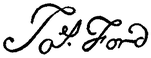
did the presiding officials. Four of these signatures are
here reproduced in facsimile.
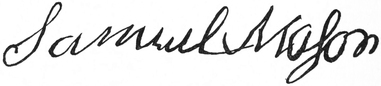
Samuel Mason
In the official document many statements and legal
phrases are often repeated; they add to its length but
throw no new light on the subject. In the following
more or less paraphrased condensation the number of
words is greatly reduced but the substance of the original
is, in the main, retained.
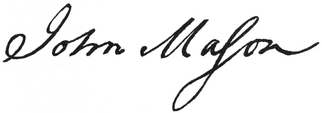
John Mason
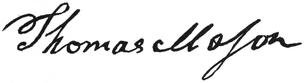
Thomas Mason
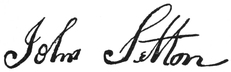
John Setton
The first entry in the old record is dated January 11,
1803. It shows that one Pierre Dapron, a citizen of
New Madrid, appeared in court and made a declaration
before three officials: the Commandant, Don Henri
Peyroux de la Coudreniere, “Captain of the Army,
Civil and Military Commander of the District of New
Madrid;” Don Pierre Antoine LaForge, “Commissioner
of Police and Officer of the Militia,” and Don
Joseph Charpentier, “Interpreter for His Majesty in
the English Language.” Dapron explained to these
officials that he had returned from Little Prairie and
considered it his duty to declare that Ignace Belan had
informed him that on his way to New Orleans with a
cargo of salt pork he had seen four persons at Little
Prairie whom he suspected of being members of the
Mason band and although they did not attempt to rob
his boat, he felt their presence should be reported.
George Ruddell, a citizen of Little Prairie, appeared
before the court the same day and “told us by means of
the interpreter that a party of eight men and one woman,”
well armed and mounted, had arrived in town
about two weeks before and had taken possession of an
empty house belonging to an American citizen, Lesieur,
who had not been consulted by them nor had they
shown any passports. In the meantime, they rented a
ten-acre tract from John Ruddell and bought a cow and
sundry provisions. Among other things that aroused
the suspicion of the neighborhood was the careful manner
in which the house was guarded by the occupants.
Ruddell expressed the opinion that if this was not the
Mason band, then it was probably a part, explaining
that “since the Governor of Natchez had the militia on
the lookout for these robbers, the original crowd may
have separated into smaller groups.” He was inclined
to think that although the man called “father” was not
the exact size of Samuel Mason, whom he had seen
some years before, he nevertheless felt confident that
“father” Mason was among the members of this gang.
He concluded his declaration by stating that he was acting
in behalf of the citizens of Little Prairie who suggested
that these suspects be arrested and their effects
examined.
The next day, “in view of the above cited declarations,”
the Commandant ordered four persons, Joseph
Charpentier, LaForge, George Ruddell, and Don Robert
McCoy, “Captain of the Militia,” to proceed to
Little Prairie—a distance of about thirty miles—and
there meet a division of regulars commanded by Corporal
Felipo Canot, who had been ordered to the scene.
Upon their arrival at the place further investigation
convinced the officers that the new suspects were Samuel
Mason and some of his followers, and that about half
the number had left the Lesieur house and moved over
to a house owned by Francois Langlois. Realizing that
the pursuing party would soon be scented by the suspects,
it was decided to invade the two houses early in
the morning.
At six o’clock in the morning George Ruddell informed
Captain McCoy that the Masons had their
horses saddled and loaded with baggage and were on
the point of leaving for New Madrid, but Samuel Mason,
known as “Father Mason,” hearing that the interpreter
was in town, expressed a desire to see him and
explain that he wished to go to New Madrid to “justify
himself” and clear himself of the crimes of which he
was “falsely accused.” Captain McCoy, George Ruddell,
and the interpreter walked to the house occupied
by Samuel Mason and suggested to him that, in view
of his intention to volunteer a justification, he and those
of his people with him would do well to go over to the
house occupied by his other associates where he would
be given a hearing and could make explanations which
would be forwarded to the Commandant at New Madrid.
To this Mason consented and by eight o’clock his
party, consisting of six men, one woman, and three children,
was assembled in the Lesieur house which, unsuspected
by the Masons, was guarded by concealed militia.
Samuel Mason, turning to Captain McCoy, immediately
referred to the “unjust imputations” made
against him and his people. The Captain expressed the
opinion that his explanation and justification had better
be made in person to the Commandant. A signal was
given by Captain McCoy, and before the Masons realized
it, they were “in handcuffs and chains.”
Then, in the words of the clerk, “We immediately
asked said prisoners their names and the father or oldest
gave his as Samuel Mason;” those of his four sons, in
order of age, were given as Thomas, John, Samuel
Jr. (about eighteen years of age) and Magnus Mason
(about sixteen years of age). Another man called himself
John Taylor (later in the trial known as John Setton).
The woman had three children with her and gave
her name as Marguerite Douglas, wife of John Mason.
Upon being questioned by McCoy and Charpentier,
Samuel Mason answered that they had come from Nogales
(Vicksburg) and intended to establish themselves
in or near Little Prairie, in accordance with a passport
given him. When asked to produce a passport issued
“by the authorities of the locality from whence he
came,” it was discovered he had “none other than the
one we ourselves had given, dated New Madrid, March
29th, 1800.” This he surrendered to Captain McCoy,
who agreed with the other officials present that it was
genuine.
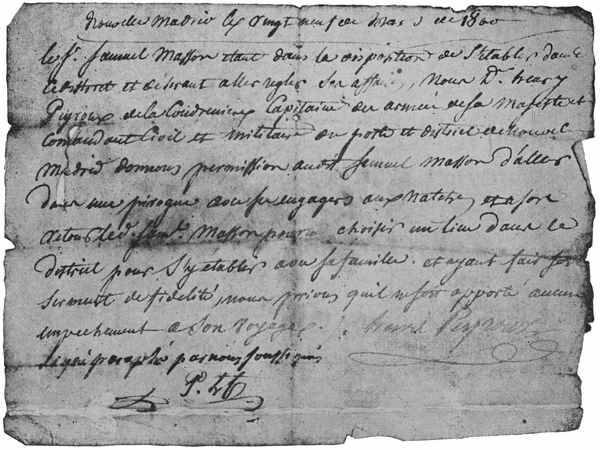
Facsimile of Passport issued to Samuel Mason
Written in French and issued by the Spanish Commandant of the District of New Madrid,
March 29, 1800
The original passport was inserted between two
leaves of the record book where it has ever since remained.
The following is a translation:
“New Madrid, March 29th, 1800.
“Whereas Samuel Masson, Esqr. has expressed a
wish to settle in this district and wishes to arrange his
business affairs, We, Don Henri Peyroux de la Coundreniere,
Captain of the Armies of His Majesty, Civil
and Military Commander of this Post and District of
New Madrid, hereby grant permission to said Samuel
Masson to proceed to Natchez per boat, and on his
return from there, said Samuel Masson may select a
suitable place in this District for himself and family.
He, Samuel Masson, having by oath attested his loyalty
and fidelity to us, we pray that no hindrance be
placed to his proposed journey.
“Henri Peyroux
“Approved and marked with the flourish of our signature.”
“We told them,” continues the record, “in order that
none of their effects be lost or strayed an inventory of
same would be made at once ... and at two o’clock in
the afternoon we proceeded with the above-named inventory.”
This work required almost two days. Every
item was carefully examined and tabulated. There
were eight horses, new and old clothes, many yards of
silk, muslin and cotton, old and new pistols and guns,
“a field stove,” a box of salt, three horns of powder, six
barrels of flour, English cutlery, various other imported
goods and more than a hundred other items,
and seven thousand dollars in United States money of
various denominations, of which the series number and
amount of each was noted.
The following morning, while the inventory was
being made, Samuel Mason, on behalf of his people,
applied for the return of certain utensils and clothing
of which his people had immediate need, and asked for
“a pro and con settlement” with the citizens of Little
Prairie. These requests were granted. On the 16th,
the prisoners, with their property and a military guard,
arrived at New Madrid. How they were transported
is not stated.
The trial began the morning of the 17th. “The Commandant
having learned of the conversation Captain
McCoy and Charpentier had with the prisoners, called
on these two officers to make declarations.”
Captain McCoy, after taking the oath, declared that
his duties as captain of the militia threw him in the
presence of Samuel Mason much of the time after the
arrest, and that the prisoner frequently spoke to him of
the coming trial. Mason, continued the witness, repeatedly
asserted that he had never done any wrong on
the Spanish side of the Mississippi River, and that if
time were given him he could and would, in justice to
himself, disclose many criminals. On one occasion
Mason asked “if a man became informer, with proofs
and evidence of crimes committed in the States, could
he obtain pardon for those attributed to him?” McCoy
casually answered him that if he could give such information
it would, in all probability, clear up matters
and greatly help him and his people.
Mason stated to Captain McCoy that although it
was widely rumored that he was “the man smeared
over with black,” who had committed many crimes
“along the highway,” he could in each instance prove
that he was far from the scene when the robberies occurred.
He denied that he was implicated in the highway
robbery or the boat robbery of a man named Baker,
from whom “some three thousand piasters” were
taken. But when he, Captain McCoy, remarked that
Baker would appear in a few days, “the prisoner
seemed disturbed and asked for particulars relative to
his coming.”
Captain McCoy further declared that while the inventory
was being taken he asked Mason how he happened
to have so many banknotes and the old man who
usually stood as spokesman for his crowd, first seemed
startled and then pretended not to understand the question.
The question was repeated and the prisoners
stared at each other for a moment, when John Taylor
(alias John Setton) came to the rescue by saying: “The
banknotes were found in a bag hanging in a bush, near
the road where we happened to be camping.”26
Don Joseph Charpentier was next called upon to
make a declaration. The record shows that his statements
were practically the same as those made by Captain
McCoy, but touched on a few additional subjects.
He had heard Samuel Mason say that the only thing
for which he could be reproached was having served in
prison for debt. Mason, he said, asked him and some
of the other officers whether or not they thought the
money found in his possession was genuine and all answered,
in effect, that they presumed Mason knew. To
this the prisoner replied that he had made no attempt
to pass any of the bills and that if they were counterfeit,
he could not be punished for carrying them. He
wanted to know by whose authority he was arrested,
and whether it was likely he would be turned over to
the Americans. He stated he would rather be deprived
of all his property and pass the remainder of his days
on Spanish soil than be delivered into the hands of the
United States officials.
On January 18th Samuel Mason appeared before
the Commandant, the Commissioner of Police, the Captain
of Militia, and the Interpreter. Answering questions,
he stated that he was born in Pennsylvania and
had lately come from the District of Natchez for the
purpose of residing near New Madrid. As to how he
made a living he swore he had depended upon his plantation,
his “horned cattle,” the labor of his sons and the
people he sometimes employed. He explained that his
plan was to have his four sons then with him, his wife,
his son living on the river Monongahela, Mrs. Thompson
(a married daughter) and her husband, another
son-in-law, and a few other kinsmen join him in the
settlement he proposed to establish. He said that he
had recently sold his place near Natchez and the only
claim he had on land was located on the Monongahela,
to which he had fallen heir through a “brother who
died young.”
When asked why he had not made use of the passport
the year it was issued to him, he asserted that he had
been kept busy settling his business affairs. He added
that he had spent much time in the District of Natchez
trying to show that the suspicion held against him of
being a robber was groundless, but notwithstanding
earnest efforts his attempts were in vain.
His attention was called to the fact that since his passport
as a settler’s permit had expired, he would be
obliged to give new references. He then gave the name
of his daughter, Mrs. Thompson, of Cape Girardeau,
whose first husband was Mr. Winterington, and General
Benjamin Harrison, whose sister married his,
Samuel Mason’s, brother, the owner of a kiln on the
Monongahela. He was requested to cite, if he could,
some local people, and he referred to Dr. Richard Jones
Waters, saying he was the man on whose recommendation
he had received the passport three years before, but
admitted that he had known the gentleman only slightly.
Mason’s answers show that he knew more or less
about the robberies that had been referred to, but in
each case he managed to explain how and from whom
he received the information. For example, when the
Owsley boat robbery, in which he said Phillips was implicated,
was under discussion, he stated that in May,
1802, two of his sons were coming up the Mississippi
River and were overtaken by two men, Wiguens and
John Taylor, in a boat, from whom they heard of the
robbery. Later, he met Owsley, the owner of the boat,
who requested him to investigate the case. This he did,
with some assistance by a Mr. Koiret, and in consequence
he knew where the booty had been stored and
learned many other details.
He more than once asserted he would throw light on
a number of robberies, and not only give the names of
the guilty parties, but would produce them, “if the
Commandant assured him he would spare his life and
exonerate him of all misdeeds which rumor had so unjustly
attributed to him.” The Commandant replied
that “it is customary to spare the lives of such confessors
and to show great leniency toward them.” After a
somewhat pathetic recital before the officials of how his
many efforts ended in failure to “justify” himself, and
evidently feeling confident he had impressed the Commandant
as an innocent man, and to show that he could
produce a guilty man, he informed the court that one of
his fellow-prisoners, John Taylor, alias John Setton,
alias Wells—“and sometimes going by other names he,
Mason, could not recall”—as one of the guilty parties.
That prisoner, Mason insinuated, could give much information
regarding the robbing of Owsley’s boat and
other robberies, for he knew John Taylor was implicated
in them.
John Setton, the man of various aliases, was brought
before the Commandant to testify. He admitted that
he had changed his name to John Taylor, but explained
that he did so because Samuel Mason demanded it, and
that he suspected Mason had some specific purpose in
insisting upon the name of John Taylor. He also admitted
(and probably in a triumphant way) that Samuel
Mason was correct in his statement that he, “one
of Mason’s fellow prisoners, could give much information
regarding robberies.” He said that he had been
with the Masons since May 14, 1802—eight months.
He swore he was an Irishman and had come to
America in 1797, and shortly thereafter enrolled in
Major Geyon’s corps but “deserted near the high
coast.” Reaching Nogales (Vicksburg) he “worked
for three weeks for His Majesty the King of Spain,”
and then went down the river in the “row-gally Louisiana”
to New Orleans where, during the winter, he
found occupation as a carpenter. After this, for a
period of about two years, he shifted around in Spanish
territory, either working with white people or “hunting
with Chaquetaw Indians.” One day while in Arkansas
an American officer recognized him as a deserter from
the army and asked for his delivery to a Spanish post.
He was delivered into the hands of the American
authorities and placed in jail. There he met Wiguens,
an American soldier, and a month later both escaped.
They went back to Arkansas and were shortly afterwards
arrested by the Commander of the Arkansas
Post, who considered them suspicious characters and
kept them in jail twenty-eight days. They then found
farm employment for a month with a man named Gibson,
who obtained for them a passport to go hunting on
White River. They hunted until May, 1802, when they
came down the river some distance in a boat and then
crossed over the country to “Little Prairie of the St.
Francis River,” where they sold their skins to one Fulsom.
They continued their trip, for he, Setton, “wished
to join his family in Pennsylvania.” When “at the
crossing of the Chaquetaws below the river Ares,” they
met, by chance, John and Thomas Mason, Gibson, and
Wilson, and he had been with the Masons ever since.
The Commandant asked Setton whether or not he
was acquainted with “the man Harpe” and he answered
that he had met a man by that name in Cumberland
who had since been killed, but had left a brother, whose
whereabouts was unknown to him. Setton further
stated, upon being questioned, that he did not know
whether or not Harpe and any of the Masons ever had
any dealings together or had ever met, but he felt confident
that Harpe had not been around since he had had
the misfortune to fall into Mason’s hands.27
Setton, continuing his account, swore that John and
Thomas Mason took possession of all his belongings,
and encouraged him to stay by promising him land on
to which he could later move his family and by giving
him a contract “to go after Mother Mason,” who apparently
had some time before refused to live any
longer with her outlaw husband and sons. Setton declared
that from the very day he met the Masons they
had kept him like a prisoner. The promised land had
never materialized and the trip for their mother was
never attempted, but he was obliged to linger with them
because he found no opportunity to escape, and the
Masons never allowed him more than two rounds of
powder at a time.
He asserted that since he had been with the Masons
they had committed no crimes in his presence. They
did not demand that he steal horses, but apparently
expected him to do so. A number of horses had been
brought in and taken away, but he asked no questions
and as he heard no comments made regarding them, he
had no idea how they came or where they went. He
knew, however, that there was an agreement between
the Masons and one Burton, of Little Bay Prairie, who
bought at twenty dollars all the horses the Masons
could supply, provided the animals were such that they
could be sold for about sixty dollars.
The Masons occasionally left home “to repair a chimney”
and if they remained a few days they invariably
accounted for their prolonged absence by saying they
“could not cross the water,” “lost their repairing tools,”
“were hindered by bad weather,” or “visited friends,”
but in no instance had they given the name of the friend
they claimed to have seen.
Setton related that when he and the Masons were in
Nogales, at the residence of Charles Colin, a Mr. Koiret,
an American citizen, chanced to stop in the house.
Koiret impressed the Masons as a prospective victim,
and he (Setton) being permitted to chat freely with
Koiret, soon proved himself “an interesting conversationalist.”
But when Koiret incidentally remarked that
he was simply passing by on his way looking for outlaws
who had committed crimes along the Natchez
Trace and the Mississippi River, John Mason, on a
pretext, lured him (Setton) away from the officer, and,
in the meantime, other Masons tactfully managed to
“speed the parting guest.” Turning a corner of the
house, he (Setton) unexpectedly ran into Samuel Mason,
who, with drawn dagger, commanded “silence.”
John Mason seized him and the father and son immediately
gagged him, bound his hands and feet, and
dragged him into the house where they held him down
on the floor for about three hours. Feeling that Koiret
had got far beyond hearing distance, they ungagged
and untied him, but continued to guard him closely
until the next day.
Setton swore that shortly after he had received this
brutal treatment Samuel Mason prepared a written
statement in which he, under the assumed name of John
Taylor, made a declaration that he, Phillips, Fulsom,
Gibson, Wiguens, Bassett, and others were implicated
in one or more of three robberies—the Baker, the Owsley,
and the Campbell and Glass robberies—and in it
further declared that the Masons were in no way connected
with any of these depredations.
After the statement had been prepared the Masons
explained to him that they were going to conduct him
to a justice of the peace and they furthermore convinced
him that should he fail to swear to this written confession
and declaration of the three robberies, they would
kill him before he had a chance to inform the officers
that the statements were false and not his own. He
related how John and Thomas Mason, armed with
guns, and Samuel Mason, who bore no weapon at all,
forced him to the residence of William Downs, a justice
living below Vicksburg, and that, with seeming calmness,
he went through the form required by the law and
the outlaws. He realized that while he and Samuel
Mason were in the house, the two sons were outside in
hiding, prepared to shoot him should the prearranged
signal be given.
The first of the three robberies detailed in the false
affidavit, continued Setton, was the robbery of Baker
on the Natchez Trace, from whom the Masons took
“twenty-five hundred piasters in gold, silver and banknotes.”
For this John Mason had been imprisoned,
but by the aid of his brother Thomas and others, made
his escape. The object of the confession was to show
that he (as John Taylor) and others were the guilty
men and that Mason was absolutely innocent of the
crime. Notwithstanding his purported statement, he
could prove an alibi, for ten days before the robbery
took place, he had been committed to the Arkansas
prison. He suspected that part of the money found
on the Masons by the officials who arrested them was
a part of the booty obtained in the Baker robbery. The
explanation that the money they had was found “in a
bag hanging on a bush near the road” was suggested by
Samuel Mason a few hours before the arrest, saying
at the time, “accounting for it in that way won’t do any
harm.”
“The second crime,” resumed Setton, “was the one
committed on the Mississippi at the crossing of the
Chaquetaws below the river Ares,” where the Masons
robbed a merchant boat belonging to Owsley. The
Masons tried to show that he and Phillips took the lead
in this affair. He swore he was not connected with the
robbery and stated that he understood Phillips had
done nothing more than purchase two guns from the
boatman and was in no way involved with the men who
later bought all the guns that were on the boat, and,
with the newly purchased guns attacked the boat and
robbed it.
The third robbery Mason wished to throw upon the
shoulders of Phillips and others by inserting it in the
false affidavit, was the one that occurred on “the road
from Kentucky to Natchez,” in which Campbell and
Glass were deprived of several horses, saddles, and
some money. Near the site of this robbery there later
was discovered a sign on a tree, reading “Done by Mason
of the Woods.” The Commandant asked Setton
whether or not he thought Mason was guilty of this
hold-up and he answered that he did not know but, in
his opinion, the stratagem fitted Mason, who, if guilty,
could cite it as an instance of the “workings of his enemies”
and would be prepared to prove “that he was elsewhere
when the robbery occurred.” Anthony Glass, the
witness thought, was a party to the deception, for he had
been a poor man in Nogales until he came in contact
with the Masons.
On one occasion Mason proposed to Setton that they
capture a certain store boat, drown the owner, rob the
boat, and then sell the goods to Glass, who would pay
cash for half its actual value and never betray them.
He asserted that he refused to participate in the proposed
venture, but he suspected that the program was
carried out during one of the “chimney repairing” trips
and that some of the booty could be located by Glass.
He also declared that the pistol the Masons showed
Downs and claimed to be Setton’s had never belonged
to him. It was one the Masons had taken during the
Baker robbery and had originally belonged to Sheriff
William Nicholson, whose initials had been inlaid with
silver thread in the handle but had been removed by
the Masons, who were not aware that he (Setton) saw
them make the change. This very pistol, he said, was
now among the goods the officials had taken possession
of and was the same one that Samuel Mason carried to
Downs, expecting to use it as evidence against him
when the case came to trial.
Setton explained that two of the saddle bags now in
possession of the Masons were originally tan “and had
large tacks fastened at their corners” and that the tacks
were broken off by Samuel Mason and the leather
dyed black. He also stated that the original color of
the trunk they had was red and had been blackened in
his presence by Thomas and John Mason.
Setton, in his comments on the Mason family, remarked
that every member treated him equally bad,
except Thomas, who at times seemed somewhat human.
From the conversations of the Masons he inferred that
“the father had been a thief and a rascal for more than
forty years.” On one occasion, Samuel Mason, “after
taking three measures,” boasted to him that he was “one
of the boldest soldiers in the Revolutionary War” and
that “there was no greater robber and no better capturer
of negroes and horses than himself.”
On another occasion, after he began to feel his liquor,
he pointed with pride to the fact that he had two partners,
Barret and Brown, who did some killing as a side
line and always shared the spoils with him in consideration
of the advice and powder he furnished them.
Setton also stated that Mason had related to him that
when Mason’s eldest daughter was married, he had
arranged with Barret, Brown, and others to steal as
many of the horses of the guests as they could while the
guests were feasting at the bridal celebration, and that
when the discovery of the theft became known, no man
displayed more eagerness to pursue the horse thieves
than Samuel Mason himself. A few days later some
of the men who had taken the horses were captured and
accused Mason of being the promoter of the theft, but
because of the absurdity of the accusation Mason experienced
no difficulty in proving his “innocence.”
In his comments on John Mason’s wife, Setton said
more than once she pretended to be sick and requested
her husband to send for Dr. Wales, whom she knew
well, but it was his opinion that the woman simply
wished “to chat with the physician” and also “to force
the family cooking upon some one else.”
Setton cited another instance of Mrs. John Mason’s
nature. He related that one day in his presence and
in the presence of two or three of the Masons, Barret,
who had lately shown signs of being dissatisfied with
the treatment he received, declared he would denounce
the whole family. Mrs. Mason, hearing this, immediately
jumped up in a rage, knocked Barret’s hat off his
head and shouted: “Monster, you are not going to denounce
me or any of us!” She was about to plunge a
long knife into Barret’s heart, when Thomas interfered,
saying: “It is better to part as friends than to part after
a fight,” and peace was restored.
After Setton’s testimony had been heard, the Commandant
on the following day, January 20, ordered
Samuel Mason to appear again. Mason admitted that
he had, in a way, detained Setton, but did so in justice
to himself and his sons. The Owsley boat, he swore in
his explanation, had been robbed in April, 1802, and
immediately thereafter the rumor had become current
that the Masons were the guilty men. Mason declared
that Owsley did not know by whom he and his five boatmen
had been robbed, but in recounting the affair Owsley
referred to two incidents which in themselves were
sufficient to distinguish this robbery from any other.
The first was that after the boat had been plundered,
one of the three robbers returned five dollars to one of
Owsley’s boatmen who had been seriously wounded
during the short battle that took place before the boat
was captured. The other incident was that after the
robbery the outlaws placed a sign on a tree, reading,
“Done by Samuel Mason of the Woods.” John and
Thomas had heard this account a number of times and
every version had it that Samuel Mason was accused
of the work.
When his two sons first met Setton and Wiguens, who
were strangers to them, Setton told them the details of
the Owsley robbery, including these two incidents, and
a few hours later, after the brothers had made a more
favorable impression, Setton confided in them, saying
he and Wiguens and also Gibson were among the perpetrators
of the robbery. John and Thomas Mason,
then recognizing in the two men the outlaws who had
committed at least one of the robberies of which their
father was being accused, decided to entice Setton and
Wiguens to join them and in the meantime seek an opportunity
to force them into a public declaration of
their guilt and thus vindicate the Mason family. They
succeeded in detaining Setton, admitted Samuel Mason,
but Wiguens escaped.
Samuel Mason, in his comments on the Baker boat
robbery, stated that a few days after the boat had been
pillaged, Colonel Baker and a number of other men
came to the Mason home near Natchez. The moment
Baker saw John he ordered his arrest, saying, “I could
pick him out of a thousand.” The father proceeded to
explain to the Commandant that Baker’s mistake could
be easily explained, as John Mason and Wiguens resembled
each other very much, and added that shortly
after Wiguens and Setton first met his two sons, Wiguens
told John confidentially that he, Setton, Bassett,
Gibson, Fulsom, Phillips, and others were in the Baker
robbery.
Going into details, Mason explained that, according
to Setton’s version, Bassett, Fulsom and Phillips were
the men who bought for cash all the guns Baker had on
hand and left the boatmen under the impression that
these arms were to be used in a search for the Mason
gang. Setton then told him confidentially that he and
the other members of their band, by prearrangement,
appeared shortly thereafter and robbed Baker of all his
money and as much of the goods as they could carry.
Fulsom, in order to inspire courage in the raiders,
assured them they need not fear any pursuing party
which Baker might organize, for he (Fulsom) could on
very short notice, muster and command five hundred
Chacquetaw Indians who would easily annihilate the
revenge-seeking Baker. Setton, in concluding his account
to the Masons, laughingly remarked that it was
strange that two men looking so much alike should be
“involved” in the same robbery, and that the guilty man
should not be suspected and the innocent one be accused.
Shortly after this Wiguens suddenly disappeared, very
much to the disappointment of the Masons, who now
realized the necessity of guarding Setton more closely.
Samuel Mason (digressing to another Baker robbery)
asserted that after Baker had been robbed on the
Natchez Trace, Baker and the officers came to arrest
John. John submitted immediately, feeling confident
that his innocence would be speedily proven. He could
have vindicated himself had not some of Bassett’s
friends refused to declare that they saw John many
miles from the scene of the robbery when it occurred.
After he had been in prison about two months “he was
liberated by men who did not make themselves known
to him.”
The Baker highway robbery having taken place on
the American side and the Owsley robbery on the
Spanish side, John, fearing he would be arrested on
either side of the river, took his family and hid in the
woods for a number of weeks. He hoped that in the
meantime his innocence would become established by
the guilty parties being brought to justice. But, instead,
suspicion against him and against the entire
Mason family grew stronger day by day.
Samuel Mason admitted that he had brought John
Setton before a magistrate. He further stated that a
number of things found in their possession the day of
the arrest in Little Prairie were taken by them from
Setton and held as evidence of his connection with some
of the robberies of which the Masons were accused.
He asserted that after he had urgently requested Setton
to declare his (Setton’s) crime before a magistrate,
and thus, perhaps, receive clemency, “he consented to
do so.” He and Setton then went “about twelve miles
below Nogales” to the office of William Downs, a magistrate.
Mason carried with him a pistol Setton told
him he had procured as a part of his booty from the
raid on the Owsley boat. William Downs “received
Setton’s confession but was not able to take his oath, as
he had no sheriff on guard with him.” Mason then,
without informing Setton, went in search of Anthony
Glass, who, it was rumored, was part owner of the
Owsley boat, to have him serve as a witness to the
affidavit. Mrs. Glass implored her husband not to act,
for she feared his doing so might lead to the exposure
of her brother, one Bassett, who had participated in
various robberies. Glass, however, pacified his wife by
telling her that since Setton was a deserter any sworn
statement he might make would necessarily be ignored,
and then insisted that he would go to Downs and there
denounce Setton as a deserter and have him placed in
the hands of the military authorities.
When the two men arrived at the magistrate’s house
“they discovered that Setton, suspecting some trickery,
had left.” A few weeks later, Mason swore, Setton
again joined the Masons and had been with them ever
since. After finishing his testimony Mason suggested
that “If Setton told the truth in the testimony he gave in
this trial, our statements must agree.”
The next morning, January 21, John Mason appeared
before the Commandant. The prisoner evidently
did not know the contents of his father’s and
Setton’s testimony, but he undoubtedly had some idea
of how his father intended to answer many questions
should they be asked. Most of his testimony agreed,
in the main, with his father’s. He tried to show the
Commandant that he had long attempted to “vindicate”
and “establish” himself and to live “a decent life.” He
said he had escaped from prison because he realized
that the defense of his name required his personal attention.
He swore that practically all he knew about the
various robberies regarding which he was questioned,
was through reports he had heard from John Setton,
alias John Taylor alias Wells, and from Druck Smith,
alias Smith Gibson. He insisted he had never seen
Phillips, Fulsom, and the other Gibson referred to.
The question of how the Masons came into possession
of the eight horses had not been asked before. John
Mason accounted for each by giving the details of a
purchase or trade. He was asked why “he pursued the
two Frenchmen in a boat until they had reached a safe
harbor.” His explanation was that he, Thomas, and
Setton were on the river and followed these men, suspecting
them to be robbers involved in some of the
acts of which the Masons were accused. He hoped that
if they were he would succeed in having them verify
Setton’s declaration of his own guilt. When the two
men reached Nogales his boat was on the point of overtaking
them. He then discovered that they were French
officials and the pursuit was dropped without giving the
men any reasons for the chase.
He swore that most of the notes and paper money
found in their possession belonged to Setton, who
claimed he had “found it in a bag hanging on a bush
near the road,” and who on one occasion remarked
that since then he had more money than he could use.
John Mason added that this statement convinced him
that Setton had stolen the money.
The record of this sworn statement made by John
Mason is abruptly followed by “And the prisoner being
asked by the interpreter whether he had anything further
to say or anything to unsay, he answered ‘No,’ but
requested, as his father had done before him, that we do
not hand him over to the United States Government,
and after his declaration was read to him, he persisted
that it was true.”
Thomas Mason followed his brother John and, like
him, gave evidence that agreed, in the main, with his
father’s. He swore his occupation was “farming and
harvesting” and “bringing down flour and whiskey” in
boats. He admitted that he had heard of the Baker and
Owsley robberies but claimed he knew none of the details
except those told to him by Setton, and these he
repeated.
When he was asked about Setton’s appearance before
the magistrate, he answered that he had accompanied
him to Downs’ but did not force him to make an affidavit.
He added that John Mason had received a message
from the Governor of Natchez to the effect that if
he produced a witness who would turn state’s evidence
it would “tend to clear him of his guilt;” hence, their
anxiety to have Setton make a declaration.
After hearing Thomas Mason’s version of the subjects
that had been discussed by the preceding witnesses,
the Commandant, who evidently had been informed
that day that the Masons had also maneuvered further
north, asked him whether or not he knew a man named
Mosique and the two Duff brothers while in Illinois.
He answered he had heard of them and understood that
one of the brothers had been killed by Indians. His
answers to other questions were to the effect that he
knew nothing of the robbing of a negro in St. Louis, of
a man named Lecompte, and of a stolen negro woman
who had been sold to a priest named Manuel. The officer
then asked him whether or not he was aware that
the Masons were accused of these crimes, “but the witness
continued to profess he had never heard of them.”
The fifth prisoner was Marguerite Douglas, wife of
John Mason. She swore she had been married eight
years. She answered that to her “keen regret” she had
heard of the robberies of which her husband and the
other Masons were “so falsely accused.” Her knowledge
of these acts, she swore, was based solely on hearsay.
Among other things, she said Setton told her that
robbing the Baker boat proved as easy “as robbing some
old woman.” She also swore she knew nothing about
the paper money found in their possession and could not
account for the money and goods discovered among her
personal belongings other than by suggesting that in
packing up so hurriedly she may have placed some of
Setton’s personal property in her bag.
Samuel Mason Jr., in his testimony stated that he
was eighteen years old and that he had lived with his
parents all the time until about three months previous.
He said his father and brothers had left his mother at
Bayou Pierre—between Natchez and Vicksburg—and
were away for the purpose of establishing a new home,
and that she was now ill and living with her daughter,
Mrs. Philip Briscoe. The Commandant remarked to
him: “You ought to speak the truth for you have a
mother, who, it is reported, is a good and honorable
woman, and you ought not to be mixed up in the wickedness
of your father and brothers, who, it is said, are
guilty of many thefts and robberies.” The answers he
gave to the few questions asked him agreed with those
given by his father.
Magnus Mason, the last of the prisoners, was called
upon January 24. He stated he was about sixteen years
old and was born “in Kentucky on the south side of
Green River.” (The others had claimed Pennsylvania
as their native state.) In answer to questions he stated
that he had lived “part of his time with his father in
Kentucky and part with his mother in Bayou Pierre
near Natchez.” He declared his father had spent practically
all of the past two years away from home trying
“to discover men who were committing the robberies.”28
The next witness was Dr. Richard Jones Waters, the
man on whose recommendation the passport had been
granted to Samuel Mason. Dr. Waters said he first
met Mason in 1791 or 1792 at “Red Banks on the
Ohio,” (now Henderson, Kentucky) which was after
he (Dr. Waters) had settled in New Madrid. He had
been traveling in America and on his return, coming
to the Ohio River, engaged Charles Lafond, a merchant,
and two other men who were on their way to
New Orleans, to take him down as far as New Madrid.
When the boat reached the Falls of the Ohio (Louisville)
Lafond, hearing that he intended to remain there
a few days, asked permission to let the boat proceed to
Red Banks, where Lafond expected to dispose of some
of the goods on board. The permission was granted
on condition that Lafond, without fail, wait for him
there. In due time he (Dr. Waters) reached Red
Banks and then met Samuel Mason for the first time.
Mason claimed that Lafond had gone fishing a few
days before and, in the meantime, started his boat south.
He (Dr. Waters) did not know whether or not Lafond
and his boat ever reached New Orleans, and not until
recently, had he suspected foul play.
A year after this, continued Dr. Waters, he was traveling
down the Ohio River, stopped at Red Banks and,
to his surprise, met Samuel Mason again. Mason
asked him to come to the house to prescribe for Mrs.
Mason who was sick in bed. The doctor complied and
the result was a trade in which Mason bought seventy
dollars worth of medicine and merchandise, paying
forty dollars in meat and giving him a demand note for
thirty dollars on Felic Concer, of New Madrid. But
when he arrived at New Madrid he learned that Concer
had left for parts unknown. In 1798, however,
Mason paid the note. He then saw nothing more of
Mason until March, 1800, when he met him and his
son Thomas and a man by the name of Smith who said
they had come to New Madrid for drugs. They purchased
some medicine from him for Mrs. John Mason
and other members of the family and paid for it with
merchandise which they claimed they had bought from
a store boat. A few days later Samuel Mason called
again, not to buy medicine but to ask his assistance in
procuring a passport for land on Spanish territory.
This he was, at first, unwilling to give, for, although
he knew nothing unfavorable concerning the family,
he was not assured of their character. After the old
man had pleaded with him and declared that although
rumor had done all the Masons great injustice he
would never regret the endorsement of his character, he
procured a passport, giving to the clerk at the time a
history of his acquaintance with Mason. A few days
afterward Thomas Mason informed him that he was
obliged to go to Kentucky to straighten out some business
affairs before he settled on the land that would be
granted them. He entrusted Thomas Mason with
“some valuable papers for delivery at the Falls of the
Ohio.” These papers reached their destination but
much later than Thomas had promised. No explanation
of the delay was offered or demanded.
The record of the proceedings shows that January
26 was devoted by the officials to inspecting the belongings
of the Masons and approximating their value.
The saddles and pistols referred to by Setton were
found as described by him. There was also discovered
some “twenty twists of human hair of different shades
which do not seem to have been cut off voluntarily by
those to whom the hair belonged.” These and a number
of other evidences were laid aside by the inspectors.
The belongings were estimated at about six hundred
dollars in value. The silver and paper money amounted
to seven thousand dollars, much of which, however,
“appears to be counterfeit.”
The next day Francois Derousser, a citizen of New
Madrid, came forward, stating that he had an important
declaration to make concerning the prisoners. He
explained that he was a native of Illinois and that in
1791, when he and his family were coming down the
Ohio River and had reached a point near Red Banks,
where they happened to make a landing, a man—the
one he now recognized among the prisoners as Samuel
Mason—stepped up to him and, pushing a gun against
his stomach, threatened to shoot him if he did not follow.
He was led into a hut, where several persons
were sitting. Immediately after entering, Samuel
Mason shouted: “This is the man who stole my horses
and slaves and sold them to the Indians,” and, looking
around for a rope, Mason seemed to be making preparations
to hang him at once. He finally convinced
Mason that he could not possibly have been guilty of
the thefts.
After keeping him in chains all night, continued
Derousser, Mason permitted him to leave, but while
he was making some repairs on his boat to resume his
trip, Mason came to him and persuaded him to remain
two months and work with the Mason boys. Mason
promised him a certain quantity of linen, calico, and
bed covers for his services and, needing these badly for
his family, he accepted the proposition. At the end of
the specified time the promised goods were given to
him; but three hours after he had received them and
while on his way to his boat, Samuel Mason and a Captain
Bradley overtook him and robbed him of all the
goods. That night he managed to return to his boat
and with the aid of Eustache Peltier succeeded in cutting
the ice from around it. He started down the river,
and after much suffering from cold and hunger he and
his family finally landed at New Madrid, where they
had lived ever since.
Eustache Peltier appeared before the Commandant,
confirmed the declaration made by Derousser, and
added that he had heard that a certain Lafond, “an
European merchant with an emporium of goods in
New Orleans,” had stopped at the Mason’s house near
Red Banks one night about the time he and Derousser
made their escape, but neither the merchant nor the
boat in which he traveled had been heard from since.
Pierre Billeth, another citizen of New Madrid, declared
that he knew some facts bearing on the Masons
and felt it his duty to report them. He related to the
Commandant that during an excursion in August, 1798,
on the Cumberland River, near the mouth, he heard a
negro woman belonging to Samuel Mason tell Rees
Jones and James Downs that her master had forced her
to help dispose of the body of one of his victims. She
declared that Mason after stabbing and robbing the
man had commanded her to help tie a rope around his
neck and drag the body to the Ohio, where they threw
it in to the water. This same woman had been stolen
by Mason and later sold at public auction by Sheriff
James Downs, then of Kaskaskia, to Father Manuel, a
priest, who lived near St. Genevieve.
All the witnesses having been examined, and the
declarations and proclamations heard, the Commandant
January 29, 1803, ordered an itemized account of
the cost of the trial, including the expenses incurred in
making the arrest at Little Prairie. The account rendered
shows that the largest single item was for “the
sergeant and nineteen militiamen for seventeen days’
guard and sentinel watch of prisoners, at one piaster
per day, three hundred and forty piasters.” Twenty-two
men, besides the officers, were employed in making
the arrest and bringing the prisoners to New Madrid,
for which they received one hundred and seventy-six
piasters. Another item reads, “irons and cuffs made
for prisoners, eight piasters.” The total expense is
given as one thousand fifty-three piasters, or about
one thousand dollars.
The last entry is dated January 31, 1803, and, like all
the others, is presented in monotonous legal phraseology.
It ends with the statement that: “We [the Commandant]
hereby direct that the proceedings of this
trial, originally set down in writing on ninety-one sheets
of paper written on both sides, as well as the pieces of
evidence tending to conviction, together with seven
thousand piasters in U. S. banknotes, be forwarded to
the Honorable Governor General by Don Robert McCoy,
Captain of the Militia, whom we have charged to
conduct the prisoners, Mason and consorts, to New
Orleans with the view of their trial being continued
and finished, if it so please the Honorable Governor
General.”
And here ends the record of the preliminary trial of
the Masons. Captain McCoy, having been appointed
to conduct the prisoners to a higher court, made his
preparations and in due time started for New Orleans.