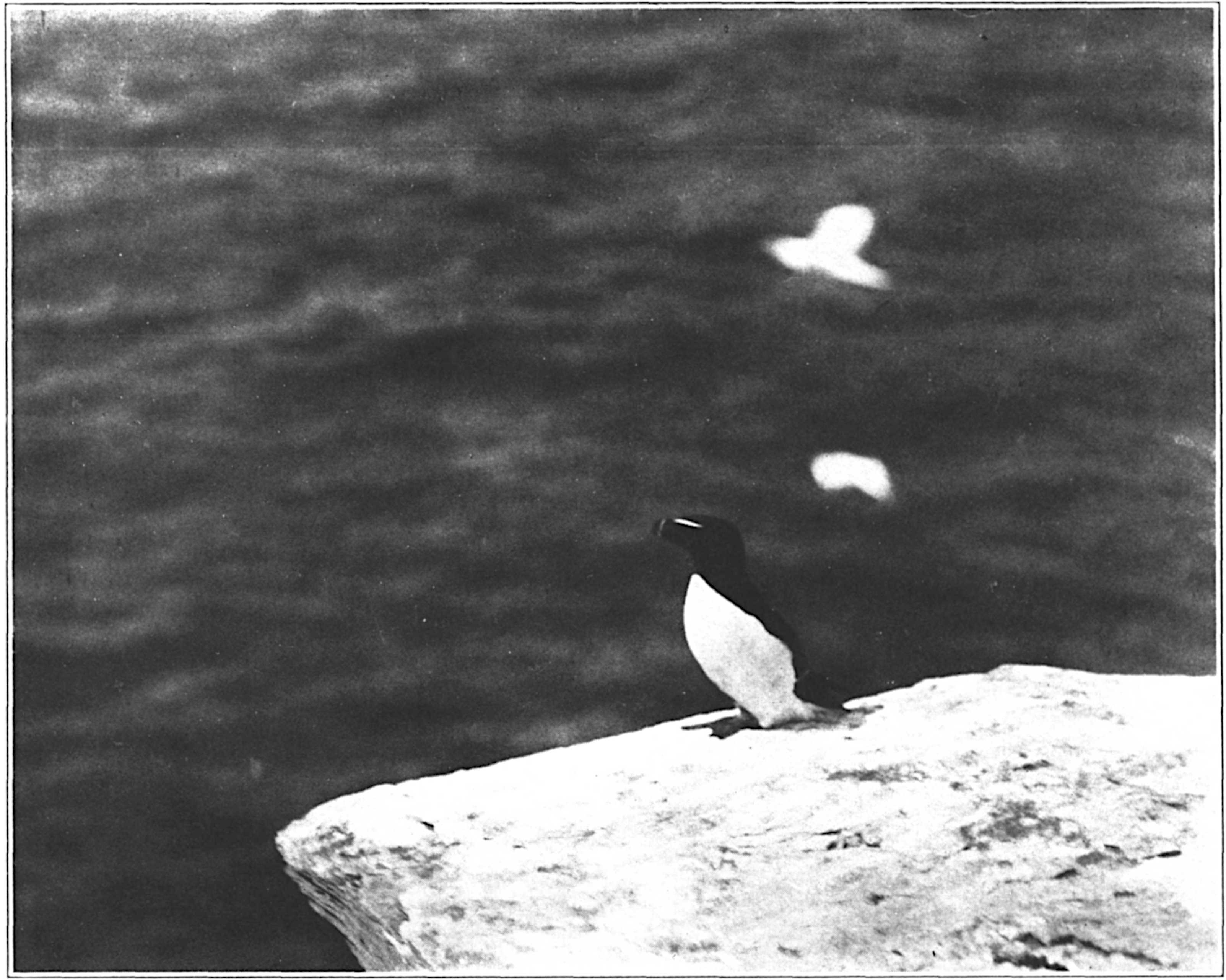
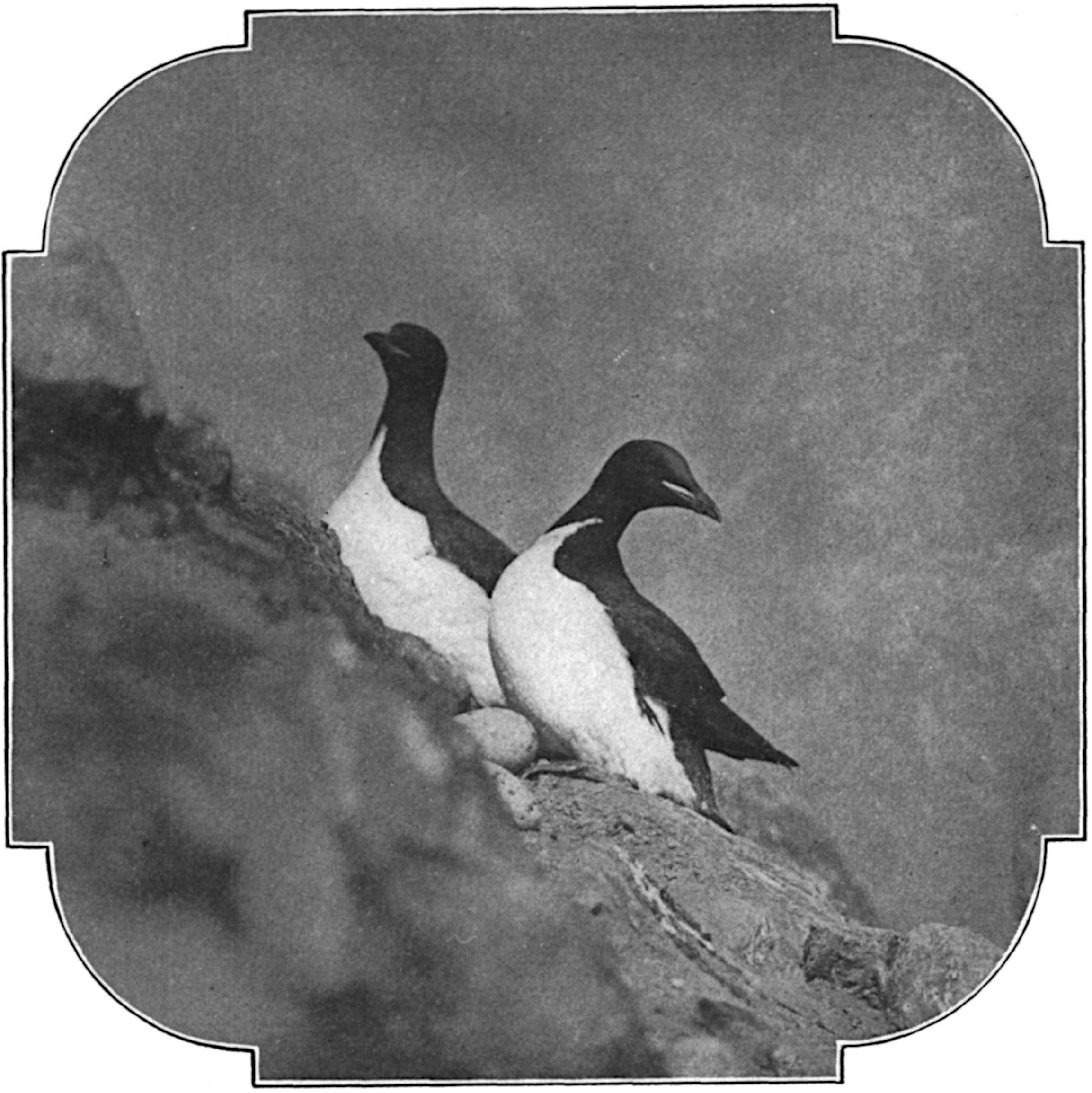
FIRELIGHT FAIRY BOOK
FULL SPEED AHEAD
STARLIGHT WONDER BOOK
THE BOOK OF GALLANT VAGABONDS
THE OUTERMOST HOUSE
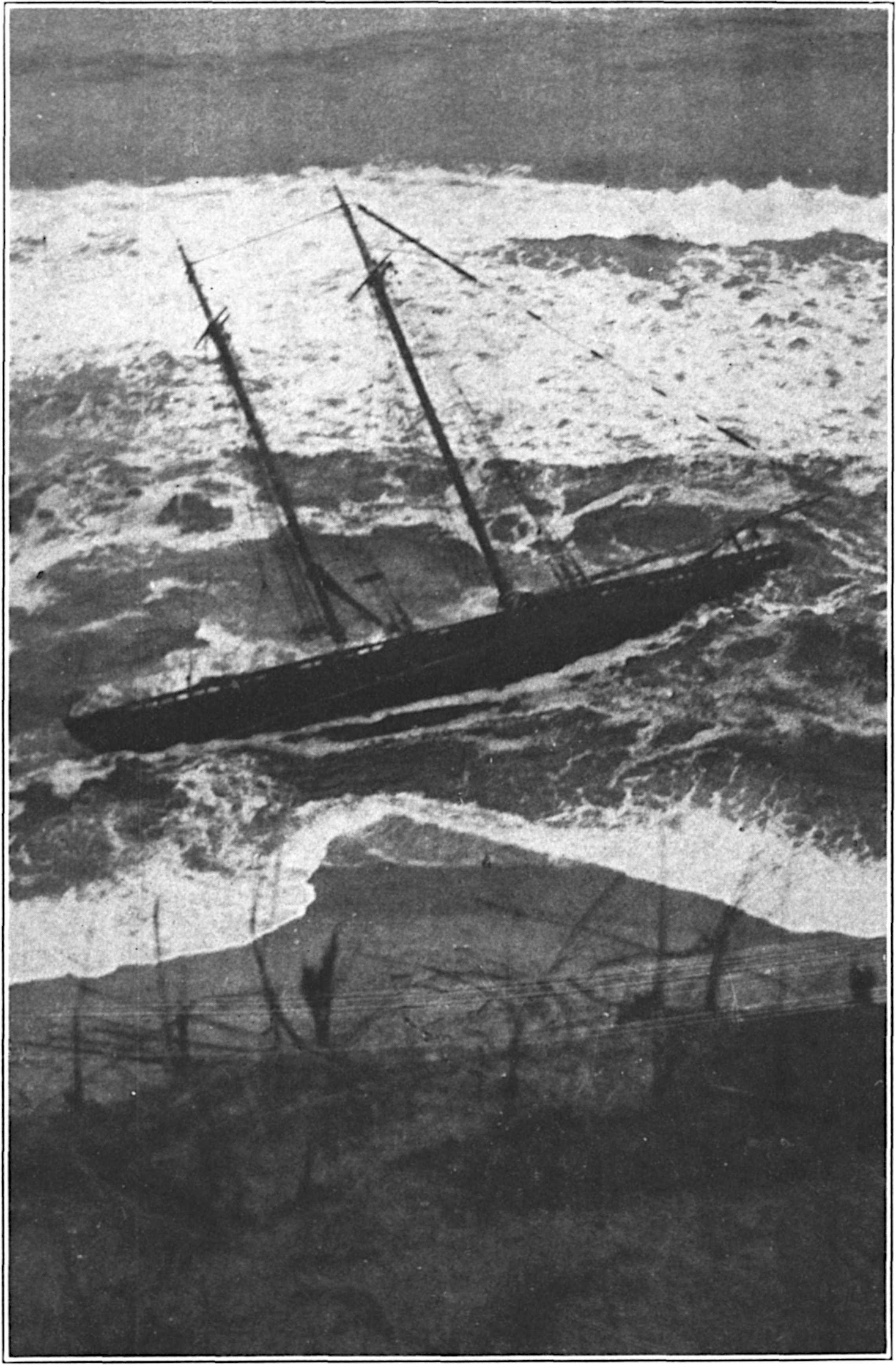
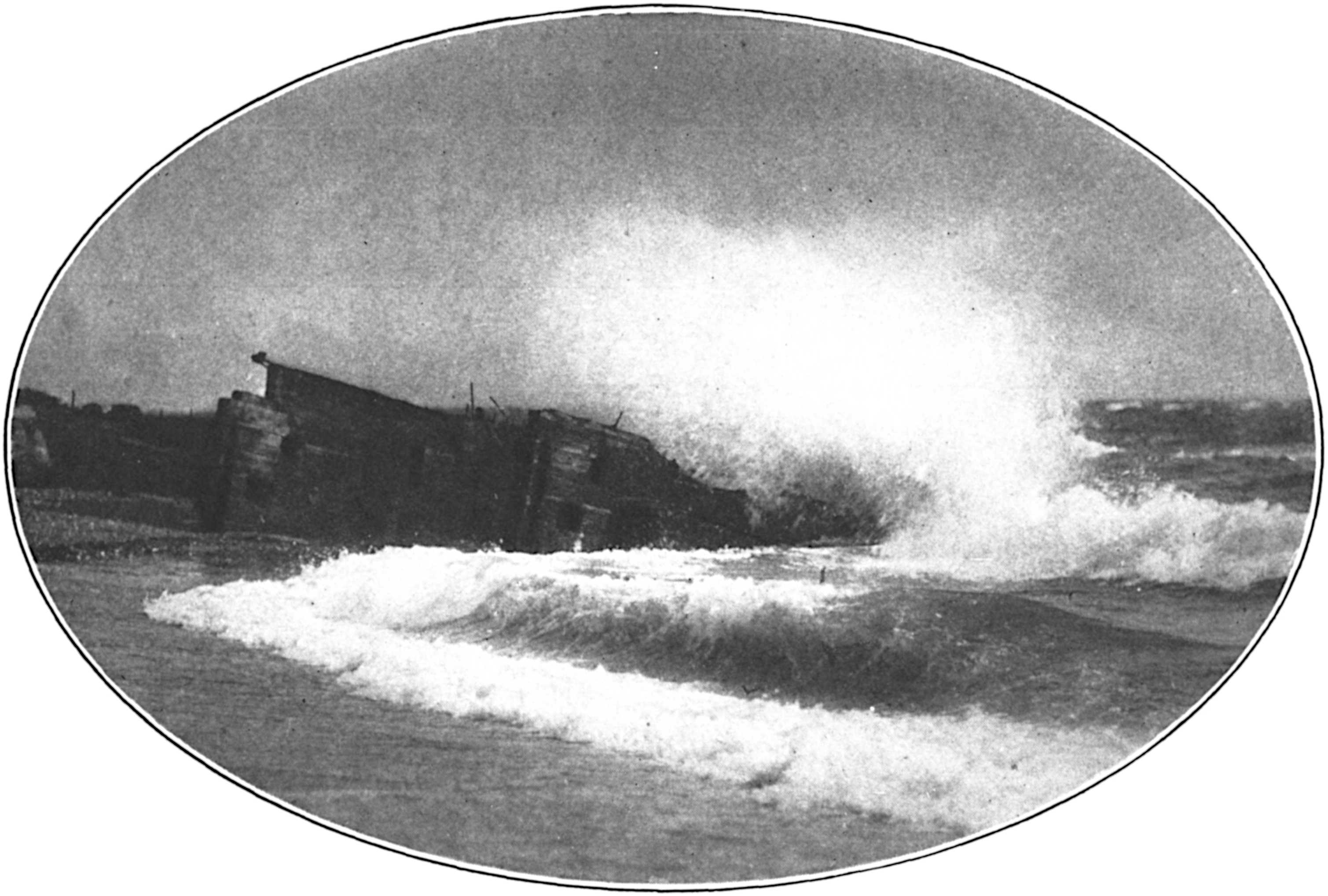
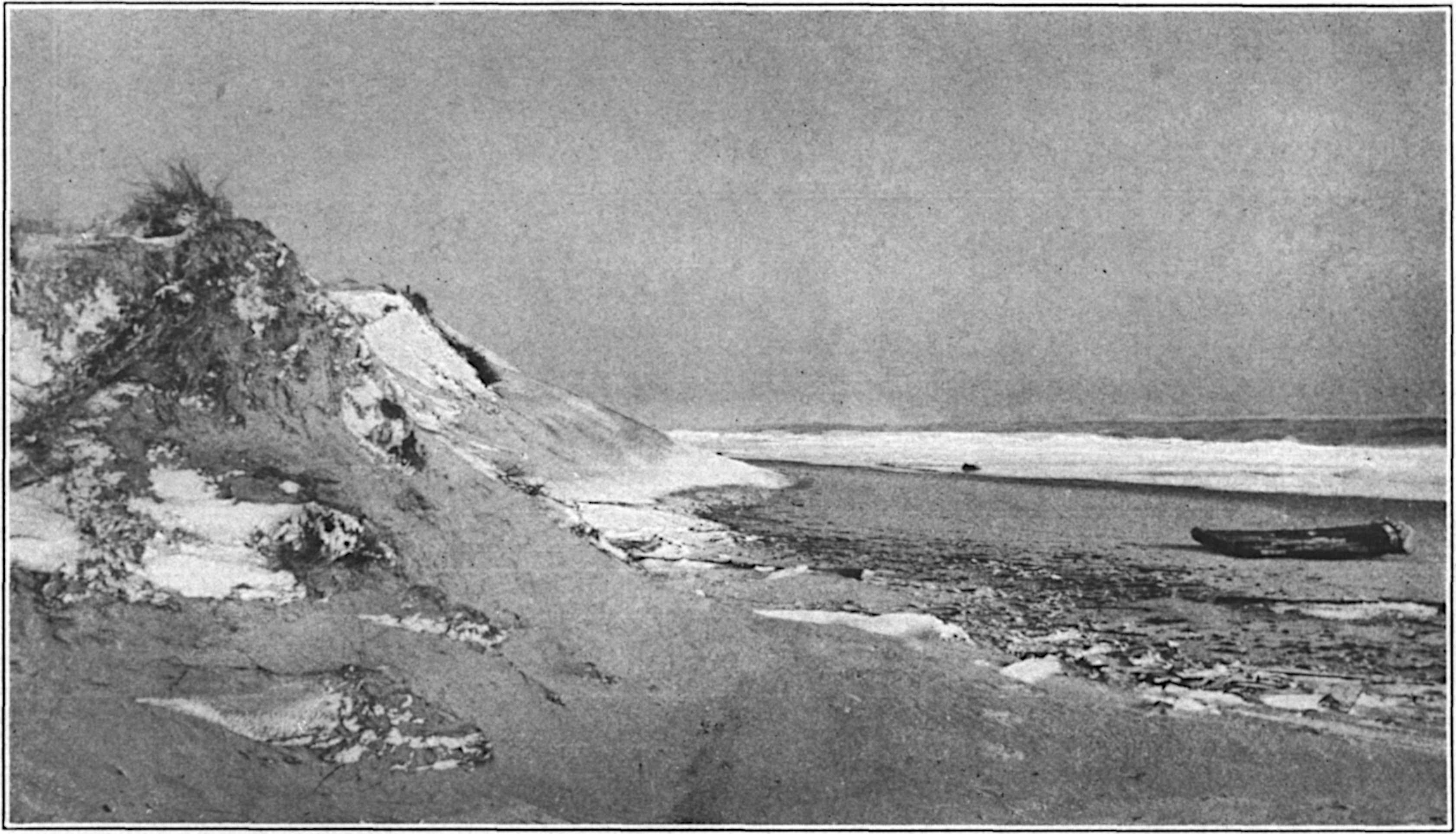
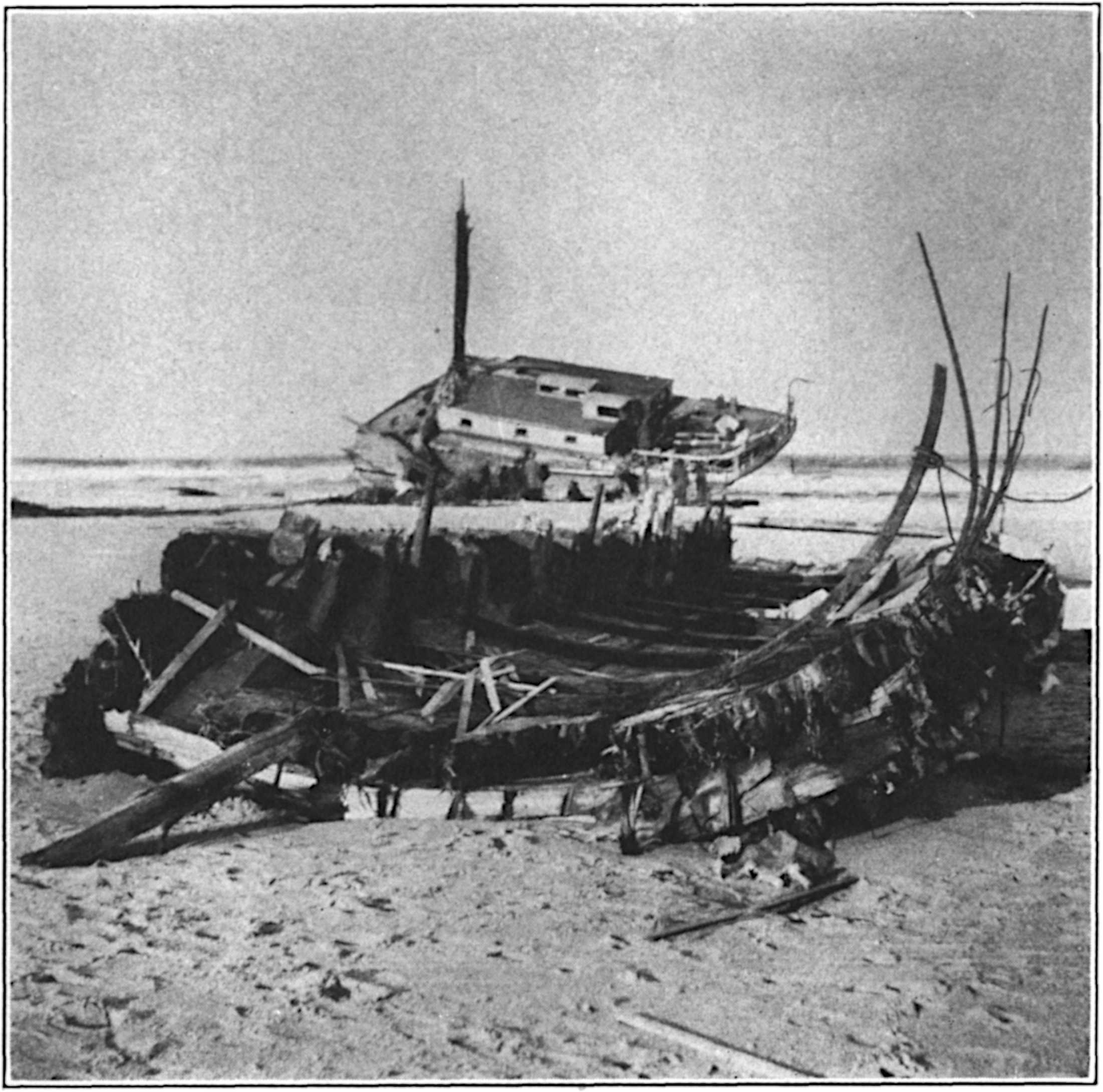
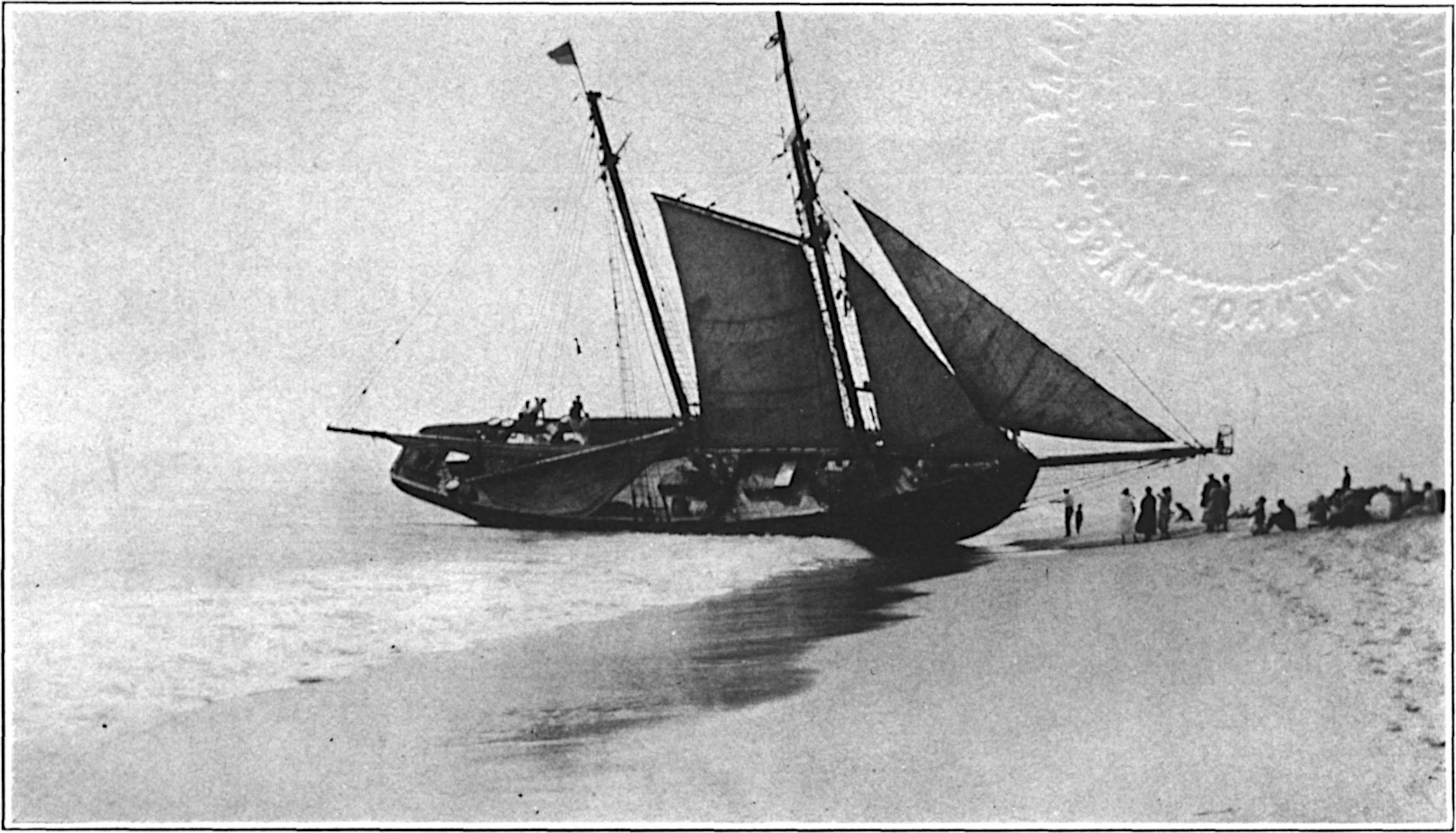
A Winter Wreck at Pamet
(iii)
THE
OUTERMOST HOUSE
A YEAR OF LIFE ON THE GREAT BEACH
OF CAPE COD
BY HENRY BESTON
Illustrated with Photographs by WILLIAM A. BRADFORD AND OTHERS
GARDEN CITY, NEW YORK
DOUBLEDAY, DORAN AND COMPANY, INC.
1929
(iv)
COPYRIGHT, 1928, BY DOUBLEDAY, DORAN
& COMPANY, INC. ALL RIGHTS RESERVED.
PRINTED IN THE UNITED STATES AT THE
COUNTRY LIFE PRESS, GARDEN CITY, N. Y.
(v)
TO
MISS MABEL DAVISON
AND
MISS MARY CABOT WHEELWRIGHT
FOREWORD
(vii)
Only a solitary knows how social and kindly
life can be. While living on the beach, I was
helped by so many friends and Cape Cod neighbours
that I should be writing a chapter were I to
try to list them all. There are a few, however,
to whom I owe more than neighbourly gratitude.
To my friends Prince and Edna Nickerson Hurd
of Eastham, to Mrs. Mercy A. Mines, and to
Mr. John Nickerson I owe both my right to
build on the dune-land and a world of kindest aid.
For my chance to live this book and write it, I
would here thank them first of all. I owe another
real debt to Harvey Moore for building me
so strong and snug a little house, another to
George and Mary Smith for their hospitality,
good counsel, and encouragement, another to
Nate and Helen Clark. And I should like to
thank Captain George Nickerson of Nauset
Station, Bosun’s Mate Charles Ellis, the present
No. 1, and the rest of the Nauset crew for the
thousand kind and friendly things they did to
help me.
The majority of my illustrations I owe to the
courtesy of my Quincy friend and neighbour, the
Hon. William A. Bradford. Mr. Bradford made(viii)
several special trips to the Cape to get the pictures,
and spared no time or effort in preparing
them for the book. I would here most gratefully
acknowledge this kindness.
I wish to return thanks to Mr. Alva Morrison
for his fine studies of the winter beach and for
his notes on birds, to Mr. Arthur Cleveland Bent
for the use of the two rare photographs from
his collection, to Dr. A. B. Klugh for the sandpiper
illustration, to Commander Donald MacMillan,
and the American Museum of Natural
History for the dovekies, to Dr. John E. Fish for
his photograph of the summer stranding, to Mr.
George A. Whiting of Eastham for his distinguished
studies of the beach and the Montclair,
and to Mr. Robert Whiting for his striking photograph
of the fishing schooner in the surf at
Pamet. And I wish to thank Mr. John Farrar
with all my heart for the patience and good will
with which he has dealt with so inaccessible an
observer as myself.
I have made several references to Mr. E. H.
Forbush’s Birds of Massachusetts and Surrounding
States. This compendium is a favourite of
mine for it is the work of one who is both a
literary artist as well as a distinguished ornithologist.(ix)
I wish to record as well an obligation
to the staffs of the various state and federal
bureaus which I have consulted, and I would
thank the Hon. A. Piatt Andrew of the 6th
Massachusetts for the unfailing courtesy and
good will with which he responded to my frequent
requests for scientific studies published at
Washington.
My narrative concerns itself with the events
of a twelvemonth, though I spent, on and off, a
somewhat longer time upon the beach. There
was a season in the spring when I had to leave
the house a while.
I would close with the acknowledgment of a
special and very great obligation, my debt to
Mr. and Mrs. Thomas Kelley of the Overlook
Inn in Eastham. Without their constant and
ever-thoughtful aid, without their hospitable
roof to turn to on occasion, without their
friendly care for my interests ashore, it would
have been perhaps impossible to remain upon
the beach. With heartfelt gratitude do I thank
them here. Long may their hospitable doors
stand open on Cape Cod!
East and ahead of the coast of North America,
some thirty miles and more from the inner shores
of Massachusetts, there stands in the open
Atlantic the last fragment of an ancient and
vanished land. For twenty miles this last and
outer earth faces the ever hostile ocean in the
form of a great eroded cliff of earth and clay,
the undulations and levels of whose rim now
stand a hundred, now a hundred and fifty feet
above the tides. Worn by the breakers and the
rains, disintegrated by the wind, it still stands
bold. Many earths compose it, and many
gravels and sands stratified and intermingled.
It has many colours: old ivory here, peat here,
and here old ivory darkened and enriched with(2)
rust. At twilight, its rim lifted to the splendour
in the west, the face of the wall becomes a
substance of shadow and dark descending to
the eternal unquiet of the sea; at dawn the sun
rising out of ocean gilds it with a level silence of
light which thins and rises and vanishes into
day.
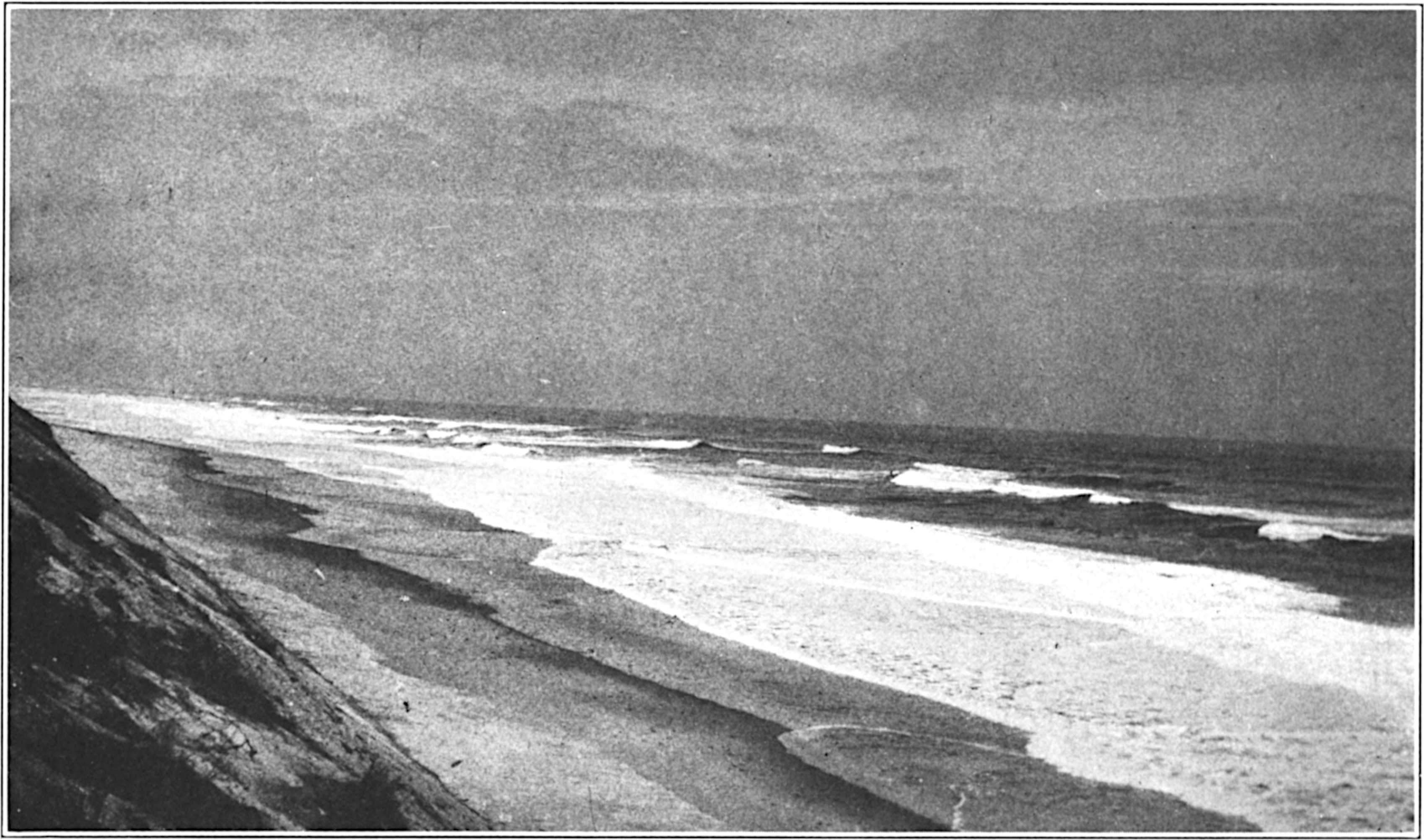
At the foot of this cliff a great ocean beach
runs north and south unbroken, mile lengthening
into mile. Solitary and elemental, unsullied
and remote, visited and possessed by the outer
sea, these sands might be the end or the beginning
of a world. Age by age, the sea here
gives battle to the land; age by age, the earth
struggles for her own, calling to her defence her
energies and her creations, bidding her plants
steal down upon the beach, and holding the
frontier sands in a net of grass and roots which
the storms wash free. The great rhythms of
nature, to-day so dully disregarded, wounded
even, have here their spacious and primeval
liberty; cloud and shadow of cloud, wind and
tide, tremor of night and day. Journeying birds
alight here and fly away again all unseen,
schools of great fish move beneath the waves, the
surf flings its spray against the sun.
(3)
Often spoken of as being entirely glacial, this
bulwark is really an old land surfaced with a new.
The seas broke upon these same ancient bounds
long before the ice had gathered or the sun had
fogged and cooled. There was once, so it would
seem, a Northern coastal plain. This crumbled
at its rim, time and catastrophe changed its
level and its form, and the sea came inland
over it through the years. Its last enduring
frontier roughly corresponds to the wasted dyke
of the cliff. Moving down into the sea, later
glaciations passed over the old beaches and the
fragments of the plain, and, stumbling over them,
heaped upon these sills their accumulated drift of
gravels, sand, and stones. The warmer sea and
time prevailing, the ice cliff retreated westward
through its fogs, and presently the waves coursed
on to a new, a transformed and lifeless, land.
So runs, as far as it is possible to reconstruct
it in general terms, the geological history of Cape
Cod. The east and west arm of the peninsula is
a buried area of the ancient plain, the forearm,
the glaciated fragment of a coast. The peninsula
stands farther out to sea than any other portion
of the Atlantic coast of the United States; it is
the outermost of outer shores. Thundering in(4)
against the cliff, the ocean here encounters the
last defiant bulwark of two worlds.
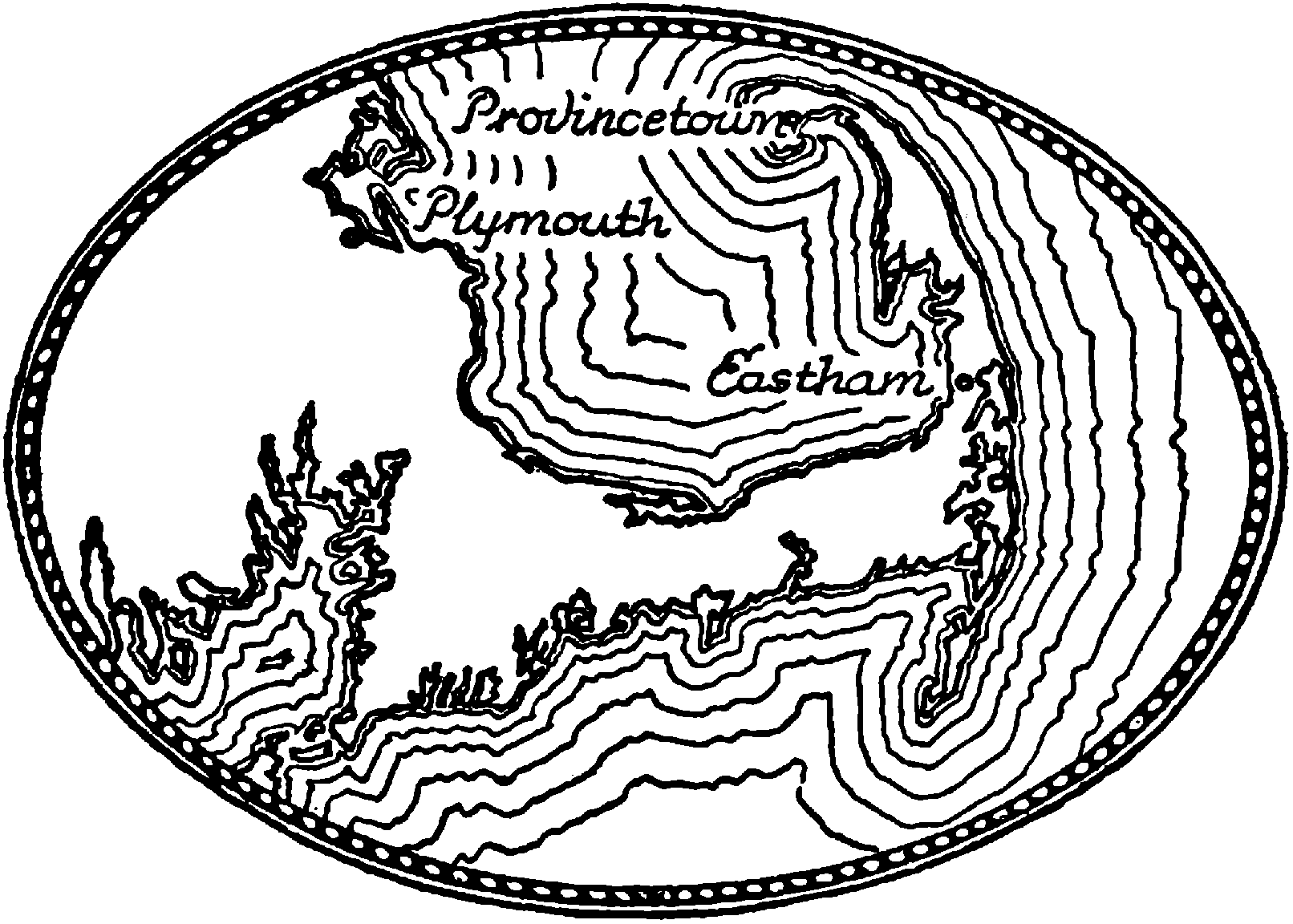
The cliff I write of and the bordering beach
face the Atlantic on the forearm of the Cape.
This outer earth is now scarce more than a great
dyke or wall some twenty-five miles long and
only three and four miles wide. At Provincetown
it rises from the sea, beginning there in a
desert of dunes and sand plains of the ocean’s
making. These sands curve inland toward the
continent, bending toward Plymouth even as a
hand may be bent down at the wrist, and
Provincetown harbour lies in the curve of palm
and fingers. At Truro, the wrist of the Cape—the
forearm simile being both exact and inescapable—the
land curve falls from the east and
west down through an arc to the north and
south, and the earth cliff begins and rises rather
suddenly to its greatest elevation. South by
east from the Highland Light to Eastham and
Nauset Coast Guard Station, the rampart fronts
the sea, its sky line being now a progress of long
undulations, now a level as military as a battlement,
hollows and mounded hills here and(5)
there revealing the barren moorland character of
the country just above. At Nauset, the cliff ends,
the sea invades the narrowing land, and one
enters the kingdom of the dunes.
The Beach
The cliff ends, and a wall of ocean dunes carries
on the beach. Five miles long, this wall ends
at a channel over whose entrance shoals the
ocean sweeps daily into a great inlet or lagoon
back of the dunes, an inlet spaced with the floors
of tidal islands and traced with winding creeks—the
inlet of Eastham and Orleans. Very high
tides, covering the islands, sometimes turn this
space into bay. Westward over the channels and
the marshland one looks to the uplands of the
Cape, here scarce a good two miles wide. At
Eastham, the land is an open, rolling moor.
West over this lies Cape Cod Bay. A powerful
tribe of Indians, the Nausets, once inhabited this
earth between the seas.
Outermost cliff and solitary dune, the plain of
ocean and the far, bright rims of the world,
meadow land and marsh and ancient moor:
this is Eastham; this the outer Cape. Sun and
moon rise here from the sea, the arched sky has
an ocean vastness, the clouds are now of ocean,
now of earth. Having known and loved this(6)
land for many years, it came about that I found
myself free to visit there, and so I built myself a
house upon the beach.
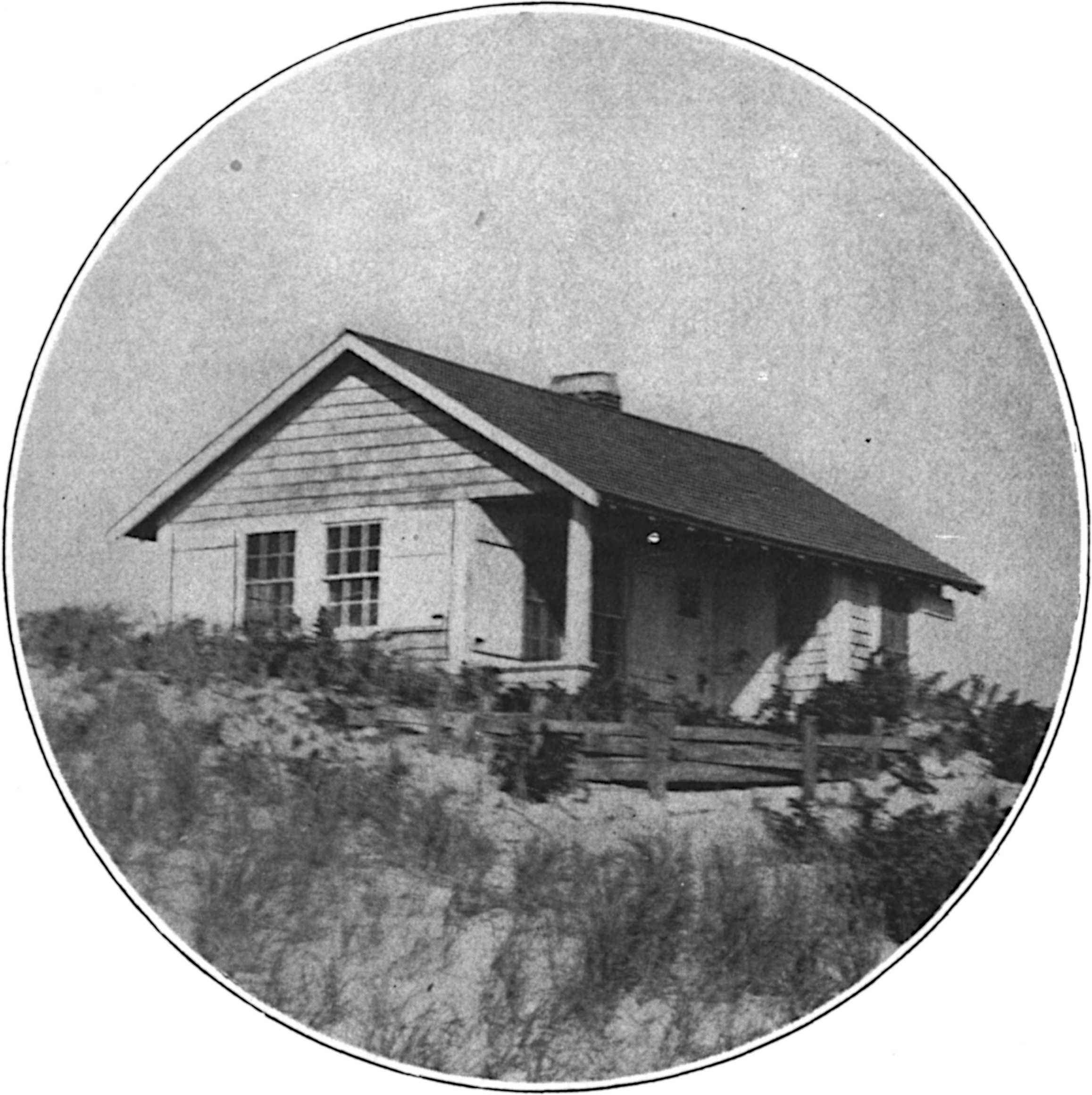
My house stood by itself atop a dune, a little
less than halfway south on Eastham bar. I
drew the home-made plans for it myself and it
was built for me by a neighbour and his carpenters.
When I began to build, I had no notion
whatever of using the house as a dwelling place.
I simply wanted a place to come to in the
summer, one cosy enough to be visited in winter
could I manage to get down. I called it the
Fo’castle. It consisted of two rooms, a bedroom
and a kitchen-living room, and its dimensions
over all were but twenty by sixteen. A
brick fireplace with its back to the wall between
rooms heated the larger space and took the chill
off the bedroom, and I used a two-burner oil
stove when cooking.
My neighbour built well. The house, even as
I hoped, proved compact and strong, and it was
easy to run and easy to heat. The larger room
was sheathed, and I painted the wainscoting
and the window frames a kind of buff-fawn—a
good fo’castle colour. The house showed, perhaps,
a somewhat amateur enthusiasm for(7)
windows. I had ten. In my larger room I had
seven; a pair to the east opening on the sea, a
pair to the west commanding the marshes, a
pair to the south, and a small “look-see” in the
door. Seven windows in one room perched on a
hill of sand under an ocean sun—the words suggest
cross-lights and a glare; a fair misgiving,
and one I countered by the use of wooden shutters
originally meant for winter service but
found necessary through the year. By arranging
these I found I could have either the most
sheltered and darkened of rooms or something
rather like an inside out-of-doors. In my bedroom
I had three windows—one east, one west,
and one north to Nauset light.
To get drinking water, I drove a well pipe
directly down into the dune. Though the sea
and the beach are alongside, and the marsh
channels course daily to the west, there is fresh
water here under the salty sand. This water
varies in quality, some of it being brackish,
some of it sweet and clear. To my great delight,
I chanced upon a source which seems to me as
good water as one may find here anywhere.
Beneath the floor, the pipe descended into a
bricked-up and covered pit housing a pet-cock(8)
through which I drained the water from the pump
in freezing weather (On bitter days I simply
pumped a few pails full and stood them in the sink,
and drained the pump immediately.). I had two
oil lamps and various bottle candlesticks to read
by, and a fireplace crammed maw-full of driftwood
to keep me warm. I have no doubt that the
fireplace heating arrangement sounds demented,
but it worked, and my fire was more than a
source of heat—it was an elemental presence, a
household god, and a friend.
In my larger room, I had a chest of drawers
painted an honest carriage blue, a table, a wall
bookcase, a couch, two chairs, and a rocker.
My kitchen, built yacht fashion all in a line,
stood at my southern wall. First came a dish
and crockery cupboard, then a space for the oil
stove—I kept this boxed in when not in use—then
a shelf, a porcelain sink, and the corner
pump. Blessed pump! It never failed me or indulged
in nerves.
Using a knapsack, I carried my supplies on
my own shoulders. There is no road through the
dunes, and, even if there were, no one would
have made deliveries. West of the dunes, it is
true, there exists a kind of trail on which Fords(9)
may venture, but even the most experienced of
the villagers are wary of it and tell of being mired
there or stuck in the sand. Nevertheless, my
lumber came by this trail, and now and then I
could get my oil cans carried down by a neighbour
who had a horse and cart. These helps,
however, were but occasional, and I counted
myself fortunate to have had them at all. My
knapsack remained the only ever-ready wagon of
the dunes. Twice a week, by arrangement, a
friend met me at Nauset Station with a car,
took me shopping to Eastham or Orleans, and
brought me back again to Nauset. And there I
would pack my milk and eggs and butter and
rolls—being very careful as to which was sitting
on which—and strike off down the beach along
the breakers.
The top of the mound I built on stands scarce
twenty feet above high-water mark, and only
thirty in from the great beach. The coast
guards at Nauset, a scant two miles away, were
my only neighbours. South lay the farther
dunes and a few far-away and lonely gunning
camps; the floor of marsh and tide parted me on
the west from the village and its distant cottages;
the ocean besieged my door. North, and north(10)
alone, had I touch with human things. On its
solitary dune my house faced the four walls of
the world.
My house completed, and tried and not found
wanting by a first Cape Cod year, I went there to
spend a fortnight in September. The fortnight
ending, I lingered on, and as the year lengthened
into autumn, the beauty and mystery of this
earth and outer sea so possessed and held me that
I could not go. The world to-day is sick to its
thin blood for lack of elemental things, for fire
before the hands, for water welling from the
earth, for air, for the dear earth itself underfoot.
In my world of beach and dune these elemental
presences lived and had their being, and under
their arch there moved an incomparable pageant
of nature and the year. The flux and reflux of
ocean, the incomings of waves, the gatherings of
birds, the pilgrimages of the peoples of the sea,
winter and storm, the splendour of autumn and
the holiness of spring—all these were part of the
great beach. The longer I stayed, the more
eager was I to know this coast and to share its
mysterious and elemental life; I found myself free
to do so, I had no fear of being alone, I had something
of a field naturalist’s inclination; presently(11)
I made up my mind to remain and try living for a
year on Eastham Beach.
The sand bar of Eastham is the sea wall of the
inlet. Its crest overhangs the beach, and from
the high, wind-trampled rim, a long slope well
overgrown with dune grass descends to the
meadows on the west. Seen from the tower at
Nauset, the land has an air of geographical
simplicity; as a matter of fact, it is full of hollows,
blind passages, and amphitheatres in which the
roaring of the sea changes into the far roar of a
cataract. I often wander into these curious
pits. On their floors of sand, on their slopes, I
find patterns made by the feet of visiting birds.
Here, in a little disturbed and claw-marked
space of sand, a flock of larks has alighted; here
one of the birds has wandered off by himself;
here are the deeper tracks of hungry crows;
here the webbed impressions of a gull. There
is always something poetic and mysterious to me
about these tracks in the pits of the dunes; they
begin at nowhere, sometimes with the faint impression
of an alighting wing, and vanish as suddenly
into the trackless nowhere of the sky.
(12)
Below the eastern rim the dunes fall in steeps
of sand to the beach. Walking the beach close
in along these steeps, one walks in the afternoon
shade of a kind of sand escarpment, now seven or
eight feet high and reasonably level, now fifteen or
twenty feet high to the top of a dome or mound.
In four or five places storms have washed gullies
or “cuts” clean through the wall. Dune plants
grow in these dry beds, rooting themselves in
under old, half-buried wreckage, clumps of
dusty miller, Artemisia stelleriana, being the
most familiar green. The plant flourishes in the
most exposed situations, it jumps from the dune
rim to the naked slopes, it even tries to find a
permanent station on the beach. Silvery gray-green
all summer long, in autumn it puts on
gold and russet-golden colourings of singular
delicacy and beauty.
The grass grows thickest on the slopes and
shoulders of the mounds, its tall leaves inclosing
intrusive heads and clumps of the thick-fleshed
dune goldenrod. Still lower down the slope,
where the sands open and the spears rise thin,
the beach pea catches the eye with its familiar
leaf and faded topmost bloom; lower still, on
desert-like floors, are tussock mats of poverty(13)
grass and the flat green stars of innumerable
spurges. The only real bushes of the region are
beach plum thickets, and these are few and far
between.
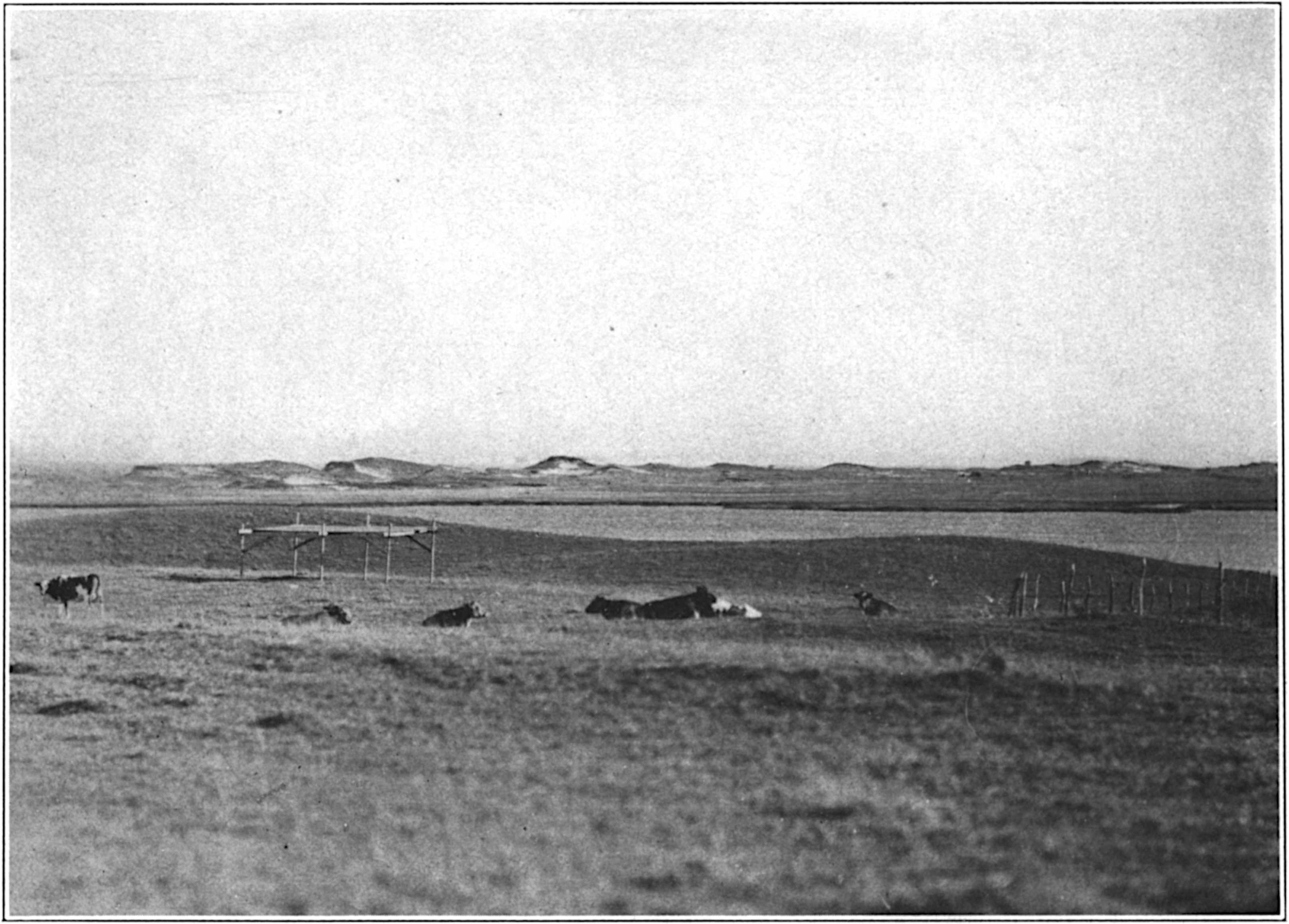
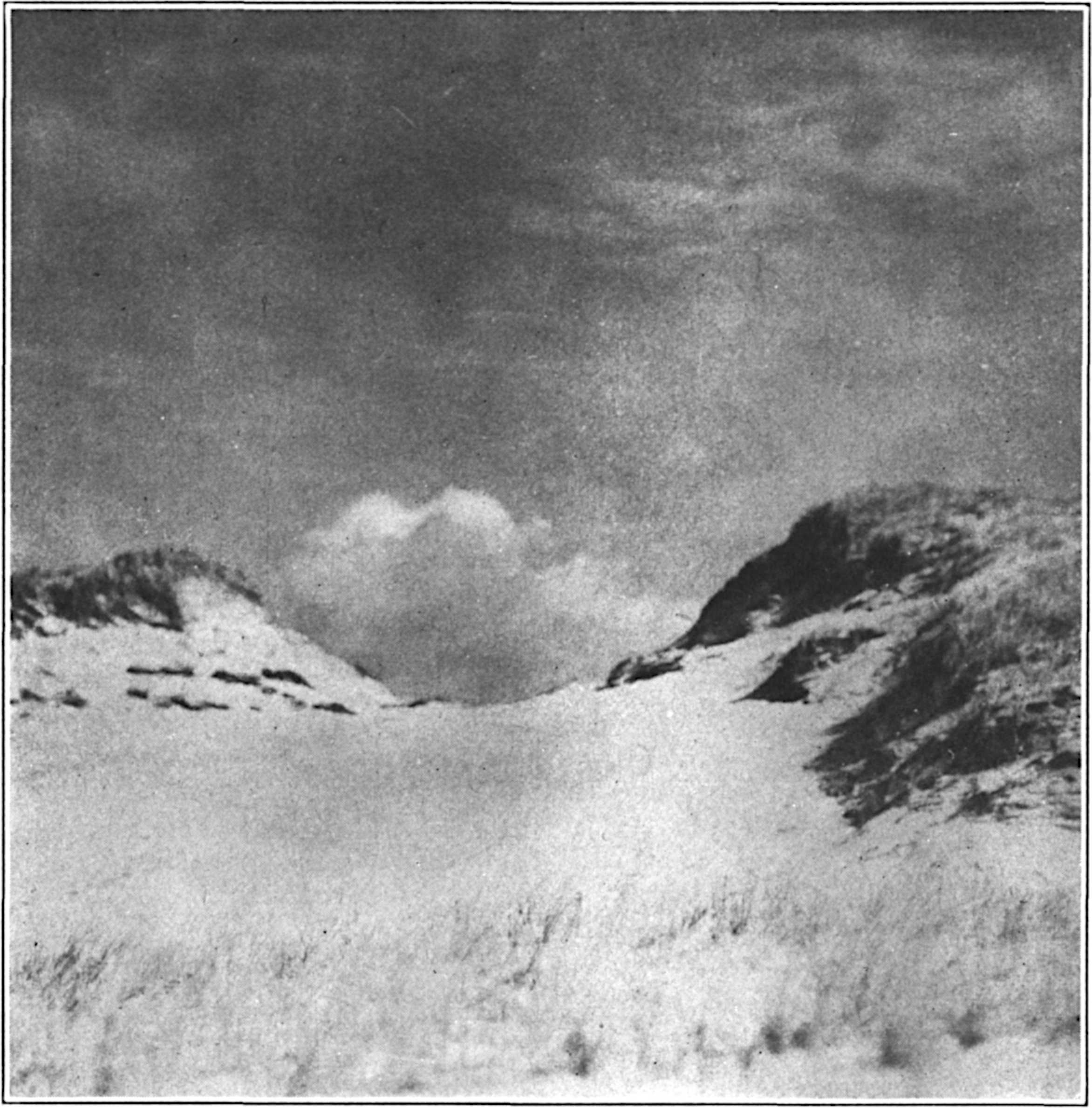
The Eastham Dunes from the Inlet
All these plants have enormously long taproots
which bury themselves deep in the moist core of
the sands.
The greater part of the year I have two
beaches, one above, one below. The lower or
tidal beach begins at mean low water and climbs
a clean slope to the high-water mark of the
average low-course tide; the upper beach, more
of a plateau in form, occupies the space between
high water and the dunes. The width of these
beaches changes with every storm and every tide,
but I shall not be far out if I call them both an
average seventy-five feet wide. Unseasonable
storm tides and high-course tides make of the
beach one vast new floor. Winter tides narrow
the winter’s upper beach and often sweep across
it to the dunes. The whole beach builds up in
summer as if each tide pushed more and more
sand against it out of the sea. Perhaps currents
wash in sand from the outer bars.
It is no easy task to find a name or a phrase
for the colour of Eastham sand. Its tone,(14)
moreover, varies with the hour and the seasons.
One friend says yellow on its way to brown,
another speaks of the colour of raw silk. Whatever
colour images these hints may offer to a
reader’s mind, the colour of the sand here on a
June day is as warm and rich a tone as one may
find. Late in the afternoon, there descends
upon the beach and the bordering sea a delicate
overtone of faintest violet. There is no harshness
here in the landscape line, no hard Northern
brightness or brusque revelation; there is always
reserve and mystery, always something beyond,
on earth and sea something which nature,
honouring, conceals.
The sand here has a life of its own, even if it is
only a life borrowed from the wind. One pleasant
summer afternoon, while a high, gusty westerly
was blowing, I saw a little “wind devil,”
a miniature tornado six feet high, rush at full
speed out of a cut, whirl itself full of sand upon
the beach, and spin off breakerward. As it
crossed the beach, the “devil” caught the sun,
and there burst out of the sand smoke a brownish
prism of burning, spinning, and fantastic colour.
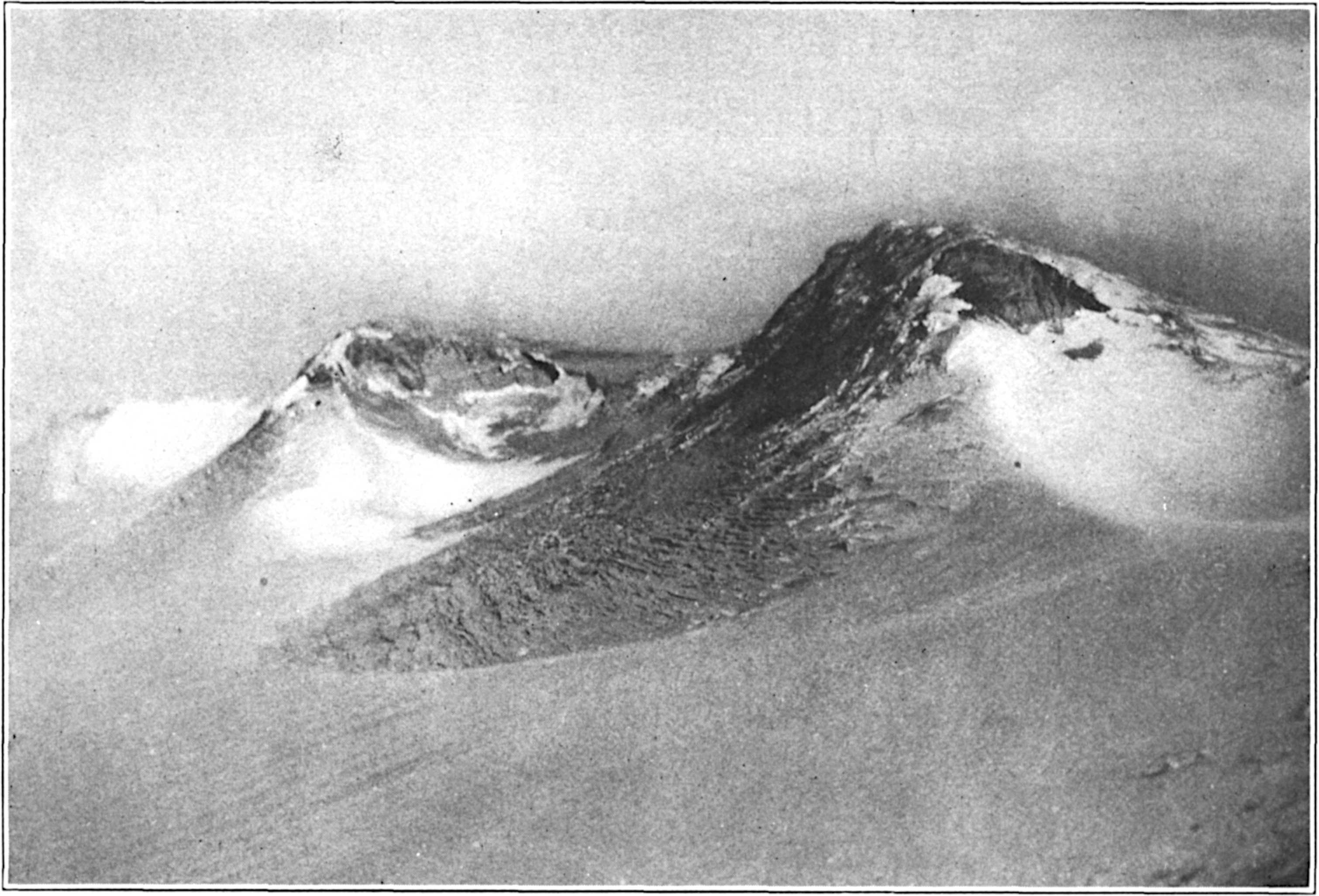
South of me, the dune I call “big dune” now and
then goes through a curious performance. Seen(15)
lengthwise, the giant has the shape of a wave,
its slope to the beach being a magnificent fan
of purest wind-blown sand, its westward
slope a descent to a sandy amphitheatre.
During a recent winter, a coast guard key
post was erected on the peak of the dune; the
feet of the night patrols trod down and nicked
the crest, and presently this insignificant notch
began to “work” and deepen. It is now eight
or nine feet wide and as many deep. From
across the marshes, it might be a kind of great,
roundish bite out of the crest. On windy autumn
days, when the sand is still dry and alive, and
westerly gusts and currents take on a genuine
violence, the loose sand behind the dune is
whirled up by the wind and poured eastward
through this funnel. At such times the peak
“smokes” like a volcano. The smoke is now a
streaming blackish plume, now a thin old-ivory
wraith, and it billows, eddies, and pours out as
from a sea Vesuvius.
Between the dunes and the marshes, an irregular
width of salt-hay land extends from the
sand slopes to the marshier widths of tidal land
along the creeks. Each region has its own
grasses, the meadows being almost a patchwork(16)
of competing growths. In the late summer and
the autumn the marsh lavender, thin-strewn
but straying everywhere, lifts its cloud of tiny
sun-faded flowers above the tawny, almost deer-coloured
grasses. The marsh islands beyond
are but great masses of thatch grass rising from
floors of sodded mud and sand; there are hidden
pools in these unvisited acres which only sunset
reveals. The wild ducks know them well and
take refuge in them when stalked by gunners.
How singular it is that so little has been written
about the birds of Cape Cod! The peninsula,
from an ornithologist’s point of view, is
one of the most interesting in the world. The
interest does not centre on the resident birds,
for they are no more numerous here than they
are in various other pleasant places; it lies in the
fact that living here, one may see more kinds and
varieties of birds than it would seem possible to
discover in any one small region. At Eastham,
for instance, among visitors and migrants,
residents and casuals, I had land birds and moor
birds, marsh birds and beach birds, sea birds and
coastal birds, even birds of the outer ocean.
West Indian hurricanes, moreover, often catch
up and fling ashore here curious tropical and(17)
semi-tropical forms, a glossy ibis in one storm, a
frigate bird in another. When living on the
beach, I kept a particularly careful lookout during
gales.
The Sierras of Sand and Snow
I close this chapter with what seems to me the
most interesting detail for a naturalist’s ear.
Eastham bar is only three miles long and scarce
a quarter of a mile wide across its sands. Yet
in this little world Nature has already given her
humbler creatures a protective colouration.
Stop at the coast guard station and catch a
locust on the station lawn—we have the maritime
locust here, Trimerotropsis maritima harris—and,
having caught him, study him well; you will
find him tinted with green. Go fifty feet into
the dunes and catch another, and you shall see
an insect made of sand. The spiders, too, are
made of sand—the phrase is none too strong—and
so are the toads that go beach combing on
moonlit summer nights. One may stand at the
breakers’ edge and study a whole world in one’s
hand.
So, choosing to remain upon the beach, I look
forward to October and winter and the great
migrations. Earliest autumn and September
now enclose the earth.
(18)
My western windows are most beautiful in
early evening. On these lovely, cool September
nights the level and quiescent dust of light which
fills the sky is as autumnal in its colouring as the
earth below. There is autumn on the earth and
autumn overhead. The great isles of tawny
orange smouldering into darkness, the paths of
the channels stilled to twilight bronze, the
scarlet meadows deepening to levels of purple
and advancing night—all these mount, in exhalation
of colour, to the heavens. The beam of
Nauset, entering my northern casement, brushes
a recurrent pallor of light across a part of my bedroom
wall. A first flash, a second flash, a third
flash, and then a little interval as the dark sector
of the lens travels between the Fo’castle and the
flame. On bright moonlit nights, I can see both
the whitewashed tower and the light; on dark
nights, I can see only the light itself suspended
and secure above the earth.
It is dark to-night, and over the plains of
ocean the autumnal sky rolls up the winter stars.
Chapter II AUTUMN, OCEAN, AND BIRDS — I — II — III — IV
(19)
There is a new sound on the beach, and a
greater sound. Slowly, and day by day, the
surf grows heavier, and down the long miles of
the beach, at the lonely stations, men hear the
coming winter in the roar. Mornings and evenings
grow cold, the northwest wind grows cold;
the last crescent of the month’s moon, discovered
by chance in a pale morning sky, stands
north of the sun. Autumn ripens faster on the
beach than on the marshes and the dunes.
Westward and landward there is colour; seaward,
bright space and austerity. Lifted to the
sky, the dying grasses on the dune tops’ rim
tremble and lean seaward in the wind, wraiths
of sand course flat along the beach, the hiss of
sand mingles its thin stridency with the new
thunder of the sea.
I have been spending my afternoons gathering(20)
driftwood and observing birds. The skies being
clear, noonday suns take something of the bite
out of the wind, and now and then a warmish
west-sou’westerly finds its way back into the
world. Into the bright, vast days I go, shouldering
home my sticks and broken boards and
driving shore birds on ahead of me, putting up
sanderlings and sandpipers, ringnecks and knots,
plovers and killdeer, coveys of a dozen, little
flocks, great flocks, compact assemblies with a
regimented air. For a fortnight past, October
9th to October 23d, an enormous population of
the migrants has been “stopping over” on my
Eastham sands, gathering, resting, feeding, and
commingling. They come, they go, they melt
away, they gather again; for actual miles the
intricate and inter-crisscross pattern of their
feet runs unbroken along the tide rim of Cape
Cod.
Yet it is no confused and careless horde
through which I go, but an army. Some spirit
of discipline and unity has passed over these
countless little brains, waking in each flock a
conscious sense of its collective self and giving
each bird a sense of himself as a member of
some migrant company. Lone fliers are rare,(21)
and when seen have an air of being in pursuit
of some flock which has overlooked them and
gone on. Swift as the wind they fly, speeding
along the breakers with the directness of a runner
down a course, and I read fear in their speed.
Sometimes I see them find their own and settle
down beside them half a mile ahead, sometimes
they melt away into a vista of surf and sky, still
speeding on, still seeking.
The general multitude, it would seem, consists
of birds who have spent the summer somewhere
on the outer Cape and of autumn reinforcements
from the north.
I see the flocks best when they are feeding on
the edge of a tide which rises to its flood in the
later afternoon. No summer blur of breaker
mist or glassiness of heat now obscures these
outer distances, and as on I stride, keeping to
the lower beach when returning with a load, I
can see birds and more birds and ever more birds
ahead. Every last advance of a dissolved
breaker, coursing on, flat and seething, has those
who run away before it, turning its flank or
fluttering up when too closely pursued; every
retreating in-sucked slide has those who follow
it back, eagerly dipping and gleaning. Having(22)
fed, the birds fly up to the upper beach and sit
there for hours in the luke-cold wind, flock by
flock, assembly by assembly. The ocean thunders,
pale wisps and windy tatters of wintry
cloud sail over the dunes, and the sandpipers
stand on one leg and dream, their heads tousled
deep into their feathers.
I wonder where these thousands spend the
night. Waking the other morning just before
sunrise, I hurried into my clothes and went
down to the beach. North and then south I
strolled, along an ebbing tide, and north and
south the great beach was as empty of bird life
as the sky. Far to the south, I remember now,
a frightened pair of semipalmated sandpipers
did rise from somewhere on the upper beach and
fly toward me swift and voiceless, pass me on
the flank, and settle by the water’s edge a hundred
yards or so behind. They instantly began
to run about and feed, and as I watched them
an orange sun floated up over the horizon with
the speed and solemnity of an Olympian balloon.
The tide being high these days late in the afternoon,
the birds begin to muster on the beach
about ten o’clock in the morning. Some fly
over from the salt meadows, some arrive flying(23)
along the beach, some drop from the sky. I
startle up a first group on turning from the
upper beach to the lower. I walk directly at
the birds—a general apprehension, a rally, a
scutter ahead, and the birds are gone. Standing
on the beach, fresh claw marks at my feet, I
watch the lovely sight of the group instantly
turned into a constellation of birds, into a
fugitive pleiades whose living stars keep their
chance positions; I watch the spiralling flight,
the momentary tilts of the white bellies, the
alternate shows of the clustered, grayish backs.
The group next ahead, though wary from the
first, continues feeding. I draw nearer; a few
run ahead as if to escape me afoot, others stop
and prepare to fly; nearer still, the birds can
stand no more; another rally, another scutter,
and they are following their kin along the
surges.
No aspect of nature on this beach is more
mysterious to me than the flights of these shore-bird
constellations. The constellation forms, as
I have hinted, in an instant of time, and in that
same instant develops its own will. Birds which
have been feeding yards away from each other,
each one individually busy for his individual(24)
body’s sake, suddenly fuse into this new volition
and, flying, rise as one, coast as one, tilt their
dozen bodies as one, and as one wheel off on the
course which the new group will has determined.
There is no such thing, I may add, as a lead bird
or guide. Had I more space I should like nothing
better than to discuss this new will and its
instant of origin, but I do not want to crowd this
part of my chapter, and must therefore leave
the problem to all who study the psychic relations
between the individual and a surrounding
many. My special interest is rather the instant
and synchronous obedience of each speeding
body to the new volition. By what means, by
what methods of communication does this will
so suffuse the living constellation that its dozen
or more tiny brains know it and obey it in such
an instancy of time? Are we to believe that
these birds, all of them, are machina, as Descartes
long ago insisted, mere mechanisms of flesh and
bone so exquisitely alike that each cogwheel
brain, encountering the same environmental
forces, synchronously lets slip the same mechanic
ratchet? or is there some psychic relation between
these creatures? Does some current flow
through them and between them as they fly?(25)
Schools of fish, I am told, make similar mass
changes of direction. I saw such a thing once,
but of that more anon.
We need another and a wiser and perhaps a
more mystical concept of animals. Remote
from universal nature, and living by complicated
artifice, man in civilization surveys the creature
through the glass of his knowledge and sees
thereby a feather magnified and the whole image
in distortion. We patronize them for their
incompleteness, for their tragic fate of having
taken form so far below ourselves. And therein
we err, and greatly err. For the animal shall
not be measured by man. In a world older and
more complete than ours they move finished and
complete, gifted with extensions of the senses we
have lost or never attained, living by voices we
shall never hear. They are not brethren, they
are not underlings; they are other nations,
caught with ourselves in the net of life and time,
fellow prisoners of the splendour and travail of
the earth.
The afternoon sun sinks red as fire; the tide
climbs the beach, its foam a strange crimson;
miles out, a freighter goes north, emerging from
the shoals.
(26)
It chanced that on a mild September morning,
as I was standing a moment at a window looking
west over the marshes and the blue autumnal
creeks, an alarm of some kind began to spread
among the gulls. The incoming tide had already
crowded the birds back on the higher gravel
banks and bars, and from these isles, silvery
cloud by cloud, I saw the gulls rise and stream
away to the southward in a long, fugitive storm
of wings. They were flying, I noticed, unusually
low. Interested to see what had thus
disturbed them, I stepped out a moment to the
pinnacle of my dune. As I stood there staring
after the vanishing gulls and questioning the
sky, I saw far above the birds, and well behind
them, an eagle advancing through the heavens.
He had just emerged from a plume of hovering
cloud into the open blue, and when I saw him
first was sailing south and seaward on motionless
wings, seeming to follow in the great sky the
blue course of a channel far below.
There are sand bars at the mouth of Nauset
harbour; many gulls feed there between the
tides, and the gulls from the marsh joined forces(27)
with this gathering. As the eagle approached
the bars, I looked to see if he would descend or
fly out to sea. But no; at the harbour’s entrance
he turned south, aligned his flight with
the coast line, and disappeared.
During the autumn I saw this same bird half a
dozen different times. I could tell when he was
about by the terror of the gulls. Yet this eagle—for
a bald eagle, Haliætus leucocephalus leucocephalus,
I believe him to have been—is, as Mr.
Forbush says, “by nature a fish eater.” I never
saw him pay the slightest attention to the fugitives;
nevertheless, he may well have a fancy for
gulls when they are plump and he is hungry.
At any rate, they fear him. There are always
a few black-backed or “minister” gulls mingled
in with the herring gulls upon these flats, and
these burly giants, I noticed, sought refuge with
the rest.
Eagles are by no means rare upon Cape Cod.
The birds arrive here as coast-wise visitors, find
the region to their liking, and establish themselves
in various favourite domains. They fish
in our sandy bays and inlets; they have rather a
fancy for the more isolated Cape Cod ponds.
Seen at close range, the bald eagle is a dusky(28)
brownish bird with a pure-white head, neck, and
tail. I never had a near view of this Eastham
visitor, but one of the coast guardsmen roused
him up one day from a thicket close by the head
of a creek running up into the moors—he heard
a sudden noise of brush and great wings, he said,
and, turning round, he saw the eagle rising free
of the scrub and the bright leaves.
Ever since I came to live here on Cape Cod, I
have been amazed at the number of land-bird
migrants I have encountered on the dunes. I
expected to see sandpipers on the beach and
scoters in the surf, for they are coast-wise folk,
but I did not expect to see the red-breasted nuthatch
rise out of the September dunes, or find
the charming black-and-yellow warbler sitting
on the ridgepole of the Fo’castle, his black-tipped
tail feathers turned to the Atlantic. But perhaps
I had best begin at the beginning and tell how
the sparrows and the warblers came down to us
this autumn by the coast.
Various new sparrows were the first strangers
to arrive. There are summer sparrows here, a
great abundance of them, for the marsh and
meadow land west of the dunes is the natural
habitat of many species. Walk through these(29)
grass-lands on a summer’s day, and you will see
singles and flocks break from the sunburned
stubble ahead, some to drop and hide again
farther on, others to watch you from the coastguard
wires. Song sparrows are notably abundant,
for these pleasant singers frequent both
the marshes and the dunes; but the seaside
sparrow keeps more to the marsh rim and the
salt-hay mowings, the sharp-tailed sparrow
fancies the wheel ruts of the hay carts, and the
odd little grasshopper sparrow, Coturniculus
savannarum passerinus, trills into the burning
sundowns the two faint notes of his curious and
poignant insect song.
Early in September Hudsonian curlews arrived
in Eastham marsh, and to see them I
began going to Nauset through the meadows
instead of by the beach. High September tides
were then covering both marsh and meadow
land, and, as I pushed on each afternoon, the
curlews rose from close beside the inundated
road, and, circling, called to other curlews; I
could hear, when I listened, the clear reply. And
then there would be silence, and I would hear
the sound of autumn and the world, and perhaps
the faint withdrawing roar of ocean beyond the(30)
dunes. When I reached the wider meadows on
these days, I found the stubble mobbed with
sparrows; the population had doubled in a
week.
Flocks of fox sparrows were feeding everywhere;
I whirred up groups of savannah sparrows
and families of white-throats; a solitary white-headed
sparrow watched me from the concealment
of a bush. It was a silent throng. I
heard faint “tsips” and “chips” of alarm as I
passed—nothing more. Love-making was over
and done, and all were importantly busy with
the importance of their lives.
On the 24th and the 25th there was wind and
rain, and on the 27th I saw the first of the
warblers.
The weather had cleared, and I had risen
early and begun to get breakfast. It is my
custom here to sit facing the sea, and I was moving
over my table when I noticed a small bird of
some kind foraging about in the grass before the
house. I could not see him well at first, for he
had entered into the grass as into a thicket, but
presently out he came, pushing through the
stalks, and I watched him from the window unsuspected.
This first arrival was a Canadian(31)
warbler. Steely ash-gray above, yellow below,
and with a broad band of black spots between his
yellow throat and yellow belly, he was a charming
bit of life. Over the pale sand, in and out
of the tawny-white roots, in and out of the
variegations of morning light he moved, picking
up seeds while a sea wind shook the tops of the
dying grass above his head. Presently, in
search of still more food, he turned the corner
of the house, and when I went out after breakfast
he had gone.
Then came, all in one week, a Wilson’s warbler
(a female, probably), the black-and-yellow warbler,
and a chestnut-sided warbler. The birds
were singles, they travelled along the dunes,
they fed on the fallen seeds. In October I saw
in one day five myrtle warblers; a pair of these
lingered a week near Fo’castle dune. Then came
juncos and a raid of pigeon hawks. The juncos,
like the warblers, foraged on the dunes, and the
hawks hunted them there for an hour or so before
the dawn. I went exploring one morning while
Nauset was still flashing into a sullen, cold, and
overclouded world, and saw a pigeon hawk rise
unexpectedly out of the cut to the north with a
wretched junco gripped beneath him. Flying(32)
seaward through the cut, the hawk carried his
captive to the beach, found himself a sheltered
nook close along the dune wall, stood at attention
for a moment, and then unbent and ate.
I saw various other migrant land birds as well,
but I shall not dwell upon them, for the listing
and cataloguing of species seems to me of less
interest than their arrival by sea. This outer
arm of Cape Cod, as I have already explained,
stands thirty miles or so out from the continental
main, yet there are land birds, little
birds, going south along it as casually as so
many arctic geese. Writing here this cloudy
morning, with a great confused roaring of
breakers in my ears, I call to mind the Wilson’s
warbler, the female, I saw a fortnight ago, and I
wonder where it was that she forsook her
familiar earth for the grey ocean, an ocean she
perhaps had never seen. What a gesture of
ancient faith and present courage such a flight
is, what a defiance of circumstance and death—land
wing and hostile sea, the fading land behind,
the unknown and the distant articulate
and imperious in the bright, aërial blood.
But who shall say by what sea routes these
landsmen reach the Cape? Some species, I(33)
imagine, cross Massachusetts Bay, their jumping-off
place being north of Boston (Cape Ann
or Ipswich perhaps); some may cross over from
the South Shore at a point well north of Cape
Cod Bay, others undoubtedly come directly
down from Maine. The wooded archipelago of
Maine is a famous place for warblers. It is
quite possible that the species I have mentioned
may have followed some great river to the sea,
the Kennebec or the Penobscot, perhaps, and
crossed from the river mouth directly over to
Cape Cod. The Highland Light bears south
¾ west (true) from Seguin at the mouth of the
Kennebec, and is separated from it by only 101
miles of open water. The birds could manage
this easily.
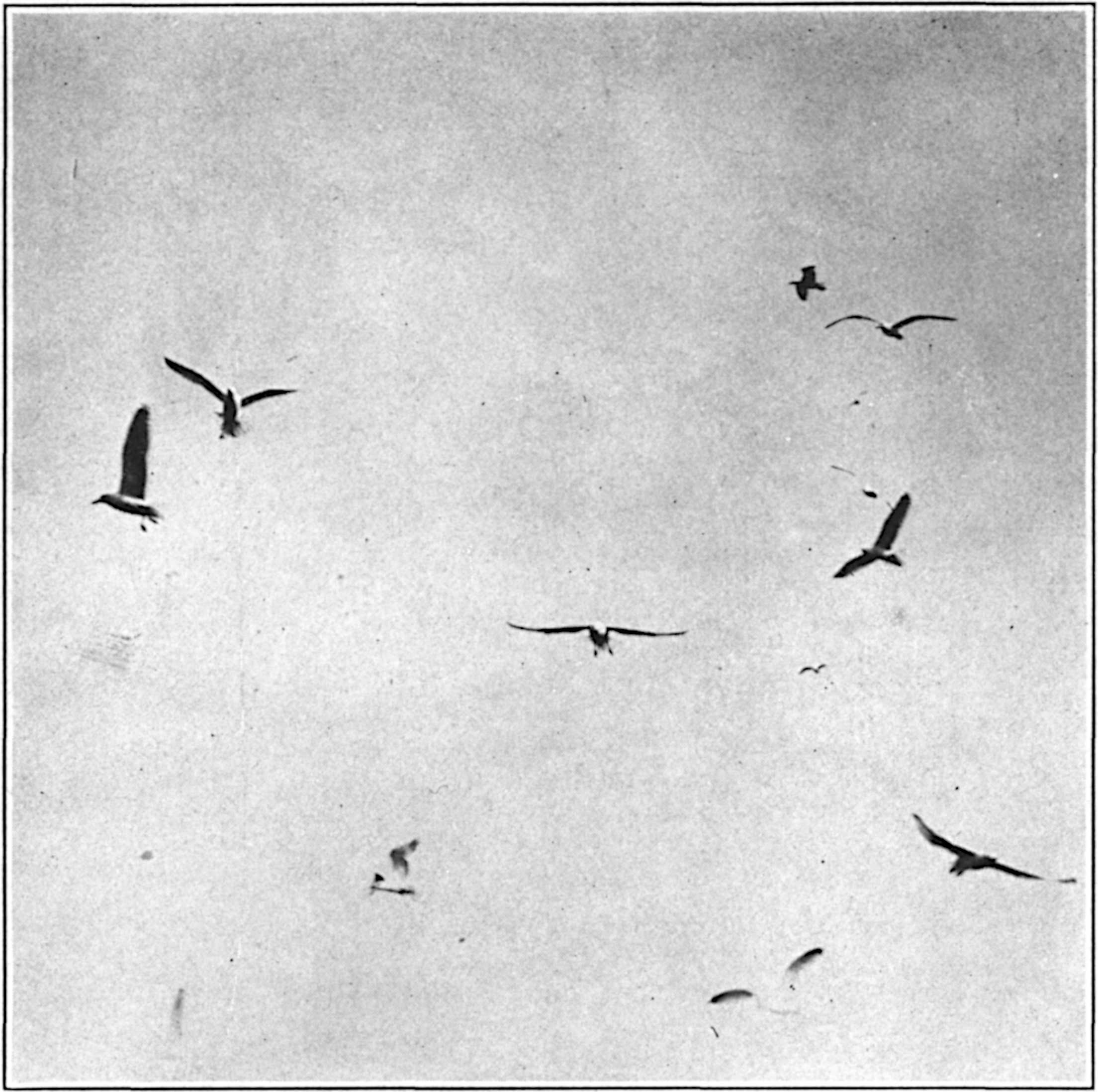
Herring Gulls
All over the world land migrants go great
distances over open water. Numbers of birds,
for instance, migrating back and forth between
Europe and North Africa cross the Mediterranean
twice a year, and in our own hemisphere there
are flights across the Gulf of Mexico and movements
between the West Indies and our south
Atlantic states.
Late in October there came an easterly gale,
and in the afternoon, when the tide was high, I(34)
put on oilskins and went out to see the surf.
About a mile to the north of the Fo’castle, as I
was trudging on across the rain, I saw just ahead
and close over the breakers a flying speck sailing
landward out of the wrack, and even as I stared,
it fell to the beach in danger of the waves. I
ran ahead, then, and picked the thing up just
as a slide of foam was about to overflow it, and
found it to be an autumn leaf, a maple leaf flat
and drenched and red.
Mid-October and the land birds have gone.
A few sparrows linger in the marshes. The plum
bushes have lost their leaves. Walking the
beach, I read winter in the new shapes of the
clouds.
Western cloud, dark substance of cloud,
gathered at the wintry horizon of the short-lived
days making them even shorter with the false
sundown of its rim. Now come the sea fowl and
the wild fowl to the beach from the lonely and
darkening north, from the Arctic Ocean and the
advancing pack, from the continental fragments
and great empty islands that lie between the
continent and the pole, from the tundra and the(35)
barrens, from the forests, from the bright lakes,
from the nest-strewn crevices and ledges of
Atlantic rocks no man has ever named or
scaled. Over the round of earth, down from
the flattened summit, pour the living streams,
bearing south the tribes and gathered nations,
the peoples and flocks, the clans and families, the
young and the old. And the dying grasslands,
the October snows, and the forests fall behind,
and presently the nations behold a first far
glint of the sea.
There are many streams, and it is said that
two of the greatest bear down upon Cape Cod.
A first river, rising in the interior of Alaska,
flows southeast across Canada to the Atlantic;
on this stream move birds from the north
woods and the Canadian lakes together with
birds from the north barrens and the arctic isles
and half lands; a second stream, rising in the
shadow of the pole, flows south along the coast
past Greenland and the bays of Labrador—on
this move the hardy arctic folk who get their
living from the tides. Many species are common
to both streams. Somewhere north of the Cape,
perhaps round and about the mouth of the St.
Lawrence, these streams immix their multitudes,(36)
and south to New England moves the great
united flood, peopling with primeval life the
seacoasts and the sky.
Ducks enter the channels, some flying in from
the bay, others from the outer ocean, geese
settle at sundown in the golden skin of the
western coves, coveys of winter yellow-legs circle
in the gloom, and hide when disturbed in the
taller salt grasses between the meadows and the
creeks. At nightfall and at daybreak I hear
birds talking. Strangers in rubber boots and
khaki uniforms now visit my domain, and every
Saturday afternoon I look with philosophy
through my western windows to a number of
tufts of grass disguised as gunners.
Now that I have settled down here for the
winter, I find myself becoming something of a
beach comber. Every once in a while, when I
chance to look seaward, I spy an unknown
something or other rising and falling, appearing
and disappearing in the offshore surges, and at
this sight the beach comber in me wakes. All
kinds of things “come ashore” on these vast
sands, and even the most valueless have an air
of being treasure trove. The mysterious something
moving from the swells into the breakers(37)
may be nothing but a smelly bait tub washed
overboard from some Gloucester fisherman, or a
lobster pot, or a packing case stencilled with a
liner’s name; but in the sea or on the beach a mile
ahead it is something for nothing, it is the unknown,
it is hope springing eternal in the
human breast. The other day I found myself
thoughtfully examining a U. S. Navy blue undress
jumper which lay flat and soggy and solitary on
the lower beach. It was not, in its day, an unfamiliar
garment, and I have an old friend in the
village who occasionally dons a rather good one
he found just south of the light. Alas, the cloth
was rotted and the jumper much too small. But I
cut off and saved the buttons.
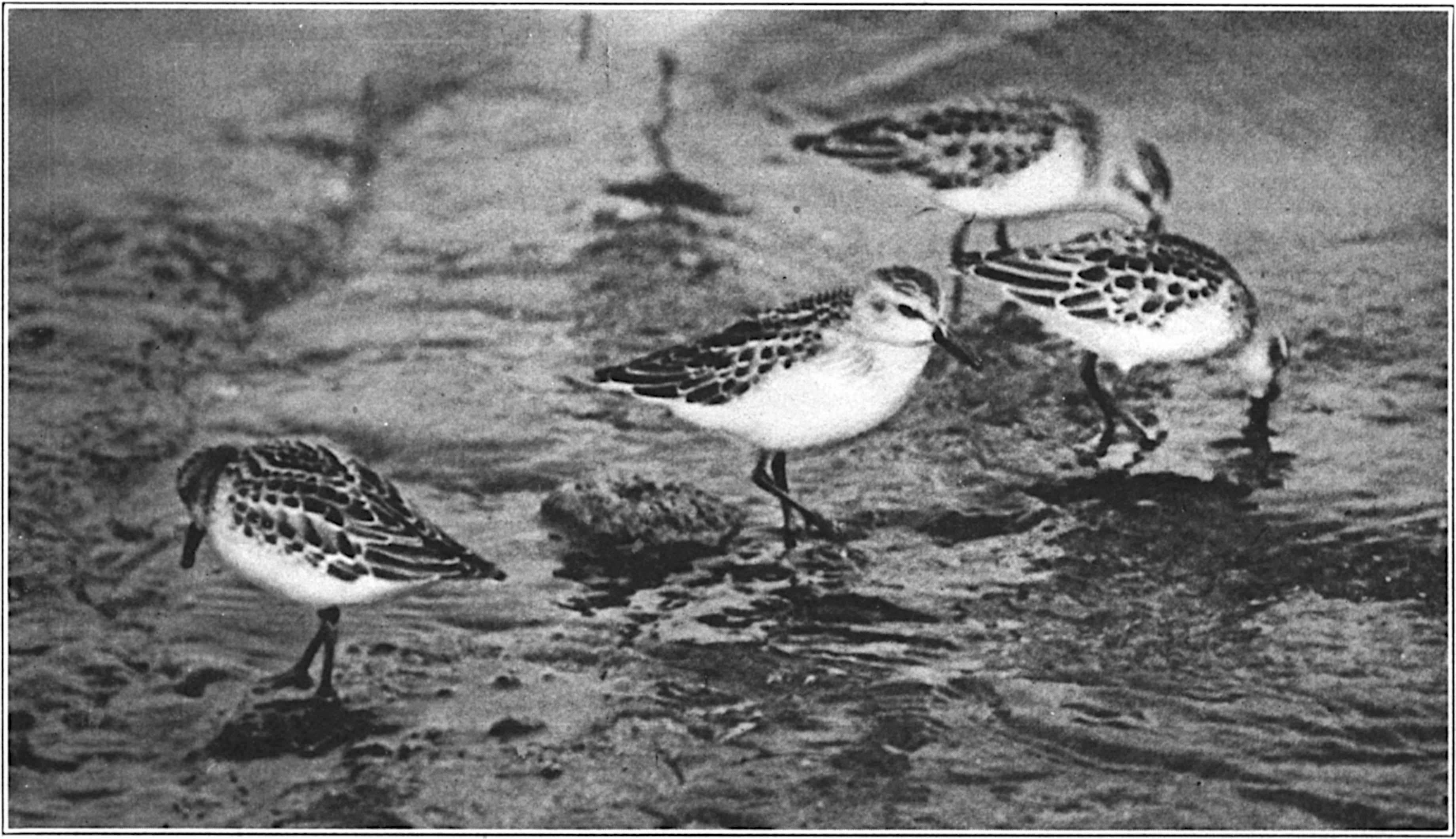
Semipalmated Sandpiper
Now, while I stood there slicing off the buttons,
I chanced to look up a moment at the
southern sky, and there for the first and still the
only time in my life, I saw a flight of swans. The
birds were passing along the coast well out to
sea; they were flying almost cloud high and
travelling very fast, and their course was as
direct as an arrow’s from a bow. Glorious white
birds in the blue October heights over the
solemn unrest of ocean—their passing was more
than music, and from their wings descended the(38)
old loveliness of earth which both affirms and
heals.
The last two weeks in October see the peak of
the autumnal visitations. In November and
December the stream from the inland shrinks,
but the coast-wise stream, continuing to flow,
brings us down a rare and curious world. Of this
I shall write at greater length, for I found it of
enormous interest.
Here, approaching the end of my notes on
birds and autumn, I chance to remember that
one of the strangest and most beautiful of the
migrations over the dunes was not a movement
of birds at all but of butterflies. There came
a morning early in October which ripened, as
the sun rose higher, into a rather mild and
September-like day; the wind was autumnal, I
recall, and from the north by west, but the
current was both mildly warm and light. As it
was a day to be spent out-of-doors, soon after
ten o’clock I went out round the back of the
Fo’castle into the sunlight and began to work
there on a bin I was putting together out of
driftage. I looked about, as I always do, but
nothing in the landscape chanced to take my(39)
eye. Sawing and hammering, I worked for
about three quarters of an hour, and then
downed tools to take a moment’s rest.
During the hour, a flight of twenty or more
large orange-and-black butterflies had arrived
in the region of the dunes. It was a flight, yet
were the individuals far apart. There was at
least an eighth of a mile between any two; some
were on the dunes, some were on the salt meadows,
three were on the beach. Their movements
were casual as the wind, yet there was an unmistakable
southerly pull drawing them on. I
tried to catch one of the travellers on the beach,
and though I count myself a fair runner, it
was no easy work keeping up with his turns and
erratic doublings. I wished him no ill; I simply
wanted to have a better look at him, but he
escaped me by rising and disappearing over the
top of a dune. When I reached the same top after
a scramble up a steep of sand, the fugitive was
already a good eighth of a mile away. I went
back to my carpentry with an increased respect
for butterflies as fliers.
An entomologist with whom I have been in
correspondence tells me that my visitors were
undoubtedly specimens of the monarch or milkweed(40)
butterfly, Anosia plexippus. In early
autumn adults gather in great swarms and
move in a generally southward direction, and
it is believed (but not proved) that New England
specimens go as far as Florida. The following
spring individuals (not swarms) appear in the
North apparently coming from the South. We do
not know—I am quoting this paragraph almost
verbatim—whether these are returning migrants
or whether they are individuals that had not previously
been in the North. We do know that none of
the fall migrants had previously been in the South.
The butterflies of Eastham remained upon
the dunes the rest of the morning. I imagine
that they were in search of food. Between half-past
twelve and half-past one they melted away
as mysteriously as they had come, and with
them went the last echo of summer and the
high sun from the dunes. And that day I finished
my bin and filled it and began to build a wall of
seaweed round the foundation of my house. A
cricket sang as I worked in the mild afternoon,
alive and hardy in his cave under my driftwood
mountain, and beyond this little familiar sound
of earth I heard the roar of ocean filling the
hollow space of day with its inexorable warning.
Chapter III THE HEADLONG WAVE — I — II — III
(41)
This morning I am going to try my hand at
something that I do not recall ever having encountered
either in a periodical or in a book,
namely, a chapter on the ways, the forms, and
the sounds of ocean near a beach. Friends are
forever asking me about the surf on the great
beach and if I am not sometimes troubled or
haunted by its sound. To this I reply that I
have grown unconscious of the roar, and though
it sounds all day long in my waking ears, and all
night long in my sleeping ones, my ears seldom
send on the long tumult to the mind. I hear the
roar the instant I wake in the morning and return
to consciousness, I listen to it a while consciously,
and then accept and forget it; I hear it
during the day only when I stop again to listen,
or when some change in the nature of the sound(42)
breaks through my acceptance of it to my
curiosity.
They say here that great waves reach this
coast in threes. Three great waves, then an indeterminate
run of lesser rhythms, then three
great waves again. On Celtic coasts it is the
seventh wave that is seen coming like a king out
of the grey, cold sea. The Cape tradition,
however, is no half-real, half-mystical fancy,
but the truth itself. Great waves do indeed approach
this beach by threes. Again and again
have I watched three giants roll in one after the
other out of the Atlantic, cross the outer bar,
break, form again, and follow each other in to
fulfilment and destruction on this solitary beach.
Coast guard crews are all well aware of this
triple rhythm and take advantage of the lull
that follows the last wave to launch their boats.
It is true that there are single giants as well.
I have been roused by them in the night. Waked
by their tremendous and unexpected crash, I
have sometimes heard the last of the heavy
overspill, sometimes only the loud, withdrawing
roar. After the roar came a briefest pause, and
after the pause the return of ocean to the night’s
long cadences. Such solitary titans, flinging their(43)
green tons down upon a quiet world, shake beach
and dune. Late one September night, as I sat
reading, the very father of all waves must have
flung himself down before the house, for the
quiet of the night was suddenly overturned by
a gigantic, tumbling crash and an earthquake
rumbling; the beach trembled beneath the avalanche,
the dune shook, and my house so shook
in its dune that the flame of a lamp quivered and
pictures jarred on the wall.
The three great elemental sounds in nature
are the sound of rain, the sound of wind in
a primeval wood, and the sound of outer ocean
on a beach. I have heard them all, and of the
three elemental voices, that of ocean is the most
awesome, beautiful, and varied. For it is a mistake
to talk of the monotone of ocean or of the
monotonous nature of its sound. The sea has
many voices. Listen to the surf, really lend it
your ears, and you will hear in it a world of
sounds: hollow boomings and heavy roarings,
great watery tumblings and tramplings, long
hissing seethes, sharp, rifle-shot reports, splashes,
whispers, the grinding undertone of stones, and
sometimes vocal sounds that might be the half-heard
talk of people in the sea. And not only is(44)
the great sound varied in the manner of its
making, it is also constantly changing its tempo,
its pitch, its accent, and its rhythm, being now
loud and thundering, now almost placid, now
furious, now grave and solemn-slow, now a
simple measure, now a rhythm monstrous with
a sense of purpose and elemental will.
Every mood of the wind, every change in the
day’s weather, every phase of the tide—all these
have subtle sea musics all their own. Surf of the
ebb, for instance, is one music, surf of the flood
another, the change in the two musics being
most clearly marked during the first hour of a rising
tide. With the renewal of the tidal energy,
the sound of the surf grows louder, the fury of
battle returns to it as it turns again on the land,
and beat and sound change with the renewal of
the war.
Sound of surf in these autumnal dunes—the
continuousness of it, sound of endless charging,
endless incoming and gathering, endless fulfilment
and dissolution, endless fecundity, and
endless death. I have been trying to study out
the mechanics of that mighty resonance. The
dominant note is the great spilling crash made
by each arriving wave. It may be hollow and(45)
booming, it may be heavy and churning, it may
be a tumbling roar. The second fundamental
sound is the wild seething cataract roar of the
wave’s dissolution and the rush of its foaming
waters up the beach—this second sound diminuendo.
The third fundamental sound is the
endless dissolving hiss of the inmost slides of
foam. The first two sounds reach the ear as a
unisonance—the booming impact of the tons
of water and the wild roar of the up-rush blending—and
this mingled sound dissolves into the
foam-bubble hissing of the third. Above the
tumult, like birds, fly wisps of watery noise,
splashes and counter splashes, whispers, seethings,
slaps, and chucklings. An overtone
sound of other breakers, mingled with a general
rumbling, fells earth and sea and air.
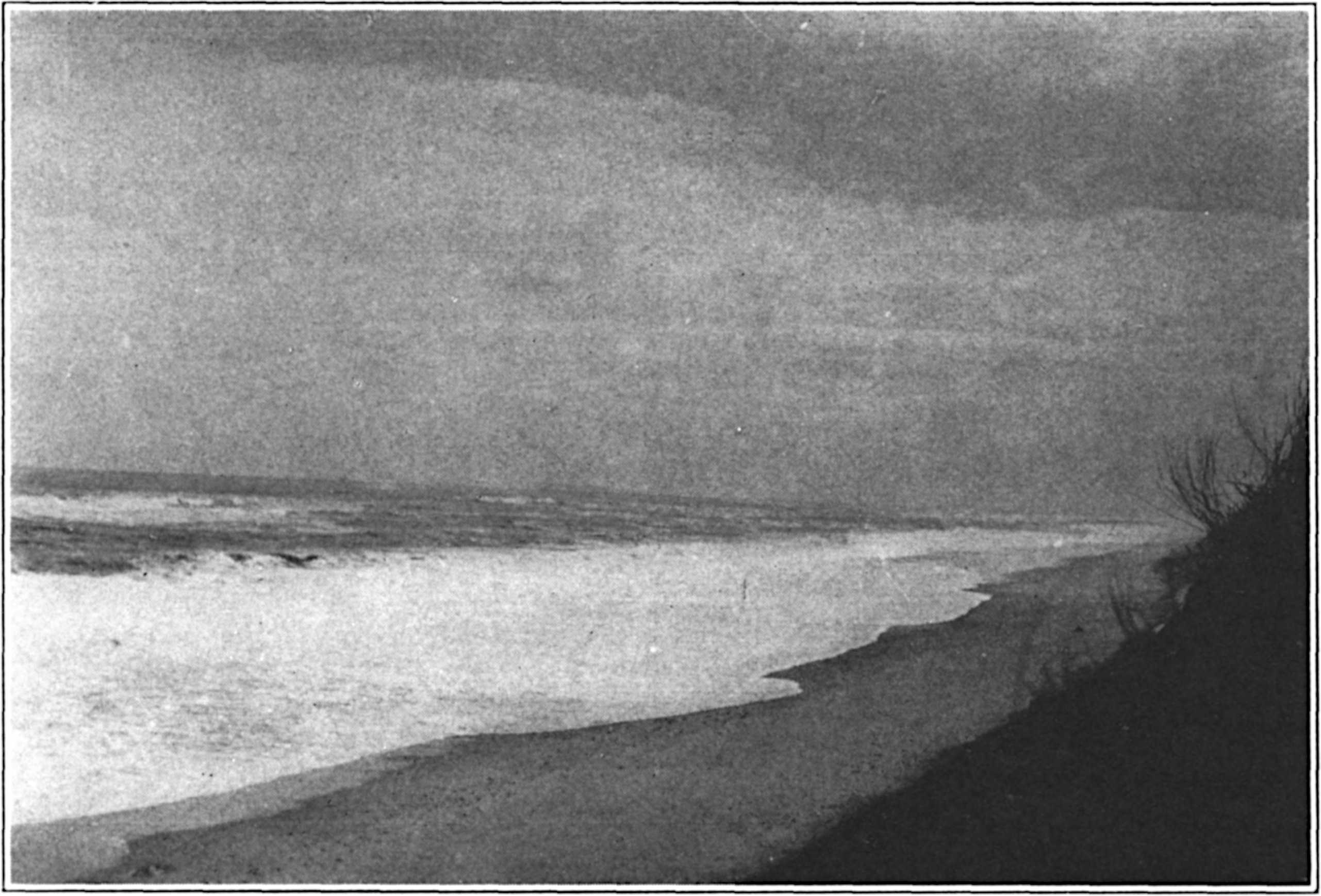
The Edge of Foam
Here do I pause to warn my reader that although
I have recounted the history of a breaker—an
ideal breaker—the surf process must be
understood as mingled and continuous, waves
hurrying after waves, interrupting waves, washing
back on waves, overwhelming waves. Moreover,
I have described the sound of a high surf
in fair weather. A storm surf is mechanically the
same thing, but it grinds, and this same long,(46)
sepulchral grinding—sound of utter terror to all
mariners—is a development of the second fundamental
sound; it is the cry of the breaker water
roaring its way ashore and dragging at the sand.
A strange underbody of sound when heard
through the high, wild screaming of a gale.
Breaking waves that have to run up a steep
tilt of the beach are often followed by a dragging,
grinding sound—the note of the baffled water
running downhill again to the sea. It is loudest
when the tide is low and breakers are rolling
beach stones up and down a slope of the lower
beach.
I am, perhaps, most conscious of the sound of
surf just after I have gone to bed. Even here I
read myself to drowsiness, and, reading, I hear
the cadenced trampling roar filling all the dark.
So close is the Fo’castle to the ocean’s edge that
the rhythm of sound I hear oftenest in fair
weather is not so much a general tumult as an
endless arrival, overspill, and dissolution of
separate great seas. Through the dark, mathematic
square of the screened half window, I
listen to the rushes and the bursts, the tramplings,
and the long, intermingled thunderings, never
wearying of the sonorous and universal sound.
(47)
Away from the beach, the various sounds of
the surf melt into one great thundering symphonic
roar. Autumnal nights in Eastham village
are full of this ocean sound. The “summer
people” have gone, the village rests and prepares
for winter, lamps shine from kitchen
windows, and from across the moors, the great
levels of the marsh, and the bulwark of the dunes
resounds the long wintry roaring of the sea.
Listen to it a while, and it will seem but one
remote and formidable sound; listen still longer
and you will discern in it a symphony of breaker
thunderings, an endless, distant, elemental cannonade.
There is beauty in it, and ancient terror.
I heard it last as I walked through the village on
a starry October night; there was no wind, the
leafless trees were still, all the village was abed,
and the whole sombre world was awesome with
the sound.
The seas are the heart’s blood of the earth.
Plucked up and kneaded by the sun and the
moon, the tides are systole and diastole of
earth’s veins.
The rhythm of waves beats in the sea like a(48)
pulse in living flesh. It is pure force, forever
embodying itself in a succession of watery shapes
which vanish on its passing.
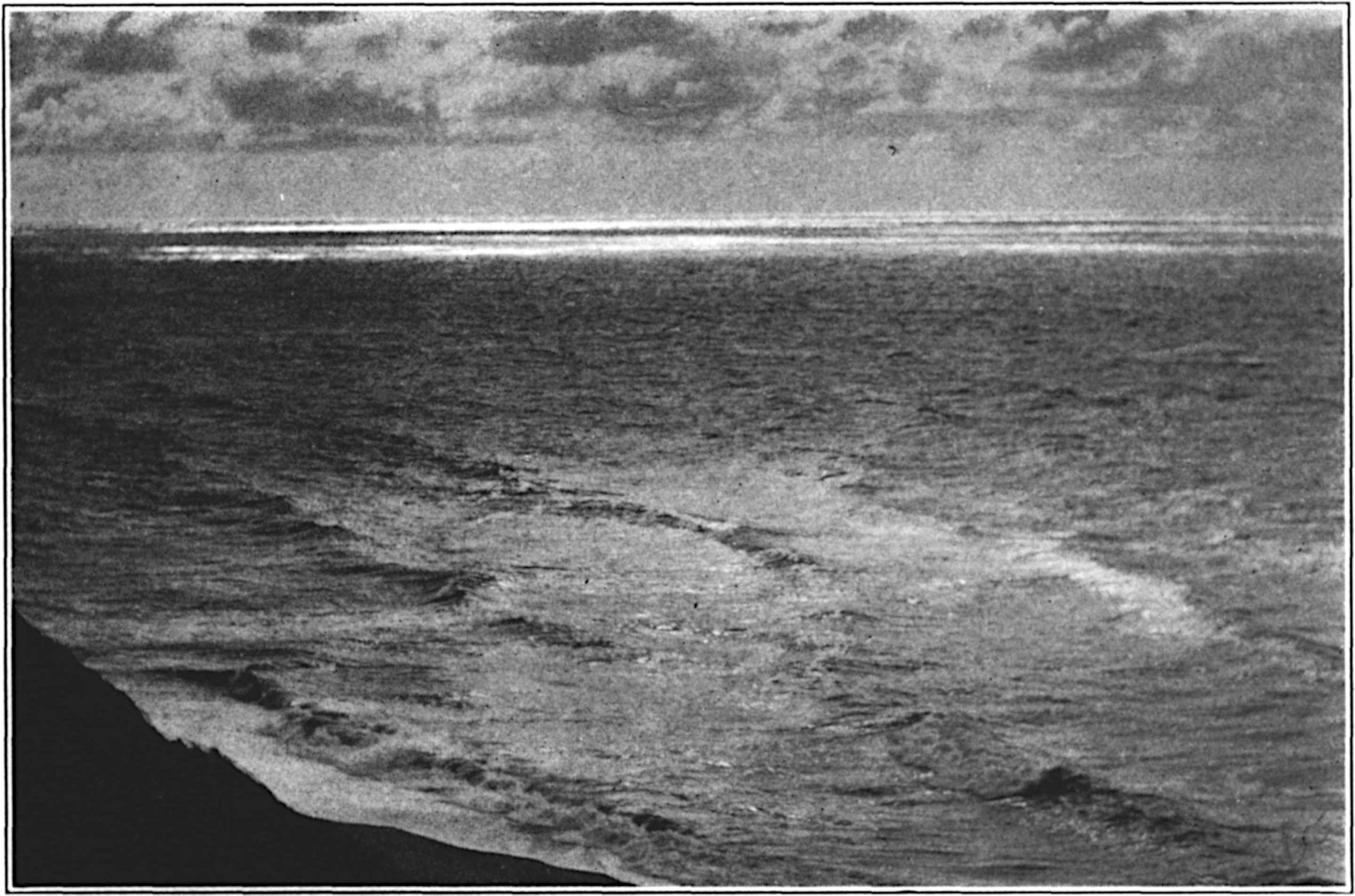
I stand on my dune top watching a great wave
coursing in from sea, and know that I am watching
an illusion, that the distant water has not
left its place in ocean to advance upon me, but
only a force shaped in water, a bodiless pulse
beat, a vibration.
Consider the marvel of what we see. Somewhere
in ocean, perhaps a thousand miles and
more from this beach, the pulse beat of earth
liberates a vibration, an ocean wave. Is the
original force circular, I wonder? and do ocean
waves ring out from the creative beat as they do
on a quiet surface broken by a stone? Are there,
perhaps, ocean circles so great and so intricate
that they are unperceived? Once created, the
wave or the arc of a wave begins its journey
through the sea. Countless vibrations precede
it, countless vibrations follow after. It approaches
the continent, swings into the coast
line, courses ashore, breaks, dissolves, is gone.
The innermost waters it last inhabited flow back
in marbly foam to become a body to another(49)
beat, and to be again flung down. So it goes
night and day, and will go till the secret heart of
earth strikes out its last slow beat and the last
wave dissolves upon the last forsaken shore.
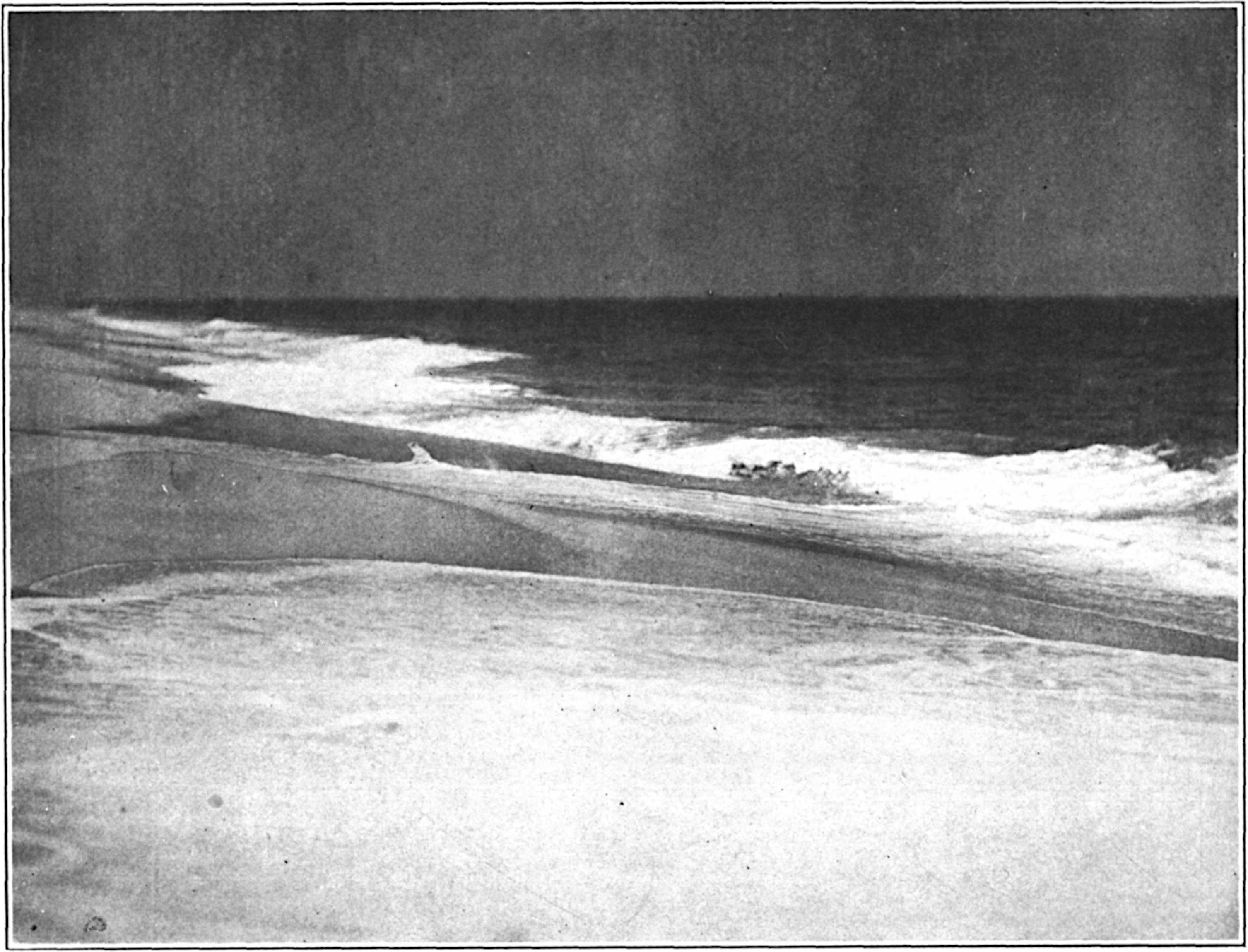
Slide and Seethe
As I stand on my dune top, however, I do not
think of the illusion and the beat of earth, for I
watch the waves with my outer rather than my
inner eye. After all, the illusion is set off by an
extraordinary, an almost miraculous thing—the
embodiment of the wave beat in an almost
constant shape. We see a wave a quarter of a
mile off, then a few hundred yards nearer in,
then just offshore; we seem to have been watching
the same travelling mass of water—there
has been no appreciable change in mass or in
shape—yet all the while the original beat has
taken on a flowing series of liquid bodies, bodies
so alike, so much the same, that our eye will
individualize them and follow them in—the
third wave, we say, or the second wave behind
the great wave. How strange it is that this beat
of earth, this mysterious undulation of the seas,
moving through and among the other forces
stirring the waters close off the continent,
should thus keep its constancy of form and(50)
mass, and how odd a blend of illusion and reality
it all is! On the whole, the outer eye has the
best of it.
Blowing all day long, a northwest wind yesterday
swept the sky clear of every tatter and wisp
of cloud. Clear it still is, though the wind has
shifted to the east. The sky this afternoon is a
harmony of universal blue, bordered with a
surf rim of snowiest blue-white. Far out at sea,
in the northeast and near the horizon, is a pool
of the loveliest blue I have ever seen here—a
light blue, a petal blue, blue of the emperor’s
gown in a Chinese fairy tale. If you would see
waves at their best, come on such a day, when
the ocean reflects a lovely sky, and the wind is
light and onshore; plan to arrive in the afternoon
so that you will have the sun facing the breakers.
Come early, for the glints on the waves are most
beautiful and interesting when the light is
oblique and high. And come with a rising tide.
The surf is high, and on the far side of it, a
wave greater than its fellows is shouldering out
of the blue, glinting immensity of sea.
Friends tell me that there are certain tropic
beaches where waves miles long break all at
once in one cannonading crash: a little of this, I(51)
imagine, would be magnificent; a constancy of it,
unbearable. The surf here is broken; it approaches
the beach in long intercurrent parallels,
some a few hundred feet long, some an eighth of
a mile long, some, and the longest, attaining the
quarter-mile length and perhaps just over. Thus,
at all times and instants of the day, along the
five miles of beach visible from the Fo’castle
deck, waves are to be seen breaking, coursing in
to break, seething up and sliding back.
But to return to the blue wave rolling in out
of the blue spaciousness of sea. On the other
side of the world, just opposite the Cape, lies
the ancient Spanish province of Galicia, and the
town of Pontevedra and St. James Compostella,
renowned of pilgrims. (When I was there they
offered me a silver cockle shell, but I would have
none of it, and got myself a sea shell from some
Galician fisherfolk.) Somewhere between this
Spanish land and Cape Cod the pulse of earth
has engendered this wave and sent it coursing
westward through the seas. Far off the coast,
the spray of its passing has, perhaps, risen on the
windward bow of some rusty freighter and fallen
in rainbow drops upon her plates; the great
liners have felt it course beneath their keels.
(52)
A continent rises in the west, and the pulse
beat approaches this bulwark of Cape Cod.
Two thirds of a mile out, the wave is still a sea
vibration, a billow. Slice it across, and its
outline will be that of a slightly flattened semi-circle;
the pulse is shaped in a long, advancing
mound. I watch it approach the beach. Closer
and closer in, it is rising with the rise of the
beach and the shoaling of the water; closer still,
it is changing from a mound to a pyramid, a
pyramid which swiftly distorts, the seaward
side lengthening, the landward side incurving—the
wave is now a breaker. Along the ridge of
blue forms a rippling crest of clear, bright water;
a little spray flies off. Under the racing foam
churned up by the dissolution of other breakers
the beach now catches at the last shape of sea
inhabited by the pulse—the wave is tripped by
the shoaling sand—the giant stumbles, crashes,
and is pushed over and ahead by the sloping line
of force behind. The fall of a breaker is never
the work of gravity alone.
It is the last line of the wave that has captured
the decorative imagination of the world—the
long seaward slope, the curling crest, the incurved
volute ahead.
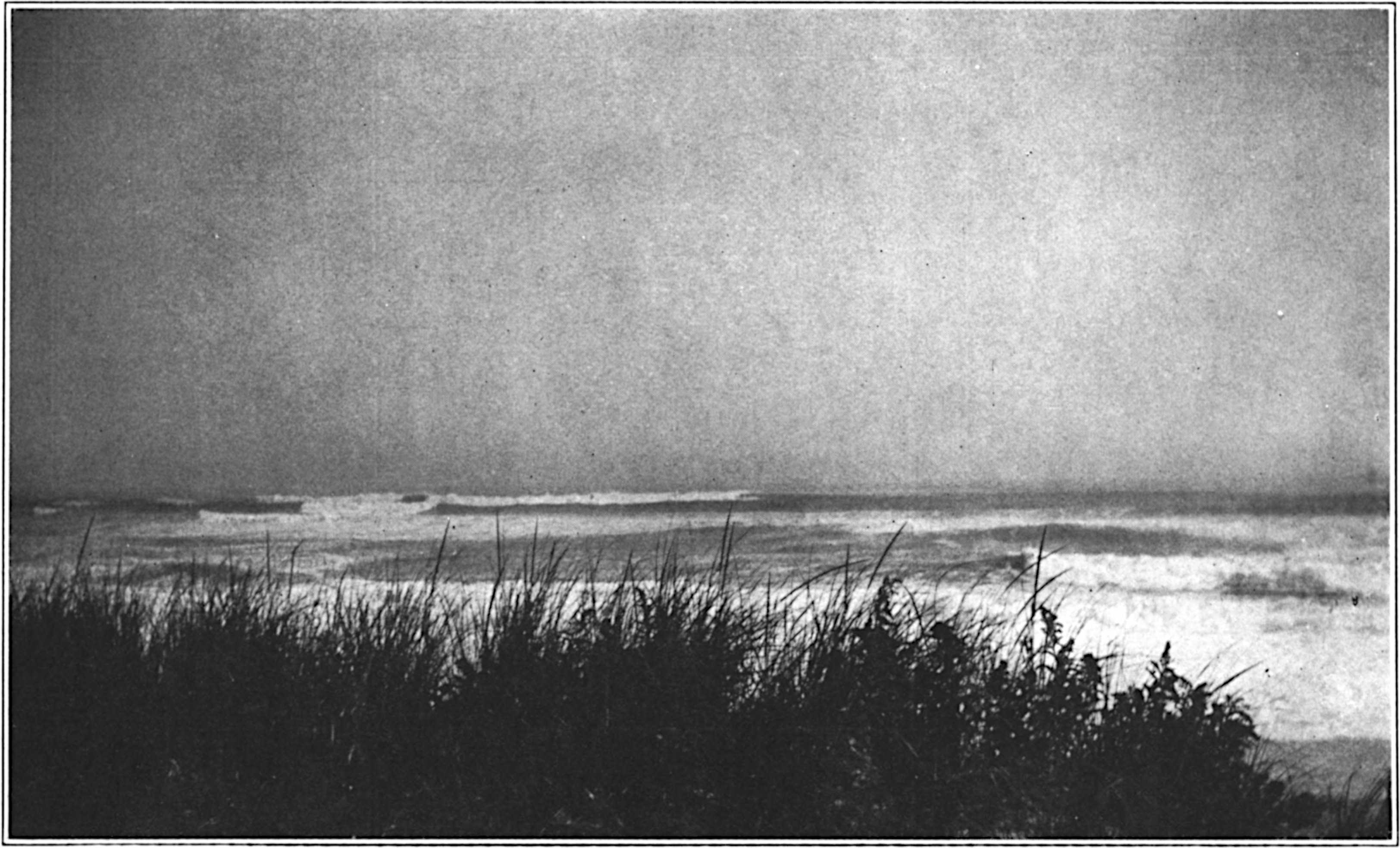
Summer Breakers
(53)
Toppling over and hurled ahead, the wave
crashes, its mass of glinting blue falling down
in a confusion of seething, splendid white, the
tumbling water rebounding from the sand to a
height almost always a little above that of the
original crest. Out of the wild, crumbling confusion
born of the dissolution of the force and
the last great shape, foamy fountains spurt,
and ringlets of spray. The mass of water, still
all furiously a-churn and seething white, now
rushes for the rim of the beach as it might for an
inconceivable cataract. Within thirty-five feet
the water shoals from two feet to dry land. The
edge of the rush thins, and the last impulse disappears
in inch-deep slides of foam which reflect
the sky in one last moment of energy and beauty
and then vanish all at once into the sands.
Another thundering, and the water that has
escaped and withdrawn is gathered up and
swept forward again by another breaking wave.
Night and day, age after age, so works the sea,
with infinite variation obeying an unalterable
rhythm moving through an intricacy of chance
and law.
I can watch a fine surf for hours, taking
pleasure in all its wild plays and variations. I(54)
like to stand on my beach, watching a long wave
start breaking in many places, and see the curling
water run north and south from the several beginnings,
and collide in furious white pyramids
built of the opposing energies. Splendid fountains
often delight the eye. A towering and deep-bellied
wave, toppling, encloses in its volute a
quantity of air, and a few seconds after the spill
this prisoned and compressed vapour bursts up
through the boiling rush in feathery, foamy
jets and geyser plumes. I have seen fountains
here, on a September day, twenty and twenty-five
and even thirty feet high. Sometimes a
curious thing happens. Instead of escaping
vertically, the rolled-up air escapes horizontally,
and the breaker suddenly blows, as from a
dragon’s mouth, a great lateral puff of steamy
spray. On sunny days, the toppling crest is often
mirrored in the glassy volute as the wave is breaking.
One lovely autumn afternoon, I saw a beautiful
white gull sailing along the volute of a breaker
accompanied by his reflection in the wave.
I add one curious effect of the wind. When
the wind is directly offshore or well offshore, the
waves approach fighting it; when the wind is offshore
but so little off that its angle with the coast(55)
line is oblique—say an angle never greater than
twenty-two degrees and never less than about
twelve—the waves that approach the coast do
not give battle, but run in with their long axis
parallel to the wind. Sitting in the Fo’castle,
I can often tell the exact quarter of an offshore
wind simply by looking at this oblique alignment
of the waves.
The long miles of beach are never more beautiful
than when waves are rolling in fighting a
strong breeze. Then do the breakers actually
seem to charge the coast. As they approach,
the wind meets them in a shock of war, the
chargers rear but go on, and the wind blows back
their manes. North and south, I watch them
coursing in, the manes of white, sun brilliant
spray streaming behind them for thirty and even
forty feet. Sea horses do men call such waves on
every coast of the world. If you would see them
at their best, come to this beach on a bright
October day when a northwest wind is billowing
off to sea across the moors.
I will close my chapter with a few paragraphs
about heavy surf.
(56)
It is best to be seen, I think, when the wind
is not too high. A gale blows up a surf, but it
also flattens out the incoming rollers, making
monstrous, foamy travelling mounds of them
much like those visible from a ship at sea. Not
until the wind has dropped do the breakers
gather form. The finest surf I have ever seen
here—it was a Northern recoil of the great
Florida hurricane—broke on three pleasant
and almost windless autumn days. The storm
itself had passed us, but our seas had been stirred
to their deeps. Returning to the Cape at night
from a trip to town, I heard the roar of the
ocean in Orleans, and on arriving at Nauset,
found the beach flooded to the dunes, and
covered with a churn of surf and moonlight.
Dragging a heavy suitcase and clad in my go-to-town
clothes, I had an evil time getting to the
Fo’castle over the dune tops and along the
flooded marsh.
Many forces mingle in the surf of a storm—the
great earth rhythm of the waves, the violence
of wind, the struggle of water to obey its own
elemental law. Out of the storm at sea come
the giants and, being giants, trip far out, spilling
first on the outer bar. Shoreward then they(57)
rush, breaking all the way. Touching the
beach, they tumble in a roar lost in a general
noise of storm. Trampled by the wind and everlastingly
moved and lifted up and flung down
by the incoming seas, the water offshore becomes
a furious glassiness of marbly foam; wild,
rushing sheets of seethe fifty feet wide border it;
the water streams with sand.
Under all this move furious tidal currents, the
longshore undertow of outer Cape Cod. Shore
currents here move in a southerly direction; old
wreckage and driftwood is forever being carried
down here from the north. Coast guard friends
often look at a box or stick I have retrieved,
and say, “Saw that two weeks ago up by the
light.”
After an easterly, I find things on the beach
which have been blown down from the Gulf of
Maine—young, uprooted spruce trees, lobster
buoys from Matinicus, and, after one storm, a
great strewing of empty sea-urchin shells. Another
easterly washed up a strewing of curious
wooden pebbles shaped by the sea out of the
ancient submerged forests which lie just off the
present coast. They were brown-black, shaped
like beach stones, and as smooth as such stones.
(58)
The last creature I found in the surf was a
huge horseshoe crab, the only one I have ever
chanced to find on the outside. Poor Limulus
polyphemus! The surf having turned him upside
down, he had as usual doubled up, and the surf
had then filled with sand the angle of his doubling.
When I discovered him, he was being
bullied by a foam slide, and altogether in a
desperate way. So I picked him up, rinsed the
sand out of his waving gills, held him up all
dripping by the tail, and flung him as far as I
could to seaward of the breakers. A tiny splash,
and I had seen the last of him, a moment more,
and the surf had filled the hollow in which he
had lain.
Autumnal easterlies and November tides
having scoured from the beach its summer deeps
of sand, the high seasonal tides now run clear
across to the very foot of the dunes. Under this
daily overflow of cold, the last of the tide-rim
hoppers and foragers vanish from the beach.
An icy wind blusters; I hear a dry tinkle of sand
against my western wall; December nears, and
winter closes in upon the coast.
Chapter IV MIDWINTER — I — II — III
(59)
A year indoors is a journey along a paper
calendar; a year in outer nature is the accomplishment
of a tremendous ritual. To share in it,
one must have a knowledge of the pilgrimages of
the sun, and something of that natural sense
of him and feeling for him which made even the
most primitive people mark the summer limits
of his advance and the last December ebb of his
decline. All these autumn weeks I have watched
the great disk going south along the horizon
of moorlands beyond the marsh, now sinking
behind this field, now behind this leafless tree,
now behind this sedgy hillock dappled with thin
snow. We lose a great deal, I think, when we lose
this sense and feeling for the sun. When all has
been said, the adventure of the sun is the great
natural drama by which we live, and not to have
joy in it and awe of it, not to share in it, is to(60)
close a dull door on nature’s sustaining and
poetic spirit.
The splendour of colour in this world of sea and
dune ebbed from it like a tide; it shallowed first
without seeming to lose ground, and presently
vanished all at once, almost, so it seemed, in one
grey week. Warmth left the sea, and winter
came down with storms of rushing wind and
icy, pelting rain. The first snow fell early in
November, just before the dawn of a grey and
bitter day. I had written a letter the night before,
intending to give it to the coast guardsman
who came south at seven o’clock, but somehow
or other I missed him; and no welcome light
flashed an answer to mine as I stood on the crest
of my dune looking into the darkness of the
beach and listening to the sombre thunder of
a rising sea. Unwilling to stay up till after midnight
for the next patrol, I went out and put a
note on the coast guard key post just south of
me asking the last man south in the morning
to wake me up and come in and get the letter.
At about half-past five I woke to a stamping of
feet and a knock on the door, and in came John
Blood, the tall, light-haired New Yorker, very
much buttoned up into his blue pea jacket, and(61)
with his watch cap well pulled down upon his
ears.
The Burst of a Wave
“Ahoy, John—thanks for coming in. What’s
it like outside?”
“It’s snowing. Winter’s come, I guess,” he
said, with a meditative grin.
We talked, I gave him the letter, and he went
out into the dark break of dawn, the wind, and
the snow.
My fire had gone out, the Fo’castle was raw
and cold, but my wood was ready, and I soon
had a fire crackling. All winter long, I kept a
basket of little sticks and fragments of driftwood
ready for the morning, and began the day with
a bonfire in the fireplace. A hearthful of high,
leaping flame sends out a quick and plentiful
heat. Light came slowly into the world, coming
not so much from the east as from some vague,
general nowhere—a light that did not grow
brighter but only increased in quantity. A northwest
snow squall was blowing across the sedgy
marshes and the dunes, “seeming nowhere to
alight” in the enormous landscape, and whirling
off to the sullen, iron-green, and icy sea. As I
watched, half-a-dozen gulls came sailing over
from the marsh. These birds like foul weather(62)
and have a way of flying out over along the
breakers a few minutes after the edge of a cloud
has hidden the sun, and there is a strange,
ominous sense of storm in this great natural
scene.
The snow skirted along the beach, the wind
suffering it no rest; I saw little whirlpools of it
driving down the sand into the onrush of the
breakers, it gathered in the footprints of the
coast guard patrols, building up on their leeward
side and patterning them in white on the empty
beach. The very snow in the air had a character
of its own, for it was the snow of the outer Cape
and the North Atlantic, snow icy and crystalline,
and sweeping across the dunes and moors rather
than down upon them. Chancing to look to the
north, I saw Nauset Light still turning and
gleaming, and as I watched, it suddenly sank to
a storm-smothered and distant glow and stopped.
By the almanac, the sun had risen. So began the
worst winter on the Cape for close upon fifty
years, a winter marked by great storms and
tides, six wrecks, and the loss of many lives.
The sun, this December morning, has come
to the end of his southern journey, he climbs
the whitish sky to the south over the white fury(63)
of the Orleans shoals, and takes on a silvery
quality from the pallor of the sky. On such a
morning went ancient peoples to their hills,
and cried to the pale god to return to their
woods and fields; perhaps the vanished Nausets
danced a ceremonial dance on those inland
moors, and the same northwest wind carried the
measured drumming to these dunes. A morning
to go out upon the dunes and study the work of
winter. Between the cold blue of the sea and
the levels of the marshes, the long wall of the
dunes lies blanched to a whiter pallor than the
surrounding landscape, for there is no russet and
but little gold in dune grass when it dies. That
intricacy of green, full-fleshed life, which billowed
like wild wheat in the summer’s southwest wind,
has thinned away now to a sparse world of
separate heads, each one holding, as in a fist, a
clump of whitish and mildewed wires.
The sand moves beneath. This shrinking of
summer’s vegetation, this uncovering of the
body of the dune, has permitted the winter gales
to reach the sand, and all up and down the great
wall, on the tops of the dunes, the surface sand is
moving. The direction of this movement varies,
of course, with the direction of the wind, but in(64)
general the movement is toward the sea, for the
prevailing winter winds are northwesterly. In
some places the blown and creeping sand has
covered the grass so deeply that only the very
tips of the withered spikes rise out of it; in other
places, on the landward rims of the dunes, the
wind has blown the sand entirely away from the
plant and left a withered tangle of roots and
stalks sprawling in the wind. Here and there, in
the dead, whitish grass, one encounters a stray tiny
spotlet of snow, relic of a storm a fortnight past.
Such spots linger here for inexplicable weeks and
have an air of things disregarded and forgotten.
I have written of the movement of sand on the
surface of the dune, yet the very essence of the
work of winter here is the quieting, the enchainment
of the mass of the sand. The sun no longer
being hot enough to dry it, moisture lies on it and
within it, it loses its fluidity, it takes on weight
and definition. Footprints which the summer
would erase in a quarter of an hour remain in
well-sheltered places for days and even weeks.
There is a winter change of colour, as well. The
warm golden quality vanishes and is replaced
by a tone of cold silver-grey, which makes no
flashing answer to the sun.
The Winter Beach
(65)
Animal life has disappeared into the chill air,
the heavy, lifeless sand. On the surface, nothing
remains of the insect world. That multiplicity
of insect tracks, those fantastic ribbons which
grasshoppers, promenading flies, spiders, and
beetles printed on the dunes as they went about
their hungry and mysterious purposes, have
come to an end in this world and left it all the
poorer. Those trillions of unaccountable lives,
those crawling, buzzing, intense presences which
nature created to fulfil some unknown purpose or
perhaps simply to satisfy a whim for a certain
sound or a moment of exquisite colour, where
are they now, in this vast world, silent save for
the sombre thunder of the surf and the rumble
of wind in the porches of the ears? As I muse
here, it occurs to me that we are not sufficiently
grateful for the great symphony of natural
sound which insects add to the natural scene;
indeed, we take it so much as a matter of course
that it does not stir our fully conscious attention.
But all those little fiddles in the grass, all those
cricket pipes, those delicate flutes, are they not
lovely beyond words when heard in midsummer
on a moonlight night? I like, too, the movement
they give to a landscape with their rushes, their(66)
strange comings and goings, and their hoverings
with the sun’s brilliance reflected in their wings.
Here, and at this especial moment, there is no
trace or vestige of the summer’s insect world,
yet one feels them here, the trillion, trillion tiny
eggs in grass and marsh and sand, all faithfully
spun from the vibrant flesh of innumerable
mothers, all faithfully sealed and hidden away,
all waiting for the rush of this earth through
space and the resurgence of the sun.
I find no more paths of little paws and claw-tipped
feet, each one with its own rhythm, its
own mechanics of walking and running. The
skunks, who linger till the last chilled grasshopper
has been pounced on and eaten, are now
lying torpid in their dark snuggles underground,
their heartbeat stilled to a ghost of its summer
self. They do not, apparently, make themselves
burrows on the dunes, perhaps because a wise
instinct warns them that a burrow in these open
sands might collapse about them as they slept.
November finds them travelling up the dunes to
the firm soil of the mainland moors. The hill
nearest the dunes is full of their winter parlours.
Twice during the winter I saw a wildcat of
domestic stock hunting along the edge of the(67)
marsh, and marked how savagery had completely
altered the creature’s gait, for it slunk along,
belly close to the grass, like a panther. A large
brown cat with long fur and a wild and extraordinarily
foolish face. I imagined it was out
hunting the marsh larks who feed in the stubble
of the salt-hay fields. Another time, I saw the
hoofs of a deer in the sand, but of this deer and its
adventures in the frozen marsh I shall speak later.
At Orleans, an otter, a rare animal here, has
been seen, the man who saw it taking it for a
seal until it came out of the breakers and ran
along the sand. Every now and then, from the
windows of the Fo’castle, I catch sight of a
seal’s black head swimming about close inshore.
In summer, seals are rarely seen on this part of
the great outer beach—I myself have never
seen one—but in winter they come along the
breakers reconnoitring in search of food. They
have a trick of swimming unperceived under a
flock of sea ducks, seizing one of the unwary
birds from underneath, and then disappearing
with their mouths full of flesh and frantic
feathers. A confusion follows; the survivors leap
from the water with wildly beating wings, they
scatter, wheel, and gather again, and presently(68)
nature has erased every sign of the struggle, and
the sea rolls on as before.
There has been a strange tragedy to the north;
one of those dread elemental things that happen
in an elemental world. The other evening my
friend Bill Eldredge, of Nauset, told me that
there had been a disaster that same morning
off the Race. Two fishermen who had left
Provincetown in a big, thirty-foot motor dory
were seen from the beach to be having trouble
of some kind; the dory had then drifted into a
tide rip churned up with surf, and capsized and
drowned her crew. A few nights later, Bill
came south again, and I stood for a moment
talking to him on the beach at the foot of the
Fo’castle dune. A lovely night of great winter
stars and a quiet sea. “You remember those two
fishermen I was telling you about?” said Bill.
“They’ve found them both now. One of them
had a son at Wood End Station, and when he
was coming back from his patrol last night he
saw his father’s body on the beach.”
On the night of Saturday, January 1st, it was
almost pitch dark along the coast. In the murk,(69)
the eye of Nauset Light had a reddish tinge, and,
turning, revealed a world shaped like a disk and
pressed between a great darkness of earth and
a low, black floor of cloud. The wind was on
shore and blowing strong. Some time after
midnight, a surfman from Cahoons Hollow
Coast Guard Station, patrolling south, discovered
a schooner in the surf, with the seas
breaking over her, and the crew hollering in the
rigging. I write “hollering” here without shame,
for “hallooing,” or whatever the proper spelling
of the verb may be, simply would not tell the
story, or convey the sound heard in the
night. After holding up a red signal flare to tell
the men on the wreck that they had been seen,
the surfman hurried on to Cahoons and gave
the alarm. The crew of the station, under
command of Captain Henry Daniels, then
dragged their cart of life-saving apparatus down
the beach through a surf running to the bank,
and took off every single man safely in the
breeches buoy. The prompt and gallant rescue
had been no easy task, with the tide thus running
high and the seas breaking over the
schooner.
I had my first view of her the next afternoon.(70)
She turned out to be the two-masted, motor-auxiliary
fishing schooner A. Roger Hickey,
Boston-bound from the fishing grounds. Her
compass had been at fault, they said. When I
caught sight of her from the top of a path descending
the great earth cliff of the Cape, the
vessel lay on the open sand a mile up the beach
to the north, a typical Boston fisherman with a
red bottom and a black hull. A vessel, I judged,
something over a hundred feet long. The whole
vast view was really a picture of singular and
moving beauty; it would be hard to forget, I
think, that immense and jade-green ocean
under a fine sky, the great, sepia-brown beach
with its overhanging haze of faintest violet, the
bright ship so forlorn, and the tiny black figures
moving round and about it. The beach had
already begun to break up its prize. Along it, on
my way to the ship, I saw splintered wood, an
undamaged hatch cover painted white, and
several bunches of water-logged manila tags
with a fish merchant’s name printed on them
in large black letters.
Presently there came walking toward me
three ladies of Wellfleet, good, pleasant New
England housewives, each one with a large(71)
haddock under her arm rolled up in a sheet of
newspaper, the three dead-eyed haddock heads
protruding as from paper collars, the three fish
tails visible behind. Apparently the fish which
the Hickey had on board when she struck were
being given away.
Arriving at the wreck, I found that her rudder
had already carried away, and that her timbers
were badly wrenched, and her seams opened.
The ship’s dog, who had been thrillingly rescued
in his master’s arms, sat shivering on the beach,
a most inoffensive and unromantic brown dog
with what looked like an appalling case of
mange. A handful of visitors, men and boys in
workaday clothes and rubber boots, were wandering
round the vessel, their boot prints making
a chain about her on the beach, and other men
were busy puttering round the steeply tilted
deck. Finding Captain Henry Daniels of Cahoons
aboard, an old friend of years’ standing, I heard
that the crew of the Hickey, two or three excepted,
had already returned to Boston by
train, and that the vessel was so badly damaged
that she was to be stripped as soon as possible
of all gear worth saving, and abandoned.
Midships, a discussion was going on round(72)
the open mouth of one of the fish holds. The
Hickey’s catch was still there, a mass of big
greyish fish bodies, haddocks with staring eyes,
cod with chin whiskers, flounders, and huge
lemon soles. The discussion concerned the
possibility of the fish having had a bath in fuel
oil when the seas washed into the Hickey at
high tide. No one took serious alarm, and the
fish, handed out to all comers by a member
of the crew, proved excellent eating.
So they stripped the A. Roger Hickey, took
out her engine and such gear as they could, and
then someone set fire to the hulk. By the end
of the winter, there was not even a splinter of
this vessel on the beach. She was the third
wreck, and there were others to come.
As the winter closed in upon the beach, I
began to look forward to days when I might see
what took place there during icy weather, but
such opportunities proved even rarer than I had
expected. Thrust forth as it is into the outer
Atlantic, the Cape has a climate of island quality
and island moderation. Low temperatures may
occur, but the thermometer almost never falls
as low as it does on the inner Massachusetts
coast, nor do “spells” of cold weather “hang(73)
on” for any length of time. Storms which are
snowstorms on the continental mainland turn
to rainstorms on the Cape, and such snowstorms
as do arrive form but a crust upon these
Eastham moors. Two days after the storm the
snow has thinned to great decorative patches on
the slopes of sedgy hills; in another day only
fragments, drifts, and stray islets remain. There
is even a difference of temperature between the
mainland moors of Eastham and the dunes. It
is warmer on the bar. On a casual winter day I
have noted a difference of eight degrees.
The work of cold weather—I mean weather
when the temperature sinks toward zero—is
thus to be observed only on occasion along this
beach. When it comes, it comes all at once,
creates a new world overnight, and vanishes
overnight. The agency that brings it is the northwest
wind sweeping down on us across Massachusetts
Bay from the forests and frozen
lakes of northern Canada. I remember one of
the nights of its coming, a Thursday night
early in January with great winter clouds moving
out to sea, opening and closing over the cold
stars, the wind on the beach so icy that I found
myself, when I first went out into it, breathing(74)
it in little reluctant breaths. The next day was
as cold and desolate a day as I have ever seen
upon the beach. The ocean was purple-black,
rough, and covered with sombre whitecaps; the
morning light was pewter dull, and over earth
and sea and the lonely sands hung a pall of
purple-leaden cloud full of vast, tormented motion
as it crossed the Cape on its way to the
Atlantic. Looking off to sea, as I walked down
my dune to go exploring, I saw a solitary
freighter hugging the coast for shelter from the
northwest wind; she was plunging heavily in
the great seas and flinging up tons of spray with
each plunge, and her bow and her forward deck
were already thick with ice. Gulls flew along
the iron-black and sombre breakers of the ebb,
their white plumage chalky in that impure and
arctic light. The wind was a thing to search the
marrow of one’s bones.
Two beaches had formed in the icy night, best
seen and studied at low tide. The upper beach
occupied the width between the dunes and the
line of the night’s high tide; the lower beach
sloped from this high-tide mark to the open sea.
The upper beach and the dunes were frozen
hard. The frozen sand was delightful to walk(75)
upon, for the tiny congealed grains afforded a
safe, sustaining footing, and the surface, though
solid, had the resiliency of thick, unvarnished
linoleum on a good floor. It was an odd, an
unnatural experience, to hit one’s foot on a
ridge of frozen sand. Fragments of wreckage
imbedded in the sand, wreaths of imbedded
seaweed—all these were as immovable as so
many rocks. At the very foot of the largest of the
dunes, I found a male surf scoter or skunk coot
frozen stiff. A few solid kicks dislodged it, and I
picked it up, but could find no wound. The
lower beach, that is to say the width that had
been covered by the tide during the night, was
frozen solid at its junction with the upper beach,
but the fine slope down to the breakers, though
frozen firm, was not frozen through and through.
Along the edge of the breakers, it was not frozen
at all.
Between these two beaches, one above, one
below, one frozen solid, the other crusted over,
there ran a kind of frontier some eight or ten
feet wide, a no-man’s-land of conflicting natural
forces. At the height of the night tide, the
seething foam rims of the sliding surf, flung by
the ocean into the face of the night cold, had(76)
frozen on the sloping beach in layers of salt ice
which preserved all the curves and foamy ridges
of the captured edge of the sea. The brim of a
high tide, that very spirit of energy and motion,
lay there motionless on a beach itself deprived of
motion; the scalloped edges, the little curls of
foam, the long, reaching, rushing tongues, all
these were to be seen enchanted into that ocean
ice which is so much like a kind of snow. At its
upper edge this image of the surf brim was but
a glaze of ice on the beach; at its lower edge it
was twelve to fifteen inches in height and fell off
sheer, like an ice cake, to the beach below. And
north and south it ran, mile upon icy mile, as far
as the eye could see.
The subsequent history of this ice is not without
interest. After two days of bitter cold the
wind changed in the night, and that night’s tide
quietly removed every vestige of the ice cakes
from the beach. The swathe on which the ice
had lain, however, remained half visible, for
there water and sand had mingled and frozen
deep. Presently the upper beach thawed, the
cold crumbling drily out of the sand, and the
lower beach, which had yielded its frozen surface
to each succeeding tide and frozen again during(77)
the ebb, remained as the last tide left it. Between
the two beaches, the width of buried ice lingered
for a fortnight, resisting sun and whole days of
winter rain. It had a way of coming suddenly to
an end, and of beginning as suddenly again;
sand drifted over it, the tide edge seeped through
to it, the moving beach, forever adjusting itself
to complex forces, burst it open, yet it lingered
on. For all of us who used the beach, this buried
width of ice became a secret road. The coast
guards knew it well and followed along it in the
night. As I set down these words, I think of the
times I have come to a blind end and prodded
the sand with my beach staff in search of that
secret footing. Little by little the sun and the tides
wore down its resistance, and so it disappeared,
and our searching feet knew it no more.
The great marsh was another desolation on
that same overcast and icy day. Salt ice had
formed in wide rims along the edges of the great
level islands, the shallower channels had frozen
over, and the deeper ones were strewn with ice
cakes sailing and turning about in the currents of
the tides. The scene had taken on a certain winter
unity, for the ice had bound the channels and the
islands together into one wide and wintry plain.
(78)
On the next morning—it was sunny then, but
still freezing cold—I chanced to go out for a
moment to look at the marsh. About a mile
and a half away, in one of the open channels, was
a dark something which looked like a large, unfamiliar
bird. A stray goose, perhaps? Taking
my glass, I found the dark object to be the head
of a deer swimming down the channel, and, even
as I looked, there came to my ears the distant
barking of dogs. A pair of marauding curs, out
hunting on their own, had found a deer somewhere
and driven the creature down the dunes and
into the icy creeks. Down the channel it swam,
and presently turned aside and climbed out on
the marsh island just behind the Fo’castle. The
animal was a young doe. I thought then, and I still
believe, that this doe and the unseen creature
whose delicate hoofprints I often found near the
Fo’castle were one and the same. It lived, I believe,
in the pines on the northern shore of the
marsh and came down to the dunes at earliest
dawn. But to return to its adventures: All afternoon
I watched it standing on the island far out in
the marsh, the tall, dead sea grass rising about its
russet body; when night came, it was still there,
a tiny spot of forlorn mammalian life in that(79)
frozen scene. Was it too terrified to return?
That night a tide of unusual height was due
which would submerge the islands under at
least two feet of water and floating ice. Would
the doe swim ashore under cover of darkness?
I went out at midnight into my solitary world
and saw the ice-covered marsh gleaming palely
under a sky of brilliant stars, but could see
nothing of the island of the doe save a ghostliness
of salt ice along the nearer rim.
The first thing I did, on waking the next
morning, was to search the island with my
glass. The doe was still there.
I have often paused to wonder how that
delicate and lovely creature endured so cruel a
night, how she survived the slow rise of the icy
tide about her poor legs, and the northwest gale
that blustered about her all night long in that
starlit loneliness of crunchy marsh mud and
the murmur of the tides. The morning lengthened,
the sun rose higher on the marsh, and
presently the tide began to rise again. I watched
it rising toward the refugee, and wondered if
she could survive a second immersion. Just a
little before noon, perhaps as the water was
flooding round her feet, she came down to the(80)
edge of her island, and plunged into the channel.
The creek was full of ice mush and of ice floes
moving at a good speed; the doe was weak, the
ice cakes bore down upon her, striking her
heavily; she seemed confused, hesitated, swam
here, swam there, stood still, and was struck
cruelly by a floe which seemed to pass
over her, yet on she swam, bewildered, but
resolute for life. I had almost given up hope for
her, when rescue came unexpectedly. My friend
Bill Eldredge, it appeared, while on watch in
the station tower the day before had chanced to
see the beginning of the story, and on the second
morning had noticed the doe still standing in
the marshes. All the Nauset crew had taken an
interest. Catching sight of the poor creature
fighting for life in the drift, three of the men put
off in a skiff, poled the ice away with their oars,
and shepherded the doe ashore. “When she
reached dry land, she couldn’t rise, she was so
weak, and fell down again and again. But finally
she stood up and stayed up, and walked off into
the pines.”
I have now to tell of the great northeast storm
of February 19th and 20th. They say here that(81)
it was the worst gale known on the outer Cape
since the Portland went down with all hands
on that terrible November night in ’98.
It began after midnight on a Friday night,
and the barometer gave but little warning of its
coming. That Friday afternoon I had walked up
the beach to Nauset Station, found Bill Eldredge
on watch in the tower, and asked him to wake me
up when he went by at midnight. “Never mind if
you don’t see a light,” I said. “Come in anyway
and wake me up. I may go down the beach with
you.” I often made the patrols with the men at
the station, for I liked to walk the beach by night.
Shortly after midnight, Bill came to the door,
but I did not get up and dress to go down the
beach with him, for I was rather tired from piling
up a mass of driftwood, so I sat up in bed
and talked to him by the dying light of my fire.
On bitter nights, I used to put a big log on in
the hope that it might flicker and smoulder till
morning, but on average nights, I let the fire die
down to a bed of ashes, for I am a light sleeper,
and the little play of flames on the hearth kept
me awake. Living in outer nature keeps the senses
keen, and living alone stirs in them a certain
watchfulness.
(82)
The coast guardsman stood against the brick
fireplace, his elbow propped for a moment on the
shelf; I scarce could see his blue-clad figure in
the gloom. “It’s blowing up,” he said. “I think
we are going to have a northeaster.” I apologized
for not getting up, pleaded weariness, and, after
a little talk, Bill said that he must be going, and
returned to the beach. I saw him use his flashlight
a moment as he plunged down the dune.
I woke in the morning to the dry rattle of
sleet on my eastern windows and the howling of
wind. A northeaster laden with sleet was bearing
down on the Cape from off a furious ocean, an
ebbing sea fought with a gale blowing directly
on the coast; the lonely desolation of the beach
was a thousand times more desolate in that white
storm pouring down from a dark sky. The sleet
fell as a heavy rain falls when it is blown about
by the wind. I built up my fire, dressed, and
went out, shielding my face from the sleet by
pulling my head down into the collar of my coat.
I brought in basket after basket of firewood, till
the corner of the room resembled a woodshed.
Then I folded up the bedclothes, threw my New
Mexican blanket over the couch, lighted the oil
stove, and prepared breakfast. An apple, oatmeal(83)
porridge, toast made at the fireplace, a
boiled egg, and coffee.
Sleet and more of it, rushes of it, attacks of it,
screaming descents of it; I heard it on the roof,
on the sides of the house, on the windowpanes.
Within, my fire fought against the cold, tormented
light. I wondered about a small fishing
boat, a thirty-foot “flounder dragger” that had
anchored two miles or so off the Fo’castle the
evening before. I looked for her with my glass,
but could not see into the storm.
Streaming over the dunes, the storm howled
on west over the moors. The islands of the
marsh were brownish black, the channels leaden
and whipped up by the wind; and along the
shores of the desolate islands, channel waves
broke angrily, chidingly, tossing up heavy ringlets
of lifeless white. A scene of incredible desolation
and cold. All day long I kept to my house,
building up the fire and keeping watch from the
windows; now and then I went out to see that
all was well with the Fo’castle and its foundations,
and to glimpse what I could, through the
sleet, of the storm on the sea. For a mile or so
offshore the North Atlantic was a convulsion
of elemental fury whipped by the sleety wind,(84)
the great parallels of the breakers tumbling all
together and mingling in one seething and immense
confusion, the sound of this mile of surf
being an endless booming roar, a seethe, and a
dread grinding, all intertwined with the high
scream of the wind. The rush of the inmost
breakers up the beach was a thing of violence
and blind will. Darkness coming early, I closed
my shutters on the uproar of the outer world,
all save one shutter on the landward side.
With the coming of night the storm increased;
the wind reaching a velocity of seventy to
eighty miles an hour. It was at this time, I am
told, that friends on the mainland began to be
worried about me, many of them looking for my
light. My lamp, a simple kerosene affair with a
white china shade, stood on a table before the
unshuttered window facing the land. An old
friend said he would see it or think that he saw
it for a half minute or so, and then it would vanish
for hours into the darkness of the gale. It was
singularly peaceful in the little house. Presently,
the tide, which had ebbed a little during the
afternoon, turned and began to come in. All
afternoon long the surf had thundered high upon(85)
the beach, the ebb tide backed up against the
wind. With the turn of the tide came fury unbelievable.
The great rhythm of its waters now
at one with the rhythm of the wind, the ocean
rose out of the night to attack the ancient
rivalry of earth, hurling breaker after thundering
breaker against the long bulwark of the sands.
The Fo’castle, being low and strongly built,
stood solid as a rock, but its walls thrummed in
the gale. I could feel the vibration in the bricks
of the chimney, and the dune beneath the house
trembled incessantly with the onslaught of the
surf.
The Bank After a Storm
Where were my friends at Nauset Station,
thought I, in this furious night. Who was on his
way north, with seven miles of night and sleet
to battle through before he returned to the
shelter of the station and the warmth of that
kitchen stove which is kept polished to a brilliance
beyond all stoves? It was Bill, as a matter
of fact, and because of the surf on the beach he
was using the path which runs along the top of
the cliff close by its brim, a path exposed to the
full violence of the gale. As I mused thus,
troubled about my friends, there came a knock(86)
at my open window, and then steps outside and
a knock at the door. Letting my visitor in was
easy enough, but to close the door after him
was another matter. Closing the door against
the force of the gale was like trying to close it
upon something material; it was exactly as if I
were pressing the door against a bulging mass of
felt. My visitor was Albert Robbins, first man
south from Nauset, a big powerful youngster and
a fine lad; he was covered with sleet and sand,
sand and sleet in his hair, in his eyebrows, in the
corners of his eyes, in his ears, behind his ears,
in the corners of his mouth, in his nostrils even.
And a cheerful, determined grin!
“Wanted to see if you were still here,” he said
humorously, rooting sand out of his eyes with a
knuckle. I busied myself getting him a cup of
steaming coffee.
“Any news? Anyone in trouble?” I asked.
“Yes, there’s a coast guard patrol boat off the
Highland; something’s the matter with her
engine. She’s anchored off there, and they’ve
sent two destroyers out from Boston to get her.”
“When did you hear that?”
“This afternoon.”
“Didn’t hear anything else?”
(87)
“No, the wires blew down, and we can’t get
beyond Cahoons.”
“Think they’ve got any chance if the destroyers
haven’t got to them?”
“Gosh, I hope so,” he said; and then, after a
pause, “but it don’t look like it.” And then,
“So long,” and into the storm again.
I did not go to bed, for I wanted to be ready
for any eventuality. As the hour of flood tide
neared, I dressed as warmly as I could, turned
down my lamp, and went out upon the dunes.
An invisible moon, two days past the full, had
risen behind the rushing floor of cloud, and some
of its wan light fell on the tortured earth and the
torment of the sea. The air was full of sleet, hissing
with a strange, terrible, insistent sound on
the dead grass, and sand was being whirled up
into the air. Being struck on the face by this
sand and sleet was like being lashed by a tiny,
pin-point whip. I have never looked on such a
tide. It had crossed the beach, climbed the five-foot
wall of the dune levels that run between
the great mounds, and was hurling wreckage
fifty and sixty feet into the starved white
beach grass; the marsh was an immense flooded
bay, and the “cuts” between the dunes and(88)
the marsh rivers of breakers. A hundred yards
to the north of me was such a river; to the
south, the surf was attempting to flank the dune,
an attempt which did not succeed. Between
these two onslaughts, no longer looking down
upon the sea, but directly into it and just over
it, the Fo’castle stood like a house built out into
the surf on a mound of sand. A third of a mile or
so to the north I chanced to see rather a strange
thing. The dune bank there was washing away
and caving in under the onslaught of the seas,
and presently there crumbled out the blackened
skeleton of an ancient wreck which the dunes
had buried long ago. As the tide rose this ghost
floated and lifted itself free, and then washed
south close along the dunes. There was something
inconceivably spectral in the sight of this dead
hulk thus stirring from its grave and yielding
its bones again to the fury of the gale.
As I walked in the night I wondered about
the birds who live here in the marsh. That great
population of gulls, ducks, and geese and their
rivals and allies—where were they all crouching,
where were they hidden in that wild hour?
All Sunday morning there was sleet—more
sleet fell in this storm than the Cape had seen in(89)
a generation—and then, about the middle of the
afternoon, the wind died down, leaving a wild
sea behind. Going to Nauset Station, I had news
of the disaster at the Highland. The destroyers,
in spite of a splendid battle, had been unable to
reach the disabled patrol boat, and the luckless
ship had gone to pieces. It is thought that she
dragged onto the outer bar. Nine men had perished.
Two bodies came ashore next day; their
watches had stopped at five o’clock, so we knew
that the vessel had weathered the night and gone
to pieces in the morning. What a night they
must have had, poor souls!
There was wreckage everywhere, great logs,
tree stumps, fragments of ships, planking, splintered
beams, boards, rough timber, and, by itself
in the surf, the enormous rudder of the Hickey,
splintered sternpost and all. The day after the
storm, people came down from Eastham in
farm wagons and Fords, looked at the sea for
a while, talked over the storm with whoever
happened to be standing by, paid a call on the
coast guards, and then went casually to work
piling up the best of the timber. I saw Bill
Eldredge in one of the cuts sorting out planks
to be used in building a henhouse. Gulls were(90)
milling over the surf and spume—the greatest
numbers gathering where the surf was most discoloured—and
gulls were flying back and forth
between the breakers and the marsh. From their
point of view, perhaps, nothing had happened.
Chapter V WINTER VISITORS — I — II
(91)
During the winter the world of the dunes
and the great beach was entirely my own, and I
lived at the Fo’castle as undisturbed as Crusoe
on his island. Man disappeared from the world of
nature in which I lived almost as if he, too, were a
kind of migratory bird. It is true that I could see
the houses of Eastham village on the uplands
across the marsh, and the passing ships and fishing
boats, but these were the works of man rather
than man himself. By the middle of February
the sight of an unknown someone walking on
the beach near the Fo’castle would have been a
historical event. Should any ask how I endured
this isolation in so wild a place and in the depth
of winter, I can only answer that I enjoyed every
moment to the full. To be able to see and study
undisturbed the processes of nature—I like
better the old Biblical phrase “mighty works”—is(92)
an opportunity for which any man might well
feel reverent gratitude, and here at last, in this
silence and isolation of winter, a whole region
was mine whose innermost natural life might
shape itself to its ancient courses without the
hindrance and interferences of man. No one
came to kill, no one came to explore, no one
even came to see. Earth, ocean, and sky, the
triune unity of this coast, pursued each one
their vast and mingled purposes as untroubled
by man as a planet on its course about the sun.
It is not good to be too much alone, even as it
is unwise to be always with and in a crowd, but,
solitary as I was, I had few opportunities for
moods or to “lose and neglect the creeping hours
of time.” From the moment that I rose in the
morning and threw open my door looking toward
the sea to the moment when the spurt of a
match sounded in the evening quiet of my
solitary house, there was always something to
do, something to observe, something to record,
something to study, something to put aside in
a corner of the mind. There was the ocean in all
weathers and at all tides, now grey and lonely
and veiled in winter rain, now sun-bright, coldly
green, and marbled with dissolving foam; there(93)
was the marsh with its great congresses, its little
companies, its wandering groups, and little
family gatherings of winter birds; there was the
glory of the winter sky rolling out of the ocean
over and across the dunes, constellation by constellation,
lonely star by star. To see the night
sky in all its divinity of beauty, the world beneath
it should be lovely, too, else the great picture
is split in halves which no mind can ever
really weld into a unity of reverence. I think
the nights on which I felt most alone (if I paused
to indulge myself in such an emotion) were the
nights when southeasterly rains were at work in
the dark, immense world outside my door dissolving
in rain and fog such ice and snow as
lingered on after a snowfall or a cold spell had
become history. On such southeasterly nights,
the fog lay thick on marsh and ocean, the distant
lights of Eastham vanished in a universal dark,
and on the invisible beach below the dune,
great breakers born of fog swell and the wind
rolled up the sands with the slow, mournful pace
of stately victims destined to immolation, and
toppled over, each one, in a heavy, awesome
roar that faded to silence before a fellow victim
followed on out of the darkness on the sea. Only(94)
one sense impression lingered to remind me of
the vanished world of man, and that the long,
long complaints and melancholy bellowings of
vessels feeling their way about miles offshore.
Dovekies or Little Auks
But I was not entirely alone. My friends the
coast guards at Nauset Station, patrolling the
beach every night and in all weathers, often
came in to see how I was faring, to hand me on
a letter, or to tell me the news of the Cape. My
pleasure in such visits was very real, and between
half after seven and eight o’clock I always
hoped for a step. When one has not spoken to
another human being for twenty-four hours, a
little conversation is pleasant exercise, though
to the speaker the simplest phrases, even the
simple idiom, “Come in,” may take on a quaint
air of being breathless and voluble. Sometimes
no one came, and I spent the evening by my fire
reading quietly, going over my notes, and wondering
who it was who walked the beach.
It is not easy to live alone, for man is a gregarious
creature; especially in his youth, powerful
instincts offer battle to such a way of life,
and in utter solitude odd things may happen to
the mind. I lived as a solitary, yes, but I made
no pretence of acting the conventional hermit(95)
of the pious tract and the Eighteenth Century
romance. With my weekly trips to Orleans
to buy fresh bread and butter, my frequent
visits to the Overlook, and my conversations
with the men on night patrol, a mediæval anchorite
would have probably regarded me as a
dweller in the market place. It was not this
touch with my fellows, however, which alone
sustained me. Dwelling thus upon the dunes, I
lived in the midst of an abundance of natural
life which manifested itself every hour of the day,
and from being thus surrounded, thus enclosed
within a great whirl of what one may call the
life force, I felt that I drew a secret and sustaining
energy. There were times, on the threshold
of spring, when the force seemed as real as
heat from the sun. A sceptic may smile and ask
me to come to his laboratory and demonstrate;
he may talk as he will of the secret workings of
my own isolated and uninfluenced flesh and
blood, but I think that those who have lived in
nature, and tried to open their doors rather than
close them on her energies, will understand well
enough what I mean. Life is as much a force in
the universe as electricity or gravitational pull,
and the presence of life sustains life. Individuals(96)
may destroy individuals, but the life force may
mingle with the individual life as a billow of fire
may mingle for a moment with a candle flame.
But now I must begin to tell of the birds who
are wintering on the coast, of the exchange of
species which takes place here, and of how all
manage to live.
As I walk the beach on a bright and blustery
January morning, my first impression is one of
space, beauty, and loneliness. The summer
bird life of the beach has completely disappeared,
and at the moment of which I tell, not a single
beach bird or sea bird, not even a resident gull,
is to be seen on the beach along all these empty
miles. I walk, and no terns come swooping down
at me out of the dunes, scolding me for my intrusion
on their immense and ancient privacy;
no sandpipers rise at my approach, wheel over
the inner breakers, and settle down again a
hundred yards ahead. Summer residents and
autumn migrants of the beach, sandpipers,
plovers, yellow-legs, “knots,” and sanderlings,
all have gone south with the sun and are now to
be found anywhere from the Carolinas south to
Patagonia. The familiar sanderlings—it is of
Crocethia alba that I write—lingered surprisingly(97)
late; they seemed almost as numerous in October
as in August, there were plenty to be seen in
November, but in December flocks were rare,
and by Christmas, there were only a few strays
and cripples left behind.
New Year’s Day, on the deserted beach, I
surprised a little flock of ruddy turnstones,
Arenaria interpres morinella, who took wing on
my approach and flew south close along the seaward
face of the dunes. I shall always remember
this picture as one of the most beautiful touches
of colour I have ever seen in nature, for the three
dominant colours of this bird—who is a little
larger than the semipalmated sandpiper—are
black, white, and glowing chestnut red; and
these colours are interestingly displayed in
patches and bold stripes seen at their best when
the bird is flying. The great dunes behind them
and the long vista of the beach were cold silver
overlaid with that faint, loveliest violet which is
the overtone colour of the coast.
As I watched these decorative birds flying
away ahead of me into that vast ocean world,
I began thinking of how little has ever been
written or said about the loveliness of our North
Atlantic birds. There are plenty of books about(98)
them, there are a world of kind people who
cherish and love them as birds, but there is a
lack of printed material and discussion celebrating
their qualities of beauty. Such æsthetic
appreciation of our shore birds as we have had
seems to have reached that showy and unfortunate
creature, the wood duck, Aix sponsa,
and been permanently overcome. Now, the
turnstone is a lovely little bird, the least tern is
another; the king eider is a magnificent creature,
and there are many more whose beauty deserves
comment and attention. A second notion, too,
came into my head as I saw the turnstones fly
away—that no one really knows a bird until he
has seen it in flight. Since my year upon the
dunes, spent in a world of magnificent fliers, I
have been tempted to believe that the relation
of the living bird with its wings folded to the
living bird in flight is almost that of the living
bird to the same bird stuffed. In certain cases,
the difference between the bird on the wing and
the bird at rest is so great that one might be
watching two different creatures. Not only do
colours and new arrangements of colours appear
in flight, there is also a revelation of personality.
Study your birds on the ground as you will, but(99)
once you have thus observed them and studied
their loveliness, do not be afraid to clap your
hands and send them off into the air. They will
take no real alarm and will soon forgive you.
Watch birds flying.
The tide is going out, and the breakers are
shallowing to chiding curls of foam along the
edge of the ebb. Gone are the thin-footed, light-winged
peoples, the industrious waders, the
busy pickup, runabout, and scurry-along folk.
South, south with the sun, along bright beaches
and across wide bays, south with the sun along
the edge of a continent, with heaven knows what
ancient mysteries stirring in their tiny minds
and what ancient instincts waking in their veins.
As I think of the tropical lands to which these
birds have flown, I remember walking one night
along a tropical beach in Central America. It
was late at night, no one was about, the warm,
endless, pouring wind shook a sound like rain
out of endlessly agitated palms, and a magnificent
full moon sailed through the wind over
an ocean and a surf that might have been a
liquid and greener moonlight. Suddenly, a flock
of little birds rose up on the beach from nowhere,
wheeled, fell off a little with the wind,(100)
and then disappeared completely into the turbulent
splendour. I wonder now if you were by
any chance Cape Cod sandpipers, little birds!
But now to return to the North Atlantic, the
Eastham dunes, and the exchange of species I
mentioned earlier in the chapter. As the smaller
birds have flown south to their tropics, birds
from the arctic north, following the same migrational
impulse of the ebbing year, have moved
south along the New England coast, and found
in the open, deserted Cape a region which is to
them a Florida. These birds are the arctic sea
ducks, many of them big, heavy, powerful birds,
all of them built to stand icy water and icy
weather, all of them enclosed in a water-tight
pack of feathers which is almost a kind of
feather fur. These ducks belong to the subfamily
Fuligulinæ, the people of the outermost
waters, but there are still other arctic visitors,
auks, murres, and even guillemots. The region
which these birds prefer is the region south of
Cape Cod, where the currents of warmer water
swirl over the great south shoals. I have for
neighbours the three varieties of “scoters,” or
more familiarly and wrongly “coots,” the black-winged
coot Oidemia americana, the white-winged(101)
coot Oidemia deglandi, the skunk coot,
Oidemia perspicillata; I have scaups or blue-billed
widgeons, Marila marila, dipper ducks,
Charitonetta albeola, old squaws, Harelda hyemalis,
eiders, Somateria dresseri, king eiders,
Somateria spectabilis, and others. It is possible
that, before the coming of the white man, the
number of these winter outer-sea birds in the
Cape Cod region exceeded that of the summer
birds, but now, alas! the shotgun and the killer
had their fun, the winter peoples have been
wasted away, and some even exterminated. To-day,
the summer birds outnumber their winter
kin.
A new danger, moreover, now threatens the
birds at sea. An irreducible residue of crude oil,
called by refiners “slop,” remains in stills after
oil distillation, and this is pumped into
southbound tankers and emptied far offshore.
This wretched pollution floats over large areas,
and the birds alight in it and get it on their
feathers. They inevitably die. Just how they
perish is still something of a question. Some
die of cold, for the gluey oil so mats and swabs
the thick arctic feathering that creases open
through it to the skin above the vitals; others die(102)
of hunger as well. Captain George Nickerson
of Nauset tells me that he saw an oil-covered
eider trying to dive for food off Monomoy, and
that the bird was unable to plunge. I am glad
to be able to write that the situation is
better than it was. Five years ago, the shores of
Monomoy peninsula were strewn with hundreds,
even thousands, of dead sea fowl, for the tankers
pumped out slop as they were passing the
shoals—into the very waters, indeed, on which
the birds have lived since time began! To-day oil
is more the chance fate of the unfortunate individual.
But let us hope that all such pollution
will presently end.
My beach is empty, but not the ocean beyond.
Between the coast guard station and Nauset
Light, a “raft” of skunk coots is spending the
winter. Patches of white on the forehead and the
hind neck of the glossy black head of the male
are responsible for this local name. The birds sit
in the ocean, just seaward of the surf—the coast
guardsmen say there is a shallow close by and
shellfish—and the whole raft rises and falls unconcernedly
as the swells roll under it. Sometimes
a bird will dive through the oncoming ridge of a
breaker and emerge casually on the other side;(103)
sometimes a bird will stand up in the water,
flap its wings, and settle down again unconcernedly.
There are perhaps thirty birds in this
flock. In Thoreau’s time, these rafts of coots
formed a flock which was practically continuous
the whole length of the outer Cape, but to-day
such rafts, though not at all rare, are but
occasional.
Standing at the door of my house, I watch
these winter birds pass and repass, flying well
offshore. Now a company of a hundred or more
old squaws pass, now a tribe of one of the scoter
folk; now a pair of eiders come to rest in the
ocean directly in front of the Fo’castle.
These birds practically never come ashore
during the winter. They eat, sleep, live, and
meet together at sea. When you see a sea duck
on the beach, you can be sure something is the
matter with him, so runs a saying of the Cape
which I had from Captain Nickerson. The only
way in which I can observe these winter folk is
by using a good glass or by catching a specimen
who has got into some kind of trouble and taken
refuge on the beach. All these creatures are at a
great disadvantage when ashore, and have a
world of difficulty trying to launch themselves(104)
into the air; they make unwieldy jump after
jump, the auks being practically unable to rise
at all upon their wings. It was thrilling to walk
the beach, and catch sight of a bird sitting solitary
on the sands. What might it be? What had
led it ashore? Could I possibly catch it and give
it a careful looking over? The keynote of my
strategy lay in the attempt to prevent the birds
from getting back into the water, so between
them and the surf I would rush—for the birds
would begin to move down the slope to the surf
the instant they saw or heard or felt me—and I
soon learned that a brisk countercharge was
worth all the ruse and the patient stalking in
the world. Then began a furious game of tag, the
alarmed bird skittering all over the beach, being
gradually driven by me toward the dunes, till I
manœuvred him into the angle between the
beach and the sandy wall.
My first prisoners were three unhappy little
auks, Alle alle, who had dipped themselves in
oil somewhere on their way down from the arctic—odd
little browny-black and white birds about
the size of a pigeon, who stood up on queer little
auk feet, faced me, and beat little bent wings
with a penguin look to them; indeed, the bird(105)
has much of an Adelie penguin air. On the Cape,
these auks are known as “pine knots”—a term
said to be derived from the creature’s tough
compactness—or as “dovekies.” They have
always been “aukies” to me. At the Fo’castle
I gave them a generous corner floored with newspaper
and walled in with boards and a chair. I
tried to clean off what I could of the oil; I gave
them what I could find of sea victuals, but all in
vain; they would not eat, and I let them go just
as soon as I saw that I could not possibly help
them and that Nature had best deal with the
problem in her own way.
Razor-billed Auk
When they stood up almost perpendicularly
and tried to walk about on their little
legs set far aft—they are pygopodes—it was
much as if an acrobat, standing on his head, were
trying to patter about, using the length between
his elbow and his finger tips as feet. These little
birds used both wings and feet when trying to
escape me on the beach. They ran and rowed
the sand with their wings; the verb gives the
precise motion. Moreover, what had taken place
was beautifully marked upon the tabula rasa of
the sand—little webbed feet running in a close
chain, wing tips nicking the sand once in each(106)
stroke. Coming south from their distant arctic,
these little auks do not fly above the ocean as do
the more advanced birds; they “skitter” along
just over the surface of the waves and keep well
out to sea, even well out of sight of land.
One aukie I caught at night. I was on the beach
walking north to meet the man coming south
from Nauset, and, as I flashed my searchlight
to see who the surfman might be, I saw an aukie
coming toward me, fluttering along the very
edge of surf, all sticky and a-glisten with fuel oil.
Strange little fragment of life on the edge of that
mysterious immensity! I picked him up; he
struggled and then kept still, and I carried him
back to the Fo’castle. The bird was small enough
to be carried in one hand, and as I held him, his
duck feet rested on my palm and his head and
neck emerged from the fork between my thumb
and index finger. At the Fo’castle he opened his
beak, “chattered” with it (there is no word for
that motion without sound), transformed his
short neck into a surprisingly long one, and
looked at me with a kind of “all is well but anything
may be expected” expression in his eyes.
Every now and then he rather solemnly winked,(107)
showing the delicate tan-coloured feathering on
his lid. I put him in a corner by himself, and
when I went to bed he had given up trying to
pick himself free of the oil with his pointed,
sparrowy bill, and was standing in his corner of
shadow, facing the angle of the walls, for all the
world like a small boy who has been naughty at
school. The next morning I let him go at his
own insistent request.
I found a razor-billed auk, Alca torda, cornered
him, looked him over while he threatened me with
a bill held open and motionless, and then left
him to his own devices. I did the same with a
Brünnich’s murre, and I might have had an eider,
too, had I wanted one, for Alvin Newcomb, surfman
No. 1 at Nauset, captured a male one night
while on north patrol. The eider, however, is a
huge bird, and I was not quite prepared to turn
the Fo’castle into a kind of ocean hen yard. So
the eider at Nauset, after having most unconcernedly
listened to the station radio for a
little while, was returned that same evening to
the North Atlantic. I had one chance at a rare
bird. On the first day of the great northeast
storm, as I was wandering about at noontime(108)
through the sleet, I found in the mouth of a
cut the body of a murre. The bird had been
dead but a short time, for it was still limp when I
picked it up, and as I held it I could even feel a
faint vanishing warmth in its exhausted flesh.
This bird was the rarer murre, Uria troile troile,
he of the sharper beak whom men have almost
erased from the list of living things. It had apparently
died of being caught and battered
about for long hours by the gale. After the storm,
I tried to find the creature again, but the tide
and the storm had poured through the cut and
swept everything before them into a confusion
of sand and ruin.
These ocean peoples live on such little fish as
they can seize; they pick up shellfish on shallow
areas; they eat certain marine growths. Some
have a taste for the local mussel, Mytilus edulis.
Unless the winter is an exceptionally severe one,
the birds seem to fare well enough. Many stay
late, and May is usually at hand before the long
lines of scoters fly north again under the command
of their feathered admirals. Such is the
history of the migrant seafarers of the Cape. A
word remains to be said about the residents and
the migrants in the marsh.
(109)
About the middle of December, I began to see
that an amusing game of cross purposes was being
played by the sea birds and the land birds
of the region west of the dunes. Food becoming
scarce upon the uplands, crows, bobwhites, and
starlings began to take an interest in the sea
and the salt meadows, while gulls took to exploring
the moors and to sitting in the top branches
of inland pines. One wise old gull once discovered
that there was good fare to be had in Mr. Joe
Cobb’s chicken yard just off the western rim of
the great marsh, and every morning this sagacious
creature would separate himself from the
thousands milling about over the cold tides and
flutter down among the hens. There he would
forage about, picking up grain like a barnyard
fowl till he had dulled the edge of his hunger. I
doubt if gulls ever do more. After visiting the
chicken yard regularly for several winters, the
bird disappeared one spring and was never seen
again. He had probably lived out the span of his
days.
I pause here to wonder at how little we know
of the life span of wild animals. Only cases of(110)
exceptionally long life or short life seem to attract
the attention of man. I can open any good
bird book and find a most careful, a most detailed
study of the physical selves and habits of
birds, but of their probable length of life, never
a word. Such material would be exceedingly
difficult to secure, and perhaps the suggestion is
folly, but there are times when one wishes that
this neglected side of animal existence might
have more attention.
During the summer, I never saw starlings on
the marsh, but now that winter is here they leave
the uplands by the coast guard station, and
venture out along the dunes. These flights of
exploration are very rare. I have seen the birds
flying over the salt meadows, I have seen them
light on the ridgepole of a gunning camp, but I
have never once encountered them on the outer
beach. With crows, it is a different story. The
birds will investigate anything promising, and
during the summer I found crows on the beach
on four or five different occasions, these visits
being made, for the most part, early in the
morning.
Chancing to look toward the marsh one warm
October afternoon, I witnessed a battle between(111)
two gulls and a young crow for the possession of
some marine titbit the crow had picked up on
the flats; it was a picturesque contest, for the
great silvery wings of the gulls beat down and
inclosed the crow till he resembled a junior
demon in some old lithograph of the war in
heaven. Eventually one of the gulls seized on the
coveted morsel, flew off a bit, and gulped it down,
leaving the crow and the other gull to “consider”
like the cow in the old song. Winter and necessity
now make the crow something of a beach
comber. The birds cross over to the beach at
low tide on mild days, forage about warily, and
return to their uplands the instant they no
longer have the beach all to themselves. A flight
of gulls will send them cawing home, their great
sombre wings beating the ocean air. Even on this
immense and lonely beach, they remain the
wariest of creatures, and if I wish to see what
they are up to, I have to use ten times the care
in stalking them that I would have to use in
stalking any casual sea bird. I have to creep
through cuts and valleys in the dunes and worm
my way over cold sand that drinks the warmth
and life out of the flesh. I usually find them picking
at a fish flung out of the breakers perhaps a(112)
day or two before—picking industriously and
solemnly.
Once in a while, a covey of shore larks will
cross the dunes and alight on the beach in the
lee and the afternoon shadow of the sand bank.
They fly very low, the whole group rising and
falling with the rise and fall of the hills and
hollows, a habit that gives their flights a picturesque
and amusing roller-coaster quality.
Once having settled down on the outer side of
the dunes, the birds keep well up on the beach
and never seem to venture close to ocean.
This same shore lark, Otocoris alpestris, is
perhaps the bird I encounter most frequently
during the winter months. This season they are
here by the thousand; indeed, they are so thick
that I scarce can walk behind the dunes without
putting up a flock of these alert, brownish,
fugitive creatures. Their kingdom lies to the
west of the dunes, in the salt-hay fields and intermingled
marsh areas which extend between
the dunes and the creek running more or less
parallel to the sand bar. Coming from Greenland
and Labrador, these birds reach the Eastham
meadows in October and November, and
all winter long they forage and run about in the(113)
dead bristles of the hay. Their only note here is
a rather sad little “tseep, tseep,” which they utter
as they skim the grass in alarm, but it is said
that they have an interesting song during their
breeding season in springtime Labrador.
Brünnich’s Murres at Nest in the Summer North
It is early on a pleasant winter afternoon, and
I am returning to the Fo’castle through the
meadows, my staff in my hand and a load of
groceries in a knapsack on my back. The preceding
day brought snow flurries to us out of the
northwest, and there are patches of snow on the
hay fields and the marshes, and, on the dunes,
nests of snow held up off the ground by wiry
spears of beach grass bent over and tangled into
a cup. Such little pictures as this last are often
to be seen on the winter dunes; I pause to enjoy
them, for they have the quality and delicacy of
Japanese painting. There is a blueness in the air,
a blue coldness on the moors, and across the sky
to the south, a pale streamer of cloud smoking
from its upper edge. Every now and then, I see
ahead of me a round, blackish spot in the thin
snow; these are the cast-off shells of horseshoe
crabs, from whose thin tegument the snow has
melted. A flock of nervous shore larks, hidden
under an old mowing machine, emerge running,(114)
take to their wings, and, flying south a fifty
yards, suddenly drop and disappear into the
grass. Hesitating on the half-alert, a little flock
of bobwhites, occasional invaders of this stubble,
watch me pass, and then continue feeding. To
the west, from the marsh, I hear the various
cries of gulls, the mewing note, the call, and that
queer sound which is almost a guttural bark.
Afternoon shadows are gathering in the cuts of
the dunes, blue shadows and cold, and there is a
fine sea tang in the air.
It is low tide, and the herring gulls, Larus
argentatus, are feeding on the flats and gravel
banks. As I watch them through a glass, they
seem as untroubled as fowls on an inland farm.
Their talkative groups and gatherings have
a domestic look. The gull population of the
Cape is really one people, for, though separate
gull congregations live in various bays and
marshes, the mass of the birds seem to hear of
any new food supply and flock as one
to the feast. So accustomed to man have
they grown, and so fearless, that they will
follow in his very footsteps for a chance to
scavenge food; I have seen the great birds walking
round clammers who threw broken clams to(115)
them as they might throw scraps of meat to
kittens. In hungry seasons the clammer may hear
a flapping just behind and discover that a gull
has just made off with a clam from his pail.
They follow the eelers, too, and on the ice of
the Eastham salt pond you may chance to see a
pair of gulls disputing an eel which the eelers
have thrown away; one will have it by the tail,
the other by the head, and both tug with insistence
and increasing bad temper. The victory
in this primitive battle goes either to the strongest
gull or to the fastest swallower.
An unhurried observation of the marsh,
especially a study of its lesser creeks and concealed
pools, reveals hundreds of ducks. To
identify and classify these birds is a next to impossible
task, for they are very suspicious and
have chosen their winter quarters with a sound
instinct for defensive strategy. The great majority
of these birds are undoubtedly black duck,
Anas rubripes, the most wary and suspicious of
all wintering birds. All day long, back and forth
over the dunes between the marsh and the ocean,
these ducks are ever flying; by twos and threes
and little flocks they go, and those who go out
to sea fly so far out that the eye loses them in the(116)
vastness of ocean. I like to walk in the marsh
early in the evening, keeping out as far as I can
toward the creeks. The ducks hear me and begin
a questioning quacking. I hear them talk and
take alarm; other ducks, far off, take up the
alerte; sometimes wings whistle by in the darkness.
The sound of a pair of “whistler” ducks on
the wing is a lovely, mysterious sound at such a
time. It is a sound made with wings, a clear,
sibilant note which increases as the birds draw
near, and dies away in the distance like a faint
and whistling sigh.
One March evening, just as sundown was
fading into night, the whole sky chanced to be
overspread with cloud, all save a golden channel
in the west between the cloud floor and the earth.
It was very still, very peaceful on my solitary
dune. The whole earth was dark, dark as a
shallow cup lifted to a solemnity of silence and
cloud. I heard a familiar sound. Turning toward
the marsh, I saw a flock of geese flying
over the meadows along the rift of dying, golden
light, their great wings beating with a slow and
solemn beauty, their musical, bell-like cry filling
the lonely levels and the dark. Is there a nobler
wild clamour in all the world? I listened to the(117)
sound till it died away and the birds had disappeared
into darkness, and then heard a quiet
sea chiding a little at the turn of tide. Presently,
I began to feel a little cold, and returned to the
Fo’castle, and threw some fresh wood on the fire.
Chapter VI LANTERNS ON THE BEACH — I — II — III — IV — V
(118)
It is now the middle of March, cold winds
stream between earth and the serene assurance
of the sun, winter retreats, and for a little season
the whole vast world here seems as empty as a
shell. Winter is no mere negation, no mere absence
of summer; it is another and a positive
presence, and between its ebbing and the slow,
cautious inflow of our northern spring there is a
phase of earth emptiness, half real, perhaps,
and half subjective. A day of rain, another
bright week, and all earth will be filled with the
tremor and the thrust of the year’s new energies.
There has just been a great wreck, the fifth
this winter and the worst. On Monday morning
last, shortly after five o’clock, the big three-masted
schooner Montclair stranded at Orleans
and went to pieces in an hour, drowning five of
her crew.
(119)
It had blown hard all Sunday night, building
up enormous seas. Monday’s dawn, however,
was not stormy, only wintry and grey. The Montclair,
on her way from Halifax to New York, had
had a hard passage, and sunrise found her
off Orleans with her rigging iced up and her
crew dog-weary. Helpless and unmanageable,
she swung inshore and presently struck far
out and began to break up. Lifted, rocked,
and pounded by the morning’s mountainous
seas, her masts were seen to quiver at each crash,
and presently her foremast and her mainmast
worked free, and, scissoring grotesquely back
and forth across each other, split the forward
two thirds of the vessel lengthwise—“levered
the ship open,” as Russell Taylor of Nauset said.
The vessel burst, the two forward masses of the
ship drifted inshore and apart, a cargo of new
laths poured into the seas from the broken belly
of the hold. Seven men clung to the rocking,
drifting mass that was once the stern.
It was a singular fragment, for the vessel had
broken as neatly crosswise as it had lengthwise,
and the seas were washing in below deck as into
an open barrel. Dragging over the shoal ground,
the mass rocked on its keel, now rolling the men(120)
sickeningly high, now tumbling them down into
the trampling rush of the seas. The fall of the
two forward masts had snapped off the mizzen
some twenty-five feet above the deck, and from
the stump cracked-out slivers swung free with
the rolling. Bruised, wet through, and chilled to
the bone, the unfortunate men dared not lash
themselves down, for they had to be free to climb
the tilted deck when the ship careened.
Five clung to the skylight of the after deckhouse,
two to the stern-rail balustrade. Laths
filled the sea, poured over the men, and formed a
jagged and fantastic wall along the beach.
One great sea drowned all the five. Men on
the beach saw it coming and shouted, the men
on the deckhouse shouted and were heard, and
then the wave broke, hiding the tragic fragment
in a sluice of foam and wreckage. When this had
poured away, the men on the afterhouse were
gone. A head was visible for a minute, and then
another drifting southward, and then there was
nothing but sea.
Two men still clung to the balustrade, one a
seventeen-year-old boy, the other a stocky,
husky-built sailor. The wave tore the boy from
the balustrade, but the stocky man reached out,(121)
caught him, and held on. The tide rising, the
stern began to approach the beach. A detail of
men hurriedly sent over from Nauset Station
now appeared on the beach and managed to
reach and rescue the survivors. The Montclair
had chanced to strand near a station classed as
“inactive”—coast guard stations are discontinued
if there is not enough work to justify their
maintenance—and the two or three men who
garrisoned the station could do little but summon
instant aid. Men came from Nauset, circling the
Eastham lagoon and Orleans cove in local automobiles,
but the whole primitive tragedy was
over in a moment of time.
The Wreck of the Montclair.
Early Afternoon
As the vessel was breaking up, men came to
the beach and helped themselves to the laths
and what wreckage they fancied. Later on,
there was a kind of an auction of the salvaged
material. The other day I saw half-a-dozen
bundles of the Montclair’s laths piled up near a
barn.
A week after the wreck, a man walking the
Orleans shore came to a lonely place, and there
he saw ahead of him a hand thrust up out of
the great sands. Beneath he found the buried
body of one of the Montclair’s crew.
(122)
I can see the broken mast of the schooner from
the deck of the Fo’castle. Sunday last, I walked
over to the ship. The space under the after deckhouse
from which the men were swept—officers’
quarters, I imagine—is an indescribable flung
mass of laths, torn wood, wrecked panelling,
sopped blankets, and sailor’s clothing. I remember
the poor, stringy, cheap ties. In the midst
of the débris a stain of soppy pink paper caught
my eye: it was a booklet, “If You Were Born in
February.” I have often seen the set of twelve
on newsstands. The scarlet cover of this copy had
seeped into the musty pages. “Those who are
born in this month,” I read, “have a particular
affection for home”; and again, “They will
go through fire and water for their loved
ones.”
Who brought this thing aboard? one wonders.
Whose curious hands first opened it in the lamplight
of this tragic and disordered space? The
seventeen-year-old boy is dead of the shock and
exposure; the stocky, husky-built man, the only
survivor, is going on with the sea. “He says it’s
all he knows,” said a coast guardsman.
The wreck lies on the edge of the surf and
trembles when the incoming seas strike its(123)
counter and burst there with a great upflinging
of heavy spray.
To understand this great outer beach, to appreciate
its atmosphere, its “feel,” one must have
a sense of it as the scene of wreck and elemental
drama. Tales and legends of the great disasters
fill no inconsiderable niche in the Cape mind.
Older folk will tell you of the Jason, of how she
struck near Pamet in a gale of winter rain, and
of how the breakers flung the solitary survivor
on the midnight beach; others will tell of the
tragic Castagna and the frozen men who were
taken off while the snow flurries obscured the
February sun. Go about in the cottages, and
you may sit in a chair taken from one great
wreck and at a table taken from another; the
cat purring at your feet may be himself a rescued
mariner. When the coast guards returned to the
Castagna on the quiet morning after the wreck,
they found a grey cat calmly waiting for them
in the dead captain’s cabin, and a chilled canary
hunched up upon his perch. The bird died of the
bitter cold while being taken ashore in a lifeboat,
“just fell off,” but the cat left a dynasty
to carry on his name.
(124)
Cape Codders have often been humorously
reproached for their attitude toward wrecks. On
this coast, as on every other in the old isolated
days, a wreck was treasure trove, a free gift of
the sea; even to-day, the usable parts of a wreck
are liable to melt away in a curious manner.
There is no real looting; in fact, public opinion
on the Cape is decidedly against such a practice,
for it offends the local sense of decency. The
gathering of the Montclair’s laths during the
wreck really upset many people. They did not
like it here. When men are lost on the beach, the
whole Cape takes it very much to heart, talks
about it, mulls over it; when men are saved, there
is no place where they are treated with greater
hospitality and kindness. Cape folks have never
been wreckers in the European sense of that dark
word. Their first thought has always been of the
shipwrecked men.
Forty years ago, a winter nor’easter flung the
schooner J. H. Eells on the outer bar of Eastham.
Water-logged, leaking, and weighted down with
a cargo of railroad iron, the ship remained on the
outer bar, snow flurries hiding her now and then
through the furious winter day. So swift and
powerful were the alongshore currents that a surfboat(125)
could not approach the ship, and so far
offshore had she stranded that the life-saving
gun would not carry. All Eastham was on the
beach, the women as well as the boys and men,
and all day long villagers and surfmen fought to
reach the vessel. They were powerless, however,
and when darkness and continuing snow closed
the winter day, they had to watch the Eells
fading away in the squalls, her dying men still
clinging to the shrouds.
To give these men heart, to let them know
themselves remembered, the villagers that night
built great fires of driftwood on the beach. Men
and women shook the thin snow and sand from
ancient wreckage and tossed it on a wind-crazed
heap of flame. All night long they fed these pyres.
With the slow return of day, it was seen that two
of the men had already died and fallen overboard.
At ten o’clock that morning, the storm having
somewhat abated, the survivors were pluckily
taken off by a lone tug which approached the
wreck from seaward. Every once in a while, the
rusty, shell-fouled iron uncovers, and above it,
the yellow-green waters of the outer bar turn
blue-black in a strike of summer sun.
Eighteenth Century pirates, stately British(126)
merchantmen of the mid-Victorian years, whaling
brigs, Salem East India traders, Gloucester
fishermen, and a whole host of forgotten
Nineteenth Century schooners—all these have
strewn this beach with broken spars and dead.
Why this history of wreck and storm? Because
the outer Cape stands a full thirty miles out in
the North Atlantic, and because its shelterless
eastern beaches flank the New Englander’s ocean
lanes for fifty miles. When a real nor’easter blows,
howling landward through the winter night over
a thousand miles of grey, tormented seas, all
shipping off the Cape must pass the Cape or
strand. In the darkness and scream of the storm,
in the beat of the endless, icy, crystalline snow,
rigging freezes, sails freeze and tear—of a sudden
the long booming undertone of the surf sounds
under the lee bow—a moment’s drift, the feel
of surf twisting the keel of the vessel, then a jarring,
thundering crash and the upward drive of
the bar.
Stranded vessels soon begin to break up.
Wrecks drag and pound on the shoals, the waves
thunder in-board, decks splinter and crack like
wooden glass, timbers part, and iron rods bend
over like candles in a heat.
(127)
Ships may strand here in dull weather and
fog. The coast guards then work at full speed to
get them off before a surf rises; a coast guard
cutter comes to aid.
A few mornings ago, when I walked the beach
to Nauset Station, I followed close along the dune
wall to see the wreckage uncovered since the
storm. North of the Fo’castle, along a broken
mile, the new seaward cliff of the dunes stands
at least twenty feet west of the former rim, and
all the old wreckage once buried up in the region
washed away is now lying on the beach or tumbling
out of the wall. Being young, the twelve-foot
cliff is still sheer, and the wreckage lies
solidly packed in its side like fruits in a sliced pudding.
In one place, some ten feet of a schooner’s
mast is jutting from the wall like a cannon from
a fortress; in another, the sand is crumbling
away from the fragments of a ship’s boat, in
another appears the speckled and musty yellow
corner of a door. Root tendrils of beach grass,
whitish and fine-spun as open nerves, have
grown in the crumbled and sand-eroded crevices.
Some of this wreckage is centuries old. High
course tides carry débris up the beach, sand and
the dunes move down to claim it; presently(128)
beach grass is growing tall in sand wedged between
a ship’s splintered ribs and its buried keel.
A few laths from the Montclair are whitening on
the beach.
Two miles down the beach, its tiny flag streaming
seaward in the endless wind, stands Nauset
Station, chimneys, weathered roof, and cupola
watchtower just visible above the dunes.
From Monomoy Point to Race Point in
Provincetown—full fifty miles—twelve coast
guard stations watch the beach and the shipping
night and day. There are no breaks save natural
ones in this keep of the frontier.
Between the stations, at some midway and
convenient point, stand huts called halfway
houses, and stations, huts, and lighthouses are
linked together by a special telephone system
owned and maintained by the coast guard services.
Every night in the year, when darkness has
fallen on the Cape and the sombre thunder of
ocean is heard in the pitch pines and the moors,
lights are to be seen moving along these fifty
miles of sand, some going north, some south,(129)
twinkles and points of light solitary and mysterious.
These lights gleam from the lanterns and
electric torches of the coast guardsmen of the
Cape walking the night patrols. When the nights
are full of wind and rain, loneliness and the
thunder of the sea, these lights along the surf
have a quality of romance and beauty that is
Elizabethan, that is beyond all stain of present
time.
Nauset Station
Sometimes a red flare burns on the edge of
ocean, a red fireworks flare which means wreck
or danger of wreck. “You are standing in too
near to the outer bar,” says the red light to the
freighter lost in a night’s downpour of March
rain. “Keep off! Keep off! Keep off!” The signal
burns and sputters, the smoke is blown away
almost ere it is born; the glassy bellies of the
advancing breakers turn to volutes of rosy
black, the seething foam to a strange vermilion-pink.
In the night and rain beyond the hole of
light an answering bellow sounds, ship lights
dim as the vessel changes her course, the red flare
dies to a sizzling, empty cartridge, the great dark
of the beach returns to the solitary dunes. The
next day it is all entered quietly in the station log:
“Two thirty-six A.M. saw freighter standing in(130)
toward outer bar, burnt Coston signals, freighter
whistled and changed her course.”
Every night they go; every night of the year
the eastern beaches see the comings and goings
of the wardens of Cape Cod. Winter and summer
they pass and repass, now through the midnight
sleet and fury of a great northeaster, now through
August quiet and the reddish-golden radiance
of an old moon rising after midnight from the
sea, now through a world of rain shaken with
heavy thunder and stabbed through and through
with lightning. And always, always alone.
Whenever I rise at earliest dawn, I find the beach
traced and retraced with footprints that vanish
in the distances, each step a chain forged anew
each night in the courageous service of mankind.
Night patrols go between the stations and
their halfway houses. Under certain circumstances
and at special times of the year, the last
patrol in the morning may end at a key post
placed on some commanding height above the
beach. While on patrol, the men carry a stock
of red flare cartridges—the Coston lights—a
handle to burn them in, and a watchman’s clock
which they must wind with a special key kept at
the halfway house. In summer, the beaches are(131)
covered twice every night, in winter three times,
the first patrol leaving the station soon after
dark, the second at midnight, the third an hour
or so before the dawn. The average patrol covers
something like seven miles. Only one man from
each station is on the beach at any given time,
so north and south patrols alternate through the
night.
Day patrols are maintained only during stormy
or foggy weather. The men then have to walk
the beach night and day with not much chance
for proper rest, mile after mile of a furious winter
day on the heels of a long and almost sleepless
night. The usual day watch is kept from the
towers of the stations.
A surfman who has discovered a wreck or
found some sort of trouble on the beach first
burns the Coston light I have already mentioned.
This warns his station that there is something
the matter, and at the same time tells men
aboard a wreck that they have been seen and
that help is coming. If the wreck lies near the
station, the guard returns with his news; if it lies
near the halfway house, he telephones. At the
station, the man on station watch gives the alarm,
everybody tumbles up, and in the quickest possible(132)
time the crew and their apparatus are on the
beach hurrying through the darkness to the
wreck. Each station has now a small tractor to
draw its apparatus down the beach.
The crew of a stranded ship may be taken off
either in the lifeboat or the breeches buoy.
Everything depends on the conditions of the
hour.
The life-saving cannon and its auxiliary apparatus,
its powder, lines, hawsers, and pulleys,
are kept in a stout two-wheeled wagon called
“the beach cart.” The “shot,” or projectile, fired
from this gun resembles a heavy brass window
weight with one end pulled out into a stout two-foot
rod ending in a loop.
When a wreck lies offshore in the surf, the
end of a very light line called the “shot line” is
attached to the eyelet in the brass projectile, and
the gun aimed at the wreck with particular care.
One must place the shot where the men in the
rigging can reach it, and yet avoid striking them.
If all goes well, the shot whizzes into the very
teeth of the gale and falls aboard, leaving the
shot line entangled. Should the wrecked men
succeed in reaching and hauling in this first cord,
a heavier line is sent on, and when the mariners(133)
haul in this second line, “the whip,” they haul
out to their vessel the lifebuoy and its hawser.
Pulleys and cables are so rigged as to permit the
buoy to be hauled in and out to the wreck by the
coast guard crew.
After everybody has been taken off, an ingenious
contrivance is hauled out to the wreck
which cuts the hawser free. The crew then gather
up the apparatus, station a guard, and return.
The crew return, the little group of men in
black oilers and the men they have saved trudge
off, tunnelling into the wind, the surfboat on its
wagon-cradle leading the way, the hum-rhythm
of the tractor dissolving in the gale. Ridges and
piles of broken, twisted wreckage rim the breakers’
edges, new wreckage is on its way ashore,
strewings of old weathered planking, a hatchway,
sops of sailors’ clothing. A maze of footprints
traces the desolate beach; the air is full of wind-flung
froth and breaker spray; the gale screams
unceasing. Just offshore, in the mile of surf, the
wreck lies flat—utterly forlorn, and helpless as a
toy ship neglected by a giant’s child. The guard
left behind walks to and fro, rubs his mittened
hands, and watches the breakers cover the wreck
under mountains of surf, overflow, and sluice off(134)
in spouting masses and cascades ... breaking
up.... Fishing schooner, rigging frozen up, one of
the men with both his hands frozen ... yes,
got ’em all.
I call at Nauset Station several times a week,
usually late in the afternoon. Packages and mail
are delivered near by, and every once in a while
I call there for a message sent on to me from
Eastham.
The station stands on the mainland of the Cape
just where the dunes begin; it is a white wooden
building built snug and low like a Cape Cod
cottage; indeed, it rather resembles a Cape cottage
in its design. On the ground floor is the boat
room, a kitchen-dining room, a living room, and
the captain’s quarters; on the floor above are two
dormitory spaces. From the west dormitory, a
ship’s ladder leads through a trapdoor to the
tower.
My neighbours of Nauset live there much as
men might on a small vessel. They have drills
and duties, their definite enlistments—the first
enlistment is for three years—their pay days,
their service discipline, their uniforms, and days(135)
of leave. Breakfast at seven, drills in the morning—surfboat
drill to-day, resuscitation drill or
blinker and flag drill to-morrow—dinner at
eleven, tower watch in turn through all the day,
sleep and recreation in the late afternoon, supper
at four-thirty, then sundown, night, and the long
miles of loneliness and ocean. In winter the guards
wear a uniform of dark navy blue and a blue
flannel shirt; in summer they shift into sailor
whites, broad collar, white hat, and all. Officially,
the men are known as “surfmen” and are ranked
by number according to their standing and length
of service.
A fine group, these wardens of the Cape. Into
the worst storm they go—without a question,
with never a hesitation—a storm in which life
would seem impossible. The door clangs behind
them, the sleet screams at the windows, the very
earth of the old Cape shakes to the thunder of
the seas, but they are already on the moors,
fighting on into the gale; fighting on, crawling on,
for seven dreadful miles. Yet the men make
nothing of it and scarcely ever talk about it—they
simply take their black oilskins and rubber
boots from a locker, get into them by lantern
light, and go.
(136)
I owe the Nauset crew a very genuine debt.
Without their friendly interest and aid, without
their hospitality and continuing good-will, my
experiment might well have been both over-solitary
and difficult. Those long winter nights
in the lamplit domesticity of my house, the
rising wail of the wind on the dunes, the flash of
the surfman’s light in the whirls of snow, the
moment’s reunion with mankind, the pause on
the beach, the moment’s talk by the fire—all that
is written deep. The winter long, in foul weather,
I kept a night lamp burning in a window and a
pot of coffee a-simmer on the hearth. Sometimes
I heard steps on the little deck of the Fo’castle,
sometimes no one came, and the light guttered
out unvisited in the dawn.
The majority of my neighbours are of Cape
Cod stock. Born of Cape blood and reared in the
Cape atmosphere, even men who have never
been to sea have an instinctive turn for the sea
and the ways of ships. But these wardens of the
Cape are not sailors ashore; they are “surfmen.”
The name is a wise one—men of the great beach,
inheritors of a long, local tradition concerning
surf and all its ways. These men have heard
the roar of the great beach sounding about their(137)
cradles. As I have already written, the sight of
the surf in a great gale on the Cape is a spectacle
of mingled exaltation, magnificence, and terror,
while to venture it in a boat would strike any
landsman as a lunatic performance. On such occasions,
the sound, traditional surf knowledge of
Cape men comes into play. Captains of coast
guard crews here choose their launching ground,
choose their moment, choose their wave. All together
now, go!—and out she runs, the captain
standing astern, facing the breakers and steering,
the men pulling for their lives.
A Surfman of the Cape
Five o’clock in the afternoon, and I have arrived
at Nauset Station after a walk up the beach
in a cold head-wind. I slip my pack from my
back and stand my beach staff in a corner of the
little entry way outside the kitchen door. The
great storm tore down so much of the bank that
the water in the kitchen well now has an odd
taste to it, and the men have had to bring drinking
water from the village; a ship’s cask and a
spring-water bottle stand on the entry floor. In
the pink-buff walls are various locker doors.
The four-thirty supper is drawing to a close,(138)
but my neighbours are still at table, for I can
hear voices and discussion at the board. I know
each familiar tone. Having an ancient prejudice
against disturbing friends at meals, I wait a little
while ... the minutes pass ... I knock at the
kitchen door.
Come in! I find my friends still at their long
table at the kitchen’s farther end. Supper is just
about over. Somebody went fishing yesterday,
and on the table a great tureen, once full of good
fish chowder, stands at dead low tide.... Sit
down and have a cup of coffee with us....
Thanks, I’d love to.... Follows a shoving about
of chairs to make room, and presently I am
seated at the board, talking beach gossip, eating
coast guard doughnuts, and sipping brown-black
coffee from a giant white coffee cup of the armour-plate
variety. The good hot “mug-up” of coffee,
thus hospitably poured, is pleasant after my long,
cold walk. My table mates are all young men,
some of them scarce more than strapping boys
on the threshold of the twenties. Here are the
names of my hosts: Captain George B. Nickerson,
Commanding Officer; Alvin Newcomb,
Surfman No. 1; Russell Taylor, No. 2; Zenas
Adams, No. 3; William Eldredge, No. 4; Andrew(139)
Wetherbee, No. 5; Albert Robbins, No. 6;
Everett Gross, No. 7; Malcolm Robbins, No. 8;
Effin Chalke, No. 9. Other old friends have
finished their enlistments or been transferred—Wilbur
Chase, John Blood, Kenneth Young, and
Yngve Rongner, who gave me my swordfish sword.
The captains of the various stations are well-known
men and rank high in the community.
When I first came to Eastham, Nauset was under
the command of my kind friend Captain Abbott
H. Walker, an expert among surfmen and boatmen,
and one of the best liked and most respected
men on all Cape Cod. Two years ago, after having
been in command of Nauset for twenty-six
stirring years, he retired to his pleasant house
on Orleans Bay. The station was fortunate in
having as his successor a distinguished younger
officer, Captain George B. Nickerson of Chatham.
Nauset is a busy station, and Captain Nickerson
has already added new laurels to its splendid
history.
The table talk is good, the speech racy and
vigorous. Sipping coffee, I hear of a battle at sea
fought that very morning between some large
unknown fish and unseen enemies—“right off the
station”—the fish leaping clear, a great wound or(140)
spot visible in its side.... Here, have another
cup....
“No, going out in a gale isn’t as bad as facing
‘the sand.’ Rather face a nor’easter any time.”
Every once in a while, usually in autumn, a dry
gale will descend upon the beach and stir up a
sandstorm worthy of the Sahara. I chanced to
see such a storm three years ago. The simoon
began, I remember, with a sunset of fiery rose
deepening to smoky carmine, the sky being
empty save for a few thin, sailing wisps. With the
smouldering out of this strange sky and the arrival
of starlight, a north wind which had blown
vigorously all day was taken over by a devil. It
shifted its quarter, began to blow directly down
the beach, and increased enormously in force.
Within half an hour, the whole world of beach
and dune was one screaming, smoky, inhuman
arabia of flying sand. Sucking up the sand from
strewn miles of driftage, tearing at the roots of
everything movable, the wind torrent rushed
along the beach as down a channel. Presently
pebbles, sticks, barrel staves, sides of old fruit
crates, hoops, tufts of whipped-out beach grass,
clots of breaker spume, and a world of nameless
dark lumps joined the general rush through the(141)
demoniac and smothering gloom. I myself sailed
before the storm, my head turtled down into the
very shoulders of a canvas coat, my eyes blinking
and painful from the stabs of sand, my nostrils
hot and dry with the breathing of it, my mouth
much occupied in spitting out grits. And I wondered
who was on north patrol that night—walking
into it, his head turned sideways and down,
and a board held up before his face.
Once upon a time, so runs a service story, a
surfman was walking the beach on one of these
nights of sand when he heard behind him a
strange and uncanny moan. Startled, he turned
round, squinted for a second into the gale, and
saw coming toward him a great, dark, bounding
thing which moaned as it ran. The surfman ran.
The thing followed, gaining every instant and
sounding its ghostly cry. Out of breath at last,
the fugitive fell flat, caught hold of the sand, and
gasped out this valedictory, “If ye want me,
come and git me.” A moment later, an enormous
empty cask rolled over the prostrate figure and
disappeared down the beach toward Monomoy.
The bung halfway up its side was open, and every
time the hole had rolled up into the wind, the
whistling moan had terrified the night.
(142)
Who goes first south to-night? Malcolm
Robbins, he goes first south, and Long, he goes
at two-thirty.
Time to tidy up. Each man carries his plate
and cutlery to the sink, the cook of the day puts
on coal, there is talk, the vigorous clank of the
kitchen pump, the sound of a dish pan filling, a
smell of pipe tobacco. The surfman who has been
on watch in the station tower during the meal
comes in and eats alone at the cleared-off and
deserted board. Clatter of dish and spoon ... voices.
Baseball prospects? Radio news? Station
happenings? Somebody opens a window on the
last of the chill spring afternoon, and suddenly,
in an unexpected instant of quiet, I hear the
thundering overspill and ebbing roar of a single
giant sea.
Chapter VII AN INLAND STROLL IN SPRING — I — II — III
(143)
I woke last night just after two o’clock and
found my larger room brimming with April
moonlight and so still that I could hear the ticking
of my watch. Unable and half unwilling to
sleep again, I dressed and went out upon the
dunes. When something wakes me thus at
night, I often dress and go quietly forth on an
exploring expedition. It was mildly cold in my
ocean world, a light westerly breeze was flowing
in fitful eddies close along the earth, the moon
was full and high in a cloudless heaven, the surf
was but a wash along the ebb. Staff in hand, I
crossed the beach to the good footing along the
water’s edge, and walked south at a slow pace
toward big dune.
As I approached the shadow of the dune, I
heard from behind it, and ever so faint and high
and far away, a sound in the night. The sound(144)
began to approach and to increase in its wild
music, and after what seemed a long minute, I
heard it again from somewhere overhead and a
little out to sea. I stared into the sky but could
see nothing; the sound that I had heard died
away. Again from behind the dune and to the
west of south I heard the lovely, broken, chorusing,
bell-like sound—the sound of a great flight
of geese going north on a quiet night under the
moon.
I climbed big dune then, the peak of these sand
mountains; the moon shadow was dark upon its
eastern slope, but the crest was lifted to the light
and commanded both marsh and sea. The channels
were still as moonlit forest lakes, the sea was
a great deep surfaced with a thin moon splendour
of golden green. I lingered there till the moon began
to pale, listening to the wild music of the
great birds, for a river of life was flowing that
night across the sky. Over the elbow of the Cape
came the flights, crossing Eastham marsh and
the dunes on their way to the immensity of space
above the waters. There were little flights and
great flights, there were times when the sky
seemed empty, there were times when it was
filled with an immense clamour which died away(145)
slowly over ocean. Not unfrequently I heard the
sound of wings, and once in a while I could see
the birds—they were flying fast—but scarce had
I marked them ere they dwindled into a dot of
moonlit sky.
The Bay Side
An April morning follows, spring walks upon
the dunes, but ocean lingers on the edge of winter.
Day after day the April sun pours an increasing
splendour on the ocean plain, a hard, bright
splendour of light, but the Atlantic mirror drinks
no warmth. A chance cloud upon the sun, a
shadow, and the sea of an instant returns to
February. No shadow of cloud may do the same
upon the dunes. Under this April light the mound
and landward slopes of the great wall have put
on a strange and lovely colour which lies upon
them with the delicacy of a reflection in a pool.
This colour is a tint of palest olive, even such a
ghost of it as one may see in spring on the hillsides
of Provence, and it is born of the mingling
of pale sand, blanched grass, and new grass spears
of a certain eager green.
The birds of outer ocean, the “coots” or
scoters, the old squaws, dipper ducks, eiders and
widgeons, the auks and their kin, have practically
all of them forsaken the Cape and returned(146)
to their breeding grounds in the North.
After the fifteenth of April these sea peoples are
rarely encountered on the Cape. The lakes of
Manitoba are theirs, the glacial hillocks of Greenland
and the matted grasses of the tundra. The
spring migrations here do not fill the air and the
hours with birds as do the autumnal visitations.
Urged on by their own imperious instinct and
Nature’s general will, the creatures have a hurried
air, and night flights are more frequent with
them than on the southward journeyings.
The first shore birds to pause here on their way
back to the Northern country were “ringnecks”—the
semipalmated plover, Charadrius semipalmatus—and
even as the last shore birds I saw
were strays, so were these first solitaries and adventurers.
On April 2d, I saw a single ringneck
running ahead of me along the upper beach; on
the 5th I met with another stray; on the 8th I
put up a flock of twelve. I have since encountered
flocks on several occasions, and sent them wheeling
off above the breakers, uttering their melodious
and plaintive cry. The note is much like
that of the piping plover, Charadrius melodus, but
without the piping plover’s flutelike purity of
tone.
(147)
Since April 5th a small company of gannets,
Moris bassana, have been fishing just off the
Fo’castle. Gannets have long been favourites of
mine. The word “white,” applied to the plumage
of birds, covers a multitude of minor tintings;
some birds are yellowish white, some greyish
white, some ivory white, some white with an
undertone of rose. To my eye, the gannet wears
as pure and as positive a white as one may find in
nature, and, moreover, the black tips of his wings
are a black past excelling. The bird is large—ornithologists
grant him a length between thirty-three
and forty inches—and he has a way of using
his wings as if they were hinged fins. When sea
and sky are a pleasant midday blue, it is a charming
bit of life and decorative colour to see these
creatures diving. They make a famous plunge.
The birds off the Fo’castle, as far as I can judge,
hover between forty and fifty feet above the sea
and are fishing the shallows on a bar. On catching
sight of fish, they fall on the prey like arrows
from a cloud. The impact of each body strikes a
tiny fountain from the sea. When fish are plentiful
on the bar, these living plummets fall, climb,
and fall again till the whole fishing ground is sown
with darts of spray. Like the ringnecks, these(148)
gannets are on their way North to the breeding
grounds.
Early in March, my friend Kenneth Young of
Orleans brought me down a load of groceries in
his Ford, and as we stood talking on the porch
of the Fo’castle I called his attention to the ducks
who were stirring about that morning in the
channels and making an unusual noise. “Surely,”
said I, “they are not beginning to mate so early
in the year.” “Well, not exactly,” said my friend,
“but they’re ‘choosing partners.’” Somehow or
other, much of the etiquette, of the “tone” of
courtship among gregarious birds has been caught
in this phrase born of the older dance; it has a
flavour of the bowings and noddings, the showing
offs, the coy approaches, the coy escapes, the
expected pursuits, the endless conversational
whistlings, mewings, squawkings, and quackings
which cover the primitive tensity under the
politeness.
Under this April blue, the great marshes are
emptier of life than I have ever known them; no
longer do westerly winds carry to my ears a sound
of spring and wooing. The marsh ducks have
sought their ponds and wilderness lakes, the larks(149)
have climbed the sky to Labrador, even the
herring gulls are scattering. Though the breeding
season of the latter bird does not begin till the
first or second week in May, the marriageable
are already wandering east to Maine. Hundreds
of isles and islets on the Maine coast are as wild
to-day as they were when Champlain visited the
archipelago, and the herring gull breeds there by
the twice ten thousands.
The sand has entirely resumed its looseness, its
fluidity, but its colour still tells of winter in a
faintest hint of grey. The golden warmth is there
and is emerging; the climbing sun will soon exorcise
this ghost of cold. Through the winter
flows and spreadings of the sand, the new spears
of dune grass rise, the leaves rolled into a green
poignard with a tip of rhubarb bed and a terminal
spike as piercing as a thorn. Other leaves, other
spikes grow from the withered fists of the old
plant, and what are left of last year’s leaves now
crack from brittleness and drop away. Even the
oozy vegetation of the flats is sharing in the
spring. At dead low tide the streaming eel grass
of the channel beds, Zostera marina, reveals new
patches of wet, bright yellow-green; these stains(150)
dominate the spring colours of my world and are
very beautiful to see when the April sun is shining.
Mammalian life was the first to emerge from
the sterility of winter—I found skunk tracks on
the dunes after the certain warm nights in March—and
after the mammals came returning birds.
Insect life has scarce stirred, though a few stray
unknown flies have made their way into the
house. In that kingdom life must begin again
from the beginning.
April and the sun advancing, the disk rising
each day to the north of where it leaped from
yesterday’s ocean and setting north of yesterday’s
setting, the solar disk burning, burning, consuming
winter in fire.
I devoted the entire day yesterday to an adventure
I have long had in mind, a walk across
the Cape from outer ocean to Cape Cod Bay.
As the crow flies, the distance from the Fo’castle
to the west shore is about four and a half miles;
afoot and by the road, it is nearer seven and a
half, for one must follow roads lying north of the
great lagoon. The day was pleasant; cool, easterly(151)
winds blew across the moors, and it was warm
enough when I found both shelter and the sun.
I walked to Nauset Station close along the
landward edge of the dunes, out of sight and
sound of the sea. All up and down these western
gradients of grass and sand the plant life of the
region is pushing through the surface drifts and
sandy overflowings which crept eastward during
winter; green leaves of the beach pea are thrusting
up; sand crumbs still lodged in their unfolded
crevices; the dune goldenrod is shouldering the
bright particles aside. Against the new olive
colouring of the dunes, the compact thickets of
beach plum are as charred-looking as ever, but
when I stroll over to a thicket I find its buds
tipped with a tiny show of green.
Arriving at Nauset, I found my coast guard
neighbours airing their bedding and cleaning
house. Andrew Wetherbee hailed me from the
tower; we shouted pleasantries and passed the
time of day. Then down Nauset road I went,
turning my back on ocean and a rising tide.
The first mile of the road from Nauset to
Eastham village winds through a singular country.
It is a belt of wild, rolling, and treeless sand
moorland which follows along the rim of the(152)
earth cliff for two thirds of its length and runs
inland for something like a mile. Nauset Station,
with its tiny floor of man-made greenery, lies at
the frontier between my dune world and this
sea-girt waste. Coast guard paths and the low,
serried poles of the coast guard telephone are
the only clues to the neighbourhood of man.
Desolate and half desert as it is, this borderland
of the Cape has an extraordinary beauty, and for
me the double attraction of mystery and wide
horizons. Just to the north of the station, the
grass turns starveling and thin, and the floor of
the border waste becomes a thick carpet of
poverty grass, Hudsonia tomentosa, variegated
with channels and starry openings of whitish
sand. All winter long this plant has been a kind
of a rag grey; it has had a clothlike look and
feel, but now it wears one of the rarest and loveliest
greens in nature. I shall have to use the
term “sage green” in telling of it, but the colour
is not so simply ticketed; it is sage green, yes, but
of an unequalled richness and sable depth. All
along the waste, the increasing light is transmuting
the grey sand of winter to a mellowness of
grey-white touched with silver; the moor
blanches, the plant puts on the dark. To my(153)
mind this wild region is at its best in twilight,
for its dun floor gathers the dark long before the
sunset colour has faded from the flattened sky,
and one may then walk there in the peace of the
earth gloom and hear from far below the great
reverberation of the sea.
West of this treeless waste the Nauset Road
mounts to the upland floor of the Cape and to the
inhabited lands.
When Henry Thoreau walked through Eastham
in 1849, warding off a drenching autumnal rain
with his Concord umbrella, he found this region
practically treeless, and the inhabitants gathering
their firewood on the beach. Nowadays, people
on the outer Cape have their wood lots as well as
inlanders. The tree that has rooted itself into the
wind-swept bar is the pitch pine, Pinus rigida,
the familiar tree of the outer Long Island wastes
and the Jersey barrens. Rigida has no particular
interest or beauty—one writer on trees calls it
“rough and scraggly”—yet let me say no harm
of it, for it is of value here: it furnishes firewood,
holds down the earth and sand, and shelters the
ploughed fields. In favourable situations, the
pine reaches a height of between forty and fifty
feet; on these windy sands, trees of the oldest(154)
growth struggle to reach between twenty-five
and thirty. The trunk of this pine is brownish,
with an overtone of violet, and seldom grows
straight to its top; its leaves occur in a cluster of
three, and its dry cones have a way of adhering
for years to its branches.
They are forever burning up, these pitch-pine
woods. A recent great fire in Wellfleet burned
four days, and at one time seemed about to descend
upon the town. Coast guard crews were
sent to help the villagers. Many deer, they tell
me, were seen running about in the burning
woods, terror-stricken by the smoke and the oncoming
crackle of the crest of flame. Encircled
by the fire, one man jumped into a pond; scarce
had he plunged when he heard a plunge close by
and found a deer swimming by his side.
The thickets were rusty yesterday, for the tree
thins out its winter-worn foliage in the spring. As
I paused to study a group of particularly dead-looking
trees, I scared up a large bird from the
wood north of the road; it was a marsh hawk,
Circus Hudsonius. Out of the withered tops flew
this shape of warm, living brown, flapped, sailed
on, and sank in the thickets by the marsh. I was
glad to see this bird and to have some hint of its(155)
residence, because a female bird of this species
makes a regular daily visit to the dunes. She
comes from somewhere on the mainland north
of the marsh, crosses the northeast corner of the
flats, and on reaching the dunes aligns her flight
with the long five miles of the great wall. Down
the wall she comes, this great brown bird, flying
fifteen or twenty feet above the awakening green.
Now she hovers a second as if about to swoop,
now she sinks as if about to snatch a prey—and
all the time advancing. I have seen her flutter by
the west windows of the Fo’castle so near that I
could have touched her with a stick. Apparently,
she is on the watch for beach mice, though I have
as yet seen no mouse tracks on the dunes. She
arrives between ten and eleven o’clock on practically
all fair weather mornings, and occasionally I
see her search the dunes again late in the afternoon.
Circus Hudsonius is a migrant, but some
birds spend the winter in southern New England,
and I have a notion that this female has wintered
in Nauset woods.
Once Nauset road approaches Eastham village
the thickets of pitch pines to the eastward fall
behind, the fields south of the road widen into
superb treeless moorlands rolling down to the(156)
shores of the great lagoon, orchard tops become
visible in hollows, and a few houses sit upon the
moors like stranded ships. Eastham village itself,
however, is not treeless, for there are shade trees
near many houses and trees along the road.
All trees on the outer Cape are of interest to
me, for they are the outermost of trees—trees
with the roar of breakers in their leaves—but I
find one group of especial interest. As one goes
south along the main highway, one encounters a
straggle of authentic western cottonwoods, Populus
deltoides. The tree is rare in the northeast;
indeed, these trees are the only ones of their kind
I have ever chanced to find in Massachusetts.
They were planted long ago, the village declares,
by Cape Codders who emigrated to Kansas, and
then returned, homesick for the sea. The trees
grow close by the roadside, and there is a particularly
fine group at the turn of the road near Mr.
Austin Cole’s. In this part of the Cape, an aërial
fungus paints the trunks of deciduous trees an
odd mustard-orange, and as I passed yesterday
by the cottonwoods I saw that the group was
particularly overspread with this picturesque
stain. The growth seems to do no harm of any
kind.
(157)
At a boulder commemorative of the men of
Eastham who served in the Great War, I turned
south on the main highway and presently reached
the town hall and the western top of the moorland
country. There I left the road and walked
east into the moors to enjoy the incomparable
view of the great Eastham marshes and the
dunes. Viewed from the seaward scarp of the
moors, the marsh takes form as the greener floor
of a great encirclement of rolling, tawny, and
treeless land. From a marsh just below, the vast
flat islands and winding rivers of the marsh run
level to the yellow bulwark of the dunes, and at
the end of the vista the eye escapes through valleys
in the wall to the cold April blue of the North
Atlantic plain. The floor of ocean there seems
higher than the floor of the marsh, and sailing
vessels often have an air of sailing past the dunes
low along the sky. A faint green colours the sky
line of the dunes, and on the wide flanks of the
empty moorlands stains of springtime greenness
well from the old tawniness of earth. Yesterday
I heard no ocean sound.
So beautiful was the spacious and elemental
scene that I lingered a while on the top of the
moor cliff shelving to the marsh. The tide was(158)
rising in the creeks and channels, and the gulls
remaining in the region had been floated off their
banks and shoals. The great levels seemed, for
the moment, empty of their winged and silvery
life.
During the winter, one bird has made this
moorland region all his own, and that bird the
English starling. The birds apparently spend the
winter on these hills. I have crossed the open
country during a northeast gale just to watch
them wheeling in the snow. Scarce had one flock
settled ere another was up; I saw them here and
there and far away. I find these Eastham birds
of particular interest, for they are the first American
starlings I have seen to recover their ancestral
and European mode of life. In Europe,
the bird is given to congregating in vast flocks—there
are river lowlands in England where such
starling flocks gather in crowded thousands—and
once this starling army has established itself
in a region it is theirs completely and forever.
Are the flocks at Eastham the beginning of one
of those European mobs? Will the various flocks
now inhabiting the moors ultimately mingle to
form one enormous and tyrannous confederacy?
The separate winter swarms already consist of(159)
fifty to seventy-five birds, and I imagine that, if
the stray members of each flock were to return to
their congregations, these bands might be found
to contain well over a hundred individuals. Such
a mingling as I speak of may possibly take
place; again, it may be that the resources of the
region are already taxed to support the present
birds; let us hope that this last is the truth. The
presence of these rabble blackbirds disturbs the
entire natural economy of the region, for they
strip every autumnal bush and plant bare of its
last seed and berry and leave nothing for our
native birds to feed on when they return in the
spring.
With spring, the birds desert the moors, pair
off, and retire to the village barns and the chimneys
of unopened summer cottages.
The hour of flood tide approaching, I left the
moors behind and went to the west shore to see
what I could of the strangest of all regional
migrations.
Some five years ago, on a night in early April, I
happened to be aboard a United States naval
vessel bound coastwise from the southern drill(160)
grounds to New York. Our course lay well out
of sight of land; the night was springlike, still
and mild, the stars thick-sown in a faintly hazy
sky. I remember that we saw the lights of a few
ships standing in to Philadelphia. Once these
had dimmed and disappeared behind, the sea was
entirely our own, a vast, lonely, still, and starlit
sea. Just after one o’clock I saw ahead of us on
the sea a field, a shimmer of pale light, formless as
the reflection of a cloud and mysteriously troubled
by auroral undulations. We had overtaken a migration
of fish moving north along the coast with the
advance of spring. The skirts of the sun’s robe,
trailing over ocean, stir the deep, and its mysterious
peoples move North on the fringes of the
light. I do not know what species of fish I chanced
that night to see, for there is a definite and populous
area of marine life lying between Hatteras
and Cape Cod. They may possibly have been
herring. As our vessel neared the living shoal, it
seemed to move as one thing, there coursed
through it a new vibration, and it turned east,
grew vague, and vanished completely in the
night.
Every spring even such a fish migration, moving
through ocean as mysteriously as the force of(161)
a wave, breaks against our south New England
shore. In colonial times the younger Winthrop
wrote of it, telling of “the coming up of a fish
called aloofes into the rivers. Where the ground
is bad or worn out, the Indians used to put two
or three of the forementioned fishes under or
adjacent each corn hill. The English have learned
like husbandry where those aloofes come up in
great plenty.” This “aloofe” of the colonists,
better known as the “alewife,” and often and incorrectly
called a “herring,” is really not a
herring at all but a related fish, Pomolobus pseudoharengus.
It is distinguishable from the true sea
herring by its greater depth of body and by the
serrations on the midline of its belly which are
stronger and sharper than those of the true
herring—so sharp, indeed, that the fish is sometimes
called a “saw belly.” In April they leave
the sea and run up our brooks to spawn in freshwater
ponds.
Fire in the Pitch Pines
There is a famous brook in Weymouth, Massachusetts,
which I try to visit every year. I remember
the last warm April day. The “herring”
brook—it is scarce more than ten or twelve feet
wide and hardly more than a foot deep—was
flowing freely, its clear brownish waters rippling(162)
almost noiselessly in the morning light. The fish
were “in,” moving up the brook as thickly
massed as a battalion along a narrow road; there
were no ranks—only an onward swarming. So
numerous were the fish, and so regimented, that
I stopped at the water’s edge and easily caught
two or three with my bare hand. Through the
brownish stream the eye looked down to numberless
long backs of a subdued dark lavender-grey
and to a fleet of dorsal fins breaking water. The
brook smelt of fish. Here and there were dead
ones, aground on the edges of the stream or held
by the current against a rock; dead things lying
on their sides, with opaque, slime-coated eyes,
and rock bruises on their sides—raw spots of
fish blood red in a side of brown and golden
scales. Sometimes the advance seemed stilled
till the studying eye perceived the constant
individual advance. A hundred thousand had
come.
These alewives of Weymouth come up out of
the sea, and from Heaven knows just where out
of the sea. They run up Weymouth Brook, are
stopped by a dam, are fished out in a net, dumped
into barrels of water, and carted overland in a
truck to Whitman’s Pond. I have watched(163)
them follow currents in the pond, once they have
been spilled out into it. Then comes, perhaps, a
sense of arrival and intended time; each female
lays from sixty thousand to a hundred thousand
glutinous eggs, these drop to the bottom, drift
along the mud, and ooze and attach themselves
as chance directs. The spawning females and the
males then go over the dam and back to sea, the
herring born in the pond follow them ten months
or a year later, and then comes another spring
and a great mystery. Somewhere in the depths of
ocean, each Weymouth-born fish remembers
Whitman’s Pond, and comes to it through the
directionless leagues of the sea. What stirs in each
cold brain? what call quivers as the new sun
strikes down into the river of ocean? how do the
creatures find their way? Birds have landscape
and rivers and headlands of the coast, the fish
have—what? But presently the fish are “in”
at Weymouth, breasting the brook’s spring overflow
to the ancestral pond.
Some remember Whitman’s Pond, others remember
the ponds of the Cape. There are “herring”
ponds and “herring” brooks on the map
of Eastham.
The road to the bay leads off at the town hall,(164)
passing an old windmill which still has its grinding
machinery in place. I entered it once, long
ago, to see the dusty chutes, the empty bins,
and the stones in their cheese-box cases of ancient
and mellow wood. Locust trees inclose it, and
song sparrows perch on the arms that have not
turned for years. I heard one as I trod the dusty
floor, his mating song entering through a broken
pane. Beyond the mill, the road passes a scatter
of houses, crosses the railroad track, winds between
the ponds of Eastham, and then comes to
an open mile of sandy fields and pitch-pine country
extending to the bay.
The road descends, for the bay rim of the outer
Cape is lower than the ocean wall. North of the
road, it is but a bank at the end of fields. Accustomed
to the roar of the ocean beach and to the
salt wind in my ears, the quiet of the bay fell
strangely about me. There was no surf, scarce a
lakelike ripple; masses of weed, shaped in long
undulations by water waves, lay heavy on the
beach; forty miles across, earth-blue beyond blue
water, and mounded and separate as so many
isles, appeared the highlands of Plymouth woods
and Sagamore. A few ducks were feeding more(165)
than a mile offshore, and, as I watched, a solitary
drake rose from the broad marshes to my right
and flew off to join them.
The Eastham Moors
The quiet of the bay, the subdued easterly
blowing across the fields, the belt of winter weed,
the glint and warmth of the sun, the solitary
bird—there was a sense of old times dead and of
new times beginning—recurrence, life, the turn
of the sun’s wheel, always the imperative, bright
sun.
I walked along the beach to the mouth of the
“herring” brook. The stream is but a clogged
gully of clean water running down to the sea
through the sandy open meadows. Arriving at
the shore, it spills out over the beach and trickles
down to the bay. Low tides wash at the trickling
rills and cover them; high tides climb the beach
and enter a pool which has formed at the mouth
behind a dam of weed. Yesterday, the low course
tide had scarce touched the edge of the barrier
and had begun to ebb an hour before my coming.
Between the dam and the high-tide mark of the
day lay a twenty-foot interval of beach traced by
flat rillets seeping from the barrier. I looked into
the pool. The “herring” had been in, for there(166)
was a dead one lying on the bottom of weed, a
golden fish silted over with fine mud.
Suddenly, on chancing to look bay-ward, I saw
a small school of “herring” just off the mouth of
the brook and scarce more than fifteen feet from
the motionless rim of the tide. There were, perhaps,
fifty or a hundred fish in the school. Occasional
fins chopped the quiet water. “Herrings”
of Eastham brook unable to enter the pond in
which they were born, barred from it by a dam
of Nature’s making. As I stood looking off to the
baffled creatures, now huddled and seemingly
still in deeper water, now huddled and all astir
in the shallowest fringes of the tide, I began to
reflect on Nature’s eagerness to sow life everywhere,
to fill the planet with it, to crowd with it
the earth, the air, and the seas. Into every empty
corner, into all forgotten things and nooks,
Nature struggles to pour life, pouring life into the
dead, life into life itself. That immense, overwhelming,
relentless, burning ardency of Nature
for the stir of life! And all these her creatures,
even as these thwarted lives, what travail, what
hunger and cold, what bruising and slow-killing
struggle will they not endure to accomplish the
earth’s purpose? and what conscious resolution(167)
of men can equal their impersonal, their congregate
will to yield self life to the will of life universal?
The tide ebbed, swiftly shallowing over the
flats, the “herring” vanished from sight like a
reflection from a glass; I could not tell when they
were gone or the manner of their going.
Returning to the outer beach late in the afternoon,
I found the ocean all a cold jade-green
sown with whitecaps, the wind rising, and great
broken clouds flowing over from the east. And in
this northern current was a new warmth.
Chapter VIII NIGHT ON THE GREAT BEACH — I — II — III
(168)
Our fantastic civilization has fallen out of
touch with many aspects of nature, and with
none more completely than with night. Primitive
folk, gathered at a cave mouth round a fire, do
not fear night; they fear, rather, the energies
and creatures to whom night gives power; we of
the age of the machines, having delivered ourselves
of nocturnal enemies, now have a dislike of
night itself. With lights and ever more lights, we
drive the holiness and beauty of night back to the
forests and the sea; the little villages, the crossroads
even, will have none of it. Are modern folk,
perhaps, afraid of night? Do they fear that vast
serenity, the mystery of infinite space, the austerity
of stars? Having made themselves at home
in a civilization obsessed with power, which explains
its whole world in terms of energy, do they
fear at night for their dull acquiescence and the(169)
pattern of their beliefs? Be the answer what it will,
to-day’s civilization is full of people who have not
the slightest notion of the character or the poetry
of night, who have never even seen night. Yet
to live thus, to know only artificial night, is as
absurd and evil as to know only artificial day.
Night is very beautiful on this great beach.
It is the true other half of the day’s tremendous
wheel; no lights without meaning stab or trouble
it; it is beauty, it is fulfilment, it is rest. Thin
clouds float in these heavens, islands of obscurity
in a splendour of space and stars: the Milky
Way bridges earth and ocean; the beach resolves
itself into a unity of form, its summer lagoons, its
slopes and uplands merging; against the western
sky and the falling bow of sun rise the silent and
superb undulations of the dunes.
My nights are at their darkest when a dense
fog streams in from the sea under a black, unbroken
floor of cloud. Such nights are rare, but
are most to be expected when fog gathers off
the coast in early summer; this last Wednesday
night was the darkest I have known. Between
ten o’clock and two in the morning three vessels
stranded on the outer beach—a fisherman, a four-masted
schooner, and a beam trawler. The fisherman(170)
and the schooner have been towed off, but
the trawler, they say, is still ashore.
I went down to the beach that night just after
ten o’clock. So utterly black, pitch dark it was,
and so thick with moisture and trailing showers,
that there was no sign whatever of the beam
of Nauset; the sea was only a sound, and when I
reached the edge of the surf the dunes themselves
had disappeared behind. I stood as isolate in that
immensity of rain and night as I might have stood
in interplanetary space. The sea was troubled
and noisy, and when I opened the darkness with
an outlined cone of light from my electric torch
I saw that the waves were washing up green coils
of sea grass, all coldly wet and bright in the
motionless and unnatural radiance. Far off a
single ship was groaning its way along the shoals.
The fog was compact of the finest moisture; passing
by, it spun itself into my lens of light like a
kind of strange, aërial, and liquid silk. Effin
Chalke, the new coast guard, passed me going
north, and told me that he had had news at the
halfway house of the schooner at Cahoon’s.
It was dark, pitch dark to my eye, yet complete
darkness, I imagine, is exceedingly rare,
perhaps unknown in outer nature. The nearest(171)
natural approximation to it is probably the
gloom of forest country buried in night and cloud.
Dark as the night was here, there was still light
on the surface of the planet. Standing on the
shelving beach, with the surf breaking at my
feet, I could see the endless wild uprush, slide,
and withdrawal of the sea’s white rim of foam.
The men at Nauset tell me that on such nights
they follow along this vague crawl of whiteness,
trusting to habit and a sixth sense to warn them
of their approach to the halfway house.
Animals descend by starlight to the beach.
North, beyond the dunes, muskrats forsake the
cliff and nose about in the driftwood and weed,
leaving intricate trails and figure eights to be
obliterated by the day; the lesser folk—the mice,
the occasional small sand-coloured toads, the
burrowing moles—keep to the upper beach and
leave their tiny footprints under the overhanging
wall. In autumn skunks, beset by a shrinking
larder, go beach combing early in the night. The
animal is by preference a clean feeder and turns
up his nose at rankness. I almost stepped on a
big fellow one night as I was walking north to
meet the first man south from Nauset. There was
a scamper, and the creature ran up the beach(172)
from under my feet; alarmed he certainly was,
yet was he contained and continent. Deer are
frequently seen, especially north of the light. I
find their tracks upon the summer dunes.
Years ago, while camping on this beach north
of Nauset, I went for a stroll along the top of the
cliff at break of dawn. Though the path followed
close enough along the edge, the beach below
was often hidden, and I looked directly from the
height to the flush of sunrise at sea. Presently the
path, turning, approached the brink of the earth
precipice, and on the beach below, in the cool,
wet rosiness of dawn, I saw three deer playing.
They frolicked, rose on their hind legs, scampered
off, and returned again, and were merry. Just
before sunrise they trotted off north together
down the beach toward a hollow in the cliff and
the path that climbs it.
Occasionally a sea creature visits the shore at
night. Lone coast guardsmen, trudging the sand
at some deserted hour, have been startled by seals.
One man fell flat on a creature’s back, and it
drew away from under him, flippering toward the
sea, with a sound “halfway between a squeal and
a bark.” I myself once had rather a start. It was
long after sundown, the light dying and uncertain,(173)
and I was walking home on the top level
of the beach and close along the slope descending
to the ebbing tide. A little more than halfway
to the Fo’castle a huge unexpected something
suddenly writhed horribly in the darkness under
my bare foot. I had stepped on a skate left
stranded by some recent crest of surf, and my
weight had momentarily annoyed it back to
life.
The Highland Light
Facing north, the beam of Nauset becomes
part of the dune night. As I walk toward it, I
see the lantern, now as a star of light which waxes
and wanes three mathematic times, now as a
lovely pale flare of light behind the rounded summits
of the dunes. The changes in the atmosphere
change the colour of the beam; it is now whitish,
now flame golden, now golden red; it changes its
form as well, from a star to a blare of light, from
a blare of light to a cone of radiance sweeping a
circumference of fog. To the west of Nauset I
often see the apocalyptic flash of the great light
at the Highland reflected on the clouds or even
on the moisture in the starlit air, and, seeing it, I
often think of the pleasant hours I have spent
there when George and Mary Smith were at the
light and I had the good fortune to visit as their(174)
guest. Instead of going to sleep in the room under
the eaves, I would lie awake, looking out of a
window to the great spokes of light revolving as
solemnly as a part of the universe.
All night long the lights of coastwise vessels
pass at sea, green lights going south, red lights
moving north. Fishing schooners and flounder
draggers anchor two or three miles out, and keep
a bright riding light burning on the mast. I see
them come to anchor at sundown, but I rarely
see them go, for they are off at dawn. When
busy at night, these fishermen illumine their
decks with a scatter of oil flares. From shore, the
ships might be thought afire. I have watched the
scene through a night glass. I could see no smoke,
only the waving flares, the reddish radiance on
sail and rigging, an edge of reflection overside,
and the enormous night and sea beyond.
One July night, as I returned at three o’clock
from an expedition north, the whole night, in one
strange, burning instant, turned into a phantom
day. I stopped and, questioning, stared about.
An enormous meteor, the largest I have ever
seen, was consuming itself in an effulgence of
light west of the zenith. Beach and dune and
ocean appeared out of nothing, shadowless and(175)
motionless, a landscape whose every tremor and
vibration were stilled, a landscape in a dream.
The beach at night has a voice all its own, a
sound in fullest harmony with its spirit and mood—with
its little, dry noise of sand forever moving,
with its solemn, overspilling, rhythmic seas,
with its eternity of stars that sometimes seem to
hang down like lamps from the high heavens—and
that sound the piping of a bird. As I walk
the beach in early summer my solitary coming
disturbs it on its nest, and it flies away, troubled,
invisible, piping its sweet, plaintive cry. The
bird I write of is the piping plover, Charadrius
melodus, sometimes called the beach plover or the
mourning bird. Its note is a whistled syllable, the
loveliest musical note, I think, sounded by any
North Atlantic bird.
Now that summer is here I often cook myself
a camp supper on the beach. Beyond the crackling,
salt-yellow driftwood flame, over the pyramid
of barrel staves, broken boards, and old
sticks all atwist with climbing fire, the unseen
ocean thunders and booms, the breaker sounding
hollow as it falls. The wall of the sand cliff behind,
with its rim of grass and withering roots, its
sandy crumblings and erosions, stands gilded(176)
with flame; wind cries over it; a covey of sandpipers
pass between the ocean and the fire. There
are stars, and to the south Scorpio hangs curving
down the sky with ringed Saturn shining in his
claw.
Learn to reverence night and to put away the
vulgar fear of it, for, with the banishment of
night from the experience of man, there vanishes
as well a religious emotion, a poetic mood, which
gives depth to the adventure of humanity. By
day, space is one with the earth and with man—it
is his sun that is shining, his clouds that are
floating past; at night, space is his no more. When
the great earth, abandoning day, rolls up the
deeps of the heavens and the universe, a new
door opens for the human spirit, and there are
few so clownish that some awareness of the mystery
of being does not touch them as they gaze.
For a moment of night we have a glimpse of ourselves
and of our world islanded in its stream of
stars—pilgrims of mortality, voyaging between
horizons across eternal seas of space and time.
Fugitive though the instant be, the spirit of man
is, during it, ennobled by a genuine moment of
emotional dignity, and poetry makes its own
both the human spirit and experience.
(177)
At intervals during the summer, often enough
when the tides are high and the moon is near the
full, the surf along the beach turns from a churn
of empty moonlit water to a mass of panic life.
Driven in by schools of larger fish, swarms of little
fish enter the tumble of the surf, the eaters follow
them, the surf catches them both up and throws
them, mauled and confused, ashore.
Under a sailing moon, the whole churn of sea
close off the beach vibrates with a primeval
ferocity and intensity of life; yet is this war of
rushing mouth and living food without a sound
save for the breaking of the seas. But let me tell
of such a night.
I had spent an afternoon ashore with friends,
and they had driven me to Nauset Station just
after nine o’clock. The moon, two days from the
full, was very lovely on the moors and on the
channels and flat, moon-green isles of the lagoon;
the wind was southerly and light. Moved by its
own enormous rhythms, the surf that night was a
stately incoming of high, serried waves, the last
wave alone breaking. This inmost wave broke
heavily in a smother and rebound of sandy foam,(178)
and thin sheets of seethe, racing before it up the
beach, vanished endlessly into the endless thirst
of the sands. As I neared the surf rim to begin
my walk to the southward, I saw that the beach
close along the breakers, as far as the eye would
reach, was curiously atwinkle in the moonlight
with the convulsive dance of myriads of tiny fish.
The breakers were spilling them on the sands; the
surf was aswarm with the creatures; it was indeed,
for the time being, a surf of life. And this
surf of life was breaking for miles along the Cape.
Little herring or mackerel? Sand eels? I picked
a dancer out of the slide and held him up to the
moon. It was the familiar sand eel or sand launce,
Ammodytes americanus, of the waters between
Hatteras and Labrador. This is no kin of the
true eels, though he rather resembles one in general
appearance, for his body is slender, eel-like,
and round. Instead of ending bluntly, however,
this “eel” has a large, well-forked tail. The fish
in the surf were two and three inches long.
Homeward that night I walked barefooted in
the surf, watching the convulsive, twinkling
dance, now and then feeling the squirm of a fish
across my toes. Presently something occurred
which made me keep to the thinnest edge of the(179)
foam. Some ten feet ahead, an enormous dogfish
was suddenly borne up the beach on the rim of a
slide of foam; he moved with it unresisting
while it carried him; the slide withdrawing and
drying up, it rolled him twice over seaward; he
then twisted heavily, and another minor slide
carried him back again to shore. The fish was
about three feet long, a real junior shark, purplish
black in the increasing light—for the moon was
moving west across the long axis of the breakers—and
his dark, important bulk seemed strange
in the bright dance of the smaller fish about him.
It was then that I began to look carefully at
the width of gathering seas. Here were the greater
fish, the mouths, the eaters who had driven the
“eels” ashore to the edge of their world and into
ours. The surf was alive with dogfish, aswarm
with them, with the rush, the cold bellies, the
twist and tear of their wolfish violence of life.
Yet there was but little sign of it in the waters—a
rare fin slicing past, and once the odd and instant
glimpse of a fish embedded like a fly in
amber in the bright, overturning volute of a wave.
Too far in, the dogfish were now in the grip
of the surf, and presently began to come ashore.
As I walked the next half mile every other(180)
breaker seemed to leave behind its ebb a mauled
and stranded sharklet feebly sculling with his
tail. I kicked many back into the seas, risking a
toe, perhaps; some I caught by the tails and
flung, for I did not want them corrupting
on the beach. The next morning, in the mile and
three quarters between the Fo’castle and the
station, I counted seventy-one dogfish lying dead
on the upper beach. There were also a dozen or
two skates—the skate is really a kind of shark—which
had stranded the same night. Skates
follow in many things, and are forever being
flung upon these sands.
I sat up late that night at the Fo’castle, often
putting down the book I read to return to the
beach.
A little after eleven came Bill Eldredge to the
door, with a grin on his face and one hand held
behind his back. “Have you ordered to-morrow’s
dinner yet?” said he. “No.” “Well, here it is,”
and Bill produced a fine cod from behind his
back. “Just found him right in front of your door,
alive and flopping. Yes, yes, haddock and cod
often chase those sand eels in with the bigger
fish; often find them on the beach about this
time of the year. Got any place to keep him?(181)
Let me have a piece of string and I’ll hang him
on your clothesline. He’ll keep all right.” With a
deft unforking of two fingers, Bill drew the line
through the gills, and as he did so the heavy fish
flopped noisily. No fear about him being dead.
Make a nice chowder. Bill stepped outside; I
heard him at the clothesline. Afterward we
talked till it was time for him to shoulder his
clock and Coston case again, pick up his watch
cap, whistle in his little black dog, and go down
over the dune to the beach and Nauset Station.
The Sequel of Fog on a Summer Night
There were nights in June when there was
phosphorescence in the surf and on the beach,
and one such night I think I shall remember as
the most strange and beautiful of all the year.
Early this summer the middle beach moulded
itself into a bar, and between it and the dunes are
long, shallow runnels into which the ocean spills
over at high tide. On the night I write of, the
first quarter of the moon hung in the west, and
its light on the sheets of incoming tide coursing
thin across the bar was very beautiful to see.
Just after sundown I walked to Nauset with
friends who had been with me during the afternoon;
the tide was still rising, and a current
running in the pools. I lingered at the station(182)
with my friends till the last of sunset had died,
and the light upon the planet, which had been
moonlight mingled with sunset pink, had cleared
to pure cold moon.
Southward, then, I turned, and because the
flooded runnels were deep close by the station,
I could not cross them and had to walk their
inner shores. The tide had fallen half a foot, perhaps,
but the breakers were still leaping up
against the bar as against a wall, the greater
ones still spilling over sheets of vanishing foam.
It grew darker with the westing of the moon.
There was light on the western tops of the dunes,
a fainter light on the lower beach and the breakers;
the face of the dunes was a unity of dusk.
The tide had ebbed in the pools, and their
edges were wet and dark. There was a strange
contrast between the still levels of the pool and
the seethe of the sea. I kept close to the land
edge of the lagoons, and as I advanced my boots
kicked wet spatters of sand ahead as they might
have kicked particles of snow. Every spatter was
a crumb of phosphorescence; I walked in a dust
of stars. Behind me, in my footprints, luminous
patches burned. With the double-ebb moonlight
and tide, the deepening brims of the pools took(183)
shape in smouldering, wet fire. So strangely did
the luminous speckles smoulder and die and glow
that it seemed as if some wind were passing, by
whose breath they were kindled and extinguished.
Occasional whole breakers of phosphorescence
rolled in out of the vague sea—the whole wave
one ghostly motion, one creamy light—and,
breaking against the bar, flung up pale sprays
of fire.
A strange thing happens here during these
luminous tides. The phosphorescence is itself a
mass of life, sometimes protozoan its origin,
sometimes bacterial, the phosphorescence I write
of being probably the latter. Once this living light
has seeped into the beach, colonies of it speedily
invade the tissues of the ten thousand thousand
sand fleas which are forever hopping on this edge
of ocean. Within an hour the grey bodies of these
swarming amphipods, these useful, ever hungry
sea scavengers (Orchestia agilis; Talorchestia
megalophthalma), show phosphorescent pinpoints,
and these points grow and unite till the whole
creature is luminous. The attack is really a
disease, an infection of light. The process had
already begun when I arrived on the beach on the
night of which I am writing, and the luminous(184)
fleas hopping off before my boots were an extraordinary
sight. It was curious to see them hop
from the pool rims to the upper beach, paling
as they reached the width of peaceful moonlight
lying landward of the strange, crawling beauty
of the pools. This infection kills them, I think;
at least, I have often found the larger creature
lying dead on the fringe of the beach, his huge
porcelain eyes and water-grey body one core of
living fire. Round and about him, disregarding,
ten thousand kinsmen, carrying on life and the
plan of life, ate of the bounty of the tide.
All winter long I slept on a couch in my larger
room, but with the coming of warm weather I
have put my bedroom in order—I used it as a
kind of storage space during the cold season—and
returned to my old and rather rusty iron
cot. Every once in a while, however, moved by
some obscure mood, I lift off the bedclothing and
make up the couch again for a few nights. I like
the seven windows of the larger room, and the
sense one may have there of being almost out-of-doors.
My couch stands alongside the two
front windows, and from my pillow I can look(185)
out to sea and watch the passing lights, the stars
rising over ocean, the swaying lanterns of the
anchored fishermen, and the white spill of the
surf whose long sound fills the quiet of the dunes.
Ever since my coming I have wanted to see a
thunderstorm bear down upon this elemental
coast. A thunderstorm is a “tempest” on the
Cape. The quoted word, as Shakespeare used it,
means lightning and thunder, and it is in this
old and beautiful Elizabethan sense that the
word is used in Eastham. When a schoolboy in
the Orleans or the Wellfleet High reads the Shakespearean
play, its title means to him exactly
what it meant to the man from Stratford; elsewhere
in America, the terms seems to mean anything
from a tornado to a blizzard. I imagine that
this old significance of the word is now to be found
only in certain parts of England and Cape Cod.
On the night of the June tempest, I was sleeping
in my larger room, the windows were open,
and the first low roll of thunder opened my eyes.
It had been very still when I went to bed, but
now a wind from the west-nor’west was blowing
through the windows in a strong and steady
current, and as I closed them there was lightning
to the west and far away. I looked at my watch;(186)
it was just after one o’clock. Then came a time
of waiting in the darkness, long minutes broken
by more thunder, and intervals of quiet in which
I heard a faintest sound of light surf upon the
beach. Suddenly the heavens cracked open in
an immense instant of pinkish-violet lightning.
My seven windows filled with the violent, inhuman
light, and I had a glimpse of the great,
solitary dunes staringly empty of familiar shadows;
a tremendous crash then mingled with the
withdrawal of the light, and echoes of thunder
rumbled away and grew faint in a returning
rush of darkness. A moment after, rain began to
fall gently as if someone had just released its flow,
a blessed sound on a roof of wooden shingles,
and one I have loved ever since I was a child.
From a gentle patter the sound of the rain grew
swiftly to a drumming roar, and with the rain
came the chuckling of water from the eaves.
The tempest was crossing the Cape, striking at
the ancient land on its way to the heavens above
the sea.
Now came flash after stabbing flash amid a
roaring of rain, and heavy thunder that rolled on
till its last echoes were swallowed up in vast
detonations which jarred the walls. Houses were(187)
struck that night in Eastham village. My lonely
world, full of lightning and rain, was strange to
look upon. I do not share the usual fear of lightning,
but that night there came over me, for the
first and last time of all my solitary year, a sense
of isolation and remoteness from my kind. I remember
that I stood up, watching, in the middle
of the room. On the great marshes the lightning
surfaced the winding channels with a metallic
splendour and arrest of motion, all very strange
through windows blurred by rain. Under the violences
of light the great dunes took on a kind of
elemental passivity, the quiet of earth enchanted
into stone, and as I watched them appear and
plunge back into a darkness that had an intensity
of its own I felt, as never before, a sense of the
vast time, of the thousands of cyclic and uncounted
years which had passed since these giants
had risen from the dark ocean at their feet and
given themselves to the wind and the bright day.
Fantastic things were visible at sea. Beaten
down by the rain, and sheltered by the Cape
itself from the river of west wind, the offshore
brim of ocean remained unusually calm. The tide
was about halfway up the beach, and rising, and
long parallels of low waves, forming close inshore,(188)
were curling over and breaking placidly along the
lonely, rain-drenched miles. The intense crackling
flares and quiverings of the storm, moving out to
sea, illumined every inch of the beach and the
plain of the Atlantic, all save the hollow bellies
of the little breakers, which were shielded from
the light by their overcurling crests. The effect
was dramatic and strangely beautiful, for what
one saw was a bright ocean rimmed with parallel
bands of blackest advancing darkness, each one
melting back to light as the wave toppled down
upon the beach in foam.
Stars came out after the storm, and when I
woke again before sunrise I found the heavens
and the earth rainwashed, cool, and clear. Saturn
and the Scorpion were setting, but Jupiter was
riding the zenith and paling on his throne. The
tide was low in the marsh channels; the gulls had
scarcely stirred upon their gravel banks and
bars. Suddenly, thus wandering about, I disturbed
a song sparrow on her nest. She flew to
the roof of my house, grasped the ridgepole, and
turned about, apprehensive, inquiring ... ’tsiped
her monosyllable of alarm. Then back toward her
nest she flew, alighted in a plum bush, and, reassured
at last, trilled out a morning song.
Piping Plover at Nest
Chapter IX THE YEAR AT HIGH TIDE — I — II — III — IV
(189)
Had I room in this book, I should like to write
a whole chapter on the sense of smell, for all my
life long I have had of that sense an individual
enjoyment. To my mind, we live too completely
by the eye. I like a good smell—the smell of a
freshly ploughed field on a warm morning after
a night of April rain, the clovelike aroma of our
wild Cape Cod pinks, the morning perfume of
lilacs showery with dew, the good reek of hot salt
grass and low tide blowing from these meadows
late on summer afternoons.
What a stench modern civilization breathes,
and how have we ever learned to endure that
foul blue air? In the Seventeenth Century, the
air about a city must have been much the same
air as overhung a large village; to-day the town
atmosphere is to be endured only by the new
synthetic man.
(190)
Our whole English tradition neglects smell. In
English, the nose is still something of an indelicate
organ, and I am not so sure that its use is not
regarded as somewhat sensual. Our literary
pictures, our poetic landscapes are things to hang
on the mind’s wall, things for the eye. French
letters are more indulgent to the nose; one can
scarcely read ten lines of any French verse without
encountering the omnipresent, the inevitable
parfum. And here the French are right, for though
the eye is the human master sense and chief
æsthetic gate, the creation of a mood or of a
moment of earth poetry is a rite for which other
senses may be properly invoked. Of all such
appeals to sensory recollection, none are more
powerful, none open a wider door in the brain
than an appeal to the nose. It is a sense that every
lover of the elemental world ought to use, and,
using, enjoy. We ought to keep all senses vibrant
and alive. Had we done so, we should never have
built a civilization which outrages them, which
so outrages them, indeed, that a vicious circle
has been established and the dull sense grown
duller.
One reason for my love of this great beach is
that, living here, I dwell in a world that has a(191)
good natural smell, that is full of keen, vivid,
and interesting savours and fragrances. I have
them at their best, perhaps, when hot days are
dulled with a warm rain. So well do I know them,
indeed, that were I blindfolded and led about the
summer beach, I think I could tell on what part
of it I was at any moment standing. At the ocean’s
very edge the air is almost always cool—cold
even—and delicately moist with surf spray and
the endless dissolution of the innumerable bubbles
of the foam slides; the wet sand slope beneath
exhales a cool savour of mingling beach and sea,
and the innermost breakers push ahead of them
puffs of this fragrant air. It is a singular experience
to walk this brim of ocean when the wind is
blowing almost directly down the beach, but
now veering a point toward the dunes, now a
point toward the sea. For twenty feet a humid
and tropical exhalation of hot, wet sand encircles
one, and from this one steps, as through a door,
into as many yards of mid-September. In a point
of time, one goes from Central America to Maine.
Atop the broad eight-foot back of the summer
bar, inland forty feet or so from the edge of low
tide, other odours wait. Here have the tides
strewn a moist tableland with lumpy tangles,(192)
wisps, and matted festoons of ocean vegetation—with
common sea grass, with rockweed olive-green
and rockweed olive-brown, with the
crushed and wrinkled green leaves of sea lettuce,
with edible, purple-red dulse and bleached sea
moss, with slimy and gelatinous cords seven and
eight feet long. In the hot noontide they lie,
slowly, slowly withering—for their very substance
is water—and sending an odour of ocean
and vegetation into the burning air. I like this
good natural savour. Sometimes a dead, surf-trapped
fish, perhaps a dead skate curling up in
the heat, adds to this odour of vegetation a faint
fishy rankness, but the smell is not earth corruption,
and the scavengers of the beach soon enough
remove the cause.
Beyond the bar and the tidal runnel farther in,
the flat region I call the upper beach runs back
to the shadeless bastion of the dunes. In summer
this beach is rarely covered by the tides. Here
lies a hot and pleasant odour of sand. I find myself
an angle of shade slanting off from a mass
of wreckage still embedded in a dune, take up
a handful of the dry, bright sand, sift it slowly
through my fingers, and note how the heat brings
out the fine, sharp, stony smell of it. There is weed(193)
here, too, well buried in the dry sand—flotsam of
last month’s high, full-moon tides. In the shadowless
glare, the topmost fronds and heart-shaped
air sacs have ripened to an odd iodine orange and
a blackish iodine brown. Overwhelmed thus by
sand and heat, the aroma of this foliage has dissolved;
only a shower will summon it again from
these crisping, strangely coloured leaves.
Nesting Tern
Cool breath of eastern ocean, the aroma of
beach vegetation in the sun, the hot, pungent
exhalation of fine sand—these mingled are the
midsummer savour of the beach.
In my open, treeless world, the year is at flood
tide. All day long and all night long, for four
days and five days, the southwest wind blows
across the Cape with the tireless constancy of a
planetary river. The sun, descending the altar of
the year, pauses ritually on the steps of the summer
months, the disk of flame overflowing. On
hot days the beach is tremulous with rising, visible
heat bent seaward by the wind; a blue haze
hangs inland over the moors and the great marsh
blotting out pictorial individualities and reducing
the landscape to a mass. Dune days are sometimes(194)
hotter than village days, for the naked
glare of sand reflects the heat; dune nights are
always cooler. On its sun-trodden sand, between
the marsh wind and the coolness of ocean, the
Fo’castle has been as comfortable as a ship at sea.
The duneland air burns with the smell of
sand, ocean, and sun. On the tops of the hills,
the grass stands at its tallest and greenest, its
new straw-green seed plumes rising through a
dead crop of last year’s withered spears. On some
leaves there is already a tiny spot of orange
wither at the very tip, and thin lines of wither
descending on either edge. Grasses in the salt
meadows are fruiting; there are brownish and
greenish-yellow patches on the levels of summer
green. On the dunes, the sand lies quiescent in a
tangle of grass; in naked places, it lies as if it
were held down by the sun. When there has been
no rain for a week or more, and the slanting flame
has been heavy on the beach, the sand in my
path down Fo’castle dune becomes so dry, so
loose and deep, that I trudge through it as
through snow.
The winter sea was a mirror in a cold, half-lighted
room, the summer sea is a mirror in a
room burning with light. So abundant is the light(195)
and so huge the mirror that the whole of a summer
day floats reflected on the glass. Colours
gather there, sunrise and twilight, cloud shadows
and cloud reflections, the pewter dullness of
gathering rain, the blue, burning splendour of
space swept free of every cloud. Light transfixes
ocean, and some warmth steals in with the light,
but the waves that glint in the sun are still a
tingling cold.
Now do insects inherit the warm earth. When
a sluggish wind blows from the marsh on a hot
day, the dunes can be tropical. The sand quivers
with insect lives. On such days, “greenheads,”
Tabanus costalis, stab and buzz, sand gnats or
“no-see-ums” gather in myriads on the sun-drenched
south wall of the house, “flatiron flies”
and minor unknowns swarm to the attack. One
must remain indoors or take a precarious refuge
at the ocean’s very edge. Thanks to the wind, the
coolness, and the spray, the lower beach is usually
free of insect bloodletters, though the bullying,
poisonous Tabanid, in the mid-August height
of his season, can be a hateful nuisance. So far,
however, I have had but two of these tropical
visitations. Barring an extra allowance of greenheads,
the dunes are probably quite as habitable(196)
as any stretch of outermost beach. The wind,
moreover, saves me from mosquitoes.
Ants have appeared, and the upper beach is
pitted with their hills; I watch the tiny, red-brown
creatures running in and out of buried
weed. Just outside each hole, the fine sand is all
delicately ascrawl with the small, endless comings
and goings. The whole upper beach, indeed,
has become a plain of intense and minute life;
there are tunnels and doors and pitways everywhere.
The dune locusts that were so small in
June have grown large and learned to make a
sound. All up and down the dunes, sometimes
swept seaward out of their course by the west
wind, go various butterflies. When I turn up
driftwood in the dunes, or walk the wheel ruts
in the meadows, crickets race off into the grass.
On the dunes, in open places near thin grass,
I find the deep, finger-round mine shafts of the
dune spider. A foot below, in the cooler sand,
lives the black female; dig her up, and you will
find a hairy, spidery ball. During the summer
months the lady does not leave her cave, but in
early autumn she revisits the world and scuttles
through the dune grass, black, fast, and formidable.
The smaller, sand-coloured male runs about(197)
everywhere. I saw one on the beach the other
night, running along in cloudy moonlight, and
mistook him at first for a small crab. Later the
same night, I found a tiny, sand-coloured dune
toad at the very brim of the surf, and wondered
if an appetite for beach fleas had led him there.
“June bugs,” Lachnosterna arcuata, strike my
screens with a formidable boom and linger there
formidably buzzing; let me but open the door,
and half a dozen are tilting at my table lamp and
falling stunned upon the cloth. On mounded
slopes of sand, solitary black wasps scratch themselves
out a cave; across my paths move the
shadows of giant dragon flies.
The straggling beach peas of the region are in
bloom; the west wind blows the grass and rushes
out to the rippled levels of a level sea; heat clouds
hang motionless on the land horizon, their lower
rims lost in the general haze; the great sun overflows;
the year burns on.
I have spoken in another chapter of the melting
away of bird life from this region during
April and May. There was a time when the all-the-year-round
herring gulls seemed the only(198)
birds left to me, and many of these were immature
birds or birds whose plumage was then
changing from immature brown to adult white
and grey. One cold, foggy morning late in May,
I woke to find the beach in front of the Fo’castle
crowded with these gulls, for a number of hake
had stranded during the night, and the birds
had discovered them and come to feed. Some fed
on the fresh fish, findings being keepings—I saw
various birds defend their individual repasts
from late arrivals and would-be sharers with a
show of wings and a hostile cry—others stood
on the top of the beach in a long, senatorial row
facing the sea. The maturing birds were of all
tones of white and brown; some were chalky
and brown, some were speckled like hens, others
were a curious brown-mottled chalky grey.
The moults of herring gulls are complicated affairs.
There are spring moults and autumn
moults, partial moults and second nuptial plumages.
Not until the third year or later does the
bird seem to assume its full nuptial and adult
coloration.
When I first open my eyes on a bright midsummer
morning, the first sound that becomes
part of my waking consciousness is the recurrent(199)
rush and spill of the summer sea; then do I hear
a patter of tiny feet on the roof over my head
and the cheerful notes of a song sparrow’s home-spun
tune. These sparrows are the songbirds of
the dunes. I hear them all day long, for I have a
pair nesting on the seaward slope of this dune in
a clump of dusty miller. My building of the
Fo’castle has given them something to sit on,
something they can see the world from, and on
its ridgepole they perch, singing at life in general
with a praiseworthy persistence. The bird really
has two songs, one the nuptial aria, the other
the domestic tune; it sings the first in the nest-building,
egg-laying season, and the second from
the close of the honeymoon to the silence in the
fall. I was amazed this year at the suddenness of
the change. On the afternoon of July 1st I heard
the birds on my roof singing aria number one;
on the morning of July 2d they had turned the
page to aria number two. The songs are alike;
they resemble each other in musical “shape,”
but the first is much more of a warble than the
second.
On throwing open my door on the dunes, the
morning sea, and the vast empty beach with its
coast guard paths, I find the house being stormed(200)
by swallows—they are picking up the half-torpid
flies that have spent the night on the shingles
and just buzzed off—and on looking north and
south along the dunes I see swallows everywhere.
The grass glistens in the early morning light, the
slant of the sun picks out the ripening spears,
the graceful birds swim close above the green.
Most of these birds are bank swallows, Riparia
riparia, but I often see barn swallows, Hirundo
erythrogastra, and tree swallows, Iridoprocne
bicolor, scattered in among them. A little after
seven o’clock they melt away. Through the day
stray birds come foraging, but the swarm is a
morning affair. The bank swallows (the bird with
whitish underparts and a dark band across the
breast) have nests north of Nauset Station in a
clay stratum of the great bank; the tree swallows
and the barn swallows live farther inland near
the farms. Some say that the bank swallows nest
in these dunes. I have never found their nests in
this living sand, but the swallows may manage
it, after all. Time and again have I been
astounded at the manner in which animals use
this sand as if it were ordinary earth. Not long
ago, on the top of big dune, I found that moles(201)
had tunnelled a surface of live sand for six or
seven feet.
Tern Coming to Full Stop Head-on into the Wind
The common tern, Sterna hirundo, here called
the mackerel gull, dominates both the beach and
the summer day. Three or four thousand of these
birds are nesting in the region; there are nests
on the dunes, and whole colonies on certain
gravelly areas in the marsh islands near Orleans.
All day long I watch them flying to and fro past
my windows, now sailing with a favouring wind,
now battling into an opposing breeze; I see them
going along the breakers long before sunrise,
white birds flying past a rosiness of eastern sky
and an ocean still blue and dark with
night; I see them pass like spiritual creatures in
the dusk. There are crowded days when I live in
a cloud of their wings and the clamour of their
cries.
Sterna hirundo, the common tern—Wilson’s
tern, some call him—is indeed a lovely bird. His
dominant colours are pearl-grey and white, his
wings are bent, he is from thirteen to sixteen
inches long, and he is marked by a black hood,
an orange-coral bill tipped with black, and bright
vermilion-orange legs and feet. To my ear, the(202)
bird’s call has a cawing quality; it is, indeed, a
cawing screech with an “e” sound and a high
pitch. Harsh though it is, it is not disagreeable;
moreover, it is capable of wide emotional variations.
Going south on a recent day along the
dunes, I arrived at the place where the parent
terns, homing from the sea, were crossing the
sand bar on their way to their nests, and as the
birds came in sight of their mates and their
fledglings, their cry changed its quality, and took
on a kind of wild, harsh tenderness that was
touching to hear.
On Monday morning last, as I sat writing at
my west windows, I heard a tern give a strange
cry, and on looking out and up I saw a bird
harrying the female marsh hawk, of whose visits
to the dunes I have already told. The sea bird’s
battle cry was entirely new to my ear. “Ke’ke’ke’aow!”
he cried; there was warning in the harsh,
horny cry, danger and anger. The greater bird,
flapping her wings as if they were spreads of
paper—the winging of this hawk, near earth, is
sometimes curiously like the winging of a butterfly—made
no answer, but sank to earth slowly,
wings outspread, and rested for a long half minute
on the shell-strewn floor of the sand pit forty(203)
feet back from my house. Thus perched motionless,
she might have been a willing mark. Scolding
without pause, the tern, who had followed the
enemy down into the pit, then rose and dived on
her as he might have dived on a fish. The hawk
continued to sit motionless. It was an extraordinary
scene. Regaining level wing just above the
hawk’s head, the tern instantly climbed and
dived again. At his third dive, the hawk took
off, flying ahead and low across the sand pit.
The battle then moved into the dunes, and the
last I saw of the affair was the hawk abandoning
the hills and flying south unpursued far out over
the marsh.
Watching the hawk thus a-squat on the sand
in a summer intensity of light, with the grey
sea bird angrily assailing her, there came into my
mind a thought of the ancient Egyptian representations
of animals and birds. For this hawk
in the pit was the Horus Hawk of the Egyptians,
the same poise, the same dark blood-fierceness,
the same authority. The longer I live here and
the more I see of birds and animals, the greater
my admiration becomes for those artists who
worked in Egypt so many long thousand years
ago, drawing, painting, carving in the stifling(204)
quiet of the royal tombs, putting here ducks
frightened out of the Nile marshes, here cattle
being herded down a village street, here the great
sun vulture, the jackal, and the snake. To my
mind, no representations of animals equal these
Egyptian renderings. I do not write in praise of
faithful delineation or pictorial usage—though
the Egyptian drew from his model with care—but
of the unique power to reach, understand,
and portray the very psyche of animals. The
power is particularly notable in Egyptian representations
of birds. A hawk of stone carved in
hardest granite on a temple wall will have the
soul of all hawks in his eyes. Moreover, there is
nothing human about these Egyptian creatures.
They are self-contained and aloof as becomes folk
of a first and intenser world.
So completely do the thronging terns dominate
the beach that they will often gather to chivvy
off a human intruder. I am often chased all the
way to Nauset. Three made for me yesterday
afternoon as I was going north at two o’clock,
trudging the hot and heavy sand.
It is an odd, a rather amusing experience to be
thus barked at and chivvied along by birds. Down
the beach they followed me, keeping pace with(205)
me and stopping when I stopped, their swallow-like
tail feathers fish-tailing out as they manœuvred
close above my head. About once every
half minute one of the three would climb twenty
or thirty feet above me and behind, tread air for
a second or two, and then swoop directly down
at me with a scolding cry, the rush ending in an
up-lane scarce a foot above my head. So soundly
was I scolded, and so constant was the sharp
clamour, that one might have thought that the
birds had found me pirating eggs and nestlings.
As a matter of fact, I was miles away from any
nest or nesting place. Those who disturb terns
actually on their nests are chivvied by dozens in
just such a manner, and are even struck, and
struck vigorously, by the birds.
I suspect the marsh hawk of being on her way
to raid these nests. Madam Hawk has probably
been sitting on eggs of her own, for I have seen
little of her since she gave up her daily forays
sometime in the spring.
From mid-June to mid-July, the terns are at
their best. Their eggs are hatching, the fish are
running, and all day long the parent birds are
going back and forth between their nests and the
sea. When I open my door at sunrise, the terns(206)
are already passing my house, flying twenty
or thirty feet above the curling, oncoming seas.
Hour by hour they pass in two endless streams,
one going fishing, the other bringing home the
catch; hour after hour they pass—thousands of
birds an hour when the fishing is good and near at
hand. Returning birds, almost without exception,
hold silvery fish crosswise in their bills, and,
unlike the crow in the fable, a tern can cry out
without dropping his prize.
The great majority of these birds are males
bringing food to their mates and the new-born
young. The catch usually consists of three- and
four-inch sand eels, but I occasionally see birds
flying bow-down with tinker mackerel. Sometimes
a bird passes carrying two “eels,” holding
the pair as best he can.
A week ago, just after two o’clock on a bright
afternoon, the birds suddenly came streaming
from everywhere to the surf along the dunes.
Skates had again driven in a people of “eels.”
It was high tide; the seas gathered and broke,
the heaviest shaking the beach. Into the curling
baroque crests of the waves, into the advancing
slopes of the gathering green swells, into the race
and flow of white seethe and yellow sand, the(207)
bright air rained down birds on the now doubly
imperilled and darting prey. The air was cut with
wings and pierced with eager, hungry, and continuous
cries. The birds make plummet dives
and strike up jets of water from the surf. The
harassed fish moving south, the terns followed
after them; an hour later, through field glasses, I
could see the thing still going on just north and
seaward of the shoals.
Piratic jaegers, Stercorarius pomarinus, Stercorarius
parasiticus, apparently never trouble
these Eastham birds. I have seen but one jaeger
on this beach, and that a solitary bird who
chanced to pass the house one morning last
September. Cape Cod neighbours, however, tell
me that jaegers are numerous in the bay, and
that they harry the terns who fish the shoals off
Billingsgate.
Almost every day, in the full heat of noontide,
I go down to the lower beach and lie down for a
while on the hot sand, an arm over my eyes.
The other day, in a spirit of fun, I raised my arm
toward a passing tern—the returning birds fly
scarce thirty feet above the beach—and to my
amusement the creature paused, sank, and
hovered above me for a few seconds scarce ten(208)
feet from my hand. I saw then that its under
plumage, instead of being white, was a lovely
faint rose; I had halted a roseate tern, Sterna
dougalli. I wriggled my fingers; the bird responded
with a cry in which I read bewildered indignation;
then on it flew, and the incident ended.
This year a number of laughing gulls, Larus
atricilla, accompany the terns fishing, the dozen
or so gulls keeping to themselves while flying
with their neighbours.
The most interesting adventure with birds I
have had this summer I had with a flock of least
terns, Sterna antillarum. It came to pass that
early one morning in June, as I happened to be
passing big dune, a covey of small terns unexpectedly
sailed out at me and hovered about me,
scolding and complaining. To my great delight, I
saw that they were least terns or “tit gulls,”
rare creatures on our coast, and perhaps the
prettiest and most graceful of summer’s ocean
birds. A miniature tern, the “leastie,” scarce
larger than a swallow, and you may know him
by the lighter grey of his plumage, his bright
lemon-yellow bill, and his delicate orange-yellow
feet.
The birds were nesting at the foot of big dune,(209)
and I had disturbed their peace. In the splendour
of morning they hung above me, now uttering a
single alarmed cheep, now a series of staccato
cries.
The Tern Chick
I walked over to the nests.
The nest of such a beach bird is a singular
affair. It is but a depression, and sometimes
scarcely that, in the open, shelterless beach.
“Nest building on the open sand,” says Mr.
Forbush, “is but the work of a moment. The
bird alights, crouches slightly, and works its
little feet so rapidly that the motion seems a mere
blur, while the sand flies out in every direction
as the creature pivots about. The tern then settles
lower and smooths the cavity by turning and
working and moving its body from side to side.”
I have mislaid the scrap of paper on which I
jotted down the number of nests I found that
morning, but I think I counted twenty to twenty-five.
There were eggs in every nest, in some two,
in others three, in one case and one only, four.
To describe the coloration of the shells is difficult,
for there was a deal of variation, but perhaps
I can give some idea of their appearance by
saying that they were beach-coloured with overtones
of bluish green, and speckled with browns(210)
and violet-browns and lavenders. What interested
me most, however, was not the eggs, but
the manner in which the birds had decorated
their nests with pebbles and bits of shell. Here
and there along the beach, the “leasties” had
picked up flat bits of sea shell about the size of
a finger nail, and with these bits they had lined
the bowl of their nests, setting the flat pieces in
flat, like parts of a mosaic.
For two weeks I watched these “leasties” and
their nests, taking every precaution not to disturb
or alarm the setting birds. Yet I had but to
pass anywhere between them and the tide to put
them up, and when I walked south with coast
guardsmen, I heard single cries of alarm in the
starry and enormous night. Toward the end of
June, a sudden northeaster came.
It was a night storm. I built a little fire, wrote
a letter or two, and listened to the howling wind
and the bursts of rain. All night long, and it was
a wakeful, noisy night, I had the “leasties” on
my mind. I felt them out there on the wild
shelterless beach, with the black gale screaming
over them and the rain pouring down. Opening
my door, I looked for a moment into the drenching
blackness and heard a great roaring of the sea.
(211)
The tide and the gale had ebbed together when
I rose at five the next morning, but there was
still wind and a grey drizzle. At the foot of big
dune I found desolation. The tide had swept the
beach. Not a nest remained or a sign of a nest,
and the birds had gone. Later that day, just
south of big dune, I saw bits of bluish-green eggshell
in a lump of fresh weed. Where the birds
went to, I never knew. Probably to a better place
to try again.
Bless me! I thought, returning; what of the
song sparrows?
Through the drenching grass, bare-legged, I
hurried to the dusty-miller bush. The sand had
been moving during the night; it had crept along
the dunes, it had rained down with the drops of
rain, and the bush was now well embedded. Indeed,
it was a bush no more, but a thicket of
separate stalks growing out of a deep, rain-soaked
mound of sand. As I drew close to it, I
saw through the rain the prudent eye of Madam
Sparrow aglint in the leaves. The sand had risen
to within an inch of her nest, the leaves which
concealed it were awry with wind and choked
with sand, but there sat the little bird, resolved
and dutiful. She raised her brood—how well she(212)
deserved to—and some time in July the whole
family moved out into the dunes.
I must now add a paragraph from my autumnal
notes and tell of my last sight of the great
summer throng of terns. It was an unforgettable
experience. During August the birds thinned out,
and as the month drew to a close, whole days
passed without a sight or sign of their presence.
By September 1st, I imagined that most of
them had gone. Then came the unexpected. On
Saturday, September 3d, friends came down the
beach to see me, and at the close of their visit, as
I opened the Fo’castle door, I found that the air
above the dunes was snowy with young terns.
The day had been mild, and the late afternoon
light was mild and rosy golden—the sun was an
hour from his setting—and high in space and
golden light the myriads of birds drifted and
whirled like leaves. North and south we saw
them for miles along the dunes. For twenty minutes,
perhaps, or half an hour, the swarming
filled my sky, and during all that time I did not
hear a single bird utter a single sound.
At the end of that period, withdrawing south
and inland, the gathering melted away.
It was really a very curious thing. Apparently(213)
some impulse from heaven had suddenly seized
upon the birds, entered into their feathered
breasts, and led them into the air above the
dunes. Whence came that spirit, whence its will,
and how had it breathed its purpose into those
thousand hearts? The whole performance reminded
me very much of a swarming of bees. A
migrational impulse, yes, and something more.
The birds were flying high, higher than I had
ever seen terns go, and as far as I could judge—or
guess—the great majority of the fliers were
young birds of the year. It was a rapture, a glory
of the young. And this was the last of the terns.
A Cape Cod
Late August, and day by day, I see more
shore birds and see them oftener. All summer
long there have been sandpipers and ringnecks
on the beach, but earlier in the season the birds
are elusive and may disappear for days. The
first great flocks to return from the Northern
breeding grounds arrived here about the middle
of July. I remember their coming. For four interminable
days a strong and tireless southwest wind
had billowed across the lagoon and off to a smoky
sea; on the morning of the fifth day, just before
sunrise, this wind had died; then had come dullness
and quiet, and, between nine and ten o’clock,(214)
a breath of easterly air. All that fifth afternoon
the beach had been black with birds, most of
them ringnecks or semipalmated plovers. The
long southwester had apparently dammed up a
great migrational stream. These first flocks were
vagrant mobs. Walking to Nauset between two
and three o’clock, I must have put up between
two and three thousand birds. As I drew near,
mob after mob after mob crowded the air and
sought feeding grounds ahead. The smaller
autumnal flocks had flown in psychic unity, rising
and falling, wheeling and alighting together;
these mobs scattered and divided into wandering
companies.
Late August, and my wild ducks, having
raised their families, are returning by hundreds
to the marsh. During May and June and early
July, when I wandered about this region in the
night, I heard no sound from the flats. Now,
when I get out to signal to the first coast guardsman
coming south at half-past nine, I hear from
the dark levels a sentinel quack, a call. The marsh
fills with life again; the great sun goes south along
green treetops and moorlands fruiting and
burned brown.
The quality of life, which in the ardour of(215)
spring was personal and sexual, becomes social
in midsummer. Stirred by the vernal fire, a group
psychically dissolves, for every creature in a
flock is intent upon the use and the offering of
his own awakened flesh. Even creatures who are
of the flocking or herding habit emerge as individuals.
With the rearing of the young, and
their integration into the reëstablished group,
life becomes again a social rhythm. The body
has been given and sacrificially broken, its own
gods and all gods obeyed.
Late Summer on the Dunes
The other day I saw a young swimmer in the
surf. He was, I judged, about twenty-two years
old and a little less than six feet tall, splendidly
built, and as he stripped I saw that he must
have been swimming since the season began, for
he was sunburned and brown. Standing naked
on the steep beach, his feet in the climbing
seethe, he gathered himself for a swimmer’s
crouching spring, watched his opportunity, and
suddenly leaped headfirst through a long arc of
air into the wall of a towering and enormous
wave. Again and again he repeated his jest, emerging
each time beyond the breaker with a stare(216)
of salty eyes, a shake of the head, and a smile.
It was all a beautiful thing to see: the surf
thundering across the great natural world, the
beautiful and compact body in its naked strength
and symmetry, the astounding plunge across the
air, arms extended ahead, legs and feet together,
the emerging stroke of the flat hands, and the
alternate rhythms of the sunburned and powerful
shoulders.
Watching this picture of a fine human being
free for the moment of everything save his own
humanity and framed in a scene of nature, I
could not help musing on the mystery of the
human body and of how nothing can equal its
rich and rhythmic beauty when it is beautiful or
approach its forlorn and pathetic ugliness when
beauty has not been mingled in or has withdrawn.
Poor body, time and the long years were
the first tailors to teach you the merciful use of
clothes! Though some scold to-day because you
are too much seen, to my mind, you are not seen
fully enough or often enough when you are beautiful.
All my life it has given me pleasure to see
beautiful human beings. To see beautiful young
men and women gives one a kind of reverence for
humanity (alas, of how few experiences may this(217)
be said), and surely there are few moods of the
spirit more worthy of our care than those in
which we reverence, even for a moment, our
tragic and bewildered kind.
My swimmer having gone his way, out of a
chance curiosity I picked the top of a dune
goldenrod, and found at the very bottom of a
cocoon of twisted leaves the embryo head of the
late autumnal flower.
Chapter X ORION RISES ON THE DUNES — Transcriber’s Notes
(218)
So came August to its close, ending its last
day with a night so luminous and still that a
mood came over me to sleep out on the open
beach under the stars. There are nights in summer
when darkness and ebbing tide quiet the
universal wind, and this August night was full
of that quiet of absence, and the sky was clear.
South of my house, between the bold fan of a
dune and the wall of a plateau, a sheltered hollow
opens seaward, and to this nook I went, shouldering
my blankets sailorwise. In the star-shine the
hollow was darker than the immense and solitary
beach, and its floor was still pleasantly warm
with the overflow of day.
I fell asleep uneasily, and woke again as one
wakes out-of-doors. The vague walls about me
breathed a pleasant smell of sand, there was no
sound, and the broken circle of grass above was
as motionless as something in a house. Waking(219)
again, hours afterward, I felt the air grown colder
and heard a little advancing noise of waves. It
was still night. Sleep gone and past recapture, I
drew on my clothes and went to the beach. In
the luminous east, two great stars aslant were
rising clear of the exhalations of darkness gathered
at the rim of night and ocean—Betelgeuse
and Bellatrix, the shoulders of Orion. Autumn
had come, and the Giant stood again at the horizon
of day and the ebbing year, his belt still
hidden in the bank of cloud, his feet in the deeps
of space and the far surges of the sea.
The Fo’castle
My year upon the beach had come full circle;
it was time to close my door. Seeing the great
suns, I thought of the last time I marked them
in the spring, in the April west above the moors,
dying into the light and sinking. I saw them of
old above the iron waves of black December,
sparkling afar. Now, once again, the Hunter
rose to drive summer south before him,
once again autumn followed on his steps.
I had seen the ritual of the sun; I had shared
the elemental world. Wraiths of memories began
to take shape. I saw the sleet of the great storm
slanting down again into the grass under the
thin seepage of moon, the blue-white spill of an(220)
immense billow on the outer bar, the swans in
the high October sky, the sunset madness and
splendour of the year’s terns over the dunes, the
clouds of beach birds arriving, the eagle solitary
in the blue. And because I had known this outer
and secret world, and been able to live as I had
lived, reverence and gratitude greater and deeper
than ever possessed me, sweeping every emotion
else aside, and space and silence an instant closed
together over life. Then time gathered again like
a cloud, and presently the stars began to pale
over an ocean still dark with remembered night.
During the months that have passed since
that September morning some have asked me
what understanding of Nature one shapes from
so strange a year? I would answer that one’s first
appreciation is a sense that the creation is still
going on, that the creative forces are as great and
as active to-day as they have ever been, and that
to-morrow’s morning will be as heroic as any of
the world. Creation is here and now. So near is
man to the creative pageant, so much a part is
he of the endless and incredible experiment, that
any glimpse he may have will be but the revelation
of a moment, a solitary note heard in a
symphony thundering through debatable existences(221)
of time. Poetry is as necessary to comprehension
as science. It is as impossible to live
without reverence as it is without joy.
Sunrise from Cape Cod
And what of Nature itself, you say—that callous
and cruel engine, red in tooth and fang?
Well, it is not so much of an engine as you think.
As for “red in tooth and fang,” whenever I hear
the phrase or its intellectual echoes I know that
some passer-by has been getting life from books. It
is true that there are grim arrangements. Beware
of judging them by whatever human values are
in style. As well expect Nature to answer to your
human values as to come into your house and
sit in a chair. The economy of nature, its checks
and balances, its measurements of competing
life—all this is its great marvel and has an ethic
of its own. Live in Nature, and you will soon see
that for all its non-human rhythm, it is no cave
of pain. As I write I think of my beloved birds
of the great beach, and of their beauty and their
zest of living. And if there are fears, know also
that Nature has its unexpected and unappreciated
mercies.
Whatever attitude to human existence you
fashion for yourself, know that it is valid only
if it be the shadow of an attitude to Nature. A(222)
human life, so often likened to a spectacle upon
a stage, is more justly a ritual. The ancient
values of dignity, beauty, and poetry which
sustain it are of Nature’s inspiration; they are
born of the mystery and beauty of the world. Do
no dishonour to the earth lest you dishonour the
spirit of man. Hold your hands out over the
earth as over a flame. To all who love her, who
open to her the doors of their veins, she gives of
her strength, sustaining them with her own
measureless tremor of dark life. Touch the earth,
love the earth, honour the earth, her plains, her
valleys, her hills, and her seas; rest your spirit
in her solitary places. For the gifts of life are the
earth’s and they are given to all, and they are
the songs of birds at daybreak, Orion and the
Bear, and dawn seen over ocean from the beach.
THE END
New original cover art included with this eBook is granted to the
public domain.
Illustrations have been moved so they do not break up the
paragraphs.
Obvious typographical errors and punctuation errors have been
corrected after careful comparison with other occurrences within the
text and consultation of external sources. Except for those changes
noted below, all misspellings in the text, and inconsistent or archaic
usage, have been retained.
The following corrections have been applied to the text: