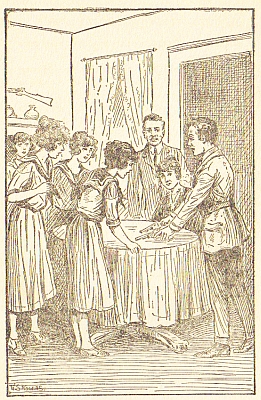
"But where are we to do all this?" asked Grace
skeptically. "Is somebody giving away steeds
for the asking? Wake me up, somebody, when
Betty gets through dreaming."
"Keep still, you old wet blanket," cried Mollie.
"Can't you see Betty is really in earnest?"
"Never mind them," said Amy, leaning a little
breathlessly toward Betty. "Let them fight it
out between themselves. What is the great news,
Betty?"
"It is great news," said Betty radiantly. "Listen,
my children. Mother has received a legacy
from a great uncle that she had almost forgotten
she had."
"Money?" queried Grace, interested.
"No, that's the best part of it," said Betty.
"Oh, girls, it's a ranch, a great big beautiful
ranch in the really, truly west!"
"Honest-to-goodness, wild and woolly?" queried
Mollie, beaming.
"Better than that," answered Betty with the
same lilt to her voice that the girls had heard
over the telephone. "I shouldn't wonder if we
should find the real old-fashioned, movie kind of
cowboys there—sombreros, fur leggings, bandannas,
and all."
"But where," interrupted Mollie, who had been
waiting with more or less patience for Betty to
come to the point, "do we come in, in all this? I
fail to see——"
"Oh hush," cried Betty, her eyes dancing.
"You interrupt entirely too much. Where do we
come in, she wants to know," she paused to bestow
a beaming glance on Grace and Amy.
"That's the biggest joke of all. Where do we
come in? Why, honey dear, we're the whole
show!"
"The whole show," they murmured, beginning
to see the light.
"You bet," said the brown-haired, rosy-checked
one slangily. "Now listen. I think I've about
argued mother and dad around to the point where
they'll agree to let us have the use of this wild
and woolly rancho for a real outdoor adventure.
How does that idea strike you?"
"Listen to the child," cried Mollie pityingly.
"Such a question!"
"It would be heavenly!" raved Grace. "Think
of riding around all day in fur leggings and a
sombrero. Wide hats are always becoming to
me," she added musingly.
The girls laughed and Betty threw a pillow at
her, missing her by a hair's breadth.
"You needn't worry about your hat," laughed
Betty. "Reckon there won't be anybody around
there to admire you but Indians and broncho
busters."
"Oh, aren't the boys coming?" Grace asked,
her disappointment in her voice.
"They haven't been asked, silly," Mollie interrupted
impatiently. "Tell me, Betty," she cried,
turning to the Little Captain. "Is it really certain
that we'll have this chance?"
"No, it isn't," admitted Betty, her bright face
sobering. "That's why I don't want you to get
too excited about it. You see," her voice lowered
confidentially, "dad might decide to sell it."
"Sell it!" they cried in dismay, and Grace
added, with a decision that made the girls laugh:
"Oh, he mustn't do that until the fall, anyway."
"All right, Gracie," said Betty, with a chuckle.
"I'll give dad his orders."
"But why does he want to sell it, Betty?" Amy
questioned.
"We-el," said the Little Captain slowly. "You
see mother has already received an offer of fifteen
thousand dollars for it. There's a ranchman
out there, I think his name is John Josephs,
or some such name, who seems to want to get
hold of our ranch. So his lawyers have offered
mother fifteen thousand for it."
"That's a pretty good lot of money," said Amy
thoughtfully.
"Yes, it is," agreed Betty. "And dad seems to
think that the best thing mother could do would
be to take the money and get rid of the ranch.
He says it will be a sort of white elephant on our
hands, since there isn't very much chance of our
going out there to live," she ended, with a
chuckle.
"Well," said Grace, with an injured air, "I
don't see why you called us all over here just to
disappoint us. If your father is going to sell the
place, then we certainly sha'n't be able to make
ourselves beautiful with bandannas and picturesque
hats——"
"Ah, but you did not let me finish," hissed
Betty, melodramatically. "We have one ally—my
mother."
"Your mother!" cried Mollie, eagerly. "Then
she doesn't want to sell the ranch?"
"Right, the first time," cried Betty hilariously.
"I think mother has a sneaking notion that she
might look pretty good in a cowboy make-up herself.
You see," she added, with a twinkle,
"mother has never had a chance to own a real
honest-to-goodness ranch before."
"Oh, isn't she sweet!" cried Mollie fervently,
adding, as one to whom inspiration had come:
"I tell you what, Betty, we'll take her with us!"
"How sweet of you," drawled Grace. "Especially
since the ranch belongs to her!"
The other girls chuckled and Mollie looked
rather sheepish.
"Oh, well," she admitted, "I guess it would be a
case of her taking us along."
"And I don't envy her the job," said gentle
Amy unexpectedly, while the girls gazed their reproach.
"Betty," said Mollie, "there is one very important
thing that I would like to know."
"Well, I'm the original little information
bureau," Betty assured her. "What will you
have?"
"Does your dad really want to sell the ranch?
Or is your mother likely to win out?"
"Oh, mother always gets her way," said Betty
confidently, adding: "Besides, the ranch was left
to mother, you know, and not to dad. So really
she has the say about it."
"Yes, but she might change her mind," said
Grace pessimistically. "Fifteen thousand dollars
is a lot of money, you know. She might decide
to sell the ranch, after all."
"Well," said Betty, with an air of importance
that the girls were quick to notice, "there is another
reason why mother will probably hold on to
the property, for a little while at least."
"Yes?" they queried eagerly.
"You see," Betty continued thoughtfully,
"mother has an idea that this John Josephs is a
little too anxious to buy the ranch. It's right up
in the gold region, you know——"
"Gold!" shrieked Mollie. "You never said a
word about gold, Betty Nelson! Do you mean
there may be gold——"
"Now she is getting interesting," admitted
Grace, shaken out of her usual calm.
"How romantic," murmured Amy, breathing
fast.
"Yes," said Betty ruefully. "That's what dad
says mother is—romantic! He says there isn't a
chance in a thousand that there is real gold anywhere
near that ranch——"
"Stop, woman, stop!" cried Mollie, with her
most tragic scowl. "Wouldst put an end to all
our dreams in one fell swoop——"
"Probably that is all we shall do—just dream,"
said Betty, insisting upon being practical. "It's
an idea of mother's, that's all. But she is really
determined to see the ranch, at least, before she
makes up her mind whether to sell or not. In
fact," she hesitated, colored a little, then went on
bravely, "dad has decided to send Allen out there
to look up the title. There is some trouble
about that, I think——"
"Oh, now we know why she is so anxious to
be a little cow girl," teased Grace, while the others
regarded Betty's pretty color gleefully.
"Oh, Betty, Betty!" cried Mollie, shaking her
head dolefully, "you are altogether hopeless!"
For Allen Washburn, of whom Betty had
spoken in connection with the ranch, was a very
promising young lawyer. Also this promising
young lawyer was very fond of Betty Nelson.
And while the girls are shaking their heads over
this fact a little time will be taken to describe the
Outdoor Girls to those readers who have not already
met them and to review briefly the many
and varied adventures they had had up to this
time.
Betty Nelson, dark-haired, dark-eyed, and
rosy-cheeked, was the natural leader of the four
Outdoor Girls, a fact which had led to her being
dubbed "Little Captain" by the adoring girls.
Betty's father, Charles Nelson, had made a good
deal of money in his manufacture of carpets, and
Betty's mother was a very sweet lady whom the
name of Rose fitted exactly.
Next came Mollie Billette, dark-haired and
with snapping black eyes, who was almost as
French in her manner as her very French mother.
Readers of the present volume must already
feel very well acquainted with Grace Ford.
Grace was the Gibson type, tall and slender and
fair-haired and very pretty, with a decided liking
for looking in mirrors.
Last of the quartette came Amy Blackford.
Amy was the ward of John and Sarah Stonington,
and for a long time she had thought her own
name was Stonington. The mystery of her past
had been cleared up, however, and Amy had come
into her own. Shy, gentle, sweet, she was beloved
and protected by the more hardy and active
Betty and Mollie. And Amy, as shy girls
sometimes will, had begun to think very much of
Grace Ford's attractive brother, Will—which is
a reminder that it is time to introduce "the boys."
Allen Washburn and his open fondness for
Betty have already been spoken of. Allen was
tall, nearly six feet. Sunburned and handsome
of face and quick of action, Allen attracted every
one wherever he went. And, truly, Betty was
no exception to this rule! Allen had been one
of the first to volunteer his services to the good
old army of the U. S. A., and while he had gone
over only a buck private, he had come back a
lieutenant.
There was Will Ford, Grace's brother, whom
Grace and Amy both adored. Will had been in
the secret service when our country entered the
war, and because of this he had been the victim
of considerable misunderstanding. Afterward
he had joined the army with the other boys.
This was after some skillful secret service work
that won the praise of the government, as well
as the fervent admiration of the boys and girls.
The other two boys were Frank Haley and
Roy Anderson who had come into the little group
because of their friendship for Will and Allen.
They were fine, clean-cut, likable boys, who had
come through the war with colors flying.
The young folks had lived all their lives in
Deepdale, a thriving little city with a population
of about fifteen thousand people and situated in
the heart of New York State. Deepdale was
situated on the Argono River, a beautiful and
romantic stream where pleasure craft of all sorts
disported themselves. A branch line of the railroad
connected with the main line directly to
what the four Outdoor Girls believed to be the
most wonderful of all cities, New York.
The name of "Outdoor Girls" had come to the
quartette from the fact that they invariably spent
their summer vacations, and winter holidays also,
in some sort of outdoor sport. They could ride,
swim, play tennis, drive, and, in fact, do everything
that is expected of the athletic young girl
of to-day.
They would never forget that first tramping
tour when they had tramped for miles over the
country, meeting with a great many unusual adventures
on the way, as related in the first volume
of this series, entitled, "The Outdoor Girls
of Deepdale." Nor those other times at Rainbow
Lake, in Florida, at Ocean View, and later
at Pine Island, where they had come across that
marvelous, mysterious gypsy cave.
Then had come the war with the boys on the
other side, and the girls doing their "bit" at a
Hostess House. And a little later what black
distress overwhelmed them, when Will Ford was
reported wounded and Allen's name was among
the missing! This all happened while they were
at Bluff Point taking a much-needed vacation
from their work at the Hostess House.
In the volume directly preceding this, entitled
"The Outdoor Girls at Wild Rose Lodge," the
girls had had same very exciting experiences.
An old man, Professor Dempsey, by name, who
had retired to a little log cabin in the woods to
recover his health, had chanced to do the girls
a very great favor. Of course the girls were
grateful to him and were very much interested
when he told them of his two sons who were in
the war. Later, when the girls read of the death
of his two sons in the paper, they went to the
old man's lonely cabin in the woods, but found
themselves too late. According to a friendly
neighbor, the old man had become temporarily
insane at the terrible news, had wrecked his cabin
in an insane frenzy, and disappeared.
Later, at Wild Rose Lodge, the girls were
frightened several times by a strange apparition
lurking in the woods around the lodge and Moonlight
Falls, a beautiful fall of water not far from
the cottage where the girls were staying. Later
the boys came home from France and helped the
girls solve the mystery.
And now here was Betty proposing another
outing that promised to be more fun than any
the Outdoor Girls had had yet. No wonder that
in the clamor of their excited questions and answers
no one heard the telephone ringing noisily
in the hall.
Finally the Nelsons' maid came trudging up the
stairs to answer it herself.
"If I can hear myself think," she grumbled, as
she took the receiver from the hook. "With all
them girls a-gabberin' an' a-talkin' at the top o'
their lungs. Hello—I can't hear you—you'll
have to talk louder—you don't know the noise
they is in this house. Miss Betty?—jus' a
minute——"
"A gen'leman to speak to you, Miss Betty,"
she announced a moment later, looking in on the
hilarious girls. "An' le's hope you can hear him
better'n I could, that's all," she grumbled, as
Betty pushed by her in the doorway and gave her
a friendly pat on the shoulder.
"Oh, they'll keep quiet now, all right," she
said, with a laughing glance over her shoulder at
her chums. "They'll want to hear what I have
to say."
At which taunt the girls started such a dreadful
clamor that she really had all she could do to
hear Allen at the other end of the wire. Oh, yes,
it was Allen!
"Sech a noise," grumbled the maid, as she
trudged down the steps again. "I never did see
sech wild uns!"
"Hello, hello, Allen," called Betty into the telephone.
"The girls are here and—what's that?
At Walnut Street? All right, that will be fine.
I can't talk now. Tell you why later. Yes,
we'll be there. Don't be silly. Good-by!"
Her face was flushed when she confronted the
girls again.
"The boys have a half holiday—it's Saturday,
you know," she told them, while they regarded
her mischievously. "And they want us to pick
them up in the car, get some lunch somewhere,
and make a day of it. I told him we would."
"By 'him' I suppose you mean Allen," said
Mollie, to which Betty ducked her a bow and the
other girls giggled. "I like their nerve wanting
us to pick them up. Why doesn't Frank come
for us in his big car?"
"Allen figured it would take too long for them
to come home and get it."
"My, they must be in a hurry to see us," said
Grace, with a simper that sent the girls off into
gales of laughter.
"Well," said Betty finally, "are you coming,
or are you not?"
For answer Mollie jumped up, pressed a hat
upon Grace's indignant head, handed Amy her
coat, and crushed her own sport hat down on her
dark hair.
"Be this our answer," she said dramatically.
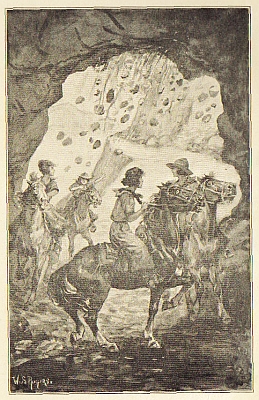 A LANDSLIDE—AND THEY WERE DIRECTLY IN ITS PATH!