In a country that is so far away that only
wymps and fairies ever live long enough
to get there, an exceptional King and Queen
once ruled over their five children, a devoted
nation, and each other. Now, the five children
had five gardens all in a row; and four of these
belonged to the King's four sons, and were just
as beautiful as gardens cannot help being,
which is surely beautiful enough for ordinary
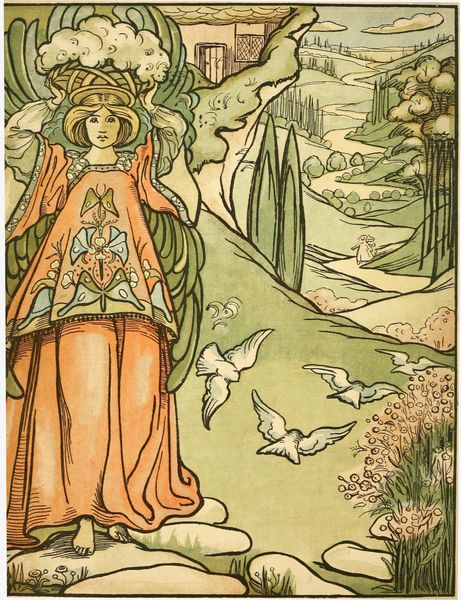
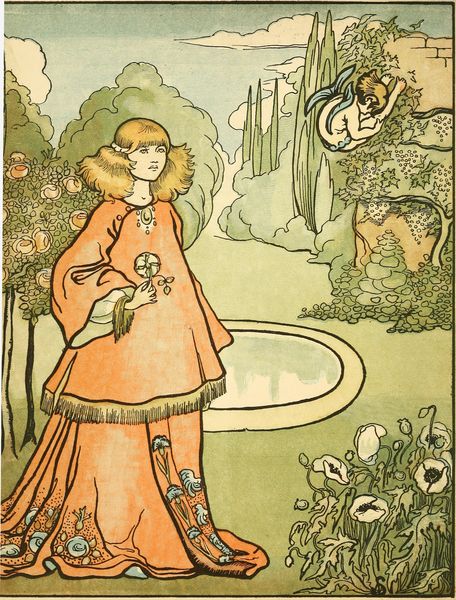
folk. The Princess Gentianella, however, was
anything but an ordinary princess; and her
garden, the one that came at the end of the
row, was far more beautiful than any one could
possibly describe. This was hardly to be wondered
at, for, while the four Princes had to
work very hard in their gardens before anything
would grow in them, the fairies just
came and breathed on the Princess's garden,
and everything that was bright to see and
sweet to smell grew up in it. Even the wymps
did not play any tricks with the Princess's garden;
for they had given her their warm little
wympish hearts the moment she was born; so
they allowed the sun to shine on her charming
flower-beds as much as it pleased—and, of
course, it pleased the sun to shine there very
often indeed.
Now, the Princess's garden was surrounded
by a wall. When she was quite a little girl,
the King and Queen had ordered the wall to
be built, just high enough to keep her from
looking over it; and every time that the Princess
grew a little more, another row of bricks
was added to the wall, so that, by the time she
had stopped growing altogether, the wall was
ever so much higher than she was. She was
such a dainty little Princess, though, that even
then it was not a very high wall. Still, it was
high enough to prevent her from seeing what
was on the other side; and this annoyed her
so much that all the pretty flowers the fairies
could give her did not make up for the things
she was not tall enough to see. The King
and Queen had no idea of this; they loved
their little daughter extremely, and they only
thought how clever and how wise they were to
keep her from looking into the world that lay
outside her garden. "She might see something
to frighten her, if she could see over the
wall," they said.
The four Princes had no walls round their
gardens, and what was more, they could see
over the wall of their sister's garden, too; but
they never thought of telling her what they saw.
"Boys always have all the fun," sighed the
little Princess. "I wish I were a boy!"
Then, one by one, the three elder Princes
rode away into the world and left their gardens
to run to seed; and at last the time came for
the King's youngest son to go too.
"It will be dreadfully dull when you have
gone away," said the Princess, who was sitting
on the grass-plot in her garden when Prince
Hyacinth came to say good-bye to her.
"Oh no," answered her brother, with a smile;
"you can still play in your pretty garden."
The Princess pouted. "You would not like
to play by yourself for ever and ever and ever,"
she remarked.
The Prince was sure he would not have liked
it at all, but then, he was not a little girl. "It
must be rather dull," he confessed; "but perhaps,
if you wait long enough, some other
prince will come into your garden, and then
you can ask him to play with you."
The Princess shook her head. "He will
never be able to get in," she sighed. "Only
look at that stupid high wall!"
Prince Hyacinth laughed outright, as princes
sometimes do when their sisters are only little
girls. "I expect he'll be able to get in, if he
is anything of a prince," he observed. Then
he kissed her on both cheeks, and rode away
like the others.
That was how the Princess Gentianella was
left alone in the most beautiful garden on this
side of the sun. And if it had not been for
the wymps, she might never have known to
the end of her days what the world was like
on the other side of her wall. Fortunately for
every one, however, the wymps are never far
off when a charming little princess is in
trouble; and on the very day that the King's
youngest son rode away into the world, one of
the nicest and the naughtiest and the wympiest
wymps of all came head first through the sun,
and was sitting on the top of the Princess's
wall with his legs dangling, before she had
time to say "Oh!"
"Come now," said the wymp, "let's hear all
about it." His tone was so exceedingly
friendly, and he seemed so unlikely to give her
good advice, which was all that a fairy would
have done, that the Princess Gentianella dried
her eyes and told him everything. When
she had finished, the wymp stood on his head
to concentrate his thoughts, and reflected
deeply.
"Will you tell me what is on the other side
of my wall?" asked the Princess Gentianella,
as the wymp remained in this remarkable position
without speaking. She did not know that
it never makes much difference to a wymp
whether he is on his head or his heels, so she
was naturally afraid that he would make his
head ache if he stood on it any longer. However,
the wymp came through the air in somersaults,
when he heard the Princess's question, and he
landed in the middle of a bed of scarlet poppies
and twinkled at her.
"You won't like it, if I do," he remarked.
"I am quite positive I shall," declared the
Princess; "and you are such a particularly
nice kind of wymp that you surely cannot
refuse to tell me!"
No wymp of the right sort could have resisted
an appeal like that; and as every wymp
is the right sort of wymp, this particular wymp
at once did as the Princess asked him.
"All right," he said. "There isn't much to
tell, though. There are the usual rows of
mountains, and the usual rivers and lakes and
islands and peninsulas and—"
"Don't!" cried the Princess, stopping up her
ears with her little pink finger-tips.
"—and isthmuses," continued the wymp,
cheerfully; "and volcanoes, and hot springs
and cold springs, and palm-trees and apple-trees
and boot-trees—"
"I don't believe," interrupted the Princess,
indignantly, "that there is nothing but a stupid
geography book on the other side of my
wall!"
The wymp looked at her and twinkled more
than ever; but when he saw that her eyes
were shining, just as her own flowers might
have done at the time of the dew-fall, he
stopped teasing her at once. No one knows
better than a wymp when it is time to stop
teasing.
"Hullo!" he said. "What is the matter
now?"
"I thought I should see something quite
different," said the Princess, plaintively.
"So you would, my little dear," cried the
wymp. "I was only telling you what I saw.
Give me those two ridiculous little hands of
yours, and you shall see everything that I
didn't."
This time the Princess Gentianella did say
"Oh!" and she said it because she found herself
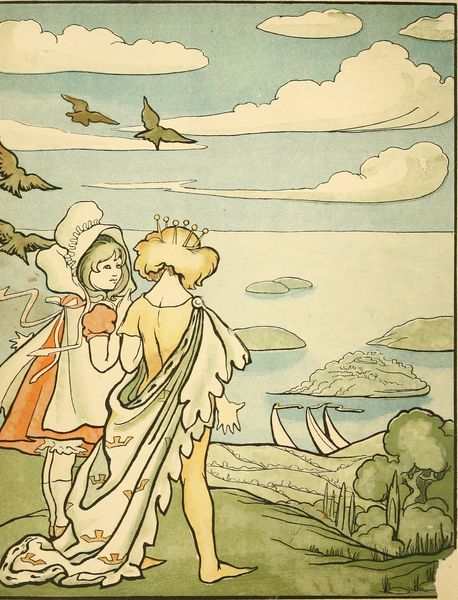
sitting on the top of her wall, with all the
world on the other side of it lying stretched
out before her, for miles and miles and miles.
She did not see very much at first, though, for
she looked no further than the little corner of
it that lay just under her eyes.
"Why," said the Princess, softly, "there is a
garden on the other side of my wall. And
only look, there is a real Prince in the middle
of it!"
She turned round to tell her wymp all about
it, but the wymp had other work to do and
was already on his way to the back of the sun.
So there was nothing for it but to look over
the wall again, and this time the Prince
glanced up and saw her.
Now, Prince Amaryllis had been waiting a
great many days for some one to appear at the
top of the wall, but now that some one really had
appeared there and was looking so extremely
glad to see him, he suddenly found he had
nothing whatever to say to her. That is what
occasionally happens to the most charming of
princes. Fortunately, however, the Princess
knew perfectly well what to say to him.
"I knew there would be something nice on
the other side of my wall," she cried. "The
wymp was quite wrong, wasn't he?"
"No doubt he was, if you say so," answered
the Prince, who had never noticed the wymp
at all. "But how is it, little lady, that you
can see me?"
The Princess opened her big eyes and stared
at him. "How can I help seeing you, if you
are there?" she asked.
"But I'm not here, that's just it," explained
Prince Amaryllis; "at least, I am not supposed
to be. You see, I have been invisible all my
life, and you are the first person, outside my
own country, who has ever been able to see me.
I am very glad you can see me," he added
politely; "one gets a little tired sometimes of
being heard and not seen."
"When I was a little girl," said Princess
Gentianella, drawing herself up to her full
height, "I was always taught to be seen and
not heard. That was very dull, too. But tell
me, why is it that you are invisible?"
"Alas!" said the Prince. "The whole of
my country is invisible, too. Tell me what you
can see, Princess, from the top of your wall."
"I can see you," answered the little Princess,
promptly.
"But do you see nothing else?" asked Prince
Amaryllis.
The Princess shaded her eyes with her hand
and looked away into the distance. "I can see
a large flat plain, with no trees and no rivers
and no people and no houses," she answered
presently.
Prince Amaryllis sighed. "You are looking
right into my country," he said dolefully, "and
it is every bit as full of trees and rivers and
people and houses as anybody else's country.
Do you not hear anything either?"
"Oh, yes," said Princess Gentianella; "I can
hear the murmur of voices and the ripple of
rivers and the rustle of trees. I have heard
those sounds all my life, but I thought they
were in the wind."
"Nothing of the sort," replied the Prince.
"They are the sounds that belong to my country,
where everybody is heard and not seen. It
all began with a christening-party, a hundred
years ago. My great-grandfather was King
then, and he was the most absent-minded king
that has ever ruled over us, and he forgot to
ask the Witch to dance with him, which, of
course, offended her deeply. And it happened
that she was a witch who was always making
experiments, so she experimented on my country
at once by making it invisible, and it has
been invisible ever since."
"How strange!" said Princess Gentianella.
"I never remember hearing any one talk about
your country."
"Of course not," sighed the Prince; "you
can't expect people to talk about a thing that
isn't there, can you? You have no idea how
stupid it is to live in a place that no one can
see."
"But why does not someone disenchant
your kingdom?" asked the Princess, who
had read quite enough history to know that
kingdoms are always disenchanted sooner or
later.
"That is what I am trying to do," answered
Prince Amaryllis. "The spell can only be removed
if a king's son will spend a whole year
in this waste piece of ground and make it into
a beautiful garden. But although I have been
here nearly a year, I have not been able to
make a single flower grow. It is a little tiresome,"
he added with another sigh, "for it is
part of the spell that I shall have to be executed
if I fail."
"Dear me!" exclaimed the little Princess.
"You are much too nice to be executed!
Won't you let me come and play in your garden?
Perhaps I might help you to make the
flowers grow."
Prince Amaryllis shook his head and smiled.
"It is not a nice garden to play in," he said.
"I think I will come and play in yours instead,
and you shall teach me the way to make the
flowers grow."
So the Prince jumped over the wall into the
Princess's garden, and they walked about, hand
in hand, among all the bright flower-beds that
the fairies had planted there. They did not
play very much, though, for they had so many
things to talk about; and they talked and
talked and talked, without stopping a moment,
for the rest of the afternoon. For all that,
when tea-time came and the Prince went back
into his own garden, he remembered all sorts
of things he might have said to the Princess if
he had only thought of them in time; while
Princess Gentianella, in the middle of her
second cup of tea, also remembered all the
things she might have said to the Prince, only
she had not said them. That is always the
way with princes and princesses who are carefully
brought up.
After that, Princess Gentianella and Prince
Amaryllis played together for a number of
days. But they always played in the Princess's
garden, because it was a much nicer garden
to play in; and as for the Prince's garden, they
seemed to have forgotten that altogether.
Then, one afternoon, when the Princess ran out
as usual into the hot sunshine, her Prince from
over the wall met her with a very disconsolate
face.
"The year has come to an end," he told her,
"and since I cannot make the flowers grow in
my garden, I shall have to go and be executed
as soon as the Witch sends for me."
The little Princess's lips began to quiver,
and her eyes grew large and round and shining.
"It is too bad," she declared, "to execute a
really nice Prince like you!"
"Do not be distressed," replied Prince
Amaryllis, in a resigned tone. "Now that I
have seen you, little lady, I shall be almost glad
to be executed."
"You are talking nonsense," declared the
Princess. "Why do you want to be executed?"
"Because, even if I knew the way to make
the flowers grow," he replied, "my country
would not be disenchanted unless I married
Anemone, the Witch's daughter, as well. And,
of course, I would sooner be executed than do
that!"
"What!" exclaimed the Princess; "you have
promised to marry a witch's daughter? Do
you mean to say that all this while I have
been playing with somebody else's Prince?"
There was no doubt that the Princess Gentianella
was extremely angry; and the Prince
could not help thinking that she was just a
little bit unreasonable as well.
"You see, it was part of the disenchantment,"
he explained. "If you had to be invisible
all your life, you would promise anything
to get disenchanted. Besides," he added, as
the Princess showed no signs of being appeased,
"they told me that Anemone, although a
witch's daughter, was exceedingly beautiful."
"What difference does that make?" demanded
the Princess. "You ought to have
told me before, that you were somebody else's
Prince. You haven't been playing fair!"
"It is true I forgot to mention it," said the
Prince, a little crossly; "but one cannot remember
everything, you know."
Princess Gentianella gathered up her train
with much dignity and turned her back on the
Prince.
"People who are as forgetful as that deserve
to be invisible," she observed haughtily;
and with that she swept up the garden path
and into the palace. She lost all her dignity,
however, as soon as she was out of the Prince's
sight; and it was a very doleful little Princess
who came to take tea with her royal parents
that afternoon. When she even went so far as
to say that she preferred bread-and-butter to
plum-cake, the King and Queen began to be
seriously alarmed.
"What is the matter with the child?" asked
the Queen of the King.
"Perhaps she has a sunstroke," suggested
the King, who thought that only illness could
possibly prevent a daughter of his from eating
her plum-cake at tea-time. The Queen knew
better, but she waited until the King had
gone back into his study before she said anything.
Then she said the very best thing
possible.
"What did you see when you looked over
your wall, little daughter?" she asked.
"There was a prince on the other side,"
confessed the Princess Gentianella.
"To be sure, there was," smiled the Queen.
"There is always a prince on the other side;
but why should that make you unhappy? Is
he not a nice prince?"
"He is a real Prince," said her little
daughter; "and I should not be at all unhappy
if he had not just told me that he is somebody
else's Prince!"
"Never mind," said the Queen, consolingly;
"you will soon find another prince in your
garden."
"But not that Prince," wept the poor little
Princess.
"One prince is much the same as another,"
said the Queen; but she did not think so for a
moment, and no more did the little Princess.
Now, it was quite true that Prince Amaryllis
had not been playing fair, and that his forgetfulness
was enough to annoy the nicest little
Princess in the world; but for all that, he
was going to be executed, and it is difficult to
be angry for long with anyone who is just
going to be executed. So, when Princess Gentianella
ran out once more into the sunshine
on the following morning, she was fully prepared
to make friends with her Prince from
over the wall. She was greatly disturbed to
find, however, that there was no one to make
friends with; and although she called the
Prince's name several times, not an answer
came from the other side of the wall. Then
the Princess Gentianella did what she had
never been brave enough to do before,—she
shut her eyes and jumped; and either she
jumped higher than so small a princess ever
jumped before, or else the wall was not nearly
such a high wall as she had always thought it
was, for the next moment she found herself on
her two little feet in the very middle of the
Prince's garden. She was very close to the
invisible country now, and the people's voices
were so loud that she could actually hear what
they were saying. This was not really surprising,
though, for they were all saying the
same thing.
"Our Prince cannot make the flowers grow,
and the Witch has taken him away to be executed,"
was what they were saying.
When the Princess Gentianella heard that,
she dropped straight down on the ground and
burst into tears, and her tears rained all over
the garden in showers; and wherever they fell,
the flowers began to grow,—first of all, snowdrops
and primroses and daffodils, then red
poppies and blue larkspurs and white lilies,
then hollyhocks and nasturtiums and mignonette,
and last of all, roses,—red roses, pink
roses, yellow roses, all sorts of roses. And the
scent from all these flowers was so delicious
that the little Princess lifted her head at last
and looked round.
"Oh!" she cried, starting to her feet; "some
one has made the flowers grow in the Prince's
garden!"
"Some one certainly has," chuckled a voice
from the top of the wall; and there sat the same
wymp as before, looking just as though he had
never gone away to the back of the sun at all.
At the same instant, the people's voices sounded
louder than ever from the kingdom close by.
"The flowers have learned the way to grow
in the Prince's garden," they were shouting;
"and the Prince will not be executed, after
all!"
Princess Gentianella danced for joy, in and
out of the Prince's bright flower-beds. "The
Prince will not be executed, after all," she said,
too.
"And he will be able to marry Anemone, the
Witch's beautiful daughter," added the wymp.
All the laughter died out of Princess Gentianella's
face, and she looked up at the wymp
in a very woe-begone manner indeed.
"Oh," she said piteously, "I never thought
of that. I—I had quite forgotten that he was
somebody else's Prince."
The wymp fairly wimpled when he saw
the poor little Princess looking so unhappy.
"Don't you fret about that, my little dear,"
he cried. "Do you suppose the Witch's daughter
wants anybody else's Prince, either?"
Princess Gentianella clapped her hands with
delight. "Of course she doesn't!" she cried.
"But perhaps she does not know he is somebody
else's Prince."
"Then go and tell her so," suggested the
wymp; and before she had time to thank him
for his advice he had gone off once more to
the back of the sun.
The little Princess did not stop to think
about it, but just ran as fast as she could
towards the invisible kingdom of Prince Amaryllis.
It might seem a little difficult to run
towards a place that did not appear to be there,
but to any one who was in as great a hurry as
the little Princess a thing like that was of very
small consequence. So she ran and she ran
and she ran, until the Prince's kingdom was
really obliged to stop being invisible, for in
all the hundred years that it had been bewitched
no one had ever tried so hard to see it before.
Besides, it would have been most impolite of
anybody's kingdom to go on pretending that
it was not there, when the Princess was so determined
to pretend that it was; so in the end
she suddenly found herself in the middle of a
country that was as full of trees and rivers and
people and houses as any other country, and
the particular part of it in which she found
herself was a nice green field full of woolly
sheep.
"What a charming kingdom!" exclaimed
Princess Gentianella. "How green the trees
are, and how fresh everything looks! Why,
there is not a speck of dust to be seen."
"Of course there isn't," answered a jolly
little lamb, who was trying, as lambs will, to
behave as though he had only two legs instead
of four. "Dust, indeed! When a kingdom
has not been seen for a hundred years, naturally
it keeps fresher than a kingdom that any
one can stare at. Nothing fades a kingdom
like staring at it, you know. However, all this
will soon be altered, for I hear that the Prince
has made the flowers grow in his garden; so
all he has to do now is to marry the Witch's
daughter, and then we shall be disenchanted
at last."
"Oh no, you won't!" said Princess Gentianella,
shaking her finger at him wisely.
"Why not?" asked the lamb, standing still
for the first time in his life.
"Because the Prince is not going to marry
the Witch's daughter," answered Princess Gentianella;
and she ran on before the lamb had
time to recover from his astonishment.
Down a curly white road ran the little
Princess, between two of the greenest hedges
she had ever seen, until she came to a stile.
Now, she had never climbed a stile in her life,
so of course she did not know what to do next.
However, there stood the stile waiting to be
climbed, and there stood the Princess feeling
very much inclined to cry, when it happened
most fortunately that an old woodcutter came
strolling along. He was a particularly cross-looking
woodcutter, but the Princess was in
far too great a hurry to notice that.
"If you please," she said as politely as she
could, "will you lift me over this great, big,
high stile?"
The woodcutter at once did as he was asked,
and then was so surprised at his own kindness
that he stood and stared at the little
Princess.
"Well, I never!" he exclaimed. "That's
the first time in my life I ever did anything to
please anybody. Are you a witch?"
"No, but I am looking for one," said Princess
Gentianella. "Can you tell me where
she is?"
"If you mean the one whose daughter is going
to marry the Prince, I think I can," replied
the woodcutter, who thought he might as well
go on being kind, now that he had once begun.
"That is certainly not the witch I mean,"
answered the Princess, promptly, "for the
Prince is not going to marry any witch's
daughter!" And she ran on faster than ever.
Presently she came to a brook that was
covered with ice.
"Dear me!" cried Princess Gentianella. "It
was springtime round the corner, and here have
I tumbled into the middle of winter!"
A fish popped his head through the ice, and
laughed from ear to ear,—two things that he
could do quite easily, for he happened to be a
skate. "The seasons have been mixed up in
this country ever since we were bewitched, a
hundred years ago," he said. "It is no use
being particular about the time of year when
there is no one to see what kind of weather
you are having. If you stand on tiptoe you
will see summer going on in the next field."
"It must be very difficult to know what
clothes to put on, when you take a walk in this
country," remarked the Princess. "But, of
course, it doesn't matter what you do wear
when there is no one to look at you!"
"Well, well," said the skate, "things will
soon be altered, and the seasons will have to
right themselves again, for I am told that
Prince Amaryllis is going to marry the Witch's
daughter, and so the country will be disenchanted
at last."
"Rubbish!" laughed the little Princess,
knowingly. "Don't you believe everything
you are told! The Prince is going to do
nothing of the sort!"
Then she ran away from the skate and the
frozen brook, and she ran right out of winter
into the middle of summer; and she might
have gone on running until she reached the
middle of autumn too, if she had not been
stopped by an enormous sea-serpent who was
lying stretched across the road. When the
sea-serpent saw the Princess, of course he
flapped his fifty-five fins at her, and lashed his
tail about furiously, and growled in a hoarse,
fishy voice. But the Princess mistook his fury
for politeness. When one has lived in a garden
with a wall round it and never seen a sea-serpent
in one's life, one is apt to make these
mistakes.
"I am very pleased to meet you," she said,
with her most charming smile; "I have often
wanted to meet a dragon."
"She calls me a dragon!" groaned the sea-serpent,
foaming like the sea in a tempest;
"and I am connected with the very best family
of sea-serpents! What will people say next?"
"I am very sorry," said the Princess, humbly.
"You see, I thought, as you were not in
the sea—"
"I was expecting that," interrupted the sea-serpent,
bitterly. "No one ever will believe
in me unless I stop in the sea. It is very
depressing!"
"I am sure I am very glad you have come
out of the sea," said the Princess, politely,
"because it has given me the pleasure of meeting
you. But does it not make you very thirsty
to lie in this hot dusty road?"
"Not nearly so thirsty as stopping in the sea
and having nothing but salt water to drink,"
answered the sea-serpent. "People do not
realise what a thirsty life a sea-serpent has to
lead. If they did," he added severely, "they
would not stand in front of him and ask so
many questions!"
The Princess laughed merrily. "I do not
want to stand here at all," she explained; "but
unless you move your tail a little on one side,
I really cannot get past."
"If you do get past," growled the sea-serpent,
"you will fall into the Witch's hands."
"That is exactly where I want to fall!" cried
Princess Gentianella; "only you must move
your tail a little bit more than that, or else I
am afraid I shall step on it."
It was such a novelty for the sea-serpent to
find some one who was not frightened of him,
that he had not the heart to tell her that he
was just going to eat her up. So he moved
his tail out of the way, and Princess Gentianella
blew a kiss to him from the tips of her
little pink fingers and ran on as before.
The next person she met was an old woman,
who was picking thistles in a field.
"I wonder why you are doing that!" said
the Princess, opening her big blue eyes.
"I am making an experiment, to see if I can
find any one with so brave a heart that the
thistles will not be able to hurt it," answered
the old woman, mysteriously.
"But does it not scratch your fingers to
gather those large prickly thistles?" asked the
little Princess.
"Perhaps it does," the old woman said
shortly; "but who do you suppose is going to
gather them for me?"
She seemed rather cross, but the Princess
supposed it was because she had pricked her
fingers so much.
"Well, I am in a most tremendous hurry,
but I think I can stop and help you," she answered;
and down she dropped on her knees
and began to pick thistles as fast as she could.
And when the thistles saw what soft pink fingers
were going to take hold of them, they at
once bent back all their prickles and allowed
the Princess to gather as many as she pleased
without giving her so much as a scratch.
When she had filled the old woman's apron for
her, she began to run off at full speed, to make
up for lost time. But the old woman called
her back.
"Stop!" she cried. "Where are you going?"
"I am going to find the Witch's daughter,"
answered Princess Gentianella, looking back
impatiently.
"Oh, indeed!" said the old woman. "May
I ask what you want with her?"
"I want to tell her not to marry Prince
Amaryllis, because he is not her Prince but
somebody else's Prince," said Princess Gentianella.
"Oh, indeed!" said the old woman again.
"And whose Prince may he be, then?"
"He is my Prince, of course!" answered the
little Princess, laughing happily; and then
away she ran across the field, and into the
wood that lay beyond.
In the wood, under a hazel-tree, sat a tall
and beautiful girl, weeping bitterly.
"Oh dear, oh dear!" said Princess Gentianella,
mournfully. "How dreadfully sorry I
am!"
"Why?" asked the girl, looking up at her.
"Because you are crying, to be sure," answered
the Princess. "Will you tell me why
you are so sad?"
"My mother, who is always making experiments,
wants me to marry a Prince I have
never seen, just to see how we should like
it," explained the girl. "And all the while, I
am somebody else's Princess!"
"That is very strange," remarked Princess
Gentianella. "Now I am sad because my
Prince has got to marry Anemone, the Witch's
beautiful daughter, and I am trying to find her
to tell her that he is really my Prince. Do you
think she will want to marry him, when she
hears that he is somebody else's Prince?"
The beautiful girl suddenly sprang to her
feet and began to laugh joyfully. "I am
sure she will not," she answered, "for I am
Anemone, the Witch's daughter. So nobody
will have to marry anybody's Prince except her
own, and the witch will not be able to make
experiments any more!"
"That is settled, then," said the little Princess,
contentedly. "Now let us go and find our
Princes. But supposing that I find your Prince
first, how shall I know that he is your Prince?"
"His name is Hyacinth," answered the
Witch's daughter.
"How delightful!" cried Princess Gentianella,
clapping her hands. "Then I shall find
my youngest brother as well as my Prince.
But do you know where they are?"
Anemone, the Witch's daughter, began to
look a little doubtful. "I have just remembered,"
she confessed, "that I sent Hyacinth
to kill your Prince, only a few minutes before
you came along. Do not be anxious, however,"
she added hastily, "for perhaps he will not be
able to find him."
The Princess Gentianella was not at all
anxious. "Nobody could possibly be strong
enough to kill my Prince," she observed; "and
as for Hyacinth, he will be quite safe, for Prince
Amaryllis is much too nice to hurt any one!"
She proved to be right, for in another minute
they saw the two Princes coming towards
them arm in arm. And if this should seem
extraordinary, it must be remembered that it
all took place in an enchanted wood, where a
witch had been making experiments for hundreds
and hundreds of years.
"There was no necessity to kill him, dearest,"
cried Prince Hyacinth, "for he is somebody
else's Prince."
He held out his arms as he spoke, and into
them ran Anemone, the Witch's daughter, and
of course there is no need to tell into whose
arms the little Princess ran. After that, there
was nothing to be heard in the wood except
kissing, until the Witch suddenly stepped on
the scenes.
"Cobwebs and broomsticks! What is the
meaning of this?" she cried furiously.
Three of them turned round and faced her
in an extremely nervous manner; for, after all,
a witch is a witch, and they knew fast enough
that she could turn them into any shape she
pleased. The Princess Gentianella did not
seem nervous, however.
"Why, you are the nice old lady I met in
the field," she exclaimed.
"I believe I am," said the Witch, who had
never been called a nice old lady in her life
before, and was not quite sure how to take it.
"I have found my Prince, you see," continued
the little Princess, smiling away as happily
as possible.
"So it seems," said the Witch. She was
afraid to say more than that, in case the Princess
should find out who she was, and she
thought she would like to be a nice old lady a
little longer first.
"And have you found any one yet who has
so brave a heart that the thistles cannot hurt
it?" asked Princess Gentianella.
"I think I have," said the Witch.
"Then we have all found what we want,"
smiled Princess Gentianella, "and the Witch
cannot surely be so unkind as to refuse to disenchant
the kingdom, just because her daughter
doesn't want to marry my Prince! Do you
think she can?"
The Witch dropped her thistles and held
out her hands to the eager Princess. "My
dear little girl," she said, "the kingdom was
disenchanted the moment you came into it.
As for the Witch, there is no Witch any
longer, for she retired into private life as a nice
old lady, just ten minutes ago. Now, as you
all seem to have sorted yourselves the right
way, the best thing you can do is to go off
home as fast as you can."
No doubt that is where Anemone must have
gone with her Prince, for when the little Princess
looked round and found herself standing
once more in her own garden, there was no one
with her except Prince Amaryllis.
"Now may I come and play in your garden?"
asked Princess Gentianella, softly.
The Prince still shook his head. "I have a
much better idea than that," he said; "we will
pull down the wall and make it all into one
garden."