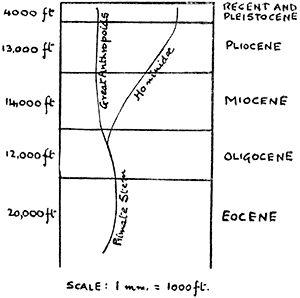
If, when the cohesion of the hunting-pack had weakened,
belief in Magic by giving authority to elders became very
influential and useful in primitive societies, still greater in
subsequent evolution has been the power of Animism. For
belief in ghosts led in time to the worship of ancestors, and
then especially to the worship of the ancestors of chiefs or
heroes, some of whom became gods; and the belief in gods
strengthened the authority of chiefs and kings who were
descended from them, and helped to maintain the unity of the
tribe or nation from generation to generation and from age
to age.
In anthropology, the term Animism is usually employed
to denote the proneness of savages and barbarians, or people
of unscientific culture, to explain natural occurrences, at
least the more remarkable or interesting—the weather, the
growth of crops, disease and death—as due to the action of
spirits: (1) ghosts (that is, spirits that have formerly been
incarnate); (2) dream-spirits, that have temporarily quitted
some body during sleep or trance; (3) invisible, living,
conscious beings that have never been incarnate. This may
be called Hyperphysical Animism. Sometimes, however,
“Animism” is used to denote a supposed attitude of savages
and children toward all things, animate and inanimate, such
that they spontaneously and necessarily attribute to everything
a consciousness like our own, and regard all the actions
and reactions of natural objects as voluntary and purposive.
And this may be called Psychological Animism. These two
meanings of “Animism” are entirely different: it is one
thing to regard an object as moved by its own mind, another
to attribute its movement or influence to a separable agent
which for the time possesses it; it is one thing to regard
an object as having an anthropomorphic consciousness,
another to believe that that consciousness is a distinct power
capable of quitting it and sometimes returning, or of surviving
its destruction, or of existing independently. Even
if the doctrine of Animism in the second sense were granted,
it would remain to be shown how men came to conceive
that the consciousness of a thing can be separated from it,
and exist and act by itself, and even with greater powers
than it had before—contrary to the opinion of Don Juan,
“that soul and body, on the whole,
Were odds against a disembodied soul.”
Savages do not always regard a separable spirit as necessarily
belonging even to human nature. Dr. Seligman writes
that, among the Veddas, a few old men “were by no means
confident that all men on their death became yaku” (veridical
ghosts). Influential men and mediums would do so; but
for the rest, at Godatalawa it was determined by experiment.
The ordinary man was invoked soon after death, and desired
to give good success in hunting; and if much game was
then obtained, he had become a yaka.[155] Messrs. Spencer
and Gillen tell us that, according to the Guanjis, a woman
has no moidna (spirit part).[156] Major C. H. Stigand says “the
Masai have no belief in a future state for any but chiefs”;
the common dead are not even buried, but merely thrown
out into the bush.[157] Among the Omaha, though each person
has a spirit that normally survives the body, still, a suicide
ceases to exist.[158] In Tonga the souls of the lowest rank
of the people (Tooas) died with their bodies.[159] The human
spirit, then, is not necessarily believed to enter upon a life
after death; still less is the spirit of an animal. On the
other hand, it is held by many tribes that something inherent
in weapons, utensils, food and other objects, a “soul” or
soul-stuff, may be separable from them and go to Hades or
serve as the food of spirits, although the things themselves
are not regarded as having a spirit or intelligent life.
Andrew Lang described savages as existing in “a confused
frame of mind to which all things, animate and inanimate,
... seem on the same level of life, passion and reason.”[160]
Children and other immature people are often supposed to
be in the same condition. As to children, it is pointed out
how deeply concerned they are about dolls and rocking-horses,
how passionately they turn to strike a table after
knocking their heads against it. But probably it is now
admitted that impulsive retaliation, on a table or bramble
or shirt-stud (not unknown to civilised men), implies not
any belief in the malignity or sensitiveness of those objects.
Animals behave in the same way. Th. Roosevelt reports
that an elephant was seen to destroy in rage a thorn tree
that had pricked its trunk;[161] and that in America he himself
saw a bear that was burying a carcass, and lost hold of it
and rolled over, strike it a savage whack, like a pettish child.[162]
Moreover, in children, such behaviour is in large measure
due to suggestion; inasmuch as the setting of them to beat
the table, or what not, is an easy way of diverting them from
their own pain. And, of course, the dealing with dolls, or
rocking-horses, or walking-sticks, as if alive, is play. Such
play involves intense imaginative belief, which, at first, is
not clearly differentiated from earnest. But this stage
corresponds with the play of the young of the higher animals,
whilst they are still physically incapable of completing the
preluded actions; and the engrossing interest of their play
expresses the biological necessity of it as a means of developing
their mental and bodily faculties. By the time that children
are at all comparable with savages, their play has become a
temporary attitude, compatible with brusque transition to
matter-of-fact, or even with actions which at the height of
play show that the illusion is incomplete.
In savages, likewise, much of the behaviour that is supposed
to betray an illusionary animism, even in their simple apprehension
of things, is really an acquired way of acting, in a
temporary attitude, under the influence of imagination-belief,
and is compatible with other actions that show how
incomplete is the illusion. Andrew Lang, after the passage
above quoted, appears to limit the scope of it by the words
“when myth-making”: no doubt, when myth-making and
in practising many rites, savages speak or act as if they
believed in the full sense that the objects dealt with are
sensitive intelligent beings; and yet their effective conduct
toward them is entirely positive. They may, for example,
feed the growing rice-plant with pap; in harvesting it, speak
a secret language that the rice may not understand them
and be alarmed, and proceed to cut it with knives concealed
in their palms: but they do cut it. They carry it home and
garner it with honour, and come from time to time to take a
portion for food with solemn observances: but then they
cook and eat it.[163] Their animistic attitude, therefore, is not
primitive, spontaneous, necessary illusion, but an acquired,
specialised way of imagining and dealing with certain things.
Were it not possible to combine in this way the imaginative
with the practical, all wizardry and priestcraft would be
nothing but the sheer cheating which it often seems to be
to superficial observers. Normally, imagination-beliefs that
have only indirect biological utility (say, in maintaining
customs in order to ensure the tribe’s welfare) are unable
to overcome immediate biological needs (say, for food and
shelter); but often they do so within certain limits, or in
certain directions, as in innumerable taboos of food, customs
of destroying a man’s property at his death, starving or
maiming tribesmen on the war-path. A universal taboo on
rice is not inconceivable. For these are social-pathological
cases; like the self-destructive beliefs of individuals and
sects amongst ourselves, such as the faith-healers, who in
sickness call upon their god instead of a physician.
Children, savages and ourselves, in some degree, attribute
spontaneously to some inanimate things, in our mere apprehension
of them (for this has nothing to do with the metaphysics
of Pampsychism), something more than external
existence: regarding them as force-things and, by empathy,
as experiencing effort and quiescence, strain and relief, and
sometimes emotion and pain. It is for this attitude toward
nature that I adopt Mr. Marett’s term “animatism”: as
not ascribing to inanimate things, or to plants, in general,
anything like a human personal consciousness; but merely
an obscure, fragmentary, partial consciousness, enough to
correspond with our occasional experiences in dealing with
them. Perhaps those observers who report in strong terms
universal Animism as the tenet of a tribe, mean no more
than this; for example, the author above quoted as writing
in the American Bureau of Ethnology, who says (p. 433)
that according to the Dakotas, everything—“the commonest
sticks and clays”—has a spirit that may hurt or help and
is, therefore, to be propitiated. It would be unjust to the adherents
of psychological Animism to accuse them of believing
that savages have universally made so much progress in
“faculty Psychology” as to distinguish personality, will,
passion and reason; especially as they add that savages
project these powers into all natural objects through incapacity
for discrimination and abstraction; and, at the same
time, know very well that in some languages of the most
animistic tribes (e. g. Algonquin and Naga) the distinction
of animate and inanimate is the ground of grammatical
gender.
We find, accordingly, that some explorers explicitly deny
that, in their experience, savages regard all things as on the
same level of life, passion and reason. Dr. Coddrington says
that, in the Banks’ Islands, yams and such things are not
believed to have any tarunga (spirit)—“they do not live
with any kind of intelligence”;[164] and that Melanesians do
not fail to distinguish the animate and the inanimate. Messrs.
Skeat and Blagden report that with the Semang of the Malay
Peninsula there is very little trace of animistic beliefs; and
they relate a folk-tale of how a male elephant tells a female
that he has found a live stone (pangolin rolled into a ball):
“Swine,” said the female, “stones are never alive.”[165] Messrs.
Hose and McDougall tell us that the Kayans hang garments
and weapons on a tomb, and seem to believe that shadowy
duplicates of these things are at the service of the ghost,
but that such duplicates are inert (relatively) and not to be
confused with the principle of intelligence.[166] “Soul” does
not imply personality.
To be clear about Animism, it is necessary to bear in mind
several modes of belief: (1) Hyperphysical Animism, that
certain things have, or are possessed by a conscious spirit,
and that this spirit is a separable entity; (2) that things
are themselves conscious (or semi-conscious), but their
consciousness is not a separable entity; (3) that things
are not conscious, but are informed by a separable
essence, usually called soul (better, soul-stuff), which may
be eaten by spirits, or may go to ghost-land with them;
(4) the extension or limitation of these beliefs to more
or fewer classes of things. Unless these distinctions are
recognised, any report upon savage beliefs can hardly be
clear and adequate; but generally we may take it that when
a traveller tells us that such and such things are not believed
to have souls, and says nothing of any belief as to their
consciousness, he means (except with regard to animals)
to deny that anything like human consciousness is attributed
to them. And when Mr. Torday writes that, according to
the Bahuana of the Upper Congo, there are two incorporeal
parts—doshi, common to man, animals and fetiches, and bun,
peculiar to man—he seems to leave it as a matter of course
that plants and inanimate things have neither of these, and
are not conscious beings; though probably some of them
have soul-stuff, since clothes, weapons and food are buried
with a corpse.[167] The Rev. J. H. Weeks says that the Bakongo
of the Lower Congo attribute a spirit only to the nkasa tree
(from whose bark the ordeal poison is derived) amongst
plants;[168] and, similarly, the Baloki, further up the river,
attribute a spirit only to the nka tree.[169] Since many things
are buried by these people in a grave, or broken above it,
the things may be supposed to have soul-stuff; but from
the denying of spirits to plants, and from silence as to
psychological Animism, it may be inferred that neither
plants nor inanimate things are regarded as conscious beings.
Sir E. F. im Thurn tells us that material things of all sorts
are believed by the natives of Guiana to have each a body
and a spirit—evidently a conscious and malicious spirit;
“and that not all inanimate objects have this dual nature
avowedly attributed to them, is probably only due to the
chance that ... the spirit has not yet been noticed in some
cases.”[170] Even with these Guiana Indians, then, whose
Animism, in every sense, is unusually active and extensive,
their attitude is an acquired, specialised way of imagining
and dealing with things that draw their attention and excite
their suspicions, not a primitive, necessary illusion; else
there could be no exceptions.
The reasonable view, therefore, is that savages distinguish
between themselves and certain animals, on the one hand,
and, on the other, the remaining animals, plants and inanimate
things; and raise the second class to the rank of
the first, as conscious agents, only when there are special
incentives to do so. To find all the causes that excite the
animistic attitude toward things would be a difficult task,
but some of them may be indicated. Beginning from
Animatism, which really is a primitive and necessary illusion,
it is reasonable to expect:
(a) That any plant or inanimate thing adopted as a Totem
should, by that very fact, be endowed with human consciousness;
though the savage mind is too inconsistent for
us to infer that this must always happen.
(b) That whatever seems to move or act spontaneously,
like the winds and streams and echoes, the sun, moon, planets,
and shooting stars, should be felt as a spiritual agency;
especially if it cry out with empathetic reverberation, as
winds and cataracts do, trees tormented by the storm, waves,
fire, and the ice-floe when it breaks up in spring; or if it
excite fear by being extraordinary and dangerous, as thunder
and lightning are, whirlwinds and whirlpools, waterspouts
and volcanoes. Dr. Speisser writes that at Ambrym, when
the volcano is active, the natives climb to the top and bring
sacrifices to appease it, throwing coco-nuts and yams into the
crater.[171]
(c) That whatever has been regarded as having magical
force should be treated—after the rise of the ghost-theory
(supposing this to be of later origin) has given vogue to a new
principle of explanation—as owing its virtue to a spirit,
either by immanence or possession (two modes of actuation
which may or may not be distinguished), and so become a
fetich, instead of being merely an amulet or talisman.
(d) That whatever is much used in ritual, especially if
often addressed in spells or incantations, should become an
object of reverence, apt to be personified and raised to, or
even above, the human level as a conscious agent: for
example, padi and rice in Indonesia, the ordeal tree on the
Congo, already mentioned. Fire-sticks used in the ritual of
sacrifice are often deified. In India, the conch, having for
ages been used in religious rites, “the people gradually came
to revere the instrument itself and to adore and invoke it.”[172]
“A strange religious feature [of the Rigveda] pointing to a
remote antiquity is the occasional deification and worship
even of objects fashioned by the hand of man, when regarded
as useful to him. These are chiefly sacrificial implements.”[173]
The practice now extends in India to nearly every tool and
utensil. Amongst the very few inanimate gods of the
Cherokees are the Stone, invoked by the Shaman when
seeking lost goods by means of a pebble suspended by a
string; and the Flint, invoked when about to scarify a patient
with an arrow-head before rubbing in medicine.[174] By the
Apache, heddontin (pollen of the cat-tail rush) is used as the
sacrificial powder in nearly all rites, and is personified and
prayed to.[175] When spells are addressed to any object, the
analogy of address to human beings tends to cause that object
to be thought of as humanly conscious.
(e) Stocks and stones have been worshipped, as the dwelling-place
of spirits in many parts of the world; having superseded
in the mind of their devotees the ghost of the men
whose burial-place they formerly marked, but who themselves
have been forgotten; and probably, on the analogy
of these stones, others that no ghost ever haunted.
(f) Where Animism is active amongst a timid and suspicious
people, whatever injures a man is believed to act of
malice: as amongst the Indians of Guiana, who are so timid
that rather than go hunting alone they will take a woman or
a child along with them.[176]
Under such conditions as these a sort of acquired psychological
Animism is very widely though very irregularly diffused;
but were it universal and uniform, it could not of
itself account for hyperphysical Animism—the doctrine that
men (or some men), some animals, plants, things, places,
are possessed or informed by spirits that are capable of
separate existence.
Hyperphysical Animism may be easiest understood as
having arisen with the belief in human ghosts. The causes
of this belief have been fully set forth by Herbert Spencer[177]
and Sir E. B. Tylor[178] in a way that to my mind is convincing.
Amongst those causes dreams predominate; wherein the
dead are met again as in the flesh. The living body having
always been for the savage a conscious force-thing, at death
the conscious force leaves the thing or corpse. This might
be accepted by him as a fact of the same kind as the loss
of its virtue by a talisman or amulet (which is known sometimes
to happen), were it not for dreams in which the dead
still live. That this conscious force that has left the body
is not visible except in dreams need excite little wonder,
since many forces natural and magical are invisible.
A dream not being common to two men at the same time,
the things that are seen in it cannot be pointed out, nor
therefore directly named (in this resembling subjective
experiences). It was for ages impossible to narrate a dream
as a dream: there was no way of distinguishing it from
external events, either for the dreamer himself or (were
that possible) in reporting it to another. He was far away
and met his father, yet had lain by the fire all night! Hence
to find names with which to describe such things men turned
to other ways in which they seemed to have a double existence,
to shadows and reflections: which in their sudden
appearance and disappearance, and sometimes faint, sometimes
distorted outlines, bear some resemblance to dream-images;
and probably it is felt to be significant that shadows
and reflections disappear at night, just when dreams occur.
Shadows and reflections are not necessarily identified with
the ghost derived from the dream-image, because their names
are given to it; but sometimes they certainly are; so that a
man who, on looking into water, happens not to see his
reflection may believe that his spirit has gone away, and that
he himself must be ill, and accordingly he becomes ill; or
if at noon near the equator he notices that he has no shadow,
he may think his soul is gone, and run to a medicine-man to
get it back; and dead bodies may be believed to have no
shadows.[179] Inasmuch as a body even lying on the ground
casts a shadow, except at tropical noon, the belief that it does
not do so at any time implies an acquired inability to see
what is before one’s eyes; as sometimes happens in hypnosis
and other conditions of negative hallucination.
The idea of a separable conscious personal force, or spirit,
that leaves the body at death, serves also, as it gathers
strength, to explain sleep, fainting, epilepsy; and sometimes
every sickness is attributed to the partial detachment or
desertion of the spirit; which, therefore, it is the doctor’s
business to plug in, or to catch and restore; or (if I rightly
remember a report of Miss Kingsley’s) he may even supply
another one from a basketful of souls kept at hand for
such exigencies.
That the ghost theory arises not only from dreams, but is
also suggested by hallucinations and hypnagogic visions is
very probable. In various parts of the world savages have
been described as having visions of remarkably coherent and
convincing vividness that seem not to have been dreams.[180]
But such experiences, even when artificially induced by
fasting or drugs (as happens among many tribes), are rare
in comparison with dreams; and to the influence of dreams
upon these savage beliefs there is abundant testimony. With
some tribes dreams are treated as part of their objective
experience; so that to be injured by your neighbour in a
dream is just ground for avenging yourself as soon as you
wake; and to see a dead man in a dream is, therefore, clear
proof of his continued existence, and that either he has
come to the dreamer or the dreamer has gone to visit him.
Thus Sir Everard im Thurn says of the native of Guiana,
his dreams are as real as any events of his waking life; his
dream-actions are done by his spirit: in dreams he continues
to see the dead—that is, their spirits.[181] Similarly, the Lengua
Indians (W. of R. Paragua) have great faith in dreams;
wherein the spirit is believed to leave the body and to do in
fact what is dreamed.[182] According to the Cherokees, to dream
of being bitten by a snake requires the same treatment as
actual snake-bite; else (perhaps years later) the same inflammation
will appear in the wounded spot, with the same
consequences.[183] The Motu hold that sua (ghosts or spirits)
are seen in dreams, and that when a man sleeps his own
sua leaves his body.[184] “The Lifuans believe in the reality
of what is seen in a dream, and are influenced by it. Their
dead ancestors appeared in dreams.”[185] And the Polynesians
of Manatuki thought that “dreams were occasioned by the
spirit going to the places seen in them.”[186] Many more of
such witnesses might be cited.
It is recognised by psychologists that dreams, as immediate
experience, have more the character of perception than of
imagination. Children are apt to confuse dreams with
reality. It can only have been gradually, with the growing
knowledge of continuity and coherence in the course of events,
and therewith the demand for corroboration of testimony,
that dreams were distinguished from the waking life. When
no longer supposed to be all of them real, some are still so
regarded: the Dieri, amongst lower savages, distinguish
between visions, as revelations made by Kutchi (an evil
Spirit), and ordinary dreams, as mere fancies.[187] But so
impressive are dreams to many people, in their eagerness to
know more than sense and philosophy can tell them, that
they persist in hoping, and therefore believing, that dreams,
if they give no knowledge of this world, may still be revelations
of another, perhaps more real; or if not revelations,
adumbrations by way of allegory, which some learned or
inspired Daniel may interpret; or, at least, omens of good
or evil, which the ancient science of Oneiromancy undertakes
to explain. There is now a new and more promising Oneiromancy
that interprets dreams as indicating not the future,
but one’s own past, chiefly a forgotten past, and teaches
to know oneself: more promising; for what but experience
can possibly be the source of dreams—at least, of dream-elements?
Some of the new principles of interpretation,
however, may compare for obscurity with the ancient.
That the dead are seen alive in dreams is, then, for the
savage a fact of observation; and, therefore, the continued
existence of the dead is, for him, not in the first place supernatural;
although it may be called hyperphysical, because
it is experienced only in dreams and not by daylight, and is
exempt from ordinary conditions of time and place. But
it gradually becomes supernatural, as the capricious incidents
of dream-life are felt to be “uncanny,” as that which occurs
only at night is involved in the fears of the night, and as a
great cloud of imaginations accumulates about the dead and
obscures the simple facts of dream-perception in which the
belief originated. This cloud of imaginations, by its mysterious
character and by various alliances with Magic, spreads
and deepens until it overshadows the whole of human life;
is generally, indeed, dispersed here and there by the forces
of biological necessity, often by subterfuges laughable
enough; which have, however, the merit of saving mankind
from destruction: but sometimes it extinguishes the last ray
of common sense, impoverishes the believer, enfeebles him,
fills his days and nights with terror, gives him over to practices
the most cruel or the most disgusting, leads him to slay his
own tribesmen, his own children, his own parents, and to
offer up himself in the sure hope of resurrection.
Spirits, having once been conceived of as explaining the
actions of men and surviving their bodily death, may by
analogy be conceived to explain the action of any other things
in circumstances that suggest a motive for the action, and
therefore to possess or inhabit such things, and to be capable
of separating from them, like ghosts. Other things are
already, by Magic and Animatism, force-things, in some
degree conscious, whose forces may be capable of acting
invisibly at a distance; and at the death of a man it is his
conscious force that leaves the body and becomes a ghost.
Since, then, there is hardly any natural object whose action
may not in some circumstances seem to be interpretable
by motives, especially amongst a timid and suspicious people,
how can we assign any necessary limits to the spread of
Animism? Moreover, the causes most influential in establishing
the ghost theory for man directly require its extension
to other things. For not human beings only are seen in
dreams, but also their clothes, weapons and utensils, and also
animals, plants, localities. If, then, the dead, because they
are seen in dreams, are inferred still to live under conditions
in which they are not visible by daylight to ordinary men,
how can the inference be avoided that all sorts of things,
artefacts, animals, plants, localities, share in that mode of
existence—that all have their doubles? And “Why not?”
the savage might ask, since it is literally true of all things,
without exception, that they are sometimes visible, sometimes
invisible.[188] Similar inferences seem to be justifiable
from the alliance of ghosts with shadows and reflections,
and the fact that not man only but everything else has a
shadow and a reflection, and that their shadows and reflections
disappear at night, just when the things themselves sometimes
appear in dreams. Moreover, so far as the breath,
the pulse, the shining of the eye, which cease in the human
corpse, are sometimes identified with the departed spirit,
the same processes likewise cease at the death of animals;
though, it is true, there is here no analogy with inanimate
things, and the breathing and circulation of plants are
beyond the savage’s observation. Therefore, although
Animism is an inferential construction, were the construction
entirely due to the logic of analogy, there would be nothing
surprising in the discovery that the belief “that everything
has a ghost” is just as universal and uniform in the human
race as if it had been an innate or primitive belief. That,
on the contrary, Animism prevails very irregularly amongst
the tribes of men; that, in all directions, inferences that are
analogically specious fail to be drawn; that instead of a
general system of Animism every tribe has its own Animism;
this is surprising and needs to be explained. The extension
of the theory is easier to understand than its irregular
limitation.
Bearing in mind that we are at present considering Animism
as a belief in ghosts, not in spirits generally (to which we shall
come in Sec. 6), I venture to think that, although dreams,
shadows and reflections certainly suggest a double existence
of everything, yet savages never assign a true ghost to
anything inanimate, nor to plants, nor even to animals,
unless there is a special reason for doing so; because only
in the case of human beings is the suggestion interesting
enough to take hold of the social imagination. Hence, even
though other things appear in the ghost-world, they have
no significance there, except in relation to human ghosts
(or ghostlike spirits) on whom they attend. Accordingly,
human ghosts have a place in the beliefs of every tribe,
because human beings excite affection, admiration and fear,
have well-marked individuality; are therefore remembered
and have stories told of them; and if they are seen after
death, it is, of course, reported. The evidence makes it
only too plain that the paralysis of attention by fear is the
chief (though not the only) emotional factor of belief in
ghosts; and what other thing in all nature is to be feared
in comparison with one’s fellow-man?
The belief in ghosts, escaped and roaming independent of
any normally visible body, as a social belief, is involved in
the practice of reporting and discussing dreams, which
becomes the same thing as telling ghost-stories—the first
and most persistent motive of literature. Stories can only
be told effectively of things generally interesting; and, at
first, such things must have been recognisable by the hearers
and must have had some individuality. Hence—
(a) Animals that attain to such individuality may have
ghosts: (i) An animal that occasions widespread fear, such
as a man-eating tiger. We must distinguish from such cases
the frequent beliefs that tigers, wolves, sharks, snakes, etc.,
are, or are possessed by, the spirits or ghosts of men. (ii)
An animal that comes to be upon terms of special intimacy
with men; such as the very tame dogs and pigs that come
when they are called among the Bakongo;[189] or hunting dogs
that have been specially doctored among the Baloki.[190]
(b) Animals slain at funeral feasts to accompany the dead
have ghosts so far as necessary for that purpose; but, wanting
individuality and personal interest, they make no further
figure in ghost-lore; they do not “walk” or revisit the
glimpses of the moon. Thus the Tanghouls say that ghosts,
on reaching Kazairam (their Hades), find the gates barred
against them by the deity Kokto; so at the burial feast of a
rich man a buffalo is killed, that his mighty ghost may burst
open the massive gates of that abode. Poor ghosts must
wait about outside, till a rich one comes up with his buffalo;
when they all rush in behind him.[191] But we hear nothing
further of the buffalo. In the Banks’ Islands, pigs killed at
a funeral feast have no true ghosts to follow the dead to
Panoi, but only a sort of wraith; because they only go for
show, that their master may be well received there.[192]
(c) Animals that are important prey to a hunting tribe
are often believed to have ghosts that may be hunted by dead
tribesmen; or that must be propitiated when one of them is
slain: the ghosts, for example, of seals and bears are bribed
by the Esquimo to entice other seals and bears to come and
be killed. A seal desires above everything, they say, a
drink of fresh water; so as soon as one is brought ashore
a dipperful is poured into his mouth; else the other seals
will not allow themselves to be caught. The polar bear
(male) desires crooked knives and bow-drills, or (female)
women’s knives and needle-cases. Hence, when a bear is
killed, its ghost accompanies its skin into the hunter’s hut;
and the skin is hung up with the appropriate tools for four
or five days. Then the bear-ghost is driven out by a magic
formula, takes with it the souls of the tools, and reports well
of the hunter in bear-soul land. Whilst in the hut, as an
honoured guest, nothing is done that it dislikes in human
customs.[193]
(d) In the development of mythology, animals and monsters
of various kinds may be found inhabiting shadow-land;
but these are not true ghosts of any particular things that
once died in this world.
This list of the ways in which animals may come to have
ghosts is not offered as exhausting all the cases.
A ghost is a disembodied soul, having a consciousness and
power at, or generally (because it is feared) above, the
human level; but there may be disembodied souls, or souls
capable of disembodiment, that have no consciousness, or
none above the level of Animatism. Even if a living thing
have a consciousness, its post-mortem apparition may not;
like the Banks’ Islanders’ pig, which, though “a distinguished
animal and acknowledged to be intelligent,” has no true ghost.
Among nearly all tribes, whatever is offered in sacrifice to
gods or left in, or at, the tombs of men deceased, is believed
to have some sort of soul; because, plainly, spirits do not
eat or consume the visible food or utensils; yet it is necessary
to the success of the rites to suppose that the spirits are
satisfied; they must, therefore, take the souls of the offerings.
And what can be more plausible reasoning than to argue
that, as solid men eat solid food, ghosts eat ghostly food?
“Soul” thus appears as a sort of ghost-substance, or ghost-body.
For, in dreams, the departed are seen as if in the
flesh; and moreover analogy requires that the ghost consciousness
and ghost-force shall have a body of some sort, and, of
course, one that will maintain in ghost-land the same relations
to other things that the mortal body did in this world.
In ghost-land, or shadow-land, or dream-land, the substance
of all things is this soul-stuff. Sometimes the force of
analogy requires a tribe to believe that, in order that the
souls of things (such as earthen pots or weapons) may be
released to accompany a ghost to the underworld, the things
themselves must be “killed,” that is to say, broken; but
other tribes are not such consistent logicians; and in some
cases where things left exposed at a grave (not buried) are
broken, it may be to prevent their being stolen.
Anything, then, may have “soul” after its kind: relatively
inert things have relatively inert souls, but never true ghosts;
some animals may have ghosts, especially if they have attained
to a certain individuality, but generally only in so far as they
are imagined to attend upon human ghosts or spirits. Inasmuch
as the word “soul” is often used as equivalent to
“ghost,” it would be convenient always to speak of the
soul which is ghost-food, or ghost-body, “as soul-stuff.”[194]
Soul-stuff is conceived of as material, though subtle and
normally invisible. A man’s soul-stuff may be regarded
not only as permeating his body, but also as infecting everything
he possesses or touches: no doubt by analogy with his
odour; for a man’s odour is a personal quality, distinguishable
by dogs and (I believe) by some savages and hypnotic subjects;
and the stench of his putrefying corpse may be supposed
to convey his courage and skill to those who inhale
it.[195] And the savour of a burnt-offering is food for gods.
Indeed, Ellis says explicitly that, in Tahiti, food was put to
the mouth of a chieftain’s corpse; because, they said, there
was a spiritual as well as a material part of food, a part which
they could smell.[196]
Savage ideas are generally so little thought out, and are so
irregularly thought out by different tribes, that the relation
of a thing to its soul-stuff varies widely from one tribe to
another. In many cases the extraction by ghost or god of
the soul-stuff from an offering may affect it so little, that the
devotee or the priest proceeds to feast upon it; and I have
nowhere met with the notion (which logic requires) that
such metaphysically eviscerated food can only nourish a
man’s body and not his soul. However, since the eating of
the sacrifice may be an act of communion with the ghost,
he then naturally extracts the goodness only from his own
share. In other cases, the breaking of weapons and utensils
buried with a corpse implies an intimate unity between the
wholeness of an object and its soul-stuff; and the Rev. J. H.
Weeks says of the considerable wealth put into a grave by
the Bakongo, that only the shell or semblance of anything is
supposed to remain there.[197]
This conception of soul-stuff may have been an important
contribution to metaphysics. The doctrine of material
substance is reached by abstracting all the qualities of things;
but then there would be nothing left, were it not for this
venerable idea of something invisible and intangible in
things in which qualities may “inhere,” or which may serve
as a “support” to them; so that, when it is taken away
there is only a shell or semblance of anything left. But such
a tenet is uncommon. Along another line of speculation
this soul-stuff may become the Soul of the World. When
by philosophers spirits are no longer conceived to have
bodies, but to be the very opposite of bodies, a spiritual
substance must be invented to support their qualities, in
order to put them upon an equal footing of reality with
corporeal things; but as there is no spirit-stuff ready made
by the wisdom of our forefathers, this concept remains
uncomfortably empty. To appear as ghosts and to have
mechanical energy, spirits may be invested with “soul-stuff”
as a spiritual body; but this is only subtle matter.
Their own substance must be correlative with their proper
attributes as pure conscious beings, the very opposite of
bodies; and, therefore, immaterial, unextended, simple,
self-identical, according to the “paralogisms of Rational
Psychology.” But such speculations are confined to philosophers
and theologians: some of whom, however, maintain
(as if reverting to the original savage idea) that spirit is the
true substance of material things, at least that material
things depend upon a spirit, or spirits, for their existence.
Monists, again, say there is one substance of both matter
and mind, which is not either of these any more than
it is the other. Locke very honestly calls it “a supposed
I know not what.”
In writing of Magic, I have indicated the origin of the
notion of force; and if my view is justifiable, it appears that
those celebrated abstractions “force” and “matter,” form
and substance, spirit and body, may be traced to the savage
mind. That savages are incapable of general and abstract
ideas we have seen to be an illusion. They are necessary
to economy in the organisation of the mind. When a tribe
bases its grammatical gender on the distinction of Animate
and Inanimate, has it in no sense corresponding ideas? But
an abstract idea results from a long process of dissociative
growth from its concrete sources, and must exist in some
manner at all stages of that growth, before its distinctness
is completed by an appropriate name; and it is reasonable
to suppose that at every stage of growth it functions and
influences the course of thought. Accordingly, it is plain
that from very early times thought has been greatly influenced
by ideas of force, form, spirit and the rest of them.
Whilst of some tribes (for example the Indians of Guiana)
it is said that there is nothing to indicate that they “know
of any spirits, except such as are, or once were, situated in
material bodies,”[198] amongst others we are often told that not
only ghosts are known but also spirits that are declared
never to have been incarnate. An extreme form of the
ghost-theory maintains that all spirits were once ghosts
whose incarnation has been forgotten; but this is needless,
and seems not to be true. It is enough that probably the
original inhabitants of the spirit-world were ghosts; that
some of those now believed not to have been ghosts were
once really so; and that those spirits that were never ghosts
are later immigrants, who have obtained domicile by having
been imagined in analogy with ghosts. The following list
indicates more or less probable reasons why (A) ghosts have
sometimes come to be regarded as non-human spirits, and
(B) why certain non-human things have come to be regarded
as spirits, or as possessed by spirits, more or less resembling
the human.
A. Spirits that were formerly ghosts, but are now declared
not to have been:
(a) Ghosts whose former life has been forgotten by mere
lapse of time. The memory of the dead amongst many
tribes does not extend beyond three or four generations.
If then the ghost of some unusually impressive personality
happens to be remembered, when all his relatives and contemporaries
have been forgotten, he seems to be separated
from the human race. And if his name was that of some
natural object, his ghost, according to Spencer’s hypothesis,
may now be regarded as the spirit of that phenomenon.
But as to Spencer’s hypothesis,[199] although it gives such a
plausible explanation of much nature-worship by real facts
as to the working of savage language and thought that it
seems to me unreasonable to doubt that it has had some of
the effects he traces to it, yet it presses upon me more and
more that most cases of nature-worship are to be explained
by more particular causes.
(b) To dissociate a ghost from mankind is especially easy
if his tomb has been forgotten, or if he has no tomb. As the
drowned have no tombs, they easily become water-demons.
Tombs must often be forgotten in consequence of migrations.
In Central Melanesia both ghosts and spirits are recognised;
but in the west worship is directed chiefly to ghosts, in the
east chiefly to spirits. As migration has been from west to
east, the tombs of ancestors can no longer be pointed out
by the eastern islanders, and so their ghosts may have become
spirits. In Tumloo (northern New Guinea) there are temples
of spirits (all female) distinct from ancestral ghosts, and on
the banisters of ladders leading up to these temples there
are ornamental figures of ape-like animals; the architecture
of the temples points to a former superior culture.[200] As there
are no apes in New Guinea, these figures and temples may
indicate a former residence under better conditions in Java
or Borneo; and the spirits with which they are associated
may be ancestral ghosts whose tombs and other earthly
vestiges have been forgotten in the migration.
(c) We may see another way in which a ghost may become
a pure spirit, if we suppose that as a ghost he had attained
to some measure of worship, but that with the rise of new
gods (by conquest, or by the reputation of being more
helpful), or by his being himself too good to be worth worshipping,
his rites have been neglected and his legend forgotten.
Then he is no longer remembered as a ghost, or
ancestor.
(d) It may be thought honourable to a god to deny that he
was ever a man.
(e) The construction of a world-myth makes it necessary
to begin somewhere with some one; and whoever becomes
the first being, it is necessary to deny that he was ever begotten.
But there may be inconsistent stories: the supreme
being of the central Esquimo is a woman, Sedna, who created
all things that have life; but other traditions give her a
human origin.[201] Similarly, in drawing up the genealogy of
ancestral gods, we come at last to one who was never begotten.
Such is Unkulunkulu of the Zulus, generally said to have
sprung from a bed of reeds.[202]
B. Spirits that were never incarnate, but have been
imagined by analogy with ghosts already propitiated:
(f) A Totem may become a spirit; whilst, having himself
no human antecedents, he can hardly be a ghost as of an
ordinary mortal. Nothing can be more irregular than the
life of Totemism: with some tribes it seems to die out early,
or leaves few and doubtful vestiges; with others traces of it
seem to remain even amidst conditions of high culture.
Apparently, where it survives, the Totem tends gradually to
lose his bestial or vegetal properties, or most of them, and
to become an anthropomorphic spirit with his myths, in
analogy with heroic or patriarchal ancestors. He has
attained to a considerable degree of individuality; yet, by
association and tradition, may still confer more or less
sacredness upon his animal kindred (cf. chap. ix. § 8).
(g) To address any object with a spell, as a man is addressed
in summons or command, is (as said above) an approach
toward its personification. Hence corn, rice, padi, nkasa,
or whatever has been the object of tribal rites and spells—the
sun and moon, the earth, fire, wind, clouds and rain—having
perhaps long been influenced and reinforced by
Magic—are apt, when Animism has gained control of man’s
imagination, to become first the embodiment and then the
possession of spirits; the spells become prayers, and the
rites religious ceremonies or mysteries. Such spirits, at
first locally honoured, may with the evolution of the tribe or
nation, the increasing intercourse of its villages, and the
centralisation of its culture in some city, be released from
local conditions and generalised into transcendent gods,
either each of its own kind—corn or wine—or of still wider
sway over agriculture or the weather. The meteorological
gods are not impaired in strength by even wide migrations;
for they are found to rule everywhere; and this may be a
reason of their predominance in the higher religions. Plants
from which intoxicants are obtained, such as soma or the
vine, bringing men to a condition resembling insanity or the
ravings of a sorcerer who is supposed to be possessed, are
especially easy to understand as sources of inspiration.
A belief in vegetation spirits, having originated in any
way, may be extended according to the circumstances and
mentality of a tribe, until every wood is populous with
dryads.
(h) Natural objects that have, at first, been regarded with
awe and therefore endowed with magical powers—mountain-tops,
ravines, whirlpools, ancient trees—under Animism,
become the abode of spirits; and these, again, may, by analogy
with others, cease to be conceived as merely local. Among
the Moors, “the jnūn, which form a special race of beings
created before Adam, are generally supposed to be active
on occasions or in places which give rise to superstitious fear,
and in many cases they are personifications of some mysterious
qualities in persons or lifeless objects.”[203]
In each of these cases, (f), (g), (h), however, an Euhemerist
explanation may be offered. As to (f), Spencer, of course,
argued that the Totem-ancestor is always a man, who bore
the name of an animal, and was confounded with it after
death; and Dr. Rivers has suggested that some gods who
seem to have been derived from Totems may really represent
heroes who had such Totems.[204] As to (g), Grant Allen
suggested that the spirit of the corn or vine is always at first
the spirit of the man upon whose grave the plant grew.[205]
And as to (h), the spirit of a mountain may be the ghost of
a man who was buried on the top of it; and the spirit of a
whirlpool the ghost of a man who was drowned in it. Indeed
some spirits may have originated in one of these ways, others
in another way; and what happened in any particular case
can only be determined, if at all, by examination of its
particular circumstances.
(i) Abstract ideas may, at a very early stage of culture,
be personified and treated as spirits. The Semang, according
to Messrs. Skeat and Blagden, personify Death, Hunger,
Disease;[206] and the Beloki, according to the Rev. J. H.
Weeks, attribute all personal qualities to the aid of spirits;
so that if one man wrestles better than another, it is because
the spirit Embanda is in him.[207] The modern Greeks of Macedonia
personify and propitiate Lady Small Pox.[208] In the
tenth and latest book of the Rigveda, “the deification of
purely abstract ideas, such as Wrath and Faith, appears for
the first time.”[209] At a higher stage of culture we find Fides,
Fortuna, Concordia and many others. Such things are conceived
of as mysterious powers, and they have names;
and so far they resemble demons. Why, then, should they
not be personified and propitiated like demons?
(j) Various ways have been pointed out in which the
grammatical structures of language, metaphors and other
figures of speech may influence the growth of mythology.
(k) Animism having been generally adopted, spirits may
be freely invented in explanatory myths. The Kalinis believe
that thunder and lightning are the clang and flash of bracelets
on the arms of Kidilumai, a girl who dances in heaven, as
formerly on earth, for joy of the welcome rain.[210] It would be
absurd to suppose that she must once have lived on earth.
Some amongst the Ekoi say that Thunder is a giant marching
across the sky; others that Thunder is the enemy of Lightning
and, on seeing it, growls to drive it away.[211] If free invention
may originate myths, it may modify old ones, with results
that cannot always be interpreted upon general principles.
Finally, any spirits that have been anthropomorphised in
analogy with ancestor-ghosts may be further disguised by
giving them mythical family connections with the ancestors
and with one another, as happened to Bacchus and Demeter.
Ghosts and spirits have the same qualities and characters,
eat the same food, appear in dreams, possess men and animals,
help sorcerers, give diseases, determine the success of hunting
or agriculture. At first, they are solid things, not truly
incorporeal, merely invisible to ordinary people by daylight;
though dogs or pigs may see them even then. A ghost is so
associated with its corpse, that it is not always clear which
it is that escapes from the grave and walks; and one may
judge whether a dead man has yet gone to Hades or still
haunts the neighbourhood, by observing whether in the
morning there are footprints around his grave; and to keep
the ghost from walking, one may fill the belly of the corpse
with stones, or break its limbs, or bury it deep and pile the
earth upon it; or one may burn it. In South-East Australia,
ghosts can be heard at night jumping down from the trees
or from the sky.[212] They may be heard to speak or sing,
usually with thin voices, like bats: as
“the sheeted dead
Did squeak and gibber in the streets of Rome.”
Spirits may have all the appurtenances of an animal body;
for two of them waylaid an Australian, and made a wizard
of him by taking out his entrails and filling up the cavity
with the entrails of one of themselves.[213] They may marry
mortals, as a devil begat Caliban upon a witch; and not
long ago the “incubus” was very troublesome throughout
Europe. In short, a ghost or spirit can act physically, just
as a man can, because he has the same organs; but with
greater power, because mysterious and more feared. And
such beliefs persist amongst people whose culture is much
higher than the Australian, as in Jacob’s wrestling with
something at the ford Jabbok, and Grettir’s slaying of the
ghost of Glam at Thorhallstad;[214] and Euthymus, the boxer,
having put on his armour, defeated the ghost of Lycas at
Temesa.[215] To this day, in Macedonia, there are vampires,
or animated corpses (chiefly Turks), that walk, and throttle
people and suck their blood.[216] “The Moslem corpse,” says
R. Burton, “is partly sentient in the tomb.”[217] The Karok
of California consider it the highest crime to utter the name
of the dead; for it makes the mouldering skeleton turn in its
grave and groan.[218] In fact, it is difficult to think of one’s
own future corpse as entirely inanimate, and this adds some
discomfort to one’s thoughts of death. According to Wundt,
the Körperseele, as eine Eigenschaft des lebenden Körpers,
is a starting-point of Animism independent of, and probably
prior to, the breath and the dream, which suggest the idea
of a free separable soul.[219] This confusion of ideas in popular
Animism seems to me due to (1) the strong association of
the ghost with the corpse, and the performance of rites
(which must take place somewhere, if at all) naturally at
the grave or in connection with relics; (2) the manifestation
of ghosts as visible, speaking, tangible bodies in dreams;
(3) the difficulty of imagining spirits to live and act except
in the likeness of the body (though non-human forms—usually
animal—are sometimes substituted); (4) the convenience
of such imaginations to the story-teller; (5) the convenience
of them to sorcerers and purveyors of mysteries, who rely
upon such imaginations in producing illusion by suggestion.
For ages a confusion of ghost with corpse may exist in the
popular mind along with the more refined notion of soul-stuff
in which a ghost becomes manifest, whilst there is no
attempt to reconcile these imaginations; and it is only by
metaphysical subtilties about “mind” and “matter,” or
by mystical aversion to sensuosity, that the notion of pure
incorporeal spirit without even spatial limitations is at last
freed from these primitive associations, partially and amongst
a few people. A tendency to abstract conception of the
spirit is set up, indeed, in the ordinary way of “dissociation”
by the belief in transmigration. For if a spirit may “possess”
all sorts of bodies—men, plants, animals, etc.—it is independent
of any particular body; though it may still be
thought to need some body. Where the idea of pure spirit
has been established amongst educated people, it becomes
necessary for those who believe in ghosts and have forgotten
their soul-stuff to explain how a spirit can manifest itself to
eye, ear, nose, hand, without a physical body, by “materialising”
itself, as invisible vapour (say one’s own breath on a
frosty morning) condenses into a cloud or into dew; for
the power of analogy as an aid to thought, or as a substitute
for it, is not yet exhausted.
The varieties of belief that occur here and there in the
world cannot be explained without a much fuller knowledge
of local circumstances than is usually available. The Semang
say that souls are red, like blood, and no bigger than a grain
of maize;[220] the Malays that they are vapoury, shadowy,
filmy essences, about as big as one’s thumb;[221] in both cases
shaped like the owner. Elsewhere in the Indian Archipelago,
“the animating principle is conceived of, not as a tiny being
confined to a single part of the body, but as a sort of fluid
or ether diffused through every part.”[222] The less educated
classes in Japan consider the soul as a small, round, black
thing that can leave the body during sleep.[223] Amongst the
Ekoi, the soul is a small thing dwelling in the breast, whilst
a man lives; but at death expands into the body’s full
stature.[224] The difficulty of finding the soul in the body leads
some thinkers to suppose it must be very small, others very
attenuated—thin as a shadow and as breath invisible.
Whilst many savages believe, like ourselves, that the body
entertains one soul and gives up one ghost, the Ekoi believe
in two, one animating a man’s body, the other possessing,
or changing into, some animal in the bush. Three souls, the
vegetative, sensitive and rational, are well known to European
philosophy. The Mandans thought that a man has one black,
one brown, and one light-coloured soul; but that only the
last returned to the Lord of Life.[225] The observer who tells
us this also reports (p. 484) that some of the Dakotas assign
to each man four spirits: one that dies with the body; one
that remains with, or near, it; one that accounts for its deeds
and at death goes to the spirit-world; and one that lingers
with the small bundle of the deceased’s hair, which is kept by
relatives until they can throw it into an enemy’s country to
become a roving, hostile demon. In West Africa, too, Miss
Kingsley found four souls: one that survives the body; one
that lives with some animal in the bush; one, the body’s
shadow, that lies down every night in the shadow of the
great god, and there recovers its strength; and, finally, the
dream-soul. Some natives hold that the three last are
functions of the first or true soul; but the witch-doctor treats
all four separately.[226] The shadow of a man, his reflection,
his name, his totem, his breath, his dream-wraith, his blood,
his corpse, supply natural starting-points for such speculations.
Some Chinese philosophers held that “each of the
five viscera has its own separate male soul.”[227] I have found
no belief in six souls; but in Siberia the Altaians distinguish
six parts or (rather) conditions or stages of the soul; and
this probably is only another attempt to convey the same
meaning.[228] Mr. Skeat reports that, probably, in the old
Animism of the Malays, each man had seven souls; though
now they talk of only one; except in using spells, when the
souls are addressed separately.[229] In the religion of Osiris
there seems to have been a still greater number of souls:
as of the name, the shape, the strength, the shadow, etc.:
all reuniting with the immortal counterpart of a man’s
mummy, if justified at the last judgment. Prof. Wiedemann
suggests that these beliefs may have been collected from
different local sources, and preserved for fear of losing anything
that might be true.[230] Whereas, then, the prescientific
mind is often accused of confusing things that are separate,
we see here the opposite tendency to reify abstract aspects,
and to separate things that are in nature united; and one
probable cause of this is the practical interest of treating,
and therefore of attending to and addressing, separately,
certain aspects of a man in rites of exorcism, lustration,
summoning, reinforcing, propitiation.
The belief in an external soul that exists apart from oneself
(though identified with oneself for good or evil) in an animal,
in the bush, or where not, may have arisen from the connecting
of the soul with the shadow or reflection. The
shadow is, indeed, attached to a man by the feet (except
when he leaps), if the whole is seen; but it goes away at
night: it stretches, as the sun declines, far across the plain,
and then disappears. The reflection is quite separate, and
is seen within a pool (as in a mirror), not on the surface,
approaching us when we advance, and withdrawing when we
retire: whence it is easy to understand that to take a man’s
photograph may be to take away his soul. If this kind of
soul may be some feet distant, why may it not be much
further off, if there be any motive (such as the desire of
secrecy) to wish or think it so? If it may reside within
a pool, why not within anything else? What, in fact, becomes
of it when we turn away? That it should be in an animal
in the bush is reasonable enough, if one’s Totem (even though
imperfectly remembered as such) is an animal in the bush,
and if oneself is in some sort that animal.
Beliefs as to the origin of souls sometimes bear the character
of fanciful explanation myths. The Semang say that souls
grow upon a soul-tree in the world of Kari (their chief god);
whence they are brought by birds, which are killed and eaten
by an expectant mother: souls of fishes and animals are also
obtained by the mothers’ eating certain fungi and grasses.[231]
Here the analogy of the growth of fruits is adopted: being
so familiar as to need no further explanation. Leibnitz’s
suggestion that monads are fulgurations continuelles de la
Divinité,[232] is at about the same level of thought. In other
cases, we see the struggling to birth of ideas that still seem
plausible: such is the widespread tenet that every present
human soul is the reincarnation of an ancestor, which we find
in Australia, Melanesia, Borneo, Manipur, on the Congo, in
North America and elsewhere. The Bakongo seem to base
their belief in reincarnation partly on personal resemblance;
upon which ground a child may be thought to have the soul
even of a living man; so that to point out such a resemblance
is displeasing, since it implies that, the child having his soul,
he must soon die.[233] Another reason they give for their belief
is that the child speaks early of things its mother has not
taught it, and that this must be due to an old soul talking
in a new body. But Bakongo albinos are incarnations of
water-spirits, and greatly feared. Possibly in some cases
people began by naming children after their ancestors, and
later inferred that those who bore the same name must be
the same persons. Plato thought that, by a sort of law of
psychic conservation, there must always be the same number
of souls in the world:[234] there must, therefore, be reincarnation.
That nothing absolutely begins to be, or perishes,
though first explicit in the Ionian philosophy, is generally
assumed in savage thinking; so why should it not be true of
souls?
As to the destiny of souls there seems to exist amongst the
tribes of men even greater variety of belief than as to their
origin. They may pass through more than one stage of
development: as in the western isles of Torres Straits one
becomes at death, first a mari, and later a markai with a more
definite status;[235] or as with the Veddas, one is at first called,
without much confidence, “the living one,” and only a few
days later becomes, after trial of one’s virtue, a yaka,[236] or
authentic ghost. Often the dead will be reincarnated, but
the interval between death and rebirth may be passed in an
underworld, or in a city in the forest, or indefinitely in a land
of ancestors. They may turn into plants; as among the
Mafulu old people’s ghosts become large funguses growing
in the mountains:[237] but more frequently into animals;
perhaps their Totems, or (with seeming caprice) into such
things as termites or wild pigs; or (because wings seem to
suit the spirit) into a butterfly or bee; or into owls or bats
that haunt the night and dwell in caves that may be tombs;
or into deer or bear-cats, because these are seen in the clearings
near tombs; or into snakes, because these are seen to come
out of tombs, and often come into huts as if returning to
their homes, and, moreover, cast their skins and so typify
the renewal of life. They may also become stars, or shooting
stars, or mere naked demons, or white men.
It is only after ages of thought concerning the fate of our
souls that there arises in any systematic form the doctrine
of metempsychosis, which now prevails over great part of
southern and eastern Asia, and was formerly known in Egypt
and even in Greece. But in the widely diffused doctrines
of reincarnation in men or in animals, or even in plants, and
in the general belief that a soul may wander and possess
any kind of body, we see the sources from which this vast
flood of superstition collected its waters. The Buddhist
belief that not the soul wanders, but its karma (or character)
creates a new body, may be considered as a retrogression
from Animism to Magic; for what is it but a law of the
action of an occult force or virtue?
Though the ghost survive the body, and it may be said
(as by the Ekoi) that it cannot perish, and the reason may
even be given (as in the Bismarck Archipelago), that it is of
different nature from the body,[238] it is by no means always
immortal. It may die, as it were a natural death, by
oblivion; or, the next world being just like this, ghosts may
fight together and kill one another;[239] according to the Tongans
a ghost may be killed with a club; amongst the Bakongo it
may be destroyed by burning its corpse.[240] It has been
thought that to suppress the ghost was the original motive of
cremation; but the western Tasmanians cremated their
dead, and can hardly have done so to be rid of such mild
Animism as seems to have been entertained by the eastern
tribes, who buried their dead or abandoned them.[241] However,
they seem to have been rid of it; whereas, in general,
ghosts survive cremation, because this process cannot put
an end to dreams; and it may then come to be believed
that burning is necessary in order to set the soul free from its
body; and, therefore, the wife of Periander, tyrant of Corinth,
complained to him of being cold in the ghost world, because
her clothes had been only buried in her tomb and not burnt.[242]
According to the Egyptians, the ghost participated in every
mutilation of the body, and perished with its dissolution.
It may be held that even the gods die if neglected, and depend
for their immortality upon the perpetuation of their rites and
sacrifices.[243]
Whilst the ghost’s life endures, its dwelling may be in the
earth or sky, sea or forest, or in the land of the setting sun,
or in the land of ancestors whence the tribe remembers to
have migrated. Before departing to that undiscovered
country, it may haunt the grave or the old home, till burial,
or till the flesh decays, or till the funeral feast, or till death
has been avenged; or it may roam the country, a resentful
demon, if its funeral rites be not duly celebrated. There
may be one place for all ghosts, or two, or more, according
to their age, or rank, or qualities (as sociable or unsociable),
or whether or not their noses were bored; or according to
the manner of their death, by violence, or suicide, or sorcery.
It is late before our posthumous destiny is thought to depend
on moral character (as it does in metempsychosis); and even
then varies with the local conception of the good man, as
observing custom or religious rites or, finally, the dictates
of conscience.[244] I remember how puzzling it was in childhood
to make out from sermons how far “going to heaven”
depended on being good (conscientious) or on faith. Both
seemed very desirable; yet there was a shadow of opposition
between them, and to be good was a little dangerous. But
faith was indispensable, and apparently the more difficult
of the two, needing more elucidation, exhortation and
reiteration.
The journey of ghosts to their own world may be short
or long, an unadorned migration or rich in details of adventure.
They may begin the new life exactly as they finished
this one, or the old may be rejuvenated. As to their manner
of life there, oftenest it is a repetition of their earthly state,
perhaps better, or even much better, perhaps worse. And
this conception is historically of the utmost importance:
for (1) it seems to give the greatest confidence in a hereafter.
Hume ascribes what seemed to him the incredulity of men
with regard to a future life “to the faint idea we form of
our future condition, derived from its want of resemblance
to the present life.”[245] And (2) from this conception proceeds
the development of ghostly polities: presided over, according
to tribes that have no chiefs, by a headman, such as Damarulum,
or by the greatest known hunt-leader, like Kande
Yaka of the Veddas; under advancing political structures,
by chieftains, amongst whom one may be paramount, and
so become a king or lord of all. These ghostly politics support
the earthly ones they imitate. It is everywhere an edifice
built by hope and fear, under the guidance of analogy, and
sometimes decorated by caprice, if this find acceptance with
the tribe.
The behaviour of men toward the ghosts of their dead is
chiefly governed by fear. The human power that has left
the corpse is now invisible; that power, rarely quite trustworthy
whilst in the body, especially when unobserved,
retains its desires, caprices and hatreds that were partially
controlled by social influences. What controls them now
that the man is exempt from observation? How shall one
defend oneself against him, or procure his neutrality, or even
(as sometimes in the flesh) his help? The fear of ghosts has
peculiar qualities: the invisibility of a spiritual enemy
produces a general objectless suspicion and a sense of helplessness;
associations with the physical conditions of the corpse
and with darkness excite feelings very much like those
aroused by snakes and reptiles. This fear explains why
savages, such as the Australians, may believe in ghosts for
ages without ever venturing to pray even to father or mother
deceased; for to pray is to invoke, and they will come, and,
on the whole, they are not wanted. Fear may make the
survivors quit the neighbourhood of the dead; sometimes
makes them adopt means to induce the ghost to leave, and
invent stories of how and whither he goes, which are believed
by biological necessity; because, unless they can be rid of
the ghost and the dread of him, or establish in some way the
pax deorum, it is impossible to go on living.
The Yerkla-mining never bury their dead, nor in any way
dispose of them. On seeing death approaching a tribesman,
they make up a good fire for him, and leave the neighbourhood,
not to return for a considerable time.[246] The Sakai,
having buried the dead affectionately with necklaces, wallets,
etc., say to him: “Do not remember any more your father,
mother, or relations. Think only of your ancestors gone
to another place. Your living friends will find food.” They
then burn his house and desert the settlement, even abandoning
standing crops.[247] Among the Kikuyu, “if a person dies
in a village, that village is often burnt, and the people trek
off and build elsewhere,” though much labour may have
been spent on the surrounding fields. Sick people are often
deserted.[248] Where land is closely settled such flight becomes
impossible, and in any case it is very inconvenient; so that
if any one can believe it possible to deceive the ghost, or to
frighten him away by shouting at him, beating the air with
boughs or firebrands, letting off arrows or guns, or to restrain
him from walking by breaking the corpse’s legs, or by placing
loaded “ghost-shooters” (straws filled with gunpowder)
around the grave, so much the better. Many such plans are
adopted, and they must be believed in.[249]
Affection, however, has its part in the treatment of the
dead: it is reasonable to attribute to affection the beginnings
of the practices of leaving food at the tomb, burying weapons
or ornaments with the corpse, celebrating funerary rites with
lamentations; though in time this motive may be mixed with,
or superseded by, fear of the ghost, or by fear of being suspected
of having murdered the deceased by sorcery, should
rites be neglected or maimed. It is not uncommon to carry
about some bones of the departed, to hang round one’s neck
the skulls of infants untimely dead. The wild Veddas,
though, having covered a corpse with boughs, they avoid
the place for a long time for fear of being stoned, nevertheless
have a strong feeling of good fellowship for the spirits of
their dead.[250] In the eastern isles of Torres Straits, the Miriam
perform an eschatological mystery, in which the recently
deceased reappear on their way to the other world. The
women and children take it for reality: their affections are
said to be gratified; and at the same time their fears are
allayed by the conviction that the ghosts, having been seen
on their way to Hades, will no longer haunt them.[251] The
old Norsemen believed that the dead were still united with
the living by intense sympathy.[252] As rites begun in affection
may become propitiatory through fear, and after prayer has
been instituted may be further extended to obtain the aid
of spirits or gods in hunting, war, revenge, love, agriculture,
trade, or any undertaking for subsistence, riches or power,
every passion in turn seeks its gratification through Animism.
Extravagance in funerary rites, often ruinous to the family,
may sometimes be checked by considerations of economy or
convenience. Thus some tribes of South Australia may burn
all the property of the deceased except their stone axes,
which are too valuable to be lost to the survivors. The
Nagas bury with the body the things most closely associated
with the dead; but things of small value, never the gun or
the cornelian necklace.[253] The Todas, who burn their dead,
lay the body on a bier with many valuable offerings and
swing it three times over the fire; they then remove the
money and the more valuable ornaments and burn the rest
with the corpse. They say that the dead still have the use
of everything that was swung over the fire; and tell a story
to explain the ceremony; but Dr. Rivers observes that
“this symbolic burning has the great advantage that the
objects of value are not consumed, and are available for use
another time.”[254] The Araucanians buried many things with
the dead, and at the grave of a chief slew a horse. But for
all valuables—silver spurs and bits and steel lance-heads—they
left wooden substitutes. As for the horse, the mourners
ate it, and the ghost got nothing but the skin and the soul
of it.[255] Economy may also induce the belief that ghosts are
easily deceived, or are unaccountably stupid in some special
way: as in the widespread practice of carrying a corpse
out of its house through a hole in the wall; trusting that,
the hole having been immediately repaired, the ghost can
never find his way back; so soon does he forget the familiar
door. This is cheaper than to burn the house down. Superstitious
practices may be carried out with self-destructive
infatuation, or restricted at will: in Florida (Melanesia),
in a certain stream, a very large eel was taken for a ghost;
no one might bathe in, or drink at, the stream—“except at
one pool, which for convenience was considered not to be
sacred.”[256] A conflicting desire creates a limiting belief.
Whilst often the most painful or disgusting rites are endured
for fear of ghosts, at other times they are assumed to be so
dull that we are tempted to say: “Whatever is convenient
is credible.”
If we desire to know the future, ghosts are so wise that
we consult their oracles and pay handsome fees to their
inspired priests; but if we dread their presence, it is easy to
accept any suggestion that they are obtuse or infatuated.
They may (e. g.) be afflicted with what psychiatrists call
“arithmomania.” Returning from a funeral, strew the
ground with millet-seed: then the ghost can never overtake
you, for he must stop to count them. Or hang a sieve
outside your window: he cannot enter until he has counted
all the holes; moreover, his system of numeration does not
reach beyond “two.” You can always block his path by
drawing a line across it and pretending to jump over the
line as if it were a stream of water: of course, he cannot
pass that. Or blaze through the wood a circular trail,
beginning at his grave and returning to it: he must follow it
around for ever, always ending at the same cold grave.
Alas, poor thin, shivering thing, that would go back to the
old hearth and sit close amongst the kinsmen by the fire,
and laugh at the old jokes and listen to the old stories—chiefly
about ghosts—have you forgotten all the tricks that can
be played upon your kind? Such is the homœopathy of
superstition: imagination creates the fear of ghosts, and
imagination cures it.
Imagination-beliefs, being swayed by moods and passions,
are necessarily inconsistent. Natives of the Bismarck Archipelago
are cannibals and greatly fear the ghosts of those
they devour. Whilst feasting they hang up a slice for the
ghost himself, and afterwards make an uproar to scare him
away. Nevertheless they keep his skull and jawbone, which
the ghost might be supposed especially to haunt; so easily
do other passions overcome fear. Of the fear of ghosts sometimes
seems true that which Bacon says of the fear of death,
that there is no passion in the mind of man so weak but it
mates and masters it. Sacrilegious miscreants have always
robbed tombs, even the tombs of Pharaohs who were gods;
and timid lovers have kept tryst in graveyards. The Sia
Indians of North Mexico had a masterful way of dealing with
the ghost of a slain enemy: they annexed him together with
his scalp; for this having been brought to the village, a
shaman offered a long prayer, and thus addressed the ghost:
“You are now no longer an enemy; your scalp is here;
you will no more destroy my people.”[257] To capture and
enslave the ghost of an enemy is said to have been the chief
motive of head-hunting in Malaya. Compare the conduct of
the Romans in carrying off Juno from Veii and establishing
her at Rome. The inconsistency (sometimes met with) of
supposing a man’s personal qualities to go with his ghost,
and yet eating some part of his body to obtain those qualities,
may be due to the latter practice having been magical, and
having persisted after the rise of Animism. Some of the
Esquimo have such control over ghosts by Magic, that they
fear them very little. After a death, the ghost remains
peaceably in the house four days (if a man) or five (if a
woman), and is then dismissed by a ceremony to the grave,
to wait there until a child is born in the village, when it is
recalled to be the child’s tutelary spirit.[258]
Animism, originating in the belief in ghosts of men, tends
to spread as the explanation of whatever had formerly been
attributed to Magic (if we take this to have been earlier);
although it is far from occupying the whole region that thus
lies open to it. We have seen that the extent of its prevalence
as an explanatory principle, and consequently as the basis of
cults, differs greatly amongst different peoples. But more
interesting than the spread of belief as to the agency of
spirits so as to include more and more objects, is the gradual
differentiation of some of them from common ghosts in
power, character and rank, and their integration into families
and polities, such as we see in the Edda and the Iliad. A
process, going on for ages and varying with every people,
cannot be briefly described: the work of E. B. Tylor, Herbert
Spencer, W. Wundt and others in this department is well
known. In general it may be said that, allowing for the
influences of geographical conditions and tradition and
foreign intercourse, the chief cause of the evolution of a spirit-world
is the political evolution of those who believe in it;
so that the patriarchies, aristocracies, monarchies and
despotisms of this world are reflected in heaven. Tribes of
the lowest culture—some African Pygmies, Fuegians, Mafulu,
Semangs, Veddas—have the least Animism; at successive
grades—Australians, Melanesians, Congolese, Amerinds, Polynesians—Animism
increases and grows more systematic;
and it culminates in the barbaric civilisations of Egypt,
Babylonia and India, and of Mexico and Peru. But in
civilisations of our modern type it rapidly loses ground.
The cause of such differences in the extension and elaboration
of the animistic hypothesis cannot be that some tribes
have had more time than others to think it out; since they
have all had an equally long past. Animism is known to be
very ancient, and there is no reason to think that some races
adopted it later than others. That, in the lower grades of
culture, men want brains to think it out, is not a satisfactory
explanation; because, on contact with superior races, backward
peoples show themselves capable of much more than
could have been inferred from their original state. Improvement
in culture depends upon much besides native brains,
namely, opportunities afforded by the resources of their
habitat, and communication with other peoples. The most
backward peoples are the most isolated peoples. The
development of Animism is entirely a matter of operating
with ideas; and it seems to me that before men can build
with ideas they must build with their hands; there must be
occupations that educate, and give advantage to, constructive
power, as in the making of boats and the building of houses
and temples; for to this day a nation’s material edifices are
always, in clearness of plan, coherence and serviceableness,
much in advance of their systems of theology and philosophy;
because they must “work,” as the Pragmatists say. If you
have ever gone over a battleship, compare her with the
Kritik d. r. Vernunft. Secondly, a suitable model for the
edifice of ideas must be presented in the world of fact; and
this, as we have seen, is supplied by the tribe’s social and
political structure; which, again, is clearly correlated with
the improvement of architecture in building the houses of
chiefs and gods. Thirdly, a favourable condition of the
working out of any theory is to have the means of recording,
either in oral literature or (still better) in writing, the advances
already made; and, fourthly—a condition historically involved
in the foregoing—the growth of a class of men,
generally a priestly caste or order, sometimes poets, who have
time to think, and the education and vocation to bring the
accumulating masses of animistic—now religious—ideas into
greater order and consistency. Hence there are two stages
in the development of Animism—of course, not sharply
separated: first, a long period of irregular growth in the
tribal mind; and, secondly, a much shorter period, in which
the extension of animistic theory depends more or less upon
quasi-philosophical reflection.
With the differentiation of superior beings—heroic, ancestral
or other gods—from common ghosts, Religion arises.
As to the meaning of the word “religion,” indeed, there is no
agreement: some lay stress upon the importance of beliefs
concerning supernatural beings; others upon prayer, sacrifice
and other rites of worship; still others upon the emotions of
awe and mystery. To define “religion” (as a tribal institution)
by all three of these characters seems to me the most
convenient plan, and the most agreeable to common usage.
That, on the one hand, pure Buddhism (if it ever was a living
faith outside of a coterie of philosophers and saints), and,
on the other hand, the spiritual condition of a few savages,
may be wanting in one or other mark, is no serious objection.
The former case is, in fact, exceptional and aberrant, and the
latter rudimentary; not to give them the name of “religion”
in a technical sense is no wrong to anybody. Thus understood,
then, Religion brings to the development and support
of Animism many social utilities and other influences;
especially the influence of dynasties supposed to have descended
from the gods; and of priesthoods, whose sustentation
and authority depend upon the supposed necessity of
their intervention in worship. In their hands the free popular
development of animistic ideas comes to an end, and gives
place to the co-ordination of ideas by reflection, and to the
dictation of tenets and rites by policy. The simple motives
of hope and fear that actuated popular Animism are now
supplemented by dynastic and priestly interests and ambitions;
beneath which lies, faintly recognised and ill served,
the interest of society in order.
This later sophisticated Animism, so far as it obtains a
hold upon the people, is imposed upon them by suggestion,
authority and deception; but being superimposed upon
ancient popular traditions that are never obliterated, it
still appeals to the sentiments of awe, consolation, hope and
enthusiastic devotion. The part of deception in the history
of Animism, indeed, begins at the beginning, preceded,
perhaps, and prepared for by the devices of Magic-mongers.
Amongst the Arunta, women and children are taught that
the noise of the bull-roarer during initiation ceremonies is
the voice of the spirit Twanyirika.[259] Near Samoa Harbour,
at harvest, they offer some of the firstfruits in a bowl to the
ghosts; and, whilst the family feasts on the remainder,
“the householder will surreptitiously stir the offerings in the
bowl with his finger, and then show it to the others in proof
that the souls of the dead have really partaken.”[260] So early
is the end supposed to justify the means. Animism, like
Magic, strives to maintain its imaginations by further stimulating
the imagination; and, in both cases, such practices are,
with many men, compatible with firm belief on the part of
the practitioner; who is merely anxious to promote the public
good by confirming the weaker brethren: himself weak in
the perception of incongruities. But I am concerned chiefly
with origins, and will pursue this nauseous topic no further.
Parallel with the development of Religion, a change takes
place in the emotions connected with Animism. As the gods
emerge from the shadow of night and the grave, and are
cleansed from the savour of corruption, and withdraw to
the summit of the world, they are no longer regarded with the
shuddering fear that ghosts excite; as they acquire the
rank of chiefs and kings, the sentiments of attachment, awe,
duty, dependence, loyalty, proper to the service of such
superiors, are directed to them; and since their power far
exceeds that of kings, and implies the total dependence of
man and nature upon their support and guidance, these sentiments—often
amazingly strong toward earthly rulers—may
toward the gods attain to the intensest heat of fanaticism.
Extolled by priests and poets, the attributes of the gods are
exaggerated, until difficulties occur to a reflective mind as to
how any other powers can exist contrary to, or even apart
from, them: so that philosophical problems arise as to the
existence of evil and responsibility, and the doctors reason
high—
“Of providence, foreknowledge, will and fate,
Fixed fate, free will, foreknowledge absolute,
And find no end, in wandering mazes lost.”
This is one cause of the dissolution of Animism: the power
that comprehends all powers ceases to be an object, and
becomes the immanence of all things, good and evil. Another
cause is the complexity of theogonies, or of spiritual kingdoms
with their orders and degrees: found too fanciful, when
hierarchic despotisms, that furnished the analogues, give
place to the simpler social structure of democracies; or, to
a certain type of democrat, even insulting, a provocative
disparagement of the sovereignty of the people. And
Animism has other enemies in the growth of Positivism, and
sometimes in the resurgence of Magic.