(SOUTH AMERICA.)
The territory of the Oriental Republic
of Uruguay, situated within the temperate
zone of South America, was discovered
in the beginning of the sixteenth
century by the famous Spanish cosmographer,
Juan Diaz de Solis.
Its geographical situation is comprised
between the 30°, 5' and 35° degrees of
latitude S. and the 56th 15' and 60th 45'
of longitude W., according to the Paris
meridian.
North and eastward it confines with the
United States of Brazil, and westward
with the Argentine Republic.
Its limits are: On the north, the river
Cuareim, the cuchilla or ridge of hills of
Santa Ana, and the right bank of the
river Yaguaron Grande; on the east, the
occidental coast of Lake Merin and the
river Chuy, which empties into the Atlantic
ocean; on the west, the river Uruguay,
which separates it from the Argentine
Republic; on the south, the river
Plate.
Its configuration is somewhat that of a
many-sided polygon, surrounded in its
greatest part by water, except its northern
part, where it is bounded by the terrestrial
frontier, which separates it from the
Brazilian Republic.
Its perimeter is of 1846 kilom. 850 m.,
out of which 1073 kilom. 750 m. are sea
and river coasts, remaining 773 kilom.
100 m. of terrestrial line.
Its superficies is 186,920 square kilom.
The prevailing aspect of the country
presents itself with continuous undulations,
formed by the numerous cuchillas or
ridges of hills, which shoot in all directions.
The hills are covered with rich pasture
grounds.
Trees of all kinds stand along the banks
of the principal rivers and rivulets which
flow, winding about, over great extensions
of land, and water the fertile meadows,
forming, under a quiet and generally clear
sky, a charming landscape all over, which
invites to employ usefully such manifold
natural riches that have just begun, being
cultivated and worked in a vast scale and
with fruitful results.
Although it is not a mountainous country,
its highlands are numerous. The principal
heights are the hills of Santa Ana,
490 m.; the hills of Hædo, 400 m.; the
Cuchilla Grande (high hills), 458 m. To
all these hills join a great many others less
high, the declivity of which form the
lakes, ponds and rivers that give a great
variety to the hydrography of the country.
The climate all over the Republic is
mild and notably healthy; there exist
no malignous, endemical disease whatever.
Neither the cold nor the heat is excessive.
The middle temperature may be calculated
to be, in winter-time of 11 degrees,
in spring-time of 17 degrees, in summer
of 21 degrees, and in autumn of 16
degrees.
The maximum of heat in the month of
January is 36°, and that of cold in the
month of July is 3° above naught.
The climate is a little dryer in the interior
than on the coast. Along the
coasts watered by the salt waters of the
great mouth of the river Plate, the climate
is thoroughly a sea climate, and the
seasons never get to any extreme.
Meteorological observations, made in
Montevideo in the year 1843 and down to
the year 1852 have given a middle term of
244 serene days, 85 cloudy days and 36
rainy days per annum.
The last observations made by the "Uruguay
Meteorological Society" during the
year 1891 have given the following results;
Atmospherical pressure, calculated in
mm., reduced to 0, middle term, 760,572.
Temperature of the air, in the shade,
centigrade degrees, middle term, 16,23;
minimum, m. t. 12.77; maximum, m. t.
19.36.
Tension of the vapor, in mm., middle
term, 10.98.
Relative humidity (saturation = 100),
middle term, 77.29.
Inferior wind, prevailing direction N.
N. E.; rapidity in meters by second, middle
term, 3.81.
Rain, mm., total: 711.8.
Winter is so mild in this country that,
in fact, the year may be divided into two
seasons—the hot season, from November
till April, and the cool season, from May
till October.
Whatever may be the geographical situation
of his own country the foreigner does
not need any previous acclimation; when
he comes to live in this Republic he does
not feel any disorder in his health, owing
to the mildness of the temperature.
The most ordinary winds are the N.,
N. E., E, and S. W. winds. This last one,
called Pampero, is pure and vivifying and
is rightly considered as the purifier of the
Plate, and one of the principal causes
of the wholesomeness which the country
enjoys.
With only looking over the map of the
Republic, one gets an idea of its rich hydrography.
Sixteen rivers flow through the territory,
all being joined by more than 500 rivulets
that increase their size and current.
The principal rivers are the Plate and
Uruguay, which bathe the coasts of the
Republic, and the Rio Negro (the black
river), which flows all through the center
of the territory.
The River plate, at its mouth, between
cape Santa Maria and cape San Antonio,
is more than 206 kilometers wide; its superficies
are calculated to be over 39,846
kilom.; its length 361 kilom.; its breadth,
between Colonia and Buenos Ayres, a little
more than 51 kilom.
The River Uruguay flows from N. to S.,
its length through the Republic is 530
kilom., its breadth from the Guazu down
to the point of Fray Bentos varies from
10 to 15 kilom. After passing Fray Bentos
it becomes narrow, owing to the multitude
of islands which form deep channels.
In its normal state it runs three or four
miles an hour. It is navigable up to Paysandu
for ships of great tonnage, and up
to Salto for coast trading boats.
The Rio Negro runs through the territory
from N. W. to W., with an extension
of 463 kilom. It is navigable for ships of
small tonnage for 94 kilom., more or less.
The other thirteen rivers are: the Cuareim,
the Arapey, the Dayman, the Queguay,
the Tacuarembo, the Yi, the Yaguaron,
the Tacuari, the Olimar Grande, the San
Jose, the San Salvador and the Santa Lucia.
These powerful arteries, the waters of
which are increased by numberless rivulets
that empty into them, flow down to
the remotest parts of the Republic and
fertilize them.
The waters of the River Plate, till a
little further up than Santa Lucia are
salt; beyond this they always remain fresh.
The waters of the Uruguay, Rio Negro
and other rivers of the interior have the
property of petrifying animal and vegetable
substances.
Along the 1,073 kilom. of maritime and
fluvial coasts, which are counted from the
mouth of the Cuareim River down to the
River Chuy, are the principal ports of the
Republic.
The most important ones are Maldonado,
Montevideo and Colonia, on the
coasts watered by the River Plate. There
exist others of less importance, like those
of Paloma, Coronilla, Castillos Grande,
Buceo and also the bay, called the Englishman's
Bay, (Ensenada del Ingles).
Along the River Uruguay we find the
ports Nueva Palmira, Carmelo, Independencia,
Paysandu, Salto, Constitucion and
Santa Rosa. Along the Rio Negro, those
of Soriano and Mercedes; and along the
San Salvador the port of San Salvador.
The principal port in the Republic is
that of Montevideo. It is estimated as
the best port on the River Plate, owing
to its natural conditions. It has the shape
of a horse-shoe, being the two extreme
points, which form its entrance, some seven
kilom. distant from one another.
The perimeter of the bay is ten kilom.,
and six hundred m. It offers ships a safe
shelter, its entrance being towards the N.
W. and its channel between 15 and 17 feet
deep. The general depth of the bay is
between 14 and 15 feet. The steamers
cast anchor near the entrance of the port
in the exterior bay where the depth gets
to 25 feet.
The port of Montevideo is not only the
anchoring ground of the ships that have
to load and unload, but it is also the port
where all of the ships stop on their way to
the Pacific Ocean, and also all the men-of-war
of the nations which have a naval
station in the River Plate.
All the steamers of the rivers have their
anchoring ground in front of the docks,
where they all have their moorings at a
distance of 125 m. from the wharf.
Being the principal port where the
commercial and naval movement is most
important, Montevideo counts with two
beautiful dry docks, belonging to private
persons, one of them is the Maua Dry
Dock and the other one belongs to Jackson
and Cibils. They have both been opened
in the quick rock, and have for their service
all the most modern machines, admitting
ships of all tonnage.
Besides those two, there are a great many
docks, dry docks and harbors, all over the
bay and also in the ports of Salto and
Colonia.
The territory of the Republic contains
numberless riches not worked out yet, in
precious metals, in copper, iron, lead, etc.,
in agate stone, rock, crystal, slate, calcareous
stone, marble of all colors, which
could advantageously rival with the marbles
of Italy and Pyrenean mountains.
Rich marble quarries exist in the department
of Minas, which could not have
been worked before on account of the difficulties
for the transport, made easier
and cheaper now days when the railway
reaches to Minas 123 kilom. distant from
the capital.
The Cunapiru gold region is now
worked by the following societies:
Zapucay gold mines, with 20 crushing
machines.
Uruguay gold fields, with 60 crushing
machines.
Hermanos gold minings, with 20 crushing
machines.
The French Uruguay gold mine company,
the working of which is stopped for
the present, has spent in the region mentioned
more than three millions of dollars,
and has established milldams in the rivers
Cunapiru and Corrales so as to employ,
for the grinding, a powerful hydraulic
strength.
The working of the mines on a great
scale is just beginning now without interruption.
During the last two years over 72,000
tons of quartz have been extracted and
crushed, giving a result of over 420 kilog.
of fine gold.
Mines of lead and copper and marble
quarries are now worked in the departments
of Minas and Maldonado.
The agate stone is exported as it is
found in the Catalan hills, department of
Salto, and there exists in Montevideo an
agent of the house established in that department,
where are sold the stones worked
out into art objects.
In La Paz, near Montevideo, there exist
quarries of red and blue granite, some
beautiful pieces of which are employed as
columns in some important buildings.
Stone is abundant in the Republic.
Everywhere in Cerro, La Paz, Sauce,
Colonia and other places they continually
open new quarries which permit a considerable
exportation for the works undertaken
in Buenos Ayres and La Plata.
The Colonia quarries alone employ over
two thousand workmen.
The territory does not only count with
its native trees the wood of which is employed
in the industries and the rural
economy; but all over its fertile soil do
grow, reproducing themselves, and perfectly
accustomed to the climate, nearly all
the trees of the other regions.
Among the native trees there are the
nandubay, that has the property of petrifying
itself under the ground, the urunday,
the lapacho, the viraro, the coronilla,
the espinillo, quebracho, tala, araza, the
carob-tree, the black laurel, the timbo,
guaviyu, copal, the white, red, brown and
yellow willow, the mataojo, paraiso, the
wild acacia, the ceibo and many others,
the wood of which may be employed for
making all kinds of casks and buildings,
and also for burning.
"The riches of the forests in this country,"
says Dr. Ordonana, perpetual secretary
to the Rural Association, "belong
to two distinct categories. The first one
extends itself along the banks of the rivers
and rivulets of the interior of the Republic,
and the other is a consequence of the
sediments, ground and sands brought
down by the rivers that form the Plate,
which, stopped by the banks of low Uruguay,
give birth to plants like those described
by clever botanists as Azara and
Bomplan, as belonging to the regions of
the Pilcomayo, Parana and Paraguay.
"The trees are generally represented by
a great many out of which no wood can be
made, and small shrubs that give fruits,
used in other times by the natives, gums
and resins, stuffs used for weaving and
dyeing, and a great many twining plants,
among which there are the hisipo, of yellow
flowers, and also the ilex-mate.
"None of the plants we mention here
have been considered, until now, worth
being scientifically cultivated, although
our Society has claimed for it many times,
because, neither private persons nor private
congregations, without the help of the
government, can afford the establishment
and maintenance of experimental farms,
which are the true guides for studies and
observations.
"We have preferred here cultivating
foreign trees, whilst we had here a great
many much better than they, as for their
wood, shade and elegance.
"The private efforts of men we cannot
forget have changed the aspect of our
forests and also of the cattle of the country,
by enriching it with new seeds and new
plants and employing the combined means
of nature and of work."
In many departments the palm tree is
found, also many kinds of fruit and ornamental
trees. There are trees, shrubs and
herbs with medicinal properties and good
for dyeing and weaving, and also resinous,
aromatic and alkaline ones.
The series of the plants with healing
properties is long; there may be found the
sarsaparilla, the marshmallow, the liquorice,
the rhubarb, the camomile, the wild
celery and many other plants, which it
would be too long to enumerate here.
Among the fruit trees accustomed to
this climate there are: the orange tree, the
apple tree, the pear tree, the apricot tree,
the pomegranate tree, the peach tree, the
cherry tree, the lemon tree, the plum tree,
the nut tree, the quince tree, the olive
tree, the medlar tree, the almond tree, the
chestnut tree, the fig tree, the date palm,
etc., etc.
Among the other classes we find the
poplar, the cypress, the elm, the oak, the
plantain, the acacia, the eucalyptus, the
cedar, the magnolia, the white mulberry
tree, etc.
As for the cereals and vegetables, all
kinds of them grow here perfectly and
abundantly. Wheat, maize, barley, lucerne,
are the principal rural products.
The chick-pea, the French bean, the
gray pea, the bean, the sugar-pea, the
hastings, the lentils, the potatoes, the
Spanish potatoes, the carrot, the radishes,
the turnips, the pumpkins, the beet root,
etc., and all kinds of pot herbs, the watermelons,
the melon and the strawberry
grow also abundantly.
The grape vine, the flax, the tobacco, the
canary seed, the cotton, the anise-seed, the
hemp, the currin seed, the peanuts and
many other classes give good results.
During these last years the nursing of the
vine, the olive, the lucerne, and the tobacco
has spread itself a great deal.
As for the flowers, there is such an
immense variety of them and such a
plenty that the Republic has deserved
the name of "The country of sun and
flowers." The industry of nosegays and
crowns has reached an unheard-of development.
Beside the garden plants that
belong to the country, they nurse here all
the varieties known in Europe.
The environs of Montevideo count a
great many important establishments dedicated
to the commerce of plants, ornamental
and fruit trees, all of the most
valuable kinds.
The native animal reign counts thirty-nine
families; among them we find the
deer, the buck, the otter, the carpincho
and many others, the skins of which are
exported.
There are more than 500 species of
birds, among them the ostrich, the white
stork, the wood turkey, the swan, the
water duck, the heath cock, the moor
cock, the partridge, the wood pigeon, etc.
Among the singing birds the varieties are
innumerable. Among the fowl, they bring
up all kinds of hens, the duck, the goose,
the pigeon, the turkey, etc.
There are fourteen species of shells, and
seven among the crustaceous.
As for fishes, there are to be found
numerous and rich varieties of salt and
fresh water ones. Large quantities of the
first class are taken over to Buenos Ayres
every day by the steamers. Pisiculture is
destined to have a great development here.
An important fishery is already established
on the coasts of Maldonado. The bringing
up of salmon has already been tried.
The only things wanting still are money
and technical directions for the reproduction
of the richest kinds of fishes, so as
to supply with great advantage the Montevideo
and Buenos Ayres markets.
The principal industry in the country is
the cattle and horse-breeding, which, as
will further on be seen, produces in a prodigious
way. This industry was introduced
into the country in the time of the
conquest by the Spaniards.
Actually they improve and refine the
cattle and horses by the crossing with the
pure blood animals which continually come
from Europe and the Argentine Republic.
Already there exist important establishments
with thoroughly pure blood animals
born in the country, having already begun
the wholesale of oxen and cows for consumption,
and of horses for races and
coach. The sheep are now a great deal
finer. The improvement began in the
year 1832, with two Negretti and Rambouillet
rams, and this is the reason why
the wool, for its good quality, is so much
valued in European markets. Besides the
merino sheep, a great many other races
have been introduced, and among them
some of very good flesh, like the Southdowns,
of which there are already numerous
herds.
The territory is divided into nineteen
departments. The superficial area of each
of them is as follows:
| | Square | Square | Square |
| Departments. | Miles. | Leagues. | Kilometer. |
| Salto | 4.270 | 474 4⁄9 | 12.601 61 |
| Artigas | 3.855 | 4283⁄9 | 11.379 52 |
| Paysandu | 4.490 | 4988⁄9 | 18.252 34 |
| Rio Negro | 2.870 | 3188⁄9 | 8.470 88 |
| Soriano | 3.125 | 3472⁄9 | 9.223 51 |
| La Colonia | 1.925 | 2138⁄9 | 5.681 68 |
| San Jose | 2.35 | 2621⁄9
| 6.962 07 |
| Flores | 1.531 | 1701⁄9
| 4.519 36 |
| Montevideo | .225 | 25 | 664 09 |
| Canelones | 1.610 | 1788⁄9 | 4.751 95 |
| Maldonado | 1.391 | 1545⁄9
| 4.105 57 |
| Rocha | 3.757 | 4174⁄9 | 11.088 88 |
| Cerro Largo | 5.058 | 562 | 14.904 41 |
| Treinta y Tres | 3.232 | 3591⁄9 | 9.550 35 |
| Minas | 4.230 | 470 | 12.498 32 |
| Tacuarembo | 7.120 | 7911⁄9 | 21.022 49 |
| Rivera | 3.330 | 370 | 9.820 94 |
| Florida | 4.102 | 4557⁄9 | 12.107 15 |
| Durazno | 4.850 | 5388⁄9 | 14.314 89 |
| | ——— | ——— | ———— |
| | 63.830 | 7.0366⁄9 | 186.920 01 |
In the centre of the territory are the
departments of Durazno, Flores, Minas,
Tacuarembo, Treinta y Tres, and Florida,
surrounded by those of Artigas, Rivera
and Cerro Largo, situated on the very
frontier of Brazil; the Department of
Rocha on the Atlantic Ocean; those of
Maldonado, Canelones, Montevideo, San
Jose and Colonia on the River Plate; and
those of Soriano, Rio Negro, Paysandu
and Salto on the River Uruguay.
All those departments count over a
hundred centres of population, that is to
say, seven towns, forty-eight villages, and
thirty-nine colonies or smaller centres.
Government.—The constitution of the
Oriental Republic of Uruguay establishes
the representative republican system.
Sovereignty.—The sovereignty in all its
fullness exists radically in the Nation,
which has the exclusive right of establishing
its own laws in the way determined
by the Constitution.
Religion.—The Religion of the state is
the Roman Apostolic Catholic Church.
However, all dissident churches are tolerated
and their religion can be freely
practiced; the inhabitants enjoy the full
liberty of thought.
High Powers.—The three high powers
of the state are the legislative power, the
executive power and the judicial power.
Legislative Powers.—This power is
formed by two chambers, the Senate and
Deputies' Chamber. The Senate is compounded
with as many members as departments,
these forming the political and
administrative division of the Republic.
The election is indirect.
The President of the Senate is the Vice-President
of the Republic, and performs
the functions of the first magistrate in case
of absence, illness, resignation or death.
The Deputies' Chamber is composed of
69 members, directly elected by the people
in the way determined by the law on
elections.
Executive Power.—The executive power
is represented by the President of the Republic,
who is elected in a general assembly
of the two chambers by nominal
voting, being required the absolute majority
of suffrages expressed on ballots
which are publicly read out by the secretary.
His functions last four years, and
he cannot be re-elected unless four other
years have passed.
The President appoints the Secretaries
of State, or Ministers, who are five—one of
Government, one of Fomento (Public Education,
Commerce, Industry and Railways),
one of Finance, one of War and Navy, and
one of Foreign Affairs.
Delegates of the Executive Power.—In
every town, the capital of a department,
there is a delegate of the Executive Power
called Political and Police Chief (Jefe
politico y de policia), and entrusted to
make his dispositions obeyed.
Judicial Power.—This power is composed
of the High Court of Justice. But
as this court has not yet been regularly
established, the United Tribunals of Appeal,
composed each of them of three
members, perform the functions of the
High Court. It is entrusted with the
superintendence of all the other judges.
There exist in the Republic three
Superior Judges (Jueces Letrados), for the
civil, two for the commerce, one for the
treasure, one for the criminal, and one for
the correctional, and also nineteen ordinary
judges for the departments.
Justice of the Peace.—There exist a
justice of the peace and an attorney in
every one of the sections into which are
divided the departments. The members
of the Justice of the Peace are elected by
the people. They give sentence in all the
affairs of small importance.
The law of the 11th of February, 1879,
has created the Civil State Register in all
the Republic, and the inscription in this
Register has been made obligatory the 1st
of July of the same year.
This Register is entrusted to the care of
the Justice of the Peace, who performs
the functions of Civil State Register
Officer, and in it are inscribed all the
births, marriages, deaths, recognizance and
legitimation of the sons.
The law of the 22d of May, 1885,
declared Civil Matrimony obligatory
throughout all the Republic, no other one
being acknowledged as legitimate besides
the one celebrated according to the law
and according to the dispositions established
in the Civil State Registers of the
11th of February, 1879, and their regulation
and laws of the 1st of June, 1880,
and 1st of July, 1884.
Municipality (Junta Economico-Administrativa.)—There
exists a Junta or
Municipality in each department. The
members of the municipality are elected
by the people, and they are entrusted with
the care of the municipal interests. The
Montevideo municipality has a very great
importance, being entrusted with the care
of all the municipal services except that
of the police.
Citizenship.—The citizens of the state
are either natural or legal. Natural are
all those born in the territory; legal, all
the foreigners who ask for citizenship,
after having proved their residence in the
country for a determined time.
All the citizens, whether natural or
legal, enjoy the right of voting and may be
elected in certain conditions.
The constitution of the Republic sworn
on the 18th of July, 1830, among other
articles, contains the following ones:
Art. the 130th. The inhabitants of the
state have a right to be protected in their
life, honor, liberty, security and property.
Nobody can be deprived of these rights,
but according to the laws.
Art. the 131st. In the territory of the
state nobody can be a slave by birth; the
slave trade and introduction of slaves are
forever forbidden in the Republic.
Art. the 132d. All men are equal before
the law, be it preceptive, penal or
defensive; the only distinction acknowledged
is that of talent and virtue.
Art. the 134th. The private actions of
men, that do not by any way attack the
public order nor harm any third person,
belong only to God, and, therefore, remain
beyond the authority of the magistrates.
No inhabitant of the state will be obliged
to do what the law does not bid, neither
prevented from doing what the law does
not forbid.
Art. the 141st. Thoroughly free is the
communication of thought, by words,
private writings, or publications in the
public papers, whatever be the subjects,
without requiring any previous censure;
the only responsible person is the author,
or, in his stead, the printer, whenever the
writing be abusive, according to the law.
Art. the 146th. All the inhabitants of
the state may undertake any work, industry
or commerce they like, provided
they do not harm the public order or the
other citizens' rights.
Art. the 147th. The entrance into the
territory of the Republic is free to any one,
as also his staying in it or going away with
his goods, provided he respect the police
laws and do not harm any third person.
The national language is the Spanish
tongue. However, nearly all the languages
are known in the Republic, on account of
the great number of foreigners established
here, and the great number of them who
have continuous relations with the country.
Nearly every native who has received a
fairly good instruction speaks some foreign
language. In Montevideo, where continually
stop boats of all nations, the practice
of French, Italian, English and German is
quite general.
In nearly every department in the Republic,
and above all in Montevideo, exist
a great many good schools belonging to
the above mentioned nations.
The foreigner who treads the Uruguay
soil does not miss the customs of his own
country, since the ones he meets here are
nearly the same as in the principal European
cities.
A great many years of continuous communication
with all the nations of the
world has made, that the customs of all
the civilized nations are quite familiar to
the natives.
In the Statistical Annuary corresponding
to the year 1891 the population of the
Republic has been calculated thus:
| Departments. | Population in 1891. |
| —— | —— |
| Montevideo | 234,688 |
| Canelones | 64,772 |
| Colonia | 39,309 |
| Soriano | 32,617 |
| San Jose | 26,528 |
| Flores | 13,737 |
| Florida | 29,078 |
| Rocha | 22,237 |
| Maldonado | 15,757 |
| Cerro-Largo | 25,741 |
| Minas | 23,466 |
| Treinta y Tres | 17,297 |
| Salto | 32,827 |
| Artigas | 17,367 |
| Durazno | 25,020 |
| Paysandu | 29,962 |
| Rio Negro | 15,970 |
| Tacuarembo | 25,166 |
| Rivera | 16,629 |
| | ——— |
| Total | 708,168 |
In the year 1829 the population of the
Republic was 74,000 souls, and in the year
1879, 438,245.
The increase of the population has produced
itself according to the following
proportions:
| In 1882 | .. | 505,207 | inhabitants. |
| 1883 | .. | 520,536 | " |
| 1884 | .. | 559,668 | " |
| 1885 | .. | 582,858 | " |
| 1886 | .. | 596,463 | " |
| 1887 | .. | 614,257 | " |
| 1888 | .. | 648,297 | " |
| 1889 | .. | 683,943 | " |
| 1890 | .. | 706,524 | " |
| 1891 | .. | 708,168 | " |
The increase of the population during
the year 1891, if compared with the population
in 1879, is of 269,923 souls, that is
to say, 61.59 per cent.
If we add to the total of inhabitants
during the year 1891 a 6 per cent. on account
of the omissions which probably
took place in the calculations (omission
of inscriptions of births, of declarations
in the lists of passengers, etc.), we have a
population for the whole Republic of,
more or less, 750,658 inhabitants.
Dividing the population into nationalities
we see that out of a hundred inhabitants
there are 70 natives and 30 foreigners.
In Montevideo, however, the proportion
varies, being of 53 natives and 47 foreigners.
The density of the population throughout
the Republic is of 3.78 inhabitants for
each square kilometre.
The Department of Montevideo, which
has the smallest superficial area, is the
most peopled of all the Republic, (353.44
inhabitants for each square kilometre); in
it resides nearly the third part of the
population of the country. Next to Montevideo,
the Department of Canelones is the
most peopled, (13.63 inhabitants for each
square kilometre.)
The above mentioned results are an evident
proof that the territory of the Republic
is still very little peopled, and that
there is very easily room enough in it for
many millions of inhabitants.
Although the density of the population
be but of 3.78 inhabitants for each square
kilometre, it is, however, superior to the
density of the population in the Argentine
Republic, Brazil, Peru, Bolivia, Venezuela,
Ecuador, Paraguay and Nicaragua, none
of which get to that figure.
From the year 1887 till the year 1891
have taken place in the Republic:
| Years. | Births. | Deaths. | Marriages. |
| ——— | ——— | ——— | ——— |
| 1887 | 25,132 | 12,573 | 3,428 |
| 1888 | 25,832 | 12,077 | 3,976 |
| 1889 | 26,981 | 12,882 | 4,175 |
| 1890 | 27,899 | 15,174 | 4,082 |
| 1891 | 28,696 | 13,146 | 3,524 |
| | ——— | ——— | ——— |
| | 134,540 | 65,852 | 19,185 |
| Middle yearly |
| term: |
| | 26,908 | 13,170 | 3,837 |
| Proportion out |
| of 1000 |
| inhabitants: |
| | 37.9 | 18.5 | 5.4 |
So as to appreciate better the rank occupied
by the Republic among the other
countries as regards the movement of the
population, the following figures may be
considered as points of comparison:
| | Births per | Deaths per | Marriages |
| Countries. | 1000 | 1000 | per 1000 |
| | Inh'bit'nts. | Inh'bit'nts. | Inhabitants. |
| |
| France | 25.8 | 23.8 | 7.7 |
| Italy | 37 | 29.1 | 7.8 |
| Scotland | 35 | 21.4 | 7.1 |
| Ireland | 26.9 | 17.8 | 4.8 |
| Austria | 38.6 | 31 | 8.5 |
| Swiss | 30.1 | 23.2 | 7.4 |
| Belgian | 32 | 22.4 | 7.2 |
| Sweden | 27.1 | 18.9 | 6.5 |
| Norway | 31.3 | 17.2 | 6.9 |
| Denmark | 31.1 | 19.7 | 7.8 |
| Oriental Repub. |
| of Uruguay | 37.9 | 18.5 | 5.4 |
Therefore the births in the Republic
prove to be in a greater proportion than in
any of the mentioned countries, Austria
being excepted, while the deaths, with the
exception of Sweden and Norway, is in a
smaller proportion, as also the marriages,
Ireland being excepted.
This great number of births and the
corresponding diminution in the figures of
death prove how easy is the purchase of
the elements necessary to life; and how
very excellent are the climate and the
salubrity in the Republic.
Though the Republic has many ports
Montevideo is, nevertheless, where takes
place the greatest concourse of passengers.
The movement from abroad and from
the Argentine and Uruguay coasts has
given the following results:
| Years. | Passengers. | Per Month. | Per Day. |
| 1883 | 60,388 | 5,033 | 167 |
| 1884 | 91,872 | 7,656 | 255 |
| 1885 | 99,059 | 8,255 | 275 |
| 1886 | 89,567 | 7,464 | 248 |
| 1887 | 102,396 | 8,533 | 284 |
| 1888 | 133,033 | 11,086 | 366 |
| 1889 | 153,811 | 12,817 | 427 |
| 1890 | 150,447 | 12,537 | 417 |
| 1891 | 104,945 | 8,745 | 291 |
The diminution which begins in the
year 1890 is due to the economical crisis
that began in that year, and the consequences
of which are still to be felt.
The territory of the Republic being
abundant in all natural resources and
elements necessary to make easy any kind
of work or industry one chooses to undertake,
and the immigrant getting very soon
accustomed to a climate and customs very
little different from those of his own country,
the Oriental Republic of Uruguay
offers therefore all kinds of advantages to
the honest and laborious immigrant who
comes here in search of a remuneration
greater than that he can earn in his own
country.
Thus is explained the large number of
foreigners of all nationalities who have
chosen this country as their second countryland,
settling themselves here definitely
and partaking with their families a wealth
which allows them a good living, and is
the base of their future modest or great
fortune.
In spite of the political disorders, the
time of which, it may be said, has
passed, and in spite of the economical
crisis that, with more or less intensity,
are common to all the countries
that rapidly advance and progress, the
Oriental Republic has always seen a great
and constant affluence of arms and capital,
that have contributed in a few years to
display powerfully its productive energy,
to create establishments and manufactures
which, with their products, have increased
the relations of exchange with all the
markets of the world.
Although the present times be not very
favorable to the immigratory movement,
the country is bound to recover soon, very
soon, from the disorders suffered during
the last crisis.
Our own history, and also that of the
other American nations, teach us that in a
period of restrictions in business and
settling accounts, the immigration always
diminishes, but increases again as soon as
it begins to feel the first symptoms of
reaction towards a period of prosperity.
The following figures demonstrate the
oscillations in the immigratory movement,
coinciding with critical or prosperous
periods:
| | | Present'd |
| | | themselves | Have lived | Employed |
| | | to the | at the | in the |
| | | Emigrant | Emigrant | Capital or | Placed by |
| Years. | Entries. | Board. | Board. | Departments. | the Board. |
| |
| 1867 | 17.356 | 1.913 | 187 | 2.586 | 1.802 |
| 1868 | 16.892 | 2.479 | 261 | 4.179 | 2.335 |
| 1869 | 20.435 | 1.861 | 87 | 2.261 | 1.661 |
| 1870 | 21.148 | 1.305 | 110 | 2.136 | 1.210 |
| 1871 | 17.912 | 743 | 22 | 2.555 | 714 |
| 1872 | 11.516 | 916 | 41 | 6.133 | 877 |
| 1873 | 24.339 | 1.480 | 51 | 6.651 | 1.444 |
| 1874 | 13.759 | 2.708 | 149 | 4.768 | 2.649 |
| 1875 | 5.298 | 1.493 | 113 | 5.699 | 1.401 |
| 1876 | 5.570 | 1.469 | 91 | 4.246 | 1.432 |
| 1877 | 6.160 | 1.913 | 120 | 2.810 | 1.884 |
| 1878 | 9.464 | 1.594 | 103 | 2.605 | 1.518 |
| 1879 | 10.829 | 1.587 | 13 | 2.206 | 1.515 |
| 1880 | 9.203 | 1.933 | 1.255 | 2.493 | 1.845 |
| 1881 | 8.336 | 1.416 | 1.251 | 1.700 | 1.322 |
| 1882 | 10.116 | 1.124 | 1.562 | 2.846 | 1.493 |
| 1883 | 11.086 | 1.067 | 1.274 | 1.402 | 1.022 |
| 1884 | 11.954 | 1.272 | 1.019 | 1.531 | 1.163 |
| 1885 | 15.679 | 1.857 | 1.320 | 1.236 | 1.266 |
| 1886 | 12.291 | 1.383 | 833 | 1.068 | 1.072 |
| 1887 | 12.867 | 1.406 | 1.144 | 1.619 | 1.047 |
| 1888 | 16.581 | 1.622 | 1.304 | 1.650 | 1.243 |
| 1889 | 27.349 | 10.446 | 10.446 | 10.930 | 8.867 |
| 1890 | 24.117 | 8.816 | 8.816 | 11.195 | 8.738 |
| 1891 | 11.916 | ...... | ...... | ...... | ..... |
The different nations to which belonged
the immigrants that presented themselves
to the General Emigration and Immigration
Office in search of work, during the
above-mentioned years are as follows:
| | Span- | Ital- | | Eng- | Ger- | | Argen- | Portu- | Other |
| Years. | ish. | ians. | French. | lish. | man. | Swiss. | tine. | guese. | nations. | Total. |
| |
| 1867 | 360 | 743 | 256 | 161 | 104 | 33 | 31 | 54 | 171 | 1.913 |
| 1868 | 508 | 1.093 | 358 | 241 | 100 | 38 | 24 | 49 | 68 | 2.479 |
| 1869 | 620 | 592 | 244 | 146 | 119 | 30 | 22 | 44 | 44 | 1.861 |
| 1870 | 514 | 376 | 205 | 61 | 37 | 17 | 15 | 18 | 62 | 1.305 |
| 1871 | 308 | 214 | 106 | 16 | 32 | 9 | 12 | 13 | 33 | 743 |
| 1872 | 423 | 202 | 181 | 44 | 26 | 10 | 1 | 12 | 17 | 916 |
| 1873 | 606 | 346 | 359 | 26 | 27 | 35 | 20 | 22 | 39 | 1.480 |
| 1874 | 1.086 | 961 | 437 | 16 | 54 | 74 | 21 | 22 | 37 | 2.708 |
| 1875 | 609 | 402 | 279 | 8 | 55 | 53 | 51 | 12 | 24 | 1.493 |
| 1876 | 453 | 500 | 271 | 11 | 37 | 47 | 43 | 4 | 103 | 1.469 |
| 1877 | 571 | 569 | 358 | 35 | 54 | 121 | 85 | 34 | 86 | 1.913 |
| 1878 | 529 | 492 | 208 | 10 | 72 | 48 | 46 | 19 | 170 | 1.594 |
| 1879 | 387 | 721 | 230 | 31 | 43 | 52 | 63 | 14 | 46 | 1.587 |
| 1880 | 405 | 939 | 258 | 42 | 74 | 74 | 73 | 9 | 59 | 1.933 |
| 1881 | 435 | 646 | 128 | 12 | 38 | 25 | 62 | 11 | 59 | 1.416 |
| 1882 | 370 | 518 | 76 | 25 | 41 | 14 | 22 | 14 | 44 | 1.124 |
| 1883 | 428 | 380 | .... | 7 | 75 | 18 | 31 | 15 | 113 | 1.067 |
| 1884 | 428 | 537 | 103 | 12 | 62 | 13 | 41 | 8 | 68 | 1.272 |
| 1885 | 607 | 916 | 98 | 19 | 41 | 11 | 40 | 14 | 111 | 1.857 |
| 1886 | 653 | 553 | 61 | 8 | 29 | 7 | 24 | 16 | 32 | 1.383 |
| 1887 | 618 | 423 | 104 | 26 | 46 | 14 | 18 | 34 | 123 | 1.406 |
| 1888 | 738 | 513 | 176 | 27 | 45 | 14 | 12 | 43 | 54 | 1.622 |
| 1889 | 1.399 | 6.932 | 670 | 78 | 126 | 22 | 14 | 41 | 1.164 | 10.446 |
| 1890 | 1.073 | 7.341 | 170 | 14 | 16 | 13 | 3 | 19 | 167 | 8.816 |
Immigration has come here of its own
accord, during times of prosperity; but
the government has also tried to call it
here by making easier the coming of immigrants
from Europe, and their being led
into the interior of the country, and also
by giving land to colonists or by exhonerating
others from all duties and taxes,
either direct or indirect.
During the years hereafter mentioned
the government has given the following
number of passages to immigrants who
required them:
| In | the | year 1887 | 255 | passages. |
| " | " | " 1888 | 124 | " |
| " | " | " 1889 | 2727 | " |
| " | " | " 1890 | 1133 | " |
The immigrant enjoys here a complete
and perfect liberty. Being a foreigner he
owes no service whatever to the state.
Dedicated to work, he is always respected,
and wherever he may go in the Republic,
he is always sure to find some of his countrymen
who, knowing well the country
and talking his own language, will give
him all the information and references
he may require. Besides this, on landing,
he always finds interpreters who
give him all the explanations he may
need.
The wages which are generally earned
are according to the professions, more or
less, as follows:
Apprentices—Boarding and clothes, generally,
per month.
Nurses—From $6 to $12 per month,
with lodging and board.
Bakers—From $18 to $36 per month,
without board.
Brewers—From $40 to $50 per month,
without board.
Wheelrights—From $1.50 to $2.50; workmen
80c. to $1.00 per day, without board.
Chairmakers—From $1.60 to $2 per day,
without board.
Brickmakers—From $1.00 to $1.20 per
day, with board.
Hatmakers—From $18 to $22 per month,
without board.
Carpenters—From $1.40 to $2.30 per
day, without board.
Carters—From $16 to $24 per month,
without board.
Braziers—From $50 to $80 to $100 per
month, without board.
Colliers and Firemen—From $20 to $27
per month, without board.
Cigarettemakers—$1.20 per day, without
board.
Cigarmakers—From $1.50 to $1.80 per
day, without board.
Coachmen—From $20 to $25 per month,
without board.
Hairdressers—From $14 to $20 per
month, with board.
Stagecoachmen—From $35 to $40 per
month, without board.
Confectioners—From $20 to $40 to $60
per month, without board.
Foremen—From $30 to $35 per month,
without board.
Boltmakers—From $1.20 to $1.50 per
day, without board.
Shoemakers—From $15 to $20 per
month, with board.
Seamstresses—From 60c. to 80c. per day,
with board.
Cooks (women)—From $12 to $16 per
month, with lodging and board.
Cooks (men)—From $15 to $35 per
month, with lodging and board.
Servants, in general—From $10 to $18
per month, with board and lodging.
Cabinetmakers—From $1.50 to $2.00 per
day, without board.
Gilders—$2.00 per day, without board.
Brush and Broommakers—From $1.00
to $1.20 per day, without board.
Reapers—From $10 to $15 per month,
with board.
Tinmen—From $1.20 to $1.50 per day,
without board.
Blacksmiths—From $1.50 to $1.60; help,
$1.10 per day, without board.
Waiters (coffee houses, hotels.)—From
$15 to $20 per month, with lodging and
board.
Lackeys, Footmen—From $15 to $20
per month, with lodging and board.
Watchmakers—From $40 to $60 per
month, without board.
Gardeners—From $18 to $30 per month,
without board.
Day Laborers, in general—From 80c. to
$1.00 per day, without board.
Machinists—In printing houses, $80; on
board steamers, 1st machinist, $180; 2nd
machinist, $115; 3rd machinist, $90 per
month.
Masons—From $1.80 to $2.20; workmen,
from $1.00 to $1.20 per day, without
board.
Marblecutters and Polishers—From $1.20
to $1,50 per day, without board.
Mattressmakers—From $12 to $15 per
month, with board.
Sailors, Mariners—From $15 to $20 per
month, with board.
Mechanics—From $60 to $100 to $150
per month, without board.
Milliners—From $20 to $30 per month,
without board.
Wet-nurses—From $20 to $30 per month,
without board.
Pastry Cooks—From $35 to $40 per
month, without board.
Fishermen—From $20 to $25 per month,
without board.
Painters—From $1.20 to $2.50 per day,
without board.
Photographers—From $35 to $55 per
month, without board.
Potters—From $1.50 to $2.00 per day,
with board.
Schoolmasters—From $30 to $60 per
month, with board.
Firework-makers—From $16 to $17 per
month, without board.
Bookbinders—From $30 to $35 per
month, without board.
Sawyers—From $1.80 to $2.00 per day,
without board.
Saddlers—From $1.20 to $1.50 per day,
without board.
Locksmiths—From $1.50 to $1.80 per
day, without board.
Tailors—From $20 to $30 per month,
without board.
Stonecutters—From $1.20 to $1.60 per
day, without board.
Turners—From $1.80 to $2.50 per day,
without board.
Dyers—From $15 to $35 per month,
without board.
Bookkeepers—From $50 to $200 per
month, without board.
Coopers—From $1.20 to $1.50 per day,
without board.
Typographers—From $40 to $45 per
month, without board.
Basketmakers—From $1.00 to $1.20 per
day, without board.
Glaziers—From $1.20 to $1.50 per day,
without board.
The working day consists of eleven
hours, an hour being discounted for dinner
and resting.
The rent of the lodgings for workpeople
in the town is five or seven dollars per
month.
According to the declarations made in
the year 1882 for the payment of the
contribution tax, called the Immovable
Contribution, the value of the property in
the Republic rose to $211,991,679.00.
In the year 1890, eight years later,
although the cattle and some other products
were declared free from contribution
tax the value of property was $265,871,559,
an increase of $53,879,880.
The number of proprietors in 1882 were
39,590, and in the year 1890 50,189, an
increase of 10,599.
By nationalities, the proprietors in 1890
were in the following proportion:
Natives, 24,946, or 49.70 per cent.
Foreigners 25,243, or 50.30 per cent.
The declared value according to nationalities
was as follows:
| 24,946 | Natives | representing | $129,130,344.00 |
| 785 | Argentine, | " | 6,343,074.00 |
| 4,620 | Brazilians | " | 31,766,571.00 |
| 8,886 | Italians | " | 34,620,749.00 |
| 6,828 | Spaniards | " | 30,845,671.00 |
| 2,582 | French | " | 16,470,055.00 |
| 451 | English | " | 10,386,895.00 |
| 330 | Germans | " | 1,879,265.00 |
| 344 | Swiss | " | 1,073,996.00 |
| 204 | Portuguese | " | 1,540,471.00 |
| 7 | Belgians | " | 31,238.00 |
| 7 | Swedish | " | 12,438.00 |
| 32 | Austrians | " | 391,746.00 |
| 4 | Danes | " | 50,524.00 |
| 24 | North Americans | " | 242,941.00 |
| 3 | Peruvians | " | 2,748 00 |
| 6 | Chilians | " | 40,143.00 |
| 1 | Dutch | " | 2,700.00 |
| 8 | Paraguayans | " | 33,496.00 |
| 121 | Other nations | " | 1,006,494.00 |
| ——— | | | ————— |
| 50,189 | | | $265,871,559.00 |
The capital by nationalities gives the
following proportion:
Native $129,130,344, or 48.57 per cent.
Foreign $136,741,315, or 51.43 per cent.
Out of the declared values Montevideo
represents 13,812 proprietors and $128,280,000.00;
to the other departments,
36,377 proprietors and $137,591,559.00.
The operations, which during the following
years, have been declared in the
Registers for the purchase and sale
of immovable properties, give the following
totals:
| 1885 | $14,276,454 |
| 1886 | 9,859,703 |
| 1887 | 18,683,365 |
| 1888 | 35,108,468 |
| 1889 | 63,546,624 |
| 1890 | 29,273,198 |
| 1891 | 22,267,381 |
From the year 1888 to the year 1891 the
yearly capital put out at interest with
securities on land has been:
| In | 1888 | $12,788,660 |
| " | 1889 | 27,821,672 |
| " | 1890 | 22,569,360 |
| " | 1891 | 13,545,853 |
There exist in Montevideo great agencies,
like the one called the "Industrial"
created in the year 1874, by Mr. Francis
Piria, the sole object of which is to make
easy the division of the property in the
capital and the neighborhood, by purchasing
large zones of land and by dividing
them into square cuadras, or fractions
of over four English acres, when they belong
to the town district, and into the best
possible form outside.
This agency has created many villages
out of the Department of Montevideo, as
"Recreo de las Piedras," "Joaquin Suarez,"
"Buenos Ayres," "Bella Italia" and many
others.
The centres of population created by
the "Industrial" are over a hundred;
some of them have been aggregated to the
town district, everyone of them becoming
important centres, on account of the number
of the inhabitants, and of the increasing
value of the land, sold formerly very
cheap, and payable at the rate of $2.00
per month.
All the fractions of land have generally
been bought by work-people who have
built their own houses.
According to the general balance and
informations collected down to the year
1891, the "Industrial" agency had made
52,317 proprietors, and the fractions of
land sold up to that time were 183,000,
the result of the sale being $79,411. The
number of houses was 8000.
Those who bought some of those fractions
of land a few years ago, payable in
the above mentioned conditions, at the rate
of 20 or 25 cents per metre, are now-a-days
owners of properties which are worth two,
three, four and five times more.
The very same thing happens in the
colonies or agricultural centres established
in many departments of the Republic, the
founders of which have given to the settlers
all kinds of easy means for establishing
themselves.
Families of work-people that had arrived
here with nothing but the means of facing
the very first necessities have become,
after a few years, owners of the land they
had bought, payable monthly, and having
increased their possessions by buying new
land, they have enlarged the sphere of
their operations and are now able to work
over their own properties in a fully independent
and easy situation.
The advantages of such a system will be
easily understood.
With what a workman or settler pays
monthly for the rent of the land, he makes
himself, after a short time, the owner of
the land and of the house he lives in, as
the monthly rent redeems with a small
interest the value of the property.
In such conditions great many people
are known who enjoy all these advantages,
and many more, who being the
proprietors of the land purchased in such
a way have made small fortunes.
There cannot be a better way imagined
of fixing the immigrants or giving to the
peasant all the means of becoming a proprietor
and of consecrating himself to
highly profitable agricultural industries.
The population has not yet reached a
great density. The best part of the territory
is destined to cattle, sheep, and horse
breeding, in establishments called estancias.
A suerte or estancia is equivalent
to 1992 hectares 2787 metres, or one league
and a half in length by a half league in
width, or three quarters of a square league
or 4,923 square acres 333 square yards.
The price of a suerte varies according
to the department and also to its situation.
The lowest price of a suerte is generally no
less than $7,000 and rises above $50,000
in the departments quite close to the capital,
that are still devoted to pastoral
land.
In the north, next to the frontier, land
may be purchased at the rate of $3 to $10
an hectare.
In the centre, from $6 to $15.
In the south, the land rises to higher
prices, which vary from $10 to $100 per
hectare.
The agricultural land in the environs
of towns and villages, and in the departments
of Canelones, Colonia, Soriano, San
Jose, Paysandu, Salto costs $10, $20, $40,
$50 and $100 an hectare. In the department
of Montevideo it rises to $100, $200
and $300, according to the situation.
There are no restrictions or difficulties
in purchasing or transfer.
Great companies established abroad,
above all in England, and others in the
Republic have purchased great tracts of
land in order to improve cattle breeding,
agriculture, sand and stone extraction
along the banks of the River Plate and
Uruguay, and other important rural
industries.
During these last two years the agricultural
industry has notably spread itself,
above all that of cereals, forage, firewood
trees, vine, olive trees, tobacco and oleoginous
and textile plants.
The lowest rate at which a suerte of land
for cattle feeding can be hired is $400 a
year. There are fields, however, that can
produce two, three and four times more.
The hectare of agricultural land may be
hired at a yearly price of $1.20. In some
departments, like that of Canelones, where
the agricultural industry has improved a
great deal, the yearly renting is $4.00 and
more.
The land pays the property tax or Contribucion
Inmobiliaria, at the uniform rate
of 6½ per thousand in relation with the
value that the law has fixed to the land
according to the departments.
The Oriental Republic of Uruguay is
an essentially pastoral country.
Its fields, covered with good and nutritive
grass, are nearly all of them divided
into estancias for cattle breeding, that,
to the present time, is the principal
source of riches of the country.
Agriculture, however, has already
reached a high degree of importance in
the departments of Montevideo, Canelones,
Colonia, San Jose, Soriano, Paysandu,
Salto, Florida, Durazno, Maldonado. It
is not quite so important in the other
departments as in the three first ones.
However, in the environs of the villages
and centres of population, there are great
many farms and agricultural centres that
produce cereals and vegetables for
local consumption. The exceeding crop,
in the prosperous years, is immediately
sent to the principal commercia centres
of the Republic, which allows the export
of corn, flour, wheat, canary-seed, flax,
trefoil, barley, etc.
Although the Republic counts with a
fertile soil, and finds itself in the very
best conditions for any kind of agricultural
industry, agriculture, however, remains
still in a secondary degree, in spite of its
late improvements, and in spite of the
large extension of land which began last
year to be cultivated.
However, after all the necessities of the
country have been satisfied there generally
remains an important surplus of agricultural
and rural products, when the crop
is good, that may be calculated over
$1,200,000.00.
The wheat grown in Uruguay is reputed
to be the best in all South America, and
effectively got the gold medal in the Universal
Paris Exhibition in the year 1878.
In this country one fanega of wheat (the
fanega is equivalent to 105 or 113 kilogs
more or less) produces sometimes from 20
to 30 fanegas; one of maize produces
from 150 to 200, one of barley from 18 to
30.
Besides wheat and maize, the sowing of
which is most important, the grape vine,
the olive, tobacco, flax, canary-seed, hemp,
chick-pea, beans of all kinds, potatoes,
(two crops a year,) peas, lentils, Spanish
potatoes, beet-roots, etc., etc., are also cultivated
with very good results.
As we have said, the vegetables are produced
in a great variety and abundance.
The tobacco culture is also a new source
of wealth opened to the economical movement
of the country. Although this
industry still goes rather slowly, there are
already many establishments in the interior
where it has been undertaken with
very good results.
Many are the agricultural centres, generally
known by the name of colonies,
established all over the Republic, that,
owing to the special conditions of the
land which is fit for all cultures, have
notably improved.
Among the principal colonies, or agricultural
settlements, there are:
1st. The Valdense Colony, founded in
1858. It has an area of 19,432 square
cuadras (14,338 hectares 5,035 metres).
Its population in 1884 was 306 families,
forming a total of 1,681 inhabitants.
To-day, there are more than 2,200 inhabitants.
It possesses the best agricultural
machinery, steam-mills, and steam and
water mills, good carpenters, blacksmiths,
and in a word all the establishments
necessary to the unceasing progress of such
agricultural centres. It has two Evangelical
churches, a public library with over
a thousand books, eight schools, a postoffice,
a municipal commission and a police
office.
2d. Swiss, Quevedo and Spanish Colonies.
The Swiss Colony was founded in 1863.
It has an area of 8,782 square cuadras, or
6,480 hectares, 709 metres. The Quevedo
Colony has an area of 5,091 square cuadras,
or 3,756 hectares and 5,521 metres, and
the Spanish Colony 9,600 square cuadras,
or 7,083 hectares, 6,576 metres.
These three agricultural centres form
a total of 17,320 hectares, over which live
more than 420 families. They possess
steam-mills, schools, many commercial establishments.
In the Swiss Colony there
are two churches—a Catholic and Protestant.
The public administration of these
settlements consist of a municipal commission,
a justice of peace and an attorney.
They also have a postoffice.
3d. Sauce Colony. The first settlers who
cultivated the soil in this agricultural
centre were some Swiss people who, in the
year 1879, hired the land where it now
exists, In the years 1880 and 1881 other
families came and settled themselves close
to the first ones. In 1883, thirty families
more came from the Valdense Colony; so
that in 1884 the Sauce Colony counted
59 families.
4th. Riachuelo Colony. It is 10 kilometres
distant, eastward, from Colonia del
Sacramento. The first settlers have paid
for all the land they had bought, being
now the sole owners of it.
The formation and improvements of this
colony are owed to the mere intelligence
and work of the settlers. The land is of a
very good quality and especially fit for
wheat. The other plants like maize, barley,
beans, potatoes, etc., give also a very good
result. The settlers are mostly foreigners;
and most of them are Italians. The
colony possesses a large public building,
which is destined to be the school and the
church; besides this, it has also a national
school of the first degree. The steam-mill
that exists works only for the colony.
The above-mentioned colonies are situated
in the Department of Colonia, and
besides those, there are also the Arrue and
Belgrano Colonies.
5th. Nuevo Berlin Colony. In the
Department of Rio Negro there exists,
since a few years, the Nuevo Berlin Colony.
It has over 1,033 hectares in full culture,
and possesses steam ploughs and all kind
of agricultural machinery.
6th. Porvenir Colony. The colonies in
the Department of Paysandu are the Villa
Rosalia and Esperanza colonies, of recent
foundation, and the so-called Porvenir
colony. This last one is the most important
one, counting already over 1,690
inhabitants. The languages spoken in the
colony are Spanish and Italian. The soil
cannot be better, and is fit for all kinds of
culture. It possesses steam and water
mills, a threshing Rausanes machine and
a Hornsby. It has three schools—a
public one and two private ones—and
many societies, every one of them working
for the improvement of the colony, and
also other societies, the object of which is
the purchase of all the necessary agricultural
machinery. The public administration
consists of a justice of peace, two
attorneys, a police officer and a postoffice.
7th. General Rivera Colony. It is situated
in the Department of Artigas, and has
an extension of 4,987 hectares, over which
they cultivate tobacco, maize, mani and
mandioca; it counts now over a hundred
families.
8th. Francisco Aguilar and Francisco
Dastre Colonies. They are situated in the
Department of Maldonado. The executive
power, in the year 1883, ordered the necessary
studies to be made for the demarcation
of the land where the Francisco
Aguilar Colony was to be established. Out
of the 2,114 hectares which formed it,
1,359 were destined to general cattle feeding
ground, and 755 to ploughing. The
administration of the colony is intrusted
to a directive commission.
In the year 1884 was established the
Francisco Dastre Colony, in which 368
hectares are destined to ploughing and 59
to cattle feeding.
9th. Santa Teresa Colony. Situated
in the Department of Rocha and founded
on June 24th, 1885; it has 5,534 hectares,
more or less.
10th. Igualdad Colony. It was founded
in 1875, in the Department of Minas. It
has a church and a school.
11th. Harriague, San Antonia and
Lavalleja Colonies. In the Department of
Salto exist the colonies called, "Harriague,"
"San Antonio," "Lavalleja," "Cosmopolita"
and "Estrella" that have all
been founded a short time ago.
The Harriague colony has an area of
1860 square cuadras, or 1372 hectares.
The principal culture is wheat and maize.
The San Antonio colony was founded
by the government. The land was divided
into small estancias or chacras, or farms
of 20 cuadras, more or less, each, that
were given to some old servants of the
state and settlers and are now consecrated
to the sowing of cereals.
The Lavalleja colony was founded in a
field of government land, and occupied
by many native families. The government
ordered the land to be divided into chacras,
every one of them being given to the first
settlers and some old servants as a reward
for their services.
12th. Paullier Colony. In the department
of San Jose is situated the colony of
Paullier Brothers, founded in the year
1883. Its extension is 6,298 square cuadras
or 4,647 hectares. In 1884 its population
was 400 inhabitants; now it may be
calculated to be more than 500. The
quality of the soil cannot be better. The
cheeses of this colony are the best made in
the country, and constitute an important
industry. The cows are all of good breed,
and besides them the colony possesses a
large number of valuable animals imported
directly from Europe and bred and fed
under shed.
13th. Rio Negro Colony. This colony
is situated in the tenth district of the
department of Tacuarembo, between the
Rio Negro and the rivulets Cardozo and
Cacique grande. It has a superficies of
38,216 square cuadras, (28,198 hectares,
8,602 metres), out of which 1,249 square
cuadras, (921 hectares, 6,133 metres) form
the district of the village called "Teniente
General M. Tajes"; the remaining part is
divided into 361 chacras or farms.
The area of each chacra varies from 29½
to 88½ hectares.
A third part of the chacras are already
occupied, and although the colony is of a
quite recent foundation the results obtained
by the settlers cannot be hoped to be better.
The colony possesses already six dairies.
It is sure to become, very soon, one of the
most important agricultural settlements,
on account of its good situation, which
permits the easy exporting of its products
by the railway, not only to the interior of
the Republic but also to the very frontier
of Brazil.
The land is very good for plowing, on
account, also, of its situation and of the
many rivers that run through it, and is
quite fit for the sowing of wheat and maize,
and also for the culture of tobacco and
the grape vine.
The village "Maximo Tajes" that belongs
to the same colony has a railway station,
a fruit market, a public square, a postoffice,
a police-office, and very soon they
are going to build a church and a
school.
14th. Antonio Crespo Colony. It was
founded in 1891 in the sixth district of the
department of Tacuarembo, in the place
called "Aldea," a league and a half distant
from San Fructuoso.
15th. Stajano Colony. In the department
of Durazno and at a short distance
of the so-called town, the capital of the
department, was recently founded a new
colony, called "Stajano Colony." It has
an area of 7,378 hectares and between 300
and 400 inhabitants; all along the river
Yi it possesses many thick woods. The
railway station is only one kilometre distant
from the town.
During these last two years, in all the
rural districts devoted to cattle feeding,
they have everywhere begun preserving
part of the land for the culture of cereals,
potatoes, etc. ... forages and trees fit for
cutting and burning. Thus the production
of the land has been increased still,
and also the rural activity, preparing a
total transformation in the cattle feeding
and general rural industry of the country.
16th. Piriapolis. So as to give an idea
of what the collective capital can do and
what results all undertakings may obtain,
the object of which is to foment agricultural
industry and colonization, something
is to be said here of what has already been
done by that intelligent and indefatigable
business man, Mr. Francisco Piria.
At a distance of some 140 kilometres
from Montevideo, by land, and 50 miles
by river, over a superficies of 1,992 hectares,
among very picturesque hills, watered by
the River Plate and bounded northward
by the ridge of hills of Pan de Azucar,
lies the new establishment called Piriapolis,
divided into two large fractions, one
of which is devoted to general culture and
various industries, and the other intended
to be a bathing town, with its own port, a
beautiful bay, and a large, neat and secure
harbor.
Piriapolis was founded, at the most, two
years ago, still it already possesses a large
building for the direction of the colony,
houses for two hundred workmen, 400
kilometres of land all surrounded by iron
wire fencing, many natural wells, and
brick ovens. They have also begun the
drilling of many artesian wells.
The plantations are 80 hectares, planted
with vines (the plants are 2 and 3 years
old); three millions of vine-shoot of the
best varieties; a nursery with 200,000
olive trees; another nursery with a million
of plants, ash trees, maple trees, acacias,
etc., ... 300,000 trees to be planted
next autumn in the streets and avenues of
the bathing town. Groves of eucalyptuses,
acacias and other quick-growing trees have
already been planted all around the town,
covering an extension of 400 hectares.
Two hundred and sixty hectares have
been sowed with wheat, beans, French
beans, Spanish beans, potatoes and other
vegetables.
Great plantations of fruit trees have also
been made, and the culture of tobacco has
been tried over 80 hectares.
Next year 50 houses more are going to be
built, and also a church, a school, a
municipal house and a police office.
When all these works are concluded then
will take place the solemn inauguration of
Piriapolis.
The soil in Piriapolis is very good. The
bed of humus or arable ground is 30
centim., and sometimes 1 met., 20 centim.
deep. In some parts there are beneath
that bed of humus other large beds of
carbonate of lime, from one to two metres
thick.
There are various springs of mineral
waters, the properties of which have been
officially recognized.
Among the natural extractive riches of
the colony, there are some 300 hectares of
forests, the trees of which are between five
and six metres high. The cutting of trees
has already begun, and a result may be
hoped of 6,000 carts of wood, that will
give a liquid product of $1.20 each cart.
There are also beautiful granite quarries,
with pieces of stone some metres high.
The granite of Piriapolis can be extracted
and cut very easily. Its price is hardly
20 per cent. of what it generally costs in
the other quarries. A contract has been
recently made for the purchase of 20,000
posts, 1m 80 high, by 0m 25 thick, at the
rate of 15c. each. The Directive Commission
intends to work the quarries on a
great scale, and to establish the working
of the stone.
Actually, in Piriapolis port, they have
begun to build a quay, a 100 m. long. The
depths of the bay varies between 4 and 7
fathoms, at a distance of some 250 m. from
the coast.
A road is already opened to public service.
It is 30 m. broad and on each side
of it a double row of trees has been planted.
This road puts Piriapolis in communication
with the rest of the Department of
Maldonado, and will be useful for the
trade and commerce of the Department of
Minas.
Piriapolis is actually a reunion of farms
and a territorial speculation, which is
called to foment the density of the population
and also the improvement of all kind
of production; it divides the land and
gives it every day more value, making it
every day more productive by its agricultural
industries, and also by the foundation
of that bathing town, which secures
a great consumption of the products,
whilst at the same time the River Plate
and the ocean permit the easy exporting of
the same.
The culture of the vine is improving a
great deal in the Republic owing to the
good results obtained by those, who some
years ago, tried the establishing of vine
plots, which is now one of the most important
industries of the country and will
soon be an inexhaustible source of riches
for the Republic.
Since a few years, great many people
have consecrated important areas of their
lands to the establishing of vine-plots,
and to-day the extension of land covered
with them is more than 2,000 hectares,
the greatest part of which are already
producing.
Many societies have been created for
fomenting that new industry, among which
we may mention the Viticola Uruguaya
with a capital of $120,000 and the Viticola
Saltena with a capital $200,000.
The Viticola Uruguaya counts with:
Vine-Plots.
| 17 | hectares, | with plants | 5 | years old, | $3,500 . . . | $59,500.00 |
| 51 | " | " | 3 | " | 1,500 . . . | 76,500.00 |
| 24 | " | " | 1 | " | 200 . . . | 4,800.00 |
Land.
| 1,283 hectares, which have cost | $28,279.65 |
| Fencing | 2,000.00 |
Other Plantations.
| 150,000 forest trees, 2, 3 and 4 years old at 10 cents each | $15,000.00 |
| 8,000 olive trees, in nurseries, 10 cents each | 800.00 |
| 2,000 fruit trees, 20 cents each | 400.00 |
| Various Plants | 1,000.00 |
Materials for Construction.
Existing materials $800.00
Buildings and Cellars.
| Existing buildings and cellars | $8,000.00 |
| | ————— |
| | $197,079.65 |
Although the culture of the vine was
introduced into the country a great many
years ago by Mr. F. Vidiella in the South,
and Mr. Harriague in the North, it may
be said that it is only six years ago since
this culture has been really improved and
spread with great intensity all over the
Republic.
The actual products of the best vine-plots
may be calculated for each vintage
over 6,000 barrels, that is to say over
1,400,000 litres, without counting the
small vine-plots that, however, gives a fair
contingent for domestic consumption.
Owing to this production and also to
the diminution in the consumption on
account of the crisis of 1890, an important
diminution is noted in the year 1891 in
the importation of ordinary wines.
| Red and |
| White Wines. | | Litres. | Value. |
| Imported | in 1889 | 33,549,815 | $4,173,917 |
| " | 1890 | 29,327,420 | 3,632,490 |
| " | 1891 | 21,483,614 | 2,634,547 |
After a few years more the importation
of ordinary wines from France, Spain and
Italy will be reduced to nearly nothing.
A vine-plot, 30 hectares large and 14
years old, has given a liquid product, free
from all duties, of $20,000.
Therefore, owing to the advantages that
the country presents for the culture of
the vine, and owing also to the vigorous
impulse given to that culture during the
last few years, it may be said that the day
is not far remote in which the Uruguay
fields will be covered with vine-plots, producing
all sorts of wines, not only for
local consumption, but also for exportation
to Brazil and the Argentine Republic.
Under this name there exists since the
year 1871, in Montevideo, an important
institution dedicated to protecting the
rural rights and interests, and propagating
all the sciences that may be useful to agriculture,
cattle-breeding and all other rural
industries. The Association is the editor
of an interesting publication which, with
the same name as that of the society, is
issued twice a month. The members of
the Association continually study all that
may be of interest for the progress and
improvement of agriculture, cattle-feeding
and all rural industries; and their studies
have been extremely useful to the country.
Among the services rendered by the
Uruguay Rural Association may be mentioned
the compiling of the Rural Code,
which is considered now as one of the
laws of the nation. This "Rural Code"
entrusts to the Association the rural administration
of the country, and the Government
consults its members over all
that concerns the rural interests.
The Association possesses a large library
with all the papers, reviews and books
concerning rural industries. Frequently
some of the members deliver lectures,
which are afterwards published in the
Review.
The war which ended in the year 1851,
and, on account of its duration, was called
the "Guerra Grande" (the great war),
and the siege of Montevideo during nine
years, contributed in a notable way to produce
a diminution in the quantity of cattle
and flocks which existed before in the
Republic.
The census one year after that war
(1852) only gave as the number of live
stock 3,858,176, thus distributed:
1,888,622 cattle, 1,127,069 horses, 19,490
asses and mules, 796,289 sheep, 25,300
pigs, and 1,406 goats.
Eight years after (1860) when the
second census was made, according to the
declarations made for the payment of the
Direct Contribution, there were 6,159,909
animals—that is to say: 3,632,203 cattle,
518,208 horses, 8,301 asses and mules,
1,939,929 sheep, 5,831 pigs, and 5,437
goats.
In 1886, when the farmers had still to
pay the tax, according to the declarations,
there were 23,967,263 animals—6,254,490
cattle, 17,245,977 sheep, 442,525 horses,
7,032 mules, 5,405 goats and 11,833 pigs.
These last figures, if compared with the
former ones, prove an increase of 2,301,733
animals, or 59.65 per cent. over 1852, in
favor of 1860; and of 20,109,087 animals,
or 21.20 per cent. over 1852, in favor of
1886.
This increase could produce itself, notwithstanding
the great quantity of animals
killed every year for consumption, slaughter
of the Saladeros and exportation of
live stock, which represent considerable
quantities.
If we bear in mind the increase that corresponds
to every kind of live stock in
these last years, and the quantities of animals
possessed by many thousands of
inhabitants who do not pay any tax for
them, it may be said that the number of
live stock and the value it represents in
the Republic is more or less, as follows:
| Cattle alone for breeding, and young bulls ($6.00 each) | 8,000,000 | $48,000,000 |
| Oxen ($15.00 each) | 690,000 | 10,350,000 |
| Horses ($6.00 each) | 599,000 | 3,594,000 |
| Asses and mules ($12.00 each) | 11,000 | 132,000 |
| Sheep ($0.60 each) | 23,000,000 | 13,800,000 |
| Goats ($1.00 each) | 24,000 | 24,000 |
| Pigs ($6.00 each) | 23,000 | 138,000 |
| | ————— | ————— |
| Animals | 32,347,000 | $73,038,000 |
If we distribute the 32,347,000 of live
stock of all kinds over the 186,920 kilometres
which is the total superficies of
the Republic, we find for each square kilometre
173.05 animals; if we distribute
them among the 708,168 inhabitants, we
find that 45.67 animals of all kinds correspond
to each inhabitant.
As regards the value represented by
live stock and corresponding to each
inhabitant, we find $103.13 for each.
The following table shows what place
the Republic occupies among other nations:
| | Heads of | Cattle for | every |
| | 1,000 | inhabitants. |
| | Cattle. | Sheep. | Horses. |
| Uruguay Republic | 11,299 | 32,485 | 846 |
| Argentine Republic | 5,464 | 27,955 | 1,868 |
| Germany | 375 | 595 | 80 |
| Spain | 185 | 1,404 | 43 |
| France | 307 | 646 | 77 |
| Italy | 130 | 324 | 37 |
| Great Britain | 292 | 946 | 86 |
The rather cruel experience acquired
during the crisis of the year 1890, the
effects of which are still to be felt, has
opened new ways to the economical activity
of the country, and has given a new
impulse to all agricultural pursuits.
Notwithstanding the scarcity of capital
and the difficulties of the ways of communication,
the cattle feeding has improved
a great deal, with the sowing of hay and
pasture of all kinds, and with the crossing
of the best varieties cattle imported from
Europa or bred in many important national
farms.
The improvement of the varieties, in
order to obtain better flesh, fat, milk, butter,
wool and hides, and the taming of all
the native animals, is absolutely necessary,
and therefore is a powerful attraction for
those who would come over to this country
and dedicate themselves to cattle feeding
and breeding, being sure, beforehand, of
getting good profits by exporting live
animals and also dead animals, by the
frigorific system, to the Brazilian and
European markets.
The last two years have not been very
favorable to cattle industry; but the
present year shows itself as if going to be
very propitious to that industry, which is
in such a perfect harmony with the excellent
qualities of our natural fields and
meadows.
Here, no pest, no contagious disease is
to be feared for the cattle. The forage and
water are wholesome, nutritive and pure;
the climate cannot be better.
With such conditions as these, it will
be easily understood why cattle industry
gives a profit of more than 20 per cent.
and why it is generally a sufficient compensation
to the scarce production of the
bad years produced by an excessive dryness
or a transitory diminution in the consumption
of Brazil and Europe.
Killing Season in the Killing Grounds.
There exist various saladeros or killing
grounds in the Department of Montevideo
and along the coasts of the Uruguay.
Some of them are very important.
There they dry the flesh, prepare the
tasajo or dried meat, salt the hides, burn
the bones and elaborate extracts of meat.
To prove the importance of the faena
or killing season in those establishments
in the Republic of Uruguay, we give the
following comparative table:
ANIMALS KILLED IN THE SALADEROS.
| Years. | Argentine Repub. | Uruguay Repub. |
| |
| 1876 | 551,443 | 625,457 |
| 1877 | 662,500 | 527,600 |
| 1878 | 572,500 | 677,026 |
| 1879 | 539,000 | 556,500 |
| 1880 | 491,500 | 665,500 |
| 1881 | 399,000 | 576,170 |
| 1882 | 434,500 | 738,500 |
| 1883 | 365,100 | 704,400 |
| 1884 | 316,800 | 853,600 |
| 1885 | 610,700 | 647,029 |
| 1886 | 480,900 | 751,067 |
| 1887 | 327,208 | 499,554 |
| 1888 | 467,450 | 773,449 |
| 1889 | 701,400 | 708,923 |
| 1890 | 764,000 | 642,100 |
| 1891 | 844,600 | 613,500 |
A description of every one of the saladeros
that exist in the Republic cannot be
given here, being so limited in the space
to be disposed of; however, it is necessary
to make known the importance of the
great establishment for elaborating the
extract of meat by the Liebig system.
The establishment is situated on the
coast of the River Uruguay, and is known
to be the first establishment of its kind,
not only in the River Plate, but also in all
South America. The following lines will
give an idea of it.
Two kilometres southward from Villa
Independencia, in Fray-Bentos, Department
of Rio Negro, is the great establishment
of "Liebig's Extract of Meat Co."
which forms by itself an important center
of population.
It was founded in the year 1864 by M.
Gibert. The first exportation of 230 kilogs
of extract of meat got to Antwerp in
November of the same year, and Baron
Liebig declared that it surpassed all his
hopes. Soon over 918 kilogs were exported
monthly. In the year 1866 the
Company was founded in London, and M.
Gibert had all the machinery made in
Scotland for the establishment, which
began working in May, 1868. All the
world knows now the extract, and its use
is everywhere adopted, in the hospitals as
well as in the barracks. At the Paris
Exhibition in 1867 the highest prizes were
given to M. Gibert for his Extractum
Carnis, this extract being the only product
out of 75,000 sent to the Exhibition rewarded
with two gold medals. In Vienna
also in 1873 it won the great gold medal
over all the other systems employed in
Australia and other countries. M. Gibert
died in 1874. The establishment has gone
on as prosperous as ever.
It possesses great and valuable buildings
with powerful steam engines to put in
motion the great machines destined to all
the different preparations. The galpon or
shed where the animals are skinned and
cut up is a first-class one and permits the
killing of 1,000 animals per diem. During
the killing season of 1891 208,800 animals
were killed, and in 1892 156,200. The
extract exported during the year 1890,
represents, according to the customhouse
statistics, 820,670 kilogs, and during 1891,
711,564, giving a value the first year
of $1,677,408, and the second year of
$2,134,692.00
The establishment is provided with great
platforms for the drying of all the materials
necessary to prepare the guano or
artificial manure, with spacious sheds and
machinery for reducing the materials to
powder, and also another shed for the
grinding of bones.
Over 7,500 tons of coal and 3,500 of
salt are employed yearly.
The different works in the establishment
employ more than 600 persons: and the
population all around the establishment
is of 2,500 souls.
It has good quays where ships of all
draughts can come and be quickly loaded
by powerful steam-cranes.
It has a school where a good education
is given to more than a hundred children,
the sons of the workingmen; it has also a
social club and a band, composed of the
workmen.
It possesses also all the workhouses
necessary for the good preparation and
packing of its products.
Many suertes of land belong to this
important association in the place called
"Rincon de las Gallinas," where more
than 35,000 heads of cattle feed.
The capital of the society is £500,000,
divided into 25,000 shares, out of which
only 24,300 were issued, the putting out
of the other being quite unnecessary.
The shares, the primitive price of which
was £20 in London are now quoted more
than double. (£42 or £44.) The dividend
received by the shareholders varies between
10 and 12 per cent.
This establishment gives life and activity
to the important commercial centre of
"Villa Independencia" and is a great
stimulus for the cattle industry in the
country.
The Republic has important commercial
relations with all the principal European
and American markets.
Its commerce is represented by the
variety of goods imported into the country
and the agricultural products and cattle
exported to other countries.
The imported goods are, according to
the statistics, all sorts of drinks, food and
provisions, cereals and spices, stuffs of all
kinds, clothes, materials for industry,
machines and many other goods that cannot
be classed here.
The principal exports of the country
are salted meat, tasajo, preserved meat,
extracts of meat, tallow, horns, bones,
hides, wools, preserved and dried tongues,
ostrich feathers, live stock, corn, flour,
wheat, canary seed, hay, oats, bran,
barley, flax, vermicelli, potatoes, stone,
lime, granite, pavements, agate stone,
etc., etc.
The following table gives an idea of the
exports and imports of the Republic from
the year 1862 to the year 1891.
| Years. | Imports. | Exports. | Total. |
| |
| 1862 | $ 8,151,802 | $ 8,804,442 | $16,956,244 |
| 1864 | 8,384,167 | 6,334,706 | 14,718,873 |
| 1866 | 14,608,091 | 10,665,040 | 25,273,131 |
| 1867 | 17,657,918 | 12,077,795 | 29,735,713 |
| 1868 | 16,102,475 | 12,139,720 | 28,242,195 |
| 1869 | 16,830,678 | 13,930,027 | 30,760,705 |
| 1870 | 15,003,342 | 12,779,051 | 27,782,393 |
| 1871 | 14,864,247 | 13,334,224 | 28,198,471 |
| 1872 | 18,859,724 | 15,489,532 | 34,349,256 |
| 1873 | 21,075,446 | 16,301,772 | 37,377,218 |
| 1874 | 17,181,672 | 15,244,783 | 32,426,455 |
| 1875 | 12,431,408 | 12,695,610 | 25,125,018 |
| 1876 | 12,800,000 | 13,727,000 | 26,527,000 |
| 1877 | 15,045,846 | 15,899,405 | 30,945,251 |
| 1878 | 15,927,974 | 17,492,159 | 33,420,133 |
| 1879 | 15,949,903 | 16,645,961 | 32,595,864 |
| 1880 | 19,478,868 | 19,752,201 | 39,231,069 |
| 1881 | 17,918,884 | 20,229,512 | 38,148,396 |
| 1882 | 18,174,800 | 22,062,934 | 40,237,734 |
| 1883 | 20,322,311 | 25,221,664 | 45,543,975 |
| 1884 | 24,550,074 | 24,759,485 | 49,309,559 |
| 1885 | 25,275,476 | 25,253,036 | 50,528,512 |
| 1886 | 20,194,655 | 23,811,986 | 44,006,641 |
| 1887 | 24,615,944 | 18,671,996 | 43,287,940 |
| 1888 | 29,477,448 | 28,008,254 | 57,485,702 |
| 1889 | 36,823,863 | 25,954,107 | 62,777,970 |
| 1890 | 32,364 627 | 29,085,519 | 61,450,146 |
| 1891 | 18,978,420 | 26,998,270 | 45,976,690 |
The participation every country had in
the imports and exports of the country
during the last five years is represented by
the following figures:
IMPORTS.
| | | | PER | CENT. |
| FROM. | | 1887 | 1888 | 1889 | 1890 | 1891 |
| |
| England | | 27.26 | 32.32 | 28.44 | 27.17 | 28.85 |
| France | | 16.71 | 15.37 | 14.98 | 15.74 | 13.05 |
| Brazil | | 7.42 | 8.96 | 6.80 | 7.64 | 8.88 |
| Spain | | 8.73 | 7.49 | 7.10 | 6.71 | 2.63 |
| Italy | | 6.89 | 8.14 | 8.86 | 8.12 | 10.31 |
| United States | | 6.91 | 5.37 | 9.26 | 7.55 | 4.89 |
| Germany | | 11.53 | 10.32 | 9.32 | 8.67 | 9.72 |
| Belgium | | 4.86 | 5.41 | 4.42 | 4.59 | 3.85 |
| Isle of Cuba | | 0.88 | 0.61 | 0.51 | 0.60 | 1.10 |
| Argentine Republic | | 1.80 | 2.58 | 3.93 | 8.16 | 8.31 |
| Chile | | 0.39 | 0.40 | 2.38 | 0.86 | 0.67 |
| Holland | | 0.26 | 0.09 | 0.29 | 0.29 | 0.09 |
| Paraguay | | 0.61 | 0.44 | 0.23 | 0.40 | 0.51 |
| Sweden | | .... | .... | .... | 0.03 | .... |
| Portugal | | 0.10 | 0.08 | 0.09 | 0.13 | 0.13 |
| India | } |
| China | } | 0.03 | 0.07 | 0.01 | 0.03 | .... |
| Japan | } |
| Peru and Ecuador | | 0.03 | .... | .... | ..... | .... |
| Switzerland | | 0.10 | 0.04 | 0.02 | ..... | .... |
| Mauritius | | 0.05 | .... | .... | ..... | .... |
| Austria | | 0.01 | .... | .... | ..... | .... |
| Canary Island | | 0.01 | .... | 0.03 | 0.10 | 0.01 |
| Russia | | .... | .... | 0.56 | 0.04 | .... |
| Various ports | | 5.42 | 2.28 | 2.77 | 3.17 | .... |
| |
| Total | | 100 | 100 | 100 | 100 | 100 |
EXPORTS.
| | | PER | CENT. |
| FOREIGN. | 1887 | 1888 | 1889 | 1890 | 1891 |
| |
| England | 20.09 | 18.17 | 13.69 | 13.56 | 18.37 |
| France | 13.29 | 16.27 | 20.13 | 21.04 | 23.27 |
| Brazil | 13.67 | 19.39 | 12.69 | 11.27 | 17.55 |
| Belgium | 17.96 | 12.25 | 15.84 | 10.80 | 13.25 |
| United States | 8.16 | 8.31 | 5.55 | 6.89 | 6.85 |
| Cuba | 5.12 | 2.22 | 0.96 | 0.81 | 1.29 |
| Spain | 0.82 | 0.82 | 1.41 | 0.83 | 0.84 |
| Italy | 1.69 | 1.32 | 1.47 | 1.23 | 2.08 |
| Germany | 1.72 | 4.44 | 5.01 | 3.51 | 5.45 |
| Argentine Republic | 6.00 | 7.34 | 8.82 | 8.77 | 9.16 |
| Chile | 0.76 | 1.39 | 1.66 | 1.22 | 0.62 |
| Paraguay | 0.03 | .... | 0.03 | 0.11 | .... |
| Reunion Island | 0.08 | 0.11 | 0.02 | .... | .... |
| Peru | 0.03 | 0.04 | .... | .... | .... |
| Portugal | 0.79 | 1.04 | 0.77 | 1.15 | 0.68 |
| Maloina Island | .... | 0.06 | 0.01 | .... | .... |
| Canary Island | .... | .... | .... | .... | 0.01 |
| Mauritius | .... | .... | .... | 0.20 | 0.04 |
| Carribee Island | .... | .... | .... | 0.02 | 0.08 |
| Barbado Island | 0.03 | .... | 0.01 | 0.01 | 0.01 |
| Various ports | 7.67 | 6.83 | 11.93 | 18.58 | 0.45 |
| |
| Total | 100 | 100 | 100 | 100 | 100 |
The trade and exterior commerce of the
Republic in relation with its population
has always been superior to that of the
Argentine Republic and Chile.
The following table shows that out of
the imported goods during the year 1891,
there correspond to each inhabitant $13.50
more than to each inhabitant of the
Argentine Republic, and $3.61 more than
to each inhabitant of Chile. It shows also
that each inhabitant has exported $10.19
more than each inhabitant of the first
country, and $14 more than each one of
the second country.
| Argentine Republic (1891.) | | What corresponds |
| ——— | | to each |
| 4,000,000 Inhabitants. | | inhabitant. |
| Imports | $ 67,207,780 | $11.80 |
| Exports | 103,219,000 | 25.80 |
| | —————— | ——— |
| Total | $170,426,790 | $37.60 |
| | Chile (1891.) |
| | —— |
| | 3,000,000 Inhabitants. |
| |
| Imports | $ 65,090,013 | $21.69 |
| Exports | 65,963,100 | 21.99 |
| | —————— | ——— |
| Total | $131,053,113 | $43.68 |
| | Uruguay Republic (1891.) |
| | ——— |
| | 760,000 Inhabitants. |
| |
| Imports | $ 18,978,420 | $25.30 |
| Exports | 26,998,270 | 35.99 |
| | —————— | ——— |
| Total | $ 45,976,690 | $61.29 |
The annual middle term of the commerce
between this country and the United
States of America from the year 1887 to
the year 1891 is, for imports $2,014,267,
and for exports $1,828,947; which proves
a very important commerce between both
countries, representing an annual value
of $3,843,214 or $320,267, more or less,
per month.
So as to prove the importance of our
commerce with North America, as well in
imports as in exports, we give here the
statistics of this commerce during ten
years, from 1882 to 1891:
IMPORTS.
I.—Drinks, in General.
| 1882 | $ 66,733 |
| 1883 | 57,614 |
| 1884 | 20,826 |
| 1885 | 8,107 |
| 1886 | 11,849 |
| 1887 | 12,207 |
| 1888 | 7,432 |
| 1889 | 3,896 |
| 1890 | 5,796 |
| 1891 | 115 |
II.—Eatables, Cereals, Spices.
| 1882 | $ 80,036 |
| 1883 | 57,923 |
| 1884 | 81,075 |
| 1885 | 93,125 |
| 1886 | 73,097 |
| 1887 | 60,538 |
| 1888 | 48,980 |
| 1889 | 1,008,650 |
| 1890 | 188,581 |
| 1891 | 21,239 |
III.—Tobacco, Cigars.
| 1882 | $ 36,300 |
| 1883 | 28,235 |
| 1884 | 21,692 |
| 1885 | 31,510 |
| 1886 | 25,136 |
| 1887 | 24,386 |
| 1888 | 19,122 |
| 1889 | 26,234 |
| 1890 | 25,018 |
| 1891 | 17,074 |
IV.—Stuffs, Cloth, Etc.
| 1882 | $ 39,874 |
| 1883 | 47,849 |
| 1884 | 74,862 |
| 1885 | 86,230 |
| 1886 | 87,942 |
| 1887 | 118,346 |
| 1888 | 72,011 |
| 1889 | 99,590 |
| 1890 | 61,471 |
| 1891 | 38,320 |
V.—Linen, Clothes.
| 1882 | $593 |
| 1883 | 3,562 |
| 1884 | 1,809 |
| 1885 | 1,622 |
| 1886 | 3,011 |
| 1887 | 3,155 |
| 1888 | 1,316 |
| 1889 | 2,562 |
| 1890 | 1,675 |
| 1891 | 2,844 |
VI.—Materials for the Industries, Machinery.
| 1882 | $ 843,069 |
| 1883 | 623,170 |
| 1884 | 959,800 |
| 1885 | 1,349,687 |
| 1886 | 626,703 |
| 1887 | 985,165 |
| 1888 | 1,013,824 |
| 1889 | 1,660,774 |
| 1890 | 1,730,105 |
| 1891 | 404,659 |
VII.—Various Goods.
| 1882 | $ 370,106 |
| 1883 | 355,280 |
| 1884 | 412,862 |
| 1885 | 474,826 |
| 1886 | 419,081 |
| 1887 | 498,167 |
| 1888 | 422,223 |
| 1889 | 609,895 |
| 1890 | 432,390 |
| 1891 | 443,675 |
EXPORTS.
I.—Live-stock.
From the year 1882 to the year 1891,
there was no export of live-stock.
II.—Cattle Industry, Saladeros.
| 1882 | $ 2,344,794 |
| 1883 | 2,185,125 |
| 1884 | 1,781,766 |
| 1885 | 4,365,929 |
| 1886 | 2,714,172 |
| 1887 | 1,519,267 |
| 1888 | 2,322,854 |
| 1889 | 1,436,348 |
| 1890 | 2,003,739 |
| 1891 | 1,839,922 |
III.—Rural Products.
From 1882 to 1885 there was no
export.
| 1886 | $ 6 |
| 1887 | 30 |
| 1888 | 17 |
| 1889 | 25 |
| 1890 | ... |
| 1891 | 24 |
IV.—Various Goods.
| 1882 | $ 2,260 |
| 1883 | 2,036 |
| 1884 | 3,387 |
| 1885 | 4,661 |
| 1886 | 4,906 |
| 1887 | 3,558 |
| 1888 | 4,128 |
| 1889 | 4,939 |
| 1890 | 477 |
| 1891 | 9,412 |
The coined money, imported and exported,
has been during the last five years:
| Years. | Import. | Export. |
| 1887 | $3,500,440 | $ 7,127,147 |
| 1888 | 7,497,586 | 7,614,147 |
| 1889 | 5,696,111 | 10,148,668 |
| 1890 | 7,733,806 | 7,515,048 |
| 1891 | 6,417,405 | 5,618,582 |
The general navigation movement in
the various ports of the Republic has
become of great importance, owing to
the commercial improvements and to
the exemption from taxes granted by
national legislation.
The following table gives an idea of it:
| Years. | Ships. | Tonnage. |
| 1875 | 20,394 | 3,116,161 |
| 1876 | 21,448 | 3,845,056 |
| 1877 | 22,102 | 4,370,721 |
| 1878 | 20,915 | 4,327,504 |
| 1879 | 22,272 | 4,595,040 |
| 1880 | 21,811 | 4,369,759 |
| 1881 | 23,053 | 4,435,860 |
| 1882 | 23,136 | 5,007,708 |
| 1883 | 22,837 | 5,422,538 |
| 1884 | 26,764 | 7,205,653 |
| 1885 | 29,731 | 8,590,543 |
| 1886 | 28,542 | 8,277,662 |
| 1887 | 29,994 | 9,423,337 |
| 1888 | 35,203 | 10,551,624 |
| 1889 | 35,582 | 12,444,462 |
| 1890 | 32,213 | 11,442,894 |
| 1891 | 27,207 | 9,482,644 |
During the last two years a diminution
is observed, owed to the crisis and to the
competition made by the Argentine ports—competition
which will disappear when
the work undertaken to improve Montevideo's
port is complete, the project of
which is already studied.
During the year 1891 have entered the
ports of the Republic:
| | | | | Tons. |
| From abroad | 1,092 | ships, | with | 1,429,661 |
| From the Rivers: |
| Gen. coasting trade. | 2,941 | " | " | 1,302,648 |
| Receptories | 9,637 | " | " | 2,009,951 |
| | | | | ———— |
| | | | | 4,742,260 |
The ships were:
| | Tons. |
| 7,099 steamers, with | 4,157,905 |
| 6,571 sailing vessels, with | 584,295 |
| | ———— |
| 13,670 vessels, with | 4,742,200 |
That is to say, 1,139 vessels with 395,183
tons per month, or 37 vessels with
13,006 tons per day.
As regards the nationality of the 13,670
vessels entered, there were 5,229 national
vessels, with 460,467 tons, and 8,441 foreign
vessels, with 4,281,793 tons.
Of all the ports in the Republic Montevideo
is the most important one.
During the year 1891 there entered:
From Abroad.
| | Tons. |
| 434 sailing vessels, with | 275,184 |
| 658 steamers, with | 1,154,477 |
| —— | ———— |
| 1,092 vessels, with | 1,429,661 |
From the Rivers—Coasting Trade.
| | Tons. |
| 1,680 sailing vessels, with | 85,542 |
| 1,261 steamers, with | 1,217,106 |
| —— | ———— |
| 2,941 vessels, with | 1,302,648 |
Which gives a total of 4,033 vessels,
with 2,732,309 tons, for the year 1891.
The nationality of the vessels which
entered the port of Montevideo was:
| Flags | Sailors | Tons | Steamers | Tons. |
| |
| Germany | 21 | 14.136 | 112 | 183.450 |
| Argentine Rep | 1 | 192 | 5 | 515 |
| Austria | 7 | 4.673 | .. | ..... |
| Brazil | 4 | 1.041 | 42 | 30.721 |
| Belgium | .. | ..... | 20 | 33.668 |
| Denmark | 10 | 1.842 | .. | ..... |
| Spain | 73 | 21.463 | 15 | 30.577 |
| Chile | .. | ..... | 1 | 22 |
| France | 1 | 565 | 97 | 236.963 |
| Holland | 9 | 5.490 | 1 | 2.267 |
| England | 103 | 85.818 | 258 | 456.690 |
| Italy | 58 | 35.129 | 97 | 174.812 |
| North America | 19 | 10.720 | 2 | 3.081 |
| Uruguay Rep. | 1 | 247 | 8 | 1.711 |
| Russia | 4 | 3.921 | .. | ..... |
| Sweden | 123 | 89.947 | .. | ..... |
| | —— | ——— | — | —— |
| Total | 434 | 275.184 | 658 | 1.154.477 |
The vessels coasting were:
| | Ships. | Tons. |
| With the national flag | 1,551 | 99,538 |
| With foreign flag | 1,390 | 1,203,110 |
| | —— | ———— |
| | 2,941 | 1,302,648 |
According to the statistics the goods
moved in the harbor of Montevideo during
the last five years are calculated thus:
| | Tons. |
| 1887 | 1,187,557 |
| 1888 | 1,411,686 |
| 1889 | 1,773,610 |
| 1890 | 1,316,296 |
| 1891 | 1,089,992 |
| | ———— |
| | 6,779,141 |
That is to say, a middle term of 1,355,828
tons moved per year, or 112,985 per
month.
Along the coasts of the Republic, watered
by the Atlantic Ocean and the River Plate,
there are eleven lighthouses, established in
the most convenient points, to guide and
advise the sailors. To them must be attributed
the notable diminution in the
number of shipwrecks.
| Situation | Light | Class | Luminous | | Tax to |
| | | | power | | be paid |
| |
| Cape Santa Maria | flash | 1st | 18 | miles | 2 | cts. |
| Polonio | steady | 3d | 15 & 16 | " | 1¾ | " |
| Jose Ignacio | " | 3d | 15 | " | 1 | " |
| Punta Brava | " | 4th | 8 | " | 1 | " |
| Farallon | " | 3d | 15 | " | 1 | " |
| Panela | " | 4th | 9 | " | 1 | " |
| Colonia | turni'g | 3d | 12 | " | 1 | " |
| Cerro | " | 1st | 25 | " | 1 | " |
| Isle of Flores | " | 2d | 15 | " | 1 | " |
| Banco Ingles | steady | 3d | 9 | " | 1 | " |
| Punta del Este | flash | 2d | 16 & 18 | " | 1 | " |
The Republic possesses one Lazaretto,
established in the Isle of Flores, at a distance
of 17 miles southeast from Montevideo.
It is quite comfortable and provided
with everything that may be required for
disinfecting and fumigating luggage and
correspondence.
There is a telegraph and telephone line
established between Montevideo and the
Lazaretto.
It has not yet been possible to calculate
exactly and completely the interior commerce
of the Republic, between Montevideo
and all the other Departments. Statistics
only give the figures representing the cattle
and rural products imported to Montevideo
by the Departments and that come
by railway for local consumption and
export.
This commerce gave, during the last
five years, a total of 143,446 carts, that is
to say a yearly middle term of 28,689.
There arrive daily to the Montevideo
markets, by railroad and by the rivers,
great quantities of skins, (oxen, horses,
sheep) wool, horns, bones, tallow, ostrich
feathers and other products of cattle industry,
and among rural products great
quantities of corn, wheat, flour, canary-seed,
barley, mustard-seed, potatoes, garlick,
French beans, onions, pumpkins, eggs, butter,
fowl, cheeses, paving and lime stone,
spirits and many other goods it would be
too long to mention here.
There is an important increase every
year in the quantity of cattle destined
to local consumption, to the Montevideo
saladeros and export.
During the year 1891, 20,328 licenses
were paid for by trade-houses, industries,
professions and work-houses. The nationality
of those who asked for their trade
patent was:
| Natives | 4,134 |
| Argentines | 370 |
| Brazilians | 166 |
| Italians | 7,995 |
| Spaniards | 5,336 |
| French | 1,324 |
| English | 130 |
| Germans | 173 |
| Swiss | 186 |
| Portuguese | 116 |
| Belgians | 7 |
| Swedish | 7 |
| Danes | 5 |
| Norwegians | 6 |
| Dutch | 1 |
| Austrians | 52 |
| North-Americans | 28 |
| Russians | 6 |
| Peruvians | 1 |
| Chilians | 12 |
| Paraguayan | 11 |
| Other Nations | 262 |
Among the most important industries,
must be mentioned: the Liebig Extract of
Meat Company, the saladeros or killing
grounds, the spirits, wine and beer
manufactures, flour mills, the starch and
vermicelli manufactures, the soap, suet and
oil manufactures, the gas, electric light
and water companies, the match, brick,
shoe and wooden shoe manufactures, the
tan-yards, saw-mills, etc., etc.
There are in Montevideo a great many
important spirit, wine, brandy, beer and
match manufacturers; and there are sixteen
of them in the departments. The
Montevideo manufacturers give an annual
product of:
| Alcohol, | 2,000,000 | litres. |
| Beer, | 1,700,000 | " |
| Matches, | 55,000 | grosses. |
| Wine and Spirits, | 400,000 | litres. |
According to the declarations made for
the payment of the license tax, the capital
represented by the trade houses, industries,
etc, is $89,329,539.
The clerks employed by all these houses,
manufactures and industries, were 11,639,
and the workmen of various nationalities
16,621.
As a demonstration of the industrial
importance and progress of the country,
among many other establishments, the
description of which cannot be made here
for want of space, one may mention the
great brewery Germania, established under
the direction of Engineer J. A. Capurro.
It occupies a magnificent building situated
in the "Playa Honda" in front of
the Montevideo Bay. Its construction and
interior distribution completely corresponds
to all the technical necessities
required for beer manufacturing. It
is provided for night working, with
electric light produced by a eight-horse
dynamo and 68 lamps.
The establishment was built and is
worked by a stock company.
It receives the waters of the River Santa
Lucia, the very purest, the same that is
drank in the town. It possesses, nevertheless,
two immense filters, so as to make the
water still purer.
The machinery comes from the renowned
German manufacture of Chemnitz; it is
25 horse-power, and can give from 18,000
to 20,000 litres per day. The receiving depositories
are two, the first one of a capacity
of 12,000 litres, and the second of 8,000
litres; the cooling depositories can receive
9,000 litres every hour and a-half, with a
temperature that can go to 14° under
naught. The clarifying is made by three
filters of the most modern system, without
any paper application. The fermentation
cellar contains three large tubs of a capacity
of 3,000 and 3,500 litres. There are also
6 great cellars, for depositories, with 34
tubs each; 18 of them can contain 5,000
litres each and the other 16, 3,500 litres.
With a compressed air machine they
cork 10,000 bottles a day.
The ice depositories are beautiful; they
always remain at a temperature of 12 or
20° under nought.
The "Germania" also has many other
depositories for the raw materials, empty
bottles and casks, another for 5,000
litre tubs, brought on purpose from Germany;
a forge, a workshop for cask-making,
ten carts and stables for 30 horses, and
many offices.
It possesses a quay on the bay for loading
and unloading and, during the season
of most activity, employs over a hundred
workmen and clerks.
This establishment represents a capital
of over half a million dollars.
During the season it sells over 200,000
litres per month to nearly 1,500 or 2,000
establishments.
The same society possesses also a starch
and an alcohol manufactory. They are
very important establishments, provided
with the very latest inventions of European
and North American manufacture.
In the same conditions are also the
Richling and Niding Beer Manufactories.
The Republic counts with a great many
banks and anonymous societies, that make
easier all commercial transactions.
The emission banks are: The London
and River Plate Bank, that on December
31, 1891, had an active capital of $8,911,000;
the Italian Uruguay Bank, with an
active capital of $7,714,521; the Spain
and River Plate Bank, with $4,614,752;
the Italo-Oriental, with $10,432,276, and
the other banks called National Bank,
English and River Plate Bank, which actually
are in liquidation, being the active
of the first bank, 31st December, 1890,
$61,630,320, and that of the second,
$15,298,406.
Among the discounting banks, there are
the Commercial Bank, the French Bank,
the South America British Bank, the
Anglo-Argentine Bank.
The principal anonymous societies are;
The "Credito Real Uruguayo," the "Industrial,"
the "Cobranzas, locacion y
Anticipos," the "Agencia de Tierras," the
"Colonization y Fomento del Uruguay,"
the "Caja de Credito Uruguayo," the
"Auxiliar de Credito y Alquileres," the
"Co-operativa de Consumo," the "Caja
Nacional Uruguaya," the "Edificadora de
Montevideo," the "Mercantil del Plata,"
the "Vegas Uruguayas," the "Viticola
Uruguaya," the "Viticola Saltena" and
many others that represent important
capitals.
In Montevideo there is the important
commercial centre called "Bolsa Montevideana,"
or Montevideo Exchange Hall.
There are also the French, the Italian and
the Spanish Commercial Boards, that
make easier and easier the exchange of
goods between the Republic and France,
Italy and Spain.
All the towns and villages of Uruguay
littoral communicate with the capital by
the regular service of beautiful steamers
between Montevideo and Salto, stopping in
all the ports of the Uruguay and Argentine
Republic littoral.
Other steamers start from Montevideo
for Paraguay and Matto-Grosso (Brazil.)
The lines of transatlantic steamers establish
constant communications between the
Republic and European and American
ports.
By land, a great many places in the
Republic are put in communication by the
railways and by the telegraph, established
also between Montevideo and Europe,
Brazil, the Pacific and Argentine Republic.
Where the railways are not yet established,
there is a good and regular service
of stage-coaches.
There are already seven railway lines in
the Republic, the service of which is quite
regular and comprehends an extension of
1,567 kilometres.
Some other lines are in way of formation,
and for some others the necessary
preliminary studies have begun, comprising
a new extension of 1,231 kilometres.
The railways already established are:
1st. The Central Uruguay Railway.
It starts from Montevideo, runs through
the whole territory of the Republic, till it
reaches the capital of the Department of
Rivera, on the very frontier of Brazil, in
front of "Santa Ana do Livramento," that
is to say, with an extension of 575 kilometres.
Besides this, it has also another
line of 32 kilometres from "25 de Agosto"
to "San Jose."
2d. The Northeast Uruguay Railway,
between Montevideo and Minas, with an
extension of 122 kilometres.
3d. The "East Extension" Railway,
between Toledo Station, which belongs to
the Northeast Uruguay Railway and Nico
Perez, with an extension of 206 kilometres.
4th. The North Railway, between Montevideo
and Santa Lucia, where are established
the municipal slaughter houses.
This railway furnishes with meat all the
Montevideo markets and has an extension
of 23 kilometres.
5th. The Northwest Uruguay Railway,
from Salto to the River Cuareim, through
the Department of Artigas, with an extension
of 178 kilometres. In "Paso del
Correo," where this line stops, begins the
Brazilian Uruguayana Line.
6th. The Midland Uruguay Railway
joins with the Central Railway in "Paso
de los Toros" and with the Northwest
Railway in the town of Salto and has its
principal station in Paysandu, with an extension
of 317 kilometres.
7th. The North Uruguay Railway
between Isla Cabellos, which belongs to
the Northwest Line and San Eugenio in
front of San Juan Bautista (Brazil). It
runs through the Department of Artigas
and has an extension of 114 kilometres.
There exist many important navigation
companies with beautiful and comfortable
steamers for the service of the River Plate,
Uruguay and Parana.
Among these companies the English
company Platense must be mentioned.
With its twenty steamers it represents an
important capital. It possesses its own
docks and wharfs in this republic and in
the Argentine Republic. The principal
steamers of the Platense are called: Venus,
Eolo, Apolo, Minerva, Olimpo, Saturno,
Cosmos and Helios, the finest of all, recently
constructed. All these steamers have
electric light on board. They all go to
Buenos Ayres and stop in Martin Garcia,
Nueva Palmira, Mercedes, Fray Bentos,
Gualeguaychu, Concepcion del Uruguay,
Paysandu, Villa Colon, Guaviyu, Concordin,
Salto and vice versa.
The steamers of the other companies
have more or less the same itinerary.
The movement of goods and passengers
is important and has always given good
benefits to all the companies.
The journey between Montevideo and
Buenos Ayres is of a few hours. The
steamers start from Montevideo at 6 p.m.
and get to Buenos Ayres, generally, at 4
next morning. The very same day, at 10
a.m. they start again for the ports of
the Uruguay; getting to Salto the next day.
In all the departments where railways
are not yet established there is a regular
service of stage coaches putting the various
railway lines in communication and
making easier the conveyance of goods and
passengers.
In Montevideo there are nine tramway
lines: 1st Union and Maronas Tramway;
2nd Paso del Molino and Cerro Tramway;
3rd Eastern Tramway; 4th Buceo and
Union Tramway; 5th North Tramway;
6th Oriental Tramway; 7th Reducto Tramway;
8th Montevideo Tramway; 9th Central
Tramway. In nearly all the streets
of Montevideo there is a tramway line and
with such a shortening of the distances
life and activity are a great deal increased.
In the centre of the town the tramway
ticket costs 4 cents, and from one extremity
of the line to the other it costs 10
cents.
During the year 1891 all these tramways
made 916,798 journeys, which represent
9,285,940 kilometres, they conveyed
18,000,000 passengers. They possess 507
coaches and 3,622 horses. The number of
men employed by the tramway companies
is 1029. They have 14 stations.
In the town of Paysandu there is also
a tramway line.
The telegraph, as it may be seen on
the map, is established all over the Republic
and in communication with all the
towns of Europe and America. The different
telegraph companies are:
| | | Telegraph | Cable. |
| The National Telegraph Co | kilom. | 951 | 15 |
| The Platino Brasilero | " | 829 | ... |
| Rio de la Plata | " | 233 | 160 |
| The Western and Brazilian Co., Oriental Line | " | ... | 694 |
| Telefonica del Plata | " | 180 | 45 |
| The Oriental | " | 1,362 | ... |
| The Platense, Brasilero, United States direct | " | 250 | ... |
| | | —— | — |
| | | 3,805 | 914 |
| Telegraph of the railway lines | " | 1,568 |
| | | —— | — |
| | " | 5,373 | 914 |
There are two telegraph companies more
between Salto and Concordia and between
Paysandu and Concepcion del Uruguay
(Argentine Republic). But they are of
little importance.
The number of telegrams sent by the
various companies was, in 1891, 256,467.
Many European and American Companies
have their agencies in Montevideo.
The principal ones are:
| Italian Company | La Veloce. |
| French Company | Chargeurs Reunis. |
| English Company | Royal Mail Steam Packet Company. |
| Spanish Company | La Trasatlantica. |
| French Company | Messageries Maritimes. |
| French Company | Nouvelle Compagnie Marseillaise. |
| English Company | Pacific Steam Navigation Company. |
| N. American Company | United States and Brazil Mail. |
| English Company | Shaw, Savill & Albion Co., limited. |
| English Company | New Zealand Shipping Co., limited. |
| Italian Company | Navigazione Generale Italiana. Societa Riunite |
| | (Florio e Rubattino). |
| Italian Company | Fratelli Lavarello Fu Gio Batta. |
| Italian Company | La Genovesse. |
| French Company | Transports Maritimes a vapeur. |
| English Company | Lamport Holt Line. |
| Brazilian Company | Companhia Nacional de Navegacao a vapor. |
All these steamers put Montevideo in
direct communication with Barcelona,
Genoa, Naples, Dakar, Lisbon, Bourdeaux,
Rio Janeiro, Saint Vincent, Vigo, Bahia,
Pernambuco, Marseilles, Havre, Santa Cruz
of Tenerif, Dunkirk, Plymouth, Liverpool,
London, New Zealand and also the
ports of the Pacific Ocean and those of
North America.
In many points of the Republic telephone
lines are established. The principal
lines in Montevideo are: The Co-operative
Co., the Telefonica Nacional Co.,
the Telefonica de Montevideo Co.
During the year 1891 these lines have
had 21,000 daily communications. They
have 3,600 subscribers and the wires they
employ represent 5,500 miles. They have
10 offices and employ 174 persons, 74 men
and 100 women. The capital of each
company is: The Telefonica de Montevideo
$220,000, the Telefonica Nacional
$105,000, the Telegrafica Telefonica del
Plata Company has established a telephone
line between Montevideo and Buenos
Ayres.
The movement in the Postoffices of the
Republic is greater every day, owing to the
continual improvement of the ways of communication.
The following table gives an idea of the
movement in the Montevideo Postoffice:
| | Letters, |
| Years. | Papers, etc. |
| |
| 1885, | 12,203,381 |
| 1886, | 11,407,596 |
| 1887, | 17,157,345 |
| 1888, | 20,171,929 |
| 1889, | 21,366,472 |
| 1890, | 21,534,209 |
| 1891, | 20,105,295 |
The movement during 1891 may be
divided thus:
| Letters, in general | 6,152,654 |
| Business papers, samples | 543,127 |
| Official correspondence | 423,178 |
| Post-cards | 55,955 |
| Papers, etc. | 12,930,381 |
| | ————— |
| | 20,105,295 |
The number of coaches is very considerable
in the Republic.
Montevideo alone counts over 4,000
carts and more than 700 carriages.
Primary education is gratuitous and
obligatory in all the Republic.
The public schools are at the expense
of the State, that gives the books and all
the necessary materials.
Since the year 1877, in which was issued
the law on public education, the primary
education has improved a great deal.
The reform of the primary schools was
initiated in the year 1868 by a private
society, founded by the great reformer,
Jose Pedro Varela, the Horace Mann of
Uruguay, under the name of "Friends of
Popular Education Society," which created
an application school, called "Elbio Fernandez,"
in honor of one of the founders
of the society. Various North American
books and manuals were then translated
for the use of the schools and masters.
Varela's ideas soon were diffused among
the people, and the reformer was appointed
to a high situation in the Public
Instruction Board, in the year 1876.
Immediately he reformed all the official
schools, and organized the scholar administration,
being himself appointed
principal director of it, with the title of
"National Primary Instruction Inspector."
The number of the students in the
University of Montevideo during the year
1891 was 668, distributed thus:
| For law, | 377 |
| For social sciences, | 176 |
| For medicine, | 85 |
| For mathematics, | 30 |
| | —— |
| | 668 |
Out of those 668 students, 631 were
natives and 37 foreigners.
The professors were 75: 14 for law
and social sciences, 23 for medicine, 19
for mathematics and 19 for the preparatory
studies; being 58 of them natives, 12
Spaniards, 3 Italians, 1 German and 1
Frenchman.
In the year 1891 there were in the
Republic 483 public schools; that is to say,
143 more than in the year 1886.
The number of pupils was then for the
whole Republic 43,676 (24,541 boys, 19,135
girls)—14,763 boys and girls in the capital,
and 28,913 in the departments.
All the schools cost $690,574, the education
of each pupil representing a value
of $13.27.
The professors were 863—272 men and
591 women.
Ninety-four schools were established in
buildings belonging to the National Educational
Board and representing a value of
$448,541, and 11 of them in buildings
belonging to the State, with a value of
$45,942.
In 1891 there existed in the Republic
375 private schools, with 21,945 pupils
and 930 professors (381 men and 549
women).
We obtain, therefore, the following result:
| | No. | | Pupils. |
| Public schools | 483, | with | 43,676 |
| Private " | 375, | " | 21,945 |
| | —— | | ——— |
| Schools: | 868, | | 65,621 |
In this national school 114 girls received
the title of professor for the first
degree, and 29 for the second degree, from
the year 1887 to the year 1891.
In the same building is established the
"Museo Pedagogico, or Pedagogic" Museum,
one of the most important institutions of
this kind in South America, under the
direction of Mr. A. Gomez Ruano.
This important establishment is actually
under the care of the "National Charity
and Public Beneficence Commission." It
is established in a large building of its
own, fit for 600 pupils. In 1891 there
were 227 of them who received there,
besides professional instruction, a very
serious general instruction up to the third
degree.
In that establishment they study for
carpenter, cabinet-maker, ironsmith, shoemaker,
bookbinder, typographer, lithographer,
mechanican, turner, silversmith,
tinsmith, sculptor, painter, etc. There are
also classes of telegraphing, drawing,
gymnastics, singing, and music. The professors
are 46.
Montevideo Atheneum.—A beautiful
establishment is being built for this
literary, scientific and artistic institution,
the object of which is, delivering gratuitous
lectures and publishing reviews, to
foment in the Republic the general literary,
scientific and artistic instruction.
Professional League.—Very good results
are attained by this institution. In its
halls the best professors give every night
gratuitous lessons on painting, drawing,
architecture and mathematics.
This establishment is under the care of
the Ministry of War and Navy, and works
according to the latest improvements of
military science.
It counts with the best professors of
French and German tactics, physics and
natural philosophy, mathematics, geography
and history, lineal drawing and
photography, fencing and gymnastics. It
possesses also all the necessary apparatus
for physics, chemistry, physiology and
mineralogy, and has a complete library
with the newest and best scientific works.
In the Republic there are a great many
schools and colleges under the care of
religious communities, in which more
than 4,200 children are taught.
Under this name there exists in Montevideo
an important establishment, the
object of which is to improve and foment
the primary, secondary, superior, artistical
and professional instruction, not only
in Montevideo but also throughout the
whole country. It has also founded an
important college.
During the 185 days in which that important
establishment remained opened,
in the year 1891, the number of the readers
have been 2,849. The number of the books
asked for was 2,698 and 64 manuscripts.
The library possesses over 21,000 volumes
and 2,500 manuscripts, a great many
engravings, photographs and maps.
There are also the "Archives" where
all records are kept, ancient writings and
documents that have a relation with the
National History.
In nearly every department there is a
public library.
International Book Exchange.—Uruguay
is one of the nations that signed the
Brussels treaty and in Montevideo there is
a very useful office for International
Book Exchange.
In the National Museum there are 24,226
objects, that is to say:
| Orchæology | 814 |
| Numismatics | 4,201 |
| History | 140 |
| Paleontology | 107 |
| Zoology | 13,741 |
| Botany | 1,812 |
| Mineralogy | 3,253 |
| Fine Arts, Industries | 158 |
Great many newspapers and reviews are
published in the Republic. They are
agricultural, industrial, scientific, political,
commercial, literary, religious, judicial,
satirical or philosophical.
In 1891 there were 74 papers and reviews
issued in Montevideo and 31 in the Departments:
total, 105.
Out of them, 96 were written in Spanish,
4 in French, 1 in English, 3 in Italian and
1 in Portuguese.
26 were daily papers and the other
monthly.
93 were morning papers and 12 evening
papers.
In the capital town of each department
there are various societies, the object of
which is charity and mutual help.
Among the societies that exist in Montevideo,
we must mention the societies
called: Amigos de la Educacion, Ateneo
de la Mujer, Agricola Italiana, Ateneo
Militar, Confederacion Cientifica Literaria,
Associacion Rural del Uruguay, Cosmo
Italiano, Centro Catalan, Centro Gallego,
Ciencias y Artes, Circulo Catolico de Obreros,
Idem Napolitano, Clubs Aleman,
Espanol, Frances, Ingles, Uruguay, Catolico,
Colon, Dramatico Italiano, Societies
Garibaldina, Hannemaniana Uruguaya,
Homeopatica, La Lira, La Patrie, Laurak
Bat, Liga Lombarda, Liga Industrial,
Liga Masaniello, Nova Stella di Italia, La
Romea, Tiro y Gymnasio Nacional, Union
de Obreros, and also the French, Italian
and Spanish commercial boards.
The Uruguay Masonry is represented by
a Great Orient on which depend many
other lodges. There exist also many foreign
lodges.
Although the State Religion is the
Roman Catholic Apostolic Religion, all the
other religions are tolerated in the Republic
owing to the liberality of the laws and
to the independent spirit of the inhabitants.
There exist Protestant Temples,
not only in Montevideo but also in Salto,
Swiss Colony, etc.
The budget of the Republic assigns
$19,712 for all the expenses of the Roman
Catholic Church.
The Republic has 43 churches and 36
chapels. The number of the priests is 161.
Actually they are building 7 more
churches.
The public revenue is derived from the
custom duties, direct taxes on property,
licenses to trade houses, stamped paper,
stamps, import and export duties, port
dues, municipal duties in the capital and
in the departments, duties on indirect
inheritance, trade patents, cattle marks,
etc.
Its amount has been during the three
following periods:
| 1882, | $ 9,095,409 |
| 1883, | 10,928,639 |
| 1884-1885 (economical year), | 12,373,688 |
| | ————— |
| Total, | $32,397,736 |
| |
| 1885-1886 (economical year), | $11,719,692 |
| 1886-1887 " " | 12,704,832 |
| 1887-1888 " " | 13,668,096 |
| | ————— |
| Total, | $38,092,620 |
| |
| 1888-1889 (economical year), | | $15,690,293 |
| 1889-1890 " " | 17,415,154 |
| 1890-1891 " " | 14,925,363 |
| | ————— |
| Total, | $48,030,810 |
The increase during the second period,
if compared with the first one is: $5,694,884,
and the increase of the third period
compared with the second one is: $9,938,190.
They are the principal revenue of the
Republic. From the year 1882 to the
year 1891, the product of the custom
duties, calculated by periods of five years
each, has been:
| 1882, | $5,501,360 |
| 1883, | 6,968,321 |
| 1884, | 7,749,438 |
| 1885, | 7,731,264 |
| 1886, | 6,803,761 |
| | ————— |
| Total, | $34,754,144 |
| |
| 1887, | $ 8,671,243 |
| 1888, | 8,845,776 |
| 1889, | 10,786,602 |
| 1890, | 9,848,735 |
| 1891, | 8,648,509 |
| | ————— |
| Total | $46,800,865 |
The increase of the second period, if
compared with the first one, has been:
$12,046,721.
The licenses for trade houses, shops, etc.,
stamped paper and stamps have produced
during the period 1887-1891:
| | | Stamped |
| | Licenses. | Paper. | Stamps. |
| 1887, | $ 783,179 | $203,143 | $336,688 |
| 1888, | 888,543 | 253,610 | 379,063 |
| 1889, | 1,180,118 | 283,009 | 452,167 |
| 1890, | 1,219,943 | 301,058 | 485,850 |
| 1891, | 1,001,405 | 220,882 | 414,160 |
| | ————— | ————— | ————— |
| Totals, | $5,073,188 | $1,261,702 | $2,067,928 |
| |
| Annual} |
| Middle} | 1,014,637 | 252,340 | 413,585 |
| Term. } |
| On the 1st of January, 1891, the public debt was | $ 89,848,850 |
| Augmentation of the public debt during the year | 86,182 |
| | —————— |
| | $ 89,935,032 |
| Redemption in 1891 | 2,145,059 |
| | —————— |
| Public debt on the 31st of December, 1891 | $ 87,789,973 |
All the external public debt has been
unified, including in it what was owed for
the guarantee to railways, and also what
remained due of the external debt service.
The interest to be paid has been lessened
and definitely established at the rate of
3½ per cent., and the redemption by the
outbidding system has been restored.
The internal consolidated debt has also
been unified with an interest of 4 per
cent., and redeemable at the rate of 1 per
per cent., accumulatively and by outbiddings.
The external consolidated debt (3½
per cent.) is $90,710,000.
The internal unified debt (4 per cent.) is
$7,500,000.
The international debts, according to
treaties with Italy, France and Spain, are
$1,987,125.
All these debts that will be issued when
these lines are published will form, more
or less, a total of $104,000,000, mortgage
bank warranty debt included.
The financial year begins on the 1st of
July and concludes on the 30th of June
of the next year.
From the financial year of 1889-90 it
has been the anterior budget which has
gone on ruling, with a general deduction
of 10 per cent., and with some augments
and changes in other parts of the budget.
A new budget for the financial year
1892-93 is going to be voted, which will
consist of the following amounts:
| I.—Administration: |
After a discount of 20 per cent. on the wages | $5,840,306.41 |
| II.—House of Legislation | 582,558.00 |
| III.—Passive Classes: |
That is to say, annual allowances paid to pensioners, civil and military, soldiers disabled by wounds or age, widows and sons of the 33 Orientals who assegurated the national independence in 1825, citizens who took part in the Independence wars, etc. After a discount between 4 and 15 per cent | 1,324,503.32 |
| IV.—Public Debt and Guarantee to Railways | 5,724,620.24 |
| Various credits | 144,394.52 |
So as to attend to this budget the Republic
counts with the following incomes:
| Customs duties | $8,577,622.84 |
| Duties on property | 1,750,549.54 |
| Licenses | 925,535.87 |
| Stamped paper | 337,141.31 |
| Stamps | 219,548.57 |
| Taxes on manufactures | 256,751.59 |
| Postage | 203,585.73 |
| Public education | 219,251,13 |
| Ports | 56,414.46 |
| Duties on Inheritances | 127,363.80 |
| Duties on the signature of public acts, being excepted the value of the stamped paper | 15,162.02 |
| Police Duties | 36,473.40 |
| Revenue of the municipalities in the departments | 100,320.92 |
| Duties on amphibious fisheries | 7,000.00 |
| Cattle-marks | 3,000.00 |
| Duties of 1 per cent. on payments | 78,049.51 |
| Civil and military house for pawning | 56,534.74 |
| Eventual incomes, and revenue of the renting of lands belonging to the State | 15,570.41 |
| | ————— |
| Total | $12,985,875.84 |
NEW DUTIES.
| Augmentation of the duty on slaughterhouses | 80,000.00 |
| Augmentation of the duty on inheritances | 140,000.00 |
| Augmentation of the import duties | 127,500.00 |
| Augmentation of the municipal duties | 100,000.00 |
| A discount of 20 per cent. on the wages of the clerks of the Montevideo municipality | 65,350.00 |
| | ———— |
| | 512,850.00 |
RECAPITULATION.
| Resources | $12,985,875.84 |
| New resources | 512,850.00 |
| | —————— |
| | $13,498,725.84 |
The law of the year 1862 established the
metrical system throughout the Republic.
| | Metres. |
| 1 lineal league, | 5,154 |
| 1 lineal cuadra, | 85-900 c. |
| 1 lineal vara, | 859 c. |
| 1 lineal foot, | 286 c. |
| |
| | Litres. |
| 1 pipa, or 192 frascos, | 455-424 |
| 1 frasco, | 2-370 |
| 1 English gallon, | 3-805 |
| |
| | Kilogs. |
| 1 fanega, maize, ears, | 274-544 |
| 1 " " grains, | 137-272 |
| 1 ton, | 918-800 |
| 1 quintal (100 lbs.), | 45-940 |
| 1 arrobe (25 lbs.), | 11-485 |
| 1 livre (pound, libra), | 0-459 |
| 1 Pesada (dry hides, 40 lbs.), | 18-376 |
| 1 " (salted hides, 75 lbs.), | 34-455 |
| Argentine Republic, | 1 argentino ($5 gold), | $ 4 66 |
| |
| Austria, | 8 florins, | 3 73 |
| |
| Belgium, | (the same value as French coins). |
| |
| | { 20,000 reis, | 10 56 |
| Brazil, | { 10,000 reis, | 5 28 |
| | { 5,000 reis, | 2 64 |
| |
| | { 1 condor ($10), | 8 82 |
| Chile, | { ½ " ($5), | 4 41 |
| |
| Columbia, | $20, | 18 66 |
| |
| | { £1 (20 sh.), | 4 70 |
| England, | { £½ (10 sh.), | 2 35 |
| |
| | { 100 frcs., | 18 66 |
| | { 50 frcs., | 9 33 |
| France, | { 20 frcs., and also the |
| | { Italian, Belgian and |
| | { Swiss 20 frcs. or lire |
| | { coins, | 3 73 |
| |
| Germany, | { 20 marks, | 4 60 |
| | { 10 " | 2 30 |
| |
| Peru, | 20 soles (suns), | 18 66 |
| |
| Portugal, | 1 crown (10,000 reis), | 10 45 |
| |
| | { 1 doblon (100 reals |
| Spain, | { and 10 escudos), | 4 82 |
| | { 25 pesetas, | 4 66 |
| Switzerland, | Like French coins. |
| |
| | { 1 double eagle, $20, | 19 32 |
| United States, | { 1 eagle, $10, | 9 66 |
| | { ½ eagle, $5, | 4 83 |
| |
| Venezuela, | 20 pesos, | 18 66 |
The standard currency in Uruguay is
gold.
The nominal unit, $1, 1 peso ($1), has
a weight of 1 gramme, 697 mgrm. of gold
and 917 mills standard.
The official value of the national silver
coin, 1 peso, has a weight of 25 grammes
and 900 milles standard.
The other minor silver coins are: $0.50,
$0.20, $0.10.
In all accounts, the limited quantity
that can be paid in silver, is determined
by the law, according to the total amount.
The police under the care of the Political
and Police Chief (jefe politico y de
policia) of each department and depending
on the Executive power employs a great
many persons, the wages of which are relatively
very small. However, the police
service goes on with a perfect regularity
in the capital and in the departments.
The whole police administration costs half
a million to the state.
The organization of the Uruguayan
army is perfect, as well in regard to the
discipline as in regard to the military tactics.
They are dressed as well as the
best European soldier. They use the
Remington gun; but they are going to be
provided with the reformed Mauser gun.
The artillery regiments have 67 Krup,
Armstrong and Nordenfeld cannons.
The army is composed of 23 chiefs, 202
officers and 3,425 soldiers, forming 10
battalions, that is to say: 4 Hunters battalions,
1 artillery battalion, 4 cavalry
battalions and 1 light artillery battalion,
besides which must be counted the general
Artigas fort garrison and the "Prague
Nacional" or Arsenal detachment.
One Hunters Battalion and the four
Cavalry ones serve as garrisons in the departments.
The other battalions remain
in the capital.
The national fleet is employed for coast
and fort guarding. It is composed of
three large gun-boats and 6 small steamers.
They all use Remington guns; as for the
cannons, they belong to various systems.
The great maritime town of Montevideo,
the capital of the Republic and the so-called
department, was founded in the year
1726 by the Spanish marshal Don Bruno
Mauricio de Zabala, with some Spanish
families, who came from Buenos Ayres and
Canary Islands.
The town is built over a rocky peninsula,
in the middle of the salt waters of the
River Plate, with a height of over 100 feet
above the sea.
It is actually divided into three large
sections called the Antigua (old) town,
the Nueva (new) town and the Novisima
(newest) town. All around the town will
run the great boulevard General Artigas.
The whole town consists in 1,600 manzanas
or square cuadras, more than 600 of which
are already edificed; it must be added that
every day new buildings are begun everywhere
about the town. In all directions
new streets are opened and new houses are
built and new suburbs created, making
Montevideo larger and larger every day.
The streets are all straight and nearly
all of them well paved with granite stone.
In the old town they are 10 and 11 metres
wide and in the new town 17 metres, with
broad pavements and trees planted on both
sides.
The principal roads that lead to the
town are broad, part of them covered with
a bed of macadam and the others with a
bed of stones.
There are six public squares, called,
Zabala, Constitucion, Independencia, Libertad,
Treinta y Tres, General Flores, and
the smaller ones called Solis and Muelle
Viejo.
In all these squares there are trees and
banks; they are lit with electric light and
the paths that surround them are made of
the finest granite.
Most of them are one manzana large,
that is to say 7,378 square metres. The
square called Independencia is a parallelogram
221 metres long by 232 metres broad
with an area of 29,260 metres. In it is situated
the government palace. The boulevard
called 18 de Julio is the continuation
of the Independencia Square, from W. to
E., being 26 metres broad.
The common sewer has an extension of
93,000 metres and more than 7,500 are
directly its conduits.
The drinkable water comes from Santa
Lucia (61 kilometres from Montevideo);
the various conduits have an extension of
over 180 kilometres.
All the streets and even the suburbs
have the electric light; some others have
still the gas light.
Three gasometres, two of them 100,000
cubic feet and one 70,000, are employed
for the preparation of the gas. The gas
pipes represent an extension of 128 kilometres.
The power of each light is
equivalent to that of 18 candles.
There are two important establishments
for the preparation of the electric light,
which is now used by a great many trade
houses and shops.
The town is composed of over 19,000
houses—20 per cent. of them being houses
with two stories; a good many of them
have three and four stories. The architecture
of the houses is most elegant,
especially of those which were built during
the last fifteen years.
Among the public buildings remarkable
for their importance are: the Cathedral,
the Charity Hospital, the Insane Asylum,
the Central Cemetery, Solis Theater,
Normal School, Government Palace, Parliament
House, Custom House, Professional
School, National Bank, San
Felipe and Cibils Theatres, London Bank,
South America British Bank, Uruguay
Club, Gas Works, Prison, San Francisco,
Capuchin Friars, Concepcion and
Carmen Churches, Orphan Asylum, Seminary,
English Church, Music Academy,
Oriental Hotel, Gounouilhou Baths, etc.
The suburbs and environs are most picturesque,
with a great quantity of the most
elegant country houses, built all along the
avenues called Agraciada, Paso del Molino,
Duranas, Miguelete, Sierra, Goes, Suarez,
Larranaga and many others.
Being the capital of the Republic, Montevideo
is the residence of the three high
powers of the state, of the aggregate of foreign
ministers and consuls and also of
the bishop. It is the centre of all the most
important business of the Republic and
reputed one of the best markets in the
River Plate.
In Montevideo reside all the principal
Societies and Associations in the Republic.
The aspect of the town is agreeable and
quite that of a European city, and its population
is quite a cosmopolitan one.
The census of the year 1891, Dec. 31,
gave a result of 234,688 souls for the department
of Montevideo, 190,000 more or
less belonging exclusively to Montevideo,
and 53 per cent. of them being natives and
47 per cent. foreigners.
All the most important trade-houses are
in Montevideo, the largest and finest hotels;
there are three theatres, fifteen churches
and nine chapels, three cemeteries and
three markets, etc.
During the bathing season a great many
foreigners come to Montevideo, owing to
its fine shore and beautiful bathing establishments,
like the one called Los Pocitos,
where exists a beautiful and elegant building
for the foreigners, and those called
Romirez and Capurro.
The following table gives an idea of the
immense yearly consumption of meat in
Montevideo:
| | OXEN, COWS. | SHEEP. | TOTAL. |
| YEARS. | —— | —— | —— |
| | Kilogs. | Kilogs. | Kilogs. |
| |
| 1874 | 15,918,875 | 1,373,721 | 17,292,596 |
| 1875 | 15,379,042 | 1,166,721 | 16,545,763 |
| 1876 | 14,801,696 | 1,088,199 | 15,889,895 |
| 1877 | 14,578,711 | 1,009,309 | 15,588,020 |
| 1878 | 15,208,543 | 1,378,114 | 16,586,657 |
| 1879 | 13,468,455 | 1,394,751 | 14,863,206 |
| 1880 | 14,019,236 | 1,420,641 | 15,439,377 |
| 1881 | 14,228,375 | 1,472,598 | 15,700,973 |
| 1882 | 15,297,093 | 1,408,497 | 16,705,590 |
| 1883 | 16,100,322 | 1,448,126 | 17,548,448 |
| 1884 | 16,380,623 | 1,450,679 | 17,831,302 |
| 1885 | 19,293,435 | 1,426,345 | 20,719,780 |
| 1886 | 17,911,894 | 1,738,305 | 19,650,199 |
| 1887 | 18,027,814 | 1,272,314 | 19,300,128 |
| 1888 | 20,499,325 | 1,555,743 | 22,055,068 |
| 1889 | 24,681,622 | 1,733,487 | 26,415,109 |
| 1890 | 24,724,287 | 1,021,568 | 25,745,855 |
| 1891 | 25,087,020 | 847,435 | 25,934,455 |
There are in the Republic many beneficent
establishments, hospitals, charity
and mutual assistance societies, that do
important services to all who need them
without any distinction of nationality.
In the capital there are, under the care
of the State and of the National Charity
and Beneficence Commission, the Charity
Hospital, the Alms House, the Insane
Asylum, the Orphan Hospital, the
Maternal Asylum and also a small-pox
Lazaretto.
There exist also, under the care of private
beneficence, the English Hospital, the
Italian Hospital, and soon there will be a
Spanish Hospital.
For a long time there have been many
Ladies' Beneficence Societies, and many
Mutual Assistance Societies: La Junta
Central Espanola de Beneficencia, La
Fraternidad, Societa Italiana, Circolo
Napolitano, Societe Francaise de Seccours
Mutuels.
The number of the members of all the
societies is more or less 25,000.
Charity Hospital.—In the beginning of
the year 1891, there were 489 ill people in
the hospital; from January to December
of the same year, there entered 5,361;
therefore, during the year 1891, 5,850
persons were attended at the hospital.
Out of them 5,022 were cured, 4 ran away
and 451 died, remaining 373 persons for
the year 1892.
Out of the 5,361 persons who went to
the hospital, 1,529 only were natives and
3,832 foreigners.
Insane Asylum.—In 1891 the number
of people attended to was 987. During
the year, 58 went out and there remained
for 1892, 768 persons.
The 258 people who came to the hospital
in 1891, were 107 natives and 151
foreigners.
Alms House.—Out of 473 beggars living
in the asylum, the greatest number,
in the year 1891, were foreigners.
Orphan and Foundling Asylum.—In the
beginning of 1891 there were 397 children.
During the year there entered 574; thence
there were 971 children in the hospital
during the year 1891. Out of them 56
foundlings were claimed for by their
parents and 22 orphans by their relations;
63 orphans were adopted by various families.
Maternal Asylum.—The three Maternal
Asylums received during the year 1891,
1,937 children of both sexes, who were
attended to by the Charity Sisters.
In all the departments there exist Beneficence
and Mutual Assistance Societies
that do great services to the poor people.
EXECUTIVE POWER.
President of the Republic—Doctor Don
Julio Herrera y Obes.
Government Minister—Don Francisco
Bauza.
Minister of Commerce, Industry, Railways
and Public Education—Engineer
Don Juan Alberto Capurro.
Minister of Finance—(Interium) Don
Eugenio Madalena.
Minister of War and Navy—General Don
Luis E. Perez.
Minister of Foreign Affairs and Worship—Doctor
Don Manuel Herrero y
Espinosa.
LEGISLATIVE POWER.
President of the Senator Chamber and
General Assembly—Don Tomas Gomensoro.
President of the Deputy Chamber—Doctor
Don Miguel Herrera y Obes.
JUDICIAL POWER—TRIBUNALS OF APPEAL.
President of the Tribunals—(1st) Doctor
Don J. M. Vilaza. (2d) Doctor Don
Trofilo Diaz.
| In France | —Minister, Mr. Alejandro Herosa. |
| In Italy | —Minister, Dr. Don Jose Vazquez Sagastune. |
| | Secretary, Eurique Rovira. |
| In Germany | —Minister, Dr. Don Federico Susviela Guarch. |
| | Secretary, Dr. Luis Garabelli. |
| In Great Britain | —Minister, Dr. Don Alberto Nin. |
| | Secretary, Alfonso S. Zumaran. |
| In Spain and Portugal | —Minister, Dr. Don Juan Zorrilla de San Martin. |
| | Secretary, Eduardo Herrera y Obes. |
| In Chile | —Minister, Mr. Jose C. Arrieta. |
| In Argentine Republic | —Minister, Dr. Don Ernesto Frias. |
| | Secretary, Dr. Don Pablo Perez Gomar. |
| In Brazil | —Minister, Mr. Blas Vidal. |
| | Secretary, Julian Alvarez Conde. |
| In Paraguay | —Minister, Mr. Ricardo Garcia. |
| | Secretary, Dionisio Ramos Montero. |
| | Consul | | Vice |
| Countries. | General. | Consuls. | Consuls. |
| Argentine Republic, | 1 | 9 | 14 |
| Brazil, | 1 | 14 | 21 |
| Paraguay, | 1 | 1 | 6 |
| Chile, | 1 | 2 | .. |
| United States of America, | 1 | 6 | 14 |
| Switzerland, | 1 | 3 | 1 |
| Great Britain, | 1 | 16 | 32 |
| Germany, | 1 | 7 | .. |
| Belgium, | 1 | 4 | 4 |
| Italy, | 1 | 17 | 17 |
| Portugal, | 1 | 4 | 15 |
| France, | 1 | 13 | 7 |
| Spain, | 1 | 26 | 24 |
| Holland, | 1 | 2 | .. |
| Sweden, Norway, | 1 | 2 | .. |
| Bolivy, | 1 | 1 | .. |
| Austria, | 1 | .. | .. |
| Venezuela, | .. | 1 | .. |
| Peru, | 1 | 1 | .. |
| Russia, | .. | .. | .. |
| Greece, | .. | 1 | .. |
| Haite, | .. | 1 | .. |
| Denmark, | .. | 1 | .. |
| Turkey, | .. | 1 | .. |
| Italian | —Minister, Commander Jose Anfora, Duke of Lucignano. |
| | 1st Secretary, E. Ferrara Dentrice. |
| | 2d Secretary, Emanuel Berti. |
| Portuguese | —Minister, Viscount de Favia. |
| German | —Minister, Dr. R. Kranel. |
| | Secretary, G. von Pilgrim Ballazzi. |
| Brazilian | —Minister, Don Pedro C. Alfonso Carvalto. |
| Argentine | —Minister, Don Enrique B. Moreno. |
| | Secretary, Solano Torres Cabura. |
| British | —Minister, Hon. Ernest M. Latou. |
| Austrian | —Minister, Baron of Salzberg. |
| Spain | —Minister, Don Jose de la Rica y Calvo. |
| | Secretary, A. Alava y Amoros. |
| Belgian | —Minister, Mr. Ernest Van Bruyssel. |
| French | —Minister, Mr. A. Bourcier Saint Chaffray. |
| | Secretary, J. A. Larret. |
| Saint Marinan | —Minister, Don Francisco Brin. |
| | Secretary, Arthero Brin. |
| Equatorian | —Minister, Don. Francisco A. Gomez. |
| Swiss | —Minister, Coronel E. Rode. |
| | Secretary, J. Choffar. |
| | Chancellor, F. Chury. |
| Paraguayan | —Minister, Don Jose Segundo Decond. |
| | Consul | | Vice | Consular |
| Countries. | General. | Consuls. | Consuls. | Agents. |
| |
| Argentine Republic, | 1 | 12 | 5 | .. |
| Brazil, | 2 | .. | 6 | 3 |
| Chile, | 1 | .. | 1 | .. |
| Bolivy, | .. | 1 | .. | .. |
| Peru, | .. | 1 | .. | .. |
| Equator, | 1 | .. | .. | .. |
| Nicaragua, | .. | 1 | .. | .. |
| Salvador, | .. | 1 | .. | .. |
| United States of America, .. | 2 | 1 | 1 |
| France, | 1 | .. | .. | 8 |
| Italy, | 1 | .. | 1 | 8 |
| Portugal, | .. | 1 | 2 | .. |
| Great Britain, | 1 | .. | 6 | .. |
| Spain, | 1 | .. | 20 | .. |
| Belgium, | 1 | 1 | 1 | .. |
| Sweden, | .. | 1 | 1 | .. |
| Denmark, | .. | 1 | 1 | .. |
| Hawai, | .. | 1 | 1 | .. |
| Switzerland, | .. | 1 | 2 | .. |
| Holland, | 1 | 1 | .. | .. |
| Paraguay, | 1 | .. | .. | .. |
| Germany, | .. | 1 | .. | .. |
| Columbia, | .. | 1 | .. | .. |
| Russia, | .. | 1 | .. | .. |
| Austria, | .. | 1 | .. | .. |
| Saint Marinan, | .. | 1 | .. | .. |
| Mexico, | .. | 1 | .. | .. |
| Venezuela, | .. | 1 | .. | .. |
The Montevideo custom-house produces
the principal revenue the public treasury
counts with. The other custom-houses all
over the littoral and in the Brazilian
frontiers are comparatively a great deal
less important.
Imports have to pay general duties
ad valorem, which vary between 8 and 51
per cent., and also specific duties, such as
for wine, brandy, tobacco, rice, sugar,
petroleum, olive oil, beer, matches, etc.
There is a law regulating these
specific duties.
According to the law of the year 1888
all national products were free from duty;
but in the year 1890 a new law restored
the specific duty.
Corn, wheat, flour and lucerne pay also
the specific duty.
Since the year 1888 many modifications
have been introduced in the custom duties
laws, in order to increase the revenue and
also to protect national industry.
Besides the duties ad valorem there is
also an additional duty of 5 per cent.
IMPORTS.
Article 1. All goods imported from
foreign countries for consumption will pay
a duty of 31 per cent. of its value, excepting
the following goods, which will pay:
1, 51 per cent.—arms, powder, ammunitions,
snuff, tobacco, perfumery, cheese,
butter, ham, preserved meats and all eatables
preserved in tin boxes or in bottles,
rockets and mine, quarry and gun powder.
2, 48 per cent.—brushes in general,
painting brushes, shoes of all sorts, ready-made
linen, hats, furniture, coaches, harnesses,
medicaments, formularies and
business papers either lithographed or
printed.
3, 44 per cent.—cakes and pastry of all
sorts, chocolate, candles in general, vermicelli,
jams, soles and tanned skins.
4, 20 per cent.—lumber in general,
iron, either plate, crow, joist or ingot, steel
plate, copper and brass ingots, tin plate,
lead bar or plate, zinc plate or ingot, fresh
fruits, roof tiles, slates, Roman cement,
vegetal coal, quicksilver, tin, talc, plaster,
tar, pitch, sack-cloth, forage in general
and empty match-boxes.
5, 12 per cent.—potatoes of all sorts,
even those imported for sowing.
6, 8 per cent.—printed and bound books,
typography or lithography machines or
presses, printing types, white paper for
newspapers, lithography paper, 87 centim.
long by 54 broad, printing ink, flower and
vegetable seeds, sulphuric, nitric and
chlorhydric acids, gums, phosphorus, gold
jewels and gold and silver watches.
7, 6 per cent.—printed books without
binding, maps and geographical globes
and all things necessary for natural, physical
and mathematical studies, mineral
coal in general, sea or rock salt and
precious stones.
Art. 2. All things necessary to divine
worship, the introduction of which may be
asked by the ecclesiastical authority, shall
be free from all duty.
2. All things introduced for the personal
use of the foreign ministers and consuls
residing in the Republic, provided
there be reciprocation for our ministers
and consuls.
3. All the machinery for steamers that
are going to be built in the country,
stamped gold and silver, gold and silver
paste or powder, sheep-curing specific,
live plants except vines, live-stock and
blooded animals, luggage, linen, clothes and
instruments and tools for personal use, all
special materials to be employed in building
ships in the country, ploughs, machinery
for ships and industries, common
and double sodium, hop, saffron, agricultural
machines, hemp, indian cane, rabbit
hair, otter and hare skin for hat-making,
sewing machines, glass or clay bottles,
potash and chlorate of potash for industry,
capsules for bottles, dynamite, wires for
fencing, lucerne seeds, and sulphur flower.
Art 3. The introducing of all coloring
substances employed in the falsification of
wine is forbidden, as well as all substances
the Public Health Board will consider as
hurtful, etc., etc.
Article 1. The goods hereafter mentioned,
imported from foreign nations since
the 1st of January, 1889, shall pay the
following specific duties:
| | Kilogs. |
| Red Indian dwarf pepper | $ 09 |
| " " in powder | 14 |
| Almonds | 06 |
| " without the shell | 11 |
| Canary seed | 05 |
| Filberts | 04 |
| Prussian blue, for laundresses | 01 |
| Car riggings and cordages, indian cane | 06 |
| Cocoa | 12 |
| " in powder | 16 |
| Coffee, grain | 08 |
| " powder | 24 |
| Chicory | 06 |
| Chocolate | 30 |
| Indian rockets | 40 |
| Preserved vegetables | 16 |
| Preserved eatables of all sorts | 25 |
| Kerseymere | 28 |
| Baize | 31 |
| Dry fruits, dainties | 40 |
| Fruit syrups | 25 |
| Pickled fruits | 10 |
| "Farina" | 01 |
| Vermicelli, in general | 08 |
| Flannel and wool cloth | 75 |
| Wool and cotton flannel | 62 |
| Cotton flannel | 28 |
| Brandy fruits | 10 |
| Cotton sail-cloth | 25 |
| Iron, bars, plates, joists and rails | 01 |
| Galvanized iron, idem | 15 |
| Cakes, pastry | 16 |
| Lard | 14 |
| Soap, in general | 08 |
| Hams | 24 |
| Cotton white cloth | 15½ |
| Butter | 35 |
| Nuts | 03 |
| Preserved peaches | 05 |
| Oysters, lobsters | 16 |
| Brown waste paper | 05 |
| Raisins. | 05 |
| Pickled fish | 07 |
| " in bottles or tin boxes. | 10 |
| Pickled dry fish, in casks | 05 |
| " in bottles or tin boxes | 08 |
| Red cayenne pepper | 08 |
| Pepper | 10 |
| " in powder | 16 |
| Cheeses | 25 |
| Sausage | 40 |
| Tea | 25 |
| Candles | 14 |
| Vinegar | 03 |
| Yerba mate, from Paraguay | 5½ |
| Glazed cotton | 28 |
| Dry vegetables, beans, French beans, lentils, etc. | 05 |
Art. 2. The specific duties on common
wines, in casks, will be 6 per cent. the
litre. Etc., etc.
Article 1.
| | Per kilog. |
| Havana cigars. | $6.00 |
| Cigars of all sorts | 3.00 |
| Cigarettes | 6.00 |
| Tobacco, black or chewing tobacco | 50 |
| Tobacco, in general | 1.00 |
| Bitters, brandy, whiskey, etc., that are not over 20 degrees, per litre | 37 |
| The same, in bottles, from 51 centilitres to 1 litre, per bottle | 37 |
| Spirits, in casks, per litre | 37 |
| The same, in bottles, from 51 centilitres to 1 litre, per bottle | 37 |
| The same, in larger or smaller bottles, in proportion with the capacity |
| Vermouth, fernet, in casks, per litre | 37 |
| The same, in bottles, etc., per bottle | 37 |
| The same, in larger or smaller bottles, etc., etc. |
| Beer, in casks, per litre | 16 |
| The same, in bottles, etc., per bottle | 16 |
| The same, in larger or smaller bottles, etc. |
| Matches | $1.30 |
| Preserved vegetables, fish and meat | 30 |
| Refined sugar | 6 |
| Sugar, without refining | 5 |
| Cheese, in general | 38 |
Article 2.
| | Per litre. |
| |
| Artificial wines, besides the duty already existing on common wines in casks | 3 |
According to another law, January 19,
1891, the following goods pay specific
duties:
| | Per 100 kilogs. |
| Wheat | $ .80 |
| Corn | 1.35 |
| Corn flour | 2.70 |
| Lucerne, forage | 1.00 |
According to the same law (Article 3)
the sulphate of copper, destined to agriculture,
is free from all duty.
The law of August 27, 1891, says:
Article 1. The specific duty charged on all
foreign brandy, when its alcoholic strength is
not over 20 degrees, shall be $13.60 per litre.
If the alcoholic strength be over 20 degrees, each
additional degree shall pay 68.1000.
The duty on the brandy manufactured in the
country is raised to $13.20 per litre, whatever
may be its strength.
Article 2. The duty on vermouth, brandy,
bitters, artificial wines (3 and 12 cents per litre) is
abolished.
Bitters, whiskey, vermouth (not being over 20
degree), shall be 31 cents per litre.
The same, in bottles from 51 centilitres to 1
litre, also 31 cents per litre.
The same, in larger or smaller bottles, in
proportion.
| Spirits, in casks, per litre | 31 |
| The same, in bottles, per bottle | 31 |
| The same, in larger or smaller bottles, in proportion. |
| Vermouth, fernet, in casks, per litre | 31 |
| The same, in bottles, etc., per bottle | 31 |
| The same, in larger or smaller bottles, in proportion. |
Article 3. The Executive Power may
oblige the brandy manufacturers to employ
the Tiermen-Halske counters, or others.
Article 4. Are free from duty the
liquors the grocers make themselves with
peaches or cherries.
The law of January 30, 1888, says:
Article 1. All natural products, fruits
and goods manufactured in the country
are free of all export duty.
Article 2. Are excepted undressed stone,
sand and live-stock.
Another law of October 4, 1890, has
created the following export duties:
Article 2.
| | Per 100 kilogs. |
| Wool, in general | $1.80 |
| Woolly skins | 80 |
| Hair | 1.79 |
| Fat, tallow, oils | 50 |
| Corned meat | 40 |
| Preserved meat and tongues | 1.00 |
| Clutches | 25 |
| Ashes and bones, per 1,000 kilogs | 60 |
| Artificial manure, per 1,000 kilogs. | 60 |
| Salted hides (oxen and cows), each | 25 |
| Dry " " " " | 12 |
| Salted hides (horses), each | 12 |
| Dry " " " | 6 |
| " " (calves), per 100 kilogs. | 1.00 |
| Hides (seals), each | 16 |
| Horns, per 1,000 | 2.50 |
| Extract of meat, per kilog. | 10 |
Among other articles the law on immigration
of June 12th, 1890, says:
Article 2. The consular agents must
give all the information, notices and references,
the immigrants, agents of navigation
companies, or other persons whoever,
may ask them about legislation, statistics
and general situation of the Republic.
Art. 3. The agents shall not receive, on
pain of being destituted, any particular
retribution for the services the present law
imposes on them, or those that any future
law may impose on them.
Art. 7. Is considered as an immigrant
every honest workman who comes to the
Republic on board any steamer or vessel,
with a second or third class passage, with
the intention of fixing here his residence.
Art. 8. Every immigrant on his landing
will enjoy the following favors:
1. Introduction, free from all duty, of
his luggage, linen, furniture, tools or
agricultural machines.
2. Disembarking of all his luggage without
anything to pay.
3. All the necessary information is gratuitously
taken for him, so as to provide
him with the kind of work he has chosen.
The immigrants with their passage paid
by the Government have a right:
1. To be lodged and fed during the first
eight days.
2. To be taken over gratuitously with
his luggage to the place in the national
territory he has chosen for his residence.
These last benefits may also be granted
by the executive power to the spontaneous
immigration.
Art. 10. The immigrant will prove his
good conduct and aptness to work by a
certificate gratuitously given to him by
the consular agent of the port from which
he sailed, and duly legalized by the consular
authority of his own country.
Art. 24. All ships coming here with immigrants
will enjoy all the possible exemptions
of taxes.
Art. 25. As a compensation to the anterior
article, the immigrants bound for
the Oriental Republic will enjoy on board
the ships the very same treatment, as regards
the food, lodging and comfort, as
the immigrants going to other ports in the
River Plate.
Art 33. A special inspector shall look
carefully over the gratuitous disembarking
of the immigrants and their luggage.
Art. 34. He will accompany them until
they be put into possession of their luggage,
taking good care lest any one should
ask them any retribution in the "Immigrants'
Hotel."
Art. 36. In case of serious illness, contracted
during the journey, their lodging,
maintenance and medical assistance shall
be at the expenses of the State, even if the
eight days granted by the law have passed.
Articles 37, 38 and 40, inclusive, stipulate
that the Immigration and Agricultural
Board shall attend to all the necessities of
the national industry by placing all the
immigrants who will submit themselves to
this law: That it will note down in a
special register the names of all workmen,
ploughmen, etc., in search of work; that
it will by all means try to place them advantageously;
that it will mediate, if it be
required, in all contracts, and take good
care lest the patrons should not observe
them faithfully.
In no case at all shall the Immigration
and Agricultural Board receive any commission
or retribution whatever.
In case it be necessary to send the immigrant
over to some other department the
travel would be at the expense of the
State.
(A COMPILATION.)
Four years after the River Plate was discovered
by Juan Diaz de Solis, Hernando
de Magallanes, following the same route
as the former, went up the River Plate
and discovered part of the rivers Uruguay,
Guazu and Parana. But as he could not
find the channel, which, he thought, ought
to lead him to the East Indies, he soon
came back and sailed southward, discovering
afterwards the strait.
In the year 1527, Sebastian Gaboto who
had travelled over the Rivers Uruguay,
Parana and Paraguay, built the first fort
on the coast of the River San Salvador at
a short distance from the Uruguay, so as
to defend himself against the Indians who
peopled the territory that now belongs to
the Republic.
Then began the first essays of colonization
made by the Spaniards, notwithstanding
all kinds of difficulties and fights
against the Indians who, with great constance
and heroism, went on defending the
land that was theirs.
In the year 1550, Irala sends from the
Asuncion a few people over to the Oriental
territory; and the first settlement is there
founded, on the banks of the river San
Juan, with the name of San Juan Bautista.
Two years after the settlers gave up the
place and went away, on account of the
increasing attacks of the Indians which
they could not resist.
In the year 1574, Zarate had a new fort
built in the very same place where Gaboto
in 1527 had already built one and gave it
the name of San Salvador. Two years
later, the settlers had to go away for want
of resources and on account of the continuous
wars with the natives.
In the year 1624, Fray Bernardo de
Guzman began founding a new settlement,
the most ancient one in the Republic,
called Santo Domingo de Soriano, two
leagues distant from the mouth of the
Black River, Rio Negro.
In 1680 was founded Colonia del Sacramento,
by Don Manuel de Lobo, the
governor of Janeiro.
In 1724 the field-marshal, Don Bruno
Mauricio de Zabala, founded the town of
Montevideo.
From that time many more towns and
important settlements went on being
founded. In 1762, Villa de San Carlos, in
1763, the town of Maldonado, in 1778,
Villa de San Juan Bautista, now Santa
Lucia, 1782, the settlement of Paysandu,
in 1783, Minas and in 1793, Rocha.
Early in the nineteenth century, the
question of dominion was finally settled in
favor of the Spaniards; and in the mean
time, in spite of wars, the Banda Oriental
was being peopled and civilization continued
to advance. In the central districts,
as well as on the coasts of the Atlantic and
of the large rivers, the Spaniards had
founded many small towns and ports, the
most important of which was Montevideo.
In the early days of the Spanish settlements
in these regions, the whole of the
River Plate district was included in the
Viceroyalty of Peru. Subsequently a separate
viceroyalty was created in Buenos
Ayres and the Banda Oriental, which had
been subject to the Colonial Government
of Paraguay, was transferred to that of
Buenos Ayres. At the beginning of the
century, Montevideo was ruled by a military
and political governor appointed by
the Crown of Spain. Since the year 1730,
Montevideo had a Cabildo or Municipality.
Soriano, Maldonado, Colonia and other
places were subject to military commands
and also had their own cabildos. The
population of Montevideo was then about
15,000 inhabitants; the same number of
people existed in the interior of the province.
At the beginning of the century Montevideo
already possessed a gratuitous school,
paid by private persons, and also primary
schools, under the care of friars of the
Order of St. Francis; it had a comedy
hall, had finished giving names to all its
streets, and established the light service in
the principal ones; and its cabildo or
municipality, listening to the proposals
made by the Governor Bustamante y
Guerra, was already thinking of providing
the town with a good hygiene service, with
pavement, with causeways, with a regular
drinkable water service, with a public
washing place, with a complete service for
the cleaning and conservation of the port,
with the building of bridges over the
Miguelete, Paso del Molino and Arroyo
Seco, designing for the public municipal
service the amount of $47,600, which
would be taken from the product of the
cattle outbidding sales for the slaughterhouses
during the years 5th and 6th.
Undoubtedly the administration of the
Governors Bustamante y Guerra and Ruiz
Huidobio was an era of prosperity for
Montevideo (1797 to 1807). Uruguay had
lived under despotism until those
governors came and raised it to the very
rank it deserved by its topographical position
and natural riches.
Such was the situation of Montevideo
when took place the English invasions in
the River Plate.
On the 27th of June, 1806, Buenos Ayres
fell to the power of the expedition commanded
by Berresford and Popham.
Montevideo, with all its war elements
and all the popular elements enrolled in
the very moment, succeeded in reconquering
Buenos Ayres. The first English invasion
was repelled. A new attack of the
English gave as a result the taking of
Montevideo after a furious fight on the 3d
of February, 1807.
Seven months later the English had to
withdraw from Montevideo after the defeat
suffered in Buenos Ayres by General
Whitelock, who, on capitulating, had to
surrender Montevideo and all other places
occupied by his troops.
On the 25th of May, 1810, the people in
Buenos Ayres gave the first decisive step
for the conquering of the independence of
this continent.
The Governor and Municipality of
Montevideo did not join then the movement.
The Junta or Revolutionary Committee,
established in Buenos Ayres, sends regular
troops to the Banda Oriental. General
Don Jose G. Artigas commands the Oriental
troops.
After various encounters and fights that
were all favorable to the Revolution, the
Spanish power was forever destroyed in the
River Plate, on the 23d of June, 1814.
General Artigas does all he can that the
Banda Oriental be one of the confederate
provinces among the united ones of the
River Plate. There occur some difficulties
and the general government is obliged to
surrender Montevideo, and the troops
retire on the 23d of February, 1815.
The Portuguese, who greedily sought
after possessing this territory, invades it
then with a powerful army. Fortune is
first favorable to them; and, on the 20th
of January, 1817, General Lecor takes
possession of Montevideo and other places,
giving to the Banda Oriental the name of
Cisplatine State (Estado Cisplatino).
The Brazilians part from the crown of
Portugal, and after they have declared
themselves independent the new Cisplatine
state becomes a dependence of the Brazilian
empire, the troops of which enter into
Montevideo on the 28th of February, 1824,
and take possession of the whole land.
Some emigrated Orientals, residing in
Buenos Ayres, do all that they possibly
can so as to conquer again their independence
and native country.
They join the few elements they can dispose
of and on the 19th of April, 1825,
thirty-three fearless patriots, under the
command of the Oriental General D. Juan
Antonio Lavalleja, tread the shore of the
Agraciada, near Nueva Palmira, and with
the device, "Libertad o Muerte" (Liberty
or Death), written on the national flag,
begin the heroic campaign—the liberating
expedition to which the whole country
joins.
The first encounters were favorable to
the Oriental arms. General Lavalleja
convokes the people for the electing of
Deputies, and in the Villa de la Florida
establishes itself the Deputy Chamber,
which, on the 25th of August, 1825, sanctions—giving
the strength of a law—the
Declaration of the Independence of the
River Plate Oriental Province.
The Brazilians complain to the Argentine
government on account of the decided
protection it had given to the Oriental
Revolution, and a war ensues between both
nations that obliges the Argentines to send
an auxiliary army to this territory.
The struggle went on, being a series of
victories for the united republican arms:
the Imperial power was defeated, the last
encounter, that put that memorable campaign
to an end, taking place in Bacacay.
Negotiations of peace were undertaken,
and on the 27th of August, 1828, the preliminary
treaty was signed, by which the
Oriental Province of Uruguay was declared
sovereign and independent.
A provisional government was appointed
and, after the country had recovered peace
and quiet, a constituent and legislative Assembly
was elected which compiled and
published the Constitution that nowadays
is still ruling, and that was solemnly
sworn amid the greatest popular joy on the
18th of July, 1830.
It was at this period that a man rose into
note in the Argentine Confederation who
was destined to exercise an overshadowing
and pernicious influence on both sides of
the River Plate. In 1829 Don Juan
Manuel Rosas became Governor of Buenos
Ayres. Possessed of great capacity he
maintained tranquility in his native province
and extended his sway over the
neighboring states of the Confederation;
but his system of government was despotic,
and his rule was for some years one
of sanguinary terror. His intervention in
the intestine quarrels of the Republic of
Uruguay, and his attempt to close the
River Parana to foreign vessels, led him
into hostilities with England and France,
whose joint naval squadrons protected
Montevideo from his attacks by sea, whilst
his troops and their Oriental allies, under
General Oribe, besieged the city. The
siege of Montevideo by the Blancos or
Whites, as the Oriental partizans of Oribe
were called, continued for nine years, and
for that period, from 1843 to 1851, the
history of the Republic of Uruguay is the
history of the defence of Montevideo.
The defence concluded with a treaty of
peace on the 8th of October, 1851, in
which it was declared that there were
neither conquered or conquerors.
On the 3rd of February in the following
year, Rosas himself was completely overthrown
at Monte Caseros, near Buenos
Ayres, by the combined forces of Brazil,
Oriental Republic and the Argentines in
revolt under the governor of Entre Rios
General Justo Jose Urquiza, the commander-in-chief
of the allied army. From
that date, when the normal intercourse of
Montevideo with Buenos Ayres and the
riverain ports of the Uruguay and Parana,
as well as with the interior of the Republic
itself and with Brazil, was resumed, the
Oriental Republic may be said to have recommenced
its national existence. Whilst
her material progress has continued with
little intermission, her political history
during the last thirty or forty years has
been again chequered by many internal
troubles and domestic events, one too
recent, the others too insignificant to be
included in the present historical sketch.
But the old parties, Blanco and Colorado,
have long since been transformed; and
at the same time that new rivalries and
new parties were coming out, the hatreds
and exclusive passions of the ancient times
have all disappeared; the constant communication
with Europe, and the general
influence of a newer education and of
different ideas is permeating all classes in
the capital, and gradually extending to the
rural districts, where foreigners are
introducing the habits and industrial
methods of European countries: all which,
owing to the national culture and civilization
permits to count for the future
with a complete stability in the institutions
and government of the country, this
stability being the strongest wish of all
the parties, whilst it is also the best and
most solid warranty of the progress and
increase of the Oriental Republic of
Uruguay.
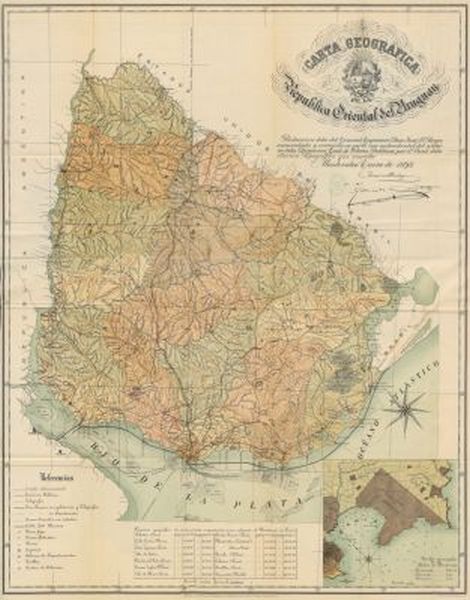
Variations in spelling, punctuation and hyphenation have been
retained except in obvious cases of typographical error.
The cover for the eBook version of this book was created by the
transcriber and is placed in the public domain.
Page 16: "1891 104,945 8,74 291". There is a missing digit - the
transcriber has added "5" to make 8,745.
Page 25: The transcriber has supplied the closing round bracket in
the following: The plantations are 80 hectares, planted with vines
(the plants are 2 and 3 years old); three millions of vine-shoot ...
