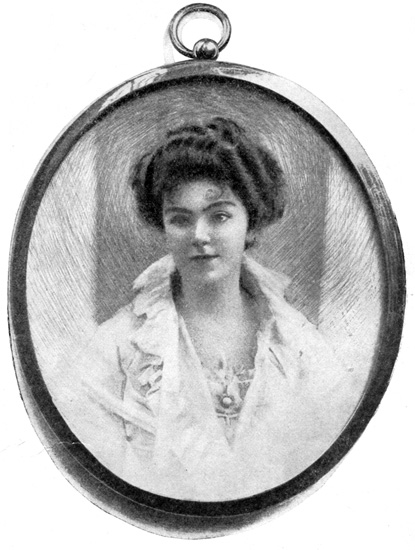
"My dear," said Mrs. Bobby, "I'm so
sorry to be late. Luncheon was interminable.
Why, Julian, who
would have expected to see you here?" She gave
him her hand demurely, with softly shining eyes.
Neither her surprise nor her contrition seemed to
ring quite true.
Gerard's dark eyes were again half closed beneath
their heavy lids. He looked, if a trifle pale,
more impassive than usual.
"I don't know why my presence here should
cause so much surprise," he said. "Most people
come here, don't they, some time or another. It's
a—a meeting-place, isn't it?"
"It seems to have been on this occasion," Mrs.
Bobby murmured under her breath. A young man
had just stopped and spoken to Elizabeth, and the
words might have referred to him. Gerard smiled.
"Won't you come and look at some of these pictures?"
he asked. "I want to talk to you."
"You awaken my curiosity."
They walked slowly along the gallery which
skirted the hall, too deep in conversation to pay
much heed to the pictures which hung along their
way. Elizabeth's eyes followed them, the while
she was repeating mechanically "Yes, the portraits
are extremely fine."
"But not one," the young man declared, with
blunt gallantry "to compare with yours. It's by all
odds the most beautiful picture here."
"Do you really think so?" said Elizabeth, gently.
"I'm very glad." She had heard the sentiment,
rather differently put, perhaps a hundred times. Yet
it seemed now to have all the charm of novelty.
The young man, a very slight acquaintance,
charmed to have called up that glow of pleasure to
her face, redoubled his efforts to entertain her. He
was sorry when Mrs. Bobby returned with Gerard,
and bore her off. "She was delighted when I said
that about her picture," he thought, "there's nothing
like flattering a girl, if you know how to do it
delicately."
"We really must be going, Elizabeth," said Mrs.
Bobby, consulting her engagement-book. "We have
at least a dozen visits, and we promised, you know,
to go to Mr. D'Hauteville's musicale."
"That reminds me that I did too," said Gerard.
"I'm glad you spoke of it."
"We shall see you there, then," said Mrs. Bobby,
as he placed them in the carriage, and they drove
off. "I am feeling utterly crushed," she continued,
turning to Elizabeth, and looking under the circumstances,
very cheerful. "Julian has been giving me
a terrible lecture. He thinks me, I see very clearly,
quite unfit to have the care of you. He says that
you are not as strong as you seem, that I have been
dragging you around—entirely for my own pleasure,
apparently—from one thing to another till you
are quite worn out, and that you will be ill if
I don't take care. He has quite frightened me.
But there, Elizabeth, you don't look so very tired,
after all."
She certainly did not. There was color in her
cheeks, a light in her eyes that was at once brilliant
and soft. All the lines drawn by sleepless nights
had, for the moment at least, disappeared.
"You don't look badly," Mrs. Bobby repeated.
"You look, in fact, infinitely better than when I
saw you this morning."
"I feel better," Elizabeth admitted. "Just for
a moment, at the Portrait Show, I did feel tired and
depressed, and he—Mr. Gerard got alarmed about
me, but it was nothing. I am quite well now. And
the portraits are really very interesting. I am glad
you persuaded me to look at them again, Eleanor."
"I thought you might be repaid," said Mrs.
Bobby, serenely. "What did you think of your
own picture? Doesn't it look better in that light?"
Elizabeth's face was turned away, so that Mrs.
Bobby could only see the rounded outline of her
cheek and one small, shell-like ear. "Yes, I—I
thought it looked better," she said, in a low voice.
"Perhaps you were right. It must have been the—the
light of the studio that made me feel—disappointed
in it, somehow."
"Oh, there is everything in the light in which
you look at things," assented Mrs. Bobby, cheerfully.
And with this profound remark, the two women
sank into silence, while the carriage rolled swiftly
up the Avenue, stopping occasionally, as the footman
left cards. To Elizabeth, as she sat gazing out
of the window, the prosaic brown stone houses, and
the more pretentious ones of marble which broke
the monotony here and there, and the brilliant
shops, which had intruded themselves like parvenus
among their quieter and more aristocratic neighbors—all
these familiar objects stood out in a softened
perspective, which endowed them with lines almost
of romance. The wide, commonplace streets had
an unwonted charm, the people who walked on them
wore an air of curious happiness, merely, no doubt,
at finding themselves alive in this beautiful world.
Yes, as Mrs. Bobby had so wisely observed, "there
is everything in the light in which you look at
things."
"I wonder if Mr. D'Hauteville's musicale will be
pleasant," Elizabeth observed dreamily, as they
neared Carnegie Hall. The remark was purely perfunctory.
Pleasant? Of course it would be pleasant—she
hadn't a doubt of it.
"There will be a lot of queer people there—musical,
literary, and that sort of thing," said Mrs.
Bobby, vaguely. "Some men with long hair will
play, and the women, no doubt, will wear wonderful
æsthetic gowns. If Julian were not to be there, I
should not dream of going. My prophetic instinct
tells me that we shall not know a soul."
"But won't that be rather amusing," suggested
Elizabeth.
"Well, theoretically, yes," said Mrs. Bobby, in
rather a doubtful tone, "but, practically, I'm afraid
I prefer people whom I know, and who have the
conventional amount of hair and lack of brains. Let
me confess the truth to you, Elizabeth. I'm not
really Bohemian—I only pretend to be so at odd
moments, when I want to tease Bobby, or shock
the Neighborhood. There isn't at heart, I believe,
a more conventional little society wretch than
I. However, as you say, that sort of thing is
amusing—for one afternoon; and Julian will be
there, and protect us from the celebrities and tell us
who they all are."
Julian was fortunately on hand when they arrived,
but the room was filled for the most part
with people who looked very much like any one else,
and only a few were sufficiently long-haired and
eccentric to justify Mrs. Bobby's prediction of their
being celebrities of some sort. The host, who came
forward to meet them, was a well-known musician,
a man with an intellectual face and dreamy eyes,
which lighted up as he welcomed them with eager
cordiality; but he could do no more for the present
than seat them and give them programmes, for the
music was about to begin.
It was a charming studio, well up near the top
of Carnegie Hall, and like most studios, it was artistically
furnished. The polished floor was strewn
with rich rugs, the walls were covered in every
nook and cranny, with plaques, and pictures, and
rare tapestries, and strange Eastern weapons. A
grand piano took up the whole of one corner, and
in another a toy staircase seemed to have been
placed entirely for ornament, till it was utilized as a
seat by some picturesque-looking girls in large hats.
From the broad casemented window near which
Elizabeth sat, she could see an expanse of roofs and
chimneys, far down from the dizzy height, and beyond
them the river, and further still the winter
sunset, fading in cold blues and greens and violets,
on a still colder sky. Her eyes rested there with
dreamy satisfaction. She had no wish to look back
into the room, to where Gerard was standing close
to them, on the other side of Mrs. Bobby. She was
still living on the memory of that moment—was it
an hour or was it years ago?—that long look of
which the reflected light was still glowing on her
face, and in her dreamy eyes. She had no wish to
renew it; the recollection was sufficient, for awhile
at least. Yet she was glad to know that he was
there.
Mrs. Bobby meanwhile, having embarked on her
trip to Bohemia, was disappointed to find it comparatively
tame.
"I don't see any one I know," she said to Gerard,
as the piano solo came to an end. "They look, most
of them, depressingly commonplace. But they must
be extraordinary in some way, or they wouldn't be
here. Tell us who they are, Julian, and introduce
them to us if you think we would like them."
"Why, there are some musical lights," he answered,
rather absently "who, I hope, are going to
perform for our benefit, and there are a few ordinary
music-lovers like myself, and some literary people—whom
I don't know that you would care
about."
"You think us too frivolous, I see," said Mrs.
Bobby. "But you don't realize how clever I can
be if I try, and as for Elizabeth, she knows a
lot more than she seems to know."
"Does she?" asked Gerard with a smile, and he
glanced across at Elizabeth, who still would not
meet his eyes. "She looks very innocent," he said,
musingly, after a pause. "I should be sorry to
think of her as—concealing anything."
A little pang, a thought sharp like a stone, struck
Elizabeth for an instant. It was the first rift in
the lute. She put it resolutely away from her.
"You think me too stupid, I see," she said "to
have any knowledge to conceal."
He had no time to answer before some woman
began to sing. She had a beautiful voice, and Elizabeth
listened, yet chiefly conscious, all the while, of
the fact that Gerard had managed to shift his position,
and was standing directly behind her.
"I never thought you stupid," he said, under
cover of the applause, in a low voice that no one
but she could hear, "no, nor ignorant; but I have
sometimes thought you frivolous, and flippant, and—and
a little hard. You seem, I sometimes think,
to take pleasure in showing these qualities to me.
Why is it, I wonder?"
"I—I don't know," she murmured, in the same
low voice, and gazing straight before her. "You—somehow
you seem to compel it. You ought to
be grateful, I think. At least you know the worst
of me."
She spoke these words with an absolute unconsciousness
of their falseness; and even as they died
away on her lips, she glanced across the room and
saw Paul Halleck standing in the door-way.
That old mythological king whom some vague
reminiscence of her school-days had conjured up
in Elizabeth's mind, he who had every wish fulfilled,
till he grew at last to dread his own prosperity—was
it, I wonder, in some such moment of
foreboding that the final crash came, or was it when
his fears were lulled and his senses stilled, by some
delicious, over-powering sense of happiness that
shut out for the moment all unpleasant thoughts?
This, at all events, was the way in which fate overtook
Elizabeth.
Paul Halleck stood in the door-way, having apparently
just arrived. His blue eyes were wandering
about the room. They did not fall, as yet,
upon Elizabeth.
She did not faint, or cry out, or make herself in
any way conspicuous. She turned deathly white,
and her heart, which had been beating faster for
Gerard's presence, seemed suddenly to stop entirely,
as though a piece of ice had been laid on it. And
then, in a moment, her heart began to beat again,
though faintly. She drew a long breath. Gerard,
who was standing directly behind her, could not
see her face beneath the shadow of her large hat,
yet he felt instinctively that something was wrong.
"Do you feel faint again?" he asked, anxiously,
thinking to himself that she was really far from well.
"Can I get you anything?"
"No, thank you," said Elizabeth. "I felt faint
for a moment, but it is over." It took all the
strength that she possessed to speak these words
so clearly and distinctly. In making the effort she
was not conscious of any plan of deception. She
was merely bearing up, instinctively, to the end.
She never doubted that it was the end. It had
fallen at last—that sword of Damocles, which she
had learned to dread as the winter wore on, of
which she had always been vaguely conscious even
in her gayest moments, and had only forgotten, quite
forgotten, in that short, delicious hour when she
had allowed herself to float off in a dream of happiness
never to be realized, from which she was awakened
so soon and so rudely. And yet, though it
was over, she was not sorry that she had dreamed
it. It had been very sweet, worth even, she thought,
the bitterness of the awakening.
Meanwhile the musicale progressed. A man with
long, floating hair and fingers of steel thundered
out a piano solo. Elizabeth shut her eyes and leaned
back in her chair. How fortunate that there was
so much music to prevent conversation! But at the
first pause she opened her eyes and looked up at
Gerard.
"I was wrong when I told you that you know
the worst of me," she said, faintly. "You'll know
it, soon."
"What a terrible prospect!" said Gerard, bending
over her and the jesting words had a soft intonation,
which thrilled her like a caress. "I really
don't think I can stand it—quite."
Had she intended to tell him the truth? The moment
was not propitious. The music had stopped,
and there was a murmur of conversation all over
the room. People began to move about, and in the
general shifting of position, Paul Halleck, for the
first time, caught sight of Elizabeth.
She had had some vague, childish idea of what
would happen when he saw her. She had pictured
him in her unreasoning terror, as stepping forward
before them all and claiming her as his wife, like
a scene in a play. Nothing of the kind took place.
She saw at once how absurd her expectations had
been. Paul merely started and looked at her, recognition
and it seemed, pleasure sparkling in his
eyes; but with a sudden, uncontrollable impulse, she
turned her own eyes away, as if she did not know
him.
"Do you see that man in the door-way?" said
Gerard, who, standing as he was behind her could
not note the changes in her face,—"that handsome
fellow with the light curls? He has a very
fine voice, and has just been engaged as soloist at
St. Chrysostom's."
"Indeed. Is he to sing this afternoon?" She
brought out the question with difficulty.
"I hope so," said Gerard. "I'd like you to hear
him. But perhaps you know him," he went on.
"He is looking at you as if he expected you to
bow."
"No," said Elizabeth. "I don't know him." She
told him this, her second lie that afternoon, without
deliberate intention, in sheer lack of presence of
mind. It was a piteous, involuntary staving-off of
the inevitable. The next moment that fascination
which leads us to our own undoing made her look in
Paul's direction, and this time she could not avoid
his eager gaze and bent her head mechanically.
"After all, I believe I must have met him somewhere,"
she said hastily. Mrs. Bobby, who for the
last quarter of an hour, had been determinedly ignoring
them both, apparently giving her whole attention
to the music and the people, now turned
towards them.
"Who is that handsome man who bowed to you,
Elizabeth?" she asked. "I never saw him before."
"His name is Halleck. I—I knew him in the
country," said Elizabeth, who had no natural talent
for deception and entangled herself at once in contradictory
statements. Gerard's face darkened, and
he glanced across at Halleck, whose eyes were fixed
on Elizabeth with a look that seemed, to the jealous,
fastidious man by her side, an intolerable presumption;
a look that was not only one of admiration,
but, or Gerard imagined so, held in it a curious
touch of proprietorship. "Confound the fellow,"
chafed Gerard—he who would fain have kept the
woman he loved, as he certainly would have kept her
picture, shut out from all profane eyes, even admiring
ones. "He looks at her as if he had discovered
her and she belonged to him. Where can she have
met him, and why did she say she hadn't."
Mrs. Bobby, too, looked across at Paul.
"He is certainly very good-looking," she said.
"And do you mean to tell me, my dear, that such
an Adonis flourished in our Neighborhood, and I
never saw him. Pray, where did you keep him
hidden?"
Before Elizabeth could reply, and to her great
relief, D'Hauteville came up with the long-haired
musician, whom he introduced to them, and who
proved to be, at last, one of the celebrities upon
whom Mrs. Bobby had counted. In the diversion
that ensued Halleck seemed forgotten. But a few
minutes later, he sat at the piano and sang songs by
Schubert and Franz, which she had heard him sing
before, at the time when she had thought his voice
the most beautiful voice in the world. Now, as she
listened it left her cold. She had changed so much,
and he—no, he had not changed. His voice was
not so wonderful as she had thought it, but still it
was a fine barytone voice. His art no longer seemed
to her remarkable, but it had, if anything, improved,
and he was as handsome as ever, in his fair,
effeminate style. It was not the voice nor the art
that was lacking. It was the answering thrill in
herself. It was not his beauty which had failed
him, it was she who no longer cared for it.
His success with the audience was instantaneous.
Even Mrs. Bobby was impressed. "Your friend
sings well," she whispered to Elizabeth, "and yet
his hair is short. You may introduce him to me if
you get a chance."
And this chance immediately presented itself, as
Paul, amid the applause that followed his song,
walked over to Elizabeth and quietly shook hands
with her. It was the moment that she had dreaded
all the time that he was singing, yet now that it
had come, she met it in apparent unconcern, and
smiling, though with white lips.
"I thought at first," Paul said, "that you had
quite forgotten me."
"Oh, no," she said, "my memory is not so
short." Then she turned and introduced him to Mrs.
Bobby, and went on herself quietly talking to Mr.
D'Hauteville. Nothing could have been more simple.
Not even Julian Gerard, who from a distance
watched their meeting, could have imagined any
secret understanding between them.
The handsome young singer made a very favorable
impression upon Mrs. Bobby, who went so far
as to ask him to call, in that impulsive way of hers,
which sometimes led to consequences that she regretted.
In this case she realized, almost as soon as
the words had left her lips, that she had done a
rash thing, or what Bobby would consider rash.
Still, the invitation was given and eagerly accepted,
even though Elizabeth, standing cold and indifferent,
said not a word to second it. By this time the music
was over. They were about to leave, when some one
claimed Mrs. Bobby's attention, and she turned
aside for a moment. Paul seized the opportunity,
for which he had been anxiously waiting, to whisper
in Elizabeth's ear.
"Darling, don't go. I must see you for a moment."
"You can't speak to me here," she said, impatiently,
trying to escape from him.
"But I must see you. Can't you see that I
must?"
"You have done without it," said Elizabeth, without
turning her head, "some time."
"Because I couldn't help myself."
"There is such a thing as writing," she said, in
the same low, bitter tone. Yet even as she spoke
her conscience misgave her. It was not his neglect
that she resented so bitterly, it was his return. But
Paul, not understanding this was rather flattered
than otherwise by the reproach.
"Darling, I will explain when I see you," he said,
hurriedly. "There's no time now. Meet me to-morrow
morning—at the Fifty-ninth street entrance
to the Park, at eleven o'clock."
"To-morrow! Impossible! I have a hundred
things to do."
"Ah, but you must," he pleaded. "I must see
you. Darling you look so beautiful—fifty times
more beautiful than before."
"Hush," said Elizabeth. "How dare you? Some
one will hear you."
"Give me a chance of seeing you, then," he said.
"It is necessary. You will meet me—will you
not?—to-morrow morning?"
"If you insist upon it—yes."
"At the west entrance of the Park—you understand?"
"Oh, yes," said Elizabeth impatiently, and hastened
to rejoin Mrs. Bobby, who was waiting at
the door.
Julian Gerard came up gloomily. The whispered
conference had not escaped his notice.
"We shall see you to-night at the Lansdownes'
ball," said Mrs. Bobby. "It is the night for it, isn't
it, Elizabeth? I never can keep track of these
things."
Gerard looked reproachfully at Elizabeth. "You
promised me," he said, "that you would stay at
home for a night or two."
She smiled back at him with the old touch of
wilfulness. "Did I really make such a rash promise,"
she said, lightly. "Ah, I'm afraid I can't keep
it—not to-night. I must be amused. A quiet evening
would be unendurable." Her cheeks were
flushed, her eyes glittered with feverish gaiety,
there was an odd, strained note in her voice. Mrs.
Bobby looked at her in some perplexity, then she
glanced up deprecatingly at Gerard.
"It is her first season, you see Julian," she said,
as if in apology. "You can't expect her to give up
things."
"No," he repeated, mechanically. "I can't expect
her to—give up things." He fell back silently,
in increased gloom. Elizabeth glanced towards him
involuntarily as she left the room.
"Now," she said to herself, "I have disappointed
him again and he won't come near me this evening.
But it is better so—far, far better," she repeated to
herself, with a little sob, as she followed her hostess
to the carriage.