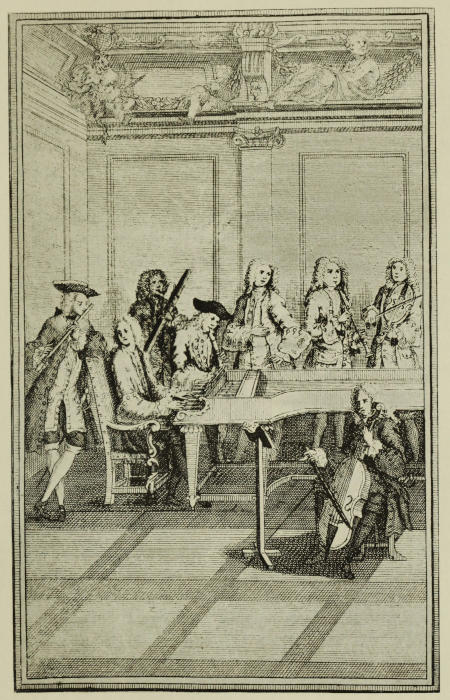
The purpose of this book is to give music-lovers
and young musical students a more intimate
acquaintance with the Symphony Orchestra
and its instruments than they, perhaps, possess.
The instruments are described one by one; and,
finally, the Orchestra, which is, itself, treated as an
instrument on which the Conductor may be said to
play.
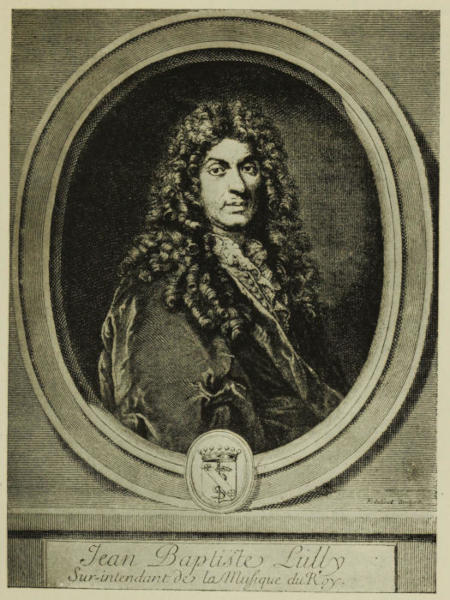
Attention should be called to the description of Lully’s
famous Orchestra and to the interesting group of artists
who played in it, such as Descoteaux, the tulip-fancier,
described by La Bruyère in his Caractères, and Marin
Marais, one of the greatest virtuosi of the Seventeenth
Century.
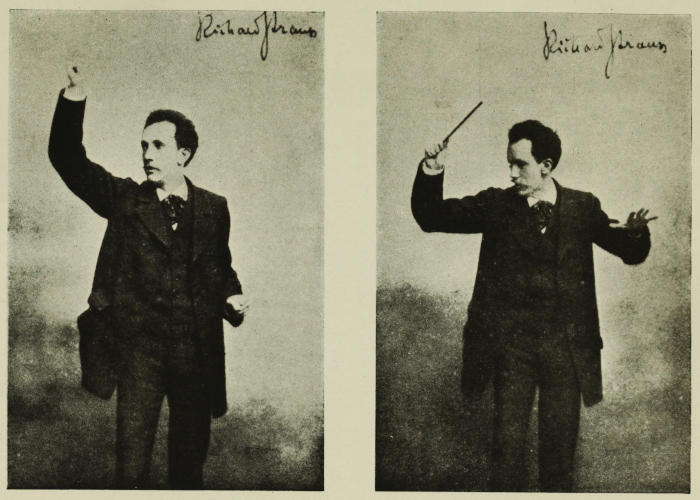
It is often said that the virtuoso-conductor did not
appear until the Nineteenth Century. I think the
facts given here will prove that Lully was the first
of the “star-conductors”; and that our Symphony
Orchestras may be said to have their origin in the
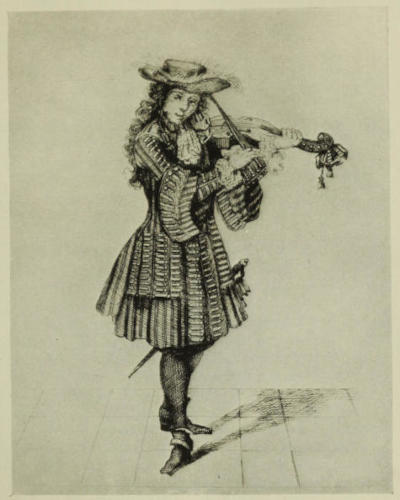
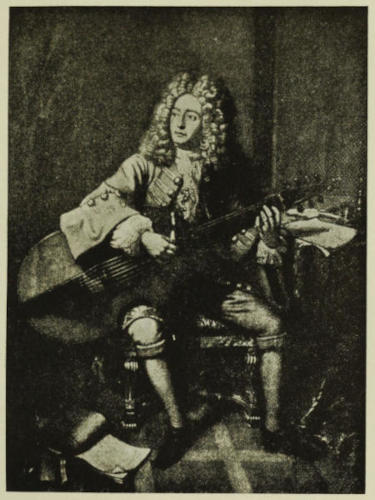
“Twenty-Four Violins of the King,” one of whom is
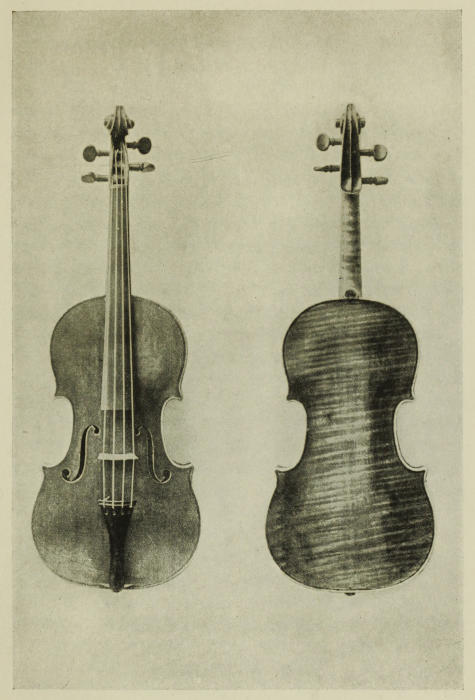
represented in the illustration facing page 160.
It should also be noted that the illustrations have all
been photographed especially for this work,—many
of them from rare volumes and old prints.
I wish to offer my grateful thanks to Mr. Walter
Damrosch for having so kindly read the page-proofs
and to Mr. Harry Harkness Flagler for the interest
he has taken in the preparation of this book.
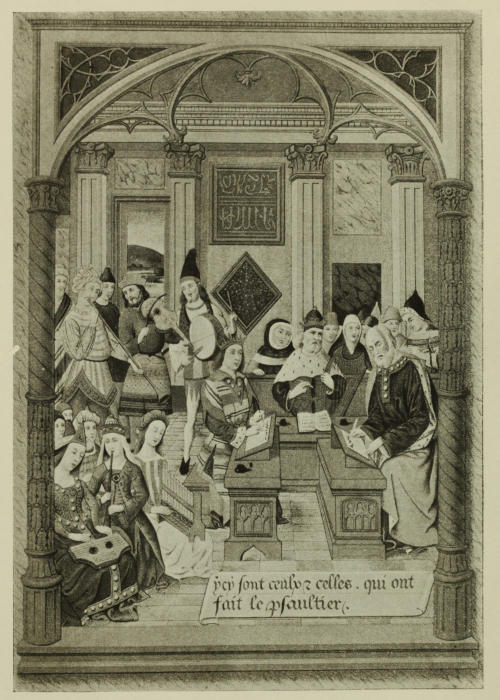
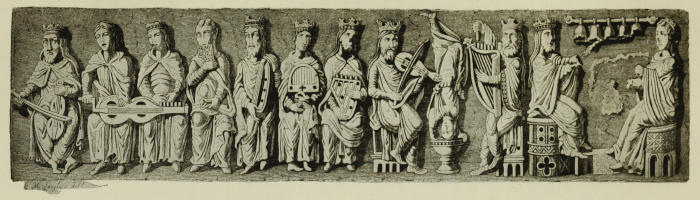
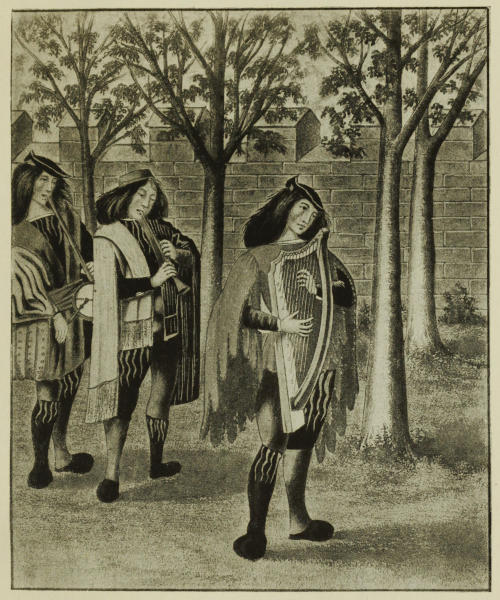
From the Breviary of King René, written and
illuminated in the Fifteenth Century by some of those appearing
in the picture. Preserved in the Bibliothèque de l’Arsenal, Paris.
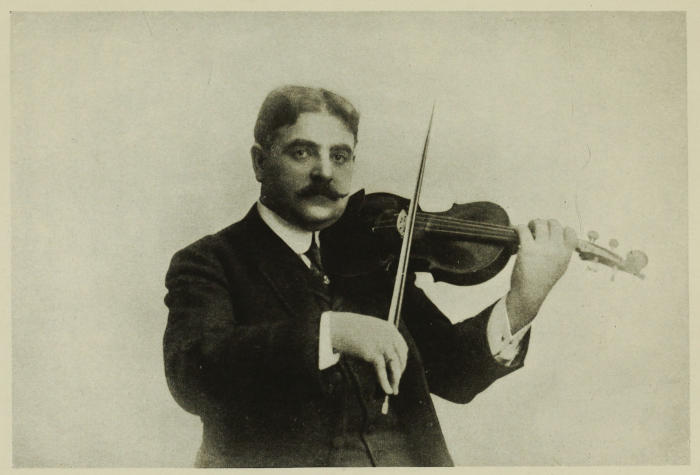
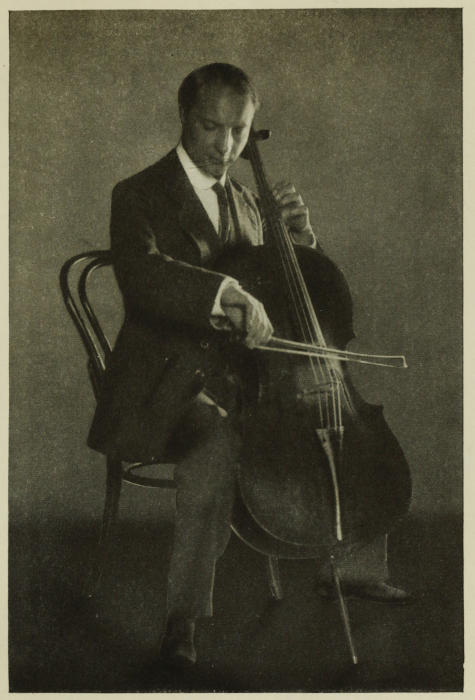
First Violin, Symphony Society of New York, Alexander Saslavsky
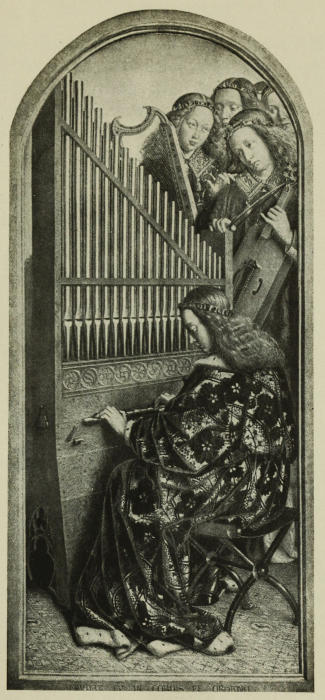
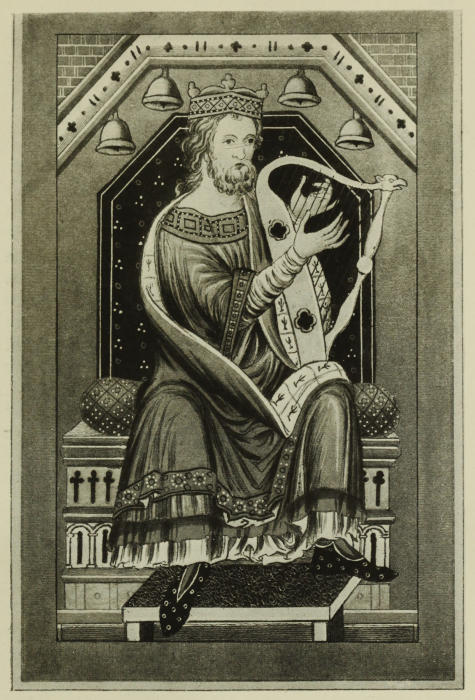
From the Adoration of the Lamb by Jan and Hubert
van Eyck, in the Cathedral of St. Bavon, Ghent. St. Cecilia is
playing the organ, one of the Angels a harp (of the “Irish” type)
and another a violin without “bouts” and with crescent-shaped
sound-holes. Note the peculiar and archaic shape of the bow.
This picture was painted in the Fifteenth Century.
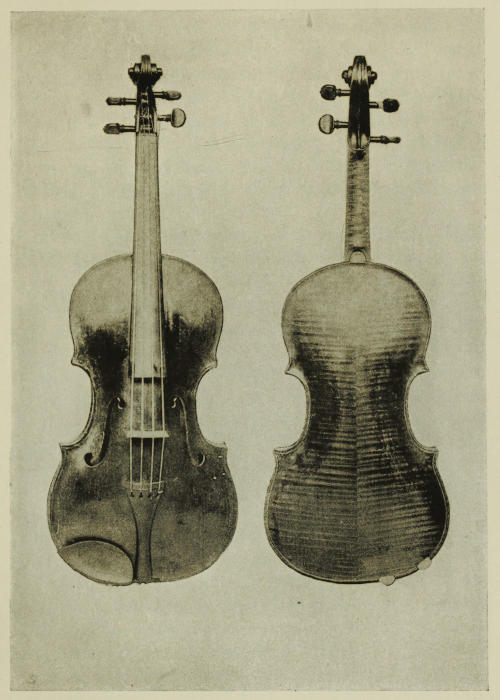
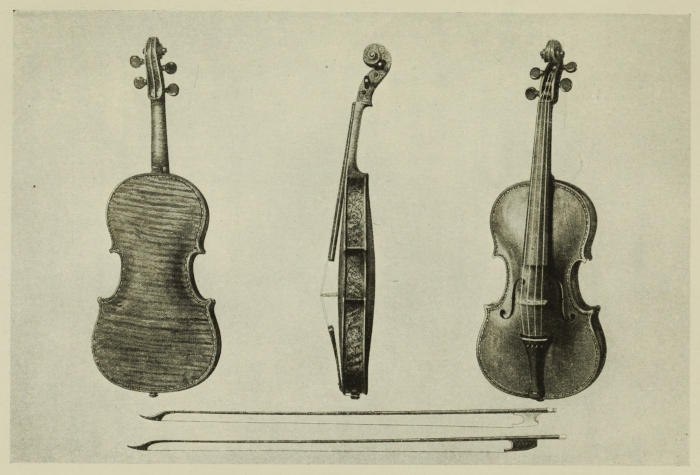
Bought by Sir Samuel Hellier of Womborne,
Staffordshire, England, from Stradivari about 1734. It was
made in 1679, but its history between these dates is unknown.
The Hellier Stradivari is one of the most famous examples of
Stradivari’s work and is one of his very rare inlaid
violins. The bows are of an old model, as their points plainly
show, made before the days of Tourte.
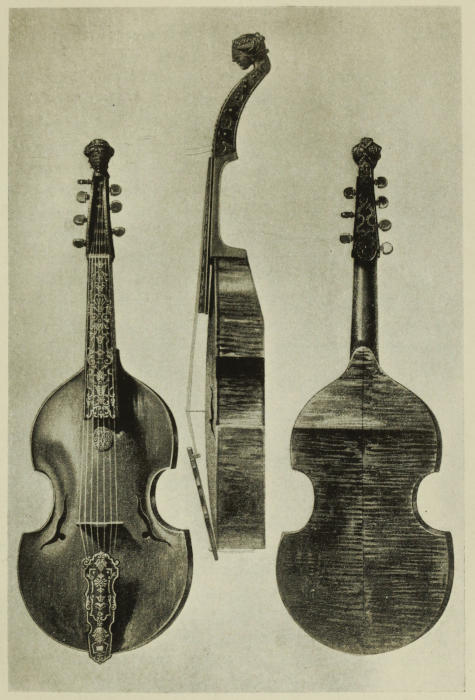
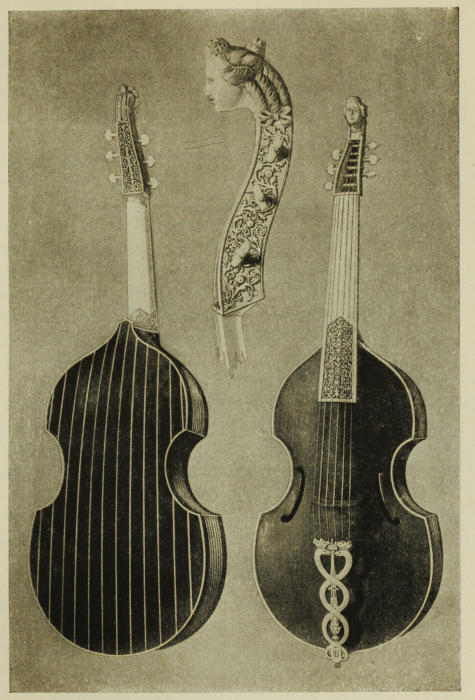
Owned by the University of Edinburgh. Note the
beautiful inlay of the tail-piece and neck, the carved female
head instead of scroll with the eyes strangely veiled. The
sound-holes of the “flaming-sword” type are beautifully and
gracefully cut. This instrument lacks the “sympathetic strings,”
with which it was originally strung.
Owned by the Museum of the Brussels Conservatory
of Music. The back is of rosewood. The inlay, neck, scroll and
tail-piece (carved in the shape of Mercury’s caduceus) are of
ivory. The instrument is an exquisite work of art. It is of
later date than the viola d’amore facing page 50, as
the crescent-shaped sound-holes show.
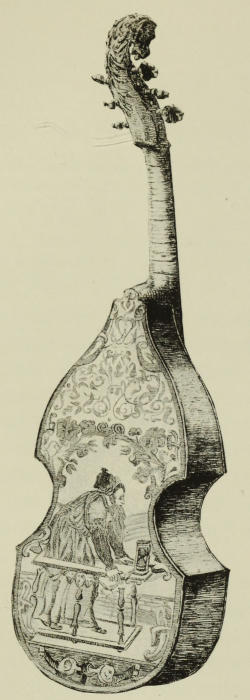
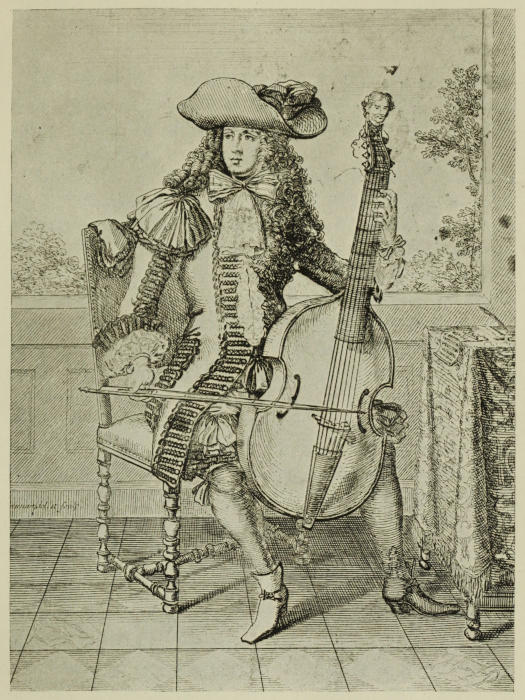
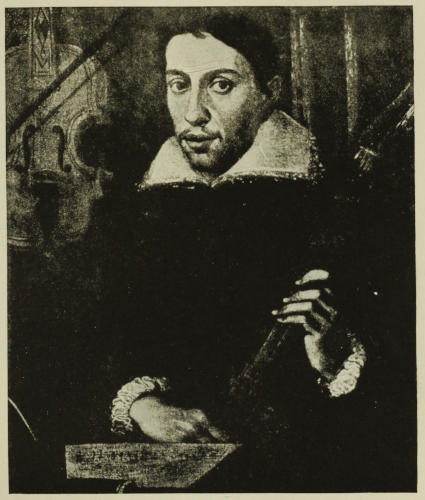
Gentleman of the Seventeenth Century playing the viola da gamba, or basse de viole
Made by Giovanni Krebar of Padua in 1629. The body
is of ivory and the neck and peg-box of ivory engraved with a view
of Venice, incised figures dancing and fencing and a garden scene.
The pegs show that there were eight bass notes, or diapasons; a
single string to each note, five double strings on the fingerboard
and one, the highest of all and single, called the chanterelle,
or melody string.
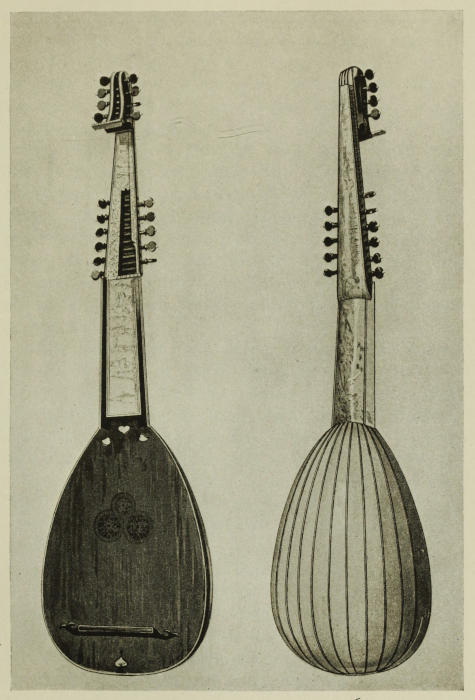
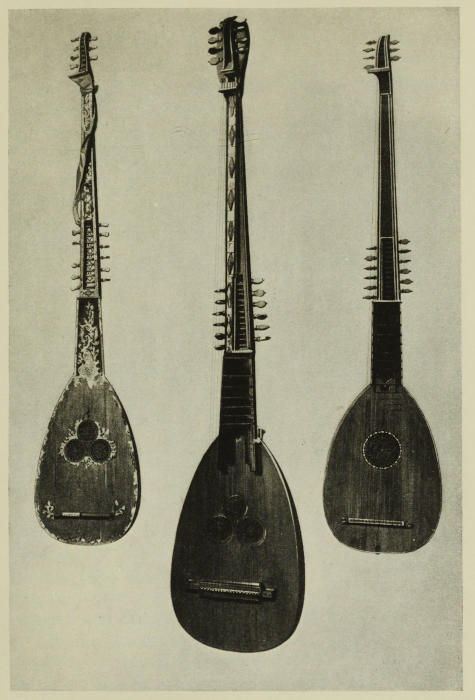
The first is a theorbo, or bass lute, with a long
upper neck to give length for the bass strings. It is five feet
long. Notice the three sound-holes joined together (rosaces) and
the mother-of-pearl ornamentation. This lute is strung with six
pairs of strings on the fingerboard: each pair is tuned in unison.
Seven single, or diapason strings (or open basses) are stretched
from the upper peg-box. The Chitarone in the centre, also
richly inlaid with mother-of-pearl, has also three connected
sound-holes, six pairs of unisons upon the fingerboard and eight
diapason, or open bass, strings on the neck. It is six feet long!
The third chitarone has six pairs of unisons and seven
diapason (or bass) strings. The neck is ornamented with checker work.
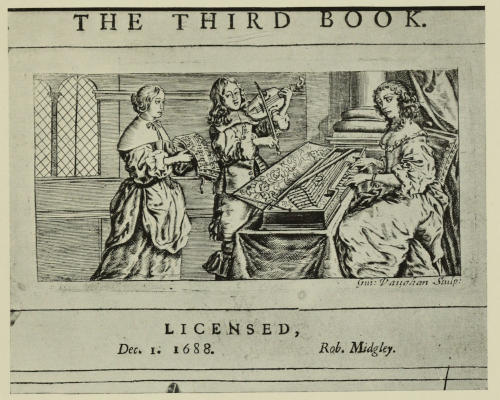
From Peter Preller’s Modern Music Master
(London, Eighteenth Century).
THE ORCHESTRA AND ITS INSTRUMENTS
THE ORCHESTRA AND ITS INSTRUMENTS — PRELUDE
We have just arrived in the Concert Hall, have
taken off our wraps and are comfortably
seated in our chairs waiting eagerly for
the concert to begin.
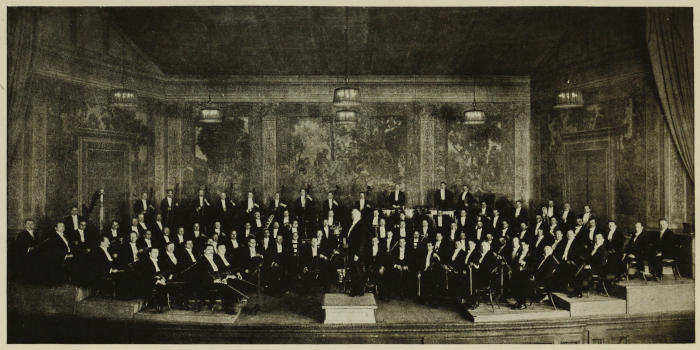
The Orchestra is entering from the doors at the sides
of the stage.
Here come the Violins. They all sit in a group
together. These in front of us and on the left of
the Conductor’s stand are the First Violins; these on
the right of the Conductor’s stand are the Second
Violins. These ten men who seem to carry very large
violins are the Violas and they are taking their seats
by the side of the Second Violins. Opposite them
ten Violoncellos are taking their seats by the side of
the First Violins. Behind the Violoncellos stand the
Double-Basses.
In the meanwhile, the players of the Woodwind
have entered and have seated themselves in a row
facing the Conductor,—the Clarinets by the Violas;
then the Oboe and Cor Anglais (English Horn); and
then the Flutes. Behind the Flutes are the Bassoons;
and behind the Oboes and Clarinets are the French
Horns. In the back row are Trombones, Trumpets,
Drums, Triangle, Cymbals and other Percussion
instruments. On the right, behind the First Violins,
is the Harp.
They are all here now, each instrument in its own
group, or family.
We cannot understand what any great city is like
if we do not know something about the people who
compose that city. Take New York, for instance; or
London, or Paris, or Boston, or Washington, or Chicago,
or San Francisco. Each city has a personality
of its own; and so we speak of New York, or London,
or Paris, or Boston, or Washington, just as if we were
talking of an individual.
It is exactly the same with an Orchestra. Though
composed of a collection of individual instruments,
the Orchestra has an individual character of its own.
It is a personality that speaks to us in the beautiful
and inspiring language of music; and, therefore, after
we learn about the instruments and what part each
instrument has to play in forming this little orchestral
city, as it were, we shall then turn our thoughts to the
Orchestra itself.
The Orchestra is composed of three groups, or families,
and one accessory group. Each of these three
groups forms a choir of its own, of four parts,—soprano,
alto, tenor and bass.
The most important group is that of the stringed
instruments, or “Strings,” as this family is called.
The Violins sing the soprano; the Violas, the alto,
or tenor; the Violoncellos, the bass; and the Double-Basses,
the deeper bass. All of the “Strings” are
played with the bow.
The family next in importance is the “Woodwind,”—instruments
consisting of a long tube made of wood
through which the performer blows. Some of these
are held horizontally, others longitudinally. These
also play in four-part harmony, as it is called,—soprano,
alto, tenor and bass.
The Brasswind family comprises the Horns, the
Trumpets and Trombones. It forms another set
of four voices—soprano, alto, tenor and bass. The
performers blow through the tubes of these instruments.
These instruments are usually spoken of as
the “Brass.”
Last of all come the instruments of Percussion,—that
is to say instruments that are beaten, or knocked,
or struck, or thumped, or shaken, such as the Drums,
Triangle, Cymbals and Tambourine. This group is
also called the “Battery.”
With these three separate choirs grouped into
three separate families, each with its special characteristics
and accomplishments, the composer is able
to do many wonderful things. For example, he can
let any choir, or any instrument in that choir, sing a
melody while the other choirs accompany it with
lovely harmonies, or dispute with it, or start up
another melody in opposition to it, or even make
comments, pleasant or ill-natured, on it, as it were.
Then, in addition, the composer has the “Battery”
of beaten instruments to accent the rhythms, or to
add sharp, bright, penetrating notes; dull, soft, deep
thuds; mutterings and crashes.
The Harp does not belong to any family, or group.
The other instruments are very indifferent about
him. Perhaps they regard him as an interloper.
The Harp is not a regular member of the Orchestra:
he is only an occasional guest. Although a stringed
instrument, the Harp does not belong to the “Strings.”
He comes from another line, another race,—from the
minstrels and bards. The Harp has a poetic and a
passionate utterance all his own, which is of an entirely
different kind of poetry and passion from that of the
Violin tribe.
Applause! Here comes the Conductor! He bows,
walks to the stand, bows again and steps upon the
platform. Now he turns and looks at the audience.
His quick glance sweeps the whole house—from top
gallery to parquet—and takes in everything, everywhere.
He has now commanded the attention he
desires. Everybody is getting quiet. We did not
notice—perhaps because we were contributing to it
ourselves—that there was a general rustle and chatter
and movement. Now that there is a hush over everything
we notice the contrast. But the Conductor is
not quite satisfied. Some persons are still talking in
the box above us. He looks at them and waits for
them to finish. He does not have to wait long. They
notice the reproof and their chatter ceases suddenly.
Now all is quiet.
The Conductor turns and faces his men. He lifts
the little, white stick that was lying beside the score
on his desk, raps on the desk to command attention
from his men and raises his right hand.
What is the first number? Let me see the programme.
Thank you. Mendelssohn’s Overture to
Midsummer Night’s Dream. Such lovely opening
chords! How silvery, delicate, faint and far-away are
those soft, gentle harmonies that melt into one another
like the tender hues of sunset clouds! They are,
indeed, “the horns of Elfland faintly blowing.”
As we hear them we are transported into another
world,—a world of fancy and delight. We enter
Fairyland ourselves!
Listen to the Violins! Can we not see the tiny
flower-fairies, myriads and myriads of them? Here
they come,—tripping, dancing, twirling, winding,
flying, floating, laughing, singing and running lightly
in rhythmic steps to the gay melody on the Strings.
The horns call again; and again the fairies come,
myriads and myriads more of them,—tripping, dancing,
twirling, winding, flying, floating, laughing, singing
and running lightly in rhythmic steps to the gay
melody as did the first merry troupe.
Again the Elfin horns! Could anything be more
enchanting than those lovely, melting harmonies of
the fairy sentinels and little body-guard of Queen
Titania?
We seem to have left the Concert Hall now. We
are in a beautiful English forest glade where the grass
is very green and where the beech trees throw out
upon the sward great, long, gnarled and snaky roots
covered with emerald moss. And here, on a bank
canopied o’er with luscious honeysuckle and sweet
musk roses and eglantines, and where the nodding
violets and sweet-smelling thyme make us drowsy
with their delightful perfume, we see Titania and her
tiny Elfin train gather. They charm away the spotted
snakes with double tongue, thorny hedgehogs, weaving
spiders and beetles black, so that their Queen may
sleep in peace. Off they go on various errands,
leaving near the softly-breathing Titania a little
fairy sentinel standing on an eglantine and holding
a sharp spear of grass. Again we hear the delicate,
silvery horns of Elfland; and, with the last lingering
chord, the Enchanted Forest vanishes.
These subtle harmonies touched our imaginations
and evoked that lovely picture!
The Conductor lays down his bâton. All is over!
We have often read in Fairy Tales how only those
who had tasted dragon’s blood could understand the
language of birds and animals.
It is precisely the same with regard to Orchestral
music. Only those whose ears are educated can
appreciate all its meaning and its beauty. When we
taste dragon’s blood, so to speak, we understand the
language of music and enter into a new world of
delight that is closed to the uninitiated.
The Orchestra throws open for us magic casements
that look upon a realm beyond that of everyday
reality; and the more we know of the Orchestra,
the greater will be our power to enter that sphere
of enchantment. Therefore, our first step will be to
inquire into the history and capacities of the instruments
that give the Orchestra its very existence.
CHAPTER I THE VIOLIN
Charm of the violin; voice of the violin; parts of the violin; construction of the
violin; bridge, bass-bar and sound-post; ancestry of the violin; the vielle, or viole;
evolution of the violin; corners and bouts; the sound-holes; birthplace of the violin;
Brescia; Gasparo di Salò; Maggini and the characteristics of his violins; Efrem
Zimbalist’s Maggini; Cremona; the Amati family and their violins; Antonio
Stradivari; house of Stradivari described by Haweis; the Stradivari violin; the
Guarneri; Joseph del Gesù; Carlo Bergonzi; Jacobus Stainer of Absam; importance
of wood for violins; Joachim’s opinion of the Stradivari violin; strings of
the violin; the fingerboard and “positions”; harmonics—natural and artificial;
portamento; the sordino; the right hand’s work; bowing; pizzicato; position of
violins in the Orchestra; the First Violin; Lavignac on the violin; Berlioz on
use of violins in the Orchestra; François Tourte, the Stradivari of the bow;
evolution of the bow; Corelli, Tartini, Tourte, Viotti, Paganini; Tourte’s model;
the bow of to-day.
There is something very fascinating about a
violin. This graceful, delicate instrument, which
is a marvel of strength, notwithstanding its frail
appearance, is beautiful to look at and its voice is
lovely to hear.
It is often said that the voice of a violin is so greatly
admired because its tones offer the nearest approach
to the human voice; but if you think the matter over
you will, perhaps, agree with me that the tones of a
beautiful violin do not resemble those of a human
voice and that they are infinitely more beautiful in
quality. There is a mellowness, a softness, a richness,
a liquidity, a glossy clearness and a warmth peculiar
to the violin and very far away from anything that
the human throat can accomplish.
Let us think of the violin’s voice as something individual;
and as something delightful and dear to us
because it is an individual voice and not because of
any fancied resemblance to a high soprano. Indeed,
very few of the greatest singers could ever produce
such velvety, sweet, poignant, vibrant and insinuating
notes as we hear from a luscious Stradivari, a sweet
Amati, or a rich Maggini under the bow of a master-violinist.
Everything about a violin appeals to us. There is
something so mysterious and ingratiating about the
little instrument, neat and trig and curved at the
waist, with lines as clean as those of a high-bred
race-horse and nerves as tense with excitement, ready
to be set quivering at the touch of the bow.
Moreover, the very fact that age improves it, and
that the longer it lives the sweeter and richer and
lovelier it becomes, gives us almost a feeling of awe
towards the violin. This delicate little instrument
defies Time and disaster. In that it is superior to
man himself: the violin is, therefore, almost superhuman!
How many hands have touched this precious
treasure! What scenes has it passed through! How
many countries has it visited! How many thousands
have listened to its voice!
The violin has outlived them all, generation after
generation. If it could only tell us all its experiences
and adventures since it was taken down from
its nail in a Cremona workshop and pronounced
ready for the purchaser who had ordered it!
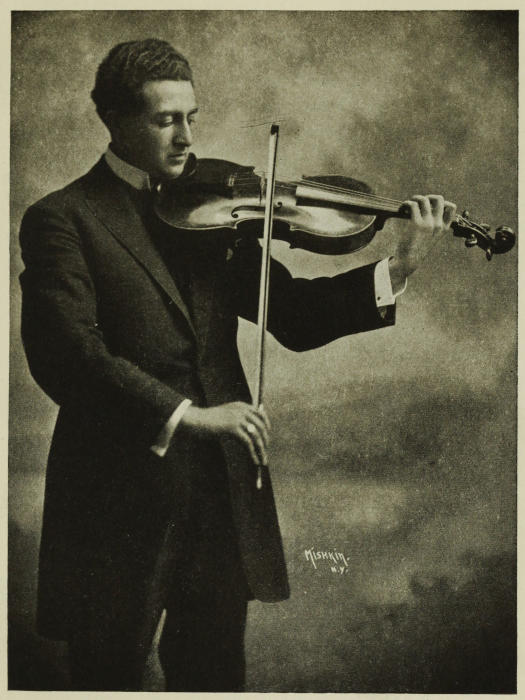
FIRST VIOLIN, SYMPHONY SOCIETY OF NEW YORK
Alexander Saslavsky
Romance, romance, romance, and nothing but
romance, clings around old violins, just like the scent
in an old Chinese rose-jar. You cannot get rid of
the aroma. And, moreover, you do not want to.
This atmosphere of the Past gives enchantment to
a violin as it does to a Ming vase.
Then there is something very thrilling in the fact
that the violin has a charmed life. Nothing can
hurt a violin very much. If it is smashed into a thousand
bits, a clever repairer can put all the pieces
together again; and the instrument is little the worse
for the shock.
Then, too, a valuable old Cremona seems to defy
theft. If a thief runs away with one, he has trouble
to get rid of it, because few are willing to buy it from
him. The pedigree of every famous violin is known;
or, in other words, the name of every one of its
owners is on record. A fine instrument can be
identified eventually.
All violins may look alike to you now; but not
after your eyes have been taught to know them.
No two violins were ever made that were exactly
alike; although, of course, all those that were made
by any one maker have, generally speaking, the same
characteristics. These characteristics are what one has
to learn, in order to become an expert, or a connoisseur.
All the celebrated makers gradually developed
a “model,” as it is called; and experts and connoisseurs
can tell almost at a glance from what workshop
any instrument came. Not only the model, or pattern,
or shape, as we might call it, declares the maker,
but every maker had a special varnish. Every maker
also had a special way of carving the scroll, or head,
and of cutting the sweeping f-holes that give the
violin so much expression.
And what would the violin be without these graceful
f-holes?
It would not only lose its tone, but much of its
beauty. These sound-holes are of the utmost importance.
Their shape, width and position have all
been determined through years—centuries indeed—of
experiment.
The whole system by which the sound-waves are
set in motion in the inside of a violin and the way
they cross each other and issue forth from these
sound-holes is strange in the highest degree. It is
a miracle!
Altogether, the violin is a very charming, fascinating,
mysterious, romantic, delightful, and lovable
instrument.
Although the violin may appear to your eyes as a
very simple instrument, it is really a very complex
one.
If I asked you to describe a violin you would probably
tell me that it has a back and front, sides and
strings. Perhaps you might mention the bridge and,
perhaps, you would not think about this small article.
Perhaps, too, you might mention the f-holes on
either side of the bridge. And there you would stop.
You know very little about a violin, or you would
speak of the belly and not the “front” and of the ribs
and not the “sides.” And you have not mentioned
anything inside the violin. Perhaps you think it
contains nothing!
A violin consists of seventy different pieces.
Fifty-seven belong to the construction and thirteen
are moveable fittings.
The back (sometimes in two pieces), the belly (sometimes
in two pieces), the blocks (six), the ribs (six,
sometimes five), the linings (twelve), the bass-bar,
the purfling (twenty-four pieces), the nut, the fingerboard,
the neck, and the head and scroll (sometimes
called the lower nut).
The thirteen moveable fittings are: the tail-piece,
the loop, the button, or tail-pin, the screws, or pegs
(four), the strings (four), the sound-post and the
bridge.
The wood used is of three kinds: maple, or sycamore,
for the back, neck, ribs and bridge; pine, or
soft deal, for the belly, blocks, linings, bass-bar and
sound-post; and ebony for the tail-piece, fingerboard,
nuts, pegs and button. The purfling, that narrow
edging that outlines the shape of the instrument on
both belly and back, is made of thin strips of ebony
and maple (sometimes, but not often, whalebone is
used).
The parts are put together with the finest glue
and invisible joinings. Finally, comes the varnish,
which is of the utmost importance.
The violin is, indeed, as a lover of this instrument[1]
has said, “a miracle of construction; and as it can
be taken to pieces, put together, patched and indefinitely
repaired, it is almost indestructible. It is,
as one might say, as light as a feather and as strong
as a horse. The belly of soft deal and the back of
hard sycamore are united by six sycamore ribs supported
by twelve blocks with linings. It appears
that the quick vibrations of the hard wood married to
the slower sound-waves of the soft wood, produce the
mellow but reedy timbre of the good violin. If all the
wood were hard, you would get the tone light and metallic;
if all soft, it would be muffled, or tubby. There
is every conceivable variety of fibre both in hard and
soft wood. The thickness of back and belly is not
uniform. Each should be thicker towards the middle.
But how thick and shaved thin in what proportion
to the sides? The cunning workman alone knows.”
And now let us consider carefully the three important
and highly mysterious organs of the violin.
Yes, I am calling them organs. Perhaps I had even
better say organs and nerves. These are the bridge,
the sound-post and the bass-bar. The two latter
are invisible. The bridge, a delicately cut little arch
of maple, or sycamore, higher on one side than on
the other, perforated curiously but according to a
form learned through the experiments of centuries,
has been called the “tongue of the violin.” The treble
foot of the bridge stands firm and rigid on that
part of the belly made rigid by the sound-post. The
bass foot of the bridge rests on that part of the body,
or belly, which vibrates freely, these vibrations being
increased and regulated by the bass-bar. Through
this bass foot of the bridge the vibration of the strings
is communicated to the belly and thence to the mass
of air in the violin. The treble foot of the bridge is
the centre of vibration. The action of the bridge,
however, really depends upon the sound-post.
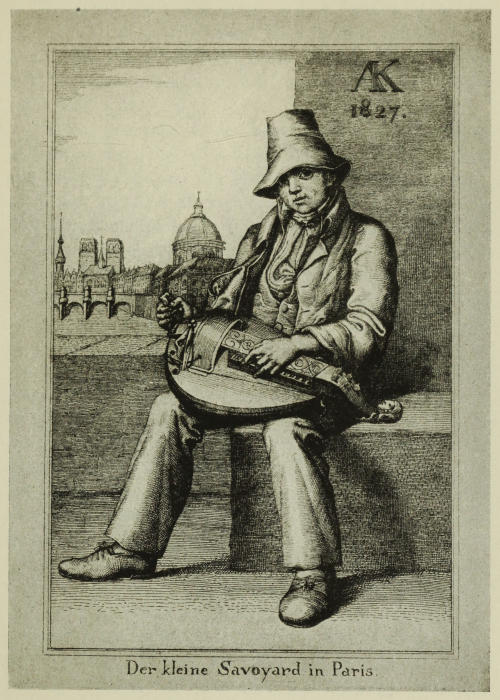
A LITTLE SAVOYARD IN PARIS WITH VIELLE, OR HURDY-GURDY
The sound-post has been called “the soul of the
violin.” It is a little pine stick, a few inches long,
about the size of a large cedar pencil. It is placed
upright about an eighth of an inch to the back of the
right foot of the bridge.
“Through it pass all the heart throbs, or vibrations,
generated between the back and the belly. There
the short waves and the long waves meet and mingle.
It is the material throbbing centre of that pulsating
air-column defined by the walls of the violin, but
propagating those mystic sound-waves that ripple
forth in sweetness upon ten thousand ears.”[2]
The bass-bar (or sound-bar) has been called “the
nervous system of the violin.” It is an oblong piece
of wood glued lengthwise to the belly. It runs in
the same direction as the strings and acts as a beam,
or girder, to strengthen the belly against the pressure
of the left foot of the bridge. The bass-bar has to
be cut and adjusted to meet the requirements of
every violin; and only long experience can determine
how long, how thick and exactly where the bass-bar
should be made and placed. The fraction of a line
makes all the difference in the world.
The bass-bar is the only member, or organ, of the
violin’s body that has undergone any change since
the days of Antonio Stradivari. Owing to the increased
pitch (higher tuning) of the present time,
the tension, or pull, of the strings equals eighty
pounds! Think of it—this frail-looking, delicate,
little violin stands a strain of eighty pounds!
In Stradivari’s time this tension was sixty-three
pounds. So in modern times it has been found necessary
to strengthen the bass-bar by giving it extra
depth in the centre and adding to its length.
Now we know exactly what happens. This tremendous
strain of the strings (equalling eighty pounds)
is resisted first by the arch of the belly; then by the
ribs, strengthened by the upright blocks and linings;
and, lastly, by the supporting bass-bar.
Another change that has been made in the last
century is the lengthening of the neck. This was
done on account of the increased technique of modern
performers. The scroll, or head, remained unchanged.
The scroll is very indicative of the maker. Any
expert by looking at the scroll can tell its maker.
Truly we can repeat the words of Mr. Gladstone:
“to perfect that wonder of travel—the locomotive—has,
perhaps, not required the expenditure of more
mental strength and application than to perfect that
wonder of music—the violin!”
The violin is three hundred years old, and it is the
only musical instrument that has remained unchanged
during that time! It has seen viols, lutes, spinets and
harpsichords go out of fashion; it has seen many
wind-instruments disappear and new ones take their
places; it has seen a few developments in the harp;
and it has seen the birth of the piano. But the model
of the violin that was brought to perfection by the
old makers of Cremona, particularly Antonio Stradivari,
is so beautiful in form and so exquisite in tone
that it has been impossible to improve it.
The violin did not spring into existence under the
clever hands of the Italian workmen. It had been
developing for a hundred years before the Cremonese
makers added their finishing touches. What they
did was to take the model that already existed and
improve it; and their improvements were so great
that they practically made a new instrument of it.
The violin has had a long ancestry. It would take
several hours to describe all the peculiar instruments
from which it could have been derived. We should
have to go back thousands of years, to ancient Egypt
and Greece and Phœnicia and even to India. And
everywhere we would come across an instrument
that is best described as a long box of wood over
which a string is stretched, or, in some cases, several
strings are stretched.
We date our violin from the Thirteenth Century,
a time when many great changes were taking place,
when great cathedrals were being built and when
Dante was living. Perhaps it would be better to
say that the characteristics of our modern violin begin
to appear about that time—six hundred years ago—when
the Troubadours began to flourish in the south
of France, in beautiful Provence, the land of roses
and nightingales.
The Troubadour, who was a poet as well as a musician
and who wrote the words of his songs as well as
their melodies, played upon a viole, or vielle. Another
name for it is guitar-fiddle. The instrument was
a kind of guitar, fiddle and hurdy-gurdy all in one,
as you will see if you look at the picture of the Little
Savoyard in Paris facing page 14, made in 1827;
for the hurdy-gurdy of the wandering player is a survival
of the old vielle. Its body was pear-shaped
and over it five strings were stretched. The vielle
was a queer instrument indeed; sometimes it was
played with a bow; sometimes it was plucked with
the fingers; and sometimes it was played by turning
a wheel. It was chiefly used by the Troubadours
to support the voice, so it was an accompanying,
rather than a solo, instrument. Gradually the vielle
was made larger; and during this same Thirteenth
Century, when there were many new ideas springing
up in the world, somebody got the idea of cutting
out the sides of the long instrument to form a kind
of waist. And this waist was the first step towards
our modern violin.
In the Fifteenth Century—two hundred years
later—something else happened,—something of
importance for the whole future of music. People
began to make bowed instruments corresponding to
the various kinds of human voices; consequently,
these were the treble, or discant, viol; the tenor viol;
the bass viol; and the double-bass, or violone.
The next thing that happened—also in this Fifteenth
Century—was the invention of corner blocks,
which followed naturally from the cutting of the
waist, although it took a long time to think of it.
You will notice if you look at the illustrations facing
pages 22, 24, 30,
34, and 38, that a violin has two
sharply projecting points on each of its sides, one at
either extremity of the f-holes at the waist of the
instrument. These sharp corners mark the position
of triangular blocks inside the violin. These blocks
are glued to the back and to the belly of the violin
and the ribs of the violin are glued to the blocks.
These blocks are the very corner-stones of the construction
of a violin; and they add very much to
the strength and the resonance of the instrument.
ST. CECILIA
By Jan and Hubert van Eyck
If you look at the violins and other bowed instruments
in many old Italian and Flemish paintings
you will see that they have only single corners, as,
for instance, the large viol the Angel is holding in
the picture of St. Cecilia facing page 18. Nobody
seems to know whether single, or double, corners
came first; but after a time only double corners were
used.
The use of these double corners produced something
else that was new. This was the curving of the ribs
at the waist forming a hollowed-out place called
bouts; and these bouts gave the right hand of the
player more freedom to move up and down with
the bow. Up to this time the position of the performer’s
hand was stiff and cramped unless there was
a tremendously high bridge to carry the strings. So
when the ribs were curved and the bouts cut, the
player’s hand could move more easily and naturally.
But even so, the shape of the violin was not fully
determined. These bouts were made according to
the idea of every individual maker. They were
small and deep in some instruments, long and shallow
in others. They were often of enormous size and out
of all proportion to the general form of the instrument.
Pictures of these old models look very queer to us
now.
About the beginning of the Sixteenth Century
long and shallow bouts were universally used and
the violin began to take the simple and graceful form
with the double corners with which we are familiar.
But, notwithstanding all these improvements, we
have not yet arrived at our perfect violin. The
sound-holes, those two curved openings called f-holes,
on either side of the bridge, were not yet in their
proper place.
These f-holes were subject to a great deal of experimenting.
Strange to say in the old vielle, or viole, of
the Troubadours they were often very nearly in the
place they occupy to-day, that is to say partly in the
waist and partly in the lower part of the instrument;
but the invention of the bouts displaced them, and,
sometimes (indeed very often), they appear right
down at the very bottom of the instrument near
the tail-piece, as you will see if you look at the picture
facing page 70. Makers had an idea that the belly
should be left as strong as possible and that the cutting
of these f-holes made it weaker. At first they
used a round sound-hole, like that of a guitar, right
in the middle of the instrument. Then they made a
pair of crescents, or large C’s turned face to face, as
you will see if you look at the Angel playing in the
picture of St. Cecilia facing page 18; and they
liked this so much that they used these C’s for a hundred
years (in the Fourteenth and Fifteenth Centuries).
Then came the “flaming-sword” as in the viola
d’amore facing page 50; and then the f-hole. But at
first the f’s were placed back to back. Finally, about
1580, the Italian makers cut their f-holes front to
front.
By the middle of the Seventeenth Century, about
the time that our own country was being settled by
the English and Dutch, the violin was ready for the
great makers to improve it in beauty of outline and
qualities of tone.
The violin is, therefore, almost exactly the age of
our own country!
The birthplace of the violin is in one of the world’s
loveliest spots—in the fertile plain of Lombardy,
in the northern part of Italy, where the eyes of the
traveller that have feasted on emerald meadows and
sapphire lakes look upward to the snowy Alps, where
grew the pines, maples and sycamores from which
the old makers obtained the woods for their instruments.
The very trees were saturated with beauty
as they grew on the mountain slopes. Is it any
wonder that the instruments made from such wood
should sing?
In this district and in the Tyrol little colonies of
lute-makers and viol-makers had lived and worked
for centuries, supplying Europe with such instruments
as we find represented in old illuminated manuscripts
and described in song and story.
Two towns became especially celebrated for their
violins,—Brescia and Cremona.
Brescia was famous for two makers: Gasparo di
Salò and his pupil, Giovanni Paolo Maggini.
Gasparo di Salò’s real name was Gasparo Bertolotti.
He was born in 1542 in the little town of Salò, on the
shore of the Lake of Garda, about twenty miles from
Brescia.
Brescia was in those days a pretty town, hidden
behind fortified walls with the usual belfry, palace
and Cathedral soaring above them. The Cathedral
was famous for its music and its fine orchestra. The
monks were very friendly with the instrument-makers,
who had carried on their art and trade from generation
to generation ever since the beginning of the Fourteenth
Century. In Brescia Gasparo di Salò settled
and became well known for his viols and violins.
He probably had many orders from the monks, with
whom he was evidently on good terms; for when
he was ill, at one time of his life, they took care of
him. He made most of his instruments from 1560
to 1610, when he died.
His name is of great importance in the history of
the violin. The violins of Gasparo di Salò are the
earliest that are known. They are very rare, however.
The most famous di Salò was owned by Ole
Bull, the great Norwegian violinist. It is now in the
Museum in Bergen, Norway. Instead of the ordinary
scroll it has an angel’s head, which is said to have been
carved by Benvenuto Cellini, the gifted silversmith.
“The violins of Gasparo di Salò are of somewhat
large build with strong curves and varnished with
a dark brown varnish; but their shape corresponds
little with that adopted by the great Italian makers.
The middle bouts are cut very shallow; the corners
project but little and are strongly rounded, while
the sound-holes are large and parallel to each other—a
feature which is peculiar to the Brescian School.
Gasparo selected for his bellies wood of an extraordinary
uniformity of regularity of grain.”[3]
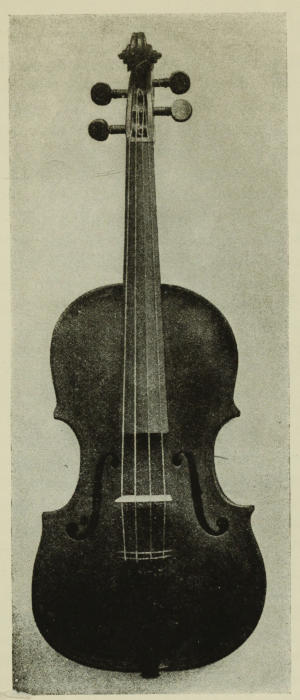
VIOLIN
By Gasparo di Salò
By him the present form of the violin was definitely
fixed, as you will see by looking at the Gasparo di
Salò facing page 22. His tenors and double-basses
are superior to his violins and are much sought after.
Maggini was a native of Brescia and worked there
from 1590 till 1632, when he is supposed to have died
of the Plague. His early violins resemble those of
Gasparo di Salò; but gradually the sound-holes
grow narrower and by the end of his life Maggini
produced violins that were pure in outline and beautifully
finished. Moreover, they are famed for their
grand, deep, melancholy tone. Maggini had learned
to be extremely careful in selecting the wood. In
early days the Maggini bellies were cut across the
grain like Gasparo di Salò’s; but, after a while,
Maggini cut with the grain like Amati. His sound-holes
grew more delicate, but they were bevelled
inwards (an idea that the Cremona makers rejected).
Maggini violins are also distinguished for their clear,
golden-brown varnish and for their purfling, which
is usually double. Very often Maggini indulged his
fancy for ornamentation by twisting the purfling into
a graceful clover-leaf pattern on the backs of his
violins.
Maggini violins are very rare. The last one to
come to light was discovered by Efrem Zimbalist
about a year ago. The way it came into his possession
is as romantic a story as was ever told about a violin.
Zimbalist happened to be at Lake George. A
policeman came to him one day and said: “Mr.
Zimbalist, I have an old violin that has been in the
garret for about seventy or eighty years. I have just
been offered a hundred dollars for it and I want you
to tell me if I shall take it.” “Bring the violin to
me,” said Zimbalist, “and I’ll try it.” The policeman
returned with a dark, dirty old instrument,
unstrung and in bad condition. It was not prepossessing,
but Zimbalist strung it and tried it.
“I’ll give you,” he said to the policeman, “a hundred
and fifty dollars for it now; and if I find that it
is what I think it is, I will give you a hundred and
fifty more.”
Zimbalist brought the violin to New York and took
it to a repairer, who worked over it and at length
brought it back to its original state. Delighted
with the violin, Zimbalist sent the policeman five
hundred dollars. Soon afterwards the violin repairer
offered Zimbalist five thousand dollars for it. The
old, black, neglected violin had turned out to be a
beautiful Maggini.
Not very far away from Brescia is the town of
Cremona on the river Po. Cremona! The very
name gives us a thrill! The town, though small, was
an artistic centre. Its school of painting was nearly
as famous as that of Bologna, and in its stately Cathedral
just as beautiful music was heard as in the
Cathedral of Brescia. The wealthy prelates and
learned monks encouraged and trained musicians of
the first rank; and naturally there was a great demand
for fine instruments. Cremona had long been a
rival of Brescia in the production of viols and violins
and now that Maggini had made so many improvements,
the Cremonese makers were quick to follow,
so quick indeed and so skilful that Cremona went
ahead of Brescia and became the centre of violin-making
for the whole world from 1560 to 1760—two
hundred years! And it is thrilling to realize
that in this little town, in three workshops side by
side, on the Piazza San Domenico, all the great violins
of the world were made and in friendly competition
by the three families of Amati, Stradivari and
Guarneri.
VIOLIN
By Maggini
The Amati family was of good position. Their
name goes back in the records of Cremona to the
year 1097. The first one of interest to us is Andreas
Amati, who was born in 1520 and who died in 1611.
He may have been a pupil of Gasparo di Salò and then
again he may not. At any rate, his model differs
very much from Gasparo’s and marks a great advance,
although it still retains the stiff, upright Brescian
sound-hole. Andreas Amati chose a smaller model
with belly and back very high. His outline was
very graceful; his scroll beautifully cut; his varnish
of an amber color; and he was noted for his careful
selection of wood. Very few of his works have survived.
His sons, Antonio and Geronimo (Antonius
and Hieronymus as they are also known), improved
on their father’s style. To them is due much of the
reputation of the Amati violin; for they reduced
the outlines to beautiful curves; were careful about
the wood they used; and they perfected a rich, clear
varnish. These brothers worked together and apart
and produced a model that for artistic design and
sweetness of tone has never been surpassed.
Then came Nicolò Amati (1576-1684), greatest
of them all. He was the son of Geronimo. First
he copied the family model and then developed a
style of his own, producing an even more graceful
outline, a richer and deeper varnish and a greater
power and clearness of tone, without sacrificing the
peculiar sweetness and charm that is characteristic
of all the Amati violins. Nicolò, as a rule, made
rather small violins, but he also made some large ones.
These are known as the “Grand Amatis” and they
are very highly prized to-day.
“Most of the Nicolò violins before 1645 are of the
smaller pattern, but after this date down to 1684,
the year of his death, the eye of a connoisseur will
notice an increase in size, a finish in workmanship
and a more delicate purfle (never double). The
model is still somewhat high in back and belly, but
with an increasing tendency to get flatter; the side
grooving is less pronounced, whilst the corners are
noticeably drawn out into finer points full of character,
arresting the eye, lightening, as it were, the model
and giving the whole physiognomy of the instrument
a piquancy hitherto unattempted.”[4]
In his workshop on the Piazza San Domenico
Nicolò Amati had many pupils and apprentices.
Among them were the Guarneri brothers and Antonio
Stradivari.
Everybody has heard of Stradivari, or Stradivarius,
for he is often called by the Latin version of
his Italian name. Stradivari was the greatest of all
violin-makers; and his violins are to-day as valuable
as jewels.
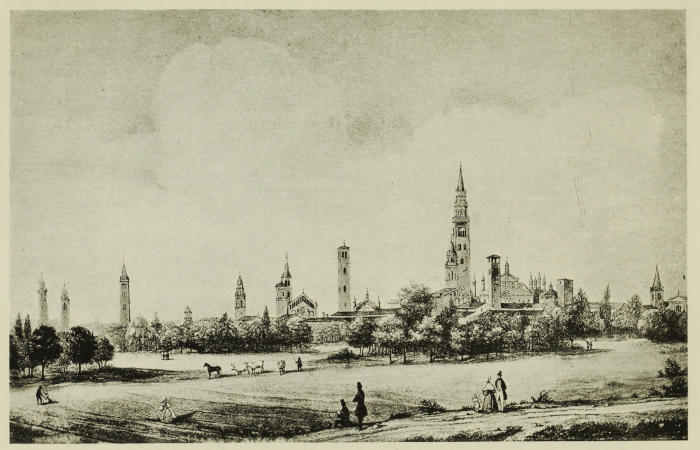
CREMONA IN 1830
By Caporali
What Stradivari really did during his long and industrious
life was to take the model of Nicolò Amati
and improve it, searching ever to get intensity of tone
without sacrificing sweetness. In other words, he was
doing just what Nicolò Amati had done before him;
and he applied all his life, all his energies and all his
thought to this purpose.
“Stradivari’s main improvements consisted of (1)
In lowering the height of the model, that is, the arch
of the belly and in altering this flattened curve to a
more uniform arch, so as to afford greater resistance
to the pressure of the strings. (2) In making the
four corner blocks more massive, in an improved
method of dove-tailing the linings at the blocks, and
in giving a quarter curvature to the middle ribs, the
result of which is to make the curves more prominent
in the outline and to increase the tension of the
parts. (3) In altering the setting of the sound-holes,
giving them a decided inclination to each other at
the top, thus following the general upward diminution
of the pattern and in fixing the position of the sound-holes
relatively to the corner blocks. (4) In making
the scroll more massive and prominent, thus rendering
it less liable to split at the peg-holes and forming
more of a counterpoise in the hand of the player.”[5]
Antonio Stradivari came from an old Cremonese
family, members of which held public office as early
as 1127. There is not much to tell about his life.
He was born in 1644 and died in 1737 at the age of
ninety-three. When he married in 1667, he left
Amati’s workshop and opened his own a few doors
away. When Nicolò Amati died, he left Stradivari
all his tools. By this time Stradivari had bought a
house, No. 2, Piazza San Domenico (No. 1, Piazza
Roma from 1870 until it was pulled down), and there
in the top loft, or garret, he worked so industriously
that the people of Cremona had a proverb “rich as
Stradivari.” No authentic portrait of him is known.
According to tradition, he was tall and thin. In
winter he wore a white woollen cap and in summer a
white cotton one and he always wore a white leather
apron over his clothes when he was at work.
Mr. Haweis, some years ago, went on a special
search for the house of Stradivari and found it, after
much difficulty; for the people of Cremona had forgotten
all about the man who made their town famous.
However, he succeeded in discovering the house.
He takes us directly into this romantic spot: “I stood
in the open loft at the top of the house where still
in the old beams stuck the rusty old nails upon which
he hung up his violins. And I saw out upon the north,
the wide blue sky just mellowing to rich purple and
flecked here and there with orange streaks prophetic
of sunset. Whenever Stradivari looked up from his
work if he looked north his eyes fell on the old towers
of S. Marcellino and S. Antonio; if he looked west
the Cathedral with its tall campanile rose dark against
the sky; and what a sky! Full of clear sun in the
morning, full of pure heat all day and bathed with
ineffable tints in the cool of the evening when the
light lay low upon the vinery and hanging-garden,
or spangled with ruddy gold the eaves, the roofs and
frescoed walls of the houses. High up in the air
with the sun his helper, the light his minister, the
blessed soft airs his journeymen through the long
warm days worked Antonio Stradivari.”
Stradivari is supposed to have made two thousand
instruments! He also made lutes, mandolins and
guitars and every detail of his instruments, including
the pegs! In those days princes and other rich amateurs
ordered their violins; and they would come
themselves, or send some important deputy, to the
instrument-maker to talk it all over, and, often,
indeed, to give the measurements of their arms and
bodies so as to get a violin that should be exactly
suited to the performer. In those days the best
concerts took place in private homes; and the wealthy
patron of art liked to own many fine instruments for
his own little orchestra to play upon, and still choicer
ones for guests, who, in those troublous times of war,
rarely took their own valuable instruments travelling
with them. Stradivari, like other makers, was frequently
asked to supply “a chest of viols,” or a “set
of instruments.” He was, therefore, very busy, filling
orders all the time. Meanwhile, he was thinking
out, as he filled his orders, the great problem of how
to get a more carrying and penetrating tone without
sacrificing beauty and sonority. To give an idea of
the work he used to have, the King of Poland, in
1715, ordered twelve violins for his court orchestra;
then Cardinal Orsini (afterwards Pope Benedict XIII)
ordered a violoncello of Stradivari in 1685; and in
1687 the Spanish Court ordered a set of stringed
instruments that were ornamented with ivory purfling.
One of these found its way into the hands of Ole Bull
and was afterwards sold to Dr. Charles Oldham of
Brighton.
Stradivari, in his early period, followed the Amati
style, with, however, a freer sweep of the scroll. He
began to sign his violins, that is to say to put a label,
or ticket, inside of them, about 1700; and from that
date to 1725 he created his master-works. He gradually
diminished the arch under the bridge and, finally,
produced the flat model. Stradivari only ceased to
work in the last year of his life. For those great
violins that are now known by special names, the
“Messiah,” the “Pucelle,” the “Viotti,” the “Bossier,”
the “Dolphin,” the “Hellier,” and so on, that are
now worth fortunes, the maker was paid from fifty
to two hundred dollars apiece!
What would old Stradivari say could he know the
prices that are given for these violins when they
change hands! He would be amazed beyond measure;
but his delight would be greater if he could hear the
rich tones that are given forth from his instruments
mellowed with age. Moreover, violinists did not
play in Stradivari’s time as they play now. Could
the old Cremonese maker see and hear the violins
that he made and learned to know and love as they
took shape beneath his skilful touch in the hands of
Fritz Kreisler or Efrem Zimbalist—what would he
think!
VIOLIN
By Antonius and Hieronymus Amati
An authority tells us that: “After 1690 his individuality
began to assert itself, his model became more
graceful and flatter, the f-holes elegant and reclining,
the centre bouts gracefully drawn out, as also the
corners; the scroll is bold and striking; the purfling
rather narrow; and the varnish beautiful golden, or
light red. It was at the end of this period that he
made the violins known as the ‘Long Strads,’ so
called from their narrowness between the f-holes,
giving them a lanky appearance, the size varying, and
the varnish amber, or light red. The year 1700
brings us to his best period, the model flattish, the
wood cut on the quarter and thickest in the centre
under the bridge, the curves gentle and harmonious,
the wood of the blocks very light, often formed of
willow, the scroll perfect in its symmetry. The
graceful f-holes, the transcendently glorious amber-colored,
or ruby, varnish are all characteristics of
this epoch of the greatest master’s greatest power.
His last instruments have the purfling pointed across
the corner instead of following it round; and it is
not uncommon to find it running completely through
the corner. His ticket runs ‘Antonio Stradivarius
Cremonensis faciebat Anno 17—’. His years of experiment
resulted in a neatly compacted instrument
with light edges, accurate corners, round arching,
broadly treated but exquisitely graceful sound-holes
and scroll and a varnish soft in texture which shades
deliciously from orange to red. From 1703 until
about 1709, the year of those famous violins, the
‘Pucelle’ and the ‘Viotti,’ Stradivari seems to have
settled upon certain points of construction from which
he rarely afterwards departed. In 1711 he made
the fine violin known as the ‘Parke;’ in 1713, the
‘Boissier,’ which belonged to Sarasate; in 1714,
the ‘Dolphin;’ and in 1715, the ‘Gillot’ and the
‘Alard,’ which experts look upon as the master’s
finest creations; and in 1716, came the ‘Messiah.’
No detail of his work was too unimportant for the
master’s vigilant observation. That he personally
designed the pegs, finger-boards, tail-pieces, inlaid patterns,
bridges and even the minutest details of his
violin cases, is attested by the numerous drawings of
these in the Della Valle collection while the several
sketches for bow tips and nuts reveal the interesting
fact that he also made bows. Generally speaking, the
so-called Lost Cremona Varnish was in the writer’s
opinion no secret in Stradivari’s lifetime, but the
common property of the lute-makers of the day, who
compounded it from the materials used by the great
painters of the epoch. Stradivari’s own recipe was
inscribed on the fly-leaf of a family Bible, but his
descendant, Giacomo Stradivari, destroyed this.”[6]
Two sons carried on their father’s work, but they
produced nothing remarkable.
There were five of the Guarneri who were distinguished
violin-makers. The first was Andreas, who
worked with Stradivari in the workshop of Nicolò
Amati. He afterwards developed an original style.
The important member was Joseph del Gesù, so
called from the “I. H. S.” he added to his name
on the labels of his violins. Just why he did this
nobody seems to know. As he was the son of Gian
Battista, he may have humorously wanted to say
he was greater than his father. Joseph, or Giuseppe,
Guarneri was born in 1687 and died in 1745. His
latest productions, from 1740 till his death, are his
best. Whether he was a pupil of Stradivari, or not,
matters little. His real master was old Gasparo di
Salò; for he revived the bold, rugged outline and the
powerful tone of the early Brescian maker, as you
will see if you compare the violins facing pages 22
and 38. Joseph del Gesù was searching after tone;
and he got it. He seems to have led a wild life; and
there is a story that once he got into trouble and was
locked up in prison and that the jailer’s daughter
brought him wood and tools so that he could make
violins. These violins are called “Prison Josephs”;
and, judging from the number of them in the world,
Joseph del Gesù must have stayed a long time in
prison and have been very industrious while there.
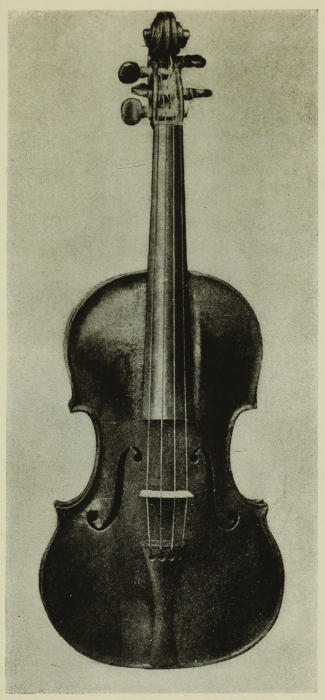
Paganini had a Joseph del Gesù and preferred it
to his Stradivari. He always played upon it; and
when he died, he left it to the Town Hall in Genoa,
where it is still to be seen. It is represented facing
page 38.
One more and we shall have finished with the Cremonese
makers. This is Carlo Bergonzi, Stradivari’s
favorite pupil. Carlo lived next door to Stradivari;
and when the latter died, he moved into Stradivari’s
house and lived with the latter’s son. First Bergonzi
copied the Stradivari model and then he tried for
power; so he endeavored to combine the model of
Stradivari and that of Joseph Guarneri. The model
that he produced is bold, broad and massive and gives
a strong, rich, full tone. Bergonzi worked twenty-five
years; but only about sixty authentic instruments
of his are known. Bergonzi was born in 1712 and died
in 1750.
We must not imagine that these makers of whom
we have been talking were the only ones at work
in Lombardy during these two hundred years. If
we take the pains to look at any books on violin-making
we will be amazed at the long, long list of
Italian makers of lutes and violins. There were
about as many of them as there are makers of pianos
in the United States to-day.
There were also many German instrument-makers
at work, particularly in the Tyrol, where the pines
were so plentiful; but the only one of any great reputation
is Jacob Stainer, who was born in the little
town of Absam near Innsbrück in 1621. He may
have gone to Cremona, which was not far away from
his home, and have worked there, or he may have
just had some models. At any rate, his violins are
more like those of Cremona than are those of any
other German maker.
Stainer’s violins bear a rough resemblance to the
Amati violins; but they are very much higher, and
the f-holes are shorter and are very thick and clumsy.
Stainer made twelve violins for the Electors of his
country; and these “Elector Stainers,” as they are
called, are his most famous productions. He died in
1683.
It is said that this old maker used to walk through
the wooded slopes of the Tyrolean mountains with
a hammer in his hand and that he would knock the
trunks of the trees and listen to the vibrations. When
he found a tree that suited him, he had it cut down
to use in making his instruments.
THE HELLIER STRADIVARI
The question of wood was of the greatest importance.
“The wood must be cut only in December
and January and only that part must be used which
has been exposed to the sun. You may cut up planks
before you find a piece suitable for a really fine
back, or belly. Witness the grain of a Stradivari or
Amati violin; mark the almost pictorially beautiful
health and evenness of its wavy lines, free from all
knots, irregularity of growth, studded with symmetrical
and billowy veins where the rich sap once
flowed. And when the wood is cut it must be tempered
and dried, not with artificial warmth but with
the slow and penetrating influence of a dry, warm
Cremona climate. For no customer, no market
could the process be hurried. And the application
of the varnish required corresponding care. It was
to be perfectly wedded to the rare wood—a companionship
destined to last for ages—to outlast so
many generations of men and women, was not to be
enterprised or undertaken lightly. In the spring
when the air got clear and bright and the storms
were past, the subtle gums and oils were mixed
slowly and deliberately: hours to stand, hours to
settle, hours for perfect fusing and amalgamation of
parts; clear, white light gleaming from roads strewn
with the dazzling marble dust of Lombardy; clear
blue sky, warm dry air, and the skill of an alchemist,—these
were the conditions for mixing the incomparable
Cremona varnish. So deliberately was it prepared
and laid on, just where the wood was fit to receive
it—laid on in three coats in such a manner as to
sink into the dessicated pores and become a part of
the wood, as the aromatic herbs and juices become
a part of the flesh that is embalmed for a thousand
years. All through the summer did that matchless
varnish, which some say contained ground amber
and which, at any rate, was charged with subtle
secrets, sink and sink into the sycamore and deal
plates, until now, when age has rubbed away its
clear and agate crust in many places, the violin is
found no longer to need that protection, for the wood
itself seems to have become petrified into clear agate
and is capable throughout its myriad pores and fibres
of resisting the worm and even damp and other ravaging
influence of ordinary decay.”[7]
When Joachim was asked why he preferred a Stradivari
to any other violin, he replied: “A Stradivari is a
mine of musical sound into which the player can dig
and bring out hidden beauties of tone.” And then
he went on to say: “While the violins of Maggini
are remarkable for volume of tone and those of Amati
for liquidity, none of the celebrated makers exhibit
the union of sweetness and power in so pre-eminent
a degree as Giuseppe Guarnieri (del Gesù) and Antonio
Stradivari. If I am to give expression to my
individual feeling, I must pronounce for the latter as
my chosen favorite. It is true that in brilliancy and
clearness, even in liquidity, Guarneri is not surpassed
by him; but what appears to me peculiar to the
tone of Stradivari is a more unlimited capacity for
expressing the most varied accents of feeling. The
tone seems to well forth like a spring and to be
capable of infinite modification under the bow. Stradivari’s
violins affording a strong resistance to the
bow, when resistance is desired, yet responding to its
lightest breath, emphatically require that the player’s
ear shall patiently listen until it catches the secret of
drawing out their tone. Their beauty of tone is not so
easily reached as in the violins of many other makers.
Their vibrations increase in warmth the more the
player, discovering their richness and variety, seeks
from the instrument a sympathetic echo of his own
emotions: so much so that these violins seem to
be living beings and become, as it were, the player’s
familiars—as if Stradivari had breathed a soul into
them in a manner achieved by no other master. It
is this which stamps them as creations of an artistic
mind, as positive works of art.”
We have talked about the construction of the violin
and of its great makers; now let us turn our attention
to the actual playing of the instrument.
The four strings—G, D, A, and E—are made of
catgut[8] and the lowest—the G—is wound with
silver. These strings do not run exactly parallel
but taper gradually from the bridge to the nut. The
nut is a tiny, raised bar of ebony at the extreme end
of the fingerboard; and on the nut the strings rest
on their way to the pegs. Through each peg a tiny
hole is bored. The string passes through that hole
and is looped around itself; and then the peg is
screwed up, or turned, until the proper note, or pitch,
is found. The violin is tuned in fifths.
These four strings give what are called the open
notes—G, D, A, and E. The lowest note possible
to get from the violin is this open G.
On the piano every note is ready and waiting for
us to touch. Not so on the violin. Every note
(except the open ones) the performer has to make.
He has only four fingers to make these notes because
his thumb simply helps the hand take its various
positions. Generally speaking, there are seven positions;
for the three still higher ones are rarely used.
With each position, the hand is shifted a little higher
on the neck of the violin; and the thumb and wrist
gradually turn, the thumb from and the wrist towards
the face of the player. As the hand creeps up
upon the instrument, the fingers come closer together
and the notes lie nearer to one another on the strings.
The flexible little finger can be extended still further
in each position while the position of the wrist and
thumb is still retained.
As each finger presses the string tightly and firmly,
the player shortens the vibration (or length) of the
string and gets a special note. He learns to know
his fingerboard and where all the notes lie on the
strings with their intervals of whole tones and half-tones;
and just what finger to place on these notes
if he wants to play in the first, third, or fifth, position,—and
so forth. The violinist rarely plays in
any one position; but lets his wrist move up and down
and his fingers fly all over the fingerboard, playing
in all the positions just as he pleases. The player
has to have a very accurate knowledge of the fingerboard;
and then, beyond that knowledge, a very
correct ear so that he may play in perfect tune, or
good intonation, as it is called. A beginner on the
violin finds this task even harder than to learn to
draw a firm, straight, even and liquid bow. He has
to listen to every note he produces and test it, as it
were, until, after a time, he learns the fingerboard
and his fingers drop on the right spots automatically.
Of all musicians the players of strings have the most
sensitive, accurate and the best trained ears.
VIOLIN
By Guarneri del Gesù. Owned by Paganini
On the strings certain other notes are produced
called harmonics. At certain places on a string there
are nodes, as they are called, where, by lightly touching
the string with the finger, over-tones are set vibrating.
These are very strange and curious. They
sound ethereal and flute-like. There are two kinds of
harmonics: natural harmonics and artificial harmonics.
The natural harmonics are found on the open
strings at certain definite places. There are five of
these on each string. The artificial harmonics are
produced by stopping the string with one finger and
touching it lightly with another. These harmonics
are harder to master; and they are a great worry
to a violinist, because if his violin gets out of tune
(drops a little from the heat of a concert hall, perhaps)
the proper harmonics cannot be played. The question
of harmonics is one that belongs to the science
of acoustics and it is a very hard one to understand.
The strings are different in character and quality
of tone. The G is very rich and mellow; D and A
(particularly D) are sweet and warm; and E is very
penetrating. The French call the latter chanterelle
because it so often sings the melody.
One peculiar charm about the violin is that though
each of these strings has an individual character
they “carry over” into each other so beautifully
that a good player can pass from one to another
smoothly and evenly. He mixes them, as it were,
into a lovely whole. In passing from one position
to another the violinist often delicately slides with
his finger up to, or down from, a note. This effect
is called portamento; and it is one of the charms in
violin-playing. Do not think that with his first
fingers, the artist slides along the string until he finds
the note he wants. Nothing of the kind. He slides
up the string with one finger to nearly the place he
wants and then drops another finger firmly on the
right note. But this portamento is done so beautifully,
so lightly and so swiftly that we never hear a slur,
but are only conscious of a lovely and graceful effect.
When the composer wants to produce a very soft
and veiled impression he writes on his score for the
strings con sordini. The sordino is a little brass, or
wooden, article that looks like a comb. It is placed
on the bridge, teeth downwards, to add weight and
to deaden the vibrations. You will often see each
of the Strings take his sordino out of his waistcoat
pocket and place it on the bridge of his instrument
during the performance of a composition. Very few
compositions are played with the sordino all the way
through.
The left hand of a violinist is, to a certain degree,
mechanical and trained to get accurate intonation,
perfect position and tremendous dexterity. His right
hand has another kind of work to do. The bowing
of a violinist is what breath is to a singer and what
touch is to a pianist. The beauty and delicacy of
tone and the astonishing effects of scattering showers
of notes about are all the work of the loose wrist,
strong and flexible arm and yielding fingers that
hold the bow and draw it across the strings.
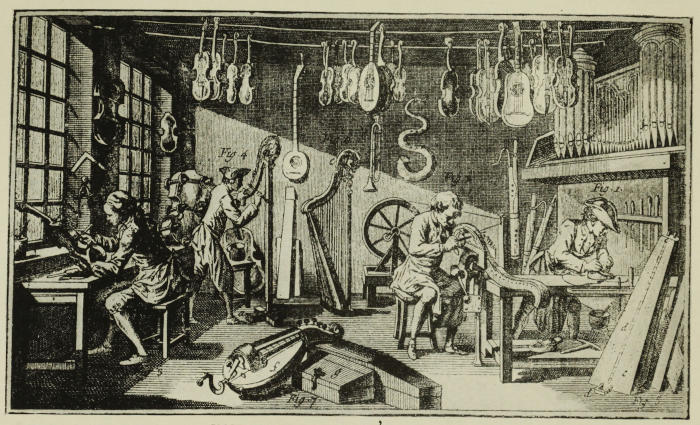
INSTRUMENT-MAKER’S WORKSHOP
Eighteenth Century
The rich, velvety, smooth and peaceful legato;
the detached or short, sharp strokes; the hammered;
the jumping; and the harp-like effects, the arpeggios
(or open chords) swinging back and forth, are all
accomplished by the bow. Once in a great while,
we hear a strange and weird effect caused by rapping
the string lightly with the stick of the bow. But
this is only a kind of trick that composers sometimes
introduce. Liszt calls for it in his Mazeppa; Saint-Saëns
in his Danse Macabre; and Strauss in Also
Sprach Zarasthustra.
More often the violins (and other stringed instruments)
play pizzicato,—that is the violinist rests
his thumb against the fingerboard and plucks the
strings with the tip of his forefinger.
Beethoven makes an effective use of this in the
Scherzo of his Fifth Symphony and so does Tschaikowsky
in the Scherzo of his F-minor Symphony.
In the Orchestra violins are classified into First
and Second, as we have seen, the First Violins sitting
on the Conductor’s left and the Second Violins on
his right hand. They sit two and two, each couple
sharing a desk. The First Violins sing the high
Soprano and the Second Violins the mezzo-soprano.
The First Violin in the whole Orchestra is called
the Concert-meister, or Concert-master, or simply
the First Violin. Very often he plays an elaborate
solo passage.
Before the days of modern Conductors the First
Violin used to be the Conductor of the orchestra,
or, we might say, the Conductor played the violin
and led the Orchestra at the same time. But although
the First Violin has no longer this double duty, his
importance in the Orchestra is very great. On him
depends the attack and phrasing of the first violin
and to a certain extent of the entire string Orchestra.
With regard to the position of the violin in the
Orchestra let us hear Lavignac: “The violin,” he says,
“is preëminently a melodic instrument,—the splendid
sparkling soprano of the stringed tribe, the richest
in varied effects, the most agile and the most impassioned
of orchestral elements.”
And now having understood its value as an individual,
let us turn to Berlioz to get an idea of its
team-work.
“Violins are capable of a host of apparently inconsistent
shades of expression. They possess (as a whole)
force, lightness, grace, accents both gloomy and gay,
thought and passion. The only point is to know how
to make them speak. Slow and tender melodies are
never better rendered than by a mass of violins.
Nothing can equal the touching sweetness of a score
of first strings made to sing by twenty well-skilled
bows. The violin is, in fact, the true female voice
of the Orchestra,—a voice at once passionate and
chaste, heart-rending yet soft, which can weep, sigh
and lament, chant, pray and muse, or burst forth
into joyous accents as none other can do. An imperceptible
movement of the arm, an almost unconscious
sentiment on the part of him who experiences it,
producing scarcely any apparent effect when executed
by a single violin will, when multiplied by a number
of them in unison, give forth enchanting gradation,
irresistible impulse and accents which penetrate to the
very heart’s core.”
Until the bow was perfected there was no brilliant
violin-playing as we understand it to-day. It took a
long time for the bow to develop. There was a
“Stradivari of the bow”; and the name of this
person so valuable to the art of violin-playing is François
Tourte (see portrait facing page 44). All bows
are made on Tourte’s model. A real Tourte bow
commands a high price.
To understand what Tourte did, we shall have to
go back to the early days of the violin and see what
kind of a bow the old players used.
The earliest bow with which the viole, or vielle, and
the early violin was played was shaped just like the
bow from which an arrow is drawn,—a cord stretched
from end to end of a stick. It was a very clumsy
affair. In the Thirteenth Century when the violin
began to develop as we have seen (see page 17),
the bow began to change, too. The first improvement
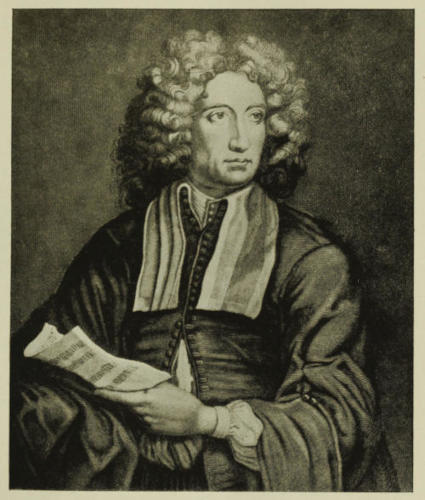
was to make one end blunt and to use hair instead
of a cord. The head, or tip, was still sharply pointed.
Nothing happened until the time of Corelli, the Italian
composer and violinist (1653-1713), who did so much
to improve violin-playing. He and others of his time
used a straight, short bow, which was not at all elastic,
although it was made of light wood. This was a distinct
gain, as was also the novel idea of a screw by
which the hair could be regulated.
The next change took place in the time of another
Italian violinist, Tartini (1692-1770), the one who
wrote the Devil’s Sonata, the melody of which he said
the Devil played to him one night in a dream. Tartini
used a longer bow than Corelli. It was also
thinner and more elastic; but the head of it was still
scooped like the ancient ones.
Then, at the end of the Eighteenth Century, François
Tourte (1747-1835), worked away making bows, as
his father had done before him, until he developed
the modern bow. It appeared just about the time
of the French Revolution. Like Stradivari, Tourte
continued to work till the end of his life. He worked
all day in his workshop in Paris, No. 10 Quai de l’École,
and on Sundays and holidays he sat on the banks of
the Seine fishing, just as they do to-day, and occasionally
caught a tiny little fish to the envy of excited
rivals around him.
With the stiff, straight, heavy, unelastic bow, the
violinist could, of course, produce very few effects.
Tourte’s improvements almost revolutionized violin-playing.
It is said that Viotti, another Italian (1753-1824),
and perhaps up to his time the greatest
violinist that had appeared, gave Tourte the benefit
of his ideas.
It is only by the use of an elastic bow that a violinist
is able to produce his wonderful effects. Bowing is to
the violinist what breath is to the singer and touch to
the pianist: it is only through the bow that the violinist
is able to express his emotions and ideas. So until
Tourte’s time there was no real Art of Bowing, although
Tartini wrote a little book on the subject.
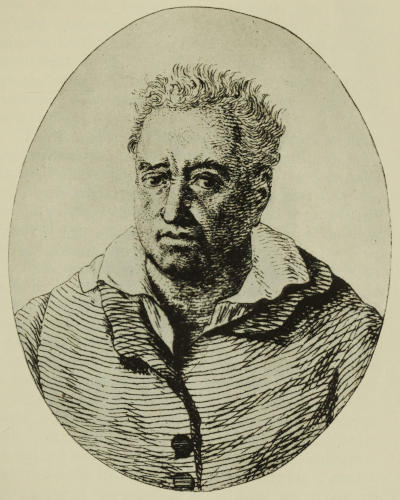
FRANÇOIS TOURTE
“The Stradivari of the bow”
The world was slow to adopt Tourte’s bow; and it
was not until Paganini (1784-1840), the Italian
wizard, came on the stage that a revolution in violin-playing
took place. Paganini used every imaginable
movement of the bow and developed the flexibility
of the wrist. Then a new School of violin-playing
arose and violin-playing gradually developed into what
it is to-day.
“Tourte’s first experiments are said to have been
made from the staves of old sugar hogsheads from
Brazil. This is not unlikely. Probably the best slabs
of Brazil-wood employed for this purpose had acquired
a certain additional elasticity from the combined
effect of exposure to tropical heat and the absorption
of the saccharine juices.
“It is certain that the greater elasticity which he
secured in the stick by the choice and preparation of
the wood, enabled him to carry out to the fullest
extent the method of bending the stick of the bow the
reverse way, that is, inwards, and thus to realize what
had long been the desideratum of a violinist,—a
bow which should be strong and elastic without being
heavy. By thus increasing and economising the resistance
of the stick, he liberated the player’s thumb
and fingers from much useless weight. By a series
of patient experiments he determined the right curvature
for the stick and the rule for tapering it gradually
towards the point so as to have the centre of
gravity in the right place, or, in other words, to ‘balance’
properly over the strings in the hands of the
player. He determined the true length of the stick
and the height of the point and the nut, in all which
particulars the bow-makers of his time seem to have
erred on the side of excess. Lastly he invented the
method of spreading the hairs and fixing them on the
face of the nut by means of a moveable band of metal
fitted on a slide of mother-of-pearl.”[9]
Tourte’s violin bows are from 29 to 29½ inches long;
a viola bow is 29 inches; and a ’cello bow is from
28½ to 28¾ inches. The stick of a violin bow is made
of Brazilian snake wood, or lance wood, reddish and
slightly mottled. It is cut straight, following the
grain of the wood and then it is slightly bent by the
application of heat. The hair, fastened into the tip
by a plug, is inserted into the nut of the bow (made
of ebony, or tortoise shell); it can be made tighter,
or looser, by turning the screw in the nut. There
are from 175 to 200 hairs in a bow and these are
taken from tails of stallions. White hair is used for
the violin, viola and violoncello and black for the
double-bass. Rosin is rubbed on the bow to increase
its friction.
A violinist takes just as much care of his bow as
he does of his violin. When he has finished playing,
he wipes his violin carefully with a silk handkerchief
before he places it tenderly in the case; then he unscrews
his bow and places it in the rests in the top
of the case.
CHAPTER II THE VIOLA
The viol family; the tenor viol; technique of the viola; viola’s place in the
orchestra; Mozart’s use of the viola; Beethoven’s use of the viola; Berlioz’s
“Harold Symphony”; Wagner’s use of the viola; viola as treated by modern
composers; Berlioz on the viola.
The viola is a fifth lower than the violin and
an octave higher than the violoncello. Its
strings are C, G, D and A. The C string is
particularly resonant. The technique is the same as
that of the violin; but the bow, though similar in
size and shape, is less elastic.
To understand the viola we shall have to go back
to the Fifteenth Century to examine a group of instruments
that were the ancestors of the present family
of Strings.
This was the Viol Family. There were four sizes
of instruments. There was the Treble, or Discant
(which always played the melody); the viola da
braccio (played with the arm), or tenor; the viola da
gamba (the leg viola), the bass viol; and the violone,
or double-bass.
Another member of this family was the viola d’amore
(the viola of love), a choice example of which appears
facing page 50. It had “sympathetic strings.”
These viols were all tuned in thirds, or fourths,
instead of fifths, as our modern Strings now tune.
And here we must pause for another moment to
speak of an ancient viol-maker named Gaspard Duiffoprugcar
(his name is spelled in many ways), who was
born in 1514 and who died in 1570. He lived in that
very brilliant period, the Renaissance, when Italian
painters were producing magnificent works and when
poets and dramatists were writing masterpieces every
day. The rich lords and ladies who patronized these
artists were very highly cultivated and accomplished;
and Music was not the least of their pleasures.
Every house of wealth had a collection of fine instruments,
though this was before the days of Amati
and Stradivari.
Duiffoprugcar lived in the Tyrol in the region of
pines, in which instrument-makers had long been
settled, and he made lutes and viols all his life. His
instruments come so nearly to being violins that he is
sometimes called the first maker of violins. But in
his hands the violin did not quite reach the form that
we find in Gasparo di Salò, who, as we have seen (see
page 22) was the true creator of the violin.
Duiffoprugcar’s instruments are valued not only because
they are old and rare, but also because they are
works of art. They are often elaborately inlaid and
carved, such as the one facing page 54. Another of his
instruments, in the Brussels Conservatory, has the plan
of Paris inlaid in colored woods on the back, while the
scroll ends in a finely carved horse’s head. And still
another has inlaid in the back a poetic Latin inscription,
which is a riddle that could be applied to any
stringed instrument. Translated, it reads as follows:
“I was living in the forest; the cruel axe killed me.
Living, I was mute; dead, I sing sweetly.”
FIRST VIOLA, SYMPHONY SOCIETY OF NEW YORK
Samuel Lifschey
The tenor viol was the ancestor of our modern
viola. It was the oldest of the viol family. It was
very large and very hard to play, because it was so
difficult to hold comfortably. But the instrument
was too important to be sacrificed to the convenience
of the player and the latter had to get along with it
as well as he could; for, in the general plan of Mediæval
Music, the tenor always sang, or sustained, the melody,
or cantus. The need for a more manageable instrument
to play the leading melody is one of the reasons
that brought about the creation of the little violin
which was destined to sing soprano. But at the
time we are talking about there was no violin. This
great, big, awkward tenor viol was called Violino!
Then when the instrument-makers developed the
little instrument that we call violin, they gave it the
name violino piccolo, or little violin. The newcomer
was really the little tenor viol! Both violino (or
tenor) and its small companion, violino piccolo, were
made in great numbers in Lombardy, whence they
were sent to the wealthy houses throughout Europe.
The makers, as we have seen, began to improve the
violino piccolo to get more tone out of it. They also
tried for sweetness; and the beautiful violin came into
being to charm the world. In the meantime, violinos
were made in two sizes—tenor and alto. After a
time these two instruments were combined into one.
Then the great, big, awkward tenor viol disappeared
and the viola took its place.
Therefore the viola is sometimes referred to as the
alto and sometimes as the tenor. Both names are
correct.
The viola has been made in many sizes, from the
huge instruments by Gasparo di Salò to instruments
not much larger than the modern violin. The standard
size is now about one-seventh larger than the ordinary
violin.
Fine violas are rare. Those by Maggini, of which
not a dozen exist, are especially valued. They are of
a very high model: the corners short; the purfling
double; the sound-holes short, wide, upright, under-cut
on the inner edge and placed higher than on his
violins; the wood is fine; and the varnish is golden
brown.
A viola often has “sleepy places,” where the notes
sound muffled; and it is also apt to have the dreaded
“wolf.”[10]
It is often said that the viola is too large to be held
like a violin and too small to be held like a violoncello.
So it might be described as a half-and-half way instrument
between the two.
VIOLA D’AMORE, WITH “FLAMING-SWORD” SOUND-HOLES
Music for the viola is written in the Alto, or C, Clef
(on the third line). The highest notes are, however,
written in the Treble, Violin, Soprano, or G, Clef.
Important as the viola is in the Orchestra to-day,
it was a long time before the beauty of its voice and
its technical possibilities were recognized. It was only
used to play subordinate middle parts, filling up time
and helping along now and then with the bass. Never,
never was it allowed to lift its sad, melancholy, tragic
and religious voice. No matter how longingly it might
listen to the other instruments singing a melody, or
chattering to one another, it was doomed to silence.
No composer would let it speak. Nobody ever dreamed
that it had anything to say!
But it was there all the time. Patient old viola,
just used for the tutti passages, where every voice
speaks, or screams, or cries, at once. Sometimes in
rare delight it was allowed to play in unison with the
violoncellos, and, more rarely, in unison with the
violins.
But Mozart—to whom Music owes so much—discovered
the possibilities of the viola!
Mozart gave the viola its proper place in the Orchestra,
making it something more than a large violin
filling up a gap between soprano and bass. He made
it important in his Trios and lifted it into prominence
by writing a Concerto for violin, viola and Orchestra!
The next time you hear Mozart’s magnificent Don
Giovanni listen for the viola, when Zerlina is singing
her aria, Vedrai carino. The viola has a great deal to
say in this tender love song and says it as beautifully
and as tenderly as Zerlina herself.
The viola became of great importance in Beethoven’s
Trios, Quartets and Quintets; and, to its joy, it was
allowed to take a prominent part in the Orchestra!
First it was permitted to sing with the violoncellos
and bassoons, as in the Egmont Overture, and then
actually to play with the violoncellos the exquisite
melody in the Andante of Beethoven’s C minor
Symphony (the Fifth). The first critics who heard
this Symphony noticed to their amazement that the
violoncellos gained roundness and purity of tone from
their association with the viola!
There are many places in Beethoven’s Symphonies
where the violas are conspicuous; and they are always
noble as well as beautiful. The violas also play with
the violoncellos in the Choral finale of the Ninth Symphony.
Hector Berlioz, always original, did a fine thing
for the viola by writing a big solo part for it in his
Harold Symphony, which describes Byron’s wanderings
of Childe Harold in Italy. The viola impersonates
Childe Harold.
Wagner saw what fine use Beethoven had made
of this instrument; and with his wonderful gift for
understanding the character, quality and color of
every instrumental voice in the Orchestra, Wagner
was impressed with the possibilities of the viola.
GASPARD DUIFFOPRUGCAR
There are new original passages and splendid melodies
for the viola in all of Wagner’s music-dramas (a
student could find great profit and pleasure by taking
the orchestral scores of these works and following the
viola part from beginning to end), but one instance
will suffice to emphasize the important use Wagner
made of this instrument.
The next time you hear the Overture to Tannhäuser
listen for the motive of the Venusberg! This phrase,
which Lavignac so aptly says “recalls Weber when he is
fantastic and Mendelssohn when he is fairy-like,”
is given to the viola! Here in this melodious passage
Wagner showed that the quiet, old, sedate viola could
be wild, playful and fiery. And Wagner was the first
to exhibit the viola in such a rôle.
Tschaikowsky’s Pathetic Symphony has a splendid
part for this instrument. Elgar also gives the viola
much to do in his works; and Richard Strauss, carrying
Wagner’s fantastic ideas still farther, made the
viola impersonate Sancho Panza in the Don Quixote
Variations, where he treats it elaborately, whimsically
and delightfully.
But very likely none of these composers would
have thought about this instrument had it not been
for Berlioz, who said: “Of all instruments in the
Orchestra the one whose excellent qualities have been
longest misappreciated is the viola. It is no less
agile than the violin. The sound of its strings is
peculiarly telling. Its upper notes are distinguished
by their mournfully passionate accent; and its quality
of tone, altogether of profound melancholy, differs
from that of other instruments played with a bow.
“The viola has, nevertheless been long neglected or
put to an unimportant and ineffectual use,—that
of merely doubling in octave the upper part of the bass.
Its quality of tone so strongly attracts and captivates
the attention that it is not necessary to have in the
Orchestra quite so many violas, as second violins;
and the expressive powers of its quality of tone are so
marked that in the rare occasions when the old masters
afforded its display it never failed to fulfil their intentions.
Melodies on the high strings of the viola have a
marvellous beauty in scenes of a religious and unique
character.”
These ideas, so new when they were written in the
early days of the Nineteenth Century, set composers
thinking. They began to realize that they had a color
and quality of tone on their orchestral palette of which
they had been unaware. The question was how to
paint with it. Wagner boldly dashed forth with the
Venusberg motive and showed how agile and fanciful
the viola could be.
To-day the viola’s beautiful tone is perfectly understood.
“Every skilful violinist can in a few weeks
acquire the ability to play the viola fairly well; but
the true virtuoso of the viola must study his instrument
long and carefully. In like degree as the violin
is biting, incisive and masterful, the viola is humble,
wan, sad and morose. Besides using it to fill in the
harmony composers take advantage of those qualities
to obtain expressions of melancholy and resignation
for which the instrument is incomparable; for its range
of sentiment runs from sad reverie to agonized pathos.”[11]
VIOLA DA GAMBA
By Gaspard Duiffoprugcar
CHAPTER III THE VIOLONCELLO
The viola da gamba; violin responsible for the development of the violoncello;
instruments of the Seventeenth Century distinguished for their delicacy of tone;
Italians the first to appreciate the possibilities of the violoncello; instruments
of Andreas Amati; Franciscello, the first great violoncellist; Berteau and
Duport; anecdote of Voltaire; Servais; Boccherini; use of the violoncello
by great composers; instruments of Bergonzi, Maggini, and, Amati; compass
of the violoncello; Lavignac and Berlioz on the instrument and its capacities.
The violoncello is not a big violin; it is a little
double-bass; and that is why the name is spelled
violoncello and not violincello. Its parent was
the violone; and, if we remember that the violoncello
is the little violone in the Viol Family, we will never
make the mistake of writing violincello for violoncello.
Almost everyone speaks of this instrument as the
’cello (pronounced chello) except the Italians; for,
as the word simply means “little,” it has no significance
to them.
The violoncello belongs to that ancient and honorable
family of viols, already described (see page 47).
Its immediate ancestor was the viola da gamba.
For a long time the viola da gamba was the most
popular of all bowed instruments. We see it in
pictures by the old Italian Masters; and it appears in
many pictures by Ter Borch, Metsu and other Dutch
and Flemish painters of the Seventeenth Century, who
loved to paint pictures of the everyday life that they
saw. Dashing men and richly dressed women often
appear with this big instrument in front of their knees,
intently taking a lesson from a music-master, or playing
to entertain a group of friends in a pleasant living-room.
We recall that Shakespeare in his rollicking comedy
of Twelfth Night makes someone say of the silly knight,
Sir Andrew Aguecheek, that “he plays o’ the viol de
gamboys.”
In every wealthy home in England, as well as on the
Continent, there was, as we have seen, a collection of
musical instruments for impromptu concerts. The
collection consisted first of lutes and viols of all sizes
and, at a later period, of violins, violas and violoncellos.
Music was one of the entertainments and amusements
of society; and it was considered just as necessary to
have instruments of all kinds and all sizes to suit the
visitors as it is to have a piano in the home to-day.
In the Sixteenth and Seventeenth Centuries public
concerts were unknown. It was in the churches and
cathedrals and in the homes of the rich that artistic
music was heard.
The viola da gamba was at this time a favorite instrument
for ladies; and it seems strange to us that the
more delicate violin was not yet considered suitable for
them while this awkward, and, to our way of thinking,
rather unfeminine viola da gamba was thought to be a
lady’s instrument. However, the viola da gamba was
not so hard for them to play as the modern violoncello,
because the strings were much thinner and a bold,
strong tone was not required.
FIRST VIOLONCELLIST, SYMPHONY SOCIETY OF NEW YORK
Engelbert Roentgen
The viola da gamba was often made artistic to look
at with rich carving and inlay. A beautiful specimen
belonging to the University of Edinburgh is shown
facing page 60. It once belonged to the violoncellist
Servais (see page 61). The back is of rosewood inlaid
with ivory. The neck, scroll (carved in the shape of a
woman’s head with elaborately dressed hair) and the
tail-piece (in the shape of Mercury’s caduceus) are of
ivory. This exquisite instrument is of later date than
the Viola d’amore facing page 50, for the crescent-shaped
sound-holes are of a later period than the
“flaming-sword” sound-holes. The viola da gamba
is rarely met with even in museums; for when the
violoncello came into fashion, many people had their
violas da gamba converted into violoncellos.
Johann Sebastian Bach was the last great composer
to write for the viola da gamba.
It seems that the violin is responsible for the development
of the violoncello. The Italians, always so quick
to perceive artistic needs and fitness, soon found out that
the newly perfected violin required a more powerful
accompaniment than the viola da gamba could provide;
and so the instrument-makers worked away until they
produced the violoncello. This new instrument was
mounted with much thicker strings than the viola da
gamba. It seemed just the thing to the musicians of
that time to accompany the very piercing and penetrating
tones of the violin, which, although very far
from having the resonant qualities of the violin that
we know to-day since the development of the bow,
seemed very loud indeed to ears that had been accustomed
to the sounds of “a concert of lutes, or
viols.”
The people of the Sixteenth and Seventeenth Centuries
understood all the varieties of tinkle rather than
of tone. They liked lovely, soft, gentle music, and they
liked instruments such as the viola da gamba, and viola
d’amore strung with “sympathetic strings” set into
vibration when the top strings were touched with the
bow and that consequently gave forth gentle echoes,
like those of the Æolian harp.
We remember the Duke in Twelfth Night asks a
singer to repeat the music he has just played and
sung:
“That strain again! it had a dying fall!
O, it came o’er my ear like the sweet sound
That breathes upon a bank of violets,
Stealing and giving odor.”
We must not despise that quaint and antique music
of the Seventeenth Century drawing-room. It was
very high-bred, very refined, very delicate and very
poetic. It had distinction; it had charm.
But as times changed, manners and tastes changed
with them. All of a sudden, so it seems, the instrument-makers,
as we have seen, began to search for
tone and when the sharp, piercing and shrill (so it seemed
to the people of the day) violin came into being, other
instruments were needed to accompany it. Gradually,
one by one, the delicate viols with their thin strings
and the tinkling and swishing lutes went out of fashion
and were made no longer.
To-day their voices are almost unknown; for the
old Viol Family is extinct. We have a new String
Quartet that is distinguished for its great carrying
tone,—rich, warm, sweet and vibrant.
When it first came into favor, the violoncello was
used to strengthen the bass part in vocal music,
particularly in church music and also to reinforce the
double-bass; but for a long time it made no appearance
in the drawing-room. The viola da gamba still
held the first place in society.
The first instance of a violoncello attracting attention
is in 1691, when Domenico Galli of Parma, a
famous wood-carver, made a superb violoncello
which he presented to Francisco II, Duke of Modena,
with a treatise on violoncello as a solo instrument
and the art of playing it. Two other Italians in
the first half of the Eighteenth Century, Antoniotti
of Milan and Lanzetti,[12] violoncellist to the King of
Sardinia (1730-1750), brought out compositions
which are the first that recognize the capacities of
this instrument. The Italians were, therefore, the
earliest to develop the violoncello and also the art of
playing it.
Andreas Amati (1520-1577)[13] was to the violoncello
very nearly what Stradivari was to the violin. He
transformed the viola da gamba into the violoncello.
As early as 1572 Pope Pius V sent Charles IX, King of
France, a present of thirty-eight bowed instruments,
eight of which were bass. These were all made by
Andreas Amati and on the back of each were painted
the arms of France and other devices and the motto,
Pietate et Justitia. In 1790, when the mob broke into
Versailles during the Revolution, all these instruments
were destroyed except two violins and one violoncello.
This is still in existence and is known as “The King.”
Once it was owned by Duport.
The first big solo violoncellist was Franciscello
(1713-1740), of whom little is known except that he
played in all the important European cities. He
took his name from his instrument. It was a new
thing for the violoncello to appear in such a conspicious
rôle.
Corelli and Tartini,[14] the first great violinists, often
had their accompaniments played on a violoncello;
and it is supposed that from associating with the
violin, the assisting instrument became ambitious and
tried a little virtuosity for himself.
Then the French took it up. They did a great deal
for the violoncello. First came Berteau, who died in
1756; and, after him, the still more important Jean
Louis Duport (1749-1819), who worked out a system
of fingering and bowing and a methodical manner of
“shifting” from position to position.[15] Duport’s Essay
on the subject made an epoch in violoncello playing.
Duport was a very fine performer. It seems that he
was inspired by the playing of the violinist, Viotti,[16]
who visited Paris in 1782 and who astonished everybody.
This started Duport thinking, just as Paganini’s
playing a half century later set Liszt thinking.
Duport’s idea was to imitate the agility and grace and
charm of the violin upon his own violoncello. Ever
since Duport’s time the violoncello has been considered
practically a bass violin as far as technique is concerned;
and great performers have constantly added
some new idea with regard to playing it, until now the
violoncello in the hands of a Pablo Casals can be as
airy and light as a violin even if its voice is heavier.
The violoncello has now learned to sing. Duport
would be astonished if he could hear our violoncellists
to-day, though he was one of the best (if not the very
best) of his time. Beethoven thought so much of
Duport that to him he dedicated his first two Violoncello
Sonatas, op. 5.
VIOLA DA GAMBA
We can get an idea of the way a violoncello was
regarded in the Eighteenth Century by the compliment
that Voltaire paid Duport when the latter
played for him in Geneva. Voltaire was perfectly
astonished by his performance. When Duport laid
down his bow Voltaire said: “Monsieur, you make
me believe in miracles. You know how to turn an ox
into a nightingale!”
Duport was delightfully modest, although everybody
acknowledged his greatness and every violoncellist
studied his famous Essay on Fingering and Bowing the
Violoncello. In this he said: “Everybody knows the
kind of bowing called martelé (hammered), or staccato.
It is an affair of tact and ease. There are some players
who get it at once; others never learn to get it perfectly:
I am one of those.”
Then came Adrien François Servais (1807-1866),
called “the Paganini of the ’cello.” He was a native
of Brussels. Then Nicholas Joseph Platel (1777-1835),
called by Rossini “the King of ’cellists and the ’cellist
of Kings.” Platel is thought to have invented the
peg as a convenient rest, for he was very stout and
found his instrument difficult to hold. Then Alfredo
Piatti’s lovely Amati ’cello and the way he played it
are still remembered by many old American concert-goers,
who heard him abroad.
But instrument-makers and performers alone could
not have brought the violoncello to its position as
a favorite instrument unless the composers had
helped.
As Bach had been one of the last to write for the old
viola da gamba, he was one of the first to write for the
new violoncello. He wrote six famous solos for it.
Handel took great pleasure in the violoncello.
He made it play an obbligato in several arias in his
oratorios and cantatas. Alessandro Scarlatti also wrote
for it; and, even better than he, Boccherini (1743-1815),
who was a splendid performer himself. His Quartets
particularly show it off to great advantage, as was
natural to one who could play it so well.
With the development of the String Quartet that was
now taking the place of the old “concert of viols,”
the importance of the violoncello was settled. It
only remained for composers to discover its singing
qualities. Nobody understood these better than Mendelssohn.
Next time you hear the oratorio of Elijah
listen to the ’cello obbligato in Elijah’s aria It is Enough,
which is even finer than the beautiful solo accompaniment
to Be thou faithful unto Death in Mendelssohn’s
other oratorio, Saint Paul.
Rossini’s Overture to William Tell opens with five
solo violoncellos accompanied by two others playing
pizzicato in first and second parts. Wagner made
great use of the violoncello. It is very conspicious in
the opening of the third act of Die Meistersinger, when
Hans Sachs is sitting in his room reading and talking
to himself; and in Tristan and Isolde the violoncello
speaks love-yearnings as never before.
This leads us to the latest development of the
violoncello as a solo performer in the Orchestra. In
Richard Strauss’s Don Quixote Variations the violoncello
is made to impersonate the mad, chivalrous and
pathetic knight, whose adventures are described by
the Orchestra. In this work the violoncello and the
viola paint character as nearly as it is possible for
music to do; and if we do not receive a definite idea
of their appearance the music conveys to us certain
impressions of Don Quixote and his unimaginative
squire. With great poetic judgment Strauss selected
the violoncello and the viola as the most suitable instruments
to convey these impressions.
We have been talking about the violoncello all
this time. What about the instrument itself?
Perhaps the first thing we notice is that the ribs of
the violoncello are very much higher in proportion to
its body than those of a violin, or viola. Of course, the
height of these ribs differs in different makers. Stradivari
made his so low that many of his violoncellos have
had to be taken to pieces and wider ribs added to suit
the music of to-day. Naturally the sound-post has
had to be made taller.
Few of Stradivari’s violoncellos are in existence.
He made his violoncellos in two models—large and
small. The large ones are very scarce. They have a
beautiful tone, but they are hard to play on account of
their size. Servais had a “Strad.” Piatti also had
one, which was known as “the red ’cello” on account
of its varnish.
The finest Stradivari was owned by Duport and
passed into the possession of August Franchomme,
who paid 25,000 francs ($5,000) for it.
Carlo Bergonzi made superb violoncellos and so did
Maggini, who made his on the viola pattern, placing
the sound-holes rather high. Andreas Amati and
Nicolò Amati both made beautiful instruments, which
are characterized by a sweet, mellow tone.
No violoncellos of Joseph Guarneri are known.
The violoncello in the illustration facing page 56 was
made by Januarius Galiano of Naples (born about
1740), one of the famous Galiano family of makers, descendants
of Alessandro Galiano (1695-1730), a pupil
of Stradivari.
The strings of the violoncello are C, G, D and A,
an octave lower than those of the viola. The D string
is very rich and is considered the most beautiful
of all.
The compass of the violoncello is nearly four octaves;
and because of this long range composers write
for the violoncello in three clefs: the Bass Clef, for
the lower and middle registers; the Tenor Clef, for
the next highest; and the Treble, or Soprano, Clef,
for the top notes.
The beginner on the violoncello has a great deal
of hard work to do to learn to play at sight in all three
clefs.
GENTLEMAN OF THE SEVENTEENTH CENTURY PLAYING THE VIOLA DA GAMBA
In the main, the violoncello is played like the
violin and viola, that is to say the player has to
make all his notes on the fingerboard; and he can
also produce harmonics on the open strings and
artificial harmonics by stopping the string at certain
places. He sometimes stops these by placing his
thumb on the string,—something the violinist never
does.
Of course, as the instrument is held in the reverse
way from a violin, the high notes are the farthest
away from the player. He plays from himself, not
towards himself.
Lavignac writes: “The functions of the Violoncello
in the Orchestra are manifold. Usually it gives, reinforced
by the double-bass, the bass of the harmony.
This is its natural work. But sometimes the singing-part
is committed to it,—when, losing its austerity,
it becomes a ravishing instrumental tenor, of pure,
warm timbre, ecstatic or passionate, but always distinguished
and captivating. Its rapid and light utterance,
the frequent passage from natural notes to
harmonics imitating the alterations of chest and head
notes complete its resemblance to the human voice.
Moreover, the violoncello, though moving in another
region and awakening other sensations, possesses a richness
of varied tones almost as extensive as that of the
violin; and its pizzicati are better and less dry than
those of the violin.”
Regarding the team-work of the violoncello in the
Orchestra, Berlioz said: “Violoncellos together to the
number of eight, or ten, are essentially melodious;
their quality on the upper strings is one of the most
expressive in the Orchestra. Nothing is more voluptuously
melancholy or more suited to the utterance
of tender, languishing themes than a mass of violoncellos
playing in unison upon their first string. They
are also excellent for airs of a religious character.
The two lower strings, C and G, especially in keys
which permit the use of them as open strings, are of a
smooth and deep sonorousness; but their depth hardly
ever permits a composer any melodies. These are
usually given to the upper strings.”
CHAPTER IV THE DOUBLE-BASS
Strings and compass of the double-bass; double-bass a descendant of the
violone; voice of the double-bass; how Gluck, and Mozart treated the double-bass;
Beethoven makes the double-bass a solo instrument; Verdi’s use of the
double-bass in “Otello”; Wagner’s part for the double-bass in “Die Meistersinger”;
Dragonetti and Bottesini; double-basses by the Cremonese makers.
The double-bass plays the lowest notes of all
the Strings. It doubles, that is to say, it plays
in the lower octave the bass part given to
the bass voice, whether this be the violoncello, bassoon,
or any other instrument.
Its strings are E, A, D and G. They are very coarse,
thick and heavy. The music for the double-bass is
written in the F, or Bass, Clef, an octave above the
real sound of the notes. This is done to avoid the use
of the ledger lines.
To understand what the double-bass is we have to
go back to the Viol Family again. We saw that the
viol was made in four sizes to make the quartet:—tenor
or discant; viola da braccio; viol da gamba; and
violone. We also saw that the violin gradually developed
from the tenor viol; that the viola da braccio
became the viola; and that the viola da gamba became
the violoncello. Each passed through many changes
until the modern instrument was perfected. Strange
to say, the double-bass made on the violin pattern
did not find favor; and the makers, therefore, went
back to the viol type.
So the double-bass is practically the old violone
with a very few slight changes. It still retains some
of the characteristics of the old Viol Family; for
instance, its flat back (instead of the new arched back
of the new Violin Family) and its slanting shoulders;
but it has yielded to the new style in its f-holes and
its four corner blocks. We may call the double-bass
a combination of the models of the violin and the
viola da gamba and not be far wrong. Compare the
double-bass facing this page and the viola da gamba
facing page 60, and you will see the same slanting
shoulders and general form. The double-bass also
follows the habit of the Viol Family in being tuned in
fourths instead of fifths.
If we look at the row of double-basses in the
Orchestra, we will notice that some of the men are
playing on instruments with three strings and others
on instruments with four strings; but the work they
have to do is practically the same. It is fascinating
to watch the players whose hands move so rapidly
up and down the long neck of the instrument
and whose fingers fall so intelligently and firmly upon
the right places, while the short, thick, black-haired
bow looks sometimes as if it would saw the double-bass
in two.
We seldom hear a solo from the double-bass; for
composers do not encourage him. His voice in spite
of his huge size lacks substance.
FIRST DOUBLE-BASS, SYMPHONY SOCIETY OF NEW YORK
Morris Tivin
We cannot imagine the double-bass whispering a
tender love-song, or indulging in any sweet sentiment.
It is essentially an orchestral instrument. Its heavy
notes are for the good of the community. They help
make a fine, firm background for the melodies and
harmonies of the more delicate instruments.
The best effects of the double-bass are obtained on
his open strings; and it can (and often does) produce
harmonics.
No composer ever thought of taking any special
notice of it until Gluck saw its possibilities and
made it imitate the hoarse barking of Cerberus in
his opera of Orfeo. On the words “At the dire
howling of Cerberus,” the double-basses are doubled
with the violas and violoncellos and make a wonderful
effect in depicting the three-headed dog of the
lower regions.
Mozart used the double-bass with great skill in
Don Giovanni; but still there was no call for a solo
from the double-bass. Nobody thought of attracting
attention to this clumsy old growler, sedate and solemn,
often severe, occasionally savage, and, at his best
moments, gloomy and vague, until Beethoven gave
him greater and greater importance.
The next time you hear Beethoven’s Fifth Symphony
watch for the Scherzo and listen to the double-bass.
The opening bars of this movement are played as a
solo by the violoncello and double-bass. The people
who first heard such a strange innovation were aghast
and horrified!
But Beethoven made a still stranger and more
striking use of the double-bass in the Ninth Symphony.
Here he employed it with the viola as a kind of bridge
leading from the sounds of instruments to human
voices. Deeply, darkly, solemnly the voice of the
double-bass is heard in an impressive recitative that
seems to call mankind together to hear the message
that the human voices have to give. Then begin the
words of Schiller’s Ode to Joy.
Verdi considered the double-bass a dark, morbid
personality, particularly fitted for tragedy. He calls
upon the double-bass to describe Otello’s entrance into
Desdemona’s chamber when he comes to murder her.
Here the double-bass darkly and wickedly mutters all
that is in Otello’s savage heart and tells us just what
he means to do.
But, perhaps, the most striking treatment of the
double-bass is in Wagner’s Die Meistersinger. “In this
score,” Charles Villiers Stanford thinks, “you find
the most economical and perfectly proportionate use
of that dangerous rogue-elephant, the double-bass.”
Naturally as there are no compositions written for
him to shine in the front of the concert stage, there
have been few great performers on the double-bass.
There were, however, two very great Italian players.
One was Domenico Dragonetti. He was born in 1755.
Nothing was too hard for him to play, and he achieved
a great reputation. He played in concerts throughout
Europe. The other was Bottesini, who was born in
1822. He was also considered a wonder. He played
on a three-stringed instrument of rather small size.
Bottesini visited the United States with Arditi about
seventy-five years ago. Dragonetti played on a Gasparo
di Salò. He also owned a Stradivari.
LUTEMAKER’S SHOP AND TWO MEN PLAYING THE DOUBLE-BASS
Double-basses by the Cremonese makers are rare.
Stradivari made a few and Nicolò Amati made three
or four; but Amati’s instruments are not effective in the
Orchestra. Carlo Bergonzi’s are among the best ever
made; for Bergonzi, as we have seen,[17] was famous for
instruments of strong tone and he went back to the
Gasparo di Salò model.[18] We also know that the double-bass
has to keep to the Viol model; so it is not hard
to see why Carlo Bergonzi’s instruments are so highly
valued.
CHAPTER V THE WOODWIND FAMILY — THE FLUTE — THE PICCOLO — THE OBOE — COR ANGLAIS — THE BASSOON — THE DOUBLE-BASSOON — THE CLARINET — THE BASSET-HORN — BASS-CLARINET
The Woodwind; the reed; the flute; the piccolo; the oboe; the cor anglais;
the bassoon; the double-bassoon; the clarinet; the basset-horn; the bass-clarinet.
The Woodwind Family consists of instruments
that may be described as wooden tubes,
or pipes, through which the performer blows,
stopping the holes in these pipes with his fingers in
order to get various notes. Some of these are furnished
with reeds and some are without. It is easy
for us to tell the difference when we look at the
Orchestra. The flutes are held horizontally and have
no reeds. All the reed instruments are held by the
player in a straight line, perpendicularly. The Reed
Family is divided into two groups: the oboe group,
furnished with a double reed; and the clarinet group,
furnished with a single reed. This reed, single or
double, placed in the mouthpiece of the instrument,
is the “speaking” part. Without it, the instrument
could not be played. The reed corresponds to the
sound-post of the violin.
The reed is made of the outer layer of a certain
kind of grass that grows in the south of Europe.
Most of it is obtained from Fréjus on the Mediterranean.
The reed is very difficult to fit and the
player is very particular about it. If anything goes
wrong with the reed, the instrument makes a dreadful
noise that is called the couac, or quack. It is even
worse than the wolf[19] on a stringed instrument.
In all woodwind instruments the embouchure is
important. The embouchure is a certain arrangement
of the lips by which the performer throws into
the instrument all the breath that comes through the
mouth without losing any of it and without giving
the slightest hissing sound.
If we listen attentively to any piece of orchestral
music, we will notice that the voice of the flute is
rarely silent. Very often it doubles the first violins
in the melody, running along with them smoothly and
sweetly. Sometimes it plays an unobtrusive part of
its own and every now and then bursts out into a
lovely and elaborate solo, when its clear, silvery,
liquid notes sound deliciously cool against the warm,
vibrant strings. The flute is one of the most agile
and flexible instruments in the whole Orchestra.
The flute is the nightingale, the thrush, the lark, the
oriole, the mocking-bird of the Orchestra. It warbles.
The voice of the flute is gentle; it is ethereal; it
is heavenly; it is pure; it is sweet; and it is soothing.
Therefore, composers make use of it for poetic
and tender sentiment; for scenes of a religious nature;
and to suggest beautiful dreams. It is both graceful
and poetic and it induces reverie.
“To most persons,” Lavignac writes, “as to myself,
the ethereal, suave, transparent timbre of the flute,
with its placidity and its poetic charm, produces an
auditive sensation similar to the visual impression
of the color blue, a fine blue, pure and luminous as
the azure of the sky.”
The flute is a long tube made in three pieces, or
joints, as they are called. The head is one-third the
length of the tube; the body carries the keys that produce
the scale of D major; and, lastly, comes the foot
joint, or tail-joint. The flute is cylindrical and is made
of wood or silver. In the silver flute the head-joint
alone is slightly conical. In the side of the head there
is a large opening, less than an inch below the cork,
and across this opening the performer blows his breath.
On the lower part of the flute are six holes to be stopped
at will by the first three fingers of each hand; and
three or four levers on the lowest joint furnish additional
notes below the regular scale of the instrument.
The performer holds the instrument transversely,
sloping downward against the lower lip with the hole,
through, or across, which he is to blow turned slightly
outward, so that the stream of wind—the “air-stream”
it is called—shall strike against the outer
edge of this hole. The left hand takes the position
nearest the player’s mouth. Four open keys are
closed by the first, second and third fingers and thumb
placed at the back of the instrument. The little
finger touches an open key, G-sharp, or A-flat. On
the right hand joint are three open keys for the first,
second and third fingers, with the accessory, or “shake,”
keys. The right little finger takes the closed key of
D-sharp and the two open keys of C-sharp and C.
The G-sharp key is open in some flutes, but generally
G-sharp closed key is used by flute-players.
FIRST FLUTE, SYMPHONY SOCIETY OF NEW YORK
George Barrère
The flute has no reed. Instead of a reed the
“air-stream” from the player’s lips, thrown against
the sharp edge of the hole obliquely, produces the
sound-waves.
The principle is that each note comes independently
out of a separate hole and speaks independently,
just as if the rest of the tube were cut off. All keys
are open with the exception of G-sharp, E-flat keys—and
also the two small trill-keys.
Formerly the flute had no keys, or levers. It
merely had finger-holes; but between the years 1832
and 1847 Theobald Boehm, a German, by following
some experiments made by Captain Gordon of Charles
X’s Swiss Guards, worked away until he developed
a system of keys, manipulated by means of levers.
His invention was so successful that the player has
now command of more holes; and, by means of this
system, it therefore became possible to play in every
key.
The flute stands in this one scale of D-major, so
the only way to get higher notes depends upon the
breath and lips of the player. “This is the eternal
question,” says George Barrère, “playing upper octaves
does not require mere blowing as we can play forte in
lower octave and pianissimo in the upper. The real
means of playing upper is lips. It is not a secret; but
how many flute-players ignore it, making the flute the
most disagreeable instrument to hear!” A good embouchure,
as the whole manipulation of the mouth
is called, is essential to artistic flute-playing. Moreover,
the fingers must be raised at equal heights—and
not too high.
The player takes a calm, firm, easy, and often
graceful, attitude before his desk. Good flute-players
also learn a great proportion of their music by heart.
Staccato notes and ornamental passages are produced
by “single tonguing,” and “double tonguing,”
and “triple tonguing.” For different effects the player
makes an effort to pronounce certain consonants, k or t
for example; but instead of pronouncing them he blows
them off his tongue in a little kind of explosion. But
all this is done quickly and with ease by a virtuoso.
The tones of the first octave are rather faint; those
of the second octave, produced by exactly the same
fingering as those of the first and with a stronger
blowing of the breath, are stronger; and those of the
third octave, also produced by the same fingering,
are more penetrating.
Boehm’s explanation is worth quoting to help us
understand the production of tone. He says: “The
open air-column in a flute’s tube is exactly comparable
to a stretched violin string. As the string is set into
vibration by the bow, the air-column in the flute is
set into vibration by the blowing of the performer’s
breath and management of the lips. As the clear
quality of tone of a violin depends upon the proper
handling of the bow, so the pure quality of tone of
a flute depends upon the direction of the ‘air-stream’
blown against the edge of the mouth-hole.
“Each octave requires a different direction of the
‘air-stream’; and, by increasing the force of the
breath, the tone is increased. By ‘over-blowing,’
each tone can be made to break into higher tones.”
Older composers seem to have cared very little
for the flute. They did not have the modern improved
Boehm flute. They found that the performer
often played out of tune. Cherubini said: “The
only thing in the world that is worse than one flute
is two.” Many agreed with him. However, Haydn
wrote a trio for flutes in his oratorio of The Creation
and Handel wrote a beautiful obbligato for it in the
aria, “Sweet bird that shun’st the noise of folly,” in
Il Penseroso, where it imitates the bird. Bach wrote
six Sonatas for the flute.
Handel’s aria, “O ruddier than the Cherry,” in Acis
and Galatea, now played on the piccolo, was originally
written for the flute.
Mozart wrote two concertos for the flute and one
for flute, harp and orchestra. It is very evident in
the Magic Flute.
A solo passage in Beethoven’s Leonora Overture,
No. 3, is very famous. In Beethoven’s Pastoral Symphony
it impersonates the nightingale.
Mendelssohn loved the flute dearly. It is very
important in his Midsummer Night’s Dream music.
It plays lovely sustained chords in the Overture, a
beautiful part in the Nocturne and the Scherzo contains
one of the most celebrated passages ever written.
He also gave it an exquisite obbligato in the quartet
O Rest in the Lord in the oratorio of Elijah.
Wagner has a fine part for the flute throughout the
Meistersinger; it is important in the Largo of Dvořák’s
New World Symphony, where it plays with the oboe;
Liszt made it conspicuous in his Hungarian Rhapsodie,
No. 2; and it sings in the Morning of Grieg’s Peer
Gynt Suite.
Berlioz and Tschaikowsky both played the flute
themselves and, naturally, their works are full of beautiful
melodies for this instrument. Berlioz calls for
two flutes and harp for the Cris des Ismaëlits in
L’Enfance du Christ. Tschaikowsky’s symphonies are
a delight to the flute-player. An exceptionally striking
use of the flute is in the Danse des Mirlitons and
Danse Chinoise in the Nut-cracker Suite.
Richard Strauss, who always goes a little farther
than anybody else, has in the “Windmill” number
of the Don Quixote Variations called for the “flutter
tongue,” a new way of rolling the tongue. The name
describes it.
Last, but not least, we must recall Gluck. What
could be more beautiful than his use of the flute in
Armide, unless it is to be found in the music of Orfeo?
All through that beautiful opera the plaintive, tender
voice of the flute is conspicuous. Not only does it
play melodies for the enchanting ballets and minuets,
but its wailing notes tell us of the grief of Orpheus
for his adored Eurydice; and when we arrive in the
Elysian Fields with Orpheus its pure and ethereal
voice, heard in a solo of ravishing beauty, lifts us out
of the everyday world we live in and transports us into
a realm of blissful peace and enchanting beauty.
FREDERICK THE GREAT PLAYING THE FLUTE
With his Orchestra at Sans Souci
In early days the flute was played by holding it
straight in front and not horizontally as shown in
the picture facing page 74. The German, Quantz,
did much to bring the horizontal flute into fashion.
One of his most enthusiastic pupils was Frederick
the Great, King of Prussia, who is shown in the picture
facing this page playing a flute concerto with
his orchestra at Sans Souci, taken from an engraving
by Chodowieki. The King’s favorite greyhounds are
the only listeners. Franz Benda is the first violin
and Christian Friedrich Fasch, who succeeded Philipp
Emanuel Bach (son of J. S. Bach), is playing the harpsichord.
Modern compositions usually call for two flutes and
a piccolo.
The piccolo is the little flute. Properly, it should
be spoken of as the piccolo flute, for just as we have
seen in the case of the violoncello the word ’cello
means little or small, so the word piccolo is an adjective
and not a noun. However, people speak of
it simply as the piccolo. The piccolo plays the upper
octave of the flute. It is less than half the length
of the flute and it lacks the “foot-joint.” Its compass
is over two octaves. Almost every piccolo player
can play high B and even C. The music for the
piccolo is always written in the Treble Clef, an octave
below the real pitch, that is to say an octave below
the real sound of the notes. The fingering and technique
are exactly the same as for the flute, so anything
that can be played on the flute can be played
on the piccolo.
It should be noted here that two-thirds of the
compass of the flute plays within the compass of a
high soprano; now, the piccolo, on the other hand,
is nearly always playing in a register higher than
that of any human voice. It is the most acute and
piercing of all instruments in the orchestra; for even
the corresponding notes produced by harmonics on
the violin are far less shrill and penetrating. The
piccolo rarely plays in its lower register. Its second
octave is bright and joyous; but in this we hardly
distinguish it from the flute. What we do notice
are the piercing upper notes in quick runs, in chromatic
passages and wild screams. Sometimes too,
the piccolo can be made to utter something of a diabolical
nature.
The piccolo is often used to brighten the upper
notes of the other members of the Woodwind Family
in all kinds of combinations. This method of using
the piccolo might be likened to brightening up an
article with gold leaf. We might say that the piccolo
sometimes adds a sort of gilt edge to the melody.
Berlioz liked to use it in this way for additional ornamentation,
so we hear a great deal of this kind of
piccolo gilt-edging, as we might call it, in his works.
Berlioz gave it a great deal of thought. “In pieces
of a joyous character,” he wrote, “the sounds of the
second octave are suitable in all their gradations;
while the upper notes are excellent fortissimo for
violent and tearing effects: in a storm, for instance,
or in a scene of fierce, or infernal, character. Thus
the piccolo flute figures incomparably in the fourth
movement of Beethoven’s Pastoral Symphony—now
alone and displayed above the low tremolo of violins
and basses, imitating the whistlings of a tempest
whose full force is not yet unchained—now on the
higher notes still, together with the entire mass of
the Orchestra. Gluck in the tempest of Iphigénie
en Tauride has known how to make the high sounds
of the piccolo flute in unison grate still more roughly
by writing them in a succession of sixths, a fourth
above the first violins. The sound of the piccolo
flutes issuing out in the upper octave, produces,
therefore, a succession of elevenths with the first
violins, the harshness of which is here of the very best
effect.
“In the chorus of the Scythians, in the same opera,
the two piccolo flutes double in the octave the little
grouped passages of the violins. These whistling
notes mingled with the ravings of the savage troop,
with the measure and incessant din of the cymbals
and tambourine make us shiver.
“Everyone has remarked the diabolic sneer of the
two piccolo flutes in thirds in the drinking-song of
Freischütz. It is one of Weber’s happiest orchestral
inventions.
“Spontini in his magnificent bacchanalian strain
in the Danaïdes (since become an orgy chorus in
Nurmahal) first conceived the idea of uniting a short
piercing cry of the piccolo flutes to a stroke of the
cymbals. The singular sympathy, which is thus
created between these very dissimilar instruments,
had not been thought of before. It cuts and rends
instantaneously, like the stab of a poignard. This
effect is very characteristic—even when employing
only the two instruments mentioned; but its force is
augmented by an abrupt stroke of the kettledrums
joined to a brief chord of all the other instruments.
“Beethoven, Gluck, Weber and Spontini have thus
made ingenious use—no less original than rational—of
the piccolo flute. But when I hear this instrument
employed in doubling in triple octave the air of a
baritone, or casting its squeaking voice into the midst
of a religious harmony, or strengthening and sharpening—for
the sake of noise only—the high part
of the orchestra, I think it a stupid method of instrumentation.
“The piccolo flute may have a very happy effect
in soft passages; and it is mere prejudice to think
that it should only be played loud. Sometimes it serves
to continue the scale of the large flute by following
up the latter and taking high notes beyond the flute’s
command. The passing from one instrument to the
other may then be easily managed by the composer
in such a way as to make it appear that there is only
one flute of extraordinary compass.”
Handel used an instrument that corresponded in
his day to the piccolo in his wonderful accompaniment
to the bass song, “O ruddier than the Cherry,”
in Acis and Galatea, where he gives it a pastoral character.
He also makes it play an obbligato in the
aria, “Hush ye Pretty Warbling Choir,” in the same
cantata. He does the same thing again in the aria,
Auguelletti che cantate, in Rinaldo. Meyerbeer gives
it much to do in his infernal waltz in Robert le Diable;
and in Marcel’s song “Piff Paff” in Les Huguenots
it adds brilliancy to the martial effect. Beethoven
has a striking place for the piccolo in the finale of his
Egmont Overture; Verdi makes it heard in Iago’s
drinking-song in Otello; it is conspicuous in the grotesque
dances of the dolls in the ballet of Coppelia by
Delibes; Wagner uses it in his storms, in the Ride
of the Walküre, and in all his fire-music in the Nibelungen
Ring; Strauss gives a peculiar trill for it in
Till Eulenspiegel; and Berlioz gives it full play in
his Carnaval Romain, op. 9; and in the Minuet of
the “Will o’ the Whisps” of his Damnation of Faust he
calls for three piccolos.
Therefore, we might characterize the piccolo as
the imp, or demon, of the Orchestra, or the flash of
lightning, or the darting flame, or the whistling wind.
The Oboe, like the violin, comes from a family of
long ancestry. It goes back to ancient Egypt, Assyria
and Greece. In the Middle Ages this family was
known as the Bombardo, Bombardino, Bombardi, or
Chalumeau. The Germans called this family Pommers,
which seems to be a corruption of Bombardi.
“The Bombardo,” writes Carl Engel, “was made
of various sizes and with a greater or smaller number
of finger-holes and keys. That which produced the
bass tones was sometimes of enormous length and
was blown through a bent tube like the bassoon, the
invention of which it suggested. The smallest instrument,
called chalumeau (from calamus, a reed)
is still occasionally to be found among the peasantry
in the Tyrol and some other parts of the Continent.
The Germans call it Schalmei and the Italians piffero
pastorale. In England it was formerly called shawm,
or shalm.”
The type of these instruments was a conical tube
of wood with a bell at one end and a bent metal tube
at the other containing a double reed mouthpiece.
There was a quartet of them; and the oboe, or hautbois
(high-wood) was the treble. There was also
an oboe d’amore[20] and an oboe di caccia, hunting oboe
(from which the cor anglais is supposed to have been
derived), and there were many others. Old writers
refer to them as chalumeau and schalmey and shawm;
and in such a general and confused way that it is
hard to know just which special instrument they are
talking about. These old oboes are called for in
Bach’s scores; but they began to drop out of use in
his time. We know, however, that chalumeau was
the instrument of the old reed band that always
played the melody and that from it sprang the oboe
of to-day. The instrument went through many
changes before it reached its present condition; but
none of these affected the family voice—the penetrating,
roughish twang. The Bombardino-Schalmey
voice still persists: it is like some other famous family
traits—the Bourbon nose and the Hapsburg lip for
instance—it is hard to suppress. However, it is
this peculiar voice that makes the oboe such a desirable
member of the orchestra.
“The timbre is thin and nasal, very piercing in its
forte passages, of exquisite refinement in its piano
passages; harsh and of bad quality in its very high
and very low notes. The oboe is artless and rustic
in its expression; it is pastoral and melancholy; if
it is gay, its gayety is frank and almost excessive and
exaggerated; but its natural tone is of a gentle sadness
and a resigned endurance. It is unrivalled in depicting
simple, rural sentiments of any kind, and on
occasion can even become pathetic.”[21]
FIRST OBOE, SYMPHONY SOCIETY OF NEW YORK
Henri De Busscher
The oboe is the most elaborate and complicated
of all the reed instruments. The mechanical changes
are due to Apollon Marie Rose Barret (1804-1879),
a remarkable French oboe-player, aided by a French
instrument-maker named Triébert. Historically and
musically the oboe is the most important member of
the reed band. It is first of all a melodic instrument;
or, in other words, its tone quality is what it is especially
valued for and not for brilliant passages. It can
call up pastoral scenes and it can express innocence,
grief, pathos and gentle gayety.
The oboe is a wooden pipe, or tube, with conical
bore widening out gradually until it forms a small
bell, shaped something like the flower of a morning-glory,
or convolvulus. At the opposite end it has a
small metal tube, or mouthpiece, called “staple,”
to which the reed (consisting of two blades of thin
cane) is attached by means of silken threads. Along
the wooden pipe are two “speaker keys,” worked by
metal rods called “trackers.” This reed is the speaking
part of the instrument.
The oboe is made in three pieces,—the head-piece,
bottom and bell-joints. The player first screws the
joints of his instrument together so that the finger-holes
are in a straight line, and then he puts the reed
in the head-piece. The first, second and third fingers
of each hand are used to cover the holes. The whole
instrument rests on the thumb of the right hand. The
little fingers and the thumb of the left hand are used
for the keys. The fingers are always placed over the
finger-holes ready to close them when necessary.
The fundamental scale is obtained by opening and
shutting the holes pierced laterally in the pipe and
these are governed by a mechanism called “speaker
keys.”
The scale of the oboe begins on the middle C and is
chromatic. The instrument, being conical, “over-blows”
an octave. It runs up to the extreme treble
G. But although it is a soprano, it is a “middle
compass” instrument. Music for it is written from
F on the first space of the Treble Clef to D in octave
above.
The fingering resembles that of the flute; but,
owing to the reed in his mouth, the player can only
use single tonguing.
The player puts the reed between his lips, taking
care that his teeth do not touch the mouthpiece.
Then he places his tongue against the open part of
the reed, presses the reed with his lips, draws his
tongue gently backwards and blows a stream of air
into the oboe, managing his breath as if for singing.
Sometimes he pronounces the syllable doo and sometimes
that of too, according to the effect he wants
to get.
The double reed in the player’s mouth is the sound-producer.
The air-column inside the pipe acts as a
resonating medium, strengthening the vibrations of
the reed by vibrations of its own.
As the player is obliged to take his lips from the
mouthpiece to exhale, he cannot perform long sustained
passages without pauses. While the oboe does
not require as much breath for blowing as some instruments
do, the difficulty is to exhale and refill the
lungs so as to go on with the rest of the work.
The notes are produced by holes, some open, others
closed by keys raised by means of levers. The oboe,
like the flute, is an octave instrument, that is to say
it “over-blows” the octave. The oboe possesses notes
sufficient for an octave, or more, with chromatic intervals.
The next octaves are obtained by means of
cross-fingering and from the octave keys which do not
give out an independent note of their own but determine
a node in the column of air and so raise the pitch
of any other note an octave. The oboe is a “non-transposing
instrument” and sounds the note written.
“It is possible to play on this instrument chromatic
scales and arpeggio passages; legato and staccato;
leaps; cantabile passages; sustained notes; diminuendo
and crescendo; grace notes and shakes.”
“The oboe,” writes Berlioz, “is especially a melodic
instrument. It has a pastoral character full of tenderness,—indeed
I might say timidity. Candor,
artless grace, soft joy, or the grief of a fragile being
suits the oboe’s accents: it expresses them admirably
in its cantabile.
“A certain degree of agitation is also within its
powers of expression; but care should be taken not
to urge it into utterance of passion—a rash outburst
of anger, threat, or even heroism; for then its small
acid-sweet voice becomes uneffectual and absolutely
grotesque.
“Gluck and Beethoven understood marvellously
well the use of this valuable instrument. To it they
owe the profound emotions excited by several of their
finest pages. I have only to quote from Gluck’s
Agmemnon’s air in Iphigénie en Aulide ‘Can the
harsh Fates?’ These complaints of an innocent
voice, these continued supplications, ever more and
more appealing, what instrument could they suit so
well as an oboe? And the celebrated burden of the
air of Iphigénie en Tauride, ‘O Unhappy Iphigénie!’
“Beethoven has demanded more from the joyous
accent of the oboe. Witness the solo of the Scherzo of
the Pastoral Symphony and also that of the Scherzo
of the Ninth Symphony, also that in the first movement
of the Symphony in B-flat. But he has no less felicitously
succeeded in assigning them sad, or forlorn,
passages. These may be seen in the minor solo of
the second return of the first movement of the Symphony
in A-major in the episodical Andante of the
finale to the Eroica Symphony; and above all, in the
air of Fidelio, where Florestan, starving to death,
believes himself, in his delirious agony, surrounded
by his weeping family and mingles his tears of anguish
with the broken sobs of the oboe.”
In Beethoven’s Pastoral Symphony the oboe impersonates
the quail and in Haydn’s Seasons it imitates
the crowing of a cock in a long and difficult passage.
Perhaps the most beautiful use of the oboe in all
music is in Gluck’s opera of Orfeo, in which it plays
an exquisite minuet with the flute and a beautiful
ballet with the violin. Schubert uses it charmingly
in the second movement of his Symphony in C-major.
The cor anglais, or English horn, differs slightly in
appearance from the oboe; but these differences
help us to identify it. In the first place, it ends in a kind
of ball; and in the second place, there is a bent crook
at the other end that holds the mouthpiece containing
the double reed. It is supposed that the word Anglais
is a corruption of the word anglé, meaning bent; for
in olden times this instrument was bent at an obtuse
angle in the middle of the tube. It is, therefore, more
correct to call it cor anglais than English horn. The
English have had nothing whatever to do with the
development of the instrument.
The cor anglais is nothing more or less than the
alto, or tenor, oboe. It has the same scale and compass
as the oboe; but it stands in the key of F, a
fifth below that of the oboe. It is, however, unlike
the oboe, a “transposing instrument,” that is to
say, the music does not represent the real sounds. In
the case of the cor anglais the music is written in a
key a fifth above the real sounds. Any good oboe
player can play the cor anglais, because the technique
and fingering are practically the same.
“Its tone,” says Lavignac, “is essentially sad,
melancholy, sorrowful. The cor anglais exactly suits
the expression of mental suffering, which is, therefore,
especially characteristic of it.” “Its quality of tone,”
says Berlioz, “less piercing, more veiled and deeper
than that of the oboe, does not so well as the latter
lend itself to the gayety of rustic strains. Nor could
it give utterance to anguished complainings. Accents
of keen grief are almost beyond its powers. It is a
melancholy, dreamy, and rather noble voice, of which
the sonorousness has something vague and remote
about it which renders it superior to all others in
exciting regret and reviving images and sentiments
of the past when the composer desires to awaken the
secret echo of tender memories. In compositions
where the prevailing impression is that of melancholy
the frequent use of the cor anglais hidden in the midst
of the great mass of instruments is perfectly suited.”
The cor anglais has been called “an oboe in mourning.”
Perhaps that will give the best idea of its
sorrowful voice.
The cor anglais came directly from the alto pommer
of the Schalmey-Pommer family.[22] Most probably the
oboe di caccia, or hunting oboe, was its immediate ancestor.
A very good reason for thinking this the case
is because in Rossini’s Overture to William Tell the
“Ranz des vaches” (calling the cows) was originally
given to the oboe di caccia, which was still in use in
Rossini’s time; and when the oboe di caccia became
obsolete, the part was taken by the newer cor anglais.
The cor anglais and the oboe assumed their modern
appearance about the same time. Both instruments
were much changed in construction and mechanism
during the last hundred years; but both instruments
kept the old family voice, which has a curious harsh
quality combined with plaintiveness.
Beethoven wrote a Trio for two oboes and cor anglais,
op. 29. The French composers made it popular.
Meyerbeer has it play an obbligato to the aria “Robert,
toi que j’aime,” in Robert le Diable; Berlioz made it
important in his Symphonie Fantastique; and it appears
in Dvořák’s New World Symphony, having a melody
in the Largo with accompaniment of strings con sordini.
Strauss gives it prominence in Heldenleben.
COR ANGLAIS, SYMPHONY SOCIETY OF NEW YORK
Attilio Bianco
Of its famous solos none is so haunting as the
plaintive part in Act III of Tristan and Isolde. Here
the long, sad melody heard on the Shepherd’s pipe
is entrusted to the saddest voice in the orchestra,—the
cor anglais.
The bassoon is the bass of the oboe group, holding
the same place in this family that the violoncello
does in the String Family. It is a descendant of the
old bass pommer, the bass of the Schalmey Family;
but in the various transformations that took place between
1550 and 1600 the characteristic Schalmey
family voice disappeared in the bassoon. The tone-color
of the bassoon is quite unlike that of the oboe
and that of the cor anglais, although it is played with
a double reed.
The bassoon is a pipe, or tube, eight feet long
conically bored and turned back upon itself so as to
reduce its length to about four feet. The instrument
consists of five pieces: (1) the bell; (2) the bass, or
long joint; (3) the double joint; (4) the wing; and
(5) the crook, a small curved tube of metal which
holds the mouthpiece with the double reed. The
bottom of the instrument is stopped by a flattened
oval cork. The pipes meet at the double joint and
turn upward. The holes are pierced obliquely so as
to bring them within reach of the player’s fingers.
There are three holes in the wing-joint and three
others in the front of the double joint, to be closed
by the first three fingers of each hand. A single hole
on the back of the double joint is for the thumb of
the right hand. The little finger of the right hand
touches two keys; and a series of interlocking keys
is on the bass, or long, joint producing the lowest
notes of the scale for the left thumb to work.
The player holds the instrument diagonally in the
hollow of his two hands, with the left hand uppermost
at the level of his breast, and, of course, nearest the
bell of the bassoon. The right hand is placed below
and behind his right thigh. The double joint of the
bassoon rests against the player’s knee. The bell of
the instrument points upward.
The bassoon stands in the key of G-major and plays
an octave lower than the oboe. Its compass is three
octaves and a half, the lowest note being B-flat.
The music for it is written in the Bass Clef and
in the Tenor Clef for the highest notes. Like the
flute and oboe, its deep notes are its fundamental
tones; those of its middle register are second harmonics;
and those of its highest register are third,
fourth and fifth harmonics. The fingering is the
same for all octaves. The higher notes are produced
by “over-blowing,” so that the air-column in the
instrument vibrates differently according to the way
the player directs his breath.
“Its lowest tones,” writes Lavignac, “are solemn
and pontifical, like an organ pedal. Its medium
register has a sweet sonority of some richness but
little strength; and its high register has the most
expression, but is painful, distressed and dejected.
At the same time this instrument has comic possibilities.
In the medium, and lower registers certain
staccato notes which have been often used have a
certain grotesqueness bordering on awkwardness.”
“The bassoon was first used,” says Dr. Stone, “in
Cambert’s Pomone, Paris, 1671; but it has gradually
risen to the position of a tenor, or even alto, frequently
doubling the high notes of the violoncello, or the
lower register of the viola. The cause of the change
is evidently the greater use of bass instruments, such
as trombones and ophicleides, in modern orchestral
scores on the one hand and the improvements in the
upper register of the bassoon itself on the other.
There is a peculiar sweetness and telling quality in
these extreme sounds, which has led to their being
named ‘vox humana notes.’ We have good evidence
even in Haydn’s time that they were appreciated;
for in the graceful Minuet of his Military Symphony
we find a melody reaching to the treble A. Haydn
uses it as one of the most prominent voices of his
orchestra.”
Until Mozart’s time the bassoon was little else but
an instrument for doubling the bass of the Strings;
but Mozart did great things with it. He even went
so far as to write a Concerto for it. It is important
in his operas, particularly Don Giovanni; in his
Requiem; and in his Symphonies.
After Mozart fixed its place in the Orchestra, Beethoven
brought it forward and made its part so conspicuous
and so elaborate that the performers had
to set to work to improve their technique. “Beethoven
never failed to employ it largely, reinforcing
it, in some cases, by the double-bassoon. The First
Symphony is remarkable for the assignment of subject,
as well as counter-subject, in the slow movement
to first and second bassoons working independently;
both afterwards joining with the two clarinets in the
curious dialogue of the trio between strings and reeds.
The Second Symphony opens with a prominent passage
for the bassoon in unison with the bass strings; in the
Adagio of the Fourth Symphony is an effective figure
exhibiting the great power of staccato playing possessed
by the bassoon; in the first movement of the Eighth
Symphony, it is employed with exquisite humor and
in the Minuet of the same Symphony it is entrusted
with a melody of considerable length. Perhaps the
most remarkable passage in Beethoven’s writing for
this instrument occurs in the opening of the Finale
of the Ninth, or Choral Symphony, where the theme
of the movement, played by violoncellos and violins
in unison is accompanied by the first bassoon in a
long independent melody of the greatest ingenuity
and interest.”[23]
Cherubini gave the bassoon a solo in his opera of
Medea; Gluck gave it a solo in some of his dance
music in Orfeo; Rossini opens his Stabat Mater with it;
and Weber gave it much to do in his operas. Weber
wrote a Concerto for it and also an Andante and Hungarian
Rondo. Mendelssohn also was fond of it.
Dr. Stone has well summed up his use of this instrument
as follows: “Mendelssohn shows some peculiarity
in dealing with the bassoon. He was evidently
struck not only with the power of its lower register,
a fact abundantly illustrated by his use of it in the
opening of the Scotch Symphony and with the trombones
in the grand chords of the Overture to Ruy Blas,
but he evidently felt with Beethoven the comic and
rustic character of its tone. This is abundantly
shown in the music to the Midsummer Night’s Dream,
where the two bassoons lead the quaint Clown’s March
in thirds and still farther on in the Funeral March,
which is obviously an imitation of a small country
band, consisting of clarinet and bassoon, the latter
ending unexpectedly and humorously on a solitary
low C. In the Orchestra the bassoon also suggests
the braying of Bottom. It is worth notice how the
acute ear of the musician has caught the exact interval
used by the animal without any violation of artistic
propriety.”
BASSOON, SYMPHONY SOCIETY OF NEW YORK
Ugo Savolini
Modern composers have delighted in exhibiting
the telling qualities of the bassoon. A notable example
is in Tschaikowsky’s Pathetic Symphony and
in the waltz movement of his Fifth Symphony. In
his Marche Slave it is very effective in unison with
the violas.
Brahms shows it off well in his C-minor Symphony;
Strauss in his Heldenleben, Till Eulenspiegel and Don
Juan; and Elgar in his Pomp and Circumstance March
and Variations III and IX of the Enigma.
Wagner gets desolation and sorrow out of it;
and, occasionally, humor; and Humperdinck makes
comic use of it in Hänsel and Gretel, where it frequently
comments on what is happening on the stage.
The bassoon gives long sustained notes, shakes
and staccato notes, which are “dry” and grotesque.
The English and French name bassoon and basson
refer to its pitch in the bass; but the Italians and
Germans call it Fagotto and Fagott, because they think
in shape it resembles a bundle of sticks, or fagots.
To-day there are usually three bassoons in the
Orchestra,—the first and second bassoon and the
double-bassoon.
The double-bassoon is an octave below the bassoon.
It doubles the bass of the bassoon as the double-bass
doubles the violoncello.
The double-bassoon is a conical wooden pipe of
hard wood—often maple—more than sixteen feet
long and doubled back four times on itself. The
crook, or mouthpiece, into which the double reed is
fastened, is much like that of the bassoon; but the
metal bell points downwards.
Though the instrument is not a transposing one,
the music is written an octave higher than it sounds
to avoid the use of ledger lines. Its compass is from
the middle C to the deep sixteen-foot C.
The double-bassoon was used in the Orchestra in
Handel’s time. Haydn calls for it in The Creation;
Brahms, in his C-Minor Symphony; Mendelssohn, in
his Hebrides Overture; and Beethoven reinforces the
march in the Finale of his Fifth Symphony with it. He
assigns it a leading part in the Ninth Symphony.
The clarinet is also a descendant of the Bombardino-Chalumeau
Family of which, as we have seen, there
were so many members. The great difference between
the ancestor of the oboe and the ancestor of
the clarinet was that the oboe’s ancestor was conical
in bore and played with a double reed and the clarinet’s
ancestor was cylindrical in bore and played with
a single reed. That fact was the parting of the ways
and was destined to make all the difference in the
world. It would seem at first that the tone of the two
old chalumeaux (the one double-reeded and the other
single-reeded) was at first much alike; but as time
went on and the single-reeded chalumeau developed
into the modern clarinet, the old rough, reedy voice
disappeared for a rich, warbling voice that has more
of the bird in it than of the reed.
“The clarinet is one of the most beautiful voices
in the orchestra,” Lavignac thinks. “It is the richest
in varied timbres of all the wind instruments. It
possesses no less than four registers, perfectly defined;
the chalumeau, which contains the deepest
notes and recalls the old rustic instrument of that
name; the medium, warm and expressive; the high,
brilliant and energetic; and the very high, biting
and strident. All these registers, thanks to the
progress of manufacture, are able to melt into one
another in the happiest manner possible and furnish
a perfectly homogeneous scale. Almost as agile as
the flute, as tender as, and more passionate than, the
oboe, the clarinet is infinitely more energetic and
richer in color.”
About 1690 Johann Christopher Denner of Nuremberg
added the twelfth key. He bored a small hole
nearer the mouthpiece on a chalumeau type of instrument,
and made a key to it to be manipulated by the
thumb of the left hand. By this he increased the
compass of the instrument by more than an octave.
It may be said that from this date the clarinet came
into existence. From the crude instrument of two
keys and seven holes has evolved the present-day clarinet
with seventeen keys and twenty-one holes, of
which seven are covered directly by the fingers and
the others by the keys.
The clarinet is a cylindrical piece of wood, or a
tube, about two feet long, ending in a bell. It is made
in sections: (1) mouthpiece; (2) barrel joint; (3) left-hand,
or upper joint; (4) right-hand, or lower joint;
(5) bell. The lowest note is emitted through the
bell. The right-hand thumb supports the instrument.
The reed is flat and the mouthpiece is curved backwards
to allow of vibration.
The reed is carefully thinned at the point where it
vibrates against the curved table of the mouthpiece.
The vibration is caused by the air pressure against
the reed, thus engendering sound. The air-column
in the instrument is shortened, or lengthened, by the
opening, or closing, of the holes and keys, emitting
high, or low, sounds accordingly. The reed vibrates
through the action of the air. The lips of the player
merely encompass the reed and mouthpiece, slightly
pressing the reed.
Again, to quote from Lavignac: “This instrument,
the richest in compass and in variety of timbre
of all the wind instruments, is subject to a very special
and very curious law. Its tube is absolutely cylindrical
and open; and its column of air is set in vibration
by a single, flexible reed. Now a peculiarity in pipes
of this construction is that the vibrating segment
forms, not at the middle point, but at the end where
the reed is, so the mode of subdivision of the air-column
is the same as if the pipe were stopped. The
clarinet has, therefore, only the harmonics of unequal
numbers, which renders its fingering very different
from that of the flute, the oboe and the bassoon. It
would seem that this might place it below them. On
the contrary, this instrument lends itself with admirable
suppleness to the expression of all sentiments
which the composer may wish to entrust to it.
CLARINET, SYMPHONY SOCIETY OF NEW YORK
Gustav Langenus
“Its compass, the greatest possessed by any wind-instrument
chromatically, has a great deal to do with
giving it this richness of expression; but the diversity
of timbre belonging to its lower, middle and higher
registers must be regarded as the real superiority of
the clarinet.”
Berlioz says: “The clarinet is little appropriate to
the Idyl. It is an epic instrument, like horns, trumpets
and trombones. The voice is like that of heroic
love. This beautiful soprano instrument, so ringing,
so rich in penetrating accents, when employed in
masses, gains, when employed as a solo instrument,
in delicacy, evanescent shadowings and mysterious
tenderness what it loses in force and powerful brilliancy.
Nothing so virginal, so pure as the tint imparted
to certain melodies by the tone of a clarinet,
played in the medium by a skilful performer. It is
the one of all the wind instruments which can best
breathe forth, swell, diminish and die away. Thence
the precious faculty of producing distance, echo, the
echo of echo, and a twilight sound. What more admirable
example could I quote of the application of
some of these shadowings than the dreamy phrase of
the clarinet accompanied by a tremolo of stringed
instruments in the midst of the Allegro of the Overture
to Freischütz! Does it not depict the lonely maiden,
the forester’s fair betrothed, who, raising her eyes to
heaven, mingles her tender lament with the noise of
the dark woods agitated by the storm? O Weber!
Beethoven, bearing in mind the melancholy and
noble character of the melody in A-major of the immortal
Andante in his Seventh Symphony, and in order
the better to render all that this phrase contains at
the same time of passionate regret, has not failed to
consign it to the medium of the clarinet. Gluck, for
the ritornello of Alceste’s air, ‘Ah, malgré moi,’ had at
first written it for the flute; but perceiving that the
quality of tone of this instrument was too weak and
lacked the nobility necessary to the delivery of a theme
imbued with so much desolation and mournful grandeur,
gave it to the clarinet.
“Neither Sacchini, nor Gluck, nor any of the great
masters of that time availed themselves of the low
notes of the instrument. I cannot guess the reason.
Mozart appears to be the first who brought them
into use for accompaniments of a serious character,
such as that of the trio of masks in Don Giovanni. It
was reserved for Weber to discover all that there is of
the terrible in the quality of tone of these low sounds.”
Mozart was the first to appreciate the beauties
and capabilities of the clarinet. He wrote a Concerto
for it with orchestra[24] and his Symphony in E-flat
is so full of prominent work for it that it is often
called the “Clarinet Symphony.” Beethoven loved
it also and developed music for it far beyond Mozart’s
ideas. It sings particularly lovely melodies in the
Larghetto of the Second Symphony. In the Pastoral
Symphony, where the flute sings the nightingale and
the oboe pipes for the quail, the clarinet gives the
cuckoo’s notes, or, rather, two clarinets together say
“cuckoo, cuckoo.”
Weber also wrote much chamber-music for the
clarinet and gave it dreamy melodies in the Overture
to Oberon and also some difficult arpeggios in company
with the flute, known as “drops of water.”
Mendelssohn also used the clarinet for the idea of
water. It is very evident in the Hebrides Overture
and in the Overture of Melusine it suggests the rolling
waves. It is conspicuous in Dvořák’s New World
Symphony and it plays a solo in Tschaikowsky’s
Francesca da Rimini.
And how Wagner enjoys it! Often he gives it a
motive, or lets it sympathize with what is taking
place on the stage! And in the third scene of Act I
of Die Götterdämmerung, he has two clarinets play a
duet for thirty bars!
The basset-horn is a tenor clarinet with two additional
keys and a longer bore than the clarinet.
The last three notes are worked by the thumb of the
right hand. The basset-horn is not a horn. It takes
its name from a German maker named Horn, who
made a little bass clarinet in 1770 and called it little
bass horn as a modest compliment to himself. Its
part is written a fifth higher than the actual sounds.
Gevaert says its tone is one of “unctuous sweetness”;
and those adjectives certainly describe its rich voice
very accurately.
The basset-horn was new in Mozart’s time and he
liked it very much, so much indeed that he gave it
an obbligato to the aria Non più di fiori in his opera
of Clemenza di Tito. In his Requiem he calls for two
basset-horns.
This instrument is made like the ordinary clarinet
only the bell points upward and outward something
after the fashion of a big dipper. It is a slow-speaking
and hollow-toned instrument. Wagner uses it a great
deal. Liszt has a good part for it in his Mazeppa;
and it is conspicuous in the Danse de la Fée Dragée in
Tschaikowsky’s Nut-cracker Suite and also in the Don
Quixote Variations by Strauss.
The bass-clarinet is doubled by the contrabass
clarinet.
The contrabass clarinet is an octave below the
bass-clarinet. The tube is partly conical and partly
cylindrical. It is over ten feet long, and ends in a big
metal bell turned upward like that of the bass-clarinet.
It has thirteen keys and rings. It stands in the key
of B-flat. The instrument is also called pedal clarinet.
Its middle and upper registers are reedy, something
like the ordinary clarinet tones, and the lower registers
are deep rumbles. It might be described as a rival to
the double-bassoon.
DOUBLE-BASS CLARINET, SYMPHONY SOCIETY OF NEW YORK
Richard Kohl
CHAPTER VI THE BRASSWIND FAMILY — THE HORN — THE TRUMPET — THE TROMBONE — THE BASS TUBA
The horn; the trumpet; the trombone; the bass tuba.
Look at the golden horn with its open bell
gleaming like a big yellow flower!
First notice the large bell that spreads out
to a diameter of about twelve inches. Then notice
that there is a tube that holds the funnel-shaped
mouthpiece. If this long brass tube were straightened
out it would be over seven feet long!
This instrument is nothing but a long tube spirally
coiled and ending in a bell.
The horn is very old. It is depicted in painting and
sculpture in the monuments of Egypt, Assyria and
India. It may even be the oldest of all instruments;
for it was easier to blow through the horn, or the tusk,
of an animal than to cut a reed, or stretch a string.
At any rate, the instrument is derived from the horn,
or tusk, of an animal in the small end of which people
soon had the idea of placing a mouthpiece for convenience.
Even in the Middle Ages the “Olifant,” as
it was called, was a recognized musical instrument.
This was the tusk of an elephant; and it was often
exquisitely carved. A few “Olifants” are in existence.
But even though the horn of an animal was used
for many centuries people had imitated it in metal
before the Christian Era. The Roman Bucina, or
Buccina, or Cornu, for instance, was a brass tube of
great length, curved spirally and worn around the
performer’s body.
The Guilds and Corporations in the Middle Ages
had horns which they blew upon to call the members
to the meetings. Many of these exist in various museums
of Europe.
Poetically we say wind the horn and sound the
horn, and Tennyson in Locksley Hall writes “Sound
upon the bugle horn.” More romantic is his line
“The horns of Elfland faintly blowing,” in the exquisite
lyric, beginning “The splendor falls on castle
walls,” in The Princess.
Then there was the hunting-horn—the horn that
figures in old ballad literature and romantic tales and
legends.
This hunting-horn was a long tube which was
passed over the player’s right arm, the bell projecting
over his left shoulder. It was inconvenient; and so in
the Seventeenth Century the tube was wrapped around
and around itself and became a great spiral coil with a
large bell. But it was still worn around the body so as
to keep the hands free.
The hunting-horn was not an instrument, however,
that was heard in drawing-rooms, or in the theatre,
though it was very musical when echoing through the
woods. There was an elaborate code of calls and signals
and fanfares, which every huntsman well understood.
About 1720 the horn was introduced into the Orchestra.
Bach frequently scored for it. An early use of it is in
Handel’s opera of Radimisto. It was used in France
by Gossec, who had to write two airs especially for
the début of the famous singer and actress, Sophie
Arnould (one of the wittiest women of her time), and he
actually introduced obbligato parts for two horns and
two clarinets (which were also new instruments then).
But the horn was not liked: it was considered
common, even vulgar. The idea of introducing an
instrument from the hunting-field into the opera!
Horrors!
After a time, however, people began to like the
voice of the horn, though it only played fanfares and
flourishes. But few, however, dreamed of writing
music for this instrument, until Haydn and the great
Mozart saw its possibilities and wrote beautifully for
it; and they generally called for two horns in their
scores. Mozart showed the world what he thought
of this instrument by writing three Concertos for it
with the Orchestra.
Cherubini called for four horns in his opera of
Lodoiska.
Schubert opened his Symphony in C (No. 9) with a
beautiful passage of eight bars for two horns in unison.
Mendelssohn made a most poetic and dreamy use of
it in the Nocturne in A Midsummer Night’s Dream and
Weber has an exquisite introduction for four horns,
descriptive of the forest in the Overture to Der Freischütz.
“No other composer,” writes a critic, “has surpassed,
or even equalled, Weber in his masterly use of this
instrument. He evidently loved it above all other
voices in the Orchestra. Besides abundant concerted
music, the effective opening of the Overture to Oberon,
the weird notes in that of Der Freischütz and the
lovely obbligato in the mermaid’s song will rise into
immediate remembrance. He fully appreciates its
value, not only as a melodic instrument, but as a
source, whether alone, or blended with other qualities
of tone, of strange and new æsthetical effect.”[25]
In his opera of Preciosa Weber calls for eight horns.
“The horn,” says Berlioz, “is a noble and melancholy
instrument. It blends easily with the general harmony;
and the composer—even the least skilful—may if
he choose, either make it play an important part, or
a useful, or subordinate one. No master, in my opinion,
has ever known how to avail himself of its powers
more originally, more poetically, and, at the same
time, more completely than Weber. In his three
finest works—Oberon, Euryanthe and Freischütz—he
causes the horn to speak a language as admirable
as it is novel,—a language which Beethoven and
Méhul alone seem to have comprehended before him.
“The horn is of all orchestral instruments the one
which Gluck wrote least well for. We must, however,
quote as a stroke of genius those three notes of the
horn imitating the conch of Charon in the air of Alceste,
‘Charon now calls thee.’ They are middle C’s, given
in unison by two horns in D-major; but the composer
having conceived the idea of causing the bells of each
to be closed, it follows that the two instruments serve
mutually as a sordino; and the sounds, interclashing,
assume a distant accent and a cavernous quality of
tone of the most strange and dramatic effect.”
HORN, SYMPHONY SOCIETY OF NEW YORK
Josef Franzl
The horn that these composers called for in their
scores was the hunting-horn to which crooks had been
added to enable the performer to play in different keys—pitch.
The horn in its natural, or simple, form was
used until 1830. After that valves, or pistons, were
added and the instrument was known as the chromatic
horn.
Played with a mute (con sordino) made of cloth,
the horn produces a dreamy effect. Walter Damrosch
makes a poetic use of the horn, so muffled, in his
opera, Cyrano.
The horn as we see it to-day consists of a tube
bent into a spiral (for convenience of holding), comparatively
narrow near the mouthpiece and gradually
widening out towards the bell. It might, therefore,
be described as a conical pipe. The air-stream blown
in by the player runs all through the tube vibrating
as it goes all through the coils and emptying out of
the bell. There are no holes pierced in it anywhere.
The horn has no reed. The lips of the performer have
to do all the work.
By changing the pressure of the lips on the mouthpiece
the performer can cut up the vibrations into
shorter lengths (just as the finger of the player on a
violin shortens the vibration of the string) and thus
he is able to get the harmonics of the scale.
The “crooks” are moveable pieces of tubing. They
are inserted into the coils to alter the pitch. There
are “crooks” for all keys.
The natural, or open, tones of the horn are not produced
by means of keys that close, or open, the finger-holes,
like the clarinet, or oboe. They depend first
on the length of the tube—the longer the tube, the
deeper the tone. The length is varied by means of
“crooks.” Secondly, they depend on the muscles
of the lips and the increased pressure of breath—the
greater the tension, the higher the tone.
This method of producing notes is called “over-blowing.”
Thirdly, upon the valves, which, when
pressed by the fingers, produce notes of lower and
higher pitch.
The right hand of the player is always in the bell of
his instrument to prevent harsh and loud sounds and
to give the tone a smooth and veiled quality.
To play the horn bouché means to stop the horn
with hand, or fist. To force its tone produces a loud,
brassy and even wild effect.
Now the cor à piston, or French horn, is merely the
horn that we have just been describing with the
“crooks” permanently attached. The performer passes
from one key to another by pressing his finger on one,
two, or all three pistons. The French horn F is the
one most frequently used. It has a complete chromatic
scale of three octaves and six notes. The mouthpiece
is a funnel-shaped tube of brass, or silver, ending
in a rounded ring of metal for the convenience of the
lips. The cavity is cone-shaped downward, and not
cup-shaped; and it is supposed that this shape has
something to do with the tone.
Some musicians think the older and simpler horn
of Mozart, Gluck and Beethoven more poetic in
quality of tone than the modern one.
“The timbre of the horn,” writes Lavignac, “may
be utilized in many ways, but great skill is necessary
to use it to advantage. It is heroic or rustic; savage
or exquisitely poetic; and it is, perhaps, in the expression
of tenderness and emotion that it best develops
its mysterious qualities.”
The family of horns is complete; there are horns
now in all keys. The music for them is generally
written—whatever may be their key, or that of the
Orchestra—without sharps or flats at the Clef.
In the Orchestra the horn is seldom played singly.
A pair of horns, or four horns (two pairs), are usually
employed.
It seems strange that such a primitive instrument
should be capable of such poetic effects.
Wagner called for sixteen hunting-horns in the
first act of Tannhäuser and made an effective use of
the valve-horns in the Pilgrims’ Chorus in Tannhäuser.
In the Siegfried Idyll he tried the effect of a shake on
the horn. In the Flying Dutchman Overture he has
four horns play in unison. Throughout the Meistersinger
and the four dramas of the Nibelungen Ring,
particularly in Siegfried, the horns have beautiful
work to do. But Wagner outdid himself and everybody
else in the music for his horns in the second act
of Tristan. Here in the beautiful summer night King
Mark is hunting; and we hear the faint far-away
horns and their echoes ringing through the moonlight
and mingling with the soft murmur of the Orchestra.
Wagner produced this beautiful result by
having six horns play behind the scenes and two in
the Orchestra. It is a poetic, musical picture.
Since Wagner’s time six or eight horns often play in
the Orchestra. Strauss uses them in a very peculiar
way in Till Eulenspiegel, in which they play a four-part
shake. They are also conspicuous in the Don Quixote
Variations.
As far back as the Eleventh Century there was a
popular instrument called the claro, clarino, or clarion.
It was a short, straight, cylindrical tube made of brass,
with a cupped mouthpiece at one end and a bell at
the other.
Towards the end of the Thirteenth Century this
long tube was folded up and the sections were bound
together by an ornamental cord. The word “clarion”
was used to denote this new folded instrument and
the word “trumpet” was kept for the old straight
tube, which still continued in favor.
In the clarion, therefore, we have the ancestor of
the modern trumpet. We cannot mistake its voice.
Lavignac calls it “a stately and heraldic instrument.”
That is a good characterization; for when we hear the
sound of the trumpet, we picture processions, tournaments
and pageants of historic and romantic times.
“To describe it in brief, we may say it is the soprano
of the horn family. It has nearly the same harmonic
scale, but moves in a region at once higher and more
restricted. It differs from the horn in that it produces
only the open sounds. Closed sounds are
unknown to it; and if attempted would produce only
an unpleasant effect.
“Like the horn, the trumpet is a transposing instrument.
It has a number of crooks,[26] or lengthening
pieces.
TRUMPET, SYMPHONY SOCIETY OF NEW YORK
Carl Heinrich
“Of great agility, the trumpet is admirably suited
to rapid figures, arpeggios and especially to repetitions
of notes. Besides noisy fanfares and strident calls,
it is able to produce in piano, or pianissimo, effects
either fantastic, or of extreme sweetness.”
Berlioz says: “The quality of the trumpet tone is
noble and brilliant. It suits with warlike ideas, with
cries of fury and vengeance, as with songs of triumph.
It lends itself to the expression of all energetic and
lofty and grand sentiments and to the majority of
tragic accents. It may even figure in a jocund piece,
provided the joy assume a character of pomp and
grandeur.”
“The first improvement in the trumpet,” writes
Carl Heinrich, “was made by Meyer of Hamburg in
the Eighteenth Century. This was a practical mouthpiece.
In 1780 Wogel added tubes by which the
performer was enabled to play in tune with other
instruments. Wiedenger, the court-trumpeter in Vienna
(1801), added stops to the trumpet by means of which
the player could reach two octaves in chromatic tones.
Other improvements were made by German and
French players; but it was not until the keys were
applied that the trumpet began to approach its present
condition. By the use of keys it became possible for
the chromatic tones to equal the natural ones, and
for the player to perform difficult passages with ease.
The first trumpets with keys were manufactured by
Sattler of Leipzig. Striegel, who played in the Gewandhaus
Orchestra of Leipzig, introduced improvements
in the bore and tubing.
“The scores of Bach and Handel often call for many
trumpets. In their day it was necessary to use a
number of trumpets of different size, because no one
instrument could play all the notes required.”
Contemporary with the clarion, or claro, was a
similar instrument called the buysine; and, like the
clarion, it was a straight brass tube with a cupped
mouthpiece at one end and a bell at the other. The
only difference appears to be that the buysine was
enormously long.
This instrument changed in form; and as early as
the Fourteenth Century it was actually supplied with
a slide! Though it was called sackbut, it shows the
beginning of our modern trombone.
The sackbut was made in several sizes. There
was a whole band of these instruments. In the
Sixteenth Century there was a bass sackbut almost
identical with the trombone of to-day.
The trombone may be described as a slender brass
tube bent twice upon itself and ending in a bell. In
the middle section it is double, so that the two outer
portions slide upon the inner ones. We always enjoy
watching the performer on the trombone pulling out his
instrument at different lengths; and we often wonder
how he knows when to stop it at the right points.
There are seven positions for this slide and they
have to be learned. There is no guide but the performer’s
ear, which has to be as accurate as that of a
violinist; and, indeed, we may say that the seven
positions, in a certain sense, correspond with the
positions on the violin. They are only acquired by
constant practice; and when they are once acquired,
the performer thinks no more about them but pulls
his slide up and down with an air that seems to us
almost indifferent.
These seven positions of the slide each give a
fundamental tone and its harmonics.
According to an authority: “The slide, being entirely
closed, that is to say, the tube reduced to its shortest
dimension, the instrument produces (modifying with
the breath and the pressure of the lips as in the horn)
the harmonics. By pulling out the slide a little, which
increases the length of the tube, we have the second
position and its harmonics.” Pulling out the tube
still farther makes the third position and its harmonics;
and so on.
There are three varieties of this instrument: the alto,
the tenor and the bass. Each is written in the proper
key of the voice whose name it bears.
Trombones differ from all other brasswind instruments
in that they are non-transposing, and, therefore,
render the notes as they are written. The compass
of the instrument is two octaves and a sixth.
“The timbre of the trombone,” writes Lavignac,
“is majestic and imposing. It is sufficiently powerful
to dominate a whole Orchestra. It produces above
all things the impression of power, a power superhuman.
For the loudest passages there is no instrument
more stately, noble, imposing; but it can also
become terrible, or, even terrific, if the composer has
so decreed; and terrific also in the softest passages.
It is mournful and full of dismay. Sometimes it has
the serenity of the organ. It can, also, according to
the shades of meaning, become fierce, or satanic; but
still with undiminished grandeur and majesty. It is
a superb instrument of lofty dramatic power, which
should be reserved for great occasions; when properly
introduced, its effect is overwhelming.”
Mozart understood this reserve. In Don Giovanni,
for instance, he kept them out of the Orchestra until
the scene with the statue. They come in, therefore,
in a climax, a terrific and solemn voice from the lower
regions calling Don Giovanni to his doom. Mozart
also used them very impressively for the March of
the priests and to accompany Sarastro, the high
priest, in The Magic Flute.
Beethoven gave the trombones much to do in the
Ninth Symphony, where they begin in the Trio of the
Scherzo. Schubert uses them strikingly in his Symphony
in C; and Schumann in the Finale of his First
Symphony and also in his Manfred Overture.
Berlioz made a great use of this instrument. He
said: “The trombone in my opinion is the true chief
of that race of wind instruments which I distinguish
as epic instruments. It possesses, in an eminent degree,
both nobleness and grandeur. It has all the deep and
powerful accents of high musical poetry from the religious
accent, calm and imposing, to the wild clamors of
the orgy. The composer can make it chant like a choir
of priests, threaten, lament, ring a funeral knell, raise
a hymn of glory, break forth into frantic cries, or sound
a dread flourish to awaken the dead, or to doom the
living.”
As a rule there are three tenor trombones in the
Orchestra, but no alto, nor bass.
TROMBONE, SYMPHONY SOCIETY OF NEW YORK
R. Van der Elst
This huge instrument, with the enormous bell standing
upright, with valves and horizontal mouthpiece
and great coils of shining tubes, is over three feet long!
We can never mistake it; for it is the biggest of all
the brass instruments. It has the deepest notes in the
entire Orchestra. Its compass is immense! Four octaves!
Having pistons, it can give sharps and flats. Consequently,
it is a chromatic instrument. The sound of
its voice is solemn, mysterious and lugubrious. It
is very rich in its deepest notes. If we do not try
to listen for them we shall not be able to distinguish
them from the other bass instruments of the Orchestra.
The tone of the bass tuba might be described as
partaking of both the trombone and the organ. Many
of the beautiful effects in Wagner’s Nibelungen Ring
are due to this great tuba of five cylinders. Wagner
uses it to describe the deep, dark caverns under the
Rhine and to suggest the first heavy roll of the waves
in Das Rheingold; and it is the instrument on which the
dragon, Fafner, speaks in Siegfried. It is heavy and
ponderous like Fafner’s own heavy coils; and it is
dark and deep and mysterious, just as we imagine a
dragon’s voice might sound in the forest, where his
mutterings and threatenings are understood.
The bass tuba appealed very strongly to Wagner’s
imagination; and the Rheingold, Walküre Siegfried,
and Götterdämmerung are full of its impressive tones.
The tuba was invented by a German composer,
W. F. Wieprecht (1802-1892), with the help of J. G.
Moritz.
The bass tuba, like every other instrument, had a
direct ancestor. In some families the new generations
are nobler and more refined than their ancestors.
This is the case with the tuba. As he belongs to the
group of horns and trombones, with even a slight
relationship to the organ in his deep rolling voice with
more velvet in it than even the organ possesses, the
tuba might not care to be reminded that his parent
is the ophicleide and that he came down in a straight
line of ancestry from the rather commonplace and
blatant Cornet Family.
The cornet is nothing more nor less than a bugle,
a development of the old post-horn. There is nothing
elegant, nor distinguished about the cornet (the old
zinke of Mediæval times). Quite the contrary. But
several centuries ago it was used to play the upper part
in the Sackbut group;[27] and as there was a bass sackbut,
there was no need for a bass cornet.
After a time a French priest, named Guillaume,
who was canon of Auxerre, invented the serpent. This
was a huge wooden instrument covered with leather
pierced with holes on the side and furnished with a big,
cupped mouthpiece.
This serpent was the bass of the cornet family. It is
now obsolete. It is hanging up in the wall in the
instrument-maker’s workshop facing page 40.
The serpent’s place was taken by the ophicleide,
which is said to have been invented in 1790, by Frichot,
a French musician living in London; but Regibo
of Lille had made some improvements in the serpent
ten years earlier. Probably Frichot carried Regibo’s
improvements a little farther. First, the new instrument
was called the serpentcleide; afterwards by a
combination of two Greek words, meaning “snake”
and “key.” Its voice was coarse and the instrument
lacked suppleness. Besides, it was difficult for the
performer to play precisely in tune. Mendelssohn
wrote for it. It goes down into the depths (sixteen-foot
A) in Elijah and it is used in the Clown’s March
in A Midsummer Night’s Dream.[28] Wagner uses it in
Rienzi; Berlioz, in the Amen Chorus in the Damnation
of Faust; and Bizet, in Carmen.
Taste became too refined for the ophicleide; and
its place was taken by the double-bassoon until the
bass tuba was brought to perfection. The sonorous,
majestic, velvety roll of the bass tuba has very little
resemblance to the race from which it came. To-day
its plebeian origin is forgotten and the bass tuba
might be classed as belonging to the trombone, or
even to the horn family. It seems a little unkind to
remind it of its coarse ancestor, the serpentcleide.
“Minds have been confused,” writes Cecil Forsyth,
“partly by Wagner’s unfortunate misnomer Tuben
for a family of instruments only one of which is a true
tuba and partly by a number of inaccurate descriptions
in which the distinction between the whole-tube
and the half-tube groups of valve-brass have been
overlooked.
“The orchestral godfather of all this group of instruments
was Richard Wagner. His intention was to
introduce a new tone-color into the orchestra akin to,
but different from, that of the horns. The new instruments
were to be (and actually were) modified horns.
In particular they were to be strong and contrast
with the trombones and trumpets and were to have an
even compass of about four octaves. Wagner’s idea
was to write eight horn parts and so arrange the parts
for his new instruments that four of his horn-players
could be turned over at any time to play them.
“The instruments were to have a bore slightly larger
than that of the horns, but much less than that of the
tubas. The instruments were to be arranged in two
pairs—a small high-pitched pair and a large low-pitched
pair. They are all modified horns, but Wagner
called them tenor-tuben and bass-tuben. This group
of the so-called Wagner tubas is made up of two distinct
types of instruments—a quartet of two high
and two low modified horns and one true tuba.”
This is the bass tuba described above.
BASS TUBA, SYMPHONY SOCIETY OF NEW YORK
Luca Del Negro
CHAPTER VII PERCUSSION INSTRUMENTS — THE KETTLEDRUMS — THE SIDE DRUM — THE BASS DRUM — THE TRIANGLE — THE CYMBALS — THE TAMBOURINE — THE TAMBOURIN — THE CASTANETS — THE CARILLON OR GLOCKENSPIEL — THE CELESTA — THE XYLOPHONE — THE WIND-MACHINE — THE RATTLE — THE ANVILS — THE CUCKOO — BELLS
The kettledrums; the side-drum; the bass drum; the triangle; the cymbals;
the tambourine; the tambourin; the castanets; the carillon, or glockenspiel; the
celesta; the xylophone; the wind-machine; the rattle; the anvils; the cuckoo; the
bells.
There are two kinds of percussion instruments:
those which produce musical notes;
and those which only make noise.
These instruments have neither strings, nor holes,
nor keys. They are simply beaten, or shaken.
In his definition of percussion instruments Gevaert
subdivides them into two groups: Autophonic Instruments,
and Membrane Instruments. Autophonic Instruments
are those in which the tone is produced by
the vibration of solid bodies (made of metal or wood),
and which are of a nature sufficiently elastic to keep
up the vibratory motion that has been given to them by
the blow from the performer. These include instruments
of definite pitch, such as bells, glockenspiel
and celesta; and instruments of indefinite pitch, such
as the triangle, cymbals, gong, castanets, etc.
Membrane Instruments are those that have a parchment,
or skin, stretched, over them. These are the
kettledrum, which has a definite pitch, and the bass
drum, side drum and tambourine, which have indefinite
pitch.
The name of these instruments describes them precisely.
We are perfectly familiar with these huge copper
kettles that stand at the back of the Orchestra,
adding no little to the picturesqueness of the stage.
The kettledrum is a big copper bowl, or basin, across
which a piece of parchment is tightly stretched to
make the “head.” By means of screws with T-heads,
the parchment can be tightened, or loosened, and
thus the drum is tuned to a musical note of definite
pitch. On the bottom of the shell a hole is pierced so
that the air may escape when a heavy blow is struck.
Otherwise the skin would split when the performer
comes down with a vigorous thwack upon the “head”
with his stick. Calfskin is usually employed for the
“head,” and it has to be selected and prepared with
great care.
After being soaked in cold water until pliable, the
“head” is tucked around the “flesh hoop,” and, upon
drying, it holds as fast as if it were glued.
Before Beethoven’s day one drum played the tonic
and the other the dominant (which is a perfect fourth
lower). Beethoven did nothing to the kettledrums
but change the way they were tuned; and that made
all the difference in the world. Sometimes, as in the
Scherzo of the Seventh Symphony he tuned them a minor
sixth. For the Ninth Symphony he had the original
idea of tuning them in octaves.
Kettledrums are made in about six different sizes
because there are only four good tones to each drum.
The drums, for instance, in the picture facing page 122,
are: 30 × 20, with compass E-flat to A-flat; 28 × 18,
with compass G to C; 26 × 17, with compass A to D;
and 25 × 16, with compass C to F.
There are many different kinds of sticks besides the
felt-padded. Wooden balls as large as a fifty-cent
piece are used for certain effects; ordinary street drumsticks
for very fine crisp rolls, as required by Elgar in
his Variations; and the sponge sticks for delicate work.
There is no end to experimenting with different sticks
for different effects.
Mr. Walter Damrosch tells an amusing story about
the beginning of the Scherzo of the Ninth Symphony.
It seems that one day when Von Bülow was rehearsing
his Orchestra in Florence, the kettledrum player could
not get the rhythm crisp enough, nor properly accented.
He tried again and again; and still it would not do.
At last, Von Bülow called out: “Don’t you see? It is
Tim-pani, Tim-pani.” And, indeed, the Italian name
for these instruments—Timpani—gives exactly the
right rhythm to this phrase of Beethoven’s. The player
had no more trouble.
We notice that the performer very often leans over his
kettledrums with the deepest concern and bends his ear
over them, screwing his instruments up or down, and
again bending low and listening as he rubs a finger over
the parchment. He is altering the kettledrums so as to
get notes that will soon be required; for ever since Beethoven
raised the kettledrum to the rank of a solo instrument,
composers have not hesitated to require many
changes of tuning in the course of a composition, only
they are careful to allow the player sufficient bars of
rest, so that he may get ready for the new requirements.
The kettledrum can make detached notes, deep
rolls, long crescendos, long diminuendos; and often it
murmurs, or mutters, little, soft notes that simply melt
into the orchestral effects.
Musicians usually speak of them as “the drums.”
Kettledrums are of ancient origin. They come from the
East. The Crusaders found them in Arabia and introduced
them into Europe in the Thirteenth Century,
when they were called “nakers” from their Arabian
name, naggareh. Henry VIII used them in his cavalry
regiment. One was placed on each side of the horse’s
neck.
The side drum, or “snare drum,” is the military
drum. It is used, however, in the Orchestra for many
rhythmic effects. The cylindrical “shell” is of brass;
and at each end is a parchment “head,” held down
by a small hoop, which is, in its turn, held in place
by a still larger hoop. Cords with leather tags keep
the “heads” taut.
The upper head, on which the drummer plays, is
called the “batter head.” The lower one is called the
“snare head.”
Across the “snare head” the “snares” are laid.
These are thin strings of catgut, something like violin
strings, and they are stretched back and forth from
nuts to screws. They have to be screwed down
rather tightly. There may be two or three “snares”
only and there may be a dozen.
KETTLEDRUMS, SYMPHONY SOCIETY OF NEW YORK
Karl Glassmann
When the player hits the “batter head,” the vibrations
start others in the air that is inside the shell.
These internal vibrations excite the “snare head”
and then the “snares” begin to rattle. Consequently,
a great racket is set up, which might be described as a
peculiar “crackling” tone.
The “side drum” is a very hard thing to play well.
The technique is not founded on a single stroke, but on
a double alternate stroke with each hand. It is played
with a wooden drumstick in each hand.
In the roll, called the “Long Roll,” or “Daddy
Mammy,” the drummer strikes the “batter head”
left-left, right-right, left-left, right-right and so gets
a kind of rebounding stroke.
In addition to the roll, there are two other strokes:
the flam, a short note before a longer one; and the
drag, a sort of roll preceding a note—buddledee
DUM! buddledee DUM!
The bass drum is a large wooden shell, like a big
cylinder over both ends (or “heads”) of which parchment
(or skin) is stretched. This parchment is held
down by hoops. The player loosens, or tightens, these
“heads” by means of an arrangement of leather braces
and tags working on a cord that is zigzagged around
the cylinder.
The bass drum is struck with a stick ending in a soft,
round knob. The bass drum may be used for noisy
moments to imitate the firing of guns and the roll, or
crash, of thunder and also to mark crescendos and
climaxes. If played very softly, it is solemn and awe-inspiring.
The bass drum always stands sideways. The larger
the drum, the more sonorous are the sounds.
The Triangle is a steel rod bent in a three-sided
shape and left open at one angle. It is about seven
inches each way and not quite an inch thick. It is
hung by a string at the upper angle. This string the
performer holds in his fingers so that the triangle
hangs loosely. The performer hits the instrument with
a small spindle-shaped bar of steel, called a “beater.”
The sound is clear as crystal. Sometimes it even
seems silvery. It can play from the lightest pianissimo
to the loudest fortissimo. The pitch is indefinite.
Thus the triangle can be used in all keys and with all
chords. In addition to simple notes, isolated notes and
little groups of notes, the triangle can play the most
complicated rhythms and even a tremolo.
Mixed with soft strings and woodwind instruments,
the triangle is of charming effect.
Liszt made almost a solo part for this instrument
in the accompaniment to his Concerto for the Pianoforte
in E-flat.
Widor said: “At the climax of a crescendo, when the
Orchestra would seem to have reached the height of
intensity, the introduction of the Triangle converts
red heat into white heat.”
Thus the Triangle seems to say the very last word.
Like the triangle, cymbals are used to accentuate
a climax, but more vigorously than that little instrument.
Cymbals are round thin plates, or disks, of copper,
or brass, slightly concave in the centre. On the outer
side of each plate a strap is attached for the convenience
of the player. There are several ways of striking
the cymbals. They may be clashed together with a
kind of brushing movement, called the “two plate
stroke,” which is the ordinary way of playing single
notes; then there is a second way of rubbing the plates
together; then there is the “two plate roll,” which
can be done loudly or softly; and, finally, the player
can hang up one cymbal and beat it with a stick as
if it were a gong.
Cymbals were known to the ancient Egyptians,
Greeks and Romans; but they were chiefly used by the
dancing-girls. The ancient cymbals were much smaller
than ours.
The tambourine is at least two thousand years old!
It is a wide, wooden hoop, over which a parchment,
or vellum, head is stretched, which can be tightened,
or loosened, by means of small rods, or nuts.
The other side is left open. The tambourine, therefore,
looks not unlike an old-fashioned flour-sifter.
Around the hoop, at intervals, are hung several
pairs of little metal disks, or plates. These jingle
whenever the tambourine is struck or shaken. Hence,
they are called “jingles,” or “bells.”
The tambourine can be played in three different
ways: (1) by striking the head with the knuckles,
which gives detached notes and simple rhythmical
groups of notes; (2) by shaking the hoop, which gives
a rolling noise to the “jingles”; and (3) by rubbing
the head of the tambourine with the thumb, which
produces a queer, hollow, rushing, swishing kind of noise
accompanied by the roll, or tremolo, of the “jingles.”
The tambourine is used in the Orchestra to give
“local color,” especially to folk-music of Spain and
Italy; to “gypsy-music”; and to some kinds of dance-music.
It is also called tambour de Basque.
The tambourin is a long, narrow drum, which the
performer beats with one stick, holding a flageolet with
the other hand. It originated in Provence.
Castanets are generally used to accent the rhythm of
Spanish dance-music, or to give color to music of a
Spanish character. They consist of two small hollow
pieces of hard wood, usually of chestnut, castaño in
Spanish, whence their name. They are shaped something
like the bowl of a spoon, or a shell, and are held
together by a cord, the ends of which pass over the
thumb and first finger of the performer. The other
three fingers clap the two halves of the castanets together.
The sound is a deep, hollow click, which,
although not a musical note, is not unpleasing when
heard with its appropriate music.
The Spanish dancer holds a pair in each hand. The
right hand plays the full rhythm of the dance which is
known as the hembra, or female part, and the left,
a simplified rhythm, on a larger pair of castanets,
called the marcho, or male.
Wagner uses both castanets and tambourine in
the delirious revels of the Tannhäuser Baccanale.
Saint-Saëns calls for castanets in his opera of Samson et
Dalila.
PERCUSSION INSTRUMENTS, SYMPHONY SOCIETY OF NEW YORK
Hans Goettich
We sometimes hear what sounds like a chime of
bells, or one little silvery bell, pealing forth now and
then. We do not hear bells at all. The glockenspiel,
or Carillon, is a series of small bars of steel, or bronze,
that are struck by two small hammers. Some orchestras
use a mechanical contrivance with a keyboard,
which enables the player to produce arpeggios, trills
and rapid passages that otherwise would be impossible.
A toy imitation of a chime of bells was used by
Handel in his oratorio of Saul and by Mozart in
the Magic Flute; but to-day steel bars are preferred.
They are called, however, “bells,” or glockenspiel.
Wagner made an interesting use of them in the
Waltz in Act III of Die Meistersinger and also in
Siegfried and in the Walküre. In the latter work the
glockenspiel is magical in helping to produce the impression
of fire. When Wotan strikes the ground with
his staff and calls Loge, the god of fire, to come and
guard Brünnhilde, who is falling into her enchanted
sleep under the big pine tree, the red flames flicker
and soar into the air. We hear, with the slumber-song
and other familiar motives, the dance of the leaping
flames. More and more furiously they come, sparkling
and gleaming like rubies and fire-opals; and as
they rise and crackle and soar heavenward the glockenspiel
adds its delicate, silvery notes to the Fire-Music,
making brilliant tips of light to the soaring plumes of
flame. And here, too, the triangle contributes its
white notes like vivid points of heat and light.
The celesta is a small, square instrument that looks
something like a parlor organ. It has a keyboard
like the piano, with black and white keys running to
four or five octaves. Moreover, it has dampers and
a soft pedal like the piano; and the hammers are set
in motion by a simplified piano action.
The music is written like piano music for two hands
in the Treble and Bass Clefs; but sounds an octave
higher than it is written.
The celesta is a new instrument. Tschaikowsky
and Richard Strauss gave it popularity.
The celesta’s silvery and resonant voice owes its
charm to the fact that under each note, a little bar of
steel, a resonator of wood is fastened.
The celesta never gets out of tune. It is sweet, clear,
fairy-like, fanciful, light and graceful. It is something
like the little glass harmonica, which children play
with.
The xylophone (coming from two Greek words, wood
and sound) is made on the principle of the toy harmonica.
It is an old instrument still used by primitive
and half-civilized tribes. A series of slabs of wood,
graduated in size, are fastened to two “guides,” or
supports, also of wood. The xylophone is played by
two wooden “beaters,” which the performer holds in
each hand. The way of playing it is much like the
Hungarian cimbalon. It has a dry, hollow sound;
and is only suited to grotesque music such as Saint-Saëns’s
Danse Macabre, or Dance of Death, in which
it represents the clattering of the bones of the dancing
skeletons.
The wind-machine is very seldom used. Strauss
calls for it in the Windmill adventure in the Don
Quixote Variations. It is a curious contrivance rather
than a musical instrument. It is a sort of barrel with
some of the staves missing and the empty spaces covered
with black silk. The barrel is laid on its side in
a “bearing,” supported by an open “cradle.” It is
then turned round with a handle, so that the silk comes
in contact with a “face” of wood, or cardboard, and
makes a rushing noise like the sound of wind, blowing
violently.
Occasionally the rattle is used,—the old Watchman’s
Rattle, a wooden cogwheel, which is revolved
against a hard, but flexible, spring of wood, or metal.
Strauss employs it in Till Eulenspiegel.
A blacksmith’s anvil is never brought into the Orchestra
when “anvils” are required. The effect is
produced by means of steel bars. The player beats
them with a hard metal “beater.”
The famous Anvil Chorus in Il Trovatore is played
on such a substitute. Wagner calls for no less than
eighteen “anvils” in Das Rheingold to give an idea
of the prodigious industry of the Nibelungs. They
are of three sizes—small, medium and large—and
the music for them is written in nine parts to get the
effect that Wagner wanted.
This toy instrument consists of two tiny pipes, made
of wood and mounted on a pair of tiny bellows. The
pipes are stopped with a plug that is pushed in and
pulled out to get the sound of the bird’s voice.
The cuckoo is used in Haydn’s Toy Symphony and
in Humperdinck’s fairy opera of Hänsel and Gretel.
Bells are sometimes wanted by a composer. Meyerbeer
used a big bell in low F to give the signal for the
massacre of the Huguenots and combined it with bassoons
and clarinets, which give the music a sinister
quality that is very impressive. Rossini has a bell in
the second Act of Guillaume Tell and Verdi has a
prison bell ring in Il Trovatore.
“There is nothing more false,” says Lavignac, “than
the saying ‘who hears a bell hears one sound only,’
for of all sound-producing agents the bell is perhaps
the one which develops the greatest number of over-tones,
often discordant even, which sometimes causes
a difficulty in discovering which is the fundamental
musical tone.”
Of course, we can easily see how such would be
the case, when the sound is reflected back and forth
inside the bell and the old echoes do not have a
chance to die away before new vibrations are set in
motion.
DRUM, XYLOPHONE, AND TRIANGLE, SYMPHONY SOCIETY OF NEW YORK
Samuel Borodkin
Modern composers rarely use real bells. They give
the impression by other means; for instance, for the
midnight chime in his Danse Macabre, Saint-Saëns
has twelve notes plucked on the harp. Strauss in his
Sinfonia Domestica tells us it is seven o’clock by seven
little taps on the glockenspiel (see page 127). The Bells
of Montsalvat in Parsifal are usually played on the
“Tubular Chimes,” a row of steel pipes, which are
shown in the illustration facing page 126.
CHAPTER VIII THE ORCHESTRA
The Orchestra as an instrument; instruments of the Sixteenth Century,—Chitaroni,
theorbo, lutes; Claudio Monteverde (1567-1643); Marc Antonio
Ingegneri; Orchestra of Orfeo; Chitaroni; Il Combattimento di Tancredi e
Clorinda; Incoronazione di Poppea; Adrianna; Vergilio Mazzocchi (1593-1646),
and his music school; Stefano Landi; Orchestras in Rome; Orchestras
in Venice; Antonio Cesti and his opera, “Il Pomo d’ Oro”; Cardinal Mazarin;
growing popularity of the violin; the first French Orchestra—the Twenty-four
Violins of the King; Bocan’s playing; anecdote of Cardinal Richelieu; Louis
XIV and his magnificence; Twenty-four Violins of the King; amateur orchestras;
instrumental musicians; Jean Baptiste Lully (1632-1687); La Grande
Mademoiselle; the “Petits Violons”; Lully and Molière; death of Lully;
Lully, the first real conductor; Lully’s Orchestra; Descoteaux, the famous flute-player
and tulip-fancier; Philbert; quotation from La Bruyère; La Bas, the
bassoon-player; Verdier; Jean Baptiste Marchand, the lute-player; Teobaldo di
Gatti, the basse de viole; Jean François Lalouette; Pascal Collasse; Marin
Marais; La Londe, the violinist; pay-roll of Lully’s men; Orchestra of Charles
II of England; Thomas Baltzar of Lübeck; music in England in the Seventeenth
Century; quotation from Anthony Wood; quotation from Dr. Burney;
Corelli; Amati and Stradivari; development of the violin; Giovanni Baptista
Bassani; Corelli’s great vogue; Geminiani’s estimate of Corelli; Corelli’s
Orchestra and conducting; Corelli’s compositions and their influence on violin-playing;
Alessandro Scarlatti, “the Father of Classical Music”; Francischello’s
violoncello-playing; importance of strings in Scarlatti’s compositions;
Domenico Scarlatti, originator of the Sonata form; Rameau and what he did
to develop the Orchestra; the North-German Chorale; Johann Sebastian Bach,
the “Musicians’ Musician”; Bach’s contribution to the Orchestra; Handel
and his treatment of instruments; Handel’s Orchestra; Handel’s conducting;
Handel’s use of the horn, violoncello, bassoon and kettledrums; neutral tints
of the Orchestra of Bach and Handel; Handel’s great use of crescendo and diminuendo;
Gluck’s devotion to Handel; Gluckists and Piccinists; Gluck’s contribution
to the Orchestra; Gluck’s dramatic sense; Gluck’s ballet-music;
Haydn; Prince Esterhazy; the second and “magnificent Prince Esterhazy”;
“Papa Haydn,” the “Father of the Orchestra”; Haydn’s Orchestra; Haydn’s
knowledge of the kettledrums; quotation from Stendhal; how Haydn composed;
Dr. Burney’s estimation of Haydn and his new style of music; a modern
critic on Haydn’s style; Mozart, the supreme genius; Stendhal on Mozart; Mozart’s
gift to the Orchestra,—tone-color; influence of Mozart and Haydn upon
each other; the Mannheim Orchestra; Mozart’s love of the clarinet; Mozart’s
conducting; Mozart’s first composition; Beethoven s admiration for Mozart; an
early appreciation of Beethoven (1818); Beethoven’s unhappy life; Orchestra
of the Elector of Cologne in 1791 in which Beethoven played; Beethoven’s improvization;
Beethoven in Vienna; the Lichnowskys; a Beethoven concert in
1795; Beethoven at the piano; appearance of Beethoven; Mozart’s and
Beethoven’s Orchestra; Beethoven’s Symphonies; Beethoven’s treatment of instruments;
Beethoven’s enrichment of the Orchestra; Beethoven, the last great
classic and prophet of the New Era; Classic and Romantic contrasted; the
Romantic School; Carl Maria von Weber; Weber as conductor of the Dresden
Orchestra; Weber’s development of the woodwind; Weber’s fondness for the
clarinet and horn; Weber, a painter of Nature; Schubert’s gifts to the Orchestra;
Schubert’s Symphonies; Mendelssohn’s grace, charm and brightness of spirit;
Mendelssohn’s happy life and varied accomplishments; Mendelssohn’s orchestration;
Mendelssohn’s conducting; “Music of the Future” and its three great
exponents,—Berlioz, Liszt and Wagner; Romantic Movement of 1830; Berlioz,
a follower of Beethoven, Weber and Gluck; Berlioz’s love for the colossal; Heine
on Berlioz; Berlioz’s volcanic temperament; Berlioz, the “Father of Modern
Orchestration,” Berlioz, a forerunner of Wagner; Wagner’s confessed indebtedness
to Berlioz; monster concerts; Berlioz’s symphonies; Paganini’s gift to
Berlioz; Franz Liszt, a favorite of fortune; Liszt’s education; Liszt in Paris;
the Romantic Movement; Liszt impressed by Paganini; phenomenal concert-tours;
Liszt’s generosity; Liszt in Weimar; Liszt becomes an Abbé; Finck
on Liszt’s genius; Liszt, a follower of Berlioz; the Symphonic Poem; Liszt’s
orchestration; Franz Liszt, a wonderful spirit; Richard Wagner; Liszt’s aid to
Wagner; Wagner’s dream fulfilled; Wagner’s introduction of the Symphonic
Orchestra into the opera; Wagner’s treatment of instruments; Wagner’s orchestration
and Wagner’s Orchestra; Wagner’s novel effects; Richard Strauss;
Strauss’s life and education; novel use of instruments; complex and gigantic
effects; Tschaikowsky; his education and career; Orchestra and scoring of
Tschaikowsky; the “Casse Noisette Suite” (Nut-cracker Suite); Tschaikowsky’s
love for Mozart; French composers and symphonic music; Saint-Saëns;
French composers return to national fountains of inspiration; modern French
composers; Debussy and his music; Debussy’s orchestral effects; Debussy’s
Orchestra,—a melodious atmosphere and musical web; Debussy’s opalescent
effects; Debussy’s love of water—sea, fountains and silvery rain; L’Après
Midi d’un faune; Debussy’s Nocturnes; Catholic tastes of American audiences;
Symphony Orchestra and Orchestra of the Eleventh Century compared.
Now that we have become acquainted with
all the instruments in the Orchestra, we must
turn our attention to the Orchestra itself.
We must consider the Orchestra as one great instrument
on which the conductor plays.
The Orchestra is made up of all these varied instruments,
which, as we have seen, have been brought to
perfection during centuries of use and experiment,—instruments
of long ancestry and historical interest,
instruments that have figured in song and story and
romance.
The Orchestra is, therefore, a very unique instrument
itself.
It holds within itself nearly every kind of tone from
the deepest rumble of the bass tuba and growl of the
double-bass to the cool, flowing notes of the clarinet
and bassoon and to the penetrating call of the flute,
the cry of the violin and scream of the piccolo. It
holds within itself every kind of vibration from bowed,
or plucked, strings, and air blown upon quivering
reeds, or through pipes, or tubes, or horns; it has
every kind of thump on tightly-stretched skin; it has
every kind of rattle, clang and clash; and every kind
of sharp blow, from the heavy stroke on the steel rod
to the silvery notes of bells, or the brilliant, fiery sparks
from the triangle.
But there is one thing more that we have not yet
taken into consideration,—and that is the human
element.
What would these instruments be if there were no
musicians to play them?
Is there anything more melancholy than a case full
of musical instruments hanging lifeless and silent in
a museum?
We recall the striking illustration Shakespeare makes
of unused instruments in his Richard the Second, where
the Duke of Norfolk, being banished, breaks forth with:
“A heavy sentence, my most sovereign liege,
And all unlook’d for from your highness’ mouth.
The language I have learn’d these forty years,
My native English, now I must forego:
And now my tongue’s use is to me no more
Than an unstringed viol, or a harp;
Or like a cunning instrument cased up,
Or, being open, put into his hands
That knows no touch to tune the harmony.”
In addition to the rich and varied instrumental material,
we have ninety personalities possessed of brains,
emotions and artistic ideals and aspirations.
We call the Orchestra an instrument, or even a
machine; but let us think for a moment of these intelligent
personalities behind their instruments, or
merged into their instruments, and we shall realize
what a sensitive organization a Symphony Orchestra is.
The Orchestra is a corporate body that is ruled by
the Conductor. His is the power that holds all these
forces together; he it is who guides these ninety
men through the mazes of the vast musical composition,
or fabric of woven melodies and harmonies, the patterns
and colors of which he will place before our auditory
nerves, which will carry to and impress upon our brains
the musical forms and figures that also charm our
senses; and to do this the Conductor must understand
the technique of his Orchestra every bit as thoroughly
as each man knows the technique of his instrument.
The Orchestra began to be an instrument just about
the time that Gasparo di Salò (see page 21) fixed the
form of the violin.
Let us look for a moment at the instruments that
were in use at the beginning of the Sixteenth Century—the
instruments that formed an Orchestra in Shakespeare’s
time—the Orchestra of the Renaissance.
Whether in Italy, France, or England, it was the
same.
“We are in a small square chamber, panelled and
floored with oak. It has a table with two silver candle-sticks,
a couple of chairs and a few dozen books arranged
on a sort of dresser. In the window is a settle, and on
it a jumbled heap of music. We turn it over and see
that it is almost all manuscript—single-line parts
of madrigals, ballets and canzonets. But there are
one or two printed books, such as Mr. Anthony Munday’s
Banquet of Dainty Conceits, published in 1588,
and some later things, such as Mr. Peter Philips’s
Madrigals that came out four years ago. Here is
even a proof-copy of Mr. Morley’s new five-part Ballets.
Clearly the owner of this room is an advanced thinker.
That locked case opposite, of stamped Spanish leather,
evidently contains his favorite gamba.[29]
“However, we must not loiter any longer in this
room. We had better make our way into the corridor,
go down the staircase, and walk through the great gallery
that runs the whole length of the building. We
are now in the East Wing, where apparently the musicians
have their quarters. In the main room the
logs are blazing; and on the table are scraps of lute-tablature
altered and re-altered, with odds and ends
of minnikins—the thin top-strings of the lute. There
has evidently been a rehearsal here.
THEORBO MADE IN PADUA IN 1629
“Near the fireplace are the lutenists’ boxes. We
notice on them French and Italian, as well as English,
names. If we open any of the boxes we shall find
inside them some very lovely instruments. Their
vaulted bodies are built up of strips of pine and cedar,
and there are exquisite purflings and ornaments of
ebony, ivory and silver. In front is at least one
beautifully carved and inlaid ‘rose’; while the necks
are all ‘fretted,’ semitone by semitone. Each lute has
twelve strings of catgut tuned in six unison-pairs. But
if we touch two or three lutes in succession, we shall
see that all players do not adopt the same tuning. The
average lutenist seems to prefer for his six pairs of
strings a system of fourths joined by a third in the
middle.
“The instruments are made in three chief sizes,
but the tenor-lute, or theorbo, from Padua,[30] appears to
be a favorite. If we take up one of these lutes and
pass our hands across its strings, we shall become
aware of a deliciously tender harmony. The instrument
has no strength—only a sort of melancholy
quietude. And this is due, in some measure, to the
length of the strings. For much tension is out of the
question in an instrument whose bridge is merely
glued to the belly.
“Here is a tall lute case in the corner, reaching
almost to the ceiling. From its appearance it has
travelled far, over rough roads. Its owner’s name
suggests Italy. Let us take it out very gingerly. It
is the latest thing in lutes—a big Roman Chitarone,[31]
or archlute, or bass-lute, with seventeen strings—practically
two instruments in one. For besides
the usual pairs-of-strings that run up to the lower
‘nut,’ there is a second series of single-strings stretched
to a second nut at the lute head. These are the newly
invented diapasons, a set of bass-strings which hang
free of the fingerboard and can therefore only be
plucked to give the one note of their full vibrating
length. This addition is naturally a great advantage
in consort, or ensemble, playing; for it extends the
compass diatonically downwards.
“Before we leave the rehearsal room for Lord
Strange’s performance in the Hall we shall make free
to open the huge oak cupboard that runs across the
upper part of the room. This is a boarded chest, as
they call it; and we know very well that we shall
find inside a set of six viols. They are heavy and
cumbersome instruments and they run downwards
like a Noah’s Ark procession from No. 1, the big
Double-Bass, to No. 6, the High Treble. The favorite
is No. 2, the Bass Viol, or Gamba. That is viola da
gamba (leg-viol). The Italians also used the names
da spalla (the shoulder) and da braccio (arm) for the
next two smaller viols. It is doubtless a choice
specimen of this instrument which was under lock
and key in the other room. It may have been made
by Gasparo di Salò.[32] For the Italians are rapidly
coming to the fore as viol-makers; and a new man,
Andreas Amati,[33] is manufacturing a very small
instrument, which he calls a violino, or violin. But
the Queen’s violists probably regard this as a rather
cheap and not quite worthy attempt.
“The tone of the viols is sombre and somewhat
nasal. It lacks brightness altogether. Excellent for
arpeggios and quiet vocal passages, the instruments
are apt to sulk unless continually coaxed by the bow.
And the bow unfortunately has to be used with
considerable caution. For the true viols have no
fewer than six strings apiece. And in their tuning
they follow the irregularities of the lutes by using a
series of fourths joined together by a third. But
the makers are beginning to see the necessity of reducing
the number throughout the whole Viol Family;
for the difficulties of bowing are very great. Accordingly
they are just introducing a modified type of
instrument with five strings. They call these quintons;
and those players who use them are adopting
a tuning which gives them perfect fifths, at any rate,
in the lower part of their compass. This is interesting.
For it shows that some change is in the air.
We should like to have ten minutes’ private conversation
on the subject with Signor Amati. If we
did, he would first warn us that what he was about
to say must not on any account be repeated to his
best customers, the violists. Then he would probably
give it as his opinion that his new violino with
its simple regular tuning in fifths and its lovely caressing
tone-quality is worth all the viols that have
ever been made; and that all the talk about ‘vulgarizing’
and ‘popularizing’ is nothing more than
professional stupidity.”[34]
Orchestral music begins in Italy. It also begins
with the dawn of the Opera. We must first remember
that the Italians always cared more for solo-singing
than for chorus-singing. It was just the same with
their instrumental music. Instruments playing solo,
or holding a dialogue together, with brilliant improvisations,
occupied a much higher place in the Italian
taste than harmonies produced by a number of instruments
playing together. In other words, the
Italians preferred monodic music to polyphonic music.
So we find in the first operas, or plays interspersed
with music, that the only instruments that were
welcomed were the clavecin, the organ, the chitarone,
and the lyre.
Now that combination is not as thin, nor as simple,
as we might think. The clavecin and organ could
supply both bass and treble. The chitarone, as we
have just seen on page 137, was a big bass-lute
known also as the archlute, with two sets of strings:
one reaching all the way down the enormously long
neck; the other, and shorter, reaching only about a
third the way down. Each set of strings had separate
pegs.
The lyre was very complicated. It was a kind
of viol with twelve, or fourteen, strings, tuned either
in fourths or fifths, alternately ascending and descending.
This very singular way of tuning permitted the
performer to find all kinds of chords in all kinds of
positions beneath his fingers.
THREE CHITARONI
Seventeenth Century
The composer carried his melodies, however, on
a very simple bass. If the opera had “symphonies,”
that is to say instrumental interludes, and ballet-music,
the composer would often indicate in his score
“at this place the instruments can play”; and the
musicians selected what they pleased. As time wore
on, if the composer indicated a place for one or two
violins to play, he would give them a little theme;
and the players worked it up and elaborated it to
suit their fancy and according to their skill. Very
often, indeed, they added a brilliant musical divertissement.
The scores of the earliest Italian operas
have very little accompaniment save two or three
violins above a bass played on the theorbo, or
clavecin.
At the beginning of the Seventeenth Century a
change took place in music. A great many of the
old kinds of wind instruments and the grave old
viols began to disappear. They were too old-fashioned
for the New Art of the time. The famous opera of
Orfeo by Monteverde (1607) is, perhaps, the last of
the great operas of that period that contained all
that was considered in those days the rich voices
of the Orchestra. Orfeo is a landmark in musical history
for many reasons. We shall presently see that
it is also the starting-point of our modern Orchestra.
And who was this Monteverde to whom we look
back through three hundred years of musical history?
One of the most interesting facts about him is that
he was born in Cremona, that famous “violin town,”[35]
where music was literally in the air, although the
Amatis and Stradivaris were not yet working.
Claudio Monteverde was born in 1567. He was
a contemporary of Gasparo di Salò and Maggini.[36] At
an early age he was an expert violist and was taken
into the service of the Duke of Mantua. The Duke’s
Court was the centre of every luxury and elegance in
Lombardy and music had long been one of the arts
beloved there.[37] The Mantuan collection of instruments
was famous; and the Duke, like all other noble
princes of the time, had his own band of private
musicians. At their head for his Maestro di Capella,
he had a very learned musician named Marc Antonio
Ingegneri; and young Monteverde was put under him
at once to finish and perfect his musical education.
Ingegneri, however, was unusually fond of counterpoint
and of writing fugues and Monteverde cared
very little about polyphonic music. And we can
imagine, therefore, that when at the age of sixteen
he burst forth with a beautiful Book of Madrigals—madrigals
were all the rage in those days—his artistic
nature sought relief from studies that he thought
horribly dry and tiresome, but which undoubtedly
did him a lot of good. This set of madrigals was so
well received that he followed it with four more books
of this lovely, lyrical form. Then in 1603 Ingegneri
died and Monteverde was chosen to succeed him.
He had been superintending the music at the Court
of Mantua for four years and providing brilliant entertainments
and concerts of all kinds when the Duke’s
son, Francesco di Gonzaga, married Margharita,
Infanta of Savoy. It was a brilliant alliance; and
the Duke of Mantua, wishing to celebrate it in royal
style, charged Monteverde to write the most splendid
opera possible and to stage it in the most magnificent
manner. So Monteverde composed Orfeo. This was
one of the most popular of all subjects. It seems as
if every Italian composer had to write the search of
Orpheus for his beloved Eurydice. Ever since Dante
had drawn his fantastic scenes of the Inferno, Italian
audiences had thrilled to stage pictures of the lower
regions for three hundred years! But it was strange
that Monteverde should have picked out this subject;
for while he was writing his opera his own lovely wife
died and he was in bitter grief for her. So, perhaps,
one reason that Monteverde’s Orfeo is so vital a work
lies in the fact that the composer was singing of his
own despair.
We often see in histories of music that Monteverde
astonished the musical world with a novel Orchestra
in Orfeo and that he introduced a great many new
instruments into his score.
Nothing of the kind! What Monteverde called for
in his Orchestra of Orfeo was exactly what the Court of
Mantua had been accustomed to see and to hear. There
was not a single new instrument of any kind whatsoever!
Now this is what he had: an Orchestra of forty
instruments. As instruments of the piano class
he had two clavicembali, two organi di legno (little
organs with flute tones) and a regale (little organ).
As instruments of sustaining bass—bass continuo—he
had two double-bass viols, three violas da gamba
and two chitaroni (deep lutes). As instruments for
string ensemble he had two little violins à la française,
or pochettes, ten violas da braccio (soprano, alto, tenor
and bass), and ordinary violins (such as Gasparo di
Salò and Maggini were making). As wind instruments
he had a clarino (shrill trumpet) (see page 110);
three trompettes with sordini; four trumpets and two
cornets à bouquin; flutes, both shrill and deep; and two
oboes. He also had an arpa doppia (double harp).
First of all, as was usual in those days, the trumpets
gave a fanfare, or “flourish,” to announce the beginning
of the drama. Then came the introduction.
Though called a “Toccata,” it was very nearly a
real overture. It had to be repeated three times
before the rising of the curtain. The organ, clavecin
and chitaroni seem always to have accompanied
the singers; the ritournellas, which marked the entrance
of the singers, were usually played by two solo
instruments—the little tiny “French violins,” or the
little flutes, on a continued bass from some of the
bass instruments; and in the “symphonies” two
groups of instruments were used—first, a group of
violins in five parts, viole di brazzo (ten in number)
supported by the bass of double-bass viols, clavecins,
or chitaroni. Then a group of seven instruments
(five trombones and two cornets). The “symphonies”
were very short—just an air played through
once; but they are very sweetly harmonized and
resemble dance-tunes.
The groups of instruments were intended to express,
accompany and even symbolize each personage in the
drama. Orfeo was, therefore, not an innovation; it
was the highest expression of the end of a period—the
crowning-point of the music of the Italian Renaissance.
There were several new ideas in Orfeo, however,
even if the instruments of the Orchestra were just
those of the Italian Renaissance. In one place, for
instance, two violins were allowed to play independently
of the viols; and that was absolutely novel.
The fact is Monteverde was new, if his Orchestra was
not; and his originality was going to express itself
more fully in after years as we shall presently see.
CLAUDIO MONTEVERDE
Let us run through the arrangement of Act III.
The curtain rises on the Infernal Regions with scenery
painted in the magnificent style of the Italian painters
of the period—Titian, Tintoret, Correggio—any
of the great masters we may like to think of—and
with many ingenious mechanical devices; for these
brilliant Italians were very well accustomed to getting
up pageants and festas. The trombone, cornet and
organ play large and sombre chords to evoke the idea
of Hades. Orpheus enters and tries to conquer the
Powers of Darkness with all the resources of his art.
The first couplet of his song is accompanied by the
organo di legno (organ with the flute tones) and
the chitaroni; and when Orpheus begins to sing, the
two violins play. At the second couplet, after a
ritournella by the violins, two cornets take their
places and play; and at the third couplet, when
Orpheus sings “Where Eurydice is, is paradise for
me,” the double harp plays graceful arpeggios. Then
Orpheus sings some very elaborate vocalizations accompanied
by two violins and a basso da braccio (a
deep violin). When Orpheus bids Charon, the ferryman,
let him pass over the river Styx, the string-quartet
plays chords; and, finally, when Orpheus is
triumphant, the whole Orchestra bursts forth in one
grand finale.
Orfeo was a truly wonderful work. It was startling
in many ways; but its Orchestra was conservative.
The instruments played together in families. There
was no attempt to mingle all their voices together,
nor to combine instruments except at the very end
when the curtain was falling.
It is not Orfeo, therefore, that marks the beginning
of our modern Orchestra, but an opera that Monteverde
brought out twenty years later called Il Combattimento
di Tancrede e Clorinda.
In the Combat of Tancred and Clorinda, to give
the opera its English name, Monteverde used a very
different Orchestra from the one he had used in Orfeo.
Here he has two violins, two viols (tenor and bass)
and the contrabasso da gamba. At this very moment—the
year 1627—the violin took root in the
Orchestra. In ten years’ time it became the leading
instrument.[38] By 1639 there were no more players
on the viol in Italy that amounted to anything. From
1634 the violoncello was also established as an orchestral
instrument.
Truly, a great change had taken place! Monteverde’s
Orchestra—we can now call it so—had become
one in which the violins and the instruments
of the piano class—the clavecin, etc.—form the
new body of the Orchestra.
When Monteverde wanted certain effects, he now
used special timbres, or kinds of voices: trumpets and
drums for triumphal scenes; cornets and trombones
for fantastic scenes; and flutes for pastoral scenes.
Such was the Orchestra that Monteverde used in his
celebrated opera, the Incoronazione di Poppea, which
he brought out in 1642, at the end of his life, and which
the Orchestras of Venice followed for years.
Another thing that Monteverde did that was new
in the Coronation of Poppea was to make his violins
describe the excitement of the combat by a long
tremolo, using the passage exactly as we do to-day.
It was so novel that the violinists refused to play it.
But they had to!
Monteverde also did not hesitate to introduce an
instrumental intermezzo in the midst of a tragic scene.
Monteverde was a painter of life. His music was
vital and vivid and in spirit much like that of the great
Italian portrait-painters who were his contemporaries.
He saw his characters and he explained them in musical
language; and he made his Orchestra help him to do so.
And he did this, moreover, in such an artistic way
that Wagner thought him worthy of copying nearly
three hundred years later.
Monteverde stands forever as one of the greatest
figures in musical history.
After the representation of Orfeo, Monteverde continued
to compose; and in 1608 he brought out an
opera called Adrianna, which aroused the whole of
Italy to enthusiasm. Then he produced a number
of ballets and comedies. In 1612 he went to Venice,
for he had been appointed maestro di capella in the
beautiful church of St. Mark’s. The people went
wild over him. He was honored in every way;
and his music travelled into Germany, Holland, France,
and England and was studied by all the leading
musicians.
After the terrible epidemic of the Plague in 1630,
which carried off fifty thousand persons in sixteen
months in Italy alone, Monteverde entered the Church;
but this did not prevent him from composing dramatic
works and madrigals (which he still loved to
write) on love and war. He saw the first public
opera-house opened in Venice in 1637, which was an
important musical event, and he died in 1643, at the
age of seventy-six.
After Orfeo, Monteverde gave up his “noisy Orchestra,”
as it was considered. He now simplified
it. He weeded out the old instruments whose tones
did not harmonize with the new instruments—for
the Brescian and Cremonese-makers were very busy
in these days turning out new models; and, as he
lived in the region of the great violin-makers, Monteverde
saw every new model as it left the hands of
Maggini or Amati.[39] The idea had dawned upon him
of mixing his instruments—our modern Orchestra was
beginning!
We must not imagine, however, that Monteverde
was the only great musician of the day, though he
was the most popular composer in Europe.
CAR OF MUSICIANS. TRIUMPH OF MAXIMILIAN
By Albrecht Dürer, about 1518
Florence, Venice and Rome, to say nothing of all
the smaller cities, had their operas, ballets and
musical-contests. Rome was very active. And, moreover,
there was a great musical educator in Rome,
whose name was Vergilio Mazzocchi (1593-1646), who
was one of Monteverde’s contemporaries. He was
maestro di capella in St. John Lateran’s and in St.
Peter’s. It will give us an idea of how seriously
music was studied in those days if we remember what
Mazzocchi required and what extraordinarily proficient
pupils he sent out from his school. They could
sing, play instruments, compose and write musical
dramas and ballets; they could read music at sight
and copy it; and they were also well trained in literature.
Few of us would care for a day like this:—
In the morning—“an hour to singing difficult
exercises; an hour to the study of literature; an hour
to practise singing before a mirror so as not to make
disgraceful faces. In the evening—half an hour to
theory; half an hour to the study of counterpoint;
an hour to composition; and an hour to literature.”
The rest of the day was devoted to practice on the
clavecin, to composing for pleasure, and taking a walk
in the open air. Pupils were also sent to the theatre and
concerts, so that they could hear and study celebrated
singers and performers; and they had to write an
account of their impressions! Poor young things!
A busy schedule for work and pleasure!
About this time an opera by Stefano Landi was
produced in Rome (1632). It was called S. Alessio;
and the libretto was written by Giulio Rospigliosi,
from the Golden Legend. This work is very important
in musical history, not only because it has a double
chorus and a double Orchestra, but because the second
act opens with a real overture in three movements.
It begins with a rapid Fugato in 4-time; then comes a
majestic Adagio in 3-time; and then another rapid
Fugato in 4-time. The “sinfonia,” or “symphony,”
introducing Act I, is in five movements,—a theme
treated in fugue and counterpoint; a little piece
described as an “echo”; a short, slow number in
3-time; and a rapid Fugato. The orchestral score
is written in five instrumental parts: (1)-(3) violins;
(4) harps, lutes, theorbos, violoncello and bass viol;
and (5), clavicembali.
Music in Rome was kept almost exclusively for
the wealthy and aristocratic circles. At the Barberini
Theatre, which could easily seat 3,500 persons, only
guests were admitted who had invitations. The public
was not allowed to see one of these fine operas! Woe
betide anyone who tried to get admittance! On one
occasion in 1639 the Cardinal Antonio Barberini chased
out of the opera-house with his stick a nice-looking
and well-dressed young man, because he had not sufficient
rank to come there!
In Venice matters were different. The public was
not only allowed to attend, but the director of the
opera-house would even permit gondoliers to sit in
the boxes when the owners were absent. Consequently,
the Venetians were very well educated in
artistic music. Many beautiful works were given
there. And the Venetian Orchestras were of the very
best.
Mr. Goldschmidt, who examined the scores of
112 of these old operas in the Library of St. Mark’s,
found that the main support of the Orchestra was
the clavecin, which usually accompanied the singers;
that the violins were in general charge of the ritournelles
and the entr’actes; that the trumpets played in
the overtures and marches and often with the voices;
that the cornets, trombones and bassoons were used
for fantastic effects; that horns, drums, and other
instruments of percussion were used; and that flutes
were not as popular as they were in France.
CAR OF MUSICIANS. TRIUMPH OF MAXIMILIAN
By Albrecht Dürer, about 1518
Can we not see in these old Venetian Orchestras
of three hundred years ago some ideas gradually
approaching towards our own?
Let us turn to Vienna, which was the great centre
of the Central Empire. One work will suffice to show
that there was splendid music in that brilliant capital.
In 1666 Antonio Cesti, one of the members of the
Papal Choir in Rome and then maestro di capella for
the Emperor Ferdinand III, in Vienna, wrote for the
Emperor’s wedding festivities an opera called Il Pomo
d’oro. It was described as a “dramatic festa.” The
theatre seated 5000 persons. The Orchestra was separated
from the last row of chairs by a wide space and
the conductor, who was the composer of the work, sat
at the cembalo, with his thirty musicians around him.
His Orchestra consisted of six violins; twelve alto
violas; tenor; bass; contrabass; two flutes; trumpets;
two cornets; three trombones; a bassoon; and
a little organ.
The strings seem to have played most of the accompaniments
to the voices; the flutes were used
for the pastoral scenes; the trumpets for the great
choral scenes; and the cornets and trombones for
the infernal regions,—of course, they had to have
infernal regions!
An overture preceded each act. The opera was
a magnificent spectacle. By turns heaven and hell
were represented; there were tempests on the sea;
there were battles on the land; towns were besieged
with armed elephants; and there were gardens and
lovely landscapes and superb costumes. And the
Orchestra had to be worthy to accompany all this
stupendous stage-setting.
An idea of the Orchestras of the Renaissance may
be had by looking at the three pictures facing pages
148, 150 and 152, representing the Triumph of Maximilian
by Albrecht Dürer.
The Emperor Maximilian, who stood at the head
of the old Roman Empire and the German nation,
took a childish delight in the glorification of his own
person. Instead of having a Triumphal Arch in
marble erected, he engaged Dürer in 1512 to make
a record of his fame in engravings. There was to be
a Triumphal Arch and a Triumphal Procession followed
by a Triumphal Car in which the Emperor and
his whole family were to appear. Maximilian died
in 1518. Dürer, to honor his memory, brought out
the Triumphal Procession in eight large plates, three
of which are represented in this book. They show
exactly the kinds of instruments that were used in
the Orchestras in Rome, Florence, Venice and Vienna,
of which we have been talking; but they give the
Spirit of the Renaissance as interpreted by the German
mind.
Cardinal Mazarin, who brought so many Italian
tastes into France when he became Prime Minister
to the Queen Mother, Anne of Austria, also introduced
the Italian Opera. In 1643 he sent to Rome for
musicians.
It is very interesting to note the growing taste in
France for “Strings.” Like Italy, France had lost
all pleasure in the big, bass woodwind instruments;
and as for brass instruments, they were not tolerated.
All had gone. Germany and Spain kept wind instruments
in their Orchestras; but in France and
Italy the bowed strings were growing in favor every
day. Sometimes in church the cornet was played to
mingle with the voices, but nowhere else.
CAR OF MUSICIANS. TRIUMPH OF MAXIMILIAN
By Albrecht Dürer, about 1518
The only instruments that French ears cared to
listen to were Strings (including the whole Violin
Family), oboes and flutes. France always loved the
flute, which was comparatively little cared for in
Italy, where it was chiefly used in operas, as we have
observed, for pastoral scenes.
The violin was becoming more and more popular
every day. In every kind of music it took the lead.
It had been so much used for dance-music that
it had developed into a supple and graceful instrument
and one that gave itself most willingly to many delicate
shades of expression in the hands of a good
player. The violin was often combined with the
clavecin and theorbo.
The combination was delicate and charming, rich
and beautiful.
The old author of the Comparison of Italian with
French Music says: “I beg to remark that with its
four or five strings, the violin makes you feel certain
passions in the most striking manner, for it expresses
them in a way peculiar to itself. It really does not
matter if it has four strings, or five strings. The
Italians tune their five strings in fourths, we tune
our four strings in fifths; and it comes to the same
thing. The violin mounted in either way is always
the perfection of music.”[40]
About this time the first real French Orchestra
came into existence. We may almost consider it
as an ancestor of our own, as we shall presently see.
This was the famous “Twenty-Four Violins of the
King.” Although it originated in the days of Louis
XIII, it is more identified with the reign of his successor,
Louis XIV.
The “Twenty-Four Violins” were the best performers
of the period and they are constantly spoken
of in the Memoirs and Journals of the day. One of
them, for instance, Jacques Cordier, called Bocan,
was dancing-master at the Court of France, as well as
violinist, and followed Henrietta Maria, the King’s
daughter, to England when she married Charles I.
When the Revolution broke out and Charles was
beheaded, Bocan returned to France and to the King’s
household. He was one of the best violinists of his
day.
“The sound of his violin is ravishing,” writes
Mersenne (who wrote a book about the instruments
of his time); “he plays perfectly, just as sweetly as
he wishes; and he makes use of a kind of trembling
sound, which charms our spirits.”
This was evidently the vibrato, which is produced
by oscillating the finger rapidly upon a note without
allowing it to leave the string; and it does produce “a
kind of trembling sound.” The old writer described it
exactly.
Bocan played on that memorable evening when the
Cardinal de Richelieu danced a Sarabande for the
Queen Mother, Anne of Austria. At this moment
the great Prime Minister of France was taking part
in all the momentous affairs of Europe; and we get
a glimpse of him in a play hour that few of his
contemporaries had. The Comte de Brienne wrote of
it in his Memoirs:
“Richelieu,” he says, “was dressed in trousers of
green velvet. On his garters were silver bells and he
had castanets in his hands. He danced a Sarabande,
which Bocan played. The violinist and a few spectators
were hidden behind a screen where we could
see the antics of the dancer. We nearly split our
sides laughing; and I declare that now, even after
fifty years, I nearly die laughing when I think of it.”
When Louis XIV ascended the throne the “Twenty-Four
Violins” became the finest and most celebrated
Orchestra in Europe. Though founded, as we have
said, in the former reign, the “Twenty-Four Violins”
is particularly the Orchestra of Louis XIV, the magnificent
“Sun-King.” In the superb palaces of Versailles
and Marly Louis XIV blazed with all the glory
that is possible to mortals. Magnificent furniture,
magnificent paintings, magnificent gardens, magnificent
fountains, magnificent costumes, magnificent ladies,
magnificent gentlemen, magnificent feasts and magnificent
operas, plays and concerts!
Everything “the Grand Monarch” had was the very
best that could be found; for in his reign France was
the leading Power in Europe. So, of course, he had
the finest Orchestra.
The “Twenty-Four Violins” surpassed everything
of the kind that had been known up to that time.
They represented the greatest heights to which brilliancy
and sonority could attain.
The “Twenty-Four Violins” played in the Court
entertainments; they played in the churches; they
played in the gardens; they played on the lawns;
and they played for the King and his Court to dance.
They also frequently took part in the Court Ballets,
when they were dressed in peculiar costumes with
masques worn hind part before, so that they gave the
ludicrous appearance of playing behind their backs.
They played in the gilded and tapestry-hung galleries
and Salons of Versailles and Marly and at the
banquets of the King. And whenever they appeared
they excited the greatest admiration.
Although they were called the Twenty-Four Violins,
the whole violin family was represented. There were
violins, altos, tenors, basses and double-bass viols;
and they played in four-part, or five-part harmony.
“All these parts sounding together,” wrote Mersenne,
“make a symphony so precise and agreeable
that whoever hears the ‘Twenty-Four Violins’ of
the King play all kinds of airs and dances, confesses
willingly that he never heard such suave and delicious
harmonies before.”
Mersenne also remarked that the deeper instruments,
particularly the basses, were much more sonorous
and stronger in tone than the violins.
We know of some of their names. There was
Constantin; there was Lazarin; there was Bocan;[41]
there was Foucard; and there was Léger.
“What could be more elegant than Constantin’s
playing?” cries Mersenne. “What could be warmer
and more fiery than Bocan’s style? What could be
more ingenious and delicate than the diminutions of
Lazarin and Foucard? And if you add Léger’s bass
above Constantin’s part, you will hear the most
perfect harmony.”
CHAMBER MUSIC IN 1635
By Abraham Bosse
Perhaps, if we could hear the gentlemen represented
on page 160 draw his bow, we should think
his tone very thin and we might not be at all enthusiastic
over the style of his playing; but we must
remember our ears hear very differently from those
that listened to Bocan and Constantin and have
been educated along other lines. But certainly the
contemporaries of the “Twenty-Four Violins” considered
that they were supreme artists. And literature
is full of allusions to them.
We also know that Guillaume Dumanoir was first
a member and than conductor of the “Twenty-Four
Violins.”
Sometimes the King sent his “Twenty-Four Violins”
to play for his great princes and favorite courtiers.
We learn from a contemporary poem that at a superb
dinner given by Cardinal Mazarin in 1660, “the feast
was fine, joy universal and the ‘Twenty-Four Violins’
played while we ate melons, pâtés, tarts, biscuit and
dishes of delicious fruit piled up like obelisks. We
enjoyed ourselves immensely while they played a
thousand beautiful airs.”
There was hardly a great gentleman who did not
have his little band of violins, or his string-quartet,
to entertain his friends and to amuse himself. Those
who could not afford to support an Orchestra, or a
quartet, would hire one on occasions.
There were many associations of musicians in the
big cities like Paris and London (survivals of the old
minstrel guilds) and in small towns throughout Europe
where there were violinists, clavecinists, organists,
flute-players and a few players of old instruments—like
the lute—so fast becoming obsolete—ready to
accept engagements. Such men carried the growing
taste for instrumental music, and the latest compositions
as well, to remote towns and country-houses.
They were really preparing the ground for us to-day,
though they did not know it.
At this period Jean-Baptiste Lully comes on the
centre of the stage.
When we think of the magnificent reign of Louis
XIV—he of the long, curling wig, the hooked nose,
the supercilious smile, the long robes and the high-heeled
and diamond-buckled pumps—we think of the
men who made his century so great. We think of
the great artists, Lepautre and Bérain; we think of
the architect, Mansart; we think of the great furniture-maker,
Boulle; we think of the landscape-gardener,
Lenôtre; we think of the great ministers,
Condé and Colbert; we think of the great generals,
Turenne and Fontenoy; we think of the story-writers,
Perrault and La Fontaine; we think of the essayists,
La Bruyère and Bossuet; we think of the dramatists,
Racine and Molière; and we think of the musician,
Jean-Baptiste Lully.
Jean-Baptiste Lully was not a Frenchman. His
name was Lulli and he was born in Florence in
1632. He was of humble origin and was taught by
an old Franciscan monk to play the guitar and to
sing. Lulli was unusually clever. He attracted the
attention of the Chevalier de Guise, who was visiting
Italy; and this gentleman was so fascinated with him
that he took him to France and handed him on to
Mademoiselle de Montpensier, the daughter of Gaston
d’Orléans, that eccentric person who is known in
history as “La Grande Mademoiselle.”
La Grande Mademoiselle, like every other person
of place and wealth, had her own Orchestra; and Lully
(as his name was now written) was given a place in it
as one of the violins, while the Comte de Nogent, who
became interested in him, saw that he had lessons.
La Grande Mademoiselle gave very brilliant ballets
and concerts at the Tuileries; but when the Royal
Army occupied Paris, she was banished to her old
Château de Saint-Fargeau, which was quite far in the
country. Lully went with the rest of the household;
and when he was not playing in the Orchestra, or dancing
in the ballet, he was employed as page. Some say,
indeed, he even served in the kitchen.
Lully, full of tricks and mischief and fun, composed
a satirical song on his mistress, La Grande Mademoiselle,
who was a tempting subject for a young boy’s
wit. But La Grande Mademoiselle heard the song; and
she very naturally dismissed him from her household.
But this disgrace did not affect Lully. In fact, it
helped him in his career; for he very soon got a place
in the Twenty-Four Violins,—and there he was in
the King’s private band! And La Grande Mademoiselle
had to see and hear him play very frequently.
La Grande Mademoiselle does not refer to Lully’s
insolence in her Memoirs. Her version is as follows:
“He did not want to stay in the country and asked
for his dismissal. I gave it to him and he has since
made his fortune, for he was a very great dancer.”
Lully was as clever as he was musically gifted. It
was not long before he had charge of all the “King’s
Music,” which consisted of the Chamber Music, the
Chapel Music and the Grande Écurie (the Stable).
The latter comprised the music for hunting and processions
and out-of-door fêtes. The famous “Twenty-Four
Violins” played at dinner, at the Court balls,
and gave concerts for the Court, as we have seen.
In 1655 the King created a new Orchestra especially
for Lully called the “Petits Violons.” At first it consisted
of sixteen players, but soon it was increased to
twenty-one. This Orchestra played at the Court balls,
at the morning toilet (or lever) of the King, at the
dinner (or grand couvert) and on various other occasions.
Some persons thought it played even better than
the “Twenty-Four.” Lully composed a great number
of dances for it—sarabandes, gigues, chaconnes,
etc., which delighted the King and his Court. Sometimes
the two Orchestras played together under
Lully’s guiding hand.
Jean-Baptiste Lully now became the most important
musician in Europe. After a time he felt that the violin,
which he played so well, was beneath his dignity,
so he gave it up and devoted himself to the harpsichord.
He staged and danced in ballets for the Court;
wrote operas to the poetic libretti of Quinault and produced
them with superb scenery; and he composed all
the musical interludes for all of Molière’s plays!
He also played in several of Molière’s comedies.
He took the part of the physician in Pourceaugnac
and he played the comical Muphti in Le Bourgeois
Gentilhomme.
ONE OF THE TWENTY-FOUR VIOLINS OF THE KING, 1688
Lully ruled like a king.
Lully was the King of Music, not only in France,
but in all of Europe in those grand days when France
stood at the head of all nations in wealth and power
under her “Sun-King.”
One day in 1687, while conducting a Te Deum in
honor of the King’s recovery from an illness, Lully,
“the better to demonstrate his zeal,” the contemporary
account relates, “he himself beat the time with
the cane he used for this purpose, and he struck himself
in the heat of action a blow upon the end of his foot.
This caused a small blister.”[42] The quack doctor
who was summoned was incompetent and Lully died
from blood-poisoning. He left four houses in Paris
and a large fortune.
His portraits, which represent him in the big
flowing curls of the day—much like the King’s own
wig—and with large heavy features, are said by
contemporaries to flatter him.
Lully was an undoubted genius and he was always
clever. We sometimes wonder if he did not know
what he was doing when he wrote his satirical song
on “Big Mademoiselle,” who had plenty of enemies
ready to laugh at her expense.
Lully always knew how to attract attention to
himself and he never seems to have made a mistake.
I think we may call him the first real conductor of
an Orchestra. Certain it is that Lully was the first
to gather together a virtuoso Orchestra and train it
by methods that approach those of to-day.
Lully’s Orchestra is, therefore, of the greatest
interest to us. So let us stop and examine it: “Lully
got together the best Orchestra of his time in Europe.
It is perhaps an exaggeration to say that he was the
first man to train an Orchestra in France and that
before him (accordingly to Perrault) musicians did not
know how to play from score and had to learn their
parts by heart. But he certainly did improve instrumental
execution, especially with regard to the
violin, and he created traditions in the conducting
of Orchestras, which rapidly became classic and were
followed in France and even served as a model in
Europe. Among the many foreigners who came to
Paris to study was an Alsatian, named Georges Muffat,
who especially admired the perfect discipline and
strict time of Lully’s Orchestra. He said that Lully’s
method was characterized by trueness of tone, by
smoothness and evenness of execution, by clean attack
and by the way the bows of the whole Orchestra bit
into the first chord, that famous ‘first stroke of the
bow,’ as well as by the irresistible ‘go,’ the well-defined
rhythm and the delightful combination of vigor and
flexibility, of grace and vivacity. But of all these
qualities, the best was the rhythm.”[43]
Robert Eitner called it an “incisive and expressive
rhythm.” Others tell us that Lully thought quite
as much of delicacy of expression; for there are many
marks on his scores, such as “Play softly—almost
without touching the notes” and “Do not take off
the sordini until you are told to.”
Lully’s Orchestra showed off splendidly in his
operas.
“The Orchestra had for its chief instruments:
violins in five parts, which played the ritournelles,
doubled the choruses and beautified the solos with
their harmonies. In excited airs expressing quick
passion, the voice was accompanied by two violins
which played a very elaborate part and when the
passion abated returned to their ordinary recitative.
Flutes, usually straight flutes and flutes à bec, though
sometimes ‘transverse,’ or ‘German,’ were much used
by Lully. Sometimes they played in unison with
other instruments. Sometimes they formed separate
‘concerts’ and sometimes they were combined with
the trumpets and violins. The trumpets had a magnificent
rôle. They played alone in three, or five,
parts with the drums. Lully also employed oboes,
bassoons, and instruments of percussion, and in his
ballets he made a great use of the tambour de basque,
(tambourine), castanets and drums. He also introduced
bag-pipes, guitars and hunting-horns (in La
Princesse d’Élide); the charcoal-burner’s whistle (in
Acis); and, like the composer of Siegfried, he did not
fear the sound of the forge and the noise of anvils (in
Isis). The characteristic trait of the Orchestra (and
one essentially French) is that Lully rarely employed it
all at once. He divided his Orchestra into groups that
have conversations with one another, or with the
voices. This system puts lots of light into the picture,
as it were, and the air circulates freely.
Strangers were always struck by this.
“Lully’s Orchestra was large. It was carefully recruited
and trained by him. The violins were extraordinary,
especially in ‘the first stroke of the bow.’
People came from Italy, England and Germany to
hear Lully’s Orchestra. Everybody admired his
correctness, rhythm, the perfection of his ensemble;
and, above all, the sweetness, preciseness and smoothness
of his violins.”[44]
And now let us see what a contemporary has to
say:
“Lully would have nothing but good instrumentalists.
He tested them first by making them play
Les songes funestes from Atys. It was a nimble hand
that he demanded. After all, ease of execution was
a reasonable qualification to require. He supervised
all the rehearsals; and he had so nice an ear that from
the far end of the theatre he could detect a violinist
who played a wrong note. And he would run up
to the man and say, ‘You did that. It is not in your
part.’ The artists knew him and they tried to do
their work well. The instrumentalists particularly
never dared to embellish their parts, for he would not
allow any more liberties from them than he would
from the singers. He thought it far from proper
that they should assume a greater knowledge than his
own and add what notes they pleased to their tablature.
If this happened he became angry and would
make lively corrections. More than once he broke
a violin on the back of a man who was not playing
to his taste. But when the rehearsal was over, Lully
would send for the man, pay him three times the value
of his instrument and take him out to dine.”
This characteristic little picture well shows the
methods of the conductor.
JEAN BAPTISTE LULLY
Now these were neither ordinary men, nor ordinary
musicians, whom Lully was accustomed to strike
with their instruments. Some of them were indeed
famous in their art and friendships. It only proves
how supreme Lully was that they would submit to
his temper and rude treatment. Evidently it was
a distinction to play in Lully’s Orchestra. So they
put up with anything at rehearsals.
Take, for instance, Descoteaux, one of the most
famous flute-players of the time. Descoteaux was
a great friend of Boileau, Molière and La Fontaine.
He lived to be very old, and Marais (the viola da
gamba of Lully’s Orchestra) speaks of him in his
Journal in 1723 as follows: “During the fêtes I saw
Descoteaux, whom I thought was dead. It was he
who carried the German flute to its highest point
and who brought to perfection the pronunciation of
words in singing according to the rules of grammar.
The value of literature he understood better than anybody.
He sang words very correctly. Descoteaux
had the love of flowers to a supreme degree and he
was one of the greatest amateur florists in Europe.
He lives in the Luxembourg, where they have given
him a little garden, which he cultivates himself. La
Bruyère has not forgotten to include him in his Caractères
and that fad of his for tulips, to which he gave
names as he pleased. He wants to be a philosopher
now and talk Descartes; but it is quite enough to be
such a musician and such a florist.”
Thirty years before, when the tulip mania had
spread from Holland throughout Europe, causing
people to win and lose large sums—fortunes indeed—upon
choice bulbs—and to spend time and money
on the production of new species—(a fad so well described
in Dumas’s novel of The Black Tulip), La
Bruyère wrote of Descoteaux in De la Mode (1691).
He did not mention Descoteaux by name; but everybody
knew for whom the pen-portrait was intended.
Descoteaux had his garden then in the faubourg Saint-Antoine.
Here is La Bruyère’s picture of Lully’s first flute:
“The florist has a garden in a faubourg. He runs to
it at break of day and he visits it before he goes to
bed. We see him as if he were planted and had taken
root in the middle of his tulips and before the Solitaire.
He opens his eyes wide; he rubs his hands with delight;
he goes closer to look at it; he kisses it; his heart
swells with joy, for he thinks he has never seen it
look so beautiful. Then he leaves it for the Orientale.
From the Orientale, he goes to the Veuve (the widow);
then he goes to the Drap d’or (Cloth of Gold); then
he goes to Agathe; and then he goes back to the
Solitaire, where he takes root again. There he stands
or sits, rapt, and forgets all about his dinner. How
beautiful her shading, her stripes, her satiny, oily
skin! How lovely her chalice! He gazes upon her,
admiring God and nature in her; and he would not
give up that tulip bulb for a thousand écus. But
he will be glad to give it away for nothing when tulips
go out of fashion and pinks come in. This sensible
man, who has a soul and a religion, as well as a fad,
returns home fatigued but very contented; for he
has seen his tulips!”
Descoteaux was a great virtuoso. So was Philbert,
who was also a member of Lully’s Orchestra. Descoteaux
and Philbert often played together; and
they often played with Vizé, who was just as celebrated
on the theorbo and guitar as they were on the
flute.
Philbert was famous for his gayety, his wit and his
talent for mimicry. He saw the ridiculous in everything
and everybody; and he burlesqued everything
and everybody to make his friends scream with
laughter.
In his chapter on Des Femmes, La Bruyère touches
him off under the name of Dracon. Addressing Lélie,
he says: “But you have Dracon, the flute-player! No
one else in his profession can puff out his cheeks so
decently in blowing into an oboe, or a flageolet. The
number of instruments that he can make talk is infinite!
Pleasanter still, he can make children and
young women laugh! Who can eat and drink more
than Dracon at a single meal? Dracon enlivens a
whole company, and he is always the last to get up!”
Poor Dracon had a sad love-story. A woman fell
in love with him—not an unusual thing to happen
with Philbert—but she poisoned her husband so
that nothing might stand in the way of marrying
him. At the last moment she confessed her crime;
and she was hanged and burned in the old Place de
Grève in Paris. Philbert was perfectly innocent; but
he, doubtless, suffered terribly—poor fellow!
An artist’s life is not always a happy one!
Both Descoteaux and Philbert were great favorites of
Louis XIV. As the Philidor and Hotteterre families
were renowned for their skill on the flute, oboe and
bassoon, some of them, undoubtedly, played in Lully’s
Orchestra. These families were famous in musical
Paris for generations.
One of the bassoons was La Bas. He married an
opera-singer, named Mlle. Le Rochois. The marriage
was somewhat unusual. Mr. Bassoon wrote his promise
to marry the lady on the back of a card—the
Queen of Spades (Pique Dame) and then he tried to
get out of it; but the lady showed the Queen of Spades
to Lully; and Lully made Mr. Bassoon keep his
promise.
Conductors have many duties!
One of the first violins, Verdier, was also the husband
of an opera-singer; but we do not know the story of
his marriage.
Then there was Jean Baptiste Marchand, who
played the lute and also the violin. He wrote such
a fine Mass that it was performed in the noble old
cathedral of Notre-Dame of Paris.
Then there was Teobaldo di Gatti, a native of
Florence, who was so charmed with the “symphonies”
in some of Lully’s operas that he had heard (and
perhaps played in) that he went to Paris in 1676
especially to see Lully. As soon as he arrived, he
hurried to call on the great composer and conductor
and told him why he had taken the journey. Lully
was highly flattered; and, after hearing him play, he
recognized his ability and gave him a place in the
Orchestra at once. And here Teobaldo, the basse de
viol, played for fifty years! He died in 1727, playing
in the Orchestra up to the last. Teobaldo was a
very well-known figure in Paris; and everybody went
to hear his opera, Scylla, when it was performed in
Paris.
Perhaps the best musicians in all this Orchestra of
virtuosi were the two violinists, Lalouette and Collasse,
and the bass violist, Marais, whose snap-shot of a
fellow-member is quoted on page 165. Each of these
three artists became Lully’s assistant conductor.
Jean François Lalouette, the first of Lully’s conductors,
was born in 1615. He studied the violin
under Guy Leclerc (one of the Twenty-Four Violins)
and began to play under Lully when he was only
twenty. First he played among the violins; and then
Lully made him his secretary and put him to writing
recitatives. He also instrumented some of Lully’s
operas. But when he boasted that he had composed
the best parts of Lully’s opera of Isis, Lully discharged
him. Lalouette then devoted himself to
composition. Finally, he became maître de chapelle
at Notre-Dame, Paris. He died in 1728. When
Lalouette was dismissed in 1677, Lully gave his place
to Pascal Collasse.
Collasse was born in Rheims in 1649. At an early
age he was taken to Paris, where he became a chorister
at St. Paul’s and a pupil of Lully. He was more
fortunate than Lalouette, for he stayed with Lully
until the latter’s death and completed his operas
that were left unfinished.
Marin Marais was conductor at the same time as Collasse.
Perhaps they alternated, perhaps there was so
much to do that two were kept busy. It looks as if
Lully only conducted when he wanted to—perhaps on
a first performance of one of his operas. At any rate,
Marais and Collasse worked together. Marais was
a Parisian and was born in 1656. He sang in the choir
of Sainte-Chapelle and took lessons on the basse de
viole[45] with Sainte-Colombe. At the end of six months
Sainte-Colombe, seeing that his pupil was likely to
surpass him, told him that he could teach him nothing
more. But this did not satisfy Marais; for he
loved the basse de viole passionately and wanted to
perfect himself by learning from this master. At
that time Sainte-Colombe used to practise in his
garden in a little shed he had built around a mulberry-tree
where he could be undisturbed. Marais
hid behind the shed and listened to his master practise
some very difficult passages and bowings that
Sainte-Colombe wished to keep for himself. This
did not last long because Sainte-Colombe found it
out. The next time he heard Marais he congratulated
him on his progress. Moreover, one day when Marais
was playing for a company of great distinction, Sainte-Colombe,
who happened to be present, was asked
what he thought of Marais. He replied that “there
were always pupils who could surpass their master,
but that nobody would ever be found who could surpass
Marais.”
Marais became the best performer on the basse de
viole of his time. It was Marais who gave the instrument
a seventh string and it was he who wrapped the
three lowest strings with wire. In 1685 he was soloist
in the King’s Chamber Music and he also played in
Lully’s Orchestra. Lully gave him lessons in composition.
In 1686 he published a collection of pieces for
the basse de viole. An Idylle Dramatique came out in
the Mercure de Paris in 1693.
MARIN MARAIS
Marais wrote a great deal of music for the strings.
“We know,” writes a contemporary, “the fecundity
and beauty of the genius of this musician by the number
of works that he composed. They are astounding
in taste and variety. His great knowledge appears in
all his works; but particularly in two pieces: one, in his
fourth book called the Labyrinth, where, after having
gone through various scales and touched on diverse dissonances,
and marked his way by grave tones and then
by lively and animated ones, describing the uncertainty
of a man who is going through a labyrinth, he comes
out happily in a graceful and natural Chaconne. But
he astonished connoisseurs still more by a piece called
the Scale—La Gamme—a symphonic composition
which mounts insensibly through all the notes in the
octave and then descends again with harmonious and
beautiful melodies through all the musical scales.”[46]
Marais also wrote several operas, one of which,
Alcyone (1706), had in it a storm that the people of
the time thought perfectly terrific; for the drums
rolled continually; the violins played on the highest
string—the chanterelle; the oboes screamed; and the
bass viols and bassoons added to the horrors in depicting
the agitated sea and the whistling wind.
Many were shocked!
In 1725 Marais, very old, lived in a house in the rue
de Lourcine and devoted himself to the cultivation of
flowers. He also rented a room and gave lessons
two or three times a week to talented pupils.
Marais died in 1728.
Then there was La Londe, who began life as a valet
de chambre to the Maréchale de Grammont. He was
very talented and became one of the best violinists
in Europe. Then there was another violinist known
as Baptiste. It is supposed that he was Baptiste
Anet, a pupil of Corelli. We know of a few other
names: Nicholas Baudry, dessus de violon; Julien
Bernier, German flute; Bernard Alberty, theorbo;
Jean Théobalde, basse de violon; and Jean Rabel,
clavecin. There was also connected with the Orchestra
Jean Fischer (born in Swabia in 1650), who came
to Paris when very young and belonged to Lully’s
orchestral family as a music-copyist.
An old document came to light in Paris several
years ago that gave the pay-roll of Lully’s Orchestra.
Here it is:
Batteur de mesure
1,000
livres
10
instruments de petit chœur à 6,000
6,000
”
12
dessus de violon à 400
4,800
”
8
basses à 400
3,200
”
2
quintes à 400
800
”
2
tailles à 400
800
”
2
hautes contres à 400
1,200
”
3
hautbois flutes ou basson à 400
3,200
”
1
timbalier à 150
150
”
21,150
livres
This shows that there were forty men in the
Orchestra and that the average pay was 400 livres.
We also learn that the clavecin player received 600
livres. The ten instruments that had the biggest
salary were, of course, Lully’s pet Petits Violons.[47]
The Abbé Raguenet, in comparing the Italian and
French Orchestras of the time, says: “Besides all the
instruments they have in Italy, we still have the
oboes, which, with their equally soft and piercing
tones have such advantage over the violins in ‘airs of
movement,’ and also the flutes such as the illustrious
Philbert,[48] Philidor, Descoteaux[49] and the Hotteterres
know how to make wail in a manner so touching and
to make sigh so amorously in our tender airs.”
How we wish that we could go to one of the
King’s Little Suppers at Marly and hear a concert by
this famous Orchestra! How we should like to hear
Descoteaux and Philbert play a duet on their flutes,
or hear the whole Orchestra play a Sarabande, or a
Courante, under Lully’s careful conducting!
Charles II of England had not been on the throne
very long before he created an Orchestra of Twenty-Four
Violins like that he had heard so many times
with delight at the Court of Louis XIV.
The chief violinist and leader of this organization
was Thomas Baltzar of Lübeck.
“His Majesty, who was a brisk and airy prince,
coming to the crown in the flower and vigor of his age
was soon, if I may so say,” says Burney, “tired with
the grave and solemn way which had been established
by Tallis, Byrd and others, ordered the composers of
his Chapel to add symphonies with instruments to
their anthems; and thereupon established a select
number of his private music to play the symphony
and ritournelles which he had appointed.
“The old way of consorts was laid aside by the
prince immediately after his restoration when he
established his band of Twenty-Four Violins after the
French model; and the style of Musick has changed
accordingly. So that French Musick became in general
use at Court and in the theatres. Indeed, performers
on the violin had a lift into credit before this
period when Baltzar, a Swede, came over and did
wonders upon it by swiftness and double stops. But
his hand was accounted hard and rough, though he
made amends for that by often tuning in the lyre
way and playing lessons conformable to it, which
were very harmonious.
“During the first years of King Charles’s reign all
the Musick in favor with the beau-monde was in the
French style, which at that time was rendered famous
throughout Europe by the works of Baptiste Lully,
a Frenchified Italian and master of the Court Musick
at Paris, who enriched the French Musick by Italian
harmony which greatly improved their melody. His
style was theatrical; and the pieces called branles,
or ouvertures, consisting of an entrée and a courante
will ever be admired as the most stately and complete
mouvements in Musick. All the composers in
London strove hard to imitate Lully’s vein. However,
the whole tendency of the air affected the foot
more than the ear; and no one could listen to an
entrée with its starts and leaps without expecting a
dance to follow.
“The French instrumental music, however, did not
make its way so fast as to bring about a revolution
all at once; for during a great part of this King’s
reign the old Musick was still used in the country
and in many private meetings in London; but the
treble viol was discarded and the violin took its place.
“It may be ascribed to the peculiar pleasure which
King Charles II received from the gay and sprightly
sound of the violin that this instrument was introduced
at Court and the houses of the nobility and
gentry for other purposes than country-dances and
festive mirth. Hitherto there seems to have been
no public concerts and in the Musick of the chamber,
in the performance of Fancies on instruments which
had taken the place of vocal madrigals and motets
the violin had no admission, the whole business having
been done by viols.
“The use of the violin and its kindred instruments,
the tenor and violoncello, in Court was doubtless
brought from Italy to France and from France to
England; for Charles II, who, during the Usurpation
had spent a considerable time on the Continent, where
he heard nothing but French Musick, upon his return
to England, in imitation of Louis XIV, established a
band of violins, tenors and basses, instead of the viols,
lutes and cornets of which the Court band used to
consist.”
Anthony Wood, that quaint old English writer, also
throws a light on the question of violin-playing in
England at that time.
“The gentlemen in private meetings,” he writes,
“which A. W. frequented, played three, four and five
parts with viols as treble viol, tenor, counter-tenor
and bass, with an organ, virginal or harpsicon, joined
with them; and they esteemed a violin to be an instrument
only belonging to a common fiddler and could
not endure that it should come among them for fear
of making their meetings to be vaine and fiddling.
But after the Restoration of Charles I, viols began
to be out of fashion and only violins used, as treble
violin, tenor and bass violin; and the King, according
to the French mode, would have Twenty-Four Violins
playing before him while he was at meals, as being
more airy and brisk than viols.”
Then he goes on to tell us something about the
chief violinist.
“Tho. Baltzar, a Lübecker born, and the most
famous artist for the violin that the world had yet
produced, was now in Oxford; and this day, July 24,
A. W. was with him and Mr. Ed. Low, lately organist
of Christ Church, at the house of Will Ellis, A. W.
did then and there to his very great astonishment hear
him play on the violin. He then saw him run up his
fingers to the end of the fingerboard of the violin and
run them back insensibly and all with alacrity and in
very good time, which he, nor any in England, saw the
like before. A. W. entertained him and Mr. Low with
what the house could then afford and afterwards he
invited them to the tavern; but they being engaged
to go to other company, he could no more hear him
play, or see him play at that time. Afterwards he
came to one of the weekly meetings at Mr. Ellis’s
house and he played to the wonder of all the auditory;
and exercising his finger and instrument several ways
to the utmost of his force. Wilson, thereupon, the
public professor, the greatest judge of music that
ever was, did, after his humorsome way, stoop down
to Baltzar’s feet to see whether he had a hoof on,
that is to say to see whether he was a devil or not,
because he acted beyond the parts of man.”
Burney goes on to say:
“We are able to ascertain the time when concerts
consisting of two treble violins, a tenor and a bass violin,
or violoncello, came into practice; that they had their
origin in Italy can scarce admit of a question; and it is
no less certain that they were adopted by the French.
“Indeed the idea of a performance where the instruments
for the bass and intermediate parts were in
number so disproportionate to the treble, seems to be
absurd; and there is reason to suspect that the song
‘Four and Twenty Fiddlers all in a row,’ in D’Urfey’s
Pills to Purge Melancholy, was written in ridicule of
that band of twenty-four violins, which, as the French
writers assert, was the most celebrated of any in
Europe.”
This old song begins:
“Four and twenty Fiddlers all in a Row;
And there was fiddle fiddle and twice fiddle fiddle.
’Cause ’twas my Lady’s Birthday,
Therefore we kept holiday,
And all went to be merry.
“Four and twenty Drummers all in a Row,
And there was tantarra rara, tan, tantarra.
Rara, rara, rara rar, there was rub, etc.
“Four and twenty Tabors and Pipers all in a Row
And there was whif and dub,
And tantarra rara, etc.”
and goes on in the same way for several verses.
The next name of importance after Lully is that of
Corelli.
We must not imagine that Corelli suddenly appeared
like a great shining star in a dark night. No artist
ever leaps suddenly upon an astonished world. Every
artist builds on the works of those who have gone
before him.
To understand Corelli, we must go back a little and
recall something that we have already noticed; and
that is the importance of the work of the Italian
violin-makers.
Let us then fix it in our minds that when Corelli
was born, in 1653, Nicolò Amati had already made a
great number of fine violins and that Stradivari was
working all through Corelli’s life and that he outlived
him. So that the question of violin-playing was the
chief one that engaged the attention of the composers of
Corelli’s time. They were all working on the question
of how to play the new instrument, just as the makers
had been, and were still working on the technique of
the instrument itself. Amati and Stradivari, like
those who had gone before them, were trying for tone.
The composers were now trying to show off the voice,
or tone, of the new instrument to the best advantage.
This question is of the greatest importance for us to
remember, because the violin is the very foundation of
our modern Orchestra.
At first the violin was the prima-donna of the Orchestra;
but eventually the other members of the Violin
Family—viola, violoncello and double-bass—also
became singers. In short, the Violin Family became
the very backbone of the Orchestra.
ARCANGELO CORELLI
Corelli had much to do with making this the case.
Before Corelli was born in Fusignano in 1653, the
Italian composers, particularly those who were attached
to the cathedrals and private Orchestras of the
wealthy princes and lords of Lombardy—Brescia,
Cremona, Mantua and Padua—who were right in
the midst of the activities of violin-making, had been
writing sonatas, “Flowers” and dances of all kinds
for the new violin, to be accompanied by the spinet,
the organ, or two or three other stringed-instruments.
Their compositions gradually grew more elaborate as
they discovered the possibilities of the last new model
sent from the workshop of Gasparo di Salò, Maggini,
Amati, or Stradivari. There was a great deal more
Italian music—and good music, too—composed at
that time than most people have any idea of.
Arcangelo Corelli studied the violin under Giovanni
Battista Bassani, a musician who is almost forgotten
to-day, but who was a great violinist, a composer, a
conductor of the Cathedral-music, first in Bologna
and afterwards in Ferrara; and he was particularly
happy in his writings for the string-quartet. Bassani
was about the same age as Corelli; and to his pure
instrumental style and knowledge of counterpoint
Corelli and modern music owe not a little.
After studying the violin with this master, Corelli
went to Rome and studied with Matteo Simonelli,
who had had a splendid musical education.
Corelli travelled in Germany and was for a time
attached to the Court of the Elector of Bavaria.
Then he went to Paris in 1672, and, returning to Italy,
settled in Rome. He became a favorite in society and
lived in the household of the splendid Cardinal Pietro
Ottoboni, taking charge of that prince’s music. His
regular Monday concerts were a feature of the social
and artistic life in Rome.
Pupils swarmed to him. One of them was Geminiani.
Corelli became one of the great personages of
Rome. When Christina of Sweden went to Rome,
Corelli conducted an Orchestra of a hundred and fifty
men in her palace. When he died in 1713 he was
buried in the Pantheon, not far from Raphael. For
years after his death a musical service was held annually
at his tomb, where some of his compositions
were piously played by his pupils.
Geminiani’s estimate of Corelli’s character seems
very just. He said: “His merit was not depth of
learning, like that of Alessandro Scarlatti; nor a great
fancy, nor rich invention in melody or harmony, but
a nice ear and most delicate taste, which led him to
select the most pleasing harmonies and melodies and
to construct the parts so as to produce the most
delightful effect upon the ear.”
At the time of Corelli’s greatest reputation Geminiani
asked Scarlatti what he thought of him. Scarlatti
answered that “he found nothing greatly to admire in
his composition, but was extremely struck with the
manner in which he played his concertos and his nice
management of his band and uncommon accuracy of
the whole performance gave the concertos an amazing
effect; and that, even to the eye as well as the ear”;
for, continued Geminiani, “Corelli regarded it as essential
to the ensemble of a band that their bows should
all move exactly together, all up or all down; so, that
at his rehearsals, which constantly preceded every
public performance of his concertos, he would immediately
stop the band if he discovered one irregular
bow.”
“There can be no doubt that above all Corelli was
a great violin-player and that all he wrote grew out of
the very nature of his instrument. In his Chamber-Sonatas
and Concerto-Grossi he must be considered
the founder of the style of orchestral writing on which
the future development is based; while in the Sonatas
(op. 5) which have merely an accompanying fundamental
bass, he gives a model for the solo sonata; and,
thereby, for all writing for the violin as a solo-instrument.
“All his works are characterized by conciseness
and lucidity of thought and form, and by a dignified,
almost aristocratic, bearing. The slow movements
show genuine pathos as well as grace, and bring out in a
striking manner the singing-power of the violin.
“Corelli’s Gavottes, Sarabandes and other pieces
with the form and rhythm of dances, do not materially
differ from similar productions of his immediate predecessors
and contemporaries, although, like everything
that he wrote, they are distinguished by great earnestness
and dignity of style and are especially well adapted
to the instrument. He was not so much an innovator
as a reformer; he did not introduce new striking effects;
it cannot be denied that his technique was a limited
one—he never goes beyond the third position—but,
by rigidly excluding everything that appeared to him
contrary to the nature of the instrument, and by
adopting and using in the best possible way everything
in the existing technique which he considered conformable
to the nature of the violin, he not only hindered
a threatened development in the wrong direction,
but also gave to this branch of art a sound and
solid basis, which his successors could, and did, build
upon successfully.”[50]
Burney tells us that “After the publication of
Corelli’s works, the violin seems to have increased in
favor all over Europe. There was hardly a town in
Italy, about the beginning of the present century (the
Eighteenth), where some distinguished performer on
that instrument did not reside.”
The next link in our chain is Scarlatti.
Alessandro Scarlatti was born in Trapani, Sicily,
in 1659. We find him at a comparatively early age
settled in Naples, where he was celebrated as a singer,
and a performer on the harp and the harpsichord and
as a composer of operas. He was the chief of the
Neapolitan School. Modern critics have proved that
on his ideas the great Gluck built his musical edifice.
Scarlatti was a prolific composer. He wrote one
hundred and fifteen operas and two hundred masses,
besides oratorios, cantatas and other works.
He is of importance to the Orchestra because of the
new way he wrote for the instruments. He made the
accompaniment of vocal recitative of new importance
and gave the Orchestra a great part to do throughout
the entire opera. The strings formed the groundwork
of his Orchestra; and he also used oboes, flutes, bassoons,
trumpets, drums and horns (the latter an innovation).
CONCERT BY SCARLATTI, TARTINI, MARTINI, LOCATELLI, AND LANZETTI
Scarlatti was the creator of modern opera, and the
“Father of Classical Music,” the forerunner of Gluck,
Mozart and Haydn and many others. Dr. Burney
put the debt that great composers owe to Scarlatti
concisely when he said: “I find part of Scarlatti’s
property among the stolen goods of all the best composers
of the first forty years of the present century.”
With regard to his treatment of the violoncello,
Dr. Burney says:
“The violoncello parts of many of his cantatas were
so excellent that whoever was able to do them justice
was thought a supernatural being. Geminiani used to
relate that Francischello, a celebrated performer on the
violoncello at the beginning of this century, accompanied
one of these cantatas at Rome so admirably,
while Scarlatti was at the harpsichord, that the company,
being good Catholics and living in a country
where miraculous powers have not yet ceased, were
firmly persuaded it was not Francischello who had
played the violoncello, but an angel that had descended
and assumed his shape.”
Scarlatti also divided his strings into four parts and
carefully balanced with them the wind instruments
that he used; but the strings were the most important
and stood out in relief against the wind; or, if we
prefer to think of the matter another way, the wind
was subordinate to the strings.
Very little is known regarding his private life.
His son, Domenico, was also a prolific composer
and was a famous player on the harpsichord (Gravicembalo).
To him is due the original idea of the
form of the Sonata which Haydn afterwards perfected.
Domenico Scarlatti is remembered, too, for his “Cat’s
Fugue,” written on the notes that his favorite cat
touched one day when she walked down the keys of
the harpsichord.
Next in line comes Rameau, who was born in Dijon,
in 1683, just two years before Bach. He was at the
height of his fame when Mozart was born. Rameau
came of a musical family, showed his talent early,
played the clavecin at seven and studied the violin
and organ. Eventually he settled in Paris. First
he wrote little musical comedies, and, finally, operas—Hippolyte
et Arcie, Les Indes Galantes, Castor et Pollux
are some of them—and ballets, which as M. Choquet
truly says, “contain beauties which defy the caprices of
fashion and will command the respect of true artists
for all time.” Rameau died in 1774. Rameau looked
very much like Voltaire. He always used the violin
when composing. Rameau’s new ideas of orchestration
created animosity among the followers of Lully.
What did Rameau do for the Orchestra?
He gave to the different members of the Orchestra an
individual rôle; he extended the technique of the
violins; he made an increasing use of arpeggios; and
he was the first to use pizzicato chords with all the
strings at once. He also made a delicate and light use
of the woodwind.
Every day Rameau is taking a larger place in Music.
French critics consider him the most French of all their
composers.
RAMEAU
By Restout
While the Italian Renaissance had developed the
opera, the dance and music that delighted the drawing-room,
under the bright skies of Italy, in the colder
North, under the influence of stern Martin Luther,
the Chorale, or hymn-tune, had arisen to supply the
needs of the new Lutheran religion. The Chorale is
austere and solemn, although melodious. It was
largely owing to these chorales that the new Reformed
religion made its way so rapidly among the
people of Northern Germany. The sources of these
Chorales were various: some came from old church-hymns;
others, from folk-songs. A good example
is the “Old Hundredth Tune” beginning “Praise God
from whom all blessings flow.”
The custom of playing these Chorales on the organ
with elaborate accompaniments and treating them also
as themes for fugues and counterpoint was a special
fancy of the German organists.
Germany had the finest organists in Europe in the
Seventeenth Century; and there was no greater one
among them than Johann Sebastian Bach.
Moreover, no one understood the Chorale better,
or made more use of it, than Bach.
Bach’s life was uneventful. He was born in 1685
in Eisenach, near the Wartburg (celebrated for the
legend of Tannhäuser), was organist at Weimar and
Kapellmeister at Cothen for the Prince Leopold and
Cantor of the Thomas School in Leipzig from 1723
until his death in 1750. He was also organist and
director of the two chief churches in Leipzig.
Bach wrote every form of music except the opera.
His industry was prodigious. “In Bach’s hands the
music of the period marked its climax of expression,
the Chorale was idealized to its highest pitch, the combination
of Orchestra, chorus and solo voices in the
Passions, the B-minor mass and the Church Cantatas
became pillars of the house of musical art for
all time, the principle of equal temperament[51] was
fixed for good in Clavichord work, the violin became
a solo instrument which could speak unaided for itself,
and the organ came finally into its own. All this
immense range of work was accomplished by an unobtrusive,
unadvertising man of the highest moral
force and of simple, deeply religious and deep-feeling
character, a personality who would have considered
it the highest possible tribute to be called the worthy
father of a devoted family.”[52]
When Bach and his son, Philipp Emmanuel, went
to work to draw their family tree, they found they
had fifty-three musicians to hang on the boughs.
The whole Bach family played the organ and every
other keyboard instrument. They were all marvellous
players of the harpsichord.
Bach’s contribution to the development of the
Orchestra is that he treated each separate instrument
lovingly and as if it were an individual, so that he
prepared the way for the occasional solos in orchestral
compositions. He wrote for a great many instruments
that were rapidly going out of fashion, such as the
oboe d’amore, the oboe di caccia, the viola d’amore and
the viola da gamba.
Bach stands at the parting of the ways of ancient
music and modern music. Bach is the bridge between
the Old and the New. He is often called the “musicians’
musician.”
Bach’s four Overtures for Orchestra are usually
spoken of as Suites; but they are compositions on
the Lully type. Critics have pointed out that Bach
uses instruments to get the effect of fulness rather
than color.
JOHANN SEBASTIAN BACH
By Lissewsky
Bach’s compositions for a solo violin, unaccompanied,
are the most stupendous works ever written
by anybody for a single instrument. Great players
have always delighted in mastering their technical
difficulties, which are very great.
Handel was born the same year as Bach, in 1685,
though he seems a little nearer to us somehow. While
Bach was living his quiet, uneventful life, Handel was
gaining experience in the world. He was a native of
Saxony and was the son of a surgeon, who considered
music a degrading business. We know under what
difficulties little Handel practised the spinet in the
garret. The Duke of Saxe-Wessenfels heard him play
and persuaded his father to let him follow the bent
of his genius. Handel played in the Orchestra in the
Opera House of Hamburg, “the Northern Venice,” a
cosmopolitan city where the people had the best of
music.
Then Handel travelled in Italy, where he met the
famous Alessandro Scarlatti[53] and had his opera of
Agrippina performed. Then he went to the Court of
Hanover to become Kapellmeister.
But Handel wanted a larger field for his activity,
and so he went to London in 1710 and brought out
several operas. Queen Anne was reigning at this time
and her Court was famous for its brilliant literary men—Pope,
Addison, Steele, Sheridan and many others;
and Handel’s music pleased many of the Court, as
well as the Queen herself. In 1713 he wrote a Birthday
Ode for her, which delighted Her Majesty. It was
literally “to the Queen’s taste.”
But Queen Anne died in 1714; and a strange thing
happened for Handel—the Elector of Hanover, his
old patron, was called to the British throne as George
I. Handel now became director of the King’s Music.
In 1717 he left George I to become Chapel-master
for the Duke of Chandos, who had a palace at Cannons,
not far from London, where he lived in great magnificence.
For instance, he had a guard of a hundred
Swiss soldiers and a chapel like those of Italy. His
Orchestra was of the best.
Handel stayed at Cannons three years and then
he became director of the Italian opera in London,
where he produced one opera after another, some of
which brought forth witty satires from Addison and
Steele, but all of which attracted large audiences.
Most of them were on mythological subjects, were
written in the Italian style and were superbly staged.
Occasionally, a beautiful aria from one or another of
these operas appears on a programme to-day; and it
is so noble and lovely that we long to hear the old
operas themselves. As a rule, these arias are accompanied
by several instruments supporting one that
plays an obbligato part; and these show what Handel
did to develop and exhibit the technique of various
instruments.
The last years of his life were devoted to composing
the magnificent oratorios of Saul, Samson, The Messiah
and Israel in Egypt.
HANDEL
By Thomson
Handel became a naturalized English subject and
lived far into the reign of George II. When he died
in 1751, he was buried in Westminster Abbey.
Handel’s contribution toward building up our modern
Orchestra is that he helped make it more solid,
more sonorous and more vital.
The balance of Handel’s Orchestra was very different
from ours, because of the overwhelming number
of woodwind instruments. If he had twenty-five
strings, he would sometimes have as many as five
oboes and five bassoons! The clarinet had not then
come into use, and some stringed and some woodwind
instruments that Handel used became obsolete after
his death. Handel was particularly fond of the oboe:
it is often conspicuous in his scores.
Handel made his Orchestra a very strong ally of
his operas and his oratories. He conducted seated at
the clavier, or organ, and accompanied the singers
with the most marvellous art possible to imagine,
following their fancies and pleasures and whims; and
then, when they had finished, he would improvise to suit
his own taste. His audience was always enraptured.
It is little wonder, therefore, that Handel’s orchestration
sounds scanty to our ears, if his works are
played from the original scores; for we miss the filling
in of all this elaborate work done on the spur of the
moment and in all the excitement and exhilaration
of the concert-hall before the audience who had
learned what to expect.
We are told that when Handel conducted one of
his oratorios the chorus had their leaders who listened
to the organ from which they took their cues. The
Orchestra was divided into three sections. Section
No. I was the Concertino, consisting of a first and
second violin and a solo violoncello. Section No. II
was the Concerto Grossi, consisting of eight first violins,
eight second violins, six violas, four to six violoncellos
and four double basses. Section No. III was
the Ripienist, or the supplementary band, consisting
of six first violins, six second violins, four violas, three
to four violoncellos and three basses. This Ripienist
band was employed to fill in the harmonies, or to
support the solos, and the concertante parts.
The picture facing this page, taken from an old
print in the British Museum, represents Handel
seated at the clavecin (a cembalo with two keyboards),
of which the lid is raised. On his right hand is the
violoncellist. Before his eye are two violins and two
flutes. The solo singers are near him, on his left,
close to the clavecin. The rest of the instrumentalists
are behind him, out of sight. “Thus his directions
and his glances would control the Concertino who
would transmit, in their turn the chief conductor’s
wishes to the Concerto Grossi and they, in their turn,
to the Ripienists. In place of the quasi-military
discipline of the modern Orchestra, controlled under
the bâton of a chief conductor the different bodies of
the Handelian Orchestra governed one another with
elasticity; and it was the incisive rhythm of the cembalo
that put the whole mass into motion.”[54]
We rarely hear any of Handel’s music with exactly
the Orchestra for which he wrote. All conductors
realize the difficulty of having anyone improvise
on the organ, or piano, to fill in the bald and empty
spaces. Moreover, it would confuse the singers
and terrify the audience. Improvising at concerts
has gone out of fashion.
HANDEL CONDUCTING THE ORCHESTRA
Handel at the Cembalo
This was even realized in Mozart’s day; and so
Mozart wrote those beautiful “additional accompaniments”
to The Messiah, which give to that oratorio
no little of its grace and nobility. Mozart, as
we know, was a genius in instrumentation and even
in his day people demanded something different from
the Handelian concert.
Handel, however, was always seeking for novel
effects. He was one of the first to introduce the horn
into the Orchestra and he was “the first to assert the
expressive personality of the violoncello.”[55] He also
appreciated the fantastic and lugubrious quality of
the bassoons; experimented with all kinds of instruments;
and used the kettledrums as a solo for Jupiter’s
oath in Semele. This was so unusual and so
startling that Sheridan in his burletta on Jupiter had
a pistol fired suddenly, upon which one of the characters
exclaims: “This hint I took from Handel!”
Handel was considered horribly noisy in his day.
His friend, Goupy, the artist, made a caricature that
doubtless amused Handel, who saw himself represented
at the organ as a huge, unwieldy figure with a boar’s
head and enormous tusks (referring to his violent
temper) and the room full of horns, trumpets and
kettledrums, while a donkey is also present braying
loudly and in the distance a battery of artillery is
ready for action.
It is noticeable, too, in Handel’s Orchestra, as in
Bach’s, that we get no (or very little) tone-color.
Handel’s Orchestra is neutral in tint. The organ and
the keyboard idea is still prevailing—all the instruments
combine, as it were, to produce the one
hue.
“But great painter as Handel was, he did not work
so much through the brilliancy, variety and novelty
of his tone-colors as by the beauty of his designs and
his effects of light and shade. With a voluntarily
restrained palette and by satisfying himself with the
sober colors of the strings, he yet was able to produce
surprising and thrilling effects. Volbach has shown
that he did not contrast and mix his strings but divided
the same family of instruments into different
groups. In the introduction to Esther (1732), the
violins are divided into five groups, in the Resurrection
(1708) into four groups. The violas are sometimes
divided into two, the second group being reinforced
by the third violin, or the violoncellos. On the other
hand, when Handel wanted to do so, he reduced his
instrumental forces by suppressing the viola and the
second violin, whose places were taken by the clavecin.
All his orchestral art is the true instinct of balance
and economy, which, with the most restricted means
in managing a few colors yet knows how to obtain
as powerful impressions as our musicians to-day with
their crowded palettes.
“One is prone to accept too readily the idea that
expressive nuance is the privilege of modern musical
art and that Handel’s Orchestra knew only the great
theatrical contrasts between force and sweetness, or
loudness and softness. It is nothing of the kind.
The range of Handel’s nuances is extremely varied.
We find with him pianissimo, piano, mezzo piano,
mezzo forte, un poco più F., un poco F., forte, fortissimo.
We never find the orchestral crescendo and
decrescendo, which hardly appears marked until the
time of Jomelli and the school of Mannheim; there
is no doubt, however, but that it was practised long
before it was marked in the music. The President of
Brosses wrote in 1739 from Rome: ‘The voices like
the violins used with light and shade with unconscious
swelling of sound, which augments the force
from note to note, even to a very high degree since its
use as a nuance is extremely sweet and touching.’
And endless examples occur in Handel of long crescendi
and diminuendi without their expression being
marked in the scores. Another kind of crescendo
and diminuendo—made on the same note—was very
common in the time of Handel. His friend, Geminiani,
helped to set the fashion.
“As Geminiani explains it: ‘The sound ought to
commence softly and should swell out in a gradual
fashion to about half its value. Then, it should
diminish to the end. The movement of the bow
should continue without interruption.’”[56]
Padre Martini said that Gluck combined in the
music-drama “all the finest qualities of Italian and
many of those of French music with the great beauties
of the German orchestra.”
Gluck began where Handel left off. Handel had
already treated mythological subjects. He had also
written an Alceste and an Armida before Gluck appeared
on the scene. Handel (who is said not to
have liked Gluck at all) was Gluck’s chosen master
on account of “the wonderful beauties of his melodies,
the grandeur of his style and his rhythms like armies
on the march.”
Gluck not only followed Handel, but he adored
him. He kept Handel’s portrait over his bed!
“Gluck gave the Orchestra a new life, assigning
the first place to it in some cases, letting it express
the feeling that captivates the listener. With him
violins, oboes and trombones are not merely sonorous
agents; they are living entities, personages of action.
Through the Orchestra he adds dazzling beauty to
a temple scene, or a scene in the Elysian Field; and
by little touches on certain instruments here and there
he can make us feel the mystery of the infernal
regions. Gluck’s great gift to the Orchestra was to
make it speak.”[57]
Christoph Willibad Gluck was born near Neumarkt
in the Upper Palatinate (Austria) in 1714. He was
educated in music in Prague and in Vienna; and fortunately
attracted the attention of Prince Melzi,
who took him to Milan to direct his private Orchestra.
We all know how his successful operas in
Vienna prepared the way for still greater triumphs
in Paris, where Gluck enjoyed the patronage of the
Queen Marie Antoinette, who, being an Austrian,
had known and loved Gluck’s works in Vienna.
GLUCK
By Duplessis
All the histories and memoirs of the time speak of
the quarrel between the followers of Gluck and Piccini.
Piccini represented the old Italian style and Gluck
stood for the new dramatic style—the latest thing
out it happened to be. The Piccinists accused
Gluck of composing operas with little melody, no
truth to nature, little elegance or refinement, and a
noisy Orchestra. “Gluck’s modulations,” they said,
“were awkward and he had no originality, no finish, no
polish.” In short, Gluck was everything that was
abominable.
Dr. Burney informs us that: “No door in Paris was
opened to a visitor without the question being asked—‘Monsieur,
are you a Picciniste, or a Gluckiste?’”
The Piccinists are forgotten: the Gluckists still
live. We are among them; for, to our way of thinking,
nothing more noble and inspired than Orfeo
was ever written. And if polish and elegance are
to be found anywhere in music, they appear in the
scores of Gluck.
“Yet, if he had merely carried to perfection the
work begun by Lully and Rameau; if his efforts had
been limited to removing the harpsichord from the
Orchestra, introducing the harp and trombones, employing
the clarinets, scoring with skill and effect,
giving more importance and interest to the overture
and using with such magic effect the artifice of momentary
pauses to vary or emphasize speech in
music,—if he had done no more than this, he would
have earned our gratitude, but he would not in that
case have been one of the monarchs of art.
“What then did he accomplish that was so extraordinary?
“He grasped the idea that the mission of music
was not merely to afford gratification to the senses,
and he proved that the expression of moral qualities
is within its reach. He disdained all such tricks of
the trade as do not appeal to the heart—in fact,
he preferred the Muses to the Sirens. He aimed at
depicting historic, or legendary, characters and antique
social life; and in his works of genius he put into
the mouths of each of his heroes accents suited to
their sentiments and to the spirit of the time in which
they lived. He made use of the Orchestra to add
to the force of a dramatic situation, or (in one noble
instance) to contrast external repose with the internal
agitation of a remorseful conscience. In a word,
all his French operas show him to have been a noble
musician, a true poet and a deep thinker.”
Gluck also contributed to the development of the
ballet and made the dance a vital part of the story
of the opera, as, for instance, the ballet of the Spirits
of the Blest in Orfeo.
His ballet-music is very beautiful in form and
melody and choice of instruments that play it.
“With Gluck,” says Romain Rolland, “the ballet
lost some of the delightful exuberance it had had in
Rameau’s operas; but what it lost in originality and
richness, it gained in simplicity and purity; and the
dance airs in Orfeo are like classic bas-reliefs, the
frieze of a Greek Temple.”
“To think,” said Beethoven in his last days, looking
at a picture of Haydn’s birthplace, “that so great
a man should have first seen the light in a peasant’s
wretched cottage!”
Haydn’s career once again proves that genius
finds its level in the world. Haydn was born of
poor parents in Rohrau, a small Austrian village
near the borders of Hungary, in 1732. We all know
how as a child he sang in the choir at St. Stephen’s
in Vienna and played the kettledrums, piano and violin.
At an early age he began to compose; and when he
was about thirty he became assistant director of
music in Prince Esterhazy’s house at Eisenstadt.
The story of Haydn’s entering into the service of
one of the most important princes in Europe is interesting.
Haydn had attracted the attention of Prince Esterhazy
by one of his symphonies; and friends of
Haydn’s arranged that he should compose a symphony
to be performed at Eisenstadt on the Prince’s
birthday.
“Haydn executed it and it is worthy of him. The
day of the ceremony having arrived, the Prince, seated
on his throne and surrounded by his court, attended
at the usual concert. Haydn’s symphony was begun.
Scarcely had the performers got to the middle
of the first Allegro, than the Prince interrupted
them and asked who was the author of that fine
composition.
“‘Haydn,’ replied Friedberg, and he made the poor
young man, all trembling, come forward.
“‘What!’ exclaimed Prince Esterhazy, ‘is it this
Moor’s music?’ (Haydn’s complexion, it must be
confessed, gave some room for this sarcasm.) ‘Well,
Moor,’ he said, ‘from henceforth you remain in my
service. What is your name?’
“‘Joseph Haydn.’
“‘Surely I remember the name. You are now engaged
to me. Go and dress yourself like a professor.
Do not let me see you any more in this trim. You
cut a pitiful figure. Get a new coat, a wig and buckles,
a collar and red heels to your shoes; and I particularly
desire that your shoes may be high, in order
that your stature may correspond to your intelligence.
You understand me? Go your way and everything
will be given to you.’
“Haydn kissed the Prince’s hand, and retired to
a corner of the Orchestra, a little grieved at being
obliged to hide his natural hair and youthful figure.
The next morning he appeared at his Highness’s
Levee imprisoned in the grave costume which had
been ordered. He had the title of Second Professor
of Music, but his new comrades called him simply
the Moor.”[58]
In 1762 Prince Nicolaus Esterhazy succeeded his
brother and Haydn soon became head of the entire
music of the household. The “Magnificent Prince
Esterhazy,” as he was called, now turned an old
hunting-lodge into a splendid residence, making it
a miniature Versailles. The house was not only
palatial, but there were deer-parks, gardens, hot-houses,
summer-houses, temples, grottoes, “hermitages,”
two theatres equipped with scenery and also
a chapel. The musical establishment was large.
The Prince paid big salaries and the musicians were
engaged for several years at a time. There was a
large opera company, a large Orchestra and individual
solo players on certain instruments. Haydn had
charge of it all. He was on friendly terms with
Prince Esterhazy himself, for whose viola di bardone,
or baryton, he had to write a new piece every day.
Haydn lived at “Esterhazy,” as the place was called,
until Prince Nicolaus died in 1790. Then he went to
Vienna, where he died in 1809.
Haydn was fortunate in having such a patron as
Prince Esterhazy; for, of course, he had no trouble in
getting his works performed. For thirty years he had
an opera-house, an Orchestra—and both of the best—and
a cultivated audience as well; for Prince Esterhazy
entertained royal and noble personages and amateurs
from every nook and corner of Europe.
When Haydn first went to Eisenstadt the Orchestra
numbered eighteen instruments, six violins, viola,
violoncello, double-bass, flute, two oboes, two bassoons
and four horns. Then it was enlarged to twenty-two
and twenty-four instruments, including trumpets and
kettledrums. There was a great advance in the
Orchestra of Esterhazy as the years rolled by; and the
last symphonies that Haydn wrote are very much
richer than his early ones.
Haydn represents the Orchestra in the same way
that Gluck represents the music-drama, Bach the
organ and Handel the oratorio. He has been called
the “Father of the Orchestra”; and the name, “Papa
Haydn,” that Mozart gave to him, has been affectionately
retained by posterity.
Haydn fixed the form of the quartet and the Symphony.
Mozart and Beethoven were his actual pupils
as well as followers. Yet from Mozart, Haydn learned
much in the way of writing for instruments. Haydn
left the Orchestra in shape for Beethoven to carry still
farther.
Haydn’s Orchestra consisted of the string-quartet,
two flutes, two oboes, two clarinets, two bassoons,
two horns, two trumpets and kettledrums.
His practical knowledge of the kettledrums made
him very partial to them; and he was the first to
give this instrument an individuality and artistic
part in the Orchestra.
Haydn introduced a loud blow on the kettledrum
in the Surprise Symphony to startle and wake up the
audience. “Here all the women will scream,” he
laughingly said when he wrote the part.
Regarding Haydn’s quartets we have the following
clever and humorous analysis by Stendhal:
“An intelligent woman said that when she heard
a quartet of Haydn’s she fancied herself present at
the conversation of four agreeable persons. She
thought that the first violin had the air of an eloquent
man of genius of middle age who supported a conversation,
the subject of which he had suggested.
In the second violin she recognized a friend of the
first, who sought by all possible means to display
himself to advantage, seldom thought of himself and
kept up the conversation rather by assenting to what
was said by the others than by advancing any ideas
of his own. The alto was a grave, learned and sententious
man. He supported the discourse of the
first violin by laconic maxims, striking for their truth.
The bass was a worthy old lady, rather inclined to
chatter, who said nothing of much consequence, and
yet was always desiring to put in a word. But she
gave an additional grace to the conversation, and
while she was talking, the others had time to breathe.
It was, however, evident that she had a secret inclination
for the alto, which she preferred to the other
instruments.”
HAYDN
By Gutenbrunn
Stendhal, who knew Haydn well, also writes:
“You must know, my friend, that before Haydn,
no man had conceived the idea of an Orchestra composed
of eighteen kinds of instruments. He is the
inventor of prestissimo, the very idea of which made
the old square toes of Vienna shudder. In music,
as in everything else, we have little conception of
what the world was a hundred years back; the Allegro,
for instance, was only an Andantino.
“In instrumental music Haydn has revolutionized
the details as well as the masses. It is he who has
obliged the wind instruments to execute pianissimo.
“In the same way as Leonardo da Vinci sketched
in a little book which he always carried with him
the singular faces he met with, Haydn also carefully
noted down the passages and ideas which came into
his head. When he was in good spirits and happy
he hastened to his little table and wrote subjects for
airs and minuets. Did he feel himself disposed to
tenderness and melancholy, he noted down themes
for Andantes and Adagios; and, afterwards, in composing,
when he wanted a passage of such a character,
he had recourse to his note-book.
“Haydn, like Buffon, thought it necessary to have
his hair put in the same nice order, as if he were going
out, and dressed himself with a degree of magnificence.
Frederick II had sent him a diamond ring; and
Haydn confessed that, often, when he sat down to
his piano, if he had forgotten to put on his ring, he
could not summon a single idea. The paper on which
he composed must be of the finest and whitest possible;
and he wrote with so much neatness and care
that the best copyist could not have surpassed him
in the regularity and clearness of his characters. It
is true that his notes had such little heads and slender
tails that he used, very properly, to call them his
flies’ legs.
“It is said that no man had such a knowledge of
the various effects and relations of colors and the contrasts
which they were capable of forming as Titian.
Haydn, likewise, possessed an incredible acquaintance
with each of the instruments which composed his
Orchestra. As soon as his imagination supplied him
with a passage, a chord, or a single note, he immediately
saw by what instrument it should be executed, in
order to produce the most sonorous and agreeable
effect. If any doubt arose during the composition of
a symphony, his situation at Eisenstadt enabled him
easily to resolve it. He rang his bell in the way agreed
on to announce a rehearsal; the performers repaired
to the rehearsing-room. He made them execute the
passage which he had in his mind in two or three different
ways; and, having made his choice, he dismissed
them and returned to resume his composition.
“Sometimes he supposed that one of his friends,
the father of a numerous family, ill provided with the
goods of fortune, was embarking for America in the
hope of improving his circumstances. The first
events of the voyage formed the symphony. It
began with the departure. A favorable breeze gently
agitated the waves. The ship sailed smoothly out
of the port; while on shore the family of the voyager
followed him with tearful eyes and his friends made
signals of farewell. The vessel had a prosperous
voyage and reached at length an unknown land.
A savage music, dances and barbarous cries were
heard towards the middle of the symphony. The
fortunate navigator made advantageous exchanges
with the natives of the country, loaded his vessel
with rich merchandise and at length set sail for
Europe with a prosperous wind. Here the first part of
the symphony returned. But soon the sea begins to be
rough, the sky grows dark and a dreadful storm confounds
together all the chords and accelerates the time.
Everything is in disorder on board the vessel. The
cries of the sailors, the roaring of the waves, and the
whistling of the wind, carry the melody of the chromatic
scale to the highest degree of the pathetic. Diminished
and excited chords, modulations, succeeded
by semitones, describe the terror of the mariners.
“But, gradually, the sea becomes calm, favorable
breezes swell the sails and port is reached. The
happy father casts anchor in the midst of the congratulations
of his friends and the joyful cries of his
children and of their mother, whom he at length
embraces safe on shore. Everything at the end of
the symphony is happiness and joy.
“I cannot recollect to which of the symphonies this
little romance served as a clue. I know that he
mentioned it to me, as well as to Professor Pichl,
but I have totally forgotten it.
“For the subject of another symphony, Haydn had
imagined a sort of dialogue between Jesus Christ and
an obstinate sinner, and afterwards followed the
parable of the Prodigal Son.
“From these little romances were taken the names
by which our composer sometimes designated his
symphonies. Without the knowledge of this circumstance,
one is at a loss to understand the meaning
of the titles The Fair Circassian, Roxalana, The Hermit,
The Enamoured Schoolmaster, The Persian, The Poltroon,
The Queen, Laudohn, all which names indicate
the little romance which guided the composer. I
wish the names of Haydn’s symphonies had been
retained instead of the numbers.”
When Dr. Burney had nearly finished his immense
History of Music he wrote the following words:
“I am now happily arrived at that part of my
narrative where it is necessary to speak of Haydn,
the admirable and matchless Haydn! from whose
productions I have received more pleasure late in
my life, when tired of most other Music, than I ever
received in the most ignorant and rapturous part of
my youth, when everything was new and the disposition
to be pleased undiminished by criticism, or
satiety.
“The first time I met with his name in the German
catalogues of Music is in that of Breitkopf of Leipzig,
1763, to a Divertimento a Cembalo, 3 Concerti a Cembalo,
6 Trios, 8 Quados, or Quartets, and 6 Symphonies
in four. The chief of his early music was for the
Chamber. He is said at Vienna to have composed
before 1782 a hundred and twenty-four pieces for
the baryton, for the use of his prince, who is partial
to that instrument and a great performer upon it.
Besides his numerous pieces for instruments he has
composed many operas for the Esterhazy theatre
and Church Music that has established his reputation
as a deep contrapuntist.
“His innumerable symphonies, quartets and other
instrumental pieces, which are so original and so
difficult, have the advantage of being rehearsed and
performed at Esterhazy under his own direction, by
a band of his own forming, who have apartments
in the palace and practise from morning to night
in the same room, according to Fischer’s account,
like the students in the conservatories of Naples.
“Ideas so new and varied were not at first so universally
admired in Germany as at present. The
critics in the northern parts of the empire were up
in arms. And a friend at Hamburg wrote me word
in 1772 that ‘the genius, fine ideas and fancy of Haydn,
Ditters and Filtz were praised, but their mixture
of serious and comic was disliked, particularly as
there is more of the latter than the former in their
works; and as for rules, they knew but little of them.’
This is a censure which the admirable Haydn has long
since silenced; for he is now as much respected by
professors for his science as invention. Indeed his
compositions are in general so new to the player and
hearer that they are equally unable, at first, to keep
pace with his inspiration. But it may be laid down
as an axiom in Music that whatever is easy is old,
and what the hand, eye and ear are accustomed
to; and, on the contrary, what is new is, of course,
difficult, and not only scholars but professors have it
to learn. The first exclamation of an embarrassed
performer and a bewildered hearer is, that the Music
is very odd, or very comical; but the queerness and
the comicality cease, when, by frequent repetition,
the performer and hearer are at their ease. There
is a general cheerfulness and good humor in Haydn’s
Allegros which exhilarate every hearer. But his
Adagios are often so sublime in ideas and the harmony
in which they are clad that though played by inarticulate
instruments they have a more pathetic effect
on my feelings than the finest opera air united with
the most exquisite poetry. He has likewise movements
that are sportive, folâtres, and even grotesque,
for the sake of variety; but they are only the entremets,
or rather intermezzi, between the serious
business of his other movements.”
Haydn’s Symphonies are to-day considered very
simple and easy, so it is interesting to learn from
Dr. Burney that a hundred years ago they were
thought difficult and full of new effects and violent
contrasts.
What would Dr. Burney have thought of Richard
Strauss!
And now let us place by the side of Dr. Burney’s
criticism one by a writer of to-day, which will show
us how Haydn is regarded at the present time.
“Of Haydn’s general style as a composer it is hardly
necessary to speak. To say that a composition is
‘Haydnish’ is to express in one word what is well
understood by all intelligent amateurs. Haydn’s
music is like his character—clear, straightforward,
fresh and winning, without the slightest trace of
affectation, or morbidity. Its perfect transparency,
its firmness of design, its fluency of instrumental
language, the beauty and inexhaustible invention
of its melody, its studied moderation, its child-like
cheerfulness—these are some of the qualities which
mark the style of this most genial of all the great
composers.”[59]
Mozart was, perhaps, the greatest musical genius
that ever lived. There was no branch of music in
which he did not shine. His life was short. He
only lived thirty-five years, but every moment of
it was full of music and experience.
Wolfgang Amadeus Mozart was born in Salzburg
in 1756 and died in Vienna in 1791. He picked out
chords on the harpsichord when he was only a baby
and began to compose when he was but four years
old. His sister was also a musical genius; and his
father, Leopold Mozart, a violinist of reputation, took
these two children on concert tours throughout Europe.
They visited all the German cities, Paris and London,
and in 1769-1770 they travelled through Italy, where
Mozart performed in Rome the great feat of writing
from memory Allegri’s famous Miserere performed in
the Sistine Chapel during Passion Week.
In reviewing Mozart’s life it seems almost impossible
that anyone could have composed so many
works, travelled so much and lived so much in the
world besides. His long list of compositions includes
operas, church-music, pieces for the piano, chamber-music,
concertos for nearly every kind of known
instrument; and for the Orchestra there is an astonishing
number of works, among which forty-nine
Symphonies are included!
Such genius cannot be accounted for, nor explained:
it has to be accepted. We cannot stop to talk of his
many great works. We can only say that the older
one grows and the more musical knowledge and experience
one has, the more one appreciates the charm
and greatness of Mozart.
Mozart had the gift of beauty and grace; and those
two qualities blended together produce that quality so
hard to define and so easy to feel,—charm. Mozart
has charm.
Whatever Mozart does, he, like Raphael, to whom
he has been compared, is always beautiful. He is
sunny and fresh and smiling, clear and delightful. His
melodies, moreover, are like a never-failing spring,—they
flow from an inexhaustible source.
Stendhal wrote in 1808:
“Like Raphael, Mozart embraced his art in its
whole extent. Raphael appears to have been unacquainted
with one thing only,—the mode of painting
figures on a ceiling in contracted proportion,
or what is termed foreshortening. As for Mozart,
I am not aware of any department in which he has
not excelled: operas, symphonies, songs, airs for
dancing,—he is great in everything. The most
remarkable circumstance in his music, independently
of the genius displayed in it, is the novel way in which
he employs the Orchestra, especially the wind instruments.
He draws surprising effects from the
flute, an instrument of which Cimarosa hardly ever
made any use. He enriches the accompaniment with
all the beauties of the finest symphonies.”
MOZART
By Cignaroli
What did Mozart do towards the development of
our modern Orchestra? The question is easily answered.
Mozart gave the Orchestra tone-color.
We have seen that Bach’s Orchestra and Handel’s
Orchestra were both neutral in tint; or, if we prefer,
black and white. The instruments all played their
separate parts, but their individual voices had as yet
hardly been discovered. It is true that Bach and
Handel had written solo parts for various instruments,
but, as a general thing, the melodies could be sung
by one instrument as well as any other. But Mozart
had very different ideas regarding instruments. To
him a violin was a violin, a flute was a flute, a bassoon
was a bassoon and a clarinet was a clarinet. Each
instrument had to speak for itself and with its own
true voice, or tone-color. Mozart originated what we
may call an orchestral palette.
We have all seen a painter’s palette, with the colors
arranged in groups of reds and blues and greens, and
so on, in their different gradations, or shades. Mozart’s
orchestral palette was arranged similarly, only instead
of paints he grouped his instruments—his strings,
his woodwind, his brass—as he pleased; and he mixed
these tone-colors or conspicuously exhibited one of
these splendid hues, keeping the others subordinate as
an accompaniment.
We all know that light—perfectly white light—can
be divided into the seven colors of the rainbow
and that all the manifold and varied tints that we
see in the world of nature—in sky and earth and
sea—in every flower and every fleeting hue that falls
upon it—comes from those seven colors. Now Bach
and Handel and all the other composers who lived before
Mozart had never thought of music as anything
but white, so to speak. It was Mozart who broke
up this white light into its prismatic hues. It was
Mozart who brought the new beauty of color into music.
Although Mozart learned much from Haydn,
Haydn learned more from Mozart. When Haydn
wrote his first Symphony, Mozart was three years
old. Mozart died while Haydn was enjoying his
London triumphs. Haydn’s last Symphonies show
the influence of Mozart, though Haydn never reached
Mozart’s glowing and brilliant color.
It is singular to remember that Mozart wrote his
first Symphony only five years after Haydn wrote his
first; but then Mozart was only eight years old!
It was, however, a real symphony, in three movements
and scored for the usual Orchestra of two violins, viola,
bass (violoncello), two oboes and two horns.
Mozart had a very great advantage over Haydn
in having heard so much music and so many different
Orchestras. At this time there were a great many
fine Orchestras in Europe and Mozart heard them all.
Particularly notable was that of Mannheim, where
Mozart first heard clarinets. “Oh, if we only had
clarinets!” he wrote home in 1778. “You cannot think
what a splendid effect a symphony makes with flutes,
oboes and clarinets!”
The Mannheim Orchestra was generally considered
the best in Europe, though some critics thought those
of Munich and Vienna were better.
“The excellence of the Mannheim Orchestra—whose
performances excited as much admiration
among contemporaries as those of the Paris Orchestra
under Habeneck’s conductorship at a later date—gained
for it the honor of taking a regular share in
the Elector’s concerts. The Orchestra contained
some of the first artists and virtuosi of the day, such
as Cannabich, Toeschi, Cramer, Stamitz and Fränzel
among the violins, Wendling as a flute-player, Le Brun
and Ramm as oboists, Ritter as bassoonist and Lang
as horn-player. But its fame rested chiefly on the
excellent discipline of the Orchestra, which, among
so many first-rate artists, it was no easy task to maintain.
The Kapellmeister at the time of Mozart’s
visit was Christian Cannabich (1731-1798), who had
succeeded Stamitz in 1775. His compositions were,
doubtless, overrated by his contemporaries; but he
was admirable as a solo violinist and still better as
an orchestral leader, besides being an excellent teacher.
The majority of the violinists in the Mannheim Orchestra
had issued from his school and to this was mainly
owing the uniformity of their execution and delivery.
Cannabich, who was more of an organizer than an
originator, had experimented with every condition and
device for producing instrumental effects and he laid
special stress on technical perfection of execution in
order to be certain of having good ensemble players.”[60]
Mozart had much to do in raising the standard
of the Vienna Orchestra on his return home.
From this time forward the clarinet became conspicuous
in Mozart’s compositions.
We get a glimpse of Mozart conducting in 1789
from Jahn. He was in Leipzig:
“At the rehearsal for this concert he took the tempo
of the first Allegro of his symphony so fast that the
Orchestra was very soon in hopeless confusion.
Mozart stopped, told the players what was wrong
and began again as fast as before, doing all he could
to keep the Orchestra together and stamping the time
with his foot so energetically that his steel shoe-buckle
snapped in two. He laughed at this; and, as
they still dragged, he began a third time. The musicians,
now having become impatient, worked in
desperation; and at last the movement went right.
‘It was not caprice;’ he explained afterwards to some
musical friends, to whom he had been holding forth
on the subject of too rapid tempo, ‘but I saw at once
that most of the players were advanced in years and
there would have been no end to the dragging if I
had not worked them up into a rage so that they did
their best out of pure spite.’ The rest of the symphony
he took in moderate time; and after the song
had been rehearsed he praised the accompaniment
of the Orchestra and said it would be unnecessary
to rehearse his concerto: ‘The parts are correctly
written out, you play accurately and so do I.’ The
result showed that his confidence was not misplaced.”
Mozart is interesting to us in many periods; but
we like best to think of him as the tiny prodigy, who
was caressed and admired by all the world and who
wrote the most delightful, childish letters home inquiring
if “Master Canary still sang in G-sharp”
and sending “A thousand kisses to Miss Bimberl”
(the dog). We like, too, the story of his first composition,
as related by an eye-witness:
“Mozart’s father, returning from church one day
with a friend, found his son aged five, busy writing.
“‘What are you doing there, my little boy?’ he
asked.
“‘I am composing a concerto for the harpsichord,
and have almost got to the end of the first part.’
“‘Let me see your fine scrawl.’
“‘No; I have not finished it yet.’
“The father, however, took the paper and showed
his friend the sheet full of notes, which could hardly
be deciphered for the blots of ink.
“The two friends at first laughed heartily at this
scribbling; but after a little time when the father
had looked at it with more attention, his eyes were
fastened on the paper, and at length, overflowed with
tears of joy and wonder.
“‘Look, my friend,’ he said, ‘look. Everything is
composed according to rule. It is a pity that the
piece cannot be made any use of; but it is too difficult.
Nobody would be able to play it.’
“‘It is a concerto,’ replied his little son, ‘and must
be studied until it can be played properly. This is
the way it should be played.’”
This was the beginning of Mozart’s composition.
He wrote no less than six hundred and thirty-six
works!
And to his name we will add this tribute:
“I have always been one of the greatest admirers
of Mozart and I shall remain so until my last breath,—Beethoven.”
When Mozart heard the boy Beethoven play during
his first visit to Vienna in 1787 he said to his friends:
“Pay attention to him he will make a noise in the
world some day, or other.”
It seems strange to find an English musician writing
the following just appreciation of Beethoven in 1818,
while the great genius was still living:
“Beethoven’s genius seems to anticipate a future
age. In one comprehensive view, he surveys all that
science has hitherto produced, but regards it only
as the basis of that superstructure which harmony
is capable of raising. He measures the talents and
resources of every preceding artist, and, as it were,
collects into a focus their scattered rays. He discovers
that Haydn and Mozart alone have followed
nature, yet he explores the hidden treasures of harmony
with a vigor superior to either. In sacred
music he is pre-eminently great. The dark tone of
his mind is in unison with that solemn style which
the service of the church requires; and the gigantic
harmony which he wields enables him to excite by
sounds, a terror hitherto unknown.”
Yes; Beethoven had a dark nature; or, at least,
dark clouds frequently floated across his mind. He
had everything to make him morose. His life was
exceptionally unhappy: he had an unfortunate love-affair;
the nephew in whom he placed all his hopes
disappointed him; and, finally, he became totally
deaf.
“His whole life is like a stormy day. At the beginning—a
fresh, clear morning, perhaps a languid
breeze, scarcely a breath of air. But there is always
in the still air a secret menace, a dark foreboding.
Large shadows loom and pass; tragic rumblings;
murmuring awesome silences—the furious gusts of
the winds of the Eroica and the C-minor.”[61]
Ludwig van Beethoven was of Flemish-Dutch
origin as the “van” shows. He was, however, born
in Bonn in 1770, his birthplace a bare attic. His
father was a lazy tenor and his mother a servant.
His childhood was most unhappy. Beethoven was
marked for sorrow from his earliest years.
He was compelled to practise the violin and harpsichord
by his good-for-nothing father, who made him
earn his own living, and he soon lost his mother, whom
he adored.
In 1787 he visited Vienna and had some lessons
from Mozart. In 1788, when but seventeen, Beethoven
was playing in the Orchestra of the Elector
of Cologne at Bonn.
We get a good idea of what a fine German Orchestra
was in 1791 from Charles Louis Junker, who
described it in that year, and Beethoven, too, who was
then twenty:
“The Elector remained a considerable time at
Mergentheim and had some twenty of his band with
him. I heard the most exquisite music and made
the acquaintance of some first-rate artists.
“On the first day I heard the musical performance,
which took place regularly while the Elector dined.
There were two oboes, two clarinets, two flageolets,
and two horns. These eight players may fairly be
called masters in their art. Soon after the musical
performance during dinner the play began. It was
King Theodor, with music by Paisiello.
“The Orchestra was capital, the piani, forti and
crescendi being exceedingly well observed. Herr Ries,
the expert score-reader and player at sight, conducted
with the violin. He is worthy of being placed beside
Cannabich.[62] His firm, vigorous lead inspires every
player with life and spirit.
“The arrangement of the Orchestra was such as
I had not seen elsewhere, but I thought it very convenient.
Herr Ries stood on a raised platform in
the middle of the theatre, and close to the stage
where he could be seen by everyone. Immediately
below and behind him were a counter violinist and
violoncellist; on his right were the first violins, with
the second violins opposite them; behind the violins
the violas, with the clarinets opposite; behind the
violas the counter violin and violoncello; and, last
of all, the trumpets. On the conductor’s left were
the wind instruments; the oboes with the flageolets
opposite and flutes and horns. It would be difficult
to find an Orchestra where the violins and basses
were so perfect.
“I also heard one of the greatest pianists—the dear,
good Beethoven. I heard him improvise. In fact,
I, myself, was asked to give him a theme. The greatness
of this gentle man as a virtuoso may, I think, be
estimated by the almost inexhaustible wealth of his
imagination, the skill of his execution and the thorough
originality of his expression. I did not find him
deficient in any of the attributes of a great artist.
In addition to his fluent execution he is suggestive,
expressive, telling—in a word he touches the heart,
and he is as good in adagio as in allegro. The clever
artists of this Orchestra are his admirers one and all
and listen intently when he plays. But he is modest
and quite unassuming.
“The members of this band are, almost without
exception in the prime of early manhood and well-educated.
They have a splendid physique and, attired
in the scarlet and gold uniform of the Prince, their
appearance is very striking.
“We have perhaps been accustomed to regard the
Electorate of Cologne as a dark land into which rays
of enlightenment had never penetrated; but a visit
to the Elector’s Court would soon alter this opinion.
I found the members of the Orchestra men of very
liberal and sound understanding.
“The Elector, the most humane and best of princes,
is not only a performer, but an enthusiastic lover of
music. At the concert I went to he was the most
attentive listener present.”
Beethoven saw Haydn when the latter stopped in
Bonn on his way to and from London. In 1792
Beethoven submitted a cantata to Haydn. Haydn
praised it and encouraged Beethoven to go on with
his studies. After a time the Elector sent Beethoven
to Vienna, the main reason being that he should
study with Haydn. One of his friends, on parting,
advised him to “Labor assiduously and receive
Mozart’s spirit from the hands of Haydn.”
Beethoven was then twenty-two. He never returned.
Vienna was thenceforth his home.
Beethoven took lessons with Haydn for nearly two
years and then went to another master, Albrechtsberger,
a very strict contrapuntist, who took great
pains with Beethoven but evidently did not think
much of him, for he said to a friend: “Have nothing
to do with Beethoven. He has learned nothing
and will never do anything in decent style.”
Among Beethoven’s friends in Vienna were the
Prince and Princess Lichnowsky, who had been patrons
of Mozart. They supported a Quartet and an
Orchestra and gave musical parties on a large scale.
Their Friday evenings were famous.
Music in Vienna was at that time chiefly dependent
upon the patronage of the wealthy; for concerts
were not paying and they were usually organized for
some benevolent purpose.
The Lichnowskys offered Beethoven a home in
their palace and a yearly allowance. For ten years,
or more, it was at Prince Lichnowsky’s house that
almost all of Beethoven’s works were first performed.
He was free to come and go as he pleased and had
plenty of time to study and compose. Here he had
a great deal of pleasure with the famous Quartet,
first known as the Schuppanzigh and afterwards as
the Rasoumoffsky.
Notwithstanding his uncouth ways and his passionate
temper, Beethoven was a favorite in Vienna
society. Haydn called him the Grand Mogul and
considered him more of a pianist than a composer.
BEETHOVEN
By Lebronne
“His manner was often abrupt and even aggressive.
Perhaps he sometimes appeared so when nothing was
further from his intention. A man with the C-minor
Symphony ringing in his head might well be excused
some forgetfulness of the smaller conventions.
“Hitherto Beethoven’s playing in Vienna had been
restricted to the drawing-rooms of his personal friends.
It was not till the year 1795 that the public whose
curiosity must have been considerably excited by
reports of the achievements of the young pianist
from Bonn, had an opportunity of witnessing his
powers. At the annual concert given at the Burg
Theatre, for the benefit of the widows and orphans
of musicians, the composer made his first public
appearance. Salieri, as usual, conducted, and the
programme included, besides an operetta composed
by one of his pupils, a ‘Pianoforte Concerto in C-major
by L. van Beethoven.’
“On this, as on several other occasions, Beethoven
caused something like a panic among his friends by
postponing the completion of his composition till the
last moment. Two days before the date of the performance
the Concerto was still in an unfinished
state; one cause of the delay being an attack of the
colic, a malady to which the composer was subject.
Wegeler was at hand to doctor him as well as he could;
and while Beethoven, working at high pressure,
filled sheet after sheet of music-paper, they were
passed over to four copyists who attended in the
next room. Next day at rehearsal a fresh contretemps
arose. There was found to be a difference of
half a tone between the pitch of the pianoforte and
that of the other instruments. To save a general
retuning Beethoven seated himself at the piano without
hesitation, and played the whole Concerto in
C-sharp—not an entirely unprecedented feat, but,
nevertheless, one that gives an idea of his thorough
mastery over technical difficulties.”[63]
In 1796 Beethoven visited Dresden, Leipzig and
Berlin.
In 1800 he left the Lichnowsky house and took
lodgings for himself. Thenceforward he spent his
summers in the country. He was now deaf.
In 1803 Beethoven gave an important concert in
the Theater-an-der-Wien, the programme consisting
of the oratorio The Mount of Olives, the Piano Concerto
in C-minor and the Second Symphony, which
was dedicated to Prince Lichnowsky. The final
rehearsal took place at eight o’clock in the morning.
“A terrible rehearsal,” Ries[64] recorded, “and by
half-past two everybody was tired out and more or
less discontented. But the genial Lichnowsky, who
was present from the beginning, had brought some
huge baskets laden with meat, wine and bread-and-butter,
and he was soon hard at work, pressing the
good things upon each tired musician with both his
friendly hands. After this all went well.”
“We are told that Beethoven’s attitude at the
piano was perfectly quiet and dignified, with no
approach to grimace except to bend down a little
towards the keys as his deafness increased. This
is remarkable because as a conductor his motions
were most extravagant. At a pianissimo he would
crouch down so as to be hidden by the desk, and then
as the crescendo increased would gradually rise, beating
all the time, until at the fortissimo he would spring
into the air with his arms extended as if wishing to
float on the clouds. When, as was sometimes the
case after he became deaf, he lost his place and these
motions did not coincide with the music, the effect
was very unfortunate, though not so unfortunate as
it would have been had he himself been aware of the
mistake. In the Orchestra, as at the piano, he was
urgent in demanding expression, exact attention to
piano and forte and the slightest shades of nuance
and to tempo rubato. Generally speaking, he was
extremely courteous to the band, though there were
now and then exceptions.”[65]
“Beethoven was short and thick-set, broad shouldered
and of athletic build. A big face, ruddy in complexion—except
towards the end of his life, when his
color became sickly and yellow, especially in the winter
after he had been remaining indoors far from the
fields. He had a massive and rugged forehead, extremely
black and extraordinarily thick hair through
which it seemed the comb had never passed, for it
was always very rumpled, veritable bristling ‘serpents
of Medusa.’ His eyes shone with prodigious force. It
was one of the chief things one noticed on first encountering
him, but many were mistaken in their
color. When they shone out in dark splendor from
a sad and tragic visage, they generally appeared black;
but they were usually a bluish gray. Small and very
deep set, they flashed fiercely in moments of passion
or warmth, and dilated in a peculiar way under the
influence of inspiration, reflecting his thoughts with
a marvellous exactness. Often they inclined upwards
with a melancholy expression. His nose was short
and broad with the nostrils of a lion; the mouth refined,
with the lower lip somewhat prominent. He
had very strong jaws, which would easily break nuts,
and a large indentation in his chin imparted a curious
irregularity to the face. ‘He had a charming smile,’
said Moscheles, ‘and in conversation a manner often
lovable and inviting confidence; on the other hand
his laugh was most disagreeable, loud, discordant
and strident’—the laugh of a man unused to happiness.
His usual expression was one of melancholy.
Rellstab in 1825 said that he had to summon
up all his courage to prevent himself from breaking
into tears when he looked into Beethoven’s ‘tender
eyes with their speaking sadness.’ Braun von
Braunthal met him at an inn a year later. Beethoven
was sitting in a corner with closed eyes, smoking
a long pipe—a habit which grew on him more
and more as he approached death. A friend spoke to
him. He smiled sadly, drew from his pocket a little
note-tablet, and in a thin voice which frequently
sounded cracked notes, asked him to write down his
request.
“His face would suddenly become transfigured, maybe
in the access of sudden inspiration which seized him
at random, even in the street, filling the passers-by
with amazement, or it might be when great thoughts
came to him suddenly when seated at the piano. The
muscles of his face would stand out; his veins would
swell; his wild eyes would become doubly terrible.
His lips trembled, he had the manner of a wizard
controlling the demons which he had invoked. A
Shakespearean visage—King Lear, so Sir Julius
Benedict described it.”[66]
Beethoven’s compositions are far too numerous to
mention here. We shall only speak of the Symphonies.
Beethoven’s very first Symphony showed he was
master of the Orchestra.
The Orchestra left by Mozart and Haydn consisted
of the four stringed instruments, two flutes,
two oboes, two bassoons, two horns, two trumpets,
kettledrums and, occasionally, two clarinets. Neither
Mozart nor Haydn ever used trombones in their
Symphonies. Haydn had used as an exceptional
matter in his Military Symphony a big drum, a triangle
and cymbals.
The First Symphony is written for two drums (in
C and G), two trumpets, two horns, two flutes, two
oboes, two clarinets, two bassoons, first and second
violins, violas and basso. There are one flute and
one clarinet more than Mozart used in his Jupiter
Symphony. One flute only is used in the Andante.
Beethoven also for the first time in the history of
the Orchestra tuned the kettledrums in the key of
the dominant instead of in the key of the movement.
In the Second Symphony the Orchestra is still the
ordinary Haydn-Mozart Orchestra without trombones,
but with the addition of clarinets.
In the Eroica (the Third) Symphony we find something
new—three horns. It was, perhaps, the first
appearance of three horns in the Orchestra. In passing,
we may recall that in 1805 when Prince Lobkowitz
was entertaining Prince Louis Ferdinand of
Prussia at his castle in Bohemia, to honor his guest,
who was a remarkable musician and connoisseur,
Lobkowitz ordered a performance of the new Eroica,
by his Orchestra which always attended him. When
the Symphony was finished Louis Ferdinand begged
to have it repeated, and on the second performance
begged to hear it again. “Certainly,” replied Lobkowitz,
“only we must first give the Orchestra some
supper!”
In the Fourth Symphony only one flute is used. It
is scored for two drums, two trumpets, two horns, one
flute, two oboes, two clarinets, two bassoons, first
and second violins, violas, violoncello and double-bass.
This Symphony, lovely as it is, was severely criticised.
No one was more satirical than Weber, who
was then a young man. He wrote a sketch in which
he imagined himself as seeing in a dream all the
instruments of the Orchestra grouped around the
violins. The double-bass speaks: “I have just come
from the rehearsal of a Symphony by one of our newest
composers; and though, as you know, I have a tolerably
strong constitution, I could only just hold out.
Five minutes more would have shattered my frame
and burst the sinews of my body. I have been made
to caper about like a wild goat and to turn myself
into a mere fiddle to execute the no-ideas of Mr. Composer.
I’d sooner be a dancing master’s kit at once.”
The first violoncello (bathed in perspiration) says
that for his part he is too tired to speak, and can
recollect nothing like the warming he has just had
since he played in Cherubini’s last opera. The second
violoncello is of the opinion that the Symphony is a
musical monstrosity, revolting alike to the nature of
the instruments and the expression of thought and
with no purpose but that of perpetually “showing-off.”
The conductor enters and threatens if they are not
quiet to make them play the Eroica Symphony; and
then he makes a speech, telling the instruments that
the time has gone by for clearness and force, spirit
and fancy, works like those of Gluck and Haydn
and Mozart; and that here is the latest Vienna recipe
for a Symphony: “First a slow movement full of short,
disjointed, unconnected ideas, at the rate of three or
four notes per quarter of an hour; then a mysterious
roll of the drum and passage of the violas, seasoned
with the proper quantity of pauses and ritardandos;
and to end all a furious finale, in which the only requisite
is that there should be no ideas for the hearer
to make out, but plenty of transitions from one key
to another—on to the new note at once, never mind
modulating—above all things, throw rules to the
winds, for they only hamper a genius.”
“At this point,” says Weber, “I woke in a dreadful
fright. I was on the road to become either a great
composer, or a lunatic.”
The Fifth Symphony is scored for two drums, two
trumpets, two horns, two flutes, one flute piccolo, two
oboes, two clarinets, two bassoons, three trombones,
first and second violins, violoncellos, basses and contra-fagotto
(double-bassoon).
The piccolo, trombones and double-bassoon here
make their first appearance in the symphonies. Beethoven
had long known the double-bassoon, for there
was one in the Orchestra of the Elector of Cologne.
The C-minor Symphony is of all Beethoven’s works
the most popular. It was the work that made him
known to the whole world.
Berlioz tells an anecdote of how the C-minor impressed
Lesueur, one of Berlioz’s masters, at the Paris
Conservatoire when it was first played in Paris.
“After the performance,” Berlioz says, “I hurried to
see the effect the work had had upon him and to hear
his judgment on it. I found him in the passage, red
as fire and walking furiously fast. ‘Well, my dear
master,’ said I—
“‘Ouf!’ was his reply, ‘I must get out into the air.
It is astonishing, wonderful. It has excited and overcome
me so that in trying to put my hat on I could
hardly find my head. Don’t stop me now, but come
to me to-morrow.’
“Early next morning I called on him and we at once
rushed into the subject. At length I succeeded in
making him repeat the confession of his emotion at
the performance, but then with a violent shake of
his head and a peculiar smile he said: ‘All the same,
such music as that ought not to be made.’ To which
I answered: ‘All right, dear master, there’s no fear
of much being made like it.’”
The Pastoral Symphony (the Sixth) calls for two flutes,
one piccolo, two oboes, two clarinets, two horns, two bassoons,
two trumpets, two drums, alto and tenor trombones,
first and second violins, viola, violoncellos and
basses. The trumpets and trombones are used in the
Storm only (fourth movement). In the Andante (second
movement) there are two solo violoncellos (with sordini);
the other violoncellos play with the double-basses.
The Seventh Symphony is composed for two flutes,
two oboes, two clarinets, two bassoons, two horns,
two trumpets, two drums, first and second violins,
viola, violoncello and double-basses. The drums are
tuned in E and A except in the Scherzo, where they
are tuned in F and A.
This Symphony was first performed in the University
of Vienna at a concert for the benefit of soldiers
wounded at the Battle of Hanau (Oct. 30, 1813), where
the Austrians and Bavarians tried to cut off Napoleon’s
retreat from Leipzig.
Beethoven conducted. Some of the most famous
musicians and composers played in the Orchestra.
There was Schuppanzigh, Romberg, Spohr, Mayseder
and the famous double-bass, Dragonetti (see
page 70); Meyerbeer and Hummel played the kettledrums;
Moscheles, the cymbals and old Salieri “gave
time to the drums and salvos,” says a contemporary,
who continued:
“At this concert I first saw Beethoven conduct.
Often as I had heard of it, it surprised me extremely.
He was accustomed to convey the marks of expression
to the Orchestra by the most peculiar motions of
his body. Thus at a sforzando he tore his arms, which
were before crossed on his breast, violently apart.
At a piano he crouched down, bending lower the
softer the tone. At the crescendo he raised himself by
degrees until at the forte he sprang up to his full height;
and without knowing it would often at the same time
shout aloud.”
The Eighth Symphony has two drums in F and C,
two trumpets in F, two horns in F, two flutes, two
clarinets, two oboes, two bassoons, first and second
violins, violas, violoncello and double-bass. In the
Finale the drums are for the first time tuned in
octaves. It was first performed in the Great Redoutensaal,
Vienna, on Feb. 27, 1814. The Seventh
Symphony was also on the programme and received
the most applause.
There is a tremendous gap between the Eighth and
the Ninth Symphonies. Even Beethoven, Titan that
he was and with an orchestra that had developed marvellously
under his magic hands, felt that instruments
were not sufficient to express the ultimate climax of
this mighty work, and, therefore, added human voices
to swell the joyous uproar of the last movement. The
Ninth was first performed at the Kärnthnerthor
Theatre, Vienna, May 7, 1824. The house was crowded.
All the principal musicians, professional and amateur,
were present. “In a letter to Schindler, quoted by
Lenz, he calls the day Fracktag, because he had the
bore of putting on a smarter coat than usual. On
this occasion it was a green coat, and he probably also
wore a three-cornered cocked hat. The preparations
had somewhat upset him, and his dress had to be
discussed with Schindler in one of the conversation-books.
His deafness had by this time become total,
but that did not keep him out of the Orchestra. He
stood by the side of Umlauf, the conductor, to indicate
the times of the various movements. The house
was tolerably full, though not crowded, and his reception
was all that his warmest friends could desire.
To use Schindler’s expression it was more than Imperial.
Three successive bursts of applause were the
rule for the Imperial Family and he had five! After
the fifth, the Commissary of Police interfered and called
for silence! Beethoven acknowledged the applause
by a bow. The Scherzo was so completely interrupted—at
the Ritmo di tre battute, where the drums give the
motif—that it had to be begun again. A great deal
of emotion was naturally enough visible in the Orchestra;
and we hear of such eminent players as
Mayseder and Böhm even weeping.
“At the close of the performance an incident occurred
which must have brought the tears to many
an eye in the room. The master, though placed in
the midst of this confluence of music, heard nothing
of it at all and was not even sensible of the applause
of the audience at the end of his great work, but continued
standing with his back to the audience and
beating the time, till Fräulein Ungher, who had sung
the contralto part, turned him, or induced him to
turn round and face the people, who were still clapping
their hands and giving way to the greatest demonstrations
of pleasure. His turning round and the
sudden conviction thereby forced on everybody that
he had not done so before because he could not hear
what was going on, acted like an electric shock on all
present, and a volcanic explosion of sympathy and
admiration followed, which was repeated again and
again and it seemed as if it would never end.”[67]
The score comprises two flutes, two oboes, two
clarinets, two bassoons, four horns, two trumpets,
two drums, first and second violins, violas, violoncellos
and basses. In some of the movements three
trombones, a double bassoon, a piccolo, triangle, cymbals
and big drum are called for.
“These great works he did as no one ever did and
probably no one ever will. But of orchestral music
he wrote no more after the Ninth Symphony. Music
will advance in richness, scope and difficulty; but
such music as Beethoven’s great instrumental works,
in which thought, emotion, melody and romance
combine with extraordinary judgment and common
sense and a truly wonderful industry to make a perfect
whole, can hardly any more be written. The
time for such an event, such a concurrence of the man
and the circumstances will not again arrive. There
can never be a second Beethoven, or a second Shakespeare.
However much Orchestras may improve and
execution increase, Beethoven’s Symphonies will always
remain at the head of music as Shakespeare’s
plays are at the head of the literature of the modern
world—‘Age cannot wither them, nor custom stale
their infinite variety.’”[68]
In every way possible Beethoven discovered and
brought forward the capacities of each individual
instrument. Each instrument in the Orchestra was
enriched under Beethoven’s touch and given a new
standing, a new dignity. The viola, the violoncello,
the double-bass, the horn, the trombone and the
kettledrum were all brought forward and turned into
solo instruments. The clarinet, too, became firmly
established as a leading voice.
No composer before him had ever made the instruments
converse as did Beethoven. No composer had
ever made the strings so flexible, so humorous, so
pathetic, so gay, so languorous. Besides, Beethoven
was the first to take the violins up into the highest
register—into the ethereal domain where Wagner
followed.
“When an idea comes to me,” said Beethoven, “I
hear it on an instrument, never on a voice.”
“Beethoven is the prophet of the new era which
the Nineteenth Century ushered in for mankind. As
things must be felt before they can be acted out, so
they must be expressed in the indefinite emotional
forms of music before they can be uttered and definitely
imaged forth in words or pictorial shapes.
Beethoven is the forerunner of Shelley and Whitman
among the poets, of J. W. Turner and J. F. Millet
among the painters. He is the great poet who holds
Nature by the one hand and Man by the other.
Within that low-statured, rudely outlined figure which
a century ago walked hatless through the fields
near Mödling or sat oblivious in some shabby restaurant
at Vienna, dwelt an emotional giant—a being
who—through his outer life by deafness, disease,
business-worries, poverty, was shattered as it were
into a thousand squalid fragments—in his great
heart embraced all mankind, with piercing insight
penetrated intellectually through all falsehoods to the
truth and already in his art-work gave outline to
the religious, the human, the democratic yearnings, the
loves, the comradeship, the daring individualities, and
all the heights and depths of feeling of a new dawning
era of society. He was, in fact, and he gave utterance
to, a new type of man. What that struggle must have
been between his inner and outer conditions—of his
real self with the lonely and mean surroundings in which
it was embodied—we only know through his music.”[69]
Beethoven was the last great Classical composer.
With Weber we enter a new school of music—the
Romantic; and Carl Maria von Weber stands at the
head of this Romantic School.
The word Classical is used in two ways: one, to
define old works which have held their place in general
estimation for a long time; and the other to describe
works, written according to strict ideas of form,
usually in the Sonata and Symphonic style. The
great classical masters are Bach, Handel, Haydn,
Mozart and Beethoven. The word Romantic is used
to define the works of the composers who came directly
after the Classical composers and who wished
to write in freer form, permitting more play for the
imagination.
The great Romantics are Weber, Schubert, Mendelssohn,
Schumann and Chopin.
“Widely as the composers of this new school differed
in other respects, they were alike in their susceptibility
to the tone of thought and feeling which
so deeply colored the romantic literature of their
time. None of them were strangers to that weariness,
approaching to disgust, of the actual world around
them and those yearnings to escape from it which
pursued so many of the finest minds of the generation
to which they belonged. To such men it was a relief
and delight to live in an ideal world as remote as
possible from the real one.
C. M. VON WEBER
By Schimon
“Some took refuge in mediæval legends, where no
border divided the natural from the supernatural one;
some, in the charms and solitudes of nature; and
others in the contemplation of peace and beatitude
beyond the grave.”[70]
Of all the German musicians of the Nineteenth
Century none exercised a greater influence than Weber.
“The historian of German music in the Nineteenth
Century will have to make Weber his starting-point.
His influence was even greater than that of Beethoven,
for deeply imbued though Beethoven was with the
modern spirit of that time, he adhered as a rule to the
traditions of the Eighteenth Century. These Weber
casts aside and starts after fresh ideals. He was far
less perfect in form than Beethoven, nor was he his
equal in power; but in originality he has never been
surpassed by any musician, ancient or modern. The
germs of life he scattered broadcast; and the whole of
German Opera down to Wagner’s latest works is
evolved from Weber’s spirit. Even the concert-music
of other masters such as Mendelssohn and Schumann
profited by his suggestiveness. Without Weber Mendelssohn’s
Midsummer Night’s Dream Music, Walpurgis
Nacht, Concert-Overtures and Pianoforte Concertos;
Schumann’s Paradise and the Peri, Pilgrimage
of the Rose and concert-ballads; the entire variation
music of the present day; choruses for men’s voices;
certain forms of the German Lied; even the modern
technique of pianoforte playing; and, most of all, the
present development of orchestration are inconceivable.”[71]
Weber, like Bach, came of a musical family; but,
unlike most of the great composers who had, heretofore
appeared, Weber was of noble ancestry.
Weber was a cultivated man of the world as well
as a musician. His birth gave him a place in the
best society and his cultivation, which was learned
from men rather than books—he lived a wandering
life in his youth—was wide and embraced literature
and several arts.
Carl Maria von Weber was born in Vienna in 1786.
He was a delicate, nervous child whose health was
not improved by his father’s desire to make him a
musical prodigy like Mozart, of whom he was a cousin.
Weber was sadly overtaxed. Among his masters were
Michael Haydn, brother of the great Haydn, and the
Abbé Vogler, a fashionable composer and organist of
Vienna and a man of wit, culture and social position.
By 1810, when his true musical life may be said to
begin, Weber had brought out several operas. In
Mannheim he produced his first Symphony. In 1811
he started on his tour through Germany and Switzerland,
at first alone and then in company with Baermann,
the celebrated clarinet-player. Weber’s visit
to Berlin in 1812 was very important. After many
concert-tours Weber became conductor of the theatre
in Prague. In 1816 the King of Saxony called him to
Dresden.
It is interesting to catch a glimpse of Weber on his
first appearance as Kapellmeister here, as related by
his son:
“After a few words of pleasant and friendly greeting
and assurances of his goodwill and interest to all, he
terminated with the astounding declaration: ‘In
return I expect explicit obedience. I shall be just
but pitilessly severe with all who need severity, myself
among the number.’ Such expressions had never
before been heard by any of the company. For many
generations gentle wishes, not commands, had been
the order of the day. At first all stood aghast and
dumb. On leaving the theatre at least two-thirds of
the company declared themselves against the ‘impertinent
young musical director.’ The members of
the Orchestra were all indignant. Never had the most
celebrated of kapellmeisters ever dared to address this
celebrated Orchestra. And yet, in a short time, some
of the bitterest enemies of this hour became Weber’s
staunchest friends, supporters and admirers.
“There are still living many old members of the
Dresden Orchestra who can remember the appearance
of Weber on this memorable occasion. He stood
before them a little, narrow-chested man, with long
arms and a thin, pale face, from which his eyes gleamed
forth in lightning flashes through his spectacles. When
he was pleased a smile, which was positively enchanting,
played over his otherwise serious mouth. When
affected by the occurrences of the moment, he bent
his head gently sideways with an air of peculiar tenderness
and earnestness. He wore a blue frock coat
with metal buttons, tight pantaloons and Hessian
boots with tassels. A scrupulously clean white cravat
with embroidered ends, in which was stuck a handsome
diamond pin, encircled his neck. Over all he carried
a tawny colored cloak with several capes, a broad
round hat on his head. Nothing in his whole attire
indicated any artistic pretension or affectation; and,
in the streets, or in a room, he might have been easily
overlooked. Once noticed, however, Weber was sure
to charm and captivate by his air of intellectual refinement
and elegance of manner.”
Der Freischütz was performed in Berlin in 1821;
Euryanthe in Vienna in 1823; and Oberon in London
in 1826, the year of Weber’s death.
Though Weber’s works for the Orchestra are comparatively
unimportant, the instrumentation of his
operas, so dramatic, so original and so poetic, has
had great effect on modern orchestral writers.
Weber’s instrumentation was founded on Beethoven’s.
He introduced no new instruments. What
he did was to develop the woodwind and make new and
lovely combinations. For the clarinet he had a special
fondness.
After Mozart introduced the clarinet into the Orchestra,
it rapidly became a favorite solo-instrument.
At the beginning of the Nineteenth Century Germany
had two splendid clarinet-players,—Hermstedt of
Sondershausen, for whom Spohr composed, and Baermann
of Munich, with whom Weber gave concerts,
as we have seen,[72] and wrote special music. Weber
learned much from the latter about the resources of
this instrument; and Weber is the composer, par excellence,
of the clarinet.
Next to the clarinet, Weber loved the horns. He
made them most poetic. With Beethoven four horns
and three trombones had been exceptional. With
Weber this number became the rule.
Weber was also fond of subdividing the violins.
“As an interpreter of nature Weber’s position in
the dramatic world is like that of Beethoven in the
Symphony. Nobody has ever depicted with the
same truth as he a sultry moonlight night the stillness
broken only by the nightingale’s trill and the solemn
murmur of the trees, as in Agathe’s grand scene in
Der Freischütz; or a gruesome night scene in the
gloomy forest ravine such as that in the Finale of the
2d Act. With this descriptive faculty went hand in
hand consummate skill in orchestration. There is
something original and intoxicating in the sound he
brings out of the Orchestra, a complete simplicity
combined with perfect novelty. He was able, as it
were, to transport himself into the soul of the instruments
and make them talk to us like human beings,
each in its own language, each speaking when it
alone has power to lay bare the very heart of the
action.
“The phrase ‘local coloring’ in music may be defined
as that which conjures up before our minds the associations
connected with certain scenes, races and
epochs. In the Freischütz the prevailing color was
derived from the life of the German foresters and
huntsmen; in Preciosa we have the charm of the
south in lovely Spain, then the type of all that was
romantic, with the picturesque life of the roving
gipsy. Euryanthe takes us back to the Middle Ages
and the palmy days of French chivalry which reappear
to some extent in Oberon mingled with scenes
from Oriental life and from fairyland. Weber’s melody,
the chords of his harmony, the figures employed,
the effects of color so totally unexpected—all combine
to waft us with mysterious power into an unknown
land.”[73]
Schubert’s gift to the Orchestra was his novel way of
writing for the trombones and for his use of the woodwind.
He gave a conversational treatment of oboe,
flute and clarinet. This does not mean to say that
he did not also write beautifully for the strings.
No composer ever lived more entirely in his music
than Schubert. There is not much to say about his
life. He was born in Vienna; he lived there all his
life; and he died there at the age of thirty-one. He
earned a scanty living; he found it hard to get his
compositions published; he had no wealthy patrons
like Handel, Haydn, Gluck, Mozart and Beethoven;
he had no pleasures, no triumphs such as Weber and
Mendelssohn enjoyed. Schubert’s life was dull and
commonplace. Yet between the years of his birth
and death—1797-1828—he produced an astounding
number of works. He wrote 650 songs (the extraordinary
Erl-King when he was only eighteen), ten
Symphonies (of which the eighth is the Unfinished),
many operettas, piano-music and a great deal of
orchestral and chamber-music and compositions for
special instruments.
Salieri, the old rival of Mozart, was the first to
recognize Schubert’s genius. “He can do everything,”
he exclaimed, “he is a genius. He composes songs,
masses, operas, quartets—whatever you can think
of.” In 1822 Schubert met both Beethoven and
Weber. Beethoven he adored. Schubert was a singer,
violinist and pianist.
SCHUBERT
By Rieder
Schubert’s first Symphony in D is dated 1813; the
Second in B-flat is dated 1814; the Third in D, in 1815;
the Fourth in C-minor (described by the composer as
“the Tragic”) is dated 1816; and scored for two violins,
viola, violoncello and bass, two flutes, two oboes,
two clarinets, two bassoons, four horns, two trumpets
and drums.
The Fifth Symphony, known as the “Symphony
without trumpets and drums,” is scored for two violins,
viola, violoncello, double-bass, flute, two oboes,
two bassoons and two horns. It is dated 1816. Up
to this point Schubert’s Symphonies show the influence
of Haydn, Mozart and Beethoven. Now came
the true Schubert style with the Sixth, the C-major
Symphony, which is regarded as Schubert’s masterpiece.
It is scored for two violins, viola, violoncello
and double-bass; two flutes, two oboes, two clarinets,
two bassoons, two horns, two trumpets, and
drums. This work was first performed in Vienna in
1828, but it was not heard in Paris and London until
1856. In 1842 Habeneck rehearsed it in Paris, but the
Orchestra refused to play it; and when Mendelssohn
put it into rehearsal in London the Philharmonic
Orchestra laughed at the triplets in the last movement,
and Mendelssohn, very indignant, withdrew it. Sir
Augustus Manns, who introduced the work in England
in 1856, remembers hearing at the end of the
first movement the principal horn call out to one of
the first violins: “Tom, have you been able to discover
a tune yet?” “I have not,” was Tom’s reply.
The B-minor, the Unfinished, was written in 1822,
before the C-major. The Unfinished we may note,
was composed before Beethoven’s Ninth and the
C-major Symphony after it.
Perhaps Mendelssohn’s most characteristic orchestral
work is to be found in the Midsummer Night’s
Dream music, the oratorio of Elijah and the Overture
to Melusine. Of course, his Symphonies—the Reformation,
which appeared in 1830, two years after
Schubert’s C-major, the Italian in 1831 and the Scotch
in 1842, contain beautiful work especially for the
woodwind.
With his suave, graceful, sunny and charming melodies,
it was only natural that Mendelssohn’s instrumentation
should be delicate.
In the world of pictures we often turn from the
deep, rich colors of Titian, Rembrandt and Velasquez
to enjoy the softer hues of Chardin, Watteau and
Fragonard. It is the same in music. Refreshing it
is to turn from the dark, heavy colors of Beethoven,
or the glowing hues of Weber and Wagner to the
opalescent tints of delightful, fanciful, poetic Mendelssohn.
Mendelssohn’s life was happy from beginning to end;
and this joy bubbles up in his music. The world gave
him much; and he gave the world much in return.
Born in Hamburg in 1809, he spent his early years
in Berlin, where his family removed. He had a childhood
almost unparalleled in the annals of music for
happiness. He conducted a little Orchestra in his
father’s house every Sunday morning, where many of
his early compositions were performed, among them
the Overture to the Midsummer Night’s Dream, which
he wrote when he was only seventeen. As pianist,
organist, conductor and composer, Mendelssohn had
one triumph after another. He made nine visits to
London, where he stood next to Handel in popular
affection.
In 1835 he became conductor of the Gewandhaus
concerts in Leipzig and he established the Conservatory
of Music in that city. He died in Leipzig in 1847.
Mendelssohn has suffered somewhat from the high
position the English have given him in music; but
he has a place that is quite his own. He followed in
the footsteps of Weber rather than in those of Beethoven;
and, though he has no tragic depths, he has
given the world lyric compositions of great beauty and
the greatest oratorios since Handel’s.
Mendelssohn sketched and painted well; he had a
love for literature; he wrote charming letters; and
he was altogether a delightful person.
Mendelssohn’s orchestration is noted for its perfect
balance, its clarity and its polish. He seems to have
cared less for the brass than the other groups. His
violin concerto, ranking next to Beethoven’s, shows his
sympathy for the violin. The viola is also well treated
in all his works. The violoncello obbligato in the accompaniment
to the solo “It is enough” in Elijah proves
that this instrument was a favorite. The clarinet
passages in the Overture to Melusine and the use of the
horns in the Notturno in A Midsummer Night’s Dream
exhibit his poetic and romantic touch in the highest
degree.
Many persons have left snap-shots of happy Mendelssohn,
Sir Julius Benedict, a pupil of his, wrote
enthusiastically: “It would be a matter of difficulty
to decide in what quality Mendelssohn excelled the
most,—whether as composer, pianist, organist, or
conductor of an Orchestra. Nobody, certainly, ever
knew better how to communicate—as if by an
electric fluid—his own conception of a work to a
large body of performers. It was highly interesting,
on such an occasion, to contemplate the anxious attention
manifested by a body of sometimes more than
five hundred singers and performers, watching every
glance of Mendelssohn’s eye and following, like obedient
spirits, the magic wand of this musical Prospero.
Once, while conducting a rehearsal of Beethoven’s
Eighth Symphony, the admirable Allegretto in B-flat,
not going at first to his liking, he remarked, smilingly
that he knew every one of the gentlemen engaged
was capable of performing and even composing a
scherzo of his own, but that just now he wanted to hear
Beethoven’s, which he thought had some merits. It
was cheerfully repeated. ‘Beautiful! Charming!’ cried
Mendelssohn, ‘but still too loud in two or three instances.
Let us take it again from the middle.’ ‘No,
no,’ was the general reply of the band, ‘the whole
piece over again, for our satisfaction;’ and then they
played it with the utmost delicacy and finish, Mendelssohn
laying aside his bâton and listening with
evident delight to the perfect execution. ‘What would
I have given,’ he exclaimed, ‘if Beethoven could have
heard his own composition so well understood and so
magnificently performed.’”
MENDELSSOHN
By Bendemann
Another admirer wrote: “When once his fine, firm
hand grasped the bâton, the electric fire of Mendelssohn’s
nature seemed to stream out through it and
be felt at once by singers, orchestra and audience.
Mendelssohn conducted not only with his bâton, but
with his whole body. At the outset, when he took
his place at the music-stand, his countenance was
wrapped in deep and almost solemn earnestness. You
could see at a glance that the temple of music was a
holy place to him. As soon as he had given the first
beat, his face lighted up, every feature was aflame
and the play of countenance was the best commentary
on the piece. Often the spectator could anticipate
from his face what was to come. The fortes and
crescendos he accompanied with an energetic play of
features and the most forcible action; while the
decrescendos and pianos he used to modulate with a
motion of both hands till they slowly sank to almost
perfect silence. He glanced at the most distant performers
when they should strike in, and often designated
the instant when they should pause, by a
characteristic movement of the hand, which will not
be forgotten by those who ever saw it.”
Contemporary with Mendelssohn, though they seem
much nearer to us than he, are three great geniuses
of the Nineteenth Century,—Berlioz, Liszt and
Wagner. Though all three were admirers of the
Classic masters, they formed an entirely new school
of music, which was called “The Music of the Future.”
It is hard to say to which of these men Music owes
the most; for while Wagner was certainly the greatest
composer, Berlioz daringly led the way into these
new regions where Wagner followed, and Liszt, with
his extraordinary influence, his generosity of spirit,
his untiring zeal in producing Wagner’s works as well
as his lavish gifts to Wagner in times of trouble, was
not the least important of the three in making Music
what it is to-day. Moreover, Liszt’s own compositions
helped to establish in the affections of the public
this Music of the Future that became the Music of
the Present and that is rapidly taking its place in
the Music of the Past ranking as Classic in the first
meaning of the word (see page 232).
To understand how Music departed from the old
roads and took a new path, we must remember that in
1830 with the Revolution that sent Charles IX from
the French throne, a new spirit came into the world
of literature, art and music. It is known as the Romantic
Movement. Writers and painters, full of the
excitement of the period and joy at the triumph of
republican ideas, sought to portray nature and human
nature in truer lines and colors than the traditional
rules and measurements of the Classic period.
There was a great outburst of literature in France—Gautier,
Flaubert, de Musset, de Vigny and Victor
Hugo are a few of the names that rise to one’s lips
when the Romantic Movement is mentioned. Painters,
too, were numerous. There was but one French composer—Berlioz.
Just what Victor Hugo expressed
in literature, just what Delacroix expressed in painting,
Berlioz expressed in music; and Berlioz stands
alone, a solitary figure.
“Berlioz’s early influences were as much literary
as musical. His reading was mainly romantic; his
musical gods were Beethoven, Weber and Gluck,
whose orchestral writings influenced him most. He
knew little of Beethoven’s piano writings and did not
like Bach. Into the intellectual world of the Beethoven
symphony and the operas of Gluck and Weber, he
breathed the newer, more nervous life of the French
Romanticists. Color and sensation became as important
as form and the pure idea. These influences and
his literary instincts led him to graft the programme
form on the older symphony. All his music aims
at something concrete. Instead of the abstract world
of the classical symphonists he gives us definite emotions,
or paints definite scenes. His own words: ‘I
have taken up music where Beethoven left it’ indicate
his position. He is the real beginner of that
interpenetration of music and the poetic idea which
has transformed modern art.”[74]
Berlioz’s temperament was like a volcano bursting
continually into fire and flame and his mind took
delight in everything of enormous magnitude. He
loved to think of the Pyramids of Egypt, of huge
lonely mountains, of great seas, the bursting of thunderbolts
and the howl of tempests. Everything with
him appeared in colossal proportions; and, consequently,
much of his music seemed to the people of
his time, even more than to us to-day, to have been
written for the ears of giants and Titans and not for
men and women of ordinary build.
Heine appreciated this phase of the extravagant
Berlioz. “A colossal nightingale, a lark the size of an
eagle,” he wrote of him, “such as once existed in the
primæval world. Yes, the music of Berlioz, in general
seems to me primitive almost antediluvian; it sets
me dreaming of gigantic species of extinct animals, of
mammoths, of fabulous empires with fabulous sins,
of all kinds of impossibilities piled one on top of the
other. These magic accents recall to us Babylon, the
hanging-gardens of Semiramis, the marvels of Nineveh,
the audacious edifices of Mizraim such as are shown
in the pictures of the English painter Martin.”
This is all true, but it represents only one side of
Berlioz.
Berlioz could be exquisite and dainty as well as
colossal and terrific, as we hear in the Queen Mab
Scherzo from the Roméo et Juliette Symphony, and the
Dance of the Sylphs from the Damnation of Faust.
Berlioz is called the “Father of Modern Orchestration.”
To appreciate the magnitude of his work, we
must forget all our modern music for a moment and
remember what the Orchestra was like when Berlioz,
a country boy of eighteen, arrived in Paris in 1821.
BERLIOZ
By Fischer
Berlioz “is one of the most remarkable phenomena
in the history of music. In his earliest years, as in his
latest, Berlioz was himself, a solitary figure, owing practically
nothing to other people’s music, an artist we may
say, without ancestry and without posterity. Mozart
builds upon Haydn and influences Beethoven; Beethoven
imitates Mozart and in turn influences the practice of all
later symphonists; Wagner learns from Weber and gives
birth to a host of imitators. But with Berlioz—and
it is a point to be insisted on—there is no one whose
speech he tried to copy in his early years and there
is no one since who speaks with his voice. How many
things in the early Beethoven were made in the factory
of Mozart! How many times does the early
Wagner speak with the voice of Weber! But who can
turn over the scores of Berlioz’s early works and find
a single phrase that can be fathered upon any previous,
or contemporary, writer? There was never any
one, before his time or since, who thought and wrote
just like him; his musical style especially is absolutely
his own. Now and then in L’Enfance du Christ he
suggests Gluck—not in the turn of his phrases but in
the general atmosphere of an aria; but apart from
this it is the rarest thing for him to remind us of
any other composer. His melody, his harmony, his
rhythm, are absolutely his own.”[75]
In nothing did the originality of Berlioz show itself
more strikingly than in his treatment of the Orchestra.
So many of his ideas and effects were used, and
carried still further, by Wagner that some of the richness
and beauty of tone of the modern Orchestra that
we usually give to Wagner belongs rightfully to Hector
Berlioz. For instance, Berlioz discovered the value
of pianissimo brass effects; he discovered the ethereal
charm of harmonies on divided violins; he discovered
the true worth of the viola; he introduced the harp
into the Symphony Orchestra; he grouped instruments
into families and got from them rich chords
in different shades of the same tone-color; he advocated
the tuba as a substitution for the coarser
ophicleide; he made many experiments with the
kettledrums and other instruments of percussion; he
divided the strings into many parts (one of his scores
calls for five double-basses); and he also advocated
the sunken and hidden Orchestra, which Wagner
realized in his theatre of Bayreuth.
Wagner frankly confesses his debt to this French
genius. “Berlioz was diabolically clever,” he wrote:
“I made a minute study of his instrumentation as
early as 1840 in Paris and I have often taken up his
scores since. I profited greatly both as regards what
to do and what to leave undone.”
It is absurd to say that without Berlioz there would
have been no Wagner; but it is no exaggeration to
say that without Berlioz there might have been a
Wagner very different from the one we know.
“Berlioz’s startling originality as a musician rests
upon a physical and mental organization very different
from, and in some respects superior to, that of
other eminent masters,—a most ardent nervous
temperament; a gorgeous imagination, incessantly
active, heated at times to the verge of insanity; an
abnormally subtle and acute sense of hearing; the
keenest intellect, of a disserting analyzing turn; the
most violent will, manifesting itself in a spirit of
enterprise and daring equalled only by its tenacity of
purpose and indefatigable perseverance.
“From a technical point of view certain of Berlioz’s
attainments are phenomenal. The gigantic proportions,
the grandiose style, the imposing weight of
those long and broad harmonic and rhythmical progressions
towards some end afar off, the exceptional
means employed for exceptional ends—in a word,
the colossal cyclopean aspect of certain movements
are without parallel in musical art.
“The originality and inexhaustible variety of
rhythms and the surpassing perfection of his instrumentation
are points willingly conceded by Berlioz’s
staunchest opponents. As far as the technique of
instrumentation is concerned, it may truly be asserted
that he treats the Orchestra with the same supreme daring
and absolute mastery with which Paganini treated
the violin and Liszt the pianoforte. No one before
him had so clearly realized the individuality of each
particular instrument, its resources and capabilities.
In his works the equation between a particular phrase
and a particular instrument is invariably perfect;
and over and above this, his experiments in orchestral
color, his combination of single instruments with
others so as to form groups, and again his combination
of several separate groups of instruments with
one another are as novel and as beautiful as they are
uniformly successful.”[76]
Berlioz wrote a Treatise on Instrumentation, which
he curiously numbered among his works as opus 10.
Hector Berlioz was born in La Cote Saint-André,
near Grenoble, in 1803, and died in Paris in 1869. His
father, Dr. Louis Berlioz, wanted him to be a physician
and sent him to Paris at the age of eighteen to
study medicine. But medicine was against his will,
and it was not long before Berlioz abandoned these
studies and entered the Paris Conservatory as a pupil
of Lesueur. Soon his parents stopped his allowance;
and the young man was forced to earn his living by
singing in the chorus of an obscure theatre. He was
not popular in the Conservatory: his character and
his genius were too original. However, in 1830 he
obtained the prix de Rome, that envied purse enabling
the winner to study in Italy. On returning to Paris,
he earned his living by his pen—he was a brilliant
journalist—and gave concerts of his works as he finished
their composition.
His monster concerts and the huge Orchestra he
required were subject to ridicule and caricature. The
comic papers were full of illustrated jokes at his
expense.
“I am so sorry to hear that your husband has become
deaf. How did it happen?” one sympathetic
lady says to a friend, who replies, “Well, you see he
would go to that last concert of Berlioz!”
Another picture shows two street venders looking
at one of their tribe flaunting a rich dress. “How did
she become so rich?” one asks the other; and the
latter explains: “Why, she sells cotton at the door of
Berlioz’s concerts for people to stuff in their ears!”
Berlioz’s symphony Harold in Italy, written in 1834,
at Paganini’s request for a solo part in which he
could exhibit his fine Stradivari viola, attracted some
attention when it was performed at the Conservatory.
His dramatic symphony Roméo et Juliette, performed
at the Conservatory in 1839, won him fresh laurels.
It was dedicated to Paganini, who having heard the
Fantastic Symphony and Harold in Italy given under
Berlioz’s direction at a concert in Paris in 1838,
dropped on his knees before the composer, kissed his
hand and the next day sent him a cheque for twenty
thousand francs ($4,000). Berlioz spent much time
polishing this score; and of all his compositions he
preferred the Adagio (love scene) of Roméo et Juliette
Symphony.
Berlioz’s life was comparatively uneventful. His
operas, Benvenuto Cellini and Béatrice et Bénédict
(Much Ado about Nothing) and his two works on the
Trojan War were unsuccessful. His gigantic works
such as the Damnation of Faust and Requiem were
also failures. His success was gained outside of his
beloved Paris in 1843 and 1847, when he gave concerts
in Germany and Russia. His extraordinary
reception amazed his own countrymen, with whom
Berlioz was never popular.
In 1852 he became Librarian at the Paris Conservatory.
France gave him the cross of the Legion of
Honor and other countries bestowed decorations upon
him.
“Liszt was at first a pianist, the most extraordinary
and fascinating ever known, and one of the most
wonderful of improvisators. Yielding to the taste of
the time, he composed Fantasias, arrangements, or
paraphrases, upon fashionable operas, bristling with
difficulties of execution so extreme that no one but
himself could attempt to play them.
“It was not until a later period that he began really
to compose and then he brought into his work the
quality of mysticism which was in his own nature.”[77]
Franz Liszt (1811-1886), is another phenomenon in
musical history. He was great as a pianist, great as
a composer, great as a conductor, great as a man,
great as a friend. In looking over his life it seems
incredible that any man could have accomplished so
much and in so many varied directions.
All the good fairies of fortune presided over his
career from his earliest hours. He was born at Raiding
in Hungary, in 1811, the son of Adam Liszt, an official
in the Imperial service of Prince Nicolaus Esterhazy
(the patron of Haydn) and amateur musician, who
taught his son so well that at the age of nine years he
appeared at a concert in Œdenburg. Soon afterwards
several Hungarian noblemen subscribed a sum to
provide for his education for six years. Young Franz
studied with Czerny and Salieri (Mozart’s rival) in
Vienna and in 1823 played before Beethoven, who
embraced him on the stage. In that year “the little
Liszt” was taken to Paris by his father and there he
had the best instruction. After the death of his
father in 1827, he supported himself and his mother
in Paris, by teaching and giving concerts.
He lived in Paris in the early days of the Romantic
Movement[78] and was brought into relation with all
the great artists, writers, poets and musicians of the
day. Paganini’s magical playing inspired in him the
ambition to do for the pianoforte what Paganini had
done for the violin. How well he accomplished his
desire we all know.
For many years Liszt travelled through Europe
giving concerts everywhere and always with phenomenal
success. His concert-tours, which extended from
Spain and England to Russia and Hungary, were
really triumphal progresses. Much of his money he
gave away—sometimes to relieve suffering brought
about by some great calamity, sometimes to help
needy brother artists, sometimes for the cause of
music, particularly for “the Music of the Future.”
LISZT IN 1875
Photograph taken in Budapest
In 1849 his career as a virtuoso-pianist practically
came to an end and he settled in Weimar. He soon
made this town the centre of a brilliant artistic life.
Professional and amateur musicians flocked there
to study under the generous master who gave instruction
to talented pupils without remuneration. Others
came to hear rare and new works performed under his
bâton at the Court Theatre of which he was conductor.
His splendid interpretations of Lohengrin and Tannhäuser
contributed no little in establishing Wagner’s
reputation at a time when he greatly needed such
endorsement as Liszt was able to give.
In 1861 Liszt left Weimar and went to Rome, where
he took minor orders in 1865. Subsequently he was
known as the Abbé Liszt.
The last years of his life were divided between
Rome, Weimar and Buda-Pesth, an active and influential
force in musical art until his sudden death at
Bayreuth in 1886.
There are two great paradoxes in the career of
Liszt. The first is that just as Rossini, the most popular
opera composer of his day, ceased writing operas
thirty-nine years before his death, so Liszt, the greatest
and most adored pianist of all times, ceased playing
in public (except for an occasional charitable
purpose) about the same number of years before his
end came. He had with his inimitable art familiarized
concert-goers with nearly all the best compositions
for the piano created by other masters. He had
transcribed for the same instrument a large number
of songs, operatic melodies and orchestral works
(the number of these transcriptions at his death was
371) thereby vastly increasing their vogue. He also
wrote altogether 160 original compositions for the
pianoforte, many of them as new in form as in substance;
unique among them being the fifteen Hungarian
Rhapsodies—collections of Magyar melodies
with gipsy ornaments molded by him into works of
art, after the manner of epic poets. But—and here
lies the second paradox—Liszt, the greatest of all
pianists was not satisfied with the piano. In many
of his pieces for it he endeavored to impart orchestral
power and variety of tonal effect; and finally,
when he became conductor at Weimar, in 1849, he
transferred his attention chiefly to the Orchestra.
Of his thirty-four orchestral works the most important
are the Faust and Dante Symphonies and thirteen
Symphonic Poems, in which he deviated from the old
symphonic form in a spirit similar to Wagner’s operatic
reforms—abolishing unconnected movements and
allowing the underlying poetic idea to shape the form
of the music.[79]
Liszt linked himself with Berlioz when he heard
the Symphonie fantastique. He took up the cause
of Berlioz and became his champion. But independently
of Berlioz, Liszt was imbued with the
Romantic Movement of 1830. To such a genius
and man of the world who came in contact with all
the great intellects of the day, it soon became natural
to him to make art human and emotional.
Therefore in both his playing and his composition
Liszt departed from the Classic ideals of an earlier
period and became an expression of his own time.
In his endeavor to depict and express emotions, ideas,
scenes of nature and even events, he felt that the
old Classic forms were suited only to music that was
purely music and nothing else. In the new paths
that the “Music of the Future” had made for itself
a new form was needed to express sensations and
ideas of a new age of keener observation, intense
sentiment and passionate enthusiasm. Consequently
Liszt invented the Symphonic Poem, in which the
movements are not divided as in the regular Symphony
but lead into one another.
In his orchestration Liszt followed Beethoven,
Berlioz and Wagner. It is always rich and heavy
and full of color. Liszt makes great use of the harp
and his Hungarian blood shows itself in his marvellous
and stirring rhythms.
“Concerning so prodigious an activity, so far-seeing
an intelligence, so all-embracing a mind, so
complete a musical organization, so ardent an imagination,
so enthusiastic a nature, so unselfish a character,
anything that may be said must seem inadequate.
“The spirit of Franz Liszt soared far above the
petty meannesses of life. His influence has been
great and far-reaching, and if he has left a priceless
artistic legacy to the world, he has also given it a
magnificent and unique example of benevolence and
self-abnegation and realised to the fullest extent his
own motto, Génie oblige!”
The third and greatest member of this remarkable
trio, Richard Wagner, seems to have gathered up
all that was best in the music that preceded him and
having assimilated it in the crucible of his mind,
gave it forth again, fresh, new and vital.
Wagner was born in Leipzig in 1803 and died in
Venice, in 1883. His career as a musician began in
1833, after he had taken part in the Revolutionary
politics of 1830.
His early life was spent in struggling with poverty
and composing operas, which were not successful.
He acquired greater fame as a conductor than as a
composer. Called to be conductor of the Dresden
Orchestra in 1842, he began his work by conducting
works of Berlioz, who was then making a tour in
Germany. (See page 251.) Berlioz speaks gratefully
of Wagner’s “zeal and good will” in this matter and
also of the success of Rienzi and The Flying Dutchman
in Dresden.
The active part he took in Revolutionary politics
offended the Court; and Wagner, compelled to flee,
hastened to Liszt in Weimar. Liszt got him a passport
under a fictitious name; and Wagner hurried
to Paris and thence to Zürich, where he finished
Lohengrin and sent it to Liszt to produce in Weimar.
The first half of Wagner’s life was singularly unhappy;
the last was singularly happy. He had the
good fortune to attract the interest of the young
King of Bavaria, Ludwig II, who became his patron
and turned Wagner’s dreams into realities.
After forty years of struggle and disappointment,
Wagner had his own theatre at Bayreuth, where his
works were given under ideal conditions. The Bayreuth
Opera House was opened in 1876, with a great
performance of the Nibelungen Ring; and the greatest
artists of the day played in the Orchestra of which
Wilhelmj was the first violinist. In the meanwhile,
Tristan had been splendidly performed in Munich
in 1865 and Die Meistersinger in 1868.
One of Wagner’s great ideas was to make the Orchestra
a vital part of his music dramas. In other
words he carried the Symphony-Orchestra into the
opera.
Wagner is the greatest master of orchestration
that the world has ever seen.
“Wagner treats every instrument with the same
certainty of touch as if he had played it himself.
He knows, as no one else knows, how to avail himself
of its resources, and he demands nothing of it beyond
what is entirely within its capacity.
“Notwithstanding the large number of performers
he requires, he never has recourse to complicated
methods in his orchestration. The combinations are
always clear and simple, resulting in a sonority that
is both plain and powerful. The Leitmotive (guiding
themes) ceaselessly move about the whole Orchestra,
passing from one desk to another; but, nevertheless,
each one has a fondness for one special instrument,
or one group of instruments, which agrees with its
character, on which it is first heard and to which it
returns whenever it must be heard again with preponderating
importance. Sometimes we recognize it
from its very first note by means of this characteristic
timbre.
“Wagner developed the art of orchestration, of
orchestral coloring to a point before unknown, a point
which is apparently its final limit; but in art there
is no limit, its progress is endless. I will not name
the person, but it seems to me that there is now
among French composers one who has surpassed
Wagner in this very respect. Wagner, however, in
addition to the new combinations that he devised
among the various instruments of the classic Orchestra,
introduced new elements, notably tubas, a family
intermediate between horns and trumpets, and the
bass trumpet which figures in nearly all of his scores,
and singularly enriches the group of brasses without
rendering his instrumentation any more noisy.”[80]
“Wagner is a supreme master of instrumentation,
of orchestral color. His Orchestra differs from Beethoven’s
in the quality of tone emitted; over and
above effects of richness obtained by the more elaborate
treatment of the inner part of the string-quartet,
the frequent subdivision of violins, violas, violoncellos,
the use of chromatics in horn and trumpet-parts,
etc. There is a peculiar charm in the very sound
of Wagner’s woodwind and brass. It is fuller than
Beethoven’s, though singularly pure. And the reason
for this is not far to seek. Wagner rarely employs
instruments unknown to Beethoven, but he completes
each group or family of wind-instruments with
a view to getting full chords from each group.
“Thus the two clarinets of Beethoven’s Orchestra
are supplemented by a third clarinet and a bass-clarinet
if need be; the two oboes by a third oboe, or
a cor anglais (alto oboe); the two bassoons by a third
bassoon and a double-bassoon; the two trumpets
by a third trumpet and a bass trumpet, etc. The
results got by the use of these additional instruments
are of greater significance than at first appears, since
each set of instruments can thus produce complete
chords and can be employed in full harmony without
mixture of timbre unless the composer so chooses.
WAGNER
Photograph taken in Munich
“To account for the exceptional array of extra
instruments in the scores of the Nibelungen Ring it
is enough to say that they are used as special means
to special ends.
“Thus at the opening of the Rheingold, the question
is what sound will best prepare for and accord with
dim twilight and waves of moving water? The soft
notes of the horns might be a musician’s answer;
but to produce the full, smooth wavelike motion
upon the notes of a single chord, the usual two, or
four, horns are not sufficient, Wagner takes eight,
and the unique and beautiful effect is secured.
“Again, in the next scene, the waves change to
clouds: from misty mountain heights the gods behold
Walhalla in the glow of the morning sun. Here
subdued, solemn sound is required. How to get
it? Use brass instruments piano. But the trumpets,
trombones and tuba of Wagner’s usual Orchestra
cannot produce enough of it. He, therefore, supplements
them by other instruments of their family:
a bass trumpet, two tenor and two bass tubas, a
contrabass trombone and a contrabass tuba. Then
the full band of thirteen brass instruments is ready
for one of the simplest and noblest effects of sonority
in existence.
“At the close of the Rheingold, Donner with his
thunder-hammer clears the air of mist and storm-clouds;
a rainbow spans the valley of the Rhine and
over this glistening bridge the gods pass to Walhalla.
What additional sounds shall accompany the glimmer
and glitter of this scene? The silvery notes of harps
might do it; but the sounds of a single harp would
appear trivial, or would hardly be audible against
the full Orchestra. Wagner takes six harps, writes
a separate part for each, and the desired effect is
forthcoming.”[81]
It might seem that after Wagner nothing more
could be done with the Orchestra. But the progress
of Music, like all other arts, never ceases. We have
three more great names to consider—Richard Strauss,
Tschaikowsky and Debussy.
“Richard Strauss is an intellectual musician. Saint-Saëns
pointed out long ago the master part harmony
would play in the music of the future, and
Strauss realized the theory that melody is no longer
sovereign in the kingdom of tone. His master works
are architectural marvels. In structure, in rhythmical
complexity, in striking harmonies, ugly, bold, brilliant,
dissonantal, his symphonic poems are without parallel.
Berlioz never dared, Liszt never invented such marvels
of polyphony, a polyphony beside which even Wagner’s
is child’s play and Bach’s is rivalled. And this
learning, this titanic brushwork on vast and sombre
canvases are never for formal music’s sake; indeed,
one may ask if it is indeed music and not a new
art. It is always intended to mean something, say
something, paint someone’s soul. It is an attempt
to make the old absolute music new and articulate.
“The greatest technical master of the Orchestra,
making of it a vibrating dynamic machine, a humming
mountain of fire, Richard Strauss, by virtue of his
musical imagination, is painter-poet and psychologist.
He describes, comments and narrates in tones of
jewelled brilliancy; his Orchestra flashes like a canvas
of Monet,—the divided tones and the theory of
complementary colors (over-tones) have their analogues
in the manner with which Strauss intricately
divides his various instrumental choirs: setting one
group in opposition, or juxtaposition, to another;
producing the most marvellous, unexpected effects
by acoustical mirroring and transmutation of motives;
and almost blinding the brain when the entire battery
of reverberation and repercussion is invoked.
If he can paint sunshine and imitate the bleating
of sheep, he can also draw the full-length portrait
of a man. This he proves with his Don Quixote,
wherein the noble dreamer and his earthly squire
are heard in a series of adventures terminating with
the death of the rueful knight—one of the most
poignant pages in musical literature.”[82]
Richard Strauss was born in Munich, in 1864.
His father, Franz Strauss, was first horn-player in
the Court Orchestra and could play almost every
orchestral instrument. He was an extraordinary
musician. Once when playing under Wagner’s bâton,
the composer said to him: “Strauss, you can’t be
such an anti-Wagnerite as I hear. You play my
music so beautifully!” “What has that got to do
with it?” the horn-player replied.
Richard early showed his great genius. He played
the piano at the age of four and began to compose
at the age of six. While at school he had lessons
on the piano and violin and studied composition.
“My father kept me very strictly to the old
masters,” says Strauss, “in whose compositions I
had a thorough grounding. You cannot appreciate
Wagner and the moderns unless you pass through
a grounding in the Classics. Young composers bring
me voluminous manuscripts for my opinion on their
productions. In looking at them, I generally find
that they want to begin where Wagner left off. I
say to all such: ‘My good young man, go home and
study the works of Bach, the symphonies of Haydn,
Mozart and Beethoven, and when you have mastered
these art works come to me again.’ Without
thoroughly understanding the significance of the development
from Haydn via Mozart and Beethoven
to Wagner, these young students cannot appreciate
at their proper worth either the music of Wagner,
or of his predecessors. ‘What an extraordinary thing
for Richard Strauss to say,’ these young men remark;
but I only give them the advice gained by my own
experience.”
Strauss early attracted the attention of Hans von
Bülow, who played his Serenade for wind instruments
(op. 7) at Meiningen. In 1885 Strauss was chosen
to succeed von Bülow as conductor of that famous Orchestra.
In 1885 he became third Kapellmeister in
Munich, and, in 1889, assistant Kapellmeister at
Weimar. Later he returned to Munich as Court
Kapellmeister; and three years later he was made
general music director. For a little while he was
conductor of the Berlin Philharmonic Orchestra and
in 1899 was made Kapellmeister at the Berlin Royal
Opera, which position he still holds.
“If the now childish simplicity of Schubert’s
orchestration proved a stumbling block to the Viennese
Orchestra only fifty odd years ago, and furthermore
Wagner’s Tristan and Isolde shared the same fate
at a still more recent date, it will not be difficult to
realise that Strauss fifteen years ago taxed the virtuosity
of the performers with passages that are no
longer dreaded.
“The flexibility of execution that formerly was
expected only of a first violinist is now imposed upon
all five sections of the string band and each member
finds before him the pages of what looks like a concerto.
To the woodwind are assigned passages that
Wagner would have hesitated to write. What Strauss
demands from them, Beethoven might have demanded
from the strings. Most prominent of all is the attention
bestowed upon the deployment of the brass
as initiated by Wagner. The trumpets are treated
with unprecedented freedom, and are expected to
perform passages either of flowing melody, or of
rhythmic intricacy in the fastest of tempi. The
horns are taught to display the agility of violoncellos.
In four-part writing, the fourth horn is much
used as a deep bass instrument absolutely apart
from the three upper horns. The trombones are
employed as much for unallied melodic utterance as
for combined harmonic effects, and the intricacy of
their parts constantly necessitates the use of three
staves in the score. Incidental mention might also
be made of such devices for acquiring weird tonal
tints as obtained from muted trombones. Similar
to Wagner’s procedure in the Overture to the Meistersinger,
the tubas—and particularly the tenor
tuba—are constantly detached from their conventional
association with the trombones, for the purpose
of giving expression to flowing cantilena.
“Novelty in the use of instruments of percussion
is restricted to rhythmic peculiarities and original
combinations with other instruments of more variable
pitch; for Wagner’s general method of handling the
battery cannot be improved upon.
“In a word, the three choirs of the Orchestra
have advanced one step higher. The string-band
has become so many virtuoso soloists. The woodwind
replace the strings and are themselves replaced
by the brass. The battery has acquired prominence
such as the Classicists allowed to the trumpets and
trombones.
“Strauss advances yet farther by making permanent
Wagner’s occasional incorporation into the
Orchestra of a second harp, an E-flat clarinet, a double
quartet of horns, five instead of four trumpets, and a
tenor tuba in addition to a bass tuba. The occasional
addition of unusual instruments, such as an oboe
d’amore and saxophones, is required.”[83]
In 1864 one of the chief critics of Russia pointed
out Tschaikowsky as “the future star of Russian
music.” His prediction was verified. Tschaikowsky
is now ranked with the great masters. His great
popularity in this country is largely due to Mr. Walter
Damrosch, who invited him to take part in a series
of festival concerts in 1891 at the opening of Carnegie
Hall in New York. Here Tschaikowsky conducted
several of his works, many of which were already
known and loved by concert-goers.
We are all familiar now with Tschaikowsky’s great
sweeps of tone; dark, melancholy harmonies; and
strange, barbaric rhythms.
“Tschaikowsky is eclectic, and many cosmopolitan
woofs run through the fabric of his music. Italy
influenced, then Germany, then France; and, in his
later day, he let lightly fall the reins on the neck of
his Pegasus and was much given to joyously riding
in the fabled country of ballet, pantomime, and other
delightful places.”[84]
This is perfectly true, but beyond and above all
else Tschaikowsky is Russian.
“Like most Slavs,” writes Ernest Newman, “he
drew sustenance more from France than Germany.
Brahms he thought dull; Wagner he never really
understood. He loved music, he said, that came
from the heart, that expressed ‘a deep humanity,’
like Grieg’s. To the delicate brain and nerves of
the modern man he added the long-accumulated
eruptive passions of his race. He takes the language
made by the great Germans and uses it to express
the complex pessimism of another culture. The color
of life in his music ranges from pale gray to intense
black, with here and there a note of angry scarlet
tearing through the mass of cloud.”
Peter Ilich Tschaikowsky was born in 1840 in
Votinsk in the government of Viatka, where his father
was inspector of the government mines, soon removing
to Petrograd, where the boy received his education.
He studied music, played the piano well, and composed
light music; but with him at this time music was
merely an accomplishment and a social pleasure.
In 1861 he began to study music seriously and gave
up his work to face poverty for the sake of art. In
1865 he completed his course at the Conservatory,
where he had attracted the admiration of Anton
Rubinstein with whom he studied orchestration. As
an instance of his industry Rubinstein’s story may
be quoted. “Once at the composition class,” said
Rubinstein, “I set him to write out contrapuntal
variations on a given theme, and I mentioned that
in this class of work not only quality but quantity
was of importance. I thought perhaps he would
write about a dozen variations. But not at all. At
the next class I received over two hundred. To
examine all these would have taken me more time
than it took him to write them.”
When Nicholas Rubinstein organized the Conservatory
in Moscow in 1866, he gave Tschaikowsky
the chair of professor of harmony. He spent much
time in composing and Nicholas Rubinstein brought
out his works at the concerts of the Russian Musical
Society. Tschaikowsky’s life is in his works.
Whether in Petrograd, Moscow, in his country home,
in Paris, or travelling, he was always composing; and,
consequently, his list of works is long.
TSCHAIKOWSKY
Photograph taken in Petrograd
Although Tschaikowsky wrote light operas, he is
chiefly known for his orchestral music—his magnificent
symphonies and his symphonic poems. So
immense are these works in their effect that the hearer
often imagines that Tschaikowsky called for an orchestra
with as many additional instruments, new
and old, as Richard Strauss. This is not the case,
however. For instance, in the Symphonie pathetique
he has the Beethoven orchestra with the addition of the
bass tuba.
“A remarkable feature of his scoring is the extreme
modern effect secured with comparatively modest
means. He expressed himself in a language of profound
pathos which was in part due to the embodiment
of weird and gloomy orchestration. He made
prominent use of low woodwind, which were constantly
combined with the violas, and he evinced peculiar
predilection for clarinets in their low range and
bassoons in their upper range.”[85]
In the Casse Noisette Suite (Nut-cracker Suite),
which is so charming in its playfulness, his instrumentation
is particularly novel. In it he introduced
the celesta (see page 128).
Tschaikowsky should be described as a follower
of Berlioz, Liszt, and Mozart. He was particularly
devoted to Mozart as his fourth orchestral suite,
entitled Mozartiana plainly shows. In a preface to
this work Tschaikowsky says: “A large number of
the most admirable compositions of Mozart are, for
some inexplicable reason, hardly known not only to
the public but even to the majority of musicians.”
Tschaikowsky died of cholera in Petrograd in 1893.
We have seen that in the days of Berlioz the French
public cared more for operatic than for symphonic
music. After Berlioz, composers devoted much more
thought to the Orchestra; and French music now
contains a long list of masterpieces and admirable
works.
Orchestral concerts under the direction of Habeneck
and Pasdeloup and afterwards under Lamoureux
and Colonne did much to make symphonic music
popular in Paris.
The greatest name in the development of Orchestral
music since Berlioz is that of Saint-Saëns, whose
orchestration, although rich and elaborate, is always
clear and polished to the last degree. The exquisite
Symphonic Poem, called Le Rouet d’Omphale, may
be taken as an example. It is not merely a beautiful
piece of descriptive writing, but it is beautifully
scored.
Camille Saint-Saëns is the oldest living French
composer. He was born in 1835 in Paris and early
showed his great talent for music. At the age of
seven he began to study the piano with Stamaty and
harmony with Maleden. In 1846, at the age of eleven,
he appeared at a concert in the Salle Pleyel; and a
year later entered the Conservatory. Here he made
a name for himself. His Symphony, composed at
the age of sixteen, was successfully performed. In
1858 he became organist at the Madeleine in Paris
and astonished everyone by his feats of improvisation.
Meantime, he continued composing. He
has produced an immense number of works that
include every kind of composition from operas to
chamber-music, songs and pieces for the harp.
SAINT-SAËNS’ FESTIVAL CONCERT
Paris, 1896
Saint-Saëns has also been an extensive traveller
and has spent much time in Algiers. He is an incomparable
pianist, a fine musical critic, and an excellent
writer. Saint-Saëns is another instance of
the general culture required of the modern musician—the
type that came into existence after the Revolution
of 1830 (see page 244).
Saint-Saëns was made an officer of the Legion d’Honneur
in 1884. On June 2, 1896, the fiftieth
anniversary of his first public appearance was celebrated
in the Salle Pleyel, on which occasion Taffanel
conducted the orchestra and Sarasate played a sonata
by Saint-Saëns (see illustration facing 268), with the
composer at the piano. At the age of seventy he came
to America and astonished his audiences by playing
his five piano concertos, accompanied by Walter Damrosch
and the New York Symphony Orchestra, with
marvellous skill and the fire of youth.
Debussy is a modern of the moderns; and, moreover,
he has led music into a new path.
Debussy is, however, but one of a group of French
musicians who, for the last thirty or forty years, have
been developing French music more according to the
traditional taste of their nation than it had been since
the days of Rameau. In fact, these musicians have
carried music back to its fountain head; and we may
say that the same spirit that characterized the works
of the trouvères of the Fifteenth Century (music such
as is being played by King René’s musicians in our
frontispiece); the same spirit that was expressed in
the music of the French Renaissance; the same spirit
that was heard in the operas and ballets of Lully and
Rameau lives again, though in a new form.
Of all these modern French composers—Gabriel
Fauré, Maurice Ravel, Albert Roussel, Emmanuel
Chabrier, Vincent d’Indy, Ernest Chausson, Henri
Duparc, Paul Dukas, Florent Schmitt, Déodat de
Séverac, and Ernest Satie—Claude Debussy is the
leading spirit; and, perhaps, the greatest genius.
Claude Achille Debussy was born at Saint-Germain-en-Laye,
in 1862. He entered the Conservatory
in Paris at the age of twelve and studied under Albert
Lavignac, Marmontel, Durand, and Guiraud. In 1884
he took the prix de Rome; and from the Eternal City
he went to Russia. On his return to Paris he became
one of the frequent guests at those famous soirées
of Mallarmé, where painters, poets, sculptors, and
musicians gathered.
His piano works, songs, instrumental pieces, and
orchestral compositions, such as L’Après midi d’un
faune, were admired by many persons on their first
hearing; but his audience was comparatively small
until the opera of Pelleas et Mélisande made him
known throughout the world. Here was an entirely
new idea in music. The Orchestra did not annotate,
nor emphasize the actions of the persons on the stage,
but it became a soft, melodious atmosphere, a delicious
web of harmony enfolding the entire work. It
was like nothing that had ever been written.
DEBUSSY
Photograph taken in Paris
One idea of Debussy’s in orchestral writing is to
get the greatest effect with the simplest means. To
produce these effects Debussy employs many old
scales and harmonic chords. His instrumentation,
therefore, seems diaphanous, ethereal, and suffused
with delicate, opalescent colors. He is in sympathy
with the impressionists in painting and the symbolists
in poetry. The fluid quality of his music lends itself
to the description of water. His works are full of the
sound of water—the sea, fountains, and silvery rain
falling upon dim gardens. He creates a sense of
mystery and atmospheric beauties as no one else has
ever done.
In the Afternoon of a Faun:
“The ascending and descending introductory bars
given out by an unaccompanied flute convey an idea
of pastoral charm. A characteristic bucolic horn
motive follows, and the first theme is repeated with
muted string accompaniment. The whole scoring of
the composition is of cobweb delicacy. The Orchestra
is composed of three flutes, oboes, clarinets, four
horns, two harps, antique cymbals, and strings. The
principal themes are given by clarinets, oboes, and
harps respectively. A scale of whole tones is heard
on the clarinet; this leads to another section marked
più animato, in which the oboe voices the principal
theme. These subjects are all interwoven with and
linked to other themes. They are heard sometimes
as solos, sometimes concerted. The rhythm of the
whole work is free and varied. The strings, muted
or otherwise, are often used as a kind of background
to the wind solos, which is most effective. A veil of
palpitating heat seems to be suffused over the composition
and corresponds to the glow of Eastern
sunlight in the poem and also to the remote, visionary
nature of the poet’s imagery and fancies. The
tone poem also recalls the golden noon of an Idyl
of Theocritus. All through the piece the composer
preserves this feeling of elusiveness, of mirage: he
attains it by the use of delicate unusual harmonies
and by the silvery, web-like tracery of his phrases.
The frequent use of the scale of whole tones and the
unresolved dissonances produce a distinct charm of
their own. The chords are of an exceeding richness
and present a depth of glowing color. The interspersed
solos for violin, oboe, clarinet, cor anglais,
resemble dainty broidery, and portray intimately the
ramifications of doubt and longing in the faun’s mind,
which he likens to a multitude of branches with slender
pointed sprays and sprigs.”[86]
Debussy thus explains some of his titles: “The title
of Nocturnes is to be interpreted in a wider sense than
that usually given, and most especially it should be
understood as having a decorative meaning. Therefore,
the usual form of Nocturne has not been considered,
and the word should be accepted as signifying in
the fullest manner diversified impressions.
“Nuages (clouds)—the unchanging aspect of the sky
and the slow, solemn movement of the clouds dissolving
in gray tints lightly touched with white.
“Fêtes (festivities)—the restless dancing rhythm of
the atmosphere interspersed with sudden flashes of
light. There is also an incidental procession (a dazzling
imaginary vision) passing through and mingling
with the aërial revelry; but the background of uninterrupted
festivity is persistent with its blending
of music and luminous dust participating in the universal
rhythm of all things.
“Sirénes (sirens)—the sea and its perpetual rhythm,
and then amid waves silvered by moonbeams are heard
the laughter and mysterious song of passing sirens.”
ORCHESTRA OF THE SYMPHONY SOCIETY OF NEW YORK
Walter Damrosch conducting
Some critics have called Debussy a revolutionist.
They are wrong. Debussy’s musical ancestors are
Rameau and Couperin; and his works show us that
“revolution is merely evolution made clear for all to
see.”
Such is the French music of the present—beautiful,
refined, clear, polished, delicate, enchanting!
We, in our great country, like to hear all schools
of music, and our wonderful orchestras are able to
play equally well the works of all composers and of all
schools and nationalities. Some of us prefer the
French, some of us the Russian, and some of us the
German Schools; but our taste is broad and cultured,
and we wish to hear the various ways in which the
musical minds of the day are expressing themselves.
What an advance since the days of “a consort of lutes,
or viols”! What a development since the Fifteenth Century,
when gentle ladies played the psaltérion and flute
and vielle, as seen in our frontispiece! But to appreciate
the evolution of the Orchestra, let us look at the picture
of an Orchestra of the Eleventh Century (facing page
274), the earliest known representation of any Orchestra,
taken from the capital of a column of a church near
Rouen, and then compare it with the picture of the
Symphony Society of New York (facing page 272).
Between these two Orchestras, separated by a period
of eight hundred years, we can realize the progress of
“music’s ever welling spring, which has flowed through
the centuries until it has become an ocean.”
CHAPTER IX THE CONDUCTOR
The Score; a page from Beethoven’s Fifth Symphony; requirements of a
Conductor; Lully; Wagner; our Symphony Orchestras.
The Orchestra, a great instrument, composed,
as we have seen, of so many different instruments,
voices, and human personalities, awaits
the Conductor before it becomes of value.
He enters, takes his stand before his men, raises
his tiny white bâton, and the large body is vitalized
into sound. All these many vibrations and voices
reach our ears; and we, following the unfolding
patterns and musical phrases, put them all together
in the shape and form that the composer heard in
his dreams, reduced to writing and made permanent
for posterity.
It is the Conductor’s work to make this musical
pattern clear to us and to realize the composer’s
intentions. If the Conductor did not understand the
composition as preserved in the printed score, we
could not put together all these musical fragments.
It would be nothing but a broken-up jig-saw puzzle!
A Conductor has to know the score.
ORCHESTRA OF THE ELEVENTH CENTURY
To read a score requires a very high order of musical
intelligence. Some of us have never thought to ask
what the big book looks like that lies on the Conductor’s
desk. Facing page 276 is a page from the
Conductor’s score of Beethoven’s Fifth Symphony.
It is the opening of the second movement, Andante
con moto.
We know that the Soprano sings, or plays, in the
Treble Clef, the Bass in the Bass Clef, and the Altos
in the Alto Clef. Those who play the piano have
learned to play in the Soprano and the Bass Clefs
simultaneously; for the right hand plays the one, and
the left hand the other. A violinist only knows the
Soprano Clef; those who play the viola, play in the
Alto, or Soprano Clef; and those who play the violoncello,
play in the Bass, Tenor and Soprano Clefs, for
they have to play in them all from time to time. The
Conductor has to read all the parts of the Orchestra at
once,—and in all the Clefs. Let us look at our illustration.
The flutes on the top line and the oboes next
play in the Soprano Clef; the clarinets play in the
Soprano Clef but in a different key (B); then the
bassoons play in the Bass Clef; then the horns in C
(still another key); then the trombones in C; then
the tympani, or kettledrums, in C and G; then come the
strings: the violins and second violins playing in the
Soprano Clef; the viola in the Alto, or Tenor Clef;
the violoncellos in the Bass Clef; and the double-basses
in the Bass Clef. Notice that a long line divides
the bars, a line drawn, or scored,[87] through all the staves
from top to bottom.
In our example we have twenty-two bars of continuous
music. The viola[88] and violoncello begin
the melody, with the double-bass playing pizzicato
at first and taking up the bow in the ninth bar. All
the other instruments are silent, as the rests show,
until the violas and violoncello have finished their
gentle, sweet melody, when the bassoons and violins
add a finish to it. Then the cool woodwind plays
a lovely little part, and the warm violins come in
as the liquid flutes, oboes, clarinets, and bassoons
finish their phrase; and then the woodwind and
strings play together, the horns, trumpets, and drums
keeping silent; and—we cannot see what comes now,
for we are at the end of this page. This one page gives
an idea of what the Conductor has to do. He has to
bring out the melody, get the right accents, give the
right shading (the pianos and fortes), and make the
right crescendos and diminuendos, besides adding a poetic
conception, so as to render the melodies flowing and
graceful and to bring out the composer’s inner meaning.
What a quick and trained eye a Conductor must
have to read the score, both perpendicularly and
horizontally at the same time!
Of course, an acute ear must be another of his gifts;
and his natural ear is trained and rendered more acute
by experience.
An innate sense of rhythm must belong to a Conductor.
He must have also an appreciation of melody
and an intuition that divines the subtle melodies,
melodic phrases, and beautiful harmonies that lie
hidden in the score. He must also have some of the
qualities of a painter to bring out light and shade and
varieties of color—glowing hues and delicate tints—from
the instruments that are ranged before him
ready to obey his magic wand.
PAGE FROM CONDUCTOR’S SCORE
Beethoven’s Fifth Symphony
The Conductor must also have a literary and a poetic
sense to understand the romantic and historical
subjects, which composers so often select as themes;
and he must have imagination to visualize a picture
in his own mind before he can make his own Orchestra
and his audience follow the music, or the phrases, that
go to make up that picture, or that musical impression
of a picture.
In a certain sense, the Conductor leads his audience,
though most of us are unconscious of his power
in this particular. We, to a certain degree, see the
musical picture that the Conductor sees; for we have
only the threads he gives us—the scarlet and blue
and green and purple and lilac and golden threads
with which we may weave as we listen the beautiful
musical tapestry, the cartoons for which may be
said to lie in the pages of the score.
Though it is often said that the “virtuoso-conductor”
was practically unknown until the middle
of the Nineteenth Century, that statement is far from
correct. If you will read again the description of
Lully’s Orchestra (pages 162-172) you will see that he
has a splendidly trained body of highly artistic performers.
Lully’s methods of polishing his material
were not unlike those in use to-day. Corelli, too,
must have polished his Orchestra highly; for his violinists
all played as one man (see page 180).
It is a great mistake to condemn performances
of the past and to think that because tastes differed
from ours that Orchestras were primitive. There
was nothing primitive in the cultured days of the
Renaissance, nor in those of Louis XIV.
We may be very sure that the lutes and viols, with
their complicated strings and intricate system of
tuning, required virtuosi to play them artistically
and romantically to suit the culture of the age; and
that the Conductors had something more to do than
beat time, even if they sat at the gravicembalo, or
harpsichord.
Moreover, the audiences of the Sixteenth and
Seventeenth Centuries were highly cultured men and
women. There were also many brilliant amateur
musicians. Perhaps, on the whole, amateurs reached
as high a degree of excellence as they do to-day.
Lully was undoubtedly a very great Conductor; and
there does not seem to have been any one after him
who stood for such perfect performances as his until
Wagner pointed out the path for Conductors to follow.
Wagner’s criticisms in his Art of Conducting show
that the Orchestras of Europe—even the famous
ones—gave interpretations of the Classic composer
that we, Americans, would not tolerate; for it is no
exaggeration to say that the Orchestras of our country
have for many years been the most brilliant, the most
finished, and the most poetic in the world. This condition
we owe to the guiding minds and high artistic
aims of the versatile and intellectual Conductors who
have developed our Symphony Orchestras, and to
the fact that no national prejudice prevents them
from taking the best players from any country; the
woodwind from France and Belgium; the strings from
Austria; the brass from Germany; together with an
ever-increasing number of young Americans who show
adaptability in all the orchestral groups.
RICHARD STRAUSS CONDUCTING
CHAPTER X THE HARP
Berlioz on the harp; construction of the harp; the harp an ancient instrument;
the Egyptian harp; Greek and Roman harps; the Irish harp; quotation
from Giraldus; the Welsh harp; the Scotch harp; quotation from Galilei; the
Mediæval harp; improvements in the harp; Sebastian Érard; use of the harp
in the Orchestra.
“The harp,” writes Berlioz, “is essentially
anti-chromatic, that is to say succession
by half-tones are almost out of the question
for it. Its compass was formerly but five octaves
and a sixth. All harps were tuned in the scale of
E-flat. The skilful manufacturer, Érard, seeking to
remedy the inconvenience of this system, invented
the mechanism which obviated these difficulties and
proposed tuning the harp in C-flat, which has been
adapted by all harp-players of the present day.
“To instruments so constructed was given the
name of double-action harps. This is of what it consists
and wherefore it allows the harp—if not to play
chromatic successions—at least to play in all keys
and to strike, or arpeggio, all chords. The double-action
harp is tuned in C-flat; and its compass is six
octaves and a quarter.
“The seven pedals with which it is furnished are
made so that the player may, by means of each of
them, raise at option each string a tone, or a semitone,
only. By taking in succession the seven semitone
pedals, the harp in C-flat can therefore be set in G-flat,
in D-flat, in A-flat, in E-flat, in B-flat, in F and in
C-natural.
“The nature of the instrument having been explained,
we proceed now to the fingering, which many
composers confound with that of the pianoforte, which
it nowise resembles. With each hand chords of four
notes may be struck, of which the two extreme notes
do not extend beyond an octave. Also, by a great
stretch of the thumb and little finger, chords of a
tenth may be reached, but this position is less convenient,
less natural, and, therefore, less sonorous,
since none of the fingers can attack the string with as
much force as in the ordinary position.
“The successive execution of the notes of a chord,
either ascending, or descending, is perfectly in the
character of the harp. It is even after its Italian
name, arpa, that these passages have received the
name of arpeggios. The shake exists for the harp,
but it is only tolerable on the high notes.
“The effect of harps is in proportion better as they
are in greater number. The notes, the chords, or the
arpeggios which they throw out amidst the Orchestra
are of extreme splendor. Nothing can be more in
keeping with the ideas of poetic festivities, or religious
rites, than the sound of a large body of harps ingeniously
introduced. Alone, in groups of two, three, or
four, they have also a most happy effect, either uniting
with the orchestra, or serving to accompany voices
and solo instruments. Of all known qualities of tone
it is singular that the quality of horns, of trombones,
and, generally, of brass instruments mingles best with
theirs. The lower strings (exclusive of the soft and
dull strings of the extreme depth), the sound of which
is so veiled, so mysterious, and so fine, have scarcely
ever been employed except for bass accompaniments
of the left hand; and the more the pity! It is true
that harp-players care little to play long pieces among
those octaves so far removed from the body of the
performer that he must lean forward with his arms
at full length, maintaining this awkward posture for
more or less time; but this motive can have had but
little weight with composers. The fact is they have
not thought to avail themselves of this especial quality
in tone.
MINSTRELS PLAYING HARP, FLUTE, AND PIPE AND TABOR
Fifteenth Century
“The strings of the last upper octave have a delicate,
crystalline sound of voluptuous freshness, which
renders them fit for the expression of graceful, fairy-like
ideas and for giving murmuring utterance to
the sweetest secrets of smiling melodies, on condition,
nevertheless, of their never being attacked with
violence by the performer, as in this case they yield
a dry, hard sound, similar to that of broken glass—disagreeable
and snapping.
“The harmonics of the harp—particularly of
many harps in unison—are still more magical. Solo
players frequently employ them in the pedal-points
and cadences of their fantasias, variations, and concertos.
But nothing comes near the sonorousness of
these mysterious notes, when united to chords from
flutes and clarinets playing in the medium register.
“The best, and almost the only, harmonics for the
harp are those obtained by touching with the lower
and fleshy part of the palm of the hand the centre
of the string, while playing with the thumb and two
first fingers of the same hand, thus producing the
high octave of the usual sound. Harmonics may be
produced by both hands. It is even possible to produce
two, or three, at a time with one hand; but
then it is prudent to let the other have but one note
to play.
“All the strings of the harp are not fit for harmonics—only
the last two octaves should be employed
for this purpose; they being the sole ones of which
the strings are sufficiently long to admit of being
divided by touching in the centre and sufficiently
tightened for neatly producing harmonics.”
The framework of the double-action harp consists
of the soundboard opposite which is the vertical pillar.
Both support the “neck,” a sort of curved bracket,
graceful in shape. The neck contains the “comb,”
which holds the mechanism for raising the pitch of
the strings. The pillar is hollow and holds, concealed
within it, the rods working the mechanism. The
pillar and soundboard are also united in the “pedestal,”
which is the frame for the pedals. These pedals
are levers, which are moved by the feet and move
the rods in the pillar.
The wood used in a harp is generally sycamore,
but the soundboard is pine. Along the centre of the
soundboard a strip of beech, or other hard wood, is
glued in which are inserted the pegs that hold the
lower ends of the strings. The upper ends of the
strings are wound round tuning-pins inserted into
the wrest plank, which forms the upper part of the
neck.
The forty-seven strings are of catgut colored for
the convenience of the player. The eleven longest
are covered with wire, or silk. The uncovered
C-strings are colored red and the F-strings, blue.
The harp player rests the instrument upon his right
shoulder and plays from the treble side.
The harp is a very ancient instrument. It was
played thousands of years ago in Egypt and Assyria.
In fact it was the favorite instrument of the Egyptians
and it was often magnificently ornamented.
The Egyptian harp had no front pillar, and sometimes
it looks in the hands of the player like a boat with a
sail of strings. Sometimes it stood six feet high.
There were a great many sizes and varieties, as are
seen in wall-paintings and other decorations.
The big Egyptian harp, with its dull, heavy thudding
sounds, was characteristic of Egyptian music, and
Verdi has marvellously reproduced this effect in his
opera of Aïda.
All ancient nations seem to have used the harp in
some form, or another. And it never seems to have
gone out of fashion. Cultured races and primitive
peoples alike played the harp. The Greeks had three-cornered
harps and the Romans had harps with a
curved frame, pegs, and sound-box. The famous lyre
was a kind of harp. The ancient Irish harp, called
cruit, and also crwth, which in time became a sort of
fiddle-harp and was played with a bow, seems to have
been an ancestor of the violin. As early as 200 B.C.
the Irish children were taught that “the spirit of song
dwelt among the trembling strings of the cruit.”
The Irish harp was famous. So were the Irish
harpers. Bishops and abbots travelled about the
country with their harps, and the Irish bard with
his harp was a familiar figure as early as the Sixth
Century.
When the great gathering, or Parliament, was
held periodically at Tara, County Meath, there was
minstrelsy in the banquet-hall after every day’s business.
The last Parliament, or Feis, of Tara, was
held in 560 under Fergus; and never more after that
gathering was the “harp heard in Tara’s halls.”
An Irish saga of the Seventh Century describes
nine Irish harpers as having “gray winding cloaks,
with brooches of gold, circlets of pearls round their
heads, rings of gold around their thumbs, torques[89] of
gold around their ears, and torques of silver around
their throats.”
Trinity College, Dublin, owns a harp that is supposed
to have belonged to King Brian, “Brian
Boru,” the hero, who was slain in the hour of victory
over the Danes at Clontarf near Dublin in 1014.
His harp was rescued by his son, who took it to
Rome and gave it to the Pope. It is the old hand-harp
of the minstrels.
In 1185 Giraldus, appointed by King Henry II
tutor to his son, Prince John, accompanied the latter
to Ireland. On his return he wrote a book describing
the remarkable things he had seen in that country
and paid the following tribute to the Irish harpers:
“The cultivation of instrumental music by this
people I find worthy of commendation. In this
their skill is beyond all comparison superior to that
of any nation I have ever seen; for their music is
not slow and solemn, as in the instrumental music of
Britain to which we are accustomed; but the sounds
are rapid and articulate, yet at the same time sweet
and pleasing. It is wonderful how, in such precipitate
rapidity of the fingers the musical proportions
are preserved, and by their art, faultless throughout,
in the midst of the most complicated modulations
and most intricate arrangements of notes; by a velocity
so pleasing, a regularity so diversified, a concord
so discordant, the melody is preserved harmonious
and perfect; and whether a passage, or transition, is
performed in a sequence of fourths or fifths, it is
always begun in a soft and delicate manner, and ended
in the same, so that all may be perfected in the sweetness
of delicious sounds. They enter on and again
leave their modulations with so much subtlety and
the vibrations of the smaller strings of the treble
sport with so much articulation and brilliancy, along
with the deep notes of the bass; they delight with
so much delicacy and soothe so charmingly, that the
great excellence of their art appears to lie in their
accomplishing all this with the greatest seeming
ease and without the least appearance of effort, or
art.”
The Welsh harpists learned from the Irish, as
Wharton, in his History of English Poetry, testifies:
“There is sufficient evidence to prove that the Welsh
bards were early connected with the Irish. Even so
late as the Eleventh Century the Welsh bards received
instruction in the bardic profession (music and poetry)
from Ireland.”
The typical harp of the Welsh was called telyn;
but it does not seem to have differed much from the
Irish harp. Harp competitions were a feature of the
Welsh Eisteddfod that corresponded to the Irish
Feis. In the Highlands of Scotland the harp was
called Clarsach. It is mentioned in almost every poem,
ballad, song, and story. Everybody played the harp;
even the children eagerly tried to sweep the strings
with their little fingers. In the Poem of Trathal the
hero’s wife remains at home. “Two children with their
fair locks are at her knees. They bend their ears
above the harp, as she touches with her fair hands the
trembling strings. She stops. They take the harp
themselves, but cannot find the sound they admired.
‘Why,’ they ask ‘does it not answer us? Show us the
string where dwells the song.’ She bids them search
for it till she returns. Their little fingers wander among
the wires.” There was hardly a household of the
Highland chieftains which did not have bard, or
harper; and in many old castles the “harper’s seat,”
“the harper’s window,” or “the harper’s gallery”
is shown with pride to visitors.
Playing the harp was a general accomplishment.
George Buchanan, in his History of Scotland, published
in 1565, says the people “delight very much
in music, especially in harps, of their own sort, some
of which are strung with brass wire and some with
intestines of animals. They play on them either
with their nails grown long, or with a pectrum. Their
only ambition seems to be to ornament their harps
with silver and precious stones. The lower ranks,
instead of gems, deck theirs with crystal. They
sing poetical compositions celebrating the exploits of
their valiant men. Their language is that of the
ancient Gauls, a little altered.”
HARP OF THE FOURTEENTH CENTURY
King David
In England the harp was a regal accomplishment,
and every gentleman as well as prince could sing to
the harp and play his own accompaniment. Every
one knows how King Alfred, who was a fine musician,
explored the Danish camp in the guise of a
minstrel. All the early literature of England is full
of allusions to the harp and harp-playing. The harp
always appeared at ceremonies. For instance, in 1413,
at the Coronation of Henry V, “the harmony of the
harpers drawn from the instruments struck with the
rapidest touch of the fingers, note against note, and
the soft, angelic whisperings of their modulations,
were gratifying to the ears of the guests.”
In 1251 the new coinage of Ireland “was stamped
in Dublin with the impression of the King’s head in
a triangular harp.” The arms of Leinster on a field
vert, a harp, or stringed argent, were subsequently
applied to the whole kingdom of Ireland.
At the end of the thirteenth century Vincenzo Galilei
writes: “This most ancient instrument was brought
to us from Ireland (as Dante says), where they are excellently
made, and in great numbers, the inhabitants
of that island having practised on it for many a century.
Nay, they place it in the arms of the kingdom
and paint it on their public buildings and stamp it
on their coinage, giving as a reason their being descended
from the royal prophet David. The harps
which these people use are considerably larger than
ours and have generally the strings of brass and a
few of steel for the highest notes, as in the clavichord.
The musicians who perform on it keep the nails of
their fingers long, forming them with care in the shape
of the quills which strike the strings of the spinet.”
The harp appears frequently in illuminated manuscripts.
It is played by ladies as well as by gentlemen,
and by amateurs as well as by professional musicians.
It is always of the type shown in the illustration
of King David, facing page 286, taken from a manuscript
of the Fourteenth Century.
Another Mediæval harp is shown in our illustration,
facing page 280. This picture is taken from a beautiful
illuminated manuscript of the famous Romaunt
of the Rose, by Guillaume de Lorris and Jean de
Meung, made in the Fifteenth Century. The first
minstrel is playing the harp; the second, the flute;
and the last the “pipe and tabor.” They are richly
dressed. The first minstrel is wearing purple and
black hose, scarlet mantle, green sleeves, and black
velvet cap; the second in purple and green hose,
pink and black mantle, green sleeves, and red
velvet cap; the third minstrel is wearing purple and
green hose, green and purple mantle, and black velvet
cap. The small, green leaves of the trees over the
brown wall show that the time is early spring.
The Mediæval harp had but one scale; and the
only way to shorten the string was to press it down
firmly with the finger.
Gradually people tried to improve the harp. The
first idea of pedal mechanism is due to a Bavarian
named Hochbrucker in 1720. Further improvements
were made by Cousineau, a French harper, and his
son, who doubled the pedals and the mechanism
connected with them and practically originated the
idea of the modern harp. Cousineau also arranged
the pedals in two rows.
Then came Sebastian Érard, born in Strassburg in
1752, but who went to Paris and became a famous
maker of pianos. During the Revolution he fled to
London, but in 1796 returned to Paris, where he died
in 1831. His improvements in the harp date from
about 1786 and were at first confined to single action.
He made his first double-action harp in 1801; and in
1810 produced the perfect model that has never been
surpassed.
Handel introduced the harp into his orchestral
scores. In the oratorio of Esther, produced at Cannons
for the Duke of Chandos in 1720 and performed in
London in 1732 he used it in combination with the
theorbo in “Breathe soft, ye winds”; Mozart wrote
a Concerto for the Flute and Harp for the Duc de
Guisnes and his daughter. Spohr wrote much for
the instrument (his wife was a harpist). Meyerbeer,
the first to use the double-action harp, called for two
in Robert le Diable. Berlioz introduced a lovely trio
for two flutes and a harp in L’Enfance du Christ.
Liszt treats the harp most poetically; and it occurs
in almost all of his works. Wagner makes it conspicuous
in Das Rhinegold and Die Walküre. It is strikingly
used by Richard Strauss and Debussy. The
modern school of Russian and French composers treat
the harp as an orchestral instrument rather than as a
solo instrument, making its voice a part of the woven
web of melody and harmony.
CHAPTER XI THE PIANOFORTE
The dulcimer and the psaltery or psaltérion; ancestors of the pianoforte;
the jacks; the spinet; the virginal, the gravicembalo or harpsichord; the Ruckers
of Antwerp; the pianoforte; Cristofori; Liszt; the pianoforte a hundred years
ago.
The piano, or harpsichord, ceased to belong
to the Orchestra in the days of Haydn; but
it is often called upon to play a Concerto
with the Orchestra and of late composers have again
been experimenting with it as an orchestral instrument.
A description of its mechanism would be dull. Like
every other instrument, the piano was a development
of older instruments; and as it developed composers
changed their style of writing for it. We can follow
the development of the piano by following a chronological
list of compositions, from the preludes and
fugues of Bach; the suites for the clavecin and clavier
of Handel, Couperin, and Rameau; and the early
sonatas of Mozart and Beethoven to the big sonata
of Beethoven, written for the “hammer clavier,”
op. 111, and the elaborate Hungarian Rhapsodies of
Liszt, and so on. With the development of the piano
came the development of touch. In the days of the
harpsichords and clavichords there was practically no
such thing as touch. There was brilliant execution, of
course, and effects were produced; but touch developed
after the piano had been equipped with its softly
padded hammers and its improved action.
The modern piano is a miniature orchestra; and
since the days of Liszt pianists have sought to get
orchestral effects from it. More literature has been
written for the piano than for any other instrument.
To find the origin of the pianoforte we must go
back to the dulcimer and the psaltery, or psaltérion.
These two instruments are much alike, differing
only in the way they were played. The
strings of the dulcimer were set in vibration by
hammers held in the hands of the performer, and the
strings of the psaltery were plucked with an ivory,
metal, or quill, plectrum, or even by the fingers. The
psaltery was smaller than the dulcimer and had fewer
strings. Perhaps the name dulcimer was derived from
the words dulce melos, sweet melody; but it was only
one of the names for the instrument. The French
called it tympanon; the Italians cembalo and salterio
tedesco (German psaltery); and the Germans hackbrett,
a board for chopping sausage-meat. The Hungarian,
or Magyar, name for it is cimbelom. It is
played in Hungarian bands.
The dulcimer was a three-cornered or trapeze-shaped
instrument, about three feet at its widest
part composed of a wooden frame inclosing a wrestplank
for the tuning pins around which one end of
the strings were wound; a soundboard with two or
more sound-holes; and two bridges over which the
strings passed. Opposite the wrestplank there was a
hitchpin-block, to which the other ends of the strings
were attached.
The dulcimer had about fifty notes, and several
strings (two, three, four, and even five) were used for
each note. They were of fine wire. The dulcimer
was placed on a table and struck with hammers, the
heads of which were of leather, hard on one side and
soft on the other to get the required loud and soft
forte and piano effects. There was no damping
(checking) contrivance to stop the vibration.
The compass was from two to three octaves from
C or D in the Bass Clef. The psaltery and dulcimer
came from the East; they had been known in
Persia and Arabia for centuries when the Crusaders
made their acquaintance and brought them home.
Chaucer describes the instrument in his Miller’s
Tale, (Canterbury Tales) as “a gay sauterie.” It appears
in that beautiful fresco of Orcagna’s, Triumph
of Death, in the Campo Santo in Pisa (1348) and in
many illuminated manuscripts of the Middle Ages.
From its likeness to the shape of a pig’s head, old
writers often call it Istromento di porco.
Even as late as 1650, when instruments had improved
so greatly, Kircher wrote in his Musurgia
that the psaltery played with a skilled hand is second
to no other instrument, and Mersenne praises “its
silvery tone and purity of intonation so easily controlled
by the fingers.” These two instruments were
often beautifully decorated and inlaid and the sound-holes
artistically treated.
VIOLINIST, SINGER, AND LADY PLAYING THE VIRGINAL
If we look at the frontispiece we will see the
psaltery, or psaltérion, resting on the lap of the lady
on the extreme left, who holds the plectrum delicately,
but firmly, in her right hand. But to reach our
modern piano from these two quaint instruments we
have to travel through several centuries.
We get into a tangle of names when we stir up the
ancestors of the pianoforte. The dulcimer and
psaltery are simple enough, but from them we come
immediately to the clavicembalo (one of the Italian
names for the harpsichord), or gravicembalo, as it
was also called, which name was derived from clavis,
a key, and cembalo, a dulcimer. Then we get the
French clavecin (which comes from clavicymbalum)
clavichord, harpsichord, harpsicordo, clavicordo, and
clavier. Then in the same group we have the virginal
and the spinet, closely allied to these forerunners
of the pianoforte in everything but their names.
Students of the piano are often puzzled to know
why they are given a Suite de pièces pour le clavecin,
or a Prelude and Fugue from the Well-tempered[90]
Clavichord.
It is well to remember that the clavecin (French),
the clavicembalo or gravicembalo (sometimes cembalo
alone) and harpsichordo (Italian), and Clavicymbel
or Flügel, meaning wing, from its shape (German)
are all names for the harpsichord. All of these, as
we will see by looking at the picture facing page 182
of Scarlatti at the gravicembalo, and that facing page 296
from Peter Preller’s Modern Music Master (London),
showing a gentleman at the harpsichord, have the
form of our modern concert piano. On the other
hand, the clavicordo, clavichord, and clavier, spinet and
virginal, are of the square, oblong type, like the old
square piano that has almost gone out of use.
In all the instruments of the piano family, the
place of the plectrum of the psaltery is taken by
the “jack,” which was usually made of pear-tree.
It rested on the back end of the key-lever with a
movable tongue of holly kept in place by a bristle
spring. Projecting at the end of the tongue at right
angles was a thorn, or a spike of crowquill. As the
key was pushed down, the jack was forced upwards
and the quill brought to the string, which it plucked.
The string was “damped” (softened) by a piece of
cloth above the tongue. When the finger left the
key, the key sprang upward to its own level and the
jack fell. The jack, is exactly the principle of the
plectrum of the psaltery adjusted to a key.
The hammer of the pianoforte is only the old
hammer of the dulcimer made into a part of the
action, or mechanism, of the piano.
The spinet was a keyed instrument with jacks.
According to Dr. Burney it was a small harpsichord,
or virginal, with one string to each note. Though
many writers persistently say that the name was
derived from the spine, or thorn, that plucked the
strings, an old Italian book, published in Bologna in
1608, says: “The Spinetta received its name from its
inventor, Giovanni Spinetti, of Venice.” One of his
instruments is dated 1503. Very beautiful cases
were made for these old Italian spinets which were
sometimes painted by great artists.
Annibal Rosso made a new kind of spinet without
a case, showing the soundboard with the wires lying
flat like a harp. In England this Spinetta traversa
was called the Stuart, Jacobean, or Queen Anne, Spinet,
and also the couched harp. The spinet made its
way from Italy to France, the Netherlands, Germany,
and England.
The largest spinets were called the virginals. The
word “virginal” appears in a book by Virdung, published
in Basle in 1511, which contains a picture showing
an instrument of the same shape as the clavichord
and with the same arrangement of the keyboard.
According to Prætorius, who wrote about a hundred
years later, the word “virginal” was used for a quadrangular
instrument. However, from the time of
Henry the Seventh to the close of the Seventeenth
Century the word was used to describe all quilled
keyboard instruments,—the harpsichord and trapeze-shaped
spinet as well as the regular virginal of Virdung
and Prætorius. Henry the Eighth was a fine
performer on the virginal and so was his daughter
Queen Elizabeth.
Facing page 292 is a typical virginal of the Seventeenth
Century; and we can see from the performer
just how the hands were placed on the keyboard.
This is taken from the title-page of Playford’s Banquet
of Music, published in London in 1688.
Very often in literature we find “a pair of virginals”
mentioned; for example Pepys, describing the Great
Fire of London in 1666, writes: “I observed that
hardly one lighter, or boat, in three that had the goods
of a house in but there was a pair of virginals in it.”
The clavecin and harpsichord seem to have supplanted
the psaltery some time in the Sixteenth
Century. The gravicembalo or clavicembalo was, as
we have seen, a conspicuous member of Monteverde’s
Orchestra (see page 143). It remained in the Symphony
Orchestra until the days of Haydn, who got rid
of it.
Originating in Italy, it spread northward into
France, Germany, the Netherlands, and England.
The earliest mention of the harpsichord is under
the name clavicymbolum and occurs in the rules of
the Minnesingers in 1404. The earliest mention in
English is in 1502, when it is called clavicymball.
The oldest harpsichord in the South Kensington
Museum, of London, is a Venetian clavicembalo, signed
and dated Joanes Antonius Baffo, Venetus, 1574. It
has a compass of four and a half octaves from C to F.
“Raising the top and looking inside, we observe the
harp-like disposition of the strings, as in a modern
grand piano, which led Galilei,[91] the father of the astronomer,
Galileo, to infer the direct derivation of the
harpsichord from the harp. In front, immediately
over the keys, is the wrestplank, with the tuning-pins
inserted, round which are wound the nearer ends of
the strings—in this instrument two to each note—the
further ends being attached to hitchpins, driven
into the soundboard itself, and following the angle
of the bent side of the case to the narrow end, where
the longest strings are stretched. There is a straight
bridge along the edge of the wrestplank and a curved
bridge upon the soundboard. The strings pass over
these bridges between which they vibrate, and the
impulse of their vibrations is communicated by the
curved bridge to the soundboard. The plectra, or
jacks, with the exception that they carry points of
leather instead of quills, are the same as in later instruments.
This Venetian harpsichord has a separate
case from which it could be withdrawn for performance,
a contrivance usual in Italy, the outer case being
frequently adorned with painting. Lastly, the natural
keys are white and the sharps black, the rule in
Italian keyed instruments, the German practice having
been the reverse.”[92]
CONCERT WITH HARPSICHORD
Eighteenth Century
This was the kind of instrument—the gravicembalo—that
had a place in the Monteverde’s Orchestra
(see page 143), and that Domenico Scarlatti is playing
in the illustration facing page 182.
Just what the Amati family of Cremona was to
the violin, the Ruckers family of Antwerp was to the
harpsichord. The Ruckers made the most perfect
and the most artistic of harpsichords. Altogether
there were about forty Ruckers.
Of this family there were four members living
and working between 1591 and 1651, or later, who
achieved great reputation. Their instruments are
known by their signatures and by the monograms
forming the ornamental rosette, or sound-hole, in the
soundboard—a survival from the psaltery. The
great improvement of the harpsichord is attributed
to Hans, the eldest, who by adding to the two unison
strings of each note a third of shorter length and finer
wire, tuned an octave higher, increased the power
and brilliancy of the tone. To employ this addition
at will alone, or with one or both the unison strings,
he contrived, after the example of the organ, a second
keyboard, and stops to be moved by the hand, for
the control of the registers, or slides, of jacks acting
upon the strings. By these expedients all the legitimate
variety ever given to the harpsichord was
secured. The Ruckers harpsichord given by Messrs.
Broadwood to the South Kensington Museum, signed
and dated “Andreas Ruckers me fecit Antverpiae
1651,” said to have been left by Handel to Christopher
Smith, shows these additions to the construction,
and was, in the writer’s remembrance, before the
soundboard gave way, of deliciously soft and delicately
reedy timbre. The tension being comparatively
small, these harpsichords lasted much longer
than our modern pianofortes.
“When the Ruckers family passed away we hear
no more of Antwerp as the city of harpsichord makers;
London and Paris took up the tale.”[93]
A Fleming named Tabel established himself in
England, and his pupils Tschudi (or Shudi) and
Kirchmann (or Kirkman) developed the harpsichord
to its utmost and produced what in those days was
considered a big tone.
The earliest mention of the pianoforte, or forte-piano
rather, occurs in the records of the Este family,
in the letters addressed to Alfonso II, Duke of Modena,
by an instrument-maker named Paliarino. The invention
of the pianoforte is, however, given to Bartolomeo
di Francesco Cristofori (1651-1731), a harpsichord
maker of Padua, who removed to Florence
at the wish of his patron, Prince Ferdinand de’ Medici.
Cristofori then produced instruments with the hammer
mechanism. A stone in Santa Croce, Florence, to
Bartolomeo Cristofori records that he was the inventor
of the “Clavicembalo col Piano e Forté.”
However, the hammer head was small and there
was no check to control the hammer in its rebound.
At first the pianoforte was not much liked by the
musicians. It required a new kind of touch; but as
makers added improvements the new instrument
gained in popularity and gradually supplanted the
harpsichord. Bach did not care for it. His favorite
instrument was the clavichord; and he often said
“that he found no soul in the clavecin, or spinet,
and that the pianoforte was too clumsy and harsh.”
But with the piano a new style of playing came
into fashion and also a new style of composition.
Clementi, Mozart and Beethoven laid the foundations
for the modern style of playing. Then followed Hummel
and poetic Chopin; and, finally, Liszt, who
created modern piano-playing after hearing Paganini’s
magical violin. In 1839 Liszt gave the first
piano recital ever heard; and he labored all his life
to teach pupils to play the piano correctly and
poetically and to put his technical knowledge into
permanent form for future generations. And this
is how he felt towards the instrument:
“My piano is to me what his boat is to the seaman,
what his horse is to the Arab: nay, more, it has been
till now my eye, my speech, my life. Its strings
have vibrated under my passions, and its yielding
keys have obeyed my every caprice. In my opinion
the piano takes the first place in the hierarchy of
instruments; it is the oftenest used and the widest
spread. In its seven octaves it embraces the whole
compass of the orchestra, and a man’s ten fingers
are enough to render the harmonies which in an
orchestra are only brought out by the combinations
of many musicians. We can give broken chords
like the harp; long sustained notes like the wind;
staccati; and a thousand passages which before it
seemed only possible to produce on this or that instrument.”
By the side of this eulogy we may place the following
and quite extraordinary description of the piano
written by an English musician named William
Gardiner, in 1818, just one hundred years ago.
“The pianoforte was scarcely known in the time
of Bach; and, from the style of his compositions,
it is evident that they were the product of the harpsichord,
an instrument of very limited powers, the
boldest effects of which were produced by sprinkling
the chords in Arpeggio, which occasioned a
disagreeable jingling. The early sonatas of Haydn,
also, bear marks of the influence of this instrument,
and possess nothing of the expression of his later
works.
“The invention of the pianoforte has formed a
new era in the art. It has been the means of developing
the sublimest ideas of the composer, and the
delicacy of its touch has enabled him to give the
lightest shades, as well as the boldest strokes of musical
expression. It is the only instrument that will
represent the effects of a full orchestra; and, since
its mechanism has been improved, Beethoven has
displayed its powers in a way not contemplated even
by Haydn himself.”
Modern composers have experimented with the
piano as an orchestral instrument. Saint-Saëns uses
it efficiently in his great Symphony in C, dedicated to
the memory of Liszt. Perhaps the most successful
treatment of it has been made more recently by Stravinsky
in his Ballet, Petrushka.
[10] “In bowed instruments the wolf occurs owing to defective vibration of
one or more notes of the scale. When it occurs, it is generally found, more
or less, in every octave and on every string. Different instruments have it
in different places: it is most common at, or near, the fourth above the lowest
note on the instrument,—in the violin at C, in the violoncello at F. The
more sonorous and brilliant the general tone, the more obtrusive it becomes:
if the tone be forced, a disagreeable jar is produced. Hence it is idle to
attempt to play the wolf down; the player must humor the troublesome
note. It is commonly believed that there is a wolf somewhere in all fiddles;
and it is certain that it exists in some of the finest, for example in Stradivaris.
Probably, however, it is always due to some defect in the construction,
or adjustment.
“Violins with a soft, free tone are least liable to it. The cause of the
wolf is obscure and probably not uniform: it may result from some excess
or defect in the thickness; from unequal elasticity in the wood; from bad
proportion or imperfect adjustment of the fittings; or from some defect
in the proportions of the air-chamber. In the opinion of violin-makers
where it is once established it cannot be radically cured. Some instruments
have what may be termed an anti-wolf, i. e. an excess of vibrations on the
very notes where the wolf ordinarily occurs.” (Parker).
[87] The name “score” is derived from this scoring. This in other languages
is partition (French); partitio (Italian); partitur (German); meaning a collection
of parts.