Once upon a time there lived a king and queen who
loved each other dearly, and would have been perfectly
happy if they had only had a little son or daughter to
play with. They never talked about it, and always
pretended that there was nothing in the world to wish
for; but, sometimes, when they looked at other people’s
children, their faces grew sad, and their courtiers and
attendants knew the reason why.
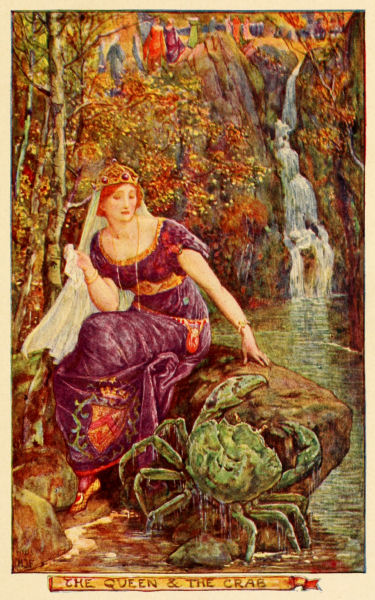
One day the queen was sitting alone by the side of a
waterfall which sprung from some rocks in the large
park adjoining the castle. She was feeling more than
usually miserable, and had sent away her ladies so that
no one might witness her grief. Suddenly she heard a
rustling movement in the pool below the waterfall, and,
on glancing up, she saw a large crab climbing on to a
stone beside her.
‘Great queen,’ said the crab, ‘I am here to tell you
that the desire of your heart will soon be granted. But
first you must permit me to lead you to the palace of the
fairies, which, though hard by, has never been seen by
mortal eyes because of the thick clouds that surround it.
When there you will know more; that is, if you will trust,
yourself to me.’
The queen had never before heard an animal speak
and was struck dumb with surprise. However, she was
so enchanted at the words of the crab that she smiled
sweetly and held out her hand; it was taken, not by the
crab, which had stood there only a moment before, but by
202]
a little old woman smartly dressed in white and crimson
with green ribbons in her grey hair. And, wonderful to
say, not a drop of water fell from her clothes.
The old woman ran lightly down a path along which
the queen had been a hundred times before, but it
seemed so different she could hardly believe it was the
same. Instead of having to push her way through
nettles and brambles, roses and jasmine hung about her
head, while under her feet the ground was sweet with
violets. The orange trees were so tall and thick that,
even at midday, the sun was never too hot, and at the
end of the path was a glimmer of something so dazzling
that the queen had to shade her eyes, and peep at it only
between her fingers.
‘What can it be?’ she asked, turning to her guide; who
answered:
‘Oh, that is the fairies’ palace, and here are some of
them coming to meet us.’
As she spoke the gates swung back and six fairies approached,
each bearing in her hand a flower made of
precious stones, but so like a real one that it was only by
touching you could tell the difference.
‘Madam,’ they said, ‘we know not how to thank you
for this mark of your confidence, but have the happiness
to tell you that in a short time you will have a little
daughter.’
The queen was so enchanted at this news that she
nearly fainted with joy; but when she was able to speak,
she poured out all her gratitude to the fairies for their
promised gift.
‘And now,’ she said, ‘I ought not to stay any longer,
for my husband will think that I have run away, or that
some evil beast has devoured me.’
In a little while it happened just as the fairies had foretold,
and a baby girl was born in the palace. Of course
both the king and queen were delighted, and the child
203]
was called Désirée, which means ‘desired,’ for she had
been ‘desired’ for five long years before her birth.
At first the queen could think of nothing but her new
plaything, but then she remembered the fairies who had
sent it to her. Bidding her ladies bring her the posy of
jewelled flowers which had been given her at the palace,
she took each flower in her hand and called it by name,
and, in turn, each fairy appeared before her. But, as
unluckily often happens, the one to whom she owed
most, the crab-fairy, was forgotten, and by this, as in
the case of other babies you have read about, much mischief
was wrought.
However, for the moment all was gaiety in the palace,
and everybody inside ran to the windows to watch the
fairies’ carriages, for no two were alike. One had a car
of ebony, drawn by white pigeons, another was lying back
in her ivory chariot, driving ten black crows, while the rest
had chosen rare woods or many-coloured sea-shells, with
scarlet and blue macaws, long-tailed peacocks, or green
love-birds for horses. These carriages were only used
on occasions of state, for when they went to war flying
dragons, fiery serpents, lions or leopards, took the place
of the beautiful birds.
The fairies entered the queen’s chamber followed by
little dwarfs who carried their presents and looked much
prouder than their mistresses. One by one their burdens
were spread upon the ground, and no one had ever seen
such lovely things. Everything a baby could possibly
wear or play with was there, and, besides, they had other
and more precious gifts to give her, which only children
who have fairies for godmothers can ever hope to possess.
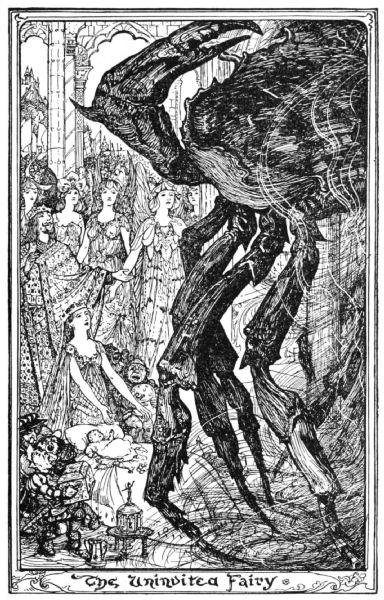
They were all gathered round the heap of pink
cushions on which the baby lay asleep, when a shadow
seemed to fall between them and the sun, while a cold
wind blew through the room. Everybody looked up, and
there was the crab-fairy, who had grown as tall as the ceiling
in her anger.
204]
‘So I am forgotten!’ cried she, in a voice so loud
that the queen trembled as she heard it. ‘Who was it
soothed you in your trouble? Who was it led you to
the fairies? Who was it brought you back in safety to
your home again? Yet I—I—am overlooked, while
these who have done nothing in comparison, are petted
and thanked.’
The queen, almost dumb with terror, in vain tried to
think of some explanation or apology; but there was none,
and she could only confess her fault and implore forgiveness.
The fairies also did their best to soften the wrath
of their sister, and knowing that, like many plain people,
who are not fairies, she was very vain, they entreated her
to drop her crab’s disguise, and to become once more the
charming person they were accustomed to see.
For some time the enraged fairy would listen to
nothing; but at length the flatteries began to take effect.
The crab’s shell fell from her, she shrank into her usual
size, and lost some of her fierce expression.
‘Well,’ she said, ‘I will not cause the princess’ death,
as I had meant to do, but at the same time she will have
to bear the punishment of her mother’s fault, as many
other children have done before her. The sentence I
pass upon her is, that if she is allowed to see one ray of
daylight before her fifteenth birthday she will rue it
bitterly, and it may perhaps cost her her life.’ And
with these words she vanished by the window through
which she came, while the fairies comforted the weeping
queen and took counsel how best the princess might be
kept safe during her childhood.
At the end of half an hour they had made up their
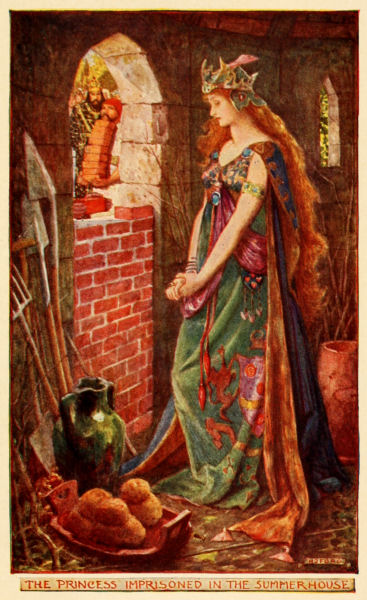
minds what to do, and at the command of the fairies, a
beautiful palace sprung up, close to that of the king and
queen, but different from every other palace in the world, in
having no windows, and only a door right under the earth.
However, once within, daylight was hardly missed, so
207]
brilliant were the multitudes of tapers that were burning
on the walls.
Now up to this time the princess’s history has been
like the history of many a princess that you have read
about; but, when the period of her imprisonment was
nearly over, her fortunes took another turn. For almost
fifteen years the fairies had taken care of her, and amused
her and taught her, so that when she came into the world
she might be no whit behind the daughters of other kings
in all that makes a princess charming and accomplished.
They all loved her dearly, but the fairy Tulip loved her
most of all; and as the princess’s fifteenth birthday drew
near, the fairy began to tremble lest something terrible
should happen—some accident which had not been foreseen.
‘Do not let her out of your sight,’ said Tulip to
the queen, ‘and meanwhile, let her portrait be painted
and carried to the neighbouring Courts, as is the custom,
in order that the kings may see how far her beauty exceeds
that of every other princess, and that they may demand
her in marriage for their sons.’
And so it was done; and as the fairy had prophesied,
all the young princes fell in love with the picture; but
the last one to whom it was shown could think of nothing
else, and refused to let it be removed from his chamber,
where he spent whole days gazing at it.
The king his father was much surprised at the
change which had come over his son, who generally
passed all his time in hunting or hawking, and his
anxiety was increased by a conversation he overheard
between two of his courtiers that they feared the prince
must be going out of his mind, so moody had he become.
Without losing a moment the king went to visit his son,
and no sooner had he entered the room than the young
man flung himself at his father’s feet.
‘You have betrothed me already to a bride I can
never love!’ cried he; ‘but if you will not consent to break
off the match, and ask for the hand of the princess
208]
Désirée, I shall die of misery, thankful to be alive no
longer.’
These words much displeased the king, who felt that,
in breaking off the marriage already arranged, he would
almost certainly be bringing on his subjects a long and
bloody war; so, without answering, he turned away,
hoping that a few days might bring his son to reason.
But the prince’s condition grew rapidly so much worse
that the king, in despair, promised to send an embassy at
once to Désirée’s father.
This news cured the young man in an instant of all
his ills; and he began to plan out every detail of dress
and of horses and carriages which were necessary to
make the train of the envoy, whose name was Becasigue,
as splendid as possible. He longed to form part of the
embassy himself, if only in the disguise of a page; but
this the king would not allow, and so the prince had to
content himself with searching the kingdom for everything
that was rare and beautiful to send to the princess.
Indeed, he arrived, just as the embassy was starting,
with his portrait, which had been painted in secret by the
court painter.
The king and queen wished for nothing better than
that their daughter should marry into such a great and
powerful family, and received the ambassador with every
sign of welcome. They even wished him to see the princess
Désirée, but this was prevented by the fairy Tulip,
who feared some ill might come of it.
‘And be sure you tell him,’ added she, ‘that the
marriage cannot be celebrated till she is fifteen years
old, or else some terrible misfortune will happen to the
child.’
So when Becasigue, surrounded by his train, made a
formal request that the princess Désirée might be given
in marriage to his master’s son, the king replied that he
was much honoured, and would gladly give his consent;
but that no one could even see the princess till her
209]
fifteenth birthday, as the spell laid upon her in her
cradle by a spiteful fairy, would not cease to work till
that was past. The ambassador was greatly surprised
and disappointed, but he knew too much about fairies to
venture to disobey them, therefore he had to content
himself with presenting the prince’s portrait to the queen,
who lost no time in carrying it to the princess. As the
girl took it in her hands it suddenly spoke, as it had been
taught to do, and uttered a compliment of the most delicate
and charming sort, which made the princess flush with
pleasure.
‘How would you like to have a husband like that?’ asked
the queen, laughing.
‘As if I knew anything about husbands!’ replied
Désirée, who had long ago guessed the business of the
ambassador.
‘Well, he will be your husband in three months,’
answered the queen, ordering the prince’s presents to be
brought in. The princess was very pleased with them,
and admired them greatly, but the queen noticed that all
the while her eyes constantly strayed from the softest
silks and most brilliant jewels to the portrait of the
prince.
The ambassador, finding that there was no hope of
his being allowed to see the princess, took his leave, and
returned to his own court; but here a new difficulty
appeared. The prince, though transported with joy at
the thought that Désirée was indeed to be his bride, was
bitterly disappointed that she had not been allowed to
return with Becasigue, as he had foolishly expected; and
never having been taught to deny himself anything or
to control his feelings, he fell as ill as he had done before.
He would eat nothing nor take pleasure in anything, but
lay all day on a heap of cushions, gazing at the picture of
the princess.
‘If I have to wait three months before I can marry
the princess I shall die!’ was all this spoilt boy would
210]
say; and at length the king, in despair, resolved to send
a fresh embassy to Désirée’s father to implore him to
permit the marriage to be celebrated at once. ‘I would
have presented my prayer in person,’ he added in his
letter, ‘but my great age and infirmities do not suffer me
to travel; however my envoy has orders to agree to any
arrangement that you may propose.’
On his arrival at the palace Becasigue pleaded his
young master’s cause as fervently as the king his father
could have done, and entreated that the princess might
be consulted in the matter. The queen hastened to the
marble tower, and told her daughter of the sad state of
the prince. Désirée sank down fainting at the news,
but soon came to herself again, and set about inventing
a plan which would enable her to go to the prince without
risking the doom pronounced over her by the wicked
fairy.
‘I see!’ she exclaimed joyfully at last. ‘Let a
carriage be built through which no light can come, and
let it be brought into my room. I will then get into it,
and we can travel swiftly during the night and arrive
before dawn at the palace of the prince. Once there,
I can remain in some underground chamber, where no
light can come.’
‘Ah, how clever you are,’ cried the queen, clasping her
in her arms. And she hurried away to tell the king.
‘What a wife our prince will have!’ said Becasigue
bowing low; ‘but I must hasten back with the tidings,
and to prepare the underground chamber for the princess.’
And so he took his leave.
In a few days the carriage commanded by the
princess was ready. It was of green velvet, scattered
over with large golden thistles, and lined inside with
silver brocade embroidered with pink roses. It had no
windows, of course; but the fairy Tulip, whose counsel
had been asked, had managed to light it up with a soft
glow that came no one knew whither.
211]
It was carried straight up into the great hall of the
tower, and the princess stepped into it, followed by her
faithful maid of honour, Eglantine, and by her lady in
waiting Cérisette, who also had fallen in love with the
prince’s portrait and was bitterly jealous of her mistress.
The fourth place in the carriage was filled by Cérisette’s
mother, who had been sent by the queen to look after
the three young people.
Now the Fairy of the Fountain was the godmother
of the princess Nera, to whom the prince had been
betrothed before the picture of Désirée had made him
faithless. She was very angry at the slight put upon her
godchild, and from that moment kept careful watch
on the princess. In this journey she saw her chance,
and it was she who, invisible, sat by Cérisette, and put
bad thoughts into the minds of both her and her mother.
The way to the city where the prince lived ran for
the most part through a thick forest, and every night
when there was no moon, and not a single star could be
seen through the trees, the guards who travelled with
the princess opened the carriage to give it an airing.
This went on for several days, till only twelve hours
journey lay between them and the palace. Then Cérisette
persuaded her mother to cut a great hole in the side of
the carriage with a sharp knife which she herself had
brought for the purpose. In the forest the darkness was
so intense that no one perceived what she had done, but
when they left the last trees behind them, and emerged
into the open country, the sun was up, and for the first
time since her babyhood, Désirée found herself in the
light of day.
She looked up in surprise at the dazzling brilliance
that streamed through the hole; then gave a sigh which
seemed to come from her heart. The carriage door
swung back, as if by magic, and a white doe sprung out,
and in a moment was lost to sight in the forest. But,
212]
quick as she was, Eglantine, her maid of honour, had
time to see where she went, and jumped from the
carriage in pursuit of her, followed at a distance by the
guards.
Cérisette and her mother looked at each other in
surprise and joy. They could hardly believe in their
good fortune, for everything had happened exactly as
they wished. The first thing to be done was to conceal
the hole which had been cut, and when this was managed
(with the help of the angry fairy, though they did not
know it), Cérisette hastened to take off her own clothes,
and put on those of the princess, placing the crown of
diamonds on her head. She found this heavier than she
expected; but then, she had never been accustomed to
wear crowns, which makes all the difference.
At the gates of the city the carriage was stopped by
a guard of honour sent by the king as an escort to his
son’s bride. Though Cérisette and her mother could of
course see nothing of what was going on outside, they
heard plainly the shouts of welcome from the crowds
along the streets.
The carriage stopped at length in the vast hall which
Becasigue had prepared for the reception of the princess.
The grand chamberlain and the lord high steward were
awaiting her, and when the false bride stepped into the
brilliantly lighted room, they bowed low, and said they
had orders to inform his highness the moment she arrived.
The prince, whom the strict etiquette of the court had
prevented from being present in the underground hall,
was burning with impatience in his own apartments.
‘So she has come!’ cried he, throwing down the bow
he had been pretending to mend. ‘Well, was I not
right? Is she not a miracle of beauty and grace? And
has she her equal in the whole world?’ The ministers
looked at each other, and made no reply; till at length
the chamberlain, who was the bolder of the two, observed:
213]
‘My lord, as to her beauty, you can judge of that for
yourself. No doubt it is as great as you say; but at
present it seems to have suffered, as is natural, from the
fatigues of the journey.’
This was certainly not what the prince expected to hear.
Could the portrait have flattered her? He had known
of such things before, and a cold shiver ran through him;
but with an effort he kept silent from further questioning,
and only said:
‘Has the king been told that the princess is in the
palace?’
‘Yes, your highness; and he has probably already
joined her.’
‘Then I will go too,’ said the prince.
Weak as he was from his long illness, the prince
descended the staircase, supported by the ministers, and
entered the room just in time to hear his father’s loud
cry of astonishment and disgust at the sight of Cérisette.
‘There has been treachery at work,’ he exclaimed,
while the prince leant, dumb with horror, against the doorpost.
But the lady in waiting, who had been prepared
for something of the sort, advanced, holding in her hand
the letters which the king and queen had entrusted to
her.
‘This is the princess Désirée,’ said she, pretending to
have heard nothing, ‘and I have the honour to present
to you these letters from my liege lord and lady, together
with the casket containing the princess’ jewels.’
The king did not move or answer her; so the prince,
leaning on the arm of Becasigue, approached a little closer
to the false princess, hoping against hope that his eyes
had deceived him. But the longer he looked the more
he agreed with his father that there was some treason somewhere,
for in no single respect did the portrait resemble
the woman before him. Cérisette was so tall that the
dress of the princess did not reach her ankles, and so
214]
thin that her bones showed through the stuff. Besides
that her nose was hooked, and her teeth black and ugly.
In his turn, the prince stood rooted to the spot. At
last he spoke, and his words were addressed to his father
and not to the bride who had come so far to marry him.
‘We have been deceived,’ he said, ‘and it will cost me
my life.’ And he leaned so heavily on the envoy that
Becasigue feared he was going to faint, and hastily laid
him on the floor. For some minutes no one could attend
to anybody but the prince; but as soon as he revived the
lady in waiting made herself heard.
‘Oh, my lovely princess, why did we ever leave
home?’ cried she. ‘But the king your father will avenge
the insults that have been heaped on you when we tell
him how you have been treated.’
‘I will tell him myself,’ replied the king in wrath;
‘he promised me a wonder of beauty, he has sent me a
skeleton! I am not surprised that he has kept her for
fifteen years hidden from the eyes of the world. Take
them both away,’ he continued, turning to his guards, ‘and
lodge them in the state prison. There is something more
I have to learn of this matter.’
His orders were obeyed, and the prince, loudly
bewailing his sad fate, was led back to his bed, where
for many days he lay in a high fever. At length he
slowly began to gain strength, but his sorrow was still
so great that he could not bear the sight of a strange
face, and shuddered at the notion of taking his proper
part in the court ceremonies. Unknown to the king, or
to anybody but Becasigue, he planned that, as soon as he
was able, he would make his escape and pass the rest of
his life in some solitary place. It was some weeks
before he had regained his health sufficiently to carry
out his design; but finally, one beautiful starlight night,
the two friends stole away, and when the king woke next
morning he found a letter lying by his bed, saying that
his son had gone, he knew not whither. He wept bitter
215]
tears at the news, for he loved the prince dearly; but he
felt that perhaps the young man had done wisely, and he
trusted to time and Becasigue’s influence to bring the
wanderer home.
And while these things were happening, what had
become of the white doe? Though when she sprang
from the carriage she was aware that some unkind fate
had changed her into an animal, yet, till she saw herself
in a stream, she had no idea what it was.
‘Is it really, I, Désirée?’ she said to herself, weeping.
‘What wicked fairy can have treated me so; and shall I
never, never take my own shape again? My only comfort
that, in this great forest, full of lions and serpents, my life
will be a short one.’
Now the fairy Tulip was as much grieved at the sad
fate of the princess as Désirée’s own mother could have
been if she had known of it. Still, she could not help
feeling that if the king and queen had listened to her
advice the girl would by this time be safely in the walls
of her new home. However, she loved Désirée too much
to let her suffer more than could be helped, and it was
she who guided Eglantine to the place where the white
doe was standing, cropping the grass which was her
dinner.
At the sound of footsteps the pretty creature lifted
her head, and when she saw her faithful companion
approaching she bounded towards her, and rubbed her
head on Eglantine’s shoulder. The maid of honour was
surprised; but she was fond of animals, and stroked the
white doe tenderly, speaking gently to her all the while.
Suddenly the beautiful creature lifted her head, and
looked up into Eglantine’s face, with tears streaming
from her eyes. A thought flashed through her mind,
and quick as lightning the girl flung herself on her
knees, and lifting the animal’s feet kissed them one by
one. ‘My princess! O my dear princess!’ cried she;
and again the white doe rubbed her head against her, for
216]
though the spiteful fairy had taken away her power of
speech, she had not deprived her of her reason!
All day long the two remained together, and when
Eglantine grew hungry she was led by the white doe to
a part of the forest where pears and peaches grew in abundance;
but, as night came on, the maid of honour was
filled with the terrors of wild beasts which had beset the
princess during her first night in the forest.
‘Is there no hut or cave we could go into?’ asked she.
But the doe only shook her head; and the two sat down
and wept with fright.
The fairy Tulip who, in spite of her anger, was very softhearted,
was touched at their distress, and flew quickly
to their help.
‘I cannot take away the spell altogether,’ she said,
‘for the Fairy of the Fountain is stronger than I; but I
can shorten the time of your punishment, and am able
to make it less hard, for as soon as darkness falls you shall
resume your own shape.’
To think that by-and-by she would cease to be a
white doe—indeed, that she would at once cease to be one
during the night—was for the present joy enough for
Désirée, and she skipped about on the grass in the
prettiest manner.
‘Go straight down the path in front of you,’ continued
the fairy, smiling as she watched her; ‘go straight
down the path and you will soon reach a little hut
where you will find shelter.’ And with these words she
vanished, leaving her hearers happier than they ever
thought they could be again.
An old woman was standing at the door of the hut when
Eglantine drew near, with the white doe trotting by her
side.
‘Good evening!’ she said; ‘could you give me a
night’s lodging for myself and my doe?’
‘Certainly I can,’ replied the old woman. And she
led them into a room with two little white beds, so
217]
clean and comfortable that it made you sleepy even to
look at them.
The door had hardly closed behind the old woman
when the sun sank below the horizon, and Désirée became
a girl again.
‘Oh, Eglantine! what should I have done if you had
not followed me,’ she cried. And she flung herself into
her friend’s arms in a transport of delight.
Early in the morning Eglantine was awakened by the
sound of someone scratching at the door, and on opening
her eyes she saw the white doe struggling to get out.
The little creature looked up and into her face, and nodded
her head as the maid of honour unfastened the latch, but
bounded away into the woods, and was lost to sight in a
moment.
Meanwhile, the prince and Becasigue were wandering
through the wood, till at last the prince grew so tired,
that he lay down under a tree, and told Becasigue that
he had better go in search of food, and of some place
where they could sleep. Becasigue had not gone very
far, when a turn of the path brought him face to face
with the old woman, who was feeding her doves before her
cottage.
‘Could you give me some milk and fruit?’ asked he.
‘I am very hungry myself, and, besides, I have left a
friend behind me who is still weak from illness.’
‘Certainly I can,’ answered the old woman. ‘But
come and sit down in my kitchen while I catch the goat
and milk it.’
Becasigue was glad enough to do as he was bid, and
in a few minutes the old woman returned with a basket
brimming over with oranges and grapes.
‘If your friend has been ill he should not pass the night
in the forest,’ said she. ‘I have a room in my hut—tiny
enough, it is true; but better than nothing, and to that
you are both heartily welcome.’
218]
Becasigue thanked her warmly, and by this time it
was almost sunset, he set out to fetch the prince. It was
while he was absent that Eglantine and the white doe
entered the hut, and having, of course, no idea that in the
very next room was the man whose childish impatience
had been the cause of all their troubles.
In spite of his fatigue, the prince slept badly, and
directly it was light he rose, and bidding Becasigue
remain where he was, as he wished to be alone, he
strolled out into the forest. He walked on slowly, just
as his fancy led him, till, suddenly, he came to a wide
open space, and in the middle was the white doe quietly
eating her breakfast. She bounded off at the sight of a
man, but not before the prince, who had fastened on his
bow without thinking, had let fly several arrows, which
the fairy Tulip took care should do her no harm. But,
quickly as she ran, she soon felt her strength failing her,
for fifteen years of life in a tower had not taught her
how to exercise her limbs.
Luckily, the prince was too weak to follow her far,
and a turn of a path brought her close to the hut,
where Eglantine was awaiting her. Panting for breath,
she entered their room, and flung herself down on the
floor.
When it was dark again, and she was once more the
princess Désirée, she told Eglantine what had befallen her.
‘I feared the Fairy of the Fountain, and the cruel
beasts,’ said she; ‘but somehow I never thought of the
dangers that I ran from men. I do not know now what
saved me.’
‘You must stay quietly here till the time of your
punishment is over,’ answered Eglantine. But when the
morning dawned, and the girl turned into a doe, the
longing for the forest came over her, and she sprang away
as before.
As soon as the prince was awake he hastened to the
place where, only the day before, he had found the white
219]
doe feeding; but of course she had taken care to go in the
opposite direction. Much disappointed, he tried first one
green path and then another, and at last, wearied with
walking, he threw himself down and went fast asleep.
Just at this moment the white doe sprang out of a
thicket near by, and started back trembling when she
beheld her enemy lying there. Yet, instead of turning to
fly, something bade her go and look at him unseen. As
she gazed a thrill ran through her, for she felt that, worn
and wasted though he was by illness, it was the face of
her destined husband. Gently stooping over him she
kissed his forehead, and at her touch he awoke.
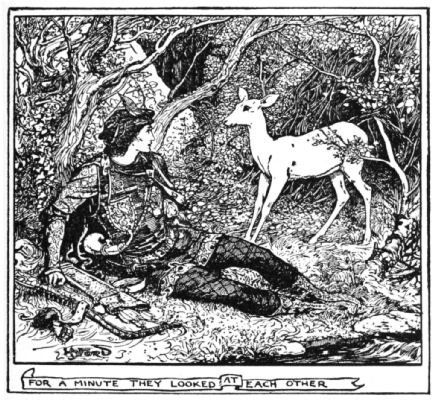
For a minute they looked at each other, and to his
amazement he recognised the white doe which had
220]
escaped him the previous day. But in an instant the
animal was aroused to a sense of her danger, and she
fled with all her strength into the thickest part of the
forest. Quick as lightning the prince was on her track,
but this time it was with no wish to kill or even wound
the beautiful creature.
‘Pretty doe! pretty doe! stop! I won’t hurt you,’
cried he, but his words were carried away by the wind.
At length the doe could run no more, and when the
prince reached her, she was lying stretched out on the
grass, waiting for her death blow. But instead the prince
knelt at her side, and stroked her, and bade her fear
nothing, as he would take care of her. So he fetched a
little water from the stream in his horn hunting cup,
then, cutting some branches from the trees, he twisted
them into a litter which he covered with moss, and laid
the white doe gently on it.
For a long time they remained thus, but when
Désirée saw by the way that the light struck the trees,
that the sun must be near its setting, she was filled with
alarm lest the darkness should fall, and the prince should
behold her in her human shape.
‘No, he must not see me for the first time here,’ she
thought, and instantly began to plan how to get rid of
him. Then she opened her mouth and let her tongue
hang out, as if she were dying of thirst, and the prince,
as she expected, hastened to the stream to get her some
more water.
When he returned, the white doe was gone.
That night Désirée confessed to Eglantine that her
pursuer was no other than the prince, and that far from
flattering him, the portrait had never done him justice.
‘Is it not hard to meet him in this shape,’ wept she,
‘when we both love each other so much?’ But Eglantine
comforted her, and reminded her that in a short time all
would be well.
The prince was very angry at the flight of the white
221]
doe, for whom he had taken so much trouble, and returning
to the cottage he poured out his adventures and
his wrath to Becasigue, who could not help smiling.
‘She shall not escape me again,’ cried the prince. ‘If
I hunt her every day for a year, I will have her at last.’
And in this frame of mind he went to bed.
When the white doe entered the forest next morning,
she had not made up her mind whether she would go
and meet the prince, or whether she would shun him,
and hide in the thickets of which he knew nothing. She
decided that the last plan was the best; and so it would
have been if the prince had not taken the very same
direction in search of her.
Quite by accident he caught sight of her white skin
shining through the bushes, and at the same instant she
heard a twig snap under his feet. In a moment she
was up and away, but the prince, not knowing how else
to capture her, aimed an arrow at her leg, which brought
her to the ground.
The young man felt like a murderer as he ran hastily
up to where the white doe lay, and did his best to soothe
the pain she felt, which, in reality, was the last part of
the punishment sent by the Fairy of the Fountain. First
he brought her some water, and then he fetched some
healing herbs, and having crushed them in his hands, laid
them on the wound.
‘Ah! what a wretch I was to have hurt you,’ cried he,
resting her head upon his knees; ‘and now you will hate
me and fly from me for ever!’
For some time the doe lay quietly where she was, but,
as before, she remembered that the hour of her transformation
was near. She struggled to her feet, but the
prince would not hear of her walking, and thinking the
old woman might be able to dress her wound better than
he could, he took her in his arms to carry her back to
the hut. But, small as she was, she made herself so heavy
222]
that, after staggering a few steps under her weight, he
laid her down, and tied her fast to a tree with some of the
ribbons off his hat. This done he went away to get
help.
Meanwhile Eglantine had grown very uneasy at the long
absence of her mistress, and had come out to look for
her. Just as the prince passed out of sight the fluttering
ribbons danced before her eyes, and she descried
her beautiful princess bound to a tree. With all her
might she worked at the knots, but not a single one could
she undo, though all appeared so easy. She was still busy
with them when a voice behind her said:
‘Pardon me, fair lady, but it is my doe you are trying
to steal!’
‘Excuse me, good knight,’ answered Eglantine, hardly
glancing at him, ‘but it is my doe that is tied up here!
And if you wish for a proof of it, you can see if she knows
me or not. Touch my heart, my little one,’ she continued,
dropping on her knees. And the doe lifted up
its fore-foot and laid it on her side. ‘Now put your
arms round my neck, and sigh.’ And again the doe did
as she was bid.
‘You are right,’ said the prince; ‘but it is with sorrow
I give her up to you, for though I have wounded her yet
I love her deeply.’
To this Eglantine answered nothing; but carefully
raising up the doe, she led her slowly to the hut.
Now both the prince and Becasigue were quite unaware
that the old woman had any guests besides themselves,
and, following afar, were much surprised to behold
Eglantine and her charge enter the cottage. They
lost no time in questioning the old woman, who replied
that she knew nothing about the lady and her white doe,
who slept next the chamber occupied by the prince and
his friend, but that they were very quiet, and paid her
well. Then she went back to her kitchen.
‘Do you know,’ said Becasigue, when they were alone,
223]
‘I am certain that the lady that we saw is the maid of honour
to the Princess Désirée, whom I met at the palace. And,
as her room is next to this, it will be easy to make a small
hole through which I can satisfy myself whether I am right
or not.’
So, taking a knife out of his pocket, he began to saw
away the woodwork. The girls heard the grating noise,
but fancying it was a mouse, paid no attention, and
Becasigue was left in peace to pursue his work. At length
the hole was large enough for him to peep through, and
the sight was one to strike him dumb with amazement.
He had guessed truly: the tall lady was Eglantine herself;
but the other—where had he seen her? Ah! now he
knew—it was the lady of the portrait!
Désirée, in a flowing dress of green silk, was lying
stretched out upon cushions, and as Eglantine bent over
her to bathe the wounded leg, she began to talk:
‘Oh! let me die!’ cried she, ‘rather than go on
leading this life. You cannot tell the misery of being a
beast all the day, and unable to speak to the man I love,
to whose impatience I owe my cruel fate. Yet, even so,
I cannot bring myself to hate him.’
These words, low though they were spoken, reached
Becasigue, who could hardly believe his ears. He stood
silent for a moment; then, crossing to the window out
of which the prince was gazing, he took his arm and led
him across the room. A single glance was sufficient to
show the prince that it was indeed Désirée; and how another
had come to the palace bearing her name, at that
instant he neither knew nor cared. Stealing on tiptoe
from the room, he knocked at the next door, which was
opened by Eglantine, who thought it was the old woman
bearing their supper.
She started back at the sight of the prince, whom this
time she also recognised. But he thrust her aside, and
flung himself at the feet of Désirée, to whom he poured
out all his heart!
224]
Dawn found them still conversing; and the sun was
high in the heavens before the princess perceived that
she retained her human form. Ah! how happy she was
when she knew that the days of her punishment were over;
and with a glad voice she told the prince the tale of her
enchantment.
So the story ended well after all; and the fairy Tulip,
who turned out to be the old woman of the hut, made
the young couple such a wedding feast as had never
been seen since the world began. And everybody was
delighted, except Cérisette and her mother, who were put
in a boat and carried to a small island, where they had
to work hard for their living.
(Contes des Fées, par Madame d’Aulnoy.)
225]