NARRATIVE OF A VOYAGE OF DISCOVERY
TOWARDS THE NORTH POLE,
IN THE
SCHOONER "UNITED STATES."
BY
NEW YORK:
PUBLISHED BY HURD AND HOUGHTON,
1867.
Entered according to Act of Congress, in the year 1866, by
I. I. Hayes,
in the Clerk's Office of the District Court for the Southern District of New York.
RIVERSIDE, CAMBRIDGE:
STEREOTYPED AND PRINTED BY
H. O. HOUGHTON AND COMPANY.
I HAD INTENDED TO DEDICATE THIS BOOK TO
WILLIAM PARKER FOULKE,
Of Philadelphia,
To whom I am indebted
for all that a powerful intellect and
a generous friendship could do, to give practical
shape to my plans, and to insure success to an enterprise
in which I had embarked, with the simple advantage of an aim,
and with no better guide than the impulse of youth: but
since it is denied me to pay that tribute of my
admiration to one of the noblest of men,
I now inscribe it to his
MEMORY.
PREFACE.
The design of this book may be briefly explained.
I have attempted little more than a personal narrative,
endeavoring to select from my abundant notes
such scenes and incidents of adventure as seemed
to me best calculated to bring before the mind of
the reader, not merely the history of our voyage, but
a general view of the Arctic regions,—its scenery
and its life, with a cursory glance at those physical
forces which, in their results, give characteristic expression
to that remote quarter of the world. A
day of months, followed by a night of months, where
the mean annual temperature rises but little above
zero, must necessarily clothe the air and the landscape
with a sentiment difficult to appreciate, or, I
might perhaps say, feel, without actual observation.
I shall be abundantly rewarded if I have succeeded
in impressing upon the reader's mind, with any degree
of vividness, the wonders and the grandeur of
Nature as unfolded to us under the Arctic sky.
I know it is usually thought that a book of travels
should be simply a diary of events and incidents;
but this, of necessity, involves a ceaseless repetition,
and it seemed to me that I would do better to drop
from my diary all that did not appear as immediately
relevant to the scene; and, indeed, where the
occasion appeared to require concentration, to abandon
the diary altogether, and use the more concise
form of descriptive narrative.
The reader will observe that I have not attempted,
in any sense, to write a work of Science. True,
the purpose of the voyage was purely a scientific
one,—its chief object and aim being to explore the
boundaries of the Open Polar Sea; at least to determine
if such a sea did exist, as had been so often
asserted; but while I have given a general discussion
of the conditions of the Polar waters and the
Polar ice, and have recorded many new facts in various
departments of physical and natural science, yet
I have desired to treat the subject in a manner which,
as it seemed to me, would be most acceptable to the
general reader, rather than to the scientific student,—preferring
to direct the latter to those more strictly
scientific channels where my materials have been or
are about being published.
Soon after returning from the North, my principal
records were placed at the disposal of the Smithsonian
Institution at Washington; and I have employed
such leisure as I could command in their elaboration
and discussion,—the principal labor, however, falling
upon Mr. Charles A. Schott, Assistant, United States
Coast Survey, who brought to the task the best faculties
of a well-stored mind, and unusual powers
of patient investigation; and papers, giving a full
analysis of the magnetic, meteorological, astronomical, geographical,
pendulum, and tidal observations, were prepared,
and were accepted for publication in the Smithsonian
"Contributions to Knowledge." I regret to
say that the publication of these papers has been
much delayed. Deeming it desirable that some of
the general conclusions to which we had arrived in
our discussion of the observations should be given to
the world without further postponement, I proposed
to embody some leading facts in a short Appendix
to this volume. Upon submitting the matter to the
learned Secretary of the Institution, it was, however,
claimed by him that, since I had intrusted the materials
to his care, the Institution now possessed the
exclusive right to whatever advantage was to be derived
from their publication. To a proposition so
eminently reasonable I readily assented, especially as
I was informed that the papers were already in type
and were to be published immediately; and, considering
myself thus absolved from any further responsibility
to the scientific world for the long delay, I
accordingly abandoned the idea of the Appendix.
The Chart exhibiting the track and discoveries of
my voyage, and of my various sledge journeys, was
claimed, in like manner, as the exclusive property
of the Smithsonian Institution, and, like the papers,
was to be published immediately. Hence it is that
the small map which illustrates this volume is but a
copy (reduced ten diameters) of my field chart, projected
on the spot from my unrevised materials. It
is perhaps needless for me to observe that entire
accuracy was not attainable in the field, inasmuch
as I had neither the leisure nor the facilities for reducing
the magnetic variation, nor for obtaining the
absolute time. I am happy to say, however, that
no greater discrepancy exists than the one which
places my highest latitude two minutes too far south
on the field chart; but the reductions having been
made, and a chart projected therefrom, I had confidently
relied upon this source for the correct information
which the Smithsonian Institution now alone
possessed. This failing me, I was obliged to fall back
upon my original resources, as the time was too short
for a new reduction. I am glad to say, however,
that the field chart is sufficiently accurate for every
practical purpose, and differs chiefly from the one
prepared, with greater carefulness, and of large size,
for the Smithsonian "Contributions to Knowledge,"
in the unimportant feature of the names applied to
newly discovered places, some of which were changed
after my return. No list of these alterations having
been preserved, and being unable to get the more
accurate map again into my hands from the Secretary
of the scientific institution in whose care it
had been placed, as before observed, for publication,
I have simply adopted the original nomenclature, and
have used the names as they appear in my journal
and on my field chart. This explanation is made in
anticipation of the possible contingency of the Smithsonian
Institution publishing the map, for some years
past in its possession,—an event which I think unlikely
to happen, and which will now be unnecessary,
the more especially as I am at present engaged in
a new reduction of my materials, and the projection
of a new map, the publication of which, in sufficiently
large form to give it topographical as well as geographical
value, has been proposed by my distinguished
and very kind friend, Dr. Augustus Petermann,
Gotha, in his Geographical Journal.
Papers descriptive of the botanical collection, prepared
by Mr. Elias Durand; of the algæ, by Mr. Ashmead;
of the lichens, by Professor James; of the birds,
by Mr. John Cassin; of the invertebrata, by Dr. William
Stimpson; of the mammalia, by Dr. J. H. Slack;
of the cetacea, by Professor E. Cope; of the infusoria,
by Dr. F. W. Lewis; of the fishes, by Dr. Theodore
Gill; and of the paleontology, by Professor F. B. Meek,
have appeared from time to time in the "Proceedings
of the Academy of Natural Sciences of Philadelphia,"
excepting the last, which was published in the American
"Journal of Arts and Sciences." Dr. J. Atkin
Meigs has in preparation a monograph on ethnology,
based upon a collection of upward of one hundred
and forty specimens, and I shall soon have completed
a more elaborate discussion of the Greenland Glaciers
and other collateral topics than has been allowed
me by the limits and character of this work.
I should do great injustice to my own feelings,
did I not here express the acknowledgment of my
obligation to those societies, associations, and
individuals who united themselves with me in effecting
the organization of the Expedition, and who liberally
shared with me its expenses. My wishes were
always promptly met by them, to the extent of their
ability; and the enterprise was sustained with a zeal
and interest rarely accorded to a purely scientific
purpose. That I have not before published an account
of my voyage, or presented any detailed statement
of my discoveries to those who had a natural
right to expect it, has been entirely owing to the
circumstance that my time has been wholly occupied
in the public service, from the period of my return
until late last year; and they will, I trust, accept as
a sufficient excuse for my silence during that period,
the fact that the command of an army hospital, with
from three to five thousand inmates, which devolved
upon me during the greater part of the recent war,
allowed me little leisure for literary or scientific
work. It will also be understood that the temporary
abandonment of the exploration was due to the
same general cause.
[1] The author has reason to suppose that there are several persons to
whom the Expedition is indebted for support whose names, not having
been furnished him, do not appear in this list. Desiring to make it entirely
complete, he will feel personally obliged to any one whose name is
omitted to notify him of the fact, through the agency by which the subscription
was furnished.
THROUGH A SPECIAL COMMITTEE OF THE AMERICAN GEOGRAPHICAL
AND STATISTICAL SOCIETY, NEW YORK. EGBERT L. VIELE,
Chairman; HENRY GRINNELL, Treasurer.
Henry Grinnell.
A. D. Bache.
George Folsom.
Henry E. Pierrepont.
Benjamin H. Field.
M. de LeRoquette.
The "American Journal of Arts and
Sciences"—Profs. Silliman and Dana.
Egbert L. Viele.
Cyrus W. Field.
J. L. Graham.
August Belmont.
Horace B. Clafflin.
George Opdyke.
Brown, Brothers & Co.
F. S. Stalknecht.
John Jay.
C. Godfrey Gunther.
Peter Cooper.
Wm. Remsen.
J. Carson Brevoort.
Lewis Rutherford.
C. P. Daly.
Hugh N. Camp.
W. A. White.
John D. Clute.
Marshall Lefferts.
Wolcott Gibbs.
John D. Jones.
Joseph Harsen.
Alexander H. Stevens.
John C. Green.
Samuel E. Barlow.
A. H. Ward.
James T. Hall.
E. A. Stansbury.
W. T. Blodgett.
Dr. Samuel W. Francis.
Frank Moore.
H. M. Field.
Blakeman & Phinney.
Harpers Brothers.
John Austin Stevens.
George A. Woodward.
C. Detmold.
Z. T. Detmold.
Francis Lieber.
F. E. Church.
Bayard Taylor.
O. M. Mitchell.
Henrietta B. Haines.
Mary W. Talman.
Clarence A. Seward.
F. L. Hawks.
Robert B. Winthrop.
G. P. Putnam.
A. W. White.
A. H. Wood.
George L. Samson.
Henry A. Robbins.
Wm. H. Allen.
Albert Clark.
Joseph W. Orvis.
John D. Wing.
Grinnell & Bibby.
Simeon Holton, Jun.
Sheldon, Blakeman & Co.
American Desiccating Co.
Ruxton, Barker & Co.
G. Tagliabue.
Messrs. Nequs.
THROUGH COMMITTEES OF THE BOARD OF TRADE AND ACADEMY
OF NATURAL SCIENCES, PHILADELPHIA. FRANCIS COPE, Treasurer.
Wm. Parker Foulke.
Joseph Harrison, Jun.
Henry Cope.
Alfred Cope.
Wm. Bucknell.
John Rice.
North American Life Insurance Co.
Delaware Mutual Ins. Co.
Corn Exchange.
Cope Brothers.
Isaac Lea.
R. Pearsall.
C. Macalister.
Henry C. Carey.
John C. Cresson.
Wm. R. Lejeé.
Childs & Peterson.
Samuel J. Reeves.
Edward Trotter.
J. T. Alburger & Co.
M. J. Wickersham.
Thomas Sparks.
E. J. Lewis.
Joseph Leidy.
R. E. Rogers.
Jacob P. Jones.
J. B. Lippincott & Co.
M. W. Baldwin.
Samuel E. Stokes.
Dr. T. B. Wilson.
James C. Hand.
Henry C. Townsend.
Richard Price.
M. L. Dawson.
Samuel Coffin.
W. Haye.
Lodge 51, A. Y. M.
John Thompson.
John P. Crozer.
Joseph Jeanes.
E. J. Levis.
Edward A. Souder.
Geo. N. Tatham.
John A. Brown.
B. Marshall.
R. Marshall.
Thomas Richardson & Co.
D. Haddock, Jun.
J. B. Morris.
Israel Morris.
B. C. & R. A. Tilghman.
John W. Sexton.
John Grigg.
William Sellers & Co.
Tobias Wagner.
Warren Fisher.
Wm. S. Vaux.
Dr. James Bond.
Chas. Henry Fisher.
J. Edgar Thompson.
Charles E. Smith.
Frothingham, Wells & Co.
Fairman Rogers.
John L. Leconte.
J. C. Trautwine.
Edward Hayes.
Aubrey H. Smith.
C. Townsend.
E. C. Knight.
Buckman & Co.
E. Durar.
E. H. Butler.
Blair & Wyeth.
King & Baird.
Sharp & Brother.
Rowland & Irvin.
Henry Winsor.
David McConkey.
Wilson, Childs & Co.
A. Whitney & Son.
Townsend Sharpless.
David S. Brown.
Chas. Ellis.
Wm. M. Baird.
James H. Orne.
Joshua L. Bailey.
James Addicks.
Benj. Marsh.
Buzby & Co.
Weaver, Fitler & Co.
James Leslie & Co.
McAlister & Brother.
Bible Society.
John H. Cooper.
S. Hazard.
Isaac J. Williams.
Buckner & M'Connor.
Burley & Co.
Mrs. Dr. Bond.
THROUGH COMMITTEE OF CITIZENS, ALBANY, N. Y. D. V. N. RADCLIFFE,
Treasurer.
J. H. Armsby.
Thomas W. Olcott.
Eli Perry.
D. V. N. Radcliffe.
Erastus Corning.
R. C. Davis.
Isaac W. Vosburg.
John T. Rathbone.
Alden Marsh.
A. B. Banks.
Charles L. Garfield.
David J. Boyd.
T. Rousell & Son.
W. Frothingham.
G. J. H. Thatcher.
Samuel Anable.
S. H. Ransom.
R. H. Wakeman.
J. O. Souner.
James Kidd.
A. A. Dunlap.
Alanson Sumner.
James W. Cook.
E. Owens.
John Tracy.
Cook & Palmer.
THROUGH THE CITIZENS' COMMITTEE AND COMMITTEE OF THE
ACADEMY OF ARTS AND SCIENCES, BOSTON. RICHARD BAKER,
Jun., Treasurer.
Richard Baker, Jun.
Warren Sawyer.
John Stetson.
J. D. W. Joy.
O. W. Peabody.
S. A. Dix.
Theodore Lyman.
Richard P. Pope.
David Sears.
Thomas Lee.
Philip H. Sears.
B. W. Taggard.
Amos A. Lawrence.
Jacob Bigelow, M. D.
James M. Beebe.
A. W. Spencer.
S. H. Walley.
Wm. Gray.
H. A. Whitney.
Geo. R. Russell.
L. Agassiz.
B. A. Gould.
C. C. Felton.
Prof. J. Lovering.
Prof. E. N. Horsford.
James Lawrence.
Jonathan Phillips.
Nathan Appleton.
Joseph Whitney.
Abbott Lawrence.
George W. Lyman.
Edward Wigglesworth.
Francis Skinner.
George B. Blake.
Naylor & Co.
H. O. Houghton.
Columbia Lodge.
Woburn Lodge.
Mt. Lebanon Lodge.
Winslow Lewis Lodge.
Merchants' Insurance Co.
(through Capt. Smith.)
Manufacturers' Ins. Co.
J. Sawyer & Co.
Wm. H. Kennard.
E. Hammer (Danish Consul.)
D. N. Haskell.
Wm. Baker.
Daniel Paine.
H. Howard.
Wm. M. Parker.
Francis Kendall.
C. G. Kendall.
E. R. Mudge & Co.
Wilkinson, Stetson & Co.
Merrill & Co.
Allen, Whiting & Co.
Huntington, Wadsworth & Parks.
Fitchburg Woolen Co.
Macullum, Williams & Parker.
Edward Everett.
N. P. Banks.
Frederick W. Lincoln.
John Cummings, Jun.
John Clark.
James O. Safford.
S. S. Arnold.
Winslow Lewis, M. D.
Benj. French.
Black & Bacheller.
Wm. B. Boyd.
Wm. Furness, Jun.
John Paine.
James Sturgis.
Thornton K. Lothrop.
Caleb Curtis.
Chas. D. Homans, M. D.
George L. Pratt.
A. G. Smith.
Henry P. Kidder.
Henry Mulliken.
A. W. Stetson.
Chas. J. Sprague.
N. I. Bowditch.
Stone, Wood & Baldwin.
Messinger & Brothers.
Middlesex Co.
Oak Hall.
Fenno & Co.
F. A. Hawley & Co.
Andrew Pierce.
Burnham & Scott.
March Brothers.
William R. Lovejoy & Co.
Whiting, Galloupe & Co.
Kelley & Levin.
John A. Whipple.
Stetson, Kendall & Minot.
Isaac Fenno.
Charles E. Wiggin.
Joshua Blake.
Preston & Merrill.
Wm. Read & Son.
Richard Fay, Jun.
Redding & Co.
Hostetter & Smith, (Pittsburg, Pa.)
John Wilson.
Henry W. Poole.
Otis Norcross.
H. B. Walley.
Richard F. Bond.
L. Audenried & Co.
Noble, Hammott & Hall.
N. Sturtevant & Co.
Wm. F. Weld.
J. G. Bigelow.
Wm. D. Atkinson, Jun.
Jos. W. Wightman.
George H. Snelling.
J. C. Hoadley.
A. Loring.
H. Poor & Son.
Thomas Thompson.
Wm. Bond & Son.
Pierce & Co.
Joshua Stetson.
Chas. W. Freeland & Co.
Burrough, Bro. & Co.
Frost & Kimball.
Washington Mills.
Hunt & Goodwin.
Geo. W. Simmons.
Nevin, Sawyer & Co.
George Osgood.
Theodore H. Bell.
Brown & Taggard.
Winsor & Whitney.
Richard Morris Hunt.
Edward J. Thomas.
Wm. B. Hayden.
E. H. Blake.
Lewis R. Reynolds.
Swann, Brewer & Tileston.
E. B. Moore.
John E. Hayes.
Ballard & Prince.
Dana, Farrar & Hyde.
Solo. Piper.
Jacob Stanwood.
E. P. Tileston.
Isaac Rich.
Salem T. Lamb.
Daniel D. Kelley.
Wm. M. Jacobs & Son.
Mrs. Pratt.
Mrs. E. Thompson.
W. Clafflin & Co.
Day, Wilcox & Co.
J. J. Adams & Co.
Alex. Williams & Co.
E. Paige & Co.
D. P. Ives & Co.
Max, White & Bartlett.
J. B. Kendall.
Sewall, Day & Co.
E. A. & W. Winchester.
Seth Adams.
J. & J. F. Samson & Co.
Wilder & Eastbrook.
Maynard & Noyes.
Winn, Eaton & Co.
J. H. Poole.
Fogg, Houghton & Co.
Brown & Stanley.
J. Childs, Jun.
Doan & Skilton.
Parker, Gannett & Osgood.
Denton & Wood.
Foster & Smith.
Wm. K. Lewis & Co.
Thomas W. Pierce.
Joseph B. Glover.
Addison Gage.
I. N. Brown.
New Bedford Cordage Co.
C. B. Bryant.
CONTENTS. — INTRODUCTION . — CHAPTER I. — CHAPTER II. — CHAPTER III. — CHAPTER IV. — CHAPTER V. — CHAPTER VI. — CHAPTER VII. — CHAPTER VIII. — CHAPTER IX — CHAPTER X — CHAPTER XI — CHAPTER XII — CHAPTER XIII — CHAPTER XIV — CHAPTER XV — CHAPTER XVI — CHAPTER XVII — CHAPTER XVIII — CHAPTER XIX — CHAPTER XX — CHAPTER XXI — CHAPTER XXII — CHAPTER XXIII — CHAPTER XXIV — CHAPTER XXV — CHAPTER XXVI — CHAPTER XXVII — CHAPTER XXVIII — CHAPTER XXIX — CHAPTER XXX — CHAPTER XXXI — CHAPTER XXXII — CHAPTER XXXIII — CHAPTER XXXIV — CHAPTER XXXV — CHAPTER XXXVI — CHAPTER XXXVII — CHAPTER XXXVIII — CHAPTER XXXIX
PAGE
Plan of the Expedition.—First Announcement.—Appeal to Scientific
Societies.—Aid solicited.—Public Lectures.—Liberality of
various Societies and Individuals.—Vessel purchased in Boston.—Interest
manifested in that City.—Difficulty in obtaining a proper
Crew.—Organization of the Party.—Scientific Outfit.—Abundant
Supplies
Passage to the Greenland Coast.—Discipline.—The Decks at Sea.—Our
Quarters.—The First Iceberg.—Crossing the Arctic Circle.—The
Midnight Sun.—The Endless Day.—Making the
Land.—A Remarkable Scene among the Bergs.—At Anchor in
Pröven Harbor
Hans and his Family.—Petowak Glacier.—A Snow-Storm.—The
Ice-Pack.—Entering Smith Sound.—A Severe Gale.—Collision
with Icebergs.—Encounter with the Ice-Fields.—Retreat from the
Pack.—At Anchor in Hartstene Bay.—Entering Winter Quarters
Our Winter Harbor.—Preparing for Winter.—Organization of Duties.—Scientific
Work.—The Observatory.—Schooner Driven
Ashore.—The Hunters.—Sawing a Dock.—Frozen up.—Sunset
Journey on the Glacier.—The First Camp.—Scaling the Glacier.—Character
of its Surface.—The Ascent.—Driven back by a Gale.—Low
Temperature.—Dangerous Situation of the Party.—A
Moonlight Scene
Important Results of the recent Journey.—The Glacier System of
Greenland.—General Discussion of the Subject.—Illustrations
drawn from the Alpine Glaciers.—Glacier Movement.—Outline
of the Greenland Mer de Glace
My Cabin.—Surveying.—Castor and Pollux.—Concerning Scurvy.—Dangers
of eating Cold Snow.—Knorr and Starr.—Frost-Bites.—Hans,
Peter, and Jacob again.—Coal Account.—The Fires.—Comfort
of our Quarters.—The House on Deck.—Mild Weather.—Jensen.—Mrs.
Hans.—John Williams, the Cook.—A Cheerful
Evening
Increasing Darkness.—Daily Routine.—The Journal.—Our Home.—Sunday.—Return
of Sonntag.—A Bear-Hunt.—The Open
Water.—Accident to Mr. Knorr.—A Thaw.—"The Port Foulke
Weekly News."—The Tide-Register.—The Fire-Hole.—Hunting
Foxes.—Peter
Midwinter.—The Night of Months.—Brilliancy of the Moonlight.—Mild
Temperatures.—Remarkable Weather.—A Shower.—Depth
of Snow.—Snow Crystals.—An Epidemic among the Dogs.—Symptoms
of the Disorder.—Great Mortality.—Only one Team
left.—New Plans.—Schemes for reaching the Esquimaux in Whale
Sound
The Arctic Midnight.—Sonntag starts for Whale Sound.—Effects
of Darkness on the Spirits.—Routine of Duties.—Christmas Eve.—Christmas
Day.—The Christmas Dinner
The New Year.—Looking for Sonntag.—The Aurora Borealis.—A
Remarkable Display.—Depth of Snow.—Strange Mildness of
the Weather.—The Open Sea.—Evaporation at Low Temperatures.—Looking
for the Twilight.—My Pet Fox
Prolonged Absence of Mr. Sonntag.—Preparing to look for him.—Arrival
of Esquimaux.—They report Sonntag dead.—Arrival of
Hans.—Condition of the Dogs.—Hans's Story of the Journey
Kalutunah returns.—An Esquimau Family.—The Family Property.—The
Family Wardrobe.—Myouk and his Wife.—Peter's
Dead Body found.—My New Teams.—The Situation.—Hunting.—Subsistence
of Arctic Animals.—Pursuit of Science under
Difficulties.—Kalutunah at Home.—An Esquimau Feast.—Kalutunah
in Service.—Recovering the Body of Mr. Sonntag.—The
Funeral.—The Tomb
Starting on my First Journey.—Object of the Journey.—A Mishap.—A
Fresh Start.—The First Camp.—Hartstene's Cairn.—Exploring
a Track.—A New Style of Snow-Hut.—An Uncomfortable
Night.—Low Temperature.—Effect of Temperature on the
Snow.—Among the Hummocks.—Sighting Humboldt Glacier.—The
Track impracticable to the Main Party.—Van Rensselaer
Harbor.—Fate of the Advance.—A Drive in a Gale
Sending forward Supplies.—Kalutunah as a Driver.—Kalutunah
civilized.—Mr. Knorr.—Plan of my Proposed Journey.—Preparing
to set out.—Industrious Esquimau Women.—Death and Burial
of Kablunet.—The Start
The First Day's Journey.—A Fall of Temperature.—Its Effect
upon the Men.—Camped in a Snow-Hut.—The Second Day's
Journey.—At Cairn Point.—Character of the Ice.—The Prospect.—Storm-stayed.—The
Cooks in Difficulty.—Snow-Drift.—Violence
of the Gale.—Our Snow-Hut
The Storm continues.—At Work.—Among the Hummocks.—Difficulties
of the Track.—The Snow-Drifts.—Slow Progress.—The
Smith Sound Ice.—Formation of the Hummocks.—The Old Ice-Fields.—Growth
of Ice-Fields.—Thickness of Ice.—The Prospect
The Difficulties multiplying.—Sledge broken.—Reflections on the
Prospect.—The Men breaking down.—Worse and Worse.—The
Situation.—Defeat of Main Party.—Resolve to send the Party
back and continue the Journey with Dogs
The Main Party sent back.—Plunging into the Hummocks again.—Advantages
of Dogs.—Camp in an Ice-Cave.—Nursing the Dogs.—Snow-Blindness.—A
Chapter of Accidents.—Cape Hawks.—Cape
Napoleon.—Storm-stayed.—Grinnell Land looming up.—Discovering
a Sound.—Ravenous Disposition of Dogs.—A Cheerless
Supper.—Camping in the Open Air.—Prostration of Men
and Dogs.—Making the Land at last
The Prospect Ahead.—To Cape Napoleon.—To Cape Frazer.—Traces
of Esquimaux.—Rotten Ice.—Kennedy Channel.—Mildness
of Temperature.—Appearance of Birds.—Geological Features
of Coast.—Vegetation.—Accident to Jensen
A New Start.—Speculations.—In a Fog.—Polar Scenery.—Stopped
by Rotten Ice.—Looking Ahead.—Conclusions.—The
Open Sea.—Climax of the Journey.—Returning South
The Open Polar Sea.—Width of the Polar Basin.—Boundaries of
the Polar Basin.—Polar Currents.—Polar Ice.—The Ice-Belt.—Arctic
Navigation and Discovery.—The Russian Sledge Explorations.—Wrangel's
Open Sea.—Parry's Boat Expedition.—Dr.
Kane's Discoveries.—Expansion of Smith Sound.—General Conclusions
drawn from my own Discoveries and those of my Predecessors
On Board the Schooner.—Review of the Journey.—The Return
down Kennedy Channel.—A Severe March in a Snow-Storm.—Rotten
Ice.—Effects of a Gale.—Returning through the Hummocks.—The
Dogs breaking down.—Adrift on a Floe at Cairn
Point.—The Open Water compels us to take to the Land.—Reaching
the Schooner.—Projecting a Chart.—The New Sound.—My
Northern Discoveries
Inspection of the Schooner.—Method of Repairing.—The Serious
Nature of the Injury.—The Schooner unfit for any further Ice-Encounters.—Examination
of my Resources.—Plans for the Future
The Arctic Spring.—Snow disappearing.—Plants show Signs of
Life.—Return of the Birds.—Change in the Sea.—Refitting the
Schooner.—The Esquimaux.—Visit to Kalutunah.—Kalutunah's
Account of the Esquimau Traditions.—Hunting-Grounds contracted
by the Accumulation of Ice.—Hardships of their Life.—Their
Subsistence.—The Race dwindling away.—Visit to the Glacier.—Re-survey
of the Glacier.—Kalutunah catching Birds.—A
Snow-Storm and a Gale.—The Mid-day of the Arctic Summer
The Arctic Summer.—The Flora.—The Ice dissolving.— A Summer
Storm of Rain, Hail, and Snow.—The Terraces.—Ice Action.—Upheaval
of the Coast.—Geological Interest of Icebergs and
the Land-Ice.—A Walrus Hunt.—The "Fourth."—Visit to Littleton
Island.—Great Numbers of Eider-Ducks and Gulls.—The
Ice breaking up.—Critical Situation of the Schooner.—Taking
Leave of the Esquimaux.—Adieu to Port Foulke
Leaving Port Foulke.—Effort to reach Cape Isabella.—Meet the
Pack and take Shelter at Littleton Island.—Hunting.—Abundance
of Birds and Walrus.—Visit to Cairn Point.—Reaching
the West Coast.—View from Cape Isabella.—Plans for the Future.—Our
Results.—Chances of reaching the Polar Sea discussed.—The
Glaciers of Ellesmere Land
Leaving Smith Sound.—Crossing the North Water.—Meeting the
Pack.—The Sea and Air teeming with Life.—Remarkable Refraction.—Reaching
Whale Sound.—Surveying in a Boat.—The
Sound traced to its Termination.—Meeting Esquimaux at Iteplik.—Habits
of the Esquimaux.—Marriage Ceremony.—The Decay
of the Tribe.—View of Barden Bay.—Tyndall Glacier
Homeward Bound.—Entering Melville Bay.—Encounter with a
Bear.—Meeting the Pack.—Making the "South Water."—Reaching
Upernavik.—The News.—To Goodhaven.—Liberality
of the Danish Government and the Greenland Officials.—Driven
out of Baffin Bay by a Gale.—Crippled by the Storm and forced
to take Shelter in Halifax.—Hospitable Reception.—Arrival in
Boston.—Realize the State of the Country.—The Determination.—Conclusion
PLAN OF THE EXPEDITION.—FIRST ANNOUNCEMENT.—APPEAL TO SCIENTIFIC
SOCIETIES.—AID SOLICITED.—PUBLIC LECTURES.—LIBERALITY
OF VARIOUS SOCIETIES AND INDIVIDUALS.—VESSEL PURCHASED
IN BOSTON.—INTEREST MANIFESTED IN THAT CITY.—DIFFICULTY
IN OBTAINING A PROPER CREW.—ORGANIZATION OF THE
PARTY.—SCIENTIFIC OUTFIT.—ABUNDANT SUPPLIES.
I purpose to record in this Book the events of the
Expedition which I conducted to the Arctic Seas.
PLAN OF THE EXPEDITION.
The plan of the enterprise first suggested itself to
me while acting as Surgeon of the Expedition commanded
by the late Dr. E. K. Kane, of the United
States Navy. Although its execution did not appear
feasible at the period of my return from that voyage
in October, 1855, yet I did not at any time abandon
the design. It comprehended an extensive scheme
of discovery. The proposed route was that by Smith's
Sound. My object was to complete the survey of the
north coasts of Greenland and Grinnell Land, and to
make such explorations as I might find practicable in
the direction of the North Pole.
My proposed base of operations was Grinnell Land,
which I had discovered on my former voyage, and had
personally traced beyond lat. 80°, far enough to satisfy
me that it was available for my design.
Accepting the deductions of many learned physicists
that the sea about the North Pole cannot be
frozen, that an open area of varying extent must be
found within the Ice-belt which is known to invest it,
I desired to add to the proofs which had already been
accumulated by the early Dutch and English voyagers,
and, more recently, by the researches of Scoresby,
Wrangel, and Parry, and still later by Dr. Kane's
expedition.
It is well known that the great difficulty which
has been encountered, in the various attempts that
have been made to solve this important physical
problem, has been the inability of the explorer to
penetrate the Ice-belt with his ship, or to travel over
it with sledges sufficiently far to obtain indisputable
proof. My former experience led me to the conclusion
that the chances of success were greater by Smith's
Sound than by any other route, and my hopes of success
were based upon the expectation which I entertained
of being able to push a vessel into the Ice-belt,
to about the 80th parallel of latitude, and thence to
transport a boat over the ice to the open sea which
I hoped to find beyond. Reaching this open sea, if
such fortune awaited me, I proposed to launch my
boat and to push off northward. For the ice-transportation
I expected to rely, mainly, upon the dog of the
Esquimaux.
How far I was able to execute my design these
pages will show.
It will be remembered that the highest point
reached by Dr. Kane with his vessels was Van Rensselaer
Harbor, latitude 78° 37´, where he wintered.
This was on the eastern side of Smith's Sound. It
seemed to me that a more favorable position could
be attained on the western side; and from personal
observations made in 1854, while on a sledge journey
from Van Rensselaer Harbor, it appeared to me
probable that the degree of latitude already indicated
might be secured for a winter station and a centre of
observation.
ANTICIPATED RESULTS.
It would be needless for me to attempt to illustrate
the value of such a centre for the purpose of scientific
inquiry. It was not alone the prospect of the satisfaction
to be achieved by completing our geographical
knowledge of that portion of the globe, nor that
of solving definitely the problem of an Open Polar
Sea, that encouraged me in the task which I had
undertaken. There were many questions of physical
science to be settled, and I hoped to take with me a
corps of well-instructed observers. The movements
of the currents of the air and water, the temperature
of these elements, the pressure of the former and the
tides of the latter, the variations of gravity, the direction
and intensity of the "magnetic force," the Aurora
Borealis, the formation and movement of the
glaciers, and many important features of Natural History
remained to be solved by observations about the
centre indicated. Years of profitable labor might indeed
be expended in that locality by an enterprising
force of skilled workers.
With these objects in view, I applied with great
confidence to the scientific men of the world and
to the enlightened public sentiment of my country-men.
The response, although in the end highly gratifying,
was more tardy in its coming than had been at
first anticipated. There were indeed many circumstances
of discouragement, not the least of which was
an impression which then had possession of the public
judgment, that any further efforts toward the North
Pole must be fruitless, and must involve an unjustifiable
loss of life. It was only after many endeavors
that here and there the influences favorable to the
design began to affect the community. The most
important of these was, of course, the sanction given to
the project by those associations whose opinions govern
the mass of men in relation to scientific matters.
FIRST ANNOUNCEMENT.
The first public announcement of it was made to
the American Geographical and Statistical Society,
before which body I read a paper in December, 1857,
setting forth the plan, and the means proposed for its
accomplishment. It was on this occasion that I first
experienced the discouragement to which I have already
referred, and it became evident to all who had
thus far interested themselves in the subject, that it
would be necessary to instruct the public mind in
relation to the practicability of the proposed exploration,
and its comparative freedom from danger, before
any earnest support could be anticipated.
To this task I at once addressed myself, although,
indeed, I might with some show of reason have abandoned
the undertaking altogether; but at twenty-five
one is not easily discouraged. In concert with the
friends of the enterprise, I caused it to be understood
that I was open to invitations from any of the numerous
literary societies and clubs who were organizing
popular courses of lectures for the winter. Such lectures
were at that time quite the fashion, and almost
every little town in the country could boast of its
"course." The invitations which reached me were
very numerous, and I availed myself of them to the
full limit of my time. The scientific and literary journals
and the press, ever ready to aid in the advancement
of liberal and enlightened purposes, gave very
cordial support; and, when the spring of 1858 opened,
we had the satisfaction to perceive that we had dispelled
some of the popular illusions respecting the
dangers of Arctic exploration. Among the most
important of the lectures given at this period was a
course which I delivered at the instance of Professor
Joseph Henry, in the fine lecture-room of the Smithsonian
Institution at Washington. These lectures were
the more important, in that they secured to the undertaking
the friendship and support of Professor
A. D. Bache, the learned and efficient chief of the
United States Coast Survey.
SCIENTIFIC INTEREST.
In April, 1858, I brought the subject before the
American Association for the Advancement of Science,
at its annual meeting held in Baltimore; and
that body of representative men, at the suggestion
of Professor Bache, appointed sixteen of its leading
members a committee on "Arctic Exploration."
It remained now only to secure the necessary material
aid. With this object in view, committees were
promptly appointed by the American Philosophical
Society, the Academy of Natural Sciences of Philadelphia,
the American Geographical Society, the Lyceum
of Natural History of New York, the American Academy
of Arts and Sciences, and the Boston Society of
Natural History.
Subscription lists were at once opened by these several
committees, and Professor Bache, at all times foremost
to promote scientific discovery, headed the list
with his powerful name.
The learned Secretary of the Smithsonian Institution,
Professor Joseph Henry, further strengthened the
cause by the proffer of scientific instruments, and this
was followed by the earnest support of Mr. Henry
Grinnell, whose zealous efforts and sacrifices in behalf
of Arctic exploration are too well known to gain any
thing from my commendation.
At a subsequent period I addressed the Chamber
of Commerce in New York, and the Board of Trade
in Philadelphia. The latter promptly appointed a
committee with the same objects as those previously
appointed by the scientific societies. Still later I
spoke to a large audience in the lecture-room of the
Lowell Institute, Boston, assembled under the auspices
of the committee of the Academy of Arts and Sciences,
on which occasion, after eloquent addresses by
the chairman, the late Hon. Edward Everett, and Professors
Agassiz and W. B. Rogers, a committee of citizens
was appointed to coöperate with the committees
already named.
PUBLIC LECTURES.
The system of public lecturing which had been
improved with such satisfactory advantage in the
beginning, was continued, and, in addition to the
increased public interest which the lectures created,
they proved a source of more substantial benefit.
Two of them were delivered under the auspices of
the American Geographical Society. The value of
these last was derived from the circumstance that
public support was given to the project by Dr. Francis
Lieber, the late Rev. Dr. Bethune, Rev. J. P. Thompson,
the late Professor (afterward Major-General) O. M.
Mitchel, and Mr. (now Brigadier-General) Egbert L.
Viele, who spoke on the occasion. The principal address
was made by Dr. Lieber, and it was characteristic
of that able and learned writer.
FOREIGN SUPPORT.
The interest manifested among geographers abroad
was scarcely less than that shown by scientific men at
home. The eminent President of the Geographical
Society of London, Sir Roderick Impey Murchison, in
announcing the proposed renewal of Arctic discovery
to that distinguished body, expressed the earnest desire
of the society for the success of the undertaking;
and the enlightened Vice-President of the Geographical
Society of Paris, M. de la Roquette, promptly
offered, as an earnest of his good will, a liberal contribution
to the fund.
The Masonic Fraternity in New York, Boston, and
Philadelphia also gave their assistance, and it was not
the less appreciated that it was spontaneous and unexpected.
Notwithstanding the unceasing efforts which were
thus made in every quarter, and the almost universal
interest which the undertaking at length excited, it
was not until the beginning of June, 1860, that I was
able to commence my preparations. My plans of exploration
had been based upon the expectation of
being able to start with two vessels,—one a small
steamer, to be taken out under sails, and the steam-power
only to be used when actually among the ice;—the
other a sailing vessel, to be employed as a tender
or store-ship.
It now became evident to us that if my departure
was deferred to another year, the chances of my sailing
at all would be diminished rather than increased;
and we therefore determined to do the best we could
with the means at hand. These means would enable
us to fit out and man only one small sailing vessel.
VESSEL PURCHASED.
To Mr. Richard Baker, Jr., the energetic chairman
of the Boston Committee, (aided by a sub-committee
consisting of Mr. Warren Sawyer, Mr. John Stetson,
Mr. O. W. Peabody, and Mr. J. D. W. Joy,) was intrusted
the selection and purchase of such a craft
as would best compromise between the services to
be performed and the state of our finances; and the
duty was accomplished with characteristic sagacity.
When I reached Boston, a few days after the purchase
had been made, I found the vessel lying at a wharf,
heavily laden with a cargo brought from the West
Indies. She was a strong, snug, jaunty looking craft,
and appeared to be well adapted for the peculiar
service to which she was destined. Her "register"
quaintly set forth that she was "A 1," that she measured
one hundred and thirty-three tons burden, that
she was a fore-and-aft schooner, drew eight feet of
water, and was named Spring Hill. For this name
we at once substituted United States, which change
was, upon my memorial, subsequently confirmed by
act of Congress.
The season was now growing very late. Before
the vessel had been purchased it was fully time that
I should have been upon my voyage, and every day's
delay added to my anxiety lest I should be unable to
penetrate the Baffin's Bay ice, and secure a harbor
before the winter had shut out all access to the land.
It was therefore with no small degree of satisfaction
that I saw the schooner on the ways in the shipyard
of Mr. Kelly in East Boston, and the work of
refitting her going rapidly forward.
As a protection against the wear and pressure of the
ice, a strong sheathing of two and a half inch oak
planking was spiked to her sides, and the bows were
cased with thick iron plates as far aft as the fore-chains.
Internally she was strengthened with heavy
beams, crossing at intervals of twelve feet a little
below the water-line, which, as well as the deck-timbers,
were supported by additional knees and diagonal
braces. For convenience of working; among the ice,
her rig was changed from a fore-and-aft to a foretop-sail
schooner.
PREPARATION.
Owing to many unavoidable delays, the month of
June had almost passed before the schooner was
brought to the wharf in Boston to receive her cargo.
Much of this cargo was made up of voluntary gift
offerings, "in the cause of science," and came from
various places, and, as these "offerings" arrived irregularly,
there was naturally much confusion in the
storage. It will not therefore appear surprising that
our departure was several days delayed. One month
was indeed a short time, even under the most favorable
circumstances, to fit a vessel, purchase and store a
complicated cargo, construct and get together sledges,
boats, and other equipments for travelling, obtain instruments
and all the requisite materials for scientific
exploration,—in short, to accumulate the various
odds and ends necessary for so unusual and protracted
a voyage. It was a busy month, and into no equal
period of my life did I ever crowd so much labor and
anxiety.
The selection of my ship's company gave me not
a little concern. Of material from which to choose
there was quite an ample supply. In numbers there
were indeed enough to have fitted out a respectable
squadron; but it was not easy to find those whose
constitutions and habits of life fitted them for the
service. The greater number of the volunteers had
never been to sea, and most of them were eager
"to serve in any capacity,"—a declaration which, too
often on this, as on other occasions, I have found to
signify the absence of any capacity at all.
I esteemed myself fortunate in securing the services
of my former companion and friend in the Grinnell
Expedition, Mr. August Sonntag, who early volunteered
to join me from Mexico, in which country he
was engaged in conducting some important scientific
explorations. He even proposed to me that he should
abandon the work upon which he was then employed,
in order to aid me in the preliminary preparations.
Returning to the United States in 1859, he was appointed
to the Dudley Observatory, Albany, and, to
accompany me, he sacrificed the fine position of Associate
Director of that institution.
OFFICERS AND CREW.
My party, when at length completed, numbered
fourteen persons all told, as follows:—
August Sonntag,
Astronomer, and second in command.
S. J. McCormick,
Sailing Master.
Henry W. Dodge,
Mate.
Henry G. Radcliffe,
Assistant Astronomer.
George F. Knorr,
Commander's Secretary.
Collin C. Starr,
Master's Mate.
Gibson Caruthers,
Boatswain and Carpenter.
Francis L. Harris,
Volunteer.
Harvey Heywood,
Volunteer.
John McDonald,
Seaman.
Thomas Barnum,
Seaman.
Charles McCormick,
Seaman.
William Miller,
Seaman.
John Williams,
Seaman.
SCIENTIFIC OUTFIT.
Our equipment for scientific observations was reasonably
perfect. The Smithsonian Institution furnished
a good supply of barometers and thermometers,
besides other apparatus not less important, and also
spirits, cans, and other materials for the collection
and preservation of specimens of Natural History.
In this latter department I owe especial obligations to
the Academy of Natural Sciences of Philadelphia, and
also to the Cambridge Museum. From the skilful
maker, Mr. John Tagliabeau, of New York, I had a
handsome present of spirit thermometers. From the
Topographical Bureau at Washington, through the
courtesy of its chief, I was supplied with two pocket-sextants,
instruments which could not have been obtained
either by purchase or loan elsewhere. I had
hoped to secure from the National Observatory the
use of a deep-sea sounding apparatus, until it was
made known to me that the concession was not provided
for by act of Congress. Outside of the limits
of nautical routine I fared better. The Chief of the
Coast Survey furnished me with a vertical circle, which
contained the double advantage of a transit and theodolite,
a well-tested unifilar magnetometer, a reflecting
circle, a Wurdeman compass, and several other
valuable instruments. We had five chronometers,—three
box and two pocket, which last were intended
for use in sledge travelling. We had an excellent telescope,
with a four and a half inch object-glass; and,
under the joint superintendence of the late Professor
Bond, of Cambridge, and Mr. Sonntag, I caused to be
constructed a pendulum apparatus after the plan of
Foster's instrument.
I lacked not instruments, but men. My only well-instructed
associate was Mr. Sonntag.
Our outfit was altogether of the very best description,
and our larder contained every thing that could
reasonably be desired. An abundant supply of canned
meats, vegetables, and fruits insured us against scurvy,
and a large stock of desiccated beef, beef soup, (a
mixture of meat, carrots, onions, &c.,) and potatoes,
prepared expressly for me by the American Desiccating
Company of New York, gave us a light and portable
food for the sledge journeys. I preferred the
food in this form to the ordinary pemican. We were
amply provided with good warm woollen clothing, and
four large bales of buffalo-skins promised each of us
the materials for a coat and protection against the
Arctic winds. A good stock of rifles and guns, and a
plentiful supply of ammunition, finished our guarantees
against want. We had forty tons of coal and
wood in the hold, and a quantity of pine boards, intended
for housing over the upper deck when in winter
quarters.
Our sledges were constructed after a pattern furnished
by myself, and the tents, cooking-lamps, and
other camp fixtures, were manufactured under my
personal supervision. From numerous friends, whose
names I cannot here mention without violating the
obligations of confidence, we received books and a
great quantity of "small stores" which were afterward
greatly appreciated during our winter imprisonment
in the ice.
READY TO SAIL.
We had expected to sail on the 4th of July, and
the friends of the Expedition were invited by the
Boston Committee, through its secretary, Mr. O. W.
Peabody, to see us off. Although the day was dark
and drizzly many hundreds of persons were present.
Through some unavoidable accident we did not get
away. The guests, however, made us the recipients
of their best wishes, and when the members of my
little command (assembled together on that day for
the first time) found themselves addressed in turn by
the Governor of the State, the Mayor of the City,
and the President of Harvard, and by renowned
statesmen, orators, divines and merchants of Boston,
and by savans of Cambridge, the measure of their
happiness was full. Inspired by the interest thus so
conspicuously manifested in their fortunes, they felt
ready for any emergency.
THE OPEN POLAR SEA.
CHAPTER I.
LEAVING BOSTON.—AT ANCHOR IN NANTASKET ROADS.—AT SEA.
Late in the evening of July 6th, 1860, the schooner
United States was hauled into the stream, prepared
to leave port the following morning.
The morning dawned clear and auspicious. Upon
going on board, I found that a number of friends
whom I had invited to accompany us down the bay
had preceded me by half an hour. Among them were
His Excellency the Governor of the State, and representatives
of the Boston, New York and Philadelphia
committees.
The fine, large steam-tug R. B. Forbes soon came
alongside, alive with a gay party of well-wishers, and,
taking the end of our hawser, started us from our anchorage.
As we passed Long Wharf we were honored
with a salute from a battery which the Mayor of the
city had sent down for that purpose, and numerous
parting cheers greeted us as we steamed down the
bay.
The wind being unfavorable, we dropped anchor
for the night in Nantasket Roads. The tug took
most of our friends back to Boston, and I was left in
my cabin with the official representatives of the promoters
of the enterprise, engaged in the last of our
numerous consultations. A handful of papers were
put into my possession, and I became the sole owner
of the schooner United States and the property on
board of her. The sun had set before our conference
ended, and the wind promising to hold from the eastward
during the night, I returned to Boston with Mr.
Baker, in his yacht.
Upon arriving at the schooner next morning, I
found that the executive officer had availed himself
of the delay to break out the ship's hold and effect a
better stowage of the deck cargo. Indeed, we were
in no condition for going to sea. Many of the stores
were hurried on board at the last moment, and the
deck was literally covered with boxes and bales,
which, in the haste of departure, could not be stowed
away. It was long after nightfall when the hatches
were closed and every thing secured; but as the pilot
did not come on board, we were compelled to wait
until daylight.
I passed the night on Mr. Baker's yacht, which lay
near by, with some kind friends who would not quit us
until they saw us fairly off. The pretty yachts Stella
and Howard, to whose gentlemanly owners I was indebted
for courteous attentions, also kept us company.
LEAVING BOSTON.
With the first gray streak of the dawning day, this
little fleet tripped their anchors and glided home,
bearing our last good-byes, while we, with a fair wind,
stood out to sea.
FIRST NIGHT AT SEA.
Before the night closed in, the coast had sunk out
of sight, and I was once more tossing on the waves
of the broad Atlantic. Again I saw the sun sink beneath
the line of waters, and I watched the changing
clouds which hung over the land I had left behind me,
until the last faint flush of gold and crimson had
melted away into the soft twilight. Creeping then
into my damp, narrow bunk, I slept the first long, unbroken
sleep I had had for weeks. The expedition
which had absorbed so much of my attention during
the past five years was now fairly on its way. Trusting
in Providence and my own energy, I had faith in
the future.
CHAPTER II.
PASSAGE TO THE GREENLAND COAST.—DISCIPLINE.—THE DECKS AT SEA.—OUR
QUARTERS.—THE FIRST ICEBERG.—CROSSING THE ARCTIC CIRCLE.—THE
MIDNIGHT SUN.—THE ENDLESS DAY.—MAKING THE LAND.—A REMARKABLE
SCENE AMONG THE BERGS.—AT ANCHOR IN PRÖVEN HARBOR.
I will not long detain the reader with the details
of our passage to the Greenland coast. It was mainly
devoid of interest.
My first concern was to regulate the domestic affairs
of my little company; my second, to make the
schooner as tidy and comfortable as possible. The
former was much more easily managed than the latter.
Calling the officers and crew together, I explained
to them that, inasmuch as we would for a long
time constitute our own little world, we must all recognize
the obligations of a mutual dependence and
the ties of mutual safety, interest, and ambition.
Keeping this in view, we would find no hardship in
making all selfish considerations subordinate to the
necessities of a mutual accommodation. The response
was highly gratifying to me, and I had afterward
abundant reason to congratulate myself upon having
at the outset established the relations of the crew with
myself upon such a satisfactory footing. To say nothing
of its advantages to our convenience, this course
saved much trouble. From the beginning to the end
of the cruise I had no occasion to record a breach of
discipline; and I did not find it necessary to establish
any other rules than those which are usual in all well
disciplined ships.
THE DECKS.
To make the schooner comfortable was impracticable,
and to make her tidy equally so. I found myself
rocking about on the Atlantic with decks in a
condition to have sorely tried the patience of the
most practised sailor. Barrels, boxes, boards, boats,
and other articles were spiked or lashed to the bulwarks
and masts, until all available space was covered,
and there was left only a narrow, winding pathway
from the quarter to the forecastle deck, and no place
whatever for exercise but the top of the trunk cabin,
which was just twelve feet by ten; and even this was
partly covered, and that too with articles which, if
they have existence, should at least never be in sight
on a well-regulated craft. But this was not to be
helped,—there was no room for any thing more below
hatches; every nook and cranny in the vessel
was full, and we had no alternative but to allow the
decks to be "lumbered up" until some friendly sea
should come and wash the incumbrance overboard.
(We were entirely too prudent to throw any thing
away.) That such an event would happen seemed
likely enough, for we were loaded down until the
deck, in the waist, was only a foot and a half above
the water; and, standing in the gangway, you could
at any time lean over the monkey-rail and touch the
sea with your fingers. The galley filled up the entire
space between the fore hatch and the mainmast; and
the water, coming in over the gangway, poured
through it frequently without restraint. The cook
and the fire were often put out together, and the
regularity of our meals was a little disturbed in consequence.
THE CABIN.
My cabin occupied the after-half of the "trunk,"
(which extended two feet above the quarter-deck,)
and was six feet by ten. Two "bull's-eyes" gave me
a feeble light by day, and a kerosene lamp, which
creaked uneasily in its gimbals, by night. Two berths
let, one into either side, furnished commodious receptacles
for ship's stores. The carpenter, however, fixed
up a narrow bunk for me; and when I had covered
this with a brilliant afghan, and enclosed it with a pair
of crimson curtains, I was astonished at the amount
of comfort which I had manufactured for myself.
The narrow space in front of my cabin contained
the companion ladder, the steward's pantry, the stove-pipe,
a barrel of flour, and a "room" for Mr. Sonntag.
Forward of this, two steps down in the hold, was the
officers' cabin, which was exactly twelve feet square
by six feet high. It was oak-panelled, and had eight
bunks, happily not all occupied. It was not a commodious
apartment. The men's quarters were under
the forecastle deck, close against the "dead-wood" of
the "ship's eyes." They, too, were necessarily crowded
for room.
Our course from Boston lay directly for the outer
capes of Newfoundland, inside of Sable Island. Every
one who has sailed down the coast of Nova Scotia
knows the nature of the fogs which hang over the
banks, especially during the warm season of the year;
and we had our full measure of the embarrassing
fortune which usually befalls the navigator of those
waters.
We ran into a fog bank on the second day out from
Boston, and for seven days thereafter were enveloped
in an atmosphere so dense as completely to
obscure the sun and horizon. We could, of course,
obtain no "sights," and, during that period, were
obliged in consequence to rely for our position upon
the lead line and our dead reckoning. Uncertain currents
made this last a method of doubtful dependence.
On the sixth day of this seemingly endless fog I
grew rather more than usually uneasy; but the sailing-master
assured me that he was certain of our
position; and, with the map before us on the table,
he proved it by the soundings. We would clear Cape
Race in the morning watch.
"BREAKERS AHEAD."
The morning watch found me on deck, and, as before,
our position was shown by the record of the lead.
The lead was a false prophet, for instead of running
outside we were rushing squarely upon the cape.
Satisfied, however, by the assurances which I had received,
I went below to breakfast, and had scarcely
been seated when that most disagreeable of all cries,—once
heard, never to be forgotten,—"Breakers
ahead!" startled us. Upon reaching the deck, I found
the sails shivering in the wind, and almost within pistol-shot
rose a great black wall, against which the sea
was breaking in a most threatening manner. Fortunately
the schooner came quickly to the wind and
held in stays, otherwise we must have struck in a
very few minutes. As it was, we settled close upon
the rocks before the sails filled and we began to crawl
slowly off. The spray, thrown back from the sullen
cliff, actually fell upon the deck, and it seemed as if I
could almost touch the rocks with my hand. We
were soon relieved by seeing the dark fog-veil drawn
between us and danger. But the danger was, apparently,
not yet passed. In half an hour the wind died
away almost to a calm, leaving us a heavy sea to fight
with, while out of the blackness came the wail of the
angry surf bemoaning the loss of its prey.
The wind increased toward noon, and freed us from
suspense. Resolved this time to give Cape Race a
wide berth, we ran off E. S. E., and not until I was
sure, by the color of the water, that Newfoundland
was at a safe distance, did I let the schooner fill away
on her course toward Cape Farewell. By this time
a stiff breeze was blowing from the south, and as the
night closed in we were running before the wind under
a close-reefed topsail.
A succession of southerly gales now chased us
northward, and we hauled in our latitude with gratifying
rapidity. In a few days we were ploughing the
waters which bathe the rock-bound coasts of Greenland.
ACROSS THE ARCTIC CIRCLE.
On the 30th of July I had the satisfaction of being
once more within the Arctic Circle. That imaginary
line was crossed at eight o'clock in the evening, and
the event was celebrated by a salute from our signal-gun
and a display of bunting.
We now felt that we had fairly entered upon our
career.
We were twenty days out from Boston, and had
made throughout an average run of a hundred miles
a day. The schooner had proved herself an excellent
sea-boat. The coast of Greenland was about
ten leagues away, obscured by a cloud; we had
Cape Walsingham on the port beam, and the lofty
Suckertoppen would have been visible over the starboard
quarter had the air been clear. We had not
yet, however, sighted the land, but we had made our
first iceberg, we had seen the "midnight sun," and
we had come into the endless day. When the hour-hand
of the Yankee clock which ticked above my
head pointed to XII., the sunlight still flooded the
cabin. Accustomed to this strange life in former
years, the change had to me little of novelty; but
the officers complained of sleeplessness, and were
lounging about as if waiting for the old-fashioned
darkness which suggests bed-time.
THE FIRST ICEBERG.
The first iceberg was made the day before we
passed the Arctic Circle. The dead white mass broke
upon us out of a dense fog, and was mistaken by the
lookout for land when he first caught the sound of
breakers beating upon it. It was floating directly in
our course, but we had time enough to clear it. Its
form was that of an irregular pyramid, about three
hundred feet at its base, and perhaps half as high. Its
summit was at first obscured, but at length the mist
broke away, disclosing the peak of a glittering spire,
around which the white clouds were curling and dancing
in the sunlight. There was something very impressive
in the stern indifference with which it received
the lashings of the sea. The waves threw their
liquid arms about it caressingly, but it deigned not
even a nod of recognition, and sent them reeling backward,
moaning and lamenting.
We had some rough handling in Davis' Strait.
Once I thought we had surely come ingloriously to
grief. We were running before the wind and fighting
a wretched cross-sea under reefed fore and mainsail
and jib, when the fore fife-rail was carried away;—down
came every thing to the deck, and there was left
not a stitch of canvas on the schooner but the lumbering
mainsail. It was a miracle that we did not
broach to and go to the bottom. Nothing saved us
but a steady hand at the helm.
The following entry in my journal, made at this
period, will exhibit our condition and the temper of
the crew:—
"Notwithstanding all this knocking about, every
body seems to take it for granted that this sort of
thing is very natural and proper, and a part of the
engagement for the cruise. It is at least gratifying
to see that they take kindly to discomfort, and receive
every freak of fortune with manly good nature. I
really believe that were affairs otherwise ordered they
would be sadly disappointed. They are 'the small
band of brave and spirited men' they read about in
the newspapers, and they mean to show it. The sailors
are sometimes literally drowned out of the forecastle.
The cabin is flooded at least a dozen times a
day. The skylight has been knocked to pieces by the
head of a sea, and the table, standing directly under
it, has been more than once cleared of crockery and
eatables without the aid of the steward. My own
cabin gets washed out at irregular intervals, and my
books are half of them spoiled by tumbling from their
shelves in spite of all I can do to the contrary. Once
I caught the whole library tacking about the deck
after an unusually ambitious dive of the schooner, and
the advent of a more than ordinarily heavy rush of
water through the 'companion-way.'"
It had been my intention to stop at Egedesmindie,
or some other of the lower Danish stations, on the
Greenland coast, to obtain a stock of furs, and at the
upper settlements to procure the needful supply of
dogs for sledge travelling; but, the wind being fair, I
resolved to hold on and trust to obtaining every thing
required at Pröven and Upernavik.
A LAND-FALL.
We made our first land-fall on the 31st. It proved
to be the southern extremity of Disco Island. The
lofty mountains broke suddenly through the thick
mist, and exposed their hoary heads, not a little to
our astonishment; but they vanished again as quickly
as they had appeared. But we had got a clutch upon
the land, and found that, befogged though we were,
we had calculated our position to a nicety. From this
moment the interest of our cruise was doubled.
The next day we were abreast the Nord Fiord of
Disco, in latitude 70°, and, gliding on with a light
wind, the Waigat and Oominak Fiord were soon behind
us; and on the evening of August 2d we were
approaching the bold promontory of Svarte Huk,
which is only forty miles from Pröven, whither we
were bound.
"A man's heart deviseth his way, but the Lord
directeth his steps." Just as we were congratulating
ourselves upon the prospect of getting an appetite for
breakfast among the Greenland hills, the wind began
to show decided symptoms of weakness; and, after a
succession of spasmodic efforts to recover itself, prolonged
through the next four and twenty hours, it at
length died away completely, and left us lying on the
still waters, impatient and ill at ease. We were sadly
disappointed; but the sun scattered the vapors which
had hung so long about us, and, in the scene which
broke out of the dissolving mist, we buried our vexation.
VIEW OF GREENLAND.
Greenland had been for some time regarded by my
companions as a sort of myth; for, although frequently
only a few miles from its coast, so thick and
constant had been the clouds and fogs, that, except
for a few brief minutes, it had been wholly hidden
from our view. Here, however, it was at last, shaking
off its cloud mantle, and standing squarely out before
us in austere magnificence,—its broad valleys, its
deep ravines, its noble mountains, its black, beetling
cliffs, its frowning desolation.
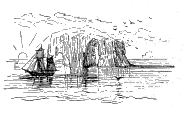
AMONG THE ICEBERGS.
As the fog lifted and rolled itself up like a scroll
over the sea to the westward, iceberg after iceberg
burst into view, like castles in a fairy tale. It seemed,
indeed, as if we had been drawn by some unseen hand
into a land of enchantment, rather than that we had
come of our own free will into a region of stern realities,
in pursuit of stern purposes;—as if the elves
of the North had, in sportive playfulness, thrown a
veil about our eyes, and enticed us to the very "seat
eternal of the gods." Here was the Valhalla of the
sturdy Vikings; here the city of the sun-god Freyer,—Alfheim,
with its elfin caves,—and Glitner, with its
walls of gold and roofs of silver, and Gimle, more
brilliant than the sun,—the home of the happy; and
there, piercing the clouds, was Himinborg, the Celestial
Mount, where the bridge of the gods touches
Heaven.
It would be difficult to imagine a scene more solemnly
impressive than that which was disclosed to us
by the sudden change in the clouded atmosphere.
From my diary I copy the following brief description
of it:—
"Midnight.—I have just come below, lost in the
wondrous beauty of the night. The sea is smooth as
glass; not a ripple breaks its dead surface, not a
breath of air stirring. The sun hangs close upon the
northern horizon; the fog has broken up into light
clouds; the icebergs lie thick about us; the dark
headlands stand boldly out against the sky; and the
clouds and sea and bergs and mountains are bathed in
an atmosphere of crimson and gold and purple most
singularly beautiful."
BEAUTY OF THE ICEBERGS.
In all my former experience in this region of startling
novelties I had never seen any thing to equal
what I witnessed that night. The air was warm almost
as a summer's night at home, and yet there were
the icebergs and the bleak mountains, with which the
fancy, in this land of green hills and waving forests,
can associate nothing but cold repulsiveness. The
sky was bright and soft and strangely inspiring as the
skies of Italy. The bergs had wholly lost their chilly
aspect, and, glittering in the blaze of the brilliant
heavens, seemed, in the distance, like masses of burnished
metal or solid flame. Nearer at hand they
were huge blocks of Parian marble, inlaid with mammoth
gems of pearl and opal. One in particular exhibited
the perfection of the grand. Its form was not
unlike that of the Coliseum, and it lay so far away
that half its height was buried beneath the line of
blood-red waters. The sun, slowly rolling along the
horizon, passed behind it, and it seemed as if the old
Roman ruin had suddenly taken fire.
Nothing indeed but the pencil of the artist could
depict the wonderful richness of this sparkling fragment
of Nature. Church, in his great picture of "The
Icebergs," has grandly exhibited a scene not unlike
that which I would in vain describe.
In the shadows of the bergs the water was a rich
green, and nothing could be more soft and tender
than the gradations of color made by the sea shoaling
on the sloping tongue of a berg close beside us. The
tint increased in intensity where the ice overhung
the water, and a deep cavern near by exhibited the
solid color of the malachite mingled with the transparency
of the emerald; while, in strange contrast, a
broad streak of cobalt blue ran diagonally through
its body.
The bewitching character of the scene was heightened
by a thousand little cascades which leaped into
the sea from these floating masses,—the water being
discharged from lakes of melted snow and ice which
reposed in quietude far up in the valleys separating
the high icy hills of their upper surface. From other
bergs large pieces were now and then detached,—plunging
down into the water with deafening noise,
while the slow moving swell of the ocean resounded
through their broken archways.
I had been watching this scene for hours, lost in
reverie and forgetfulness, when I was brought suddenly
to my senses by the master's mate, who came
to report, "Ice close aboard, sir." We were drifting
slowly upon a berg about the height of our topmasts.
The boats were quickly lowered to pull us off, and,
the schooner once more in safety, I went to bed.
I awoke after a few hours, shivering with the cold.
The "bull's-eye" above my head was open, and a
chilly fog was pouring in upon me. Hurrying on
deck, I found the whole scene changed. A dense
gray mist had settled over the waters and icebergs
and mountains, blending them all in chaotic gloom.
Twenty-four days at sea had brought the water
very low in our casks, and I took advantage of the
delay to send off to a neighboring iceberg for a fresh
supply. The water of these bergs is pure and clear
as crystal.
NEARING HARBOR.
AT PRÖVEN.
Getting at last a slant of the wind, we ran in among
the low islands which line the coast above Svarte
Huk; and Sonntag, who had gone ahead in a boat to
Pröven, having sent off to us a swarthy-looking pilot,
we wound our way slowly through the tortuous passage,
and at a little after midnight of August 6th we
dropped anchor in the snuggest of little harbors.
The loud baying of dogs, and an odor, baffling description,—"a
very ancient and fish-like smell,"—first
warned us of our approach to a Greenland settlement.
CHAPTER III.
THE COLONY OF PRÖVEN.—THE KAYAK OF THE GREENLANDER.—SCARCITY
OF DOGS.—LIBERALITY OF THE CHIEF TRADER.—ARCTIC FLORA.
We were escorted into the harbor of Pröven by the
strangest fleet of boats and the strangest-looking boatmen
that ever convoyed a ship. They were the far-famed
kayakers of Greenland, and they deserve a
passing notice.
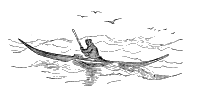
THE KAYAK OF THE GREENLANDER.
The kayak of the Greenlander is the frailest specimen
of marine architecture that ever carried human
freight. It is eighteen feet long and as many inches
wide at its middle, and tapers, with an upward curving
line, to a point at either end. The skeleton of
the boat is made of light wood; the covering is of
tanned seal-skin, sewed together by the native women
with sinew thread, and with a strength and dexterity
quite astonishing. Not a drop of water finds its way
through their seams, and the skin itself is perfectly
water-proof. The boat is about nine inches deep, and
the top is covered like the bottom. There is no
opening into it except a round hole in the centre,
which admits the hunter as far as his hips. This
hole is surrounded with a wooden rim, over which the
kayaker laces the lower edge of his water-tight jacket,
and thus fastens himself in and keeps the water out.
He propels himself with a single oar about six feet
long, which terminates in a blade or paddle at either
end. This instrument of locomotion is grasped in the
centre, and is dipped in the water alternately to right
and left. The boat is graceful as a duck and light as
a feather. It has no ballast and no keel, and it rides
almost on the surface of the water. It is therefore
necessarily top-heavy. Long practice is required to
manage it, and no tight-rope dancer ever needed
more steady nerve and skill of balance than this same
savage kayaker. Yet, in this frail craft, he does not
hesitate to ride seas which would swamp an ordinary
boat, or to break through surf which may sweep completely
over him. But he is used to hard battles,
and, in spite of every fortune, he keeps himself upright.
I watched their movements with much interest as
they collected about the schooner. Among the benefits
which they had derived from civilization was an
appreciation of the value of rum, coffee, and tobacco;
and they were not overly modest in their demands
for these articles. Most of them had, however, something
to trade, and went home with their reward.
One old fellow who had managed to pick up a few
words of English, without being particularly clear as
to their meaning, was loud in his demands for a
"pound rum, bottle sugar," offering in exchange a
fine salmon.
SCARCITY OF DOGS.
I had intended to remain at Pröven only a single
day, and then to hasten on with all possible speed;
but our stay was prolonged by circumstances to which
I was forced to submit with as good a grace as possible.
It was idle for me to leave without a supply of dogs, for
my plans and preparations were entirely based upon
them; and the prospect of accomplishing my design
in this respect appeared, from the first, very feeble.
In order to save time, Sonntag had gone to the village
when we lay becalmed off Svarte Huk, and he
returned on board with the most discouraging accounts
of the poverty of the settlements in that
which was such an essential addition to our equipment.
A disease which had prevailed among the
teams, during the past year, had diminished the stock
to less than half of what was required for the prosperity
of the people; and all our offers to purchase,
either with money or provisions, were at first flatly
refused, and were in the end only partially successful.
Mr. Sonntag had called upon the Assistant Trader
immediately after his arrival, and was at once informed
by that official of the unfortunate state of affairs. He
would, however, personally interest himself in the
matter, and advised that we should await the arrival
of the Chief Trader, Mr. Hansen, who resided at
Upernavik, which is forty miles to the north, and
would be in Pröven in a day or so. It was evident
that nothing could be done without the aid of this
all-powerful public functionary, for whose arrival we
had no alternative but to wait. If we went on to
Upernavik we ran the hazard of missing him; and,
by not seeing him until his return to that settlement
from his southern tour, of losing the advantage of his
prompt coöperation.
Mr. Hansen arrived the following day, and assured
me that he would do what was in his power; but he
feared that he should have little success. As an earnest
of his good-will, he informed me, with a delicate
courtesy which made me for the moment wonder if a
lordly son of Castile had not wandered to this land of
ice, and disguised himself in a seal-skin coat, that his
own teams were at my disposal. Beyond this, however,
he could neither advise nor command. There
was no public stock from which to supply my wants;
and so great and universal had been the ravages of
disease among the animals, that many hunters were
wholly destitute, and none were in possession of their
usual number. He however at once dispatched a courier
to Upernavik, and others to various small settlements,
and thus heralded the news that any hunter
who had an extra dog would find a market for it by
bringing it forthwith to Pröven or Upernavik.
LIBERALITY OF THE CHIEF TRADER.
This action of the Chief Trader was the more appreciated
that it was disinterested, and was uncalled
for either by any official demands which were laid
upon him, or by any special show of dignity or importance
with which the insignificant schooner lying
in the harbor could back up my claims. The State
Department at Washington had, at my solicitation,
requested from the Danish Government such recognition
for me as had been hitherto accorded to the
American and English naval expeditions; but the
courteous response which came in the form of a command
to the Greenland officials to furnish me with
every thing in their power did not reach the settlements
until the following year. The commands of his
Majesty the King could not, however, have stood me
in better stead than the gentlemanly instincts of Mr.
Hansen.
There is little in the history of Pröven, either past
or present, that will interest the readers of this narrative.
What there is of it stands on the southern
slope of a gneissoid spur which forms the terminus of
one of the numerous islands of the vast archipelago
lying between the peninsula of Svarte Huk and Melville
Bay. A government-house, one story high and
plastered over with pitch and tar, is the most conspicuous
building in the place. A shop and a lodging-house
for a few Danish employees stands next in importance.
Two or three less imposing structures of
the pitch and tar description, inhabited by Danes who
have married native women; a few huts of stone and
turf, roofed with boards and overgrown with grass;
about an equal number of like description, but without
the board roof, and a dozen seal-skin tents, all
pitched about promiscuously among the rocks, make
up the town. There is a blubber-house down by the
beach, and a stunted flag-staff on the hill, from which
the Danish Flag gracefully waving in the wind, gave
the place a show of dignity. The dignity of civilization
was further preserved by an old cannon which
lay on the grass under the flag, and whose rusty
throat made the welkin ring as our anchor touched
the Greenland rocks.
THE SETTLEMENT.
The settlement, or Colonien, as the Danes distinguish
it, dates back almost to the days of good old Hans
Egede, and its name, as nearly as can be interpreted,
signifies "Experiment;" and, after the Greenland
fashion, a successful experiment it has been. Its people
live, chiefly, by hunting the seal; and, of all the
northern colonies, few have been as prosperous. The
collections of oil and skins during some years are sufficient
to freight a brig of three hundred tons.
The place bears ample evidence of the nature of
its business. Carcasses of seals and seal's offal lay
strewn along the beach, and over the rocks, and
among the huts, in every stage of decomposition; and
this, added to every other conceivable accumulation
that could exhibit a barbarous contempt for the human
nose, made the first few hours of our stay there
any thing but comfortable.
ARCTIC FLORA.
A better prospect, however, greeted us behind the
town. A beautiful valley lay there, nestling between
the cliffs, and rich in Arctic vegetation. It
was covered with a thick turf of moss and grasses,
among which the Poa Arctica, Glyceria Arctica, and Alopecurus
Alpinus were most abundant. In places it was,
indeed, a perfect marsh. Little streams of melted
snow meandered through it, gurgling among the
stones, or dashing wildly over the rocks. Myriads of
little golden petaled poppies (Papaver nudicaule) fluttered
over the green. The dandelion (Leontodon palustre),
close kindred of the wild flower so well known
at home, kept it company; the buttercup (Ranunculus
nivalis), with its smiling, well-remembered face, was
sometimes seen; and the less familiar Potentilla and
the purple Pedicularis were dotted about here and
there. The saxifrages, purple, white, and yellow,
were also very numerous. I captured not less than
seven varieties. The birch and crowberry, and the
beautiful Andromeda, the heather of Greenland, grew
matted together in a sheltered nook among the rocks;
and, in strange mimicry of Southern richness, the willows
feebly struggled for existence on the spongy turf.
With my cap I covered a whole forest of them.
VALUE OF DOGS
I had been in Pröven in 1853, and the place had
not changed in the interval. The old ex-trader Christiansen
was there, a little older, but not less frugal
than before. He complained bitterly of Dr. Kane
not having kept his promises to him, and I endeavored
to mollify his wrath by assuring him that Dr.
Kane had lost his vessel and could not return; but
his life had been made unhappy during seven long
years by visions of a barrel of American flour, and
he would not be comforted. He was scarcely able to
crawl about; but, when I sent ashore to him the coveted
treasure, he found strength to break the head out
of the cask, to feast his eyes on the long-expected
gratuity. His sons, each with a brood of Esquimaux
visaged, though flaxen-haired children, crowded around
the present. My diary records that they were the
best hunters in the settlement, and that they had the
best teams of dogs; and it also mentions, with a little
chagrin, that they would not sell one of them. I attributed
this obstinacy, at the time, to their cross old
paternal relative; but there were better reasons than
this. They knew by bitter experience the risks of
going into the long winter without an ample supply
of dogs to carry them over the ice upon the seal hunt,
and to part with their animals was to risk starvation.
I offered to give them pork and beef and canned
meats, and flour and beans; but they preferred the
seal and the excitement of the hunt, and refused to
trade.
At last the couriers had all come in, bringing unwelcome
news. A half-dozen old dogs and a less number
of good ones were all that I had to console myself
for the delay; but the Chief Trader had returned to
Upernavik, from which place I had received more encouraging
accounts than from the lower stations.
CHAPTER IV.
UPERNAVIK.—HOSPITALITY OF THE INHABITANTS.—DEATH AND BURIAL OF
GIBSON CARUTHERS.—A LUNCH ON BOARD.—ADIEU.
We put to sea early in the morning of the 12th,
and in the evening of the same day were at Upernavik.
The entrance to the harbor is somewhat unsafe,
owing to a reef which lies outside the anchorage; but
we were fortunate in obtaining a native pilot at Pröven,
and ran in without accident. This pilot was a
character in his way. It seems that he had been converted
from his heathen ways, and rejoiced in the
benefits of baptism and the name of Adam. Dressed
in a well-worn suit of seal-skins, Adam had about him
little of the sailor trigness; yet, though not a Palinurus,
no pilot in all the world had ever a higher appreciation
of his personal importance. His appearance,
however, was not calculated to inspire any great degree
of confidence in his skill; and the sailing-master
plied him so incessantly with questions that he at
length grew impatient; and, concentrating his vanity
and knowledge into one short sentence, which signified
plainly, "I am master of the situation," he informed
that officer that there was "plenty water all
de times, no rocks altogeder," and retired with every
mark of offended dignity. He was correct in his information,
if not in his English.
We found the Danish brig Thialfe lying snugly
moored in the harbor, and we anchored close beside
her. This was the first vessel we had seen since leaving
the fishing-smacks off Cape Cod. She was taking
in oil and skins for Copenhagen, and her commander,
Mr. Bordolf, informed me that he expected to sail in a
few days,—a chance, at last, for letters to the anxious
ones at home.
The people of the Colony were already much excited
over the arrival of the "Danske skip," and two
vessels in the port at once was a sight which they had
not for a long time witnessed. The moss-covered hill
which slopes from the town to the beach was covered
with a motley-group of men, women, and children,
presenting quite a picturesque appearance as we approached
the anchorage.
Mr. Hansen received me with true Scandinavian
heartiness; and, escorting me to the government-house,
introduced me to the retiring Chief Trader,
Dr. Rudolph, a very gentlemanly representative of
the Danish Army, who was about returning home in
the Thialfe. Over a jug of home-brewed beer and a
Dutch pipe, we were soon discussing the prospect of
obtaining dogs and the state of the ice to the northward.
UPERNAVIK
THE PARSONAGE
Upernavik differs but little in its general appearance
from Pröven. There are a few more huts and a
few more inhabitants; and, from being the residence
of the Chief Trader for the "Upernavik district,"
which includes Pröven and its dependencies, it has
attached to it something more of importance. Perhaps
this is, in a measure, due to a quaint little church
and a parsonage. To the parsonage I quickly found
my way, for I fancied that from behind the neat muslin
curtains of its odd little windows I detected a
female face. I tapped at the door, and was ushered
into a cosy little apartment, (the fastidious neatness of
which left no doubt as to the sex of its occupants,) by
the oddest specimen of woman-kind that ever answered
bell. She was a full-blown Esquimau, with coppery
complexion and black hair, which was twisted into a
knot on the top of her head. She wore a jacket
which extended to her waist, seal-skin pantaloons, and
boots reaching above the knees, dyed scarlet and embroidered
in a manner that would astonish the girls
of Dresden. The room was redolent of the fragrant
rose and mignonette and heliotrope, which nestled in
the sunlight under the snow-white curtains. A canary
chirped on its perch above the door, a cat was purring
on the hearth-rug, and an unmistakable gentleman
put out a soft white hand to give me welcome. It
was the Rev. Mr. Anton, missionary of the place.
Mrs. Anton soon emerged from a snug little chamber
adjoining. Her sister came in immediately afterward,
and we were soon grouped about a home-like table;
a genuine bottle of Lafitte, choice coffee, Danish fare,
and Danish heartiness, quickly made us forget the
hardships of our cramped life in the little tempest-tossed
schooner.
My visit to Mr. Anton had, however, an association
of much sadness. A valued member of my party,
Mr. Gibson Caruthers, had died during the previous
night, and I called to ask the missionary to officiate at
the funeral service. His consent was promptly given,
and the hour of burial was fixed for the following
day.
The burial of a companion, at any time painful, was
doubly so to us, isolated as we were from the world.
The deceased had endeared himself to all on board by
his excellent qualities of head and heart; and the
suddenness of his death made the impression upon his
late associates all the more keenly felt. He had retired
the night before in perfect health, and was found
dead in his berth next morning. To the expedition
he was a serious loss. Besides Mr. Sonntag, he was
the only member of my party who had been in the
Arctic seas, and I had counted much upon his knowledge
and intelligence. He had served under De Haven
in the First Grinnell Expedition of 1850-51, and had
brought home an excellent record for fortitude and
daring.
AN ARCTIC SEPULCHRE.
The burial-ground at Upernavik is a sad place for
human sepulchre. It lies on the hill-side above the
town, and is dreary and desolate past description.
It is made up of a series of rocky steps, on which lie,
covered over with piles of stones, (for there is no
earth,) a few rude coffins,—mournful resting-place
for those who sleep here their last sleep in the everlasting
winter. The body of poor Caruthers lies upon a
ledge overlooking the sea, which he loved so well, and
the beating surf will sing for him an eternal requiem.
We were detained four days at Upernavik, collecting
dogs and accumulating the elements of an Arctic
wardrobe. This last consisted of reindeer, seal, and
dog skins, a quantity of which had been obtained at
Pröven, and placed in the hands of the native women,
to be converted into suitable garments. The boots
required the longest time to manufacture. They are
made of tanned seal-skin, sewed with sinew, and are
"crimped" and fitted to the foot in a very ingenious
manner. When properly made they are perfectly
water-proof. The boot worn by the half-civilized native
women is really a pretty as well as serviceable
piece of cunning needlework. The tanned seal-skin,
by alternate freezing and thawing, and exposure to
the sun, becomes perfectly bleached, and in that condition
is readily stained with any color which woman's
caprice may suggest, or the Chief Trader may happen
to have in his store-room. The women of Greenland
are not exempt from the graceful vanities of other
lands. They are fond of gay colors, and do not disdain
admiration. Red boots, or white, trimmed with
red, seemed to be most in vogue, though, indeed, there
is no more an end to the variety than there is to the
strangeness of the fancy which suggests it. It would
be difficult to imagine a more ludicrous sight than
was presented by the crowd of red and yellow and
white and purple and blue legged women who crowded
along the beach as we entered the harbor.
POPULATION OF UPERNAVIK.
The population of Upernavik numbers about two
hundred souls, comprising about twenty Danes, and a
larger number of half-breeds, the remainder being native
Greenlanders, that is, Esquimaux. I shall have
more to say of them hereafter, my purpose now being
to carry the reader as rapidly as possible to the scene
of our explorations. He may indeed have as much
anxiety to get away from Upernavik as I had.
NEW RECRUITS.
Through the kindness of Mr. Hansen, I obtained
here three native hunters, and also an interpreter.
This latter had taken passage by the Thialfe for Copenhagen,
but he could not withstand the tempting
offer which I made him, and he quickly transferred
himself from the Danish brig to our crowded cabin.
He was a hearty, strong man, had lived in Greenland
for ten years; and, being more than usually intelligent,
had picked up on board the English whale-ships
a sufficient knowledge of the English language
to insure his being a very useful member of my party
in the event of our falling in with Esquimaux, with
whose language he was perfectly familiar. Besides,
he was an excellent hunter and dog-driver; and, by
joining me, I secured his team of dogs, the finest in
all North Greenland. But unfortunately this involved
another halt, for they were sixty miles up the coast,
at Tessuissak, a small hunting station of which he was
Trader at the time of obtaining his leave of absence
to go home for the year. I also shipped two Danish
sailors, thus increasing my party to twenty souls. As
the new recruits will figure frequently in these pages,
I give their names:—
Peter Jensen,
Interpreter and dog-manager.
Carl Emil Olswig,
Sailor.
Carl Christian Petersen,
Sailor and Carpenter.
Peter (converted Esquimau),
Hunter and dog-driver.
Marcus, " "
" "
Jacob, " "
" "
I owe much to the kindly disposition of the inhabitants
of Upernavik. Their simple though cordial
hospitality was a refreshing incident of our cruise;
and the constant desire to supply my wants, and the
pains which they took to furnish what I so much
needed, is gratefully remembered. If those in authority
had allowed me to shift for myself I should have
been badly off indeed. I mention it to their credit
that they refused compensation of every kind; and it
was not without great effort that I could prevail upon
any of them to accept so much as a barrel of flour or
a box of canned food. "You will want them more
than we," was the uniform answer. The Chief Trader
actually sent aboard a present I had made him in return
for the fine team of dogs which I owed to his
generosity.
A LUNCH ON BOARD.
It was in some measure to show my appreciation
of the spirit which prompted these warm-hearted people
that I resolved to signalize our departure with a
lunch to the representatives of King Frederick the
Seventh, at this most northern outpost of Christian
settlement. Accordingly I sent my secretary, Mr.
Knorr, out with some formal-looking invitations, gotten
up in all the dignity of Parisian paper and rose-scented
wax. He came back in a few hours with
three couples. Two of the ladies were from the parsonage;
the other was the wife of the Chief Trader.
Dr. Rudolph, Mr. Hansen, and the missionary, were
their escorts. The master of the Thialfe was already
on board.
Meanwhile our old Swedish cook had gone half
crazy, and the steward kept him company. To prepare
a lunch for ladies in these high latitudes was not
within their conception of the hard-fisted requirements
of exploration dignity. They "could not understand
it." The steward contrived, however, to
stow away in the bunks the seal-skins which encumbered
the cabin, and thus got rid of all our Greenland
rubbish but the odor. But it was not until the clean
white table-cloth, which he produced from some out-of-the-way
locker, was covered with the smoking dishes
which his ingenuity had contrived, that his face was
lit up with any thing approaching the kindly. Being,
however, in a general way a mild-mannered man, his
ferocious looks did not materially affect the progress
of the preparations; and the solemn face with which
he predicted, in great confidence, to the cook that
"such folly would bring us all to ruin, indeed it
would," at length wore a ghastly smile, and finally
exhibited decided manifestations of a forgiving disposition.
Indeed, he was in the end very proud of his
"spread."
A LUNCH ON BOARD.
In truth, the spread was a very creditable affair.
The contents of our hermetically sealed cans furnished
a welcome variety to these dwellers in the land of
seals; the lakes of Greenland supplied some noble
salmon, and my lockers contributed something from
sunny France and golden Italy, and the materials for
an excellent punch from Santa Cruz. At first we got
on badly with the conversation, but by and by English,
Danish, German, and bad Latin became mixed
harmoniously together like the ingredients of the
punch; healths were drunk,—to the King, to the
President, to all good fortune, to ourselves, and
speeches were made, in which were duly set forth
the glorious memories of the children of Odin. The
merriment was waxing warm. Some one, stimulated
perhaps by a recent tribute of praise to the valiant
Harold and the Russian Maiden, and the fights and
loves of the vikings generally, had just proposed that
best toast of the sailor, "sweethearts and wives," and
obtained a fitting response, when the heavy thump
of a pair of mammoth sea-boots was heard on the
companion-ladder, and the master's mate broke in
upon us like the ghost of Banquo.
"The officer of the deck directs me to report, sir,
that the dogs are all aboard, sir, and that he is hove
short on the anchor, as ordered, sir."
"How's the wind?"
"Light, and southerly, sir."
FAREWELL TO UPERNAVIK.
There was no help for it. The guests must be got
away. The ladies' "things" were hunted up; the ladies
themselves were hurried over the gangway into
the boat; Dr. Rudolph took charge of our letters,
promising to deliver them to the American consul at
Copenhagen; "click, click," went the windlass; up
went our white wings, and the last link which bound
us to the world—the world of love and warm skies
and green meadows—was fairly broken, when we
caught from the hill-top the last glimpse of a gay
ribbon and the last flutter of a white handkerchief.
CHAPTER V.
AMONG THE ICEBERGS.—DANGERS OF ARCTIC NAVIGATION.—A NARROW
ESCAPE FROM A CRUMBLING BERG.—MEASUREMENT OF AN ICEBERG.
AMONG THE ICEBERGS.
Upernavik is not less the limit of safe navigation
than the remotest boundary of civilized existence.
The real hardships of our career commenced before its
little white gabled church was fairly lost against the
dark hills behind it. A heavy line of icebergs was discovered
to lie across our course; and, having no alternative,
we shot in among them. Some of them proved
to be of enormous size, upwards of two hundred feet
in height and a mile long; others were not larger
than the schooner. Their forms were as various as
their dimensions, from solid wall-sided masses of dead
whiteness, with waterfalls tumbling from them, to an
old weather-worn accumulation of Gothic spires, whose
crystal peaks and sharp angles melted into the blue
sky. They seemed to be endless and numberless, and
so close together that at a little distance they appeared
to form upon the sea an unbroken canopy of
ice; and when fairly in among them the horizon was
completely obliterated. Had we been in the centre
of the Black Forest, we could not have been more absolutely
cut off from "seeing daylight." As the last
streak of the horizon faded from view between the
lofty bergs behind us, the steward (who was of a poetical
turn of mind) came from the galley, and halting
for an instant, cast one lingering look at the opening,
and then dropped through the companion scuttle, repeating
from the "Inferno":—
"They who enter here leave hope behind."
The officers were calling from below for their coffee,
and it was never discovered whether the steward was
thinking of the cabin or the icebergs.
During four days we continued threading our way
through this apparently interminable labyrinth. The
days passed wearily away, for the wind, at best but a
"cat's paw," often died away to a dead calm, leaving
us to lounge through the hours in a chilly fog or in
the broad blaze of the constant daylight. If this state
of things had its novelty, it had too its dangers and
anxieties.
PHOTOGRAPHING.
The bergs, influenced only by the under-currents,
were, to us, practically stationary; and the surface
flow of the water which drifted us to and fro, when
we lost our steerage-way, rendered our situation any
thing but safe. They soon came to be looked upon
as our natural enemies, and were eyed with suspicion.
We were often drifted upon them, and escaped not
without difficulty and alarm; and many times more
we saved ourselves from collision by the timely lowering
of the boats and taking the schooner in tow, or
by planting an ice-anchor in another berg and warping
ourselves into greater security. Sometimes we
tied up to a berg and waited for the wind. We had
hard work, and made little progress. I found consolation,
however, in my sketch-book, which was in
constant use; and one fine day I got out my photographic
apparatus. Landing on a neighboring island,
with the aid of my two young assistants, Radcliffe and
Knorr, I made my first trial at this new business. It
was altogether unsatisfactory, except to convince me
that, with perseverance, we might succeed in obtaining
at least fair pictures.
Practically I knew nothing whatever of the art. It
was a great disappointment to me that I could not
secure for the expedition the services of a professional
photographer; but this deficiency did not, I am happy
to say, prevent me, in the end, from obtaining some
views characteristic of the rugged beauties of the Arctic
landscape. We had, however, only books to guide
us. With our want of knowledge and an uncomfortable
temperature to contend with, we labored under
serious disadvantages.
Sonntag went ashore with me, and obtained good
sextant sights for our position, and some useful results
with the magnetometer. Knorr added to my collection
some fine specimens of birds. The gulls, mollimuks
and burgomeisters, the chattering kittiwake
and the graceful tern were very numerous. They
fairly swarmed upon the bergs. The hunters were
often out after eider-ducks, large flocks of which congregate
upon the islands, and sweep over us in long
undulating lines. Seals, too, were sporting about the
vessel, bobbing their intelligent, almost human-looking
faces up and down in the still water, marks for the
fatal rifles of our sportsmen. They looked so curiously
innocent while making their inspections of us
that I would not have had the heart to kill them,
were it not that they were badly needed for the dogs.
We led a strange weird sort of life,—a spice of
danger, with much of beauty and a world of magnificence.
I should have found pleasure in the lazy hours,
but that each hour thus spent was one taken from my
more serious purposes, and this reflection made the
days irksome to me.
IN DANGER.
Four days of almost constant calm would tax the
patience of even Job-like resignation. We had a
breath of wind now and then to tantalize us, treacherous
currents to keep us ever anxious, icebergs always
threatening us; now at anchor, then moored to
a berg, and again keeping free from danger through a
hard struggle with the oars. We had many narrow
escapes, one of which, as illustrating a peculiar feature
of Arctic navigation, is perhaps worthy of more particular
record.
We had made a little progress during the night,
but soon after breakfast the wind died away, and the
schooner lay like a log upon the water. Giving too
little heed to the currents, we were eagerly watching
the indications of wind which appeared at the south,
and hoping for a breeze, when it was discovered that
the tide had changed, and was stealthily setting us
upon a nest of bergs which lay to leeward. One
of them was of that description known among the
crew by the significant title of "Touch me not," and
presented that jagged, honey-combed appearance indicative
of great age. They are unpleasant neighbors.
The least disturbance of their equilibrium may
cause the whole mass to crumble to pieces, and woe
be unto the unlucky vessel that is caught in the dissolution.
In such a trap it seemed, however, that we stood a
fair chance of being ensnared. The current was carrying
us along at an uncomfortably rapid rate. A
boat was lowered as quickly as possible, to run out a
line to a berg which lay grounded about a hundred
yards from us. While this was being done, we grazed
the side of a berg which rose a hundred feet above
our topmasts, then slipped past another of smaller
dimensions. By pushing against them with our ice-poles
we changed somewhat the course of the schooner;
but when we thought that we were steering clear
of the mass which we so much dreaded, an eddy
changed the direction of our drift, and carried us almost
broadside upon it.
FIGHTING AN ICEBERG.
The schooner struck on the starboard quarter, and
the shock, slight though it was, disengaged some fragments
of ice that were large enough to have crushed
the vessel had they struck her, and also many little
lumps which rattled about us; but fortunately no person
was hit. The quarter-deck was quickly cleared,
and all hands, crowding forward, anxiously watched
the boat. The berg now began to revolve, and was
settling slowly over us; the little lumps fell thicker
and faster upon the after-deck, and the forecastle was
the only place where there was the least chance of
safety.
At length the berg itself saved us from destruction.
An immense mass broke off from that part which was
beneath the surface of the sea, and this, a dozen times
larger than the schooner, came rushing up within a few
yards of us, sending a vast volume of foam and water
flying from its sides. This rupture arrested the revolution,
and the berg began to settle in the opposite
direction. And now came another danger. A long
tongue was protruding immediately underneath the
schooner; already the keel was slipping and grinding
upon it, and it seemed probable that we should be
knocked up into the air like a foot-ball, or at least
capsized. The side of our enemy soon leaned from us,
and we were in no danger from the worse than hail-stone-showers
which had driven us forward; so we
sprang to the ice-poles, and exerted our strength in
endeavoring to push the vessel off. There were no
idle hands. Danger respects not the dignity of the
quarter-deck.
PULLING FOR LIFE.
After we had fatigued ourselves at this hard labor
without any useful result, the berg came again to our
relief. A loud report first startled us; another and
another followed in quick succession, until the noise
grew deafening, and the whole air seemed a reservoir
of frightful sound. The opposite side of the berg had
split off, piece after piece, tumbling a vast volume of
ice into the sea, and sending the berg revolving back
upon us. This time the movement was quicker; fragments
began again to fall; and, already sufficiently
startled by the alarming dissolution which had taken
place, we were in momentary expectation of seeing
the whole side nearest to us break loose and crash
bodily upon the schooner, in which event she would
inevitably be carried down beneath it; as hopelessly
doomed as a shepherd's hut beneath an Alpine avalanche.
By this time Dodge, who had charge of the boat,
had succeeded in planting an ice-anchor and attaching
his rope, and greeted us with the welcome signal,
"Haul in." We pulled for our lives, long and steadily.
Seconds seemed minutes, and minutes hours. At
length we began to move off. Slowly and steadily
sank the berg behind us, carrying away the main-boom,
and grazing hard against the quarter. But we
were safe. Twenty yards away, and the disruption
occurred which we had all so much dreaded. The side
nearest to us now split off, and came plunging wildly
down into the sea, sending over us a shower of spray,
raising a swell which set us rocking to and fro as if in
a gale of wind, and left us grinding in the débris of the
crumbling ruin.
CRUMBLING ICEBERGS.
At last we succeeded in extricating ourselves, and
were far enough away to look back calmly upon the
object of our terror. It was still rocking and rolling
like a thing of life. At each revolution fresh masses
were disengaged; and, as its sides came up in long
sweeps, great cascades tumbled and leaped from them
hissing into the foaming sea. After several hours it
settled down into quietude, a mere fragment of its former
greatness, while the pieces that were broken from
it floated quietly away with the tide.
Whether it was the waves created by the dissolution
which I have just described, or the sun's warm
rays, or both combined, I cannot pretend to say, but
the day was filled with one prolonged series of reports
of crumbling icebergs. Scarcely had we been moored
in safety when a very large one about two miles distant
from us, resembling in its general appearance the
British House of Parliament, began to go to pieces.
First a lofty tower came plunging into the water,
starting from their inhospitable perch an immense
flock of gulls, that went screaming up into the air;
over went another; then a whole side settled squarely
down; then the wreck capsized, and at length after
five hours of rolling and crashing, there remained of
this splendid mass of congelation not a fragment that
rose fifty feet above the water. Another, which appeared
to be a mile in length and upwards of a hundred
feet in height, split in two with a quick, sharp,
and at length long rumbling report, which could
hardly have been exceeded by a thousand pieces of
artillery simultaneously discharged, and the two fragments
kept wallowing in the sea for hours before
they came to rest. Even the berg to which we were
moored chimed in with the infernal concert, and discharged
a corner larger than St. Paul's Cathedral.
EFFECTS OF DISSOLUTION.
No words of mine can adequately describe the din
and noise which filled our ears during the few hours
succeeding the encounter which I have narrated, and
therefore I borrow from the "Ancient Mariner":—
"The ice was here,
The ice was there,
The ice was all around;
It creaked and growled,
And roared and howled
Like demons in a swound."
It seemed, indeed, as if old Thor himself had taken
a holiday, and had come away from his kingdom of
Thrudwanger and his Winding Palace of five hundred
and forty halls, and had crossed the mountains
with his chariot and he-goats, armed with his mace
of strength, and girt about with his belt of prowess,
and wearing his gauntlets of iron, for the purpose
of knocking these Giants of the frost to right and
left for his own special amusement.
It is, however, only at this season of the year that
the bergs are so unneighborly. They are rarely
known to break up except in the months of July and
August. It must be then owing to an unevenly
heated condition of the interior and exterior, caused
by the sun's warm rays playing upon them. From
the sunny side of a berg I have not unfrequently seen
pieces discharged in a line almost horizontal, with
great force, and with an explosive report like a quarryman's
blast. These explosions and the crumbling
of the ice are always attended with a cloud of vapor,
no doubt caused by the colder ice of the interior being
brought suddenly in contact with the warmer air.
The effect is often very remarkable as well as beautiful,
especially when the cloud reflects the rays of the
sun.
BEAUTIES OF THE ICEBERGS.
If, however, my pen cannot convey a picture of
these icebergs in their more terrible aspects, it will, I
fear, be equally impotent to portray their wondrous
beauties. I have tried it once before, and was much
dissatisfied with the result. I had then, however, a
soft sky, when the whole heavens were a mass of rich,
warm color, the sea a dissolved rainbow, and the bergs
great floating monoliths of malachite and marble
bathed in flame. Now the sky was gray, the air clear,
and the ice everywhere a dead white or a cold transparent
blue.
I clambered up the sloping side of the berg to
which we were tied, and, from an elevation of nearly
two hundred feet, obtained a view which well repaid
me for the trouble of the venture. I am glad to say,
however, that I came down again before St. Paul's
Cathedral tumbled from its corner; an event which
sent us drifting away to a less uncomfortable neighborhood,
at the expense of an ice-anchor and eighty
fathoms of manilla line.
As I approached the berg, I was struck with the
remarkable transparency of the water. Looking over
the gunwale of the boat, I could trace the ice stretching
downward apparently to an interminable distance.
Looking back at the schooner, its reflection was a perfect
image of itself, and it required only the separation
of it from the surrounding objects to give to the mind
the impression that two vessels, keel to keel, were floating
in mid-air. This singular transparency of the water
was further shown when I had reached the top of the
berg. Off to the southeast a high rocky bluff threw
its dark shadow upon the water, and the dividing line
between sunlight and shade was so marked that it required
an effort to dispel the illusion that the margin
of sunlight was not the edge of a fathomless abyss.
VIEW FROM AN ICEBERG.
It is difficult for the mind to comprehend the immense
quantity of ice which floated upon the sea
around me. To enumerate the separate bergs was
impossible. I counted five hundred, and gave up in
despair. Near by they stood out in all the rugged
harshness of their sharp outlines; and from this, softening
with the distance, they melted away into the
clear gray sky; and there, far off upon the sea of
liquid silver, the imagination conjured up effigies both
strange and wonderful. Birds and beasts and human
forms and architectural designs took shape in the distant
masses of blue and white. The dome of St. Peter's
loomed above the spire of Old Trinity; and under
the shadow of the Pyramids nestled a Byzantine tower
and a Grecian temple.
To the eastward the sea was dotted with little islets,—dark
specks upon a brilliant surface. Icebergs,
great and small, crowded through the channels which
divided them, until in the far distance they appeared
massed together, terminating against a snow-covered
plain that sloped upward until it was lost in a dim
line of bluish whiteness. This line could be traced
behind the serrated coast as far to the north and
south as the eye would carry. It was the great mer
de glace which covers the length and breadth of the
Greenland Continent. The snow-covered slope was a
glacier descending therefrom,—the parent stem from
which had been discharged, at irregular intervals,
many of the icebergs which troubled us so much, and
which have supplied materials for this too long description.
TESSUISSAK.
At length a strong breeze came moaning among
the bergs, and sent us on our way rejoicing. In the
evening; of August 21st we were moored in a little
harbor scarcely large enough for the schooner to turn
round. We lay abreast of a rocky slope on which
were pitched a few seal-skin tents, inhabited by a set
of well-to-do-looking Esquimaux. I noticed two or
three native huts, overgrown with moss and grass, and
one, better looking than the rest, in which Jensen, my
interpreter, informed me that he had resided. The
place is called Tessuissak, which means "the place
where there is a bay." Sonntag went ashore with his
sextant and "horizon," to find out its exact position
in the world, an event which had not before come to
pass in its history, and which I fear was not duly appreciated
by its inhabitants.
We should have been away in a couple of hours;
but Jensen discovered that his team was scattered,
and many of the animals could not be found until
after much searching. Meanwhile some ice drifted
across the mouth of the harbor, and hermetically
sealed us up.
At last the dogs were all aboard, something over
thirty in number. The poor ones I had either given
away or exchanged, and we had four superb teams.
Thirty wild beasts on the deck of a little schooner!
Think of it, ye who love a quiet life and a tidy ship!
Some of them were in cages arranged along the bulwarks;
others running about the deck; all of them
badly frightened, and most of them fighting. They
made day and night hideous with their incessant
howling.
We were all ready for sea, and impatient to be off.
Our Arctic wardrobe was complete with a few purchases
made of the natives in exchange for pork and
beans. We were thoroughly prepared for the ice encounters.
The lines were all neatly and carefully
coiled; the ice-anchors and ice-hooks and ice-saws and
ice-chisels and ice-poles were all so placed that they
were within easy reach when wanted. The capstan
and windlass were free, and Dodge, who had not
forgotten his naval experience, reported "the decks
cleared for action." Would the tide float away the ice
and let us out?
I was growing very restless. The season was moving
on; already ice began to form; the temperature
was below freezing. The nights made a decided scum
on the fresh-water pools. I could count upon only
fifteen days of open season. The Fox was frozen up
in the "pack" on the 26th of August, 1857, only four
days later, notwithstanding her advantage of steam-power.
I did every thing I could to while away the tedium
of this detention. I tried the photographic apparatus,
and with less satisfactory results than before. I
tried dredging, without much to show for it; botanizing,
and found nothing which I had not already in
my Pröven and Upernavik collections. The flowers
warned me of the approach of winter. The petals
had begun to fall, and their drooping heads wore a
melancholy look. They seemed to be pleading with
the chilly air for a little longer lease of life.
MEASUREMENT OF AN ICEBERG.
One thing only was satisfactorily done. An immense
iceberg lay off the harbor, and I had the measurement
of it in my note-book, and a sketch of it in
my portfolio. The square wall which faced toward my
base of measurement was three hundred and fifteen feet
high, and a fraction over three quarters of a mile long.
The natives told me that it had been grounded for
two years. Being almost square-sided above the sea,
the same shape must have extended beneath it; and
since, by measurements made two days before, I had
discovered that fresh-water ice floating in salt water
has above the surface to below it the proportion of
one to seven, this crystalized piece of Eric's Greenland
had stranded in a depth of nearly half a mile. A rude
estimate of this monster, made on the spot, gave me
in cubical contents about twenty-seven thousand millions
of feet, and in weight something like two thousand
millions of tons. I leave the reader to calculate
for himself its equivalent in dollars and cents, were
it transported to the region of ice-creams and sherry-cobblers,
and how much of it would be required to
pay off the national debt, and how much more than
half a century it would withstand the attacks of the
whole civilized world upon it, for all those uses to
which luxury-loving man puts the skimmings of the
Boston ponds.
HEADING FOR MELVILLE BAY.
The tide at length carried off the ice which imprisoned
us, and in the evening of the 22d we were again
threading our way among the bergs and islands.
Cape Shackleton and the Horse's Head lay off the
starboard bow, and we were shaping our course for
Melville Bay.
CHAPTER VI.
ENTERING MELVILLE BAY.—THE MIDDLE ICE.—THE GREAT POLAR CURRENT—A
SNOW STORM.—ENCOUNTER WITH AN ICEBERG.—MAKING CAPE YORK—RESCUE
OF HANS.
The sun was now no longer above the horizon at
midnight, and the nights were growing gloomy, a circumstance
which warned us to additional carefulness.
Notwithstanding our precautions, we narrowly escaped
running upon a sunken reef which lies off the
Horse's Head, and is not laid down on the chart. We
came also among some ice-fields, the first that we had
yet encountered. The waves were rolling in threateningly
from the southwest, and the ice, tossing madly
upon them, gave us an uncomfortable sense of insecurity;
but we escaped into clear water after receiving
a few thumps which did no material damage to our
solid bows.
By eight o'clock in the morning we had Wilcox
Point clearly in view, and the Devil's Thumb loomed
above a light cloud which floated along its base. Before
us lay Melville Bay. Climbing to the fore-yard,
I swept the horizon with my glass;—there was no
ice in sight except here and there a vagrant berg.
To the westward an "ice-blink" showed us that the
"pack" lay there; but before us all was clear,—nothing
in sight but the "swelling and limitless billows."
No discovery of my life ever gave me greater gratification.
The fortunes of the expedition were, at
least for the present year, dependent upon an open
season, and my most sanguine anticipations did not
equal the apparent reality.
In order that the reader may appreciate, in some
measure, the satisfaction which I took in the prospect
that opened before me, it is necessary that I should
here pause to give a general description of the region
we were about to traverse, and an explanation of
the physical conditions which made this portion of
the Greenland waters of such conspicuous importance
in the destinies of our voyage.
MELVILLE BAY.
The shores of Melville Bay, as laid down on the
maps, appear as a simple curved line of the Greenland
coast; but the Melville Bay of the geographer comprehends
much less than that of the mariner. The
whalers have long called by that name the expansion
of Baffin Bay which begins at the south with the
"middle ice," and terminates at the north with the
"North Water." The North Water is sometimes
reached near Cape York, in latitude 76°, but more
frequently higher up; and the "middle ice," which
is more generally known as "the pack," sometimes
stretches down to the Arctic Circle. This pack is
made up of drifting ice-floes, varying in extent from
feet to miles, and in thickness from inches to fathoms.
These masses are sometimes pressed close together,
having but little or no open space between them;
and sometimes they are widely separated, depending
upon the conditions of the wind and tide. They are
always more or less in motion, drifting to the north,
south, east, or west, with the winds and currents. The
penetration of this barrier is usually an undertaking
of weeks or months, and is ordinarily attended with
much risk.
Since the days when Baffin first penetrated these
waters, in the Discovery, a vessel of fifty-eight tons burden,
(it was in the year 1616,) a fleet of whale-ships
has annually run this gauntlet. The fleet was once
large, numbering upwards of a hundred sail; but of
latter years it has been reduced to less than one tenth
of its former magnitude. Great though the danger, it
has always been a favorite route of the whale fishers.
Many a stout ship has gone down with her sides mercilessly
crushed in by the "thick-ribbed ice;" but
those vessels which escape disaster almost uniformly
return home with holds well filled with the blubber
and oil of unlucky whales whose evil destiny led them
to frequent the waters about Lancaster Sound, Pond's
Bay, and the coasts below.
THE MIDDLE ICE.
The "middle ice" is always more or less in motion,
and is never tightly closed up, even in midwinter.
Of this we have abundant proof in the fate of the
Steamer Fox, which was caught towards the close of
the autumn, and released in the spring, after a perilous
winter drift, down near the Arctic Circle.
As the summer advances, it becomes more and more
broken up; and, little by little, the solid land-belt, which
is known as the "fast" or "land-ice," is encroached
upon. Of this, however, there usually remains a narrow
strip up to the close of the season. To it the
whalers cling most tenaciously, and the exploring vessels
have usually followed their example, taking always
the last crack that has opened, or, as they call
it, the "in-shore lead." They have naturally a great
horror of being caught in the "pack." The "fast"
gives them security if the wind brings the ice down
upon them from the westward, for they can always
saw a dock for their ships in the solid ice, or find a
bight in which to moor the vessel. They have always,
too, the advantage of being able, when the ice is loose
and there is no wind, to tow their vessel along its
margin with the crew, steam being rarely used by the
whalers.
THE GREAT POLAR CURRENT.
The currents have much to do with the formation
of this barrier. The great Polar Current coming down
through the Spitzbergen Sea along the eastern coast
of Greenland, laden with its heavy freight of ice, and
bringing from the rivers of Siberia a meagre supply
of drift-wood to the Greenlanders, sweeps around Cape
Farewell and flows northward as far as Cape York,
where it is deflected to the westward. Joining here
the ice-encumbered current which comes from the
Arctic Ocean through Smith, Jones, and Lancaster
Sounds, it flows thence southward, past Labrador and
Newfoundland, receives on its way an accession of
strength from Hudson Strait, wedges itself in between
the Gulf Stream and the shore, gives cool, refreshing
waters to the bathers of Newport and Long Branch,
and is finally lost off the Capes of Florida.
Now it will readily be seen, by the most casual
glance at any map of Baffin Bay, that this movement
of the current forms, where the middle ice is found, a
sort of slow-moving whirlpool, and this it is which
locks up the ice and prevents its more rapid movement
southward. It will also be readily understood
that, by the end of August, the pack has been very
materially shorn of its dimensions. The sun above
and the waters beneath have both eaten it away, until
much of it has disappeared altogether, and all of it
has become more or less rotten. The month of August
is necessarily the most favorable period of the
year for the navigation of this sea, so far as concerns
the ice; but the winter is then near at hand, and presents
a serious source of danger; for if the ice once
closes around you, the first fall of temperature may
glue you fast for the next ten months to come. The
whalers usually take the pack in May or June, and
even sometimes earlier, when the ice is hard and is
just beginning to break up.
A SNOW-STORM.
When we entered Melville Bay there were but
eight days remaining to us of the month of August.
I had to regret the loss of time at the settlements;
but this was unavoidable. Before leaving Upernavik I
had resolved upon the course which I would pursue,—to
take the pack whenever we should find it, enter it
at the most favorable opening, and, without looking
for the land ice, to make the most direct line for Cape
York. It was much in our favor that the wind had
prevailed for many days from the eastward, and had
apparently pushed the whole pack over toward the
American side, opening for us a clear, broad expanse
of water. Would it so remain, and give us a free
passage to Cape York? I have already said that
I saw its reflection over the clouds,—the "ice-blink"
to the westward. It was not far away. Would it
remain so?
While reflecting upon the chances ahead the wind
rose, and blew half a gale. A heavy sea was getting
up behind us. A dark cloud, which had hung upon
the southern horizon for some time, came climbing up
the sky, and at length spreading itself out in flying
fragments, it shook over us a shower of frozen vapor,
and then settled into a regular snow storm. Unable
to see fifty yards on either side, I came down from my
uncomfortable perch on the fore-yard.
It became now a subject for serious consideration
whether we should continue on in our course, or heave
to and wait for better weather. In either case we
were exposed to much risk. By heaving to, the vessel
would not be under command; and, drifting
through the gloom, we stood a fair chance of settling
upon a stray berg or upon the ice-fields which we had
every reason to suppose would, sooner or later, obstruct
our progress; besides, and it was not an unimportant
consideration, we lost a fine wind. On the
other hand, by holding on, although we had the vessel
under control, there was an even chance that, in
the event of ice lying in our course, we would not be
able to see it through the thick atmosphere in time to
avoid it. The question was, however, quickly decided.
Preferring that danger which had some energy in it,
I reefed every thing down, pointed the schooner's
head for Cape York, and went at it.
AN ANXIOUS NIGHT.
I paced the deck in much anxiety of mind. We
were traversing a sea which no keel had ever plowed
before without meeting ice, and why should better fortune
be in store for our little craft. The air was so
thick that I could sometimes barely see the lookout
on the forecastle; then again it would lighten up, and,
underneath the broad canopy of dark vapors, which
seemed to be supported by the icebergs that here and
there appeared, I could see a distance of several miles.
Then again the air became thick with the falling snow
and rattling hail; the wind whistled through the rigging,
and all the while the heavy waves were rolling
up behind us, deluging the decks, and threatening to
swallow us up. I shall not soon forget our first ten
hours in Melville Bay.
At length, after a few hours of this wild running,
my ear, which was keenly alive to every impression,
caught the sound of breakers. The lookout gave the
alarm a moment afterward.
ENCOUNTER WITH AN ICEBERG.
"Where away?"
"I can't make out, sir."
The sound came from an object which was evidently
near at hand, but no one could tell where. A few moments
more, and the loom of an iceberg appeared in
our course. There was no time for reflection, and it
was too late for action. To haul the schooner by the
wind was to insure our plunging broadside upon it;
and so indistinct was the object that we knew not
which way to steer. We could not see either end of
it or its top,—nothing but a white shimmer and a
line of angry surf.
I have always found inaction to be a safe course
when one does not know what to do; and in the present
case that course saved us. Had I obeyed my first
impulse, and put the helm up, we should have gone
straight to ruin; as it was, we slipped past the ugly
monster, barely escaping a collision which, had it occurred,
would have been instantly fatal to the vessel,
and of course to every one on board. The fore-yard
actually grazed its side, and the surf was thrown back
upon us from the white wall. In a few moments the
berg was swallowed up in the gloom from which it
had so suddenly emerged.
"A close shave, that!" said cool-headed Dodge.
"Ver—very close," answered Starr, much as if
he had just received the first shock of a shower-bath.
The old cook was called out of his galley to lend a
hand, and in the midst of the excitement he was heard
to growl out, "I don't see how I's to get de gentlemens'
dinner ready if I's to be called out of my galley
in dis way to pull and haul on de ropes." He did not
seem to have a thought that there was, a moment
before, very little expectation on the part of "de
gentlemens" that any of them would have further
occasion for his services.
This adventure inspired the crew with greater
confidence. I suppose they thought that, as two
cannon-balls never strike in the same spot, another
iceberg would not very likely lay in our course; and
so it fell out. The cry of "breakers" was often heard
from the forecastle-deck, but in the end the sound
proved to come from off the bow, and we passed on
unharmed.
At length the wind blew itself out, the snow ceased
falling, the clouds broke, the sun shone out brightly,
and we lay becalmed not far from the centre of Melville
Bay. The snow and ice were shovelled from the
deck and beaten from the rigging. I went aloft again
with my glass. There were no ice-fields in sight, but
the reflection of them was still visible in the sky to
the westward.
The sea was dotted over with icebergs, and it
seemed wonderful that we should have passed safely
between them. One near by particularly excited my
admiration. It was a perfect "triumphal arch,"
through which the schooner might have passed with
perfect ease.
CAPE YORK IN SIGHT.
The schooner lay motionless during the night, but
early in the morning a fair wind sent us again upon our
course, and this wind held steadily through the day.
Icebergs rose before us and set behind us in solemn
procession. My journal designates them as "mile-stones
of the ocean." The lofty, snow-crowned highlands
behind Cape York rose at length above the
horizon, and the bold, dark-sided cape itself was, after
a while, seen "advancing in the bosom of the sea."
We did not meet any field-ice until near noon of
the 25th. I had been aloft in anxious watching during
almost all of the whole preceding day and night;
but when I had made up my mind that we should
clear Melville Bay without a single brush with the
enemy, a line of whiteness revealed itself in the distance.
We were not long in reaching it, and, selecting
the most conspicuous opening, forced our way
through. It proved to be only a loose "pack" about
fifteen miles wide, and, under a full pressure of canvas,
we experienced little difficulty in "boring" it.
IN THE NORTH WATER.
And now we were in the "North Water." We had
passed Melville Bay in fifty-five hours.
Standing close in under Cape York, I kept a careful
lookout for natives. The readers of the narrative of
Dr. Kane may remember that that navigator took
with him from one of the southern settlements of
Greenland a native hunter, who, after adhering to the
fortunes of the expedition through nearly two years,
abandoned it, (as reported,) for a native bride, to live
with the wild Esquimaux who inhabit the shores of
the headwaters of Baffin Bay. This boy was named
Hans. Anticipating that, growing tired of his self-imposed
banishment, he would take up his residence
at Cape York, with the hope of being picked up by
some friendly ship, I ran in to seek him. Passing
along the coast at rifle-shot I soon discovered a group
of human beings making signs to attract attention.
Heaving the vessel to, I went ashore in a boat, and
there, sure enough, was the object of my search. He
quickly recognized Sonntag and myself, and called us
by name.
AN ESQUIMAU FAMILY.
Six years' experience among the wild men of this
barren coast had brought him to their level of filthy
ugliness. His companions were his wife, who carried
her first-born in a hood upon her back; her brother, a
bright-eyed boy of twelve years, and "an ancient
dame with voluble and flippant tongue," her mother.
They were all dressed in skins, and, being the first
Esquimaux we had seen whose habits remained wholly
uninfluenced by contact with civilization, they were,
naturally, objects of much interest to us all.
Hans led us up the hill-side, over rough rocks and
through deep snow-drifts, to his tent. It was pitched
about two hundred feet above the level of the sea, in
a most inconvenient position for a hunter; but it was
his "lookout." Wearily he had watched, year after
year, for the hoped-for vessel; but summer after summer
passed and the vessel came not, and he still sighed
for his southern home and the friends of his youth.
His tent was a sorry habitation. It was made after
the Esquimau fashion, of seal-skins, and was barely
large enough to hold the little family who were
grouped about us.
I asked Hans if he would go with us.
"Yes!"
Would he take his wife and baby.
"Yes!"
Would he go without them.
"Yes!"
RESCUE OF HANS.
Having no leisure to examine critically into the
state of his mind, and having an impression that the
permanent separation of husband and wife is regarded
as a painful event, I gave the Esquimau mother the
benefit of this conventional suspicion, and brought
them both aboard, with their baby and their tent and
all their household goods. The old woman and bright-eyed
boy cried to be taken along; but I had no further
room, and we had to leave them to the care of
the remainder of the tribe, who, about twenty in
number, had discovered the vessel, and came shouting
gleefully over the hill. After distributing to them
some useful presents, we pushed off for the schooner.
Hans was the only unconcerned person in the
party. I subsequently thought that he would have
been quite as well pleased had I left his wife and child
to the protection of their savage kin; and had I
known him as well then as, with good reason, I knew
him afterward, I would not have gone out of my way
to disturb his barbarous existence.
CHAPTER VII.
HANS AND HIS FAMILY.—PETOWAK GLACIER.—A SNOW-STORM.—THE ICE-PACK.—ENTERING
SMITH'S SOUND.—A SEVERE GALE.—COLLISION WITH
ICEBERGS.—ENCOUNTER WITH THE ICE-FIELDS.—RETREAT FROM THE
PACK.—AT ANCHOR IN HARTSTENE BAY.—ENTERING WINTER QUARTERS.
It was five o'clock in the evening when I reached
the schooner. The wind had freshened during our
absence; and, unwilling to lose so favorable an opportunity
for pushing on, I had hastened on board.
Otherwise I should gladly have given some time to
an examination of the native village which lies a few
miles to the eastward of the cape, on the northern
side of a conspicuous bay, near a place called Kíkertait,—"The
Place of Islands."
In anticipation of a heavy blow and a dirty night,
McCormick had, during my absence, taken a reef in
the sails, and the little schooner, with her canvas shivering
in the wind, seemed impatient as a hound in the
leash. When the helm went up, she wheeled round
to the north with a graceful toss of her head, and,
after steadying herself for an instant, as if for a good
start, she shot off before the wind at ten knots an
hour. Capes, bays, islands, glaciers, and icebergs sank
rapidly behind us; and, rejoicing over their extraordinary
fortune, the ship's company were in the best of
spirits. As we dashed on through nest after nest of
icebergs, it was curious to observe the evidences of
reckless daring which inspired their thoughts. Dodge
had the deck, and Charley, as dare-devil an old sailor
as ever followed the fortunes of the sea, had the helm;
and it seemed to me, as I sat upon the fore-yard, that
there was some quiet understanding between the two
to see how near they could come to the icebergs without
hitting them. We passed through many narrow
places; but instead of finding the schooner in the
middle of the channel, she generally managed to fall
off to one side or the other at the critical moment (of
course, by mere accident); and when I shouted a remonstrance
at the lubberly steering, I was answered
with the assurance that the schooner would not obey
her helm with so much after-sail on, when running before
the wind; so I accordingly hove the schooner to,
and close-reefed the mainsail; and now, either from
the want of a reasonable excuse for doing otherwise,
or from a real difficulty being overcome, the vessel
was made to keep somewhat nearer to a straight
course; and we dashed on through the waveless
waters with a celerity which, in view of our surroundings,
fairly made one's head swim.
A HAZARDOUS PASSAGE.
I was once not a little alarmed. Before us lay what
appeared to be two icebergs separated by a distance
of about twenty fathoms. To go around them was to
deviate from our course, and I called to Dodge to
know if he could steady the schooner through the
narrow passage. Ever ready when there was a spice
of danger, he willingly assumed the responsibility of
the schooner's behavior, and we approached the entrance;
but, when it was too late to turn either to the
right or left, I discovered, much to my amazement,
that the objects which I had supposed to be two bergs
were in fact but portions of the same mass, connected
together by a link which was only a few feet below
the surface of the water. The depth of water proved,
however, to be greater than at first appeared, but the
keel actually touched twice as we shot through the
opening; and while the schooner was, with some hesitancy
and evident reluctance, doing this sledge duty,
I must own that I wished myself anywhere else than
on her fore-yard.
HANS AND HIS FAMILY.
The officers and men amused themselves with our
new allies. Hans was delighted, and he expressed
himself with as much enthusiasm as was consistent
with his stolid temperament. His wife exhibited a
mixture of bewilderment and pride; and, apparently
overwhelmed with the novelty of the situation in
which she so suddenly found herself, seemed to have
contracted a chronic grin; while her baby laughed
and crowed and cried as all other babies do.
The sailors set to work at once with tubs of warm
water and with soap, scissors, and comb, to prepare
them for red shirts and other similar luxuries of civilization.
At this latter they were overjoyed, and strutted
about the deck with much the same air of exalted
consequence as that of a boy who has been freshly promoted
from frock and shoes to pantaloons and boots;
but it must be owned that the soap-and-water arrangement
was not so highly appreciated; and well they
might object, for they were not used to it. At first
the whole procedure seemed to be great sport, but at
length the wife began to cry, and demanded of her
husband to know whether this was a white man's religious
rite, with an expression of countenance which
appeared to indicate that it was regarded by her as a
refined method of Christian torture. The family were
finally stowed away for the night down among the
ropes and sails in the "ship's eyes;" and one of the
sailors who played chamberlain on the occasion, and
who appeared to be not overly partial to this increase
of our family, remarked that, "If good for nothing
else, they are at least good lumber for strengthening
the schooner's bows against the ice."
PETOWAK GLACIER.
The coast which we were passing greatly interested
me. The trap formation of Disco Island reappears
at Cape York, and the land presents a lofty, ragged
front, broken by deep gorges which have a very picturesque
appearance, and the effect was much heightened
by numerous streams of ice which burst through
the openings. One of these figures on the chart as
Petowak Glacier. Measuring it as we passed with
log-line and chronometer, it proved to be four miles
across. The igneous rocks are interrupted at Cape
Athol, on the southern side of Wolstenholme Sound,
and the lines of calcareous sandstone and greenstone
which meet the eye there and at Saunders Island and
the coast above, toward Cape Parry, brought to my
recollection many a hard struggle of former years.
They were familiar landmarks.
At eight o'clock in the evening we were abreast of
Booth Bay, the winter quarters in my boat journey
of 1854. I could distinguish through my glass the
rocks among which we had built our hut. They were
suggestive of many unpleasant memories.
MEETING THE ICE PACK.
Soon afterward the sky became overcast, and a
heavy snow began to fall. The wind dying away to
a light breeze, we jogged on through the day, and,
passing Whale Sound, outside of Hakluyt Island, were,
at five o'clock in the evening, within thirty miles of
Smith's Sound. Here we came upon an ice-pack which
appeared to be very heavy and to stretch off to the
southwest; but the air being too thick to warrant us
in approaching near enough to inspect its character,
we began to beat to windward with the hope of reaching
the lee side of Northumberland Island, there to
await better weather. In this purpose we were, however,
defeated, for, the wind falling almost to calm, we
were forced to grope about in the gloom, seeking an
iceberg for a mooring; but the waves proved to be
running too high to admit of our landing from a boat,
and we passed the night in much uneasiness, drifting
northward. Fortunately the pack was moving in the
same direction, otherwise we should have been carried
upon it. The breakers could be distinctly heard all
the time, and on several occasions we caught sight of
them; but, by availing ourselves of every puff of
wind to crawl off, we escaped without collision. Once
I was satisfied that we had no alternative but to wear
round and plunge head foremost into the danger,
rather than await the apparent certainty of drifting
broadside upon it; but at the critical moment the
wind freshened, and, continuing for a few hours, we
held our own while the pack glided slowly away
from us.
Our dogs had made a heavy drain upon our water-casks,
and the watch was engaged during the night in
melting the snow which had fallen upon the deck.
We also fished up from the sea some small fragments
of fresh ice with a net. By these means we obtained
a supply of water sufficient to last us for several days.
Click on image to view larger sized
ENTERING SMITH'S SOUND.
The wind hauled to the northeast as the morning
dawned, and the clouds broke away, disclosing the
land. Cape Alexander, whose lofty walls guard the
entrance to Smith's Sound, appeared to be about
twenty miles away, and Cape Isabella, thirty-five miles
distant from it, was visible on the opposite side. Holding
to the eastward toward Cape Saumarez, we found
a passage through the pack near the shore, but afterward
the greater part of the day was passed in a provoking
calm, during which, being embarrassed by a
strong tidal-current that set us alternately up and
down the coast, we were obliged almost constantly to
use the boats to keep ourselves clear of the bergs,
which were very numerous, and many of them of immense
size. We were, however, at length gratified to
find ourselves passing with a fair wind into Smith's
Sound, the field of our explorations. Standing over
toward Cape Isabella, we had for a time every prospect
of good fortune before us, but a heavy pack was,
after a while, discovered from the mast-head, and this
we were not long in reaching.
This pack was composed of the heaviest ice-fields
that I had hitherto seen, and its margin, trending
to the northeast and southwest, arrested our further
progress toward the western shore. Many of the
floes were from two to ten feet above the water, thus
indicating a thickness of from twenty to a hundred
feet. Had they been widely separated, I should have
attempted to force a passage; but they were too
closely impacted to allow of this being done with any
chance of safety to the schooner.
The ice appeared to be interminable. No open
water could be discovered in the direction of Cape
Isabella. The wind, being from the northeast, did not
permit of an exploration in that direction; so we ran
down to the southwest, anxiously looking for a lead,
but without discovering any thing to give us encouragement.
STOPPED BY THE PACK.
We were not, however, permitted to come to any
conclusions of our own as to what course we should
pursue, for the most furious gale that it has ever
been my fortune to encounter broke suddenly upon
us, and left us no alternative but to seek shelter under
the coast. Our position was now one of great danger.
The heavy pack which we had passed the night previous
lay to leeward of us, and was even visible from
the mast-head, thus shutting off retreat in that direction,
even should our necessities give us no choice but
to run before the wind.
The entries of my diary will perhaps best exhibit
the ineffectual struggle which followed:—
August 28th, 3 o'clock, P. M.
Blowing frightfully. We have run in under the
coast, and are partly sheltered by it, and trying hard
to find an anchorage. But for the protection of the
land we could not show a stitch of canvas. We are
about three miles from Sutherland Island, which lies
close to Cape Alexander, on its south side, but we
have ceased to gain any thing upon it. We can carry
so little sail that the schooner will not work to windward;
besides, here under the coast, the wind comes
only in squalls. If we can only get in between the
island and the mainland we shall be all right. I have
not been in bed since the day before leaving Tessuissak,
and during these six days I have snatched only
now and then a little sleep. If our anchor once gets
a clutch on the bottom I shall make up for lost time.
I ought to have been more cautious, and sought
shelter sooner. A heavy white cloud hanging over
Cape Alexander (Jensen calls it a "table-cloth")
warned me of the approaching gale, but then I did
not think it would come upon us with such fury.
It is a perfect hurricane. My chief fear is that we
will be driven out to sea, which is everywhere filled
with heavy ice.
August 29th, 12 o'clock, M.
There has been a dead calm under the coast for an
hour. The "table-cloth" has lifted from the cape, and
there is a decided change in the northern sky. The
light windy clouds are disappearing, and stratus clouds
are taking their place. The neck of the gale appears
to be broken.
2 o'clock, P. M.
A SEVERE GALE.
My calculations of the morning were quite wrong.
The gale howls more furiously than ever. We are
lying off Cape Saumarez, about two miles from shore.
Failing to reach Sutherland Island, we were forced to
run down the coast with the hope of finding shelter
in the deep bay below; but the wind, sweeping round
the cape, drove us back, and we are now trying to
crawl in shore and get an anchor down in a little
cove near by, and there repair our torn sails. We
are a very uncomfortable party. The spray flies
over the vessel, sheathing her in ice. Long icicles
hang from the rigging and the bulwarks. The bob-stays
and other head-gear are the thickness of a man's
body; and, most unseamanlike procedure, we have to
throw ashes on the deck to get about.
I can now readily understand how Inglefield was
forced to fly from Smith's Sound. If the gale which
he encountered resembled this one, he could not, with
double the steam-power of the Isabella, have made
headway against it. Were I to leave the shelter of
these friendly cliffs I should have to run with even
greater celerity;—and, very likely, to destruction.
The squalls which strike us are perfectly terrific,
and the calms which follow them are suggestive of
gathering strength for another stroke. Fortunately
the blows are of short duration, else our already damaged
canvas, which is reduced to the smallest possible
dimensions, would fly into ribbons.
SEEKING SHELTER.
The coast which gives us this spasmodic protection
is bleak enough. The cliffs are about twelve hundred
feet high, and their tops and the hills behind
them are covered with the recent snows. The wind
blows a cloud of drift over the lofty wall, and, after
whirling it about in the air, in a manner which, under
other circumstances, would no doubt be pretty enough,
drops it upon us in great showers. The winter is setting
in early. At this time of the season in 1853-54
these same hills were free from snow, and so remained
until two weeks later.
10 o'clock, P. M.
A WILD SCENE.
We have gained nothing upon the land, and are almost
where we were at noon. The gale continues as
before, and hits us now and then as hard as ever.
The view from the deck is magnificent beyond description.
The imagination cannot conceive of a
scene more wild. A dark cloud hangs to the northward,
bringing the white slopes of Cape Alexander
into bold relief. Over the cliffs roll great sheets of
drifting snow, and streams of it pour down every ravine
and gorge. Whirlwinds shoot it up from the hill-tops,
and spin it through the air. The streams which
pour through the ravines resemble the spray of mammoth
waterfalls, and here and there through the fickle
cloud the dark rocks protrude and disappear and protrude
again. A glacier which descends through a valley
to the bay below is covered with a broad cloak
of revolving whiteness. The sun is setting in a black
and ominous horizon. But the wildest scene is upon
the sea. Off the cape it is one mass of foam. The
water, carried along by the wind, flies through the air
and breaches over the lofty icebergs. It is a most
wonderful exhibition. I have tried in vain to illustrate
it with my pencil. My pen is equally powerless.
It is impossible for me to convey to this page a picture
of that vast volume of foam which flutters over
the sea, and, rising and falling with each pulsation of
the inconstant wind, stands out against the dark sky,
or of the clouds which fly overhead, rushing, wild and
fearful, across the heavens, on the howling storm.
Earth and sea are charged with bellowing sounds.
Upon the air are borne shrieks and wailings, loud and
dismal as those of the infernal blast which, down in
the second circle of the damned, appalled the Italian
bard; and the clouds of snow and vapor are tossed
upon the angry gusts,—now up, now down,—as
spirits, condemned of Minos, wheel their unhappy
flight in endless squadrons,
"Swept by the dreadful hurricane along."
In striking contrast to the cold and confusion above
is the warmth and quiet here below. I write in the
officers' cabin. The stove is red-hot, the tea-kettle
sings a home-like song. Jensen is reading. McCormick,
thoroughly worn out with work and anxiety,
sleeps soundly, and Knorr and Radcliffe keep him
company. Dodge has the deck; and here comes the
cook staggering along with his pot of coffee. I will
fortify myself with a cup of it, and send Dodge below
for a little comfort.
The cook had no easy task in reaching the cabin
over the slippery decks.
A CABIN SCENE.
"I falls down once, but de Commander see I keeps
de coffee. It's good an' hot, and very strong, and go
right down into de boots."
"Bad night on deck, cook."
"Oh, it's awful, sar! I never see it blow so hard
in all my life, an' I's followed de sea morn 'n forty
year. And den it's so cold. My galley is full of ice,
and de water it freeze on my stove."
"Here, cook, is a guernsey for you; that will keep
you warm."
"Tank you, sar!"—and he starts off with his prize;
but, encouraged by his reception, he stops to ask,
"Would de Commander be so good as to tell me where
we is? De gentlemens fool me."
"Certainly, cook. The land over there is Greenland.
That big cape is Cape Alexander; beyond that
is Smith's Sound, and we are only about eight hundred
miles from the North Pole."
"De Nort' Pole, vere's dat?"
I explained the best I could.
"Tank you, sar. Vat for we come—to fish?"
"No, not to fish, cook; for science."
"Oh, dat it? Dey tell me we come to fish. Tank
you, sar." And he pulls his greasy cap over his bald
head, and does not appear to be much wiser as he
tumbles up the companion-ladder into the storm.
Somebody has hoaxed the old man into the belief that
we have come out to catch seals.
August 30th, 1 o'clock, A. M.
The wind is hauling to the eastward, and the
squalls come thicker and faster. We are drifting both
up and from the coast, and I fear that if we recede
much further we shall be sent howling to sea under
bare poles. It is not a pleasing reflection—a "pack"
and a thousand icebergs to leeward, and an unmanageable
vessel under foot. McCormick is struggling
manfully for the shore.
10 o'clock, A. M.
AT ANCHOR.
We reached the shore this morning at 3 o'clock,
and anchored in four fathoms water. The stern of the
schooner was swung round and moored with our stoutest
hawser to a rock; but a squall fell upon us soon
afterward with such violence that, although the sails
were all snugly stowed, the hawser was parted like
a whip-cord; and we now lie to our "bower" and
"kedge," with thirty fathoms chain.
And now, in apparent security, the ship's company
abandon themselves to repose. Weary and worn with
the hard struggle and exposure, we were all badly in
need of rest. An abundant supply of hot coffee was
our first refreshment. But, notwithstanding their fatigue,
some of the more enthusiastic members of the
party went ashore, so anxious were they to touch this
far-north land.
8 o'clock, P. M.
I have just returned from a tedious climb to the
top of the cliffs. At an elevation of twelve hundred
feet I had a good view. The sea is free from ice
along the shore apparently up to Littleton Island,
from which the pack stretches out over the North
Water as far as the eye will carry. There appears
to be much open water about Cape Isabella, but I
could not of course see the shore line. Above the
cape the ice appeared to be solid. Although the prospect
is discouraging, I have determined to attempt a
passage with the first favorable wind.
VIEW FROM THE CLIFFS.
The journey was a very difficult one, and when I
had reached the summit of the cliff I was almost
blown over it. The force of the wind was so great
that I was obliged to steady myself against a rock
while making my observations. Knorr, who accompanied
me, lost his cap, and it went sailing out over
the sea as if a mere feather. The scene was but a
broader panorama of that which I described in this
journal yesterday. It was a grand, wild confusion of
the elements. The little schooner, far down beneath
me, was writhing and reeling with the fitful gusts,
and straining at her cables like a chained wild beast.
The clouds of drifting snow which whirled through
the gorges beneath me, now and then hid her and
the icebergs beyond from view; and when the air fell
calm again the cloud dropped upon the sea, and the
schooner, after a short interval of unrest, lay quietly
on the still water, nestling in sunshine under the protecting
cliffs.
There are yet some lingering traces of the summer.
Some patches of green moss and grass were
seen in the valleys, where the snow had drifted away;
and I plucked a little nosegay of my old friends the
poppies and the curling spider-legged Saxifraga flagelaris.
The frost and snow and wind had not robbed
them of their loveliness and beauty. The cliffs are
of the same sandstone, interstratified with greenstone,
which I have before remarked of the coast
below.
McCormick has replaced the old foresail which
was split down the centre, with the new one, and has
patched up the mainsail and jib, both of which were
much torn.
An immense amount of ice has drifted past us, but
we are too far in-shore for any masses of considerable
size to reach the vessel. Three small bergs have,
however, grounded in a cluster right astern of us,
and if we drag our anchors we shall bring up against
them. A perfect avalanche of wind tumbles upon us
from the cliffs; and instead of coming in squalls, as
heretofore, it is now almost constant. The temperature
is 27°.
I made a trial to-day with the dredge, but nothing
was brought up from the bottom except a couple of
echinoderms (Asterias Grœnlandica and A. Albula). The
sea is alive with little shrimps, among which the Crangon
Boreas is most abundant. The full-grown ones are
an inch long, and their tinted backs give a purplish
hue to the water.
August 31st, 8 o'clock, P. M.
DRIVEN FROM SHELTER.
Night closes upon a day of disaster,—a day, I
fear, of evil omen. My poor little schooner is terribly
cut up.
BACK IN SMITH'S SOUND.
Soon after making my last entry yesterday I lay
down for a little rest, but was soon aroused with the
unwelcome announcement that we were dragging our
anchors. McCormick managed to save the bower,
but the hedge was lost. It caught a rock at a critical
moment, and, the hawser parting, we were driven
upon the bergs, which, as before stated, had grounded
astern of us. The collision was a perfect crash. The
stern boat flew into splinters, the bulwarks over the
starboard-quarter were stove in, and, the schooner's
head swinging round with great violence, the jib-boom
was carried away, and the bow-sprit and foretop-mast
were both sprung. In this crippled condition
we at length escaped most miraculously, and under
bare poles scudded before the wind. A vast number
of icebergs and the "pack" coming in view, we were
forced to make sail. The mainsail went to pieces as
soon as it was set, and we were once more in great
jeopardy; but fortunately the storm abated, and we
have since been threshing to windward, and are once
more within Smith's Sound. Again the gale appears
to have broken; the northern sky is clear. Our spars
will not allow us to carry jib and topsail;—bad for
entering the pack.
The temperature is 22°, and the decks are again
slippery with ice. Forward, the ropes, blocks, stays,
halyards, and every thing else, are covered with a
solid coating, and icicles a foot long hang from the
monkey-rail and rigging. If they look pretty enough
in the sunlight, they have a very wintry aspect, and
are not at all becoming to a ship.
I tried this morning to reach Cape Isabella, but met
the pack where it had obstructed us before. Some
patches of open water were observed in the midst of
it; but we found it impossible to penetrate the intervening
ice. My only chance now is to work up the
Greenland coast, get hold of the fast ice, and, through
such leads as must have been opened by the wind
higher up the Sound, endeavor to effect a passage to
the opposite shore. Of reaching that shore I do not
yet despair, although the wind has apparently packed
the ice upon it to such a degree that it looks like a
hopeless undertaking. I have already an eye upon
Fog Inlet, twenty miles above Cape Alexander on
the Greenland coast, and I shall now try to reach that
point for a new start.
While I write the wind is freshening, and under
close-reefed sails we are making a little progress. My
poor sailors have a sorry time of it, with the stiffened
ropes. The schooner, everywhere above the water, is
coated with ice. The dogs are perishing with cold
and wet. Three of them have already died.
September 1st, 8 o'clock, P. M.
We have once more been driven out of the Sound.
The gale set in again with great violence, and in the
act of wearing the schooner, to avoid an iceberg, the
fore-gaff parted in the middle; and, unable to carry
any thing but a close-reefed staysail, we were forced
again to seek shelter behind our old protector, Cape
Alexander. McCormick is patching up the wreck and
preparing for another struggle.
ENTERING THE PACK
The next two days were filled with dangerous adventure.
The broken spar being repaired, we had
another fight for the Sound, and got again inside. The
pack still lay where it was before, and again headed us
off. There was a good deal of open water between
Littleton Island and Cape Hatherton, and apparently
to the northwest of that cape; but there was much
heavy ice off the island, with tortuous leads separating
the floes. I determined, however, to enter the pack
and try to reach the open water above. Taking the
first fair opening, we made a northwest course for
about ten miles, when, finding that we were unable to
penetrate any further in that direction, we tacked
ship, hoping to reach the clear water that lay above
the island.
We were now fairly in the fight. The current was
found to be setting strongly against us, and it was soon
discovered that the ice was coming rapidly down the
Sound, and that the leads were already slowly closing
up. We worked vigorously, crowding on all the sail
we could; but we did not make our point, and soon
had to go about again; or rather, we tried to; for the
schooner, never reliable without her topsail, which we
could not carry owing to the accident to the topmast,
missed in stays; and, fearful of being nipped between
the fields which were rapidly reducing the open water
about us, we wore round; and, there not being sufficient
room, we were on the eve of striking with the
starboard-bow a solid ice-field a mile in width. There
was little hope for the schooner if this collision should
happen with our full headway; and being unable to
avoid it, I thought it clearly safest to take the shock
squarely on the fore-foot; so I ordered the helm up,
and went at it in true battering-ram style. To me
the prospect was doubly disagreeable. For the greater
facility of observation I had taken my station on the
foretop-yard; and the mast being already sprung and
swinging with my weight, I had little other expectation
than that, when the shock came, it would snap
off and land me with the wreck on the ice ahead.
Luckily for me the spar held firm, but the cut-water
flew in splinters with the collision, and the iron sheathing
was torn from the bows as if it had been brown
paper.
IN THE PACK.
And now came a series of desperate struggles. No
topsail-schooner was ever put through such a set of
gymnastic feats. I had been so much annoyed by the
detentions and embarrassments of the last few days
that I was determined to risk every thing rather than
go back. As long as the schooner would float I should
hope still to get a clutch on Cape Hatherton.
Getting clear of the floe, the schooner came again
to the wind, and, gliding into a narrow lead, we soon
emerged into a broad space of open water. Had this
continued we should soon have been rewarded with
success, but in half an hour the navigation became so
tortuous that we were compelled again to go about
and stand in-shore. And thus we continued for many
hours, tacking to and fro,—sometimes gaining a little,
then losing ground by being forced to go to leeward
of a floe, which we could not weather.
BESET.
The space in which we could manœuvre the schooner
became gradually more and more contracted; the collisions
with the ice became more frequent. We were
losing ground. The ice was closing in with the land,
and we were finally brought to bay. There was no
longer a lead. And it was now too late to retreat,
had we been even so inclined. The ice was as closely
unpacked behind us as before us. With marvelous
celerity the scene had shifted. An hour later, and
there was scarcely a patch of open water in sight from
the deck, and the floes were closing upon the schooner
like a vice. Utterly powerless within its jaws, we had
no alternative but to await the issue with what calmness
we could.
The scene around us was as imposing as it was
alarming. Except the earthquake and volcano, there
is not in nature an exhibition of force comparable
with that of the ice-fields of the Arctic Seas. They
close together, when driven by the wind or by currents
against the land or other resisting object, with
the pressure of millions of moving tons, and the crash
and noise and confusion are truly terrific.
We were now in the midst of one of the most thrilling
of these exhibitions of Polar dynamics, and we became
uncomfortably conscious that the schooner was to
become a sort of dynamometer. Vast ridges were
thrown up wherever the floes came together, to be
submerged again when the pressure was exerted in
another quarter; and over the sea around us these
pulsating lines of uplift, which in some cases reached
an altitude of not less than sixty feet,—higher than
our mast-head,—told of the strength and power of
the enemy which was threatening us.
We had worked ourselves into a triangular space
formed by the contact of three fields. At first there
was plenty of room to turn round, though no chance
to escape. We were nicely docked, and vainly hoped
that we were safe; but the corners of the protecting
floes were slowly crushed off, the space narrowed little
by little, and we listened to the crackling and crunching
of the ice, and watched its progress with consternation.
FORCE OF THE ICE-FIELDS.
At length the ice touched the schooner, and it appeared
as if her destiny was sealed. She groaned like
a conscious thing in pain, and writhed and twisted as
if to escape her adversary, trembling in every timber
from truck to kelson. Her sides seemed to be giving
way. Her deck timbers were bowed up, and the
seams of the deck planks were opened. I gave up
for lost the little craft which had gallantly carried us
through so many scenes of peril; but her sides were
solid and her ribs strong; and the ice on the port
side, working gradually under the bilge, at length,
with a jerk which sent us all reeling, lifted her out of
the water; and the floes, still pressing on and breaking,
as they were crowded together, a vast ridge was
piling up beneath and around us; and, as if with the
elevating power of a thousand jack-screws, we found
ourselves going slowly up into the air.
My fear now was that the schooner would fall over
on her side, or that the masses which rose above the
bulwarks would topple over upon the deck, and bury
us beneath them.
We lay in this position during eight anxious hours.
At length the crash ceased with a change of wind
and tide. The ice exhibited signs of relaxing. The
course of the monster floes which were crowding down
the Sound was changed more to the westward. We
beheld the prospect of release with joy.
THE SCHOONER IN DANGER.
Small patches of open water were here and there
exhibited among the hitherto closely impacted ice.
The change of scene, though less fearful, was not less
magical than before. By and by the movement extended
to the floes which bound us so uncomfortably,
and with the first cessation of the pressure the blocks
of ice which supported the forward part of the schooner
gave way, and, the bows following them, left the stern
high in the air. Here we rested for a few moments
quietly, and then the old scene was renewed. The
further edge of the outer floe which held us was
caught by another moving field of greater size, when
the jam returned, and we appeared to be in as great
danger as before; but this attack was of short duration.
The floe revolved, and, the pressure being
almost instantly removed, we fell into the water, reeling
forward and backward and from side to side, as
the ice, seeking its own equilibrium, settled headlong
and in wild confusion beneath us from its forced elevation.
Freed from this novel and alarming situation, we
used every available means to disengage ourselves
from the ruins of the frightful battle which we had
encountered; and, as speedily as possible, got into a
position of greater safety. Meanwhile an inspection
was made to ascertain what damage had been done to
the schooner. The hold was rapidly filling with water,
the rudder was split, two of its pintles were broken off,
the stern-post was started, fragments of the cut-water
and keel were floating alongside of us in the sea, and,
to all appearances, we were in a sinking condition.
Our first duty was to man the pumps.
THE SCHOONER CRIPPLED.
We were many hours among the ice, tortured with
doubt and uncertainty. We had to move with great
caution. The crippled condition of the schooner
warned us to use her gently. She would bear no
more thumps. Forward we could not go, because
of the ice; retreat we must, for it was absolutely
necessary that we should get to the land and find
shelter somewhere. The rudder was no longer available,
and we were obliged to steer with a long "sweep."
The wind hauled more and more to the eastward,
and spread the ice. Although at times closely beset
and once severely "nipped," yet, by watching our opportunity,
we crept slowly out of the pack, and, after
twenty anxious hours, got at last into comparatively
clear water, and headed for Hartstene Bay, where we
found an anchorage.
The damage to the schooner was less than we had
feared. A more careful examination showed that no
timbers were broken, and the seams in a measure
closed of themselves. Once at anchor, and finding
that we were in no danger of sinking, I allowed all
hands to take a rest, except such as were needed at
the pumps. They were all thoroughly worn out.
On the following day a still further inspection of
the vessel was made; and, although apparently unfit
for any more ice-encounters, she could still float with
a little assistance from the pumps. One hour out of
every four kept the hold clear.
Such repairs as it was in our power to make were
at once begun. We could do very little without
beaching the vessel, and this, in the uncertain state
of the ice and weather, was not practicable. The rudder
hung by one pintle, and after being mended was
still unreliable.
While McCormick was making these repairs I pulled
up to Littleton Island in a whale-boat, to see what the
ice had been doing in our absence. The wind was
dead ahead, and we had a hard struggle to reach our
destination; but, once there, I found some encouragement.
There was much open water along the coast
up to Cape Hatherton, but the pack was even more
heavy at the west and southwest than it had been before.
To enter it would be folly, even with a fair
wind and a sound ship. There was clearly no chance
of getting to the west coast, except by the course
which I had attempted with such unhappy results two
days previous.
We were not a little surprised to discover on Littleton
Island a reindeer. He was sound asleep, coiled
up on a bed of snow. Dodge's rifle secured him for
our larder and deprived the desolate island of its only
inhabitant.
During our absence, Jensen had been out with
Hans, and had also discovered deer. They had found
a herd numbering something like a dozen. Two of
them were captured, but the rest, taking alarm, escaped
to the mountains.
ANOTHER TRIAL.
The wind falling away to calm, we got to sea next
day under oars, and again entered the pack. More
ice had come down upon the island, and all our efforts
to push up the coast were unavailing. The air had
become alarmingly quiet, considering that the temperature
was within twelve degrees of zero, and there
was much fear that we should be frozen up at sea.
A snow-storm came to add to this danger; but still
we kept on at the cold and risky work of "warping"
with capstan and windlass, whale-line and hawser,
sometimes making and sometimes losing, and often
pretty severely nipped.
At length we were once more completely "beset."
The young ice was making rapidly, and I was
forced reluctantly to admit that the navigable season
was over. To stay longer in the pack was now to insure
of being frozen up there for the winter, and accordingly,
after having exhausted two more days of
fruitless labor, we made what haste we could to get
back again into clear water. This was not, however,
an affair to be quickly accomplished. He who navigates
these polar seas must learn patience.
RETREAT FROM THE PACK.
Our purpose was, however, in the end safely accomplished,
and, a breeze springing up, we put back into
Hartstene Bay; and, steering for a cluster of ragged-looking
islands which lay near the coast at its head,
we came upon a snug little harbor behind them, and
dropped our anchors. Next morning I had the
schooner hauled further in-shore, and moored her to
the rocks.
Meanwhile the crew were working with anxious
uncertainty; and when I finally announced my intention
to winter in that place they received the intelligence
with evident satisfaction. Their exposure had
been great, and they needed rest; but, notwithstanding
this, had there been the least prospect of serviceable
result following any further attempt to cross the
Sound, they would, with their customary energy and
cheerfulness, have rejoiced in continuing the struggle.
But they saw, as their faces clearly told, even before I
was willing to own it, that the season was over. I
record it to their credit, that throughout a voyage of unusual
peril and exposure they had never quailed in the
presence of danger, and they had to a man exhibited the
most satisfactory evidence of manly endurance.
ENTERING WINTER HARBOR.
The reader will readily understand that to me the
failure to cross the Sound was a serious disappointment.
Hoping, as heretofore stated, to reach the west
coast, and there secure a harbor in some convenient
place between latitude 79° and 80°, it was evident to
me that in failing to do this my chances of success
with sledges during the following spring were greatly
jeopardized. Besides—and this to me was the most
painful reflection—my vessel was, apparently, so badly
injured as to be unfit for any renewal of the attempt
the next year.
CHAPTER VIII.
OUR WINTER HARBOR.—PREPARING FOR WINTER.—ORGANIZATION OF DUTIES.—SCIENTIFIC
WORK.—THE OBSERVATORY.—SCHOONER DRIVEN ASHORE.—THE
HUNTERS.—SAWING A DOCK.—FROZEN UP.
I named our harbor Port Foulke, in honor of my
friend, the late William Parker Foulke, of Philadelphia,
who was one of the earliest, and continued to
be throughout one of the most constant advocates
of the expedition.
It was well sheltered except from the southwest,
toward which quarter it was quite exposed; but,
judging from our recent experience, we had little
reason to fear wind from that direction; and we were
protected from the drift-ice by a cluster of bergs which
lay grounded off the mouth of the harbor.
Our position was, even for the Greenland coast, not
so satisfactory as I could have wished. Had I reached
Fog Inlet we should have gained some advantages
over our present location, and would have been indeed
better situated than was Dr. Kane at Van Rensselaer
Harbor; and we would then be as sure of an
early liberation as we were likely to be at Port
Foulke. In truth, the principal advantage which it
possessed was that we would not be held very late the
next summer, and there was no possible risk of my
vessel being caught in a trap like that of the Advance.
Besides this prospect of a speedy liberation to recommend
it, there seemed to be a fair chance of an abundant
supply of game.
From Dr. Kane's winter quarters we were not
very remote, the distance being about twenty miles in
latitude, and about eighty by the coast. We were
eight nautical miles in a northeasterly direction from
Cape Alexander, and lay deep within the recesses of a
craggy, cliff-lined bight of dark, reddish-brown sienitic
rock, which looked gloomy enough. This bight is
prolonged by three small islands which figure in my
journal as "The Youngsters," and which bear on my
chart the names of Radcliffe, Knorr, and Starr. At
the head of the bight there is a series of terraced
beaches composed of loose shingle.
The ice soon closed around us.
My chief concern now was to prepare for the winter,
in such a manner as to insure safety to the
schooner and comfort to my party. While this was
being done I did not, however, lose sight of the scientific
labors; but, for the time, these had to be made
subordinate to more serious concerns. There was
much to do, but my former experience greatly simplified
my cares.
OUR WINTER HARBOR.
PREPARING FOR WINTER.
Mr. Sonntag, with Radcliffe, Knorr, and Starr to assist
him, took general charge of such scientific work
as we found ourselves able to manage; and Jensen,
with Hans and Peter, were detailed as an organized
hunting force. Mr. Dodge, with the body of the crew,
discharged the cargo, and, carrying it to the shore,
swung it with a derrick up on the lower terrace, which
was thirty feet above the tide, and there deposited it
in a store-house made of stones and roofed with our
old sails. This was a very laborious operation. The
beach was shallow, the bank sloping, and the ice not
being strong enough to bear a sledge, a channel had
to be kept open for the boats between the ship and
the shore. The duty of preparing the schooner for
our winter home devolved upon Mr. McCormick, with
the carpenter and such other assistance as he required.
After the sails had been unbent, the yards sent down,
and the topmasts housed, the upper deck was roofed
in,—making a house eight feet high at the ridge and
six and a half at the side. A coating of tarred paper
closed the cracks, and four windows let in the light
while it lasted, and ventilated our quarters. Between
decks there was much to do. The hold, after being
floored, scrubbed, and whitewashed, was converted
into a room for the crew; the cook-stove was brought
down from the galley and placed in the centre of it
under the main hatch, in which hung our simple apparatus
for melting water from the snow or ice. This
was a funnel-shaped double cylinder of galvanized
iron connecting with the stove-pipe, and was called
the "snow melter." A constant stream poured from
it into a large cask, and we had always a supply of
the purest water, fully ample for every purpose.
Into these quarters the crew moved on the first of
October, and the out-door work of preparation being
mainly completed, we entered then, with the ceremony
of a holiday dinner, upon our winter life. And
the dinner was by no means to be despised. Our soup
was followed by an Upernavik salmon, and the table
groaned under a mammoth haunch of venison, which
was flanked by a ragout of rabbit and a venison
pasty.
OUR COMMISSARIAT.
Indeed, we went into the winter with a most encouraging
prospect for an abundant commissariat.
The carcasses of more than a dozen reindeer were
hanging in the shrouds, rabbits and foxes were suspended
in clusters from the rigging, and the hearty
appetites and vigorous digestions which a bracing air
and hard work had given us, were not only amply provided
for in the present, but seemed likely to be supplied
in the future. The hunters rarely came home
empty-handed. Reindeer in herds of tens and fifties
were reported upon every return of the sportsmen.
Jensen, who had camped out several days on the
hunting-grounds, had already cached the flesh of about
twenty animals, besides those which had been brought
on board. In a single hour I had killed three with
my own hands. Both men and dogs were well provided.
The dogs, which, according to Esquimau custom,
were only fed every second day, often received
an entire reindeer at a single meal. They were very
ravenous, and, having been much reduced by their
hard life at sea, they caused an immense drain upon
our resources.
My journal mentions, with daily increasing impatience,
the almost constant prevalence of strong northeast
winds, which embarrassed us during this period;
but at length the wind set in from the opposite direction,
and, breaking up the young ice about us, jammed
us upon the rocks. If there was little consolation in
the circumstance of our situation being thus altered
for the worse, there was at least novelty in the caprice
of the weather. For once, at least, the uniform
"N. E." had been changed in the proper column of the
log-book. It was not without difficulty that we succeeded
in relieving the schooner from the unpleasant
predicament.
While these preparations for the winter were being
made, I must not forget the astronomer and his little
corps. Between him and the executive officer there
sprung up quite a rivalry of interest. While the one
desired a clean ship moored in safety and a well-fed
crew, he was naturally jealous of any detail of men
for the other; and it must be owned that the men
worked with much greater alacrity for the follower of
Epicurus than the disciple of Copernicus. An appeal
to head-quarters, however, speedily settled the question
as to where the work was most needed; and, by
a judicious discrimination as to what was due to science
and what to personal convenience, we managed,
while the daylight lasted, to lay the foundation of a
very clever series of observations, while at the same
time our comfort was secured.
THE OBSERVATORY.
A neat little observatory was erected on the lower
terrace, not far from the store-house, and it was
promptly put to use; and an accurate survey of the
harbor and bay, with soundings, was made as soon as
the ice was strong enough to bear our weight. The
observatory was a frame structure eight feet square
and seven high, covered first with canvas and then
with snow, and was lined throughout with bear and
reindeer skins. In it our fine pendulum apparatus
was first mounted, and Sonntag and Radcliffe were
engaged for nearly a month in counting its vibrations.
It was found to work admirably. Upon removing this
instrument, the magnetometer was substituted in its
place, upon a pedestal which was not less simple than
original. It was made of two headless kegs, placed
end to end upon the solid rock beneath the floor, and
the cylinder thus formed was filled with the only materials
upon which the frost had not laid hold, namely,
beans. Water being poured over these, we had soon,
at ten degrees below zero, a neat and perfectly solid
column; and it remained serviceable throughout the
winter, as no fire of any kind was allowed in this
abode of science.[2]
[2] It is proper to mention here that the pendulum and magnetic observations,
as well indeed as all others in physical science, were, upon my return,
sent to the Smithsonian Institution at Washington, and were placed in the
very competent hands of Mr. Charles A. Schott, Assistant in the United
States Coast Survey, to whom I am indebted for most able and efficient
coöperation, in the elaboration and discussion of my materials, preparatory
to their publication in the "Smithsonian Contributions," to which source I
beg to refer the reader for details.
Click on image to view larger sized
SCIENTIFIC WORK.
In order to obtain an accurate record of temperature,
we erected near the Observatory a suitable shelter
for the thermometers. In this were placed a number
of instruments, mostly spirit, which were read
hourly every seventh day, and three times daily in
the interval.[3] In addition to this, we noted the temperature
every second hour with a thermometer suspended
to a post on the ice. Mr. Dodge undertook
for me a set of ice measurements, and the telescope
was mounted alongside the vessel, in a dome made
with blocks of ice and snow.
[3] These instruments were carefully compared at every ten degrees of
temperature down to -40°, and the records were subsequently referred to
our "standard," a fine instrument which I had from G. Tagliabue.
But the wind would still give us no rest, and, setting
in again from a southerly direction, the ice was
once more broken up, and we were again driven upon
the rocks, and a second time compelled to saw a dock
for the schooner and haul her off-shore. This operation
was both laborious and disagreeable, even more
so than it had been on the former occasion. The ice
was rotten, and so tangled up with the pressure that
it was not easy to find secure footing; and the result
was that few of the party escaped with less than one
good ducking. These accidents were, however,
uncomfortable rather than dangerous, as there was always
help at hand.
DRIVEN ASHORE BY THE ICE.
The schooner was, for a time, in rather an alarming
situation, and there were many doubts as to whether
we should get her off; but not even the consciousness
of this circumstance, nor the repeated plunges into
the water by the giving way and tilting of the ice,
could destroy the inexhaustible fund of good-humor
of the ship's company. From this happy disposition
I must, however, except two individuals, who were
always apt to be possessed of a sort of ludicrous gravity
when there was least occasion for it, and, as is
usual with such persons, they were not very serviceably
employed. One of them, with great seriousness
and an immense amount of misdirected energy, commenced
chopping into my best nine-inch hawser, that
was in nobody's way; and the other, with equal solemnity,
began vigorously to break up my oars in
pushing off pieces of ice which were doing nobody
any harm. He even tried to push the schooner off
the rocks, alone and unaided, with the tide-pole, an instrument
which had cost McCormick two days to manufacture.
Of course, the instrument was broken; but
the poor man was saved from the sailing-master's just
indignation by following the fragments into the sea,
where he was consoled, in the place of prompt assistance,
with assurances that if he did not make haste
the shrimps would be after him, and leave nothing of
him but a skeleton for the Commander's collection.
The temperature was not below zero, and no worse
results followed our exposure than a slight pleurisy
to the mate and a few twitches of rheumatism to the
destroyer of my oars.
Our efforts were, however, finally rewarded with
success, and the schooner was once more in safety.
The air falling calm, and the temperature going down
to 10° below zero, we were now soon firmly frozen up,
and were protected against any further accidents of
this nature, and were rejoiced to find ourselves able
to run over the bay in security. In anticipation of
this event, I had set Jensen and Peter to work making
harness for the dog's, and on that day I took the
first drive with one of my teams. The animals had
picked up finely, and were in excellent condition, and
I had satisfied myself both as to their qualities and
those of their driver, Jensen. The day was indeed a
lively one to all hands. The ice having closed up
firmly with the land, the necessity no longer existed
for keeping a channel open for the boats; and the
hunters, being able now to get ashore with ease, set
off early in the morning, in great glee, after reindeer.
FROZEN UP.
On the day following, the hawsers by which we had
thus far been moored to the rocks were cut out of the
ice and elevated on blocks of the same material. We
also made a stairway of slabs of this same cheap Arctic
alabaster, from the upper deck down to the frozen
sea; and, a deep snow falling soon afterward, we
banked this up against the schooner's sides as a further
protection against the cold.
During the next few days the teams were employed
in collecting the reindeer which had been cached in
various places, and when this labor was completed our
inventory of fresh supplies was calculated to inspire
very agreeable sensations.
The schooner being now snugly cradled in the ice,
we had no longer occasion for the nautical routine, so
I adopted a landsman's watch, with one officer and
one sailor; the sea day, which commences at noon,
was changed to the home day, which begins at midnight;
and, conscious that we had reached the dividing
line between the summer sunlight and the winter
darkness, we settled ourselves for the struggle which
was to come, resolved to get through it with the cheerfulness
becoming resolute men, and to make ourselves
as comfortable as possible. And the personal characteristics
of my associates augured well for the future.
While there was sufficient variety of disposition to
insure a continuance of some novelty in our social intercourse,
there was enough esprit to satisfy me as to
the continuance of harmony in the performance of
individual duty.
THE DAY ENDED.
The sun sank out of sight behind the southern hills
on the 15th of October, not to be seen again for four
long months. The circumstance furnished the subject
of our conversation in the evening, and I could easily
read on the faces of my companions that their thoughts
followed him as he wandered south; and a shade of
sadness fell for a moment over the table about which
we were grouped. We had all been so intent upon
our cares and duties, during the past five weeks, that
we had scarcely noticed the decline of day. It had
vanished slowly and as if by stealth; and the gloom
of night following its lengthening shadow made us
feel now, for the first time, how truly alone we were
in the Arctic desert.
CHAPTER IX.
SUNSET.—WINTER WORK.—MY DOG-TEAMS.—"MY BROTHER JOHN'S GLACIER."—HUNTING.—PEAT
BEDS.—ESQUIMAU GRAVES.—PUTREFACTION AT LOW
TEMPERATURES.—SONNTAG CLIMBS THE GLACIER.—HANS AND PETER.—MY
ESQUIMAU PEOPLE.—THE ESQUIMAU DOG.—SURVEYING THE GLACIER.—THE
SAILING-MASTER.—HIS BIRTHDAY DINNER.
My diary thus records the advent of winter:—
October 16th.
The fair-haired god of light reposes beneath the
Southern Cross. His pathway is no longer above the
silent hills; but his golden locks stream over the
mountains, and day lingers as a lover departing from
the abode of his mistress. The cold-faced regent of
the darkness treads her majestic circle through the
solemn night; and the soft-eyed stars pale at her approach.
Her silver tresses sweep the sea, and the
wild waves are stilled like a laughing face touched
by the hand of death.
Although winter and darkness are slowly settling
over us, yet we have still nine hours of twilight daily,
wherein to perform our out-door duties. I have completed
my arrangements for the health and comfort of
my little household, and have perfected my system of
domestic discipline and economy, and I feel sure that
the wheels of the little world which revolves around
this ice-locked schooner will now move on smoothly.
This done, I am at liberty to seek greater freedom of
action than I have hitherto enjoyed. I have desired to
make some short journeys of exploration while the
scrap of twilight yet remains to me, and as soon as the
men were free I set them to work preparing some
conveniences for camping out. I have been ready for
several days, but the weather has been unfavorable for
any thing more than a few hours' absence; and so our
life runs on smoothly into the night.
MY DOG-TEAMS.
I had to-day a most exhilarating ride, and a very
satisfactory day's work. I drove up the Fiord in the
morning, and have returned only a short time since.
This Fiord lies directly north of the harbor, and it
forms the termination of Hartstene Bay. It is about
six miles deep by from two to four wide. Jensen was
my driver, and I have a superb turn-out,—twelve
dogs and a fine sledge. The animals are in most
excellent condition,—every one of them strong and
healthy; and they are very fleet. They whirl my
Greenland sledge over the ice with a celerity not calculated
for weak nerves. I have actually ridden behind
them over six measured miles in twenty-eight
minutes; and, without stopping to blow the team,
have returned over the track in thirty-three. Sonntag
and I had a race, and I beat him by four minutes.
I should like to have some of my friends of Saratoga
and Point Breeze up here, to show them a new style
of speeding animals. Our racers do not require any
blanketing after the heats, nor sponging either. We
harness them each with a single trace, and these traces
are of a length to suit the fancy of the driver—the
longer the better, for they are then not so easily tangled,
the draft of the outside dogs is more direct, and,
if the team comes upon thin ice, and breaks through,
your chances of escape from immersion are in proportion
to their distance from you. The traces are all of
the same length, and hence the dogs run side by side,
and, when properly harnessed, their heads are in a
line. My traces are so measured that the shoulders
of the dogs are just twenty feet from the forward
part of the runners.
The team is guided solely by the whip and voice.
The strongest dogs are placed on the outside, and the
whole team is swayed to right and left according as
the whip falls on the snow to the one side or the other,
or as it touches the leading dogs, as it is sure to do if
they do not obey the gentle hint with sufficient alacrity.
The voice aids the whip, but in all emergencies the whip
is the only real reliance. Your control over the team
is exactly in proportion to your skill in the use of it.
The lash is about four feet longer than the traces, and
is tipped with a "cracker" of hard sinew, with which
a skilful driver can draw blood if so inclined; and he
can touch either one of his animals on any particular
spot that may suit his purpose. Jensen had to-day a
young refractory dog in the team, and, having had his
patience quite exhausted, he resolved upon extreme
measures. "You see dat beast?" said he. "I takes
a piece out of his ear;"—and sure enough, crack
went the whip, the hard sinew wound round the tip
of the ear and snipped it off as nicely as with a knife.
This long lash, which is but a thin tapering strip of
raw seal-hide, is swung with a whip-stock only two
and a half feet long. It is very light and is consequently
hard to handle. The peculiar turn of the
wrist necessary to get it rolled out to its destination
is a most difficult undertaking. It requires long and
patient practice. I have persevered, and my perseverance
has been rewarded; and if I am obliged to
turn driver on emergency, I feel equal to the task;
but I fervently hope that the emergency may not
arise which requires me to exhibit my skill.
It is the very hardest kind of hard work. That
merciless lash must be going continually; and it must
be merciless or it is of no avail. The dogs are quick
to detect the least weakness of the driver, and measure
him on the instant. If not thoroughly convinced
that the soundness of their skins is quite at his
mercy, they go where they please. If they see a
fox crossing the ice, or come upon a bear track, or
"wind" a seal, or sight a bird, away they dash over
snow-drifts and hummocks, pricking up their short
ears and curling up their long bushy tails for a wild,
wolfish race after the game. If the whip-lash goes
out with a fierce snap, the ears and the tails drop,
and they go on about their proper business; but woe
be unto you if they get the control. I have seen my
own driver only to-day sorely put to his metal, and
not until he had brought a yell of pain from almost
every dog in the team did he conquer their obstinacy.
They were running after a fox, and were taking us
toward what appeared to be unsafe ice. The wind
was blowing hard, and the lash was sometimes driven
back into the driver's face,—hence the difficulty.
The whip, however, finally brought them to reason,
and in full view of the game, and within a few yards
of the treacherous ice, they came first down into a
limping trot and then stopped, most unwillingly. Of
course this made them very cross, and a general fight—fierce
and angry—now followed, which was not
quieted until the driver had sailed in among them and
knocked them to right and left with his hard hickory
whip-stock. I have had an adventure with the same
team, and know to my cost what an unruly set they
are, and how hard it is to get the mastery of them;
but once mastered, like a spirited horse, they are obedient
enough; but also, like that noble animal, they
require now and then to have a very positive reminder
as to whom the obedience is owing.
AN ARCTIC TEAM.
(FROM A SKETCH BY DR. HAYES.)
Wishing to try my hand, I set out to take a turn
round the harbor. The wind was blowing at my back,
and when I had gone far enough, and wanted to wheel
round and return, the dogs were not so minded.
There is nothing they dislike so much as to face the
wind; and, feeling very fresh, they were evidently
ready for some sport. Moreover, they may, perhaps,
have wanted to see what manner of man this new
driver was. They were very familiar with him personally,
for he had petted them often enough; but
they had not before felt the strength of his arm.
After much difficulty I brought them at last up to
the course, but I could keep them there only by constant
use of the lash; and since this was three times
out of four blown back into my face, it was evident
that I could not long hold out; besides, my face was
freezing in the wind. My arm, not used to such violent
exercise, soon fell almost paralyzed, and the whip-lash
trailed behind me on the snow. The doors were
not slow to discover that something was wrong. They
looked back over their shoulders inquiringly, and, discovering
that the lash was not coming, they ventured
to diverge gently to the right. Finding the effort
not resisted, they gained courage and increased their
speed and at length they wheeled short round,
turned their tails to the wind, and dashed off on their
own course, as happy as a parcel of boys freed from
the restraints of the school-room, and with the wild
rush of a dozen wolves. And how they danced along
and barked and rejoiced in their short-lived liberty!
If the reader has ever chanced to drive a pair of
unruly horses for a few hours, and has had occasion
to find rest for his aching arms on a long, steep hill, he
will understand the satisfaction which I took in finding
the power returning to mine. I could again use
the whip, and managed to turn the intractable team
among a cluster of hummocks and snow-drifts, which
somewhat impeded their progress. Springing suddenly
off, I caught the upstander and capsized the
sledge. The points of the runners were driven deeply
into the snow, and my runaways were anchored. A
vigorous application of my sinew-tipped lash soon convinced
them of the advantages of obedience, and when
I turned up the sledge and gave them the signal to
start they trotted off in the meekest manner possible,
facing the wind without rebelling, and giving me no
further trouble. I think they will remember the lesson—and
so shall I.
ALIDA LAKE.
But I set out to record my journey up the Fiord.
Reaching the head of it after a most exhilarating ride,
we managed, with some difficulty, to cross the tide-cracks,
and scrambled over the ice-foot to the land.
Here we came upon a broad and picturesque valley,
bounded on either side by lofty cliffs—at its further
end lay a glacier, with a pool of water a mile long
occupying the middle distance. This pool is fed from
the glacier and the hill-sides, down which pour the
waters of the melting snows of summer. The discharge
from it into the sea is made through a rugged
gorge which bears evidence of being filled with a
gushing stream in the thaw season. Its banks are
lined in places with beds of turf, (dried and hardened
layers of moss,) a sort of peat, with which we can
readily eke out our supply of fuel. A specimen of it
brought on board burns quite freely with the addition
of a little grease. This pool of water, in accordance
with Sonntag's wish, bears the name of Alida Lake.
The valley, which I have named "Chester," in remembrance
of a spot which I hope to see again, is two
miles long by one broad, and is covered in many places,
especially along the borders of the lake, with a fine
sod of grass, from which the wind has driven the snow
and made the locality tempting to the deer. Several
herds, amounting in the aggregate to something like
a hundred animals, were browsing upon the dead grass
of the late summer; and, forgetting for the time the
object of my journey, I could not resist the temptation
to try my rifle upon them. I was rewarded with
two large fat bucks, while Jensen secured an equal
number.
MY BROTHER JOHN'S GLACIER.
The glacier was discovered by Dr. Kane in 1855,
and, being subsequently visited by his brother, who
was an assistant surgeon in the United States Expedition
of Search under Captain Hartstene in 1855, was
named by the former, "My Brother John's Glacier."
It has been christened a shorter name by the crew,
and is known as "Brother John." It has frequently
been seen from the hill-tops and bay by all of us, but
not visited until to-day. We reached home in time
for dinner, weary enough and very cold, for the temperature
was several degrees below zero, and the wind
was blowing sharply.
During my absence McCormick has employed the
crew in securing the boats, one of which was blown
ashore and its side stove in by the violence of the
gale, and in sawing out and unshipping the rudder.
Hans and Peter have been setting fox-traps and shooting
rabbits. The foxes, both the white and blue varieties,
appear to be quite numerous, and there are also
many rabbits, or rather I should say hares. These
latter are covered with a long heavy pelt which is a
pure white, and are very large. One caught to-day
weighed eight pounds.
October 17th.
A SURVEYOR'S CHAIN.
McCormick, who is general tinker and the very embodiment
of ingenuity, has been making for me a surveyor's
chain out of some iron rods; and a party, consisting
of Sonntag, McCormick, Dodge, Radcliffe, and
Starr, have been surveying the bay and harbor with
this chain and the theodolite. They seem to have
made quite a frolic of it, which, considering the depressed
state of the thermometer, is, I think, a very
commendable circumstance. Barnum and McDonald
have been given a holiday, and they went out with
shot-guns after reindeer. They report having seen
forty-six, all of which they succeeded in badly frightening,
and they also started many foxes. Charley
also had a holiday, but, disdaining the huntsman's
weapons, he started on a "voyage of discovery," as he
styled it. Strolling down into the bay above Crystal
Palace Cliffs,[4] he came upon an old Esquimau settlement,
and, finding a grave, robbed it of its bony contents,
and brought them to me wrapped up in his coat.
It makes a very valuable addition to my ethnological
collection, and a glass of grog and the promise of
other holidays have secured the coöperation of Charley
in this branch of science. Charley, by the way,
is one of my most reliable men, and gives promise of
great usefulness. Indeed, everybody in the vessel
seems desirous of adding to my collections; but this
zeal has to-day led me into a rather unpleasant embarrassment.
Jensen, whose long residence among the
Esquimaux of Southern Greenland has brought him
to look upon that people as little better than the dogs
which drag their sledges, discovered a couple of graves
and brought away the two skin-robed mummies which
they enclosed, thinking they would make fine museum
specimens; and in this surmise he was quite right;
but, unfortunately for the museum, Mrs. Hans was
prowling about when Jensen arrived on board, and,
recognizing one of them by some article of its fur
clothing as a relative, she made a terrible ado, and
could not be quieted even by Jensen's assurance that
I was a magician, and would restore them to life when
in my own country; so, when I learned the circumstances,
I thought it right, in respect to humanity if
not to science, to restore them to their stony graves,
and had it done accordingly.
[4] Discovered and so named by Captain Inglefield, R. N., in August,
1852.
ESQUIMAU GRAVES.
The Esquimau graves appear to be numerous about
the harbor, giving evidence of quite an extensive settlement
at no very remote period. These graves
are merely piles of stones arranged without respect
to direction, and in the size of the pile and its location
nothing has been consulted but the convenience
of the living. The bodies are sometimes barely hidden.
Tombs of the dead, they are, too, the mournful
evidences of a fast dwindling race.
October 18th.
I have been well repaid for my course in re-interring
the mummies; for I have won the gratitude of my
Esquimau people, and Hans has brought me in their
places two typical skulls which he found tossed among
the rocks. The little shrimps are also doing me good
service. They have prepared for me several skeletons
of all varieties of the animals which we have captured.
I first have the bulk of the flesh removed from the
bones, then, placing them in a net, they are lowered
into the fire-hole, and these lively little scavengers of
the sea immediately light within the net, in immense
swarms, and in a day or so I have a skeleton more
nicely cleaned than could be done by the most skillful
of human workmen.
PUTREFACTION AT LOW TEMPERATURES.
A party brought in to-day the carcass of a reindeer
which I mortally wounded yesterday, but was too
much fatigued to follow. They found its tracks, and,
after pursuing them for about a mile, they came upon
the animal lying in the snow, dead. It is now discovered
that putrefaction has rendered it unfit for use, a
circumstance which seems very singular with the temperature
at ten degrees below zero. A similar case is
mentioned by Dr. Kane as having occurred within his
own observation, and Jensen tells me that it is well
known that such an event is not uncommon at Upernavik.
Indeed, when the Greenlanders capture a deer
they immediately eviscerate it. Puzzling as the phenomenon
appears at first sight, it seems to me, however,
that it admits of ready explanation. The dead
animal is immediately frozen on the outside; and
there being thus formed a layer of non-conducting
ice, as well as the pores being closed, the warmth of
the stomach is retained long enough for decomposition
to take place, and to generate gas which permeates
the tissues, and renders the flesh unfit for food; and
this view of the case would seem to be confirmed by
the fact that decomposition occurs more readily in
the cold weather of midwinter than in the warmer
weather of midsummer.
October 19th.
A lively party visited Chester Valley to-day. They
started early with two sledges—Sonntag, with Jensen
on one, Knorr and Hans on the other. Sonntag
carried out the theodolite and chain to make a survey
of the glacier. The others, of course, took their rifles.
They saw numerous reindeer, but shot only three.
One of these was a trophy of Mr. Knorr's, and had
like to have cost him dearly. The poor animal had
been badly wounded in the valley, and on three legs
tried to climb the steep hill. Knorr, following it,
reached at length within twenty yards, and brought it
down with a well-directed shot; but the hunter and
the victim being, unfortunately for the former, in a
line, the hunter was carried off his legs, and the two
together went tumbling over the rocks in a manner
which, to those below, looked rather alarming. Report
does not say how the boy extricated himself. It
is lucky, however, that, instead of broken bones, he
has only a few bruises to show for his adventure.
SONNTAG CLIMBS THE GLACIER.
Sonntag, too, had his story to tell. Reaching the
glacier, he ascended to its surface, after travelling two
miles along the gorge made by the glacier on the one
side and the sloping mountain on the other. The
ascent was made by means of steps cut with a hatchet
in the solid ice. The glacier was found to be crossed
in places by deep narrow fissures, bridged with a crust
of snow, and so completely covered as to defy detection.
Into one of these, fortunately a very narrow
one, the astronomer was precipitated by the giving
way of the bridge, and it is probable that he would
have lost his life but for a barometer which he carried
in his hand, and which, crossing the crack, broke the
fall. The barometer was my best one, and is of course
a hopeless wreck.
SEAL-HUNTING.—ESQUIMAU VILLAGE.
Carl and Christian, my two Danish recruits from
Upernavik, have been setting nets for seal. These
nets are made in the Greenland fashion, of seal-skin
thongs, with large meshes. They are kept in a vertical
position under the ice by stones attached to their
lower margin; and the unsuspecting seal, swimming
along in pursuit of a school of shrimps for a meal, or
seeking a crack or hole in the ice to catch a breath of
air, strikes it and becomes entangled in it, and is soon
drowned. Most of the winter seal-fishing of Greenland
is done in this manner; and it is in this that the
dogs are most serviceable, in carrying the hunter rapidly
from place to place in his inspection of the nets,
and in taking home the captured animals upon the
sledge. This species of hunting is attended with
much risk, as the hunter is obliged to run out on the
newly-formed ice. Jensen has enlivened many of my
evenings with descriptions of his adventures upon the
ice-fields while looking after his nets. On one occasion
the ice broke up, and he was set adrift, and would
have been lost had not his crystal raft caught on a
small island, to which he escaped, and where he was
forced to remain without shelter until the frost built
for him a bridge to the main land. The hardihood and
courage of these Greenland hunters is astonishing.
Although the wind has been blowing hard, I have
strolled over to the north side of the Fiord on a visit
to the Esquimau village of Etah, which is about four
miles away in a northeasterly direction. The hut
there, as I had already surmised, was uninhabited, but
bore evidence of having been abandoned only a short
time previous. This is the first time that I have seen
the place since the night I passed there in December,
1854,—a night long to be remembered.
Near by the hut I discovered a splendid buck leisurely
pawing away the snow and turning up the dried
grass and moss, of which he was making a well-earned
if not inviting meal. Approaching him on the leeward
side, I had no difficulty in coming within easy range;
but I felt reluctant to fire upon him. He was so intent
upon his work, and seemed so little to suspect
that these solitudes, through which he had so long
roamed unmolested, contained an enemy, that I almost
relented; and I did not pull trigger until I had aimed
a third time. But, notwithstanding this irresolution,
his splendid haunch now hangs in the rigging, and is
set apart for some future feast; and I have no doubt
that I shall then eat my share of him without once
thinking that I had done a deed of cruelty.
October 20th.
HANS AND PETER.
MY ESQUIMAU PEOPLE.
I have observed for some days past decided symptoms
of a rivalry existing between my two Esquimau
hunters, Hans and Peter, both of whom are very serviceable
to me. Peter is a very clever little fellow,
and withal honest; and he has quite taken my fancy.
He is a thorough-bred Esquimau, with very dark complexion,
jet-black hair, which he cuts in native fashion,
square across his forehead; but he keeps himself clean
and neat, and is on all occasions very well behaved.
Not only is he a fine hunter, but he possesses great
ingenuity, and has wonderful skill with his fingers. I
have before me several specimens of his handiwork
in the shape of salt-spoons, paper-cutters, and other
little trinkets which, with an old file, a knife, and a
piece of sand-paper, he has carved for me out of a walrus
tusk. They are cut with great accuracy and
taste. He is always eager to serve my wishes in every
thing; and since I never allow zeal to go unrewarded,
he is the richer by several red-flannel shirts, and a suit
of pilot-cloth clothes. Of course, Hans is jealous.
Indeed, it is impossible for me to exhibit any kindness
of this sort to any of my Esquimau people without
making Hans unhappy. He avoids showing his temper
openly in my presence, but he gets sulky, and
does not hunt, or, if ordered out, he comes home without
game. He is a type of the worst phase of the
Esquimau character. The Esquimaux are indeed a
very strange kind of people, and are an interesting
study, even more so than my dogs, although they are
not so useful; and then the dog can be controlled
with a long whip and resolution, while the human animal
cannot be controlled with any thing. They might
very properly be called a negative people, in every
thing except their unreliability, which is entirely positive;
and yet among themselves they exhibit the semblance
of virtuous conduct, at least in this: that while
in sickness or want or distress they never render voluntary
assistance to each other, yet they do not deny
it; indeed, the active exhibition of service is perhaps
wholly unknown or unthought of amongst them; but
they do the next best thing—they never withhold it.
From the rude hut of the hardy inhabitant of these
frozen deserts the unfortunate hunter who has lost his
team and has been unsuccessful in the hunt, the unprotected
family who have lost their head, even the
idle and thriftless, are never turned away; but they
are never invited. They may come, they may use
what they find as if they were members of the family,
taking it as a matter of course; but if it were known
that they were starving, at a distance, there is no one
who would ever think of going to them with supplies.
They are the most self-reliant people in the world. It
does not appear ever to occur to them to expect assistance,
and they never think of offering it.
The food and shelter which the needy are allowed
to take is not a charity bestowed; the aid which the
hunter gives to the dogless man who jumps upon his
sledge for a lift on a journey is not a kindness. He
would drop him or give him the slip if occasion offered,
even if in a place from whence he could not reach his
home. He would drive off and leave him with the
greatest unconcern, never so much as giving him a
thought. If he should change his abode, the family
that had sought his protection would not be invited to
accompany him. They might come if able, he could
not and would not drive them away; indeed, his language
contains no word that would suit the act; but,
if not able to travel, they would be left to starve with
as much unconcern as if they were decrepit dogs
which the hunt had rendered useless.
ESQUIMAU TRAITS.
They neither beg, borrow, nor steal. They do not
make presents, and they never rob each other; though
this does not hold good of their disposition toward the
white man, for from him they make it a habit to filch
all they can.
I cannot imagine any living thing so utterly callous
as they. Why, even my Esquimau dogs exhibit more
sympathetic interest in each other's welfare. They at
least hang together for a common object; sometimes
fighting, it is true, but they make friends again after
the contest is over. But these Esquimaux never fight,
by any chance. They stealthily harpoon a troublesome
rival in the hunt, or an old decrepit man or
woman who are a burden; or a person who is supposed
to be bewitched, or a lazy fellow who has no
dogs, and lives off his more industrious neighbors.
They even destroy their own offspring when there
happen to be too many of them brought into the
world, or one should chance to be born with some deformity
which will make it incapable of self-support;
but they never meet in open combat; at least, such
are the habits of the tribes who have not yet been
reached in some degree by the influences of Christian
civilization, or who have not had ingrafted upon them
some of the aggressive customs of the old Norsemen,
who, from the ninth to the fourteenth centuries, lived
and fought in Southern Greenland.
ESQUIMAU TRAITS.
With such traits of character they are naturally disinclined
to be amiable toward any one who is particularly
fortunate, and it is not surprising, therefore, that
Hans should be envious of Peter. Even had I given
the latter no more clothing than was sufficient to
cover his nakedness, it would have been all the same.
Had I crowded upon Hans the best of every thing in
the vessel, without respect to quantity or usefulness,
it would not be more than he covets. But the fellow
is especially jealous of my personal kind attentions to
Peter, for he sees in that the guaranty of still further
gifts.
Hans, by the way, keeps up an establishment of
his own; and, having a piece of feminine humanity,
he can claim the dignity of systematic housekeeping.
Within the house on the upper deck he has pitched
his Esquimau tent, and, with his wife and baby, half
buried in reindeer-skins, he lives the life of a true
native. His wife bears the name of Merkut, but is
better known as Mrs. Hans. She is a little chubby
specimen of woman-kind, and, for an Esquimau, not
ill-looking. In truth she is, I will not say the prettiest,
but the least ugly thorough-breed that I have
seen. Her complexion is unusually fair, so much so
that a flush of red is visible on her cheeks when she
can be induced to use a little soap and water to remove
the thick plaster of oily soot which covers it.
This, however, rarely happens; and as for undergoing
another such soaking and scrubbing as the sailors
gave her on the way up from Cape York, she cannot
be induced to think of it.
HANS AND HIS FAMILY.
The baby is a lively specimen of unwashed humanity.
It is about ten months old, and rejoices in the
name of Pingasuk—"The Pretty One." It appears
to take as naturally to the cold as ducklings to water,
and may be seen almost any day crawling through the
open slit of the tent, and then out over the deck, quite
innocent of clothing; and its mother, equally regardless
of temperature or what, in civilized phrase and
conventional usage we designate as modesty, does not
hesitate to wander about in the same exposed manner.
The temperature, however, of the house is never
very low, mostly above freezing.
MARCUS AND JACOB.
My other two Esquimau hunters, Marcus and Jacob,
are lodgers with the Hans family. They are a pair
of droll fellows, very different from Hans and Peter.
Marcus will not work, and Jacob has grown like the
Prince of Denmark, "fat and scant of breath," and
cannot. As for hunters, they are that only in name.
They have been tried at every thing for which it
was thought possible that they could be of any use
and it is now agreed on all sides that they can only
be serviceable in amusing the crew and in cutting up
our game; and these things they do well and cheerfully,
for out of these pursuits grows an endless opportunity
to feed; and as for feeding, I have never seen
man nor beast that could rival them, especially Jacob.
The stacks of meat that this boy disposes of seem
quite fabulous; and it matters not to him whether it
is boiled or raw. The cook declares that "he can eat
heself in three meals," meaning, of course, his own
weight; but I need hardly say that this is an exaggeration.
The steward quotes Shakespeare, and thinks
that he has hit the boy very hard when he proclaims
him to be a savage "of an unbounded stomach."
The sailors tease him about his likeness to the animals
which he so ruthlessly devours. A pair of antlers
are growing from his forehead, rabbit's hair is
sprouting on his distended abdomen, and birds' feathers
are appearing on his back; his arms and legs are
shortening into flippers, his teeth are lengthening
into tusks, and they mean to get a cask of walrus
blubber out of him before the spring; all of which he
takes good-naturedly; but there is a roguish leer in
his eye, and if I mistake not he will yet be even with
his tormentors. So much for my Esquimau subjects.
October 21st.
I have had another lively race to the glacier, and
have had a day of useful work. Hans drove Sonntag,
and Jensen was, as usual, my "whip." We took Carl
and Peter along to help us with our surveying; and,
although there were three persons and some instruments
on each sledge, yet this did not much interfere
with our progress. We were at the foot of the glacier
in forty minutes.
The dogs are getting a little toned down with use,
and I have directed that their rations shall not be
quite as heavy as they were. They are lively enough
still, but not so hard to keep in hand.
HABITS OF DOGS.
My teams greatly interest me, and no proprietor of
a stud of horses ever took greater satisfaction in the
occupants of his stables than I do in those of my kennels.
Mine, however, are not housed very grandly,
said kennels being nothing more than certain walls
of hard snow built up alongside the vessel, into which
the teams, however, rarely chose to go, preferring the
open ice-plain, where they sleep, wound up in a knot
like worms in a fish-basket, and are often almost
buried out of sight by the drifting snow. It is only
when the temperature is very low and the wind unusually
fierce that they seek the protection of the
snow-walls.
These dogs are singular animals, and are a curious
study. They have their leader and their sub-leaders—the
rulers and the ruled—like any other community
desiring good government. The governed get
what rights they can, and the governors bully them
continually in order that they may enjoy security
against rebellion, and live in peace. And a community
of dogs is really organized on the basis of correct
principles. As an illustration,—my teams are under
the control of a big aggressive brute, who sports a
dirty red uniform with snuff-colored facings, and has
sharp teeth. He possesses immense strength, and his
every movement shows that he is perfectly conscious
of it. In the twinkling of an eye he can trounce any
dog in the whole herd; and he seems to possess the
faculty of destroying conspiracies, cabals, and all evil
designings against his stern rule. None of the other
dogs like him, but they cannot help themselves; they
are afraid to turn against him, for when they do so
there is no end to the chastisements which they receive.
Now Oosisoak (for that is his name) has a
rival, a huge, burly fellow with black uniform and
white collar. This dog is called Karsuk, which expresses
the complexion of his coat. He is larger than
Oosisoak, but not so active nor so intelligent. Occasionally
he has a set-to with his master; but he always
comes off second best, and his unfortunate followers
are afterwards flogged in detail by the merciless red-coat.
The place of Oosisoak, when harnessed to the
sledge, is on the left of the line, and that of Karsuk
on the right.
THE LEADER OF THE PACK.
There is another powerful animal which we call
Erebus, who governs Sonntag's team as Oosisoak governs
mine, and he can whip Karsuk, but he never has
a bout with my leader except at his peril and that of
his followers. And thus they go along, fighting to
preserve the peace, and chawing each other up to
maintain the balance of power; and this is all to my
advantage; for if the present relations of things were
disturbed, my community of dogs would be in a state
of anarchy. Oosisoak would go into exile, and would
die of laziness and a broken heart, and great and
bloody would be the feuds between the rival interests,
led by Karsuk and Erebus, before it was decided
which is the better team.
THE QUEEN OF THE KENNEL.
Oosisoak has other traits befitting greatness. He
has sentiment. He has chosen one to share the glory
of his reign, to console his sorrows, and to lick his
wounds when fresh from the bloody field. Oosisoak
has a queen; and this object of his affection, this idol
of his heart, is never absent from his side. She runs
beside him in the team, and she fights for him harder
than any one of his male subjects. In return for this
devotion he allows her to do pretty much as she
pleases. She may steal the bone out of his mouth,
and he gives it up to her with a sentimental grimace
that is quite instructive. But it happens sometimes
that he is himself hungry, and he trots after her, and
when he thinks that she has got her share he growls
significantly; whereupon she drops the bone without
even a murmur. If the old fellow happens to be particularly
cross when a reindeer is thrown to the pack,
he gets upon it with his forefeet, begins to gnaw
away at the flank, growling a wolfish growl all the
while, and no dog dare come near until he has had
his fill except Queen Arkadik, (for by that name is
she known,) nor can she approach except in one direction.
She must come alongside of him, and crawl
between his fore-legs and eat lovingly from the spot
where he is eating.
So much for my dogs. I shall doubtless have more
to say about them hereafter, but there is only a small
scrap of the evening left, and I must go back to
"My Brother John's Glacier."
Halting our teams near the glacier front, we proceeded
to prepare ourselves for ascending to its surface.
Its face, looking down the valley, exhibits a
somewhat convex lateral line, and is about a mile in
extent, and a hundred feet high. It presents the
same fractured surfaces of the iceberg, the same lines
of vertical decay caused by the waters trickling from
it in the summer,—the same occasional horizontal
lines, which, though not well marked, seemed to conform
to the curve of the valley in which the glacier
rests. The slope backward from this mural face is
quite abrupt for several hundred feet, after which the
ascent becomes gradual, decreasing to six degrees,
where it finally blends with the mer de glace which
appears to cover the land to the eastward.
At the foot of the glacier front there is a pile of
broken fragments which have been detached from
time to time. Some of them are very large—solid
lumps of clear crystal ice many feet in diameter. One
such mass, with an immense shower of smaller pieces,
cracked off while we were looking at it, and came
crashing down into the plain below.
The surface of the glacier curves gently upward
from side to side. It does not blend with the slope
of the mountain, but, breaking off abruptly, forms, as
I have before observed, a deep gorge between the
land and the ice. This gorge is interrupted in places
by immense boulders which have fallen from the cliffs,
or by equally large masses of ice which have broken
from the glacier. Sometimes, however, these interruptions
are of a different character, when the ice,
moving bodily forward, has pushed the rocks up the
hill-side in a confused wave.
CLIMBING THE GLACIER.
The traveling along this winding gorge was laborious,
especially as the snow-crusts sometimes gave way
and let one's legs down between the sharp stones, or
equally sharp ice; but a couple of miles brought us
to a place where we could mount by using our axe in
cutting steps, as Sonntag had done before.
We were now fairly on the glacier's back, and
moved cautiously toward its centre, fearful at every
step that a fissure might open under our feet, and let
us down between its hard ribs. But no such accident
happened, and we reached our destination, where the
surface was perfectly smooth—an inclined plain of
clear, transparent ice.
SURVEYING THE GLACIER.
Our object in this journey was chiefly to determine
whether the glacier had movement; and for this purpose
we followed the very simple and efficient plan
of Professor Agassiz in his Alpine surveys. First we
placed two stakes in the axis of the glacier, and carefully
measured the distance between them; then we
planted two other stakes nearly midway between
these and the sides of the glacier; and then we set
the theodolite over each of these stakes in succession,
and connected them by angles with each other and
with fixed objects on the mountain-side. These angles
will be repeated next spring, and I shall by this
means know whether the glacier is moving down the
valley, and at what rate.
On this, as on every other occasion when we have
attempted to do any thing requiring carefulness and
deliberation, the wind came to embarrass us. The
temperature alone gives us little concern. Although
it may be any number of degrees below zero, we do
not mind it, for we have become accustomed to it;
but the wind is a serious inconvenience, especially
when our occupations, as in the present instance, do
not admit of active exercise. It is rather cold work
handling the instrument; but the tangent screws
have been covered with buckskin, and we thus save
our fingers from being "burnt," as our little freezings
are quite significantly called.
I purpose making a still further exploration of this
glacier to-morrow, and will defer until then any further
description of it.
During my absence the hunters have not been idle.
Barnum has killed six deer; Jensen shot two and
Hans nine; but the great event has been the sailing-master's
birthday dinner; and I returned on board
finding all hands eagerly awaiting my arrival to sit
down to a sumptuous banquet.
A SOCIAL RULE.
I have inaugurated the rule that all birthdays shall
be celebrated in this manner; and, when his birthday
comes round, each individual is at liberty to call for
the very best that my lockers and the steward's store-room
can furnish; and in this I take credit for some
wisdom. I know by experience what the dark cloud
is under which we are slowly drifting, and I know
that my ingenuity will be fully taxed to pass through
it with a cheerful household; and I know still further,
that, whether men live under the Pole Star or under
the Equator, they can be made happy if they can be
made full; and furthermore, at some hour of the day,
be it twelve or be it six, all men must "dine;" for
are they not
"——a carnivorous production,
Requiring meals,—at least one meal a day?
They cannot live, like woodcock, upon suction;
But, like the shark and tiger, must have prey."
And hence they take kindly to venison and such like
things, and they remember with satisfaction the advice
of St. Paul to the gentle Timothy, to "use a little
wine for the stomach's sake."
McCormick was not only the subject to be honored
on this occasion, but to do honor to himself. He has
actually cooked his own dinner, and has done it well.
My sailing-master is a very extraordinary person, and
there seems to be no end to his accomplishments.
Possessing a bright intellect, a good education, and a
perfect magazine of nervous energy, he has, while
knocking about the world, picked up a smattering of
almost every thing known under the sun, from astronomy
to cooking, and from seamanship to gold-digging.
And he is something of a philosopher, for he declares
that he will have all the comfort he can get when off
duty, while he does not seem to regard any sort of
exposure, and is quite careless of himself, when on
duty; and besides, he appears to possess that highly
useful faculty of being able to do for himself any thing
that he may require to be done by others. He can
handle a marline-spike as well as a sextant, and can
play sailor, carpenter, blacksmith, cook, or gentleman
with equal facility. So much for the man; now for
his feast.
THE SAILING-MASTER
A day or so ago I found lying on my cabin-table a
neat little missive which politely set forth, that "Mr.
McCormick presents the compliments of the officers'
mess to the Commander, and requests the honor of
his company to dinner in their cabin, on the 21st instant,
at six o'clock." And I have answered the summons,
and have got back again into my own den
overwhelmed with astonishment at the skill of my
sailing-master in that art, the cultivation of which has
made Lucullus immortal and Soyer famous, and highly
gratified to see both officers and men so well pleased.
The bill of fare, "with some original illustrations by
Radcliffe," set forth a very tempting invitation to a
hungry man, and its provisions were generally fulfilled.
There was a capital soup—jardinière—nicely flavored,
a boiled salmon wrapped in the daintiest of
napkins, a roast haunch of venison weighing thirty
pounds, and a brace of roast eider-ducks, with currant-jelly
and apple-sauce, and a good variety of fresh vegetables;
and after this a huge plum-pudding, imported
from Boston, which came in with the flames of Otard
flickering all around its rotund lusciousness; and then
there was mince-pie and blanc-mange and nuts and
raisins and olives and Yankee cheese and Boston
crackers and coffee and cigars, and I don't know what
else besides. There were a couple of carefully-treasured
bottles of Moselle produced from the little receptacle
under my bunk, and some madeira and sherry
from the same place.
A BIRTHDAY DINNER.
The only dish that was purely local in its character
was a mayonnaise of frozen venison (raw) thinly sliced
and dressed in the open air. It was very crisp, but
its merits were not duly appreciated. The "Bill"
wound up thus:—"Music on the fiddle by Knorr.
Song, 'We won't go home till mornin',' by the mess.
Original 'yarns' always in order, but 'Joe Millers'
forbidden on penalty of clearing out the 'fire-hole'
for the balance of the night."
I left the party two hours ago in unrestrained enjoyment
of the evening. And right good use do they
appear to be making of the occasion. The whole
ship's company seem to be like Tam O'Shanter,—
"O'er a' the ills o' life victorious,"
without, however, so far as I can discover, any thing
of the cause which led to that renowned individual's
satisfactory state of mind. The sailors are following
up their feast with a lively dance, into which they
have forced Marcus and Jacob; while the officers, like
true-born Americans, are making speeches. At this
moment I hear some one proposing the health of
"The Great Polar Bear."
CHAPTER X.
JOURNEY ON THE GLACIER.—THE FIRST CAMP.—SCALING THE GLACIER.—CHARACTER
OF ITS SURFACE.—THE ASCENT.—DRIVEN BACK BY A GALE.—LOW
TEMPERATURE.—DANGEROUS SITUATION OF THE PARTY.—A MOONLIGHT
SCENE.
Notwithstanding that we had no actual daylight
even at noontime, yet it was light enough for traveling;
and the moon being full, and adding its brightness
to that of the retiring sun, I felt no hesitation
in carrying into execution my contemplated journey
upon the glacier. The severe gales appeared to have
subsided, and I thought that the undertaking might
be made with safety.
I could do nothing at this period that would bear
directly upon my plans of exploration toward the
north, and I desired to employ my time to the best
advantage. The sea immediately outside of the harbor
still remained unfrozen, and we were kept close
prisoners within Hartstene Bay—being unable to
pass around the capes which bounded it to the north
and south. Both Cape Alexander and Cape Ohlsen
were still lashed by the troubled sea. There was evidently
a large open area in the mouth of the Sound,
extending down into the "North Water." When the
wind set in from that direction the ice was broken up
far within the bay, to be drifted off when it changed
to the eastward.
Besides this, even if the ice had closed up, so little
faith had I in the autumn as a season for sledge traveling
upon the sea, that I doubt if I should have
attempted a journey in that quarter. In those positions
most favorable to early freezing the ice does not
unite firmly until the darkness has fully set in; and
traveling is not only attended with much risk, but
with great loss of that physical strength so necessary
to resist the insidious influences of the malady, hitherto
so often fatal to sojourners in the Arctic darkness.
And it has been the general judgment of my predecessors
in this region, that the late spring and early
summer are alone calculated for successful sledge traveling.
I recall but two commanders who have sent
parties into the field in the autumn, and in both of
these cases the attempt was, apparently, not only useless,
but prejudicial. The men were broken down by
the severity of the exposure—having been almost
constantly wet and always cold—and when the darkness
set in they were laid up with the scurvy; and in
the spring it was discovered that the depots which
they had established were, for the most part, either
destroyed by bears or were otherwise unavailable.
JOURNEY ON THE GLACIER.
With inland traveling the case is different. There
is then no risk of getting wet, and I have not ordinarily
experienced serious difficulty in traveling at any
temperature, however severe, provided I could keep
my party dry. Some dampness is, however, almost
unavoidable even on land journeys, and this is, in
truth, one of the most embarrassing obstacles with
which the Arctic traveler has to contend. Even at
low temperatures he cannot wholly avoid some moisture
to his clothes and fur bedding, caused by the
warmth of his own person melting the snow beneath
him while he sleeps.
This being our first journey, of course everybody
was eager to go. I had at first intended to take the
dogs, with Jensen as my only companion and driver;
but upon talking the matter over with that individual,
(in whose judgment with respect to such things I had
much confidence), I yielded to his opinion that the
dogs were not available for that kind of work. I had
reason afterwards to regret the decision, for it was
found that they might have been used during some
parts of the journey with great advantage. It occurred
to me, upon subsequent reflection, that for
Jensen's aspersions of the dogs an ample apology
might be found in Sonntag's broken barometer.
JOURNEY ON THE GLACIER.
Having concluded to make the journey with men
alone, my choice fell upon Mr. Knorr, John McDonald,
Harvey Heywood, Christian Petersen, and the Esquimau
Peter. McDonald was one of my very best sailors—a
short, well-knit fellow, always ready for work.
Christian was not unlike him in make, disposition, and
endurance, and, although a carpenter, was yet something
of a sailor. He had lived during several years
in Greenland, and had become inured to a life of exposure.
Heywood was a landsman from the far-West,
and had joined me from pure enthusiasm. He was
full of courage and energy, and, although occupying
a position in the ship's company much inferior to his
deserts, yet nothing better could be done for him.
He was bent upon accompanying the expedition, no
matter in what capacity.[5] With Peter the reader is
already acquainted.
[5] It affords me great satisfaction to learn recently that Harvey Heywood
has served during the late war, in the Southwest, with great gallantry,
winning for himself a commission, being attached to the engineers,
on the general staff. I found him to be an excellent draughtsman.
We set out on the 22d of October, the day following
the celebration which closes the last chapter. Our
sledge was lightly laden with a small canvas tent, two
buffalo-skins for bedding, a cooking-lamp, and provisions
for eight days. Our personal equipment needs
but a brief description. An extra pair of fur stockings,
a tin cup, and an iron spoon, per man, was the
whole of it.
THE FIRST CAMP.
Our first camp was made at the foot of the glacier.
The first camp of a journey anywhere in the world
is usually uncomfortable enough, notwithstanding it
may perhaps have its bright side; but this one, to my
little party, did not appear to have any bright side at
all. The temperature was -11°, and we had no
other fire than what was needed in our furnace-lamp
for cooking our hash and coffee. I believe no
one slept. Our tent was pitched, of necessity, on a
sloping hill-side, and on the smoothest bed of stones
that we could find. We turned out in the moonlight
and went to work.
The next journey carried us to the top of the glacier,
and it was a very serious day's business. I have
already described, in the last chapter, the rugged character
of the gorge through which we were obliged to
travel, in order to reach a point where we could scale
the glacier. The laden sledge could not be dragged
over the rocks and blocks of ice, and the men were
therefore compelled to carry our equipments, piece by
piece, on their shoulders. Reaching the spot where,
with Mr. Sonntag, I had before made an ascent, we
prepared to hoist the sledge.
The scenery was here quite picturesque. We were
standing in a little triangular valley, with a lake in
its centre. At our left rose the great glacier, and
at our right a small stream of ice poured through
a deep gorge. Before us stood a massive pillar of
red-sandstone rock, behind which these two streams
uniting, wholly surrounded it, making it truly an
island—an island in a sea of ice. The little lake
exhibited a phenomenon which I found quite instructive
in connection with my present journey. It had
been well filled with water at the close of the thaw
season, and the ice was formed upon it before the
water had subsided. When the lake had drained
off under the glacier the ice was left with no other
support than the rocks. In many places it had bent
down with its own weight, and in one instance I observed
that, the pressure being finally exerted on the
corners of the remaining slab, this ice, in a temperature
below zero, and six inches thick, had been twisted
into a shape resembling the mold-board of a farmer's
plow.
SCALING THE GLACIER.
The first attempt to scale the glacier was attended
with an incident which looked rather serious at the
moment. The foremost member of the party missed
his footing as he was clambering up the rude steps,
and, sliding down the steep side, scattered those who
were below him to right and left, and sent them rolling
into the valley beneath. The adventure might have
been attended with serious consequences, for there
were many rocks projecting above the snow and ice at
the foot of the slope. The next effort was more successful,
and the end of a rope being carried over the
side of the glacier, the sledge was drawn up the inclined
plane, and we started off upon our journey.
The ice was here very rough and much broken, and
was almost wholly free from snow.
We had not traveled long before an accident happened
to me similar to that which had before occurred
to Mr. Sonntag. Walking in advance of the party,
who were dragging the sledge, I found myself, without
any warning, suddenly sinking through the snow,
and was only saved by holding firmly to a wooden
staff which I carried over my shoulder, fearful that
such a misadventure might befall me. The staff
spanned the opening and supported me until I could
scramble out. The crack may not have been very
deep, but, not having found any support for my feet,
I felt glad to have been able to postpone the solution
of the interesting scientific question, as to whether
these fissures extend entirely through the body of the
glacier, to some future occasion.
As we neared the centre of the glacier the surface
became more smooth, and gave evidence of greater
security. The great roughness of the sides was no
doubt due to an uneven conformation of that portion
of the valley upon which the ice rested.
Journeying then about five miles, we pitched our
tent upon the ice, and, turning into it, after a hearty
supper of hash, bread, and coffee, we slept soundly,—being
too much fatigued to give thought to the temperature,
which had fallen several degrees lower than
during the previous night.
THE ASCENT.
On the following day we traveled thirty miles; and
the ascent, which, during the last march, had been at
an angle of about 6°, diminished gradually to about
one third of that angle of elevation; and from a surface
of hard ice we had come upon an even plain of
compacted snow, through which no true ice could be
found after digging down to the depth of three feet.
At that depth, however, the snow assumed a more
gelid condition, and, although not actually ice, we
could not penetrate further into it with our shovel
without great difficulty. The snow was covered with
a crust through which the foot broke at every step,
thus making the traveling very laborious.
EXCESSIVE COLD.
About twenty-five miles were made during the following
day, the track being of the same character as
the day before, and at about the same elevation; but
the condition of my party warned me against the
hazard of continuing the journey. The temperature
had fallen to 30° below zero, and a fierce gale of wind
meeting us in the face, drove us into our tent for shelter,
and, after resting there for a few hours, compelled
our return. I had, however, accomplished the principal
purpose of my journey, and had not in any case
intended to proceed more than one day further, at
this critical period of the year.
My party had not yet become sufficiently inured to
exposure at such low temperatures to enable them
to bear it without risk. They were all more or less
touched with the frost, and the faces of two of them
had been so often frozen that they had become very
painful and much swollen, and their feet being constantly
cold, I was fearful of some serious accident
if we did not speedily seek safety at a lower level.
The temperature fell to 34° below zero during the
night, and it is a circumstance worthy of mention
that the lowest record of the thermometer at Port
Foulke, during our absence, was 22° higher. The men
complained bitterly, and could not sleep. One of
them seemed likely to give up altogether, and I was
compelled to send him into the open air to save himself
from perishing by a vigorous walk.
The storm steadily increased in force, and, the temperature
falling lower and lower, we were all at length
forced to quit the tent, and in active exercise strive to
prevent ourselves from freezing. To face the wind
was not possible, and shelter was nowhere to be found
upon the unbroken plain. There was but one direction
in which we could move, and that was with our
backs to the gale. Much as I should have liked to
continue the journey one day more, it was clear to
me that longer delay would not alone endanger the
lives of one or two members of my party, but would
wholly defeat the purposes of the expedition by the
destruction of all of us.
It was not without much difficulty that the tent
was taken down and bundled upon the sledge. The
wind blew so fiercely that we could scarcely roll it up
with our stiffened hands. The men were suffering
with pain, and could only for a few moments hold on
to the hardened canvas. Their fingers, freezing continually,
required active pounding to keep them upon
the flickering verge of life. We did not wait for neat
stowage or an orderly start. Danger suggests prompt
expedients.
A DANGEROUS SITUATION.
Our situation at this camp was as sublime as it was
dangerous. We had attained an altitude of five thousand
feet above the level of the sea, and we were seventy
miles from the coast, in the midst of a vast frozen
sahara, immeasurable to the human eye. There was
neither hill, mountain, nor gorge anywhere in view.
We had completely sunk the strip of land which lies
between the mer de glace and the sea; and no object
met the eye but our feeble tent, which bent to the
storm. Fitful clouds swept over the face of the full-orbed
moon, which, descending toward the horizon,
glimmered through the drifting snow that whirled out
of the illimitable distance, and scudded over the icy
plain;—to the eye, in undulating lines of downy softness;
to the flesh, in showers of piercing darts.
Our only safety was in flight; and like a ship driven
before a tempest which she cannot withstand, and
which has threatened her ruin, we turned our backs
to the gale; and, hastening down the slope, we ran to
save our lives.
We traveled upwards of forty miles, and had descended
about three thousand feet before we ventured
to halt. The wind was much less severe at this point
than at the higher level, and the temperature had
risen twelve degrees. Although we reposed without
risk, yet our canvas shelter was very cold; and, notwithstanding
the reduced force of the gale, there was
some difficulty in keeping the tent from being blown
away.
We reached Port Foulke the next evening, after a
toilsome march, without having suffered any serious
accident.
JOURNEYING BY MOONLIGHT.
AN IMPRESSIVE SCENE.
The latter part of the journey was made wholly by
moonlight. The air was found to be quite calm when
we reached the base of the glacier; and the journey
down its lower face, and through the gorge, and over
the valley, and across Alida Lake and the Fiord, was
made in the presence of a scene which was very impressive.
Sheets of drifting snow swept over the
white-crested hills like insubstantial spirits flitting
wildly through the night. These told that the gale
yet howled above; but in our lowly shelter the air
was still as a cave in the midst of winds. No cloud
obscured the broad archway of the skies. The gentle
stars, robed in the drapery of night, rejoiced to behold
their forms in the smooth mirror of the lake. The
glacier threw back the chilly moonbeams. The shadows
of the dark cliffs stole into the flood of light
which filled the valley. The white Fiord, dotted with
islands, wound between the rugged capes, and its
ice-clad waters spread out into the bay and then
merged with the broad sea. In the dim distance
loomed up the lofty snow-clad mountains of the west
coast. Upon the sea floated a heavy bank of mist,
which, slowly changing when moved by the wind, disclosed
within its dark bosom the ghostly form of an
iceberg; and a feeble auroral light fringed this sombre
cloak of the waves. Angry flashes darted from behind
this mass of impenetrable blackness, and, rushing
fiercely among the constellations, seemed like
fiery arrows shot up by evil spirits of another world.
CHAPTER XI.
IMPORTANT RESULTS OF THE RECENT JOURNEY.—THE GLACIER SYSTEM OF
GREENLAND.—GENERAL DISCUSSION OF THE SUBJECT.—ILLUSTRATIONS
DRAWN FROM THE ALPINE GLACIERS.—GLACIER MOVEMENT.—OUTLINE
OF THE GREENLAND MER DE GLACE.
The results of the journey recorded in the last
chapter gave me great satisfaction. They furnished
an important addition to the observations which I had
made in former years; and I was glad to have an
opportunity to form a more clear conception of the
glacier system of Greenland. The journey possesses
the greater value, that it was the first successful
attempt which had been made to penetrate into the
interior over the mer de glace.
Although I had, in my overland journey from Van
Rensselaer Harbor with Mr. Wilson, in 1853, reached
the face of the mer de glace, where it rested behind the
lofty chain of hills which runs parallel with the axis
of the continent, yet this was the first time that I had
actually been upon it; and its vastness did not on the
former occasion impress me as now. Even the description
of the great Humboldt Glacier which I had
from Mr. Bonsall, and the knowledge that I had acquired
of the immense glacier discharges of the region
further south, failed to inspire me with a full comprehension
of the immensity of ice which lies in the valleys
and upon the sides of the Greenland mountains.
Greenland may indeed be regarded as a vast reservoir
of ice. Upon the slopes of its lofty hills the downy
snow-flake has become the hardened crystal; and, increasing
little by little from year to year and from
century to century, a broad cloak of frozen vapor has
at length completely overspread the land, and along
its wide border there pour a thousand crystal streams
into the sea.
THE GLACIER SYSTEM.
The manner of this glacier growth, beginning in
some remote epoch, when Greenland, nursed in
warmth and sunshine, was clothed with vegetation,
is a subject of much interest to the student of physical
geography. The explanation of the phenomena
is, however, greatly simplified by the knowledge which
various explorers have contributed from the Alps,—a
quarter having all the value of the Greenland mountains,
as illustrating the laws which govern the formation
and movements of mountain ice, and which
possesses the important advantage of greater accessibility.
It would be foreign to the scope and design of this
book to enter into any general discussion of the various
theories which have been put forth in explanation
of the sublime phenomena, which, as witnessed in the
Alpine regions, have furnished a fruitful source of
widely different conclusions. It was, however, easy
to perceive in the grand old bed of ice over which I
had traveled, those same physical markings which had
arrested the attention of Agassiz and Forbes and Tyndall,
and other less illustrious explorers of Alpine glaciers;
and it was a satisfaction to have confirmed by
actual experiment in the field the reflections of the
study. The subject had long been to me one of great
interest; and I was much gratified to be able to make
a comparison between the Alpine and Greenland ice.
It was not difficult to read in the immense deposit
over which I had walked whence came the suggestion
of dilatation to Scheuchzer, or of sliding to De Saussure;
or, in the steady progress of knowledge and discovery,
the principles of action that are illustrated by the
terms vitrious and viscous and differential motion, as applied
to the Alpine ice by eminent explorers of later
date.
GLACIERS.
The subject of Greenland ice is one about which
there exists much popular misapprehension. As before
stated, I do not here propose to enter into a
minute discussion of the manner of its formation and
movement, but will content myself with simply recognizing
the fact, and with drawing such comparison as
may be needful between the mountain ice of Greenland
and similar deposits in other quarters of the
world. Under this head I trust that the reader may
find sufficient interest in the line of argument to follow
me through a few pages, in a general review of
the whole field. At a later period I will recur to some
more specific details of information and discussion, as
the narrative carries us to other objects of inquiry.
In order to make the subject clear, I cannot do
better than to cite my illustrations from the region
of the Alps, where, through a long period, earnest
explorers have laboriously pursued their inquiries.
One of the most important and gifted of these was
M. Le Chanonie Rendu, Bishop of Annecy. This excellent
and worthy man, and sincere devotee as well
of science as of religion, died some seven years ago.
A lifetime spent among the rugged crags and ice-cliffs
of the Alpine Mountains had familiarized him with
every phase of Nature in that region of sublimity and
home of the wonderful. Professor Tyndall says truly
of him, that "his knowledge was extensive, his reasoning
close and accurate, and his faculty of observation
extraordinary;" and he early brought his splendid
faculties of mind and his energy of body and
profound love of truth to bear upon the elucidation
of those natural phenomena which were constantly
exhibited in his presence. After many years of conscientious
toil, he gave to the world the results of his
systematic investigations in an essay which was published
in the Memoirs of the Royal Academy of Sciences
of Savoy, entitled, "Théorie des Glaciers de la
Savoie."
ORIGIN OF GLACIERS.
I will use the information acquired from this source
as the basis of my present argument,—to demonstrate,
by the law as interpreted to us from the Alps
by this learned priest of Annecy, how the Arctic continent
receives its cloak of crystals, and how it discharges
the superabundant accumulation.
Rendu first observes the piling up of the mountain
snows. The snow falling upon the mountains is partly
converted into water, which runs away to the river,
and through the river to the sea; and is partly converted
into ice. The ice thus formed Rendu estimates
to equal, in the Alps, fifty-eight inches annually,—"which
would make Mont Blanc four hundred feet
higher in a century, and four thousand feet higher in
a thousand years."
"Now it is evident," observes he, "that nothing
like this can occur in Nature."
This ice must be removed by the operation of some
natural cause; and observation having shown that
this actually takes place, Rendu occupies himself with
methods to discover how Nature has performed the
task; and he comes to this very rational conclusion:
That the glacier and the river are in effect the same;
that between them there is a resemblance so complete
that it is impossible to find in the latter a circumstance
which does not exist in the former; and
as the river drains the waters which fall upon the hill-sides
to the ocean, so the glacier drains the ice which
forms from the snows on the mountain-sides down to
the same level:
And he closes his argument with declaring the
Law:—
THE LAW OF CIRCULATION.
"The conserving will of the Creator has employed
for the permanence of His work the great Law of Circulation,
which, strictly examined, is found to reproduce
itself in all parts of Nature."
And, in illustration of this law, we see that the
waters circulate from the ocean to the air by evaporation,
from the air again to the earth in the form of
dews and rains and snows, and from the earth back
again to the ocean through the great rivers which
have gathered up the little streams from every hill-side
and valley.
Now this law of Circulation is, in the icy regions of
the Alps, of the lofty Himalayas, of the Andes, of the
mountains of Norway and of Greenland, the same as
in the lower and warmer regions of the earth, where
the rivers drain the surface-water to the sea.
A glacier is in effect but a flowing stream of frozen
water; and the river systems of the Temperate and
Equatorial Zones become the glacier systems of the
Arctic and Antarctic.
We have now seen that a part of the snow which
falls upon the mountains is converted into ice, and
this ice, strange though it seems, is movable. By
what exact principle of movement has not yet been
decided to the mutual satisfaction of the learned, but
it is nevertheless true. Rendu truly remarks:—
MOVEMENT OF THE GLACIERS.
"There is a multitude of facts which would seem
to necessitate the belief that the substance of glaciers
enjoys a kind of ductility, which permits it to mould
itself to the locality which it occupies, to grow thin,
to swell and to narrow itself like a soft paste."
And this, true of the Alpine passes, is true also of
the Greenland valleys. A great frozen flood is pouring
down the east and west slopes of the Greenland
continent; and, as in the Alps, what is gained in
height by one year's freezing is lost by the downward
flow of the mobile mass.
And this movement is not embarrassed by any obstacle.
The lower chains of hills do not arrest it, for
it moulds itself to their form, sweeps through every
opening between them, or overtops them. Valleys
do not interfere with its onward march, for the frozen
stream enters them, and levels them with the highest
hills. It heeds not the precipice, for it leaps over it
into the plain below,—a giant, frozen waterfall.
Winter and summer are to it alike the same. It
moves ever forward in its irresistible career,—a vast,
frozen tide swelling to the ocean. It pours through
every outlet of the coast ranges, down every ravine
and valley, overriding every impediment, grinding
and crushing over the rocks; and at length it comes
upon the sea. But here it does not stop. Pushing
back the water, it makes its own coast line; and,
moving still onward, accommodating itself to every
inequality of the bed of the sea, as it had before done
to the surface of the land, filling up the wide bay or
fiord, expanding where it expands, narrowing where
it narrows, swallowing up the islands in its slow and
steady course, it finally reaches many miles beyond
the original shore-line.
And now it has attained the climax of its progress.
When, long ages ago, after pouring over the sloping
land, it finally reached the coast and looked down the
bay which it was ultimately to fill up, its face was
many hundreds of feet high. Gradually it sank below
the line of waters as it moved outward, and finally its
front has almost wholly disappeared.
FORMATION OF ICEBERGS.
In a former chapter I have mentioned that a block
of fresh-water ice floating in sea water rises above the
surface to the extent of one eighth of its weight and
bulk, while seven eighths of it are below the surface.
The cause of this is too well known to need more than
a passing explanation. Every school-boy is aware
that water, in the act of freezing, expands, and that in
the crystal condition fresh water occupies about one
tenth more space than when in a fluid state; and
hence, when ice floats in the fresh water from which it
was formed, one tenth of it is exposed above, while the
remaining nine tenths are beneath the surface. When
this same fresh-water ice (which it will be remembered
is the composition of the glacier) is thrown into the
sea, the proportion of that above to that below being
changed from one and nine to one and seven, is due to
the greater density of the sea-water, caused by the
salt which it holds in solution.
FORMATION OF ICEBERGS.
Now it will be obvious that, as the glacier continues
to press further and further into the sea, the natural
equilibrium of the ice must ultimately become disturbed,—that
is, the end of the glacier is forced further
down into the water than it would be were it
free from restraint, and at liberty to float according to
the properties acquired by congelation. The moment
that more than seven eighths of its front are below
the water line, the glacier will, like an apple pressed
down by the hand in a pail of water, have a tendency
to rise, until it assumes its natural equilibrium. Now
it will be remembered that the glacier is a long stream
of ice, many miles in extent, and, although the end
may have this tendency to rise, yet it is, for a time,
held down firmly by the continuity of the whole mass.
At length, however, as the end of the glacier buries
itself more and more in the water, the tendency to rise
becomes stronger and stronger, and finally the force
thus generated is sufficient to break off a fragment,
which, once free, is buoyed up to the level that is natural
to it. This fragment may be a solid cube half a
mile through, or even of much greater dimensions.
The disruption is attended with a great disturbance
of the waters, and with violent sounds which may be
heard for many miles; but, floating now free in the
water, the oscillations which the sudden change imparted
to it gradually subside; and, after acquiring its
natural equilibrium, the crystal mass drifts slowly out
to sea with the current, and is called an Iceberg.[6]
[6] It was formerly supposed that the icebergs were discharged by the
force of gravity, but this error, as well as the true theory of berg discharge,
was pointed out by Dr. H. Rink, now Royal Inspector of South Greenland.
Some fragments are, however, detached from the face of the glacier and
fall into the water, but these are always necessarily of comparatively small
dimensions, and can scarcely be called bergs.
THE LAW OF CIRCULATION.
And thus the glacier has fulfilled its part in the
great law of Circulation and change.
The dew-drop, distilled upon the tropic palm-leaf,
falling to the earth, has reappeared in the gurgling
spring of the primeval forest, has flown with the rivulet
to the river, and with the river to the ocean; has
then vanished into the air, and, wafted northward by
the unseen wind, has fallen as a downy snow-flake upon
the lofty mountain, where, penetrated by a solar ray,
it has become again a little globule of water, and the
chilly wind, following the sun, has converted this globule
into a crystal; and the crystal takes up its wandering
course again, seeking the ocean.
But where its movement was once rapid, it is now
slow; where it then flowed with the river miles in
an hour, it will now flow with the glacier not more in
centuries; and where it once entered calmly into the
sea, it will now join the world of waters in the midst
of a violent convulsion.
We have thus seen that the iceberg is the discharge
of the Arctic river, that the Arctic river is the glacier,
and that the glacier is the accumulation of the frozen
vapors of the air. We have watched this river, moving
on in its slow and steady course from the distant
hills, until at length it has reached the sea; and we
have seen the sea tear from the slothful stream a
monstrous fragment, and take back to itself its own
again. Freed from the shackles which it has borne in
silence through unnumbered centuries, this new-born
child of the ocean rushes with a wild bound into the
arms of the parent water, where it is caressed by the
surf and nursed into life again; and the crystal drops
receive their long-lost freedom, and fly away on the
laughing waves to catch once more the sunbeam, and
to run again their course through the long cycle of
the ages.
BEAUTY AND GRANDEUR OF ICEBERGS.
And this iceberg has more significance than the
great flood which the glacier's southern sister, the
broad Amazon, pours into the ocean from the slopes
of the Andes and the mountains of Brazil. Solemn,
stately, and erect, in tempest and in calm, it rides the
deep. The restless waves resound through its broken
archways and thunder against its adamantean walls.
Clouds, impenetrable as those which shielded the
graceful form of Arethusa, clothe it in the morning;
under the bright blaze of the noonday sun it is armored
in glittering silver; it robes itself in the gorgeous
colors of evening; and in the silent night the
heavenly orbs are mirrored in its glassy surface.
Drifting snows whirl over it in the winter, and the
sea-gulls swarm round it in the summer. The last
rays of departing day linger upon its lofty spires; and
when the long darkness is past it catches the first
gleam of the returning light, and its gilded dome heralds
the coming morn. The Elements combine to
render tribute to its matchless beauty. Its loud voice
is wafted to the shore, and the earth rolls it from crag
to crag among the echoing hills. The sun steals
through the veil of radiant fountains which flutter
over it in the summer winds, and the rainbow on its
pallid cheek betrays the warm kiss. The air crowns
it with wreaths of soft vapor, and the waters around
it take the hues of the emerald and the sapphire. In
fulfillment of its destiny it moves steadily onward in
its blue pathway, through the varying seasons and
under the changeful skies. Slowly, as in ages long
gone by it arose from the broad waters, so does it sink
back into them. It is indeed a noble symbol of the
Law,—a monument of Time's slow changes, more ancient
than the Egyptian Pyramids or the obelisk of
Heliopolis. Its crystals were dew-drops and snow-flakes
long before the human race was born in Eden.
THE MER DE GLACE.
The glacier by which I had ascended to the mer de
glace furnishes a fine illustration of growth and movement
as I have described it. Coming down from the
mer de glace in a steadily flowing stream, it has at
length filled up the entire valley in which it rests for
a distance of ten miles; and its terminal face, which,
as heretofore stated, is one mile across, is now two
miles from the sea. The angles and measurements
of October, 1860, were repeated in July, 1861, as I
shall have occasion hereafter to illustrate, and the result
showed the rate of progress of the glacier to be
upwards of one hundred feet annually. It will thus be
seen that more than a century will elapse before the
front of the glacier arrives at the sea; and since six
miles must be traveled over before it reaches deep
water, at least five hundred years will transpire before
it discharges an iceberg of any considerable magnitude.
The movement of this glacier is much more
rapid than others which I have explored. From "My
Brother John's Glacier" the margin of the mer de
glace sweeps around behind the lofty hills back of
Port Foulke, and comes down to the sea in a discharging
glacier above Cape Alexander. This has a face
of two miles, and some small icebergs are disengaged
from it. Thence, after surrounding Cape Alexander,
embracing it as with the arm of a mighty giant, it
comes again into the water on its south side; and,
continuing thence southward in a succession of broad
and irregular curves, a frozen river is poured out from
this great inland sea of ice through every valley of
the Greenland coast from Smith's Sound to Cape Farewell,
and from Cape Farewell on the Spitzbergen side
northward to the remotest boundary of the explored.
Northward from "My Brother John's Glacier" it
makes a broad curve in the rear of the hills hitherto
mentioned, and opposite Van Rensselaer Harbor it is
between fifty and sixty miles from the sea, where
it was reached by Mr. Wilson and myself, as before
stated. Its first appearance upon the coast in that
direction is at the head of Smith's Sound, in the
great Humboldt Glacier, which is reputed to be sixty
miles across. Beyond this it presses upon Washington
Land, and thence stretches away into the region
of the unknown.
CHAPTER XII.
MY CABIN.—SURVEYING.—CASTOR AND POLLUX.—CONCERNING SCURVY.—DANGERS
OF EATING COLD SNOW.—KNORR AND STARR.—FROST-BITES.—HANS,
PETER, AND JACOB AGAIN.—COAL ACCOUNT.—THE FIRES.—COMFORT
OF OUR QUARTERS.—THE HOUSE ON DECK.—MILD WEATHER.—JENSEN.—MRS.
HANS.—JOHN WILLIAMS, THE COOK.—A CHEERFUL EVENING.
After a sound sleep had in some measure worn off
the fatigues of the journey on the glacier, I returned
to my diary:—
October 28th.
MY CABIN.
I am not sorry to get back again into my cosy little
cabin. I never knew before what a snug home I have
in the midst of this Arctic wilderness. A few days on
the ice and a few nights in a tent were required to
give me a proper appreciation of its comforts. Once
I had begun to regard it as a dingy, musty cell, fit
only for a convict. Now it is a real "weary man's
rest," an oasis in a desert, a port in a storm. The
bright rays of the "fine-eyed Ull-Erin" were not a
more cheering guide to the love-bound Ossian than
was the glimmer of this cabin-lamp as I came in last
night from the cold,—trudging across the waste of
snows.
The curtains which inclose what is my lounge by
day and my bed by night have taken on a brighter
crimson. The wolf and bear skins which cover the
lounge and the floor, protecting my feet against the
frost which strikes up from below, are positively luxurious;
the lamp, which I thought burned with a sickly
sort of flame, is a very Drummond light compared
with what it was; the clock, which used to annoy me
with its ceaseless ticking, now makes grateful music;
the books, which are stuck about in all available
places, seem to be lost friends found again; and the
little pictures, which hang around wherever there is
room, seem to smile upon me with a sort of sympathetic
cheerfulness. Rolls of maps, unfinished sketches,
scraps of paper, all sorts of books, including stray volumes
of the "Penny Cyclopædia" and Soyer's "Principles
of Cooking," drawing implements, barometer
cases, copies of Admiralty Blue Books, containing reports
of the Arctic Search, track charts of all those
British worthies, from Ross to Rae, who have gone in
search of Sir John Franklin, litter the floor; and, instead
of annoying me with their presence, as they used
to do, they seem to possess an air of quiet and refreshing
comfort. My little pocket-sextant and compass,
hanging on their particular peg, my rifle and gun and
flask and pouch on theirs, with my traveling kit between
them, break the blank space on the bulk-head
before me, and seem to speak a language of their own.
My good and faithful friend Sonntag sits opposite to
me at the table, reading. I write nestling among my
furs, with my journal in my lap; and when I contrast
this night with the night on the glacier summit, and
listen now to the fierce wind which howls over the
deck and through the rigging, and think how dark
and gloomy every thing is outside and how light and
cheerful every thing is here below, I believe that I
have as much occasion to write myself down a thankful
man, as I am very sure I do, for once at least, a
contented one.
Sonntag has given me a report of work done during
my absence, and so has McCormick. With Jensen I
have had a talk about the hunt. I have dined with
the officers, and all goes "merry as a marriage bell."
My companions on the journey have recovered from
their fatigue, and they seem none the worse for the
tramp, except such of them as have been touched by
the frost; and these look sorry enough. They get
little consolation from their shipmates.
SURVEYING.
I am much gratified to find that every thing has
gone on so smoothly while I was away. Sonntag has
been twice to the glacier, and has finished the survey
and made some spirited sketches. He has also done
some valuable work on a base line, accurately measured
upon the ice of the outer bay. This base line
is 9100 feet long, and his triangulations give the following
distances from the western point of Starr
Island:—
To Cape
Alexander,
8
nautical miles.
" "
Isabella,
31
" "
" "
Sabine,
42
" "
CONCERNING SCURVY.
My commands respecting the hunt have been carefully
observed, and numerous additions have been
made to our rapidly accumulating stock of fresh food.
This gives me much gratification. My experience
with Dr. Kane has led me to believe that the scurvy,
hitherto so often fatal to Arctic travelers, may be
readily avoided by the liberal use of a fresh animal
diet; and, although I have a fair supply of canned
meats and a good allowance of fresh vegetables, yet
I do not wish to depend wholly upon them; and, in
order to make assurance doubly sure, I have endeavored
to spare no pains in securing whatever game is
within our reach. Accordingly I have always had a
well-organized party of hunters, who are exempt from
other duty, and this system I propose continuing.
The result thus far has shown the correctness of my
plan. A more healthy ship's company could not be
desired. Not a single case of illness has yet occurred.
I do not expect to have any scurvy in my
party, and I am firmly impressed with the belief that
at Port Foulke men might live indefinitely without
being troubled with that "dread scourge of the Arctic
Zone." I do not, however, wholly rely upon the hunters.
The moral sentiments have much to do with
health everywhere; and, with the best food in the
world, unhappiness will make more than the heart
sick. For my own part, I would rather take my
chances against the scurvy with the herbs and the
love, than with hatred and the stalled ox. Luckily
my ship's company are as harmonious and happy as
they are healthy, and the fault will be mine if they
do not continue so.
Our game-list, according to Knorr, who keeps the
tally, sums up as follows: Reindeer 74, foxes 21, hares
12, seals 1, eider-ducks 14, dovekies 8, auks 6, ptarmigan
1. This includes all that has been brought on
board from the beginning. Besides these substantial
contributions to our winter supplies, there are some
twenty or thirty reindeer cached in various places,
which are available whenever we choose to bring
them in. The dogs are the largest consumers.
I find McCormick suffering with a sore throat and
swelled tongue, resulting from eating snow. Leaving
me at the glacier, he set out to return on board, and,
growing thirsty by the way, without being aware of
the evil consequences likely to result therefrom, commenced
eating snow to quench it. The effect of this
indulgence was so to inflame the mucous membrane
as, in the end, to render the thirst greater and greater
the more the desire was indulged. Finally respiration
became difficult and painful, and he arrived on board
much exhausted. It is a good lesson for the ship's
company,—a fact doubtless more consoling to me
than to the sufferer.
October 29th.
CASTOR AND POLLUX.
I went out to-day with Mr. Sonntag to his base line,
and made some further measurements. In that direction
there are a couple of mammoth icebergs, which
I have named "The Twins." They loom up grandly
against the dark western sky. Castor carries his head
230 feet above the sea, and Pollux, though of smaller
dimensions, is seventeen feet higher.
After our usual evening game of chess, we have
talked over some further projects for the field. I
propose a drive into the region of Humboldt Glacier,
Sonntag one to Van Rensselaer Harbor. It is important
that the meridian of this latter place should be
connected with that of Port Foulke. I yield to Sonntag
for the present, and he starts the day after to-morrow,
weather permitting,—a proviso peculiarly
necessary in this blustering place. There is very little
light left to us, but the moon is full, and will probably
serve to guide the party. There was not even the
faintest streak of light to-day at three o'clock.
October 30th.
Sonntag is all ready to start. He will take two
sledges, with Jensen and Hans for drivers. They are
prepared for seven days' absence. I have allowed
Sonntag to provide his own equipment, without interference.
He has, I think, made it a little more cumbrous
than he should,—a little too much for personal
comfort, that will be dead weight. Traveling in this
region is governed by very rigorous laws, and very
little latitude is allowed in the choice of one's outfit.
There is probably no place in the world where the
traveler is compelled to deny himself so completely
those little articles of convenience which contribute
so much to the personal satisfaction. On ship-board
he may indulge his taste for luxury to the extent of
his means; but when he takes to the ice-fields and
the dog-sledge he must come down to hard fare and
carry nothing but what is absolutely necessary to sustain
life,—and this is simply meat, bread, and coffee,
or tea if he prefers it. The snow must serve for his
bed, and his only covering must be what is just sufficient
to keep him from freezing. Fire he cannot have,
except the needful lamp to cook his food, and if he
should get cold he must warm himself by exercise.
During my late journey to the glacier, I carried for
fuel only three quarts of alcohol and the same quantity
of oil, and this was not all used.
FROST-BITES.
I went this morning into the hold to look after my
companions on the recent journey. They have all
recovered from their little frost-bites except Christian,
whose nose is as big as his fist and as red as a beet.
He takes good-naturedly the jeers of his messmates.
Knorr is, however, almost as badly off in the nasal region
as Christian, but he has suffered no further misadventure.
The nose is, indeed, a serious inconvenience
to the Arctic traveler, for it insists upon exposing itself
upon every occasion; and if you put it under a
mask, it revenges itself by coaxing the moisture of
the breath up beneath it, so that in an hour's time the
intended protector becomes a worse enemy than the
wind itself. The mask is, in a little while, but a lump
of ice.
KNORR AND STARR.
My youthful secretary, by the way, bore up bravely
on the tramp. I should not have taken him but for
his constant and earnest appeals. There does not appear
to be much of life in him, but he has pluck, and
that is an excellent substitute; and thus far this quality
has carried him through. My friends told me, before
leaving home, that I was needlessly taking him
to a very cold grave; but he does not appear inclined
to fulfill their predictions, and seems likely to hold his
own with the hardest-fisted sailor of the crew. He is
but eighteen years old, and, except Starr, who is about
the same age, is the youngest member of my party.
Starr, too, is a plucky and useful boy. He got into
the party against my intentions, but I am very far
from sorry. Inspired with enthusiasm for Arctic adventure,
he volunteered to go with me in any capacity;
and, having no convenient room in the cabin, I
told him that he could go in the forecastle, little
dreaming that he would accept my offer; but, sure
enough, he turned up the next day in sailor's rig. His
bright beaver and shining broadcloth and polished
pumps had given place to cap and red shirt and sea
boots, and I went on board to find the metamorphosed
boy of recent elegance manfully at work. Admiring
his spirit, I promoted him on the spot, and sent him
aft to the sailing-master,—the best I could do for
him.
HANS, PETER, AND JACOB.
The rivalry between Hans and Peter waxes warmer.
My sympathies go with the latter, of which I have to-day
given substantial proof. Up to this time Hans has
had charge of Sonntag's team, and has used it pretty
much as he pleased; but he being absent this morning,
and Jensen being off after some venison, I used
Peter to drive me to the lower glacier, where I wished
to make some sketches. It appears that this excited
Hans' ire against poor Peter; which fact being duly
reported by Jensen, I have taken the dogs from Hans
and given them into Peter's exclusive charge. So one
savage is pleased and the other is displeased; but we
shall probably have no public exhibitions of his spleen,
as I have read him a lecture upon the evil consequences
arising from the display of ill-temper, which
he will probably remember,—as likely, however, for
evil as for good; for he is not of a forgiving disposition.
Jensen tells me that "they have made friends,"
which probably means mischief.
Hans seems to retain the intelligence for which he
was distinguished when in the Advance. His character
has undergone but little change, and his face expresses
the same traits as formerly,—the same
smooth, oily voice, the same cunning little eye, the
same ugly disposition. I have very little faith in
him; but Sonntag has taken him into his favor, and
greatly prefers him to Jensen for a dog-driver.
Peter, on the other hand, is a quiet, unobtrusive fellow,
and is always ready and willing to do any thing
that is required of him, even by the sailors, with whom
he is very popular; and, of course, as with good-nature
everywhere, he is sometimes imposed upon. Jacob is
Peter's brother, and he continues to be the butt of the
forecastle. The men have made a bargain with him,
and, according to all accounts, it works satisfactorily.
He is to wash their dishes, and they in return are to
give him all the crumbs that fall from their table. On
these he is growing more and more fat, and he has now
greater difficulty than ever in getting about. There
is a beam in the fore-hold, only two feet and a half
from the floor, which he can no longer climb over.
His efforts to crawl under it have been not unaptly
compared to those of a seal waddling over the ice
about its breathing-hole. Mr. Wardle's fat boy was
not more shapeless, and, like that plethoric individual,
he chiefly divides his time between eating and sleeping.
His cheeks are puffed out in a very ridiculous
manner, and altogether he answers very well the description
of Mirabeau's corpulent acquaintance, who
seemed to have been created for no other purpose
than to show to what extent the human skin is capable
of being stretched without bursting. The executive
officer tells me that he sent him the other day to
the upper deck to dress a couple of reindeer; but,
having proceeded far enough to expose a tempting
morsel, he halted in his work, carved off a slice of the
half-frozen flesh, and was found some time afterwards
fast asleep between the two dead animals, with the
last fragment of his bonne bouche dangling from his
lips.
November 1st.
The new month comes in stormy. The travelers
were to have set out to-day, but a fierce gale detains
them on board. The moon is now three days past
full, and if they are delayed much longer they will
scarcely have light enough for the journey.
McCormick and Dodge have set a bear-trap between
the icebergs Castor and Pollux. It is a mammoth
steel-trap, and is baited with venison and fastened with
my best ice-anchor. I pity the poor beast that gets
his foot in it.
COAL ACCOUNT.
THE HOUSE ON DECK.
COMFORT OF OUR QUARTERS.
I have been overhauling our coal account, and have
regulated the daily consumption for the winter. We
have thirty-four tons on board, and have but two fires.
Two and a half buckets full a day go to the galley
stove in the hold, and one and a half to the cabin;
and with this consumption of fuel the people live in
comfort and cook their food and melt from the ice an
abundant supply of water. The ice, which is of the
clearest and purest kind, comes from a little berg
which is frozen up in the mouth of the harbor, about
half a mile away. I have no stove in my own cabin,
all the heat which I require coming to me across the
companion-way through the slats of my door, from
the officers' stove. The temperature in which I live
ranges from 40° to 60°, and, among my furs, I lounge
through the hours that I do not spend out of doors
as snug and comfortable as I could wish to be. Something
of my comfort is, however, due to the excess of
heat of the officers' quarters. The temperature of
their cabin runs sometimes to 75°, and is seldom lower
than 60°, and they are at times actually sweltering.
Our quarters are throughout free from dampness,
and are well ventilated. A portion of the main-hatch
above the men's quarters is always open, and the companion-scuttle
is seldom closed. This ventilation being
through the house on deck, that apartment is kept at
quite a comfortable degree of warmth; and it is a
very convenient medium between the lower deck and
the outer air. In this house such work is performed
as cannot be done below; and there, in the dim light
of the signal-lamp, which hangs suspended from the
main-boom, one may see almost at any time a motley
group of men working or playing, as the case may be.
Forward in one corner stands Hans's tent, through
the slits in which come the cheerful glimmer of a
lamp and the lullaby of an Esquimau mother, soothing
to sleep her "pretty one." On the opposite side
is our butcher-shop, where are piled up a lot of frozen
reindeer, awaiting Marcus and Jacob,—the butchers.
Near by stands our portable forge and anvil, where
McCormick is forever blowing the hot embers and
pounding at nobody knows what. Dodge says "he is
killing time." Under the window amidships stands
the carpenter's bench and the vice, where Christian,
Jensen, Peter, and Hans are always tinkering at some
hunting or sledge implements,—while, mingling promiscuously
on the deck, the officers and men may be
seen smoking their pipes, and apparently intent only
upon as little exertion and as much amusement as the
Arctic night will give them. A cheerful light bursts
up from below through the hatchways, bringing with
it many a cheerful laugh. Around the mainmast
stands our gun-rack, and near by is a neat arrangement
of McCormick's where every man has a peg for
his fur coat, as we do not bring these things below,
on account of the great change of temperature producing
dampness in them.
November 2d.
The barometer, which yesterday sank to 29.58, has
been steadily rising since, and stands now at 29.98,
giving us thus a reasonable assurance that the gale will
come to an end by and by, and let the travelers off.
The gale has made wild work with the ice, breaking
it up and driving it out to the southwest until the
open water is within two miles of the schooner. The
"twins" are right upon the margin of it, and, were
they not aground, would float away. One of Sonntag's
base-line stations has drifted off, and the bear-trap
has followed after it, carrying away my fine ice-anchor.
Strange, the loose ice has all drifted out of
sight, and not a speck is to be seen upon the unhappy
waters which roll and tumble through the darkness
around Cape Alexander.
The temperature during this gale has been, throughout,
very mild. Although the wind was northeast, it
has not been below zero at any time.
November 3d.
MR. JENSEN.
The travelers are off at last, and at ten o'clock this
evening they disappoint me by not returning. Since
it is evident that they have gone around Cape Ohlsen,
which I had some reason to doubt, I see no cause why
they should not reach their destination. They will
have, however, cracks which have been opened by the
recent gales, and doubtless heavily hummocked ice, to
contend with; and I hardly know how Jensen will get
on with this sort of traveling. Bad enough for those
who are accustomed to it, it will be a sore trial to him.
He is a splendid whip, and drives his dogs superbly
when the ice is reasonably smooth, and the sledge
glides glibly over it with the dogs at a gallop; but this
floundering through hummocks and deep snow-drifts,
where the sledge has to be lifted and is often capsized,
where the dogs are continually getting into a snarl,—their
traces tangled, their tempers ruffled, and a general
fight resulting,—is a very different sort of business,
and is what he is not used to. To get through
with it one requires an almost superhuman stock of
enduring patience; and if Jensen returns from this
journey with a good record, I shall have no fears for
him in the future. He is a very strong and able-bodied
man, standing six feet in his shoes, and is of
powerful muscular build. The knowledge acquired
by some eight years' residence in Greenland, of hunting,
and of the Esquimau language, which he speaks
like a native, and of the English which he has picked
up from the British whale-ships, makes him one of the
most useful members of my party.
DOMESTIC FELICITY.
The men have been busy sewing up seal-skins into
coats, pantaloons, and boots, to complete their winter
wardrobe. They have tried very hard to get Mrs.
Hans to do this work for them, but the indolent creature
persistently refuses to sew a stitch. She is the
most obstinate of her sex; feels perfectly independent
of every thing and of everybody; pouts fiercely when
she is not pleased, and gets the sulks about once a
fortnight, when she declares most positively that she
will abandon Hans and the white men forever, and go
back to her own people. She once tried the experiment,
and started off at a rapid rate, with her baby
on her back, towards Cape Alexander. There had
evidently been a domestic spat. Hans came out of
his tent as if nothing had happened, and stood at
the window leisurely smoking his pipe, and watching
her in the most unconcerned manner in the world.
As she tripped off south I called his attention to her.
"Yes—me see."
"Where is she going, Hans?"
"She no go. She come back—all right."
"But she will freeze, Hans?"
"She no freeze. She come back by by,—you see."
And he went on smoking his pipe with a quiet
chuckle which told how well he understood the whims
of his beloved. Two hours afterward she came back,
sure enough, very meek and very cold, for the wind
was blowing in her face.
The day being Saturday, the sailors are busy by
turns at the wash-tub, to have a clean turn-out for
Sunday, on which day, even in this remote corner of
the world, everybody puts on his best, and at Sunday
morning muster my people present a very neat and
creditable appearance. The gray uniform which I
have adopted as a dress-suit is always worn on that
occasion, both by officers and men. Each officer has
a sailor for a "washerwoman," and I have mine; and
Knorr has just brought me in the most encouraging
accounts of his skill, and as a proof of it I found on
my table, when I came in out of the moonlight from
a tramp to the open water, (where I had been making
some observations for temperature,) a well-starched
and neatly ironed cambric handkerchief, sprinkled
with cologne.
A CHEERFUL DAY.
The day, for some reason or other, seems to have
been peculiarly bright and cheerful to everybody, and
the cheerfulness runs on into the evening. I fancy
that our old cook was in a more than usually good
humor, and doubtless this has had something to do
with it. For my own part, I must acknowledge the
power of his artistic skill as affecting the moral sentiments.
My walk to the open water was both cold
and fatiguing. Desiring to get out as far as I could,
I sprang over the loose ice-tables, and reached an
iceberg near "The Twins," which I mounted; and,
after digging a hole into it, found that it had a temperature
only 8° lower than the temperature of the
water that floated it, which was 29°. I scrambled
back to the fast ice as quickly as I could, for the tide
and wind, which was strong from the land, looked
very much as if they intended to carry the raft out
to sea.
JOHN WILLIAMS, THE COOK.
To come back to the cook,—I was in a condition
upon my return to do ample justice to a fillet of venison,
garnished with currant-jelly, which was awaiting
me, and upon the preparation of which the cook
had evidently exhausted all his skill; and afterward
Knorr made for me, with my alcohol furnace, a cup
of aromatic Mocha.
And so one may find pleasure even where Bacchus
and Cupid deign not to come. True, this is the region
into which Apollo voluntarily wandered after the
decree of Olympus made him an exile, and where the
Hellenic poets dreamed of men living to an incredible
age, in the enjoyment of all possible felicity; but, to
say the truth, I question the wisdom of the banished
god, as tradition makes no mention of a schooner, and
I find that in this "Residence of Boreas" one must
look out for himself pretty sharply,—poets to the
contrary, notwithstanding.
The cook brought me the dinner himself. "I tinks
de Commander likes dis," said he, "coming from de
cold."
"Yes, cook, it is really superb. Now, what can I do
for you?"
"Tank you, sar! I tinks if de Commander would
only be so kind as to give me a clean shirt, I shall be
very tankful. He see dis one be very dirty, and I
gets no time to vash him."
"Certainly, cook, you shall have two."
"Tank you, sar!"—and he bends himself half
double, meaning it for a bow, and goes back well
pleased to his stove and his coppers.
Our cook is quite a character. He is much the oldest
man on board, and is the most singular mixture of
adverse moral qualities that I have ever chanced to
meet. He makes it his boast that he has never been
off the ship's deck since leaving Boston. "Vat should
I go ashore for?" said he, one day, to some of the officers
who were reciting to him the wonders of the land.
"Me go ashore! De land be very good place to grow
de vegetables, but it no place to be. I never goes
ashore ven I can help it, and please my Hebenly
Fader I never vill."
A CHEERFUL EVENING.
I have passed an hour of the evening very pleasantly
with the officers in their cabin, have had my
usual game of chess with Knorr, and now, having
done with this journal for the day, I will coil myself
up in my nest of furs and read in Marco Polo of those
parts of the world where people live without an effort,
know not the use of bear-skins, and die of fever.
After all, one's lines might fall in less pleasant places
than in the midst of an Arctic winter.
CHAPTER XIII.
INCREASING DARKNESS.—DAILY ROUTINE.—THE JOURNAL.—OUR HOME.—SUNDAY.—RETURN
OF SONNTAG.—A BEAR-HUNT.—THE OPEN WATER.—ACCIDENT
TO MR. KNORR.—A THAW.—"THE PORT FOULKE WEEKLY
NEWS."—THE TIDE-REGISTER.—THE FIRE-HOLE.—HUNTING FOXES.—PETER.
The steadily increasing darkness was driving us
more and more within doors. We had now scarcely
any light but that of the moon and stars. The hunt
was not wholly abandoned, but so few were the hours
wherein we could see that it had become unprofitable.
The gloom of night had settled in the valleys and had
crept up the craggy hills. The darkness being fairly
upon us, we had now little other concern than to live
through it and await the spring, and a return to active
life and the performance of those duties for which
our voyage had been undertaken. As a part of the
history of the expedition, I will continue to give from
my diary our course of life.
November 5th.
Our life has worked itself into a very systematic routine.
Our habits during the sunlight were naturally
somewhat irregular, but we have now subsided into
absolute method. What a comfort it is to be relieved
of responsibility! How kind it is of the clock to tell
us what to do! The ship's bell follows it through the
hours, and we count its shrill sounds and thereby
know precisely how to act. The bell tells us when it
is half-past seven in the morning, and then we "turn
out." An hour later we breakfast, and at one o'clock
we lunch. We dine at six, and at eleven we put out
the lights and "turn in,"—that is, everybody but the
writer of this journal and the "watch." After dinner
I usually join the officers at a game of whist, or in
my own cabin have a game of chess with Sonntag or
Knorr. One day differs very little from another day.
Radcliffe shows me the record of the weather when
he has made it up, in the evening; and it is almost as
monotonous as the form of its presentation. The
daily report of ship's duties I have from McCormick,
but that does not present any thing that is peculiarly
enlivening. I make a note of what is passing, in this
voluminous journal,—partly for use, partly from
habit, and partly for occupation. The readings of the
magnetometer and the barometers and thermometers,
and the tide-register, and of the growth of the ice,
and all such like useful knowledge, find a place on
these pages; but novelties are rare, and when they
do come I set opposite to them marginal notes, that I
may pick them out from time to time as one does a
happy event from the memory.
DAILY ROUTINE.
The ship's duties go on thus:—After breakfast the
men "turn to" under the direction of Dodge, and
clear up the decks and polish and fill the lamps; and
a detail is made to go out to the iceberg for our daily
supply of water. Then the fire-hole is looked after,
the dogs are fed, the allowance of coal for the day is
measured out, the store-room is unlocked and the rations
are served; and before lunch-time comes round
the labors of the day are done. After lunch we take
a walk for exercise, and I make it a rule that every
one who has not been at work two hours must spend
at least that much time in walking for his health.
OUR HOME.
For my own part I take an almost daily drive
around the bay or a stroll over the hills or out upon
the frozen sea. Sometimes I carry my rifle, hoping
to shoot a deer or perhaps a bear, but usually I go
unarmed and unaccompanied, except by a sprightly
Newfoundland pup which rejoices in the name of General.
This little beast has shared with me my cabin
since leaving Boston, and has always insisted upon
the choicest place. We have got to be the best of
friends. He knows perfectly well when the hour
comes to go out after breakfast, and whines impatiently
at the door; and when he sees me take my
cap and mittens from their peg his happiness is complete.
And the little fellow makes a most excellent
companion. He does not bore me with senseless talk,
but tries his best to make himself agreeable. If in
the sober mood, he walks beside me with stately gravity;
but when not so inclined he rushes round in the
wildest manner,—rolling himself in the snow, tossing
the white flakes to the wind, and now and then tugging
at my huge fur mittens or at the tail of my fur
coat. Some time ago he fell down the hatch and
broke his leg, and while this was healing I missed him
greatly. There is excellent companionship in a sensible
dog.
I try as much as a reasonable regard for discipline
will allow to cultivate the social relations and usages
of home. True, we cannot get up a ball, and we lack
the essential elements of a successful tea-party; but
we are not wholly deficient in those customs which,
in the land where the loved ones are, take away so
much of life's roughnesses. And these little formal observances
promote happiness and peace. There is no
place in the world where habits of unrestrained familiarity
work so much mischief as in the crowded cabin
of a little vessel, nor is there any place where true politeness
is so great a blessing. In short, I try to make
our winter abode as cheerful as possible; and we shall
need all the brightness we can get within these
wooden walls, if we would not be overwhelmed with
the darkness which is outside. I want my people
always to feel that, from whatever hardship and exposure
they may encounter, they can here find cheerful
shelter from the storms, and repose from their
fatigues.
As far as possible, Sunday is observed as we would
observe it at home. At ten o'clock, accompanied by
the executive officer, I hold an inspection of every
part of the vessel, and examine minutely into the
health, habits, and comforts of the whole ship's company;
and immediately afterward they all assemble
in the officers' quarters, where I read to them a portion
of the morning service; and this is followed
by a chapter from the good Book, which we all love
alike, wherever we are. Sometimes I read one of
Blair's fine sermons, and when meal time comes round
we find it in our heart to ask a continuance of God's
provident care; and if expressed in few words, it is
perhaps not the less felt.
November 6th.
RETURN OF SONNTAG.
The travelers have returned, and, as I feared, they
have been unsuccessful. Sonntag has dined with me,
and he has just finished the recital of the adventures
of his party.
The journey was a very difficult one. High hummocks,
deep snow-drifts, open cracks, severe winds
were their embarrassments; and these are obstacles
not to be encountered without danger, fatigue, and
frost-bites.
A BEAR HUNT.
They had much trouble in getting out of Hartstene
Bay, the water coming almost in to the land-ice.
Once outside, however, they had an easy run up the
coast to Fog Inlet, where one of the sledges broke
down, and they came upon open cracks which they
could not pass. After repairing the sledge as well as
they were able, they turned their faces homeward.
When a little way above Cape Hatherton, they struck
the trail of a couple of bears; and, giving chase, the
animals were overtaken and captured. They proved
to be a mother and her cub.
Sonntag has given me a lively description of the
chase. The bears were started from the margin of a
ridge of hummocked ice where they had been sleeping;
and they made at once for the open cracks outside,
distant about four miles. As soon as the dogs
discovered the trail, they dashed off upon it into the
hummocks, without waiting to be directed by their
drivers, and utterly regardless of the safety of the
sledges or of the persons seated upon them. The
hummocks were very high, and the passages between
them rough and tortuous. Had the bears kept to
them they might have baffled pursuit; for the progress
of the sledges was much interrupted, and the
track could not always be followed. But the ridge
was not above a quarter of a mile in width, and the
bears, striking directly across it, evidently preferred
seeking safety beyond a crack, over which they could
pass by swimming.
The first plunge into the hummocks was rather
exciting. Jensen's team led the way, and Hans, following
after, rushed up pell-mell alongside. Jensen's
sledge was nearly capsized, and Sonntag rolled off in
the snow; but he was fortunate enough to catch the
upstander, and with its aid to recover his seat. The
tangled ice greatly retarded the impatient dogs, bringing
them several times almost to a stand; but their
eagerness and their drivers' energy finally triumphed
over all obstacles, and they emerged at length, after
much serious embarrassment, upon a broad and almost
level plain, where for the first time the game came in
view.
The delay of the sledges in the hummocks had allowed
the bears to get the start of fully a mile, and it
appeared probable that they would reach the water
before they could be overtaken. The dogs seemed to
be conscious of this danger, as well as the hunters,
and they laid themselves down to the chase with all
the wild instinct of their nature. Maddened by the
detention and the prospect of the prey escaping them,
the blood-thirsty pack swept across the plain like a
whirlwind. Jensen and Hans encouraged their respective
teams by all the arts known to the native
hunter. The sledges fairly flew over the hard snow
and bounced over the drifts and the occasional pieces
of ice which projected above the otherwise generally
smooth surface.
It was a wild chase. The dogs manifested in their
speed and cry all the impatience of a pack of hounds
in view of the fox, with ten times their savageness.
As they neared the game they seemed to Sonntag like
so many wolves closing upon a wounded buffalo.
In less than a quarter of an hour the distance between
pursuers and pursued was lessened to a few
hundred yards, and then they were not far from the
water,—which to the one was safety, to the other defeat.
During all this time the old bear was kept back
by the young one, which she was evidently unwilling
to abandon. The poor beast was in agony. Her cries
were piteous to hear. The little one jogged on by
her side, frightened and anxious; and, although it
greatly retarded her progress, yet, in full view of the
danger, she would not abandon it. Fear and maternal
affection appeared alternately to govern her resolution;
but still she held firm to her dependent offspring.
One moment she would rush forward toward
the open water, as if intent only upon her own safety,—then
she would wheel round and push on the struggling
cub with her snout; and then again she would
run beside it as if coaxingly encouraging it to greater
speed. Meanwhile her enemies were rushing on and
steadily nearing the game. The dogs, forgetting their
own fatigue in the prospect of a speedy encounter,
pressed harder and harder into their collars. The
critical moment was rapidly approaching; and, to add
to the embarrassments of the bruin family, the little
bear was giving out.
At length the sledges were within fifty yards of the
struggling animals. Leaning forward, each hunter
now seized the end of the line which bound the traces
together in one fastening, and slipped the knot. The
sledges stopped, and the dogs, freed from the load
which they had been dragging, bounded fiercely for
their prey. The old bear heard the rush of her coming
enemies, and, halting, squared herself to meet the
assault, while the little one ran frightened round her,
and then crouched for shelter between her legs.
The old and experienced leader, Oosisoak, led the
attack. Queen Arkadik was close beside him, and the
other twenty wolfish beasts followed in order of their
speed. The formidable front and defiant roar of the
infuriated monster split the pack, and they passed to
right and left. Only one dog faced her, and he, (a
young one,) with more courage than discretion, rushed
at her throat. In a moment he was crushed beneath
her huge paw. Oosisoak came in upon her flank,
and Arkadik tore at her haunch, and the other dogs
followed this prudent example. She turned upon Oosisoak,
and drove him from his hold; but in this act the
cub was uncovered. Quick as lightning Karsuk flew
at its neck, and a slender yellow mongrel, that we call
Schnapps, followed after; but the little bear, imitating
the example of its mother, prepared to do battle.
Karsuk missed his grip, and Schnapps got tangled
among its legs. The poor dog was soon doubled up
with a blow in the side, and escaped yowling from
the mêlée. Oosisoak was hard pressed, but his powerful
rival Erebus came to his relief, and led his followers
upon the opposite flank, which concentrated
onslaught turned the bear again in the direction of
her cub in time to save it; for it was now being
pulled down and worried by Karsuk and his pack.
For a moment disregarding her own tormenters, she
threw herself upon the assailants of the cub, and to
avoid her blows they quickly abandoned their hold
and enabled her once more to draw the frightened
though plucky little creature under her. She had
come to the rescue at the critical moment, for the
poor thing was weakened with the loss of blood, and
was fairly exhausted with the fight.
By this time Jensen and Hans had drawn their
rifles from the sledge, and hastened on to the conflict.
The dogs were so thick about the game that it was
some time before they could shoot with safety. They
both, however, succeeded at last in getting a fine
chance at the old bear, and fired. One ball struck her
in the mouth, and the other one in the shoulder; but
neither did much harm, and brought only a louder
roar of pain and anger.
The dogs, beaten off from their attack on the cub,
now concentrated upon the mother, and the battle became
more fierce than ever. The snow was covered
with blood. A crimson stream poured from the old
bear's mouth, and another trickled over the white hair
from her shoulder. The little one was torn, and bleeding
from many ugly wounds. One dog was stretched
out crushed and almost lifeless, and another marked
the spot, where his agony was expending itself in piteous
cries, with many a red stain.
Sonntag now came up with a fresh weapon. A well-directed
volley from the three rifles brought her down
upon her side, and the dogs rushed in upon her; but
though stunned and weakened by loss of blood, yet
she was not mortally hurt; and, recovering herself in
an instant, she once more scattered the dog's and again
sheltered her offspring. But the fate of the cub was
already sealed. Exhausted by the fearful gashes and
the throttlings which it had received from Karsuk
and his followers, it sank expiring at its mother's feet.
Seeing it fall, she forgot, for a moment, the dogs, in
her affection, and, stooping down, licked its face. As
if unwilling to believe it dead, she tried to coax it
to rise and make a still further fight for life. But at
length the truth seemed to dawn upon her, and now,
apparently conscious that the cub no longer needed
her protection, she turned upon her tormenters with
redoubled fury, and tried to escape. Another dog
was caught in the attack, and was flung howling to
join the unlucky Schnapps.
For the first time she now appeared to realize that
she was beset with other enemies than the dogs.
Hans's rifle had missed fire, and he was advancing
with a native spear to a hand-to-hand encounter. Seeing
him approach, the infuriated monster cleared away
the dogs with a vigorous dash, and charged him. He
threw his weapon and wheeled in flight. The bear
bounded after him, and in an instant more neither
speed nor dogs could have saved him. Fortunately,
Sonntag and Jensen had by this time reloaded their
rifles, and, with well-directed shots, they stopped her
mad career. A ball, penetrating the spine at the base
of the skull, rolled her over on the blood-stained snow.
The skins being removed, and a portion of the flesh
of the young bear prepared for carrying home, the
dogs were allowed to gorge themselves, and the party
pitched their tent and camped. The next run brought
them to the vessel.
The frost has nipped Jensen a little on the nose,
and Hans is touched on the cheeks; but Sonntag has
come off without a scratch. They have had a very
hard journey. Every thing conspired against them;
and if they did not reach their destination, they are
none the less entitled to great credit for their persevering
efforts, continued as they were against such
odds.
THE OPEN WATER.
The existence of this open water greatly puzzles
me. No such phenomenon was witnessed in 1853-55
from Van Rensselaer Harbor. Whether it extends
across the Sound, or how far to the north or south, I
am unable to judge. It is probably merely local,—dependent
upon the currents and winds.
November 7th.
The wind is blowing fiercely from the northeast,
and the temperature is 16° below zero. The effect of
the gale has been to drive the ice away again from
the outer bay, and we are once more within the sound
of the roaring surf.
November 8th.
ACCIDENT TO MR. KNORR.
The air having become somewhat more quiet, I
walked out to-day to the open water. Knorr accompanied
me. The view from the margin of the ice was
dark and fearful. Heavy mist-clouds hung over the
sea. Loose ice-fields were drifting through the blackness,
crashing harshly against each other, and sending
the spray gleaming into the moonlight. The icebergs
stood out here and there in stern defiance of the jarring
elements, while the tumbling seas struck the
white foam far up their lofty sides; and out of the
gloom came a wail, as of
"a thousand ghosts,
Shrieking at once on the hollow wind."
On our way back, Knorr, who has much skill in getting
himself into trouble, failed in a spring as we
were making our way over some loose floes, and he
plumped bodily into the sea. The accident was not
less dangerous than disagreeable; for after I had
dragged him out of the water there were almost two
miles between us and the schooner. Fortunately he
arrived on board after a vigorous run with nothing
worse than a frozen foot, which did not, however, result
in any inconvenience greater than the pain, since
my former experience readily suggested the proper
remedies. The frozen member was first placed in ice-cold
water, the temperature of which was slowly increased
from hour to hour until the flesh was completely
thawed out. There was no resulting inflammation,
and the foot came from the bath without
even a blister.
November 10th.
A THAW.
We are in the midst of a regular thaw,—a thaw
in November under the Pole Star,—truly a strange
event to chronicle. The temperature has gone up to
11° above zero.
The cold of the last month has frescoed the house
on deck with delicate frost,—the condensed moisture
that escapes from below. In many places this frost is
two inches thick, and now it is melting. The water
drops upon the deck, and every thing thereon is soaked.
We have reduced the fires and opened the windows.
November 11th.
The temperature continues to rise, and the thaw
goes on. A regular shower falls upon the deck.
There is a huge puddle amidships, and the drip, drip,
drip is any thing but agreeable.
My journal is looking up,—two novelties in one
day. First a thaw, and then a newspaper. The free
press follows the flag all over the world, and the North
Pole rejoices in "The Port Foulke Weekly News."
"THE PORT FOULKE WEEKLY NEWS."
During the past week everybody has been much interested
in a newspaper enterprise, bearing the above
title. Thinking to create a diversion that would confound
our enemy, the darkness, I proposed some time
ago to the officers that we should publish a weekly
paper, offering at the same time my assistance. The
proposition was hailed with pleasure, and my fullest
anticipations are more than realized. Mr. Dodge and
Mr. Knorr undertook to act as editors, at least for the
first week, and they have busied themselves gathering
from cabin and forecastle whatever was likely to prove
attractive, and right good success have they met with.
The first number appeared to-day, and it contains
some things that are "rich and rare," and very clever,
and many of the best came from the forward part of
the ship.
Its appearance makes quite an event, and, as a
hygienic agent, its importance cannot be too highly
estimated. The project set everybody on tip-toe of
expectation, and for several days past very little else
has been talked about but "the paper." All the details
of its getting-up have been conducted with a
most farcical adherence to the customs prevailing at
home. There is a regular corps of editors and reporters,
an office for "general news," an "editorial department,"
and a "telegraph station," where information
is supposed to be received from all quarters of the
world, and the relations existing between the sun,
moon, and stars are duly reported by "reliable correspondents,"
and pictorial representations of extraordinary
occurrences are also received from "our artist
on the spot."
Of course, much depended upon the eclat with which
it burst into being; and, conscious of this important
fact, the editors spared no pains to heighten public
curiosity, by the issuing of "hand-bills" and "posters,"
and all other means known among the caterers for
the popular intellectual palate. McCormick lent his
assistance, and directed the preparation of a somewhat
better dinner than usual; so that, no matter what
might be the merits of this eagerly expected prodigy,
it was sure of a hearty reception. Mr. Knorr
had charged himself with the mechanical execution,
and was known to have the infant periodical in his
keeping; and accordingly, after the cloth was removed,
loud calls were made for its production.
While he was hauling it out from under his pillow,
(where it had been carefully stowed out of sight until
the auspicious moment should arrive,) demands were
made upon him to read it aloud. This he was about
to do when some one claimed that so important an
event should not pass off so informally. "Agreeably
to national usage, we should call a meeting, organize
it by the appointment of the proper officers, and name
an orator for the occasion. Then, and not until then,
can it be said that we have properly inaugurated the
important event which has transpired. The public of
Port Foulke will not rest content with any less conspicuous
mark of glorification over so momentous an
occurrence as the establishment of a free press on this
remote frontier of civilization."
To this proposal no objection was made,—indeed, it
was received with much favor; and the meeting was
accordingly organized by unanimously calling Mr.
Sonntag to the "chair." After naming the requisite
number of vice-presidents and secretaries, Mr. Knorr
was selected orator by acclamation. And now there
commenced a violent clapping of hands and a rattling
of tin cups, mingled with cries of "order" and "hear,
hear!" in the midst of which the orator mounted the
locker and addressed his auditors as follows:—
"Fellow-citizens:—Called by the unanimous voice
of this unenlightened community to inaugurate the
new era which has dawned upon a benighted region,
it is my happy privilege to announce that we have, at
the cost of much time, labor, and means, supplied a want
which has too long been felt by the people of Port
Foulke. We are, fellow-citizens, no longer without
that inalienable birthright of every American citizen,—a
Free Press and an Exponent of Public Opinion.
"Overcome with the gravity of my situation, I find
myself unable to make you a speech befitting the solemnity
and importance of the occasion. It is proper,
however, that I should state, in behalf of myself and
my Bohemian brother, that, in observance of a time-honored
custom, we will keep our opinions for ourselves
and our arguments for the public. The inhabitants
of Port Foulke desire the speedy return of the
Sun. We will advocate and urge it. They wish for
Light. We will address ourselves to the Celestial Orbs,
and point out the opportunities for reciprocity. They
are in search of happiness. We will, in pursuance of
that same time-honored custom, (which I may say has
made the press a power, sir, in this great and glorious
nineteenth century)—we will, I say, at all times
freely counsel them to the observance of both public
and private virtue.
"Fellow-citizens:—This is a memorable epoch in
the history of Port Foulke. We are informed that its
aboriginal name is Annyeiqueipablaitah, which means,
after it is pronounced, 'The Place of the Howling
Winds.' On this public occasion it is proper that we
should direct our thoughts to the future, especially to
our sublime 'mission.' This 'Place of the Howling
Winds,' you will observe, fellow-citizens, is on the remotest
confines of our wide-spread country,—a country,
fellow-citizens, whose vast sides are bathed by the
illimitable ocean, and which stretches from the rising
of the sun to the setting thereof, and from the Aurora
Borealis to the Southern Cross. But why do I say
the Aurora Borealis, fellow-citizens? Have we not
left that vague border of the national domain far behind
us? Yes, fellow-citizens! and it now devolves
upon us to bring the vexed question of national boundaries,
which has been opened by our enterprise, to a
point—to a point, sir! We must carry it to the very
Pole itself!—and there, sir, we will nail the Stars and
Stripes, and our flag-staff will become the spindle of
the world, and the Universal Yankee Nation will go
whirling round it like a top.
"Fellow-citizens and friends:—In conclusion allow
me to propose a sentiment befitting the occasion,—A
Free Press and the Universal Yankee Nation: May
the former continue in times to come, as in times gone
by, the handmaiden of Liberty and the emblem of
Progress; and may the latter absorb all Creation and
become the grand Celestial Whirligig."
The youthful orator sat down amidst what the press
would very properly designate as "tumultuous applause."
He had evidently made a favorable impression
as well in behalf of himself as of his paper, and
we were all the more eager than ever for the reading.
After the rattling of the tin cups had subsided, the
reading began, and it was not interrupted except by
those marks of approbation in which men are always
apt to indulge when possessed of a satisfactory dinner,
and are listening afterward to good stories. The only
regret expressed was that it should come so quickly
to an end. The expressions of approval were universal,
a vote of thanks was bestowed upon the editors,
the orator was toasted, and the occasion wound up in
a very lively manner. Having but one copy of the
paper, this was handed over to the sailors as soon as
Knorr had finished reading it in the cabin, and the
marks of approbation were equally reassuring from
that quarter. It contains sixteen pages of closely
written matter, a somewhat ambitious picture of our
winter harbor, a portrait of Sir John Franklin, and a
spirited likeness of the General, with his wounded paw
in a sling. There is a fair sprinkling of "enigmas,"
"original jokes," "items of domestic and foreign intelligence,"
"personals," "advertisements," &c., &c.,
among a larger allowance of more pretentious effusions.
Among these latter there is an illustrated
prospectus by the senior editor, a poem by the steward,
and a song which is addressed to the General.
This last the men are now singing, and they seem to
take special delight in the chorus, which runs thus:—
"Hang up the harness and the whip,
Put up the sledge on the ship;
There's no more work for poor Gen-e-ral,
For he's going for his wind for to slip."
I am sorry to say that the prophecy therein contained
is likely to prove true, for the General is very
sick. Poor fellow! he hears every word of this unpitying
merriment over his misfortunes, and, could he
speak, I have no doubt that he would sigh with Gray's
cat,—
"Alas!—
A favorite has no friends!"
However, there is a verse coming, to which he is listening
attentively, and the very tears mount to his
eyes with this unexpected mark of sympathy. For
his sake I give it a place here:—
"Sad times there will be when the General slips his wind,
And is gathered to his fathers down below;
And is gone far away with his broken leg and all,
And is buried underneath the cold snow."
November 12th.
The temperature has gone down within 4° of zero,
but there is still much slush and dampness. The snow
lying next the ice is filled with water, a circumstance
which it is difficult to explain, since the temperature
has not, at any time, reached the freezing point, and
the ice on which the snow rests is over three feet
thick. There would appear to be a sort of an osmotic
action taking place. Snow is now beginning to fall,
and, as usual, it is very light and beautifully and regularly
crystalized. The depth of snow which has
fallen up to this time is 15¼ inches.
November 13th.
Worse and worse. The temperature has risen again,
and the roof over the upper deck gives us once more
a worse than tropic shower. The snow next the ice
grows more slushy, and this I am more than ever puzzled
to understand, since I have found to-day that the
ice, two feet below the surface, has a temperature of
20°; at the surface it is 19°, and the snow in contact
with it is 18°. The water is 29°.
The darkness is not yet quite absolute. With some
difficulty I can still see to read ordinary print at noon.
November 14th.
The wind has been blowing for nearly twenty-four
hours from the northeast, and yet the temperature
holds on as before. At 10 o'clock this evening it was
4½°. I have done with speculation. A warm wind
from the mer de glace, and this boundless reservoir of
Greenland frost, makes mischief with my theories, as
facts have heretofore done with the theories of wiser
men. As long as the wind came from the sea I could
find some excuse for the unseasonable warmth.
THE TIDE-REGISTER.
I have rigged a new tide-register to-day, with the
aid of McCormick, my man of all ingenious work. If
it prove as effective as it is simple, I shall have a good
registry of the Port Foulke tides. It is but a light
rope, to one end of which is attached a heavy stone
that rests firmly on the bottom of the sea. The rope
comes up through the fire-hole, and passes over a pulley
and down again into the water, having at this last
end a ten-pound leaden weight. The pulley is attached
to an oar which is supported upon two pillars
made with blocks of ice. Two feet below the oar, and
in close contact with the rope, there is an iron rod,
and, the rope being divided into feet and tenths of a
foot by little strings having "knots," the stage of the
tide is read with the aid of a bull's-eye lantern, as the
rod passes the strings. The only drawback is the
difficulty in keeping the rope from "fouling" with
the ice, as it will do if the fire-hole is not cleared at
least four times an hour.
THE FIRE-HOLE.
The fire-hole needs no description further than the
mere mention of its name. In the event of fire occurring
in the schooner, this hole is our only reliance
for water; and it is therefore carefully looked after.
Thus far the watch has broken it out hourly.
November 15th.
The wind has packed the snow again, and, the temperature
having crawled down to zero, the dampness
has almost disappeared.
I have presented Hans with a new suit of clothes
and a pair of my reddest flannel shirts, thinking by
making him better off than Peter to quiet his jealousy.
If I have not succeeded in this, I have at least
tickled his vanity, for he is a natural-born dandy, and
no person on board is so fond of getting himself up
as this same savage hunter. At Sunday inspection
no one more delights to appear in gorgeous array.
With the other Esquimaux he does not deign to associate
on terms of equality. To his finer clothes he
doubtless attributes much of his personal importance;—but
such things are not confined to Esquimaux.
November 16th.
STUDIES AND OCCUPATIONS.
McCormick has established a school of navigation,
and has three good pupils in Barnum, Charley, and
McDonald. There is indeed quite a thirst for knowledge
in that quarter known as "Mariner's Hall," and
an excellent library, which we owe to the kindness of
our Boston friends, is well used. In the cabin there
is a quiet settlement into literary ease. Dodge has
already consumed several boxes of "Littell's Living
Age" and the "Westminster Review." Knorr studies
Danish, Jensen English, and Sonntag is wading through
Esquimau, and, with his long, mathematical head, is
conjuring up some incomprehensible compound of differential
quantities. As for myself, there is no end to
my occupations. The routine of our life causes me
much concern and consumes much of my time. Perhaps
I give myself needless anxiety about the affairs
of my household, and charge myself uselessly with
"that care which is the enemy of life," and which
long ago disturbed the earthly career of the good old
Mother Hubbard; but then I find in it my chief satisfaction,
and the leisure hours are filled up pleasantly
enough with a book or a walk or this journal. On
me the days of darkness have not yet begun to hang
heavily, but I can see weariness in the future.
November 17th.
The temperature has fallen to 10° below zero, for
which we are duly thankful. Again the air sparkles
with cold, and a dead calm has let the frost cover the
whole outer bay with ice, and the crystal plain extends
as far as the eye will carry over the Sound.
The tide-register works quite well, but the youngsters
complain bitterly of the trouble in keeping the
fire-hole clear of ice, and of reading the ice-coated
knots in the darkness. Starr slipped partly into the
hole to-day, and nearly ruined the instrument by
grasping it for support. The readings are generally
quite accurate, but to guard against serious error I
have my own way of making a check upon the ice-foot.
We have to-day 9 feet 7 inches between ebb
and flood.
HUNTING FOXES.
The poor foxes have become the innocent victims
of a new excitement. They are very numerous, and
the officers are after them with dead-falls, traps, and
guns. Their skins are very fine and pretty, and make
warm coats, although I do not perceive that they
are used for this purpose; but they go instead into
the very safest corners of their lockers. Doubtless
"there's a lady in the case."
November 18th.
A calm, cold, clear, quiet day, marked by no unusual
event other than the appearance of the second
number of "The News." Radcliffe brought it out,
and there was another bright evening in this darkness-beleaguered
schooner.
November 19th.
Our quiet life has been disturbed by a mysterious
event. I have often mentioned in these pages the
ludicrous rivalry which grew up between the two
Esquimaux, Hans and Peter. Both have been useful,
but their motives have been very different. One has
shown, like Mr. Wemmick, a laudable desire to get
hold of "portable property" by fair means; the other
has been influenced by an envious disposition quite independent
of the value attached to his gains. He is
a type of a branch of the human family who cannot
view with calmness the prosperity of others. Whether
this feeling in Hans stopped with the emotion, or
whether it has expended itself in crime, remains to
be seen.
A RUNAWAY.
I was quietly reading on my lounge this morning
at two o'clock, when the profound stillness was broken
by footsteps in the companion-way. A moment afterward
the steward entered without the ceremony of
knocking, and stood before me with an atmosphere of
alarm about him which seemed to forebode evil.
While he was hesitating for speech, I inquired of him
what on earth had brought him upon me at this hour.
Was the ship on fire? Without heeding my question,
he exclaimed,—
"Peter's gone, sir!"
"Gone! Where to?"
"Gone! Run away, sir!"
"Is that all?" and I returned to my book, and
bade him go back to his bed.
"It's so, sir! He has run away, sir!"
And sure enough it was so. The earnestness of the
steward's manner convinced me at length that something
was wrong, and I immediately caused the ship
to be searched. But Peter was nowhere to be found.
His hammock had not been disturbed since it had
been taken down yesterday morning, and he was evidently
not in the vessel.
All hands were called, and, while I interrogated the
sailors, Jensen obtained what information he could
from the Esquimaux. Peter had been on board all
the evening, had messed with the men, had smoked
his pipe and drank his coffee as usual, and he appeared
to be very happy and well contented. I was greatly
puzzled to account for his absence. There being no
moon, it seemed impossible that he should have voluntarily
gone far from the vessel, and it appeared
very unlikely that he would remain long absent unless
some accident had overtaken him. But the vague
and unsatisfactory answers given by Hans were calculated
to arouse suspicion. Hans at last hinted that
Peter was afraid of the men; but this was all that I
could get out of him. The men declare that he has
always been a great pet with them, and I cannot learn
that in any instance he has been unkindly treated.
SEARCH FOR THE FUGITIVE.
While all this cross-questioning was going on, the
lamps were being prepared for a search. The people
were divided into seven squads, and their lights were
soon seen flickering over the harbor. Two hours
elapsed, and I had begun to doubt if we should make
any discovery, when a signal came from McCormick,
who had found fresh tracks on the south side of the
harbor, and, at about two and a half miles from the
schooner, he had followed them across the broken
land-ice, and thence up the steep hill. At the foot of
the hill a small bag, containing a few articles of clothing,
was picked up, and these were quickly recognized
as Peter's property. There was no longer any doubt
as to the fact that the steward was right. Peter had
surely run away. But what could possibly be the
motive? Where had he run to? and what had he
run for?
There being clearly no object in following the trail,
we returned on board, very much bewildered. Nobody
knew any thing about it. Marcus and Jacob declare
absolute ignorance, and Hans possesses no other
information than what he has already communicated. But
nevertheless, I cannot disabuse my mind of the impression
that Hans is really at the bottom of this bad
business; and I have dismissed him from my cabin
with the assurance that if I find him guilty of treachery
toward Peter I will hang him to the yard-arm without
hesitation. This he is quite competent to understand,
and he declares that he will follow up Peter's
tracks and bring the unhappy boy on board. Here,
for the present, this painful episode in our quiet life
must rest.
November 20th.
A FRUITLESS SEARCH.
Hans, accompanied by one of the sailors, has been
out for several hours trying to follow Peter's trail;
but a strong wind had drifted the snow, and not a vestige
of his footsteps remained. Hans came back evidently
a little doubtful as to his fate; but he looked
the picture of innocence itself, and did not appear to
have upon his mind any other thought than that of
sorrow for Peter's unhappy condition.
Where has the fugitive gone? Is he trying to
reach the Whale Sound Esquimaux? From Hans's
account, there are probably none nearer than Northumberland
Island, a hundred miles away; and perhaps
the nearest may be still fifty miles further, on the south
side of the Sound. Possibly some hunters may temporarily
reside on the north side, in which case only is
there any chance of safety to the fugitive, should his
purpose lie in that direction. It is not at all improbable
that Hans has told him positively that Esquimaux
are living at Sorfalik, which is not above thirty miles
distant, and which place might be readily reached by
him, but, without dogs, the journey further south is
impracticable. It may be, however, that Hans is entirely
innocent of all concern in this mysterious business,
and that it is, as Mr. Sonntag thinks, merely an
Esquimau whim, and that Peter, provoked at some
slight put upon him by one of the crew, has gone off
to cool his anger at Etah or in a snow-hut. That
Hans is guilty seems to be the general belief; and it
is very easy to suppose that he has given Peter to understand
that the friendly acts of the sailors only covered
a hostile purpose; that he knew this because he
understood English and overheard their conversation,
and has thus induced the poor fellow to fly in precipitate
haste from an imaginary danger. And this is the
less difficult to understand, that it would be quite in
keeping with Esquimau usage. With them, nothing is
more likely to excite suspicion of treachery than unusual
friendliness, and it is not at all improbable that
Hans has first coined a lie, and then, by judiciously
fanning the kindling flame with other lies and mysterious
hints, he has been at last able to effect a grand
coup, and drive the poor inoffensive lad into the darkness
to seek safety at Sorfalik. Maddened with the
threatening danger, he is ready for any thing,—seizes
his bag and flies. Seeing our lights on the harbor,
he has dropped his bag and hastened his retreating
steps. Under this head I can now understand the
meaning of what Jensen told me some days ago, that
"they have made friends."
November 23d.
PETER STILL ABSENT.
Five days have elapsed, and still Peter does not return.
I have sent to the hut at Etali, but he has not
been there, nor can any traces of him be discovered
in the quarters of our cached deer meat. Meanwhile
much snow has fallen, and a fierce gale, in which no
one could live long without shelter, has been raging.
I have had my usual walk, notwithstanding the
storm. My furs are now thrown off, and faithful
old Carl is beating the snow out of them. It was
pounded in by the force of the wind to the very skin,
and I was one mass of whiteness. Beard and face
were covered, as well as my clothing, and I was not
in appearance unlike what I used to imagine Kriss
Kringle might be when, "in the days of other years,"
I fancied him to be making his annual tour of the
house-tops.
And my walk has been one of some hardship. I
ventured too far out on the sea, and, miscalculating
the force of the wind, I found, when I had to face it
on my return, that I had before me a somewhat serious
task. In the distance I could faintly distinguish
the ship's light, and as blast after blast lashed my face
with snow, seemingly in malicious spite, and each time
with greater fury, I must confess that I more than
once wished myself well out of the scrape.
In truth, I was in some danger. The frost touched
my cheeks, and, indeed, I should have had no face left
had I not repeatedly turned my back to the wind and
revived the frosted flesh with my unmittened hand.
DRIFTING SNOW.
But now that I have got snugly stowed away in
warmth, I am far from sorry for the adventure. My
motive in going out was to get a full view of the
storm. The snow which has lately fallen is very
deep, and the wind, picking it up from hill-side and
valley, seemed to fill the whole atmosphere with a volume
of flying whiteness. It streamed over the mountains,
and gleamed like witches' hair along their summits.
Great clouds rushed frantically down the slopes,
and spun over the cliffs in graceful forms of fantastic
lightness, and thence whirled out over the frozen sea,
glimmering in the moonbeams. The fierce wind-gusts
brought a vast sheet of it from the terraces, which,
after bounding over the schooner and rattling through
the rigging, flew out over the icy plain, wound coldly
around the icebergs which studded its surface, and,
dancing and skipping past me like cloud-born phantoms
of the night, flew out into the distant blackness,
mingling unearthly voices with the roar of
booming waves.
And as I think of this wild, wild scene, my thoughts
are in the midst of it with my servant Peter. The
stiffened ropes which pound against the masts, the
wind shrieking through the shrouds, the crashing of
the snows against the schooner's sides, are sounds of
terror echoing through the night; and when I think
that this unhappy boy is a prey to the piercing gale,
I find myself inquiring continually, What could possibly
have been the motive which led him thus to
expose himself to its fury?
COURAGE.
After all, what is that which we call courage? This
poor savage, who would not hesitate to attack single-handed
the fierce polar bear, who has now voluntarily
faced a danger than which none could be more dreadful,
fleeing out into the darkness, over the mountains
and glaciers, and through snow-drifts and storms, pursued
by fear, lacks the resolution to face an imaginary
harm from his fellow-men. It seems, indeed, to be a
peculiarity of uninstructed minds to dread man's anger
and man's treachery more than all other evils,—whether
of wild beast or storm or pestilence.
CHAPTER XIV.
MIDWINTER.—THE NIGHT OF MONTHS.—BRILLIANCY OF THE MOONLIGHT.—MILD
TEMPERATURES.—REMARKABLE WEATHER.—A SHOWER.—DEPTH OF
SNOW.—SNOW CRYSTALS.—AN EPIDEMIC AMONG THE DOGS.—SYMPTOMS
OF THE DISORDER.—GREAT MORTALITY.—ONLY ONE TEAM LEFT.—NEW
PLANS.—SCHEMES FOR REACHING THE ESQUIMAUX IN WHALE SOUND.
The reader who has followed my diary since we
entered Port Foulke will have noticed how gradually
the daylight vanished, and with what slow and measured
step the darkness came upon us. As November
approached its close, the last glimmer of twilight disappeared.
The stars shone at all hours with equal
brilliancy. From a summer which had no night we
had passed into a winter which had no day, through
an autumn twilight. In this strange ordering of Nature
there is something awe-inspiring and unreal.
We all knew from our school-boy days that, at the
poles of the earth there is but one day and one night
in the year; but, when brought face to face with the
reality, it is hard to realize. And it is harder still to
get used to. If the constant sunshine of the summer
disturbed our life-long habits, the continual darkness
of the winter did more. In the one case the imagination
was excited by the ever-present light, inspiring
action; in the other, a night of months threw a cloud
over the intellect and dwarfed the energies.
To this prolonged darkness the moon gives some
relief. From its rising to its setting it shines continually,
circling around the horizon, never setting until
it has run its ten days' course of brightness. And it
shines with a brilliancy which one will hardly observe
elsewhere. The uniform whiteness of the landscape
and the general clearness of the atmosphere add to
the illumination of its rays, and one may see to read
by its light with ease, and the natives often use it as
they do the sun, to guide their nomadic life and to
lead them to their hunting-grounds.
MIDWINTER.
The days and weeks of midwinter passed slowly
away. Our experience up to this period was in many
respects remarkable. Although sheltered by high
lands, we were nevertheless exposed to severe and
almost constant northeast winds; and although shut
up in polar darkness, and hemmed in by polar ice, an
open sea had thus far been within sight of us all the
time, and the angry waves were often a threatening
terror. Many times we had thought ourselves in danger
of being cast adrift with the ice, and carried out
to sea in a helpless condition.
The temperature had been strangely mild, a circumstance
at least in part accounted for by the open
water, and to this same cause was no doubt due the
great disturbance of the air, and the frequency of the
gales. I have mentioned in the last chapter a very
remarkable rise in the thermometer which occurred
early in November; but a still greater elevation of
temperature followed a few weeks later, reaching as
high as 32°, and sinking back to 15° below zero almost
as suddenly as it had risen. In consequence of this
extraordinary and unaccountable event, the thaw was
renewed, and our former discomfort arising from the
dampness on the deck and in our quarters was experienced
in an aggravated degree. During two days
(November 28th and 29th) we could use no other fire
than what was necessary for the preparation of our
meals, and for melting our necessary supply of water.
To add to our astonishment, a heavy fall of snow was
followed by a shower of rain, a circumstance which I
had not previously witnessed in this latitude except
in the months of July and August, and then scarcely
more rain fell than on the present occasion. The
depth of snow precipitated during this period was
likewise remarkable,—the aggregate being 32 inches.
In one single day 19 inches were deposited, greater
by 5 inches than the entire accumulations of the winter
of 1853-54 at Van Rensselaer Harbor. The total
amount of snow which had fallen up to the first of
December was 48 inches. Being so far north of the
line of maximum snows, I was the more surprised, as
my former experience appeared to have shown that
the region of Smith's Sound was almost wholly free
from nubilous deposits.
SNOW CRYSTALS.
I was much interested at this warm period in observing
how singularly perfect and beautiful were the
snow crystals; and it is a somewhat singular circumstance
that the perfect crystals are only exhibited
when the snow falls in a temperature comparatively
mild. I have not observed them when the thermometer
ranged below zero. The snow is then quite dry
and hard, and does not exhibit those soft, thin, transparent
flakes of the warmer air. With the aid of a
magnifying glass, I was enabled to obtain very accurate
sketches of a large number of them. Their form
was always hexagonal, but the rays were very various
in their development, although they all possessed the
same radical foundation. The most perfect and full
suggested a diminutive fern leaf.
As we neared the climax of the winter the satisfactory
progress of events became disturbed by a series
of misfortunes which largely influenced the destinies
of the expedition, and which, by disarranging all of
my plans, caused me grave embarrassments.
AN EPIDEMIC AMONG THE DOGS.
In a former chapter I have mentioned that a disease
had been, for several years, prevailing among the dogs
of Southern Greenland, and that a large proportion
of these useful animals had fallen victims to it. The
cause of this disease had not been determined, but I
was led to believe, from what information I could
obtain, that it was purely of local origin, and that,
therefore, when I had removed my teams from the
seat of its influence I would be freed from its dangers.
Under this impression I had consumed much time at
the Danish-Esquimau settlements, in picking up here
and there a dog, until I had obtained thirty-six animals.
Up to the first of December they remained
in perfect health; and, being fed upon an abundant
allowance of fresh meat, I had great confidence that I
should be able to carry them through to the spring,
and, when the period of my sledge explorations should
arrive, that I would have four strong and serviceable
teams. My fears were for a time somewhat excited
by the information received from Hans, that the Esquimaux
of Whale Sound and vicinity, with whom he
had been living, were heavy losers by the death of a
great number of their dogs, and the description which
he gave of this distemper corresponded with that of
Southern Greenland; but November being passed
without any symptoms of the malady having made
its appearance in my splendid pack, I felt hopeful that
they would escape the visitation. The loss which
Dr. Kane had suffered by the death of his teams was
fresh in my recollection; but for this there appeared
to be a sufficient cause. Being almost wholly without
fresh food of any kind, he was compelled to subsist
his teams upon salt meats, which, giving scurvy
to his men, could hardly be expected to act otherwise
than injuriously upon the dogs, which had always before
been used to a fresh diet of seal meat.
My hopeful anticipations were, however, not realized.
One day early in December Jensen reported to
me that one of the finest animals had been attacked
with the disease, and recommended that it should be
shot, to prevent the disease spreading; and this was
accordingly done. A few hours afterwards another
one was seized in the same manner. The symptoms
were at first those of great restlessness. The animal
ran several times around the ship, first one way and
then the other, with a vague uncertainty in its gait,
and with an alternate raising and lowering of the
head and tail, every movement indicative of great
nervous excitement. After a while it started off
toward the mouth of the harbor, barking all the while
and seeming to be in mortal dread of some imaginary
object from which it was endeavoring to fly. In a
little while it came back, still more excited than before.
These symptoms rapidly increased in violence,
the eyes became bloodshot, froth ran from the mouth,
and the dog became possessed of an apparently uncontrollable
desire to snap at every thing which came in
its way.
The disease ran its course in a few hours. Weakness
and prostration followed the excitement, and the
poor animal staggered around the vessel, apparently
unable to see its way, and finally fell over in a fit.
After struggling for a little while in the snow, consciousness
returned, and it got again upon its feet.
Another fit followed soon afterward; and then they
came one after another in rapid succession, until finally
its misery was relieved by death, which occurred in
less than twenty-four hours from the incipience of the
attack. Meanwhile I had watched it closely, hoping
to discover some clew to the cause, and to establish a
cure. But I could obtain no light whatever. Dissection
revealed nothing. There was no apparent inflammation
either of the brain, the nerve centres, the spinal
cord, or the nerves themselves; and I was wholly
at a loss to understand the strange phenomenon. That
it was not hydrophobia was shown by the fact that
the animal rather desired than shunned water. Many
of the symptoms attending that disease were, however,
manifested; but it did not, like hydrophobia,
appear to be communicated by the bite; for those
dogs which happened to be bitten were not more
speedily attacked than the others.
GREAT MORTALITY OF DOGS.
This case had scarcely reached its fatal termination
before another was reported, and it was relieved
of its misery by a bullet. Seven died during four
days, and I saw with consternation my fine teams
melting away and my hopes endangered; and while
this was in progress I could only look on and wonder
and experiment, but could never stop the contagion
nor arrest the evil.
Among the first dogs attacked was a superb beast
that I have before named. He was the best draught
animal of my best team, the second leader,—Karsuk.
I have never seen such expression of ferocity and mad
strength exhibited by any living creature, as he manifested
two hours after the first symptoms were observed.
Thinking that confinement might do good,
and desiring to see if the disease would not wear itself
out, I had him caught and put into a large box on the
deck; but this seemed rather to aggravate than to
soothe the violence of the symptoms. He tore the
boards with indescribable fierceness, and, getting his
teeth into a crack, ripped off splinter after splinter
until he had made a hole almost large enough for his
head, when I ordered him to be shot. At this moment
his eyes were like balls of fire; he had broken
off one of his tusks, and his mouth was spouting blood.
Soon afterward another fine animal, which seemed to
be perfectly well a few moments before, suddenly
sprang up, dashed off with a wild yell, wheeled round
the harbor, returned to the vessel, and there fell struggling
in a fit. I had him tied, but he tore himself
loose, and, fearful for the other dogs, he too was killed.
Three others died the same day, and the deaths during
the first two weeks of December were eighteen. This,
with the losses before sustained, left me with only
twelve animals. One week later these were reduced
to nine.
ONLY ONE TEAM LEFT.
The serious nature of this disaster will perhaps not
at first be apparent to the reader. It will be remembered,
however, that my plans of exploration for the
coming spring were mainly based upon dogs as a
means of transportation across the ice; and now that
my teams were so much reduced (and it seemed, indeed,
likely that they would all die) it became very
evident that, unless I should be able to supply the
loss, all of my plans would be rendered abortive.
My anxiety was fully shared by Mr. Sonntag.
Having failed in all of our efforts to arrest the fatal
tendency of the malady, we could only occupy ourselves
with devising ways and means for remedying,
in some degree, the evil, or to arrange new plans in
conformity with our changed circumstances.
PLANS FOR OBTAINING DOGS.
The first expedient which suggested itself was to
open communication with the Esquimaux of Whale
Sound, and, in the event of this being accomplished,
it was fair to suppose that some animals might be
obtained from them. If we could succeed in bringing
the tribe to the vessel, we might readily accomplish
our wish; for, during the period that their dogs would
be in our service, we could, if necessity required it,
furnish them all with food, either from our stores or
from the hunt.
Hans was consulted concerning the Esquimaux, and
from him we learned that there was a family living on
Northumberland Island, several families on the south
side of Whale Sound, and possibly one or more on the
north side. Northumberland Island was about a hundred
miles distant as we would be obliged to travel
in order to reach it, and the south side of the Sound
about one hundred and fifty. That we should communicate
with these people at the earliest practicable
moment was a matter of the first importance. If a
sufficient number of the dogs should remain alive
when the moon came in December, it was arranged
that Sonntag should make the journey at that period,
taking a single sledge, and Hans for a driver. If the
dogs should all die, then I intended to go down on
foot as soon as possible, and do my best to bring all
of the Esquimaux to Port Foulke and Etah, use their
dogs while we needed them, and feed and clothe the
people in the interval. Meanwhile, however, we could
only wait through the mid-December darkness, and
hope that the month would end more auspiciously
than it had begun.
CHAPTER XV.
THE ARCTIC MIDNIGHT.—SONNTAG STARTS FOR WHALE SOUND.—EFFECTS OF
DARKNESS ON THE SPIRITS.—ROUTINE OF DUTIES.—CHRISTMAS EVE.—CHRISTMAS
DAY.—THE CHRISTMAS DINNER.
December 22d.
The sun has reached to-day its greatest southern
declination, and we have passed the Arctic Midnight.
The winter solstice is to us the meridian day, as
twelve o'clock is the meridian hour to those who
dwell in lands where the sun comes three hundred
and sixty-five times instead of once in the "revolving
year."
To me these last four weeks have been eventful
ones, and I hail this day with joy, and am glad to
feel that we are now on the downward hill-side of the
polar darkness. The death of my dogs fills me with
sadness, and this sadness is doubled when I think that
the disaster has sent Sonntag into the dangers of the
night to remedy in season the evil.
Sonntag set out yesterday to reach the Esquimaux.
We had talked the matter over from day to day, and
saw clearly that it was the only thing to do. Hans
told us that the Esquimaux would congregate about
Cape York towards the spring, and it was evident that
if we waited for daylight they would be beyond our
reach. There seemed from Hans's story to be at least
a reasonable probability that some of them might be
at Sorfalik, or at other stations on the north side of
Whale Sound, and Hans had no doubt that the journey
could be easily made, even if they had to travel
to Northumberland Island, or beyond, to Netlik. He
was eager to go, and Sonntag, impatient for the
trial, was waiting only for the moon and settled
weather. Hans was the only available driver, for he
alone knew where to find the native villages, and
three persons to one sledge was against all the cañons
of Arctic traveling. Although my suspicions had been
aroused against him at the time of Peter's disappearance,
yet nothing had been proved, and Sonntag liked
him quite as well as Jensen for a driver, and still retained
faith in him. To take Jensen was to incumber
himself with a useless hindrance. The journey would
be a rapid one, and it was important to spare all needless
weight. The disease among the dogs subsided
six days ago, when the last death occurred, leaving
nine good animals, all of which Sonntag took with
him.
PREPARATIONS FOR A JOURNEY.
But little time was required to prepare the party
for the journey. Hans made for himself a buffalo bag
wherein to sleep, and Sonntag carried for his own use
one of bear-skin which he had brought from Upernavik.
Their provisions were for twelve days, although
it is not expected that they will be absent so long, for
the distance can be made to Northumberland Island,
if they are required to go so far, in two marches.
Sonntag and myself made it in three marches in December,
1854. It is often made by the Esquimaux in
one journey, and Hans seemed to look upon it as an
easy and trifling task. They carried no tent, intending
to rely upon the snow-hut, with the construction
of which Hans is, of necessity, very familiar, and Sonntag
has had, in years past, much experience. The
plan is that they are to pass over the glacier back of
Cape Alexander, in case the ice should not be firm
around the cape, and thence to make down the coast
directly for Sorfalik. In the event of Esquimaux not
being found at that place, they will cross over the
Sound directly for Northumberland Island, unless
they shall discover good reason for keeping along the
coast twenty miles further for Peteravik.
The weather has been quite stormy up to yesterday,
when it fell calm, and the thermometer stood at
-21°. To-day it has grown much milder, and light
snow is falling. The temperature is above zero, and
every thing looks promising for the travelers. They
have been absent now thirty-six hours, and have, no
doubt, passed the cape and are well on the journey.
SONNTAG STARTS FOR WHALE SOUND.
Their start occasioned much excitement, and aroused
the ship's company from a lethargic disposition into
which they have lately seemed inclined to fall in spite
of every thing. Sonntag was in excellent spirits, and
felt confident that he would soon bring the Esquimaux
and dogs; and he rejoiced over the prospect of
a few days of adventure. Hans was lively and eager.
He cracked his whip, the dogs bounded into their collars,
and were off at a full gallop. The sledge glided
glibly over the snow; and, as they plunged out into
the moonlight, we sent after them the true nautical
"Hip, hip, hurrah!" three times repeated, and then a
"tiger."
December 23d.
I had a strange dream last night, which I cannot
help mentioning; and, were I disposed to superstition,
it might incline me to read in it an omen of evil.
I stood with Sonntag far out on the frozen sea, when
suddenly a crash was heard through the darkness, and
in an instant a crack opened in the ice between us.
It came so suddenly and widened so rapidly that he
could not spring over it to where I stood, and he
sailed away upon the dark waters of a troubled sea.
I last saw him standing firmly upon the crystal raft,
his erect form cutting sharply against a streak of
light which lay upon the distant horizon.
ROUTINE OF DUTIES.
Our life moves on with unobstructed monotony.
There are but few incidents to mark the progress of
these tedious hours of darkness. If I have now some
fears for Sonntag, yet I envy him, and cannot wonder
at his eagerness to go, independent of his important
object. A dash among the Esquimau villages, and a
few days of combat with the storms would lift one out
of the prolonged dullness of this waiting for the day.
Any thing in the world is better than inaction and
perpetual sameness. Rest and endless routine are our
portion. The ship's duties and our social duties are
performed from week to week with the same painfully
precise regularity. We live by "bells," and this may
be true in a double sense. "Bells" make the day,
and mark the progress of time. But for these "bells,"
these endless "bells," I believe we should all lie down
and sleep on through the eternal night, and wake not
until the day dawned upon us in the long hereafter.
"Bells" tell us the hours and the half hours, and
change the "watch," and govern the divisons of time,
as at sea. "One bell" calls us to breakfast, two to
lunch, and "four bells" is the dinner summons. "Six
bells" is the signal for putting out the lights, and at
"seven bells" we open our eyes again to the same
continuous pale glimmer of the kerosene lamp, and
we awake again to the same endless routine of occupations,
idleness, and ennui.
ROUTINE OF DUTIES.
The hunters continue to chase the reindeer and
foxes in the moonlight,—more, however, from habit
and for exercise than from any encouragement they
find in success; for, even when the moon shines, they
can shoot only at random. The work at the observatory
goes on, and when the magnetic "term day"
comes round we clamber over the ice-foot every hour,
and it marks an event. The occultations of Jupiter's
satellites are carefully observed through the telescope,
that our chronometers may not go astray; the tide
continues to rise and fall, regardless of the vast load
of ice that it lifts, and indifferent as to the fact that it
is watched. Dodge keeps up his ice-measurements,
and finds that the crystal table has got down to our
keel (6½ feet), so that we are resting in a perfect cradle.
That the sailors may have something to do, I
have given them an hour's task each day sewing up
canvas bags for the spring journeys. From the officers
I continue to have the same daily reports; the
newspaper comes out regularly, and continues to
afford amusement; the librarian hands out the books
every morning, and they are well read; the officers
and the men have no new means of entertainment,
and usually fill up the last of the waking hours (I
cannot say the evening, where there is nothing else
but night) with cards and pipes. I go into the cabin
oftener than I used to; but I do not neglect my chess
with Knorr, and, until Sonntag left us, I filled up
a portion of every evening in converse with him, and,
for the lack of any thing new, we talked over and
over again of our summer plans, and calculated to a
nicety the measure of our labor, and the share which
each would take of the work laid out.
EFFECTS OF DARKNESS.
And thus we jog on toward the spring; but each
hour of the darkness grows a little longer, and soaks
a little more color from the blood, and takes a little
more from the elasticity of the step, and adds a little
more to the lengthening face, and checks little by
little the cheerful laugh and the merry jest that come
from the hold and cabin; and, without being willing
to confess it openly, yet we are all forced to acknowledge
to ourselves that the enemy does now and then
get the better of us, and that we have often to renew
the resolution. The novelty of our life is exhausted,
and the outside world has nothing new. The moonlight
comes and goes again, and the night glistens
clear and cold over the white landscape; and the
memory returns unbidden to other days that are fled
and gone; and we miss in the sparkling air and the
still hour of the winter night the jingling bells, and
the sleigh which will always hold one more, and the
wayside inn, and the smoking supper that "mine
host" serves up, and the crackling blaze of country
logs; and then, when we forget the moon, and the
snow, and the frost, and recall the summer and the
sunshine, we remember that "the seat in the shade
of the hawthorn bush" is far away.
December 24th.
CHRISTMAS EVE.
Christmas Eve! What happy memories are recalled
by the mention of that name! How much of youthful
promise it brings back to the weary mind and to
the aching heart! How potent is the charm, how
magical the influence! A beam of light has fallen
within this little ice-bound vessel, and from the promised
morn we catch the same inspiration that has
come to all mankind since "that bright and lovely
star" first rose to the shepherds of Judea; for
wherever we are on this wide, wide world, we find in the
day the symbol which binds us all to one cherished
hope. Gladness springs into being with the rising
sun, and the Christmas bells, sending their merry
voices on the wings of the returning light, encircle
the earth in one continuous peal. Their chimes ring
out glad tidings everywhere. The joyous music rejoices
the lonely watcher on the sea, and the hunter
who warms himself beside the embers of his smouldering
fire; it penetrates the humble cabin of the slave
and the hut of the weary emigrant; it reaches the
wanderer on the steppes of Tartary, and the savage
in the forest; it consoles the poor and the sorrowing,
and the rich and the powerful; and to the sick and
to the well alike, wherever they may be under the
sun, it brings a blessed brightness;—and it gleams,
too,
.... "on the eternal snows, beneath the Polar Star,
And with a radiant Cross it lights the Southern deep afar.
And Christmas morn is but the dawn, the herald of a day
That circles in its boundless love, no winter, no decay."
I have never seen the ship so bright and cheerful.
Sundry boxes have been produced from out-of-the-way
corners, and from the magical manner of their appearance
one might think that Santa Claus had charged
himself with a special mission to this little world, before
he had begun to fill the shoes and stockings and
to give marriage portions to destitute maidens, in the
dear old lands where he is patron of the "Christ Kinkle
Eve," and where the silver cord binding the affections
is freshened once a year with the Christmas
offering. The cabin-table fairly groans under a mass
of holiday fare,—kindly mementos from those who
are talking about us to-night around the family fire-side.
Shoals of bon-bons, and "Christmas cakes" of
every imaginable kind, bearing all sorts of tender
mottoes, come out of their tin cases, setting off prospective
indigestion against glad hearts.
CHRISTMAS DAY.
Everybody has been busy to-day getting ready to
celebrate the morrow and to keep the holidays. To
this praiseworthy purpose I give, of course, every encouragement.
The ship's stores contain nothing that
is too good for the Christmas feast, which McCormick
promises shall outdo that of his birthday. Unfortunately
he will be unable to give it his personal
attention, for he is laid up with a frosted foot
which he got while hunting, in some manner known
only to himself. As no one at home likes to confess
that he has been run away with and thrown from his
steed, so no one here cares to own to the power of
Jack Frost over him. To be frost-bitten is the one
standing reproach of this community.
December 26th.
Christmas has come and gone again, and has left
upon the minds of all of us a pleasant recollection.
To me it would have been a day of unalloyed pleasure,
had it not been that my thoughts followed Sonntag,
and dwelt upon the sad loss that I have suffered
in the death of my dogs; for the people were gay
and lively, and to see them thus is now my first concern.
Aside from all sentiment connected with wishing
people happy, to me it has another meaning, for
it is the guaranty of health.
The ship's bell was hoisted to the mast-head, and
while the bells of other lands were pealing through
the sunlight, and over a world of gladness, ours sent
its clear notes ringing through the darkness and the
solitude. After this we met together in the cabin, and
gave our thanks in our own modest way for the blessings
which kind Heaven had vouchsafed us; and
then each one set himself about his allotted duties. It
is needless to say that these duties concerned chiefly
the preparation and advancement of every thing
which concerned a "Christmas dinner." The officers
dressed the cabin with flags, and the sailors decorated
their walls and beams with stripes of red, white, and
blue flannel which was loaned to them from the
ship's stores. The schooner was illuminated throughout,
and every lamp was called into requisition. An
extra allowance of oil was granted to the occasion,
and the upper-deck was refulgent with light. Two
immense chandeliers were constructed for the dinner-tables,
and some gold and silver paper, strings of spangles,
and strips of braid, kindly presented to us by
Mr. Horstmann for the winter theatricals, which have
never come off, covered the wood of which they were
composed, and gave them quite an air of splendor;
while two dozen of spermacetti candles brilliantly
illuminated the apartments in which they hung.
A short time before the dinner-hour I visited the
men's quarters, at their request, and was as much
gratified with the taste that they had exhibited as
with the heartiness with which they entered into the
spirit of the day. Every nook and corner of the hold
was as clean and tidy as possible. Everybody was
busy and delighted. The cook might, however, be
regarded as an exception to the latter rule, for the
success of everybody's projects depended upon his
skill, and he was closely watched. I halted at his
red-hot galley-stove, and wished him a merry Christmas.
"Tank you, sar!" said he; "but I gets no time
to tink about de merry Christmas. De Commander
see dese big reindeers." And he went on vigorously
basting two fine haunches of venison which had been
carefully treasured for the occasion, and putting the
last touches to a kettle of tempting soup. Intending
encouragement, I reminded him that his labors would
be over with the serving of the dinner, when, with
that consistency for which human nature is remarkable,
especially in a ship's cook, he replied, "Please
sar, so long as my Hebenly Fader gives me healt I
likes to vork."
MERRY CHRISTMAS.
As I passed out of the hold into the officers' cabin,
the crew sent after me three cheers, and three more
for the expedition, and I don't know how many followed
afterward for a "merry Christmas" to themselves.
The upper-deck was light and cheerful with
the multitude of lamps, and had been "cleared up"
with unusual care; and from amidships every thing
had been removed. This Knorr told me was his work,
and I was informed that there was to be a "ball."
The disposition to consume oil was contagious. Even
the heathenish little wife of my absent hunter had
managed to procure an additional supply, and rejoiced
in an extra blaze in honor of the day, the meaning of
which was all Greek to her. Her hut was a cheerful
nest of furs, and little Pingasuik, with a strip of tough
seal-blubber, substituted for one of Goodyear's patent
arrangements for children's gums, was laughing and
crowing as a Christian baby would be expected to do
on this most Christian day. Jacob, fat Jacob, was
grinning in one corner. Charley told me that he began
grinning early in the morning, at the prospect of
the many crumbs to come from so bounteous a feast;
and, in order to prepare himself for the task, he had
swallowed a fox which Jensen brought in from one of
his traps, and which he had turned over to the boy to
skin. Out on the ice I found a boisterous group engaged
around two large tin kettles. They were stirring
something with wooden sticks, and I found that,
at 34° below zero, they were making "water ice" and
"Roman punch" by wholesale. They needed no
chemical compounds for their "freezer."
At six o'clock I joined the officers at dinner. Our
glass and crockery has, in some mysterious manner
known only to the steward, been disappearing from
the time of leaving Boston, but there is plenty of tin
ware to supply the deficiency, and each cup contained
a boquet of flowers, cut from tissue-paper, and a mammoth
centre-piece of the same materials stood under
the glittering chandelier. The dinner was much enjoyed
by everybody, and if we lacked the orthodox
turkey, the haunch was not a bad substitute.
AN ARCTIC BALL.
A PAS DE DEUX.
I remained until nine o'clock, and left the party to
a merry evening. The hour for extinguishing the
lights was put off at discretion; and, having myself
granted this privilege, I cannot, of course, say that
any of the proprieties of discipline or of ship-board
life were interfered with. Rejoiced to see that the
people had the spirit to be merry at all, I was only
too glad to encourage them in it. Every part of the
"Festival," as they facetiously call it, was conducted
in a very orderly manner. The "ball" came off as
promised, and when I went up, about midnight, to
have a look at the merrymakers, I found Knorr,
wrapped in furs, seated upon a keg, fiddling away in
a very energetic manner, while Barnum and McDonald
were going through a sailor's hornpipe with immense
eclat; then Carl swung the steward round in
the "giddy mazes of the waltz;" and, finally, Charley
set the ship shaking with laughter by attempting a
pas de deux with Madame Hans. The old cook had
crawled up the ladder from below, and, forgetting his
troubles and his "reindeers," applauded the actors
vociferously. But he was soon observed to be making
off from the "gay and festive" scene. A dozen
voices called loudly after him,—
"Hallo, cook!—come back and have a dance!"
"Vat for me dance, and make nonsense, ven dere
be no vomens?"
"But here's Mrs. Hans, cook."
"Ugh!"—and he dove below.
CHAPTER XVI.
THE NEW YEAR.—LOOKING FOR SONNTAG.—THE AURORA BOREALIS.—A REMARKABLE
DISPLAY.—DEPTH OF SNOW.—STRANGE MILDNESS OF THE
WEATHER.—THE OPEN SEA.—EVAPORATION AT LOW TEMPERATURES.—LOOKING
FOR THE TWILIGHT.—MY PET FOX.
January 1st, 1861.
The Christmas holidays have passed quickly away,
and the year of grace eighteen hundred and sixty-one
was born amid great rejoicings. We have just "rung
out the Old and in the New." As the clock showed
the midnight hour, the bell was tolled, our swivel gun
sent a blaze of fire from its little throat into the darkness,
and some fire-works went fizzing and banging
into the clear sky. The rockets and blue-lights
gleamed over the snow with a weird and strange
light; and the loud boom of the gun and the crash
of the bell echoing and reëchoing through the neighboring
gorges seemed like the voices of startled spirits
of the solitude.
LOOKING FOR SONNTAG.
I now look anxiously for the return of Sonntag and
Hans. Indeed, I have been prepared to see them at
any time within these past seven days; for although
I had little expectation that they would find Esquimaux
at Sorfalik or Peteravik, yet their speedy return
would not have surprised me. This is the tenth day
of their absence, and they have had more than ample
time to go even to the south side of Whale Sound
and come back again. I am the more anxious now
that the moon has set, and the difficulties of traveling
are so greatly multiplied. However, Sonntag had an
undisguised wish to remain some time among the natives,
to study their language and habits, and to join
them in their hunting excursions; and when he left
I felt quite sure that, if a reasonable pretext could be
found for absenting himself so long, we would not see
him until the January moon. There is no doubt that
he will remain if he finds no interest of the expedition
likely to suffer in consequence.
January 5th.
I have no longer a dog. The General was the last
of them, and he died two days ago. Poor fellow! I
had become more than ever attached to him lately,
especially since he had quite recovered from the accident
to his leg, and seemed likely to be useful with
the sledge after a while. It seems strange to see the
place so deserted and so quiet. In the early winter I
never went out of the vessel on the ice without having
the whole pack crowding around me, playing and
crying in gladness at my coming; now their lifeless
carcasses are strewn about the harbor, half buried in
snow and ice, and, if not so fearful, they are at least
hardly more sightly than were those other stiff and
stark and twisted figures which the wandering poets
found beneath the dark sky and "murky vapors" and
frozen waters of the icy realm of Dis. There was a
companionship in the dogs, which, apart from their
usefulness, attached them to everybody, and in this
particular we all feel alike the greatness of the loss.
But it is hard to get along without a pet of some
kind, and since the General has gone I have got Jensen
to catch me a fox, and the cunning little creature
now sits coiled up in a tub of snow in one corner of
my cabin; and, as she listens to the scratching of my
pen, she looks very much as if she would like to know
what it is all about. I am trying hard to civilize her,
and have had some success. She was very shy when
brought in, but, being left to herself for a while, she
has become somewhat reconciled to her new abode.
She is about three fourths grown, weighs four and a
quarter pounds, has a coat of long fine fur, resembling
in color that of a Maltese cat, and is being instructed
to answer to the name of Birdie.
January 6th.
THE AURORA BOREALIS.
I have often been struck with the singular circumstance
that up to this time we have scarcely seen the
Aurora Borealis; and until to-day there has been no
display of any great brilliancy. We have been twice
favored during the past twelve hours. The first was
at eleven o'clock in the morning, and the second at
nine o'clock in the evening. The arch was perfect in
the last case; in the former it was less continuous,
but more intense. In both instances, the direction of
the centre from the observatory was west by south
(true), and was 30° above the horizon. Twenty degrees
above the arch in the evening there was another
imperfect one, a phenomenon which I have not before
witnessed. In the direction west-northwest a single
ray shot down to the horizon, and there continued for
almost an hour.
The infrequency of the Auroral light has been more
marked here than at Van Rensselaer Harbor. We
seem to have passed almost beyond it. The region
of its greatest brilliancy appears to be from ten to
twenty degrees further south. As at Van Rensselaer
Harbor, its exhibition is almost invariably on the
western sky; and Jensen tells me that this occurs
at Upernavik, and he says also that the phenomena
are there much more brilliant and of greater frequency
than here.
The display of the morning was much finer than
that of the evening. Indeed, I have rarely witnessed
a more sublime or imposing spectacle. By the way,
how strange it seems to be speaking of events happening
in the morning and in the evening, when, to
save your life, you could not tell without the clock
by what name to call the divisions of time! We
say eleven o'clock in the morning and eleven o'clock
in the evening from habit; but if, by any mischance,
we should lose our reckoning for twelve hours, we
would then go on calling the evening morning and
the morning evening, without being able to detect
the error by any difference in the amount of light
at these two periods of the day. But this is a digression.
AURORA.
To come back to the Aurora of this morning. When
it first appeared I was walking out among the icebergs
at the mouth of the harbor; and, although the
time was so near noon, yet I was groping through
a darkness that was exceedingly embarrassing to my
movements among the rough ice. Suddenly a bright
ray darted up from behind the black cloud which lay
low down on the horizon before me. It lasted but an
instant, and, having filled the air with a strange illumination,
it died away, leaving the darkness even more
profound than before. Presently the arch which I
have before mentioned sprang across the sky, and the
Aurora became gradually more fixed. The space inclosed
by the arch was very dark, and was filled with
the cloud. The play of the rays which rose from its
steadily brightening border was for some time very
capricious, alternating, if I might be allowed the figure,
the burst of flame from a conflagration with the
soft glow of the early morn. The light grew by
degrees more and more intense, and from irregular
bursts it settled into an almost steady sheet of brightness.
This sheet was, however, far from uniform, for
it was but a flood of mingling and variously-tinted
streaks. The exhibition, at first tame and quiet, became
in the end startling in its brilliancy. The
broad dome above me is all ablaze. Ghastly fires,
more fierce than those which lit the heavens from
burning Troy, flash angrily athwart the sky. The
stars pale before the marvellous glare, and seem to
recede further and further from the earth,—as when
the chariot of the Sun, driven by Phæton, and carried
from its beaten track by the ungovernable steeds,
rushed madly through the skies, parching the world
and withering the constellations. The gentle Andromeda
flies trembling from the flame; Perseus,
with his flashing sword and Gorgon shield, retreats
in fear; the Pole Star is chased from the night, and
the Great Bear, faithful sentinel of the North, quits
his guardian watch, following the feeble trail. The
color of the light was chiefly red, but this was not
constant, and every hue mingled in the fierce display.
Blue and yellow streamers were playing in the
lurid fire; and, sometimes starting side by side from
the wide expanse of the illumined arch, they melt into
each other, and throw a ghostly glare of green into
the face and over the landscape. Again this green
overrides the red; blue and orange clasp each other
in their rapid flight; violet darts tear through a broad
flush of yellow, and countless tongues of white flame,
formed of these uniting streams, rush aloft and lick
the skies. The play of this many-colored light upon
the surrounding objects was truly wonderful. The
weird forms of countless icebergs, singly and in clusters,
loomed above the sea, and around their summits
the strange gleam shone as the fires of Vesuvius over
the doomed temples of Campania. Upon the mountain
tops, along the white surface of the frozen waters,
upon the lofty cliffs, the light glowed and grew dim
and glowed again, as if the air was filled with charnel
meteors, pulsating with wild inconstancy over some
vast illimitable city of the dead. The scene was
noiseless, yet the senses were deceived, for unearthly
sounds seemed to follow the rapid flashes, and to fall
upon the ear like
——"the tread
Of phantoms dread,
With banner, and spear, and flame."
January 13th.
The month of January runs on through stormy
skies. The wind continues to blow as before, and the
wild rush of gales fills the night with sounds of terror.
DEPTH OF SNOW.
The air has been, however, for the most part, quite
clear. But little snow has fallen since November.
The total depth now mounts up to 53¾ inches. I am
more and more struck with the difference in the atmospheric
conditions of this place and Van Rensselaer
Harbor. There we had rarely moisture, and gales
were scarcely known. The temperatures were very
low, and the winter was marked by a general calm.
Here the temperatures are more mild than Parry's at
Melville Island, the atmospheric disturbances have
been very great, and the amount of snow has been
truly surprising. There is one comfort at least in the
winds. They either carry off the snow or pack it
very hard, so that we get about with as little difficulty
as if we were walking upon the bare ice. It is
pounded as hard as the drives in the Central Park.
All these unusual phenomena are, as has been hitherto
observed, doubtless due to the close proximity of
the open sea. How extensive this water may be is of
course unknown, but its limits cannot be very small
to produce such serious atmospheric disturbance. It
seems, indeed, as if we were in the very vortex of the
north winds. The poet has told us that the north
winds
"Are cradled far down in the depths that yawn
Beneath the Polar Star;"
and it appears very much as if we had got into those
yawning depths, and had come not only to the place
where the winds are cradled, but where they are
born.
EVAPORATION AT LOW TEMPERATURES.
I have been making, all the winter through, a series
of experiments which give me some interesting results.
They show that evaporation takes place at the
very lowest temperatures, and that precipitation often
occurs when the air is apparently quite clear. To
determine this latter, I have exposed a number of
smooth and carefully measured ice-surfaces, and have
collected from them the light deposit. These accumulations,
after reducing them to the standard of
freshly fallen snow, amount thus far to seven eighths
of an inch. To determine the evaporation, I have
suspended in the open air a number of thin ice-plates,
made in a shallow dish, and some strips of wet flannel.
The flannel becomes perfectly dry in a few days, and
the ice-plates disappear slowly and steadily. I generally
weigh them every second day, and it is curious
to watch my little circular disks silently melting away
and vanishing "into thin air," while the thermometer
is down in the zeros.
This evaporation at low temperatures is constantly
taking place before our eyes, to our advantage. On
wash-days the clothes are hung on lines stretched
across the ship's rigging, or upon poles across the ice,
as you will see on Monday afternoons in the farmhouse
yards; and before the week is over the moisture
has disappeared, no matter how cold it may be.
January 16th.
Our eyes now turn wistfully to the south, eagerly
watching for the tip of Aurora's chariot, as the fair
goddess of the morning rises from the sea to drop a
ray of gladness from her rosy fingers into this long-neglected
world.
It is almost a month since we passed the darkest
day of the winter, and it will be a long time yet before
we have light; but it is time for us now to have
at noontime a faint flush upon the horizon. We find
a new excitement, if such it may be called, in the impatience
of expectation. Meanwhile I pet my fox.
MY PET FOX.
Birdie has become quite tame, and does great credit
to her instructor. She is the most cunning; creature
that was ever seen, and does not make a bad substitute
for the General. She takes the General's place
at my table, as she has his place in my affections; but
she sits in my lap, where the General never was admitted,
and, with her delicate little paws on the cloth,
she makes a picture. Why, she is indeed a perfect
little gourmande, well bred, too, and clever. When she
takes the little morsels into her mouth her eyes sparkle
with delight, she wipes her lips, and looks up at
me with a coquetterie that is perfectly irresistible. The
eagerness of appetite is controlled by the proprieties
of the table and a proper self-respect; and she is satisfied
to prolong a feast in which she finds so much
enjoyment. She does not like highly seasoned food;
indeed, she prefers to take it au natural, so I have a
few little bits of venison served for her on a separate
plate. She has her own fork; but she has not yet
advanced sufficiently far in the usages of civilization
to handle it for herself, so I convey the delicate morsels
to her mouth. Sometimes she exhibits too much
impatience; but a gentle rebuke with the fork on
the tip of the nose is quite effective in restoring her
patience, and saving her from indigestion.
Her habits greatly interest me. I have allowed her
to run loose in my cabin, after a short confinement
in a cage had familiarized her with the place; but
she soon found out the "bull's-eye" over my head,
through the cracks around which she could sniff the
cool air; and she got into the habit of bounding
over the shelves, without much regard for the many
valuable and perishable articles which lay thereon.
From this retreat nothing can tempt her but a good
dinner; and as soon as she sees from her perch the
bits of raw venison, she crawls leisurely down, sneaks
gently into my lap, looks up longingly and lovingly
into my face, puts out her little tongue with quick
impatience, and barks bewitchingly if the beginning
of the repast is too long delayed.
I tried to cure her of this habit of climbing by
tying her up with a chain which Knorr made for me
of some iron wire; but she took it so much to heart
that I had to let her go. Her efforts to free herself
were very amusing, and she well earned her freedom.
She tried continually to break the chain, and, having
once succeeded, she seemed determined not to be baffled
in her subsequent attempts. As long as I was
watching her she would be quiet enough, coiled up in
her bed or her tub of snow; but the moment my eyes
were off her, or she thought me asleep, she worked
hard to effect her liberation. First she would draw
herself back as far as she could get, and then suddenly
darting forward, would bring up at the end of her
chain with a jerk which sent her reeling on the floor;
then she would pick herself up, panting as if her little
heart would break, shake out her disarranged coat,
and try again. But this she would do with much deliberation.
For a moment she would sit quietly down,
cock her head cunningly on one side, follow the chain
with her eye along its whole length to its fastening in
the floor, and then she would walk leisurely to that
point, hesitate a moment, and then make another
plunge. All this time she would eye me sharply,
and if I made any movement, she would fall down
at once on the floor and pretend sleep.
She is a very neat and cleanly creature. She is
everlastingly brushing her clothes, and she bathes very
regularly in her bath of snow. This last is her great
delight. She roots up the clean white flakes with her
diminutive nose, rolls and rubs and half buries herself
in them, wipes her face with her soft paws, and when
all is over she mounts with her delicate fingers to the
side of the tub, looks around her very knowingly,
and barks the prettiest little bark that ever was
heard. This is her way of enforcing admiration; and,
being now satisfied with her performance, she gives a
goodly number of shakes to her sparkling coat, and
then, happy and refreshed, she crawls to her airy bed
in the "bull's-eye" and sleeps.
CHAPTER XVII.
THE ARCTIC NIGHT.
January 20th.
The Morn is coming!
A faint twilight flush mounted the southern sky
to-day at the meridian hour, and, although barely perceptible,
it was a cheering sight to all of us.
At our usual Sunday gathering, I read from Ecclesiastes
these lines:—
"Truly the light is sweet, and a pleasant thing it is for the eye to
behold the sun."
And this suggested the text for our evening conversation;
and we talked long of the future and of
what was to be done, with the coming again of the
god of day.
We all feel now that the veil of night is lifting, that
the cloud is passing away, that the heavy load of
darkness is being lightened. The people have exhausted
their means of amusement; the newspaper
has died a natural death; theatricals are impossible;
and there is nothing new to break the weariness of
the long hours.
But we shall soon have no need to give thought to
these things. There will be ere long neither time nor
occasion for amusements. The Arctic night will soon
be numbered with the things of the past. We are
eager that it shall have an end, and we long for the
day and work.
And say what you will, talk as you will of pluck,
and manly resolution, and mental resources, and all
that sort of thing, this Arctic night is a severe ordeal.
Physically one can get through it well enough. We
are and always have been in perfect health. I am
my own "ship's doctor," and am a doctor without a
patient. Believing in Democritus rather than Heraclitus,
we have laughed the scurvy and all other
sources of ill-health to shame. And we have laughed
at the scurvy really and truly; for if it does sometimes
come in, like a thief in the night, with salt rations
and insufficient food, which has not been our
portion, it does, too, come with despondency and the
splenetic blood of an unhappy household, from which
we have fortunately been exempt.
But if the Arctic night can be endured with little
strain upon the physical, it is, nevertheless, a severe
trial both to the moral and the intellectual faculties.
The darkness which so long clothes Nature unfolds to
the senses a new world, and the senses accommodate
themselves to that world but poorly. The cheering
influences of the rising sun which invite to labor; the
soothing influences of the evening twilight which invite
to repose; the change from day to night find from
night to day which lightens the burden to the weary
mind and the aching body, strengthening the hope
and sustaining the courage, in the great life-battle of
the dear home-land, is withdrawn, and in the constant
longing for Light, Light, the mind and body,
weary with the changeless progress of the time, fail
to find Repose where all is Rest. The grandeur of
Nature ceases to give delight to the dulled sympathies.
The heart longs continually for new associations,
new objects, and new companionships. The
dark and drear solitude oppresses the understanding;
the desolation which everywhere reigns haunts the
imagination; the silence—dark, dreary, and profound—becomes
a terror.
And yet there is in the Arctic night much that is
attractive to the lover of Nature. There is in the
flashing Aurora, in the play of the moonlight upon
the hills and icebergs, in the wonderful clearness of
the starlight, in the broad expanse of the ice-fields, in
the lofty grandeur of the mountains and the glaciers,
in the naked fierceness of the storms, much that is
both sublime and beautiful. But they speak a language
of their own,—a language, rough, rugged
and severe.
Nature is here exposed on a gigantic scale. Out
of the glassy sea the cliffs rear their dark fronts and
frown grimly over the desolate waste of ice-clad
waters. The mountain peaks, glittering in the clear
cold atmosphere, pierce the very heavens, their heads
hoary with unnumbered ages. The glaciers pour
their crystal torrents into the sea in floods of immeasurable
magnitude. The very air, disdaining the gentle
softness of other climes, bodies forth a loftier majesty,
and seems to fill the universe with a boundless
transparency; and the stars pierce it sharply, and the
moon fills it with a cold refulgence. There is neither
warmth nor coloring underneath this etherial robe of
night. No broad window opens in the east, no gold
and crimson curtain falls in the west, upon a world
clothed in blue and green and purple, melting into
one harmonious whole, a tinted cloak of graceful loveliness.
Under the shadow of the eternal night, Nature
needs no drapery and requires no adornment.
The glassy sea, the tall cliff, the lofty mountain, the
majestic glacier, do not blend one with the other.
Each stands forth alone, clothed only with Solitude.
Sable priestess of the Arctic winter, she has wrapped
the world in a winding-sheet, and thrown her web
and woof over the very face of Nature.
And I have gone out often into the Arctic night,
and viewed Nature under varied aspects. I have rejoiced
with her in her strength, and communed with
her in repose. I have seen the wild burst of her
anger, have watched her sportive play, and have beheld
her robed in silence. I have walked abroad
in the darkness when the winds were roaring through
the hills and crashing over the plain. I have strolled
along the beach when the only sound that broke the
stillness was the dull creaking of the ice-tables, as
they rose and fell lazily with the tide. I have wandered
far out upon the frozen sea, and listened to the
voice of the icebergs bewailing their imprisonment;
along the glacier, where forms and falls the avalanche;
upon the hill-top, where the drifting snow, coursing
over the rocks, sang its plaintive song; and again I
have wandered away to some distant valley where all
these sounds were hushed, and the air was still and
solemn as the tomb.
And it is here that the Arctic night is most impressive,
where its true spirit is revealed, where its wonders
are unloosed to sport and play with the mind's
vague imaginings. The heavens above and the earth
beneath reveal only an endless and fathomless quiet.
There is nowhere around me evidence of life or motion.
I stand alone in the midst of the mighty hills.
Their tall crests climb upward, and are lost in the
gray vault of the skies. The dark cliffs, standing
against their slopes of white, are the steps of a vast
amphitheatre. The mind, finding no rest on their
bald summits, wanders into space. The moon, weary
with long vigil, sinks to her repose. The Pleiades no
longer breathe their sweet influences. Cassiopea and
Andromeda and Orion and all the infinite host of
unnumbered constellations, fail to infuse one spark of
joy into this dead atmosphere. They have lost all
their tenderness, and are cold and pulseless. The eye
leaves them and returns to earth, and the trembling
ear awaits something that will break the oppressive
stillness. But no foot-fall of living thing reaches it;
no wild beast howls through the solitude. There is
no cry of bird to enliven the scene; no tree, among
whose branches the winds can sigh and moan. The
pulsations of my own heart are alone heard in the
great void; and as the blood courses through the
sensitive organization of the ear, I am oppressed as
with discordant sounds. Silence has ceased to be
negative. It has become endowed with positive attributes.
I seem to hear and see and feel it. It
stands forth as a frightful spectre, filling the mind
with the overpowering consciousness of universal
death,—proclaiming the end of all things, and heralding
the everlasting future. Its presence is unendurable.
I spring from the rock upon which I have
been seated, I plant my feet heavily in the snow to
banish its awful presence,—and the sound rolls
through the night and drives away the phantom.
I have seen no expression on the face of Nature so
filled with terror as The Silence of the Arctic Night.
CHAPTER XVIII.
PROLONGED ABSENCE OF MR. SONNTAG.—PREPARING TO LOOK FOR HIM.—ARRIVAL
OF ESQUIMAUX.—THEY REPORT SONNTAG DEAD.—ARRIVAL OF
HANS.—CONDITION OF THE DOGS.—HANS'S STORY OF THE JOURNEY.
A full month had now elapsed since Sonntag and
Hans left us, and several days of the January moonlight
having passed over without bringing them back,
I had some cause for alarm. It was evident that they
had either met with an accident, or were detained
among the Esquimaux in some unaccountable manner.
I therefore began to devise means for determining
what had become of them. First, I sent Mr.
Dodge down to Cape Alexander to pursue the trail
and ascertain whether they had gone around or over
the cape. The sledge-track was followed for about
five miles, when it came suddenly to an end, the ice
having broken up and drifted away since December.
Dodge could now only examine the passes of the glacier;
and finding there no tracks, it was evident that
the party had gone outside.
My next concern was to determine whether the
tracks reappeared on the firm ice south of the cape;
and accordingly I prepared to start with a small foot
party, and cross over the glacier. In the event of
finding tracks below Cape Alexander, my course
would then be governed by circumstances; but if the
track should not appear, it would be conclusive evidence
that the party was lost, and I would proceed
south until I reached the Esquimaux, for I could no
longer afford to delay communication with them.
Although the temperature had now fallen to 43° below
zero, yet the careful preparations which I had
made for camping relieved the journey from any risks
on that account. The mercury froze for the first time
during the winter while Dodge was absent, and I was
extravagant enough to mould a bullet of it and send
it from my rifle through a thick plank. Dodge, who
was one of my most hardy men, returned from his
twelve hours' tramp complaining that he had suffered
rather from heat than cold, and he declared that, when
called upon another time to wade so far through snow-drifts
and hummocks, he would not carry so heavy a
load of furs. In truth, both he and his two companions
came in perspiring freely under their buffalo-skin
coats.
ARRIVAL OF ESQUIMAUX.
My projected journey was, however, destined not
to come off. The sledge was loaded with our light
cargo, and we were ready to set out on the morning
of the 27th, but a gale sprung up suddenly and detained
us on board during that and the following day.
Early in the morning of the 29th, the wind having
fallen to calm, we were preparing to start. The men
were putting on their furs, and I was in my cabin
giving some last instructions to Mr. McCormick, when
Carl, who had the watch on deck, came hastily to my
door to report "Two Esquimaux alongside." They
had come upon us out of the darkness very suddenly
and unobserved.
SONNTAG'S DEATH REPORTED.
Conjecturing that these people would hardly have
visited us without having first fallen in with Sonntag
and Hans, I at once sent the interpreter to interrogate
them. He came back in a few minutes. I inquired
eagerly if they brought news of Mr. Sonntag.
"Yes." I had no need to inquire further. Jensen's
face told too plainly the terrible truth,—Sonntag was
dead!
I sent Jensen back to see that the wants of our
savage visitors were carefully provided for, and to
question them further. They proved to be two of my
old acquaintances,—Ootinah, to whom I was under
obligations for important services in 1854, and a
sprightly fellow, who, having had his leg crushed by
a falling stone, had since hobbled about on a wooden
one supplied to him, in 1850, by the surgeon of the
North Star, and which I had once repaired for him.
They both came on one sledge, drawn by five dogs,
and had traveled all the way through from a village,
on the south side of Whale Sound, called Iteplik, without
a halt. They had faced a wind part of the way,
and were covered from head to foot with snow and
frost. Their wants were soon bountifully supplied,
and they were not slow in communicating the information
which most interested me. From them I
learned that Hans was on his way to the vessel with
his wife's father and mother. Some of his dogs had
died, and he was traveling in slow and easy stages.
There being no longer any occasion for my southern
journey, the preparations therefor were discontinued.
HANS'S STORY.
Hans arrived two days afterward, and, much to
our surprise, he was accompanied only by his wife's
brother, a lad whom I had seen some months before
at Cape York; but the cause of this was soon explained.
His wife's father and mother, as Ootinah
informed me, had journeyed with him, but they, as
well as the dogs, had broken down, and were left behind,
near the glacier, and Hans had come on for
assistance. A party was at once dispatched to bring
them in. Hans being cold and fatigued, I refrained for
the time from questioning him, and sent the weather-beaten
travelers to get warmed and fed.
The two old people were found coiled up in a cave
dug in a snow-bank, and were shivering with the cold.
The dogs were huddled together near by, and not one
of them would stir a step, so both the animals and
the Esquimaux were bundled in a heap upon our
large ice-sledge, and dragged to the vessel. The Esquimaux
were soon revived by the warmth and good
cheer of Hans's tent, while the dogs, only five in
number, lay stretched out on the deck in an almost
lifeless condition. They could neither eat nor move.
And this was the remnant of my once superb pack
of thirty-six, and this the result of a journey from
which I had hoped so much! There was a mystery
somewhere. What could it all mean? I quote from
my diary:—
February 1st.
Hans has given me the story of his journey, and I
sit down to record it with very painful emotions.
The travelers rounded Cape Alexander without difficulty,
finding the ice solid; and they did not halt until
they had reached Sutherland Island, where they built
a snow-hut and rested for a few hours. Continuing
thence down the coast, they sought the Esquimaux at
Sorfalik without success. The native hut at that place
being in ruins, they made for their shelter another
house of snow; and, after being well rested, they set
out directly for Northumberland Island, having concluded
that it was useless to seek longer for natives
on the north side of the Sound. They had proceeded
on their course about four or five miles, as nearly as
I can judge from Hans's description, when Sonntag,
growing a little chilled, sprang off the sledge and ran
ahead of the dogs to warm himself with the exercise.
The tangling of a trace obliging Hans to halt the
team for a few minutes, he fell some distance behind,
and was hurrying on to catch up, when he suddenly
observed Sonntag sinking. He had come upon the
thin ice, covering a recently open tide-crack, and,
probably not observing his footing, he stepped upon
it unawares. Hans hastened to his rescue, and aided
him out of the water, and then turned back for the
shelter which they had recently abandoned. A light
wind was blowing at the time from the northeast, and
this, according to Hans, caused Sonntag to seek the
hut without stopping to change his wet clothing. At
first he ran beside the sledge, and thus guarded
against danger; but after a while he rode, and when
they halted at Sorfalik, Hans discovered that his companion
was stiff and speechless. Assisting him into
the hut with all possible despatch, Hans states that he
removed the wet and frozen clothing, and placed
Sonntag in the sleeping-bag. He next gave him some
brandy which he found in a flask on the sledge; and,
having tightly closed the hut, he lighted the alcohol
lamp, for the double purpose of elevating the temperature
and making some coffee; but all of his efforts
were unavailing, and, after remaining for nearly a
day unconscious, Sonntag died. He did not speak
after reaching the hut, and left no message of any
kind.
After closing up the mouth of the hut, so that the
body might not be disturbed by the bears or foxes,
Hans again set out southward, and reached Northumberland
Island without inconvenience. Much to his
disappointment, he found that the natives had recently
abandoned the village at that place; but he
obtained a comfortable sleep in a deserted hut, and
under a pile of stones he found enough walrus flesh
to give his dogs a hearty meal. The next day's journey
brought him to Netlik, which place was also deserted;
and he continued on up the Sound some
twenty miles further to Iteplik, where he was fortunate
enough to find several families residing, some
in the native stone hut and others in huts of snow.
Whale Sound being: a favorite winter resort of the
seal, the people had congregated there for the time,
and were living in the midst of abundance. Hans
told his story, and, delighted to hear of our being
near their old village of Etah, Ootinah and he of
the wooden leg put their two teams together and
resolved to accompany Hans when he set out to return.
Meanwhile, however, my hunter had other projects.
He was only three days from the vessel, and had he
come back at once the chief purpose of the journey
would still have been accomplished; but instead of
doing this, he gave large rewards to two Esquimaux
boys to go with his team down to Cape York. The
stock of presents which Sonntag had taken for the
Esquimaux all now fell to Hans, and he did not spare
them. And he vows that his disposition of the property
and the team was made in my interest. "You
want the Esquimaux to know you are here. I tell
them. They will come by and by and bring plenty
of dogs." Why did he not go himself to Cape York?
He was too tired, and had, besides, a frosted toe which
he got while attending upon Mr. Sonntag.
Notwithstanding all these protestations of devotion
to my affairs, I strongly suspect, however, that certain
commands were laid upon him by the partner of his
tent and joys; and, if domestic secrets were not better
kept than are some other kinds, I should probably
discover that the journey to Cape York was made for
the sole purpose of bringing up from that place the
two old people who own Hans for a son-in-law. So
even here under the Pole Star the daughters of Eve
govern the destinies of men.
It was the old story of the borrowed horse over
again. The journey was long and difficult; the dogs
were over-driven and starved; and the party came
back to Iteplik with only five dogs remaining of the
nine with which they had set out. Four of them had
broken down, and were left to die by the way.
February 2d.
Ootinah and his wooden-legged companion have left
us, promising to return as soon as they have provided
for their families. They carried away with them
many valuable presents, and if these do not tempt
their savage kindred to the ship, nothing will. They
will tell the Esquimaux that I want dogs, and I have
charged them to circulate the knowledge of the ample
returns which I will make to the hunter who will loan
or sell to me his team. But alas! dogs are scarce;
most of the hunters have none to spare, and many of
them are wholly destitute. I had not a bribe in the
ship large enough to induce either of those who have
left me to part with even one of their precious animals.
Having discovered this, I could afford to be
lavish with my presents, and these poor wanderers on
the ice deserts probably left me quite as well off as if
they had sold me their entire teams. They plead the
hunt and their families, and these are strong arguments.
Needles and knives, and iron and bits of
wood, will not feed wives and babies, and a hundred
and fifty miles is a long way to carry a child at the
breast through the cold and storms of the Arctic
night, even though it be to this haven of plenty. My
charity was, however, intended to cover a double purpose,—to
do them a substantial service, and to stimulate
as well their cupidity as that of the tribe who
are sure to flock around them at Iteplik, to inspect
their riches. I must own, however, that my prospects
for obtaining dogs do not look encouraging.
But few of the Esquimaux are likely to come so far
with their impoverished teams.
Hans sticks to the story of yesterday; and, after
questioning and cross-questioning him for an hour, I
get nothing new. Although I have no good reason
for doubting the truth of his narrative, yet I cannot
quite reconcile my mind to the fact that Sonntag,
with so much experience to govern him, should have
undertaken to travel five miles in wet clothing, especially
as he was accompanied by a native hunter who
was familiar with all of the expedients for safety upon
the ice-fields, and to whom falling in the water is no
unusual circumstance. The sledge and the canvas
apron which inclosed the cargo furnished the means
for constructing a temporary shelter from the wind,
and the sleeping-bag would have insured against
freezing while Hans got ready the dry clothing, of
which Sonntag carried a complete change. Nor can
I understand how he should have lived so long and
have given Hans no message for me, nor have spoken
a word after coming out of the water, further than to
have ordered his driver to hasten back to the snow-hut.
However, it is idle to speculate about the matter;
and since Hans's interests were concerned in
proving faithful to the officer who, of all those in the
ship, cared most for him, it would be unreasonable as
well as unjust to suspect him of desertion.
CHAPTER XIX.
SONNTAG.—TWILIGHT INCREASING.—A DEER-HUNT.—THE ARCTIC FOXES.—THE
POLAR BEAR.—ADVENTURES WITH BEARS.—OUR NEW ESQUIMAUX.—ESQUIMAU
DRESS.—A SNOW HOUSE.—ESQUIMAU IMPLEMENTS.—A WALRUS
HUNT.
I will not trouble the reader with the many gloomy
reflections which I find scattered over the pages of
my journal during the period succeeding the events
which are recorded in the last chapter. While the
loss of my dogs left me in much doubt and uncertainty
as to my future prospects, the death of Mr.
Sonntag deprived me of assistance which was very
essential to the accomplishment of some of my purposes.
His familiar acquaintance with the physical
sciences, and his earnest enthusiasm in every thing
which pertained to physical research, both in the field
and study, made him an invaluable aid, while his
genial disposition and manly qualities gave him a
deep hold upon my affections. Similarity of taste
and disposition, equal age, a common object, and a
mutual dependence for companionship, had cemented
more and more closely a bond of friendship which
had its origin in the dangers and fortunes of former
travel.
A DEER-HUNT.
The light was now growing upon us from day to
day, and we found a fresh excitement in the renewal
of the hunt. It must not, however, be supposed that,
even at noon, we had yet any daylight; but there
was a twilight, which was increasing with each successive
day. The reindeer had grown very poor during
the winter, and their flesh was tough and almost
tasteless; but this did not discourage the hunters, and
several captures were made. One day a large herd
came down near the store-house, which, being reported,
caused a general scramble for guns, and a rush
over the hills to surround the game. The crew appeared
more like boys on a holiday frolic than men
catering for their mess. They made noise enough, as
one would have thought, to frighten every living
thing from the neighborhood; but, nevertheless, three
deer were shot. The thermometer stood at 41° below
zero, and, there being a light wind, the air was somewhat
biting, and gave rise to numerous incidents
quite characteristic of our life. The handling of the
cold gun was attended with some risk to the fingers,
as one can neither pull the trigger nor load with a
mittened hand; and there were quite a number of
slight "burns," as wounds from this cause were jestingly
called. McDonald carried an old flint-lock musket,
the only weapon that he could lay his hands on,
and in the midst of the excitement he was heard to
fire. Hurrying in that direction, Knorr eagerly inquired
what he was shooting at, and where the game
had gone. His answer afterward furnished us not
a little amusement: "There was a monstrous big deer
deer there half an hour ago, and had I pulled trigger
when I left the ship I should have killed him. But
you see the powder is so cold that it won't burn, and
it takes half an hour to touch it off;" and, to prove
his theory, he poured a lot of it out on the dry snow,
and applied a match. His singed whiskers bore ample
evidence that his theory was not founded on fact.
THE ARCTIC FOXES.
The hill-side seemed to be alive with foxes; and,
scenting the blood of the dead deer, they flocked in
from all directions. These little animals were at first
quite tame, but they had been cured of their familiarity
by the lessons learned from the hunters, and
had to be approached with adroitness. Of both the
blue and white varieties I had living specimens in my
cabin. One of them was the gentle creature, named
Birdie, which I have already mentioned. The other
one was purely white, and did not differ from Birdie
in shape, although it was somewhat larger. The fur
of the latter was much more coarse than the former.
Their cry was exactly the same. But, while Birdie
was very docile, and had grown quite domesticated,
the other was thoroughly wild and untamable. Their
respective weights were 4¼ and 7 pounds. The latter
was full grown and unusually large.
These two varieties of the fox, notwithstanding
their many points of resemblance, are evidently distinct
species. I have not known them to mix, the
coat of each preserving its distinctive hue, that of the
blue fox varying merely in degree of shade, while the
white changes only from pure white to a slightly yellowish
tinge. The term "blue," as applied to the
species to which Birdie belonged, is not wholly a misnomer,
for, as seen upon the snow, its color gives
something of that effect. The color is in truth a solid
gray, the white and black being harmoniously blended,
and not mixed as in the gray fox of Northern America.
Their skins are much sought after by the trappers
of Southern Greenland, where the animals are
rare, for the fur commands a fabulous price in the
Copenhagen market.
These foxes obtain a very precarious subsistence,
and they may be seen at almost any time scampering
over the ice, seeking the tracks of the bears, which
they follow with the instinct of the jackal following
the lion; not that they try their strength against
these roving monarchs of the ice-fields, but, whenever
the bear catches a seal, the little fox comes in for a
share of the prey. Their food consists besides of an
occasional ptarmigan, (the Arctic grouse,) and if quick
in his spring he may be lucky enough to capture a
hare. In the summer they congregate about the
haunts of the birds, and luxuriate upon eggs. It is a
popular belief in Greenland that they gather enormous
stores of them for their winter provender, but
I have never witnessed in them any such evidence of
foresight.
THE POLAR BEAR.
ADVENTURES WITH BEARS.
The bears, wandering continually through the night,
must needs have a hard struggle to live. During the
summer, the seal, which furnish their only subsistence,
crawl up on the ice, and are there easily caught; but
in the winter they only resort to the cracks to breathe,
and, in doing so, barely put their noses above the
water, so that they are captured with difficulty.
Driven to desperation by hunger, the bear will sometimes
invade the haunts of men, in search of the food
which their quick sense has detected. Our dogs,
during the early winter, kept them from our vicinity;
but, when the dogs were gone, several bears made
their appearance. One of them came overland from
the Fiord, and approached the store-house from behind
the observatory, where Starr was engaged in
reading the scale of the magnetometer. The heavy
tread of the wild beast was heard through the stillness
of the night, and, without much regard to the
delicate organization of the instrument which he was
observing, the young gentleman rushed for the door,
upset the magnetometer, and had nearly lost his life
in his precipitate haste to get over the dangerous ice-foot,
while hurrying on board to give the alarm. We
sallied out with our rifles; but while Starr was fleeing
in one direction, the bear had been making off in the
other. I had an adventure, about this time, which,
like that of Starr's, shows that the Polar bear is not
so ferocious as is generally supposed; indeed, they
have never been known to attack man except when
hotly pursued and driven to close quarters. Strolling
one day along the shore, I was observing with much
interest the effect of the recent spring tides upon the
ice-foot, when, rounding a point of land, I suddenly
found myself confronted in the faint moonlight by an
enormous bear. He had just sprung down from the
land-ice, and was meeting me at a full trot. We
caught sight of each other at the same instant. Being
without a rifle or other means of defence, I
wheeled suddenly toward the ship, with, I fancy,
much the same reflections about discretion and valor
as those which crossed the mind of old Jack Falstaff
when the Douglas set upon him; but finding, after a
few lengthy strides, that I was not gobbled up, I looked
back over my shoulder, when, as much to my surprise
as gratification, I saw the bear tearing away toward
the open water with a celerity which left no doubt as
to the state of his mind. I suppose it would be difficult
to determine which was the worst frightened—the
bear or I.
OUR NEW ESQUIMAUX.
The additions to the Hans family furnished us as
well a welcome source of amusement as of service.
As I have said before, they were three in number, and
bore respectively the names of Tcheitchenguak,
Kablunet, and Angeit. This latter was the brother of
Hans's wife, and his name signifies "The Catcher"—given
to him, no doubt, in early infancy, from some
peculiarity of disposition which he then manifested.
And he was not inaptly named. The sailors took
him into their favor, scrubbed and combed him, and
dressed him in Christian clothing, and under their encouraging
countenance he was soon found to be as
full of tricks as a monkey, and as acquisitive as a magpie.
He was the special torment of the steward and
the cook. Driven almost to despair, and utterly defeated
in every project of reform, the former finally set
at the little heathen with a bundle of tracts and a catechism,
while the latter declared his fixed resolve to
scald him on the first favorable opportunity. "Very
well, cook; but remember they hang for murder."
"Den I kills him a leetle," was the ready answer.
His mother, Kablunet, proved to be a useful addition
to our household. She was very industrious with
her needle; and, until she became possessed, in payment
for her work, of such articles of domestic use as
she needed, sewed for us continually, making every
sort of skin garment, from boots to coats, which belong
to an Arctic wardrobe. Her complexion was
quite light, as her name implied. Kablunet is the
title which the Esquimaux give to our race, and it
signifies "The child with the white skin;" and if the
name of her husband, Tcheitchenguak, did not mean
"The child with the dark skin," it ought to, for he
was almost black.
The personal appearance of this interesting couple
was not peculiarly attractive. Their faces were broad,
jaws heavy, cheek-bones projecting like other carnivorous
animals, foreheads narrow, eyes small and very
black, noses flat, lips long and thin, and when opened
there were disclosed two narrow, white, well-preserved
rows of polished ivory,—well worn, however, with
long use and hard service, for the teeth of the Esquimaux
serve a great variety of purposes, such as softening
skins, pulling and tightening cords, besides
masticating food, which I may here mention is wholly
animal. Their hair was jet black, though not abundant,
and the man had the largest growth of beard
which I have seen upon an Esquimau face, but it
was confined to the upper lip and the tip of the
chin. The face of the Esquimau is indeed quite Mongolian
in its type, and is usually beardless. In stature
they are short, though well built, and bear, in
every movement, evidence of strength and endurance.
ESQUIMAU DRESS.
The dress of the male and female differed but little
one from the other. It consisted of nine pieces,—a
pair of boots, stockings, mittens, pantaloons, an under-dress,
and a coat. The man wore boots of bear-skin,
reaching to the top of the calf, where they met the
pantaloons, which were composed of the same materials.
The boots of the woman reached nearly to the
middle of the thigh, and were made of tanned seal-skins.
Her pantaloons, like her husband's, were of
bear-skin. The stockings were of dog-skin, and the
mittens of seal-skin. The under-dress was made of
bird-skins, feathers turned inwards; and the coat,
which did not open in front, but was drawn on over
the head like a shirt, was of blue fox-skins. This coat
terminates in a hood which envelops the head as completely
as an Albanian capote or a monk's cowl. This
hood gives the chief distinction to the dresses of the
sexes. In the costume of the man it is round, closely
fitting the scalp, while in the woman it is pointed at
the top to receive the hair which is gathered up on
the crown of the head, and tied into a hard, horn-like
tuft with a piece of raw seal-hide,—a style of coiffure
which, whatever may be its other advantages, cannot
be regarded as peculiarly picturesque.
Their ages could not be determined; for, since the
Esquimaux cannot enumerate beyond their ten fingers,
it is quite impossible for them to refer to a past event
by any process of notation. Having no written language
whatever, not even the picture-writing and
hieroglyphics of the rudest Indian tribes of North
America, the race possesses no records, and such traditions
as may come down from generation to generation
are not fixed by any means which will furnish
even an approximate estimate of their periods of
growth, prosperity, and decay, or even of their own
ages.
A SNOW HUT.
TCHEITCHENGUAK "AT HOME."
These old people, soon growing tired of the warmth
of Hans's tent, went ashore and built a snow-hut,
and set up housekeeping on their own account; and
living upon supplies which they got regularly from
my abundant stores, and, with no need for exertion,
it was perhaps not surprising that they should prove
to be a very happy and contented couple. This snow-hut,
although an architectural curiosity, would have
excited the contempt of a beaver. It was nothing
more than an artificial cave in a snow-bank, and was
made thus: Right abreast of the ship there was a narrow
gorge, in which the wintry winds had piled the
snow to a great depth, leaving, as it whirled through
the opening, a sort of cavern,—the curving snow-bank
on the right and overhead, and the square-sided rock
on the left. Starting at the inner side of this cavern,
Tcheitchenguak began to bury himself in the snow,
very much as a prairie-dog would do in the loose soil,—digging
down into the drift, and tossing the lumps
behind him with great rapidity. After going downward
for about five feet, he ran off horizontally for about
ten feet more. This operation completed, he now
began to excavate his den. His shovel was struck
into the hard snow above his head, the blocks which
tumbled down were cleared away, and thrown out
into the open air, and in a little while he could stand
upright and work; and when at length satisfied with
the size of the cave, he smoothed it off all around and
overhead, and came out covered with whiteness. The
door-way was now fixed up and made just large
enough to crawl through on all fours; the entering
tunnel was smoothed off like the inside; the floor of
the cave was covered first with a layer of stones, and
then with several layers of reindeer-skins; the walls
were hung with the same materials; two native lamps
were lighted; across the door-way was suspended
another deer-skin, and Tcheitchenguak and his family
were "at home." I called upon them some hours
afterwards, and found them apparently warm and
comfortable. The lamps (their only fire) blazed up
cheerfully, and the light glistened on the white dome
of this novel den; the temperature had risen to the
freezing point, and Kablunet, like a good housewife,
was stitching away at some article of clothing;
Tcheitchenguak was repairing a harpoon for his son-in-law,
and Angeit, the bright-eyed pest of the galley
and the pantry, was busily engaged stowing away in a
stomach largely disproportionate to the balance of his
body, some bits of venison which looked very much as
as if they had recently been surreptitiously obtained
from a forbidden corner of the steward's store-room.
ESQUIMAU PRESENTS.
In consideration for the kindness which I had shown
these people, they gave me a set of their hunting and
domestic implements, the principal of them being a
lance, harpoon, coil of line, a rabbit-trap, a lamp, pot,
flint and steel, with some lamp-wick and tinder. The
lance was a wooden shaft, probably from Dr. Kane's
lost ship, the Advance, with an iron spike lashed firmly
to one end of it, and a piece of walrus tusk, shod with
sharp iron, at the other. The harpoon staff was a
narwal tooth or horn, six feet long,—a very hard
and solid piece of ivory, and perfectly straight. The
harpoon head was a piece of walrus tusk, three inches
long, with a hole through the centre for the line, a
hole into one end for the sharpened point of the staff,
and at the other end it was, like the lance-head, tipped
with iron. The line was simply a strip of raw seal-hide
about fifty feet long, and was made by a continuous
cut around the body of the seal. The rabbit-trap
was merely a seal-skin line with a multitude of
loops dangling from it. The lamp was a shallow dish
of soft soap-stone, in shape not unlike a clam-shell,
and was eight inches by six. The pot was a square-sided
vessel of the same material. The flint was a
piece of hard granite, the steel a lump of crude iron
pyrites, the wick was dried moss, and the tinder the
delicate down-like covering of the willow catkins.
Tcheitchenguak told me that he was preparing the
lances for a walrus hunt, and that he and Hans intended
to try their skill on the morrow. The walrus
had been very numerous in the open waters outside
the harbor all through the winter, and their shrill cry
could be heard at almost any time from the margin
of the ice. The flesh of these animals is the staple
food of the Esquimaux; and although they prize the
flesh of the reindeer, yet it is much as we do "canvas-backs;"
and, for a long and steady pull, there is nothing
like the "Awak," as they call the walrus, in imitation
of its cry. To them its flesh is what rice is to
the Hindoo, beef to the Gouchos of Buenos Ayres, or
mutton to the Tartars of Mongolia.
A WALRUS HUNT.
A SEASON OF PLENTY.
The proposed hunt came off successfully. Hans
and the old man set out with all of their tackle in fine
order, and found a numerous herd of walrus swimming
near the edge of the ice. They were approached
with caution, on all fours, and were not alarmed. The
hunters reached within a few feet of the water. They
both then lay down flat on the ice and imitated the
cry of the animals of which they were in pursuit;
and the whole herd was soon brought by this means
within easy reach of the harpoon. Rising suddenly,
Hans buried his weapon in a good-sized beast, while his
companion held fast to the line and secured his end
of it with the iron spike of a lance-staff, which he
drove into the ice and held down firmly. The beast
struggled hard to free itself, floundering and plunging
like a wild bull held by a lasso, but all without
avail. With every opportunity Hans took in the slack
of the line and secured it, and at length the struggling
prey was within twenty feet of the hunters.
The lance and rifle now did their work very expeditiously;
the frightened comrades of the dying animal
rushed away through the waters with loud cries of
alarm, their deep bass voices sounding strangely
through the darkness. The edge of the ice proved
to be too thin to bear the captured game, and, having
secured it with a line, it was allowed to remain until
the following day, when, the ice having thickened
with the low temperature, the flesh was chopped out
and brought in. The snow-hut now rejoiced in a supply
of food and blubber sufficient to last its inmates
for a long time to come; the dogs were refreshed
with a substantial meal; and the head and skin were
put into a barrel and labeled "Smithsonian."
CHAPTER XX.
LOOKING FOR THE SUN.—THE OPEN SEA.—BIRDS.
While the days were thus running on, the sun was
crawling up toward the horizon, and each returning
noon brought an increase of light. I carried in my
pocket at all times a little book, and early in February
I began to experiment with it. When I could
read the title-page at noon I was much rejoiced. By
and by the smaller letters could be puzzled out; then
I could decipher with ease the finest print, and the
youngsters were in great glee at being able to read
the thermometers at eleven and twelve and one
o'clock without the lantern. On the 10th of February
I made the following memorandum on the margin
of my book: "Almost broad daylight at noon,
and I read this page at 3 o'clock P. M." My calculations
placed the sun at the horizon on the 18th.
LOOKING FOR THE SUN.
The appearance of the sun became now the one
absorbing event. About it everybody thought and
everybody talked continually. No set of men ever
looked more eagerly for a coming joy than did we for
the promised morn,—we, half-bloodless beings, coming
from the night, bleached in the long-continued
lamp-light, and almost as colorless as potato-sprouts
growing in a dark cellar. We all noted how to-day
compared with yesterday, and contrasted it with this
day a week ago. Even the old cook caught the
contagion, and crawled up from among his saucepans and
coppers, and, shading his eyes with his stove-hardened
hands, peered out into the growing twilight. "I tinks
dis be very long night," said he, "and I likes once
more to see de blessed sun." The steward was in a
state of chronic excitement. He could not let the
sun rest in peace for an hour. He must watch for
him constantly. He must be forever running up on
deck and out on the ice, book in hand, trying to read
by the returning daylight. He was impatient with
the time. "Don't the Commander think the sun will
come back sooner than the 18th?" "Don't he think
it will come back on the 17th?" "Was he quite sure
that it wouldn't appear on the 16th?" "I'm afraid,
steward, we must rely upon the Nautical Almanac."
"But mightn't the Nautical Almanac be wrong?"—and
I could clearly perceive that he thought my
ciphering might be wrong too.
Meanwhile we were tormented with another set of
gales, and we could scarcely stir abroad. The ice was
all broken up in the outer bay, and the open sea came
nearer to us than during any previous period of the
winter. The ice was nearly all driven out of the bay,
and the broad, dark, bounding water was not only in
sight from the deck, but I could almost drop a minie-ball
into it from my rifle, while standing on the poop.
Even the ice in the inner harbor was loosened around
the shore, and, thick and solid though it was, I thought
at one time that there was danger of its giving way
and going bodily out to sea.
ARCTIC BIRDS.
Strange, too, along the margin of this water there
came a flock of speckled birds to shelter themselves
under the lee of the shore, and to warm their little
feet in the waters which the winds would not let
freeze. They were the Dovekie of Southern Greenland,—the
Uria grylle of the naturalist. They are
often seen about Disco Island and Upernavik in the
winter time, but I was much surprised to find them
denizens of the Arctic night so near the Pole. It was
a singular sight to see them paddling about in the
caves, under the ice-foot, at 30° below zero, uttering
their plaintive cry, and looking for all the world like
homeless children, shoeless and in rags, crouching for
shelter beneath a door-stoop on a bleak December
night. I wanted one of them badly for a specimen,
but it would have required something stronger than
the claims of science to have induced me to harm a
feather of their trembling little heads.
CHAPTER XXI.
SUNRISE.
February 18th.
Heaven be praised! I have once more seen the
sun.
Knowing that the sun would appear to-day, everybody
was filled with expectation, and hastened off
after breakfast to some favorite spot where it was
thought that he might be seen. Some went in the
right direction, and were gratified; others went in
the wrong direction, and were disappointed. Knorr
and others of the officers climbed the hills above Etah.
Charley limbered up his rheumatic old legs, and tried
to get a view from the north side of the harbor, forgetting
that the mountains intervened. Harris and
Heywood climbed to the top of the hill behind the
harbor, and the former shook his Odd Fellow's flag
in the sun's very face. The cook was troubled that
he did not have a look at "de blessed sun;" but he
could not gratify his wish without going upon the
land, and this he could no more be induced to do
than the mountain could be persuaded to come to
Mahomet. He will probably have to wait until the
sun steals over the hills into the harbor, which will
be at least twelve days.
SUNRISE.
My own share in the day's excitement has been
equal to the rest of them. Accompanied by Dodge
and Jensen, I set out at an early hour toward a point
on the north side of the bay, from which I could command
a view of the southern horizon. We had much
difficulty in reaching our destination. The open
water came nearly a mile within the point for which
we were bound, and it was no easy task picking our
way along the sloping drifts of the ice-foot. But we
were at last successful, and reached our lookout station
(hereafter to be known as Sunrise Point) with
half an hour to spare.
The day was far from a pleasant one for a holiday
excursion. The temperature was very low, and the
wind, blowing quite freshly, brought the drifting snow
down from the mountains, and rattled it about us
rather sharply. But we were amply repaid by the
view which was spread out before us.
An open sea lay at our feet and stretched far away
to the front and right of us as we faced the south.
Numerous bergs were dotted over it, but otherwise it
was mainly free from ice. Its surface was much agitated
by the winds, which kept it from freezing, and
the waves were dancing in the cold air as if in very
mockery of the winter. It was indeed a vast bubbling
caldron,—seething, and foaming, and emitting vapors.
The light curling streams of "frost smoke" which
rose over it sailed away on the wind toward the
southwest, and there mingled with a dark mist-bank.
Little streams of young ice, as if struggling to bind
the waves, rattled and crackled over the restless
waters. To the left, the lofty coast mountains stood
boldly up in the bright air, and near Cape Alexander
the glacier peeped from between them, coming down
the valley with a gentle slope from the broad mer de
glace. The bold front of Crystal Palace Cliffs cut
sharply against this line of whiteness, and the dark,
gloomy walls of Cape Alexander rose squarely from
the sea. Upon the crests of the silent hills, and over
the white-capped cape, light clouds lazily floated, and
through these the sun was pouring a stream of golden
fire, and the whole southern heavens were ablaze with
the splendor of the coming day.
The point of Cape Alexander lay directly south of
us, and the sun would appear from behind it at exactly
the meridian hour,—rolling along the horizon,
with only half its disk above the line of waters. We
awaited the approaching moment with much eagerness.
Presently a ray of light burst through the soft
mist-clouds which lay off to the right of us opposite
the cape, blending them into a purple sea and glistening
upon the silvery summits of the tall icebergs,
which pierced the vapory cloak as if to catch the
coming warmth. The ray approached us nearer and
nearer, the purple sea widened, the glittering spires
multiplied, as one after another they burst in quick
succession into the blaze of day; and as this marvelous
change came over the face of the sea, we felt that the
shadow of the cape was the shadow of the night, and
that the night was passing away. Soon the dark-red
cliffs behind us glowed with a warm coloring, the hills
and the mountains stood forth in their new robes of
resplendent brightness, and the tumbling waves melted
away from their angry harshness, and laughed in
the sunshine. And now the line of the shadow was
in sight. "There it is upon the point," cried Jensen.
"There it is upon the ice-foot," answered Dodge,—there
at our feet lay a sheet of sparkling gems, and
the sun burst broadly in our faces. Off went our
caps with a simultaneous impulse, and we hailed this
long-lost wanderer of the heavens with loud demonstrations
of joy.
And now we were bathing in the atmosphere of
other days. The friend of all hopeful associations had
come back again to put a new glow into our hearts.
He had returned after an absence of one hundred and
twenty-six days to revive a slumbering world; and as
I looked upon his face again, after this long interval,
I did not wonder that there should be men to bow the
knee and worship him and proclaim him "The eye of
God." The parent of light and life everywhere, he is
the same within these solitudes. The germ awaits
him here as in the Orient; but there it rests only
through the short hours of a summer night, while
here it reposes for months under a sheet of snows.
But after a while the bright sun will tear this sheet
asunder, and will tumble it in gushing fountains to
the sea, and will kiss the cold earth, and give it
warmth and life; and the flowers will bud and bloom,
and will turn their tiny faces smilingly and gratefully
up to him, as he wanders over these ancient hills
in the long summer. The very glaciers will weep
tears of joy at his coming. The ice will loose its
iron grip upon the waters, and will let the wild waves
play in freedom. The reindeer will skip gleefully
over the mountains to welcome his coming, and will
look longingly to him for the green pastures. The
sea-fowls, knowing that he will give them a resting-place
for their feet on the rocky islands, will come to
seek the moss-beds which he spreads for their nests;
and the sparrows will come on his life-giving rays, and
will sing their love songs through the endless day.
CHAPTER XXII.
SPRING TWILIGHT.—ARRIVAL OF ESQUIMAUX.—OBTAINING DOGS.—KALUTUNAH,
TATTARAT, MYOUK, AMALATOK AND HIS SON.—AN ARCTIC HOSPITAL.—ESQUIMAU
GRATITUDE.
My time became now fully occupied with preparations
for my journey northward. The sun appearing
on the 18th, as recorded in the last chapter, rose completely
above the horizon on the next day, was something
higher the day following, and, continuing to
ascend in steady progression, we had soon several
hours of broad daylight before and after noon, although
the sun did not for some time come in sight
above the hills on the south side of the harbor. The
long dreary night was passing away; we had with
each succeeding day an increase of light, and the
spring twilight was merging slowly into the continual
sunshine of the summer, as we had before seen the
autumn twilight pass into the continued darkness of
the winter.
The details of my preparations for traveling would
have little interest to the reader, and I pass them
over. It is proper, however, that I should recur to
the situation in which I found myself, now that the
traveling season had opened.
The dogs, five in number, which Hans brought back
from the southern journey, had recovered, and did not
appear to have been materially injured; but there
were not enough of them to furnish a serviceable
team for one sledge. They were therefore of little
use; and it became clear that, unless I obtained a
fresh supply from the Esquimaux, any plan of sledge
exploration which I might form must depend wholly
upon the men for its execution. Men, instead of dogs,
must drag the sledges.
ARRIVAL OF ESQUIMAUX.
The Esquimaux had disappointed me by not coming
up to Etah; and, February having almost passed
away without bringing reinforcements from that quarter,
I had quite given up the expectation of seeing
them, when a party of three arrived most opportunely.
This gave me new encouragement; for, although
I could not hope to replace the fine teams
which I had lost, yet there was still a prospect of
some much-needed assistance.
The Esquimau party comprised three individuals,
all of whom I had known before. Their names were
Kalutunah, Tattarat, and Myouk. Kalutunah was, in
1854, the best hunter of the tribe, and was, besides,
the Angekok, or priest. He was not slow to tell me
that he had since advanced to the dignity of chief, or
Nalegak, an office which, however, gave him no authority,
as the Esquimaux are each a law unto himself,
and they submit to no control. The title is
about as vague as that of "Defender of the Faith;"
and the parallel is not altogether bad, for if this latter
did originate in a Latin treatise about the "Seven
Sacraments," it was perpetuated by a sharp sword;
and so the title chief, or Nalegak as they call it, is the
compliment paid to the most skillful hunter, and his
title is perpetuated by skill in the use of a sharp harpoon.
ESQUIMAU TEAMS.
The excellence of Kalutunah's hunting equipments—his
strong lines and lances and harpoons, his fine
sledge and hearty, sleek dogs—bore ample evidence
of the sagacity of the tribe. Tattarat was a very different
style of person. His name signifies "The Kittiwake
Gull," and a more fitting title could hardly have
been bestowed upon him, for he was the perfect type
of that noisy, chattering, graceful bird, thriftless to
the last degree; and, like many another kittiwake
gull or Harold Skimpole of society, he was, in spite
of thieving and other arts, always "out at elbows."
Myouk was not unlike him, only that he was worse,
if possible. He was, in truth, one of Satan's regularly
enlisted light-infantry, and was as full of tricks as
Asmodeus himself.
The party came up on two sledges. Kalutunah
drove one and Tattarat the other. Kalutunah's team
was his own. Of the other team, two dogs belonged
to Tattarat, one was borrowed, and the fourth was the
property of Myouk. It is curious to observe how the
same traits of character exhibit themselves in all peoples,
and by the same evidences. While Kalutunah
came in with his dogs looking fresh and in fine condition,
with strong traces and solid sledge, the team of
Tattarat was a set of as lean and hungry-looking curs
as ever was seen, their traces all knotted and tangled,
and the sledge rickety and almost tumbling to pieces.
They had traveled all the way from Iteplik without
halting, except for a short rest at Sorfalik. They
declared that they had not tasted food since leaving
their homes; and if the appetite should govern the
belief, I thought that there was no ground for doubting,
since they made away with the best part of a
quarter of venison, the swallowing of which was much
aided by sundry chunks of walrus blubber, before
they rolled over among the reindeer skins of Tcheitchenguak's
hut and slept.
KALUTUNAH.
Next morning I had Kalutunah brought to my
cabin, thinking to treat him with that distinguished
consideration due to his exalted rank. But caution
was necessary. For a stool I gave him a keg, and I was
particularly careful that his person should not come in
contact with any thing else, for under the ample furs of
this renowned chief there were roaming great droves
of creeping things, for which no learned lexicographer
has yet invented a polite name, and so I cannot further
describe them. Nor can I adequately describe
the man himself, as he sat upon the keg, his body
hidden in a huge fur coat, with its great hood, and his
legs and feet inserted in long-haired bear-skin,—the
whole costume differing little from the hitherto described
dress of the dark-faced Tcheitchenguak. He
was a study for a painter. No child could have exhibited
more unbounded delight, had all the toys of
Nuremberg been tumbled into one heap before him.
To picture his face with any thing short of a skillful
brush were an impossible task. It was not comely
like that of "Villiers with the flaxen hair," nor yet
handsome like that of the warrior chief Nireus, whom
Homer celebrates as the handsomest man in the whole
Greek army, (and never mentions afterwards,) nor
was it like Ossian's chief, "the changes of whose face
were as various as the shadows which fly over the
field of grass;" but it was bathed in the sunshine of
a broad grin. Altogether it was quite characteristic
of his race, although expressing a much higher
type of manhood than usual. The features differed
only in degree from those of Tcheitchenguak, heretofore
described; the skin was less dark, the face
broader, the cheek-bones higher, the nose flatter and
more curved, the upper lip longer, the mouth wider,
the eyes even smaller, contracting when he laughed
into scarcely distinguishable slits. Upon his long
upper lip grew a little hedge-row of black bristles,
which did not curl gracefully nor droop languidly, but
which stuck straight out like the whiskers of a cat.
A few of the same sort radiated from his chin. I
judged him to be about forty years old, and since
soap and towels and the external application of water
have not yet been introduced among the native inhabitants
of Whale Sound, these forty years had favored
the accumulation of a coating to the skin, which, by
the unequal operation of friction, had given his hands
and face quite a spotted appearance.
A DIRTY POTENTATE.
But if he was not handsome, he was not really
ugly; for, despite his coarse features and dirty face,
there was a rugged sort of good-humor and frank simplicity
about the fellow which pleased me greatly.
His tongue was not inclined to rest. He must tell me
every thing. His wife was still living, and had added
two girls to the amount of his responsibilities; but
his face glowed with delight when I asked him about
their first-born, whom I remembered in 1854 as a
bright boy of some five or six summers, and he exhibited
all of a father's just pride in the prospect of
the lad's future greatness. Already he could catch
birds, and was learning to drive dogs.
I asked him about his old rival Sipsu, who once
gave me much trouble, and was an endless source of
inconvenience to Kalutunah. He was dead. When
asked how he died, he was a little loath to tell, but he
finally said that he had been killed. He had become
very unpopular, and was stabbed one night in a dark
hut, and, bleeding from a mortal wound, had been
dragged out and buried in the stones and snow, where
the cold and the hurt together soon terminated as
well his life as his mischief.
Death had made fearful ravages among his people
since I had seen them five years before, and he complained
bitterly of the hardships of the last winter, in
consequence of a great deficiency of dogs, the same
distemper which swept mine off having attacked those
of his people. Indeed, the disease appears to have
been universal throughout the entire length of Greenland.
But notwithstanding this poverty, he undertook
to supply me with some animals, in return for
which I was to make liberal presents; and, as a proof
of his sincerity, he offered me two of the four which
composed his present team. From Tattarat I afterwards
purchased one of his three, and for a fine knife
I obtained the fourth one of that hunter's team, the
property of Myouk, and the only dog that he possessed.
A PRIMITIVE TREATY.
The hunters were all well pleased with their bargains,
for they went away rich in iron, knives, and
needles,—wealth to them more valuable than would
have been all the vast piles of treasure with which
the Inca Atahuallpa sought to satisfy the rapacious
Pizarro, or the lacs of rupees with which the luckless
Rajah Nuncomar strove to free himself from the
clutches of the remorseless Hastings. And we had
made a treaty of peace and friendship, and had ratified
it by a solemn promise, befitting a Nalegak and a
Nalegaksoak. The Nalegak was to furnish the Nalegaksoak
with dogs, and the Nalegaksoak was to pay
for them. This exceedingly simple treaty may at
first strike the reader with surprise; but I feel sure
that that surprise will vanish when he recalls the
memorable historical parallel of Burgoyne and his
Hessians.
OBTAINING DOGS.
I did not tell Kalutunah that I wished only to bestow
benefits upon his people, for no one is more
quick to penetrate the hollowness of such declarations
than the "untutored savage." He is not so easily
hoaxed with philanthropic sentiment as is generally
supposed, and he fully recognizes the practical features
of being expected to return a quid pro quo. But
I did venture upon a little harmless imposition of
another sort, giving him to understand that it was
useless for the Esquimaux to attempt to deceive me,
as I could read not only their acts but their thoughts
as well; and, in proof of my powers, I performed before
him some simple sleight-of-hand tricks, and after
turning up a card with much gravity told him exactly
what (it was not much of a venture) Ootinah and his
wooden-legged companion had stolen. He was much
astonished, said that I was quite right about the stealing,
for he had seen the stolen articles himself, and
evidently thought me a wonderful magician. He
owned to me that he did something in the jugglery
business himself; but when I asked him about his
journeys to the bottom of the sea, in his Angekok
capacity, to break the spell by which the evil spirit
Torngak holds within her anger the walrus and seal,
in the days of famine, he very adroitly changed the
subject, and began to describe a recent bear-hunt
which appeared to amuse him greatly. The wounded
animal broke away from the dogs, and, making a dive
at one of the hunters, knocked the wind out of the
unhappy man with a blow of his fore-paw. Kalutunah
laughed heartily while relating the story, and seemed
to think it a capital joke.
Our savage guests remained with us a few days,
and then set out for their homes, declaring their intention
to come speedily back and bring more of
the tribe and dogs. I drove out with them a few
miles, and we parted on the ice. When about a mile
away, I observed Myouk jump from the sledge to
pick up something which he had dropped. No doubt
rejoiced to be rid of this extra load on his rickety
sledge, Tattarat whipped up his team, and the last I
saw of poor Myouk he was running on, struggling
manfully to catch up; but, notwithstanding all his
efforts, he was falling behind, and it is not unlikely
that he was suffered to walk all the way to Iteplik.
AN ARCTIC MICAWBER.
DOMESTIC FELICITY.
This Myouk was the same droll creature that he
was when I knew him formerly,—a sort of Arctic
Micawber, everlastingly waiting for something to turn
up which never did turn up; and, with much cheerfulness,
hoping for good luck which never came. He
recited to me all of his hardships and misfortunes.
His sledge was all broken to pieces, and he could not
mend it; his dogs were all dead except the one he
sold to me; he had stuck his harpoon into a walrus,
and the line had parted, and the walrus carried it
away; he had lost his lance, and altogether his affairs
were in a very lamentable state. His family were in
great distress, as he could not catch any thing for
them to eat, and so they had gone to Tattarat's hut.
Tattarat was a poor hunter, and he made a terrible
grimace, which told how great was his contempt for
that doughty individual. So now he proposed, as soon
as he got home, to try Kalutunah. To be sure, Kalutunah's
establishment was pretty well filled already,
there being not less than three families quartered
there; but still, he thought there was room for one
family more. At all events, he should try it. And
now would not the Nalegaksoak,—the big chief who
was so rich and so mighty, be good enough to give
him so many presents that he would go back and
make everybody envious? Human nature is the
same in the Arctic as in the Temperate zone; and,
gratified with this discovery, I fairly loaded the rogue
down with riches, and sent him away rejoicing. But
this wife, what of her? "Oh, she's lazy and will not
do any thing, and made me come all this long journey
to get her some needles which she won't use, and a
knife which she has no use for; and now when I go
back without any dog, won't I catch it!"—and he
caught hold of his tongue and pulled it as far out of
his mouth as he could get it, trying in this graphic
manner to illustrate the length of that aggressive
organ in the wife of his bosom. "But," added this
savage Benedict, "she has a ragged coat, so full of
holes that she cannot go out of the hut without fear
of freezing; and if she scolds me too much I won't
give her any of these needles, and I won't catch her
any foxes to make a new one;"—but it was easy to
see that the needles would not be long withheld, and
that the foxes would be caught when he was told to
catch them. And so pitying his domestic misfortunes,
I added some presents for this amiable creature of the
ragged coat; and when he told me that she had presented
him with an heir to the Myouk miseries, I
added something for that, too. This little hopeful, he
informed me, was already being weaned from its natural
and maternal supplies, and was exhibiting great
aptitude for blubber. He had called it Dak-ta-gee,
which was the nearest that he could come to pronouncing
Doctor Kane.
ESQUIMAU GRATITUDE.
Kalutunah and his companions had scarcely been
gone when another sledge came, bringing two more
Esquimaux,—Amalatok, of Northumberland Island,
and his son. They had four dogs; and having stopped
on the way to catch a walrus, part of which they had
brought with them, they were much fatigued; and,
having got wet in securing the prize, they were cold
and a little frozen. Both were for several days quite
sick in Tcheitchenguak's snow-hut, and I had at last
a patient, and the snow-hut became a sort of hospital,
for old Tcheitchenguak was sick too. I either visited
them myself or sent Mr. Knorr twice daily; but the
odor of the place becoming at length too much for
that gentleman's aristocratic nose, I could no longer
prescribe by proxy, and so went myself and cured my
patients very speedily, winning great credit as a Narkosak,
the "medicine man," in addition to being the
Nalegaksoak, "the big chief." Amalatok thought at
one time that he was going to die, and indeed I became
sincerely alarmed about my reputation; but he
came round all right in the end, and, strange though
it may appear, his memory actually outlived the service
long enough for him to do more than to say
"Koyanak,"—"I thank you;"—that is to say, as
soon as he could get about he brought me his best
dog, and, in token of gratitude, made me a present of
it. Afterward, upon the offer of some substantial gifts,
he sold me another, and he went home as rich as the
party that had preceded him, and happy as Moses
Primrose returning from the fair with his gross of
shagreen spectacles.
And thus my kennels were being once more filled
up, and my heart was rejoiced.
CHAPTER XXIII.
KALUTUNAH RETURNS.—AN ESQUIMAU FAMILY.—THE FAMILY PROPERTY.—THE
FAMILY WARDROBE.—MYOUK AND HIS WIFE.—PETER'S DEAD BODY
FOUND.—MY NEW TEAMS.—THE SITUATION.—HUNTING.—SUBSISTENCE
OF ARCTIC ANIMALS.—PURSUIT OF SCIENCE UNDER DIFFICULTIES.—KALUTUNAH
AT HOME.—AN ESQUIMAU FEAST.—KALUTUNAH IN SERVICE.—RECOVERING
THE BODY OF MR. SONNTAG.—THE FUNERAL.—THE TOMB.
Kalutunah came back after a few days, according
to his promise, and brought along with him the entire
Kalutunah family, consisting of his wife and four children.
It was a regular "moving."
AN ESQUIMAU FAMILY.
The chief had managed in some manner to get together
another team of six good dogs, and he came
up in fine style, bringing along with him on his small
sledge every thing that he had in the world, and that
was not much. The conveniences for life's comforts
possessed by these Arctic nomads are not numerous;
and it is fortunate that their desires so well accord
with their means of gratifying them, for probably no
people in the world possess so little, either of portable
or other kind of property. The entire cargo of
the sledge consisted of parts of two bear-skins, the
family bedding; a half-dozen seal-skins, the family
tent; two lances and two harpoons; a few substantial
harpoon lines; a couple of lamps and pots; some implements
and materials for repairing the sledge in the
event of accident; a small seal-skin bag, containing
the family wardrobe (that is, the implements for repairing
it, for the entire wardrobe was on their backs);
and then there was a roll of dried grass, which they
use as we do cork soles for the boots, and some dried
moss for lamp-wick; and for food they had a few
small pieces of walrus meat and blubber. This cargo
was covered with one of the seal-skins, over which
was passed from side to side a line, like a sandal-lacing,
and the whole was bound down compactly to the
sledge; and on the top of it rode the family, Kalutunah
himself walking alongside and encouraging on
his team rather with kind persuasion than with the
usual Esquimau cruelty. In front sat the mother,
the finest specimen of the Esquimau matron that I
had seen. In the large hood of her fox-skin coat, a
sort of dorsal opossum-pouch, nestled a sleeping infant.
Close beside the mother sat the boy to whom I
have before referred, their first-born, and the father's
pride. Next came a girl, about seven years old; and
another, a three year old, was wrapped up in an immense
quantity of furs, and was lashed to the upstanders.
As the sledge rounded to, near the vessel, I went
out to meet them. The children were at first a little
frightened, but they were soon got to laugh, and I
found that the same arts which win the affections of
Christian babies were equally potent with the heathen.
The wife remembered me well, and called me
"Doc-tee," while Kalutunah, grinning all over with
delight, pointed to his dogs, exclaiming with pride,
"They are fine ones!" to which I readily assented;
and then he added, "I come to give them all to the
Nalegaksoak;" and to this I also assented.
What surprised me most with this family was their
apparent indifference to the cold. They had come
from Iteplik in slow marches, stopping when tired in
a snow shelter, or in deserted huts, and during this
time our thermometers were ranging from 30° to 40°
below zero; and when they came on board out of
this temperature it never seemed to occur to them to
warm themselves, but they first wandered all over the
ship, satisfying their curiosity.
MYOUK AND FAMILY.
A few hours afterward there arrived a family of
quite another description,—Myouk and his wife of
the ragged coat. They had walked all the way up
from Iteplik, the woman carrying her baby on her
back all of these hundred and fifty miles. Myouk
was evidently at a loss to find an excuse for paying
me this visit; but he put a bold front on, and, like
Kalutunah, discovered a reason. "I come to show
the Nalegaksoak my wife and Daktagee," pointing to
the dowdy, dirty creature that owned him for a husband,
and the forlorn being that owned him for a
father. But when he perceived that I was not likely
to pay much for the sight, he timidly remarked, with
another significant point, "She made me come," and
then started off, doubtless to see what he could steal.
My arrangements were soon concluded with Kalutunah.
He was to live over in the hut at Etah, to do
such hunting as he could without the aid of his dogs,
all of which he loaned to me; but, in any event, my
stores were to be his reliance, and I bound myself to
supply him with all that he required for the support
of himself and his family.
On the following day the hut at Etah was cleared
out and put in order, and this interesting family took
up their abode there, while Myouk, as eager to place
himself under the protection of a man high in favor
as if his skin had been white and he knew the meaning
of "public office" and lived nearer the equator,
followed the great man to his new abode, and crawled
into a corner of his den as coolly as if he was a deserving
fellow, and not the most arrant little knave
and beggar that ever sponged on worth and industry.
PETER'S DEAD BODY.
Kalutunah brought a solution of the Peter mystery.
As soon as the daylight began to come back, one of
the Iteplik hunters, named Nesark, determined to
travel up to Peteravik, and there try his fortunes in
the seal hunt. Arriving at the hut (these Esquimau
huts are common property) at that place, he was surprised
to discover, lying on the floor, a much emaciated
corpse. It was that of an Esquimau dressed
in white man's clothing, and the description left no
doubt that it was the body of Peter. Nesark gave it
Esquimau burial. And thus, after the lapse of three
months, this strange story was brought to a close;
but I was still as far as ever from an explanation of
the hapless boy's strange conduct.
I had now become the possessor of seventeen dogs,
and awaited only one principal event to set out on a
preliminary journey northward. The sea had not yet
closed about Sunrise Point, and I could not get out
of the bay on that side. To travel over the land was,
owing to its great roughness, impracticable for a
sledge, even if without cargo; and to round the Point
at that season of the year, through the broken ice and
rough sea, in an open boat, was, for obvious reasons,
not to be thought of.
My plan had always been to set out with my principal
party, when the temperature had begun to
moderate toward the summer, which was likely to be
about the first of April; but I had looked forward to
doing some serviceable work with my dogs prior to
that time. March is the coldest month of the Arctic
year; but while I had no hesitation in setting out
with dog-sledges at that period, the recollection of
Dr. Kane's disasters were too fresh in my mind to
justify me in sending out a foot party in the March
temperatures.
THE SITUATION.
While waiting for the frost to build a bridge for me
around Sunrise Point, I was feeding up and strengthening
my dogs. They soon proved to be very inferior
to the animals which I had lost, and it was necessary
to give them as much rest and good rations as
possible. I went repeatedly to Chester Valley in pursuit
of reindeer. Along the borders of the lake these
beasts had flocked in great numbers during the winter,
and whole acres of snow had been tossed up with
their hoofs, while searching for the dead vegetation
of the previous summer. The rabbits and the ptarmigan
had followed them, to gather the buds of the
willow-stems which were occasionally tossed up, and
which form their subsistence. During one of my
journeys I secured a fine specimen skin of a doe, but
in order to do this I was obliged to take it off with
my own hands before it should freeze. The temperature
at the time was 33° below zero, and I do not ever
remember to have had my regard for Natural History
so severely tested.
I was exceedingly anxious to recover the body of
Mr. Sonntag before I left the vessel; and, desiring to
secure the assistance of Kalutunah for that purpose, I
drove over to Etah a few days after he had become
fixed there. I had eleven of my new dogs harnessed
to the sledge, and Jensen "was himself again."
KALUTUNAH AT HOME.
I found Kalutunah very comfortably fixed and apparently
well contented. I carried with me as a present
for a house-warming a quarter of a recently-captured
deer, and a couple of gallons of oil. Observing our
approach, he came out to meet us, and, some snow
having drifted into the passage, he scraped it away
with his foot, and invited us to enter. This we did
on our hands and knees, through a sort of tunnel
about twelve feet long; and thence we emerged into
a dimly lighted den, where, coiled up in a nest of reindeer-skins
which I had given them, was the family of
the chief and the wife and baby of Myouk. Kalutunah's
wife was stitching away quite swiftly at a pair
of boots for my use, and I brought her some more
"work," and also some presents, among which was a
string of beads and a looking-glass, which much
amused the children. Myouk's wife, on the other
hand, was quite idle, not even looking after her child,
which, startled by our approach, rolled down on the
floor about our feet, and thence into the entrance
among the snow which lay scattered along the passage.
The poor little creature, being almost naked,
set up a terrible scream, and its amiable mother,
promptly seizing it by one of its legs, hauled it up
and crammed into its mouth a chunk of blubber which
quickly stopped its noise.
Both this woman and her husband were evidently
a great annoyance to the frugal proprietors of the
hut; but, with a generous practice of hospitality
which I have not found elsewhere, in history or fiction,
except in Cedric the Saxon, such a worthless
crew are suffered to settle themselves upon a thrifty
family without fear of being turned out of doors.
I sat for some time talking to Kalutunah and his
industrious wife. There was not room, it was true,
with so many people in the hut, to be greatly at one's
ease, and I had to dodge my head when I moved, to
keep from striking the stone rafters. Besides, the
smell of the place had rather a tendency to fill one's
mind with longings for the open air; but I managed
to remain long enough to conclude some important
arrangements with my ally and his useful spouse, and
then I took my leave with mutual protestations of
friendship and good-will. I said to him at parting,
"You are chief and I am chief, and we will both tell
our respective people to be good to each other;" but
he answered, "Na, na, I am chief, but you are the
great chief, and the Esquimaux will do what you say.
The Esquimaux like you, and are your friends. You
make them many presents." I might have told him
that this all-powerful method of inspiring friendship
was not alone applicable to Esquimaux.
A MORNING CALL.
This visit was a pleasant little episode. I was much
pleased at the honest heartiness with which Kalutunah
entered into my plans; while the childish simplicity
of his habits and the frankness of his declarations
won for him a conspicuous place in my regard.
AN ESQUIMAU FEAST.
He was greatly amused with our guns, and begged
for one of them, declaring that he could sit in his hut
and kill the reindeer as they passed by. He would
put the gun through the window, and he pointed to a
hole in the wall about a foot square, where the light
was admitted through a thin slab of hard snow. In
the centre of it he had made a round orifice, which he
said, laughingly, was for the purpose of looking out
for the Nalegaksoak,—a well-turned compliment, if
it did come from a savage, and all the more adroit
that the orifice was really for ventilation, at least it
was the only opening by which the foul air could possibly
escape. Both himself and wife were highly delighted
with the presents which I had brought them.
Although they are surrounded by reindeer, venison is
a luxury which they rarely enjoy, as they possess no
means of capturing the animals. They have not the
bows and arrows of the Esquimaux of some other
localities. Without waiting for it to be cooked, Kalutunah
commenced a vigorous attack upon the raw,
frozen flesh. His wife and children were not slow to
follow his example, crowding round it where it lay on
the dirty floor; and, without halting for an invitation,
Mrs. Myouk joined in the feast. And I have never
witnessed a feast which seemed to give so much satisfaction
to the actors in it, not even hungry aldermen
at a corporation banquet. Kalutunah was grinning
all over with delight. He was eminently happy. His
teeth were unintermittingly crushing the hard kernels
which he chipped from the frozen "leg," and a steady
stream of the luscious food was pouring down his
throat. His tongue had little chance, but now and
then it got loose from the venison tangle, and then I
heard much of the greatness and the goodness of the
Nalegaksoak. The man's enjoyment was a pleasant
thing to behold.
But if the reindeer-leg gave satisfaction, the oil
gave comfort. The hut was dark and chilly, not having
yet become thoroughly thawed out. Kalutunah
now thought that he could afford another lamp, and
in a few minutes after we had entered a fresh blaze
was burning in the corner. I have before explained
that the Esquimau lamp is only a shallow dish, cut
out of a block of soap-stone. The dried moss which
they use for wick is arranged around the edge, and
the blaze therefrom gives their only light and heat.
Over the lamps hung pots of the same soap-stone, and
into these Mrs. Kalutunah put some snow, that she
might have the water for a venison-soup, of which she
invited us to stay and partake. I knew by former
experience too well the nature of the Esquimau cuisine
to make me anxious to learn further, so I plead
business, and left them to enjoy themselves in their
own way. How long they kept up their feast I did
not learn, but when Kalutunah came over next morning,
he informed me that there was no more venison
in the hut at Etah,—a hint which was not thrown
away.
MY ESQUIMAU PEOPLE.
My Esquimau people now numbered seventeen
souls; namely, six men, four women, and seven children;
and they presented as many different shades
of character and usefulness. The inconveniences to
which they subjected us were amply compensated for
by the sewing which the wives of Kalutunah and
Tcheitchenguak did for us; for, in spite of all our ingenuity
and patience, there was no one in the ship's
company who could make an Esquimau boot, and this
boot is the only suitable covering for the foot in the
Arctic regions. Of the men, Hans was the most useful;
for, in spite of his objectionable qualities, he was,
Jensen excepted, my best hunter. Kalutunah came
on board daily, and, as a privileged guest, he sought
me in my cabin. My journey over to Etah made him
supremely happy; for, like the sound of coming battle
to the warrior who has long reposed in peace, a
new life was put into him when I offered him the care
of one of my newly acquired teams. He came on
board the next morning and took charge of the dogs;
and when, a few days afterward, I further exhibited
my confidence in him by sending him down to Cape
Alexander to see if the ice was firm, the cup of his
joy was full to the brim.
RECOVERY OF SONNTAG'S BODY.
The report of Kalutunah being favorable, I dispatched
Mr. Dodge to bring up the body of Mr.
Sonntag. He took the two teams, Kalutunah driving
one and Hans the other.
Mr. Dodge performed the journey with skill and
energy. He reached Sorfalik in five hours, and had
no difficulty in finding the locality of which they were
in search, Hans remembering it by a large rock, or
rather cliff, in the lee of which they had built their
snow-hut. But the winds had since piled the snow
over the hut, and it was completely buried out of
sight. They were therefore compelled to disinter the
body by laboriously digging through the hard drift;
and it being quite dark and they much fatigued when
the task was completed, they constructed a shelter of
snow, fed their dogs, and rested. Although the temperature
was 42° below zero, they managed to sleep
in their furs without serious inconvenience. This was
the first of Mr. Dodge's experience at this sort of
camping out, and he was justly elated with the success
of the experiment.
Setting out as soon as the daylight returned, the
party came back by the same track which they had
before pursued; but, greatly to their surprise, the
tides and wind had, in the interval, carried off much
of the ice in the neighborhood of the cape, so that
they had before them the prospect of the very difficult
task of crossing the glacier. This, not particularly
embarrassing to an empty sledge, would have
been exceedingly so to them. Fortunately, however,
they succeeded with some risk in getting over a very
treacherous place where the ice-foot, to which they
were forced to adhere, was sloping, and one of the
sledges had nearly gone over into the sea. Kalutunah
saved it by a dexterous movement which could
have been performed with safety only by one familiar,
by long experience, with such dangers and expedients.
BURIAL OF SONNTAG.
The body of our late comrade was placed in the
observatory, where a few weeks before his fine mind
had been intent upon those pursuits which were the
delight of his life; and on the little staff which surmounted
the building the flag was raised at half-mast.
The preparations for the funeral were conducted
with fitting solemnity. A neat coffin was made under
the supervision of Mr. McCormick, and the body having
been placed therein with every degree of care, it
was, on the second day after the return of Mr. Dodge,
brought outside and covered with the flag, and then,
followed by the entire ship's company, in solemn procession,
it was borne by four of the sorrowing messmates
of the deceased to the grave which had, with
much difficulty, been dug in the frozen terrace. As
it lay in its last cold resting-place, I read over the
body the burial-service, and the grave was then closed.
Above it we afterward built, with stones, a neatly
shaped mound, and marked the head with a chiseled
slab, bearing this inscription:—
AUGUST SONNTAG.
Died
December, 1860,
AGED 28 YEARS.
SONNTAG'S TOMB.
And here in the drear solitude of the Arctic desert
our comrade sleeps the sleep that knows no waking
in this troubled world,—where no loving hands can
ever come to strew his grave with flowers, nor eyes
grow dim with sorrowing; but the gentle stars, which
in life he loved so well, will keep over him eternal
vigil, and the winds will wail over him, and Nature,
his mistress, will drop upon his tomb her frozen tears
forevermore.
CHAPTER XXIV.
STARTING ON MY FIRST JOURNEY.—OBJECT OF THE JOURNEY.—A MISHAP.—A
FRESH START.—THE FIRST CAMP.—HARTSTENE'S CAIRN.—EXPLORING
A TRACK.—A NEW STYLE OF SNOW-HUT.—AN UNCOMFORTABLE NIGHT.—LOW
TEMPERATURE.—EFFECT OF TEMPERATURE ON THE SNOW.—AMONG
THE HUMMOCKS.—SIGHTING HUMBOLDT GLACIER.—THE TRACK IMPRACTICABLE
TO THE MAIN PARTY.—VAN RENSSELAER HARBOR.—FATE OF
THE ADVANCE.—A DRIVE IN A GALE.
On the 16th of March I found myself able for the
first time to get around Sunrise Point. Except during
a brief interval, the temperature had now fallen
lower than at any previous period of the winter; and,
the air having been quite calm for two days, the ice
had formed over the outer bay. This long desired
event was hailed with satisfaction, and I determined
to start north at once.
My preparations occupied but a few hours, as every
thing had been ready for weeks past. The charge of
one of the sledges was given to Jensen, the other to
Kalutunah, the former having nine and the latter six
dogs. One of the dogs had died and another had
been crippled in a fight, thus leaving me only fifteen
for service.
My object in this preliminary journey was chiefly
to explore the track, and determine whether it were
best to adhere to the Greenland coast, following up
the route of Dr. Kane, or to strike directly across the
Sound from above Cape Hatherton, in the endeavor
to reach, on Grinnell Land, the point of departure
for which I had striven, without success, the previous
autumn. It was evident that every thing depended
upon being now able to make good what I had lost
by that failure, through a chain of circumstances
which I have no need to repeat, as the reader will
recall the struggle which resulted in the crippling of
my vessel, and which had nearly caused its total
wreck among the ice-fields in the mouth of the
Sound. If the state of the ice should prove favorable
to a speedy crossing of the Sound to Grinnell Land,
or even to securing, without much delay, a convenient
point of departure on the Greenland side beyond
Humboldt Glacier, I had little doubt as to the successful
termination of my summer labors.
A MISHAP.
Upon reaching Sunrise Point we found the ice to
be very rough and insecure, and the tide of the previous
night had opened a wide crack directly off the
point, which it was necessary for us to cross. This
crack had been closed over but a few hours, and the
dogs hesitated a moment at its margin; but Jensen's
whip reassured them, and they plunged ahead. The
ice bent under their weight, and, as if by a mutual
understanding, the team scattered, but not in time to
save themselves, for down they all sank, higgledy-piggledy,
into the sea, dragging the sledge after them.
Being seated on the back part of it, I had time to roll
myself off, but Jensen was not so fortunate, and dogs,
sledge, driver and all were floundering together in a
confused tangle among the broken ice. Kalutunah,
who was a few paces in the rear, coming up, we extricated
them from their cold bath. Jensen was pretty
well soaked, and his boots were filled with water.
Being only five miles from the schooner, I thought it
safest to drive back as rapidly as possible rather than
construct a snow-hut to shelter my unlucky driver
from the cold wind which was beginning to blow.
Besides, our buffalo-skins were as wet as they could
be, and we should have precious little comfort on our
journey if we did not return and exchange them for
dry ones. The dogs, too, ran great risk of injury by
being allowed to rest in their wet coats in so low a
temperature. The whip was not spared, and the vessel
was reached without serious consequences either
to Jensen or the team. An hour or so sufficed for us
to refit, when we started again; and being this time
more cautious, we got around the point without further
trouble.
The ice was found to be smooth and the traveling
good as we moved up the coast; and, not being very
heavily laden, we got on at a good pace. The snow
had been packed very hard by the winds, and wherever
there had been hummocks it had collected between
them, so that, although the surface was somewhat
rolling and uneven, yet it was as firm as a
country road. Darkness coming on, (we had not yet
reached the constant sunlight of summer,) we hauled
in under Cape Hatherton and made our first camp.
THE FIRST CAMP.
It was a real Arctic camp;—picketing the dogs
and burrowing in a snow-bank are very simple operations,
and require but little time. Jensen made the
burrow, and Kalutunah looked after the animals; and
when all was ready we crawled in and tried our best
to be comfortable and to sleep; but the recollection
of the ship's bunk was too recent to render either
practicable, except to Kalutunah, who did not seem
to mind any thing, and snored all through the night
in a most awful manner. The outside temperature
was 40° below zero.
HARTSTENE'S CAIRN.
I was not sorry when we got under way again next
morning, and we were soon warmed up with the exercise.
The same condition of ice continuing after
passing Cape Hatherton, we quickly reached the north
horn of Fog Inlet. Here, as we approached the point,
I discovered a cairn perched upon a conspicuous spot,
and, not having remembered it as the work of any
of Dr. Kane's parties, I halted the sledges and went
ashore to inspect it. It proved to have been built by
Captain Hartstene, while searching for Dr. Kane, as
shown by a record found in a glass vial at its base.
The record was as follows:—
"The U. S. Steamer Arctic touched here and examined thoroughly
for traces of Dr. Kane and his associates, without finding any thing
more than a vial, with a small piece of cartridge-paper with the letters
'O. K. Aug. 1853,' some matches, and a ship's rifle-ball. We
go from this unknown point to Cape Hatherton for a search.
"H. J. Hartstene,
Lieut. Comdg. Arctic Expedition.
"8 P. M. August 16th, 1855.
"P. S. Should the U. S. bark Release find this, she will understand
that we are bound for a search at Cape Hatherton.
"H. J. H."
I was much gratified with this discovery, for it
brought to my mind the recollection of the protecting
care of our government, and a gallant effort to
rescue from the jaws of the Arctic ice a very forlorn
party of men. I was only sorry that the author of
this hastily written evidence of his spirited search had
not reached Cape Hatherton some time earlier, for
then we should have been saved many a hard and
weary pull. The locality will hereafter be known as
Cairn Point.
Climbing to an elevation, I had a good view of
the sea over a radius of several miles. The prospect
was not encouraging. In every direction, except
immediately down the coast toward Cape Hatherton,
the ice was very rough, being jammed against the
shore and piled up over the sea in great ridges, which
looked rather unpromising for sledges.
The view decided my course of action. Cairn Point
would be my starting-place if I crossed the Sound,
and a most convenient position for a depot of supplies
in the event of being obliged to hold on up the
Greenland coast. Accordingly, I took from the sledges
all of the provisions except what was necessary for a
six days' consumption, and discovering a suitable cleft
in a rock, deposited it therein, covering it over with
heavy stones, to protect it from the bears, intending
to proceed up the coast for a general inspection of the
condition of the ice on the Sound.
These various operations consumed the day; so we
fed the dogs and dug into another snow-bank, and got
through another night after the fashion of Arctic travelers,
which is not much of a fashion to boast of. We
slept and did not freeze, and more than this we did
not expect.
EXPLORING A TRACK.
The next day's journey was made with light sledges,
but it was much more tedious than the two days preceding;
for the track was rough, and during the greater
part of the time it was as much as the dogs could do
to get through the hummocked ice with nothing on
the sledge but our little food and sleeping gear. As
for riding, that was entirely out of the question. After
nine hours of this sort of work, during which we
made, lightened as we were, not over twenty miles,
we were well satisfied to draw up to the first convenient
snow-bank for another nightly burrow.
A NEW STYLE OF SNOW-HUT.
Being naturally inclined to innovation, I had busied
my mind all through the day, as I tumbled among
the ice and the drifts, in devising some better plan
of hut than the cavern arrangement of the nomadic
Kalutunah. The snow-bank which I selected had a
square side about five feet high. Starting on the top
of this, we dug a pit about six feet long, four and
a half wide, and four deep, leaving between the pit
and the square side of the bank a wall about two feet
thick. Over the top of this pit we placed one of the
sledges, over the sledge the canvas apron used, while
traveling, to inclose the cargo, and over that again
we shoveled loose snow to the depth of some three
feet. Then we dug a hole into this inclosure through
the thin wall, pushed in our buffalo-skin bedding, and
all articles penetrable by a dog's tooth and not inclosed
in tin cases, (for the dogs will eat any thing,
their own harness included,) then a few blocks of hard
snow, and finally we crawled in ourselves. The blocks
of snow were jammed into the entrance, and we were
housed for the night.
Being bound on a short journey, I thought that I
could afford a little extra weight, and carried alcohol
for fuel, as this is the only fuel that can be used in
the close atmosphere of a snow-hut. A ghastly blue
blaze was soon flickering in our faces, and in our single
tin-kettle some snow was being converted into water,
and then the water began to hum, and then after a
long while it boiled, (it is no easy matter to boil water
in such temperature with a small lamp,) and we were
refreshed with a good strong pint pot of tea; then
the tea-leaves were tossed into one corner, some more
snow was put in the tea-kettle and melted, and out of
desiccated beef and desiccated potatoes we make a
substantial hash; and when this was disposed of we lit
our pipes, rolled up in our buffaloes, and did the best
we could for the balance of the night.
COLD LODGINGS.
My invention did not, however, turn out so satisfactory
as was expected. The hut, if more commodious,
and admitting of a little movement without
knocking down the loose snow all over us, was
much colder than either of our dens of the Kalutunah
plan, the temperature in each of which stood
about zero through the night, elevated to that degree
by the heat radiated from our own persons, and from
the lamp which cooked the supper. But this pit under
the sledge could not be warmed above 20° below
zero. No amount of coaxing could induce the thermometer
to rise.
Notwithstanding all this I still adhered to my theory
about snow-huts, and I very unjustly threw the
blame on Jensen for carelessness in the construction;
so I sent him out to pile on more snow. This did not
mend matters in the least, but rather made them
worse; for, through the now open door-way, what
little warmth we had managed to get up made its
escape; and when Jensen came back and we shut
ourselves in again, the temperature was -35°, and
never afterwards reached higher than -30°. Even
Kalutunah was troubled to sleep, and, as he rubbed
his eyes and pounded his feet together to keep them
from freezing, he made a grimace which told more
plainly than words in what low estimation he held
the Nalegaksoak's talents for making snow-huts.
LOW TEMPERATURE.
The cause of all this trouble was, however, explained
next morning. The hut was well enough,
and I stuck ever afterward to the plan, and even
Kalutunah was compelled to own that it was the correct
thing. It was perfectly tight. The thermometer
told the story. As it hung against the snow wall I
called Jensen's attention to it. The top of the delicate
red streak of alcohol stood at 31° below zero.
We crawled out in the open air at last, to try
the sunshine. "I will give you the best buffalo-skin
in the ship, Jensen, if the air outside is not warmer
than in that den which you have left so full of holes."
And it really seemed so. Human eye never lit upon
a more pure and glowing morning. The sunlight was
sparkling all over the landscape and the great world
of whiteness; and the frozen plain, the hummocks, the
icebergs, and the tall mountains, made a picture inviting
to the eye. Not a breath of air was stirring.
Jensen gave in without a murmur. "Well, the hut
must have been full of holes, after all; but I'll fix it
next time."
I brought out the thermometer and set it up in the
shadow of an iceberg near by. I really expected to
see it rise; but no, down sank the little red column,
down, down, almost to the very bulb, and it never
stopped until it had touched 68½° below zero,—100½°
below the freezing point of water.[7]
[7] It is worthy of observation that the lowest temperature recorded at
Port Foulke, during my absence, was 27° below zero.
I do not recall but two instances of equally low
temperature having been previously recorded, one of
which, by Niveroff, at Yakoutsk, in Siberia, was -72°
of the Fahrenheit scale. I am not, however, aware
that any traveler has ever noted so low a temperature
while in the field.
It struck me as a singular circumstance that this
great depression of temperature was not perceptible
to the senses, which utterly failed to give us even so
much as a hint that here in this blazing sunlight we
were experiencing about the coldest temperature ever
recorded. But this would have held good only in the
profound calm with which we were favored. At such
low temperature the least wind is painful and even
dangerous, especially if the traveler is compelled to
face it. It is also a singular circumstance that, while
the sun's rays, penetrating the atmosphere, seem to
impart to it so little warmth, they are powerful
enough to blister the skin, so that in truth the opposite
conditions of heat—positive and negative—are
operating upon the unfortunate face at one and the
same time.
The effect of these low temperatures upon the snow
is very striking. It becomes hardened to such a degree
that it almost equals sand in grittiness, and the
friction to the sledge-runner is increased accordingly.
The same circumstance was noted by Baron Wrangel,
but it is not new to the Esquimaux. The sledge runs
most glibly when the snow is slightly wet. To obviate
in some measure the difficulty thus occasioned,
the native covers the sole of his runner with moisture.
Dissolving in his mouth a piece of snow, he pours it
out into his hand and coats with it the polished ivory
sole, and in an instant he has formed a thin film of ice
to meet the hardened crystals. Kalutunah stopped
frequently for this purpose; and, upon trying the experiment
with my own sledge, I found it to work admirably,
and to produce a very perceptible difference
in the draft.
It would be needless for me to give from day to
day the details of this journey. As I have said before,
it was merely experimental, and it was continued
until I had satisfied myself fully that the route northward
by the Greenland coast was wholly impracticable.
The condition of the ice was very different from
what it was in 1853-54. Then the coast ice was
mainly smooth, and the hummocks were not met until
we had gone from ten to twenty miles from the
shore. Now there was no such belt. The winter had
set in while the ice was crowding upon the land, and
the pressure had been tremendous. Vast masses were
piled up along the track, and the whole sea was but
one confused jumble of ice-fragments, forced up by
the pressure to an enormous height, and frozen together
in that position. The whole scene was the
Rocky Mountains on a small scale; peak after peak,
ridge after ridge, spur after spur, separated by deep
valleys, into which we descended over a rough declivity,
and then again ascended on the other side, to
cross an elevated crest and repeat the operation.
The traveling was very laborious. It was but an endless
clambering over ice-masses of every form and
size.
KALUTUNAH PUZZLED.
Kalutunah was much puzzled to understand my
object. He had never heard of a journey into that
region except to catch bears, and then only in great
emergencies; and when bear-track after bear-track
was crossed without our giving chase, he became even
more and more concerned. He had a double motive,—to
have the sport and to see the effect of our rifles;
but none of the tracks were fresh, and the chase would
have been too long to agree with my purposes. At
length, however, we came to a trail evidently not an
hour old, and which we might have pursued to a successful
issue, for the tracks were made by a mother
and a small cub. Kalutunah halted his team, and was
loud in his pleadings for leave to make a dash. He
argued for the sport, for the skin which would make
the Nalegaksoak such a fine coat, for his wife and
children, who had not tasted bear-meat for ever so
long a time, and finally for his dogs. "See how unhappy
they are," said he, pointing to his tired team,
which seemed to possess little appreciation of the eloquence
that was being wasted upon them, for they
had all fallen down in their tracks as soon as we had
halted the sledges. Four days of hauling through
drifts and hummocks had made them care little for a
bear-hunt.
SIGHTING HUMBOLDT GLACIER.
Despite the difficulties of the traveling, three days
more brought me within view of the great Humboldt
Glacier, but the ice was becoming worse and
worse, the icebergs were multiplying, my dogs were
being worn out to no purpose; and much as I should
have liked to continue the journey, there was no object
to be gained by doing so. The ground had been
covered by Dr. Kane's parties, and there was nothing
to be learned further than I had experienced already,
namely, that, in no event, could I get my boat to the
polar sea in this direction. Whether I could do any
better by the passage across the Sound to Grinnell
Land remained to be seen. In any case, this last
was clearly my only route.
The Humboldt Glacier was visible from the top of
an iceberg. It revealed itself in a long line of bluish
whiteness. Cape Agassiz, the last known point of the
Greenland coast, bounded it on the right, and to the
left it melted away in the remote distance. The line
of its trend appeared to me to be more to the eastward
than given in the original survey of Mr. Bonnsall,
of Dr. Kane's expedition; and, although of little practical
importance, yet this circumstance, coupled with
observations hereafter to be recorded, have caused me
to deviate somewhat, in the small chart which accompanies
this volume, from the chart of Dr. Kane.
FATE OF THE "ADVANCE."
The coast along which I had been traveling was a
succession of well-remembered landmarks. The tall
sandstone cliffs were as familiar as the rows of lofty
warehouses and stores on Broadway. Both up and
down the coast I had gone so often from Van Rensselaer
Harbor that I knew every point of land, and
gorge, and ravine as if I had seen them but yesterday.
But when I got down into the harbor itself
how changed was every thing! Instead of the broad,
smooth ice over which I had so often strolled, there
was but a uniform wilderness of hummocks. In the
place where the Advance once lay, the ice was piled up
nearly as high as were her mast-heads. Fern Rock
was almost overridden by the frightful avalanche
which had torn down into the harbor from the north,
and the locality of the store-house on Butler Island
was almost buried out of sight. No vestige of the
Advance remained, except a small bit of a deck-plank
which I picked up near the site of the old Observatory.
The fate of the vessel is of course a matter
only of conjecture. When the ice broke up—it may
have been the year we left her or years afterward—she
was probably carried out to sea and ultimately
crushed and sunk. From the Esquimaux I obtained
many contradictory statements. Indeed, with the
best intentions in the world, these Esquimaux have
great trouble in telling a straight story. Even Kalutunah
is not to be depended upon if there is the
ghost of a chance for invention. He had been to the
vessel, but at one time it was one year and then again
it was another; he had carried off much wood, as
many other Esquimaux had done. Another Esquimau
had seen a vessel drifting about in the North
Water among the ice, and finally it was sunk in the
mouth of Wolstenholme Sound. This was four summers
ago. Another had seen the same vessel, but the
event had happened only two years before; while still
another had accidentally set fire to the brig and
burned her up where she lay in Van Rensselaer Harbor.
No two of them gave the same account. Indeed,
one of them asserted quite positively that the
vessel had drifted down into the bay below, was there
frozen up the next winter, and he had there boarded
her when on a bear-hunt. Kalutunah had nothing
positive to say on the subject, but he rather inclined
to the story of the burning.
Every object around me was filled with old associations,
some pleasant and some painful. I visited the
graves of Baker and the jovial cook, Pierre, and
looked for the pyramid which Dr. Kane mentions as
"our beacon and their tomb-stone," but it was scattered
over the rocks, and the conspicuous cross which
had been painted on its southern face was only here
and there shown by a stone with a white patch
upon it.
A DRIVE IN A GALE.
On our homeward journey we camped again at
Cairn Point, and made there a long halt, as I desired
to get another view, from a loftier position than before.
Jensen was fortunate enough to shoot a deer,
and our weary and battered dogs were refreshed with
it. Thence to the schooner was one of the wildest
rides that I remember ever to have made. A terrible
gale of wind set upon us, and, with the thermometer
at -52°, it carried a sting with it. The drifting snow
was battering us at a furious rate; but the dogs, with
their heads turned homeward, did their best, and the
thirty miles were made in three and a half hours.
CHAPTER XXV.
SENDING FORWARD SUPPLIES.—KALUTUNAH AS A DRIVER.—KALUTUNAH CIVILIZED.—MR.
KNORR.—PLAN OF MY PROPOSED JOURNEY.—PREPARING TO
SET OUT.—INDUSTRIOUS ESQUIMAU WOMEN.—DEATH AND BURIAL OF KABLUNET.—THE
START.
During the next few days the dog-sledges were
going and coming between the schooner and Cairn
Point continually, carrying to the latter place the
stores needed for our summer campaign. The temperature
still held very low, and I did not deem it
prudent to send out a foot party. I knew by former
experience how important it is for a commander to
keep inexperienced men under his own eye, for one
frozen man will demoralize a dozen, and a frosted foot
is as contagious as the small-pox.
KALUTUNAH CIVILIZED.
Kalutunah's team was turned over to Mr. Knorr,
and in doing this I gratified both parties and served
my own interests. The novelty of serving me, and
of traveling with me, had by this time worn off, and
I could plainly see that the chief was quite as well
satisfied to remain with his wife and babies as to trust
himself to the uncertain fortunes of the ice-fields,
more especially as his curiosity to see how this man
that he called the big chief behaved himself had been
fully gratified. The recent journey had convinced
him that I was fully entitled to his respect, since I did
not freeze, and altogether conducted myself as well as
an Esquimau would have done under like circumstances;
and this was a great deal in his eyes. It
was not difficult to perceive that Kalutunah started
with me expecting to take me under his protecting
wing; and if he did not have the pleasing satisfaction
of seeing me groaning with the cold, at least he should
have the opportunity to instruct me how to live and
how to travel; but when I began to instruct him, and
turned the tables on him, he was much disappointed;
and when to this violation of propriety I added the
still more unpardonable offense of refusing him a bear-hunt,
his enthusiasm oozed out very rapidly; and if
he admired the Nalegaksoak the more he desired to
follow him the less, particularly as the dangers of
the service preponderated over the emoluments. Indeed,
the fellow was disposed to avail himself fully of
the advantages of his new situation, and I soon made
up my mind that he was henceforth a pensioner upon
my bounty, so I doubled his riches and made him
the happiest Esquimau that ever was seen. My thoroughly
energetic, daring and skillful hunter, who
prided himself upon the excellence of his equipments
and the abundance of his supplies, for once in his life
found himself so situated that he was freed from all
necessity of giving thought to the morrow. It was
truly a novel sensation, and it is not surprising that
he should wish to enjoy the short-lived holiday. He
was greatly amused,—amused with himself, amused
with the Nalemaksoak who had made him so rich and
allowed him to be so lazy, and amused with the white
man's dress with which he was bedecked, and in which
he cut such a sorry figure. His face was never without
a full-blown grin. I gave him a looking-glass, and
he carried it about with him continually, looking at
himself and laughing at his head with a cap on it, and
at his reel shirt which dangled beneath an old coat. It
was all very fine and very wonderful. "Don't I look
pretty?" was the poser which he put to everybody.
KALUTUNAH UNCIVILIZED.
But this pleasing state of mind into which he had
been thrown by this new style of costume was doomed
to be short-lived. The novelty wore off in a few days.
It ceased to amuse him; and he discovered, no doubt,
that in gratifying his vanity he was vexing the flesh.
One day he appeared on board in his old suit of furs.
"What has become of the cap and red shirt and coat?"
"Oh! I tumbled into the water, and my wife is drying
them!" The truth leaked out afterward that he had
gone home, changed the white man's finery for the
cold-resisting fox-skins, and had chucked the whole
suit among the rocks.
Kalutunah's team fell to Mr. Knorr from sheer necessity,
since there was no one else in the ship except
Hans who could handle the whip. Knorr, with commendable
foresight, had commenced his exercises early
in the winter, plainly foreseeing that his chances of
accompanying me throughout my northern journey
were not likely to be diminished by knowing how to
drive dogs. The labor properly devolved upon one
of the sailors; but the field was open to all alike;
and the young gentleman, finding that official dignity
stood in the way of his ambition, with a spirit
which I was not slow to appreciate, did not long hesitate
in his choice.
I have elsewhere mentioned that the labor of driving
dogs is not an easy one. Indeed, of all the members
of my party, Mr. Knorr was the only one who
succeeded well. Even in Southern Greenland, among
the Danes long resident there, it is rare to find a skillful
driver. Neither of the sailors, Carl nor Christian,
whom I had taken from Upernavik, could throw the
lash anywhere else than about their legs, or into the
face of whomsoever might happen to sit upon the
sledge. As for hitting a dog, they could scarcely do
it by any chance.
PREPARING TO START.
My recent journey had decided my course of action.
The last view which I had from the top of the
lofty cliff behind Cairn Point convinced me that my
only chance for the season was to cross the Sound
from that place, for my observations up the Greenland
coast had shown me, as has been already observed, the
impracticability of reaching the Polar Sea by that
route. McCormick had immediate charge of the work
of preparation, and pushing every thing forward with
his customary energy, we were ready to start before
the close of March. But the temperature still continued
to range too low for safety, and I only awaited a
rise of the thermometer. Our little community was
now full of life and business.
The Esquimaux were not an unimportant element
in the hive. The most useful service came, however,
from the ancient dames who presided over the domestic
affairs of the snow house and the hut at Etah.
They were sewing for us constantly, and were probably
the first women in the world who ever grew rich
"Plying the needle and thread."
AN ESQUIMAU FUNERAL.
But misfortune fell at length within the snow-hut.
Poor old Kablunet, the voluble and kind-hearted and
industrious wife of Tcheitchenguak, took sick. Her
disease was pneumonia, and it ran its course with
great rapidity. All my medicines and all my efforts
to save her were of no avail, and she died on the
fourth day. This unhappy event had nearly destroyed
my prestige as a Narkosak, and indeed it
would have done so completely had it not been for
the fortunate occurrence of an auroral display, during
which time Jensen, whom my journal mentions as "a
convenient and useful man," informed the Esquimaux
that the white man's medicine will not operate. And
thus was saved my reputation. She died at five o'clock
in the evening; at six she was sewed up in a seal-skin
winding-sheet, and before it was yet cold the body
was carried on Hans's sledge to a neighboring gorge
and there buried among the rocks and covered with
heavy stones. The only evidences of sorrow or regret
were manifested by her daughter, Merkut, the wife of
Hans, and these appeared to be dictated rather from
custom than affection. Merkut remained by the
grave after the others had departed, and for about an
hour she walked around and around it, muttering in a
low voice some praises of the deceased. At the head
of the grave she then placed the knife, needles, and
sinew which her mother had recently been using, and
the last sad rites to the departed savage were performed.
Tcheitchenguak came over and told me
that there was no longer anybody to keep his lamp
burning, and that his hut was cold, and with a very
sorrowful face he begged to be allowed to live with
Hans. My consent given, that of Hans was not
deemed necessary; and so the snow-hut became deserted,
and the cheerful family that had there dispensed
a rude hospitality was broken up; and the
"house of feasting" had become a "house of mourning,"
and Tcheitchenguak had come away from it to
finish alone his little remaining span of life. Old and
worn down by a hard struggle for existence, he was
now dependent upon a generation which cared little
for him, while she who alone could have soothed the
sorrows of his declining years had gone away before
him to the far-off island where the Great Spirit, Torngasoak
the Mighty, regales the happy souls with an
endless feast on the ever green banks of the boundless
lake, where the ice is never seen and the darkness
is never known,—where the sunshine is eternal, in
the summer of bliss that is everlasting,—the Upernak
that has no end.
The temperature having somewhat moderated, I
determined to set out in the evening of the third of
April. Although the sun had not yet reached the
horizon at midnight, there was quite light enough for
my purposes, and by traveling in the night instead of
the day we would have greater warmth while in camp,
which is really the time of greatest danger from the
cold; for when on the march men have usually little
difficulty in keeping warm, even at the lowest temperatures,
provided there is no wind. Besides this, there
is still another difficulty obviated. The constant glare
of the mid-day sun is a very severe tax upon the eye,
and great caution is needed to guard against that
painful and inconvenient disease known as "snow-blindness."
In order to protect my men against it,
as much as possible, I had supplied each of them with
a pair of blue-glass goggles.
THE FIELD PARTY.
THE START.
My field party consisted of every available officer
and man in the schooner, twelve in number. We
were all ready to start at seven o'clock; and when I
joined them on the ice beside the schooner their appearance
was as picturesque as it was animated. In
advance stood Jensen, impatiently rolling out his long
whip-lash; and his eight dogs, harnessed to his sledge,
"The Hope," were as impatient as he. Next came
Knorr with six dogs and the "Perseverance," to the
upstander of which he had tied a little blue flag bearing
this, his motto, "Toujours prêt." Then came a
lively group of eight men, each with a canvas belt
across his shoulder, to which was attached a line that
fastened him to the sledge. Alongside the sledge
stood McCormick and Dodge, ready to steer it among
the hummocks, and on the sledge was mounted a
twenty-foot metallic life-boat with which I hoped to
navigate the Polar Sea. The mast was up and the
sails were spread, and from the peak floated our boat's
ensign, which had seen service in two former Arctic
and in one Antarctic voyage, and at the mast-head
were run up the Masonic emblems. Our little signal-flag
was stuck in the stern-sheets. The sun was
shining brightly into the harbor, and everybody was
filled with enthusiasm, and ready for the hard pull
that was to come. Cheer after cheer met me as I
came down the stairway from the deck. At a given
signal Radcliffe, who was left in charge of the vessel,
touched off the "swivel," "March," cried McCormick,
crack went the whips, the dogs sprang into their collars,
the men stretched their "track ropes," and the
cavalcade moved off.
The events which follow I will give from my "field-book,"
trusting that the reader will have sufficient
interest in my party to accompany them through the
icy wilderness into which they plunged; but for this
we will need a new chapter.
CHAPTER XXVI.
THE FIRST DAY'S JOURNEY.—A FALL OF TEMPERATURE.—ITS EFFECT UPON
THE MEN.—CAMPED IN A SNOW-HUT.—THE SECOND DAY'S JOURNEY.—AT
CAIRN POINT.—CHARACTER OF THE ICE.—THE PROSPECT.—STORM-STAYED.—THE
COOKS IN DIFFICULTY.—SNOW-DRIFT.—VIOLENCE OF THE
GALE.—OUR SNOW-HUT.
April 4th.
THE FIRST DAY'S JOURNEY.
Buried in a snow-bank, and not over well pleased
with my first day's work. The temperature of the air
has tumbled down to -32°, and inside the hut it is
now, two hours after entering it, a degree above zero,
and steadily rising. Three of the party succumbed to
the cold on the march, and I had much difficulty in
keeping them from being seriously frozen. We got on
finely until we reached Sunrise Point, where the ice was
very rough, and we were bothered for more than two
hours in getting over it with our long and cumbersome
boat and sledge. It was probably only a little
foretaste of what is to come when we strike across
the Sound. Once over this ugly place, we halted to
melt some water, for the men had become very warm
and thirsty. Unluckily, just at this time a smart
breeze sprung up, chilling us through and through,
for we had been perspiring freely with the violent exercise.
The first cold blast put an extinguisher upon
the enthusiasm which the party had carried along
with them from the ship, and it was singular to observe
the change which came over their spirits. It
was the contrast of champagne and sour cider. Some
of them looked as if they were going to their own
funerals, and wore that "My God! what shall I do?"
look that would have been amusing enough had it not
been alarming. One of these, without sufficient energy
to keep himself in motion, crouched behind a snow-drift,
and when discovered he had squarely settled
himself for a freeze. In half an hour his inclination
would have been accomplished. When I came up to
him he said very coolly, and with a tone of resignation
worthy a martyr, "I'm freezing." His fingers
and toes were already as white as a tallow-candle.
There was no time to be lost. I rubbed a little circulation
back into them, and, placing him in charge of
two men with orders to keep him moving, I saved
him from the serious consequences which would otherwise
have resulted from his faint-heartedness. Without
waiting for more of the coveted drops of water,
I pushed on for the first snow-bank, and got my party
out of the wind and under cover. But this was not
done without difficulty. It seemed as if two or three
of them were possessed with a heroic desire to die on
the spot, and I really believe that they would have
done it cheerfully rather than, of their own accord,
seize a shovel and aid in constructing, if not a place
of comfort, at least a place of rest and safety. This
sort of thing at the start is not encouraging, but I
cannot say that I am much surprised at it; for my
former experience has shown the hazard of exposing
men in the wind in such low temperatures. This,
however, is one of those things against which no foresight
can provide. No serious consequences appear
to have resulted from the event, and the sufferers are
growing more comfortable as the temperature of the
hut rises. We have had our rude camp supper, and
I have started an alcohol lamp; the door is closed
tightly; the party are all drawn under the sleeping-furs;
the plucky ones smoke their pipes, and the balance
of them shiver as if they would grow warm with
the exercise. The chattering of teeth is not pleasant
music.
April 5th.
Under the snow again near Cape Hatherton. Our
halt at the last camp was continued for eighteen
hours, until the men had got fairly thawed out, and
the wind had entirely subsided. The short march
hence was made slowly and steadily, as I do not wish
at first to urge upon the men too much work, nor to
keep them long exposed to the cold. There are no
frost-bites of consequence resulting from the exposure
of yesterday. The spirits of the party have somewhat
revived. The temperature has risen, and the
hut is warmer than that of last night,—that is, my
thermometer, hanging from the runner of the sledge
over my head shows 10° above zero.
April 6th.
AT CAIRN POINT.
We have reached Cairn Point, and are comfortably
housed. The men have come up to the work reasonably
well. The depression of spirits which followed
the blast of cold wind that overtook us above Sunrise
Point has passed away, and all hands are gay and
lively. I had no need to urge or instruct or use the
snow-shovel myself at this camp. The weak in spirit
have profited by their lessons, and have learned that
in providing for one's comfort and safety on the ice-fields
the shovel materially assists appeals to Heaven,—a
very wholesome change, and, as a result of it, instead
of being upward of two hours in constructing
our hut, as on the first night, we have this time accomplished
the task in less than one, and everybody
seemed ambitious of doing the work in the shortest
possible space of time.
THE PROSPECT.
The traveling to-day has been very fair for the dog-sledges,
but very bad for the boat. It runs easily
enough on the smooth surface, but dragging its long
length over a snow-drift even four feet deep, or, worse
still, over hummocks even half as high, is a troublesome
task; and we have crossed many strips of rough
ice to-day which could not be passed until we had
broken a track. In consequence of this we were
obliged to leave some of the load behind, especially
as I wished to reach Cairn Point before camping.
Knorr and Jensen had already cached one of their
cargoes of March at Cape Hatherton, and this was
left with it. It will cost us a day's labor to bring
it up.
The difficulties in transporting the boat among the
hummocks, and the very light load which either the
men or dogs can carry over the broken ice, as shown
by this day's experience, convince me that the boat
and cargo can hardly be transported to the west coast
at one journey; and I have therefore concluded to
leave the boat here for the present, at least until the
track is further explored, and set out with the two
dog-sledges and a foot party dragging the other
sledge, laden with such stores as they can carry, for
a depot on Grinnell Land. I can at any time send
the party back for the boat; and if it should turn out
that the boat cannot be got across the Sound, then I
shall, in any event, have a depot of supplies for my
explorations over the ice with the dog-sledges, before
the thaw of June and July shall have put an end to
that species of traveling.
STORM-STAYED.
The track before me looks unpromising enough.
After the party was housed, I climbed up to a considerable
eminence, and have had the melancholy satisfaction
of looking out over the ugliest scene that my
eye has ever chanced to rest upon. There was nothing
inviting in it. Except a few miles of what has
evidently, up to a very late period of the fall, been
open water, which has frozen suddenly, there is not a
rod of smooth ice in sight. The whole Sound appears
to have been filled with ice of the most massive description,
which, broken up into a moving "pack" in
the summer, has come down upon this Greenland
coast with the southerly setting current, and has piled
up all over the sea in a confused jumble. I know
what it is from having crossed it in 1854; and if it
is as bad now as then (and it appears to be much
worse) there is every prospect of a severe tussle.
April 7th.
Did anybody ever see such capricious weather as
this of Smith Sound? It is the torment of my life
and the enemy of my plans. I can never depend
upon it. It is the veriest flirt that ever owned Dame
Nature for a mother.
THE COOKS IN DIFFICULTY.
We camped in a calm atmosphere, but in the middle
of the night—bang!—down came a bugle-blast
of Boreas, and then the old god blew and blew as if he
had never blown in all his life before, and wanted
to prove what he could do. We could hardly show
our noses out of doors, and have lain huddled together
in this snow den all day,—a doleful sort
of imprisonment. It is with much difficulty that
we have got any thing to eat, and we never should if
I had not turned cook myself, and shown these innocents
of mine how to keep the furnace-lamp from
being blown out; for we can use only lard for fuel,
and the smoke is so great that we cannot have the
cooking done inside. It seems to me that nothing
takes the wits out of a man so quickly as the cold.
The cooks had not sense enough left to inclose
themselves in a snow wall, and I had to teach them
how to keep up the proper proportion of lard and
rope-yarns in the lamp to prevent the flame from
smothering on the one hand, and from being whiffed
out on the other. We were more than two hours in
making a pot of coffee, and came in out of the pelting
snow-drift with our furs all filled with it; and
now it melts, and the clothing is getting damp, for we
do not change our dress when we crawl in between
our buffalo-skin sheets.
April 8th.
Could any thing be more aggravating? The gale
holds on and keeps us close prisoners. My people
could no more live in it than in a fiery furnace. I
never saw any thing like it. Last night it fell warmer,
and snowed, which gave us encouragement; but the
wind blew afterward more fierce than ever, and human
eye never beheld such sights. There was nowhere
any thing else but flying snow. The sun's face
was blinded, and the hills and coast were hidden completely
out of sight. Once in a while we can see the
ghost of an iceberg, but that is rarely. We tried to
brave it yesterday, and again to-day, for I wanted to
go down to Cape Hatherton to bring up our cargo
there. So we commenced tearing down the hut to
get at the sledge; but ten minutes convinced me that
half the party would freeze outright if we undertook
to face the storm, and I sent the flock again under
cover, and went behind the snow wall to help the
cooks with their fire.
IN A SNOW BANK.
The poor dogs were almost buried out of sight.
They had all crouched together in a heap; and as the
drift accumulated over them they poked their heads
further and further up into it; and when I came to
count them to see if any had left us and run back to
the ship or been frozen to death, it was truly counting
noses. There were fourteen of them.
It seems rather strange to be writing on at this rate
in a snow-hut, but the truth is I have no more trouble
in writing here than if I were in my cabin. The temperature
has come up almost to the freezing point,
and it is a great relief to write. What else should I
do? I have two small books which I have brought
along for just such emergencies as this, and while
my companions play cards and bet gingerbread and
oyster suppers and bottles of rum to be paid in Boston,
I find nothing better to do than read and write;
and, since I cannot remain unoccupied, but must kill
time in some manner, or else sleep, suppose I describe
this den in the snow-bank.
THIRTEEN IN A BED.
THE SOURCE OF HAPPINESS.
"ALL IS VANITY."
It is a pit eighteen feet long by eight wide and
four deep. Over the top of said pit are placed the
boat-oars, to support the sledge, which is laid across
them; and over the sledge is thrown the boat's sail;
and over the sail is thrown loose snow. In one end
of the den thus formed there is a hole, through which
we crawl in, and which is now filled up tightly with
blocks of snow. Over the floor (if the term is admissible)
there is spread a strip of India-rubber cloth;
over this cloth a strip of buffalo-skins, which are all
squared and sewed together; and over this again
another just like it. When we want to sleep we
draw ourselves underneath the upper one of these
buffalo strips, and accommodate ourselves to the very
moderate allowance of space assigned to each person
as best we can. The post of honor is at the end
furthest from the door; and, except the opposite end,
this post of honor is the least desirable of all other
places, for, somehow or other, the twelve sleepers below
me manage to pull the "clothes" off and leave
me jammed against the snow wall, with nothing on
me but my traveling gear; for we go to bed without
change of costume except our boots and stockings,
which we tuck under our heads to help out a pillow,
while what we call "reindeer sleeping stockings"
take their place on the feet. And, furthermore, there
is not much that I can say. This can hardly be called
comfort. I have a vague remembrance of having
slept more soundly than I have done these last four
nights, and of having rested upon something more
agreeable to the "quivering flesh" than this bed of
snow, the exact sensations communicated by which
are positively indescribable,—a sort of cross between
a pine board and a St. Lawrence gridiron. And yet
the people are busy and merry enough. Harris, one
of my most energetic and ambitious men, is sewing a
patch on his seal-skin pantaloons, stopping "a hole to
keep the winds away;" Miller, another spirited and
careful man, is closing up a rip in his Esquimau boot;
and Carl, who has a fine tenor voice, has just finished a
sailor's song, and is clearing his throat for "The Bold
Soldier Boy." Several packs of cards are in requisition,
and altogether we are rather a jolly party,—the
veriest Mark Tapleys of travelers. We are leading a
novel sort of life, and I can imagine that the time will
come when I shall turn over the pages of this diary
and be amused at the strangeness of the contrast of
these events with the humdrum routine of ordinary
existence. I have no doubt that I shall then wonder
if this is not all set down in a dream, so singular will
it appear; and yet so quickly do the human body and
the human mind accommodate themselves to the
changing circumstances of life that, in every thing
we do, the events seem at the time always natural,
and cause us no astonishment; still, when we review
the past, we are continually amazed that we have undergone
so many transformations, and can scarcely
recognize ourselves in our chamelion dresses. If it
should ever again be my luck to eat canvas-back at
Delmonico's I shall no doubt very heartily despise the
dried beef and potato hash which now constitute, with
bread and coffee, my only fare; and yet no canvas-back
was ever enjoyed as much as this same hash;
and no coffee distilled through French percolator was
ever so fine as the pint pot which is passed along to
me, smoking hot, in the morning; and the best treasures
of Périgord forest were never relished more than
are the few little chips of ship's biscuit which the
coffee washes down. In fact, our pleasures are but
relative. They are never absolute; and happiness is
quite probably, as Paley has wisely hinted, but a certain
state of that "nervous net-work lining the whole
region of the præcordia;" and, therefore, since this
cold pencil only gives me pain in the fingers, while
nothing disturbs the harmony of the præcordia, I do
not know but that I am about as well off as I ever
was in my life. True, I have not the means which I
expected to have for the execution of my designs,
and I am beset with difficulties and embarrassments;
but if happiness lies in that quarter, pleasure lies in
the future, for we willingly forget the present in the
anticipations,—in the delights to come from the contests
and struggles ahead; and it is well that this is
so; for that which we spend most time in getting
is often not worth the having. The Preacher tells us
that "All is vanity;" and what says the Poet?—
"——pleasures are like poppies spread;
You seize the flower—its bloom is shed;
Or like the snow-fall in the river—
A moment white, then melts forever;
Or like the borealis race,
That flits ere you can point the place."
CHAPTER XXVII.
THE STORM CONTINUES.—AT WORK.—AMONG THE HUMMOCKS.—DIFFICULTIES
OF THE TRACK.—THE SNOW-DRIFTS.—SLOW PROGRESS.—THE SMITH
SOUND ICE.—FORMATION OF THE HUMMOCKS.—THE OLD ICE-FIELDS
GROWTH OF ICE-FIELDS.—THICKNESS OF ICE.—THE PROSPECT.
I will not lay so heavy a tax upon the reader's patience
as to ask him to follow the pages of my diary
through the next three weeks. Diaries are of necessity
so much taken up with matters that are purely personal
and contain so much of endless repetition, so
many events that are of daily recurrence, that it is
impossible in the very nature of things that they can
have much interest for anybody but the writers of
them. Suffice it, therefore, to say that the storm continued
with unabated violence during the day succeeding
that which closed the last chapter, and it did
not fairly subside until the end of the tenth day.
Meanwhile, however, we were busily occupied. The
storm did not keep us housed.
DIFFICULTIES OF THE TRACK.
Our first duty was to bring up the stores left at
Cape Hatherton. This accomplished, we broke up
our camp and set out to cross the Sound with a moderate
load, the men dragging the large sledge, while
the dogs were attached as before. The wind had, fortunately,
hauled more to the south, and, coming
nearly on our backs, we found little inconvenience
from this source. But difficulties of another kind
soon gave us warning of the serious nature of the
task which we had undertaken. By winding to the
right and left, and by occasionally retracing our steps
when we had selected an impracticable route, we
managed to get over the first few miles without
much embarrassment, but farther on the track was
rough past description. I can compare it to nothing
but a promiscuous accumulation of rocks closely
packed together and piled up over a vast plain in great
heaps and endless ridges, leaving scarcely a foot of
level surface and requiring the traveler to pick the
best footing he can over the inequalities,—sometimes
mounting unavoidable obstructions to an elevation
of ten, and again more than a hundred feet
above the general level.
SLOW PROGRESS.
The interstices between these closely accumulated
ice masses are filled up, to some extent, with drifted
snow. The reader will readily imagine the rest. He
will see the sledges winding through the tangled
wilderness of broken ice-tables, the men and dogs
pulling and pushing up their respective loads, as Napoleon's
soldiers may be supposed to have done when
drawing their artillery through the steep and rugged
passes of the Alps. He will see them clambering
over the very summit of lofty ridges, through which
there is no opening, and again descending on the
other side, the sledge often plunging over a precipice,
sometimes capsizing, and frequently breaking. Again
he will see the party, baffled in their attempt to cross
or find a pass, breaking a track with shovel and
handspike; or, again, unable even with these appliances
to accomplish their end, they retreat to seek
a better track; and they may be lucky enough to
find a sort of gap or gateway, upon the winding and
uneven surface of which they will make a mile or so
with comparative ease. The snow-drifts are sometimes
a help and sometimes a hindrance. Their surface
is uniformly hard, but not always firm to the
foot. The crust frequently gives way, and in a most
tiresome and provoking manner. It will not quite
bear the weight, and the foot sinks at the very moment
when the other is lifted. But, worse than this,
the chasms between the hummocks are frequently
bridged over with snow in such a manner as to leave
a considerable space at the bottom quite unfilled;
and at the very moment when all looks promising,
down sinks one man to his middle, another to the
neck, another is buried out of sight, the sledge gives
way, and to extricate the whole from this unhappy
predicament is probably the labor of hours; especially,
as often happens, if the sledge must be unloaded;
and this latter is, from many causes, an event
of constant occurrence. Not unfrequently it is necessary
to carry the cargo in two or three loads. The
sledges are coming and going continually, and the
day is one endless pull and haul. The nautical cry
of the sailors, intended to inspire unison of action,
mingles with the loud and not always amiable commands
of Jensen and Knorr, each urging on his fatigued
and toil-worn dogs.
It would be difficult to imagine any kind of labor
more disheartening, or which would sooner sap the
energies of both men and animals. The strength
gave way gradually; and when, as often happened,
after a long and hard day's work, we could look back
from an eminence and almost fire a rifle-ball into our
last snow-hut, it was truly discouraging.
I need hardly say that I soon gave up all thought
of trying to get the boat across the Sound. A hundred
men could not have accomplished the task. My
only purpose now was to get to the coast of Grinnell
Land with as large a stock of provisions as possible,
and to retain the men as long as they could be of
use; but it soon became a question whether the men
themselves could carry over their own provisions independent
of the surplus which I should require in
order that the severe labor should result to advantage.
In spite, however, of every thing the men kept steadfastly
to their duty, through sunshine and through
storm, through cold, and danger, and fatigue.
SMITH SOUND.
The cause of this extraordinary condition of the
ice will need but little explanation in addition to that
which has been given in the preceding chapter. The
reader will have no difficulty in comprehending the
cause by an examination of the Smith Sound map.
He will observe that the Sound is, in effect, an extensive
sea, with an axis running almost east and west,
and having a length of about one hundred and sixty
miles and a width of eighty. The name "Sound,"
by which it is known, was first given to it by its discoverer,
brave old William Baffin, two hundred and
fifty odd years ago. The entrance from Cape Alexander
to Cape Isabella is but thirty miles over, and
by referring to the map it will be seen that this gateway
rapidly expands into the sea to which I have invited
attention,—a sea almost as large as the Caspian
or Baltic, measured from the terminus of Baffin Bay
to where Kennedy Channel narrows the waters before
they expand into the great Polar Basin. This extensive
sea should bear the name of the leader of the
expedition which first defined its boundaries—I
mean, of course, Dr. Kane.
Now into this sea the current sets from the Polar
Basin through the broader gateway above mentioned,
known as Kennedy Channel; and the ice, escaping
but slowly through the narrow Sound into Baffin Bay,
has accumulated within the sea from century to century.
The summer dismembers it to some extent
and breaks it up into fragments of varying size,
which are pressing together, wearing and grinding
continually, and crowding down upon each other
and upon the Greenland coast, thus producing the
result which we have seen.
DIMENSIONS OF AN ICE FIELD.
In order fully to appreciate the power and magnitude
of this ice-movement, it must be borne in mind
that a very large proportion of the ice is of very
ancient formation,—old floes or ice-fields of immense
thickness and miles in extent, as well as of
icebergs discharged from Humboldt Glacier. These
vast masses, tearing along with the current in the
early winter through the sea as it is closing up and
new ice is making rapidly, are as irresistible as a tornado
among the autumn leaves. As an illustration,
I will give the dimensions of an old field measured
by me while crossing the Sound. Its average height
was twenty feet above the sea level, and about six
by four miles in extent of surface, which was very
uneven, rising into rounded hillocks as much as
eighty feet in height, and sinking into deep and
tortuous valleys.
To cross such a floe with our sledges was almost as
difficult as crossing the hummocks themselves; for, in
addition to its uneven surface, like that of a very
rough and broken country, it was covered with
crusted snow through which the sledge-runners cut
continually, and which broke down under the foot. I
estimated its solid contents, in round numbers, at
6,000,000,000 of tons, its depth being about one hundred
and sixty feet. Around its border was thrown
up on all sides a sort of mountain chain of last year's
ice, the loftiest pinnacle of which was one hundred and
twenty feet above the level of the sea. This ice-hill,
as it might well be called, was made up of blocks of
ice of every shape and of various sizes, piled one
upon the other in the greatest confusion. Numerous
forms equally rugged, though not so lofty, rose from
the same ridge, and from every part of this desolate
area; and if a thousand Lisbons were crowded together
and tumbled to pieces by the shock of an
earthquake, the scene could hardly be more rugged,
nor to cross the ruins a severer task.
ORIGIN OF A FLOE.
The origin of such a floe dates back to a very remote
period. That it was cradled in some deep recess
of the land, and there remained until it had grown
to such a thickness that no summer's sun or water's
washing could wholly obliterate it before the winter
cold came again, is most probable. After this it grows
as the glacier grows, from above, and is, like the glacier,
wholly composed of fresh ice,—that is, of frozen
snow. It will be thus seen that the accumulation of
ice upon the mountain tops is not different from the
accumulation which takes place upon these floating
fields, and each recurring year marks an addition to
their depth. Vast as they are to the sight, and dwarfs
as they are compared with the inland mer de glace,
yet they are, in all that concerns their growth, truly
glaciers—pigmy floating glaciers. That they can
only grow to such great depth in this manner will be
at once apparent, when it is borne in mind that ice
soon reaches a maximum thickness by direct freezing,
and that its growth is arrested by a natural law.
AVERAGE THICKNESS OF THE ICE.
This thickness is of course dependent upon the temperature
of the locality; but the ice is itself the sea's
protection. The cold air cannot soak away the
warmth of the water through more than a certain
thickness of ice, and to that thickness there comes a
limit long before the winter has reached its end. The
depth of ice formed on the first night is greater than
on the second; the second greater than the third;
the third greater than the fourth; and so on as the
increase approaches nothing. The thickness of ice
formed at Port Foulke was nine feet; and, although
the coldest weather came in March, yet its depth was
not increased more than two inches after the middle
of February. In situations of greater cold, and where
the current has less influence than at Port Foulke,
the depth of the table will of course become greater.
I have never seen an ice-table formed by direct
freezing that exceeded eighteen feet. But for this
all-wise provision of the Deity, the Arctic waters
would, ages ago, have been solid seas of ice to their
profoundest depths.
The reader will, I trust, bear patiently with this
long digression; but I thought it necessary, in order
that he might have a clear understanding as well of
our situation as of the character of these Arctic seas;
in which I shall hope that I have inspired some interest.
As for ourselves, we were struggling along
through this apparently impassable labyrinth, striving
to reach the coast which now began to loom up
boldly before us, and thence stretching away into the
unknown North, there receives the lashings of the
Polar Sea.
SLOW PROGRESS.
To come back to the narrative which we abandoned
so suddenly. The 24th of April found us on the margin
of the very floe which I have been describing,
weary, worn, and much dispirited. Since we broke
camp at Cairn Point, we had made in a direct line
from that place not over thirty miles. The number
of miles actually traveled could not be easily estimated;
but it was scarcely less than five times that
distance, counting all our various twistings and turnings
and goings and comings upon our track. But I
propose again to let my diary speak for itself; and,
as on a former occasion, when the evil genius of that
unhappy manuscript led it into type, we will resort to
a new chapter.
CHAPTER XXVIII.
THE DIFFICULTIES MULTIPLYING.—SLEDGE BROKEN.—REFLECTIONS ON THE
PROSPECT.—THE MEN BREAKING DOWN.—WORSE AND WORSE.—THE SITUATION.—DEFEAT
OF MAIN PARTY.—RESOLVE TO SEND THE PARTY BACK
AND CONTINUE THE JOURNEY WITH DOGS.
April 24th.
These journal entries are becoming rather monotonous.
I have little to set down to-day that I did
not set down yesterday. There is no variety in
this journeying over the same track, week in and
week out, in the same endless snarl continually,—to-day
almost in sight of our camp of yesterday, the
sledge broken, the men utterly exhausted, and the
dogs used up. We are now twenty-two days from the
schooner, and have made on our course not more than
an average of three miles a day. From Cairn Point
we are distant about thirty miles, and our progress
from that place has been slow indeed. Grinnell Land
looms up temptingly above the frozen sea to the
north of us, but it rises very slowly. I have tried to
carry out my original design of striking for Cape
Sabine, but the hummocks were wholly impassable in
that direction, and I have had to bear more to the
northward. The temperature has risen steadily, but
it is still very low and colder than during the greater
part of the winter at Port Foulke. The lowest to-day
was 19° below zero, calm and clear, and the sun
blazing upon us as in the early spring-time at home.
April 25th.
REFLECTIONS ON THE PROSPECT.
A most distressing day. The sledge was repaired
in the morning with much difficulty, but not so that
it held without renewal through the march. The
traveling grows even worse the further we proceed.
The hummocks are not heavier, but the recent snows
have not been disturbed by the wind and lie loose
upon the surface, making the labor of dragging the
sledge much greater than before, even in those few
level patches with which we have been favored since
setting out in the morning.
My party are in a very sorry condition. One of
the men has sprained his back from lifting; another
has a sprained ancle; another has gastritis; another
a frosted toe; and all are thoroughly overwhelmed
with fatigue. The men do not stand it as well as the
dogs.
Thus far I have not ventured to express in this
journal any doubts concerning the success of this undertaking;
but of late the idea has crossed my mind
that the chances of ever reaching the west coast with
this party look almost hopeless. The question of the
boat was decided days ago, and it becomes now a very
serious subject for reflection, whether it is really likely
that the men can get over these hummocks to the
west coast with even provisions enough to bring them
back. It is almost as much as they can do to transport
their own camp fixtures, which are neither
weighty nor bulky.
April 26th.
THE SITUATION.
The progress to-day has been even more unsatisfactory
than yesterday. The men are completely
used up, broken down, dejected, to the last degree.
Human nature cannot stand it. There is no let up
to it. Cold, penetrating to the very sources of life,
dangers from frost and dangers from heavy lifting,
labors which have no end,—a heartless sticking in
the mud, as it were, all the time; and then comes
snow-blindness, cheerless nights, with imperfect rest
in snow-huts, piercing storms and unsatisfying food.
This the daily experience, and this the daily prospect
ahead; to-day closing upon us in the same vast ice-jungle
as yesterday. My party have, I must own,
good reason to be discouraged; for human beings
were never before so beset with difficulties and so inextricably
tangled in a wilderness. We got into a
cul-de-sac to-day, and we had as much trouble to surmount
the lofty barrier which bounded it as Jean Valjean
to escape from the cul-de-sac Genrot to the convent
yard. But our convent yard was a hard old floe,
scarce better than the hummocked barrier.
I feel to-night that I am getting rapidly to the end
of my rope. Each day strengthens the conviction,
not only that we can never reach Grinnell Land, with
provisions for a journey up the coast to the Polar Sea,
but that it cannot be done at all. I have talked to
the officers, and they are all of this opinion. They
say the thing is hopeless. Dodge put it thus: "You
might as well try to cross the city of New York over
the house-tops!" They are brave and spirited men
enough, lack not courage nor perseverance; but it
does seem as if one must own that there are some
difficulties which cannot be surmounted. But I have
in this enterprise too much at stake to own readily to
defeat, and we will try again to-morrow.
April 27th.
THE SITUATION.
Worse and worse! We have to-day made but
little progress, the sledge is badly broken, and I am
brought to a stand-still. There does not appear to be
the ghost of a chance for me. Must I own myself a
defeated man? I fear so.
I was never in all my life so disheartened as I am
to-night; not even when, in the midst of a former
winter, I bore up with my party through hunger and
cold, beset by hostile savages, and, without food or
means of transportation, encountered the uncertain
fortunes of the Arctic night in the ineffectual pursuit
of succor.
MEN USED UP.
Smith Sound has given me but one succession of
baffling obstacles. Since I first caught sight of Cape
Alexander, last autumn, as the vanishing storm uncovered
its grizzly head, I have met with but ill fortune.
My struggles to reach the west coast were then made
against embarrassments of the most grave description,
and they were not abandoned until the winter closed
upon me with a crippled and almost a sinking ship,
driving me to seek the nearest place of refuge. Then
my dogs died, and my best assistant became the victim
of an unhappy accident. Afterward I succeed in
some measure in replacing the lost teams, on which I
had depended as my sole reliance; and here I am
once more baffled in the middle of the Sound, stuck
fast and powerless. My men have failed me as a
means of getting over the difficulties, as those of Dr.
Kane did before me. Two foot parties sent out by
that commander to cross the Sound failed. Ultimately
I succeeded in crossing with dogs, but the passage
was made against almost insuperable difficulties,
so great that my companion, convinced that starvation
and death only would result from a continuance of the
trial, resolved to settle it with a Sharp's rifle-ball; but
the ball whizzed past my ear, and I got to the shore
notwithstanding,—discovered Grinnell Land, and
surveyed two hundred miles of its coast. But the ice
is now infinitely worse than it was then; and I am
convinced that the difficulties of this journey have
now culminated and the crisis has been reached. The
men are, as I have before observed, completely exhausted
from the continued efforts of the past week,
and are disheartened by the contemplation of the little
progress that was made as well as by the formidable
nature of the hummocks in front, which they
realize are becoming more and more difficult to surmount
as they penetrate farther and farther into them.
Their strength has been giving way under the incessant
and extraordinary call upon their energies, at temperatures
in which it is difficult to exist even under the
most favorable circumstances, each realizing that upon
his personal exertions depends the only chance of
making any progress, and recognizing that after all
their efforts and all their sacrifices the progress made
is wholly inadequate to accomplish the object in view.
Besides this prostration of the moral sentiments, there
is the steady and alarming prostration of the physical
forces. One man is incapacitated from work by having
his back sprained in lifting; another is rendered useless
by having his ancle sprained in falling; the freezing
of the fingers and toes of others renders them almost
helpless; and the vital energies of the whole party
are so lowered by exposure to the cold that they are
barely capable of attending to their own immediate
necessities, without harboring a thought of exerting
themselves to complete a journey to which they can
see no termination, and in the very outset of which
they feel that their lives are being sacrificed.
THE CONCLUSION.
It is, therefore, in consideration of the condition of
my men, that I have been forced to the conclusion
that the attempt to cross the Sound with sledges has
resulted in failure; and that my only hope to accomplish
that object now rests in the schooner. Having
the whole of the season before me, I think that I can,
even without steam, get over to Cape Isabella, and
work thence up the west shore; and, even should I not
be able to get as far up the Sound as I once hoped,
yet I can, no doubt, secure a harbor for next winter
in some eligible position. Coming to this conclusion,
I have determined to send back the men, and I have
given McCormick full directions what to do, in order
that the vessel may be prepared when the ice breaks
up and liberates her. He is to cradle the schooner in
the ice by digging around her sides; repair the damage
done last autumn, and mend the broken spars,
and patch the sails.
For myself, I stay to fight away at the battle as
best I can, with my dogs.
The men have given me twenty-five days of good
service, and have aided me nearly half way across
the Sound with about eight hundred pounds of food;
and this is all that they can do. Their work is
ended.
ONE MORE EFFORT.
Although the chance of getting through with the
dogs looks hopeless; yet, hopeless though the prospect,
I feel that, when disembarrassed of the men, I
ought to make one further effort. I have picked my
companions, and have given them their orders. They
will be Knorr, Jensen, and sailor McDonald,—plucky
men all, if I mistake not, and eager for the journey.
There are others that are eager to go with me; but,
if they have courage and spirit, they have little physical
strength; and, besides, more than two persons to
one sledge is superfluous. And now when I think of
this new trial which I shall make to-morrow, my
hopes revive; but when I remember the fruitless
struggles of the past few days and think of these
hummocks, with peak after peak rising one above the
other, and with ridge after ridge in endless succession
intersecting each other at all angles and in all directions,
I must own that my heart almost fails me and
my thoughts incline me to abandon the effort and retreat
from what everybody, from Jensen down, says
cannot be done, and rely upon the schooner for crossing
the Sound. But I have not failed yet! I
have fourteen dogs and three picked men left to me;
and now, abandoning myself to the protecting care of
an all-wise Providence, who has so often led me to
success and shielded me from danger, I renew the
struggle to-morrow with hope and determination.
Away with despondency!
CHAPTER XXIX.
THE MAIN PARTY SENT BACK.—PLUNGING INTO THE HUMMOCKS AGAIN.—ADVANTAGES
OF DOGS.—CAMP IN AN ICE-CAVE.—NURSING THE DOGS.—SNOW-BLINDNESS.—A
CHAPTER OF ACCIDENTS.—CAPE HAWKS.—CAPE NAPOLEON.—STORM
STAYED.—GRINNELL LAND LOOMING UP.—DISCOVERING
A SOUND.—RAVENOUS DISPOSITION OF DOGS.—A CHEERLESS SUPPER.—CAMPING
IN THE OPEN AIR.—PROSTRATION OF MEN AND DOGS.—MAKING
THE LAND AT LAST.
April 28th.
I sent the main party back this morning. The
separation was quite affecting. They were the worst
used-up body of men that I have ever chanced to see.
I accompanied them for a short distance, and, with
much sadness, parted from them and returned to
camp. Upon looking around to see what progress
they were making, I observed that they had halted
and were facing toward us, evidently designing to
give us three parting cheers. But the case was hopeless—there
was not a squeak left in them. Soon
after the party had gone, we plunged again into the
hummocks. We had a terrible ridge to get over, and
took only half the cargo, intending to return for the
balance. Knorr's sledge broke down, and it was repaired
with difficulty. Jensen's sledge tumbled over
a declivity which we were descending, and injured a
leg of one of the dogs. The poor animal was turned
loose, and has hobbled along with us to camp. We
made about a mile and a half, and then turned back
for the balance of the stores.
CROSSING THE HUMMOCKS.
(FROM A SKETCH BY DR. HAYES.)
SNOW BLINDNESS.
This mile and a half
has, by the tortuous route pursued, been prolonged
into near four,—making, with the three times going
over it, about twelve. I have not before had so bad
a day; and yet the men could not possibly have
brought their sledge through at all. The dogs climb
the hummocks with the facility of the chamois mounting
the Alpine crags. One advantage they possess
is, that they are not so heavy as the men and do not
so readily break through the crusted snow; and then,
the sledges being smaller, are more easily managed.
We have reached a most formidable ridge of hummocks
which we were too much exhausted to scale;
and have camped in a sort of cave made by the
crowding over of some ice-tables, thus saving the
labor of making a burrow; and it came most opportunely;
for Jensen, owing to the uncertain footing,
discarded his glasses, and is in consequence suffering
from incipient snow-blindness, and would have been
unable to assist in digging our usual nightly pit into
a snow-drift. Our quarters are very tight and more
than usually comfortable,—the temperature being up
to within 10° of the freezing point, while, outside, it
is 12° below zero.
We set out in the morning with much spirit, but
are gloomy enough to-night. Such slow progress,
with so much labor, is not inspiring. Sleep is our
only consolation, and I am glad the temperature is
sufficiently high to enable us to repose without freezing.
Sleep, that has before drowned many a sorrow
for many a weary and care-worn man, has drowned
many a one of mine during these past twenty-five
days. It is
"Tired Nature's sweet restorer,"
among these ice-deserts, even more than elsewhere;
and our sleep is truly the "sleep of the laboring
man." Foolish Sancho Panza! yet wise in thy folly!
Mankind will long remember thee for thy sage reflection,—"Now
blessings light on him that first invented
sleep." I will cover myself all over with it,
as thou didst; and, if I cannot find in it "heat for the
cold," I will cloak with it for a few brief hours the
recollection of my disappointed hopes.
April 29th.
Back again under our last night's shelter. The
hummocks were much the same to-day as yesterday,
and we made about the same progress—with, however,
only half our stores. The load was left buried
in the snow, and we returned for the balance; but,
upon arriving here, the dogs were not able for the
second trip. So here we are under our buffaloes once
more in the ice-cave, seeking sleep. It is the best
hut that I have ever had. The temperature of the air
came up at noon to 4° above zero, and in the sun it
was 38°. The thermometer hanging above my head
in the cave now shows 31°.
April 30th.
CANINE FEROCITY.
It was all we could do to bring up the balance of
our cargo to where we cached our load yesterday. I
must not overtax the dogs; for, if they give out, I
am done for. They are much fatigued to-night and
must be nursed; so I directed Jensen to make them
a warm supper of meat and potatoes and lard, and
plenty of it. Nothing could exceed their ravenous
hunger. The ferocity with which they tear into their
food exceeds any thing that I have ever seen, and
nothing escapes their sharp fangs. They eat up their
harness if not closely watched, and we are obliged to
bring every thing made of skin inside the hut. Several
of the traces have disappeared down their
rapacious throats; and, with these swallowings and the
breakings, we are now so badly off that we must fall
back upon rope to replace the skin lines. To add
to our embarrassments, Jensen forgot last night to
cover over his sledge, (Knorr's makes the roof of our
hut,) and when we went out in the morning, the
sledge was torn to pieces, the lashings were all eaten,
and the pieces of the sledge were scattered over the
snow all around the camp.
I have nearly eight hundred pounds of dog food,
but the daily drain is very great; and this, taken in
connection with the slowness of our progress, looks
unpromising.
May 1st.
THE COAST IN VIEW.
We found it impossible to get on to-day with even
one half the cargo, and were therefore forced to make
three parcels of it,—one of which I estimate that
we have brought nine miles, as traveled, though probably
not one third that distance in a straight line. It
is impossible to describe the nature of the ice over
which we have struggled. It is even worse than
any thing we have encountered before. The run of
to-day has brought the coast quite conspicuously in
view. I am coming upon my old survey of 1854, and
am not far from my return track at that time; but
how different the condition of the ice! Then my
principal difficulty was in the outward journey, due
north from Van Rensselaer Harbor. Returning further
down the Sound, near where we now are, the ice
was found to be but little broken, and I crossed from
shore to shore in two days.
I have now a much finer opportunity for observation
than I had then, for there was on the former occasion
much fog, and I was constantly snow-blind.
The coast of Grinnell Land is clearly somewhat further
north than I then placed it; for we are by my
observation and reckoning, within ten miles of the
shore, if the map is correct. The two bold capes to
which Dr. Kane applied the names Bache and Henry
(the Victoria Head and Cape Albert, of Captain Inglefield)
appear to be large islands, in the mouth of a
sound from thirty to forty miles wide. I reserve
further judgment for further observation.
Two very conspicuous headlands appear upon the
coast: one, lying almost due north, stands out with a
dark front, presenting a mural face at least 1500 feet
high. On my former journey I gave to it the name
of Louis Napoleon, in honor of the remarkable man
who, as Emperor of France, was then first beginning
to exhibit to the world the greatness of his powers.
It stands on the north side of a very conspicuous bay.
More directly in our course and nearer to us is the other
bold cape, to which Dr. Kane, on my return from the
survey of this coast, appended my own name; but,
since there was some confusion in the maps afterward
between the names Hawks and Hayes, I have
discarded the latter; and this immense rock, to which
Gibraltar is a pigmy, will hereafter bear the name of
Cape Hawks. The whole coast before us is very bold,
and the mountain-peaks loom up loftily.
May 2d.
STORM-STAYED.
Storm-stayed in the camp of yesterday, and miserable
enough. We came back in the morning for another
load, and, when ready to return, it was blowing
and drifting so hard from the north that we could not
face it, and so were forced to seek shelter. The rest
is much needed by the dogs, and this is my only satisfaction.
Our camp fixtures were all left in the
camp of last night, and we have nothing to lie upon
but the snow, which is only a shade softer than ice.
Out of one of our provision tins we made a kettle,
and of another a lamp, and so got some supper. Jensen
is still partially snow-blind, and his sufferings have
not diminished. This snow-blindness is simply an inflammation
of the entire eye-ball, originating in the
retina in consequence of the intense light produced
by the glare of the sun reflected from the universal
whiteness.
May 3d.
The storm detained us in our miserable den for
twelve hours. The rest did the dogs good, and we
have made the cheeriest day's work yet. But, as
every rose has its thorn, so every day must have its
drawback. Jensen, stumbling along with his bad
eyes, got his leg into a crack and gave it a severe
wrench. He tells me that the leg was broken two
years ago; and the fracture having been oblique, and
the parts allowed to overlap each other while healing,
the union has been imperfect.
May 4th.
A FINE DAY'S RUN.
A fine day's run. We had some smooth ice, and
got on briskly. Jensen's snow-blindness has disappeared,
and our route having led us over old floes, his
leg has not hurt him much and has improved. He is
now digging a pit for our night shelter, and sings a
Danish song as cheerily as the grave-digger in Hamlet.
Knorr and McDonald are chopping up the cakes
of desiccated beef for the dogs; and the wolfish
brutes fill the air with the most hideous cries. The
spectral pack of the wild Hartz huntsman never split
the ear of belated traveler with more awful sounds
than those which come from the throats of my wild
beasts at this present moment. The wretches would
eat us up if we gave them the least chance. Knorr
stumbled among the pack yesterday, while feeding
them, and, had not McDonald pounced upon them on
the instant, I believe they would have made a meal
of him before he could rise.
THE "DELECTABLE MOUNTAINS."
The hour is exactly midnight, and, for the first
time since starting, I write in the open air. The temperature
is only one degree below zero, and a more
beautiful sunshine never was beheld. This vast sea
of whiteness, this great wilderness of glittering peaks,
possesses a stern, quiet sublimity that is wonderfully
imposing. The mountains before us, unlike those of
the Greenland coast, stand up in multiplied lines of
heaven-piercing cones, looking like giant stacks of
cannon-balls, sprinkled with snow. The midnight sun
streams over them from the north, and softens their
outlines through tinted vapors which float from the
eastward. Oh! that I was across the barrier that
separates me from that land of my desires! Those
mountains are my "delectable mountains,"—the
fleecy clouds which rest upon them are the flocks of
the "city" of my ambitious hopes—the mystic sea
which I am seeking through these days of weariness
and toil.
I have had some fine sights and excellent solar
bearings from a position determined by solar altitude,
and am now firmly convinced that a Sound opens
westward from Smith Sound, overlooked by me in
1854; and that the whole coast of Grinnell Land was
placed by me too far south.
May 5th.
A perfectly killing day, and I have little progress
to record. Our affairs look rather blue. Jensen
complains again of his leg, and was unable to proceed
further when we camped. He is groaning with the
pain. Knorr sticks at the work with a tenacity and
spirit most admirable. He has never once confessed
fatigue; and yet, to-night, after the severe labors of
the day in lifting the sledge, and the endless trouble
and confusion with the dogs, when I asked him if he
was tired and wanted to camp, his answer was a
prompt, "No, sir." And yet, when we did camp and
the work was done, I found him keeled over behind a
hummock, where he had gone to conceal his prostration
and faintness,—but there was no faintness of
the spirit. McDonald never shows eagerness for the
halt, but the labor is beginning to tell upon him. He
has the true grit of the thorough-bred bull-dog, and
holds to his work like a sleuth-hound to the scent.
A RAVENOUS PACK.
Let me finish my grievances. The dogs again show
symptoms of exhaustion,—my own fault, however, in
some measure, for I have watched with miserly care
every ounce of food; and, last night, I gave to each
animal only one and a half pounds. Result—as I
have stated; and, besides, to revenge themselves, they
broke into Jensen's sledge, which, owing to the fatigue
of everybody, was not unlashed, but covered instead
with three feet of snow. The brutes scattered every
thing around, tried to tear open our tin meat-cans
with their wolfish fangs, and ate up our extra boots,
the last scrap of skin-line that was left, some fur stockings,
and made an end of Knorr's seal-skin covered
meerschaum pipe, which he had imprudently hung
upon the upstander. Hemp lines now make the
sledge lashings and traces, and, as a consequence, the
sledges are continually tumbling to pieces and the
traces are constantly breaking. Another dog tore
open a seal-skin tobacco-pouch, shook out its contents,
and ate it; and another bolted our only piece of soap.
This looks bad for our future cleanliness, but thirty-two
days, at these low temperatures, have worn off the
sharp edge of fastidiousness. At first we had always
a morning wash with a handful of snow; but latterly
we are not so particular, and we shall not grieve over
the soap as much as we might have done some weeks
ago.
Our provisions are disappearing with alarming rapidity;
and yet, whenever I stint the dogs in the least,
down they go. If the dogs fail me, then nothing can
be done, and I am completely at fault. Two days
more must surely bring us to land. We are making
in for Cape Hawks, but we are compelled to own that
the Cape grows from day to day very little bolder.
The numerous baitings to rest the dogs, and the
forced halts caused by the breaking of the sledges
and traces, when I can do nothing to speed the start,
give me fine opportunities for plotting the coast; and
my "field-book" and "sketch-book" are both well
used.
May 6th.
A COLD SUPPER.
A most miserable day's work brought to a most
miserable end. McDonald spilled our smoking-hot
supper on the snow; and, as we could not afford a
second allowance of fuel (lard and rope-yarns), we
were in as great danger of going to bed supperless as
Baillie Nicol Jarvie, at the Clachan of Aberfoil, before
the red-hot coulter brought the churly Highlanders
to reason; but, luckily, McDonald managed, much
to our satisfaction, to scrape up the greater part of
the hash along with the snow, and we ate it cold.
The coffee was, however, of course, irrecoverable, and
we are turning in cheerless enough in consequence.
The temperature has tumbled down again to 10° below
zero, and writing is not pleasant to the fingers
when the thermometer behaves in this manner.
May 7th.
BROKEN SLEDGES.
Another edition of all the other days. We have
made but little progress, to reward us for a most energetic
day's labor, and are flat down with two broken
sledges. Of one a runner is split, and Jensen declares
that he has mended it so often that he can mend it
no more; but a few hours' sleep will sharpen his wits,
I hope. We are a rather lamentable-looking set of
travelers. With too little energy to build a snow-hut,
we have drawn the sledges together and are going to
sleep on them, in the open air. The night is reasonably
warm,—temperature above zero, and sleeping
may be managed; but we miss the grateful warmth
of the snow-hut. The truth is, that the labors of the
day cause us to perspire as if we were in the tropics,
and hence our clothing becomes wet through and
through; the coat freezes stiff and solid as sheet-iron
as soon as we halt, and we experience all over
the uncomfortable sensation of "packing" in wet
sheets at a water-cure.
May 8th.
Battling away as before. I felt sure that we would
reach the land to-day, but it appears no nearer than
when we set out this morning. Sledges, harness,
dogs and men are all tumbling to pieces.
May 9th.
Still battling away; but, this time, through fog and
snow, bedeviled all the day in a lifeless atmosphere,
thick as the gloom of Hades.
May 10th.
At the same hopeless work again; and again we
go into camp among the hummocks. I dare not hope
that we will reach the shore to-morrow, for I have
been so often disappointed; but the shore will be
reached some time, if there is an ounce of food left
or a dog left alive to drag it with. I have settled
down into a sort of dogged determination.
May 11th.
In camp at last, close under the land; and as happy
as men can be who have achieved success and await
supper.
"CAPE FLY-AWAY."
As we rounded to in a convenient place for our
camp, McDonald looked up at the tall Cape, which
rose above our heads; and, as he turned away to get
our furnace to prepare a much-needed meal, he was
heard to grumble out in a serio-comic tone: "Well,
I wonder if that is land, or only 'Cape Fly-away,'
after all?"
CHAPTER XXX.
THE PROSPECT AHEAD.—TO CAPE NAPOLEON.—TO CAPE FRAZER.—TRACES OF
ESQUIMAUX.—ROTTEN ICE.—KENNEDY CHANNEL.—MILDNESS OF TEMPERATURE.—APPEARANCE
OF BIRDS.—GEOLOGICAL FEATURES OF COAST.—VEGETATION.—ACCIDENT
TO JENSEN.
Although much gratified with the success which I
had achieved against such desperate obstacles, yet,
when I came to reflect upon my situation, in connection
with the expectations which I had entertained
at setting out, I had little heart to feel triumphant.
The thirty-one days occupied in crossing the Sound,
the failure to get the boat, or even a foot party over,
had disarranged my original plans; while the severity
of the labor, and the serious and unexpected draft
made upon my provisions by the extra feeding of the
dogs, in order to keep up their strength, had so much
reduced my resources that, for the present season, I
could have little hope of making any extended exploration.
Under ordinary conditions of traveling,
much less than one half the amount of food which I
gave to the animals daily would have amply sufficed
for their sustenance. As it was, the eight hundred
pounds of dog-food which I had when the foot party
left me, was reduced by consumption and small depots
for our return journey to about three hundred
pounds,—in no case more than sufficient for twelve
days. The most that I could now expect to do was
to explore the route to the shores of the Polar Sea, as
a basis for further exploration to follow the event of
my reaching the west side of Smith Sound with my
vessel late in the summer; in other words, to ascertain
what chance there was of carrying into effect
my original design, which the circumstance of being
forced into a winter harbor on the Greenland coast,
instead of the coast opposite, had disturbed.
SLOWNESS OF PROGRESS.
The extracts from my field diary, given in the last
chapter, will have shown the reader the slowness of
our progress; while a former chapter will have so far
satisfied him concerning the track over which we had
recently traveled as to make any review of it in this
connection unnecessary. Although anticipating at the
outset a grave obstacle in the hummocks, I was unprepared
to encounter them in such formidable shape;
and the failure of the foot party to make headway
through them was a serious blow to my expectations.
I had, however, prepared myself for every emergency,
and looked forward to making up what I had lost by
remaining in Smith's Sound another year.
The journey across the Sound from Cairn Point
was unexampled in Arctic traveling. The distance
from land to land, as the crow flies, did not exceed
eighty miles; and yet, as hitherto observed, the journey
consumed thirty-one days,—but little more than
two miles daily. The track, however, which we were
forced to choose, was often at least three times that
of a straight line; and since almost every mile of that
tortuous route was traveled over three and often five
times, in bringing up the separate portions of our
cargo, our actual distance did not probably average
less than sixteen miles daily, or about five hundred
miles in all, between Cairn Point and Cape Hawks.
The last forty miles, made with dog-sledges alone,
occupied fourteen days—a circumstance which will of
itself exhibit the difficult nature of the undertaking,
especially when it is borne in mind that forty miles to
an ordinary team of dogs, over usually fair ice, is a
trifling matter for five hours, and would not fatigue
the team half so much as a single hour's pulling of
the same load over such hummocks as confronted us
throughout this entire journey.
In order to obtain the best result which the Esquimau
dog is capable of yielding, it is essential that he
shall be able to trot away with his load. To walk at
a dead drag is as distressing to his spirits and energies
as the hauling of a dray would be to a blooded
horse; and he will much more readily run away with
a hundred pounds over good ice than to pull one-fourth
of that weight over a track which admits only
of a slow pace.
WADING THROUGH DEEP SNOW.
We did not halt longer at Cape Hawks than was
needful to rest the teams, when we commenced our
journey up the coast. The first day's march carried
us across the wide bay between Capes Hawks and
Napoleon. We were rejoiced to find ourselves now,
for the first time, able to carry our cargo all at one
load; and yet the traveling was far from good. Owing
to the conformation of the coast, the bay had
been sheltered from the winds, and the snows of the
winter, in consequence, lay loose upon the surface of
the ice. We had, however, no alternative but to cross
the bay, for to go outside was to plunge again into
the hummocks. The snows had accumulated to the
depth of more than two feet, through which the wading
was very toilsome. The sledge cut in to the cross-ties,
and the dogs sank to their bellies; and, to make
the matter worse, Jensen's leg gave out so that it
became necessary to transfer a part of his load to
Knorr's sledge, in order that he might ride. Not
wishing to be detained by this circumstance, I put a
belt across McDonald's shoulders, took one myself,
and gave one to Knorr, and we each pulled, I dare
say, as much as the best dog in the team.
On the second day's march the ice was found to be
jammed in a terrible manner upon Cape Napoleon, so
that we were quite unable to reach the shore at that
place, and were forced to hold out into the Sound and
become once more entangled among the hummocks.
A thick fog, completely veiling the land, coming upon
us from the north, and a shower of snow following
after, caused us so much bewilderment that we were
obliged to camp and await better weather.
The land-ice was reached next morning, and during
that day we made a brisk run to the north side of
Cape Frazer—the first time that we had struck a
trot since leaving Cairn Point. Our camp was made
near the furthest point reached by me in 1854.
KENNEDY CHANNEL.
We were now within Kennedy Channel, which I
had before barely entered. The ice in the entrance
of the Channel was much like that of the Sound below;
so that we were obliged to adhere to the land-ice,
even while crossing Gould Bay,[8] which lies between
Capes Leidy and Frazer, and which I once
thought would furnish a good winter harbor. Indeed,
this was the bay which it was my aim to reach with
my vessel the previous autumn. The little flag-staff,
which I had before planted at this place, was discovered,
still standing erect among the rocks; but not a
vestige of the flag remained. The winds had whipped
it entirely away.
[8] So named in honor of Dr. B. A. Gould, of Cambridge.
TRACES OF ESQUIMAUX.
While rounding the head of Gould Bay, I observed
that, as at Port Foulke, Van Rensselaer Harbor, and
indeed in almost every bay of the Greenland coast
which I have visited above Cape York, the land rises
with a gentle slope, broken into steppes of greater
or less regularity,—a series of terraced beaches, the
highest of which I estimated to be from one hundred
and twenty to one hundred and fifty feet above the
sea. To these terraces I shall have occasion hereafter
to refer, and will not now longer detain the reader
than merely to observe that they indicate a consecutive
elevation of the two coasts. I also found in that
Bay the remains of an Esquimau camp. The marks
were quite unmistakable in their character although
of very ancient date. The discovery was the more
gratifying, that it confirmed the native traditions
which had been recited to me by Kalutunah. They
were a single circle of heavy stones lying upon the
shingly terrace. The circle was about twelve feet in
diameter, and is such as may be seen in all places
where Esquimaux have been in the summer time.
The stones answer the purpose of securing the lower
margin of their seal-skin tent; and, when they break
up camp, the skins are drawn out, leaving the stones
in the situation above described.
ROTTEN ICE.
The journey of the next day was the most satisfactory
of any that had been made, yet it had its
drawbacks. As we proceeded, we began to experience
in even a greater degree than in Smith Sound
the immense force of ice-pressure resulting from the
southerly set of the current. Every point of land
exposed to the northward was buried under ice of the
most massive description. Many blocks from thirty
to sixty feet thick, and of much greater breadth, were
lying high and dry upon the beach, pushed up by the
resistless pack even above the level of the highest
tides. The first embarrassment to our progress occasioned
by this cause occurred soon after setting out
from our camp above Cape Frazer, and being wholly
unable to pass it, we were obliged to take once more
to the ice-fields. But this was a matter not easily accomplished.
The tide was out, apparently at full ebb,
and the land-ice formed a wall, down which we were
obliged to scramble. By lashing the two sledges together
we made a ladder, and thus secured our own
descent; while the dogs were lowered by their traces,
and the cargo piece by piece with a line. The field-ice
was, however, found to be, in addition to its roughness,
in many places very rotten and insecure, so that
after one of the teams had broken through and was
rescued not without difficulty, we found ourselves
compelled to haul in shore and take once more to the
land-ice. Being thenceforth under the necessity of
following all the windings of the shore line, our distance
was at least doubled, and when we hauled up
for the night both ourselves and the dogs were very
weary.
Although much exhausted with the day's journey,
I availed myself of the time consumed by my companions
in preparing the camp and supper to climb
the hill-side for a view. The air was quite clear, and
I commanded an uninterrupted horizon to the eastward.
The ice was much less rough than that which
we had crossed in Smith Sound, owing to the old floes
having been less closely impacted while that part of
the sea was freezing up during the last autumn or
winter. Hence, there was much more new ice. It
was evident that the sea had been open to a very
late period; and, indeed, like the water off Port
Foulke, had not closed up completely until the
spring. I was much surprised to see the ice so
thin and washed away thus early in the season.
Small patches of open water were visible at points
where the conformation of the coast warranted the
conclusion that an eddy of the current had operated
upon the ice more rapidly than in other places.
I was struck with the circumstance that no land
was visible to the eastward, as it would not have been
difficult through such an atmosphere to distinguish
land at the distance of fifty or sixty miles. It
would appear, therefore, that Kennedy Channel is
something wider than hitherto supposed. To the
northeast the sky was dark and cloudy, and gave
evidence of water; and Jensen, who watched the
rapid advance of the season with solicitude, was not
slow to direct my attention to the "water-sky."
MILDNESS OF TEMPERATURE.
The temperature of the air was strangely mild, and
indeed distressingly so for traveling, although it possessed
its conveniences in enabling us to sleep upon
our sledges in the open air with comfort. The lowest
temperature during the day was 20°; while, at one time,
it rose to the freezing-point,—the sun blazing down
upon us while we trudged on under our heavy load
of furs. The day seemed really sultry. To discard
our furs and travel in our shirt-sleeves was of course
our first impulse; but to do so added to the load on
the sledges, and it was of the first importance that
the dogs should be spared every pound of unnecessary
weight; so each one carried his own coat upon
his back, and perspired after his own fashion.
APPEARANCE OF BIRDS.
This unseasonable warmth operated greatly to our
disadvantage. The snow became slushy, and with so
great a distance of ice between us and Port Foulke,
Jensen, whose experience in the rapid dissolution of
ice about Upernavik, at the same season of the year,
had brought him into many serious difficulties, kept
a sharp eye open upon our line of retreat. But danger
from a general break-up I did not consider as
likely to come for at least a month. Yet the spring
(if such it might be called) was approaching rapidly,
as was shown by the appearance of birds. As
I stood upon the hill-side some little snow-buntings
came chirping about me, and a burgomaster-gull flew
over our heads wheeling his flight northward. He
seemed to have caught the sound of tumbling seas,
and was leading his mate, who came sailing along
after him with modest mien, to a nuptial retreat on
some wave-licked island; and he screamed as if he
would inquire, were we too bound on the same
errand. A raven, too, came and perched himself
upon a cliff above our camp, and croaked a dismal
welcome, or a warning. One of these birds had
kept us company through the winter, and this one
looked very much as if he was bent upon adhering
to my fortunes; though, I suppose, in truth, he was
only looking for crumbs. He stuck by us for several
days, and always dropped down into our abandoned
camp as soon as we were on our way.
GEOLOGICAL FEATURES OF COAST.
The coast along which we were now traveling possessed
much interest. It presented a line of very
lofty cliffs of Silurian rocks[9]—sandstone and
limestone—much broken down by the wasting influences
of the winter frosts and summer thaws. Behind these
cliffs the land rose into lofty peaks, such as I have before
described. Upon the sides of these peaks the
snow rested, clothing them with a uniform whiteness;
but nowhere was there any evidence of mountain-ice.
Along the entire coast of Grinnell Land no glacier
appears, presenting thus a striking contrast to
Greenland and the land on the south side of the
Channel which I discovered while crossing Smith
Sound—the Ellesmere Land of Captain Inglefield.
[9] At Capes Leidy, Frazer, and other points of the coast I subsequently
obtained a considerable collection of fossils,—all of which were forwarded
to the Smithsonian Institution, at Washington, soon after my return home.
Unhappily, the finest of them were lost after having been sent from
Philadelphia; but a sufficient number of specimens were found among the
geological collections to enable Prof. F. B. Meek, to whom I intrusted
them, to establish some interesting points of comparison. In a short paper
published in Silliman's Journal, for July, 1865, Prof. Meek enumerates
and describes twelve species. Some of the specimens were imperfect, and
their specific character could not be determined. The list is as follows:—
1.
Zaphrentis Hayesii.
2.
Syringopora * * * *.
3.
Favosites * * * *.
4.
Strophomena Rhomboidalis.
5.
Strophodonta Headleyana.
6.
Strophodonta Beckii.
7.
Rhynchonella * * * *.
8.
Cœlospira concava.
9.
Spirifer * * * *.
10.
Loxonema Kanei.
11.
Orthoceras * * * *.
12.
Illænus * * * *.
Prof. Meek makes this observation:—"From the foregoing list, it is
believed that geologists will agree that the rocks at this highest locality at
which fossils have ever been collected, belong to the Upper Silurian era.
The most remarkable fact, however, is, that they are nearly all very
closely allied to, and some of them apparently undistinguishable from
species found in the Catskill shaly Limestone of the New York Lower
Helderberg group."
During this day's journey I had discovered numerous
traces of the former presence of Esquimaux.
They were similar to those which I had before found
in Gould Bay. I also picked up some fossils at Cape
Frazer and other places, which clearly exhibited the
character of the rock. There were but few traces of
vegetation in those places where the land had been
bared of snow by the winds. A willow stem (probably,
Salix arctica), a single specimen of a dead saxifrage
(Saxifraga oppositifolia), and a tuft of dried grass
(Festuca ovina), were all that I found.
ACCIDENT TO JENSEN.
If fortunate in point of distance accomplished, yet
the day was not all that I had hoped. The land-ice
was exceedingly rough, and it was not without much
difficulty that we effected a passage around some of
the points. In one of our most difficult encounters
of this nature, Jensen slipped, and again injured his
leg, and afterwards sprained his back while lifting his
sledge. In consequence of these accidents our progress
was much retarded during the following day, and
involved me again in serious embarrassment. My
diary thus sums up our situation:—
May 15th.
Jensen, my strongest man and the one upon whose
physical endurance I have always relied most confidently,
is not only fatigued but completely broken
down. He lies on the sledge, moaning and groaning
with pain from a sprained back and his injured leg;
and what to do with him I do not see. He appears
to be unable to go further, and the only question concerning
him seems to be, how he is to be got home.
With anything like a fair field, I ought to reach about
lat. 83°, but the loss of Jensen's muscular strength is
damaging to me. The track has been execrable to-day;
and yet, all things considered, we have done
very well. We have made, at the least, twenty miles.
McDonald is pretty well used up, and Knorr is quite
as bad, if he could be got to own it. Jensen's sufferings
have naturally affected his spirits; and with
these long hundreds of miles lying behind us, it is
perhaps not surprising that his only present expectation
will be realized, if his bones are left to bleach
among these barren rocks. What I shall do to-morrow,
the morrow must determine. Thanks to
careful nursing, I have yet my dogs in fair condition;
and that is the best part of the battle.
CHAPTER XXXI.
A NEW START.—SPECULATIONS.—IN A FOG.—POLAR SCENERY.—STOPPED BY
ROTTEN ICE.—LOOKING AHEAD.—CONCLUSIONS.—THE OPEN SEA.—CLIMAX
OF THE JOURNEY.—RETURNING SOUTH.
The unexpected breaking down of my strong man,
Jensen, was a misfortune only one degree less keenly
felt than the previous failure of the foot party, and it
troubled me much; for, while I lost the services of a
stout arm and an active body, I was naturally anxious
about his safety. With a helpless man on my hands,
and with four hundred and fifty miles of rough ice
between me and the schooner, and with but scant depots
of provision by the way, calculated only for a
journey with empty sledges, I must own that I was
somewhat perplexed.
When the morning came, Jensen was found to have
improved but little and was scarcely able to move. I
promptly determined to leave him in charge of McDonald,
and to push on with Knorr alone. Lest accident
from rotten ice (the only one that I had to fear)
should befall me, I left with McDonald five dogs, with
directions to await us as many days, and then make
the best of his way back to Port Foulke.
Our simple breakfast over, I was once more plunging
through the hummocks, making my last throw.
Our track lay across a bay so deep that the distance
would be more than quadrupled if we followed its
tortuous windings of the shore upon the land-ice.
My purpose now was to make the best push I
could, and, traveling as far as my provisions warranted,
reach the highest attainable latitude and
secure such a point of observation as would enable
me to form a definite opinion respecting the sea before
me, and the prospects of reaching and navigating
it with a boat or with the schooner. I had already
reached a position somewhat to the northward of that
attained by Morton, of Dr. Kane's expedition, in June,
1854, and was looking out upon the same sea from a
point probably about sixty miles to the northward and
westward of Cape Constitution, where, only a month
later in the season, his further progress was arrested
by open water.
It only remained for me now to extend the survey
as far to the north as possible. By the judicious husbanding
of my resources I had still within my hands
ample means to guarantee a successful termination to
a journey which the increasing darkness and extent
of the water-sky to the northeast seemed to warn me
was approaching its climax.
IN A FOG.
Our first day's journey was not particularly encouraging.
The ice in the bay was rough and the
snow deep, and, after nine hours of laborious work,
we were compelled to halt for rest, having made,
since setting out, not more than as many miles. Our
progress had been much retarded by a dense fog
which settled over us soon after starting, and which,
by preventing us from seeing thirty yards on either
side, interfered with the selection of a track; and we
were, in consequence, forced to pursue our course by
compass.
POLAR SCENERY.
The fog clearing up by the time we had become
rested, and the land being soon reached, we pursued
our way along the ice-foot with much the same fortune
as had befallen us since striking the shore above
Cape Napoleon. The coast presented the same features—great
wall-sided cliffs rising at our left, with
a jagged ridge of crushed ice at our right, forming a
white fringe, as it were, to the dark rocks. We were,
in truth, journeying along a winding gorge or valley,
formed by the land on one side and the ice on the
other; for this ice-fringe rose about fifty feet above
our heads, and, except here and there where a cleft
gave us an outlook upon the sea, we were as completely
hemmed in as if in a cañon of the Cordilleras.
Occasionally, however, a bay broke in upon the
continuity of the lofty coast, and as we faced to the
westward along its southern margin, a sloping terraced
valley opened before us, rising gently from the
sea to the base of the mountains, which rose with imposing
grandeur. I was never more impressed with
the dreariness and desolation of an Arctic landscape.
Although my situation on the summit of the Greenland
mer de glace, in October of the last year, had apparently
left nothing unsupplied to the imagination
that was needed to fill the picture of boundless sterility,
yet here the variety of forms seemed to magnify
the impression on the mind, and to give a wider play
to the fancy; and as the eye wandered from peak to
peak of the mountains as they rose one above the
other, and rested upon the dark and frost-degraded
cliffs, and followed along the ice-foot, and overlooked
the sea, and saw in every object the silent forces of
Nature moving on through the gloom of winter and
the sparkle of summer, now, as they had moved for
countless ages, unobserved but by the eye of God
alone, I felt how puny indeed are all men's works and
efforts; and when I sought for some token of living
thing, some track of wild beast,—a fox, or bear, or
reindeer,—which had, elsewhere, always crossed me
in my journeyings, and saw nothing but two feeble
men and our struggling dogs, it seemed indeed as if
the Almighty had frowned upon the hills and seas.
Since leaving Cairn Point we had looked most
anxiously for bears; but although we had seen many
tracks, especially about Cape Frazer, not a single animal
had been observed. A bear, indeed, would have
been a godsend to us, and would have placed me
wholly beyond anxiety respecting the strength of the
dogs, as it would not only have put new life into
them, but would have given them several days of
more substantial rations than the dried beef which
they had been so long fed upon.
QUITTING THE LAND-ICE.
After a ten hours' march, we found ourselves once
more compelled to camp; and four hours of the following
day brought us to the southern cape of a bay
which was so deep that, as in other cases of like obstruction,
we determined to cross over it rather than
to follow the shore line. We had gone only a few
miles when we found our progress suddenly arrested.
Our course was made directly for a conspicuous headland
bounding the bay to the northward, over a strip
of old ice lining the shore. This headland seemed to
be about twenty miles from us, or near latitude 82°,
and I was very desirous of reaching it; but, unhappily,
the old ice came suddenly to an end, and after
scrambling over the fringe of hummocks which margined
it, we found ourselves upon ice of the late winter.
Mt. Murchison. Church's Pk. C. Lieber. Mt. Parry. C. Eugénie. C. Frederick VII. C. Union.
THE SHORES OF THE POLAR SEA.
(FROM A SKETCH BY DR. HAYES.)
STOPPED BY ROTTEN ICE.
The unerring instinct of the dogs warned us of
approaching danger. They were observed for some
time to be moving with unusual caution, and finally
they scattered to right and left, and refused to proceed
further. This behavior of the dogs was too familiar
to me to leave any doubt as to its meaning; and
moving forward in advance, I quickly perceived that
the ice was rotten and unsafe. Thinking that this
might be merely a local circumstance, resulting from
some peculiarity of the current, we doubled back upon
the old floe and made another trial further to the
eastward. Walking now in advance of the dogs they
were inspired with greater courage. I had not proceeded
far when I found the ice again giving way
under the staff, with which I sounded its strength,
and again we turned back and sought a still more
eastern passage.
Two hours consumed in efforts of this kind, during
which we had worked about four miles out to sea,
convinced me that the ice outside the bay was
wholly impassable, and that perseverance could only
end in disappointment; for if we happened to break
through, we should not only be in great jeopardy
but would, by getting wet, greatly retard, if not
wholly defeat our progress to the opposite shore.
Accordingly we drew back toward the land, seeking safety
again upon the old floe, and hauling then to
the westward, endeavored to cross over further up
the bay; but here the same conditions existed as outside,
and the dogs resolutely refused to proceed as
soon as we left the old ice. Not wishing to be defeated
in my purpose of crossing over, we held still
further west and persevered in our efforts until convinced
that the bay could not be crossed, and then we
had no alternative but to retreat to the land-ice and
follow its circuit to our destination.
With the view of ascertaining how far this course
was likely to carry us from a direct line, I walked,
while the dogs were resting, a few miles along the
shore until I could see the head of the bay, distant
not less than twenty miles. To make this long détour
would occupy at least two if not three days,—an
undertaking not justified by the state of our provisions,—and
we therefore went into camp, weary
with more than twelve hours' work, to await the issue
of further observation on the morrow.
VIEW FROM THE CLIFF.
Surprised at the condition of the ice in the bay, I
determined to climb the hill above the camp, with the
view of ascertaining the probable cause of our being
thus baffled; and to ascertain if a more direct route
could not be found further to the eastward than that
by the land-ice of the bay; for it was now clear that
it was only possible to continue our journey northward
in one or the other of these directions. The
labors of the day made it necessary, however, that I
should procure some rest before attempting to climb
the hill to such an elevation as would enable me to
obtain a clear view of the condition of the ice to the
opposite shore.
After a most profound and refreshing sleep, inspired
by a weariness which I had rarely before experienced,
to an equal degree, I climbed the steep hill-side to the
top of a ragged cliff, which I supposed to be about
eight hundred feet above the level of the sea.
The view which I had from this elevation furnished
a solution of the cause of my progress being arrested
on the previous day.
The ice was everywhere in the same condition as
in the mouth of the bay, across which I had endeavored
to pass. A broad crack, starting from the middle
of the bay, stretched over the sea, and uniting
with other cracks as it meandered to the eastward, it
expanded as the delta of some mighty river discharging
into the ocean, and under a water-sky, which
hung upon the northern and eastern horizon, it was
lost in the open sea.
Standing against the dark sky at the north, there
was seen in dim outline the white sloping summit of
a noble headland,—the most northern known land
upon the globe. I judged it to be in latitude 82° 30´,
or four hundred and fifty miles from the North Pole.
Nearer, another bold cape stood forth; and nearer
still the headland, for which I had been steering my
course the day before, rose majestically from the sea,
as if pushing up into the very skies a lofty mountain
peak, upon which the winter had dropped its diadem
of snows. There was no land visible except the coast
upon which I stood.
The sea beneath me was a mottled sheet of white
and dark patches, these latter being either soft decaying
ice or places where the ice had wholly disappeared.
These spots were heightened in intensity of
shade and multiplied in size as they receded, until
the belt of the water-sky blended them all together
into one uniform color of dark blue. The old and solid
floes (some a quarter of a mile, and others miles,
across) and the massive ridges and wastes of hummocked
ice which lay piled between them and
around their margins, were the only parts of the sea
which retained the whiteness and solidity of winter.
I reserve to another chapter all discussion of the
value of the observations which I made from this
point. Suffice it here to say that all the evidences
showed that I stood upon the shores of the Polar
Basin, and that the broad ocean lay at my feet; that
the land upon which I stood, culminating in the distant
cape before me, was but a point of land projecting
far into it, like the Ceverro Vostochnoi Noss of the
opposite coast of Siberia; and that the little margin
of ice which lined the shore was being steadily worn
away; and within a month, the whole sea would be
as free from ice as I had seen the north water of
Baffin Bay,—interrupted only by a moving pack,
drifting to and fro at the will of the winds and currents.
To proceed further north was, of course, impossible.
The crack which I have mentioned would, of itself,
have prevented us from making the opposite land,
and the ice outside the bay was even more decayed
than inside. Several open patches were observed
near the shore, and in one of these there was seen a
flock of Dovekie. At several points during our march
up Kennedy Channel I had observed their breeding-places,
but I was not a little surprised to see the birds
at this locality so early in the season. Several burgomaster-gulls
flew over head, making their way
northward, seeking the open water for their feeding
grounds and summer haunts. Around these haunts
of the birds there is never ice after the early days of
June.
THE JOURNEY ENDED.
And now my journey was ended, and I had nothing
to do but make my way back to Port Foulke. The
advancing season, the rapidity with which the thaw
was taking place, the certainty that the open water
was eating into Smith Sound as well through Baffin
Bay from the south, as through Kennedy Channel
from the north, thus endangering my return across
to the Greenland shore, warned me that I had lingered
long enough.
PLANTING THE FLAG.
It now only remained for us to plant our flag in
token of our discovery, and to deposit a record in
proof of our presence. The flags[10] were tied to the
whip-lash, and suspended between two tall rocks, and
while we were building a cairn, they were allowed to
flutter in the breeze; then, tearing a leaf from my
note-book, I wrote on it as follows:—
"This point, the most northern land that has ever been reached,
was visited by the undersigned, May 18th, 19th, 1861, accompanied
by George F. Knorr, traveling with a dog-sledge. We arrived here
after a toilsome march of forty-six days from my winter harbor,
near Cape Alexander, at the mouth of Smith Sound. My observations
place us in latitude 81° 35′, longitude 70° 30′, W. Our further
progress was stopped by rotten ice and cracks. Kennedy
Channel appears to expand into the Polar Basin; and, satisfied that
it is navigable at least during the months of July, August, and September,
I go hence to my winter harbor, to make another trial to
get through Smith Sound with my vessel, after the ice breaks up
this summer.
I. I. Hayes.
"May 19th, 1861."
[10] These were a small United States flag (boat's ensign), which had
been carried in the South Sea Expedition of Captain Wilkes, U. S. N.,
and afterwards in the Arctic Expeditions of Lieut. Comg. DeHaven and
Dr. Kane; a little United States flag which had been committed to Mr.
Sonntag by the ladies of the Albany Academy; two diminutive Masonic
flags intrusted to me,—one by the Kane Lodge of New York, the other
by the Columbia Lodge of Boston; and our Expedition signal-flag, bearing
the Expedition emblem, the Pole Star—a crimson star, on a white
field—also a gift from fair hands. Being under the obligation of a sacred
promise to unfurl all of these flags at the most northern point attained, it
was my pleasing duty to carry them with me—a duty rendered none the
less pleasing by the circumstance that, together, they did not weigh three
pounds.
This record being carefully secured in a small glass
vial, which I brought for the purpose, it was deposited
beneath the cairn; and then our faces were turned
homewards. But I quit the place with reluctance.
It possessed a fascination for me, and it was with no
ordinary sensations that I contemplated my situation,
with one solitary companion, in that hitherto untrodden
desert; while my nearness to the earth's axis, the
consciousness of standing upon land far beyond the
limits of previous observation, the reflections which
crossed my mind respecting the vast ocean which lay
spread out before me, the thought that these ice-girdled
waters might lash the shores of distant islands
where dwell human beings of an unknown race, were
circumstances calculated to invest the very air with
mystery, to deepen the curiosity, and to strengthen
the resolution to persevere in my determination to
sail upon this sea and to explore its furthest limits;
and as I recalled the struggles which had been made
to reach this sea,—through the ice and across the
ice,—by generations of brave men, it seemed as if
the spirits of these Old Worthies came to encourage
me, as their experience had already guided me; and
I felt that I had within my grasp "the great and
notable thing" which had inspired the zeal of sturdy
Frobrisher, and that I had achieved the hope of
matchless Parry.
CHAPTER XXXII.
THE OPEN POLAR SEA.—WIDTH OF THE POLAR BASIN.—BOUNDARIES OF THE
POLAR BASIN.—POLAR CURRENTS.—POLAR ICE.—THE ICE-BELT.—ARCTIC
NAVIGATION AND DISCOVERY.—THE RUSSIAN SLEDGE EXPLORATIONS.—WRANGEL'S
OPEN SEA.—PARRY'S BOAT EXPEDITION.—DR. KANE'S DISCOVERIES.—EXPANSION
OF SMITH SOUND.—GENERAL CONCLUSIONS DRAWN
FROM MY OWN DISCOVERIES AND THOSE OF MY PREDECESSORS.
Let us pause here a few moments, in order that we
may take a brief survey of the Polar Basin and arrive
at a correct understanding of what is meant by the
term, "Open Polar Sea," so often used.
BOUNDARIES OF THE POLAR BASIN.
By referring to the circumpolar map, the reader
will be able to form a more accurate judgment than
he could from the most elaborate description. He
will observe that about the North Pole of the earth
there is an extensive sea, or, more properly, ocean,
with an average diameter of more than two thousand
miles. He will observe that this sea is almost completely
surrounded by land, and that its shores are,
for the most part, well defined,—the north coasts of
Greenland and Grinnell Land, which project farthest
into it, being alone undetermined. He will note that
these shores occupy, to a certain extent, a uniform
distance from the Pole, and are everywhere within
the region of perpetual frost. He will remember that
they are inhabited everywhere by people of the same
race, to whom the soil yields no subsistence, who live
exclusively by hunting and fishing, and confine their
dwelling-places either to the coast or to the banks of
the rivers which flow northward. He will observe
that the long line of coast which gives lodgment to
these Arctic nomads is interrupted in three principal
places; and that through these the waters of the
Polar Sea mingle with the waters of the Atlantic
and Pacific Oceans,—these breaks being Baffin Bay,
Behring Strait, and the broader opening between
Greenland and Nova Zembla; and if he traces the
currents on the map and follows the Gulf Stream as
it flows northward, pouring the warm waters of the
Tropic Zone through the broad gateway east of Spitzbergen
and forcing out a return current of cold waters
to the west of Spitzbergen and through Davis Strait,
he will very readily comprehend why in this incessant
displacement of the waters of the Pole by the waters
of the Equator the great body of the former is never
chilled to within several degrees of the freezing-point;
and since it is probably as deep, as it is almost as
broad, as the Atlantic between Europe and America,
he will be prepared to understand that this vast
body of water tempers the whole region with a
warmth above that which is otherwise natural to it;
and that the Almighty hand, in the all-wise dispensation
of His power, has thus placed a bar to its congelation;
and he will read in this another symbol of
Nature's great law of circulation, which, giving water
to the parched earth and moisture to the air, moderates
as well the temperature of the zones—cooling the
Tropic with a current of water from the Frigid, and
warming the Frigid with a current from the Tropic.[11]
[11] The temperature of the air at the North Pole has furnished a fruitful
theme of speculation, both in connection with the influence of the sea and
of the sun. I have before me a highly instructive paper on the climate of
the North Pole, read before the Royal Geographical Society of London,
April 10th, 1865, by W. E. Hickson, Esq., from which I extract the following:—
"It had always been supposed that the immediate areas of the Poles
must be the coldest regions of the globe, because the farthest points from
the equator. Hence the argument that the higher the latitude the
greater must be the difficulties and dangers of navigation. Quite an opposite
opinion, however, had begun to prevail among meteorologists on
the publication, in 1817, of the Isothermal system of Alexander Von
Humboldt, which showed that distance from the equator is no rule for
cold, as the equator is not a parallel of maximum heat. The line of maximum
heat crosses the Greenwich meridian, in Africa, fifteen degrees
north of the equator, and rises, to the eastward, five degrees higher, running
along the southern edge of the Desert of Sahara. In 1821, Sir
David Brewster pointed out, in a paper on the mean temperature of the
globe, the probability of the thermometer being found to range ten degrees
higher at the Pole than in some other parts of the Arctic Circle. No new
facts have since been discovered to invalidate this conclusion—many, on
the contrary, have come to light tending to confirm it."
POLAR CURRENTS
Bearing these facts in mind, the reader will perceive
that it is the surface-water only which ever
reaches so low a temperature that it is changed to
ice; and he will also perceive that when the wind
moves the surface-water, the particles which have become
chilled by contact with the air mingle in the
rolling waves with the warm waters beneath, and
hence that ice can only form in sheltered places or
where the water of some bay is so shoal and the current
so slack that it becomes chilled to the very bottom,
or where the air over the sea is uniformly calm.
He will remember, however, that the winds blow as
fiercely over the Polar Sea as in any other quarter of
the world; and he will, therefore, have no difficulty
in comprehending that the Polar ice covers but a
small part of the Polar water; and that it exists only
where it is nursed and protected by the land. It
clings to the coasts of Siberia, and springing thence
across Behring Strait to America, it hugs the American
shore, fills the narrow channels which drain the
Polar waters into Baffin Bay through the Parry Archipelago,
crosses thence to Greenland, from Greenland
to Spitzbergen, and from Spitzbergen to Nova
Zembla,—thus investing the Pole in an uninterrupted
land-clinging belt of ice, more or less broken
as well in winter as in summer, and the fragments
ever moving to and fro, though never widely separating,
forming a barrier against which all the arts and
energies of man have not hitherto prevailed.
THE ICE-BELT.
If the reader would further pursue the inquiry, let
him place one leg of a pair of dividers on the map
near the North Pole (say in latitude 86°, longitude
160° W.), and inscribe a circle two thousand miles in
diameter, and he will have touched the margin of the
land and the mean line of the ice-belt throughout its
wide circuit, and have covered an area of more than
three millions of square miles.
Although this ice-belt has not been broken through,
it has been penetrated in many places, and its southern
margin has been followed, partly along the waters
formed near the land by the discharging rivers of the
Arctic water-sheds of Asia and America, and partly
by working through the ice which is always more or
less loosened by the summer. It was in this manner
that various navigators have attempted the northwest
passage; and it was after following the coast
line from Behring Strait to Banks Land, and then
pushing through the broken ice that Sir Robert McClure
finally succeeded in effecting this long-sought-for
passage—not, however, by carrying his ship completely
through, but by traveling over the winter ice
three hundred miles to Wellington Channel, whence
he returned home through Baffin Bay in a ship that
had come from the eastward. And it was in this
same manner that Captain Collinson, passing from
west to east, reached almost to the spot where perished
Franklin, who had entered the ice from the opposite
direction. And it is thus, also, that the Russians
have explored the coasts of Siberia, meeting
but two insurmountable obstacles to the navigation
from the Atlantic to the Pacific side, namely, Cape
Jakan, against which the ice is always jammed, and
which Behring tried in vain to pass, and Cape Ceverro
Vostochnoi, which the gallant young Lieutenant
Prondtschikoff made such heroic efforts to surmount.
And it was by the same method of navigation
that the Amsterdam pilot, earnest old William
Barentz, strove, in 1598, to find by the northeast a
passage to Cathay.
ICE NAVIGATION.
The efforts to break through the belt, with the expectation
of finding clear water about the Pole, have
been very numerous, and they have been made
through every opening from the southern waters to
the Polar Sea. To follow the history of those various
attempts would not fall within my present purpose.
It is but a long record of defeat, so far as concerned
the single object of getting to the Pole. Cook,
and all who have come after him, have failed to find
the ice sufficiently open to admit of navigation northward
from Behring Strait, as Hudson and his followers
have through the Spitzbergen Sea; and all the
efforts through Baffin Bay have been equally futile.
The most persevering attempts to break through the
ice-belt have been made to the west of Spitzbergen,
and in this quarter ships have approached nearer to
the Pole than in any other. The highest well-authenticated
position achieved by any navigator
was that of Scorsby, who reached latitude 81° 30´,
although it is claimed that Hudson had gone still
further; and if the stories which Daines Barrington
picked up from the fishermen of Amsterdam and Hull
are to be relied on, then the old Dutch and English
voyagers have gone even beyond this, seeking new
fishing-grounds and finding everywhere an open sea.
There is, however, as before observed, no well-authenticated
record of any ship having attained a higher
latitude than that of Scorsby.
WRANGEL'S OPEN SEA.
Failing to get through the ice, explorers have next
tried to cross it with sledges. In this the Russians
have done most. Many enterprising officers of the
Russian service, using the dog-sledges of the native
tribes inhabiting the Siberian coast, have, in the early
spring, boldly struck out upon the Polar Sea. Most
conspicuous among them was Admiral Wrangel, then
a young lieutenant of the Russian Navy, whose explorations,
continued through several years, showed
that, at all seasons of the year, the same condition of
the sea existed to the northward. The travelers were
invariably arrested by open water; and the existence
of a Polynia or open sea above the New Siberian Islands,
became a fact as well established as that the
rivers flow downward to the sea.
Sir Edward Parry tried the same method above
Spitzbergen, using, however, men instead of dogs for
draft, and carrying boats for safety in the event of
the ice breaking up. Parry traveled northward until
the ice, becoming loosened by the advancing season,
carried him south faster than he was traveling
north; and after a while it broke up under him, and
set him adrift in the open sea.
KANE'S OPEN SEA.
Next came Captain Inglefield's attempt to get into
this circumpolar water through Smith Sound; and
then Dr. Kane's. The latter's vessel could not be
forced further into the ice than Van Rensselaer Harbor;
and, like the Russians, he continued the work
with sledges. After many embarrassments and failures
in his attempts to surmount the difficulties presented
by hummocked ice of the Sound, one of his
parties succeeded finally in reaching the predicted
open water; and, to quote Dr. Kane's words, "from
an elevation of five hundred and eighty feet, this water
was still without a limit, moved by a heavy swell, free
of ice, and dashing in surf against a rock-bound
shore." This shore was the shore of the land which
he named Washington Land.
Next, after Dr. Kane's, came my own undertaking;
and the last chapter leaves me with my sledge upon
the shores of that same sea which Dr. Kane describes,
about one hundred miles to the north and west of the
point from which one of his parties looked out upon
the iceless waters. My own opinion of what I saw
and of the condition of this sea, which Wrangel found
open on the opposite side from where I stood, and
which Kane's party had found open to my right, and
which Parry's journey showed to be open above
Spitzbergen, may be inferred from what I have already
briefly stated, and may be more briefly concluded.
EXPANSION OF SMITH SOUND.
The boundaries of the Polar Basin are sufficiently
well defined to enable us to form a rational estimate
of the unknown coast-lines of Greenland and Grinnell
Land,—the only parts of the extensive circuit
remaining unexplored. The trend of the northern
coast-line of Greenland is approximately defined by
the reasonable analogies of physical geography; and
the same process of reasoning forbids the conclusion
that Grinnell Land extends beyond the limit of my
explorations. I hold, as Inglefield did before me, that
Smith Sound expands into the Polar Basin. Beyond
the narrow passage between Cape Alexander and
Cape Isabella, the water widens steadily up to Cape
Frazer, where it expands abruptly. On the Greenland
side the coast trends regularly to the eastward,
until it reaches Cape Agassiz, where it dips under
the glacier and is lost to observation. That cape
is composed of primitive rock, and is the end of a
mountain spur. This same rock is visible at many
places along the coast, but is mostly covered with the
deposit of sandstone and greenstone, which forms the
tall cliffs of the coast-line, until it crops out about
thirty miles in the interior into a mountain chain,
which, (in company with Mr. Wilson), I crossed, in
1853, to find the mer de glace hemmed in behind it.
Further to the north the mer de glace has poured
down into the Polar Sea, and pushing its way onward
through the water, it has at length reached Washington
Land, and swelled southward into Smith Sound.
That the face of Humboldt Glacier trends more to
the eastward than is exhibited on Dr. Kane's chart, I
have shown; and that Washington Land will be
found to lie much farther in the same direction, I
have sufficient grounds for believing. According to
the report of Morton, it is to be inferred that this
island is but a continuation of the same granitic ridge
which breaks off abruptly at Cape Agassiz, and appears
again above the sea at Cape Forbes, in a line
conformable with the Greenland range. It is probable
then that at some remote period this Washington
Land stood in the expansion of Smith Sound,
washed by water on every side,—that lying to the
eastward being now supplanted by the great glacier
of Humboldt; that lying to the westward now bearing
the name of Kennedy Channel.
THE OPEN POLAR SEA.
With the warm flood of the Gulf Stream pouring
northward, and keeping the waters of the Polar Sea
at a temperature above the freezing point, while the
winds, blowing as constantly under the Arctic as under
the Tropic sky, and the ceaseless currents of the
sea and the tide-flow of the surface, keep the waters
ever in movement, it is not possible, as I have before
observed, that even any considerable portion of
this extensive sea can be frozen over. At no point
within the Arctic Circle has there been found an ice-belt
extending, either in winter or in summer, more
than from fifty to a hundred miles from land. And
even in the narrow channels separating the islands
of the Parry Archipelago, in Baffin Bay, in the North
Water, and the mouth of Smith Sound,—everywhere,
indeed, within the broad area of the Frigid Zone, the
waters will not freeze except when sheltered by the
land, or when an ice-pack, accumulated by a long
continuance of winds from one quarter, affords the
same protection. That the sea does not close except
when at rest, I had abundant reason to know during
the late winter; for at all times, as this narrative frequently
records, even when the temperature of the
air was below the freezing point of mercury, I could
hear from the deck of the schooner the roar of the
beating waves.
THE OPEN WATER.
It would be needless for me to detain the reader
with the conclusions to be drawn from the condition
of the sea as observed by me at the point from which
the last chapter left us returning, as the facts speak
for themselves. It will not, however, be out of place
to observe that no one whose eye has ever rested
upon the Arctic ice or witnessed the changes of the
Arctic seasons, could fail to realize that in a very short
time, as the summer advanced, the open water would
steadily eat its way southward, through Kennedy
Channel, into Smith Sound.
CHAPTER XXXIII.
ON BOARD THE SCHOONER.—REVIEW OF THE JOURNEY.—THE RETURN DOWN
KENNEDY CHANNEL.—A SEVERE MARCH IN A SNOW-STORM.—ROTTEN ICE.—EFFECTS
OF A GALE.—RETURNING THROUGH THE HUMMOCKS.—THE
DOGS BREAKING DOWN.—ADRIFT ON A FLOE AT CAIRN POINT.—THE
OPEN WATER COMPELS US TO TAKE TO THE LAND.—REACHING THE
SCHOONER.—PROJECTING A CHART.—THE NEW SOUND.—MY NORTHERN
DISCOVERIES.
Port Foulke, June 3d.
Back again on board the schooner after two months'
toiling and journeying on the ice.
Since I left her deck on the 3d of April, I have
traveled not less than 1300 miles, and not less than
1600 since first setting out in March. I am somewhat
battered and weather-beaten, but a day or so of
rest and civilized comfort, the luxury of a wash and a
bed, and of a table covered with clean crockery filled
with the best of things that my old Swedish cook can
turn out, are wondrously rejuvenating,—potent as
the touch of Hebe to the war-worn Iolas.
REVIEW OF THE JOURNEY.
Affairs seem to have gone on well at the schooner.
Radcliffe has given me his report, and it is satisfactory.
McCormick has presented a full history of
events since leaving me among the hummocks; but
I refrain now from recording them until I have set
down some of the leading incidents of my journey,
while they are yet fresh in my mind. Besides, McCormick
tells me that he is unable to repair the
schooner that she may be ice-worthy; and, as I am
unwilling to accept this conclusion without a further
examination than I have yet been able to make, I
postpone any further allusion to the matter. To confess
the truth, the last days of the homeward journey
used us all up pretty thoroughly; and, although the
confined atmosphere of the cabin is oppressive to me
after so long an exposure in the open air, yet the
doctor (which is my doppelganger) warns me to keep
to this lounge for a day or so. I am not, however,
forbidden to write.
I have returned well satisfied that Kennedy Channel
is navigable; and it remains only to be proven
whether Smith Sound will open sufficiently to permit
a passage through. With steam, I should have no
doubt whatever of my ability to force it; with sails,
of course, the effort is filled with greater uncertainty;
and yet, I think, the chances are with me.
I am fully convinced that a route to the Pole,—a
route, certainly, not wholly unobstructed by ice, yet
free enough at least for steam navigation, is open
every summer from Cape Frazer; and if I can pull
through to that point, then I shall have accomplished
the full measure of my desires. In truth, this is the
real difficulty. My views of the whole matter will be
set down here on the spot as opportunity offers from
day to day. To-morrow, I hope to be sufficiently recovered
from the fatigues of the journey to begin the
discussion of my materials, and the projection of my
chart.
And now, with a heart filled with thankfulness to
that Great Being who suffereth not even a sparrow to
fall to the ground without His notice, I have here the
happiness to record that in these two months of perilous
traveling, He has spared me and every member
of my party from serious accident or permanent injury.
June 4th.
THE RETURN.
I have worked up some of my sights, and rudely
sketched in the coast-line of my track-chart. It
makes a respectable show for our summer's sledging.
Since the middle of March, I have covered the entire
ground gone over by Dr. Kane's various parties,
except the coast of Washington Land, and have extended
the former surveys considerably to the north
and west. But the important additions which I have
been enabled to make to the geographical knowledge
of the region I regard as of secondary interest to the
circumstance that my journey has shown the practicability
of this route into the Polar Basin.
My return southward from the shores of the Polar
Sea is not recorded in my field-diary. There is no
record after we had turned our faces homeward.
That water-soaked and generally dilapidated-looking
book, which now lies open on the table before me,
breaks off thus:—
"Halted in the lee of a huge ice-cliff, seeking shelter
from a fierce storm that set upon us soon after
we started south. We have made about ten miles,
and have from forty to fifty yet to make before we
reach Jensen. We have given the dogs the last of
our food. It is snowing and blowing dreadfully."
LONG AND WEARY MARCH.
The storm continued with unabated violence
through the next day; and as the wind shrieked
along the tall cliffs, carrying with it the drifting
snow, I thought that I had scarcely ever seen or
heard any thing more dismal. Unable to bear the
chilliness of our imperfect shelter, (we had no means
of making a snow-hut,) we pushed on, wading
through deep drifts in addition to climbing the
rocks and masses of ice, which, in going north, had
everywhere more or less embarrassed our progress.
The snow-drifts were often so deep that the dogs had
much trouble in wading through them, and it was
all that they could do to drag the now quite empty
sledge. After a time they became so much exhausted
that it was with the utmost difficulty that we could
force them forward. The poor beasts fell in their
tracks the moment the whip ceased to be applied. I
had never before seen them so much broken. To
halt was of little use, as rest, without food, would
do harm rather than good; and as we had no shelter,
and in the item of food were as badly off as the
dogs, there was nothing for us to do but to hold on
and get through to Jensen's camp, or perish in the
storm. Fortunately, the wind was at our backs.
We kept on in our winding course through the
pelting snow, and reached, finally, the north side of
the bay above Jensen's camp; and then the hardest
part of the journey was to come. The tramp across
that bay comes back to me now as the vague recollection
of some ugly dream. I scarcely remember
how we got through it. I recall only an endless
pounding of the dogs, who wanted to lie down with
every step, the ceaseless wading, the endless crunch
of the wearied feet breaking through the old snow-crust,
the laborious climbing over hummocks, the
pushing and lifting of the sledge,—and, through the
blinding snow, I remember, at length, catching sight
of the land and of hearing the cry of Jensen's dogs;
and then of crawling up the ice-foot to his snow-hut.
Through all these last hours, we were aware of a desire
to halt and sleep; and it is fortunate for us that
we did not lose consciousness of its dangers.
Without waiting to be fed, the dogs tumbled over
on the snow the moment they were left to themselves;
and we, dragging ourselves inside the hut which McDonald
had made to shelter his sick companion, fell
into a dead, dead sleep. Jensen noted the time. We
had been twenty-two hours on the way, since leaving
our shelter beneath the ice-cliff.
A LAST LOOK.
When we awoke, the storm had died away, and the
sun was shining brightly. McDonald had looked
after the dogs, and had ready for us a hot pot of
coffee and an abundant breakfast, which thirty-four
hours' fasting had prepared us fully to appreciate.
Refreshed by this, I climbed the hill-side for a last
look at the sea which we were leaving. The gale
had told somewhat upon it. The dark water-sky to
the northeast had followed us down the coast, the
wind had acted upon the open places in the ice, and
the little waves had eaten away their margins, and
magnified them greatly, while many of the old floes
had finally yielded to the immense pressure of the
wind, and had moved in their winter moorings, tearing
up the rotten ice about them. Several cracks
had opened almost to the shore, and the "hinge" of
the ice-foot had mainly tumbled away.
Jensen was better, but still moved with much difficulty
and pain. By sitting on the sledge, however,
he thought that he should be able to drive his dogs;
so I gave Knorr our entire cargo. This cargo was
now reduced to small dimensions, and consisted of
nothing but our buffalo-skins, rifle, my instruments,
and a few geological specimens. Our food was consumed
to the last pound, and hence we must go supperless
if we did not reach our next cache, where, if
the bears should not have discovered it, we had one
meal buried under a heap of stones.
June 5th.
I resume the narrative.
The march to the cache was a very tedious one,
but we took it leisurely, and got through with it in
sixteen hours, to find our food unmolested. The repeated
halts to rest the dogs gave me abundant leisure
to search among the limestone cliffs for further
fossil remains, and my exertions were rewarded with
a valuable collection. It is, perhaps, too much to say
that they are fossils of the Silurian era, from a hasty
examination; but I think it more than probable.
THE SHORE-ICE.
I had also opportunity to measure some of the
masses of ice which had been forced upon the shore.
In many places these masses were crowded together,
forming an almost impassable barrier. In other
places the ice-foot had been torn through, and in one
spot a table sixty feet in thickness and forty yards
across had been crowded on the sloping shore, pushing
up the loose, rocky débris which lay at the base of
the cliffs; and when the pack that had caused the
disturbance had drifted away, this fragment was left
with its lower edge above the tide. Around it were
piled other masses; and, in order to pass it, we were
obliged to climb far up the hill-side.
Our next day's journey was even more difficult, as
we became entangled among deep snow-drifts below
Cape Frazer, and, on account of the rotten condition
of the ice lining the shore, we could not take to
the ice-fields. We tried twice, and came near paying
dearly for the experiment. One of the teams got in
bodily, and was extricated with difficulty; while, on
the other occasion, I, acting in my usual capacity of
pilot, saved myself from a cold bath with my ice-pole,
which, plunging through the rotten ice and disappearing
out of sight, gave me timely warning; so we put
back again to the more secure land-ice.
In the bay below Cape Napoleon we found, on the
following day, secure footing, and reached Cape
Hawks without difficulty, in two more marches.
Thence we proceeded to follow our outward track
through the hummocks. The sledges being now light,
and Jensen having so far improved as to be able to
walk, we experienced less embarrassment than on our
outward journey; but the dogs were now in a very
different condition, and lightness of load leveled not
the hummocks and made not the steep places smooth,
nor the ice less sharp, nor the snow-crusts less treacherous.
The task was wearisome and exhausting to
the last degree,—a hard struggle, destructive to the
energies of men and dogs alike.
Some snow had fallen, but, fortunately, the wind
had drifted it from our tracks in many places, and we
found our way to the small provision caches which we
had left going north, and, luckily, they had all escaped
the observation of the bears except one; but, having
made a good march on the first day from Cape Hawks,
we picked up the first cache we came to, and thus
saved a day's food,—a piece of good fortune which
we had not counted upon.
SIGHTING GREENLAND.
The coast of Greenland rose at length into view,
and, steadily rising day by day, we came within sight
of Cairn Point; but, for some time previous, we were
warned of the rapid advance of the season by the
dark water-sky which lay before us, showing that the
open water extended up to the Point, for which we
were shaping our course. On the north side of it,
however, the ice appeared to be solid. Thinking that
we could make the land in that direction, we pushed
on, picking our way over the rough and thicker ice,
and avoiding the younger ice, which was everywhere
porous, and occasionally worn completely away. At
length, when about a mile from land, we came upon a
crack, which had opened not more than a foot. Crossing
this, we held in directly for the Point, but, unfortunately,
the wind was blowing heavily down the
Sound; and, as we neared the land, we found that the
water had eaten in between the ice and the shore,
obliging us to keep up the coast. To our horror and
dismay, we now discovered that the crack which we
had crossed had opened at least twenty yards, and we
were adrift upon an ice-raft in an open sea, without
power to help ourselves.
ADRIFT ON AN ICE-RAFT.
The movement of the ice was slow. After waiting
a short time, irresolute as to what course we should
pursue, it was observed that the outer end of the
loosened floe was moving, while the inner edge was
almost stationary, owing to a small iceberg, which,
being aground and fastened to the floe itself, formed
a pivot about which we were revolving. If this berg
held, it was evident that the floe would strike the
land, and we approached nearer to its margin.
The event which we had so eagerly desired now
happened; and, dashing forward when the collision
came, we managed to get upon the land-ice. The
tide, being at full flood, facilitated the undertaking.
The contact did not long continue. The rotten edge
of the floe broke loose from the little berg which
had given us this most fortunate assistance, and we
were not sorry to see the ice-raft drifting away without
us.
TAKING TO THE LAND.
By this time, the dogs had become more broken.
They had borne up admirably during the journey
north, but the scant rations which we had left behind
for the return journey were found to be insufficient
to support their strength, especially as they had, for
some time, Jensen's additional weight to carry. One
of them gave out completely, and died in a fit, during
the first day's journey in the hummocks; two others
followed soon afterward; while another, having become
unable either to pull or follow, was shot. Much
to my surprise, as soon as the bullet struck the animal,
wounding him but slightly and causing him to
set up a terrible cry, his companions in the team flew
upon him and tore him to pieces in an instant, and
those who were lucky enough to get a fragment of
him were tearing the flesh from his bones almost before
the echo of his last howl had died away in the
solitude.
The sea below Cairn Point was filled with loose ice,
evidently broken adrift by a very recent gale. By
keeping to the land-ice we managed to work our way
down the coast, and got around Cape Hatherton; but,
below this, the ice-foot, too, was gone, thus obliging
us to take to the land. To cross the mountains with
our sledges was, of course, impracticable; so we were
compelled to abandon them until such time as we
could come for them in a boat.
The land journey was very tedious and tiresome,
exhausted and foot-sore as we were already; but
we managed better than the dogs. Most of them
sneaked away as soon as loosened from the sledges,
and would not follow us; and when sought for could
not be found. I did not feel apprehensive for
them, as I supposed they merely needed rest, and
would follow our tracks to the vessel. Three of
them only stuck to us. One is the noble old beast,
Oosisoak; another is his brave queen, Arkadik; and
the third Nenook, the finest of Kalutunah's dogs.
Three others have come in since; but four are yet
missing. I have sent out to seek them, without success.
I much fear that they will not have strength to
drag themselves on board.
A NEW SOUND.
And so my journey ended. If it has had its disappointments,
it has had, too, its triumphs and successes.
It was unfortunate that I did not get the boat over
the Sound, together with a good supply of provisions;
but, failing in this, the failure of the foot-party was of
little moment. No amount of assistance could, with
sledges alone, have helped me further north; or, if I
had got further, could have ever got me back again.
June 8th.
I have finished the plotting of my chart, and I find,
as I have already had occasion to observe, that the
coast-line from Cape Sabine to Cape Frazer differs
somewhat from that shown from my journey in 1854,
which was made under the embarrassments of partial
snow-blindness and a vapory atmosphere. The most
important feature in connection with this old survey
is the fact that the Sound opening westward from
Smith Sound, above Cape Sabine, formerly escaped
my observation. The existence of this Sound was
abundantly confirmed during my return journey;
and my materials, now reduced and put on paper,
give me the correct conformation of the coast. The
Sound is somewhat wider than Smith Sound, narrowing,
however, steadily, from a broad entrance, something
like Whale Sound. Whether it continues to
the westward, parallel with Jones and Lancaster
Sounds, separating the Ellesmere Land, of Inglefield,
from the Grinnell Land of my former exploration,
of course, remains to be proven; but, that such
is the fact, I have no doubt.
NOMENCLATURE.
I give to this Sound the name of my vessel. The
first conspicuous Cape which appears on its south side
I name Cape Seward, and the most remote point of
visible land lying beyond it, Cape Viele. The three
last conspicuous Capes on the north side I name as
follows: the most westerly, Cape Baker; that next to
it, Cape Sawyer; and the third, Cape Stetson. The
apparently deep indentations of the coast which lie
between these bold headlands are designated as Joy
Bay and Peabody Bay. The two large islands lying
in the mouth of the Sound I have distinguished as
Bache Island and Henry Island. Eastward of Cape
Stetson I have applied such names as seemed to me
appropriate to distinguish the prominent landmarks;
but it is unnecessary to mention them here, as the
map tells its own story. In those parts of the coast
which were plotted by Dr. Kane from my old survey,
I have endeavored to adhere, as far as practicable, to
his nomenclature; and such parts of the shores of
Kennedy Channel as were seen by Morton alone, I
have, for the most part, simply applied Dr. Kane's
names, without inquiring very particularly as to their
corresponding places on the two maps. I think this
course, in the main, preferable to that somewhat confusing
system which deprived Captain Inglefield of
the benefits of his survey of Smith Sound; and I
have, besides, the additional satisfaction of joining Dr.
Kane in paying respect to many distinguished men
of science, dead and living, and among them to none
that contribute more gratification than that of M. de
la Roquette, Vice-President of the Geographical Society
of Paris; and to Sir Roderick Murchison, President
of the Royal Geographical Society, London, and
Dr. Norton Shaw, its Secretary. The coast-range,
which forms such a conspicuous feature of Grinnell
Land, I have followed Dr. Kane in designating as Victoria
and Albert Mountains.
The highest point attained by me I have called
Cape Lieber; a remarkable peak rising above it,
Church's Monument; and the Bay, which lies below
it, is named in respectful remembrance of Lady Franklin.
The conspicuous headland which I vainly attempted
to reach, on the last day of my northward
journey, I have named Cape Eugénie, thinking, in
this manner, to express my high appreciation of the
many acts of kindness to this expedition and to
myself which I owe to French citizens, by remembering
their Empress. Another prominent headland appearing
beyond it I designate as Cape Frederick VII.,
in honor of the King of Denmark, to whose subjects
in Greenland I am indebted for so many serviceable
attentions. And to the noble headland which, in faint
outline, stood against the dark sky of the open sea—the
most northern known land upon the globe—I
name Cape Union, in remembrance of a compact
which has given prosperity to a people and founded
a nation. In naming the bay which lies between
Cape Union and Cape Frederick VII., I am desirous
of expressing my admiration of Admiral Wrangel,
whose fame in connection with Arctic discovery is
equaled by that of Sir Edward Parry only. And the
lofty peak which overlooks the Polar Sea from behind
Cape Eugénie, I name Parry Mountain. With this
eminent explorer I will now divide the honors of extreme
northern travel; for, if he has carried the
British flag upon the sea nearer to the North Pole
than any flag had been carried hitherto, I have
planted the American flag further north upon the
land then any flag has been planted before. The
Bay between Capes Frederick VII. and Eugénie I
name in honor of the distinguished geographer, Dr.
Augustus Peterman; and two large bays lower down
the coast I call, respectively, after Carl Ritter and
William Scorsby.
WASHINGTON LAND.
In plotting my survey I have been a little puzzled
with the Washington Land of Dr. Kane's map, and I
am much tempted to switch it off twenty miles to the
eastward; for it is not possible that Kennedy Channel
can be less than fifty miles wide; and, since I
believe that Smith Sound expands into the Polar
Basin, I must look upon Washington Land merely
as an island in its centre,—Kennedy Channel lying
between it and Grinnell Land on the west, and Humboldt
Glacier filling up what was once a channel on
the right.
CHAPTER XXXIV.
INSPECTION OF THE SCHOONER.—METHOD OF REPAIRING.—THE SERIOUS
NATURE OF THE INJURY.—THE SCHOONER UNFIT FOR ANY FURTHER ICE-ENCOUNTERS.—EXAMINATION
OF MY RESOURCES.—PLANS FOR THE FUTURE.
The extracts from my journal quoted in the preceding
chapter will have sufficed to give the reader
an understanding of the results of my spring and
summer sledging, and he will have perceived that they
were regarded by me as having laid down a correct
basis for future exploration. With the character of
the Smith Sound ice I had become more familiar, and
the accurate determination of the coast-lines enabled
me more readily to calculate upon the influence of
the summer drift; while the rotten state of the ice in
Kennedy Channel, even at so early a period of the
season as May, and the existence of open water beyond
it, left no doubt upon my mind as to the practicability
of getting a vessel through under ordinarily
favorable conditions of the season.
It will be perceived, therefore, that my future
course was dependent upon the condition of the
schooner.
Although I have not made more than a passing allusion
to the report of Mr. McCormick as to the damage
sustained by the vessel, yet the reader will have
gathered from my journal that it caused me much
anxiety. I was too much prostrated after my return
from the journey to make, during the first few days,
that thorough inspection which was needed to form a
correct judgment. I was consoled, however, in some
measure for the delay, by realizing the necessity of
writing up the occurrences of my return journey,
while they were fresh in my mind, and of defining on
my chart the observations and geographical discoveries
which I had made.
INSPECTION OF THE SCHOONER.
These duties performed, and my strength sufficiently
restored to justify me in leaving my cabin, I made a
careful examination of the schooner and the means
which had been adopted for repairing her. These
means were altogether unexceptionable, and reflected
much credit upon Mr. McCormick and also upon the
mate, Mr. Dodge, who had given him zealous assistance.
McCormick had begun by digging the ice away
from the bows down to the very keel, thus exposing
all the forward part of the vessel as completely as if
she lay in a dry-dock. The damage proved to have
been even greater than we had anticipated, and it
seemed remarkable that the forward planks and timbers
had not opened to such a degree as to let the
water through in torrents and sink us at once. The
heads of the planks which were let into the stem
were all started; the outer planking was loose and
gaping open; the iron sheathing of the cut-water and
bows was torn and curled up as if it had been pine-shavings;
the stem-post was started, and the cut-water
itself was completely torn away.
REPAIRING THE SCHOONER.
By dint of much earnest exertion and the use of
bolts and spikes,—by replacing the torn cut-water,
careful calking, and renewal of the iron plates,—it
seemed probable that the schooner would be
sea-worthy; but I was forced to agree with my sailing-master,
that to strike the ice again was sure to sink
her.
The stern of the schooner had been dry-docked in
the same manner as the bows; and it was found that
the severe wrench which she had got off Littleton
Island had started the stern-post, upon which hangs
the rudder; and the rudder itself had been twisted
off,—the pintles having been snapped asunder as if
they had been made of pipe-clay. This accident to
the rudder had been quite unavoidable, for we were
so situated at the time of its occurrence that we could
not avail ourselves of the facilities with which we
were provided for unshipping it.
McCormick had succeeded in getting in some stout
screw-bolts, and had managed, by an ingenious device,
in hanging the rudder in such a manner that we
could rely upon it to steer the schooner; but it would
not bear contact with the ice, or another wrench, and
it could not be unshipped. The schooner's sides were
much torn and abraided, but no material damage
seemed to have been done which was not repaired
with some additional spikes to secure the started
planks, and a general calking to close the seams.
I felt much disappointment at the turn of affairs.
It seemed very probable that, in view of the crippled
condition of the schooner, the project of getting into
Kennedy Channel and of navigating the Polar Sea
with her would have to be abandoned for the present,
and that I had now no chance for another year but
with boat and sledge. In this direction there was
nothing to give encouragement. To transport a
boat across such ice as that of Smith Sound was
wholly impracticable, and I was now more poorly off
for dogs than before. Only six animals survived the
late journey. Of these one died after a few days,
apparently from sheer loss of vitality; and one was
returned to Kalutunah.
MY RESOURCES.
Under these circumstances, it became a matter for
serious reflection, whether it were not wiser to return
home, refit, add—what was of much consequence—steam-power
to my resources, and come back again
immediately. Once at Cape Isabella with a proper
vessel, I was fully persuaded that I could get into the
northern water, and find a free route to the Pole,
although it might be a hard struggle and somewhat
hazardous. The chances of success would be greatly
enhanced by steam.
On the other hand, by remaining, I could not
clearly see my way to accomplish any thing more
of northern discovery than had been accomplished
already; and I was now called upon to consider
whether my time and means could be employed to
better advantage by promptly returning to refit than
to postpone that inevitable result to another year.
The responsibilities of the expedition had been wholly
assumed by myself; and, from the time of leaving
Boston until I should have completed the exploration
which I had undertaken, I proposed to make
the costs which, hitherto, various associations and individuals
had shared with me, now exclusively my
own. I was, therefore, compelled to husband my
resources and to act with caution and deliberation.
PLANS FOR THE FUTURE.
I will not now detain the reader with the full details
of my plans for the future, arranged to meet this
new exigency; suffice it here to observe that, after
taking Jensen and Kalutunah into my counsels, I
was fully convinced that, by bringing out two ships,—mooring
one of them in Port Foulke, and pushing
north with the other,—a practicable scheme of exploration
could be inaugurated, and that its success
as well as safety would be secured. To this end, I
proposed to myself to establish a permanent hunting
station or colony at Port Foulke; to collect
about that place all of the Esquimaux;[12] organize a
vigorous hunt; and make that hunt yield whatever
was essential for sustaining indefinitely an extended
system of exploration toward the North Pole. In
the practicability of establishing such a station,
Jensen, whose experience in the Greenland colonies
was extensive, fully agreed with me, and he was
much delighted with the plan, accepting without
hesitation my proposal to make him superintendent
of it; Kalutunah was overjoyed with the prospect of
bringing all of his people together; and, in this aspect
alone, the scheme possessed much that was to
me personally gratifying. My intercourse with this
fast-dwindling race had caused me to feel a deep interest
in them and to sympathize with their unhappy
condition. The hardships of their life were telling
upon them sadly, and, if not rescued by the hand of
Christian philanthropy and benevolence, in less than
half a century these poor wanderers of the icy sea
will have all passed away.
[12] The Esquimaux may, to a limited extent, be even made available in
exploration, as has been shown by the experience of Mr. C. F. Hall, who
is now, with no other reliance than the natives, energetically pushing his
discoveries westward from Repulse Bay.
My plans for the future did not, however, assume
definite shape at the period of which I write, nor
could they until the schooner should be set free.
CHAPTER XXXV.
THE ARCTIC SPRING.—SNOW DISAPPEARING.—PLANTS SHOW SIGNS OF LIFE.—RETURN
OF THE BIRDS.—CHANGE IN THE SEA.—REFITTING THE
SCHOONER.—THE ESQUIMAUX.—VISIT TO KALUTUNAH.—KALUTUNAH'S
ACCOUNT OF THE ESQUIMAU TRADITIONS.—HUNTING-GROUNDS CONTRACTED
BY THE ACCUMULATION OF ICE.—HARDSHIPS OF THEIR LIFE.—THEIR
SUBSISTENCE.—THE RACE DWINDLING AWAY.—VISIT TO THE
GLACIER.—RE-SURVEY OF THE GLACIER.—KALUTUNAH CATCHING BIRDS.—A
SNOW-STORM AND A GALE.—THE MID-DAY OF THE ARCTIC SUMMER.
Having determined to be guided by circumstances,
as set forth in the last chapter, I had now only to
await the breaking up of the ice and the liberation
of the schooner,—an incident which I could not anticipate
wholly without anxiety, owing to our exposure
to the southwest rendering the disruption liable
to come in the midst of a heavy swell from the sea
that would set us adrift in a rolling pack.
THE ARCTIC SPRING.
The spring had already fairly set in when I returned
from the north, and each day added to the encroachment
of the water upon the ice. A wonderful
change had taken place since my departure in April.
The temperature had risen steadily from 35° below
zero to as many degrees above it; the wintry cloak
of whiteness which had so long clothed the hills and
valleys was giving way under the influence of the
sun's warm rays; and torrents of the melted snow
were dashing wildly down the rugged gorges, or
bounding in cascades from the lofty cliffs; and the air
was everywhere filled with the pleasing roar of falling
waters. A little lake had formed in a basin behind
the Observatory, and a playful rivulet gurgled
from it over the pebbles down into the harbor, wearing
away the ice along the beach, and the banks of the
lake and stream were softened by the thaw, and, relieved
of their winter covering, were, thus early in
June, showing signs of a returning vegetation; the
sap had started in the willow-stems, while ice and
snow yet lay around the roots, and the mosses,
and poppies, and saxifrages, and the cochlearia, and
other hardy plants, had begun to sprout; the air was
filled with the cry of birds, which had come back for
the summer; the cliffs were alive with the little auks;
flocks of eider ducks swept over the harbor in rapid
flight, seemingly not yet decided which of the islands
to select for their summer home; the graceful terns
flitted, and screamed, and played over the sea; the
burgomaster-gulls and the ger-falcons sailed about
us with solemn gravity; the shrill "Ha-hah-wee" of the
long-tailed duck was often heard, as the birds shot
swiftly across the harbor; the snipe were flying about
the growing fresh-water pools; the sparrows chirped
from rock to rock; long lines of cackling geese were
sailing far overhead, winging their way to some more
remote point of northness; the deep bellow of the
walrus came from the ice-rafts, which the summer had
set adrift upon the sea; the bay and the fiord were
dotted over with seal, who had dug through the ice
from beneath, and lay basking in the warm sun; and
the place which I had left robed in the cold mantle of
winter was now dressed in the bright garments of
spring. The change had come with marvelous suddenness.
The snow on the surface of the ice was rapidly
melting; and, whenever we went outside of the ship,
we waded through slush. The ice itself was decaying
rapidly, and its sea-margin was breaking up. The
"Twins" had been loosened from their bonds and had
floated away; and a crowd of icebergs, of forms that
were strange to us, had come sailing out of the
Sound in stately and solemn procession, wending their
way to the warmer south—their crystals tumbling
from them in fountains as they go.
Every thing about me gave warning that I had returned
from the north in the nick of time.
REFITTING THE SCHOONER.
McCormick had been at work as well on the inside
as on the outside of the vessel. The temporary house
had been removed from the upper deck, and the
decks, and bulwarks, and cabins, and forecastle had
been furbished up; and, after all this spring house-cleaning,
the little schooner looked as neat and tidy
as if she had never been besmeared with the soot
and lamp-smoke of the long winter. The men were
setting up the rigging; the bow-sprit, and jib-boom,
and foretop-mast had been repaired; the yards had
been sent aloft; the masts were being scraped down;
and a little paint and tar fairly made our craft shine
again. The sailors had moved from the hold to their
natural quarters in the forecastle; and Dodge was
busy getting off and stowing away the contents of
the store-house, except such articles as I had proposed
leaving behind, which were carefully deposited
in a fissure of a rock, and covered over with heavy
stones.
A CHIEF WAXED FAT.
The Esquimaux still hung round us. Tcheitchenguak
had set up a tent on the terrace, and had for a
companion a new-comer, named Alatak, and for house-keeper
a woman, who appeared to have a roving commission,
without special claim on anybody, and whom
I had seen before at Booth Bay, where she figured
among my companions as "The Sentimental Widow."
Hans had gone, with his family, up to Chester Valley,
where he was catching auks by hundreds, and living
in the seal-skin tent that he brought from Cape York.
Angeit still prowled round the galley and pantry,
and continued, alternately, to annoy and amuse the
cook and still stoutly to resist the steward's efforts at
conversion. Kalutunah, my jolly old chief, held on
at Etah, and looked to my abundant commissariat
and fruitful bounty as the source of all human bliss.
He had grown so rich that he did not know where to
put all his wealth; and when I went over to Etah to
look after him, I found him waxing fat on laziness,
and stupid with over-feeding. I discovered him lounging
behind a rock, basking in the warm sunshine, like
the monk in the "Monastery," sitting before the fire,
"thinking of nothing." He was much rejoiced at
seeing me again, asked me many questions about my
journey, and where I had been; said that he had
never been so happy in all his life before; and he
stole the thoughts, if not the Spanish, of honest Sancho,
in his emphatic declaration, "You have filled my
belly, and therefore have won my heart." I was sorry
to have but one dog; to restore to him of the eight
with which he had supplied me; but he declared himself
satisfied. He appeared, at first, strongly to fear
that, in returning his dog, I was withdrawing my support,
and was much gratified when I told him to come
over and get as much food as he could carry away.
TRACES OF ESQUIMAUX.
Kalutunah's first question was, whether I had found
any Esquimaux. Before starting, I had frequently
spoken to him concerning the extension of his people
to the north, and he recited to me a well-established
tradition of the tribe, that the Esquimaux once
extended both to the north and the south; and that,
finally, the tribe now inhabiting the coast from Cape
York to Smith Sound were cut off by the accumulation
of ice as well above as below them; and he believed
that Esquimaux were living at this present
time in both directions. That there was once no break
in the communication between the natives of the region
about Upernavik, along the shores of Melville
Bay, there can be no doubt; and Kalutunah appeared
to think that the same would hold good in the opposite
direction. The ice has accumulated in Smith
Sound as it has in Melville Bay; and what were evidently
once prosperous hunting-grounds, up to the
very face of Humboldt Glacier, are now barren wastes,
where living thing rarely comes. At various places
along the coast Dr. Kane found the remains of ancient
huts; and lower down the coast, toward the
mouth of the Sound, there are many of more recent
date. Near Cairn Point there is a hut which had been
abandoned but a year before Dr. Kane's visit, in 1853,
and has not been occupied since. In Van Rensselaer
Harbor there were several huts which had been
inhabited by the last generation.
The simple discovery of traces of Esquimaux on the
coast of Grinnell Land was not altogether satisfactory
to Kalutunah, for he had confidently expected that I
would find and bring back with me some living specimens
of them; but he was still gratified to have his
traditions confirmed, and he declared that I did not
go far enough or I should have found plenty of natives;
for, said he, in effect, "There are good hunting-grounds
at the north, plenty of musk-ox (oomemak),
and wherever there are good hunting-grounds, there
the Esquimaux will be found."
THE ESQUIMAUX.
Kalutunah grew more sad than I had ever before
seen him, when I spoke to him of the fortunes of his
own people. "Alas!" said he, "we will soon be all
gone." I told him that I would come back, and that
white men would live for many years near Etah.
"Come back soon," said he, "or there will be none
here to welcome you!"
To contemplate the destiny of this little tribe is
indeed painful. There is much in this rude people
deserving of admiration. Their brave and courageous
struggles for a bare subsistence, against what would
seem to us the most disheartening obstacles, often
being wholly without food for days together and
never obtaining it without encountering danger,
makes their hold on life very precarious. The sea
is their only harvest-field; and, having no boats in
which to pursue the game, they have only to await
the turning tide or changing season to open cracks,
along which they wander, seeking the seal and walrus
which come there to breathe. The uncertain fortunes
of the hunt often lead them in the winter time to
shelter themselves in rude hovels of snow; and, in
summer, the migrating water-fowl come to substitute
the seal and walrus, which, when the ice-fields have
floated off, they can rarely catch.
From the information which I obtained through
Hans and Kalutunah, I estimated the tribe to number
about one hundred souls,—a very considerable diminution
since Dr. Kane left them, in 1855. Hans
made for me a rude map of the coast from Cape York
to Smith Sound, and set down upon it all of the villages,
if by such name the inhabited places may be
called. These places are always close by the margin
of the sea. They rarely consist of more than one
hut, and the largest village of but three. Of the
nature of these habitations the reader will have already
gathered sufficient from my description of Kalutunah's
den at Etah.
SCIENTIFIC COLLECTIONS.
Awaiting the thawing out of the schooner, I could
only employ my time in the immediate vicinity of
Port Foulke with such work as I found practicable.
The pendulum experiments of the previous autumn
were repeated, and several full sets of observations
were made for the determination of the magnetic force.
The survey of the harbor and the bay was completed;
the terraces were leveled and plotted; and the angles
on "My Brother John's Glacier" were renewed. In
all of these labors I found an intelligent and painstaking
assistant in Mr. Radcliffe. This gentleman also
labored assiduously with the photographic apparatus;
and, through his patient coöperation, I was finally
enabled to secure a large number of reasonably good
pictures. Some valuable collections of natural history
were also made, and in this department I had
much useful assistance from Mr. Knorr and Mr. Starr.
The ice in the harbor offered them a fine opportunity
as the cracks opened, and their labors were rewarded
with one of the finest collections of marine invertebrata
that has been made from Arctic waters.[13] My
journey to the glacier occupied me a week. We
pitched our tent near Alida Lake, and went systematically
to work to measure and photograph our old acquaintance
of the last autumn.
[13] I am indebted to Dr. William Stimpson for a careful examination and
comparison of this collection, the results of which were published by him
in the "Proceedings" of the Academy of Natural Sciences of Philadelphia,
for May, 1863. The collection contains little that is wholly new;
but, as Dr. Stimpson has remarked, "They possess great interest from
having been found, in great part, in localities much nearer the Pole than
any previous expeditions have succeeded in reaching on the American side
of the Arctic Circle. They include some species hitherto found only on
the European side; and, we may add, the number of species collected by
Dr. Hayes is greater than that brought back by any single expedition
which has yet visited those seas, as far as can be judged by published
accounts." The collection embraces, of Crustacea, 22 species; Annelida, 18
species; Mollusca, 21 species; Echinodermata, 7 species; Acalephæ, 1 specie;
and, besides these, a considerable number of Nudibranchiata, Actiniæ,
etc., which cannot well be determined from alcoholic specimens.
AN ENLIVENING SCENE.
We arrived at the lake in the midst of a very enlivening
scene. The snow had mainly disappeared
from the valley, and, although no flowers had yet appeared,
the early vegetation was covering the banks
with green, and the feeble growths opened their little
leaves almost under the very snow, and stood alive
and fresh in the frozen turf, looking as glad of the
spring as their more ambitious cousins of the warm
south. Numerous small herds of reindeer had come
down from the mountains to fatten on this newly
budding life. Gushing rivulets and fantastic waterfalls
mingled their pleasant music with the ceaseless
hum of birds, myriads of which sat upon the rocks of
the hill-side, or were perched upon the cliffs, or sailed
through the air in swarms so thick that they seemed
like a dark cloud passing before the sun. These birds
were the hitherto mentioned little auk (uria allæ),
and are a water-fowl not larger than a quail. The
swift flutter of their wings and their constant cry
filled the air with a roar like that of a storm advancing
among the forest trees. The valley was glowing
with the sunlight of the early morning, which
streamed in over the glacier, and robed hill, mountain,
and plain in brightness.
Hans had pitched his tent at the further end of the
lake, and Kalutunah came up with Myouk and Alatak,
and joined him. Jensen quickly shot a deer, and
Hans brought us some auks; and, before going to
work, we drew around a large rock, of which we
made a table, and partook of a substantial dinner of
Carl's preparation, washing it down with purest water
from the glacier, while listening to the music of gurgling
streams and the song of birds.
GLACIER MOVEMENT.
The face of the glacier had undergone much change.
Blocks of immense size had broken from it, and lay
strewn over the valley at its base; while the glacier
itself had pressed down the slope, crowding rocks, and
snow, and the débris of ice before it in a confused,
wave-like heap. The progress toward the sea had
been steady and irresistible.
The journey to the top of the glacier was much
more difficult than in the previous autumn, the snow
having in a great measure melted away, exposing the
rocks, and embarrassing us in the ascent of the glacier's
side, as well as of the gorge. Every thing was
wet and mucky, overhead as well as under foot. The
glacier-surface was shedding water from every side,
like the roof of a house in a February thaw; and the
little streams which flowed down its side, joining the
waters of the melting snow, trickled underneath the
glacier and reappeared in rushing torrents in the valley
below from the glacier front; and thence poured
into the lake, and from the lake to the sea.
I was fortunate in finding my stakes all standing;
and, having brought up the theodolite, I repeated the
angles which, with Sonntag, I had taken the previous
October. These angles, when afterwards reduced, exhibited
a descent of the centre of the glacier, down
the valley, of ninety-six feet.
THE MUSK-OX.
Chester Valley has in former times been quite a
resort of the Esquimaux. We found there several old
ruins of huts, some of them with bones strewn about
them, which showed that they were not of very ancient
date. Among these bones, which were mostly
of the walrus, seal, and bears, I found a part of the
head of a musk-ox, and in such a position as appeared
to render it probable that the animal of
which it had formed a part had been the food of the
former inhabitants of the ruin. Upon referring the
matter to Kalutunah, he told me that the musk-ox
was supposed to have been once numerous along the
entire coast, and that they are still occasionally seen.
No longer ago than the previous winter, a hunter of
Wolstenholme Sound, near a place called Oomeak, had
come upon two animals and killed one of them. It
would seem from this circumstance that the musk-ox
is not yet extinct in Greenland, as naturalists have
supposed.
One day of my stay in the valley was occupied
with running a set of levels down from the foot of
the glacier to the sea, by which I found the former
to be ninety-two feet above the latter; and another
day was passed in hunting.
It would be impossible to convey an adequate idea of
the immense numbers of the little auks which swarmed
around us. The slope on both sides of the valley
rises at an angle of about forty-five degrees to a distance
of from three hundred to five hundred feet,
where it meets the cliffs, which stand about seven
hundred feet higher. These hill-sides are composed
of the loose rocks which have been split off from the
cliffs by the frost. The birds crawl among these
rocks, winding far in through narrow places, and
there deposit each a single egg and hatch their young,
secure from their enemy, the foxes, which prowl
round in great numbers, ever watching for a meal.
AUK-CATCHING.
Having told Kalutunah that I wanted to accompany
him and help him at auk-catching, that worthy
individual came to my tent early one morning, much
rejoiced that the Nalegaksoak had so favored him, and,
bright and early, hurried me to the hill-side. The
birds were more noisy than usual, for they had just
returned in immense swarms from the sea, where they
had been getting their breakfast.[14] Kalutunah carried
a small net, made of light strings of seal-skin knitted
together very ingeniously. The staff by which it
was held was about ten feet long. After clambering
over the rough, sharp stones, we arrived at length
about half-way up to the base of the cliffs, where
Kalutunah crouched behind a rock and invited me to
follow his example. I observed that the birds were
nearly all in flight, and were, with rare exceptions,
the males. The length of the slope on which they
were congregated was about a mile, and a constant
stream of birds was rushing over it, but a few feet
above the stones; and, after making in their rapid
flight the whole length of the hill, they returned
higher in the air, performing over and over again the
complete circuit. Occasionally a few hundreds or
thousands of them would drop down, as if following
some leader; and in an instant the rocks, for a space
of several rods, would swarm all over with them,—their
black backs and pure white breasts speckling
the hill very prettily.
[14] The food of the little auk, as indeed the food of all of the Arctic
water-fowl, consists of different varieties of marine invertebrata, chiefly
crustacea, with which the Arctic waters abound. It is owing to the riches
of the North water in these low forms of marine life that the birds flock
there in such great number during the breeding season, which begins in
June and ends in August.
While I was watching these movements with much
interest, my companion was intent only upon business,
and warned me to lie lower, as the birds saw me and
were flying too high overhead. Having at length
got myself stowed away to the satisfaction of my
savage companion, the sport began. The birds were
beginning again to whirl their flight closer to our
heads,—so close, indeed, did they come that it
seemed almost as if I could catch them with my cap.
Presently, I observed my companion preparing himself
as a flock of unusual thickness was approaching;
and, in a moment, up went the net; a half dozen
birds flew bang into it, and, stunned with the blow,
they could not flutter out before Kalutunah had
slipped the staff quickly through his hands and
seized the net; with his left hand he now pressed
down the birds, while with the right he drew them
out, one by one; and, for want of a third hand, he
used his teeth to crush their heads. The wing's were
then locked across each other, to keep them from fluttering
away; and, with an air of triumph, the old fellow
looked around at me, spat the blood and feathers
from his mouth, and went on with the sport, tossing
up his net and hauling it in with much rapidity, until
he had caught about a hundred birds; when, my curiosity
being amply satisfied, we returned to camp and
made a hearty meal out of the game which we had
bagged in this novel and unsportsman-like manner.
While an immense stew was preparing, Kalutunah
amused himself with tearing off the birds' skins, and
consuming the raw flesh while it was yet warm.
HURRICANE.
Our stay at the glacier was brought suddenly to an
end by a violent storm of wind and snow, and both
ourselves and our Esquimau companions were forced
to seek other shelter. The storm came from the northeast,
and the first mischief done was to pick Hans's tent
up and carry it off down the valley like a balloon, and
finally to drop it in the lake. Without waiting long to
lament over the unhappy circumstance, the whole Esquimau
party set out for Etah. As they passed our
tent, Kalutunah stopped a moment at the door, and
despite the fierce wind and the snow which covered
him all over, he still bore the same imperturbable
grin. "You should have seen Hans's tent!" said he;
and the old fellow fairly shook with laughter, as he
recalled the ridiculous scene of the suddenly unhoused
party and their vanishing tent tearing away toward
the lake. But his satisfaction reached its climax
when he informed us that it was going to blow harder,
and that our turn would come directly. Sure enough
it was as the savage had predicted; for, soon afterward,
we heard a great noise,—the photographic
tent had given way, the instruments and plates were
scattering over the stones, the glasses were being all
crushed up into little bits; and, while we were springing
up to go out and save the wreck, our windward
guys gave way, and our canvas protection following
the example of Hans's seal-skins, left us standing in
the very jaws of the storm. As may be supposed, we
did not delay long in finding our way back on board.
I found the schooner in a somewhat critical situation.
The spars had been sent aloft and caught the
wind, and the vessel being still firmly locked in the
ice, the masts were subjected to a dangerous strain.
I thought, at one time, that they would be carried
bodily out of the schooner, and had guys fastened to
the mast-heads and secured to stakes driven in the
ice to windward. The loose ice was all blown out of
the bay, the icebergs were driven out of sight, and
the open water was not more than a quarter of a
mile distant from us.
MID-SUMMER.
The sun reaching its greatest northern declination
on the 21st, we were now in the full blaze of summer.
Six eventful months had passed over since the Arctic
midnight shrouded us in gloom, and now we had
reached the Arctic mid-day. And this mid-day was a
day of wonderful brightness. The temperature had
gone up higher than at any previous time, marking,
at meridian, 49°, while in the sun the thermometer
showed 57°. The barometer was away up to 30.076,
and a more calm and lovely air never softened an
Arctic landscape.
LITTLE JULIA'S GLEN AND FALL.
Tempted by the day, I strolled down into the valley
south of the harbor. The recent snow had mostly disappeared,
and valley and hill-side were speckled with a
rich carpet of green, with only here and there a patch
of the winter snow yet undissolved,—an emerald
carpet, fringed and inlaid with silver and sprinkled
over with fragments of a bouquet,—for many flowers
were now in full bloom, and their tiny faces
peeped above the sod. A herd of reindeer were
browsing on the plain beneath me, and some white
rabbits had come from their hiding-places to feed
upon the bursting willow-buds. New objects of interest
led me on from spot to spot—babbling brooks,
and rocky hill-sides, and little glaciers, and softening
snow-banks, alternating with patches of tender green—until,
at length, I came to the base of a lofty hill,
whose summit was surmounted with an imposing
wall which overlooked the sea, seemingly a vast turreted
castle, guarding the entrance to the valley. I
thought of my late comrade, and named it Sonntag's
Monument. Passing this, I climbed to a broad plateau,
probably five hundred yards above the sea; and
keeping along this toward Cape Alexander, came at
length upon a deep gorge at the bottom of which
flowed a stream, some ten yards over, which came
from the melting snows of the mountains and the
mer de glace. Descending into this ravine I followed
its rough banks until they came abruptly to the tall
cliff of the coast, over which the water leaped wildly
down into a deep and picturesque glen, which it filled
with a cloud of its own spray. The spot figures in
my diary as Little Julia's Glen and Fall.
CHAPTER XXXVI.
THE ARCTIC SUMMER.—THE FLORA.—THE ICE DISSOLVING.—A SUMMER STORM
OF RAIN, HAIL, AND SNOW.—THE TERRACES.—ICE ACTION.—UPHEAVAL OF
THE COAST.—GEOLOGICAL INTEREST OF ICEBERGS AND THE LAND-ICE.—A
WALRUS HUNT.—THE "FOURTH."—VISIT TO LITTLETON ISLAND.—GREAT
NUMBERS OF EIDER-DUCKS AND GULLS.—THE ICE BREAKING UP.—CRITICAL
SITUATION OF THE SCHOONER.—TAKING LEAVE OF THE ESQUIMAUX.—ADIEU
TO PORT FOULKE.
The reader will have observed the marvelous
change that had come over the face of Nature since
the shadow of the night had passed away. Recalling
those chapters which recount the gloom and silence of
the Arctic night,—the death-like quiet which reigned
in the endless darkness,—the absence of every living
thing that could relieve the solitude of its terrors,—he
will perhaps hardly have been prepared to see,
without surprise, the same landscape covered with an
endless blaze of light, the air and sea and earth teeming
with life, the desert places sparkling with green,
and brightening with flowers,—the mind finding
everywhere some new object of pleasure, where before
there was but gloom. The change of the Arctic
winter to the Arctic summer is indeed the change
from death to life; and the voice which speaks to the
sun and the winds, and brings back the joyous day, is
that same voice which said
"She is not dead, but sleepeth,"—
and the pulseless heart was made to throb again, and
the bloom returned to the pallid cheek.
THE ARCTIC SUMMER.
There is truly a rare charm in the Arctic summer,
especially if watched unfolding from the darkness,
and followed through the growing warmth, until the
snows are loosened from the hills and the fountains
burst forth, and the feeble flower-growths spring into
being, and the birds come back with their merry
music; and then again as it passes away, under
the dark shadow of a sunless sky,—the fountains
sealing up, the hill-sides and valleys taking on again
the white robes of winter and the stillness of the tomb,
the birds in rapid flight with the retreating day, and
the mantle of darkness settling upon the mountains,
and overspreading the plain.
To describe the summer as I have before described
the winter, and to attempt fully to picture in detail
those features which give it such a striking contrast to
the winter as is not seen in any other quarter of the
world, would too far prolong this narrative; and I
will therefore content myself with selecting from my
diary such extracts as will show the progress of the
season, and those occupations of myself and associates
that bore upon the purposes which we had mainly in
view.
June 22d.
It is just six months since I wrote, "The sun
has reached to-day its greatest southern declination,
and we have passed the Arctic midnight;" and now
the sun has reached its greatest northern declination,
and we have passed the Arctic noonday. Constant
light has succeeded constant darkness, a bright
and cheerful world has banished a painful solitude;—
"The winter is past and gone; the flowers appear on the earth;
the time of the singing of birds is come;"
and the long night which the glad day has succeeded
is remembered as a strange dream.
June 23d.
ARCTIC FLORA.
A bright day, with the thermometer at 47°, and
light wind from the south. I have been out with my
young assistants collecting plants and lichens. The
rocks are almost everywhere covered with the latter,—one
variety, orange in color, grows in immense patches,
and gives a cheerful hue to the rocks, while another,
the tripe de roche, which is still more abundant, gives a
mournful look to the stony slopes which it covers. I
have brought in a fine assortment of flowers, and it
seems as if the plants are now mostly in bloom. They
have blossomed several days earlier than at Van Rensselaer
Harbor in 1854. I have had a bouquet of them
in my cabin for many days past, and from the banks
of the little lake behind the Observatory I can always
replenish it at will.[15]
[15] Not wishing to interrupt the text with details which would have little
interest for the general reader, I give here the complete flora (so far as a
most persistent effort could make it so) of the region northward from
Whale Sound. Most of the plants were found at Port Foulke. My collections
numbered several thousand specimens, which my kind friend, Mr.
Elias Durand, of Philadelphia, was good enough to assist me in arranging,
and afterward to classify in a paper for the "Proceedings" of the Academy
of Natural Sciences of Philadelphia, from which I give the following
list:—
A rainy day for a novelty. Nearly an inch of water
has fallen already, and it still continues to patter upon
the deck. I was out completing my geological collections
when the shower began, and not only got thoroughly
soaked, but had like to have got killed into
the bargain; for, in attempting to cross a small glacier
which lay on the side of a hill, my feet flew up in consequence
of the water making it more slippery, and I
slid down over the ice and the stones which stuck up
through it, and was finally landed among the rocks
below with many bruises and not much clothing.
The thermometer has stood at 48°, and the continuance
of the warmth since the 20th, together with
this "gentle rain from heaven," is telling upon the
ice. It is getting very rotten, and the sea is eating
into it rapidly. The "hinge" of the ice-foot is tumbling
to pieces, and we have trouble in getting ashore.
June 26th.
A SUMMER STORM.
Our summer shower has changed its complexion,
and the "gentle rain" is converted into hail and snow,
quite as unseasonable as it is disagreeable. The white
snow with which a fierce wind has bespattered the
cliffs gives a very un-June-like aspect to the prospect
from the deck. The wind is southerly, and the waves,
coming into the bay with no other resistance than
that given by a few icebergs, begin to shake the ice
about the schooner, and we can see the pulsations of
the seas in the old fire-hole. I should not much relish
seeing the ice crumbling to pieces about us in the
midst of such a storm.
June 27th.
The storm continues,—occasional rain, mixed up
with a great deal of hail. The scene from the deck,
to seaward, was so wild that I was tempted to the
nearest island, (the only one of the three not in open
water,) to get a better view of it. I had much trouble
facing the wind, and was nearly blown into the sea,
and the hail cut the face terribly. The little flowers,
which had been seduced by the warm sun of last week
into unveiling their modest faces, seemed shrinking
and dejected.
I was, however, repaid for some discomfort by the
scene which I have brought back in my memory, and
which is to go down on a sheet of clean white paper
that is now drying on a drawing-board which I owe to
McCormick's ingenuity. I have not seen the equal
of this storm except once—a memorable occasion—last
year, when we were fighting our way into Smith
Sound. The wind seemed, as it did then, fairly to
shovel the water up and pitch it through the air, until
it had to stop from sheer exhaustion, and then I could
see away off under a dark cloud a vast multitude of
white specks creeping from the gloom, and moving
along in solid phalanx, magnifying as they came, and
charging the icebergs, hissing over their very summits,
or breaking their heads upon the islands, or
wreaking their fury on the ice of the harbor, into
which their Titan touch opened many a gaping
wound.
June 28th.
FRESH EGGS.
The storm subsiding this morning, a party got a
boat over the ice into the water, and, pulling to the
outer island, brought back the first fresh eggs of the
season. Those of the little tern or sea-swallow are
the most delightful eggs that I have ever tasted.
Those of the eider-duck are, like the eggs of all other
duck, not very palatable. Knorr lit upon a patch of
cochlearia which had just sprouted up around the bird-nests
of the last year, and no head of the first spring lettuce
was ever more enjoyed. I had a capital salad.
The islands promise to give us all the eggs we want,
and we shall have little more trouble in getting them
than a housewife who sends to the farm-yard. The
ducks have plucked the first instalment of down from
their breasts, and Jensen has brought in a good-sized
bagful of it. The poor birds have been, I fear, robbed
to little purpose, and will have to pick themselves
again. Jensen tells me that, upon the islands near
Upernavik, where he has often gone for eider-down,
the male bird is sometimes obliged to pluck off his
handsome coat, to help out his unhappy spouse, when
she has been so often robbed that she can pluck no
more of the tender covering for her eggs from her
naked breast.
June 30th.
Another rain-storm, during which half an inch of
water has fallen. The temperature has gone down to
38°. The ice is loosening, and threatens to break up
bodily.
July 2d.
UPHEAVAL OF THE GREENLAND COAST.
I have been occupied during the past two days with
running a set of levels from the harbor across to the
fiord and with plotting the terraces. These terraces
are twenty-three in number and rise very regularly to
an altitude of one hundred and ten feet above the
mean tide-level. The lowest rises thirty-two feet
higher than the tide, but above this they climb up
with great regularity. They are composed of small
pebbles rounded by water action.
GEOLOGICAL CHANGES.
Of these terraces I have frequently made mention
in this journal, and their existence in all similar localities
has been before remarked. They have much
geological interest, as illustrating the gradual upheaval
of that part of Greenland lying north of latitude
76°; and the interest attaching to them is
heightened when viewed in connection with the corresponding
depression which has taken place, even
within the period of Christian occupation, in southern
Greenland. These evidences of the sinking of the
Greenland coast from about Cape York, southward, are
too well known to need any comment in this place;
but I may dwell, for a few moments, upon the evidences
of rising of the coast here and northward. At
many conspicuous points, where the current is swift
and the ice is pressed down upon the land with great
force and rapidity, the rocks are worn away until they
are as smooth and polished as the surface of a table,—a
fact which may at any time be observed by
looking down through the clear water. This smoothness
of the rock continues above the sea, to an elevation
which I have not been able with positive accuracy
to determine in any locality, but having a general
correspondence to the height of the terraces at
Port Foulke, which, as before observed, rise one hundred
and ten feet above the sea-level. At Cairn Point
the abrasion is very marked, and, where the polished
line of syenitic rock leaves off and the rough rock begins,
is quite clearly defined. This same condition also
exists at Littleton Island (or, rather, McGary Island,
which lies immediately outside of it) to an almost
equally marked degree. I have before mentioned the
evidences of a similar elevation of the opposite coast
found in the terraced beaches of Grinnell Land.
It is curious to observe here, actually taking place
before our eyes, those geological events which have
transpired in southern latitudes during the glacier
epoch, not only in the abrasion of the rock as seen at
Cairn Point and elsewhere, but in the changes which
they work in the deeper sea. In this agency the ice-foot
bears a conspicuous influence. This ice-foot is
but a shelf of ice, as it were, glued against the shore,
and is the winter-girdle of all the Arctic coasts. It is
wide or narrow as the shore slopes gently into the sea
or meets it abruptly. It is usually broken away toward
the close of every summer, and the masses of
rock which have been hurled down upon it from the
cliffs above are carried away and dropped in the sea,
when the raft has loosened from the shore and drifted
off, steadily melting as it floats. The amount of rock
thus transported to the ocean is immense, and yet it
falls far short of that which is carried by the icebergs;
the rock and sand imbedded in which, as they lay in
the parent glacier, being sometimes sufficient to bear
them down under the weight until but the merest
fragment rises above the surface. As the berg melts,
the rocks and sand fall to the bottom of the ocean;
and, if the place of their deposit should one day rise
above the sea-level, some geological student of future
ages may, perhaps, be as much puzzled to know how
they came there as those of the present generation
are to account for the boulders of the Connecticut
valley.
July 3d.
A WALRUS HUNT.
I have had a walrus hunt and a most exciting day's
sport. Much ice has broken adrift and come down
the Sound, during the past few days; and, when the
sun is out bright and hot, the walrus come up out of
the water to sleep and bask in the warmth on the
pack. Being upon the hill-top this morning to select
a place for building a cairn, my ear caught the hoarse
bellowing of numerous walrus; and, upon looking over
the sea I observed that the tide was carrying the pack
across the outer limit of the bay, and that it was alive
with the beasts, which were filling the air with such
uncouth noises. Their numbers appeared to be even
beyond conjecture, for they extended as far as the eye
could reach, almost every piece of ice being covered.
There must have been, indeed, many hundreds or
even thousands.
Hurrying from the hill, I called for volunteers, and
quickly had a boat's crew ready for some sport. Putting
three rifles, a harpoon, and a line into one of the
whale-boats, we dragged it over the ice to the open
water, into which it was speedily launched.
We had about two miles to pull before the margin
of the pack was reached. On the cake of ice to
which we first came, there were perched about two
dozen animals; and these we selected for the attack.
They covered the raft almost completely, lying
huddled together, lounging in the sun or lazily rolling
and twisting themselves about, as if to expose
some fresh part of their unwieldy bodies to the
warmth,—great, ugly, wallowing sea-hogs, they were
evidently enjoying themselves, and were without apprehension
of approaching danger. We neared them
slowly, with muffled oars.
As the distance between us and the game steadily
narrowed, we began to realize that we were likely to
meet with rather formidable antagonists. Their aspect
was forbidding in the extreme, and our sensations
were perhaps not unlike those which the young
soldier experiences who hears for the first time the
order to charge the enemy. We should all, very possibly,
have been quite willing to retreat had we dared
own it. Their tough, nearly hairless hides, which are
about an inch thick, had a singularly iron-plated look
about them, peculiarly suggestive of defense; while
their huge tusks, which they brandished with an appearance
of strength that their awkwardness did not
diminish, looked like very formidable weapons of
offense if applied to a boat's planking or to the human
ribs, if one should happen to find himself floundering
in the sea among the thick-skinned brutes.
To complete the hideousness of a facial expression
which the tusks rendered formidable enough in appearance,
Nature had endowed them with broad flat
noses, which were covered all over with stiff whiskers,
looking much like porcupine quills, and extending up
to the edge of a pair of gaping nostrils. The use of
these whiskers is as obscure as that of the tusks;
though it is probable that the latter may be as well
weapons of offense and defense as for the more useful
purpose of grubbing up from the bottom of the sea
the mollusks which constitute their principal food.
There were two old bulls in the herd who appeared
to be dividing their time between sleeping and jamming
their tusks into each other's faces, although they
appeared to treat the matter with perfect indifference,
as they did not seem to make any impression on each
other's thick hides. As we approached, these old fellows—neither
of which could have been less than
sixteen feet long, nor smaller in girth than a hogs-head—raised
up their heads, and, after taking a leisurely
survey of us, seemed to think us unworthy of
further notice; and, then punching each other again
in the face, fell once more asleep. This was exhibiting
a degree of coolness rather alarming. If they
had showed the least timidity, we should have found
some excitement in extra caution; but they seemed
to make so light of our approach that it was not easy
to keep up the bold front with which we had commenced
the adventure. But we had come quite too
far to think of backing out; so we pulled in and made
ready for the fray.
Beside the old bulls, the group contained several
cows and a few calves of various sizes,—some evidently
yearlings, others but recently born, and others
half or three quarters grown. Some were without
tusks, while on others they were just sprouting; and
above this they were of all sizes up to those of the
big bulls, which had great curved cones of ivory,
nearly three feet long. At length we were within a
few boats' lengths of the ice-raft, and the game had
not taken alarm. They had probably never seen a
boat before. Our preparations were made as we approached.
The walrus will always sink when dead,
unless held up by a harpoon-line; and there were
therefore but two chances for us to secure our game—either
to shoot the beast dead on the raft, or to
get a harpoon well into him after he was wounded,
and hold on to him until he was killed. As to killing
the animal where he lay, that was not likely to happen,
for the thick skin destroys the force of the ball
before it can reach any vital part, and indeed, at a distance,
actually flattens it; and the skull is so heavy
that it is hard to penetrate with an ordinary bullet,
unless the ball happens to strike through the eye.
To Miller, a cool and spirited fellow, who had been
after whales on the "nor-west coast," was given the
harpoon, and he took his station at the bows; while
Knorr, Jensen, and myself kept our places in the
stern-sheets, and held our rifles in readiness. Each
selected his animal, and we fired in concert over the
heads of the oarsmen. As soon as the rifles were discharged,
I ordered the men to "give way," and the
boat shot right among the startled animals as they
rolled off pell-mell into the sea. Jensen had fired at
the head of one of the bulls, and hit him in the neck;
Knorr killed a young one, which was pushed off in
the hasty scramble and sank; while I planted a minie-ball
somewhere in the head of the other bull and
drew from him a most frightful bellow,—louder, I
venture to say, than ever came from wild bull of
Bashan. When he rolled over into the water, which
he did with a splash that sent the spray flying all
over us, he almost touched the bows of the boat and
gave Miller a good opportunity to get in his harpoon,
which he did in capital style.
The alarmed herd seemed to make straight for the
bottom, and the line spun out over the gunwale at a
fearful pace; but, having several coils in the boat, the
end was not reached before the animals began to rise,
and we took in the slack and got ready for what was
to follow. The strain of the line whipped the boat
around among some loose fragments of ice, and the
line having fouled among it, we should have been in
great jeopardy had not one of the sailors promptly
sprung out, cleared the line, and defended the boat.
In a few minutes the whole herd appeared at the
surface, about fifty yards away from us, the harpooned
animal being among them. Miller held fast to his
line, and the boat was started with a rush. The
coming up of the herd was the signal for a scene
which baffles description. They uttered one wild
concerted shriek, as if an agonized call for help; and
then the air was filled with answering shrieks. The
"huk! huk! huk!" of the wounded bulls seemed to
find an echo everywhere, as the cry was taken up and
passed along from floe to floe, like the bugle-blast
passed from squadron to squadron along a line of battle;
and down from every piece of ice plunged the
startled beasts, as quickly as the sailor drops from his
hammock when the long-roll beats to quarters. With
their ugly heads just above the water, and with
mouths wide open, belching forth the dismal "huk!
huk! huk!" they came tearing toward the boat.
In a few moments we were completely surrounded,
and the numbers kept multiplying with astonishing
rapidity. The water soon became alive and black
with them.
They seemed at first to be frightened and irresolute,
and for a time it did not seem that they meditated
mischief; but this pleasing prospect was soon
dissipated, and we were forced to look well to our
safety.
WALRUS HUNT
That they meditated an attack there could no
longer be a doubt. To escape the onslaught was
impossible. We had raised a hornet's nest about our
ears in a most astonishingly short space of time, and
we must do the best we could. Even the wounded
animal to which we were fast turned upon us, and we
became the focus of at least a thousand gaping, bellowing
mouths.
It seemed to be the purpose of the walrus to get
their tusks over the gunwale of the boat, and it was
evident that, in the event of one such monster hooking
on to us, the boat would be torn in pieces and we
would be left floating in the sea helpless. We had
good motive therefore to be active. Miller plied his
lance from the bows, and gave many a serious wound.
The men pushed back the onset with their oars, while
Knorr, Jensen, and myself loaded and fired our rifles as
rapidly as we could. Several times we were in great
jeopardy, but the timely thrust of an oar, or the lance,
or a bullet saved us. Once I thought we were surely
gone. I had fired, and was hastening to load; a
wicked-looking brute was making at us, and it seemed
probable that he would be upon us. I stopped loading,
and was preparing to cram my rifle down his
throat, when Knorr, who had got ready his weapon,
sent a fatal shot into his head. Again, an immense
animal, the largest that I had ever seen and with
tusks apparently three feet long, was observed to be
making his way through the herd with mouth wide
open, bellowing dreadfully. I was now as before
busy loading; Knorr and Jensen had just discharged
their pieces, and the men were well engaged with
their oars. It was a critical moment, but, happily, I
was in time. The monster, his head high above the
boat, was within two feet of the gunwale, when I
raised my piece and fired into his mouth. The
discharge killed him instantly, and he went down like a
stone.
This ended the fray. I know not why, but the
whole herd seemed suddenly to take alarm, and all
dove down with a tremendous splash almost at the
same instant. When they came up again, still shrieking
as before, they were some distance from us, their
heads all now pointed seaward, making from us as
fast as they could go, their cries growing more and
more faint as they retreated in the distance.
We must have killed at least a dozen, and mortally
wounded as many more. The water was in places
red with blood, and several half-dead and dying animals
lay floating about us. The bull to which we
were made fast pulled away with all his might after
the retreating herd, but his strength soon became exhausted;
and, as his speed slackened, we managed to
haul in the line, and finally approached him so nearly
that our rifle-balls took effect, and Miller at length
gave him the coup de grace with his lance. We then
drew him to the nearest piece of ice, and I had soon
a fine specimen to add to my Natural History collections.
Of the others we secured only one; the rest
had died and sunk before we reached them.
I have never before regarded the walrus as a really
formidable animal; but this contest convinces me that
I have done their courage great injustice. They are
full of fight; and, had we not been very active and
self-possessed, our boat would have been torn to pieces,
and we either drowned or killed. A more fierce attack
than that which they made upon us could hardly
be imagined, and a more formidable looking enemy
than one of these huge monsters, with his immense
tusks and bellowing throat, would be difficult to find.
Next time I try them I will arm my boat's crew with
lances. The rifle is a poor reliance, and, but for the
oars, the herd would have been on top of us at any
time.
July 4th.
THE "GLORIOUS FOURTH."
The "glorious Fourth" gives us a sorry greeting—rain
and hail and snow are unusual accompaniments
to this national holiday. The thermometer has gone
down almost to the freezing point; but, nevertheless,
we have fired our salute, and have displayed our bunting,
as in duty bound. Thanks to the hunters, we have
had a good dinner of venison and birds, winding up
with a cochlearia salad; and if we lacked the oration,
we did not the less turn our thoughts to the ever dear
land, where all are gay,—all alike forgetting for the
time their differences of party creeds and party interests,
unite together under the nation's broad banner,
to hail the returning dawn of its wonderful career,
and to drink bumpers to fraternal union. God bless
the day!
July 7th.
I have been up to Littleton Island for three days,
watching the ice, hunting, etc. We caught another
walrus and had another fight, but this time we had
fewer enemies, and drove them off very quickly.
Littleton and McGary Islands are literally swarming
with birds, chiefly eider-ducks and burgomasters.
There was no end to the number that could have been
shot. The eggs have nearly all chicks in them, but
fortunately we have already collected from the islands
of the harbor a good supply. I found a flock of brant-geese,
but could not discover their nests. The burgomaster-gulls
are very numerous, but there were no
ivory or other gulls, as I had hoped to find. They do
not appear to come so far north.
PREPARATIONS FOR DEPARTURE.
The open water has made still further inroads upon
the ice. The islands are all now in the open sea, and
it is but a few rods from the ship to its margin. The
ice still clings tightly to the schooner, notwithstanding
all our efforts to free her. In anticipation of a
southerly swell setting into the harbor and breaking
the ice, I have had the men at work for several days
sawing a crack across the harbor from the vessel's fore-foot
in the one direction, and from the stern-post in
the other. The ice is now only 4½ feet thick.
The sails are all bent on, the hawsers are brought
on board, our depot ashore is completed, and we are
ready for any fortune. If blown with the ice out to
sea, we are fully prepared.
Upon the hill-top of the north side of the harbor
we have constructed a cairn, and under it I have deposited
a brief record of the voyage. The Observatory
I leave standing, and Kalutunah engages that
the Esquimaux will not disturb it during my absence.
All of them who have been here are so amply enriched
that I think I ought to rely upon their good faith;
yet the wood will be valuable to them, and these poor
savages are not the only people who find it hard to
resist temptation.
July 9th.
I have paid another visit to Chester Valley, and
have had adieu to "Brother John." If the latter
continues to grow until I come again, the stakes
which I have stuck into its back will show some useful
results. The valley was clothed in the full robes
of summer. The green slopes were sparkling with
flowers, and the ice had wholly disappeared from Alida
Lake. Jensen shot some birds and tried hard to catch
a deer, and while thus engaged I secured a
yellow-winged butterfly, and—who would believe it?—a
mosquito. And these I add to an entymological collection
which already numbers ten moths, three spiders,
two humble-bees, and two flies,—a pretty good
proportion of the genus Insecta for this latitude, 78° 17´
N., longitude 73° W.
July 10th.
A heavy swell is setting into the harbor from the
southwest. There has evidently been a strong southerly
wind outside, although it has been blowing but
lightly here. The ice has been breaking up through
the day, and crack after crack is opening across the
harbor. If it lasts twelve hours longer we will be
liberated. It is a sort of crisis, and may be a dangerous
one. The crashing of the ice is perfectly frightful.
The schooner still holds fast in her cradle.
July 11th.
AFLOAT AGAIN!
We have passed through a day of much excitement,
and are yet not free from it. The seas continuing to
roll in, more cracks opened across the harbor, until
the swell at length reached the vessel. Late this
afternoon, after more than thirty-six hours of suspense,
the ice opened close beside us, and after a few
minutes another split came diagonally across the vessel.
This was what I had feared, and it was to prevent
it that I had sawed across the harbor. The ice
was, however, quickly loosened from the bows, but
held by the stern, and the wrenches given the schooner
by the first few movements made every timber of her
fairly creak again; but finally the sawed crack came
to the rescue, and, separating a little, the schooner
gave a lurch to port, which loosened the ice from under
the counter, and we were really afloat, but grinding
most uncomfortably, and are grinding still.
July 12th.
WAITING FOR A WIND.
The swell has subsided, the storm clouds have
cleared away, and the tide is scattering the ice out
over the sea. We are fairly and truly afloat, and
once more cannot leave the deck without a boat. It
is just ten months to a day since we were locked up,
during which time our little craft has been a house
rather than a ship. We are glad to feel again the
motion of the sea; and "man the boat" seems a
novel order to give when one wants to go ashore.
We await only a wind to send us to sea.
July 13th.
Still calm, and we are lying quietly among the ice
which so lately held us prisoners. I have been ashore,
taking leave of my friends the Esquimaux. They
have pitched their tents near by, and, poor fellows! I
am truly sorry to leave them. They have all been
faithful, each in his way, and they have done me most
important service. The alacrity with which they have
placed their dogs at my disposal (and without these
dogs I could have done absolutely nothing) is the
strongest proof that they could give me of their devotion
and regard; for their dogs are to them invaluable
treasures, without which they have no security
against want and starvation, to themselves and
their wives and children. True, I have done them
some good, and have given them presents of great
value, yet nothing can supply the place of a lost
dog; and out of all that I obtained from them,
there were but two animals that survived the hardships
of my spring journey. These I have returned
to their original owners. I have given them high
hopes of my speedy return, and in this prospect they
appear to take consolation.
It is sad to reflect upon the future of these strange
people; and yet they contemplate a fate which they
view as inevitable, with an air of indifference difficult
to comprehend. The only person who seemed seriously
to feel any pang at the prospect of the desolation
which will soon come over the villages, is Kalutunah.
This singular being—a mixture of seriousness, good-nature,
and intelligence—seems truly to take pride
in the traditions of his race, and to be really pained
at the prospect of their downfall. When I took his
hand to-day and told him that I would not come
ashore any more, the tears actually started to his
eyes, and I was much touched with his earnest words,—it
was almost an entreaty,—"Come back and save
us." Save them I would and will, if I am spared to
return; and I am quite sure that upon no beings in
the whole wide world could Christian love and Christian
charity more worthily fall.
July 14th.
ADIEU TO PORT FOULKE.
Moving out to sea under full sail, with a light wind
from the eastward. We make little progress, but are
able to pick our way among the loose ice. As we
pass along, I see shoals of old tin cans, dead dogs,
piles of ashes, and other débris of the winter, floating
on ice-rafts upon the sea,—relics of the ten months
which are gone, with all its dreary and all its pleasant
memories. As I retreated from the deck, I saw
the Esquimaux standing on the beach, gazing after us;
the little white Observatory grew dim in the distance;
and I have come below with a kindly "Adieu, Port
Foulke," lingering on the lip.
CHAPTER XXXVII.
LEAVING PORT FOULKE.—EFFORT TO REACH CAPE ISABELLA.—MEET THE
PACK AND TAKE SHELTER AT LITTLETON ISLAND.—HUNTING.—ABUNDANCE
OF BIRDS AND WALRUS.—VISIT TO CAIRN POINT.—REACHING THE
WEST COAST.—VIEW FROM CAPE ISABELLA.—PLANS FOR THE FUTURE.—OUR
RESULTS.—CHANCES OF REACHING THE POLAR SEA DISCUSSED.—THE
GLACIERS OF ELLESMERE LAND.
The schooner glided gently out to sea, but the wind
soon died away and the current carried us down into
the lower bay, where we moored to a berg, and I went
ashore and got some good photographs of Little Julia's
Glen and Fall, Sonntag's Monument, Crystal Palace
Glacier, and Cape Alexander.
Although doubtful as to the prospect ahead, I was
determined not to quit the field without making another
attempt to reach the west coast and endeavor to
obtain some further information that might be of service
to me in the future. I had still a vague hope that,
even with my crippled vessel, some such good prospect
might open before me as would justify me in remaining.
Accordingly, as soon as the wind came, we cast
off from the friendly berg, and held once more for
Cape Isabella. The wind rose to a fresh breeze as we
crawled away from the land, and the schooner, as if
rejoiced at her newly acquired freedom, bounded over
the waters with her old swiftness. But, unhappily, a
heavy pack lay in our course, through which, had the
schooner been strong, a passage might have been
forced; but as it could not be done without frequent
collisions with the ice, the intention was not entertained.
The pack was not more than ten miles from
the Greenland shore, and I therefore put back to
Littleton Island, and from that point watched the
movements of the ice.
AT LITTLETON ISLAND.
We found a convenient anchorage between Littleton
and McGary Islands, and we reached it just in time;
for a severe gale, with thick snow, set in from the northward
as I had anticipated from the appearance of the
sky, and held for several days. Meanwhile the people
amused themselves with hunting. A herd of deer was
discovered on Littleton Island, and the walrus were
very numerous. Four of the latter were captured,—this
time, however, not from a boat, but by Hans, in
the true Esquimau style. They came along the shore
in great numbers, lying upon the beach in the sun,
where Hans approached them stealthily, and got fast
to them one by one with his harpoon. The line being
secured to a rock, the animals were held until they
were exhausted, and then drawn in, when they soon
became a prey to the rifles. Wishing to obtain a
young one for a specimen, I joined the hunters; and,
selecting from the herd which lay upon the rocks one
to suit my purposes, I fired upon and killed it. The
others plunged quickly into the water. The mother
of the dead calf was the last to leave the rock, and
seemed to do so very reluctantly. In a few moments
she came to the surface, and, wheeling around, discovered
the young one still lying upon the rock. Finding
that it did not answer to her cries, she rushed
frantically into the face of danger, and in full view of
the cause of her woes, (for I had approached very
near the spot,) the unhappy creature, intent only
upon rescuing her offspring, drew herself out of the
water, crying piteously all the while, and, crawling
around it, pushed it before her into the sea. I endeavored
first to frighten her off, and then tried to
arrest her, and save my specimen, with a fresh bullet;
but all to no effect. Although badly wounded, she
succeeded in her purpose, and, falling upon the dead
calf with her breast, carried it down with her, and I
saw them no more. I have never seen a stronger or
more touching instance of the devotion of mother to
its young, among dumb animals, and it came from a
quarter wholly unexpected.
Having leisure while the snow-storm lasted, I went
up to Cairn Point to see how the ice appeared from
that place. After waiting there for a day, the atmosphere
cleared up, and I could see with much distinctness
to Cape Isabella. The line of the solid ice extended
in a somewhat irregular curve up the Sound
from that cape to a few miles above Cairn Point.
The sea thence down into the North Water was filled
with a loose pack.
AT CAPE ISABELLA.
The day after my return we put to sea. The pack
being now much scattered, we entered it and penetrated
to the margin of the fast ice without difficulty.
In two days we reached the coast near Gale Point,
about ten miles below Cape Isabella. Thence to the
cape I went in a whale-boat; but the cape itself could
not be passed; so we hauled into the first convenient
bight, and climbed the hill. The view convinced me,
if I was not convinced already, of the folly of attempting
any thing further with the schooner. I no
longer hesitated, even in thought. My opinions were
thus recorded at the time:—
"I am fully persuaded, if there still remained a
lingering doubt, of the correctness of my decision
to return home, and come out next year strengthened
and refitted with steam. If my impulses lead me to
try conclusions once more with the ice, my judgment
convinces me that it would be at the risk of every
thing. As well use a Hudson-river steamboat for a
battering-ram as this schooner, with her weakened
bows, to encounter the Smith Sound ice.
"I have secured the following important advantages
for the future, and, with these I must, perforce, rest
satisfied, for the present:—
RESULTS OF THE VOYAGE.
"1. I have brought my party through without sickness,
and have thus shown that the Arctic winter
of itself breeds neither scurvy nor discontent.
"2. I have shown that men may subsist themselves
in Smith Sound independent of support from home.
"3. That a self-sustaining colony may be established
at Port Foulke, and be made the basis of an
extended exploration.
"4. That the exploration of this entire region is
practicable from Port Foulke,—having from that
starting-point pushed my discoveries much beyond
those of my predecessors, without any second party
in the field to coöperate with me, and under the most
adverse circumstances.
"5. That, with a reasonable degree of certainty, it
is shown that, with a strong vessel, Smith Sound may
be navigated and the open sea reached beyond it.
"6. I have shown that the open sea exists.
RESOURCES OF PORT FOULKE.
"And now, having proven this much, I shall return
to Boston, repair the schooner, get a small steamer,
and come back as early next spring as I can. The
schooner I will leave at Port Foulke; and, remaining
there only long enough to see the machinery set in
motion for starting the hunt, collecting the Esquimaux,
and establishing the discipline of the colony, I
will seek Cape Isabella, and thence steam northward
by the route already designated. If I cannot reach
the open sea in one season, I may the next; in any
event, I shall always have at Port Foulke a productive
source of food and furs, and a vessel to carry
them to Cape Isabella, upon which I may fall back;
and if I need dogs, they will be reared at the colony
in any numbers that may be required. Besides, if in
this exploration I should be deficient in means, and
the expedition should be hereafter left entirely to its
own resources, a sufficient profit may be made out of
the colony in oils, furs, walrus ivory, eider down, etc.,
to pay at least a very considerable proportion of the
wages of the employés, beside subsisting them. The
whole region around Port Foulke is teeming with
animal life, and one good hunter could feed twenty
mouths. Both my winter and summer experience
proves the correctness of this opinion. The sea
abounds in walrus, seal, narwhal, and white whale;
the land in reindeer and foxes; the islands and the
cliffs, in summer, swarm with birds; and the ice is the
roaming-ground of the bears."
Thus much for the future; let me now come back
to the present.
Inglefield has very correctly exhibited the expansion
of Smith Sound, as I have had most excellent
opportunity for observing, both in my passage over,
and from Cape Isabella. He has placed some of the
capes too far north, and his local attraction, probably,
has caused a slight error in the axis of the Sound.
His Victoria Head is the eastern cape of my Bache
Island, and his Cape Albert is the eastern cape of
Henry Island.
CAPE ISABELLA.
The view up the Sound from Cape Isabella was
truly magnificent. The dark, wall-sided coast, rendered
more dark in appearance by the contrast with
the immense cloak of whiteness that lay above it,
was relieved by numerous glaciers, which pour
through the valleys to the sea. The mer de glace is
of great extent, and, rising much more rapidly and
being more broken, gives a picturesque effect not
belonging to the Greenland side, and adds much
to the grandeur of its appearance. The mountains
are lofty, and are everywhere uniformly covered with
ice and snow; and the glacier streams which descend
to the sea convey the impression almost as if there had
once been a vast lake on the mountain-top, from which
the overflowing waters, pouring down every valley,
had been suddenly congealed.
Off Cape Sabine there are two islands, which I
name Brevoort and Stalknecht; and another, midway
between them and Wade Point, which I name Leconte.
A deep inlet running parallel with the Cadogen Inlet
of Captain Inglefield, fringed all around with glaciers
set into the dark rocks like brilliants into a
groundwork of jet, opens between Wade Point and
Cape Isabella. I leave the naming of it until I see
whether Inglefield has not a bay set down there, as I
have not with me the official map of his explorations.
Cape Isabella is a ragged mass of Plutonic rock,
and looks as if it had been turned out of Nature's
laboratory unfinished and pushed up from the sea
while it was yet hot, to crack and crumble to pieces
in the cold air. Its surface is barren to the last degree;
immense chasms or cañons cross it in all directions,
in which there was not the remotest trace of
vegetation,—great yawning depths with jagged beds
and crumbling sides,—sunless as the Cimerian caverns
of Avernus.
A "DIAMOND OF THE DESERT."
As I clambered over crag after crag, I thought that
I had not in the summer-time anywhere lit upon a
place so devoid of life; but, as if to compensate for
this barrenness, or through some freak of Nature, a
charming cup-like valley nestled among the forbidding
hills, and upon it I stumbled suddenly. Balboa could
hardly have been more surprised when he climbed
the hills of Darien and first saw the Pacific Ocean.
It was truly a "Diamond of the Desert," and the little
hermitage in the wilderness of Engadi was not a
more pleasing sight to the Knight of the Couchant
Leopard than was this to me.
The few hardy plants which I had found in all
other localities had failed to find a lodgment upon the
craggy slopes of this rough cape, and the rocks stood
up in naked barrenness, without the little fringe of
vegetation which usually girdles them elsewhere;
but down into this valley the seeds of life had been
wafted; the grass and moss clothed it with green;
and the poppies and buttercups sprinkled it over
with leaves of gold. In its centre reposed a little
sparkling lake, like a diamond in an emerald setting—a
little "charmed sea," truly,
"Girt by mountains wild and hoary;"
and weird and wonderful as any that ever furnished
theme for Norland legend.
From the lower margin of this lake a stream
rushed in a series of cascades through a deep gorge
to the sea, and from the valley a number of little rivulets
gurgled among the stones, or wound gently
through the soft moss-beds. Tracing one of these to
its source, I came upon a glen which was terminated
abruptly by a glacier, appearing at a little distance
like a draped curtain of white satin drawn across the
narrow passage, as if to screen some sacred chamber
of the hills. As I approached nearer this white curtain
assumed more solid shape, and I observed that a
multitude of bright fountains fluttered over it. Near
its centre a narrow Gothic archway led into a spacious
grotto filled with a soft cerulean light, fretted with
pendants of most fantastic shape and of rare transparency,
which were reflected, as in a silver mirror,
on the still surface of a limped pool, from which
gushed forth a crystal rivulet, pure and sparkling as
the cypress-embowered waters that laved the virgin
limbs of the huntress-queen.
A GLACIER GROTTO.
While peering into the deep recesses of this wonderful
cave, so chaste and exquisite, where solitude
appeared to dwell alone and undisturbed except by
the soft music of streams, I became suddenly conscious
of having been enticed into danger, Actæon-like,
unawares. A mass of ice broke from the glacier
front and, splitting into numerous fragments, the
shower came crushing down upon the rocks and in
the water near me, and sent me flying precipitately
and with my curiosity still unsatisfied.
Returning to the lake, I followed around its green
border, plucking, as I went, a nosegay of bright flowers,
which have so pleasing an association that they
will not find place in the "botanical collections," but,
rather, in another collection,—mementos, if less
prized, more cherished; and the recollection which I
shall carry with me of this charming valley, and the
silvery lake, and the gushing rivulets, and the grottoed
glacier, will be enhanced when I name them in
remembrance of the fairest forms that ever flitted
across the memory of storm-beaten traveler, and the
fairest fingers that ever turned Afghan wool into a
cunning device to brighten the light of a dingy
cabin!
TRACES OF ESQUIMAUX.
THE MER DE GLACE.
Upon going ashore at Gale Point, I discovered
traces of Esquimaux much more recent than those at
Gould Bay and other places on the shores of Grinnell
Land. Indeed they were of such a character as to
cause me strongly to suspect that the shore is at
present inhabited. The cliffs are composed of a dark
sandstone which, to the northward of the Point,
breaks suddenly away into a broad plain that slopes
gently down to the water's edge. This plain is about
five miles wide, and is bounded at the north much as
at the south, by lofty cliffs, which rise above the primitive
rocks back of Cape Isabella. The plain was
composed of loose shingle, covered over in many
places with large patches of green, through which
flowed a number of broad streams of water. These
streams sprang from the front of a glacier which
bulged down the valley from the mer de glace. It
was about four miles from the sea, and bounded the
green and stony slope with a great white wall several
hundred feet high, above which the snow-covered
steep of the mer de glace led the eye away up to the
bald summits of the distant mountains. As I looked
up at this immense stream of ice it seemed as if a
dozen Niagaras had been bounding together into the
valley and were frozen in their fall, and the discharging
waters of the river below had dried up, and flowers
bloomed in the river-bed. My journal compares
it to a huge white sheet, hung upon a cord stretched
from cliff to cliff.
CHAPTER XXXVIII.
LEAVING SMITH SOUND.—CROSSING THE NORTH WATER.—MEETING THE
PACK.—THE SEA AND AIR TEEMING WITH LIFE.—REMARKABLE REFRACTION.—REACHING
WHALE SOUND.—SURVEYING IN A BOAT.—THE SOUND
TRACED TO ITS TERMINATION.—MEETING ESQUIMAUX AT ITEPLIK.—HABITS
OF THE ESQUIMAUX.—MARRIAGE CEREMONY.—THE DECAY OF THE
TRIBE.—VIEW OF BARDEN BAY.—TYNDALL GLACIER.
The ice coming in at length with an easterly wind,
and being unable to find any harbor (Cadogen Inlet
was completely filled with ice), we had no alternative
but to stand away to the south; and this we
did at a fortunate moment, for the ice crowded in
against the shore with great rapidity; and, had we
waited longer, we should have been unable to escape,
and would have been driven upon the beach by the
irresistible pack.
We carried the wind along with us down the coast
until we reached below Talbot Inlet, when we came
upon a heavy pack, and held our course for Whale
Sound, which I was desirous of exploring. Passing
close to the land, I had an excellent opportunity for
observing the coast and perfecting the chart, especially
of Cadogen and Talbot Inlets, both of which
were traced around their entire circuit. The coast is
everywhere bristling with glaciers. A large island
lies below Talbot Inlet, inside of the Mittie Island
of Captain Inglefield, and not before laid down.
A RARE DAY.
ARCTIC MIRAGE.
Skirting the northern margin of the ice, we
made a course to the northeastward, across the
North Water, through one of the most charming days
that I have spent under the Arctic skies. There was
but the feeblest "cat's-paw" to ruffle the sea, and we
glided on our way over the still waters through a
bright sunshine. The sea was studded all over with
glittering icebergs and bits of old floes, and here and
there a small streak of ice which had become detached
from the pack. The beasts of the sea and the
fowls of the air gathered around us, and the motionless
water and the quiet atmosphere were alive. The
walrus came snorting and bellowing through the sea
as if to have a look at us; the seals in great numbers
were continually putting up their cunning heads
all around the vessel; the narwhal in large schools,
"blowing" lazily, thrust their horns out of the sea,
and their dappled bodies followed after with a graceful
curve, as if they enjoyed the sunshine and were
loathe to quit it; great numbers of white whale
darted past us; the air and the icebergs swarmed
with gulls; and flocks of ducks and auks were flying
over us all the time. I sat upon the deck much of
the day, trying, with indifferent success, to convey to
my portfolio the exquisite green tints of the ice which
drifted past us, and watching a most singular phenomenon
in the heavens. These Arctic skies do sometimes
play fantastic tricks, and on no occasion have I
witnessed the exhibition to such perfection. The atmosphere
had a rare softness, and throughout almost
the entire day there was visible a most remarkable
mirage or refraction,—an event of very frequent occurrence
during the calm days of the Arctic summer.
The entire horizon was lifting and doubling itself continually,
and objects at a great distance beyond it
rose as if by strange enchantment and stood suspended
in the air, changing shape with each changing moment.
Distant icebergs and floating ice-fields, and
coast-lines and mountains were thus brought into
view; sometimes preserving for a moment their natural
shapes, then widening or lengthening, rising and
falling as the wind fluttered or fell calm over the sea.
The changes were as various as the dissolving images
of a kaleidoscope, and every form of which the imagination
could conceive stood out against the sky. At
one moment a sharp spire, the prolonged image of a
distant mountain-peak, would shoot up; and this
would fashion itself into a cross, or a spear, or a human
form, and would then die away, to be replaced
by an iceberg which appeared as a castle standing
upon the summit of a bill, and the ice-fields coming
up with it flanked it on either side, seeming at one
moment like a plain dotted with trees and animals;
again, as rugged mountains; and then, breaking up
after a while, disclosing a long line of bears and dogs
and birds and men dancing in the air, and skipping
from the sea to the skies. To picture this strange
spectacle were an impossible task. There was no end
to the forms which appeared every instant, melting
into other shapes as suddenly. For hours we watched
the "insubstantial pageant," until a wind from the
north ruffled the sea; when, with its first breath, the
whole scene melted away as quickly as the "baseless
fabric" of Prospero's "vision;" and from watching
these dissolving images, and wooing the soft air, we
were, in a couple of hours, thrashing to windward
through a fierce storm of rain and hail, under close-reefed
sails.
LOST IN THE FOG.
We had some ugly knocking about and some narrow
escapes in the thick atmosphere, before we
reached Whale Sound. A heavy pack, apparently
hanging upon the Carey Islands, drove us far up the
North Water; and, to get to our destination, we
were obliged to hold in close to Hakluyt Island.
Here, the air having fallen calm, I pulled ashore;
and, when we set out to return, we found ourselves
enveloped in a fog which caused us some alarm. Observing
its approach, we pulled to catch the schooner
before the dark curtain closed upon us, but were overtaken
when almost a mile away. Having no compass
we became totally ignorant of which way to steer;
and, although we heard the ship's bell and an occasional
discharge of guns to attract our attention, yet,
so deceptive is the ear where the eye is not concerned
in guiding it, that no two of us caught the sound
from the same direction; so we lay on our oars, and
trusted to fortune. After a while, a light wind sprung
up; and the schooner, getting under way, by the
merest chance bore right upon us, and came so suddenly
in view out of the dark vapors that we had
like to have been run down before we could get
headway on the boat.
We had much difficulty, owing to the fogs, current,
and icebergs, in getting up Whale Sound; but, after
much patient perseverance, we arrived at length in
Barden Bay, and came to anchor off the native settlement
of Netlik.
The settlement was found to be deserted. The fog
lifting next day, disclosing much heavy ice, among
which it would be dangerous to trust the schooner, I
took a whale-boat and pulled up the Sound.
The Sound narrows steadily until a few miles beyond
Barden Bay, where the coasts run parallel until
the waters terminate in a deep bay or gulf, to which
I gave the name of the enterprising navigator, Captain
Inglefield, who first passed the entrance to it.
The coast on the north side runs much further south
than appears on the old charts; and two conspicuous
headlands, which Inglefield mistook for islands,
I have designated on my chart by the names which
the supposed islands have on his. A cluster of islands
at the farther end of the gulf I called Harvard Islands,
in remembrance of the University at Cambridge, to
members of whose faculty I am indebted for many
courteous attentions while fitting out in Boston; and
a range of noble mountains which rise from the head
of the gulf and with stately dignity overlook the
broad mer de glace, holding the vast ice-flood in check,
I named the Cambridge Hills.
On the south side of the Sound, toward which the
Harvard Islands seem to trend, there are two prominent
capes which I named respectively Cape Banks
and Cape Lincoln;[16] while two deep bays are designated
as Cope's Bay and Harrison Bay. Another, on
the north side, I called Armsby Bay.
[16] In honor of His Excellency N. P. Banks, Governor of Massachusetts,
and of His Honor F. W. Lincoln, Mayor of Boston, at the time of my
sailing, in 1860.
AN ESQUIMAUX VILLAGE.
I had to regret that I could not reach the further
end of the gulf. The ice for about twenty miles remained
quite solid and impenetrable, so that I was
obliged to draw back. Skirting along the southern
coast we came upon the village of Itiplik and found
it inhabited by about thirty people. They were
living in seal-skin tents, three in number, and were
overjoyed to see us. Near by, there was a rookery
of auks similar to that near Port Foulke, which, together
with the seal and walrus that were observed to
be very numerous in all parts of the Sound, furnished
them ample subsistence. There were in all nine families,
but there was no family that consisted of more
than four persons,—the parents and two children.
The largest family that I have seen among them
was that of Kalutunah. Hans told me of several
families of three children; and Tattarat, now a lonely
widower, lives on Northumberland Island, near the
auk-hill of that place, with three orphans; and his
wife bore him a fourth, which disappeared in some
mysterious manner soon after its mother died and
while it was yet a babe at the breast.
ESQUIMAU STATISTICS.
With the aid of Hans, I endeavored to get at a correct
estimate of the whole tribe, and, commencing
with Cape York, took down their names. In this
community there can be no domestic secrets, and
everybody knows all about everybody else's business,—where
they go for the summer, and what luck they
have had in hunting,—and talk and gossip about it
and about each other just as if they were civilized
beings, having good names to pick to pieces. But I
strongly suspect that Hans grew tired of my questioning
and cross-questioning, and stopped short at
seventy-two. I have good reason to believe, however,
that the tribe numbers more nearly one hundred. I
obtained a complete list of the deaths which had
taken place since Dr. Kane left them, in 1855. They
amounted to thirty-four; and, during that time, there
had been only nineteen births.
ESQUIMAU MARRIAGE CEREMONY.
Their marriage engagements are, of necessity, mere
matters of convenience. Their customs allow of a
plurality of wives; but among this tribe, even if
there were sufficient women, no hunter probably
could support two families. The marriage arrangement
is made by the parents, and the parties are
fitted to each other as their ages best suit. When a
boy comes of age, he marries the first girl of suitable
years. There is no marriage ceremony further than
that the boy is required to carry off his bride by
main force; for, even among these blubber-eating
people, the woman only saves her modesty by a sham
resistance, although she knows years beforehand that
her destiny is sealed and that she is to become the
wife of the man from whose embraces, when the nuptial
day comes, she is obliged by the inexorable law
of public opinion to free herself if possible, by kicking
and screaming with might and main until she is
safely landed in the hut of her future lord, when she
gives up the combat very cheerfully and takes possession
of her new abode. The betrothal often takes
place at a very early period of life and at very dissimilar
ages. A bright-looking boy named Arko,
which means "The spear thrower," who is not over
twelve years of age, is engaged to a girl certainly of
twenty, named Kartak, "The girl with the large
breasts." Why was this? I inquired. "There is no
other woman for him." I thought he looked rather
dubious of his future matrimonial prospects when I
asked him how soon he proposed to carry off this big-breasted
bride. Two others, whom I judged to be
about ten years each, were to be married in this
romantic style as soon as the lover had caught his
first seal. This, I was told, is the test of manhood
and maturity.
I talked to the oldest hunter of the tribe, an ancient,
patriarchal-looking individual named Kesarsoak,—"He
of the white hairs,"—about the future of the
tribe. The prospect to him was the same as to
Kalutunah,—"Our people have but a few more suns to
live!" Would they all come up to Etah if I should
return, and stay there, and bring guns and hunters?
His answer was a prompt, "Yes." He told me, as
Kalutunah had done before, that Etah was the best
hunting-place on the coast, only the ice broke up so
soon and was always dangerous; while Whale Sound
was frozen during nearly all the year, and gave the
hunters greater security.
TYNDALL GLACIER.
After returning to the schooner, I pulled up into
Barden Bay, taking with me the magnetic and surveying
instruments and facilities for completing my
botanical and other collections, and for photographing
the fine scenery of the bay. Landing on its north
shore, we found the hill-side covered in many places
with a richer green sward than I had ever seen north
of Upernavik, except once on a former occasion at
Northumberland Island. The slope was girdled with
the same tall cliffs which everywhere meet the eye
along this coast; and the same summer streams of
melted snow tumbled over them, and down the slope
from the mountain sides. The day was quite calm
and the sky almost cloudless. The sun shone broadly
upon us, and the temperature was 51°. Immense
schools of whales and walrus, with an occasional seal,
were sporting in the water; flocks of sea-fowl went
careering about the icebergs and through the air,
and myriads of butterflies fluttered among the flowers;
while from the opposite side of the bay an immense
glacier,[17] whose face was almost buried in the
sea, carried the eye along a broad and winding valley,
up steps of ice of giant height, and over smooth
plains of whiteness, around the base of the hills, until
at length the slope pierced the very clouds, and, reappearing
above the curling vapors, was lost in the
blue canopy of the heavens.
[17] I have named this glacier in honor of Professor John Tyndall.
TYNDALL GLACIER.
Three glaciers were visible from my point of observation,—a
small one, to the right, barely touching
the water, and hanging, as if in suspensive agony, in a
steep declivity; another, at the head of the bay, was
yet miles away from the sea; while before us, in the
centre of the bay, there came pouring down the
rough and broken flood of ice before alluded to,
which, bulging far out into the bay, formed a coast-line
of ice over two miles long.
The whole glacier system of Greenland was here
spread out before me in miniature. A lofty mountain ridge,
like a whale's back, held in check the expanding
mer de glace, but a broad cleft cut it in twain, and the
stream before me had burst through the opening like
cataract rapids tumbling from the pent-up waters of a
lake. The sublimity and picturesqueness of the scene
was greatly heightened by two parallel rocky ridges,
whose crests were to the left of the glacier. These
crests are trap-dykes, left standing fifty feet perhaps
above the sloping hill-side below them, by the wasting
away of the sandstone through which they have
forced their way in some great convulsion of Nature.
On the day following, I visited this glacier and
made a careful examination of it, pulling first along
its front in a boat and then mounting to its surface.
GOTHIC GLACIER.
It would be difficult to imagine any thing more
startling to the imagination or more suggestive to
the mind than the scene presented by this two miles
of ice coast-line, as I rowed along within a few fathoms
of it. The glacier was broken up into the most singular
shapes, and presented nothing of that uniformity
usual to the glacier's face. It was worn and wasted
away until it seemed like the front of some vast incongruous
temple,—here a groined roof of some
huge cathedral, and there a pointed window or a Norman
door-way deeply molded; while on all sides
were pillars round and fluted, and pendants dripping
crystal drops of the purest water, and all bathed in a
soft, blue atmosphere. Above these wondrous archways
and galleries there was still preserved the same
Gothic character,—tall spires and pinnacles rose
along the entire front and multiplied behind them,
and new forms met the eye continually. The play of
light and the magical softness of the color of the sea
and ice was perfectly charming, as the scene I have
heretofore described among the icebergs. Strange,
there was nothing cold or forbidding anywhere. The
ice seemed to take the warmth which suffused the air,
and I longed to pull my boat far within the openings,
and paddle beneath the Gothic archways. The dangers
from falling ice alone prevented me from entering
one of the largest of them.
GLACIER STREAM.
Pulling around to the west side of the glacier, I
clambered up a steep declivity over a pile of mud and
rock, which the expanding and moving ice had pushed
out from its bed. Once at the top of this yielding
slope, the eye was met by a perfect forest of spires;
but it was not easy to get on the glacier itself. Along
its margin, half in mud and rock and half in ice, a
torrent of dirty water came tearing along at a furious
pace, disclosing the laminated structure of the ice in
a very beautiful manner; and this was not easily
crossed. At length, however, I came to a spot where
the chief feeder of this rushing stream branched off
at right angles, coming from the glacier itself, and I
had no difficulty in wading across above the junction
of the two arms. Following thence up the eastward
branch as it dashed wildly down in a succession of
cataracts, cutting squarely across the laminæ or strata
(which lay at an angle of about 35°), I came at length
to a place where the ice was much disturbed, and rose
by broken steps from the plain on which I stood to
the height of about one hundred and fifty feet, and
right out from this wall came the rushing torrent,
hissing and foaming from a monstrous tunnel, to
which the Croton Aqueduct would be a pigmy. It
was a strange sight. The ice was perfectly pure and
transparent; and yet, out of its very heart, was pouring
the muddy stream of which I have made mention,
and which, although the comparison is rather remote,
reminded me of the image which Virgil draws of the
Tiber, when Æneas first beheld its turbid waters,
pouring out from beneath the bright and lovely foliage
which overspread it.
The tunnel out of which the waters poured was
about ten yards wide and as many high, the supporting
roof being composed of every form of Gothic
arch, fretted and fluted in the most marvelous manner,
and pure as the most stainless alabaster; yet the
distant effect within the tunnel was quite different,—the
dark stream beneath being reflected above;
and truly, if I might be allowed to paraphrase a line
of Dryden,—
"The muddy bottom o'er the arch was thrown."
I clambered within this tunnel as far as I could, along
a slippery shelf above the tumbling waters, until the
light was almost shut out behind me, but far enough
to perceive that, on my right hand, other tunnels
discharged into this main sewer, as the underground culverts
which drain into the main artery the refuse of a
city.
CLIMBING THE GLACIER.
Returning to the open air, I pursued my way up
the glacier for a couple of miles further, and discovered
that this stream had its origin in the mountain
on the right, where the melting snows rolled over the
rocky slope, evidently by a newly formed channel,
for the water was tearing through moss-beds and deposits
of sand and silt, and, rushing thence on the glacier,
tumbled headlong hundreds and hundreds of
feet, down into a yawning chasm. This chasm or crevasse
no doubt extended to the bottom of the glacier,
and the water, after winding along the rocky bed
under the ice, finally has found its way into the
cracks formed by the ice in its descent over a steep
and rugged declivity, and has slowly worn away the
tunnels or culverts which I have described.
I had now come to the gorge in the mountain
through which the glacier descends to the sea. The
view of the glacier from the margin is, at this point,
somewhat like what I fancy the mer de glace at Trélaporte,
in the Alps, would be if the Grande Jorasse
and Mont Tacul, and the other mountains which
form the cradle for the glacier de Léchaud and the
glacier du Géant, and their tributaries, were all leveled.
Instead of the variety disclosed in the Alpine view,
the eye lights here upon one expanding stream
instead of many streams, which narrows as it approaches
the pass until it is about two miles over;
thence descending the steep declivity to the sea,
breaking up as it moves over the rougher places in
the manner before described.
GRANDEUR OF THE GLACIERS.
In all my glacier experience I had not seen any
thing so fully exhibiting the principles of glacier
movement or so forcibly illustrating the river-like character
of the crystal stream. To scale the glacier further
was not in my power; but the eye climbed up,
step by step, through the mountain-pass to the giddy
summit, and as the imagination wandered from this
icy pinnacle over sea and mountain, it seemed to me
that the world did not hold any more impressive evidence
of the greatness and the power of the Almighty
hand; and I thought how feeble were all the efforts
of man in comparison. As I turned away and commenced
my descent, I found myself repeating these
lines of Byron, penned as his poet-fancy wandered
up the ice-girdled steeps and over the ice-crowned
summits of the Alps:—
"... these are
The palaces of Nature, whose vast walls
Have pinnacled in clouds their snowy scalps,
And throned Eternity in icy halls
Of cold sublimity."
TYNDALL GLACIER—WHALE SOUND
(FROM A PHOTOGRAPH BY DR. HAYES.)
CHAPTER XXXIX.
HOMEWARD BOUND.—ENTERING MELVILLE BAY.—ENCOUNTER WITH A BEAR.—MEETING
THE PACK.—MAKING THE "SOUTH WATER."—REACHING UPERNAVIK.—THE
NEWS.—TO GOODHAVEN.—LIBERALITY OF THE DANISH GOVERNMENT
AND THE GREENLAND OFFICIALS.—DRIVEN OUT OF BAFFIN BAY
BY A GALE.—CRIPPLED BY THE STORM AND FORCED TO TAKE SHELTER
IN HALIFAX.—HOSPITABLE RECEPTION.—ARRIVAL IN BOSTON.—REALIZE
THE STATE OF THE COUNTRY.—THE DETERMINATION.—CONCLUSION.
My story is soon ended. Having completed the exploration
of Whale Sound, we tripped our anchor and
stood southward. The heavens were bright and the
air soft with a summer warmth; and as we glided
down the waveless waters, all sparkling with icebergs,
watching the scene of our adventures slowly sinking
away behind us under the crimson trail of the midnight
sun, it seemed truly as if smooth seas and gentle
winds had come to invite us home.
But this repose of the elements was of short duration.
A dark curtain rose after a while above the
retreating hills, and sent us a parting salute, in the
shape of a storm of snow and wind, so that we were
soon obliged to gather in some of our canvas, and keep
a sharp lookout.
My purpose was to reach the "West Water," by
making a course toward Pond's Bay, then round the
"middle ice" to the southward, and make an easterly
course for the Greenland coast.
The atmosphere cleared up at length, but the wind
held on fiercely. Being from the north-northeast, it
seemed to me then to favor an easterly rather than a
westerly passage; so, having reached a little below
the latitude of Cape York, on the meridian of 73° 40´
without discovering any signs of ice, I changed my
original purpose, and, altering the course of the
schooner, struck directly across Melville Bay for Upernavik.
The result proved the prudence of this change.
In twenty-four hours we ran down nearly two degrees
of latitude, and hauled in seven degrees of longitude,
finding ourselves at noon of August 10th in latitude
74° 19´, longitude 66°, without having encountered
any ice seriously to trouble us. The air still holding
clear, we had no difficulty in avoiding the bergs.
The sea had by this time become very angry, and I
was almost as anxious as I had been the year before,
when entering the bay from the south. The atmosphere
was, however, perfectly clear.
ENCOUNTER WITH A BEAR.
While bounding along, logging ten knots an hour,
we almost ran over an immense polar bear, which was
swimming in the open water, making a fierce battle
with the seas, and seemingly desirous of boarding us.
He was evidently much exhausted, and, seeing the
vessel approach, doubtless had made at her in search of
safety. The unhappy beast had probably allowed himself
to be drifted off on an ice-raft which had gone to
pieces under him in the heavy seas. Although these
polar bears are fine swimmers, I much feared that the
waves would in the end prove too much for this poor
fellow, as there was not a speck of ice in sight on
which he could find shelter. As we passed, he touched
the schooner's side, and Jensen, who had seized a rifle,
was in the act of putting an end to his career, when I
arrested his hand. The beast was making such a
brave fight for his life that I would not see him shot,
more especially as the waves were running too high
to lower a boat for his carcass, without a risk which
the circumstances did not warrant.
RECROSSING MELVILLE BAY.
The presence of this bear warned me that the pack
could not be very remote, and accordingly we shortened
sail, and I took my old station aloft on the fore-yard.
Sure enough the pack was there, as was soon
evidenced by an "ice-blink," and in a little while we
were close upon it. Hauling by the wind, we skirted
its margin for some time without discovering any termination
to it; and, the ice appearing to be very loose and
rotten, I stood away again on our southerly course,
and entered the first favorable lead. It was something
of a venture, as we could not, although the ice
was wholly different front that of Smith Sound, owing
to the condition of the schooner's bows, strike it with
safety. Luckily the wind favored us, and the schooner
answering her helm promptly, we managed to avoid
the floes for about twelve hours, at least without a
thump of any serious consequence, at the end of which
time the wind had fallen to calm; and this continuing
for some time, with the temperature several degrees
below freezing, new ice was formed more than half an
inch thick, all over the sea.
A light and fair breeze springing up again, we were
once more under way, crunching through this crystal
sheet much to the damage of the schooner's sides,
where there was no iron, and very embarrassing to
our progress, for we were often absolutely stuck fast.
We were glad enough when the breeze stiffened and
knocked the ice to pieces, giving us a free passage
into the "East Water."
We made land on the morning of the 12th, and
found it to be the Horse's Head. The pack was now
far behind us, and our southern passage through
Melville Bay had been made in about five hours less time
than our northern.
From the Horse's Head we jogged on through a
foggy atmosphere with occasional thick squalls of
snow and light variable winds, until after three days'
groping we found ourselves again at anchor in Upernavik
harbor.
NEWS FROM HOME.
While the chain was yet clicking in the hawse-hole,
an old Dane, dressed in seal-skins, and possessing a
small stock of English and a large stock of articles to
trade, pulled off to us with an Esquimau crew, and,
with little ceremony, clambered over the gangway.
Knorr met him, and, without any ceremony at all, demanded
the news.
"Oh! dere's plenty news."
"Out with it, man! What is it?"
"Oh! de Sout' States dey go agin de Nort' States,
and dere's plenty fight."
I heard the answer, and, wondering what strange
complication of European politics had kindled another
Continental war, called this Polar Eumæus to the
quarter-deck. Had he any news from America?
"Oh! 'tis 'merica me speak! De Sout' States, you
see? dey go agin de Nort' States, you see? and
dere's plenty fight!"
Yes, I did see! but I did not believe that he told
the truth, and awaited the letters which I knew must
have come out with the Danish vessel, and which
were immediately sent for to the Government-House.
It proved that letters had been brought for us
by our old friend, Dr. Rudolph, who had returned a
few weeks before from Copenhagen, and who kindly
brought them aboard himself as soon as he knew of
our arrival, and almost before my messenger had
reached the shore.
THE REBELLION.
These and some files of papers, and the Doctor's
memory, gave us the leading occurrences which had
taken place at home up to near the end of March,
1861. We learned of the inauguration of the new
President and of the leading events following his election,
but of the startling incidents of a later period
we were ignorant. We could not apprehend that war
had actually broken out. We knew only of the intrigues
for a division of the States and of the acts
looking to that design. We learned that suspicion on
the one hand, and treason on the other, ruled the
hour; that threats of violence and irresolute counsels
had thrown society into a ferment; and that the national
safety was imperiled; but we knew not of the
firing on Fort Sumter, nor of the bloody wound
which the Nation had received at Bull Run; nor that
a vast army for the protection of the Capital and the
defense of the Government was then growing up on
the banks of the Potomac. We little thought, that in
every city, and town, and hamlet, the occupations of
peace had already given place to the passionate excitements
of war; that a cry of indignation and
anger had gone up throughout the land against men
who, pledged to protect the national flag and the national
name, had abandoned and repudiated them; or,
that under the banner of States' rights and under the
impulse of ambition, a powerful party had boldly bid
defiance to the Federal power and declared their purpose
to break the Federal compact. And, even had
we heard these things, it would have been difficult for
us to have thus suddenly realized that, in a single
year, human folly and human madness had so completely
got the better of right and reason.
I occupied myself while the schooner lay at Upernavik
with visiting a magnificent glacier nine miles
wide, which discharges into a fiord named Aukpadlatok,
about forty miles from the town. Near this glacier
there is a hunting-station of the same name
which is superintended by a Dane, called Philip, who
lives there in the enjoyment of peace and plenty, with
an Esquimau wife and a large family of children,
among whom are four full-grown half-breed boys,—the
best hunters, I was told, north of Pröven. My
surveys detained me several days at Philip's hut, and,
before I left, I had made full arrangements with himself
and his seal-skin-coated boys and his wife and
daughters, to make sledges, for which I gave them
abundant materials, and fur-clothing, and skin-lines;
and I engaged them to rear and accumulate dogs
for me, that I might be well supplied when I came
back the next year.
After leaving Upernavik, light and baffling winds
kept us at our old trade of dodging the icebergs for
four days, at the end of which time we were at anchor
in Goodhaven, and I was enjoying, as I was sure
to do, the courteous hospitality of my old friend, Inspector
Olrik.
This settlement is situated on the south side of
Disco Island, and takes its name from the excellence
of the harbor, which is completely land-locked. It is
the principal colony of North Greenland, and, being
the residence of the Viceroy or Royal Inspector, has
attached to it an air of importance not belonging to
the other stations.
LIBERALITY OF THE DANISH GOVERNMENT.
Mr. Olrik exhibited to me an order from his Government,
commanding the Greenland officials to give
attention to my requirements, and offering me at the
same time as well his official as personal good offices.
Being on my way home, I had little occasion to avail
myself of this gracious act of the Danish Government;
but I informed the Inspector of my future
purposes and signified to him my desire to avail myself
of its privileges next year. I am glad of an opportunity
publicly to express my admiration of the
conduct of the Danish Government toward the Arctic
expeditions of whatever nationality; and in my own
case it was the more personally gratifying, and the
more highly appreciated, that I had no "Department"
orders wherewith to back up my claims to
consideration.
LEAVING GREENLAND.
From the Chief Trader, Mr. Anderson, as well as
from the Inspector, I had much kindly assistance in
perfecting my collections and in completing my series
of photographic views, and I found myself so agreeably
as well as profitably occupied that I was truly
loath to quit the good harbor; but it was necessary
for me to be hastening home, as the nights were
growing dark, and I did not wish to be caught among
the icebergs without some sunlight to guide me; so,
when the first fine wind came, I huddled my collections
aboard, bade good-by, saluted the Danish
ensign for the last time, and—well, we did over
again what we had done a dozen times before—dove
into a villainous fog-bank, out of which came a rush
of wind that sent us homeward a little faster than
we cared to go.
FLYING BEFORE THE GALE.
It was a regular equinoctial storm, and, from the
time of leaving Disco until we had passed Newfoundland,
it scarcely once relaxed its grip of us. We
were blown out through Davis Strait even more
fiercely than we had been blown in. At one time we
were beset with a perfect hurricane, and how the
schooner staggered through it was little short of a
miracle. Ulysses could hardly have had a worse
dusting, when his stupid crew let loose all the winds
which Æolus had so kindly bagged up for him.
Every stitch of canvas was ripped up but the little
rag of a topsail, under which we scudded before the
gale through four days, running down in one four-and-twenty
hours two hundred and twenty miles of latitude.
The seas which came tumbling after us, each
one seemingly determined to roll over the poop, were
perfectly frightful; especially when one looked aloft
and saw the little patch of canvas threatening every
moment to give way, and heard the waters gurgling
under the counter as the stern went down and the
bows went up, while a very Niagara was roaring and
curveting after us, as if maddened with defeat, and
with each new effort the more determined to catch
the craft before she should mount the crest ahead.
But she slipped from under every threatening danger
as gracefully, if not as
"Swift, as an eagle cleaving the liquid air,"
and, leaving the parted billows foaming and roaring
behind her, passed on triumphant and unharmed.
CRIPPLED BY THE STORM.
When off Labrador, the wind hauled suddenly to
the westward, and we had to give up the chase, and
get the schooner's head to it. McCormick had managed
to patch up the foresail, and, getting a triangular
piece of it rigged for a storm-sail, we proposed
to heave her to. There did not appear to be much
chance of a successful termination to this new venture,
but it was clearly this or nothing. The sail was
set and the determination come to just in time, for we
shipped a terrible sea over the quarter, the schooner
gave a lurch to leeward, and then righted so suddenly
that the little topsail which had done us such good
service went into ribbons, the topmast cracked off at
the cap, and crash went the jib-boom right away
afterward. "Hard a-lee!" was rather a melancholy
sort of order to give under the circumstances, and, as
was to be expected, when the helm went down we
were thrown into the trough of the next sea, where
we were caught amidships by the ugliest wave that I
ever happened to look upon, and down it thundered
upon us, staving in the bulwarks, sweeping the decks
from stem to stern, and carrying every thing overboard,
our water-casks included. The schooner shivered
all over as if every rib in her little body was
broken, and for a moment I felt sure that she was
knocked over on her beam ends; but the craft
seemed to possess more lives than a cat, and, righting
in an instant, shook herself free of the water,
took the next wave on the bow, rose to it nobly, and
then shot squarely into the wind's eye. "Bravely
done, little lady!" was McCormick's caressing approval
of her good behavior.
We lay hove to for three days, at the end of which
time we found ourselves drifted from our course two
hundred miles. Meanwhile, there had been a good
deal of alarm caused by the loss of our water-casks.
We had an extra cask or so in the hold, but these
could not be got up without removing the main-hatch,
an effort not to be thought of, as the decks
were flooded and the vessel would be swamped; so I
at once set myself to work to remedy the evil, and
succeeded perfectly. With a tea-kettle for a retort
and a barrel for a condenser, I managed to distill water
enough for the entire ship's company; and, in less
than three hours after the disaster, all alarm vanished
when it was known that a stream of pure water was
trickling from this novel contrivance in the officers'
cabin, at the rate of ten gallons a day.
RECEPTION IN HALIFAX.
The damaged condition of the schooner compelled
us, when off Nova Scotia, to make a port as speedily
as possible, and accordingly we put into Halifax. Our
reception there was most gratifying, and among a
people famed for hospitality we had abundant reason
to rejoice over the ill winds which had blown us so
much good. The admiral of Her Britannic Majesty's
fleet, then in Halifax Harbor, generously tendered the
use of the Government conveniences for repairing my
crippled vessel; and from the officers of Her Majesty's
civil service and of the squadron and garrison;
from the Mayor and many other citizens of Halifax,—most
especially from the Medical Society,—the Expedition
received attentions which exhibited not less a
friendliness of disposition for ourselves than respect
for the flag under which our explorations had been
made.
Up to the time of our arrival at Halifax we had, of
course, no further news than what reached us at Upernavik.
We had scarcely dropped our anchor before a
a citizen of the town and a countryman of my own,
neither of whom was long a stranger to my friendship
or my gratitude, hurried off to give us greetings, and
to bring the news. They had picked up some files of
New York papers on the way, and we soon learned of
the terrible struggle that had been going on for many
months. Although not wholly unprepared for this by
the intelligence received at Upernavik, yet we had
confidently cherished the expectation that hostilities
had been averted by wise and prudent counsellors.
The shock was to us such as those who had watched
at home the progress of events from day to day could
perhaps hardly realize. The first intelligence I had
of the war was the account of the Bull Run battle,
next I heard of the firing on Sumter, and then of
the riots in Baltimore, and the destruction of Norfolk
Navy-Yard, and the capture of Harper's Ferry;
and then followed an account of the universal arming
and volunteering.
ARRIVAL IN BOSTON.
We remained at Halifax not longer than was necessary
to complete the repairs of the schooner, when we
again put to sea, and in four days made the Boston
Lights. We picked up a pilot out of the thickest fog
that I have ever seen south of the Arctic Circle, and
with a light wind stood into the harbor. As the night
wore on the wind fell away almost to calm; the fog
thickened more and more, if that were possible, as we
sagged along over the dead waters toward the anchorage.
The night was filled with an oppressive
gloom. The lights hanging at the mast-heads of the
vessels which we passed had the ghastly glimmer of
tapers burning in a charnel-house. We saw no vessel
moving but our own, and even those which lay at anchor
seemed like phantom ships floating in the murky
air. I never saw the ship's company so lifeless, or so
depressed even in times of real danger.
The sun was beginning to pour into the atmosphere
a dim light when we let go our anchor; but it did not
seem that we were at home, or that a great city lay
near by. No one was anxious to go ashore. It appeared
as if each one anticipated some personal misfortune,
and wished to postpone the shock foreboded
by his fears. I landed on Long Wharf, and found my
way into State Street. Two or three figures were
moving through the thick vapors, and their solemn
foot-fall broke the worse than Arctic stillness. I
reached Washington Street, and walked anxiously
westward. A news-boy passed me. I seized a paper,
and the first thing which caught my eye was the account
of the Ball's Bluff battle, in which had fallen
many of the noblest sons of Boston; and it seemed
as if the very air had shrouded itself in mourning for
them, and that the heavens wept tears for the city's
slain.
I was wending my way to the house of a friend,
but I thought it likely that he was not there. I felt
like a stranger in a strange land, and yet every object
which I passed was familiar. Friends, country, every
thing seemed swallowed up in some vast calamity,
and, doubtful and irresolute, I turned back sad and
dejected, and found my way on board again through
the dull, dull fog.
REALIZATION OF THE REBELLION.
THE DETERMINATION.
The terrible reality was now for the first time present
to my imagination. The land which I had left in
the happy enjoyment of peace and repose was already
drenched with blood; a great convulsion had come to
scatter the old landmarks of the national Union, and
the country which I had known before could be the
same no more. Mingled with these reflections were
thoughts of my own career. To abandon my pursuits;
to give up a project in which I had expended so
much time and means; to have nipped, as it were, in
the very bud, a work upon which I had set my heart,
and to which I had already given all the early years
of my manhood; to sacrifice all the hopes and all the
ambitions which had encouraged me through toil and
danger, with the promise of the fame to follow the
successful completion of a great object; to abandon an
enterprise in which I had aspired to win for myself an
honorable place among the men who have illustrated
their country's history and shed lustre upon their country's
flag, were thoughts which first seriously crossed
my mind while returning on board, carrying in my
hand the bloody record of Ball's Bluff. In the face of
the startling intelligence which had crowded upon me
since reaching Halifax, and which had now culminated;
in the face of the duty which every man owes, in
his own person, to his country when his country is in
peril, I could not hesitate. Before I had reached my
cabin, while our friends were yet in ignorance of our
presence in the bay, I had resolved to postpone the
execution of the task with which I had charged myself;
and I closed as well the cruise as the project, by
writing a letter to the President, asking for immediate
employment in the public service, and offering my
schooner to the government for a gun-boat.
Five years have now elapsed since the schooner
United States crept to anchorage through the murky
vapors of Boston Harbor. The terrible struggle then
first realized by me, as at hand, is now over, and has
become an event of history. The destinies of individuals
are ever subordinate to the public weal; and in
the presence of great social and political revolutions,
when ideas are fringed with bayonets, and great interests
are in conflict, men have little leisure for the consideration
of questions of science, or of remote projects
unconnected with the national safety.
PLANS POSTPONED, NOT ABANDONED.
Therefore it is that the further exploration of the
Arctic regions was lost sight of by me during the past
few years. The facilities which I had acquired, and
the advantages which I had gained, have been in a
great measure sacrificed since my return to Boston
in October, 1861, and I cannot therefore speak with
confidence as to the time when the exploration will be
renewed. The scheme has not, however, been abandoned,
nor are my views in any respect changed. I
still contemplate the execution of my original design,
and hope at an early day to carry into effect the plan
of discovery indicated in the concluding chapters of
this narrative. It is still my wish to found at Port
Foulke such a colony as I have hitherto described,
and, with a corps of scientific associates, to make that
the centre of a widely extended system of exploration.
The value of such a centre will be evident to every instructed
mind without illustration, and the availability
of the situation is shown by the experience of my own
party. The project has the more interest at this time
in connection with the effort by way of the Spitzbergen
Sea, contemplated by the Prussian government,
the inception of which is due to the eminent geographer,
Dr. Augustus Petermann. As with my own enterprise,
that of Dr. Petermann has temporarily given
place to the necessities of war; but I have been informed
that the expedition is contemplated for the
coming spring. The organization of this expedition is
founded upon, I think, a correct assumption that the
Open Sea and the North Pole may be reached with
steam-vessels by pushing through the ice-belt to the
west and north of Spitzbergen. This route possesses
some advantages over that of Smith Sound, while it
has some disadvantages. The temporary colonization
at Port Foulke gives to the Smith Sound route its
chief claim over the other, to the consideration of the
explorer.
ADVANTAGES OF ARCTIC EXPLORATION.
CONCLUSION.
It is not needful that I should here demonstrate
the advantages to be derived from a continuation of
the line of exploration which I have indicated;—the
age in which we live has too much profited by researches
into every department of science, which, not
immediately prosecuted with the view to practical advantage,
have, by a steady enlargement of the boundaries
of human knowledge, promoted the interests of
commerce, of navigation, of the arts, and of every
thing which concerns the convenience and the comfort
and the well-being of mankind. In truth, civilization
has profited most by those discoveries which
possessed at the outset only an abstract value, and
excited no interest beyond the walls of the academy.
The vast system of steam communication, which
weaves around the world its endless web of industry,
began in the apparently useless experiments of a
thoughtful boy with the lid of his mother's tea-kettle;
that wonderful net-work of wires which spreads over
the continents and underlies the seas, and along which
the thoughts of men fly as with the wings of light,
results from the accidental touching of two pieces of
metal in the mouth of Volta; the lenses of the mammoth
telescope of Lord Rosse, which reduced to practical
uses the celestial mechanism, came from observing
the magnifying powers of a globule of water; the
magnetic needle which guides the navies of the world
to their distant destinations, succeeds the casual contact
of a piece of loadstone and a bit of steel: everywhere,
indeed, we witness the same constant growth
from what seemed unprofitable beginnings;—the
printing-press, the loom, the art of solar painting, all
sprang from the one same source,—from minds intent
only upon interrogating Nature, and revealing her
mysteries, without knowledge of the good to come
therefrom. The progress of scientific discovery is indeed
the progress of the human race, and the question,
Cui bono? is now no longer asked of him who would
reveal hidden truths. Wherever men have sought
wider fields of gain, or power, or usefulness, there has
been science in the midst of them,—guiding, supporting,
and instructing them. Wherever men have
sought to plant, among barbarous peoples, the emblem
of the only true religion, there has she gone before,—opening
the gates and smoothing the pathway. She
has lifted the curtain of ignorance from the human
mind, and Christianity, following her advancing footsteps,
has banished from the West the ancient superstitions,
and the dark Pantheism of the East and the
Fetich worship of the savage tribes are passing away.
The light of science and the gospel of our Christian
faith have moved hand in hand together through the
world, and, overriding the barriers of custom, have,
with unselfish zeal, steadily unfolded to the human
understanding the material interests which concern
this life, and to the human soul the sacred truths of
Revelation which concern the life to come.
Transcriber Note
Minor typos were corrected. Both Esquimau and Esquimaux were retained.
Some paragraphs were split to accommodate placement of the images or
Side-notes. The missing illustration on pages 296 and 380 were added.
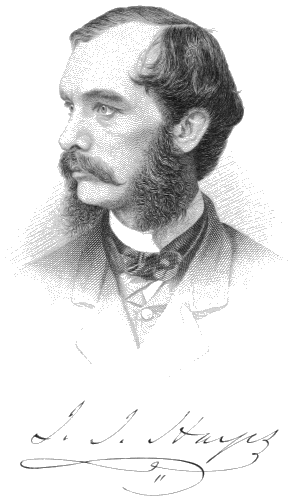
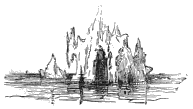


 Click on image to view larger sized