Nathaniel Hawthorne.
And, truly, did you ever hear of such a pitiable case, in
all your lives? Here was literally the richest breakfast
that could be set before a king, and its very richness
made it absolutely good for nothing. The poorest laborer,
sitting down to his crust of bread and cup of water, was
far better off than King Midas, whose delicate food was
really worth its weight in gold.
And what was to be done? Already, at breakfast,
Midas was excessively hungry. Would he be less so by
dinner-time? And how ravenous would be his appetite
for supper, which must undoubtedly consist of the same
sort of indigestible dishes as those now before him!
How many days, think you, would he survive a continuance
of this rich fare?
These reflections so troubled wise King Midas, that he
began to doubt whether, after all, riches are the one
desirable thing in the world, or even the most desirable.
But this was only a passing thought. So fascinated was
Midas with the glitter of the yellow metal, that he would
still have refused to give up the Golden Touch for so paltry
a consideration as a breakfast. Just imagine what a price
for one meal’s victuals! It would have been the same as
paying millions and millions of money for some fried trout,
an egg, a potato, a hot cake, and a cup of coffee!
“It would be much too dear,” thought Midas.
Nevertheless, so great was his hunger, and the perplexity
of his situation, that he again groaned aloud, and
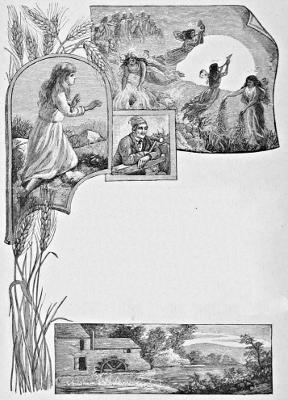
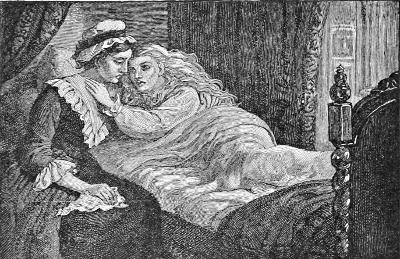
very grievously too. Our pretty Marygold could endure
it no longer. She sat a moment gazing at her father, and
trying, with all the might of her little wits, to find out
what was the matter with him. Then, with a sweet and
sorrowful impulse to comfort him, she started from her
chair, and, running to Midas, threw her arms affectionately
about his knees. He bent down and kissed her. He felt
that his little daughter’s love was worth a thousand times
more than he had gained by the Golden Touch.
“My precious, precious Marygold!” cried he.
But Marygold made no answer.
Alas, what had he done? How fatal was the gift
which the stranger had bestowed! The moment the lips of
Midas touched Marygold’s forehead, a change had taken
place. Her sweet, rosy face, so full of affection as it had
been, assumed a glittering yellow color, with yellow tear-drops
congealing on her cheeks. Her beautiful brown
ringlets took the same tint. Her soft and tender little
form grew hard and inflexible within her father’s
encircling arms. O terrible misfortune! The victim of
his insatiable desire for wealth, little Marygold was a
human child no longer, but a golden statue!
Yes, there she was, with the questioning look of love,
grief, and pity, hardened into her face. It was the
prettiest and most woful sight that ever mortal saw. All
the features and tokens of Marygold were there; even the
beloved little dimple remained in her golden chin. But,
the more perfect was the resemblance, the greater was the
father’s agony at beholding this golden image, which was
all that was left him of a daughter.
It had been a favorite phrase of Midas, whenever he
felt particularly fond of the child, to say that she was
worth her weight in gold. And now the phrase had
become literally true. And, now, at last, when it was too
late, he felt how infinitely a warm and tender heart, that
loved him, exceeded in value all the wealth that could be
piled up betwixt the earth and sky!
It would be too sad a story, if I were to tell you how
Midas, in the fulness of all his gratified desires, began to
wring his hands and bemoan himself; and how he could
neither bear to look at Marygold, nor yet to look away
from her. Except when his eyes were fixed on the image,
he could not possibly believe that she was changed to gold.
But, stealing another glance, there was the precious little
figure, with a yellow tear-drop on its yellow cheek, and a
look so piteous and tender, that it seemed as if that very
expression must needs soften the gold, and make it flesh
again. This, however, could not be. So Midas had only
to wring his hands, and to wish that he were the poorest
man in the wide world, if the loss of all his wealth might
bring back the faintest rose-color to his dear child’s face.
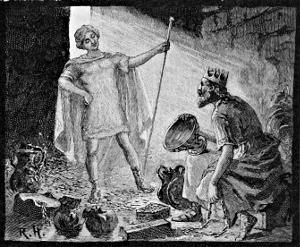
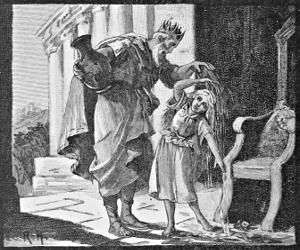
While he was in this tumult of despair, he suddenly
beheld a stranger, standing near the door. Midas bent
down his head, without speaking; for he recognized the
same figure which had appeared to him the day before in
the treasure-room, and had bestowed on him this disastrous
power of the Golden Touch. The stranger’s
countenance still wore a smile, which seemed to shed a
yellow lustre all about the room, and gleamed on little
Marygold’s image, and on the other objects that had been
transmuted by the touch of Midas.
“Well, friend Midas,” said the stranger, “pray, how do
you succeed with the Golden Touch?”
Midas shook his head.
“I am very miserable,” said he.
“Very miserable! indeed!” exclaimed the stranger,
“and how happens that? Have I not faithfully kept my
promise with you? Have you not every thing that your
heart desired?”
“Gold is not every thing,” answered Midas. “And I
have lost all that my heart really cared for.”
“Ah! So you have made a discovery, since yesterday?”
observed the stranger. “Let us see, then. Which of these
two things do you think is really worth the most,—the
gift of the Golden Touch, or one cup of clear cold water?”
“O blessed water!” exclaimed Midas. “It will never
moisten my parched throat again!”
“The Golden Touch,” continued the stranger, “or a
crust of bread?”
“A piece of bread,” answered Midas, “is worth all the
gold on earth!”
“The Golden Touch,” asked the stranger, “or your own
little Marygold, warm, soft, and loving, as she was an
hour ago?”
“O my child, my dear child!” cried poor King
Midas, wringing his hands. “I would not have given
that one small dimple in her chin for the power of changing
this whole big earth into a solid lump of gold!”
“You are wiser than you were, King Midas!” said
the stranger, looking seriously at him. “Your own
heart, I perceive, has not been entirely changed from flesh
to gold. Were it so, your case would indeed be desperate.
But you appear to be still capable of understanding that
the commonest things, such as lie within everybody’s
grasp, are more valuable than the riches which so many
mortals sigh and struggle after. Tell me, now, do you
sincerely desire to rid yourself of this Golden Touch?”
“It is hateful to me!” replied Midas.
A fly settled on his nose, but immediately fell to the
floor; for it, too, had become gold. Midas shuddered.
“Go, then,” said the stranger, “and plunge into the
river that glides past the bottom of your garden. Take
likewise a vase of the same water, and sprinkle it over
any object that you may desire to change back again from
gold into its former substance. If you do this in earnestness
and sincerity, it may possibly repair the mischief
which your avarice has occasioned.”
King Midas bowed low; and when he lifted his head,
the lustrous stranger had vanished.
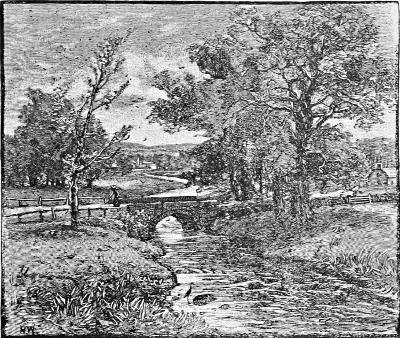
You will easily believe that Midas lost no time in
snatching up a great earthen pitcher (but, alas me! it was
no longer earthen after he touched it), and in hastening
to the river-side. As he ran along, and forced his way
through the shrubbery, it was positively marvellous to see
how the foliage turned yellow behind him, as if the
autumn had been there, and nowhere else. On reaching
the river’s brink, he plunged headlong in, without waiting
so much as to pull off his shoes.
“Poof! poof! poof!” gasped King Midas, as his head
emerged out of the water. “Well; this is really a
refreshing bath, and I think it must have quite washed
away the Golden Touch. And now for filling my pitcher!”
As he dipped the pitcher into the water, it gladdened
his very heart to see it change from gold into the same
good, honest, earthen vessel which it had been before he
touched it. He was conscious, also, of a change within
himself. A cold, hard, and heavy weight seemed to have
gone out of his bosom. No doubt his heart had been
gradually losing its human substance, and been changing
into insensible metal, but had now been softened back
again into flesh. Perceiving a violet, that grew on the
bank of the river, Midas touched it with his finger, and
was overjoyed to find that the delicate flower retained its
purple hue, instead of undergoing a yellow blight. The
curse of the Golden Touch had, therefore, really been
removed from him.
King Midas hastened back to the palace; and, I
suppose, the servants knew not what to make of it when
they saw their royal master so carefully bringing home
an earthen pitcher of water. But that water, which was
to undo all the mischief that his folly had wrought, was
more precious to Midas than an ocean of molten gold
could have been. The first thing he did, as you need
hardly be told, was to sprinkle it by handfuls over the
golden figure of little Marygold.
No sooner did it fall on her than you would have
laughed to see how the rosy color came back to the
dear child’s cheek!—and how astonished she was to find
herself dripping wet, and her father still throwing more
water over her!
“Pray do not, dear father!” cried she. “See how you
have wet my nice frock, which I put on only this
morning!”
For Marygold did not know that she had been a little
golden statue; nor could she remember any thing that had
happened since the moment when she ran with outstretched
arms to comfort poor King Midas.
Her father did not think it necessary to tell his
beloved child how very foolish he had been, but contented
himself with showing how much wiser he had now grown.
For this purpose, he led little Marygold into the garden,
where he sprinkled all the remainder of the water over
the rose-bushes, and with such good effect that above five
thousand roses recovered their beautiful bloom. There
were two circumstances, however, which, as long as he
lived, used to remind King Midas of the Golden Touch.
One was, that the sands of the river in which he had
bathed, sparkled like gold; the other, that little
Marygold’s hair had now a golden tinge, which he had
never observed in it before she had been changed by the
effect of his kiss. This change of hue was really an
improvement, and made Marygold’s hair richer than in
her babyhood.
When King Midas had grown quite an old man, and used
to take Marygold’s children on his knee, he was fond of
telling them this marvellous story, pretty much as I have
told it to you. And then would he stroke their glossy
ringlets, and tell them that their hair, likewise, had a rich
shade of gold, which they had inherited from their mother.
“And, to tell you the truth, my precious little folks,”
said King Midas, “ever since that morning, I have hated
the very sight of all other gold, save this!”
Life! we’ve been long together
Through pleasant and through cloudy weather;
’Tis hard to part when friends are dear,—
Perhaps ’twill cost a sigh, a tear;
Then steal away, give little warning,
Choose thine own time;
Say not Good Night, but in some brighter clime
Bid me Good Morning.
—Anna Letitia Barbauld.