The Onlooker — Alfred Henry Lewis Editor — The Onlooker
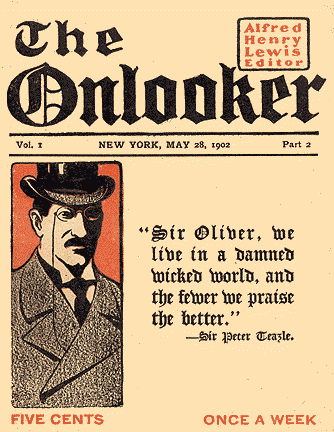
Vol. I NEW YORK, MAY 28, 1902 Part 2

"Sir Oliver, we
live in a dammed
wicked world, and
the fewer we praise
the better."
—Sir Peter Teazle.
FIVE CENTS ONCE A WEEK
Whole book · 12 sections
Vol. I NEW YORK, MAY 28, 1902 Part 2
"Sir Oliver, we
live in a dammed
wicked world, and
the fewer we praise
the better."
—Sir Peter Teazle.
FIVE CENTS ONCE A WEEK
Subscription: One Dollar a Year
Price: Five Cents
Tammany and Its Missing Funds—
Mr. Nixon and his Failure—Mr.
Carroll's Troubles with Mr. Croker—
The Latter
Gone for Good
POETRY
No Time Like To-Day
Artistic Disarray
AS YOU LIKE IT Fielders
Who Loves a Lord?—Killing for
Futurity—Mistake in Vocation—Foreign
Devils Again—Heaven or Hell—Adam
a Myth—Hurrah for
Noah—Callow
Judgment—Champagne and "Champagne"
THE PLAY Jaques
LADY BETTY'S COMMENT Betty Stair
DRIFT OF THE DAY Skirving
THAT SMUGGLED SILK By the Old Lobbyist
Copyrighted by The Observer Publishing Co., 1902
The Observer Publishing Company
Mercantile Library Building
Astor Place, New York City
Vol. I MAY 28, 1902 Part 2
On last Thursday evening the Casual Club was gathered about a corner table in Sherry's. The great room was beautiful, the music brilliant, the setting and table appointments magnificent, and the dinner all that might be asked. There came but one thing to grieve the tempers of our members—the service was slip-shod, inattentive, vile. One wonders that so splendid an arrangement should be left unguarded in the most important particular of service; that Sherry, when he has done so much, should permit himself to be foiled of a last result by an idle carelessness of waiters, who if they do not forget one's orders outright, execute them with all imaginable sloth. They attend on guests as though the latter were pensioners, and are listless in everything save a collection of the gratuity, personal to themselves, which their avarice and a public's weakness have educated them to expect.
Clams had occurred, and while we were discussing these small sea-monsters, Fatfloat broke suddenly forth. "I don't know if it be a subject for self-gratulation or no, but I observed that the daily papers took quick note of my statement that Tammany Hall was looted of its last shilling. For the guidance of these energetic folk of ink and types, I will unfold a further huddle of details. Instead of nine hundred thousand dollars, there were more than one million collected for the Tammany campaign. No one can show where so much as two hundred thousand dollars were honestly disbursed. Let me tell a story; it may suggest an idea to our diligent friends of the Dailies. There is a rotund, porpoise-shaped globular gentleman known of these parts as 'Bim the Button Man.' This personage went into the printing business at the beginning of the late campaign and went out of it—like blowing out a candle—at the close. Bim the Button Man, for his brief parade as a printer, took a partner. Or perhaps the partner took Mr. Bim. The partner was and is a doughty 'leader.' It was the new-made firm of 'Bim' that flourished in the production of those posters and lithographs of Mr. Shepard which for so long disfigured the town. Mr. Mitchell, printer, complained bitterly over this invasion of his rights by Mr. Bim. The latter snapped pudgy fingers at the querulous Mr. Mitchell by virtue of his powerful partner. Who was Mr. Bim's partner? One year before when Mr. Mitchell's bill was seven thousand dollars, Mr. Croker, being in a frugal mood, felt excessively pained. Why then should it mount last autumn to three hundred thousand dollars and excite neither grief nor reproach? And what was got for those three hundred thousand dollars? When a show leaves New York, it carries posters wherewith to embellish each fence and bill board in the land; and yet no show ever paid more than ten thousand dollars for paper. Five thousand dollars will cover every possible coign of bill-sticking advantage and hang, besides, a lithograph of Mr. Shepard in every window in the city of New York. Then wherefore those three hundred thousand dollars of Tammany? There be folk on the finance committee who should go into this business with a lantern. The most hopeful name of these is Mr. McDonald, our great subway contractor and partner of Mr. August Belmont; he is a member of that committee. He is, too, a gentleman of intelligence, business habits and high worth. Mr. McDonald of the subway, for his own credit and that of Mr. Belmont, his partner, should never sleep until he turned out the bottom facts of that Tammany treasure which has disappeared. Nor should a common interest with Mr. Croker and certain of that gentleman's retainers in the Port Chester railway deter him. Is there no honest man in Athens?"
It was at the close of the repast and when cigars were smokily going that Vacuum returned to the subject of Tammany Hall.
"Let me congratulate you, my dear Enfield," observed Vacuum courteously, "on your genius for prophecy. At our last meeting, you foretold the near overthrow of Mr. Nixon and the Croker regime. The papers inform me that all came to pass within the two days following your warning."
"Yes," said Lemon sarcastically, taking the words from Enfield, "we have been visited with that fell calamity, the collapse of Mr. Croker and his rule. We have seen the black last of him, and the very name of Croker already begins to be a memory. But why should one repine?" Lemon's sneer was deepening. "In every age the other great have come and ruled and gone to that oblivion beyond. They arose to fall and be forgot. It is the law. Then why not Mr. Croker? True, even while we consent, there comes that natural sadness which I now observe to sparkle so brightly in every present eye. What then? We console ourselves as did Chief Justice Crewe full two centuries and a half ago when the decadence of De Vere claimed consideration. 'I have labored,' quoth Crewe, who if that be possible was more moved over the waning of De Vere than am I concerning the passing of Mr. Croker, 'I have labored to make a covenant with myself that affection may not press upon judgment; for I suppose there is no man that hath any apprehension of gentry or nobleness but his affection stands to the continuance of a house so illustrious and would take hold on a twig or a twinethread to support it. And yet Time hath his revolutions; there must be a period and an end to all temporal things—finis rerum—an end of names and dignities and whatsoever is terrene; and why not of De Vere? For where is Bohun? where is Mowbray? where is Mortimer? nay, which is more and most of all, where is Plantagenet? They are entombed in the urns and sepulchres of mortality!' And, as it was of that ancient day of Crewe and the De Vere so must it be of us and Mr. Croker. He goes; we stay; and so let us drink to all." Here Lemon filled his glass, and the rest having amiably followed his example, offered with a wicked twinkle, "The disappearance of Mr. Croker!"
"What I regret in the business," remarked Fatfloat as he put down his glass, "is the ill fortune of Mr. Nixon. There is much of good honesty about that gentleman; he is high-minded and proud; I cannot but sympathize with him in his present plight."
"And yet," observed Enfield, mildly, "Mr. Nixon should have avoided that trap of an empty leadership. Mr. Nixon is no stripling; he knew Tammany and those elements of mendacity and muddy intrigue which are called its 'control'; he knew Mr. Croker, who in these last days was faithful to no promise and loyal to no man. Why did he permit himself to be flattered, cozened and destroyed? Why? He added inexperience to vanity and betrayed himself. It was the old story—the conference of that leadership on Mr. Nixon—the old story of the Wolf and Little Red Riding Hood, with Mr. Croker as Wolf and Mr. Nixon the innocent who was eaten up. No, no; he might have better guided himself. Mr. Nixon—were all about the friendliest—was still unfit for the place. It was like putting a horse in a tree-top; it gave the horse no grace nor glory and offered a sole assurance of his finally falling out."
"Isn't Mr. Nixon himself an honest man?" asked Van Addle.
"Were it to be merely a question of honesty," replied Enfield, "Mr. Nixon would make perfect answer. Broadly, he is an honest man. But that, politically, is all. And there be enterprises, such as Tammany Hall and the Stock Market, wherein to be merely honest is not a complete equipment. Moreover, in this business of his so-called 'leadership,' Mr. Nixon might have carried himself with a more sensitive integrity and been bettered vastly thereby. You will recall that when Mr. Nixon performed as chairman of the Tammany anti-vice committee, he discovered in its entire membership that combine of blackmail and extortion which, standing at the head of Tammany and doing its foul work through the police, fostered crime in the community for a round return of four millions a year. Mr. Nixon called these evil folk by name and pointed to them. He could still relate that roll and never miss an individual. And if he did not put actual hand on the sly presiding genius, I warrant you he might, were he so inclined, indite a letter to him and get the address right."
"And the postage would be five cents," interjected Lemon.
"With this knowledge," continued Enfield without heeding Lemon's interruption, "and with his record as a foe of corruption, Mr. Nixon, had he been wise as a captain, or true to himself as a man, would have called about him the cleaner elements. He would have reminded them of the people's verdict of November and told them plainly that the rogues must go. He should have been loyal to himself. He should have made the issue against the corruptionists; he should have waged prompt and bitter war, and either destroyed them or died like a soldier high up on the ramparts. Mr. Nixon would have then become a martyr or a hero; and between the two there after all goes flowing no mighty difference. A martyr is a hero who failed; a hero is a martyr who succeeded; both gain the veneration of a people, and die or live secure of self-respect. Mr. Nixon should have uplifted the standards of a new crusade against that handful of great robbers who, making Tammany their stronghold, issued forth to a rapine of the town. Nor, had he done so, would he have fallen in the battle. As I have already said, nineteen of every Tammany twenty would have come round him for that fight. He would have conquered a true leadership and advanced a public interest while upbuilding his party. Mr. Nixon, however, failed tamely in the very arms of opportunity. He kept to the same ignoble counsel that had so wrought disrepute for Mr. Croker. And, afar from thoughts of assailing those who had dragged Tammany Hall through mire to achieve their villain ends, he went openly into their districts, commended them to the voters, hailed them as his friends and urged their retention in the executive board. Is it marvel, then, that Mr. Nixon as a 'leader' took no root? or that by the earliest gust of opposition he was overblown? It could not have come otherwise; he fairly threw himself beneath the wheels of Fate."
"As to the future of Tammany Hall," said Vacuum, "will Mr. Croker make further effort to dominate it and send it orders from abroad?"
"Undoubtedly," returned Enfield, to whom the query was put, "Mr. Croker will strive in all ways to prolong himself. It is with him both a matter of money and a matter of pride. But he will fail; his whilom follower, Mr. Carroll, is too powerful. Mr. Carroll is in possession and will yield only to Mr. Martin,—that inveterate foe of Mr. Croker."
"Do you know why Mr. Croker attacked Mr. Carroll just before he left?" asked Vacuum "and ordered his destruction? One morning, he was taken by Mr. Fox to view Mr. Carroll's building operations near Fifth Avenue in Fifty-seventh Street. Mr. Fox called attention to the grandeur of Mr. Carroll's plans. The workmen were tearing down a house to make room for Mr. Carroll's coming palace. Mr. Croker gazed for full ten minutes in wordless, moody gloom. Then turning to the sympathetic Mr. Fox he broke forth: 'What do you think of that? He's tearing down a better house than mine!' From that moment Mr. Croker went about the tearing down of Mr. Carroll."
"I had not supposed him so small," said Fatfloat, "as to feel piqued because Mr. Carroll would build a better house than his own."
"He didn't feel piqued," said Lemon; "he felt plundered, and doubtless asked a question concerning Mr. Carroll that has been so often asked about himself."
"And yet," observed Van Addle, appealing to Enfield, "I should love prodigiously to hear your views on the situation in Tammany as it stands. I confess both an ignorance and a curiosity for light."
"And I am sure, my dear Van Addle," returned Enfield, "you are heartily welcome to aught I may know or believe on the subject. A great noble of Rome observed that to direct a wanderer aright was like lighting another man's candle with one's own; it assisted the fortunes of the beneficiary without subtracting from the estate of the Samaritan. For myself, I need neither the Roman argument nor the Roman example to create within me a benevolent willingness to hang a lantern in the tower of truth for the guidance of any gentleman now groping as to the actual status of Mr. Croker with Tammany Hall.
"It requires no word to those initiate to convince them that Mr. Croker no longer sits on the throne, and that his potentialities are forever departed away. For myself, grown too indolent for an interest in aught beyond the sentimentalities of politics, I sorrow that this is so. Indifference is ever conservative and hesitates at change; and, speaking for what is within myself and not at all perhaps for that which is best for the public, I would have preferred a continuation of the Croker dynasty. As it is, good sooth! Mr. Croker is destroyed. And your ruin, of whatever character, the resort of owls, the habitat of bats, and all across it flung the melancholy ivy—that verdant banner of victorious decay!—is, at its loveliest, but a spectacle of depression; and one who has witnessed Mr. Croker in his vigor must be at least dimly affected as he beholds him take his sad and passive place with those who were. Mr. Croker is not to be blamed as the architect of his overthrow. With what lights that shone, his conduct was prudent enough; and his dethronement is to be charged to destiny—to kismet, rather than to any gate-opening carelessness on the purblind part of himself. 'Prudentia fato major,' said the Florentine. But the Medici was wrong, and before Death bandaged his eyes for eternity it was given him to see that Destiny, for all his caution and for all his craft, had fed his hopes to defeat. And yet, while Mr. Croker may not be charged as the reason of his own removal, some consideration of causes that incited it should have a merit and an interest. It is one vessel crashing on a reef that points a danger, and makes for the safety of every ship that follows, and the story of a wrecked and drowned dictatorship cannot fail to instruct ambition in whatever field.
"Following the last presidential campaign, Mr. Croker sailed Englandward to repose himself from his labors. For ten months did he rest, recuperate, restrengthen and restore himself. And when he departed, albeit he may have had no suspicion of that fact, Mr. Croker left his chieftaincy behind. That was to happen in the nature of things, and Mr. Croker would have foreseen it had he been a true scientist of supremacy. Remember it, all ye kings and princes and potentates among men! a crown will never travel, a scepter cannot leave the realm, and there are no wheels on a throne. Mr. Croker was not aware of these cardinal truths of kingcraft when he sailed away; the knowledge became his at a time too late to have a value beyond the speculative. Mr. Croker left the garments of his leadership behind him and eighteen of the 'leaders' appropriated them with a plot. They caught their chief in bathing and they stole his clothes.
"Mr. Croker was home ten days before he missed his leadership, and even then he was made aware of its spoliation only by beholding it in the hands of the cabal. Mr. Croker meant Mr. Nixon for the mayoralty; but the plotting eighteen, intriguing with Brooklyn blocked the way with Mr. Coler. The coalition was too strong for Mr. Croker to force, and the logic of that same word pressed to a conflict meant his destruction in the city convention.
"'When the lion's skin is too short,' said Lysander, 'we piece it out with the fox's,' and while the Greeks thought this sentiment unbecoming a descendant of Hercules, they were fain to acquiesce in its practice when met by a peril too strong for their spears. Mr. Croker remembered Lysander; and, being thus hedged and hemmed about, sought safety by nominating Mr. Shepard. There need be no mistake; Mr. Shepard was not a candidate, he was a refuge. And such a refuge as is Scylla when one is threatened of Charybdis.
"When Mr. Croker seized on Mr. Shepard, he defeated the Coler plot, but made no safety for his leadership. He succeeded only in losing the latter in a fashion less harrowing to his vanity, less obnoxious to his self-respect. It was the old Roman at the last, who, preferring suicide to capture, throws himself on his own sword.
"Study the situation as Mr. Croker studied it, following the city convention; it will aid to an understanding of what has happened since, and tell the story of his lost leadership. Following Mr. Shepard's nomination there lived no Croker hope. With either Mr. Shepard or Mr. Low elected, Tammany would dwindle—as one now beholds it—to be a third-rate influence. The autocracy of Mr. Croker would disappear. At the best, he might beg where he had once commanded, with every prospect of being denied. Mr. Croker, in alarm for his pride, decided that his sole chance to quit with credit was to quit at once, and on that thought he acted. Following the naming of Mr. Shepard he treated with the plotters and abandoned to them half his dominion. It was they, and not Mr. Croker, who determined the personnel of the late county and borough tickets; one has but to remember the folk who were named, and recall those who were not, to know that this is true. But bad fortune overtook Mr. Croker and the eighteen who then held him in partial thrall. The city ticket of the one, and the county and borough tickets of the others, were beaten."
"They were, of a hopeful verity!" interrupted Fatfloat. "They were beaten as flat as a field of turnips! And it was in high good time, too. Had Tammany retained the city, before 1904 the outlaws would have stolen everything but the back fence."
"They did not keep the city, however," continued Enfield, "and being defeated, Mr. Croker developed with much speed an eagerness for England. I do not blame him; while outwardly respectful, the leading folk of his circle were cheerless and cold, for to be beaten is to be hated in Tammany Hall. And so he made pretense of abdication and Mr. Nixon appeared in his place. The sequel of that ill-fortuned substitution is known.
"Mr. Croker will continue still to hold what Tammany territory he may. He has money interests to protect. And yet, strive and plot and battle as best he can, it is too late. His day is over and his power lost. He will win such consideration and no more, as Mr. Carroll and the others grant.
"It is to be doubted if Mr. Croker realizes how prone and dead he is. One knows when one is wounded, but one knows not when one is killed. Some near day, or some far day, Mr. Croker will seek to return. Then, and not until that time, will he comprehend the palsy that has stricken his supremacy. Mr. Croker will return only to be denied. And that, too, will be as it should; for even a Napoleon comes back but once to France."

The London newspapers give one the impression that a number of English people will attend the coronation ceremonies. It is evident that the editors of these newspapers do not read journals which are printed in New York and other American centers.
When Balmascheff, who shot and killed M. Sipiaguine, Russia's Minister of the Interior, was asked if he had accomplices he replied: "So many that it is impossible to name them." He also said that he nor they expected grace or mercy; that he and they worked for those who came after. Some will call this the raving of an anarchist. But these know nothing of the conditions against which Balmascheff and his kind are warring. The Balmascheffs would prefer to gain their ends by peaceful means, but know from experience that life is too short for success. They do not kill for love of killing, or the notoriety that attaches to it, but that the lot of those whose cause they champion may be made merely endurable. Whenever the law is wilfully and successfully disregarded that a minority may be favored there will be found a means by which this dereliction is brought to the attention not only of the lawbreakers, but of the world, and as the latter, in all its divisions, contains lawbreakers who consider themselves above or beyond the law the punishment of one is usually followed by the punishment of others, for lawbreakers of a colossal type—like their executioners—think in common and recognize no cleavage of nationality. Balmascheff may not have killed the system which was represented by M. Sipiaguine, but he chopped away a limb. Unless the trunk is replaced by one that better befits the age it, too, will be chopped away.
If this be an age of reason, as is claimed for it, men who are furnished with a capacity to think cannot be prevented from putting their thoughts into execution. Though Balmascheff was executed on Friday according to biblical and Russian law, there are many Balmascheffs in the world, and it is well for the world that this is so.
A woman writer who considers herself a Realist says in a story published recently: "I found a letter in my mail and read it as I prepared my morning coffee." This is an impossible feat. She may have prepared the coffee and then read the letter, or read the letter and then prepared the coffee, but she did not do both simultaneously unless she were, not a realist, but an acrobat.
Among the many reforms foisted upon China by the Powers is a college. At the head of this college is a Foreign Devil and among its professors are six Foreign Devils. The court of last resort, however, is the Governor of Shantung, who is a native of China. He, quite recently, filled the Foreign Devils with indignation because he expelled from the college a student who refused to subscribe to the teachings of Confucius, who was a wise as well as a learned man. The Foreign Devils transferred some of their indignation to Mr. Conger, the United States Minister, who "warned the Throne against infractions of the treaties in respect to the freedom of the Chinese to practice Christianity." This warning probably filled the Throne with even more and hotter indignation than that which seethed in the Foreign Devils. Why should Mr. Conger not follow the custom of his own country and permit every religion to take care of itself? Here is a case in point. A Mr. Noll applied for a license to preach and it was denied to him by a Theological Seminary of the Presbyterian brand because he refused to believe in the personality of Adam. He would not have carried his case to the President even if he had not died. It has been asserted by a Minister of another denomination that Noll was murdered, not in the orthodox way, but simply because he was refused a license to preach. If the murder theory be not untenable Noll was not of the stuff of which martyrs are made, and as all Preachers hold that they are made of this stuff Noll conferred a favor upon the profession by dying of consumption.
Even before Noll died a number of Presbyterian Preachers had announced that they considered Adam, Moses, Jonah and other personages of Note in Bible literature as Myths. With rare exceptions, there is about as little initiative in Professional Preachers as there is in Professional Pugilists, and the last sect of which one might have expected such iconoclastic utterances is that which claims Calvin and John Knox as its shining lights. I remember, as a small boy, feeling sorry for a chum because, as a Presbyterian, he did not know and had no means of finding out whether he had been born to go to Heaven or Hell, and in those days both of those resorts were spelled with capitals and pronounced with awe. Had he been able by a most rigorous observance of all the rules laid down by God and Man to make certain of living in a future state of beatitude I would have felt sorry for him still, as he would be compelled, of necessity, to miss many of the joys of this world; still his future then—though in a hard and grinding measure—would have lain in his own hands. But whether he became a Pirate or a Preacher was all one; he had been born to go to Heaven or Hell and nothing that he could do could enable him to change his final destination. In later life he, evidently, appreciated this, for he became a Stock-Broker, after, as a Preacher, having broken most of the Commandments and fractured the rest. Had the Dominie of the flock of which he was a member expressed a doubt of the existence, some years ago, of Adam, Moses or Jonah, but particularly Adam, he would have saved my friend from much mental and some physical distress.
When a hide-bound, moss-grown bigot begets doubts and then removes them, he is like a bull in a china shop and wants to break everything in sight, not through an innate love of destruction, but because he has lost his rope and is too delirious to find the corral. This throwing overboard of Adam so suddenly and without any recently discovered evidence upon his personality or lack of it, comes in the nature of a shock. The act has been perpetrated after the fashion of Captain Kidd in his worst days. It shows a complete lack of even a faint acquaintance with the small amenities that help to smooth the ruts in social intercourse to not only order a personage of Adam's standing and reputation to "walk the plank," but to push him off. Besides, it shows an utter disregard for the feelings of that large body of people who do not think, to wipe out, at one fell wipe, the whole scheme of creation without substituting another. If there were no Adam there could not have been a Garden of Eden or an Eve. And what about the Apple and the Serpent and a lot of other picturesque details? Personally, I intend to stick to my belief in Adam, not because I ever had a high opinion of him, but because I have met a number of men who remind me of him—men who always throw the blame on the woman; also because I have seen several spots that would make an admirable Eden. Besides, there is something in the story of what happened in the Garden that rings true; not that all women would adopt Eve's bold method, but much may be forgiven a woman who had no mother or maiden aunt to play duenna, and who lived before either was fashionable, or, according to the story, necessary.
But these reverend gentlemen must not go too far. One may regret Adam, and his extinction may start fissures in many genealogical trees, but to such of us as only "came over in the Mayflower," or "with the Conqueror," his flop into oblivion may entail no serious damage to existing rights. Upon Moses I always looked as a person of doubtful parentage, and a leader who, had he lived in recent centuries, would have been sacrificed by his own men within a month at most. His only title to fame is that he kept the Jews for forty years from appropriating anything but a desert which nobody else wanted and was a blistering hindrance to them. The story of Moses certainly has weak spots. Too much is known of the localities which he frequented. The crossing of the Red Sea without even getting his boots full of water seems too lurid an accomplishment for a pedestrian who consumed forty years in reaching the confines of an ordinary desert. His disappearance will cause but little clamor. Then there is Jonah. Those who know the sea, or have a passing acquaintance with fish, place no reliance upon the Jonah-whale story. Jonah will not be missed greatly. But I must insist upon the preservation of Noah. In him are we all—no creed nor color barred—indebted for our first striking and imperfect impressions of the animal kingdom. No liar could have invented the story of the flood. It is of too wholesale a character for pure invention, and the few details which accompany it wear an air of truth. Unless it were founded upon fact, could manufacturers all over the world have been induced to strengthen it and put money in their purse by turning out, annually, not millions but trillions of Noah's arks? Once shake the belief of childhood in the stability of Noah and ruin will fall upon a great industry, for machinery which will turn out a never-ending stream of Noah's arks could not be driven to turn out anything else. There is nothing to take the place of Noah's ark, as there is no one to take the place of Noah. In other lines trade may follow the flag, but in the Noah's ark industry it follows a belief in Noah and is known to every flag that has ever waved, paying allegiance to no particular banner. Before these fatiguing divines drive even a tack into Noah's coffin, let them provide us with a personage of equal interest and influence. If they are not permitted to move further in their scheme of destruction until they do this, Noah is safe. They can only try to kill; they cannot create.
Mr. William M. Thomas, United States Minister to Sweden, called upon the President lately and made him a present of several Swedish razors. A Washington correspondent at once telegraphed to his newspaper in New York: "He selected the razors himself and is a fine judge of them though he does not use a razor." If the person who sent this important dispatch wanted to secure an Old Master he, doubtless, would hire a canal boatman to pass judgment upon the painting before he put his money down.
It is customary for Americans to think that they get the best of everything. There are Americans who do get the best of everything, but this is because they know what is best and are able and willing to pay for it. But where hoi polloi thinks that it gets the best of everything it is mistaken. Take champagne, for instance. "A large bottle on the ice" is a common order in New York. To the waiter it means a bottle of champagne. He may or may not ask if any particular brand is required: that depends upon the quality of the hostelry in which he is employed; also upon the quality of the customer. The "large bottle" is forthcoming. It contains a label on which is printed the maker's name.
The cork which comes out of the bottle is, generally, much larger than the neck into which it has been forced. It is seldom that one hears a buyer ask to see the cork. The average buyer of champagne would not understand the cork's story. He is accustomed to large and bulging corks and if he were to see an attenuated specimen, of dark complexion and as hard as a piece of vulcanized rubber he would look at it with great suspicion and, doubtless, refuse the wine. But an experienced waiter will know his man and will bring him the sort of "large bottle" to which he has been accustomed, though it will not be champagne that a wine drinker would care to swallow. Champagne of the "large bottle" variety is drunk to a larger extent in the United States than anywhere else; in fact one would not be far wrong in saying that it is manufactured for the American market. Generally, the best champagne is made for England and Russia. The people of those countries who drink champagne have made at least a cursory study of it and are able, at a moment's notice, to name the best vintages of the last twenty-five or thirty years. There are Americans who can do this, too, but they are not of the "large bottle" or "cold bottle" variety. The latter are the people who account for the fact that much more "champagne" is consumed than is furnished by the vineyards of France.
THOMAS B. FIELDERS.
From my station here on the housetop my gaze wanders out over acres of roofs—the leaded coverings of hotels, apartment-houses, and office buildings. They rear themselves beneath and around me as the lesser peaks of the Himalayas seen from Mount Everest. My eyes ache with the diversity of their shapes, the eccentricity of their styles, the irregularity of their altitudes. No man viewing them can continue blind to the independence of the American citizen, to the ostentation of his right of personal selection, to his individual caprice. They stand, a brick-and-iron commentary upon the competing ambitions of two generations of townsmen.
A hulking, twenty-story modernity stands side by side with a dwarfish, Dutch anachronism, but neither possesses any right of precedence over the other. They are equal in the eyes of the proletary. Classic and nondescript, marble and brick, granite and iron, unite to form the most heterogeneous collection of fashions the earth's surface anywhere exhibits. Even Milton's blind eyes pictured nothing so fantastic as this architectural chaos of Manhattan, so hopeless of eventual order. And yet are there not lacking signs that the quaint pot-pourri of whimsicalities will one day coalesce into a well-defined, artistic composition, a twentieth century City Beautiful. God grant its attainment be not unduly protracted!
But it is with the insides of this vast confusion of buildings I am presently concerned. As the buildings are, so are the inhabitants—little and big, tall and short, honestly constructed and jerry built, old fashioned and up to date, aping the fashions of a dozen civilizations. In any one of these great structures will be found the representatives of a dozen nations, born to a dozen tongues, yet all conversing in a common English, covering their motley nationalities with a common Americanism, united in their loyalty to the Republic. In the diversity of its constituents lies the strength of the American nation.
No European section of the American community sufficiently preponderates over its fellows to affect the national sympathy toward foreign Powers. Irish counteracts English opinion; German sonship is balanced by the filial sentiment of the Latin races—the Slavs and the Russian Jews have no European predilections. Consequently, American foreign policy is dictated by Americans for the benefit of Americans, without reference to the warring interests in Europe or in Asia. The men who lead in the United States are men who, for the most part, have not voyaged beyond the confines of the United States. All of their attention upon affairs of State is cast inward upon their own land, is absolutely self-centred. The resultant national policy is the most selfish, but the most formidable in the world of nations.
American and Briton are alike co-heirs to the common Anglo-Saxon heritage, but they are brothers who differ as materially in temperament as in ambition and in creed. The Briton is daily becoming more cosmopolitan, his outlook more world-wide. The shadow of the village pump has departed from his statecraft, and his political horizon girdles the earth. But the American remains intensely introspective, suspicious of foreign influence, interested solely in his world of the Western Hemisphere.
In Britain are Little Englanders who dread every step the nation makes in outward expansion, but there are here no Little Americanders. The Little Englanders doubt the nation's power to hold the nation's possessions. Here, in the United States, are men who question the advisability of penetrating into world politics, but no man among them has doubt of the nation's power to keep whatever territory the Star Spangled Banner once has floated over. They are merely jealous, jealous of the absolute isolation of their commonwealth, quick to resent any remotest possibility of interference with it.
In every American's ears rings the music of assured success, the certainty of a rich inheritance laid up for him and his children's children in the internal resources of his country. In many an Englishman's ears sound only the doleful croakings of the prophets, the sinister rumblings of approaching doom. Though his pessimism be in great part born of his climate, it has had a very real effect upon his statecraft. It has driven him outward to find hope and sunshine abroad, in his colonies, and in India. It has made of the race a nation of expansionists, reaping where they have not sown, gathering where they have not strawed.
It is otherwise here with us under a sky that would make of Job an optimist. All around are light and color, the evidences of life and hope. Here the whites are white, and not a dirty drab. The streets glisten clean in the sunlight, and every window is a reflector of glad promise. In London, choked with fog, and grimy with soot-dust, the Englishman cannot see the future for smoke, cannot extract a gleam of hope from the sodden, mud-soaked thoroughfares. To be sanguine here on my housetop is to be natural and in harmony with my surroundings. To be hilarious in the Strand is to be unnatural, to court detention in a police cell or a lunatic asylum. There is a wide gulf separating Sandy Hook from Land's End, but a still wider between Pennsylvania Avenue and the Westminster Bridge Road.
And so those who have dreamed of Anglo-American alliances awake to find themselves deceived by the very intensity of their desires. The bloodship between the nations is itself the surest deterrent of alliance. Just as in the Church marriage between nigh kinsmen is forbidden, so political marriage between the British and American nations can never be. The United States is possessed of a single idea—the consolidation and enrichment of the United States. No interest is permitted to clash with that paramount national ambition.
To that end all share in the pomp and vanities of the world is sacrificed; her ambassadors tolerated, not supported; her Secretary of State snubbed; her President jealously watched in all his exchanges of courtesy with foreign Powers. United States citizens may be maltreated and murdered in Bulgaria or in China, the United States will not go to war on their behalf. Her mission is confined to the Western Hemisphere, and over its borders no insult, no cajolery will avail to tempt her. Within her own sphere her temper is quick, and her arm strong to avenge. Across the ocean she is long suffering and slow to anger.
Down here at my feet the American is engaged in his nation-building somewhat less satisfactorily than out in the wide world beyond. A nation compounded of a dozen alien races may unite on matters of foreign policy, but in that is no warranty of harmony at home. Domestic strife is as bitter here as in Germany or Britain or France. I watch from my housetop men marching in processions of protest; I read of strikes; I hear of an infinity of rude wranglings, of senators battling on the floor of the forum, of disputes in the sacred halls of Tammany. Not yet has the Irish lamb lain down with the Virginian lion.
It were strange were it otherwise in a land where the city man has destroyed the home. The American has shown no great genius for the domestic virtues. He has hauled down the homes of his ancestors, has builded in their stead vast apartment-houses and tenement buildings—steam-heated Towers of Babel. Into each of these he has packed the population of a European market-town, has left the children to grow up on the roofs and staircases, the babies to find a blessed release through rickety fire-escapes. When a fit of reform has touched him, he has stirred up the garbage of the Tenderloin and the Red Light District, has spread it broadcast over his cities to poison his wife and his daughter.
No, the American has still much to learn of domestic politics. Let him sit with me here any night on my housetop and he will see the sad effects of sectarian reform and newspaper hysteria. He will see the creatures of the Tenderloin at home on Broadway and Fifth Avenue where, twelve months ago, their presence was unknown. He will see the policeman on the beat neglect the broken lock of my house door that haply he may learn something of the doings of his fellow constable. He will see a whole civil service turned into a bureau of information, a department of espionage. He will see the entire machinery of city government made ineffectual in the sacred name of Reform.
It was an American who made immortal the simple phrase: "There's no place like home." Verily, one must take a long day's journey from New York ere he discover a place in any essential comparable with the home of our childhood's prattle, the home with its mother and its mother love, its rosy boys and its sweet faced lasses. That home has been handed over to the house-breakers, to make way for modern buildings, for improvements on the surroundings that made our mothers and our wives.
Sitting here on the housetop, one wonders if those residential skyscrapers are indeed rooted in the foul pit of Acheron. If built in the proportions of the iceberg, they must reach well into the bowels of Tophet and thence derive the evil that is in them.
ROGER SKIRVING.

In opposition to the familiar precept of a patriot touching the price and preciousness of liberty, femininity, scorning to be free, exults in shackles. We hesitate over our own taste, and turn rather to the crowning of some courageous male, with a liking and a talent for notoriety. The duties of this gentleman being irksome and his reward being ridicule, it is perhaps amazing that we stand in no nearer danger of lacking a leader for want of aspirants than does the nation of begging for a President. Once guided by a master mind the most exotic may come frankly forth to meet and struggle with the daily weariness of dinner giving and dinner eating: may look towards a triumphant overthrow of those problems on what forks to use, what jewels to adopt, what mannerisms to affect and what fads to uplift. As our persons are no more sacred than our habits we feel that our vanity is never safe; and our present despot, who owns a Turkish taste in femininity, and insists on the fashionableness of fat, unhappy is the woman who, like Mrs. Spottletoe of Chuzzlewit fame, is lean and dry and errs on the side of slimness.
The dawn of the racing season alters the bucolic character of the roads leading to Morris Park and makes them gay and noisy thoroughfares—conglomerations of smart traps and rainbow frocks. The drive to and from the track is the jolliest feature of a programme that—as is not uncommonly the case where the mighty are involved—smacks not a little of sameness. The inevitable lunch at the club house is occasionally enlivened by a friendly tiff over the possession of a piazza table where is offered a view of the course combined with the comforts of repletion, and is, in consequence, considered a vantage point of desirability. We meet the same people, and we eat of the same dishes disguised in the same service, that daily play the routine of our fashion; for, as Thackeray says of his British, wherever we may go, we carry with us our pills and our prejudices. And there be times, too, when we almost echo those cravings of poor Becky Sharp who, having attained the summits of society, cries in the desperation of her ennui: "Oh, how much gayer it would be to dance in spangles in a booth!"
That enterprising bachelor, Mr. James Henry Smith, evinces a nice taste in matters feminine. His much-to-be-desired box seat is not infrequently embellished by the presence of Mrs. Cornelius Vanderbilt, who this year shows a preference for the varying shades of Quaker gray, and was recently admired in a cloth of that color made with a plain skirt and a blousing coat with bishop sleeves. Mrs. Alfred likewise leans modestly towards the dove and is shown at her best in a soft pale frock trimmed with passementerie of the same shade and topped by a large hat of black chip tipped well towards the right side. Mrs. Alfred is young enough to ignore the ravages of a possible embonpoint, but there be other matrons who hang so uncertainly about that borderland of beauty that they somehow manage to convey the hint that only by an unwinking watchfulness do they succeed in foiling the onslaughts of his ogreship of avoirdupois. In their eye lurks terror and in their lines one spells their secret of rebellious hunger; of Delsarte, gymnastics and massage. Sometimes the matron is an improvement on the maid. But this is not always true. For those who turn coarse and harsh with years, we recommend Christian Science and a less flexible self-denial.
We find it difficult to understand that lack of sense and taste which led to the recent criticisms of Mr. Jefferson's oratory on the Actor's Home occasion. Mr. Jefferson, happening by mistake to pass over one of the many names of benefactors, and, presto! there were a dozen listeners, malice-prompted, eager to ascribe to this falter of an old man's memory every meager and jealous motive. An intricate and, of a necessity, a somewhat didactic argument, delivered in the open air, does not become the simplest of tasks in the hands of an old gentleman who has turned his back upon the fourscore mark. He was brave and he was most obliging to undertake a speech of any character, and now his payment seems to be in the customary false, ill-natured coin.
It is said that the late Ward McAllister shrank with peculiar distaste from the vulgarity of divorce. If so he is to be congratulated on passing away before the publication of his niece's domestic misfits. Mrs. Young is appallingly frank concerning her wrongs and the suit threatens to be spicy; although so far, the name of the actress corespondent has not been given to the press. It was good of Mr. McAllister to attempt that separation of wheat from chaff which at one time rendered his verdicts of such dread power among social aspirants; it may be the irony of mockery that to-day his family are conspicuous upon only two points. One relative goes clamorously into the divorce court while another wins celebration by the showy style of a bodice.
The gossip who predicted that the wife of the French ambassador would decline to be received by the Countess Cassini must content herself as best she may with the development of some lesser scandal, for certainly this last effort has met refutation. Mme. Cambon dined at the Russian embassy like the diplomatic woman that she is.
The visit of Miss Roosevelt to Cuba is said to have been more or less of a failure speaking from a Latin standpoint. Miss Roosevelt did not "take" with the Cuban element. She is uncompromisingly Anglo-Saxon and lacks that pliability which would endear her to the children of another race. Cuban women excel in charm of mannerism and in their eyes Miss Roosevelt appears unpolished and uncut. We may like her better as she is, but it is safe to say that had she but a few added years of experience there would have been a more gracious outcome to her trip. Miss Roosevelt Scovel was recently dining at Sherry's. She wore an exquisite white frock but is not herself a pretty girl though her grace uplifts somewhat her mediocrity of appearance.
It is the province of brides to be as bedecked as circumstances permit. Why then does Mrs. Depew automobile about Washington in a miserable machine that most people would refuse to be seen in? Is it humility? It is not gallant in Chauncey to permit the lady to appear in such an antiquated rattletrap. In appearance she is a plain woman; sensible, gracious and nice. Her position is a trying one which she supports with tact. So far she has been guilty of no error of taste and her manner with her husband is pleasant without bearing a trace of that silliness which the Senator's great age encouraged Washington to expect. No one has yet enjoyed any spiteful fun at Mrs. Depew's expense though many were on the qui vive for entertainment.
Idlehours has been duly garnished for the return of the master, who loves this home better than the gray pile which represents the best architectural type on Fifth Avenue. Mr. Vanderbilt is modestly conscious of the prestige wrested from Fournier, and is a cheering illustration of the soundness of open-air enjoyment.
How often have we read of the monthly ten thousand dollars which our ambassador will lavish upon Brook House! In justice to Mr. Reid it must be owned that he is simplicity itself, and by no one is it supposed that either he or Mrs. Reid have part in the publication of these details. He showed wisdom in a preference for his own household over the proffered royal quarters which would have been assigned him. He is chosen for his fitness, but were he the veriest clod the dignity of his position would still carry with it a sufficient measure of respect. Our desire to embellish its importance is absurd, and the hysteria of the dailies is calculated to place a dignified gentleman in a ridiculous light. Mrs. Reid's name and cultivation will doubtless enable her to support a monotonous role with grace; but, in consideration of British proficiency in matters ceremonial, their money will not be called upon to add a jot to the dignity of their reception. Their early departure has not prevented the opening of their country place, Ophir Hall, in the vicinity of White Plains, while their neighbor, Colonel Astor, has long been established at Ferncliffe.
Miss Nannie Leiter, of studious renown, is visiting Chicago in the company of her father. Mamma Leiter plans a garden party in compliment to Ambassador and Madame Cambon, while brother Joseph courts fame from the arena of Buffalo Bill; but for a clear space of a day or two we have learned naught of Daisy of the violet orbs. They are the loveliest eyes in Washington, by contrast with which the commoner grays and blues appeal to the enamoured diplomats but as so many soulless pebbles.
From London wafts the rumor that Alexandra, pleading a dread of copy-designing peeresses, guards with jealous vigilance the secret of her coronation crown, and gossip adds that she fears to have it duplicated by some enterprising American. It is doubtful if the peculiar humor of the British populace would allow of a full appreciation of this joke. Years and etiquette combined have led her Majesty to the thraldom of the rouge and enamel pot. Like the sensible woman that she is she attempts no concealment of the fact that she protects herself from becoming hideous by the employment of three maids whose duty it is to successively undertake the embellishment of the royal countenance. By means of this relief no one of these women loses her delicacy of eye and touch, and Alexandra blooms with the rosy softness of a girl.
The papers seem to be woefully wrought up over the financial rating of Mr. Harry Lehr. Whether he is or whether he is not a wine boomer would not ordinarily be a query of agitating importance. Nor yet is the exact proportion of his yearly salary of national interest. No one ever accused this agile gentleman of setting up for a millionaire while his ingenuousness touching his wife's property is disconcerting in its frankness.
Now that Tom Reed is settled in New York one wonders somewhat that one hears so little of his family. They are to be congratulated on their breeding, for with his prominence to back them they would find notoriety an easy plum. A gentleman called at Mr. Reed's office a day or two ago to ask for an autograph letter on the plea that he had in his possession one of each of the speakers, and wound up his request with the half joking query of "You are a great man, are you not, Mr. Reed?" "No," said the rotund Tom in his big-voiced drawl, "No, but I am a good man."
BETTY STAIR.
If it be true that the future is revealed in the past, then should there be something in the dramatic season which is dead to indicate the character of the season not yet born. By the straws of public approval is the course of the dramatic current determined by those master mariners of the stage, the managers of theatres. The late season has left no great store of such buoys to mark the fair channel to success. Of such as there are, the purport is not altogether convincing.
To record that "Du Barry" and "Beauty and the Beast" are notable successes is but to record that the public, as ever, is attracted by display of rich vestments and spectacular effect. Such straws indicate nothing more than that a Circus or a Wild West Show will seduce to Madison Square Garden an audience that would fill a theatre for a month.
Mr. Hawtrey's triumph at the Garrick Theatre is as little of a guide to popular opinion as was Anna Held's or Weber and Fields'. No manager in his senses would suggest that because Mr. Hawtrey succeeded with "A Message from Mars," the public are prepared to support a series of like Christmas ghost stories. It was the novelty that took, and the personality of a refreshingly non-American actor.
For myself I would seek the trend of public opinion in a very different group of plays; in a batch that did not chronicle one single great success, but each of which received a fair meed of popular support. I refer to such plays as "The Second Mrs. Tanqueray," "A Modern Magdalen," and "Tess of the D'Urbervilles." In such plays lies the modern tragedy. They are addressed to the times, actual, intelligible.
But such as held the New York stage in the past season were timorously constructed, bowdlerized by stage managers and, for the most part, poorly acted. Two of the three I have indicated are plays many seasons old. The greatest of these is "The Second Mrs. Tanqueray," interpreted for us by the greatest actress who ever essayed the part. It indicated a development I believe to be still in its infancy—a development that was arrested before it had been weaned from its first timid suckling.
The public does not desire the problem play. It demands a play that will end with a curtain definite, convincing. But in the problem plays of the past it finds the material it fain would see applied to a bolder, unequivocal purpose. In the eight years that have elapsed since the production of Pinero's "Tanqueray," the public's stomach has been strengthened. It is able to digest tragedies in drawing rooms. It no longer requires peptonized drama. The playgoer no longer demands whatever of primal passion is presented to him to be dressed in doublet and hose. He can accept plain truths in the speech of the day, villains and heroines in the costume of the clubs and Fifth Avenue.
The great play of the future must be a play of the times, must deal with the real things of life, must balk at no expression of modern tendencies, must reveal the skeleton in the twentieth century cupboard.
The days of the historical romance are happily ended. Such milk and water diet is food not fit for men. The new dramatist must provide us with strong meat, properly served by players of intelligence and insight, if dramatic art is to be rescued from the slough into which it has so miserably sunk. The question is: Can America produce a writer of sufficient originality, a manager of sufficient courage, an actor of sufficient understanding to give the public what it asks?
If such there be, their names are not Clyde Fitch or David Belasco, Charles Frohman or Daniel Frohman, Richard Mansfield or Amelia Bingham.
JAQUES.

By THE OLD LOBBYIST
Should your curiosity invite it, and the more since I promised you the story, we will now, my children, go about the telling of that one operation in underground silk. It is not calculated to foster the pride of an old man to plunge into a relation of dubious doings of his youth. And yet, as I look backward on that one bit of smuggling of which I was guilty, so far as motive was involved, I exonerate myself. I looked on the government, because of the South's conquest by the North, and that later ruin of myself through the machinations of the Revenue office, as both a political and a personal foe. And I felt, not alone morally free, but was impelled besides in what I deemed a spirit of justice to myself, to wage war against it as best I might. It was on such argument, where the chance proffered, that I sought wealth as a smuggler. I would deplete the government—forage, as it were, on the enemy—thereby to fatten my purse. Of course, as my hair has whitened with the sifting frosts of years, I confess that my sophistries of smuggling seem less and less plausible, while smuggling itself loses whatever of romantic glamour it may have been invested with or what little color of respect to which it might seem able to lay claim.
This tale shall be told in simplest periods. That is as should be; for expression should ever be meek and subjugated when one's story is the mere story of a cheat. There is scant room in such recital for heroic phrase. Smuggling, and paint it with what genius one may, can be nothing save a skulking, hiding, fear-eaten trade. There is nothing about it of bravery or dash. How therefore, and avoid laughter, may one wax stately in any telling of its ignoble details?
When, following my unfortunate crash in tobacco, I had cleared away the last fragment of the confusion that reigned in my affairs, I was driven to give my nerves a respite and seek a rest. For three months I had been under severest stress. When the funeral was done—for funeral it seemed to me—and my tobacco enterprise and those hopes it had so flattered were forever laid at rest, my nerves sank exhausted and my brain was in a whirl. I could neither think with clearness nor plan with accuracy. Moreover, I was prey to that depression and lack of confidence in myself, which come inevitably as the corollary of utter weariness.
Aware of this personal condition, I put aside thought of any present formulation of a future. I would rest, recover poise, and win back that optimism that belongs with health and youth. This was wisdom; I was jaded beyond belief; and fatigue means dejection, and dejection spells pessimism, and pessimism is never sagacious nor excellent in any of its programmes.
For that rawness of the nerves I speak of, many apply themselves to drink; some rush to drugs; for myself, I take to music. It was midwinter, and grand opera was here. This was fortunate. I buried myself in a box, and opened my very pores to those nerve-healthful harmonies. In a week thereafter I might call myself recovered. My soul was cool, my eye bright, my mind clear and sensibly elate. Life and its promises seemed mightily refreshed.
No one has ever called me superstitious, and yet to begin my course-charting for a new career, I harked back to the old Astor House. It was there that brilliant thought of tobacco overtook me two years before. Perhaps an inspiration was to dwell in an environment. Again I registered, and finding it tenantless, took over again my old room.
Still I cannot say, and it is to that hostelry's credit, that my domicile at the Astor aided me to my smuggling resolves. Those last had growth somewhat in this fashion: I had dawdled for two hours over coffee in the cafe—the room and the employment which had one-time brought me fortune—but was incapable of any thought of value. I could decide on nothing good. Indeed, I did naught save mentally curse those Washington revenue miscreants who, failing of blackmail, had destroyed me for revenge.
Whatever comfort may lurk in curses, at least they carry no money profit; so after a fruitless session over coffee and maledictions, I arose, and as a calmative, walked down Broadway. At Trinity churchyard, the gates being open, I turned in and began ramblingly to twine and twist among the graves. There I encountered a garrulous old man who, for his own pleasure, evidently, devoted himself to my information. He pointed out the grave of Fulton, he of the steamboats; then I was shown the tomb of that Lawrence who would "never give up the ship"; from there I was carried to the last low bed of the love-wrecked beautiful Charlotte Temple.
My eye at last, by the alluring voice and finger of the old guide, was drawn to a spot under the tower where sleeps the Lady Cornbury, dead now as I tell this, hardly two hundred years. Also I was told of that Lord Cornbury, her husband, once governor of the colony for his relative, Queen Anne; and how he became so much more efficient as a smuggler and a customs cheat, than ever he was as an executive, that he lost in 1708 his high employment.
Because I had nothing more worthy to occupy my leisure, I listened—somewhat listlessly, I promise you, for after all I was thinking of the future not the past, and considering of the living rather than those old dead folk, obscure, forgotten in their slim graves—I listened, I say, wordlessly to my gray historian; and somehow, after I was free of him, the one thing that remained alive in my memory was the smuggling story of our Viscount Cornbury.
Among those few acquaintances I had formed during my brief prosperity, was one with a gentleman named Harris, who had owned apartments under mine on Twenty-second Street. Harris was elegant, educated, traveled, and apparently well-to-do in riches. Busy with my own mounting fortunes, the questions of who Harris was? and what he did? and how he lived? never rapped at the door of my curiosity for reply. One night, however, as we sat over a late and by no means a first bottle of wine, Harris himself informed me that he was employed in smuggling; had a partner-accomplice in the Customs House, and perfect arrangements aboard a certain ship. By these last double advantages, he came aboard with twenty trunks, if he so pleased, without risking anything from the inquisitiveness or loquacity of the officers of the ship; and later debarked at New York with the certainty of going scatheless through the customs as rapidly as his Inspector partner could chalk scrawlingly "O.K." upon his sundry pieces of baggage.
Coming from Old Trinity, still mooting Cornbury and his smugglings, my thoughts turned to Harris. Also, for the earliest time, I began to consider within myself whether smuggling was not a field of business wherein a pushing man might grow and reap a harvest. The idea came to me to turn "free-trader." The government had destroyed me; I would make reprisal. I would give my hand to smuggling and spoil the Egyptian.
At once I sought Harris and over a glass of Burgundy—ever a favorite wine with me—we struck agreement. As a finale, we each put in fifteen thousand dollars and with the whole sum of thirty thousand dollars Harris pushed forth for Europe while I remained behind. Harris visited Lyons; and our complete investment was in a choicest sort of Lyons silk. The rich fabrics were packed in a dozen trunks—not all alike, these trunks, but differing, one from another, so as to prevent the notion as they stood about the wharf that there was aught of relationship between them or that one man stood owner of them all.
It is not needed to tell of my partner's voyage of return. It was without event and one may safely abandon it, leaving its relation to Harris himself, if he be yet alive and should the spirit him so move. It is enough for the present purpose that in due time the trunks holding our precious silk-bolts, with Harris as their convoy, arrived safe in New York. I had been looking for the boat's coming and was waiting eagerly on the wharf as her lines and her stagings were run ashore. Our partner, the Inspector, and who was to enjoy a per cent of the profits of the speculation, was named Lorns. He rapidly chalked "O.K." with his name affixed to the end of each several trunk, and it thereupon with the balance of inspected baggage was promptly piled upon the wharf.
There had been a demand for drays, I remember, and on this day when our silks came in, I was able to procure but one. The ship did not dock until late in the afternoon, and at eight o'clock of a dark, foggy April evening, there still remained one of our trunks—the largest of all, it was—on the wharf. The dray had departed with the second load for that concealing loft on Reade Street which, in Harris' absence, I had taken to be used as the depot of those smuggling operations wherein we might become engaged. I had made every move with caution; I had never employed our real names, not even with the drayman.
As I was telling, the dray was engaged about the second trip. This last large silk-trunk was left behind perforce; pile it how one might, there had been no safe room for it on the already overloaded dray. The drayman had promised to return and have it safely in our loft that night.
For myself, I was from first to last lounging about the wharf, overseeing the going away of our goods. Harris, so soon as I gave him key and street-number had posted to Reade Street to attend the silk's reception. Waiting for the coming back of the conveying dray was but a slow, dull business, and I was impatiently, at the hour I've named, walking up and down, casting an occasional glance at the big last trunk where it stood on end, a bit drawn out and separated from that common mountain of baggage wherewith the wharf was piled. One of the general inspectors, a man I had never seen but whom I knew, by virtue of his rank, to be superior to our chalk-wielding coparcener, Lorns, also paced the wharf and appeared to bear me company in a distant, non-communicative way. This customs captain and myself, save for an under inspector named Quin, had the dock to ourselves. The boat was long in and most land folk had gotten through their concern with her and wended homeward long before. There were, however, many passengers of emigrant sort still held aboard the ship.
As I marched up and down, Lorns came ashore and pretended some business with his superior officer. As he returned to the ship and what duties he had still to perform there, he made a slight signal to both myself and his fellow inspector, Quin, to follow him. I was well known to Lorns, having had several talks with him, while Harris was abroad. Quin I had never met; but it quickly appeared that he was a confidant of Lorns, and while without a money interest in our affairs was ready to bear a helping hand should a situation commence to pinch.
Quin and I went severally and withal carelessly aboard ship, and not at all as though we were seeking Lorns. This was to darken the chief, who was not in our secrets and whom we both surmised to be the cause of Lorns' signal.
Once aboard, and gathered in a dark corner, Lorns began at once:
"Let me do the talking," said Lorns with a nervous rapidity that at once enlisted the ears of Quin and myself. "Don't interrupt, but listen. The chief suspects that last trunk. I can tell it by the way he acts. A bit later, when I come ashore, he'll ask to have it opened. Should he do so, we're gone; you and I." This last was to me. Then to Quin: "Do you see that tall lean Swiss, with the long boots and porcelain pipe? He's in an ugly mood, doesn't speak English, and within one minute after you return to the wharf, he and I will be entangled in a rough and tumble riot. I'll attend to that. The row will be prodigious. The chief will be sent for to settle the war, and when he leaves the wharf, Quin, don't wait; seize on that silk trunk and throw it into the river. There's iron enough clamped about the corners to sink it; besides, it's packed so tightly it's as heavy as lead, and will go to the bottom like an anvil. Then from the pile pull down some trunk similar to it in looks and stand it in its place. Give the new trunk my mark, as the chief has already read the name on the trunk. Go, Quin; I rely on you."
"You can trust me, my boy," retorted Quin cheerfully, and turning on his heel, he was back on the wharf in a moment, and apparently busy about the pile of baggage.
Suddenly there came a mighty uproar aboard ship. Lorns and the Swiss, the latter already irate over some trouble he had experienced, were rolling about the deck in a most violent scrimmage, the Swiss having decidedly the worst of the trouble. The chief rushed up the plank; Lorns and the descendant of Tell and Winkelried, were torn apart; and then a double din of explanation ensued. After ten minutes, the chief was able to straighten out the difficulty—whatever its pretended cause might be I know not; for I held myself warily aloof, not a little alarmed by what Lorns had communicated—and repaired again to his station upon the wharf. As he came down the plank, Quin, who had not been a moment behind him in going aboard to discover the reasons of the riot, followed. Brief as was that moment, however, during which Quin had lingered behind, he had made the shift suggested by Lorns; the silk trunk was under the river, a strange trunk stood in its stead. As the chief returned, he walked straight to this suspected trunk and tipped it down with his foot. Then to Quin:
"Ask Lorns to step here."
Quin went questing after Lorns; shortly Lorns and Quin came back together. The chief turned in a brisk, sharp, official way to Lorns:
"Did you inspect this trunk?"
"I did," said Lorns, looking at the chalk marks as if to make sure.
"Open it!"
No keys were procurable; the owners, Lorns said, had long since left the docks. But Lorns suggested that he get hammer and cold chisel from the ship.
The trunk was opened and found free and innocent of aught contraband. The chief wore a puzzled, dark look; he felt that he'd been cheated, but he couldn't say how. Therefore being wise, the chief gulped, said nothing, and as life is short and he had many things to do, soon after left the docks and went his way.
"That was a squeak!" said Lorns when we were at last free of the dangerous chief. "Quin, I thank you."
"That's all right," retorted Quin, with a grin; "do as much for me some time."
That night, with the aid of a river rat, our trunk, jettisoned by the excellent Quin, was fished up; and being tight as a drum, its contents had come to little harm with their sudden baptism. At last, our dozen silk trunks—holding a treasure of thirty thousand dollars and whereon we looked to clear a heavy profit—were safe in the Reade Street loft; and my hasty heart, which had been beating at double speed since that almost fatal interference, slowed to normal count.
One might now suppose that our woes were at an end, all danger over, and nothing to do but dispose of our shimmering cargo to best advantage. Harris and I were of that spirit-lifting view; we began on the very next day to feel about for customers.
Harris, whose former smuggling exploits had dealt solely with gems, knew as little of silk as did I. Had either been expert we might have foreseen a coming peril into whose arms we in our blindness all but walked. No, my children, our troubles were not yet done. We had escaped the engulfing suck of Charybdis, only to be darted upon by those six grim mouths of her sister monster, Scylla, over the way.
Well do I recall that morning. I had seen but two possible purchasers of silks when Harris overtook me. His eye shone with alarm. Lorns had run him down with the news—however he himself discovered it, I never knew—that another peril was yawning. Harris hurried me to our Reade Street lair and gave particulars.
"It seems," said Harris, quite out of breath with the speed we'd made in hunting cover, "that A.T. Stewart is for America the sole agent of these particular brands of silk which we've brought in. Some one to whom we've offered them has notified the Stewart company. At this moment and as we sit here, the detectives belonging to Stewart, and for all I may guess, the whole Central Office as well, are on our track. They want to discover who has these silks; and how they came in, since the customs records show no such importations. And there's a dark characteristic to these silks. Each bolt has its peculiar, individual selvage. Each, with a sample of its selvage, is registered at the home looms. Could anyone get a snip of a selvage he could return with it to Lyons, learn from the manufacturers' book just when it was woven, when sold, and to whom. I can tell you one thing," observed Harris, as he concluded his story, "we're in a bad corner."
How the cold drops spangled my brows! I began to wish with much heart that I'd never met Harris; nor heard, that Trinity churchyard day, of Cornbury and his devious smuggling methods of gathering wealth.
There was one ray of hope; neither Harris nor I had disclosed our names, nor the whereabouts or quantity of the silks; and as each had been dealing with folk with whom he'd never before met, we were both as yet mysteries unsolved. Nor were we ever solved. Harris and I kept off the streets during daylight hours for a full month. We were not utterly idle; we unpleasantly employed ourselves in trimming away that tell-tale selvage. Preferring safety to profit, we put forth no efforts to realize on our speculations for almost a year. By that time the one day's wonder of "Who's got A.T. Stewart's silks?" had ceased to disturb the mercantile world and the grand procession of dry goods interest had passed on and over it. At last we crept forth like felons—as of good sooth! we were—and disposed of our mutilated silks to certain good folk whose forefathers once ruled Palestine. These beaky gentry liked bargains, and were in nowise curious; they bought our wares without lifting an eyebrow of inquiry, and from them constructed—though with that I had no concern—those long "circulars," so called, which were the feminine joy a third of a century gone. As to Harris and myself; what with delays, what with expenses, what with figures reduced to dispose of our plunder, we got evenly out. We got back our money; but for those fear-shaken hours of two separate perils, we were never paid.
For myself, I smuggled no more. Still, I
did not relinquish my pious purpose to
despoil that public treasury Egyptian quoted
heretofore. Neither did I give up the Customs
as a rich theater of illicit endeavor.
Only my methods changed. I now decided
that I, myself, would become an Inspector,
like unto the useful Lorns, and make my
fortune from the opulent inside. I procured
the coveted appointment, for I could bring
power to bear, and some future day I'll tell
you of "The Emperor's Cigars."