THE “ONE DOG” AND
“THE OTHERS”
“I have lost many a friend, but never one
So patient, steadfast, and sincere as he—
So unforgetful in his constancy.”
“THE One” of all dogs for me was a long, low
Skye of the old-fashioned drop-eared kind. In
breed and build he was just what I had always said I
would not have as a house dog, yet I never regretted
the weakness that forbade me to send the forlorn little
stranger away. He had no eventful history, and though
I am persuaded that no other of his kind was ever quite
so intelligently sympathetic and altogether lovable as
he, I have nothing to relate of him that “The Others”
will not outdo at every turn. Yet for me he is the one
apart, and his memory has all the fragrance of richest
perfumes from friendship’s garden.
It is in his life, and in those of my friends’ dogs,
whose life histories I have written, that I have found
the data for such thoughts and fancies concerning our
relations with the dog, and of the various pleasures,
pains, and obligations that result therefrom, which I
hope my readers may share with me.
The summer in which Mr. Gubbins came to me,
I had a lady staying with me, who was also a great
lover of dogs. A brother of this friend it was, who
brought the little aristocrat with the strangely incongruous
name to ask a temporary shelter, while his owner
looked out for a suitable home for him. This man,
another keen dog-lover, had seen and admired the
beautiful young Skye at a country house where he was
staying. He made friends with the timid, shy animal,
who belonged to no one in particular in the house, and
when the visitor left, the terrier was offered to him. He
could not find it in his heart to refuse, so he brought it
to his sister to take care of. I may say that at the time
I had a Basset hound and a bulldog, both of which slept
in my room at night
When this friend came into my study, where his sister
and I were sitting, my astonishment was great to see
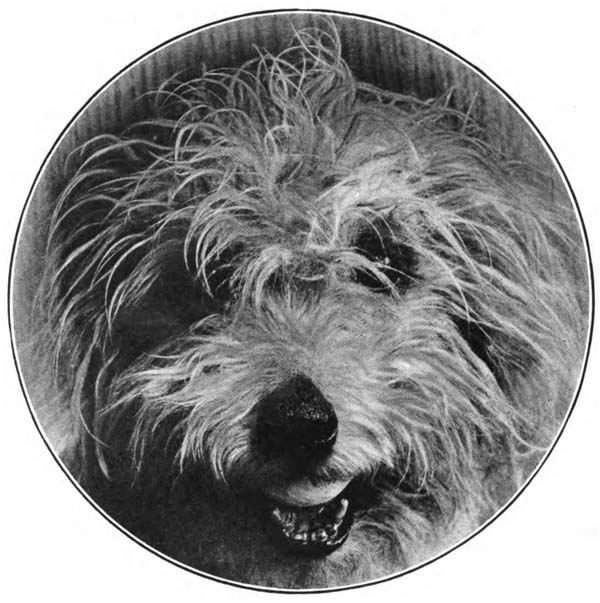
a long, grey, hairy creature, of which nothing could be
distinguished but his magnificent coat, slip in at the
door behind the visitor. After a short pause, during
which the bright eyes hidden behind a cloud of hair
were doubtless taking in the bearings of the situation,
the terrier made straight for the long, low chair at
the further end of the room, where I was sitting, and
curled himself up behind it. My other dogs were in
the garden, and there was no one to dispute the refuge
with him. He submitted quietly to caresses, but was
evidently so frightened that he was soon left in peace,
while the reason of his advent was explained.
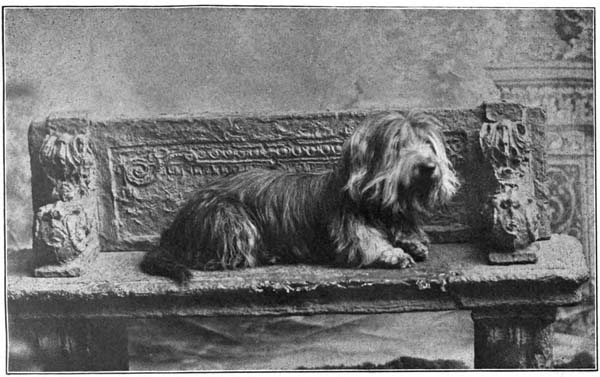
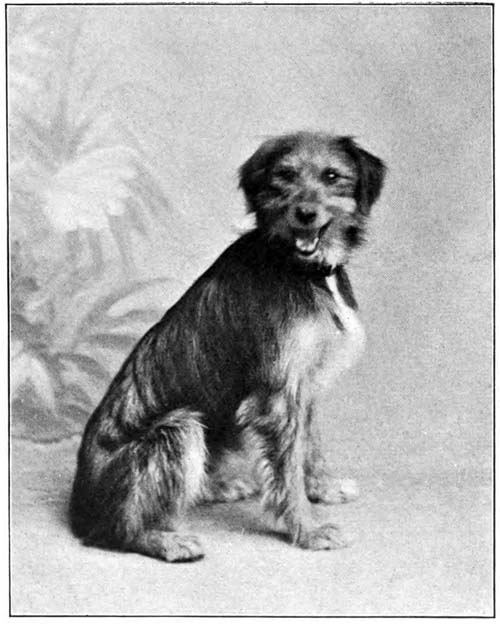
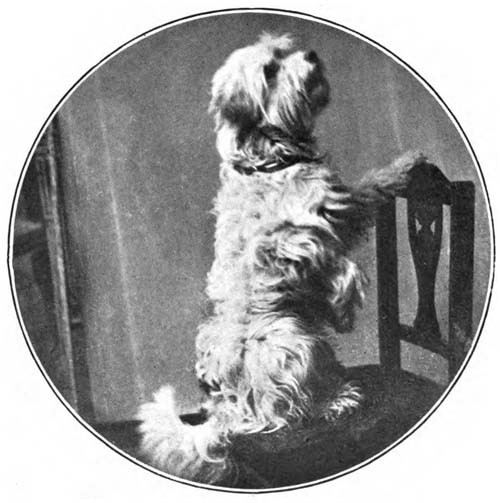
The Child of the House
GUBBINS
He had gone as a puppy to his late owners, from his
breeder Mr. Pratt, whose long-haired Skyes were at one
time well known in Hyde Park, where their master took
them for their daily exercise. These dogs were bred
with the nicest care, and the strain that came from Lady
Aberdeen’s kennels had been preserved. Pratt, who
was a butler, living with a family on the Bayswater
side of the Park, was devoted to his dogs, but as he
could not keep a great number of them, and doubtless
looked to making his hobby a profitable investment,
the puppies were sold at a remunerative price.
In the case of my own favourite, he had gone early to
his country home, and, not having been trained to the
house, he was put in the charge of a gamekeeper to
have his education completed. This man, whose very
name I do not know, had little idea of the gentleness
required for successful training. He was harsh and
ill-tempered, and the shy, wild little creature, who all
his life long was one of the most sensitive of his kind,
was years before he recovered from the experiences of
those early months. He was cowed and frightened,
and, not having the bright merry little ways of puppyhood,
he won no favour from any member of the family
when he was sent up to the house with his first hard
experience of life behind him. He crawled about the
grounds by himself, and only asked to be left alone and
unnoticed, so that he might escape the rough usage
that he associated with intercourse with the superior
being. The long grey form was creeping over a wide
expanse of lawn, looking a dejected enough specimen
of his race, when the visitor saw him from his bedroom
window, and was struck by his great beauty.
When Gubbins left with his new owner he accepted
the experiences of the journey by road and rail with
the dejected submission that only gradually gave place
to a real joy in living as he began to forget what harsh
words and blows, and the chilling guardianship of kindly
but unloving owners, were like.
For the first weeks he was regarded as my visitor’s
property, and for a few nights he slept in her
room. But in spite of this, and of the constant presence
of my own dogs with me, he attached himself to
me from the first. He spent long hours curled up behind
my study chair, or, if he could gain entrance to
my bedroom, he would lie contentedly under the bed.
I took very little notice of him, as I did not wish to become
fond of him, and was only anxious that he should
find a good home before my visitor left me. But very
soon Gubbins would follow the other dogs when they
rushed up or downstairs in front of me, and he and the
Basset being of unusual length of body and shortness
of limb, my friend always used to call the procession,
“dog by the yard.” Gubbins was so quiet and harmless
that the others from the first seemed to accept him
as not worth disputing with. When I was busy in my
study I soon got into the habit of putting down my
hand to pat the little hairy ball that was sure to be
within reach, for the garden gambols of the other dogs
had as yet no attraction for him. Then one night he
got into my room, and was so reluctant to be taken off
to his usual quarters that he was allowed to stay, and
from that time to almost the end of his long life he
never slept away from me when I was at home.
By the time my friend’s visit came to an end I had
begun to wonder if I could ever give him up. As no
suitable home offered, and the weeks passed, Gubbins
carried the citadel by assault by reason of an illness he
had at the very time I had a friend seriously ill in the
house. Between my duties in the sick-room I made
hurried visits to the suffering dog, who spent his time
by the now deserted chair in my study. He would
eat nothing but what I gave him, and by his touching
trust in, and affection, for me he fairly won my
heart.
It was not long after this that Gubbins had his
first and only taste of show life. I had been asked
to support a dog show in the neighbourhood, and
consequently entered him and another of my dogs,
Gubbins at that time being about three years old.
On the morning of the show, he was taken and delivered
over to the authorities, as I was not able to
go myself till later in the day. When I entered the
show ground I made my way at once to the place
where the Skyes were benched, but could see nothing
of my dog. The attendants could give me no tidings
of him, and it was a kindly stranger who, overhearing
my inquiries, at last told me he had seen a Skye in the
pet dog section of the show, and he added, “the sooner
he was taken away he thought the better.” I hastened
to act on the suggestion, and to my great annoyance
found my poor Gubbins, looking the picture of misery,
benched in a place only large enough for a dog half his
length and size. He was, indeed, so stiff and cramped
when I took him out that he could hardly stand. The
man in charge of the benches was quite deaf to my
assertion that it was cruelty to put a dog in a place
so obviously unfit for him, and in spite of the absurd
mistake that had been made he tried to refuse
to allow me to move him. To this, not unnaturally,
I paid no heed, but taking Gubbins with me I told
the man I would see the secretary about the matter.
When I found this functionary, a much harassed individual,
who seemed far from being at home at his duties,
I was told curtly that he supposed the mistake was mine
in entering the dog for a wrong class! In any case it
was against the rules of the show for a dog to be taken
from the benches until the judging was over. Nevertheless
Gubbins did not return to his martyrdom, and it
took him many days to recover from the effects of the
combined foolish treatment, and the terror he had suffered
at finding himself among strangers. I decided
that any honours he might win would be dearly bought,
as it was clear his early experiences had made him unfit
for show life, and I always refused to let him try his
fortune again.
My other dogs were sent to new homes when I gave
up my house, but Gubbins became a great traveller, and
accompanied me everywhere in the wanderings of the
next few years. At first he was quiet as a mouse when
taken by carriage or train, and I had no anxiety as to
his ever wandering from me, even in the most crowded
thoroughfares. But as his nature recovered its tone,
and a bright, joyous, and independent outlook on life
became habitual to him, he grew wilful and over confident
that my protection was sufficient to rescue him
from any trouble. Yet he was three months in my
house before he lost the habit of keeping himself hidden
from view, and was, as I have said, always concealed
behind or under some article of furniture. The
slightest accidental touch of a foot, even the gentlest,
was enough to make him flee in terror, and for hours
afterwards he would not come out from his shelter,
or respond to any caresses. Almost to the end of his
life, until sight and hearing were impaired, he always
rushed into the most secluded corner he could find
whenever strangers came into the room, and no blandishments
would draw him out while they remained.
I thought at first that his spirit had been so utterly
broken that he would never recover, but would always
need the care lavished on a semi-invalid. But gradually
and surely he began to show the natural fearlessness
of his disposition and the bright playfulness that
afterwards distinguished him. Little by little he gained
courage, and secured his place as first favourite in the
house. I do not think, however, that he was ever quite
happy while the other dogs remained, though he thoroughly
enjoyed his daily scamper with them.
After his first illness he would never feed in the
outhouse where the dogs’ dinner was made ready for
them. Daily complaints came to me that Gubbins
would not touch his food, and though if I went out
and petted and encouraged him he would begin to
eat heartily, the instant I turned away he stopped,
and no one could induce him to take another mouthful.
I said sternly that he must be left till natural hunger
forced him to give up the fancy, and it was only
when I found how thin and weak he was getting that
one day I ordered his previously rejected food to be
brought into the dining room. The bowl was put down
on a newspaper, spread out for a tablecloth. Gubbins
watched the proceedings with interest, and then with
much tail wagging, fell on the food with a will and
quickly disposed of it. Never after this did he attempt
to go near the other dogs when they were feeding,
but at breakfast time curled himself up near the spot
where his bowl had been placed, and waited till it was
brought to him. That I do not shine as a disciplinarian
with my pets must, I fear, after this be conceded, for
there are drawbacks to feeding a long-haired dog on
your dining-room carpet. It only needed a day or
two to show Gubbins that manners in the house were
not quite on a level with those of the dogs’ feeding-place.
As soon as the last mouthful of food was disposed of, a
kennel duster was brought into play to remove the remains
of the meal from the long hair about the mouth
and at the tips of the beautiful ears. After the first time
or two he showed his appreciation of the new régime
by standing quietly with his head over the dish where
he had just finished eating, and if he was not attended
to immediately he would look round to see the cause
of the delay.
His enormously thick coat required the most careful
daily grooming, and the time spent on this was
not an unmixed pleasure to Gubbins. For some time
he submitted quietly, as he did to everything else that
was asked of him, but by the time he had won his place
in the dining room, and the kitchen regions had become
unknown ground to him, he sometimes showed resentment
at the treatment his tangled locks entailed on him.
The first serious difference of opinion I had with him
came over his refusing a piece of toast he had asked
for at breakfast. As he had asked for it, he must be
made to eat it. But each time the usually coveted dainty
was put before him his tongue came out, and with a
contemptuous flick sent it rolling over the floor. He
was told it must be eaten, and a mutinous determination
not to obey was shown in the pose of his head, for one
can hardly speak of expression where the face, even to the
eyes, was entirely covered with thick, falling hair. But
the whole contour of his form expressed a great refusal,
and it was felt that a lesson of obedience must be given.
When the meal came to an end the toast was again
offered and rejected, and before I left the room Gubbins
was fastened to the leg of the table, and I told him the
toast must be eaten before he would be released. While
the maid was clearing away the breakfast things Gubbins
lay perfectly quiet, but as soon as he found himself
shut in alone he began to call and struggle. I went in
more than once to see if the dispute was at an end, but
no, there lay the rejected morsel, and Gubbins would
have none of it. When the hour arrived for the daily
walk great sounds of unrest came from the room, and
once more looking in I found, to my astonishment, the
dog had actually succeeded in dragging the fairly large
dining table quite out of its place, in the direction of the
door. A chorus of angry barks showed his displeasure,
but there still lay the uneaten toast. At this moment,
while the door was standing open, the other dogs came
into the hall on their way out. “Is Gubbins to come
with us?” asked their guardian. “No,” I answered.
“If he will not eat the toast he must be left at home.”
Behind the bundle of hair I could just see two bright
eyes fixed on my face. The front door opened, and
the other dogs rushed out. Gubbins sat up, listening
intently, and when he found the others were actually
going without him he looked round for the object of
contention, flung himself upon it, swallowed it, and then
rushed barking to the end of his tether, demanding to
be set free. Needless to say this was done, but the excited,
quivering dog turned for one second to give my
hand a dainty, propitiatory lick before he rushed off
wildly in pursuit of the others.
The lesson was remembered, but all through life, from
this point, a wilful determination to have his own way
was one of his characteristics. This I attribute to the
reaction from the harsh treatment of his early days,
and though it is probable that with firmer discipline it
might have been overcome, I found it impossible to
resort to harsh measures when he was only just coming
out from the shell of nervous dread that had seemed to
wrap him round from all the enjoyments of life. I fear I
hailed the first exhibitions of will as an indication of his
recovery to a normal state. A sharp word from me, if
given at a sufficiently early stage, would always restrain
him, but to others he was not so obedient, and I fear
soon learned to trade on the fact that under no circumstances
would he be beaten. A flick of a handkerchief
he took with stoicism from others, but from my hands it
had all the effect of a stronger punishment. He would
crawl away, and lie, a picture of dejection, for an hour or
more. He was left to feel himself in disgrace, until he
would presently come creeping to my feet for the pat of
forgiveness that restored him to life and animation.
His devotion to me never wavered, and after each
of his severe illnesses I thought I saw a closer attachment
show itself in many ways. What, perhaps, was
the greatest proof of his unwavering loyalty was that
during the last six months of his life, when he was sixteen
years of age, nearly blind and partially deaf, and in
a state that required him to be carried up and downstairs,
and otherwise attended to, I was not able to have
him in my room at night, and his care passed greatly
into the hands of others. To his guardians he was very
affectionate, and especially to the friend who watched
over him with the most devoted care, and to whom Gubbins
looked for the greatest enjoyment of his life—his
daily walk. But there could be no doubt in the mind of
any one who was with him, that no one was likely to displace
his mistress from the warmest corner of his heart.
He always showed the nicest appreciation of the capacity
and duties of those who took care of him. When
he was already so feeble that he was generally carried
from one room to another, I was astounded to find he
realised that I was not strong enough to do this. His
knowledge was all the more extraordinary because when
in stronger health, I had been in the habit of lifting and
carrying him on occasions. But one night when the
maid who always carried him into the dining room, and
for whom he waited as a matter of course if she was
not there when I went to dinner, was absent, Gubbins
came out of his basket as soon as I moved and
crawled into the other room after me. The following
night his attendant was at home, so Gubbins stayed
quietly in his basket as usual till she came to fetch him.
Often afterwards the same thing happened, and during
the whole of the time after his powers had failed he
never once appealed to me to lift him. He would make
the most determined efforts to mount the garden steps if
I was with him, though he never attempted to do so if
he was with any one else, but would lie down and wait
to be fetched if he was not lifted at once.
At one time when I had him in lodgings, the maid
who attended on him was with me, and always carried
him up and down the two flights of stairs that led to my
bedroom. When the maid was going home for a month’s
holiday I wondered what I should do with him. I did
not think he could get up by himself, and did not want
to call a strange maid to my assistance. At bed-time
I went to the stairs as if I expected him to follow
me, and the little thing worked his way up with a sideways
motion after me, stopping on the landing for a rest,
and then finishing the journey. In the morning he followed
me down, though this was really a dangerous proceeding,
and I had to prevent his taking a roll to the
bottom by holding him up with his lead fastened to his
collar. This performance was repeated as a matter of
course every night and morning for the month, and
when the maid returned I told her that Gubbins had
learned to go upstairs by himself, and that while he could
do so I preferred him not to be carried. When she
came to fetch him, therefore, for the night, she told him
to follow her, and he went out of the room after her
obediently. At the foot of the stairs, however, he laid
down, and turning a deaf ear to her calls he quietly
waited for her to come back and pick him up.
That under any circumstances Gubbins could refuse
his walk I did not believe, till one day I found him lying
on the front doorstep, and refusing to move at the entreaties
of his prospective companion, the reason being
that he had discovered I was about to leave the house.
This was when he had been with me about a year, for
up to that period he had shown himself equally willing
to go out with me or any other of his friends. After
this he would never go until he was sure that I was not
going out, and many a time he insisted on being let into
my study to see if I was there, before he would leave the
house. If nothing in my dress suggested a walk he
would go off and immediately give himself up to the
joys of the coming expedition. When at one time I
used to go out in the early morning before breakfast, at
a certain stage in my dressing operations Gubbins would
always come up to investigate what boots and skirt I
had on. If his sensitive little nose told him those were in
use that he connected with a walk, he began to bark and
jump round me, as if wild with joy, for he knew that he
would go too. But if he recognised the skirt in which I
usually cycled he crept away dejectedly, for on these
occasions I always left him at home. Although his
speed would have enabled him to keep up easily with
the bicycle, I have always thought it mistaken kindness
to allow a dog to go at the stretch of his powers while
he keeps in touch with carriage or bicycle, as the prolonged
tension is likely to injure the natural action of
heart and lungs.
One day, when there was illness in the house, the
volley of barks and wild gambols with which Gubbins
showed his joy at an approaching walk could not be
allowed. I felt a little doubtful if the exuberance of his
joy could be kept within due limits, and in any case I
knew I was the only person likely to be able to restrain
him. When the moment arrived for putting this to the
test I knelt down by him, and turning his little head up
I put my finger on my lips and in a low, hushed voice
told him he must be quiet. He saw I was dressed for
walking and knew what was in store. He was, however,
evidently impressed, and opening the room door quickly
I cautioned him again, and to my great relief only one
little half strangled bark escaped before we were safely
outside the hall door. Yet he tore down the stairs in
his usual headlong manner when excited, and was
quivering with eagerness for the coming joy.
After this I was always able to make him go out
quietly by the same means, and in a house where he
stayed with me for some weeks he learned that under no
circumstances was barking allowed indoors. He consequently
won golden opinions from the old lady whose
feelings he thus spared. But that he felt the long
restraint irksome, he would show by a petulant twist of
his head from under my hand, when I made one of my
many appeals to him to remember the caution. His
self control happily lasted to the end of the visit, though
I never felt inclined to put it to the same test again.
It was one of the most interesting studies I have ever
had, to watch the gradual unfolding of Gubbins’s mind
as he threw off the terrors of the past. His strong
affection was, as I have said, the first point that showed
itself. Then his intelligent appreciation of the ways of
the household, and his own place in it, was little by
little made plain, and with it came the manifest determination
to stand on his rights. It was not, however, till
he had been with me for some four years that he began
the system of signs and sounds that stood to him in the
place of language.
There were certain biscuits kept for Gubbins as a
treat when he had behaved with decorum in the dining
room, where he used to lie in a corner during meals.
These biscuits were known in the household as “Peter
Burrs,” owing to the correction given me in the matter
of pronunciation by a worthy country grocer, when I
stated my wish for “Petits Beurres.” The tin containing
these dainties was generally taken from the sideboard by
one of ourselves, just before we left the table. Gubbins
was always all attention, and at the movement to fetch
the tin, he would come out of his corner and bark
rapturously. But one day a friend brought me the
wrong tin by mistake, and Gubbins, who had been all
eagerness as usual to watch for its advent, sat down
quietly and did not attempt to come up for the usual
offering. It was this conduct that led me to notice the
mistake that had been made, for the tins were almost
alike in size, though different in colour. The dog’s
appreciation of the mistake before we had recognised
it, caused such amusement that while this friend was
staying with me she often tested Gubbins’s discernment
by bringing out the wrong tin purposely. Never
was he deceived, though one day he rushed up and
barked once before he noticed the tin, but as soon as
he saw it he sat down and waited for the mistake to be
rectified.
It was when he stole to my side during luncheon,
and made his presence known by a delicious little low
sound of entreaty, that his language sounds began. I
was so delighted with the effort that I took to making
him say it before he had one of his much loved biscuits
given to him. “Ask, Gubbins,” he was told, and the
little entreating sound came as a preliminary to business.
Very soon he learned to use the signal to draw attention
to any want, such as the need for water, or the opening
of a door. Whenever his water dish was empty Gubbins
would first call attention to the fact by lying full length
in front of it, with his head touching the dish. If this
did not succeed he would look round to see why he
was not being attended to, and if I was—or pretended
to be—wholly immersed at my writing table he would
cry quietly to himself,—a little complaining noise that
could not be overlooked in its gentle persistence. Once
or twice I tested him further to see what would happen,
and when Gubbins found that my denseness was not to
be pierced by any ordinary means he came up to me
and, resting his head against me, “asked.” Then he
walked back to his water dish and lay down as before.
That here there was a very intelligent adaptation of
means to end is evident.
The daily bone thrown to Gubbins was of course a
great delight, and once I tried the same experiment
that Mr. Herbert Spencer made with his Skye, and with
the same result. A string was fastened to the bone
and Gubbins had his usual play with it, a necessary
part of which was for him to stand growling over it and
dare any of his friends to take it from him. This nearly
always brought some one on to the lawn to play the
part of robber. It was enough for one of his friends to
advance gently towards him saying, “Is that for me,
Gubbins?” for the little thing to seize it in his mouth
and run to a distant part of the lawn, where the performance
was repeated. If his friends did not go on
playing the game I have known Gubbins to leave his
bone and come to ask them to see it out, and only
when his spirits had exhausted themselves would he
settle down to the enjoyment of the dainty, secure in
the knowledge that no one would be allowed to interfere
with business. But to return to the experiment. Gubbins
was just settling down to the serious part of the
performance when I pulled the string and drew the
bone gently away. Gubbins gave a startled look at it as
it receded slowly, then as it lay still he approached with
every sign of caution and stretched out one fat paw.
Still there was no movement, and relief and confidence
were now expressed in his bearing. Then I jerked the
bone to some distance. Gubbins fairly turned tail and
fled to me for protection. The sense of the unknown,
conditions of which he had no previous experience,
terrified him, as did the growling of thunder or the
presence of strangers in his own home.
In matters where Gubbins was on known ground his
courage was beyond dispute and often brought him
into peril. No dog was too large or too strong to call
forth hostile demonstrations, if he happened to excite
his ire. I well remember the horror with which, on
hearing the well-known rush and growl that signalised
Gubbins’s dislike of another dog, I turned to see the
ridiculous little creature hanging on to the nose of a
huge St. Bernard. With one angry toss of his mighty
head the larger dog could have broken the spine of
his tormentor. Happily the monster seemed too astonished
at the onslaught of the hairy mass to do anything
beyond give a very gentle swaying motion of the head,
which swung Gubbins’s long body from side to side;
for even hanging as the latter was at full length, his
hind limbs were well off the ground, and he must have
made one of his marvellous springs to fasten on the
head as he did. Presently his teeth loosened and he
dropped from his perilous perch, and he certainly owed
his life to the remarkable gentleness of his victim.
Before Gubbins had walked off his excess of spirits in
exercise he often gave these mad rushes, sometimes, I
grieve to say, at humans. Any unsavoury specimen of
the genus tramp always roused his mischief, and so, alas!
did any gentle, fragile looking old lady or gentleman
who could be depended on to receive his onslaught with
a sufficient display of terror to make it worth while.
Many were the scrapes from which he was not always
rescued with the honours of war, and countless were the
apologies made on his behalf. But after his maddest
exploit the absurd little bundle of hair would come
meekly to my feet, and generally by his very appearance
disarm the sufferers. At such a moment caresses
from the stranger’s hand were suffered with deceptive
meekness, and were evidently taken as the necessary
consequence of the previous joy. That the loud bark
which would have fitted a dog ten times his size, and the
sudden rush at the heels of a passing stranger, were
sufficiently alarming, is clear, and a leather lead was
soon fastened promptly to his collar whenever a human
approached who long experience had taught me was
one likely to be singled out by Gubbins as a vent for his
excitement. His teeth never came into play, and this
showed it was simply the fun of the thing that appealed
to him, and not the hostile feeling that often prompted
his attacks on fellow dogs.
Gubbins was the most humanly intelligent of all the
dogs I have ever owned, and so far as his powers of mind
went they appealed perfectly to the same level of
expression of our own. While his trust and love were
unwavering, his sympathy with anything in the shape of
suffering or sorrow was undoubted. He would never
leave me of his own free will, if he knew I was in
trouble, though it could only have been by the tone of my
voice that he discovered there was anything amiss. In
the case of physical illness it was the same, and he would
lie for hours on the foot of my bed, to which on these
occasions he always “asked” to be permitted to jump.
The highest exercise of intelligence he ever showed
was prompted by his love, and the amount of reasoning
power that led to the successful carrying out of his
stratagem shows what a narrow boundary there is
between the highest efforts of the animal mind and
those where human intelligence begins. I was suffering
at the time from malaria, a legacy from a fairly long
sojourn in India, and it was decreed by the friend who
had taken charge of my sick-room that Gubbins was
not to be allowed to disturb me. This lady, who was
herself one of Gubbins’s most faithful friends, and
was regarded by him with the warmest affection, told
him after breakfast that he was not to come to me. That
he fully understood what she said he showed by the
dejected way in which he turned from her and crawled
into his basket. The dining-room door was then shut on
him, the back stairs were cut off by two heavy doors, and
the passage from the top of the front stairs led past my
friend’s bedroom before my own could be reached.
From her bedroom, where the visitor sat writing with
her door open, she could hear if any of the household
should go into the dining room and set Gubbins at
liberty. Besides, the flop, flop with which he always
jumped from step to step of the stairs was clearly
audible over all that part of the house, and this gave her
confidence that he could not, in any case, get up without
her hearing him.
But the dining-room door had not been fastened
securely, and though it was a heavy oak door Gubbins
managed to work it open. He then crept upstairs without
a sound, and therefore in a very different way to that
in which he usually mounted, stole past the open bedroom
door, without betraying his presence, and putting
his head close to the crack of my door gave one of his
tiniest “asks.” So low was it that the watcher in the
adjoining room heard nothing. At first I did not realise
what had happened, and thought the voice reached me
from a distance. But when a repetition came, the
peculiar guarded sound of the faint call struck me, and
at the third time I knew that by some means Gubbins
had found his way to me. Entering into the spirit of
the enterprise I opened the door softly and let him in.
Without any of the usual manifestations of joy with
which he was wont to greet me, he slipped past, and
without waiting for the permission he always asked he
sprang on the bed and curled himself round with a sigh
of content. Then the drowsiness of fever overcame me,
and I dozed for some hours, Gubbins also sleeping
peacefully at my feet.
When at last my friend appeared, her relief at the
sight of the hairy bundle on the bed was great. She
told me that a search had been made for him all over
the place, both indoors and out, as soon as it was discovered
that he had escaped from the dining room. My
room had not been thought of, as she felt certain he
could not have come upstairs without being heard
by her.
The amount of thought and caution exercised by the
dog in carrying out his plan was remarkable. After
making use of the great muscular strength of his sturdy
forepaws in getting open the door of his prison, he had
to get upstairs in a way that would not betray his presence.
How he managed this we could not understand
at the time, but years afterwards I saw him, when still
weak from a severe illness, crawl up with a sideways,
crab-like motion that explained what he had done to
attain his ends in the heyday of his youth and strength.
Placing his forepaws on the step above him he hitched
his hind quarters up sideways, as his length could only
thus be supported on the step, the depth of the stairs
not being more than half his length. In this way there
was no noise, but he still had to pass the watcher’s open
door and convey the fact of his presence to me without
letting her know. This accomplished successfully,
he did not forget the need for caution when he had made
good his entrance, but with a silent caress to my feet, and
much wagging of the tail he left his usual mode of welcome
severely alone, and, secure of my understanding
and abetting, even took possession of one of his most
prized rewards, only rarely accorded, by jumping on to
the bed without the preliminaries of permission asked
and granted that were always insisted on.
Here he showed a clear appreciation of the difficulties
of carrying out his plan, and who shall say what was
passing in his brain as he stole softly upstairs, passed his
friend’s open door without disclosing his presence, and
then, with all the precautions a human could have used,
succeeded in communicating with me? Not less remarkably
did he show his appreciation of the dangers so far
conquered, when he exercised needful self-restraint in
the expression of his greeting, and sank down at last
with a sigh of content as he realised that all was well.
We are told by an eminent writer on the psychology
of animals that the feeling of shame stands very high in
the development of the emotional powers. In Gubbins
its manifestation was very apparent. A flick of the
handkerchief or a sharp word from me changed his whole
aspect in a second, unless, indeed, the excitement of some
forbidden pleasure had taken him in too firm a grip, and
the enterprise on which he had started had to be carried
out at all costs. But once the excitement passed, shame
for his misdeed followed, and was shown in the same
way a child will do in the same circumstances, up to the
verge of speech. On one occasion, when I was from
home all day, the maid in whose charge he had been
left neglected to attend to him. The shame-faced little
dog that met me on my return, and who put his head in
my hand and cried softly, told me that some trouble had
happened for which he was not to blame. In the same
way when he was suffering from illness that caused occasional
attacks of sickness, if by chance he was shut in a
room when misfortune overtook him, although he knew
he would not be punished for what was not his fault, he
could not have shown more shame at the occurrence if
he had dreaded chastisement.
Gubbins was a little gentleman in all his ways and
feelings, his one lapse from propriety of manners being
the rushes by which he helped to work off the excitement
of his walks. He could always be depended on to
preserve a neutral attitude towards any stranger staying
in the house, if I performed a sort of introduction by
putting my hand on my visitor’s arm and telling Gubbins
that he or she was my friend. The same course
had to be adopted with a new maid, and if a fearless pat
was then given him by the new-comer, I knew that as
long as that person was in the house there would be no
trouble. But if, on the other hand, the slightest fear of
him was shown, it behoved me to be careful, for if that
maid came in his way when he was under the influence
of any excitement such as that of his daily walk, there
would be the same attempts to upset her equanimity by
which he distinguished himself out of doors. No use of
the teeth, but just the communication of his own excitement
to one who his instincts told him could be relied
on to respond. To secure the clatter of a fallen tray, or
the headlong rush of a frightened maid downstairs,
while he stood growling and barking at the top, as if
ready to tear her in pieces, gave him, I grieve to say,
under such circumstances, the liveliest enjoyment. But
when he was shut up to reflect on his misdemeanours,
by whatever process these were brought home to him,
an unmistakable feeling of shame was displayed as soon
as he had recovered his normal state.
The abject depression with which he crept from view
one very wet autumn, the first time his long coat was
clipped about his legs and the under part of the body,
took a long time to recover from. For days a remark
on his appearance, or a laugh at his expense by any
visitor, would cover him again with shame. His self-respect
had been wounded, and the same feeling was
shown when he was taken out for a walk the first time
after a severe illness. The poor weak dog could only
totter along for a very short distance. But on the way
he met another dog, and as soon as Gubbins saw him
approaching, the change in his demeanour was instantaneous.
With head and tail erect, and a general air of
alertness and strength, he passed his rival, walking on
the tips of his toes, as he was wont to do in better times.
A few steps carried him triumphantly past, and then, the
excitement over, the poor little invalid collapsed as suddenly
as he had pulled himself together, and rolled over
helpless in the dust. Could any animal without a sense
of the ego, the personal I, show such a keen sense of
the respect due to himself?
A quite marvellous knowledge of time was shown by
my favourite. I am not speaking of the hours of feeding,
for such knowledge is doubtless due to the promptings
of the natural appetite. But how for some months he
always knew when the clock pointed to half-past nine I
have never been able to ascertain. A lady who was living
with me as my secretary at the time was a warm
friend of Gubbins, and was accepted by him as such.
This lady was not in good health, and used to retire to
bed before the rest of the party. In about a week Gubbins
constituted himself the guardian of her health in
this respect. If she did not move promptly at the half
hour he roused himself, came out of his basket, and, sitting
at her feet, barked until she got up and said good-night.
The performance was so much appreciated that
after this Gubbins’s reminder was waited for, and though
there was no clock within hearing that struck the half
hour, nor so far as we knew any sound that could tell
the time, Gubbins was never more than a few minutes
either before or after. He would go and sit close at the
lady’s feet, lift his head and fix his brown eyes on her
face, and bark his signal for her to go. There seemed
no reason for him to wish her to leave, as no sooner had
she gone from the room, than he went back to his basket
and curled himself up to wait for the dispersal of the
other members of the family. With no one else did he
ever do anything of the same kind.
At one time when I was living in the country, the
same inscrutable knowledge of the hour of seven in the
evening was shown by him. Once or twice he was taken
for a run across the valley below the house to the post,
just before the dinner hour at seven-thirty. After that
he was always on the look out at seven o’clock, and as
soon as he associated the little expedition with one member
of the household, he found him out and kept close
to him as soon as the hour arrived. Once, when the dinner
hour had been advanced, the letters were taken
earlier, and Gubbins had not come in from his rambles
in the garden and could not be found. He was watching,
however, when the messenger returned, and showed that
he understood what had happened by taking up his
position in good time the following day on a point in the
drive where the two ways from the house met, and without
passing which no one could leave the place. Often
after this he would sit there watching, instead of coming
into the house, as he clearly understood that from that
spot he had a full command of the situation.
As the gradual unfolding of Gubbins’s mind had been
an unfailing source of interest, so was the preservation
of his natural characteristics when his powers began to
fail. He enjoyed his life almost to the end, and through
the last long day of suffering found comfort in the care
and affection that were lavished on him. Although for
some time his eyesight had almost gone and his hearing
was impaired, and other disabilities of old age were upon
him, he still went nearly mad with joy at the prospect of
a walk, still took a certain modified, though always mischievous,
pleasure in making others share his excitement,
and made his sense of smell serve for the loss of his
other faculties in a quite marvellous way. He always
recognised his old friends, and it was a characteristic of
his throughout life that he never forgot a single person
whom he had once accepted as a friend. It might be
months or even years before he saw them again, but he
never failed to recognise them.
Various were the names bestowed on him by his many
friends at different times. From the absurd “Mr. Gubbins,”
he was called by the still more unsuitable title of
“Scrub.” This led to a mild joke of a friend of mine,
who always inquired after him by the formula, “And
how is Ammonia?” A very dear old lady, the mother of
the friend through whom Gubbins came to me, spoke
of him as “The caterpillar,” moved thereto by the sight
of the long dark form that used to steal across her drawing
room to find a hidden corner, when he was staying
with me in her house. In the inner circle of his home
he became “The Hairy Angel” or “The Fascinating
Fiend,” according to the nature of his disposition at
the moment.
But these names belong to the time of his youth and
strength; his beauty he kept to a surprising degree up to
the very day of his death. It was touching to see him
in his later years, and especially during the last six
months when he was all but blind, finding his way about
the house by the help of his nose. I have often watched
him come into my study when he was looking for me.
The room is a double one, and he used to feel for the
side of the arch that forms the division, then feel about
for the couch that stands on one side of the inner room.
From there he touched my bureau, and thence worked
about till he found my chair, which was often at some
little distance. No sooner did his nose touch the chair
than he hurried to the front of it to see if I was sitting
there, and feeling the full helplessness of continuing his
search if I was not in my usual place, he would curl himself
up beside it and cry quietly. I have watched him
do this while I stood by the bookshelves in the back
room, though I had to be careful he did not find me out,
as he came in by the door in that room.
To the last the watchful little head would come up in
his basket, and a warning growl give notice of the presence
of a stranger, and in his feeble way he guarded his
beloved mistress to the end. When the little life went
out from the suffering body it left a blank that for those
who loved him best can never be filled, but—
“When at last my long day’s work is done,
Shall I not find him waiting as of yore,
Eager, expectant, glad, to meet me at the door?”