Rules Therefor as Drawn by President Washington—The
Existing Code.
Washington, February 10, 1870.
Originally the word “etiquette” meant a mark or title
affixed to a bag or bundle denoting its contents, but in the
modern acceptation of the word it is an account of ceremonies.
It is a term applied to the forms which are observed
toward particular persons, or in particular places,
especially in courts, levees, and on public occasions.
In the beginning of the nation’s life our beloved forefathers
thought that all these forms which marked the
distinction between classes or individuals should be done
away with at the same time with all the rest of the hollow
mockeries which go to make a monarchical form of government.
Notwithstanding President Washington meant
to practice republican simplicity at the headquarters of
the nation, “courtly” ways did creep into daily social intercourse.
For instance, at Mrs. Washington’s receptions
in both New York and Philadelphia the “first lady
in the land” received precisely after the manner of Queen
Charlotte’s drawing-room levees. The guests were arranged
standing against the walls, and the President’s
wife marched the rounds and said a kind word to all.
When Mrs. Washington paid a morning visit, a servant
or usher was sent in advance, “who rapped smartly with
his knuckles on the door” and announced, “Mrs. Washington
is coming.”
During these chaotic, unsettled days our far-seeing
Washington realized that some rules and just regulations
must be formed, lest the dignity of the Republic should
be found trailing in the dust. He saw that it was necessary
to establish a rank without violating the Constitution,
which prohibits Congress and the States from
granting any title of nobility. Of so much importance
to the country did he consider this subject that he addressed
letters to Messrs. Adams and Hamilton, asking
their attention and advice upon certain points of etiquette
touching the deportment of the President of the United
States. After mature reflection, the three wise men,
Messrs. Washington, Adams, and Hamilton, fixed upon
certain rules, which were afterwards endorsed by Jefferson.
In order to bring the members of society together in
the first instance, the custom of the country was established
that residents shall pay the first visit to strangers;
and among strangers, first comers to later comers, foreign
and domestic, the character of stranger ceasing after
the first visit. To this rule there is a single exception—foreign
ministers, from the necessity of making themselves
known, pay the first visit to the Cabinet ministers
of the nation, which is returned.
When brought together in society all are perfectly
equal, whether foreign or domestic, titled or untitled, in
or out of office. All other observances are but exemplifications
of these two principles.
The families of foreign ministers arriving at the seat of
Government receive the first visit from those of the national
ministers as well as from all other residents.
Members of the legislature and the judiciary, independent
of their offices, have a right as strangers to receive
the first visit.
No title being admitted here, those of foreigners give
no precedence.
Difference of grade among the diplomatic members
gives no precedence.
At public ceremonies to which the Government invites
the presence of foreign ministers and their families, a
convenient seat or station will be provided for them, with
any other strangers invited, and the families of the national
ministers, each taking place as they arrive, and
without any precedence.
To maintain the principle of equality, or of pele-mele,
and prevent the growth of precedence out of courtesy,
the members of the executive will practice at their own
houses and recommend an adherence to the ancient usages
of the country—of gentlemen in mass giving precedence
to the ladies in mass, in passing from one apartment
where they are assembled into another.
From time to time these severe republican rules have
been discussed and ameliorated to suit the growing aristocratic
taste of the great modern American Republic.
In later years a set of rules has been adopted which
is called the “Code.” It is said all branches of the Government
were appealed to in order to be suited, and the
rules of the code were the result; but whether President
Monroe or some other dignitary of those days was the
author, the writer has no means of ascertaining.
The President.—Business calls are received at all times
and hours when the President is unengaged. The morning
hours are preferred. Special days and evenings are
assigned each season for calls of respect,—one morning
and evening a week being assigned for this purpose.
Receptions are held during the winter season, generally
once a week, between 8 and 10 o’clock in the evening, at
which time the guests are expected in full dress, and are
presented by the usher.
The President holds public receptions on the first of
January and the Fourth of July, when the diplomatic
corps present themselves in court costume, and the officers
of the Army and Navy in full uniform. The executive,
legislative, and judicial branches of the Government
are received between the hours of 11 and 12; after which
the diplomatic corps, officers of the Army and Navy, and
civilians en masse.
The President accepts no invitations to dinner, and
makes no calls or visits of ceremony; but is at liberty to
visit without ceremony, at his pleasure. An invitation to
dinner at the President’s must be accepted in writing, and
a previous engagement cannot take precedence.
The address of the Executive in conversation is Mr.
President.
The Vice-President.—A visit from the Vice-President
is due to the President on the meeting of Congress. He
is entitled to the first visit from all others, which he may
return by card or in person.
The Supreme Court.—The judges call upon the President
and Vice-President, annually, upon the opening of
the court, and on the first day of January.
The Cabinet.—Members of the President’s Cabinet call
upon the President on New Year’s day and the Fourth
of July. First calls are also due from them, by card or
in person, to the Vice-President, judges of the Supreme
Court, Senators, and the Speaker of the House of Representatives,
on the meeting of Congress.
The Senate.—Senators call in person on the President
and Vice-President on the meeting of Congress and the
first day of January; and upon the President on the
Fourth of July, if Congress is in session. They also call
in person or by card upon the judges of the Supreme
Court and the Speaker of the House of Representatives
on the meeting of Congress.
The Speaker of the House of Representatives.—The
Speaker calls upon the President on the meeting of Congress,
the first day of January, and the Fourth of July if
Congress is in session. The first call is also due from
him to the Vice-President on the meeting of Congress.
The House of Representatives.—Members of the
House of Representatives call in person on the President
on the first day of January, and upon the Speaker of the
House on the opening of each session. They also call, by
card or in person, upon the President on the Fourth of
July, if Congress is in session, and upon the President,
Vice-President, judges of the Supreme Court, Cabinet
officers, Senators, Speaker of the House, and foreign ministers,
soon after the opening of each session of Congress.
Foreign ministers.—The diplomatic corps call upon
the President on the first day of January, and upon the
Vice-President, Cabinet officers, judges of the Supreme
Court, Senators, and Speaker of the House, by card or in
person, on the first opportunity after presenting their
credentials to the President. They also make an annual
call of ceremony, by card or in person, upon the Vice-President,
judges of the Supreme Court, Senators, and
Speaker of the House, soon after the meeting of Congress.
The Court of Claims.—The judges of the Court of
Claims call in person upon the President on the first of
January and the Fourth of July. They also make first
visits to the Cabinet officers and diplomatic corps, and
call by card or in person upon the judges of the Supreme
Court, Senators, Speaker, and members of the House,
soon after the meeting of Congress.
The families of officials.—The rules which govern officials
are also applicable to their families in determining
the conduct of social intercourse.
The above code answers the same purpose to social life
in Washington that the Constitution does to the whole
country. So long as those engaged in the controversy
stick to it they are safe. The moment they leave it they
are adrift. At present a severe war is waging between
the Senators and Supreme Judges. We beg the pardon
of these sensible men; we mean their families have armed
themselves cap-a-pie, and a great smoke is ascending from
the battlefield. The wives of the Senators claim that the
Senate created the Supreme Judges, and, to use the words
of one of the brightest leading Senators, “Should the
creature outrank its creator?” The Supreme Judge is
made by the Senator, and if he is guilty of misdemeanor,
he is tried by the Senate, and if found guilty, is deposed
from his high office by the same. But once let a man
get to be a Supreme Judge, and he stands as firm on
the pinnacle to which he has been raised as the rock of
ages on the bed of eternity.
Then it is claimed that all those who stand in the direct
line of succession to the President outrank all the others.
Our wise forefathers meant that our Government should
never fall to pieces for the want of a “head.” So, if our
military chieftain should go off like one of his own cannons,
we should still have our precious Schuyler. If
Vice-President Colfax should be snatched away from the
evil to come, we should have to comfort ourselves with
Speaker Blaine. Alas! alas! if he should fall like the
smart rap of his own gavel, Chief Justice Chase would be
left on our hands, and death could get no farther.
The “Code” says—and, by the way, it is just as good
as the Constitution—that the Cabinet shall make first calls
on the Vice-President, Supreme Judges, Senators, and
Speaker of the House, but General Grant has taken these
favored darlings to his bosom and allows them to do just
as they please. He says: “The Cabinet is a part of my
family; I want them looked upon as such.” So when the
Supreme Judges, with Chief Justice Chase at their head,
went to pay their respects to the President, on last New
Year’s day, they found the President surrounded by his
Cabinet, and these haughty men were obliged to bow the
knee. Now, there is nothing in nature so free from the
elastic qualities as the spine of a judge of the Supreme
Court of the United States. As soon as time would allow,
Chief Justice Chase addressed a letter to the Chief Magistrate,
protesting against such unheard of and altogether
unusual proceedings; but Ulysses smoked his cigar whilst
he dictated one of those masterly papers of diplomacy,
and the military secretary saw that it was safely delivered,
and nothing more has been heard of it from that day
to this.
The “Code” also says that the President accepts no invitation
to dinner. This has heretofore been the custom,
not because the President was a man, but because the man
was a President, and, therefore, it was necessary to give
no citizen cause for complaint, for if the President dines
with one neighbor, why not with another? Besides, there
are millions who would be glad to share their crust with
this man. Ulysses S. Grant proves to the world that he is
not above being a man because he has been elected President,
and that he has no objection to going out to dinner,
provided the viands be substantial and all the beverages
pure. But let it be understood, the President does not
scatter the bright light of his countenance indiscriminately,
for only certain aristocratic dwellings are honored
at dinner time by the presence of power.
Two receptions are held at the White House weekly,—one
in the daytime, the other in the evening. The first is
held on Tuesday, and is called in the newspapers “Mrs.
Grant’s reception.” It is held on one of the Cabinet days,
and, after the Cabinet consultation is over, the President
descends to the Blue Room and aids Mrs. Grant in her
arduous undertaking. Heretofore every President’s wife
has received by herself, unless some guest happened to be
stopping temporarily at the mansion. Mrs. Grant, however,
has inaugurated a new order of things. Several
women, usually the wives of some of the members of the
Cabinet or of the Senators, are invited to the White
House to lunch, and afterwards are detained to help do
the pleasing work. Imagine a room of blue and gold,
satin and ebony, where art, to carry out everything, has
not only drawn inspiration from the “Arabian Nights’
Entertainment,” but at the same time has exhausted itself.
Then picture our simple American dames, in costume that
vies with Victoria’s and Eugenie’s on drawing-room
days, each in her appointed place, at the right or the left
of the “first lady in the land,” we trow no finer picture of
a queen, surrounded by her “maids of honor,” can be
found in any monarchy on the face of the globe. These
dainty receptions are advertised in the Chronicle to begin
at 2 o’clock p. m., but alas! alas! it has happened to our
positive knowledge that whilst these dames were lingering
over the Presidential lunch table 2 o’clock has come
and gone, and in the meantime exasperated American
women have doubled their pretty little gloved fist in the
East Room, and some have whisked out of the mansion
without stopping to pay their respects to the “first lady
of the land.” In the name of the masses of the people
we ask, can our officials of to-day afford to depart from
that simple republican platform of etiquette laid down by
the immortal Washington? Can our public men, temporarily
in power, safely divorce themselves from that
later code laid down by general fitness and substantial
common sense?
Whither are we drifting, in a social, republican point
of view, when a Senator’s wife tosses her head and says:
“Would you think it possible that the wife of a member
has had the impertinence to ask me to come and spend an
evening socially with her?” To a spectator, looking on
this small society side-show, it seems all the more ridiculous,
as the Senator-husband is so small that he is scarcely
ever heard of either in the country or the Senate, whilst
the member in dispute has a fame like the flag of our
country.
To a neat little volume, called “Philip’s Washington
Described,” we are indebted for a copy of the “Rules” as
laid down by General Washington, as well as the “Code,”
which was meant to be a new edition of the “Rules,” revised
and corrected.
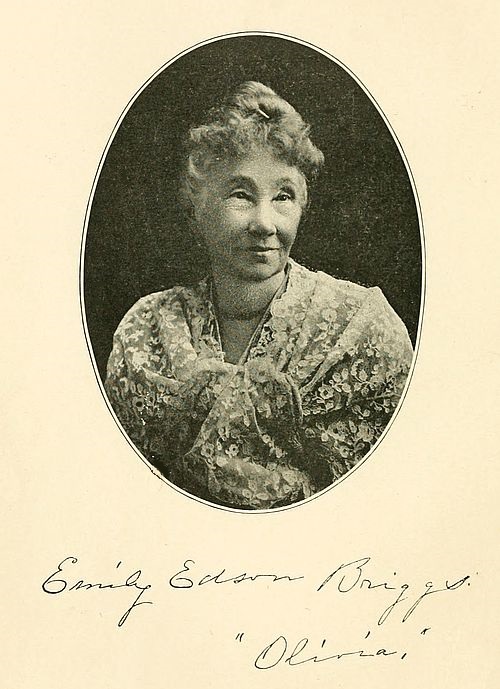
Olivia.