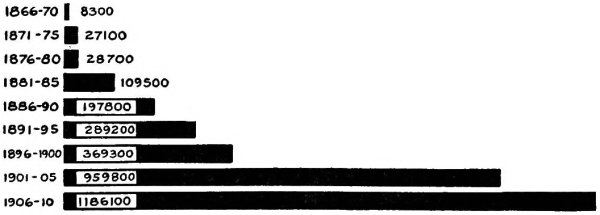
More and more immigration is an economic
matter, a flow of men rather than of families,
seeking gain rather than religious and political
liberty. Those who bring anything but
their hands are a very small and diminishing contingent.
Most of the money the immigrant shows
on landing has been supplied him for that purpose.
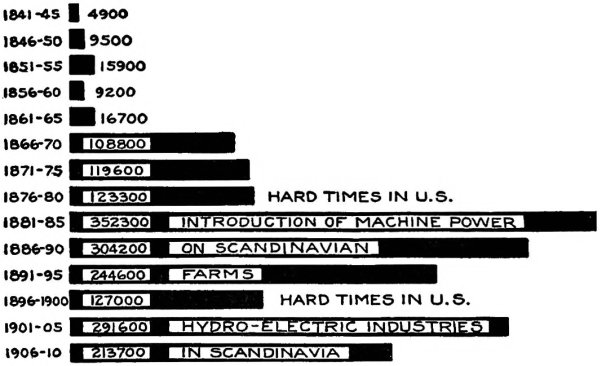
In 1882, when the old immigration reached its
height, the public domain was being carved up at
a tremendous rate, and the home-seeker predominated.
When the crest of the new immigration
arrived, in 1907, a quarter of a century later, free
land was gone forever, and the job-seeker predominated.
Formerly the idea of wandering oversea
sprang up naturally among the intelligent and
restless; now the idea is sown broadcast by thousands
of steamship agents and their runners. In
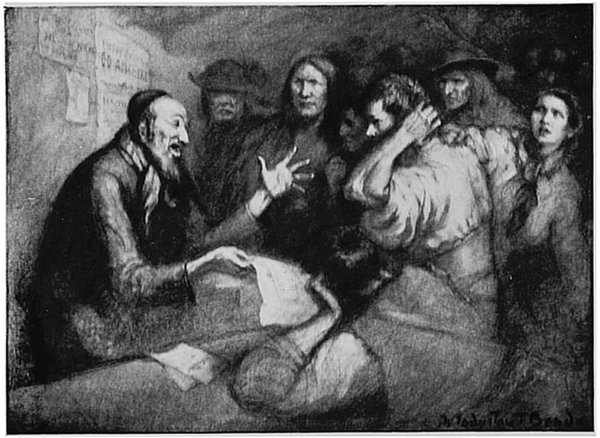
the tavern, knee to knee with the yokels, sits the
runner, and paints an El Dorado. The poor fellows
will believe him if he tells them the trees of
America bear golden leaves. When the "American
fever" seizes upon the peasant, it is the
obliging runner who suggests mortgaging his home
for the passage-money or who finds a buyer for his
cows.
Common laborers who have been in America
are hired to go about among the peasants, flash
money, clink glasses, and tell of the wonderful
wages awaiting them. The decoy thus gets together
a group who elect him leader and pay him
so much per head to guide them to America. Little
do the poor sheep suspect that their bell-wether
is paid by the steamship agent for forming the
group and by the employer to whom he delivers
them. A forwarding business exists for sending
penniless laborers to America as if they were commercial
ware. Each leaves at home some relative
under bonds that the laborer will within a year pay
a certain sum as cost and profit of bringing him
here, Parties, through-billed from their native
village by a professional money-lender, are met
at the right points by his confederates, coached in
three lessons on what answers to make at Ellis
Island, and delivered finally to the Pittsburgh
"boarding-boss," or the Chicago saloon-keeper,
who is recruiting labor on commission for a steel
mill or a construction gang.
The emigration of 5,000 Rumanian Jews between
January and August, 1900, was brought
about by steamship agents, who created great excitement
in Rumania by distributing glowing circulars
about America. One authority stated to
the Immigration Commission that two of the leading
steamship lines had five or six thousand ticket-agents
in Galicia alone, and that there was "a
great hunt for emigrants" there. Selling steerage
tickets to America is the chief occupation of
large numbers of persons in Austria-Hungary,
Greece and Russia, the main sources of undesirable
aliens. In 1908 and 1909 the inflow and outflow
of steerage-passengers through our ports
amounted to about a million and a half a year.
Allowing an average outlay of $50 a head, we have
a movement furnishing $75,000,000 of annual business
to the foreign railway and steamship companies.
That a monster of this size grows dragon
claws with which to defend itself goes without saying.
Still, it is not as cargo that the immigrant yields
his biggest dividends. But for him we could not
have laid low so many forests, dug up so much
mineral, set going so many factories, or built up
such an export trade as we have. In most of the
basic industries the new immigrants constitute at
least half the labor force. Although millions have
come in, there is no sign of supersaturation, no
progressive growth of lack of employment.
Somehow new mines have been opened and new
mills started fast enough to swallow them up.
Virtually all of them are at work and, what is
more, at work in an efficient system under intelligent
direction. Ivan produces much more than
he did at home, consumes more, and, above all,
makes more profit for his employer than the
American he displaces. Thanks to him, we have
bigger outputs, tonnages, trade-balances, fortunes,
tips, and alimonies; also bigger slums, red-light
districts, breweries, hospitals, and death-rates.
To the employer of unskilled labor this flow of
aliens, many of them used to dirt floors, a vegetable
diet, and child labor, and ignorant of underclothing,
newspapers, and trade unions, is like a
rain of manna. For, as regards foreign competitors,
his own position is a Gibraltar. When the
European sends his capital hither, he puts it into
railroad securities yielding from four to seven per
cent., thereby releasing American capital for investment
in the enterprises that pay from ten to
thirty per cent. The foreign capitalist dares not
put up mill or refinery here, because he cannot
well run such concerns at long range. He may not
invade the American market with the products of
his mill over there, because our tariff has been
designed to prevent just that thing.
Thus, so long as he stays in his home market,
the American mill-owner is shielded from foreign
competition, while the common labor he requires
is cheapened for him by the endless inflow of the
neediest meekest laborers to be found within the
white race. If in time they become ambitious and
demanding, there are plenty of "greenies" he
can use to teach them a lesson. The "Hunkies"
pay their "bit" to the foreman for the job, are
driven through the twelve-hour day, and in time
are scrapped with as little concern as one throws
away a thread-worn bolt. One steel-mill superintendent
received official notice to hire no man over
thirty-five and keep no man over forty-five. A
plate-mill which had experienced no technical improvement
in ten years doubled its production per
man by driving the workers. No wonder, then,
that in the forty years the American capitalist has
had Aladdin's lamp to rub, his profits from mill
and steel works, from packing-house and glass
factory, have created a sensational "prosperity,"
of which a constantly diminishing part leaks
down to the wage-earners. Nevertheless, the system
which allows the manufacturer to buy at a
semi-European wage much of the labor that he
converts into goods to sell at an American price
has been maintained as "the protection of American
labor"!
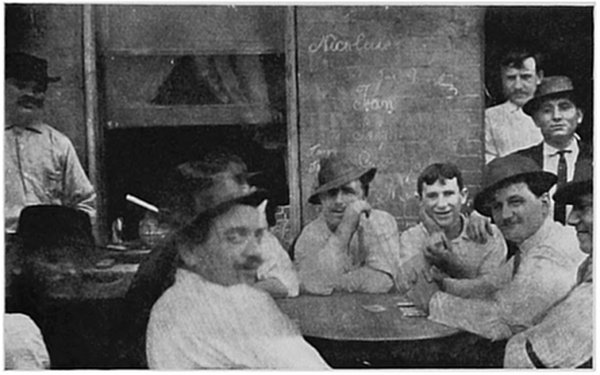
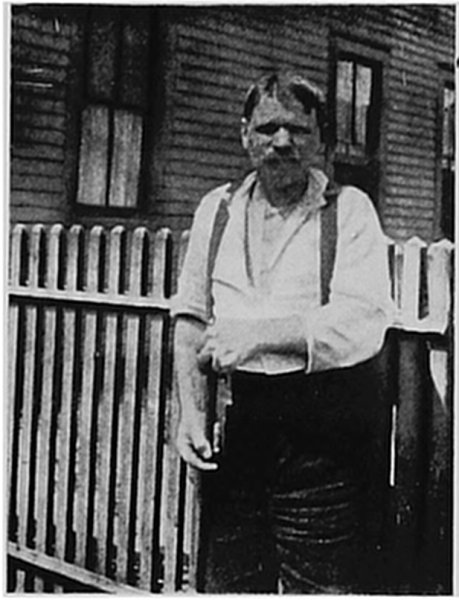
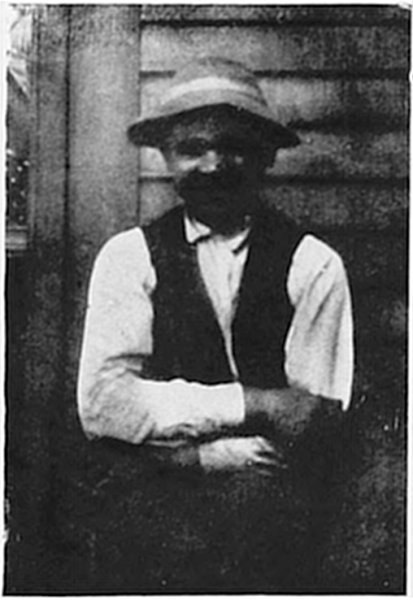
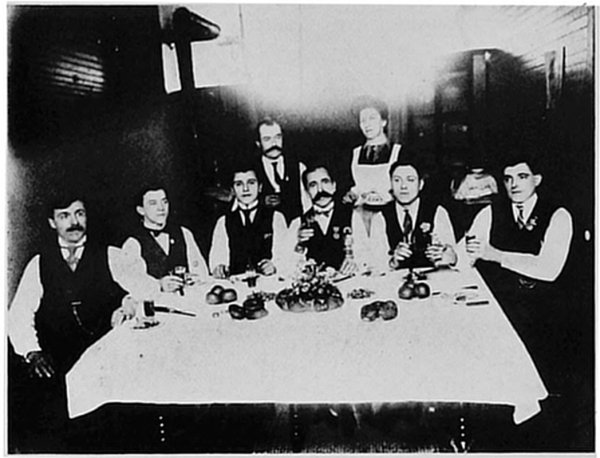
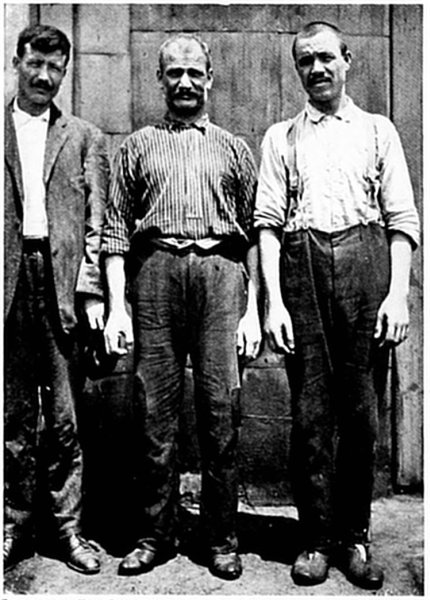
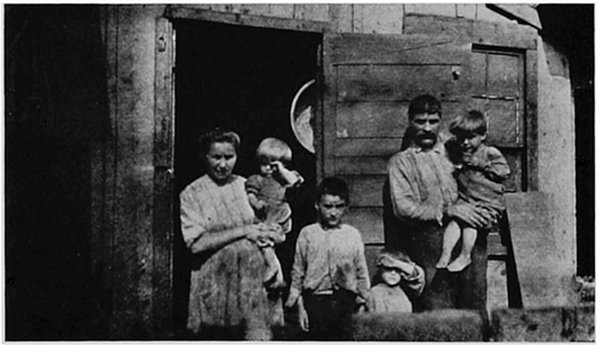
Sunday Group of Roumanian Steel Workers, Youngstown, O.
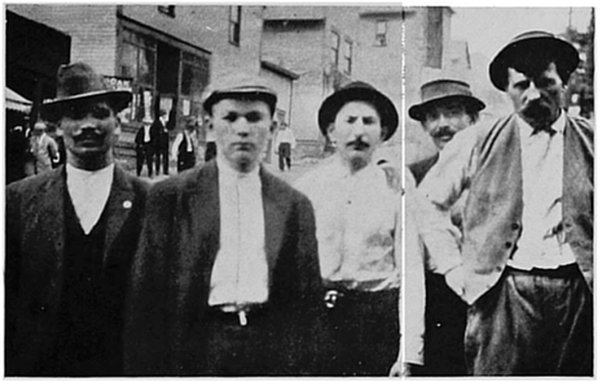
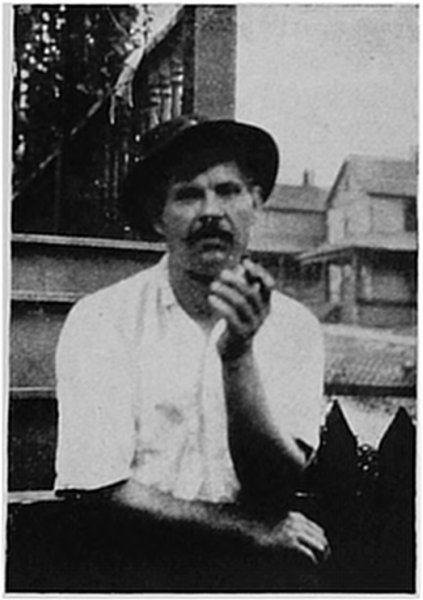
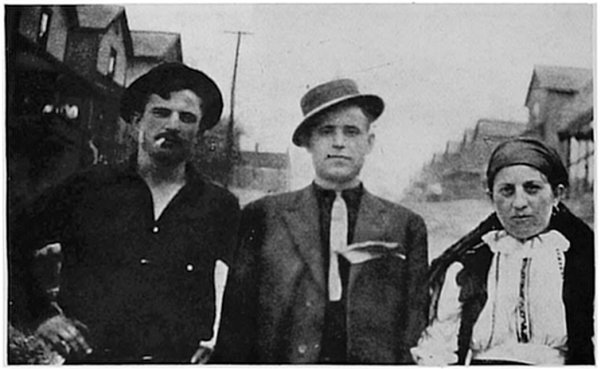
Sunday Roumanians, Youngstown, O.
Between 1900 and 1910, although population
grew twenty-one per cent., the output of the ten
principal crops of the country increased only nine
per cent. Between 1899 and 1911 the value of the
average acre's output of such crops increased
seventy per cent., while its power to purchase the
things the farmer buys was greater by forty-two
per cent. There has been a general upheaval of
prices, to be sure, but the price of farm produce
has risen much faster and farther than the price
of other commodities. This is "the high cost of
living," and it is immigration that has made this
imp shoot up faster in the United States than anywhere
else.
As long as good land lasted, our Government
stimulated agriculture by presenting a quarter-section
to whoever would undertake to farm wild
land. This bounty overdid farming, until, in the
middle of the nineties, the cost of living had
reached a minimum. With the ending of free
land, the upward turn was bound to come, but the
change was made more dramatic by the inpouring
of ten millions of immigrants without the knowledge,
the means, or the inclination to engage in
farming. Among us there is one American white
farmer for fourteen American whites, one Scandinavian
farmer for eight Scandinavians, one German
farmer for eleven Germans, one Irish farmer
for forty Irish; but it takes 130 Poles, Hungarians,
or Italians in this country to furnish one
farmer. Failing to contribute their due quota to
the production of food, these late-comers have
ruptured the equilibrium between field and mill,
and made the high cost of living a burning question.
Just as the homestead policy overstimulated
the growth of farms, the new immigration
has overstimulated the growth of factories.
Nevertheless, certain of the South Europeans
who are upon the soil have something to show
American farmers facing the problems of intensive
agriculture. Italians are teaching their
neighbors how to extract three crops a year from
a soil already nourishing orchard or vineyard.
The Portuguese raise vegetables in their walnut
groves, grow currants between the rows of trees
in the orchard, and beans between the currant
rows. They know how to prevent the splitting
of their laden fruit-trees by inducing a living brace
to grow between opposite branches. The blackbeetle
problem they solve by planting tomato slips
inclosed in paper. From the slopes looking out
on the Adriatic the Dalmatian brings a horticultural
cunning which the American fruit-grower
should be eager to acquire.
The conversion of New Jersey barrens into
berry farms, vineyards, and pepper fields, the reclamation
of muck soil in western New York,
which Americans were not willing to touch, the
transmutation of wild Ozark lands into apples and
peaches, are Italian exploits which constitute
clear gain for the country. But there are other
immigrant farmers whose labors count on the
wrong side of the national ledger. Not a few Slav
colonies are clearing and tilling land so poor or
so steep that it ought never to have been brought
under the plow. The soil they have deforested
will presently wash into the rivers, leaving
stripped rocky slopes to grin, like a Death's-head,
in the landscape. The nation will have to pay for
it, just as France paid for the reckless ax work
that went on under the First Republic.
When confronted with the undeniable evils resulting
from the crowding of old-world peasants
into American slums and factories, the opponents
of restriction urge that the trouble is with the
distribution of the immigrants, there are not
really too many of them, but they are congested
in certain centers and industries. Then let the
state or the nation take the immigrant in hand
and settle him upon the soil, where there is room
for him and where he yearns to be. Supply him
with the best of information, guidance and supervision
and lend him a little money until he has
gotten upon his feet. Successful state colonization
would, no doubt, restore the balance between
agriculture and manufactures and prevent the
heartbreaking waste and misery resulting from
the present hap-hazard, catch-as-catch-can distribution
of immigrants among American opportunities.
Two other consequences ought, however, to be
evident; First, the policy would tend to use up
the agricultural opportunities Americans may prefer
to hold open for their children and grandchildren.
Second, State help to the immigrant would
furnish splendid advertising matter to the steamship
companies endeavoring to fill more steerages
and might soon swell the number of arrivals to
a million and a half or two millions a year. If we
wish to have more immigrants and to fill up this
country in the briefest possible time, state colonization
is just the way to go about it. On the
other hand, once the volume of immigration has
been brought under effective control, the policy
of aiding the immigrant to get upon the land is
heartily to be commended.
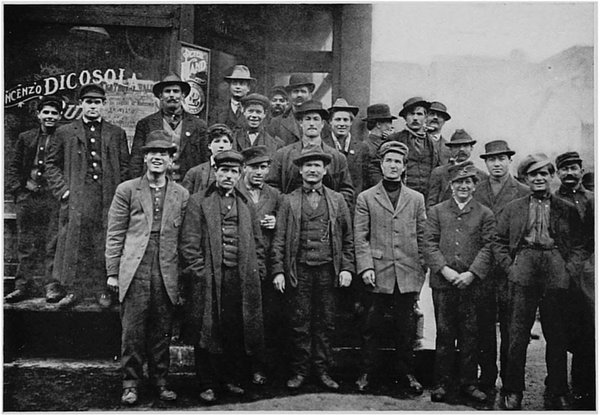
Photograph by Hine Courtesy of The Survey
The Unemployed—Middle of the Morning, Chicago
The facts assembled by the Immigration Commission
shatter the rosy theory that foreign labor
is drawn into an industry only when native labor
is not to be had. The Slavs and Magyars were
introduced into Pennsylvania forty-odd years ago
by mine-operators looking for more tractable
miners. Agents were sent abroad to gather up
labor, and frequently foreigners were brought in
when a strike was on. The first instance seems to
have occurred in Drifton in 1870, and resulted in
the importation of two ship-loads of Hungarians.
The process of replacing the too-demanding American,
Welsh, and Irish miners with labor from
Austria-Hungary went on so rapidly that by the
middle of the nineties, the change was accomplished.
In 1904, during a strike in the coal-fields
near Birmingham, Alabama, many South Europeans
were brought in. In 1908 "the larger
companies imported a number of immigrants,"
so that the strike was broken and unionism destroyed
in that region. In 1880, in the first strike
in the coal-mines of Kansas, "the first immigrants
from Italy were brought into the fields as strike-breakers."
Poles were introduced into South Cleveland in
1882 to replace strikers in the wire-mills. The
meat-packing strike of 1904 in Chicago was broken
with trainloads of negroes, Italians and Greeks.
In 1883 the largest oil-refining company at Bayonne,
New Jersey, "in order to break the strike
among the Irish and American coopers, ... introduced
great numbers of Slovaks, Ruthenians,
and Poles." In 1887 a coal-dockers' strike was
broken with Magyars, and in 1904 striking boiler-makers
were replaced by Poles. The striking
glass-workers in 1904 were beaten by the introduction
of Slovaks, Italians, Poles and Magyars.
During the 1907 strike in the iron-mines of northern
Minnesota, "one of the larger companies imported
large numbers of Montenegrins and other
Southeastern races as strike-breakers, while a few
of the smaller companies brought into the region
a number of German-Austrians." "One mining
company imported as many as 1300 of these strike-breakers."
The hejira of the English-speaking soft-coal
miners shows what must happen when low-standard
men undercut high-standard men. The miners
of Pennsylvania and West Virginia, finding
their unions wrecked and their lot growing
worse under the floods of men from southern and
eastern Europe, migrated in great numbers to the
Middle West and the Southwest. But of late the
coal-fields of the Middle West have been invaded
by multitudes of Italians, Croatians, Poles, and
Lithuanians, so that even here American and
Americanized miners have their backs to the wall.
As for the displaced trade-unionists who sought
asylum in the mines of Oklahoma and Kansas, the
pouring in of raw immigrants has weakened their
bargaining power, and many have gone on to make
a last stand in the mines of New Mexico and Colorado.
Each exodus left behind an inert element which
accepted the harder conditions that came in with
the immigrants, and a strong element that rose to
better posts in the mines or in other occupations.
As for the displaced, the Iliad of their woes has
never been sung—the loss of homes, the shattering
of hopes, the untimely setting to work of children,
the struggle for a new foothold, and the turning of
thousands of self-respecting men into day laborers,
odd-job men, down-and-out-ers, and "hoboes."
The dramatic unionization of the garment industries
in our large cities has misled the public
as to the actual effect of recent immigration upon
trade-unions. The fact is that the immigrants
from the backward parts of Europe tend to
weaken, if not to shatter, labor organizations in
the fields they enter. They arrive needy and
eager to get any work at almost any pay. Having
had no industrial experience in the old country,
they lack the trade-union idea. Without our
speech, and often illiterate, they are very hard to
reach and to bring into line. So far as they are
transients, who are not staking their future on
the industry, they are loath to pay union dues and
to run the risk of having to strike. It is true that
the labor organizer evangelizes the alien workers
with his union gospel; but by the time one batch
has been welded into a fighting force, another
batch is on his hands. His work, like Penelope's
web, is raveled out about as fast as it is woven.
No wonder that in the cotton industry unionism
has been wrecked, while, of the iron miners, less
than two per cent. belong to unions. In 1901 the
United States Steel Corporation's constituent
companies signed agreements with two-thirds of
their 125,000 workmen, among whom the English-speaking
held a dominant place. Ten years later
the company signed not a single agreement with
its beaten mass of Slav-Latins. There was no
union with which to sign. The organizing, organizable
Americans had been deleted from the
works. No wonder that organized labor demands
restriction of immigration. While the inrush continues,
the lines of labor will be weak, forming,
breaking, and reforming in the face of the intrenchments
of capital.
During the last fifteen years the flood of gold
has brought in a spring-tide of prices. Since 1896
the retail cost to Americans of their fifteen principal
articles of food has risen seventy per cent.
Wages should have risen in like degree if the
workman is to retain his old standard, to say nothing
of keeping his place in a social procession
which is continually mounting to higher economic
levels. We know that by 1907 wages had risen
twenty-eight per cent., while retail prices were
rising twenty-six per cent. Evidently the working
man was falling behind in the social procession.
In the soft-coal field of Pennsylvania,
where the Slav dominates, the coal-worker receives
forty-two cents a day less than the coal-worker
in the mines of the Middle West and Southwest,
where he does not dominate. In meat-packing,
iron and steel, cotton manufacture, and other
foreignized industries the inertia of wages has
been very marked. The presence of the immigrant
has prevented a wage advance which otherwise
must have occurred.
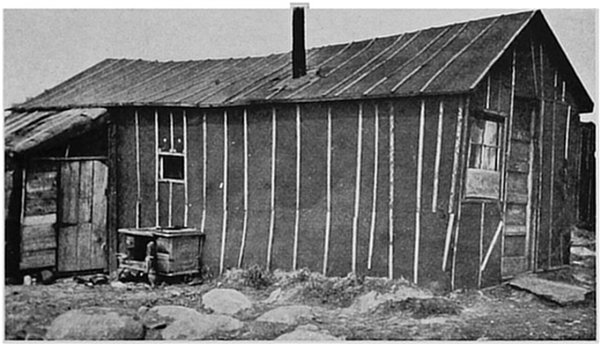
"Shack" of a Polish Iron Miner, Hibbing, Minn.
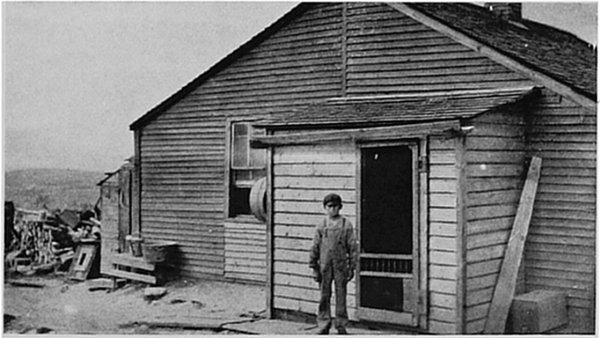
Cabin of an Austrian Iron Miner, Virginia, Minn.
What a college man saw in a copper-mine in the
Southwest gives in a nutshell the logic of low
wages.
The American miners, getting $2.75 a day, are
abruptly displaced without a strike by a trainload
of five hundred raw Italians brought in by
the company and put to work at from $1.50 to $2
a day. For the Americans there is nothing to do
but to "go down the road." At first the Italians
live on bread and beer, never wash, wear the same
filthy clothes night and day, and are despised.
After two or three years they want to live better,
wear decent clothes, and be respected. They ask
for more wages, the bosses bring in another trainload
from the steerage, and the partly Americanized
Italians follow the American miners "down
the road." No wonder that the estimate of government
experts as to the number of our floating
casual laborers ranges up to five millions!
"The best we get in the mill now is greenhorns,"
said the superintendent of a tube mill. "When
they first come, they put their heart into it and
give a full day's work. But after a while they begin
to shirk and do as little as they dare." It is
during this early innocence that the immigrant accepts
conditions he ought to spurn. This same
mill had to break up the practice of selling jobs
by foremen. In one concern the boss who sold a
job would dismiss the man after a fortnight and
sell the job again, while another boss in the same
works would take on the dismissed man for a fee.
On the Great Northern Railroad the bosses
mulcted each Greek laborer a dollar a month for
"interpreter." The "bird of passage," who
comes here to get ahead rather than to live, not
only accepts, the seven-day week and the twelve-hour
day, but often demands them. Big earnings
blind him to the physiological cost of overwork.
It is the American or the half-Americanized foreigner
who rebels against the eighty-four-hour
schedule.
When capital plays lord of the manor, the Old
World furnishes the serfs. In some coal districts
of West Virginia the land, streets, paths, roads,
the miners' cabins, the store, the school, and the
church are all owned and controlled by the coal
company. The company pays the teacher, and no
priest or clergyman objectionable to it may remain
on its domain. One may not step off the
railroad's right of way, pass through the streets,
visit mine or cabin, without permission. There
is no place where miners meeting to discuss their
grievances may not be dispersed as trespassers.
Any miner who talks against his boss or complains
of conditions is promptly dismissed, and ejected
from the 35,000 acres of company land. Hired
sluggers, known as the "wrecking-gang," beat up
or even murder the organizer who tries to reach
the miners. No saloon, gambling-hall, or bawdy-house
is tolerated on company land. Even the
beer wagon may not deliver beer at houses to
which the superintendent objects.
It is needless to add that the miners are all
negroes or foreigners.
After an industry has been foreignized, the notion
becomes fixed in the minds of the bosses that
without the immigrants the industry would come
to a standstill.
"If is wasn't for the Slavs," say the superintendents
of the Mesaba Mines, "we couldn't get
out this ore at all, and Pittsburgh would be smokeless.
You can't get an American to work here unless
he runs a locomotive or a steam-shovel.
We've tried it; brought 'em in, carloads at a
time, and they left."
"Wouldn't they stay for three dollars a day?"
I suggested, "even if two dollars and ten cents
isn't enough?"
"No, it's not a matter of pay. Somehow
Americans nowadays aren't any good for hard
or dirty work."
Hard work! And I think of Americans I have
seen in that last asylum of the native born, the
Far West, slaving with ax and hook, hewing logs
for a cabin, ripping out boulders for a road, digging
irrigation-ditches, drilling the granite, or
timbering the drift—Americans shying at open-pit,
steam-shovel mining!
The secret is that with the insweep of the unintelligible
bunk-house foreigner there grows up
a driving and cursing of labor which no self-respecting
American will endure. Nor can he bear
to be despised as the foreigner is. It is not the
work or the pay that he minds, but the stigma.
This is why, when a labor force has come to be
mostly Slav, it will soon be all Slav. But if the
supply of raw Slavs were cut off, the standards
and status of the laborers would rise, and the
Americans would come into the industry.
Some bosses argue for a continuous supply of
green foreigners because the sons of the immigrants
are "above their fathers' jobs." A
strange industry this! Britain's iron industry is
manned by Britons, Germany's by Germans, but
we are to believe that America's iron industry is
an exotic which can attract neither native Americans
nor the sons of immigrants. The truth is
that the school and other civilizing agencies have
turned Michael's boy not against hard work, but
against the contempt with which his father's kind
of work is tainted. But for the endless stream
of transients with their pigsty mode of life, their
brawls and their animal pleasures, the stigma on
the work would vanish, and the son of the immigrant
would be willing to inherit his father's job.
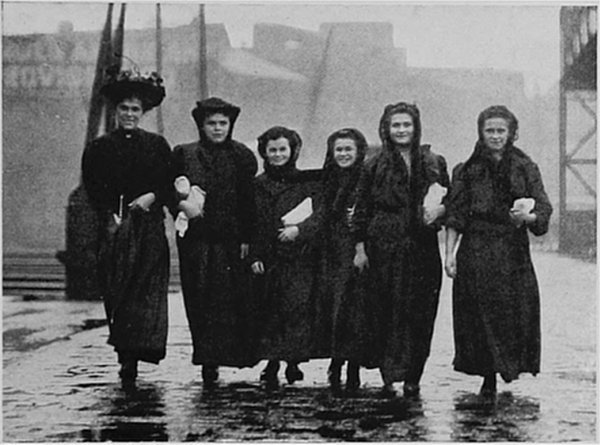
Photograph by Burke & Atwell. Courtesy of The Survey
Immigrant Girls Coming to Work in the Early Morning at
the Union Stockyards
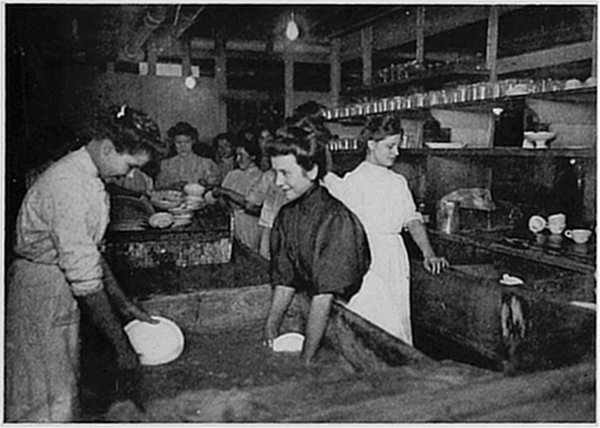
Photograph by Townsend. Courtesy of The Survey
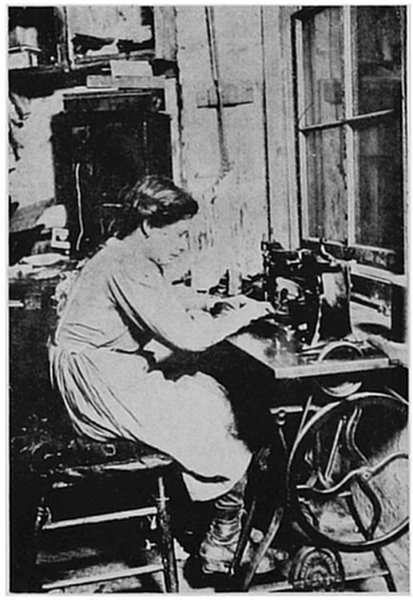
Polish Girls Washing Dishes under the Sidewalk in a Chicago
Restaurant. The only Light is Artificial
While millions of women are being drawn from
the home into industry, the popular ideal of
womanhood serves as a precious safeguard, turning
them away from coarsening occupations which
might rob them of health or youth or refinement.
But this ideal, which is higher among the American
working-men than among the workers of any
other people, is menaced by the new immigrants,
with their peasant notions of womanhood. The
Slavs and the Italians are not in the least queasy
about putting their women into heavy and dirty
work, such as core-making, glass-grinding, and
hide-scraping, which self-respecting American
girls will not touch. The employer realizes this,
and continually tries these women in male occupations,
with the object of substituting them for
men, beating down men's wages or breaking a
men's strike. Engaging in such masculine work
not only prevents immigrant women from rising
to the American woman's sense of self-respect,
but it hinders their men from developing the
American man's spirit of chivalry. What is
more, the extension of woman's sphere on the
wrong side underlines the native standard of
womanliness, so that native girls are perhaps being
drawn into work that denies them refinement
and romance.
Does the man the immigrant displaces rise or
sink? The theory that the immigrant pushes him
up is not without some color of truth. In Cleveland
the American, German, and Bohemian iron-mill
workers displaced within the last fifteen years
seem to have been reabsorbed into other growing
industries. They are engineers and firemen,
bricklayers, carpenters, slaters, structural iron-workers,
steam-fitters, plumbers and printers.
Leaving pick and wheelbarrow to Italian and
Slav, the Irish are now meter-readers, wire-stringers,
conductors, motormen, porters, janitors,
caretakers, night-watchmen, and elevator-men.
I find no sign that either the displaced
workman or his sons have suffered
from the advent of Pole and Magyar. Some may
have migrated, but certainly those left have easier
work and better pay. It is as though the alien
tide had passed beneath them and lifted them up.
On the other hand, in Pittsburgh and vicinity the
new immigration has been like a flood sweeping
away the jobs, homes, and standards of great numbers,
and obliging them to save themselves by accepting
poorer occupations or fleeing to the West.
The cause of the difference is that Pittsburgh held
to the basic industries, while in Cleveland numerous
high-grade manufactures started up which absorbed
the displaced workmen into the upper part
of their labor force.
Unless there is some such collateral growth of
skill-demanding industries, the new immigrants
bring disaster to many of the working-men they
undercut. The expansion of the industry will
create some good jobs, but not enough to reabsorb
the Americans displaced. Thus in the iron-ore-mines
of Minnesota, out of seventy-five men kept
busy by one steam-shovel, only thirteen get $2.50
a day or more, and $2.50 is the least that will maintain
a family on the American standard. It is
plain that the advent of sixty-two cheap immigrants
might displace sixty-two Americans or
Irish, while the setting up of an additional steam
shovel would create only thirteen decent-wage
jobs for them. Scarcely any industry can grow
fast enough to reabsorb into skilled or semi-skilled
positions the displaced workmen.
Employers observe a tendency for employment
to become more fluctuating and seasonal because
of access to an elastic supply of aliens, without
family or local attachments, ready to go anywhere
or do anything. In certain centers, immigrant
laborers form, as it were, visible living pools from
which the employer can dip as he needs. Why
should he smooth out his work evenly through the
year in order to keep a labor force composed of
family men with local roots when he can always
take on "ginnies" without trouble and drop them
without compunction? Railroad shops are coming
to hire and to "fire" men as they need them
instead of relying on the experienced regular employees.
In a concern with 30,000 employees, the
rate of change is a hundred per cent. a year, and
is increasing! Labor leaders notice that employment
is becoming more fluctuating, there are fewer
steady jobs, and the proportion of men who are
justified in founding a home constantly diminishes.
The fact that during an acute industrial depression
in this country the immigrant stream not
only runs low, but the departures may exceed the
arrivals (as in the eight months following the
1907 panic, when there was a decrease of 124,124
in our alien population), has been made the
foundation for the argument that surplus immigrant
labor, by promptly taking itself off when
times are bad here, relieves the labor market and
hastens the return to normal conditions. It is
overlooked that only the prosperous go, leaving
upon us the burden of the weak unemployed
aliens. Moreover, at the first sign of returning
prosperity, a freshet of immigrants starts up,
thereby checking sharply the good-times tendency
toward higher wages and better working conditions.
Free land, coupled with high individual efficiency,
has made this country a low-pressure area.
It ought to remain such, because individualistic
democracy forbids a blind animal-like increase of
numbers. By causing the population to accommodate
itself to opportunities, our democracy
solves the Sphinx's riddle and opens a bright
prospect of continuous social progress. But of
late that prospect has been clouded. The streaming
in from the backward lands is sensibly converting
this country from a low-pressure area into a
high-pressure area. It is nearly a generation since
the stress, registered in the labor-market, caused
the British working-man to fight shy of America.
It is twenty years since it reached the point at
which the German working-man, already on the
up-grade at home, ceased to be drawn to America.
As the saturation of our labor-market by cheaper
and ever cheaper human beings raises the pressure-gage,
we fail to attract as of yore such peoples
as the North Italians and the Magyars.
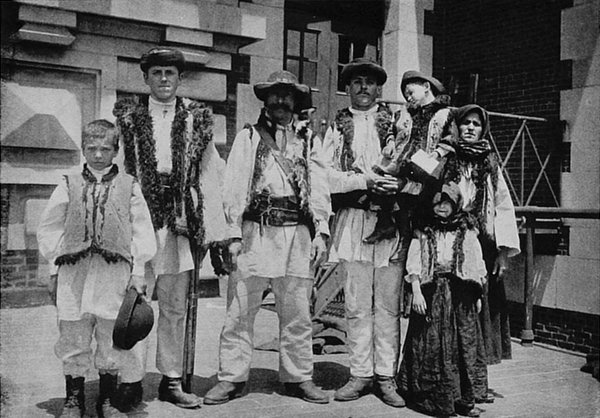
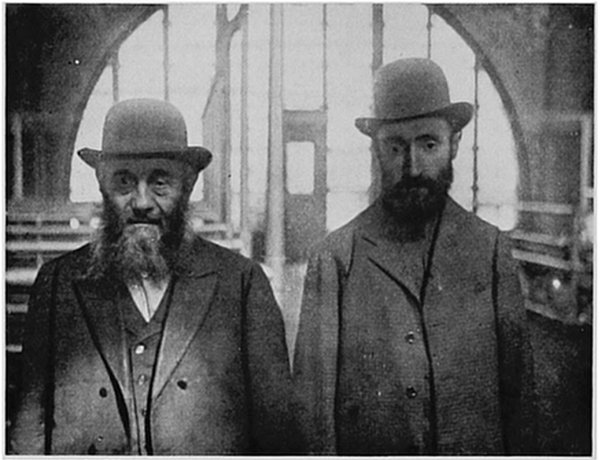
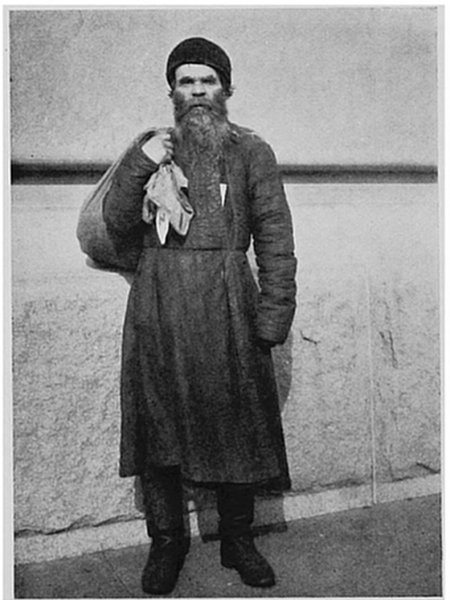
Roumanian Shepherds in Native Costume, Ellis Island
In 1898 few came to us from east of Hungary.
Now we are receiving them from Asiatic Turkey,
Circassia, Syria, and Arabia. An immigration
has started up from Persia, and conditions are
ripe for a heavy influx from western Asia. These
remote regions, which have had only twilight from
Europe's forenoon, are high-pressure areas.
Their peoples are too many in relation to the opportunities
they know how to use. Until education,
democratic ideas, and the elevation of women
restrict their increase, or machine industry widens
their opportunities, these regions will continue to
produce a surplus of people, which the enterprising
avarice of steamship companies will make ever
more mobile and more threatening to the wage-earners
of an advanced country. Only lately
comes the announcement that one of the trans-Atlantic
lines is about to run its steamships through
the Dardanelles and Bosphorus into Black Sea
ports in order to bring immigrants direct to
America from southeastern Europe without the
expense of the long haul overland to Hamburg.
If an air-chamber be successively connected by
pipes with a large number of tanks of compressed
air, the pressure within the chamber must rise.
Similarly, if a low-pressure society be connected
by cheap steam-transportation with several high-pressure
societies, and allows them freely to discharge
into it their surplus population, the pressure
in that society must rise. But for Chinese
exclusion we should by this time have six or eight
million Celestials in the far West, and mud villages
and bamboo huts would fill the noble valleys
of California. Something like this must occur
as we go on draining away surplus people from
larger and larger areas of high-pressure.
Immigration raises the pressure-gage at once
for laborers, but only gradually for other classes.
It is the children of the immigrants who communicate
the pressure to all social levels. The investor,
landowner, or contractor profits by the
coming in of bare-handed men, and can well afford
to preach world-wide brotherhood. The professional
man, sitting secure above the arena of
struggle, can nobly rebuke narrowness and race
hatred. Throughout our comfortable classes one
finds high-sounding humanitarianism and facile
lip-sympathy for immigrants coexisting with
heartless indifference to what depressive immigration
is doing and will do to American wage-earners
and their children. If the stream of immigration
included capitalists with funds, merchants
ready to invade all lines of business, lawyers, doctors,
engineers, and professors qualified to compete
immediately with our professional men, even
judges and officials able to lure votes away from
our own candidates for office, the pressure would
be felt all along the line, and there might be something
heroic in these groups standing for the equal
right of all races to American opportunities.
But since actually the brunt is borne by labor, it
is easy for the shielded to indulge in generous
views on the subject of immigration.