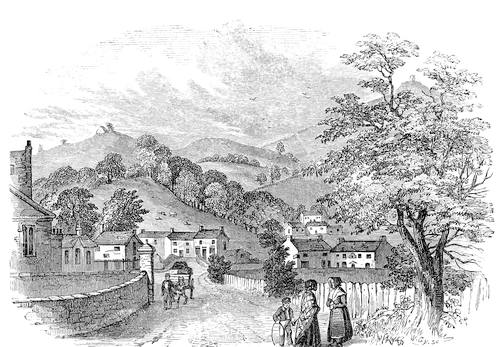
” 9, line 6, insert a comma between “or” and “by.”
” 30, line 34, for “mountaineous” read mountainous.
” 40, line 6, for “Oustead” read onstead.
” 69, line 7, for “dishabille” read deshabille.
” 84, line 1, for “Hall” read How.
” 98, line 13, for “to” read from.
” 112, line 14, for “anoo” read anno.
” 115, line 3, for “a” read its.
” 146, line 2, for “puce” read grey.
It has long been a favourite notion with me that if, instead of general
guides to, or descriptions of all the Lake country
comprised in single volumes, of which we have a superabundance,
we could have each distinct locality treated of fully
and minutely in a work devoted exclusively to itself, and written
by some one whose long residence in, and intimate knowledge
of the district described would secure its accuracy, we
should possess a series of Lake books much more comprehensive,
more useful, and more amusing than any we can
yet boast of. An idea slightly similar to this seems at one
period to have germinated in Professor Wilson’s brain;
but, notwithstanding the fertility of the soil, it bore no fruit.
In a review of Green’s Guide, the Professor says,—“It is our
serious intention to pitch our Tent, next summer, somewhere
or other among these said Lakes. Each of our principal contributors
will have a Lake assigned him, and the lesser ones
a Tarn. Wastle shall have Windermere—Odoherty, Ullswater—Ourselves,
Keswick—and Kempferhausen is perfectly welcome
to Conistone. By a just distribution of our forces, the Lakes
will find themselves looked at and described in a way they
never experienced before.” As nearly thirty years have
elapsed since this intention was promulgated, and we have
still to deplore its non-fulfilment, I have taken the initiative
with the Lake somewhat depreciatingly assigned to the German
savan. It is devoutly to be wished that my modest example
were followed with regard to the other great Lakes, by
parties who know them as perfectly as I know Conistone.
It may hardly be gainsaid that there are such about every one
of our Lakes, able, were they willing, to do much more justice
to their subjects than poor Conistone has obtained from me;
and if they would only set about it, I might, at least, claim the
credit of having opened the ball.
In the volume now offered to his favourable consideration,
the reader will find a very sufficient guide to all that is worthy
of notice in the neighbourhood it depicts. The accuracy of
its descriptions will be apparent when he visits the scenes
described. The few anecdotes, traits of character, and sketches,
or rather, perhaps, scratches, of mountain life can be vouched
for as correct, and native to the district. And the information
it professes to offer upon topics of supposed interest, local or
general, is, when no authority is specified, all deduced from
personal observation. These little merits may, perhaps, serve,
in some degree, as a set off against its short-comings as a
literary composition, and those are now sufficiently manifest
even to myself; but in extenuation, I may plead that they are
such as may be attributed to inexperience in author-craft, or
such as may be looked for in a performance mainly written
by way of amusement in the uncertain and brief snatches of
relaxation from duties and anxieties of a nature peculiarly unfavourable
to the improvement of a faulty style of composition by
study or practice. I may state, however, that these duties and
cares arise chiefly from an occupation which, more than any
other, affords facilities of observing the topographical peculiarities
of a district of country, and of noting the characteristics,
social and psychological, of its inhabitants of every class. On
this latter department of my subject, I should have dilated
more freely, had I not been restrained by two salutary considerations,
the first being a wish to keep within compass, and
avoid prolixity—the second, a desire to live in peace and goodwill
with those amongst whom my lot in life is cast. It is
not easy to tell the even down truth of a class, any more than
of an individual, without exciting wrath.
By the way, it is remarkable that, notwithstanding all that
has been scribbled anent the Lakes, we are yet without anything
like a correct portraiture of the Dales-people. The
narratives and traits of character in Mr Wordsworth’s works,
though generally striking and beautiful, are, as regards the
peasantry, mere emanations of poetic fancy, rather than true
delineations of life and manners. The same may be said of
Wilson. De Quincey’s papers on the population of the Lake
district, are correct only so long as he confines himself to
colonists of his own rank. When he comes lower, it is plain
enough to those who know the Aborigines, that he has only
been permitted to study that, the most interesting, class in
their Sunday faces and best behaviour, and that his observation
there is rarely more than skin-deep.
It was reserved for a lady to give us the best essay upon
the peculiarities of our aboriginal character; but even Miss
Martineau, with all her female penetration, and her more than
female genius and talent for observation, is, in that part of
her work, oddly astray in her illustrations and erroneous in
her assertions. For instance, she avers that our women-folk
are all mutes. On this it is only necessary to remark that
some of their husbands, and that I, myself, not unfrequently,
nor yet unfervently, wish that Miss Martineau’s averment
had better foundation. Bating this defect, her work on the
Lakes, taking it for all in all, is the best, and by far the cheapest,
of all Lake books, and their name is Legion!
One word more. I have been accused of using irreverently
a name which it is the fashion now for all to revere. I should
be truly sorry, could I fancy I had afforded real grounds for such
accusation. If the opinion of one so obscure as I could be of
any importance, I might truly declare that I yield to none in my
respect for Mr Wordsworth’s character—that few can estimate
the poetic grandeur and fine moral feeling of his truly great
poems more highly than I; and if I have hinted at what I
consider defects in his genius and philosophy, as exhibited in
his works, who shall censure me for expressing an honest
opinion, even though the mode of expressing it be a trifle
more flippant than the subject may seem to warrant? It
were as reasonable to extinguish a small luminary for announcing
a fancied discovery of spots upon the sun, as to demolish
me for fancying that I discern a few specks upon the
otherwise resplendent disc of the great light of our Lakes.
Entreating the gracious patience of the reader for having
spun a plain unvarnished tale at such a length, and bespeaking
his more gracious indulgence to the manifold faults in
“my von leetle performance,” as Signor Blitz used to call his
conjuring tricks, I beg to subscribe myself the reader's
Very humble servant,
A. C. G.
Yewdale Bridge, May 21st, 1849.
CHAPTER I.
RAVINGS AND RAMBLINGS ROUND
CONISTONE.
Geographical Position—Etymology—Attractions—A
String of Authorities—The Lake—Its Attributes—Statistic—Piscatorial—Commercial—Fatal,
and Scenic.
Conistone, anciently Conyngstone and Cunyngstone, is
situated in that isolated portion of Lancashire which,
divided from the mother county by Morecambe Bay, bears
the general designation of Lonsdale North of the Sands,
and in the extensive sub-division of Lonsdale North
called High Furness, which, the map will tell you, lies
between Windermere and the Duddon, and between the
Brathay, in Little Langdale, and Low Furness.
Of its name, different derivations are given by different
authorities. Some give it a British origin, viz., “ton a
town, con at the head of, is a lake.” Others say it is from
the Saxon “Konyg'ston,” thereby inferring it to have been,
some time or other, a residence or appanage of royalty.
Others, less profound and less ambitious, derive its name
from the facilities for hiding in “times of trouble” afforded
by the intricate and inaccessible character of its cliffs,
crags, and boulders, and call it Cunning Stone. The
first describes its position—the second may flatter the
loyal vanity of its residents, and the third accords with
its natural character, its ancient orthography, and the
A BAKER’S DOZEN OF PANEGYRISTSlocal pronunciation of its name; therefore take which
best suits your taste, and allow me to tell you something
about it as we find it now.
The beauties of Conistone have never been adequately
described, neither has it received even “the shadow of
justice” from any writer since the days of Gray, the poet,
old West, the antiquary, and Mrs Anne Radcliffe, of romance-spinning
celebrity, all of whom wrote of the scenery
of Conistone in terms of quaintly eloquent eulogium.
Indeed, the once popular, and still admired, fabricatrix of
“Mysteries,” places it pre-eminent over all its neighbours
in its diversity of beauty; and, since her day, many have
spoken or written in praise of one or more of the items
which go to make up the sum of its unparalleled attractions.
A lady of high rank and wealth informed me that the
salubrity of its atmosphere is such that, when in very
precarious health, and advised by an eminent court physician
to proceed to Madeira as her only chance of recovery,
a few weeks’ residence at Conistone restored her
to robust and permanent health.
Professor Wilson says, that when “you come in sight
of the Lake of Conistone, the prospect is at once beautiful
and sublime,” and “you will acknowledge that Conistone
can almost bear a comparison with Windermere.”
And even he admits elsewhere, that it surpasses Windermere
in the quality of its char!—perhaps, to most people,
the highest praise he can give it.
Another equally experienced, though not equally eminent
gastronome, declares its black-faced mutton to be
incomparably the best ever boiled.
Professor Sedgwick, in his “Geology of the Lake District,”
names Conistone thrice for any other locality once.
Experienced and successful mining adventurers class
it A1., on account of its underground wealth.
A BOLD DEDUCEMENT
Dr Charles Mackay says that Conistone Water is “the
most placid of all the lakes.”
Thomas de Quincey, the English opium-eater, speaking
of the view of Conistone from the road near Tarn Hows,
says—“to which, for a coup de theatre, I know nothing
equal.”
A talented artist of indisputable taste says, that no
other vicinity affords such an abundance of subjects for
fine pictures.
The rain-gauge states, that scarcely one-half of the
rain falls here that falls at Keswick, (where, by the bye,
Lord Byron makes a devil say it usually rains).
Last and best, Miss Martineau says, the traveller “has
probably never beheld a scene which conveyed a stronger
impression of joyful charm; of fertility, prosperity, comfort,
nestling in the bosom of the rarest beauty.”
And I, being neither bard, antiquary, romancist, moral
philosopher, gourmand, natural philosopher, miner, bookmaker,
opium-eater, painter, moist weather meter, nor
philanthropist in particular, but the least in the world of
them all, “in the abstract”—keeping its scenery, atmosphere,
geology, mineralogy, fish, flesh, and fine weather
all at once in view, and lumping, as is fair, the opinions
of all these great and undeniable authorities together,—hold
it to be matchless, not only in the Lake district of
England, but in the world, at least in any part of it that
I have seen.
In executing my agreeable task of pointing out some
of the more prominent of the beauties and attributes of
Conistone, I shall suppose you, my reader (should I gain
one) to be a diffident, well-disposed young gentleman,
located at the Water Head Inn, and just coming down
stairs after a capital night’s rest. It is no matter, for our
present purpose, how you contrived to get there without
seeing anything I am going to shew you, but there you
LENGTH, &c., OF CONISTONE LAKE.are, “with shining morning face,” praying complacently,
as you trip down stairs, that you may never find yourself
in worse quarters. You may present my compliments to
Mrs. Atkinson, and request her to let you have breakfast
in the parlour with the projecting window. If you be
very hungry, you had better not look out yet; but, should
there be any delay in the appearance of your breakfast, a
thing not very likely, you may amuse yourself with the
visitor’s book until it comes in; but don’t scribble any
nonsense in it, as has been done by some youths who
have been permitted by their mammas to leave home prematurely.
Breakfast being brought in, whilst you are eating, I
may as well say a word or two on the statistics of the lake
whose head lies within a few yards of your feet, and whose
ancient name was Thurston Water. It is about six and
a half miles long, therefore ranks next after Windermere
and Ullswater in point of size, or, to speak very exactly,
in point of longitude, for I should suppose the area of
Bassenthwaite Water to be larger than the area of this
lake, it (Bassenthwaite), though only four miles long,
carrying a better breadth with it than Conistone Water,
whose greatest width does not exceed a mile, many parts
not half a mile, the average lying, perhaps, between them.
Its greatest depth is stated in the Guide Books to be
twenty-seven fathoms, but a map or chart of the lake in
my possession, which was made from actual survey, many
years ago, by a talented native of the dale, gives the depth
of forty fathoms at about two-thirds of the distance down
the lake, and twenty or thirty yards from the western
shore. This places the depth of Conistone Lake second
only to that of Wastwater, which is stated by some to be
forty-five fathoms, by others to be unfathomable. Conistone
Lake contains, in addition to some mere rocks, two
islands. The uppermost, called Knott’s Island, after its
ISLANDS, FISH, AND MERCHANDISE.proprietor, or more frequently, Fir Island, from its handsome
covering of Scotch firs, becomes peninsular in very
droughty weather; and the lower, called Peel Island—why,
I don’t know—or Montagu Island, after the Dukes
of Montagu, formerly Lords of the Manor, and succeeded
by the Dukes of Buccleugh, or by the Aborigines, the
“Gridiron,” the best name of the three, inasmuch as it
pretty accurately describes its shape, it having a handle
or shank of rocks projected in lengthened chain from its
south-western side, is covered by natural wood of no
great altitude; and its rocky sides are so high and precipitous,
as to render landing upon it a matter of difficulty,
if not of danger, but, for all that, pic-nic parties
sometimes resort to it. There was also a floating island
about twenty yards square, finely covered with young
birches of decent stature, which used to move about the
lower end of the lake, but unfortunately it was stranded
amongst the reeds near Nibthwaite by a strong north-east
wind which prevailed for a day or two in October, 1846,
when the lake was unusually swollen by heavy rains. I
shall, perhaps, point it out to you by and bye.
As to the lake’s vulgarly useful qualities, it contains
the best char in the world, and quantities of unsurpassable
trout of delicious flavour, and often of large size—for
instance, there was one cut up at your present quarters,
some time since, which weighed fourteen pounds. Of its
pike, I need only say that one of them roasted or baked
“with a pudding in its belly,” is, on certain occasions,
worth all the scenery in the neighbourhood. It is also
rich in eels and perch, more particularly the latter. It
serves as a commodious highway towards the port of exportation
for two hundred and fifty tons of copper ore
every month, as well as for nobody knows how much
slate, flags, birch brooms, and small timber. Conjointly
with the circumjacent mountains and valleys, and the
SOMETHING “OLD KIT” SAYS.copper mines, it brings, during each laking season, a
goodly haul of fish to your host’s net, in the form of
tourists and visitors. There has been only one person
drowned in it within the memory of man, and he was a
stupid, drunken fellow, who walked into it over the slate
quay. Of course, under these circumstances, the most
harmless water in the world could do nothing else but
drown him.
Of its ornamental characteristics you shall judge for
yourself, as soon as you finish eating.
Well, having despatched a few cups of coffee and a fair
proportion of a most satisfactory array of etceteras, (for
be it remarked, en parenthese, that a breakfast furnished
by Mrs Atkinson does not yield even to that at Grasmere
described by Christopher North, in terms sufficiently graphic,
“to create an appetite under the ribs of death,”) you
may take a look from the window. Your first impulse is
an expression of gratitude to me for advising you to make
a hearty breakfast before looking forth, for assuredly, say
you, this would, if seen before, have effectually withdrawn
your attention from the creature comforts before you,
albeit first-rate.
The eminent Scotchman already twice mentioned, who
is a high-caste laking authority, although his judgment
is somewhat warped by his attachment to his own Windermere,
says, somewhere, that a man sitting where you do
now, might fancy himself looking from the cabin window
of a ship at anchor in a beautiful land-locked bay of some
island in the South Sea. You don’t know how far that
flight may be correct; but you think that the Pacific bays
must, in beauty, fall somewhat short of the scene before
you. And you are nearer right than the great Christopher,
who is out of his latitude in the South Seas, else he had
never drawn the pretty-sounding comparison. Though
many of the bays in those seas are lovely enough, yet few,
RHYME AND A REASON FOR IT.as I am told, can come within a day’s sail of Conistone
Water, so far as ordinary impressions of the beautiful
may bear me out; and the beauties of Conistone, as they
are manifold, so are they manifest even to the lowest
order of taste, or talent, or whatever the principle may be
that enables a common-place man, like myself, to distinguish
beauty when he looks at it, and as they are apparent
to all, so must they be appreciable by every one, and—but
I am waxing enthusiastic, and shall, if I go on, become
intolerably nonsensical, for, with me, there is not
even the one step between the sublime and the ridiculous;
therefore, as I prefer being absurd in verse to being ridiculous
in prose, till I cool down a little—
“I'll have a shy
At Po—e—try.”
Conistone, fair Conistone, how vain it were to roam
Abroad in search of beauty, with such scenes as thine at home,
For, nowhere,—seek the frigid north, or sultry southern clime,
Are mingled so the beautiful, the sweet and the sublime.
Thy placid lake is beautiful—its winding shores are sweet—
Thine Old Man Mountain is sublime, whose top the white clouds greet,
As brother greeteth brother, with a hearty, close embrace,
And round whose rugged rock-bound sides the sportive cloudlets race.
Though other lakes be passing fair,—though fair be “green Grasmere;”
Though Rydal boast its herony, and Rydal Mount be near;
Though Ullswater be gorgeous, and Bassenthwaite be broad;
Though lovely be the lake that holds Saint Herbert’s old abode;
Though Crummock slumber pleasantly, 'neath high Scale Force’s roar,
“And Butter”-mere “is beautiful, but that you knew before;”
Though Wastwater and Ennerdale look sternly dark, but clear;
Though Eden-like the islets be of regal Windermere;
Though each hath its own beauties, yet amongst them is not one
Can boast of beauty varied so as thine, sweet Conistone!
Thy rivulets are bright as is air bell or crystal bead,
And high, and wild, and lone the Tarns those rivulets that feed.
Thy sunny sky is cloudless oft, and healthful are thy gales;
And sweet, in their secludedness, thy tributary vales;
And pleasant are thy homesteads snug beneath thy mountains dark,
And stately stands thine ancient Hall within its coppiced park.
And lofty are thy crags from whence the wakeful raven stoops,
And wildly are thy fells arranged in strange fantastic groups,
Uprearing their majestic heads in grandeur, gloom, and pride,
And none may tell what treasures vast their rugged bosoms hide.
And such are some attractions which in Conistone we find;
But Conistone! dear Conistone!! thy best remains behind,
For never elsewhere have I found, though I have wander’d far,
A dinner like thy mutton-chops preceded by thy char!
EASTERN SHORE.
There, there! you seem to have had enough of that, and
I, having let off my superabundant steam, may now get
on in a sedate, business-like manner. The placid lake
and its winding shores you are now staring at, and tastefully,
as you perceive, are its winding shores decorated
with timber disposed in rich variety of thriving young
plantations, clump, grove, coppice, hedge-row, solitary
tree, avenue, and shrubbery, gracefully interblended here,
and separated by fields and wide pastures of glorious
verdure there, the whole finished off on the east, which
we shall dispose of first, by miles and miles of heath
purpled moorland. Along the lake on its said eastern
side, are the finely-sheltered grounds of Tent Lodge, Bank
Ground, Conistone Bank, Brantwood, and Water Park.
The lake appears to terminate at about five miles distance—in
fact, a little below “the Gridiron,” or a mile and a
half from the lake foot—the water thereabout making a
gentle sweep to the east. The southward prospect is
bounded by the high-lying moor of Gawthwaite, from
whence the green and cultivated slopes of Lowick and
Blawith appear to descend in easy gradation to the water
edge. Bringing the eye back along the western shore,
your attention is next arrested by the brightly verdant,
WESTERN SHORE.cultivated and conical height of Stable Harvey, standing
out in fine contrast against the dark brown Beacon hill
in Blawith, which considerably overtops it, and forms,
with its broken outline, a highly picturesque background
to the landscape in that direction. The landward edge of
Stable Harvey is hidden from where you are, by the
lengthened heath-clad summit, and coppiced and furze-clad
side of Torver common, which rises steep from the
margin of the lake to a considerable height. As you follow
up the margin of the lake, you next descry the beautiful
farm of Hawthwaite, with its rookery, plantations,
and numerous single trees, occupying a fine situation
under the northern shoulder of Torver common, and presenting
one of the most eligible sites for a gentleman's
seat, with extensive grounds, in the north of England.
Nearer still, you see a promontory covered with bright
verdure, and tipped, or fringed, with low spreading wood,
running out, as it seems from the Water Head, into the
very middle of the lake. It is the Hall Point; the grounds
lying between it and Hawthwaite, and extending from the
water side to the tops of the heights more than a mile to
the westward, form the ancient deer-park, which possesses
such a luxuriant and widely-extended covering of natural
timber, as might gladden the hearts of those who affect to
hold that any utilitarian interference with nature tends
grievously to degrade or destroy the romantic characteristics
of lake scenery. The Hall itself is concealed by
the upper arm of the bay, with the trees and neat, but
singular and high, steep-roofed edifice upon it. The said
building is a boat-house belonging to “The Thwaite,” a
handsome residence upon the southern declivity of the
richly-wooded eminence to your right, over which you
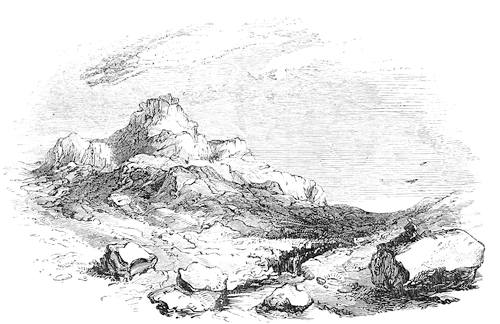
may note “The Old Man,” anciently, and more correctly,
“Alt Maen” (British),
“Whose ridgy back heaves to the sky,”
and looks, from this window, something like part of the
back and head of a huge elephant, with his trunk slightly
extended and a wart on his forehead.
GROUNDS, FELLS, AND VILLAGE.
You had better now take a boat and row a mile or two
down the lake, and row yourself, or, if you are lazy, at
least sit with your face to the stern, and fresh beauties
will open upon your enraptured gaze at every stroke of
the oars.
Beyond, or above, the inn you are leaving, is the residence
of Mr James Garth Marshall, one of the princely
manufacturers of that name in Leeds; it is surrounded
by—excepting in some particulars Rydal Hall—decidedly
the finest demesne in the Lake district, so far as the most
beautiful combination of all the elements of natural and
artificial loveliness can establish its superiority; for nowhere
else have I seen wood and water, hill and valley,
green sward and purple heather, rugged crag and velvet
slope, grey rock and bright blossoming shrubs brought
under the eye at once, in such magnificent contrast. Over
the western side of the grounds, you may note the picturesquely
rugged and jagged summit of Raven Crag, at
the head of Yewdale, and nearer to you, but still more to
the west, the wild, precipitous and lofty Yewdale crags.
Over them the long ridge of Henn Crag, and higher still
the broad summit of Weatherlam; and, as you row farther
down the lake, the lofty undulating range connecting those
with the Old Man, which last you may now contemplate
in all his hoary grandeur and rugged magnificence. And,
having just shewn you one of the finest demesnes and
grandest mountain groups in the Lake district, I now
shew you the most romantically situated village, parts
nestled at the foot of the steep craggy hills, and parts
stuck here and there upon the face of the adjacent declivity,
every separate detachment, whether consisting of
one or many houses, having its own separate designation,
“TIME’S CHANGES.”but forming altogether the village of Church Conistone,
and containing, by the last census, twelve hundred people.
Its scattered appearance suggests the idea of something
having, at some former period, flown across the country
with a bagful of houses, and losing a number here in irregular
lots through a hole in the sack. And here, close by
in the apex, or, to speak nautically, the bight of the bay,
between a row of lofty sycamores and the wide-spread
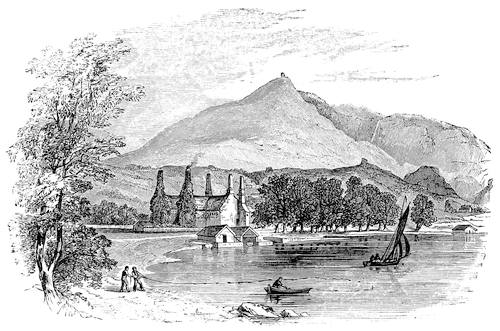
woods of the old park, stands Conistone Hall, the ancient
seat of the once warlike family of le Fleming, but now a
farm house—with a considerable portion removed, and
the banquet hall, wherein, of old, knightly revellers befuddled
their brains in honour of high born ladies, converted
into a barn, and a mighty commodious barn it
makes; but how very applicable would be a quotation
from Hamlet here, were it not hackneyed. The hall's
most striking features now are its massive ivy-clad
chimneys, though it is well worthy a closer inspection,
and I shall perhaps tell you more about it at our next
confabulation.
CHAPTER II.
Daylight versus Moonlight—Possible Results of
Moonlight Laking or Love-Making—Conistone
Hall—“The Hall Clipping”—Vale of Yewdale—Yewdale
Crags—Old Yew Tree—Raven Crag—Hunting
Incident.
Some harmless individuals who desiderate the reputation
of a taste for the romantic, and fancy that such reputation
is to be attained by affecting to think differently from the
ordinary race of observers, maintain that this lake and
the circumjacent landscape, like the ruins of Melrose, as
described (unseen, except by daylight) by Sir Walter
Scott, are seen to most advantage by moonlight. I don't
agree with them! The beauties around you are so numerous,
so diversified, such perfect realities, and the deformities
or defects in the scenery are so few and so minute,
that no softening or shadowing is required to enhance
a reasonable man’s enjoyment of the loveliness of
Conistone. The more extensively, and the more distinctly
its features are developed, the more must it be admired.
As with some rare specimens of human nature, “the more
you see of it, the better you like it.” Therefore, be it
mine to gaze upon, to exhibit and to dilate upon the attractions
of this “our own fair vale,” just when the “sun
of the morning” has mopped up the mists of the night,—when
mountains and mere, crags and cottages, woods and
waterfalls, fields and fell-sides, are fairly lighted up, and
fully brought into view in all their proud proportions, and
in all their contrasted colours. And, moreover, as Conistone
is best seen under
MONITION.
“One unclouded blaze of living light,”
so will any susceptible young gentleman like yourself best
consult his well-being by forswearing all loitering by
moonlight, whether for laking or love-making purposes.
I myself, in those days “when hope was high and life
was young,” grievously deteriorated my mental quiet, as
well as my physical comfort, by indulging in these too
natural propensities, as may be evidenced by the following
rhymes which, under the retrospect of wounded feelings
and aching bones, I felt constrained to indite, and
now offer to you by way of caution against yielding to the
promptings of an excitable imagination; and, first, what
say you to this?
Matter of Moonshine.
Where the hazels droop o'er a lake-laved slope,
Sat a sweet little maid and I,
And a chastened light lay softly bright
On water, wood, and sky;
For the lovely moon, in the “lift aboon,”
Was 'shrined on her azure throne,
And bright and clear in the slumbering mere
Her mirrored semblance shone.
We were silent both, and the evening moth
Was the only life that stirred,
And the far, faint roll of the waterfall
The only sound we heard;
Till soft and slow did a murmur low
Come on through the quivering trees,
And the boughs of the brake and the reeds of the lake
Were bent by a passing breeze.
And still did we lean on our couch so green—
That sweet little maid and I—
And we marked its course as, with lessening force,
The breeze swept ruffling by.
Whilst the lake rippled o'er from shore to shore,
And shattered the moonbeams bright,
Till that mirror broad o'er its surface showed
One shivering sheet of light.
But it passed away, and the waters lay
Once more in their holy sleep,
With the orb so fair still glittering there
In their bosom dark and deep;
When that sweet little maid glanced up and said,
With her smile so fond and free,
“I can tell you how what we've witnessed now
May apply to you and me:
If yon radiant light that adorns the night,
Seem the light of my love for you,
And her form beneath your answering faith
So perfect, deep, and true;
If that breeze appear any transient care
That may ruffle your bosom’s rest,
Then they shew that my love will the brighter prove,
When peace forsakes your breast.”
Long years have fled since that sweet little maid
Thus sweetly said to me,
And as seasons change, will the fancies range
Of maidens young as she.
And from hopes of bliss, in a life like this,
Will dreamers all awake—
And all that was said by that sweet little maid,
Was as moonshine on the lake.
So much for mental quiet; the next, as the show people
say, will be for physical comfort, viz.:—
'Twas eve, and over Walna Scar the sun had sought the west,
And shades of night were settling thick o'er Thurston’s glassy breast,
But yet I lingered on the lake as loath to leave a scene
So lovely as, ere day’s decline, fair Conistone had been.
When over Hawkshead’s heights arose a mild and mellow light,
Announcing, with its silver sheen, the coming Queen of Night;
And now I lingered on the lake her advent high to see,
When stealing through the breezeless night came sounds of melody.
And from the mantling mist emerged a slowly gliding boat,
Which seemed in that imperfect light upon the mist to float;
And now I lingered on the lake a wild, sad song to hear,
And deemed it all too sweet for sound of this terrestrial sphere.
That seraph song to silence sank, the boat swept slowly past,
But soon another strain was heard as sweet as was the last;
And still I lingered on the lake in strange entrancement held,
Whilst through the calm mist-laden air the plaintive cadence swelled.
The moon rose fair above the fell, and fast her radiance cleared
The gloom away, and by her light another boat appeared;
And now I lingered on the lake to watch that lonely pair
Of tiny barks, propelled by hands of maidens young and fair.
Then soon as ceased the second song, the first-seen boat drew nigh,
And promptly did the first-heard voice in harmony reply;
And still I lingered on the lake unseen from either boat,
While Brantwood’s echoes multiplied each bosom-thrilling note.
As boat crossed boat—song after song did their fair crews repeat
Across the cool and glancing mere, in alternation sweet;
And still I lingered on the lake, and prayed they might prolong
Till day their strife of melody, alternate song and song.
And when they ceased, all nature seemed involved in sudden shade,
The lake its placid brightness lost, the moonlight seemed to fade;
No more I lingered on the lake—I felt the charm was fled,
And feeling, too, I’d caught a cold, went sneezing home to bed.
FARTHER WEST.
When I commenced this tedious, but, in your case, requisite
digression, you were seated in a boat upon the
lake, and staring with all your might at the turret-like,
ivy-clad chimneys of Conistone Hall; concerning which
hall West, the precise and industrious Furnesian Antiquary,
who published his great work in 1774, says therein—“Conistone
Hall appears upon the bank of the lake;
it was for many ages the seat of the Flemings, and though
now abandoned and in ruins, it has the air of grandeur
and magnificence.” And again, in his history of the
family who possess it, he says—“Sir Richard le Fleming,
in the reign of Henry III., married Elizabeth, daughter
and heir of Adam de Urswick, by which marriage he acquired
MORE OF “THE HALL.”the manor of Conistone, and other considerable
possessions in Furness;” and—“Upon the acquisition of
the manor of Conistone, the family returned to Furness,
the first seat of the Flemings. The Castle of Caernarvon
was abandoned, then erased, and Conistone Hall was the
family seat for seven generations. After the union of
Lancaster with Le Fleming (temp. Hen. 4th), Rydal and
Conistone vied with each other for seven generations more
to fix the family in Westmorland or Lancashire. Sir
Daniel le Fleming came and gave it against the latter;
since that event (about 1650-60), the Hall of Conistone,
pleasantly situated upon the banks of the lake of that
name, has been deserted.”
If the Hall were in ruins seventy-four years ago, you
may perceive that, though sufficiently venerable and time-shaken,
there is nothing exactly like ruins about it now;
but, as I said before, a great part of it has been removed,
as is shewn by certain jambs and chimney-pieces which
remain in the outer surface of what is now the outer wall,
and have formed the fire-places of an extensive range of
apartments which formerly occupied the space along the
northern side of the present edifice. What remains of the
Old Hall, I have also said, is converted into a farm-house
and appurtenances, both of which are of a most commodious
and substantial description; and, should your sojourn
at Conistone happen to fall in the early part of July,
let me exhort you to attend the Conistone Hall clipping,
or sheep-shearing, where you will witness some “scenes
of life and shades of character” not to be seen every day,
nor in every locality; and, moreover, you will find the
viands to accord in character with the building,—i. e. to
be plentiful, substantial, and old-fashioned.
I say that the scene, or rather the series of scenes, presented
by a sheep-shearing in the lake country, are of a
description not to be passed by in these artificial days,
when “touches of nature,” which “make the whole world
kin,” are rare as they are rich;—therefore, supposing you
to be at Conistone in the proper season, I shall, with your
approval, of which I have little doubt, and with Mr
Irving’s hospitable permission, of which I have still less,
introduce you to that of Conistone Hall.
SHEEP-SHEARING.
The sheep, which are of the black-faced breed, are all
gathered in from the fells on the previous day, or early in
the morning, and are penned up in lots in a large detached
barn through which you pass, and, in a yard behind
which you are startled by a scene of animated and noisy
bustle wonderfully at variance with the surrounding quiet.
In two rows along the inner side of the semicircular yard
wall, are seated the clippers, numbering from 25 to 30,
each astride upon a stool, busily plying his shears upon
a sheep laid bound on the stool before him; and you
cannot help being surprised at the rapidity with which
the animals are divested of their superabundant coverings;
that tall man there in the blue linen jacket is one
of the most expert, and can take the fleece from a mountain
sheep in three minutes. I am told his father, a respectable
yeoman in an adjacent vale, was still more
dexterous, and that, for a wager, he, in one day, clipped—a
number which, as I am anxious to maintain my
character for veracity, I shall not here state. The average
rate of clipping is, of course, lower than what I have
mentioned; but, allowing it to be so, this number of
shears incessantly at work for seven or eight hours, may
give some idea of the number of sheep denuded each
year on this and similar farms.
DRAMATIS PERSONÆ AND DINNER.
In attendance upon the clippers are a much greater
number of men and lads supplying them with unclipped
sheep and removing those operated upon to another part
of the yard, where, beside a turf-fire and a kettle of
melted tar an active youth is stationed ready to stamp
them with their owner’s initial, with another near at
hand ycleped “the doctor,” carrying in his hand a pot of
ointment to anoint the wounds, which, in such a hurried
operation, many of his ovine patients receive. Multitudes
of boys are skipping about on every side, collecting the
cords as they are removed from the limbs of the clipped
sheep, and carrying them to be applied to the feet of their
successors upon the clipping stools. In a remote corner
of the yard, a small party of sedate, business-like individuals
are rolling up the fleeces upon a couple of small
sloping platforms, and handing them over the wall to
others who are building them upon carts, to be carried to
the storing-house. One jolly-looking personage, with an
aspect worthy of his office, is moving about and dispensing
“clipping drink” to all and sundry. And “Woo'
Geordie,” known elsewhere as “Mop George” (after his chief
article of merchandise,) is poking about gathering up stray
fragments of wool. These, with one or two groups of
idle on-lookers waiting for, and wondering when it will
be, dinner-time, and perhaps an artist sketching the various
and ever-changing groups, constitute the dramatis
personæ of the sheep-shearing, whilst nothing but work is
going forward; but, now the last sheep shorn, the last
fleece rolled up, and “Woo’ Geordie,” liberally informed
that he may convert to his own proper use and emolument
all the fragments of wool that remain on the ground (no
inconsiderable prize to him,) adjourn we to the Hall
where a banquet waits our attack, which is perfectly
worthy of Conistone Hall in its best days, for gigantic
rounds of beef, and legs of veal, ditto of mutton, and
quarters of lamb, with every tempting and appropriate accompaniment,
are arranged upon a table which accommodates
thirty hungry people at once, and the first detachment,
having stuffed to repletion with the above enumerated
solids, topped off with sweets, “quæ nunc perscribereFUDDLING AND FUN.(or describere either) longum est,” are succeeded
by a second troop equally sharp set, and those who were
idlers before, are by no means the least industrious now.
“Another and another (set) yet succeeds,” until the whole
party, amounting to something above six score, are fed
and satisfied. You may observe that the whole company
does not partake of its generally pastoral and agricultural
character, for the duties of one end of the table are probably
discharged, to all the successive troops of eaters, by
a practitioner of the law, and those of the other by a ditto
of medicine, both of whom are glad to relieve, by a few
hours’ mirth, untutored though it be, their daily routine
of attention to the multifarious derangements to which the
business and the bodies of “God’s humanity” are liable.
Dinner being at last fairly finished, “now comes the
sweetest morsel of the night,” and strong ale and tobacco,
as their legitimate successors, supersede beef and pudding,
and all the guests being settled down in the capacious
Hall, as many as can, round the long table, others
on forms or benches arranged in rows, and others, more
favoured, apart from the crowd, around a small table
placed under a chimney large enough to be a dwelling-house
for a family of moderate pretensions; pipes are
filled and lighted, glasses are filled and tasted, and singing
is commenced by John Kendal giving, in characteristic
and peculiarly comic style, a quaint old ballad of the
“down, derry down” genus, concerning a parson who
“had a remarkable foible of loving good liquor much
more than the Bible,” and of whom it was said “he was
much less perplext in handling a tankard than handling
a text,” and, once set a going, a stream of songs interspersed
with “quips and cranks,” and no! not “wreathed
smiles,” but wide grins and roars of laughter, with noisy
joke and noisier repartee, carries rapidly away the remaining
hours of the evening. The majority of the songs are
CLOSE OF THE CLIPPING.of a stamp now to be met with only amongst the mountains,
or in such other districts where primitive pastoral
habits yet prevail, and are to be appreciated and enjoyed
only by those who hold broad humour and natural spirit
and freedom to be a sufficient compensation for rudeness
of phraseology, and the absence of polish, refinement, and
high sentiment; and you may notice, that, as might be
expected, their subjects and sentiments become less and
less refined, and their humour less and less restrained, in
due proportion with the sinking of the potent clipping
drink in the tilted barrels, till at length the very orderly
part of the company think it time to depart.
I may be censured for introducing you to scenes like
these, and the only excuse I have to offer is that I wish
to give you a correct idea of life and manners amongst
the primitive inhabitants of these our dales, and it is only
by mixing freely amongst the people upon such occasions,
that any true knowledge of their habits and customs is to
be gained.
I was lately deluded into reading a book entitled,
“Conistone Hall, or the Jacobites,” written by a dignitary
of the English Church, “in order,” as he says, “to exhibit
the tone of feeling and the disorders of Church and
State, to which the ill-advised revolution of 1688 gave
rise.” I was simple enough to hope to find matter of
local interest in a book called “Conistone Hall,” but was
grievously disappointed,—it might as well have been
called “Lancaster Castle,”—and the subject-matter is
quite worthy of the author’s object.
And now, having bored you, probably ad nauseam, about
the Old Hall, it were well to return to your Inn; and,
having allowed you what is requisite of rest and refreshment,
I shall carry you off upon your longest excursion
first; “and,” to quote The Professor thereanent, “if
murmuring streams and dashing torrents, and silent pools,
and shadow-haunted grass-fields, and star-studded meadows,
and glimmering groves, and cliff-girdling coppice
woods, and a hundred charcoal shellings, huts and cottages,
and one Old Hall, and several hall-like barns, and
a solitary chapel among its green graves, and glades, and
dells, and glens without number, knolls, eminences, hillocks,
hills, and mountains,—if these, and many other
such sights as these, all so disposed that beauty breathes,
whispers, moves, or hangs motionless over all, have power
to charm your spirit,——away with the cavalcade into
the heart of the expecting mountains.”
HORSE AND AWAY.
If, like myself, you prefer enjoying a long excursion
upon four legs to enduring it upon two, your host can
supply, at a satisfactory rate, ponies well accustomed to
the roughest roads in the country. You declare for the
equestrian mode of progression: well, say the word, and
behold your steed at the door. Being safely and pleasantly
mounted, you turn your pony’s tail to the lake, and
canter up the road till you come to a group of ancient
and picturesque cottages and farm-buildings, called High
Waterhead (Conistone Water being bicipital), and then
take the road to your left, which passes through amongst
these houses, and by another old homestead called 'Boon
(vulgo above) Crag, holding on along an occupation road
which winds through a considerable portion of Mr Marshall's
wooded parks; and, as you jog along, keep a sharp
eye to the left,—“ride, as the Spaniard hath it, with your
beard on your shoulder,”—and your vigilance will be rewarded
with occasional glimpses of the lake and its shores,
broken up into a series of lovely fragmentary pictures by
the irregular intervention of the scattered or “clumped”
timber. You soon begin to descend into the middle of
the vale of Yewdale, which Mr Parkinson, the accomplished
canon of Manchester and Principal of St. Bees, maintains
to be the most beautiful in the lake district, and
which is described by Green, the artist, as being “a grand
valley lying at the feet of the high mountains on the north
of Conistone Water.” As you approach it, you must, if
you have eyes and soul, be struck with “the steep, frowning
glories” of the mile-long range of lofty cliffs which
bound Yewdale on the whole extent of its western side,
the otherwise barren aspect of which is finely relieved by
thick groves, comprising oak, larch, birch, holly, &c.,
stretching along the foot of the crags, and also by numerous
and various trees flourishing here and there along
the face of the steep, in situations “the most inaccessible
by shepherds trod,” even up to the highest verge of the
precipice, where it makes one giddy to imagine how they
have been planted, for they ore not of spontaneous growth,
but were all planted by the late Mr Knott.
REMARKABLE IN YEWDALE.
You cross the pellucid Beck of Yewdale by a ricketty
wooden bridge, pass through the farm-yard of Low Yewdale,
and immediately after gain the high road, which
runs along the west side of the valley close under the
crags. As you near the head of the vale, be pleased to
observe, as you will doubtless be pleased in observing,
the sweetly situated farm of High Yewdale, with its long
rows of unmercifully clipt yews, looking like magnified
chessmen, one of which was recently recommended to my
notice by an observant fair friend, as presenting a ludicrous
resemblance to a starched puritan of the time of the
Commonwealth, attired in round beaver and “cloak of
formal cut.” You must here diverge a little from your
line of ramble to examine the aged tree which gives its
name to the vale, and which some unscrupulous local
chronologists stoutly maintain to have been coeval with
the deluge. Without feeling myself called upon to establish
that fact, I may safely enough assert that it must be
of vast antiquity, and it is the largest yew that I have yet
fallen in with, those immortalized by Wordsworth as “the
pride of Lorton vale,” and the “fraternal four of Borrowdale,”
not excepted. I, and two friends, girthed it one
summer with three riding-whips knotted together, and
found it, at five feet from the ground, to measure 29 feet
in circumference. You see that it has an aperture in the
northern side of its huge trunk, which, like Mercutio's
wound, though “not so deep as a well, nor so wide as a
church door, 'twill serve” to let you go in and creep round
between that centre pillar formed of the most internal
layers of its wood and the surrounding wall formed of its
external layers and bark, a large portion of the intermediate
timber having, like the halls of Lord Byron’s fathers,
“gone to decay.”
FUTILE FOX-CRAFT.
This wondrous feat being duly accomplished, for your
future exaltation, retrace your steps as far as the Shepherds'
Bridge, and then, holding to the right, you soon
pass through a gate, and come out upon a somewhat stony
road winding along between the beck and the foot of
Raven Crag, which rises on your right, steep and rugged,
to form its multi-peaked crown. That precipitous peak
(or pike) immediately above you, was the scene of an
event remarkable in the annals of mountain fox-hunting.
A poor fox, after an unusually long chase, reached the
summit of Raven Crag, closely pursued by only three
hounds, the rest of the pack being distanced long before;
as a last chance for life, he made directly for the edge of
that precipice, purposing, doubtless, to swerve when
close to the verge, and thus rid himself of his pursuers
by throwing them over: this sagacious expedient was,
however, unsuccessful, for, when he reached the edge, his
three foes were too near to admit of his effecting the saving
turn, and all four were projected from the brow of the
cliff, and dashed, out of all semblance of caninity and
vulpinity, on the stones not far above your present position.
CHAPTER III.
Weatherlam—Tilberthwaite—The Brathay—Wordsworth's
Bridges—Hallgarth—Little
Langdale, its Tarn, &c.—Whitewash, pro and
con—The Busk and Fell-foot—“Joan’s Ale was
New”—Ancient Tumulus—Ascent of Wrynose—The
Shire Stones—Source of the Duddon—Wordsworth's
Sonnets thereon—Author’s ditto
ditto—Traditional Sayings about Old Woods—Their
Extent Disputed.
As you wind round the heel of Raven Crag, you obtain a
fine view of the Old Man’s stupendous brother, Weatherlam,
rearing his massive summit over the circumjacent
hills, like a giant amid ordinary mortals. You follow a
narrow winding road through the verdant fields and copse-clad
hillocks of Holme ground, and soon find yourself in
the vale of Tilberthwaite; and “O,” you suspirate, as
you roll your eyes around, “what a spot for a honeymoon—'the
world forgetting, by the world forgot'—so lovely
in its seclusion and so lonely in its loveliness.” The
only unpleasant characteristic of Tilberthwaite is an odd,
uncomfortable feeling of which, though absurd enough,
you cannot entirely divest yourself—an idea of difficulty
in getting out of it. It is so encompassed by steep hills
and hanging woods, that you involuntarily compare yourself
to a cockroach in the bottom of a porridge basin. The
name of Tilberthwaite is said to be compounded of Tillbear
and thwaite, and to signify an enclosure for the cultivation
of bear (pronounced beer), an old name for barley.
This word, like many more that are obsolete in
England, is still used in Scotland; for instance, it occurs
in Tam O'Shanter, where it is said that Cutty Sark—
“Shook baith muckle corn and bear,
And held the kintra side in fear.”
And again, an old song commences—
“There'll be nae shearing here the year,
For the craws hae eaten the bear the year.”
But the day advances, and you’d better advance along
with it, for “you've many a mile to go” before you get
back to your comfortable quarters at Conistone. Push
on then, along the bye road through the fields, and you
again reach the high road. You follow it through the
farm-yard—take the gate to the right, and pursue a rough
way meandering pleasantly for about a mile through an
irregularly-wooded vale. The enormous heaps of loose
blue stone on every side of you are from the slate quarries,
of which I shall perhaps tell you more when I have
more time.
RIVER AND BRIDGE.
The stream you now approach is a branch of the
Brathay, which rises on Wrynose and other hills round
the head of Little Langdale, down which valley it flows,
forming a fine fall at Colwith and at Skelwith, after joining
the Great Langdale branch in Elterwater, and become a
principal feeder of the “Regal Windermere;” you stand
upon the verge of Lancashire, for this brook here divides
it from Westmorland. Don’t cross it as yet, but follow
its course upwards on the Lancashire side, and you will
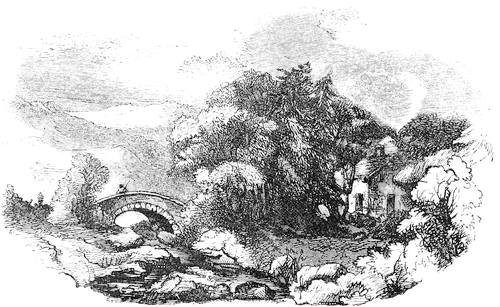
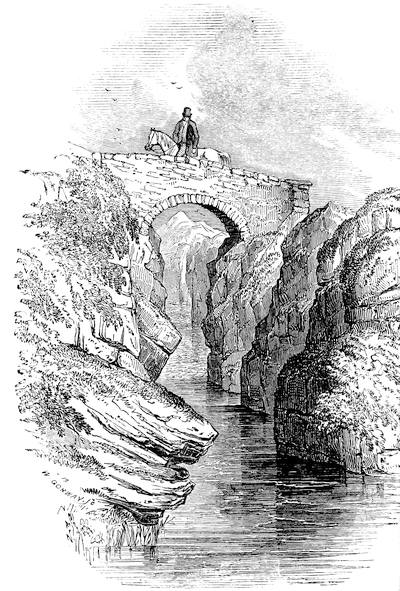
soon fall in with a primitive stone bridge—one of the very
few remaining of those whose rapid disappearance Mr
Wordsworth deplores, whilst he expresses admiration of
“the daring and graceful contempt of danger and accommodation
with which so many of them are constructed,
the rudeness of form of some, and their endless variety.”
If neglect of danger and accommodation, and rudeness of
form, be the distinguishing and essential attributes of the
class, this, connecting Tilberthwaite with Little Langdale,
and called Slater’s Bridge, ought certainly to be preserved
as an exquisite and unique specimen of a style of bridge
all but extinct; for the sturdy Dalesmen perversely prefer
bridges that are safe and commodious, though they
may sacrifice the picturesque and rudeness of form to obtain
these vulgar requisites.
DOCTRINES OF MR. WORDSWORTH.
Pass by, not over, the bridge—a horse passing over it
might remind one of the famous asinine performer on
the tight-rope—and you come to the hamlet of Hallgarth,
which has little to distinguish it from a thousand others,
save the rather uncomfortable peculiarity of not being
touched upon by the “blessed sun” for about three
months in the year. As you leave it by a steep acclivity,
you had better take a survey of Little Langdale which
lies spread out at your feet. Rather farther than midway
between you and the abruptly rising range of hill called
Lingmoor, which divides this vale from its larger namesake,
lies Langdale Tarn, which bears out the Poet Laureate's
assertion, that “Tarns are often surrounded by an
unsightly tract of boggy ground.” The chief beauty of
Little Langdale consists in the irregular hillocky nature
of its ground and the sites of its dwellings, many of which
nestle so cozily in little dells, behind rocky knolls, and
beneath umbrageous trees, as to convey a notion of the
most attractive snugness; but here I am heretic enough to
dispute the infallibility of the Poet Laureate’s taste. He
has declared war against whitewash in something like the
following terms:—“The objections to white, as a colour,
in large spots or masses in landscapes, especially in a
mountainous country, are insurmountable”—and, quoting
somebody who says “that white destroys the gradations
A WORD FOR WHITE HOUSES.of distance,” he holds on thus—“Five or six white
houses, scattered over a valley, by their obtrusiveness, dot
the surface, and divide it into triangles, or other mathematical
figures, haunting the eye, and disturbing that repose
which might otherwise be perfect.” By the bye, a
fair lady, whose opinion, in most matters of taste, I hold
in the deepest reverence, recently became a convert to this
doctrine of Mr Wordsworth, because she noticed the
effect just instanced, not when gazing upon a landscape,
but when compiling patch work in which fragments of
white intruded amongst the blues, yellows, greens, reds,
and neutrals, woefully disturbed the harmony and repose
of the cushion cover or quilt. Mr Wordsworth says also,
in support of his anti-whitewashing theory, that “in
nature, pure white is scarcely ever found but in small objects,
such as flowers; or in those which are transitory, as
the clouds, foam on rivers, and snow.” But I must
remind those who take for gospel every word that Mr
Wordsworth preaches, that the “White Cliffs of England,”
the snows upon a thousand hills, and the foam of a thousand
cataracts are neither minute nor transitory; and
that large masses of white in nature, such as these, as well
as white clouds, and the terrible white of a stormy sea upon
a rocky coast are all calculated to excite sensations of the
sublime and beautiful in any bosom, whether the possessor
be very much of a man of feeling and imagination or the
reverse. But coming back to cottages, with all due deference
to the Poet Laureate’s argument, and with more to that of his
fair and talented supporter, I do maintain that no objects
can give such a gratifying air of life and cheerfulness to
a valley surrounded, or not, by high mountains, or so
strikingly enhance the bright green of herbage and foliage,
or the more sombre, but warmer, tints of near or distant
hills, as a liberal sprinkling over the landscape of pure
white cottages, embosomed, as these are, each in its own
OUT-DOORS AND IN-DOORS CONTRASTED.nest of sheltering trees; and I do wish that the farmers
of Langdale, and all our other fell-dales, would expend a
shilling or two annually on lime, and bestow upon their
romantically situated homesteads, “the cleanly, pleasant
appearance derivable from a plentiful periodical application
of white-wash.” Their present grim, dingy, almost
squalid exteriors, are strongly suggestive to the mind of
a stranger of internal poverty, desolation and dirt, than
which nothing can be more distant from their real in-door
condition; for, in all these scattered houses, miserable as
they look externally, there is abundance for the wants of
the inmates and for the requirements of hospitality, and
their cleanliness is such that, as I have partaken of many
meals spread upon their unclothed tables, so, in the
absence of a table, would I not scruple to eat my dinner
if laid upon any of their blue flagged floors,[A] for those
are cleaner than many table-cloths I have seen in the
course of my peregrinations through other countries.
[A] It is said that “great wits jump together,” and it would
appear that, under certain circumstances, the same saltatory
exploit may be performed by a great and a small wit; for instance,
Miss Martineau in her capital essay on the Lake
District, treating of the inside cleanliness of the houses,
makes nearly the same remark as I have made above. I am
sorry that I cannot conscientiously adopt the complaint of the
very modern literary gentleman who accused Shakspeare of
forestalling all his best ideas, because the above passage, or at
least the same idea, if it be one, occurred in the first edition
of these papers, and was printed above three years before the
appearance of Miss Martineau’s work.
WORT AND WELCOME.
Mais revenons a nos moutons,—return we to our
ramble. As you move forward, here take a good look at
Langdale Pikes, perhaps the most picturesque hills in
England, and seen to advantage from this road, over
Wallend and Blea Tarn. Which last again brings Mr
Wordsworth upon the stage; indeed it is difficult to
descant upon any part of the lake country without running
foul of him, and this Blea Tarn is the scene of one of
those purely poetical descriptions so truly and peculiarly
his own, which prove by the earnestness, fervour, and
simplicity of their style, that their author is a true poet,
with all his whims; and they may well be received as an
ample atonement for even more of the middling quality
than he, during his long and peaceful life, has inflicted
upon the reading world.
The newly-made cart-road to your left leads to Greenbourne—a
wild and retired dell under the north-eastern
shoulder of Weatherlam, where a spirited and meritorious
mining adventure, set on foot by some working miners
from Conistone, is in progress, and is likely to prosper.
The farm under the fell on the other side of the valley, is
called the Busk, and was formerly a public house, as was
also Fell-foot, the uppermost house in the dale. It is
said of these old hostels, that they would commence brewing
when they saw their chief customers, the caravans of
travellers, carriers, and pack horses (then the only mode
of conveying goods, as this was the only road, between
Kendal and Whitehaven), appear on the top of Wrynose,
and that they would have good drink ready for them by the
time they reached the bottom. This reminds one of the
old story of the thirsty London traveller drawing up and
calling for ale at an old public house, called the “Dog
and Doublet” on Carleton Thwaite, and being told by
the landlady in her brewing apron, that “they happened
to be out of drink just then, but if he would light his
ways down and stop a leyle bit, he should have wort and
welcome while the yell was getting ready.” As you
approach Fell-foot you cross the beck, and entering Westmorland,
come upon the ancient pack-horse road; and
passing close in front of Fell-foot, a favourable sample of
the old-fashioned mountain farm-house, you commence
the ascent of Wrynose. In the field immediately behind
the farm buildings, is a large mound or tumulus which
has never been noticed in any published work, but which,
it is much to be desired, that some learned antiquary
would examine, and report upon its nature and probable
or possible origin. It is an oblong square, with a tabular
summit from thirty to forty yards long, and from ten to
fifteen broad—attained by a broad terraced road of very
gradual ascent, which, after encompassing the mound
twice or thrice, comes out upon its summit at its northern
extremity.
WRYNOSE.
As you creep up the mountain, you may perceive in
the deep verdant glen under your left, a number of
small cone-shaped tumuli, whether formed by the hand
of man or by the operations of nature this deponent
sayeth not.
Having climbed for nearly a mile, please to halt and
look back, and you have a view well worth all your toil,
embracing Little Langdale, Colwith, Skelwith, Loughrigg,
the bright waters of Windermere, and the groves and
mountains beyond, altogether making up a picture approaching
in beauty, though inferior in richness and
variety, (as all other prospects are) to that seen from the
Castlerigg, near Keswick.
And now, having nearly attained the summit of Wrynose
Pass, I shall impart to you such instructions, as
will enable you, without difficulty, to find the three shire
stones, which here mark the spot where the three counties,
Cumberland, Westmorland, and Lancashire meet; and
this service I may mention is not rendered you by any of
the hackney itineraries or guide-books, for I never could
make them out until I received explicit directions in the
matter from an old woman in Seathwaite. At what
appears the top of Wrynose, when ascending it from
Langdale, you come upon a short track of level ground,
where the road runs along between a low wall of rock on
CLASSIC GROUND.the right and a peat-moss on the left. Near to the point
where the rocky wall runs down to nothing, and where
the road makes a sweep to the left to rise an acclivity,
look to the right, and, at a few yards distance from the
road, and stuck in rather wet ground, you will descry
three stones of the size of a high-crowned hat—about five
feet distant from each other—and forming a triangle;
each stone is in a different county, and if you are tolerably
lish and lengthy of limb, you may place a foot upon
one stone, the other foot on another, and your hands on
the third; or should the circumstances under which you
visit the spot require you to do the feat more gracefully
or more decorously, you may place both feet on one and
distribute your hands between the other two—either way
you perform it, you may brag thereafter that you, in your
individual person, have been in three counties at one and
the same time.
You leave the spot where “three fair counties meet
together,” and topping the aforesaid short ascent, soon
begin to descend, and as you descend, do not attempt
to shew your learning by quoting Virgil, and calling this
“facilis descensus Averni,” for it is a most infacile and innerman-jumbling
“descensus” into a very different place—a
vale destined through future ages to hold a proud
rank amongst the thousand be-rhymed and be-sonneted
localities of ancient and modern poets, such as “The
Plains of Troy, of which blind Homer sang,” “Parnassus'
hill where wells fair Castaly,” “The isles of Greece, the
isles of Greece, where burning Sappho loved and sung,”
“The soft flowing Avon,” “The wide and winding Rhine,”
“The Banks o’ Doon,” “The Groves of Blarney,” &c.,
&c., &c.—for it is the subject of a rosary of sonnets by
our great moral poet, of higher celebrity than any given to
the world since the days of Petrarch, and I hope that
neither Mr Wordsworth nor you will think that I exceed
my commission by quoting here the two first of the
series of “Sonnets on the River Duddon.”—
“SORDID INDUSTRY.”
I.
Not envying Latian shades—if yet they throw
A grateful coolness round that crystal spring,
Blandusia prattling as when long ago
The Sabine Bard was moved her praise to sing;
Careless of flowers that in perennial blow
Round the moist marge of Persian fountains cling;
Heedless of Alpine torrents thundering
Through ice-built arches radiant as Heaven’s bow;
I seek the birth-place of a native stream.
All hail! ye mountains! hail thou morning light!
Better to breathe at large on this clear height
Than toil in needless sleep from dream to dream:
Pure flow the verse, pure, vigorous, free, and bright,
For Duddon, long-loved Duddon, is my theme!
II.
Child of the clouds! remote from every taint
Of sordid industry thy lot is cast;
Thine are the honours of the lofty waste;
Not seldom, when with heat the valleys faint,
Thy handmaid Frost with spangled tissue quaint
Thy cradle decks;—to chant thy birth, thou hast
No meaner Poet than the whistling blast,
And desolation is thy Patron-Saint!—
She guards thee, ruthless Power! who would not spare
Those mighty forests, once the bison’s screen,
Where stalked the huge deer to his shaggy lair
Through paths and alleys roofed with sombre green;
Thousands of years before the silent air
Was pierced by whizzing shaft of hunter keen!
The first two lines of the second of these sonnets furnish
an instance of the prime defect in Wordsworth’s philosophy
and poetry, namely, his affected (for it cannot be
real), contempt for, and his perpetually recurring sneer
at, what he here calls sordid industry. I say this contempt
cannot be real, because Wordsworth, though a
great Poet, possesses quite an average share of ordinary
unpoetical prudence and discernment, and though in
earnest, no doubt, in his worship of “unprofaned nature”
holds in due appreciation those commonplace comforts of
civilized life, which, without the aid of the sordid industry,
would scarcely be attainable. Moreover, to meet
him on his own ground, this wild locality is by no means
very “remote from every taint of sordid industry”—these
hills are devoted to sheep farming, and though I am far
from stigmatizing stock farmers as being more sordid
than other classes, yet is their ordinary employment as
essentially sordid in its nature, and as coarse, unromantic
and disagreeable in its details, as any other common
mode of money-making, notwithstanding all that has been
said, or sung, to the contrary.
SOURCE OF THE DUDDON.
A HUMBLE IMITATION VERY!
And now, in humble imitation of my betters, I cannot
refrain from trying my poor hand at a sonnet, and, when
you have well considered the same, I hope and believe
that, however infinite you may reckon its poetical inferiority,
you will admit that its sentiment is more in accordance
with the subject—that it is conceived in a more
Catholic spirit than those of my great prototype—
“And that my raptures are not conjured up
To serve occasions of poetic pomp,” attend;—
Here springs the Duddon, trickling from the end
Of Wrynose, thus suggesting the belief
That Wrynose lacks a pocket-handkerchief.
It argues much untidiness to send
A nose-bred rill meandering o'er the breast
Of Seathwaite vale; but, as you downward wend,
Where verdure, rocks, and water aptly blend
To form a scene whose presence few had guess'd,
Amid these wild brown fells, you'll bless the source
Of this clear stream whose gushing waters lend
A music cheering you as you descend,
With easy lounge along its fitful course,
And pray that, whilst these wild brown fells endure,
Wrynose’s catarrh ne'er may find a cure!
The head of this vale does not hold out much promise
of beauty, and you feel surprised that any one, were he
fifty times a poet, could contrive to make anything readable
on such a subject as the dreary uninteresting valley
before you. It is indeed a desolate spot, stretching its
unrelieved length for two miles from the foot of this
hill, with nothing for the eye to exercise itself, or the
heart to console itself with, but bare fells, grey crags,
screes and boulders, and a stone-vexed rivulet winding
its lonely way along the bottom of the dale, but not a
sign of life except what may be contained in moss and
lichens, with here and there a little fern and grass.
“MIGHTY FORESTS.”
There are many who would persuade you that all these
bleak hills and dales were formerly and for centuries
covered with dense forests. Mr Wordsworth, in sonnet
number two, speaks of “mighty forests” having existed
hereabout for thousands of years before archery or hunting
became fashionable, and Dan Birkett, of whom more
anon, declares that formerly a con (vulgarly called a
squirrel), could hop from branch to branch all the way
from the top of Wrynose to Millom Castle; the same
tradition, I may remark, exists in the same form in other
localities; for instance, it is averred that the aforesaid
little animal, could, in the olden time, accomplish a
similar aerial journey from Wythburn to Keswick, and
also from Loweswater to the sea at Moresby. But perhaps
the best of the sort is the tradition cherished by the
descendants of one of the old Border clans, which asserts
that some time before “the good old days of Adam and
Eve” a moss trooper might ride in the shade of trees
from the head of Annandale to the Solway, about thirty-five
miles, and all upon land belonging to the Hallidays.
Take my word for it, the extent, duration, and number
of these old forests are very much exaggerated. Let us
take these hill sides as an instance. Where are the vestiges
of a thick wood existing here for ages? Burnt, you
may say!—Yes, but where is the rich loam inevitably
produced by copious deposit of decayed vegetable matter
WHAT THE SOIL SAYS.on dry situations, or the deep peat-moss that always betokens
the former existence of timber in wet localities?
Here, to your left, you perceive there has been a small land-slip—examine
the soil exposed, and what do you find?
Why, about a single inch of the soil created by vegetable
growth and decay, just as much as the poor little mosses
can make and no more, and a substratum of the tenacious
reddish gravel locally called sammel; but no where do we
see anything approaching to the thick superstratum of rich
vegetable mould always discovered on the sites of primeval
forests. No! no! where you cannot find either loam
or peat-moss, be assured there has been at no period,
however remote, any considerable covering of wood.
CHAPTER IV.
Ulpha—Cockley Beck—The Sunken Graves—Dale-head—“The
Stepping Stones”—Hinging House—The
Clan Tyson—Anecdotes—T’ Birks Brig—Remarks
on Scenery, and Quotations—Seathwaite
Beck—Miss Martineau on the Church and Parsonage—Newfield—Entertainment
for Man and
Beast—Dan Birkett—Walla-barrow Crag—Stoneythwaite—Mr
Wordsworth’s Anecdote—Character
of Scenery.
As you pursue your rugged way down the vale, you at
length come in sight of a group of buildings, which
offers to you, as the gibbet did to the castaway mariner,
the comforting assurance that you are still a sojourner in
a civilised country—a matter on which you were beginning
to feel uneasily dubious. It is the onstead of a
large sheep farm, well known by the designation of Black
Hall, which forms the most northerly portion of the
Chapelry of Ulpha—a wild tract of country extending for
many lonely miles along the Cumberland side of the
Duddon, deriving its outlandish looking appellation from
the same royal personage who is said to have accorded the
honour of bearing his name, as part of theirs, to the town
of Ulverstone and the Lake of Ullswater, the old Saxon
Monarch Ulfo or Ulphus (some call him one and some
the other), who, for anything that I know to the contrary,
was one of the Kings of the Heptarchy. Probably, when I
mention this, you will remember that Scott, in the Bridal
of Triermain, tells of the Baron’s Page, when sent by his
lord to enquire at the Sage of Lyulph’s Tower whether
the fair apparition in his dream was “an airy thing” or
of the earth earthy—
“He traced the Eamont’s winding way,
Till Ulfo’s lake beneath him lay.”
COCKLEY BRIG.
ETYMOLOGY AND ZOOLOGY.
Push on, and, as you round the elbow of the hill, you
are farther cheered by the nearer prospect of another
domicile on the Lancashire side of the brook; that is the
residence of Mr Daniel Tyson, the worthy proprietor and
occupant of Cockley Beck, the name of the house and
farm being derived from the stream that rushes along its
north-western boundary, and said to signify “a winding or
rugged stream;” others say its name is derived from the
former condition or character of the bridge here which
used to be “Cocklety,” a term implying “a daring
contempt of danger and accommodation” on the part of
its architect; others, again, say that the name of the
brook ought to be Cockling or Cackling Beck, because
the noise it occasionally makes in its stoney bed may,
by the aid of a leetle imagination, be likened to that by
which a hen announces to all concerned that she has just
got safely quit of an egg.
The vale of Seathwaite now assumes a more attractive
aspect; your pleasantest road lies through the farm-yard
of Cockley Beck, and that hearty-looking elderly man,
the uniform cherry-colour of whose honest phiz bespeaks
exposure to many a biting mountain blast, is Daniel
Tyson himself. If you are disposed to rest and chat
awhile, you may lead him, nothing loath, into conversation,
and if you do so, I fancy that some of his communications
will surprise, if they don’t interest you; for
instance, in allusion to some skins you may notice hung
up to dry, he will inform you that the weasels about
Cockley Beck have a fashion, on the advent of winter, of
CONJECTURES.changing their colour from brown to white, resuming
their more sombre coloured coats on the return of spring;
a fact in local zoology of which I incline to imagine you
have not hitherto been cognisant. He will also tell you,
should anything suggest the subject, that, in one of his
pastures, a little up the beck, there existed, till within the
last few years, a number of graves arranged in rows, but
which now, either from the sinking of the soil, or the
growth of the surrounding moss, &c., have become level
with the adjacent surface, and all distinct traces of them
obliterated. What rather adds to the interest excited by
these mysterious tombs is, that there is no history, authentic,
traditional, or legendary, to account for their existence—thus
affording a capital field for those imaginative
geniuses who love to speculate upon such mysteries or to
frame what maybe awanting for their satisfactory development.
With me the favourite probability in this instance
is, that a skirmish, tolerably fatal, has been fought in this
sequestered nook during the progress of some of the horrible
wars that, from time to time, have saddened our
merry land, and that the slain have been buried here
where they fell; but, whether the supposed skirmish was
fought between the factions of York and Lancaster about
the time poor King Henry sought and found, for a season,
a house of refuge in this vicinity; or between the Cavaliers
and Roundheads, when the Flemings of Conistone
stood out for Church and King; or between the Dalesmen
themselves and a stray party of Moss-trooping Scots,
who, “in the old riding times,” occasionally pushed their
predatory incursions even into these poor valleys, neither
Mr Tyson nor I will inform you, for, as I said before,
history, authentic and apocryphal, is silent on the subject,
Daniel is a man of verity, and I am but a lame hand
at invention; therefore you need not hope for even a fabricated
story (which, after all, would be better than none),
in connection with this now effaced souvenir of the good
old times.
THE STEPPING STONES.
A SUBJECT OF SONNETS.
But it is time you were taking leave of Cockley Beck,
and as you are doing so, you may perceive at the foot of
the heights to your left a number of rubbish heaps, the
result of a mining speculation set a going and kept up by
some spirited and very persevering gentlemen chiefly resident
in Ulverstone. You now canter along a decent road
through flat meadows where, if it be the season, the lads
and lasses of the dale are busily engaged in securing the
hay-crop and carrying it home, probably on horseback,
for the old farmers here have not as yet begun to use
carts for that purpose. On this road, too, there are
“oceans of gates” to open, the frequent recurrence of
which becomes rather troublesome, should your pony not
be all the steadier. You very soon arrive at another farm,
called Dalehead; but, by the bye, just before you reach
that, you had better turn off to the right by a track that
soon brings you to the river side, and take a look at the
stepping stones by which the Duddon is crossed at this
point. When you have looked at them, you seem to wonder
what it may be that should entitle them to be noticed
more than any other stepping stones in the country. I'll
tell you. Mr Wordsworth says they are—
“What might seem a zone
Chosen for ornament—stone matched with stone
In studied symmetry, with interspace
For the clear waters to pursue their race
Without restraint,”
and so on. It certainly does require a poet’s eye to discover
the title of these stones to be made the subject of
two whole sonnets of fourteen lines apiece; and apropos
to that, I once, at an evening party near Hawkshead,
overheard a gentleman ask another, “Have you read
Wordsworth’s sonnets on the Duddon?” “No.” “O
then,” said the first, “if you ever do read them, don’t believe
them! We were there last week, and we didn’t find
anything as he has described it.” Now though this advice
is entitled to some respect, inasmuch as the giver is
an amateur painter and musician of high excellence and
also a very keen angler, which last a respected friend
of mine would call the most intellectual and poetical
pursuit of the three, I cannot quite coincide with it, and
I shall soon make you admit that, although the vale of
Seathwaite may not be all that the Laureate, in the customary
exercise of poetic licence, may seem to make it,
yet is it well worthy a visit from any one with the smallest
pretensions to a taste for the picturesque.
PHYSIQUE OF THE DALESMEN.
Leaving Dalehead, you soon come to another farm-house,
noticeable as presenting, in strong contrast to its
dingy-looking, though prettily placed neighbours, a clean
and cheerful, because whitewashed, exterior, a veracious
index of the comfort, tidiness, and hospitality that characterise
its interior. It is called Hinging House, and is
the residence of another of the clan Tyson, the members
of which are so numerous in this, and the sister vales
Eskdale, Wastdale, The Langdales, &c., that in case of
need, their chief, if they’d had one, might levy a regiment
of his own name, as was done, if I remember aright, by
one of the Highland Chieftains, and a regiment, too, that
would be scarcely surpassable even by the Queen’s household
troops as regards the strength, stature, figures and
features of the rank and file. In this dale alone there are,
zoologically speaking, some magnificent specimens, both
male and female, of the genus homo amongst the Tysons:
and, indeed, the same may be said truly enough of the
Walkers, Dawsons, Birketts, and the bearers of other
Seathwaite surnames.
BIRKS BRIDGE, RIVER DUDDON.
The great number of families bearing the name of
Tyson renders it necessary for their neighbours and
themselves to adopt the custom of distinguishing individuals
by the names of their residences, as Daniel of
Cockley Beck, George of Black Hall, Harry o’ t’ Hinging
House, and so on ad infinitum.
TWO STORIES.
Not long ago, I had occasion to call at a house in Little
Langdale, and the friend who accompanied me was
joined, whilst waiting in the fold, by a fine ruddy and
lively little fellow who had not then attained the dignity
of his first breeches. He was, by way of starting a conversation,
accosted with the question most common under
such circumstances, “What is your name?” The answer
was ready, “Jimmy o’ t’ Fell-foot!” “What other name
have you?” “I have nin!” and neither his questioner
nor his grown-up brother, who came up during the conversation,
could prevail upon the youngster to assert his
right to any other designation than “Jimmy o’ t’ Fell-foot.”
Another anecdote illustrating the power of this custom
and then we'll march on. Mr Tyson, the much respected
incumbent of Seathwaite, had, and perhaps still has a
son settled in London, and a worthy statesman, one of his
parishioners, having business requiring his presence in
town, was furnished with Mr Thomas Tyson’s address,
which, with some difficulty, he contrived to make out, and
greatly astonished the servant who opened the door to his
knock by asking, in a dialect very distinctly not that of a
Cockney, “If ye pleese, does Tom o’ t’ Priest’s leeve here?”
Continue your course down the vale, again passing
through the farm-yard and holding on along the foot of
the fell by a road which has become somewhat more
rugged, you, by and bye, re-approach the river and
arrive at the Birks Bridge—the which I may guarantee
to be much better worth an examination than those
paltry stepping stones that disappointed you so grievously.
The Duddon, for some distance above and below this
bridge, considerably narrows and deepens, and loses the
general rapidity of its current, passing through a chasm,
A SLIGHTED BEAUTY.the jagged rocky walls of which rise perpendicularly to
a considerable height above the surface, and sink to a
depth a good deal below the level of the river’s bed above
and below the chasm (whether this be “the Faëry
Chasm” which Mr Wordsworth has pressed into his service
as a subject for one of his sonnets, not knowing,
can’t say, but it may perhaps do as well for it as any
other). At a point where opposite portions of these
rocky walls jut out so as to render the space between extremely
narrow, the little arch of the bridge springs
boldly across the void, the jutting portions of rock forming
piers more substantial and durable, barring earthquakes,
than any artificial structure for the same purpose
in the kingdom. The water on the lower side of the
bridge is still and very deep, I should say nearly two
fathoms, and bears a beautiful tinge of faint blue, but is
so clear that, if you happened to wear blue spectacles,
you might very well fancy that you were staring down
into a river course destitute of water. The best view of
this little bridge and its picturesque natural adjuncts is
to be gained by fastening your steed to the gate at its
further end, and descending to a little platform of rock
nearly on a level with the surface of the water about
twenty yards below the bridge, and, when there, I think
you will agree with me that this neglected atom of
scenery is a full compensation for the fatigue of even a
longer and rougher ride than you have undertaken on
this joyful occasion, as Saunders Mucklebackit’s mother
called her grandson’s funeral.
Remount your Bucephalus and canter away down the
dale past the farms of Troutwell and Browside, through
scenery which suggests a couplet from “The Lady of
the Lake,” for assuredly
“Crags, knolls, and mounds confusedly hurled,
The fragments of an earlier world,”
THE “CHERISHED” OF DUDDON.applies with equal propriety to Seathwaite as to the
glorious scenery around Loch Katrine. As you approach
the farm of Nettleslack, you must make up your
mind to quit either the river or your poney, for the road
diverges from the Duddon, which now assumes a course
where
“It seems some mountain, rent and riven,
A channel to the stream hath given.
Where he who winds 'twixt rock and wave,
May hear the headlong torrent rave,
And like a steed in frantic fit,
That flings the froth from curb and bit,
May view her—chafe her waves to spray,
O'er every rock that bars her way,
Till foam-globes on her eddies ride
Thick as the schemes of human pride,
That down life’s current drive amain
As frail, as frothy, and as vain!”
But you must take my word for all this, for you cannot
“wind 'twixt rock and wave” on horseback, therefore
keep the good road, whilst you have it. Cross Seathwaite
Beck by Nettleslack Bridge, and push on for the little Inn
at Newfield, to reach which you must pass between the
Chapel and the Parsonage. Behind the latter, you may
notice Seathwaite Beck, a tributary of the Duddon nearly
as large as itself, which rushes impetuously and noisily
along—
“Hurrying with lordly Duddon to unite;
Who, 'mid a world of images imprest
On the calm depth of his transparent breast,
Appears to cherish most that torrent white,
The fairest, softest, liveliest of them all!”
The “torrent white” looks exceedingly black and
gloomy under the shadow of these dense overhanging
branches, causing the numerous patches of snow-like
foam to look “than snow more white” by the contrast.
CHAPEL, PARSONAGE, AND PUBLIC.
Of Seathwaite Chapel Miss Martineau says, “when the
traveller reaches the Church, he finds it little loftier or
larger than the houses near. But for the bell, he would
hardly have noticed it for a Church in approaching: but
when he has reached it, there is the porch, and the little
grave-yard, and the spreading yews encircled by the seat
of stones and turf, where the early comers sit and rest,
till the bell calls them in. A little dial on a whitened
post in the middle of the enclosure, tells the time to the
neighbours who have no clocks.” Miss Martineau may
undertake to supply all “the neighbours who have no
clock” with that essential article of domestic respectability,
for I can answer for it, there is no house in
Seathwaite without one. “Just outside the wall,” Miss
M. says, “is a white cottage, so humble that the stranger
thinks it cannot be the parsonage: yet the climbing roses
and glittering evergreens, and clear lattices, and pure uncracked
walls, look as if it might be.”
I have a good deal to say in connection with this same
Church and Parsonage, but I suppose it must be deferred,
for after your long ride you must be somewhat athirst, and
an unromantic feeling of emptiness most likely renders
you insensible to the charms of scenery as well as sentiment.
Your pony, who has been here before, has for sometime
shewn an impatient consciousness of the proximity of
Edward Stables’ corn-chest, and, in fair time of day, here
you are at the door of his public, which, though of rather
unpromising exterior, has the wherewithal inside to furnish
forth a plain, but plentiful, savoury, and to a man,
in your circumstances, satisfactory feed—
“And here the ale is foaming up,
And genuine is the gin,
And you may take a liberal sup
To cheer your soul within.”
I am not sure that I quote correctly, but you will find
that the facts are correctly given. If it be about the end of
the week, you will probably fall in with my friend Dan Birkett,
“t’ heead Captain of Seeathwaite Tarn-heead Mines,”
ANTIQUITIES AND ANECDOTE.who will not require much pressing to take a glass of
grog, and whose varied conversation may amuse you,
whilst your ham and eggs are being cooked. Amongst
other matters, he will tell you that, in the Longhouse
Close, on the side of Walna Scar, with which you shall be
made acquainted by and bye, are to be seen the remains
of an ancient British town, consisting of the ruins of
several stone-built huts, and a large enclosure, where Dan
says they secured their flocks from the wolves: he also
says that they wore no clothes except a coat, but painted
their legs blue, and lived out upon the bare hill-sides, that
they might preserve the bottoms, which were then covered
with wood, for hunting in.
Whilst you are taking your ease at your Inn, you may
note from the yard thereof a very fine, precipitous and
rocky height upon the farther side of the stream, which
it is impossible to pass by unnoticed. It bears the fine
rolling name of Walla-barrow Crag, and, upon its further
side, the remains of a Roman castrum are said to exist,
and, though I, when I made the attempt, was unable to
trace them, they may be there for all that. Looking
along the heights to the south of Walla-barrow Crag, you
will be struck with the appearance of trees and
“A field or two of brighter green, or plot
Of tillage-ground, that seemeth like a spot
Of stationary sunshine!”
indicating the situation of a farm called Stoneythwaite,
perched like an eagle’s nest on the summit of the precipice,
with some of its fields upon ledges half-way down.
“The laurel-honouring Laureate” says, respecting this
portion of Duddon vale,—“The chaotic aspect of the
scene is well marked by the expression of a stranger, who
strolled out while dinner was preparing, and, at his
return, being asked by his host, “What way he had been
wandering?” replied, “As far as it is finished!”
A SINGLE WORD ON SCENERY.
The wild is the prevailing characteristic of Seathwaite
scenery; and, at the same time, it is invested with an air
of quietness and repose which prevents its wildness
approaching the savage or terrible, though many distinct
parts of it, as well as its general aspect, are fully entitled
to the epithet of sublime.
SEATHWAITE CHAPEL.
CHAPTER V.
The Rev. Robert Walker—His Parentage, Birth,
and Breeding—Habits of Life—His Industry,
Economy, and Hospitality—His Ways of Moneymaking—His
Death—Description of his Outer
Man—Comments—General Poverty of the Old
Clergy—Mary Hird—Her Character and Death.
Having fed yourself and seen your pony fed, whilst the
latter is enjoying needful rest, you may return to the
Chapel and make a more deliberate examination thereof
than you could do when you lately passed it on horseback
and hungry, and see that you approach that “low,
small, modest house of prayer” with befitting reverence
for it, and the ground of the humble cemetery around it,
in the opinion of greater men than you or I can ever
hope to be, are each doubly hallowed, the former as
having been for sixty-six years the scene of the labours,
and the latter as holding “the mortal dust” of the “Wonderful
Walker;” and who, you inquire, was he? and how
was he wonderful? I'll tell you all about him in as few
words as possible. The Rev. Robert Walker was the
youngest child in a family of twelve, who were all born
to a small yeoman, at Undercrag, in this dale. He was
born in 1709, and being sickly in boyhood, it was determined,
in accordance with very general custom in such
cases, to “breed him a scholar.” His father died when
he was seventeen, and he soon obtained the appointment
of parochial teacher at Gosforth, in Cumberland. After
PREFERMENTS AND PROFITS.labouring there, and in the same capacity at Loweswater
for some few years, he was ordained to the living of
Buttermere—the smallest Chapel, and, by no means the
largest living, in England. His income as incumbent of
Buttermere, even though eked out by teaching, being insufficient
for his wants, moderate as they were, he worked
hard, when his clerical and pedagogical duties permitted,
as a common country labourer, span, knitted, and acted
as private secretary and scrivener general, and sometimes
as marketing agent in sheep, wool, &c., to all his neighbours.
Amongst other modes of raising the needful
whilst at Buttermere, I have been told by one of his Seathwaite
neighbours, that he taught the Buttermerians the
art of drawing their lake and the adjacent lake of Crummock
with the draught net, and for this service he was paid at
the extravagant rate of one halfpenny for every draught
they took, whilst he remained amongst them. After
this he obtained the living of Torver, a small Chapelry,
under Ulverstone, situate a mile or two from Conistone
down the west side of the lake; and shortly after that, he
attained the great object of his very natural ambition—the
ministry of this his native valley; married a wife
with a fortune of forty pounds, and yet did not allow his
strict habits of economy and industry to slacken. There
was no labour too mean for him to engage in; indeed his
daily routine of employment as given by his trumpeter-in-chief,
Mr Wordsworth, is such as few Bishops in these
degenerate days would permit a clergyman to indulge in.
Listen to it—“Eight hours in each day, during five days
in the week, and half of Saturday, except when the
labours of husbandry were urgent, he was occupied in
teaching. His seat was within the rails of the altar: the
communion table was his desk; and, like Shenstone's
schoolmistress, the master employed himself at the
spinning-wheel, while the children were repeating their
A POOR PARSON’S LABOURS.lessons by his side. Every evening, after school hours, if
not more profitably engaged, he continued the same kind
of labour, exchanging, for the benefit of exercise, the
small wheel at which he had sate, for the large one on
which wool is spun, the spinner stepping to and fro.
Thus was the wheel constantly in readiness to prevent
the waste of a moment’s time. Nor was his industry with
the pen, when occasion called for it, less eager. Intrusted
with extensive management of public and private affairs,
he acted, in his rustic neighbourhood, as scrivener,
writing out petitions, deeds of conveyance, wills, covenants,
&c., with pecuniary gain to himself and to the
great benefit of his employers. These labours (at all
times considerable) at one period of the year, viz.,
between Christmas and Candlemas, when money transactions
are settled in this country, were often so intense,
that he passed great part of the night, and sometimes
whole nights at his desk. His garden also was tilled by
his own hand; he had a right of pasturage on the mountains
for a few sheep and a couple of cows, which required
his attendance; with this pastoral occupation he joined
the labours of husbandry upon a small scale, renting two
or three acres in addition to his own less than one acre of
glebe; and the humblest drudgery which the cultivation
of these fields required was performed by himself. He
also assisted his neighbours in haymaking and shearing
their flocks, and in the performance of this latter service,
he was eminently dexterous.”
For this assistance, he was in the annual habit of levying
contributions upon his near neighbours of hay, and
on those more distant of wool; and there are several yet remaining,
who remember his trudging about the head of
the dale with his old white galloway, collecting the tributary
fleeces which were carried home pannier-wise upon
the said galloway’s back.
ILLUSTRATION OF CHARACTER
His economy was still more wonderful than his industry,
and I have been told by an eye-witness of a somewhat
curious instance of it. He greatly enjoyed a game
at whist on the winter evenings, and in old age when his
sight was dim, he had, when playing, a mould candle
lighted and placed upon a shelf behind him; but it sometimes
happened, when more than four players were present,
that the old Parson had to “sit out” in his turn, and
when that was the case, he always carefully extinguished
his mould candle and allowed the rest of the party to find
out their trumps as they best could by the light of the
rush dipped in fat, re-lighting his mould so soon as he
cut in again.
He was offered, and it would appear, was, at first, inclined
to accept, the adjoining benefice of Ulpha to hold
in conjunction with that of Seathwaite, for he writes to the
Bishop, an unexpected difficulty having arisen—“If he,”
the person who started the difficulty, “had suggested any
such objection before, I should utterly have declined any
attempt to the curacy of Ulpha: indeed I was always
apprehensive it might be disagreeable to my auditory at
Seathwaite, as they have always been accustomed to
double duty, and the inhabitants of Ulpha despair of
being able to support a schoolmaster who is not curate
there also;” and again he says that the annexation would
cause a general discontent in both places, and Mr Walker
had more sense than to brave such discontent.
His hospitality likewise has been extensively dilated
upon, and, as I think, unnecessarily. Had he been inhospitable,
he would have been unlike his neighbours, for
hospitality is even yet a prominent characteristic of the
district; and, moreover, I once took the liberty of inquiring
into the extent and nature of his hospitality at an old
lady who well remembers him, when I found that she was
inclined to give the credit of liberal hospitality to his wife
rather than to Mr Walker, stating that Mrs Walker would
occasionally bestow some homely dainty upon neighbour
children, requesting them to conceal it from “t’ maister.”
HOSPITALITY AND HOSTELRY.
He supplied messes of broth on Sundays to such of his
hearers as came from a distance, and Mr Wordsworth
mentions this as involving an act of generous self-denial,
because to make the requisite supply of Sunday broth, it
would be necessary to boil the whole week’s meat on that
day, reducing the family to the necessity of eating nothing
but cold meat until the next supply of broth was required.
This appearance of self-denial disappears, when we come
to know that it is, even yet, a rule in the domestic
economy of old Seathwaite families to boil sufficient
meat to serve several days’ dinners in every Sunday's
broth; and, as has been elsewhere said, though the dried
mutton, oat-bread, fresh butter, and sweet milk so liberally
offered to callers by my hospitable though homely
friends in Seathwaite are all more than excellent, yet is their
broth as little tempting a mess as it has been my fortune
to encounter, the “singit sheep’s heid broth” of a Duddingston
public, or the “a la mode soup” of a St. Giles's
eating-house not excepted.
Mr Walker’s biographers and panegyrists omit altogether
to mention a very important means he adopted to
help to “bring grist to the mill,” and that was keeping an
ale-house, not a jerry-shop, mind, for in “Wonderful
Walker's” time, his Parsonage was an ordinary country
ale-house, in which the ordinary customs of country ale-houses
were regularly observed. For instance, at certain
periods, he held “auld wife hakes,” or “merry nights,”
and such like jollifications, where, as Anderson sings—
“The bettermer sort sat snug i’ the parlour;
I’ t’ pantry the sweathearters cuttered sae soft;
The dancers they kicked up a stour i’ the kitchen;
At lanter the card-lakers sat i’ the loft.”
HABITS AND HABILIMENTS.
I don’t mean that this exact arrangement of guests was
religiously followed at the Seathwaite Parsonage hakes,
but such, beyond dispute, were the staple amusements on
these jolly occasions. One custom of Mr Walker’s public,
I should mention as differing from the practice of
its successors; ale, if “drunk on the premises,” was
charged fourpence per quart, but if swallowed outside, on
the road or in the church-yard, only threepence. The
ale licence was taken out in the name of his brother. He
refused to have any dealings with Quakers, because, as I
understand the matter, that stiff-necked generation have
some out-of-the-way and inconvenient notions about the
propriety of paying Church dues.
He discharged his clerical duties zealously and faithfully
for sixty-six years at Seathwaite alone, which was
his third benefice. He brought up, educated well and
established well in life, a numerous family, and, in 1802,
died universally lamented, at the age of ninety-three,
leaving two thousand pounds and a large quantity of
linen and woollen cloth spun by himself, chiefly within
the communion rails, where he had his seat when
engaged in teaching the young intelligences of the dale to
read and write.
The following descriptive sketch of his ordinary dress
and occupations occurs in a letter from Conistone in
1754:—“I found him sitting at the head of a large
square table, such as is commonly used in this country
by the lower class of people, dressed in a coarse blue
frock, trimmed with black-horn buttons; a checked shirt,
a leathern strap about his neck for a stock, a coarse
apron, and a pair of great wooden-soled shoes plated
with iron to preserve them (what we call clogs in these
parts), with a child upon his knee, eating his breakfast;
his wife, and the remainder of his children, were some of
them engaged in waiting upon each other, the rest in
teazing and spinning wool, at which trade he is a great
proficient; and, moreover, when it is made ready for sale,
he will lay it, by sixteen or thirty-two pounds weight,
upon his back, and on foot, seven or eight miles, will
carry it to market, even in the depth of winter. I was
not much surprised at all this, as you may possibly be,
having heard a great deal of it related before. But I
must confess myself astonished with the alacrity and the
good humour that appeared both in the clergyman and
his wife, and more so at the sense and ingenuity of the
clergyman himself.”
COMMENTARY.
After all, these are but every day wonders and amount
to no more than the bare fact of a resolute, conscientious,
and very indigent man, carrying with him into the
Church the stern habits of frugality, industry, temperance,
and self-denial in which he was reared, and which
he doubtless had seen practised in his father’s family
from his earliest childhood. One really might suppose
that the Poet Laureate and the Principal of Saint Bees,
his most prominently eulogistic biographers, are struck
with admiring astonishment on discovering such an
assemblage of homely working-day virtues in a clergyman
(though very sorry should I be to insinuate that the
cloth deserve the imputation); for they may see, and
must have seen, the same virtues practised, under circumstances
less favourable to their development, amongst the
humble classes of the laity often enough without considering
themselves called upon to say or to think anything
about the matter. But, however that may be,
the humble grave of “Wonderful Walker,” chiefly under
the influence of Mr Wordsworth’s writings, has become a
shrine before which many, from great distances, bow
annually; and at one of my visits to Seathwaite I fell in
with a much esteemed elderly friend, who, with a party
of ladies, had made an excursion, half pilgrimage, half
pic-nic, to Robert Walker’s tomb and Church, and he declared
with much appearance, and, I doubt not, much
reality of feeling, that it gave him higher gratification to
stand by “this low Pile,” and that simple unadorned
place of rest, than he could have derived from a visit to
any scene the most famous in ancient or modern history.
CIRCUMSTANCES OF THE OLD CLERGY.
I hope I shall be acquitted of any wish to depreciate
the real excellences of Robert Walker’s character;
but I maintain that it is scarcely just to the bulk of
human kind to bestow the title of “Wonderful” upon an
individual who to the frugality, temperance, integrity, and
industry of the class he sprang from, superadded the
piety, purity, and some of the learning of the profession
he adopted. But, as sings the Roman poet—
Vixere fortes ante Agamemnona
Multi; sed omnes illachrymabiles
Urgentur ignotique longâ
Nocte, carent quia vate sacro.
That his poverty was by no means wonderful, the following
sketch of the English Country Clergy of the seventeenth
century, from Macaulay’s history, may suffice to
prove, bearing in mind that the circumstances of the
clergy of that date in the more populous parts of the
kingdom were those of the clergy of these remote chapelries
far into the succeeding century. And Southey tells
us that the curate of Newlands, near Keswick, about that
time was obliged to add to his income by exercising the
crafts of tailor, clogger, and butter-print maker.
Here is Macaulay’s picture:—
“Not one living in fifty enabled the incumbent to bring up
a family comfortably. As children multiplied and grew, the
household of the priest became more and more beggarly.
Holes appeared more and more plainly in the thatch of his
Parsonage, and in his single cassock. Often it was only by
toiling on his glebe, by feeding swine, and by loading dung-carts,
that he could obtain daily bread; nor did his utmost
exertions always prevent the bailiffs from taking his concordance
and his inkstand in execution. It was a white day on
which he was admitted into the kitchen of a great house, and
regaled by the servants with cold meat and ale. His children
were brought up like the children of the neighbouring peasantry.
His boys followed the plough; and his girls went
out to service. Study he found impossible; for the advowson
of his living would hardly have sold for a sum sufficient to
purchase a good theological library; and he might be considered
as unusually lucky, if he had ten or twelve dog-eared
volumes among the pots and pans on his shelves. Even a
keen and strong intellect might be expected to rust in so unfavourable
a situation.”
“A NOBLE PEASANT.”
And again, to prove that his original class do, in some
instances, possess the virtues specified, I may adduce the
case of a neighbour of Mr Walker's, whose melancholy
end caused a wide-spread feeling of commiseration and
regret throughout this and the neighbouring dales; and I
shall quote the account of her given by a gentleman who
knew her well—who frequently stayed in her house when
hereabout on fishing excursions—who, with a hand
“open as day to melting charity,” possesses a heart
ready to acknowledge and to sympathize with goodness,
whether it appears in the disposition and the works of
peasant, parson, peer, or prince—
“She was by no means a common character. Left a widow
many years ago, with a young family, by great industry and
exertion she brought them up and settled them in the world
in useful and respectable callings. In the sweet and quiet
vale of Duddon, about a quarter of a mile below the bridge
which unites Seathwaite and Ulpha, at an angular bend of the
river, is a deep hole called the ‘Smithy Dub.’ About a stone-throw
from this, on the Cumberland side of the river, behind
one of those detached rocks, so characteristic of Duddon dale,
stands a neat and roomy cottage and a garden, well furnished
with bee-hives and flowers. Here she kept a small shop for
the sale of groceries and drapers’ ware, and in due time her
eldest son was fixed in the new smithy, by the river side.
With a manner and outside somewhat plain and countryfied,
she had as kind a heart as ever beat in the human bosom. She
appeared almost to keep open house, and gave away, I should
think, more bread and cheese and home-brewed, than is sold
in some public-houses. If you called about hay-time, the well
white-washed house, the fire-place, and all was beautiful to behold:
and in the large grate was an immense thick sod of
purple heather, in full blossom, the prettiest chimney ornament
I ever saw. I have occasionally boarded in that cottage
for a week at a time, and never saw any one applying for
relief go away empty-handed. Few indeed, in a contracted
sphere, have been so generally respected; and long will it be,
ere that pleasant valley loses an inhabitant so beloved and regretted
by rich and poor, as was Mary Hird.”
A SAD STORY.
I have said that the end of Mary Hird was melancholy,
and it may not be improper, trivial and slight though
these lucubrations be, to relate the circumstances attending
it here.
On the afternoon of February the 4th, 1848, she left
home in accordance with an arrangement made with a
traveller from Ulverstone, who had offered to take her
over Birker Moor in his gig to Eskdale, where she wished
to visit some relations—the friendly traveller agreeing to
pick her up at a stated hour at the end of the Birker
Moor road. She unfortunately had been too late, and had
walked onwards, as was supposed, under the impression
that he was behind and would overtake her. However
that might be, no alarm was felt on her account at home,
until Miss Tyson, the clergyman’s daughter, called at the
cottage on her way from Eskdale, and it then came out
that she had not been seen there, though that was the
sixth day after her departure. The neighbourhood was
alarmed instantly, and a long line of willing and anxious
friends, taking the whole breadth of the wild moor before
them, soon discovered her body lying about forty yards
from the road, where, but for the continual misty state of
the atmosphere during the whole week, she must have been
discovered days before by people passing along the road.
The lacerated condition of her hands and knees and her
torn dress shewed that the poor old woman, after losing
the power of walking, had struggled onwards, no one
knows how far, upon her hands and knees: she had taken
out her spectacles, as it was thought, to assist her in seeing
THE FELLS IN WINTERher way through the bewildering mist; and she had
lost a handkerchief, containing oranges for her grandchildren,
at some distance from the spot where she died.
I am well qualified to speak as to what the poor old
creature must have suffered from the weather, for I had to
cross over Walna Scar (which is near two thousand feet
high) twice upon the day she perished, and though I am
tolerably robust, and had the assistance of an active pony,
I nearly sunk under it myself. There had been a heavy
snow which, for a day or two, under the influence of soft
weather and showers, had been melting; the whole country
was saturated with wet—“every road was a syke, every
syke a beck, and every beck a river.” The high lands
were covered with a thick, cold, driving, suffocating mist,
which every now and then thinned a little to make way
for one of these thorough-bred mountain showers, of
which none can have any conception who have not faced
them on the fells in winter—wetting you to the skin and
chilling you to the marrow in three seconds, and piercing
your exposed skin like legions of needles and pins. The
hollows in the road, which are neither few nor far between,
were filled with snow in a state of semifluidity, cold as if
it had been melted with salt, through which I splashed and
struggled, dragging my floundering, jaded pony after me
with the greatest difficulty. Though my road was over a
much greater elevation than Mary Hird's, hers would
be nearly as much exposed to the weather and as completely
covered in by the smothering mist; it is therefore
not to be wondered at that, though an active hale old
woman, she sank upon the dreary moor.
CHAPTER VI.
The Present Incumbent of Seathwaite—His Appearance,
Manner, Conversation, and Preaching—A
Contre-Temps—Causes of Defection—Undercrag—“A
Vale within a Vale”—“The Old Church
Clock”—“Bad Customs”—Country versus Town—Ascent
of Walna Scar—Old British Camp?—View
from the Summit and Descent of Walna Scar—Gaits
Water and Dow Crags—Return to Conistone.
As you loiter about the church-yard, you will be inevitably
saluted by an elderly personage arrayed in an elderly
black coat, corduroy “never-mention-thems” ending at the
knees, dark rough yarn stockings, by way of continuations,
and strong country made shoes fastened with leather
whangs. He has the appearance of one with whom the
world has gone smoothly. His double chin, broad convex
shoulders, “fair round belly with” fell mutton “lined,”
sturdy, well-developed under-limbs, and, above all, the
cheerful and benevolent expression pervading his venerable
features, all indicate one whose lot in life has been
peaceful, happy, and contented. His outer man would
seem to fix his rank in life very little above the surrounding
farmers and yeomen. His manner is simple, easy,
and unaffected, and his style of language is vastly superior
to that of any with whom you have exchanged words
during your Seathwaite expedition. I may as well tell
you who and what he is. Well, then, he is the Rev. Ed.
Tyson, and a collateral descendant of the famous individual
AN OBLIGING CICERONE.I told you so much about in our last chapter,—was,
for a short time, his coadjutor, and, at his death, succeeded
him in the ministry of this romantic chapelry. Ask
him for how long he has watched over the spiritual interests
of his unsophisticated flock, and he will answer “only
forty-six years this time.” The “this time” means that,
after acting as Mr Walker’s curate for some time, he left
Seathwaite, and returned at his death in 1802. Forty-six
years added to sixty-six, the duration of Robert Walker's
ministration, gives the sum of one hundred and twelve
years, during which the clerical function has been discharged
in Seathwaite by only two individuals. To this,
I fancy, you can scarcely find a parallel! Mr Tyson will
have much pleasure in pointing out what is worthy of
note in and about his chapel; as the pew lined with cloth
of “Wonderful Walker's” own spinning, and again I may
say that you will scarcely find a parallel to this in any
English church—a pew lined with cloth spun by a clergyman!
The pulpit is worth looking at on account of its
antiquity, and so is the door of a cupboard beside it, both
being of carved oak, and bearing a date which I forget.
One of the many writers who have chosen the Duddon
for their theme, says that he has seldom witnessed anything
so gratifying as the manner in which Mr Tyson
greets his parishioners on a Sunday morning, as he passes
through amongst the assembled groups in the church-yard.
He might have increased his gratification by entering the
church, and hearing the church service read in Mr Tyson's
unpretending, but earnest and even affectionate style,
and still more, by staying to hear one of his plain, practical,
and convincing discourses, so perfectly adapted to
the circumstances and understanding of his rustic congregation,
and yet so good in their matter, so impressive in
the manner of their delivery, and so excellent in their diction,
composition, and arrangement of topics, that any
congregation, the most polished and intellectual, might
listen to them with the same pleasure and profit, as that
with which they are evidently attended to by the simple-minded
and uncultivated worshippers in Seathwaite. I
have latterly made it a custom to go to Seathwaite once a
year to hear Mr Tyson preach, which custom I mean to
keep up, so long as I may be permitted.
KERNEL NOT HUSK.
I once witnessed a rather amusing scene occasioned by
the plainness of Mr Tyson’s exterior. I had accompanied
a gentleman from London on an excursion to Seathwaite,
and introduced him to Mr Tyson, without thinking it requisite
to mention his position in the parish, and noticed
with some surprise, that whilst the worthy parson, with
his usual ready kindness, was shewing us through the
chapel, and pointing out the remarkables in its vicinity,
my companion scarcely treated him with the consideration
due to his rank, character, and profession; but
my surprise increased almost to consternation, when the
stranger, looking over his shoulder to our venerable Cicerone,
asked very abruptly, “but, I say, who is the parson
here?” Mr Tyson looked rather astonished for an instant,
but immediately answered, with some little dignity, “I
am the parson, sir—for want of a better.” The gentleman's
hat was off directly, and, with a deep obeisance, a
muttered apology was tendered to what he doubtless
thought the clergyman’s insulted dignity.—“Yes, sir,”
continued Mr Tyson, “I am the parson here, and if you
calculated upon finding parsons in these dales dressed in
black silk stockings and broad-cloth breeches, you see
you have been mistaken!”
A WORD FOR MINERS.
Miss Martineau says that Mr Tyson will tell the traveller
“of the alteration in the times, and how the Wesleyans
have opened a chapel in Ulpha, which draws away
some of the flock; and that others have ceased to come
to church since the attempts to get copper from the neighbouring
hills,—the miners drawing away the people to
diversion on Sundays.” I cannot help thinking that Miss
Martineau has misunderstood the worthy pastor as to this
latter cause of diminution in his congregation. The
miners are certainly no more given to Sunday diversion
than the rest of the community, and they have the less
excuse for indulging in amusement on Sunday, inasmuch
as they have more time for week-day recreation than their
agricultural compeers. I cannot observe any difference
between the manners and conduct of the miners and of
the other inhabitants of Seathwaite, nor can I understand
how any such difference can be supposed to exist, because
all the people employed in the Seathwaite mines are
natives of this or the adjoining vales—are, in fact, for the
most part, sons or brothers of the small yeomen and
farmers, and have taken to mining because it is an occupation
that affords them better earnings for less work,
than does agricultural or pastoral labour, their only other
resources.
Bidding adieu to Seathwaite chapel, and to its venerable
and obliging minister, you must return to Newfield
for your pony, and set out on your way back to Conistone.
You ride up the dale by the road you descended for about
half a mile or more, and just before you reach the guide-post,
where the road you came by turns off to cross Nettleslack
Bridge, you had better leave the road, passing
through a gate on your right, and following a track
through a field for about forty yards, to take a look at the
humble homestead of Undercrag, where Robert Walker
was born. Though the buildings are of the humblest, the
situation is very beautiful, nestling, as its name signifies,
at the foot of a high wall of grey rock nearly perpendicular,
but delightfully chequered with little slopes and irregular
shelves of bright green turf. Undercrag has little
about it to attract notice before many of its neighbours;
its only claim to our attention is its being the birth-place
of one, whose homely name has become known wider and
farther than has that of any other native of the lake country,
always excepting the name of his great biographer.
“A PEACEFUL RETIREMENT.”
Leave Undercrag, and on regaining the highroad, instead
of crossing the bridge to your left, and so returning
upon your track, hold straight forward, and you soon
enter a little circular basin of green fields, besprinkled
with ancient cottages and farms, intersected with stone
walls, and enlivened by two or three sparkling brooklets
which meet in its centre. It reminds you of De Quincey's
description of Easedale—“a chamber within a chamber,
or rather a closet within a chamber—a chapel within a
cathedral—a little private oratory within a chapel.” The
houses in this little den are all within the sweep of the
eye, and are easily enumerated; Hollin house, Tongue-house,
Beck-house, Long-house, The Thrang, and—what
next? Gibraltar!—each with
“A few small crofts of stone-encumbered ground,
Masses of every shape and size that lie
Scattered about beneath the mouldering wall
Of the rough precipice, and some apart,
In quarters unobnoxious to such chance,
As if the moon had rained them down in spite.”
COURTING CUSTOMS.
There is a little book bearing the odd title of “The
Old Church Clock,” written by the Rev. Mr Parkinson,
canon of Manchester, &c., which, possibly, you may have
read. If you have, you may remark how strangely inaccurate
the amiable author is in his local geography. To
take one instance of many, he represents the sister of his
hero to have the very reprehensible habit of slipping out
of the paternal door, after bed-time, somewhere about the
head of Yewdale, as near as I can fix it, and tripping it
deftly over hill and dale, to meet her scamp of a sweetheart
in this little dell. The said sweetheart must have
been a very irresistible, as well as a very unreasonable
personage, to entice a decent man’s daughter to enact the
cart going to the horse, and give him the meeting so far
from home—for the distance is little short of a round
dozen of miles—and she is described as taking the rough,
wild road that you have travelled over in this excursion.
It is “rather of the ratherest,” and moreover, though this
same custom of “meeting by night in the shady boreen”
may suit a taste so romantic as that of the reverend author,
it is not the custom of the daughters of these dales, who,
with a careful regard for personal comfort and security
from interruption, always have their wooers within the
house after the family retire to rest; and I may quote
Anderson, the Cumbrian bard, in support of the correctness
of this statement, premising that the customs of this
portion of Lancashire are, in all respects, similar to those
in Cumberland and Westmorland. He says,—“A Cumbrian
peasant pays his addresses to his sweetheart during
the silence and solemnity of midnight, when every bosom
is at rest, except those of love and sorrow. Anticipating
her kindness, he will travel ten or twelve miles over hills,
bogs, moors and mosses, undiscouraged by the length of
the road, the darkness of the night, or the intemperature
of the weather. On reaching her habitation, he gives a
gentle tap at the window of her chamber, at which signal
she immediately rises, dresses herself, and proceeds, with
all possible silence, to the door, which she gently opens,
lest a creeking hinge or a barking dog should awaken the
family. * * Next the courtship commences, previously
to which the fire is darkened or extinguished, lest its light
should guide to the window some idle or licentious eye.
In this dark and uncomfortable situation (at least uncomfortable
to all but lovers), they remain till the advance of
day,” and so on, concluding with some moralizing remarks
upon this naughty custom, which I do not feel
myself called upon to repeat. These “sittings,” which
THE BALANCE OF MORALITY—WHERE? are in constant practice all over these northern counties,
and which, after all, are not so bad as the Scotch and
Welsh sweethearting customs, generally come off on the
Saturday nights; and this practice, which involves the
violation of the Sabbath, as well as the breach of decorum,
is unnoticed, or rather winked at, by most writers who
pretend to describe “life and manners” in the Lake country,
such as Wilson, Wordsworth, De Quincey, and, lastly,
Mr Parkinson. In fact, there appears a design amongst
that tribe of writers to cry up the inhabitants of secluded
districts such as these, at the expense of the inhabitants
of towns. I am ready to do battle in this cause under the
banner of Miss Martineau, who, in her triumphant answer
to the arguments of those who opposed the introduction
of railways into the Lake district, on the plea, amongst
others equally absurd, that the morality of the people
would suffer from contact with the denizens of towns,
who, it was dreaded, would avail themselves in crowds of
the increased facilities of transit, says—“As for the fear
that the innocent rural population will be morally corrupted
by intercourse with people from the towns, we have
no apprehension of this, but are disposed to hope rather
than fear certain consequences from the increased intercourse
of the mountaineers with the people of large towns.
We doubt at once the innocence of the one party, and the
specific corruption of the other. Scarcely anything can
be conceived more lifeless, unvaried, and unideal, than
the existence of the dalesmen and their families; and
where the intellect is left so idle and unimproved as
among them, the sensual vices are sure to prevail. These
vices rage in the villages and small towns; and probably
no clergyman or justice of the peace will be ever heard
speaking of the rural innocence of the region,—which is,
indeed, to be found only in works of the imagination.
The people have their virtues many and great.”—And so
they have! but as to their morals being purer, or their
lives and conversation more innocent than those of the
parallel classes in towns, it is all nonsense. My life has
been about equally divided between town and country,
the nature of my occupation has given me much—I
hope not wasted—opportunity in both of noting human
nature en deshabille, and I tell you that good and evil in
town and country, in crowded capital and lonely fell-dale,
are “much of a muchness.” As a general rule, you may
safely aver that the best educated community, is also the
best behaved, and the standard of education amongst our
mountaineers is by no means a high one.
RETROSPECT AND RIVULET.
But quitting this subject, on which one might prose till
midnight, you had better commence the ascent of Walna
Scar, and you’d also better gird up your loins, and make
up your mind to encounter a labour of no ordinary magnitude;
but as you rest and look back occasionally, the
view rewards you well for your labour. Mr Wordsworth
gives a very poetical and correct enumeration of the beauties
of these prospects, but the passage has been quoted so
often that you must have read it, and, therefore, though
sorely tempted, I shall not give it here now. Part of Seathwaite
beck comes leaping, frothing, and sparkling down
a very rocky channel on your left. I think it is Captain
Marryatt who describes an American river as forming “a
staircase of waterfalls;” you have here this quaint fancy
realized on a small scale for nearly half a mile along the
side of your steep fell-road. On the farther side of this
merry companion, is the extensive enclosure in which is
situated Dan Birkett’s Town of “t'auld Ancient Britons.”
The following instructions, furnished to me by a respected
clerical friend, who is, in the ordinary pedestrian acceptation
of the phrase, indisputably a “Wonderful Walker,”
sufficed to enable me to find it out, and may serve your
turn now. You will observe that he supposes the instructed
party to be journeying from Conistone towards
Seathwaite. “Follow the cart-road from Walna Scar to
Seathwaite, till it meets the brook coming from the Peat-beds—turn
to the right over the brook and wall, and
march at right angles to your former course, upon some
thorn trees distant about 500 yards. If the bogs are impassable,
follow the Seathwaite road to the gate of the
road leading to the Peat-beds, and there scramble over
and among rocks to the above-mentioned thorn trees.”
THE RUINS OF WHAT?
I visited these remains with a member of the Archæological
Association, and he expressed a decided opinion that
they were a genuine antiquity, but thought they had
formed a summer encampment, rather than a Town. On
the other hand, a Seathwaite shepherd assured me that
they were the ruins of a Peat-scale; that is, an erection for
storing peats, until leisure serves to get them brought
home. After a good hour’s climb, I must suppose you
safely at the top of Walna Scar, and lost in admiration at
the magnificent prospect you contemplate, when looking
back to the north and west. The hill peering over the
high ridge to your right, is Bowfell, then Great End, and
next Scawfell Pikes and Scawfell, the highest hills in England.
Those more distant, and seen over the western
slope of Scawfell, are the Ennerdale hills, with the Pillar
conspicuous amongst them, the scene of the fatal catastrophe
in Wordsworth’s beautiful poem called “The
Brothers.” Over the lower range of hills beyond Seathwaite,
you may see the Isle of Man, the hills of Galloway,
and Saint Bees Head, with the broad expanse of sea between
them, glittering like ruddy gold in the red light of
the declining sun. This huge arm of the mountains
thrust out, as it seems, to shake hands with the sea, is
Blackcombe, a well known land-mark for sailors. Under
it, to the south, are extended the fertile fields of Millom,
bounded again on the south by Duddon sands, over which
LANDS, WATERS, AND ROCKS.the sea creeps up into the country, converting the bare
sands twice every day into a broad area of water. The
rich district of Low Furness divides the Duddon estuary
from Morecambe Bay, which you may contemplate in all
its vastness of extent and irregularity of shore. Stretching
along the eastern horizon, are the hills of Yorkshire,
the most conspicuous of which is Ingleborough. Nearer
home, you behold the bright waters of Windermere, divided
into three portions by intervening heights. And
here nearer still, you have nearly the whole six miles of
“Our own dear lake
Beside the ancient Hall,”
with the beautiful valley of the Crake reaching from its
foot to the sea at Greenodd.
GAITS WATER AND DHU CRAGS.
You will find the descent of Walna Scar worse than
the climb, for, on the Seathwaite side, the road is good
and smooth, but, on the Conistone side, it is less like a
road than a superannuated water-course, and that not of
the “gentlest conditions.” After you have safely descended
the steepest portions, and crossed by a primitive stone
bridge over a brawling brook, pray leave your road for
about half a mile, to look at Gaits Water. You will find
it to present a scene of savage desolation approaching the
terrific, and I know nothing equal to it for wildness in the
Lake country. It is an oval Tarn, about half a mile
round, on the eastern side of which the Old Man rears
his most rocky and precipitous side; at the head is a
steep, high pass, connecting the Old Man with Dow, or
Dhu Crags, which last rise on its western side, high, barren,
verdureless screes, surmounted by a coronet of tremendous
black rocks, partly mural and partly columnar,
of vast altitude, with rough jagged edges, and bisected
here and there with awful-looking chasms, which, with
the borrans formed by the accumulation of huge fragments
of rock along the south-west of the shore, form a favourite
DRAWING A FOX.harbour for foxes, against which the shepherds wage a
constant war of extermination. They have an extraordinary
method of taking the fox, when they trace him to
one of these rocky hiding-places; they draw him out
with a screw, like a cork from the neck of a bottle. They
have a gigantic cork-screw upon the end of a pole, which
they sometimes succeed in insinuating into poor reynard's
corpus, and so ruthlessly screw him to destruction. On
the three sides I have pointed out around Gaits Water,
the walls of the dungeon come sheer down to the water-edge:
the fourth is fortified with a grotesquely-piled accumulation
of rocks of enormous size. Altogether, it is
a scene to make a man shudder, and wish himself anywhere
else;—so return to your road, and prick along
under the southern slope of the Old Man to Conistone.
As you approach the village, you have a view of all the
vale of Yewdale, shining sweetly in its setting of dark
brown hills and moors. You reach Church Conistone by
an abruptly-descending road, lined and over-arched by a
long grove of flourishing oaks. Of the village itself,
through a portion of which you take your way, we will
say more anon; meantime, your mind’s eye is doubtless
gloating upon the good things awaiting your attack at
the Inn.
CHAPTER VII. THE VILLAGE.
Walk to the Village—Bannockstone Bridge—A
Wild Legend—The Church and Schools—Inns—The
English Opium Eater—Mrs. Robinson—Jenkin
Syke—Hause Bank—Parkgate—Highthwaite,
&c.
As you will, most probably, be rather stiff, not to say
saddle sick, with your last long and rough ramble, I may
calculate upon your being disposed to make this a short
and easy one; so what say you to a saunter through the
village of Church Conistone? You are possibly aware
that there are two Conistones, the designation of each
possessing an ecclesiastical character. The district around
the uppermost part of the lake, and for half a mile down
the western shore, and two or three miles down the eastern,
is called Monk Conistone, and forms a part of
the parish of Hawkshead; whilst Church Conistone, lying
on the west of the lake and Yewdale beck, and extending
to Torver in one direction and Fell-foot in another, is a
chapelry in the parish of Ulverstone.
The road leading from the Waterhead to the village
runs for some distance along the edge of the lake, and is
delightfully shaded with trees, chiefly oaks. On the right,
a single range of extensive level fields divides it from the
finely-wooded Guards hill; on the left, the wavelets of the
lake run upon a gentle grassy slope close up to the roadside,
and, occasionally, in very wet weather, the lake extends
its waters across the road and the fields beyond it,
leaving pedestrians no other choice but wading or walking
back.
THE ROADSIDE.
Where the road makes a sudden sweep to the right,
and leaves the water side, you may notice the miniature
docks and piers where slate, &c., are shipped for the lake
foot on its way to the sea, and the scene of the only fatal
accident known to have occurred in Conistone lake. The
first houses you approach are the buildings belonging to
the Thwaite farm, sheltering prettily under its wooded
eminence, and, adjoining them, the neat old-fashioned
residence, called Thwaite Cottage; a little further still, occupying
a natural terrace on the southern declivity of the
aforesaid eminence, stands Thwaite House, or “The
Thwaite,” which commands a most comprehensive view
of the vale, the village, the mountains and the lake, in
one ocular range. Saunter on, and you soon come to a
group of singular-looking buildings—built, a few years
ago, by Mr Marshall—surrounded by pretty flower-gardens
which, in the season, agreeably relieve the dismal effect
of the dark blue, or rather light black stone of which the
walls are constructed, with very little mortar, lest the
white should disagree with the character of the scenery,
as Mr Wordsworth avers it does: but the ivy, with its
bright green tapestry, is now rapidly covering the nakedness
of these comfortless-looking walls.
You now come to Yewdale Bridge, and, crossing it, enter
Church Conistone; but here I wish you to turn off the
road, and passing between some houses on your left, walk
down the beckside for about 150 yards, and you reach a
very primitive-looking bridge, formed of two huge flags
laid upon piers of ancient and substantial mason-work,
and named, with manifest propriety, “Bannockstone
bridge.” It was not this I brought you out of your way
to see; but I want you to bestow especial notice upon a
large stone lying in the beck-bottom, just to the lower
side of the bridge. Though it is covered by from two to
three feet of water, Yewdale beck is so pure that you have
no difficulty in discovering that the otherwise flat surface
of this stone is interrupted by a ridge or elevation, some
inches in height, occupying one of its corners, and in the
edge of that elevation nearest to you is the deep, perfect,
and unmistakeable imprint of a very large heel. Convinced,
from the time I first noticed it, that some story might
be ferretted out, to account for the production of this large
heel-mark, I took considerable pains, for which I expect
your gratitude, to collect the following facts in explanation
of its traditionary origin, and now, without amplification
or comment, I retail them for your satisfaction.
FRUITS OF REPENTANCE.
In those pious and enlightened times, when the profession
and practice of witchcraft were so common that very
few women could grow old and ugly, especially if they were
also poor, without being suspected of having sold their immortal
part to the Father of evil, a very old woman whose
name has not been preserved, but the certainty of whose
commerce with the devil no one ever doubted, dwelt in a
hut upon the point of land which runs into the lake near
the mouth of this brook. After practising the ordinary
routine of a witchwoman’s life for several years, it is said
that, as the time drew near for the fulfilment of her short-sighted
bargain, she was seized with terror and remorse,
and resolved to try whether she might not find a means
of nullifying the agreement and evading payment of the
fearful penalty to be exacted from her in return for the
evil power with which her master had endued her old age;
and, with this object, she visited a holy man, one of the
Monks of Saint Mary of Furness, who was stationed at
the place now called Bank Ground, which stands pleasantly
upon the opposite side of the lake. He, when
made aware of all the bearings of the case, offered some
hope of redemption from the consequences of her contract,
on the conditions of teetotal abstinence from any future
indulgence in the evil art, abnegation of the devil, his works
A MIRACLE. and devices, and a course of penance so severe and protracted,
as to make the penitent witch think the cure almost
as bad as the disease; but concern for “her pore
sole,” as Winifred Jenkins pathetically designates it, determined
her to accept of Father Brian’s terms, provided
he could secure her against the power of Satan in the interim.
Being instructed to flee for her life, and to call
loudly upon Father Brian and Saint Herbert for aid,
should Beelzebub come, as was likely, to claim his own
before the completion of her saving penance had rescued
her from his dreaded clutches, she returned home, and
turned over a new leaf, beginning to lead a tolerably exemplary
life. As might be expected, the other contracting
party was not long in hearing of this unpardonable
breach of faith, and, one evening, he startled his quondam
disciple by making his appearance at the door of her domicile,
when she, remembering the Monk’s instructions,
darted through the open window, and fled, with the speed
of light, directly up the course of this beck, screaming
loudly enough for succour as directed. She had reached
the site of this bridge, and her pursuer was just about to
lay his claws upon her, when the Saint, or the Monk, or
both heard her, and the devil’s foot, not the cloven one,—for
neither dead Saint nor living Priest can be supposed
to have power over that,—but his other foot, was set upon
that stone, the heel sank into the ridge upon its surface,
and the stone hardening, he was held fast by the heel, and
thus, by the miraculous intervention of the dead Saint or
the living Monk—I cannot learn exactly whether—the penitent
witch escaped; and, moreover, ere the devil was released,
Father Brian, being well versed in this particular
line of business, succeeded in obtaining possession of the
document on which the claim upon the old woman’s soul
was founded, and so was able to remit a considerable portion
of her heavy penance. The print, much too large to
be produced by any human heel, is, as you see, still there
to testify to the truth of the history I have collated for
your special behoof, and, therefore, I hope that you will
readily recognise its perfect credibility.
CHURCH CONISTONE.
“WHERE GOD ERECTS, &c. &c.”
You will now return to the road, and move on towards
the village by the Crown Inn, a very commodious, respectable,
and well-conducted house of entertainment for man
and beast, with unexceptionable accommodation, and a
more than unexceptionable hostess. Immediately beyond
it, in a level green enclosure, having handsome iron rails
on one side and low stone walls on the other, stands an
oblong barn-like building, with a few blunt-arched windows
in its dirty yellow walls, and over-topped at its
western extremity by an unsightly black superstructure of
rough stone, which some might call a small square tower
badly proportioned, and others, with apparently equal correctness,
the stump of a large square chimney. The oblong
building is the church, and the level enclosure is the
church-yard, in which the almost total absence of tombstones
and the paucity of mounds lead you to the correct
inference that death is rather a rare visitant at Conistone.
If you have any desire to explore the interior of the
sacred edifice, the parish clerk, who, by the bye, is a poet
of no mean pretensions, lives in one of these cottages
close at hand, and he will readily open the doors and admit
you. The only objects possessing even the smallest
interest are—first, the antique oak-chest, with its curious
padlock, which stands in the southern entrance, and in
which the ancient parochial records were deposited—and
second, a plate of copper fastened upon the wall over the
Conistone Hall pew, engraven upon which in old, but very
legible characters, are the following commemorative notice
and quaint epitaph. You will perceive that there is probably
an error in the dates:—
CHURCH AND SCHOOLS.
“To the living memory of Alice Fleming, of Coningston
Hall, in the County Palatine of Lancaster, widow (late wife
of William Fleming, of Coningston Hall aforesaid, Esq., and
eldest daughter of Roger Kirkby, of Kirkby, in the said county,
Esq.,) and of John Kirkby, gentleman, her second brother,
was this monument, by her three sorrowful sons, Sir Daniel
Fleming, Knight, Roger Fleming and William Fleming, gentlemen,
to their dear mother and uncle, here erected. The
said John Kirkby (having lived above thirty years with his
sister, and having given to the churches and poor of Kirkby
and Coningston the sum of £150), died a bachelor at Coningston
Hall aforesaid, September 23, A.D., 1680, and was buried
near unto this place the next day. And the said Alice Fleming
died also (having outlived her late husband about 27 years,
and survived five out of her eight children,) at Coningstone
Hall aforesaid, Feb. 26, 1680, and was buried in this church,
close by her said brother, Feb. 28, 1680; in the same grave
where ye Lady Bold (second wife to John Fleming, Esq., deceased,
uncle to ye said W. Fleming,) had, about 55 years before,
been interred.
Epitaph.
Spectator, stay and view this sacred ground;
See, it contains such love on earth scarce found;
A brother and a sister—and you see
She seeks to find him in mortality.
First he did leave us, then she stayed and tryed
To live without him—liked it not, and died.
Here they ly buried whose religious zeal
Appeared sincere to Prince, Church, Commonweal;
Kind to their kindred, faithful to their friends,
Clear in their lives, and cheerful at their ends.
They both were dear to them, whose good intent
Makes them both live in this one monument.
So dear is sacred love, though th’ outward part
Turn dust, it still shall linger round the heart.”
In the vestry-room there is a library consisting of theological
works, for circulation amongst the parishioners, but
judging from the dusty state of the volumes, old divinity
is not a favourite study with the reading public of Conistone.
Leaving the church, you may notice, flanking the
church-yard at two of its corners, a couple of tasteful
little buildings, whose character and use you cannot well
mistake. They are the boys’ and girls’ schools, and have
been conducted upon the Home and Colonial School system,
which, during the three or four years it has been
tried here, has given great satisfaction.
THE BLACK BULL.
Opposite to the school and to the church gates, stands
the Black Bull Inn, one of that low-browed, old-fashioned,
roomy and snug class of public houses once so numerous
in all the rural districts of England, but now fast disappearing
before the sweep of modern improvement, or, if
you like it better, modern innovation—and around whose
ample hearths “the rude forefathers of the hamlet” were
wont to muddle their brains, whilst settling the affairs of
the parish, or discussing those of the country;—
“Where village statesmen talked with looks profound,
And news much older than their ale went round.”
This same Black Bull derives a sort of classical interest
from being the “Howf” where the English Opium-eater
took up his quarters, when he made his two unsuccessful
attempts to accept Mr Wordsworth’s invitation to visit
him at Grasmere. You want to know what made the attempts
unsuccessful! Upon my word, I can scarcely tell
you; but I can give you Mr De Quincey’s own account of
the matter, as detailed in his interesting autobiographical
sketches in Tait’s Magazine:—“My delay”—in accepting
a long-standing invitation—“was due to anything rather
than to waning interest. On the contrary, the real cause
of my delay was the too great profundity, and the increasing
profundity of my interest in this regeneration of our
national poetry; and the increasing awe, in due proportion
to the decaying thoughtlessness of boyhood, which
possessed me for the character of its author. So far
from neglecting Wordsworth, it is a fact, (and Professor
Wilson who, without knowing me in those, or for many
subsequent years, shared my feelings towards both the
poetry and the poet, has a story of his own experience
somewhat similar to report)—it is a fact, I say, that twice
DE QUINCEY’S IDOLATRY.I had undertaken a long journey expressly for the purpose
of paying my respects to Wordsworth; twice I came
so far as the little rustic inn (at that time the sole inn in
the neighbourhood) at Church Conistone—the village
which stands at the north-western angle of Conistone
Water; and on neither occasion could I summon confidence
enough to appear before him. * * * The very
image of Wordsworth, as I pre-figured it to my own planet-struck
eye, crushed my faculties as before Elijah or St.
Paul. Twice, as I said, did I advance as far as the lake
of Conistone, which is about eight miles from the church
at Grasmere, and once I absolutely went forward from
Conistone to the very gorge of Hammerscar, from which
the whole vale of Grasmere suddenly breaks upon the
view. Catching one glimpse of this loveliest of landscapes,
I retreated like a guilty thing, for fear I might be
surprised by Wordsworth, and then returned faint-heartedly
to Conistone, and so to Oxford re infectâ. This was
in 1806—and thus far, from mere excess of nervous distrust
in my own powers for sustaining a conversation
with Wordsworth, I had, for nearly five years, shrunk
from a meeting for which, beyond all things under heaven,
I longed. These, the reader will say, were foolish feelings.”
Very possible, indeed, that the reader may say so,
Mr De Quincey! more particularly if he hold with me the
opinion that the man who records his experience of those
feelings, is, though inferior in genius, certainly superior
in scholastic acquirements to the object of his idolatrous
awe.
HISTORY OF A HOSTESS.
At the period of the English opium-eater’s sojourn at
the Black Bull, its domestic affairs would be under the
control of Mrs Robinson, the eldest daughter of “Wonderful
Walker,” and quite as wonderful a person, in her
way, as her more celebrated father. In early life, she
was wooed, won, and privately married by a respectable
working miner named Bamford, who subsequently obtained
an appointment as sub-agent and clerk at the Leadhills
Mines, in Dumfriesshire. During her husband’s protracted
last illness, she, having in common with all Parson
Walker’s children, received an excellent education, discharged
his duties as clerk, or accountant, in a manner
so satisfactory to the Mining Managers, that, after his
death, she was allowed to continue in his office and lift
his salary, until an alteration in the management caused
her removal. She then returned to her father at Seathwaite
Parsonage, and she continued with him for some
time, until her favour was sought by her second “venture,”
Robinson. To his pretensions the patriarchal pastor
was, however, unfavourable, and he kept such strict watch
upon their movements, that they found it impossible to
transact the requisite courtship in a satisfactory manner,
until she contrived to give her lover an impression of the
out-door key in dough, and he got a duplicate manufactured
therefrom, which admitted him to her society when
“Wonderful Walker” was safe in the land of dreams.
At these stolen meetings, a marriage was arranged, which
came off in spite of all obstacles, and they settled on the
farm called Townend, on the eastern side of Conistone
Lake. A simple anecdote I have heard, may serve to illustrate
Mrs Robinson’s shrewd and upright character.
One Sunday afternoon, some Conistone youths crossed
the lake, and bought of her husband a quantity of apples.
Some dispute arising as to the partition of the purchase,
it was agreed that Robinson should divide them. Her
quick eye detected him giving a larger share to one than
the rest, when she called out, “Nay, nay, Thomas! if thou
will make Tom Park a present, bring him out some of
thy own, but don’t give away other folks’ apples.” From
Townend, they removed to the Black Bull, where she remained
for many years. She discharged the duties of
parish officer in her own turn, and in that of her son-in-law,
and the parish books yet bear testimony to the beauty
of her hand-writing, and the accuracy and clearness of
her accounts. She also managed a small woollen mill,
carried on here by the late Mr Gandy, of Kendal; and
even in extreme old age, when bent double by years and
infirmity, so that she could not sit upon a chair without
leaning forward upon a table, she would write for hours
with her books upon her knee. Of the Black Bull there
is little more to say, than that mine especial good friend,
Mrs Bell, is, as hostess, in every respect a worthy successor
of Mrs Robinson, and if you choose to place yourself
under her care, and don’t feel comfortable, the fault will
not be hers. And, lest you should be misled and prejudiced
by the identity of surname, I should tell you that
she is no connection of “Peter Bell.”
THE CHURCH-BECK, amp;c.
We will leave the examination of that portion of the
village to the north of the Black Bull for another convenient
occasion, and you had better now cross the bridge
over the church beck, the waters of which, from having
been used at the mines in the process of dressing copper
ore, present such an appearance as might arise from some
thousands of washerwomen exercising their vocation
amongst the hills, and sending their suds down to the
lake. The bed of this beck is fearfully rugged, and reminds
one of the Border stream, the Tarras, of which the
old rhyme says—
“There ne'er was ane drowned in Tarras,
Nor yet in doubt,
For ere his head could win down,
His brains would be out.”
Many years ago, a young miner, who was courting the
daughter of a blacksmith who resided at the mines, got
into this beck one dark night when it was heavily flooded,
and his body was found about a quarter of a mile below
this bridge frightfully mangled. At the farther end of the
bridge stands the post-office, and, leaving it to your right,
you may ramble away down the road by Low Houses,
Wraysdale Cottage, and Gateside, and then you come to
Mount Cottage, where you must stay to inspect Mr Barrow's
flower-garden, conservatory, shell grotto, grotesquely
sculptured stones, of which nature was the artist, and,
above all, his collection of busts, clerical, phrenological,
general and diabolical.
“WHITTLE-GATE.”
Immediately beyond Mount Cottage is a stile where a
foot-path leading to the Hall commences. It is called
“Priest’s Stile,” and I have heard two accounts of the
origin of its appellation. First, it is said to be so called,
because a former Incumbent of Conistone died suddenly
whilst crossing it. I prefer the second derivation of the
name, because it affords an opportunity of mentioning a
curious ancient custom, as well as reason good for congratulating
ourselves and our clergy upon the progress of
social improvement. In former times, the minister of
Conistone, who was also the parochial schoolmaster, had
no fixed home of his own, but held rights of “Whittlegate”
over his chapelry; which signifies that he was lodged
and fed by the different householders, each in turn, for
longer or shorter periods, according to the value of the
several tenements. Conistone Hall being by far the largest
property in the chapelry, was favoured with the poor
clergyman’s company, and had the benefit of his “whittle”
much more frequently than any other residence, and consequently,
on his way to and from church and school, the
Priest very often was seen using this stile, and thence
arose its name. The custom of “Whittlegate” is now all
but obsolete, and, I believe, exists only at Wastdale-head,
where, I understand, the schoolmaster is still supported
on that uncomfortable system.
A LONG LINK.
Rising a short ascent called, no one knows why, Doe
How, you soon reach another cluster of dwellings, named
Bowmanstead, the most prominent amongst which are the
Baptists’ Chapel and the Ship Inn; and beyond them, a
row of houses which had its name from a somewhat odd
incident. There was formerly an open ditch, called locally
a syke, across the road here; and once the funeral
array of a man named Jenkin, on the way to Ulverstone,
then the only place of interment for this part of the parish,
had got near to Torver, when the mourners discovered
that the coffin had slipped, unobserved, from the “sled”
it was carried upon, and, deeming it unseemly to proceed
without it, they returned, and found it here in the syke,
whence the spot is called “Jenkin Syke” to this day.
You saunter on past the Corn-mill and cottages around
it, and down a short declivity to Hause Bank. An intelligent
villager, who has resided at Hause Bank during the
whole of a long life, tells me that the ancient cottage adjoining
the smith’s shop was formerly an ale-house, and
that a neighbour, who died at a great age, when my informant
was a boy, used to relate that he remembered having
seen two brothers of the Fleming family who were staying
at the Hall, go in there for ale, and make a scramble with
their change amongst the children round the door, of
whom the relater was one. The names of the brothers, he
stated, were “Major and Roger.” This reminiscence is
remarkable, and worthy of record, because, supposing my
calculations to be correct, it connects, by a single life, an
individual of our own time with an officer who fought
under the great Duke of Marlborough, and was the son of
a gentleman who was obnoxious to Cromwell’s sequestrators,
having to pay, during the time of the Commonwealth,
a large annual fine for his loyalty. My authority
is a condensed history of the Fleming family, on referring
to which I find that “Michael, the sixth son of Sir Daniel
Fleming, was Major in the regiment commanded by the
Hon. Col. Stanley, afterwards Earl of Derby, was in most
of the sieges and battles in Flanders during the reigns of
King William and Queen Anne, and was returned to Parliament
for Westmorland in 1706.” I fancy he would be
great-grandfather to the estimable lady who now holds
the estates and honours of her ancient house. The other
brother remembered by the old man would be, as I have
reason to believe, Sir Daniel’s eighth son, Roger Fleming,
who entered the church, and became Vicar of Brigham, a
preferment enjoyed at the present day, not by a son of the
Knight of Rydal Hall, but by a son of the Bard of Rydal
Mount.
ONE OF NELSON’S HEROES.
We have not done yet with Hause Bank, for you should be
told that the old-fashioned house in the fold, surrounded
by equally old-fashioned farm-buildings, was formerly the
residence of Lieutenant Oldfield, R.N., and is still possessed
by his widow.
This Mr Oldfield rose from before the mast, and was
made Lieutenant by Nelson himself, as a reward for very
important service rendered on a critical occasion—that of
piloting the fleet through an intricate and dangerous navigation
at the entrance of the Baltic, previous to
——“the glorious day’s renown
When to battle fierce came forth
All the might of Denmark’s crown.”
The Danes had lifted all the buoys, and taken other measures
to place difficulties in the way of the British fleet
gaining the anchorage off Copenhagen, and no other man
but Oldfield was to be found in the whole fleet, who would
undertake a pilot’s responsibility under such circumstances.
A QUOTATION.
Leaving Hause Bank, you next pass “Piper-hole,” and
soon after reach Park-gate, the farthest houses in the village
in this direction. Then take the narrow road to your
right, past the pretty farm of Outrake, and following it
for a steep half mile, it brings you out upon the table-land
high above the village, where stands the ancient
hamlet of Highthwaite, called here “Heethat,” and from
which you have a grand view of the Lake and the vales of
Conistone and Yewdale. Descending by another steep
lane, you arrive at another cluster of very comfortable
cottages called Cat-bank, formerly Catherine Bank, upon
the brow beyond which stands a recently-built row of ten
cottages, with large well-tilled gardens in front.
Taking the foot-path behind these, whence the natural
panorama of the dale and village appears to vary at every
few steps, you pass one or two small groups of houses,
and arrive at the steep road you descended in returning
from Seathwaite. The old-fashioned farm-houses and
cottages adjoining, which are shaded by a straggling regiment
of magnificent Scotch firs, are called Dixon-ground;
and from the flat in front of the higher farm, the whole
of the upper portion of Conistone lies spread out beneath
you, and beautiful it looks; “here a scattering, and there
a clustering, as in the starry heavens.” But as you walk
down this lane, I'll tell you how Father West describes the
Conistone of nearly a century back; “the village of Conistone,”
says he, “consists of scattered houses; many of them
have a most romantic appearance, owing to the ground
they stand on being extremely steep. Some are snow-white,
others grey; some stand forth on bold eminences
at the head of green enclosures, backed with steep woods;
some are pitched on sweet declivities, and seem hanging
in the air; others, again, are on a level with the lake;
they are all neatly covered with blue slate, the produce of
the mountains, and beautified with ornamental yews, hollies,
and tall pines or firs. This is a charming scene,
when the morning sun tinges all with a variety of tints.
In the point of beauty and centre of perspective, a white
house, under a hanging wood, gives life to this picture.
Here a range of dark rugged rocks rises abruptly, and
deeply contrasts with the transparent surface of the lake,
and the stripe of verdure that skirts their feet.
The hanging woods, waving enclosures,
and airy sites are elegant, beautiful, and picturesque;
and the whole may be seen with ease and
pleasure.”
“GOOD BYE FOR THE PRESENT.”
I need not tell you that Conistone is greatly altered
since then, but it is for the better. It has lost none of its
old beauties, and it has gained many new ones. But
here we are again at the central point of the village, the
Church bridge; and if you are as tired of rambling as I
am of raving, you will be exceedingly glad when I bid you
good bye for the present.
CHAPTER VIII. THE COPPER MINES.
Perchance you now feel no insurmountable objection to
visiting and inspecting the grand source of the prosperity
of Conistone—the copper mines to wit.
Miss Martineau tells you that—“The traveller should
see the copper works at Conistone (if he can obtain leave,)
both for their own sake, and for the opportunity it gives
him of observing the people engaged there, and because
they lie in his way to the tarns on Conistone Old Man,
and to the summit of the mountain itself.” Should you
happen to know this very eminent and excellent writer,
pray tell her that she might have omitted the parenthesis
which insinuates that leave to inspect the mines is sometimes
refused; for I assure you and her, that such leave
has never been refused during the reign of the present
liberal and enlightened manager, and that has lasted upwards
of twenty years, and will, I earnestly hope, last for
upwards of twenty more. You will find that you have
nothing to do but walk up to the office like a gentleman,
as you are, (if you be not a lady,) send in your card, state
your wishes, and you will not only obtain the wished permission,
but the offer of a proper equipment, and candles,
and be directed to a competent guide and cicerone.
Very well, then; you may follow the same route you
took at the commencement of your last ramble—that is to
say, along the Lake side, by the slate-quays, over Yewdale
Bridge, past the Church to the Black Bull, the end
of which you pass, and soon come to a wooden bridge
connecting the road with a number of cottages arranged
in the form of an irregular square with a tail to it, and
called “the Forge.”
WAY TO THE MINES.
As you saunter on towards the hills, you arrive at a
huge inelegant building of three high stories, formerly a
corn-mill, but now converted into eight roomy dwelling-houses,
and a large public room. Immediately above this
old corn-mill, on a gentle acclivity at the apex of the fertile
triangular plain of Church Conistone, so close to the
fells as to be almost overhung by them, and surrounded
by richly-decorated grounds, stands Holy-wath, the residence
of one to whom Conistone is mainly indebted for
the prosperity she has for so many years enjoyed.
Those interested in planting operations, especially in
transplanting “adult trees,” may here see numerous examples
of success in that difficult art; for all these large
healthy trees in the grounds of Holy-wath were transplanted
by Mr Barratt, some few years ago, from beyond
the lake.
The neat cottages beyond, smiling over the beauty below
them, are called 'Boon Beck, and, like nine-tenths of
the houses you have seen, are inhabited by miners. Pass
through the Fell-gate, taking the road to the right, and a
pretty stiff pull you will find it.
On the upper side of the road, you have a steep fell-side
consisting of grey rock, alternating with green pasturage,
and on the lower a high and dry stone wall, and
when you come to a gate therein, you may rest, and look
over, or through it, at the dale and village from a new
point of view. It is “devoutly to be wished” that, when
wearied in the up-hill journey through life, we may always
find a resting-place pleasant as this. You are, of course,
delighted, for the beauty of Conistone is of that sterling
character that, from whatever direction you gain a peep
at it, you are struck with renewed admiration, and you
GHYLL AND FALLS.are always inclined to fancy that it is seen to most advantage
from the place whence you then happen to be looking.
But all earthly delights must end, and you must
not stand all day gazing so eagerly at the landscape
through the gate—reminding one of a hungry monkey
eyeing gingerbread nuts through the bars of his cage. So
resume your walk, and when the wall terminates, you have
in its place a deep rugged ravine, with the soap-suddy
beck brawling and foaming along its jagged course at the
bottom. And here the lover’s leap might commodiously
be perpetrated, as one of Mr George Robins’ advertisements
said in its enumeration of the attractions of a property
he had to sell hereabouts some years ago. But you
had better, if you contemplate such an exploit, defer the
execution of it, until once I have shown you all that is
worth seeing around this same Conistone; and then, if
you still wish to quit a world containing a locality so
beautiful, why, the sooner such an insensate animal makes
his exit, the better for all parties concerned. About half
way up the ghyll, you come to a waterfall of about forty
feet, where the water, being much broken by the inequalities
above, and upon the broad ledge it falls from, spreads
out like a huge white apron gathered a little at the waist.
A hundred yards higher is another fall, and, higher still,
a third, where the stream is split into three by two sharp
projecting rocks, and, about half way down, falls upon a
sort of “slantindicular” shelf, whence, white as butter-milk,
it makes a second fall at right angles to the first,
and forms altogether a highly interesting subject of contemplation.
CHRONOLOGICAL DATA.
And now, occupying the upper end of an oblong basin
amongst the hills, you see “a little town” of sheds, offices,
workshops, and water-wheels, which, with the constant
clatter of the machinery issuing therefrom, presents a
most extraordinary contrast to the silence and solitude of
the surrounding wilderness. These are the works belonging
to the Copper Mines, which Copper Mines were in
existence when Christianity was not, for there is good
reason to believe that copper was wrought here, and that
extensively, by the Romans during their first occupation of
the country, and also by the Britons before them. In support
of this supposition, I beg to offer an extract, bearing
upon the subject, from that very grave and erudite work,
Mr A'Beckett’s History of England. “Before quitting
the subject of Cæsar’s invasion, it may be interesting to
the reader to know something of the weapons with which
the early Britons attempted to defend themselves. Their
swords were made of copper, and generally bent with the
first blow, which must have greatly straitened their aggressive
resources, for the swords thus followed their own
bent, instead of carrying out the intention of the persons
using them. This provoking pliancy of material must
often have made the soldier as ill-tempered as his weapon.”
Since those remote days, these mines have never
been entirely deserted, save for a few years during the
rumpus kicked up by Oliver Cromwell and his compatriots,
at which period of our national history, lead and
cold iron being more in request than “sounding brass
and tinkling cymbals,” they were shut up; but on the
restoration of tranquillity and of “that sad scamp, the
Merry Monarch,” operations were resumed, and continued
with varying energy and success until the advent of the
present management. At that period there were only two
or three miners employed, but since then, matters have
been very different. The mines have been rapidly increasing
in extent and prosperity; they now employ
several hundred people, and are become a splendid property
to the present enterprising company.
MINING—OLD AND MODERN.
It is worthy of being remarked, that, in the early ages,
the mode of obtaining the ore, which is generally found
in veins, or lodes, intermingled with quartz, and surrounded
by very hard rock, was similar to that which the Roman
historians say was adopted by Hannibal to smooth
his passage over the Alps; that is, they kindled large
fires upon the veins, and, having heated the stone as much
as possible, poured water upon it, (the Carthaginians
used vinegar,) which, by the sudden and copious abstraction
of caloric, caused it to crack, or burst, and so rendered
a circumscribed portion workable by their rude implements,
some of which—small quadrangular iron wedges,
with a hole at the thick end for the insertion of a handle—have
been recently found in the very old workings.
The invention of gunpowder and its application to blasting
purposes, have, of course, for ages, superseded this
primitive modus operandi;
And now these rock-built hills are hourly “shaken
By thy humane discovery, Friar Bacon!”
Some of the operations are carried on by what are called
“tribute-workers,” the workmen receiving a certain proportion
of what they raise, and, when fortunate, some of
them realize large sums under this system; but the
greater part by far of the underground work is done by
bargain, some man, or, more frequently, men, undertaking
to excavate a given number of fathoms in a certain locality
and in an assigned direction, for so much per fathom;
the results of their labours being brought out along the
levels by waggons, and by “kibbles”—a sort of large
strong bucket—up the shafts. If you happen to be fresh
from College, it may be necessary to inform you that a
level means a horizontal, and a shaft a perpendicular excavation.
High up the mountain side, you may notice a solitary
water-wheel which, from having nothing near it visible
from below, appears to be spinning away like a child's
toy mill, without aim or object. It is at the top of the
main shaft, and is employed in hoisting those kibbles
and water to the horse level.
THE HORSE LEVEL.
And now having arrived at the works, before examining
the details of the dressing process, suppose you take a
subterranean ramble, and see how and where the ore is
obtained, and to do that comfortably, it were well to borrow
some regular mining habiliments to save your clothes;—the
gentlemen below stairs will excuse your appearing
amongst them in full dress.
It will be wise to select the oldest and most extensive
part of the mines for exploration, and it is that most to
the east; so, when you are properly equipped, and have
procured candles and a guide, proceed at once to the
horse level mouth, light your candles, open the door and
walk in, and as you proceed, it were well, once in a way,
to take a lesson from your respectable fellow-biped the
goose, who, I have been told, always lowers his head when
entering even the highest doors; for if you disdain the
Saviour of the Capitol’s example, you will hardly save
your own capital, the arch of living rock beneath which
you travel being too low for even a little man to walk with
an erect front. When you have progressed thus with your
crest lowered for some distance, you may straight your
back and look up, for you are under the “Cobbler’s hole,”
a tremendous chasm, from which a vein of copper, extending
to above the water-wheel you saw on the hill-side,
has been wrought, and when you are advanced about a
quarter of a mile into the level, you are at the side of the
shaft which reaches from the said water-wheel through all
the workings down to the deepest level; and by which the
kibbles containing the ore are hoisted a few fathoms above
your head, and there emptied into a large hopper, the
mouth of which is six or seven feet above the level, and
under it the waggons are run to be loaden.
VISIT TO THE INTERIOR.
If you are determined to descend the shaft, it must be
by a series of ladders, with wooden sides and iron steps,
and you come upon a platform, or “landing,” at every
few fathoms. Diverging occasionally from, but generally
following the line of the shaft, you pass several old “bunnins”—I
am not sure about the orthography, but the derivation
is, I fancy, from bound in—which are short logs
of wood jammed between the opposite walls of rock for
the miners to stand upon when working in such situations.
As you proceed on your perilous journey, you
must not allow the thundering echoes of the distant blast,
or the astounding rattle of the rapidly descending kibble
and its chain, to deprive you of your presence of mind,
else you are “but a dead” tourist. But supposing that
you carry your senses along with you, and are resolved to
stop at nothing short of the deep workings, you continue,
sometimes crawling down the ladders, and sometimes
stepping cautiously across the landings, and pass several
levels in your descent—viz., one twenty fathoms down,
one thirty-five, one fifty, and at length you arrive at the
seventy fathom, when you are some where about the level
of the village, or about 420 feet below the place where you
commenced your underground knight errantry—or, again,
about 640 feet below the top of the shaft. There is, “at
the lowest depth a lower still,” some twenty fathoms below
this another working called “the ninety;” but you
are already deep enough for any useful purpose. Moving
a short way onwards, you come in sight of two men working
upon a “bunnin,” and looking, according to your notion,
very much like inhabitants of a still lower region,
the darkness being made barely visible by a couple of
twinkling candles plastered against the rock with clay.
Their attitudes are somewhat picturesque, as they hold
up and turn the jumper with the left hand, whilst they
keep driving it into the flinty rock by an incessant rapping
with a hammer held in the right. Having bored
BORING AND BLASTING. their holes to a sufficient depth, they proceed to clear
them out with an iron instrument something like a yard-long
needle, with its point bent and flattened—first scraping
out the borings or fragments of stone, with the point,
and then drying the hole with a small wisp of straw, or
dried grass, drawn through the eye, and worked up and
down in the hole until all moisture is completely mopped
up. They then fill a tin tube with gunpowder, and conveying
it into the hole, withdraw the tube and leave the
hole filled to one-third, or one-half its depth with the
powder. Having corked down, by way of wadding, the
wisp used in drying, and carefully cleaned away any
stray grains of powder which may possibly adhere to the
sides, they next thrust a long sharpened rod of copper,
called a “pricker,” down one side into the powder, and
pass an iron “stemmer,” or ramrod, grooved on one
side to fit the pricker, to feel whether it work easily, which
it will not do, if the pricker be improperly inserted. They
then beat in with the stemmer a quantity of soft rotten
stone, called “stemming,” sufficient to fill up the hole,
finishing off with a little clay, and commence the withdrawal
of the pricker, an operation of some nicety.
Having got it out, they pass down the hole it leaves a
long straw filled with powder, having a piece of match-paper
attached to its outer extremity; and having secured
their tools, and uttered two or three indescribable warning
shouts, the precise sound of which it is difficult to realize,
but which consist of the monosyllable “fire,” they ignite
the touch-paper and immediately retire to a respectful
distance, and you had better retire with them, to await the
report, which, when it does occur, will be pretty likely to
make you jump an inch or two out of your skin. Returning
to their working, they note carefully the effects of the blast,
and breaking up the larger fragments, and beating down
any loose pieces that may hang about the sides, they select
a suitable “lofe,” and recommence boring. About
three blasts in this hard rock is considered a fair day's
work, the men working eight hours a day in shifts—which
does not mean that they array themselves in chemises to
work in, but that they are relieved, or shifted, at the end
of eight hours, by other workmen taking their places.
RETURN TO DAYLIGHT.
And now having visited the depths of the mines, and
witnessed the most important, as well as the most common
of the underground operations, and, moreover, being
almost “scomfished” with the powder smoke, you are
anxious to return to the blessed light of day, and “Heaven's
untainted breath,” and may clamber up the interminable
ladders you descended by. What you have seen,
of course, conveys no adequate idea of the extent of the
mines, for these hills are almost honey-combed by levels
and other workings; but you have seen enough to show
you the nature of copper mining. It is rather extraordinary
that the mines, even in their deepest parts, are infested
by myriads of rats, and why they harbour there, or
what they get to eat, would require a longer head than
mine to discover.
It says much for the excellent arrangements on the part
of the management, that, notwithstanding the dangerous
nature of the work, and the number of hands employed,
serious accidents are of very rare occurrence; and when
they do occur, they are almost always the result of negligence,
frequently involving disobedience of orders, on the
part of the sufferer. However, one of the most melancholy
that has yet occurred, was purely accidental, and I may
relate it as a sad episode in mining life. A father and
son—Irishmen—named Redmond, were employed at the
foot of a shaft, “filling kibbles.” The father’s kibble had
descended, and he had unhooked the chain, handed it to
his son to attach to his kibble, which was full, and commenced
refilling, when his attention was attracted by a
ANECDOTES GRAVE AND GAY.cry, and, starting round, he saw his son carried with the
kibble rapidly up the dark shaft. He called to him to
hold on by the bucket, but that was considered hopeless
by the workmen about, because the shaft is tortuous, and
the sides very rugged and uneven. A very short time
shewed that they were correct, for the unfortunate youth's
body was heard tumbling down the shaft. The old man
placed himself below, stretching out his arms to catch the
body as it fell, and was with difficulty dragged from the
position where he would have shared the fate of his son,
whose mangled body fell close to his feet.
Another story of a different character connected with
kibble-filling, I may tell you by way of relief to the above
sad narrative. A man was employed in this department,
who had seen better days, and whose thoughtlessness or ill
luck had reduced him to labour thus for his daily bread,
but whose humour and ready wit were by no means impaired
by his fallen fortunes. One of the agents observing
some small stones falling down the shaft, said, “Take
care—or you'll have your brains knocked out!” He continued
his work, replying coolly, “If I’d ever had any
brains, Captain, I shouldn’t have been here!”
PROCESS OF SEPARATION.
And now, having safely returned to this every-day world,
you may examine the processes through which the ore has
to pass, before it is fit for the market, for, unlike most
other mining, one-half of the work is not done when it is
brought above ground. Well, first, you perceive, it is
thrown from the waggons into a heap, where water runs
over it, and by cleaning the lumps, shews more plainly
what each piece is made of. Then from the heap it is raked
by men to a platform, or long low bench, along which a
number of little boys are actively engaged in picking or
separating the richer pieces from the poorer, and it is
highly amusing to watch the expertness and celerity with
which the imps make the selection, and toss each lump
into its proper receptacle. The richest portion is carried
at once to the crushing mill, the poorer is thrown into
another shed below, to be broken up and further picked,
and the mere stones are wheeled off to the rubbish heap.
The ore being broken small is thrown into the crushing
mill, and passed once or twice through it, being returned
to the mill by an endless chain of iron buckets, which dip
into the heap of crushed ore below, and, carrying it up,
empty themselves into the mill. When ground to the size
of coarse sand, the ore is carried to the “jigging troughs,”
which are large square boxes, filled with water, and having
each a smaller box, with a grated bottom, suspended in
it from a beam above, and filled with ore, a “jigging”
motion being imparted to the grated boxes by water-power.
This jigging under water causes the grains of pure ore,
which are heavy, to sink and pass through the grating of
the inner box, and the particles of spar and rock, which
are lighter, to rise to the top, whence they are scooped off
and wheeled away to undergo another pounding and washing.
The pounding is effected by means of two long rows
of stamps or heavy iron-shod pestles, kept incessantly
rising and falling in beds fronted with perforated iron
plates, and fed with the material, and a flow of water to
wash it, when fine enough, through the holed plate. It
is, after that, collected to go through the process of “buddling,”
which consists of laying it on slanting shelves, at
the head of long wooden troughs, also slanting longitudinally,
and a limited stream of water being allowed to
run through it and wash it slowly off the shelves and
down the inclining troughs, the heavier and valuable portion
remains at the head, whilst the lighter and worthless
portion is washed down to the lower end. All the waste
water used in any of the dressing processes is made to
flow through a series of large tanks or reservoirs, in which
it deposits all the fine particles of ore that may be floating
away, and from these tanks some thousands of pounds'
worth of ore is collected annually in the form of slime,
and looking like bronze, which with all the other ore is
shipped to Swansea to be smelted.
ANOTHER WORD FOR MINERS.
An impression is general that the people employed here
are more than ordinarily “ignorant and profligate.” Nothing
could be farther from the truth than such a supposition.
They, doubtless, have their share of the failings
of human nature, and many enjoy themselves rather freely
at the month’s end, when they receive their pay, but open
or obtrusive profligacy is very rare, and their ignorance is
certainly not so general as that of the pastoral and agricultural
population around them. And I maintain that,
in kindness to each other, in the proper discharge of the
duties of domestic life, in demonstrative respect for those
above them, in real civility to strangers, though accompanied
perhaps, in some instances, by gruffness of manner,
the mining population of Conistone are not to be surpassed
by any other of equal numbers in the world, and are
certainly not equalled by any that I have been amongst.
I have now nothing more to say about either mines or
miners, but leave you to divest yourself of your miners'
habiliments, and cleanse your fingers from the candle
grease at your leisure.
CHAPTER IX. THE OLD MAN.
Ascent from the Mines—The Kernel Crag Ravens—Paddy'
End and Simon’ Nick—Leverswater, &c.—
The Summit—“Old Man,” unde Derivatur—Enumeration
of Objects seen from the Summit—Mountain
and Mere—Dale and Down—Sea and
Shore—Tower and Town—The Descent.
It were well now to delay no longer the favourite and
finest of all Conistonian excursions; therefore again gird
your loins with strength, and prepare to ascend the Old
Man. For that purpose, I think the pleasantest, though
not the nearest route is directly past the Mines; so, leaving
on your right the works you have been inspecting,
you take a very rough and very steep cart-road winding
its weary way up the mountain, and pass between another
more elevated and more recent range of works and workings
styled Paddy'-end—after the discoverer of the richness
of the veins in that direction—and a high precipice of
solid stone called Kernel Crag. On this crag, probably for
ages, a pair of ravens have annually had their nest, and
though their young have again and again been destroyed
by the shepherds, they always return to this favourite spot;
and frequently, when one of the parents has been shot in
the brooding season, the survivor has immediately been
provided with another helpmate; and, what is still more
extraordinary, and beautifully and literally illustrative of
a certain impressive scripture passage—it happened, a
year or two since, that both the parent birds were shot,
whilst the nest was full of unfledged young, and their
duties were immediately undertaken by a couple of strange
ravens, who attended assiduously to the wants of the orphan
brood, until they were fit to forage for themselves.
FATAL INDISCRETION.
In the face of the precipice to the left, over Paddy'-end,
you may note a nearly perpendicular fissure, or niche.
It is called Simon’ nick, also after the discoverer, and
thereby hangs a tale. The said Simon, to the great mystification,
and greater mortification of his compeers, succeeded
in obtaining large quantities of rich ore from this
nick, wherein no one but himself could discover any indications
of it. They were all, of course, very curious and
anxious to fathom this mystery, but they could make
nothing of it. Simon resisted all enquiries, direct or insidious,
till one unfortunate night when, “hot with the
Tuscan grape,” or, to express it less poetically, the Black
Bull malt, he divulged the fatal secret that he owed his
mysterious and envied success to the co-operation of the
Fairies. For this breach of confidence, he received condign
punishment, for he never again fell in with anything
worth working; and becoming reckless from the consequences
of his own indiscretion, he abandoned all caution
in his perilous operations, and the charge in one of the
holes he had prepared for blasting exploding prematurely,
Simon paid the penalty of his imprudence with his life.
Still toiling upwards, you soon attain the edge or lip of
the basin containing Leverswater, one of the finest of our
mountain lakelets, nearly circular in shape, surrounded
by very steep grassy slopes and magnificent rocky precipices,
and measuring upwards of a mile in circumference.
Were Mr Wordsworth here, he might again make the bewailing
inquiry—
“Is there no spot of English ground secure
From rash assault?”
for you may observe that even this lonely tarn is rendered
subservient to purposes of “sordid industry” (I feel spiteful
at that phrase) by having its waters dammed up, so as to
form it into a mere vulgar reservoir of water for the dozen
or two of water-wheels at the works below. And, moreover,
as you follow the path along the southern verge of Leverswater,
under the noble offset from the Old Man, called
Brimfell, you fall in with very plain indications that mining
is pursued, and that vigorously, even up here. In one of
these levels very rich ore has been found, including, in
minute quantities, copper in a malleable state, which, if I
am correctly informed, is the only instance of native
malleable copper being found in Britain.
A STIFF PULL.
You wend your way along a very uneven path on the
hill-side to the west of Leverswater, and when you arrive
at a point about opposite to that on which you approached
it, and nearly under a precipice called Oukrigg (Wool-crag?)
you take the very steep ascent to your left, and follow
up a small water-course, until you observe more on your
left a fine dell dished, as it were, out of the hill-side, and
thickly dotted with sheep. It is called the Gillcove, because,
from time immemorial, the sheep belonging to a
farm in the village called the Gill (or Ghyll), have been
depastured upon it. You traverse this same cove, and
rise over the shoulder of Brimfell, regularly gaining upon
the mountain; but the ascent becomes dismally laborious
here, so much so, that you are fain to lie down to recover
breath, and whilst doing so, what say you to a little familiar
chat with the Old Man himself?—Listen!
Old Man! Old Man!!—Your sides are brant,
And dreadfully hard to climb;
My strength fails fast, and my breath is scant,
So I'll e'en rest here and rhyme.
“Yea, my slopes are steep and my dells are deep,
And my broad bald brow is high,
And you'll ne'er, should you rhyme till the limit of time,
Find worthier theme than I!
“My summit I shroud in the weltering cloud,
And I laugh at the tempest’s din;
I am girdled about with stout rock without,
And I've countless wealth within.
“My silence is broke by the raven’s croak,
And the bark of the mountain fox;
And mine echoes awake to the brown glead’s shriek,
As he floats past my hoary rocks.”
Old Man! Old Man! many an age
Has glided away while you've stood,
And much has been graven on history’s page,
Since your summit was laved by the flood.
“Yea, nations are dead and centuries fled,
Whilst here, like a trusty guard,
O'er mine own sweet vale, braving thunder and gale,
I have held close watch and ward.
“And many a change, portentous and strange,
Hath swept o'er this change-loving earth;
Yet here do I stand, and I frown o'er the land
With the aspect I wore at my birth.”
THE PINNACLE.
There! you perceive Shakspere is correct as ever when
he says we may find sermons in stones, and I trust you
will profit by the Old Man’s homily.
Resuming your clamber, you, by and bye, come out
upon the high narrow ridge connecting the Old Man with
the fells behind him. It is now all plane sailing, and
you soon arrive at the pinnacle, or pillar, or pile of stones
upon the mountain’s “very topmost towering height,”
which is, according to the best authority, 2,632 feet above
the sea.
In the place of this solid erection there stood, a few
years ago, an externally similar, though larger pile containing
a chamber, which formed a welcome shelter to
such shepherds and tourists as happened to be overtaken
on the mountain by bad weather. This chambered pile
was pulled down by certain officers employed on the
trigonometrical survey, or rather by their orders; and, by
the bye, I have heard that the labourer who undertook the
demolition had five pounds for the job, and earned the
THE OLD MAN’S GODFATHERS.satisfactory wages of somewhere near one pound per hour
by it. Be this as it may, those gentlemen ought, when
they restored the erection, to have made the new equal in
all respects to the old one, instead of giving us a pile inferior
both in its useful and ornamental attributes. Any erection
of this description on a hill-top being locally called
a “man,” this is said by certain shallow etymologists to
give the Old Man his name, as though a mountain of his
respectability would stand unchristened, until somebody,
like the “three rosy-cheeked school-boys, the tallest not
more than the height of a counsellor’s bag,” in the Laureate's
poem on “Perseverance” (I believe), undertook
and completed the task of rearing a pile of stones upon
his vertex. The Rev. W. Ford, who has written one of the
many “Guides to the Lakes,” says there are three piles on
the mountain top—“the Old Man, his wife, and son,”
thereby inferring that the name of the hill bears some
allusion to the featherless biped of similar designation.
This is certainly wide of the mark, but there are two reasonable
derivations of this mountain’s quaint appellative,
and both are probably correct. Some say the name comes
from two British or Saxon words Alt, high, and Maen,
crag or rocky hill, which pretty well describe the Old Man.
Others say that the same Roman soldiery who called their
beautiful station at the head of Windermere Amabilis
Situs (since degenerated into Ambleside), called this hill
Altus Mons, which, by a natural metonomy, gradually
became Auld Man, for, be it remembered, the natives of
this immediate vicinage, even at the present day, pronounce
old in the Scotch fashion.
“KINDRED HILLS.”
The view from this same Old Man is, in my opinion,
and in that of many others, unequalled in England; and
though, on the north and east, the prospect is somewhat
limited by its kindred hills, they are hills such as you
would not have removed, if you could, even to enlarge the
prospect, for they comprise all the English mountains
worthy of notice, and, in other directions, some of those
of Ireland, Scotland, and Wales.
Commencing here at the south-west, you have Blackcombe,
which is not seen to very great advantage, in as
much as you are looking down upon it, a mode of inspection
which you must know to be unfavourable to the
dignity of either mountain or man.
Near to it is a tarn called Devock Water, which contains
trout of peculiarly excellent quality, traditionally said to
have been imported by the Monks of Furness from Italy,
and it fully supports the character of those holy men as
judges of good living, for no one should say he has eaten
trout, till once he has tasted those of Devock Water. The
next hill of any mark is Birksfell, which is a striking object,
not so much on account of its altitude—for that is
no great matter—as its isolated position and conical shape.
Then you see Scawfell and the Pikes, followed up by Great
End, Great Gable, and Bowfell, beyond which, more to the
east, is Skiddaw, and beyond Skiddaw are to be seen the dim
outlines of the Scotch hills about Langholm. Still bringing
the eye round in the course of the sun, you look at
Blencathra, and then “the dark brow of the mighty Helvellyn.”
Nearly in the same line, but much nearer, you
have Langdale Pikes, and in the side of them Stickle Tarn
glistens like a gem in a lady’s hair. Recurring to the
more distant line, you see Fairfield, Kirkstone, High
Street, and Hillbell. You have overlooked very many
important mountains, but I have enumerated the most
prominent as seen from the Old Man. Rather nearer
than Hillbell is Wansfell, at the foot of which you may
perceive Ambleside, and a little lower, a considerable
portion of Windermere, with numerous seats upon its
banks, Wray Castle the most conspicuous; and nearer
and more to the right, the vale and lake of Esthwaite,
with the pretty village of Sawrey (which Wilson calls
“scarcely a village indeed, but rocks, glades, and coppices
bedropt with dwellings!”) smiling in the sun, at its south-eastern
extremity. A little farther to the right, another
portion of the “river lake” is visible, and beyond that a
remarkable succession of elevated ridgy moorlands
stretches across the view, until it is stopped by a portion
of that chain of hills called the “Backbone of England.”
You remark that, if yonder ridge be in reality a portion
of England’s backbone, she must have been a ricketty
child, for there are inequalities upon it such as no healthy
spine would exhibit.
A WIDE SWEEP.
More to the right, the view becomes more extended, for
it embraces much of that part of Lancashire lying to the
west and south of the county town, watered by the Ribble
and the Wyre, and at the western extremity of which you
can distinctly see the town and port of Fleetwood.
Stretching far in-land from it, you have all the majestic
Bay of Morecambe, looking so beautiful with its numerous
rivers meandering along its level sands, that you
fancy it would be almost a sin to carry into execution the
project of embanking it. Following along its shores,
your eyes come to the town and castle of “John O'Gaunt,
time-honoured Lancaster;” then the wooded promontory
of Cartmel, jutting into the bay, and, on its north-western
side, the fertile and undulating district of Low Furness,
with the Isle of Walney stretched along its seaward side
like a natural breakwater. Then you look upon the miles
of smooth, flat sand, over which the Duddon is
“Gliding in silence with unfettered sweep.”
Directly over that, and across the sea, are to be seen very
plainly some of the hills of Wales, Snowdon, I believe,
amongst the rest; and you have under your eye the whole
of that portion of the Irish sea stretching from Wales to
the Isle of Man, and thence to the Mull of Galloway and
Burrow Head, and, again, a considerable portion of the
Solway Frith. I am told that in “certain conditions of
the atmosphere,” the high hill in Ireland, called Slieve
Donard, where O'Neale entertained Rokeby and Mortham,
and
“Gave them each sylvan joy to know,
Slieve Donard’s cliffs and woods could shew”—
is to be seen between the Scottish headlands and the Isle
of Man. If it be so, and there is no good reason to doubt
it, it seems that, from the Old Man, the eye can at one
sweep behold all the divisions of the Kingdom, as well as
“the Kingdom of Man.”
A FACT FOR NATURALISTS.
You may now take a look at the objects nearer home,
and perhaps the most striking is the tarn, occupying a
concavity in the eastern side of the Old Man, and called,
on the principle of lucus a non lucendo, Low-wat-hung
by a tremendous precipitous range called Buckbarrow
Crags, which, like Dow Crags, is a favourite place of
refuge with foxes; and upon its ledges sheep frequently
get “crag-fast,” from which predicament they have to be
rescued by an adventurous shepherd lowered over the
beetling precipice by a rope, the animal, aware of its
peril, allowing itself to be slung in the rope and drawn
up. Low-water is remarkable for trouts of large dimensions,
and once, like the tarn sung by the poet, had one
of enormous size supposed to be immortal. It was frequently
seen by the men working in the slate quarry
above, and it was not unfrequently hooked, but no tackle
was strong enough to land such a monster. So much for
its strength: but, alack for its immortality,—it was found
one morning dead upon the shore. I am too tenacious
of my character for veracity to tell you its weight and
size; but, according to my informant, nature, compassionating
its great age and its high stormy location, had furnished
it with a covering of hair, a fact unparalleled, as I
think, in the annals of ichthyology.
Directly under Low-water, you have a bird's-eye view
of the works belonging to the Mines, which, with the
roads intersecting the hills about them, have a rather odd
appearance. Beyond these, Weatherlam rears his massive
cone to nearly an equal height with you.
TWO DEATHS.
Down to the right, you have a delicious view of the
vale of Monk and Church Conistone, in early autumn
most beautifully chequered with fields of ripe and ripening
grain. But I have already dilated usque ad nauseam
(sufficiently to sicken a dog) upon the beauties of that
same valley, so let it rest, and commence your descent,
taking a path to the southward of Low-water, through
amongst the slate-quarries, which, for many years deserted,
are again in active operation. One of these, called
Saddle Stone quarry, was the scene, some years ago, of
two melancholy deaths,—one of them mysterious, the
other singular. On a Monday morning, the labourers
discovered a man’s hat floating in some water in a hole a
good way into the working, and, on a search being instituted,
they soon after found the body of a Mr Dixon, a respectable
and intelligent native of the dale. It was supposed
that he had sauntered into the level, and, whilst directing
his attention to the air-shaft above, had walked into the
water.
The other was one of the labourers, named Gould, who,
with his fellow-workmen, had sat down to rest, or dine,
somewhere under the said shaft. He was leaning back,
when a stone, scarcely larger than a good walnut, fell
from the shaft, and striking him upon the forehead, killed
him on the spot. Passing this ill-omened hole, you follow
the steep path downwards, and pass considerably to
your left the “Pudding Stone,” the largest boulder stone
I have seen, excepting that near Keswick. It is higher
than it is long or broad, and rests upon a ridge, where it
is puzzling to conceive how it could have stayed by chance.
You also pass on the left, but nearer to you, two singularly
rugged hillocks called High and Low Crawberry,
with Crawberry Hause between. On the right is the Bell,
a precipitous rocky hill, where ravens, and buzzards, or
gleads, take up their abode; and descending still through
an extensive rocky pasture, rejoicing in the euphonious
title of the Scrow, formerly covered with wood, as is evidenced
by the traces of the charcoal pits yet visible, you
reach a wooden bridge, and cross it into the Mines road,
with which you are already so well acquainted, that it is
scarcely incumbent upon me to rave any further at this
present speaking.
CHOICE OF ROUTES.
I would by no means bind you to ascend or descend
the Old Man by the routes I have described. I merely
recommend them as offering most objects likely to amuse,
and as being considered the easiest for pedestrian adventurers.
But, by taking the road to the slate quarries, you
may ride a steady pony to within a quarter of a mile of
the summit,—or by following the Walna Scar road for a
mile or two, and taking the path by Gaits Water, you may,
with one or two short intervals of leading, ride to the very
top; the road, however, is some miles longer, seeing that
you must circumvent the Old Man before you attain your
object by this route, and you will find it no trifling task
to get round him.
PROPER SELF-APPRECIATION.
During this and the preceding ramble, it might, perhaps,
be expected of me to say something upon geology.
The only excuse I have to offer for this serious omission—whether
sufficient or otherwise—is, that I know nothing
about it. I can, however, do the next best thing to lecturing
on the subject myself, and that is recommend you to
peruse the letters of Professor Sedgwick to Mr Wordsworth
on the Geology of the Lake District, which you will find
in a handsome and well got up guide-book, published by
Mr Hudson, of Kendal, or the chapters on the same subject
by Professor Phillips, contained in another guide-book,
of which Adam and Charles Black, of Edinburgh,
are the publishers, either or both of which are amply
sufficient, if well studied, to enable you to talk geology in
any society very respectably. I am a very superficial
observer myself, and only pretend to point out what is
amusing, leaving the instructive to abler hands and wiser
heads.
CHAPTER X. THE CIRCUIT OF THE LAKE.
The Village and Church again—The Deer Park—High
Ground, Little Arrow, and Hawthwaite—Torver—Hem
Hall—Torver Mill—Sunny Bank—Oxness—Brown
How—Water-yeat—Arklid—Nibthwaite—Waterpark—The
Lake Foot—“The
Gridiron,” and Fir Island—Brantwood—Conistone
Bank—Bank Ground—T’ Ho'penny Yall 'us—Tent
Lodge.
I intend now to treat you to a fourteen miles’ ride,
namely, down the western side of the Lake and up the
eastern, to accomplish which it is necessary again to
pass through the village by Yewdale Bridge, the Crown
Inn and the Church. When I last mentioned the Church
to you, I think I alluded to “an old oak chest,” with a
very oddly constructed padlock, in which chest is deposited
a mass of ancient documents connected with the
ecclesiastical business of the chapelry. Since then,
through the polite attention of my urbane and erudite
friend, the parish clerk, I have had an opportunity of
rummaging at will through these parochial archives, but
the only papers possessing the least interest were a number
of slips, each recording the oaths of two people—always
females by the bye—as to the costume in which defunct
persons were carried to their long home. As these
afford a striking and instructive instance of the wisdom
of our ancestors, and refer to an act of Parliament, of the
existence of which, at any period of our national annals,
perhaps you were not cognizant, any more than I was
myself, I have taken the liberty of transcribing one of the
most legible; and here it is:—
AN OLD MONOPOLY.
Parociall Chappell de Coniston.
We Elizabeth Grigg widdow and Agnes Fleming widow—doe
severally make oath that ye corps of Elizabeth wife of
George Towers was buryed April ye 3d day Anno Dmi 1688
And was not put in wrapt or wound up in any shirt shift
sheet or shroud made or mingled with Flax Hemp Hair Gold
or Silver &c; nor in any coffin lined or faced with Cloath &c;
nor now other material but sheeps wooll only According to
Act of Parliamt. In Testemony whereof we ye sd. Eliz Grigg
and Agnes Fleming have hereunto set our hands and seals
Capt. et. Jurat Septimo die
Elizabeth Grigg
Aprilis Anno Dmie 1688
Her X mark
Coram me
Agnes Fleming
Rogero Atkinsonne
Her X mark
You cross the Church Bridge, and, riding down the village
in the same direction as before, leave it at Parkgate, where
the road enters the old deer park, still pretty well covered
with coppice wood, oaks and other trees from the Lake
side, about half a mile to your left to the top of Bleathwaite,
the same distance to your right. Looking back
from the little height beyond Parkgate, you have a delicious
view of the scenery around the upper part of the
Lake, and it is, perhaps, as well that the wooded park
soon screens this view from your admiring retrospection,
or it is possible that your progress southward might be
seriously retarded by your “longing, lingering looks
behind.”
PEOPLE AND STEEPLE-(HOUSE.)
After emerging from the forest-fringed road through
the park, you soon pass the pleasant residence called
High Ground, and the picturesque homestead of Little
Arrow, and leaving the beautiful farm of Hawthwaite considerably
to the left, you shortly enter the ancient and
primitive chapelry of Torver, where—
“Provided you've got a strong taste for rusticity,
And Wordsworth has not made you sick of simplicity”—
you may have your taste gratified, for there are few places
now in England, where old-fashioned and unsophisticated
habits and manners prevail more decidedly than in Torver.
There is no account of any family of rank ever being resident
in Torver, and nearly all the land is still possessed
by the descendants of the men whom Sir Walter Scott
apostrophizes as
“——Those gallant yeomen,
England’s peculiar and appropriate sons,
Known in no other land. Each boasts his hearth
And field as free as the best lord his barony,
Owing subjection to no human vassalage,
Save to their King and law. Hence are they resolute,
Leading the van on every day of battle,
As men who know the blessings they defend.
Hence are they frank and generous in peace,
As men who have their portion in its plenty;
No other kingdom shows such worth and happiness
Veiled in such low estate.”
A very neat and appropriate chapel has just been erected
in Torver, after a design furnished gratuitously by Mr
M. Thompson, an architect resident, I believe, in Kendal.
The old chapel, removed in 1848, was an object of interest
from the fact of its having been consecrated by Archbishop
Cranmer, and said to have been the first church
erected in England for the exercise of the Protestant form
of worship.
Close to the chapel stands the snug and tidy public-house,
known pretty widely by the title of Torver Kirk-house,
and if you happen to be a-thirst, I can honestly
recommend Thomas Massicks’ home-brewed ale. In fulfilment
of a trite rhyming proverb, these houses of entertainment,
adjoining houses of prayer, are very abundant
in our rural parishes, and are so extensively patronized
both by wayfarers and neighbours, that Mr Wordsworth,
when he says
“The Kirk of Ulpha to the pilgrim’s eye
Is welcome as a star, that doth present
Its shining forehead through the peaceful rent
Of a black cloud diffused o'er half the sky:”
&c. &c., would have given us a truth of much more general
application, had he said—
Old Ulpha Kirk-house to the pilgrim’s eye
Is welcome as the sun that doth present
His blowzy visage through some hopeful rent
In clouds, whose rain has left not one stitch dry.
HILL, MILL AND PILL-(BOXES.)
After noticing the many old, but comfortable and substantial
dwellings with which the remarkably verdant
fields of Torver (which flow with milk and honey) are
“bedropt,” you must take the road which the guide-post
tells you leads to Ulverston—if you can’t read, ask at the
blacksmith’s shop—and when you reach the eminence on
which stands the old farm-house called Hem, or Hen
Hall, turn round and take a good look at the Old Man,
who is certainly seen to the greatest advantage from this
point of view. In looking at him on any other side, his
connection with the chain of hills behind him detracts
much from the dignity of his aspect; but from this side,
and especially from this precise spot, he appears to stand
forth, independent and self-reliant, the advanced guard of
an army of Titans.
At Hem Hall, you may leave the high road for about a
hundred yards, taking a narrow steep lane straight before
you, to look at Torver Mill,—and a splendid fall the
“Blackbeck of Torver” makes a little above the mill,—returning
to the highway at Beckstones, and descending
rapidly till you cross the beck near to the exceedingly
well-named farm of Sunny-bank, and the Bobbin Mill.
By the bye, if you would like to see how very rapidly they
can make bobbins or reels for holding cotton thread, and
boxes for holding Professor Holloway’s pills and ointment,
by the use of which you may escape the penalty
entailed upon us all by old father Adam, you should ask
leave to inspect the operations in this bobbin mill, and I
have no doubt that my good friend, Mr Kendal, will be
happy to do the honours to any pretty-behaved young gentleman
like yourself.
THE LAKE-FOOT.
You pass Sunny-bank, its pretty farm, its bridge
and bobbin mill, and return to the lake-side below the
mouth of Torver beck, and opposite to “the Gridiron,”
and ride on through the farm-yard of Oxness, past Brown
How, near to which a very handsome mansion has just
been built upon a singularly beautiful site by the lake
side. The scenery here is very picturesque, consisting,
as it does, of successive but irregular precipitous ranges
of grey rock—in some parts bare, and in others clad with
a heavy drapery of glittering ivy—separated by intervals
of purple heather, or green brackens and greener pasturage.
You are now near the water-foot, and just before you
reach the hamlet of Water-yeat, stop on a little eminence
and enjoy a view, one glimpse of which, I have been told,
would be ample compensation for a journey from Timbuctoo.
The whole length of the lake lies spread out
before you, from the Copper sheds at Nibthwaite to the
Inn at Waterhead, which last, though at six miles’ distance,
is very distinctly seen—beautifully backed up by
the slopes and woods of Mr Marshall’s noble park; these
again over-topped by the distant, finely-outlined range of
mountains beyond Rydal and Grasmere.
At Water-yeat, you take a road leading across the valley
and over the river Crake, to a large old farm-house
called Arklid, when you again turn your nose towards
Conistone, passing through the venerable village of Nibthwaite,
and by the richly-wooded grounds of Waterpark,
the road sometimes approaching the lake side, and sometimes
diverging from it.
WILSON AND WORDSWORTH.
The lower part of Conistone Water is said to be tame,
and many of its most faithful admirers do not attempt to
contradict what has almost assumed the aspect of an admitted
fact. But you now see that it is anything but tame,
and if you cannot accept the evidence of your own optics,
or if you doubt the infallibility of your own taste, you will,
perhaps, feel more confidence in your perception of the
beautiful, when I tell you what Professor Wilson says anent
the foot of this lake. You will please to observe, too, that,
as I have already said, the Professor’s taste is somewhat
warped by his devotion to his own magnificent Windermere,
and that he has, on other occasions, written somewhat
slightingly of Conistone Water. Hear what he says
now:—“Pull away to the foot of the lake, if you choose,
and you will be well repaid for your labour by the pretty
promontories and bashful bays they conceal, and merry
meadows lying in ambush, and “corn riggs sae bonny”
trespassing upon the coppice woods that, year after year,
yield up their lingering roots to the ploughshare, and grey,
white, blue, green, and brown cottages of every shape and
size, and pastoral eminences of old lea crowned with a few
pine trees, or with an oak, itself a grove.” There, after
that, I hope you will never allow Conistone Water-foot to
be twitted with tameness again, without running at least
one tilt in its defence.
Mr Wordsworth says that the lakes in general should
be approached by this road, and as he says it well, and,
like the true worshipper of Nature that he undoubtedly
is, I feel constrained to quote him:—“The stranger, from
the moment he sets his foot upon these (Lancaster) sands,
seems to leave the turmoil and traffic of the world behind
him; and, crossing the majestic plain when the sea has
retired, he beholds, rising apparently from its base, the
cluster of mountains among which he is going to wander;
and towards whose recesses, by the vale of Conistone, he
is gradually and peacefully led.”
As you pursue your pleasant road along the lake, now
rising and descending over a gentle hillock, and again
running along the level lake shore, the Conistone fells become
grander and grander, as you bring them nearer, the
Old Man still towering over his compeers, the Patriarch
of his tribe, and seeming what the Professor happily says
“he certainly is, with his firm foot and sunny brow,
‘The king o’ guid fellows and wale o’ auld men.'”
“WORDSWORTH’S SEAT.”
Again, passing “the Gridiron” and then Fir Island close
to this side of the lake, the road runs between the
lake and the most attractively placed villa of Brantwood,
in the charming grounds of which is a seat called “Wordsworth's
seat,” because that great poet is in the habit of
recommending it to his friends as the point whence he
thinks the beauties of Conistone are beheld to the most
advantage: and certainly the landscape from the said seat
is truly exquisite, if such a young-lady-like term can with
propriety be applied to a view, where none may say whether
the grand or the beautiful predominates. The sparkling
waters of the lake in the foreground,—beyond it the
fertile plain and green acclivity, sheltered and shaded by
an abundance of scattered and congregated trees and
by giant hedge-rows, and dotted and diversified by innumerable
white, grey, and black houses, peeping here and
there from their embowering foliage, or smiling over the
brilliant verdure of the fields,—the picture being filled up
in the background by that most magnificent of all mountain
ranges, comprising Walna Scar, the Old Man, Brim
Fell, High Carr, Oukrigg, Weatherlam, Henn Crag, Yewdale
Crag and Raven Crag, with their countless waterfalls
shining, here like patches, and there like zig-zag lines of
snow, forming altogether a coup d'œil rarely to be equalled—never
surpassed.
A HOME OF GENIUS.
Leaving this highly favoured spot, you proceed past the
gate of Conistone Bank and Black-beck Cottage, nestling
prettily in the overhanging wood, with which the road is
thickly fringed, sometimes on one side, but more frequently
on both, and wherever the western side is left
open, you have the view respecting which Miss Martineau
says,—“And there he (the traveller) will assuredly pause,
and hope that he may never forget what he now sees. He
has probably never beheld a scene which conveyed a
stronger impression of joyful charm; of fertility, prosperity,
comfort, nestling in the bosom of the rarest beauty.
The traveller feasts his
eye with the scattered dwellings under their sheltering
woods,—the cheerful town, the rich slopes, and the dark
gorge and summits of Yewdale behind; while the broad
water lies as still as heaven between shore and shore.”
After pausing, as Miss Martineau says you assuredly
will, for a reasonable space, pray move on, passing, down
to your left, the two pretty farms of Bank-ground, one of
which is in the course of conversion into an ornamental
cottage residence, by a lady whose ancestors have possessed
it for centuries. Then passing the large new house
built upon the site of the old cottage which used to rejoice
in a name suggestive of the low-priced jollifications of
ancient times, namely the Halfpenny Ale-house, or, more
correctly, t'Ho'penny Yall'us, you descend by Howhead,
and soon run to cover under the umbrageous groves of
Tent Lodge, decidedly the most interesting of all the
seats around Conistone Lake, having, for many years,
been the residence of a family, widely celebrated on account
of the wonderful talents and acquirements of one
of its female members—the learned, elegant, estimable,
and accomplished Elizabeth Smith. I might myself
from my own knowledge of that lady’s history and character,
picked up in this locality, which she, for years,
honoured and adorned with her residence, and which was
the scene of her early death, give a sketch of her story.
But this has been done already by much abler hands,
amongst others by Mr De Quincey in Tait’s Magazine,
and of his excellent paper on Miss Smith, I propose to
offer such an epitome as, with due regard for time and
space, will enable you to form some notion of her extraordinary
character and attainments.
DE QUINCEY LOQUITUR.
The narcotic-loving philosopher commences thus:—“On
a little verdant knoll, near the north-eastern margin
of the lake, stands a small villa, called Tent Lodge, built
by Colonel Smith, and for many years occupied by his
family. That daughter of Colonel Smith who drew the
public attention so powerfully upon herself by the splendour
of her attainments, had died some months before I
came into the country. But yet, as I was subsequently
acquainted with her family through the Lloyds (who were
within on easy drive of Tent Lodge), and as, moreover,
with regard to Miss Elizabeth Smith herself, I came to
know more than the world knew—drawing my knowledge
from many of her friends, but especially from Mrs
Hannah More, who had been intimately connected with
her, for these reasons, I shall rehearse the leading points
of her story; and the rather because her family, who were
equally interested in that story, long continued to form
part of the lake society. On my first becoming acquainted
with Miss Smith’s pretensions, it is true that I regarded
them with but little concern, for nothing ever interests
me less than great philological attainments, or, at least,
that mode of philological learning which consists in mastery
over languages. But one reason for this indifference
is, that the apparent splendour is too often a false one.
They who know a vast number of languages, rarely know
any one with accuracy; and the more they gain in one
way, the more they lose in another. With Miss Smith,
however, I gradually came to know that this was not the
case, or, at any rate, but partially the case; for of some
languages which she possessed, and those the least accessible,
it appeared finally that she had even a critical
A FEMALE’S LORE. knowledge. It created also a secondary interest in these
difficult accomplishments of hers to find that they were
so very extensive. Secondly, that they were nearly all of
self-acquisition. Thirdly, that they were borne so meekly,
and with unaffected absence of all ostentation. As to the
first point, it appears that she made herself mistress of
the French, the Italian, the Spanish, the Latin, the German,
the Greek, and the Hebrew languages. She had
no inconsiderable knowledge of the Syriac, the Arabic,
and the Persic. She was a good geometrician and algebraist.
She was a very expert musician. She drew from
nature, and had an accurate knowledge of perspective.
Finally, she manifested an early talent for poetry; but,
from pure modesty, destroyed most of what she had written,
as her acquaintance with the Hebrew models had elevated
the standard of true poetry in her mind, so as to
disgust her with what she now viewed as the tameness
and inefficiency of her own performances. As to the second
point—that for these attainments she was indebted
almost exclusively to her own energy, this is placed beyond
all doubt, by the fact, that the only governess she
ever had (a young lady not much beyond her own age)
did not herself possess, and therefore could not have communicated
any knowledge of languages, beyond a little
French and Italian. Finally, as to the modesty with
which she wore her distinctions, that is sufficiently established
by every page of her printed works, and her letters.
Greater diffidence as respected herself, or less willingness
to obtrude her knowledge upon strangers, or even upon
those correspondents who would have wished her to make
a little more display, cannot be imagined. And yet I repeat
that her knowledge was as sound and as profound as
it was extensive. For, taking only one instance of this,
her translation of Job has been pronounced by Biblical
critics of the first rank, a work of real and intrinsic value,
without any reference to the disadvantages of the translation,
or without needing any allowance whatever. In
particular, Dr Magee, the celebrated writer on the Atonement,
and subsequently a dignitary of the Irish Church—certainly
one of the best qualified judges at that time—describes
it as 'conveying more of the character and
meaning of the Hebrew, with fewer departures from the
idiom of the English, than any other translation whatever
that we possess.'”
MISS SMITH’S STORY.
Mr De Quincey next proceeds to “briefly sketch her
story”—mentioning her birth at Burnhall, in the county
of Durham, in 1776—the engagement of her governess—the
acquisition of, and removal of the family to “the
splendid inheritance of Piercefield, a show place on the
banks of the Wye”—their numerous visitors there, and
the influence of two of them (Mrs Bowdler and her
daughter) in exciting in Miss Smith her ardent and enduring
love of learning and piety—the ruin that, in her
16th year, fell upon “the house of Piercefield. The
whole estate, a splendid one, was swept away by the failure
of one banking house;” the greatest loss to Miss Smith
being the library, which followed the general wreck—“not
a volume, not a pamphlet was reserved; for the family
were proud in their integrity, and would receive no favours
from the creditors.” Then the residence of the
family in many different parts of the kingdom under their
sadly altered circumstances, and the comfort they derived
from their daughter, who, “young as she was, became
the moral support of the whole family, and the fountain
from which they all drew consolation and fortitude;”—their
settlement in Patterdale, and then finally at Conistone,
in the cottage close behind Tent Lodge—for the
villa was built, after Miss Smith’s death, on the spot where
the tent stood in which, during her long illness, she was
wont to enjoy the breezes from the lake, and the glorious
PRAISE WORTH HAVING. scenery around it—the manner in which her fatal illness
was contracted—its progress—her death in 1806, at the
lamentably early age of 29—and several anecdotes illustrating
the extraordinary and various perfections of Miss
Smith’s character, are all detailed by Mr De Quincey at
great length, with great elegance of diction and great force
of expression, as this last extract will serve to exemplify:—“She
was buried in Hawkshead Church-yard,
where a small tablet of white marble is raised to her memory,
on which there is the scantiest record that, for a
person so eminently accomplished, I ever met with. After
mentioning her birth and age (twenty-nine), it closes
thus:—‘She possessed great talents, exalted virtues, and
humble piety.’ Anything so unsatisfactory or so common-place,
I have rarely known. As much or more is
often said of the most insipid people; whereas Miss Smith
was really a most extraordinary person. I have conversed
with Mrs Hannah More often about her; and I never
failed to draw forth some fresh anecdote illustrating the
vast extent of her knowledge, the simplicity of her character,
the gentleness of her manners, and her unaffected
humility. She passed, it is true, almost inaudibly through
life; and the stir which was made after her death, soon
subsided. But the reason was, that she wrote but little!
Had it been possible for the world to measure her by her
powers, rather than by her performances, she would have
been placed, perhaps, in the estimate of posterity, at the
head of learned women; whilst her sweet and feminine
character would have rescued her from all shadow and
suspicion of that reproach which too often settles upon
the learned character, when supported by female aspirants.”
HEREDITARY LACK OF TASTE.
This you will admit to be no ordinary measure of
praise; and when you reflect that it is meted out by one
of the greatest and most philosophic scholars of this or
any other age—one whose acquaintance with literature
(and literateurs), ancient and modern, is inferior to that of
no other writer whatever, you will pardon me for lingering
so long at Tent Lodge, and for taking such extensive
liberties with the English Opium Eater’s charming papers
on the “Society of the Lakes,” and, at the risk of
greatly overstepping my usual limits, I must make one
further quotation:—“The family of Tent Lodge continued
to reside at Conistone for many years; and they
were connected with the Lake literary clan chiefly through
the Lloyds, and those who visited the Lloyds; for it is
another and striking proof of the slight hold which Wordsworth,
&c., had upon the public esteem in those days,
that even Miss Smith, with all her excessive diffidence in
judging of books and authors, never seems, in any one of
her letters, to have felt the slightest interest about Wordsworth
or Coleridge.” It is possible that Miss Smith’s indifference
about Wordsworth was, like the rash humour
of Cassius, something that her mother gave her, for it may
be admitted to be a defect in the otherwise powerful understanding
of that venerable lady—whose memory is
cherished in Conistone with undiminishing respect and
affection—that, to the close of her long life, she always
appeared to regard our greatest of living bards with something
more like contempt than anything else. Indeed I have
seen a copy of verses written by her, parodizing one of
his poems, perhaps the most beautiful and pathetic he
has produced. If my memory does not betray me, the
parody commenced somewhat in this way:—
“He dwelt by the untrodden ways,
Near Rydal’s grassy mead,
A Bard whom there were none to praise,
And very few to read.”
The imitation, you observe, is sufficiently close to the
original.
AN ILLUSTRIOUS NAME.
I believe the only surviving member of Mrs Smith's
once numerous family, is one of her sons, now Sir Chas.
Smith, who has pitched his tent far from Tent Lodge.
After Mrs Smith’s death, the villa was purchased by
Mr Jas. G. Marshall, and, it is understood, is about to
become the residence of a gentleman whose family name
is not unknown in modern literature, nor yet in old romance.
Note.—I ought, in this tenth division of my discourse, to
have remembered my promise relative to the floating island.
I make the best reparation I can by telling you now, that the
last time I saw the said island, it was stranded amongst the
reeds between the Copper Quay at Nibthwaite and the outlet
of the lake, and when I looked for it again, it had left that
berth, and gone I knew not whither; but on enquiring after it
at the Commodore of the Copper fleet, I was informed that
the erratic object of my solicitude is now occupying a berth in
juxta-position to Mr Harrison’s quay, below Waterpark, where
it may be inspected. Ben’s memory is failing, or he would
have told me the number of trees upon it, having counted
them one day whilst on duty in its vicinity. However, it may
suffice to inform you that it is a piece of earth about twenty
yards square, well covered with herbage and young birches of
decent growth. Altogether, were it not for its unfortunate
preference of short to long voyages, it would be a highly important
addition to the attractions of Conistone Water, and
decidedly the best specimen of its genus in the kingdom.
This ramble being, in play-bill phrase, positively our last
performance here this season, I am inclined to make it a
pretty long one; therefore, you had better order out your
pony, and be off without loss of time.
You may canter along the road to the village as far as
Yewdale bridge, and, crossing it, turn to your right, and
proceed along a narrow, shaded, and rugged lane up the
banks of the stream. The house across a field or two to
your left, with some fine oaks beside it, is the Parsonage,
both the house and grounds of which have been much
beautified and extended by the present incumbent. You
soon gain the high road at a neat little house called Oak
Cottage; and may notice a little beyond it a handsome,
but not very large residence, called Hollin-how, and near
to that, close under the beetling precipice, a picturesque
group of new cottages and old farm buildings, bearing the
odd title of Far-end.
Continuing to skirt the brook, you pass a pool close
under the road, and divided from it only by a few trees
and bushes growing upon the steep high bank, and I may
now inform you that this pool, called Cawdrell, or Cauldron
Dub, has been haunted, as also has Yewdale Bridge,
for a century or two, by certain apparitions who develope
their incorporealities in a somewhat eccentric manner, of
which I shall tell you more directly.
AN EXORDIUM.
These neat new buildings to your right, are mills erected
by Mr Marshall, for sawing timber and for cutting
and polishing the blue flag-stones worked from a quarry
at the back of the Guards hill. The land round the saw-mills
is divided into garden allotments, let at easy rents
to the neighbouring cottagers, and the industrious attention
paid by the allottees to the delving, clearing, and
cropping of their several parcels, is a pleasing proof of the
high estimation in which they hold the privileges thus
accorded them. I should have mentioned that Lady le
Fleming has devoted a field adjoining the church-yard to
the same excellent purpose.
Move on, and, as you pass the Saw-mills, you enter the vale
of Yewdale, on which, and on its charms, seeing that I have
long ago exhausted my vocabulary of praise, it were but repeating
a thrice-told tale to say much more respecting it.
But, that you may not ride up Yewdale “in solemn silence,”
as, according to the newspapers, they drink to dead
men at public dinners, “I'll tell you a tale without any
flam” in connection with Yewdale and Cauldron Dub.
It is a story possessing a fair allowance of tragic incident,
and in some hands might be worked up into something
worth while; but I am a wretched story-teller, and
regret exceedingly that I cannot recapitulate its leading
particulars in the racy and terse, aye, and poetical, albeit
broadly provincial phraseology of my rustic informant.
In good time here we are at the very fittest spot for the
commencement of my story, about a quarter of a mile
above the Saw-mills, where, by craning over the hedge
to your right, you may perceive, near to the verge of the
precipitous bank of Yewdale Beck, and a few yards from
the road side, a long narrow mound which seems to be
formed of solid stone covered with moss, but which a
nearer inspection would shew to be composed of several
blocks fitted so closely together as to prove the mound to
have had an artificial, and not a natural origin. You observe
it is somewhere between three and four yards long.
That singular accumulation of lichen-clad rock has been
known for centuries amongst the natives of Yewdale and
the adjacent valleys, by the romance-suggesting designation
of “Girt Will’s Grave.” How it came by that name,
and how Cauldron Dub and Yewdale Bridge came to be
haunted, my task is now to tell.
A GIGANTIC SQUATTER.
Some few hundred years ago, the inhabitants of these
contiguous dales were startled from their propriety, if they
had any, by a report that one of the Troutbeck giants had
built himself a hut, and taken up his abode in the lonely
dell of “The Tarns,” above Yewdale Head. Of course
you have read the history and exploits of the famous Tom
Hickathrift, and remembering that he was raised at Troutbeck,
you will not be much surprised when I tell you that
it was always famous for breeding a race of extraordinary
size and strength, for even in these our own puny days,
the biggest man in Westmorland is to be found in that
beautiful vale.
The excitement consequent upon the settlement of one
of that gigantic race in this vicinity soon died away, and
the object of it, who stood somewhere about nine feet six
out of his clogs—if they were in fashion then—and was
broad in fair proportion, became known to the neighbours
as a capital labourer, ready for any such work as was required
in the rude and limited agricultural operations of
the period and locality—answered to the cognomen of
“Girt (great) Will o’ t’ Tarns,” and, once or twice, did
good service as a billman under the Knight of Conistone,
when he was called upon to muster his powers to assist
in repelling certain roving bands of Scots or Irish, who
were wont, now and again, to invade the wealthy plains of
Low Furness.
MISTRESS AND MAID.
The particular Knight, who was chief of the Flemings
at the period of the giant’s location at the
Tarns, was far advanced in the vale of years, and, in addition
to some six or eight gallant and stately sons, had
“One fair daughter, and no more,
The which he loved passing well.”
And Eva le Fleming, called by the country people “the
Lady Eva,” was famed throughout the broad north for
her beauty and gentleness, her high-bred dignity and her
humble virtues; but it is not with her that my story has
to do. She, like the mother of “the gentle lady married
to the Moor,” had a maid called Barbara, an especial favourite
with her mistress, and, in her own sphere, deemed
quite as beautiful. In fact, it was hinted that, when she
happened to be in attendance upon her lady on festive or
devotional occasions, the eyes of even knights and well-born
squires were as often directed to the maid as to the
mistress, and seemed to express as much admiration in
one direction as the other. And when mounted on the
Lady Eva’s own palfrey, bedecked in its gayest trappings,
she rode, as she oftentimes did, to visit her parents at
Skelwith, old and young were struck with her beauty,
and would turn, as she ambled past, to gaze after her, and
to wonder at the elegance of her figure, the ease of her
deportment, and the all-surpassing loveliness of her features.
Her lady, notwithstanding the disparity of their
rank, loved her as a sister, and it was whispered amongst
her envious fellow-servants, that her mistress’s fondness
made her assume airs unbecoming her station. True
enough it was that she seemed sufficiently haughty and
scornful in her reception of the homage paid to her
charms by the young men of her own rank, and by many
above it. The only one to whom she showed the slightest
courtesy on these occasions was wild Dick Hawksley, the
Knight’s falconer, and he was also the only one who appeared
to care no more for her favours than for her frowns.
AN ABDUCTION.
The Lady Eva, as well befits high-born dames, was
somewhat romantic in her tastes, and would often row for
hours upon the lake, and wander for miles through the
woods, or even upon the mountains, unattended, save by
her favourite bower-maiden. And one evening in autumn,
after having been confined for two whole days to the hall
by heavy and incessant rain, tired of playing chess with
her father and battledore with her younger brothers, or
superintending the needlework of her maids, and tempted
by the brilliant moonlight and now unobscured skies, she
summoned Barbara, and set out upon a stroll by the lake
side.
The pair were sauntering along a path cut through the
dense coppice, the lady leaning in condescending affection
upon the shoulder of her maiden, and listening to a recital
of how, on her return from some of her visits to her
parents, she had been waylaid by Great Will of the Tarns,
and how, on a recent evening, he had attempted to seize
her rein, and would have stopped her, had she not whipt
the palfrey, and bounded past him. The lady was expressing
her indignation at this insolence, when a gigantic
figure sprang upon the pathway, and snatching up the
screaming Barbara with the same ease with which she
herself would have lifted an infant, vanished on the instant
amongst the thick hazels.
The Lady Eva stood for a minute struck powerless with
terror and astonishment at this audacious outrage; but
the sound of the monster crashing his headlong course
through the coppice, and the half-stifled screams of his
captive, soon recalled her suspended faculties, and then
“Fair” Eva “through the hazel grove
Flew, like a startled cushat-dove,”
back to the hall, where, breathless with terror and exertion,
she gave the alarm that Barbara had been carried off
by the Giant. There was noisy and instantaneous commotion
A CHASE BUT NO RESCUE. amongst the carousing gentles at the upper, and
the loitering lackeys at the lower end of the hall. Dick
Hawksley, and a few more, darted off in immediate pursuit
on foot, while several rushed to the stables, in obedience
to the calls of their young masters, who were, one
and all, loudly vociferating for their horses. Scarce a
minute passed, ere half a dozen le Flemings, attended by
as many mounted followers, were spurring like lightning
through the wood in the direction of Yewdale. They
came in sight of the Giant and his burthen as he neared
Cauldron Dub, with the light-heeled falconer close behind,
calling loudly upon him to stay his flight; but he held on
with tremendous strides, till he reached the brow over the
pool, when, finding that the horsemen were close upon
him, and that it was hopeless to try to carry his prize
farther, he stopped—uttered one terrible shout of rage
and disappointment—and whirled his shrieking victim
into the flooded beck, resuming his now unincumbered
flight with increased speed. Dick Hawksley rushed over
the bank a little lower down, and the horsemen, abandoning
the chase, galloped to the brink of the stream, which
was high with the recent rains. They saw the falconer
plunge into the torrent, as the bower maiden, yet buoyant
with her light garments, was borne rapidly down. They
saw him seize her with one hand, and strike out gallantly
for the bank with the other, but the current was too strong
for him, encumbered as he was with the girl in his grasp.
The devoted pair were swept down the stream, at a rate
that made the spectators put their horses to a gallop to
keep them in sight, even while the exertions of the brave
falconer sufficed to sustain their heads above water, which
was only till they came under the bridge, where the water,
pent in by the narrow arch, acquired four-fold force, and
there they heard him utter a hoarse cry of despair, and
the gallant Hawksley and the Lady Eva’s beauteous favourite
SPEEDY RETRIBUTION.were seen no more, till their bodies were found,
days after, on the shore far down the lake. One or two of
the horsemen continued to gallop down the side of the
beck, in the bootless hope of being able even yet to render
them some aid, but the most of them turned their
horses’ heads, and went off once more at their utmost
speed in pursuit of the murderous Giant. He, considering
the chase at an end, had slackened his pace, and they
were not long in overtaking him. Great Will struck out
manfully with his club (time out of mind the giant’s favourite
weapon) as they rushed upon him, but they speedily
surrounded him, and, amid a storm of vengeful yells and
bitter execrations, the Giant of the Tarns was stretched
upon the sward, “with the blood running like a little
brook” from a hundred wounds, for he was so frightfully
slashed and mangled by their swords, that—as my informant
näively averred—there was not so much whole skin
left upon his huge body as would have made a tobacco-pouch.
It will be apparent enough to the most obtuse intellect,
that, after such events as these, the localities where they
occurred must, of necessity, be haunted, and, as the
ghosts of murderers, as well as of murderees, if they be
right orthodox apparitions, always appear to be re-enacting
the closing scene of their earthly career, it is scarcely
required of me to dilate farther upon the manner of their
appearance. Of course I do not expect, and certainly do
not wish to be called upon to prove the even down truth
of every particular of the story, with which I have been
doing my little best to amuse you; but the assured fact of
the Dub and the Bridge being haunted, and that by sundry
most pertinacious spirits, I am ready to maintain
against all comers.
But here you are approaching the lovely secluded farm
and cottage of Holme Ground, and whenever I am sick of
this world and its vanities, which as yet, I am happy to
say, maintain some hold upon my affections, it is here
that I should be satisfied to take up my rest.
ROAD AND ROAD-SIDE.
You may remember that it was hereabouts you crossed
the vale of Tilberthwaite,
“Paled in with many a mountain high,”
on a former ramble. On the present occasion, you hold
the road to your right, and a precious steep, rugged sample
of a road it is; but as you gradually surmount the
ascent, you may take a retrospective glance, now and then,
at the beautiful vale, or rather dell, of Tilberthwaite, and
the mountains with which it is “paled in,” all of these
being surmounted by the massive Weatherlam, which is
seen to much advantage, and shews itself to be a magnificent
hill from this road.
Travel onwards, with belts of plantations occupying all
conceivable, and some inconceivable inequalities of ground
on your left, and “mountains and moorlands, bleak, barren,
and bare,” on your right, till, as you approach Hodgeclose,
you pass one or two very awful-looking chasms, yawning in
close proximity to the road. These are slate-quarries,
which have, for many years, been placed upon the superannuated
list. At Hodgeclose, you must turn from the
road, pass through the farm-yard and a wood-girdled field
or two, to inspect an adjacent slate-quarry, in which inspection
you will find the proprietor an intelligent and
obliging cicerone. He will first conduct you by a subterranean
passage two hundred yards long, to the principal
quarry, where the men are busy boring and blasting, and
loading the carts with masses of slate metal, technically
called clogs. It is in truth a strange looking spot this
same quarry, being about eighty yards long and twenty
wide, with perpendicular walls of living rock rising to a
height of, at least, fifty yards, fringed at the top by low
trees and bushes, the circumscribed portion of white
clouds and blue sky appearing, from below, to rest upon
the tree tops. The only exit is by the level through
which you entered, though there is another level branching
off to the right, and leading to an enormous dark
cavern,
“Where, far within the darksome rift,
The wedge and lever ply their thrift.”
MOUNTAIN HANDICRAFT.
Its great extent is shewn by the candles of the workmen
at its farther extremity—its height, by a chink in the roof,
where a few stray rays of daylight faintly and feebly
struggle through.
Having explored the slate beds, you may proceed to the
slate sheds, where the men are engaged in riving and dressing
the slate, and, from the expertness of the workmen, a
very interesting process it is. The clogs, you perceive, are
thrown down in heaps at the open side of the shed, and
are of various shapes and sizes, the average size being
that of a well-grown folio volume. One of these the splitter
seizes, and holding it adroitly on edge with his left
hand, taps one side of it with a hammer like a small pickaxe,
with its points flattened and sharpened, until he establishes
a decided crack, which he follows up, and repeating
this process, divides the clog into smooth slates,
quite as rapidly as you could divide the leaves of any
gigantic folio. When riven to a proper degree of thinness,
the slates are laid alongside of a man who sits very
commodiously upon a prostrate beam of wood, into the
upper side of which a long flat-topped staple is fastened.
On this staple he holds the undressed slates, and chips
them into shape as quickly as any young lady of your
acquaintance could clip muslin with her best scissors.
They are then laid aside, and classified according to their
fineness, the finest being called London—the second
Country—the coarsest Tom—and a very small quality for
slating the walls of houses is called Peg.
A NOBLE EXCAVATION.
Having thanked Mr Parker for his courtesy, and, if you
can afford it, left a small gratuity for the men, you may
proceed upon your way, which is a very pleasant one, as
ways go, winding through woods and fields into the valley
you traversed on your way to Wrynose. Then cross this
same valley to examine another slate-quarry belonging to
Mr Marshall, in which you will find a magnificent cavern,
not dark, but quite as light as any part of the world without,
having an ample window near its roof; it is nearly
circular, about forty-five yards in diameter, and the same
in height, forming a grander dome than is possessed by
any artificial edifice I have yet beheld.
CHAPTER XII. — Transcriber's Notes
Little Langdale—Blea Tarn—Great Langdale—Langdale
Pikes—Wallend—Mill-beck—Dungeon
Ghyll—Chapel Stile—Langdale Church-yard—Elterwater—Hackett—Colwith
and Colwith
Force—Tarn Hows—Finale.
Quitting the slate quarries, you follow the road by which
you formerly travelled on your way to the classic Duddon,
till you reach the stream separating Lancashire from
Westmorland. You now cross this stream at the point
where you approach it, and at once enter Little Langdale,
up which the road takes you past “the New Houses,” Birk
How, “Langden Jerry,” The Busk, and Langdale Tarn, all
of which have been noticed either collectively or separately,
on a previous occasion. After winding by a rough ascending
road, half way round the mountain range called
Lingmoor, you arrive at Blea Tarn, which, to quote the
Professor, is “a lonely, and if in nature there be anything
of that character, a melancholy piece of water!” It is
thus finely described in Mr Wordsworth’s Excursion, as
the abode of his Solitary:
'Urn-like it is in shape—deep as an urn;
With rocks encompassed, save that to the south
Is one small opening, where a heath-clad ridge
Supplies a boundary less abrupt and close,
A quiet treeless nook with two green fields,
A liquid pool that glitters in the sun,
And one bare dwelling; one abode—no more!
It seems the home of poverty and toil,
Though not of want. The little fields made green
By husbandry of many thrifty years,
Pay cheerful tribute to the moorland house.
There crows the cock, single in his domain;
The small birds find in spring no thicket there
To shroud them; only from the neighbouring vales
The cuckoo, straggling up to the hill-top,
Shouteth faint tidings of some gladder place!'
“BLEA-POND.”
‘What!’ methinks we hear a voice exclaim—‘Is that a
description of bare, dull, dreary, moorland Blea-Pond,
where a man and a Christian would die of mere blank
vacancy, of weary want of world, of eye and ear?’ Hush,
critic, hush! forget you that there are sermons in stones,
and good in everything? In what would the poet differ
from the worthy man of prose, if his imagination possessed
not a beautifying and transmuting power over the objects
of the inanimate world?”
It is indisputable that the poet must possess something
that may be called “a transmuting power” of vision, for
to the unpoetical optics of any “worthy man of prose,”
like you or me, Blea Tarn is much more like a platter
than “an urn.” Once upon a time, I—even I myself—in
a very sentimental mood, perpetrated a sonnet upon Blea
Tarn, and, if you can tolerate such enormity, here it is:
It is the very home of loneliness
This lonely dell, with lonely hills around,
Whose hundred rills emit one lonely sound—
A hum which doth the lonely soul oppress,
When joined with the lone scene you look upon.
The lonely pool with murky shadows thrown
Across its waters; and, within the gloom
Of mountain shade, the lonely dwelling-place,
Upon whose lonely roof each flitting trace
Of sunbeam fades like smiles beside a tomb.
And were you long to linger there and muse
In chilling loneliness, 'twould make you shiver,
Submerge your brightest fancies in the blues,
Mar much enjoyment, and derange your liver.
PLAIN AND PIKES.
It is no longer, nor has it been, for many years,
a “treeless nook,” for the “one abode” is now
shaded by a sycamore or two, and the hill-side beyond
the tarn is covered with Mr Wordsworth’s most especial
aversion, an extensive plantation of fine larches, which
were planted, I suppose, by Dr Watson, the venerated
Bishop of Llandaff, in the possession of whose representatives
the place still remains. For miles hereabouts the
scenery partakes largely of the Blea-tarn character, and
were it not for the house, the road, the little fields and the
intruding larches, there were nothing to indicate that the
hand or foot of man has been there. It is not until you
are descending a steep hill towards Wall-end, that the
fertile meadows, the flourishing trees, the hedge-rows and
the homesteads of Great Langdale, and the magnificent
Pikes towering beyond them, neutralize the effect of the
dreary scene you are emerging from. But in introducing
you to Great Langdale, I am glad to resign my office to a
much more efficient and eloquent cicerone—so attend to
him:—“Promise not to lift your eyes from your ponies'
ears, till we cry 'eyes forward'! We wish you to enjoy
the soul-uplifting emotion of instantaneous magnificence.
There, honest Jonathan, hold the gate open till the cavalry
get through; and now,——behold the Vale of Great
Langdale! There is no lake in that depth profound—the
glittering sunshine hides a cloud of rich enclosures,
scattered over with single trees; and, immediately below
your feet, a stately sycamore-grove shrouding the ancient
dwelling of Wall-end. Ay, your dazzled eyes begin now
to discern the character of the vale, gradually forming itself
into permanent order out of the wavering confusion.
That thread of silver is a stream! Yonder seeming
wreath of snow a waterfall! No castles are these built
by hands, but the battlements of the eternal cliffs! There
you behold the mountains, from their feet resting on the
vale as on a footstool, up to their crests in the clear blue
sky! And what a vast distance from field to cloud! You
have been in Italy, and Spain, and Switzerland,—say,
then, saw ye ever mountains more sublime than the
Langdale Pikes?”
GHYLL AND FALL.
After passing Wall-end, you are fairly upon the floor of
the vale of Langdale, and crossing its fertile fields by a
tolerable road, and the other branch of the Brathay by an
equally tolerable bridge, you follow the road rather down
the vale, till you reach the farm house of Mill-beck, where
you must stable your steed, whilst you scramble about a
quarter of a mile up the fell to look at Dungeon Ghyll.
Arrived at the entrance of this famous “rock-dungeon,”
where Coleridge says “three wicked sextons’ souls are
pent,” and occasionally make a terrible rumpus with
“bells of rock and ropes of air,” the devil answering “to
the tale with a merry peal from Borrowdale,” you descend
by a rude, but stout ladder into the watercourse. After
clambering over some rather impracticable rocks, you obtain
a full view of the fall, and declare it to be an ample
recompense for your journey, had it been five times as
toilsome. A perpendicular wall of solid rock rises on
each side, scarcely three yards apart, to the height of one
hundred feet. At the inner extremity of the chasm, about
fifty yards from its external opening, and directly opposite
to you as you enter, the water rushes in one clear
unbroken fall, from a height of ninety feet, into a deep
circular basin, whence a lamb, which had been dashed
over the fall without injury, was rescued from drowning
by Mr Wordsworth, to await the legitimate fate of all
lambs, they, like many of the human species, “being destined
to a drier death on shore.” The most curious feature
of Dungeon Ghyll is two huge rocks, which appear
to have been rolling down simultaneously from the Pikes
above, and to have met and jammed together across the
top of the chasm, forming a bridge, which it is a favourite
feat with adventurous spirits to cross over, and which, in
its “contempt of danger and accommodation,” might almost
seem to have been placed there to gratify the peculiar
taste in bridges of the lamb’s benevolent preserver.
WET OR DRY?
There are various opinions on the momentous question
of what is the best weather for visiting falls such as this
of Dungeon Ghyll. One eminent lover and describer
of mountain scenery, says:—“To our liking, a waterfall
is best in a rainless summer. After a flood, the noise is
beyond all endurance. You get stunned and stupified,
till your head splits. Then you may open your mouth
like a barn door, and roar into a friend’s ear all in vain a
remark on the cataract. To him you are a dumb man.
In two minutes you are as completely drenched in spray,
as if you had fallen out of a boat—and descend to dinner
with a tooth-ache that keeps you in starvation in the presence
of provender sufficient for a whole bench of bishops.
In dry weather, on the contrary, the waterfall is in moderation;
and instead of tumbling over the cliff in a perpetual
peal of thunder, why it slides and slidders merrily
and musically away down the green shelving rocks, and
sinks into repose in many a dim or lucid pool, amidst
whose foam-bells is playing or asleep the fearless Naiad.
Deuce a headache have you—speak in a whisper, and not
a syllable of your excellent observation is lost; your coat
is dry, except that a few dew-drops have been shook over
you from the branches stirred by the sudden wing-clap of
the cushat—and as for tooth-ache interfering with dinner,
you eat as if your tusks had been just sharpened, and
would not scruple to discuss nuts, upper- and lower-jaw-work
fashion, against the best crackers in the country.”
WATERPROOF ZEAL.
I have the temerity to hold the opposite opinion on this
“momentous question.” Some idea of the grounds on
which I found that opinion, may be gathered from the
following rhyming epistle, in which, “long, long ago,” I
essayed to give a distant friend an account of a winter
excursion to Dungeon Ghyll:—
Of our wet ride to Dungeon Ghyll
A sketch, you say, would much delight you,
And though I lack descriptive skill,
A sketch I'll do my best to write you.
We took the way at high forenoon—
Three couples all on ponies mounted—
'Twas fair at first, but altered soon—
A change on which we’d scarcely counted;
For when we came to Yewdale head,
Thick clouds old Raven Crag were cloaking,
And as through Tilberthwaite we sped,
'Twas plain we’d catch a hearty soaking.
As Brathay beck with previous rains
Was flooded so we could not cross it—
We therefore wended round by lanes,
With mud and mire one clarty posset.
And after crossing Colwith Bridge,—
The narrow ways forbade all other
Course but jostling in the hedge,
Or following after one another,—
In single file through Fletcher’s wood
Away we rustled, splashed, and clattered—
The foremost steed threw up the mud,
Bespattering me, whilst mine bespattered
The next behind, and in this way
We kept up one continued spatter,
And helter-skelter, clothed with clay,
We galloped on through Elterwater.
And when we came to Chapel Stile,
The heavy rain our spirits daunted,
But after sheltering there awhile,
It slackened, and again we mounted.
And as we rode up Langdale flat,
The lanes for many a rood with water
Were flooded deep, we splashed through that,
And came out looking something better.
Because we kicked up such a spray—
Our steeds abating none their paces—
It washed off almost half the clay
That stuck upon our clothes and faces.
And when we reached the resting farm,
We tied our ponies in the stable;
And then, our stiffened limbs to warm,
Ran off as fast as we were able.
Right up the hill to Dungeon Ghyll
We scudded like so many rabbits;
The ladies all got many a fall
By tripping in their riding habits;
Till, straggling up the torrent’s course,
We neared the fall whose ceaseless thunder
Seemed roaring hoarse, behold the force
That cleft this mighty rock asunder.
I've said I lack descriptive skill,
And now I really wish I’d held it,
To tell of pealing Dungeon Ghyll
When winter’s snows and rains have swelled it.
We ventured up within the rent
Where the vexed element was dashing,
And came forth cleaner than we went,
Receiving there a further washing.
We then descended to the farm,
And round the grateless fire we sauntered,
Our toes and noses well to warm,
Then back to Chapel Stile we cantered.
We saw our steeds get corn and hay,
And then enquired about our dinners,
For riding in the rain all day
Had left us six wet hungry sinners.
And when for clothing dry we’d bawled,
And some brief time to dress devoted,
Les dames came forth dry gowned and shawled,
The gentlemen dry breeched and coated.
They, in the hostess’ shawls and gowns—
We, in poor Isaac’s coats and breeches,
Were much like masquerading clowns
Hobnobbing Tam O'Shanter’s witches.
But ne'ertheless the fare was good,
The room was warm, the waiter handy,
And all (who would) washed down their food
With reeking draughts of “toddied brandy.”
Then round the hearth so cozily
We drew, mirth, song and chat combining;
And when our proper clothes were dry,
The moon and stars were brightly shining.
We cantered down by Skelwith Bridge,
And round by Borwick fast we wended,
Then scampering over High Cross’ ridge,
We to our own fair vale descended.
If e'er you pass o'er Wrynose hill,
Where three fair counties meet together,
Be sure to visit Dungeon Ghyll,
And visit it in rainy weather!
A FAIR FINISH.
When you have had enough of Dungeon Ghyll, descend
the mountain side, return to Mill-beck, re-mount your
pony, and canter down the vale past pretty farm houses,
green fields, and slate-quarries, to Chapel Stile, where my
esteemed friend, Mrs Tyson, the youthful and blooming
landlady, will unexceptionably administer to your physical
wants, which, no doubt, are becoming importunate,
whilst her husband will pay equal attention to the requirements
of your pony.
FROM GAY TO GRAVE!
Having refreshed to your satisfaction in Mrs Tyson's
best parlour, where the furniture of ancient oak bears such
a polish as might tempt you to re-enact the story of Narcissus,
you may proceed to examine the church yard, for
here, again, the house of prayer and the house of refreshment
are in juxta-position. In this little mountain burial-place,
you will find, under a yew tree, a plain tombstone
erected to the memory of a late incumbent—the Rev.
Owen Lloyd, son of Mr Charles Lloyd, of Old Brathay,
who was the early and life-long friend of Southey, Coleridge,
and Wordsworth—a participator, I believe, in the
much-ridiculed scheme of Pantisocrasy—an accomplished
scholar, and an elegant, though little known, writer. You
may find a very interesting sketch of his history and character
in De Quincey’s papers on Lake Society, and to
that I must refer you. On the humble tombstone of his
excellent, but unhappy son, you may read the following
epitaph, which, I need not tell you, is by “the aged poet,
whose residence is the crowning honour of the district”:
By playful smiles, (alas! too oft
A sad heart’s sunshine) by a soft
And gentle nature, and a free,
Yet modest hand of charity,
Through life was Owen Lloyd endeared
To old and young; and how revered
Had been that pious spirit, a tide
Of humble mourners testified,
When, after pains dispensed to prove
The measure of God’s chastening love,
Here, brought from far, his corse found rest,—
Fulfilment of his own request;—
Urged less for this yew’s shade, though he
Planted with such fond hope the tree,
Less for the love of stream and rock,
Dear as they were, than that his Flock,
When they no more their Pastor’s voice
Could hear to guide them in their choice
Through good and evil, help might have,
Admonished, from his silent grave,
Of righteousness, of sins forgiven,
For peace on earth and bliss in Heaven.
ELEGIAC STANZAS.
If post mortem poetical panegyric be a proof of the
affection with which the subject has been regarded through
life, (and why should it not?) Owen Lloyd must have enjoyed
no ordinary share of the love and esteem of his
neighbours and friends, for his early death is the subject,
in addition to Mr Wordsworth’s epitaph, of three other sets
of elegiac verses, viz., by Mr Hartley Coleridge, Mr Ball,
of Glen Rotha, and Mr —— Lloyd, his surviving brother.
Mr Hartley Coleridge’s verses are scarcely worthy of his
name, though they certainly contain some striking stanzas,
as this,—referring to his school days:—
“Fine wit he had, and knew not it was wit,
And native thoughts before he dreamed of thinking,
Odd sayings, too, for each occasion fit,
To oldest sights the newest fancies linking.”
And these,—to a later period of life, when the gloom that
darkened his latter days was appearing:—
“I traced with him the narrow winding path
Which he pursued when upland was his way,
And then I wondered what stern hand of wrath
Had smitten him that wont to be so gay.
“Then would he tell me of a woeful weight—
A weight laid on him by a bishop’s hand,
That late and early, early still and late,
He could not bear, and yet could not withstand.”
These must serve as a specimen of Hartley Coleridge's
dozen stanzas. Mr Ball’s are remarkable only as containing
the following tolerable Irishism:—
“The rock that meets the current’s way
May stillest rills arrest.”
BETTY YEWDALE.
His brother’s verses I have not seen, and having devoted
more time to this subject than you may approve of, you
had better now return to your inn—pay your moderate
bill, and set out, passing the Elterwater powder works,
and through the straggling village of that name—take a
glance at the tarn with its reedy shores, and pushing on,
you pass, unseen, far up on the height to your right hand,
the farm houses called Hacket, formerly the residence of
old Betty Yewdale, the heroine of one of the best passages
in the “Excursion.” I allude to that in the fifth book,
where the sage and eloquent wanderer describes his having
been benighted amongst the hills—
——until a light
High in the gloom appeared, too high, methought,
For human habitation;——
But making for this light, he finds a matron
“Drawn from her cottage on that aëry height,
Bearing a lantern in her hand she stood,
Or paced the ground—to guide her husband home.”
As you have read “The Excursion,” or, if not, intend to
correct that sin of omission without further delay, I need
not quote farther. But I should tell you that the same
Betty Yewdale also figures as the heroine of a section of
that strange book “The Doctor,” or rather, I should say,
she is the narrator of the chapter, for it was taken down
from her own lips, and in her own language, by “the
Doctor's” daughter, Miss Southey, and a friend. It is
called “A true story of the terrible knitters i’ Dent”—is
by far the best specimen of our local dialect that I know,
and in truth to nature, interest of narrative, and as a picture
of manners, is infinitely superior to the only production
at all resembling it—the well-known “Borrowdale
letter.” I must recommend it to you as well worthy a
careful perusal, giving you the following short extract as
a whet. She and her sister, I must premise, had been
sent from Langdale to Dent, when she was “between
sebben an’ eight year auld, and Sally twea year younger,”
and tiring of the mode of living and the incessant knitting
at Dent, which are most graphically described, they ran
away. She gives a minute detail of their three days’ journey,
and continues:—“It was quite dark afore we gat to
Ammelside yat—our feet warr sair, an’ we warr naarly
dune for—an’ when we turnt round Windermer Watter
heead t'waves blasht sea dowly that we warr fairly heart-brossen.
We sat down on a cauld steean an’ grat sair—but
when we hed hed our belly full o’ greeting, we gat up
an’ dreed on agean—slaw enough, ye may be sure, but we
warr i’ kent rwoads.——We began ta be flayet at my
fadder an’ mudder wad be angert at us for running away.
It was tweea o'clock in t’ mwornin’ when we gat to our
awn duir. I ca’d out ‘Fadder, fadder! Mudder, mudder!’
ower an’ ower agean. She hard us, an’ sed ‘That’s our
Betty voice!’ ‘Thou’s nowt but fancies, lig still,’ sed my
fadder—but she waddent, an’ sea gat up an’ open’t duir,
an’ thear warr we stannin’ dodderin’ an’ daized wi’ cauld,
as nar deead as maks nea matter. When she so us she
was warr flay’t than we,—she brast out a crying, an’ we
grat, an’ my fadder grat an’ o', an’ they duddent flyte nor
sed nowt tull us for running away.”
FORCE, FARMS, AND BIRCHES.
You soon arrive at Colwith, where you may stop to inspect
the force. It is, in my opinion, one of the finest
forces in the country, possessing by far the largest body
of water, with a fall, or rather a succession of falls, of 152
feet, very much broken and frothed up by jutting interruptions
of rock. Its immediate environs are prettily
wooded, and it is seen to most advantage from below.
When you cross Colwith Bridge, you are again in Lancashire,
and in rather a dreary portion of that important
county. You have no houses for miles, except the two
farms of Arnside, which stand unseen in “dual loneliness”
upon the wild moor to the left, and those of Oxenfell over
the heights on your right.
As you descend towards Yewdale by the alder-fringed
brook, you may notice a large enclosure of birches, which
fully justify Mr Wordsworth’s preference; for it is difficult
to name a deciduous tree that is prettier in all seasons
than the birch, with its tremulous foliage in summer,
and its flea-coloured twigs and its grey-coloured stem in
winter. One cannot help regretting that the twigs of such
a handsome tree should come to such base uses at last!
A “FLASH” AND ADIEU!
As you approach the head of Yewdale, the scenery gradually
assumes an aspect of the most varied loveliness.
When you enter the vale of Yewdale, take the steep road
to the left over Tarn Hows; but Mr De Quincey is here a
much better cicerone than I, and he says,—“Taking the
left-hand road, so as to make for Monk Conistone, and
not for Church Conistone, you ascend a pretty steep hill,
from which, at a certain point of the little gorge, or hawse
(i. e. hals, neck or throat, viz., the dip in any hill through
which the road is led), the whole lake, of six miles in
length, and the beautiful foregrounds, all rush upon the
eye with the effect of a pantomimic surprize—not by a
graduated revelation, but by an instantaneous flash.”
You descend by the road winding through Mr Marshall's
beautiful grounds, until you reach the road from
Ambleside. You are now very near your excellent head
quarters, and my ravings and your ramblings are equally
near a happy conclusion; so trusting you will drink your
first bumper after dinner to our next merry meeting, I
bid you, most affectionately, adieu.
FINIS.
GEORGE LEE, PRINTER, KENDAL.
Obvious typographical errors have been silently corrected. Variations
in hyphenation, spelling and punctuation remain unchanged except where
there is conflict with the index.
In the original the side notes appear at the head of each page. Most
have been moved to the beginning of a proximate paragraph. In cases
where paragraphs are several pages long, they remain embedded in the
text.
The errata have been implemented.
The table of contents has been added by the transcriber.