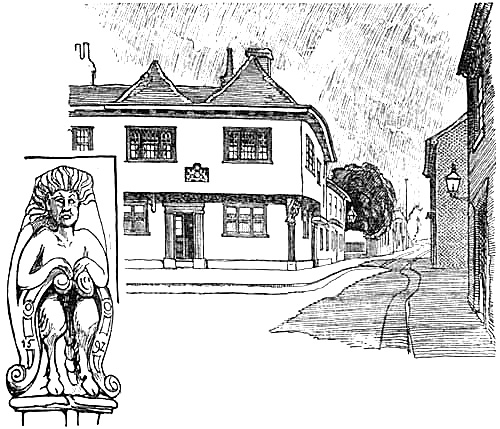
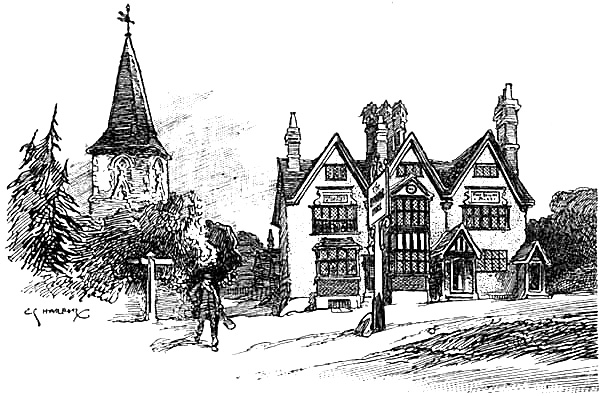
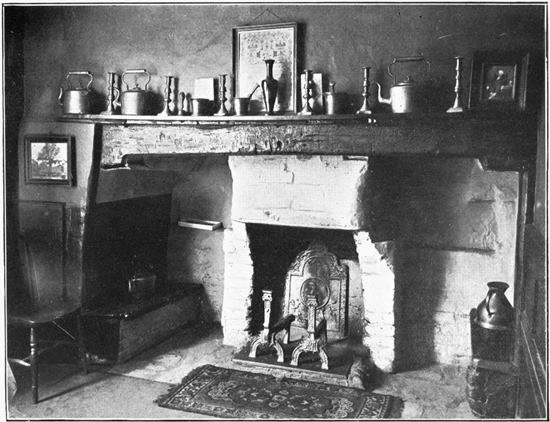
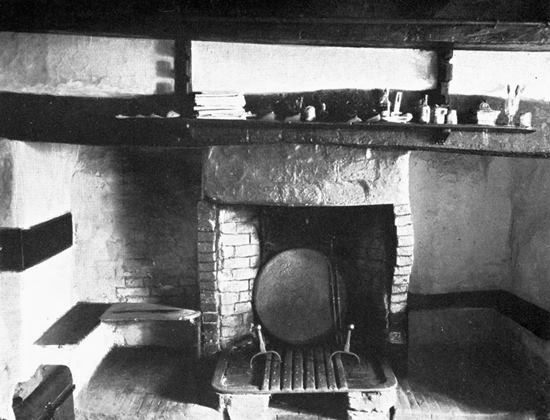
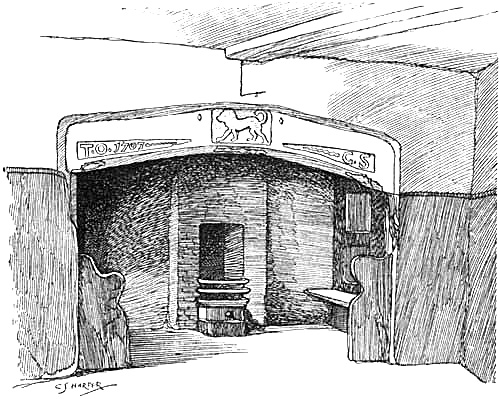
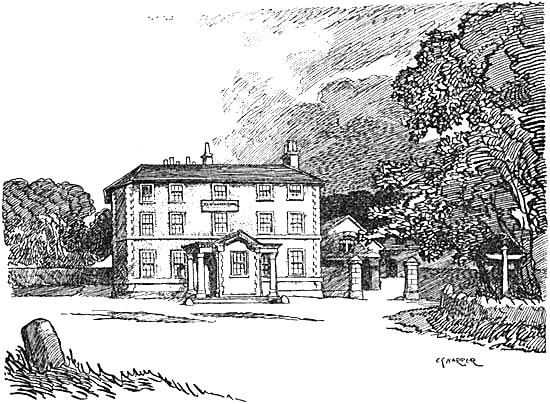
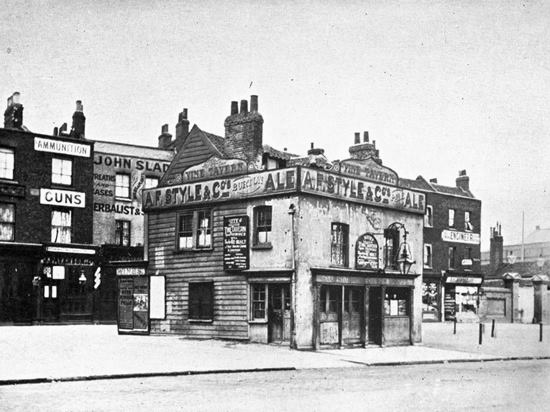
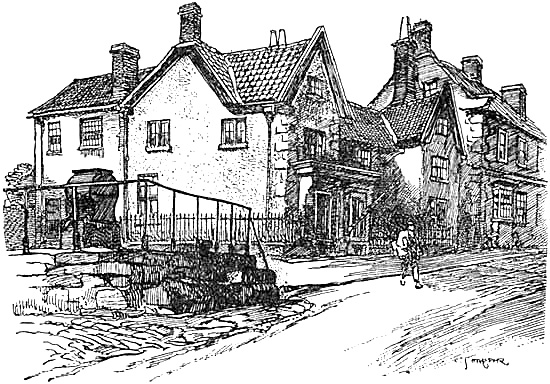
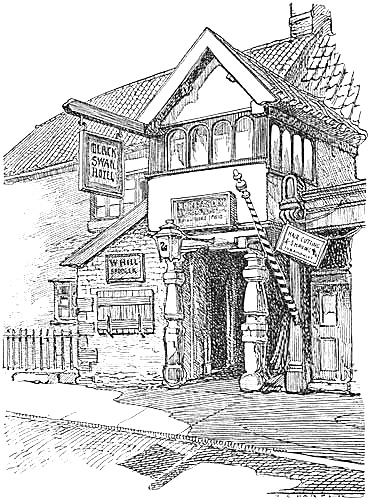
A POSY OF OLD INNS
“Shall I not take mine ease at mine inn?”
In dealing with the Old Inns of England, one is first met with the great
difficulty of classification, and lastly with the greater of coming to a
conclusion. There are—let us be thankful for it—so many fine old inns.
Some of the finest lend themselves to no ready method of classifying.
Although they have existed through historic times, they are not historic,
and they have no literary associations: they are simply beautiful and
comfortable in the old-world way, which is a way a great deal more keenly
appreciated than may commonly be supposed in these times. Let those who
will flock to Metropoles and other barracks whose very names are evidence
of their exotic style; but give me the old inns with such signs as the
“Lygon Arms,” the “Feathers,” the “Peacock,” and the like, which you still
find—not in the crowded resorts of the seaside, or in great cities, but
in the old English country towns and districts frequented by the
appreciative few.
I shall not attempt the unthankful office of determining which is the
finest among these grand old English inns whose title to notice rests upon
no adventitious aid of history, but upon their antique beauty, combined
with modern comfort, alone, but will take them as they occur to me.
Let us, then, imagine ourselves at Broadway, in Worcestershire, and at the
“Lygon Arms” there. The village, still somewhat remote from railways, was
once an important place on the London and Worcester Road, and its long,
three-quarter-mile street is really as broad as its name implies; but
since the disappearance of the coaches it has ceased to be the busy stage
it once was, and has became, in the familiar ironic way of fortune, a
haven of rest and quiet for those who are weary of the busy world; a home
of artists amid the apple-orchards of the Vale of Evesham; a slumberous
place of old gabled houses, with mullioned and transomed windows and
old-time vanities of architectural enrichment; for this is a district of
fine building-stone, and the old craftsmen were not slow to take advantage
of their material, in the artistic sort.
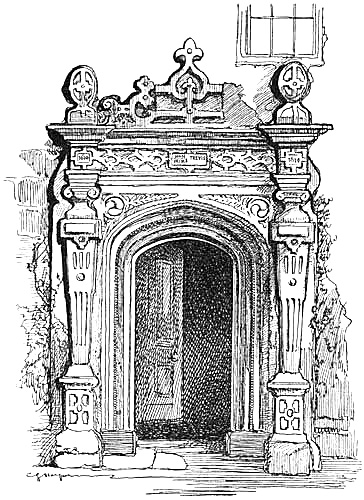
DOORWAY, THE “LYGON ARMS.”
Many enraptured people declare Broadway to be the prettiest village in
England, and the existence of its artist-colony perhaps lends some aid to
their contention; but it is not quite that, and although the long single
street of the place is beautiful in detail, it does not compose a picture
as a whole. One of the finest—if not indeed the finest—of those detailed
beauties is the grand old stone front of the “Lygon Arms,” built, as the
“White Hart” inn, so long ago as 1540, and bearing that name until the
early part of the last century, when the property was purchased by the
Lygon family, whose head is now Earl Beauchamp, a title that, although it
looks so mediæval, was created in 1815. In more recent times the house was
purchased by the great unwieldy brewing firm of Allsopp, but in 1903 was
sold again to the present resident proprietor, Mr. S. B. Russell, and so
has achieved its freedom and independence once more. The “Lygon Arms,”
however, it still remains, its armorial sign-board displaying the heraldic
coat of that family, with their motto, Ex Fide Fortis.
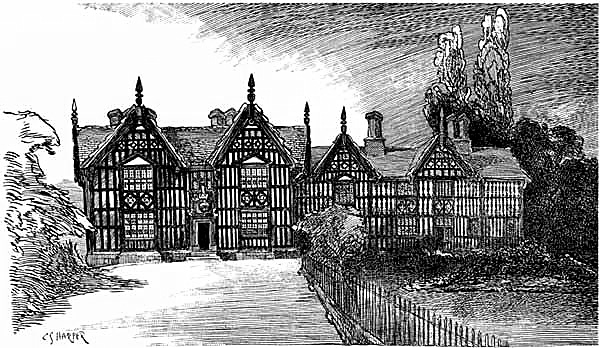
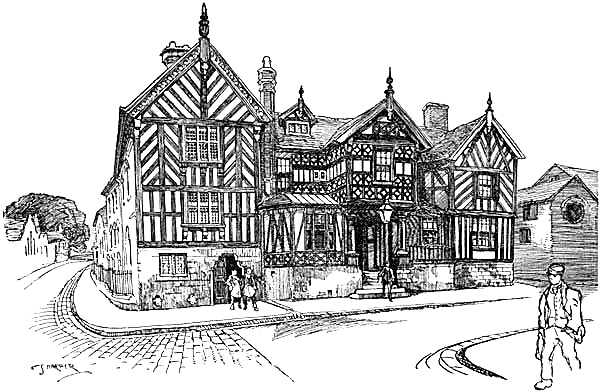
The great four-gabled stone front of the “Lygon Arms” gives it the air of
some ancient manor-house, an effect enhanced by the fine Renaissance
enriched stone doorway added by John Trevis, an old-time innkeeper, who
flourished in the reigns of James the First and Charles the First, and
whose name, together with that of his wife, Ursula, and the date, 1620,
can still be plainly seen. John Trevis (or “Treavis,” as the name was
sometimes spelled) ended his hostelling in 1641, as appears by a rubbing
from his memorial brass from Broadway old church, prominently displayed in
the hall of the house.
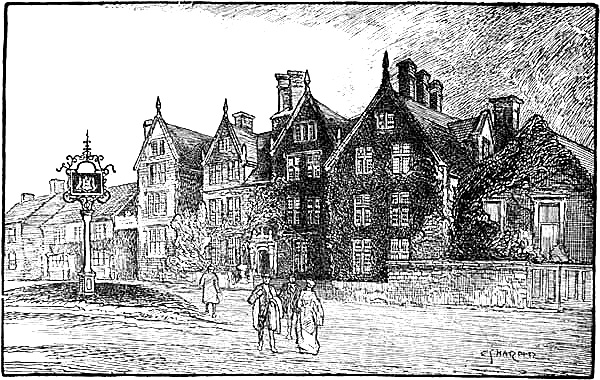
THE “LYGON ARMS.”
The house has during the last few years been gradually brought back to its
ancient state, and the neglect that befell on the withdrawal of the
road-traffic repaired. But not merely neglect had injured it. The
ancient features had suffered greatly in the prosperous times at the
opening of the nineteenth century, when the stone mullions of nearly all
the windows were removed and modern glass and wooden sashes inserted. The
thing seems so wanton and so useless that it is difficult to understand,
in these days of reversion to type. A gas-lamp and bracket had at the same
time been fixed to the doorway, defacing the stonework, and where
alterations of this kind had not taken place, injury of another sort arose
from the greater part of the inn being unoccupied and the rest degraded to
little above the condition of an ale-house.
All the ancient features have been reinstated, and a general restoration
effected, under the advice of experts, and in the “Lygon Arms” of to-day
you see a house typical of an old English inn of the seventeenth century.
There is the Cromwell Room, so named from a tradition that the Protector
slept in it the night before the Battle of Worcester. It is now a
sitting-room. A great carved stone fireplace is the chief feature of that
apartment, whose beautiful plaster ceiling is also worthy of notice. There
is even a tradition that Charles the First visited the inn on two or three
occasions; but no details of either his, or Cromwell’s, visits, survive.
Quaint, unexpected corners, lobbies and staircases abound here, and
ancient fittings are found, even in the domestic kitchen portion of the
house. In the entrance-hall is some very old carved oak from Chipping
Campden church, with an inscription no man can read; while, to keep
company with the undoubtedly indigenous old oak panelling of the so-called
“Panelled Room,” and others, elaborate ancient firebacks and open grates
have been introduced—the spoil of curiosity shops. Noticeable among these
are the ornate fireback in the Cromwell Room and the very fine specimen of
a wrought-iron chimney-crane in the ingle-nook of a cosy corner by the
entrance.
While it would be perhaps too much to say that Broadway and the “Lygon
Arms” are better known to and appreciated by touring Americans than by our
own people, they are certainly visited very largely by travellers from the
United States during the summer months; the fame of Broadway having spread
over-sea very largely on account of the resident American artist-colony
and Madame de Navarro, who as Mary Anderson—“our Mary”—figured
prominently on the stage, some years since.
Those travellers who in the fine, romantic, dangerous old days travelled
by coach, or the more expensive, exclusive, and aristocratic post-chaise,
to Bath, and selected the Devizes route, came at that town to one of the
finest inns on that road of exceptionally fine hostelries. The “Bear” at
Devizes was never so large or so stately as the “Castle” at Marlborough,
but it was no bad second, and it remains to-day an old-fashioned and
dignified inn, the first in the town; looking with something of a
county-family aloofness upon the wide Market-place and that
extraordinary Gothic cross erected in the middle of it, to the memory of
one Ruth Pierce, of Potterne, a market-woman, who on January 25th, 1753,
calling God to witness the truth of a lie she was telling, was struck dead
on the instant.
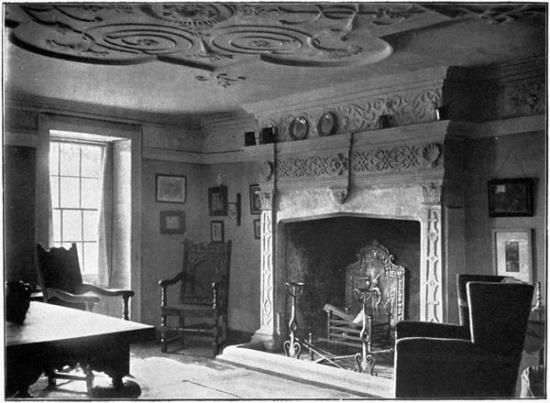
THE CROMWELL ROOM, “LYGON ARMS.”
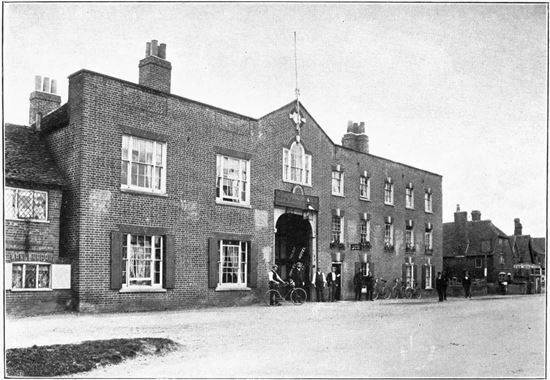
The “Bear,” indeed, is of two entirely separate and distinct periods, as
you clearly perceive from the strikingly different character of the front
buildings. The one is a haughty structure in dark stone, designed in that
fine architectural style practised in the middle of the eighteenth century
by the brothers Adam; the other has a plastered and painted frontage, fine
in its way, but bespeaking rather the Commercial Hotel. In the older
building, to which you enter up flights of steps, you picture the great
ones of the earth, resting on their way to or from “the Bath,” in a
setting of Chippendale, Sheraton or Hepplewhite furniture; and in the
other the imagination sees the dignified, prosperous “commercial
gentlemen” of two or three generations ago—was there ever, anywhere,
another order of being so supremely dignified as they were?—dining, with
much roast beef and port, in a framing of mahogany sideboards and
monumentally heavy chairs stuffed with horse-hair—each treating the
others with a lofty and punctilious ceremonial courtesy, more punctilious
and much loftier than anything ever observed in the House of Peers.
The “Bear” figures in the letters of Fanny Burney, who with her friend
Mrs. Thrale was travelling to Bath in 1780. They took four days about
that business, halting the first night at Maidenhead, the second at the
“Castle,” Speen Hill, and the third here. In the evening they played
cards, the lively Miss Burney declaring to her correspondent that the
doing so made her feel “old-cattish”: whist having ever been the resort of
dowagers. Engaged upon this engrossing occupation, the strains of music
gradually dawned upon their attention, coming from an adjoining room. Did
they, as many would have done, thump upon the intervening wall, by way of
signifying their disapproval? Not at all. The player was rendering the
overture to the Buono Figliuola—whatever that may have been—and
playing it well. Mrs. Thrale went and tapped at the door whence these
sweet sounds came, in order to compliment the unknown musician; whereupon
a handsome girl whose dark hair clustered finely upon a noble forehead,
opened the door, and another invited Mrs. Thrale and Miss Burney to
chairs. These pretty creatures were the daughters of the innkeeper. They
were well enough, to be sure, but the wonder of the family was away from
home. “This was their brother, a most lovely boy of ten years of age, who
seems to be not merely the wonder of their family, but of the times, for
his astonishing skill at drawing. They protest he has never had any
instruction, yet showed us some of his productions that were really
beautiful.”
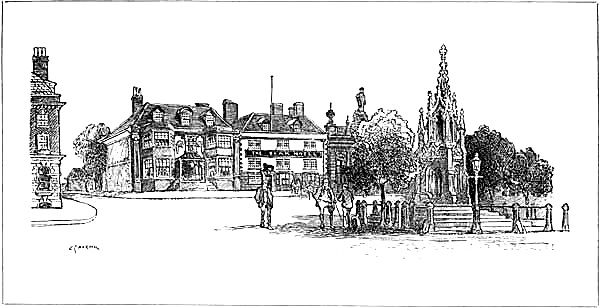
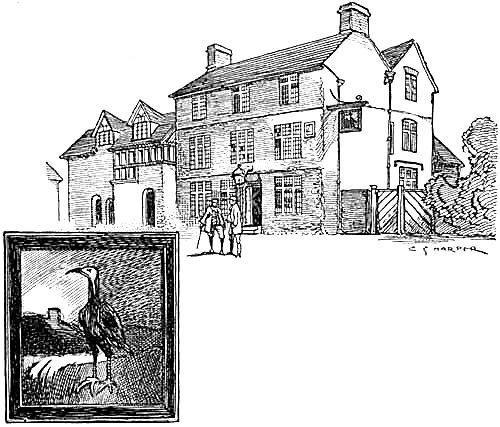
THE “BEAR,” DEVIZES.
This marvel was none other than Thomas Lawrence, the future painter of
innumerable portraits of the wealthy and the noble, who rose to be P.R.A.
and to knighthood at the hands of George the Fourth. His father, at this
time landlord of the “Bear,” seems to have been a singularly close
parallel to Mr. Micawber in fiction, and to Mr. John Dickens in real life.
The son of a Presbyterian minister, and articled to a solicitor, he turned
aside from writs and affidavits and practical things of that kind, to the
making of verses; and the verse-making, by a sort of natural declension,
presently led him to fall in love, and to run away with the pretty
daughter of the vicar of Tenbury, in Worcestershire. He tried life as an
actor, and that failed; as a surveyor of excise, with little better
result; and then became landlord of the “White Lion” at Bristol, the house
in which his son Thomas, the future P.R.A., was born, in 1769. In 1772 he
removed to Devizes, and took the “Bear”: not an inconsiderable
speculation, as the description of the house, already given, would lead
one to suspect. Some unduly confiding person must have lent the shiftless,
but engaging and gentlemanly, fellow the capital, and it is to be feared
he lost by it, for although in the pages of Columella, a curious work of
fiction published at that time, Lawrence is styled “the only man upon the
road for warm rooms, soft beds, and—Oh, prodigious!—for reading Milton,”
his innkeeping was a failure.
Notwithstanding those “warm rooms and soft beds,” which rather remind you
of Mr. W. S. Gilbert’s lines in The Mountebanks—
Excellent eating,
Good beds and warm sheeting,
That never want Keating,
Afford a good greeting
To people who stop at my inn—
Lawrence had to relinquish the “Bear.” He was known as a “public-spirited
landlord, who erected at his own expense signal-posts twelve feet high,
painted white, to guide travellers by night over Salisbury Plain”; but,
although he was greatly commended for that public spirit, no profit
accrued from it. Public spirit in a public-house—even though it be that
higher order of public-house styled an hotel—is out of place.
At the early age of five the innkeeper’s son Thomas became distinctly an
asset. He was as many-sided as a politician who cannot find place in his
own party and so, scenting opportunities, seeks preferment with former
enemies. Young Lawrence it would, however, be far prettier to compare with
a many-faceted diamond. He shone with accomplishments. A beautiful boy,
his manners, too, were pleasing. He was kissed and petted by the ladies,
and to the gentlemen he recited. He painted the portraits, in curiously
frank and artless profile, of all guests who would sport half a guinea for
the purpose, and between whiles would be found in the yard, punching the
heads of the stable-boys, for he was alike born painter and pugilist!
A less beautiful nature than his would early have been spoiled by so much
notice, but to the end of his long and phenomenally successful career
Lawrence retained a courtly, but natural and frank, personality. As a boy
he was introduced to the guests of the “Bear” by his fond father in this
wise: “Gentlemen, here’s my son; will you have him recite from the poets,
or take your portraits?” and in this way he held forth in such great
presences as those of Dr. Johnson, Garrick, Foote, Burke, Sheridan, and
Mrs. Siddons.
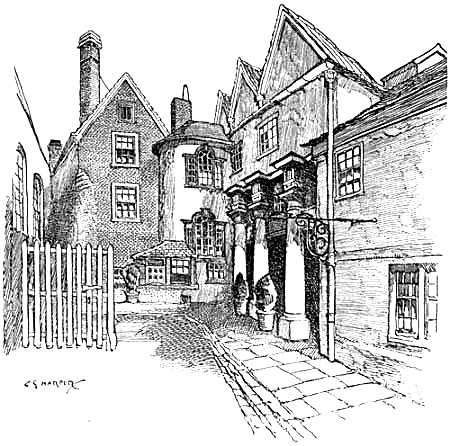
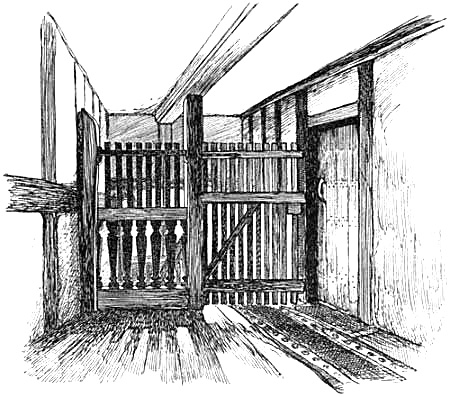
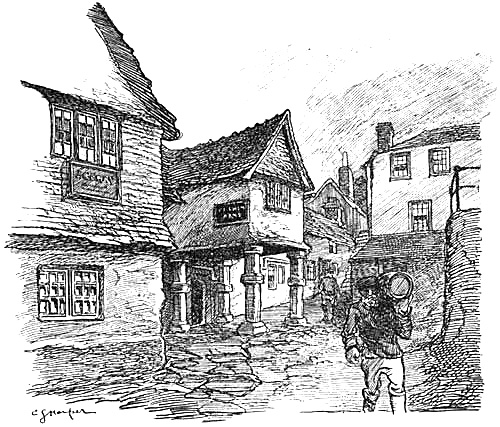
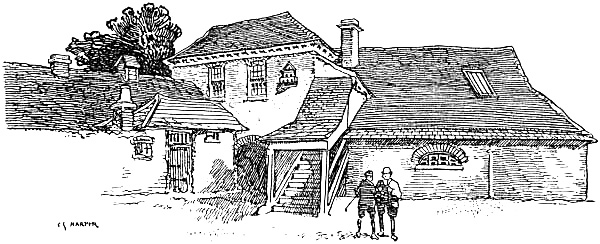
YARD OF THE “BEAR,” DEVIZES.
But the business of the “Bear” languished under the proprietorship of the
elder Lawrence. Probably many of the guests resented what was rightly
styled “the obtrusive pertinacity” of the fond father, and being
interrupted in their talk, or disturbed at the engrossing occupation of
winning and losing money at cards, by the appearance of this wunderkind.
By the time the genius was eleven years of age the family had left
Devizes, and were being entirely supported by his growing skill in the
painting of pleasing likenesses!
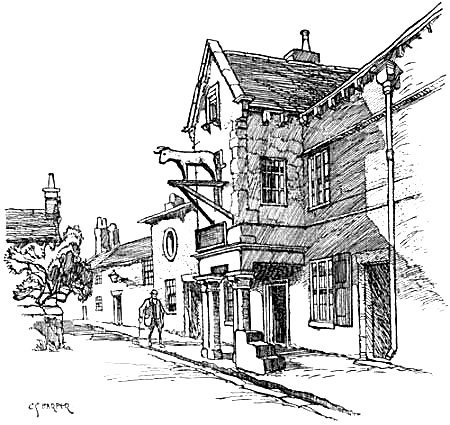
If the front of the house, with its odd effigy of a black bear eating a
bunch of grapes, is fine, much finer, in the picturesque way, is the back,
where, from the stable-yard, you see a noble range of Ionic columns,
rather lost in that position, and surmounted as they are with gables of a
Gothic feeling, looking as though the projector of some ambitious classic
extension had begun a great work without counting the cost of its
completion, and so had ingloriously to decline upon a humble ending.
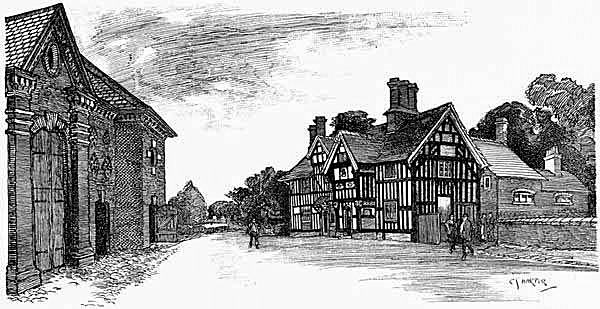
The “George” at Andover, whatever importance it once possessed, now
displays the merest slip of frontage. It is, in essentials, a very old
house, with a good deal of stout timber framing in odd corners: all more
or less overlaid with the fittings of a modern market inn. The “George”
figures in what remains probably the most extraordinary solicitor’s bill
on record: the account rendered to Sir Francis Blake Delaval, M.P., by
his attorney, for work done during one of the Andover elections. It is a
document famous in the history of Parliamentary contests, and it was the
subject of an action in the King’s Bench. The most outstanding item of it
was: “To being thrown out of the window of the ‘George’ inn, Andover.—To
my leg being thereby broken.—To Surgeon’s bill and loss of time and
business.—All in the service of Sir Francis B. Delaval——£500.”
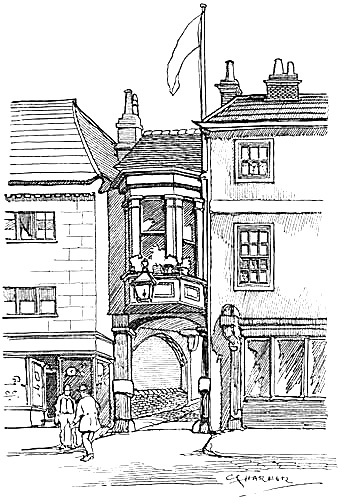
THE “GEORGE,” ANDOVER.
It seems that this unfortunate attorney owed his flight through the window
to his having played a practical joke upon the officers of a regiment
stationed at Andover, to whom he sent invitations for a banquet at the
“George” on the King’s birthday, purporting to come from the Mayor and
corporation, and similar invitations to the Mayor and corporation,
supposed to come from the officers. The two parties met and dined, but,
preparing to depart, and each thanking the others for the hospitality, the
trick was disclosed, and the author of it, who had been rash enough to
attend, to see for himself the success of his joke, was seized and flung
out of the window by the enraged diners.
Turn we now to Shropshire, to that sweet and gracious old town of Ludlow,
where—albeit ruined—the great Castle of the Lords Presidents of the
Council of the Marches of Wales yet stands, and where many an ancient
house belonging to history fronts on to the quiet streets: some whose
antique interiors are altogether unsuspected of the passer-by, by reason
of the Georgian red-brick fronts or Early Victorian plaster faces that
have masked the older and sturdier construction of oaken beams. I love the
old town of Ludlow, as needs I must do, for it is the home of my forbears,
who, certainly since the days of Elizabeth, when the registers of the
Cathedral-like church of St. Lawrence begin, lived there and worked
there in what was their almost invariable handicraft of joining and
cabinet-making, until quite recent years.
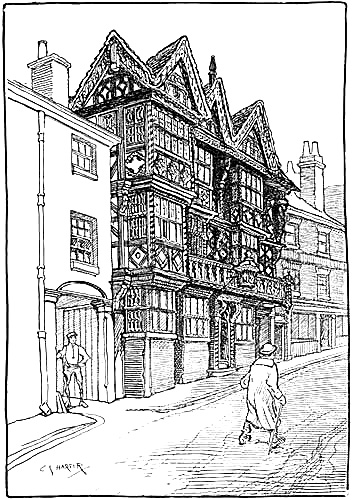
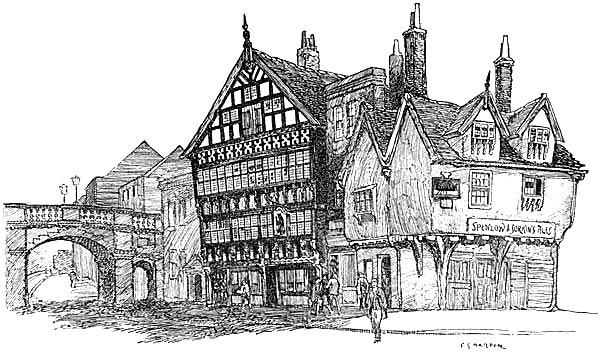
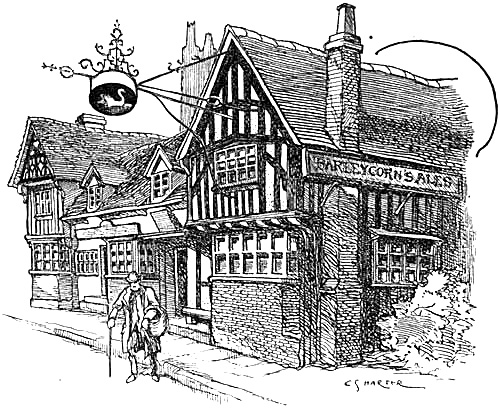
THE “FEATHERS,” LUDLOW.
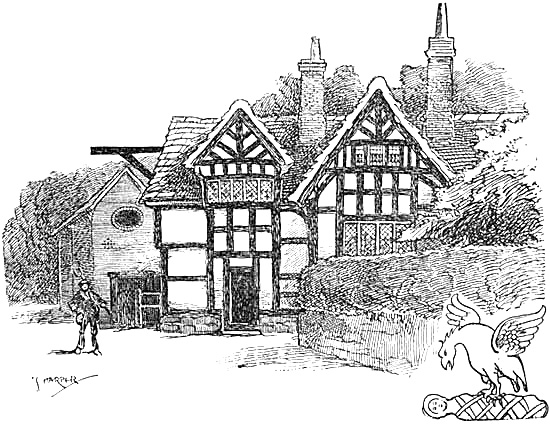
The finest old timber-fronted, black-and-white house in Ludlow is the
“Feathers” inn, in Corve Street. There are many ancient and picturesque
hostelries in England, but none finer than the “Feathers,” and it is
additionally remarkable for being as exquisite within as without. You see
its nodding gables and peaked roofs among the earliest of the beautiful
things of Ludlow, as you come from the railway-station and ascend the
steep Corve Street, that leads out of the town, into Corve Dale.
Very little is known of the history of the “Feathers.” The earliest deed
relating to the property is dated August 2nd, 1609, when it appears to
have been leased from a member of the Council of the Marches, one Edward
Waties of Burway, by Rees Jones and Isabel, his wife. Ten years later,
March 10th, 1618-9, Rees Jones purchased the fee-simple of the house from
Edward Waties and his wife, Martha: other parties to the transaction being
Sir Charles Foxe, of Bromfield, and his son Francis, respectively father
and brother of Martha Waties. The purchase price of the freehold was £225.
In neither of those transactions is the house called the “Feathers,” or
even referred to as an inn; nor do we know whether Rees Jones purchased
the existing house, or an older one, on this site. It seems probable,
however, that this is the original mansion of some personage connected
with the ancient government of the Welsh marches, or perhaps the “town
house” of the Foxes of Bromfield in those times when every Shropshire
squire of wealth and standing repaired for a season every year with his
family from his country seat to Shrewsbury or Ludlow; the two resorts of
Society in those days when London, in the toils, dangers, and expenses of
travelling, was so far removed that it was a place to be seen but once or
twice in a lifetime.
Rees Jones seems to have remodelled the mansion as an inn, and there is
every likelihood that he named it the “Feathers” in honour of Henry,
Prince of Wales, elder brother of Charles the First, who died in 1612; or
perhaps in celebration of Prince Charles being, in his stead, created
Prince of Wales, in 1616, when there were great rejoicings in Ludlow, and
masques in “The Love of Wales to their Sovereign Prince.” How more loyal
could one be—and how more certain to secure custom at such a
juncture—than to name one’s inn after the triply feathered badge of a
popular Prince?
The door of the “Feathers” appears to be the original entrance of Rees
Jones’ day. No prospect of unwelcome visitors bursting through that
substantial oak, reinforced by the three hundred and fifty or so iron
studs that rather grimly spangle the surface of it, in defensive
constellation. Even the original hinges remain, terminated decoratively by
wrought-iron fleurs-de-lys. The initials of Rees Jones
himself—R.I.—are cut in the lock-plate.
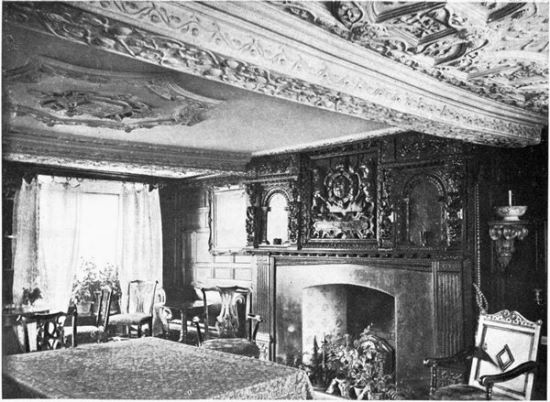
THE DINING-ROOM AT “THE FEATHERS,” LUDLOW.
The “Feathers” was the local “Grand Hotel” or “Metropole” of that day, and
was the resort of the best, as may be perceived by the ancient fittings
and decorations, carried out in all the perfection possible to that time.
From the oak-panelled hall you proceed upstairs to the principal room, the
Large Dining-Room, looking out, through lozenge-paned windows, upon the
ancient carved-oak balcony overhanging the street.
It is a handsome room, with elaborately decorated ceiling. In the centre
is a device, in raised plaster, of the Royal Arms of the reign of James
the First, surrounded by a star-like design of grapes and vines,
decoratively treated; showing, together with the free repetition of grapes
and vine-tendrils over other portions of the ceiling, that this symbolic
decorative work was executed especially for the inn, and not for the house
in any former existence as a private residence.
The carved oak overmantel, in three compartments, with a boldly rendered
representation of the Royal arms and supporters of Lion and Unicorn, is
contemporary with the ceiling, and there is no reason to doubt it having
been made for the place it occupies, in spite of the tradition that tells
of its coming from the Castle when that historic fortress and palace was
shamefully dismantled in the reign of George the Third. The room is
panelled throughout.
Everything else is in keeping, but it should not—and could not—be
supposed that the Jacobean-style and Chippendale furniture is of any old
local association. Indeed, there are many in Ludlow who remember the time
when the “Feathers” was furnished, neither comfortably nor artistically,
with Early Victorian horse-hair stuffed chairs and sofas of the most
atrocious type. It has been reserved for later days to be more
appreciative of the value and desirability of having all things, as far as
possible, in keeping with the age of the house.
Thus, we are not to think the fireback in this dining-room an old
belonging of the inn. It is, indeed, ancient, and bears the perfectly
genuine Lion and Dragon supporters and the arms of Queen Elizabeth, but it
was purchased at the Condover Hall sale, in 1897.
The Small Dining-room is panelled with oak, dark with age, to the ceiling,
and the Jacobean carved work enriching the fireplace is only less
elaborate than that of the larger dining-room. The old grate and Flemish
fireback, although also genuine antiques, were acquired in London, in
1898; but an old carved panel over the door, bearing the arms of Foxe and
Hacluit, two Shropshire families prominent in the seventeenth century, is
in its original place. The impaled arms are interesting examples of
“canting,” or punning, heraldry: three foxes’ heads indicating the one
family, and “three hatchets proper” that of Hacluit, or “Hackeluit,” as it
was sometimes written. The shield of arms is flanked on either side by a
representation of a “water-bouget.”
Further upstairs, the bedroom floors slope at distinct angles, in sympathy
with the bending gables without.
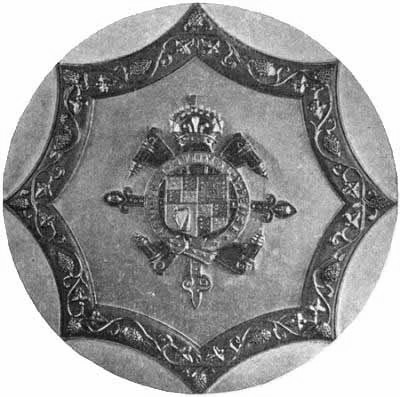
DECORATIVE DEVICE IN MOULDED PLASTER, FROM CEILING OF DINING-ROOM, THE “FEATHERS,” LUDLOW.
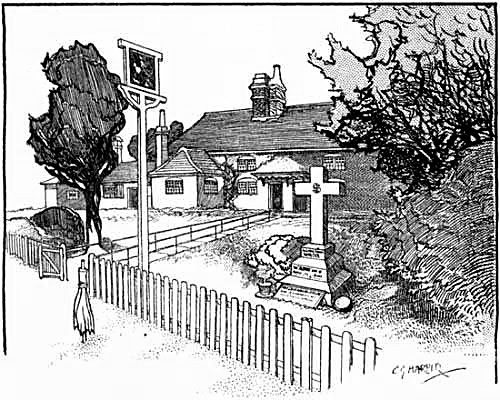
There are numerous instances of old manor-houses turned to commercial
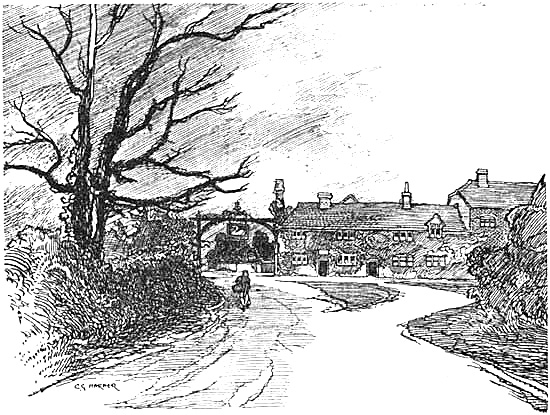
account as hostelries: among them the “Peacock” inn at Rowsley, near
Chatsworth. As may be seen from the illustration, it is a building of
fine architectural character, and was, in fact, built in 1652, at a time
when the Renaissance was most vigorous and inspired. The precise date of
the building is carved, plain for all men to see, on the semicircular
stone tympanum over the entrance-doorway, where it appears, with the old
owner’s name, in this curious fashion:
But ordinary type does not suffice to render the quaintness of this
inscription; for in the original the diagonal limbs of the N’s are placed
the wrong way round.
John Stevenson, who built the house, was one of an old Derbyshire family
who, in the reign of Elizabeth, were lords of the neighbouring manor of
Elton. From them it passed by marriage, and was for many generations
occupied as a farmhouse by a succession of gentlemen farmers, finally, in
1828, becoming an inn.
The “Peacock” sign, carved in stone over the battlemented front, is in
allusion to the well-known peacock crest of the Manners family, Dukes of
Rutland, whose ancestral seat of Haddon Hall is less than two miles
distant.
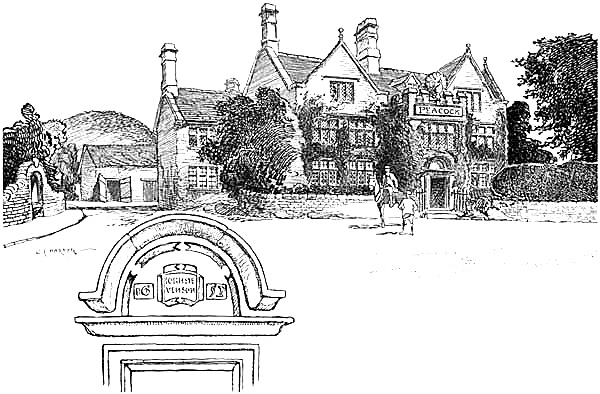
THE “PEACOCK,” ROWSLEY.
Up to the period of its conversion into an inn the house was fronted by a
garden. A roadway, very dusty in summer, now takes its place, but there is
still left at the side and rear of the old house one of the most
delightful of old-world gardens, leading down to the Derwent: a garden of
shady trees, emerald lawns, and lovely flower-beds that loses nothing
of its beauty—and perhaps, indeed, gains an additional charm—from the
railway and Rowsley station adjoining. The garden of the “Peacock,” and
the cool, shady hall and the quiet panelled rooms of the “Peacock,” are in
fact welcome sanctuaries of rest for the weariful sightseer at Rowsley and
the neighbouring Chatsworth: a desirable refuge in a district always
absurdly overrated, and nowadays absolutely destroyed in the touring
months of summer by the thronged brakes and wagonettes from Matlock and
Bakewell, and infinitely more by the hulking, stinking motor-cars that
maintain a continuous haze of dust, a deafening clatter, and an offensive
smell in these once sweetly rural roads.
In the days before the great George, successively Prince of Wales, Prince
Regent, and last monarch of the Four Georges, had reared his glittering
marine palace at Brighton, the only route to that sometime fisher-village
lay by Caterham, Godstone, East Grinstead and Lewes. It was, indeed, not
precisely the road to Brighton, but to that old-world county town of
Sussex, Lewes itself. There were always people wanting to go to Lewes, and
many others who went very much against their inclination; for it was then
the centre of county business, and there were generally misdemeanants in
plenty to be prosecuted or hanged in that grim castle on the hillside. Up
to about 1750, therefore, you travelled in style to Lewes, and if you were
so eccentric as to wish to proceed to “Brighthelmstone” (which was then
the lengthy way of it) you relied of necessity for those last eight or ten
miles upon the most worthless shandrydan that the “Star” inn could
produce; for mine host was not likely to risk his best conveyance upon the
rough track that then stretched between Lewes and the sea.
This primitive condition of affairs gave place shortly afterwards to roads
skilfully and especially engineered, directly towards Brighton itself. The
riotous world of youthful fashion raced along those newer roads, and the
staid, immemorial highway to Lewes was left to its own old respectable
routine. And so it remains to-day. You may reach Brighton by the shortest
route from London in 51½ miles, but by way of Lewes it is some
fifty-nine. Need it be said that the shortest route, here as elsewhere, is
the favourite?
But for picturesqueness, and for quaint old inns, the road by Lewes
should, without doubt, be selected.
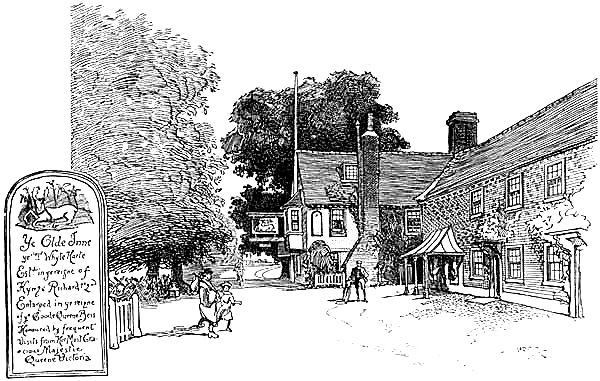
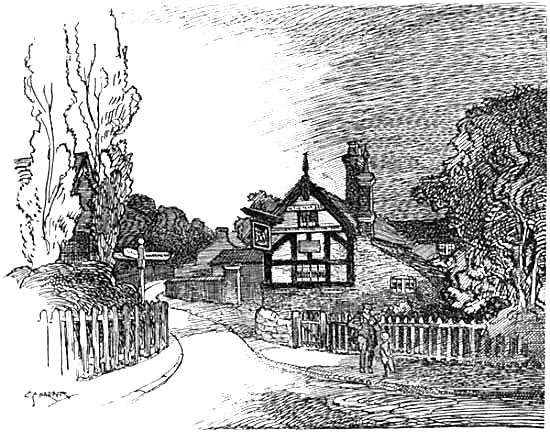
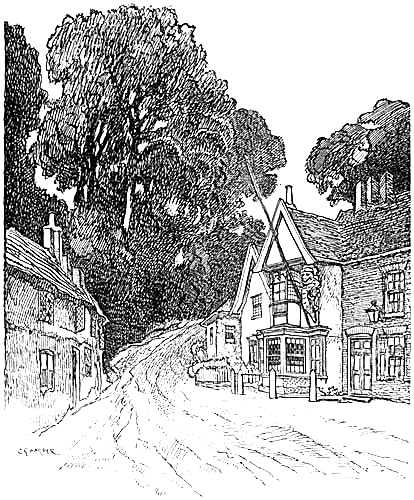
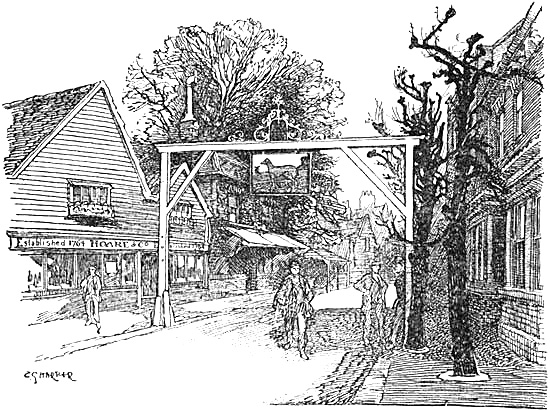
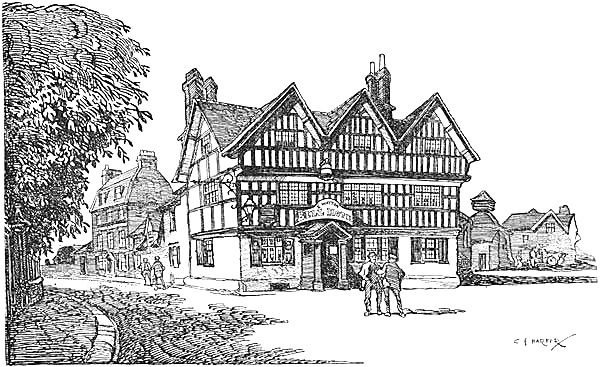
THE “WHITE HART” GODSTONE.
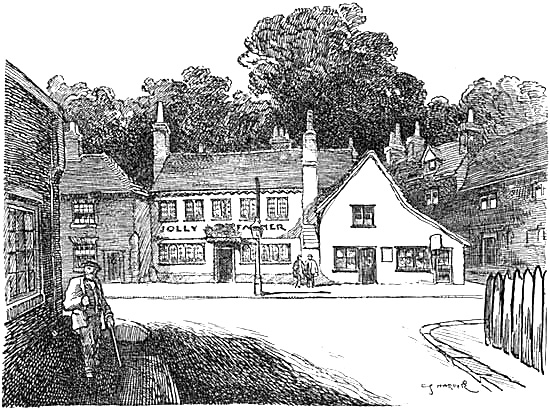
The first of these is the famous “White Hart” at Godstone. I say “famous”;
but, after all, is it nowadays famous among many classes? Among cyclists,
yes, for it is well within twenty miles from London, and the pretty little
hamlet of Godstone Green, with its half-dozen old inns, among them the
“Hare and Hounds,” the “Bell,” and the “Rose and Crown,” nearly all
sketchable, has ever been a kind of southern Ripley among clubmen. In
coaching days, however, and in days long before coaching, when you got
upon your horse and bumped in the saddle to your journey’s end, the
“White Hart” was truly famous among all men. The old house, according to a
painted wall-sign inscribed in the choicest Wardour Street English, was
established in “ye reigne of Kynge Richard ye 2nd” and enlarged in that of
Queen Elizabeth; and if there be indeed little of King Richard’s time to
point to, there are many Elizabethan and Queen Annean and Early Georgian
features which make up in pictorial quality what they lack in antiquity.
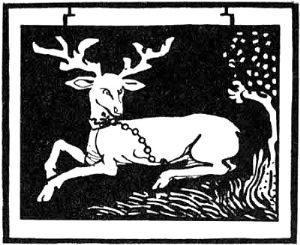
The “White Hart” sign itself is in some sort evidence of the age claimed
for the original house, for it was of course the well-known badge of King
Richard. At the present day the couchant White Hart himself is displayed
on one side of the swinging sign, and on the other the many-quartered
shield of the local landowners, the Clayton family, and the house has
become known in these latter days indifferently by the old title, or as
the “Clayton Arms.”
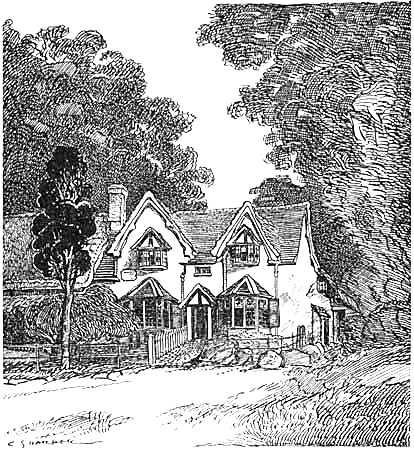
The old-world gabled front of the inn would be strikingly beautiful in any
situation, but the peculiarly appropriate old English rural setting
renders it a subject for a painting or a theatrical scene. It is
especially beautiful in spring, when the young foliage still keeps its
freshness and the great horse-chestnut trees opposite are in bloom.
The old “White Hart” is a world too large for these days of easy and
speedy travel. True, Godstone station is incredibly far away, but
conceive anyone save the sentimentalist staying the night, when within
twenty miles of London and home! Hence those echoing corridors, those
empty bedrooms, the tarnished mirrors and utter stillness of the outlying
parts of mine host’s extensive domain. Snug comfort, however, resides in
and near what some terrible lover of the sham-antique has styled, in
modern paint upon the ancient woodwork, “Ye Barre.”
Ye Goddes! the old house does not want that, nor any others of the many
such inscriptions, the work, doubtless, of the defunct Smith, who was at
once cook, gardener, artist of sorts, entertainment-organiser and musician
(also of sorts), and ran riot, the matter of a decade or so since, over
the house with pots of Aspinall’s facile enamels and a paintbrush, with
what results we see to this day.
One would by no means like to convey the impression that the “White Hart”
is deserted. Let those who judge by its every-day rustic quiet visit it on
the Saturdays and Sundays of summer and glance at the great oak-raftered
dining-room, crowded with cyclists. Indeed, this fine old hostelry
requires a leisured inspection and a more intimate knowledge than merely
that of a passing visit. Then only shall you peer into the odd nooks of
the long stable-yard, or, adventuring perchance by accident into the
wash-house, see with astonishment and delight the old-world garden beyond.
If it be a wet day, and the traveller stormbound, why then some
compensation for the villainies of the weather may be found in a voyage
of discovery through the echoing rooms, and from the billiard-room that
was the old kitchen you may turn, wearying of billiards, to the long,
dusty and darkling loft, under the roof, to see in what manner of place
our ancestors of Queen Elizabeth’s, and even of Queen Anne’s, days held
revel. For here it was that the players played interludes, and probably
were funnier than they intended, when their heads came into violent
collision with the sloping rafters and made the unfeeling among the
audience laugh. If the essence of humour lie indeed in the unexpected, as
some contend, how humorous those happenings!
In a later age, when the mummers had departed, the loft was used as
Assembly Rooms, for dances and other social occasions; but now it is
solitary, and filled only with memories and cobwebs.
From Godstone, the old road to Brighthelmstone goes by Blindley Heath and
New Chapel, and thence comes into Sussex at East Grinstead, in which
thriving little market-town the “Dorset Arms” is conspicuous, with its
sedately beautiful frontage, brave show of flowers in window-boxes, and
row of dormer windows in the roof. There is a delightful old-world garden
in the rear, sloping down to a rustic valley, and commanding lovely views.
The “Dorset Arms” still displays the heraldic coat of the Dukes of Dorset,
although the last Duke has been dead nearly a hundred years, and though
the memories of their lavishness, their magnificence, and their
impatience as they posted to and from their seat at Buckhurst Park, eight
miles distant, have locally faded away.
But the inn has one arresting modern curiosity. In days before Mr. Alfred
Austin was made Poet Laureate, and became instantly the cockshy and Aunt
Sally of every sucking critic, the landlord of the “Dorset Arms” placed in
gilded letters over his doorway a quotation from the poet’s Fortunatus
the Pessimist, telling us that—
There is no office in this needful world
But dignifies the doer, if well done.
And there it still remains; but precisely what it is intended, in that
situation, to convey remains unexplained. Whether the landlord is the
“doer,” or the waiter, or the boots, or if they are all, comprehensively,
to be regarded as dignified doers, is a mystery.
There was no lack of accommodation on this old road. The traveller had
jogged it on but seven miles more when he came at Nutley to a very small
village with a very large hostelry which, disdaining any mere ordinary
sign, proclaimed itself the “Nutley Inn.” It does so still, but although
it is a fine, handsome, four-square mansion-like building, it looks a
little saddened by changed times and at being under the necessity of
announcing, in those weird and wonderful words, “Petrol” and “Garage,” a
dependence upon motor-cars.
Another five miles, and at the little town of Uckfield, we have the
“Maiden’s Head,” an early eighteenth-century inn with Assembly-room
attached and a wonderful music gallery, rather larger than the “elevated
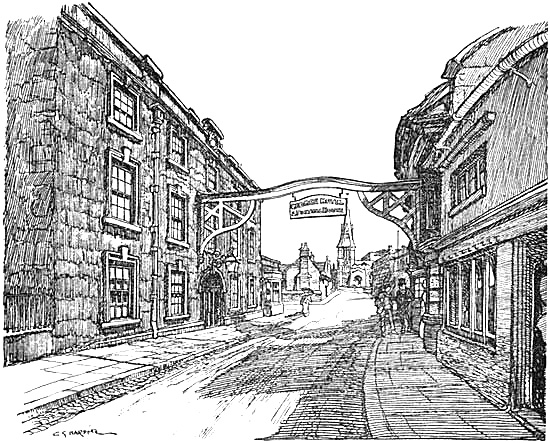
den” at the “Bull,” Rochester. The interior of the “Maiden’s Head” at
Uckfield is a good deal more comfortable than would be suspected from its
brick front, with the semicircular bays painted in a compromise between
white and a dull lead colour. At Lewes the traveller came to the “Star”
inn, a worthy climax to this constellation, with the fine old staircase
brought from Slaugham Place, as its chief feature: but the “Star” has of
late been demolished.
One of the finest in this posy of old inns is the “Luttrell Arms,” away
down in Somersetshire, in the picturesque village of Dunster, on the
shores of the Severn Sea. Dunster is noted for its ancient castle, for its
curious old Yarn Market in the middle of the broad street, and no less for
the “Luttrell Arms.” A fine uncertainty clings about the origin and the
history of this beautiful house. Because of the Gothic timbered roof of
the “oak room,” with hammer-beams and general construction somewhat
resembling the design of the roof of Westminster Hall, and because of the
very ecclesiastical-looking windows giving upon the courtyard, a vague
tradition still lingers in the neighbourhood that the house was once a
monastery. Nothing has survived to tell us who built this fine
fifteenth-century structure, or for what purpose; but, while facts are
wanting, the most likely theory remains that it was provided as a town
residence for the Abbots of Cleeve, the Abbey whose ruins may still be
found, in a rural situation, three miles away. In the governance and
politics of such an Abbey, an Abbot’s residence in a centre such as
Dunster was would be a highly desirable thing. There, almost under the
shadow of the great feudal castle of the Mohuns, purchased in 1376 by the
Luttrells, who still own the property, the Abbots were in touch with the
great world, and able to intrigue and manage for the interests of the
Church in general and of the Abbey in particular, much better than would
have been possible in the cloistered shades of Cleeve. The Luttrells no
doubt gave the land, and possibly even built the house for the Abbots; and
when the Reformation came and conventual properties were confiscated, they
simply received back what their ancestors had given away.
The front of the “Luttrell Arms” has been very greatly modernised, with
the exception of the ancient projecting stone porch, which still keeps on
either side the cross-slits in the masonry, commanding the length of the
street, whence two stout marksmen with cross-bows could easily defend the
house. Above, the shield of arms of the Luttrells, carved in stone,
displays their black martlets on a gold ground, and serves the inn for a
sign.
The beautiful carved oak windows in the courtyard somewhat resemble the
great window of the “Old King’s Head” at Aylesbury. Here the view extends
beautifully across the gardens of the inn, over the sea, to Blue Anchor.
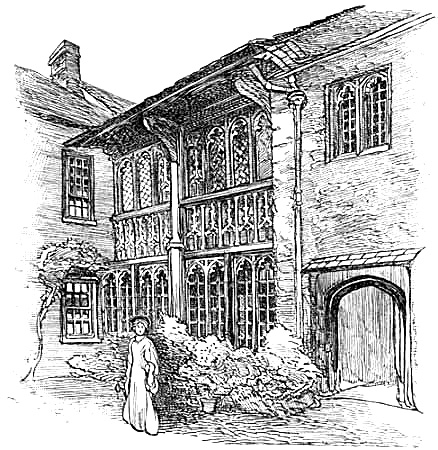
THE OLD WINDOW, “LUTTRELL ARMS.”
A curious seventeenth-century plaster fireplace overmantel, moulded in
high relief, is a grotesque ornament to one of the bedrooms. It displays a
half-length of a man with a singular likeness to Shakespeare, and dressed
like a page-boy, in “buttons,” presiding over the representation of a very
thin and meagre Actæon being torn to pieces by his dogs, which, in
proportion to Actæon himself, seem to be about the size of moderately
large cows. Two figures of women, with faces like potatoes, dressed in
Elizabethan or Jacobean costume, flank this device, in the manner of
caryatides. A number of somewhat similar plaster chimney-pieces are to be
found in North Somerset and North Devon, notably a fine one at the
“Trevelyan Arms,” Barnstaple: obviously all the handiwork of one man.
At Norwich, a city of ancient inns that are, in general, more delightful
to sketch and to look at than to stay in, we have the “Maid’s Head,” an
exceptionally fine survival of an Elizabethan, or slightly earlier, house.
It is an “hotel” now, and sanitated and electrically lighted up to
twentieth-century requirements; and has, moreover, an “Elizabethan”
extension, built in late Victorian times. But, in spite of all those
modern frills and flounces, the central portion of the “Maid’s Head” still
wears its genuine old-world air.
That there was an inn on this site so early as 1287 we learn from the
records of the Norwich Corporation, which tell how “Robert the fowler” was
brought to book in that year on suspicion of stealing the goods of one
John de Ingham, then staying at a tavern in the Cook Row, a street
identified with Tombland, the site of the “Maid’s Head.” The reasoning
that presumed the guilt of Robert the fowler seems to the modern mind
rather loose, and the presentment itself is worded with unconscious
humour. By this it seems that he was suspect “because he spends much and
has nothing to spend from, and roves about by night, and he is ill
thought of.” Ergo, as the old wording proceeds, “it must have been he
that stole John de Ingham’s goods at his tavern in the Cook Rowe.”
Relics of a building of the Norman period, thought to be remains of a
former Bishop’s Palace, are still visible in the cellars of the “Maid’s
Head.”
The ancient good repute of the inn is vouched for by a passage in the
well-known Paston Letters, painted boldly in white lettering on the
great oaken entrance-door of the house. It is from a note written by John
Paston in 1472 to “Mestresse Margret Paston,” in which he advises her of a
visitor, and says, “I praye yow make hym goode cheer, and iff it be so
that he tarye, I most remembre hys costes; thereffore iff I shall be sent
for, and he tery at Norwich there whylys, it were best to sette hys horse
at the Maydes Hedde, and I shalbe content for ther expences.”
The ancient name of the house was the “Molde Fish,” or “Murtel Fish”; but
precisely what species of fish that was, no one has ever discovered. It
was long an article of belief in Norwich that this now inexplicable sign
was changed to the present one as a compliment to Queen Elizabeth on her
first visit to Norwich, in 1578; but, as we see by the Paston Letters,
it was the “Maid’s Head” certainly as far back as 1472. A portion of the
carved work on the chimney-piece of the present smoking-room represents a
dubious kind of a fish, said to be intended for the skate, or ray, once
known familiarly in Norwich as “old maid”; but the connection between it
and the old sign (if any) seems remote.
Probably the most interesting item at the “Maid’s Head” is the Jacobean
bar, an exceptionally fine example of seventeenth-century woodwork, of
marked architectonic character, and, as a bar, unique. Now that the
courtyard to which it opened is roofed in, its preservation is assured, at
the expense of the genuine old open-air feature, for which the modern
lounge is a poor exchange.
Journeying from Norwich to the sea at Yarmouth, we find there, among the
numerous hotels of that populous place, that highly interesting house, the
“Star,” facing the river at Hall Quay. The “Star” is older than a first
glance would lead the casual visitor to suspect; and a more prolonged
examination reveals a frontage built of black flints elaborately, and with
the greatest nicety, chipped into cubes: one of the most painstaking kinds
of labour it is possible to conceive. The house, built in the reign of
Queen Elizabeth, has been an inn only since about 1780. It has an
interesting history, having been erected as the combined business premises
and place of residence of one William Crowe, a very considerable merchant
in his day, and High Bailiff of Yarmouth in 1606. The lower part of the
premises was at that time the business portion, while the upper was that
worshipful merchant’s residence; traders, both by retail and by wholesale,
within the kingdom and overseas alike, not then having arrived at being
ashamed of their business. How honestly proud William Crowe was of his
position as a merchant we may still see, in the great and beautiful
oak-panelled room on the first floor of his old house, the fine apartment
now known as the “Nelson Room”; for there, prominently carved over the
generous fireplace, you see the arms of the Merchant Adventurers of
England, a company of traders of which he was a member. The oak-panelling
here, reaching from floor to ceiling, itself beautifully decorated, is
most elaborately designed in the Renaissance way, with fluted Corinthian
pilasters, supporting grotesque male and female terminal figures. This
noble room is now the Coffee-room of the hotel.
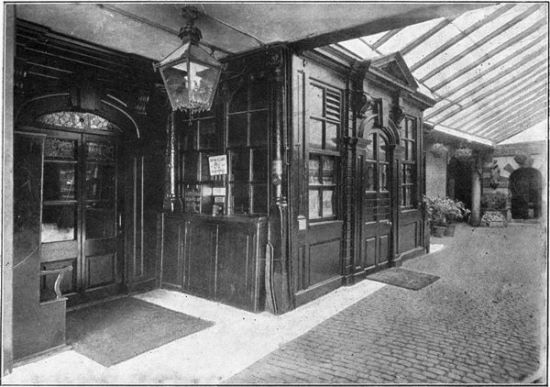
COURTYARD OF THE “MAID’S HEAD,” NORWICH SHOWING THE JACOBEAN BAR.
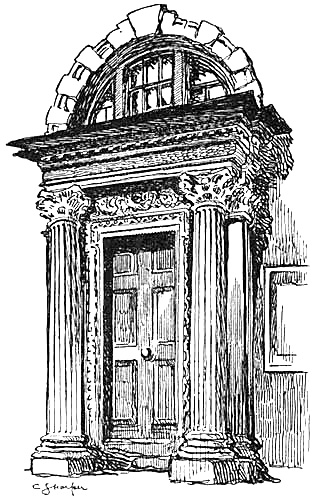
DOORWAY, “THE COCK,” STONY STRATFORD.
It should be said that the name of “Nelson” is purely arbitrary in this
connection, for the “Star” has no historic associations with the Admiral.
The name was given the room merely from the fact that a portrait of Nelson
hangs on its walls.
In this posy of old inns, whose sweet savour reconciles the traveller to
many hateful modern portents, mention must be made of the “George” at
Odiham. At an inn styled the “George” you do expect, more than at any
other sign, to find old-fashioned comfort; and here, at that little
forgotten townlet of Odiham, lying secluded away back from the Exeter
Road, with its one extravagantly broad and singularly empty street, and no
historic memories much later than the reign of King John, you have a
typical cheery hostelry whose white frontage looks coaching age
incarnated, and whose interior surprises you—as often these old houses
do—with oaken beams and Elizabethan panelled coffee-room and Jacobean
overmantel. The fuel-cupboard, with finely wrought hinges, at the side of
the fireplace, is as celebrated in its way, among connoisseurs of these
things, as the Queen Anne angle-cupboard at the “New Inn,” New Romney. Not
least among the attractions of the “George” is the beautiful old-fashioned
garden at the back, looking out towards the meads and the trout-streams,
that make Odiham (whose name, by the way, originally “Woodyham,” is
pronounced locally like “Odium”) a noted place among anglers.
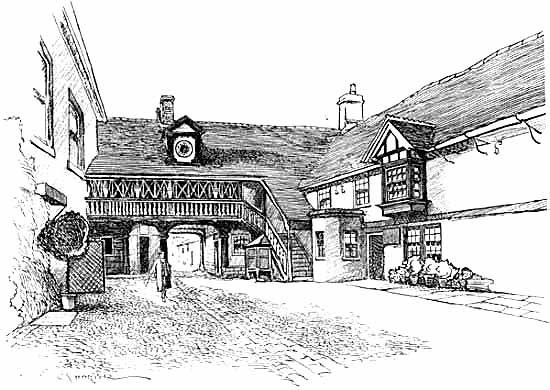
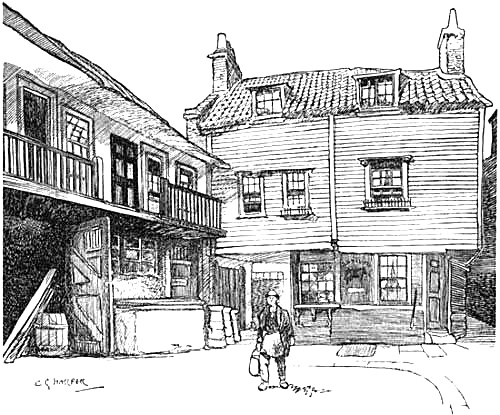
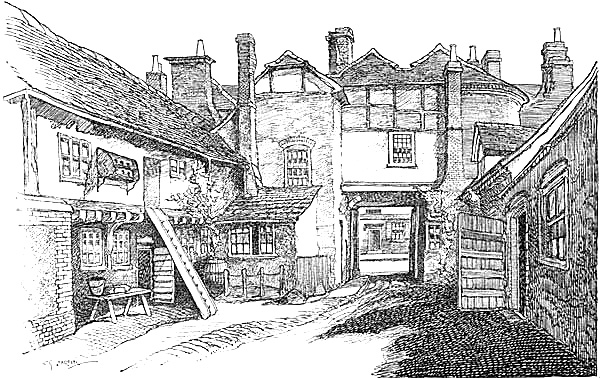
YARD OF “THE GEORGE,” HUNTINGDON.
Interesting in a less rural—and indeed a very urban way—is the “Cock”
inn, at Stony Stratford, on the Holyhead Road, with its fine red brick
frontage to the busy high road, its imposing wrought-iron sign, and, in
especial, its noble late seventeenth-century ornately carved and highly
enriched oak doorway, brought, it would appear, from the neighbouring
mansion of Battlesden Park. As may be gathered from the illustration, this
exquisite work of art very closely resembles, in general character, the
carved interior doorways of Wren’s City of London churches, often ascribed
to Grinling Gibbons.
In this posy of old hostelries we must at least mention that fine old
anglers’ inn, the “Three Cocks” in Breconshire, which, like the “Craven
Arms,” between Ludlow and Church Stretton, and those more familiar and
vulgar examples in London, the “Bricklayers’ Arms” and the “Elephant and
Castle,” has conferred its name upon a railway-station. And mention must
be made of the cosy, white-faced “Wellington,” at Broadstairs, occupying a
kind of midway place between the old coaching inn and the modern huge
barrack hotel, and, with its lawn looking upon the sea and the beach,
select and quiet in the very midst of the summer crowds of that miniature
holiday resort.
In any competition as to which old inn had the ugliest frontage, the “Red
Horse” at Stratford-on-Avon, and the “George” at Huntingdon would probably
tie for first place; but the courtyard of the “George” makes amends, and
is one of the finest anywhere in existence, as the illustration serves to
show.
A fine old house, with a still finer old sign, is that old coaching
hostelry, the “Bell,” at Stilton, formerly one of the largest and most
important of the many great and indispensable inns that once ministered to
the needs of travellers along the Great North Road. The “Bell” was the
original inn of Stilton, and the “Angel,” opposite, is a mere modern
upstart of Queen Anne’s time. Queen Anne is a monarch of yesterday when
you think of the old “Bell”; which is, indeed, older than it looks, for,
prying closely into the architecture of its golden, yellow-brown structure
of sandstone, it will be seen that the house is really a Late Gothic
building distressingly modernised. Modernised, that is to say, in a very
necessary reservation, considerably over a century ago. That is the last
note of modernity at the “Bell.” The windows, it will be noticed, were
once all stone-mullioned, and portions of the ancient stonework not cut
away to receive commonplace Georgian wooden sashes, are still distinctly
visible. Looking at the competitive “Angel” opposite, now and for long
since, like the “Bell” itself, sadly reduced in circumstances since that
era of mail- and stage-coaching and expensive posting in chaise and four,
you perceive at once the reason for that alteration in the “Bell.” It was
an effort to become, as an auctioneer might say, “replete with every
modern convenience.”
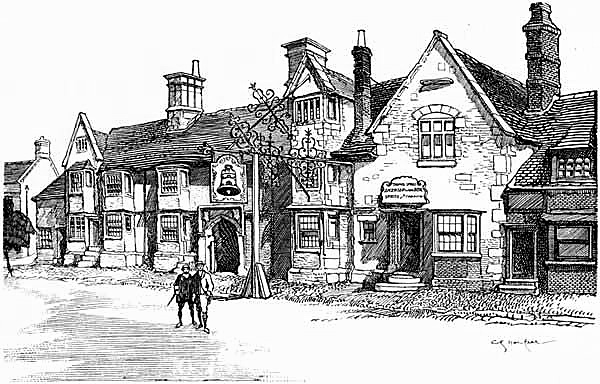
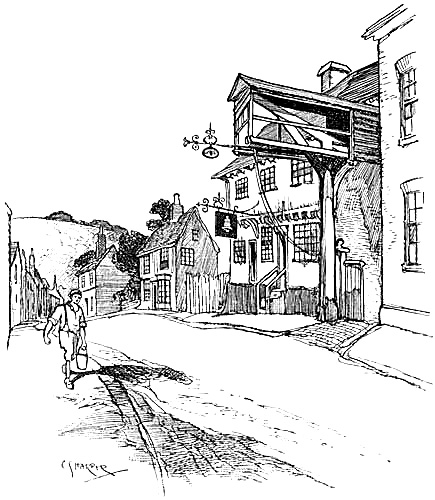
THE “BELL,” STILTON.
Now the glory of Stilton, in particular, and of the road in general, is
departed, and the rival inns are alike reduced to wayside ale-houses. At
the “Bell”—the once hospitable—they look at you with astonishment when
you want to stay the night, and turn you away. Doubtless they do so also
at the “Angel,” whose greater part is now a private residence.
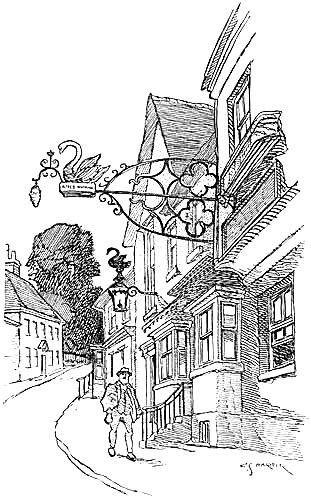
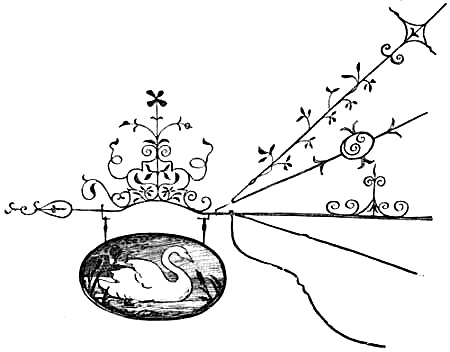
The great feature of the “Bell” is its sign, which, with the mazy and
intricate curls and twists and quirks of its wrought-iron supports,
projects far into the road. The sign itself is painted on copper, for sake
of lightness, but it has long been necessary to support it with a crutch
in the shape of a stout post, just as you prop up the overweighted branch
of an apple-tree. The sign-board itself—if we may term that a “board”
which is made of metal—was in the old days a certain source of income to
the coachmen and guards who wagered, whenever possible, with their
passengers, on the size of it. Foolish were those who betted with them,
for, like the cunning bride who took a bottle of the famous water of the
Well of St. Keyne to church, they were prepared; and although bets on
certainties are, contrary to the spirit, and all the laws, of sport, they
were sufficiently unprincipled to receive the winnings that were
inevitable, since they had early taken the measure of it.
The sign, in fact, measures 6 ft. 2¾ inches in height.
The “Bell” is, or should be, famous as the inn where “Stilton” cheese was
first introduced to an appreciative and unduly confiding world. It was an
old-time landlord, the sporting Cooper Thornhill, who flourished, and rode
horseback in record time to London and back to Stilton again, about 1740,
to whom the world was thus originally indebted. He obtained his cheese
from a Mrs. Paulet of Wymondham, who at first supplied him with this
product of her dairy for the use of coach-passengers dining at his table.
Her cheeses at once appealed to connoisseurs, and Thornhill presently
began to supply them to travellers eager to take this new-found delicacy
away with them. He was too business-like a man to disclose the secret of
their origin, and it was long supposed they came from a dairy at Stilton
belonging to him. He did so well for himself, charging half-a-crown a
pound, that others entered the lucrative trade, and you could no more
journey through Stilton without having a Stilton cheese (metaphorically)
thrown at your head than you can halt to-day at Banbury station without
hearing the musical cry of “Ba-anbury Ca-a-akes!”
Then Miss Worthington, landlady of the “Angel” opposite, began also to
supply Stilton cheeses. Rosy, plump, and benevolent-looking—apparently
one in whom there was no guile—she would ask passengers if they would not
like to take away with them a “real Stilton cheese.” All went well for a
while, and Stilton cheeses tasted none the worse because they were not
made there. And then the terrible secret was disclosed.
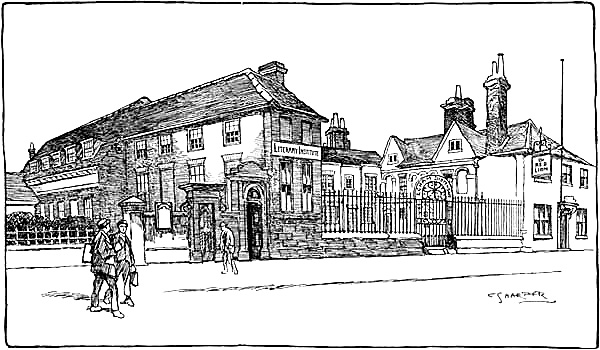
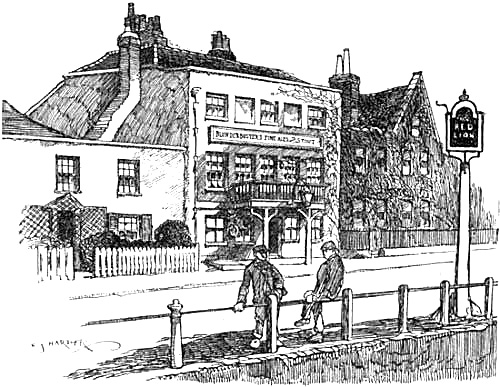
THE “RED LION,” EGHAM.
“Pray, sir, would you like a nice Stilton cheese to take away with you?”
asked the unsuspecting landlady one day, as a coach drew up.
“Do you say they are made at Stilton?” asked the passenger.
“Oh yes,” said she.
Then came the crushing rejoinder: “Why, Miss Worthington, you know
perfectly well that no Stilton cheese was ever made at Stilton: they’re
all made in Leicestershire; and as you say your cheeses are made at
Stilton, they cannot be good, and I won’t have one.”
It is the merest commonplace to say that time works wonders. We know it
does: wonders not infrequently of the most unpleasant kind. When we find
time bringing about marvels of the pleasant and desirable sort I think we
should account ourselves fortunate.
There are marvels nowadays being wrought on the Great North Road in
particular, and others in general, in that entirely felicitous manner. I
do not here make allusion to the electric tramways that monopolise the
best part of the roadways out of London for some ten miles or so of the
old romantic highways. Not at all; in fact, far otherwise. The particular
miracles I am contemplating are the works undertaken by the Road Club of
the British Isles, in the re-opening of ancient hostelries long ago
retired into private life, and in bringing back to the survivors a second
term of their old-time prosperity. The Road Club, largely consisting of
motorists, encourages touring, and has set out upon a programme of
interesting all lovers of the countryside in country quarters. The Great
North Road is dotted here and there with the inns it has revived: the “Red
Lion” at Hatfield, the “George” at Grantham, and so forth, and it has
entirely purchased and taken over the management of the “Royal County
Hotel” at Durham and the “Bell” at Barnby Moor.
I am in this place not so greatly concerned to hold forth upon the others,
but the case of the “Bell” is remarkable. Some years since, in writing the
picturesque story of the Great North Road,[1] I discoursed at length upon
the history of that remarkably fine old hostelry, which was then, and for
close upon sixty years had been, a private country residence. Railways had
been too much for it, and the licence had been surrendered, and postboys
and the whole staff dispersed.
And now? Why now the “Bell,” or “Ye Olde Bell,” as I perceive the Road
Club prefers to style it, is an inn once more. I forget how many thousands
of pounds have been expended in alterations, and in re-installing the
establishment; but it has become in three equal parts, as it were, inn,
club-house and farm-house, fully licensed, with golf-links handy. Here
come the motor tourists, and here meet Lord Galway’s hounds, and, in
short, the ancient glories of the “Bell” are, with a modern gloss,
revived. If the spirits of the jolly old landlords can know these things,
surely they are pleased.
Among the old coaching-inns sadly fallen from their former estate, and
now surviving only in greatly altered circumstances, in a mere corner of
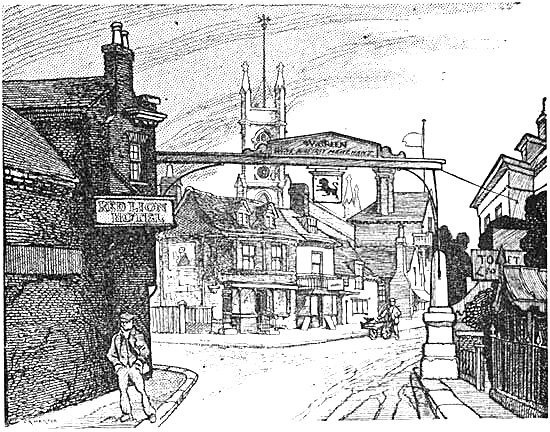
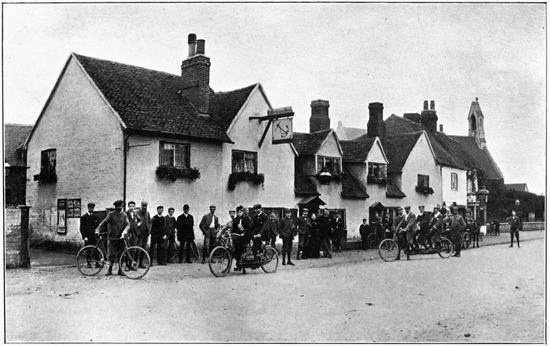
the great buildings they once occupied, is the “Red Lion,” Egham; once one
of the largest and finest inns on the Exeter Road.
The “Red Lion” may, for purposes of comparison, be divided into three
parts. There is the old gabled original portion of the inn, probably of
late seventeenth-century date, now used as a medical dispensary, forming
two sides of a courtyard, recessed from the road, and screened from it by
an old wrought-iron railing; and added to it, perhaps eighty years later,
an imposing range of eighteenth-century red-brick buildings, partly in use
as offices for the local Urban District Council and in part a “Literary
Institute,” and a world too large for both. This great building is even
more imposing within; its immense cellarage, large ball-, or
assembly-room, noble staircases, and finely panelled walls, the now
neglected witnesses of a bygone prosperity. Traditions still survive of
how George the Fourth used to entertain his Windsor huntsmen here. In the
rear was stabling for some two hundred horses. Most of it has been cleared
away, but the old postboys’ cottages still remain in the spacious yard.
The remaining part of the “Red Lion,” still carried on as an inn, presents
a white-stuccoed, Early Victorian front to the high road.
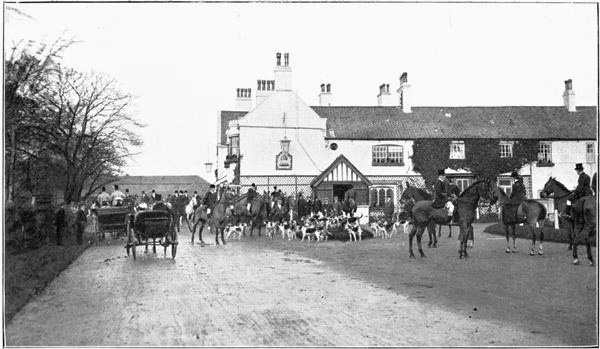
THE “BELL,” BARNBY MOOR: MEET OF LORD GALWAY’S HOUNDS.
Not many inns are built upon crypts. Examples have already been referred
to in these volumes, but another may be mentioned, in the case of the
“Lamb” inn at Eastbourne; while the “Angel” at Guildford is a well-known
instance. No one, looking at the modern-fronted “Angel,” one of the
foremost hotels of Guildford, would be likely to accuse it of owning an
Early English crypt, but it has, in fact, an exceptionally fine one of
three bays, supported by two stone pillars. The ancient history of this
undercroft is unknown, and merely a matter for conjecture.
At the “Angel” itself antiquity and modernity meet, for while fully
equipped for twentieth century convenience, it has good oak panelling of
the sixteenth and seventeenth centuries in the fine hall and elsewhere.