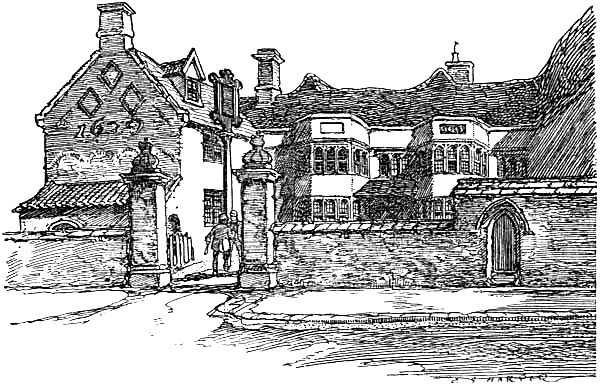
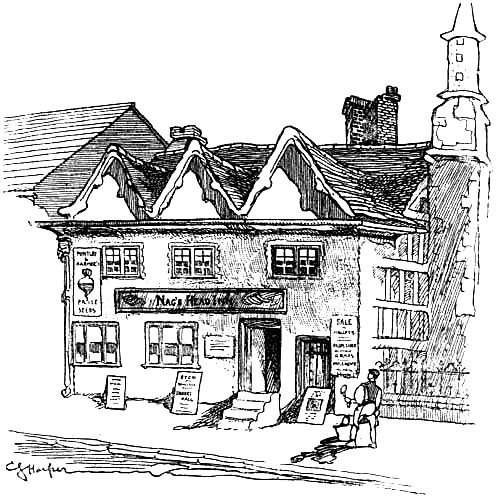
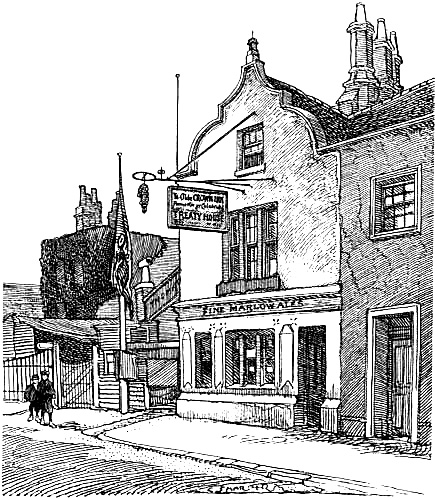
PICKWICKIAN INNS
What visions of Early Victorian good-fellowship and conviviality, of the
roast-beef and rum-punch kind, are called up by the title! The Pickwickian
Inn was, in the ’30’s of the nineteenth century, the last word in
hospitable comfort, and its kitchen achieved the topmost pinnacle of
culinary refinement demanded by an age that was robust rather than
refined, whose appetites were gross rather than discriminating, and whose
requirements seem to ourselves, of a more sybarite and exacting
generation, few and modest. The Pickwickian age was an age of prodigious
performances in eating and drinking, and our ancestors of that time, so
only they had great joints, heaped-up dishes, and many bottles and
decanters set before them, cared comparatively little about delicate
flavours. The chief aim was to get enough, and the “enough” of our
great-grandfathers would nowadays be a surfeit to ourselves. If it were
not then quite the essential mark of a jolly good fellow to be carried up
to bed at the end of an evening with the punch and the old port, a man who
shirked his drink was looked upon with astonishment, almost suspicion, and
the only use in those deep-drinking days and nights for table-waters was
to help a man along the road to recovery, after “a night of it.”
Then to be otherwise than of a Pickwickian rotundity was to be not merely
a poor creature, but generally connoted some mental crook or eccentricity;
while fatness and hearty good-nature were thought of almost as
interchangeable terms.
’Twas ever thus. Even Shakespeare loved the well-larded, and makes Julius
Cæsar, who himself was sufficiently lean, say:
Let me have men about me that are fat;
Sleek-headed men, and such as sleep o’ nights:
Yond Cassius has a lean and hungry look:
He thinks too much: such men are dangerous.
In the time of Dickens they were still suspect; and when at last Wilkie
Collins made his villainous Count Fosco a fat villain, the new departure
seemed to that generation a wanton, extravagant flying in the face of
nature.
There are even yet to be found substantial old inns something after the
Pickwickian ideal, but they are few and far between, and they are none of
them Pickwickian to the core. Rarely do you see nowadays the monumental
sideboards, with the almost equally monumental sirloins of beef and the
like, and even the huge cheese, last of the old order of things to survive
upon these tables, is nowadays generally represented by a modest wedge.
It is true that even the Pickwickians did not always happen upon
well-ordered inns, for the “Great White Horse” at Ipswich was severely
criticised by Dickens; but such exceptions do but serve to prove the
Dickensian rule, that there was no such place, and there never had been
any such place, as the hostelry of the coaching age for creature-comforts
and good service. Dickens had already, when he began writing The Pickwick
Papers at the age of twenty-five, an almost encyclopædic knowledge of
inns, especially of country inns. It was, like his own Mr. Weller’s
knowledge of London, “extensive and peculiar.” His fount of information
about country inns, at any rate, was acquired at an early and receptive
age, in his many and hurried journeys as a reporter, when, on behalf of
The Morning Chronicle, he flew—flew, that is to say, as flying was then
metaphorically understood, at an average rate of something under ten miles
an hour—by coach, east, west, north, and south, in the capacity of
Parliamentary reporter, despatched to “take” the flow of eloquence from
Members, or would-be Members of Parliament, addressing the conventionally
“free and enlightened” voters of the provinces.
No fewer than fifty-five inns, taverns, etc., London and provincial, are
named in Pickwick, many of them at considerable length; but, so great
and sweeping have been the changes of the last seventy years, only twelve
now remain. The London houses, with the exception of Osborne’s Hotel, John
Street, Adelphi—now the “Adelphi” Hotel—and the “George and Vulture,”
in George Yard, Lombard Street—in these days almost better known as
Thomas’s Restaurant—have been either utterly disestablished or remodelled
beyond all knowledge.
Pickwick is the very Odyssey of inns and travel. You reach the second
chapter and are whirled away at once from London by the “Commodore” coach,
starting from the “Golden Cross,” Charing Cross, for Rochester, and only
cease your travels and adventures at inns in Chapter LI., near the end of
the story. Meanwhile you have coasted over a very considerable portion of
England with the Pickwickians: from Rochester and Ipswich on the east, to
Bath and Bristol on the west, and as far as Birmingham and Coventry in the
Midlands.
He who would write learnedly and responsibly on the subject of Pickwickian
Inns must bring to his task a certain amount of foreknowledge, and must
add to that equipment by industry and research—and even then he shall
find himself, after all, convicted of errors and inadequacies; for indeed,
although the Pickwickians began their travels no longer ago than 1827, the
changes in topography for one thing, and in manners and customs for
another, are so great that it needs a scientific historian to be
illuminating on the subject.
To begin at the usual place, the beginning, the history of the “Golden
Cross,” the famous inn whence the Pickwickians started, offers a fine
series of snares, pitfalls, traps, and rocks of offence to him who does
not walk warily, for the “Golden Cross” of to-day, although a coaching inn
remodelled, is by no means the original of that name, and indeed stands on
quite a different (although neighbouring) site.
Changes in the geography of London have been so continuous, so intricate,
and so puzzling that few people at once realise how the inn can have stood
until 1830 at the rear of King Charles the First’s statue, on the spot now
occupied by the south-eastern one of the four lions guarding the Nelson
Column.
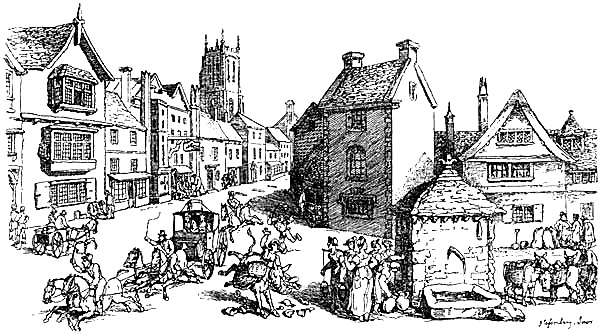
At that time Charing Cross was still the narrow junction of streets seen
in Shepherd’s illustration, where the “Golden Cross” inn is prominent on
the left hand, and Northumberland House, the London palace of the Dukes of
Northumberland (pulled down in 1874), more prominent on the right. The
block of buildings, including the “Golden Cross,” was removed, in 1830, to
form part of the open space of Trafalgar Square, and the site of the ducal
mansion is now Northumberland Avenue.
There had long been a “Golden Cross” inn here: how long we do not know,
but a house of that name was in existence in 1643, for in that year we
find the Puritans demanding the removal of the, to them, offensive sign of
the cross. It was then a half-way house at the little village of Charing,
midway between the then entirely separate and distinct cities of London
and Westminster. In front of it, on the site of King Charles’s statue,
stood the ancient cross of Charing, erected, long centuries before, to the
memory of Queen Eleanor.
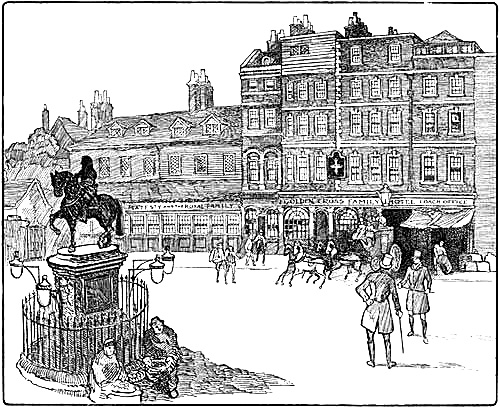
THE “GOLDEN CROSS,” IN PICKWICKIAN DAYS.
The earliest picture we have of the “Golden Cross” inn is a view by
Canaletti, engraved in 1753, showing a sign projecting boldly over the
footpath. As the architectural style of the house shown in that view is
later than that prevailing in the reign of Charles the First, the inn must
obviously have been rebuilt at least once in the interval. This building
is again illustrated in a painting executed certainly later than 1770,
according to the evidence of the sign, which, instead of the old gallows
sign in Canaletti’s picture, is replaced by a board fixed against the
front of the building, in obedience to the Acts of Parliament, 1762-70,
forbidding overhanging signs in London. That such measures were necessary
had been made abundantly evident so early as 1718, when a heavy sign had
fallen in Bride Lane, Fleet Street, tearing down the front of the house
and killing four persons.
In this view, later than 1770, and probably executed about 1800, we have
the “Golden Cross” inn of Pickwick. Its successor, the Gothic-fronted
building generally associated by Dickens commentators with that story, was
built in 1828 and demolished two years later. Dickens wrote Pickwick in
1836: when both the house he indicated and its successor were swept away,
and the very site cleared and made a part of the open road; but, as he
specifically states that the Pickwickians began their travels on May 13th,
1827, it must needs have been the predecessor of the Gothic building from
which they set forth on the “Commodore” coach for Rochester.
The inn at that time had a hospitable-looking front and a really handsome
range of coffee-room windows looking out upon the street. Beside them you
see the celebrated archway of Jingle’s excited and disjointed cautions:
“Terrible place—dangerous work—other day—five children—mother—tall
lady, eating sandwiches—forgot the arch—crash—knock—children look
round—mother’s head off—sandwich in her hand—no mouth to put it
in—head of a family off—shocking, shocking!”
The great stable-yard and the back premises probably remained untouched,
for when David Copperfield came up by coach from Canterbury, the “Golden
Cross” was, we learn, “a mouldy sort of establishment,” and his bedroom
“smelt like a hackney-coach, and was shut up like a family
vault”—characteristics not generally associated with new buildings.
But, indeed, although references to the “Golden Cross” are plentiful in
literature, they are few of them flattering: “A nasty inn, remarkable for
filth and apparent misery,” wrote Edward Shergold, early in the nineteenth
century, and he was but one of a cloud of witnesses to the same effect. It
is thus a little difficult to understand a writer in The Epicure’s
Almanack for 1815, who says, in the commendatory way, that the fame of
the “Golden Cross” had spread “from the Pillars of Hercules to the Ganges;
from Nova Scotia to California.”
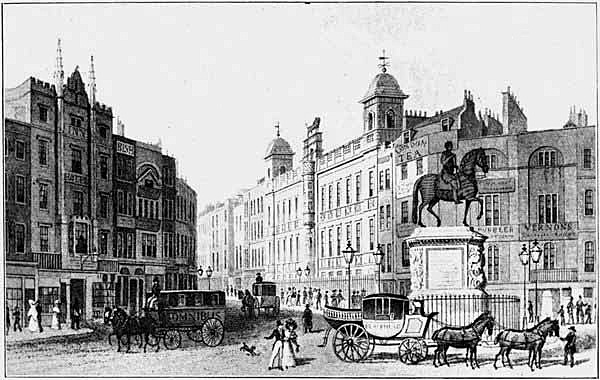
CHARING CROSS, ABOUT 1829, SHOWING THE “GOLDEN CROSS” INN.
From the engraving after T. Hosmer Shepherd.
At that period this was the chief booking-office for coaches in the West
End of London, and it was to that quarter what the “Bull and Mouth” was to
the City. To that commanding position it had been raised by William Horne,
who came here from the “White Horse” in Fetter Lane, in 1805. He died in
1828, and was succeeded by his son, the great coach-proprietor, Benjamin
Worthy Horne, who further improved the property, and was powerful enough
to command respect at the councils of the early railways. Under his rule,
beneath the very shadow of the Charing Cross Improvement Act, by whose
provisions Trafalgar Square was ordained and eventually created, the house
was rebuilt, with a frontage in the Gothic manner. Shepherd’s view of
Charing Cross, published December 18th, 1830, shows this immediate
successor of the Pickwickian inn very clearly, with, next door, the
establishment of Bish, for whose lotteries Charles Lamb was employed to
write puffs.
When the Commissioners of Woods and Forests, who had the Charing Cross
improvement in charge, cleared the ground, the inn migrated to the new
building, some distance eastwards, the present “Golden Cross,” 452, West
Strand, which, like the whole of the West Strand, in the Nash,
stucco-classic manner, was designed in 1832, by Mr. (afterwards Sir
William) Tite.
Maginn lamented these changes, in the verses “An Excellent New Ballad;
being entitled a Lamentation on the Golden Cross, Charing Cross”:
No more the coaches shall I see
Come trundling from the yard,
Nor hear the horn blown cheerily
By brandy-bibbing guard.
King Charles, I think, must sorrow sore,
Even were he made of stone,
When left by all his friends of yore
(Like Tom Moore’s rose) alone.
······
O! London won’t be London long,
For ’twill be all pulled down;
And I shall sing a funeral song
O’er that time-honoured town.
According to a return made to Parliament of the expenses in connection
with these street improvements, “10 Houses and the Golden Cross Inn,
Stable Yards, &c.,” were purchased for £108,884 4s.; the inn itself
apparently, if we are to believe a statement in The Gentleman’s
Magazine, 1831, with three houses in St. Martin’s Lane and two houses and
workshops in Frontier Court, costing £30,000 of that sum.
The present building was planned with a courtyard, and had archways to the
Strand and to Duncannon Street. The last remains, and is in use as a
railway receiving-office, but the Strand archway, the principal entrance,
was built up and abolished in 1851.
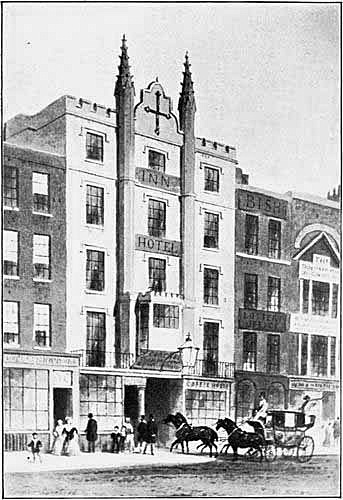
THE “GOLDEN CROSS,” SUCCESSOR OF THE PICKWICKIAN INN, AS REBUILT 1828.
The first house to which Mr. Pickwick and his followers—the amorous
Tupman, Winkle the sportsman, and the poetic Snodgrass—came at the
close of their first day’s travel is still in being. I name the “Bull” at
Rochester, which long ago adopted Jingle’s recommendation, and blazoned it
on the rather dingy forefront, of grey brick: “Good house—nice beds.” It
is still very much as it was when Dickens conferred immortality upon it;
only there are now portraits of him and pictures of Pickwickian characters
on the walls of the staircase. Still you may find in the hall the
“illustrious larder,” rather like a Chippendale book-case, behind whose
glass doors the “noble joints and tarts” are still placed—only I think
they have not now the nobility or the aldermanic proportions demanded by
an earlier generation—and the cold fowls are indubitably there. The “very
grove” of dangling uncooked joints is, if one’s memory of such things
serves, not as described, in the hall, but depending, as they commonly are
made to do in old inns, from hooks in the ceiling of the archway entrance.
The custom excites the curiosity of many. To the majority of observers it
has seemed to be by way of advertisement of the good cheer within; but the
real reason is sufficiently simple: it is to keep the joints fresh and
sweet in the current of air generally to be reckoned upon in that
situation.
The ball-room, with the “elevated den” for musicians at one end, is a real
room, and you wonder exceedingly at the smallness, not only of the den,
but of the room itself, where the fine flower of Dockyard society
gathered and fraternised with the even finer flower of that belonging to
the Garrison: the two, joining forces, condescending to, or sneering upon,
the vulgar herd of tradesmen and their wives.
In this somewhat exiguous apartment Tupman and Jingle danced, and the
bellicose Dr. Slammer, of the 97th Regiment, glared; and the society of
Chatham and Rochester had, you cannot help thinking, a very close and
tightly packed evening.
They take their Pickwickian associations very seriously at the “Bull,”
which, by the way, is an “inn” no longer, but an “hotel.” In 1836, the
Princess Victoria and her mother, travelling to London, were detained by
stress of weather that rendered it dangerous to cross the bridge, and they
reluctantly stayed at Rochester the night. Who were low-class
Pickwickians, that they should stand before such distinction? So the old
house for a while took on a new name, and became the “Victoria and Bull,”
and then, Royal associations gradually waning and literary landmarks
growing more popular, the “Bull and Victoria,” finally, in these last
years, revered again to its simple old name.
That Royal visit is well-nigh forgotten now, and you are no longer invited
to look with awe upon the rooms occupied by those august, indubitably
flesh-and-blood travellers; but you are shown the bedrooms of the
entirely fictitious Pickwickians.
“So this is where Mr. Pickwick is supposed to have slept?” remarked a
visitor, when viewing bedroom No. 17 by favour of a former landlord. That
stranger meant no offence, but the landlord was greatly ruffled.
“Supposed to have slept? He did sleep here, sir!”
“O ye verities!” as Carlyle might have exclaimed.
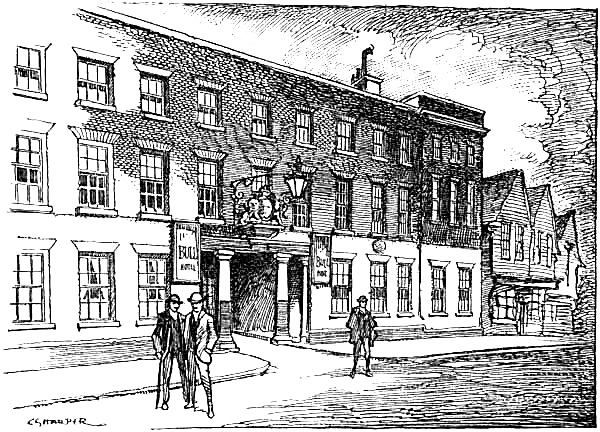
THE “BULL,” ROCHESTER.
Many Dickens commentators have long cherished what Horace Walpole might
have styled a “historic doubt” as to what house was that one in Rochester
referred to by Jingle as Wright’s. “Wright’s, next house, dear—very
dear—half a crown in the bill if you look at the waiter—charge you more
if you dine at a friend’s than they would if you dined in the
coffee-room—rum fellows—very.” But “Wright’s” really was the next
“house”—house, that is to say, in the colloquial sense, by which
“public-house” is understood, and not by any means next door.
There is every excuse for writers on Dickens-land going wrong here, for
the real name of the old house to which Wright came, somewhere about 1820,
and on which he imposed his own was the “Crown.”
The old “Crown” fronted on to the High Street, and was one of those old
galleried inns already mentioned so plentifully in these pages. It claimed
to have been built in 1390, and its yard was not only the spot where,
unknown to all save his intimates, Henry the Eighth had his first peep at
his intended consort Anne of Cleves, whom that disappointed connoisseur in
feminine beauty immediately styled a “Flanders mare”; but was in all
probability the original of the inn-yard in Henry the Fourth, whence
Shakespeare’s flea-bitten carriers with their razes of ginger and other
goods for London, sleepless probably on account of those uncovenanted
co-partners of their beds, set forth, by starlight, yawning, with much
talk of highway dangers. At the “Crown” too, once stayed no less a
personage than Queen Elizabeth; while some two centuries later Hogarth and
his fellow-roysterers stayed a night in the house, on their “Frolic” down
Thames.
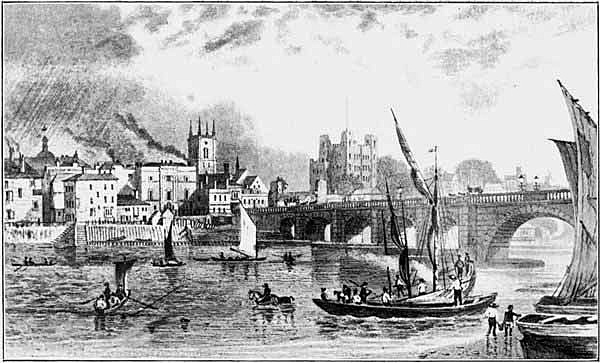
ROCHESTER IN PICKWICKIAN DAYS, SHOWING THE OLD BRIDGE AND “WRIGHT’S.”
When Wright came to the “Crown,” he, like any other monarch newly come to
his own, made sweeping alterations. Antiquity, gabled frontages,
elaborately carved barge-boards, and all such architectural vanities were
nothing to him, nor indeed were they much to any one else in that grossly
unappreciative era, and he left that portion of the house to carriers and
the like, used all their lives to be leeched by diminutive lepidoptera.
Wright did business with customers of more tender hide, who had
preferences for more civilised lodgment, and housed the great, the rich,
and the luxurious, travelling post to and fro along the Dover Road. For
their accommodation he built a remarkably substantial and amazingly ugly
structure—a something classical that might, by the look of it, be either
town hall, heathen temple, or early dissenting chapel—in the rear, and
facing the river. This was the building essentially “Wright’s.” It still
stands, and people with sharp eyes, who look very hard in the right place,
will yet discover a ghostly “Wright’s” on what Mrs. Gamp would call the
“parapidge.”
Such a place would naturally impress a poor strolling actor like Jingle,
whose humorous sally, “charge you more if you dine at a friend’s than they
would if you dined in the coffee-room,” is a perversion of the well-known
charge for “corkage” made by hotel-keepers when a guest brings his own
wine.
Wright himself has, of course, long since gone to that place where
innkeepers who make extravagant demands upon travellers are held to
account.
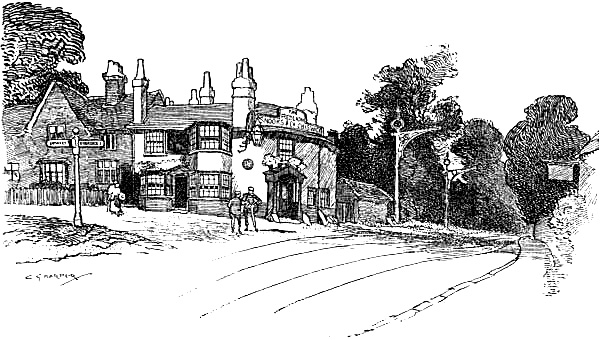
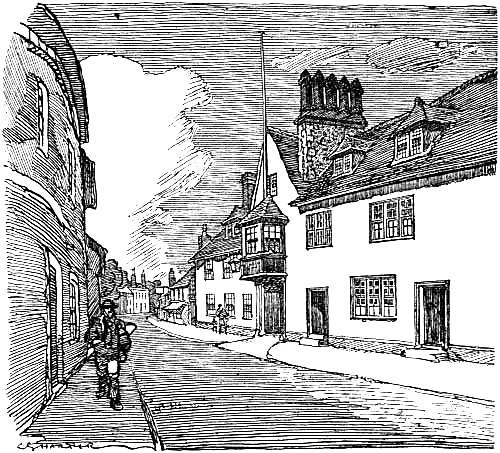
The course of Pickwick now takes us to “Muggleton,” as to whose
identity much uncertainty has long been felt. It is a choice between
Maidstone and Town Malling, and as the distances given in the book between
Rochester and Dingley Dell and “Muggleton” cannot be made to agree with
either Town Malling or Maidstone, it is a poor choice at the best. At the
former the “Swan” is pointed to as the real “Blue Lion,” and at Maidstone
the “White Lion.”
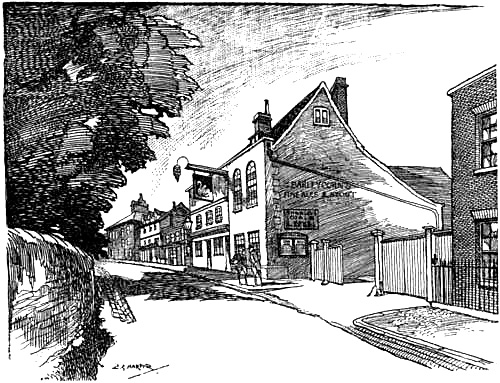
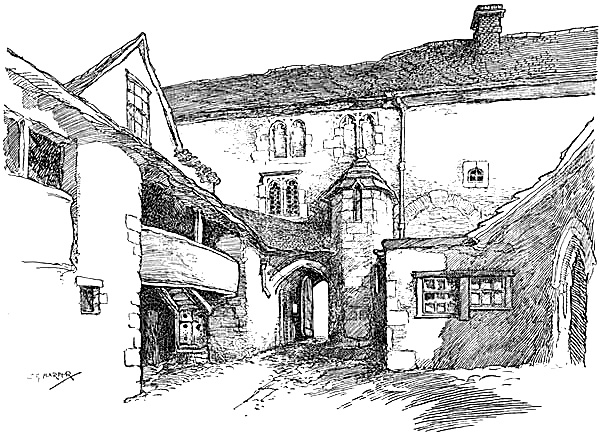
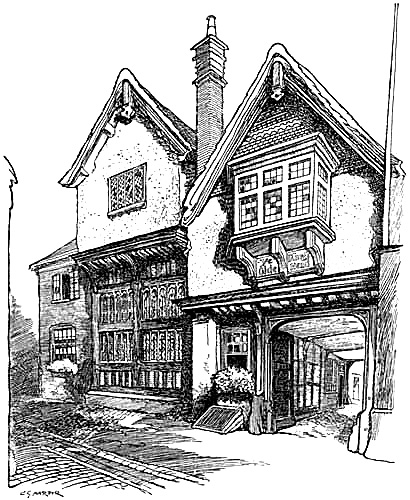
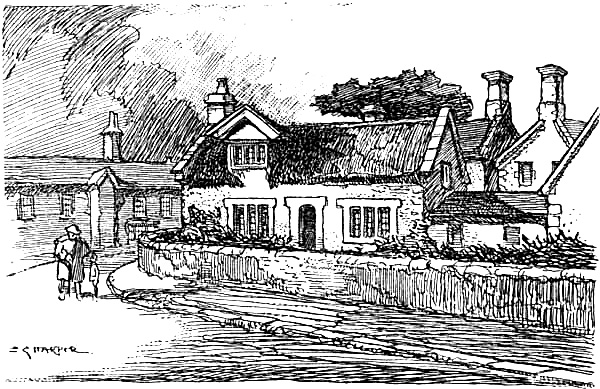
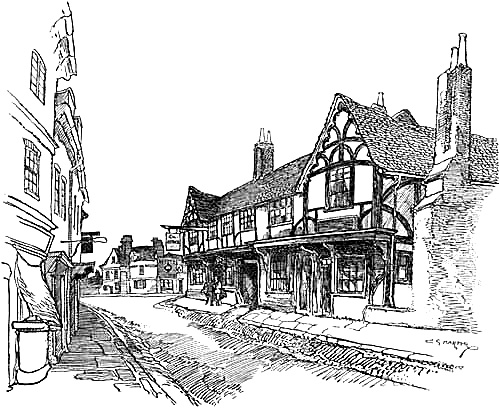
THE “SWAN,” TOWN MALLING: IDENTIFIED WITH THE “BLUE LION,” MUGGLETON.
Chapter X. takes us back to London, and there brings on to the crowded
stage of Pickwick, for the first time, Sam Weller, engaged as “Boots” of
the “White Hart” in the Borough, in going over the foot-gear of the
guests.
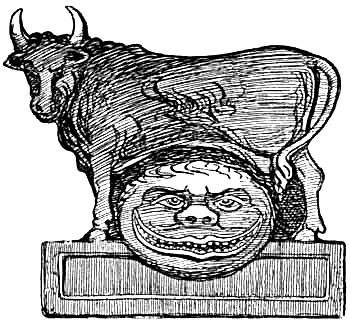
SIGN OF THE “BULL AND MOUTH.”
This is how Dickens described the yard of the “White Hart.” It is a
little clean-cut cameo of description, vividly portraying the features of
those old galleried inns that are now no more: “The yard presented none of
that bustle and activity which are the usual characteristics of a large
coach inn. Three or four lumbering waggons, each with a pile of goods
beneath its ample canopy about the height of the second-floor window of an
ordinary house, were stowed away beneath a lofty roof which extended over
one end of the yard; and another, which was probably to commence its
journey that morning, was drawn out into the open space. A double tier of
bedroom galleries with old clumsy balustrades ran round two sides of the
straggling area, and a double row of bells to correspond, sheltered from
the weather by a little sloping roof, hung over the door leading to the
bar and coffee-room. Two or three gigs or chaise-carts were wheeled up
under different little sheds and pent-houses, and the occasional heavy
tread of a cart-horse, or rattling of a chain at the further end of the
yard, announced to anyone who cared about the matter that the stable lay
in that direction. When we add that a few boys in smock-frocks were lying
asleep on heavy packages, woolpacks, and other articles that were
scattered about on heaps of straw, we have described as fully as need be
the general appearance of the ‘White Hart’ inn, High Street, Borough.”
This one of the many picturesque old galleried inns of that street was
demolished in 1865.
Sam is busily engaged, at moment of his introduction, cleaning eleven
pairs of boots belonging to the sleepers in the galleried bedrooms above.
“A loud ringing of one of the bells was followed by the appearance of a
smart chambermaid in the upper sleeping gallery, who, after tapping at one
of the doors and receiving a request from within, called over the
balustrades:
“‘Sam.’
“‘Hallo!’
“‘Number Twenty-two wants his boots.’
“‘Ask Number Twenty-two whether he’ll have ’em now, or wait till he gets
’em,’” was the reply.
Presently to this waggish person enter Mr. Pickwick, Old Wardle, and
Perker, the lawyer. “‘Pretty busy, eh?’” asks the lawyer.
“Oh, werry well, sir; we shan’t be bankrupts, and we shan’t make our
fort’ns. We eats our biled mutton without capers, and don’t care about
horse-radish wen we can get beef;” which just about figures the middling
and declining fortunes of the old Borough inns at that period.
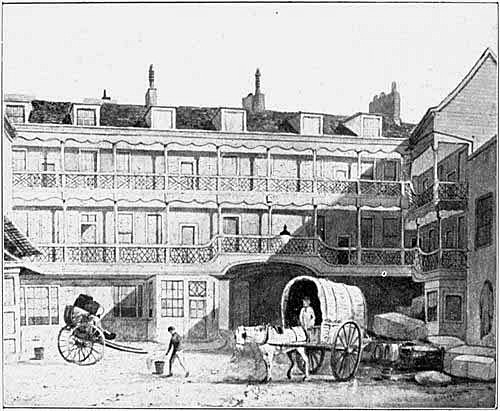
THE “BELLE SAUVAGE.”
From a drawing by T. Hosmer Shepherd.
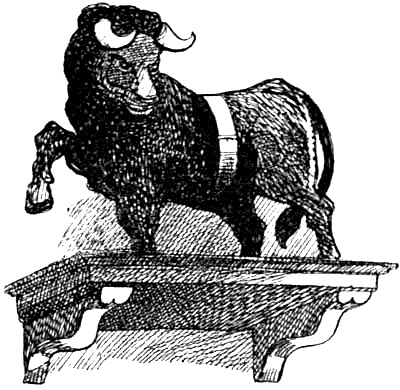
The “Bull and Mouth” inn, casually mentioned in Chapter X., was the great
coaching inn that stood in St. Martin’s-le-Grand, on the site of the
Post Office building adjoining the church of St. Botolph. In 1830 it was
rebuilt and re-named the “Queen’s Hotel,” and so remained until 1887. The
enormous plaster sign of the “Bull and Mouth,” that was placed over the
entrance to the stables in the by-street of that name, and kept its place
there when the stables became a railway goods yard, is now in the
Guildhall Museum.
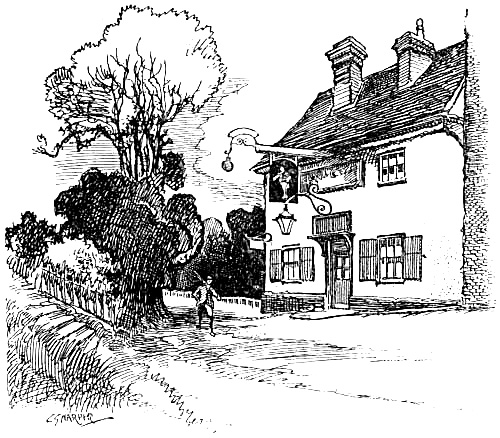
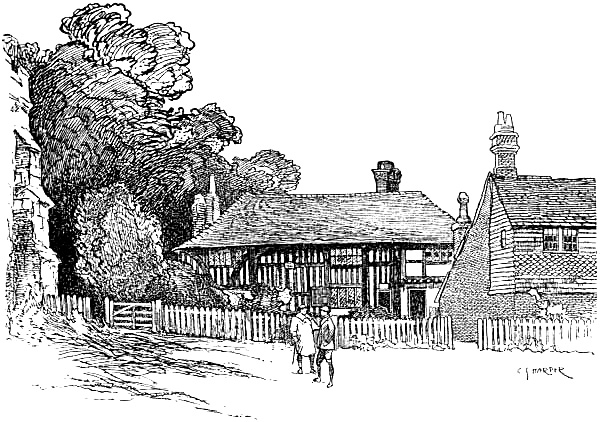
THE “LEATHER BOTTLE,” COBHAM.
The “Belle Sauvage,” on Ludgate Hill, another fine old galleried inn
whence the coaches for the eastern counties largely set forth, is the
subject of allusion in Chapters X. and XLIII. The house was pulled down
many years ago, but the yard, now very commonplace, remains. It was known
as “Savage’s Inn” so long ago as the reign of Henry the Sixth, and
alternatively as the “Bell in the Hoop.” So early as 1568, when the
property was bequeathed to the Cutler’s Company “for ever,” the “Belle
Sauvage” myth was current; and thus we see that when Addison, in The
Spectator, suggested the “beautiful savage” idea, he was but
unconsciously reviving an ancient legend or witticism. One other variant,
that ingeniously refers the sign of the inn to one Isabella Savage, a
former landlady, seems to have created her for the purpose.
The “Marquis o’ Granby” at Dorking, kept by the “widder” who became the
second Mrs. Weller, has been identified by some with the late “King’s
Head” in that town; while the “Town Arms,” the “Peacock,” and the “White
Hart” at “Eatanswill” (i.e. Ipswich) have never been clearly traced.
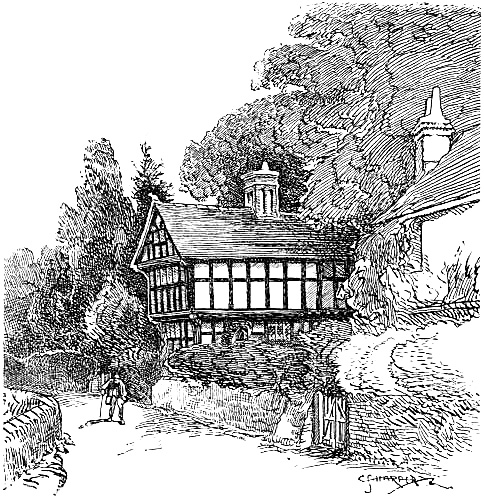
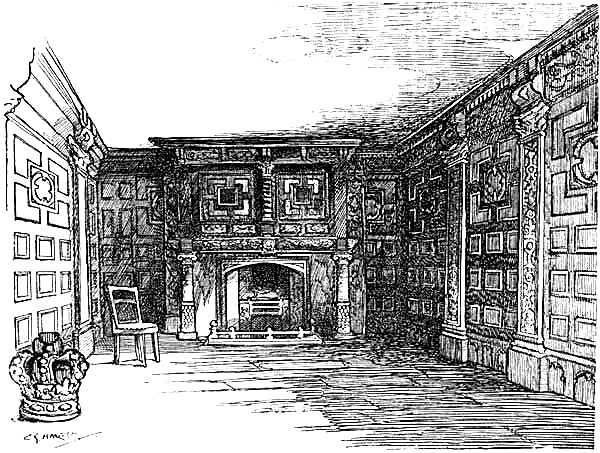
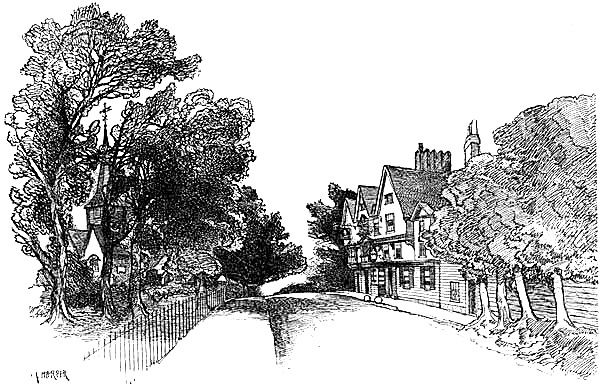
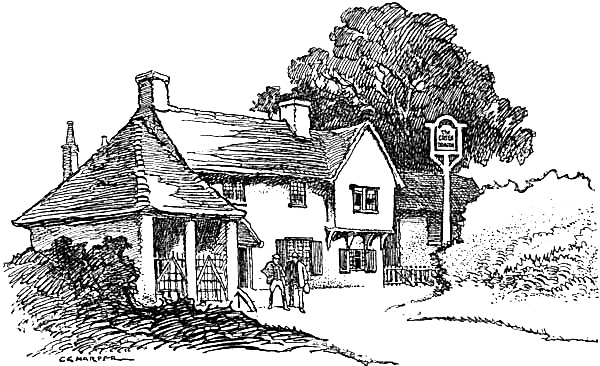
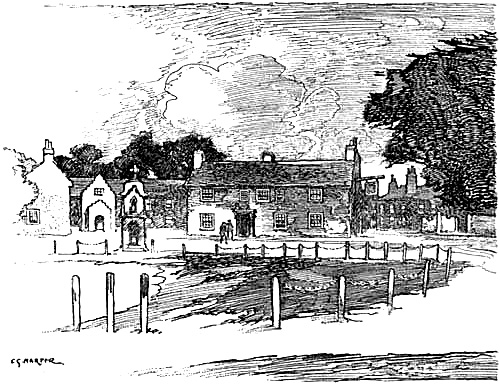
No difficulty of identification surrounds the “Old Leather Bottle” at
Cobham, to whose rustic roof the love-lorn Tupman fled to hide his
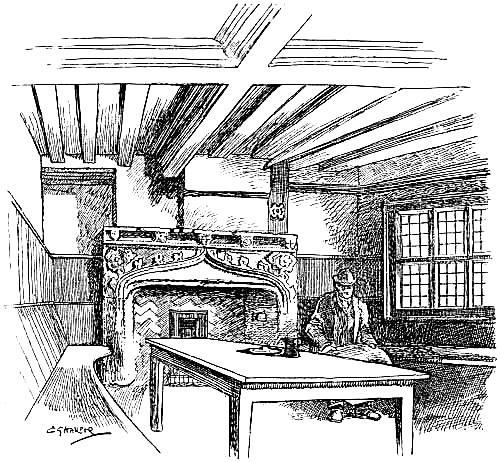
sorrows, in Chapter XI. It is to-day, however, a vastly altered place from
the merely “clean and commodious village ale-house” in which Mr. Pickwick
found his moping, but still hungry, friend, and its “Dickens Room” is a
veritable museum. Additions have been made to the house, and it is now
more or less of a rustic hotel, with the sign of the leather bottle
swinging in the breeze, and beneath it our Mr. Pickwick himself, in the
immortal attitude depicted in the frontispiece to The Pickwick Papers,
declaiming, with one arm outstretched, the other tucked away under his
coat-tails.
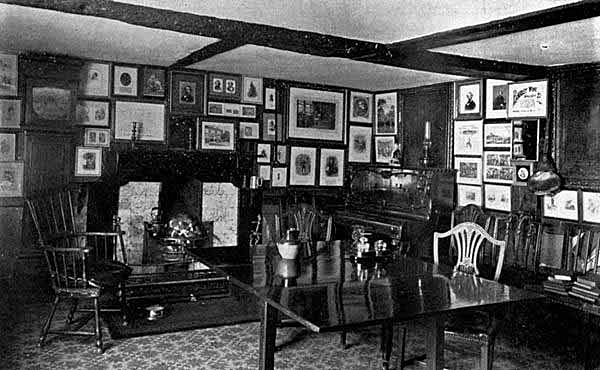
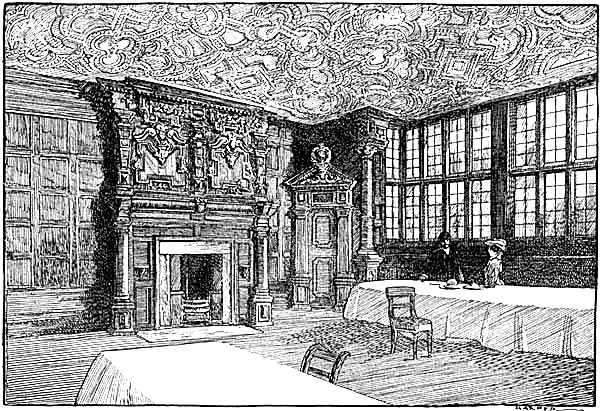
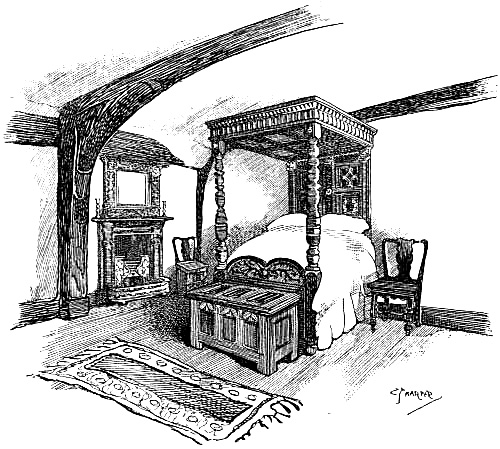
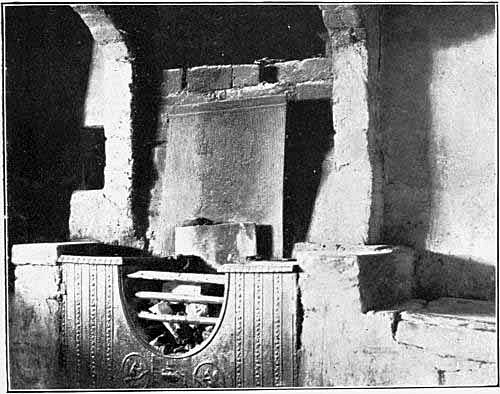
THE DICKENS ROOM, “LEATHER BOTTLE,” COBHAM.
The “inn on Marlborough Downs,” referred to in the Bagman’s Story in
Chapter XIV., is still the subject of much heated controversy among
Dickens commentators. Sandwiched as it is (in the story told by a stranger
to the Pickwickians at “Eatanswill”) between Ipswich and Bury St. Edmunds,
it appears to be a vague recollection dragged in, neck and crop, by
Dickens, of some inn he had casually noticed in 1835, when travelling
between London and Bristol. “But,” it has been asked, “what inn was he
thinking of, if indeed, of any specific inn at all?”
The Bagman with the Lonely Eye, who told the story of Tom Smart and the
widow-landlady of this wayside hostelry, spoke of Tom Smart driving his
gig “in the direction of Bristol” across the bleak expanse, and of his
mare drawing up of her own accord “before a roadside inn on the right-hand
side of the way, about half a quarter of a mile from the end of the
downs.”
We are met here, at the very outset, by some puzzling discrepancies and by
a wide choice, “Marlborough Downs” being a stretch of wild, inhospitable
chalk-down country extending the whole of the fourteen miles between
Marlborough and Devizes, and being still “Marlborough Downs” at the
threshold of Devizes itself. Moreover, the same characteristic features
are common to both the routes to Bath and Bristol that branch at
Beckhampton and go, left by way of Devizes, and right through Calne and
Chippenham.
The “half a quarter of a mile from the end of the Downs” by the Devizes
route brings you, in the direction Tom Smart (of the firm of Bilson and
Slum) was going, to a point a half, or three quarters, of a mile from
Devizes town, where, neither on the right hand nor the left, was there
ever an inn. The same distance from the end of this weird district on the
Calne and Chippenham route conducts to the “Black Horse” inn at Cherhill,
full in view of the great white horse cut on the hillside in 1780, and
standing, correctly enough, on the right-hand side of the way. Could this
inn possibly have been the house referred to by Dickens? I have never seen
it suggested.
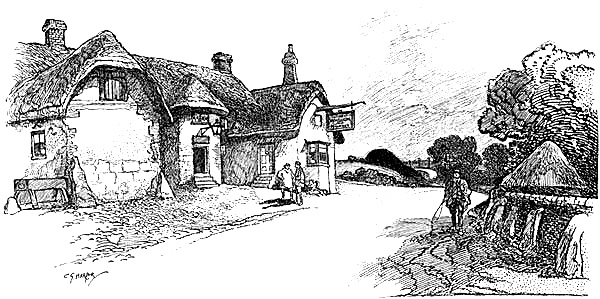
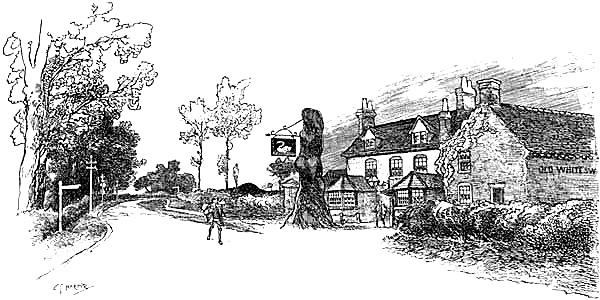
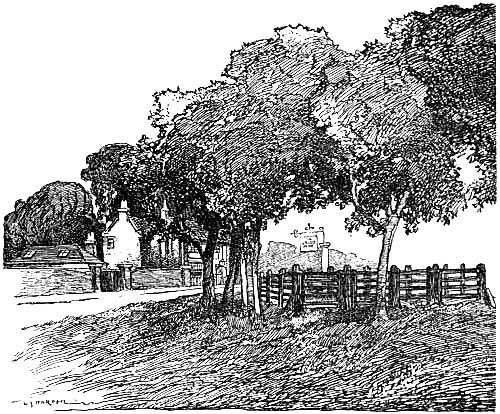
THE “WAGGON AND HORSES,” BECKHAMPTON.
Indeed, earnest people who would dearly, once for all, wish to settle this
knotty point, are like to be embarrassed by the numerous inns, not one of
them greatly resembling the house described by Dickens, that have claims
to be considered the original, and stand, all of them, upon the proper
side of the road. Some commentators press the claim of the “Marquis of
Ailesbury’s Arms” at Manton, or Clatford, a mile out of Marlborough, and
local opinion at the time of The Pickwick Papers being written
identified the house with the lonely inn of Shepherd’s Shore, midway
between Beckhampton and Devizes, in the very midst of the wild downs—the
downs of Marlborough—that are there at their wildest and loneliest.
Whatever the correctitude or otherwise of what should be an expert
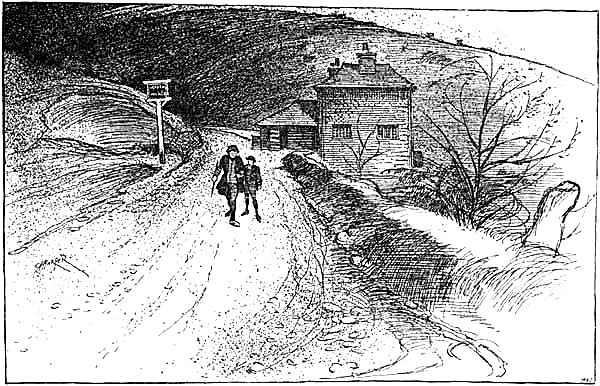
view, certainly the inn of Shepherd’s Shore is a thing of the past, as in
the story, where it is described as having been pulled down. There were,
indeed, at different periods two inns so called, and now both are gone.
“Old Shepherd’s Shore” stood, as also did the new, beside the Wansdyke,
but at a considerable distance in a north-westerly direction, on the old
road to Devizes, now a mere track. Of “New Shepherd’s Shore” only a
fragment remains, and although that fragment is inhabited, it is not any
longer an inn.
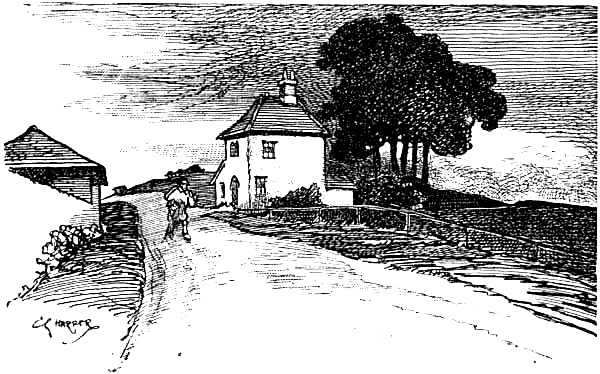
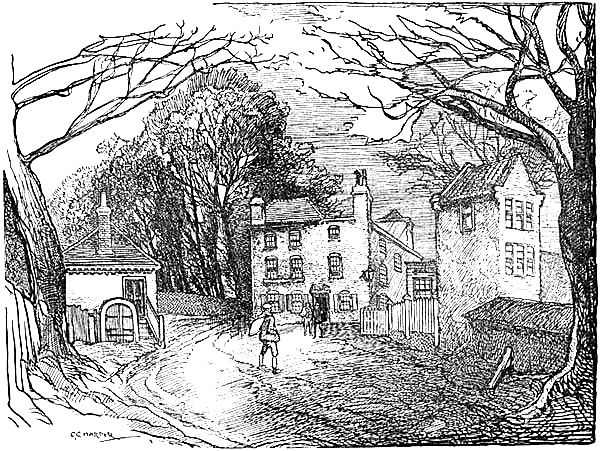
“SHEPHERD’S SHORE.”
The scene is entirely in accord with the description of the Downs in the
Bagman’s Story (only the spot is in the midst of the wilderness, and not
near the end of it), and he who even nowadays travels the still lonesome
way will heartily echo the statement that there are many pleasanter
places. The old coachmen, who had exceptional opportunities of
observation, used to declare that the way between Beckhampton and
Shepherd’s Shore was the coldest spot on all the road between London and
Bath.
The eerie nature of the spot is emphasised by the circumstance of the
remaining portion of the house standing beside that mysterious
pre-historic earthwork, the great ditch and embankment of the Wansdyke,
that goes marching grimly across the stark hillsides. The Wansdyke has
always impressed the beholder, and accordingly we find it marked on old
maps as “Deuill’s Ditch.”
The name of “Shepherd’s Shore” has been, and still is, a sore puzzle to
all who have cause to write of it. Often written “Shord,” and pronounced
by the country folk “Shard,” just as old seventeenth-century Aubrey prints
it, antiquaries believe the name to derive from “shard,” a fragment: here
specifically a break in the Wansdyke, made in order to let the road (or
the sheep-track) through; “shard” itself being the Middle-English version
of the Anglo-Saxon “sceard,” a division, a boundary, or a breach.
The name may, however, as I conceive it, be equally well a corrupt version
of “Shepherd’s Shaw.” “Shaw” = the old Anglo-Saxon for a coppice, a clump
of trees, or a bush. We see, even to-day (as of course merely a
coincidence) a clump of trees on the mystic tumulus beside the remains of
the house: trees noticeable enough on these otherwise naked downs, now, as
from time immemorial, a grazing-ground for sheep. In this view Shepherd’s
Shore would be equivalent to “Shepherd’s Shaw,” and that to “Shepherd’s
Wood,” or “Shepherd’s Bush.” A shepherd’s bush was commonly a thorn-tree
on a sheep-down, used as a shelter, or as a post of observation, by
shepherds watching their flocks. Such bushes, by constant use, assumed
distinctive and unmistakable forms,[15] and in old times were familiarly
known by that name.
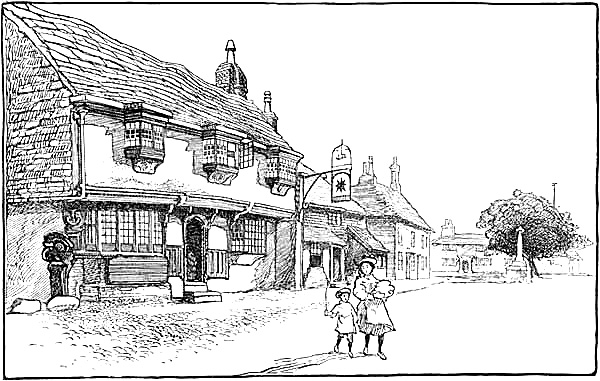
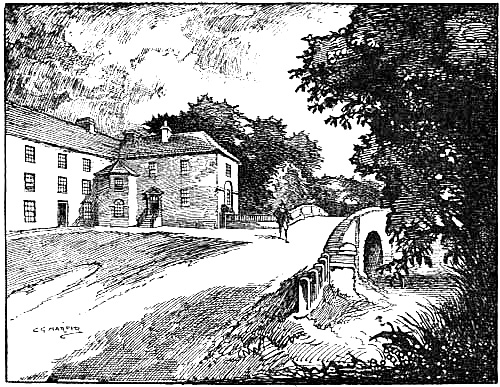
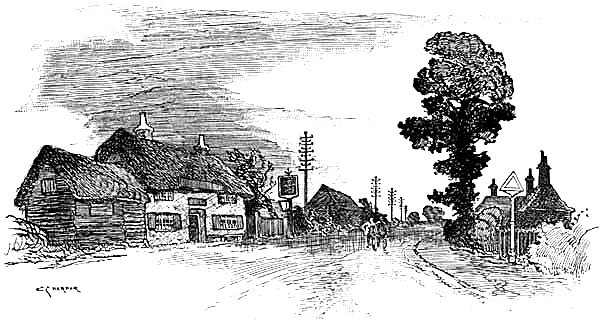
But, to resume matters more purely Dickensian: it is the “Waggon and
Horses” inn at Beckhampton that most nearly realises the description of
the house in The Pickwick Papers, although even here you most
emphatically go up into the house (as the illustration shows) instead of
taking “a couple of steep steps leading down.” It is “on the right-hand
side of the way,” and being at a kind of little cultivated oasis at the
hamlet of Beckhampton, where the roads fork on the alternative routes to
Bath and Bristol, it may be considered as “about half a quarter of a mile”
from the recommencement (not the end) of the Downs.
The “Waggon and Horses” is just the house a needy bagman such as Tom Smart
would have selected. It was in coaching days a homely yet comfortable
inn, that received those travellers who did not relish either the state or
the expense of the great “Beckhampton Inn” opposite, where post-horses
were kept, and where the very élite of the roads resorted.
“The humble shall be exalted and the proud shall be cast down,” and it so
happened that when the Great Western Railway was opened to Bath and
Bristol on June 30th, 1841, the great inn fell upon ruination, while its
humbler neighbour has survived—and does very well, thank you. It should
be added that in the view presented here you are looking eastward, back in
the direction of Marlborough. The great dark hill beside the road in the
middle distance is the vast pre-historic tumulus, the largest known in
Europe, famous as Silbury Hill.
The great house that was once “Beckhampton Inn” is now, and long has been,
Mr. Samuel Darling’s training-stables for racehorses. There is probably no
better-kept lawn in England than that triangular plot of grass in front of
the house, where—as you see in the picture—the roads fork.
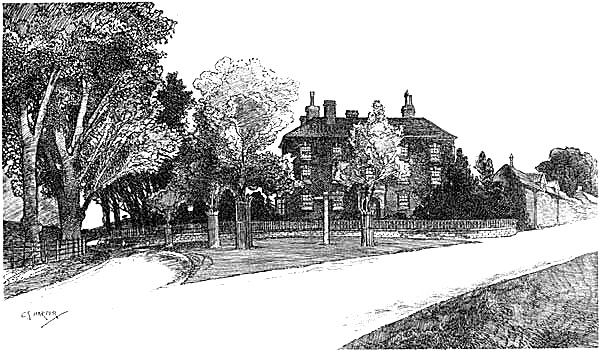
“BECKHAMPTON INN.”
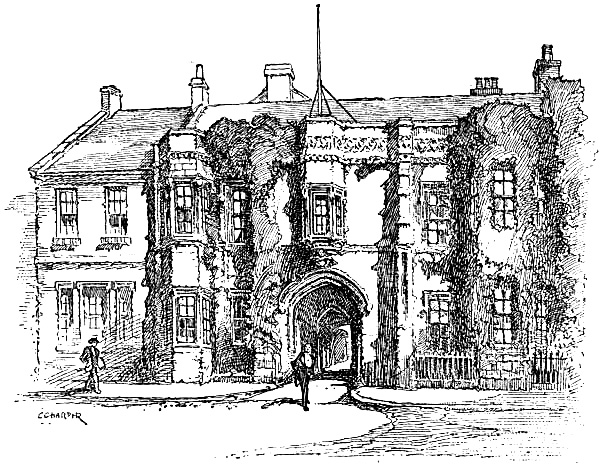
The “Angel” at Bury St. Edmunds, the scene of many stirring incidents in
Chapters XV. and XVI., is an enormous house of very severe and
unornamental architecture, that looks as though it were an exercise in
rectangles and a Puritan protest in white Suffolk, dough-like brick,
against the mediæval pomps and vanities of the beautiful carved stone
Abbey Gatehouse, upon which it looks, gauntly, across the great open,
plain-like, empty thoroughfare of Angel Hill. This, the chief coaching-
and posting-house of Bury, was built in 1779 upon the site of a
fifteenth-century “Angel,” and the present structure still stands upon
groined crypts and cellars.
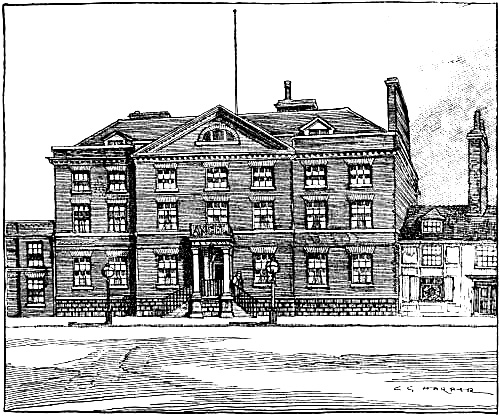
THE “ANGEL,” BURY ST. EDMUNDS.
None may be so bold as to name for certain that tavern off Cheapside in
Chapter XX., to which the worried Mr. Pickwick “bent his steps” after the
interview with Dodson and Fogg, in Freeman’s Court, Cornhill. We know it
was in some court on the right-hand, or north, side of Cheapside; but, on
the other hand, we do not know how far Mr. Pickwick had proceeded along
that thoroughfare when Sam recommended, as a suitable place for “a glass
of brandy and water warm,” the “last house but vun on the same side the
vay—take the box as stands in the first fireplace, ’cos there an’t no leg
in the middle o’ the table, wich all the others has, and it’s wery
inconwenient.” Probably Grocers’ Hall Court is meant. It has still its
coffee-and chop-houses.
There it is that Tony Weller is introduced, and suggests that, as he is
“working down” the coach to Ipswich in a couple of days’ time, from the
“Bull” inn Whitechapel, Mr. Pickwick had better go with him. An incidental
allusion is made in the same place to the “Black Boy” at Chelmsford, a
fine old coaching inn, destroyed in 1857.
Mr. Pickwick was a good—nay, a phenomenal—pedestrian for so stout a man.
From Cheapside—fortified possibly by the brandy and water—he walked to
Gray’s Inn, there ascending two pairs of steep (and dirty) stairs, and
thence to Clare Market, and the “Magpie and Stump,” described as “situated
in a court, happy in the double advantage of being in the vicinity of
Clare Market and closely approximating to the back of ‘New Inn.’”
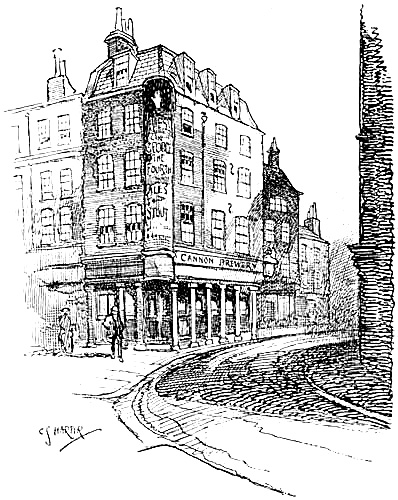
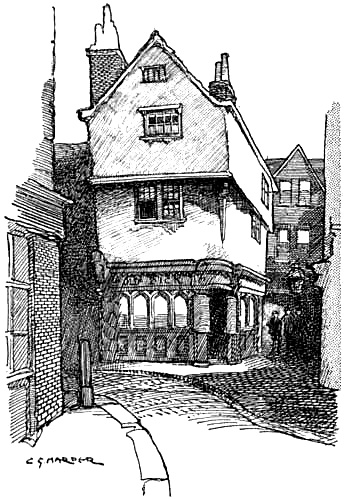
THE “GEORGE THE FOURTH TAVERN,” CLARE MARKET.
It was “what ordinary people would designate a public-house,” and has been
identified by most with the “Old Black Jack” in Portsmouth Street, or its
next-door neighbour, the “George the Fourth Tavern,” both demolished in
1896. The last-named house was remarkable for entirely overhanging the
pavement, the very tall building being supported on wooden posts springing
from the kerb. In the words of Dickens: “In the lower windows, which were
decorated with curtains of a saffron hue, dangled two or three printed
cards, bearing reference to Devonshire cyder and Dantzic spruce, while a
large black board, announcing in white letters to an enlightened public
that there were 500,000 barrels of double stout in the cellars of the
establishment, left the mind in a state of not unpleasing doubt and
uncertainty as to the precise direction in the bowels of the earth in
which this mighty cavern might be supposed to extend. When we add that the
weather-beaten sign-board bore the half-obliterated semblance of a magpie
intently eyeing a crooked streak of brown paint, which the neighbours had
been taught from infancy to consider as the ‘stump,’ we have said all that
need be said of the exterior of the edifice.”
The “Black Jack,” next door, was in the eighteenth century the scene of
one of the famous Jack Sheppard’s exploits. The Bow Street runners entered
the house after him, and, as they went in at the door, he jumped out of a
first-floor window. In thieving circles the house was afterwards known as
“The Jump.” The “Black Jack,” however, romantic though the title sounds,
did not owe its name to Sheppard, but to that old style of vessel, the
leathern jacks or jugs of the Middle Ages. For their better preservation,
the old leathern jacks were often treated with a coating of pitch: hence
the name of “pitcher,” at a very early period enlarged to denote jugs in
general, whether of leather or of earthenware.
The proverbial pitcher that goes often to the well and is broken at last
could not possibly be a leathern one, for the greatest virtue of the
leathern vessel was its indestructible nature, well set forth in the old
song of “The Leather Bottel”:
And when the bottle at last grows old,
And will good liquor no longer hold,
Out of its sides you may make a clout
To mend your shoes when they’re worn out;
Or take and hang it upon a pin—
’Twill serve to put hinges and odd things in.
So I hope his soul in Heaven may dwell
Who first found out the Leather Bottel.
Such leather bottles, some of them very ancient, are often to be found,
even at this day, in the barns and outhouses of remote hamlets, with a
side cut away to receive those “hinges and odd things” of the verse. They
are also often used to hold cart-grease.
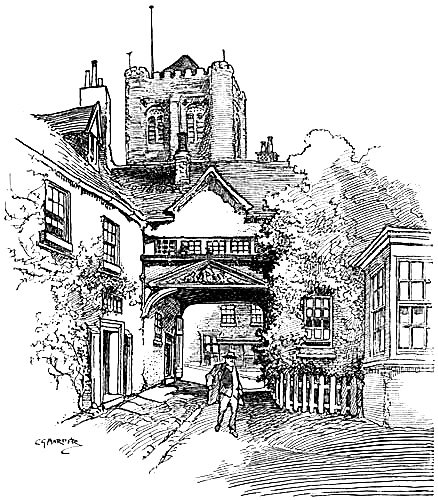
The “Bull,” Whitechapel, whence Mr. Tony Weller “worked down” to Ipswich,
was numbered No. 25, Aldgate High Street. It stood in the rear of the
narrow entry shown in the accompanying illustration. Rightly, it will be
seen, did Mr. Tony Weller advise the “outsides” on his coach to “take care
o’ the archvay, gen’lm’n.” The “Bull” was long occupied by the widowed
Mrs. Ann Nelson—one of those stern, dignified, magisterial women of
business who were a quite remarkable feature of the coaching age, who saw
their husbands off to an early grave, and alone carried on the peculiarly
exacting double business of innkeeping and coach-proprietorship, and did
so with success. Mrs. Ann Nelson—no one ever dared so greatly as to spell
her name “Anne”—was the Napoleon and Cæsar combined of the coaching
business on the East Anglian roads, and accomplished the remarkable
feat—remarkable for an innkeeper in the East End of London—of also
owning that crack mail-coach of the West of England Road, the Devonport
“Quicksilver.” As Mrs. Nelson would permit no “e” to her Christian name,
so also she would never hear of her house being called “hotel.” It was, to
the last, the “Bull Inn”; as you see in the illustration, with Martin’s
woollen-drapery shop, formerly that of James Johnson, whip-maker, on the
one side and that of Lee, the confectioner, on the other. Richard Lee
himself you perceive standing on the pavement, taking a very keen interest
in the coach emerging from the yard, as he had every reason to do; for he,
like William Lee, his father before him, was a partner, though not a
publicly acknowledged one, with Mrs. Nelson, and the money he made out of
his jam tarts he invested, with much profit to himself, in that autocratic
lady’s coaching speculations.
From the date of the opening of the Eastern Counties Railway, in 1839, the
business of the “Bull” began to decline, and the house was at length sold
and demolished in 1868.[16]
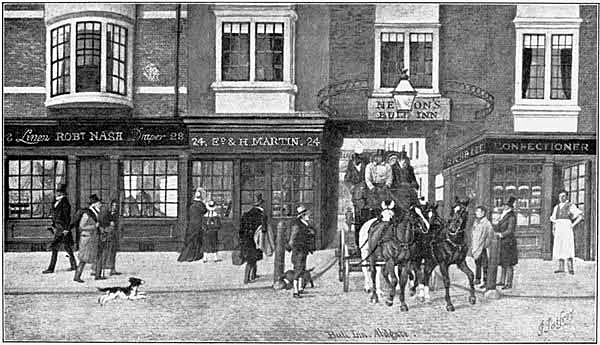
THE “BULL INN,” WHITECHAPEL.
From the water-colour drawing by P. Palfrey.
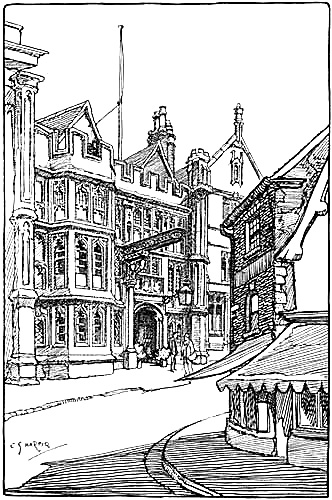
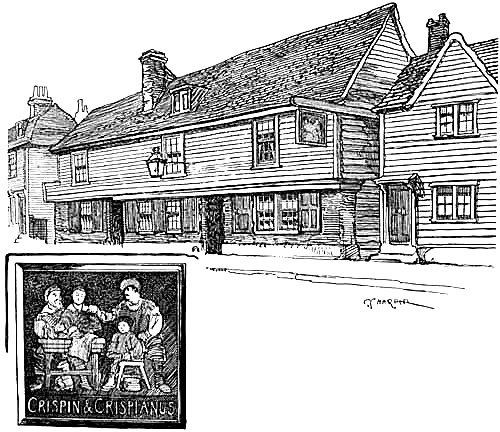
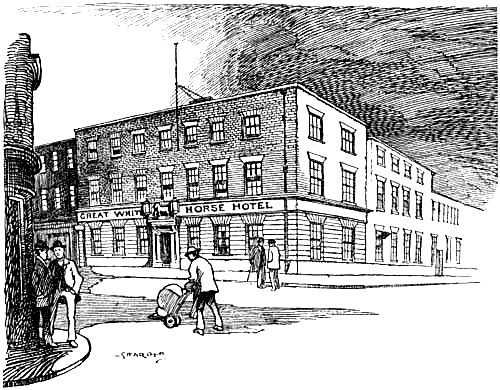
The journey from the “Bull” ended at the “Great White Horse” at Ipswich, a
house that still survives and flourishes on the notice (including even the
abuse) that Dickens gave it. The “Great White Horse” is neither ancient
nor beautiful; but it is great and it is white, for it is built of a
pallid kind of brick strongly suggesting under-done pastry, and it is in
these days the object to which most visitors to Ipswich first turn
their attention, whether they are to stay in the house or not.
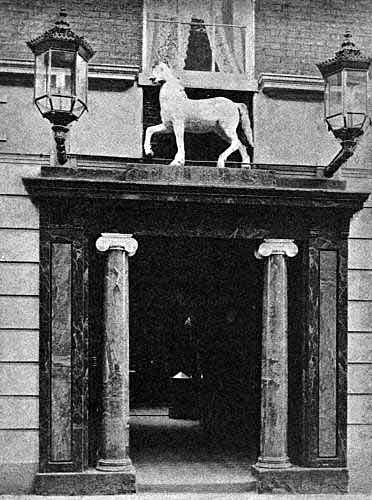
DOORWAY OF THE “GREAT WHITE HORSE,” IPSWICH.
In the merry days of the road, when this huge caravanserai was built, it
was justly thought enormous; but it has been left to the present age to
build many hotels in town and country capable of containing half-a-dozen
or more hostelries the size of the “Great White Horse,” which by
comparison with them is as a Shetland pony is to the great hairy-legged
creatures that still, even in these “horseless” times, haul waggons and
brewers’ drays.
Especially did the bulk of this house strike the imagination of that young
reporter of the London Morning Chronicle who in 1830 was despatched to
Ipswich for the purpose of reporting a Parliamentary election. That
reporter was, of course, Dickens. The inn made so great an impression upon
him that, when he wrote about it in the pages of Pickwick, a few years
later, his description was as exact as though it had been penned on the
spot.
It was not a flattering description. Few more severe things have ever been
said of an inn than those Dickens said of the “Great White Horse.” Yet,
such is the irony of time and circumstance, the house Dickens so roundly
attacked is now eager, in all its advertisements, to quote the Dickensian
association; and the adventures of Mr. Pickwick in the double-bedded room
(now identified with No. 36) of the elderly lady in yellow curl-papers
have attracted more visitors than the unfavourable notice has turned away.
“The ‘Great White Horse,’” said Dickens, “is famous in the neighbourhood
in the same degree as a prize ox, or county-paper-chronicled turnip, or
unwieldy pig—for its enormous size. Never were there such labyrinths of
uncarpeted passages, such clusters of mouldy, ill-lighted rooms, such huge
numbers of small dens for eating or sleeping in, beneath any one roof, as
are collected together between the four walls of the ‘Great White Horse’
at Ipswich.”
The house was evidently then an exception to the rule of the “good old
days,” of comfort and good cheer and plenty of it; for, passing the
corpulent and insolent waiter, “with a fortnight’s napkin under his arm
and coeval stockings on his legs,” Mr. Pickwick entered only to find the
dining-room “a large, badly furnished apartment, with a dirty grate, in
which a small fire was making a wretched attempt to be cheerful, but was
fast sinking beneath the dispiriting influence of the place. After the
lapse of an hour, a bit of fish and a steak were served up to the
travellers,” who then, ordering “a bottle of the worst possible port wine,
at the highest possible price, for the good of the house, drank brandy and
water for their own.”
I may here mention the singular parallel in Besant and Rice’s novel, The
Seamy Side, where, in Chapter XXVIII., you will find Gilbert Yorke going
to the hotel at Lulworth, in Dorset, and there ordering, like another Will
Waterproof, “for the good of the house,” “a pint of port” after dinner.
He, we are told, could not drink “the ardent port of country inns,” and
therefore “he poured the contents of the bottle into a pot of mignonette
in the window.... The flowers waggled their heads sadly and then drooped
and died,” as of course, being notoriously total abstainers, they could
not choose but do. But it was unfair, alike to the port and the plants.
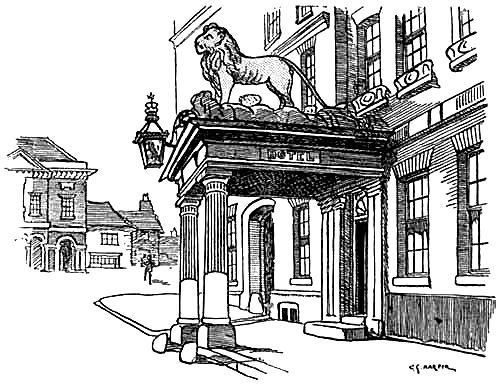
THE “GREAT WHITE HORSE,” IPSWICH.
How changed the times since those when Mr. Pickwick stayed at the “Great
White Horse!” We read how, after his unpleasant adventure with the lady in
the yellow curl-papers, he “stood alone, in an open passage, in the middle
of the night, half dressed,” and in perfect darkness, with the
uncomfortable knowledge that, if he tried to find his own bedroom by
turning the handles of each one in succession “he stood every chance of
being shot at, and perhaps killed, by some wakeful traveller.” No one in a
similar position would have that fear now: and even American guests,
commonly supposed to “go heeled,” i.e. to carry an armoury of
six-shooters about them, do not invariably sleep with their
shooting-irons under their pillows.
The exterior of the “Great White Horse” is much the same as when Dickens
saw it, “in the main street of Ipswich, on the left-hand side of the way.”
Still over the pillared portico trots the effigy of the Great White Horse
himself, “a stone statue of some rampacious animal, with flowing mane and
tail, distantly resembling an insane cart-horse”; but the old courtyard
has in modern times been roofed in with glass, and is now a something
partaking in equal parts of winter-garden, smoking-lounge, and bar.
Returning again to London from Ipswich, Mr. Pickwick, giving up his
lodgings in Goswell Road with the treacherous Mrs. Bardell, took up his
abode in “very good old-fashioned and comfortable quarters, to wit, the
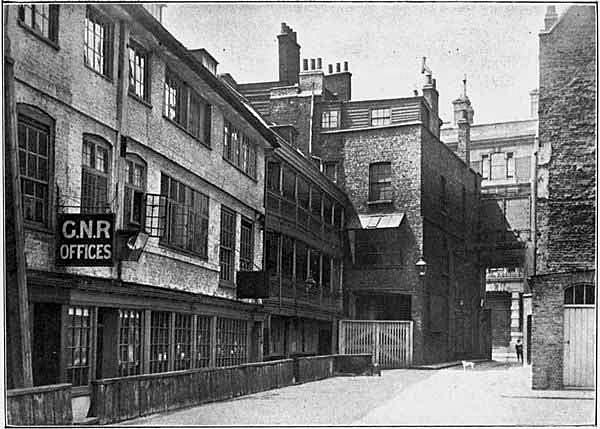
‘George and Vulture’ Tavern and Hotel, George Yard, Lombard Street.”
One may no longer stay at the “George and Vulture,” and indeed, if one
might, I do not know that any one would choose, for after business hours,
and on Sundays and holidays, the modern George Yard, now entirely hemmed
in with the enormous buildings of banks and insurance-companies, is a
dismally deserted and forbidding place. The sunlight only by dint of great
endeavour comes at a particular hour slanting down to one side of the
stony courtyard, and the air is close and stale. But on days of business,
and in the hours of business, in the continual stream of passers-by, you
do not notice these things. Many of those whom you see in George Yard
disappear, a little mysteriously it seems, in an obscure doorway, tucked
away in an angle. It might, in most likelihood, be a bank to which they
enter; but, as a sheer matter of fact, it is the “George and Vulture”: in
these days one of the most famous of City chop-houses.
I have plumbed the depths of depravity in chops, and have found them often
naturally hard, tasteless, and greasily fat; or if not naturally depraved,
the wicked incapacity of those who cook them has in some magic way
exorcised their every virtue. It matters little to you whether your chop
be innately uneatable, or whether it has acquired that defect in the
cooking: the net result is that you go hungry.
At the “George and Vulture,” as before noted, you may not stay—or “hang
out,” as it was suggested by Bob Sawyer that Mr. Pickwick did—but there
you do nowadays find chops of the best, cooked to perfection on the grill,
and may eat off old-world pewter plates and, to complete the ideality of
the performance, drink ale out of pewter tankards; all in the company of a
crowded roomful of hungry City men, and in a very Babel of talk. And, ah
me! where does the proprietor get that perfect port?
Between Chapters XXVI. and XXXIV. we have a perfect constellation—or
rather, a species of cloudy Milky Way—of inns, nebulous, undefined; but
in Chapter XXXV. we find Mr. Pickwick, on his way to Bath, waiting for the
coach in the travellers’-room of the “White Horse Cellar,” Piccadilly,
a very brilliant star of an inn, indeed, in its day; but rather a
migratory one, for in the coaching age it was removed from its original
site at the corner of Arlington Street, where the Ritz Hotel stands now,
to the opposite side of the road, at the corner of Albemarle Street. There
it remained until 1884, when the old house was pulled down and the present
“Albemarle” built in its stead.
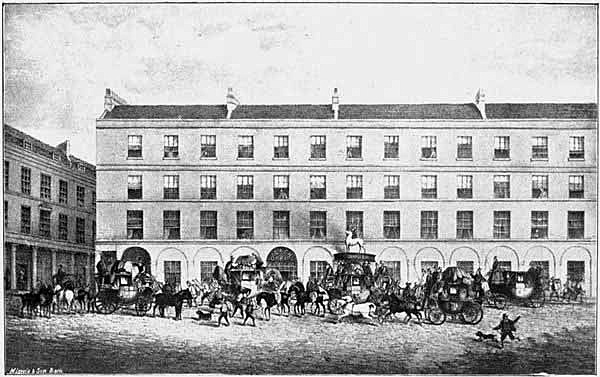
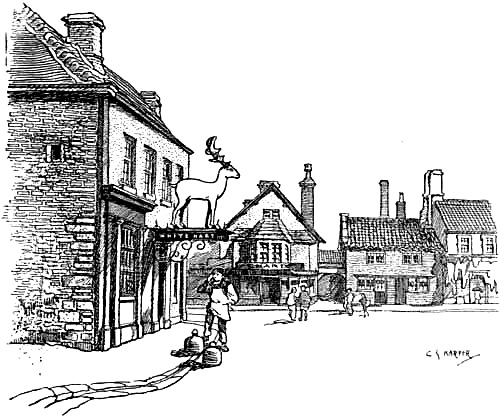
THE “WHITE HART,” BATH.
Mr. Pickwick was “twenty minutes too early” for the half-past seven
o’clock in the morning coach, and so, leaving Sam Weller single-handedly
to contend with the seven or eight porters who had flung themselves upon
the luggage, he and his friends went for shelter to “the
travellers’-room—the last resource of human dejection”—railways in
general and the waiting-rooms of Clapham Junction in especial not having
at that time come into existence, to plunge mankind into deeper abysms of
melancholia.
“The travellers’-room at the ‘White Horse Cellar’ is, of course,
uncomfortable; it would be no travellers’-room if it were not. It is the
right-hand parlour, into which an aspiring kitchen fireplace appears to
have walked, accompanied by a rebellious poker, tongs, and shovel. It is
divided into boxes, for the solitary confinement of travellers, and is
furnished with a clock, a looking-glass, and a live waiter: which latter
article is kept in a small kennel for washing glasses, in a corner of the
apartment.”
So now we know what the primeval ancestor of the Railway Waiting-room,
with its advertisements of cheap excursions to places to which you do not
want to go, and its battered Bible on the table was like, and it seems
pretty clear that, whatever the travellers’-room of a coaching inn might
have been, its present representative is a degenerate.
Chapter XXXV. sees Mr. Pickwick and his friends arrived at Bath and duly
installed in “their private sitting-rooms at the ‘White Hart’ Hotel,
opposite the great Pump-room, where the waiters, from their costume, might
be mistaken for Westminster boys, only they destroy the illusion by
behaving themselves much better.”
Until its last day, which came in 1864, the great “White Hart,” owned by
the Moses Pickwick from whose name Dickens probably derived that of the
immortal Samuel, maintained the ceremonial manners of an earlier age, and
habited its waiters in knee-breeches and silk stockings, while the
chambermaids wore muslin caps. The Grand Pump-room Hotel now stands on the
site of the “White Hart,” and the well-modelled effigy of the White Hart
himself, seen in the illustration of the old coaching inn, has been
transferred to a mere public-house of the same name in the slummy suburb
of Widcombe.
Round the corner from Queen Square, Bath, is the mean street where Dickens
pilgrims may gaze upon the “Beaufort Arms,” the mean little public-house
identified, on a very slender thread, with the “greengrocer’s shop” to
which Sam Weller was invited to the footmen’s “swarry.” The identification
hangs chiefly by the circumstance that it is known to have been the
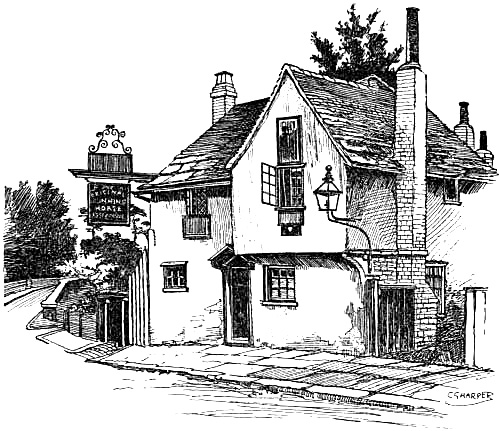
particular meeting-place of the Bath footmen, just as the “Running
Footman” in Hay Hill, London, is even at this day the chosen house of call
for the men-servants around Berkeley Square.
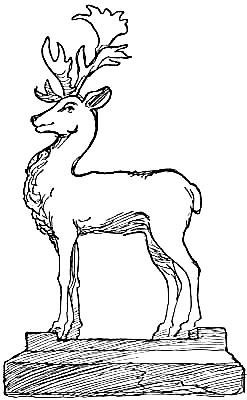
SIGN OF THE “WHITE HART,” BATH.
The “Royal Hotel,” whence Mr. Winkle fled by branch coach to Bristol, is
not to be found, and the “Bush” at Bristol itself is a thing of the past.
It stood in Corn Street, and was swept out of existence in 1864, the
Wiltshire Bank now standing on the site of it; but how busy a place it was
in Pickwickian days let the old picture of coaches arriving and departing
eloquently tell.
The inns of the succeeding chapters—the tavern (unnamed) at Clifton, the
“Farringdon Hotel,” the “Fox-under-the-Hill,” overlooking the river from
Ivy Bridge Lane in the Strand, the “New Hotel,” Serjeant’s Inn Coffee
House, and Horn’s Coffee House—are merely given passing mention, and it
is only in Chapter XLVI. that we come to closer touch with actualities, in
the arrest of Mrs. Bardell in the tea-gardens of the “Spaniards” inn,
Hampstead Heath. The earwiggy arbours of that Cockney resort are still
greatly frequented on Saturdays, Sundays, and public holidays.
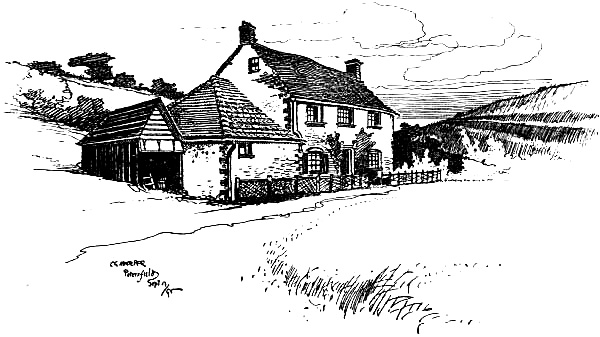
A very modest and comparatively little-known Pickwickian house is the
“Bell,” Berkeley Heath, on the dull, flat high-road between Bristol and
Gloucester, unaltered since the day when Mr. Pickwick set forth by
post-chaise with Mr. Bob Sawyer and his fellow-roysterer, Ben Allen, from
the “Bush” at Bristol for Birmingham. Here they had lunch, as the present
sign-board of the inn, gravely and with a quaint inaccuracy, informs us:
insisting that it was “Charles Dickens and party” who so honoured the
“Bell.” They had come only nineteen miles, and without any exertion on
their own part, yet when they changed horses here, at half-past eleven
a.m., Bob Sawyer found it necessary to dine, to enable them “to bear up
against the fatigue.”
“‘Quite impossible!’ said Mr. Pickwick, himself no mean trencherman.
“‘So it is,’ rejoined Bob; ‘lunch is the very thing. Hallo, you sir! Lunch
for three, directly, and keep the horses back for a quarter of an hour.
Tell them to put everything they have cold on the table, and some bottled
ale, and let us taste your very best Madeira.’”
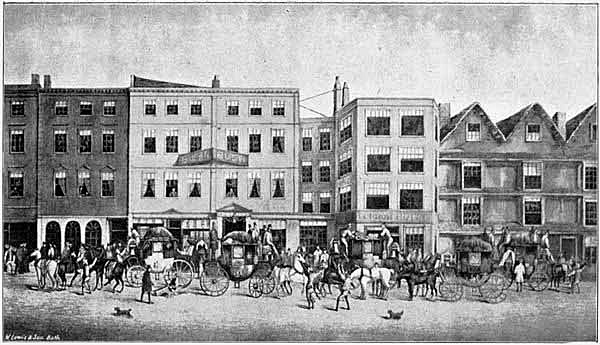
THE “BUSH,” BRISTOL.
Those were truly marvellous times. All the way from Bristol those three
had been drinking milk-punch, and had emptied a case-bottle of it, and we
may be quite sure (although it is not stated) that they made havoc of a
prodigious breakfast before they started; Yet they did “very great
justice” to that lunch, and when they set off again the case-bottle was
filled with “the best substitute for milk-punch that could be procured on
so short a notice.”
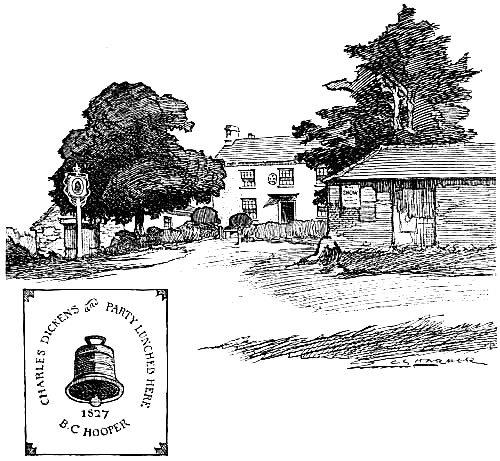
“THE BELL,” BERKELEY HEATH.
“At the ‘Hop-Pole’ at Tewkesbury they stopped to dine; upon which occasion
there was more bottled ale, with some more Madeira, and some port besides;
and here the case-bottle was replenished for the fourth time.” Therefore,
it is evident that, twice on the twenty-four miles between Berkeley Heath
and Tewkesbury, they had a re-fill.
We do not find Gloucester mentioned, although it must have been passed on
the way; but, under those circumstances, we are by no means surprised.
The “Hop Pole” at Tewkesbury is still a “going concern,” and, with the
adjoining gabled and timbered houses, is a notable landmark in the High
Street. Nowadays it proudly displays a tablet recording its Pickwickian
associations.
A drunken sleep (for it could have been nothing else) composed those two
“insides,” Mr. Pickwick and Ben Allen, on the way to Birmingham, while,
thanks in part to the fresh air, Sam Weller and Bob Sawyer “sang duets in
the dickey.” By the time they were nearing Birmingham it was quite dark.
The postboy drove them to the “Old Royal Hotel,” where an order for that
surely very necessary thing, soda-water, having been given, the waiter
“imperceptibly melted away”: a proceeding that, paradoxically enough,
seems to have been initiated by the house itself, years before; for it was
about 1825, two years before the Pickwickians are represented as starting
on their travels, that the “Old Royal” was transferred from Temple Row to
New Street, and there became the “New Royal.”
The inn at Coventry, at which the post-horses were changed on the journey
from Birmingham, is unnamed, unhonoured, and unsung; but very famous, in
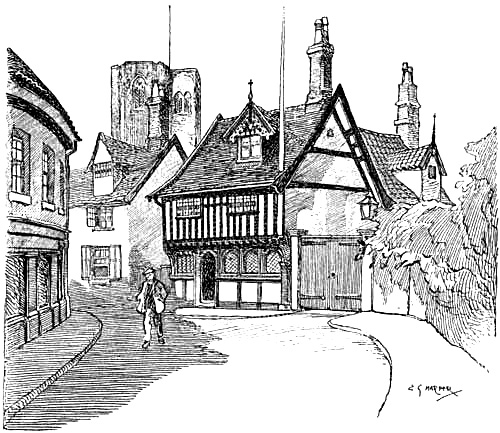
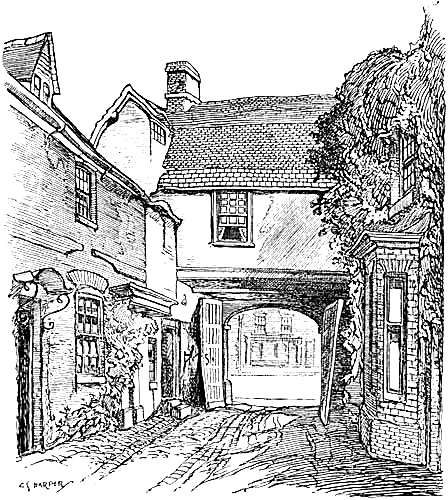
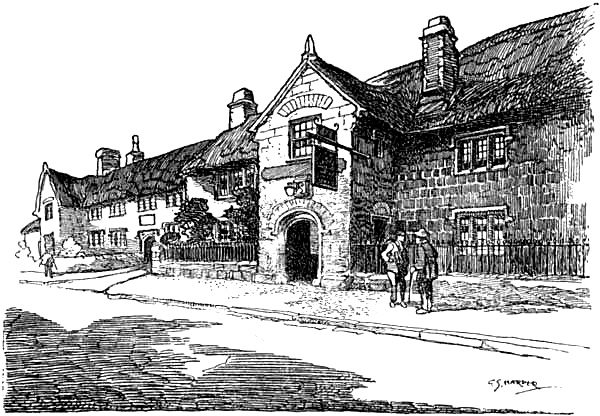
the Pickwickian way, is the “Saracen’s Head” at Towcester, or “Toaster,”
as the townsfolk call it, even though its identity is a little obscured by
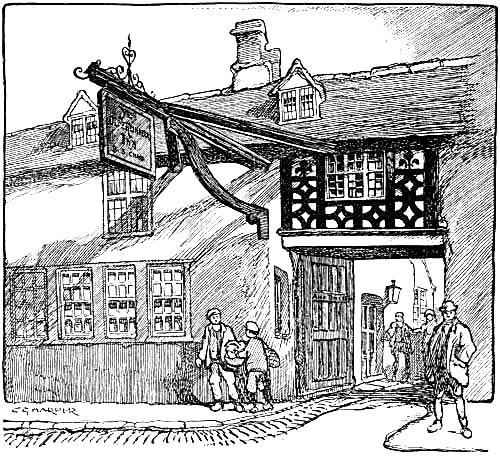
the sign having been exchanged for that of the “Pomfret Arms.” The change,
which was actually made in April, 1831, was a complimentary allusion to
the Earls of Pomfret, who before the title became extinct, in 1867,
resided at the neighbouring park of Easton Neston.
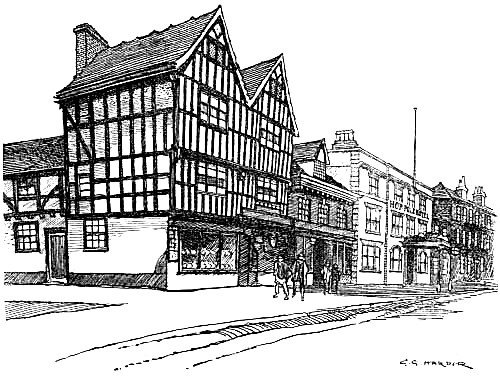
THE “HOP-POLE,” TEWKESBURY.
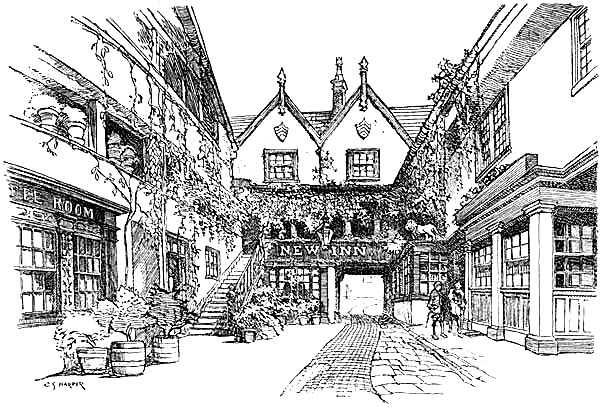
In all essentials the inn remains the same as the old coaching hostelry to
which Mr. Pickwick and his friends drove up in their post-chaise, after
the long wet journey from Coventry. As “at the end of each stage it rained
harder than it had done at the beginning,” Mr. Pickwick wisely decided to
halt here.
“There’s beds here,” reported Sam; “everything’s clean and comfortable.
Wery good little dinner, sir, they can get ready in half an hour—pair of
fowls, sir, and a weal cutlet; French beans, ’taturs, tarts, and tidiness.
You’d better stop vere you are, sir, if I might recommend.”
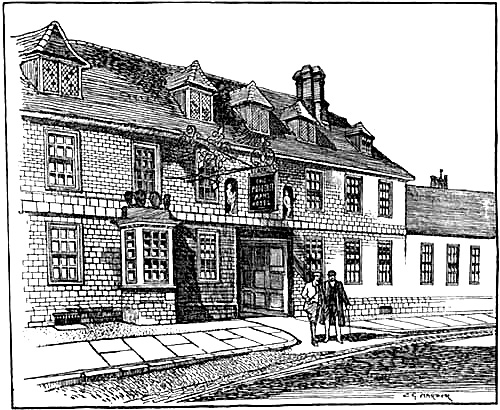
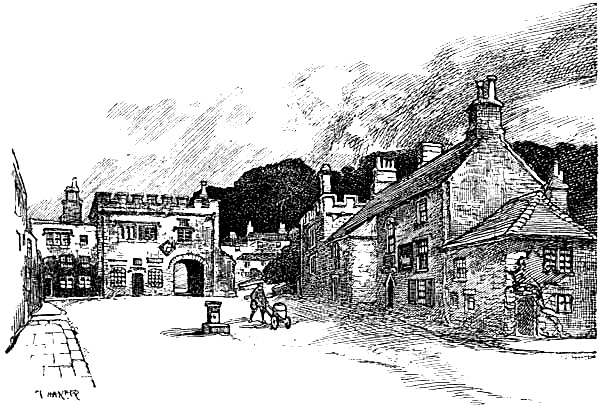
THE “POMFRET ARMS,” TOWCESTER: FORMERLY THE “SARACEN’S HEAD.”
At the moment of this earnest colloquy in the rain the landlord of the
“Saracen’s Head” appeared, “to confirm Mr. Weller’s statement relative to
the accommodations of the establishment, and to back his entreaties with a
variety of dismal conjectures regarding the state of the roads, the doubt
of fresh horses being to be had at the next stage, the dead certainty of
its raining all night, the equally mortal certainty of its clearing up in
the morning, and other topics of inducement familiar to innkeepers.”
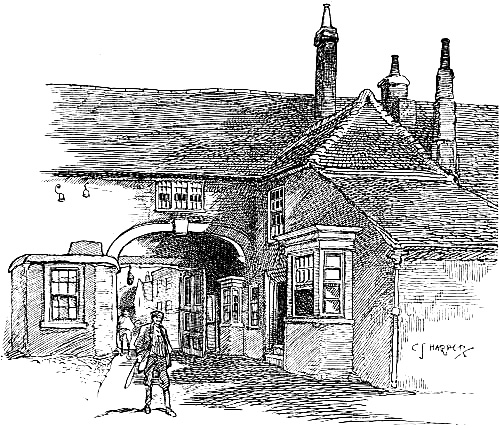
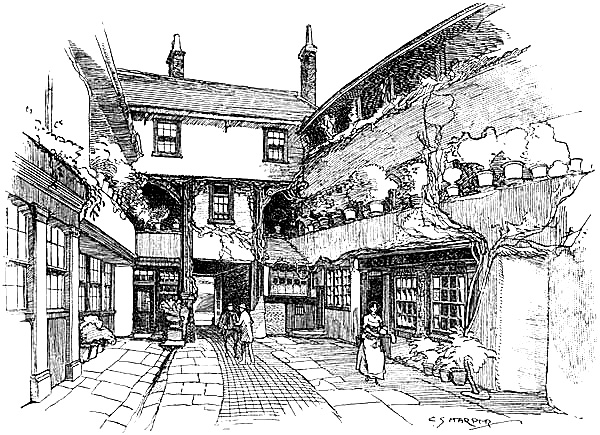
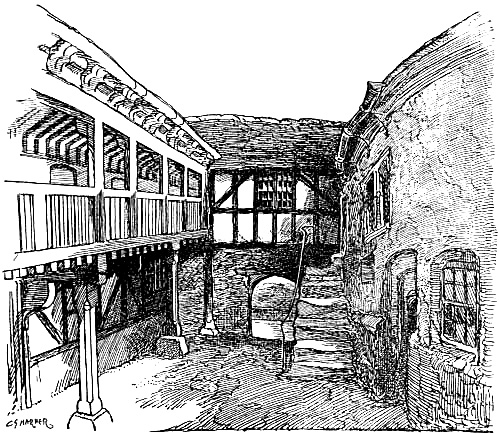
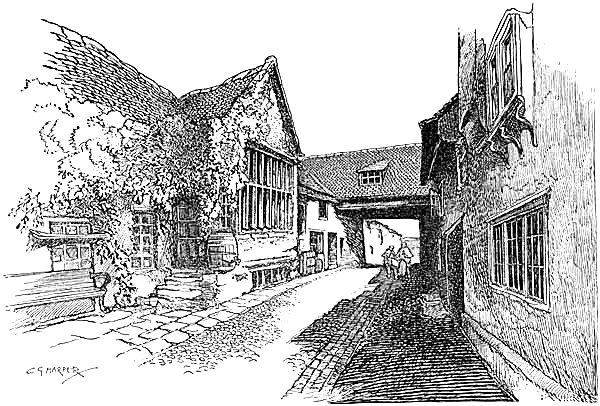
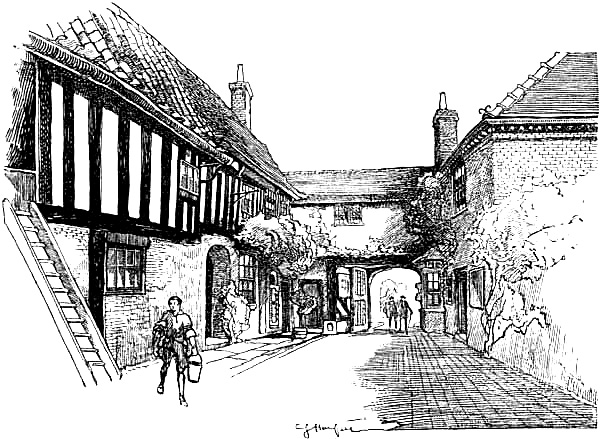
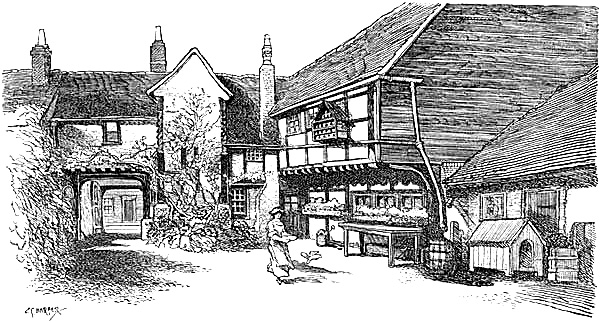
THE YARD OF THE “POMFRET ARMS.”
When Mr. Pickwick decided to stay, “the landlord smiled his delight” and
issued orders to the waiter. “Lights in the Sun, John; make up the fire;
the gentlemen are wet!” he cried anxiously, although, doubtless, if the
gentlemen had gone forward they might have been drowned, for all he cared.
And so the scene changed from the rain-washed road to a cosy room, with a
waiter laying the cloth for dinner, a cheerful fire burning, and the
tables lit with wax candles. “Everything looked (as everything always does
in all decent English inns) as if the travellers had been expected, and
their comforts prepared for days beforehand.”
Upon this charming picture of ease at one’s inn descended the atrabilious
rival editors of The Eatanswill Gazette and The Eatanswill
Independent, the organs respectively of “blue” and “buff” shades of
political opinion. Pott of the Gazette, and Slurk of the Independent
each found his rival sheet lying on the tables of the inn; but what either
of those editors or those newspapers were doing here in Northamptonshire
(Eatanswill being a far-distant East Anglian town, by general consensus of
opinion identified with Ipswich) is one of those occasional lapses from
consistency that in Pickwick give the modern commentator and annotator
food for speculation.
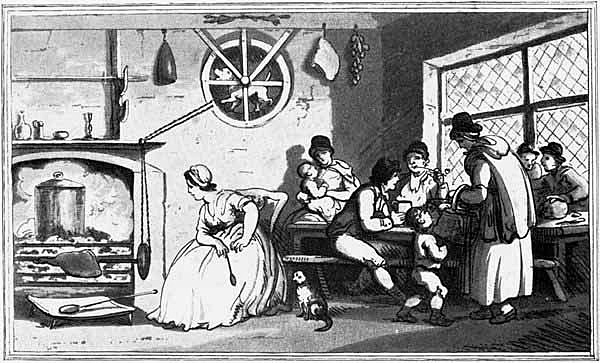
When the inn was closed for the night Slurk retired to the kitchen to
drink his rum and water by the fire, and to enjoy the bitter-sweet luxury
of sneering at the rival print; but, as it happened, Mr. Pickwick’s party,
accompanied by Pott, also adjourned to the kitchen to smoke a cigar or so
before bed. How ancient, by the way, seems that custom! Does any guest,
anywhere, in these times of smoking-rooms, withdraw to the kitchen to
smoke his cigar, pipe, or cigarette?
How the rival editors—the “unmitigated viper” and the “ungrammatical
twaddler”—met and presently came from oblique taunts to direct abuse of
one another, and thence to a fight, let the pages of The Pickwick
Papers tell. For my part, I refuse to believe that there were ever such
journalists.
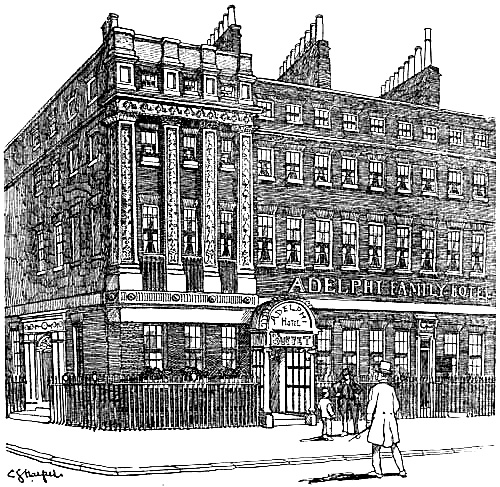
“OSBORNE’S HOTEL, ADELPHI.”
What was once the kitchen of the “Saracen’s Head” is now the bar-parlour
of the “Pomfret Arms”; but otherwise the house is the same as when Dickens
knew it. The somewhat severe frontage loses in a black-and-white drawing
its principal charm, for it is built of the golden-brown local ferruginous
sandstone of the district.
The journey to London is carried abruptly from Towcester to its ending at
the “George and Vulture”; and with “Osborne’s Hotel in the Adelphi” the
last inn to be identified in the closing scenes of Pickwick is reached.
That staid family hotel, still existing in John Street, and now known as
the “Adelphi,” is associated with the flight of Emily Wardle and
Snodgrass. The sign of the last public-house in the story, “an excellent
house near Shooter’s Hill,” to which Mr. Tony Weller, no longer “of the
Bell Savage,” retired, is not disclosed.