It now becomes necessary to go back and trace out the
origins of the organizations which were consolidated with
the 1st Regiment in 1878. Let us first give attention to the
companies which bore the title of 4th Battalion. We shall
discover a battalion or regimental history stretching back
to 1834, and company records commencing as early as 1787.
Three “independent companies” of infantry were listed
in the roster of 1788 as connected with the 1st Division,
Suffolk. One of these disappeared from the records the
following year, and another in 1792. The lone survivor yet
survives—in fact is the 3d Company, M. C. A., otherwise
known as the Independent Boston Fusiliers.
On May 11, 1787, the Governor’s Council voted to approve
an application signed by Thomas Adams and fifty-three
others, and to charter a company. Gov. James Bowdoin
presided at the Council meeting and himself introduced the
petition. On the following July 4, he stood with the members
of the new company on the slope of Bunker Hill and,
at that shrine of American liberty, presented them their
official charter. They next proceeded to the home of John
Hancock, soon to be Governor, and at his liberal table, as his
guests, enjoyed an inaugural dinner. The Fusiliers have
excelled in many military lines thruout their long and honorable
history—by no means least of their attainments is the
masterly skill with which they have maintained the custom
of dining together. Their motto, Aut vincere aut mori,
seemed high-sounding in the early years. “Conquer or die”
presented harsh alternatives. But the time was to come
seventy-five years later when the nation needed just such
stern, self-sacrificing devotion; and then the Fusiliers indeed
lived up to their motto. The Fusiliers wore red coats,
in commemoration of certain gallant foemen with whom
America had recently been engaged. As the Cadets were
then clad in white and another company in blue, a striking
patriotic ensemble was produced by the grouping of uniforms
whenever the independent companies paraded. William
Turner was elected the first Fusilier Captain; the names
of his successors are recorded elsewhere in this book. No
wonder that the Fusiliers, actives or veterans, have always
been noted for maintaining the most successful and distinguished
military ball in all Boston, the military-social event
of the year; for their first Captain was, by profession,
a dancing-master. Capt. Turner was succeeded by Capt.
Joseph Laughton, who when not on militia duty, was occupied
as a clerk in the Treasurer’s office.
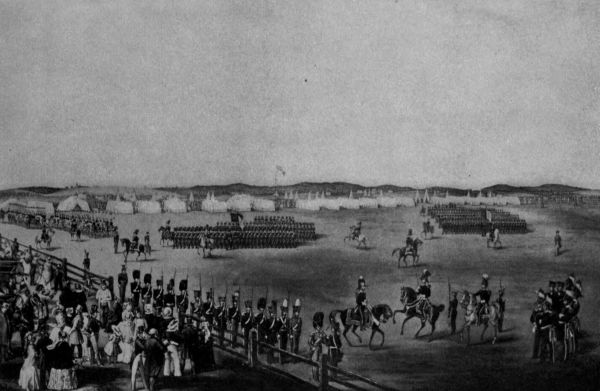
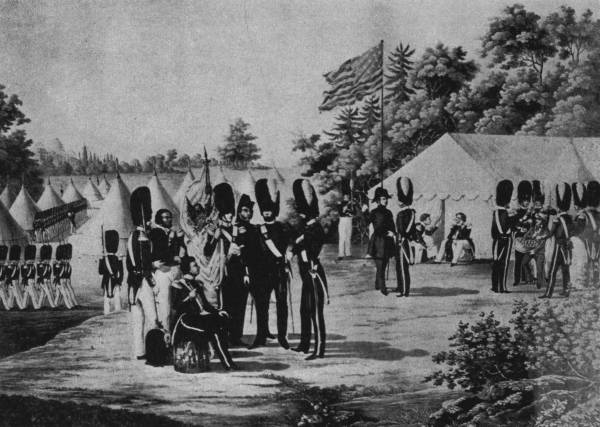 The Fusiliers about 1845
After 1798 the Fusiliers were never without vigorous and
congenial companionship. Enthusiasm was then in full
flood; George Washington had shown his patriotism by consenting
to accept a subordinate position, that of Lieutenant
General of the army under President John Adams; and men
were enrolling themselves in the new legionary brigade.
America was aflame with indignation over French injustice.
On September 4, 1798, the Boston Light Infantry was organized
after four months of preliminary meetings—the
body which today reports to the Adjutant as the 2d Company,
M. C. A. Their motto, “Death or an honorable life,”
is a ringing echo of Charles C. Pinckney’s immortal words,
“Millions for defence; not one cent for tribute.” At the
first banquet of the company, Oct. 18, 1798, when the charter
was received, the principal toast was—“The United States
of America; as they have drawn the sword of justice with
reason, may they never sheathe it with disgrace.” Would
that this sentiment might always prevail with the authorities
in Washington! Amongst the members present at this banquet
were sons or near relatives of such patriots as Paul
Revere, James Otis and Joseph Warren. Truly the sons
were rallying about the standard of the fathers. Drills were
first held in the old State House, and after 1802 in Faneuil
Hall.
There were lovers of Shakespeare in the Boston Light
Infantry. At a dinner in 1815 one of them gave point to his
speech by quoting the words of Henry V, hero of Agincourt:
“In peace, there’s nothing so becomes a man,
As modest stillness, and humility:
But when the blast of war blows in our ears,
Then imitate the action of the tiger.”
All of the speech was forgotten except the final words of
the quotation, “The tiger!” Company orators kept repeating
the expression. Ere long the Boston Light Infantry
found itself provided with a nickname—and it is best known
thruout its long history as “The Tigers.”
In 1800 the Fusiliers under Capt. John Brazer and the
Tigers, Capt. Daniel Sargent (a merchant in civil life),
were the two light infantry companies constituting the sub-legion
of light infantry—both being entirely independent.
Indeed the sub-legion of light infantry had no field officer
until Feb. 14, 1806, when Capt. Daniel Messinger of the
Winslow Blues was elected Major. The Blues were organized
in 1799 and first appeared on the sub-legion roster in
1802. The Washington Light Infantry were organized
in 1803.
When in 1810 the legionary brigade was transformed into
the 3d Brigade, 1st Division, Maj. Messinger’s sub-legion
of light infantry was broken up and the companies were
distributed amongst the infantry regiments of the brigade.
The Fusiliers and the Washington Lt. Inf. were incorporated
with the 1st Reg., the Tigers with the 2d, and the
Winslow Blues with the 3d. These infantry regiments,
former “legionaries,” were neither train-band militia nor
independent uniformed volunteers. Their status was somewhere
between the two; it was hoped that the light infantry
companies might serve as leaven for the infantry,
and bring all up to the volunteer standard. The arrangement
continued until 1834. By that time it was clear that
only the independent companies, the “light” infantry, retained
any vitality; and they were separated from the infantry
regiments, and organized into a separate “Regiment
of Light Infantry, 3d Brigade.”
Non-commissioned officers of the light infantry companies
manifested active interest in the training school, “The Soul
of the Soldiery,” from 1811 until 1819 and later.
Another company was born amid the war excitement of
1812, the New England Guards. Even from the days of
their first Captain, Samuel Swett, it was felt that a distinguished
destiny awaited the organization. During their entire
half century of existence, they made constant effort to maintain
their personnel at the highest standard; and the effort
was crowned with success. An extant lithograph, in the
museum of the A. & H. Art. Co., shows the Guards in the
year 1836 parading with four platoons of twelve files each—numbers
indicative of the company’s popularity. They
were added to the 2d Regiment, and thereafter were associated
with the Tigers.
During the war with England the light infantry companies
rendered service at the harbor forts similar to that of the
artillery. By request of the commandant of the Charlestown
Navy Yard, the New England Guards were stationed
at the Chelsea bridge for eleven days from June 13, 1814,
in order to prevent an expected raid by a hostile landing
party. The entire membership of the Fusiliers was on duty
from Sept. 12 until Oct. 10, under Capt. Gerry Fairbanks
(a hatter in civil life); and detachments continued doing
garrison duty several weeks longer. The Tigers helped to
build Ft. Strong on Jeffries Point, East Boston; similar
activity characterized the other companies. Massachusetts’
crest is a sword borne by the arm of a civilian: Massachusetts
citizens in 1814 bore the sword effectively and well.
The light infantry companies participated in the same
parades and public festal occasions as did the artillery companies.
These events are elsewhere described in sufficient
detail. In the sterner task of maintaining public order the
New England Guards were on duty twice—July 7, 1824,
and Feb. 11, 1825,—in connection with conflagrations. In
both instances personal property had been saved from the
fire and temporarily deposited in a place of safety; and the
troops mounted guard against pillagers. The Tigers subscribed
the first $100 toward the cost of Bunker Hill
monument.
From the disbandment of Maj. Messinger’s battalion in
1810 until the organization of the regiment of light infantry
in 1834, the companies of light infantry were associated only
in the larger unit of the 3d Brigade. While the Coast Artillery
includes all the surviving units of that Brigade, and
altho the 3d Brigade was the most solid and efficient part of
the old militia, still it does not seem wise to treat Brigade
history in particular detail. Suffice it to say that four strong
companies of light infantry continued active in the infantry
regiments of the brigade—the Fusiliers in the 1st Regiment,
the Tigers and the New England Guards in the 2d, and the
Winslow Blues in the 3d. Lists of company commanders
are recorded elsewhere. A new branch of the service came
into existence, the “Rifles,” and were accorded precedence
over others—were given the right of the line in parades. In
appearance they differed from other troops, as they wore
jaunty green uniforms, and carried short flint-lock rifles
without bayonets. These riflemen aimed to reproduce the
famous corps under Daniel Morgan and others in the Revolutionary
war, the frontiersmen and rangers clad in buckskin
hunting-shirts who were so terrifying to America’s
enemies. It has always seemed strange to the writer that
the frontiersman’s costume, the only distinctively American
garb ever devised, should not continue in use. Not even
these new riflemen, however, succeeded in remaining true to
type. While they were fond of picturing themselves in the
hunting-shirt, the uniforms which they actually wore followed
German models. One valuable contribution the new
rifles did make to militia life, they were pioneers in setting
up target practice as part of the soldier’s training.
Light infantry and rifles were distinguished from other
infantry by the fact that they were trained in the skirmish
drill, and were alone qualified to perform outpost duty. In
line, they formed on the flanks of other companies. From
time to time additional commands aspired to become light
infantry, and some realized their aspirations. By 1834 there
were eight companies altogether in the infantry regiments
who felt dissatisfied with their regimental connection, and
resented the waning interest which regimental neighbors
displayed in things military. Their plan was to separate
from the infantry, and revive the old battalion of light infantry,
whose members should all be volunteers and uniformed,
the battalion which had been broken up in 1810—in
short, to organize a Light Infantry Regiment in the 3d
Brigade. From the 1st Regiment came the Fusiliers, the
Washington Lt. Infantry and the Mechanic Rifles; from the
2d the Tigers and the New England Guards; and from
the 3d the Winslow Blues, the City Guards (organized Sept.
21, 1821), and the Rifle Rangers (organized 1820). In
1835 a new company was added, the Lafayette Gds.
The new regiment was organized in Aug., 1834, with
eight companies, and Col. Amasa G. Smith of the 2d Regiment
was elected to command. A succession of field officers,
which had begun in 1806 with Major Messinger and had been
interrupted from 1810 until 1834, was thereafter to be continuous.
Col. Smith’s commission was dated July 29, 1834;
he continued in command until Feb. 23, 1838.
Judged by the standards of the day, Col. Smith’s regiment
was a very fine one, indeed was a “crack” command. No
less an authority than President Andrew Jackson is reported
to have testified, “I have never seen its equal.” Most of the
companies wore blue swallow-tail coats and white duck
trousers—the latter quite regardless of weather; gradually
blue nether garments were added for use on stormy days.
The two rifle companies wore green, the Rangers having
frock coats and uhlan hats; while extant engravings of the
City Guards in 1844, the year of their famous march to Baltimore,
show them clad in gray suits of a pattern precisely
the same as those worn by the New York 7th. The City
Guards were the first corps to wear gray in Boston; and
the Fusiliers were equally distinguished by reason of their
scarlet coats. While there was lack of regimental uniformity,
there must have been a striking ensemble when the companies
formed battalion line.
To the Fusiliers, in June, 1835, fell the honor of introducing
an important tradition into the regiment. For at that
time, after a year’s preparation, they undertook an excursion
to Washington, as a compliment to President Andrew Jackson,
who was soon to give place to Martin Van Buren. The
start was made after partaking of a collation at Gov. John
Davis’ house; progress was made by march, stage, steamboat
and rail; they camped on Capitol Hill; and dined with
Gen. Jackson at the White House. This was not exactly a
trip to “the inauguration,” but it proved to be the commencement
of a custom which today takes the command to Washington
once every four years.
In 1837 a company came into existence which was destined
to prove the temporary undoing of the Light Infantry Regiment,
and was also to subject Boston’s spirit of fairness
and right to its most searching test. The “Montgomery
Guards,” they were called. Altho named after the same
heroic Richard Montgomery who was to give title to another
and more famous company of Montgomery Guards fifteen
years later, they must not be confused with the latter body.
The critical point was that the members were all of Irish
birth; and Boston, for the first time in sixty years, found a
company of foreign soldiery in her midst. At least that was
the view of the matter taken by old-timers. The race prejudice
which later issued in the Know Nothing movement, at
once flamed up. On the other hand, these guardsmen had
all declared their intention of becoming American citizens,
and were entitled to bear arms. The guards were attached
to Col. Smith’s regiment. On Sept. 12, 1837, the date of
the fall field-day and the first assembly of the regiment
since the organization of the Montgomerys, the other nine
companies took post on the regimental line,—the Montgomerys
arriving last of all. No sooner had the latter swung
into position than the enlisted men of the City Guards, breaking
away from their officers, marched off the Common.
The enlisted men of the Fusiliers, the Blues, the Mechanics,
the Washingtons and the Lafayettes followed this example
of insubordination and broke ranks. It was sheer mutiny—mutiny
with which many of the public sympathized, but
mutiny nevertheless.
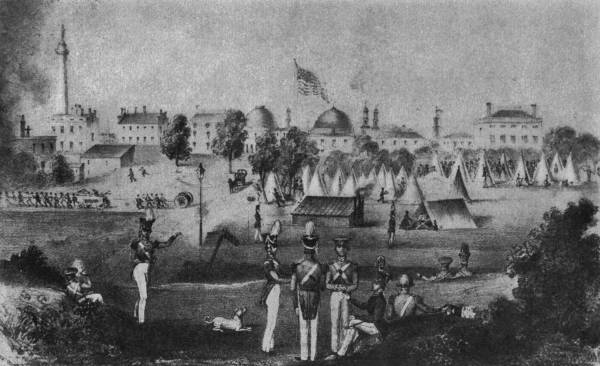 The Gray Uniform—The City Guards at Baltimore, 1844
Courts martial resulted, followed by prolonged public
discussion. Presently it became evident that the Boston
sense of fairness and right was strong enough even to meet
this test; and on Feb. 23, 1838, the offending companies were
punished by disbandment. Col. Smith went out of office at
this time. The Montgomery Guards were themselves disbanded
April 6, 1838. As a consequence the Regiment was
reduced to a battalion and placed under the command of
Maj. Charles C. Paine. The Tigers, the New England
Guards, and the Rifle Rangers alone survived the disbandment.
June 1, 1839, found the organization a regiment once
more, made up of the following companies: Tigers, New
England Guards, Pulaski Guards, who now transferred
from the 3d Reg., 3d Bri. (and who seem to have been
temporarily called Mechanic Greys in 1849), Columbian
Greys, Hancock Light Infantry, Rifle Rangers, Highland
Guards and Suffolk Light Guard. As the disbandment
had been intended for punitive purposes merely, encouragement
was held out for the companies to reorganize.
The device of reorganizing and “continuing the record”
was not then thought of. Had it been, it would doubtless
have been ordered; four companies took advantage of the
opportunity. The Columbian Greys were merely the old
City Guards under a new name; in 1844 they appeared on
the records as the City Greys, and by 1851 were known once
more as City Guards. Similarly the Hancock Light Infantry
continued the Fusiliers, the ancient corps being saved
by the loyalty of two former captains. Noah Lincoln, Jr.,
a prominent Boston shipwright, was in command of the
company when disbanded in 1838. On a May date in 1839
the Hancock Light Infantry elected the same Capt. Lincoln
to be their commander; but he did not deem it best to
accept. On May 17, 1839, the company proceeded to elect
Louis Dennis, a former Captain of Fusiliers who had risen
to field rank; and Maj. Dennis proved his loyalty to the old
corps by accepting a commission as Captain. Maj. Dennis
was a builder in civil life, and felt that the present emergency
called for constructive work along military lines; Capt. Lincoln
thereupon agreed to become 1st Lieutenant of the company.
After four or five years we cease to find reference
to the Hancock Light Infantry—the records again deal with
the Fusiliers. The Mechanic Rifles similarly reorganized in
1843, and the Washington Light Infantry a few years subsequently.
Col. Charles R. Lowell, formerly Captain of the
Rifle Rangers, commanded the reorganized regiment from
June 1, 1839, until March 20, 1840.
On April 24, 1840, in connection with the general state-wide
reorganization of the militia and the discontinuance of
the train-band, the Light Infantry Regiment, 3d Brigade,
received a number—it became the 1st Lt. Inf., 1st Brigade.
The following colonels commanded: George W. Phillips,
Aug. 27, 1840—May 18, 1841; Charles A. Macomber (formerly
captain of the disbanded City Guards), June 15, 1841—Aug.
24, 1841; George T. Bigelow, formerly captain of the
New England Guards, Sept. 11, 1841—Jan. 23, 1844; William
H. Spooner, April 15, 1844—Jan. 19, 1847, the same
Col. Spooner who had commanded the train-band regiment,
the 1st of the 1st Brigade, to which the Roxbury Artillery
was temporarily attached in 1832; Benjamin F. Edmands,
March 15, 1847—July 11, 1848 (then elected Brig. Gen.);
Col. Samuel Andrews, a former captain of the Tigers, July
28, 1848—May 13, 1850, when he became Brig. Gen.
When the New York 7th visited Boston in June, 1843,
they were guests of the Fusiliers (yet called Hancock Light
Infantry). After church services on Sunday, June 18, the
visitors were shown around to the chief points of interest.
How fashions do change! The principal shrine to which
pilgrimage was made was—Mt. Auburn Cemetery.
Veterans of the Mexican War organized a company in the
1st Regiment on June 18, 1849, to which they gave the title,
National Guards; and were the recognized representatives
of the 1st Mass. Mexican War Regiment. Ben Perley Poore,
a prominent newspaper correspondent, was elected Captain.
As it became difficult to secure a sufficient number of Mexican
veterans in Boston, admission was granted to all militia
veterans, after a few years. Capt. Poore presently removed
from Boston for business reasons, and made his residence
in Newburyport. There he became famous as Major of an
independent battalion of infantry; and altho absent from
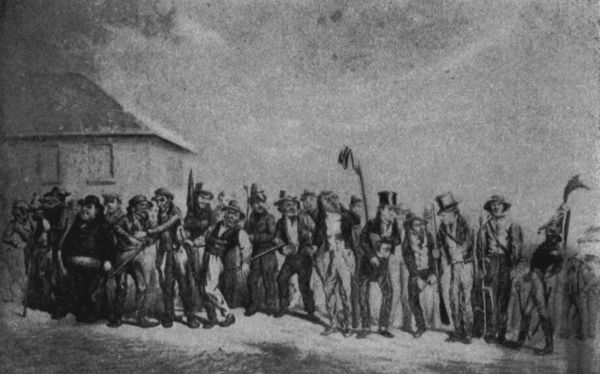
his Boston comrades, continued to retain a warm place in
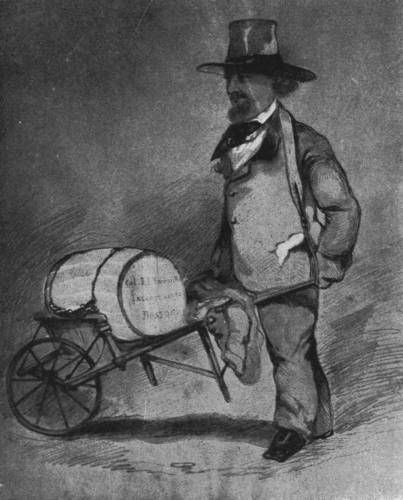
their hearts. In Nov., 1856, he had made an election bet
with Col. J. J. Burbank, proprietor of the Tremont House,
Boston, to the effect that Millard Fillmore would get the
Massachusetts electoral vote for President; and lost. So on
Saturday, Nov. 8, he paid the forfeit—by wheeling a barrel
of apples, on a wheelbarrow, all the way, thirty-six miles,
from Newburyport to Boston. Maj. Poore’s popularity
caused a wide-spread interest to develop in this feat; especially
in Boston were the streets thronged with friendly
spectators. When the Fusiliers learned of the plan, they
determined to have a part in it; so the doughty Major,
himself in citizen’s dress, was met in Charlestown by a
company of thirty-four red-coated soldiers, and solemnly
escorted across the bridge into Boston. Then, as a slight
recompense for all the fun which had been provided, when
the procession arrived at the Tremont House, the apples
were sold at $1.00 apiece, for the benefit of the man who had
transported them. Maj. Poore’s portrait, as well as two pictures
of the event, are today in the A. & H. Art. Company
museum.
When on April 25, 1842, the companies received distinguishing
letters, the Tigers became Co. A, the New England
Guards B, the Pulaski Guards C, the Highland Guards D,
the City Guards E, the Fusiliers F, the Suffolk Lt. Gds. G,
the Washington Phalanx H, the Rifle Rangers I, and a
company of rifles K.
Charles L. Holbrook became Colonel on Aug. 31, 1850,
and continued in command until Aug. 15, 1854; William
Schouler, destined to be the great Civil War Adjutant General
of Massachusetts, was Lieutenant Colonel. To Col.
Holbrook fell the painful duty of marshalling his regiment
against the mob on June 2, 1854, at the time of the Burns
riot. In that year the organization consisted of eight companies.
To him also fell the more congenial privilege, in
Oct., 1862, of leading his command, the same regiment but
then known as the 43d Mass. Vols., during its campaign in
North Carolina. Col. Holbrook was, in civil life, a bookkeeper,
first in the Suffolk National Bank, and subsequently
in the Custom House; as a soldier he jumped from the
Adjutant’s office to the Colonelcy.
Owing to the formation of new companies it became desirable
to organize an additional battalion of infantry in
1853, to which the number 3d was given. This included
Capt. Poore’s National Guards as Co. A, the Union Guards
of East Boston, organized in 1852, as Co. B, and the Sarsfield
Guards as Co. C, all under command of Maj. Robert
I. Burbank.
Col. Thomas E. Chickering commanded the 1st Regiment
from Oct. 25, 1854, until Jan. 29, 1856; and during his administration
the name of the organization was changed from
Light Infantry to “Infantry.” Col. Chickering commanded
the 41st Mass. Inf., which became the 3d Cavalry, 1862-1865,
and served in the department of the Gulf, transferring to
Gen. P. H. Sheridan in Virginia during 1864. In 1855 the
3d Battalion of Infantry disbanded, the National and Union
Guards going into the 2d Regiment as 9th and 6th Cos. respectively,
while the Sarsfield Guards passed out of existence.
The transfer of two strong companies to the 2d was
a sign that the latter regiment was increasing while the 1st
decreased. Six years later the 2d was to receive the much-desired
number which had thitherto belonged to the “1st.”
Maj. Joseph Bradley had become commander of the 3d Battalion
at the time of its disbanding.
Col. Robert I. Burbank, formerly of the 3d Battalion, was
the last commander of the old 1st Regiment, serving from
March 25, 1856, until March 2, 1859. The regiment had
several strong companies and might have been the leading
military body in Boston; but it suffered from an excess
of company loyalty and an utter absence of regimental spirit.
Moreover there was a tendency to elect men of political
prominence to the chief command, with slight regard for
their military talents. Colonels were changed too frequently.
The 2d Regiment under Cols. Bullock and Cowdin presented
a striking contrast to the 1st in these particulars. The military
authorities, since they recognized the inevitable tendency
of the times, disbanded the 1st Regiment, and transferred
four of the seven companies to the 2d, on March 1,
1859. The companies to enter the 2d Regiment were: C,
the Pulaski Guards; D, the Washington Light Guard;
F, the Fusiliers; and H, the Mechanic Rifles; these became
the 4th, 2d, 3d, and 5th Companies in Col. Cowdin’s regiment.
The three companies remaining of the old 1st—the
Tigers, the New England Guards, and the City Guards—were
reorganized as the 2d Battalion of Infantry, under
command of Maj. Charles O. Rogers, former captain of the
Tigers. The latter command were highly prosperous at this
time; in 1858 we find them giving the first grand ball ever
held in the Music Hall, and a year later enlarging the scope
of their social activities by moving the function into the
Boston Theater, the first such event ever held in that celebrated
amusement center.
Sentiment assumed striking forms in the military life of
Boston during the years preceding the Civil War. Two
visiting military bodies, the New York 7th in 1857 and the
Ellsworth Zouaves from Chicago in July, 1860, presented
such examples of military efficiency that a desire grew up—was
encouraged by the Adjutant General—for the formation
of a “crack” regiment in Boston. At the same time, the
designation, “4th Battalion,” came to be coveted and sought
after. The reason for the latter sentiment is obscure; there
never had been a 4th Battalion in Boston, never any of
prominence in Massachusetts. But the old sub-legion of Lt.
Infantry in the 3d Brigade, standing as it did beside three
infantry sub-legions, and brilliantly outclassing them, had
been a “4th battalion” of which all Boston was proud. From
1859 on, many organizations were attempting to secure the
designation, “4th Battalion.”
The 2d Battalion, organized March 1, 1859, under Maj.
Rogers, included three strong companies, and might have
been the nucleus of the desired “crack” organization; however
the units did not cohere, and the battalion speedily flew
to pieces. Maj. Harrison Ritchie of the New England Gds.
became commander July 21, 1860.
Gen. Samuel H. Leonard had removed from Worcester
to Boston for business reasons, and had thereby lost his
brigade in the former county. Becoming associated with
Boston military men who were ambitious for a new and
highly efficient regiment, he placed himself at the head of
the movement. Ex-Gen. Leonard presently succeeded Capt.
Clark B. Baldwin in command of the Boston Artillery, and
proceeded to transfer that company from Col. Cowdin’s 2d
Regiment to a new battalion. The City Guards had disbanded
Dec. 26, 1859, and most of the members went into
the Ancient and Honorable Artillery Company; now former
members of the City Guards were reenlisted and consolidated
with the Boston Artillery. Indeed these City Guardsmen
were the instigators of the movement. Capt. Augustine
Harlow (a printer in civil life), formerly in command of
the National Guards, the 9th Company of the 2d Reg.,
joined in the movement and organized a new company. On
Dec. 15, 1860, Capt. Leonard’s as Co. A, Capt. Harlow’s as
Co. D, and two new companies designated B and C were
associated as the 4th Battalion. At length the much desired
numeral was in use,—and by men of large military ability
and soaring ambition. Since “rifles” took precedence over
other branches, the new battalion became “Rifles”; and wore
gray Zouave or chasseur uniforms. We have seen elsewhere
how this movement became deflected by the call for
volunteers, and ultimately issued in the splendid 13th Mass.
Inf. If the 4th Battalion of Rifles did not become a “crack”
regiment—it achieved a nobler destiny.
On March 11, 1861, the New England Guards became independent
of Maj. Ritchie’s 2d Battalion; and expanded
their organization into a two-company battalion, for which
they claimed the coveted numeral, becoming the 4th Battalion
of Infantry; Capt. Thomas G. Stevenson of the New
Englanders became Major, and was in fact the leader of the
movement. The ensuing month brought war and put an
end to the militia dreams. On April 25 Maj. Stevenson’s
battalion entered upon a one-month tour of volunteer garrison
duty at Ft. Independence, the men serving without
pay. It was at this time that they achieved the distinction
of “bringing out” the most famous band-leader of the generation,
Patrick S. Gilmore. Gilmore’s music and the fine
marching of the New England Guards battalion immediately
brought Maj. Stevenson’s command a high degree of
popularity.
More three-year regiments were needed in the autumn of
1861, and members of the New England Guards battalion
decided to enlist. Upon further thought it seemed wiser to
use their proved skill in military matters in a higher capacity—they
would organize a new regiment of recruits, and
themselves go as officers. With the approval of the War
Department, accordingly, the 24th Mass. Reg. came into
existence, having Thomas G. Stevenson as Colonel and Gilmore
as band-leader. No prophet then foresaw the future;
but a bronze bas-relief in the State House (erected in 1905)
today reminds us of the record of heroic service in North
Carolina, South Carolina and Florida; the transfer to Virginia
May 1, 1864, and participation with the Army of the
James in the operations around Petersburg and Richmond.
Their commander, now Gen. Stevenson, was killed in battle
at Spotsylvania. Gilmore continued with his regiment as
long as the Government permitted regimental bands—during
the entire first year of the service.
Members of the New England Guards who were unable,
for business or family reasons, to go for three years, were
quick to respond, in the autumn of 1862, to the call for nine-months
men. Part of the 4th Battalion had organized and
officered the 24th Regiment (there was already a 4th Reg.)—clinging
to the coveted numeral others now raised the 44th
Reg. and followed their comrades—to the coast of North
Carolina. So very few New England Guardsmen were left
at home in Boston that the battalion passed out of existence—died
of patriotism.
Maj. Ralph W. Newton, former captain of the Tigers,
succeeded Maj. Ritchie in command of the 2d Battalion on
Apr. 17, 1861, and continued in office until May 22, 1862.
Nothing remained of the old 1st Reg., or of the 2d Bat.,
except the Tiger company. In order to retain the battalion
organization, the Tigers sub-divided into three companies.
From this point on it will be literally correct to designate
the battalion organization, the sole surviving remnant of
the old 1st, as the Tigers.
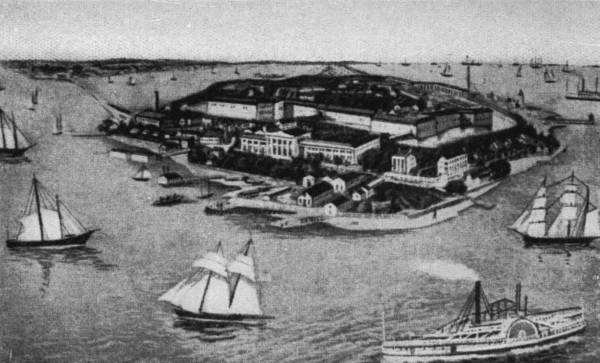
On April 29, twelve days after assuming command, Maj.
Newton moved his Tiger battalion to Fort Warren, and remained
there a full month rendering unpaid volunteer service.
Owing to the extreme shortage of trained soldiers,
the Government was glad to have the services of the battalion
at Boston’s most important fort. Old Andrew
Fletcher has claimed that the song-writer of a nation is more
influential even than the law-maker. So far as this is true,
the 2d Company, the Tigers, have exerted a huge national
influence. For while at Warren, it fell to the lot of their
glee-club to originate one of America’s greatest war-songs,
one which until “Marching thru Georgia” was composed,
stood supreme, the song, “John Brown’s Body.” Both
words and tune trace back to the 2d Company. The tune
is an adaptation of a southern revival hymn familiar before
the war; but is so complete a revision as to be practically
an original composition. The words were written as a joke
on Private John Brown of the Tigers, who always seemed
a shining mark for the wit of his comrades, and whose
name of course suggested the hero of Osawatomie and
Harper’s Ferry. Fletcher Webster’s regiment, the 12th,
was in process of recruiting at Fort Warren that month.
This song, at first intended humorously, was taken up in
serious earnest by Webster’s men, was sung a little later by
them as they marched to Bull Run; and within a year hundreds
of thousands in blue were firing their enthusiasm for
battle with the great refrain, “His soul is marching on.”
Ex-Col. Charles L. Holbrook proved his loyalty to his old
command by accepting the lower office of Major on June
23, 1862. This responsibility he did not lay down until Oct.
13, 1862, when he led the 43d Reg. to war.
To the Tigers, as to others of Boston’s best citizens, the
call for nine-months men came as a personal summons to
service. Maj. Holbrook’s 2d Battalion at once began enlisting
recruits, until it had expanded to a complete ten-company
regiment. Practically all the officers were chosen from
the Tiger battalion; and the new regiment, the 43d, was
known as the “Tiger Regiment.” The ancient title, “Boston
Light Infantry,” had remained attached to Co. A of the
2d Battalion;—now the “Lt. Inf.” Co. transferred itself bodily
to the new regiment, and became Co. A of the 43d. Company
commanders were: A, Henry J. Hallgreen; B, Edward
G. Quincy; C, William B. Fowle, Jr.; D, Thomas G. Whytal
(Capt. Whytal later became a Lt. Col. of U. S. Vols.); E,
Henry Doane (of Orleans); F, Charles W. Soule; G,
Everett Lane (of Abington, who was elected Major Oct.
20, 1862); H, George B. Hanover (of Chelsea); I, George
O. Tyler (of Cambridge); K, J. Emery Round. Maj. Holbrook,
as we have already seen, became colonel. John C.
Whiton, who later was Colonel of the 58th Mass., was Lt.
Col., and Everett Lane, Major. Co. D was from Dedham,
E from Orleans, G from Abington, H from Chelsea and
I from Cambridge. The other companies were recruited at
large—that is, from Boston. The regiment was mustered
in Sept. 20, 1862.
Co. H of the 43d had an origin prophetic of the regimental
consolidation which was to give us the present Coast Artillery.
Springing as it did from the membership, and commanded
as it was by the 1st Lieutenant of the Chelsea Rifles,
and they in turn being the “depot” or reserve company of
the Chelsea Volunteers (the 5th Co. in the three-year 1st
Regiment), Co. H was in direct relationship with both of
these commands. After the war, veterans of all three companies
joined forces, transformed the Rifles into the “Chelsea
Veterans,” and thus created our present 5th Company,
M. C. A. For three years it was actually made up exclusively
of veterans.
Tiger veterans and friends joined in giving the 43d a
notable “send-off.” Once more the motto was “Death or
an honorable life.” The historic banquet of Oct. 18, 1798,
was repeated on Nov. 5, 1862, and the famous toast was
again drunk, “The United States of America; as they have
drawn the sword of justice with reason, may they never
sheathe it with disgrace.” Hon. R. C. Winthrop, standing
on Boston Common, presented the regiment a handsome
stand of colors, a gift from the Boston Light Infantry.
A few weeks later the 43d found themselves under Gen.
John T. Foster in North Carolina, far indeed from Boston
and their friends, but side by side with the 3d and 44th Regs.,
which also enter into our history. The old Tiger spirit had
accompanied them. In Dec, 1862, came their great march
thru the swamps and sand barrens, when they were face to
face with the enemy during eleven continuous days. They
were able to claim as their list of battles, Kinston, Whitehall
and Goldsboro.
The loss of the North Carolina coast was a great blow
to the Confederacy, opening as it did the way for Sherman’s
march northward. Foster’s army was really an outpost of
the greater force threatening Richmond.
In July, 1863, their service was completed and they were
homeward bound once more. Travelling by boat to Baltimore,
stopping for a visit at Fort Monroe, thence by train
to New York, and having a square meal en route at Philadelphia,
by boat to New Haven and train to Boston, they
were given a hearty welcome home at old Boylston Hall, the
Tiger armory, on July 21. The Boston Light Infantry at
once became the 24th Unattached Company, M. V. M.
A few months of quiescence succeeded the Tigers’ nine
months of duty in the 43d. Not until Aug., 1864, is there
record of further activity. The war was drawing to a close,
the nine-months regiments had been mustered out and the
three-year commands were returning. Once more the ambition
to have a “crack” regiment was stirring in Boston.
Veteran and exempt members of the Tigers had formed the
“Boston Lt. Inf. Assn.,” Nov. 1, 1862, during the absence of
the active company. On this August date in 1864 the Light
Infantry reorganized themselves as the “7th Infantry.”
Maj. Charles O. Rogers, first commander of the 2d Battalion,
was offered the colonelcy but declined; Daniel G.
Handy was then elected, and received his commission on
Nov. 6, 1865. (Col. Handy had been Maj. of the 12th Mass.
in 1861 and 1862—indeed had been with the recruits in Ft.
Warren when “John Brown’s Body” originated.) A vigorous
attempt was made to form new companies and maintain
the 7th at regimental standard.
The 7th Mass. Inf., a Taunton command, had made a
noble name for itself during three years of hard service;
and had been mustered out just before the Tiger 7th came
into existence. The traditions connected with the number
were certain to prove stimulating. But the choice of a number
had further significance; it was a deliberate attempt to
reproduce the New York 7th. Gilmore became band-leader,
and it was hoped that his famous musicians would lend
brilliancy to the new regiment. It was in his capacity as
leader of the 7th Regiment band that Gilmore arranged
and conducted his first “Peace Jubilee Festival” in 1869,
with ten thousand singers and eight hundred instrumentalists
in a “coliseum” seating fifty thousand, and not exceeded
in size even by Billy Sunday’s tabernacle of 1916. Music
by wholesale, this, and very different from the original classical
“Peace Jubilee” in King’s Chapel, Feb. 22, 1815, from
which Gilmore obtained the suggestion. New England liked
it; and derived benefit from the popularization of good
music. And the 7th received no little advertising.
Nine new companies came into existence within two years,
mostly by the process of subdividing older commands, while
the Tigers continued their organization as Co. A. Charles
F. Harrington, former Captain of the Tigers, became
colonel in 1869. Distinguished soldiers were willing to
serve as company commanders in the 7th. B had for a
Captain, Walter Scott Sampson, who had led the 7th Co. of
Col. Cowdin’s regiment, the Washington Light Guard, into
the 6th, and had commanded it (Co. K of the 6th) during
its famous march thru Baltimore. Capt. Sampson had
meanwhile been in command of a company in the 22d Mass.
He was, in civil life, a successful Boston builder. E was
commanded by no less a personage than Henry J. Hallgreen,
war Captain of A or the Tiger Company in the 43d. A
had for its Captain, David W. Wardrop, war Colonel of the
3d Reg. The entire regiment was quartered in a single
armory, at Pine and Washington Sts. Co. B had developed
by fission from Co. A in 1864 and was first called the Handy
Guard or 32d Unattached Co. In 1869 so many veterans
of the old Washington Light Guard joined Co. B that the
Handy Guard became known as the Washington Light
Guard. In 1873 the company transferred its headquarters
from Boston to Cambridge, and, as part of the process, the
name was again changed, becoming the Massachusetts
Guards. Claim has been made that Co. B perpetuates the
old original Washington Light Guard, and it also claims to
be the Tigers, as truly as the 2d Company;—it exists today
as the 6th Company, Mass. C. A. Gen. W. E. Lombard
holds its older record books. The 7th Company, Mass.
C. A., the Pierce Light Guard, came into existence as Co. E
of the 7th; Henry L. Pierce after whom it was named
donated $1,000 to the company treasury.
Young men, however, are more successful than veterans
in maintaining the interest of an active regiment; and
apathy concerning military matters characterized the public
thinking during the years immediately following the war.
By 1870 the 7th had only four live companies remaining;
on July 20 of that year the regiment was reduced to a battalion.
The Tigers now recovered their old regimental number—they
became the “1st” Battalion, and Maj. Douglass
Frazer commanded. The 1st Battalion was on duty in 1872
at the great Boston fire, and protected the most important
section of all, the financial district along State Street.
Austin C. Wellington, formerly 1st Lieutenant in the 38th
Mass., became captain of the Tiger Co. A in 1870, and with
his advent began the era of prosperity and efficiency for
which the Tigers had long been wishing. In 1873 Wellington
became Major of the battalion, and on March 25, 1874,
came a change in designation, bringing, after failure to get
back their war number, 2d, the long-coveted numeral, “4th.”
As an indication of how this ambition had persisted from
ante-bellum days, we find the organization, in 1875, unofficially
describing itself as the 4th Battalion “of Rifles.”
In 1872 the “Maverick Rifles” had been organized as Co. D
of this battalion; today they are the 11th Co., Mass. C. A.
It was the privilege of the Tigers, in 1875, to receive and
entertain the Old Guard of New York City and the Washington
Lt. Infantry of Charleston, South Carolina, the latter
being the first southern military body to visit the north after
the war. The following year the Tigers and Old Guard
returned this courtesy, visiting Charleston and assisting in
the celebration of the centennial of the battle of Fort
Moultrie on June 28.
It was at once appreciated that Boston had a “crack”
battalion and Maj. Wellington’s command was in great demand
for parades and reviews. Its drill became a standard
for other infantry bodies, while its striking quasi-Zouave
uniform made such an impression upon the authorities that
the costume was, in 1884, adopted as the State uniform.
Such was the 4th Battalion which, on Dec. 3, 1878, by a
process of consolidation, became part of the 1st Regiment.
 Copyright by Continental Ins. Co.