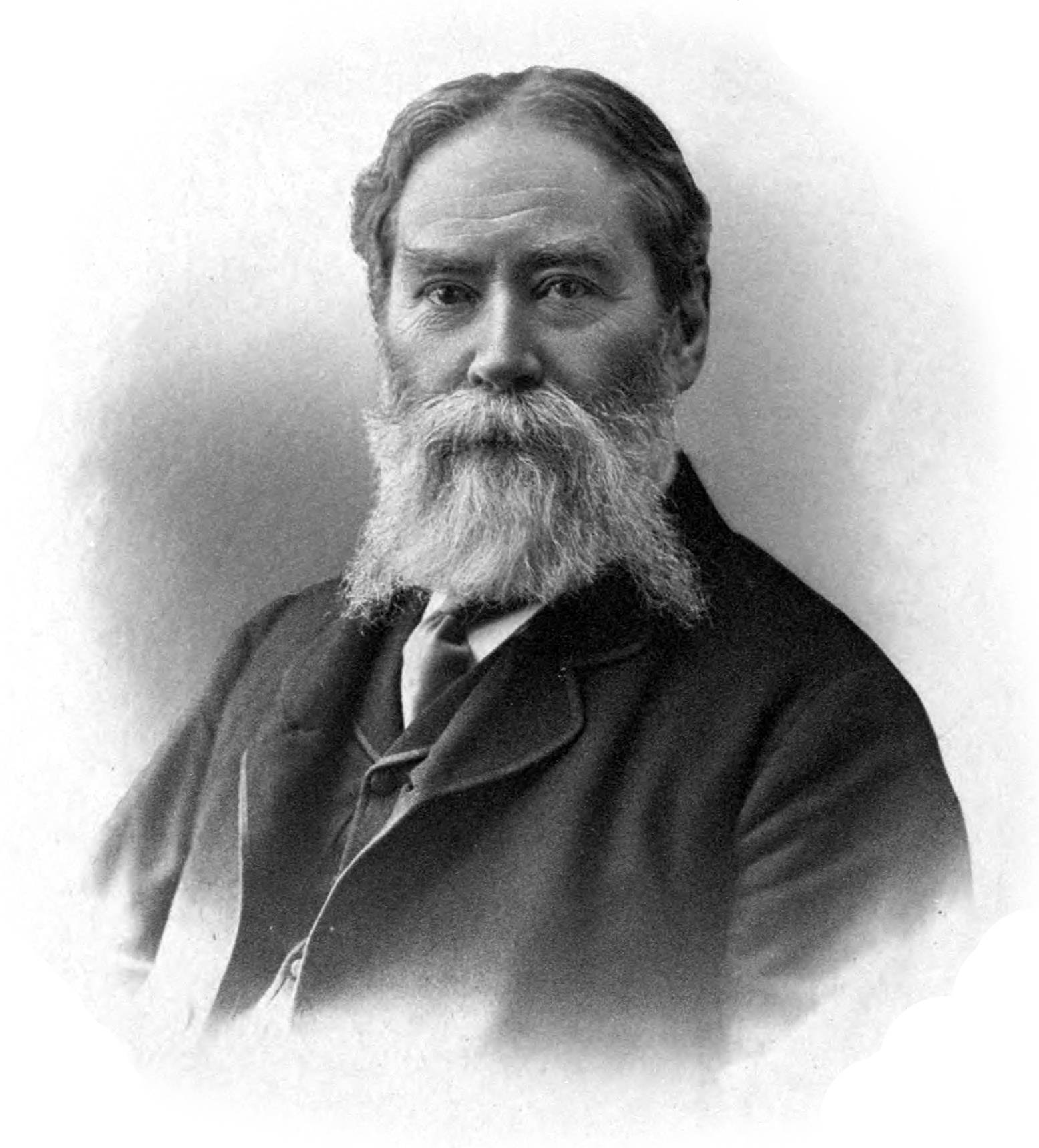
Larger versions of the illustrations may be seen by right-clicking them
and selecting an option to view them separately, or by double-tapping and/or
stretching them.
New original cover art included with this eBook is granted
to the public domain.
COMPLETE WORKS OF JAMES RUSSELL
LOWELL. New Riverside Edition. In same
style as the Riverside Editions of Longfellow’s
and Whittier’s Works. With Portraits, Indexes,
etc. 11 vols, crown 8vo, gilt top, each (except
vol. 11), $1.50; the set, 11 vols. $16.25; half calf,
$30.00; half calf, gilt top, $33.00; half levant,
$44.00.
1–4. Literary Essays (including My Study
Windows, Among My Books, Fireside Travels).
5. Political Essays. 6. Literary and Political
Addresses. 7–10. Poems. 11. Latest Literary
Essays and Addresses ($1.25).
PROSE WORKS. New Riverside Edition. With
Portrait. 7 vols. crown 8vo, gilt top, $10.25; half
calf, $19.25; half calf, gilt top, $21.00; half levant,
$28.00.
LITERARY ESSAYS. New Riverside Edition.
With Portrait. 4 vols. crown 8vo, gilt top, $7.25;
half calf, $13.50; half calf, gilt top, $15.00; half
levant, $20.00.
POEMS. New Riverside Edition. With Portraits;
4 vols. crown 8vo, gilt top, $6.00; half calf, $11.00;
half calf, gilt top, $12.00; half levant, $16.00.
HOUGHTON, MIFFLIN & COMPANY, Boston and New York.
BY
JAMES RUSSELL LOWELL
BOSTON AND NEW YORK
HOUGHTON, MIFFLIN AND COMPANY The Riverside Press, Cambridge 1893
Copyright, 1892, By CHARLES ELIOT NORTON.
All rights reserved.
The Riverside Press, Cambridge, Mass., U. S. A.
Electrotyped and Printed by H. O. Houghton & Co.
NOTE
In the spring of 1887, Mr. Lowell read, at the
Lowell Institute in Boston, six lectures on the Old
English Dramatists. They had been rapidly written,
and in their delivery much was said extemporaneously,
suggested by the passages from the plays
selected for illustration of the discourse. To many
of these passages there was no reference in the
manuscript; they were read from the printed book.
The lectures were never revised by Mr. Lowell for
publication, but they contain such admirable and
interesting criticism, and are in themselves such
genuine pieces of good literature, that it has seemed
to me that they should be given to the public.1
CHARLES ELIOT NORTON.
1 Before their publication in this volume, these Lectures appeared
in Harper’s Magazine, in the numbers from June to November,
1892.
When the rule limiting speeches to an hour was
adopted by Congress, which was before most of
you were born, an eminent but somewhat discursive
person spent more than that measure of time
in convincing me that whoever really had anything
to say could say it in less. I then and there acquired
a conviction of this truth, which has only
strengthened with years. Yet whoever undertakes
to lecture must adapt his discourse to the law which
requires such exercises to be precisely sixty minutes
long, just as a certain standard of inches must be
reached by one who would enter the army. If one
has been studying all his life how to be terse, how
to suggest rather than to expound, how to contract
rather than to dilate, something like a strain is put
upon the conscience by this necessity of giving the
full measure of words, without reference to other
considerations which a judicious ear may esteem of
more importance. Instead of saying things compactly
and pithily, so that they may be easily carried
away, one is tempted into a certain generosity
and circumambience of phrase, which, if not adapted
to conquer Time, may at least compel him to turn
his glass and admit a drawn game. It is so much
harder to fill an hour than to empty one!
These thoughts rose before me with painful vividness
as I fancied myself standing here again, after
an interval of thirty-two years, to address an audience
at the Lowell Institute. Then I lectured, not
without some favorable acceptance, on Poetry in
general and what constituted it, on Imagination
and Fancy, on Wit and Humor, on Metrical Romances,
on Ballads, and I know not what else—on
whatever I thought I had anything to say about,
I suppose. Then I was at the period in life when
thoughts rose in coveys, and one filled one’s bag
without considering too nicely whether the game
had been hatched within his neighbor’s fence or
within his own,—a period of life when it doesn’t
seem as if everything had been said; when a man
overestimates the value of what specially interests
himself, and insists with Don Quixote that all
the world shall stop till the superior charms of his
Dulcinea of the moment have been acknowledged;
when he conceives himself a missionary, and is persuaded
that he is saving his fellows from the perdition
of their souls if he convert them from belief in
some æsthetic heresy. That is the mood of mind
in which one may read lectures with some assurance
of success. I remember how I read mine over
to the clock, that I might be sure I had enough,
and how patiently the clock listened, and gave no
opinion except as to duration, on which point it
assured me that I always ran over. This is the
pleasant peril of enthusiasm, which has always
something of the careless superfluity of youth.
Since then, and for a period making a sixth part
of my mature life, my mind has been shunted off
upon the track of other duties and other interests.
If I have learned something, I have also forgotten
a good deal. One is apt to forget so much in the
service of one’s country,—even that he is an
American, I have been told, though I can hardly
believe it.
When I selected my topic for this new venture,
I was returning to a first love. The second volume
I ever printed, in 1843, I think it was,—it is now
a rare book, I am not sorry to know; I have not
seen it for many years,—was mainly about the
Old English Dramatists, if I am not mistaken. I
dare say it was crude enough, but it was spontaneous
and honest. I have continued to read them
ever since, with no less pleasure, if with more discrimination.
But when I was confronted with the
question what I could say of them that would interest
any rational person, after all that had been
said by Lamb, the most sympathetic of critics,
by Hazlitt, one of the most penetrative, by Coleridge,
the most intuitive, and by so many others,
I was inclined to believe that instead of an easy
subject I had chosen a subject very far from easy.
But I sustained myself with the words of the
great poet who so often has saved me from myself:—
“Vagliami il lungo studio e il grande amore,
Che m’ha fatto cercar lo tuo volume.”
If I bring no other qualification, I bring at least
that of hearty affection, which is the first condition
of insight. I shall not scruple to repeat what may
seem already too familiar, confident that these old
poets will stand as much talking about as most people.
At the risk of being tedious, I shall put you
back to your scales as a teacher of music does his
pupils. For it is the business of a lecturer to treat
his audience as M. Jourdain wished to be treated
in respect of the Latin language,—to take it for
granted that they know, but to talk to them as if
they did n’t. I should have preferred to entitle my
course Readings from the Old English Dramatists
with illustrative comments, rather than a critical
discussion of them, for there is more conviction in
what is beautiful in itself than in any amount of
explanation why, or exposition of how, it is beautiful.
A rose has a very succinct way of explaining
itself. When I find nothing profitable to say, I
shall take sanctuary in my authors.
* * * * *
It is generally assumed that the Modern Drama
in France, Spain, Italy, and England was an evolution
out of the Mysteries and Moralities and Interludes
which had edified and amused preceding
generations of simpler taste and ruder intelligence.
’T is the old story of Thespis and his cart. Taken
with due limitations, and substituting the word
stage for drama, this theory of origin is satisfactory
enough. The stage was there, and the desire to be
amused, when the drama at last appeared to occupy
the one and to satisfy the other. It seems to have
been, so far as the English Drama is concerned,
a case of post hoc, without altogether adequate
grounds for inferring a propter hoc. The Interludes
may have served as training-schools for actors. It
is certain that Richard Burbage, afterwards of
Shakespeare’s company, was so trained. He is the
actor, you will remember, who first played the part
of Hamlet, and the untimely expansion of whose
person is supposed to account for the Queen’s
speech in the fencing scene, “He’s fat and scant
of breath.” I may say, in passing, that the phrase
merely means “He’s out of training,” as we should
say now. A fat Hamlet is as inconceivable as a
lean Falstaff. Shakespeare, with his usual discretion,
never makes the Queen hateful, and made
use of this expedient to show her solicitude for
her son. Her last word, as she is dying, is his
name.
To return. The Interlude may have kept alive
the traditions of a stage, and may have made ready
a certain number of persons to assume higher and
graver parts when the opportunity should come;
but the revival of learning, and the rise of cities
capable of supplying a more cultivated and exacting
audience, must have had a stronger and more
direct influence on the growth of the Drama, as we
understand the word, than any or all other influences
combined. Certainly this seems to me true
of the English Drama at least. The English Miracle
Plays are dull beyond what is permitted even
by the most hardened charity, and there is nothing
dramatic in them except that they are in the form of
dialogue. The Interludes are perhaps further saddened
in the reading by reminding us how much
easier it was to be amused three hundred years ago
than now, but their wit is the wit of the Eocene
period, unhappily as long as it is broad, and their
humor is horse-play. We inherited a vast accumulation
of barbarism from our Teutonic ancestors.
It was only on those terms, perhaps, that we could
have their vigor too. The Interludes have some
small value as illustrating manners and forms of
speech, but the man must be born expressly for
the purpose—as for some of the adventures of
mediæval knight-errantry—who can read them.
“Gammer Gurton’s Needle” is perhaps as good as
any. It was acted at Christ’s College, Cambridge,
in 1566, and is remarkable, as Mr. Collier pointed
out, as the first existing play acted before either
University. Its author was John Still, afterwards
Bishop of Bath and Wells, and it is curious that
when Vice-Chancellor of Cambridge he should have
protested against the acting before the University
of an English play so unbefitting its learning, dignity,
and character. “Gammer Gurton’s Needle”
contains a very jolly and spirited song in praise of
ale. Latin plays were acted before the Universities
on great occasions, but there was nothing dramatic
about them but their form. One of them by Burton,
author of the “Anatomy of Melancholy,” has
been printed, and is not without merit. In the
“Pardoner and the Frere” there is a hint at the
drollery of those cross-readings with which Bonnell
Thornton made our grandfathers laugh:—
“Pard. Pope July the Sixth hath granted fair and well—
Fr. That when to them God hath abundance sent—
Pard. And doth twelve thousand years of pardon to them send—
Fr. They would distribute none to the indigent—
Pard. That aught to this holy chapel lend.”
Everything in these old farces is rudimentary.
They are not merely coarse; they are vulgar.
In France it was better, but France had something
which may fairly be called literature before
any other country in Europe, not literature in the
highest sense, of course, but something, at any
rate, that may be still read with pleasure for its
delicate beauty, like “Aucassin and Nicolete,” or
for its downright vigor, like the “Song of Roland,”
or for its genuine humor, like “Renard the Fox.”
There is even one French Miracle Play of the thirteenth
century, by the trouvère Rutebeuf, based on
the legend of Theophilus of Antioch, which might
be said to contain the germ of Calderon’s “El Magico
Prodigioso,” and thus, remotely, of Goethe’s
“Faust.” Of the next century is the farce of “Patelin,”
which has given a new word with its several
derivatives to the French language, and a proverbial
phrase, revenons à nos moutons, that long ago
domiciled itself beyond the boundaries of France.
“Patelin” rises at times above the level of farce,
though hardly to the region of pure comedy. I saw
it acted at the Théâtre Français many years ago,
with only so much modernization of language as
was necessary to make it easily comprehensible,
and found it far more than archæologically entertaining.
Surely none of our old English Interludes
could be put upon the stage now without the
gloomiest results. They were not, in my judgment,
the direct, and hardly even the collateral, ancestors
of our legitimate comedy. On the other hand,
while the Miracle Plays left no traces of themselves
in our serious drama, the play of Punch and Judy
looks very like an impoverished descendant of
theirs.
In Spain it was otherwise. There the old Moralities
and Mysteries of the Church Festivals are
renewed and perpetuated in the Autos Sacramentales
of Calderon, but ensouled with the creative
breath of his genius, and having a strange phantasmal
reality in the ideal world of his wonder-working
imagination. One of his plays, “La Devocion
de la Cruz,” an Auto in spirit if not in form,
dramatizes, as only he could do it, the doctrine of
justification by faith. In Spain, too, the comedy
of the booth and the plaza is plainly the rude
sketch of the higher creations of Tirso and Lope
and Calderon and Rojas and Alarcon, and scores
of others only less than they. The tragicomedy of
“Celestina,” written at the close of the fifteenth century,
is the first modern piece of realism or naturalism,
as it is called, with which I am acquainted. It
is coarse, and most of the characters are low, but
there are touches of nature in it, and the character
of Celestina is brought out with singular vivacity.
The word tragicomedy is many years older than
this play, if play that may be called which is but a
succession of dialogues, but I can think of no earlier
example of its application to a production in
dramatic form than by the Bachelor Fernando de
Rojas in this instance. It was made over into
English, rather than translated, in 1520,—our
first literary debt to Spain, I should guess. The
Spanish theatre, though the influence of Seneca is
apparent in the form it put on, is more sincerely a
growth of the soil than any other of modern times,
and it has one interesting analogy with our own in
the introduction of the clown into tragedy, whether
by way of foil or parody. The Spanish dramatists
have been called marvels of fecundity, but the facility
of their trochaic measure, in which the verses
seem to go of themselves, makes their feats less
wonderful. The marvel would seem to be rather
that, writing so easily, they also wrote so well.
Their invention is as remarkable as their abundance.
Their drama and our own have affected
the spirit and sometimes the substance of later
literature more than any other. They have to a
certain extent impregnated it. I have called the
Spanish theatre a product of the soil, yet it must
not be overlooked that Sophocles, Euripides, Plautus,
and Terence had been translated into Spanish
early in the sixteenth century, and that Lope de
Rueda, its real founder, would willingly have followed
classical models more closely had the public
taste justified him in doing so. But fortunately
the national genius triumphed over traditional criterions
of art, and the Spanish theatre, asserting its
own happier instincts, became and continued Spanish,
with an unspeakable charm and flavor of its
own.
One peculiarity of the Spanish plays makes it
safe to recommend them even virginibus puerisque,—they
are never unclean. Even Milton would
have approved a censorship of the press that accomplished
this. It is a remarkable example of
how sharp the contradiction is between the private
morals of a people and their public code of morality.
Certain things may be done, but they must
not seem to be done.
I have said nothing of the earlier Italian Drama
because it has failed to interest me. But Italy had
indirectly a potent influence, through Spenser, in
supplying English verse till it could answer the
higher uses of the stage. The lines—for they can
hardly be called verses—of the first attempts at
regular plays are as uniform, flat, and void of variety
as laths cut by machinery, and show only the
arithmetical ability of their fashioners to count as
high as ten. A speech is a series of such laths laid
parallel to each other with scrupulous exactness.
But I shall have occasion to return to this topic in
speaking of Marlowe.
Who, then, were the Old English Dramatists?
They were a score or so of literary bohemians, for
the most part, living from hand to mouth in London
during the last twenty years of the sixteenth
century and the first thirty years of the seventeenth,
of the personal history of most of whom we fortunately
know little, and who, by their good luck in
being born into an unsophisticated age, have written
a few things so well that they seem to have
written themselves. Poor, nearly all of them,
they have left us a fine estate in the realm of Faery.
Among them were three or four men of genius. A
comrade of theirs by his calling, but set apart from
them alike by the splendor of his endowments and
the more equable balance of his temperament, was
that divine apparition known to mortals as Shakespeare.
The civil war put an end to their activity.
The last of them, in the direct line, was James
Shirley, remembered chiefly for two lines from the
last stanza of a song of his in “The Contention of
Ajax and Ulysses,” which have become a proverb:—
“Only the actions of the just
Smell sweet and blossom in the dust.”
It is a nobly simple piece of verse, with the slow
and solemn cadence of a funeral march. The hint
of it seems to have been taken from a passage in
that droningly dreary book the “Mirror for Magistrates.”
This little poem is one of the best instances
of the good fortune of the men of that age
in the unconscious simplicity and gladness (I know
not what else to call it) of their vocabulary. The
language, so to speak, had just learned to go alone,
and found a joy in its own mere motion, which it
lost as it grew older, and to walk was no longer a
marvel.
Nothing in the history of literature seems more
startling than the sudden spring with which English
poetry blossomed in the later years of Elizabeth’s
reign. We may account for the seemingly
unheralded apparition of a single genius like Dante
or Chaucer by the genius itself; for, given that,
everything else is possible. But even in such cases
as these much must have gone before to make the
genius available when it came. For the production
of great literature there must be already a language
ductile to all the varying moods of expression.
There must be a certain amount of culture, or the
stimulus of sympathy would be wanting. If, as
Horace tells us, the heroes who lived before Agamemnon
have perished for want of a poet to celebrate
them, so doubtless many poets have gone
dumb to their graves, or, at any rate, have uttered
themselves imperfectly, for lack of a fitting vehicle
or of an amiable atmosphere. Genius, to be sure,
makes its own opportunity, but the circumstances
must be there out of which it can be made. For
instance, I cannot help feeling that Turold, or whoever
was the author of the “Chanson de Roland,”
was endowed with a rare epical faculty, and that he
would have given more emphatic proof of it had it
been possible for him to clothe his thought in a
form equivalent to the vigor of his conception.
Perhaps with more art, he might have had less of
that happy audacity of the first leap which Montaigne
valued so highly, but would he not have
gained could he have spoken to us in a verse as
sonorous as the Greek hexameter, nay, even as
sweet in its cadences, as variously voluble by its
slurs and elisions, and withal as sharply edged and
clean cut as the Italian pentameter? It is at least
a question open to debate. Mr. Matthew Arnold
taxes the “Song of Roland” with an entire want of
the grand style; and this is true enough; but it
has immense stores of courage and victory in it, as
Taillefer proved at the battle of Hastings,—yes,
and touches of heroic pathos, too.
Many things had slowly and silently concurred
to make that singular pre-eminence of the Elizabethan
literature possible. First of all was the
growth of a national consciousness, made aware of
itself and more cumulatively operative by the existence
and safer accessibility of a national capital, to
serve it both as head and heart. The want of such
a focus of intellectual, political, and material activity
has had more to do with the backwardness and
provincialism of our own literature than is generally
taken into account. My friend Mr. Hosea
Biglow ventured to affirm twenty odd years ago
that we had at last arrived at this national consciousness
through the convulsion of our civil war,—a
convulsion so violent as might well convince the
members that they formed part of a common body.
But I make bold to doubt whether that consciousness
will ever be more than fitful and imperfect,
whether it will ever, except in some moment of supreme
crisis, pour itself into and reënforce the
individual consciousness in a way to make our literature
feel itself of age and its own master, till we
shall have got a common head as well as a common
body. It is not the size of a city that gives it this
stimulating and expanding quality, but the fact
that it sums up in itself and gathers all the moral
and intellectual forces of the country in a single
focus. London is still the metropolis of the British
as Paris of the French race. We admit this
readily enough as regards Australia or Canada, but
we willingly overlook it as regards ourselves. Washington
is growing more national and more habitable
every year, but it will never be a capital till
every kind of culture is attainable there on as good
terms as elsewhere. Why not on better than elsewhere?
We are rich enough. Bismarck’s first care
has been the Museums of Berlin. For a fiftieth part
of the money Congress seems willing to waste in
demoralizing the country, we might have had the
Hamilton books and the far more precious Ashburnham
manuscripts. Perhaps what formerly
gave Boston its admitted literary supremacy was
the fact that fifty years ago it was more truly a
capital than any other American city. Edinburgh
once held a similar position, with similar results.
And yet how narrow Boston was! How scant a
pasture it offered to the imagination! I have often
mused on the dreary fate of the great painter who
perished slowly of inanition over yonder in Cambridgeport,
he who had known Coleridge and Lamb
and Wordsworth, and who, if ever any,
“With immortal wine
Should have been bathed and swum in more heart’s ease
Than there are waters in the Sestian seas.”
The pity of it! That unfinished Belshazzar of his
was a bitter sarcasm on our self-conceit. Among
us, it was unfinishable. Whatever place can draw
together the greatest amount and greatest variety
of intellect and character, the most abundant
elements of civilization, performs the best function
of a university. London was such a centre in the
days of Queen Elizabeth. And think what a
school the Mermaid Tavern must have been! The
verses which Beaumont addressed to Ben Jonson
from the country point to this:—
“What things have we seen
Done at the Mermaid! heard words that have been
So nimble and so full of subtle flame
As if that every one from whence they came
Had meant to put his whole wit in a jest,
And had resolved to live a fool the rest
Of his dull life; then when there hath been thrown
Wit able enough to justify the town
For three days past, wit that might warrant be
For the whole city to talk foolishly
Till that were cancelled; and, when that was gone,
We left an air behind us which alone
Was able to make the two next companies
Right witty; though but downright fools, more wise.”
This air, which Beaumont says they left behind
them, they carried with them, too. It was the atmosphere
of culture, the open air of it, which loses
much of its bracing and stimulating virtue in solitude
and the silent society of books. And what
discussions can we not fancy there, of language, of
diction, of style, of ancients and moderns, of grammar
even, for our speech was still at school, and
with license of vagrant truancy for the gathering
of wild flowers and the finding of whole nests full
of singing birds! Here was indeed a new World
of Words, as Florio called his dictionary. And
the face-to-face criticism, frank, friendly, and with
chance of reply, how fruitful it must have been!
It was here, doubtless, that Jonson found fault
with that verse of Shakespeare’s,—
“Cæsar did never wrong but with just cause,”
which is no longer to be found in the play of “Julius
Cæsar.” Perhaps Heminge and Condell left it
out, for Shakespeare could have justified himself
with the hook-nosed fellow of Rome’s favorite
Greek quotation, that nothing justified crime but
the winning or keeping of supreme power. Never
could London, before or since, gather such an academy
of genius. It must have been a marvellous
whetstone of the wits, and spur to generous emulation.
Another great advantage which the authors of
that day had was the freshness of the language,
which had not then become literary, and therefore
more or less commonplace. All the words they
used were bright from the die, not yet worn smooth
in the daily drudgery of prosaic service. I am
not sure whether they were so fully conscious of
this as we are, who find a surprising charm in it,
and perhaps endow the poet with the witchery that
really belongs to the vocables he employs. The
parts of speech of these old poets are just archaic
enough to please us with that familiar strangeness
which makes our own tongue agreeable if spoken
with a hardly perceptible foreign accent. The
power of giving novelty to things outworn is,
indeed, one of the prime qualities of genius, and
this novelty the habitual phrase of the Elizabethans
has for us without any merit of theirs. But I
think, making all due abatements, that they had
the hermetic gift of buckling wings to the feet of
their verse in a measure which has fallen to the
share of few or no modern poets. I think some of
them certainly were fully aware of the fine qualities
of their mother-tongue. Chapman, in the
poem “To the Reader,” prefixed to his translation
of the Iliad, protests against those who preferred
to it the softer Romance languages:—
“And for our tongue that still is so impaired
By travailing linguists, I can prove it clear,
That no tongue hath the Muses’ utterance heired
For verse and that sweet Music to the ear
Strook out of rime, so naturally as this;
Our monosyllables so kindly fall,
And meet, opposed in rhyme, as they did kiss.”
I think Chapman has very prettily maintained and
illustrated his thesis. But, though fortunate in
being able to gather their language with the dew
still on it, as herbs must be gathered for use in
certain incantations, we are not to suppose that
our elders used it indiscriminately, or tumbled out
their words as they would dice, trusting that luck
or chance would send them a happy throw; that
they did not select, arrange, combine, and make
use of the most cunning artifices of modulation
and rhythm. They debated all these questions,
we may be sure, not only with a laudable desire of
excellence, and with a hope to make their native
tongue as fitting a vehicle for poetry and eloquence
as those of their neighbors, or as those of Greece
and Rome, but also with something of the eager
joy of adventure and discovery. They must have
felt with Lucretius the delight of wandering over
the pathless places of the Muse, and hence, perhaps,
it is that their step is so elastic, and that we are
never dispirited by a consciousness of any lassitude
when they put forth their best pace. If they are natural,
it is in great part the benefit of the age they
lived in; but the winning graces, the picturesque
felicities, the electric flashes, I had almost said the
explosions, of their style are their own. And their
diction mingles its elements so kindly and with
such gracious reliefs of changing key, now dallying
with the very childishness of speech like the spinsters
and the knitters in the sun, and anon snatched
up without effort to the rapt phrase of passion or
of tragedy that flashes and reverberates!
The dullest of them, for I admit that many of
them were dull as a comedy of Goethe, and dulness
loses none of its disheartening properties by
age, no, nor even by being embalmed in the precious
gems and spices of Lamb’s affectionate eulogy,—for
I am persuaded that I should know a stupid
mummy from a clever one before I had been in his
company five minutes,—the dullest of them, I say,
has his lucid intervals. There are, I grant, dreary
wastes and vast solitudes in such collections as
Dodsley’s “Old Plays,” where we slump along
through the loose sand without even so much as a
mirage to comfort us under the intolerable drought
of our companion’s discourse. Nay, even some of
the dramatists who have been thought worthy of
editions all to themselves, may enjoy that seclusion
without fear of its being disturbed by me.
Let me mention a name or two of such as I shall
not speak of in this course. Robert Greene is one
of them. He has all the inadequacy of imperfectly
drawn tea. I thank him, indeed, for the word
“brightsome,” and for two lines of Sephestia’s
song to her child,—
“Weep not, my wanton, smile upon my knee,
When thou art old, there’s grief enough for thee,”—
which have all the innocence of the Old Age in
them. Otherwise he is naught. I say this for the
benefit of the young, for in my own callow days
I took him seriously because the Rev. Alexander
Dyce had edited him, and I endured much in
trying to reconcile my instincts with my superstition.
He it was that called Shakespeare “an upstart
crow beautified with our feathers,” as if any
one could have any use for feathers from such
birds as he, except to make pens of them. He was
the cause of the dulness that was in other men,
too, and human nature feels itself partially avenged
by this stanza of an elegy upon him by one
“R. B.,” quoted by Mr. Dyce:—
“Greene is the pleasing object of an eye;
Greene pleased the eyes of all that looked upon him;
Greene is the ground of every painter’s dye;
Greene gave the ground to all that wrote upon him;
Nay, more, the men that so eclipsed his fame
Purloyned his plumes; can they deny the same?”
Even the libeller of Shakespeare deserved nothing
worse than this! If this is “R. B.” when
he was playing upon words, what must he have
been when serious?
Another dramatist whom we can get on very
well without is George Peele, the friend and fellow-roisterer
of Greene. He, too, defied the inspiring
influence of the air he breathed almost as successfully
as his friend. But he had not that genius
for being dull all the time that Greene had, and
illustrates what I was just saying of the manner
in which the most tiresome of these men waylay
us when we least expect it with some phrase or
verse that shines and trembles in the memory like
a star. Such are:—
“For her I’ll build a kingly bower
Seated in hearing of a hundred streams”;
and this, of God’s avenging lightning,—
“At him the thunder shall discharge his bolt,
And his fair spouse, with bright and fiery wings,
Sit ever burning in his hateful bones.”
He also wrote some musically simple stanzas, of
which I quote the first two, the rather that Thackeray
was fond of them:—
“My golden locks Time hath to silver turned
(O Time too swift, and swiftness never ceasing),
My youth ’gainst age, and age at youth hath spurned,
But spurned in vain; youth waneth by increasing.
Beauty, strength, and youth, flowers fading been;
Duty, faith, and love, are roots, and ever green.
“My helmet now shall make an hive for bees,
And lover’s songs shall turn to holy psalms;
A man-at-arms must now serve on his knees,
And feed on prayers, that are old age’s alms.
But though from court to cottage I depart,
My saint is sure of mine unspotted heart.”
There is a pensiveness in this, half pleasurable,
half melancholy, that has a charm of its own.
Thomas Dekker is a far more important person.
Most of his works seem to have been what artists
call pot-boilers, written at ruinous speed, and with
the bailiff rather than the Muse at his elbow.
There was a liberal background of prose in him,
as in Ben Jonson, but he was a poet and no mean
one, as he shows by the careless good luck of his
epithets and similes. He could rise also to a
grave dignity of style that is grateful to the ear,
nor was he incapable of that heightened emotion
which might almost pass for passion. His fancy
kindles wellnigh to imagination at times, and
ventures on those extravagances which entice the
fancy of the reader as with the music of an invitation
to the waltz. I had him in my mind when
I was speaking of the obiter dicta, of the fine
verses dropt casually by these men when you are
beginning to think they have no poetry in them.
Fortune tells Fortunatus, in the play of that name,
that he shall have gold as countless as
“Those gilded wantons that in swarms do run
To warm their slender bodies in the sun,”
thus giving him a hint also of its ephemeral nature.
Here is a verse, too, that shows a kind of bleakish
sympathy of sound and sense. Long life, he tells
us,—
“Is a long journey in December gone.”
It may be merely my fancy, but I seem to hear a
melancholy echo in it, as of footfalls on frozen
earth. Or take this for a pretty fancy:—
“The moon hath through her bow scarce drawn to the head,
Like to twelve silver arrows, all the months
Since—”
when do you suppose? I give you three guesses,
as the children say. Since 1600! Poor Fancy
shudders at this opening of Haydn’s “Dictionary
of Dates” and thinks her silver arrows a little out
of place, like a belated masquerader going home
under the broad grin of day. But the verses themselves
seem plucked from “Midsummer-Night’s
Dream.”
This is as good an instance as may be of the
want of taste, of sense of congruity, and of the delicate
discrimination that makes style, which strikes
and sometimes even shocks us in the Old Dramatists.
This was a disadvantage of the age into
which they were born, and is perhaps implied in
the very advantages it gave them, and of which
I have spoken. Even Shakespeare offends sometimes
in this way. Good taste, if mainly a gift of
nature, is also an acquisition. It was not impossible
even then. Samuel Daniel had it, but the cautious
propriety with which it embarrassed him has
made his drama of “Cleopatra” unapproachable,
in more senses than one, in its frigid regularity.
His contemplative poetry, thanks to its grave
sweetness of style, is among the best in our language.
And Daniel wrote the following sentences,
which explain better than anything I could say
why his contemporaries, in spite of their manifest
imperfections, pleased then and continue to please:
“Suffer the world to enjoy that which it knows
and what it likes, seeing whatsoever form of words
doth move delight, and sway the affections of men,
in what Scythian sort soever it be disposed and
uttered, that is true number, measure, eloquence,
and the perfection of speech.” Those men did
“move delight, and sway the affections of men,” in
a very singular manner, gaining, on the whole, perhaps,
more by their liberty than they lost by their
license. But it is only genius that can safely profit
by this immunity. Form, of which we hear so
much, is of great value, but it is not of the highest
value, except in combination with other qualities
better than itself; and it is worth noting that the
modern English poet who seems least to have regarded
it, is also the one who has most powerfully
moved, swayed, and delighted those who are wise
enough to read him.
One more passage and I have done. It is from
the same play of “Old Fortunatus,” a favorite of
mine. The Soldan of Babylon shows Fortunatus
his treasury, or cabinet of bric-à-brac:—
“Behold yon tower: there stands mine armoury,
In which are corselets forged of beaten gold
To arm ten hundred thousand fighting men,
Whose glittering squadrons when the sun beholds,
They seem like to ten hundred thousand Joves,
When Jove on the proud back of thunder rides,
Trapped all in lightning-flames. There can I show thee
The ball of gold that set all Troy on fire;
There shalt thou see the scarf of Cupid’s mother,
Snatcht from the soft moist ivory of her arm
To wrap about Adonis’ wounded thigh;
There shalt thou see a wheel of Titan’s car
Which dropt from Heaven when Phaethon fired the world.
I’ll give thee (if thou wilt) two silver doves
Composed by magic to divide the air,
Who, as they flie, shall clap their silver wings
And give strange music to the elements.
I’ll give thee else the fan of Proserpine,
Which, in reward for a sweet Thracian song,
The blackbrow’d Empress threw to Orpheus,
Being come to fetch Eurydice from hell.”
This is, here and there, tremblingly near bombast,
but its exuberance is cheery, and the quaintness
of Proserpine’s fan shows how real she was to
the poet. Hers was a generous gift, considering
the climate in which Dekker evidently supposed
her to dwell, and speaks well for the song that
could make her forget it. There is crudeness, as if
the wine had been drawn before the ferment was
over, but the arm of Venus is from the life, and
that one verse gleams and glows among the rest
like the thing it describes. The whole passage is
a good example of fancy, whimsical, irresponsible.
But there is more imagination and power to move
the imagination in Shakespeare’s “sunken wreck
and sunless treasures” than all his contemporaries
together, not even excepting Marlowe, could have
mustered.
We lump all these poets together as dramatists
because they wrote for the theatre, and yet how little
they were truly dramatic seems proved by the fact
that none, or next to none, of their plays have held
the stage. Not one of their characters, that I can
remember, has become one of the familiar figures
that make up the habitual society of any cultivated
memory even of the same race and tongue. Marlowe,
great as he was, makes no exception. To
some of them we cannot deny genius, but creative
genius we must deny to all of them, and dramatic
genius as well.
This last, indeed, is one of the rarest gifts bestowed
on man. What is that which we call dramatic?
In the abstract, it is thought or emotion in
action, or on its way to become action. In the concrete,
it is that which is more vivid if represented
than described, and which would lose if merely narrated.
Goethe, for example, had little dramatic
power; though, if taking thought could have
earned it, he would have had enough, for he studied
the actual stage all his life. The characters in
his plays seem rather to express his thoughts than
their own. Yet there is one admirably dramatic
scene in “Faust” which illustrates what I have been
saying. I mean Margaret in the cathedral, suggested
to Goethe by the temptation of Justina in
Calderon’s “Magico Prodigioso,” but full of horror
as that of seductiveness. We see and hear as we
read. Her own bad conscience projected in the
fiend who mutters despair into her ear, and the
awful peals of the “Dies Iræ,” that most terribly
resonant of Latin hymns, as if blown from the very
trump of doom itself, coming in at intervals to remind
her that the
“Tuba mirum spargens sonum
Per sepulchra regionum
Coget omnes ante thronum,”
herself among the rest,—all of this would be
weaker in narration. This is real, and needs realization
by the senses to be fully felt. Compare it
with Dimmesdale mounting the pillory at night, in
“The Scarlet Letter,” to my thinking the deepest
thrust of what may be called the metaphysical imagination
since Shakespeare. There we need only
a statement of the facts—pictorial statement, of
course, as Hawthorne’s could not fail to be—and
the effect is complete. Thoroughly to understand
a good play and enjoy it, even in the reading, the
imagination must body forth its personages, and
see them doing or suffering in the visionary theatre
of the brain. There, indeed, they are best seen,
and Hamlet or Lear loses that ideal quality which
makes him typical and universal if he be once compressed
within the limits, or associated with the
lineaments, of any, even the best, actor.
It is for their poetical qualities, for their gleams
of imagination, for their quaint and subtle fancies,
for their tender sentiment, and for their charm of
diction that these old playwrights are worth reading.
They are the best comment also to convince
us of the immeasurable superiority of Shakespeare.
Several of them, moreover, have been very inadequately
edited, or not at all, which is perhaps better;
and it is no useless discipline of the wits, no
unworthy exercise of the mind, to do our own editing
as we go along, winning back to its cradle the
right word for the changeling the printers have left
in his stead, making the lame verses find their feet
again, and rescuing those that have been tumbled
higgledy-piggledy into a mire of prose. A strenuous
study of this kind will enable us better to understand
many a faulty passage in our Shakespeare,
and to judge of the proposed emendations of them,
or to make one to our own liking. There is no
better school for learning English, and for learning
it when, in many important respects, it was at its
best.
I am not sure that I shall not seem to talk to you
of many things that seem trivialities if weighed in
the huge business scales of life, but I am always
glad to say a word in behalf of what most men consider
useless, and to say it the rather because it has
so few friends. I have observed, and am sorry to
have observed, that English poetry, at least in its
older examples, is less read now than when I was
young. I do not believe this to be a healthy symptom,
for poetry frequents and keeps habitable those
upper chambers of the mind that open toward the
sun’s rising.
II MARLOWE
I shall preface what I have to say of Marlowe
with a few words as to the refinement which had
been going on in the language, and the greater
ductility which it had been rapidly gaining, and
which fitted it for the use of the remarkable group
of men who made an epoch of the reign of Elizabeth.
Spenser was undoubtedly the poet to whom
we owe most in this respect, and the very great contrast
between his “Shepherd’s Calendar,” published
in 1579, and his later poems awakens curiosity.
In his earliest work there are glimpses,
indeed, of those special qualities which have won
for him the name of the poet’s poet, but they are
rare and fugitive, and certainly never would have
warranted the prediction of such poetry as was to
follow. There is nothing here to indicate that a
great artist in language had been born. Two
causes, I suspect, were mainly effective in this
transformation, I am almost tempted to say transubstantiation,
of the man. The first was his
practice in translation (true also of Marlowe), than
which nothing gives a greater choice and mastery
of one’s mother-tongue, for one must pause and
weigh and judge every word with the greatest
nicety, and cunningly transfuse idiom into idiom.
The other, and by far the more important, was his
study of the Italian poets. The “Faerie Queene”
is full of loving reminiscence of them, but their
happiest influence is felt in his lyrical poems. For
these, I think, make it plain that Italy first taught
him how much of the meaning of verse is in its
music, and trained his ear to a sense of the harmony
as well as the melody of which English verse was
capable or might be made capable. Compare the
sweetest passage in any lyric of the “Shepherd’s
Calendar” with the eloquent ardor of the poorest,
if any be poor, in the “Epithalamion,” and we find
ourselves in a new world where music had just been
invented. This we owe, beyond any doubt, to
Spenser’s study of the Italian canzone. Nay, the
whole metrical movement of the “Epithalamion”
recalls that of Petrarca’s noble “Spirto gentil.” I
repeat that melody and harmony were first naturalized
in our language by Spenser. I love to recall
these debts, for it is pleasant to be grateful even to
the dead.
Other men had done their share towards what
may be called the modernization of our English,
and among these Sir Philip Sidney was conspicuous.
He probably gave it greater ease of movement, and
seems to have done for it very much what Dryden
did a century later in establishing terms of easier
intercourse between the language of literature and
the language of cultivated society.
There had been good versifiers long before.
Chaucer, for example, and even Gower, wearisome
as he mainly is, made verses sometimes not only
easy in movement, but in which the language seems
strangely modern. That most dolefully dreary of
books, “The Mirror for Magistrates,” and Sackville,
more than any of its authors, did something towards
restoring the dignity of verse, and helping it to
recover its self-respect, while Spenser was still a
youth. Tame as it is, the sunshine of that age here
and there touches some verse that ripples in the
sluggish current with a flicker of momentary illumination.
But before Spenser, no English verse had
ever soared and sung, or been filled with what Sidney
calls “divine delightfulness.” Sidney, it may
be conjectured, did more by private criticism and
argument than by example. Drayton says of
him:—
“The noble Sidney with this last arose,
That heroë for numbers and for prose,
That throughly paced our language as to show
The plenteous English hand in hand might go
With Greek and Latin, and did first reduce
Our tongue from Lilly’s writing then in use.”
But even the affectations of Lilly were not without
their use as helps to refinement. If, like Chaucer’s
frere,—
“Somewhat he lisped, for his wantonness,”
it was through the desire
“To make his English sweet upon his tongue.”
It was the general clownishness against which he
revolted, and we owe him our thanks for it. To
show of what brutalities even recent writers could
be capable, it will suffice to mention that Golding,
in his translation of Ovid’s Metamorphoses, makes
a witch mutter the devil’s pater-noster, and Ulysses
express his fears of going “to pot.” I should like
to read you a familiar sonnet of Sidney’s for its
sweetness:—
“Come, Sleep: O Sleep! the certain knot of peace,
The baiting-place of wit, the balm of woe,
The poor man’s wealth, the prisoner’s release,
The indifferent judge between the high and low;
With shield of proof, shield me from out the press
Of those fierce darts despair at me doth throw;
O make in me those civil wars to cease:
I will good tribute pay if thou do so.
Take thou of me smooth pillows, sweetest bed,
A chamber deaf to noise and blind to light,
A rosy garland, and a weary head:
And if these things, as being thine of right,
Move not thy heavy grace, thou shalt in me,
Livelier than elsewhere, Stella’s image see.”
Here is ease and simplicity; but in such a
phrase as “baiting-place of wit” there is also a
want of that perfect discretion which we demand
of the language of poetry, however we may be glad
to miss it in the thought or emotion which that language
conveys. Baiting-place is no more a homespun
word than the word inn, which adds a charm
to one of the sweetest verses that Spenser ever
wrote; but baiting-place is common, it smacks of
the hostler and postilion, and commonness is a very
poor relation indeed of simplicity. But doubtless
one main cause of the vivacity of phrase which so
charms us in our earlier writers is to be found in
the fact that there were not yet two languages—that
of life and that of literature. The divorce between
the two took place a century and a half later,
and that process of breeding in and in began which
at last reduced the language of verse to a kind of
idiocy.
Do not consider such discussions as these otiose
or nugatory. The language we are fortunate
enough to share, and which, I think, Jacob Grimm
was right in pronouncing, in its admirable mixture
of Saxon and Latin, its strength and sonorousness,
a better literary medium than any other modern
tongue—this language has not been fashioned to
what it is without much experiment, much failure,
and infinite expenditure of pains and thought.
Genius and pedantry have each done its part
towards the result which seems so easy to us, and
yet was so hard to win—the one by way of example,
the other by way of warning. The purity, the
elegance, the decorum, the chastity of our mother-tongue
are a sacred trust in our hands. I am tired
of hearing the foolish talk of an American variety
of it, about our privilege to make it what we will
because we are in a majority. A language belongs
to those who know best how to use it, how to bring
out all its resources, how to make it search its coffers
round for the pithy or canorous phrase that
suits the need, and they who can do this have been
always in a pitiful minority. Let us be thankful
that we too have a right to it, and have proved our
right, but let us set up no claim to vulgarize it.
The English of Abraham Lincoln was so good not
because he learned it in Illinois, but because he
learned it of Shakespeare and Milton and the Bible,
the constant companions of his leisure. And how
perfect it was in its homely dignity, its quiet
strength, the unerring aim with which it struck
once nor needed to strike more! The language is
alive here, and will grow. Let us do all we can
with it but debase it. Good taste may not be
necessary to salvation or to success in life, but it is
one of the most powerful factors of civilization.
As a people we have a larger share of it and more
widely distributed than I, at least, have found elsewhere,
but as a nation we seem to lack it altogether.
Our coinage is ruder than that of any country of
equal pretensions, our paper money is filthily infectious,
and the engraving on it, mechanically
perfect as it is, makes of every bank-note a missionary
of barbarism. This should make us cautious
of trying our hand in the same fashion on the circulating
medium of thought. But it is high time
that I should remember Maître Guillaume of Patelin,
and come back to my sheep.
In coming to speak of Marlowe, I cannot help
fearing that I may fail a little in that equanimity
which is the first condition of all helpful criticism.
Generosity there should be, and enthusiasm there
should be, but they should stop short of extravagance.
Praise should not weaken into eulogy, nor
blame fritter itself away into fault-finding. Goethe
tells us that the first thing needful to the critic,
as indeed it is to the wise man generally, is to see
the thing as it really is; this is the most precious
result of all culture, the surest warrant of happiness,
or at least of composure. But he also bids
us, in judging any work, seek first to discover its
beauties, and then its blemishes or defects. Now
there are two poets whom I feel that I can never
judge without a favorable bias. One is Spenser,
who was the first poet I ever read as a boy, not
drawn to him by any enchantment of his matter or
style, but simply because the first verse of his great
poem was,—
“A gentle knight was pricking on the plain,”
and I followed gladly, wishful of adventure. Of
course I understood nothing of the allegory, never
suspected it, fortunately for me, and am surprised
to think how much of the language I understood.
At any rate, I grew fond of him, and whenever I
see the little brown folio in which I read, my heart
warms to it as to a friend of my childhood. With
Marlowe it was otherwise. With him I grew
acquainted during the most impressible and receptive
period of my youth. He was the first man of
genius I had ever really known, and he naturally
bewitched me. What cared I that they said he
was a deboshed fellow? nay, an atheist? To me
he was the voice of one singing in the desert, of
one who had found the water of life for which I
was panting, and was at rest under the palms.
How can he ever become to me as other poets are?
But I shall try to be lenient in my admiration.
Christopher Marlowe, the son of a shoemaker,
was born at Canterbury, in February, 1563, was
matriculated at Benet College, Cambridge, in 1580,
received his degree of bachelor there in 1583 and
of master in 1587. He came early to London, and
was already known as a dramatist before the end of
his twenty-fourth year. There is some reason for
thinking that he was at one time an actor. He was
killed in a tavern brawl, by a man named Archer,
in 1593, at the age of thirty. He was taxed with
atheism, but on inadequate grounds, as it appears
to me. That he was said to have written a tract
against the Trinity, for which a license to print was
refused on the ground of blasphemy, might easily
have led to the greater charge. That he had some
opinions of a kind unusual then may be inferred,
perhaps, from a passage in his “Faust.” Faust asks
Mephistopheles how, being damned, he is out of
hell. And Mephistopheles answers, “Why, this is
hell, nor am I out of it.” And a little farther on
he explains himself thus:—
“Hell hath no limits, nor is circumscribed
In one self place; for where we are is hell,
And where hell is there must we ever be;
And, to conclude, when all the earth dissolves,
And every creature shall be purified,
All places shall be hell that are not heaven.”
Milton remembered the first passage I have quoted,
and puts nearly the same words into the mouth of
his Lucifer. If Marlowe was a liberal thinker, it
is not strange that in that intolerant age he should
have incurred the stigma of general unbelief. Men
are apt to blacken opinions which are distasteful
to them, and along with them the character of him
who holds them.
This at least may be said of him without risk of
violating the rule of ne quid nímis, that he is one
of the most masculine and fecundating natures in
the long line of British poets. Perhaps his energy
was even in excess. There is in him an Oriental
lavishness. He will impoverish a province for a
simile, and pour the revenues of a kingdom into
the lap of a description. In that delightful story
in the book of Esdras, King Darius, who has just
dismissed all his captains and governors of cities
and satraps, after a royal feast, sends couriers galloping
after them to order them all back again, because
he has found a riddle under his pillow, and
wishes their aid in solving it. Marlowe in like
manner calls in help from every the remotest corner
of earth and heaven for what seems to us as
trivial an occasion. I will not say that he is bombastic,
but he constantly pushes grandiosity to the
verge of bombast. His contemporaries thought he
passed it in his “Tamburlaine.” His imagination
flames and flares, consuming what it should caress,
as Jupiter did Semele. That exquisite phrase of
Hamlet, “the modesty of nature,” would never
have occurred to him. Yet in the midst of the
hurly-burly there will fall a sudden hush, and we
come upon passages calm and pellucid as mountain
tarns filled to the brim with the purest distillations
of heaven. And, again, there are single verses
that open silently as roses, and surprise us with
that seemingly accidental perfection, which there
is no use in talking about because itself says all
that is to be said and more.
There is a passage in “Tamburlaine” which I
remember reading in the first course of lectures
I ever delivered, thirty-four years ago, as a poet’s
feeling of the inadequacy of the word to the idea:—
“If all the pens that ever poets held
Had fed the feeling of their masters’ thoughts,
And every sweetness that inspired their hearts,
Their minds, and muses on admired themes;
If all the heavenly quintessence they still
From their immortal flowers of poesy,
Wherein, as in a mirror, we perceive
The highest reaches of a human wit;—
If these had made one poem’s period,
And all combined in beauty’s worthiness,
Yet should there hover in their restless heads
One thought, one grace, one wonder, at the least,
Which into words no virtue can digest.”
Marlowe made snatches at this forbidden fruit
with vigorous leaps, and not without bringing away
a prize now and then such as only the fewest have
been able to reach. Of fine single verses I give a
few as instances of this:—
“Sometimes a lovely boy in Dian’s shape,
With hair that gilds the water as it glides,
Shall bathe him in a spring.”
Here is a couplet notable for dignity of poise describing
Tamburlaine:—
“Of stature tall and straightly fashioned,
Like his desire, lift upward and divine.”
“For every street like to a firmament
Glistered with breathing stars.”
“Unwedded maids
Shadowing more beauty in their airy brows
Than have the white breasts of the queen of Love.”
This from “Tamburlaine” is particularly characteristic:—
“Nature
Doth teach us all to have aspiring minds.
Our souls, whose faculties can comprehend
The wondrous architecture of the world,
And measure every wandering planet’s course,
Still climbing after knowledge infinite,
And always moving as the restless spheres,
Will us to wear ourselves and never rest
Until we reach the ripest fruit of all.”
One of these verses reminds us of that exquisite
one of Shakespeare where he says that Love is
“Still climbing trees in the Hesperides.”
But Shakespeare puts a complexity of meaning into
his chance sayings, and lures the fancy to excursions
of which Marlowe never dreamt.
But, alas, a voice will not illustrate like a stereopticon,
and this tearing away of fragments that
seem to bleed with the avulsion is like breaking off
a finger from a statue as a specimen.
The impression he made upon the men of his
time was uniform; it was that of something new
and strange; it was that of genius, in short. Drayton
says of him, kindling to an unwonted warmth,
as if he loosened himself for a moment from the
choking coils of his Polyolbion for a larger
breath:—
“Next Marlowe bathèd in the Thespian springs
Had in him those brave translunary things
That the first poets had; his raptures were
All air and fire, which made his verses clear;
For that fine madness still he did retain
Which rightly should possess a poet’s brain.”
And Chapman, taking up and continuing Marlowe’s
half-told story of Hero and Leander, breaks
forth suddenly into this enthusiasm of invocation:—
“Then, ho! most strangely intellectual fire
That, proper to my soul, hast power to inspire
Her burning faculties, and with the wings
Of thy unsphered flame visit’st the springs
Of spirits immortal, now (as swift as Time
Doth follow motion) find the eternal clime
Of his free soul whose living subject stood
Up to the chin in the Pierian flood.”
Surely Chapman would have sent his soul on no
such errand had he believed that the soul of Marlowe
was in torment, as his accusers did not scruple
to say that it was, sent thither by the manifestly
Divine judgment of his violent death.
Yes, Drayton was right in classing him with
“the first poets,” for he was indeed such, and so
continues,—that is, he was that most indefinable
thing, an original man, and therefore as fresh and
contemporaneous to-day as he was three hundred
years ago. Most of us are more or less hampered
by our own individuality, nor can shake ourselves
free of that chrysalis of consciousness and give our
“souls a loose,” as Dryden calls it in his vigorous
way. And yet it seems to me that there is something
even finer than that fine madness, and I think
I see it in the imperturbable sanity of Shakespeare,
which made him so much an artist that his new
work still bettered his old. I think I see it even
in the almost irritating calm of Goethe, which, if
it did not quite make him an artist, enabled him to
see what an artist should be, and to come as near
to being one as his nature allowed. Marlowe was
certainly not an artist in the larger sense, but he
was cunning in words and periods and the musical
modulation of them. And even this is a very rare
gift. But his mind could never submit itself to a
controlling purpose, and renounce all other things
for the sake of that. His plays, with the single
exception of “Edward II.,” have no organic unity,
and such unity as is here is more apparent than
real. Passages in them stir us deeply and thrill
us to the marrow, but each play as a whole is ineffectual.
Even his “Edward II.” is regular only
to the eye by a more orderly arrangement of scenes
and acts, and Marlowe evidently felt the drag of
this restraint, for we miss the uncontrollable energy,
the eruptive fire, and the feeling that he was
happy in his work. Yet Lamb was hardly extravagant
in saying that “the death scene of Marlowe’s
king moves pity and terror beyond any
scene, ancient or modern, with which I am acquainted.”
His tragedy of “Dido, Queen of Carthage,”
is also regularly plotted out, and is also
somewhat tedious. Yet there are many touches
that betray his burning hand. There is one passage
illustrating that luxury of description into
which Marlowe is always glad to escape from the
business in hand. Dido tells Æneas:—
“Æneas, I’ll repair thy Trojan ships
Conditionally that thou wilt stay with me,
And let Achates sail to Italy;
I’ll give thee tackling made of rivelled gold,
Wound on the barks of odoriferous trees;
Oars of massy ivory, full of holes
Through which the water shall delight to play;
Thy anchors shall be hewed from crystal rocks
Which, if thou lose, shall shine above the waves;
The masts whereon thy swelling sails shall hang
Hollow pyramides of silver plate;
The sails of folded lawn, where shall be wrought
The wars of Troy, but not Troy’s overthrow;
For ballast, empty Dido’s treasury;
Take what ye will, but leave Æneas here.
Achates, thou shalt be so seemly clad
As sea-born nymphs shall swarm about thy ships
And wanton mermaids court thee with sweet songs,
Flinging in favors of more sovereign worth
Than Thetis hangs about Apollo’s neck,
So that Æneas may but stay with me.”
But far finer than this, in the same costly way,
is the speech of Barabas in “The Jew of Malta,”
ending with a line that has incorporated itself in
the language with the familiarity of a proverb:—
“Give me the merchants of the Indian mines
That trade in metal of the purest mould;
The wealthy Moor that in the Eastern rocks
Without control can pick his riches up,
And in his house heap pearl like pebble-stones,
Receive them free, and sell them by the weight;
Bags of fiery opals, sapphires, amethysts,
Jacynths, hard topaz, grass-green emeralds,
Beauteous rubies, sparkling diamonds,
And seld-seen costly stones of so great price
As one of them, indifferently rated,
* * * * *
May serve in peril of calamity
To ransom great kings from captivity.
This is the ware wherein consists my wealth:
* * * * *
Infinite riches in a little room.”
This is the very poetry of avarice.
Let us now look a little more closely at Marlowe
as a dramatist. Here also he has an importance
less for what he accomplished than for what
he suggested to others. Not only do I think that
Shakespeare’s verse caught some hints from his,
but there are certain descriptive passages and similes
of the greater poet which, whenever I read
them, instantly bring Marlowe to my mind. This
is an impression I might find it hard to convey to
another, or even to make definite to myself; but it
is an old one, and constantly repeats itself, so that I
put some confidence in it. Marlowe’s “Edward II.”
certainly served Shakespeare as a model for his
earlier historical plays. Of course he surpassed
his model, but Marlowe might have said of him as
Oderisi, with pathetic modesty, said to Dante of
his rival and surpasser, Franco of Bologna, “The
praise is now all his, yet mine in part.” But it is
always thus. The path-finder is forgotten when
the track is once blazed out. It was in Shakespeare’s
“Richard II.” that Lamb detected the influence
of Marlowe, saying that “the reluctant pangs
of abdicating royalty in Edward furnished hints
which Shakespeare has scarce improved upon in
Richard.” In the parallel scenes of both plays
the sentiment is rather elegiac than dramatic, but
there is a deeper pathos, I think, in Richard, and
his grief rises at times to a passion which is wholly
wanting in Edward. Let me read Marlowe’s abdication
scene. The irresolute nature of the king is
finely indicated. The Bishop of Winchester has
come to demand the crown; Edward takes it off,
and says:—
“Here, take my crown; the life of Edward too:
Two kings of England cannot reign at once.
But stay awhile: let me be king till night,
That I may gaze upon this glittering crown;
So shall my eyes receive their last content,
My head the latest honor due to it,
And jointly both yield up their wishèd right.
Continue ever, thou celestial sun;
Let never silent night possess this clime;
Stand still, you watches of the element;
All times and seasons, rest you at a stay—
That Edward may be still fair England’s king!
But day’s bright beam doth vanish fast away,
And needs I must resign my wishèd crown.
Inhuman creatures, nursed with tiger’s milk,
Why gape you for your sovereign’s overthrow?—
My diadem, I mean, and guiltless life.
See, monsters, see, I’ll wear my crown again.
What, fear you not the fury of your king?
* * * * *
I’ll not resign, but, whilst I live, be king!”
Then, after a short further parley:—
“Here, receive my crown.
Receive it? No; these innocent hands of mine
Shall not be guilty of so foul a crime:
He of you all that most desires my blood,
And will be called the murderer of a king,
Take it. What, are you moved? Pity you me?
Then send for unrelenting Mortimer,
And Isabel, whose eyes, being turned to steel,
Will sooner sparkle fire than shed a tear.
Yet stay, for rather than I’ll look on them,
Here, here!—Now, sweet God of Heaven,
Make me despise this transitory pomp,
And sit for aye enthronizèd in Heaven!
Come, Death, and with thy fingers close my eyes,
Or, if I live, let me forget myself.”
Surely one might fancy that to be from the
prentice hand of Shakespeare. It is no small distinction
that this can be said of Marlowe, for it can
be said of no other. What follows is still finer.
The ruffian who is to murder Edward, in order to
evade his distrust, pretends to weep. The king
exclaims:—
“Weep’st thou already? List awhile to me,
And then thy heart, were it as Gurney’s is,
Or as Matrevis’, hewn from the Caucasus,
Yet will it melt ere I have done my tale.
This dungeon where they keep me is the sink
Wherein the filth of all the castle falls,
And there in mire and puddle have I stood
This ten days’ space; and, lest that I should sleep,
One plays continually upon a drum;
They give me bread and water, being a king;
So that, for want of sleep and sustenance,
My mind’s distempered and my body numbed,
And whether I have limbs or no I know not.
O, would my blood dropt out from every vein,
As doth this water from my tattered robes!
Tell Isabel the queen I looked not thus,
When, for her sake, I ran at tilt in France,
And there unhorsed the Duke of Clerëmont.”
This is even more in Shakespeare’s early manner
than the other, and it is not ungrateful to our feeling
of his immeasurable supremacy to think that
even he had been helped in his schooling. There
is a truly royal pathos in “They give me bread and
water”; and “Tell Isabel the queen,” instead of
“Isabel my queen,” is the most vividly dramatic
touch that I remember anywhere in Marlowe. And
that vision of the brilliant tournament, not more
natural than it is artistic, how does it not deepen
by contrast the gloom of all that went before! But
you will observe that the verse is rather epic than
dramatic. I mean by this that its every pause and
every movement are regularly cadenced. There is
a kingly composure in it, perhaps, but were the
passage not so finely pathetic as it is, or the diction
less naturally simple, it would seem stiff. Nothing
is more peculiarly characteristic of the mature
Shakespeare than the way in which his verses
curve and wind themselves with the fluctuating
emotion or passion of the speaker and echo his
mood. Let me illustrate this by a speech of Imogen
when Pisanio gives her a letter from her husband
bidding her meet him at Milford-Haven. The
words seem to waver to and fro, or huddle together
before the hurrying thought, like sheep when the
collie chases them.
“O, for a horse with wings!—Hear’st thou, Pisanio?
He is at Milford-Haven: read, and tell me
How far ’t is thither. If one of mean affairs
May plod it in a week, why may not I
Glide thither in a day?—Then, true Pisanio—
Who long’st like me to see thy lord; who long’st
O, let me ’bate—but not like me—yet long’st—
But in a fainter kind:—O, not like me;
For mine’s beyond beyond: say, and speak thick,—
Love’s counsellor should fill the bores of hearing,
To the smothering of the sense,—how far it is
To this same blessed Milford: and, by the way,
Tell me how Wales was made so happy as
To inherit such a haven: but, first of all,
How we may steal from hence.”
The whole speech is breathless with haste, and is
in keeping not only with the feeling of the moment,
but with what we already know of the impulsive
character of Imogen. Marlowe did not, for he
could not, teach Shakespeare this secret, nor has
anybody else ever learned it.
There are, properly speaking, no characters in
the plays of Marlowe—but personages and interlocutors.
We do not get to know them, but only
to know what they do and say. The nearest approach
to a character is Barabas, in “The Jew of
Malta,” and he is but the incarnation of the popular
hatred of the Jew. There is really nothing
human in him. He seems a bugaboo rather than
a man. Here is his own account of himself:—
“As for myself, I walk abroad o’ nights,
And kill sick people groaning under walls;
Sometimes I go about and poison wells;
And now and then, to cherish Christian thieves,
I am content to lose some of my crowns,
That I may, walking in my gallery,
See ’em go pinioned by my door along;
Being young, I studied physic, and began
To practise first upon the Italian;
There I enriched the priests with burials,
And always kept the sexton’s arms in ure
With digging graves and ringing dead men’s knells;
And, after that, was I an engineer,
And in the wars ’twixt France and Germany,
Under pretence of helping Charles the Fifth,
Slew friend and enemy with my stratagems.
Then, after that, was I an usurer,
And with extorting, cozening, forfeiting,
And tricks belonging unto brokery,
I filled the jails with bankrupts in a year.
And with young orphans planted hospitals;
And every moon made some or other mad,
And now and then one hang himself for grief,
Pinning upon his breast a long great scroll
How I with interest tormented him.
But mark how I am blest for plaguing them—
I have as much coin as will buy the town.”
Here is nothing left for sympathy. This is the
mere lunacy of distempered imagination. It is
shocking, and not terrible. Shakespeare makes no
such mistake with Shylock. His passions are those
of a man, though of a man depraved by oppression
and contumely; and he shows sentiment, as when
he says of the ring that Jessica had given for a
monkey: “It was my turquoise. I had it of Leah
when I was a bachelor.” And yet, observe the
profound humor with which Shakespeare makes
him think first of its dearness as a precious stone
and then as a keepsake. In letting him exact his
pound of flesh, he but follows the story as he found
it in Giraldi Cinthio, and is careful to let us know
that this Jew had good reason, or thought he had,
to hate Christians. At the end, I think he meant
us to pity Shylock, and we do pity him. And with
what a smiling background of love and poetry does
he give relief to the sombre figure of the Jew! In
Marlowe’s play there is no respite. And yet it
comes nearer to having a connected plot, in which
one event draws on another, than any other of his
plays. I do not think Milman right in saying that
the interest falls off after the first two acts. I find
enough to carry me on to the end, where the defiant
death of Barabas in a caldron of boiling oil he had
arranged for another victim does something to
make a man of him. But there is no controlling
reason in the piece. Nothing happens because it
must, but because the author wills it so. The conception
of life is purely arbitrary, and as far from
nature as that of an imaginative child. It is curious,
however, that here, too, Marlowe should have
pointed the way to Shakespeare. But there is no
resemblance between the Jew of Malta and the
Jew of Venice, except that both have daughters
whom they love. Nor is the analogy close even
here. The love which Barabas professes for his
child fails to humanize him to us, because it does
not prevent him from making her the abhorrent
instrument of his wanton malice in the death of her
lover, and because we cannot believe him capable
of loving anything but gold and vengeance. There
is always something extravagant in the imagination
of Marlowe, but here it is the extravagance of
absurdity. Generally he gives us an impression of
power, of vastness, though it be the vastness of
chaos, where elemental forces hurtle blindly one
against the other. But they are elemental forces,
and not mere stage properties. Even Tamburlaine,
if we see in him—as Marlowe, I think,
meant that we should see—the embodiment of
brute force, without reason and without conscience,
ceases to be a blusterer, and becomes, indeed, as he
asserts himself, the scourge of God. There is an
exultation of strength in this play that seems to
add a cubit to our stature. Marlowe had found
the way that leads to style, and helped others to
find it, but he never arrived there. He had not
self-denial enough. He can refuse nothing to his
fancy. He fails of his effect by over-emphasis,
heaping upon a slender thought a burthen of expression
too heavy for it to carry. But it is not
with fagots, but with priceless Oriental stuffs, that
he breaks their backs.
Marlowe’s “Dr. Faustus” interests us in another
way. Here he again shows himself as a
precursor. There is no attempt at profound philosophy
in this play, and in the conduct of it Marlowe
has followed the prose history of Dr. Faustus
closely, even in its scenes of mere buffoonery. Disengaged
from these, the figure of the protagonist
is not without grandeur. It is not avarice or lust
that tempts him at first, but power. Weary of
his studies in law, medicine, and divinity, which
have failed to bring him what he seeks, he turns to
necromancy:—
“These metaphysics of magicians
And necromantic books are heavenly.
* * * * *
Oh, what a world of profit and delight,
Of power, of honor, of omnipotence,
Is promised to the studious artisan!
All things that move between the quiet poles
Shall be at my command. Emperors and kings
Are but obeyèd in their several provinces,
Nor can they raise the winds or rend the clouds;
But his dominion that exceeds in this
Stretcheth as far as doth the mind of man;
A sound magician is a mighty god:
Here, Faustus, tire thy brains to gain a deity.”
His good angel intervenes, but the evil spirit at the
other ear tempts him with power again:—
“Be thou on earth as Jove is in the sky,
Lord and commander of these elements.”
Ere long Faustus begins to think of power for
baser uses:—
“How am I glutted with conceit of this!
Shall I make spirits fetch me what I please,
Resolve me of all ambiguities,
Perform what desperate enterprise I will?
I’ll have them fly to India for gold,
Ransack the ocean for orient pearl,
And search all corners of the new-found world
For pleasant fruits and princely delicates;
I’ll have them read me strange philosophy,
And tell the secrets of all foreign kings.”
And yet it is always to the pleasures of the intellect
that he returns. It is when the good and evil
spirits come to him for the second time that wealth
is offered as a bait, and after Faustus has signed
away his soul to Lucifer, he is tempted even by
more sensual allurements. I may be reading into
the book what is not there, but I cannot help thinking
that Marlowe intended in this to typify the inevitably
continuous degradation of a soul that has
renounced its ideal, and the drawing on of one vice
by another, for they go hand in hand like the
Hours. But even in his degradation the pleasures
of Faustus are mainly of the mind, or at worst of a
sensuous and not sensual kind. No doubt in this
Marlowe is unwittingly betraying his own tastes.
Faustus is made to say:—
“And long ere this I should have slain myself
Had not sweet pleasure conquered deep despair.
Have I not made blind Homer sing to me
Of Alexander’s love and Œnon’s death?
And hath not he that built the walls of Thebes
With ravishing sound of his melodious harp
Made music with my Mephistophilis?
Why should I die, then? basely why despair?”
This employment of the devil in a duet seems
odd. I remember no other instance of his appearing
as a musician except in Burns’s “Tam o’ Shanter.”
The last wish of Faustus was Helen of Troy.
Mephistophilis fetches her, and Faustus exclaims:
“Was this the face that launched a thousand ships,
And burned the topless towers of Ilium?
Sweet Helen, make me immortal with a kiss!
* * * * *
Here will I dwell, for Heaven is in these lips,
And all is dross that is not Helena:
* * * * *
Oh, thou art fairer than the evening air
Clad in the beauty of a thousand stars.”
No such verses had ever been heard on the English
stage before, and this was one of the great
debts our language owes to Marlowe. He first
taught it what passion and fire were in its veins.
The last scene of the play, in which the bond with
Lucifer becomes payable, is nobly conceived. Here
the verse rises to the true dramatic sympathy of
which I spoke. It is swept into the vortex of
Faust’s eddying thought, and seems to writhe and
gasp in that agony of hopeless despair:—
“Ah, Faustus,
Now hast thou but one bare hour to live,
And then thou must be damned perpetually!
Stand still, ye ever-moving spheres of Heaven,
That time may cease and midnight never come;
Fair Nature’s eye, rise, rise again, and make
Perpetual day; or let this hour be but
A year, a month, a week, a natural day,
That Faustus may repent and save his soul!
The stars move still, time runs, the clock will strike,
The devil will come, and Faustus must be damned.
Oh, I’ll leap up to my God! Who pulls me down?
See, see, where Christ’s blood streams in the firmament!
One drop would save my soul—half a drop; ah, my Christ!
Ah, rend not my heart for naming of my Christ!
Yet will I call on Him. Oh, spare me, Lucifer!
Where is it now? ’T is gone; and see where God
Stretcheth out His arm and bends His ireful brows!
Mountains and hills, come, come and fall on me,
And hide me from the heavy wrath of God!
No? No?
Then will I headlong run into the earth.
Earth, gape! Oh no, it will not harbor me!
* * * * *
Ah! half the hour is past; ’t will all be past anon.
O God,
If Thou wilt not have mercy on my soul,
Yet, for Christ’s sake, whose blood hath ransomed me,
Impose some end to my incessant pain;
Let Faustus live in hell a thousand years—
A hundred thousand—and at last be saved!
Oh, no end’s limited to damnèd souls.
Why wert thou not a creature wanting soul?
Or why was this immortal that thou hast?
Ah, Pythagoras’ metempsychosis, were that true,
This soul should fly from me, and I be changed
Unto some brutish beast! All beasts are happy,
For when they die
Their souls are soon dissolved in elements;
But mine must live still to be plagued in Hell!
Cursed be the parents that engendered me!
No, Faustus, curse thyself, curse Lucifer,
That hath deprived thee of the joys of Heaven.
Oh, it strikes! it strikes! Now, body, turn to air,
Or Lucifer will bear thee quick to Hell.
O soul, be changed to little waterdrops
And fall into the ocean; ne’er be found!
My God, my God, look not so fierce on me!
Adders and serpents, let me breathe awhile.
Ugly Hell, gape not. Come not, Lucifer!
I’ll burn my books. Ah, Mephistophilis!”
It remains to say a few words of Marlowe’s poem
of “Hero and Leander,” for in translating it from
Musæus he made it his own. It has great ease and
fluency of versification, and many lines as perfect
in their concinnity as those of Pope, but infused
with a warmer coloring and a more poetic fancy.
Here is found the verse that Shakespeare quotes
somewhere. The second verse of the following
couplet has precisely Pope’s cadence:—
“Unto her was he led, or rather drawn,
By those white limbs that sparkled through the lawn.”
It was from this poem that Keats caught the inspiration
for his “Endymion.” A single passage
will serve to prove this:—
“So fair a church as this had Venus none:
The walls were of discolored jasper stone,
Wherein was Proteus carved; and overhead
A lively vine of green sea-agate spread,
Where by one hand light-headed Bacchus hung,
And with the other wine from grapes outwrung.”
Milton, too, learned from Marlowe the charm of
those long sequences of musical proper names
of which he made such effective use. Here are
two passages which Milton surely had read and
pondered:—
“So from the East unto the furthest West
Shall Tamburlaine extend his puissant arm;
The galleys and those pilling brigantines
That yearly sail to the Venetian gulf,
And hover in the straits for Christians’ wreck,
Shall lie at anchor in the isle Asant,
Until the Persian fleet and men of war
Sailing along the Oriental sea
Have fetched about the Indian continent,
Even from Persepolis to Mexico,
And thence unto the straits of Jubaltar.”
This is still more Miltonic:—
“As when the seaman sees the Hyades
Gather an army of Cimmerian clouds,
Auster and Aquilon with wingèd steeds,
* * * * *
All fearful folds his sails and sounds the main.”
Spenser, too, loved this luxury of sound, as he
shows in such passages as this:—
“Now was Aldebaran uplifted high
Above the starry Cassiopeia’s chair.”
And I fancy he would have put him there to make
music, even had it been astronomically impossible,
but he never strung such names in long necklaces,
as Marlowe and Milton were fond of doing.
Was Marlowe, then, a great poet? For such a
title he had hardly range enough of power, hardly
reach enough of thought. But surely he had some
of the finest qualities that go to the making of a
great poet; and his poetic instinct, when he had
time to give himself wholly over to its guidance,
was unerring. I say when he had time enough, for
he, too, like his fellows, was forced to make the
daily task bring in the daily bread. We have seen
how fruitful his influence has been, and perhaps
his genius could have no surer warrant than that
the charm of it lingered in the memory of poets,
for theirs is the memory of mankind. If we allow
him genius, what need to ask for more? And perhaps
it would be only to him among the group of
dramatists who surrounded Shakespeare that we
should allow it. He was the herald that dropped
dead in announcing the victory in whose fruits he
was not to share.
III WEBSTER
In my first lecture I spoke briefly of the deficiency
in respect of Form which characterizes nearly
all the dramatic literature of which we are taking a
summary survey, till the example of Shakespeare
and the precepts of Ben Jonson wrought their
natural effect. Teleology, or the argument from
means to end, the argument of adaptation, is not so
much in fashion in some spheres of thought and
speculation as it once was, but here it applies admirably.
We have a piece of work, and we know
the maker of it. The next question that we ask
ourselves is the very natural one—how far it shows
marks of intelligent design. In a play we not only
expect a succession of scenes, but that each scene
should lead, by a logic more or less stringent, if
not to the next, at any rate to something that is to
follow, and that all should contribute their fraction
of impulse towards the inevitable catastrophe.
That is to say, the structure should be organic, with
a necessary and harmonious connection and relation
of parts, and not merely mechanical, with an
arbitrary or haphazard joining of one part to another.
It is in the former sense alone that any
production can be called a work of art.
And when we apply the word Form in this sense
to some creation of the mind, we imply that there
is a life, or, what is still better, a soul in it. That
there is an intimate relation, or, at any rate, a close
analogy, between Form in this its highest attribute
and Imagination, is evident if we remember that
the Imagination is the shaping faculty. This is, indeed,
its preëminent function, to which all others
are subsidiary. Shakespeare, with his usual depth
of insight and the precision that comes of it, tells
us that “imagination bodies forth the forms of
things unknown.” In his maturer creations there
is generally some central thought about which the
action revolves like a moon, carried along with it
in its appointed orbit, and permitted the gambol of
a Ptolemaic epicycle now and then. But the word
Form has also more limited applications, as, for example,
when we use it to imply that nice sense of
proportion and adaptation which results in Style.
We may apply it even to the structure of a verse,
or of a short poem in which every advantage has
been taken of the material employed, as in Keats’s
“Ode to a Grecian Urn,” which seems as perfect
in its outline as the thing it so lovingly celebrates.
In all these cases there often seems also to be something
intuitive or instinctive in the working of certain
faculties of the poet, and to this we unconsciously
testify when we call it genius. But in the
technic of this art, perfection can be reached only
by long training, as was evident in the case of Coleridge.
Of course, without the genius all the training
in the world will produce only a mechanical
and lifeless result; but even if the genius is there,
there is nothing too seemingly trifling to deserve
its study. The “Elegy in a Country Church-yard”
owes much of the charm that makes it precious,
even with those who perhaps undervalue its sentiment,
to Gray’s exquisite sense of the value of
vowel sounds.
Let us, however, come down to what is within
the reach and under the control of talent and of a
natural or acquired dexterity. And such a thing
is the plot or arrangement of a play. In this part
of their business our older playwrights are especially
unskilled or negligent. They seem perfectly
content if they have a story which they can divide
at proper intervals by acts and scenes, and bring at
last to a satisfactory end by marriage or murder, as
the case may be. A certain variety of characters
is necessary, but the motives that compel and control
them are almost never sufficiently apparent.
And this is especially true of the dramatic motives,
as distinguished from the moral. The personages
are brought in to do certain things and perform
certain purposes of the author, but too often there
seems to be no special reason why one of them
should do this or that more than another. They
are servants of all work, ready to be villains or
fools at a moment’s notice if required. The obliging
simplicity with which they walk into traps
which everybody can see but themselves, is sometimes
almost delightful in its absurdity. Ben Jonson
was perfectly familiar with the traditional principles
of construction. He tells us that the fable
of a drama (by which he means the plot or action)
should have a beginning, a middle, and an end;
and that “as a body without proportion cannot be
goodly, no more can the action, either in comedy
or tragedy, without his fit bounds.” But he goes
on to say “that as every bound, for the nature of
the subject, is esteemed the best that is largest,
till it can increase no more; so it behoves the action
in tragedy or comedy to be let grow till the
necessity ask a conclusion; wherein two things are
to be considered—first, that it exceed not the
compass of one day; next, that there be place left
for digression and art.” The weakness of our earlier
playwrights is that they esteemed those bounds
best that were largest, and let their action grow till
they had to stop it.
Many of Shakespeare’s contemporary poets must
have had every advantage that he had in practical
experience of the stage, and all of them had probably
as familiar an intercourse with the theatre as he.
But what a difference between their manner of constructing
a play and his! In all his dramatic works
his skill in this is more or less apparent. In the
best of them it is unrivalled. From the first scene
of them he seems to have beheld as from a tower
the end of all. In “Romeo and Juliet,” for example,
he had his story before him, and he follows it
closely enough; but how naturally one scene is
linked to the next, and one event leads to another!
If this play were meant to illustrate anything, it
would seem to be that our lives were ruled by
chance. Yet there is nothing left to chance in the
action of the play, which advances with the unvacillating
foot of destiny. And the characters are
made to subordinate themselves to the interests of
the play as to something in which they have all a
common concern. With the greater part of the
secondary dramatists, the characters seem like unpractised
people trying to walk the deck of a ship
in rough weather, who start for everywhere to bring
up anywhere, and are hustled against each other in
the most inconvenient way. It is only when the
plot is very simple and straightforward that there
is any chance of smooth water and of things going
on without falling foul of each other. Was it only
that Shakespeare, in choosing his themes, had a
keener perception of the dramatic possibilities of a
story? This is very likely, and it is certain that
he preferred to take a story ready to his hand
rather than invent one. All the good stories, indeed,
seem to have invented themselves in the most
obliging manner somewhere in the morning of the
world, and to have been camp-followers when the
famous march of mind set out from the farthest
East. But where he invented his plot, as in the
“Midsummer Night’s Dream” and the “Tempest,”
he is careful to have it as little complicated with
needless incident as possible.
These thoughts were suggested to me by the
gratuitous miscellaneousness of plot (if I may so
call it) in some of the plays of John Webster, concerning
whose works I am to say something this
evening, a complication made still more puzzling
by the motiveless conduct of many of the characters.
When he invented a plot of his own, as in
his comedy of “The Devil’s Law Case,” the improbabilities
become insuperable, by which I mean
that they are such as not merely the understanding
but the imagination cannot get over. For mere
common-sense has little to do with the affair.
Shakespeare cared little for anachronisms, or
whether there were seaports in Bohemia or not,
any more than Calderon cared that gunpowder had
not been invented centuries before the Christian
era when he wanted an arquebus to be fired, because
the noise of a shot would do for him what a
silent arrow would not do. But, if possible, the
understanding should have as few difficulties put
in its way as possible. Shakespeare is careful to
place his Ariel in the not yet wholly disenchanted
Bermudas, near which Sir John Hawkins had seen
a mermaid not many years before, and lays the
scene for his Oberon and Titania in the dim remoteness
of legendary Athens, though his clowns
are unmistakably English, and though he knew as
well as we do that Puck was a British goblin. In
estimating material improbability as distinguished
from moral, however, we should give our old dramatists
the benefit of the fact that all the world was
a great deal farther away in those days than in
ours, when the electric telegraph puts our button
into the grip of whatever commonplace our planet
is capable of producing.
Moreover, in respect of Webster as of his fellows,
we must, in order to understand them, first
naturalize our minds in their world. Chapman
makes Byron say to Queen Elizabeth:—
“These stars,
Whose influences for this latitude
Distilled, and wrought in with this temperate air,
And this division of the elements,
Have with your reign brought forth more worthy spirits
For counsel, valour, height of wit, and art,
Than any other region of the earth,
Or were brought forth to all your ancestors.”
And this is apt to be the only view we take of that
Golden Age, as we call it fairly enough in one, and
that, perhaps, the most superficial, sense. But it
was in many ways rude and savage, an age of great
crimes and of the ever-brooding suspicion of great
crimes. Queen Elizabeth herself was the daughter
of a king as savagely cruel and irresponsible as the
Grand Turk. It was an age that in Italy could
breed a Cenci, and in France could tolerate the
massacre of St. Bartholomew as a legitimate stroke
of statecraft. But when we consider whether crime
be a fit subject for tragedy, we must distinguish.
Merely as crime, it is vulgar, as are the waxen images
of murderers with the very rope round their
necks with which they were hanged. Crime becomes
then really tragic when it merely furnishes
the theme for a profound psychological study of
motive and character. The weakness of Webster’s
two greatest plays lies in this—that crime is presented
as a spectacle, and not as a means of looking
into our own hearts and fathoming our own consciousness.
The scene of “The Devil’s Law Case” is Naples,
then a viceroyalty of Spain, and our ancestors
thought anything possible in Italy. Leonora, a
widow, has a son and daughter, Romelio and Jolenta.
Romelio is a rich and prosperous merchant.
Jolenta is secretly betrothed to Contarino, an apparently
rather spendthrift young nobleman, who
has already borrowed large sums of money of Romelio
on the security of his estates. Romelio is
bitterly opposed to his marrying Jolenta, for reasons
known only to himself; at least, no reason appears
for it, except that the play could not have
gone on without it. The reason he assigns is that
he has a grudge against the nobility, though it appears
afterwards that he himself is of noble birth,
and asserts his equality with them. When Contarino,
at the opening of the play, comes to urge his
suit, and asks him how he looks upon it, Romelio
answers:—
“Believe me, sir, as on the principal column
To advance our house; why, you bring honor with you,
Which is the soul of wealth. I shall be proud
To live to see my little nephews ride
O’ the upper hand of their uncles, and the daughters
Be ranked by heralds at solemnities
Before the mother; and all this derived
From your nobility. Do not blame me, sir,
If I be taken with ’t exceedingly;
For this same honor with us citizens
Is a thing we are mainly fond of, especially
When it comes without money, which is very seldom.
But as you do perceive my present temper,
Be sure I’m yours.”
And of this Contarino was sure, the irony of Romelio’s
speech having been so delicately conveyed
that he was unable to perceive it.
A little earlier in this scene a speech is put into
the mouth of Romelio so characteristic of Webster’s
more sententious style that I will repeat it:—
“O, my lord, lie not idle:
The chiefest action for a man of great spirit
Is never to be out of action. We should think
The soul was never put into the body,
Which has so many rare and curious pieces
Of mathematical motion, to stand still.
Virtue is ever sowing of her seeds;
I’ th’ trenches for the soldiers, i’ th’ wakeful study
For the scholar, in the furrows of the sea
For men of our profession, of all which
Arise and spring up honour.”
This recalls to mind the speech of Ulysses to
Achilles in “Troilus and Cressida,” a piece of eloquence
which, for the impetuous charge of serried
argument and poetic beauty of illustration, grows
more marvellous with every reading. But it is
hardly fair to any other poet to let him remind us
of Shakespeare.
Contarino, on leaving Romelio, goes to Leonora,
the mother, who immediately conceives a violent
passion for him. He, by way of a pretty compliment,
tells her that he has a suit to her, and that
it is for her picture. By this he meant her daughter,
but with the flattering implication that you
would not know the parent from the child. Leonora,
of course, takes him literally, is gracious accordingly,
and Contarino is satisfied that he has
won her consent also. This scene gives occasion
for a good example of Webster’s more playful style,
which is perhaps worth quoting. Still apropos of
her portrait, Leonora says:—
“You will enjoin me to a strange punishment.
With what a compelled face a woman sits
While she is drawing! I have noted divers
Either to feign smiles, or suck in the lips
To have a little mouth; ruffle the cheeks
To have the dimple seen; and so disorder
The face with affectation, at next sitting
It has not been the same: I have known others
Have lost the entire fashion of their face
In half an hour’s sitting....
But indeed
If ever I would have mine drawn to th’ life,
I’d have a painter steal it at such a time
I were devoutly kneeling at my prayers;
There’s then a heavenly beauty in ’t; the soul
Moves in the superficies.”
The poet shows one of his habitual weaknesses
here in being so far tempted by the chance of saying
a pretty thing as to make somebody say it who
naturally would not. There is really a worse waste
than had it been thrown away. I am inclined to
think men as vain about their portraits as Leonora
makes women to be, or else the story of Cromwell’s
wart would not be so famous. However, Contarino
goes away satisfied with the result of his embassy,
saying to himself:—
“She has got some intelligence how I intend to marry
Her daughter, and ingenuously perceived
That by her picture, which I begged of her,
I meant the fair Jolenta.”
There is no possible reason why he should not
have conveyed this intelligence to her himself, and
Leonora must have been ingenious indeed to divine
it, except that the plot would not allow it. Presently
another match is found for Jolenta in Ercole,
which Romelio favors for reasons again known only
to himself, though he is a noble quite as much as
Contarino. Ercole is the pattern of a chivalrous
gentleman. Though he at once falls in love with
Jolenta, according to Marlowe’s rule that “he
never loved that loved not at first sight,” and
though Romelio and the mother both urge the immediate
signing of the contract, he refuses.
“Lady, I will do
A manly office for you; I will leave you
To th’ freedom of your own soul; may it move
Whither Heaven and you please!
* * * * *
I’ll leave you, excellent lady, and withal
Leave a heart with you so entirely yours
That I protest, had I the least of hope
To enjoy you, though I were to wait the time
That scholars do in taking their degree
In the noble arts, ’t were nothing: howsoe’er,
He parts from you, that will depart from life
To do you any service; and so humbly
I take my leave.”
Never, I think, was more delicate compliment
paid to a woman than in that fine touch which puts
the service of her on a level with the “noble arts.”
On this ground of sentiment idealized by devotion,
Webster always moves with the assured ease and
dignified familiarity of a thorough gentleman.
Ercole’s pretension to the hand of Jolenta leads,
of course, to a duel with Contarino. They had
been fellow-students together at Padua, and the
scene in which the preliminaries of the duel are arranged
is pitched on as nobly grave a key as can be
conceived. Lamb very justly calls it “the model
of a well-arranged and gentlemanlike difference.”
There is no swagger and no bravado in it, as is too
commonly apt to be the case in the plays of that
age. There is something Spanish in its dignity.
To show what its tone is, I quote the opening. It
is Contarino who first speaks.
“Sir, my love to you has proclaimed you one
Whose word was still led by a noble thought,
And that thought followed by as fair a deed.
Deceive not that opinion. We were students
At Padua together, and have long
To th’ world’s eye shown like friends; was it hearty
On your part to me?
Erc. Unfeigned.
Con. You are false
To the good thought I held of you, and now
Join the worst part of man to you, your malice,
To uphold that falsehood: sacred innocence
Is fled your bosom. Signior, I must tell you,
To draw the picture of unkindness truly
Is to express two that have dearly loved
And fall’n at variance; ’t is a wonder to me,
Knowing my interest in the fair Jolenta,
That you should love her.
Erc. Compare her beauty and my youth together
And you will find the fair effects of love
No miracle at all.”
They fight, and both fall mortally wounded, as
it is supposed. Ercole is reported dead, and Contarino
dying, having first made a will in favor of
Jolenta. Romelio, disguised as a Jew, to avenge
the injury to himself in the death of Ercole, and to
make sure that Contarino shall not survive to alter
his will, gets admission to him by bribing his surgeons,
and stabs him. This saves his life by reopening
the old wound and letting forth its virus.
Of course both he and Ercole recover, and both
conceal themselves, though why, it is hard to say,
except that they are not wanted again till towards
the end of the play. Romelio, unaware of his
mother’s passion for Contarino, tells her, as a piece
of good news she will be glad to hear, of what he
has done. She at once resolves on a most horrible
and unnatural revenge. Her speech has a kind
of savage grandeur in it which Webster was fond of
showing, for he rightly felt that it was his strongest
quality, though it often tempted him too far, till it
became bestial in its ferocity. It is to be observed
that he was on his guard here, and gives us a hint,
as you will see, in a highly imaginative passage,
that Leonora’s brain was turning:—
“I will make you chief mourner, believe it.
Never was woe like mine. O, that my care
And absolute study to preserve his life
Should be his absolute ruin! Is he gone, then?
There is no plague i’ th’ world can be compar’d
To impossible desire; for they are plagu’d
In the desire itself. Never, O, never
Shall I behold him living, in whose life
I liv’d far sweetlier than in mine own!
A precise curiosity has undone me: why did I not
Make my love known directly? ’T had not been
Beyond example for a matron
To affect i’ th’ honourable way of marriage
So youthful a person. O, I shall run mad!
For as we love our youngest children best,
So the last fruit of our affection,
Wherever we bestow it, is most strong,
Most violent, most unresistible,
Since ’t is indeed our latest harvest-home,
Last merriment ’fore winter; and we widows,
As men report of our best picture-makers,
We love the piece we are in hand with better
Than all the excellent work we have done before.
And my son has depriv’d me of all this! Ha, my son!
I’ll be a Fury to him; like an Amazon lady,
I’d cut off this right pap that gave him suck,
To shoot him dead. I’ll no more tender him,
Than had a wolf stol’n to my teat i’ the night
And robb’d me of my milk; nay, such a creature
I should love better far. Ha, ha! what say you?
I do talk to somewhat, methinks; it may be
My evil Genius. Do not the bells ring?
I have a strange noise in my head: O, fly in pieces!
Come, age, and wither me into the malice
Of those that have been happy! Let me have
One property more than the devil of hell;
Let me envy the pleasure of youth heartily;
Let me in this life fear no kind of ill,
That have no good to hope for; let me die
In the distraction of that worthy princess
Who loathed food, and sleep, and ceremony,
For thought of losing that brave gentleman
She would fain have sav’d, had not a false conveyance
Express’d him stubborn-hearted. Let me sink
Where neither man nor memory may ever find me.”
Webster forestalled Balzac by two hundred years
in what he says of a woman’s last passion. The
revenge on which she fixes is, at the cost of her
own honor, to declare Romelio illegitimate. She
says that his true father was one Crispiano, a Spanish
gentleman, the friend of her husband. Naturally,
when the trial comes on, Crispiano, unrecognized,
turns up in court as the very judge who is to
preside over it. He first gets the year of the alleged
adultery fixed by the oath of Leonora and
her maid, and then professes to remember that
Crispiano had told him of giving a portrait of himself
to Leonora, has it sent for, and, revealing himself,
identifies himself by it, saying, prettily enough
(those old dramatists have a way of stating dry
facts so fancifully as to make them blossom, as it
were),
“Behold, I am the shadow of this shadow.”
He then proves an alibi at the date in question
by his friend Ariosto, whom meanwhile he has just
promoted to the bench in his own place, by virtue
of a convenient commission from the king of Spain,
which he has in his pocket. At the end of the
trial, the counsel for Leonora exclaimed:—
“Ud’s foot, we’re spoiled;
Why, our client is proved an honest woman!”
Which I cite only because it reminds me to say
that Webster has a sense of humor more delicate,
and a way of showing it less coarse, than most of
his brother dramatists. Meanwhile Webster saves
Romelio from being hateful beyond possibility of
condonation by making him perfectly fearless. He
says finely:—
“I cannot set myself so many fathom
Beneath the height of my true heart as fear.
Let me continue
An honest man, which I am very certain
A coward can never be.”
The last words convey an important and even
profound truth. And let me say now, once for all,
that Webster abounds, more than any of his contemporaries
except Chapman, in these metaphysical
apothegms, and that he introduces them naturally,
while Chapman is too apt to drag them in by the
ears. Here is another as good, I am tempted to
say, as many of Shakespeare’s, save only in avarice
of words. When Leonora is suborning Winifred,
her maid, to aid her in the plot against her son, she
says:—
“Come hither:
I have a weighty secret to impart,
But I would have thee first confirm to me
How I may trust that thou canst keep my counsel
Beyond death.
Win. Why, mistress, ’t is your only way
To enjoin me first that I reveal to you
The worst act I e’er did in all my life;
One secret so shall bind another.
Leon.Thou instruct’st me
Most ingeniously; for indeed it is not fit,
Where any act is plotted that is naught,
Any of counsel to it should be good;
And, in a thousand ills have happ’d i’ th’ world,
The intelligence of one another’s shame
Hath wrought far more effectually than the tie
Of conscience or religion.”
The plot has other involutions of so unpleasant
a nature now through change of manners that I
shall but allude to them. They are perhaps intended
to darken Romelio’s character to the proper
Websterian sable, but they certainly rather make
an eddy in the current of the action than hasten it
as they should.
I have briefly analyzed this play because its plot
is not a bad sample of a good many others, and because
the play itself is less generally known than
Webster’s deservedly more famous “Vittoria Corombona”
and the “Duchess of Malfi.” Before
coming to these, I will mention his “Appius and
Virginia,” a spirited, well-constructed play (for
here the simplicity of the incidents kept him within
bounds), and, I think, as good as any other
founded on a Roman story except Shakespeare’s.
It is of a truly Roman temper, and perhaps, therefore,
incurs a suspicion of being cast iron. Webster,
like Ben Jonson, knew, theoretically at least,
how a good play should be put together. In his
preface to “The Devil’s Law-Case” he says: “A
great part of the grace of this lay in action; yet
can no action ever be gracious, where the decency
of the language and ingenious structure of the
scene arrive not to make up a perfect harmony.”
“The White Devil, or Vittoria Corombona,”
produced in 1612, and the “Duchess of Malfi,” in
1616, are the two works by which Webster is remembered.
In these plays there is almost something
like a fascination of crime and horror. Our
eyes dazzle with them. The imagination that conceived
them is a ghastly imagination. Hell is
naked before it. It is the imagination of nightmare,
but of no vulgar nightmare. I would rather
call it fantasy than imagination, for there is something
fantastic in its creations, and the fantastic is
dangerously near to the grotesque, while the imagination,
where it is most authentic, is most serene.
Even to elicit strong emotion, it is the still small
voice that is most effective; nor is Webster unaware
of this, as I shall show presently. Both
these plays are full of horrors, yet they do move
pity and terror strongly also. We feel that we are
under the control of a usurped and illegitimate
power, but it is power. I remember seeing a picture
in some Belgian church where an angel makes
a motion to arrest the hand of the Almighty just as
it is stretched forth in the act of the creation. If
the angel foresaw that the world to be created was
to be such a one as Webster conceived, we can
fully understand his impulse. Through both plays
there is a vapor of fresh blood and a scent of
church-yard mould in the air. They are what children
call creepy. Ghosts are ready at any moment:
they seem, indeed, to have formed a considerable
part of the population in those days. As an instance
of the almost ludicrous way in which they
were employed, take this stage direction from Chapman’s
“Revenge of Bussy d’Ambois.” “Music,
and the ghost of Bussy enters leading the ghosts of
the Guise, Monsieur, Cardinal Guise, and Chatillon;
they dance about the body and exeunt.” It
is fair to say that Webster’s ghosts are far from
comic.
Let me briefly analyze “The White Devil.” Vittoria
Corombona, a beautiful woman, is married to
Camillo, whom she did not love. She becomes the
paramour of the Duke of Brachiano, whose Duchess
is the sister of Francesco de’ Medici and of
Cardinal Monticelso. One of the brothers of Vittoria,
Flamineo, is secretary to Brachiano, and contrives
to murder Camillo for them. Vittoria, as
there is no sufficient proof to fix the charge of
murder upon her, is tried for incontinency, and
sent to a house of Convertites, whence Brachiano
spirits her away, meaning to marry her. In the
mean while Brachiano’s Duchess is got out of
the way by poison; the lips of his portrait, which
she kisses every night before going to bed, having
been smeared with a deadly drug to that end.
There is a Count Ludovico, who had proffered an
unholy love to the Duchess, but had been repulsed
by her, and he gladly offers himself as the minister
of vengeance. Just as Brachiano is arming for a
tournament arranged for the purpose by his brother-in-law,
the Duke of Florence, Ludovico poisons
his helmet, so that he shortly dies in torture.
Ludovico then murders Vittoria, Zanche, her Moorish
maid, and Flamineo, and is himself shot by the
guards of the young Duke Giovanni, son of Brachiano,
who break in upon him just as he has completed
his butchery. There are but four characters
in the play unstained with crime—Cornelia, Vittoria’s
mother; Marcello, her younger son; the
Duchess of Brachiano; and her son, the young
Duke. There are three scenes in the play remarkable
for their effectiveness, or for their power in
different ways—the trial scene of Vittoria, the
death scene of Brachiano, and that of Vittoria.
There is another—the burial of Marcello—which
is pathetic as few men have known how to be so
simply and with so little effort as Webster.
“Fran. de’ Med. Your reverend mother
Is grown a very old woman in two hours.
I found them winding of Marcello’s corse;
And there is such a solemn melody,
’Tween doleful songs, tears, and sad elegies—
Such as old grandams watching by the dead
Were wont to outwear the nights with—that, believe me,
I had no eyes to guide me forth the room,
They were so o’ercharg’d with water.
Flam. I will see them.
Fran. de’ Med. ’T were much uncharity in you, for your sight
Will add unto their tears.
Flam. I will see them:
They are behind the traverse; I’ll discover
Their superstitious howling.
[Draws the curtain. Cornelia, Zanche, and three other
Ladies discovered winding Marcello’s corse. A song.
Cor. This rosemary is wither’d; pray, get fresh;
I would have these herbs grow up in his grave
When I am dead and rotten. Reach the bays;
I’ll tie a garland here about his head;
’T will keep my boy from lightning. This sheet
I have kept this twenty year, and every day
Hallow’d it with my prayers. I did not think
He should have wore it.
Zanche. Look you who are yonder.
Cor. O, reach me the flowers.
Zanche. Her ladyship’s foolish.
Lady. Alas, her grief
Hath turn’d her child again!
Cor. You ’re very welcome:
There’s rosemary for you; and rue for you;
[To Flamineo.
Heart’s-ease for you; I pray make much of it:
I have left more for myself.
Fran. de’ Med. Lady, who’s this?
Cor. You are, I take it, the grave-maker.
Flam. So.
Zanche. ’T is Flamineo.
Cor. Will you make me such a fool? Here’s a white hand:
Can blood so soon be wash’d out? Let me see:
When screech-owls croak upon the chimney-tops,
And the strange cricket i’ the oven sings and hops,
When yellow spots do on your hands appear,
Be certain then you of a corse shall hear.
Out upon ’t, how ’t is speckled! h’as handled a toad, sure.
Cowslip-water is good for the memory:
Pray, buy me three ounces of ’t.
Flam. I would I were from hence.
Cor. Do you hear, sir?
I’ll give you a saying which my grandmother
Was wont, when she heard the bell toll, to sing o’er
Unto her lute.
Flam. Do, an you will, do.
Cor. ‘Call for the robin-redbreast and the wren,
[Cornelia doth this in several forms of distraction.
Since o’er shady groves they hover,
And with leaves and flowers do cover
The friendless bodies of unburied men.
Call unto his funeral dole
The ant, the field-mouse, and the mole,
To rear him hillocks that shall keep him warm,
And (when gay tombs are robb’d) sustain no harm,
But keep the wolf far thence, that’s foe to men,
For with his nails he’ll dig them up again.’
They would not bury him ’cause he died in a quarrel;
But I have an answer for them:
‘Let holy church receive him duly,
Since he paid the church-tithes truly.’
His wealth is summ’d, and this is all his store;
This poor men get, and great men get no more.
Now the wares are gone, we may shut up shop.
Bless you all, good people!
[Exeunt Cornelia, Zanche, and Ladies.
Flam. I have a strange thing in me, to the which
I cannot give a name, without it be
Compassion. I pray, leave me.”
In the trial scene the defiant haughtiness of Vittoria,
entrenched in her illustrious birth, against
the taunts of the Cardinal, making one think of
Browning’s Ottima, “magnificent in sin,” excites a
sympathy which must check itself if it would not
become admiration. She dies with the same unconquerable
spirit, not shaming in death at least
the blood of the Vitelli that ran in her veins. As
to Flamineo, I think it plain that but for Iago
he would never have existed; and it has always
interested me to find in Webster more obvious
reminiscences of Shakespeare, without conscious
imitation of him, than in any other dramatist of the
time. Indeed, the style of Shakespeare cannot be
imitated, because it is the expression of his individual
genius. Coleridge tells us that he thought he
was copying it when writing the tragedy of “Remorse,”
and found, when all was done, that he had
reproduced Massinger instead. Iago seems to me
one of Shakespeare’s most extraordinary divinations.
He has embodied in him the corrupt Italian
intellect of the Renaissance. Flamineo is a more
degraded example of the same type, but without
Iago’s motives of hate and revenge. He is a mere
incarnation of selfish sensuality. These two tragedies
of “Vittoria Corombona” and the “Duchess
of Malfi” are, I should say, the most vivid pictures
of that repulsively fascinating period that we have
in English. Alfred de Musset’s “Lorenzaccio” is,
however, far more terrible, because there the horror
is moral wholly, and never physical, as too
often in Webster.
There is something in Webster that reminds me
of Victor Hugo. There is the same confusion at
times of what is big with what is great, the same
fondness for the merely spectacular, the same insensibility
to repulsive details, the same indifference
to the probable or even to the natural, the same
leaning toward the grotesque, the same love of
effect at whatever cost; and there is also the same
impressiveness of result. Whatever other effect
Webster may produce upon us, he never leaves us
indifferent. We may blame, we may criticise, as
much as we will; we may say that all this ghastliness
is only a trick of theatrical blue-light; we
shudder, and admire nevertheless. We may say he
is melodramatic, that his figures are magic-lantern
pictures that waver and change shape with the curtain
on which they are thrown: it matters not; he
stirs us with an emotion deeper than any mere artifice
could stir.
IV CHAPMAN
As I turn from one to another of the old dramatists,
and see how little is known about their personal
history, I find a question continually coming
back, invincible as a fly with a strong sense of duty,
which I shall endeavor to fan away by a little discussion.
This question is whether we gain or lose
by our ignorance of the personal details of their
history. Would it make any difference in our enjoyment
of what they wrote, if we had the means
of knowing that one of them was a good son, or
the other a bad husband? that one was a punctual
paymaster, and that the other never paid his
washer-woman for the lustration of the legendary
single shirt without which he could not face a neglectful
world, or hasten to the theatre with the
manuscript of the new play for which posterity was
to be more thankful than the manager? Is it a
love of knowledge or of gossip that renders these
private concerns so interesting to us, and makes us
willing to intrude on the awful seclusion of the
dead, or to flatten our noses against the windows of
the living? The law is more scrupulous than we
in maintaining the inviolability of private letters.
Are we to profit by every indiscretion, by every
breach of confidence? Of course, in whatever the
man himself has made a part of the record we are
entitled to find what intimations we can of his genuine
self, of the real man, veiled under the draperies
of convention and circumstance, who was visible
for so many years, yet perhaps never truly seen,
obscurely known to himself, conjectured even by
his intimates, and a mere name to all beside. And
yet how much do we really know even of men who
profess to admit us to every corner of their nature—of
Montaigne? of Rousseau? As in the box
under the table at which the automaton chess-player
sat, there is always a closet within that which is so
frankly opened to us, and into this the enigma himself
absconds while we are staring at nothing in
the other. Even in autobiographies, it is only by
inadvertencies, by unconscious betrayals when the
author is off his guard, that we make our discoveries.
In a man’s works we read between the lines,
not always wisely. No doubt there is an intense
interest in watching the process by which a detective
critic like Sainte-Beuve dogs his hero or his
victim, as the case may be, with tireless sympathy
or vindictive sagacity, tracking out clew after clew,
and constructing out of the life a comment on the
works, or, again, from the works divining the character.
But our satisfaction depends upon the bias
with which the inquisition is conducted, and, after
assisting at this process in the case of Châteaubriand,
for example, are we sure that we know the
man better, or only what was morbid in the man,
which, perhaps, it was not profitable for us to
know?
But is it not after the discreditable particulars
which excite a correspondingly discreditable curiosity
that we are eager, and these that we read with
greatest zest? So it should seem if we judged by
the fact that biography, and especially that of men
of letters, tends more and more towards these indecent
exposures. The concern of the biographer
should be with the mind, and not with the body of
his victim. We are willing to be taken into the
parlor and the library, but may fairly refuse to be
dragged down to the kitchen or to look into the
pantry. Boswell’s “Life of Johnson” does not
come under this condemnation, being mainly a record
of the great doctor’s opinions, and, since done
with his own consent, is almost to be called autobiographical.
There are certain memoirs after reading
which one blushes as if he had not only been
peeping through a key-hole, but had been caught
in the act. No doubt there is a fearful truth in
Shakespeare’s saying,—
“The evil that men do lives after them,”
but I should limit it to the evil done by otherwise
good men, for it is only in this kind of evil that
others will seek excuse for what they are tempted
to do, or palliation for what they have already done.
I like to believe, and to think I see reason for believing,
that it is the good that is in men which is
immortal, and beneficently immortal, and that the
sooner the perishable husk in which it was enveloped
is suffered to perish and crumble away, the
sooner we shall know them as they really were. I
remember how Longfellow used to laugh in his
kindly way when he told the story of the French
visitor who asked him for some révélations intimes
of his domestic life, to be published in a Paris newspaper.
No man would have lost less by the most
staring light that could have been admitted to
those sacred retreats, but he shrank instinctively
from being an accomplice to its admission. I am
not sure that I ought to be grateful for the probable
identification of the Dark Lady to whom twenty-five
of Shakespeare’s sonnets are addressed, much as I
should commend the research and acuteness that
rendered it possible. We had, indeed, more than
suspected that these sonnets had an address within
the bills of mortality, for no such red-blooded flame
as this sometimes is ever burned on the altar of the
Ideal. But whoever she was, she was unembodied
so long as she was nameless, she moved about in
a world not realized, sacred in her inaccessibility, a
fainter image of that image of her which had been
mirrored in the poet’s eyes; and this vulgarization
of her into flesh and blood seems to pull down the
sonnets from heaven’s sweetest air to the turbid
level of our earthier apprehension. Here is no
longer an object for the upward, but for the furtive
and sidelong glance. A gentleman once told me
that being compelled to part with some family portraits,
he requested a dealer to price that of a collateral
ancestress by Gainsborough. He thought
the sum offered surprisingly small, and said so.
“I beg your pardon for asking the question,”
said the dealer, “but business is business. You are
not, I understand, a direct descendant of this lady.
Was her name ever connected with any scandal?
If so, I could double my offer.”
Somewhere in our in-human nature there must
be an appetite for these unsavory personalities, but
they are degrading in a double sense—degrading
to him whose secret is betrayed, and to him who
consents to share in the illicit knowledge of it.
These things are none of our business, and yet it is
remarkable how scrupulously exact even those most
neglectful in their own affairs are in attending to
the business of other people. I think, on the whole,
that it is fortunate for us that our judgment of
what the old dramatists did should be so little disturbed
by any misinformation as to what they were,
for to be imperfectly informed is to be misinformed,
and even to look through contemporary eyes is to
look through very crooked glass. Sometimes we
may draw a pretty infallible inference as to a man’s
temperament, though not as to his character, from
his writings. And this, I think, is the case with
Chapman.
George Chapman was born at Hitchin, in Hertfordshire,
in 1559 probably, though Anthony Wood
makes him two years older, and died in London on
the 12th of May, 1634. He was buried in the
church-yard of St. Giles in the Fields, where the
monument put up over him by Inigo Jones is still
standing. He was five years older than Shakespeare,
whom he survived for nearly twenty years,
and fifteen years older than Ben Jonson, who out-lived
him three years. There is good ground for
believing that he studied at both Universities,
though he took a degree at neither. While there
he is said to have devoted himself to the classics,
and to have despised philosophy. This contempt,
however, seems to me somewhat doubtful, for he is
certainly the most obtrusively metaphysical of all
our dramatists. After leaving the University, he is
supposed to have travelled, which is as convenient
a way as any other to fill up the gap of sixteen
years between 1578, when he ended his academic
studies, and 1594, when we first have notice of him
in London, during which period he vanishes altogether.
Whether he travelled in France and Italy
or not, he seems to have become in some way familiar
with the languages of those countries, and
there is some reason for thinking that he understood
German also. We have two glimpses of him
during his life in London. In 1605 he, with Jonson
and Marston, produced a play called “Eastward
Ho!” Some “injurious reflections” on the
Scottish nation in it angered King James, and the
authors were imprisoned for a few days in the
Fleet. Again, in 1606, the French ambassador,
Beaumont, writes to his master: “I caused certain
players to be forbid from acting ‘The History of
the Duke of Biron;’ when, however, they saw
that the whole court had left town, they persisted
in acting it; nay, they brought upon the stage the
Queen of France and Mlle, de Verneuil. The
former having first accosted the latter with very
hard words, gave her a box on the ear. At my
suit three of them were arrested; but the principal
person, the author, escaped.” This was Chapman’s
tragedy, and in neither of the editions printed two
years later does the objectionable passage appear.
It is curious that this interesting illustration of the
history of the English stage should have been unearthed
from the French archives by Von Raumer
in his “History of the Sixteenth and Seventeenth
Centuries.”
Chapman was a man of grave character and
regular life. We may, perhaps, infer from some
passages in his plays that he heartily hated Puritans.
There are other passages that might lead
one to suspect him of a leaning towards Catholicism,
or at least of regretting the schism of the
Reformation. The scene of “Byron’s Conspiracy”
and “Byron’s Tragedy” is laid in France, to be
sure, in the time of Henry IV., but not to mention
that Chapman’s characters are almost always the
mere mouth-pieces of his own thought, there is a
fervor in the speeches to which I have alluded
which gives to them an air of personal conviction.
In “Byron’s Tragedy” there is a eulogy of Philip
II. and his policy very well worth reading by those
who like to keep their minds judicially steady, for
it displays no little historical insight. It certainly
shows courage and independence to have written
such a vindication only eighteen years after the
Armada, and when national prejudice against Spain
was so strong.
Chapman’s friendships are the strongest testimonials
we have of his character. Prince Henry,
whose untimely death may have changed the course
of English history, and with it that of our own, was
his patron. So was Carr, Earl of Somerset, whom
he did not desert in ill fortune. Inigo Jones was
certainly his intimate friend; and he is said to have
been, though it seems doubtful, on terms of friendly
intercourse with Bacon. In dedicating his “Byron’s
Conspiracy” to Sir Thomas Walsingham, he speaks
as to an old friend. With his fellow-poets he appears
to have been generally on good terms. His
long life covered the whole of the Elizabethan age
of literature, and before he died he might have read
the earlier poems of Milton.
He wrote seven comedies and eight tragedies
that have come down to us, and probably others
that have perished. Nearly all his comedies are
formless and coarse, but with what seems to me a
kind of stiff and wilful coarseness, as if he were
trying to make his personages speak in what he
supposed to be their proper dialect, in which he
himself was unpractised, having never learned it in
those haunts, familiar to most of his fellow-poets,
where it was vernacular. His characters seem, indeed,
types, and he frankly proclaims himself an
idealist in the dedication of “The Revenge of
Bussy d’Ambois” to Sir Thomas Howard, where
he says, “And for the authentical truth of either
person or action, who (worth the respecting) will
expect it in a Poem whose subject is not truth, but
things like truth?” Of his comedies, “All Fools”
is by general consent the best. It is less lumpish
than the others, and is, on the whole, lively and
amusing. In his comedies he indulges himself
freely in all that depreciation of woman which had
been so long traditional with the sex which has the
greatest share in making them what they are. But
he thought he was being comic, and there is, on the
whole, no more depressing sight than a naturally
grave man under that delusion. His notion of love,
too, is coarse and animal, or rather the notion he
thinks proper to express through his characters.
And yet in his comedies there are two passages,
one in praise of love, and the other of woman, certainly
among the best of their kind. The first is a
speech of Valerio in “All Fools:”—
“I tell thee love is Nature’s second sun
Causing a spring of virtues where he shines;
And as without the sun, the world’s great eye,
All colors, beauties, both of art and nature,
Are given in vain to men, so without love
All beauties bred in women are in vain,
All virtues born in men lie buried;
For love informs them as the sun doth colors;
And as the sun, reflecting his warm beams
Against the earth, begets all fruits and flowers,
So love, fair shining in the inward man,
Brings forth in him the honorable fruits
Of valor, wit, virtue, and haughty thoughts,
Brave resolution and divine discourse:
O, ’t is the paradise, the heaven of earth!
And didst thou know the comfort of two hearts
In one delicious harmony united;
As to enjoy one joy, think both one thought,
Live both one life and therein double life,
* * * * *
Thou wouldst abhor thy tongue for blasphemy.”
And now let me read to you a passage in praise
of women from “The Gentleman Usher.” It is
not great poetry, but it has fine touches of discrimination
both in feeling and expression:—
“Let no man value at a little price
A virtuous woman’s counsel; her winged spirit
Is feathered oftentimes with heavenly words,
And, like her beauty, ravishing and pure;
The weaker body still the stronger soul.
* * * * *
O what a treasure is a virtuous wife,
Discreet and loving! not one gift on earth
Makes a man’s life so highly bound to heaven;
She gives him double forces, to endure
And to enjoy, by being one with him.”
Then, after comparing her with power, wealth,
music, and delicate diet, which delight but imperfectly,—
“But a true wife both sense and soul delights,
And mixeth not her good with any ill.
All store without her leaves a man but poor,
And with her poverty is exceeding store.”
Chapman himself, in a passage of his “Revenge
of Bussy d’Ambois,” condemns the very kind of
comedy he wrote as a concession to public taste:—
“Nay, we must now have nothing brought on stages
But puppetry, and pied ridiculous antics;
Men thither come to laugh and feed fool-fat,
Check at all goodness there as being profaned;
When wheresoever goodness comes, she makes
The place still sacred, though with other feet
Never so much ’t is scandaled and polluted.
Let me learn anything that fits a man,
In any stables shown, as well as stages.”
Of his tragedies, the general judgment has pronounced
“Byron’s Conspiracy” and “Byron’s Tragedy”
to be the finest, though they have less genuine
poetical ecstasy than his “d’Ambois.” The
“Tragedy of Chabot, Admiral of France,” is almost
wholly from his hand, as all its editors agree, and
as is plain from internal evidence, for Chapman
has some marked peculiarities of thought and style
which are unmistakable. Because Shirley had some
obscure share in it, it is printed with his works,
and omitted by the latest editor of Chapman. Yet
it is far more characteristic of him than “Alphonsus,”
or “Cæsar and Pompey.” The character of
Chabot has a nobility less prompt to vaunt itself,
less conscious of itself, less obstreperous, I am
tempted to say, than is common with Chapman.
There is one passage in the play which I will quote,
because of the plain allusion in it to the then comparatively
recent fate of Lord Bacon. I am not
sure whether it has been before remarked or not.
The Lord Chancellor of France is impeached of the
same crimes with Bacon. He is accused also of
treacherous cruelty to Chabot, as Bacon was reproached
for ingratitude to Essex. He is sentenced
like him to degradation of rank, to a heavy fine,
and to imprisonment at the King’s pleasure. Like
Bacon, again, he twice confesses his guilt before
sentence is passed on him, and throws himself on
the King’s mercy:—
“Hear me, great Judges; if you have not lost
For my sake all your charities, I beseech you
Let the King know my heart is full of penitence;
Calm his high-going sea, or in that tempest
I ruin to eternity. O, my lords,
Consider your own places and the helms
You sit at; while with all your providence
You steer, look forth and see devouring quicksands!
My ambition now is punished, and my pride
Of state and greatness falling into nothing;
I, that had never time, through vast employments,
To think of Heaven, feel His revengeful wrath
Boiling my blood and scorching up my entrails.
There’s doomsday in my conscience, black and horrid,
For my abuse of justice; but no stings
Prick with that terror as the wounds I made
Upon the pious Admiral. Some good man
Bear my repentance thither; he is merciful,
And may incline the King to stay his lightning,
Which threatens my confusion, that my free
Resign of title, office, and what else
My pride look’d at, would buy my poor life’s safety;
Forever banish me the Court, and let
Me waste my life far-off in some mean village.”
After the Chancellor’s sentence, his secretary
says:—
“I could have wished him fall on softer ground
For his good parts.”
Bacon’s monument, in St. Michael’s Church at St.
Alban’s, was erected by his secretary, Sir Thomas
Meautys. Bacon did not appear at his trial; but
there are several striking parallels between his letters
of confession and the speech you have just
heard.
Another posthumously published tragedy of
Chapman’s, the “Revenge for Honor,” is, in conception,
the most original of them all, and the plot
seems to be of his own invention. It has great improbabilities,
but as the story is Oriental, we find it
easier to forgive them. It is, on the whole, a very
striking play, and with more variety of character
in it than is common with Chapman.
In general he seems to have been led to the
choice of his heroes (and these sustain nearly the
whole weight of the play in which they figure) by
some half-conscious sympathy of temperament.
They are impetuous, have an overweening self-confidence,
and an orotund way of expressing it that
fitted them perfectly to be the mouth-pieces for an
eloquence always vehement and impassioned, sometimes
rising to a sublimity of self-assertion. Where
it is fine, it is nobly fine, but too often it raves itself
into a kind of fury recalling Hamlet’s word “robustious,”
and seems to be shouted through a speaking-trumpet
in a gale of wind. He is especially fond of
describing battles, and the rush of his narration is
then like a charge of cavalry. Of his first tragedy,
“Bussy d’Ambois,” Dryden says, with that mixture
of sure instinct and hasty judgment which
makes his prose so refreshing: “I have sometimes
wondered in the reading what has become of those
glaring colors which amazed me in ‘Bussy d’Ambois’
upon the theatre; but when I had taken up
what I supposed a falling star, I found I had been
cozened with a jelly, nothing but a cold dull mass,
which glittered no longer than it was shooting; a
dwarfish thought dressed up in gigantic words, repetition
in abundance, looseness of expression, and
gross hyperbole; the sense of one line expanded
prodigiously into ten; and, to sum up all, incorrect
English, and a hideous mingle of false poetry and
true nonsense; or, at best, a scantling of wit which
lay gasping for life and groaning beneath a heap
of rubbish.”
There is hyperbole in Chapman, and perhaps
Dryden saw it the more readily and disliked it the
more that his own tragedies are full of it. But
Dryden was always hasty, not for the first time in
speaking of Chapman. I am pretty safe in saying
that he had probably only run his eye over
“Bussy d’Ambois,” and that it did not happen
to fall on any of those finely inspired passages
which are not only more frequent in it than in
any other of Chapman’s plays, but of a more
purely poetical quality. Dryden was irritated by
a consciousness of his own former barbarity of
taste, which had led him to prefer Sylvester’s
translation of Du Bartas. What he says as to the
success of “Bussy d’Ambois” on the stage is interesting.
In saying that the sense of “one line is prodigiously
expanded into ten,” Dryden certainly puts
his finger on one of Chapman’s faults. He never
knew when to stop. But it is not true that the
sense is expanded, if by that we are to understand
that Chapman watered his thought to make it fill
up. There is abundance of thought in him, and
of very suggestive thought too, but it is not always
in the right place. He is the most sententious of
our poets—sententious to a fault, as we feel in
his continuation of “Hero and Leander.” In his
annotations to the sixteenth book of his translation
of the Iliad, he seems to have been thinking
of himself in speaking of Homer. He says:
“And here have we ruled a case against our plain
and smug writers, that, because their own unwieldiness
will not let them rise themselves, would
have every man grovel like them.... But herein
this case is ruled against such men that they affirm
these hyperthetical or superlative sort of expressions
and illustrations are too bold and bumbasted,
and out of that word is spun that which they call
our fustian, their plain writing being stuff nothing
so substantial, but such gross sowtege or hairpatch
as every goose may eat oats through.... But the
chief end why I extend this annotation is only to
entreat your note here of Homer’s manner of writing,
which, to utter his after-store of matter and
variety, is so presse and puts on with so strong a
current that it far overruns the most laborious
pursuer if he have not a poetical foot and Poesy’s
quick eye to guide it.”
Chapman has indeed a “great after-store of
matter” which encumbers him, and does sometimes
“far overrun the most laborious pursuer,” but
many a poetical foot, with Poesy’s quick eye to
guide it, has loved to follow. He has kindled an
enthusiasm of admiration such as no other poet of
his day except Shakespeare has been able to kindle.
In this very play of “Bussy d’Ambois”
there is a single line of which Charles Lamb says
that “in all poetry I know nothing like it.”
When Chapman is fine, it is in a way all his own.
There is then an incomparable amplitude in his
style, as when, to quote a phrase from his translation
of Homer, the Lightener Zeus “lets down a
great sky out of heaven.” There is a quality of
northwestern wind in it, which, if sometimes too
blusterous, is yet taken into the lungs with an exhilarating
expansion. Hyperbole is overshooting
the mark. No doubt Chapman sometimes did
this, but this excess is less depressing than its
opposite, and at least proves vigor in the bowman.
His bow was like that of Ulysses, which none
could bend but he, and even where the arrow went
astray, it sings as it flies, and one feels, to use his
own words, as if it were
“the shaft
Shot at the sun by angry Hercules,
And into splinters by the thunder broken.”
Dryden taxes Chapman with “incorrect English.”
This is altogether wrong. His English is
of the best, and far less licentious than Dryden’s
own, which was also the best of its kind. Chapman
himself says (or makes Montsurry in “Bussy
d’Ambois” say for him):—
“Worthiest poets
Shun common and plebeian forms of speech,
Every illiberal and affected phrase,
To clothe their matter, and together tie
Matter and form with art and decency.”
And yet I should say that if Chapman’s English
had any fault, it comes of his fondness for
homespun words, and for images which, if not
essentially vulgar, become awkwardly so by being
forced into company where they feel themselves
out of place. For example, in the poem which
prefaces his Homer, full of fine thought, fitly uttered
in his large way, he suddenly compares the
worldlings he is denouncing to “an itching horse
leaning to a block or a May-pole.” He would
have justified himself, I suppose, by Homer’s having
compared Ajax to an ass, for I think he really
half believed that the spirit of Homer had entered
into him and replaced his own. So in “Bussy,”—
“Love is a razor cleansing if well used,
But fetcheth blood still being the least abused.”
But I think the incongruity is to be explained as
an unconscious reaction (just as we see men of
weak character fond of strong language) against a
partiality he felt in himself for costly phrases.
His fault is not the purple patch upon frieze, but
the patch of frieze upon purple. In general, one
would say that his style was impetuous like the
man himself, and wants the calm which is the most
convincing evidence of great power that has no
misgivings of itself. I think Chapman figured
forth his own ideal in his “Byron:”—
“Give me a spirit that on this life’s rough sea
Loves to have his sails filled with a lusty wind,
Even till his sail-yards tremble, his masts crack,
And his rapt ship run on her side so low
That she drinks water and her keel ploughs air.
There is no danger to a man that knows
What life and death is; there’s not any law
Exceeds his knowledge; neither is it lawful
That he should stoop to any other law.”
Professor Minto thinks that the rival poet of
whom Shakespeare speaks in his eighty-sixth sonnet
was Chapman, and enough confirmation of
this theory may be racked out of dates and other
circumstances to give it at least some probability.
However this may be, the opening line of the sonnet
contains as good a characterization of Chapman’s
style as if it had been meant for him:—
“Was it the proud full sail of his great verse?”
I have said that Chapman was generally on
friendly terms with his brother poets. But there
is a passage in the preface to the translation of the
Iliad which marks an exception. He says: “And
much less I weigh the frontless detractions of
some stupid ignorants, that, no more knowing me
than their beastly ends, and I ever (to my knowledge)
blest from their sight, whisper behind me
vilifyings of my translation, out of the French
affirming them, when, both in French and all other
languages but his own, our with-all-skill-enriched
Poet is so poor and unpleasing that no man can
discern from whence flowed his so generally given
eminence and admiration.” I know not who was
intended, but the passage piques my curiosity. In
what is said about language there is a curious parallel
with what Ben Jonson says of Shakespeare,
and the “generally given eminence and admiration”
applies to him also. The “with-all-skill-enriched”
reminds me of another peculiarity of
Chapman—his fondness for compound words. He
seems to have thought that he condensed more
meaning into a phrase if he dovetailed all its words
together by hyphens. This sometimes makes the
verses of his translation of Homer difficult to read
musically, if not metrically.
Chapman has been compared with Seneca, but
I see no likeness in their manner unless we force
an analogy between the rather braggart Hercules
of the one and d’Ambois of the other. The most
famous passage in Seneca’s tragedies is, I suppose,
the answer of Medea when asked what remains to
her in her desertion and danger: “Medea superest.”
This is as unlike Chapman as he is unlike
Marlowe or Webster. His genius never could
have compressed itself into so laconic a casket.
Here would have been a chance for him to dilate
like Teneriffe or Atlas, and he would have done it
ample justice. If ever there was a case in which
Buffon’s saying that the style is the man fitted exactly,
it is in that of Chapman. Perhaps I ought
to have used the word “mannerism” instead of
“style,” for Chapman had not that perfect control of
his matter which “style” implies. On the contrary,
his matter seems sometimes to do what it will with
him, which is the characteristic of mannerism. I
can think of no better example of both than Sterne,
alternately victim of one and master of the other.
His mannerism at last becomes irritating affectation,
but when he throws it off, his style is perfect
in simplicity of rhythm. There is no more masterly
page of English prose than that in the “Sentimental
Journey” describing the effect of the
chorus, “O Cupid, King of Gods and Men,” on
the people of Abdera.
As a translator, and he translated a great deal
besides Homer, Chapman has called forth the most
discordant opinions. It is plain from his prefaces
and annotations that he had discussed with himself
the various theories of translation, and had chosen
that which prefers the spirit to the letter. “I dissent,”
he says, speaking of his translation of the
Iliad, “from all other translators and interpreters
that ever essayed exposition of this miraculous
poem, especially where the divine rapture is most
exempt from capacity in grammarians merely and
grammatical critics, and where the inward sense
or soul of the sacred muse is only within eyeshot
of a poetical spirit’s inspection.” This rapture,
however, is not to be found in his translation of
the Odyssey, he being less in sympathy with the
quieter beauties of that exquisite poem. Cervantes
said long ago that no poet is translatable, and he
said truly, for his thoughts will not sing in any
language but their own. Even where the languages
are of common parentage, like English and German,
the feat is impossible. Who ever saw a
translation of one of Heine’s songs into English
from which the genius had not utterly vanished?
We cannot translate the music; above all, we cannot
translate the indefinable associations which
have gathered round the poem, giving it more
meaning to us, perhaps, than it ever had for the
poet himself. In turning it into our own tongue
the translator has made it foreign to us for the
first time. Why, we do not like to hear any one
read aloud a poem that we love, because he translates
it into something unfamiliar as he reads.
But perhaps it is fair, and this is sometimes forgotten,
to suppose that a translation is intended
only for such as have no knowledge of the original,
and to whom it will be a new poem. If that be
so, there can be no question that a free reproduction,
a transfusion into the moulds of another
language, with an absolute deference to its associations,
whether of the ear or of the memory, is
the true method. There are no more masterly illustrations
of this than the versions from the Greek,
Persian, and Spanish of the late Mr. Fitzgerald.
His translations, however else they may fail, make
the same vivid impression on us that an original
would. He has aimed at translating the genius,
in short, letting all else take care of itself, and has
succeeded. Chapman aimed at the same thing,
and I think has also succeeded. You all remember
Keats’s sonnet on first looking in his Homer.
“Then felt I like some watcher of the skies
When a new planet swims into his ken.”
Whether Homer or not, his translation is at least
not Milton, as those in blank verse strive without
much success to be. If the Greek original had
been lost, and we had only Chapman, would it not
enable us to divine some of the chief qualities of
that original? I think it would; and I think this
perhaps the fairest test. Commonly we open a
translation as it were the door of a house of mourning.
It is the burial-service of our poet that is
going on there. But Chapman’s poem makes us
feel as if Homer late in life had married an English
wife, and we were invited to celebrate the
coming of age of their only son. The boy, as our
country people say, and as Chapman would have
said, favors his mother; there is very little Greek
in him; and yet a trick of the gait now and then,
and certain tones of voice, recall the father. If
not so tall as he, and without his dignity, he is a
fine stalwart fellow, and looks quite able to make
his own way in the world. Yes, in Chapman’s
poem there is life, there is energy, and the consciousness
of them. Did not Dryden say admirably
well that it was such a poem as we might
fancy Homer to have written before he arrived at
years of discretion? Its defect is, I should say,
that in it Homer is translated into Chapman
rather than into English.
Chapman is a poet for intermittent rather than
for consecutive reading. He talks too loud and is
too emphatic for continuous society. But when
you leave him, you feel that you have been in the
company of an original, and hardly know why you
should not say a great man. From his works,
one may infer an individuality of character in him
such as we can attribute to scarce any other of
his contemporaries, though originality was far
cheaper then than now. A lofty, impetuous man,
ready to go off without warning into what he
called a “holy fury,” but capable of inspiring an
almost passionate liking. Had only the best parts
of what he wrote come down to us, we should have
reckoned him a far greater poet than we can fairly
call him. His fragments are truly Cyclopean.
V BEAUMONT AND FLETCHER
The names of Beaumont and Fletcher are as
inseparably linked together as those of Castor and
Pollux. They are the double stars of our poetical
firmament, and their beams are so indissolubly
mingled that it is in vain to attempt any division
of them that shall assign to each his rightful share.
So long as they worked in partnership, Jasper
Mayne says truly that they are
“both so knit
That no man knows where to divide their wit,
Much less their praise.”
William Cartwright says of Fletcher:—
“That ’t was his happy fault to do too much;
Who therefore wisely did submit each birth
To knowing Beaumont, ere it did come forth,
And made him the sobriety of his wit.”
And Richard Brome also alludes to the copious
ease of Fletcher, whom he had known:—
“Of Fletcher and his works I speak.
His works! says Momus, nay, his plays you’d say!
Thou hast said right, for that to him was play
Which was to others’ brains a toil.”
The general tradition seems to have been that
Beaumont contributed the artistic judgment, and
Fletcher the fine frenzy. There is commonly a
grain of truth in traditions of this kind. In the
plays written by the two poets conjointly, we may
find an intellectual entertainment in assigning this
passage to one and that to the other, but we can
seldom say decisively “This is Beaumont’s,” or
“That is Fletcher’s,” though we may find tolerably
convincing arguments for it.
We have, it is true, some grounds on which we
may safely form a conclusion as to the individual
characteristics of Fletcher, because a majority of
the plays which go under their joint names were
written by him alone after Beaumont’s death. In
these I find a higher and graver poetical quality,
and I think a riper grain of sentiment, than in
any of the others. In running my eye along the
margin, I observe that by far the greater number
of the isolated phrases I have marked, whether for
poetical force or felicity, but especially for picturesqueness,
and for weight of thought, belong to
Fletcher. I should never suspect Beaumont’s
hand in such verses as these from “Bonduca” (a
play wholly Fletcher’s):—
“Ten years of bitter nights and heavy marches,
When many a frozen storm sung through my cuirass,
And made it doubtful whether that or I
Were the more stubborn metal.”
Where I come upon a picturesque passage in the
joint plays, I am apt to think it Fletcher’s: so too
where there is a certain exhilaration and largeness
of manner, and an ardor that charges its words
with imagination as they go, or with an enthusiasm
that comes very near it in its effect. Take
this from the same play:—
“The gods of Rome fight for ye; loud fame calls ye,
Pitched on the topless Apennine, and blows
To all the underworld, all nations, seas,
And unfrequented deserts where the snow dwells,
Wakens the ruined monuments, and there,
Where nothing but eternal death and sleep is,
Informs again the dead bones with your virtues.”
In short, I am inclined to think Fletcher the
more poet of the two. Where there is pathos or
humor, I am in doubt whether it belongs to him
or his partner, for I find these qualities both in
the plays they wrote together and in those which
are wholly his. In the expression of sentiment
going far enough to excite a painless æsthetic
sympathy, but stopping short of tragic passion,
Beaumont is quite the equal of his friend. In the
art of heightening and enriching such a sentiment
by poetical associations and pictorial accessories,
Fletcher seems to me the superior. Both, as I
have said, have the art of being pathetic, and of
conceiving pathetic situations; but neither of them
had depth enough of character for that tragic pathos
which is too terrible for tears; for those passionate
convulsions when our human nature, like
the sea in earthquake, is sucked away deep down
from its habitual shores, leaving bare for a moment
slimy beds stirring with loathsome life, and
weedy tangles before undreamed of, and instantly
hidden again under the rush of its reaction.
Theirs are no sudden revelations, flashes out of the
very tempest itself, and born of its own collisions;
but much rather a melancholy Ovidian grace like
that of the Heroic Epistles, conscious of itself, yet
not so conscious as to beget distrust and make us
feel as if we had been cheated of our tenderness.
If they ope the sacred source of sympathetic tears,
it is not without due warning and ceremonious
preparation. I do not mean to say that their
sentiment is not real, because it is pensive and
not passionate. It is real, but it is never heart-rending.
I say it all in saying that their region
is that of fancy. Fancy and imagination may be
of one substance, as the northern lights and lightning
are supposed to be; but the one plays and
flickers in harmless flashes and streamers over
the vault of the brain, the other condenses all its
thought-executing fires into a single stab of flame.
And so of their humor. It is playful, intellectual,
elaborate, like that of Charles Lamb when he
trifles with it, pleasing itself with artificial dislocations
of thought, and never glancing at those
essential incongruities in the nature of things at
sight of which humor shakes its bells, and mocks
that it may not shudder.
Their comedies are amusing, and one of them,
“Wit without Money,” is excellent, with some
scenes of joyous fun in it that are very cheering.
The fourth scene of the third act is a masterpiece
of fanciful extravagance. This is probably
Fletcher’s. The Rev. W. Cartwright preferred
Fletcher’s wit to Shakespeare’s:—
“Shakespeare to thee was dull: whose best jest lies
I’ th’ ladies’ questions and the fools’ replies.
Nature was all his art; thy vein was free
As his, but without his scurrility.”
Posterity has taken leave to differ with the Rev.
W. Cartwright. The conversations in Fletcher’s
comedies are often lively, but the wit is generally
a gentlemanlike banter; that is, what was gentlemanlike
in that day. Real wit keeps; real humor
is of the same nature in Aristophanes and Mark
Twain; but nothing grows mouldy so soon as mere
fun, the product of animal spirits. Fletcher had
far more of this than of true humor. Both he and
Beaumont were skilled in that pleasantry which
in good society is the agreeable substitute for the
more trenchant article. There is an instance of
this in Miramont’s commendation of Greek in the
“Elder Brother:”—
“Though I can speak no Greek, I love the sound on ’t;
It goes so thundering as it conjured devils;
Charles speaks it loftily, and, if thou wert a man,
Or had’st but ever heard of Homer’s Iliads,
Hesiod and the Greek poets, thou would’st run mad,
And hang thyself for joy thou ’dst such a gentleman
To be thy son. O, he has read such things
To me!”
“And do you understand ’em, brother?”
“I tell thee no; that ’s not material; the sound ’s
Sufficient to confirm an honest man.”
The speech of Lucio in the “Woman-hater”
has a smack of Molière in it:—
“Secretary, fetch the gown I used to read petitions in, and the
standish I answer French letters with.”
Many of the comedies are impersonations of
what were then called humors, like the “Little
French Lawyer;” and some, like the “Knight of
the Burning Pestle,” mere farces. Nearly all
have the merit of being lively and amusing, which,
to one who has read many comedies, is saying a
great deal.
In what I said just now I did not mean that
Fletcher does not sometimes show an almost tragic
power, as he constantly does tragic sensibility.
There are glimpses of it in “Thierry and Theodoret,”
and in the death-scene of the little Hengo in
“Bonduca.” Perhaps I should rather say that he
can conceive a situation with some true elements
of tragedy, though not of the deepest tragedy, in
it; but when he comes to work it out, and make it
visible to us in words, he seems to feel himself more
at home with the pity than the terror of it. His
pathos (and this is true of Beaumont also) is mixed
with a sweetness that grows cloying. And it is
always the author who is speaking, and whom we
hear. At best he rises only to a simulated passion,
and that leads inevitably to declamation. There
is no pang in it, but rather the hazy softness of remembered
sorrow. Lear on the heath, at parley
with the elements, makes all our pettier griefs contemptible,
and the sublime pathos of that scene
abides with us almost like a consolation. It is not
Shakespeare who speaks, but Sorrow herself:—
“I tax not you, you elements, with unkindness;
I never gave you kingdom, called you children;
You owe me no subscription: then let fall
Your horrible pleasure; here I stand, your slave,
A poor, infirm, weak, and despis’d old man:—
But yet I call you servile ministers,
That have with two pernicious daughters join’d
Your high-engender’d battles ’gainst a head
So old and white as this.”
What confidence of simplicity is this! We call it
Greek, but it is nature, and cosmopolitan as she.
That white head and Priam’s—the one feebly
defiant, the other bent humbly over the murderous
hand of Achilles—are our sufficing epitomes of
desolate old age. There is no third. Generally
pity for ourselves mingles insensibly with our pity
for others, but here—what are we in the awful
presence of these unexampled woes? The sorrows
of Beaumont and Fletcher’s personages have almost
as much charm as sadness in them, and we
think of the poet more than of the sufferer. Yet
his emotion is genuine, and we feel it to be so even
while we feel also that it leaves his mind free to
think about it, and the dainty expression he will
give to it. Beaumont and Fletcher appeal to this
self-pity of which I just spoke by having the air
of saying, “How would you feel in a situation
like this?” I am not now speaking of their poetical
quality. That is constant and unfailing, especially
in Fletcher. In judging them as poets, the
question would be, not what they said, but how
they said it.
How early the two poets came to London is
uncertain. They had already made Ben Jonson’s
acquaintance in 1607. Their first joint play,
“Philaster, or Love lies a-bleeding,” was produced
in 1608. I suppose this play is more generally
known than any other of theirs, and the
characteristic passages have a charm that is perhaps
never found less mixed with baser matter in
any other of the plays which make up the collection
known as the Works of Beaumont and Fletcher,
and they bear the supreme test of being read over
again many times without loss of freshness. Philaster
is son and heir to a King of Sicily, but
robbed of his rights by the King of Calabria.
This King has a daughter, Arethusa, secretly in
love with Philaster, as he with her, but destined
by her father to marry Pharamond, a Spanish
Prince. Euphrasia, daughter of Dion, an honest
courtier, is also in love with Philaster, and has
entered his service disguised as a page, under the
name of Bellario. Arethusa makes her love
known to Philaster, who, in order that they may
have readier means of communicating with each
other, transfers Bellario to her. Thyra, a very
odious lady of the court, spreads a report that
Arethusa and her handsome page have been too
intimate. Philaster believes this slander, and this
leads to many complications. Arethusa dismisses
Bellario. Philaster refuses to take him back.
They all meet in a convenient forest, where Philaster
is about to kill Arethusa at her own earnest
entreaty, when he is prevented by a clown who is
passing. The King, finding his daughter wounded,
is furious, and orders instant search for the assassin.
Bellario insists that he is the criminal. He
and Philaster are put under arrest; the Princess
asks to be their jailer. The people rise in insurrection,
and rescue him. It then turns out that
he and Arethusa have been quietly married. Of
course the play turns out with the discovery of
Bellario’s sex and the King’s consent to everything.
I have said that it is hazardous to attempt dividing
the work of Beaumont and Fletcher where they
worked together. Both, of course, are to blame
for what is the great blot on the play,—Philaster’s
ready belief, I might well say eager belief, in the
guilt of the Princess. One of his speeches is positively
monstrous in infamous suggestion. Coleridge
says: “Beaumont and Fletcher always write
as if virtue or goodness were a sort of talisman or
strange something that might be lost without the
least fault on the part of the owner. In short,
their chaste ladies value their chastity as a material
thing, not as an act or state of being; and this
mere thing being imaginary, no wonder that all
their women are represented with the minds of
strumpets, except a few irrational humorists....
Hence the frightful contrast between their women
(even those who are meant to be virtuous) and
Shakespeare’s.” There is some truth in this, but
it is extravagant. Beaumont and Fletcher have
drawn pure women. Both Bellario and Arethusa
are so. So is Aspatia. They had coarse and even
animal notions of women, it is true, but we must,
in judging what they meant their women to be,
never forget that coarseness of phrase is not always
coarseness of thought. Women were allowed then
to talk about things and to use words now forbidden
outside the slums. Decency changes its terms,
though not its nature, from one age to another.
This is a partial excuse for Beaumont and Fletcher,
but they sin against that decorum of the intellect
and conscience which is the same in all ages. In
“Women Pleased” Claudio disguises himself, and
makes love to his married sister Isabella in order
to test her chastity.
The question as to the authorship of “The Two
Noble Kinsmen” has an interest perhaps even
greater than that concerning the shares of Beaumont
and Fletcher respectively in the plays they
wrote together, because in this case a part is attributed
to Shakespeare. “The Two Noble Kinsmen”
was first published in 1634, and ascribed
on the title-page to “the memorable worthies of
their time, Mr. John F. and Mr. W. S.” That
Fletcher’s name should have been put first is not
surprising, if we remember his great popularity.
He seems for a time to have been more fashionable
than Shakespeare, especially with the young bloods
fresh from the University and of the Inns of Court.
They appear to have thought that he knew the
world, in their limited understanding of the word,
better than his great predecessor. The priority of
name on the title-page, if not due to this, probably
indicated that the greater part of the play was
from the hand of Fletcher. Opinion has been
divided, with a leaning on the part of the weightier
judges towards giving a greater or less share
to Shakespeare. I think the verdict must be the
Scottish one of “not proven.” On the one hand,
the play could not have been written earlier than
1608, and it seems extremely improbable that
Shakespeare, then at the height of his fame, and
in all the splendid maturity of his powers and of
his mastery over them, should have become the
junior partner of a younger man. Nor can he be
supposed to have made the work over and adapted
it to the stage, for he appears to have abandoned
that kind of work long before. But we cannot
suppose the play to be so early as 1608, for the
parts admitted on all hands to be Fletcher’s are in
his maturer manner. Yet there are some passages
which seem to be above his reach, and might lead
us to suppose Fletcher to have deliberately imitated
Shakespeare’s manner; but that he never does,
though indebted to him for many suggestions.
There is one speech in the play which is certainly
very like Shakespeare’s in the way it grows, and
beginning with a series of noble images, deepens
into philosophic thought at the close. And yet I
am not altogether convinced, for Fletcher could
heighten his style when he thought fit, and when
the subject fully inspired him.
Beaumont and Fletcher undoubtedly owed a
part of their immediate renown to the fact that
they were looked upon as gentlemen and scholars.
Not that they put on airs of gentility, as their
disciple Ford was fond of doing a little later, and
as Horace Walpole, Byron, and even Landor did.
They frankly gave their address in Grub Street,
so far as we know. But they certainly seem to
have been set up, as being artists and men of the
world, not perhaps as rivals of Shakespeare, but
in favorable comparison with one who was supposed
to owe everything to nature. I believe that
Pope, in the preface to his edition of Shakespeare,
was the first to express doubts about the wisdom
of accepting too literally what Ben Jonson says of
his “little Latin and less Greek.” However that
may be, and I am inclined to think Shakespeare
had more learning even, not to say knowledge,
than is commonly allowed him, it is singular that
the man whose works show him to have meditated
deeply on whatever interests human thought, should
have been supposed never to have given his mind
to the processes of his own craft. But this comparison
of him with Beaumont and Fletcher suggests
one remark of some interest, namely, that
not only are his works by far more cleanly in
thought and phrase than those of any of his important
contemporaries, except Marlowe, not only
are his men more manly and his women more womanly
than theirs, but that his types also of gentlemen
and ladies are altogether beyond any they
seem to have been capable of conceiving.
Of the later dramatists, I think Beaumont and
Fletcher rank next to Shakespeare in the amount
of pleasure they give, though not in the quality of
it, and in fanciful charm of expression. In spite
of all their coarseness, there is a delicacy, a sensibility,
an air of romance, and above all a grace,
in their best work that make them forever attractive
to the young, and to all those who have
learned to grow old amiably. Imagination, as
Shakespeare teaches us to know it, we can hardly
allow them, but they are the absolute lords of
some of the fairest provinces in the domain of
fancy. Their poetry is genuine, spontaneous, and
at first hand. As I turn over the leaves of an
edition which I read forty-five years ago, and see,
by the passages underscored, how much I enjoyed,
and remember with whom, so many happy memories
revive, so many vanished faces lean over the
volume with me, that I am prone to suspect myself
of yielding to an enchantment that is not in
the book itself. But no, I read Beaumont and
Fletcher through again last autumn, and the eleven
volumes of Dyce’s edition show even more pencil
marks than the two of Darley had gathered in repeated
readings. The delight they give, the gayety
they inspire, are all their own. Perhaps one
cause of this is their lavishness, their lightsome
ease, their happy confidence in resources that
never failed them. Their minds work without
that reluctant break which pains us in most of the
later dramatists. They had that pleasure in writing
which gives pleasure in reading, and deserve
our gratitude because they promote cheerfulness,
or, even when gravest, a pensive melancholy that,
if it does not play with sadness, never takes it too
seriously.
VI MASSINGER AND FORD — Transcriber’s Notes
Philip Massinger was born in 1584, the son
of Arthur Massinger, a gentleman who held some
position of trust in the household of Henry, Earl
of Pembroke, who married the sister of Sir Philip
Sidney. It was for her that the “Arcadia” was
written. And for her Ben Jonson wrote the famous
epitaph:—
“Underneath this sable hearse
Lies the subject of all verse.
Sidney’s sister, Pembroke’s mother.
Death! ere thou hast slain another,
Learn’d and fair and good as she,
Time shall throw a dart at thee.”
It would be pleasant to think that Massinger’s
boyhood had been spent in the pure atmosphere
that would have surrounded such a woman, but it
should seem that he could not have been brought
up in her household. Otherwise it is hard to understand
why, in dedicating his “Bondman” to
Philip, Earl of Montgomery, one of her sons, he
should say, “However, I could never arrive at the
happiness to be made known to your lordship, yet
a desire, born with me, to make a tender of all
duties and service to the noble family of the Herberts
descended to me as an inheritance from my
dead father, Arthur Massinger.” All that we
know of his early life is that he entered a commoner
at St. Alban’s Hall, Oxford, in 1602. At
the University he remained four years, but left
it without taking a degree.
From the year 1606, until his name appears in
an undated document which the late Mr. John
Payne Collier decides to be not later than 1614, we
know nothing of him. This document is so illustrative
of the haphazard lives of most of the dramatists
and actors of the time as to be worth reading.
It was written by Nathaniel Field, the actor
who played the part of Bussy d’Ambois in Chapman’s
play of that name, and who afterwards became
prosperous and one of the shareholders in the
Globe Theatre. Here it is:—
“To our most loving friend, Mr. Philip Hinchlow,
Esq., These:
“Mr. Hinchlow,—You understand our unfortunate
extremity, and I do not think you so void of
Christianity, but you would throw so much money into
the Thames as we request now of you rather than endanger
so many innocent lives. You know there is Xl.
more at least to be received of you for the play. We desire
you to lend us Vl. of that, which shall be allowed to
you, without which we cannot be bailed, nor I play any
more till this be despatched. It will lose you XXl. ere
the end of the next week, besides the hindrance of the
next new play. Pray, sir, consider our cases with humanity,
and now give us cause to acknowledge you our
true friend in time of need. We have entreated Mr.
Davison to deliver this note, as well to witness your love
as our promises and always acknowledgment to be your
most thankful and loving friend,
Nat Field.”
Under this is written:—
“The money shall be abated out of the money [that]
remains for the play of Mr. Fletcher and ours.
Rob Daborne.”
“I have always found you a true loving friend to me,
and, in so small a suit, it being honest, I hope you will
not fail us.
Philip Massinger.”
The endorsement on this appeal shows that Hinchlow
sent the money. No doubt Field was selected
to write it as the person most necessary to Hinchlow,
who could much more easily get along without
a new play than without a popular actor. It
is plain from the document itself that the signers
of it were all under arrest, probably for some tavern
bill, or it would not otherwise be easy to account
for their being involved in a common calamity.
Davison was doubtless released as being the
least valuable. It is amusing to see how Hinchlow’s
humanity and Christianity are briefly appealed
to first as a matter of courtesy, and how
the real arguments are addressed to his self-interest
as more likely to prevail. Massinger’s words
are of some value as showing that he had probably
for some time been connected with the stage.
There are two other allusions to Massinger in
the registers of Sir Henry Herbert, Master of the
Revels. Both are to plays of his now lost. Of
one of them even the name has not survived. On
the 11th of January, 1631, Sir Henry refused to
license this nameless performance “because it did
contain dangerous matter—as the deposing of
Sebastian King of Portugal by Philip II., there
being peace sworn between England and Spain.”
He adds, amusingly enough, “I had my fee notwithstanding,
which belongs to me for reading it
over, and ought always to be brought with a book.”
Again, in 1638, at the time of the dispute between
Charles I. and his subjects about ship-money, Sir
Henry quotes from a manuscript play of Massinger
submitted to him for censure the following passage:—
“Monies? We’ll raise supplies which way we please,
And force you to subscribe to blanks in which
We’ll mulct you as we shall think fit. The Cæsars
In Rome were wise, acknowledging no laws
But what their swords did ratify, the wives
And daughters of the senators bowing to
Their wills as deities,” etc.
Sir Henry then adds, “This is a piece taken out
of Philip Massinger’s play called ‘The King and
the Subject,’ and entered here forever to be remembered
by my son and those that cast their eyes
upon it, in honor of King Charles, my master,
who, reading the play over at Newmarket, set his
mark upon the place with his own hand and in
these words: ‘This is too insolent, and to be
changed.’ Note that the poet makes it the speech
of Don Pedro, King of Spain, and spoken to his
subjects.” Coleridge rather hastily calls Massinger
a democrat. But I find no evidence of it in
his plays. He certainly was no advocate of the
slavish doctrine of passive obedience, or of what
Pope calls the right divine of kings to govern
wrong, as Beaumont and Fletcher often were, but
he could not have been a democrat without being
an anachronism, and that no man can be.
The license of the stage at that time went much
farther than this; nay, it was as great as it ever
was at Athens. From a letter of the Privy Council
to certain justices of the peace of the County of
Middlesex in 1601, we learn that “certain players
who use to recite their plays at the Curtain in
Moorfields do represent upon the stage in their
interludes the persons of some gentlemen of good
desert and quality, that are yet alive, under obscure
manner, but yet in such sort as all the hearers
may take notice both of the matter and the
persons that are meant thereby.” And again it
appears that in 1605 the Corporation of the City
of London memorialized the Privy Council, informing
them that “Kemp Armyn and other players
at the Black Friars have again not forborne to
bring upon their stage one or more of the Worshipful
Company of Aldermen, to their great scandal
and the lessening of their authority,” and praying
that “order may be taken to remedy the abuse,
either by putting down or removing the said
Theatre.” Aristophanes brought Socrates and
Euripides upon the stage,—but neither of these
was an Alderman.
Massinger committed no offences of this kind,
unless Sir Giles Overreach be meant for some special
usurer whom he wished to make hateful, of
which there is no evidence. He does indeed express
his own opinions, his likes and dislikes, very
freely. Nor were these such as he need be
ashamed to avow. It may be inferred, on the
strength of some of the sentiments put by him into
the mouths of his characters, that he would have
sympathized rather with Hampden and Pym than
with Charles I. But nothing more than this can
be conjectured as to his probable politics. He
disliked cruel creditors, grinders of the poor, enclosers
of commons, and forestallers, as they were
called; for corners in wheat and other commodities
were not unknown to our ancestors, nor did
they think better of the men that made them than
we. There is a curious passage in his play of
“The Guardian” which shows that his way of
thinking on some points was not unlike Mr. Ruskin’s.
Severino, who has been outlawed, draws up
a code of laws for the banditti of whom he has
become captain, defining who might be properly
plundered and who not. Among those belonging
to the former class he places the
“Builders of iron-mills that grub up forests
With timber trees for shipping;”
and in the latter, scholars, soldiers, rack-rented
farmers, needy market folks, sweaty laborers, carriers,
and women. All that we can fairly say is
that he was a man of large and humane sympathies.
But though Massinger did not, so far as we
know, indulge in as great licenses of scenic satire
as some of his contemporaries, there is in his
“Roman Actor” so spirited a defence of the freedom
of the stage and of its usefulness as a guardian
and reformer of morals that I will quote it:—
“Aretinus.Are you on the stage,
You talk so boldly?
Paris.The whole world being one,
This place is not exempted; and I am
So confident in the justice of our cause
That I could wish Cæsar, in whose great name
All kings are comprehended, sat as judge
To hear our plea, and then determine of us.
If, to express a man sold to his lusts,
Wasting the treasure of his time and fortunes
In wanton dalliance, and to what sad end
A wretch that’s so given over does arrive at;
Deterring careless youth, by his example,
From such licentious courses; laying open
The snares of bawds, and the consuming arts
Of prodigal strumpets, can deserve reproof,
Why are not all your golden principles,
Writ down by grave philosophers to instruct us
To choose fair virtue for our guide, not pleasure,
Condemned unto the fire?
Sura.There’s spirit in this.
Paris. Or if desire of honor was the base
On which the building of the Roman Empire
Was raised up to this height; if, to inflame
The noble youth with an ambitious heat
T’ endure the frosts of danger, nay, of death,
To be thought worthy the triumphal wreath
By glorious undertakings, may deserve
Reward or favor from the commonwealth,
Actors may put in for as large a share
As all the sects of the philosophers.
They with cold precepts (perhaps seldom read)
Deliver what an honorable thing
The active virtue is; but does that fire
The blood, or swell the veins with emulation
To be both good and great, equal to that
Which is presented on our theatres?
Let a good actor, in a lofty scene,
Shew great Alcides honour’d in the sweat
Of his twelve labours; or a bold Camillus
Forbidding Rome to be redeem’d with gold
From the insulting Gauls; or Scipio,
After his victories, imposing tribute
On conquer’d Carthage; if done to the life,
As if they saw their dangers, and their glories,
And did partake with them in their rewards,
All that have any spark of Roman in them,
The slothful arts laid by, contend to be
Like those they see presented.
Rusticus.He has put
The consuls to their whisper.
Paris.But ’t is urged
That we corrupt youth, and traduce superiors.
When do we bring a vice upon the stage
That does go off unpunish’d? Do we teach,
By the success of wicked undertakings,
Others to tread in their forbidden steps?
We shew no arts of Lydian panderism,
Corinthian poisons, Persian flatteries,
But mulcted so in the conclusion, that
Even those spectators that were so inclined,
Go home changed men. And, for traducing such
That are above us, publishing to the world
Their secret crimes, we are as innocent
As such as are born dumb. When we present
An heir that does conspire against the life
Of his dear parent, numbering every hour
He lives as tedious to him, if there be
Among the auditors one whose conscience tells him
He is of the same mould,—WE CANNOT HELP IT.
Or, bringing on the stage a loose adulteress,
That does maintain the riotous expense
Of him that feeds her greedy lust, yet suffers
The lawful pledges of a former bed
To starve the while for hunger; if a matron,
However great in fortune, birth, or titles,
Guilty of such a foul, unnatural sin,
Cry out, ’T is writ for me,—WE CANNOT HELP IT.
Or, when a covetous man’s express’d, whose wealth
Arithmetic cannot number, and whose lordships
A falcon in one day cannot fly over,
Yet he so sordid in his mind, so griping,
As not to afford himself the necessaries
To maintain life; if a patrician
(Though honour’d with a consulship) find himself
Touch’d to the quick in this,—WE CANNOT HELP IT.
Or, when we show a judge that is corrupt,
And will give up his sentence as he favours
The person, not the cause, saving the guilty,
If of his faction, and as oft condemning
The innocent, out of particular spleen;
If any in this reverend assembly,
Nay, even yourself, my lord, that are the image
Of absent Cæsar, feel something in your bosom
That puts you in remembrance of things past,
Or things intended,—’T IS NOT IN US TO HELP IT.
I have said, my lord: and now, as you find cause,
Or censure us, or free us with applause.”
We know nothing else of Massinger’s personal
history beyond what has been told, except that the
parish register of St. Saviour’s contains this entry:
“March 20, 1639–40, buried Philip Massinger,
a stranger.” A pathos has been felt by some
in the words “a stranger,” as if they implied poverty
and desertion. But they merely meant that
Massinger did not belong to that parish. John
Aubrey is spoken of in the same way in the register
of St. Mary Magdalen at Oxford, and for the
same reason.
Massinger wrote thirty-seven plays, of which
only eighteen have come down to us. The name
of one of these non-extant plays, “The Noble
Choice,” gives a keen pang to a lover of the poet,
for it seems to indicate a subject peculiarly fitted
to bring out his best qualities as a dramatist.
Four of the lost plays were used to kindle fires
by that servant of Mr. Warburton who made such
tragic havoc in our earlier dramatic literature, a
vulgar Omar without the pious motive of the Commander
of the Faithful, if, as is very doubtful, he
did indeed order the burning of the Alexandrian
Library.
To me Massinger is one of the most interesting
as well as one of the most delightful of the old
dramatists, not so much for his passion or power,
though at times he reaches both, as for the love he
shows for those things that are lovely and of good
report in human nature, for his sympathy with
what is generous and high-minded and honorable,
and for his equable flow of a good every-day kind
of poetry with few rapids or cataracts, but singularly
soothing and companionable. The Latin
adjective for gentleman, generosus, fits him aptly.
His plots are generally excellent; his versification
masterly, with skilful breaks and pauses, capable
of every needful variety of emotion; and his dialogue
easy, natural, and sprightly, subsiding in
the proper places to a refreshing conversational
tone. This graceful art was one seldom learned
by any of those who may be fairly put in comparison
with him. Even when it has put on the sock,
their blank verse cannot forget the stride and strut
it had caught of the cothurnus. Massinger never
mouths or rants, because he seems never to have
written merely to fill up an empty space. He is
therefore never bombastic, for bombast gets its
metaphorical name from its original physical use
as padding. Indeed, there are very few empty
spaces in his works. His plays are interesting
alike from their story and the way it is told. I
doubt if there are so many salient short passages,
striking images, or pregnant sayings to be found
in his works as may be found in those of very inferior
men. But we feel always that we are in
the company of a serious and thoughtful man, if
not in that of a great thinker. Great thinkers,
indeed, are seldom so entertaining as he. If he
does not tax the mind of his reader, nor call out all
its forces with profound problems of psychology,
he is infinitely suggestive of not unprofitable reflection,
and of agreeable nor altogether purposeless
meditation. His is “a world whose course
is equable,” where “calm pleasures abide,” if no
“majestic pains.” I never could understand
Lamb’s putting Middleton and Rowley above him,
unless, perhaps, because he was less at home on
the humbler levels of humanity, less genial than
they, or, at least, than Rowley. But there were
no proper æsthetic grounds of comparison, if I am
right in thinking, as I do, that he differed from
them in kind, and that his kind was the higher.
In quoting from Wordsworth’s “Laodamia”
just now, I stopped short of the word “pure,” and
said only that Massinger’s world was “equable.”
I did this because in some of his lower characters
there is a coarseness, nay, a foulness, of thought
and sometimes of phrase for which I find it hard
to account. There is nothing in it that could possibly
corrupt the imagination, for it is altogether
repulsive. In this case, as in Chapman’s, I should
say that it indicated more ignorance of what is debasingly
called Life than knowledge of it. With
all this he gives frequent evidence of a higher conception
of love than was then common. The region
in which his mind seems most naturally to
dwell is one of honor, courage, devotion, and ethereal
sentiment.
I cannot help asking myself, did such a world
ever exist? Perhaps not; yet one is inclined to
say that it is such a world as might exist, and, if
possible, ought to exist. It is a world of noble
purpose not always inadequately fulfilled; a world
whose terms are easily accepted by the intellect as
well as by the imagination. By this I mean that
there is nothing violently improbable in it. Some
men, and, I believe, more women, live habitually
in such a world when they commune with their own
minds. It is a world which we visit in thought
as we go abroad to renew and invigorate the ideal
part of us. The canopy of its heaven is wide
enough to stretch over Boston also. I heard, the
other day, the story of a Boston merchant which
convinces me of it. The late Mr. Samuel Appleton
was anxious about a ship of his which was
overdue, and was not insured. Every day added
to his anxiety, till at last he began to be more
troubled about that than about his ship. “Is it
possible,” he said to himself, “that I am getting
to love money for itself, and not for its noble
uses?” He added together the value of the ship
and the estimated profit on her cargo, found it to
be $40,000, and at once devoted that amount to
charities in which he was interested. This kind
of thing may happen, and sometimes does happen,
in the actual world; it always happens in the
world where Massinger lays his scene. That is
the difference, and it is by reason of this difference
that I like to be there. I move more freely
and breathe more inspiring air among those encouraging
possibilities. As I just said, we find no
difficulty in reconciling ourselves with its conditions.
We find no difficulty even where there is
an absolute disengagement from all responsibility
to the matter-of-fact, as in the “Arabian Nights,”
which I read through again a few years ago with
as much pleasure as when a boy, perhaps with
more. For it appears to me that it is the business
of all imaginative literature to offer us a sanctuary
from the world of the newspapers, in which we
have to live, whether we will or no. As in looking
at a picture we must place ourselves at the
proper distance to harmonize all its particulars into
an effective whole, I am not sure that life is not
seen in a truer perspective when it is seen in the
fairer prospect of an ideal remoteness. Perhaps
we must always go a little way back in order to
get into the land of romance, as Scott and Hawthorne
did. And yet it is within us too. An unskilful
story-teller always raises our suspicion by
putting a foot-note to any improbable occurrence,
to say “This is a fact,” and the so-called realist
raises doubts in my mind when he assures me that
he, and he alone, gives me the facts of life. Too
often all I can say is, if these are the facts, I don’t
want them. The police reports give me more than
I care for every day. But are they the facts? I
had much rather believe them to be the accidental
and transitory phenomena of our existence here.
The real and abiding facts are those that are recognized
as such by the soul when it is in that upper
chamber of our being which is farthest removed
from the senses, and commerces with its truer self.
I very much prefer “King Lear” to Balzac’s bourgeois
version of it in “Le Père Goriot,” as I do
the naïveté of Miranda to that of Voltaire’s Ingénu,
and, when I look about me in the Fortunate
Islands of the poet, would fain exclaim with her:
“O! wonder!
How many goodly creatures are there here!
How beauteous mankind is! O, brave new world,
That has such people in ’t!”
Those old poets had a very lordly contempt for
probability when improbability would serve their
purpose better. But Massinger taxes our credulity
less than most of them, for his improbabilities are
never moral; that is, are never impossibilities. I
do not recall any of those sudden conversions in
his works from baseness to loftiness of mind, and
from vice to virtue, which trip up all our expectations
so startlingly in many an old play. As to
what may be called material improbabilities, we
should remember that two hundred and fifty years
ago many things were possible, with great advantage
to complication of plot, which are no longer
so. The hand of an absolute prince could give
a very sudden impulse to the wheel of Fortune,
whether to lift a minion from the dust or hurl him
back again; men might be taken by Barbary corsairs
and sold for slaves, or turn Turks, as occasion
required. The world was fuller of chances
and changes than now, and the boundaries of the
possible, if not of the probable, far wider. Massinger
was discreet in the use of these privileges,
and does not abuse them, as his contemporaries
and predecessors so often do. His is a possible
world, though it be in some ways the best of all
possible worlds. He puts no strain upon our imaginations.
As a poet he is inferior to many others, and
this follows inevitably from the admission we feel
bound to make that good sense and good feeling
are his leading qualities—yet ready to forget their
sobriety in the exhilaration of romantic feeling.
When Nature makes a poet, she seems willing to
sacrifice all other considerations. Yet this very
good sense of Massinger’s has made him excellent
as a dramatist. His “New Way to pay Old
Debts” is a very effective play, though in the
reading far less interesting and pleasing than most
of the others. Yet there are power and passion in
it, even if the power be somewhat melodramatic,
and the passion of an ignoble type. In one respect
he was truly a poet—his conceptions of
character were ideal; but his diction, though full
of dignity and never commonplace, lacks the
charm of the inspired and inspiring word, the relief
of the picturesque image that comes so naturally
to the help of Fletcher. Where he is most
fanciful, indeed, the influence of Fletcher is only
too apparent both in his thought and diction. I
should praise him chiefly for the atmosphere of
magnanimity which invests his finer scenes, and
which it is wholesome to breathe. In Massinger’s
plays people behave generously, as if that were the
natural thing to do, and give us a comfortable
feeling that the world is not so bad a place, after
all, and that perhaps Schopenhauer was right in
enduring for seventy-two years a life that wasn’t
worth living. He impresses one as a manly kind
of person, and the amount of man in a poet,
though it may not add to his purely poetical quality,
adds much, I think, to our pleasure in reading
his works.
* * * * *
I have left myself little space in which to speak
of Ford, but it will suffice. In reading him again
after a long interval, with elements of wider comparison,
and provided with more trustworthy tests,
I find that the greater part of what I once took on
trust as precious is really paste and pinchbeck.
His plays seem to me now to be chiefly remarkable
for that filigree-work of sentiment which we
call sentimentality. The word “alchemy” once
had a double meaning. It was used to signify both
the process by which lead could be transmuted
into gold, and the alloy of baser metal by which
gold could be adulterated without losing so much
of its specious semblance as to be readily detected.
The ring of the true metal can be partially imitated,
and for a while its glow, but the counterfeit
grows duller as the genuine grows brighter with
wear. The greater poets have found out the
ennobling secret, the lesser ones the trick of falsification.
Ford seems to me to have been a master
in it. He abounds especially in mock pathos. I
remember when he thoroughly imposed on me. A
youth, unacquainted with grief and its incommunicable
reserve, sees nothing unnatural or indecent
in those expansive sorrows precious only because
they can be confided to the first comer, and finds a
pleasing titillation in the fresh-water tears with
which they cool his eyelids. But having once
come to know the jealous secretiveness of real sorrow,
we resent these conspiracies to waylay our sympathy,—conspiracies
of the opera plotted at the
top of the lungs. It is joy that is wont to over-flow,
but grief shrinks back to its sources. I suspect
the anguish that confides its loss to the town-crier.
Even in that single play of Ford’s which
comes nearest to the true pathetic, “The Broken
Heart,” there is too much apparent artifice, and
Charles Lamb’s comment on its closing scene is
worth more than all Ford ever wrote. But a critic
must look at it minus Charles Lamb. We may
read as much of ourselves into a great poet as we
will; we shall never cancel our debt to him. In
the interests of true literature we should not honor
fraudulent drafts upon our imagination.
Ford has an air of saying something without
ever saying it that is peculiarly distressing to a
man who values his time. His diction is hackneyed
and commonplace, and has seldom the charm
of unexpected felicity, so much a matter of course
with the elder poets. Especially does his want
of imagination show itself in his metaphors. The
strong direct thrust of phrase which we cannot
parry, sometimes because of very artlessness, is
never his.
Compare, for example, this passage with one of
similar content from Shakespeare:—
“Keep in,
Bright angel, that severer breath to cool
The heat of cruelty which sways the temple
Of your too stony breast; you cannot urge
One reason to rebuke my trembling plea
Which I have not, with many nights’ expense,
Examined; but, oh Madam, still I find
No physic strong to cure a tortured mind
But freedom from the torture it sustains.”
Now hear Shakespeare:—
“Canst thou not minister to a mind diseased,
Pluck from the memory a rooted sorrow,
Raze out the written troubles of the brain,
And, with some sweet oblivious antidote,
Cleanse the stuff’d bosom of the perilous stuff
Which weighs upon the heart?”
Ford lingers-out his heart-breaks too much. He
recalls to my mind a speech of Calianax in Beaumont
and Fletcher’s “Maid’s Tragedy:” “You
have all fine new tricks to grieve. But I ne’er
knew any but direct crying.” One is tempted to
prefer the peremptory way in which the old ballad-mongers
dealt with such matters:—
“She turned her face unto the wa’,
And there her very heart it brak.”
I cannot bid you farewell without thanking you
for the patience with which you have followed me
to the end. I may have seemed sometimes to be
talking to you of things that would weigh but as
thistle-down in the great business-scales of life.
But I have an old opinion, strengthening with
years, that it is as important to keep the soul alive
as the body: nay, that it is the life of the soul
which gives all its value to that of the body.
Poetry is a criticism of life only in the sense that
it furnishes us with the standard of a more ideal
felicity, of calmer pleasures and more majestic
pains. I am glad to see that what the understanding
would stigmatize as useless is coming back
into books written for children, which at one time
threatened to become more and more drearily practical
and didactic. The fairies are permitted once
more to imprint their rings on the tender sward of
the child’s fancy, and it is the child’s fancy that
often lives obscurely on to minister solace to the
lonelier and less sociable mind of the man. Our
nature resents the closing up of the windows on its
emotional and imaginative side, and revenges itself
as it can. I have observed that many who deny
the inspiration of Scripture hasten to redress their
balance by giving a reverent credit to the revelations
of inspired tables and camp-stools. In a last
analysis it may be said that it is to the sense of
Wonder that all literature of the Fancy and of the
Imagination appeals. I am told that this sense is
the survival in us of some savage ancestor of the
age of flint. If so, I am thankful to him for his
longevity, or his transmitted nature, whichever it
may be. But I have my own suspicion sometimes
that the true age of flint is before, and not behind
us, an age hardening itself more and more to those
subtle influences which ransom our lives from the
captivity of the actual, from that dungeon whose
warder is the Giant Despair. Yet I am consoled
by thinking that the siege of Troy will be remembered
when those of Vicksburg and Paris are forgotten.
One of the old dramatists, Thomas Heywood,
has, without meaning it, set down for us the
uses of the poets:—
“They cover us with counsel to defend us
From storms without; they polish us within
With learning, knowledge, arts, and disciplines;
All that is nought and vicious they sweep from us
Like dust and cobwebs; our rooms concealed
Hang with the costliest hangings ’bout the walls,
Emblems and beauteous symbols pictured round.”
Punctuation, hyphenation, and spelling were made
consistent when a predominant preference was found
in the original book; otherwise they were not changed.
Simple typographical errors were corrected; unbalanced
quotation marks were remedied when the change was
obvious, and otherwise left unbalanced.
Contractions using ’t, such as “’t is” were printed with a space
separating the “’t” from the preceding or following word. Today,
we omit the space (“’tis”), but since all of them were printed with
the space in the original book, the space has been retained here.