The Ohio Naturalist, Volume II. November, 1901. No. 1.
Whole book · 11 sections
THE Ohio Naturalist — TABLE OF CONTENTS.
Transcriber’s Note:
New original cover art included with this eBook is granted to the public domain.
Volume II.
NOVEMBER, 1901.
Annual Subscription, 50 cts.
Number 1.
Single Number, 10 cts.
“The Best of Everything Laboratorial.”
For every division of Natural Science.
Microscopes and Accessories.
Slides and Cover Glasses.
Pocket Magnifiers.
Field Glasses.
Dissecting Instruments.
Insect Pins.
Glassware,
Chemicals,
Etc., Etc.
General Apparatus & Chemical Company
Cleveland, Ohio, 262 Prospect St.
Branch: Berlin, Germany.
Entered at the Post Office at Columbus, Ohio, as second class matter.
....LEARN....
Bookkeeping, Shorthand and Typewriting
at the
Y. M. C. A. Bldg. Columbus, Ohio
Ohio Business
Institute....
Bookkeeping taught here as
books are kept. All entries
made from vouchers, bills, notes
checks, drafts, etc. The student
learns by doing. Thorough,
interesting and practical.
We are pioneer teachers of
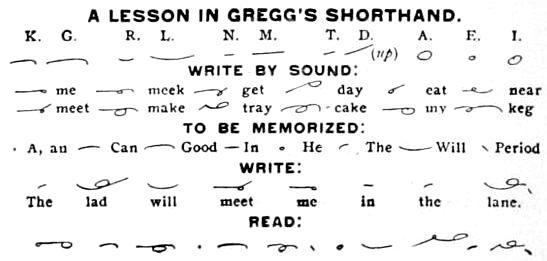
Gregg’s Light-Line Shorthand, a
simple, sensible, legible, rapid
system. Learned in half the
time required by other systems.
Send postal for first lesson.
If you are at
present employed,
write us
regarding our
Home Study
work.
Same thorough
instruction as
given in the
class-room.
Circulars and Booklets free to those desiring particulars
concerning an up-to-date School of Business.
ROWLAND & ROGERS, Proprs., Columbus, O.
Ohio Medical University.
DEPARTMENTS OF
MEDICINE, DENTISTRY AND PHARMACY.
Four years graded course in Medicine, three in Dentistry, and two in Pharmacy. Annual Sessions, seven months.
All Instruction, except Clinical, by the Recitation Plan.
Students graded on their daily recitations and term examinations. Large
class rooms designed for the recitation system. Laboratories are large, well
lighted and equipped with modern apparatus. Abundant clinical facilities
in both Medical and Dental Departments. CONSIDERING SUPERIOR
ADVANTAGES FEES ARE LOW.
For Catalogue and Other Information, Address:
George M. Waters, A. M., M. D., Dean, Medical Department.
L. P. Bethel, D. D. S., Dean, Dental Department.
Geo. H. Matson, Jr., G. Ph., Dean, Pharmacy Department.
OHIO MEDICAL UNIVERSITY,
700–716 North Park Street, COLUMBUS, OHIO.
Starling Medical College,
Corner State and 6th Streets,
COLUMBUS, OHIO. ❧ ❧
MEDICAL AND SURGICAL CLINICS AT FOUR WELL EQUIPPED HOSPITALS. ❧ ❧ ❧ ❧
WELL EQUIPPED AND THOROUGH IN EVERY DETAIL.
EXCEPTIONAL CLINICAL ADVANTAGES.
CURTIS C. HOWARD, M. Sc., Registrar. STARLING LOVING, M. D., LL. D., Dean.
The “Ohio Naturalist.”
A journal devoted more especially to the natural history of
Ohio. The official organ of The Biological Club of
the Ohio State University. Published monthly during
the academic year, from November to June (8 numbers).
Price 50 cents per year, payable in advance. To foreign
countries, 75 cents. Single copies, 10 cents.
Editor-in-Chief, James S. Hine.
Associate Editors.
J. A. Bownocker, Geology,
J. H. Schaffner, Botany,
F. L. Landacre, Zoology,
W. C. Mills, Archaeology,
Max Morse, Ornithology,
F. J. Tyler, Ecology.
Advisory Board.
Prof. W. A. Kellerman.
Prof. Herbert Osborn.
Prof. Charles S. Prosser.
Address THE OHIO NATURALIST,
Ohio State University, Columbus, Ohio.
The Truth, The Whole Truth,
and Nothing but the Truth.
UNCONDITIONALLY THE BEST TYPEWRITER IS
THE CHICAGO$35.00
No typewriter is worth $100. We have made a
mechanically excelling machine, and sell it for
$35. We claim that it is the superior of any typewriter
made. This is a broad but carefully
weighed statement, and it is the truth.
Awarded gold medal at the Paris Exposition,
1900, in open competition with all other makes
of typewriters.
Our descriptive matter tells an interesting
story. Send for it and learn something about a
high-grade typewriter sold at an honest price.
With this issue the Ohio Naturalist begins its second
volume. With brighter prospects before us we shall endeavor to
make improvements over the first volume and to give our subscribers
as good a publication as we possibly can. The subscription
price remains the same as last year and we send out a
large number of sample copies of this issue, with the desire that
when you receive your copy, if you are not already a subscriber,
you will conclude to become one and send us fifty cents and order
the current volume sent to your address. A number of complete
sets of Volume I., or any single number of that volume, are for
sale at the regular subscription price. Address the Ohio
Naturalist, Ohio State University, Columbus, Ohio.
It is suggested that we introduce a correspondence department
into our journal. To that end we announce that hereafter we
shall be pleased to publish letters, or parts of letters, from our
correspondents, whenever we consider such of sufficient general
interest to our subscribers. Also, whenever desired, questions
of importance sent in by correspondents will be answered in
these columns. Members of the Advisory Board have promised
to take charge of this department of the work.
GEOPHILOUS PLANTS OF OHIO, II.
132
Frederick J. Tyler.
The underground parts of plants are often of value as a means
of characterization, and if the plant is a weed they become of the
greatest importance; as the worst weeds are almost invariably
geophytes. Very little information is given in most of the
manuals upon this subject, and what is given is not always
satisfactory.
Figure 1.
The terms used in describing geophytes are in every day use,
except one—the crown. This term is applied to an herbaceous
perennial which has but one upright stalk the first year. This
dies to the surface of the ground at the end of the season, but
the short, upright, underground stem survives. It then sends
up lateral branches, which in some cases grow out several feet,
in others only an inch or so before coming to the surface. This
branching, however, usually takes place in the Autumn and
often the entire crown of lateral branches is formed some time
before the parent plant is cut down by frost.
The following notes, and others, to be given later, are
intended to supplement the notes on Geophilous Plants of Ohio
in the O. S. U. Naturalist, 1:21:
Hypericum ascyron L. A large woody root, surmounted by a
close crown.
133Gentiana andrewsii Griseb. An oblique rhizome, about 2 in.
long, with numerous fleshy roots showing root contraction.
Corallorhiza odontorhiza (Willd.) Nutt. A small bulb, sending
out the coralloid roots from the base.
Lespedeza frutescens (L.) Britton. A long woody tap root,
surmounted by a close crown.
Lespedeza procumbens Michx. A close crownformer.
Lespedeza violacea (L.) Pars. A long tap-root and close
crown, sending up from 10 to 20 annual shoots.
Lespedeza hirta (L.) Ell. A crownformer.
Meibomia pauciflora (Nutt.) Kuntze. A rhizomatous crownformer.
The rhizomes are slender, a foot or more in length, and
branching. At the point of emergence there is usually a cluster
of annual stems.
Thalictrum purpurascens L. A crownformer.
Coreopsis tripteria L. Rhizome composed of annual segments
which are about 1 inch in length.
Epigaea repens L. Rhizomes long and slender, close to the
surface of the ground.
Cypripedium acaule Ait. Rhizome 2 or 3 in. long, sending
out numerous strong roots. The annual growth in length is
very small. In one specimen examined the growth of four years
amounted to only 6 lines.
Waldsteinia fragarioides (Michx.) Tratt. Rhizome 4 to 12
in. long, slender. Lateral branches numerous.
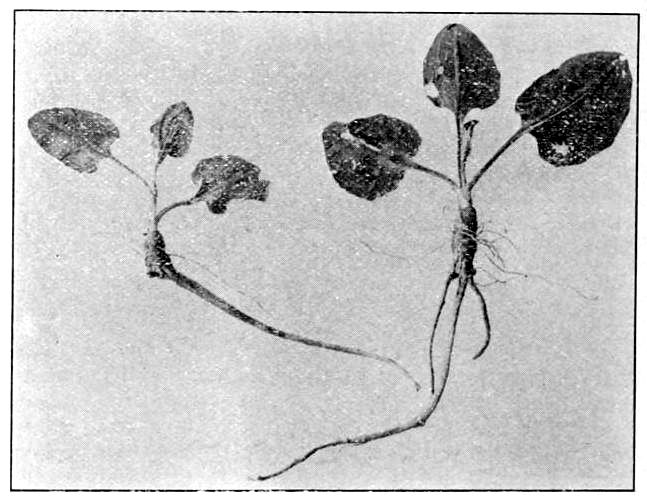
Plantago cordata Lam. An oblique rhizome of unique habit.
The rhizomes of large plants are ½ to ¾ in. thick, and are solid
for 2 or 3 in., but back of this the center rots away, leaving a
shell which splits up to the base. In small plants it splits but
once, forming a flat or slightly incurved ribbon. This becomes
rounded, and seems to perform the function of a root. It,
however, dies off gradually at the posterior parts. In fig. 1 the
split portion is still united near the middle of one of the specimens,
and a portion of the posterior end is dead. The root-like portion
of the rhizome is much longer than the true rhizome.
Plantago rugellii Dec. A short, upright rhizome.
Plantago major L. A short, upright rhizome.
Lobelia syphilitica L. A close crownformer.
Geum canadense Jacq. A short, horizontal rhizome.
A specimen of the large Noctuid moth, Erebus odora Linn.,
was taken by members of the class in geology who were out for
a field excursion on October 5th. So far as I am aware this is
the first record for the capture of this species in Central Ohio.
The specimen was said to be in excellent condition when taken,
but was slightly rubbed and torn in bringing it in.
NOTES ON NESTING OF WARBLERS.
134
At Fort Ancient, Ohio.
Ray Densmore.
During the latter part of May of the present year Mr. Tyler
and myself spent some time collecting in and around Fort Ancient,
Warren County, Ohio. The Fort is situated on the summit of a
hill surrounded by gullies 200 to 300 feet deep, with rather steep
sides. The Little Miami River runs by on the west.
The sides of the gullies are springy and covered by enough
bushes and small trees to make it an ideal resort for many of the
warblers. The most common was the yellow-breasted chat.
Nearly every clump of bushes was inhabited by one or more pairs
of these well named birds. Several nests were found and two
sets of four eggs each were taken. One set is heavily marked
with reddish blotches; the other is typical in coloration, but one
egg is nearly a runt. Oven birds were numerous, but no nests
were found. Kentucky warblers were abundant in the lower
part of the gullies. Three nests were found, one containing four
eggs in an advanced stage of incubation, one containing three
fresh eggs and a cow bird’s egg and one nest just completed.
There was but little variation in the material used in construction,
appearance or location of the nests. The foundations were
composed of tightly packed leaves, the bases of which were outward,
and a lining of fine rootlets or in one a small amount of
horse hair.
A nest of the worm-eating warbler, containing six eggs, was
found by Mr. Tyler in a depression in the side of a bank under a
bush. The bird sat very close and allowed us to approach within
three or four feet before she would leave the nest. We were able
to identify her very certainly. The species must have been rare
in the locality, for no other specimens were seen during our trip.
The nest was composed of a foundation of leaves, loosely placed,
and lined with fine rootlets and weed stems.
The Louisiana water thrush was abundant along the streams.
One nest was found containing four young birds about a week
old. It had a foundation of weed stems and twigs and was lined
with rootlets. Its situation was in the side of a bank a few feet
above the water.
A Maryland yellow throat was heard on the flats of the Little
Miami River, and two other warblers were seen that I was unable
to identify, although one may have been the chestnut-sided.
It is proposed to distribute exsiccata of the Ohio species of
Fungi, issuing small fascicles from time to time as material may
be available.
The original descriptions of all the species, or that given in
connection with the first use of the binomial or technical designation,
will be printed on the labels in addition to the data
usually given. Complete synonomy will not be attempted.
The number of copies will be limited, but it is hoped that all
mycologists who might be especially interested in the specimens,
and those wishing to exchange, may be furnished with the
fascicles as they appear.
Fascicle 1, containing Nos. 1 to 16, issued November 20, 1901,
represents the following species:
1.
Aecidium impatientis Schw., on Impatiens biflora Walt.
2.
Aecidium porosum Peck, on Vicia americana Muhl.
3.
Aecidium sambuci Schw., on Sambucus canadensis L.
4.
Cintractia sorghi (Link), on cultivated Sorghum (S. vulgare Pers.)
5.
Cintractia sorghi (Link), obtained by inoculation.
6.
Cintractia sorghi (Link), on Broom Corn (S. vulgare Pers.)
7.
Cintractia sorghi (Link), obtained by inoculation.
8.
Peronospora arthuri Farl., on Onagra biennis (L.) Scop.
9.
Phyllosticta asiminae E. & K., on Asimina triloba (L.) Dun.
10.
Puccinia helianthi Schw., on Helianthus divaricatus L.
11.
Puccinia helianthi Schw., on Helianthus mollis Lam.
12.
Puccinia marie-wilsoni Clinton, on Claytonia virginica L.
13.
Puccinia podophylli Schw., on Podophyllum peltatum L.
14.
Puccinia smilacis Schw., on Smilax glauca Walt.
15.
Septoria podophyllina Peck, on Podophyllum peltatum L.
16.
Ustilago zeae (Beckm.) Ung., on Zea mays L.
Thanks are extended to the mycologists who have rendered
advice and assistance, especially to Messrs J. B. Ellis, J. C. Arthur,
A. P. Morgan, and C. G. Lloyd. Acknowledgment for assistance
in collecting will be found on the labels accompanying the
several specimens.
The labels to the sixteen specimens of the first Fascicle are
here reproduced.
136
On Impatiens biflora Walt.
Columbus, Ohio. June 1, 1901.
Coll. W. A. Kellerman.
“Aecidium impatientis Sz. V. effusum magnum expallescens,
peridiis in centro sparsis, crenatis, sporidiis majoribus luteo-fuscis
simplicibus.
“Frequens Maio in foliis Impatientis maculatae. Folia bullata
reddit, et macula lata lutescente, in centro obscuriore inquinat.”
L. de Schweinitz, Synopsis Fungorum Carolinae Superioris (excerpta),
p. 41. No. 442. (1822).
On Vicia americana Muhl.
Lakeside, Ottawa Co., O. May 17, 1901.
Coll. W. A. Kellerman.
“Aecidium porosum, Pk. Spots none; cups crowded, deep-seated,
broad, wide-mouthed, occupying the whole lower surface
of the leaf to which they give a porous appearance; spores orange-colored,
subangular, .0008–.001 inch in length.” Botanical Gazette,
3:34. April, 1878.
On Sambucus canadensis L.
Columbus, Ohio. June 24, 1901.
Coll. W. A. Kellerman.
“Aecidium sambuci Sz. V. maculaeforme magnum crassum
folia contorquens aurantium exalbicans, peridiis minutis, sporidiisque
simplicibus pallidis.
“In foliis inprimis ad venas majores et in petiolis Sambuci
Canadensis. Folia contorquet. Color aurantio-croceus; peridia
sparsa pulvere pallido, lutescente-albo.” L. de Schweinitz. Synopsis
Fungorum Carolinae Superioris (excerpta), p. 41. No. 441.
(1822).
“Diagnosis ulterior sequens [sub nom. Caeoma, subgen. Aecidium,
sambuciatum]. C. maculis intumescentibus saepe maximis
(i. e. 2 uncialibus) in petiolis, pallescentibus. Pseudoperidiis magnis,
crebris elevatis, aurantiacis aut pallidis, margine fusco. Sporidiis
aurantiofulvis, decolorantibus. In foliis omnia multo minora—pseudoperidiis
densim aggregatis.” L. de Schweinitz, Synopsis
Fungorum in America Boreali media degentium, p. 294. No. 2897.
(1834).
“Diagn. Substantia farinosa germinum Sorghi vulgaris primum
rimis variis separatur ita ut semina hient. Tum sporidia
oriuntur, usque dum tota compages interior germinis in sporidia
dilapsa sit. Excrescunt quoque glumae in apicibus ramulorum
paniculae, sporidia et partes floris mutilas continentes. Sub microscopio
composito acervi compacti conspiciuntur, aqua adfusa non
diffluentes, e quibus flocci simplices aut semel ramosi exeunt tenues
septati, pauci tantum e singulo acervo. Sporidia compressis acervis
in conspectum prodeunt exacte globosa sat magna, minora majoribus
intermixta.” H. F. Link in Linné Species Plantarum,
62:86.
Obtained by inoculating the Broom Corn seed with the Sorghum
smut.
138
Conidial stage.
On Onagra biennis (L.) Scop.
Columbus, Ohio. June 5, 1901.
Coll. W. A. Kellerman.
“P. arthuri n. sp. Conidiophores rather short and rigid, several
times dichotomous. Tips rather short and rigid. Conidia
broadly ellipsoidal, obtuse, 22–26 mmm. by 19 mmm., slightly violet-colored.
Oospores large, dark brown, 34–42 mmm. in diameter,
exospore covered with short, blunt papillae.” W. G. Farlow,
Botanical Gazette, 8:315. October, 1883.
On Asimina triloba (L.) Dunal.
West Alexandria, Preble Co., Ohio. July 4, 1901.
Coll. W. A. Kellerman.
“Phyllosticta asiminae E. & K. Spots pale brownish, of irregular
shape (½–1 cm.), bordered by a distinct, dark raised line;
perithecia subglobose, deeply immersed, their apices barely visible
on the upper surface of the leaf, scattered, 100–120 mmm. diam.;
spores yellowish with a slightly greenish tinge, obovate, 7–9 x 5–6
mmm.” The American Naturalist, 17:1165. November, 1883.
On Helianthus divaricatus L.
Columbus, Ohio. October 10, 1901.
Coll. W. A. Kellerman and F. J. Tyler.
“Puccinia helianthi Sz. P. minor orbicularis aggregata nigra,
sporidiis globoso-ovalibus bilocularibus longissime pedicellatis.
“In plurimus Helianthis vulgaris. Sporidia fusco-lutea, pedicello
albo, pellucido.” L. de Schweinitz, Synopsis Fungorum
Carolinae Superioris (excerpta), p. 47. No. 495. (1822).
On Helianthus mollis Lam.
Sandusky, Erie Co., Ohio. September 17, 1901.
Coll. W. A. Kellerman.
Supplement to No. 10.
139
Aecidial stage.
Caeoma [Aecidium] claytoniatum Schw.
On Claytonia virginica L.
Arlington, Hancock Co., Ohio. May 1, 1901.
Coll. W. A. Kellerman.
“C. A. Claytoniatum, L. v. S. C. fere simplex et sine macula,
occupans tota folia. Pseudoperidiis latis sparsis. Sporidiis aurantiacis.”
L. de Schweinitz, Synopsis Fungorum in America Boreali
media degentium, p. 294. No. 2892. (1834).
Aecidial stage.
Aecidium podophylli Schw.
On Podophyllum peltatum L.
New Plymouth, Vinton Co., Ohio. May 10, 1901.
Coll. W. A. Kellerman.
“Aecidium podophylli Sz. A. maximum orbiculare demum
effusum flavo-aureum crassissimum, sporidiis subelevatis bilocularibus.
“Folia et caules Podophylli saepe ingenti clade late longeque
tegit, colore pulchro oculos alliciens.” L. de Schweinitz, Synopsis
Fungorum Carolinae Superioris (excerpta), p. 40. No. 435. (1822).
Teleutospores only.
On Smilax glauca Walt.
Mineral Springs, Adams Co., Ohio. Oct. 30, 1900.
Coll. W. A. Kellerman.
“Puccinia smilacis Sz. P. major confluens difformis et stellata
nigro-fusca.
“In Smilace rotundifolia omnia folia subexsiccata occupat.”
L. de Schweinitz, Synopsis Fungorum Carolinae Superioris (excerpta),
p. 46. No. 494. (1822).
On Podophyllum peltatum L.
Columbus, Ohio. June 9, 1901.
Coll. W. A. Kellerman.
“Septoria podophyllina. Spots large, indefinite, reddish-brown;
perithecia epiphyllous, few, clustered on or near the center
of the spot, pallid or blackish, slightly prominent, collapsing when
dry; spores filiform, variable in length, straight or slightly curved,
.0008–.0015 of an inch long.” Chas. H. Peck. Botanical Gazette,
4:170. June, 1879.
140
Lycoperdon zeae Beckm.
On Zea mays L.
Columbus, Ohio. September 30, 1901.
Coll. O. E. Jennings.
For full account of the synonomy with citations and notes,
see J. C. Arthur, Botanical Gazette, 23:46, from which the following
is taken:
To the translation by Johann Beckmann of Tillet’s account
of the species contained in the Royal Academy of Paris, 1776, where
it is stated that, “Son dernier effet consiste à convertir cette excroissance
en une poussière noirâtre et assez semblable à celle qui sort
du lycoperdon ou vesse de loupe.”—a foot note is added by the
translator proposing the binomial designation, as follows:
“Meiner Meynung nach, ist das hier beschriebene Gewaechs
allerdings ein Staubschwamm (Lycoperdon) und zwar eine Species
parasitica, deren in Lin. Syst. Nat. schon drey befindlich sind,
unter welchen also dieser Art, etwa unter dem Namen Lycoper.
zeae ein Platz anzuweisen waere.” J. B., Hannoverisches Magazin,6:1330.
HELPS IN ENTOMOLOGICAL STUDY.
Persons who are anxious to learn something of the habits of
insects are often at a loss to select reliable books. Some recent
additions to the list formerly available will make this task less
difficult. The “Insect Book,” by Dr. L. O. Howard, published
by Doubleday, Page & Company, covers the groups of insects,
exclusive of the butterflies, moths and beetles. It gives figures
of a large number of species, some of them in natural colors, and
while some of the figures fail to give all the detail necessary for
the exact identification of species, most of them are very
satisfactory. The keys, descriptions, typical life histories and
directions for making collections, are written especially for the
class of students who do not have access to specific collections,
libraries or instruction.
Another book of great interest at the present time (also by
Dr. Howard) is entitled “Mosquitoes, How they Carry Disease,
How they Live, How they are Classified, How they May be
Destroyed.” This deals in a remarkably clear and attractive
manner with the habits of mosquitoes, their breeding grounds,
the different species and their distribution, their relation to
malaria and yellow fever, and the measures by which their
numbers may be reduced. It furnishes incidentally a most
excellent guide to the methods of life history study for aquatic
insects. It is published by McClure, Phillips & Co.—H. O.
AN ABNORMAL SALAMANDER.
141
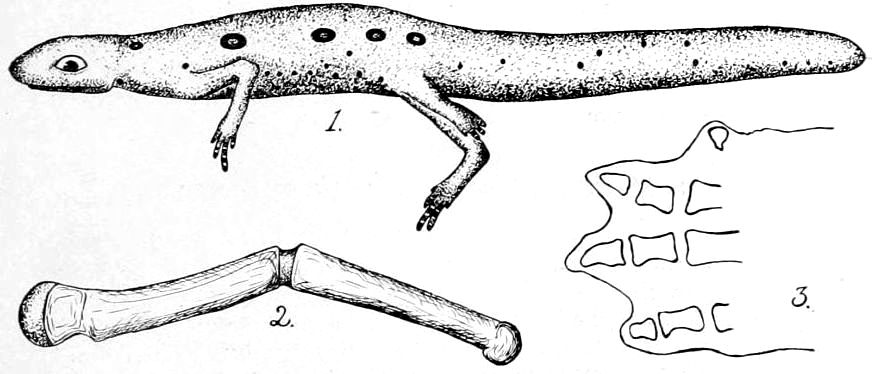
(Explanation of Figures.)
E. B. Williamson.
Mr. John Russi during the past summer collected a newt,
Diemyctelus viridescens, Raf., near Salem, Ohio, with a fifth
foot growing from the dorsal surface of the left thigh, as shown
in figure 1. The newt is a young one, 48 millimeters in length.
The left femur is slightly longer than the right, and is shown
much enlarged at figure 2 in anterior view. Near its middle is
a section of cartilege which allows of the femur being bent
slightly in any direction. Tendons from the fifth foot pass to
the femur at this point. Figure 3 shows a much enlarged drawing
of the skeletal elements of the foot from dorsal view. The
salamander was kept alive for some time but so far as was seen
made no use of and exercised no control over its extra foot. I
am indebted to Mr. Russi for the privilege of examining this
interesting specimen which he has donated to the Salem High
School Museum.
THE SUMMER’S WORK AT SANDUSKY.
The work at the Lake Laboratory at Sandusky the past summer
was very encouraging and indicates a steady growth in this
branch of university work. Aside from a number of instructors
and students from the Departments of Botany and Zoology and
Entomology of the University, there were in attendance representatives
of a number of other Ohio colleges and high schools.
Courses in General Zoology, Botany, Entomology, Invertebrate
Morphology, Embryology and Ornithology were given. Collecting
trips to different portions of the bay, the lake shore, and the
142country adjacent to the laboratory were productive of many
interesting objects for study, and reports on some of these will
appear in later numbers of the Naturalist. Special excursions
to Castalia, Lakeside, Kelley’s Island, Put-in-Bay and Green
Island were not only enjoyable, but furnished much of profit in
the way of collections. One of the most appreciated feature was a
visit to the U. S. Fish Commission Hatchery at Put-in-Bay, which
furnished an opportunity to watch the plankton work done on
the Shear Water under the direction of Prof. H. B. Ward.
A series of Friday afternoon lectures on biological problems,
with titles, “Adaptation in Animal Life,” “Aquatic Life,” “Air-breathing
Animals,” “Some Phases of Evolution,” “Some
Problems in Applied Zoology,” “Mimicry and Protective Resemblance
in Nature,” were given by Prof. Osborn, and one on
“Natural Selection,” by Prof. Landacre.
THE MAXIMUM HEIGHT OF PLANTS III.
John H. Schaffner.
During the past summer, the plants mentioned below were
measured by the writer in northern Kansas. A number of species
grew far beyond the height mentioned in our manuals, although
there was a very severe drought the entire summer. The height
given probably approaches the maximum in but few cases and a
better growing season might produce a very noticeable increase in
size. The measurements are given in comparison with those of
Britton and Brown’s Flora.
Britton.
Measured.
Polygonum lapathifolium L.
3 ft.
8 ft.
Polygonum camporum Meisn.
3
6¼
Froelichia floridiana (Nutt.) Moq.
4
5
Chenopodium album L.
10
12½
Anemone virginiana L. (Ohio)
3
3½
Polanisia trachysperma T. & G.
1½
2¾
Cassia chamaecrista L.
2½
5⅔
Astragalus carolinianus L.
4
5½
Meibomia illinoensis (Gr.) Ktz.
4
7
Euphorbia dentata Michx.
1¼
4
Euphorbia hexagona Nutt.
1⅔
5
Euphorbia nutans Lag.
2
3¼
Ceanothus ovatus Desf.
4
Ammannia coccinea Rottb.
1⅔
3
Gaura parviflora Dougl.
5
12
Stenosiphon linifolium (Nutt.) Britt.
5
8
Onosmodium molle Michx.
2
2½
Lycopus americanus Muhl.
2
5
Mentha canadensis L.
2½
3
Mimulus ringens L.
3
3½
Lacinaria punctata (Hook.) Ktz.
2½
3
Helianthus giganteus L. (Ohio)
12
13
Coreopsis tripteris L. (Ohio)
8
9
Carduus altissimus L.
10
11
THE BIRDS OF CEDAR POINT, SANDUSKY.
143
R. L. Baird.
The following list of birds I observed on Cedar Point within
two miles of its extremity, from July 30th to August 20th, 1901,
while a student at the O. S. U. Lake Laboratory. The list is
not so complete as it might be. I found the birds I did for the
most part in short daily visits of about an hour each, generally
in the afternoon. One whole day I spent on the Point and two
half days. With one exception, that of the American Herring
Gull, I think all the species named nest in the neighborhood of
Cedar Point. The list ought to be much extended by going
over the part nearer the mainland. I think at least fifteen or
twenty more species ought to be found there as summer residents.
I rode from Oberlin to Sandusky several times and the
additional species I saw in Erie county I shall add in a list by
themselves. The most noticeable of these were the Bank
Swallows. They were in immense flocks along the road from
Sandusky to Huron. Sometimes as many as five hundred would
alight on two lengths of telephone wire.
The Long-billed Marsh Wrens were quite common all the
time in the reeds to the west of the Point. They were not
singing, however, after August 5th. The swamps upon the
Point supplied many of the shore birds. In a flock there were
generally Bartramian, Pectoral, Spotted and Semipalmated Sandpipers,
Semipalmated Plover, and Killdeers. It was a common
thing during the last week to hear the Coots in the marsh west
of the Point. Pied-billed Grebes were also tolerably common
there. The Bald Eagles were probably a pair which had a nest
nearer the mainland. The American Bittern I quote on the
authority of Mr. Field, of Dennison College.
I use the order of the latest A. O. U. check-list. The
following abbreviations I add after each species: C.—common;
Tc.—tolerably common; Fe.—few; figures indicate the exact
number seen.
CEDAR POINT LIST.
6.
Pied-billed Grebe, Podilymbus podiceps. Tc.
51a.
American Herring Gull, Larus argentatus smithsonianus. 1.
70.
Common Tern, Sterna hirundo. C.
77.
Black Tern, Hydrochelidon nigra surinamensis. Fe.
190.
American Bittern, Botaurus lentiginosus. Fe.
191.
Least Bittern, Ardetta exilis. Fe.
194.
Great Blue Heron, Ardea herodias. Tc.
201.
Green Heron, Ardea virescens. Tc.
212.
Virginia Rail, Rallus virginianus. Tc.
144
214.
Sora, Porzana carolina. Tc.
221.
American Coot, Fulica americana. Tc.
228.
American Woodcock, Philohela minor. Fe.
239.
Pectoral Sandpiper, Tringa maculata. Tc.
246.
Semipalmated Sandpiper, Ereunetes pusillus. Fe.
248.
Sanderling, Calidris arenaria. Tc.
261.
Bartramian Sandpiper, Bartramia longicauda. Tc.
263.
Spotted Sandpiper, Actitis macularia. C.
273.
Killdeer, Ægialitis vocifera. Fe.
274.
Semipalmated Plover, Ægialitis semipalmata. Tc.
289.
Bob-white, Colinus virginianus. Fe.
316.
Mourning Dove, Zenaidura macroura. Fe.
331.
Marsh Hawk, Circus hudsonius. Fe.
333.
Cooper’s Hawk, Accipiter cooperi. Fe.
352.
Bald Eagle. Haliætus leucocephalus. 2.
364.
American Osprey, Pandion haliaetus carolinensis. 1.
The Biological Club met in the Zoological lecture room on the
evening of October 7th, at seven o’clock. Professor Osborn presided
over the meeting.
The minutes of the June meeting were read and approved.
The evening was given to reports on personal work and observations
of the summer.
Professor Prosser reported that he had spent part of the summer
in northern Ohio. He visited points along the Cuyahoga
and Rocky rivers, and studied the outcrops of the conglomerate
at Boston Ledges, Little Mountain, Thompson Ledges, Nelson
Ledges and at Sharon in Pennsylvania.
Professor Kellerman collected a quantity of material in the
Gauley Mountains of West Virginia, adding a number of plants
to the published list of that state and securing a few that appear
146to be new to science. He also collected several hybrid oaks in
Ohio, and some specimens of Cratægus, which Dr. Sargent of the
Arnold Arboretum pronounces new species. A number of species
have been added to the published state list of Ohio.
Professor Mills gave a report of the opening of a prehistoric
mound in Ross County just outside the town of Chillicothe. A
number of skeletons and some very valuable material were obtained
for the collections of the Ohio Archæological and Historical
Society.
Professor Schaffner spent the summer in Kansas. He talked
interestingly of a visit he made to the Pottawattamie Indian
Reservation, and showed a series of photographs procured during
a short stay among these interesting people. Scientific investigations
were made on several subjects, among which the following
may be mentioned: “The Self-pruning of Trees;” “The
Distribution of Cacti and Ferns in Kansas;” “The Maximum
Height of Plants;” and “The Timber Conditions of Kansas.”
Professor Landacre gave observations on the cocoon-spinning
and egg-laying of the common garden spider.
Mr. Morse mentioned procuring a water snake with thirty-three
young. Also that the blowing viper, Heterodon platyrhinus, has
some peculiar habits while in confinement. One specimen if
teased would go through a series of contortions and eventually
come to rest lying on its back. If all was quiet then it would soon
take up its normal attitude, but if touched, or someone made a
noise it was likely to turn over on its back again.
Professor Cook spoke regarding the advance of plants in rock-quarries.
Monocotyls and willows are mostly brought in by
water, while dicotyls are more often brought in by wind. The
monocotyls are the first to appear as a usual thing. In the
particular quarry in mind sycamores and willows were the only
trees observed.
Mr. Bridwell spent the summer in Kansas, where most of his
time was spent in collecting plants and insects. The dry weather
appeared to have its effect, as collecting was not as good as it had
been in former years.
Professor Osborn showed several photographs of tracks made
by various animals on the sand of the lake beach at Sandusky.
Also other photographs of scientific interest, among which may
be mentioned the fine glacial grooves of Kelly’s Island, and the
nest of a red-bird containing three young.
A proposition to hold the meetings of the club in Orton Hall
for the coming year was accepted.
The November meeting is the annual meeting, at which new
officers are elected, therefore a committee on nominations was
appointed. Professors Schaffner, Prosser and Landacre were
appointed by the chair.
James S. Hine, Secretary.
Ohio State University.
Six Colleges well equipped and prepared to present the
best methods in modern education. The advantages
are offered to both sexes alike.
The following list of departments will suggest the organization of the institution:
Agriculture, Agricultural Chemistry, American History and Political
Science, Anatomy and Physiology, Architecture and Drawing,
Astronomy, Botany, Chemistry, Civil Engineering, Clay Working
and Ceramics, Domestic Science, Economics and Sociology, Education,
Electrical Engineering, English Literature, European History,
Geology, Germanic Languages and Literatures, Greek, Horticulture
and Forestry, Industrial Arts, Latin, Law, Mathematics, Mechanical
Engineering, Metallurgy and Mineralogy, Military Science, Mine
Engineering, Pharmacy, Philosophy, Physical Education, Physics,
Rhetoric and English Language, Romance Languages, Veterinary
Medicine and Zoology and Entomology.
Catalogues will be sent upon application. After examining the catalogue write for specific information to the President
Dr. W. O. THOMPSON, Columbus, Ohio.
SPECIMENS DESIRED FOR
BOTANICAL MUSEUM.
The large mushrooms, Puffballs and other Fungi; Abnormal
growths and interesting specimens of shrubs and trees.
Also herbarium specimens of Algae, Fungi, Mosses and
Ferns as well as flowering plants. Address
Prof. W. A. Kellerman,
Department of Botany, Ohio State University,
Columbus, Ohio.
GEOLOGICAL MUSEUM.
Will exchange Hudson, Corniferous and Carboniferous
fossils. Address
Prof. J. A. Bownocker, Curator,
Geological Museum, Ohio State University,
Columbus, Ohio,
ZOOLOGICAL MUSEUM.
Birds, Insects, Reptiles, etc. We wish to make our collections
representative for the fauna of the state and will
greatly appreciate all contributions to that end.
Address, Prof. Herbert Osborn,
Department Zoology and Entomology,
Ohio State University, Columbus, Ohio.
Ohio State University, Lake Laboratory. Located at Sandusky on Lake Erie.
Open to Investigators June 15 to September 15. Laboratory courses of six and
eight weeks beginning June 30, 1902. Write for special circular.
Bucher Engraving Co.
Process and Wood Engraving, Electrotypers
and Manufacturers of Stereotyping
and Engraving Machinery.
80½ North High Street, COLUMBUS, OHIO.
Lepidoptera Price List No. 3.—Price 5 cents Refunded to Buyers
Issued November 15th, 1901.
Dealers in all kinds of ... ENTOMOLOGICAL SUPPLIES.
Manufacturers of the Original and Celebrated ... SCHMITT INSECT BOXES.
Builders of INSECT CABINETS, Etc.
American Entomological Company
1040 DE KALB AVENUE, BROOKLYN, N. Y.
NEW EDITION
WEBSTER’S INTERNATIONAL DICTIONARY
New Plates Throughout.
25,000 ADDITIONAL WORDS
Phrases and Definitions
Prepared under the direct supervision of W. T. HARRIS, Ph.D., LL.D.,
United States Commissioner of Education, assisted by a large corps of competent
specialists and editors.
Rich Bindings. 2364 Pages. 5000 Illustrations.
☞ The International was first issued in 1890, succeeding the “Unabridged.”
The New Edition of the International was issued in Oct., 1900. Get latest and best.
Also Webster’s Collegiate Dictionary with Glossary
of Scottish Words and Phrases.
“First class in quality, second class in size.”
Nicholas Murray Butler.
Specimen pages, etc., of both books sent on application.
G. & C. Merriam Co. Springfield, Mass.
SYSTEMATIC COLLECTION OF
Minerals, Rocks, Fossils
Birds and Mammals, Shells and Echinoderms.
Also Human Skeletons, and Anatomical Models.
Relief Models by Messrs. Shaler, Davis and Harris, illustrating
Physical Geology and Physiography
WRITE FOR CIRCULARS,
Wards’ Natural Science Establishment,
ROCHESTER, N. Y.
If you have your PHOTOS made at the
BAKER’S ART GALLERY,
You will ALWAYS be pleased
State and High Sts., COLUMBUS, OHIO.
OUR LIST OF AWARDS FOR THE LAST YEAR ARE:
The Gold Medal at Paris Exposition.
Highest Award at the Pan-American Exposition.
Six First Premiums out of seven at Ohio State Exposition.
DIE STAMPING. PLATE AND LETTER PRESS PRINTING.
SPAHR & GLENN,
PRINTERS AND PUBLISHERS.
50 EAST BROAD STREET. COLUMBUS, OHIO.
Scientific Taxidermy.
EVERY SCHOOL should have a collection of Natural
History specimens. Why not
START A COLLECTION
of the Birds or Mammals of your county or state, or enrich a
present collection by the addition of some well mounted specimens?
Costs so much? Perhaps
so, but WRITE TO ME FOR
PRICES and you will be
surprised how little such
a collection will cost after
all. Think of the interest
that will be awakened in
your school in the
STUDY OF NATURE
to reward you for trouble
and outlay.
I mount to order
BIRDS, MAMMALS, FISH and REPTILES
and solicit your patronage. If you are interested,
you should not lose an opportunity to
examine the novel collection of Ohio birds,
prepared by myself, in the museum of Zoology,
Ohio State University.
TAUGHT BY MAIL.—I give instructions
in the Art of Taxidermy, personally, or
BY MAIL. You can learn to collect and prepare
your own birds, thus reducing the cost of a
collection to a minimum.
For prices and circulars, address
NATURALIST—THOMAS M. EARL—TAXIDERMIST
Cor. Naghten and Ninth Sts., Columbus, Ohio.
TRANSCRIBER’S NOTES
Silently corrected obvious typographical errors and variations in spelling.
Retained archaic, non-standard, and uncertain spellings as printed.