OSSEI, OR BONY FISHES.
Under this denomination is comprehended many of the fishes which
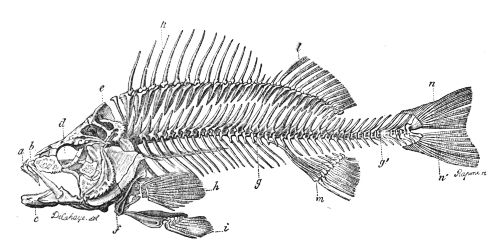
are most familiar to us. They are characterized, as we have said elsewhere,
as a group of animals having a solid skeleton. They are
divided into six orders; founded, however, it is necessary to add, on
characteristics of little organic importance, and the names bestowed
upon them are of a most barbarous description. These names are,
I. Plectognathi, namely, fishes in which the upper jaw is attached to
the cranium, from πλεκτὸς, interlaced, and γνάθος, jaw.
Afterwards those in which the upper jaw is movable, and the gills
arranged in circles, like rounded hoops. These are, II. the Lophobranchii,
from λὀφυς, crested, or aigrette, and βρἀνχια, gill.
In the other orders the gills are arranged in a comb-like form.
These are divided into two great groups. In the first, the rays of the
fins are soft, except occasionally the first of dorsal or pectoral fins.
These are, III. the Malacopterygians, from μαλακὸς, soft, and
πτερύγιον, finned—the third group of osseous fishes. In a later group
the fish have bony rays to the anterior dorsal fins, some osseous rays,
and the anal fin and generally one of the ventral fins. These are,
IV. the Acanthopterygians, from ἂκανθα, spiny, and πτερύγιομ,
finned, which form the last group of bony fishes.
I. Plectognathi.
From their organization the fishes of this order establish the passage
from cartilaginous to the osseous fishes. Their skeleton, which remains
for some time more or less soft, becomes finally hard. The chief characteristic
of the order is that the maxillary is firmly attached to the
side of the inter-maxillary bone which forms the jaw, and the arch of
the palate is united to the skull in such a manner as to be motionless.
The operculum and rays of the gills are hidden under a thick skin,
which leaves externally only a small branchial slit. These fishes
have no true ventral fin, and have only vestiges of side fins.
This order comprehends two natural families characterized by the
armature of their jaws. They are the Gymnodonta and the Sclerodermata.
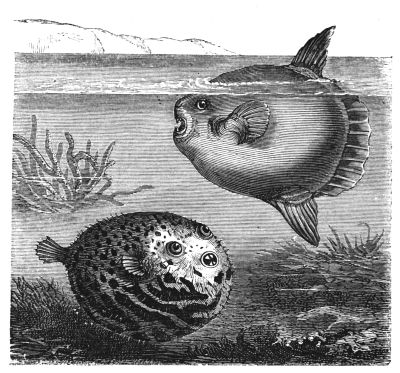
Fig. 357. The Globe-fish (Orthagoriscus), and Sun-fish (Tetrodon).
In the family of Gymnodonta the jaws have no apparent teeth,
but they are furnished with a species of beak in ivory, which represents
them. The Sun-fish, Tetrodon (Fig. 357), belong to the
family.
The Globe-fish are so named from their large head and bony salient
jaws, which are each divided in front by a sort of vertical slit in two
portions, which simulate two teeth. These four portions of bony jaw,
which project beyond the lips, somewhat resemble the hard and dentate
jaws of the turtle. Their anterior part is sometimes prolonged, like the
mandibles of the beak of the parrot. They are perfectly arranged to
crush the shells of the molluscs, as well as the resisting envelope of
the crustaceans on which they feed. The skin of these fishes bristles
with small slightly-projecting spines, the number of which compensate
for their brevity, which repel their enemies, and even wound the hand
that would grasp them. They enjoy, besides, a singular faculty; they
can inflate the lower part of their body, and give it an extension so
considerable that it becomes like an inflated ball, in which the real
shape of the animal is lost. This result is obtained by the introduction
of an immense quantity of air into the stomach when it wishes to
ascend to the surface. The species of globe-fish are numerous. Some
of them are common in the Nile, where they are frequently left ashore
during the annual inundations.
The Globe-fish (Orthagoriscus mola), in the upper part of the engraving,
is easily distinguished from the Tetrodons by its compressed
spineless body; being very round in its vertical contour, it has been
compared to a disk, and more poetically to the moon—whence its
popular names—to the great circular surface of which the dazzling
silvery white disk bears some resemblance. But it is especially during
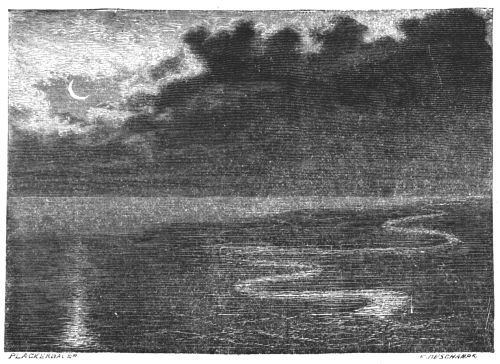
the night that it justifies the name given to it. Then it shines brightly,
from its own phosphorescent light, at a little distance beneath the surface.
On very dark nights the globe-fish is sometimes seen swimming
in the soft light which emanates from its body, the rays rendered
undulating by the rippling of the water which it traverses, so as to
resemble the trembling light of the moon half-veiled in misty vapours.
When many of these fishes rove about together, mingling their silvery
trains, the scene suggests the idea of dancing stars. The moon-fish
is common in the Mediterranean, and sometimes reaches the markets
of Paris. It is about thirty inches in length, and its weight is considerable.
Its flesh is fat and viscous, and by no means pleasant
to eat.
The Diodons (Fig. 358) only differ from the globe-fish in the form
of their bony jaws, each forming only one piece. They seem to have
two teeth, whence their name, from δίς, two, ὀδοὺς, teeth. They differ
also in their spines, which are much larger than those of the globe-fish.
These fishes may be said to be the hedgehogs and porcupines of the
sea. Like the globe-fish, they can erect their spines and inflate their
bodies.
They are numerous in species—Diodon pilosus, represented in
Fig. 358, being typical of the others.
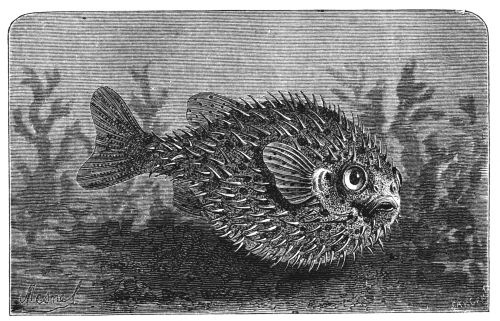
Fig. 358. Diodon pilosus.
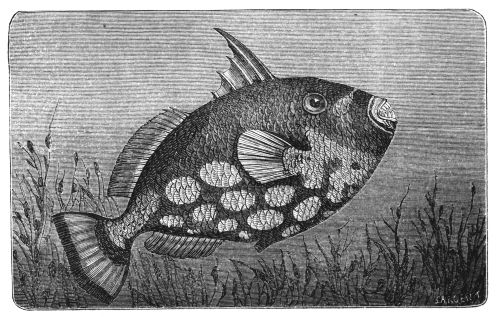
Fig. 359. The File-fish (Balistes).
The Sclerodermes are distinguished by their conical or pyramidal
muzzle, terminating in a little mouth armed with true teeth; their
skin is generally stiff and covered with hard scales. The File-fish,
Balistes and Coffers, are selected for notice. The File or Rudder-fish
(Fig. 359) have the body compressed; the jaws are furnished with
eight teeth, arranged in a single row on each jaw, and covered with
true lips; the eyes are nearly level with the skin; the mouth is small,
and the body enveloped in very hard scales, which are connected in
groups and distributed into compartments more or less regular, and
strongly connected by means of a thick skin. The animal is thus
protected by a sort of cuirass and casque very difficult to penetrate.
With the exception of one species, the Balistes are inhabitants of
Tropical seas. They are generally brilliantly coloured; they herd
together in great numbers, and in their gambols produce curious combinations
of brilliant colouring in the Equatorial seas. Their flesh is
held in slight estimation, and at certain periods of the year is even
said to be dangerous.
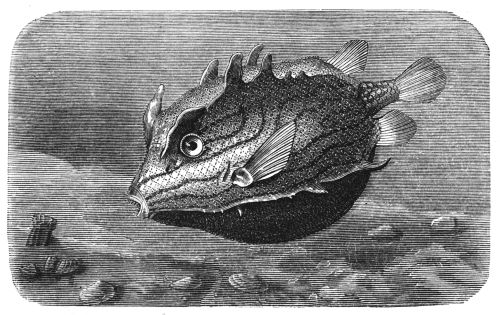
Fig. 360. The Coffer, or Ostracion.
The Coffers, or Ostracions (Fig. 360), are without scales, but covered
with regular osseous compartments, which are so jointed the one to
the other that the body is, as it were, enclosed in a kind of box or
long coffer, which only reveals the external organs of locomotion—namely,
the fins and a portion of tail. In some the body is triangular,
in others quadrangular, with or without spines.
These singular fishes are found in the Indian Ocean and in the
American seas. They are of moderate size, and are much prized in
the United States as food.
II. Lophobranchii.
The Lophobranchii comprehend a few types, but are numerous in
species. Here the gills are divided into small round tufts, and
arranged in pairs along the branchial arches; a structure quite
peculiar, of which we have no examples in any other fishes. These
gills are enclosed under a large cover, or operculum, attached on all
sides by a membrane, which leaves only a small hole for the escape of
water which has served the purposes of respiration.
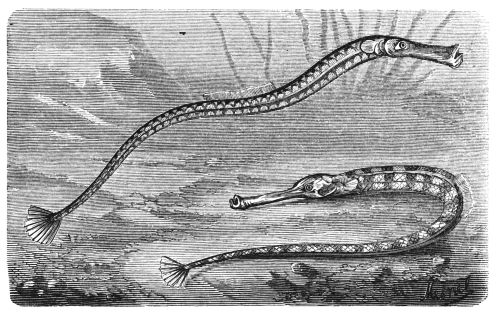
Fig. 361. The Trumpet Pipe-fish (Syngnathus).
These little cuirassed fishes consist of two genera, Syngnathus and
Hippocampus. The Syngnathes, or pipe-fishes, possess a very curious
organic peculiarity. Their bodies are long, slender, and slightly
tapering, covered with plates set lengthwise, without ventrals; the
skin, in swelling, forms under the belly or under the tail, according to
the species, a pouch into which the eggs glide to be hatched, and
which is afterwards a shelter for the young. Most of the species are
strangers to European seas, but some few are found in the Channel.
The Trumpet Pipe-fish (Fig. 361) has the head small, the muzzle
long, nearly cylindrical, slightly raised at the end, and terminating in
a very small mouth without teeth. The animal is about twenty inches
long; its skin is of a yellowish colour varied with brown. It lives in
the Atlantic and Mediterranean, where it is largely used by the
fishermen in baiting their hooks. It is found in great abundance in
the Atlantic between the Equator and the Western Isles.
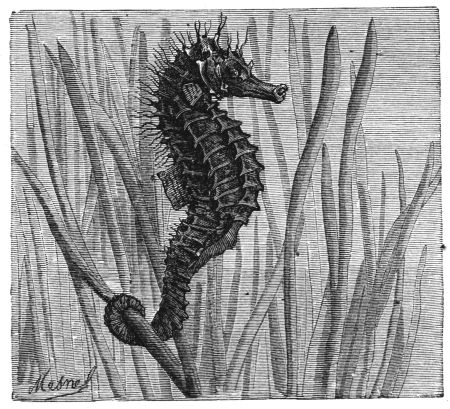
Fig. 362. The Sea-horse (Hippocampus).
The Sea Horse (Hippocampus) is a small creature about the size of
the engraving (Fig. 362); its head has a singular resemblance to that
of the horse. The rings which constitute the integument of the body
and tail have a close resemblance to the rings of some caterpillars.
This curious combination of forms originated the name, Hippocampus,
from ἵππος, horse, κάμπος, fish, adopted in very ancient times
to designate this creature. It is found in the Atlantic, round the
coast of Spain, the south of France, in the Mediterranean, and in the
Indian Ocean. Mr. Lukis, who raised two females in captivity,
describes their habits as follows:—"When they swim," he says,
"they preserve a vertical position, but their tail seems on the alert to
seize whatever it meets with in the water, clasping the stem of the
rushes. Once fixed, the animal seems to watch attentively all the
surrounding objects, and darts on any prey presenting itself with
great dexterity. When one of them approaches the other, they
interlace their two tails, and it is only after a struggle that they can
separate again, attaching themselves by the lower part of the chin
to some rush in order to release themselves. They have recourse to
the same manœuvre when they wish to raise the body, or when they
wish to wind their tail to some new object. Their two eyes seem to
move independently of each other, like those of the chameleon. The
iris is bright and edged with blue."
The sea-horses have the pectoral fins so formed as easily to sustain
the body, not only in the water, but even in the air; they are, in fact,
winged fishes, and probably originated the famous winged courser of
mythology, after which they are sometimes named. They rarely
exceed four inches in length; the body is covered with triangular
scales, commonly of a bluish colour. They live on worms, fishes'
eggs, and fragments of organic substances which they find in the far
land at the bottom of the sea.
III. Malacopterygii.
The principal character of the fishes of this order is that the rays of
the fins are soft, except sometimes the first ray of the dorsal or
pectorals. They inhabit either sea or fresh water, and include fishes
of the utmost importance as human food, such as the herring, the cod,
the salmon, carp, pike, and many others. Modern naturalists, following
Cuvier, subdivide them into three orders:—1. Apoda, without
ventrals; 2. Sub-branchiati, ventrals under the pectorals; 3. Abdominales,
having ventrals behind the pectorals.
1. APODA.
A single family composes this order, which comprehends great
numbers both in genera and species; they are anguilliform or snake-like,
elongated in form, the skin thick and soft, and have no ventral
fins. In this order are included the Ammodytes, Gymnotes, Murænas,
and Anguilla, or eels.
The Ammodytes have the body elongated and serpent-like, having
a continuous fin extending along the greater part of the back, with
another at the opposite side, and a third or forked fin at the end of
the tail. The muzzle is also long; the lower jaw longer than the
upper. A. lancea (Fig. 363) buries itself in the sand; hence it is
called the sand-eel; it hollows out a burrow for itself in the sand with
its muzzle to the depth of fifteen or twenty inches, where it hunts out
worms, on which it feeds, while it shelters itself from the jaws of
many voracious fishes, which eagerly pursue it for its delicate flesh.
In appearance the Ammodytes lancea is silvery blue, brighter on the
lower parts than on the upper, the radiating fins on the abdomen
being alternately white and bluish in colour.
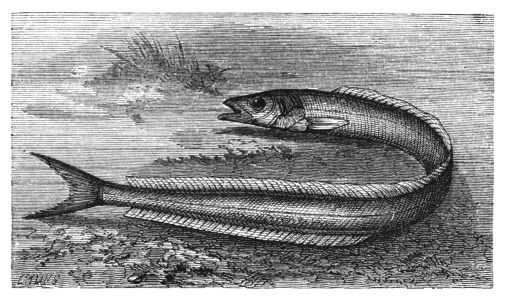
Fig. 363. The Lance (A. lancea).
The gymnotes are long, nearly cylindrical, and also serpent-like,
the tail being long in comparison to the other parts of the body.
Beneath the tail is a long swimming fin, the only locomotive organ,
and it is this nakedness of the back which confers its designation of
γυμνὸς, naked, νῶτος, back.
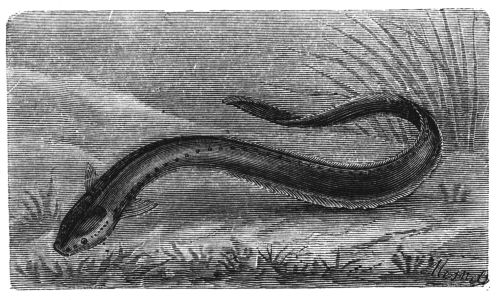
Fig. 364. The Gymnotus Electricus, or Electrical Eel.
The Gymnotes are fresh-water fishes of South America, where they
attain a great size. There are several species, but the most remarkable,
from its singular physical properties, is the Electrical Eel, Gymnotus
electricus (Fig. 364). These properties enable the gymnotus
to arrest suddenly the pursuit of an enemy, or the flight of its prey, to
suspend on the instant every movement of its victim, and subdue it
by an invisible power. Even the fishermen themselves are suddenly
struck and rendered torpid at the moment of seizing it, while nothing
external betrays the mysterious power possessed by the animal.
The electrical properties of the gymnotus were reported for the
first time by Van Berkal. The astronomer Richer, who had been
sent to Cayenne in 1671 by the Academy of Sciences of Paris, on
the Geodesic Survey, first made known the singular properties of the
American fish. "I was much astonished," says this author, "to see a
fish some three or four feet in length, and resembling an eel, deprive of
all sensation for a quarter of an hour the arm and neighbouring parts
which touched it. I was not only an ocular witness of the effect produced
by its touch; but I have myself felt it, on touching one of these
fishes still living, though wounded by a hook, by means of which some
Indians had drawn it from the water. They could not tell what it
was called; but they assured me that it struck other fishes with its
tail in order to stupefy them and devour them afterwards, which is
very probable when we consider the effect of its touch upon a man."
The observations of Richer made little impression at the time on
the savants of Paris, and matters remained in this state for seventy
years, when the traveller Condamine spoke in his "Voyage en
Amérique" of a fish which produced the effects described by Richer.
In 1750 a physician named Ingram furnished some new views
respecting this fish, which he thought was surrounded by an electric
atmosphere. In 1755 another physician, the Dutch Dr. Gramund,
writes: "The effect produced by this fish corresponds exactly with that
produced by the Leyden jar, with this difference, that we see no tinsel
on its body, however strong the blow it gives; for if the fish is large,
those who touch it are struck down, and feel the blow on their whole
body."
Many experiments followed these; but we are indebted to Alexander
von Humboldt for the first precise account of this very curious fish.
The celebrated naturalist read to the Institute of France an important
memoir upon the electrical eel from Bonpland's observations, the substance
of which we shall give here.
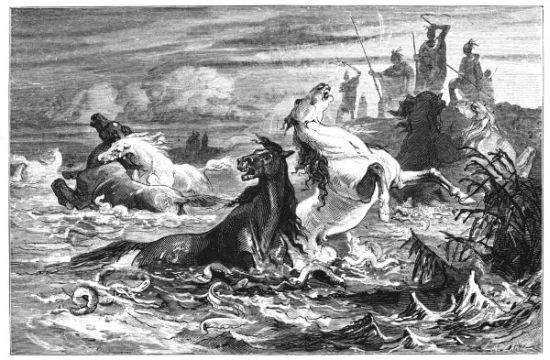
Plate XXVII.—Fishing for Eel (Gymnotus) on the Orinoco.
In traversing the Llanas of the province of Caracas, in order to
embark at San Fernando de Apure on his voyage up the Orinoco,
M. Bonpland stopped at Calabozo. The object of this sojourn was to
investigate the history of the gymnotus, great numbers of which are
found in the neighbourhood. After three days' residence in Calabozo
some Indians conducted them to the Cano de Bera, a muddy and
stagnant basin, but surrounded by rich vegetation, in which Clusia
rosea, Hymenœa courbaril, some grand Indian figs, and some magnificent
flowering odoriferous mimosas, were pre-eminent. They were
much surprised when informed that it would be necessary to take
thirty half-wild horses from the neighbouring savannahs in order to
fish for the gymnotus.
The idea of this fishing, called in the language of the country
embarbascar con caballos (intoxicating by means of horses), is very
odd. The word barbasco indicates the roots of the Lacquinia, or any
other poisonous plant, by contact of which a body of water acquires
the property of killing, or, at least, of intoxicating or stupefying the
fishes. These come to the surface when they have been poisoned in
this manner. The horses chasing them here and there in a marsh
has, it seems, the same effect upon the alarmed fishes. While our
hosts were explaining to us this strange mode of fishing, the troop
of horses and mules had arrived, and the Indians had made a sort of
battue, pressing the horses on all sides, and forcing them into the
marsh. The Indians, armed with long canes and harpoons, placed
themselves round the basin, some of them mounting the trees, whose
branches hung over the water, and by their cries, and still more by their
canes, preventing the horses from landing again. The eels, stunned by
the noise, defended themselves by repeated discharges of their batteries.
For a long time it seemed as if they would be victorious over the
horses. Some of the mules especially, being almost stifled by the frequency
and force of the shock, disappeared under the water, and some
of the horses, in spite of the watchfulness of the Indians, regained the
bank, where, overcome by the shocks they had undergone, they stretched
themselves at their whole length. The picture presented was now
indescribable. Groups of Indians surrounded the basin; the horses
with bristling mane, terror and grief in their eyes, trying to escape
from the storm which had surprised them; the eels, yellow and
livid, looking like great aquatic serpents swimming on the surface of
the water, and chasing their enemies, were objects at once appalling
and picturesque. In less than five minutes two horses were drowned.
An eel, more than five feet long, glided under one horse, discharged
its apparatus through its whole extent, attacking at once the heart,
the viscera, and the plexus of the nerves of the animal, probably
benumbing and finally drowning it.
When the struggle had endured a quarter of an hour, the mules
and horses appeared less frightened, the manes became more erect, the
eyes expressed less terror, the eels shunned in place of attacking them,
at the same time approaching the bank, when they were easily taken by
throwing little harpoons at them attached to long cords, the harpoon,
sometimes hooking two at a time, being landed by means of the long
cord. They were drawn ashore without being able to communicate
any shock.
Having landed the eels, they were transported to little pools dug in
the soil, and filled with fresh water; but such is the terror they
inspire, that none of the people of the country would release them
from the harpoon—a task which the travellers had to perform themselves,
and receive the first shock, which was not slight—the most
energetic surpassing in force that communicated by a Leyden jar
completely charged. The gymnotus surpasses in size and strength all
the other electric fishes. Humboldt saw them five feet three inches
long. They vary in colour according to age, and the nature of the
muddy water in which they live. Beneath, the head is of a fine yellow
colour mixed with red; the mouth is large, and furnished with small
teeth arranged in many rows.
The gymnotus makes its shock felt in any part of its body which
is touched, but the excitement is greater when touched under the
belly, and in the pectoral fin. The gymnotus gives the most frightful
shocks without the least muscular movement in the fins, in the head,
or any other part of the body. The shock, indeed, depends upon the
will of the animal, and in this respect differs from a Leyden jar, which
is discharged by communicating with two opposite poles. It happens
sometimes that a gymnotus, seriously wounded, only gives a very
weak shock, but if, thinking it exhausted, it is touched fearlessly
and at once, its discharge is terrible. Indeed, the phenomena depend
so much upon the will of the animal, that, according to Von Humboldt,
if it is touched by two metallic rods, the shock is communicated sometimes
by one, sometimes by the other wand, though their extremities
are close together.
The experiments already related in connection with the torpedo were
repeated here. If we place ourselves upon an isolated support, and
take hold of a metallic rod, a shock is received; but no shock is
received, on the other hand, if the fish is touched with a glass rod,
or one covered with wax. Humboldt and Bonpland repeated this
experiment many times, with decisive results. The electric organ
has been carefully described by these observers. The organs extend
from under the tail, occupying nearly one-half of the thickness. It
is divided into four longitudinal bundles of muscles, the upper ones
large, the two smaller below, and against the base of the anal fin.
Each bundle consists of many parallel membranous plates, placed
closely together and very nearly horizontal. These plates abut in one
part on the skin, in another, on the mean vertical plane of the fish.
They are united to each other by an infinity of smaller plates, placed
either vertically or transversely. The smaller prismatic and transversal
canal, intercepted by these two orders of plates, are filled with
gelatinous matter. All this organic apparatus receives many nerves,
and presents, in many respects, an arrangement nearly analogous to
that of the torpedoes.
The Sea-Eels (Muræna Helena) are serpent-like fishes, of cylindrical
form and delicate proportions, but strong, flexible, and active,
swimming in waving, undulating movements in the water, just as
a serpent creeps on dry land. The murænas have no pectoral fin; the
dorsal and anal fin are reunited in the tail fin. A branchial opening
is observable on each side of the body. The sea-eels are numerous in
species. Muræna Helena (Fig. 365), which is an inhabitant of the
Mediterranean, has only a single row of teeth upon each jaw. It
attains the length of forty to fifty inches. It loves to bask in the
hollows of rocks, approaching the coast in spring-time. It feeds on
crabs and small fishes, seeking eagerly for polyps. The voracity of
these fishes is such that when other food fails they begin to nibble at
each other's tails.
The sea-eels are caught with rod and line, or by lines and ground-bait,
but their instinct is such that they often escape. When they
have swallowed a hook they often cut the line with their teeth, or
they turn upon it and try, by winding it round some object, to strain
or break it. When caught in a net, they quickly choose some mesh
through which their body can glide.
Those who have studied the classics will remember the passionate
love with which the Roman gourmet regarded these fishes. In the days
of the Empire enormous sums were expended in keeping up the ponds
which enclosed them, and the fish themselves were multiplied to such
an extent that Cæsar, on the occasion of one of his triumphs, distributed
six thousand among his friends. Licinius Crassus was celebrated
among wealthy Romans for the splendour of his eel-ponds.
They obeyed his voice, he said, and when he called them they darted
towards him in order to be fed by his hands. The same Licinius
Crassus, and Quintus Hortensius, another wealthy Roman patrician,
wept the loss of their murænas on one occasion, when they all died in
their ponds from some disease. This, however, was only a matter
of taste, passion, or fashion; sometimes, however, accompanied by
cruelty and gross corruption.
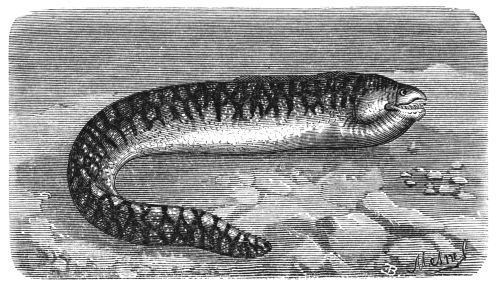
Fig. 365. The Sea-Eel (Muræna Helena).
It was thought among the Romans that murænas fed with human
flesh were the most delicately flavoured. A rich freedman, named
Pollion, who must not, however, be confounded with the orator
of the name, had the cruelty to order such of his slaves as he
thought deserving of death, and sometimes even those who had done
nothing to excite his anger, to be thrown to them. On one occasion,
when he entertained the Emperor Augustus, a poor slave who
attended had the misfortune to break a precious vase; Pollion immediately
ordered him to be thrown to the eels. But the indignant
emperor gave the slave his freedom, and, in order to manifest his indignation
with Pollion, he ordered his attendants to break every vase
of value which the freedman had collected in his mansion.
In the present day sea-eels are little esteemed in a gastronomic point
of view. Nevertheless they are still sought for on the coast of Italy,
and the fishermen avoid with great care the bites of their sharp teeth.
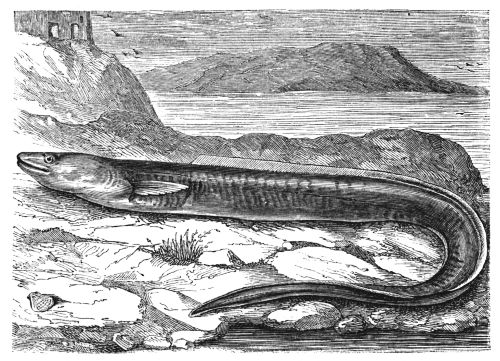
Fig. 366. The Common Conger (Conger vulgaris).
The Eels (Anguilla) have pectoral fins, under which are the gill-openings
on each side; the dorsal and anal fins extending up to the
tail, mingling with this last, which terminates in a point at the extremity.
The eels are divided into two groups: 1. The Eels (Anguilla),
properly so called; and, 2. The Congers. The first inhabit most
European rivers, except in the spawning season, when, according to
some naturalists, they betake themselves to the sea. During the
greater part of their existence, therefore, they have no connection with
the ocean. The Congers, on the other hand, are fishes of great size,
which inhabit the seas of warm countries, as well as those of Northern
Europe. The type of this family is the Common Conger, Conger
vulgaris (Fig. 366), which differs from the true eels chiefly in the dorsal
fins, which commence very near to the pectorals; and also in their
upper jaw being longer than their under one. They attain the thickness
of a man's leg, and are sometimes two yards in length. The
conger-eel is frequently found in salt marshes, but its flesh is held in
little esteem.
2. SUB-BRANCHIATI.
The fishes of this order are characterised by vertical fins being
attached under the pectorals, and immediately suspended to the
shoulder bone. Exclusively marine fishes, they inhabit every region
of the globe. The order comprehends three families:—I. Discobolidæ;
II. Pleuronectidæ, or flat fishes; III. the Gadidæ.
I. DISCOBOLIDÆ.
The family of Discobolidæ consists of a small number of species
characterised by their ventral fins being discoform, as in the sea-snails
(Liparis), in which the lengthened mucous body is without scales, but
with one long dorsal fin; the pectoral and ventrals forming one disk,
as in Fig. 367, or the Suckers (Lepidogaster), where the pectorals and
ventrals form two disks.
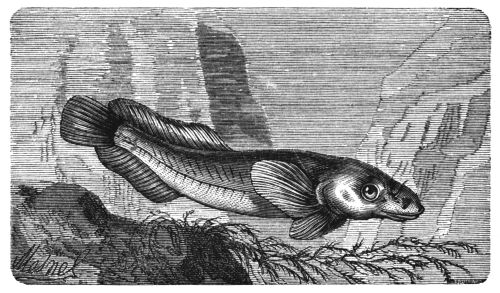
Fig. 367. The Sea-Snail (Liparis).
In the Lump-fish, Cyclopteris (Fig. 368), the disk formed by the
ventrals forms a sort of sucker, by which the fish attaches itself to the
rocks; while the Echineis is remarkable for the disk-like sucker with
which it is provided.
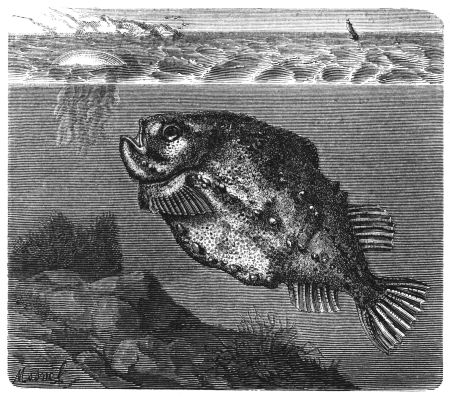
Fig. 368. The Lump-fish (Cyclopteus).
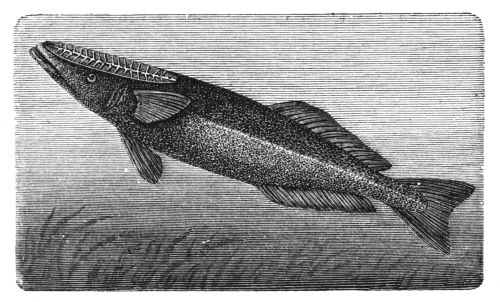
Fig. 369. Echineis remora.
The Echineis remora is an inhabitant of the Mediterranean, and
abounds in the Indian and Atlantic Oceans. It is furnished with a
flat disk, which covers its head, as represented in Fig. 369, which is
formed of a number of transverse and movable cartilaginous plates.
Aided by this organ, it attaches itself firmly to rocks, and even to
ships and larger fishes, such as the Dog-fish (Acanthius), which it
meets with in its wanderings. Its adhesion to those objects is so
strong that the strength of a man fails to separate them. It invariably
attaches itself to the dorsum and flank of the shark, and sometimes
weighs a pound and a quarter. "I have found," writes a friend, "as
many as seven on one shark." It is never solitary, and makes long
voyages on this monstrous animal locomotive, and that without fatigue
or danger, for its enemies are kept at a distance by the formidable
monster which carries it.
II. PLEURONECTIDÆ.
The Flat-fishes (Pleuronectidæ) have the body flat and greatly
compressed, but in a direction different from that of the Raias and
other analogous beings. In the case of the Raia the body is flattened
horizontally, while in the Pleuronectidæ they are compressed laterally.
The head of fishes of this order is not symmetrical; the two eyes are
placed on the same side; the two sides of the mouth are unequal.
To these peculiarities of structure we shall return when we come
to observe the several types more clearly. In inaction, as in motion,
the flat-fishes are always turned upon their side, and the side turned
towards the bottom of the sea is that which has no eye. This habit of
swimming on their side is that to which they owe their name of
πλευρὰ, side, and νέχτος, swimmers.
Their chief organ of natation is the caudal fin, but they are distinguished
from all other fishes by the manner in which they use this
oar. When turned upon their side this organ is not horizontal, but
vertical, and strikes the water vertically up and down. They advance
through the water but very slowly, compared to the motion of other
fishes. They ascend or descend in the water with greater promptitude,
but they cannot turn to the right or left with the same facility
as other fishes. This property of rising or sinking in the water with
facility is the more useful to them, inasmuch as the greater part of
their existence is passed at the greatest depths, where they draw
themselves along the sands at the bottom of the sea, and often
hide themselves from their enemies. Among the Pleuronectidæ,
soles, turbot, flounders, and plaice may be noted.
Soles (Solea) have the body oblong, the side opposite to the edges
generally furnished with shaggy, soft hairs; the muzzles round, nearly
always in advance of the mouth, which is twisted to the left side,
and furnished with teeth on one side only, while the eyes are on the
right side. The dorsal fin commences about the mouth, and extends
up to the caudal or terminal fin. The Common Sole, Solea vulgaris
(Fig. 370), is plentiful in the Channel, along the Atlantic coasts, and
especially in the Mediterranean. It is brown on the right, and
whitish on the opposite side. Its pectoral fins are spotted black; the
scales rugged and denticulate; its size seems to vary according to the
coast it frequents. Off the mouth of the Seine soles are sometimes
taken eighteen and twenty inches in length. There are several modes
of taking them, but for commercial purposes it is taken by the trawl-net.
When the ground-hook is employed it is baited with fragments
of small fish. Every one knows the delicate flavour of the flesh of the
sole, which, however, varies greatly in different localities, those of the
Channel Islands being particularly choice.
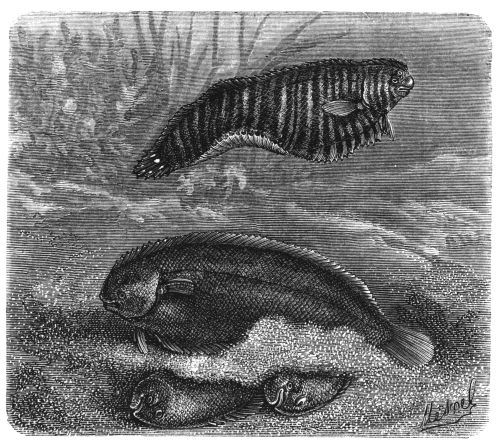
Fig. 370. The Common Sole (Solea vulgaris).
The Turbot, Rhombus maximus (Fig. 371), resembles in its general
form a lozenge, whence its name of rhombus. Its under jaw is more
advanced than the upper jaw, and is furnished with many rows of
small teeth. Its fins are yellow, with brownish spots. The left side
is marbled brown and yellow; the right side, which is the inferior,
white with brownish spots and points. The true turbot is the special
delight of the epicure, and fabulous sums are said to have been given
at different times by rich persons in order to secure a fine turbot.
The fish used to be taken largely on our own coasts, but now we have
to rely upon more distant fishing-grounds for a large portion of our
supply—large quantities coming from Holland. The turbot spawns
during the autumn, and is in fine condition during spring and early
summer. Mr. Yarrell says that it spawns in spring. Dr. Bertram
doubts this, although he is not quite sure of it, inasmuch as "there
will, no doubt, be individuals of the turbot kind, as there are of
all other kinds of fish, that will spawn all the year round." The
turbot abounds on our west coast, round Torbay, and off the mouth of
the Seine and the Somme, from whence comes most of the fish consumed
in London and Paris. The flounders, plaice, and halibut form
an important section of the Pleuronectidæ.
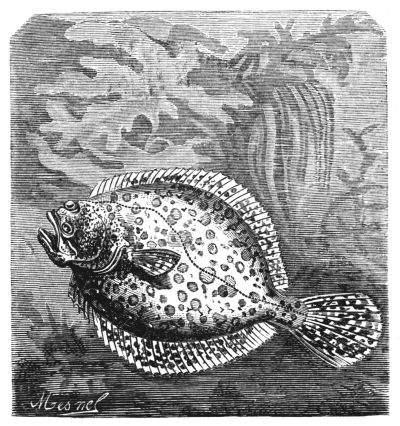
Fig. 371. The Turbot (Rhombus maximus).
The Flounders and Plaice (Platessa) inhabit the northern seas of
Europe. They have their eyes placed on the right side; the dorsal
as well as the anal fin extending from over the eyes to the caudal,
both stretching out to a point towards the centre, giving a rhombic
form to the fish. In Platessa the jaws are furnished with a single
row of obtuse teeth.
The Common Plaice, P. vulgaris (Fig. 372), attains the length of
ten or twelve inches; it is brown above, spotted with red or orange.
On the eye-side of the head are some osseous tubercles. The body,
which is somewhat lozenge-shaped, is smooth.
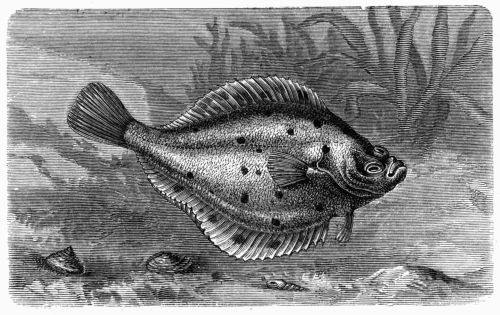
Fig. 372. The Common Plaice (Platessa vulgaris).
The Flounders (P. flesus) are fresh-water fishes of small size,
abundant in the Thames and many other rivers; they are only second
in importance to the soles and turbot among the Pleuronectidæ; the
numbers of brill, flounders, dab, and plaice required being close upon
a hundred million for the supply of London alone.
The usual mode of capturing flat-fish is by means of a trawl-net,
but many varieties of these may be caught with a hand-line. "A day's
sea-fishing," says Dr. Bertram, in his "Harvest of the Sea," "will
be chequered by many little adventures. There are various minor
monsters of the deep that will vary the monotony of the day by occasionally
devouring the bait. A tadpole fish, better known as the sea-devil,
or angler, may be hooked; or a visit from a hammer-headed shark,
or a pile-fish, will add greatly to the excitement; and if the 'dogs'
should be at all plentiful, it is a chance if a single fish be got out of
the sea in its integrity. So voracious are these Squalidæ, that I have
often enough pulled a mere skeleton into the boat, instead of a plump
cod of ten or twelve pounds weight."
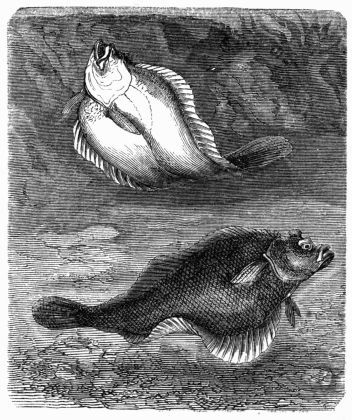
Fig. 373. The Dab (Platessa limanda).
The Dab, P. limanda (Fig. 373), is very common in the markets of
Paris, where it is held in great esteem. It takes its name Limanda from
the hard and dentate scales on its body. The Platessa have the jaws
furnished with a single row of obtuse teeth; the dorsal fin only extends
in front to a line with the eye, leaving an interval between it and the
caudal. The form of the body is rhomboidal, as in the turbot, and the
eyes are usually on the right side. The flounder, the plaice, and the
dab, are all examples of this group of fishes.
The Halibut, Hippoglossus vulgaris (Fig. 374), is a large fish,
inhabiting the seas of Northern Europe and Greenland, where it is
occasionally caught measuring seven feet, and weighing from three
to four hundred pounds. A fish of this species was brought to
Edinburgh market in April, 1828, measuring seven feet and a half
in length and three feet broad, weighing three hundred and twenty
pounds. The body of the halibut is more elongated than that of the
plaice or flounder, the jaws and pharyngeans being armed with strong
and pointed teeth.
Great quantities of this fish are caught on the Greenland and
Norway coasts, and other northern regions. According to Lacepede,
the natives fish for this with an implement which they call gangnaed.
It is composed of a hempen cord five or six hundred yards in length,
to which are attached some thirty smaller cords, each furnished with
a barbed hook at its extremity. The larger cord is attached to floating
planks, which act as trimmers, indicating the place of this formidable
engine of destruction.
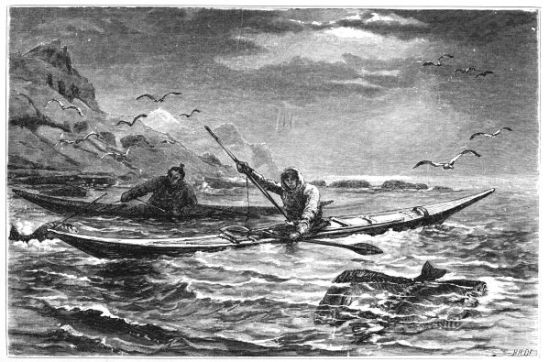
Plate XXVVIII.—Natives fishing for Halibut on the Greenland Coast.
The Greenlanders usually replace the hempen cords by thongs of
whalebone or narrow bands of shark's skin. At the end of twenty
hours these lines are drawn home, and it is not at all unusual to find
five or six large halibut caught on the hooks. Pl. XXVIII. represents
the native mode of fishing for halibut in the Greenland Seas.
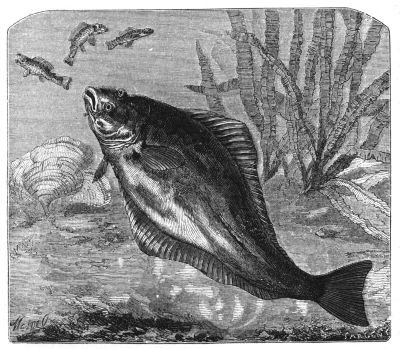
Fig. 374. The Halibut (Hippoglossus vulgaris).
Another mode of capturing this and other flat-fish is to spear them
on their sandy beds. "No rule can be laid down," says Dr. Bertram,
"for this method of fishing. It is carried on successfully by means of
a common pitchfork, but some gentlemen go the length of fine spears
made for the purpose, very long, and with very sharp prongs. Others,
again, use a three-pronged farmyard graip, which has been known to
do as much real work as more elaborate single points contrived for
the purpose. The simplest directions I can give is just to spear every
fish they see." M. Figuier adds, as a caution, that before attacking
these fishes, body to body, it is necessary to wait till they are somewhat
exhausted, otherwise they might overturn both bark and fisherman.
The Greenlanders cut the animal up, and salt the pieces; then expose
them to the air, in order to dry them preparatory to a long voyage.
In its fresh state the halibut is not very delicate, and is hard and
difficult of digestion; however, its great size renders it a valuable
prize. We may add that, notwithstanding its great size, the halibut
has deadly enemies in the dolphins, as well as in the birds which prey
upon fishes on the shore. It is itself a voracious fish, devouring
crabs, cod-fish, and even the Raiadæ, not even sparing its own species;
they attack each other, nibbling at the tail or fins.
III. GADIDÆ.
The Gadidæ embrace the whole of the Linnæan genus Gadus.
They are found mostly in the seas of cold or temperate regions in
both hemispheres, and are the objects of pursuit for which the great
fisheries of Europe and America are established. They are known by
the position of the ventral fin under the throat, and by the pointed
character of those fins. The body is long and slightly compressed;
the head well proportioned. Their fins are soft, and their scales are
small and soft. The jaws and front of the os vomer have unequal-pointed
teeth of moderate size, and disposed in several rows. The
gill-covers are large, and consist of seven rays. Most of the species
have the dorsal fin, and contain two others besides—a fin behind the
vent, and a distant caudal fin. The stomach is large, and the intestine
long. The air-bladder large and strong, and in some cases notched on
the margin. The flesh of most of the species yields white, healthy,
and agreeable food, easily separable into flakes when cooked, and easy
of digestion. The family includes the several genera:—Morrhua,
to which belongs the Common Cod-fish, M. callarias; the Haddock,
M. æglefinus.—The Merlangus, or Whiting, M. vulgaris, and M.
albus; the Coal-fish, M. carbonarus; and the Pollack, M. pollachius.—The
Merlucius, or Hakes.—The Lota, or Ling, L. molva.—Motella,
or Rock Ling, and Silver Gade, M. argenteola; and other
genera of less importance.
The head of the Cod (Morrhua callarias) is compressed; the eyes
placed on the side, close to each other, and veiled by a transparent
membrane, a conformation which, according to Lacepede, enables the
animal to swim on the surface of the water in northern regions in
the midst of mountains of ice and under banks covered with snow,
without being dazzled by the brilliant light; but this opinion is unsupported
by any other naturalist of note.
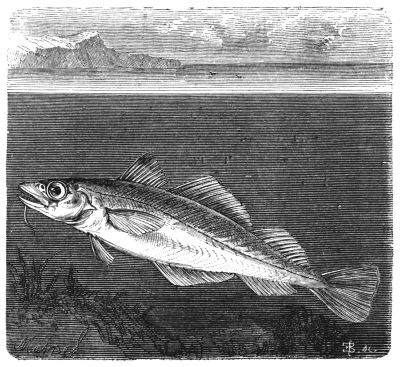
Fig. 375. The Cod-fish (Morrhua callarias).
The jaws of the cod-fish are unequal, and among the rows of teeth
with which it is armed many are mobile, and can be hidden in their
cavities, or raised, according to the will of the animal. The dorsal
fins, three in number, are in clusters, as in Fig. 375; anal fins are
two; pectoral fins narrow, and terminating in a point; caudal fin
slightly forked. Its colour is of an ashy grey, spotted with yellow on
the back; white and sometimes reddish beneath.
The cod-fish is provided with a vast stomach, and is very voracious,
feeding on fishes, crabs, and molluscs. It is so gluttonous and indiscriminating,
that it will even swallow pieces of wood and other similar
objects. This is essentially a sea-fish: it is never seen in fresh-water
streams or rivers, remaining during the greater part of the year in the
depths of the sea. Its habitual sojourn is in the portion of the
Northern Ocean lying between the fortieth and sixty-sixth degrees of
latitude.
In the vast range thus frequented by the cod, two large spaces are
pointed out which it seems to prefer. The first extends to the coast
of Greenland, and the other is limited by Iceland, Norway, the
Danish coast, Germany, Holland, and the east and north coast of
Great Britain and the Orkney Isles, comprehending the Doggerbank,
Vellbank, and Cromer coast, together with salt-water lakes and arms
of the sea, such as the Gairloch, Portsoy, and the Moray Firth, which
indent the west coast of Scotland, and attract considerable shoals of
cod-fish.
The second range, less generally known, but more celebrated among
sailors, includes the coast of New England, Cape Breton, Nova Scotia,
and, above all, the island of Newfoundland, on the south coast of
which is the famous sand-bank called the Great Bank, having a
length of nearly two hundred leagues, with a breadth of sixty-two,
over which flows from ten to fifty fathoms of water. Here the cod-fish
swarm, for here they meet shoals of herrings and other animals,
on which they feed. Such is, according to Lacepede, the geographical
distribution of the cod-fish.
The English, French, Dutch, and Americans give themselves up to
the cod-fishery on the bank of Newfoundland with inconceivable
ardour. This island was discovered and visited by the Norwegians in
the tenth and eleventh centuries, long before the discovery of America;
but it was only in 1497, after the discoveries of Columbus, that the
navigator, John Cabot, having visited these regions, gave it the name
by which it has since been known, and called attention to the swarms
of cod-fish which inhabited the surrounding sea. Immediately after,
the English and some other nations hastened to reap these fruitful
fields of living matter. In 1578, France sent a hundred and fifty
ships to the great bank, Spain a hundred and twenty-five, Portugal
fifty, and England forty.
During the first half of the eighteenth century, England and her
colonies, with the French, cultivated the cod-fishery.
From 1823 to 1831 France sent three hundred and forty-one ships,
with seven thousand six hundred and eighty-five men, which carried
into port over fifty million pounds of fish, an average of about six
millions annually. Two thousand English ships of various sizes,
manned by thirty thousand seamen, are now employed in this important
branch of industry.
On the coast of Norway, from the frontiers of Russia to Cape
Lindesnæs, the cod-fishery is an important branch of trade, in which
a maritime population of twenty thousand fishermen are employed,
with five thousand boats.
The cod is taken either by net or line. The net is chiefly employed
at Newfoundland. The net used is rectangular, and furnished with
lead at the lower edge, and cork buoys on the upper edge. One of
the extremities is fixed on the coast; the other is carried seaward,
following a curve taken by the boats, and the fish are attracted by
drawing upon both extremities of the net; and by one stroke many
boat-loads are sometimes taken.
The modern cod-smack is clipper-built, with large wells for carrying
the fish alive, its cost being about £1500. The crew usually consists
of ten to twelve men and boys, including the captain. The line is
also used for taking cod and haddocks. "Each man," says Bertram,
"has a line of fifty fathoms in length, and attached to each of these
lines are a hundred 'snoods,' with hooks already baited with mussels,
pieces of herring, or whiting. Each line is laid 'clear,' in a shallow
basket, and so arranged as to run freely as the boat shoots ahead.
The fifty-fathom line with a hundred hooks is in Scotland called a
'taes.' If there are eight men in a boat, the length of the line will
be four hundred fathoms, with eight hundred hooks, the lines being
tied to each other before setting. On arriving at the fishing-ground,
the fishermen heave overboard a cork buoy, with a flagstaff about
six feet in height attached to it. This buoy is kept stationary by a
line, called the 'pow end,' reaching to the bottom of the water, where
it is held by a stone or a grapnel fastened to the lower end. To the
'pow end' is also fastened the fishing line, which is then paid out as
fast as the boat sails, which may be from four to five knots an hour.
Should the wind be unfavourable for the direction in which the crew
wish to set the line, they use the oars. When the line or 'taes' is all
out, the end is dropped and the boat returns to the buoy. The 'pow'
line is hauled up with the anchor and fishing line attached to it. The
fishermen then haul in the line, with the fish attached to it. Eight
hundred fish might be taken, and often have been, by eight men in a
few hours by this operation; but many fishermen say now, that they
consider themselves fortunate when they get a fish on every fifth
hook on an eight-lined 'taes'-line."
Hungry cod-fish will seize almost any kind of bait, and this is used
either fresh or salted. The fresh bait is furnished by the herring,
whiting, and capelan, a little fish which in the spring descends from
the North Sea in shoals, pursued by the cod-fish. In the terror
caused by the innumerable bands of their enemies, the capelans spread
themselves in all the seas round Newfoundland in masses so thick that
the waves throw them ashore, and they accumulate occasionally in
heaps upon the sandy beach.
The principal fishery for capelan intended for bait takes place on
the coast of Newfoundland. The inhabitants of these regions carry
their booty to the fishermen, who make Saint-Pierre their rendezvous,
with whom they find ready purchasers.
The schooners, with a fair provision of bait, leaving Saint-Pierre
and other ports, take a north-easterly direction towards the great
bank, and, having chosen their fishing-ground, cast anchor in fifty or
sixty fathoms, and forthwith the crews give their sole attention to the
lines; some of them watch the lines, which are raised every instant,
the captured fish removed, and the hooks re-baited; others subject the
captured fishes to a first preparation for preserving them; they are
opened, the entrails removed, and the fish split in two, and piled one
on the other, and covered with salt. This labour goes on as long as
the fishing lasts. The sailor is on deck night and day, covered with
oil and blood, and surrounded with all sorts of offal and fish-like
smells. But this alone is insufficient. Boats, manned by crews of two
or three sailors, are continually moving about, attending to the more
distant lines, or "taes," which radiate round the ship in all directions.
One portion of the cod caught is despatched to Europe in a fresh
state, without other preparation than the salting which they receive
on the deck of the schooner. But much the greater portion are
carried on shore and subjected to further preparation. Saint-Pierre
and Miquelon Islands, which are granted to the French fishermen on
condition that no fortifications are erected on them, is resorted to for
the purpose by the French fleet; St. John's, the capital, by the
English. The Comte de Gobineau gives an animated picture of the
whole process of curing the cod-fish in the "Tour du Monde for 1863."
"The French houses which pursue this branch of trade," he says,
"belong principally to the Ports of Granville and St. Breuc; and the
crews of their ships consist of two very distinct elements; the smaller
portion, being specially raised among the fishermen properly so called,
they form the aristocracy on board; to these are added a larger number
of mere labourers, who are landed on the arrival of the vessel at her
port. Their functions are limited to receiving the fish from the boats,
opening it, washing off the glutinous matter in the chauffant, putting
the liver apart, and laying out the split fish between the layers of
salt; finally, subjecting it to the different phases of the drying
process on the strand.
"The chauffant is a shed raised upon piles, standing one half in the
water and one half on shore; it is constructed of planks and posts,
through which the air is suffered to circulate freely, but covered in with
some of the ship's sails. Here the process of separating the intestines
from the body of the fish, and the salting process are carried on, in the
midst of an atmosphere charged with all manner of disgusting smells,
for the labourer is by no means delicate, and never thinks of removing
the disgusting impurities which he is creating. There he stands, knife
in hand, tearing and cutting out intestines and separating vertebræ,
his only care being to avoid cutting himself, which is the chief danger
he runs, in the midst of odours sufficient to produce suffocation.
"Connected with the platform, on which this rough operation is performed
is a cauldron, sunk in the earth, to receive the oil pressed out
of the liver. This cauldron is surmounted by a roof some nine feet in
height, in the form of an inverted cone. Here the oil which flows
from the open way above is suffered to remain, after which it is drawn
off into casks.
"The drying sheds, formerly of wood, are now constructed of stone,
and in places well exposed to the sun, and especially to the wind,
artificial or otherwise. The sun, it is said, does not dry, but scorches;
the wind, on the other hand, marvellously fulfils the purpose, and in
order to avoid the one and court the other, an apparatus has been invented,
consisting of long movable branches, which can be inclined
so as to bring the wind directly upon the row of cod, in connection
with the sun's rays, which are, indeed, not very formidable in this
foggy region."
The cod-fish thus dried at Newfoundland are forwarded for consumption
to all parts of the world; but only a small part of the
products of the fishery are thus prepared. More than half the produce
of the French fleet are sent to France merely salted, by ships
which carry salt, bringing back fish in return to Rochelle, Bordeaux,
and Cette, where the process of curing is completed. In our home
fisheries, to abbreviate slightly Dr. Bertram's account, the greater
part of the cod taken are eaten fresh, but considerable quantities of
the cod and ling taken on the coast are sent to market cured. The
process pursued is very simple: they are brought on shore quite fresh,
and are at once split from head to tail, and by copious washings
thoroughly cleansed from all particles of blood; a piece of the backbone
is cut away; they are drained, and afterwards laid down in long
vats, where they are covered with salt, and kept under heavy weights.
By-and-by the fish are taken out of the vats; they are once more
drained, and carefully brushed, to remove any impurity, and bleached
by being spread out singly on the sandy beach, or on the rocks; when
thoroughly bleached, they are collected into heaps technically called
steeples, and when the bloom, or whitish appearance, comes out on the
fish, they are ready for the market.
The cod is one of our best-known fishes, and was at one time much
more plentiful and cheap. It is a deep-water fish, found in all
northern seas, and in the Atlantic, but never in the Mediterranean.
It is extremely voracious, greedily eating up the smaller denizens of
the ocean. It grows to a large size, and is very prolific, as most fishes
are. A cod-roe has been found more than once to be half the gross
weight of the fish, and specimens of the female cod have been caught
with upwards of eight millions of eggs. The fish spawn in mid-winter:
but here our information ceases; when it becomes reproductive
is unknown. Dr. Bertram thinks that it is at least three years old
before it is endowed with breeding power.
The growth of the cod is supposed to be very slow. Dr. Bertram
quotes the authority of a rather learned fisherman of Buckie, who had
seen a cod which had got enclosed in a large rock pool, and he found
that it did not grow at a greater rate than eight to twelve ounces per
annum, though it had abundance of food.
On our own coast two modes of fishing are in common use: one by
deep-sea lines, on each of which hooks are fastened at distances twelve
feet apart by means of short lines six feet long, called on the Cornish
coast "snoods." Buoys, ropes, or grapnels, are fixed to each end of the
long line, to keep them from entanglement with each other. The
hooks are baited with capelan, lance, or whelks, and the lines are
shot across the tide about the time of slack water, in from forty to
fifty fathoms, and are hauled in for examination after six hours.
An improvement has been introduced upon this mode of fishing by
Mr. Cobb. He fixes a small piece of cork about twelve inches above
the hook, which suspends the bait, and exhibits it more clearly to the
fish by the motion of the wave. The fishermen, when not engaged in
hauling, shooting, or baiting the long lines, fish with hand-lines,
holding one in each hand, each armed with two hooks, kept apart by
a strong piece of wire. A heavy weight attached to the lower end of
each line keeps it steady near the ground, where the fish principally
feed. Enormous quantities of cod, haddock, whiting, and coal-fish,
with pollack, hake, ling, and torsk, are taken in this way all round
our coast. Of cod-fish alone four hundred to five hundred and fifty
have been taken in ten hours by one man, and eight men have taken
eighty score of cod in one day, fishing off the Doggerbank in five and
twenty fathoms water. Latterly the Norfolk and Lincoln, and even
the Essex, coasts, have yielded a large supply of fish, which are caught
as described, and are stowed in well-boats, in which they are carried
to Gravesend, whence they are transhipped into market-boats,
and sent up to Billingsgate by each evening tide; the store-boats
not being allowed to come up higher, as the fresh water would kill
the fish.
The Haddock (Morrhua æglefinus) is common in our markets; it
is much smaller than the cod, but in other respects not unlike it. It
frequents the same localities, and is caught with long lines baited
usually with mussels; the old fish keep close in shore, and are only
got with herring bait. In the village of Findhorn, Morayshire, large
numbers of haddocks are dried and smoked with the fumes of hard
wood and sawdust. Hence the term "Finnan haddies," an article in
such request at a Scottish breakfast. The village of Findhorn affords
a very small portion of the haddocks sold as such, but the true "Finnans"
are supposed to have the finest flavour.
The Whiting, Merlangus vulgaris (Fig. 376), by some amateurs
considered the most delicate of all the Gadidæ, is plentiful all round
our coast. It spawns in March, and the eggs are quickly hatched. It
prefers a sandy shore, and is usually found some miles from the coast.
It is a small fish, rarely exceeding twelve inches long, and seldom reaching
two pounds in weight. The whiting is long in the body, clothed
with very small, thin, and round scales; its dorsal fins are, like the cod,
three in number; it is without barbellary appendage; its upper jaw
projects over the lower; it is of a silvery white, sometimes relieved by
an olive tint, which is contrasted upon the back by the blackish tint
which distinguishes the pectoral and caudal fins, and by a black spot
which some individuals have at the junction of the pectorals with the
body.
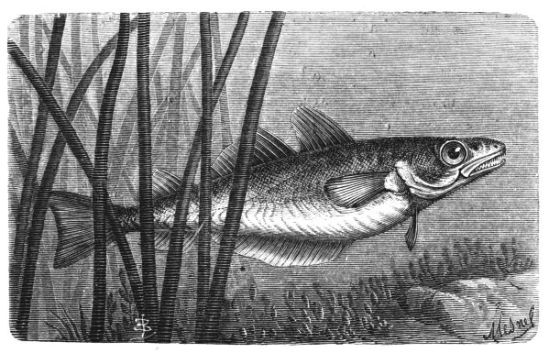
Fig. 376. The Whiting (Merlangus vulgaris).
The whiting inhabits the seas which wash the whole European
coast, often approaching the shore in shoals, and are taken annually
in great numbers.
3. ABDOMINALES.
The fishes belonging to this order have the ventral fins under the
abdomen placed behind, and not attached to the bones of the shoulder.
It is much the most numerous and important of the great division of
the Malacopterygeans. It includes most of our fresh-water fishes, a
great number of marine species, and many like the salmon, which
betake themselves to the rivers in the spawning season to deposit
their ova. We shall limit our remarks to the species which are
essentially marine, such as the Salmonidæ, the Clupeadæ, and a few
others.
SALMONIDÆ.
The fishes of this family are graceful in shape, and have the body
clothed in scales; they have two dorsals, the first with soft rays, followed
by a second, which is smaller, formed without rays, and adipose—that
is, formed simply of a skin filled with fatty matter, unsupported
by osseous rays. They inhabit the seas of temperate and northern
regions; ascending the rivers at certain seasons, and, in some instances,
living exclusively in the great rivers and watercourses. They
are found even in the most elevated mountain brooks. The grayling
or shad, guiniad, sprat, trout, and the salmon, the type of the family,
belong to the group.
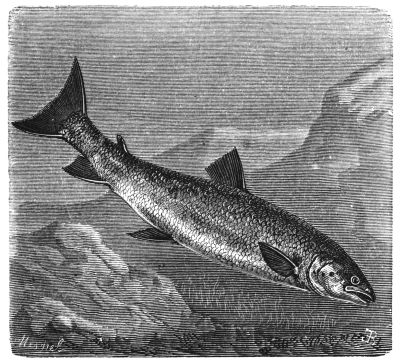
The genus Salmo includes three species, namely, Salmo salar,
S. croix, and S. trutta, the trout. Of these, S. salar (Fig. 377) has
the body long, the muzzle roundish, but more so in the male than in
the female, the upper jaw provided with a fossette, into which the
point of the lower jaw penetrates; the back is a slaty blue, the sides
and lower part of the body of a silvery diaphanous white, with great
black spots scattered round the upper part of the head, round the
upper edge of the eye, and over the operculum or covering. Some
brownish irregular spots, variable both in form and size, are sprinkled
over the sides. In other respects their colours are subject to variations
according to circumstances. Before assuming the characters here
indicated, however, the salmon has passed through three stages, each
of which is marked by peculiarities worthy of being noted. The
young salmon (Fig. 378) is greyish and striped with black. At the
end of a year it has acquired a fine metallic hue. "The other parts,"
according to Mr. Blanchard, "are of a dazzling steel-blue; eight or
ten large spots of the same brilliant blue cover it as with a silvery
mantle on the sides; between these spots a reddish, or, rather,
brightish-rusty iron colour prevails; a black spot is usually observable
in the middle of the operculum. The belly is of a fine diaphanous
blue in the parr" (Fig. 379).
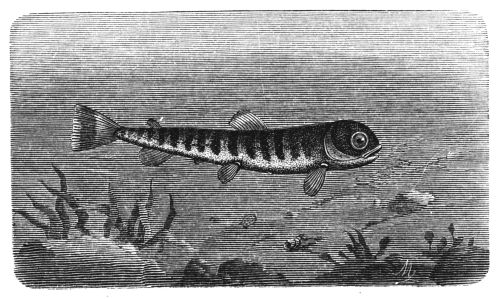
Fig. 378. The Young Salmon.
Dr. Bertram gives a very clear and intelligible account of the early
days of the salmon, which was at one time veiled in mystery. "The
spawn, deposited by the parent fish in October, November, and
December, lies in the river till about April or May, when it quickens
into life. I have already described the changes apparent in the
salmon's egg, from the time of its fructification till the birth of the
fish. The infant fry are of course very helpless, and are seldom seen
during the first week or two of their existence, when they carry about
with them, as a provision for food, a portion of the egg from whence
they emanated. At that time the fish is about half an inch in size,
and presents such a singular appearance that no person seeing it
would ever believe that it would grow into a fine grilse or salmon.
About fifty days is required for the animal to assume the shape of a
perfect fish; before that time it might be taken for anything else than
a young salmon. At the end of two years it has changed into a
smolt. After absorbing its umbilical bag, which it takes a period of
twenty to forty days to accomplish, the young salmon may be seen
about its birthplace, timid and weak, hiding about the stones, and
always apparently of the same colour as the surroundings of its
sheltering place. The transverse bars of the parr, however, speedily
become apparent, and the fish begins to grow with considerable
rapidity, especially if it is to be a twelvemonth smolt, and this is very
speedily seen at such a place as the Stormontfield ponds. The
young fish continue to grow for a little more than two years before
the whole number make the change from parr to smolt, and seek the
salt water. Half the number of any one hatching begin to change
at a little over twelve months from the date of their coming to life.
And thus there is the extraordinary anomaly of fish of the same
hatching being at one and the same time parr of half an ounce in
weight, and grilse weighing four pounds. The smolts of the first
year return from the sea, while their brothers and sisters are timidly
disporting in the breeding shallows of the upper streams." A late
sea-going smolt explains the anomaly of a spring salmon.
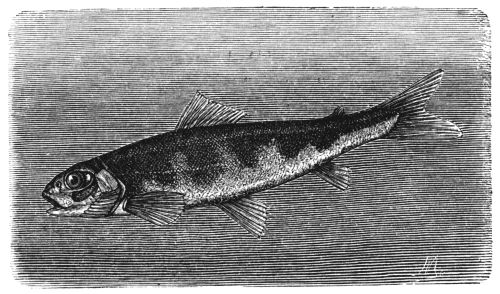
Fig. 379. Salmon, or Parr, a year old.
It thus appears that, in its first stage, the Young Salmon (Fig. 378)
is called a parr: during the second it is a smolt, namely, a parr plus
a jacket of silvery scales. While they continue in the state of parr
they lead a secluded life, totally unable to endure salt water, which
would kill them. When they have become smolts the fish betake
themselves in bands to the sea. The sea-feeding being favourable,
and the fish strong enough for the salt water, a rapid growth is the
consequence. After that they disappear, spreading themselves over
the wide world of the ocean. At the end of two months of a life
mysterious and so far unknown, these fishes reappear in the rivers,
returning to their native pools; but how changed! Quantum
mutati! The smolt, which has lived in the river two or three years,
and only attained the length of six or eight inches, returns at the
end of two months' sojourn in the sea, weighing three to four, and
after six months, ten or twelve pounds. It is now a grilse.
After depositing their eggs the grilse remain some time in the
fresh water, when they again go to the sea. This second sojourn, of
about two months, is sufficient to send it back weighing from six to
twelve pounds. It is now an adult salmon. Each new visit to the
sea brings the salmon back increased in size in proportion to the
duration of the voyage. In the month of March, 1845, the Duke of
Athole took a salmon in the Tay after it had deposited its eggs; he
marked it by attaching a metal label to it. It weighed ten pounds.
The same individual with its metal label was again fished up after five
weeks and three days' absence. It now weighed twenty-one pounds,
having in the meantime travelled forty miles down the river to the
sea. This fish must, however, have made a long sea run during these
thirty-eight days and its seeking up the river again.
In most circumstances, according to Mr. Blanchard, to whom we
are indebted for much information relative to the development and
migration of these fishes, salmon of various ages, which have nevertheless
sojourned in the sea as grilse, adult salmon, and others intermediate
between them, whose first sojourn at sea has extended to eight
or ten months, ascend the rivers together in an order no less varied,
the older individuals heading the column, the youngest bringing up
the rear.
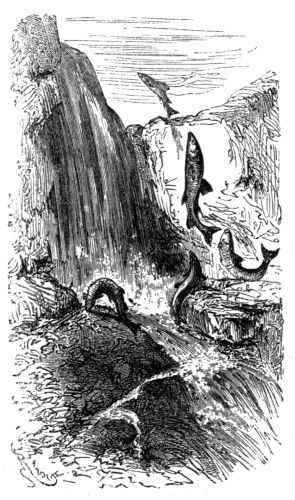
Fig. 380. Salmon Leap at Kilmorack.
When the period for depositing their eggs approaches, a male and
female pair off, as it were; seeming to choose, by a common accord,
a retired place in which to spawn. Here both male and female
employ themselves in hollowing out a nest in the strand, some eight
or nine inches deep, wherein the female deposits her eggs, which the
male fertilizes by shedding a milky fluid over them, sheltering the
eggs afterwards by a covering of sand.
The salmon only ascends the rivers to spawn. They eagerly return
afterwards to salt water. When enjoying themselves in the water they swim
slowly, floating near the surface; but in pursuit of any object, or if
threatened with danger, they dart out of the water with extraordinary
promptitude. The tail is, in fact, a true oar moved by powerful muscles;
a low waterfall is to the salmon no serious obstacle when it is impelled
to ascend to its breeding-place. Curving its vertebral column, it forms
itself into a sort of elastic spring; the arc of which being suddenly
unbent, strikes the water with great force with the tail, and in the
rebound it leaps to the height of several yards, clearing waterfalls
of considerable height. If it falls without accomplishing its object,
it repeats the manœuvre until it is at last successful. It is
especially when the leader of the band makes a successful leap that the
others, acquiring new spirit from its example, throw themselves upwards
until their emulation is rewarded by success.
Some of the British waterfalls are celebrated for their salmon leaps.
Wales, Scotland, and Ireland have each their celebrated leaps; in
Pembrokeshire, Argyleshire, and at
Ballyshannon, in county Donegal, and at Leixlip. The cataract of
Leixlip is upwards of twenty feet high, and the country people make
a holiday in order to see the salmon clear its height. These acrobat
fishes frequently fall before they finally succeed, and it is not unusual
for the people to place osier baskets to trap them in their
fall. At the cataract of Kilmorack, in Inverness-shire (Fig. 380),
the inhabitants living near the river have a practice of fixing
branches of trees on the edge of the rocks. By means of these
branches they contrive to catch the fishes which have failed in their
leap; it is even asserted that sportsmen have been known to kill them
on the wing, as it were, in their leap. But the exploit, attributed to
Lord Lovat by Dr. Franklin, is perhaps the nearest approach to the
fabulous which we have met with.
Having remarked that great numbers of salmon failed in their
efforts to surmount the Falls of Kilmorack, and that they generally
fell on the bank at the foot of the fall, Lord Lovat conceived the idea
of placing a furnace and a frying-pan on a point of rock overhanging
the river. After their unsuccessful effort some of the unhappy salmon
would fall accidentally into the frying-pan. The noble lord could
thus boast that the resources of his country were so abundant, that
on placing a furnace and frying-pan on the banks of their rivers, the
salmon would leap into it of their own accord, without troubling the
sportsman to catch them. It is more probable, however, that Lord
Lovat knew that the way to enjoy salmon in perfection is to cook it
when fresh from the water, and before the richer parts of the fish
have ceased to curd. The principal salmon found in the market are
Tweed, Tay, North Esk, Spey, Skye, Norwegian, and above all
Severn, said to be the best which comes to market, neither of which
must be confounded with the imported American variety—the origin
of the prevalent cheap London kipper—and the Cape, or red-mouthed
variety. Cape and Americans are at once distinguished by their flesh
boiling a blanched white. Tweed salmon are more varied; and this
river, famous in song, is also noted for its production of the greatest
proportion of bull-trout. The Tay yields the largest grilse and
salmon, but the Spey follows fast in her wake; Tay fish sometimes
weigh sixty pounds. The minor Scotch rivers produce smaller but
superior fish. Skye and West-coast grilse are short, thick, and
small-headed, and proportionally more abundant. Trout are numerous;
sea-bull, burn, or loch, and the so-called herring-trout, are the varieties
usually met with. The whitling of the Tweed, grayling of Tay, and
tinnock of North and South Esk, are young sea and bull-trout,
abounding in March and April, when a sportsman will land fifty or
sixty daily, weighing from one quarter to a pound. Trout flesh
varies in colour from a clear white to a dark red; the North Esk
red trout is most esteemed. The best run from a pound and a half
to three pounds. The burn-trout is always red, and has been killed
as heavy as thirty pounds. The herring-trout, never found in
English rivers, and only caught on our coast by herring-trawlers, is
a special favourite: may it not be the whitling of the French rivers?
In all other species colour varies with locality, and cannot be accounted
for.
We have seen how rapidly the young salmon increase in size in
the sea. During this stage of existence the salmon, being a carnivorous
fish, rapidly develops itself from the grilse to the adult state.
From a careful analysis made by Dr. Wilson Johnston of the Bengal
army, it appears that there is no recorded instance of healthy salmon
partaking of herring or sand-lances; the tape-worm and other conditions
of perverted appetite persisting in all. Tape-worm is most
common in the hybrid Norwegian, and explains the reason why
Clupeadæ are sometimes found in their stomachs. Should the fish
not be charged with spawn, it will shortly return to sport among
the dancing waves; but if matured for breeding, at which period
the female shows a dirty brown hue, and the male a black,
they mate, choose a spot for the salmon nest, and there deposit
myriads of ova. The longer a salmon continues in the river the
duller their colour becomes; the flavour is greatly depreciated; so
that Izaac Walton's statement, that "the further they get from
the sea they be both fatter and better," is dead against our daily
experience.
During the period of river residence salmon never feed. It avails
not to argue that fear acts as an emetic and empties the stomach;
the incontestable fact remains that the entire gastro-intestinal tract
ab ore ad ano is in ninety-nine per cent. devoid of any trace of food.
Juvenile experience on the part of the fish, recurring as a phantasm,
causes them to snap at a shining artificial minnow or a gaudy fly,
but they never rise out of the water; the bait must dip to them, and
when hooked they shake the intruder as a terrier does a rat. If salmon
never feed in fresh water, what is the rationale of their existing there?
Well, the superabundant store of fat deposited in the areolar tissue
appears to furnish a material which is functionally homologous to the
fatty supply stored by the Asiatic and African doomba sheep, which is
drawn upon to sustain life-action, when névès, avalanches, or a heavy
snow-fall imprisons the herbage outcrop. That continued muscular
exertion can be sustained without special fatigue on non-nitrogenous
diet, Fick and Wislicensus have proved by the recent ascent of the
Faulhorn: it is moreover notorious that the chamois hunter and
the Hindoo runner prefer fats and saccharoids. Is there any show
of reason, then, why the salmon should not maintain its fresh-water
muscular tear and wear by a stock of non-nitrogenous fatty
material? That such is the true philosophy of salmon river life is
borne out by the following facts:
1st. So soon as the exhausting secretions of the milt and roe take
place the spent fish turn seaward to recruit.
2nd. The digestive secretions are not eliminated in the absence of
food; the most recent experience of physiology finds its echo here.
Your boxer trains on meat or nitrogenous aliment, but enters the
list on hydro-carbons (fats, saccharines, and amylaceous substances).
The salmon get into condition by immediately appropriating the
albumen of the echinodermal ova, enter their life-struggle of wintry
months in river water with an incorporated stock of potential calorific
aliment, convertible, as occasion demands, into organic muscular
mechanical effort.
The British rivers in which the salmon abound are the Severn, the
Wye, the Tweed, the Tay, the Don, and the Dee, with many of their
tributaries, and in Ireland, the Shannon. Besides these, many of the
watercourses of lesser note adjoining the coast have been renowned
for their salmon fisheries. Some of the Scottish rivers, especially, are
famous for the size and quality as well as numbers of salmon. In
days not very distant from ours, farm servants made it a condition of
their hiring that salmon should not be served to them more than
three days in the week. These times are changed. In the districts
in which this condition was the most stringently insisted on, the proprietors
derive a princely revenue from this source alone. The Tay
fisheries yield a revenue of seventeen thousand pounds per annum.
The Spey, for its length the richest in Scotland, produces twelve
thousand pounds per annum. The river is only a hundred and
twenty miles from its source to the sea, and its picturesque banks are
celebrated in a local ballad, which says, not very harmoniously, that
"Dipple, Dundurcus, Dandaleith, and Dulocq,
Are the bonniest haughs of the run of the Spey;"
but there's "no standing water in the Spey!" The river drains
thirteen hundred miles of mountains, many of whose bases are more
than a thousand feet above the level of the sea. The Tweed, which
has been "poached" and plundered, by its proprietors using unfair
implements, until there was scarcely a fish in its upper waters, is
slowly recovering under legislative enactments, and its rental is now
seven thousand five hundred pounds.
Salmon abounds in the Loire and its affluents, but is much more
rare in the Seine and Marne. They enter the Rhine and the Elbe,
and most of the great rivers of the north of Europe. In France
they were formerly found in the rivers of Brittany, and in the
Gironde. They are now very rare in these rivers. The coast of
Picardy is well furnished, but they are rare in Upper and Lower
Normandy. In Norway, especially in the district of Drontheim, the
salmon fishery is conducted on a large scale on the sea-shore as well
as in the interior waters. The Baltic is rich in salmon. Considerable
fisheries are carried on in the waters of the Gulfs of Finland and Bothnia,
as well as in the waters of Swedish Laponia. The takes vary every year;
in 1860 being much above the average throughout Great Britain,
or as in 1772, when the fish were so scarce in the Tweed, that it
was believed they had gone off the coast. They invariably go to
leeward with the wind, and have been caught a hundred miles off
land. Salmon are in condition at various periods of the year,
apparently not depending on the latitude of the rivers. Thus
the Tay is one of the earliest rivers, while the North and South Esk
are the latest, yet they debouch within a few miles of each other.
It is the opinion of Mr. Joseph Johnston of Montrose (whose acknowledged
fifty years' practical experience carries weight with it in all fishery
parliamentary committees) that the Stormontfield ponds, by artificially
rearing the parr, render them more helpless when they commence
river life on their own account. As a natural result, the death-ratio is
enormously increased—cui bono? especially when the parr have only
the option of leaving, and are not compelled to go out. We must,
therefore, receive Dr. Bertram's narrative, much as we respect his
authority, with some reserve. A seed will not grow, nor will a parr
ever become a grilse, unless under given conditions: it is therefore an
easy matter to explain the anomaly of a parr passing seaward
becoming a four-pound grilse, while its twin-brother remaining in the
breeding-pond is conditionally developed as only a half-ounce samlet,
yet none the less a dwarfed grilse—the possibility of growth existing
all the while, although it was not actively evoked by physical
surroundings.
The modes of procedure in salmon fishery are very various. Spearing
with tridents, and liestering with a weighted hook by torch-light,
"burning the water," as the Scotch have it, as well as trammel, wear,
and cruive-wear fishing, are now prohibited. Legal fishing in rivers
is confined to row nets, and fly and bait rod fishing, fixtures being
illegal since 1810. Wear shot; a larger and heavier row-net placed
at the meeting of the waters; stake, fly, and bag-nets are used in the
open sea. The latter is most in vogue, the former being almost superseded
by the fly. Fixtures on the sea coast were held to be legal in
Lord Kintore's case by House of Lords in 1828, and continued so till
the passing of the recent Act. By this act all legal modes of fishing
are in action from the first of February to the fourteenth of September,
a period, however, now curtailed by twenty-eight days,—netting being
illegal from Saturday to Monday in each week. It remains to be seen
whether the gourmet will enjoy his salmon better after its Sabbath
rest; perhaps its ragout will then haunt him as it did Talleyrand's
abbé, who, instead of the mea culpa of the Confiteor, iterated, "Ah!
le bon saumon! ah! le bon saumon!"
A bag-net is composed of three chambers; the first, which is the
widest, is at the entrance. The next is the doubling, and is one inch
to the mesh narrower than the outer. The last is the fish court,
where the fish by a simple and ingenious contrivance are prevented
from finding the door by which they entered. It is partly floated
by corks and partly by an empty cask on the head or principal
riding rope. It is set in the sea by ropes attached to anchors,
one anchor rope to the head of the net and one on each wing at the
entrance of the bag. The bag-leader is a separate net held by a rope
and anchor on the land side, and is fastened to the bag net. The
principle of fishing is this: the tide makes a curve on the leader of the
bag, in this curve the fish swim into the net. Bags are adapted
for any kind of coast, and six or seven are run out to sea end on.
Fly nets are the same as bags in principle, but slightly altered so
as to adapt them for being fixed to stakes driven into the sand
instead of being moored by rope and anchor; they are always used
where the tide ebbs. Stake nets are expensive, and seldom used
now-a-days. When in fishing trim they are, however, more deadly
than fly nets: their chambers are three times as large, but the
principle of fishing in bag and stake nets is identical, leaders being
used in all. It is noteworthy that trout are never caught in these
leaders.
ESOCIDÆ.
This family includes the Pike, which, being a fresh-water fish, need
not now occupy our attention; it includes also the singular genus
Stomias, and the Flying-fish, Exocœtus.
The Stomias have a body much elongated, the muzzle being very
short, the mouth very deeply cleft, the opercula reduced to small
membranous laminæ; the maxillarius fixed to the cheek; the inter-maxillary
palatine and maxillary bones are rather sparingly furnished
with teeth, and those are long and hooked. Similar teeth are observable
on the tongue. The ventral fins are placed far back, and the
dorsal fin is placed opposite the anal fin, on the hinder extremity of
the body.
Only two species of this genus are known: the one of the Mediterranean,
Stomia boa (Fig. 381), the other of the Atlantic Ocean, S.
barbatus, so called from the long barbula on the chin. Both species
are black in colour, with numerous small silvery spots on the abdomen.
The body of S. boa is thin, compressed, covered with little
thin scales of blackish blue, much spotted on the back and abdomen,
a little brighter on the sides—the head, in some respects, recalling
that of a serpent.
Flying is so much associated in our minds with the usual denizens
of the air, that the idea of flying-fishes seems to be a contradiction.
Nevertheless, some fishes possess that power, the fins being transformed
into wings, which they are enabled to raise for a few seconds. These
wings, however, are neither long nor powerful, for they rather act the
part of a parachute than wings. The distinguishing characteristic of
the Exocœtus, or flying-fish, is the pectoral fins, nearly the length of the
body, the head flattened above and on the sides, the lower part of the
body furnished with a longitudinal series of carinated scales on each
side, the dorsal fin placed above the anal, the eyes large, and the jaws
furnished with small pointed teeth.
The Flying-fishes (Fig. 382) in their own element are harassed by
attacks of other inhabitants of the ocean, and when under the excitement
of fear they take to the air, they are equally exposed to the
attacks of aquatic birds, especially the various species of gulls. We
have said that, in their leap from the water, their fins sustain them
rather as parachutes than wings, with which they beat the air.
Mr. Bennett's description is pretty clear on this point. "I have
never," he says, "been able to see any percussion of the pectoral fins
during flight; and the greatest length of time I have seen this volatile
fish on the fly has been thirty seconds by the watch, and the longest
flight, mentioned by Captain Basil Hall, has been two hundred yards,
but he thinks that subsequent observation has extended the space.
The usual height of their flight, as seen above the surface of the
water, is from two to three feet, but I have known them come on board
at the height of fourteen feet and upwards. And they have been well
ascertained to come into the chains of a line of battle ship, which is
considered to be upwards of twenty feet. But it must not be supposed
that they have the power of raising themselves into the air after
having left their native element; for on watching them I have often
seen them fall much below the elevation at which they first rose from
the water; nor have I ever in any instance seen them rise from the
height to which they first sprang, for I conceive the elevation they
take depends on the power of the first spring."
Fig. 382. The Flying-fish (E. exiliens).
The most common species is E. volitans. Its brilliant colouring
would seem designed to point it out to its enemies, against whom it is
totally defenceless. A dazzling silvery splendour pervades its surface.
The summit of its head, its back, and its sides, are of azure blue; this
blue becomes spotted upon the dorsal fin, the pectoral fin, and the
tail. This fish is the common prey of the more voracious fishes,
such as the shark, and the sea-birds; its enemies abound in the air
and water. If it succeeds in escaping the Charybdis of the water,
the chances are in favour of its coming to grief in the Scylla of
the atmosphere—if it escapes the jaws of the shark, it will probably
fall to the share of the sea-gull. The dolphin is also a formidable
enemy to the much-persecuted flying-fish. Captain Basil Hall gives
a very animated description of their mode of attack.[17] He was in a
prize, a low Spanish schooner, rising not above two feet and a half out
of the water. "Two or three dolphins had ranged past the ship in all
their beauty. The ship in her progress through the water had put
up a shoal of these little things (flying-fish), which took their flight
to windward. A large dolphin which had been keeping company
with us abreast of the weather gangway at the depth of two or three
fathoms, and as usual glistening most beautifully in the sun, no sooner
detected our poor dear friends take wing than he turned his head
towards them, darted to the surface, and leaped from the water with a
velocity little short, as it seemed to us, of a cannon-ball. But though
the impetus with which he shot himself into the air gave him an
initial velocity greatly exceeding that of the flying-fish, the start
which his fated prey had got enabled them to keep ahead of him for a
considerable time. The length of the dolphin's first spring could not
be less than ten yards, and after he fell we could see him gliding like
lightning through the water for a moment, when he again rose, and
shot upwards with considerably greater velocity than at first, and of
course to a still greater distance. In this manner the merciless
pursuer seemed to stride along the sea with fearful rapidity, while his
brilliant coat sparkled and flashed in the sun quite splendidly. As he
fell headlong in the water at the end of each leap, a series of circles
were sent far over the surface, for the breeze, just enough to keep
the royals and topgallant studding-sails extended, was hardly felt as
yet below.
"The group of wretched flying-fishes, thus hotly pursued, at length
dropped into the sea; but we were rejoiced to observe that they
merely touched the top of the swell, and instantly set off again in a
fresh and even more vigorous flight. It was particularly interesting
to observe that the direction they took now was quite different from
the one in which they had set out, implying but too obviously that
they had detected their fierce enemy, who was following them with
giant steps along the waves, and was gaining rapidly upon them.
His pace, indeed, was two or three times as swift as theirs, poor little
things! and the greedy dolphin was fully as quick-sighted; for whenever
they varied their flight in the smallest degree, he lost not the
tenth part of a second in shaping his course so as to cut off the chase;
while they, in a manner really not unlike that of the hare, doubled
more than once upon the pursuer. But it was soon plainly to be
seen that the strength and confidence of the flying-fish were fast
ebbing; their flights became shorter and shorter, and their course
more fluttering and uncertain, while the leaps of the dolphin seemed
to grow more vigorous at each bound. Eventually this skilful sea-sportsman
seemed to arrange his springs so as to fall just under the
very spot on which the exhausted flying-fish were about to drop. This
catastrophe took place at too great a distance for us to see from the
deck what happened; but on our mounting high on the rigging, we
may be said to have been in at the death; for then we could discover
that the unfortunate little creatures, one after another, either popped
right into the dolphin's jaws as they lighted on the water, or were
snapped up instantly after."
THE CLUPEADÆ.
Of this family the herring is the graceful, useful, and well-known
type, to which also the pilchard, the shad, and the anchovy belong. The
Clupea have the body longish and compressed, especially at the belly,
where it comes to an edge; it is clothed with large scales, forming
towards the belly a saw-like edge, which is very thin and easily
removed. One dorsal fin without spinous rays, and one ventral, both
placed near the middle of the body, are its locomotive characteristics.
The Herring, Clupea harengus (Fig. 383), is too well known to require
description; its appearance is beautiful; but we shall only remark
here that its back, which in the fish after death is of an indigo bluish
colour, is green during life; the other parts vary considerably in their
colours and markings, sometimes representing written characters,
which ignorant fishermen have considered to be words of mystery.
In November, 1587, two herrings were taken on the coast of Norway,
on the bodies of which were markings resembling Gothic printed
characters. These herrings had the signal honour of being presented
to the King of Norway, Frederick II. This superstitious prince
turned pale at sight of this supposed prodigy. On the back of these
innocent inhabitants of the deep he saw certain cabalistic characters,
which he thought announced his death and that of his queen. Learned
men were consulted. Their science, as reported, enabled them to read
distinctly words expressing the sentiment, "Very soon you will cease
to fish herrings, as well as other people." Other savants were assembled,
who gave another explanation; but in 1588 the king died, and
the people were firmly convinced that the two herrings were celestial
messengers charged to announce to the Norwegian people the approaching
end of the monarch.
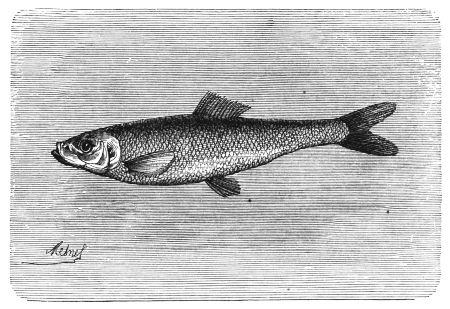
Fig. 383. The Herring (Clupea harengus).
This fish abounds throughout the entire Northern Ocean in immense
shoals, which are found in the bays of Greenland, Lapland, and
round the whole coast of the British Islands. Great shoals of them
occupy the gulfs of Sweden, of Norway, and of Denmark, the Baltic
and the Zuyder Zee, the Channel, and the coast of France up
to the Loire, beyond which they never appear to be found. But the
finest herrings are caught on Loch Fyne, on the west coast of
Scotland.
The herrings are gregarious fishes, and live in great shoals closely
packed together; shoals to be counted not by hundreds, but by thousands
and tens of thousands, in many a shore and bay. It was the favourite
theory, not very long ago, that herrings emigrated to and from the
arctic regions. It was asserted, by the supporters of this theory, that
in the inaccessible seas of high northern latitudes herrings existed in
overwhelming numbers, an open sea within the arctic circle affording
a safe and bounteous feeding-ground. At the proper season vast
bodies gathered themselves together into one great army, which, in
numbers exceeding the powers of imagination, departed for more
southern regions. This great Heer, or army, was subdivided, by some
instinct, as they reached the different shores, led, according to the
ideas of fishermen, by herrings of more than ordinary size and sagacity,
one division taking the west side of Britain, while another took the
east side, the result being an adequate and well-divided supply of
herrings, which penetrated every bay and arm of the sea round our
coast, from Wick to Yarmouth. Closer observation, however, shows
that this theory has no existence in fact. Lacepede denies that those
periodical journeyings take place. Valenciennes also rejects them. It
is true that the herrings have disappeared in certain neighbourhoods
in which they were formerly very plentiful; but it is also certain that,
in many of the fishing stations, fish are taken all the year round.
Moreover, the discovery that the herring of America is probably a
distinct species from that of Europe (which, smoked, is known as the
"Digby Chick") is against the theory. In short, there is a total
absence of proof of their pretended migrations to high northern
latitudes; and recent discoveries all tend to show that the herring is
native to the shores on which it is taken.
"It has been demonstrated," says Dr. Bertram, "that the herring
is really a native of our immediate seas, and can be caught all the year
round on the coast of the three kingdoms. The fishing begins at the
island of Lewis, in the Hebrides, in the month of May, and goes on as
the year advances, till in July it is being prosecuted off the coast of
Caithness; while in autumn and winter we find large supplies of
herrings at Yarmouth; there is a winter fishery in the Firth of Forth.
Moreover, this fish is found in the south long before it ought to be
there, according to the emigration theory. It has been deduced, from
a consideration of the annual takes of many years, that the herring
exists in distinct races, which arrive at maturity month after month.
It is well known that the herrings taken at Wick in July are quite
different from those caught at Dunbar in August and September;
indeed I would go further, and say that even at Wick each month has
its changing shoal, and that as one race appears for capture another
disappears, having fulfilled its mission. It is certain that the herrings
of these different seasons vary considerably in size and appearance;
localities are marked by distinctive features. Thus the well-known
Loch Fyne herring is essentially different from that of the Firth of
Forth; and those differ again, in many particulars, from those caught
off Yarmouth. In fact, the herring never ventures far from the shore
where it is taken; and its condition, when it is caught, is just an
index of the feeding it has enjoyed in its particular locality. The
superiority of flavour of the herring taken in our great land-locked
salt-water lochs is undoubted. Whether or not resulting from the
depth and body of water, from more plentiful marine vegetation, or
from the greater variety of land food likely to be washed into these
inland seas, has not yet been determined, but it is certain that the
herrings of our western sea-lochs are infinitely superior to those
captured in the more open sea." "Moreover," he adds, "it is now
known, from the inquiries of the late Mr. Mitchell and other
authorities on the geographical distribution of the herring, that
the fish has never been noticed as being at all abundant in the arctic
regions."
The herring feeds on small crustaceans, fishes just hatched, and even
on the fry of its own species. On the other hand, its enemies are the
most formidable inhabitants of the ocean; the whales destroy them by
thousands, but man, above all, carries on a war which threatens to
be one of extermination. In fact, the herring-fishery has been to
certain nations the great cause of their prosperity. It was the foundation
of Dutch independence. Silk manufacture, coffee, tea, spices,
which are productive of great commercial movements, address themselves
only to the wants of luxury or fashion. The produce of the
herring fishery, on the contrary, is one of necessity to the people;
and Holland would have languished and quickly disappeared, with its
fictitious territory, if the sea had not added to its commercial industry
this inexhaustible mine of wealth. That vast field it has worked with
persevering ardour. Struggling for an existence, it has conquered.
Every year numerous vessels leave the coast of Holland for this precious
marine harvest. The herring fishery is, for the Dutch people,
the most important of maritime expeditions. It is with them known
as the "great fishery." Whaling is known as the "small fishery."
The great fishery is a golden mine to Holland; it is, besides, a very
ancient occupation with ourselves. We find it flourishing in the
twelfth century; for, in 1195, according to the historians, the city of
Dunwich, in the county of Suffolk, was obliged to furnish the king
with twenty-four thousand herrings. We also find mention made of
the herring fishery in a chronicle of the Monastery of Evesham in the
year 709.
Towards the year 1030 the French sent vessels into the North Sea
from Dieppe for this fishing, nearly a century before the Dutch made
the attempt; but as early as the thirteenth century that enterprising
people employed two thousand boats in this industry. The Danes,
Swedes, and Norwegians also threw themselves into this trade at an
early period. The French, Danes, and Swedes furnish at the present
time only sufficient for home consumption. The monopoly of foreign
trade belongs to the English, Dutch, and Norwegians. "The
quantity of herrings gathered every year by our neighbours beyond
the Channel," says Moquin-Tandon, "is truly enormous. In Yarmouth
alone four hundred ships, of from forty to sixty tons, are
equipped, the largest being manned by twelve men. The revenue
derived from this fleet is about seven hundred thousand pounds. In
1857 three of these fishing-boats, belonging to the same proprietors,
carried home three millions seven hundred and sixty-two thousand
fishes."
Since the beginning of this century the Scottish fishermen have
emulated the zeal of the English. In a paper communicated to the
British Association in 1854, Mr. Cleghorn, who has paid great attention
to the subject, states "that there are nine hundred and twenty
Wick boats engaged in the fishing, and that the produce was ninety-five
thousand six hundred and eighty barrels" in one week alone, this
being, however, a falling off of sixty-one thousand barrels from the
previous year. The cause of this immense falling off was ascribed to
a storm which had swept along the coast at the height of the
season; but Mr. Cleghorn was inclined to ascribe it mainly to
over-fishing, which had gradually diminished the number of herrings
captured.
The boats employed by the French and Dutch in the herring
fishery are about sixty tons burden. They generally depart for the
Orkney and Shetland isles. They afterwards betake themselves to
the German Ocean, and fish the Channel in November and December.
These boats carry up to sixteen hands, according to their size.
Arrived at their fishing ground, they cast their nets, as seen in
Pl. XXIX.
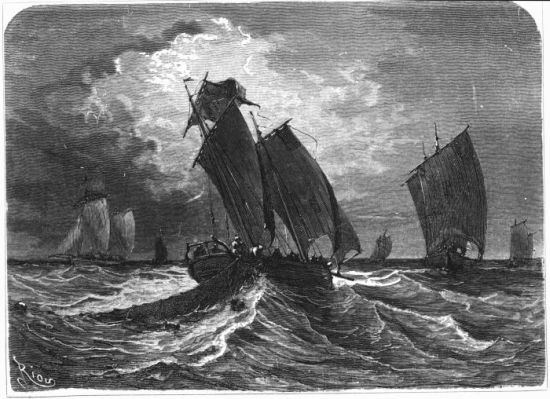
Plate XXIX.—The Herring Fishery.
The lines of the Dutch fishermen are five hundred feet in length,
composed of fifty or sixty different nets. The upper parts of these
nets are supported by empty barrels or cork-buoys, the lower edge
being weighted with lead or stones, which are kept at a convenient
depth by shortening or lengthening the cords by which the buoys are
attached. The size of the mesh of the nets is such that the herrings
of a certain size are caught in it by the gills and pectoral fins. If the
first mesh is too large to hold them they pass through, and get caught
by the next or succeeding mesh, which is smaller. The herring-fishery
is regulated by Act of Parliament, and the legal mode of capture is by
means of what is called a drift-net. The drift-net is made of fine twine,
marked with squares of an inch each to allow for the escape of the
young fish. The nets are measured by the barrel bulk, a net measuring
fifty feet long by thirty-two deep, and each holding half a barrel. The
drift is composed of many separate nets fastened together by means of
a back rope, and each separate net of the series is marked off by a
bladder or empty cask. The process is that described by Dr. Bertram
in an article published in the "Cornhill Magazine." The writer had
made his arrangement for a night at the herring fishery under the
auspices of Francis Sinclair, a very gallant-looking fellow, who sails
his own boat from Wick, and takes his own venture. Bounding over
the waves with a good capful of wind, they had left the shore and
beetling cliffs far behind them; they reached their fishing ground,
where they tacked up and down, eagerly watching for the oily
phosphorescent gleam which is indicative of herrings. "At last, after
a lengthened cruise," he says, "our commander, who had been silent
for half an hour, jumped up and called to action. 'Up, men, and at
them!' was the order of the night. The preparations for shooting
the nets at once began by lowering sail. Surrounding us on all
sides was to be seen a moving world of boats; many with sails down,
their nets floating in the water, and their crews at rest. Others were
still flitting uneasily about, their skippers, like our own, anxious to
shoot in the right place. By-and-by we were ready; the sucker goes
splash into the water; the 'dog,' a large inflated bladder to mark the
far end of the train, is heaved overboard, and the nets, breadth after
breadth, follow as fast as the men can pay them out, till the immense
train is all in the water, forming a perforated wall a mile long and
many feet in depth; the 'dog' and the marking bladder floating and
dipping in long zigzag lines, reminding one of the imaginary coils of
the great sea-serpent. After three hours of quietude beneath a
beautiful sky, the stars—
'The eternal orbs that beautify the night'—
began to pale their fires, and, the gray dawn appearing, indicated that
it was time to take stock. We found that the boat had floated quietly
with the tide till we were a long distance from the harbour. The
skipper had a presentiment that there were fish in his net; and the
bobbing down of a few of the bladders made it almost a certainty, and
he resolved to examine the drifts. By means of the swing rope the
boat was hauled up to the nets. 'Hurrah!' exclaimed Murdoch of
Skye; 'there's a lot of fish, skipper, and no mistake.' Murdoch's
news was true; our nets were silvery with herrings—so laden, in fact,
that it took a long time to haul them in. It was a beautiful sight to
see the shimmering fish as they came up like a sheet of silver from the
water, each uttering a weak death-chirp as it was flung into the
bottom of the boat. Formerly the fish were left in the meshes of the
net till the boat arrived in the harbour; but now, as the net is hauled
on board, they are at once shaken out. As our silvery treasure
showers into the boat we roughly guess our capture at fifty crans—a
capital night's work."
But there is a reverse to this medal. Wick Bay is not always
rippled by the land-breeze as on this occasion. "The herring fleet
has been more than once overtaken by a fierce storm, where valuable
lives have been lost, and thousands of pounds worth of netting and
boats destroyed, and the gladdening sights of the herring fishery have
been changed to wailing and sorrow."
The Yarmouth boats are decked vessels of from fifty to eighty tons,
with attendant boats, costing about one thousand pounds, and having
stowage for about fifty lasts; nominally, ten thousand, but, counted
fisherwise, thirteen thousand, herrings, besides provision for a five or
six days' voyage. Leaving a hand or two in charge of the vessel, the
majority of the crew are out in the smaller boats, fishing.
The Dutch herring fishery is usually pursued during the night.
When the nets are in the water the boat is left, as we have seen in
Dr. Bertram's excursion, to drift in the meantime. Each boat is
furnished with a lantern, which serves the double purpose of attracting
the shoals of fish, and preventing collisions with other boats.
The herring fishery is extremely capricious in its results; one or two
boats have been known to carry into port the whole takings of a night.
Valenciennes witnessed the capture of a hundred and ten thousand
herrings in less than two hours. The nets are hauled in when
moderately charged with fish by the crew; but it is often necessary to
have recourse to the capstan in the process. Some of the hands are
stationed to detach the fish from the nets; others detach the nets
from the buoys; while others again fold up and stow away the nets
for future use.
On the coast of Norway the electric telegraph is applied to the
herring fishery, being employed to announce to the inhabitants of the
fishing towns the approach of the shoals of fish. In the fiords of
Norway, where the produce of the herring fishery is the principal
means of existence to nearly the entire population, it often happened
that the fish made its appearance at the most unexpected times, and on
some parts of the coast the shoals could only be met by one or two
boats. Before the boats from the bays and fiords could take part in
the fishery, the herrings had deposited their spawn and returned to the
open sea.
To prevent these disappointments, often repeated with great loss
to the fishermen, the Norwegian government established, in 1857, a
submarine electric cable, along the coast frequented by the herrings,
of a hundred miles, with stations on shore at intervals conveniently
placed for communicating with the villages inhabited by the fishermen.
As soon as a shoal of herrings is known to be in the offing—and they
can always be perceived at a considerable distance by the wave they
raise—a telegram is despatched along the coast, which makes known
in each village the approach to the bay in which the herrings have
established themselves.
This important branch of industry has only assumed its real
character since the fourteenth century, and its sudden and prodigious
extension is due to the discovery of a simple Dutch fisherman, George
Benkel, who died in 1397. To this man Holland owes much of its
wealth. He discovered, in short, the art of curing the herring so as
to preserve it for an indefinite time. From that moment the herring
fishery assumed an unexpected importance, and became the source of
much wealth to Holland and its industrious and enterprising people.
Two hundred years after his death the Emperor Charles V. solemnly
ate a herring on Benkel's tomb; it was a small homage paid to
the memory of the creator of a new industry which had enriched
his native land.
The Shad (Alosa), which have the body round and more plump
than the herring, are still more distinguishable by the arrangement of
their teeth. More than twenty species of this genus are known, varying
considerably in size. They inhabit the seas which wash the
coasts of Europe, Africa, India, and America. One species is the
Common Shad, Alosa communis (Fig. 384), which is found in the
Channel, the North Sea, and all round our coast. It is of a silvery
tint generally, greenish on the back, with one or two black spots
behind the gills. The shad approaches the mouths of rivers and
great estuaries, and habitually ascends them in the spring for the
purpose of depositing its ova, and is found at this season in the
Rhine, the Seine, the Garonne, the Volga, the Elbe, and many of our
own rivers. In some of the Irish rivers the masses of shad taken in
the seine-net have been so great that no amount of exertion has been
sufficient to land them. It sometimes attains a very considerable
size, weighing as much as from four to six pounds. The shad taken
at sea are less delicate in their flesh than those caught in fresh water.
The habits of the shad are very imperfectly known. Two species are
found on the British coast, namely, the Twaite Shad of Yarrell
(Alosa finta), which is about fourteen inches in length, brownish-green
on the back, inclining to blue in certain lights, the rest of the
body silvery white, with five or six dusky spots on each side arranged
longitudinally. The jaws are furnished with distinct teeth; the tail
deeply forked.
The second species, the Common or Allice Shad (A. Communis), is
considerably larger, sometimes attaining twelve and even fifteen inches
in length, having only one spot on each side of the body near the
head; the jaws without teeth, the scales small in proportion. This
species is plentiful in the Severn, but rare in the Thames.
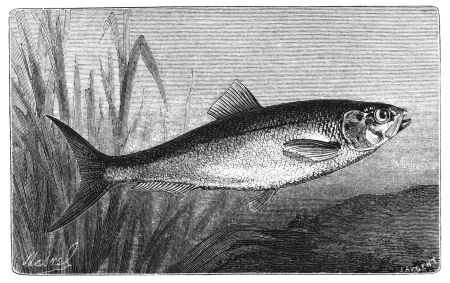
Fig. 384. The Allice Shad (Alosa communis).
The shad is found in the Severn and Thames in considerable
quantities about the second week in July. They reach the fresh
water about May, deposit their spawn, and return to salt water in
July. Their scales are large.
The Sprat (C. Sprattus) has been the subject of a great controversy,
like the parr—one party contending that it is the young of the
herring; another, that it is a distinct species. Pennant, Yarrell, and
many eminent naturalists adopt the first view: yet its specific characters,
according to Pennant, are "greater depth of body than the young
herring, gill-covers not veined; teeth of the lower jaw so small as to
be scarcely sensible to the touch; the dorsal fin placed far back, and
the sharp edge of the abdomen more acutely serrated than in the
herring." Like the herring, they inhabit the deep water during the
summer, following the shoal to the sea-shore in autumn. The sprat
fishing commences in November and continues during the winter
months, when they are caught in such numbers that in some localities
they have been used as manure.
In support of the individuality of the sprat, the serrated belly and
relative position of the fins are dwelt upon, together with the instance
detailed by Mr. Mitchell, the Belgian consul at Leith, who exhibited
a pair of sprats, having the roe and milt fully developed.
On the other hand, the abundance of the sprat has been adduced
as a reason for its being the young herring. In addition to this,
anatomists declare their anatomy shows no difference but size. "As
to the serrated belly," says Bertram, "we may look on that as we do
on the back of a child's frock, namely, as a provision for growth."
If this is so, Dr. Bertram supplies material at once for thought and
legislation. "The slaughter of sprats," he says, "is as decided a
case of killing the goose with the golden eggs as the grilse slaughter
carried on in our salmon rivers." But Mr. Bertram here overlooks
a fact of which any one may convince himself, namely, that young
herrings are caught without the serrated belly; nay, the curer's
purchase is regulated by the sprat's rough, and the herring's smooth
belly.
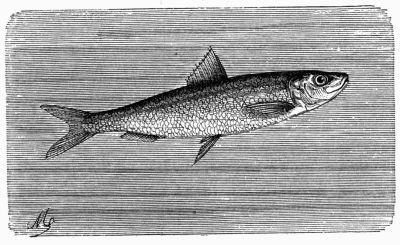
Fig. 385. The Pilchard (Clupea pilchardus).
The Pilchard, Clupea pilchardus (Fig. 385), sometimes called the
gipsy herring, visits our coasts all the year round. It was at one time
thought, as the herring was, to be migratory, but, like that fish, it is
now found to be a native of our own seas, and a constant inhabitant
of our shores. It has been known to spawn in May, but the usual
time is October, and authorities like Mr. Couch think it breeds only
once a year. Its visit to shallow water causes immense excitement;
persons watch night and day from the lofty cliffs along the Cornwall
coast, and the watchers (locally called "huers") signal the boats at
sea beneath them the moment they see indications of the approach of
a shoal. Mr. Wilkie Collins gives an animated picture of the "huer:"
"A stranger in Cornwall, taking his first walk along the cliffs in
August, could not advance far without witnessing what would strike
him as a very singular and even alarming phenomenon. He would see
a man standing on the extreme edge of a precipice just over the sea,
gesticulating in a very remarkable manner, with a bush in his hand,
waving it to the right and to the left, brandishing it over his head,
sweeping it past his feet; in short, acting the part apparently of a
maniac of the most dangerous description. It would add considerably
to the stranger's surprise if he were told that the insane individual
before him was paid for flourishing the bush at the rate of a guinea a
week. And if he advanced a little, so as to obtain a nearer view of
the madman, and observed a well-manned boat below turning carefully
to the right and left, as the bush turned, his mystification would
probably be complete, and his ideas as to the sanity of the inhabitants
would be expressed with grievous doubt.
"But a few words of explanation would make him alter his opinion.
He would learn that the man was an important agent in the pilchard
fishery of Cornwall, that he had just discovered a shoal swimming
towards the land, and that the men in the boats were guided by his
gesticulations alone in their arrangements for securing the fish on
which so many depend for a livelihood."
The pilchard, the young of which is believed to be the sardine of
commerce, where its place is not usurped by the sprat, is sometimes
taken in the Channel, on the coasts of Brittany and Cornwall, and
in the Mediterranean, and on the coast of Sardinia, whence its
commercial name. In Brittany floating-nets are employed. The
fishing is conducted in boats, each carrying five men; hundreds
of these boats may sometimes be seen engaged at the same time
three or four leagues from the coast, the nets being only drawn
when they are fully charged, when the fish are arranged bed
upon bed in osier baskets, each boat returning habitually to port
when it has secured twenty-five thousand fishes. The fishery extends
over five or six months, the produce being about six hundred
millions of sardines.
The Basque fishermen employ a net in the form of a sack, with
rings at each corner.
On the coast of Cornwall, as we have hinted, it is one of the staple
industries, and pursued systematically. Where they come from, and
whither they go, seems alike unknown. All that is certain is, that
they are met with in shoals swimming past the Scilly Islands as early
as July. In August the inshore fishing begins, and they appear on
various parts of the coast as far north as Devonshire and the south
coast of Ireland up to October and November; no doubt those which
have escaped the innumerable nets spread for them.
"The first sight from the cliffs of a shoal of pilchards," says Mr.
Collins, in the work already quoted, "is not a little interesting. They
produce on the sea the appearance of the shadow of a dark cloud,
which approaches until you can see the fish leaping and playing on
the surface by hundreds at a time, all huddled close together, and so
near the shore that they can be caught in fifty or sixty feet of water.
Indeed, when the shoals are of considerable magnitude, the fish behind
have been known literally to force the fish in front up to the beach,
so that they could be taken in baskets, or even with the hand.
"With the discovery of the first shoal, the active duties of the lookout,
or huer, on the cliffs begin. Each fishing village places one or
more of these men on the watch all round the coast. He is, therefore,
not only paid his guinea a week while he is on the watch, but a percentage
on the produce of all the fish taken under his auspices. He
is placed at his post, where he can command an uninterrupted view of
the sea, some days before the pilchards are expected.
"The principal boat used is, at least, of fifteen tons burden, and
carries a large net called the 'seine,' which measures a hundred and
ninety fathoms in length, and costs a hundred and twenty pounds—sometimes
more. It is simply one long strip from eleven to thirteen
fathoms in breadth, composed of very small meshes, and furnished all
along its length with cork at one edge and lead at the other. The
men who cast this net are called 'shooters,' and receive eleven
shillings and sixpence a week, and one basket of fish out of every
haul.
"As soon as the 'huer' discerns a shoal he waves his bush. The
signal is conveyed to the beach by men and boys watching near him.
The 'seine'-boat, accompanied by another, to assist in casting the
net, is rowed out to where he can see it; then there is a pause and
hush of expectation. Meanwhile the devoted pilchards press on—a
compact mass of thousands on thousands of fish—swimming to meet
their doom. All eyes are fixed on the 'huer;' he stands watchful
and still, until the shoal is thoroughly embayed in water which he
knows to be within the depth of the 'seine.' Then, as the fish begin
to pause in their progress, and gradually crowd closer and closer together,
he gives the signal, and the 'seine' is cast or 'shot' overboard.
"The grand object is now to enclose the entire shoal. The leads
sink one side of the net perpendicularly to the bottom, the corks buoy
the other to the surface of the water. When it has been taken all
round the shoal, the two extremities are made fast, and the fishes are
imprisoned within an oblong barrier of netting. The art is how to let
as few of the pilchards escape as possible while the process is being
completed. Whenever the 'huer' observes that they are startled, and
separating at any particular point, he waves his bush, and thither the
boat is steered, and there the net is shot at once; the fish are thus
headed and thwarted in every direction with extraordinary address
and skill. This labour completed, the silence of intense expectation
that has hitherto prevailed is broken—there is a shout of joy on all
sides—the shoal is secured.
"The 'seine' is now regarded as a great reservoir of fish. It may
remain in the water a week or more; to secure it against being
moved from its position, in case a gale should come on, it is warped by
two or three ropes to points of land in the cliff, and is at the same
time contracted in circuit by its opposite ends being brought together
and passed lightly over its breadth for several feet. While these
operations are being performed, another boat, another set of men, and
another net, are approaching the scene of action.
"The new net is called the 'tuck;' it is smaller than the 'seine;'
inside which it is to be let down, for the purpose of bringing the fish
close to the surface. The men who manage this net are called
'regular sewers.' The boat is first of all rowed inside the seine-net,
and laid close to the seine-boat, which remains stationary outside.
To its bows one rope at the end of the tuck-net is fastened. The
tuck-boat now slowly makes the inner circle of the seine, the smaller
net being dropped overboard, and attached to the seine at intervals
as she goes. To prevent the fish from getting between the two nets
during the operation, they are frightened into the middle of the
enclosure by beating the water with oars, and stones fastened to ropes.
When the 'tuck' has at length travelled round the whole circle of
the 'seine,' and is securely fastened to the seine-boat at the end as it
was at the beginning, everything is prepared for the great event of
the day—hauling the fish to the surface.
"Now all is excitement on sea and shore; every little boat in the
place puts off, crammed with idle spectators; boys shout, dogs bark,
and the shrill voices of the former are joined by the deep voices of the
'seiners.' There they stand, six or eight stalwart, sun-burnt fellows,
ranged in a row in the seine-boat, hauling with all their might at the
'tuck'-net, and roaring out the nautical 'Yo, heave ho!' in chorus.
Higher and higher rises the net; louder and louder shout the boys
and the idlers; the 'huer,' so calm and collected hitherto, loses his
self-possession, and waves his cap triumphantly. 'Hooray! hooray!
Yoy—hoy, hoy! Pull away, boys! Up she comes! Here they
are!' The water boils and eddies; the 'tuck'-net rises to the surface;
one teeming, convulsed mass of shining, glancing, silvery scales; one
compact mass of thousands of fish, each one of which is madly striving
to escape, appears in an instant. Boats as large as barges now pull
up, in hot haste, all round the nets, baskets are produced by dozens,
the fish are dipped up in them, and shot out, like coals out of a sack,
into the boats. Presently the men are ankle-deep in pilchards; they
jump upon the benches, and work on till the boats can hold no more.
They are almost gunwale under before they leave for the shore."
In the process of curing, the scene becomes doubly picturesque, but
this is shore-work, with which our space forbids us to deal.
"Some idea of the almost incalculable multitude of pilchards caught
on the Cornwall shores," says Mr. Collins, "may be gathered from
the following data: At the small fishing cove of Trereen six hundred
hogsheads were taken in little more than a week, during August,
1850. Allowing two thousand four hundred fish only to each hogshead
(three thousand would be the highest calculation), we have a
result of one million four hundred and forty pilchards caught by the
inhabitants of one little village alone, on the Cornish coast, at the
commencement of the season's fishing."
The Anchovy (Engraulis) is chiefly taken in the Mediterranean,
and is much sought after for its delicate flavour when salted and
cured. It is a small, slender fish, about four to four and a half inches
in length; head pointed, mouth very wide, gill-openings large, abdomen
smooth; when living it is greenish on the back, silvery
beneath; after death it changes to a bluish black. The fishery which
gives the most abundant results takes place on the shores of the
Mediterranean, principally on the coast of Sicily, the isles of Elba,
Corsica, Antibes, Frejus, Saint-Tropez, and Cannes. They are also
taken on the Dalmatian coast, and in the neighbourhood of Ragusa.
The anchovy is only fit for food after being preserved and salted.
The process of curing commences by throwing it into a strong brine;
then, the head and entrails being removed, they are arranged in rows
in barrels or boxes of tin, in alternate layers of salt and fish; finally,
after some days of exposure, they are hermetically closed and despatched
to market. Those prepared on the Provençal coast were formerly
carried to the fair of Beaucaire, whence they found their way all over
France, and to many parts of Europe. Now, the anchovies cured at
Marseilles, and other Provençal ports, are sent direct to the various
markets of Europe.
The Acanthopterygeans
include the Perch family, which is altogether a fresh-water fish, and,
however interesting in itself, foreign to our present purpose. It
includes also the cat-fish, which is also known as the bar, and more
commonly the wolf-fish, in Bas-Languedoc and Provence. It is
common in the Mediterranean, and in many of the great rivers which
empty themselves into it. The Cat-fish (Fig. 386) has the appearance
of an elongated perch; its colour, in the adult state, is of a uniform
silvery hue, marked with brown and yellow spots in the young.
The Weevers (Trachinus), forming another division of this family,
are characterised by their very compressed head and the strong spines
of the operculum. They are elongated in shape, with short muzzles;
they have a habit of burying themselves in the sand, and are formidable
to fishermen, from the dangerous wounds they inflict with
their spines. Trachinus communis (Fig. 387) is widely diffused in
the Atlantic and Mediterranean.
The genus Uranoscopus are so named from the position of their
eyes, which are directed towards the sky, from οὐρανὸς, the heavens,
and σκοπέω, I regard. From this peculiar arrangement, they can
only see above them. They are closely connected with the cat-fish.
Uranoscopus vulgaris (Fig. 388) belongs to the Mediterranean, and
is remarkable for its thick cubical head and erect spiny dorsal fins.
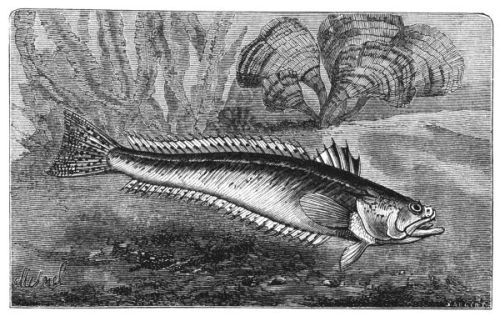
Fig. 387. The Weever-fish (Trachinus communis).
The Mullets (Mullus) have the body thick and oblong, the profile
of the head approaching the vertical line; scales large, two dorsal
fins, widely separated—the rays of the first spinous, of the second,
flexible; two cirri at the lower jaw. Two species are known, both
inhabitants of our west and south-west coasts: the Striped or Red
Mullet (Mullus surmuletus), rare as British, and the Red Mullet
(M. barbatus). The first is a fine bright vermilion red, with three
dominating yellow lines; the throat, breast, ventral, and lower surface
of the tail are white, slightly tinged with rose; the fins have their rays
more or less red, the iris of the eyes a pale gold colour, just touched
with red; the head bears two barbels. This beautiful fish is plentiful
in the Mediterranean and sometimes in the Channel, common in the
gulfs of Gascony, and is frequently served on the table at Bordeaux
and Bayonne, where it is known as the barbel; its flesh is a little
flaky, of an agreeable flavour, but less esteemed than the red mullet.
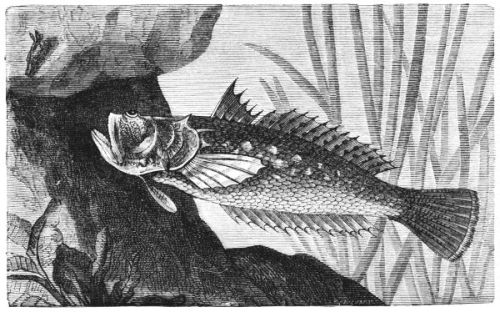
Fig. 388. Uranoscopus vulgaris.
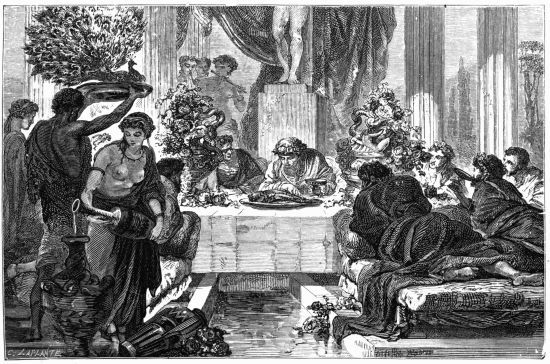
Plate XXX.—Agony of a Red Mullet at the Feast of Hortensius.
The Red Mullet (Mullus barbatus) is clothed in brilliant colours of
bright red, mingling with silvery tints upon the side and belly; it
presents fine indistinct reflections, but none of the yellow lines which
occur in the preceding species. It is to its brilliant colouring that
the red mullet owes much of its celebrity. When we add that its
flesh is white, firm, and agreeable to the taste, the estimation in which
it was held by the ancients is sufficiently explained. With the Romans
the mullet was an object of luxury on which they expended fabulous
sums; they cultivated the fish in their fish-ponds not only as a delicacy
of the table, but for the beauty of form and colour. This fierce love
of beauty, however, too often approached to cruelty. Seneca and
Pliny both give us to understand that the rich patricians of Rome
gave themselves the barbarous pleasure of seeing the mullet expire
under their eyes, in order to witness the various shades of purple,
violet, and blue which succeed each other—from cinnabar red to the
palest white, as the animal gradually loses its strength, and expires
by a slow and cruel death. The great rival of Cicero, the advocate
Hortensius, who attracted crowds of people to the Forum by his
eloquent and elegant discourses, had an inordinate passion for this
kind of enjoyment. These little inhabitants of the waters were led
by a small canal which was carried under the festive table, and his
great enjoyment was to witness the agonies of the unhappy fish just
taken from its native element and carried to the table, palpitating
with its dying convulsions, as it perished beneath his eyes, he in the
meanwhile enjoying a sumptuous banquet. The possession of these
poor creatures had, in short, become the rage, a furious passion, and
their price soon became excessive. A fish of three pounds produced
a considerable sum to the fortunate fisherman, while one of four and
a half pounds was simply ruinous, says Martial. Asinius Gelius
purchased one for eight thousand sesterces (upwards of sixty pounds).
Under Caligula, according to Suetonius, three mullets cost thirty thousand
sesterces (about two hundred and forty pounds). Although it is
no longer the object of ferocious enjoyment on the one hand, or prodigal
expenditure on the other, it is still much sought after, both for
its beauty of colour and excellent table qualities. It is found in many
seas, but particularly in the Mediterranean, where it is taken all
round the coast, usually in muddy bottoms; it is fished for both by
line and net.
The Gurnards (Trigla) are remarkable for the singular manner in
which the head is mailed and cuirassed; the operculum and shoulder-bones
are armed with spines, having trenchant blades, which give
them a disagreeable, even a hideous, physiognomy, and has procured
them various names, such as sea-frog, sea-scorpion, sea-devil, and
sundry other equally significant names. With this forbidding appearance,
however, the gurnards are among the most resplendent inhabitants
of the sea. Nothing can exceed the beauty of their markings;
but the brilliancy with which Nature has gifted them is their misfortune;
it betrays them to their enemies, which are found in the air as
well as in the water, and without their prodigious fecundity this
species would long since have disappeared.
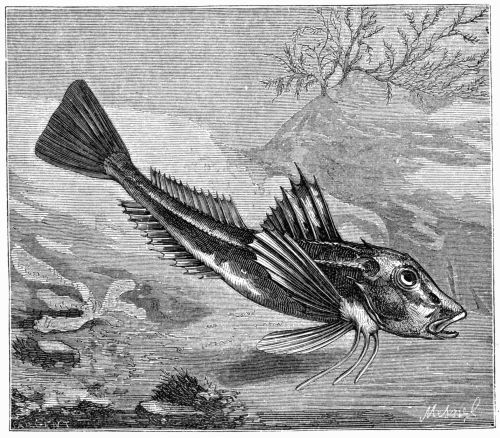
Fig. 389. The Red Gurnard (Trigla pini).
Twelve species of Trigla are known. In the British seas the commonest
species is the Grey Gurnard (Trigla gurnardus), a silvery-grey
fish, more or less clouded with brown and speckled with black. A
rare species with us, but very common in the Mediterranean, is the Red
Gurnard, Trigla pini (Fig. 389). It is of a fine bright rose-red colour,
paler beneath and more vivid about the fins, of which there are two
distinct dorsal and one ventral. Beneath the pectorals are three
detached rays; both jaws and front of the lower palate are armed with
fine velvety teeth. The Perlon, or Sapharine Gurnard (T. hirundo),
is a large and handsome fish, remarkable for the lively green and blue
hues of the inner surface of its large pectoral fins.
The Flying Gurnard (Dactylopterus volitans) somewhat resembles
the Triglas, but differs in having the fin-rays of the pectorals connected
by membranes, by which it is enabled to support itself some
time in the air, like the flying-fish; the pectorals, when extended,
forming a sort of parachute (Fig. 390), which sustains it when it
leaps out of the water. Several species are known.
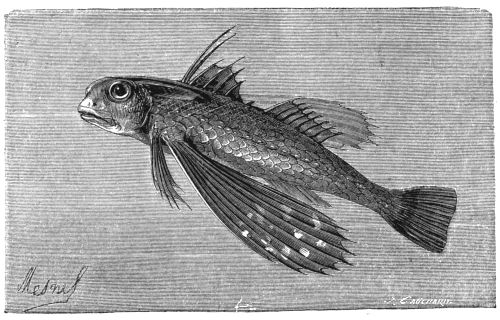
Fig. 390. The Flying Gurnard (Dactylopterus volitans).
All nature seems to conspire against these singular creatures, while
they have been gifted with the double power of swimming and flying.
The flying-fish only escapes from the Bonitas, and other voracious
fishes which pursue it on the bosom of the sea, to expose itself to the
attacks of the inhabitants of the air. A crowd of sea-fowl, such as
frigate-birds, the albatross, and the gulls, carry on a bloody war with
them when they venture on flight. Enemies thus pursue the unhappy
fish whatever element it betakes itself to. Nevertheless it passes from
one element to the other with an energy which frequently defeats
the attacks of its enemies. When it leaps from the sea to the height
of five or six feet, it sustains itself for several hundred feet, changing
its direction. In its flight it may be compared to that of the flying
dragon; the popular name given to it is said to be derived from the
grunting noise they make on being taken out of the water.
Labyrinthiform Pharyngeans.
In the fishes of this order the superior pharyngeal bones are divided
into numerous and irregular little leaflets, which intersect the cellules
situated under the operculum, which again serve to retain a certain
quantity of water. This water preserves the gills, however, when the
animal is dry, which permits them to live on shore, where they
frequently contrive to creep over great distances in search of water.
The genus Anabas, from ἀναβαίνω, to ascend, possess this peculiarity
of organization in a remarkable degree; it enables them to
leave the rivers and marshes and little watercourses of Borneo and
Java, and other islands of the Indian Archipelago, and creep through
the herbage or along the ground by means of the inflexions of their
bodies, the dentation of their opercules, of their spines and fins. This
fact, although only recently known to modern naturalists, was well
known to the ancients, and has been recorded by Theophrastus.
The family of the Scomberoides is the most important group in the
order, comprehending some of the fishes most useful to man, from their
size, the excellence of their flesh, and their abundance. The Tunny
(Thynnus, Cuv.), the Mackerel (Scomber scombrus), and the Bonita
(Thynnus pelamys), have yielded, from the remotest antiquity, immense
resources as human food, both in the fresh and preserved state.
The tunny, while resembling the mackerel in many respects in its
general form, is rounder, and attains a much larger size, being sometimes
found eight and nine feet in length, and weighing three to four
hundred pounds. The upper part of the body is a bluish-black; the
belly is grey, with silvery spots. These fishes sometimes present
themselves in the Atlantic, but in the Mediterranean they are very
abundant. At some periods of the year they approach the coast in
innumerable shoals, and in numerous serried ranks, forming a vast
battalion, which conceals itself under the waves, and only betrays
itself on the exterior by the motion of the sea, caused by such vast
numbers travelling rapidly through the water. In many localities the
shoals of tunnies show themselves in the spring, pursuing their way
towards the east, and in the autumn we find them pursuing an opposite
direction. We see the same thing on the coast of Provence.
Upon the coast of La Ciotat a first fishing takes place from the
months of March to July, and a second again from July to October.
But at other points of the coast they arrive at the same time from
very different directions; nevertheless, in some places they are only
winter visitors.
The tunny-fishing goes back to the remotest antiquity. The
Phœnicians, the first navigators known, carried it on on the coast of
Spain. In our days the fishing is carried on with great activity on
the coasts of Provence, of Sardinia, and Sicily.
The fishing is generally carried on by the tunny-net, but in
Provence it is fished with an enclosed net called the madrague.
The tunny-net consists of a combination of nets, which is quickly
cast into the sea in order to head the tunnies at the moment of their
passage. When the sentinels, posted for the purpose, as in the pilchard
fishery, have signalled the approach of a shoal of tunnies and
its direction, by the indications of a flag which points to the spot
occupied by the finny tribe, the fishing-boats are immediately directed
to the designated spot, and ranged in curved lines, forming with
the light floating net a half circular enclosure, turned towards the
shore, the interior of which is called the garden. The tunnies thus
enclosed in this garden, between the coast and the net, become agitated
with terror. As they advance towards the shore they press upon the
enclosure, or rather a new interior enclosure is formed with other nets
held in reserve. In this second enclosure an opening is left, through
which the tunnies have to pass. In continuing thus to diminish the
space by successive enclosures, each occupies a smaller diameter, in
which the fish are enclosed in about a fathom and a half of water. At
this moment a species of seine-net is thrown into the garden. This net
is hauled into shallow water by force of arms, and the small tunnies
are taken by the hand, the larger by hooks. The boats are charged
with them, and they are carried ashore. A single day's fishing will
sometimes produce as many as sixteen thousand tunnies, each from
twenty to five and twenty pounds weight.
When the park, in place of being established for a single fishery,
is a permanent construction in the sea, it is called, in Provence, a
madrague. The madrague is a vast enclosure. The netting which
forms the partitions of its chambers are sustained by buoys of cork on
the surface, and kept down by heavy stones and other weights on the
lower edge, and maintained in this position by cords, one extremity
of which is attached to the net, and the other is moored to an anchor.
The madrague is intended to arrest the shoals of tunnies at the
moment when they abandon the shore in order to return to the open
sea. For this purpose a long alley or run is established between the
sea-shore and the park or madrague. The tunnies follow this alley,
and, after passing from chamber to chamber, betake themselves at last
to the body of the park.
In order to force them into the madrague they are pressed towards
the shore by means of a long net, which is extended in their rear
attached to two boats, each of which sustains one of the upper angles
of the net. When the fishes come to the last compartment, the
fishermen raise a horizontal net, which makes a sort of plate of this
compartment, in which the fishes are gradually raised to the surface
of the water. This operation occupies the whole night.
In the morning the tunnies are collected in a very narrow space,
and at varying distances from the shore; and now the carnage commences.
The unhappy creatures are struck with long poles, boat-hooks,
and other weapons. The tunny-fishing presents a very sad
spectacle at this its last stage; fine large fish perish under the blows
of a multitude of fishermen, who pursue their bloody task with most
dramatic effect. The sight of the poor creatures, some of them wounded
and half dead, trying in vain to struggle with their ferocious assailants,
is very painful to endure. The sea, red with blood, long preserves
traces of this frightful carnage, of which an illustration is attempted
in Pl. XXXI.
The flesh of the tunny is much esteemed, being firm and wholesome.
It is called the salmon of Provence. "For our part," says M. Figuier,
"we put it far above the salmon. Nothing is comparable to the fresh
tunny thrown into a hot frying-pan, and sprinkled with vinegar and
salt. When properly cooked, nothing can be more firm or savoury. In
short, nothing of the kind can rival, or even be compared, with the
tunny, as we find it at Marseilles and Cette."
The tunny is greatly celebrated among the Greeks and other
inhabitants on the shores of the Mediterranean, of the Propontus, and
the Black Sea. The Romans attached great value to certain parts of
this fish, as the head and the lower part of the belly. The neighbouring
parts were in little esteem with them. They cut them into
pieces and preserved them in vases filled with salt. They are now
preserved with oil and salt after being cooked; this preparation is in
great request at Cette, Montpellier, and Marseilles. With a pot of
marine tunny, preserved in the vinegar of Lunel, a household is
pretty well prepared for any event.
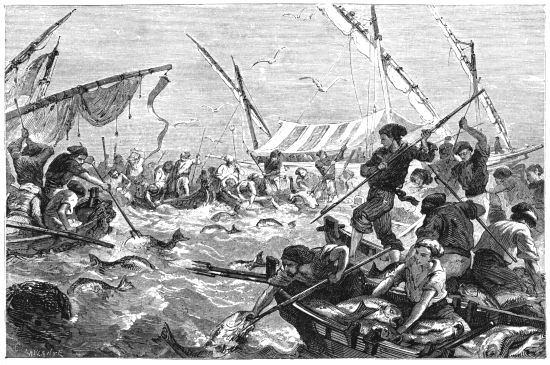
Plate XXXI.—Fishing for Tunny at Madrigue, on the Coast of Provence.
The Mackerel (Scomber scombrus) is too well known to require
minute description. Who has not admired these fishes, with their steel-blue
back, and changing iridescent sides of gold and purple and green,
relieved by fine waving lines of deeper black, as they appear on the
market-stalls, or as they are emptied in the early morning from the
fishing-boat? The head is blue above, with black markings, the
rest of the body being heightened with iridescent shades of gold and
purple.
There are two species of mackerel—that of the Atlantic and of the
Channel, which has no swimming-bladder, Scomber scombrus (Fig. 391),
and the mackerel of the Mediterranean, Scomber colias, which has the
swimming-bladder, and which is a very rare fish in our seas.
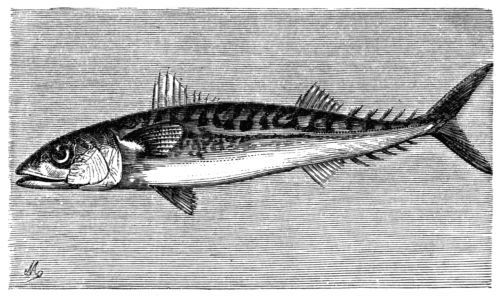
Fig. 391. The Mackerel (Scomber scombrus).
The mackerel is common to all European seas: being the Veirat of
the Bay of Languedoc; the Aurion of Provence; the Bretal in some
parts of Brittany; the Macarello of the modern Romans; the Scombro
of the Venetians; the Lacesto of the Neapolitans; the Cavallo of the
Spaniards; the well-known Mackerel of our own shores, and the
Makril of the Swedes; it is found on the coast of North America,
and as far south as the Canary Islands. It is a wandering, unsettled
fish, supposed to be migratory, but individuals are always found on
our coast. They are supposed to remain during the winter in the
North Sea, and afterwards on the coast of Scotland and Ireland in
January and February, on their way to the Atlantic. Here their
great army is divided into two: one branch passes along the Spanish
and Portuguese coasts, while the other enters the Channel. In May
they appear on the coasts of England and France. In June they
reach Holland. In July one portion of them returns to the Baltic,
while another skirts the coast of Norway on its way to winter
quarters.
Lacepede estimated that this migration, which is so regular, and its
stages so rigorously indicated, was irreconcilable with a great number
of very precise observations; and he arrived at the conclusion that the
mackerel passes the winter at the bottom of the sea, more or less
remote from the coast, which they again approach in the spring.
At the commencement of the fine season they advance towards the
shore which best agreed with them, showing themselves often on the
surface, like the tunny, traversing the sea in courses more or less direct
or sinuous, but never following the periodical circle which has been so
ingeniously traced out for them.
Mr. Milne Edwards also remarks that, if these legions of fishes
ascended from the Polar seas, they ought to visit the Orkneys before
they appeared in the Channel, and enter the Mediterranean later in
the season; but he is assured that they appear at the Orkneys late in
the season. It appears, in short, that there are different varieties
which haunt the several neighbourhoods in which they abound.
The largest mackerel are taken at the entrance of the Channel,
but they are considered less delicate than the smaller fishes. The
shoals of mackerel, it appears, never enter the Gulf of Gascony, but
they abound along the shores of Brittany up to the North Sea. It is
about the month of April that they begin to be met with, but they are
still small and without milt or roe. In the months of June and July
the fish is in its most perfect state. Towards the end of September
and October mackerel of the same year's birth are taken; finally, in
November and December, the fishermen still fish them, and send
them to market, but this is an irregularity, and the fishermen of
Lowestoft and Yarmouth take their great harvest in May and June;
in the Firth of Forth, and on the north coast of Scotland, at a few
weeks later.
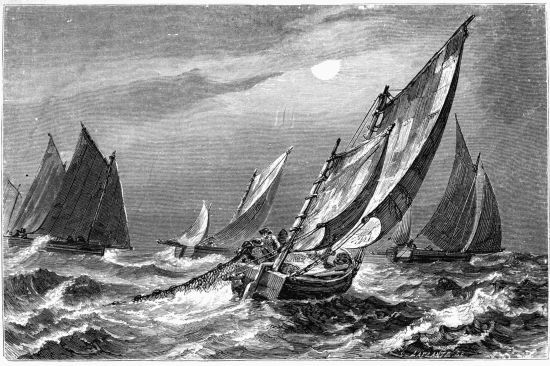
Plate XXXII.—Fishing for Mackerel off the Cornwall Coast.
As mackerel are very voracious, they greedily devour all sorts of
bait, but they are chiefly taken by the drift-net. The drift-net is
twenty feet deep and a hundred and twenty feet long, well buoyed at
the upper edge, but without weights at the bottom. The meshes,
made of fine twine tarred to a reddish colour for preservation, are
calculated to admit the head of the fish and catch it by the gills, so as
to prevent its withdrawal. A fleet of mackerel-boats dragging these
large nets, which are extended vertically in the sea, or float between
the two tides, is well represented in Pl. XXXII.
The flesh of the mackerel is fat and high flavoured. Among the
ancients a liquid was extracted from this fat called garum, which was
considered a very nourishing preparation. The price of this liquid was
very high; in modern measures it was valued at about sixteen
shillings the pint. It was acrid, half putrefied, and very nauseous,
but it had the property of rousing the appetite and stimulating the
digestive organs. Garum played the part of a condiment at a period
when the exciting array of Indian spices was unknown. Seneca
charges it, as we do pepper and other hot spices taken in excess, with
destroying the stomach and health of gourmands. This garum is
spoken of by the traveller Pierre Belon, writing in the sixteenth
century, as being held in great estimation at Constantinople in his
time. Rondelet, the author of a very remarkable book published in
1554, who ate garum at the table of William Pellicier, Bishop of
Maguelonne, thought he could trace the liquid not to the mackerel,
but to one of the Sparoïdes (Sparus smaris).
The mackerel possesses phosphorescent properties which cause it
to shine in the dark, especially after death, when decomposition has
commenced.
The mackerel is not only voracious, but, in spite of its small size,
it has the hardihood to attack fishes much larger and much stronger
than itself. It is even said that they love human flesh. According
to the naturalist bishop, Pontoppidan, who lived in the sixteenth
century, a sailor belonging to a vessel which had cast anchor in one
of the Norwegian ports, when bathing one day in the sea, was
assailed by a shoal of mackerel. His companions came to his relief;
the eager band were repulsed with great difficulty, but not till it was
too late: the unfortunate sailor was so exhausted that he died a few
hours after. By a natural law of compensation the ubiquitous mackerel
is surrounded by numerous enemies; the larger inhabitants of the ocean
eagerly devour them. Certain fishes, in appearance very weak, such
as the muræna, fight them with great advantage.
Closely connected with the mackerel and other Scombridæ, we
have the Bonita of the Tropics. This is a fish of considerable size,
celebrated by its pursuit in great shoals of the flying-fish, of which
we have already spoken. The Bonita (Thynnus pelamys) is not
unlike the mackerel in shape, but less compressed, and upwards of
twenty-five to thirty inches long. It is occasionally found on our
coast, but only as an accidental visitor, for its true home is the
Tropics. It is a beautiful fish of a fine blue colour, with short pectoral
fins and four longitudinal bands on each side of the belly. It is easily
harpooned from the dolphin-striker, and appears to have the power of
generating electricity. Any one grasping the living fish is violently
shaken as in palsy, "agitans," so much so that the most resolute son
of Neptune cannot control his speech; every attempt culminates in
an unintelligible spasmodic sputter. The instant the bonita is
dropped, the muscles resume their routine action.
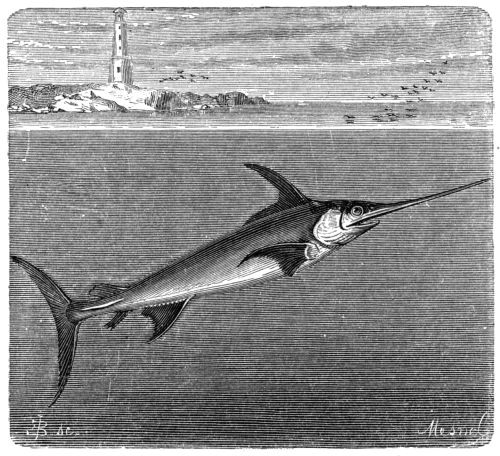
Fig. 392. The Sword-fish (Xiphias gladius).
The Sword-fish, Xiphias gladius (Fig. 392), so called from the
upper jaw being elongated into a formidable spear or sword, was
known to the ancients, and has borne the name which recalls its
salient characteristic from very early times. In short, it is recognized
at a glance from its organic structure, and from the resemblance
of its prolonged horizontal and trenchant muzzle to the blade of a
sword. With the ancients it was Ξιφίας, and Gladius; with the
moderns it is the Sword-fish, the Dart, the Spece spada, and l'Espadon
épée.
This fish attains a great size, being found in the Mediterranean
and Atlantic, in company with the tunny, from five to six feet in
length. Its body is lengthy, and covered with minute scales, the
sword forming three-tenths of its length. On the back it bears a
single long dorsal fin; the tail is keeled, the lower jaw is sharp, the
mouth toothless, the upper part of the fish bluish-black, merging into
silver beneath. It seems to have a natural desire to exercise towards
and against all the arm with which Nature has furnished it; it darts
with the utmost fury upon the most formidable moving bodies; it
attacks the whale; and there are numerous and well-authenticated
instances of ships being perforated by the weapon of this powerful
creature.
In 1725, some carpenters having occasion to examine the bottom of
a ship which had just returned from the tropical seas, found the lance
of a sword-fish buried deep in the timbers of the ship. They declared
that, to drive a pointed bolt of iron of the same size and form to the
same depth, would require eight or nine blows of a hammer weighing
thirty pounds. From the position of the weapon it was evident that
the fish had followed the ship while under full sail; it had penetrated
through the metal sheathing, and three inches and a half beyond, into
the solid frame.
The sword-fish has obstinate combats with the saw-fish, and even
the shark, and it is supposed that when he attacks the bottom of a
vessel he takes that sombre mass for the body of an enemy. But this
terrible jouster, this Paladin of the abyss, often becomes himself the
prey of a most contemptible enemy. A miserable little parasite, the
Pennatula filesa, penetrates its flesh, and almost drives it mad with pain.
The flesh of the young sword-fish is white, compact, and of excellent
taste; that of adults resembles the tunny. It is the object of
a fishery of some importance in the Straits of Messina. The fishermen
of Messina and Reggio join in this fishery with a great number of
boats, carrying brilliant flambeaux, while one of the crew is stationed
at the mast-head to announce the approach of the sword-fish. At a
given signal the boats rush on to attack them with the harpoons
(Fig. 393). During this fishery the sailors sing a peculiar melody,
but without words.
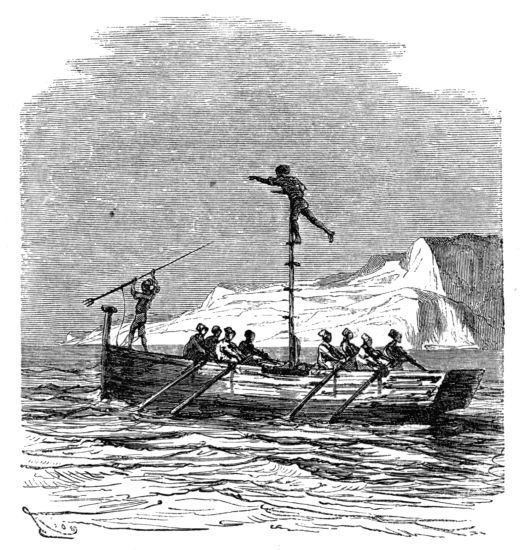
Fig. 393. Fishing for Sword-fish in the Straits of Messina.
The family of Pediculate Pectorals is so named from the fishes of
which it is composed bearing their pectoral fins on a species of arm
which forms a prolongation of the carp bone; it includes the Frog-fish,
remarkable for the excessive circumference of the head and
shoulders as compared with the rest of the body, the immense opening
of a jaw, armed with pointed teeth, and the cutaneous jagged stripes
of various lengths with which it bristles at many points. Its skin
is soft, smooth, and without scales or other asperities; the members
which support the pectorals, and other peculiarities, combine to
render it a hideous and forbidding object, well calculated in ignorant
and superstitious times to frighten the multitude. The remains
of this fish, prepared in such a manner as to be transparent,
and rendered luminous by a lamp enclosed in its interior, has
often helped to deceive and frighten the timid by its fantastic
appearance.
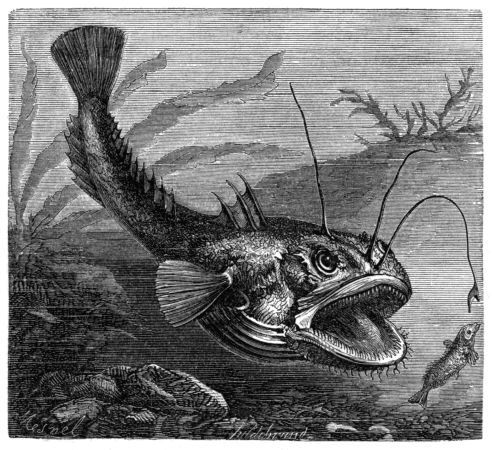
Fig. 394. The Frog-fish (Lophius piscatorius).
The Frog-fish, Lophius piscatorius—Linn. (Fig. 394), which
attains the length of five or six feet, lives in the sand, or sunk in the
mud, leaving the long and movable filaments with which the head is
furnished to float in the water; the shreds which terminate them act
as natural bait when they float about in different directions, from their
resemblance to worms and other living creatures. The fishes which
swim above them, and which they see very well by the assistance of
their two eyes placed on the summit of the head, are attracted by
these deceitful decoys. When the prey arrives near to the enormous
jaws, which are almost always wide open, it is engulfed and torn to
pieces by its strongly-hooked teeth.
This manner of lying in ambush, and fishing, as it were, with a hook
and line for fishes which its conformation does not permit it to pursue,
has acquired for it the name of the frog-fish, which is sometimes given
to it. It is found more or less in all parts of the Mediterranean and
in many parts of the Atlantic, being frequently taken both in the
Gulf of Gascony and in the Channel.
The family of Labridæ comprehends: I. The Wrasse (Labrus), a
genus of fishes decked in the most lively colours; for the yellow,
green, blue, and red, forming bands of spots, give the body the appearance
of being enriched with brilliant metallic reflections. II. The
Julis, of Risso, the Mediterranean species of which is remarkable
for its fine violet colour, relieved on each side by an orange band.
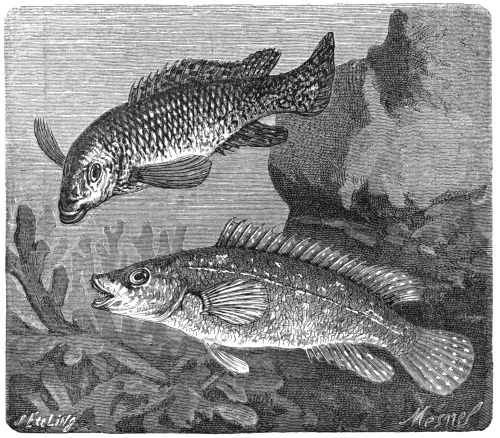
Fig. 395. Adult Green and Red varieties of Labrus communis.
Of the Labridæ we represent here, as a type of the family, the
adult Green and Red Labrus (Fig. 395), varieties of the commonest
species, called the sea-parrot, the body of each being oblong, clothed
with large scales: a dorsal fin, frequently with membranous appendages,
thick fleshy lips, and large conical teeth; cheeks and gill-covers
clothed with scales; gill-covers smooth at the edges; three spines in
the anal fin. In Julis the cheeks and gill-covers are without scales;
in other respects they resemble Labrus.
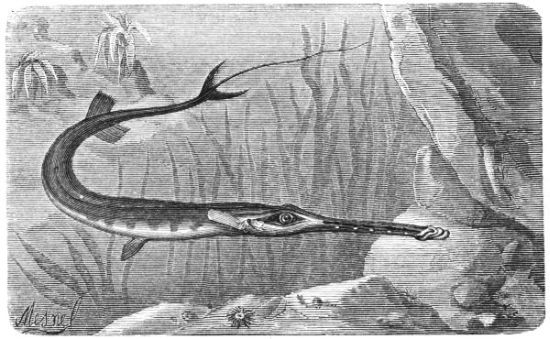
Fig. 396. The Pipe-fish (Fistularia tabacaria).
Among the acanthopterygeous fishes we shall only notice the
singular family of Fistulariadæ, or Pipe-fishes, so called from the
extreme elongation of the fore part of the head, forming a tube, at the
extremity of which is the mouth. Of this family, Fistularia tabacaria
(Fig. 396) may be considered the type. The tube of the muzzle is
long and flat, and from the caudal fin springs a terminal filament
nearly as long as the body. This species of pipe-fish is common at
the Antilles; it attains the length of about three feet, but its flesh is
leathery and insipid. It feeds upon crustaceans and small fishes,
which it drags from the interstices of the rocks and stones by means
of its long and taper pipe.
We close our abbreviated history of the Ocean and such of the inhabitants
with which it swarms as seems most likely, from their
habits and other peculiarities, to interest the readers, conscious of its
many imperfections. Where every creature which moves and breathes
in the watery world is so full of interest, it will not surprise the
reader to learn that one of the editor's chief difficulties has been that
of selection, his most painful task that of rejecting the vast mass of
interesting matter he had necessarily to pass in review.
We have shown in the first chapter of this work that nearly three-fourths
of the surface of the earth is bathed by the sea. Struck with
this vast extent of ocean, a witty French writer says, "One is almost
tempted to believe that our planet was specially created for fishes."
They are, indeed, a very important part of creation; they form, as it
were, a bond uniting the vertebrate to invertebrate animals. They
have a more complicated organization than any of the other oceanic
inhabitants (except the Cetaceæ), as they are also the most numerous,
the most varied in form, and by far the most brilliant in colour, and
the most active in their movements.
Pliny, the naturalist, describes ninety-four species of fishes. Linnæus
has characterised four hundred and seventy-eight. The naturalists
of the present day know upwards of thirteen thousand, a tenth
of which are fresh-water fishes.