A journal devoted more especially to the
natural history of Ohio. The official organ
of The Biological Club of the Ohio
State University. Published monthly
during the academic year, from November
to June (8 numbers). Price 50 cents per year, payable in advance.
To foreign countries, 75 cents. Single copies 10 cents.
John H. Schaffner, Editor. F. J. Tyler, Subscriptions. R. F. Griggs, Advertising Agent. Address THE O. S. U. NATURALIST, Ohio State University,
Entered at the Post Office at Columbus, Ohio, as second-class matter, November 20, 1900.
The O. S. U. Naturalist
PUBLISHED BY
THE BIOLOGICAL CLUB OF THE OHIO STATE UNIVERSITY
Vol. 1. DECEMBER, 1900.No. 2
FEEDING HABITS OF THE SCARLET FLAMINGO.
J. C. Hambleton.
One of the favorite winter haunts of Phoenicopterus ignipalliatus
is found on the sandy beaches that abound on the west coast of
South America, at about latitude 42° South.
On the north coast of the large island of Chiloe, there are several
places of this sort where these beautiful birds may be seen in flocks
of hundreds during the months of June, July and August, the winter
months in that region.
I remember the first time I walked over one of their favorite
resorts. It was on the Pudeto river, near the small town of Ancud.
The tides here are rather high owing to the formation of the bay,
and as a consequence it enters the river and floods great stretches of
sand that border the left bank. As the tide goes out the flamingos
may be seen here by hundreds. The first time I visited the place
the tide had been out some hours and there were no birds to be seen.
I was disappointed for the trip had been made for that special
purpose.
However my attention was soon attracted to long rows of small
hillocks of sand, or rather, to be more exact, circular ditches in the
sand that appeared to have been made while the water was still
present. These were about two or two and one-half feet in diameter
by five or six inches wide and three or four inches deep. This, of
course, gave the central portion the appearance of a small hill about
eighteen or twenty inches in diameter. Upon inquiry I could get no
information—no one had any idea how or by whom they had been
made.
A few days later the mystery was solved when a second visit
was made to the place at a more propitious moment.
Upon approaching to within a few hundred yards of where a
regiment of these scarlet beauties was lined up, the birds took flight
and it was then that I discovered who were the authors of my mysterious
little hills.
By subsequent observations I found that the birds took their
stand in the water when it was about a foot and a half deep, and at
more or less regular intervals about eight or ten feet apart. Here
they remained stationary and turned round and round with their
heads under water, catching the small crustaceans that seem to be
their principal diet. The form of their beak is such that when it is
placed on the ground the upper mandible is underneath. This being
large and strong, soon opens up the circular depression that first
called my attention. Before the tide is all out they usually leave
because the crustaceans have by this time hidden in the sand.
The flamingo frequents this coast only during the winter months
and consequently does not nest here, nor is it known to nest west of
the Andes mountains. Their nests and young, however, have been
observed in great numbers in the small lakes of brackish water that
abound on the plains of Patagonia east of the mountains. Undoubtedly
these are the same birds that spend their winters in Chile, the
lofty Andes proving no barrier to their flight. There are many roads
by which they can pass, the mountains being intercepted by frequent
rivers that empty into the Pacific, and have their origin beyond the
snow-covered Andes, in the plains of the Argentine Republic.
AGGRESSIVE CHARACTER AND ECONOMIC ASPECT OF THE WHITE HEATH ASTER.
The White Heath Aster (Aster ericoides) is an indigenous species
whose distribution is given in our manuals as “Canada, Florida, and
the Mississippi,” “Maine and Ontario to Florida, west to Wisconsin
and Kentucky,” and “South New England to Minnesota and southward,”
the variety pilosus “mainly in the Western States.” It is
one of the commonest Asters throughout Ohio, occurring doubtless in
every county in our State. The variety pilosus seems to be the
common form in our region, and may be seen growing in rich and
poor soil with almost equal thrift, and occurring in all habitats
except the woods and swamps.
Its capacity for adaptation to the advance of civilization is
remarkable, and this occasions the remark now very generally heard
among the farmers that it is a “new weed in the region,” “not
known here five years ago,” “just came all at once,” “the latest and
worst weed we have,” and other expressions of similar import. As
a matter of fact, the roadsides in many places are lined with it,
fields with a poor stand of clover, timothy, or blue grass are completely
covered with it, and all waste places, vacant lots, and neglected
spots are profusely decorated with the same.
Plate 3.
KELLERMAN ON ASTER.
The plant is a rather coarse weed; but in spite of this fact it is
somewhat attractive because of the masses of green foliage and the
white flowers that become prominent before the summer is gone, and
last throughout the early and middle autumn. The stems are tough
and wiry and this gives the local name “Steelweed,” a common
designation in Adams County and adjoining regions. It is said by
some, however, that this name is given it “because the flowers are
the color of bright steel.” Another name frequently applied in the
localities mentioned is “Bee-plant” for reasons suggested in the
name itself, and still another is “Stickweed,” for which I could
learn no explanation. Other common names which Britton enumerates
are Frost-weed, Michaelmas Daisy, Farewell Summer, White
Rosemary, Dog-fennel, Mare’s-tail, and Scrub-bush.
Though complaint against this plant is universal in some sections,
it is not, I think, well founded in all cases. It has some
merits now and then acknowledged by those who are close observers.
The allegations pro and con may be summarized as follows:
First, the statement is made that it is “driving out every other
grass” and “invading” the whole country. It is certainly more
abundant than it was before the country was cleared and cultivated;
yet after all but little of it is seen in good pastures and vigorous
meadows, and none at all in ground that is under thorough and constant
cultivation. It has not the aggressiveness possessed by some
of our weeds, but it does quickly take possession of neglected and
fallow ground. It does not spread extensively or rapidly by underground
stems as do some of the Compositae. It has simply short
rootstocks for this purpose. Its mode of multiplication by this
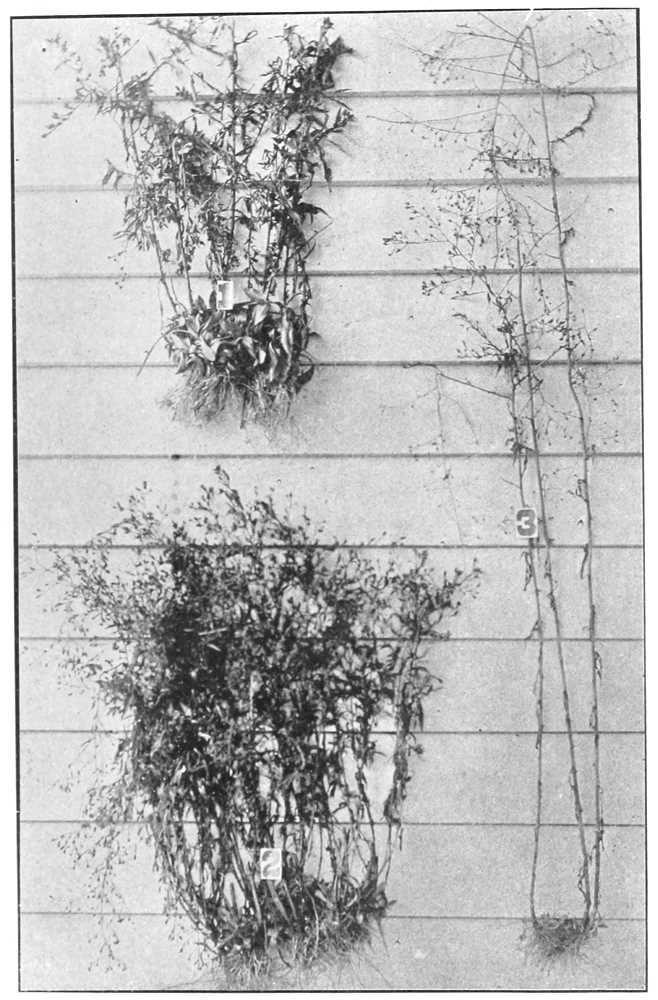
means is illustrated in the figures shown in Plate 3. These are from
photographs taken late in November, and indicate the preparation
the plant makes for the next season’s work. The specimens numbered
1 and 2 had been mowed to the ground during the summer.
But this instead of killing the plants stimulated their propensity to
vegetative multiplication. The result was therefore the opposite of
what the farmer intended. Figure 3 shows a plant undisturbed during
the growing period, and its energies active and latent were
almost entirely exhausted in producing flowers and seed. Let the
plants alone then rather than shear their tops, and the sooner will
they exhaust themselves.
It is true, as the figures plainly suggest, that this Aster is not a
difficult one to eradicate. While the roots are numerous, they are
not long; and even the shallowest plowing or ordinary cultivation
will effectually destroy the plant. As to multiplication by seed
germination, it needs simply to be remembered that good or even
fair cultivation of the soil will prevent this weed from growing, and
that many species of weeds will get in old meadows and pastures as
rapidly as the cultivated grasses are killed by excessive grazing or
the casualties of season and climate.
In the second place the weed is charged with the heinous crime
of “killing stock.” Thorough inquiry in different localities established
the fact that this plant, eaten to considerable extent late in
the season by cattle and horses it is true, does damage perhaps only
as the consumption of an excessive amount of almost any kind of
dry and comparatively innutritious vegetable matter might do. It
is said to be especially binding, and the constipation no doubt was a
factor in bringing about the fatal results that were cited. While
stock will eat the plant when at hand they take but little of it if
nutritious grasses can be found. A very intelligent and observant
farmer, however, was seen cutting and burning the plants which
covered his pastures to save his stock—his neighbor by carelessness
in this respect, he averred, having lost some valuable horses.
On the other hand this White Heath Aster is an important bee-plant.
Bees will “work on it the whole day,” and the plant is in
bloom from middle or late summer to late autumn. The honey made
is white, and has a strong tendency “to turn to sugar.” One
farmer who has two hundred and fifty stands of bees, now that this
Bee-plant is well established as a sure crop, will sow no more buckwheat
for his bees.
I have said this species is becoming excessively abundant in
some (hilly) portions of southern Ohio. It can well be regarded as “a
great boon” merely because it is a soil-binder of marked efficiency.
It prevents the destructive washing of the hillsides in the Fall, open
winter and early spring. Such a plant would not be needed to a
great extent, were methods and habits of cultivation perfect or in a
high state of development; but this phase of the economic aspect of
the case must at present be insisted on.
Finally it may be said that as a fertilizer this Steel-weed takes
a high rank. It is regarded by observant farmers as but slightly
inferior to a crop of clover. It does not decompose when turned
under as quickly as clover, but that it yields plant-food and answers
well the mechanical purposes of a coarse fertilizer, testimony
is unanimous and apparently conclusive.
Explanation of Plate 3.—Aster ericoides pilosus, reproduced from photographs taken
late in November. Figures 1 and 2 show plants with abundant, and Figure 3, with few young
shoots close to the ground. Plants shown in Figures 1 and 2 had the tops removed in summer.
Figure 3 shows the common appearance at the end of the growing season of undisturbed plants.
GEOPHILOUS PLANTS OF OHIO.
F. J. Tyler.
Geophilous—meaning earth loving—is a term which has recently
been applied to such plants as have some special adaption, which
enables them to withdraw beneath the surface of the ground when
adverse conditions, such as extreme heat and drouth, cold, etc.,
overtake them. Such adaptions may be classified as
Rhizomes,
Bulbs,
Corms,
Crowns.
Rhizomes are underground stems and like other stems may be
simple or branched. The branched rhizome is, however, the most
common form since it combines vegetative reproduction with the
other advantages of a rhizome habit. The Brake Fern (Pteris aquilina
L.) is an example of a much branched rhizome and Solomon’s
Seal (Polygonatum biflorum Ell.) of a nearly simple rhizome.
The stem of a rhizomatous plant may remain permanently
underground, as is the case with all ferns except the tree ferns of the
tropics. An annual stem is, however, usually sent to the surface
and this may be a lateral branch from the main subterranean stem
or it may be a continuation of the rhizome, in which case the next
year’s rhizome will be a lateral branch and thus the whole rhizome
will be made up of a number of distinct segments. Various members
of the Iris group are good examples of this. In at least one genus of
Ohio plants—Smilax—there are some members having both a perennial
woody stem and a well developed rhizome. It may be that
these plants are leaving the rhizome habit and are taking up the
woody stem habit.
Perhaps in most cases rhizome plants became such through the
gradual covering of trailing stems. It is a protection and a saving
of building material to a plant if its stems are trailing or creeping,
still more so if they are covered by leaf mould or soil. If rhizome
plants were once trailers there should be every gradation between
the two and so we find. The Trailing Wahoo is a good example of
this, since some of its stems are often covered by leaf mould or soil
while others are on the surface or some inches above. Many of the
Ericaceæ are in this transition stage between trailers and geophytes.
The Wintergreen (Gaultheria procumbens L.) has a long, creeping
stem which is often or usually covered by leaf mould. It roots
freely and sends up perennial woody branches to the surface. It is
hard to say in such cases whether the plant is geophilous or not.
Many geophilous plants of the rhizome type were doubtless once
crown formers and here again we find a transition stage which contains
every gradation between the two groups. The Compositæ are
mostly crown formers, but some are true rhizome plants and some
are transitional.
The advantages of a rhizome habit are very apparent. The first
and most important advantage is the protection from frost which
this habit affords. By taking up this habit many plants have been
able to withstand a climate, which would otherwise prove fatal.
The Alpine Willow is an example. Rhizomes are often storehouses
for food and become swollen and distorted in consequence. Vegetative
propagation is usually combined with the geophilous habit
and with great advantage to the plant. In most cases a rhizome
dies off at the back as fast as it grows in front so that any part of it
lives a definite number of years. The individual segments of the
Solomon’s Seal, for instance, live from three to five years. In this
way a branch soon becomes a separate plant. In some cases, however,
the rhizome may live for many years and thus hundreds of
seemingly independent plants may be connected beneath the surface
of the ground. The Brake Fern (Pteris aquilina L.) is of this class
and an entire hillside may be covered with a much branched specimen
of this plant.
A plant which has no means of migration when it has exhausted
the nearby food supply is manifestly at a disadvantage when compared
with a progressive rhizome plant which moves every year
into a new and fresh location. To be sure, the distance it travels
may not be far but it is enough to remove the plant from an exhausted
position and from its wornout and useless tissue. Thus this
group of plants may be said to have found the secret of potential
immortality, for, unless some catastrophe overtakes them, they may
live indefinitely and remain young. It is interesting in this connection,
to note how far some of these plants travel in a century.
This may be calculated in a general way by measuring the annual
growth in length of the rhizome. Solomon’s Seal travels from
twelve to twenty feet in this length of time, Uvularia perfoliata L.
from eight to ten feet, Onoclea sensibilis L. from three hundred to
five hundred feet, and others still farther.
The Iris group are exceptions, in that they travel in a circle.
The reason seems to be that the lateral branches which continue
the rhizome from year to year mostly arise on the same side
of the terminal bud, so that each branch goes off at a slight angle to
the former branch. The degree of angle determines the size of the
resulting circle. One class of rhizome plants is very distinct and
requires especial mention. This class may be termed upright or
retrogressive rhizome plants. The upright rhizome may originate
from a progressive rhizome, or from a crown former or in some other
way. Trillium nivale Riddell is in a transitional stage between the
progressive and retrogressive classes, since the large rhizomes are
upright and the young lateral branches are progressive until they
have traveled some distance away from the parent rhizome, when
they too, become upright. The lower Ferns (Ophioglossaceæ) belong
to this class. The disadvantage of this habit is that the rhizome will
soon grow out of the ground and be in a very exposed condition.
To counteract this tendency the roots of these plants are usually
strongly contractile and pull the rhizome down into the ground as
fast as it grows out. Skunk Cabbage (Spathyema foetida (L.) Raf.)
has an upright rhizome and root contraction is very marked. The
very apparent disadvantages of the retrogressive or upright rhizome
habit have made this class very few in number compared with the
progressive rhizome class. In Ohio there are about 475 species of
rhizome plants and less than twenty-five of these belong to the retrogressive
class. This class is closely related to the corm plants,
indeed, all that is needed to make the typical corm out of a retrogressive
rhizome plant, such as Trillium nivale, is to shorten and
make more definite the annual growth of the rhizome. The bulb is
usually a very short, upright rhizome with many thickened scales.
The bulb of Lilium martagon is of this kind but that of Lilium canadense
is more closely related to the progressive rhizomes. The
parent bulb sends out one or more thick rhizomes which grow outward
if the bulb is at the normal depth, downward if the bulb is too
near the surface of the ground and the new bulbs are formed by the
shortening of the outer end and the growth and thickening of the
scales of the rhizome.
Both bulbs and corms may be regarded as rhizomes modified to
suit peculiar conditions, such as a long, dry, heated period alternating
with a short, rainy period. A plant to survive under such
conditions must be able to start up very quickly as soon as the rains
come, and flower and mature its seeds before the drouth again overtakes
it. A large amount of food material must be stored up by the
plant in order to do this, and the food material must be kept from
drying or burning up during the heated period. Bulbs and corms,
protected as they usually are by dry and coriaceous coverings, answer
these requirements and are usually abundant in localities where
these conditions obtain. Bulb and corm plants are also well fitted to
live in dense woods where the light is soon shut off in the Spring by
the expanding leaves of the trees. They are able to spring up very
early, flower and ripen seeds before the light is shut off. The food
supply which enables them to do this is often protected by acrid or
poisonous principals developed in the bulb or corm. Pepper-root
(Dentaria laciniata Muhl.) and Jack-in-the-Pulpit (Arisaema triphyllum
[L.] Torr.) are examples.
Crown plants, while not true geophytes, are often closely related
to rhizome plants and may be regarded as transitional. They are
formed by the freezing back of the upright stem to the surface of
the ground, and the survival of the short stem beneath the surface
until the next Spring when it sends out branches from adventitious
buds. In this way several branches are sent up where there was one
before, and, as this crowds and injures the plant, these branches
usually move out some distance from the base of the parent plant
before coming to the surface. The connection with the main stem
is often severed, and thus many new plants are formed. All this
rarely takes place in the Spring but has been shifted back to late
Summer or Fall by the parent plant. Often a food supply is stored
up for the young plants by the parent. Helianthus tuberosus L. is a
good example.
Vegetative propagation is brought to its highest development in
this class and they become our worst weeds.
NOTES ECONOMIC AND TAXONOMIC ON THE SAW BRIER, SMILAX GLAUCA.
In a recent trip through some of the southern counties of the
State my attention was arrested by the enormous quantity of Smilax
glauca—Glaucous-leaf Brier as given by Britton in the Illustrated
Flora—but generally and appropriately called in these regions where
so abundant, the Saw Brier. In the sandy soil of Hocking County,
thence southward to the Ohio River this plant may be seen growing
in field and pasture, by roadside and on hillside, and everywhere except
in wet soils and dense woods. It climbs over fences and high
bushes, displaying its bright foliage of lively green, more effective
by contrast with the abundant white bloom on the under side. In
the Autumn it presents showy wreaths of black but glaucous-coated
berries and the most gorgeous coloration of foliage. The leaves
remain for the most part late in Fall and Winter, and for brilliant
and delicate shades of rose and red are not surpassed by any plant
of our entire flora. The forbidding aspect of the long, wiry stems,
with their bristly covering of long, saw-like or needle-shaped
prickles, serves also to distinguish this plant even among the
attractive associates of its kingdom.
A Bad Weed.—As a weed this species here stands at the head
of the list. Its horrid prickles make it one of the most disagreeable
plants with which to come in contact. It revels in the pastures and
clambers over the fences; it flourishes in the meadows and fields,
and no ordinary practice of crop-cultivation interferes with its
luxuriance. One can readily see that it is not carelessness on the
part of the farmer that suffers half or still larger portions of his
fields to be covered with this pestiferous vine. No other weed is
seen in the area and therefore he has been diligent and careful in
his tillage. The meadows even if twice or thrice mowed in a season
will yet contain year to year the same quantity of Saw Brier. The
stems spring up quickly, and grow “a foot in a night” the people
say; surely the Saw Brier is the freshest plant in the field. In a
case specially noticed a garden spot had been put in cultivation in
1873, and has been continually and thoroughly cultivated every year
since, yet the Saw Brier is there to-day.
The Underground Parts.—This tenacity of life and luxuriance
of growth can be understood when the underground parts are
examined. There are numerous irregular and often large tubers or
enlargements which serve as the capacious storehouse of nourishment.
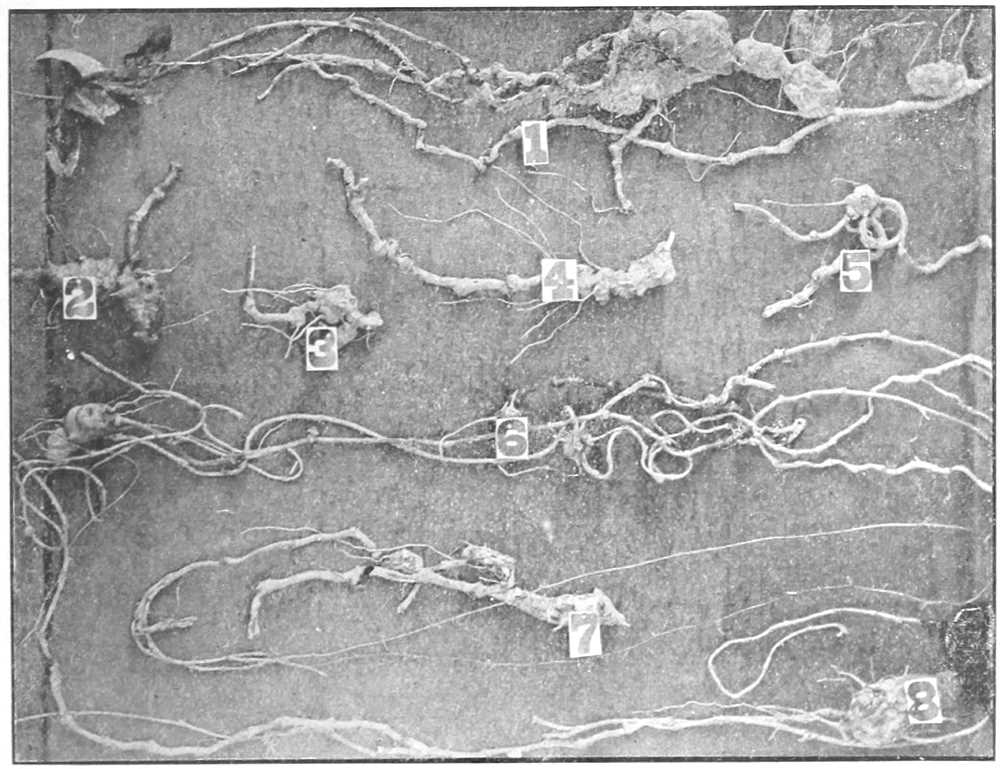
They are often of fantastic shape. Various forms are shown
in figure 1, plate 4. These occur at irregular intervals on the long
and tortuous subterranean stems. It is said that they may be found
several feet below the surface, though the eight specimens shown on
the plate were found at a depth of six to twelve inches. If they all
could be removed from the soil the weed would of course be practically
annihilated. But when found at a depth of several feet—as
seen sometimes in making excavations for foundations, walls, etc.—it
is evident that the farmer will have to make extraordinary and
long-continued efforts to destroy this pest. The less courageous may
well be appalled in contemplating the herculean task. Fortunately
swine are fond of the nutritious tubers, and voraciously devour them
when they are given the freedom of the field and allowed to indulge
in their natural propensities. Heavy coating of manure and winter
plowing are also indicated.
Variations in the Leaves.—This form is easily recognized
among the several species of Smilax indigenous to Ohio, though the
leaves vary in size and shape to a remarkable degree. A large number
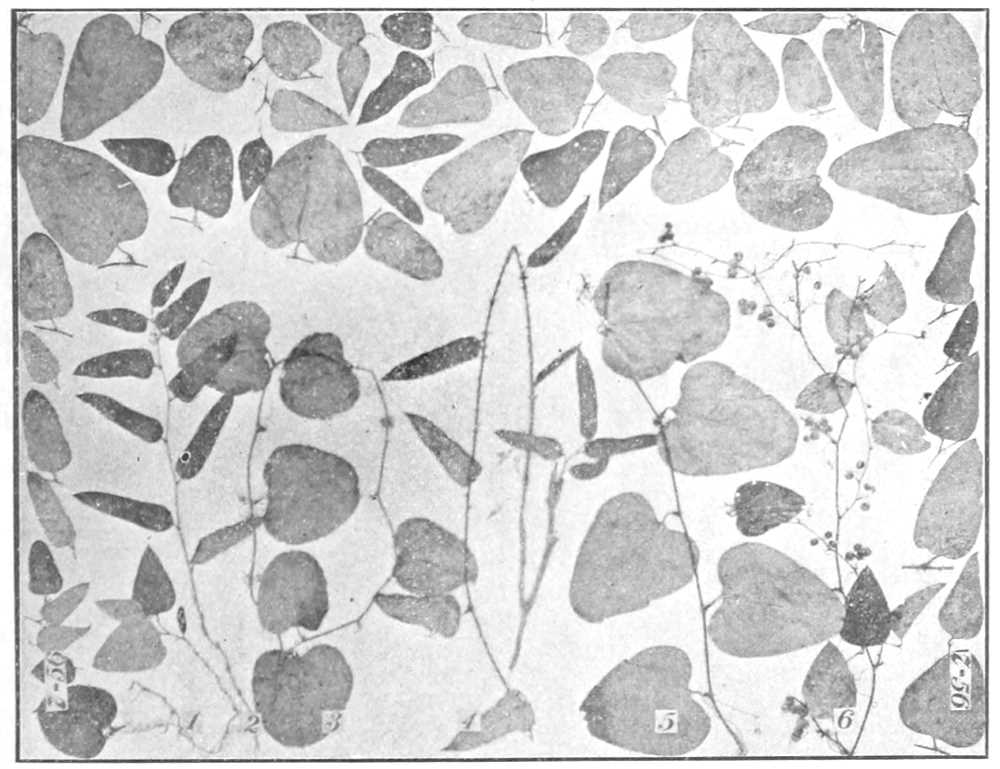
of the common forms are shown in figure 2, plate 4. They are
sometimes very broadly cordate-oval, wider than long; often ovate-cordate,
oval or ovate, lance-oval, oblong to oblong-ovate, broadly
to narrowly lanceolate and even linear; they are mostly cuspidate
at the apex, in some cases tapering to acute or sub-acuminate. The
base is mostly cordate and subcordate, but occasionally tapering.
It is seldom that forms approaching halberd-shape occur in our
region. An inspection of plate 4 will illustrate these several forms.
The twig with fruit marked 6, bears a very common form of the leaf
as does also the one marked 1. The broad-leaf form is not uncommon,
but the very broad-leaf as seen in specimens marked 3 and 5 is
of much less frequent occurrence. The very narrow leaves are as a
rule borne on short stems—such as have developed in fields and
meadows where the earlier stems have been destroyed or disturbed.
But often on such stems (marked 1) the leaves are broad and have
the natural shape.
Size of Leaves.—The size of the leaves is strikingly variable.
The specimens shown on plate 4 being reproduced from photographs
exhibit correctly this variability. Careful measurements also were
made of leaves taken at random from hundreds selected to illustrate
this point. These since they give both the length and width of the
leaf demonstrate the shape as well as the size. The measurements
are in decimeters and one hundred of them are as follows:
12×11.5
12.5×9.5
8.5×6
9×2
9.5×3.8
7.8×2.2
11×10.5
12×9.5
7.5×5.5
9×3.5
8×4
7.3×2.8
12×11
12×11
8.6×5.4
8×1.5
7×2.8
6×1.7
13×10.6
11×11.8
8×6
6×0.7
8×3.8
5.3×1.6
11×12
12.2×9.8
9×6
8×1.5
4.5×1
8×3.4
12.5×11.2
11.5×10
8.5×6
7×1.8
7×2.2
7.5×2.5
12.2×10
13.5×10.5
8.5×5.8
6.8×2
7×3.2
6×2.5
12×11
11.5×9.6
9.8×6.4
7.5×2.2
6.2×2.5
6×2.8
11×11
8×5.5
9×7.3
5.5×2.5
8.2×2.8
6×2.6
11.5×11.1
9×6
8.3×5.8
7.6×2.2
6.5×2.2
7×2.8
11×10.8
9.2×6.5
9×6.5
7.8×2
5.5×2.9
8.4×3
12×11.5
8×5.5
9.9×7.6
6.5×2
7.3×2.7
9.8×3.5
12×10.6
9×7
8.2×4.6
7×0.8
8×1.8
10×3.5
13×11
8.5×7.5
8.5×6
8.4×0.7
9.5×1.9
9.6×3.8
12×11
7.5×4.5
8.8×6
8×1.4
9.5×2.2
7.5×1.7
11.5×10.8
8.5×6.2
9.5×7
8.5×2
8.4×2.2
9.4×2.5
12×11.3
9×7
11.1×2.2
9×3.5
8×2.5
Description of the Leaf.—Neither the description as given
originally (1787) by Walter nor those contained in our Manuals give
any intimation of such variability as actually occurs. Some of them
are as follows: Walter says “foliis oblongo-cordatis”; Wood,
“ovate, finally nearly orbicular, abruptly contracted at one end”;
Gray, “ovate, rarely subcordate, abruptly mucronate”; Britton,
“ovate, acute or cuspidate at the apex, sometimes cordate at the
base.” I would suggest the following as applicable to the Ohio
specimens: Leaves mostly ovate, often broadly oval (occasionally broader
than long), sometimes oblong-ovate, varying to lanceolate or even linear;
the base mostly subcordate but often cordate or even cuneate; the apex
cuspidate to acute or sub-acuminate.
Smilax spinulosa.—Britton and Brown in the illustrated
Flora, 1:440, appends to the description of Smilax glauca the following
paragraph: “Smilax spinulosa J. E. Smith, is a form with
numerous small prickles on the lower part of the stem, and more
elongated, sometimes halberd-shaped leaves. It occurs in southern
New York, but is not well understood.” However Smilax spinulosa
is given by these authors as a synonym of Smilax glauca, which
according to my judgment is correct.
Plate 4.
Fig. 1.
Fig. 2.
KELLERMAN ON SMILAX.
Smilax Spinulosa an Extreme Form of S. Glauca.—The
material secured recently fortunately clears up the case unless I
misapprehend the purport of the above quotation. The “more
elongated leaves” spoken of may find their counterpart in the figures
on plate 4, and yet there can be no question that they belong to
Smilax glauca. The twigs bearing them were in many cases found
attached to the same underground stems that bore the broad leaves.
Even at a glance the identity of the specimens in the field could not
be mistaken; all their characters showed that they were really
Smilax glauca. In herbarium specimens that have been preserved
every gradation may be seen between the extremes shown in the
plate. These specimens also show in some cases underground stems
that bear both leaves and twigs with leaves of the broader form. As
a rule in the cornfields where the soil is not rich and crop-cultivation
has been diligent the narrower leaves (on shorter stems) are common.
In richer cornfields, and in meadows, especially if quite fertile,
the short stems are clothed with the broader leaves. Abundant
evidence was at hand to demonstrate that this form with “more
elongated leaves” (S. spinulosa) is directly connected with the form
called S. glauca by the taxonomists. Its peculiarities are doubtless
referable to the special environment; in no case could these apparently
aberrant specimens be called a specific or even varietal form.
Explanation of Plate 4.—Smilax glauca. Figure 1: Eight specimens of tubers reproduced
from photographs and much reduced. Fig. 2. Twigs (1-6) bearing leaves of varying
shapes also separate leaves (7-56) illustrating variation in shape and size.
MEETINGS OF THE BIOLOGICAL CLUB.
October 1st, 1900, Botanical Hall.
This evening was spent in the giving of reports on work done
during the summer vacation. Osborn, Mills, Griggs, Tyler, Miss
Dufour, Schaffner and Hine gave reports. Seven names were proposed
for membership.
The motion by Professor Osborn to hold the meetings of the
current year in Biological Hall was carried.
Hine, Morse and Miss Dufour were appointed a nominating
committee to select officers for the year.
November 5th, 1900.
Members assembled in Biological Hall. President Schaffner
called the meeting to order. Officers were elected as follows:
Osborn president, Tyler vice-president, Hine secretary.
Long, Wyman, Ball, Hambleton and Dunlap were elected to
membership.
The retiring president, Professor Schaffner, gave the address
of the evening. He had for his subject “The Life History and
Cytology of Erythronium.”
Landacre and others took part in a discussion of the paper.
J. H. S.
NEWS AND NOTES.
The tenth annual meeting of the Ohio State Academy of Science
will be held at the Ohio State University, Columbus, on December
26 and 27, 1900.
Petioles of the Cottonwood.—The leaves of the Cottonwood
as well as some other species of Populus have an interesting
light relation. If one looks at a vigorous shoot, the leaves are seen
to be arranged in the profile position around the stem. This is
accomplished by means of a very simple device. The petiole is
much flattened next to the blade and is quite flexible. The flattening
is transverse to the plane of the blade and on this account
the leaf will assume the vertical position, no difference in what
way it is attached or twisted. This adaptation is also responsible
for the musical rustle one hears when resting in the shade of
the Cottonwood. The leaves are very smooth and nearly alike on
both sides. Because of these and other adaptations, the Cottonwood
is one of the most successful of our semi-xerophytic trees and one of
the last stragglers to be found in the western part of the great
plains.
J. H. S.
Ohio State University
Six distinct and independent Colleges, each
Agriculture, Arts, Law,
with a Dean and Faculty of its own.
THIRTY SEVEN DEPARTMENTS.
Engineering, Pharmacy,
THIRTY DISTINCT COURSES.
Veterinary Medicine.
Superior facilities for education in Applied Science. Short or
special courses for mature students not candidates for degrees.
One hundred and twenty one instructors. Over thirteen hundred students.
FINEST GYMNASIUM IN THE WEST.
For further information address the President,
Dr. W. O. Thompson, State University, Columbus.
Ohio Forest Trees Identified by Leaves and Fruit.
By W. A. Kellerman, Ph. D., Ohio State University.
A neat pamphlet for every one who wishes to learn our native forest trees. Keys simple.
Description plain. Can learn the names of the trees easily.
Price reduced from 25 cents to 10 cents.
Also, The Fourth State Catalogue of Ohio Plants.
Bound copies at cost of binding, namely 20 cents.
Gives list of scientific and common names; distribution by counties.
Teachers and others will also be interested in Prof. Kellerman’s Phyto-theca or Herbarium
Portfolio, Practical Studies in Elementary Botany, Elementary Botany with Spring Flora, all
published by Eldredge & Bro., Philadelphia, to whom apply.
For information or copies of Forest Trees and Catalogue or names of plant specimens of
your region address
W. A. Kellerman, Columbus, Ohio
American Entomological Co.
1040 DE KALB AVENUE, BROOKLYN, N. Y.
Lepidoptera Price List No. 2.—Price 5 cents
Refunded to Buyers
Issued November 15th 1900.
Dealers of all kinds of
Entomological Supplies
Manufacturers of the Original and Celebrated
SCHMITT INSECT BOXES.
Builders of INSECT CABINETS, ETC.
Transcriber’s Notes
The Twentieth Century Text Books of Biology.
PLANT RELATIONS, 12mo, cloth
$1.10
PLANT STRUCTURES, 12mo, cloth
1.20
PLANT STUDIES, 12mo, cloth
1.20
PLANTS, 12mo, cloth
1.80
ANALYTICAL KEY TO PLANTS, 12mo, flexible cloth
.75
All by JOHN MERLE COULTER, A. M., Ph. D., Head of Dept. of Botany, University of Chicago.
They are already the preferred texts, and the
reasons will be apparent on examination.
ANIMAL LIFE: A First Book of Zoology.
By DAVID S. JORDAN, M. S., M. D., Ph. D., LL. D., President of the Leland Stanford Junior
University, and VERNON L. KELLOGG, M. S., Professor in Leland Stanford Junior
University. 12mo. Cloth, $1.20. Now ready.
Not a book for learning the classification, anatomy, and nomenclature of animals, but to
show how animals reached their present development, the effects of environment, their place
in Nature, their relations to one another and to the human race. Designed for one-half
year’s work in high schools. Send for sample pages.
ANIMAL FORMS: A Second Book of Zoology.
By DAVID S. JORDAN, M. S., M. D., Ph. D., LL. D., and HAROLD HEATH, Ph. D.,
Professor in Leland Stanford Junior University. Ready in February, 1901.
D. APPLETON AND COMPANY, Publishers, New York, Chicago, London.
Recent Scientific Works
In Astronomy, Dr. Simon Newcomb’s new book, published
October, 1900; in Physics, the Johns Hopkins
text of Professors Rowland and Ames; also in Physics
for second and third year high school work, the text
of Dr. Hoadley, of Swarthmore; in Physiology, the text
by Drs. Macy and Norris, based on the Nervous System;
also the High School Physiology indorsed by the W. C.
T. U., written by Dr. Hewes, of Harvard University; in
Geology, the Revised “Compend” of Dr. Le Conte, and
the two standard works of Dana,—The Manual for University
Work, and the New Text Book, revision and
rewriting of Dr. Rice, for fourth year high school work;
in Chemistry, the approved Storer and Lindsay, recommended
for secondary schools by the leading colleges;
in Zoology, the Laboratory Manual of Dr. Needham, of
Cornell; and the Series “Scientific Memoirs” edited by
Dr. Ames, of Johns Hopkins. Nine volumes ready.
The publishers cordially invite correspondence.
AMERICAN BOOK COMPANY, Cincinnati
pg 15 Changed: Assciate Editors to: Associate Editors
pg 18 Changed: catching the small crustacians to: catching the small crustaceans
pg 28 Changed: J. S. H. to: J. H. S.
pg 29 Changed: Entomological Suppies to: Entomological Supplies