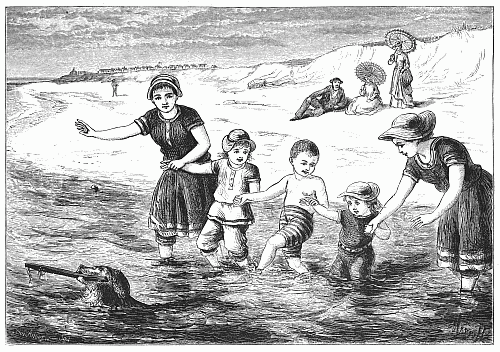
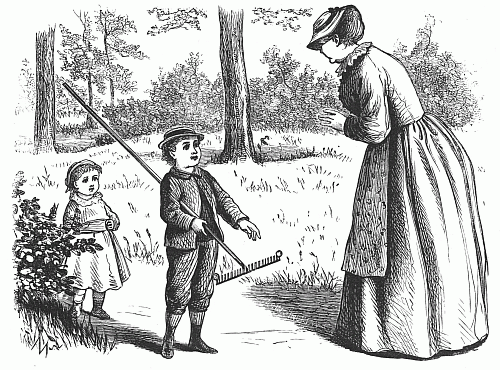
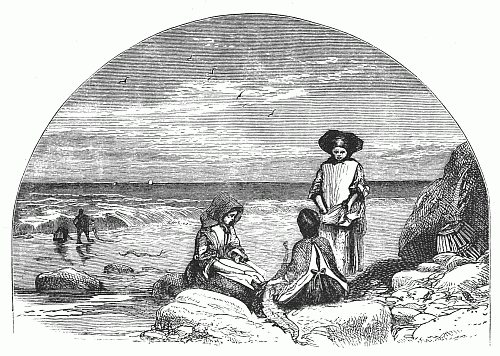
OW for it, girls! Let me introduce you to the
Atlantic Ocean! Mr. Ocean, these are my
three cousins from Kentucky: Miss Jenny,
Miss Eva, and Miss Kate Logan. They never
saw you till today. This lady on my left is
my sister, Miss Dora Drake, the best swimmer at Brant Rock
Beach; but her you know already, also my dog Andy."
"Oh! I don't want to go any further. I'm afraid of
the Atlantic Ocean," cried little Kate Logan.
"Nonsense!" said Master Tom Drake. "Look at Andy
with the stick in his mouth. Why, if the Atlantic Ocean
were to try to drown us, Andy would save us every one.
Shall I tell you what he did last summer?"
"We can't stop for stories now, Tom," said sister Dora.
"We must attend to our bathing. Here comes a wave that
will give us a good ducking."
"Oh! oh, dear! It has taken my breath all away!"
cried little Kate, as the wave lifted her off her feet and
curled and gurgled round her neck.
"It is only the Atlantic Ocean making a bow to you, my
dear; clasping you lovingly round the neck, and whispering
soft nonsense," said Tom, dropping the hands of Eva
and Kate, and swimming off into deep water with Andy.
Jenny and Eva did not know how to swim: so they
jumped up and down in the water, while Dora took Kate
on her back, and swam out after Tom. She soon overtook
him and pushed his head under water; but Tom came up
light as a cork, and splashed the water all over Dora.
"That will do, Tom," said she; "now, Andy, come here,
and take this little girl on your back and carry her up on
the dry sand."
Then Dora placed Kate on the good dog's back, and the
little girl threw her arms round his neck, and he swam with
her through the deep water, and carried her up high on the
dry, warm sand, where a lady and gentleman were seated,
and another lady stood with a sun-shade over her head.
But when Kate saw Tom and the girls all frolicking in
the water, she cried out, "Oh, give me more of the Atlantic
Ocean. I like him."
She ran down to the water's edge, and into the water all
alone; but Andy stood by to help her in case of need, and
when she fell down flat, and the ocean covered her head, he
took her up by her bathing-dress, and bore her once more
up on the dry sand.
All laughed, and little Kate laughed louder than any of
them. "The Atlantic Ocean didn't get me that time," she
said.
I cannot tell you of all their frolics; but you may be sure
that the little party from Kentucky grew quite familiar with
the Atlantic Ocean after this introduction. Every day they
would leave their little cottage on the height, and walk
along the white sand in their bathing-dresses till they found
a good place for bathing. Tom and Andy always went with
them to protect them from harm.
When Jenny, Eva, and Kate get back to Kentucky, next
September, what stories they will have to tell of the pleasant
times they had at Brant Rock Beach! It lies not far from
the town of Marshfield in Massachusetts. Perhaps you can
find the name on your map.
Ida Fay.

What sort of insects are a-phi´des?
In plain English they are plant-lice.
When about to pluck a rose-bud, have
you not started sometimes to find it covered with
little green insects? These are aphides.
They suck the sap from the bud on the leaf;
and every person who raises a rose-bush seeks to
get rid of them. The little insect called the lady-bird
destroys them in great numbers: so you
must encourage lady-birds, if you want your roses
to flourish.
Most of us have heard of honey-dew, and know,
probably, that it is a sweet, clammy substance,
found on the leaves of various trees and plants,
especially on the oak, the vine, the hop, and the
honeysuckle. This honey-dew is extracted with
the sap, secreted, and then thrown out in a pure state by
the aphides.
Besides the sweets which they scatter around them like
sugar-plums, they always keep a good supply within the
green jars of their bodies. By this lavish use of confectionery,
they gain a few interested friends and some enemies
like the lady-birds, that eat them up.
|
Wherever the aphides abound, whether in hop-ground,
bean-field, or rose-garden, there are lady-birds gathered
together, and they are welcomed by the cultivator, if not
by the aphis. (Aphis is the singular noun, and aphides its
plural form.) But enough of aphis enemies, and now for
the friends, which, as well as foes, they owe to the sweet
milk—the honey-dew—which they give out. So these
friends, you see, are fair-weather friends, interested friends;
and among them are several varieties of the ant tribe.
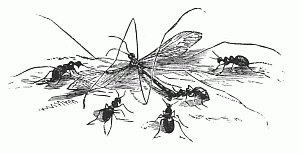
The ants do not hurt the aphides, but follow them for
what they can get out of them. They are continually seen
in company; and the ants sometimes drive off the lady-birds
and other foes.
The aphis, when attacked by its mortal foe the lady-bird,
submits with a good grace. Never did Turk bend
his neck to the bow-string, or rush upon the cimeter
with greater courage, than the aphis submits itself to the
murderous jaws of its devouring foes. It seems quite at
ease, and enjoys life to the last bite or sup, while its companions
are being killed, and their carcasses heaped up
around it. It evidently thinks it is right to die quietly, like
a great-minded little insect.
Uncle Charles.