Among the Azores, is situated the beautiful Island of
Fayal, with its orange-groves and profusion of flowers.
But, notwithstanding the fruit and flowers, there is one
thing which Americans who live there miss sadly, and that
is fresh, cool water. There are no lakes or ponds, such
as we have here; and so the people have to use rain-water,
which they save in large tanks or cisterns.
There are a few wells on the island, which, as the water
rises and falls in them twice in every twenty-four hours,
are called "tide-wells." But there was a time, many years
ago, when the people had neither cisterns nor wells, and
were obliged to get water from hollows in the rocks. And
this is the story of the first well.
The year 1699 was a year when scarcely any rain fell.
The grain did not grow, the cows and sheep died from thirst,
and many of the poor people also. Now there was a very
rich man on the island, who had come here to live many
years before, from another part of the world.
Though he was so rich, and might have done much good
with his money, he was so stingy and so hard, that the
people did not love him at all. But his bags of silver and
gold did not buy him water; and at last the thought came
to him, "Why! I will dig a well, as people used to do in
my country. I will dig it on my own land, and no one
shall have a drop of the water but myself."
So he hired men to come and dig the well; but he paid
them only a little money, and was very unkind to them.
They dug and they dug; but no water came. At last they
said they would work no longer unless their master would
promise them some of the water, and he promised them the
use of the well for half of every day.
Now they dug with more patience; and one morning, as
early as six o'clock, they suddenly found water. They
claimed the privilege of using the well for the first six
hours; and the master dared not refuse. As they were
drawing the water, they noticed that it began to grow
lower and lower in the well; and at twelve o'clock, the
master's hour, none was left.
He was very, very angry, and said he would never give
the men any work again. However, at six o'clock that
night, they again demanded the use of the well. He
mockingly asked them if they expected the water would
come for them, and not for him. Nevertheless they went
to the well; and, to the master's awe and wonder, it was
full of water.
At midnight, the master again tried to get water from
the well, and, as before, found it empty. He now felt
afraid, believing that some divine power controlled the
action of the water. He went to the church and vowed,
before God, that if the water should come again next
morning, he would dedicate it to the poor forever.
In the morning, when the men visited the well, there
was the fresh water awaiting them. The master kept his
vow, and thus the well became "The Poor Man's Well."
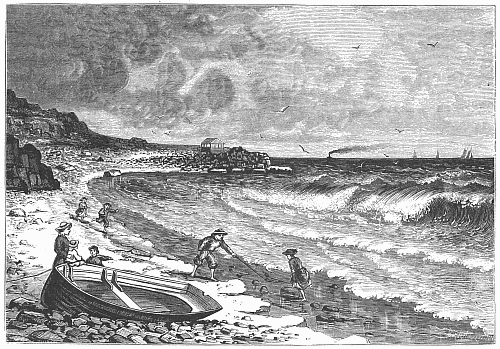
To this day the water rises and falls in it twice in every
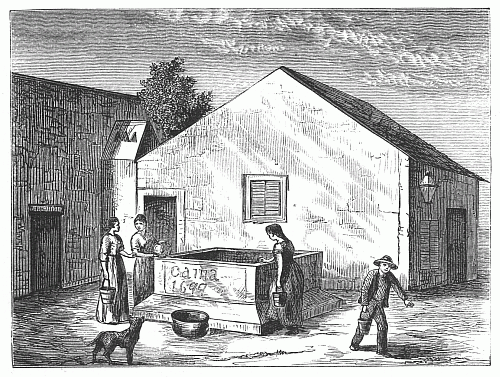
twenty-four hours. I give you here a picture of the well,
and should you ever go to Fayal you may see the original.
K. H. S.
Can you guess what she was? She was a little black
kitten; and I must tell you all about her, and why we gave
her such a funny name. Teddikins had a great mouse-colored
cat called Maltie, and she had three little kitties,—Spitfire,
Miss Tittens, and Cuddle. Spitfire was all black,
just as black as a lump of coal, while Miss Tittens was gray,
and Cuddle was gray and white.
The first time Teddikins and I looked into the box where
Maltie and her kitties were, they were very, very little, and
their eyes were not open. The black kitty was lying on top
of the others; and Teddikins put in his little fat hand and
picked her up. What do you suppose she did? She said,
"Sptss!" and she kept on saying, "Sptss" until Teddikins
put her down again; and so we called her Spitfire.
Just as soon as she could see out of her funny little gray
eyes, she began to try to get out of the box. She wanted
to see what there was outside, where Maltie went. She
would climb up a little way, and then tumble back on Miss
Tittens and Cuddle, which would make them say, "Mew,"
and make Teddikins laugh; but Spitfire always said, "Sptss!"
and would try again.
At last, one day we heard a thump; and we looked
around, and there was Spitfire on the floor. She had
climbed to the top of the box, and tumbled over the edge,
and there she stood, with her tail straight in the air, and
her legs wide apart, looking at us, and saying, "Sptss!"
Maltie was very proud of her kitties, and used to take
Cuddle and Miss Tittens in her mouth, and carry them into
the dining-room when we were eating our breakfast, to
show them to us. But Spitfire would not let her mamma
carry her. She would walk in all alone, tumbling over on
her little nose very often (for her legs were not yet strong),
but carrying her little black tail just as straight as little
boys carry sticks when they call them guns.
One morning, Teddikins put a saucer of milk on the floor
and what do you suppose that little Spitfire did? Why,
she looked at it very hard, and then she said, "Sptss," and
walked right into the milk, and out the other side of the
saucer, with Tittens and Cuddle after her. The floor was
covered with the funny white prints of their little paws.
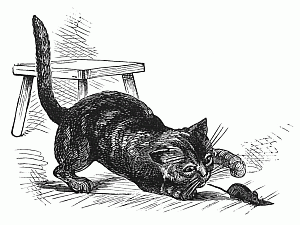
One day a mouse ran across the kitchen; and Cuddle and
Tittens were very much frightened; but Spitfire humped
up her back, and made her tail very big, and said "Sptss!"
very hard, and then cantered off sideways staring at the
mouse, and saying, "Sptss!" all the time.
You know how kitties like to go to sleep, all cuddled up
together. But Spitfire would not lie down with the others:
she always tried to get on top of them.
When the little kitties were quite strong, they used to
play a funny sort of game. There was a round foot-stool,
covered with carpet, and Spitfire used to sit up on it, and
then Cuddle and Miss Tittens would try to climb up the
sides. Then Spitfire would say, "Sptss!" and pat them on
the heads with her little paws until they rolled down again.
Sometimes, when she was busy driving one off, another
would get up behind her, and drive her off too; but she
always worked hard until she was up again.
Do you not think she was a funny kitty? She always
went first, and took the lead, and used to box the ears of
Cuddle and Tittens when they did not mind her. Now she
is a big black cat, with a red collar around her neck, and
she catches rats and mice, and is very good and useful.
She only says, "Sptss!" when strange cats come into her
yard; but we still call her Spitfire.
E. F.