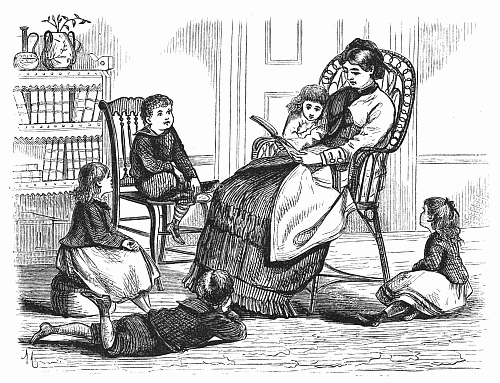
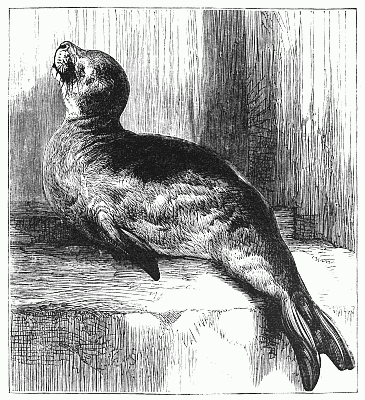
"The seal is an amphibious quadruped."
"Oh, come now, Aunt Emily, do not puzzle us with your
hard names," cries Johnny.
"But, Johnny, a lad seven years old ought to know that
amphibious means 'capable of living on land or water;' and
that quadruped means 'having four feet.'"
"Oh, now I understand," said Johnny. "But does the
seal have feet?"
"It has a sort of feet; but they are so wrapped up in the
skin, that they are not of much use on land, except to help
it to creep, after a fashion. So the seal passes most of its
time in the sea, coming on shore only to bask and sleep in
the sun, or to suckle its young ones. It is covered with a
close thick fur and is a very good swimmer."
"But let us have the story," said Jane.
"The story is this: once a fisherman, after harpooning
an old seal, found one of its young ones on the sand, and
took it home. Here it became the playmate of the children,
whom it seemed to love very much. They named it Blue-eyes.
It would play with them from morning till night,
would lick their hands, and call them with a gentle little
cry, not unlike the human voice in its tone.
"It would look at them tenderly with its large blue eyes,
shaded by long black lashes. It was very fond of music.
It would follow its master to fish, swimming around the
boat, and taking a great many fish, which it would give up
without even biting them. No dog could have been more
faithful, or more quick to learn what was wanted.
"But the fisherman's half-sister was a silly old woman.
She had come to help nurse his wife, who was ill. This
half-sister took it into her head that the poor seal would
bring bad luck to the family. She told her brother that he
must get rid of it.
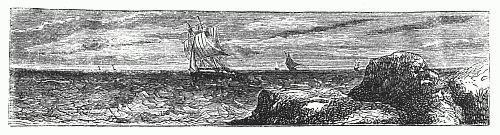
"Weary of her teasing, he at last took the poor seal,
rowed with it out into the open sea, and there, more than
seven miles from the shore, threw it into the water, and
then hurried home as fast as sails would carry him.
"But, when he entered his cottage, the first thing he saw
was the faithful seal lying close beside the cradle of one of
his children. As soon as it saw its master, it showed great
joy, and tried to caress him. But he took the seal and
gave it away to a sailor, who was going on a long voyage.
Two weeks afterward, as the fisherman came back from his
boat, he saw the seal at play with the children.
"'If you do not kill that seal, I will kill it myself,' said
the old aunt. The children began to cry. 'No, no, you
shall not kill it!' cried Hans with flashing eyes. 'You shall
kill me first,' cried little Jane. 'You have no right to kill
it,' cried Mary, the eldest girl.
"'Am I to be ruled by these children?' said the silly
aunt, turning to her brother.
"'The seal shall live,' said he: 'the children shall have
their way. Your notion that the poor seal brings bad luck
is a very silly notion. You ought to be ashamed of it.'
"'Hurrah!' cried Hans. 'Blue-eyes, the vote is taken:
you are to live, and all this nonsense about your bringing
bad luck is blown away.'
"The seal began to flop about as if in great joy.
"'I shall leave the house at once,' said the silly aunt.
"'Do as you please,' said the fisherman.
"And so it turned out, that the only ill luck brought to
the family by the seal was the departure of the cross and
silly old aunt. And, if the truth were known, this was
found to be a very good thing for all. The fisherman
prospered, the mother of the children got well at once; and
all were happier than ever before, including Blue-eyes, who
now was the jolliest seal that ever played with children."
Emily Carter.