THE NORWICH ROAD
I
In the days before railways came, robbing the exits
from London of all dignity and purpose, the runaway
'prentice lads of the familiar legends, who were
always half starved and continually beaten, revolting
at length from their uncomfortable beds under the
shop counters and their daily stripes and scorpions,
were wont, according to the story-books, to steal at
night out of their houses of bondage and make for
the roads. Such an one, making in those days for
Norwich, and standing at Aldgate in the grey of the
morning, looking across the threshold of London,
would have seen, in the long broad road stretching
before him, the only means of escape. The shilling
or so of which he would be the owner would scarce
serve him for two or three days' keep; and so, although
he might have longed for a place on the coach
he could see starting from the "Spread Eagle," in
Gracechurch Street, at 4 a.m., there would have been
for such as he no choice but to start afoot, with as
light a heart as possible, and chance the offer of a
lift on some waggon returning into Essex. Had he,
in leaving Aldgate behind, asked some passer-by the
way to Norwich, he might have been seized for what
he was, a runaway; but, if he escaped suspicion,
would have been answered readily enough, for everyone
in those times knew the way to lie along the
Whitechapel Road and by Mile End Turnpike. Has
anyone in these enlightened and highly-educated
times courage sufficient to ask his way to Norwich
from Aldgate? and, assuming that dauntless courage,
is it conceivable that anyone in that crowded street
could tell him?
There are no apprentices and no tyrannical
masters of the old kind left now, and the only
runaways of these days are the bad boys of precocious
wits who would not think of tramping the
highway while they could raise a railway fare or
"lift" a bicycle. But the way still lies open to
the explorer from Aldgate, and the old Norwich
Road yet follows the line of the Roman way into
the country of the Iceni.
Between the era of our imaginary truant and
that of the Romans, who originally constructed this
road, there yawns a vast gulf of time; certainly not
less than eighteen hundred years. The history of
the road during that space has largely been forgotten;
but, worst of all, we know perhaps less of
it and its life in the times of Charles the First,
onward to those of William and Mary, than we
can recover from Roman historians; and certainly
its coaching history is in tatters and fragments, for
those who made it did not live in the bright glow
of publicity that surrounded the coachmen of roads
north, south or west, and died unexploited by the
sporting writers of the Coaching Age.
II
Nearly seventeen centuries have passed since, in
the great Antonine Itinerary of the Roman Empire,
the first guide-book to the roads was compiled, and
almost eighty years since Cary and Paterson—the
rival Bradshaws and A.B.C.'s of the Coaching Age—issued
the last editions of their Travellers Companions,
which now, instead of being constantly in
the travellers' hands, are treasured on the shelves of
collectors interested in relics of days before railways.
The Antonine Itinerary was compiled, A.D. 200-300.
Among other roads of which it purports to
give an account is the road to Venta Icenorum;
the Norwich Road, as we should say. Its statement
is brief and to the point, if requiring no little explanation
after this lapse of time:—
| Iter a Venta Icenorum Londinio m.p. | | cxxviii sic. |
| Sitomago | | xxxii |
| Combretonio | | xxii |
| Ad Ansam | | xv |
| Camuloduno | | vii |
| Canonio | | viiii |
| Cæsaromago | | xii |
| Durolito | | xvi |
| Londinio | | xv |
A hundred and twenty-eight miles, that is to
say, between Venta and London. The Romans, of
course, calculated all their mileages in Britain from
that hoary relic, the still existing "London Stone,"
which, from behind its modern iron grating in the
wall of St Swithin's Church, still turns a battered
face towards the heedless, hurrying crowds in
Cannon Street, in the City of London.
In coaching days the Norwich Road, in common
with most East Anglian routes, was measured from
Whitechapel Church, and the distance from that
landmark to Norwich given as 111½ miles. The
apparent wide difference between those measurements
of classic and modern times is very nearly reconciled
when we add a mile for the distance between
London Stone and Whitechapel Church to the 111½
miles, and when we reduce the Roman miles to
English. An English mile measures 5280 feet, while
a Roman mile runs only to 4842 feet, this fact accounting,
along the road to Norwich, for some 13
miles of the discrepancy, and bringing the difference
to the insignificant one of 3½ miles; or, assuming
the Roman ruins at Caistor, 3 miles short of Norwich,
to mark the site of Venta Icenorum, 6½ miles; no
very wide margin of error.
The compiler of that ancient itinerary is unknown.
He, or they (for a survey of the Roman
Empire cannot have been made by one man), are
quite hidden and lost to sight under the title of
"Antonine," which was given in honour of the
Emperors Septimius Severus and Caracalla, father
and son, who both owned the name Antoninus. By
similarly honorary titles we are accustomed to
christen our public buildings. Thus, in coming ages,
when such earthworms as engineers and architects
are forgotten, the "Victoria" Embankment,
"Victoria" Station, the "Victoria and Albert"
Museum, and the thousand and one other things
thus entitled will serve to hand a Sovereign down to
futurity, while the names of those who created them,
good or ill, will have perished, like the leaves of
autumn. Customs change, and fashions cease to be,
but snobbery is more enduring than brass or marble,
and outlasts the mummies of the Pharaohs.
The compiler who drew up the list of places on
the road between Londinium and Venta has chosen
to reckon backwards. The "m. p." is the abbreviation
for mille passus, or paced Roman miles; the
figures after the first line giving the distance from
the place last mentioned. Setting out from London,
we find "Durolitum" to be identified with the
Roman earthworks of Uphall, near Romford;
"Cæsaromagus" to be identical with Writtle, near
Chelmsford; "Canonium" to stand for Kelvedon;
"Camulodunum" for Colchester; and "Ad Ansam"
for Stratford St Mary; while "Combretonium" and
"Sitomagus" still puzzle antiquaries, who are reduced
to the extremity of suggesting the opposite
alternatives of Brettenham or Burgh for the one, and
Dunwich or Thetford for the other; names with a
specious resemblance, and on circuitous routes east or
west of the direct road which would more than
account for the Roman surveyor's overplus of miles.
The direct road, however, is unmistakably Roman,
and those who will may seek for the elusive "Sitomagus"
and "Combretonium" along it. Haply they
may discover them at Scole, Dickleburgh or Long
Stratton.
But along the whole length of the road, from
London to Norwich, the wayfarer receives impressions
of its true Roman character, whether in its appearance
or in the place-names on the way. Old Ford
and Stratford-at-Bow, where the Roman paved fords
crossed the River Lea; that other "old ford" at
Ilford, across the River Roding, which was already
ancient when the Saxons came and so named it,
"Eald Ford," leaving it for later times to corrupt the
name into "Ilford" and for uninstructed historians
to explain the meaning to have been that it was an
"ill ford"; to which condition, indeed, many had
descended in mediæval times: these are examples.
Others are found at Ingatestone, the Saxon "Ing-atte-stone"
= the "meadow at the stone," a Roman
milestone that stood by the wayside; in the names
of Stanway, Colchester, Stratford St Mary. Little
Stonham, Tivetshall, and Long Stratton, places to be
more particularly mentioned later in these pages.
It has been aptly pointed out by East Anglian
antiquaries that the circuitous route eastward or
westward of the straight road between Stratford St
Mary and Norwich, on which Sitomagus and Combretonium
may have been situated, may probably
have been an early Roman way, constructed shortly
after the conquest of the Iceni, along an old native
trackway, and superseded in later and more settled
times by the direct road, overlooked by the Antonine
compilers who, working at Rome, the very centre of
the Empire, may not have been fully informed of
changes in countries like Britain, on the edge of the
Unknown. This view, when we consider the long
period stretching between the conquest of this part
of the country and the final break up of the Romano-British
civilisation, about A.D. 450, has much to recommend
it. A period of some three hundred and
eighty years of colonisation and development, equalling,
for example, the great gulf of time between our
own day and that of Henry the Eighth, the changes
in its course must have rivalled, if not have surpassed,
those in our roads between the sixteenth and nineteenth
centuries. During those eras, between the
first and the fifth centuries, many of the original
winding tracks must have been straightened, or left
to the secondary position of byways, while new and
straight roads were engineered across country
formerly, for one reason or another, avoided. Meanwhile,
the Antonine Itinerary-makers must have relied
for their surveys upon old and out-of-date information,
just as, in our own time, we find many recent
maps, printed from the Ordnance Survey of a hundred
years ago, still indicating winding roads that have
been non-existent for generations, and ignoring the
direct highways made by Telford and others just
before the opening of the Railway Era.
III
London made no remarkable growth between the
Roman and mediæval periods, but this road had in
that time slightly altered its course from its starting-point,
and, instead of going from Cannon Street to
Shoreditch, Bethnal Green and Old Ford, left the
City by way of Leadenhall Street and Aldgate,
continuing down the Mile End and Bow Roads to
Stratford.
The traveller of Chaucer's day, coming to Ald Gate,
in the City wall, had reached the country. That
gate spanned the road at a point marked nowadays
by the house, No 2 Aldgate High Street, standing
at the boundary of the parishes of St Katharine
Cree and St Botolph. In 1374 Chaucer took from
the Corporation of London a lease for the remainder
of his life of the rooms in this gate, which was
pulled down and succeeded by another, built in
1606, which in its turn disappeared in 1761.
From his windows commanding the road Chaucer
must often have seen that dainty gentlewoman, the
Prioress of St Leonard's, Stratford, riding to or from
London, escorted by a numerous train, and from her
must have drawn that portrait of the prioress who
spoke French with a Cockney accent:—
"After the scole of Stratford-attè-Bowe,
For French of Parys was to hire unknowe."
In Chaucer's day they probably taught French, of
sorts, at the Priory schools.
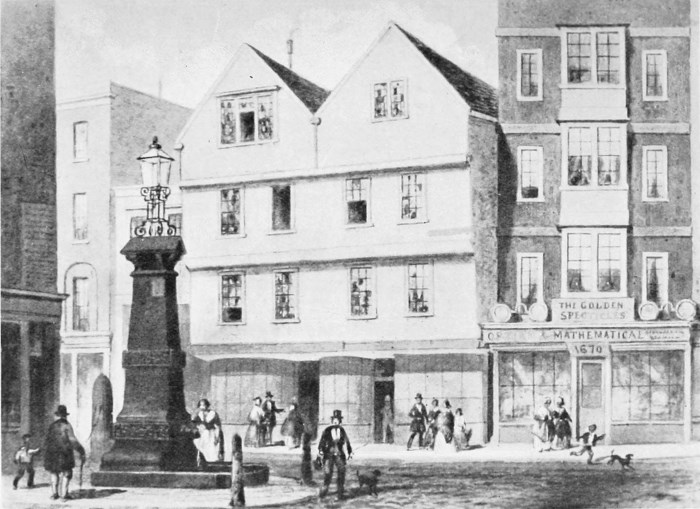
ALDGATE PUMP. From a Drawing by T. Hosmer Shepherd, 1854.
At that time it was no little journey to Stratford,
although by measurement less than four miles, and
the lady went strongly escorted, as, indeed, did all
of consequence, or those who had aught to lose.
For the more common wayfarers who went alone
on this desperate eastern trail there stood the Chapel
and the Holy Well of St Michael the Archangel
within the City, where the otherwise unprotected
might seek the aid of the Saint's strong arm before
leaving the walled City behind on their perilous
faring. This chapel stood where Leadenhall Street,
Fenchurch Street and Aldgate meet, on a site
thrown into the roadway in 1876, when the street
was widened. Until that year the crypt of this
shrine had filled the prosaic functions of a cellar
in the corner house, itself demolished, together with
the beautiful Early English arches on which it stood.
Adjoining was "Aldgate Pump," which had long
before unromantically taken the place of the sanctified
spring. That celebrated civic monument is seen
in the accompanying illustration, taken in 1854.
Many City wits have exercised their satirical powers
upon it, and the expression long current of "a
draft on Aldgate Pump," a once popular mercantile
phrase for a bad note, goes back so far as the days
of Fielding. Oddly enough, the water of the pump
retained some repute until 1876, when, on being
analysed, it was found impure, and the supply
closed. The pump, however, is still in existence,
rebuilt of its original stones, a few feet away from
the old site, and yields water again; not, however,
from the old saintly source, but from the strictly
secular filter-beds of the New River Water Company.
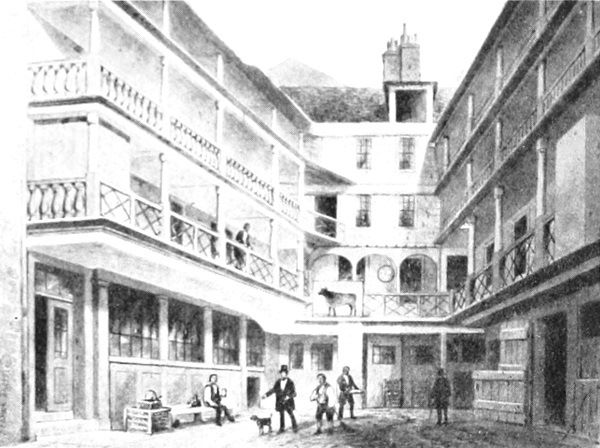
YARD OF THE "BULL," LEADENHALL STREET. From a Drawing by T. Hosmer Shepherd, 1854.
Having implored the protection of St Michael,
travellers of old went, heartened, upon their way
down what is now Whitechapel High Street, which
Strype, writing in the time of James the First, calls
a "spacious fair street," with "sweet and wholesome
air." Past hedgerows of elm trees and rustic
stiles and bridges, those old wayfarers went, and
onward down the Whitechapel Road, where the
country was a lovely solitude, with "nothing but
the bounteous gifts of Nature and saint-like tokens
of innocency," which, according to Sir Thomas
More, in 1504, characterised the charming fields of
Mile End, Shadwell, Stepney and Limehouse. This,
it will be allowed, is scarcely descriptive of those
places to-day, whatever they may become when the
People's Palace and the University Settlements have
done their work.
Thus far for sake of contrast. Let us return to
Aldgate for a while, and, without following its
fortunes throughout the centuries, glance at it in
the Coaching Age, before the squalor of modern
Whitechapel had invaded it from the east, or the
extension of City business had come to destroy
most of that picturesque assemblage of old inns
and mediæval gabled houses, to replace them with
the giant warehouses and "imposing" offices of
modern London.
IV
Although, as we have seen, the East Anglian
roads were, in coaching days, measured from Whitechapel
Church, the great actual starting-place was
Aldgate, where many of the old inns were situated,
as, in like manner, the ancient hostelries of the
Borough clustered at the beginning of the road
to Canterbury and Dover. Aldgate occupies a
position midway between London Stone, the Roman
starting-point in Cannon Street, and Whitechapel
Church, and to and from this spot came and went
the stage-coaches, post-chaises and waggons in
the palmy days of the road. The mail-coaches,
of course, had a starting-point of their own, and
set out from the old General Post-Office in Lombard
Street, or, in the last years of coaching, from St
Martin's-le-Grand.
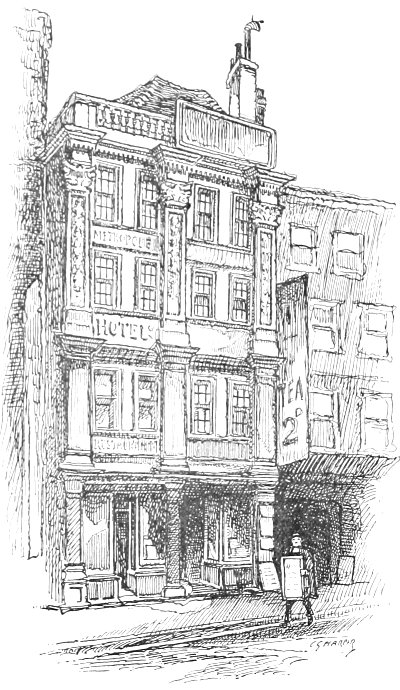
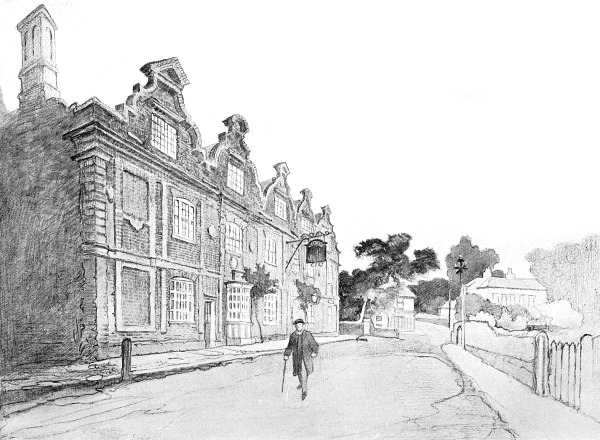
FRONT OF THE "SARACEN'S HEAD," ALDGATE: PRESENT DAY.
It is true that one might have taken coach
from many other and more central inns for Colchester,
Ipswich and Norwich:—from the "Spread
Eagle," in Gracechurch Street, a fine old galleried
inn demolished at the close of 1865; from the
"Cross Keys," in the same street; from the
"Swan with Two Necks," in Lad Lane, anciently
Lady Lane (that is to say, the Lane of Our Lady,
the Blessed Virgin), now Gresham Street; or from
the "Bull," 151 Leadenhall Street, which must
by no means be confounded with its namesake
in Aldgate High Street. Exactly what that
Leadenhall Street hostelry was like let the
picture of its old galleried courtyard show.
There was also "another way" to Norwich;
out of Bishopsgate, by way of Newmarket, Bury
and Thetford. Taking this route, which, although
2½ miles shorter, no true sportsman considered
to be the real Norwich Road, one started from
the "Golden Cross," Charing Cross; from the
"White Horse," in Fetter Lane (improved
away in 1898); from the "Flower Pot," in
Bishopsgate Street; from yet another "Bull," also
in Bishopsgate Street; or from the "Bull and
Mouth," St Martin's-le-Grand. But when all
these places have been duly set forth, it is to
Aldgate that we must turn as the real starting-point.
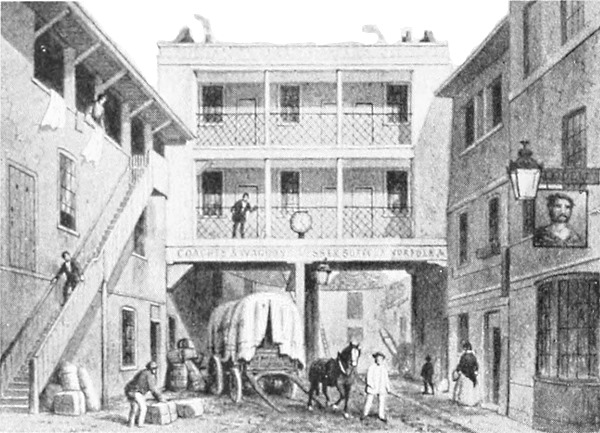
YARD OF THE "SARACEN'S HEAD" IN COACHING DAYS. From a Drawing by T. Hosmer Shepherd, 1854.
Aldgate in the days before railways was quite
unlike the Aldgate of to-day. Certain of the old
buildings remain, but the "note" of the place is
entirely altered. It is now a noisy, distracting
ante-room to the City, in which tinkling tram-cars
and costermongers' barrows jostle with elephantine
railway goods vans; where the Jewish second-hand
clothes shop rubs a greasy shoulder with the
"merchant tailor's" vulgar show of electric light,
plate glass and wax models; and where the East
End, in the person of the aproned, ringleted and
ostrich-feathered factory girl, meets the West, in
the shape of some City clerk strayed beyond his
mercantile or financial frontiers, each regarding
the other as a curiosity in these social marches.
It is as the meeting of salt water and fresh, this
mingling of the tides of City and East End, and
to the observant not a little curious. Nothing
like it—nothing so marked—is to be seen on any
other of the borders of the City. There is, too,
a smack of the sea, a certain air of romance, in
the street, coming, perhaps, from the windows
of the nautical instrument-makers, where the
binoculars, the quadrants, the sextants and the
sea-faring tackle in general hint of distant climes
and the coral reefs of South Pacific isles.
These mariners' emporia were here and in the
Minories before railways came, and so also were
many fine old inns. For Aldgate, difficult though
it may be to realise it to-day, was not only the
place whence many of the Essex, Suffolk and
Norfolk coaches set out, but was also the resting-place
of travellers to London; and its inns were
quite as well-appointed as those of the more
central ones in the City, or those of Charing Cross,
or the West End. As travellers by rail to London
in modern times resort to the railway hotels, so
did our great-grandfathers find rest at the coaching
inns at whose thresholds they were set down at
their journey's end.
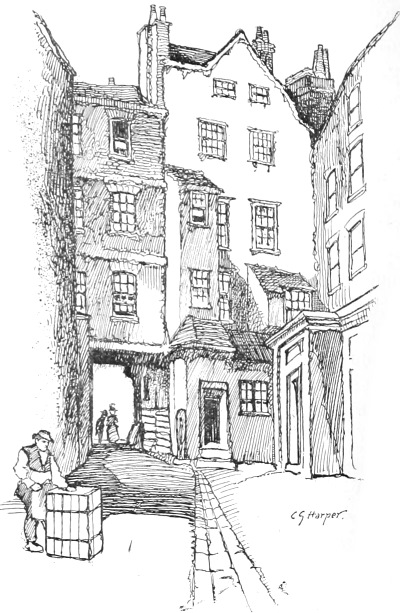
YARD OF THE "SARACEN'S HEAD": PRESENT DAY.
The fragments merely of the last of Aldgate's
old hostelries remain, in the bold front of Nos.
6 and 7, forming two-thirds of the old frontage
of the "Saracen's Head." No. 5, the other third,
has been destroyed, and so also has the old appearance
of the galleried courtyard, still named
"Saracen's Head Yard," but now surrounded by
warehouses. The old coach archway remains, and
the gables at the back of the buildings are quaint
reminiscences of other times. Coaches plied
between the "Saracen's Head" and Norwich so
far back as 1681, and Strype, the antiquary,
born in the neighbourhood, in a court whose
name now flaunts the horrid travesty of "Tripe
Court," referring to the inn, speaks of it as "very
large and of a considerable trade." The existing
fragment, with its handsome architectural elevation
of richly-moulded plaster in the Renaissance style
of the late seventeenth century, is part of the
building mentioned by him. Small shops now
occupy the ground floor, and the upper rooms
are let as tenements.
But the "Bull" was perhaps the most famous
of these old inns. From it Mr Pickwick set out
for Ipswich, and from Sam Weller's remark on that
occasion, "Take care o' the archway, gen'l'men,"
as the coach started, it is evident that the "Bull"
possessed a courtyard. At that palmy time of
inns and coaches, the opening of the nineteenth
century, the "Bull" was, and long had been, in
the Nelson family, a noted race of inn and coach
proprietors. At that particular time Mrs Ann
Nelson, widow of the late host, who died about
1812, was the presiding genius. Associated with
her was her son John. Another son, Robert, had
a business of his own, and was long proprietor of
the "Belle Sauvage," on Ludgate Hill, and partner
with others in many coaches. A third son, George,
drove the Exeter "Defiance," horsed by his mother
out of London.
But to return to the "Bull" and Mrs Nelson,
who had, as her husband had, and his father
before him, some sort of interest in many coaches
running into Essex, Suffolk and Norfolk, on main
or bye-roads. She also at one time leased the
"Spread Eagle," in Gracechurch Street, and extended
her energies so far as to horse the Exeter
"Telegraph" and the "Quicksilver" Devonport
Mail out of London, together with the Exeter
"Defiance" night coach, the Manchester "Telegraph,"
the Oxford "Defiance," Brighton "Red
Rover," and the Leeds "Courier." In their
coaching speculations the Nelson family were
associated with a pastrycook whose little shop
adjoined the gateway of the "Bull." Occasionally
a new hand on one of the coaches would send
his leaders' noses through the shop front, for that
gateway was very narrow and Mrs Nelson's coachmen
anything but deliberate. On the other side
of the gateway was a whip-maker's shop, kept by
one James Johnson, who throve mightily on the
custom of the coachmen and others who frequented
the "Bull."
This most energetic of landladies and Napoleonic
of coach proprietors developed and managed her
extensive coaching interests long before her
husband died. He, good, easy-going man, had
been a fair whip in earlier days, but had long
left the box, and had no head for business,
although a very fine taste in wines and spirits:
the lack of the first probably a corollary of the
second. She spared neither herself nor her
servants. Rising considerably before the lark,
she saw the owls to bed, and was a martinet to
her coachmen. Left a widow while in the prime
of life, she still wore in old age the dress of her
youth. The sketch of her in the picture of the
"Bull" yard in coaching days shows exactly what
her costume was like. A short skirt revealed high-heeled
shoes with large buckles, the heels painted
red. Black velvet was her winter wear, and fancy
apron, lace neckerchief and frilled cap invariable
items. Up to her seventieth year she was the
last up at night, scouring the house to see that
all was safe; and the first up in the morning,
looking after the stable people and seeing that the
horses had their feeds and were properly cared
for. Inside and outside the house, and down
the eastern roads, her influence was despotic and
would brook no defiance. Her "Ipswich Blues"
had long been famous when an opposition coach
was started. Opposition could not be allowed
to live, and so the fares were reduced
from eight shillings inside and sixteen shillings
out, by regular stages until the point was
reached when passengers were not only carried for
nothing, but were presented with an excellent
dinner at Witham. At that point the rivals discreetly
retired, when fares rose again to their old
level.
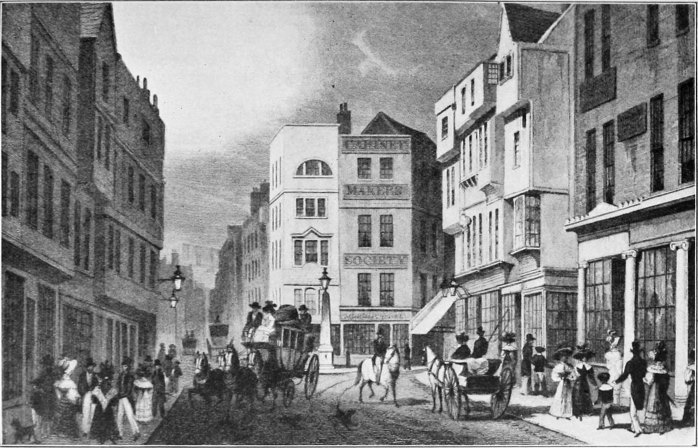
ALDGATE, 1820.
Mrs Nelson insisted on the most rigid punctuality.
Did the coachman of one of her crack
coaches or one of her still more famous "Oppositions"
bring his team down her yard five minutes
over time, he was reprimanded; ten minutes, and
he was fined half-a-crown; a quarter of an hour,
and he stood a good chance of being dismissed.
She ran a Southend "Opposition" every afternoon
by Romford, Brentwood, Billericay, Wickford,
Raleigh and Rochford, along Essex roads of a
feather-bed softness of mud; but time must be
kept. She provided good horses and would not
hear of excuses. One day, when the roads were
particularly heavy, the "Opposition" came in half
an hour late from Southend. The coachman, after
the manner of his kind, on driving into the yard
and pulling up at the coffee-room door, threw his
whip across the wheelers' backs. Mrs Nelson had
long been watching the clock, and, coming out,
took the whip and hung it up, with the quiet
remark, "That whip is no longer yours, Philpot—half
an hour behind."
"But the roads are so bad, ma'am," remonstrated
poor Toby. "I'm sure, ma'am, the
gentlemen knew I did my best; but I felt bound
to spare the cattle."
"I find the cattle and employ you to drive
them," replied the inexorable landlady; "you
have nothing to do but to keep time. Draw
your wages and leave the yard."
Under this iron rule it is no wonder that her
coachmen were sometimes "pulled up" for furious
driving. On one of these occasions she appeared
in court in defence of her man. "I understand,
Mrs Nelson," blandly remarked the Chairman of
the Bench, "that you give your coachmen instructions
to race the rival coach."
"Not exactly," replied the lady; "my orders
to them are simply that they are to get the
road and keep it."
But if a very dragon of strictness, she treated
coachmen and guards very well. They had their
especial room, and dined as well there, at reduced
prices, as any of her coffee-room customers. This
especial consideration reflected itself in those functionaries,
who jealously preserved the privacy of
their room; the amateur coachman who secured
the invitation to join them (and to pay out of his
own pocket for their wine and spirits) feeling
himself greatly honoured.
In other respects, the "Bull" was a model to
other houses. No damp sheets in any one of
its hundred and fifty beds, no drunken brawlers;
nothing a minute out of time, or an inch out of
place. Mrs Nelson's fine house was, indeed, nothing
less than an institution. In later years her
son John took more of the management upon his
shoulders, and the business seemed likely to long
outlast his time.
V
But a whisper of coming changes disturbed the
air as early as 1830. Coachmen and travellers
talked in the stableyard and the cosy rooms of
the "Bull" of men with strange instruments encountered
along the road; "chaps with telescopes
on three sticks, and other chaps with chains and
things, measuring the fields." It was thus that
they described the surveyors, with their theodolites
and their staff of men, who were setting out the
proposed route of the projected Eastern Counties
Railway that was to run all the way from London
to Colchester, Norwich and Yarmouth.
John Nelson was too confident in the existing
order of things to believe that a few pounds of
coal and some boiling water would ever be a
match for his horses, or that a time would
presently come when those passengers of his who
now derided the railways would desert the coaches.
The "Bull" had been in his family for more than
a hundred and twelve years, as an inn and a
coaching house, and he could as soon have
imagined the end of the world as a day coming
when the Essex, Suffolk and Norfolk coaches
should no longer enter or leave his yard. It was
a good joke for a while, when the coaches came
in, to ask "How they were getting on with that
railway?" but when the surveys were completed
and the prospectus of the "Grand Eastern Counties
Railway" was issued in 1834, it was seen that
the railway men meant business. The original
proposal of the directors was to follow the road
closely and to bring the line into Aldgate.
When it was seen that the railway was really to
be made, Nelson raised an opposition against the
Aldgate terminus, and was successful in driving
the Company into an out-of-the-way site in
Shoreditch, where for many years that terminus
remained.
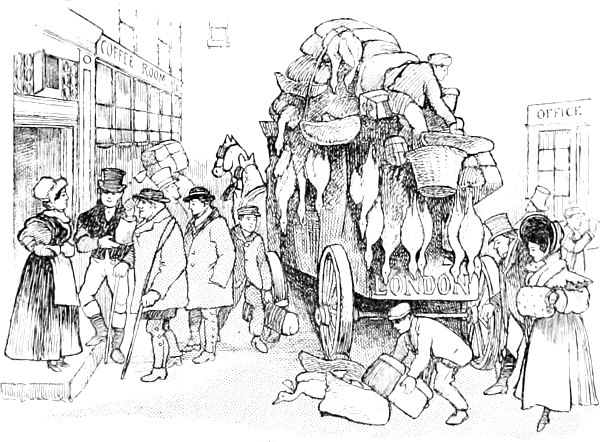
THE YARD OF THE "BULL," WHITECHAPEL, IN COACHING DAYS.
The Eastern Counties Railway was opened as
far as Chelmsford in 1839, to Colchester in 1842,
and communication to Norwich was opened up in
1845. From the day of the first opening, the
"Bull" declined. Old customers still found their
way from the slums of Shoreditch to its hospitable
door, but were not reinforced by the newer generation
of travellers, to whom the road and its end
in Aldgate were alike unknown. They went to the
City inns, and later to the more central hotels,
leaving the "Bull" to slowly sink into neglect.
John Nelson made a big bid for success in another
line, and ran the "Wellington" omnibuses with
success from 1855 until his death, at the age of
seventy-four, in June 1868. He had long resided
in the West End, and was a man of ample fortune,
so that the end of the "Bull's" coaching career
hurt him only in sentiment. His mother, that most
autocratic and business-like of women, had died ten
years before, active almost to the last, although she
had reached the age of eighty-five years. Towards
the close of 1868 the old inn ended its long career.
Its substantial, old-fashioned silver-plate and massive
furniture were sold by auction, with the stock of
rare old wines, laid in many years before, for that
old generation of travellers who delighted in port
and sherry, and plenty of both.
The very site of the "Bull" is now sought with
pains and labour, and only to be discovered with
difficulty by the present generation. It was
numbered 25 Aldgate High Street, and stood where
Aldgate Avenue, a modern alley rich in offices of
"commission agents," and curious things of that
kind, now cuts its way through where the old
yard used to be.
Close by the "Bull" was another old coaching
inn, the "Blue Boar," now quite vanished, kept for
a time by John Thorogood. The Thorogoods were
in those days, and in these times of amateur
coaching are still, a family of coachmen. "Old
John," who owned the "Norwich Times," and
actually drove it for two years without missing a
journey the whole of that time, clearly deserved
his patronymic, in thus handling the reins along
a hundred and twelve miles of road for seven
hundred and thirty consecutive days.
It was to the "Blue Boar" that little David
Copperfield came, on his miserable journey from
Yarmouth:—"We approached London by degrees,
and got, in due time, to the inn, in the Whitechapel
district, I forget whether it was the 'Blue Bull'
or the 'Blue Boar,' but I know it was the Blue
Something, and that its likeness was painted upon
the back of the coach." The sculptured effigy of a
boar, with gilded tusks and hoofs, built into the
wall of a tobacco factory, marks the site of the
inn.
Among other noted inns, the "Three Nuns"
must be named. From it set out the short stages
to Ilford, Epping, Romford and Woodford, together
with coaches for several of the Essex by-roads.
The house owes its name to the Minoresses, or nuns,
of St Clare, from whose religious establishment the
Minories obtains its title. The inn was rebuilt
in 1877, and is now nothing more than a huge
public-house.
Many other inns of consequence in their day
have left nothing but their yards behind them to
show where they stood:—George Yard, Spread
Eagle Yard, Black Horse Yard, Boar's Head Yard,
White Swan Yard, Half Moon Passage, and Kent
and Essex Yard are such relics, bordering High
Street, Whitechapel, where one curious sign survives,
that of an inn called the "Horse and Leaping Bar."
VI
One decided advantage the Chelmsford, Colchester
and Ipswich route to Norwich possessed in old times
over that by way of Newmarket and Thetford.
Neither could have been considered safe in the bad
old days, but while the traveller across the wild
heaths of Newmarket and Thetford was almost
certain to be "held up" on his lonely course, the
other way, through Essex, passed by few such
wildernesses, and had more towns and villages along
its course, to give a sense of security. Briefly,
robbery on one route was a probability, and on the
other was regarded as certain. Margaret Paston,
writing from Norfolk to her husband in London,
so long ago as the fifteenth century, certainly gives
even the way through Essex a bad name, for she
asks him to pay a debt for one of their friends,
because it was not safe, "on account of the robbers,"
to send money up from the country; but at the
very same time the Thetford route had a much
more sinister reputation, and travellers versed in
the gossip of the road avoided it if possible, or
went in company and well armed, for in that era
a certain William Cratfield, Rector of Wrotham, "a
common and notorious thief and lurker on the roads,
and murderer and slayer," lurked and robbed and
slew on Newmarket Heath, in company with a
certain "Thomas Tapyrtone, hosyer." He was at
last laid by the heels, in 1416, and charged with
robbing a Londoner of £12. This distinguished
ornament of the Church died in Newgate, but of
the villainous hosier we hear no more. Perhaps he
had realised a fortune in the business and retired
to enjoy the fruits of his industry. With the
disappearance of this worthy couple, travellers
breathed more freely, but for surety's sake continued
to patronise the Essex route, and so by way
of Ipswich to come to the City of Orchards, as
Norwich was called of old.
As time went on, a certain degree of security was
found in the coaches that began to make an appearance
with the second half of the seventeenth century.
They travelled at first no more quickly than a man
could walk, but they provided company, which was,
under the circumstances, highly desirable. Soon,
however, they found it possible to do the journey
in two days. Strype, we have already seen
mentions the "Saracen's Head" in Aldgate as the
centre of a considerable trade, and to it in 1681 a
Norwich coach was running; an innovation which
aroused the indignation of innkeepers on the way
to almost as great a height as that of their descendants
when, two hundred and forty years later,
railways were depopulating the roads. When
travellers began to go by coach instead of on
horseback, and to reach London or Norwich in two
days instead of three or four, those antique tapsters
thought they saw their living going, and, strange to
say, there were not wanting men who raised their
voices against the innovation of being carried on a
journey, instead of riding; although, for the most
part, their outcry was the result only of innate conservatism.
"Travelling in these coaches," said an anonymous
pamphleteer, "can neither prove advantageous
to men's health or business. For what
advantage is it to men's health to be called out of
their beds into these coaches an hour before day in the
morning, to be hurried in them from place to place, till
one hour, two, or three within night; insomuch that
after sitting all day in the summer time stifled with
heat, and choked with the dust, or the winter time
starving and freezing with cold or choked with
filthy fogs, they are often brought into their inns by
torchlight, when it is too late to sit up to get
supper; and next morning they are forced into the
coach so early that they can get no breakfast. What
addition is this to men's health or business? to ride
all day with strangers, oftentimes sick, ancient,
diseased persons, or young children crying; to
whose humours they are obliged to be subject, forced
to bear with, and many times are poisoned with
their nasty scents, and crippled by the crowd of the
boxes and bundles."
Yet "these coaches" (one can almost hear the
intonation of contempt in that phrase) were from
the first a success. The greater that success the
louder for a time was the outcry against them.
Taylor, the Water Poet, was one of those who wrote
vehemently against the new methods of travel.
To him a coach was "a close hypocrite; for it hath
a cover for knavery and curtains to vaile and shadow
any wickedness. Besides, like a perpetual cheater,
it wears two bootes, and no spurs, sometimes having
two pairs of legs to one boote, and oftentimes
(against nature) it makes faire ladies weare the
boote; and if you note, they are carried back to
back, like people surprised by pyrats, to be tyed in
that miserable manner and thrown overboard into
the sea. Moreover, it makes people imitate sea-crabs,
in being drawn sideways as they are when
they sit in the boot of the coach; and it is a
dangerous kind of carriage for the commonwealth,
if it be considered."
The boot of which he speaks so contemptuously,
was a method of packing the "outsides," of which
we still find a survival in the Irish jaunting-car.
There are those who trace the origin of the term
from the French "boîte," a box. Even now the
coachman's seat is "the box," and the modern fore-boot
is under it.
Writers of that time seem almost unanimously to
have taken sides against coaching; with, however, no
effect; for, somewhat later than Taylor, that doughty
Conservative, John Cresset, is found exclaiming
furiously against the multitude of them. He
favoured the suppression of all, or, at least—counsels
of moderation prevailing—of most. They were, he
said, mischievous to the public, destructive to trade
and prejudicial to the land. Not only did they
injure the breed of horses, but also that of watermen;
which last objection goes further than the
complaints of Taylor himself, who, writing at the
same time, does not speak of his breed being debased,
but only of his trade being crippled. Cresset
thought the stage-coaches tempted the country
gentry to London too often, and he accordingly
proposed that these conveyances should be limited
to one for every county town in England, to go
backwards and forwards once a week.
Vain hope! Coaches of sorts must already have
appeared on the road to Norwich by the middle of
the seventeenth century, for in a proclamation of July
20th in the plague year, 1665, when all places were
dreading infected London, it is ordained, that "from
this daie all ye passage coaches shall be prohibited
to goe from ye city to London and come from thence
hither, and also ye common carts and wagons."
Already, in 1696, the "Confatharrat" coach was a
well-known conveyance between London and
Norwich, and the name of Suggate, the London and
East Anglian carrier, a household word. Unhappily,
nothing can be gathered as to when Suggate first
began to jog along the road, or when the "Confatharrat"
started to ply between Norwich and the
"Four Swans," Bishopsgate Street. All particulars
are lost. The odd name of that coach was probably
a seventeenth-century way of spelling the word
"confederate," and the selection of such a name
proves both that it was carried on by an alliance
or co-partnership, and that "confederate" had not
then acquired its sinister modern connotation.
Besides these aids to travel, a stage-waggon began
to ply from the "Popinjay," Tombland, Norwich, at
an early date; and another from the "Angel," in the
Market Place, to the "Blossoms" Inn, Laurence
Lane, London, was advertised in the Norwich
Mercury, of March 29th, 1729, to "now go regularly
every Thursday night," setting out on the following
Wednesday from London, on the return journey.
It will thus be seen that it was a five or six days'
journey for those primitive affairs, and that they
apparently did not run at regular intervals until
that year.
A London and Beccles coach was running in
1707, but the first regular Norwich coach of which
particulars remain was the "Norwich Machine,"
which in 1762 set out for London three times a
week from the "Maid's Head," according to the
advertisement still extant. There is nothing in
that old coaching bill to show that 1762 was the
first season of the "Norwich Machine." It may
have been established some years before that date.
Norwich, March 26, 1762.
SUSAN NASMITH and JAMES KEITH,
Proprietors of the
NORWICH MACHINE,
Give Notice
that their Machine will set out from the Maid's Head Inn,
in St Simon's Parish, in Norwich, on Monday, the 5th day
of April next, at half-past eleven in the forenoon, and on
the Wednesday and Friday in the same week, at the same
time; and to be continued in like Manner, on those Days
weekly, for the carrying four inside Passengers, at
Twenty-five Shillings each, and outside at Twelve
Shillings and Sixpence each. The inside Passengers to be
allowed twenty pound Weight, and all above to be paid
for at three half-pence per pound; and to be in London on
the Tuesday, Thursday and Saturday Evenings weekly.
N.B.—A Machine will set out on the same days, at the
same time, from the Green Dragon, in Bishopsgate Street,
London, for Norwich.
In the following year, the "Widow Nasmith"
and James Keith advertised that they had built large
and commodious machines, to carry six inside, and
reduced the fares to twenty shillings and ten
shillings respectively; but they had apparently not
succeeded in performing the journey in less time than
a day and a half, for no mention is made of speed
being accelerated. But a remarkable feature in that
announcement is the extraordinary cheapness of the
fares, little over twopence and a penny a mile for
inside and outside passengers, at a time when prices
on other roads ruled from twenty-five to fifty per cent.
higher. This tells a tale of competition; but Time,
the thief, has robbed us of all knowledge of those
competitors.
A year later the London and Ipswich Post Coaches
were advertised to set out every week-day, and to
perform the 69¼ miles in ten hours, an average pace
of almost 7 miles an hour; a marvellous turn of
speed for that age. As to whether those Post
Coaches ever did cover that distance in ten hours, we
may reasonably express a doubt; but there was the
promise, and 011 the strength of it the proprietors
charged threepence a mile. As will be seen by the
advertisement, these coaches carried no outside
passengers:—
Ipswich, August 17th, 1764.
THE LONDON AND IPSWICH POST COACHES
Set out on Monday, the 27th of August, at seven o'clock
in the morning from the Black Bull, in Bishopsgate,
London, and at the same time from the Great White Horse,
in Ipswich, and continue every day (Sunday excepted), to
be at the above places the same evening at five o'clock;
each passenger to pay threepence per mile, and to be
allowed eighteen pounds luggage; all above to pay one
penny per pound, and so in proportion. The coaches, hung
upon steel springs, are very easy, large and commodious,
carry six inside but no outside passengers whatever; but
have great conveniences for parcels or game (to keep them
from the weather), which will be delivered at London and
Ipswich the same night.
As these coaches are sent out for the ease and expedition
of gentlemen and ladies travelling, the proprietors
humbly hope for their encouragement, and are determined
to spare no pains to render it as agreeable as they can.
Performed (if God permits) by—
Pet. Sheldon, at the Bull, Bishopsgate Street, London.
Thomas Archer, at the White Hart, Brentwood.
Charles Kerry, at the Black Boy, Chelmsford.
Geo. Reynolds, at the Three Cups, Colchester; and
Chas. Harris, at the Great White Horse, Ipswich.
N.B.—The proprietors will not be answerable for any
money, plate, jewels, or writings, unless entered and paid
for as such.
The reader will perhaps have observed that this
advertisement especially mentions a convenience for
carrying game, and, as a matter of fact, game and
oysters were prominent from an early period in the
history of Norwich Road conveyances, and, by the
middle of the eighteenth century, the Norfolk and
Suffolk coaches had already earned quite a distinctive
character in two seasons of the year,
Michaelmas and Christmas. East Anglia has always
abounded in game, and its broad heaths and extensive
commons have been the breeding-grounds
of innumerable geese and turkeys whose careers
have ended on London dinner-tables. In those two
seasons it was often difficult to secure a seat on
or in any of the "up" coaches from Norwich or
Ipswich, for while every available inch of space on
the mails was occupied by festoons of dead birds
consigned by country cousins to friends in town, the
whole of a stage-coach was frequently chartered
for the purpose of despatching heavy consignments
of these noble poultry to the London market.
Christmas provided extraordinary sights along the
Norfolk Road, in the swaying coaches, with parcels
and geese and turkeys mountains high on the roof;
with barrels of Colchester natives in the boot, and
hampers swinging heavily between the axle-trees
on a shelf called "the cellar"; while from every
rail or projection to which they could be either
safely or hazardously tied depended other turkeys
or braces of fowls, booked at the last moment before
starting. It was something in those days to be a
turkey or a goose, before whose importance the
claims of human passengers faded; but it was a
fleeting elevation which the philosophic did not
envy, thinking that here indeed the poet was
justified in his sounding line—
"The paths of glory lead but to the grave."
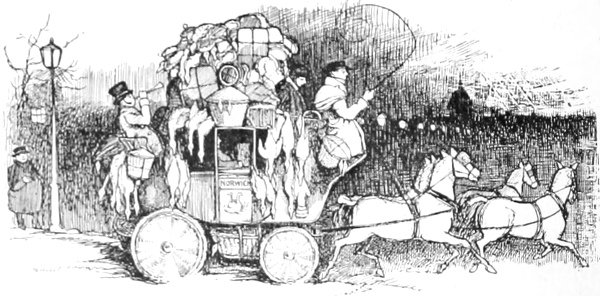
THE NORWICH COACH AT CHRISTMAS TIDE. After Robert Seymour, 1835.
That unfortunate genius, Robert Seymour, has
left us a picture of the Norwich coach nearing
London at Christmas time, with its feathered load.
The drawing was made in 1835, at the very height
of the Coaching Age, and shows from his own observation
with what ingenuity every rail and projection
was used to hang the birds from.
Another highly specialised branch of traffic,
which only left the road on the opening of the
railway, was the constant service of fish waggons
running between Harwich, Colchester and London,
at the then express speed of 8 miles an hour.
VII
Between the early days of coaching and the end of
that period, many changes took place on the Norwich
Road. So late as 1798, the Mail, the "Expedition,"
and the "Post Coach" were the only coaches to
Norwich, supplemented by three road waggons; two
of them doing the journey twice a week, the third
setting out weekly. Later came the "Norwich
Times," "Gurney's Original Day Coach," the
"Phænomenon," as it was originally spelt; the
"Magnet," the Ipswich "Shannon," and the
Ipswich "Blue." With the object of serving as
many places as possible, and, incidentally, securing
heavier bookings, the "Times" and Gurney's
coaches took a somewhat circuitous route, leaving
the direct road at Chelmsford, and going through
Braintree, Halstead, Sudbury, Long Melford and Bury
St Edmunds, rejoining the Norwich Road at Scole.
But the lord of the road was the Mail Coach,
beside which the stages were very commonplace
affairs.
The first mail-coach that ever ran the road between
London and Norwich started in March 1785,
and the service was from the beginning continued
daily. Before that time the mails had been carried
by post-boys, who began in 1741 to go six days a
week instead of three, as they formerly had done.
Mail-coaches are entirely things of the past, for
the modern coaching revival has only brought back
the smart stages and drags of the last years of the
Coaching Age. The mails were expensive and exclusive
affairs, constructed to carry only nine
persons; four inside and five out, including coachman
and guard. For the higher fares passengers
paid they had not always the satisfaction of travelling
faster than on the stages; but perhaps there was
some dignity attaching to a seat on the mail which
was lacking on ordinary coaches. And certainly
they were surrounded by pomp and circumstance.
The guard wore a scarlet coat and went armed with
pistol, sword and blunderbuss; not, of course, for
the protection of the passengers, but for the safe-guarding
of His Majesty's mails. And everything
gave place, as a matter of right and not merely
courtesy, to the mail. Surly pikemen swung open
their gates and asked no toll, for it was one of the
privileges of the mail to go toll-free, and the highwaymen,
if they walked in the ways of caution, left
the gorgeous conveyance severely alone, reserving
their best attentions for the plebeian stages. It was
a much more serious thing to rob the mail than an
ordinary coach, for a conviction was more certain to
end in death, judges having hints from the Government
how undesirable it was that mails should be
ransacked and the robbers live. The rewards usually
offered by the Post-office, too, were tempting to
those who could inform if they would. £200 was
the sum generally to be had for this service, together
with the £40 reward by Act of Parliament for the
apprehension of a highwayman; and if the mail was
robbed within five miles of London, another £100.
Courage, recklessness, and desperation—whichever
we like to call it—often nerved the night-hawks
to brave even so heavy a handicap as this, as this
very road bears witness, in the daring robbery of
the Ipswich Mail in 1822, when notes to the value
of no less than £31,198 were stolen. In addition
to the usual rewards, a sum of £1000 was offered
by the losing firms of bankers, as shown in the
accompanying old handbill, but without avail.
This sum was afterwards increased to £5000,
and a notification given that, in order to prevent
the notes being changed, the ink on all new
ones had been altered from black to red. But the
robbers had the impudence to ask £6000 for the
return of the notes. They had already passed
£3000 worth, and naively said, in the negotiations
they opened up, that the trouble they had taken
and the risks they had run did not make it worth
while to accept a smaller "reward." The bankers,
however, would not spring another thousand, for
by that time everyone was too shy of an "Ipswich
black note," and it was extremely unlikely that any
more could be passed. Negotiations were broken
off; but a month later notes to the value of £28,000
were returned. The thieves were never traced, and
although the bulk of their booty was useless to
them, made the very substantial haul of over £3000
by their lawless enterprise.
£1000 Reward.
STOLEN
FROM THE IPSWICH MAIL
On its way from London, on the Night
of the 11th Sept. Inst. the following
COUNTRY BANK NOTES:
Ipswich Bank, 5, & 10l. Notes.
ALEXANDERS & Co. on HOARE & Co.
Woodbridge Bank, 1, 5, & 10l. Notes.
ALEXANDERS & Co. on FRYS & Co.
Manningtree Bank, 1, 5, & 10l. Notes.
ALEXANDER & Co. on FRYS & Co.
Hadleigh Bank, 1, 5, & 10l. Notes.
ALEXANDER & Co. on FRYS & Co.
Particulars of which will be furnished at the different Bankers.
Whoever will give Information, either at ALEXANDERS and Co.
or at FRYS and Co., St Mildred's Court, Poultry, so that the
Parties may be apprehended, shall on his or their Conviction,
and the Recovery of the Property, receive the above REWARD.
We have said that mail-coaches were gorgeous.
They were painted in black and red. Not a shy,
unassuming red, but the familiar and traditional Post-office
hue. Also they bore the Royal coat-of-arms
emblazoned upon the door panels, and the
insignia of the four principal orders of knighthood
on the quarters. There was no mistaking a
mail-coach.
The Norwich Mail, which took fifteen and a
half hours to do the journey so late as 1821, was
greatly improved in later years; and finally, in
the early forties, when the railway reached
Norwich and superseded the roads, performed the
journey in eleven hours, thirty-eight minutes, at
the very respectable average speed of 9½ miles
an hour. It was not the only mail on the road,
but shared the way so far as Ipswich with the
Ipswich and Yarmouth Mail. This coach was unfortunate
on two occasions between 1835 and
1839. On September 28th in the first year,
when the coachman was climbing on to his box
in the yard of the "Swan with Two Necks," the
horses started away on their own accord, tumbling
the coachman off and knocking down the helper
who had been holding their heads. Dashing into
Cheapside, they flung themselves against the back
of the Poole Mail with such force that the coachman
of that mail was also thrown off. He was
taken unconscious to the hospital. Continuing
their furious rush, the horses of the Ipswich
Mail at length ran the pole of the coach between
the iron railings of a house, and so were
stopped.
The second happening, in 1839, was somewhat
similar. The mail had arrived at Colchester, and
the coachman, throwing down the reins, got off
the box. No one was at the horses' heads, and
they started away and galloped down the High
Street, until the near leader fell and broke his
neck, stopping the team.
It was by the Ipswich and Yarmouth Mail
that David Copperfield journeyed down to Yarmouth
on his second visit to Mr Peggotty. In the
ordinary course of things, he would have reached
Ipswich at 3·12 a.m. But on this occasion the
weather was a potent factor in causing delay.
He occupied the box seat, and remarked upon the
look of the sky to the coachman while yet on
the first stage out of London.
"Don't you think that a very remarkable
sky?" he asked; "I don't remember to have seen
one like it."
"Nor I—not equal to it," said the coachman.
"That's mist, sir. There'll be mischief done at
sea, I expect, before long."
The description of this stormy sky is very
fine, and seems to have been drawn from observation;
just as true and as effective in its way as
Old Crome's billowy cloudscapes, in his Mousehold
Heath, or as any of Constable's rain-surcharged
Suffolk scenes.
"It was a murky confusion—here and there
blotted with a colour like the colour of the smoke
from damp fuel—of flying clouds tossed up into
most remarkable heaps, suggesting greater heights
in the clouds than there were depths below them
to the bottom of the deepest hollows in the earth,
through which the wild moon seemed to plunge
headlong, as if, in a dread disturbance of the laws
of nature, she had lost her way and were frightened.
There had been a wind all day; and it was rising
then, with an extraordinary great sound. In
another hour it had much increased, and the sky
was more overcast, and it blew hard.
"But as the night advanced, the clouds closing
in and densely overspreading the whole sky, then
very dark, it came on to blow harder and harder.
It still increased, until our horses could scarcely
face the wind. Many times in the dark part of
the night (it was then late in September, when
the nights were not short) the leaders turned
about, or came to a dead stop; and we were
often in serious apprehension that the coach
would be blown over. Sweeping gusts of rain
came up before this storm, like showers of steel;
and at those times, when there was any shelter
of trees or lee-walls to be got, we were fain to
stop, in a sheer impossibility of continuing the
struggle.... We came to Ipswich very late,
having had to fight every inch of ground since
we were ten miles out of London; and found a
cluster of people in the market-place, who had
risen from their beds in the night, fearful of falling
chimneys. Some of these, congregating about
the inn-yard while we changed horses, told us of
great sheets of lead having been ripped off a high
church tower and flung into a bye-street, which
they then blocked up."
At Ipswich the Yarmouth coaches left the
Norwich Road, and so the further adventures of
David Copperfield do not in this place concern us.
VIII
Here, as on the other roads, the early advent
of the Motor Car, in 1826, caused much commotion.
The steam coaches of that period never achieved
any success on this route, but caricatures of what
might be expected were plentiful, and pictures of
the Colchester "Dreadful Vengeance," the Norwich
"Buster," and other fanciful conveyances, in the
act of exploding and distributing their passengers
in little pieces over a wide stretch of country,
were popular. The railway itself came in for much
abuse, and misguided and fanatical coach proprietors
wasted their substance in pitiful attempts to
compete with it. Among these was Israel Alexander,
that Jewish hero of the Brighton Road in the early
forties, who, although a first-class whip, was
perhaps chiefly associated with the many upsettings
of the Brighton "Quicksilver." He fell out with
his noble friends on that highway, and, coming to
the Norwich Road, ran a well-appointed coach to
Colchester for a little while, until even the Eastern
Counties Railway, then the slowest on earth, made
the pace too quick for him. His turn-out was
given the extraordinary name of the "Duke of
Beaufort's Retaliator," and might have continued
much longer to carry those who were prejudiced
against railways, had it not met with so many
accidents.
One who was contemporary with the coaching
age has ingeniously divided coaching accidents
into three classes:—1. Accidents to the coach;
2. Accidents to the horses; 3. Accidents to the
harness. The most common kind of mishap to
the coach was, he says, the breaking of an axle.
This was not, as a rule, due to any faulty construction
of that most essential feature of a public
conveyance, but to the overloading either of
passengers or goods, to which coaches were continually
subject. The sudden snapping of an axle
at a high speed or on a down grade produced
a tremendous crash which generally shot coachman,
guard and "outsides" in all directions. Happy
those who, in such a case, were received into the
thorny arms of a quickset hedge or the soft
embraces of a mud-heap.
Another kind of mishap, not always accidental,
was that of a wheel coming off; an incident often
caused in early times, before the introduction of
patent axle-boxes, by the mischievous removal of
the lynch-pin by some unscrupulous rascal in the
employ of the rival coach proprietor.
The sudden snapping of a skid-chain while
descending a hill, resulting in the coach running
on to the horses and a general overthrow, in which
horses' legs and passengers heads came into unwonted
contact, was perhaps as uncomfortable a
kind of disaster as could be imagined. Overloading,
too, sometimes had the effect of rendering a coach
top-heavy, when a slight lack of caution in running
round curves would upset it.
Accidents to the horses were:—casting a shoe,
involving lameness, and perhaps a fall; tripping
and stumbling on loose stones and rolling over;
slipping up in frosty weather; and kicking over
the traces or the splinter-bar.
Accidents to the harness usually happened to
the traces, which commonly snapped under an uneven
strain. To cobble them up with twine, and
so complete a stage, was a common practice. In
such cases, the thoughts of passengers during the
remaining miles were, like those of the poet, "too
deep for words." Most nerve-shaking of all these
varied and untoward happenings, however, was
the breaking of the reins. Rotted by age, by the
sun's heat and the winter's frosts, they would
"come away" in the coachman's hands at that
worst of moments;—when he was holding in his
horses downhill. In that contingency, says our
ancient, who, in the modern slang phrase, has
"been there," it was the approved thing to say
your prayers first and then take a flying leap
(result, a broken neck, or fractured leg: the bone
protruding over the top of the Blucher).
"Then shrieked the timid and stood"—or,
rather, sat—"still the brave;" who had this consolation,
that if they fared no better than those
who jumped, the odds were that they fared no
worse.
To be dragged at hurricane pace by four runaway
horses (for in such a case they generally did so run)
with the broken reins trailing helplessly after them,
was to acquire the knowledge of an inner meaning in
the word "terror." In escapades of this kind the
"insides" were in the most unenviable situation;
for the "outsides," including coachman and guard,
took the better, if unheroic, part of crawling over the
roof and slipping down the back of the coach into the
road. The wisdom of their doing so would, in most
cases, be proved a few seconds later by the sound of
a distant crash as the coach hurtled against some
roadside tree and dissolved into matchwork, while
the "insides" were stuck as full of splinters as a
"fretful porcupine" of quills.
The "human boy" was as much the terror of the
old coachman as he is of the modern cyclist. The
sight of a boy with a hoop reduced him to a state of
purple indignation or of quivering anxiety, according
to temperament. Many an one of our great-grandfathers,
attired in the odd costume of boys in that
period, and trundling a hoop along the road, has felt
the lash of the coachman's whip. The following little
story will show us why.
"When a very little boy," says one of our
forebears, "I once upset a four-horse coach by losing
control over my hoop, which, to my consternation,
bowled among the legs of the team. I shall never
forget the horror with which I for an instant saw
the spirited horses floundering about with that
hateful hoop among them, or heard the execrations
of the coachman and the shouts of the passengers.
Abandoning the wretched plaything to its fate, I
took to my heels down a bye-lane, the portentous
crash that followed only accelerating my speed."
Coach proprietors were favourite targets for
Fate's worst shafts. They were a hard-working,
much-enduring class of men; up early and to bed
late, retiring in good circumstances and rising
perhaps ruined through some unforeseen accident.
They were "common carriers" in law, and bound
under many Acts of Parliament to deliver goods
uninjured at their destination. As carriers of
passengers, it is true, they were only required to
exercise all "due care and diligence" for the safety
of their customers, and were exempt from liability
in case of mishaps through the "act of God" or the
unforeseen; but the observance of due precautions
and a daily inspection of the coach had to be proved
in case of injury to passengers, or in default they
were held liable for damages.
Thus, the carelessness of any one of his many
servants might mean a very serious thing to a coach
proprietor. In those days the old Anglo-Saxon Law
of Deodand was not only in existence, but in a very
nourishing and aggressive condition. Indeed, coaching
had practically rescued it from neglect. It was
a law which, in cases of fatal injuries, empowered the
coroner's jury to levy a fine, which might vary from
sixpence to a thousand pounds, upon the object that
caused the mischief.
The very multiplicity of tribunals before whom
the personally unoffending coach proprietor was
liable to be haled was in itself terrifying. There
was the already-mentioned coroners jury; the
jury on the criminal side in trials at the Assizes
for manslaughter, and the other "twelve good
men and true" who assessed damages in the
Sheriff's Court.
How even the most well-meaning of men might
thus suffer is evident in the case of a proprietor
who was cast in damages from excess of caution.
For additional security, and in order to protect
it from road grit, he had a part of an axle incased
in wood. One day this axle broke and a
serious accident happened, resulting in an action
against him for damages. He lost the day; the
judge ruling that, although no proof of a defective
axle was adduced, a flaw might have existed which
a proper daily examination would have detected
had the extra precaution for safety not been
adopted.
IX
What Aldgate might now have been had the
original intention of the Eastern Counties directorate
to place their terminus there been successful,
we need not stop to inquire. But, as a good deal
has already been said on the subject of coaches
and coaching, it will be of interest to learn what
were the views of the projectors of the Eastern
Counties Railway. With their original prospectus
was issued a map of the proposed railway from
London to Norwich and Yarmouth, by which it
appears that, instead of going to the left of the
road from London, as far as Seven Kings and
Chadwell Heath, it was originally intended to
construct the line on the right of the road so far.
Between Romford and Chelmsford the line has
been made practically as first proposed, but onwards,
from Chelmsford to Lexden, it is again on
the other side of the highway; and, north of
Colchester, goes wide of the original plan all the
way to Norwich.
In many ways this document is very much of
a curiosity at this time, as also are the hopes and
aspirations of the directors at the first General
Meeting of the company. The chairman, for
instance, confidently anticipated dividends of 22
per cent., upon which one of the confiding shareholders
replied that the report was most satisfactory
and the prospects held out by no means
overcharged. "If this understanding," said he,
"fails in producing the dividend of 22 per
cent., calculated upon in the report, then, I must
say, human calculations and expectation can no
longer be depended upon." O! most excellent
man. But better is to come.
"Should I live to see the completion of this
and similar undertakings," he resumed, "I do
believe I shall live to see misery almost banished
from the earth. From the love I bear my species,
I trust that I may not be too sanguine, and that
I may yet witness the happy end that I have
pictured to myself." His was, you think, the
faith that might have moved mountains; but it
did not produce that promised 22 per cent., nor,
although we now have many thousands more miles
of railway than he ever dreamed of, has the
millennium yet arrived. Even the most far-seeing
have not yet discovered any heralds of its approach.
Let us drop the tribute of a tear to the
sorrows of this excellent person, whose love of his
species and touching anticipation of 22 per cent.
dividends were so beautifully blended, and so
cruelly disappointed.
For some years small (very small) dividends
were paid. Hudson, the "Railway King," paid
them out of capital. "It made things pleasant,"
he said, when charged with such financially immoral
practices. Alas! poor Hudson, you lived
before your time, and went to another world
before such "dishonest" doings as yours were
sanctified in principle by Acts of Parliament
which authorise payments of dividends out of
capital in the case of railways under construction.
In 1848 the Eastern Counties Railway was in
Chancery, and its very locomotives and carriages
were seized for debt; while for years afterwards its
name was a synonym for delay. The satirists of
that period were as busy with the Eastern Counties
as those of our own time are with the South-Eastern
Railway. Every journey has an end; "even the
Eastern Counties' trains come in at last," said
Thackeray, very charitably.
In 1862 it was amalgamated with several minor
undertakings, and re-named the "Great Eastern
Railway"; "great in nothing but the name," as the
spiteful said.
When matters were at their worst, the Lord
Cranborne of that time was invited to accept the
position of chairman and to help extricate the
company from its difficulties. He accepted the post
in January 1868 and held it until December 1871.
In April 1868 he had succeeded to the title of
Marquis of Salisbury. Thus the statesman and
prime minister of later years was once a great figure
in the railway world. His financial abilities helped
to put the Great Eastern line on a firm basis, and
when he left it the railway was already greatly
improved in every respect. To-day, instead of being
a "shocking example," it is a model to be copied by
other lines.
X
Although the last of the old coaches was long ago
broken up, and the Norwich Road is no longer lively
with mail and stage travellers, it has, in common
with several other roads out of London, witnessed a
wholly unexpected revival, in the shape of the Parcel
Mail service between London and Ipswich. When
the Parcel Post came into being on the 1st August
1883, it was speedily discovered by the General
Post-office authorities that in paying, according to
contract, 55 per cent. of the gross receipts to the
railway companies for the mere carriage of parcels,
they were paying too much. Accordingly, a system
of Parcel Mail coaches was established on several of
the old roads, commencing with the London to
Brighton Parcel Mail, in June 1887. A London and
Chelmsford four-horse mail was soon added, and this
was shortly afterwards extended to Colchester, and
thence to Ipswich by cart. This curious enterprise
of the Post-office was immediately successful, and it has
ever since been found to effect a large saving over
the railway charges. Nor is time lost in delivery.
The down mail leaves London at a quarter to ten
o'clock every night and the parcels arrive at
Colchester and Ipswich in time for the first delivery
the next morning; while the country parcels come
up to London by an equally early hour. The way
in which the service is worked will be gathered from
the accompanying official way-sheet of the down mails.
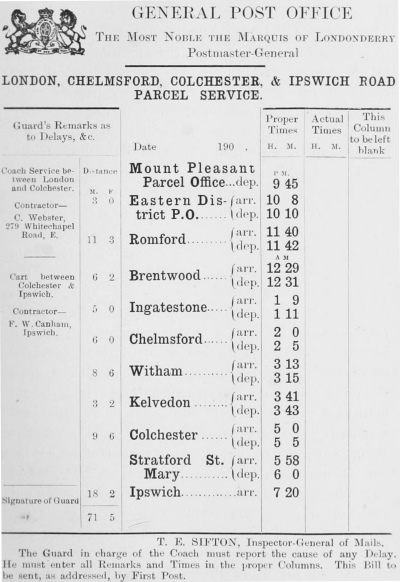
TIME-BILL OF THE CHELMSFORD, COLCHESTER AND IPSWICH
PARCEL MAIL.
GENERAL POST OFFICE
The Most Noble the Marquis of Londonderry
Postmaster-General
LONDON, CHELMSFORD, COLCHESTER, & IPSWICH ROAD
PARCEL SERVICE.
Guard's Remarks as
to Delays, &c. |
|
|
Proper
Times |
Actual
Times |
This Column
to be left blank |
|
|
|
Date |
190 . |
H. |
M. |
H. |
M. |
|
|
|
|
|
|
P.M. |
|
|
|
Coach Service
between London
and Colchester. |
Distance |
Mount Pleasant
Parcel Office |
dep. |
9 |
45 |
|
|
|
|
M. |
F. |
|
|
|
|
|
|
|
Contractor—
C. Webster,
279 Whitechapel
Road, E. |
3 |
0 |
Eastern District P.O. |
{arr. |
10 |
8 |
|
|
|
|
|
|
|
{dep. |
10 |
10 |
|
|
|
|
11 |
3 |
Romford |
{arr. |
11 |
40 |
|
|
|
|
|
|
|
{dep. |
11 |
42 |
|
|
|
|
|
|
|
|
A.M. |
|
|
|
|
6 |
2 |
Brentwood |
{arr. |
12 |
29 |
|
|
|
|
|
|
|
{dep. |
12 |
31 |
|
|
|
|
5 |
0 |
Ingatestone |
{arr. |
1 |
9 |
|
|
|
|
|
|
|
{dep. |
1 |
11 |
|
|
|
Cart between
Colchester &
Ipswich. |
|
|
|
|
|
|
|
|
|
|
6 |
0 |
Chelmsford |
{arr. |
2 |
0 |
|
|
|
|
|
|
|
{dep. |
2 |
5 |
|
|
|
Contractor—
F. W. Canham,
Ipswich. |
|
|
|
|
|
|
|
|
|
|
8 |
6 |
Witham |
{arr. |
3 |
13 |
|
|
|
|
|
|
|
{dep. |
3 |
15 |
|
|
|
|
3 |
2 |
Kelvedon |
{arr. |
3 |
41 |
|
|
|
|
|
|
|
{dep. |
3 |
43 |
|
|
|
|
9 |
6 |
Colchester |
{arr. |
5 |
0 |
|
|
|
|
|
|
|
{dep. |
5 |
5 |
|
|
|
|
|
|
Stratford St. Mary |
{arr. |
5 |
58 |
|
|
|
|
|
|
|
{dep. |
6 |
0 |
|
|
|
|
18 |
2 |
Ipswich |
arr. |
7 |
20 |
|
|
|
| Signature of Guard |
|
|
|
|
|
|
|
|
|
|
71 |
5 |
|
|
|
|
|
|
|
| |
|
|
|
|
|
|
|
|
|
T. E. SIFTON, Inspector-General of Mails.
The Guard in charge of the Coach must report the cause of any Delay.
He must enter all Remarks and Times in the proper Columns. This Bill
to be sent, as addressed, by First Post.
TIME-BILL OF THE CHELMSFORD, COLCHESTER AND IPSWICH
PARCEL MAIL.
The up service, starting with the mail-cart from
Ipswich at 7·9 p.m. and continued from Colchester
by four-horse van at 9·30 p.m., brings the country
parcels to Mount Pleasant at 4·30 a.m., throughout
the year. Up and down mails meet at Ingatestone
at 1·9 a.m. On this service, as on all others, the
vans go through, but the drivers and guards
exchange places; the London men changing on to
the van from Colchester at Ingatestone, and returning
to London; the Colchester men taking over the
down van and similarly returning whence they came.
It is a curious and unexpected revival of old
methods, but an entirely successful one. No highwayman
has ever attempted to "hold up" the
Parcel Mail, for the last of that trade has for
generations mouldered in his grave; but should
any amateurs essay to complete this revival of old
coaching days by waylaying the mail, the guards
would be found well armed. Their virgin steel and
untried pistols have for years been carried without
any excuse for using them; but there need be no
doubt that, were the occasion to arrive, they would
defend their parcels—the pounds of country butter,
the eggs, and wild flowers, or the miscellaneous
consignment from London—with their hearts' blood.
There are more romantic things in the world to die
for than postal parcels of eggs, cheese and butter,
but the ennobling word Duty might glorify such a
sacrifice for the sake of a pound's weight of "best
fresh," or a dozen of "new laid."
But although the possibility of attack is remote,
a spice of danger and romance savours the conduct
of the parcel mails.
The up Colchester Parcel Mail had a mishap
on the night of October 11, 1890, when, owing
to the prevailing fog, it was driven into a ditch
near Margaretting. Happily, both coachman and
guard escaped injury, the heavy vehicle resting
against the hedge. The coachman, mounting one
of his team, and hurrying back to Chelmsford,
succeeded in overtaking the down coach, which,
returning to the scene of the accident, unloaded
and transferred the parcels, and continued to London,
leaving the down mail to be forwarded with local
help. It eventually arrived at Colchester four hours
late.
XI
Coaching days, old and new, having now been
disposed of, we might set off down the road at
once, were it not that our steps are at once arrested
by the sight of the "Red Lion" Inn, at the corner
of Whitechapel Road and Leman Street, which,
together with the "Old Red Lion," adjoining, stands
on a site made historic by Dick Turpin's lurid career.
It was in the yard of the old house that Turpin
shot Matthew King in 1737. He had stolen a fine
horse belonging to a Mr Major, near the "Green
Man," Epping, and had been traced by means of
the animal to the inn, where he was found by the
Bow Street runners in company with Matthew
and Robert King, birds of like feather with himself.
The landlord endeavoured to arrest King,
who fired at him without effect, calling to Turpin,
"Dick! shoot him, or we are taken, by God!"
Turpin had his usual extensive armoury on
his person—three brace of pistols and a carbine
slung across his back. He fired, and shot Matthew
King, whether by accident or design is not known.
King first exclaimed, "Dick! you have shot me;
make off," but is said afterwards to have cursed
him as he went, for a coward. King died a week
later of his wounds, Turpin fleeing to a deserted
mansion in Essex, and thence to a cave in Epping
Forest. It is usually said that it was the more
famous Tom King who met so dramatic an end,
but original authorities give Matthew; and certainly
we find a Tom King, highwayman, decorously executed
at Tyburn eighteen years later.
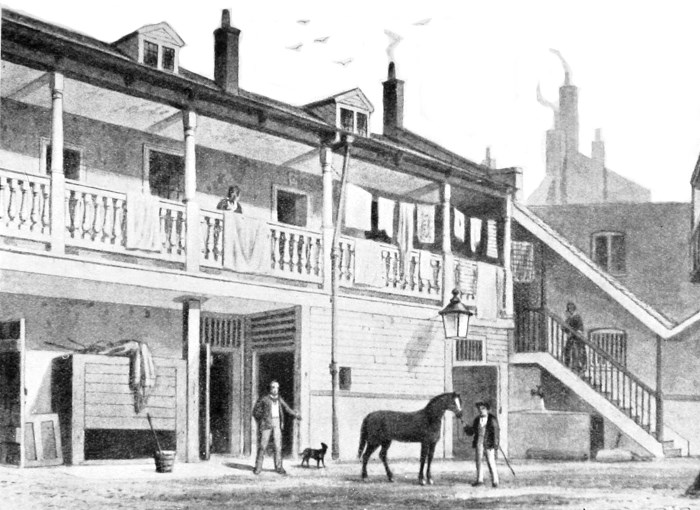
THE "OLD RED LION," WHITECHAPEL, WHERE TURPIN SHOT MATTHEW KING.
From a Drawing by T. Hosmer Shepherd, 1854.
We have met Turpin before, notably at York,
where he made an end, two years after this exploit.
This especial hero of the Penny Dreadful and the
romantic imagination of the average errand boy
belongs especially to this road, for he was an
Essex man, born at Hempstead in 1705. Apprenticed
to a Whitechapel butcher in his youth, he
commenced his career of low villainy by stealing
some cattle from a Plaistow farmer, and then
joined a band of smugglers and deer-stealers and
housebreakers in Epping Forest, where they set
up a storehouse of stolen goods in the cave just
mentioned. This band became so notorious that
a sum of fifty guineas was soon offered for their
arrest; but it was not until the amount had been
doubled that two of the ringleaders were caught
and hanged. The gang thus broken up, Turpin
was reduced to scouring the roads singly, and
pursued a solitary career until one dreary February
night in 1735, while patrolling the Cambridge Road,
he saw a horseman approaching through the mist.
At the time-honoured demand, "Your money or
your life!" the stranger simply laughed.
"What!" said he, "should dog eat dog? We
are of a like trade."
Thus Turpin and Tom King met, and struck up
a partnership. If only one quarter of the deeds
assigned to Turpin were true, his would be a very
gallant, as well as phenomenally busy, figure on
the roads of England. Although by no means a
mythical person, the stories told of him nearly all
belong to the regions of romance, and his true
history shows him to have had few redeeming
qualities. Many of the old knights of the road
were courageous, and hand in hand with their
courage went a humour not seldom kindly; but
Turpin was a bloodthirsty ruffian whose courage
is not an established fact, and whose humour, like
the "tender mercies of the wicked," was cruel, not
to say ferocious. It is quite hopeless to attempt
to finally destroy the great Turpin myth after
this lapse of time: Harrison Ainsworth's romance
has enjoyed too great and too long a popularity
for that; but let the attempt here be made to paint
him as the cowardly ruffian he was.
Whitechapel, quite apart from memories of
Turpin, owns an unenviable repute, and its very
name is a synonym for villainy. Its bad savour,
however, goes back no greater distance in time
than the first half of the eighteenth century, for
until that period it was not built upon, and indeed
"Whitechapel Common" was spoken of so late as
1761, maps proving the old church to have been
quite rural at that date. Originally a chapel-of-ease
to the great mother-parish of Stepney, the
district was erected into a separate parish so far
back as the fourteenth century and the original
"white chapel"—doubtless so called from its
mediæval coats of whitewash—made a church.
But old names cling, and although it has been a
church for over six hundred years, it has not been
able to confer its more dignified title upon the parish
itself. Thus the name of Whitechapel is doubly
misleading nowadays, for it is no longer a chapelry
and its stately church is in red brick; so that there
is some force in the argument for re-christening the
borough and dignifying it by a revival of the old
name of Eastminster, owned by that not very
fortunate Abbey of St Mary Grace, founded by
Edward the Third in 1348, which formerly stood
on the site of the Royal Mint.
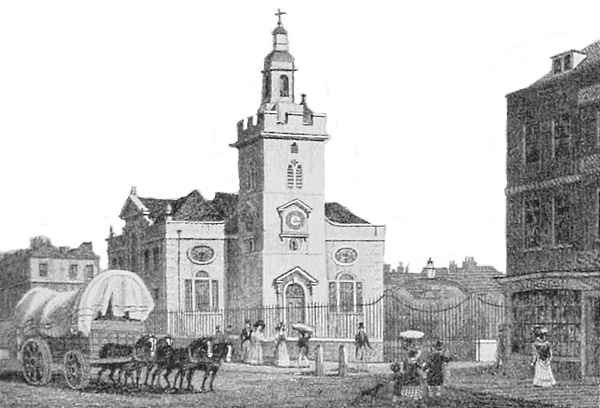
WHITECHAPEL OLD CHURCH.
St Mary's, Whitechapel, is a beautiful church,
built in 1877, burnt August 20, 1880, and since
restored. It replaced the ugly old building, which
was "taken down for the simple reason that it
would not stand up." The ancient wrangling over
its full title of St Mary Matfelon is not yet done,
and rash would be he who voted for any particular
one among the rival derivatives of the name.
Matfelon, holds one school, was the name of a
forgotten benefactor, whose particular benefactions
are not stated. Who, then, would found, since
benefits are thus forgot? "Mariæ, matri et filio,"
an ancient dedication, say others; while yet different
parties find its source in a Syriac word meaning
"mother of a son" = the Virgin Mary. Perhaps the
most entertaining legend, however, is that which
tells how it originated in the killing of a murderer,
in 1429, by the women of Whitechapel. "Between
Estren and Witsontyd, a fals Breton mordred a
wydewe in here bed, the which find hym for almasse
withought Algate, in the suburbes of London, and
bar away alle that sche hadde, and afterwards he
toke socour of Holy Chirche in Suthwark; but
at the last he took the crosse and forswore the
kynge's land; and as he went hys waye, it happyd
hym to come be the same place where he had don
that cursed dede, and women of the same parysh
comen out with stones and canell dong, and ther
maden an ende of hym in the hyghe strete." These
things seem quite in keeping with Whitechapel's
evil fame.
The old church, as it stood until well into the
nineteenth century, is shown opposite this page,
with one of the old road-waggons crawling past.
In another view of the same date the High Street
itself is seen, its long perspective fully bearing out
the old description of spaciousness. At the same
time, it is seen to be empty enough to resemble the
street of a provincial town. The houses are exceedingly
old, the road paved with knobbly stones, and
the shop windows artfully constructed with the
apparent object of obstructing instead of admitting
the light. Very few of these old shop-fronts are
now left, but a good specimen is that of a bell-founding
firm at No. 34 Whitechapel Road.
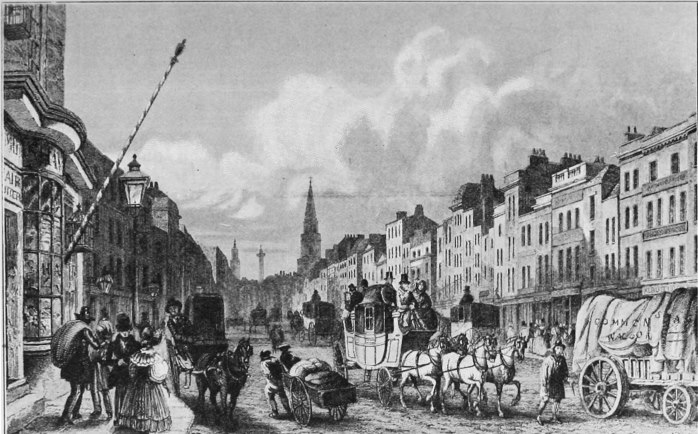
WHITECHAPEL ROAD IN THE COACHING AGE.
This old picture has long ceased to be representative
of Whitechapel's everyday aspect. The
coach has long ago whirled away into limbo, the
elegantly-dressed groups have been gathered to
Abraham's, or another's, bosom, and Whitechapel
knows their kind no more. Bustle, and a dismal
overcrowding of carts, waggons, costermongers'
barrows, tram-cars and omnibuses are more characteristic
of to-day. Also, the Jewish element is very
pronounced; chiefly foreign Jews, inconceivably
dirty. Many of the shop-fronts bear the names
of Cohen, Abraham, Solomon and the like, and
others ending in "baum," or "heim." But on
Tuesdays and Thursdays of every week the spacious
street regains something of its old rural character,
in the open-air hay and straw market held here, the
largest in the kingdom. It fills the broad thoroughfare
and overflows into the side streets: the
countrymen who have come up on the great
waggons by road from remote parts of Essex
lounging picturesquely against the sweet-smelling
hay or straw, attending to their horses, or refreshing
in the old taverns. It is Arcady come again. The
eyes are gladdened by the long vista of the hay-wains,
and the nose gratefully inhales the rustic
scent of their heaped-up loads. It is true that
Central Londoners also have their so-called Haymarket,
but hay is the least likely of articles to
be purchased there in these days.
What do they think, those countrymen, of the
Whitechapel folks, the "chickaleary blokes," used,
as a writer in the middle of the nineteenth century
remarked, to "all sorts of high and low villainy,"
from robbery with violence to "prigging a wipe,"
and the selling of painted sparrows for canaries?
Nor was Whitechapel a desirable place when Mr
Pickwick travelled to Ipswich. "Not a wery nice
neighbourhood," said Sam, as they rumbled along the
crowded and filthy street. "It's a wery remarkable
circumstance," he continued, "that poverty and
oysters go together.... The poorer a place is,
the greater call there seems to be for oysters....
An oyster-stall to every half-dozen houses. The
street's lined vith 'em. Blessed if I don't think
that ven a man's wery poor, he rushes out of his
lodgings and eats oysters in regular desperation."
Sam was a keen observer; but there is now a deeper
depth than oysters. Periwinkles and poverty;
whelks and villainy foregather in Whitechapel at
the dawn of the Twentieth Century.
But the poverty and the villainy of Whitechapel
must not be too greatly insisted upon. They may
easily be overdone. Loyal hearts and brave lives—all
the braver that they are not flaunted in the face
of the world—exist in the cheerless and unromantic
grey streets that lead off the main road. The
domestic virtues flourish here as well as—if not
better than—in the West End. The heroes and
heroines of everyday life—the greater in their
heroism that they do not know of it—live in
hundreds of thousands in the dingy and unrelieved
dulness of the streets to right and left of Whitechapel
Road and of the Mile End Road, that go with
so majestic a breadth and purposeful directness to
Bow.
XII
Let the Londoner who has never been "down East,"
and so is given to speaking contemptuously of it,
take a journey down the Whitechapel and Mile End
Roads, and see with what an astonishing width, both
in respect of roadway and foot-pavements, those
noble thoroughfares are endowed. The London he
has already known owns no streets so wide, save
only in the isolated and unimportant instance of
Langham Place; while, although it cannot be said
that, taken individually, the houses of the great
East-End thoroughfares are at all picturesque, yet
there is a certain interesting quality in the roads as a
whole, lacking elsewhere. This, doubtless, is partly
explained by the strangeness of the East-ender's garb,
and partly by the many Jewish and other foreigners
who throng the pavements.
A strangely-named public-house—the "Grave
Maurice"—is one of the landmarks of the Whitechapel
Road. Many have set themselves the task
of finding the origin of that sign and its meaning;
but their efforts have been baulked by the very
multiplicity of historic Maurices, grave or otherwise.
The sign may originally have been the "Graf Maurice,"
Prince Maurice of Bohemia, brother of the better-known
Prince Rupert, the dashing cavalier, but a
difficulty arises from the fact that there was another
"Graf Maurice" at the same time, in the person
of the equally well-known Prince Maurice of Nassau,
who died of grief when the Spanish overran Holland
and besieged Breda. Nor does the uncertainty end
here, for Dekker uses the expression "grave maurice"
in one of his plays, written at least thirty years
before the time of those princes, in a passage which
reads as though it were the usual nickname at that
period for an officer.
Beyond the house owning this perplexing sign
we come to the beginning of the Mile End Road,
one mile, as its name implies, from Aldgate, and
for long the site of a turnpike-gate, only removed
with the close of the Coaching Age. Rowlandson
has left us an excellent view of Mile End Turnpike
as it was in his time; with isolated blocks of houses,
groups of rustic cottages and a background of trees,
to show how rural were the surroundings towards
the close of the eighteenth century; while maps
of that period mark the road onwards, bordered by
fields, with "Ducking Pond Row" standing solitary
and the ducking-pond itself close behind, where the
scolds and shrews of that age were soused.
The Ducking-Pond as an institution is as obsolete
as the rack, the thumb-screw, and other ingenious
devices of the "good old times"; but most towns
a hundred years ago still kept a cucking or ducking-stool;
while, if they had no official pond for the
purpose, any dirty pool would serve, and the dirtier
it were the better it was esteemed.
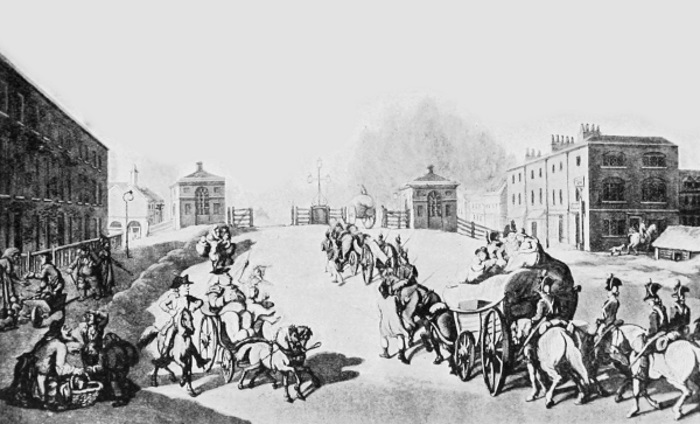
MILE END TURNPIKE, 1813. After Rowlandson.
"The Way of punishing scolding Women is
pleasant enough," says an old traveller. "They
fasten an Arm Chair to the End of two Beams, twelve
or fifteen Foot long, and parallel to each other: so
that these two Pieces of Wood, with their two Ends
embrace the Chair, which hangs between them on a
sort of Axel; by which Means it plays freely, and
always remains in the natural horizontal Position in
which a Chair should be, that a Person may sit conveniently
in it, whether you raise it or let it down.
They set up a Post upon the Bank of a Pond or River,
and over this Post they lay, almost in Equilibrio, the
two Pieces of Wood, at one End of which the Chair
hangs just over the Water. They place the Woman in
the Chair, and so plunge her into the Water as often
as the Sentence directs, in order to cool her immoderate
Heat."
One has only to go and look at the average rural
pond to imagine the horrors of this punishment.
The stagnant water, the slimy mud, the clinging
green duckwood, common to them, must have made
a ducking the event of a lifetime.
The difference here, at Mile End, between those
times and these is emphasised by the close-packed
streets on either side, and by the crowded tram-cars
that ply back and forth.
Yet there are survivals. Here, for instance, in
the little old-fashioned weather-boarded "Vine" Inn
that stands by itself, in advance of the frontage of
the houses, and takes up a goodly portion of the
broad pavement, we see a relic of the time when
land was not so valuable as now; when local
authorities were easy-going, and when anyone who
had the impudence to squat down upon the public
paths could do so, and, remaining there undisturbed
for a period of twenty-one years, could thus derive
a legal title to the freehold. Here, then, is an explanation
of the existence of the "Vine" in this
position.
Close by are the quaint Trinity Almshouses,
built in 1695, for the housing of old skippers and
shellbacks. Wren designed the queer little houses
and the chapel that still faces the grassy quadrangle
where the old salts walk and gossip unconcernedly
while the curious passers-by linger to gaze at them
from the pavement, as though they were some strange
kind of animal. Nothing so curious outside the
pages of fiction as this quiet haven in midst of
the roaring streets, screened from them by walls
and gates of curious architecture surmounted by
models of the gallant old galleons that have long
ceased to rove the raging main. It is a spot
alien from its surroundings, frowned down upon by
the towering breweries, which indeed would have
bought the old place and destroyed it a few years
ago, but for the indignation aroused when the proposal
of the governing body of the almshouses to
sell became known.
There is nothing else to detain the explorer
on his way into Essex. The People's Palace, it
is true, is a remarkable place, the result of Sir
Walter Besant's dream of a resort for those of the
East who would get culture and find recreation,
but it is a dream realised as an architectural nightmare,
and is a very terrible example of what is
done to this unhappy quarter in the names of Art
and Philanthropy.
XIII
At last, by this broadest of broad roads, we come
to Stratford-le-Bow and its parish church. In these
hurried times, and for some centuries past, the
old hyphenated place-name has been dropped, and
as "Bow" alone it is familiar to all East-enders.
The place is nowadays chiefly associated with Bryant
& May and matches, but there yet remain many
old Queen Anne, and even earlier, mansions by
the roadside, telling of days long before "patent
safeties" were thought of, and when flint and steel
and timber were the sole means of obtaining a light.
"Bow," says the Ambulator of 1774, "is a
village a little to the east of Mile End, inhabited
by many whitsters and scarlet dyers. Here has
been set up a large manufactory of porcelain, little
inferior to that of Chelsea." That description is
now somewhat out of date. The manufactory of
porcelain has long disappeared and Bow china is
scarce, and treasured accordingly. Whitsters—that
is to say, bleachers of linen—and scarlet dyers, also,
are to seek.
Bow Church confronts the eastward-bound
traveller in bold and rugged fashion; its time-worn
tower standing midway of the road and
challenging, as it were, the crossing of the little
River Lea, just beyond, to Stratford and into Essex.
Church and churchyard split the road up into
two channels and thus destroy its width, which it
never afterwards regains until the suburbs are
passed and the open country reached. A modern
touch here is the bronze statue of Gladstone, in
advance of the church, facing westwards in declamatory
attitude from its granite pedestal, and
erected in his lifetime; recalling the fervent hero-worshipping
days of the "People's William." The
outstretched hand is oddly crooked. Few be them
that see statues raised to themselves, unless indeed
they be made of finer clay than most mortals,
kings and princes, and the like. Of recent years
this bronze Gladstone has, in our vulgar way, been
made to preside, as it were, over an underground
public convenience, from whose too obtrusive midst
he rises, absurdly eloquent.
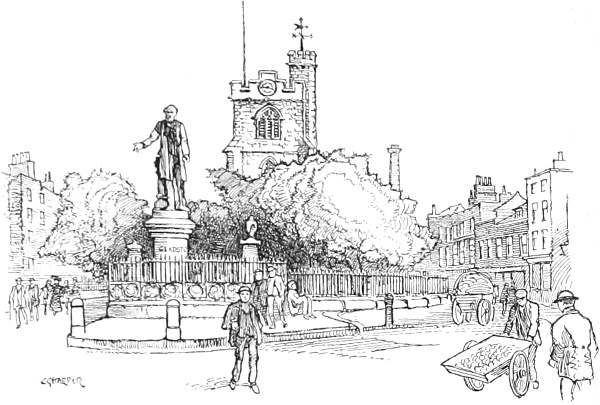
BOW.
Just how Stratford-le-Bow received its name
is an interesting piece of history. Both here
and at the neighbouring Old Ford the Lea was
anciently crossed by a paved stone ford of
Roman construction, continuing the highway into
Essex; but when that river's many channels,
swollen by winter's rains, rolled in freshets toward
the Thames, the low-lying lands of what we
now call Hackney and West Ham marshes were for
long distances converted into a sluggish lake. For
months together the approaches to the Lea were lost
in floods, and the real channels of the river became
so deep that those who valued their lives and goods
dared not attempt the passage. To the aid of poor
travellers thus waterlogged came the good and pious
Queen Matilda, consort of Henry the First. "Having
herself been well washed in the water," as old
Leland says, she fully appreciated the necessity
for bridges, and accordingly directed the raising
of a causeway on either side of the Lea and the
building of two stone structures, of which one was
the original "Bow" Bridge; "a rare piece of work,
for before that time the like had never been seen
in England." It seems to have been the stone
arch that gave its name of "Bow," and if an arched
stone bridge was so remarkable in those times that
it should thus derive a name for its semi-circular,
or "bow" shape, it must have been either the
first, or among the earliest, of stone bridges
built, in times when others were constructed of
timber.
The original name of the village that afterwards
sprang up here, on the hither or Middlesex shore,
was thus singularly contradictory; meaning "the
street ford at the arched bridge." The Stratford
on the Essex side was in those days known as
Stratford Langthorne.
The good queen not only built the bridges and
causeways, but endowed them with land and a
water-mill, conveying those properties to the Abbess
of Barking, burdened with a perpetual charge for
the maintenance of the works. Having done all
this, she died. Some years afterwards a Cistercian
monastery was founded close by, where the Abbey
Mills now stand, and the then Abbess of Barking,
of opinion that the Abbot of that house, being near,
would find it easier to look after the bridges than
herself, reconveyed the property, together with its
obligations, to him. The trust was kept for a time
and then delegated to a certain Godfrey Pratt, who
had a house built for him on the causeway and
enjoyed an annual grant, in consideration of keeping
the works in repair. Pratt did so well with his
annual stipend and the alms given him by wayfarers
that the Abbot at length discontinued the
grant. Accordingly, the wily Pratt set up a quite
unauthorised toll-bar and levied "pontage" on all
except the rich, of whom he was afraid. This went
on for many years, until the scandal grew too great,
and, in consequence of an inquisition held, the Abbot
dispossessed Godfrey Pratt of his toll-bar and
resumed the control himself.
Meanwhile, no repairs had been effected, and the
road had been so greatly worn down that the feet
of travellers and those of the horses often went
through the arches. Bow Bridge had, consequently,
to undergo an extensive cobbling process; a treatment,
by the way, continued through the centuries
until 1835, when it was finally pulled down.
In its last state it was a nondescript patchwork
of all ages. The property for its maintenance had,
of course, been lost in the confiscation of monastic
estates under Henry the Eighth, and its repair afterwards
fell upon the local authorities, who always
preferred to patch and tinker it so long as such a
course was possible. On February 14, 1839, the
existing bridge was opened, crossing the Lea in one
seventy-foot span, in place of the old three arches.
XIV
"Farewell, Bowe, have over the bridge, where, I
heard say, honest Conscience was once drowned."
Thus says Will Kemp, in his Nine Days'
Wonder, the account of a dance he jigged from
London to Norwich in so many days, in 1600. It
is hopeless to recover the meaning hidden in that
old joke about the drowning of conscience here, and
so we will also without delay "have over" the
modern bridge of Bow and into Essex, past dingy
flour mills, and crossing another branch of the Lea
by Channelsea Bridge, come to Stratford.
Here, then, begins the county of calves, according
to the popular jest that to be a native of Essex is
to be an "Essex Calf." It is not generally regarded
as a complimentary title, for of all young animals
the calf is probably the clumsiest and most awkward.
To this day in rural England the contemptuous
exclamation "you great calf!" is used of an awkward,
overgrown boy tied to his mother's apron-strings.
Yet, if we may believe a seventeenth-century writer
on this subject, the nickname had a complimentary
origin, "for," said he, "this county produceth calves
of the fattest, fairest and finest flesh in England."
We have already seen that the French spoken at
Stratford-le-Bow in Chaucer's time was a scoff and a
derision. To-day, neither on the Middlesex nor the
Essex shores of the Lea is the teaching of languages
either a matter for praise or contempt. Mills of
every kind, the making of matches that strike only
on the box, the varied work of the Stratford and
West Ham factories, fully occupy the vast populations
close at hand; while the business of covering the
potato-fields, the celery-beds and the grounds of the
old suburban mansions with endless rows of suburban
dwellings is engrossing attention down the road.
Stratford and Maryland Point are now strictly urban,
and Ilford far greater in these days than it ever was
when its "great" prefix was never pretermitted.
London, indeed, stretches far out along this road,
and the country is reached only after many miles of
that debatable land which belongs neither to country
nor town. Heralds of the great metropolis appear
to the London-bound traveller while he is yet far
away, and even so far distant as Chelmsford "the
dim presentiment of some vast capital," as De
Quincey remarks, "reaches you obscurely like a
misgiving."
Stratford has not improved since coaches left
the road. It has grown greatly, and grown dirty,
squalid and extremely trying to noses that have
not been acclimatised to bone-boiling works, manure
factories and other odoriferous industries. But it
is a place of great enterprises and great and
useful markets, and when its introductory mean
streets are passed, the Broadway, where the Leytonstone
Road branches off to the left, looks by
contrast quite noble. This brings one to Upton
Park, Forest Gate, Woodgrange and Manor Park
in succession, past a building which, whether as an
institution or an example of beautiful architecture,
would well grace the West. The West Ham Public
Library and Technical Institute is here referred
to. "Irish Row," on the way, marked on old
maps, is a reference to old wayside cottages inhabited
until recent years by a turbulent colony
of London-Irish market-gardening labourers, subsidised
by Mrs Nelson in times of coaching competition
to impede hated rivals as they came past
the "Rising Sun" at what is now the suburb of
Manor Park; a house which, like the "Coach
and Horses" at Upton, has declined from a
legitimate coaching trade to something more in
the gin-palace sort. This is not to say that the
staid and decorous Mrs Nelson entered into direct
negotiations with the Mikes and Patseys of Irish
Row, but when the rival Ipswich "Umpire" or
the "New Colchester" coaches developed much
sporting competition and their coachmen evinced
a dogged determination to be first over Bow
Bridge on the way up to London, and, by consequence,
the first to arrive at their destination,
why, an obscure hint or two on the part of one
of her numerous staff, accompanied by the wherewithal
for a drink, produced wonders in the way
of highway obstruction. But such recollections
are become unsubstantial as the fabric of which
dreams are made, and fade before the apparitions
of tramways and interminable rows of suburban
shops that conduct to Ilford Bridge.
Great Ilford lies on the other side of the
sullen Roding, that rolls a muddy tide in aimless
loops to lazily join the Thames at Barking
Reach. The townlet has from time immemorial
been approached by a bridge replacing the "eald,"
or old, ford, whence its name derives and not
from that crossing of the stream being an "ill"
ford, as imaginative, but uninstructed, historians
would have us believe; although the slimy black
mud of the river-bed would nowadays make the
exercise of fording an ill enough enterprise.
Ilford is now in the throes of development and is
fast losing all individuality and becoming a mere
suburb. Let us leave it for places less sophisticated.
The morris-dancing Will Kemp of 1600, leaving
Ilford by moonshine, set forward "dauncing
within a quarter of a mile of Romford, where two
strong Jades were beating and byting either of
other." We take this to mean two women fighting
on the road, until the context is reached, where
he says that their hooves formed an arch over
him and that he narrowly escaped being kicked
on the head. It then becomes evident that he is
talking of horses.
Leaving the centre of Great Ilford behind, and
in more decorous fashion than that of Will Kemp,
we come, past an inn oddly named the "Cauliflower"—probably
as a subtle compliment to the
abounding market-gardens of the neighbourhood—to
the long, straight perspective of the road
across Chadwell Heath. Unnumbered acres of
new suburban "villa" streets now cover the
waste on either side, so that the beginnings of
the plain are not so much heath as modern
suburb, created by the Great Eastern Railway's
suburban stations and by the far-reaching enterprises
of land corporations, which here carry on
the usual speculations of the speculative builder
on a gigantic scale. In acre upon acre of closely-packed
streets, each one with a horrible similarity
to its neighbour, thousands of the weekly wage-earning
clerks, mechanics and artisans of mighty
London live and lose their individuality, and
pay rent to limited companies. Where the highwayman
of a century ago waited impatiently behind
the ragged thickets and storm-tossed thorn trees of
Chadwell Heath for the traveller, there now rises
the modern township of Seven Kings, and midway
between Ilford station and that of Chadwell
Heath, the recent enormous growth of population
on this sometime waste has led to the erection of
the new stations of "Seven Kings" and "Goodmayes,"
while widened lines have been provided
for the increased train services. "Seven Kings"
is a romantic name, but who those monarchs
were, and what they were ever doing on the
Heath, which of old was a place more remarkable
for cracked skulls than for crowned heads, is
impossible to say. Many wits have been at work
on the problem, but have been baffled. The
natural assumption is that at this spot, marked
on old maps as "Seven Kings Watering," the
seven monarchs of the Heptarchy met. History, unhappily
records no such meeting, but there was
no Court Circular in those times, and so many
royal foregatherings must have gone unremarked,
except locally and in some fashion similar to this.
So let us assume the kings met here and watered
their horses at the "watering," which was a place
where a little stream crossed the road in a watersplash.
The stream still crosses the highway, but
civilisation has put it in a pipe and tucked it
away underground.
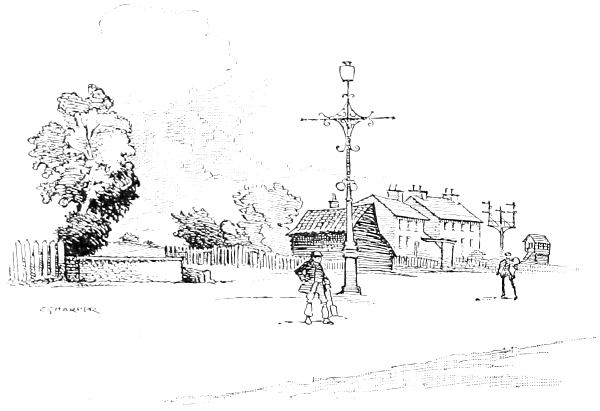
SEVEN KINGS.
A lane running across the Great Eastern Railway
at this point, known as Stoup Lane ("stoup"
meaning a boundary-post) marks the boundary of
the Ilford and Chadwell wards of Barking parish.
Here it was, in 1794, on a night of December,
that a King's messenger, James Martin by name,
was shot by five footpads. The register of St
Edmund's, Romford, records the burial of this
unfortunate man on the 14th of that month.
Let us not, however, in view of the more or less
grisly dangers that still await belated wayfarers on
this road, enlarge too greatly on the lawlessness of
old times; for the homeward-bound resident making
for his domestic hearth in these new-risen suburbs
towards the stroke of ten o'clock is not infrequently
startled by the sinister figure of a footpad springing
from the ragged hedges of Chadwell Heath and demanding—not
his money or his life, as in the old
formula, but—a halfpenny! This invariable demand
of the nocturnal Chadwell Heath footpads, which
argues a pitiful lack of invention on their part, is
for half the price of a drink.
"You haven't got a ha'p'ny about you, guv'nor?"
asks the threatening tramp.
"No," says the peaceful citizen, anxiously scanning
the long perspective of the road for the policeman
who ought to be within sight—but is not;
"w-what do you want a halfpenny for?"
"I've walked all the way from Romford and only
got half the price of a glass o' beer," says the rascal.
The citizen is astonished and incredulous, and his
astonishment gets the better of his fear. "Oh, come
now," he rejoins, "no one walks three miles from
Romford for a glass of beer; besides, all the houses
here close at ten o'clock."
"Oh, they do, do they?" replies the tramp,
offensively. "'Ere, my mate Bill'll talk to you,"
and, whistling, the ominous bulk of Bill emerges
aggressively from the darkling hedge, and together
they proceed to wipe the road with that respectable
ratepayer, and, rifling his pockets, leave him, bruised
and bleeding, to reflect on the blessings of civilisation
and to be thankful that he was not born a
hundred years ago, when he might have been shot
dead instead of being felled to the ground by the
half-brick in a handkerchief which he finds beside
him and takes home as a trophy.
Chadwell Street, a wayside hamlet, conducts past
Beacontree Heath, on the right, to an open country
of disconsolate-looking contorted elms and battered
windmills, telling even in the noontide heats and
still airs of summer of the winter winds that race
across the watery flats of Rippleside and Dagenham
Marshes, out of the shivering east. Lonely, until
quite recent times, stood "Whalebone House,"
beside the road, the two whalebones that even yet
surmount its garden entrance the wonderment for
more than two hundred years of chance travellers.
Legends tell that they are relics of a whale stranded
in the Thames in the year of Oliver Cromwell's
death, and set up here in memory of him. However
that may be, they certainly were here in 1698, when
Ogilby's Britannia was published, for the house is
marked on his map as "Ye Whalebone."
These "rude ribs," it may shrewdly be suspected,
have little longer yet to remain, for though apparently
proof against decay, the house and grounds
are, like those of the surrounding properties, for sale
to the builders.
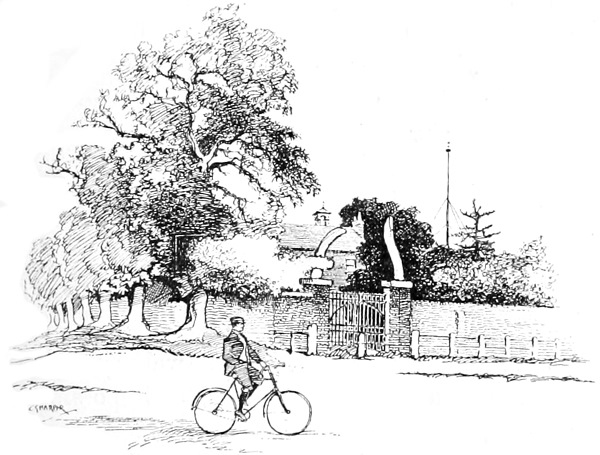
WHALEBONE HOUSE.
The sole historic or other vestige remaining of
the "Whalebone" turnpike-gate, once standing
here, is an account to be found in the newspapers
of the time of an attack made upon George Smith,
the toll-keeper, on a night in 1829. He was roused
in the darkness by a voice calling "Gate!" and, going
to open it, was instantly knocked down, in a manner
somewhat similar to the treatment accorded the hero
of that touching nursery rhyme, who tells how:—
"Last night and the night before,
Three tom-cats came knocking at my door.
I went down to let them in,
And they knocked me down with a rolling-pin."
The two men who felled the unfortunate George
Smith, alarmed by his cries of "Murder!" threatened
to shoot him if he were not quiet, and, going over his
pockets, were rewarded by a find of twenty-five
shillings. While they were thus engaged in sorting
him over, a third confederate, ransacking the house,
discovered three pounds. With this booty and a
parting kick, they left their victim, and disappeared
as silently as they came.
XV
Romford, now approached, is but twelve miles from
London, and has frankly given up the impossible and
ceased all pretence of being provincial. At the same
time, building-land having only just (in the speculator's
phrase) become "ripe for development," the
townlet has not yet lost all individuality in suburban
extension.
The place, say some antiquaries, derives its name
from the "Roman ford" on the Rom brook, but it is
a great deal more likely that the origin is identical
with that of the first syllable in the names of Ramsgate,
Ramsey and Romney, and comes from the Anglo-Saxon
"ruim" = a marsh. Time was when the town
was celebrated for its manufacture of breeches; an
industry which gave rise to a saying still current in
the less polished nooks and corners of Essex—"Go
to Romford and get your backsides new bottomed."
Breeches have long ceased to be a noted product of
the town, which for many years past has bulked large
in the annals of Beer. Barricades, avenues, mountains
and Alpine ranges of barrels, hogsheads, firkins
and kilderkins of Romford ale and stout proclaim
that the Englishman's preference for his "national
drink" has not abated, and that
"Damn his eyes, whoever tries
To rob a poor man of his beer"
is still a popular sentiment; as both the brewers of
arsenical compounds and the more rabid among teetotallers
are some day likely to discover.
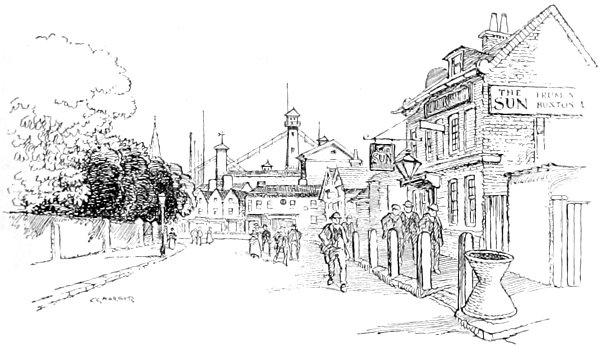
ENTRANCE TO ROMFORD.
A French traveller in England some two hundred
years ago wrote that "there are a hundred sorts of
Beer made in England, and some are not bad: Art
has well supplied Nature in this particular. Be that
as it will, beer is Art and wine is Nature; I am for
Nature against the world." That old fellow did not
know how artful beer could be, and if he could re-visit
his native France might discover that even wine is no
longer the simple child of nature it once was.
But although John Barleycorn is the tutelary
deity of Romford, it is quite conceivable that the
stranger bound for Norwich, and turning neither to
right nor to left, might pass through the town without
so much as a glimpse obtained of those Alpine
ranges aforesaid. True, on entering Romford, he
could scarce fail to observe certain weird structures
ahead: odd towers like first cousins to lighthouses,
springing into the sky line, with ranges of perpendicular
pipes, like the disjointed fragments of some
mammoth organ, beside them, the characteristic signs
and portents of a great brewery; but the barrels are
secluded, nor even are Romford's streets blocked, as
might have been suspected, with brewers' drays.
Romford, indeed, spells to the uninstructed stranger
rather bullocks than beer; for the cattle-pens are the
chief feature of its market-place, and sheep and hay
and straw bulk more in the eye of the road-farer than
the products of Ind, Coope & Co., which are to be
seen in all their vastness beside the railway station
and on the sidings constructed especially for the
trade in ale and stout.
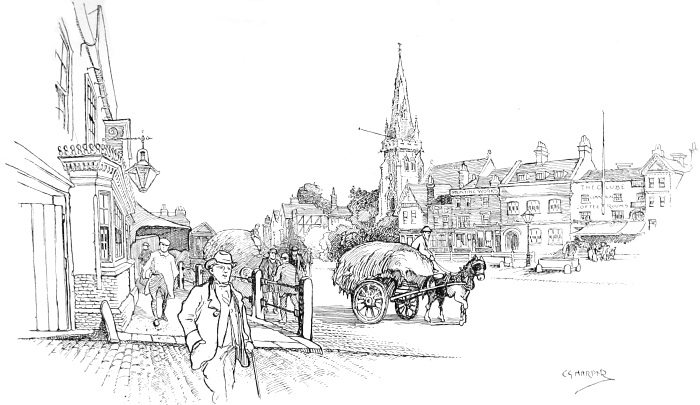
ROMFORD.
The town in its most characteristic aspect is seen
in the accompanying illustration taken from the doorway
of that old inn, the "Windmill and Bells," the
broad road margined with granite setts and the
pavements fenced with posts and rails; the re-built
parish church prominent across the market-place.
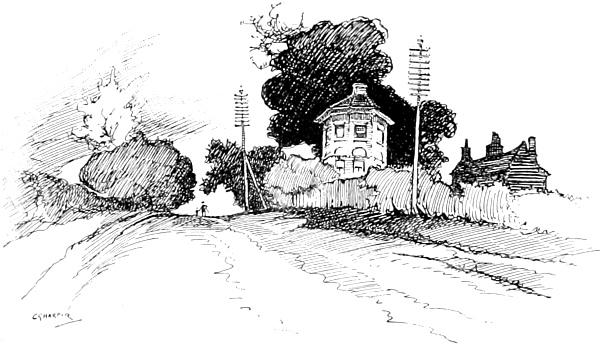
OLD TOLL-HOUSE, PUTTELS BRIDGE.
Beyond Romford the road grows rural, and, by
the same token, hilly. This, gentle reader, let it not
be forgotten, is Essex, and we all know with what
persistence that county is spoken of, and written of,
as flat. If you would know what flatness is, try the
Great North Road and its long levels between Baldock,
Biggleswade and Alconbury, or search Bedfordshire,
Lincolnshire or Hunts. There is flatness,
beside which that of Essex is the merest superstition,
started probably by some tired traveller of inconstant
purpose, who, essaying to explore the county, gave
up the enterprise when he had reached Wanstead
Flats. Surveying that not highly romantic expanse,
he took it as an exemplar of the rest of the shire, and
so returned home to start this immortal myth on its
career. Certainly no cyclist who knows his Essex
will subscribe to its flatness as an article of faith, and
as such an one cycles from Romford, through the
hamlet of Hare Street, over Puttels Bridge, where
stands an old toll-house, to the other hamlet of Brook
Street, the fact that he will actually have to walk his
machine up the steep hill that conducts into the town
of Brentwood will cause him to think hard things of
myth-makers.
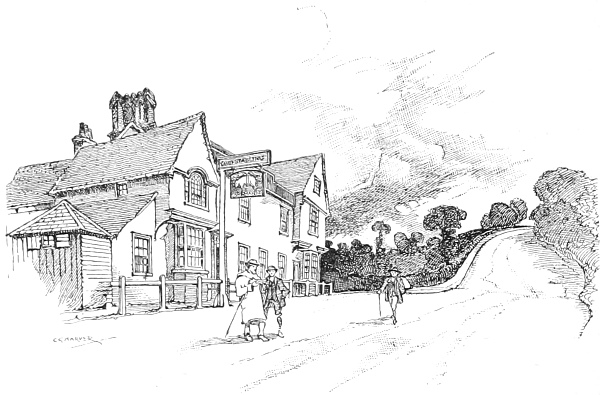
THE "FLEECE," BROOK STREET.
Brook Street Hill is the name of this eminence.
Beside it stands a cemetery, convenient for brakeless
cyclists who recklessly descend, and at its foot is a
fine old inn, the "Fleece," a house of call for the fish-waggons
that were once so great a feature of this
road so far as Colchester and Harwich.
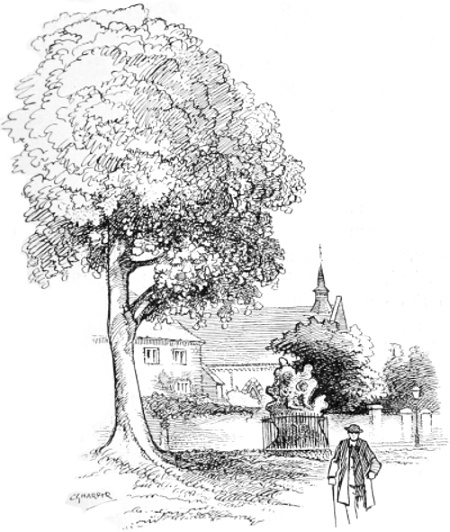
THE MARTYR'S TREE, BRENTWOOD.
Brentwood, on the crest of this hill, occupies an
elevated table-land, with sharp descents from it on
every side. The "burnt wood" town, destroyed in
some forgotten conflagration, is now a long-streeted,
old-fashioned place, apparently in no haste
to bid good-bye to the past. It keeps the old Assize
House of Queen Elizabeth's time in repair, and
carefully sees to it that the Martyr's Tree, decayed
though the old elm stump be and hollow, is saved
from perishing altogether. It was in 1555 that
William Hunter, in his twentieth year, suffered in
this place for denying the doctrine of transubstantiation.
That staunch upholder of the Protestant faith
scarce needed the modern memorial, close by, while
this shattered trunk remained, its gaping rents
carefully bricked up by pious hands; but let the
venerable relic be doubly safe-guarded in these times,
when that candle lit by Latimer and Ridley, close
upon three centuries and a half ago, burns dim, and
lawless and forsworn clergy within the Church of
England are working towards Rome and the return
of the famous days of fire and stake; when the blood
of the martyrs has ceased to inspire a generation
which demands to be shown some tangible object
before it can realise the significance of that sacrifice.
Here, then, is something that can be seen and
touched, to bring the least imaginative back in fancy
to those terrible days, when brave hearts of every
class gave up their lives in fire and smoke rather
than abjure their faith. The Romanising clergy of
to-day are made of coarser fabric than the martyrs.
They are not actuated by honesty, but take oaths
they have no intention of observing to a Church
whose bread they eat and whose trust they betray.
Would you know something of that martyrdom
at Brentwood? Then scan the inscription on the
modern granite obelisk, and control, if you can, a
righteous indignation when you perceive a modern
Roman Catholic chapel standing, impudent in these
days of an exaggerated tolerance, over against the
Martyr's Tree itself, typifying the Scarlet Woman
in midst of her blasphemies, exultant over the blood
of the saints. "He being dead yet speaketh,"
quotes that inscription; but what avails it to speak
in the ears of the deaf, or to talk of honour to the
perjured? "Learn from his example," continue
those momentous words, "to value the privilege of
an open Bible, and be careful to maintain it"; but
the world goes by unheeding, and only when the
danger again becomes acute and liberty of conscience
is passing away will indifference be conquered and
the folly of it revealed.
XVI
Brentwood still keeps a notable relic of coaching
days in the old "White Hart" Inn, a curious
specimen of the timbered and galleried type of
hostelry familiar to our great-grandfathers. It turns
a long plastered front to the street, but the great
carved and panelled doorway leading into the coach-yard
confirms the proud legend, "Established 1480."
Full forty coaches passed through Brentwood in
every twenty-four hours at the close of the Coaching
Age, but the earlier days of coaching brought the
"White Hart" more custom than came to it at the
close of that era, when, in consequence of the roads
being improved, travelling was quicker, and places
once halted at were left behind without stopping.
Innkeepers were considerable losers by this constant
acceleration of coaches, and saw the smart, long-distance
stages go dashing by where, years before,
the old slow coaches stayed the night, or, at the very
least, halted for meals.
The "White Hart" remains typical of the earlier
times, and still keeps the old-world comfort regretted
in other places by De Quincey, who lived long
enough to witness the beginnings of the great
changes that have come over the hotels of town
and country since coaches gave place to railways.
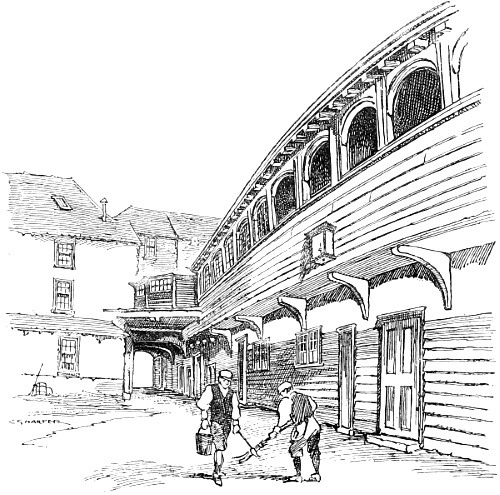
YARD OF THE "WHITE HART," BRENTWOOD.
XVII
Brentwood is no sooner left behind than the road
descends steeply over what was once a part of
Shenfield Common, an exceedingly wild and
hillocky spot in days gone by, and probably the
place where, in November 1692, those seven jovial
Essex squires mentioned by Macaulay were themselves,
while hunting the hare, chased and at last
run down by nine hunters of a different sort, who
turned their pockets out and then bade them good-day
and be damned. The original chronicler of this
significant incident, the diarist, Narcissus Luttrell,
makes no especial feature of the event. He merely
records it as having happened "near Ingerstone,"
and then proceeds to chronicle other happenings
in the same sort along the several approaches to
London. Little wonder, therefore, that Macaulay
should have drawn the conclusion that at this
time a journey of fifty miles through the wealthiest
and most populous shires of England was as dangerous
as a pilgrimage across the deserts of Arabia.
From the descending road or from Shenfield
Church the country is seen spread out, map-like,
below, over the valley of the Thames, to where
the river empties itself into the broad estuary at
the Nore. At least, there is the vale, and the
map vouchsafes the information that the river flows
thereby; but the compacted woodlands shut out
the view of that imperial waterway. "I cannot
see the Spanish fleet, because it's not in sight,"
says the disappointed searcher of the horizon in
the poem, and it is precisely for the same reason
that the Thames is not visible from Shenfield.
But if one is denied a view of that imperial river,
at least Shenfield Church itself and its churchyard,
a prodigal riot of roses of every hue and habit,
are worth seeing. The attenuated shingled spire,
one of the characteristic features of Essex churches,
beckons insistently from the road, and he who
thereupon turns aside is well repaid, in a sight of
the elaborately-carved timber columns of the interior,
proving how in this county, where building stone is
not found, thirteenth and fourteenth-century builders
made excellent shift with heart of oak. This is,
in fact, like so many other Essex churches, largely
wooden, and its timber is as sound now as it
was six or seven hundred years ago.
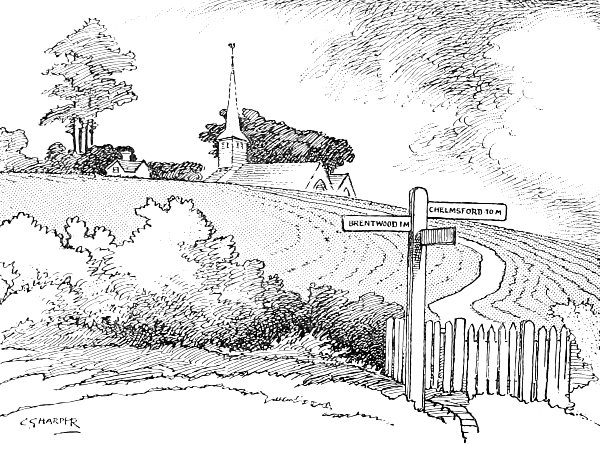
SHENFIELD.
Mountnessing, known locally as "Money's End"
lies two miles distant from Shenfield. As in the
case of so many other places near the great roads,
a comparatively recent settlement bearing the name
of the old village sprang up, to catch the custom
of travellers; but an additionally curious fact
is the utter extinction of the original village, which
lay a mile distant from the highway, where the
parish church now stands lonely, save for a neighbouring
farmstead. Explorers in the countryside
are often astonished at the great distances between
villages and their parish churches, and seek in
vain in their guide-books or in talk with the
"oldest inhabitant" an explanation of so curious
a thing. Here, as in many cases, the root of the
mystery is found in the enclosure of the surrounding
common lands. The enclosure of commons has
never been possible without the passing of special
Acts, which have divided what should have been
the heritage of the people for all time between
the lord of the manor and the villagers, in their
proper proportions. Thus the lord of the manor
and the tenants would each obtain their share of
the plunder, in the form of freehold land, with
the obvious result that the villagers, instead of
paying rent for their cottages clustering round the
church in the original village, built themselves
new and rent-free cottages on their share of the
spoil of the commons. The old cottages being
pulled down, or allowed to decay, it was not
long before the last trace of the original village
disappeared.
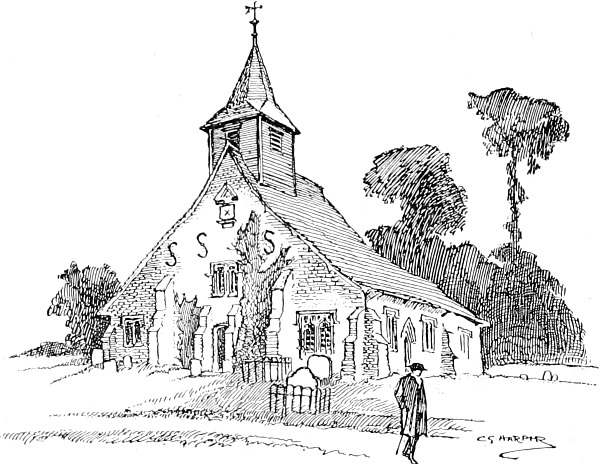
MOUNTNESSING CHURCH.
Mountnessing was once the seat of the
Mounteneys, who have long since vanished from
their old home. The old church, largely red brick
without and timber within, still preserves the
fossil rib-bone of an elephant, long regarded with
reverence by the country folk as the rib of a giant,
and has for an additional curiosity the carving of
a head on one of the pillars, a head fitted, perhaps
by way of warning to Early English parishioners
of shrewish tendencies, with a brank, or "scold's
bridle." The red-brick west front of the church,
masking the wooden belfry-frame from the weather,
still bears the date, 1653, carved in the brick, but
such is the fresh appearance of the brickwork that
without that evidence of age it would be difficult
to credit it with so long an existence. The iron ties
in the shape of the letter S give the view a
singular appearance. An apologetic epitaph in
verse, beginning, "Reader, excuse the underwritten,"
is a curiosity of Mountnessing churchyard.
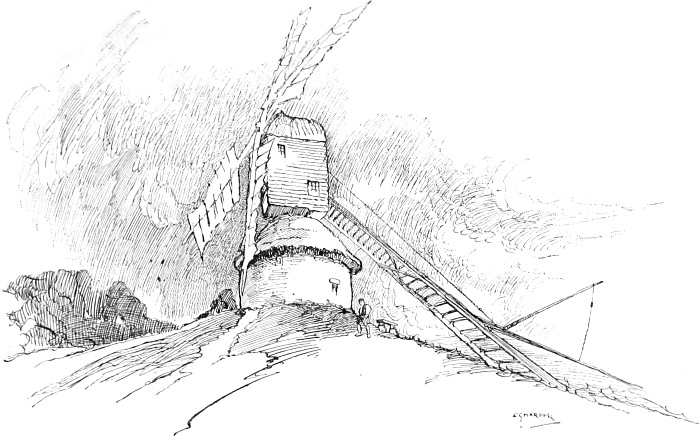
MOUNTNESSING WINDMILL.
Returning to the road, Mountnessing Street, as
the modern settlement is named, is seen clustering
on a hill-top, around four cross-roads and a wayside
pond. The place may aptly be summarised as consisting
of a dozen cottages, two public-houses, a
general "stores" (our grandfathers would have been
content with the less pretentious word "shop"), a
tin tabernacle to serve those too infirm or too lazy to
walk a mile to church; a sweep's shop, a tailor's, and
a windmill situated on a knoll; a windmill that for
picturesqueness might win the enthusiasm of a Crome
or a Constable.
From this point it is, as a milestone proclaims,
two miles to "Ingatstone," the "Ingatestone" of
customary spelling. The milestones are undoubtedly
strictly correct in their orthography, if erring on the
pedantic side, for that village derives its name from
a settlement of the Anglo-Saxons by the "ing" or
meadow, at the Roman milestone they found here,
but has long since disappeared. "Ing-atte-stone"
they called their village, which lies in the little valley
of the River Wid, or Ash, trickling (for it is a stream
of the smallest) hither and thither to give a perennial
verdure to the meads along its course. "Ing" is,
by consequence, a marked feature of the place-names
successively met with along the River Wid.
Mounteney's Ing we have already seen, and Fryerning,
or Friars' Meadow, is not far away; while
Margaretting, the prettiest name of all, lies beyond
Ingatestone.
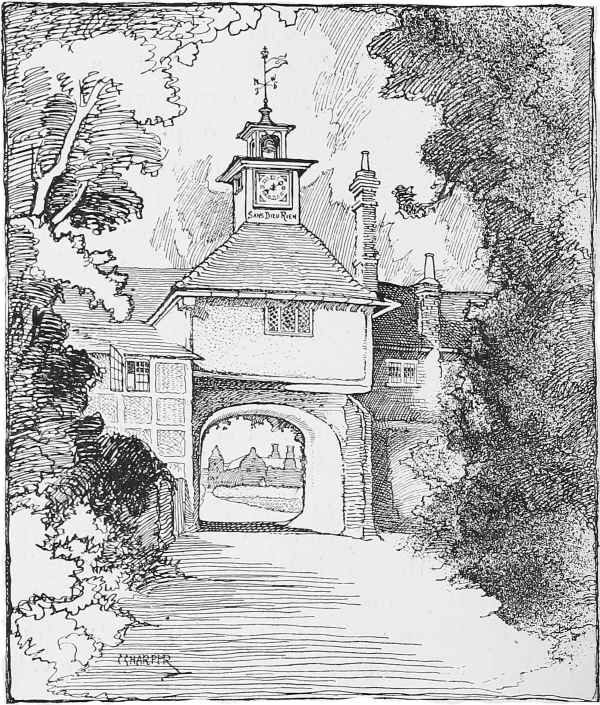
THE GATEHOUSE, INGATESTONE HALL.
Ingatestone's one street, fronting on to the highroad,
is of the narrowest, and remains in almost
every detail exactly as it is pictured in the old print
reproduced here, with the red-brick tower of the
church still rising behind. It is a tower which by
no means looks its age of over four hundred years,
so deceptive is the cheery ruddiness of the brick.
Within, by the chancel, is the monument of that
Sir William Petre who, emulating the accommodating
qualities of the famous Vicar of Bray, bowed before
the religious storms of the reigns of Henry the
Eighth, Edward the Sixth, Mary and Elizabeth.
"Made of the willow and not of the oak," those
tempests not only left him unscathed, but brought
him much plunder. Under Henry he was enriched
with the manor of Ingatestone, plundered from the
Abbey of Barking, together with much spoil elsewhere.
How he managed to do it is a mystery, but
during the reign of Mary this ardent Catholic (for
such the Petres always have been) actually obtained
a Papal Bull confirming him and his in these grants.
One marvels, when gazing upon his high-nosed effigy,
recumbent beside his wife, how one with that noble
physiognomy could be so accomplished a time-server
and truckler. His home, plundered from the nuns
of Barking, and known for many years as Ingatestone
Hall, is yet to be seen at a short distance from the
road, down a beautifully-timbered country lane. The
entrance is by a gatehouse with the motto, "Sans
Dieu Rien," situated at the end of an avenue and
framing in its archway a fine view of the romantic old
red-brick turreted buildings of the fifteenth and
sixteenth centuries. The Lord Petre of to-day does
not reside here, but the place is still in the family,
and the Roman Catholic chapel is even now in use.
Miss Braddon is perhaps scarce to be numbered
among those novelists whose literary landmarks are
followed with interest, but it is claimed for Ingatestone
Hall that it is the scene of her Lady Audley's Secret.
The fish-ponds of old monastic times, the
well in which Lady Audley thrust her husband,
the lime-walk he haunted, together with such
romantic accessories as terraced walks and a priest's
hiding-hole, form items which would require the
business enthusiasm of an eloquent auctioneer to
fully enlarge upon. They do say—the "they" in
question being the gossips of Ingatestone—that
the guard and driver of the Parcel Mail, passing at
1·15 a.m. the head of the avenue leading from the
high road, once saw "a something" in white mysteriously
sauntering beneath the trees, but whether it was
the shade of an Abbess of Barking or one of the sisters
thus bewailing the fate of their old home, or merely
a white cow, remains an unsolved mystery, the
Postmaster-General's regulations and time-sheets not
allowing for time spent in psychical research.
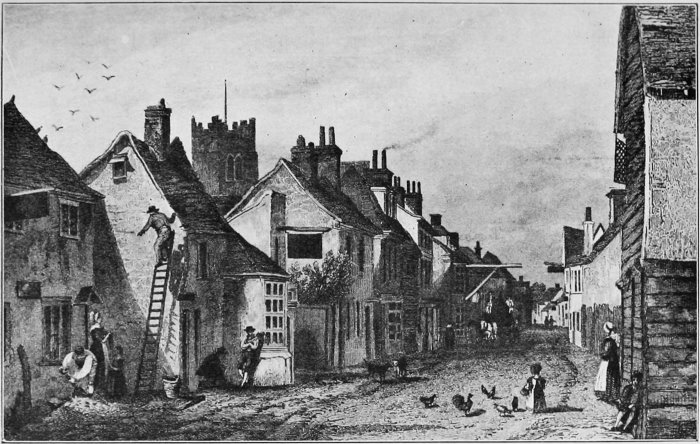
INGATESTONE IN COACHING DAYS. From an Old Print
The shingled spire of Margaretting Church is
visible on the right, soon after leaving Ingatestone.
Like the church of Mountnessing, it has its timbered
belfry-framing, and like it again, is remote from the
village, standing solitary, save for the vicarage and
a farmhouse, beside a railway crossing—if, indeed,
any building adjoining the main-line of a great
railway may ever be called solitary. The Margaret
thus honoured in the place-name is the Saint to
whom the church is dedicated. Some traces of the
"marguerite," or herbaceous daisy, painted on the
old windows, in decorative allusion, remained
until they were swept away for modern stained-glass
in memory of a late vicar and his family;
glass in which Saint Margaret has no place; so that,
save for an inscription on one of the bells, she now
remains unhonoured in her own church, deposed
in favour of Isaiah and Jeremiah and subjects
kept "in stock" by the modern ecclesiastical art
furnisher. The only remaining ancient glass is that
of the east window, a magnificent fifteenth-century
"tree of Jesse."
AT MARGARETTING.
Margaretting Street fringes the wayside at the
twenty-fifth milestone, where a post-office and some
few scattered cottages straggle picturesquely at the
foot of an incline leading up to Widford. The
odious wall of pallid brick that helps so materially
to spoil some two miles of this road is the park
wall of Hylands, a large estate purchased about
1847 by one John Attwood, a successful ironmaster,
who stopped up roads, pulled down cottages, and
raised this eyesore to enclose his new-made park.
Almost as soon as the last brick was put in its place,
the autocratic Attwood became utterly ruined by
railway speculations, and his walled-in Eden was
sold. Nature in the meanwhile has done her best,
and a continuous fringe of trees now overhangs the
ugly wall, while at a break in it, where the River
Wid crosses beneath the road, water-lilies gem the
stream and the wind sounds in the luxuriant
Lombardy poplars with the sound of a waterfall.
If it were not for its church, which has been
re-built and has a very fine and tall spire, one might
easily pass Widford and not know it, for the very
few houses do not suffice to make a village. Such
as it is, it stands on the crest of something not
quite so much as a hill and rather more than an
incline, and beside its large church has an equally
fine and large and brand-new inn, the "White
Horse." Time was, and that until three years since,
when Widford was celebrated for its one other inn,
the "Good Woman," or, as it was sometimes styled,
the "Silent Woman"; a bitter jest emphasised by
the picture-sign of a headless woman, with the
inscription, Fort Bone, on one side, and a portrait
of Henry the Eighth on the other. "Fort Bone"
was commonly Englished by slangy cyclists as "good
business." The sign, of course, was a pictorial and
satiric allusion to Anne Boleyn, but it remains an
open question whether or not in their present form
this and the several other "Quiet Woman" and
"Good Woman" signs throughout the country are
perversions of the original legend, "la bonne fame"
displayed on old inns in the distant past; an
inscription laudatory of the hostelry, and matching
the self-recommendation of "la bonne rénommée,"
found in modern France, or the more familiar "noted
house for—" and "good pull up" inscriptions on inns
in modern England. Virgil's description of Fame,
walking the earth, her head lost to sight in the
clouds, may have originated the pictorial sign of
the headless woman in days of ancient learning;
and the classic allusion becoming lost and the
supposedly incorrect spelling of "fame" being
altered to "femme," we thus obtain a very reasonable
derivation. We may take it that many shrew-bitten
folks, innkeepers and customers alike, readily
agreed to forget the original meaning in order to
adopt one so exactly fitting their opinion that the
only quiet or good women were headless ones.
THE "GOOD WOMAN" SIGN.
Unhappily, in that senseless itch for change
that is robbing places of all interest and distinction,
the sign of the "Good Woman" no longer swings
from its accustomed place, and the bay-windowed
inn opposite the "White Horse" has retired into
private life. The picture sign is now housed inside
the "White Horse."
XVIII
Widford almost immediately introduces the explorer
to Moulsham (originally the "mole's home"),
itself own brother—but a very out-at-elbows
brother—to Chelmsford. If we wished to put the
wind between our gentility and the somewhat
fusty purlieu of Moulsham, we should turn to the
left at the fork of the roads, half a mile short of
the town, and so, proceeding along the "new
London road," come into Chelmsford, half way
down the High Street. Being, however, intent
rather upon old roads than new, we will e'en
endure the half-mile length of shabby, untidy
street, and thus come bumpily into Chelmsford,
the county town of Essex, the Metropolitan City
of Calves, over the hunchbacked and narrow stone
bridge across the Chelmer, the successor, at an
interval of seven hundred years or so, of the original
bridge built by Maurice, Bishop of London. That
is a huge slice of time, but it was too late, even
in Norman days, for the town to change its
name from Chelmersford to something more appropriate
when the ford was thus superseded.
Straight ahead over this bridge goes the High
Street of the town, the view closed by the Shire
Hall and the church; the Norwich Road, however,
turning abruptly to the right, by the Conduit, and
refusing to make acquaintance with the town. It
is the Conduit that is seen in this illustration of
the High Street, its architecture scarce improved
by the placing of an electric lamp, alleged to be
ornamental, over its cupola.
THE BRIDGE: ENTRANCE TO CHELMSFORD.
Chelmsford church and the Shire Hall, seen at
the end of this view, spoil one another, the Hall
almost entirely hiding the church when looking
down the High Street, and the dignified Perpendicular
exterior of the church putting the clumsy
architecture of the Hall to shame, as a pagan
upstart. The Shire Hall has its terrors for some,
but its architecture, alleged to be classic, alone
concerns the passing stranger, who feels so concerned
by sight of it that he accordingly passes
the quicker. A captured Russian gun and the
seated bronze effigy of a native, a bygone Lord
Chief Justice (who looks whimsically like an old
apple-woman crouching over her basket, and drops
green coppery stains over his nice stone pedestal)
keep one another company in the open space fronting
this building.
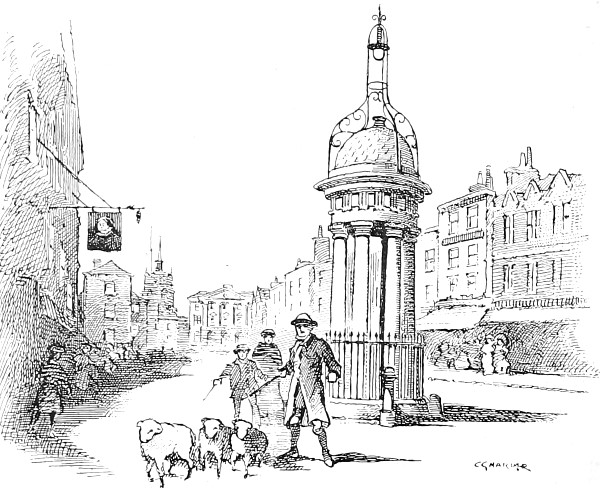
THE CONDUIT, CHELMSFORD.
The L.C.J. in question was Nicholas Tindal,
whose career came to a close in 1806. The
monument was erected in 1850, "to preserve for
all time the image of a judge whose administration
of English law, directed by serene wisdom, assisted
by purest love of justice, endeared by unwearied
kindness, and graced by the most lucid style, will
be held by his country in undying remembrance."
His birthplace could hardly have said more than
that.
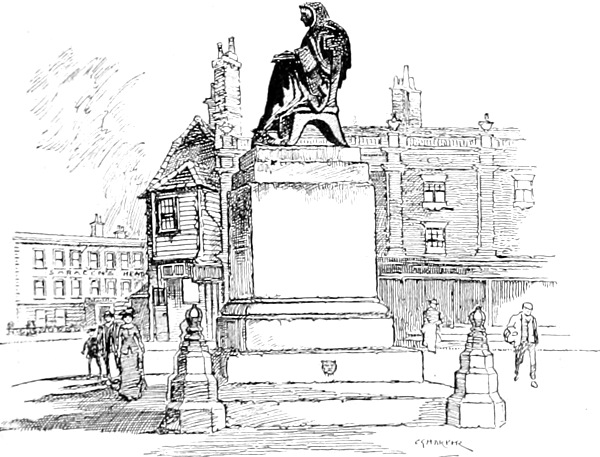
TINDAL'S STATUE.
Chelmsford stands not upon the ancient ways,
being indeed very severely bitten with a taste for
modernity. Is it not famous as the first town in
the kingdom to adopt electric lighting, and have
not its streets been resolutely swept clear of
antiquity? The town, in short, is scarce picturesque.
It is busy in the agricultural way on Fridays, but
on other occasions every house provokes a yawn,
with perhaps the exception of the "Saracen's
Head," an inn that, despite its modernised and
stuccoed frontage, keeps some memories of old
times. There was a "Saracen's Head" here certainly
as far back as the fifteenth century, and probably
much earlier. Like all the signs of that name, it
derived from Crusading times, when the knights
and men-at-arms, returning from Palestine with
wounds and spoils from the pagan; with monkeys,
leprosy, tall stories, and other relics out of the
Holy Land, found their fame come home before
them, and the old inns they had known—the
"Salutation," the "Peter's Finger," the "Catherine
Wheel," and the like—often re-named in their
honour. With little effort we can imagine the
scenes at the "Saracen's Head" of that period,
when exploits at Acre, Joppa and Jerusalem were
told and re-told, and gained wonderfully in the repetition
over sack and malvoysie. What bloody
fellows they were, and with what zest they slew
the Soldan's soldiers over and over again as they
sat over their cups. It is, at the least of it, six
hundred years ago, and the "Saracen's Head" has
been rebuilt many times since then; but human
nature remains the same though timber rot and
brick perish, and again and again the same old
talk has been heard in the bar-parlour of the
inn. Those who fought at Agincourt and Creçy;
men of a later age who warred under Marlborough
at Blenheim, Ramillies or Malplaquet; the lads of
the Peninsula and Waterloo; survivors from the
horrors of the Crimean winter, and heroes from
a hundred fights on the burning South African
veldt—all have had their circle of greedy listeners
here.
The "Saracen's Head" of to-day turns a sleek
and stuccoed face to the street, and the house shows
signs of extensive rebuilding and remodelling, undertaken
in the full flush of the great days of coaching
prosperity, when so many old inns were rebuilt, in
the belief that coaching, and the road as an institution,
would last for ever. Fond belief! Has anyone
ever stopped to consider the fact that the great
coaching era of the 'twenties and the 'thirties had a
great deal more to do with the pulling down of the
old-fashioned galleried and timbered inns of country
towns than ever railways have had? The average
small country town felt in fullest measure the great
increase in business incidental to the last years of the
coaching age, and every innkeeper hastened to
rebuild his inn and to call it an "hotel." Those who
had, from one cause and another, deferred rebuilding
until the dawn of the Railway Age, on seeing that
the road would decay and travellers be carried to
their journeys' ends without halting for rest and refreshment,
promptly gave up any such ideas and were
thankful that they had not begun the work of reconstruction
and enlargement. Those who had were
ruined, and to this day the huge hotels they reared
may yet be often met with, a world too large, in
country towns where once the mails and the stage-coaches
passed, like a procession, day by day. It is
quite by a happy chance that an old galleried house
like the "White Hart" at Brentwood remains, and it
is not too much to say that, had the Coaching Age
lasted another ten years, it also would have been
rebuilt.
An amusing story, with Anthony Trollope for its
central figure, belongs to the "Saracen's Head" at
Chelmsford. For some years after he had won fame
as a novelist he still retained his position in the
General Post Office, of which he was a travelling
inspector. On one of these official journeys he
happened to be staying here, at the time when his
Barchester Towers was being issued, after the then
prevailing fashion, in parts. He was seated in the
coffee-room when two clergymen entered, one of
them with the newly-issued part of the story. The
cleric, cutting the pages, was soon immersed in the
trials of the Bishop and the domineering ways of Mrs
Proudie, who was rather a trial to Trollope's
readers, as well as to the Bishop. Suddenly the
clergyman put the book down. "Confound that Mrs
Proudie!" he exclaimed, "I wish she were dead!"
Trollope looked up. Introducing himself, he
thanked the reader for thus accidentally telling him
that the Bishop's wife had become wearisome, and
undertook to have done with her. "Gentlemen,"
said he, "she shall die in the next number;" and die
she accordingly did. But in defence of Trollope's
truthful character-drawing, let it be said that, in the
opinion of those likely to be best informed, Mrs
Proudies may yet be found in a goodly proportion of
the episcopal palaces of England.
XIX
Returning now to the Conduit, and making for the
open road once more, Chelmsford is left by way of
Springfield, past the successor of Chelmsford's finest
old inn, the "Black Boy," demolished in 1857. The
old inn of that name had stood on the spot for five
centuries, and had been the halting-place of many
famous travellers, among them a long line of Earls
of Oxford, journeying between their castle at Hedingham
and London; but none of these associations
sufficed to save the house. Fragments of its carved
beams are preserved in the local museum, but recall
it as little as does the skeleton of the mastodon
bring back in his majesty that denizen of the earth
in the dim æons of the past. Chelmsford would
dearly like many of its old buildings—wantonly
demolished years ago—back again; but what is done
cannot be undone, and there's an end on't. The
"Cross Keys" remains, in a restored condition.
THE "THREE CUPS" SIGN
The name of Springfield, the eastern suburb of
Chelmsford, carries varying significances. To the
mere newcomer it sounds idyllic; to the American
from the New England States it recalls the Pilgrim
Fathers and their settlement of Springfield, Massachusetts;
and to the gaol-bird it means a "stretch"
of longer or shorter duration. At Springfield, in
fact, is situated the County Gaol, a gloomy building
enlarged in recent years for the accommodation of
the guests consigned to it at Assize time from the
Shire Hall down yonder in the High Street. But,
once past this depressing place, Springfield is pleasing
and cheerful. Its long miscellaneous street, where
the quaint sign of the "Three Cups" stands out,
gives place to suburban villas situated in attractive
grounds and designed to sound the ultimate note of
picturesqueness. That this has been the aim of their
architects is abundantly manifest in examples where,
under a single roof, one may experience the mingled
romantic feelings of inhabiting an Edwardian castle,
a Tudor manor-house, a Jacobean grange, and a
"Queen Anne" mansion; all done in red brick,
gabled here and battlemented there, and, moreover,
fitted with electric light and hot and cold water
supply. To this end has castellated and domestic
architecture unwound its long story during some five
hundred years. It will be seen thereby that William
of Wykeham, John Thorpe, and many another old-time
architect did not live in vain.
But if Springfield be modern as a suburb, it is
ancient as a village. To see old Springfield, it is
necessary to turn off the road to the left, and to
journey a quarter of a mile, towards the old church,
a noble building with mingled red brick and stone
tower bearing the inscription, "Prayse God for al
the good benefactors 1586." Oliver Goldsmith, it is
quite erroneously said, took Springfield as the model
for his Deserted Village. He certainly visited at an
old cottage opposite the church, but the real Sweet
Auburn is Lissoy, in Ireland.
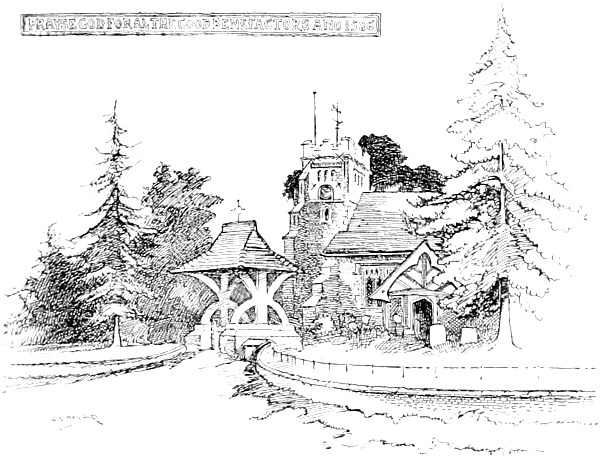
SPRINGFIELD CHURCH.
Beyond the village and facing the high road are
the strangely impressive lodges of the historic estate
of New Hall; new at the end of the fifteenth century,
but declined into a respectable age by now and
cobwebbed with much history and many legends.
The place, now and for a considerable number of
years past an alien convent, has been owned
during a period of four hundred years by an
astonishing number of historic personages, who have
succeeded one another like flitting phantoms. Here
the solemn reminder, "shadows we are," peeps out
spectrally at every turn of Fate's wrist in the
handling of the historic kaleidoscope. Built by
Thomas Butler, Earl of Ormond, whose daughter and
heiress became the wife of Sir Thomas Boleyn and
mother of the unfortunate Anne, New Hall thus
eventually came into possession of Henry the Eighth,
who occasionally resided here and re-named it
"Beaulieu." Elizabeth gave Beaulieu to Thomas
Radcliffe, third Earl of Sussex. By this time it had
resumed its name of New Hall. Later owners were
George Villiers, the magnificent Duke of Buckingham,
and Oliver Cromwell, who had it as a gift from
Parliament and exchanged it so soon as he decently
could for the more magnificent, convenient and king-like
residence of Hampton Court Palace. To him
succeeded another Duke of Buckingham, and to him
that soldier and king-maker, the crafty Monk, Duke
of Albemarle, who kept great state at the Hall and
was visited here, when he was suffering from gout
and dropsy, by that scribbling traveller, Cosmo,
Grand Duke of Tuscany. With Monk the line of
historic owners may be said to end, but constant
change has ever been the lot of New Hall, and a
succession of lesser lights followed him until the
nuns set up their secluded life here and bade
farewell to a vain world. That world passes by; the
road on one side, the railway midway in the grounds,
and if it gives them a thought at all, scorns them as
morbid and idle malingerers from the work of the
vineyard.
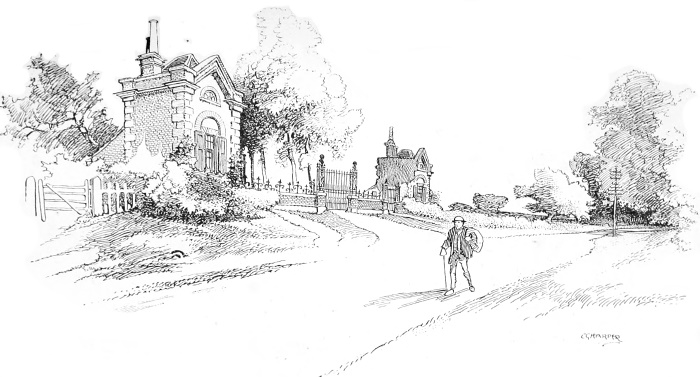
NEW HALL LODGES
No glimpse of the Hall is gained from the road.
All is emptiness, and the lichened brick and the
crumbling stone vases of neighbouring boundary
walls add to the melancholy air of failure and unfulfilled
aims characteristic of the place.
There is an air of romance about Boreham House,
as seen from the tree-embowered road at a little
distance from New Hall; an altogether deceptive air,
let it be said, for the house is modern; a classic
building of white brick. It is its situation at the
head of a formal lake, fringed with stately elms,
that confers the illusory distinction, but the explorer
of old roads, who halts here and listens to the cawing
rooks on the swaying tree-tops, or watches the water-fowl
squattering on the lake, can weave his own
romance to fit the scene. And if the house, though
stately, be modern, yet it holds something of interest
in the shape of the identical carriage used by the
Duke of Wellington at the Battle of Waterloo.
Greatly daring, they dragged it out in recent years
to grace a Chelmsford holiday, when it was broken
to pieces in an accident. Restored now to its
original condition, it will need to be a great occasion
indeed that brings it forth again.
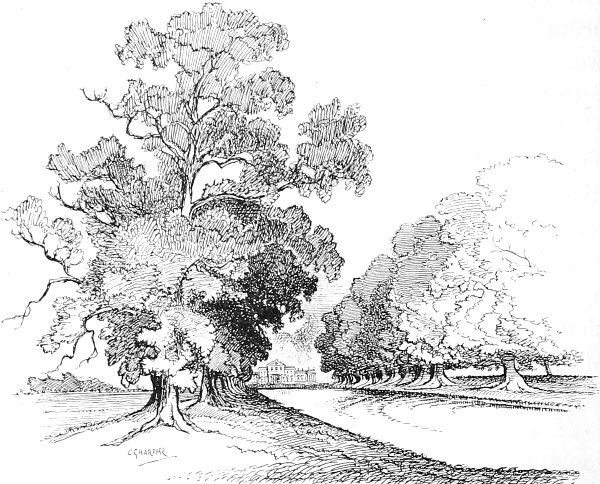
BOREHAM.
Boreham village lies hidden from the road, its
old gabled cottages clustering round the still older
church, itself embowered in lime trees whose delightful
scent weights the July air with an Arcadian
languor. The explorer who adventures into Boreham
has every likelihood of having his nerves
startled by the sudden glimpse at a bend of the road
of a great mausoleum in the churchyard, with the door
open, and, if it be midday, the sight, apparently, of
one of the inmates of the silent tomb making a
hearty lunch of bread-and-cheese. High noon being
an hour when the supernatural is not so terrifying
as to daunt investigation, it becomes evident on
drawing nearer that the old tomb-house has been
converted into a tool-house and general lumber-room,
and that the figure seated within is the sexton
enjoying his lunch, screened from the noonday heats.
An inscription over the door of the ornate building—a
copy of the Temple of the Winds at Athens—proclaims
it the "Mausoleum Gentis Walthamianæ,
Anno 1764"; but the Walthams have disappeared,
both from their mausoleum and the district. The
body of the last appears to have been arrested for
debt when on the road hither from Chelmsford.
The sexton explains that the parish took over the
Walthams' last home in consideration of repairing
the ruinated roof. "We ha'n't the conwenience
hee-ar, years ago," says this typical Essex rustic, and
goes on to tell how the oil and coals and candles for
church use were formerly stored in the Radcliffe
Chapel, where the Sunday School was also held.
Three Radcliffes, Earls of Sussex, 1542-1583, grandfather,
father, and son, lie in effigy side by side on
an altar-tomb in that chapel, "as like as my fingers
are to my fingers." "Old wawriors," the sexton
calls them, and explains that their broken noses
are due to the "ruff" having fallen in, years since.
Returning to what, in Essex parlance, is called
the "mine" road, Hatfield Peverel is reached, past the
great red-brick Georgian mansion of Crix, standing
in its meadows where the little River Ter comes down
from Terling, flows under the road, turns the wheels
of Hatfield Mill, and then hurries off, as though
belated, for a rendezvous with the Chelmer, two
miles away. It is an old mill, fronting the road
with whitewashed brick walls, a chimney bearing
warranty of its age in the inscription, "A.A. 1715";
but if that evidence were lacking it could be found
in the position of the mill-house doorway, sunk into
an area with the raising of the road for the building
of the bridge that long ago replaced the watersplash
at this crossing of the stream.
Hatfield Peverel nowadays shows few signs of the
heaths that once gave the place its original forename
of "Heathfield," and the Peverels, identical with the
Derbyshire Peverels of the Peak, are so utterly
vanished that they have left not the slightest vestige
of themselves in the church—that last resort of the
antiquary in search of old manorial lords. It is
true that on modern tablets built into the west
front of the church the founding of a Benedictine
Priory here in 1100 by Ingelrica, mother of William
Peverel, is alluded to, together with the rather
scandalous story of the Peverel origin, but these things
are decently wrapped in the combined obscurity of
Latin and lichen-stains, so that both their monastic
beneficence and their maternal origin are only dimly
to be scanned by the vulgar or the hurried.
It is the distance of half a mile from the high
road to where Hatfield church lies secluded, adjoining
the grounds of a mansion partly occupying the
site of the Priory, and so named from that fact. It
is here, if anywhere, that the "heaths" of Hatfield's
original baptism must be sought, and accordingly
some stretches of common-land may be discovered
close by. But wayside Hatfield chiefly concerns us,
though there be little enough to say of it, beyond
the note that its closeness to the railway station has
caused a certain growth and a certain amount of
rebuilding, in alien and uncharacteristic style, of the
old plaster cottages that were once the invariable
feature of its street, and admirably figured forth the
Essex manner of decoratively treating plaster-work.
There remain here but two such cottages, bearing
the date 1703, and the initials M.R., with fleur-de-lis.
XX
A road of almost unvarying flatness conducts in
something under three miles to Witham, entered
nowadays over an imposing bridge erected by the
Essex County Council over a stream that luxuriates
in no fewer than three separate and distinct names.
As the River Witham, it confers a name upon the
townlet; as the Brain, it performs the same
sponsorial office for Braintree; but as the Podsbrook
it is endowed with a title that smacks rather
of the farcical sort. The traveller looking in
summer-time over the railings of the bridge, down
upon the mere thread of water oozing and stewing
in the mud among the kitchen refuse of the
neighbourhood, comes to the conclusion that it is
not ill-named as the Podsbrook; but the Essex
Council in bridging it so substantially think of it
rather as the River Witham, which they have every
right and cause to do, for the stream can avenge
itself of those disfiguring potsherds and that contemptuous
title in the most sardonic way when
winter comes and the floods are out.
The long street of Witham is remarkable for
the number of large and handsome mansions dating
from the time of Queen Anne, through the period
of the four Georges. The greater number of the
professional men of Essex would, from the number
of those houses, appear to have settled in the little
town and to have medically attended it and legally
represented it to such an effect that it is only now
beginning to recover from them and from the
coming of the railway, which dealt a death-blow
to the thriving coaching interest of the early part
of the nineteenth century.
For Witham was the half-way house, the dining-place
of Mrs Nelson's famous "Ipswich Blues," the
crack coaches on the seventy miles of road, which
started at eight in the morning and by extraordinary
exertions made Ipswich in something under six
hours. Such remarkable performances as these
were possible only by establishing six-mile stages in
place of the average ten miles on other roads, and
by placing leaders in readiness at the foot of hills
like Brook Street Hill at Brentwood. The "Blue
Posts" is gone, but the "White Hart," where some
of the principal coaches drew up, is still in existence;
its sign, a pierced effigy of that animal
projecting from the front of the house and looming
weirdly against the sky-line. There are many
"White Harts" on the road to Norwich, the sign
being just as peculiarly a favourite one here as
that of the "Bay Horse" is on the Great North
Road; but of all the many examples to be met
along these hundred and twelve miles this is the
one that is most quaintly out of proportion, with
a head and neck less than half the size demanded
by body and legs, and a golden collar and chain
of prodigious strength. This heraldic device was
the favourite badge of Richard the Second, whose
connection with East Anglia was too slight for
assuming this herd of White Harts to be especially
allusive to him, or indeed more than a curious preference
on the part of innkeepers along the Norwich
Road.
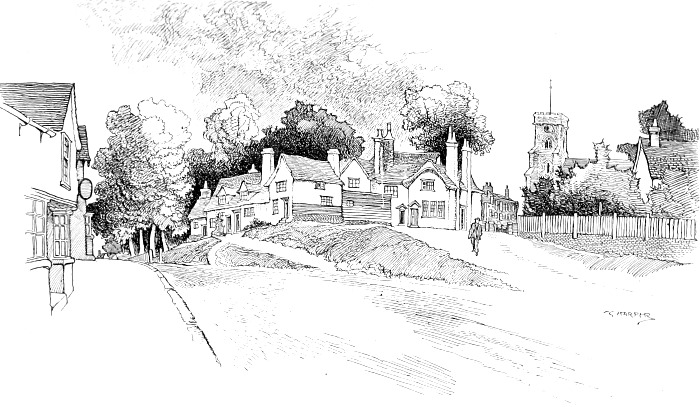
CHIPPING HILL.
Those who would seek the site of the original
Witham must turn aside from the high road the
matter of half a mile, past the railway station, to
Chipping Hill, where, within the earthworks of a
camp successively occupied and wrought upon by
the Britons, the Romans and the Saxons, it will
be found. Chipping Hill overlooks the pleasant
valley of that triply-named river already mentioned,
in 1749 described by Walpole as "the prettiest little
winding stream you ever saw." The "sweet meadows
falling down a hill" of which he speaks are there to
this day, and as sweet, and the by-road that comes
up from the gravelly hollow and cuts through the
earthy circumvallation of the ancient stronghold
climbs up romantically under the blossoming limes
into as pretty a picture in the rural sort as you
shall easily find. It is a little piece of Old England
before railways came, or science and the ten
thousand plagues of modern life, and the cheap
builder of hideous new cottages were let loose upon
the old order of things. Not a jarring note is in
the picture of yellow-plastered and red-roofed old
dwellings, flint-built church tower and red-brick
rectory, set in, upon and around the swelling grassy
banks where Romans kept guard and Saxons had
both their fortress and their market, as evidenced
by the still surviving name of Chipping, or Market
Hill.
Old East Anglian cottages have their own
special characteristics, arising from local conditions,
but one feature they share in common with all old
rustic dwellings; the great size and relative importance
of their genial chimneys, suggesting warmth
and the lavish laying on of logs. They tell the
passer-by of old times when wood was the only fuel;
when it was to be gathered for the mere labour of
gathering, and plenty of it was piled upon the
generous open hearth. Modern cottages, all over
the kingdom, tell a different tale, in the look of their
meagre chimney-pots—a tale of coal, dearly purchased,
economised in tiny grates.
But the special features of East Anglian cottage
architecture? They are here, in the highways and
byways, for all to see who will. It is a land without
stone, this East of England, where timber and flint
and brick play important constructional parts in
church and hall and manor-house, and where timber
framing, lath and plaster, parge-work, and a few
bricks for the chimney stacks, are combined to build
up the cottages.
Out of their necessities our ancestors contrived
dwellings that for durability, comfort and artistry
put modern houses, whether halls or cottages, to
shame. The stone cottages of Somersetshire,
Rutland, Leicestershire; the cob and thatch of
Devon, the granite of Cornwall; the timber and
plaster, or timber and brick noggin of Cheshire and
Herefordshire are all evidence to this day of how
skilfully our forbears employed the materials to
their hands; and here in Essex you shall find a
something in the art of cottage building hardly to
be discovered elsewhere. This is the frequent use
of parge-work, or pargetting, as it is sometimes
called, on old cottage exteriors. Parge-work is the
ornamental filling or surfacing of walls with plaster.
The term is just as often applied to the elaborately-moulded
and panelled plaster ceilings of Elizabethan
and Jacobean halls as to the exterior decoration that
forms so remarkable and pleasing a feature of Essex
rustic cottage architecture. Few Essex villages
that can claim to preserve many relics of old
times are without examples of this peculiarly local
style; although, to be sure, an ignorant want of
appreciation has been the cause of much destruction
of late years. The commoner forms of this decoration
are frequently seen, in the easily incised patterns
that even the unskilful can make in the plaster while
still wet, by the aid of anything from a trowel to the
finger-tips; just as a cook ornaments the dough of
her uncooked pies. Many of these patterns are
traditional; as much a matter of tradition, for instance,
as are the needlework patterns wrought on
the breast of an old smock-frock. The commonest
is one produced by a process of combing the plaster
in repetitions of a device resembling an elongated
figure 8 laid flat, or perhaps more narrowly resembling
a hank of worsted. Other patterns, of
whorls or concentric circles, stars, triangles and the
like, are produced by wooden stamps. But the really
beautiful examples are not the products of to-day.
These belong to the seventeenth and eighteenth
centuries, and are lavish in decoration of a Renaissance
character moulded in high relief. Architects
with sufficient culture and understanding to enable
them to appreciate local style have, in recent years,
reintroduced decoration of this character when
building residences in the country, but many a
humble cottager lives within walls that display a
profusion of artistic devices unapproached by the
houses of the wealthy.
Discoveries close by the church on Chipping
Hill have led to the belief that the building stands
on, or near, the site of a Temple of Diana, and
certainly Roman bricks are still visible in great
numbers in the walls of the tower. A memorial in
the chancel to Sir Gilbert East, who died in 1828,
reminds the historian of some strange survivals existing
at that time. The Easts were owners of the
tithes at Witham, and although they lived so far
distant as Berkshire, always insisted on their right of
being buried here. Sir Gilbert East's body was, by
his express direction, buried beside his wife, with a
band of brass encircling both, engraved with the
words from the marriage service, "Whom God hath
joined together let no man put asunder." His
funeral was a three days' business, with knights
bannerets accompanying, and much pomp and
circumstance. In the family vault they laid him,
wrapped in linen, returned to Berkshire for the
reading of the will, when, to the dismay of the
family, it was found that the knight had expressly
wished to be buried in woollen. The family solicitor
hurried back and, disinterring his defunct client, saw
to it that he was comfortably tucked in as desired.
Between Witham and Kelvedon, where the road
runs level, there is but one hamlet, an offshoot of
Rivenhall known as Rivenhall End, where a cottage
close by the "Fox" inn, once a toll-house, bears its
former history, plain to read, in the evidence of its
windows commanding either approach, up or down
the road. A mile and a half beyond begins Kelvedon,
set down in the flats beside the River Blackwater;
"Kelvedon Easterford, vulgo Keldon," as Ogilby
calls it; "consisting," he continues, "chiefly of inns";
a description which remains strikingly true to this
day. This pronunciation, "Keldon," throws some
light upon the following remarks of an old traveller
who kept a diary of his wayfaring, and, writing in
1744, says, "From Colchester in an hour or two, I
came to an old Village call'd Kildane, where they tell
you the famous Massacre of the Danes began; but
the true Name of the Town is Kelvedon."
How Kelvedon can ever have escaped being called
"Long" Kelvedon is a mystery, for it straggles on
and on and must be nearly a mile in length; a
street of handsome old residences, of cottages and
humble shops of all ages, and old broken-backed
taverns where the Essex labourer gathers night by
night and discusses the prospect of the carraway crop
and the likelihood of the entire agricultural interest
presently, going en masse to the "work'us." After
which, with the courage of despair, and to drown his
troubles, he will call for "another pot o' thrup'ny,
missus," and, when closing time comes, slouch home
through the mud and mist until the following evening,
when the same programme is repeated. It is the
agricultural labourer who supports the little wayside
"publics" whose existence in such numbers puzzles
the mid-day stranger, who, seeing them empty and
apparently lifeless, wonders how they can possibly
live. Business practically only begins when work in
the fields is done, and the rent is not so high but
that a few pots of beer a night represent a sufficient
profit.
It must not be supposed that Kelvedon has not its
exquisite architectural relics of a bygone time, or that
its inns are all of the rural beer-house type. Not at
all. Chief among the inns of Kelvedon is the
"Angel," which indeed is a house not only of considerable
size and outstanding character, but of
historic interest, as having been the favourite resting-place
of William the Third on his journeys along this
road. Its projecting porch is the first thing the
traveller sees on entering the town from the direction
of London, where the road swerves violently to the
left, and again as violently to the right, forming a
very awkward corner. "Angel Corner," said Alexander,
of the "Retaliator" coach, "is the very devil
of a corner." This remark was drawn from him on
the occasion of his nearly driving into the porch,
when trying conclusions with a rival charioteer.
Almost opposite the still-existing "Angel" stood
the equally extensive "Red Lion," long since retired
from business and remodelled as a row of cottages.
The histories of both houses, and of many another
fine old inn, which might once have been written
from the recollections of those who knew the old days
of the road, are now in great part lost, and the world
so much the poorer. Had scribblers then abounded,
and the "personal" note of the modern journalist
been sounded in those days, we should have known
how King William came to and set out from his inn;
how he looked, what he ate and drank, how many
long clay pipes he smoked, and what comparisons he
drew in conversation with Bentinck between the flat
lands on the way from Kelvedon to Harwich and the
still flatter lands of his native Holland. And besides
such records of the great, we should then have been
better furnished with the early history of coaching,
which, if not indeed a sealed book, is at least a very
short and fragmentary one.
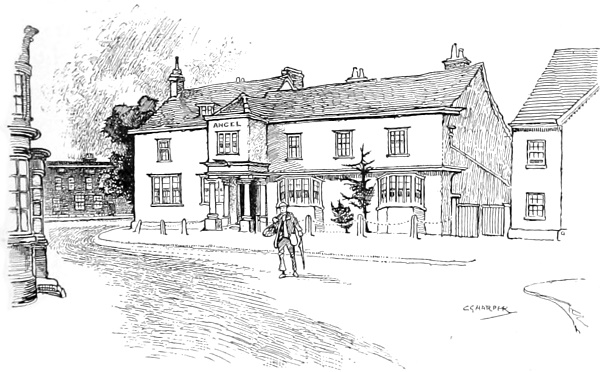
THE "ANGEL," KELVEDON.
XXI
Early coaching days are wrapped round with strange
adventures and the oddest tales; some, doubtless, of
the ben trovato, rather than the most truthful, nature.
But those stories of coaching miseries and adventure
that have been proved truthful are themselves so
surprising and incredible to modern ears that even
the most improbable of uncertified tales cannot be
dismissed as mere romancing. The tale of the
Sprightly Lady and the Anxious Gentleman should,
for instance, surely be picturesquely written up some
day and included in some English (and therefore
strictly proper) kind of Thousand and One Nights'
Entertainments.
The coach was nearing the outskirts of London.
The rheumy air hung in dank and foggy vapours
on the countryside and transformed innocent roadside
trees and hedges into all sorts of menacing
shapes. The guard let off his blunderbuss at a
pollard willow that loomed suspiciously like a highwayman
out of the reeking air, and the passengers
all began to automatically turn their pockets out.
It proved a false alarm, and purses and trinkets were
returned. But the travellers were uneasy. One
gentleman, in especial, feared for ten guineas he
carried, whereupon a lady advised him to hide the
money in his boot. He had hardly done this when
a hoarse voice was heard commanding the coachman
to stop. When the unhappy insides had picked
themselves up from the straw at the bottom of the
coach, into which they had unceremoniously been
thrown by the driver's prompt obedience to that
behest, they found themselves covered with a pistol
projected through the door, and were invited to
deliver up their money and jewellery. Those who
had little gave it and were thankful it was no more.
The lady protested that she had nothing; "but,"
said she, "if you look in this gentleman's boot you
will find ten guineas." There was nothing for it
but to take off that boot and hand over the coin;
but when the highwayman had gone it was another
matter, and the plundered traveller accused her, in
no measured terms, of being the robber's accomplice.
Bound to admit that appearances were against her,
she (how like the Arabian Nights fashion!) invited
the company to supper the following evening,
when matters should be explained. They accepted,
not, it is to be feared, very graciously. The time
came, and, ushered into a splendidly-appointed room,
with a supper laid, they were re-introduced to their
acquaintance of the night before. When the repast
was over she opened a pocket-book. "Here," she
said, addressing the loser of the ten guineas, "in
this book, which I had with me in the coach, are
bank-notes to the amount of one thousand pounds.
I judged it better for you to lose ten guineas than
for me to be robbed of this valuable property. As
you have been the means of my saving it, I entreat
your acceptance of this bank bill of one hundred
pounds."
Much of the humour that went to lighten old
road travelling was of an evanescent kind, and has
not survived, but a few examples, preserved in contemporary
literature, keep their flavour. Among
them is the narrative called "Three Blind 'Uns and
a Bolter." "I recollect," said the Jehu who told
the tale, "having a sanctified chap for a passenger,
and nothing that was either said or done was at all
to his mind. On that day I happened to have a
very awkward team—three blind ones and a very
shy off leader, and I confess that two or three times
I lost my patience as well as temper. My near
leader pulled to such a degree that I was obliged
to get down and put up her bearing-rein up to the
top of the bit, and curb her enough to break her
jaw. After starting again, I could deal with her
very well for about a mile, when her mouth got
dead again, and I was wicked enough to let drive
a few hearty damns at her, my pious companion all
the while exhorting me to patience. 'Patience be
damned,' at last said I, fairly sick of the two; upon
which he bolted as if he had been galvanised.
"'Pray, sir,' said he, 'did you ever hear of Job?'
"'He can't keep out of the shop,' thought I,
'but I won't have it;' so I answered, 'What coach
does he drive?'
"'Awful in the extreme,' said he, throwing up
his hands, 'I fear you don't read your Bible; but
I will tell you—he was the most patient man that
ever existed.'
"'But, sir,' said I, 'did he ever drive three
blind 'uns and a bolter?'
"'Certainly not,' replied he; 'he was not a
coachman.'
"'Then it's accounted for,' said I, 'for if ever
he had had four such horses to deal with as I
have here, he would have had no more patience
than myself.'"
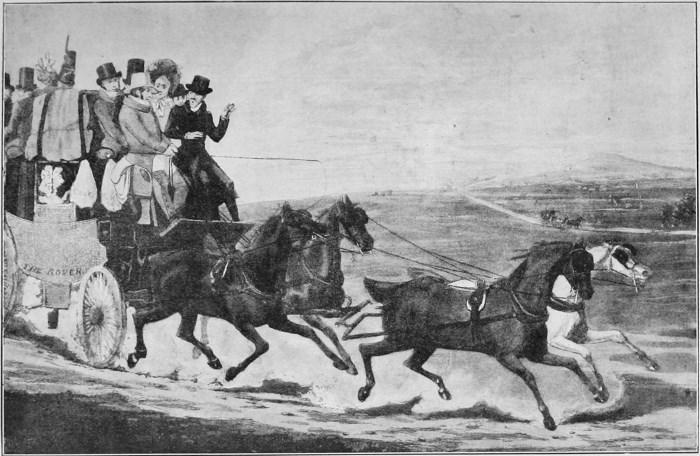
"THREE BLIND UNS AND A BOLTER." From a Print after H. Alken.
Here, at Kelvedon, one of the old-time coachmen
played a drunken trick that would have
been impossible in the last years of coaching,
when discipline was strict and drivers less eccentric
than they had been. He had just driven the
London stage from Ipswich, and having more by
good luck than careful driving brought his
passengers safely to dinner at the "Angel," turned
into the bar for a jorum of that favourite drink
of coachmen—rum. Emerging, he perceived one
of the Harwich to London fish-waggons, fully
laden, standing at the door, and, mounting on to
the driver's seat, unobserved, he wheeled the
waggon round and dashed off at top speed on
the way to Colchester, coming to grief at Lexden
Hill, where the huge conveyance was upset and
two tons weight of fish strewed the king's highway.
The mad coachman survived to repent his
escapade, but he went on one leg for the remainder
of his life.
"Other times, other manners" is a saying that
assumes an added force when contrasting the
Coaching Age with the Age of Steam. Our fellow-travellers
by railway, who glare at us, and we at
them, like strange cats on a roof-top, have little
idea of the chivalry that ruled on the road a hundred
years ago. Glance, if you dare, at a lady who
may be the only other occupant of a railway
carriage with you, and she wonders whether she
had not better call the guard; but it was, in the
days of our great-grandfathers, almost the bounden
duty of the gentlemen to see that the ladies in
whose company the chances of the road might
place them lacked nothing that courtesy could
supply; whether it were merely the aid of an
arm in walking up one of those hills the coaches
could only climb unladen, or the more material
attention involved in seeing that the dear
creatures were duly supplied with refreshments.
It was, for instance, long the chivalric custom
of the gentlemen travelling by coach to pay for
the breakfasts and dinners of the unprotected
ladies who might be travelling by the same conveyance.
"I vow," says one of these old travellers,
"'tis a pleasure in a cavalier to do so; but, the
Lord save us, what a prodigious appetite does not
the swiftness of the travelling confer upon the
fair, whose lassitude and vapours at other times
render them incapable of more than drinking a
dish of that noxious herb they call 'tay,' a thing
which it is only fitting that the heathenish and
phanatick peoples of the Indies should partake
of. I protest that the ladies of the coach, when
we alighted at the 'Angel' at Kelvedon, finding
they could not be suited with tay, went to it
with a right good will and left as good an
account of the claret and the beef as if they had
been going empty for a week. Spare me, I do
beg, from your languishing creatures who would
die of a surfeit of two biscuits at home, but
compare with the most valiant of trenchermen
abroad."
This protesting gentleman might, had he thought
of it, have exclaimed with Othello on the pity "that
we can call these delicate creatures ours and not
their appetites."
He must have been particularly hard hit in
the pocket by the robust appetites of his fellow-travellers,
but did not, however, let his feelings
appear, for he goes on to tell how he gave as
a toast, "the ladies, bless them, whose bright
eyes," etc., etc.—a toast we have many times heard
of; and, indeed, rather flatters himself upon
having "made an impression." He, in fact, seems
to have been like Constable, in a way; for it was
said of that painter that he was "a gentleman in
a stage-coach; nay, more, a gentleman at a stage-coach
dinner." "Then," said one, hearing that
praise, "he must have been a gentleman indeed!"
That is very significant. It was, then, only
your very paragon among gentlemen who could
sustain the character at a stage-coach dinner. His
manners might survive the strain of the journey
itself, and even the sight and sound of lovely
Phyllis, adorable when awake, snoring, unlovely
to eye and ear, with open mouth and suffocating
gurgles; but when after the tedious stage had
been accomplished and the passengers had descended,
irritable, hungry and thirsty, to a dinner
scarce to be eaten, even at express speed, in the
short time allowed, then, ay then, my friends,
came the test! No man so insensible to politeness
as a starving man, and few attentions were
paid to the ladies by strangers whose sole chance
of obtaining the dinner for which they had paid
was the resolute determination to attend only to
their own wants.
The discomforts of travelling by coach certainly
outweighed the pleasures of that old-world method.
A pleasant day and the open country made a seat
on the outside of stage or mail an eminence not
willingly to be exchanged for any other mode of
conveyance then known; but, as little David
Copperfield found on his first coach journey, night
on a coach was an experience once gained not
willingly repeated. Being put between two gentlemen,
to prevent his falling off, David found himself
nearly smothered by their falling asleep, so that he
could not help crying out, "Oh! if you please!"
which they didn't like at all, because it woke them.
With the rising of the sun David found his fellow-passengers
sleeping easier than they had done during
the night, when terrific gasps and snorts disturbed
their midnight slumbers. As the sun rose higher, so
their sleep became lighter and they gradually awoke,
one by one, each one indignant when charged with
having slept. During the rest of his career, David
invariably observed "that of all human weaknesses,
the one to which our common nature is the least disposed
to confess (I cannot imagine why) is the weakness
of having gone to sleep in a coach."
XXII
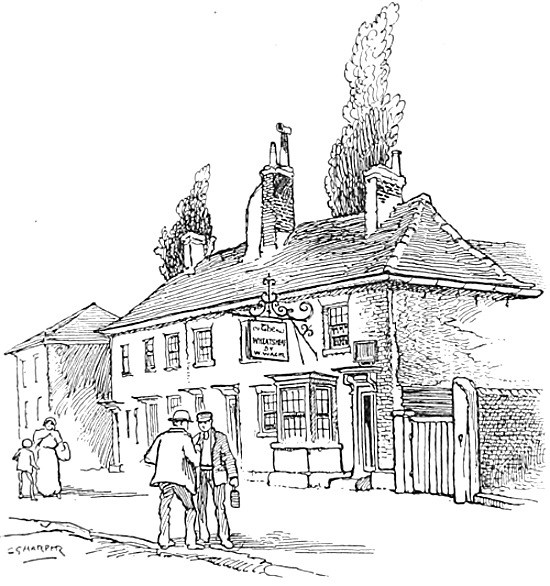
BIRTHPLACE OF SPURGEON.
Coaching times and coaching inns have long kept
us at the very threshold of Kelvedon, which has a
modern claim to notice of which it is not a little
proud. Spurgeon was born here. Although the
figure of that great wielder of homely and untutored
pulpit oratory is but one among several preachers
in the same family, there is only one possible
Spurgeon when that name is mentioned. Charles
Haddon Spurgeon was born in a house still pointed
out, on June 19, 1834; the eldest son of the Rev.
John Spurgeon. The old cottage is now the
"Wheatsheaf" beer-house and has had a bay window
and a brick frontage added since that time. Close by
is a now highly respectable and not a little dignified
private residence known still as the "Tommy shop,"
although almost seventy years have passed since it
was used as a kind of restaurant and canteen for the
navvies then working on the construction of the
Great Eastern Railway, which runs at the rear.
The oldest house in Kelvedon is doubtless the
"Sun," which dates from the middle of the fifteenth
century and has within recent years had its carved
woodwork, long covered with plaster, once more
exposed to view. It stands, almost the last house
in the town, by the bridge over the Blackwater, on
the way to Gore Pit.
Gore Pit is generally said to be the site of a
battle. What battle, however, historians do not
and cannot specify; and indeed this name, bloody
though it may sound to modern ears, has, despite
the popular legend of the derivation of Kelvedon
from "Kildane," perhaps no such sanguinary
association, and is probably a contraction of the old
word "coneygore," or rabbit warren.
It is, despite its name, a pretty and a peaceful
hamlet, with a blacksmith's shop and a roadside
horse-pond, and surrounded by the fruit-farms of a
great jam-making company. The church of Feering
can be seen across the flat fields, on the other side of
the railway. Messing lies a mile away, in the other
direction.
Let the idle wayfarer, curious as to the name of
Gore Pit, speak to the blacksmith on the subject,
and he will be told, with the seriousness of implicit
belief, of the fighting of a great battle here, and
that the blood ran down into "that there horse-pond."
Moreover, that at Kelvedon—"Killdane they used
to call it—they killed the Danes; at Feering they
feared 'em, and at Messing they made a mess of it";
which seems to very correctly reflect the views of the
neighbourhood on local history in ancient times, as
reflected in place-names!
Rural Essex, in the aspect of its fields and
meadows, is revealed along these miles in its most
characteristic form. It is, in many respects, unlike
other counties. In some ways the unhappy industry
of farming has fared worse here than elsewhere, and
many holdings have for years past gone uncultivated,
and the dock, the thistle and other lusty weeds have
resumed an evil possession of fields once kept clean
and trim. But in the smaller operations of
husbandry Essex has always been, and in some
districts still is, remarkably successful; while,
although the farmer protests that it does not pay
to grow any kind of grain, the yellowing seas of
autumnal cornfields are still a prominent feature
of the landscapes of Essex and of its neighbouring
Suffolk. Essex and Suffolk are old-world, far beyond
the rest of England, and in growing wheat in these
times, when a cornfield is a rare sight in other
parts of the country and when "our daily bread"
is chiefly compounded of grain grown in North
America, Russia, or the Argentine, they maintain
their singularity. It does the heart good to see the
ripening wheatfields of East Anglia, to see the
gathered stooks in the reaped perspectives, and to
hear the hum of the threshing machine; for the
sights and sound seem to carry us back to that
England of a bygone age, when Constable painted
such fields, and when they were numerous enough
throughout the land to feed the population. Here
and there one may still find fields of that famous
grain, the "Essex Great Wheat," which grows at
least two feet higher than the ordinary varieties,
and is greatly prized for the length and stoutness of
its straw; but it is a few miles to the north-eastward,
in the light lands around Harwich, that the Great
Wheat may be found. Seed and herb-growing are
the most prominent industries between the Blackwater
and the Colne, and the roadside fields are
striped to wonderment in summer with the rainbow
colours of the seedsman's trial-grounds. The heavy
perfume of stocks and mignonette, the claret colour
of that gorgeous flower, the "sops-in-wine," the gay
and varied displays of asters, marguerites, marigolds
and a hundred others make a midsummer fairyland
of the levels that loom so drear and misty in the
long months of winter. Nor is it only for the
flower-garden that the Essex seedsman labours.
With the sights and scents of the flaunting beauties
of the garden are mingled the homelier ones of
mint, grey-green sage and other dowdy kitchen
herbs, together with the subtle beauty and piercing
odour of wide-spreading, blue-grey lavender-fields.
Even the unromantic mangold, running to seed in
bush-like shape, sends forth a sweet and pleasing
aroma, while the yellow mustard contributes its share.
The byways of farming are now, as we have
already said, the most—some would say the only—profitable
kind of husbandry in Essex. Some forms
of cultivation have largely migrated to other counties,
but others remain. The growing of the clothiers'
teasel was discontinued with the decay of the Colchester
and Norwich baize industry, and is now
carried on in other parts of the country, close to
districts where textile fabrics are still manufactured;
but there was a time when, along this road between
Chelmsford and Colchester, the fields of teasels were
quite as much a feature as those of mustard are even
yet. The clothiers' teasel, greatly prized in the
East Anglian baize manufacture, was nothing but
a weed, found useful and cultivated accordingly. An
aristocratic relation of the less spiky burrs that have
not been rescued from the hedges and ditches and
are still allowed to grow wild, the clothiers' teasel
was cultivated so far back as the reign of Richard
the First, but the "common" burr will have to be
contented with its lowly estate to the end of time,
unless something unexpected happens.
To "stick like a burr" is proverbial, and the cultivated
teasels have an even more pronounced clinging
property. Furnished as they are with natural hooks,
they were used in baize-making, and are still employed
in the cloth trade for raising the nap of the
material. The dried heads are fixed to cylinders,
between which the fabric is passed, and their sharp
spines, re-curved like so many minute fish-hooks, draw
up the surface of the cloth. Thus the teasel was
raised from its character of a worthless weed, and for
many years Essex farmers devoted large portions of
their holdings to its cultivation. It was hoed and
kept clear of other vagrom weedlings; its heads were
cut by hand and dried with every care, and eventually
were eagerly competed for by manufacturers at £12
a load. When the old cloth manufacturers left East
Anglia, a goodly portion of the Essex farmers' livelihood
went with them.
Around Colchester, too, is cultivated that other
weed, the colewort, for cole or rape-seed, which has
the quadruple properties of feeding cage-birds, yielding
rape-oil, making cake for cattle, and of manuring
the fields. Coriander and carraway seeds, too, help
to prop the husbandman's fortunes. Corianders and
carraways are what "the faculty" knows as "carminatives,"
curative of flatulency; like the once popular
"eringo root," a candied preparation of the root of
the sea holly that grows by the estuaries of Essex
rivers. Eringo root was once a favourite specific for
lung troubles, but its popularity waned at last, and
the preparation of it gradually died out and became
extinct about 1865, when the only manufacturer was
an elderly spinster who supplied a chemist in High
Street, Colchester. Corianders are still used in the
making of kümmel and other liqueurs, and carraway
seeds, which look like commas, are those familiar
denizens of "seed cake" that stick in the teeth and
refuse to be dislodged, and are the central feature of
"carraway comfits."
Farmers who do not occupy themselves with
seed-growing have passed through evil times, but
prosperity beams cheerfully from the seedsman's well-tilled
land, and fruit-farming has come to render
cultivation profitable. Still, to the shiftless farmer,
who cannot adapt himself to new conditions, agricultural
depression in Essex is a very real thing.
Here, shambling along the road, comes such a one,
a small cultivator, a son of the soil. He does not
hurry. Who, indeed, would hurry in rural Essex, in
these times, when the Bankruptcy Court and the
Workhouse are said to close every vista? Besides,
he has been hard at work in the fields, and much of
that kind of labour takes all the lamb-like friskiness
out of the limbs.
A conversation, leaning over a field-gate very
badly in need of repair, elicits the fact that he has
just come away, worsted, from another bout in the
eternal conflict between Man and Nature. No conflict
with wild beasts, but a struggle, really just as fierce,
for life or a livelihood, with weeds—the sorry heritage
of the present occupier from the slovenly or bankrupt
farmer before him. A bookmaker, gazing upon
the weedy scene, would back Nature pretty heavily
against the cultivator.
"Farmin'?" says our rustic friend; "no great
shakes, I tell 'ee. It don't pay to grow nawthen now,
an' it gets wusser'n wusser. All the fields goin'
under grass, for ship'n cattle. An' the land's fair
pisoned with weeds. Yow see them 'ere beece, in
that there close down along o' the chutch? There's
a mort o' docks in that 'ere close. More docks'n
grass, an' I thinks warsley o' the chanst of cattle
gettin' a fair bite off'n it. Don't know what docks
is? Wish I didden! I've bin a-pullin' of 'em till
my back's pretty nigh broke, and I'm fair dunted
with 'em. Last year there worn't ne'er a one: t'yen
there's a mort on 'em. Where do they come from?
God A'mighty knows. They don't want no cultivation,
bless 'ee. There ain't no land so chice but
what'll grow docks." Here he pulls out his "muckinger,"
that is to say, his handkerchief—the Essex
dialect is not the most elegant form of speech—and,
trumpeting on it like an elephant, with indignation,
goes his way.
The "chutch" in question is that of Feering,
on the other side of the Great Eastern Railway,
along whose embankment go the frequent
Prussian-blue-painted locomotives with long trains at
their tail, past Mark's Tey Junction, whose forest of
signal-masts is visible ahead, into Colchester. With
the raising of that embankment went the life of this
highway, only now experiencing a revival.
XXIII
The cyclists, the pedestrians, the motor-men, who
adventure along the road rejoice at its smooth
surface, and find little incident to mark their
journey. A punctured tyre, a defective valve alone
hinder those mechanical travellers; while the pedestrian
finds a limit set to his progress only by
his walking powers. Even so, he may obtain to
Norwich long before the others, for the railway
hugs the road closely for three parts of the distance,
and stations are frequent.
In any case, the curtain has long since been
rung down upon the Romance of the Road. If this
were the place to do it, that romance might be
recounted at great length; sometimes rising to
tragical height, again sinking to comedy or farce.
But we must take our romance as it comes, and,
reading as we run, be content to act a vicarious
part in the long story. And we may well be so
content, for to have essayed the journey in days
of old often meant a "speaking with strangers in
the gates" that entailed fighting on unequal terms,
with the possibility of a roadside grave and the
tolerable certainty of being robbed of anything and
everything worth the taking.
Nowadays, the trim suburbs of the towns
stretch out on either side along the old highway
and join hands with the villages; so that when
travellers of the speedier sort spurn the dust from
their flying wheels, they think the country is
becoming one vast town, and are depressed and
regretful accordingly. But when the road was the
sole means of travelling and the towns were still
girdled by their walls and entered only by fortified
gates, the wayfarer welcomed the sight of a house
in the lonely country between town and village.
Even to the rich these perils came home, and in
the more lawless times they were beset with
troubles of their own.
Royal progresses were not infrequent along the
Norwich Road, and they have elsewhere been duly
chronicled, but they are things apart and give no
glimpse of old wayfaring life. If we are at all in
the way of conjuring up that old-time traffic, we
must certainly not forget the odd processions that
trailed their slow length after my lord and my
lady, changing residence from one castle or manor-house
to another. My Lord Duke of Norfolk in
Elizabeth's time had an exquisite palace, of which
Macaulay has told us, in Norwich, and the Earls of
Oxford no doubt kept great state in their castle at
Hedingham, but, for all their magnificence, they
were obliged to take many of their household goods
with them when flitting from place to place; for
the very excellent reason that they did not,
certainly up to less than three hundred years
ago, possess more than one fully-equipped establishment.
When the nobility of old left one of their
manor-houses for another they commonly took
their bedding and a good deal of their furniture
with them. In even more remote days they removed
the glass from their windows as well, and
stored it carefully away until their return. That,
of course, was a custom of very long ago, when even
the most luxurious were content with—or, at any-rate,
had to endure—things which nowadays would
drive the inmates of a casual ward to rebellion;
but, even when the Stuarts reigned, the great ones
of the land moved from home to home with long
baggage-trains and with their entire staff of
domestics. No board-wages, then! The whole
establishment took the road, down to the scullery-maids
and the hangers-on of the kitchen who
took charge of the domestic pots and pans. My
lord's pages and the dignitaries of his household
formed the advance-guard; the lowest in the scale,
who travelled with the culinary utensils and even
took the coals with them, were, appropriately
enough, the "black guard." The black guard were
probably a very rough lot indeed, at odds with
soap and water, and on every count deserving of
their name, which has in the course of centuries
obtained a different application, as a term of reproach
to individuals of moral rather than physical
uncleanliness.
Turning from general conditions of travelling
to particular travellers, there comes tripping along
the road an antic fellow, one Will Kemp, who
danced from London to Norwich in the year 1600;
a frolic he undertook for a wager, afterwards
writing and publishing a book about it, which he
called Kemp's Nine Days' Wonder. Will Kemp
was accompanied by a drummer whose play upon
parchment helped to sustain his flagging energies
as he skipped it to Widford and thence by a route
of his own through Braintree to Norwich.
Sprightly, irresponsible Kemp, cracking weak
jokes and playing the fool, is succeeded in the
memories of the road, after an interval of some
eighty years, by a very grave and responsible figure
indeed; no less an one than that of King William
the Third, on his frequent journeys between his dear
Holland and his little-loved Kingdom of England.
Burdened with the care of an alien realm, that
saturnine little figure with the hooked nose was a
familiar sight at Kelvedon, where, travelling to and
from Harwich, he was wont to stay at the "Angel"
inn, which still confronts the wayfarer on entering
the village from London. When the "little gentleman
in black" had done his work and King William
of blessed Protestant memory was no more, the
Norwich Road, so far as Colchester, was still graced
with Royal travellers, for, with the coming of the
Hanoverians, Harwich became more than ever a
favourite port of entry and departure, and the
choleric early Georges knew this Essex landscape
well. This way, too, came the Schwellenburgs, the
Keilmanseggs and the other vulgar and grotesque
figures of that grotesque and vulgar Court.
Among these figures comes that of the Princess
Charlotte of Mecklenburg-Strelitz, arrived for the first
time in England, in 1761, to marry George the
Third. One German princess is very like another
in the pages of history, and the likeness remains
even when they become queens, so that it is not
a little difficult to disentangle a Caroline from a
Charlotte. Their virtues are of the same drab
domestic order, and their faces partake of the
common fund of unilluminated dulness distributed
between the Mecklenburg-Strelitzes, the Sonderburg-Augustenburgs,
and the dozens of other twopenny-halfpenny
principalities made familiar by German
princely marriages and intermarryings. On their
mere merits, these personages would find no place
here, though they travelled all their lives up and
down the road; but in the circumstances of this
particular Princess Charlotte's journey there are
some incidents worth mentioning. She landed at
Harwich, and comes into our road at Colchester,
September 7, 1761. At Colchester she was presented
with a box of eringo-root, the famous local
production highly valued for the cure of pulmonary
diseases, prepared from the root of the sea holly.
Graciously receiving this in a box "parfumed and
guilt," her carriage swept on towards Witham, where
she stayed the night at a seat then owned by Lord
Abercorn, supping with open doors so that all who
would might gaze upon their future Queen. Next
day the journey to London was resumed. The
King's coach was in readiness at Romford, and into
it she changed. At Mile End a squadron of Life
Guards was in waiting as an escort, and from that
point the procession was viewed by thousands. But
by this time the September day was closing. The
Duchess of Hamilton, who accompanied the Princess,
looked at her watch. "We shall hardly have time
to dress for the wedding," she said.
"The wedding?"
"Yes, madam; it is to be at twelve."
On that the Princess fainted, as well she might.
It really took place at 9 p.m., instead of three hours
later. The King, it is upon record, was a little
disappointed at the first sight of his bride; but that
has generally been the way with our Royal marriages.
The eldest son of this amiable pair, George the Fourth,
similarly saw his bride for the first time practically
on the steps of the altar, and his disappointment was
keen. "No sooner," we read, "had he approached
her than, as if to subdue the qualms of irrepressible
disgust, he desired the dignified envoy to bring him
a glass of brandy." The Princess, we are told,
"expressed surprise," which statement requires no
credulity for belief. Henry the Eighth's disappointment
when he saw Anne of Cleves was reflected in
the words in which he likened her to a "Flanders
mare."
Two years later, in 1763, we find Dr Johnson
and his inevitable Boswell journeying down the
road; Boswell on his way to Harwich for Utrecht,
and the Doctor good-naturedly accompanying him as
far as that seaport. They set out by coach on the 5th
of August, early in the morning; among their fellow-travellers
a fat, elderly gentlewoman and a young
Dutchman, both inclined to conversation. Dining
at an inn on the way, the lady remarked that she
had done her best to educate her children, and
particularly that she never suffered them to be a
moment idle.
"I wish, madam," said Johnson, "you would
educate me too; for I have been an idle fellow all
my life."
"I am sure, sir," said she, "you have not been
idle;" which was a mere empty compliment, for she
had not the least idea whom she was addressing.
"Nay, madam," rejoined the Doctor, "it is very
true; and that gentleman there," pointing to Boswell,
"has been idle. He was idle at Edinburgh. His
father sent him to Glasgow, where he continued to
be idle. He then came to London, where he has
been very idle; and now he is going to Utrecht,
where he will be as idle as ever."
At this, Boswell was very wroth, and asked
Johnson, in an aside, how he could expose him so.
"Pooh, pooh," retorted the immortal Samuel,
"they know nothing about you, and will think of
it no more." Nor, in all probability, did they.
In this manner they travelled, the gentlewoman
talking violently against the Roman Catholics and
the horrors of the Inquisition; Johnson, to the
astonishment of all the passengers, save Boswell, who
knew his ways, defending the Inquisition and its
methods with "false doctrines." This would appear
to have annoyed the rest of the company, for
Boswell relates that Johnson presently appeared
to be very intent upon ancient geography. Not so
intent, however, but that he noticed Boswell giving
a shilling to the coachman at the end of one of the
stages, when it was the custom to give only sixpence.
The great man took Boswell aside and scolded him
for it, saying that what he had done would make
the coachman dissatisfied with all the rest of the
passengers, who had given him no more than his
due.
They stopped at Colchester a night, at an inn
unfortunately not specified, Johnson talking of the
town with veneration for having stood a siege for
Charles the First.
The last great occasion on the road, before
railways took its traffic away, was the funeral, in
1821, of George the Fourth's Queen. Caroline of
Brunswick had landed at Greenwich twenty-seven
years before: her body was embarked for Brunswick
on August 16, 1821, after a hurried three days'
journey from Kensington. So many years have
passed by since the stormy times when the nation
was divided between partisans of the King on one
side and the Queen on the other—both parties
equally violent—that the long and bitter quarrels
between the "First Gentleman in Europe" and the
most vulgar and indiscreet princess of modern times
have become historic, and no longer divide families,
or cause fathers to cut their sons off with a shilling,
as they did when the trial of the Queen was a recent
event. George, Prince Regent and King, was no
saint; Caroline, Princess and Queen, was at least
odiously vulgar and utterly wanting in dignity and
the commonest dictates of prudence. They were not
worth quarrelling about, but their feuds were taken
up by parties and made political missiles of, so that
even the occasion of the Queen's funeral was made
the excuse for a riot by her followers, who were
indignant at seeing her remains hurried out of the
country, as they thought, without proper respect.
The Queen died on the 7th of August, and it was
decided to take her body to Brunswick. "Indecent
haste" was the expression used by the Times of that
day in describing the funeral arrangements for the
14th, but that journal was a most violent enemy of
the then Government and had always supported the
Queen and vilified the King as far as it could safely
be done.
It was proposed to complete the journey of eighty
miles between Kensington and Harwich in two days,
and the Times furiously bellowed in its reports that
the procession was hurried through London at a trot.
However that may be, certainly the pace was decently
slow when on the open road. Ilford was reached, for
instance, at 6·15 that afternoon, but Romford, only
five and a half miles further on, not until 7·45; an
extravagantly slow rate of progression, even for a
funeral. At Romford the cortège was met by
sympathisers with blazing torches, who stood on
guard round the coffin, while the wearied escort and
the few mourners refreshed at a roadside inn.
At eleven o'clock the journey was resumed by
the light of a full moon which shone in splendour
from a cloudless summer sky. Throughout the night
they travelled, coming into Chelmsford at four o'clock
in the morning. Here the coffin was placed in the
church until a start was made again, seven hours later.
At last Colchester was reached, at five o'clock in the
afternoon, the famished escort leaving the hearse
unguarded in the High Street, while they took their
fill at the "Three Cups." Thus, in its squalor and
irreverence, the passing of this Queen of England
resembled the funeral of a pauper, without kith or
kin.
It had been proposed to complete the journey to
Harwich that day, but, after violent disputes in the
street between opposing factions, it was agreed to
defer the departure until the next morning, and to
deposit the coffin meanwhile in St Peter's Church.
Inside that sacred building, disputes broke out
afresh, one party wishing to affix a plate on the
coffin-lid, bearing the inscription, "Caroline of
Brunswick, the injured Queen of England," while
the other vehemently objected. The quarrel was
finally settled by agreeing to postpone fixing the
plate until after the embarkation.
With the start made the following morning at
half-past five, this melancholy procession leaves the
Norwich Road, and history goes with it. The tale
is done, the colophon reached.
XXIV
If we seek some touchstone by which to test the
progress of a century or so in civilisation, there is
scarce a better than found in comparison between
the condition of the roads in old and modern times.
That Waller could, in all sincerity, speak of "vile
Essexian roads" is not remarkable: he was a poet, dealt
in superlatives and lived in the seventeenth century.
But that Arthur Young, a hundred years later, could
with equal sincerity, and in more emphatic language,
describe Essex roads as "rocky lanes, with ruts of
inconceivable depth," is startling. It was in 1768 he
penned that indictment, adding that they were
so overgrown with trees as to be impervious to the
sun, and strewn with stones "as big as a horse,
and full of abominable holes." It were, he concludes,
a misuse of language to call them turnpikes,
for they were rich in ponds of liquid dirt; while
loose flints and vile grips cut across to drain off
the water made the traveller's pilgrimage a
weariness.
The modern reader, perusing all these manifold
sins and wickednesses of the roads, rather wonders
how they could all have been crowded on to such
truly vile ways, and if a stone were as big as a
horse, how room could have been found beside it
for holes, ponds and other objectionable features.
But Arthur Young was a truthful man in general.
To-day the Essex high roads are as near perfection
as any in the home counties, even though
the byways be steep and rough and more than
usually winding.
It is in these byways that he who seeks rural
Essex shall find. The dramatic suddenness and
completeness with which, a few hundred yards from
the high road, the sophisticated wayside towns and
hamlets are exchanged for the unspoiled rusticity
of the original villages is surprising. In these lanes
the older rustics talk and think much as their grandfathers
did, but the rising generation unhappily do
not, and the Essex rustic in general, like his fellows
elsewhere, has almost wholly discarded the old dress
of the peasantry. Only the very old or the more
remote yet wear the smock-frock—the "round frock,"
or the "gaberdine," as they called it—that was
once as honourable a distinction of the ploughmen,
herds, or carters as are the uniforms of our soldiers
and sailors.
The time is long past since a clean smock-frock,
corded breeches, worsted stockings and well-greased
lace-up boots formed the approved rural costume for
Sundays or holidays, just as the same articles of
apparel in a "second-best" condition made the
workaday wear. The Sunday costume of the agricultural
labourer is now a cheap and clumsy travesty
of the clothes worn by townsfolk, and in hideous
contrast with his surroundings. Exactly what it is
like may be seen on any advertisement hoarding in
the outskirts of Chelmsford, Colchester and lesser
towns, where pictorial posters bid Giles go to
Shoddy's for cheap outfits. Sunday mornings find
him flaunting his finery in the village street; his
would-be stylish boots creaking, his every article of
wear writ large with vulgarity. Often he carries
gloves in those large hands of his, rough with
honest week-day toil, and a pair may thus last him
for years—for he dare not attempt to put them on.
Would that he equally purchased his cheap cigars
for show and refrained from smoking them!
But there the village dandy is. Often his pocket-handkerchief
is scented; generally his hair is glossy
with grease; and he would not consider himself fully
equipped without watch and chain, scarf-pin, ring
and walking stick. To grease his boots he would
be ashamed. They must be brightly polished, even
though his manners are not, and his language defiles
the village street what time the bells are ringing to
church. Such is Young England in the villages at
the dawn of the Twentieth Century. These things
may spell Progress, but they are rather pitiful.
It is a little difficult, in presenting a sketch of his
ancestor of a hundred years or more ago, to avoid
drawing too favourable a view of him; but the rustic
in old times certainly seems to have matched much
better with his surroundings than is the case nowadays.
He made no attempts to dress up to town
standards, and if he wanted to shine above his
fellows did so by virtue of superior neatness only.
Perhaps he had the finer instincts of the two, or
more likely lacked the opportunities for bad taste
that surround his descendants. Certainly, if we are
to believe in the origin of the smock-frock, as put
forward by some antiquaries, we must sorrowfully
admit that the rustic's remote ancestor had as great
a longing for unsuitable display in dress as can
possibly be charged to the present generation. The
smock-frock is, in fact, traced back by some to the
ecclesiastical garments worn at Mass by deacons and
sub-deacons, at the time when the Reformation swept
vestments out of every village church in the land.
Those who are familiar with genuine old smock-frocks
have noticed the elaborate and often beautiful needlework
on collar and breast. The devices appear to
have a traditional likeness, all over the country, and
consist either of Celtic-looking whorls, or of semi-decorative
flower forms, or of lozenge patterns. The
comparative simplicity or elaboration of this needlework
depended solely upon the fancy, or the time at
command, of the wearer's women-folk whose work it
was. Whence came this tradition? It is thought
from the tunicles of the minor clergy, which were
certainly decorated in the same position, if not in
similar patterns. When the minor belongings of the
Church became the spoil of the villages, Hodge and
Giles found themselves the proud possessors of the
strange garments, for which they could find at first
no better use than for Sunday wear. A striking
appearance they must have made in them, down the
village street, the envy of their less fortunate fellows.
When the looted vestments grew shabby they
must have been used for everyday wear, and so have
set the fashions in smock-frocks, both in shape and
decoration, for centuries to come. If it be thought
that the costume was rather extravagant, it can only
be asked, is not that of the modern Sunday morning
yokel extravagant also?
The rustic of long ago was a man of dense ignorance
and dark superstitions. No one county was
then more guilty than another in that respect, but
East Anglians, and perhaps especially the Essex
bucolics, are still, despite their veneer of civilisation,
sunk in uncanny beliefs. Witches still "overlook"
folks in Essex hamlets, and spells are cast on cattle
and horses, or unhappy fowls are blighted by the
Evil Eye. Consequently the learned professions of
Witch-Doctor and Wise Women are not yet extinct.
Their existence is not likely to be discovered by the
stranger, but they thrive, in limited numbers, even
in these days of pills and patent medicines.
Board Schools are supposed to be educating
Young England into a dead monotony of speech,
but it will be long before they complete the horrid
work. In Essex, indeed, we may not unreasonably
think it a task beyond the power of teachers and inspectors,
who if they have not succeeded, after thirty
years working of the Elementary Education Act, in
inducing the lower-class Londoners to say "yes" for
"yuss," together with other linguistic enormities, are
not likely to be successful in abolishing the very
marked and stubborn Essex shibboleths. It may
not generally be known that much of the so-called
"Cockney" talk derives from the Essex
dialect. From Essex especially comes that curious
perversity of the unruly member which in many
cases insists upon pronouncing the letter A as I.
The lower-class Londoner and the Essex peasant
are unanimous in enunciating A as I in all words
where that letter retains its open sound and its
individuality. Thus, in the words "baby"
"favourite," "made" and "native," for instance, the
letter becomes I; and the Fleet Street newsboy,
shouting his "spusshul uxtry piper," can legitimately
call cousins, if he wishes it, with the Essex lad at the
plough-tail.
Where A is sounded broadly, or in cases like the
word "was," in which it masquerades as O, or where
the letter is absolutely silent, or not fully pronounced,
as in "beast" and "maternal," this peculiarity does
not appear.
The effect is sometimes grotesque, as, for example,
near Colchester, where the villages of Layer
Marney, Layer Breton, and Layer de la Hay are
always spoken of as Liyer, the last mentioned
becoming Liyer de la High.
Nor is pronunciation the only singular feature
of Essex talk, as those who keep their ears alert
in these parts will soon find. The oddest phrases
are matters of everyday use, and the Essex peasant
can no more help using the word "together," in
season and out, than he can help being hungry
before meals or sleepy by bedtime. "Together," as
employed by the Essex peasant, is a word absolutely
meaningless; a kind of linguistic excrescence which,
like a wart or a boil, is neither useful nor beautiful.
When a ploughman says he is going to plough
"that there field together," he does not mean to
imply that he is about to plough it together with
some other land, or with a party of other ploughmen.
He simply adds the word from force of habit, and
from hearing his father and grandfather before him
so use it, in almost every sentence, as a sort of
verbal makeweight. The present writer has had
the good fortune to hear a supremely ludicrous
use of this Bœotian habit of speech. It was market-day
at Colchester, and Stanway village had emptied
itself in the direction of the town. A dog rolled
dustily in the sunny road, and the historian of
these things luxuriously quaffed his "large lemon"
on the bench outside the village inn. As Artemus
Ward might have said, "orl was peas," when there
entered upon the scene a countryman, evidently
known to the landlord. He walked into the bar,
and, surprised to find mine host in solitary state,
exclaimed, "What, all alone together, bor?"
"Yes," replied the landlord, in no wise astonished
at this extraordinary expression, "the missus has
gone to Colchester together."
"Did my missus go with her?" asked the
rustic.
"No," rejoined the landlord, "she went by
herself."
In this countryman's talk we find a word belonging
more especially to Norfolk and Suffolk.
This is the word, "bor," a diminutive for
neighbour.
XXV
Stanway is approached along a flat stretch, past
Mark's Tey, which, without being itself quite on
the road, has sent out modern and extremely ugly
brick tentacles to line the way. For an incredible
distance along the flat the timber tower of Mark's
Tey church is visible, amid an inchoate mass
of railway signal masts and puffs of smoke.
Whistlings, screechings, crashings and rumblings
proceed from that direction, for this is a junction
of the Great Eastern with the Colne Valley Railway,
and the station, by the way, where the lady in
Thackeray's Lamentable Ballad of the Foundling
of Shoreditch appeared with the baby which she
eventually left behind her. It is this busy junction
that has caused the hideous outcrop of mean houses
along the road to render the village of the old De
Marcas something new and strange. Mark's Tey
is at a junction of roads as well as of rails, for the
road from Braintree and Bishop's Stortford falls in
here.
Copford's solitary houses by the way give scarce a
hint of the village nearly a mile off, whose little
church formerly owned a terrifying relic, in the
shape of a human skin nailed on its door; a skin
that had been the personal property of some
unfortunate straggler from the hordes of marauding
Danes that once infested the district, of
whom we have already heard legends at Kelvedon
and Gore Pit. His Saxon captors must have flayed
him with a ferocious delight and nailed up his
cuticle with precisely the same satisfaction as that
of the gamekeeper who wages war upon stoats and
weazels and other vermin, and hangs their bodies
on the barn door. But there must have been a
bitter day of reckoning for those Saxons when the
sea-rovers came this way again and saw in what
fashion that doorway was decorated.
Near Mark's Tey.
Copford and its outlying houses lie at the crest
of a gentle descent into the valley of a rivulet
which finds its way into the Colne. It stands, as
its name implies, overlooking some ford which,
once important, has, in the gradual draining of
the country and the shrinkage of streams, now
lost all significance. Stanway adjoins it, and lies
along the descent, in the hollow and up the
corresponding rise on the other side, where its
church stands in a forbidding loneliness. The name
of Stanway is sufficient warranty of this being, thus
far, the Roman road. It is, however, not so certain
that the remaining four miles of the existing highway
from this point into Colchester follow the course
taken by the Romans; and, indeed, the later researches
of archæologists go far to prove that the
original way into Roman Colchester avoided the intervening
village of Lexden altogether, and, curving
eastwards, avoided what may then have been a
marsh, to take the higher ground over a portion of
Lexden Heath; bending westwards again and
crossing the site of the present road between where
the grammar school and the hospital now stand.
From this point it seems to have crossed by where
the Lordsland Nursery grounds stood until recently
built over, to the ancient Roman gateway and
bastion in the western wall of the town, long known
as Colking's, or King Coel's Castle, but originally the
Decuman Gate of Roman times. The course
followed by this old Roman way is lined on either
side with sepulchral remains, and seems to have
once been a great cemetery. Wherever the ground
is disturbed the relics of some soldier or citizen of
Colonia are found, some dating back to the foundation
of the colony, nearly nineteen centuries ago.
The most remarkable among them are to be seen in
the museum at Colchester Castle. There—the most
human relic of them all—is the touching monument
to M. Favonius, a Centurion of the Twentieth Legion,
discovered in 1871 between the hospital and the
grammar school, at a depth of 3 feet below the
surface, and at a distance of 10 feet from the old
Roman road. It is a sculptured stone, 4 feet in
height, with the figure of the Centurion himself
carved on it, in high relief. It is evidently a
portrait of him. He stands in full military costume,
his cloak hanging from his shoulders, his sword and
dagger by his side. The inscription, almost as sharp
as on the day when it was cut, nearly nineteen
hundred years ago, tells us that the monument was
erected by two of his servants, Verecundus and
Novicius. They call him "facilis," the "easy" or
"good-natured." It is surely a sweet and touching
thing that when all other record of that soldier has
perished, we should yet know him to have been a
kindly creature.
But to return to Stanway, which keeps, as sole
vestige of its heath, a little space of the greenest
turf, perhaps half an acre in extent, beside the insignificant
stream in the hollow, and opposite the
"Swan" Inn. The heath that formerly spread out
across the elevated but flat table-land between this
village and the succeeding one of Lexden was, in its
different parts, variously named after them. On
Stanway Heath, in Ogilby's Britannia of 1697, a
picture map shows a beacon standing between the
forty-seventh and forty-eighth milestones from
London, on the right-hand side of the road. It
appears to have been a post some 30 feet in height,
crowned with a fire-bucket, and climbed by means
of slats nailed across. The beacon, thus easily
lighted, was provided for the benefit of travellers
going to or coming from Colchester across the
desolate heath, whose dangers may be guessed from
the existence of a "Cut-throat Lane" even in the
comparative security of Lexden village. The heath
by the highway is a thing of the past, for those
portions not brought under cultivation by the farmer
have been grabbed by the builder, and the so-called
Lexden Heath of to-day is a quite recent row of
houses, with a post-office, and shops, and everything
complete and modern. At the forty-eighth milestone,
amid all this modern upheaval, stands a
disused toll-house, and, close by, something much
more ancient; the deep, pre-historic hollow, smothered
in dense woods and shrubs, known as "King Cole's
Kitchen," and now—figure to yourself the shame of
it!—overshadowed by a cottage, new built, and
named from it "King Cole's Cottage."
Turning off to the right, the curious in things
pre-historic may lose themselves in the solitudes of
the real Lexden Heath, where the Devil, the Trinobantes,
the Romans, or Fairfax, the Parliamentary
General—according to varying legends—threw up
the entrenchments, and delved the ditches, found
there in plenty. The Devil, we say advisedly, for
"Gryme," or "Grim," whose name is attached to
the dyke across the heath, was none other, in the
minds of the Saxons. "Lexden Straight Road"
follows for an unconscionable distance a line of
Roman entrenchments, and is straight and dull
beyond belief. Followed long enough, it leads to
"Bottle End," which may originally have been
"Battle End," the scene of some traditional legend
of Boadicea's defeat at the hands of the Romans.
Or, again, it perhaps marks some forgotten connection
with St Botolph, whose ruined Abbey stands outside
Colchester's walls, and whose honoured name is pronounced
"Bottle" by Colcestrians. Anything is
possible in a district where Beacon End, the site
of the old beacon already mentioned, has become
Bacon End.
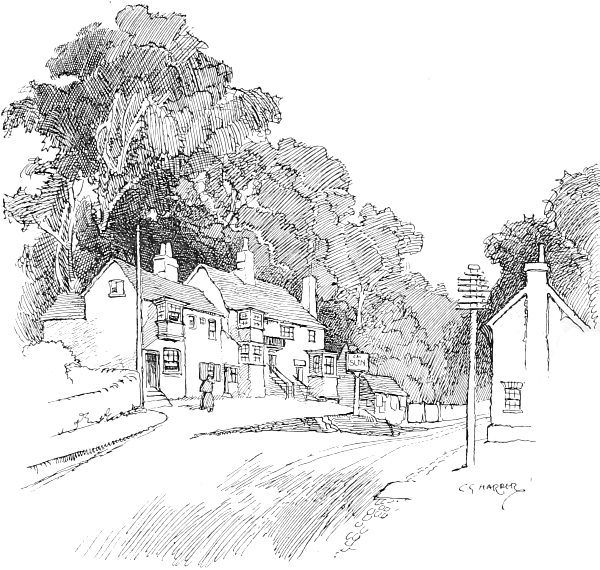
LEXDEN.
Lexden village now claims attention. It is a
place in which one school of antiquaries finds the
original Roman station of Camulodunum, established
on the site of the royal city of Cunobelin, King of
the Trinobantes; a finding strenuously contested by
another following. Certainly, among the tall elms
and rolling surface of Lexden Park there are remains
in plenty of huge defensive earthworks, telling in no
uncertain manner that this must have been a place of
enormous strength, by whomsoever held. The surroundings
are weird and impressive to a degree.
The village skirting the road is one of the
prettiest on the way. Going towards Colchester,
the road drops down the hill, where old cottages
stand high above the pathway, with steep little
gardens in front, kept from sliding down into the
road itself by lichened retaining-walls sprouting
with house-leek and draped with climbing plants.
Lower still, hard by the church whose carpenter-Gothic
atrocities are hung about with ivy and
creepers until they are transfigured into a dream
of beauty, the grouping of the 'Sun' Inn and
neighbouring houses is exquisite. Beyond this
point begins the suburban approach to Colchester,
a town it behoves the stranger to approach with a
proper respect, for here was the first Roman colony
in Britain. The history of Colchester, indeed,
begins so far back as A.D. 44, and there was already
a pre-historic native city in existence before then;
the royal city of that ancient British king, Cunobelin,
the monarch famous in the pages of Shakespeare as
"Cymbeline."
XXVI
Cunobelin, Lord of the Trinobantes, ruler of that
part of the country now divided into Middlesex,
Hertfordshire, Buckinghamshire, Hunts, Cambridgeshire
and Essex, was the successor of his father
Cassivelaunus, who had warred, not ingloriously,
with Julius Cæsar. He transferred his capital from
his native town on the site of St Albans to where
Colchester now stands. He appears to have been a
powerful ruler, and, if little is known of him,
certainly he is no myth, for the vague legends
that held the name of the Buckinghamshire villages
of Great and Little Kimble to be a corrupted form
of his own were strikingly proved correct some years
ago, when a hoard of gold coins was ploughed up in
their neighbourhood, bearing his title.
We do not know by what name Colchester was
then styled. After Cunobelin had died, full of
years and worn by grief at the revolts of his sons,
Caractacus, Adminius and Togodumnus, the end of
the native State over which he had ruled speedily
came. Adminius, in a fury against his brothers,
fled from Britain to seek the aid of the Romans,
and if no immediate result came, certainly his
invitation must have revived the old Cæsarian
dream of conquest. The real cause of the Roman
invasion that took place shortly after the death of
Cunobelin was the solicitation of a certain Bericus,
a British Prince of whom nothing appears to be
known beyond this one fact.
The invasion took place in A.D. 43, under that
able general, Aulus Plautius, who threw the Trinobantes
back from Hertfordshire and Middlesex,
across the Lea and into the Essex marshes, where
for a time they could not be followed. This was
the position at the close of the year. Detached
portions of the invading forces had overrun the
south of Britain as far as Gloucester and had
defeated the tribes on the way; leaving a garrison
in the west. But the island was little known and
held many mysteries. None could tell the real
strength of the natives, who disappeared in the
forests and marshes that covered the face of the
land, and by their irregular warfare disconcerted
the Roman plans of campaign. Plautius was at
last driven to act on the defensive on the Essex
borders. His soldiers were dying in the ague-stricken
morasses between the Thames and the Lea,
and had the enemy possessed powers of combination
and military skill, he might well have been cut off
here, at the end of the known world. A retirement
with his sick and dying was impossible. Nothing
remained but to go into camp during the winter,
and meanwhile to send for reinforcements. He
accordingly sent for forces from Gaul. They came
with commendable promptitude, commanded by the
Emperor Claudius in person. With these new
legions came an elephant corps, brought from
Africa to carry the heavy baggage. But they acted
a better part than this, for their strange appearance
terrified the astonished Trinobantes a great deal
more than any increase of the Roman soldiery could
have done. We may imagine this corps, crashing
irresistibly through the thickets, the forests and
marshes on that march into the Unknown, along
this line of country now traversed by the Norwich
Road, and can readily understand little resistance
being met with on the way. The tribes were dispersed
and their territory occupied as far as the
Stour, and a colony was founded in the opening of
the new year, A.D. 44, on the site of Cunobelin's city—Colonia
Camulodunum, the first Roman settlement
in Britain.
The Romans had so easily overcome the resistance
of the natives that they were soon lulled into a
feeling of security. For an uninterrupted space of
sixteen years Colonia grew and prospered. It
became a pleasant town, inhabited by veteran soldiers
grown grey in the service of the Empire, and
spending their later years in retirement. The
Emperor Claudius, flushed with his success, had
assumed the dignity of a god and had caused a
Temple to be erected in the market-place to his
honour, with attendant priests and altars. The
governors and consuls were lesser gods, and treated
with contempt and ill-judged severity the natives
who had been overcome with such ease. The
soldiery were uniformly brutal. Degeneracy and
luxury flourished together with this attitude of
oppression, and the town wholly lacked defences.
It is not surprising that these colonists were bitterly
hated by their vassals, who in especial looked upon
the priests as so many harpies living upon their
substance, and were so in fact, just as all priesthoods
and all clergy have been from the beginning, and
will be to the end. In this last respect these poor
Trinobantes, these wretched barbarians, exhibited a
quite surprising discernment, not equalled by the
priest-ridden centuries of culture and enlightenment
that have since passed.
These down-trodden natives were already ripe
for revenge when a more than usually unjust proceeding
of the Roman officials precipitated a rising.
The Iceni, who inhabited Norfolk and Suffolk, and
whose frontiers marched with those of the conquered
province, had been ruled over by a certain King
Prasutagus. Dying, he had hoped to propitiate the
goodwill of the Roman officials by dividing the vast
wealth he had accumulated, leaving one half to the
Roman Emperor and the other moiety to his two
daughters. But he was no sooner dead than his
country was invaded. His widow, the famous
Boadicea, resisted. She was publicly scourged, her
daughters suffering the worst indignities, and her
relatives sold into slavery. The whole nation rose
in arms at these outrages, and their cousins, the
Trinobantes, on the hither side of the Stour, joined
them. The Romans saw their folly when too late.
No more eloquent account is possible than that
given by Tacitus of the premonitions of evil. The
statue of Victory fell to the ground, and turned its
back where the face had been, as if it fled before
an enemy. Women were seen and heard singing
mad, wild songs, prophesying disaster. Strange and
unaccountable noises were heard in the house of
assembly, and loud howlings in the theatre. In
the estuary of the river the buildings of the city
appeared reflected upside down, and ghastly remains
of human bodies were seen in the ooze when the tide
ebbed. The sea assumed the colour of blood, and
the strangest whisperings stirred the air. Many of
the wealthier colonists, alarmed at these portents,
discovered that their health needed a change of air,
and went for a holiday into Gaul, on the other side
of the Channel, and those who remained applied for
military help. In answer to this appeal, a meagre
force of two hundred men was sent, and immediately
employed to fortify the Temple. But before these
measures could be completed, the town was surrounded
and taken; the houses burnt and the inhabitants
all slain, the little garrison in the Temple
meeting a like fate after a defence of two days.
Meanwhile, Petilius Cerealis, commanding the
Ninth Legion, which had been stationed on the
Icenian frontier near where Mount Bures now
stands, advanced to the aid of the doomed city.
He, however, had moved too late, and met the
victorious natives at Wormingford, where they
almost entirely annihilated his forces. The evidences
of that great disaster were discovered in
1836, when parallel rows of funeral urns, placed in
order like streets, were unearthed, containing the
bones of the lost legion gathered and burnt after the
Roman sway had been reasserted.
These events happened in A.D. 61. Suetonius
Paulinus, the then Commander-in-Chief, was at that
time vigorously prosecuting a war with the Druids
in the Isle of Anglesey, but on hearing of these
disasters he hurried back through Verulamium and
Londinium, collecting an army of ten thousand as
he went. The whole of the south was aflame, and
a numerous enemy hung on his flanks. The Roman
citizens of both those towns piteously begged for
protection, but were left to their fate, which was not
long in doubt, for no sooner had the flying column
passed than the tribes fell upon and utterly destroyed
them. Seventy thousand citizens perished
in that general massacre.
It is uncertain where the Roman army met the
hordes commanded by that heroic Amazon, Boadicea,
whom we should perhaps more correctly style
"Boduoca." The British Queen is a deadly dull
subject in the hands of the uninspired, who fail to
render her "convincing." No one has done so well
as Dion Cassius, who singularly resembles modern
writers of "personal paragraphs" in what recent
slang would term his "actuality." He says, "she
was very tall, grim in appearance, keen-eyed, harsh-voiced,
with a wealth of exceedingly yellow hair
falling below her waist" (her golden hair was
hanging down her back!), "wearing a highly-embroidered
tunic and a thick cloak fastened with a
buckle over it."
Tacitus describes the scene of battle as flanked by
two woods, on a site resembling a stretch of country
at Haynes Green, near Messing; but the great fight
must have raged on many miles of ground, and no
doubt included Lexden Heath.
The Britons were so sure of victory, that they
had brought their women and children as spectators,
and ranged them, seated in waggons, in a great
semi-circle commanding the battlefield. The Roman
historian says they were an "innumerable multitude."
The British Queen, addressing her warriors
from her chariot, called upon them to conquer or to
die, resting her hopes on the strength of her forces
and the justice of her cause; while Suetonius, on his
part, urged his troops not to be dismayed either by
the numbers of the enemy or their furious shouts.
The British attacked, the Romans at first remaining
on the defensive. When the fury of the first
onslaught was exhausted, the foot soldiers of the
Empire advanced in a wedge-like formation, the
cavalry closing in on the flanks, driving the speedily
disorganised enemy back upon the semi-circle of
waggons, which cut off their retreat. Penned up in
this way, the battle degenerated into a massacre, in
which eighty thousand Britons were slain, including
the women and children who had come out to witness
the fortunes of the day. The unhappy queen, seeing
all lost, poisoned herself.
Thus ended the British rule over Norfolk and
Suffolk. From this time date the existing walls
of Colchester. The conquerors were determined not
to risk a repetition of the destruction of their first
colony, and, choosing a new site, one mile to the
east of the former city, they planted their walls on
the ridge on which Colchester now stands, overlooking
the valley of the Colne. These walls, enclosing
an area of 1000 by 600 yards, still remain,
after the passing of more than eighteen hundred
years, the most perfect Roman fortifications in
Britain. Even in that wide space of time the town
of Colchester has not extended very greatly beyond
them. In some directions, indeed—notably to the
north and north-east and on the west—the ramparts
still look out upon the open country. The walls
have a thickness of from seven to eight feet, and
are built of red Roman tiles, alternating with courses
of stones, brought with great labour from the coast
near Harwich; the neighbourhood of Colchester, and
Essex in general, being quite innocent of stone of
any kind. Harwich and the seashore even to this
day supply the boulders of limestone from which
the building-stones of Colchester's walls were cut.
Colchester was never again attacked during the
period of more than three hundred years, in which
the Romans ruled. In the events of A.D. 61, they
had learnt the double lesson of being armed and of
treating a foe, once conquered, with generosity. In
the period between these events and the year 410,
when the Imperial forces were withdrawn from
Britain to help save the heart of the Empire from
ruin, conquered and conquerors had to live together,
and made the best of the necessity. Roman colonists
intermarried with the gradually Romanised British,
and the race of Romano-Britons thus created, during
three centuries, gradually grew to look upon Britain
as their home and themselves as a nation. Thus,
towards the end, usurpers of the Imperial authority
are found setting up as independent sovereigns, and
civilised British princes treating on equal terms with
Roman statesmen. In this way the British in some
measure came into their own again, and to these
circumstances we owe the wild legends of that
mysterious monarch, "old King Cole," who is to
Colchester what King Arthur is to Cornwall, the
great local hero. "Colking's Castle," on Colchester's
walls, and the earthworks near Lexden known as
"King Cole's Kitchen"; nay, the very name of
Colchester itself—"Cole's Chester," or castle, derive,
according to legends, from this scarce more than
mythical personage. Those stories make him one
Coel, or Collius, the last of a line of semi-independent
British kings who were allowed to retain a nominal
sovereignty after Cunobelin's death and the Roman
conquest. The story goes on to tell how, on the
death of the usurper Carausius, in A.D. 293, Coel
surrendered the country to the Emperor Constantius
Chlorus, on that successor of the Cæsar's marrying
his daughter Helena, who became the mother of
Constantine the Great, and was also the discoverer
of the true Cross at Jerusalem. The arms of
Colchester still bear a ragged cross between four
crowns, in allusion to this tale of the Empress
Helena; and in earnest that this is a distinction
which Colchester will not willingly lose, an effigy
of her, holding a cross very plain to see, is newly
set up on the very topmost point of the gorgeous
new Town Hall, recently completed.
To that most untruthful of chroniclers, Geoffrey
of Monmouth, the legend of Coel is chiefly traced.
He may either have imagined it, or have woven the
story out of existing legends, which had in turn
derived from the Saxons, who, after the departure
of the Romans, had wrested the country from the
Romanised British. They captured and burnt the
town of Colonia, and wondering at its massive walls,
took them to have been the work of some great king,
after whom the place had been named. Legends
of Cole soon sprang up, and by the time the Saxons
themselves had been converted to Christianity he
was fully provided with a history.
"Old King Cole," as the founder of Cole's-ceaster,
has been shabbily treated in modern times and made
to figure merely as a jolly toper. That he was the
most convivial of monarchs the song most emphatically
assures us.
"He called for his pipe, he called for his glass, he called for
his fiddlers three."
Nothing, if you please, more than the veriest pot-house
potentate! The author of that nursery rhyme
has degraded Cole as much as Mark Twain did the
romantic wielder of Excalibur in that monument of
vulgarity, A Yankee at the Court of King Arthur.
XXVII
The entrance into Colchester is singular. From the
straight, broad road leading past the trim modern
villas and so into Crouch Street—the street outside
the walls that takes its name from the vanished
monastery of the Crutched, Crossed or Crouched Friars—the
wayfarer suddenly comes to the sharpest of
angles, and, turning abruptly to the left, enters
Colchester by what has every appearance of being
the back door into the town.
Historically considered, the entrance by crooked
Head Street, as the continuation of Crouch Street is
called, really is a back way, and was in Roman times
the site of a gate leading to one of the southern and
less important roads. But ever since Saxon days
this has been the only way to or from London into
the town.
How it happened that the original road and the
Decuman Gate in Colchester's west wall fell into
disuse, none can tell. It was so many ages ago that
not even a pathway leads along the ancient way,
now quite obliterated by houses. But if the road
be gone, the Gate itself remains, though in ruins.
Let us, before entering Colchester, attempt to find
it. To do so, it will be necessary to retrace our
steps a little distance along Crouch Street, and, so
doing, to take a turning to the right-hand, down
Balkerne Lane. The first sign of ancient Rome is
seen where the Church of St Mary-at-the-Wall stands
towering above a flight of steps leading up into the
street beyond. There stands revealed a portion of
the wall. The breach in it, through which the steps
lead, was once a postern gate. Overhung with trees,
the freshness of whose spring foliage with every recurrent
April forms a romantic contrast with the
almost immeasurably old of the riven wall, this is a
place for thought. From the summit of that old
defence, where once the legionaries lined the battlements
in time of peril, or leaned gossiping in peaceful
days, one looks down over roof-tops into the valley
where the railway runs, and wishes for a momentary
lifting of the veil and a glimpse of what the spot will
be like in another eighteen hundred years. Close
by, a hoary mass of brick and tile and weather-worn
courses of septaria are the remains of the Roman
Gate. Three arches can be traced; the middle arch
of eleven feet span, the side ones, for foot passengers,
less than half that width. Candour, however,
compels the admission that of architectural character
they have not the slightest trace. Over against
this relic stands an inn known as the "Hole in
the Wall," although that is not its actual sign; and
through that hole the most prominent object in all
Colchester looms red and horrid. "Jumbo" brutally
dominates everything, and blasts the approach to
Colchester far away on every road but that from
London, for which small mercy thanks be given.
Who, you ask, is Jumbo? He is not Roman, but he
is very big, very ugly, and very prominent; and,
unluckily, cannot fail to be seen. After him, even
the Roman remains of Colchester pale their ineffectual
efforts at pre-eminence. It is conceivable,
although not very likely, that a stranger passing
through Colchester might not notice its Roman
antiquities, but Jumbo will not be denied. There
he is, crowning the highest point in the town, shameless
in brick of the most striking red and in attempts
at decoration which, however well meant, only serve
to render his hulking body more objectionable, with
an effect as though a navvy were to adorn his rugged
face with pearl-powder.
Jumbo, let it be explained, is the modern water-tower
of Colchester's waterworks. It was built in
1881, and cost close upon £10,500, and there are
those who say it is the second largest of its kind in
England. Where the largest may be we know not,
but if it injures its surroundings as effectually as
does Colchester's incubus, that unknown place has
our sympathies. Jumbo is shameless and rejoices in
his name, for, as the curious may see for themselves,
his weather-vane bears the effigy of an elephant.
Returning to Crouch Street, and so by Head
Gate and along Head Street, the High Street is
gained. It is one of the broadest and most spacious
streets in the kingdom, as it had every occasion to
be, for it was not only part of the great road leading
into Suffolk, but in it was held the principal fair of
the town. Here, too, close by where Colchester's
new and gorgeous Town Hall stands, was the old
Moot Hall, a building of Saxon, Norman and later
periods, barbarously destroyed in 1843. In the
Moot Hall the Mayor and justices dealt with offences
of all kinds, from the selling of bad meat to charges
of witchcraft, sorcery and heresy. Thus we may
read in the borough records of things so diverse as
the fining of Robert Barefot, butcher, in the sum of
twelve pence for selling putrid meat, and may learn
how William Chevelying, the first of the Colchester
martyrs, was imprisoned here in the reign of Henry
the Sixth until such time as it was convenient to
burn him in front of Colkyng's Castle. Here the
local Court of Pie Powder was held during the
Corporation Fair Days, in October. Summary
jurisdiction was the special feature of that Court,
and it was needed, for in those times, when people
of all sorts and conditions came from far and near,
offences were many and various. In the legal jargon
of the Middle Ages this tribunal is called the Curia
Regis Pedis Pulverizatis, or, in the Norman-French
then common, the "Cour Royal des Pieds Poudrés,"
that is to say, the King's Court of Dusty Feet.
Courts of Pie Powder obtained this eminently descriptive
name from the original Fair Courts, held in
the dusty streets long before buildings were erected
for the purpose, and the name survived long after
the necessity which originated it had disappeared.
Imagine, therefore, the highwaymen, the cheats and
thieves and those who came into disputation on the
Fair Days being brought before the Mayor by the
bailiffs, their cases arising and being heard, and judgments
and sentences being delivered and executed,
within the space of one day, amid the bleating of the
flocks, the lowing of the herds, and all the noise and
tumult of the Fair itself. We must not, however,
suppose the High Street to have been absolutely
clear of obstructions in days of old. In midst of
it stood the Late Saxon or Early Norman church of
that Saxon saint, St Runwald, which remained here
until so recently as 1878, when it was pulled down
and its site sold to the Corporation, to be thrown
into the roadway.
That Colchester stands on a considerably elevated
site is evident to all who, having entered from the
London road, turn out of Head Street into the High
Street, and in doing so glimpse the long descent of
North Hill at the corner. A further revelation is
that of East Hill, which, in continuation of High
Street, the traveller must long and steeply descend
towards the Colne, on his way to Ipswich and
Norwich. It was in High Street that Colchester's
principal coaching inns were situated, and there yet
remains—now the most picturesque feature of that
thoroughfare—the "Red Lion," with old timber
brackets supporting a projecting upper storey and a
four-centred Tudor oak entrance curiously carved; its
original and restored portions so thickly smeared
with paint and varnish that all might be old, so far
as the antiquary can tell, or all might be in the
nature of Wardour Street antiques. The "Red
Lion" figured as a rendezvous in the surrender of
the town to Fairfax, after the siege of 1648. In its
yard the vanquished laid down their swords.
Another inn was the "White Hart," where Bank
Passage leaves the High Street. The building, a
highly respectable plaster-faced one, smug and
Georgian, still stands, but it is an inn no longer.
Another old inn, the "Three Cups," has been rebuilt.
Older than any, but coyly hiding its antiquarian
virtues of chamfered oaken beams and quaint galleries
from the crowd, is the "Angel," in West Stockwell
Street, whose origin as a pilgrim's inn is vouched
for. Weary suppliants to, or returning from, the
shrine of Our Lady of Walsingham, far away on the
road through and past Norwich, housed here and
misbehaved themselves in their mediæval way. It
would be the gravest of mistakes to assume old
pilgrims decorous. Modern Bank Holiday folks
would, compared with them, seem to be of a severe
monkish austerity. The shrine at Walsingham,
second only in repute to that of the Blessed Thomas
at Canterbury, drew crowds of every class, from
king to beggar. The great Benedictine Abbey of
St John at Colchester sheltered some in its guest-houses,
while the late-comers inned at such hostelries
as the "Angel," or, if the weather were propitious,
lay in the woods. Ill fared the unsuspecting citizen
who met any of these sinners on the way to be
plenarily indulged and lightened of their load of sin.
They would murder him for twopence or cudgel him
out of high spirits and for the fun of the thing;
arguing, doubtless, that as they were presently to
turn over a new leaf, it mattered little how black
the old one was. Drunkenness and crime, immorality,
obscenity and license of the grossest kind
were in fact accompaniments of pilgrimage, and the
sin-worn wanderers who prayed devoutly at the
niche, now empty of its statue, in the east end of
All Saints' Church in the High Street, on their
journey to and from Walsingham, would resume
their foul jests and their evil courses so soon as
the last bead was told and the ultimate word of
dog-Latin glibly pattered off.
XXVIII
Removed from all the noise and bustle of the High
Street, in a quiet nook away from the modern life of
the town, stands Colchester Castle, on the site of the
Temple of Claudius. The Keep, built by Eudo,
"Dapifer," or High Steward of Normandy, under
William the Conqueror and his two successors, alone
remains, and has lost its upper storey, destroyed by a
speculator who bought the building in 1683, and half
ruined himself in his attempts to demolish it. It is
perhaps not generally known that this is by far the
largest keep in England, measuring 155 ft. by 113 ft.
The Tower of London, built at the same period, and
the next largest, measures only 116 ft. by 96 ft.
There have been those who, looking at its massive
walls, 12 ft. thick, with courses of Roman tiles
conspicuous in them, have believed this to be the
original Roman temple, and antiquaries who should
have known better have written long treatises to
support their views. Those, however, were the days
before comparative archæology had come into being
to prove that the peculiarities in the planning, noticeable
here, are partaken of by the undoubted Norman
keeps of the Tower of London and of Rochester
Castle, known to have been designed by Gundulf,
Bishop of Rochester. Freeman was very severe in
his time on those who labelled the interior of
Colchester keep with such names as "podium" and
"adytum," in their belief of its Roman character.
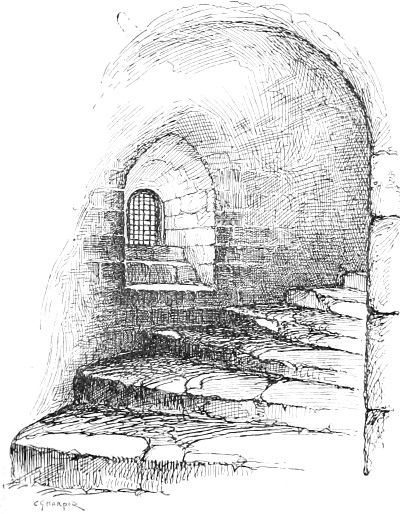
THE GRAND STAIRCASE, COLCHESTER CASTLE.
If its lack of height prevents Colchester Castle
from being impressive without, certainly its gloomy
dungeons and mighty walls compel the respect and
wonder of all who enter. They look not so much as
though they had been built up, as though cells and
passages had been carved and burrowed out of a solid
mass; so small are those passages and staircases, so
thick the walls. In the chapel and the corridors that
still remain roofed, the collections of the Essex
Archæological Society have a home, and from other
and roofless walls that are broad enough to afford the
safest of pathways one may gaze down upon the
surrounding grassy enclosures and see that spot
where those two Royalist commanders, Lucas and
Lisle, who held Colchester for seventy-six days
against the besieging army of the Parliament in
1648, were barbarously shot by order of Fairfax,
after having surrendered.
That siege of Colchester is the most romantic
incident that has survived in the history of the
town. It is the story of a last desperate attempt of
the Royalists to contend with the Parliamentary
forces that had everywhere overwhelmed the King's
supporters after a bitter warfare of over six years.
It was a gallant attempt, and the more so because
Essex was not a county favourable to the King's
cause. Sir Charles Lucas, at the head of this enterprise,
was a younger member of the Lucas family,
seated at Colchester. In the beginning of June
1648, a Royalist rising under Colonel Goring had
been checked at Blackheath by the Parliamentary
general, Fairfax. A portion of Goring's force crossed
the Thames into Essex, and lay at Brentwood. This
was an opportunity which Essex sympathisers could
not let slip. Lucas and his friends, gathering a body
of adherents, galloped down the road to Chelmsford,
where the Committee of Parliament was in session,
and seized them, afterwards continuing their progress
to Brentwood, where they effected a junction with
Goring's band. Their forces thus united, a counter-march
was made upon Chelmsford again, and continued
to Colchester; Lord Capel, Sir George Lisle,
and many others joining on the way. On June 12,
Goring, in command of this body of four thousand
Royalists, approached Colchester, and found the Head
Gate closed against him by the unsympathetic
citizens, but a slight skirmish soon enabled him to
force an entrance. He had not intended to remain
at Colchester, but the swift pursuit that Fairfax
organised from London gave the Royalists no time
to continue their projected march into the Midlands.
The day after Goring had entered Colchester, Fairfax
had assembled his forces on Lexden Heath, and
immediately sent a trumpeter to demand surrender.
The inevitable refusal was the signal for a battle outside
the town, on the London Road; a contest which
resulted in the retirement of the Royalists within the
walls. The Head Gate still existed, its bolts and bars
in perfect order, but as the Royalists fell back through
it into the town, two hundred or more of the Parliamentary
troops dashed through in pursuit. Their
ardour cost them their lives, for Lord Capel at the
head of a determined band pushed back the gate
upon the bulk of the enemy, thrusting his walking-stick
through the staples as the door closed. The
eager advance-guard, thus cooped up within the
walls, were all slain.
Preparations were now made on both sides for a
siege. Fairfax had already lost many men, and
dared not attempt to carry the town by storm. His
plan was to surround Colchester and imprison the
Royalists there until such time as his heavy ordnance
or starvation should compel them to surrender.
With his command of reinforcements from London,
and his ability thus to enclose the town with a
cordon of troops, the position of the Royalists was
hopeless, and it is to their honour and credit that,
in order to contain Fairfax's large army and so
give opportunities to the organisers of Royalist
movements in the Midlands, they continued the
defence in the face of starvation and despite the easy
terms of capitulation at first offered them. Their
domestic position (so to call it) in the town was
unenviable, for the inhabitants were wholly opposed
to their cause. They had with them, it is true, the
members of the Parliamentary Committee whom
they had kidnapped from Chelmsford, but those
gentlemen were a nuisance and had to be civilly
treated and fed while the Royalists themselves went
hungry. The unfortunate inhabitants, too, were
starving, and many of their houses and churches
destroyed by the besiegers' cannon shot; while
suburbs were burnt down outside the walls.
The end of this long agony came on August
27, when the town was surrendered; the officers
"surrendering to mercy," the lesser officers and rank
and file with an assurance that their lives and
personal belongings should be spared. Seventy-five
superior officers accordingly gave up their arms at
the "King's Head" inn. Four of them were to be
tried by court-martial. One escaped, one was
pardoned, and two—Sir Charles Lucas and Sir George
Lisle—condemned to be shot without delay, on a
disproved charge of having once broken their parole
when formerly prisoners of war. In vain asking for
time to make some final disposition of their affairs,
these two officers were executed the same evening,
on a grassy spot a few paces clear of the north wall
of the old castle. Sir Charles Lucas was the first to
be shot, and met his end as a brave, gallant gentleman
should. "I have often faced death on the field
of battle," he said, "and you shall now see how I dare
to die." Then he knelt in prayer, and, rising, threw
open his vest, exclaiming, "See, I am ready for you.
Now, rebels, do your worst!" The firing-party then
fired and shot him in four places, so that he fell dead
on the instant.
Sir George Lisle was then brought to the same
place, and viewing the dead body of his friend as it
lay on the ground, knelt down and kissed him,
praising his unspotted honour. After bidding farewell
to some friends, he turned to the spectators,
saying, "Oh! how many of your lives here have
I saved in hot blood, and must now myself be
most barbarously murdered in cold blood? But
what dare not they do that would willingly cut
the throat of my dear King, whom they have already
imprisoned, and for whose deliverance, and peace to
this unfortunate country, I dedicate my last prayer
to Heaven?" Then, looking in the faces of those
who were to execute him, and thinking they stood at
too great a distance, he desired them to come nearer,
to which one of them said, "I'll warrant, sir, we hit
you." "Friend," he answered, "I have been nearer
you when you have missed me!" And so, after a
short prayer upon his knees, he rose up and said,
"Now, traitors, do your worst!" Whereupon they
shot him dead.
The stone covering the graves of these unhappy
soldiers may yet be seen in St Giles's Church, with
an inscription stating that they were "by the command
of Thomas Fairfax, the general of the
Parliament Army, in cold blood barbarously
murdered." A legend may still be occasionally met
with in old books, which has it that the Duke of
Buckingham, who had married Fairfax's daughter,
approached Charles the Second with the object of
having the passage erased that reflected so severely
on his father-in-law's memory. The King conferred
on the subject with Lord Lucas, who said that he
would with pleasure obey the Royal command, if
only His Majesty would allow him to place in its
stead the statement that "Sir Charles Lucas and Sir
George Lisle were barbarously murdered for their
loyalty to King Charles the First, and that his son,
King Charles the Second, had ordered this memorial
of their loyalty to be erased." The King then, we
are told, commanded the already existing epitaph to
be cut still deeper, and it will be readily observed
by those who go to gaze upon it that the lettering is
bolder and deeper than commonly is the case.
The undertaking of Fairfax with respect to the
surrendered soldiery was not respected. They were
ruthlessly pillaged, and some sent to the plantations
over seas. Lord Capel was eventually executed in
London. For many years afterwards the spot where
Lucas and Lisle fell was shown by the awe-struck
people of Colchester, who told the legend that grass
would not grow where that loyal blood had been
spilled. In later times the story became an article
of faith with one political party and a derision to
the other. No grass grows there now; but for the
commonplace reason that a well-kept gravel path
occupies the site, which is duly marked by a small
obelisk.
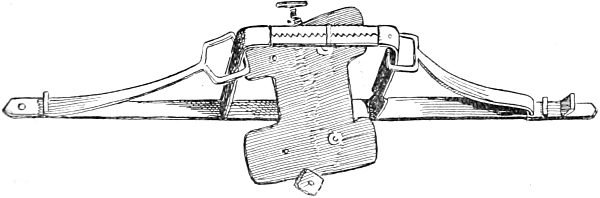
OLD MAN-TRAP, COLCHESTER CASTLE.
Colchester was long in recovering itself after the
rough treatment received during the siege; and in
fact, it is only in recent years that the church of
St Mary-at-the-Wall, battered down on that occasion,
has been rebuilt; while the Norman minster of St
Botolph remains the roofless ruin that cannonading
and incendiarism left it. Evelyn in 1656 found
Colchester "a ragged and factious town, now swarming
with sectaries," and if he had visited it nine
years later would have witnessed a worse state, for
the plague almost depopulated the place.
"Sectaries"—that is to say, those who preferred
to think for themselves on religious matters, and to
worship in their own way—were treated with an
unconscionable severity. One Parnell, a Quaker,
was imprisoned in a cell within Colchester Castle,
and died there, his story affording a sad example of
barbarity in the authorities of that period.
But the early nineteenth century was as savage
in some ways as the late seventeenth, which so
delighted in despitefully using Nonconformists.
The antiquarian collections in the castle, for instance,
include a particularly ferocious instrument
devised for the protection of the squires' property
and for the maiming of poachers. It is a man-trap;
one of those devilish contrivances which, actuated
by powerful springs and furnished with sharp steel
teeth, would, when accidentally trodden on by the
poacher, snap down upon his leg with force sufficient
to injure the bone and probably mutilate him for
life. It was thus the landed interests protected their
rabbits, hares and pheasants. The existence of this
man-trap, together with the spring guns also used
at the same time, is a reproach to the England of the
first quarter of the nineteenth century, just as its
preservation here as a curiosity is a certificate of the
progress achieved in humanity since then.
The present prosperity of Colchester is reflected
in many ways, but in none more strikingly than the
condition of the castle, now a municipal property,
and encircled with lawns and flower-beds, oddly at
variance with its time-worn grandeur. The neatness
of these surroundings and of the ornamental railings
that fence off the enclosure is admirable from the
everyday point of view, but the picturesque neglect
and rural squalor of other years pointed the moral of
the place and annotated its story, while present
prettinesses blur the historic page. It is so everywhere
throughout the land. When, a hundred years
ago, Turner, Sandby, Prout and Girtin, our early
water-colourists, roamed the country, making their
picturesque sketches, they did not find themselves
baulked by flower-beds, cursed by cast-iron fences,
or requested not to walk on the grass. They had to
pick their hazardous way through miry lanes, or
adventure through the bottomless sloughs of farmyards.
All these things were offensive to the
wayfarer, but they generally meant picturesque
compositions and exquisitely sketchable foregrounds.
Nowadays the conscientious illustrator, unwilling to
picturesquely exaggerate, and yet accursed with cast-iron
railings new from Birmingham last week, is in a
quandary.
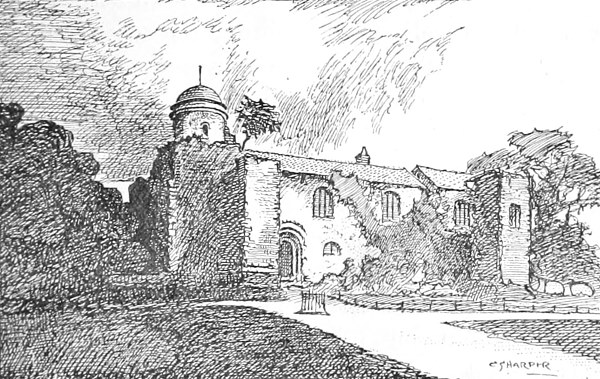
COLCHESTER CASTLE.
The once forlorn condition of Colchester Castle
doubtless originated in 1726, when its then owner,
Sir Isaac Rebow, left it by will to a detested grandson,
on whom he thus conferred a useless encumbrance,
a more exasperating bequest than even the
proverbial cutting off with a shilling.
A relic of those old days of picturesque neglect
is found in the book of an auctioneer, who wrote an
account of his "Professional Travels in England in
the first half of the Nineteenth Century," modestly
veiling his identity, and simply calling himself on
his title-page, "An Auctioneer." Part One of his
work was issued in 1843, but Part Two is yet to
come, and as his first instalment shows little merit,
the world can well afford to forego the second.
Coming to the castle, he muses over its ruins,
and weeps that cabbages and coriander employ the
attention of the Colchester people, rather than the
care of ancient fortresses. To him, thus contemplating
"the sad remains of so many interesting scenes,"
enters from an adjoining farm one whom he is
pleased to term "an Aborigine." By this he
obviously names an Essex farm-labourer. It is an
affectation, but he might have done worse. He
might have called him, seeing that Colchester is a
place of oysters, a "native," in inverted commas,
evidences of jocular intent, which would have been
dreadful.
"Ah! sir," says the Aborigine, "it was cruel
work when them great Barons, as they call 'em,
lived here."
"True, my friend," replies the Auctioneer, "but
it's a pity to see hogs and donkeys depasturing in
their courts and gardens, and grubbing and kicking
down their halls and chapels."
"Lord! your honour," rejoins the son of the
soil, "what's the use on 'em in these days? I'd
sooner see an acre of these 'ere swedes any day,
than them there towers and dungeons. Them
swedes afore you 'ool carry a score o' fine wethers
any month in the year, and plaze ye to look at 'em,
but as for them flint walls, you may look at 'em for
ever and a day 'fore you find enough o' green for a
garnish"; which was indeed a practical rural way of
looking at things.
The summit of those old walls has nowadays a
very charming green garnish of grass, rendered parti-coloured
by wind- and bird-sown wallflowers and
vigorous wildings; but more lusty than these are
the young sycamores, that have struck deep roots
into the walls and bid fair to grow into large trees.
It is still possible to follow the greater part of
Colchester's old walls along the queer alleys that
run above or below them. Eld Lane, out of whose
elevated course the steep descent of the old postern,
now known as Scheregate Steps, goes, is situated
along the summit of the south wall looking over
towards St John's Green, where, facing a wilderness
of scrubby grass, broken bottles, and the sordid
house-sweepings of the modern town, the gatehouse
stands, all that is left of the proud mitred Abbey of
St John. By that green is the frowzy little church
of St Giles, patched up in so atrocious a manner
from the wreck it was after the siege of 1648 that
to call its "architecture" merely "debased" is to deal
kindly with it. A dilapidated boarded tower is a
feature of the exterior; the interior provided with a
flat plaster ceiling, like that of a dwelling-room, and
filled with flimsy pine-wood pews, painted and
grained. Dust and stuffiness reign within; dust
and broken crockery without. And yet, although
so unlovely, it is not altogether with satisfaction
that an elaborate design is seen for rebuilding the
church from its foundations, together with the
notice, "It is earnestly hoped that contributions
will be given toward the restoration fund."
"Restoration" is not the word, for the design is
alien and quite unlike anything that formerly stood
on the ground. Rather let the place be repaired
and cleansed and its unbeautiful details preserved
as a characteristic and shocking example of how
they looked upon ecclesiastical architecture in the
dark days of churchwarden- and carpenter-Gothic.
It is here, under the north aisle, that those two
valiant captains, Lucas and Lisle, are laid.
For the church-towers built of Roman bricks,
and for other evidences of that ancient Empire, let
the explorer seek, and, presently finding, think
himself, if he will, an original investigator: it is a
harmless attitude, if at the same time unwarranted
by fact. Let us to other matters, and then, leaving
the town, hie away for Ipswich.
Colchester is, of course, famous for its oysters,
and has been ever since the Roman occupation.
In the estuary of the Colne, and the Crouch, and in
the oozy creeks of the Essex shores, the Colchester
"natives" still grow up from infancy to maturity
and feed upon the semi-maritime slime, as they did
close upon two thousand years ago, and doubtless
long before that. If we may judge from the
stupendous heaps of oyster-shells discovered on the
sites of Roman towns and villas, near and far, to
say merely that the Romans were fond of oysters
would be far too mild a term. They must have
almost lived on oysters, dreamt oysters, and thought
oysters. No wonder Colchester, whence the finest
and the largest supply came, was so prosperous a
Roman colony.
Although the fishery brings wealth to the town,
it is more than a mile away and makes no sign.
Those who might think that, because of it, Colchester
should obtrude oysters at every turn and oyster-shells
should strew every street, would be vastly
disillusioned. But beside its oyster fishery, other
Colchester trades are of secondary importance.
Agricultural machinery is made here, and brewing
and corn-milling carried on, but the once famed
textile manufactures are gone. Among those old
trades was the industry of baize-making, which left
Colchester considerably over a century ago for other
centres, after having given additional prosperity to
the town for a period of a hundred and fifty years.
It was shortly after 1570 that numbers of Dutch
Protestants, fleeing from the Spanish persecutions
in Holland, introduced the making of "bays and
says," and, despite local jealousies, flourished
amazingly for generations here.
But Colchester will never be dull while it continues
to be what it is now—a great military depôt.
Those worthy representatives of the Roman legionaries
at a distance in time of nineteen centuries or
so, the Tommies and troopers of the British Army,
are a prominent feature in every street, and bugles
blow all round the clock, from réveillé to the last
post, when every good soldier goes home to his
barracks down the Butt Road; while the King's
bad bargains stay behind and fortify themselves
against apprehensions of the morrow's "clink" with
another glass, or, adventuring too rashly into the
street, find themselves presently in charge of the
military patrol that walks the town with measured
step and slow.
XXIX
"From Colchester to Ipswitch is ten mile," says
that seventeenth-century traveller, Celia Fiennes,
in her diary. The milestones, however, tell quite
a different tale and contradict the lady by making
the distance between the two towns eighteen miles
and a quarter.
Seven miles of these bring the traveller from
Colchester across the Stour and so into Suffolk. It
is not an exciting seven miles. Passing the eastern
outskirts of Colchester, where mud in the Colne and
puddles beside the slattern streets offend the sense
of propriety, as, having reversed their natural
positions, the Fair Field is left on the right.
"Left" is an expression used advisedly, for who
would linger there? But the Fair Field cannot be
passed unawares. If not seen, it will be heard, for
on it camp the caravans, steam roundabouts and
travelling circuses that still draw rustic crowds with
their fat women, giants and dwarfs; or delight them
with mechanical rides on wooden horses to the
bellowing of a steam organ, whose music-hall airs
follow the traveller in gusts of stentorian minstrelsy
when the wind unkindly wills it so. The sounds
nerve the cyclist to quickly put the miles between
himself and those siren strains, and happily the
road is a fast one, so that he need not be long about
the business. It goes, as an old turnpike should,
broad and straight and well-kept, for the matter of
six miles, with little to vary the monotony of trim
hedgerow and equi-distant telegraph poles.
Let us therefore leave it awhile, and, journeying
some three hundred yards along the Harwich Road,
come across a railway level-crossing to the suburb
of St Ann's, and the site of a spring and hermitage
called Holy Well. The spring is now sealed up,
but an inscription in the wall of a cottage still
proclaims it to have been reopened in 1844. It
seems strange that the Hermitage should have been
placed, not on the main road where pilgrims were
surely more plentiful, but on the seaward route.
The explanation may probably be sought in the
existence already of another establishment of the
kind, long since forgotten. Here, then, the
Hermitage of St Ann's was placed, and a holy
well and an oratory made appeal to the piety or
the superstition, as the case might be, of all who
passed by. To these the hermit presented his
leathern wallet, beseeching travellers, who would
have gone without giving alms, to spare a trifle for
the upkeep of the road, even though they valued
not the Blessed Saints.
For three hundred years the Hermitage lasted,
and a long line of hermits lived here. Some were
pious and industrious, keeping the road in repair;
others had neither piety nor industry, spent their
time in taverns, were smiters, and got drunk and
fought, so that the road became scandalously neglected,
and many Colchester worthies received
apostolical black eyes from eremitical fists. Such
an one must have been the hermit who lived here
in the reign of Henry the Fifth, and was indicted in
1419 for having an unclean ditch. Finally, in
1535, when the dissolution of the monasteries took
place, the Hermitage was closed, and the then
occupant turned out, with a warning that if he
solicited alms henceforward he would be regarded
as a "sturdy beggar," and dealt with accordingly.
The road to Ipswich was the scene, in the
second half of the seventeenth century, shortly
after the first coaches had started running, of many
highway robberies. The borough of Colchester was
deeply concerned at this lawlessness, and in 1679
three men were rewarded with £6, 8s. between them
"for apprehending those yt robbed the Ipswich
coach." Again, in September 1698, three men
were rewarded "for pursuen hiewaymen," and for
"going to Ardlegh" on that business; but as they
received only two shillings each and an extra
shilling for "drinck," it looks as though the
pursuit was unsuccessful.
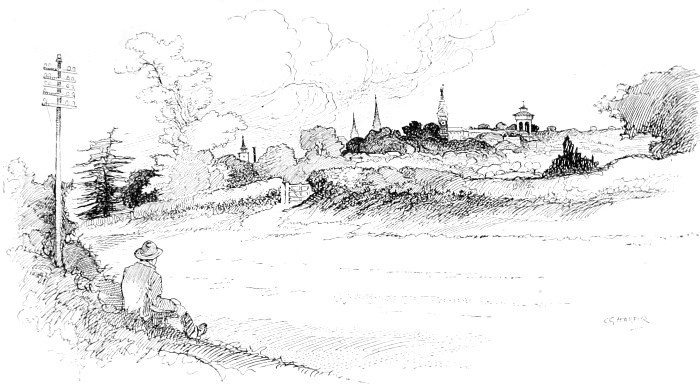
COLCHESTER.
The high road, to which we have now returned,
has already been described as an excellent highway,
but Dilbridge, a hamlet, and a roadside inn on what
was once Ardleigh Heath, alone break its solitude.
It has, however, the advantage of commanding the
best general view of Colchester, with the inevitable
Jumbo prominent, and the new-risen Town Hall
tower in rivalry with it.
Suddenly, when six miles from Colchester, the
road changes its character and drops sharply down
by an almost precipitous descent, to where a lazy
river is seen flowing picturesquely in loops and
bends between the grey-green foliage of willows
lining either bank. It flows through a land of rich
green meadows and yellow cornfields; a land, too,
of noble elms and oaks. In the far distance the
waters of a salt estuary sparkle in the sun, while
in between, from this Pisgah height, rises the tall
tower of a church. The river is the Stour, dividing
Essex and Suffolk, and the pleasant vale, the Vale
of Dedham. The estuary is that of the Stour at
Manningtree, and the church tower that of Dedham.
This, indeed, is the Constable Country, and that
fact explains the homelike and familiar look it
wears, even to the stranger. Constable, born close
by at East Bergholt, painted these scenes lovingly
for over forty years, and remained constant to his
native vale all his life. By the magic power that
comes of sympathy, he transferred the spirit of these
lanes and fields and trees to canvas as faithfully as
he did their form and colour; with the result
that the veriest stranger viewing them becomes
reminiscent.
Nor did Constable only paint his native vale;
he has described it in almost as masterly a way.
To him it was "the most cultivated part of Suffolk,
a spot which overlooks the fertile valley of the
Stour, which river separates that county on the
south from Essex. The beauty of the surrounding
scenery, its gentle declivities, its luxuriant meadow
flats sprinkled with flocks and herds, its well-cultivated
uplands, its woods and rivers, with
numerous scattered villages and churches, farms
and picturesque cottages, all impart to this particular
spot an amenity and excellence hardly
anywhere else to be found. He tells an amusing
story of travelling home by coach down this very
hill. He shared the vehicle with two strangers.
"In passing the Vale of Dedham, one of them remarked,
on my saying it was very beautiful, 'Yes,
sir, this is Constable's Country.' I then told him
who I was lest he should spoil it."
From this hill-top to the left of the road, and
in what are now the woodlands of Langham Hall,
Constable painted his best-known Vale of Dedham.
In one respect the scene has changed. The willows
still fringing the Stour, formerly "cobbed" or
pollarded, are now allowed to grow as they will,
and the river is not so visible as it was once.
Otherwise the Constable Country is little altered.
Even on this hill, close by Langham church, Church
Farm, the original of his "Glebe Farm," remains as
it was, thatched and gabled, close by the church
tower. Only the foliage has changed, and the little
guttering stream been drained away.
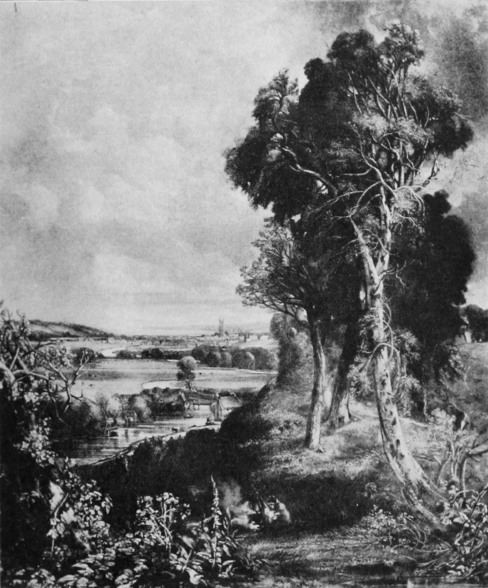
THE VALE OF DEDHAM. After Constable.
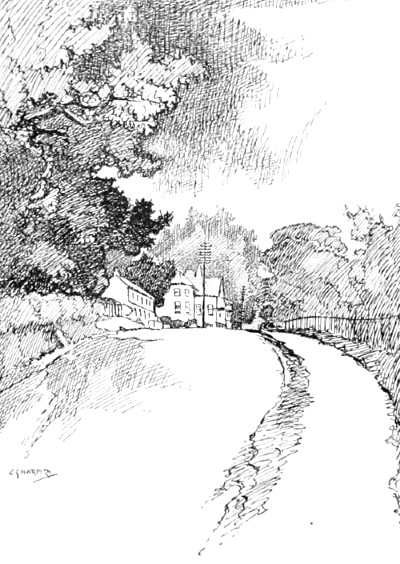
GUN HILL.
This steep road, shelving so abruptly to the
Stour, is Dedham Hill, more often locally known
as Dedham Gun Hill, from the "Gun" inn at the
summit, now unhappily rebuilt, but until recently
a most picturesque old inn, with the painted sign of
a cannon hanging over the road. The sign has gone,
and a pretentious house, which proclaims "Accommodation
for Lady Cyclists," arisen in its stead.
At the foot of the hill the road, turning abruptly
to the left, begins a lengthy crossing of the Stour and
its marshes by a bridge over the channel and a long
series of flood-water arches across the oozy valley.
The old toll-house, taking tolls no longer, still
stands, a quaint building on the Essex side, and
bears a cast-iron tablet with the inscription,—
THE DUMB ANIMALS' HUMBLE PETITION.
Rest, drivers, rest, on this steep hill,
Dumb beasts pray use with all good will;
Goad not, scourge not, with thongèd whips,
Let not one curse escape your lips,
God sees and hears.
T. T. H., Posuit.
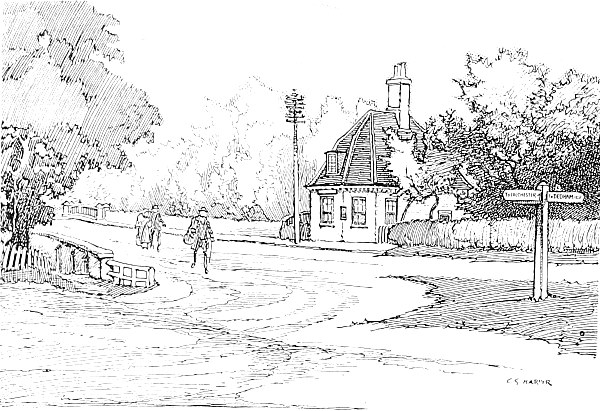
OLD TOLL-HOUSE, STRATFORD BRIDGE.
This is one of a number of similar tablets erected
throughout the country in the early part of the
nineteenth century, when the first glimmerings of
humane treatment of animals began to show themselves.
When drivers had perforce to halt here to
pay toll, this was a notice they could scarce help
seeing, but it only by rare chance attracts attention
now.
Across the bridge is the mill, long idle and empty.
No picturesque building this, but a great hulking
structure of that intolerable "white" Suffolk brick
which is rather a grey-white than any other hue; a
brick which, the older it is looks more shabby and
crude, and by no chance ever helps the artist. The
whole length of the Norwich Road is more or less
bedevilled with it.
This mill is the one blot on the beauty of
Stratford St Mary, a village built along the flat road
and continuing round the bend, and so up the hill
to where the fine old church stands overlooking the
highway. It is a remarkable church, built of black
flint and stone, and covered on the side facing the
road with inscriptions. It owed its rise, on the site
of an older building, to the Mors family, wealthy
clothworkers of this place in the fifteenth and
sixteenth centuries. It is perhaps a little difficult
to imagine Stratford St Mary, in common with other
East Anglian towns and villages, a busy seat of the
weaving industry, just as there is a difficulty in
realising that Sussex was once a grimy iron-mining
country; but trades and places have their fates, and
changes and romances of their own.
From 1499 to 1530 two generations of the Mors
family were busy in giving to their church and in
directing its new features; and the chief of the inscriptions
in stone and flint that curiously decorate
its exterior in old English characters record the facts
and beseech the wayfarer to pray for their souls.
Vain request! The work had not been completed
five years when the long and troubled story of the
Reformation began and the souls of the dead were no
longer prayed for.
The most prominent inscription is that enjoining
prayers for Thomas Mors and his wife Margaret, who
built the north aisle:—
Orate pro animabus Thome Mors et Margarete
uxoris ejus qui istam alam ffieri fecerunt
anno dni mccccm lxxxxviiii
Edward Mors, son of Thomas and Margaret, is, together
with his wife Alice, content with an English
inscription. They are also a little less self-centred
than their forbears, desiring prayers for "all Christian
souls" in addition to supplications for their own
especial benefit:—
Praye for the soullys of Edward Mors and Alys
hys wyfe and all crysten sowlys, Anno
Domini 1530.
Many other inscriptions and devices are seen,
among them the letters, P B A E S, said to be the
initials of an invocatory sentence, "Propitiemini beati
ad eternam salutem," addressed to Saints Thomas
and Margaret, the patron saints of Thomas and
Margaret Mors. But, stranger than any, is the appearance
of the entire alphabet on these walls. Many
attempts have been made to explain the reason of
this, among them the view that the object was to
educate the villagers in the rudiments of spelling!
XXX
The long rise out of Stratford on the way to Ipswich
lies through a beautiful Gainsborough-like woodland,
with ancient trees gripping sandy banks in a tenacious
clutch of gnarled roots. It is a hollow road,
and one in which, when the coaches were toiling up,
the guards' hands went instinctively towards their
blunderbusses and swordcases. One never knew
what or who might be lurking in that shade.
But if it was a chancy spot then, how very
suspicious a place it must have been hundreds of
years before. That it was so regarded may be learnt
from the Paston Letters, the instructive correspondence
of the Paston family in the fifteenth century.
Therein we read how a rival of John Paston in the
wardship of one of the Fastolf family, coming out of
Suffolk to London, was escorted by a hundred retainers,
all armed with bows and arrows in their
hands, with saletts on their heads, well-padded jacks
and rusty haubergeons on their bodies, and fear in
their hearts of an ambush laid on the part of the
Pastons in the hollow way where the trees meet overhead
and a mid-day darkness broods under the dense
foliage. This rival expressed himself as not being
afraid of the Pastons or any of their friends; but if
not, why did he go escorted with this motley crew,
tricked out with all the ancient weapons and rusted
armour they could find? Happily they were not
attacked, but that it was possible for petty warfare
of this kind to be plotted is proof that the Merry
England of that period was no safe place for peaceful
travellers.
Now we are well within Suffolk, the "crack
county of England," as Cobbett called it, the "sweet
and civil county" of Bishop Hall; but a county to
which the alliterative term "silly" has long been
applied. It is probably by this time quite hopeless
to scotch that nickname, for it is of a considerable
age and has a specious and easy glibness that comes
trippingly off the tongue. Suffolkers themselves—whom
it most concerns—are at pains to explain that
the real, and entirely flattering, solution of the phrase
is found in "selig," the Anglo-Saxon for "holy" or
"blissful;" a reference to the numerous and wealthy
religious houses within the county, and to the East
Anglian saints and the many places of pilgrimage.
Another party advancing the theory that the epithet
was originally "Sely Suffolk," observant of the
seasons, would thus have us believe that Suffolk
must have been more observant than other counties,
which is not credible. True, Suffolkers still talk of
the hay-harvest as "haysel," a survival of "hay sele,"
but this is not the only county that uses the phrase.
It becomes evident that the nickname must go unexplained.
Suffolk has its claims to recognition on other than
historic grounds. "I'm told the dumplings is uncommon
fine down there," said William, the coachman,
to little David Copperfield. Perhaps they are, and
certainly it was once the custom among the peasantry
here, as indeed throughout England, to serve pudding,
or "dumpling," before meat in order to take the edge
off appetites with a kind of food cheaper than
butcher's meat; but the improved circumstances of
the peasantry scarce demand such a practice nowadays,
and in any case, Norfolk is the county of
dumplings, so Dickens was in error in putting that
speech in the coachman's mouth. "Norfolk Dumplings,"
he should have known, are as proverbial as
"Silly Suffolkers."
Suffolk is deservedly esteemed all over the world
for the "Suffolk Punch." This sounds convivial, but
has no connection with punch-bowls; the reference
being, as a matter of fact, to a breed of horses.
"And the Punches! There's cattle!" said
William, the Canterbury coachman, to David Copperfield.
"A Suffolk Punch, when he's a good 'un, is
worth his weight in gold," he added; which is not
a very great exaggeration. Keep an eye upon the
fields or an observant glance along the road, and the
Suffolk Punch will readily be noted in his native
country, at plough, halted by the wayside inn, or
dragging with indomitable spirit the heaviest loads
that the stupidity of the most stupid of waggoners
could put him to. If ever horse deserved the praise
contained in the familiar copy-book maxim, that he
is "a Noble Animal, the Friend of Man," it is to this
breed that it most particularly applies. The Suffolk
Punch is a sturdy and a willing brute, and will pull
against a dead weight until exhausted. It has been
said that the Suffolk Punch existed as a type of horse
in early British times, and it has been supposed that
his remote ancestors were the horses that drew
Boadicea's war-chariots. If it were not that he is
invariably a chestnut, it might be supposed that his
fame in the county had originated the sign of the
"Great White Horse" in Ipswich; but from chestnut
the breed never varies. It may be of various shades,
from the darkest mahogany to the lightest golden-brown,
but never any other hue. It is, of course,
not necessary to journey into East Anglia to see the
Suffolk Punch. Many of his kind are at work in
London, drawing heavy loads, and are to be seen
expatriated to Russia, and on Canadian farms,
thousand of miles away from their native claylands.
The Suffolk dialect is kin to those of Essex and
Norfolk, but the "Suffolk whine" is peculiar to the
county; it is a rising inflection of the voice towards
the end of words and sentences. In Suffolk speech
"fowls" become "foals," and "foals," "fools"; and
archaic words, heard occasionally in Essex, grow
more common as the traveller advances. So also
does an odd custom first noticed in the neighbourhood
of Colchester—the custom of affixing the place-name
to the sign of an inn in ordinary talk. The
"Gun" inn at Dedham, for example, is always
spoken of as "Dedham Gun," and here, at Bentley,
the custom is emphasised by the sign of a roadside
inn being inscribed "Bentley Tankard," and not
merely "The Tankard."
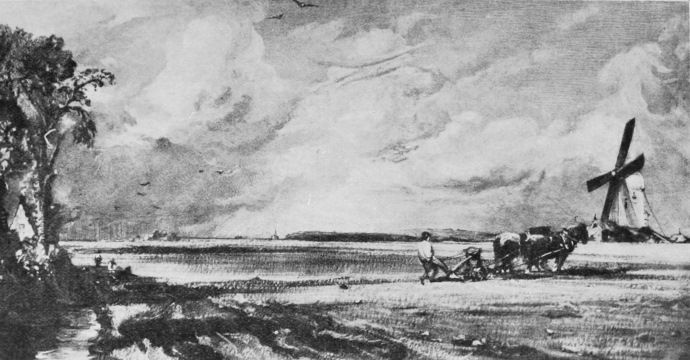
SPRING: SUFFOLK PLOUGHLANDS. After Constable.
But to understand Suffolk ways and to hear
Suffolk talk it is necessary to linger in the villages
and to gossip with the sons of the soil. The
agricultural villages are only articulate at eventide,
when they give themselves up to play and gossip.
Then, as the long summer day draws to its close, the
children find romance in the lengthening shadows,
in which their games of robbers and pirates seem
much more convincing than they could be made to
appear in the glare of the midday sun; the farm
labourers slouch off to their evening, over quarts of
"bellywengins," at the pub, and the coy mawthers
find the twilight a seasonable time for nannicking
with the hudderens. This, which may seem unmeaning
gibberish to those unacquainted with the
peculiar dialect of East Anglia, merely signifies the
girls flirting with the "other ones"—the young
men, in short.
But a mawther may be of any age. A baby girl
is a mawther, and so is a grandame. It is a curiosity
of speech which is apt to startle the stranger who
first hears it applied to a girl who has hardly yet
learned to toddle, in the maternal threat, to be
heard any day in any Suffolk village, "Yow come
'ere, mawther, this instant moment, or I'll spank
yow, so I 'ool." "Yow," of course, is the Essex,
Suffolk and Norfolk shibboleth for "you," by which
a native of these parts may be immediately distinguished
anywhere.
When the labourers have trudged over to their
"shants o' gatter," or quarts and pots of beer—the
"bellywengins," or belly vengeance, aforesaid; when
the children have been put to bed, and the mawthers
and the hudderens have gone nannicking off together
in the gathering dusk, then is the gossiping
time, both of the housewives and of the labourers.
The women talk at the doors of the "housen":
the men mostly in the village inns. Hear, passing
stranger, what the mawthers are saying:—
"Good daa to 'ee, Mrs Potter, how are ye a-gettin'
arn?"
"I'm a-doin' good-tidily, thank'ee, better'n tew
or tree weeks sin'. The doctor say I fare to be
on the mend; but it hev bin a bad time wi' me
sure."
"Ay; owd bones 'on't be young agen, I'm
thinkin'; but there, 'taint so much yer aige, 'tis yer
sperrut what keep ye up or let ye down."
"Ay, that be trew," says one of the group,
"what be life wi'out sperrut? Nothin', in a
manner o' speakin'."
"Yar father, Mrs Cobbold, he had it, and he
lived to be ninety."
"What a man that wor! I mind him when he
come to mine arter he'd walked from Ipswich, an'
that's a good ten mile. He come to paiy a shullun
he ew my ole man, and, barrin' a bit tirsty, he were
as spry as a mavish and fresher'n a paigle."
A mile distant, to the right hand, lies East
Bergholt, Constable's birthplace, and between it
and the road still stretch in summer those golden
cornfields he loved so well. "The Cornfield," that
crowning achievement of English landscape, how
exquisite a thing it is, radiant in colour on the
walls of the National Gallery, and how ineffectually
the inadequate medium of black and white
attempts to translate it.
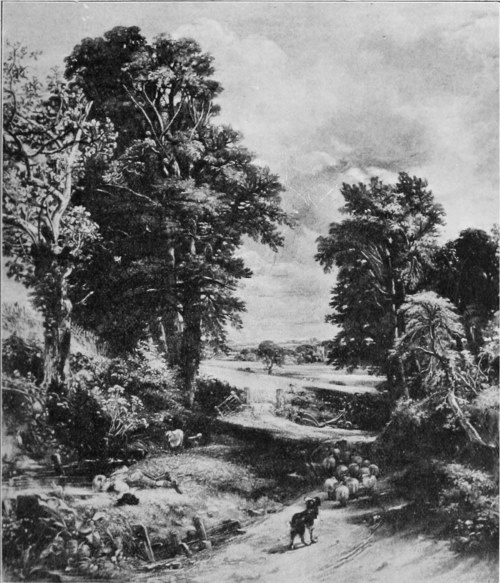
THE CORNFIELD. After Constable.
The grumbling farmer, who has good cause for
his growls, poor fellow, is careful to explain his
cornfields away. When asked why, if it does not
pay to grow wheat, he still continues to do so, he
says he grows it for the straw. At any rate, times
are changed from those when agricultural England
was merry with high prices; those picturesque days
when the Ipswich and Norwich coaches were hailed,
as every traveller was hailed, at harvest-time by the
reapers' cry of "Halloo, halloo, largesse," the largesse
going at harvest-home in a saturnalia at the village
inn. "Largesse" has gone with the going of the
reaping-hook, and with it and many other things
has gone the Lord of the Harvest, elected from
among his fellow-reapers to preside over their
labours and their harvest-supper in the great
fragrant barn or in the farm kitchen. The line
of red-cheeked peasants, working from early morning
with their sickles in the fierce sun upon the
diminishing fields of standing wheat, with halts for
levenses and bever, and so home by the light of
the harvest moon, is no more to be seen: reaping-machines
do the work instead. It was astonishing,
and, in the haymaking fields, still is, what long and
continual draughts of beer can be disposed of in the
intervals of such labour. Levenses, that is to say
the eleven o'clock forenoon meal, and bever, the
four o'clock in the afternoon halt, whose name came
through the Norman-French "bevre" from the Latin
"bibere," to drink, reduced the contents of the
barrels placed in the shady hedgerows, but quarts
imbibed under such conditions were harmless.
Almost solitary survivals of the old peasant life,
the names of "bever" and "levenses" remain yet
in the common speech of Norfolk and Suffolk as
those of the hedgeside meals of ploughman and
carter.
Old country folk still talk, in their reminiscent
moments, of coaching and posting days here, when,
near the tiny hamlet known as Cross Green, and in
a deep dip of the high road, where a byway goes,
leading from Manningtree to Hadleigh and beyond,
"Laddenford Stables" stood at the cross roads that
went then by the name of the "Four Sisters." Four
sisters, if one likes to accept the rustic belief, agreed
to part here and went their several ways, but how
they fared, or what was their social status, the story
does not tell.
Passing Capel St Mary and the level-crossing
by Capel station, and so by Copdock, whose church
tower has an odd weather-vane in the shape of King
David playing his harp, Washbrook is reached at
the foot of its steep hill. Copdock on the hill and
Washbrook in the hollow, together with the broad
and still marshy valley of the little Wash Brook,
tell how that rivulet was once, in the far-off days
when Saxons and Danes contended on this coast, a
navigable creek, an arm of the Orwell. The road,
in its sharp descent into and rise out of the valley,
together with its acute bend, is also eloquent of
bygone geographical conditions, leading as it does
down to the place where a bridge now spans the
stream on the spot where the creek was, in days of
old, first fordable. Having thus crossed, the road
went, and still goes, in a right-angle turn uphill,
towards Ipswich.
It was by no means necessary for travellers
journeying between London and Norwich to touch
Ipswich. The coaches did, for obvious commercial
reasons, but the "chariots" and the post-chaises
commonly went from Washbrook, through Sproughton
and Bramford, and joined the coach route again at
Claydon, thus taking the base of a triangle, instead
of its two sides. There are those at Washbrook
who can still tell of the coaches that halted at
"Copdock White Elm"; of the time when a toll-gate
(the house still existing) stretched across the
way at the foot of the hill, and of the "aristocracks"
who posted the long stage between "Stonham Pie"
and "Washbrook Swan." They can point out the
"Swan," facing up the road and looking squarely
up at the hill-top, but now a private residence with
its stables chiefly put to alien uses; and can show
the places, in what are now meadows, where many
houses and cottages stood in those wayfaring days,
when the high-lying road to Ipswich, across the
uplands between the valleys of the Stour and the
Orwell, was not so unfrequented as now.
XXXI
There can be no doubt of Ipswich and its surroundings
having thoroughly captured the heart of
grumbling old Cobbett.
"From the town itself," he says, "you can see
nothing; but you can, in no direction, go from it a
quarter of a mile without finding views that a
painter might crave." This is not a little remarkable,
for we do not generally attribute an artistic
perception of scenic beauties to this practical farmer.
Yet he was of one mind with Constable, of whom
and his pictures he probably had never heard,
although Constable had already for years been
painting these very scenes.
The practical farming mind appears in Cobbett's
next remarks: "And then, the country round about
is so well cultivated; the land in such a beautiful
state, the farmhouses all white and all so much
alike; the barns and everything about the homesteads
so snug; the stock of turnips so abundant
everywhere; the sheep and cattle in such fine order;
the wheat all drilled; the ploughman so expert; the
furrows, if a quarter of a mile long, as straight as a
line, and laid as truly as if with a level; in short,
here is everything to delight the eye and to make
the people proud of their country; and this is the
case throughout the whole of this county. I have
always found Suffolk farmers great boasters of their
superiority over others, and I must say that it is not
without reason."
Cobbett found the windmills on the hills round
Ipswich so numerous that, while standing in one
place, he counted no fewer than seventeen, all
painted or washed white, with black sails. They
are fewer to-day, and could Gainsborough, old
Crome and Constable revisit the scenes of their
artistic inspiration, they would sadly miss the
picturesqueness they gave these woody scenes and
fertile hills and vales. It is from the crest of one
of these hills that Ipswich is first glimpsed. There
it sprawls, prosperous, beside the broad Orwell;
"doubtlesse one of the sweetest, most pleasant, well-built
townes in England," as John Evelyn thought in
1656; but then swarming with "a new phanatic sect
of dangerous principles." The reader will scarce guess
aright who these fanatics were. They were neither
sun-worshippers nor Mahometans, but merely Quakers.
One obtains no glimpse of the broad estuary of
the Orwell when descending into the town by the
London road, and the crowded mass of the place rises
confusedly up before the traveller as he steeply
descends, and forms no picture. You must take
Ipswich in detail to admire it, and the actual
crossing of the river at the foot of the hill where
the town begins is at a narrow canalised stretch
before it widens out into the noble harbour that
makes the fortune of the port. A sign of that
accomplished fortune is the unlovely sight of the
great railway sidings and goods yards spread out
before the stranger's eye as he comes downhill. One
may say that the town begins at the door of the
"Ipswich Arms" inn, uninteresting in itself, but displaying
the fine "old coat" of this famous seaport;
a shield with a rampant golden lion on a red field on
the sinister, and three golden demi-boats on blue on
the dexter side.
"A fine, populous, and beautiful place," says
Cobbett, still harping on an unwonted string of
praise. "The town is substantially built, well
paved, everything good and solid, and no wretched
dwellings to be seen on its outskirts." He knew no
town to be compared with it, except it were Nottingham,
which, after all, is not properly comparable,
Nottingham standing high, while Ipswich is in a
vale, and moreover, is situated on an arm of the sea.
It is amusing to read Cobbett's remarks on the
population of Ipswich, which stood in his time at
twelve thousand. "Do you not," he asks, "think
Ipswich was far larger and far more populous seven
hundred years ago than it is at this hour?"—that
hour being some time in March 1830. He remarked
upon "the twelve large, lofty and magnificent
churches," each of them seven hundred years old,
one capable of holding from four to seven thousand
persons, and came to the conclusion that, in fact,
although he found Ipswich populous, it must, even
thus, have been a mere ghost of its former self.
That shrewd observer was right. Ipswich had
grievously decayed even in Charles the Second's
reign, when the Duke of Buckingham described
it as "a town without inhabitants, a river without
water, streets without names, and where the asses
wore boots." The Duke, in speaking of "a river
without water," was probably referring to the
estuary of the Orwell at low tide, when mud-banks
stretch vast, and the stream runs by comparison
feeble and thread-like through them. In its
then nameless streets, Ipswich was not singular, for
many small provincial towns were in like case. The
asses that wore boots were those employed in rolling
the lawn of a neighbouring park, the object probably
being to prevent their hoofs injuring the surface.
"Yepysweche," as Margaret Paston, writing to
her husband over four hundred years ago, spells
the name, derives its title from the aboriginal
Gippings, a tribe or clan who squatted down
beside the Orwell, and not only established their
primitive village of Gippingswick here, but contrived
to foist their tribal name upon the non-tidal
part of the river above the town, which therefore
still generally bears this alias. The town probably
saw its greatest prosperity in the time of Cardinal
Wolsey, a native, and, according to legend, son of a
butcher. This "butcher's dogge," as the envious
nicknamed the great Cardinal, determined that his
birthplace should be great in learning as well as
in commerce, and to that end founded a College
which he intended to be in some sort preparatory
for his greater college of Christ Church at Oxford.
That his foundation was reared on the spoliation of
a religious house and its revenues, procured by him
for the purpose, seemed but an ill omen for its
prosperity to those who saw his buildings rising to
completion, and the omen was speedily fulfilled, for
the new-made abode of learning never sent forth
a scholar, but was suppressed by Henry the Eighth
almost before the mortar of its brick walls was
dry; the buildings themselves torn down and the
endowments confiscated. All that remains of
Wolsey's College is one noble red-brick gateway in
College Street.
Daniel Defoe was a native of Ipswich and a
curious contrast with Wolsey, his brother townsman
of two hundred years before. In his day the old
prosperity of the place had vanished, in the stress
of Dutch competition and the virulence of the plague;
but modern times have made amends for that
temporary decay, and the town is now nearly four
times larger than when, shortly after the first
quarter of the nineteenth century had gone, Cobbett
noted its many and empty churches and its scanty
population. It numbers now over 58,000 souls,
and its trades are numerous and prosperous.
Whether it be in the making of agricultural and
milling machinery, its corn markets, artificial
manure making, or the manufacture of corsets,
Ipswich is fortunate, with the good fortune of those
who give heed to the ancient proverb and do not
put all their eggs in one basket.
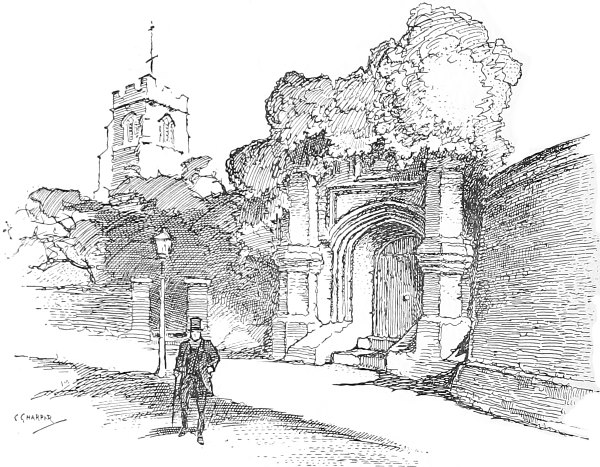
WOLSEY'S GATEWAY.
Picturesqueness coyly hides itself from the
traveller who merely passes through the chief streets.
Not in the open square of Cornhill, where the cabs
and flys stand on the site of the old Market Cross
and the trams fly to and fro, and where the Post-office
and the Town Hall rise, side by side, does
it appear, nor in the long street beyond; but rather
in the Butter Market and the lanes that conduct
to the waterside. There be streets in that quarter
with odd names, among them Silent Street; and
almshouses, and churches, and the queerest inns.
Among the almshouses are Smart's, on whose walls,
unhappily rebuilt in modern times, the charitable
Smart and his no less charitable coadjutor, Tooley,
are commemorated:—
"Let gentle Smart sleep on in pious trust,
Behold his charity. Respect his dust."
"In peaceful silence lett great Toolie rest,
Whose charitable deeds bespeak him blest."
It is to be feared that these eulogies raise a smile
at the expense of great Tooley and gentle Smart.
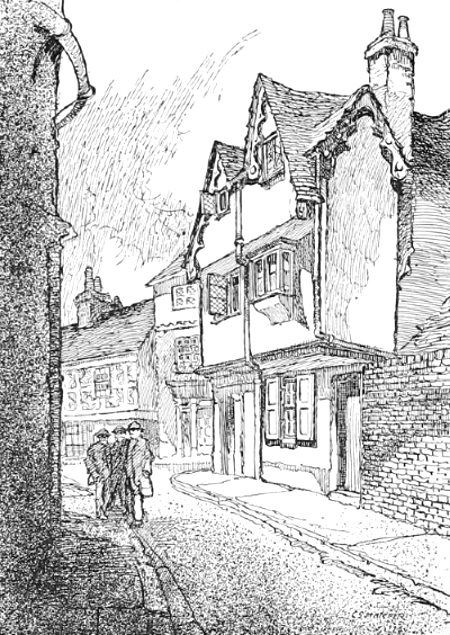
THE "LION AND LAMB," ANGEL LANE.
As to the inns, they include the odd conjunction
of the "Lion and Lamb," pictured here, and the
"Neptune" and the "Sea Horse," with a fine sound
of the sea in their names. Some of these old
hostelries yet retain their corner-posts: for example,
that of the "Half Moon" in Foundation Street,
where the post still keeps its mediæval carving of
a fox, with uplifted sanctimonious eyes, preaching
to three geese and a griffin; a satirical effort no
doubt looked sourly upon by the clergy of St Mary
Key Church, opposite, in days of old. A great gilt
key serves as vane to that church and perpetuates
the error in the name, which was originally, and
rightly, St Mary-at-Quay: the custom-house quay
and the harbour being close by, as the sight of
certain corn-elevators, the rattling of chains and
windlasses, and the sounds of throaty steam-sirens
sufficiently proclaim. The custom-house stands in
midst of coal-grit, laden steam vessels lying alongside
the quay wall, bellowing steamily to be discharged,
and railway-sidings, along whose maze of
points and turn-tables fussy little locomotive engines,
dragging jerky trucks, run, screaming intermittently,
as though saying to the bellowing steam-vessels,
"You just wait; can't you see I'm coming as quick
as I can?" It is a dignified custom-house, and
seems, surrounded with dutiable goods, to be
aristocratically sneering at the trade in whose midst
it is necessarily placed, and with as great a consciousness
of its Ionic peristyle as any high-born beauty
of her Greek nose.
Many of the old wool-staplers', clothiers' and
merchants' fine mansions stood by the quay and in
the by-lanes. They are mostly gone now, but traces
of old doorways and stray fragments of stone and
wood carvings remain, and here and there a courtyard,
or a house that sheltered family circles in the
amphibious half-mercantile, half-agricultural Ipswich
of the sixteenth century.
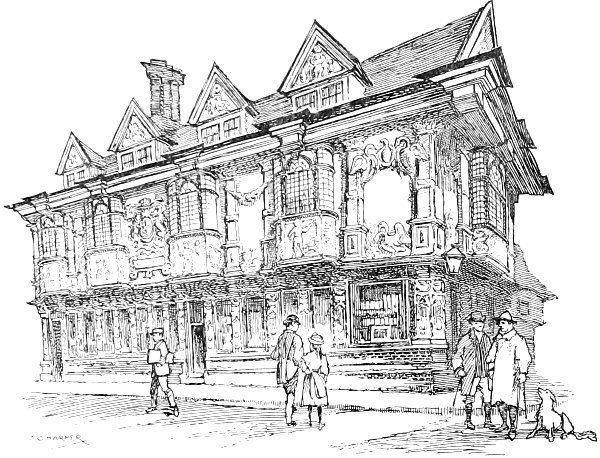
SPARROWE'S HOUSE.
Certainly one of the finest things Ipswich has to
show is the wonderful old place in the old Butter
Market, known still as "Sparrowe's House," although
the last of the Sparrowes who inhabited here has
long since gone to his home in the family vault within
the Church of St Lawrence, where, over their tomb-house,
may yet be read the punning motto, Nidus
Passerum, "a nest of sparrows." These Sparrowes
seem to have been endowed with some of the attributes
of the cuckoo, for they did not build the house
that bears their name. It owes its origin to a
certain George Copping, who built it in 1567, but
alterations and additions made in the Jacobean
period give its architectural history a span of over a
century. The woodwork of the bay windows and
the grandly-projecting eaves, together with that of
the shop premises, was added at the time. But the
great glory of "Sparrowe's House" is its decorative
plaster-work in high relief, which profusely covers the
exterior with garlands of flowers and fruits and with
quaint devices emblematic of the four quarters of the
globe. Here Europa, cornucopia in one hand, book
and sceptre in the other, sits with her bull, who
might be taken for an elephant with half his trunk
shorn off; here, on another bay, a podgy plaster
relief typifies Asia, with palm-tree and a building of
Oriental character in the background; followed by
Africa, a nude nigger holding an umbrella over his
head and sitting on a shark, at which four tiny
figures at a respectful distance express astonishment,
while nearer at hand a wicked-looking bird of quite
uncertain family roosts on a something that greatly
resembles a battered meat tin. America is typified
by an Indian in a feather head-dress which represents
his entire wardrobe. He stands with bow and arrows,
attended by a dog with a damaged smile. A very
beautiful representation of the Royal Arms occupies
one of the spaces between the windows, and other
devices show the pelican in her piety; Atlas supporting
the world; a classical scene in which a shepherd
bows as gracefully as the artist in plaster could make
him to a rural nymph; St George and the Dragon,
and several smaller subjects.
XXXII
The most famous thing in Ipswich is a thing neither
ancient nor beautiful, yet it is an object to which
most visitors to the town turn their first attention:
it is the "Great White Horse." The "Great White
Horse" is an hotel, of a size, in the merry days of the
road, justly thought enormous. It has been left for
the present age to build many hotels in town and
country capable of containing half-a-dozen or more
hostelries of the size of the "Great White Horse,"
but in its own especial era that house fully justified
the adjective in its sign. Especially did its bulk
strike the imagination of the reporter of the London
Morning Chronicle who was dispatched to Ipswich
in 1830 for the purpose of reporting a Parliamentary
election in the town. He was a very young, a very impressionable
and a very bright reporter, and although
we may be quite sure that the business on which he
was come to Ipswich was an arduous piece of work,
calculated to fully occupy his time and thoughts, he
carried away with him so accurate an impression of
the big inn where he stayed, that when, some time
afterwards, he wrote about it the description was as
exact as though it had been penned within sight
of the house. That reporter was Charles Dickens,
and it is his description in the Pickwick Papers
which has made the place famous.
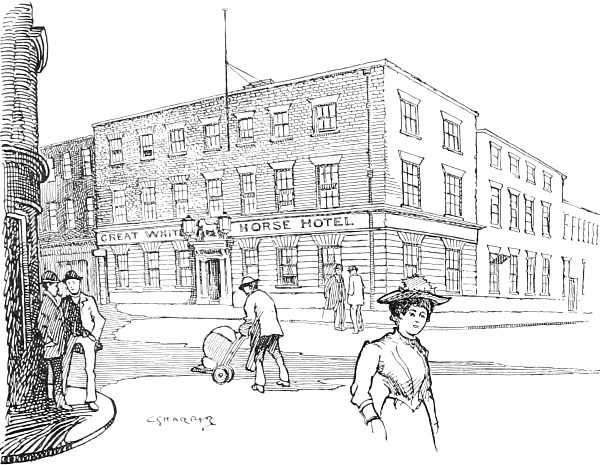
THE "GREAT WHITE HORSE."
It was not a flattering description. Few more
severe things have ever been said of inns than those
Dickens wrote of the "Great White Horse." Indeed,
if such things were nowadays printed of any inn or
hotel, the writer might confidently expect to be made
the defendant in an action for libel. Yet (such is the
irony of time and circumstances) the house that
Dickens so roundly abused is now eager in all its
advertisements to quote the association; and the
adventures of Mr Pickwick in the double-bedded
room with the elderly lady in yellow curl-papers
have brought many more visitors than the unfavourable
notice of the "uncarpeted passages" and the
"mouldy, ill-lighted rooms" has turned away. If, as
has been thought, Dickens thus wrote of the house in
order to be revenged for some slights and discomforts
he may have experienced here, certainly fortune
has played the cynic in converting his remarks into
the best of all imaginable recommendations.
The exterior of the house is much the same as it
was when Dickens first saw it, "in the main street
of Ipswich, on the left-hand side of the way, a short
distance after you have passed through the open
space fronting the Town Hall."
It is the same plain, square building, constructed
of a pallid kind of brick suggesting underdone
pastry, and is still, although the coaches have disappeared
and railways have supplanted them,
"known far and wide by the appellation of the
'Great White Horse.'" Still, over the pillared
entrance trots the effigy of the Great White Horse
himself, perhaps the aboriginal ancestor of that
famous breed of equines, the "Suffolk Punches," a
very muscular race, more famous for their bulk and
strength than for elegance, like those sturdy Flanders
mares to which Henry the Eighth inelegantly likened
his bride, Anne of Cleves.
Dickens, using the usual licence of the novelist,
describes this effigy as "a stone statue of some
rampacious animal, with flowing mane and tail,
distantly resembling an insane cart-horse, elevated
above the principal door." Quite apart from the
fact that the word "rampacious" is unknown to the
English language, and is probably meant for
"rampageous," the horse is really represented in
the act of beginning a gentle trot, and looks as mild
as the mildest milk that ever dewed the whiskers of
a new-born kitten. His off fore-leg, broken at some
period, has been restored of a size that does not
match with the other three. Never, in the whole
of his existence, has the Great White Horse gone
on the rampage, and, like all the truly great, his
manners have always been distinguished by their
unobtrusiveness.
"The 'Great White Horse,'" writes Dickens, "is
famous in the neighbourhood, in the same degree
as a prize ox, or county paper-chronicled turnip, or
unwieldy pig—for its enormous size. Never were
such labyrinths of uncarpeted passages, such clusters
of mouldy, ill-lighted rooms, such huge numbers of
small dens for eating or sleeping in, beneath any one
roof, as are collected together between the four walls
of the 'Great White Horse' at Ipswich." Further,
he describes it as "an overgrown tavern," at whose
door, when Mr Pickwick descended from the coach,
stood a waiter whose description quite takes one's
desire for dinner away. He was "a corpulent man
with a fortnight's napkin under his arm and coeval
stockings on his legs."
Although that must have been in the best and
most prosperous days of the highway, this waiter
does not appear to have had anything more pressing
to do than "staring down the road," while the
account of the internal arrangements of the house
does not indicate flourishing business. The private
room into which the guests were shown was a "large,
badly-furnished apartment, with a dirty grate, in
which a small fire was making a wretched attempt
to be cheerful, but was fast sinking under the dispiriting
influence of the place." After this we are
not surprised to read that it was only "after the
lapse of an hour" that "a bit of fish and a steak,"
representing a dinner, appeared. When this was disposed
of, Mr Pickwick and Mr Peter Magnus huddled
up to the fire, and, "having ordered a bottle of the
worst possible port wine, at the highest possible price,
for the good of the house, drank brandy-and-water
for their own."
Certainly Dickens must have had some very
bitter grudge against the "Great White Horse."
Then come allusions to "tortuous passages," and
the difficulty of a stranger's finding his way about
the interminable corridors, or distinguishing between
one "mouldy room" and another; difficulties which
led to Mr Pickwick's comical predicament in the
middle of the night. The rooms, not so mouldy
now, and the passages, just as perplexing, remain,
structurally unaltered to this day; but certain
alterations have been made downstairs in the courtyard,
now roofed in with glass and made very
attractive, without spoiling the old-style character
of the house. If you be a literary pilgrim, or an
American, they will show you Mr Pickwick's bedroom;
and can meet any of Dickens's criticisms
by telling how Nelson stayed here with—ahem!—Lady
Hamilton, and how Admiral Hyde-Parker and
others of world-wide fame have occupied the
"mouldy rooms."
XXXIII
Leaving Ipswich and passing through the dusty roadside
fringe of Whitton village, known as Whitton Street,
Claydon, nondescript, and neither very beautiful nor
quite commonplace, is reached in two and a half miles.
Just before entering the village, an old mansion is
glimpsed from the road, embowered in trees, a mansion
which, on inquiry, the ingenuous youth of Claydon
declare to be "Mockbeggar Hall." Claydon Hall is
its true title; but the popular name has been handed
down since many, many years ago, when the old house
(not old then) long remained tenantless. Like the
many other places named "Mockbeggar," it stands
well within view of passing travellers, and must have
induced many a sturdy rogue and vagabond to trudge
wearily up the long approach in search of alms, only
to find the windows dark, the chimneys innocent of
smoke, the place, in fact, deserted of all but fluttering
bats and screeching owls, whose shrill notes must
have sounded like jeers to the disappointed vagrants.
Inhabited now, Claydon Hall is a handsome old house
bearing the date 1635 on its Dutch-like gables. It
will probably never lose its popular name. Behind
the old Hall winds the willow-fringed Orwell, coyly
approaching within view of the road, and then, as it
were, timorously retreating again; its brimming
stream, although seen only in such fleeting glimpses,
potent in its effect upon at least three miles' length
of the road, from Claydon to Creeting All Saints, in
the loveliest stretch of woodland, where the fierce
mid-day sun is baffled by over-arching foliage, and
twilight comes early in the afternoon through the
dense masses of leaves. These are the woodlands of
Shrubland Park. The Hall lies secluded to the right
hand, somewhere away beyond the rather terrible
lodges that confront the traveller, who wonders where
he has seen their like before; until, like a flash, the
memory of certain great London cemeteries and their
mortuary chapels comes upon him in desolating
fashion and blights the cheerful rustic surroundings
of forest trees and the scurryings of white-tailed
rabbits and gorgeous blue and brown pheasants that
inhabit this domain of Lord de Saumarez. The
lodges, built like the Hall, from designs by Sir
Charles Barry, are of white brick and stone, in the
Italian Renaissance style.
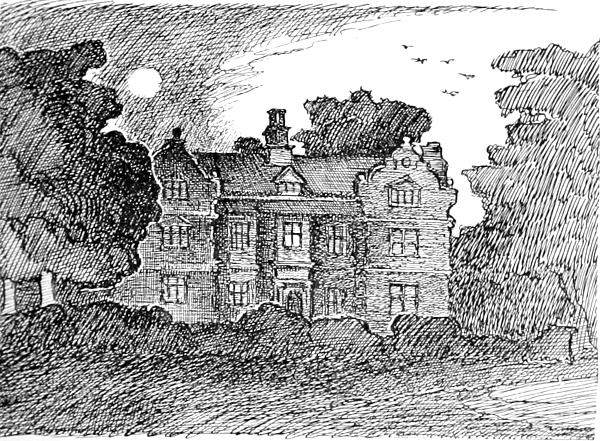
MOCKBEGGAR HALL.
At no great distance from the entrance to this
lordly domain, and noticeable from the road, in an
exquisitely damp situation by the river, eminently
calculated to foster rheumatism in old bones, is the
Barham Union-house—the "Work'us" of peasant
speech. It is quite an old-world building, and one
of the earliest built under the new Poor Law Act of
the early nineteenth century, when outdoor relief
gave place to retirement within these prison-like
buildings. Hodge well named them "Bastilles."
They say who should know of what they speak, that
life in Barham Union is nowadays quite desirable,
but the design of the building, a quadrangular
structure enclosing a courtyard, with outer walls
blank or only provided with windows at a height
from the ground, closely follows the prison, or restraining,
idea.
The little roadside sign of the "Sorrel Horse,"
standing in midst of these leafy bowers, is in pleasing
contrast with the Campo Santo pretentiousness of
Shrubland lodges or the prison-like style of the
Union, now left behind on a rising road, where the
scarped side of the highway reveals a momentary
change from the prevailing claylands to chalk; a
change so sudden and so strictly confined to this hillside
that it at once attracts the attention of even the
least geologically-inclined. Here the campions bloom
that love the chalk and refuse to grow on clay.
Below this hilltop, in the deep hollow scoured out
ages ago, when the now insignificant stream that
crosses the road was a considerable force, is Creeting
Bottom, and Creetings of several sorts are set about
the countryside, all hiding from the road that goes
now up hill and down dale with as lonely an air as
though the little town of Needham Market and the
larger town of Stowmarket were not almost within
sight, over the shoulders of the hills, on the highway
parallel with this, that runs to Bury St Edmunds.
To be on "on the road to Needham" is an obvious
Suffolk saying, applied to those who are badly off for
worldly gear, and it is a little curious that Needham
itself was for many years, and until quite recently,
a place of fallen fortunes, lamenting the decay of its
textile trades in empty houses and an "irreducible
minimum" of rent for those that were so fortunate as
to find occupants at all. The name of "Hungry-gut
Hall" that still clings to a farmhouse marks that
depressed period to all time; but in the spicy odours
of the tanneries and the chemical manure stores and
other thriving industries and businesses that cluster
round the railway station, the explorer finds evidences
enough that Needham is reviving.
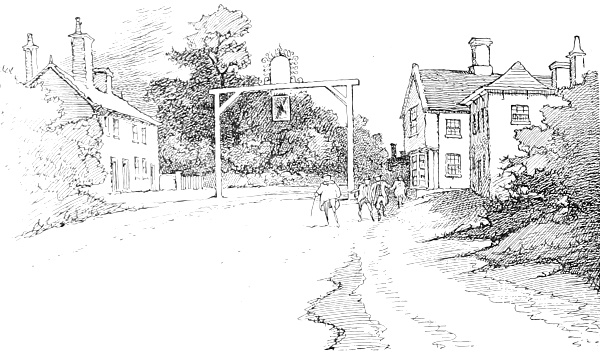
"STONHAM PIE."
Not a sign of those towns or of the railway is
seen on the road to Norwich, where the cottage outposts
of Stonham Earls and Stonham Aspall alone
tell of the villages in the hinterland. In their
gardens, spread on bushes or waving in the summer
breeze, intimate articles of underclothing are prominently
displayed, in the society of old hats and
coats, not so much for the exhibition of the family
wardrobe as in desperate attempts—bringing up all
the reserves—at scaring away the hungry birds from
currants, cherries and gooseberries. These contests,
the only warring incidents on the way, in which the
birds are generally the victors, bring one to a level
road where Little Stonham stands, its chief feature
the "Magpie" Inn. "Stonham Pie" owns one of
those old gallows signs, stretching across the road,
that were at one time a common feature. The
picture-sign, with a painting of that saucy bird,
has been hung below the cross-beam instead of in its
old ironwork frame above, now that the piled-up
coaches that once passed beneath are gone. Shortly before
their going, and while turnpikes and tolls appeared
likely to last for ever, the toll-gate that stood at the
succeeding village of Brockford was removed two miles
onward, to Stoke Ash, where, at the beginning of the
pretty avenue at Stoke Chapel, the later toll-house
remains, just as does the earlier one at Brockford.
Brockford, the "badger's ford" of a tiny affluent of
the Waveney, is preceded by Brockford Green, where
the quiet road is made narrow by its sides being encroached
upon by grass. It is here that the accompanying
sketch of tall poplars and bushy willows was
taken.
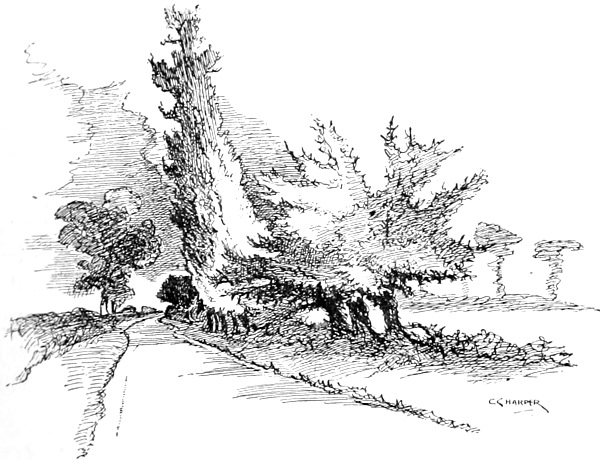
NEAR BROCKFORD.
Off to the left hand, in strong contrast with this
level stretch of road, the country is tumbled into
combes and rounded hills, where the River Gipping
takes its rise in the village of that name, springing
from the hill where the church tower stands solemn
and grim, as though it held inviolate the story of the
place, away from those days when the Gippings first
settled here and gave it a title.
But let not the hurried seek Gipping, along the
winding by-roads. The way, if not far, is not
easy, and passengers are few. Scattered and infrequent
farmhouses there be, at whose back doors
to inquire the way, but rustic directions are apt to
mislead. In any case, it is little use approaching
the front door of a farmhouse. No one will hear
you knocking, unless indeed it be a watchful and
savage dog, trained to be on the alert for tramps;
and you are like to hear him snuffling and gasping
on the other side in a ferociously suggestive manner
which will render you thankful that the door is
closed and bolted. And not only bolted on this
occasion, but always. The steps, and the space
between the door and the threshold, where stray
straws and wind-blown rubbish have collected, are
evidence of the fact that the farmer and his family
do not use the front door, but make their exits and
entrances by way of the kitchen. It is an old
East Anglian custom, and although many of the
farmers nowadays pretend to culture and set up
to be as up-to-date as the retired tradesfolk and
small squires they are neighbourly with, many
others would no more think of using the principal
entrance to their homes than they would make use of
the "parlour," where massive and sombre furniture,
covered with antimacassars, is disposed with geometric
accuracy around the room, in company with
the family Bible and the prizes taken at school by
the farmer's children; the stale and stuffy atmosphere
proclaiming that this state apartment is only
used on rare and solemn occasions. In fact, the
"best room" and the front door only came into use
in the old days on the occasion of a funeral.
Perhaps it is a custom originating in a laudable idea
of paying the greatest possible respect to the dead,
but it is one which certainly gives a gruesome mortuary
significance to both the entrance and the room.
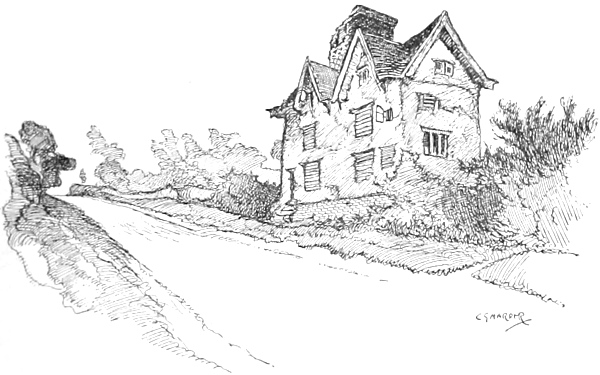
"THWAITE LOW HOUSE."
Thwaite or "Twaite," as East Anglians, incapable
of pronouncing "th," call it, less than a mile beyond
Brockford, numbers few cottages. Beyond it,
where the hitherto flat road makes a descent, is
in local parlance, "Thwaite Low House," not so
called on account of any disreputable character it
may once have earned, but from its situation. The
name obviously entails the existence of a "High
House," which was, like the other, a coaching and
posting inn. The last named, now a farmstead,
was in those days the "Cock," the other the
"Queen's Head." While the "Low House" has
fallen upon times so irredeemably evil that it has
been long untenanted and is now a veritable scarecrow
of a house, with gaping holes in its walls and
windows battened up, the "Cock," save that its
sign is gone, still remains much as it was, to show
a later generation what manner of place the roadside
inn was in days of yore.
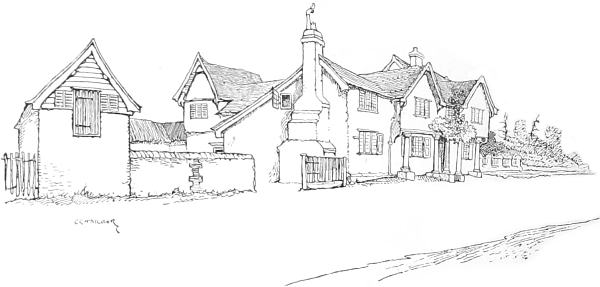
THE "COCK," THWAITE.
Stoke Ash, or "Aish," as Suffolkers pronounce
it, like many another village, makes no sign from
the road. Its church tower seen to the right, dimly,
amid a hilltop screen of trees, a square, box-like
red-brick chapel by the way, and that pretty inn,
"Stoke White Horse," are the only other evidences
of its being. The remaining six miles to the
Norfolk border lead through Yaxley and
Brome: Yaxley, where a branch railway runs
under the road, on its way to Eye, and narrowly
misses the old church: Brome, where the "Swan"
stands for all the village to those who look to
neither side of the road; church and houses skulking
down a by-road on the way to Hoxne. There,
down that pretty road, where the thatched cottages
nestle under tall trees and the blue wood-smoke
from rustic hearths curls upwards into the boughs
and makes the sparrows cough and sneeze—there
is the Rectory, approached in lordly fashion past
a fine brick entrance and exquisite avenue, and,
at a little greater distance the old black flint,
round-towered church, restored and titivated out
of all antiquity of tone: the stone sand-papered, and
the flints polished with a handkerchief. The only
thing missing—and, under the circumstances, it
is missed—is a glass case, so that no damp, nor
lichen, nor any effects of weather may come to
spoil the housewifely neatness.
It was along this road to Hoxne that those
who sought the revered head of St Edmund, King
and Martyr, in the miraculous legend, were led
to it by the voice calling, "Here, here, here;"
at length finding the sainted relic in charge of
a wolf, who allowed it to be taken from between
his paws. But the voice thus calling was probably
a much less supernatural manifestation, and
was doubtless the hooting of owls in the woods.
They still mock the belated traveller, only, to ears
untuned to the miraculous, they simply seem to
ask, "Who, who, who?" Ingenuity, however,
vainly seeks the basis in nature of the wolf
incident.
XXXIV
Now, crossing the River Waveney, winding with tree-fringed
banks through a flat country, the road enters
Norfolk at Scole. Coming over the little bridge,
the village is seen huddled together on either side
of a narrow rising road; village and church alike
wholly dominated by a great building of mellow
red brick whose panelled chimney-stacks and long
row of beautiful gables give the impression of an
historic mansion having by some strange chance
been taken from its park and set down beside the
highway. This, however, was at no time a private
residence, but was built as an inn; and an inn it
remains, after the passing of nearly two centuries
and a half. Scole, or "Schoale," as the name was
often spelled in old times (when, indeed, the village
was not called by its alias of Osmundeston), was by
reason of this inn quite a celebrated place in the
days of long ago. Every traveller in Eastern
England had then either seen or heard of "Scole
White Hart" and its famous sign that stretched
completely across the road, and as a great many
coaches halted here for changing teams, passengers
had plenty of time for examining what Sir Thomas
Browne thought to be "the noblest sighne-post in
England." Both house and sign were built in 1655,
for James Peck, described as a "Norwich merchant,"
whose initials, together with the date, are yet to
be seen on the centre gable. The elaborate sign
alone cost £1057. It was of gigantic size and loaded
with twenty-five carved figures of classic deities
and others. Chaste Diana, with bow and arrow
and two hounds, had a place on the cross-beam, in
company with Time in the act of devouring an
infant, Actæon and his dogs, a huntsman, and a
White Hart couchant. On a pediment above the
White Hart, supported by Justice and Temperance,
was the effigy of an astronomer "seated on a
Circumferenter," who by "some Chymical Preparation
is so Affected that in fine Weather He faces
the North and against bad Weather He faces that
Quarter from whence it is about to come." On
either side of the dizzy height occupied by the
astronomer were figures of Fortitude and Prudence,
a position suitable enough for the first-named of
those two virtues, but certainly too perilous for
the last.
Further suggestions of Olympus, with references
to Hades and Biblical history, adorned the other
portions of this extraordinary work. Cerberus
clawed one side of the supporting post, while Charon
dragged a witch to Hell on the other; and Neptune
bestriding a dolphin, and Bacchic figures seated
across casks alternated with the arms of twelve
East Anglian noble and landed families. Two angels
supported respectively the arms of Mr Peck and
his lady and two lions those of Norwich and
Yarmouth. On the side nearest the inn appeared a
huge carving of Jonah coming out of the whale's
mouth, while, suspended in mid-air, and surrounded
by a wreath, was another White Hart.
Although, as we have seen, Sir Thomas Browne
was impressed with this work, an early nineteenth-century
tourist (so early indeed as 1801) curtly
dismisses it as "a pompous sign, with ridiculous
ornaments," and shortly after that it seems to have
been taken down, for the reason that it cost the
landlord more to keep it in repair than the trade of
the house permitted. Together with this, the once
celebrated Great Bed of the White Hart has also
disappeared. It was a round bed capable of holding
twenty couples, and was therefore a good deal larger
than the famous Great Bed of Ware. Perhaps it
was because guests did not relish this co-operative
method of seeking repose, or maybe because sheets,
blankets and coverlets of sufficient size were unobtainable,
that the Scole Great Bed was chopped
up for firewood; but did anyone ever suppose beds
of this wholesale capacity would be desirable?
The accompanying old view of the gigantic sign
shows one of the peculiar basket coaches of the
second half of the eighteenth century, on its way to
London.
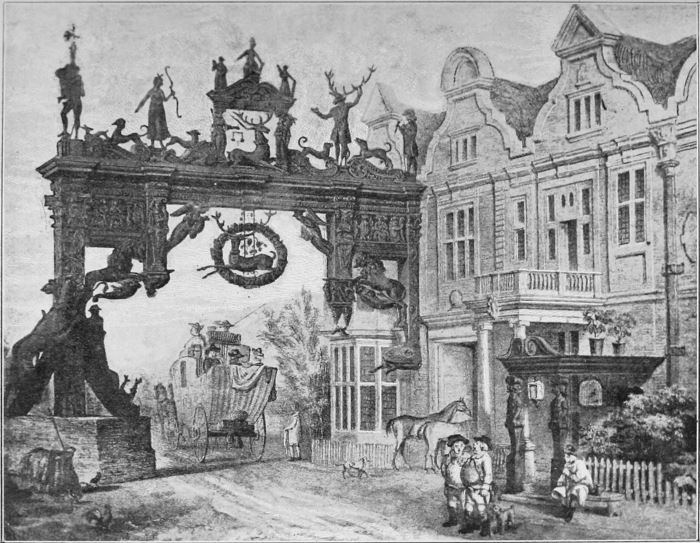
THE OLD SIGN OF SCOLE WHITE HART.
"Scole White Hart" must have been among the
very finest of inns and posting-houses. Its wide
staircases, of a width sufficient for the proverbial
coach-and-four to drive up them, its large rooms
and fine panelled doors, its great stone-flagged
kitchen, all proclaim how great must have been its
old prosperity; while the wide-spreading yard in
the rear of the house, together with the outbuildings,
gives some hint of how heavy the traffic was at
this junction of the Lowestoft, Bungay, Diss and
Thetford road with that from London to Norwich.
Shrunken trade has caused portions of the inn to be
let off; the stone and wooden porches seen in the
old print have disappeared; the coach entrance has
long since been blocked up and has become the bar-parlour,
and the mullions of the windows have given
place to sashes; but the building still retains a noble
architectural character, and is perhaps more interesting
in these latter days, now that its story is told,
than ever it was when that story was in the making.
Little or nothing is found in contemporary records
of "Scole White Hart"; only one vivid flash in its
later years, when indignant would-be coach passengers
stood at the door on a day in October 1822 and saw
the drivers of the "Norwich Times" and "Gurney's
Original Day Coach," fired by rivalry, and reckless
in their long race from Whitechapel, come pounding
furiously down the road and over the bridge, pass
the inn without stopping, and disappear in clouds of
dust in the direction of Norwich. Do you know
what it is to lose a train and to wait an hour for
the next? You do? Then it will not be difficult
to form some idea of the blind, stuttering fury that
possessed those who had booked seats at Scole and
saw the coaches dash away, to leave them with half
a day's wait.
Thorogood was driving the "Times." Both
started from London at 5.30 a.m. The "Day"
coach reached Norwich at 5.20 p.m., and the
"Times" ten minutes later, neither having stopped
for changing horses during the last twenty-five miles.
This was a "record" for that period, the usual time
being fourteen hours.
Probably the would-be passengers had to remain
the night; a fate which no one who has done the
like of late would be apt to complain of. The guest
at the "White Hart," seated in solitary state in
the lofty sitting-room, lit dimly by candles in antique
plated candlesticks, and with two ox-eyed seventeenth-century
beauties of the Lely type gazing down upon
him from their sombre frames, presently feels oddly
as though he were living in another era; a feeling
that grows as he wanders upstairs to bed, almost
losing himself in the roomy corridors. When he has
closed the nail-studded bedroom door with a reverberant
clang, and, creeping into the generous
embraces of a damask-hung four-poster that may
have been new a century and a half ago, gazes
reflectively about the panelled room and on the
curiously coffered ceiling, he drops off to sleep
straightway into the times when the inn was new-built
and dreams of how the news of the Restoration
may have come to Scole in 1661. Old times live
again, faded flowers bloom once more, forgotten
footsteps echo along the passages, and lo, the Has
Been is enacted again, with all the convincing air
of such visions. Post-chaises and chariots clatter
up to the door and their noise wakens the sleeper
to the consciousness that the sound is but that of
a jolting rustic tumbril going down the road in the
early morning; that this is the twentieth century,
and the "White Hart" but a survival in a back eddy
of life.
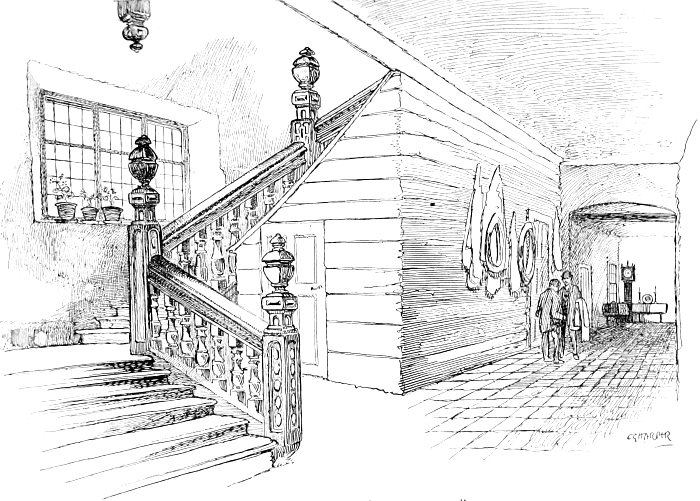
STAIRCASE IN THE "WHITE HART."
Besides the "White Hart," there is little else at
Scole. The plain flint tower of the church stands
by the roadside, on the ascent that leads from the
village; and other two or three inns, a few rustic
shops and cottages, and a private residence or so make
up the tale. Scole, in fact, has not grown greatly
since when it was a Roman station, and when the
Roman soldiers whose remains have been found near
the river occupied the military post on the long road
to Venta Icenorum.
The legionaries first stationed in these East
Anglian wastes must often have longed for their
native Italy. When the sky sank almost to the level
of the land in the long winter's rains and fogs, and
the biting winds blew out of the east across the sandy
scrub; when agues or the lurking enemy accounted
for many of their comrades, and when some favoured
few were recalled to the capital, they must have
thought wistfully of a more congenial clime than
this, situated on the edge of the Unknown. Rome,
either as Empire or Republic, was a hard taskmaster,
and when no fighting was in prospect employed the
troops ingloriously as road-makers. The advanced
garrisons in the wilderness cleared the enemy out of
the tangled brush and boggy marshes, and working
parties built roads under the protection of guards, or
improved the rude trackways they found already in
existence. Some fell by the way, and their skeletons
have been found in these latter days, the teeth still
clenched on the obolus placed in the dead man's
mouth to pay Charon for ferrying him across the cold
and darkling Styx; or, where the coin has perished,
still stained with the metal's long decay. They
perished, those pioneers, to found a civilisation, just
as countless thousands of our own blood have laid
their bones on distant shores, under burning skies or
in the Arctic night, to make England what she is.
Respect their long sleep, antiquaries, nor, as you
honour your own creeds, take from the dead men
their passage-money across that mystic river.
XXXV
This, as Dr Jessop charmingly names Norfolk, is
Arcady. The scene is pleasant, but the stage waits:
where are the actors? Gone, where and for what
reasons beyond the substitution of rail for road shall
presently be considered. But if the merry days of
old are done and population dwindled, at least in
East Anglia, and especially in Norfolk, dialect
flourishes among those who remain. The "Norfolk
drant" or drawl, is still heard, just as the "Suffolk
whine"—that rising inflection of the voice towards
the end of sentences—is even yet a mark of the sister
county. They are, indeed, said to have originated
the Yankee combined drawl and twang, for Norfolk
and Suffolk were largely represented among the
Pilgrim Fathers, the first colonists of North America.
With these survivals, some of the old rustic simplicity
is still met with, although the extraordinary ignorance
of sixty years ago has disappeared, and the
Norfolk labourer no longer thinks it possible to
emigrate to America by driving over in a farm cart.
The story is an East Anglian classic, how a farm
labourer "didn't fare rightly to knaw" by what route
they were going to the United States, "but we'm
gwine ter sleep t' Debenham the fust night, so's to
kinder break t' jarney." When railways came, and
access to London grew easy, these simplicities gradually
faded away. The young men took to "gettin'
up the road," as the saying ran—otherwise, going to
London—to "better themselves," and old illusions
were soon dispelled; but in Arcady the mavis may
still be seen knapping a dodman; the children of the
rustic hamlets may be observed by the passing stranger
gleefully sporting at the old game of tittymatorterin;
the cowslips that in springtime turn the
meadows to living gold are yet "paigles"; a small
field remains, as ever, a "pightle," and when a countryman
throws anything into a ditch, he "hulls" (or
hurls) "it in t' holl," just as his ancestors did hundreds
of years ago. Let some of the archaic words just
noted be explained before we proceed any further.
"Mavis" is the idyllic name of the thrush, and the
"dodman," which he may be observed "knapping,"
or breaking, is a snail; called in Essex, by the way,
a "hodmadod." "Tittymatorterin" is just the simple
game of "see-sawing." Besides these fleeting instances
there are many other peculiarities. The Norfolk
peasant will never pronounce the letter E if it be
possible to avoid it. It becomes I in his mouth, and
a head becomes a "hid," while hens are "hins."
Throughout the whole of the eastern counties, too,
the elision of the final in the present tense is a
feature of rustic talk. Examples of this peculiarity
are found not only in modern speech, but in old
epitaphs and inscriptions, dating back some hundreds
of years. Thus, a bridge across the River Wensum,
at Norwich, bears the sculptured effigy of a dragon's
head with the words, "When dragon drink, Heigham
sink." The meaning is that when the river rises and
touches, or "rise" and "touch," as a Norfolk man
would say, the dragon's mouth, the neighbouring
Heigham becomes flooded. An older example still
is seen on an inscription at Kimberley, to John
Jenkin, in the words:—
"Under this stone rare Jenkin lie,"
while a comparatively modern one may be found in
Stratford St Mary church, in the concluding lines of
an epitaph dated 1739:—
'The Night is gone, ye Stars Remain,
So man that die shall Live again."
Dickens has caught the East Anglian dialect
readily enough in David Copperfield, where he
makes Mr Peggotty say, "Cheer up, old mawther" to
Mrs Grummidge, and speak of "a couple of mavishes,"
while Ham talks to David as "Mas'r Davy, bor."
The willing Barkis, too, who asks "do she now?"
and speaks of the "stage-cutch," is a true product
of the soil.
For the benefit of those not to the manner born,
let it be repeated that a "mawther" is not necessarily
a parent. It is the generic name for a female. A
"mawther" may therefore be a girl infant or a grown
woman. "Bor" is, of course, a corruption of "neighbour,"
but need not, in fact, specifically mean a
neighbour, and is practically the masculine of
"mawther," and applicable to any man; friend close
at hand or stranger from distant parts.
The Norfolk dialect has attained the distinction
of being made the subject of study, and glossaries
and collections of local words have long been made
by enthusiasts in these matters. Perhaps the most
interesting and amusing of the examples of Norfolk
talk is found in the East Anglian version of the
Song of Solomon, published many years ago by Prince
Louis Lucien Bonaparte. It was taken down from a
reading by a Norfolk peasant. A few verses will be
instructive:—
1. The song o' songs, as is Sorlomun's.
2. Lerr 'im kiss me wi' the kisses of his mouth;
for yar love is better 'an wine.
3. Becaze o' the smell o' yar intements, yar
name is as intements pored out, therefoor du the
mawthers love yĕ.
4. Dror mĕ, we'll run arter yĕ: the king he ha'
browt me into his charmbers; we'll be glad and reījce
in yĕ; we'll remahmber yar love more 'an wine: the
right-up love yĕ.
5. I em black, but tidy, O ye darters o' J'rusal'm,
as the taents o' Kedar, as the cattins o' Sorlomun.
6. Don't sin starrin' at me, cos I em black, 'ecos
the sun t'have barnt mĕ; my mother's children wor
snāsty wi' me; they made me keeper o' the winyerds,
but m'own winyerd I han't kept.
7. Tell onto me, yow hu my soul du love, where ye
fade, where ye make yar flock to rest at nune: fur why
shud I be as one tarn aside by yar cumrades' flock?
8. If so bein' as yĕ don't know, O yow bootifullest
o' women, go yer ways furth by the futtin' o' the
flock, and feed yer kids 'eside the shepherds' taents.
9. I ha' likened yow, O my love, to a taamer o'
hosses in Pharer's charrits.
10. Yar cheeks are right fine wi' ringes of jewiltry,
yer neck wi' chanes o' gold.
The full flavour of this vernacular is only to be
obtained by reading the original verses side by side
with the above.
Among the sports that obtained on the borders of
Norfolk and Suffolk of old was "camping." "Camping"
was an old East Anglian game that, could it be revived,
would please the footballing maniacs of our own
day. It was a wild kind of football, played on these
commons, often with a hundred players aside, and
we are told that the roughest kind of Rugby football
was child's play compared with it. If stories of
old camping contests be true, it might almost seem
that in ascribing the thinly-populated condition of
Norfolk and Suffolk to the long-standing effects of
the Black Death, and to mediæval insurrections and
their resulting butcheries, we do an injustice to
pestilence and the sword, and fail to make count
of the casualties received in play. As the wondering
Frenchman said, in witnessing a camping-match, "If
these savages be at play, what would they be in
war?"
"These contests," says a Norfolk historian, "were
not infrequently fatal to many of the combatants.
I have heard old persons speak of a celebrated camping,
Norfolk against Suffolk, on Diss Common, with
three hundred on each side. Before the ball was
thrown up, the Norfolk men inquired tauntingly of
the Suffolk men if they had brought their coffins.
The Suffolk men, after fourteen hours, were the
victors. Nine deaths were the result of the conflict
in a fortnight." Camping went out of favour about
1810, and the coroners had an easier time.
XXXVI
Dickleburgh, the next village after Scole, is in its
way as imposing a place, only not an inn, but a
church, is its chief feature. The great church of
Dickleborough (as the name should be pronounced)
charmingly screened from the street by a row of
limes, but not so charmingly enclosed by a very
long and very tall iron railing, stands end on to the
road, its eastern wall looking down upon the pilgrims
who once passed on their way to Our Lady of
Walsingham; two tabernacles, one on either side
of the east window, holding effigies of popular
saints, and halting many a sinner for supplication.
The saints are gone, torn down by Henry the
Eighth's commissioners, or by the fanatical Dowsing.
They lie, perhaps, in the mud of some horse-pond,
or, broken up, serve the useful part of metalling the
road. Adjoining the church stands the "King's
Head," the sign perhaps rather a general idea of
kings than intended as a portrait of any particular
one. At any rate it resembles none of the long line
of English sovereigns, nor even that one-time
favourite, the King of Prussia, though old enough
to have been painted in the hey-day of his
popularity. Dickleburgh Church is absurdly large
for the present size of the place and for the empty
country side; but there is a reason for the solitudes,
and there was one for these huge buildings, ten times
too large for the present needs of the shrunken
villages. Norfolk and Suffolk, once among the most
thickly-peopled of English counties, were practically
depopulated in 1348 by that dreadful scourge, the
Black Death. One-third of the total population
of England perished under that terrible plague.
The working classes were the worst sufferers, and
the agriculturists, the weavers and labourers died
in such numbers that the crops rotted on the ground,
industries decayed, and no man would work. When
the pestilence was stayed, other parts of the country
flourished in greater proportion, than this. Manufacturing
industries arose elsewhere and attracted
the large populations; while East Anglia, remaining
consistently agricultural throughout the centuries,
has never shared the increase; only the few and
scattered towns showing industrial enterprise, in
the form of weaving in mediæval and later times,
and in the manufacture of agricultural machinery
nowadays. In the last two decades, with the
decay of agriculture and the rush of the peasantry
to London and the great centres of population, the
country, and the eastern counties in especial, has
become almost deserted.
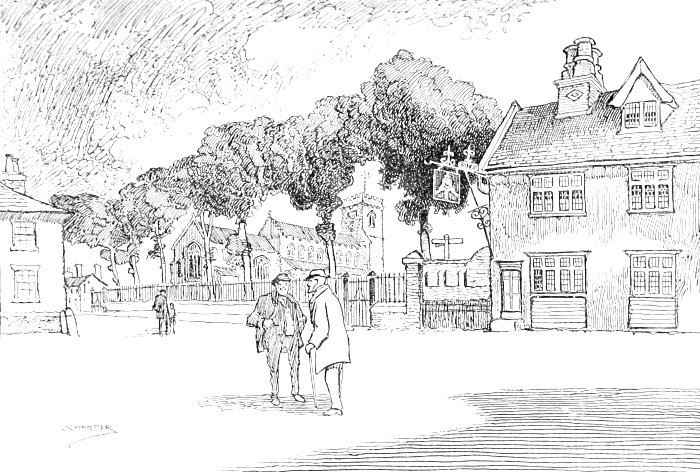
DICKLEBURGH.
The present state of agriculture in Eastern
England is made manifest in deserted farms, in
broken gates left hanging precariously on one hinge,
in decaying barns and cart-sheds left to rot; rusted
ploughs and decrepit waggons standing derelict in
the once fertile fields, now overrun with foul weeds
and rank with docks, charlock, and thistles; and
farms, long advertised "to let," remaining and likely
to remain tenantless. Not to everyone is it possible
to grow seeds and flowers, and market-gardening is
profitable only in the lands more immediately surrounding
the great towns. With wheat at its
present price of thirty shillings a quarter, it does
not pay to grow corn for the market, and the land
is going out of cultivation. Where the farmer still
struggles on, he lays down most of his holding in
grass for sheep and cattle, and grows, grudgingly,
as little wheat as possible, for sake of the straw.
Things are not quite so bad as in 1894, when wheat
was down to twenty shillings a quarter, and farmers
fed their pigs on the harvest which cost them three
pounds more per acre to grow than it would have
brought in the market; but at thirty shillings it
yields no profit. Agricultural England is, in short,
ruined, and there seems no present hope of things
becoming better. While the boundless, bountiful
harvests of Argentina, of Canada, the United States,
Russia and other wheat-producing countries can be
cultivated, reaped, and carried to these shores at the
prices that now rule, and while the stock-breeders
of those lands can raise sheep and cattle just as
advantageously, the English farmer must needs go
without a living wage. As matters stand at present,
we import fully seventy-five per cent. of the wheat
used in the country; the acreage under corn having
gone down from 4,058,731 acres in 1852, to about
half that at the present day. Meanwhile the population
has increased by thirteen millions; so that,
with many more mouths to fill, we grow only half
the staple food these islands produced then. There
are, of course, those who reap the advantage of cheap
corn and cheap meat from over seas. The toiling
millions of the towns and cities thrive on those
benefits; but what if, through war, or from any other
cause, those sea-borne supplies ceased? Of what
avail would have been this generation of cheapness if
at last the nation must starve? Extinguish agriculture
and the farmer, and you cannot recall them at need,
nor with magic wand bring back to cultivation a
land which has long gone untilled.
But the farmer cannot alone be ruined, any more
than the walls of a house can be demolished and the
roof yet left standing. It was the farmer who in
prosperous times supported the country gentleman
in one direction, and the agricultural labourer in
the other. With wheat, as it was a generation ago,
at seventy shillings a quarter, and other products of
the land proportionately profitable, the farmer could
afford to pay both high rent and good wages. Farms
in those days were difficult to obtain, and there was
great competition among farmers for holdings. To-day,
even at a quarter of those rents, tenants are
difficult to obtain, and the income of the landed
proprietors has dwindled away. The results are
painfully evident here, in the old families reduced or
beggared, and their seats either in the market or let
to stock-jobbers and successful business men, while
the old owners have disappeared or live humbly in
small houses once occupied by the steward or bailiff
of the estate.
While rents have thus, with the iron logic of
circumstances, gone down to vanishing-point, and
while farms have actually been offered rent free in
order to prevent the disaster of the land being let
go out of cultivation, the wages and the circumstances
of the agricultural labourer have been, most
illogically, improving. Instead of the miserable six
to nine shillings a week he existed upon, at the
beginning of the nineteenth century, he receives
thirteen or fourteen shillings, lives in a decent cottage,
instead of a wretched hovel, and finds the cost of food
and clothing fifty per cent. cheaper than his grandfather
ever knew it to be. Yet agricultural labourers
are as difficult to get now as they were immediately
after the Black Death had swept away three quarters
of the working class, five hundred and fifty years
ago. The crops went ungarnered then, as they
have done of recent years in East Anglia—for
lack of hands to gather them in. It was in 1899
that standing crops at Tivitshall St Margaret's and
adjacent parishes were sold by auction for a farmer
who could find no labourer willing to be hired.
What has been called the "rural exodus" is well
named. London and the great towns have proved
so attractive to the children of the middle-aged
peasant that they despise the country. They can
all read and write now, and at a pinch do simple
sums in arithmetic; so off they go to the crowded
streets. The ambitious aspire to a black coat and a
stool in an office, and others become workmen of
many kinds; but all are attracted by the higher
wages to be earned in the towns, and by the excitement
of living in the great centres of population,
and only the aged and the aging will soon be left
to till the fields.
Farmers entertain the supremest contempt for
the agricultural labourer's attempts to better himself.
To them they are almost impious; but the
farmer is himself tarred with the same brush of
culture. He is a vastly different fellow from his
grandfather, who actually helped to till the soil
among his own men; whose wife and daughters were
noted hands at milking and buttermaking; who
lived in the kitchen, among the hams and the
domestic utensils, and was not above eating the
same food as, and at the same table with, his
ploughmen and carters. He has, in fact, and so
also have the landed proprietor and the labourer,
undergone a process of levelling up. It is a process
which had started certainly by 1825, when Cobbett
noticed it.
Hear him:—
"When the old farmhouses are down (and
down they must come in time) what a miserable
thing the country will be! Those that are now
erected are mere painted shells, with a mistress
within who is stuck up in a place she calls the
parlour, with, if she have children, the 'young
ladies and gentlemen' about her; some showy
chairs and a sofa (a sofa by all means); half-a-dozen
prints in gilt frames hanging up; some
swinging book-shelves with novels and tracts upon
them; a dinner brought in by a girl that is perhaps
better 'educated' than she; two or three nick-nacks
to eat, instead of a piece of bacon and a
pudding; the house too neat for a dirty-shoed
carter to be allowed to come into; and everything
proclaiming to every sensible beholder that there
is here a constant anxiety to make a show not
warranted by the reality. The children (which is
the worst part of it) are all too clever to work;
they are all to be gentlefolks. Go to plough! Good
God! What! 'young gentlemen' go to plough!
They become clerks, or some skimming-dish thing
or other. They flee from the dirty work as cunning
horses do from the bridle. What misery is all this!
What a mass of materials for proclaiming that
general and dreadful convulsion that must, first
or last, come and blow this funding and jobbing
and enslaving and starving system to atoms."
The "convulsion" anticipated by Cobbett has
not come about. This is not a country of earthquakes
or of violent social upheavals. Free Trade
has beggared the agricultural interests, but, on his
way to the Bankruptcy Court, the farmer contrives
to live in better style than possible three quarters
of a century ago, while his pretensions to gentility
certainly have not decreased. As for the "funding
and jobbing," Cobbett could never, in his wildest
dreams, have foreseen Limited Liability and the
fungoid growth of Stock Exchange speculation, or
the modern "enslaving and starving system" of
the gigantic Trusts that, like vampires, feed on
the blood of industry. We need look for no convulsions;
not even, unhappily, for the hanging, or,
at least, the taxing out of existence, of the
millionaires. Our expectations of the future are
quite different. The people will inhabit the towns,
and the country will become a huge preserve of
game for the sport of the millionaires aforesaid; a
preserve broken here and there by the model farm
or the training establishment of some colossus of
wealth.
XXXVII
Beyond Dickleburgh, past the solitary "Ram" inn,
a fine, dignified house still lamenting its decadence
from a posting-inn to a beerhouse, Tivetshall level-crossing
marks where the railway runs to Bungay
and Lowestoft. Maps make Pulham St Mary the
Virgin quite near, with Pulham St Mary Magdalene
close by; Tivetshalls of different dedications, and
other villages dotted about like plums in a Christmas
pudding, but no sign of them is evident. Only
windmills, whirling furiously on distant ridges,
break the pastoral solitudes. In this conflict of
charts, a carter jogging along the road with his team
is evidently the authority to be consulted.
"Coom hather," says the carter to his sleek and
intelligent horses; and they coom accordingly, with
much jingling of harness, and stand in the shade of
roadside trees while their lord takes his modest
levenses and haffles and jaffles—gossips, that is to
say—with the landlord of the "Ram."
"Tivetshall?" asks the carter, echoing a question;
"niver heerd of un." Then a light breaks in upon
him. "Oh, ay! Tishell we allus call 'em; Tishell
St Marget an' Tishell St Merry," and with, a sweep
of the arm comprising the whole western horizon,
"Theiy'm ower theer."
"And Pulham St Mary the Virgin?"
"Pulham St Merry the Wirgin? oh, yis! Pulham
Maaket, yar mean, bor. Et edd'n on'y a moile, ower
theer"—a comprehensive wave to the eastwards.
And there, on a byroad, in an embrace of trees, it
is found, a little forgotten town, the greater proportion
of whose inhabitants appear to walk with two sticks.
It is ranged round a green or market-place, with a
great Perpendicular church, gorgeously frescoed
within, and with a very good recent "Ascension" over
the chancel arch, painted and stencilled timber roof,
and elaborate stained-glass windows. The townlet
and townsfolk sinking into decay, the church an object
of such care and expense, afford a curious contrast.
An old toll-house and the prison-like buildings
of Depwade Union conspire to make desolate the
road onwards. He who presses, hot-foot, along it,
turning neither to the right nor to the left, may
readily be excused a legitimate wonder as to what
has become of the great feature of East Anglia, its
spreading commons; for, strange to say, despite the
fame they have long since attained, no vestige of
them is glimpsed from the road itself. One has
usually to turn aside to some of the villages lying
near, but wholly hidden from the highway, to find
the yet unenclosed common lands, the pasturage of
geese, ducks and turkeys; but a striking exception
to this now general rule is the huge common of
Wacton lying off to the left of the road at the
hundredth mile from London, where a cottage and a
wayside inn, the "Duke's Head," alone represent
Wacton village, a mile distant. Wacton Common,
reputed to be the highest point in Norfolk, although
of no less extent than three hundred and fifty acres,
might perhaps be passed without being seen, for the
reason that, although still wild and unenclosed, it is
screened from the high road by a hedge and entered
through an ordinary field gate. The inn and the
cottage, obviously built on land fraudulently taken
from the common in the long ago, serve with their
gardens to hide that glorious expanse of grass and
heather. Here roam those chartered vagabonds,
the plump geese, that pick up a living on the
grassy commons and wander, like free-booting
bands of feathered moss-troopers upon the heaths,
closing their careers with royal feasting in the
August and September stubble, and a Michaelmas
martyrdom.
A DISPUTED PASTURAGE.
Norfolk and Suffolk are still famous for their
geese, but those martyred fowls do not make their
final journey to the London markets, between
Michaelmas and Christmas, with the publicity they
once attained. They go up to Leadenhall nowadays
in the seclusion of railway vans. Seventy years ago
they journeyed by coach, and in state, for the Norfolk
coaches in Christmas week often carried nothing save
geese and turkeys, beside the coachman and guard.
Full inside and out with such a freight, the proprietors
of fast coaches made a great deal more by
carrying them than they would have taken by a load
of passengers; so the fowls had the preference, while
travellers had to take their chance of finding a seat
in the slower conveyances. So long ago as 1793 the
turkeys conveyed from Norwich to London between
a Saturday morning and Sunday night in December
numbered one thousand seven hundred, and weighed
9 tons, 2 cwt. 2 lbs. Their value was £680. They
were followed on the two succeeding days by half as
many more.
A Norfolk common without its screaming and
hissing flocks of geese would seem strangely untenanted.
They, the turkeys, the ducks, the donkeys
("dickies" they call them in Norfolk) and the vagrom
fowls are among the only vestiges of the wild life
that once made Norfolk famous to the naturalist and
not a little eerie to the traveller of old, who, startled
on the lonely way that stretched by heath and
common and fen between the habitations of men,
shrank appalled at the lumbering flight of the huge
bustards, quivered with apprehension at the sudden
hideous whirring of the night-jar as the day closed
in, dismayed, heard the bittern booming among the
reeds, or with misgivings of the supernatural saw the
fantastical ruff stalking on long legs, with prodigious
beak, red eyes and spreading circle of neck feathers,
like the creation of some disordered imagination.
Wild Norfolk, the home of these and of many another
strange creature, is no more, and these species, now
chiefly extinct, are to be seen only in museums of
natural history.
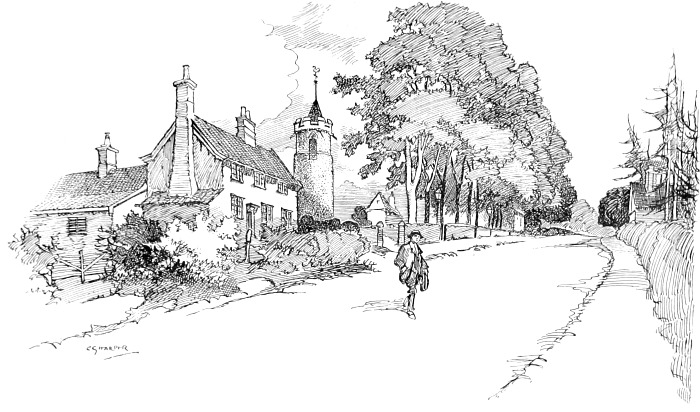
LONG STRATTON.
What Wacton lacks along the high road the
village of Long Stratton has in superabundance.
They named it well who affixed the adjective, for it
measures a mile from end to end. Beginning
with modern and (to speak kindly) uninteresting
cottages, it ends in a broad street where almost every
house is old and beautiful in lichened brick or soft-toned
plaster. Midway of this lengthy thoroughfare
stands the church, one of the Norfolk round-towered
kind, in the usual black flint, and beyond it the
Manor House, red brick, with Adam scrolls and
neo-classical palm branches in plaster for trimmings,
set back at some distance behind a very newty,
froggy and tadpoley moat. Beyond this again, the
village street broadens out. Looking back upon it,
when one has finally climbed uphill on the way to
Norwich, Long Stratton is a place entirely charming.
Its name, of course, derives from its situation on the
Roman Road, and Tasburgh, that now comes in
sight, keeps yet its Roman camp strongly posted
above the River Tase. Tasburgh—what little there
is of a village—occupies an acclivity on the further
side of that river, across whose wide and marshy valley
the mists rise early, seeing the sun to bed dull and
tarnished, and attending the rising of the moon with
ghostly vapours. The old Roman camp is oddly and
picturesquely occupied by the parish church, another
round-towered example. Excepting it, the vicarage
and the Dutch-like building of the "Bird in Hand"
Inn, there is little else.
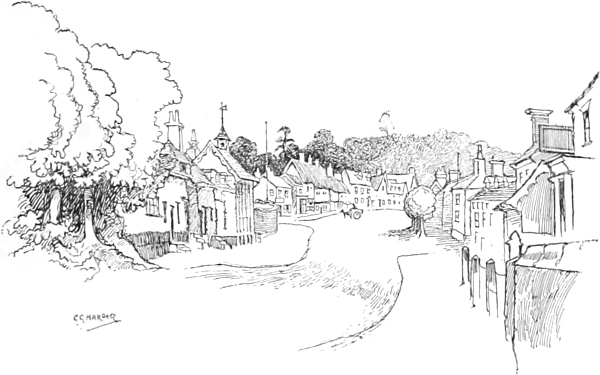
LONG STRATTON.
But what mean these sounds of anger and lamentation
that drown the soothing, distant rattle of reaping
machines on the hillside: a voice raised in
reproach, and another—a treble one—in gusty
shrieks of combined pain, fear and peevishness?
Coming round a corner, the cause of the disturbance
is revealed in a wet and muddy infant rubbing dirty
knuckles into streaming eyes, and being violently reproached
by an indignant woman.
"You're a pretty article, I must say; a fine
spettacle. I'll give yow a good sowsin', my lord;
coom arn;" and the malefactor is pulled suddenly
inside the cottage, the door slammed, and muffled
yells heard, alternating with thumps. The offender
is receiving that sowsing, or being "yerked,"
"clipped over the ear-hole," getting a "siseraring,"
being "whanged" or "clouted," the striking Norfolk
phrases for varieties of assault and battery.
XXXVIII
The Tase is met with again on surmounting the
hilly road out of Tasburgh and coming down hill into
Newton Flotman. Here it is broad enough to require
a long and substantial bridge, grouping in unaccustomed
rightness of composition with the mingled
thatched, tiled and slated cottages and the church
that stands on a commanding knoll in the background.
When Newton was really new it would be
impossible to say; perhaps its novelty may have been
measured against the hoary antiquity of, say, Caistor
yonder, down the valley. For what says the folk-rhyme:—
"Caistor was a city when Norwich was none,
And Norwich was built of Caistor stone,"
and if Norwich partook of Caistor's building materials,
why not, in degree, Newton Flotman? But a
whisper. Caistor was never more than a camp, and
not at any time a place of houses, much less of stone
ones. Stone is not to be found in this neighbourhood,
and flint only, of which Norwich is principally
built, is available for building materials.
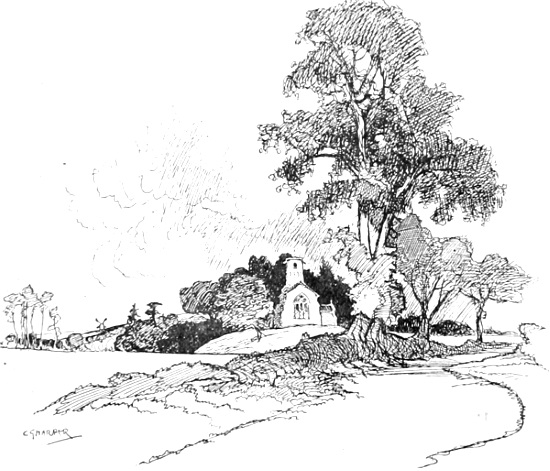
TASBURGH.
One object in Newton Flotman that puzzles the
passing stranger is a little effigy of Bacchus fixed on
the wall of the "Maid's Head" Inn, so thickly
covered with successive coats of paint that it is
difficult to give it a period. Remains of Roman
antiquities are so many in this district that it is
often mistaken for a work of that classic age, when
it can really claim no higher antiquity than that of
the late eighteenth century, a time when figures of
the kind were a usual decoration of inn signs. Such
an one still swings from the wrought-iron sign of
the "Angel" at Woolhampton, on the Bath Road.
In the woody valley of the Tase beyond Newton
Flotman lies Dunston, trees casting a protecting and
secretive shade over it, and the "Dun Cow" Inn its
only roadside representative. That inn and the
circular brick pound for strayed sheep and cattle
redeem the last few miles into Norwich from
absolute emptiness. When the pound last was used
who shall say? The tramps have played havoc with
it, and its wooden gate has gone. The ancient
office of pound-keeper is here evidently fallen into
disuse.
Swainsthorpe's octagonal church tower is seen on
the level to the left, but Caistor, in like manner with
Dunston, is sunk deep in foliage, half a mile or more
away in the valley, its church tower rising like a
grey beacon from amid the trees, to tell the curious
where its ancient camp may be found. Caistor St
Edmunds, to give its full name, is the site of the
great Roman camp established here to overawe the
stronghold of the Iceni, four miles away on the
banks of the Wensum, and now the site of Norwich.
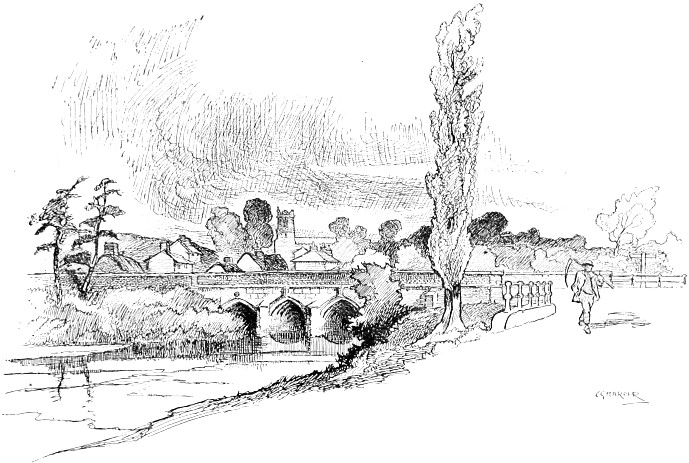
NEWTON FLOTMAN.
Caistor camp is a really satisfactory example of
a Roman fortified castrum. For one thing, it has
the largest area of any known relic of its kind in
England, enclosing thirty-seven acres. If its
fragments of flint walls have neither the thickness
nor the height of those at Portus Rutupiæ, the old
Roman port in Thanet, now known as Richborough,
its deep ditch and massive embankment assist the
laggard imagination of the layman in matters
archæological, which refuses to be stirred before
mere undulations in the sward. Here is a ditch
that can be rolled into, an embankment that can be
climbed and paced on three sides of the camp, if
necessary, to put to physical test both height, depth
and extent. The fourth side of this great enclosure,
now a turnip-field, was bounded by the River Tase
and was sufficiently defended by that stream, then a
wide creek, so that no works are to be found there.
How long it was before the Romans subdued the
Iceni, whose great city is thought to have stood
where Norwich does now, is not known. Nothing
of that early time here, indeed, is known, and guesses
are of the vaguest. Only it seems that the Roman
advance into East Anglia, which had for its objective
the principal stronghold of the tribes, here came to
its military ending. To compare things so ancient
and romantic with others modern and thought
prosaic, the several Roman camps on the advance
from London now to be sought at Uphall near
Romford; Chipping Hill, near Witham, Lexden, and
Tasburgh, are, with those that have disappeared, to
be looked upon in the same light as the wayside
stations on the railway to Norwich, a railway which
originally came to a terminus at that city, and was
only at a later date continued northward.
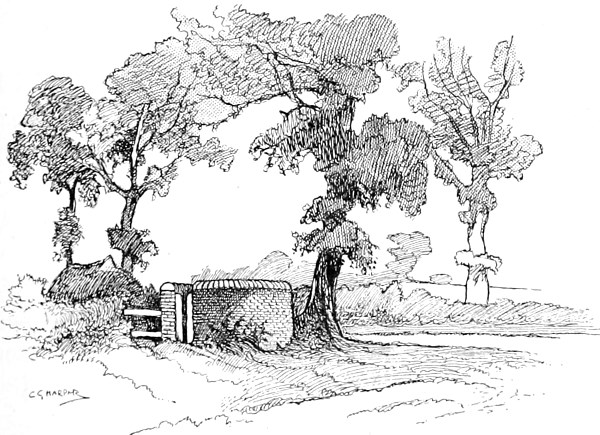
THE OLD BRICK POUND.
Where the Romans and the Romano-British
citizens of Venta lived when the tribes were reduced—where
the Venta Icenorum of Roman rule really
was, in fact—is a mystery, for, unlike most of our
great cities, Norwich has furnished no relics of that
age; while, beyond coins and odds and ends, Caistor
camp has produced nothing. No vestiges of streets
or houses have been found, here or elsewhere, and
Venta might, for all there is to show of it, have been
a city of dreams. The fact that the original capital
of the Iceni was re-settled by the Danes when they
came in a conquering flood, seems to point to the
site of it having long been deserted; and that they
called it after the North "wic" or creek, presupposes
a "South wic" somewhere else, near or far.
The position of that south creek is fixed by the
ancient geography of these last few miles. In those
times the ground on which Yarmouth, at the mouth
of the Yare estuary, is now built, was under the
waves of the sea, which ran up in a long navigable
creek—the "Gariensis" of the Romans and the
"North Wic" of the Danes—from a Roman fortified
port where Caistor-by-Yarmouth stands, to the site
of Norwich, which indeed, centuries later, was still
a port. Where the River Tase is now confluent with
the Yare and the Wensum, there then branched out
a shorter and perhaps shallower creek, running
almost due south; the "South wic" of those
northern pirates. At its head stood Caistor, where
the navigation ceased.
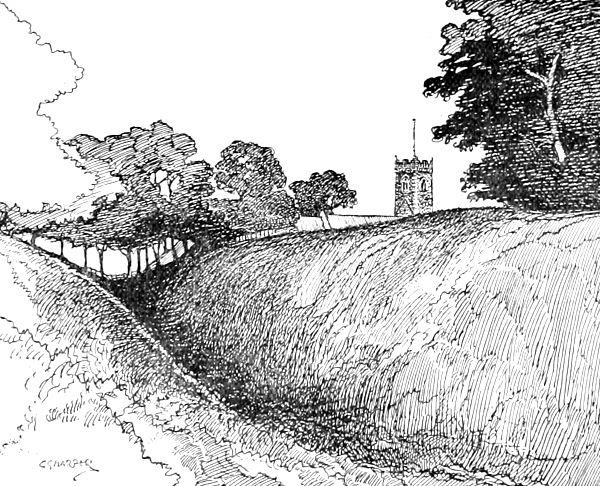
CAISTOR CAMP.
It is far inland now, but the marshy valley of
the Tase still bears signs of those old conditions, and
perhaps the villas of wealthy Roman citizens, together
with other relics of the vanished city, still lie preserved
deep down in the mud and silt that have
filled up the old channel.
The lie of the land, in accord with these views,
is plain to see when, returning to the high road, the
journey to Norwich is continued to Hartford Bridge;
bird's-eye views unfolding across the valley to the
right. At Hartford Bridge, where there are several
bridges, none of them sizeable, rivers, streams and
runlets of sorts trickle, flow, and gurgle in their
different ways through flat meadows, below the long
rise where, two miles from Norwich, the road begins
to grow suburban. It is on the summit that the
Newmarket and Thetford route from London joins
with this, and together they descend into the city.
XXXIX
This way came Queen Elizabeth into Norwich on
her great "progress" of 1578, by St Stephen's
Plain and through St Stephen's Gate. Gates and
walls are gone that once kept out the turbulent, or
even condemned the belated citizen to lodge the
night without the precincts of the city, in suburbs
not in those times to be reckoned safe.
Norwich long ago swept away her defences and
modernised her outskirts, for this is no Sleepy
Hollow, this cathedral city in the valley of the
Wensum, but the capital of East Anglia, throbbing
with industry and in every way in the forefront
of modern life. To the entrance from London
Norwich turns perhaps its most unattractive side.
No general view of the city, lying in its hollow
beside the winding Wensum, opens out, and the eye
seeks the cathedral spire and finds it with some
difficulty, modestly peering over tangled modern
roof-tops. It is from quite the opposite direction,
from the noble height of Mousehold Heath, that
Norwich unfolds itself in a majestic picture of
cathedral, churches and houses, with trees and
gardens, such as no other city can show, displayed
within its bounds. Norwich does not jump
instantly to the antiquarian eye, and its electric
tramways that are the first to greet the traveller
who enters from the old coach road are not a little
forbidding. The city grows gradually upon the
stranger in all its wealth of beauty and interest,
and becomes more and more lovable the better
he becomes acquainted with it.
Until these railway times, in the old days of
slow, difficult, dangerous and expensive travelling,
the capital of East Anglia was in a very high
degree a capital, and sufficient to itself. Its
shipping trade and weaving industries, and the
famous Norwich School of artists, brought this
exclusive attitude down from mediæval times to
modern; and Norfolk county families until the era
of political reform had almost dawned, still had
their "town houses" in Norwich, just as, in bygone
centuries, that typical old family, the Pastons,
owned their town houses in Hungate and in what
is now called King Street, formerly Conisford
Street.
The coaches coming to Norwich threaded the
mazy streets to inns widely sundered. The original
"Norwich Machine" of 1762 traversed the greater
part of the city, to draw up at the "Maid's Head,"
in Tombland. On the other hand, the Mails, the
"Telegraph" and the "Magnet," came to and
started from the "Rampant Horse" in the street
of the same name, standing not far from the
beginnings of the city. The street is there still,
but the oddly-named inn has given place to
shops, and where the "Rampant Horse" ramped
rampageously, in violent contrast with the mild-mannered
"Great White Horse" of Ipswich, drapers'
establishments now hold forth seductive announcements
of "alarming sacrifices."
Among other coaches, "Gurney's Original Day
Coach" and the "Phenomenon" favoured the
"Angel," in the Market Place, while the "Times"
house was the "Norfolk Hotel," in St Giles's, and
that of the "Expedition" the "Swan" Inn. Other
inns, many of them huddled together under the lee
of the castle mound, were then to be found in the
Market Place and the Haymarket and in the narrow
alley in the rear that still goes by name of "Back
of the Inns." Others yet, many of mediæval age,
are to be sought in old nooks of the city. The
Pilgrim's Hostel, now the Rosemary Tavern, like the
"Old Barge," belongs to the fourteenth century,
the last named still standing between King Street
and the river, with a picturesque but battered
entrance. The steep and winding lane of Elm
Hill, where the slum population of Norwich stew
and pig together down ancient courts and dirty
alleys, has more inns, ramshackle but unrestored;
and in the wide open space by the cathedral, dolefully
called Tombland, although it has not, nor ever
had, anything to do with tombs, is the "Maid's
Head," the one establishment in Norwich that stands
pre-eminently for old times and good cheer. It is
an "hotel" now, and has the modern conveniences
of sanitation and electric light; but its restoration,
effected through the enthusiasm of a local antiquary,
with both the opportunity of purchasing the property
and the means of doing so, has been carried
through with taste and discrimination. The "Maid's
Head" can with certainty claim a history of six
hundred years, and is thought to have been built
upon the site of a former Bishop's Palace. Heavily-raftered
ceilings and masonry of evident antiquity
may take parts of the present house back so far,
or even a greater length, but the especial pride
of the "Maid's Head" is its beautiful Jacobean
woodwork. The old sign of the house was the
"Molde Fish," or "Murtel Fish," a name that
antiquaries still boggle at. It was long a cherished
legend that this strange and unlovely name was
changed to the present sign in complimentary
allusion to Queen Elizabeth when she first visited
the city, but later researches have proved the
change to have been made at least a century earlier,
and so goes another belief!
The "Music House," facing the now disreputable
King Street, has not for so very long been an inn.
Its name tells of a time when it was the meeting-place
of the "city music," old-time ancestors of
modern town bands, but its story goes back to the
Norman period, when the crypt that bears up the
thirteenth-century building above was part of the
home of Moyses, a Jew, and afterwards of Isaac, his
nephew. "Isaac's Hall," as it was known, was
seized by King John and given to one of his
creatures; the unhappy Israelites doubtless, if they
were allowed to live at all, finding cool quarters in
the castle dungeons. A long succession of owners,
including the Pastons, followed; last among them
Coke, afterwards Lord Chief Justice, who resided
here in 1633.
It has already been hinted that the streets of
Norwich are mazy. They are indeed the most perplexing
of any town in England. Many roads run
into the city, and from every direction. Glancing at a
plan of it, these roads resemble the main strands of
a spider's web, and the streets the cross webs. In
midst of this maze is the great castle, like the spider
himself; that cruel keep in whose dungeons old
wrong-doing, religious and private spite, have immured
many a wretched captive, like that unfortunate
unknown "Bartholomew," who has left his name
scratched on the walls, and the statement that he
was here confined "saunz resun," a reason of the
best in those times. Did he ever see the light
of day again? Or did some midnight assassin
murder him as many another had been done to
death?
"Blanchflower," that Bigod, Earl of Norwich who
built the castle called his keep when it arose on its
great mound, its stone new and white. He built
upon the site of a castle thought to have been
Saxon, and built so well that it became a fortress
impregnable save to famine and treachery. It has,
therefore, unlike weaker places that have been
stormed again and again, little history, and even
seven hundred years ago was little more than a
prison. And a prison of sorts—for State captives
first, and for common malefactors afterwards—it
remained until so recently as 1883, when it was
restored and then opened as the Museum and Art
Gallery it now is.
This is no place to speak at length of the cathedral
that withdraws itself with such ecclesiastical reserve
from the busy quarters of the city, and is approached
decorously through ancient gateways in the walls of
its surrounding close; the Ethelbert Gate, with that
other, the Erpingham Gate, built in Harry the
Fifth's time by Sir Thomas Erpingham, whose little
kneeling effigy yet remains in its niche in the gable
over the archway, and whose motto—variously held
to be "Yenk," or "Think,"—"Denk," or "Thank"—is
repeated many times on the stone work. Norman
monastic gloom still broods over the close, for the
cathedral, save the Decorated cloisters and the light
and graceful spire in the same style, is almost
wholly of that period, and the grammar school
that was once a mediæval mortuary chapel and has
its playground in the crypt, keeps a gravity of
demeanour that, considering its history, is eminently
proper.
Through the Close lies the way to Bishop's Bridge
and the steep road up to Mousehold Heath: the
"Monk's Hold," or monastic property, of times gone
by when it was common land of the manor belonging
to the Benedictine priory.
XL
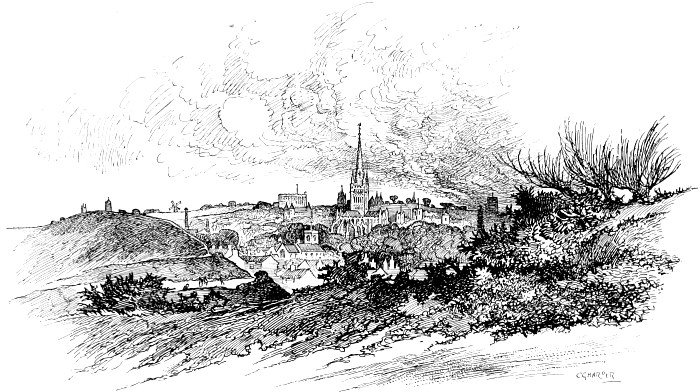
NORWICH, FROM MOUSEHOLD HEATH.
Here, on this famous Heath of Mousehold where the
gorse and heather and the less common broom yet
flourish, despite the electric tramways that bring up
the crowds and the picnic parties, Nature, rugged
and unconquerable, looks down upon the city, revealed
as a whole. Even though the chimneys of
great factories may intrude and smirch the sky when
winds permit the smoke-wreaths to trail across the
view, it is a view quite unspoilable. The cathedral,
as is only proper, is the grand dominating feature,
with its central tower and graceful crocketed spire
rising to a height of 320 feet. Second to it, on its
left hand, the huge bulk of the castle keep rears up;
a time-ball on its battlements to give the time o' day
to the busy citizens; those battlements where from a
gibbet they hanged Robert Kett in 1549, when his
rebellion was crushed and his army of 20,000
peasants who had encamped on Mousehold defeated.
In similar fashion his brother William was
hanged from Wymondham steeple. Between castle
and cathedral the great tower of St Peter Mancroft
looms up, and on the other side of the cathedral
tower the twin spires of the Roman Catholic place of
worship crown the sky-line. To the extreme right of
the accompanying illustration is St Giles's, and on the
extreme left, in company with the pinnacled tower of
a modern church, the dark tower of St John-at-Sepulchre,
Bracondale, which for shortness and
simplicity the citizens call "Ber Street Church." For
the rest, it is a mingling of town and country, of
houses and gardens and churches in great number,
that one sees down there; old Norwich, in short,
exclusive of the modern suburbs that are flung everywhere
around and cause the Norwich of to-day to
outnumber the Norwich of coaching times by 80,000
inhabitants. It must be evident from those figures
that the picturesque old Norwich numbering
a population of only 30,000 has been in great
degree improved away and borne under by that
human deluge. It is delightful now, but what it was
at the beginning of the nineteenth century, when
Crome and De Wint and others sketched and painted
its quaint bits, the picture-galleries of the Castle
Museum can tell. Nay, even down to the mid-nineteenth
century it was still very different, as a
collection of early photographs in the castle proves.
Then, before St Peter Mancroft was restored, before
the old Fish Market was cleared away, Norwich had
many more quaint nooks than now to show the
stranger; even as, centuries before, it was yet more
quaint and even more remarkable for its many
churches than at the present time.
"The nearer the church the further from God,"
says the old saw. How irreligious then should
Norwich be, that has even yet a cathedral and thirty-four
ancient churches, and modern places of worship
fully as numerous! Let the citizens, therefore, as
old Fuller suggested, "make good use of their
churches and cross that pestilent proverb." These
churches bear a close resemblance to one another,
having nearly all been rebuilt in the Perpendicular
period, some five hundred years ago, and all built of
the black flint that gives a character to East Anglian
architecture quite distinct from that of other districts.
The time when they were thus rebuilt was not only a
great period of church-building throughout England,
but a time of especial prosperity in mercantile and
trading Norwich; a time when guilds grew powerful
and merchants wealthy in the flourishing industry of
cloth-weaving introduced some time earlier by
Flamand and Hollander immigrants. English wool
that before had gone across the narrow seas for
manufacture into stuffs was now weaved in the land
of its growth. "Many thousands," says Blomefield,
"that before could not get their bread could now by
this means live handsomely." In that age, to become
rich and prosperous was to become also a founder and
benefactor of churches; hence the great ecclesiastical
buildings that, according to the picturesque metaphor
of an old writer, writing when there were no fewer
than sixty-one churches in the city, "surrounded the
cathedral as the stars do the moon." The old citizens
sleep in the parish churches for which they did so
much; their monuments in brass or marble, stone or
alabaster curiously wrought, often with their
"merchant's marks"—the distinctive signs with
which they labelled their wares—engraved on them
in lieu of coats of arms. It is as though a modern
trader were to have the registered trade-mark of his
speciality engraved on his tombstone. A typical
memorial of an old Norwich trader is that of
Thomas Sotherton, in the church of St John
Maddermarket. He—
"Under this cold marbell sleeps,"
and was no common fellow, mark you, but
"Of gentell blood, more worthy merrit,
Whose brest enclosed an humble sperryt."
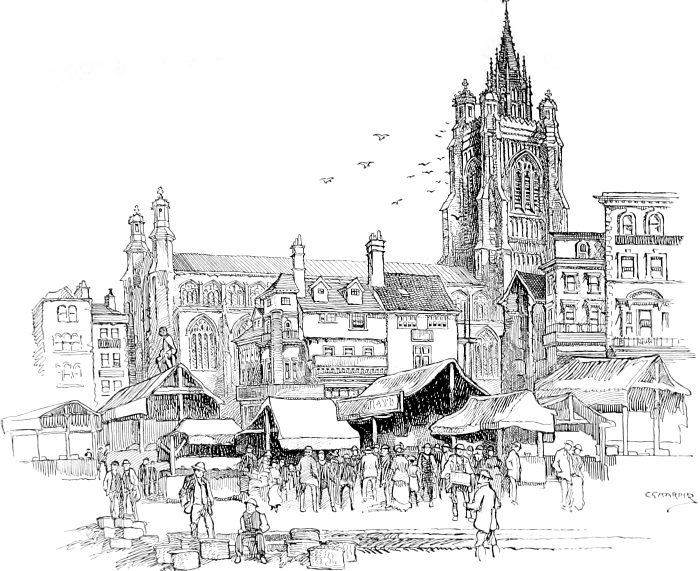
NORWICH MARKET PLACE.
Although the calendar of saints is a long one and
more than sufficiently lengthy to have provided each
one of the Norwich churches with a patron, yet so
popular were some saints, that several churches to
the same one are found in Norwich, as seen also in
the city of London. As in old London, it was in
those cases necessary to confer surnames, so to speak,
upon those churches.
They are surnames of the geographical sort and
not a little curious. The four St Peters are, for
example, St Peter Mancroft, the largest and most
important in the city, so called from the Magna
Croft, or large field of the castle; St Peter per
Mountergate, in King Street, named from the road
by the "montem," the hill or mount, that runs
ridge-like in its rear; St Peter Hungate, the
"hundred gate," or road, reminiscent of the time
when Norwich was a hundred of itself, even as it is
now by itself a county; and St Peter Southgate.
St Michael-at-Thorn has still thorn trees growing in
its churchyard; St Michael Coslany, with St Mary's
of identical surname, was built in Coast Lane; and
St Michael-at-Plea was named from its neighbourhood
to an ecclesiastical court. St John Maddermarket
is thus distinguished from other St Johns—St
John Timberhill and St John-at-Sepulchre. In
the neighbourhood of the first-named, madder for the
dyers' use was marketed; while at Timberhill was
the market in wood. St Martin-at-Palace, by the
old Bishop's Palace, and St-Martin-at-Oak take up
the tale, which might be continued at great length.
NORWICH SNAP.
The business life of modern Norwich centres in
the Market Place and the streets that immediately
lead out of it: the mouldering signs of old commerce
peer in peaked gables, clustered chimneys and
old red-brick and plastered walls in the lanes and
along the wharves of the Wensum.
There trade hustles and elbows to the front, in
many-storeyed piles of brick, stone and stucco, with
great show of goods in plate-glass windows and bold
advertisement of gilt lettering. All those signs of
prosperity may be seen, and on a larger scale, in
London, but not even in London are the electric
tram cars so great a menace to life and limb as in
these narrow and winding streets, where they dash
along at reckless speed.
The Market Place is not yet wholly spoilt. The
huge bulk of St Peter Mancroft and a row of queer
old houses beside it still avert that disaster, and form
a picture from one point of view; while the flint-faced
Guildhall stands at another corner of the great
open place and in its Council Chamber, in use five
hundred years ago as a Court of Justice, and still so
used, proves the continuity of "our rough island
story." In a dark and dismal cell of the Guildhall
once lay the heroic martyr, Thomas Bilney, who
"testified" at the stake in the Lollards' Pit, where
many another had already yielded up his life. He
wondered, as others before and after him had done
and were to do, whether the tortured body could
pass steadfast through the fiery ordeal; and on the
eve of his martyrdom put that doubt to the test by
holding his finger in the flame of a candle. That
test sufficed, and he suffered with unshaken constancy
when the morrow dawned.
The Guildhall has less tragical memories than this,
and was indeed the scene of many old-time municipal
revelries in times before Corporations became reformed.
But old revels and frolics have been discontinued,
and "Snap," the Norwich dragon, a fearsome
beast of gilded wickerwork, who was wont to be
paraded from the Guildhall at the annual mayoral
election, and last frolicked with his attendant beadles
and whifflers in 1835, now reposes in the Castle
Museum.
The Market Place on Saturday, when the wide
open square is close-packed with stalls, is Norwich
at its most characteristic time and in its most
characteristic spot. In it the story of the Norwich
Road may fitly end. The city itself, glanced at in
the immediately foregoing pages, could not yield its
story in less space than that occupied by that of the
road itself.