To approach the Norwegian coast at
sunrise is an exceedingly enjoyable experience.
Myriads of rock-islands in the sea and
cloud-islands in the sky, their perspective
terminating on the distant horizon in a
peaked range of inland mountains,
themselves like a cloud floating in golden
vapour of dawn.
As the rising sun burns its path upwards,
the sparkling sea reflects the glory of the
sky in countless hues, and the magic of
morning is felt in the air, cool and clear
as crystal, as the steamer slows to await
the pilot and the sea-birds wheel around.
Threading this intricate maze of islands,
indications of human habitation soon
become evident perched on grassy headlands
or nestling in rocky creeks, and soon we
are at the busy wharf of the first port of
call, Stavanger, a bustling and clean little
town, whose eleventh-century cathedral
stands in dignified contrast to the
brightly-painted wooden buildings at its feet.
Bergen
The navigation of the coast here is
exceedingly intricate—rocky islands and
skerries innumerable, and narrow winding
channels; lighthouses, which are seen at
every turn, and on both sides of the
steamer's course, indicate the dangers and
test the skill of the pilot and captain as
the steamer proceeds in a north-westerly
direction to Bergen, the metropolis of
Western Norway.
Founded by King Olaf Kyrre in 1070,
Bergen has witnessed most of the stirring
events of the nation's life.
The population of the town is now
72,000. During the fourteenth and
fifteenth centuries the Hanseatic League,
which then monopolized the commerce of
Northern Europe, held absolute sway here
in Bergen, and the quaint Tydskebryggen
(German quay) was their trading quarters.
Near by the fortified tower of Rosenkranz
was built to hold the Hanseatic quarter
in check. It adjoins Haakonshal, the
ancient palace of King Haakon Haakonson,
who died in 1263.
This is the most ancient part of the
town, although it is at present
undergoing a change. Tydskebryggen is being
modernized; its old-world character is
fast disappearing.
Close by is St. Maria Kirken, a quaint
twelfth-century church, formerly in
possession of the Hanseatic League.
Triangelen (the fish-market quay) is
interesting on Wednesday and Saturday
mornings, where a fleet of small fishing-boats
is moored alongside, lively and witty
bargaining going on between buyer and
seller which is highly amusing to witness.
Bergen is in many respects a most interesting
town, the ancient rubbing shoulders
with the modern—the electric tram-car
with the carrier's cart and "kariol";
the slender wood-framed, sack-covered
booth with the gaily-painted kiosk; and
the latest fashions from London and Paris
with the divers picturesque costumes of
fisherfolk and farmer, "striler" and
"bönder." Handsome stone-built shops
stand cheek by jowl with the low
red-tiled wooden ones, no two alike, in every
variety of size and colour, relieving the
monotony of the narrow and crooked
streets.
The climate of Bergen is exceedingly
mild and humid, not unlike that of the
west coast of Scotland, and the numerous
shops where umbrellas and rain-coats are
displayed for sale give some indication of
the prevailing weather, although I have
known it to be fine there for several days
together. But this not being in the
nature of a guide-book—"Baedeker,"
"Beyer," and "Bennett" supply all the
information one necessarily requires, and
much more than I have space to admit
here—we must pass on to the chief subject
of the book, and enter the fjords, taking
first the Hardanger Fjord.
This beautiful arm of the sea is second
in regard to length, the Sogne Fjord
being the longest; but what it lacks in
this respect is more than balanced by the
charm of the scenery and the greater area
of land under cultivation—orchards gay
with blossom, and well-trimmed farms
with brightly-painted wooden houses, red,
yellow, or white, perched high on the
mountain's flank, or nestling nearer the
fjord margin. This beautiful district of
Hardanger has been the theme of poet
and painter for generations.
The Hardanger costume
The Hardanger women are mostly of
fair complexion, with blue eyes, and their
costume is the most picturesque of any in
the country. It consists of a bright red or
green bodice, gay with beads in front, clean
white linen sleeves, a large white
head-covering ("skaut"), blue skirt trimmed
with coloured braid, and a belt of beads
with an old silver filigree clasp. The
unmarried wear the hair hanging in two
long plaits down the back, and for
headgear a small white cotton shawl tied
under the chin in place of the more
elaborate "skaut" of the married.
It is an interesting sight to witness
on Sunday mornings the well-filled boats
coming from all parts of the fjord parish,
men and girls alike rowing their graceful
boats to church. On landing, they arrange
each other's toilet on the beach, and when
inside the sacred edifice, the women and
girls sit on one side of the centre aisle
and the men on the other.
The service is Lutheran, and there is
much singing of hymns or "psalmer" in
a leisurely way while sitting. The farmer's
dog is also quite a "regular attender,"
but he is usually well-behaved, and no
one appears to take the slightest notice
of him unless he happens to pick a quarrel
with another of his species.
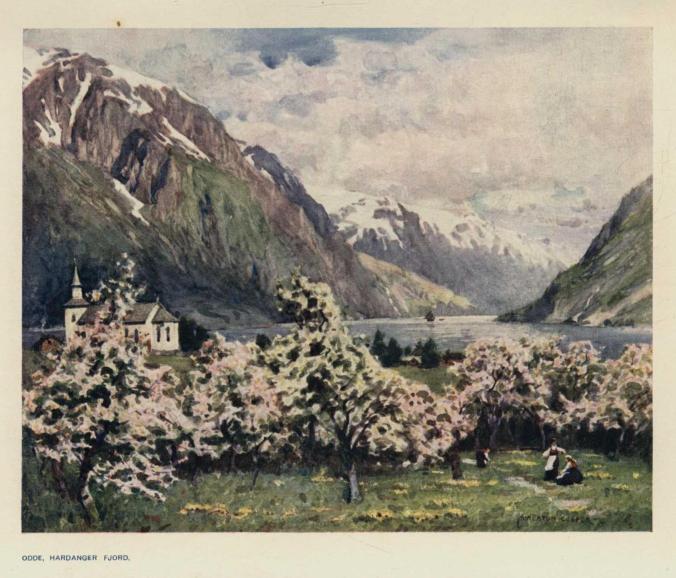
Odde, Hardanger Fjord.
After, and sometimes during, Divine
service small groups of farmers may be
seen in the churchyard talking over the
state of the market—of crops and cattle
and other gossip—as each one repeatedly
turns over the ample "quid" of tobacco
in his mouth. It may be that they meet
only once in three weeks, for many a
parson has two or three churches to
attend to. But the churches are, as a
rule, well filled, no matter what happens
to be the condition of the weather.
A peasant's homestead
In their homes these peasants live the
"simple life" in square log houses of
primitive form, finished on the outside
with weather-boarding, turf laid on
birchbark for roof-covering, on which grow
masses of wild flowers, and one may even
see a young birch-tree find root there and
flourish.
The houses are painted on the outside,
according to the taste of their owners,
red, white, or yellow ochre, and these
bright spots of colour add a cheerful note
to the landscape.
Inside the house the log walls are
allowed to season, and in time they
acquire a rich tone of brown. There is
generally one principal room on the
ground floor, and in it the farmer, his
family, and servants live and have their
meals together in quite patriarchal fashion.
In this room also are commonly found a
couple of beds used by the farmer and his
wife, the other members of the household
having theirs up in the loft.
The cooking is done in the large
common-room, as is also the carding,
spinning, winding, and weaving of
home-grown wool for the family in quite
primitive fashion on ancient wheel and wooden
hand-loom, this industry being their chief
employment in the long winter nights.
Outside the farm-house there is always
a store-room, called a "stabbur," standing
separately. This building rests on short
strong pillars of wood to keep out the
rats and other intruders, and in it are
stored dried meats, cheeses, milk, and
other foodstuffs.
An additional outbuilding, called a
"bui," is used for keeping the clothing,
tapestries, blankets, etc.; also the daughter's
wedding trousseau and old silver
articles—heirlooms—including a bride's crown of
silver gilt, all stored away in huge chests
("kists"). Here may also be found
carefully treasured a variety of ancient carved
and painted wooden bowls and tankards,
out of use except at weddings and other
state occasions.
Another detached outhouse, called an
"ild-hus," is used for the baking of "flad
bröd," a kind of rye cake, crisp and dry,
and of the thickness of brown paper.
Yet another small outhouse is required
for drying corn for brewing purposes,
farmers being permitted to brew ale for
their own consumption only, the sale of it
not being lawful. Most households enjoy
their home-brewed ale at Christmas-time,
and they may even keep a small quantity
over until Easter.
In addition to these small outbuildings
there are, of course, the barn and cowhouse,
with accommodation for horses, sheep, and
pigs, forming altogether quite a little
hamlet.
On the farms the womenfolk must look
after the cattle, sheep, and goats, in
addition to their ordinary household work, so
they have not much time for idle
recreation. The only important break in their
humdrum lives, and to which they look
forward with gladness, is the annual removal
of the household, in the early summer, to
the "sæter," or mountain outfarm, a
description of which, and the life there, I
will deal with in a subsequent chapter.
The male members of the family are
chiefly occupied with the raising and
trading in domestic animals—horses, cattle,
goats, sheep, etc.—in cutting faggots from
their woods, and in the making of barrel-hoops
for sale in the nearest towns.
Boat-building also employs much of their time.
Horticulture—land tenure
Horticulture does not play any very
prominent part in Norway, although, on
most farms it is carried on to some extent,
together with regular farming.
Among the more enlightened peasantry
it is the rule to find outside the dwelling-house
a kitchen garden where vegetables
necessary to the family are raised, such as
cabbages, turnips, carrots, onions, peas, and
beans, and of fruit-trees we may find
in many places pears, apples, cherries,
currants, gooseberries, and strawberries.
On every hand the planting of fruit-trees
is increasing, and in favourable years
quite excellent results may be obtained,
but the rough climate during the winter
renders the fruit yield somewhat uncertain.
It is only in a few districts around the
Christiania Fjord and the Hardanger Fjord
that horticulture is carried on to any
greater extent than to satisfy the farmer's
own requirements, although at the present
time there is a strong movement for the
promotion of horticulture, and many of
the counties ("amt") have appointed
gardeners, who travel round the district giving
farmers free instruction in the laying out
and management of gardens and orchards.
Perhaps it may be as well to mention here
that the Norwegian peasant has always
enjoyed a freedom which to the same
class in other countries has been denied.
In former centuries the feudal system
was generally adopted in most European
countries, but it has never existed in
Norway.
The peasants have always maintained
their freedom to acquire property
anywhere within the limits of their own
country; this circumstance, however, did
not prevent an accumulation of the landed
estates in a few hands, the result being
that the peasant class to a very great
extent became tenants and leaseholders,
and less than one-half of the land of the
country was utilized by freeholders.
As far back as 1685 a Royal Ordinance
was issued by which a landowner who
utilized more than one estate should pay
double taxes on those in excess of one; as
a consequence the farms were gradually
sold to the peasants, a process which is
going on to the present day.
This system of peasant proprietorship
has worked remarkably well in the country,
nine-tenths of the farmers being now
freeholders; they have consequently a
more substantial interest in the development
of their farms and in the improvement
of their land.
Boat-building
Boat-building is a lucrative employment,
and this industry is carried on in many
places on the Hardanger Fjord—chiefly
at Jondal; also at Rosendal, on the
ancient and beautifully situated barony of
Rosenkrantz, at the foot of the mountain
Melderskin.
The building of boats is the most ancient
industry with which the Norwegians are
acquainted.
Pliny the elder tells us that in the reign
of Nero the Romans voyaged as far north
as the Baltic, and Tacitus goes on to
describe what lies beyond—that they knew,
at any rate, the southern portion of the
Scandinavian peninsula; and he speaks of
their finding the country rich in arms and
ships and men.
There are yet other proofs from a far
earlier age in the rock-carvings or runes
called "helleristninger," dating away back
to an age not less remote than 500 years
B.C. These are found, among other places,
at Leirvaag farm in Askevold, on the south
side of Atlöen, and at Bohuslän in
Southern Norway, where they are
associated with many chambered tombs of the
Stone Age.
These carvings represent ships, some of
them being quaint representations of
sea-fights, the boats being somewhat similar in
appearance to those used by the Vikings
of the ninth and tenth centuries of our era.
Rude as these rock-carvings are, they
give us some idea of the kind of vessels
employed in that very remote age: they
represent long row-boats with very high
carved prows or sternposts, and are steered
not by a rudder behind, but by an oar at
the side, and from this practice is derived
our word "starboard" or "steerboard,"
being the right-hand side of the vessel.
The Vikings used also a square sail,
which could be hoisted when required.
This they had learnt indirectly from the
Romans.
The traveller among the fjords of Norway
may, to this day, see those heavy
boats with high prows and square sails,
which have an indescribable air of
antiquity about their build, contrasting
quaintly with more modern-built craft of
coasting vessels and fishing-smacks.
Although this ancient type of boat is
fast dying out, the traveller will yet find
a number of them in Nordland, and these
are still more like the Viking ships of old,
having also high pointed sterns.
These old-fashioned boats are a link
between us and the remotest past of
Scandinavia, of the early period of the
rock carvings, and of the romantic period
of the Vikings.
The boats built in Hardanger differ in
form from those of the Sogne Fjord and
Nordland, as the traveller will note as he
proceeds northwards, the Hardanger type
being of light and elegant construction,
and drawing less water than those to
which we are accustomed.
Every peasant and cotter has his own
boat or boats, and these may be seen
everywhere along the fjord, either in use
on the water, or pulled up on the strand,
and, where there is found a convenient
landing-place, log-built boathouses are
erected.
Norwegians are fond of gay colours, as
evidenced in the painting of their houses
and boats. Many farmers build their
own boats out of wood grown on their
own farms, and some build to sell again.
The cost of a four-oared boat is about
twenty-five kroner (twenty-eight shillings),
a six-oared fifty kroner, and an eight-oared
boat seventy kroner.
Staple food of peasants
As fish plays an important part in the
diet of the peasants, the boats are greatly
in use. The fjords being great arms of
the sea, most kinds of sea-fish are caught
therein, sometimes in very large
quantities, herring being often in such
densely-packed masses that quite a number of
fishermen use large wooden shovels to
transfer them to their boats, returning
repeatedly to the harvest until the mass
has dispersed.
At such times these fish are placed in
barrels and salted, being either kept for
winter use at home or shipped to the
nearest seaport town.
Fish and oatmeal porridge—"havregröd"—have
formed from the earliest
times the staple food of the Norwegians,
as we learn from the sagas, and in
"Hārbarôsljòô," in the "Sæmundar Edda":
"Àt ek i hvìld
aôr ek heiman fòr
sildr ok hafra."
"För jeg reiste hjemme fra, aad jeg i
fred sild og havre," which, translated,
reads, "Before I left my home, ate I in
peace fish and oatmeal."
[Illustration: Godösund (missing from book)]
The peasant's ordinary routine for
meals is commonly as follows: At 6 a.m.,
oatmeal cake or potato cake and buttermilk;
at 8 a.m.—the chief meal of the
day—is served fish, and boiled, salted, or
dried mutton with potatoes; at 12
mid-day, oatmeal porridge and buttermilk;
at 4 p.m., dried, smoked, or salted fish
with potatoes and buttermilk; at 8 p.m.,
oatmeal porridge and milk.
This primitive food is still the daily
custom of the peasant's household,
although in some places coffee is used after
the meals, and a very poorly-baked brown
bread of barley or rye, occasionally mixed
with oats; but rarely do they eat wheaten
bread.
Much has been written by Norwegian
authors with reference to the lack of
cleanliness in the peasants' homes, but
since so many foreign travellers in later
years have visited the country, there has
been a very considerable improvement in
this respect.
The real cause of untidiness was that
the women had really too much to do in
looking after the cattle and farms, which
took up the principal part of their time.
Thus the ordinary household duties—the
care of the children, cooking, etc.—were
to some extent neglected.
This stigma can no longer be applied,
as, by their own industry and thrift, the
peasants mostly are now in a more
prosperous condition. They are thus able to
afford more assistance on the farms, and
their wives are spared much of the
degrading work which was their lot in the
past. They have, consequently, more
time for the care and education of the
children, and their homes will now
compare favourably in cleanliness with any of
their class with which we are acquainted.
The "Gothenburg system"
The present prosperity of the Norwegian
peasant may undoubtedly be traced to
the working of the liquor law of 1871,
popularly known as the "Gothenburg
system," by which it is now made
extremely difficult to obtain intoxicating
liquor, especially spirits.
The Norwegian nation may now take
premier place among nations with regard
to sobriety. Norway, however, has not
always taken up such a favourable
position. During the years 1830-1840 we
find the country ravaged by the "spirits
plague," with its attendant sad results,
moral, economic, and sanitary. By a law
of 1810, anyone was allowed to distil
spirits from his own produce. This
naturally resulted in an alarming increase
in the consumption of alcohol.
In the "forties" legislation took
energetic measures against this, being at the
same time strongly supported by the
voluntary abstinence movement. The
manufacture of spirits was only permitted
when it was done wholesale, and was, at
the same time, restricted to a limited
number of distilleries. No one was
allowed to retail spirits without a licence
from the Local Board, who had also
"local option" in the matter, sale of
spirits being forbidden on Sundays and
holy days, and on the afternoon preceding
these. A heavy tax was levied both on
the home production and on retail sale.
The beneficial consequences of this
wise legislation were soon apparent. The
number of bars decreased rapidly through
a breaking off of drinking habits, and a
consequent decrease in the consumption
of spirits was distinctly perceptible, as
well as the increased prosperity and
improved public health. The rural districts
in particular were almost cleared of
spirit-selling, which was now restricted to the
towns.
By the law of 1871 the Local Boards in
the towns were allowed to make over
their retail rights to philanthropic
companies—"samlag"—which, instead of
seeking to make the largest circle of
customers, made it their aim to supervise
and restrict the drinking of spirits, and
whose net profits from the business should
be devoted to "objects of public utility"—in
other words, it was the introduction
of the "Gothenburg system."
This system is also in force in Finland
and in Sweden, but the Norwegian differs
from the Finnish and Swedish in several
points, especially in the fact that the
profits do not, as in the neighbouring
kingdom, go to the municipal funds.
Norway does not, therefore, tempt the
municipalities to improve the state of its
finances by an increased trade in spirits.
Finally, by a law of July 27, 1894, all
men and women over twenty-five years of
age were allowed to decide by voting
whether there should be any sale of spirits
in their town for the following five years.
As a result of this there has been
prohibition of late years in a number of towns.
For the whole country there is now only
one "samlag" to every 10,000 inhabitants.
It thus follows that the many millions
of kroner saved annually in households by
the reduced consumption of intoxicating
liquors have contributed greatly to raise
the economic well-being of the nation, and
it has been said, with reason, that the
Norwegians have educated themselves to
abstinence and sobriety.
Thus, on every hand we see evidences
of this wise legislation in the enlarged and
modernized farms, increased acreage of
land under cultivation, the scientific
planting of fruit-trees, and the more general
use of modern implements of husbandry.
Hardanger Fjord is most fortunate in its
means of communication, it being so easy
of access by water from the towns of
Stavanger and Bergen.
Native fjord steamers call at all the
principal places en route at least once
every day, and the traveller may arrange
his journey so as to include a variety
of overland routes, posting by "kariol" or
"stolkjerre" on good roads, engineered with
great skill, through magnificent scenery.
From the commencement of the seventeenth
century the peasants have been
required by law to supply horses and
to convey travellers at a reasonable and
fixed rate of payment, and posting-stations
in connection with hotels and inns are now
established on all high roads, at distances
varying from eight to fifteen miles.
A line of railway was opened in 1883
from Bergen to Vossevangen, by which the
Hardanger and Sogne districts can be
reached in a few hours.
The journey by road from Vossevangen
to Eide or Ulvik is an agreeable experience,
especially after several days on the steamer,
and this gives as good an example as any
of the pleasure which may be derived from
this mode of travelling.
To Ulvik by "kariol"
It was late in the autumn when I last
made this journey, in bright, cloudless,
October weather, warm sun, and crisp,
frosty air—quite an ideal day for driving,
as the roads were dry and firm. About
five miles on the way the road ascends
through a forest of pine-trees and high,
rocky knolls, into whose deep shadow
the sure-footed pony plunges, to emerge
into the warm and dazzling sunshine.
We drive by the craggy margin of a
series of wild mountain tarns, whose
surface is still as Dian's looking-glass,
and in whose depths are reflected the
craggs, the silver birches and pines, so
perfectly that you could with difficulty see
where the land joined the water's margin.
In a near pool a trout rises, leaving
circling lines of light blue ripple on the
surface of the sleeping water, thus
accentuating the perfect stillness. For a moment
we pause, just to enjoy for a brief space
the silence profound.
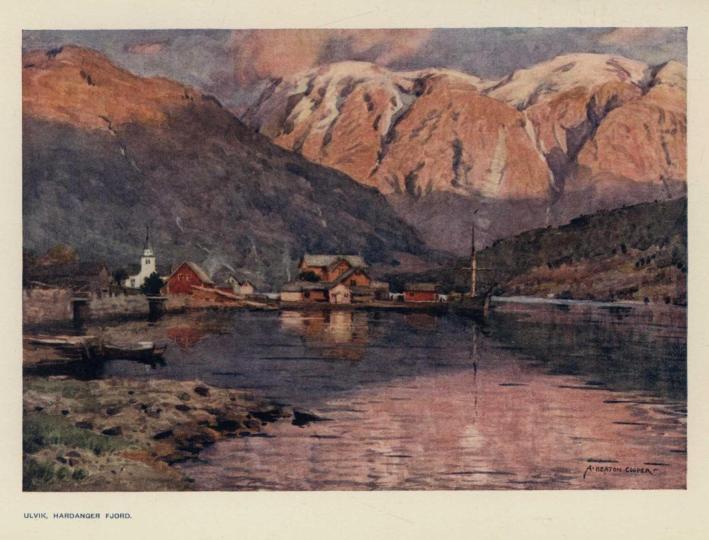
Ulvik, Hardanger Fjord
The pony's hoofs no longer click on the
hard road; only the faintest murmur of
some distant stream can be heard, or the
rustle of a crisp leaf as it falls from the
graceful silver birch near by, which
stands—singly of its kind—a striking contrast to
its more sombre companions the pines—a
harmony of gold, silver, and deep warm
green—in the bright sunshine of this
perfect October morning.
Onward and upward we drive along the
wild mountain road, still embosomed in
trees, when, at a sharp bend, on emerging
from the forest, suddenly we are confronted
by an awful abyss, enclosed by an
amphitheatre of huge perpendicular mountain
buttresses, while near at hand, and from
just beneath our feet, plunges Skjervefos
with mighty volume into the chasm
hundreds of feet below, sending clouds of
spray high into the air.
The road now descends in long zigzag
sweeps down the breast of the steep cliff,
and passes, through clouds of spray, over a
bridge near the foot of the waterfall.
Down the steep valley we pursue our way
and pass several farms, where large numbers
of goats are fenced in their winter quarters
near to the houses.
The tiny hamlet of Vasenden is now
reached, and after a change of horses here,
we continue our journey uphill again for
several miles, on the road to Ulvik. The
steep mountain road is well wooded most
of the way, until at length the watershed
is reached.
Here a fine lake, Espelandsvand, reposes
at a height of some 1,200 feet above the
fjord, surrounded by high mountains.
The road in descending approaches in
several places the very brink of a deep and
narrow gorge, from whose hidden depths
arises the deep gurgle of the mountain
torrent on its hurried way to join the
waters of the fjord below.
The white church of Ulvik now appears
by the margin of the blue fjord beneath us.
Clustering around the church are the
hotels and brightly painted cottages in
their orchards. Across the winding fjord
rise range after range of snow-topped
mountains, forming a panorama as fair as
one could wish to behold, and a fitting
termination to an enjoyable drive through
such varied scenery as that which is found
between the fjords of Sogn and Hardanger.
One of the most perfect fjord views
is to be obtained from Ullensvang, in the
Sör Fjord, a few miles from Odde. This
place has the reputation of being the
fruit-garden of Hardanger. It has been the
favourite resort of artists and poets for
generations.
Here we see, across the narrow fjord,
the huge snow-field and glacier of
Folgefond stretching in undulating line along
the graceful mountain masses. Near at
hand stands the medieval church on a
green promontory, and along the margin
of the graceful sweep of bay brightly
painted farms nestle in extensive apple
orchards.
In the bright warm days of early
summer, when these fruit-trees are in
bloom, the picture is of exceptional
beauty, the wealth of blossom contrasting
effectively with the snow masses
and blue mountains across the sparkling
fjord.
From Kinservik—an easy morning's
walk from Ullensvang—comes that quaint
and purely national type of wood-carving
which has been revived in recent years
in Hardanger district by Lars Kinservik.
Here he may yet be seen busy at work,
assisted by a number of chosen carvers,
and surrounded by cleverly designed and
skilfully executed work in wood—dragons
and other grotesque motifs from pagan
mythology being worked into exquisite
pattern on high-backed chair, massive
sideboard, and roomy settle.
The art of wood-carving
The revival of this national and beautiful
art of wood-carving is steadily growing,
and in this district it has spread to Östensö
and many other places in Hardanger, and
from Vossevangen into the Sogne Fjord
district, where clever carvers are found at
Vik and at Lærdal.
Wood-carving in Norway is one of the
most ancient of the industrial arts, and it
shows a well-connected development from
the days of the Vikings, who carved in
bold design the figure-heads which
ornamented their warships. But the most
interesting and important period of this
art is seen in the massive and
richly-carved doorways to the wooden "stav"
churches.
The earliest of these show distinct
evidence of Irish influence, the ornament
being usually composed of ribbon festoon,
with grotesque figures of animals and
snakes. The most characteristic of these
carvings date from the eleventh and
twelfth centuries.
Following on this interesting period we
find the influence of the Anglo-Saxon
and Norman, in which twining festoons
of vines and various other plants are
associated with dragons and other winged
monsters in bold spiral design up the
massive door portals. Figure subjects
inspired by the sagas appear to have
been in great demand, and we find quaint
designs of this kind taken from the
Niflung and Volsung sagas. A number
of these richly-carved portals are
preserved in the Bergen Museum.
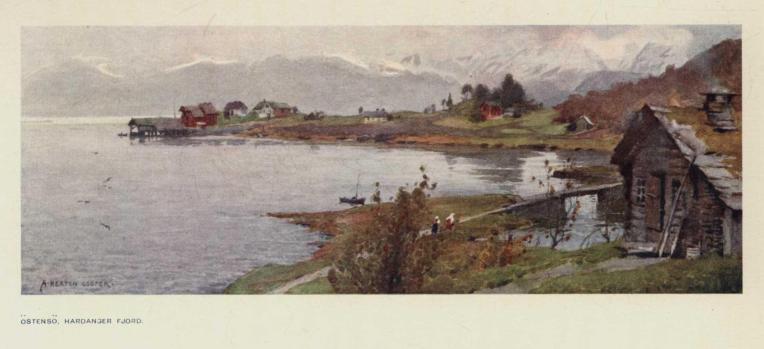
Östensö, Hardanger Fjord
From the thirteenth to the sixteenth
century the doorways of the peasants'
houses were similarly ornamented, and
this decorative art was followed up by
the similar treatment of furniture and
articles of domestic use.
Early in the seventeenth century a fresh
impetus was given to peasant-carving by
the introduction from the North German
States of the Frisian patterns. These are
in low relief, and consist chiefly of circles
and wedge-shaped designs of great variety
and beauty.
Examples of this period are far from
rare, and in the proud possession of the
peasantry they are treasured as heirlooms,
along with home-woven tapestries, old
silver ornaments, and antique embroideries.
Tapestry-weaving
Tapestry-weaving as a domestic
industry has progressed hand-in-hand with
wood-carving, and this ancient art is still
a favourite occupation of the Norwegian
housewife, who finds both pleasure and
profit from its pursuit.
The earliest sagas tell us of woven
pictures, thus pointing to the fact that
even in those very remote times the
Norwegians showed an inborn artistic sense.
Of textile fabrics from the Viking age
fragments only have been found, and
these in most cases were discoloured from
contact with metallic objects and by the
moisture from turfy soil. Woollen stuffs
as well as linen were used, even in the
Bronze Age, and the woven patterns were
always of geometric design, and were
worked in one or more colours, gold-wire,
gracefully twisted, being used for
decoration on the garments.
Cloths with figures in colour on them,
and which rather resemble the famous
Bayeux tapestries, are much prized.
Coloured embroidery from medieval times
is extremely effective, and displays skill
and ability of a highly artistic order. Their
full and harmonious colouring and beauty
of execution make these cloths very
valuable.
The upstanding loom was used for
weaving of picture tapestries, and it is
still to be found in the districts most
noted for this domestic industry—Hardanger,
Sogn, Telemarken, and Gudbrandsdal.
In 1893 the Norwegian painter, Gerhard
Munthe, introduced a new and original
style into the cloth-weaving industry
which has had excellent and far-reaching
results. His designs are based on the
old Norwegian fairy-tales and folk-lore.
They are grotesquely fanciful and highly
imaginative, bold and harmonious in
colour, and extremely decorative in effect.
The movement is rapidly extending, and
a new life for this beautiful industrial art
is in course of development.
The Hardanger district is famous for
men who are clever in the art of making
the violin, and their skill in the use of
this instrument is known throughout the
country.
The Hardanger violin
This Hardanger violin is in form higher
and more arched than the ordinary violin.
A dragon's head usually forms the scroll,
the other parts being richly ornamented
by carvings and inlaid with ivory and
mother-o'-pearl. There are four strings
over the finger-board, and four or more
underneath; the latter act as sympathetic
strings, and are usually of fine steel wire.
The violin is the favourite musical
instrument of the country people, and on
it they improvise their musical impressions
of Nature's sounds, such as "Twilight
Hours," "The Song of the Thrush," or the
ringing of chimes and marriage bells.
Through nearly all Norwegian music
there runs a strong undercurrent of sad
melancholy, which may be attributed, no
doubt, to the isolated and solitary lives
of the people, and to the effect on their
natures of the scenery and surroundings.
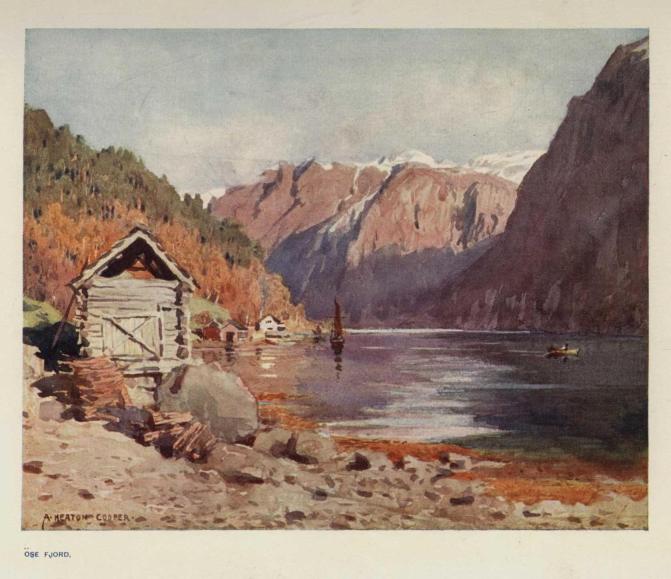
Öse Fjord
Often the most talented performers
on the violin are those whose homes are
in lonely and almost inaccessible places,
where the voices of Nature—the sighing
of the wind among the pines, and the
murmur of waterfalls—play on the strings
of their susceptible temperaments.
Waterfalls
Norway is the land of waterfalls. In
no other country are they so numerous,
and the murmur of them may be in your
ears during many days of travelling. The
beautiful district of Hardanger is
particularly happy in this respect.
The moist and warm summers produce
a vegetation unequalled in richness and
beauty, and in the springtime, when the
snows are melting, the warm and still air
is palpitant with the music of countless
waterfalls. Some, appearing to shoot from
the sky over high perpendicular crags into
the fjord, or gurgling in deep gorge unseen,
send mellow music floating in the balmy
air above in delicious waves of sweetest
sound.
In the immediate neighbourhood of
Odde, on the innermost reach of the
Hardanger Fjord, are found some of the finest
waterfalls in the country. One of them
in particular—the Skjæggedalsfos, or,
more properly, Ringdalsfos—is considered
by many travellers to be the grandest
waterfall in Europe.
I visited this magnificent fall about the
end of May in perfect weather.
Landing, after two hours' row from
Odde, at the farm Tyssedal, by the fjord's
margin, a path is found which leads uphill
through aromatic woods of silver birch
and pine, and winding up the rough,
craggy, and bosky valley of Skjæggedal,
it approaches in places quite abruptly the
very brink of the deep dark gorge where
thunders the river in a succession of
cataracts. After a walk of some three
English miles, the farm which takes its
name from, or gives it to, the valley is
reached.
Just before I arrived at the farmstead,
I overtook a young peasant and his wife,
who were driving a herd of goats before
them. The man had several young kids
in a covered basket slung over his
shoulders. The woman walked in front
of the goats, knitting as she went.
Procuring a boat and boatman at the
farm, I was rowed across a small lake
formed by the river widening at this
place. I had for my companions de voyage
the peasants and their goats, these of
themselves being quite as much as the
boat could carry. There was but little
room for the rower, but with short and
steady strokes he landed his cargo over
in safety.
The young peasant informed me that
on their way from Roldal they had
observed for some considerable time the
movements of a bear making her way
with two cubs over the Hardanger-vidde
in the direction of Ringdalsvand (lake),
our destination, and although the man
carried a gun, he was unable to follow the
bear on account of the goats under his
charge.
On bidding good-bye at this place to
these young peasants and their domestic
flock, I noticed that the man's attire was
somewhat out of the ordinary and quite
picturesque. He wore dark-blue
knee-breeches, with stockings of undyed wool,
red shirt-sleeves, and wideawake hat of
grey felt. A number of old silver coins,
used as buttons in a double row,
decorated his brown waistcoat; his gun and
coat were thrown over his shoulders, and
in his hand he carried a long alpenstock,
thus making up together quite a picture
which suited well the romantic surroundings.
We continued, and in a short time we
came to a large lake—Ringdalsvand, and
my guide invited me to take a pair of
oars, and he himself took the other pair.
We rowed steadily on in a light breeze,
which gave to the lake an intense blue
colour reflected from, the sky. On every
side were towering cliffs and snow-topped
mountains, whose steep bases were clothed
with fragments of forest which had escaped
destructive avalanches. Not a sign of
human habitation presented itself; only
wild Nature, sublime and grand in the
extreme, surrounded us.
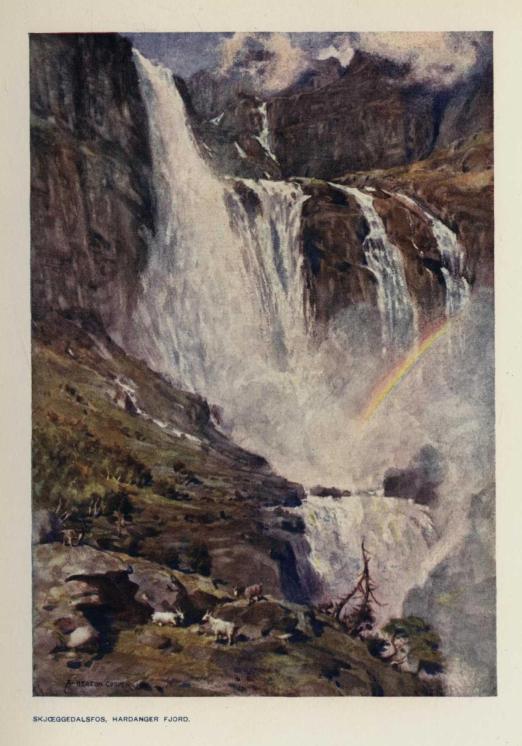
Skjæggedalsfos, Hardanger Fjord
After about two hours of hard rowing,
we pull up the boat on a pebbly strand at
our destination, near to the head of the
lake. We are now just beneath the
magnificent falls of Skjæggedal, which leap
from the top of huge cliffs and send
immense volumes of spray to a considerable
distance; while on the gauzy vapour,
which rises up from huge cauldrons at its
foot, the arc of a brilliant rainbow is
formed in the sunshine of mid-day. The
very earth around seems to vibrate through
the deafening roar from this mighty
waterfall. To hold a conversation with the
guide is quite impossible, unless I shout
at the very height of my voice, and a
feeling of deafness remained for a
considerable time after leaving the place.
After sketching the falls, my paper
being quite drenched by the fine spray
which filled the air, my guide joined me
in an impromptu cold lunch on the sunny
strand.
In returning, the foss was in sight during
an hour's rowing, until, passing along the
base of a huge crag, at a bend of the lake,
it quickly disappeared from view.
In this immediate neighbourhood are
other waterfalls, the most graceful of which
rejoice in the name Tyssestrengene, and
their waters also descend into this
Ringdalsvand. These beautiful falls are not
so imposing as those we have just left,
but they are very picturesque. They
plunge down some 500 feet of quite
perpendicular cliff, in slender, graceful
streams, which are seen to creep through
a natural bridge of glacier ice at the sky-line.
Other noted waterfalls in the
Hardanger district are Vöringfos, Laatefos,
and Espelandsfos; each one of these has
quite a distinct character of its own,
derived from more or less romantic
surroundings.
The constant erosion caused by the
mighty power of water, cutting into the
mountain masses of conglomerate and
granite, has been the means of forming
the deep, narrow cañons and fjords, and,
in conjunction with moving glaciers, has
been Nature's chisel, by which has been
shaped the present picturesque beauty of
the scenery.
Glaciers
In the period known as the Great Ice
Age, Norway is supposed to have been
entirely covered with ice-fields, just as
Greenland and Spitzbergen are at the
present day. Remnants of these snow-fields
and glaciers still remain, in this
district, on the immense mountain plateau
which lies between the Sör Fjord and the
sea-coast.
Here, too, we have the extensive Folgefond
("fonn," or "fond," mass of snow).
This enormous expanse of snow and ice
covers the plateau at a height of some
3,000 feet to 5,000 feet above sea-level.
It is from thirty-six to forty English
miles in length, and from nine to sixteen
miles in width. From this great snow-field
glaciers descend in every direction,
following the line of the valleys. The
most noted of these are the Bondhus
glacier in Mauranger, and the Buarbræ at
Odde.
The most extensive general view of the
great Folgefond snow-field is obtained
from the high land which lies between
Roldal and Seljestad on the east side, and
from the neighbourhood of Teröen, at the
entrance to the Hardanger Fjord, on the
west.
In sailing into a west-country fjord,
and observing how it winds along with
no great breadth between the rocky cliffs,
that rise higher and higher the farther we
penetrate, we could quite believe it to be
a real fissure in the earth's crust.
We receive the impression that the
steep sides of the fjord must continue
down to immense depths. Soundings
show, however, that they soon turn off to
a somewhat flat bottom, that a cross-section
is almost in form like a trough,
with more or less sloping sides, whose
height is small compared with the breadth
of the trough; but, as the fjords are, as a
rule, very long—the Hardanger Fjord
being about 116 miles—we nevertheless
get very considerable depths in the fjord
basins, viz., from 2,500 to 4,000 feet.
Fjord formation
These characteristic and uniformly
shaped basins are not found anywhere
except in those countries that have once
been covered by inland ice, nor is there
any other natural force known that is
able to hollow out such peculiar
trough-like basins.
Ice-cut land has always quite a decided
and easily recognizable character, and a
Norwegian fjord landscape might, therefore,
quite easily be mistaken for a scene
from the west coast of Scotland, or for
one from the lakes of Italy or Switzerland.
The fjord glaciers in the west country
were formed by the confluence of
ice-streams from the upper valleys. These
valleys, too, have everywhere acquired
the same peculiar trough-shaped
cross-section, where the sides curve together
towards a flat bottom.
This glacial excavation further differs
distinctly from the more even lines of
river erosion in a longitudinal section.
Each glacier works according to its own
power, without being associated very
closely in level with the branch valleys,
as is always the case where running
streams have produced the river beds.
In these deep west-country valleys,
especially, it is noticeable how often the
shape of the side valley opens out far up
the slope of the side-wall of the main
valley, so that the rivers must fall in rapids
and waterfalls over this impediment.
Even if two glacier streams of equal
power flowed together, it would be an
exception if they had excavated to exactly
the same depth; there are, therefore,
continual ledges in the longitudinal section
of the valleys, alternating with rapids and
waterfalls.
All these characteristics are unknown
in those countries where the rivers have
had to make their own regular lines of
fall, but they are always found in
glacier-scored land.
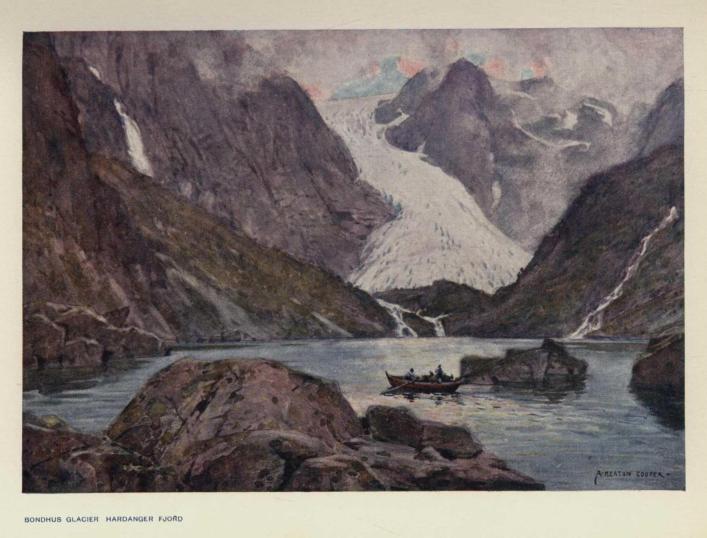
Bondhus Glacier, Hardanger Fjord
There is not much room for extensive
valleys on the narrow peninsulas between
the fjords, nor is the distance between
the head of the fjord and the watershed
very great, being steep. The rivers are
therefore short, although in many places
the volume of water is comparatively
large, owing to the heavy rainfall and, in
spring and early summer, to the
quickly-melting snow. Thus the depth of the
fall down to the fjord head is very steep,
and it is therefore here, where the
mountain forms are grandest, that the waterfalls
are most numerous, and where they are
the highest.
Above the head of the fjord and the
upper reaches of the branch fjords there
exists in some places a corresponding
series of lakes, or lake basins, at a height
of some hundreds of feet above the fjord
level.
Glacial action
In the Hardanger district Sandven,
Eidfjord, and Graven lakes are examples.
Here, too, are rock basins of the typical
fjord form filled with river-water, answering
to the erosion caused by the extremities
of the shorter glaciers in the valleys.
The inland ice during the great glacial
period must have extended above even
the highest peaks in the interior of the
country; but during the lesser or later
glacial period, when the extremities of
the glaciers only extended to the
above-mentioned series of lakes at the heads of
the fjords, the higher mountain-tops—at
any rate near the coast—and the highest
peaks, say, of Jötunheimen, have stood
above the great glacier, and have thus
escaped the general process of grinding.
They appear, however, to have been
considerably affected by natural forces in
quite a different manner. Their surface
is frequently broken up into loose
fragments, and we find at their base long
lines of rocky débris. We also constantly
find them developed into characteristic
Alpine forms.
Small glaciers in their hollows gradually
wear down as they recede into semicircular
corries, which cut up the original mountain
forms into rugged ridges and peaks. These
corries can only be developed above the
snow limit, and outside the greater region
of inland ice, or in among the rocky peaks
above the glaciers' surface, and we see
quite Alpine forms lifting their sharp
peaks above the undulating snow-field on
the extensive mountain plateaux.
From the brilliant and heroic Viking age
originate those priceless gems of early
literature, the "Eddas" and "Sagas,"
poems and prose of the greatest beauty.
The "Eddas" chronicle the exploits of
pagan gods and legendary heroes, in no
way historical; they are purely
mythological. They convey to us in the form
of poetry an idea of the pagan mythology
of the North in pre-Christian times. They
were written at a period following on the
first settlement of Iceland, which was
accomplished by pagan Celts and
Norwegians in the days of Harald Haarfagre,
about A.D. 874, and they were continued
long after the introduction there of
Christianity by King Olav Trygvesson,
A.D. 1000.
Snorre Sturlason, the Skald, about
A.D. 1220 composed what is known as
the "Younger Edda," being inspired by
the oldest poetry in the Celtic and
Icelandic languages.
The "Sagas" had their beginning in
oral tradition. They celebrated the deeds
and exploits of heroic men of the early
Viking age. These stories were greatly
embellished by the "Saga"-makers, who
related them in the halls of petty kings
and chieftains at great feasts, and we may
be sure they delighted the hearers, who
took part in imagination in the lively
doings of their brave ancestors.
The learned Ari Frodi was first to
commit these "Sagas" to writing in the
year 1130. From these early writings we
gather some information regarding the
heathen gods of mythology.
Heathen mythology
We learn that Odin was all-father and
god of war. Thor, the son of Odin the
Thunderer, was ruler of the air and a
deadly foe to "jotuns" (giants) and
wizards. Niord was controller of winds
and protector of sailors, and Freya was
the goddess of peace. Balder the Beautiful
was the sun-god. "Trolds" are spirits
of the mountains, forests, and lakes, and
"valkyries" are the beautiful maidens of
Odin.
Asgaard was the home of the "æsir"
(gods), Valhalla the hall of the departed
heroes in Asgaard. Neiffelheim was the
frozen underworld, and Muspelheim the
place of heat and fire, while Loki was
the enemy of the gods (Lucifer).
Images of these gods were placed in
the pagan temple, which was called
"Hov," or "Hove." This edifice was
built of stone or wood. It consisted of a
nave and chancel. In the centre of the
nave stood a large flat fireplace of stone,
on which the flesh of the sacrifice was
cooked. The smoke from the burning
found its way through a square hole in
the roof. Rude benches ran along the
sides of the walls, and in the midst of
these was placed, in a conspicuous position,
the high seat, with its great carved
pillars ("stolper"), and it was on this seat
that the heathen chief sat who officiated
at the sacrificial rites.
In the centre of the chancel stood the
altar. This was placed on a slight
elevation, above the hard earthen floor of the
temple. Ranged at the back of the altar
were the wooden images of the pagan
gods, with the principal one—oftest
Thor—in the centre. On the altar the victim
of the sacrifice—usually an animal, but
sometimes a human being—was slain and
laid, and the blood was caught in huge
bowls of wood or metal, kept expressly
for that purpose. The blood was then
sprinkled on the altar and walls, on the
images of the gods, and on those worshipping.
Hung on to the altar was a large
golden ring, which the officiating
chieftain bore around during the mystic rites
and ceremonies. On this ring were sworn
all oaths at the "Thing" meeting, or
local Parliament, which generally met on
the same day, at the conclusion of the
ceremonies.
A pagan temple
Hove Kirke, at Vik, in the Sogne Fjord,
is a fair example of such a temple. It
dates from the eleventh century. It was
restored by the Norwegian architect Blix
in 1880. Built of stone, it is picturesquely
situated on an eminence, at an elevation
of some 200 feet. It overlooks the village
and bay of Vik, and across the Sogne
Fjord the prospect terminates in the
glacier of Vetle Fjord, and the high and
rugged mountains of Fjærland.
Nearer the village, and on a conical
mound, stands also the wooden "Stav"
church, which here forms the subject of
our illustration. Dating from the twelfth
century, it is one of the finest examples of
its kind in existence in the country. It
is now owned by the Society for the
Preservation of Norwegian Monuments
of Antiquity.
Inside this church, among other quaint
objects of interest, is a baldaquin,
decorated with early medieval paintings and
richly carved. The massive church portals
show also antique carving in bold design,
and some fine old hinges almost cover
the heavy door with their decoration.
Superstitious beliefs
Superstition is not yet quite extinct in
Sogn. In places such as Vik, where the
mountains are high and steep, and the
valley is narrow and wild, it is no wonder
that the peasants retain to a great degree
the superstitious beliefs of their ancestors.
Hearing from childhood those weird
fairy tales and legends which are the
fireside sagas of the peasantry, and
spending their whole lives in association with
such relics of antiquity as these hoary
churches and the scattered burial-mounds
("grav-haug") of dead warriors of pagan
times, we can quite understand why it is
that vestiges of heathen superstition still
exist among the peasantry, and it is
discovered in many a quaint form in their
daily lives, even in these enlightened days.
If we stroll among the farmsteads, we
may observe a cross within a circle painted
on many a barn-door and outhouse, this
being done as a protection against the
mischievous tricks of the "trolds" (gnomes).
These are believed to live up in the wildest
and most lonely places in the mountains.
Whenever cattle on the farm fall sick,
it is put down to the work of the "trolds."
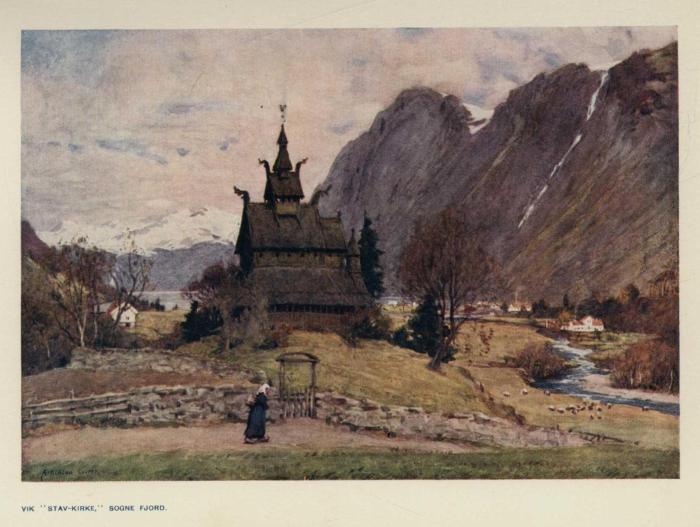
Vik "Stav-kirke" Sogne Fjord
On Christmas Eve the peasants burn a
candle all night in the house, and at early
morning they go into the cow-house and
singe each cow on the tail as a protection
against sickness.
"Trolds" are thought to be very
musical. If there is an exceptionally
clever fiddler at a wedding feast, the
peasants say that the performer must
have been up the mountains and learnt
from the "trolds," who are believed to
play weird and bewitching music in the
loneliest recesses of the mountains.
In addition to "trolds," there are
"huldr" (fairies or sprites). These are
said to be very beautiful, and they
sometimes assume human form, the only
difference being that they have a cow's
tail. These "huldr" have their abode
underground, and always close by the
farm buildings.
It is told that on one occasion a
servant-girl by ill-chance threw hot water out
from the kitchen door, and immediately
the "huldr" called out noisily, screaming
that the hot water was scalding them
and their children underground. Peasant
women to this day will never throw out
hot water from their doorways without
first saying, "Take care, you who under
live." Should children fall sick, the
neighbours will say that "the mother cannot
expect anything else, for she is in the
habit of throwing hot water from the
doorway, and the 'huldr' are having revenge."
There is a legend relating to a peasant
girl who, on her way to a lonely "sæter,"
or mountain out-farm, heard a voice near
her call out, "Tell Turid that Tarald is
dead." The girl could see no one near, and
on arriving at the "sæter" told the other
girls there what she had heard; immediately
there came a loud cry out of the ground,
"Oh, it is me who is called Turid, and
Tarald is my husband."
A similar story is found in Plutarch,
A.D. 120, in which he relates that a skipper
sailing among the Greek islands heard
a voice which called out, "Thamus." Thamus
was the name of the skipper.
Twice the voice called out, and he did not
answer; but on hearing it for the third
time he did reply. The voice then called
out to him loudly, "When you come to
Palodes, call out that the great Pan is
dead."
Thamus thought that he would sail past
Palodes, but would not utter a word of
what he had heard unless the weather
happened to be still. When he arrived
there, however, the sea was quiet, and he,
remembering the words, called out loudly
that the great Pan was dead. Immediately
there came from the island a great
moaning as of many voices weirdly blended,
and this that happened was soon related in Rome.
A quaint conception relating to
mountain folklore refers to what is known in
Sogn as "jolaskrei," a kind of kelpie or
old witch wife; these belong to the
nightriders of the kingdom of the departed.
They are seen on high, ugly mountain
ridges at dead of night. When these
kelpies are out, they often visit the stables
of the lonely farms and take out the
horses. These are brought back again,
however, just before dawn, but so
overworked or overridden and tired that they
are quite ready to collapse with fatigue.
To guard against this inconvenience, the
peasants paint a cross on the stable door,
or lay an axe underneath it. In some
places even now the farmers place food
and drink on the table on Christmas night
after all the family have retired, this being
for the kelpies; otherwise they might be
angry and cause much annoyance.
In some districts these curious sprites or
goblins are known as "vaasedrift." These
ride or drive through the night among the
farms; and there are those now living who
relate that in their fore-elders' time the bits
and reins were found on the horses in the
early morning, having been placed there
by the kelpies.
The spirits of dead Vikings and chiefs
who are buried under those huge mounds,
"grav-haug," are thought to visit each
other, and may be seen flitting to and fro
on Christmas eve and for thirteen nights
after.
"Nykk," "nökken" (nixies) are known
throughout the country. These were in
former times seen near deep and gloomy
mountain tarns and by the brooks.
These nixies are able to transform
themselves into any kind of animal or reptile,
sometimes even assuming strange and
grotesque shapes, with heads both front
and back; they are the spirits of fresh
water.
A peculiar legend originates from
Underdal in Aurland, in the inner Sogne
Fjord. In the olden time there was quite
a plague of snakes in that place. A Finn
from Nordland happened to be travelling
in the neighbourhood. The Finns have
always been held in great dread by the
Norwegian peasants on account of their
pagan practices, witchcraft and sorcery.
This pagan Finn offered to rid the place
of the reptiles if only there was not among
them what he called a "hvidorm" or
"visorm" (a wizard serpent), which he
described as being in shape like a long
hempen rope; it was quite white, and
had a red head. The peasants informed
him that the "visorm" was never seen there.
The Finn then built up a large "baal"
(funeral pyre), and fixed up a high post
near by, up which he climbed; it was just
so high that none of the snakes could
reach him. There he sat and beat loudly
on his conjuring drum with a drumstick of
reindeer horn, and began to conjure.
Then out sprang the snake, which was
charmed by the noise of the "rune" drum,
and forthwith sprang all the other snakes:
from fell and brake, from crag and wood,
all came racing up to the fire. But now,
alas! came also the "visorm" so dreaded
by the Finn, who shrieked that it was now
all over with him, for in company with
"visormen" came always "hvidormen,"
the dragon snake.
Thunder was heard in the crags close by,
and a huge piece of rock was hurled into
the fjord. As the dragon snake came
forth, down sprang the Finn from his high
seat; but he was promptly seized by
"hvidormen," and both disappeared into
the funeral pyre together and were burnt
up. It was in this way that Underdal
was rid at once of both snakes and Finn,
and this happened long ago.
"Trolds" (sprites) and "horven" or
"kraken" (sea-monsters) were thought to
inhabit the sea and lonely parts of the
coast and uninhabited islands in the old
days, but it is uncertain whether people
nowadays quite believe in this nonsense,
although they might say "You must have
been a-fishing with 'kraken' to-day" if a
fisherman happened to come in with an
unusual harvest of fish.
"Kraken" is also thought to be the
legendary sea serpent which is said to have
been seen in still summer weather on the
deep sea, far out from land, by fishermen,
but always at a distance, never near enough
for them to be able to take its dimensions.
This sea-monster is supposed to be about
one hundred fathoms long, and to wriggle
over the surface of the water, at times
heaving itself even to the height of the
masts of a ship.
An old saga speaks of a kind of
merman, "hav-strambr," a sea-monster,
whose head resembles a man's helmeted
head, the lower part of the body being in
shape like to an icicle, and no one has ever
seen where it ends. When this monster
appears it is said to be a sign of storm and
shipwreck.
Quaint customs
A custom which had its origin in pagan
times is the lighting of the Saint John's
fires, "Sankt Hans," or "Balder's Baal,"
on midsummer's eve, a festival of the sun,
held on the longest day. It is intimately
connected with sun-worship, Balder being
the sun-god, and fire a symbolic image of
the sun.
"Balder's Baal, solbilledet, smukt, brændte paa
viede stene."[1]
This, translated, reads:
"Balder's symbol, sun's beautiful image, burned
in pyres on rocks consecrated."
We read in the Icelandic sagas that the
two great festivals of the year in heathen
times were Yuletide and midsummer, and
both were celebrated by the lighting of
great fires. This primitive custom is better
preserved in Norway than in most other
countries, but even here it appears to be
slowly dying out.
Exactly at midnight the fires begin to
appear, and soon every promontory, rock,
and mountain breast is alight; hundreds of
fires shine and glimmer as far as the eye
can see, casting their lurid reflections on
the waters of the fjord in the brilliant
twilight.
Around the nearer fires may be discerned
shadow-like figures moving round the
blaze in the dance, the music of the fiddle
being almost drowned by the singing and
merriment of the young people who are
taking part in the proceedings.
A mock wedding forms part of the
ceremony, a young peasant girl being
dressed as a bride, wearing on her head a
crown of birch twigs; the other girls, in
national costume, follow in procession,
headed by the fiddler, and the boys bring
up the rear. The dancing afterwards is
kept up all through the long midsummer
night.
It is a very effective sight to see the
well-filled boats stealing over the water from
the surrounding farms, the young folks,
dressed in holiday costume, coming to
take part in the festival.
In several places along the fjord it is
the custom to build a strong raft of logs;
this is piled high with combustible material
and floated some distance from shore,
where it is anchored. When in full blaze
it looks very effective, and lights up the
water with ruddy reflection.
Numbers of boats may be observed
to creep mysteriously around the fire, at a
safe distance from it, and the lively notes
of the fiddle and of singing float sweetly
over the water.
Another old custom still survives in this
district of Sogn. When it becomes known
that two young people are to be engaged
to be married, the boys in the district shoot
into the air with rifles, and fire small cannon
around the house on the evening when the
young man goes to ask of the parents their
consent to the engagement. They also
ring hand-bells and blow a horn; these
noises must surely prove rather disconcerting
to the newly betrothed.
In some cases the prospective bride-groom
has many miles of rowing along the
fjord before he reaches the home of his
lady-love. His visit is usually paid at the
end of the week, and he generally spends
the night there. As a practical joke, the
peasant boys have been known to take his
boat, drag it up on shore, and hide it in
some secluded place, much to his great
discomfort and annoyance when he wishes
to return in the morning.
At all large weddings, to which may be
invited from 150 to 200 guests, festivities
are usually kept up for a week or more.
Dancing and fiddling go on day and
night continuously, the "Hailing" and
"Spring" dances being general favourites
on these festive occasions.
The music to these dances is exceedingly
lively, even barbaric in character, and the
dances are consequently wild and exciting.
The services of the Hardanger fiddler
are in great request, and he finds himself
engaged throughout the springtime, going
with his fiddle from one wedding to
another.
Each wedding party engage their own
fiddler, and he it is who leads the procession
from the farm to the church door, and it
often occurs that several weddings take
place at the same church at the same
time. There is great competition among
the fiddlers on such an occasion, each
one playing to the very extent of his
ability. With a jaunty air the fiddlers
step forward, and each neighbourhood upholds
with pride the honour and reputation
of their own fiddler.
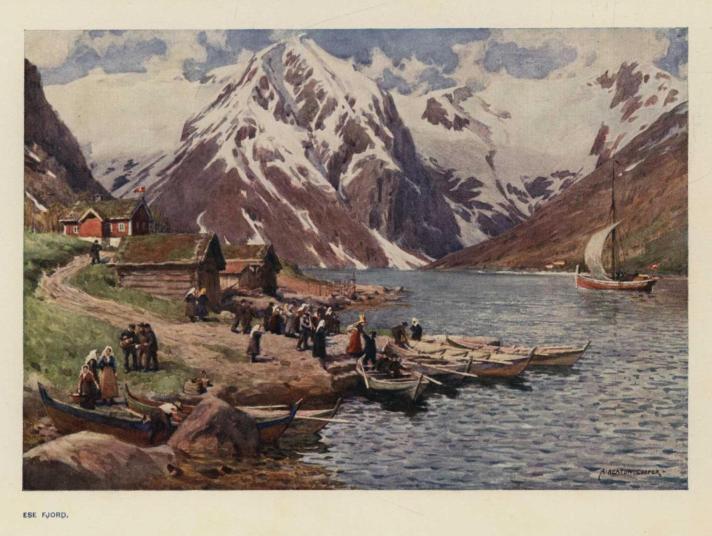
Ese Fjord
It happened that on one such occasion
the church folk were divided in their
admiration between two fiddlers of about
equal cleverness. One side claimed that
a feat had been achieved on the way to the
kirk by their fiddler, who, while all along
playing his best, did at the same time chaff
his comrades who stood on the roadside
as he calmly went on with his difficult
bridal march, as though it were quite
the most easy and natural thing in the
world.
This same spirit of rivalry also possesses
the younger men; each vies with the others
in skill and cleverness in the dances, in
which their ability to kick the highest
is put to the test for the admiration and
applause of the onlooking girls. This
rivalry would result at times in quite a
battle royal of words, and even more
seriously, it would end in real danger to
life and limb.
Sailing down the Sogne Fjord from the
sea coast, the scenery gradually assumes
wilder and grander proportions as we
advance. At Vadeim it is just beginning
to be interesting and attractive, and when
we come to Balholm we enter into the
finest part of the fjord.
Here are prosperous farms, smiling
orchards, and waving cornfields, and as
an effective contrast, glacier and
snow-field crown the high and steep mountains
around.
Tradition points to this place as the
scene of the Swedish poet Tegner's "Frithjof Saga."
Among other burial mounds ("grav-haug")
of chiefs from the Viking age at
Balholm is pointed out that of King Belè,
whose daughter was Ingeborg, whilst at
Framnæs, across the fjord, dwelt Frithjof
the Viking. These names all occur in the
"Frithjof Saga."
At Balholm stands an English church,
the only one to be found among the
fjords. Built for the use of English visitors
in summer-time, its design is similar to that
of the ancient wooden "stav-kirk," at Vik
in Sogn. It was erected recently, mainly
through the efforts of the brothers Kvikne,
who during their lifetime have been the
means of transforming Balholm from a
mere wilderness to a place of great beauty,
and one of the most important places
of resort among the fjords.
In an earlier part of this book reference
was made to the life at a "sæter," or
mountain out-farm, a description of which
may here be found of interest.
Many of the peasants who live alongside
the fjords are also owners of large
portions of the mountain plateaux in their
neighbourhood, and on these excellent
grazing is found in the summer months.
When the heavy work of the spring has
been finished on the home farm, and the
snow has left these highlands, and when
the vegetation has had time to establish
itself anew, the whole farm household gets
ready to remove the domestic animals
to the "sæter." It is a picturesque sight,
this cavalcade, the animals all confusion,
cattle lowing and sheep bleating, their bells
tinkling merrily as they skip about, the
sturdy little ponies, heavily laden with
necessary goods and chattels, bringing up
the rear. All seem full of glee that they
can now have a few months of ideal grazing
on those high lands after their imprisonment
indoors all the long winter.
Climbing and struggling onwards up
the steep valley, then through almost
trackless regions of rocks and stunted trees,
they at length arrive at their destination,
often after some fifteen or twenty miles of
travelling.
Life at a "sæter"
At the "sæter" they rest for the
summer months amid rich vegetation by
the margin of a lake or mountain tarn,
surrounded by high mountain-tops. Here
they graze on the bosky slopes to the
music of babbling brooks.
The "sæter" houses are mostly small and
low, of one story only; they are usually of
a very primitive type, being, in fact, the
earliest style of house building now in
existence in the country, this ancient form
surviving here long after it had been
abandoned in the home farms. Attached
to the dwelling-house, or forming part
of it, is a dairy where butter and cheeses
are made.
A white cheese, "melkost," is made from
fresh cow's milk; a very strongly-flavoured
old cheese comes from buttermilk—it is
called "gammelost"; and from goat's milk
they make "gjedost" or "brimost."
The women and girls only live up at the
"sæter," and in addition to the cheese and
butter making, they must attend to their
domestic animals during the four longest
summer months.
The men come up from the home farm
at the week-ends with necessary provisions,
and take back with them the produce of
the "sæter."
Bracing is the rarified air of these
high lands; and although the sun's heat is
great, it is tempered by the breezes which
come from snow-field or glacier on the
higher mountains around.
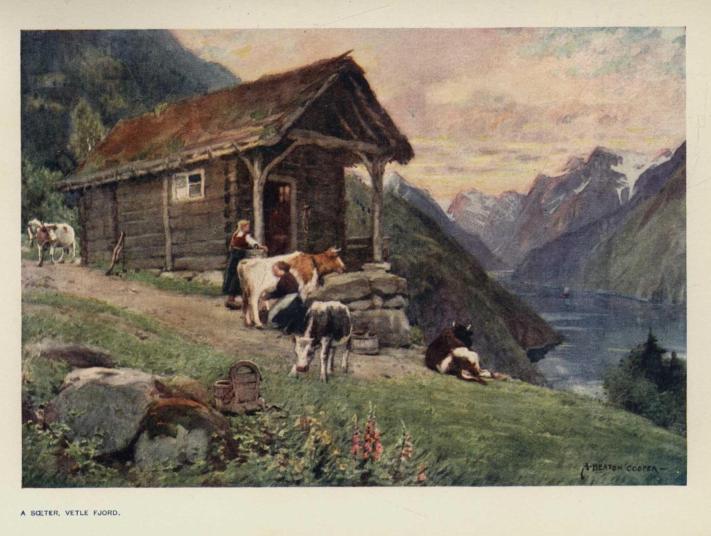
A sæter, Vetle Fjord
When the wild berries are ripe, the
younger girls climb the heathery slopes
and fill their wooden pails with the
cranberries, bilberries, and cloudberries
("multebær"), which abound in great
profusion.
Fagesi, Levros, Pentekol, Buskin: to
these and other quaintly sounding names
the cattle answer, the goats also being
known individually by such names as
Skjomos, Blegeros, Kvideben, etc.
The cattle have their chosen leader, who
wears a bell attached to a leathern collar
around the neck; they are led by its sound,
and keep within hearing distance as they
graze. The sheep and goats also wear bells,
nearly all of them, but the sound of these
is quite distinct from the cattle-bells.
At a certain time every evening the
cows may be seen slowly making their
way of their own accord to the "sæter"
house, where they quietly wait to be
milked.
When it is necessary to call them from
a distance, they answer to the sound of the
"lur," a kind of alpine horn. This is
made of birch, and is about four feet long.
When blown lustily it gives out notes
clear and sweet, in sound not unlike those
of a cornet.
On the "lur" the "sæter" girls are
expert performers, and during the long
summer evenings they love to make the
mountain crags echo with delicious airs,
which they produce from this primitive
instrument.
The cattle know instinctively when there
are bears in the neighbourhood.
At such times they hurry to the "sæter"
huts, around which they crowd, and from
their melancholy lowing the girls are led
to know that there is danger near. A
bonfire is quickly made and kept alight
throughout the night; the "lur" is also
brought into requisition. Thus, by the aid
of fire and music, the danger is averted, for
Bruin, being fond of neither, gets himself
away as quickly as he can.
Not very many years ago bears were
fairly numerous in the high and wild
mountain region which lies between the
Sogne and Nord Fjords, but, owing in a
great measure to the more general use of
better guns, they have steadily decreased.
The average annual number of bears shot
in Norway between the years 1840 and
1860 was 230. This number has gradually
dwindled down to a yearly average of
40 for the past decade.
Fjaarland in Sogn is a noted stronghold
of these animals, and in this neighbourhood
many bears have been shot in recent years.
One old peasant, who lived in Suphelledal
here, informed me that he had during his
lifetime shot over 30 bears. As witness
to his tale, his face and scalp showed even
then old, but quite distinct, traces of the
rough handling he had received in the
pursuit of his favourite sport. On one
occasion, after having lain in wait for
several days up the mountains, he was
suddenly confronted by a she-bear with a
young cub. So quickly did she appear
from behind a rock, and so close to him
was she, that he had not time to fire before
she struck him on the head with her
powerful forefoot, which action tore his
scalp over his face and laid him prostrate
on the ground. For a moment he felt the
hot breath of the bear around his ears as
he lay with face buried in the turf. No
doubt thinking that he was killed
outright, she proceeded, at a few yards'
distance, to scrape with her powerful claws
among the loose earth and débris in order
to make a hole in which to hide her prey.
She stopped from time to time to look
up from her work to see if her victim
showed any signs of life, and being at length
convinced that all was well, she went on
with her task with greater energy, and
from her strong claws the loose earth and
stones flew in all directions.
Bear-hunting
The peasant's opportunity, for which he
had breathlessly waited, presented itself.
Jumping up, he seized his rifle, and with
cool and steady aim he was fortunate in
bringing down by that one fatal shot a
fine animal in the pink of condition. He
succeeded at the same time in securing
her young cub, and thought himself to be
in great good luck that day.
Two fine glaciers, Bojumsbræ and
Suphellebræ, are in this district of
Fjærland, and both may be visited in a few
hours from Mundal. These glaciers are
arms of the great Jostedalsbræ, the most
extensive ice-field in Europe.
The Bojumsbræ is the most important
of the two in regard to size, and the
surroundings are majestically grand. King
Oscar II. visited this glacier in 1879.
At the Suphellebræ may be seen and
heard at any time huge masses of ice
falling over the precipice which cuts off
the lower from the upper glacier.
At the foot of the lower glacier are
several very beautiful ice-caverns, deep
blue in colour, from which flows the
pale-green ice-water on its way to the head of
the fjord which is not far distant.
Glaciers of Fjærland
The valleys in this district are wild and
grand. There is, however, rich grazing
land, and the peasants are all well-to-do;
they retain in primitive fashion the habits
and customs of their ancestors, and are
very hospitable and kind-hearted.
The people of Sogn—"Sogninger," as
they are called—are, on the whole, a
powerful and gifted race. Those of Outer
(Ytre) Sogn are, as a rule, placid and
even-tempered, and the natives of Inner (Indre)
Sogn are quick, lively, and excitable.
Their dialect ("Sognemaal") is clear, rich,
and full-sounding. It is one of the
dialects most resembling the old Norwegian
language.
Sogn was at one time the seat of mighty
families, and many a warlike company of
Vikings has sailed from this fjord. The
ancient kings of Norway occasionally
visited Sogn, but not always in a friendly
way.
An old historical saga tells of a visit
which King Sverre paid the "Sogninger"
to take vengeance upon them for the
killing of his bailiff at a place named
Kaupanger, near Sogndal. Kaupanger, by
Sverre's orders, was burned, and so were
the houses of Sogndal. The inhabitants
of these places fled to the mountains and
woods, where they hid themselves and
thus escaped.
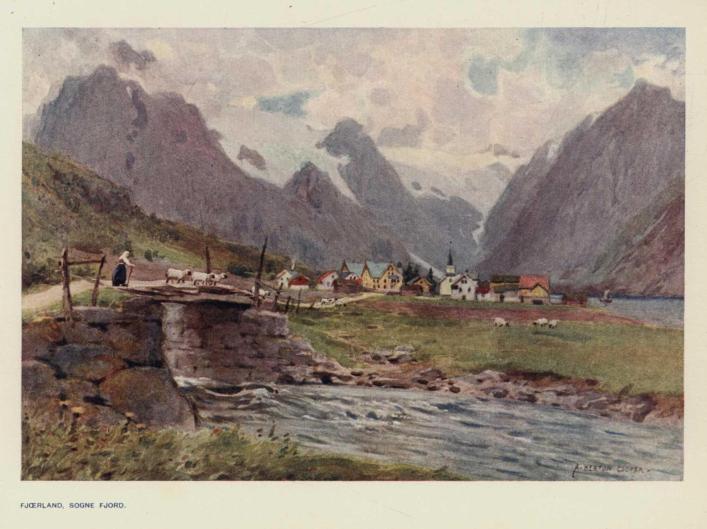
Fjærland, Sogne Fjord
Immediately after this event King
Sverre met his antagonist, Magnus
Erlingson, at the mouth of the Sogndal's
Fjord, at a place called Fimreite. Here
it was that the rival fleets came into
contact. The king gained the decisive
victory, and thus secured to himself the
crown of Norway. This engagement was
fought in the year 1184.
On the left bank of the Sogne Fjord is
Slinde. At this place, near the close of
the thirteenth century, lived Audun
Slinde, one of the powerful chiefs whom
King Erick dispatched to Scotland to
fetch his bride, the Princess Margaret.
Outside the churchyard at Sogndal
stands a "bauta sten," an upright column
of stone, on which is the runic inscription:
"King Olav shot among these stones."
As we proceed along the main Sogne
Fjord we obtain glimpses down branch
fjords, and beautiful vistas open out.
Mountain torrents and waterfalls are
seen on every side threading their steep
descent among the crags, now gliding
over smooth glaciated rocks, now wriggling
in tortuous, snake-like fashion, then a
sudden leap over a steep precipice, ending
with a final splash into the waters of the fjord.
A steamer's cargo
At sunset the new-fledged moon peeped
over snow-topped mountains, which are
ruddy with the sun's last rays. The fjord
water around is dashed with purple and
pale gold, rose, and emerald. A large,
cumbersome boat, laden to its utmost capacity
with sheep and lambs, puts out from shore
to meet the awaiting steamer. The boat
is roped to the steamer's side; the sheep,
handled tenderly, are transferred from it
to improvised pens on the steamer's
foredeck, the sheep in one compartment
and the lambs in another. There is also a
large open packing-case, which contains
the youngest lambs.
A chorus of deep bass and thinnest
treble continues spasmodically. The
shepherd is among his flock, his whole
time taken up in keeping watch and ward
over them, especially over the lambs,
whose feats of jumping tax to the utmost
his patient watchfulness.
As the steamer ploughs along, a pleasant
breeze plays on the surface of the now
steely grey water.
The snow on the high mountains
changes colour to a pale lilac, and the
moon brightens as twilight advances, while
over in the west the first faint star of
evening glimmers in a sky of palest amber.
As we proceed the fjord contracts, the
mountains are higher and steeper, in
places almost perpendicular, and the
waterfalls rush down with greater impetuosity
into the dark fjord.
We now turn into the Nærö Fjord in
brilliant twilight, and some of the grandest
and wildest scenery of Sogn is presented
to our view. We observe that the kind
shepherd is covering up with a sackcloth
the smallest lambs, which are in the
packing-case on the fore-deck, as a
protection from the cool night air, which is
rather inclined to be frosty, even on this
lovely night of May. The farther we
advance up this fjord, the more sombre
and overpowering is the impression we
receive of this magnificent fjord scenery.
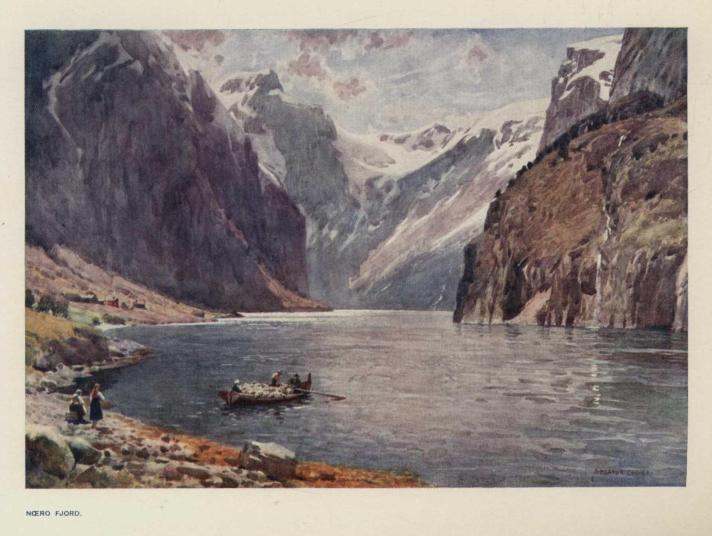
Næro Fjord
We now approach the little hamlet of
Dyrdal, romantically situated at the
entrance to the narrow valley of the same
name. Here huge mountains rear their
massive walls into the twilight sky. The
Nærö Fjord is narrowest at this point,
being only a few hundred yards wide.
The sound of the steamer's syren now
echoes with a metallic ring from one
mountain to another in diminishing
cadence of sweet notes, and in reply two
large boats put out from shore to meet
the steamer. With much struggling the
woolly flock is transferred to the boats
from the steamer, the sheep and lambs
appearing quite happy—to judge by the
sound of their voices—at the prospect of
being on terra firma again.
At a lonely farm situated in the wildest
part of Nærö Fjord it was my happy
fortune to stay for some days in the merry
month of May. On my arrival there, and
in compliance with a signal from shore,
the steamer slows up, and a boat is brought
alongside. A friendly good-bye to the
obliging captain, and I am rowed ashore,
where I meet the kind owner of the farm,
my host. He and his good wife ("kone")
show me through the house, an excellent
example of a "bonder's" home of the
olden time.
The principal living-room is about
twenty feet square. The walls display
unusually thick baulks of timber, while the
huge beams show distinctly the marks of
the axe which fashioned them. The heavy
doors are nearly square in shape, with lock
and handle of antique design in wrought-iron.
On one side of this room stands an
elevated open hearth ("peis"), over which
hangs a crane, and to this is attached a
huge copper cauldron. The smoke from
the peat fire escapes through the roof by
a very wide open chimney. A
clean-scrubbed massive table almost fills one
end of the room by the side of the
wall-benches. High-backed chairs, several
spinning-wheels, and a carpet-weaving
frame help to fill up this spacious apartment.
To reach the room set apart for me I
must climb up wooden ladder-like steps.
My room, simply but comfortably
furnished, was fresh and clean. On the left
side in a dark corner was the customary
low, wooden, box-like bed, which I saw
at a glance was, for one of my stature,
much too short. It was piled high with
some soft material on the top. This
covering proved on examination to be a
4-feet square air-tight bag containing
eiderdown about a foot deep. Under this
was only the thinnest cotton sheet, and I
began to wonder how these two as a
covering could possibly remain together
in harmony throughout the night, and as
to whether they were calculated to cover
all one's limbs at one and the same time.
On being very considerately asked on
the following morning how I had slept,
and if I would like an extra eiderdown
on, I courteously but firmly declined.
In the Nærö Fjord
At 8 a.m. came breakfast-time. On
the table were placed several kinds of
native cheese, brown bread, butter and
potato-cakes, dried mutton ("spege kjöd"),
and boiled potatoes, four boiled eggs, and
a large bowl of creamy milk. In addition
to these delicacies, a cup of excellent
coffee was brought in. The meal nearly
ended, and not having made much impression
on this mass before me, the good
wife again invited me—almost coerced
me—"to make a good meal," and seemed
quite disappointed to find that my capacity
was so limited.
Similar fare was my portion for the
other meals, varied only with boiled goat's
flesh, ptarmigan ("rype"), and hare or
wild reindeer.
These kind-hearted peasants did all in
their power to make my stay comfortable.
They enjoyed a little gossip from the
world outside their fjord, and it was
interesting to hear them talk in their very
pronounced and ancient dialect ("Sognemaal"),
which is as unlike modern Norwegian
"as she is spoke" as the English
of Chaucer's time is to our own modern
tongue.
At Styve, the wildest and most impressive
part of this narrow fjord, the massive
peaks of Steganaase tower overhead, on
their tops a crisp powder of new snow—this
was at the end of October—and across
the fjord rise up perpendicular buttresses
of mountains of equal grandeur and
awe-inspiring character. The fjord is here
about 4,000 feet deep.
At twilight the full moon was just
struggling from among wreathing mists
which clung around the high peaks,
indicating at the same time the presence of
showers of fine snow above, and as we
proceeded light snow-flakes descended,
falling lightly on the steamer's deck.
We were now ploughing through
crackling ice, which floated in detached
patches on the surface of the water.
In winter-time the fjord from here to
the hamlet of Gudvangen is completely
frozen over, the steamer being quite
unable to proceed farther. The fjord is at
that time a highway for sledge traffic to
and from the steamer. In this manner
the mails are conveyed over the ice to
Gudvangen, where other sledges are in
waiting to carry them overland to Vossevangen.
Gudvangen is so completely enclosed
by huge mountains that the sun's rays do
not reach it during four months of winter.
The sun lights up some of the nearer tops,
however, about mid-day, but then only
for about a couple of hours, when all
becomes grey again.
In winter and early spring destructive
avalanches of snow and rock shoot down
with terrible velocity into the fjord and
valley from the precipitous mountain
masses above, especially when thaw sets
in and the heavy mantle of snow is melting.
At one place in particular in Nærödal
it will be observed, in driving, that the
road threads in and out among huge
boulders of rock. These massive stones
formed part of a huge avalanche which
descended from the crags here only a few
years ago. The postman, driving at the
time down the valley, only just escaped
the danger by taking shelter under a large
boulder near the remains of a former
avalanche.
Many of the farm-houses in this narrow
valley are built under the shelter of rocks,
so as to be protected from the wind,
which sweeps down the valley at times
with terrific velocity, chiefly in winter.
Nærödal
Some years ago I spent two October
weeks in Gudvangen and Nærödal.
Arriving there overland from Vossevangen,
and not dreaming but that I was certain
of obtaining accommodation at the inn at
Gudvangen—it being considerably past
the time of tourists—to my intense
surprise, I found the place full to overflowing
with country folks in holiday attire—a
wedding party—and, to the music of the
riddle, the younger peasants and girls
were dancing the favourite Halling-fling.
Every room at the inn was crowded,
cakes and home-brewed ale being everywhere
in evidence.
The kind and genial innkeeper, with
profuse apologies at being unable to
accommodate me in the house, found me,
at last, a little room over the bakehouse
close by, which I found fairly comfortable
under the circumstances—it was at least
warm and dry.
The following morning all was bustle
and excitement. In the roadway outside
the inn rosy-cheeked peasant-girls, in
their prim, bright costumes, were
exchanging pleasant banter with the boys,
while the older men lounged around in
groups, with hands in pockets, engaged
in talking gossip at intervals between
puffs of tobacco-smoke.
The wedding "bryllups" was to be
celebrated that morning, and everybody
was now ready except the bride, whose
friends were engaged in adding the final
touches to her maidenly toilet. A start
is soon made, first a kind of informal
procession along the short stretch of road
to the pier, and a scramble into the boats,
then out on the fjord, their oars keeping
time to the strains of the fiddle. They
row along pleasantly for a couple of miles,
and then arrive at the small white wooden
church, which is situated picturesquely on
a rocky mound at Bakke.
There is, from here to Gudvangen, a
footpath, but in parts it is somewhat
rough. In several places it crosses screes
of loose stories, which repeated avalanches
have ground down in their career from
the overhanging cliffs above to the deep
fjord below. Every winter this mountain
path across the screes is wiped out of
existence, and a new one has to be made
when the spring comes.
The wedding service over, the whole
party, the clergyman ("presten") now
included, return to the inn to partake of
the wedding feast, and to drink the
healths ("skaal") of bride and groom.
The festivities are prolonged with hearty
excitement, eating, drinking, and dancing
the Halling-fling and Spring-dance day
and night for over a week.
During my stay at Gudvangen at that
time, an old woman, short in stature and
poorly clad, approached me one day by
the roadside, and, carefully unwrapping a
many-folded parcel, at length produced a
few English coins of silver and bronze.
These she had earned during the past
summer from passing travellers by the
sale of flowers from her little garden
patch. She begged me to exchange into
Norwegian money these coins, which she
could not use. It was a pleasure to see
her wrinkled face light up with genuine
gratitude for this slight service rendered
her.
A few days afterwards this same little
woman met me again, and gave me a tiny
paper packet, which, she said, contained a
few four-leaved clover sprigs. These she
had taken all day to discover among the
scant herbage on the mountain-side, and
if I would only take and keep them, I
should be lucky ever after. And who
shall say that I was not?
Nærödal is one of the grandest valleys
in Norway. The narrow ribbon of road
threads the deep valley, crossing and
recrossing the clear mountain torrent, whose
close acquaintance is kept the whole of
the distance to the foot of the steep
Stalheimskleven.
All the way the stupendous mountain
masses seem almost ready to topple over
from both sides into the narrow, gorge-like
valley. The high, dome-shaped
mountain, which is a conspicuous feature
on our right as we proceed, is Jordalsnuten.
Eagles, falcons, and other birds
of prey inhabit these rugged fastnesses.
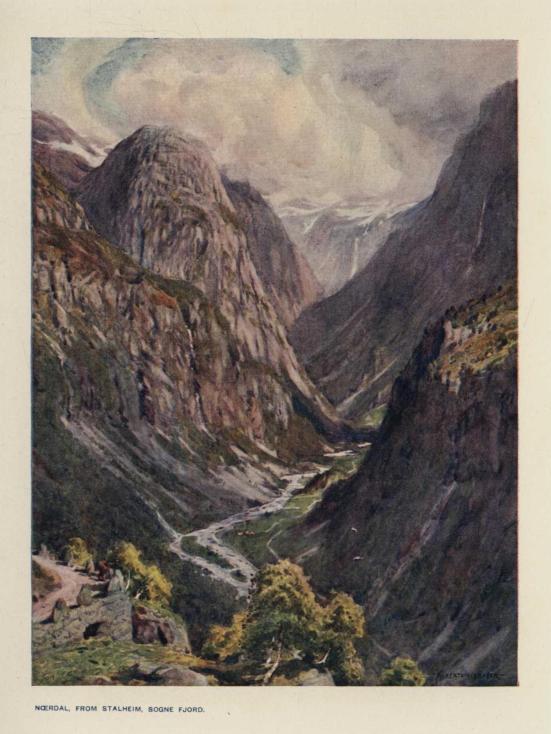
Nærödal, from Stalheim, Sogne Fjord
At an ancient farm at the foot of
Jordalsnuten the farmer showed me the
feet and powerful claws of a golden eagle.
These he had converted into base and
pillar for a pair of candlesticks. It had
happened on one day during the previous
summer, when the farmer's household
were engaged in the hay-field, that their
work was interrupted by the sight of a
large eagle, poised at a height of several
hundred feet in the air. From its talons
a young sheep was hanging. As they
watched they saw that the eagle was
gradually descending, although making
powerful and frantic efforts to rise. As
it neared the ground all hands rushed at
once to the spot, and with hay-fork and
scythe they attacked and dispatched the
powerful bird and saved the sheep.
Evidently the weight was rather more than
the eagle could carry away, and, being
unable to extricate its crooked talons
from the woolly fleece, it found itself
entrapped by its own prey.
The road now gradually ascends the
valley, and at the foot of Stalheimskleven
it takes sixteen zigzag sweeps up the face
of the cliff, which is here about 1,000 feet
above the valley. Immediately on the
right as we ascend we see a pretty
waterfall, Sivlefos, and on the left we get a
glimpse of Stalheimsfos. These two fine
waterfalls are romantically situated in
deep and craggy gullies.
From the summit of the pass we have
one of the grandest and most impressive
views of the kind in Norway. Looking
backward down the sublime Nærödal, the
grey, rounded dome of Jordalsnuten rises
majestically on the left, its steep sides
deeply furrowed by the action of
avalanches. The mountain mass on the
right is Kaldafjeld, and in the extreme
distance we can just distinguish Kilefos,
the fine waterfall near to Gudvangen. At
our feet are the two waterfalls we saw on
our climb up Stalheimskleven, Sivlefos
and Stalheimsfos, foaming in their rocky
ravines, their combined waters flowing on
in a silver thread along the bottom of the
deep valley. So narrow in places is the
valley that there appears to be only room
for the river and the road.
In the summer months this highway
from Vossevangen to Gudvangen,
connecting the Hardanger district with that
of Sogn, is much used by travellers, and
traffic is often greatly congested, especially
at the terminus at Gudvangen, where the
Sogne Fjord steamers are joined.
We are now among some of the most
magnificent scenery in the country, and
this grandeur is continued into the
impressive Aurlands Fjord, which rivals its
neighbour Nærö in sublimity. The huge
mass of Bejteln, furrowed with enormous
ravines, stands like a sentinel at the
junction of the two fjords, with snow-crested
Steganaase behind, rearing its mighty
peaks to the skies. Huge perpendicular
buttresses wall in the fjord on both sides,
and from their tops waterfalls are precipitated
in long streaks down the glistening
dark rocks, while deep gorges are torn
into the mountain forms, separating one
immense gable from another.
At the foot of one of these deep gorges,
and romantically situated, is the small
hamlet and church of Underdal. To the
left, farther up the fjord, stands Aurland,
or Vangen, the principal village in the
fjord parish ("vasbygd") of Aurland.
The small stone church here, it will be
observed, has an unusually high-pitched
gable and steeply sloping roof.
From the head of this Aurlands Fjord,
by ascending the Flaamsdal (the valley of
the swollen river), magnificent views are
obtained out over the fjord.
The road up this grand valley terminates
at Myrdal Station, on the new
Bergen-Christiania Railway, and near the
Hallingdal entrance to the long Gravehalsen
tunnel, amid mountain scenery of
overwhelming grandeur and sublimity.
At Frönningen a profitable business is
done in tree-felling. Large forests of
pine and fir clothe the steep sides of the
mountains here, and modern saw-mills
are erected at the foot of a torrent by the
margin of the fjord.
Seen from here, the glaciers of Fresvik
and Rambæren, both over 5,000 feet high,
stand out boldly against the sky.
A very charming effect of sunshine and
shower won my attention near here one
afternoon in the month of May. Immediately
in front of the steamer, and from
the mountains on one side of the fjord to
those on the other, stretched a most vivid
rainbow; the snow-capped mountains of
Lyster were faintly visible beneath the
arc, through a misty veil of rain-gauze.
As the steamer proceeded the rainbow
appeared to retire, so that we were not to
sail under the beautiful arc-en-ciel on
that occasion. Instead, we were presently
enveloped in driving rain, and to pace the
wet and slippery decks was no longer an
enjoyable occupation. The mountain-forms
were all wiped out by the rain-curtain,
and, from a state of comparative
calmness, the waters of the fjord became
almost as choppy as the open sea.
This condition of the elements did not
last long, however. In the space of an
hour all was again in brilliant, almost
dazzling, sunshine, the rocks and trees on
the mountain slopes sparkling with
raindrops, and the air became fresh and cool.
It will be observed, as we sail along,
that this district is more thickly wooded
than almost any other part of Sogn, many
of the mountains being quite covered with
the dark foliage of pines, even to their
summits.
The real forest trees of Norway are the
Scotch fir ("furu"), the spruce ("gran"),
and hardy birch. These trees grow all
over the country, sometimes in unmixed,
continuous forests covering large areas,
but, generally speaking, they are associated
with oak, elm, and ash, in smaller numbers.
In the eastern and southern parts of
the country these trees cover the mountain
slopes from the bottom of the valleys up
to a height of some 2,500 feet above
sea-level; at this elevation they are
succeeded by hardy forests of birch up to
another 1,000 feet; higher than this the
shrubs of the mountain plateau—the dwarf
birch—only survive.
Small forests are found near the coast in
places where they are protected by islands
or promontories from the sea winds, but we
must go farther inland, and to the heads of
the larger fjords, before we can come across
any large extent of forest-covered country.
The western part of Norway, however,
is not remarkable for its forests in
comparison with the eastern districts.
Hedemarken Amt (county) has the
largest forest area, while Stavanger Amt
has the smallest. Of the timber intended
for sale, considerable quantities are sent
abroad, chiefly spruce and Scotch fir.
Birch is found throughout the country, as
a rule in company with other trees, and
may be seen brightening up the dark
coniferous forests with its silver bark and
delicate foliage. There are two species of
birch—the lowland or white birch, with
graceful drooping branches, and the hardy
mountain birch, which is rather darker in
colour and more stunted in form. It is
only in the most northern countries that
the "lady of the woods" attains its full
beauty. The birch is one of the most
useful of trees, the wood being used for a
great variety of purposes. The inner bark
is used for tanning, and the outer, thicker,
bark for the roofs of houses, being placed
under the thick covering of turf. The
leaves are used as fodder for cattle.
Among other species of trees which
grow around the lowland farms and
meadows are found the aspen, whose wood
is used in the manufacture of matches, the
alder, the rowan and hazel, along with the
useful ash. The wood of the last-named
is largely used in the making of the "lang
ski" (snow-shoes).
Timber-felling usually begins in the late
autumn. It is an arduous and ofttimes
dangerous occupation, and requires hardy
and strong men. As the larger forests lie
often at a considerable distance from the
inhabited districts, many weeks are spent
by these woodmen in log huts specially
constructed for the purpose in the vicinity
of their work.
The timber, having been felled and
stripped of its bark, is collected in
convenient places, and when the snow is
sufficiently deep, it is then hauled to the
nearest river, where it is stacked to await
the melting of the snow and ice, when it is
floated down the swollen torrent or river,
and by this means it is carried down to the
lake or fjord and taken to the saw-mills.
Norway in ancient times had a larger
area of forest than it has at the present.
In the fourteenth century the Hanseatic
League appropriated the commerce of the
country. They cut down the forests
nearest the coast, also farther inland around
the fjord districts, and exported the
timber, having at that time considerable
commerce with the Dutch, and later—in
the seventeenth century—with the
English and Scotch.
Forest fires, and the growing
consumption of timber, as the population
increased, along with reckless felling on
the farm lands, have been the means of
denuding the west country of the larger
forests, thus leaving the mountains
comparatively bare and desolate and the
plateaux a wilderness.
The State owns very extensive forests,
chiefly in the extreme north and east of
the country, altogether covering an area
of some 2,500 square miles. These forests
are under the control of forestry managers,
overseers, and rangers. A commercial
system has been devised by which these
forests are kept up to their original size
and value, State nurseries for the rearing
of young trees having been established at
several places in the country, the two
largest being at Voss and Hamar. Three
forestry schools for elementary instruction
in the cultivation and treatment of forests,
and an agricultural college for advanced
instruction in the same, have been founded
in recent years.
The mining industry, which commenced
activity in the seventeenth century, was
responsible for the consumption of very
large quantities of timber, and this has
been going on for the last 270 years. The
Kongsberg silver-mines, which are owned
by the State, have alone some fifty square
miles of State forest set apart for their
requirements. The ore at these mines is
virgin silver, occurring in lodes, and it is
sometimes found in large nuggets weighing
up to 200 pounds. These silver-mines
were commenced in the year 1624.
Copper-mining was started at Röros in
1646. The most important copper-mines
in the country are the Kongensgrube,
Arvedalsgrube, and Storvatsgrube; the
ore found in them is copper pyrites, and
a large quantity is exported. There are
also extensive copper-mines at Sulitjelma
in Nordland, at Aamdal in Telemarken,
and at Valahei in Hardanger.
Owing to the condition of the forests
and the consequent rise in the value of
charcoal, iron mining has not been very
profitable, and many old works have been
closed. The Arendal iron-ore mines are
the only important mines now worked, and
the ore is noted for its excellent quality.
The mining industry
It will thus be seen that the mining
industry in Norway is not of very
considerable importance, the reason being that,
although the country is fairly rich in
minerals, the cost of conveyance to the
coast is yet too great for much profit to be
made.
Those districts which are found to be
rich in iron-ore happen to lie in almost
inaccessible country, and as coal does not
occur except on the out-of-the-way island
of Andöen, the native conditions are not
favourable for smelting.
In Gudbrandsdal and at several places
near Throndhjem soapstone is quarried
in considerable quantities, and is now
extensively used for building purposes.
The cathedral of Throndhjem is built of
this stone.
Slate of a beautiful green colour is
quarried at Voss and in Valders. Granite,
syenite, and porphyry are found in great
abundance all over the country.
Minerals which contain rare and
beautiful metals and earths occur in several
places—at Arendal, for example—and
these minerals are highly treasured in all
scientific collections.
The village and neighbourhood of
Lærdal, or, properly, Lærdalsören, is a
notable example of tree-denuded country.
Hidden away on a branch of the great
Sogne Fjord, and surrounded by bare and
massive mountains, Lærdalsören owes its
chief, perhaps only, claim to importance
from being the chief avenue of traffic to
the Sogne Fjord from the land side.
Owing to its enclosed situation, the direct
rays of the sun do not reach the village
during some five months of the winter
season, being in this respect in a worse
position than Gudvangen.
Lærdal
The village of Lærdalsören lies on a
broad, flat, well-cultivated plain at the
estuary of the river Læra, or the Lærdalselv,
an excellent salmon river. The valley
through which this river flows is superbly
wild and picturesque; the mountains which
enclose it are bare, rocky, and desolate.
The farther up this valley we go, the
wilder becomes the scenery, and the torrent
thunders in many a cataract along the
base of the ravine-like valley.
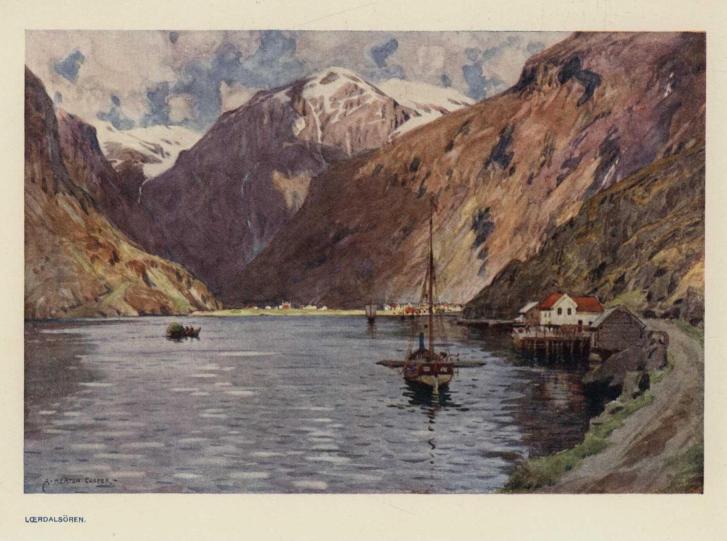
Lærdalsören
We may observe in several places huge
cauldrons worn out of the solid rock by
the action of water, a number of these
cauldrons being now far above the present
level of the river. We may also see, as
we proceed, that the road crosses several
ancient lake basins, now dry, the river
having, in the course of ages, gradually
worn down their rocky barriers, thus
draining the water from them.
Some twelve miles drive up this
magnificent valley we arrive at a place called
Borgund, where stands the quaint and
curious "stav kirke" of that name. This
extremely interesting and fantastic church
was built in the twelfth century, and is in
quite the best state of preservation of any
church of its kind in the country. It is
not now used for Divine service, a new
and more commodious church having been
built near by, for the better convenience
of the inhabitants of the district. This
ancient "stavkirke" of Borgund is now
the property of the Antiquarian Society
of Christiania. Every part of this curious
church is of extreme interest—six tiers
of pagoda-like, shingle-covered roof,
numerous gables from which spring
grotesque dragons' heads, and lofty and
elaborately carved portals. On the massive
door is carved, in runic characters, the
following inscription:
"Thorir raist runar thissar than Olaf misso."
(Thorir wrote these lines on the fair of Saint Olaf.)
The church is picturesquely situated in
the grandest portion of the ravine-like
valley of Lærdal.
To return to the village. In the
evening we might enjoy an hour among the
clusters of old houses, and down by the
boats hear the mellow tone of the dialect
of Sogn; or, strolling by the margin of
the still fjord, see the first discernible star
of evening prick his image like a diamond
in the calm water, while all around the
great mountains repeat their mighty forms
in accurate replica, save where a slight
puff of evening air disturbs the reflection
in a long streak of silver ripple, dying
away as softly as it had begun.
A boat puts out from a tiny creek near
by, and silently steals into the line of
vision. Only the faintest plash of the
oars is heard, and voices perhaps imagined.
A line of sparkling light marks out the
boat's track across the deep reflections
slowly fading away as the boat passes out
of sight.
Sailing out of the Bay of Lærdal on a
bright summer's morning, and all nature
being in its blithest mood, we should be
dull mortals indeed if we were not
touched by some chord in the melody,
and rejoice, even with the birds, in the
glorious sunshine and the rarified atmosphere.
The morning sun sparkles on the blue
fjord, and the delicate haze on the
mountains indicates the prelude to a hot day,
so we take some little care to place in a
shady position our deck-chairs, and any
stray whiff of breeze is encouraged and
acceptable.
The fjord is still, and, like a mirror,
reflects accurately the image of each
mountain and crag, tree, and grazing
cow. The steamer ploughs along, and
the long wash it creates breaks noisily in
its rear on cliff base and rocky strand.
We now arrive at the small village, or
hamlet, of Aardal, at the head of the
branch fjord of the same name. The
hamlet is picturesquely situated on an
elevation above the shore, and for a
background has an imposing amphitheatre of
high mountains.
The grandest waterfall in the Sogn
district is in this neighbourhood—the
Vettisfos. This waterfall plunges into a
deep and awful chasm from a height of
some 900 feet. The way to it is
romantic and rough, and, to add a spice of
flavour to the excursion, the district is a
well-known haunt of bears at certain
seasons of the year, but not in summer-time.
In the Vettisgjel, a very deep and
narrow ravine on the way to the waterfall,
destructive avalanches of rock are
frequent, especially after winter's thaws
or heavy rain.
Lyster Fjord
In Lyster Fjord—the longest arm of
the great Sogne Fjord—the scenery is
diversified and beautiful, but milder in
character than that which we have recently
been viewing.
At the head of the fjord, however, the
scenery is picturesque and grand, in
character somewhat resembling that of the
Lake of Lucerne, and by many travellers
thought to be quite as beautiful.
Skjolden, at the northern extremity of
the fjord, is a starting-point for
Jötunheimen (the Giant Mountains), the Alps
of Norway—the home of giants ("jötun")
according to Norse mythology. This
wonderful group of mountains is in the
very heart of the country, and it is here
that the grandest peaks in the whole of
Norway are found, Galdhöpiggen, (8,396
feet) and Glittertind (8,380 feet) being
the highest.
This uninhabited region of weird
grandeur has been considerably opened
out to travellers in recent years by the
efforts of the Norwegian Tourist Club.
Hostels, huts, and "sæters" have been
built, roads and tracks improved, safe
bridges thrown over inconvenient and
dangerous torrents, and the services of
trustworthy guides secured at all
convenient places in this extensive district;
so that for pedestrian expeditions made
through this region now, although
involving much rough walking and
consequent fatigue, food and accommodation
will be found, especially if travellers enrol
themselves members of the Norwegian
Tourist Club. This ensures them certain
privileges, and preference of accommodation
over all other travellers who are not
members.
In Lyster Fjord we find one of the
most beautiful valleys in Sogn—Jostedalen
by name. Thickly populated,
carefully cultivated, and well watered by
the Jostedalselv and its tributaries, this
valley is, like most Norwegian valleys, a
deep ravine, especially at its head. It
divides an extensive plateau of everlasting
snow, and here are numerous glaciers,
ramifications of the great Jostedalsbræ,
the most extensive ice-field in Europe.
The farms and mountain "sæters" in
this fertile district are numerous and
picturesquely situated. The branch valleys
are richly cultivated, and the peasants
are, on the whole, in prosperous circumstances.
This beautiful district of Lyster is also
noted for its extensive orchards, "Gaard"
(farm) Kroken, which is situated at the
foot of Krokedalen, being the most famous.
Near the farm an extremely fine waterfall
1,400 feet in height leaps from the
crags of Kivenaase.
There are several interesting old
churches in the district of Lyster—at
Dösen, Joranger, and Urnæs.
The latter church stands high on a
promontory opposite the village of Solvorn,
which is situated in a valley across
the fjord.
Urnæs "stavkirke" is considered by
antiquarians to be the earliest of the
wooden churches now in existence. The
eminence on which it stands is some
300 feet above the fjord. The church
was built about the year 1100, at the
time that Christianity was introduced to
this part of the country. This was in
King Olaf Kyrre's time, the King who
caused many churches to be built in the
west country.
Both inside and outside of the church
are quaint carvings, which show
unmistakable signs of early Irish influence in
the design and craftsmanship. On several
of the pillars inside the church are writings
in runes ("runeskrift"). The church
plate and ornaments on the altar are very
quaint and ancient.
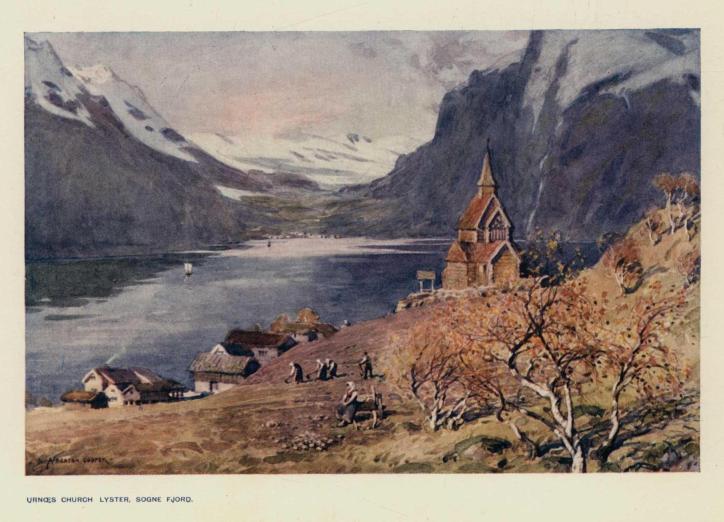
Urnæs church, Lyster, Sogne Fjord
Urnæs "stavkirke" stands on the site
of a yet earlier erection—a pagan temple,
some of the material of which may be
traced in the existing building. These
pagans had evidently good taste in the
choice of a site for their temple.
The view from this place, overlooking
the fjord to Solvorn, is very beautiful.
On the promontory below, and near the
fjord, stands a giant's "gravhaug," or
"kjæmpehaug" (a huge burial mound),
where, according to local tradition, the
Viking Ragnvald was buried along with
his magic sword. There have been "finds"
in it dating back to the Bronze Age.
Near this place are several tall standing
stones ("bautastein"), which evidently
mark the sites of prehistoric interments.
The fjord steamers seldom call here, but
across the fjord at Solvorn boats may be
hired to row over the short distance, and
a few hours might be agreeably spent at
this beautiful and interesting place.
The first impression we receive on
approaching the fjords from the sea is
perhaps not often a pleasant one,
especially in dull weather. Monotonous grey
rocky islands appear to look with wicked
eyes on every ship that passes by them,
as though expectant of another victim to
embrace in the deep waters, there to be
torn and mangled in their cruel fangs.
Over these rocks moan everlasting breakers,
whose weird dirge-like sound is blended
with the wild shrieking of sea-birds till it
almost appears that there exists some
close uncanny relationship and wicked
conspiracy between rocks, birds, and
breakers.
The steamer, which gradually threads
its way through this maze of
coast-islands, now emerges into more open
water, and presently we arrive at Florö,
an island in the blue sea, bright with
houses, warehouses, and shipping. Quite
a small town has grown up here, and Floro
is now an important calling-place for the
larger steamers and a great fishing-station.
In a few hours we come to the large
island of Bremanger, on whose eastern
end stands the huge towering mass of
Hornelen, peaked and furrowed, rising
perpendicularly out of the sea, the crags
appearing even to overhang the steamer
as we sail close to the mountain-wall.
Here the heavy surges moan in a most
uncanny way, and echo in deep notes up
the huge cavernous rents in the
mountain-side before us.
According to an ancient tradition, King
Olav Trygvesson in the tenth century
scaled this many-peaked mountain and
rescued one of his followers who had got
into danger among the crags.
We are now at the entrance to Nord
Fjord, and the steamer seems to make its
way towards a towering but distant mass
of high mountains, on which we discern
large uneven patches of perpetual snow.
Gradually, as we advance, the nearer
masses of rock appear to part asunder,
in order to allow the steamer to pass
through.
We come now into the fjord proper,
and by degrees a new attraction grows
into our interest as we say good-bye to
the monotonous; for now we may see
fresh and unexpected sights—large bright
patches of green, small white wooden
churches and clusters of brightly painted
cottages dotted here and there—and they
one and all appear to extend a smile of
welcome to us as we approach. We hear
the snow-white mountain becks breaking
into waterfalls on every side as they hurry
on and plunge themselves gleefully into
the sparkling fjord. Graceful birches
clothe the valleys and shelter in the rocky
clefts in the mountain-sides, while in the
background are those same snow-topped
mountains that we have seen for the last
few hours. They are nearer to us now,
and as we sail from one side of the fjord
to the other, calling to take in or to
discharge passengers and goods, these same
snow-crowned heights seem to follow us
on our way, as if they kept watch and
ward over an enchanted land.
We now come to a broader stretch of
fjord: larger valleys open out to the view,
and the sky seems brighter. This open
space crossed, more frequent signs of
civilization meet the eye. The farms are
larger and the stretches of cultivated land
are more extensive.
We now discern hayfields, cornfields,
and potato patches. The houses and
farmsteads are larger and more substantial,
showing that there is a more prosperous
people in these inner parts of the fjord.
Frequent waterfalls are passed, some
of which send their spray even over the
steamer's deck as they leap down the
precipitous cliffs. Torrents come with a
noisy swing down the steep valleys,
turning in their course many a tiny wooden
corn-mill.
Everything around seems full of life,
and pleasant sounds meet the ear—the
murmur of rocky becks, the tinkling
of sheep and cattle bells, the plash of busy
oars on the clear silvery water—and the
merry voices of children are heard as they
play on the pebbly strand near by. The
eye is refreshed by the sight of the bright
cottages which are embosomed in their
own little orchards surrounded by green
fields, and a background of richly wooded
slopes leads up to the blue mountains above
and beyond. An ancient church reposing
in its quiet domain gives the keynote to
the whole—one of harmony, simplicity,
and Arcadian peace.
As we gaze on such a scene, it seems to
have the power to fascinate and to hold
us, as though in the grip of some unseen
force of fairy magic, and from which
we tear ourselves almost unwillingly away.
The scenery increases in grandeur the
farther we penetrate, and the mountains
and valleys are more densely wooded.
We dip into narrow branches or ramifications
of the main fjord, where beautiful
vistas open out, and as we sail down
Gloppen Fjord to the hamlet of Sandene
the views are especially charming.
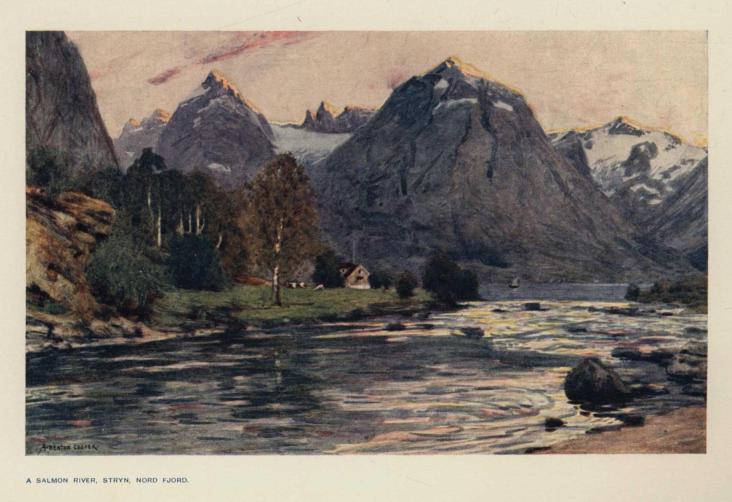
A salmon river, Stryn, Nord Fjord
From Visnæs, at the northern extremity
of the innermost branch of the main
Nord Fjord, we can drive along the
banks of a noted salmon river and visit
the beautiful Strynsvand. This lake is
quite surrounded by magnificent
mountains, on which lie extensive glaciers,
Skaalan, on our right, being the most
conspicuous. Around this lake are many
large farms; some are situated high up
the mountains in apparently inaccessible
places. Here also wild valleys open out
in all directions, and continue their ravines
up to the bases of the glaciers. At the
foot of one of these ravine-like valleys,
and just underneath the massive Skaalan,
and in a picturesque situation by the
lake's margin, stands the little church of
Opstryn.
At Hjelle, at the eastern head of the
lake, a fine mountain-road has been
engineered, and this traverses the wild and
romantic Vide Valley.
The view looking backward from Vide
"sæter" is magnificent. The narrow
valley is hemmed in by mighty and steep
mountain forms, and Stryns Lake, green
with glacier water, is seen far below, while
across the lake rises the huge mass of
Skaalan and its glacier as a background
to the picture.
Sincerity, honesty, and freedom from
conventional cant are the chief national
virtues of the Norwegians, although
inquisitiveness is rampant in this district.
The outer forms of politeness are often
very little observed.
On arriving at an inn, the traveller is
seldom welcomed by the host or hostess,
and on his departure he may not even
then see them. This omission may leave
on the traveller the impression of neglect,
but it arises partly from the people's
national unobtrusiveness and simplicity
of character. Also, as the innkeepers are
nearly all peasants, and their chief
business is farming, this apparent neglect may
thus be accounted for, and some allowance
be made.
On meeting with a stranger, it is the
custom with the natives of this district,
and considered by them to be the height
of politeness, to ask such questions as the
following: "Stranger out on a journey, I
suppose?" "And where do you come from,
I wonder?" "And what kind of business
do you follow?" "And what do they
call you where you come from?" These
rather inquisitive questions are always
put very politely, and they are usually
answered in the same vein.
This apparent inquisitiveness is really
but a conventional manner with them, and
means only an introduction to a friendly
chat, in much the same way that some
people in our own country begin a
conversation by commenting on the weather.
Among themselves these primitive
peasants salute each other on meeting
with "Godt mod" ("Keep in good
courage," or "good heart"); and if a
neighbour should be at work; "Gud velsigne
arbeidet" ("God bless your work"), or,
on coming into a room where the family
are at their meal, the salutation is, "Gud
velsigne maden," or "signe maden"
("God bless your food").
Many of the peasants in this district,
especially the older ones, wear to this day
quite a picturesque costume. It differs
in some respects from the dress of those
in other districts. The men wear
knee-breeches of a coarse grey cloth ("vadmel")
and white, thick stockings, a red coat with
a very high collar, and a tall, stiff felt hat.
The women wear a close-fitting red or
green vest or bodice, elaborately trimmed
with silver braid back and front, and white
sleeves. Those who are married wear a
tall cloth cap, generally black, and
somewhat resembling in shape an elongated
fireman's helmet.
The girls usually wear on the head a
coloured handkerchief. In former times
they wore long skirts from earliest
childhood, but latterly, much to the disgust of
elder dames, short skirts have come into
fashion.
In this inner district of Nord Fjord are
three very beautiful lakes—Stryns Vand,
which I have just referred to, Loen Vand,
and Olden Vand. All three are situated
in the heart of scenery of the grandest
character. The mountains around are
higher than any we have yet seen, and
glaciers and waterfalls are here more
numerous. The valleys are deep and
narrow, and farmsteads are few and far
between; often some five or six miles
of rocky land divides them from each other.
Some of these ancient homesteads
nestle among mighty boulders which have
detached themselves ages ago from
precipitous crags above.
In spring and autumn, after heavy
rains, these farms are still farther isolated.
The rocky streams are then swollen into
foaming torrents, and the footpaths are
destroyed, or of very little use, and to
pay a visit to a neighbour one must either
creep under a waterfall or climb up the
steep mountain flank some thousand feet
before being able to cross over the
impetuous stream.
As we reach the head of a valley we
come to those death-still places which
have no houses, no road, and no
name—desolate wildernesses where huge
mountains embrace each other in glacier and
snow-field.
These majestic mountains raise their
peaks some 6,500 feet into the heavens,
and they completely enclose the three
enchanting lakes which form the
crowning beauty of this district.
The bases of the mountains are clothed
with splendid birch-woods, and in the
valleys near the water grow roses and
other flowers—a rich and abundant flora,
which contrasts beautifully with the
sombre grandeur of the surrounding
scenery. Surpassing the famous Alpine
lakes in majesty, these of Norway can
also vie with them in charm.
Loen Vand may be considered quite
the most characteristic and imposing of
these lakes. Glaciers descend from all
the mountains around, the magnificent
Kjendalsbræ being perhaps most
conspicuous. So near to the edge of the
precipice do these glaciers creep that they
almost appear to overhang the lake.
In several places it is nothing unusual
to see enormous masses of ice pushed over
the edge of the cliff, and to hear them
fall with a metallic rattle down the
precipitous rocks, leaving in their wake
clouds of finely-powdered snow.
Profound and impressive is this sublime
nature. Everything is on such a grand
scale that we feel as pigmies in the midst
of it as we row on the deep lake, whose
still surface reflects as in a mirror every
detail of the majestic scenery. Crags,
trees, and farmsteads, even sheep and
cattle browsing on patches of
greensward—all repeat their images in reversed
replica on the quiet bosom of the water.
In the hot days of early summer and in
this clear and rarefied atmosphere this is a
most enchanting sight, and one whose
treasured memories shall live for aye.
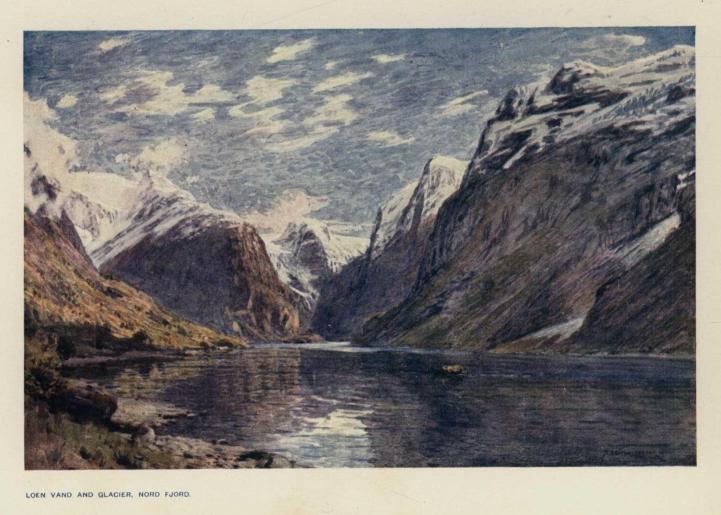
Loen Vand and glacier, Nord Fjord
We now retrace our steps and return
to join the native fjord steamer, and here
we see in process of embarking quite a
lively and interesting cargo. Already the
little steamer appears to be full. We
observe that sheep and cattle are put into
improvised pens on deck. On the crowded
pier we see that yet more sheep, lambs,
and cattle are to be taken on board.
Other pens of wooden hurdles and
anything available are hurriedly made, and as
the hold of the vessel is full already,
places are also found for the animals in
the passage near the engine-room. Now
arrive a number of goats and kids, some
of the latter being carried in the arms of
bright-faced peasant girls, who now stand
on the pier to await the time when their
struggling burden can be placed
somewhere on the crowded steamer. Several
bony cows and calves are now unceremoniously
lowered down on to the deck
by the noisy crane, each one separately in
a sling. These last comers are now
fastened to the rails along the ship's side.
The lamb-pen is now tenderly covered
with sackcloth as a protection from the
cool night air by the red-faced,
good-natured steersman before the steamer
starts.
These domestic animals are being
transferred from the home farms to their
respective "sæters," which lie in other parts
of the district. There the cattle wax fat
on the rich grazing of the high land during
the summer months.
As we sail near the shore we may
observe in certain places that a peculiar
elevated staging on tall, slender legs
overhangs the water. It is usually fastened to
some jutting rock.
This contrivance is used by the peasants
as a look-out for the purpose of fishing
for salmon. It is called a "laxeverp." In
the box-like framework at the top is placed
a seat, and from this point of vantage the
fisherman is able to see down into the
deep clear water and ascertain if there are
any salmon in the nets below. These
nets he regulates by lines held in his
hand, the ends of which are attached to
the mouths of the salmon nets.
There are usually two men out a-fishing.
One is seated on the "laxeverp," the other
goes out in a boat to any place indicated
by his companion, draws in that part of
the net, and secures and kills his fish. At
one of these fjord "laxeverps" may be
killed in the course of a day from twenty
to thirty salmon in the height of the
season.
Falejde, beautifully situated on the
north side of the fjord—we are still in
Nord Fjord—is a well-known centre for a
variety of excursions. Visnæs, however,
has taken from Falejde in recent years a
great deal of the tourist traffic, being a
more convenient starting-place for the
lakes we have just spoken of, also for the
new overland route to the Geiranger
district via Vide Valley. Personally, I
prefer the older route from Falejde and
via Grodaas, down the magnificent
Nordangsdal to Öie, on the Hjörund Fjord,
in the district of Söndmöre.
Falejde to Öie
About the end of the month of May,
and beneath cloudless skies—there had
been no rain to speak of for the past three
weeks—I left Falejde to take this
charming drive by "kariol" and sure-footed
pony.
After a lingering farewell glance at the
beautiful fjord view, as seen from the little
inn here, we commenced our journey. In
the still and warm morning air one could
hear the drowsy hum of bees and the
clear notes of a song-bird. Sheep and
cattle browsed on the hilly slopes, their
bells tinkling as they grazed on grass still
wet with dew.
Uphill we went, through odoriferous
pine-woods, the roadside being fringed by
an abundance of wild-strawberry in full
flower, and among moss-grown boulders
cranberry and whinberry bushes showed
themselves in great profusion. Here and
there are large patches of bell-heather and
ling, which still retain, though now faded,
their last year's bloom.
A snow-plough by the roadside has not
yet been removed, showing how near we
are to the past season, and how closely
connected with it is this warm sunny day
of May. The pine forest we are still
passing through becomes denser now, and
the morning light is as twilight in this
thick glade.
Our attention is suddenly drawn to a
lively squirrel, who swings rapidly from
branch to branch; a pine marten is in full
pursuit. In the excitement of the chase
they are both quite unobservant of passers-by,
and across the trees which overhang
the road they spring, and it is not long
before the sound from the forest depths of
the thin piping squeak of the hunted
squirrel tells of tragedy.
Between the tall trunks of the pine-trees
we obtain occasional peeps of blue fjord
and snow-topped mountain forms as we
drive along.
Having now crossed the watershed, we
gradually descend, and patches of cultivated
land begin to appear on the wide valley
sides. Passing several farms ("gaard") we
now see below us an extensive lake,
Hornindalsvand, along whose rocky shore
we drive; and presently we arrive at
Grodaas, the little inn and hamlet being
prettily situated in a tree-fringed bay on
the lake's eastern margin. Surrounding
this broad and beautiful lake are high
mountains of picturesque form.
Large farmsteads are here, and
well-cultivated land, and an air of prosperity
pervades the place. Continuing our drive
along the wide valley, Hornindal, we
gradually ascend through more open
country. The snow-clad mountain-tops
are nearer to us now, and on both sides
their craggy forms appear in many a
quaint-shaped peak. Farther on, near "Gaard"
Kjelstadli, we are at a height of about
1,400 feet above sea-level. That apparently
inaccessible pinnacle in front of us is
Horndalsrokken ("rokken")—the distaff.
Here we approach a magnificent mountain
region, and, descending the steep hilly road
to where it divides at "Gaard" Tryggestad—one
branch going to Hellesylt—we enter
that deep and gloomy valley, the
Nordangsdal. This narrow gorge-like valley is
closely hemmed in by high, majestic, and
sharp-peaked mountains. Below "Gaard"
Fibelstad and Hougen, as we descend,
this huge chasm-like valley contracts and
becomes so narrow that there is barely room
in some places for the rocky torrent and
the road between the perpendicular
mountain buttresses.
We now drive alongside five very narrow
lakes in succession; these completely fill up
the bottom of the gorge. At several places
on the road we are compelled to dismount,
and walk over huge, deep snow-patches.
These are the remains of winter avalanches
which have not yet melted; they stretch
across the road, and form natural bridges of
hard snow over the torrent which gurgles
below. Emerging from this deep and
terrible gorge, we gradually descend,
passing on the way the sequestered hamlet of
Skylstad.
So enclosed is this little group of
turf-roofed houses by high mountains that the
inhabitants do not feel the warm sun's
rays during the greater part of the year.
The Hjörund Fjord
From this place, by easy road, we drive
along the widening valley, and, passing
several poor farms, we at length arrive at
Öie, a small hamlet picturesquely situated
by the shores of the narrow Norangs Fjord,
an arm of the grand Hjörund Fjord. By
the Norwegians themselves this is thought
to be the grandest of all their fjords. It
is not easy to decide, however, as each
one of them has its own particular
characteristics.
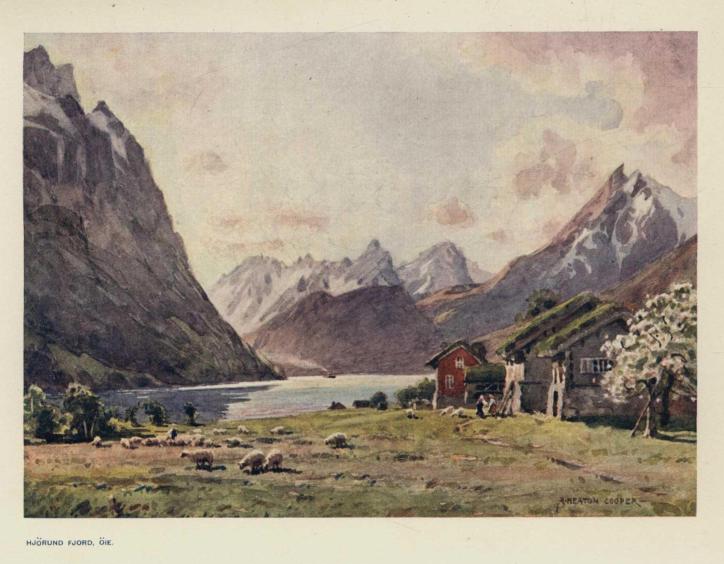
Hjörlund Fjord, Öie
The mountains around here attain a
height of some 5,000 to 6,000 feet. Their
tops are peaked and pinnacled; some even
appear to lean forward, as though ready
to spring out across the fjord or valley.
Decorative patches of snow and glacier
rest between their huge flanks, and woods
of hardy birch and alder clothe their
bases.
Majestic scenery is this, of the sharp
peak and pinnacle type, and of its kind
no grander is there in the whole of
Norway.
"The mountains near
Stand up in fixed and monumental gaze,
As pyramids precipitous and bold."[1]
The Norwegian Established Church ("den
Norske Statskirke") owes its present
constitution to the Reformation, and about
the middle of the sixteenth century it
became by legislation the public religion
of the State. It is known as the
Evangelical Lutheran Church.
The three creeds which together form
its symbolum are the Apostolic,
Athanasian, and Nicene-Constantinople. In
addition to these, there are accepted the
Augsburg Confession and Luther's Shorter
Catechism.
The kingdom of Norway is divided for
ecclesiastical purposes into six bishoprics,
and each of these dioceses is subdivided
into deaneries, of which there are
eighty-three. Out of the deaneries are formed
the separate livings ("præstegjeld").
These number at the present time 480.
The livings, especially in country places,
include one or more sub-parishes, each
with its own church or chapel-of-ease.
Ecclesiastical matters
According to the Norwegian law, the
King must always belong to the
Established Church, and he possesses the
supreme jurisdiction in ecclesiastical affairs.
The King appoints the Bishops, and his
sanction must be obtained to the
preferment of the rest of the clergy.
The Ecclesiastical Department of the
State has the administration of considerable
sums of money that have been realized
by the sale of property which belonged
to the priests and monasteries in Roman
Catholic times. This money is placed to
a fund which is used for the benefit of the
Lutheran clergy and as pensions for their
widows, also for the advancement of
education.
The Bishops are remunerated by the
State, chiefly from the funds which were
appropriated by the Government at the
time of the Reformation.
The country clergy have the free use of
the glebes which belong to the State, and
among other sources of income to the
livings are the parsons' tithes and sundry
rent charges on landed proprietors in the
parish.
In the towns the tithes have largely
been commuted by the municipality, and
are now paid to the clergy by the
community in the form of rates, their stipends
being further augmented by voluntary
contributions and by certain grants from
the Government.
According to a law passed in 1897, all
the churches and churchyards in Norway,
with a few exceptions, will in a short time
become the property of their respective
congregations. For this purpose a church
fund is now in process of formation, being
raised by the commutation of all church
tithes, and by the addition of certain royal
tithes of pre-Reformation origin. The
proceeds of this fund will be devoted to
the maintenance of, and the repairs to,
the churches, the deficit to be made up
by the parish or municipality.
Among the many religious efforts which
are liberally supported may be mentioned
the Norwegian Missionary Society, which
was founded in 1842: Zululand, Natal,
and Madagascar are its fields of labour;
the Santhal Mission in India; and the
Norwegian Lutheran China Mission.
There are also home missions and local
religious associations for the relief of the
poor and the care of the sick. In addition
to these, there is a mission to the Jews.
Great was the reluctance of the
Norwegian people to receive the reformed
faith, which they were compelled by law
to do in the middle of the sixteenth
century; but they have since become
loyally and deeply attached to it, and
there are probably few countries in
Europe where the ministers of religion
have a greater influence in the administration
of the affairs of the country and
the education of the people than in
Norway. It has been the nation's endeavour
for the last century to develop and
improve the education of her children.
Public instruction
An effort was made by royal ordinance
as early as 1739 to introduce into the
country a system of general school
attendance, and to arrange for the establishment
of a permanent school in each parish.
At that time the clergy were the sole
leaders in school matters, each in his own
parish, and it is owing in a great measure
to them that, in the face of the numerous
difficulties of all kinds which had to be
overcome, the school has made continual
progress. Its development has always
been in a democratic direction. From a
parish school for the poor, it has become
a national school, where a general education
is provided which is accessible to all
members of society.
Free and compulsory education obtains
in Norway. It consists of a seven years'
course. In the country districts it is
adapted for children between the ages of
eight and fifteen, and in the towns for
those between seven and fourteen. The
reason why Norwegian children begin
their education so late in the country
parishes may no doubt be attributed to
the fact that they have in most cases to
travel great distances in order to attend
school.
The Department for Ecclesiastical
Matters and Public Instruction is the
highest school authority in the country.
Next follow the School Directors, one
for each of the six dioceses; these
superintend the primary schools. The Bishop
and Dean also take an active part in the
superintendence, and the priest in
supervising the instruction in religious knowledge.
There are six public colleges, one to
each diocese, for the training of
school-masters and governesses—as
school-mistresses are called—for the primary
schools, and in these colleges they receive
free tuition. The college course extends
to three years; it was formerly a two
years' course.
There are also four private colleges, in
which a considerable number of free
students are admitted and are paid for by
Government grant.
The Government votes an annual sum
amounting to 10,000 kroner (£555) towards
travelling scholarships for teachers
in primary schools. Several municipalities
also devote sums of money annually for
the same purpose.
County schools ("amtsskoler"), one to
each county, are instituted as continuation
schools, and the syllabus is practically
the same as that which obtains in the
primary schools, but the aim is a higher
one. The girls are instructed in
needlework and house management, and the
boys in wood sloyd and technical
drawing. In some of these schools
instruction is also given in gardening,
agricultural subjects, and the English language.
In aid of these schools the State
grants three-fourths of the total amount
voted by the county authorities for
up-keep.
Direct Government grants are also
made to a few People's High Schools
for advanced education. There are in
Norway at the present time thirty-six
working-men's colleges, ten of these being
situated in country districts. The first
was erected in Christiania in 1885.
The instruction at these colleges is
given in the evenings in the form of
lectures on a variety of subjects. The
lecturers are chosen from among scientific
men, schoolmasters, doctors, military men,
etc. The Government grant to the
working-men's colleges is equal to
one-half of that which is contributed by the
municipalities.
In addition to the foregoing there are
also established a number of Government
grammar-schools ("latinskoler") and
higher grade schools, known as
"gymnasia," for those who wish to lay the
foundation for a continued higher
education and as a preparation for the University.
The principals ("rektorer") of
these schools, as well as the other
permanent assistant-masters, are Government
officers, and receive their appointments
from the King.
Norway has only one University, the
Royal Frederik University in Christiania,
founded in 1811. The number of
professors at the present time is sixty-five;
they are appointed by the King.
The leaving examination at a "gymnasium"
("examen artium") entitles the
successful candidate to enter his name as
a student at the University. The total
number of students there is now about
1,400, and they receive free instruction.
Small fees are, however, required for
permission to enter for the various
examinations. The expenses of the University
are chiefly defrayed by the Government.
Connected with the University are
various laboratories, scientific institutions,
and collections, among them being the
National Library, the Botanical Gardens,
the Historical Museum, the Astronomical
Observatory, and the Meteorological
Institute. Theological students receive
practical training at a college affiliated to
the University.
Leaving now the magnificent Hjörund
Fjord, we take the road from Öie to
Hellesylt. Ascending the gorge of
Nordangsdal, we again arrive at "Gaard"
Tryggestad, at which place the road
branches off for Hellesylt, and we drive
down a steep, well-wooded valley along
the banks of a mountain torrent. The
river thunders down a rugged chasm, at
times lost to sight in the mysterious
depths of the gloomy, cavernous gorge;
then, emerging into the open and madly
plunging over huge boulders, it sends its
spray over us in clouds as we pass.
The steep road descends through hanging
woods of tall pine and graceful birch,
and at a clearing in the forest a small
farm, surrounded by its own green fields,
is passed, and we now obtain a glimpse of
the village of Hellesylt, reposing down by
the margin of the bright fjord of Sunelv.
Picturesquely perched on elevated ground
above the red-tiled house-tops stands the
church.
Deep in a valley to our right repose
the remains of a huge avalanche of snow,
surrounded by trees, with whose fresh,
green foliage the white snow presents the
striking contrast of winter and summer
side by side. The time of cherry-blossom
is almost over, but there is a wealth of
apple and pear blossom in the many
orchards around sunny Hellesylt.
Öie to Helleslyt
Having had so many hours in the
"kariol," it is refreshing to sit by the
margin of a fjord again; to breathe in
quietude the incense-laden air, and to
listen to the faint murmur of some distant
waterfall; to watch the rays of the
westering sun stream from behind the
nearer mountain in an intense amber
glow, deeping gradually into rose, and
illuminating the snow-topped peaks across the
fjord yonder in a most enchanting way.
The nearer mountains are in purple
shadow. In one short hour the light on
each ruddy top dies away, and their
colour is slowly transformed to that of
cold, silvery blue as they are one by one
deserted by the sun's rays. All the
peaks are now of blue, purple, and
silver—cool and refreshing to look upon.
Hardly has the last mountain taken on
his silvery hue when a light zephyr breathes
softly across the sleeping waters of the
fjord in a steely glitter. But what is this
weird light that is stealing over all Nature
in softest and most delicate blush when
we expected the cool twilight? It is the
afterglow. An ethereal rosy golden light
slowly intensifies on the mountains. It
is more diffused than the actual direct
glow from the setting sun, and not nearly
so brilliant; but a dreamy glow, mysterious
and bewitchingly weird in the intense
stillness.
A slight breeze disturbs the surface of
the water, and the fjord now ripples with
a thousand hues from sunset sky and
rosy-tinted mountains. It is now fast
approaching the hour of midnight. Almost already
the first faint signs of dawn appear in the
north, where a solitary star is but barely
discernible in the pale amber sky; and as
we gaze on such a scene with reverent
and grateful hearts, we offer up a pæan
of praise, and thankfully store away
in the treasure-house of our memory
the recollection of a perfect night of
June spent amid such romantic surroundings.
The Geiranger Fjord
In the character of the scenery of
Geiranger in Söndmöre we have a blending
of the Alpine splendour of Nordland,
with the wildness of Jötunheim, the beauty
of Hardanger, and the grandeur of Sogn.
Whether we approach this fjord from the
land side and drive down the splendidly
engineered road in zigzag windings to the
village of Meraak, or sail in from the main
Stor Fjord, we obtain an equally vivid
impression of Geiranger's beauty and
grandeur.
Here the scenery of the Söndmöre
district maybe said to attain its most perfect
expression. Sogn has higher mountains,
but Söndmöre, with its bold, sharp peaks,
makes quite as overpowering an impression
on the mind of the traveller, attracting
and captivating him with its enchanting
power.
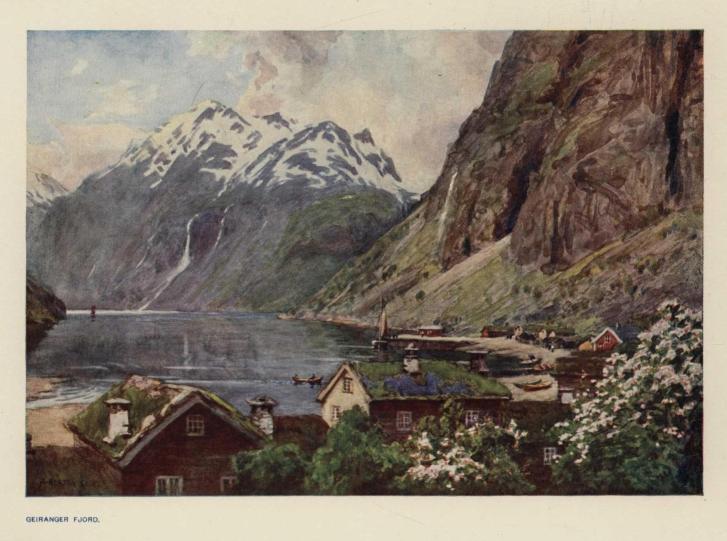
Geiranger Fjord
Geiranger Fjord and district are noted
for beautiful waterfalls, and from the
hamlet of Meraak, if we row for a couple
of hours, we can visit the Seven Sisters
Waterfall—its proper name, however, is
Knivsflaafos—a bevy of falls who
plunge gaily side by side down a high,
precipitous cliff into the fjord. Their
number varies at different times according
to the state of the weather, and we are
not always able to count the mystic seven.
Other sisters appear after heavy rain, and
thus increase the family to eight or nine;
and in hot weather four only are to be seen.
These falls, which descend from a great
height almost without touching the cliff,
seem to shoot downwards like rockets in
myriads of large and small douches of
water—these, as they descend, pierce
through the fine spray which they create,
and thus cause a very pretty effect,
especially when the sun's rays cause rainbow
hues to float on the delicate gauze of
spray.
Another beautiful waterfall near here is
known as "Brude Slur" (Bridal Veil).
This "fos" descends almost as a veil from
the sky-line of the high cliff, and spreads
its streamers over the face of the dark
rock. In stormy weather I have seen this
waterfall lifted bodily by the wind and
carried upwards into space, to descend like
rain at some distance.
On the opposite side of the fjord, high
up on the precipitous cliffs and in a
romantic position, is situated an old
farmstead, "Gaard" Skaggeflaa by name,
and from the rugged crags in close proximity
to it is a picturesque waterfall,
Gjeitfos (Goat's Fall).
The only means of
access to this lonely farm is by a dizzy
goats' track, which threads its devious
way upwards from the shore of the fjord
across the breast of the steep cliff. In
one place the track is completely blocked
by an overhanging rock. This is scaled
by means of a ladder.
Some years ago there lived a farmer
here who refused to pay his share of the
local taxes. The wily farmer would never
visit the village shops for provisions or other
necessaries until he had first made quite
sure that the "lensmand" (sheriff's officer)
was not in the neighbourhood; neither
would he fish on the fjord, only at a place
just beneath the cliffs on the top of which
his farm lay.
On one occasion the "lensmand" came
close upon the delinquent unawares. He
followed him up the difficult goats' track,
climbing and slipping until he came to
the ladder. Quickly scaling the rock, the
tricky farmer pulled up the ladder after
him, and so left the breathless and angry
"lensmand" to find his way down again,
for he was quite unable to proceed farther.
Near to the entrance of Geiranger Fjord,
and among a number of large boulders
which lie at the foot of the steep cliffs of
Nökkeneb (Nyxies' Peak) stands an ancient
"gaard," called Sultevik.
At this farm an ancient outbuilding of
logs, called a "rogestue," is still used as in
primitive times. The exterior is
unpretentious in appearance, but the interior is
quite interesting. The hut is built of
thick balks of timber, and the
turf-covered roof is supported by heavy beams,
which are dark with the smoke of
centuries. On the hard earthen floor, rudely
built of stones, stands an elevated
hearth-fire, the smoke from which escapes through
a square hole in the roof. Over the fire
hangs an ancient iron "gryte" (cauldron),
suspended from a movable wooden pole.
On one side of the room stands a massive
bench-like table, on the top of which was
placed a large trough of wood, which was
in use for kneading dough. It must have
been used for centuries, to judge from its
appearance. On the outside it was much
worn and stained by age, while on the
inside appeared many different stratifications
of meal and flour dough, which also
pointed to the fact of its being used for
untold years.
Two robust peasant girls were busy
together making potato-cakes, placing
them for baking on a slab of slate which
rested on stones over the peat fire.
Through the smoke I could just see on a
shelf a few old carved and painted wooden
articles of domestic use—butter-holders,
bowls, tankards, and dishes—and these
were in daily use.
A quaint iron lamp ("kole") is
suspended from a beam in the ceiling, and
this is the oldest form of lamp now to be
found in the country. In it fish-oil
("trail") is burned, and a piece of tow
hangs as a wick from the lip of the open
heart-shaped saucer which contains the
oil. This lamp will not give a brilliant
light by any means, but these simple
peasants put up with it for the good and
sufficient reason that they have nothing
better.
This majestic fjord of Geiranger is noted
for great avalanches of snow, sometimes
of rocks, which in the winter and early
spring descend from the steep mountains
around.
Near Madvik Farm, at the entrance to
the fjord, an unusually severe avalanche
of stones and snow occurred a few years
ago, the concussion from which was felt
for several miles around, and on the water
huge waves were formed, which swept
with great velocity into the neighbouring
branch fjords, and even across to Hellesylt,
causing no little damage to property
on the shore.
Söholt to Romsdal
I see from my diary that the fjord
steamer left Meraak in Geiranger at the
unearthly hour of 2 a.m., and that in six
hours I arrived at Söholt on a fragrant
morning in June.
At this place I hired a "kariol" and boy
for the drive to Vestnes. In crossing the
extensive moorland which forms the
watershed, we met a picturesque group of
farmers with their wives and children, and
the cattle, sheep, and goats. They were
on their way to the "sæter" farms, there
to stay for the summer months. A couple
of rustic carts were drawn along by sturdy
cream-coloured ponies, and in the carts
the youngest children sat quite comfortably
among the various domestic goods
and chattels which were for use up at the
"sæter."
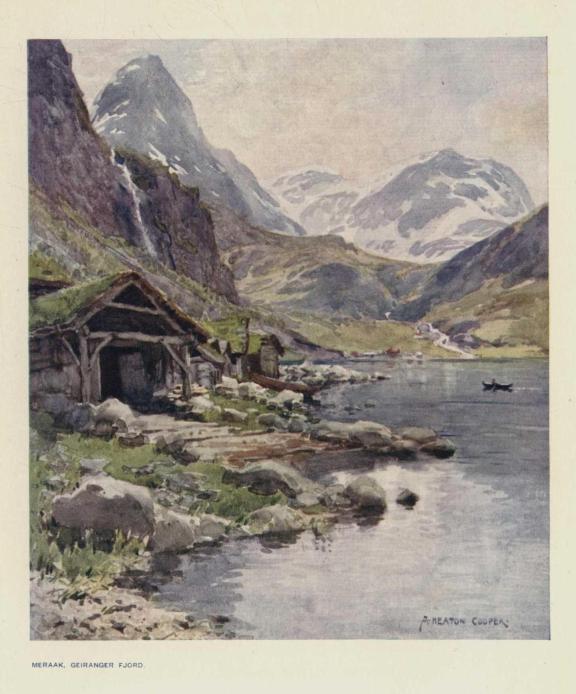
Meraak, Geiranger Fjord
Along the side of the road, which here
crossed the bleak moorland plateau, tall
standing stakes were placed at intervals in
order to guide the traveller in winter-time
when the road lies buried underneath the
deep snow.
Vestnes is not an attractive place.
From here the town of Molde can just be
seen across the wide fjord, but it is too
far distant for the view to be at all
interesting.
Showers and sunshine alternating made
the short steamer voyage from Vestnes to
Aandalsnæs attractive, for the mountains
of many peaks which surround the
far-famed Romsdal were in view most of the
time. Cloud shadows chased each other
among their rugged forms and over the
great patches of unmelted snow which lay
on their summits.
The Romsdal
The village of Aandalsnæs, or Næs,
owes the cause of its existence entirely to
the magnificent scenery amid which it is
situated. Veblungsnæs is the older port
of call for the fjord steamers, but Næs,
being more conveniently placed for
travellers visiting the Romsdal, it has rapidly
grown into favour in late years. The
river Rauma, noted for its splendid
salmon-fishing, separates the two villages.
Seen from Næs, also, the panorama of
majestic mountains is much grander than
from Veblungsnæs. On a fine summer's
evening the rocks on the sharp peaks of
Romsdalshorn and Troldtinderne (witch
pinnacles) are all crimson and purple with
the sunset, and bright tongues of fiery
cloud are often seen burning and quivering
about them; and the river, brighter
than all, flows silently down the broad
valley in a glittering sheet of gold. Long
level lines of dewy mist lie stretched along
the valley, almost hiding the mountain
bases by their filmy vapour.
Sometimes one may hear the peasant
girls calling the cattle down from the hills
by singing the "fjeldviser"—musical
ditties whose notes are similar to those
with which Jenny Lind once charmed
great audiences in many lands.
The Romsdal, down which flows the
river Rauma, is one of the grandest
valleys in the whole of Norway. At
Næs the valley is wide, and luxuriant
green pastures and beautiful trees enliven
the landscape.
Romsdalshorn, whose peaked top rises
to over 5,000 feet, stands conspicuously
at the entrance to the valley, and near to
it on the left tower the still more lofty
pinnacles of Vengetinderne, while on the
right are the strikingly picturesque
Trolltinderne (witch pinnacles), from whose
rugged sides great avalanches of snow and
rocks are precipitated in winter. Part of
the serrated ridge is known as "Brudefölge,"
or Bridal Train.
Farther up, and beyond Horgheim, the
valley becomes narrower and more ravine-like;
and here the river flows with greater
impetuosity, and threads its way through
a chaos of enormous blocks of rock, the
result of some tremendous landslip.
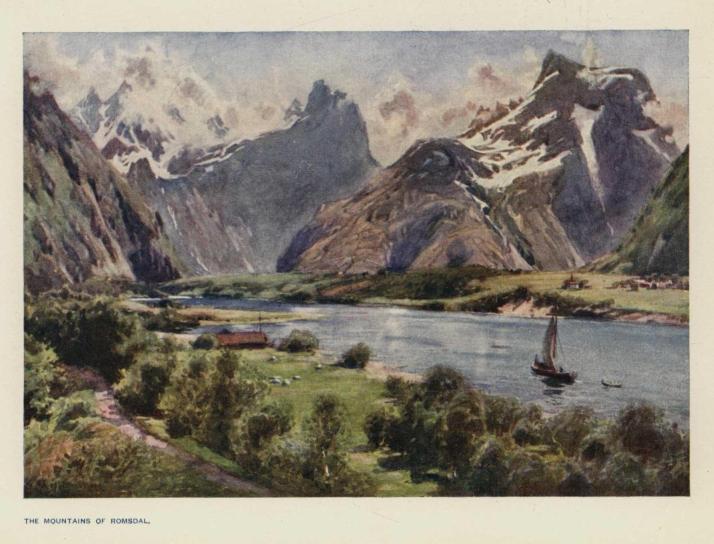
The mountains of Romsdal
At Flatmark (Flat Field) the valley
becomes broader again, and the mountain
scenery around is extremely grand and
impressive.
Between here and Ormheim several
fine waterfalls are precipitated from rocks
some 2,000 feet in height, the chief among
these falls being the Vermafos, which
assumes imposing dimensions after rain
or during the melting of the snow in early
summer.
The road now ascends the once-dreaded
Bjorneklev (Bears' Cliff) in numerous
windings, and at Stuefloten attains the
height of over 2,000 feet above fjord-level.
At this place ends the Romsdal, one of
the most widely celebrated routes in
Norway.
The river Rauma is about thirty-seven
miles long from its source at the Lake
Lesjeskogen to the Romsdals Fjord, and
it is counted among the best salmon rivers
in the country.
Salmon-fishing
Salmon-fishing in the rivers is carried
on with the rod as a sport, and large sums
of money are paid annually by sportsmen
for the renting of rivers. Seine nets are
also largely used by fishermen. These
nets are placed at the mouths of the
rivers, and in this way large hauls of fish
are often made.
Salmon is fished all along the coast from
the beginning of May to the end of
August, and, since the practice of
bag-netting was introduced some fifty years
ago, the proceeds have increased
enormously. Most of the fish is exported, a
large quantity going to England.
The fishing industry may be considered
the most ancient and important means of
livelihood of the Norwegian people. More
than a thousand years ago, according to
the old sagas, "splendid painted ships,
with sails of several colours," sailed with
fish from Norway to England; and this
great industry is still one of the most
important in the land, especially the sea
fisheries, which obtain their peculiar value
from the natural conditions and
geographical features of an exceedingly long
coast-line, with its deep inlets and
numerous islands.
The great sea-fisheries
Of the great sea-fisheries, that of
cod-fishing is by far the most profitable, and
in its pursuit the greatest number of men
are employed. It is carried on all along
the coast, but most extensively in the
northern part of the country. At the
fishing stations in the Lofoten Islands
alone some 40,000 men are employed
during the first three months of the year.
Farther south, and especially in the
wide fjords of the Romsdal County,
sea-cod fishing has always been carried on
more extensively than at most other
points along the coast.
Cod vary in weight from 9 to 20
pounds, but they have been taken
weighing as much as 90 pounds. Codfish is
prepared, as a rule, either as "klipfisk"
(salted and rock-dried fish), or as "törfisk"
(dried stock-fish). The most important
product, however, is "klipfisk." It is
cleaned and salted at the fishing stations,
and then sent away to convenient drying-places,
where the fish is laid out on the
flat rocks ("klipper") to dry, or on the
shingly shore, where such is found.
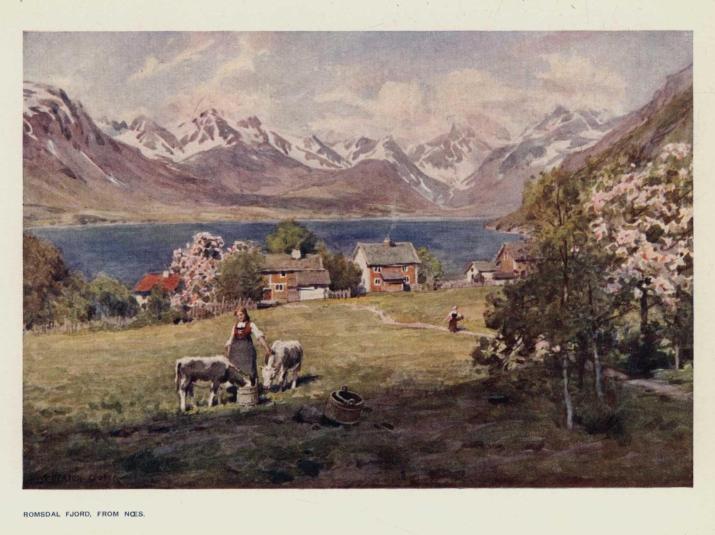
Romsdal Fjord, from Næs
It is an attractive and interesting sight
to see the native women at work on the
broad pebbly strand, their many-coloured
garments fluttering in the breeze as they
turn over the thousands of fish to dry in
the sun. When sufficiently dry the fish is
piled into circular stacks about 4 feet
high; a flat wooden cover is then placed on
the top, and this is held down by boulders
of stone to protect it from the force of the
wind. These wooden caps are usually
painted a bright Indian red, and in appearance
form a lively contrast to the deep blue
water of the breezy fjord and the pale
pebbles on the sunny strand. Many
thousands of tons of "klipfisk" are
exported annually, chiefly to Spain.
The preparation of "törfisk" is more
simple than that of salted cod. The fish
in this case, when cleaned, are usually hung
up by the tail to dry in pairs, on large
wooden frames or scaffolds called "hjeller."
Next to the cod the herring fisheries are
the most important in the country. These
fisheries vary, however, very considerably,
and the time during which the fish visit
the coast is often of very short duration.
The herring shoals come in twice a year,
once in winter and once in summer or
autumn; and it sometimes happens that
quite suddenly, and as if by some stroke
of magic, the sea becomes brimful of
herring, and then after a short time it
is just as suddenly empty again. At such
harvest-times the fishermen are very hard
at work both day and night, and have
barely opportunity to take their food or
rest; and as the sea is often rough, and the
weather wet and stormy, their calling is at
these times fraught with many dangers.
As compensation, however, they have their
long intervals of rest—perhaps too many
of them. The farmer-fisherman of the
fjords is in many respects better off, as
he can find other employment if his daily
fishing fails for a time, especially in the
spring and summer months, when farm
work claims his attention and crops have
to be harvested and housed.
The summer day is of long duration in
Norway. During the light nights Nature
dreams, day meets day, and away up in
the north the sun illumines the heavens by
night as well as by day. Even in the
southernmost parts of the country the
setting sun barely sinks below the horizon
from the end of April to the beginning
of August, consequently bright twilight
prevails during the whole of that
period; but we must travel farther north
and reach the polar circle before we see
the sun shining all through the summer
night.
At Bodö the sun does not set from the
beginning of June to the first week in
July; and at North Cape the midnight sun
is visible from May 12 to July 29, and
its orb presents from that place a most
weird and impressive sight.
In winter, on the other hand, twilight
takes the place of daylight in these high
latitudes, and at North Cape the sun is
not seen from the middle of November to
the end of January.
Farther south, however, at Throndhjem,
the sun rises at 10 a.m., and sets at
2.30 p.m., on the shortest days of winter;
and at Bergen there are nearly six hours
of daylight at that time of the year.
Norway in winter is not quite so
dreadful a place as most people would
imagine. After the first heavy fall of
snow the days become bright and clear,
and blue skies prevail, often for several
weeks in succession, especially in districts
which lie at some distance inland from
the coast, or near the heads of the larger
fjords. The air is here fresh and bracing,
and the five hours of sunshine during
even the shortest days make walking,
sleighing, and ski-running attractive
exercises. On the darkest nights of
mid-winter the sky is palpitant with the
luminous northern lights—the aurora
borealis—which stream up from behind
the dark mountains in prismatic hues of
great brilliance; and when the full moon
shines on the sparkling fjord and on the
deep, crisp snow, it is exhilarating to take
a long sleigh drive over the frosty roads
by the margin of the fjord, to sup at a
friend's house on an evening at Yuletide.
Winter sports
The winter sports of Norway are
celebrated far and wide, and they bid fair to
become as attractive to pleasure votaries
of snow and ice as are those of the
Engadine. These sports are held in the
month of February each year, at Holmenkollen,
near Christiania, and at Throndhjem.
Among the essentially national sports
held at fixed times at these centres
may be mentioned that of ski-ing, or,
properly, "skilöbning" (leaping on
snowshoes). This is the most popular of all
their sports, and it is the means of
attracting many thousands of people,
including numerous foreigners, chiefly
English and German.
The use of the ski (pronounced
"shee") as an easy means of locomotion
is, in the opinion of historians, of very
ancient origin, and came to Norway with
the Lapps long before the dawn of the
Christian era; and from that remote time
to the present the ski has been worn,
chiefly by the peasants in mountainous
districts, and is also very popular with
the army. As a national sport it has had
a great revival in recent years, and almost
every boy and girl in the country now
possess "skier."
Wild animals and game
Another form of sport for which
Norway is celebrated is that of the hunting
and shooting of wild animals and game,
and in this respect it is an ideal country
for sportsmen. In the great forests that
cover rather more than one-fifth of its
entire area game of all kinds is to be
found.
Among beasts of prey the bear and
wolf are still common in the remoter
parts of the country; also the lynx and
glutton, although the latter is fast
becoming extinct. The Government offers
a reward for killing any of these animals,
including the fox, of which there are
large numbers.
The elk is now becoming rare, but
there are large herds of reindeer in a wild
state on the mountain plateaux, and the
red deer is also found, though less
frequently than in former times.
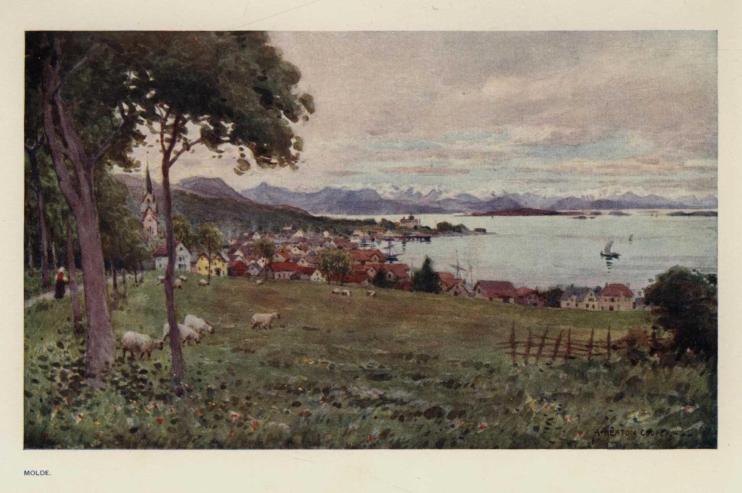
Molde
Of the wild fowl the capercailzie is the
finest, and there are found everywhere
"rype" (ptarmigan), and hazel and willow
grouse. The latter are without
comparison the most important game in the
country.
The most valuable of the wild-fowl,
however, is the eider-duck, on account of
its down. This bird is most abundant
among the northern islands, although it
is also found in large numbers at many
places along the coast.
We have followed the principal fjords
of the west country, from Hardanger
northwards, and now we come to Molde.
This bright little town is more beautifully
situated than any other in the country.
It lies sheltered and calm by the blue
waters of the Molde Fjord, over whose
broad expanse are seen, to the south and
east, the magnificent Söndmöre range of
mountains, with their many peaks and
glaciers. On a calm summer's evening,
when the setting sun lights up each peak
and pinnacle with its golden glow, the
scene from this place is one of enchanting
loveliness:
"Ye mountains hoar of earthfast stone,
Where ancient Thor presides alone;
Ye fjords that smile in silver blue,
Each rock and isle, farewell to you."[1]
  Aamdal, 104
  Aandalsnæs. See Næs
  Aardal, 109
  Æsir (heathen gods), 49
  Afterglow, the, 150
  Agriculture, 10
  Altar, heathen, 50
  Andoen, coal on, 104
  Animals, wild, 170
  Antiquarian Society of Christiania, the, 107
  Arendal iron-ore mines, 104
  Ari Frodi, the Skald, 48
  Art of the Viking Age, 29, 31
  Arts, industrial, 28, 31
  Arvedalsgrube, 103
  Asgaard, 49
  Astronomical Observatory, 148
  Atlöen, 14
  Aurlands Fjord, 57, 93
  Aurora Borealis, the, 169
  Avalanches, 86, 110, 158


  Bakke, 88
  Balder, the Beautiful, 49, 61
  "Balder's Baal," 60
  Balestrand, 67
  Balholm, 67
  Bear-hunting, 73, 171
  Belè, King, 68
  Bergen, 2, 23, 168
    -Christiania Railway, 94
    Museum, 30
    -Voss Railway, 24
  Bishoprics, the Norwegian, 139
  Boat-building, 13, 16
  Boats, ancient forms of, 15
  Bodö, 168
  Bohnslän, 14
  Bojumsbræ, 75
  Bondhusbræ, 41
  Borgund, "Stav-Kirke" at, 107
  Botanical Gardens, 147
  Bremanger land, 118
  Bronze Age, the, 114
  Brudeslurfos (Bridal Veil Falls), 154
  Buarbræ, 41


  Capercailzie, the, 171
  Ceremonies, pagan, 49
  Character, national, 123
  Cheese-making, 70
  China, mission to, 142
  Christiania-Bergen Railway, 94
    University, 147
  Christianity, introduction of, 47, 113
  Christmas Eve customs, 53, 56
  Church, the Lutheran, 139
    tithes, 141
  Churches, ancient ("Stav-Kirker"), 29, 51, 107, 113
  Climate, 4
  Coal on Andöen, 104
  Cod-fishing industry, the, 164
  Colleges, public and private, 144
    working men's, 146
  Copper-mining, 103
  Costumes, national, 5, 37, 125
  Creeds, Lutheran, 139
  Customs, primitive, 60, 124


  Dances, national, 62, 64, 89
  Dialects, native, 76, 84
  Dioceses, ecclesiastical, 139
  Dösen, 113
  Drink traffic, the, 19
  Drives by "kariol," 24, 132, 149, 158
  Drying fish, method of, 165
  Dyrdal, 80


  Eagles, golden, 91
  Ecclesiastical dioceses, 139
  "Eddas," the, 47
  Education, Government grants to, 143, 146
  Eide, 24
  Eiderduck, the, 171
  Eidfjord, 45
  Elk, the, 171
  Embroidery, native, 32
  English Church, an, 68
    language taught, 145
  Erlingsön, Magnus, 77
  Espelandsfos, 40
  Espelandsvand, 26


  Fairy tales, 52
  Falejde, 131
  Farming, 7
  Fibelstad Haugen, 135
  Fiddle, the Hardanger, 33
  Fimreite, sea fight off, 77
  Finland, 21
  Finn sorcery, 57
  Fires, St. John's, 60
  Fireside "sagas," 52
  Fishing industry, the, 16, 163
  Fjærland, 51, 73
  Fjord formation, 110
  Flaamsdal, 94
  Flatmark, 162
  Florö, 118
  Folgefond snowfield, the, 28, 40
  Folklore, 52
  Food of peasants, 17
  Forestry, 95
  Fox, the, 171
  Framnæs, 68
  Fresvikbræ, 95
  Freya, 49
  "Frithjof's Saga," 67, 172
  Frönningen, 95
  Fruit-growing, 11


  Galdhöpiggen, 111
  Game, 170
  Geiranger Fjord, 132, 149
  Glacial action, 40, 43
  Glittertind, 111
  Gloppen Fjord, 122
  Glutton, the, 171
  Goat-fanning, 26, 36
  Gods, pagan, 48
  Gothenburg System, the, 19
  Government Grants to Education, 143, 146
  Gravehalsen Tunnel, 94
  Graven Lake, 45
  Grazing, cattle, 69
  Greek Skipper's Tale, a, 55
  Greenland, 40
  Grodaas, 132
  Grouse-shooting, 171
  Gudbrandsdal, 32, 105
  Gudvangen, 85, 92


  Haakonshal, 3
  Haarfagre, King Harald, 47
  Hallingdal, 94
  "Halling" dance, the, 64, 89
  Hamar, 101
  Hanseatic League, the, 2, 100
  "Hārbarôsljòô," the "Edda," 17
  Hardanger costume, 5, 37
    fiddler, the, 64
    violin, the, 33
  Heathen superstition, 48
    temples, 49
  Hedemarken Amt, 98
  Helleristninger (Runes), 13
  Hellesylt, 135, 149, 158
  Herring-fishing industry, the, 16, 166
  High-seat pillars ("stolper"), 50
  Hjelle, 123
  Hjörund Fjord, 132, 136, 149
  Holmenkollen, 169
  Home farm, life on the, 7, 81
    industry, 30, 32
  Horgheim, 162
  Horndalsrokken, 135
  Hornelen, 118
  Hornindalsvand, 134
  Horticulture, 10
  House-building, 7, 81
  "Hove" (a heathen temple), 49
  "Huldr" on, 53
  Human sacrifices, 50
  Hunting, 170
  Husbandry, 10


  Ice Age, the, 40
  Iceland, 47
  Icelandic literature, 48, 61
  "Ildhus," an, 9
  Images, pagan, 50
  India, Santhal Mission to, 142
  Industrial Arts, 30, 32
  Ingeborg, 68
  Inquisitiveness, native, 124
  Instruction, Department of Public, 144
  Irish ornament, early, 29, 114
  Iron-ore mines, 103


  Jews, mission to the, 142
  Jondal, 13
  Joranger, 113
  Jordalsnuten, 90, 92
  Jostedalen, 112
  Jostedalsbræ, 75, 112
  Jötunheim, 45, 111


  Kaldafjeld, 92
  "Kariol," drives by, 24, 132, 149, 158
  Kaupanger, 77
  Kilefos, 92
  Kinservik, 28
  Kitchen, an ancient ("Rögestue"), 156
  Kjelstadli, 134
  Kjendalsbræ, 128
  "Klipfisk," 165
  Knivsflaafos, 153
  Kongensgrube, 103
  Kongsberg silver mines, 103
  Krokedalen, 113
  Kyrre, King Olaf, 2, 113


  Laatefos, 40
  Lærdalsbrön, 29, 105
  Lamps, ancient, 157
  Land-tenure, 12
  Laplander. See Finn
  "Laxeverp," a, 130
  Legendary lore, 52
  Leirvaag, 14
  "Lensmand," a (sheriff's officer), 155
  Lesjeskogen Lake, 163
  Lind, Jenny, 161
  Liquor laws, the, 19
  Literature, Icelandic, 48, 61
  Loen Vand, 126
  Lofoten Islands, the, 164
  "Lur," a, 72
  Lutheran Church, the, 6, 139
  Lynx, the, 171
  Lyster Fjord, 110


  Magnus Erlingsön, 77
  Margaret, Princess, Maid of Norway, 78
  Marriage customs, 64, 87
  Mauranger Fjord, 41
  Meraak, 152, 158
  Merman, a, 60
  Meteorological Institute, 148
  Midnight, sun at, 167
  Midsummer's Eve fires, 60
  Mining industry, the, 103
  Missionary societies, 142
  Mock wedding, a, 62
  Molde, 159, 172
  Mundal, 75
  Music, national, 33
  Muspelheim, 49
  Myrdal station, 94
  Mythology, pagan, 48


  Nærödal, 86
  Næröfjord, 80
  Næs, 160
  Natal and Madagascar, mission to, 142
  National character, 123
    collections, 147
    costume, 5, 37
    sports, 169
  Niffelheim, 49
  "Niflung Saga," the, 30
  Niord, 49
  Norangsfjord, 136
  Nordangsdal, 135, 149
  Nord Fjord, 117
  Nordland, 15, 152
  North Cape, the, 168
  Northern Lights, the, 169
  Norway in winter, 168
  Norwegian Established Church, the, 139
    missionary societies, 142
    Tourist Club, the, 111


  Odde, 27, 35, 41
  Odin, 48
  Öie, 132, 149
  Olaf Kyrre, King, 2, 78, 113
  Olav Trygvessön, King, 48, 118
  Olden vand, 126
  Ormheim, 162
  Oscar II., King, 75
  Östensö, 29


  Pagan mythology, 48
    temple, a, 49, 114
  Peasant proprietorship, 12
  Pilot, the Norwegian, 1
  Posting, 23, 132, 149, 158
  Ptarmigan, the, 171


  Quaint customs, 61, 63, 124
    form of greeting, a, 124
  Queer story of a Finn, 57


  Ragnvald, Earl, 114
  Rambæren Glacier, 95
  Rauma, the River, 160
  Reformation, the, 140
  Reindeer, 171
  Ringdals-fos, 35
    -vand, 37
  Rites, heathen sacrificial, 49
  River fisheries, 163
  Rock carvings, ancient, 13
  Roldal, 36, 41
  Romsdal, 160
  Röros copper mines, 103
  Rosendal, 13
  Rosenkranz, barony of, 13
  Runic inscriptions, 13, 107
  "Rype" (ptarmigan), 171


  Sacrificial rites, pagan, 49
  "Sæmundar Edda," the 17
  "Sæter" girl's tale, a, 54
    life at a, 68
  "Sagas," the, 47, 61
  Saint John's fires, 60
  Salmon-fishing, 130, 163
  "Samlag," the, 21
  Sandene, 122
  Sandven Lake, 45
  Santhal Mission to India, the, 142
  Scholarships, travelling 145
  Schools, Church, 143
    Continuation, 145
    Forestry, 101
    Grammar, 146
    "Gymnasia," 146
    National Primary 144
    People's High, 146
  Scientific institutions, 147
  Sea-fisheries, the, 163
    serpent, a, 60
  Seine nets, 163
  Seljestad, 41
  "Seven Sisters'" Waterfall, the, 153
  Ship-building, 13
  Ships, Viking, 14
  Silver mines, 103
  Sivlefos, 92
  Skaalan, 122
  "Ski" (a snow-shoe), 99, 170
  Skjæggedalsfos, 35
  Skjærvefos, 26
  Skjolden, 111
  Slinde, 77
  Snorre Sturlasön, the Skald, 48
  Snow-shoes ("ski"), 99, 170
  Society for the Preservation of Norwegian Monuments of Antiquity, 51
  Sogndal, 77
  Sogne Fjord, 67
  Söholt, 158
  Solvorn, 113
  Södmöre, 132, 152
  Sör Fjord, 27, 40
  Sorcery, Finn, 57
  Spinning wool, 8
  Spitsbergen, 40
  Sports, national, 169
  Stalheim, 90
  Standing stones, pre-historic, 114
  Staple food of peasants, 17
  State and religion, the, 139
    forests, 100
    mines, 103
  Stavanger, 2, 23
  Steamer, on board, 1, 78, 95, 118, 129
  Steganaase, 84, 93
  Stor Fjord, 152
  Storvatsgrube, 103
  Strynsvand, 122
  Stuefloten, 162
  Styve, 84
  Sulitjelma mines, 104
  Sultevik farm, 156
  Suuelvfjord, 150
  Sun-worship, 60
  Superstitious beliefs, 53
  Suphellebræ, 75
  Suphelledal, 73
  Sverre, King, 77
  Sweden, 21


  Tapestry-weaving, 31
  Tegner's "Frithjof Saga," 67, 172
  Telemarken, 32, 104
  Temples, pagan, 49
  Teröen, 41
  Textile fabrics, ancient, 31
  Theological college, 148
  Thor, the Thunderer, 48
  Throndhjem, 105, 168
  Timber-felling, 99
  Tithes, church, 141
  "Törfisk," 165
  Tourist Club, the Norwegian, 111
  Travelling scholarships, 145
  "Trolds," 49, 53, 59
  Troldtinderne, 160
  Tryggestad farm, 135, 149
  Trygvessön, King Olav, 48, 118
  Tyssedal, 35
  Tyssestrængenefos, 39


  Ullensvang, 27
  Ulvik, 24, 26
  Underdal, 57, 94
  Underworld, the, 54
  University, Royal Frederik, 147
  Urnæs, "Stav-Kirke" at, 113


  Vadheim, 67
  Valahei mines, the, 104
  Valdres, 105
  Valhalla, 49
  "Valkyries," 49
  Valleys, formation of, 43, 106
  Vasenden, 26
  Veblungsnæs, 160
  Vengetinderne, 161
  Vermafos, 162
  Vestnes, 158
  Vetle Fjord, 51
  Vettisfos, 110
  Vide Sæter, 123, 132
  Vik in Sogn, 29, 51
    "Stav-Kirke" at, 51
  Viking Age, the, 47, 48, 68
    ships, 14, 29
  Violin, the Hardanger, 33
  Visnæs, 122, 131
  "Volsung Saga," the, 30
  Vöringfos, 40
  Vossevangen, 24, 29, 85, 93, 101
    -Bergen Railway, 24


  Warships of the Vikings, 14, 29
  "Waterfalls, the highest, 35, 40, 110
  Weddings, customs at, 64, 87
  Wild animals, 170
  Winter in Norway, 85, 167
    sports, 169
  Witchcraft, 58
  Wolves, 171
  Wood-carving, 28, 30
    -cutting, 95
  Wool-spinning, 8
  Working-men's colleges, 146


  "Younger Edda," the, 48
  Yuletide customs, 61


  Zululand, mission to, 142
THE END
BILLING AND SONS, LTD., PRINTERS, OUILDFORD
********
UNIFORM WITH THIS VOLUME.
PARIS.
Painted by MORTIMER MENPES, R.I. Text by DOROTHY MENPES.
Containing 24 full-page illustrations in colour, and numerous line
illustrations in the text. Large crown 8vo., cloth, gilt top.
Price 6s. net.
JAMAICA.
Painted by A. S. FORREST. Described by JOHN HENDERSON.
Containing 24 full-page illustrations in colour. Large crown 8vo.,
cloth, gilt top. Price 6s. net.
The text and illustrations of this volume are reprinted from "The West
Indies" which was published a little over a year ago,
in the 20s. net series of
"Black's Beautiful Books," and is now out of print.
THE UPPER ENGADINE.
Painted by J. HARDWICKE LEWIS. Described by S. C. MUSSON.
Containing 24 full-page illustrations in colour and a sketch map.
Large crown 8vo., cloth, gilt top. Price 6s. net.
Perhaps the best way to convey some idea
of the Engadine to the untravelled
Britisher is to describe it as a lofty valley
sixty miles in length with a mean
altitude as high as Ben Nevis.
As may be imagined, the air at this height is most
bracing, and the mountain scenery sublime in the extreme.
Picturesque villages
and lakes dot the valley, and an almost level
road runs through its entire length.
Mr. J. Hardwicke Lewis, in his water-colour
sketches which are reproduced
in this volume, gives us many delightful glimpses
of its beautiful scenery. In
some we see the valley clothed in its rich summer glory,
in others it has donned
its winter mantle of snow,
and always overlooking it are the solitary mountain-tops
where snow and ice are eternal.
Mr. Musson in the text of the book describes
the varied scenery of the region,
and the chief resorts of the cosmopolitan crowd that gathers there, with
incidental notices of its peculiar geology and flora,
and a short sketch of its chequered
history.
NORTH DEVON.
Painted by HENRY B. WIMBUSH. Described by F. J. SNELL.
Containing 26 full-page illustrations in colour. Large crown 8vo.,
cloth, gilt top. Price 6s. net.
"Mr. Wimbush has given us twenty-six glimpses of North Devon which are
gems.... Mr. Snell has endeavoured to avoid the guide-book style in his
descriptive matter, and has succeeded."—Daily News.
SOUTH DEVON.
Painted by C. E. HANNAFORD. Described by CHARLES
ROWE, M.J.I.
Containing 24 full-page illustrations in colour. Large crown 8vo.,
cloth, gilt top. Price 6s. net.
This book deals with an area abounding in places
of historical interest, and it
has a pictorial quality quite distinct from
that of the northern portion of the shire,
which already forms the subject of a companion volume in the same series.
LIVERPOOL.
Painted by J. HAMILTON HAY. Described by WALTER SCOTT.
Containing 24 full-page illustrations in colour. Large crown 8vo.,
cloth, gilt top. Price 6s. net.
This book is published in the year of the 700th
anniversary of Liverpool's first
charter, but it aims at being something more than
a mere historical outline of the
city's growth. For modern Liverpool is almost entirely a product of the
nineteenth century, and Mr. Scott has
therefore regarded it as his duty, less to offer
a réchauffé of the facts relating to her development
in the past, than to endeavour
to mirror in words the vital aspect which she presents to the world to-day.
The twenty-four water-colours reproduced in facsimile in the volume were
specially painted for the book by Mr. Hay. They are an effective series of
pictures in sympathy with the text they illustrate,
and thoroughly typical of the
great city they represent.
IRELAND.
Painted by FRANCIS S. WALKER, R.H.A. Described by FRANK
MATHEW.
Containing 32 full-page illustrations in colour. Large crown 8vo.,
cloth, gilt top. Price 6s. net.
The text and illustrations of this volume are taken from "Ireland,"
in the 20s
series of "Black's Beautiful Books."
"In the series of 'Coloured Books' which Messrs. A. and C. Black have
published few have the distinction of that on 'Ireland,' a new and cheaper
edition of which has now been issued.... Mr. Frank Mathew is responsible
for the letterpress, and it is a pleasure
to come across work so careful, so well
informed, and so admirable in style.... The pictures in this volume are by
Mr. Francis S. Walker. We dealt with them when the book appeared in its
larger size, and it only remains to be said
now that they are interesting and
sympathetic."—Manchester Courier.
PUBLISHED BY A. & C. BLACK, 4, SOHO SQUARE, LONDON, W.