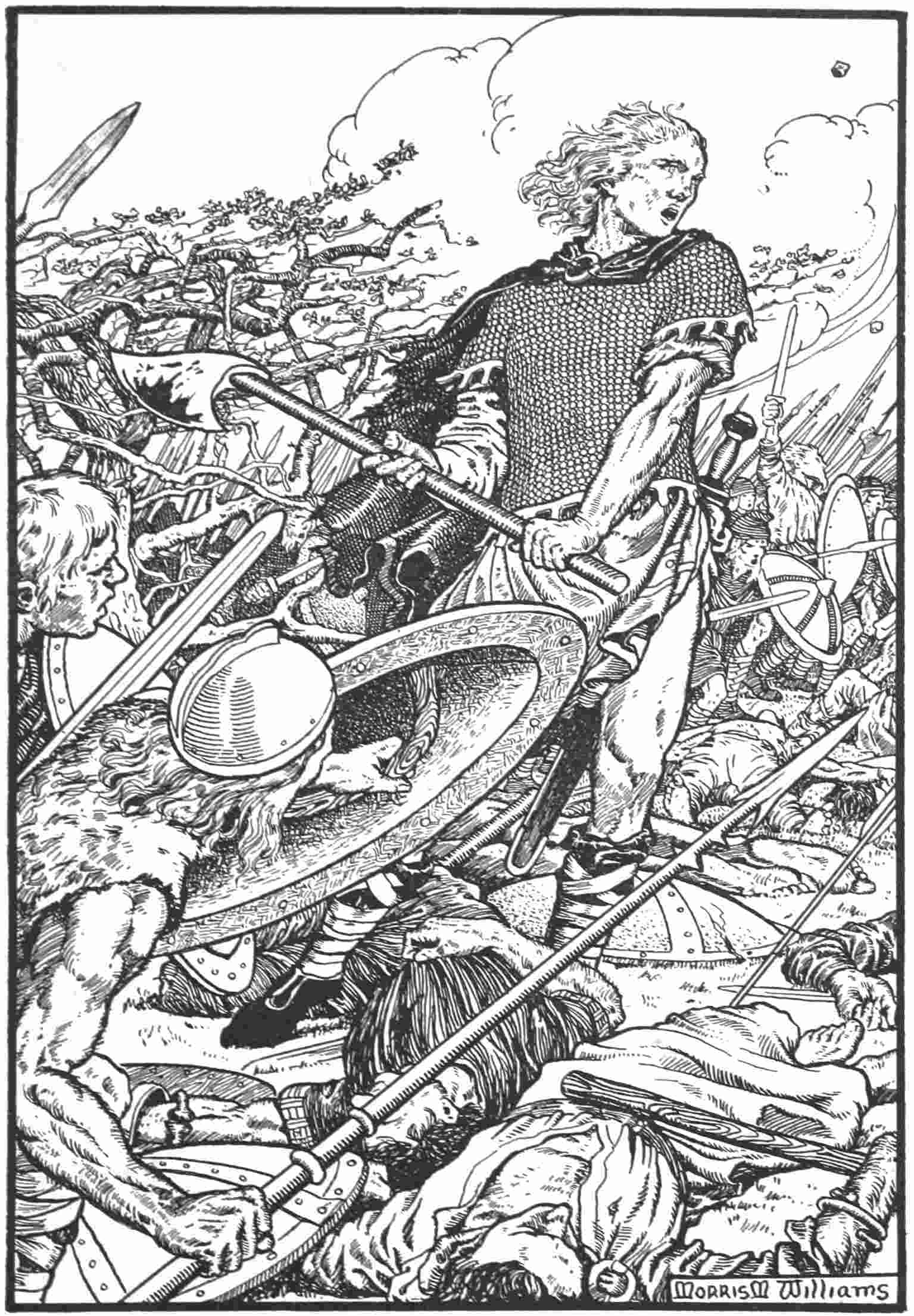
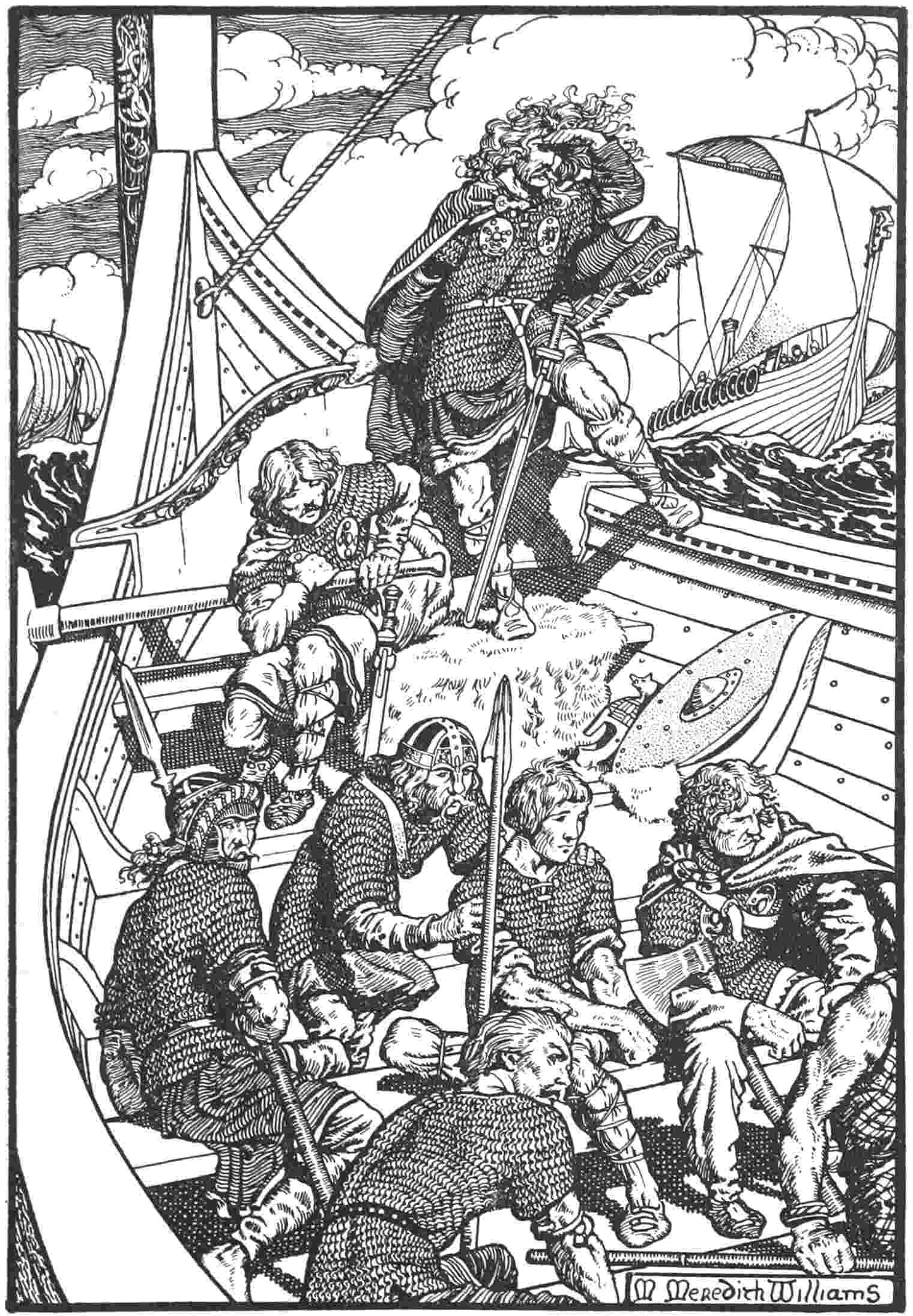
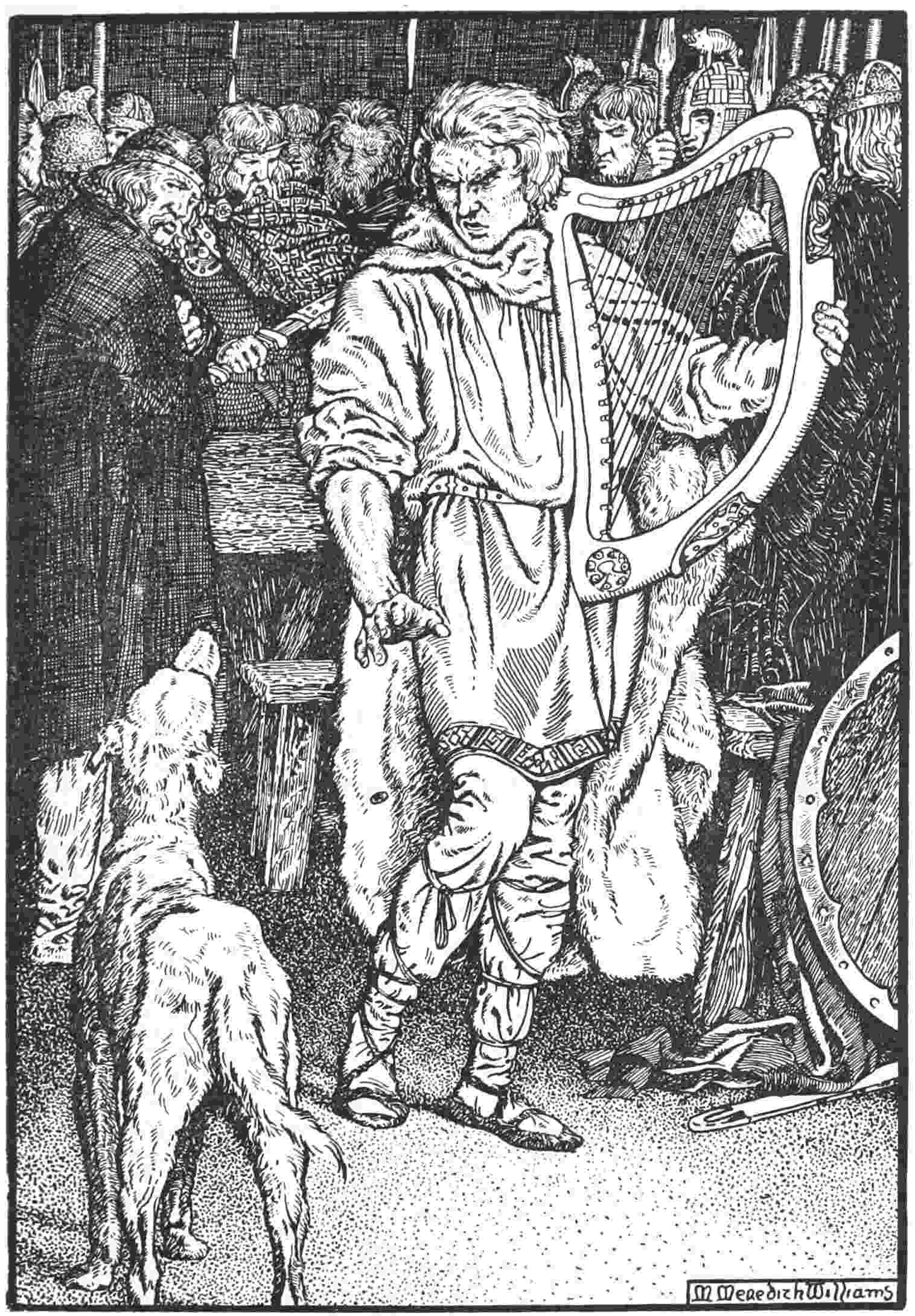
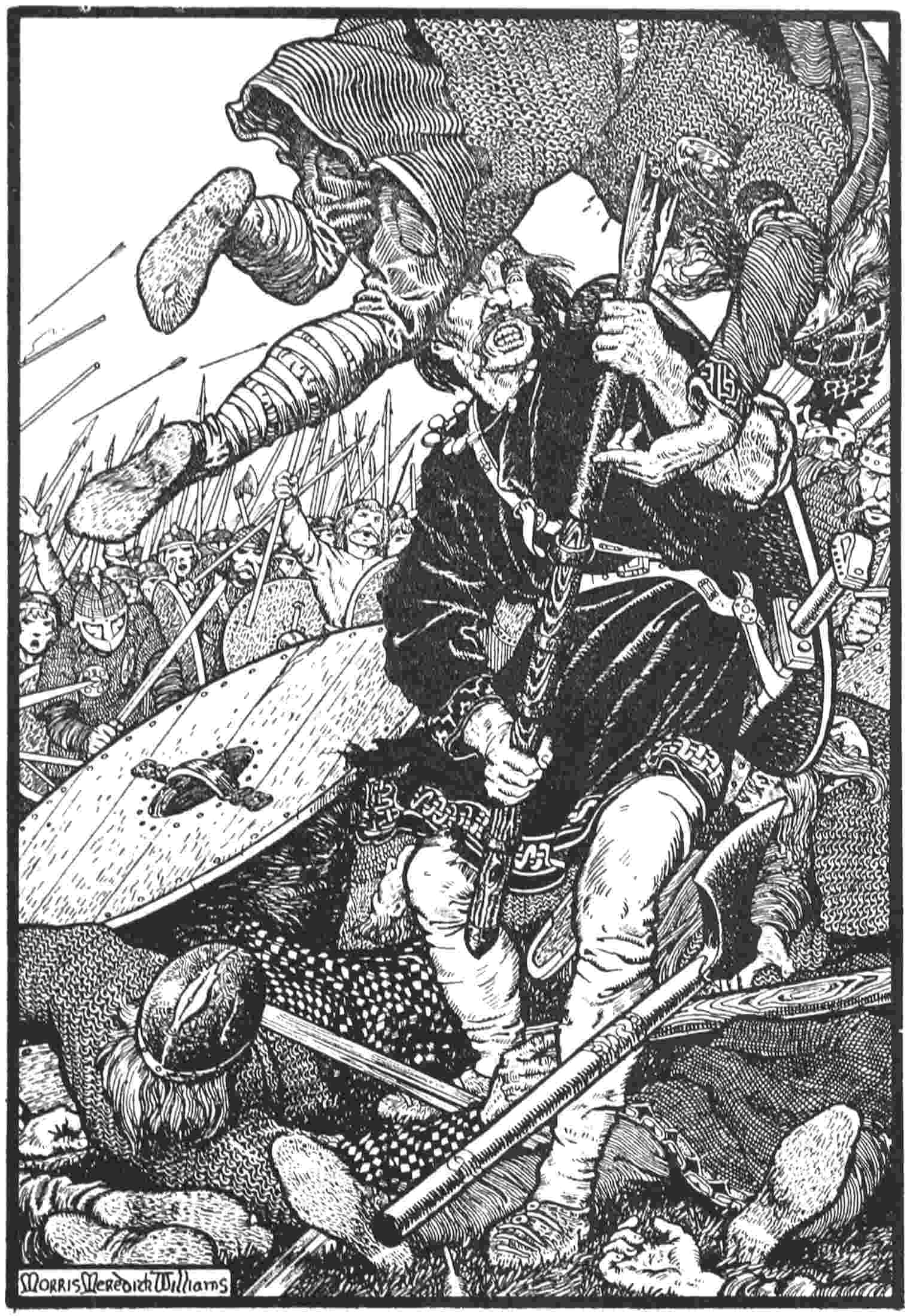
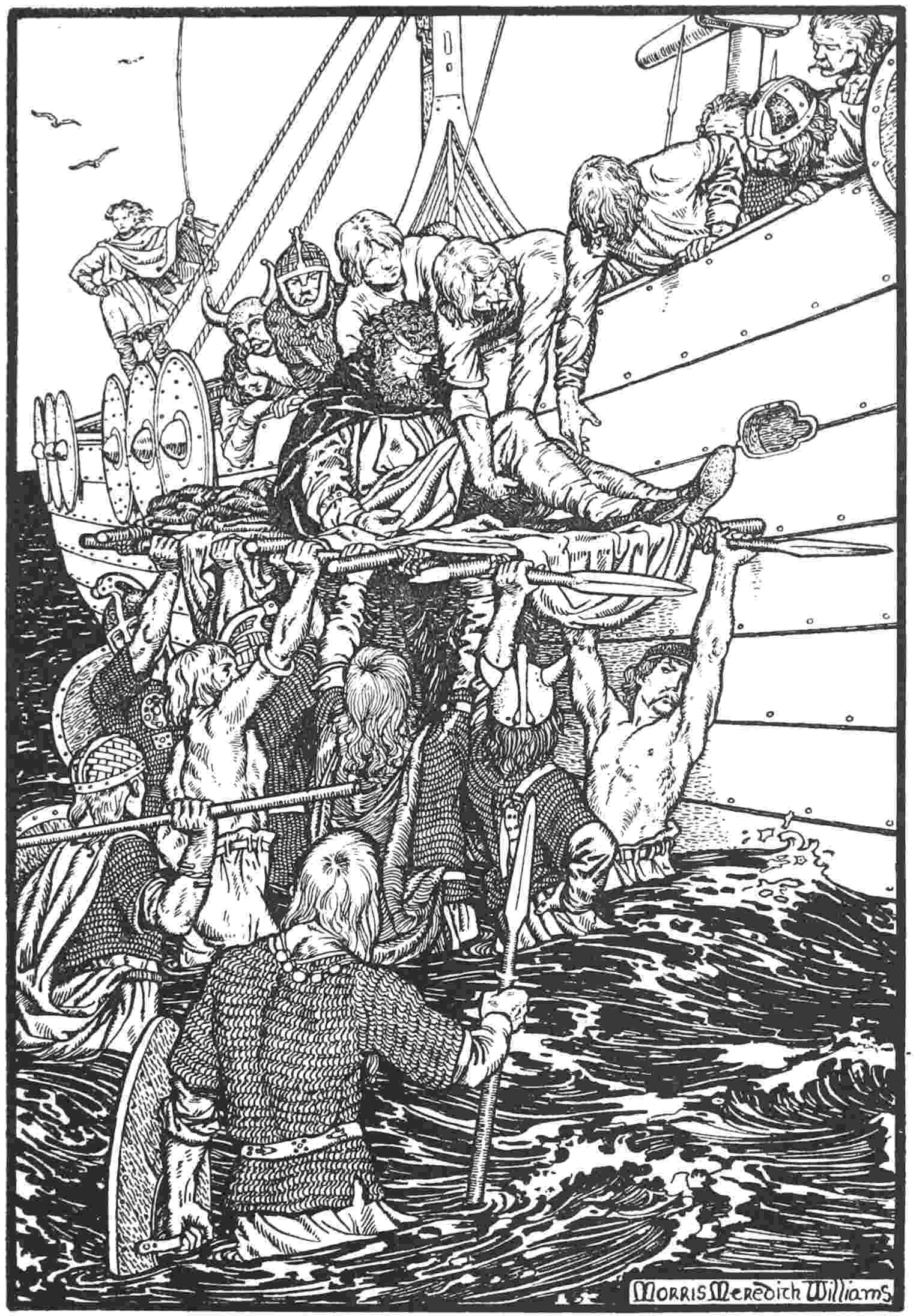
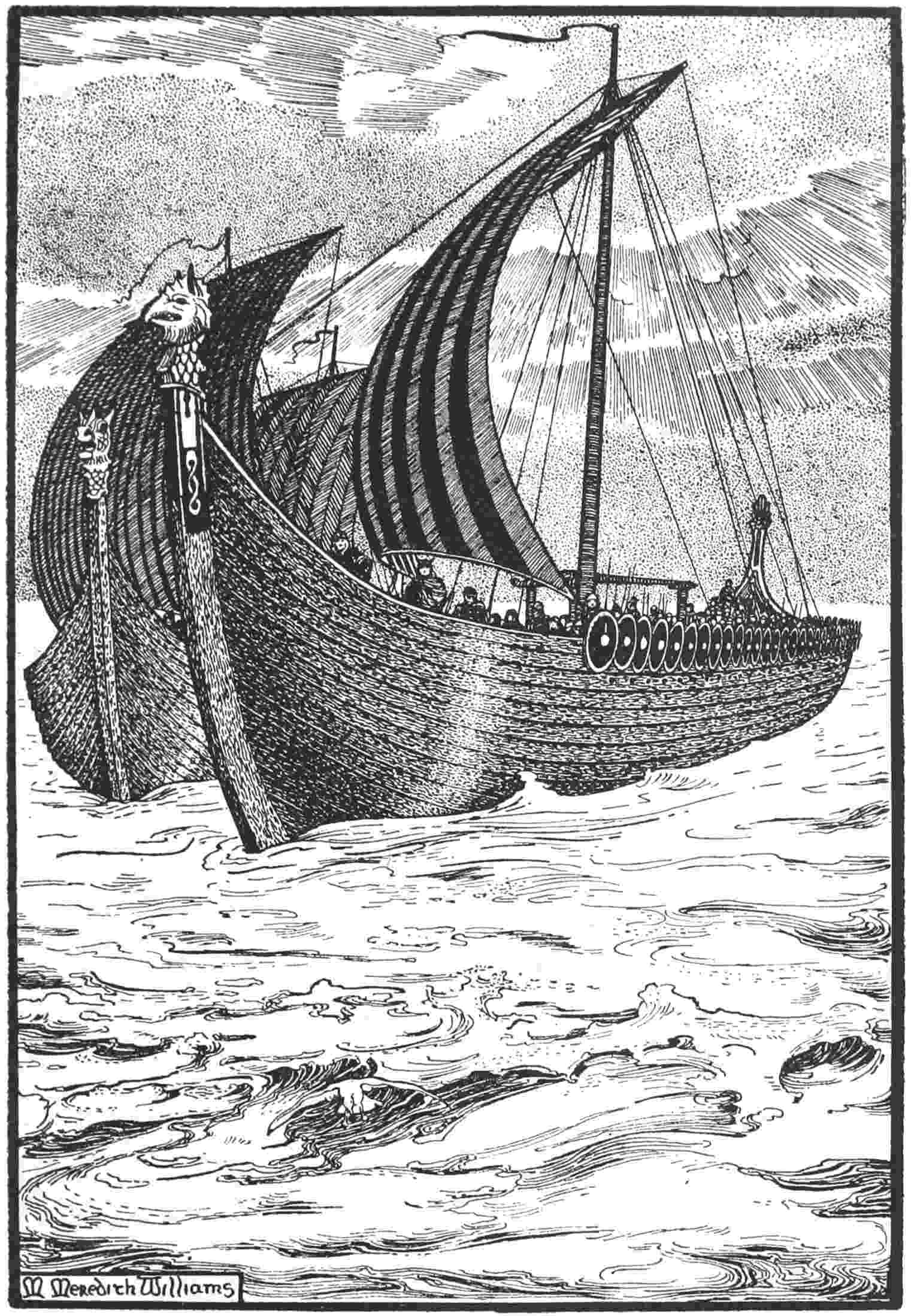
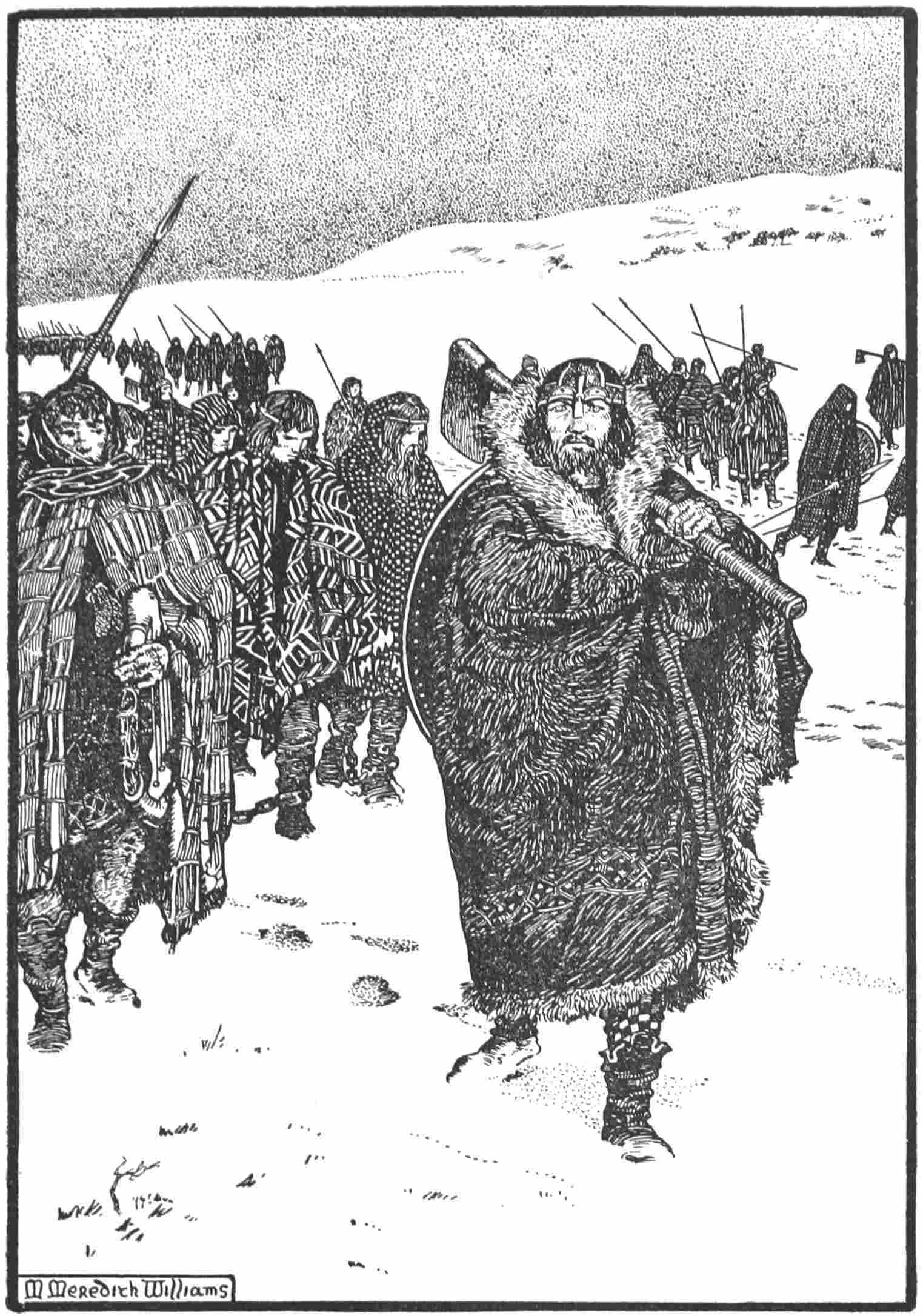
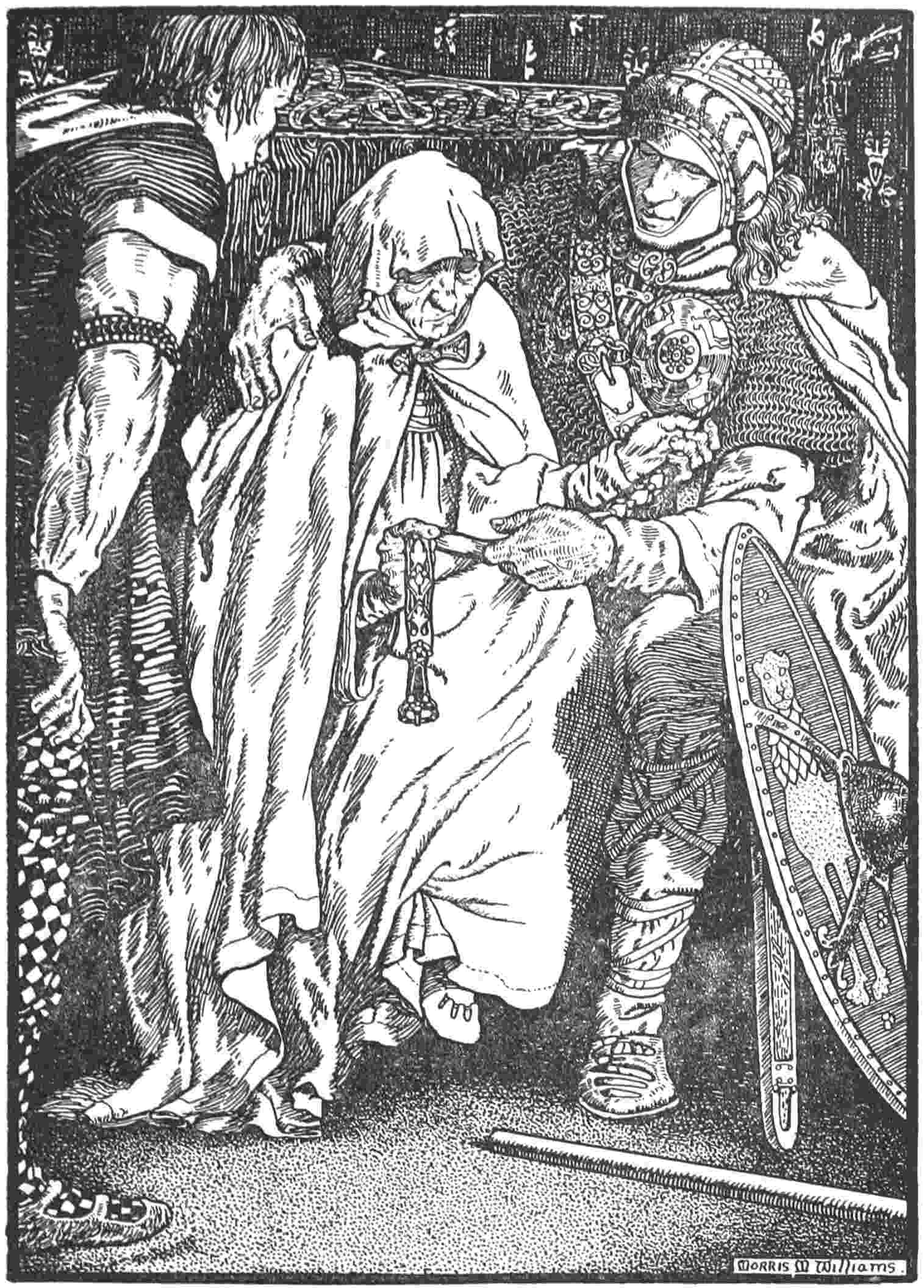
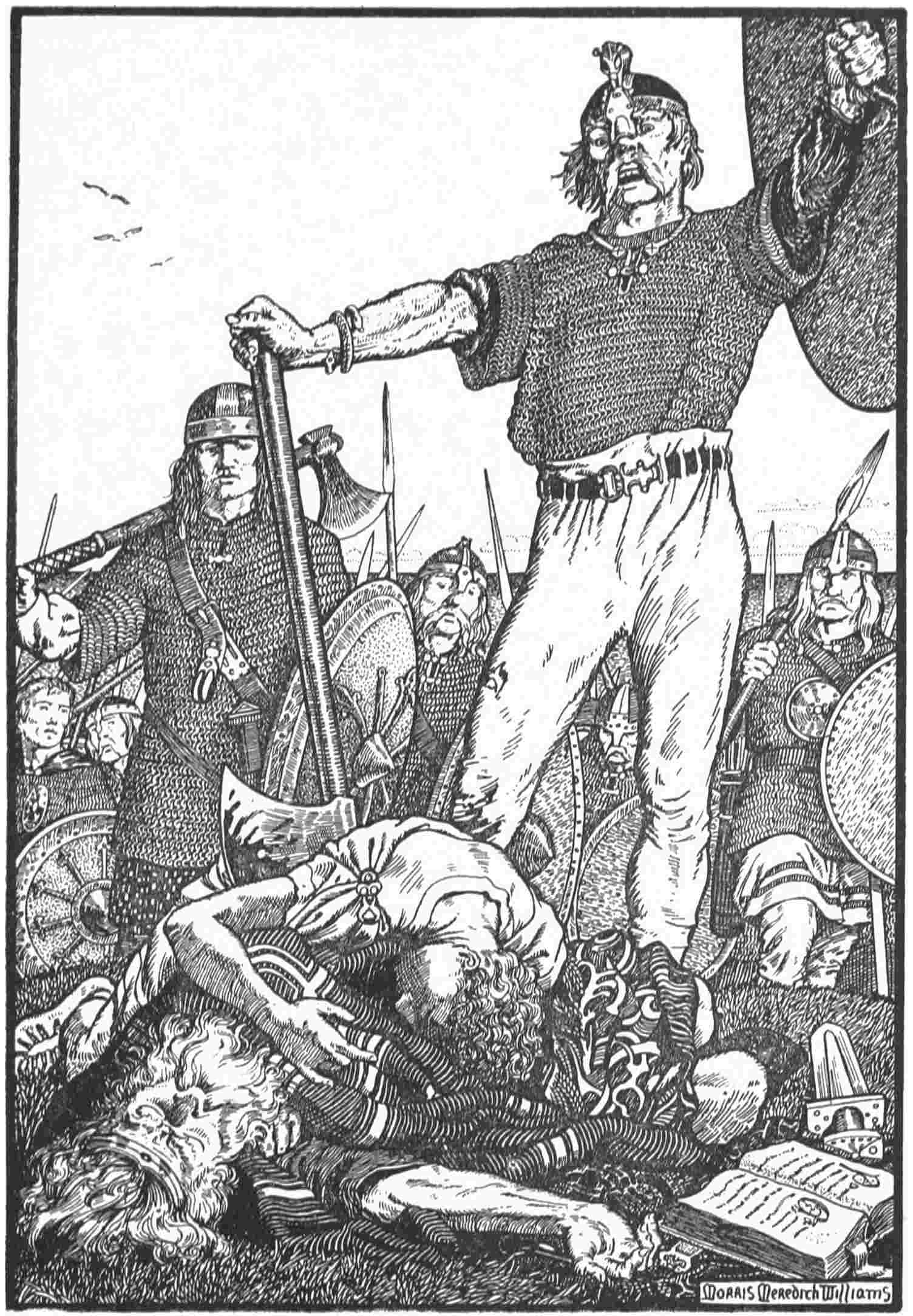
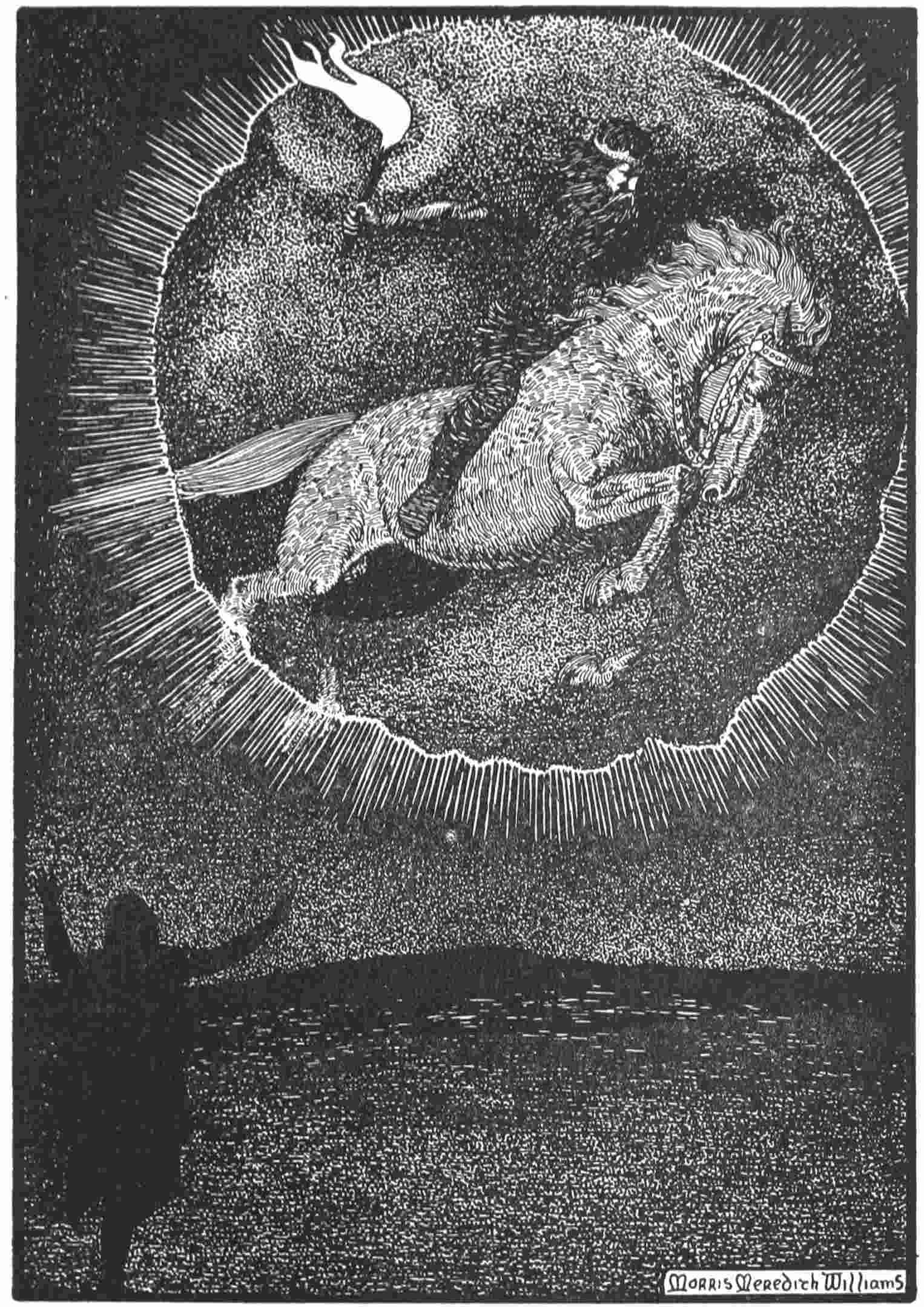
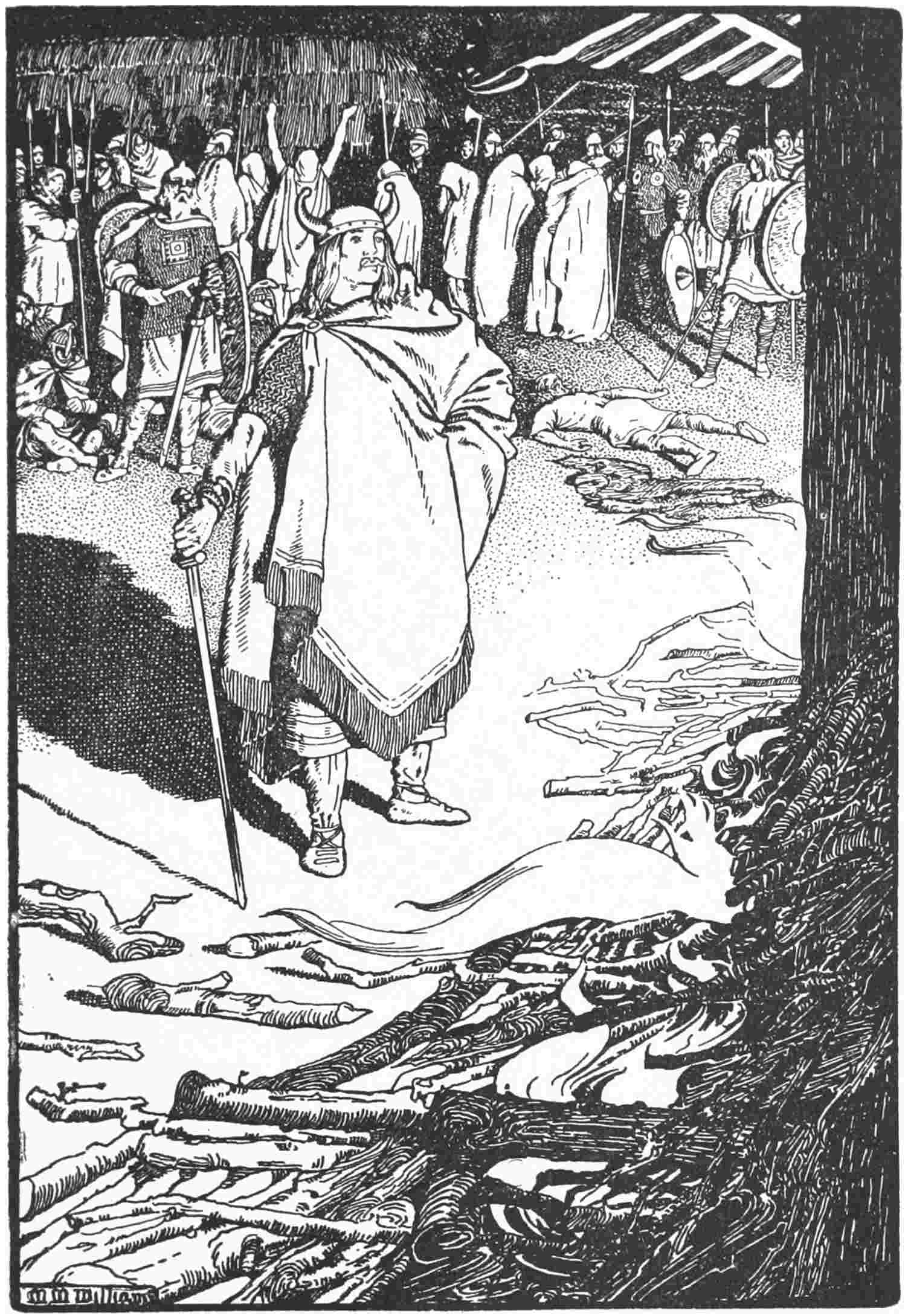
Larger versions of most illustrations may be seen by right-clicking them
and selecting an option to view them separately, or by double-tapping and/or
stretching them.
THE NORTHMEN IN BRITAIN
“There is no man so high-hearted over earth, nor so good
in gifts, nor so keen in youth, nor so brave in deeds, nor so
loyal to his lord, that he may not have always sad yearning
towards the sea-faring, for what the Lord will give him there.
“His heart is not for the harp, nor receiving of rings, nor
delight in a wife, nor the joy of the world, nor about anything
else but the rolling of the waves. And he hath ever
longing who wisheth for the Sea.”
“The Seafarer”
(Old English Poem).
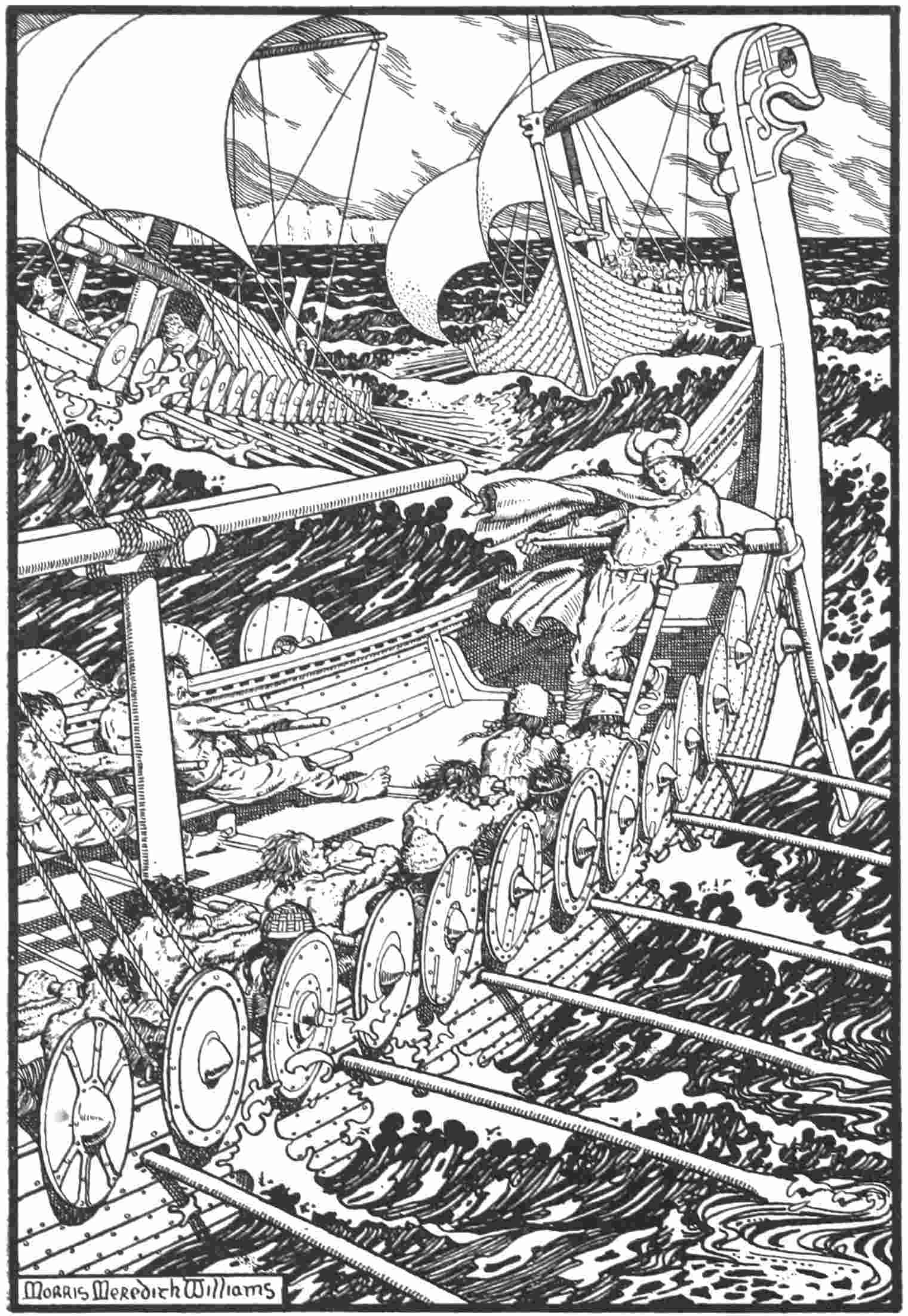
The Coming of the Northmen
THE NORTHMEN
IN BRITAIN
BY Eleanor Hull AUTHOR OF
‘THE POEM-BOOK OF THE GAEL’ ‘CUCHULAIN, THE HOUND OF ULSTER’
‘PAGAN IRELAND’ ‘EARLY CHRISTIAN IRELAND’
ETC.
WITH SIXTEEN FULL-PAGE ILLUSTRATIONS BY M. Meredith Williams
NEW YORK THOMAS Y. CROWELL COMPANY
PUBLISHERS
Turnbull & Spears, Printers, Edinburgh
Foreword
Two great streams of Northern immigration
met on the shores of Britain during the ninth,
tenth, and eleventh centuries. The Norsemen
from the deep fiords of Western Norway, fishing and
raiding along the coasts, pushed out their adventurous
boats into the Atlantic, and in the dawn of Northern
history we find them already settled in the Orkney and
Shetland Isles, whence they raided and settled southward
to Caithness, Fife, and Northumbria on the east,
and to the Hebrides, Galloway, and Man on the western
coast. Fresh impetus was given to this outward
movement by the changes of policy introduced by
Harald Fairhair, first king of Norway (872–933). Through
him a nobler type of emigrant succeeded the casual
wanderer, and great lords and kings’ sons came over to
consolidate the settlements begun by humbler agencies.
Iceland was at the same time peopled by a similar stock.
The Dane, contemporaneously with the Norseman, came
by a different route. Though he seems to have been
the first to invade Northumbria (if Ragnar and his sons
were really Danes), his movement was chiefly round
the southern shores of England, passing over by way
of the Danish and Netherland coast up the English
Channel, and round to the west. Both streams met in
Ireland, where a sharp and lengthened contest was
fought out between the two nations, and where both
took deep root, building cities and absorbing much of
the commerce of the country.
The viking was at first simply a bold adventurer,
but a mixture of trading and raiding became a settled
practice with large numbers of Norsemen, who, when
work at home was slack and the harvest was sown or
reaped, filled up the time by pirate inroads on their own
or neighbouring lands. Hardy sailors and fearless
fighters they were; and life would have seemed too
tame had it meant a continuous course of peaceful
farming or fishing. New possessions and new conquests
were the salt of life. “Biorn went sometimes on viking
but sometimes on trading voyages,” we read of a man
of position in Egil’s Saga, and the same might be said
of hundreds of his fellows.
It was out of these viking raids that the Dano-Norse
Kingdoms of Dublin and Northumbria grew, the Dukedom
of Normandy, and the Earldom of Orkney and
the Isles.
The Danish descents seem to have been more directly
for the purpose of conquest than those of the Norse,
and they ended by establishing on the throne of England
a brief dynasty of Danish kings in the eleventh century,
remarkable only from the vigour of Canute’s reign.
The intimate connexion all through this period
between Scandinavia, Iceland, and Britain can only be
realized by reading the Northern Sagas side by side
with the chronicles of Great Britain and Ireland, and
it is from Norse sources chiefly that I propose to tell
the story.
For the Sagas of the Norwegian Kings: Snorri Sturleson’s Heimskringla,
or Sagas of the Kings of Norway. Translated by
S. Laing and by W. Morris and E. Magnüsson
For Ragnar Lodbrog: Saxo Grammaticus and Lodbrog’s Saga
For Ragnar Lodbrog’s Death Song: Corpus Poeticum Boreale.
Vigfusson and York Powell
For the Orkneys: Orkneyinga Saga
For the Battle of Brunanburh: Egil Skallagrimson’s Saga.
Translated by W. C. Green
For the Story of Olaf the Peacock and Unn the Deep-minded:
Laxdæla Saga. Translated by Mrs Muriel Press
For the Story of the Burning: Nial’s Saga. Translated by
G. W. Dasent
For the Battle of Clontarf: Wars of the Gael and Gall. Edited
by J. H. Todd; Nial’s Saga, and Thorstein’s Saga
For Murtough of the Leather Cloaks: The bard Cormacan’s
Poem. Edited by J. O’Donovan (Irish Arch. Soc.)
English Chronicles: The English Chronicle; William of Malmesbury’s,
Henry of Huntingdon’s, Florence of Worcester’s
Chronicles; Asser’s Life of Alfred
Irish Chronicles: Annals of the Four Masters; of Ulster; Chronicum
Scotorum; Three Fragments of Annals, edited by
J. O’Donovan
I desire to thank Mrs Muriel Press and Mr W. C. Green for
kind permission to make use of portions of their translations of
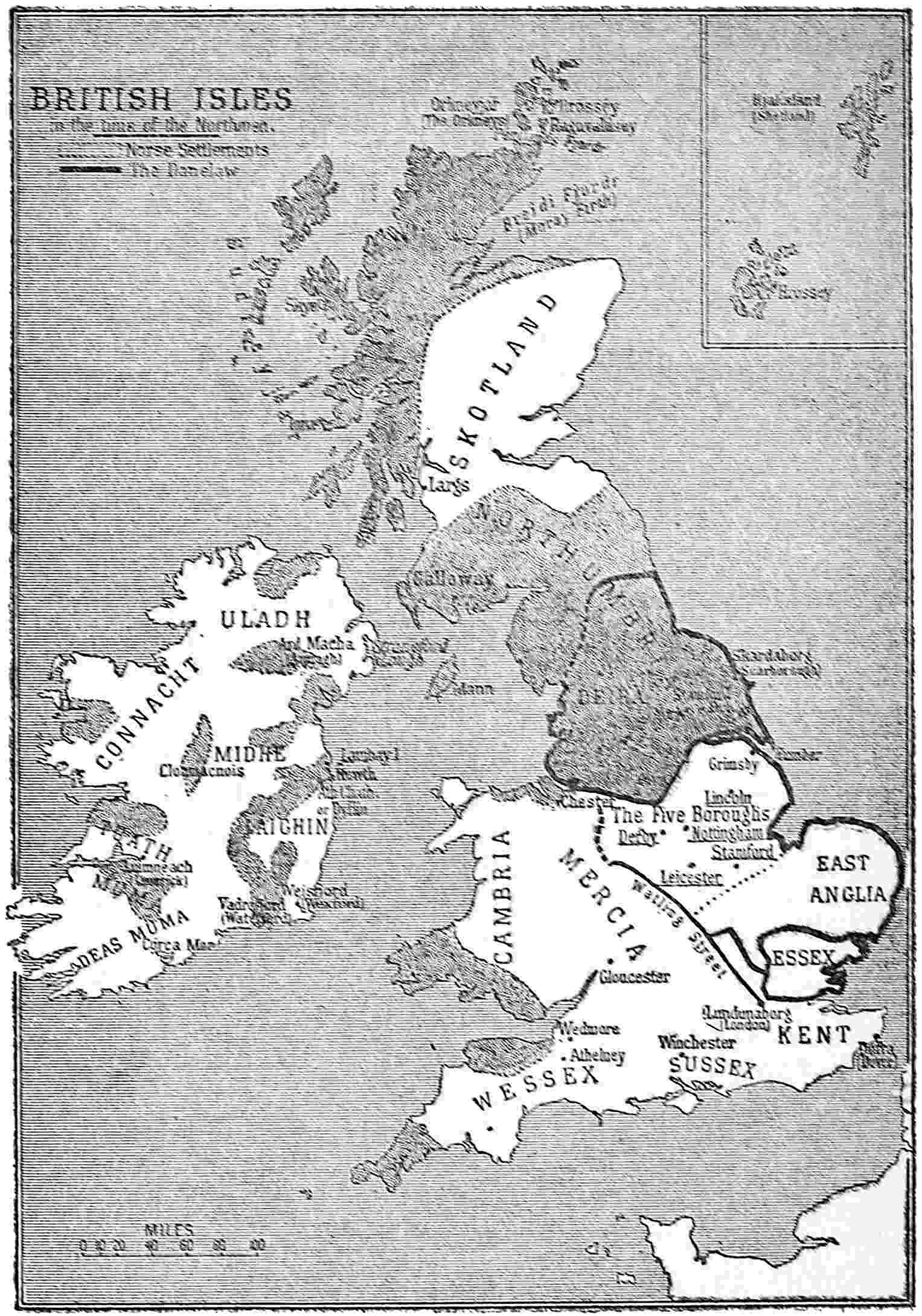
Laxdæla and Egil’s Sagas; also Mr W. G. Collingwood for his
consent to my adoption in my map of some of his boundaries
from a map published in his Scandinavian Britain (S.P.C.K.); and
to the Secretary of the Society for the Promotion of Christian
Knowledge for giving his sanction to this.
The Northmen in Britain — THE AGE OF THE VIKINGS — Chapter I The First Coming of the Northmen
The first actual descent of the Northmen is
chronicled in England under the year 787, and in
Ireland, upon which country they commenced
their descents about the same time, under the year 795;
but it is likely, not only that they had visited and raided
the coasts before this, but had actually made some
settlements in both countries. The Ynglinga Saga tells
us that Ivar Vidfadme or “Widefathom” had taken
possession of a fifth part of England, i.e. Northumbria,
before Harald Fairhair ruled in Norway, or Gorm the
Old in Denmark; that is to say, before the history of
either of these two countries begins. Ivar Vidfadme
is evidently Ivar the Boneless, son of Ragnar Lodbrog,
who conquered Northumbria before the reign of Harald
Fairhair. There are traces of them even earlier, for
a year after the first coming of the Northmen to
Northumbria mentioned in the English annals we
find that they called a synod at a place named Fingall,
or “Fair Foreigners,” the name always applied to
the Norse in our Irish and sometimes in our English
chronicles. Now a place would not have been so named
unless Norse people had for some time been settled
there, and we may take it for granted that Norse
settlers had made their home in Northumbria at some
earlier period. We find, too, at quite an early time,
that Norse and Irish had mingled and intermarried in
Ireland, forming a distinct race called the Gall-Gael,
or “Foreigners and Irish,” who had their own fleets
and armies; and it is said that on account of their
close family connexion many of the Christian Irish
forsook their religion and relapsed into the paganism
of the Norse who lived amongst them. We shall find,
as we go on in the history, that generally the contrary
was the case, and that contact with Christianity in
these islands caused many Norse chiefs and princes to
adopt our faith; indeed, it was largely through Irish
and English influence that Iceland and Norway became
Christian. Though we may not always approve of the
way in which this was brought about, the fact itself is
interesting.
The first settlers in Iceland were Irish hermits, who
took with them Christian books, bells, and croziers,
and the first Christian church built on the island was
dedicated to St Columba, the Irish founder of the
Scottish monastery of Iona, through whom Christianity
was brought to Scotland.
Yet there is no doubt that the coming of the
Northmen was looked upon with dread by the English,
and there is a tone of terror in the first entry in
the chronicles of their arrival upon the coast. This
entry is so important that we will give it in the words
of one of the old historians: “Whilst the pious King
Bertric [King of Wessex] was reigning over the western
parts of the English, and the innocent people spread
through the plains were enjoying themselves in tranquillity
and yoking their oxen to the ploughs, suddenly
there arrived on the coast a fleet of Danes, not large,
but of three ships only: this was their first arrival.
When this became known, the King’s officer, who was
already stopping in the town of Dorchester, leaped on
his horse and galloped forwards with a few men to the
port, thinking that they were merchants rather than
enemies, and commanding them in an authoritative
tone, ordered them to go to the royal city; but he
was slain on the spot by them, and all who were with
him.”1
This rude beginning was only a forecast of what was
to follow. We hear of occasional viking bands arriving
at various places on the coast from Kent to Northumbria,
and ravaging wherever they appeared. At first they
seem to have wandered round the coast without
thought of remaining anywhere, but about sixty years
after their first appearance (in 851), we find them
settling on the warmer and more fertile lands of England
during the winter, though they were off again when the
summer came, foraging and destroying. This became
a regular habit with these visitors, and led gradually
to permanent settlements, especially in Northumbria.
The intruders became known as “the army,” and the
appearance of “the army” in any district filled the
inhabitants with terror. Our first definite story of
the Northmen in England is connected with the
appearance of “the army” in Yorkshire A.D. 867.
We learn from the English chronicles that violent
internal discord was troubling Northumbria at this
time. The king of the Northumbrians was Osbert,
but the people had risen up and expelled him, we know
not for what reason,2 and had placed on the throne a
man named Ælla, “not of royal blood,” who seems to
have been the leader of the people.
Just at this moment, when the country was most
divided, the dreaded pagan army advanced over the
mouth of the Humber from the south-east into Yorkshire.
In this emergency all classes united for the common
defence, and we find Osbert, the dethroned king, nobly
marching side by side with his rival to meet the Northmen.
Hearing that a great army was approaching,
the Northmen shut themselves up within the walls of
York, and attempted to defend themselves behind
them. The Northumbrians succeeded in making a
breach in the walls and entering the town; but, inspired
by fear and necessity, the pagans made a fierce sally,
cutting down their foes on all sides, inside and outside
the walls alike. The city was set on fire, those who
escaped making peace with the enemy. From that time
onward the Northmen were seldom absent from Northumbria.
York became one of their chief headquarters,
and the constant succession of Norse ships along the
coast gradually brought a considerable influx of Norse
inhabitants to that part of England. It became, in
fact, a viking kingdom, under the sons of Ragnar
Lodbrog, whose story we have now to tell. This was
in the time of the first Ethelred, when Alfred the Great
was about twenty years of age. Ethelred was too
much occupied in warring with the pagans in the South
of England to be able to give any aid to the
Northumbrians.
Chapter II The Saga of Ragnar Lodbrog, or “Hairy-breeks”
According to the Danish and Norse accounts,
the leader of the armies of the Northmen on
the occasion we have just referred to was the
famous Ragnar Lodbrog, one of the earliest and most
terrible of the Northern vikings. The story of Ragnar
stands just on the borderland between mythology and
history, and it is difficult to tell how much of it is true,
but in some of its main outlines it accords with the
rather scanty information we get at this time from the
English annals. An old tradition relates how Ragnar
got his title of Lodbrog, or “Hairy-breeks.”
It is said that the King of the Swedes, who was fond
of hunting in the woods, brought home some snakes
and gave them to his daughter to rear. Of these curious
pets she took such good care that they multiplied
until the whole countryside was tormented with them.
Then the King, repenting his foolish act, proclaimed
that whosoever should destroy the vipers should have his
daughter as his reward. Many warriors, attracted by
the adventure, made an attempt to rid the country of the
snakes, but without much success. Ragnar also determined
to try to win the princess. He caused a dress to be
made of woolly material and stuffed with hair to protect
him, and put on thick hairy thigh-pieces that the snakes
could not bite. Then he plunged his whole body, clad
in this covering, into freezing water, so that it froze on
him, and became hard and impenetrable. Thus attired,
he approached the door of the palace alone, his sword
tied to his side and his spear lashed in his hand. As
he went forward an enormous snake glided up in front,
and others, equally large, attacked him in the rear.
The King and his courtiers, who were looking on, fled
to a safe shelter, watching the struggle from afar like
affrighted little girls. But Ragnar, trusting to the
hardness of his frozen dress, attacked the vipers boldly,
and drove them back, killing many of them with his
spear.
Then the King came forward and looked closely at
the dress which had withstood the venom of the serpents.
He saw that it was rough and hairy, and he laughed loudly
at the shaggy breeches, which gave Ragnar an uncouth
appearance. He called him in jest Lodbrog (Lod-brokr),
or “Hairy-breeks,” and the nickname stuck to him all
his life. Having laid aside his shaggy raiment and put
on his kingly attire, Ragnar received the maiden as
the reward of his victory. He had several sons, of
whom the youngest, Ivar, was well known in after years
in Britain and Ireland, and left a race of rulers there.
Ladgerda
Meanwhile the ill-disposed people of his own kingdom,
which seems to have included the districts we now know
as Zealand or Jutland, one of those small divisions into
which the Northern countries were at that time broken
up,3 during the absence of Ragnar stirred up the inhabitants
to depose him and set up one Harald as king.
Ragnar, hearing of this, and having few men at his
command, sent envoys to Norway to ask for assistance.
They gathered a small host together, of weak and strong,
young and old, whomsoever they could get, and had a
hard fight with the rebels. It is said that Ivar, though
he was hardly seven years of age, fought splendidly, and
seemed a man in courage though only a boy in years.
Siward, or Sigurd Snake-eye, Ragnar’s eldest son,
received a terrible wound, which it is said that Woden,
the father of the gods of the North, came himself to
cure. The battle would have gone against Ragnar
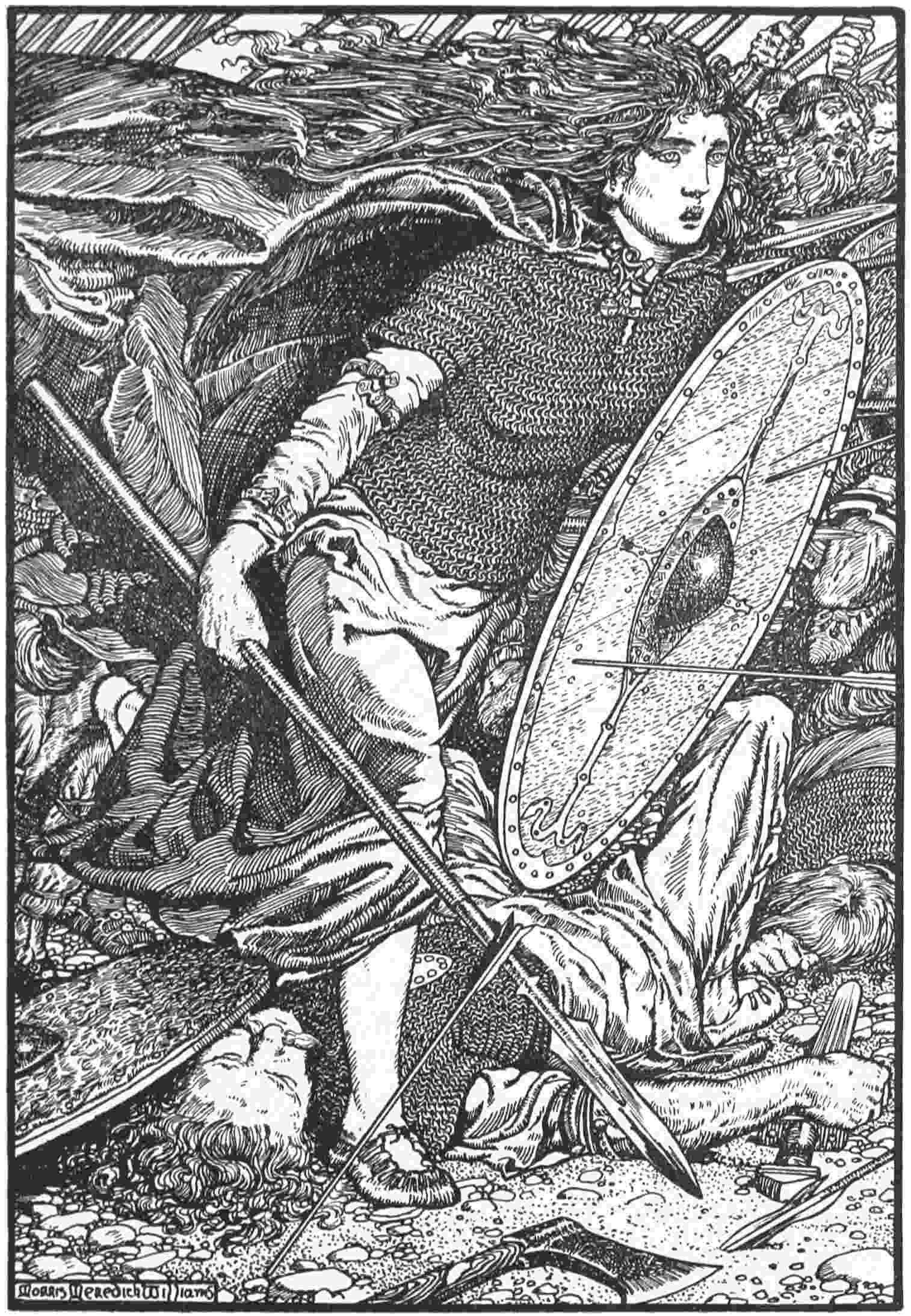
but for the courage of a noble woman named Ladgerda,
who, “like an Amazon possessed of the courage of a
man,” came to the hero’s assistance with a hundred and
twenty ships and herself fought in front of the host with
her loose hair flying about her shoulders. All marvelled
at her matchless deeds, for she had the spirit of a warrior
in a slender frame, and when the soldiers began to waver
she made a sally, taking the enemy unawares on the
rear, so that Harald was routed with a great slaughter
of his men. This was by no means the only occasion
in the history of these times that we hear of women-warriors;
both in the North and in Ireland women
often went into battle, sometimes forming whole female
battalions. The women of the North were brave, pure,
and spirited, though often fierce and bitter. They
took their part in many ways beside their husbands
and sons.
About this time Thora, Ragnar’s wife, died suddenly
of an illness, which caused infinite sorrow to her husband,
who dearly loved his spouse. He thought to assuage
his grief by setting himself some heavy task, which
would occupy his mind and energies. After arranging
for the administration of justice at home, and training
for war all the young men, feeble or strong, who came
to him, he determined to cross over to Britain, since
he had heard of the dissensions that were going on,
and the weakness of the country. This was before the
time of Ælla, when, as the Danish annals tell us, his
father, Hame, “a most noble youth,” was reigning in
Northumbria. This king, Ragnar attacked and killed,
and then, leaving his young and favourite son to rule
the Danish settlers of Northumbria, he went north to
Scotland, conquered parts of Pictland, or the North of
Scotland, and of the Western Isles, where he made two
others of his sons, Siward Snake-eye and Radbard,
governors.
Having thus formed for himself a kingdom in the
British Isles, and left his sons to rule over it, Ragnar
departed for a time, and the next few years were spent
in repressing insurrections in his own kingdom of Jutland,
and in a long series of viking raids in Sweden,
Saxony, Germany, and France. His own sons were continually
making insurrections against him. Ivar only,
who seems to have been recalled and made governor of
Jutland, took no part in his brothers’ quarrels, but
remained throughout faithful to his father, by whom
he was held in the highest honour and affection.
Another son, Ubba, of whom we hear in the English
chronicles, alternately rebelled against his father and
was received into favour by him. Then, again, Ragnar
turned his thoughts to the West, and, descending on
the Orkneys, ravaged there, planting some of those
viking settlements of which we hear at the opening of
Scottish history as being established on the coasts and
islands. But two of his sons were slain, and Ragnar
returned home in grief, shutting himself up in his house
and bemoaning their loss, and that of a wife whom he
had recently married. He was soon awakened from his
sorrow by the news that Ivar, whom he had left in
Northumbria, had been expelled from the country,
and had arrived in Denmark, his own people having
made him fly when Ælla was set up as king.4 Ragnar
immediately roused himself from his dejection, gave
orders for the assembling of his fleet, and sailed down
on Northumbria, disembarking near York. He took
Ivar with him to guide his forces, as he was now well
acquainted with the country. Here, as we learn from
the English chronicles, the battle of York was fought,
lasting three days, and costing much blood to the English,
but comparatively little to the Danes. The only real
difference between the Danish and English accounts is
that the Northern story says that Ælla was not killed, but
had to fly for a time to Ireland, and it is probable that
this is true. Ragnar also extended his arms to Ireland,
after a year in Northumbria, besieged Dublin, and slew
its king, Maelbride (or Melbrik, as the Norse called him),
and then, filling his ships with the wealth of the city,
which was very rich, he sailed to the Hellespont, winning
victories everywhere, and gaining for himself the title
of the first of the great viking kings.
But it was fated to Ragnar that he was to die in the
country he had conquered, and when he returned to
Northumbria from his foreign expeditions he was taken
prisoner by Ælla, and cast into a pit, where serpents were
let loose upon him and devoured him. No word of complaint
came from the lips of the courageous old man
while he was suffering these tortures; instead, he
recounted in fine verse the triumphs of his life and the
dangers of his career. This poem we still possess. Only
when the serpents were gnawing at his heart he was
heard to exclaim: “If the little pigs knew the punishment
of the old boar, surely they would break into the
sty and loose him from his woe.” These words were
related to Ælla, who thought from them that some of
Ragnar’s sons, whom he called the “little pigs,” must
still be alive: and he bade the executioners stop the
torture and bring Ragnar out of the pit. But when
they ran to do so they found that Ragnar was dead; his
face scarred by pain, but steadfast as in life. Death
had taken him out of the hand of the king.
In Ragnar Lodbrog’s death-song he recites in succession
his triumphs and gallant deeds, his wars and battles,
in England, Scotland, Mona, the Isle of Man, Ireland,
and abroad. Each stanza begins, “We hewed with our
swords!” Here are the final verses, as the serpents,
winding around him, came ever nearer to his heart.
Ragnar Lodbrog’s Death-song
We hewed with our swords!
Life proves that we must dree our weird. Few can escape the binding
bonds of fate. Little dreamed I that e’er my days by Ælla would
be ended! what time I filled the blood hawks with his slain, what
time I led my ships into his havens, what time we gorged the
beasts of prey along the Scottish bays.
We hewed with our swords!
There is a never-failing consolation for my spirit: the board of
Balder’s sire [Woden] stands open to the brave! Soon from the
crooked skull-boughs5 in the splendid house of Woden we shall
quaff the amber mead! Death blanches not the brave man’s
face. I’ll not approach the courts of Vitris6 with the faltering
voice of fear!
We hewed with our swords!
Soon would the sons of Aslaug7 come armed with their flaming brands
to wake revenge, did they but know of our mischance; even that
a swarm of vipers, big with venom, sting my aged body. I sought
a noble mother for my children, one who might impart adventurous
hearts to our posterity.
We hewed with our swords!
Now is my life nigh done. Grim are the terrors of the adder;
serpents nestle within my heart’s recesses.
Yet it is the cordial of my soul that Woden’s wand8 shall soon stick
fast in Ælla! My sons will swell with vengeance at their
parent’s doom; those generous youths will fling away the sweets
of peace and come to avenge my loss.
We hewed with our swords!
Full fifty times have I, the harbinger of war, fought bloody fights;
no king, methought, should ever pass me by. It was the pastime
of my boyish days to tinge my spear with blood! The immortal
Anses9 will call me to their company; no dread shall e’er disgrace
my death.
I willingly depart!
See, the bright maids sent from the hall of Woden, Lord of Hosts,
invite me home! There, happy on my high raised seat among
the Anses, I’ll quaff the mellow ale. The moments of my life
are fled, but laughing will I die!
Chapter III The Call for Help
It seemed, toward the close of the ninth century,
that England would gradually pass into the power
of the Danes and cease to be an independent
country. They had established themselves not only
in Northumbria, but in East Anglia and parts of Mercia.
We have to think of England at this period not as one
united kingdom, but as a number of separate principalities,
ruled by different kings. The most powerful
of these principalities was Mercia, which occupied the
whole central district of England, from Lincolnshire
in the north to Oxford and Buckingham in the south,
and west to the borders of Wales. It was governed by
a king named Burhred, who found great difficulty in
holding his own against incursions from the Welsh on
the one hand and from the Danes of Northumbria on
the other.10
In the south the kingdom of Wessex was coming
into prominence. During the reigns of Alfred and his
brother, Edward the Elder, Wessex not only held back
the Danes from their tide of progress, but gave its
kings to the larger part of England. The kingdom of
Wessex extended from Sussex in the east to Devon in
the west, and included our present counties of Hants,
Dorset, Somerset, Berks, and Wilts. It was from this
small district that the saviour of England was to come,
who, by his courage, perseverance, and wisdom, broke
the power of the Danes and kept them back from the
conquest of the whole country, which at one time
seemed so probable. This saviour of England was
Alfred the Great.
We know the history of Alfred intimately, for it was
written for us during the King’s lifetime by his teacher
and friend, Asser, who tells us that he came to Alfred
“out of the furthest coasts of western Britain.” He
was Bishop of St David’s, in South Wales.
The account of his coming at Alfred’s request to give
him instruction and to act as his reader must be told
in his own interesting words. He tells us that at the
command of the King, who had sent in many directions,
even as far as Gaul, for men of sound knowledge to give
him and his sons and people instruction, he had come
from his western home through many intervening
provinces, and arrived at last in Sussex, the country
of the Saxons.
Here for the first time he saw Alfred, in the royal
“vill” in which he dwelt, and was received with
kindness by the King, who eagerly entered into conversation
with him, and begged him to devote himself to
his service and become his friend. Indeed, so anxious
was he to secure Asser’s services, that he urged him
then and there to resign his duties in Wales and promise
never to leave him again. He offered him in return
more than all he had left behind if he would stay with
him. Asser nobly replied that he could not suddenly
give up those who were dependent on his ministrations
and permanently leave the country in which he had
been bred and where his duties lay; upon which the
King replied: “If you cannot accede to this, at least
let me have part of your service; stay with me here
for six months and spend the other six months in the
West with your own people.” To this Asser, seeing
the King so desirous of his services, replied that he
would return to his own country and try to make the
arrangement which Alfred desired; and from this time
there grew up a lifelong friendship between these two
interesting men, one learned, simple, and conscientious,
the other eager for learning, and bent upon applying
all his wisdom for the benefit of the people over whom
he ruled.
From the life of Alfred, written by his master, we
might imagine that the chief part of the monarch’s
time was devoted to learning and study. “Night and
day,” Asser tells us, “whenever he had leisure, he
commanded men of learning to read to him;” so that
he became familiar with books which he was himself
unable to read. He loved poetry, and caused it to be
introduced into the teaching of the young. He with
great labour (for his own education had been sadly
neglected) translated Latin works on history and religion,
so that his people might read them. He kept what he
called a “Manual” or “Handbook,” because he had
it at hand day and night, in which he wrote any passage
they came upon in their reading which especially struck
his mind. Asser tells us in a charming way how he
began this custom. He says that they were sitting
together in the King’s chamber, talking, as usual, of
all kinds of subjects, when it happened that the master
read to him a quotation out of a certain book. “He
listened to it attentively, with both his ears, and thoughtfully
drew out of his bosom a book wherein were written
the daily psalms and prayers which he had read in his
youth, and he asked me to write the quotation in that
book. But I could not find any empty space in that
book wherein to write the quotation, for it was already
full of various matters. Upon his urging me to make
haste and write it at once, I said to him: ‘Would you
wish me to write the quotation on a separate sheet?
For it is possible that we may find one or more other
extracts which will please you; and if this should happen,
we shall be glad that we have kept them apart.’
“‘Your plan is good,’ he said; and I gladly made
haste to get ready a fresh sheet, in the beginning of which
I wrote what he bade me. And on the same day, as I
had anticipated, I wrote therein no less than three
other quotations which pleased him, so that the sheet
soon became full. He continued to collect these words
of the great writers, until his book became almost as
large as a psalter, and he found, as he told me, no small
consolation therein.”
But, studious as was naturally the mind of Alfred,
only a small portion of his life, and that chiefly when
he became aged, could be given to learning. His career
lay in paths of turmoil and war, and his earlier days
were spent in camps and among the practical affairs of
a small but important kingdom. Already as a child
of eight or ten he had heard of battles and rumours of
war all around him. He heard of “the heathen men,”
as the Danes were called, making advances in the Isle
of Wight, at Canterbury and London, and creeping up
the Thames into new quarters in Kent and Surrey.
There his father, King Ethelwulf, and his elder brothers
had met and defeated them with great slaughter at
Aclea, or Ockley, “the Oak-plain,” and they returned
home to Wessex with the news of a complete victory.
It was probably to keep his favourite child out of the
way of warfare and danger that Ethelwulf sent him
twice to Rome; the second time he himself accompanied
him thither, and they returned to find that one of
Alfred’s elder brothers, Ethelbald, had made a conspiracy
against his own father, had seized the kingdom,
and would have prevented Ethelwulf from returning
had he been able. But the warm love of his people,
who gathered round him, delighted at his return, prevented
this project from being carried into effect, and
the old man, desiring only peace in his family, divided
the kingdom between his two eldest sons; but on the
death of Ethelbald, soon after, Ethelbert joined the
two divisions together, including Kent, Surrey, and
Sussex in the same kingdom with Wessex. When
Alfred was eighteen years of age this brother also died,
and for five years more a third brother, Ethelred, sat
on the throne of Wessex.
Alfred at Ashdune
It was at this time, when Alfred was growing up to
manhood, that the troubles in Northumbria of which we
have already given an account took place. The reign
of Ælla, and his horrible death at the hands of Lodbrog’s
sons, was followed by the advance of the pagan army into
Mercia, and it was here that Alfred came for the first,
time face to face with the enemy against whom much
of his life was to be spent in conflict. Burhred, King
of the Mercians, sent to Ethelred and Alfred to beg
their assistance against the pagan army. They immediately
responded by marching to Nottingham with
a large host, all eager to fight the Danes; but the
pagans, shut up safely within the walls of the castle,
declined to fight, and in the end a peace was patched
up between the Danes and the Mercians, and the two
Wessex princes returned home without a battle. It
was not long, however, before the army was needed
again; for, three years later, in the year 871, when
Alfred was twenty-three years of age, “the army of
the Danes of hateful memory,” as Asser calls it, entered
Wessex itself, coming up from East Anglia, where they
had wintered. After attacking the then royal city of
Reading, on the Thames, they entrenched themselves
on the right of the town. Ethelred was not able to
come up with them at so short notice, but the Earl of
Berkshire, gathering a large army, attacked them in
the rear at Englefield Green, and defeated them, many
of them taking to flight. Four days afterwards the
two princes of Wessex, Ethelred and Alfred, came up,
and soon cut to pieces the Danes that were defending
the city outside; but those Danes who had shut themselves
in the city sallied out of the gates, and after a
long and hot encounter the army of Wessex fled, the
brave Earl of Berkshire being among the slain.
Roused by this disaster, the armies of Wessex, in
shame and indignation, collected their whole strength,
and within four days they were ready again to give
battle to the Danes at Ashdune (Aston), “the Hill of
the Ash,” in the same county. They found the Danes
drawn up in two divisions, occupying high ground; while
the army of Wessex was forced to attack from below.
Both parties began to throw up defences, and the Danes
were pressing forward to the attack; but Alfred, who was
waiting for the signal to begin the battle, found that
his elder brother, Ethelred, was nowhere to be seen. He
sent to inquire where he was, and learned that he was
hearing mass in his tent, nor would he allow the service
to be interrupted or leave his prayers till all was finished.
It had been arranged that Alfred with his troops should
attack the smaller bodies of the Danes, while Ethelred,
who was to lead the centre, took the general command;
but the enemy were pushing forward with such eagerness
that Alfred, having waited as long as he dared for his
brother, was forced at length to give the signal for a
general advance. He bravely led the whole army
forward in a close phalanx, without waiting for the
King’s arrival, and a furious battle took place, concentrating
chiefly around a stunted thorn-tree, standing
alone, which, Asser tells us, he had seen with his own
eyes on the spot where the battle was fought. A great
defeat was inflicted on the Danes; one of their kings
and five of their earls were killed, and the plain of
Ashdune was covered with the dead bodies of the slain.
The whole of that night the pagans fled, closely followed
by the victorious men of Wessex, until weariness and
the darkness of the night brought the conflict to an
end.
Chapter IV Alfred the Great (BORN 849; REIGNED 871–901)
It was in the midst of incessant warfare that Alfred
ascended the throne of Wessex. Ethelred, his
brother, died a few months after the battle of
Ashdune, and in the same year, that in which Alfred
came to the throne, no less than nine general battles
were fought between Wessex and the Danes. Both
armies were exhausted, and a peace was patched up
between them, the Danish army withdrawing to the
east and north, and leaving Wessex for a short time
in peace. But they drove King Burhred out of Mercia,
and overseas to Rome, where he soon afterwards died.
He was buried in the church belonging to an English
school which had been founded in the city by the
Saxon pilgrims and students who had taken refuge in
Rome from the troubles in England.
It would seem that Alfred’s chief troubles during the
years following were caused by the fierce sons of Ragnar
Lodbrog, brothers of Ivar the Boneless of Northumbria.
These three brothers, Halfdene, Ivar, and Ubba,
overran the whole country, appearing with great
rapidity at different points, so that, as one historian
says, they were no sooner pushed from one district than
they reappeared in another. Alfred tried by every
means to disperse the Danish army. He made them
swear over holy relics to depart, but their promise was
hardly given before it was broken again; he raised a
fleet after their own pattern and attacked them at sea;
and he laid siege to Exeter, where they had entrenched
themselves, cutting off their provisions and means of
retreat. It was like fighting a swarm of flies; however
many were killed, more came overseas to take their
place. “For nine successive years,” writes William of
Malmesbury, “he was battling with his enemies, sometimes
deceived by false treaties, and sometimes wreaking
his vengeance on the deceivers, till he was at last
reduced to such extreme distress that scarcely three
counties, that is to say, Hampshire, Wiltshire, and
Somerset, stood fast by their allegiance.” He was
compelled to retreat to the Isle of Athelney, where,
supporting himself by fishing and forage, he, with a
few faithful followers, led an unquiet life amid the
marshes, awaiting the time when a better fortune
should enable them to recover the lost kingdom. One
hard-won treasure they had with them in their island
fortress. This was the famous Raven Banner, the
war-flag which the three sisters of Ivar and Ubba,
Lodbrog’s daughters, had woven in one day for their
brothers. It was believed by them that in every battle
which they undertook the banner would spread like a
flying raven if they were to gain the victory; but if
they were fated to be defeated it would hang down
motionless. This flag was taken from the brothers in
Devon at the battle in which Ubba was slain, and much
booty with it. No doubt it was cherished as an omen
of future victory by the followers of the unfortunate
Alfred in their retreat.
But Alfred was not idle. Slowly but surely he gathered
around him a devoted band, and his public reappearance
in Wiltshire some months afterwards, in the spring or
summer of 878, was the signal for the joyous return to
him of a great body of his subjects. With a large
army he struck camp, meeting the foe at Eddington or
Ethandun, and there defeated the pagans in so decisive
a battle that after fourteen days of misery, “driven
by famine, cold, fear, and last of all by despair, they
prayed for peace, promising to give the King as many
hostages as he desired, but asking for none in return.”
“Never before,” writes Asser, “had they concluded
such an ignominious treaty with any enemy,” and the
king, taking pity on them, received such hostages as
they chose to give, and what was more important, a
promise from them that they would leave the kingdom
immediately. Such promises had been given by the Danes
before, and had not been kept. But the Danish chief or
prince with whom Alfred was now dealing was of a different
type from the sons of Ragnar. He was a man of
high position and character; not a viking in the usual
sense, for he had been born in England, where his father
had settled and been baptized, and Alfred knew that in
Gorm, or Guthrum, he had a foe whom he could both
respect for his courage and depend on for his fidelity.
This Gorm is called in the Northern chronicles,
“Gorm the Englishman,” on account of his birth and
long sojourn in this country. Though a prince of
Denmark, he had spent a great part of his life in England,
and he had held the Danes together, and been their
leader in many of their victories against Alfred. It
was during his absence from England, when he had
been forced to go back to Denmark to bring things
into order in his own kingdom, that the English had
gathered courage, under Alfred’s leadership, to revolt
against him. His absence was short, but he was unable
on his return to recover his former power, and the result
was the great defeat of the Danes of which we have
just spoken. It had been one of Alfred’s stipulations
that Gorm, or Guthrum (as he was called in England),
should become a Christian; this he consented to do,
the more inclined, perhaps, because his father had been
baptized before him; accordingly, three weeks after
the battle, King Gorm, with about thirty of his most
distinguished followers, repaired to Alfred at a place
near Athelney, where he was baptized, Alfred himself
acting as his godfather. After his baptism, he remained
for twelve days with the King at the royal seat of
Wedmore; and Alfred gave him and his followers
many gifts, and they parted as old friends. His baptismal
name was Athelstan. For a time he seems to
have remained in East Anglia, and settled that country;
but soon afterwards he returned to his own kingdom,
where the attachment of his people seems to have been
all the greater on account of his ill-luck in England.
Though he irretrievably lost his hold on this country,
he remained firmly seated on the throne of Denmark.
He was the ancestor of Canute the Great, joint King of
Denmark and of England, who regained all, and more
than all, that his great-grandfather had lost in this
country, for Canute ruled, not over a portion of England,
but over an undivided kingdom. Gorm died in 890.
The latter part of Alfred’s reign was devoted to the
affairs of his country. He gave his people good laws;
dividing the kingdom into divisions called “hundreds”
and “tythings,” which exercised a sort of internal
jurisdiction over their own affairs. He rebuilt London,
and over the whole of his kingdom he caused houses
to be built, good and dignified beyond any that had
hitherto been known in the land. He encouraged
industries of all kinds, and had the artificers taught
new and better methods of work in metals and gold.
He encouraged religion and learning, inviting good and
learned men from abroad or wherever he could hear of
them, and richly rewarding their efforts. He devoted
much time to prayer; but his wise and sane mind
prevented him from becoming a bigot, as his activity
in practical affairs prevented him from becoming a
mere pedant. One of his most lasting works was the
establishment of England’s first navy, to guard her
shores against the attacks of foreigners. All these
great reforms were carried out amid much personal
suffering, for from his youth he had been afflicted with
an internal complaint, beyond the surgical knowledge
of his day to cure, and he was in constant pain of a kind
so excruciating that Asser tells us the dread of its return
tortured his mind even when his body was in comparative
rest. There is in English history no character
which combines so many great qualities as that of
Alfred. Within and without he found his kingdom in
peril and misery, crushed down, ignorant and without
religion; he left it a flourishing and peaceful country,
united and at rest. When his son, Edward the Elder,
succeeded him on the throne, not only Wessex but the
whole North of England, with the Scots, took him “for
father and lord”; that is, they accepted him, for the
first time in history, as king of a united England. This
great change was the outcome of the many years of
patient building up of his country which Alfred had
brought about through wise rule. He was open-handed
and liberal to all, dividing his revenue into two parts,
one half of which he kept for his own necessities and
the uses of the kingdom and for building noble edifices;
the other for the poor, the encouragement of learning,
and the support and foundation of monasteries. He
took a keen interest in a school for the young nobles
which he founded and endowed, determining that others
should not, in their desire for learning, meet with the
same difficulties that he had himself experienced. In his
childhood it had not been thought necessary that even
princes and men of rank should be taught to read;
and the story is familiar to all that he was enticed to a
longing for knowledge by the promise of his stepmother
Judith, daughter of the King of the Franks, who had
been educated abroad, that she would give a book of
Saxon poetry which she had shown to him and his brother
to whichever of them could first learn to read it and
repeat the poetry by heart. Alfred seems to have learned
Latin from Asser, for he translated several famous books
into Saxon, so that his people might attain a knowledge
of their contents without the labour through which he
himself had gone. When we consider that he was also,
as William of Malmesbury tells us, “present in every
action against the enemy even up to the end of his life,
ever daunting the invaders, and inspiring his subjects
with the signal display of his courage,” we may well
admire the indomitable energy of this man. In his old
age he caused candles to be made with twenty-four
divisions, to keep him aware of the lapse of time and
help him to allot it to special duties. One of his attendants
was always at hand to warn him how his candle
was burning, and to remind him of the special duty he
was accustomed to perform at any particular hour of
the day or night.
The latter years of Alfred were comparatively free
from incursions by the Danes or Norsemen; this was
the period during which the attention of the Norse
was attracted in other directions. The conquests of
Rollo or Rolf the Ganger or “the Walker” in the
North of France were attracting a large body of the more
turbulent spirits to those shores which in after-times
they were to call Normandy, or the land of the Northmen.
After Gorm the Englishman’s submission to
Alfred many of the Danes from England seem to have
joined these fresh bands of marauders, advancing up
the Seine to Paris, and devastating the country as
far as the Meuse, the Scheldt, and the Marne on the
east and Brittany on the west. In time to come,
under Rollo’s descendant, William the Conqueror,
these people were once more to pour down upon
English shores and reconquer the land that their forefathers
had lost through Alfred’s bravery and statesmanship.
Rollo overran Normandy for the first time
in the year 876,11 and William the Conqueror landed at
Pevensey in 1066, nearly two hundred years later.
William’s genealogy was as follows:—He was son of
Robert the Magnificent, second son of Richard the
Good, son of Richard the Fearless, son of William
Longsword, son of Rollo or Rolf the Walker—six
generations. The direct connexion between the Anglo-Norman
houses was through Emma, daughter of
Richard the Fearless, who married first Ethelred the
Unready, King of England, and afterwards his enemy
and successor, Canute the Great. It was on account of
this connexion that William the Conqueror laid claim
to the Crown of England.
Chapter V Harald Fairhair, First King of Norway, and the Settlements in the Orkneys
There were yet other directions toward
which the Norse viking-hosts had already
turned their eyes. Not far out from the
coasts of Norway lay the Orkney and Shetland Islands,
and beyond them again the Faröe Isles rose bleak and
treeless from the waters of the northern sea. The shallow
boats of the Norsemen, though they dreaded the open
waters of the Atlantic, were yet able, in favourable
weather, to push their way from one set of islands to
another, and from the earliest times of which we know
anything about them they had already made some
settlements on these rocky shores. To the Norseman,
accustomed to a hardy life and brought up to
wring a scanty livelihood almost out of the barren
cliff itself, even the Orkney and Shetland Isles had
attractions. Those who have seen the tiny steadings
of the Norwegian farmer to-day, perched up on
what appears from below to be a perfectly inaccessible
cliff, with only a few feet of soil on which
to raise his scanty crop, solitary all the year round
save for the occasional visit of a coasting steamer,
will the less wonder that the islands on the Scottish coast
proved attractive to his viking forefathers. Often, in
crossing that stormy sea, the adventurous crew found a
watery grave, or encountered such tempests that the
viking boat was almost knocked to pieces; but on the
whole these hardy seamen passed and repassed over
the North Sea with a frequency that surprises us,
especially when we remember that their single-sailed
boats were open, covered in only at the stem or stern,12
and rowed with oars. We hear of these settlers on
our coasts before Norwegian history can be said to
have begun; and from early times, also, they carried
on a trade with Ireland; we hear of a merchant in the
Icelandic “Book of the Settlements” named Hrafn,
who was known as the “Limerick trader,” because
he carried on a flourishing business with that town,
which later grew into importance under the sons of
Ivar, who settled there and built the chief part of
the city.
But during the latter years of Alfred’s reign and for
many years after his death a great impetus was given
to the settlements in the North of Scotland by the coming
to the throne of Norway of the first king who reigned
over the whole country, Harald Fairhair. He established
a new form of rule which was very unpopular
among his great lords and landowners, and the consequence
of this was that a large number of his most
powerful earls or “jarls” left the country with their
families and possessions and betook themselves to
Iceland, the Orkneys and Hebrides, and to Ireland.
They did not go as marauders, as those who went before
them had done, but they went to settle, and establish
new homes for themselves where they would be free
from what they considered to be Harald Fairhair’s
oppressive laws. Before his time each of these jarls
had been his own master, ruling his own district as an
independent lord, but paying a loose allegiance to the
prince who chanced at the time to prove the most
powerful. From time to time some more ambitious
prince arose, who tried to subdue to his authority the
men of consequence in his own part of the country,
but hitherto it had not come into the mind of any one
of them to try to make himself king over the whole
land.
The idea of great kingdoms was not then a common
one. In England up to this time no king had reigned
over the whole country; there had been separate
rulers for East Anglia, Wessex, Northumbria, etc.,
sometimes as many as seven kings reigning at the same
time in different parts of the country, in what was called
the “Heptarchy.” It was only when the need of a
powerful and capable ruler was felt, and there chanced
to be a man fitted to meet this need, as in Alfred’s time
and that of his son, Edward the Elder, that the kingdoms
drew together under one sovereign. But even then it
was not supposed that things would remain permanently
like this; under a weaker prince they might at
any moment split up again into separate dynasties.
In Ireland this system remained in force far longer,
for centuries indeed, the country being broken up into
independent and usually warring chiefdoms. Abroad,
none of the Northern nations had united themselves
into great kingdoms up to the time of Harald Fairhair,
but about this date a desire began to show itself to
consolidate the separate lordships under single dynasties,
partly because it chanced that men of more than usual
power and ambition happened to be found in them,
and partly for protection from neighbouring States;
in the case of Harald himself, his pride also led him
to desire to take a place in the world as important
as that of the neighbouring kings. In Sweden King
Eirik and in Denmark King Gorm the Old were establishing
themselves on the thrones of united kingdoms.
The effort of Harald to accomplish the same task in
Norway was so important in its effects, not only on
the future history of his own country, but on that of
portions of our own, that it is worth while to tell it
more in detail.
Harald was son of Halfdan the Black, with whose
reign authentic Norwegian history begins. Halfdan
ruled over a good part of the country, which he had
gained by conquest, and he was married to Ragnhild,
a wise and intelligent woman, and a great dreamer of
dreams. It is said that in one of her dreams she foretold
the future greatness of her son Harald Fairhair.
She thought she was in her herb-garden, her shift
fastened with a thorn; she drew out the thorn with
her hand and held it steadily while it began to grow
downward, until it finally rooted itself firmly in the
earth. The other end of it shot upward and became
a great tree, blood-red about the root, but at the top
branching white as snow. It spread until all Norway
was covered by its branches. The dream came true
when Harald, who was born soon afterwards, subdued
all Norway to himself.
Harald grew up strong and remarkably handsome,
very expert in all feats, and of good understanding.
It did not enter his head to extend his dominions until
some time after his father’s death, for he was only ten
years old at that time, and his youth was troubled by
dissensions among his nobles, who each wanted to
possess himself of the conquests made by Halfdan the
Black; but Harald subdued them to himself as far
south as the river Raum. Then he set his affections
on a girl of good position named Gyda, and sent
messengers to ask her to be his wife. But she was a
proud and ambitious girl, and declared that she would
not marry any man, even though he were styled a king,
who had no greater kingdom than a few districts. “It
is wonderful to me that while in Sweden King Eirik
has made himself master of the whole country and in
Denmark Gorm the Old did the same, no prince in
Norway has made the entire kingdom subject to himself.
And tell Harald,” she added, “that when he has made
himself sole King of Norway, then he may come and
claim my hand; for only then will I go to him as his
lawful wife.” The messengers, when they heard this
haughty answer, were for inflicting some punishment
upon her, or carrying her off by force; but they thought
better of it and returned to Harald first, to learn what
he would say. But the King looked at the matter in
another light. “The girl,” he said, “has not spoken
so much amiss as that she should be punished for it,
but on the contrary I think she has said well, for she
has put into my mind what it is wonderful that
I never before thought of. And now I solemnly
vow, and I take God, who rules over all things,
to witness, that never will I clip or comb my hair
until I have subdued Norway, with scat,13 dues, and
dominions to myself; or if I succeed not, I will die
in the attempt.”
The messengers, hearing this, thanked the King,
saying that “it was royal work to fulfil royal
words.”
After this, Harald set about raising an army and
ravaging the country, so that the people were forced
to sue for peace or to submit to him; and he marched
from place to place, fighting with all who resisted him,
and adding one conquest after another to his crown;
but many of the chiefs of Norway preferred death to
subjection, and it is stated of one king named Herlaug
that when he heard that Harald was coming he ordered
a great quantity of meat and drink to be brought and
placed in a burial-mound that he had erected for himself,
and he went alive into the mound and ordered it to be
covered up and closed. A mound answering to this
description has been opened not far north of Trondhjem,
near where King Herlaug lived, and in it were found
two skeletons, one in a sitting posture, while in a second
chamber were bones of animals. It is believed that
this was Herlaug’s mound where he and a slave were
entombed; it had been built for himself and his brother
King Hrollaug, to be their tombs when they were dead,
but it became the sepulchre of the living. As for
Hrollaug, he determined to submit to Harald, and he
erected a throne on the summit of a height on which
he was wont to sit as king, and ordered soft beds to
be placed below on the benches on which the earls were
accustomed to sit when there was a royal council. Then
he threw himself down from the king’s seat into the
seat of the earls, in token that he would resign his
sovereignty to Harald and accept an earldom under
him; and he entered the service of Harald and gave
his kingdom up to him, and Harald bound a shield to
his neck and placed a sword in his belt and accepted
his service; for it was his plan, when any chief submitted
to him, to leave him his dominions, but to reduce him
to the position of a jarl, holding his rights from himself
and owning fealty to him.
In many ways the lords were richer and better off
than before, not only because they had less cause to
fight among themselves, being all Harald’s men, but
because they were made collectors of the land dues and
fines for the King, and out of all dues collected the earl
received a third part for himself; and these dues had
been so much increased by Harald that the earls had
greater revenues than before; only each earl was
bound to raise and support sixty men-at-arms for the
King’s service, while the chief men under them had also
to bring into the field their quota of armed men. Thus
Harald endeavoured to establish a feudal system in
Norway similar to that introduced into England by
William the Conqueror, and in time the whole country
was subdued outwardly to his service, and Harald won
his bride. But although he cut off or subdued his
opponents and there was outward peace, a fierce discontent
smouldered in the minds of many of the nobles
who hitherto had been independent lords, and they
would not brook the authority of Harald, but fled oversea,
or joined the viking cruisers, so that the seas
swarmed with their vessels and every land was infested
with their raids. It was at this time that Iceland and
the Faröe Islands were colonized by people driven out of
Norway, and others went to Shetland and the Orkneys
and Hebrides and joined their countrymen there;
others settled in Ireland, and others, again, lived a
roving life, marauding on the coasts of their own
country in the summer, and in other lands in the winter
season; so that Norway itself was not free from their
raids. King Harald fitted out a fleet and searched all
the islands and wild rocks along the coast to clear them
of the vikings. This he did during three summers,
and wherever he came the vikings took to flight, steering
out into the open sea; but no sooner was the King gone
home again than they gathered as thickly as before,
devastating up into the heart of Norway to the north;
until Harald grew tired of this sort of work, and one
summer he sailed out into the western ocean, following
them to Shetland and the Orkneys, and slaying every
viking who could not save himself by flight. Then he
pushed his way southward along the Hebrides, which
were called the Sudreys14 then, and slew many vikings
who had been great lords in their time at home in
Norway; and he pursued them down to the Isle of Man;
but the news of his coming had gone before him and he
found all the inhabitants fled and the island left entirely
bare of people and property. So he turned north again,
himself plundering far and wide in Scotland, and leaving
little behind him but the hungry wolves gathering
on the desolate sea-shore. He returned to the
Orkneys, and offered the earldom of those islands to
Ragnvald, one of his companions, the Lord of More,
who had lost a son in the war; but Ragnvald preferred
to return with Harald to Norway, so he
handed the earldom of Orkney and the Isles over to
his brother Sigurd. King Harald agreed to this and
confirmed Sigurd in the earldom before he departed
for Norway.
Harald Fairhair
When King Harald had returned home again, and
was feasting one day in the house of Ragnvald, Earl of
More, he went to a bath and had his hair combed and
dressed in fulfilment of his vow. For ten years his
hair had been uncut, so that the people called him
Lufa or “Shockhead”; but when he came in with his
hair shining and combed after the bath, Ragnvald
called him Harfager, or “Fair Hair,” and all agreed
that it was a fitting name for him, and it clung to him
thenceforward, so that he is known as Harald Harfager
to this day.
Chapter VI The Northmen in Ireland
There is yet another direction to which we
must turn our attention, if we would understand
the grip that the Northmen at this
time had taken on the British Islands, and the general
trend of Norse and Danish history outside their own
country. Their conquests and influence in Ireland
were even more widespread and equally lasting with
those in England. We find them from the beginning
of the ninth century (from about A.D. 800 onward)
making investigations all round the coast of Ireland,
and pushing their way up the rivers in different directions.
The Norse, many of whom probably reached
Ireland by way of the Western Isles and Scotland,
consolidated their conquests in the north under a
leader named Turgesius (perhaps a Latinized form of
Thorgils), who ruled from the then capital of Ireland
and the ecclesiastical city of St Patrick, Armagh.
Thorgils was a fierce pagan, and he established himself
as high-priest of Thor, the Northman’s god of thunder,
in the sacred church of St Patrick, desecrating it with
heathen practices; while he placed his wife Ota as
priestess in another of the sacred spots of Ireland, the
ancient city of Clonmacnois, on the Shannon, with its
seven churches and its high crosses, from the chief
church of which she gave forth her oracles.
Soon after this there arrived in Ireland another
chief, named Olaf the White, who chose Dublin, then
a small town on the river Liffey, as his capital, building
there a fortress, and establishing a “Thing-mote,” or
place of meeting and lawgiving, such as he was accustomed
to at home. From this date the importance of
Armagh waned, and Dublin became not only the Norse
capital of Ireland and an important city, but also the
centre from which many Norse and Danish kings ruled
over Dublin and Northumbria at once. We shall see
when we come to the time of Athelstan, and the story
of Olaf Cuaran, or Olaf o’ the Sandal, who claimed
kingship over both Ireland and Northumbria, how
close was the connexion between the two.
The Danes, who succeeded the Norwegians, first
came to Ireland in the year 847, probably crossing over
from England. They had heard much of the successes
of the Northmen or Norwegians in Ireland, and they
came over to dispute their conquests with them and
try to take from them the fruit of their victories. They
did not at first think of warring with the Irish themselves,
but only with their old foes, the Norsemen, whom
they were ready to fight wherever they could find them;
but as time went on we find them fighting sometimes
on one side and sometimes on the other, mixing themselves
up in the private quarrels of the Irish chiefs
and kings, often for their own advantage. On the
other hand, the Irish chiefs were often ready enough
to take advantage of their presence in the country to
get their help in fighting with their neighbours.
The Kings of Dublin in the later time were Danish
princes, who passed on to other parts of Ireland, building
forts in places which had good harbours and could
easily be fortified, such as Limerick and Waterford,
which were for long Danish towns, ruled by Danish
chiefs, most of them of the family of Ivar of Northumbria.
Though their hold on their settlements was at all times
precarious, and they met with many reverses, and
several decisive defeats from the Irish, the Danes
gradually succeeded in building up their Irish and
Northumbrian kingdom. The official title of these
rulers was “King of the Northmen of all Ireland and
Northumbria.”
The story we have now to tell is connected with a
prince who probably was not a Dane, but a Norseman,
or a “Fair-foreigner,” as the Irish called them, to
distinguish them from the Danes, or “Dark-foreigners.”
This was Olaf the White, who came to Ireland in 853.
In the course of a warring life he succeeded in making
himself King of the Norse in Dublin. He seems to have
been of royal descent, and he was married to Aud, or
Unn, daughter of Ketill Flatnose, a mighty and high-born
lord in Norway. Aud is her usual name, but in
the Laxdæla Saga, where we get most of her history,
she is named Unn the Deep-minded or Unn the Very-wealthy.
All this great family left their native shores
after King Harald Fairhair came to the throne, and
they settled in different places, Ketill himself in the
Orkney Isles, where some of his sons accompanied him;
but his son Biorn the Eastman and Helgi, another son,
said they would go to Iceland and settle there. Sailing
up the west coast, they entered a firth which they
called Broadfirth. They went on shore with a few
men, and found a narrow strip of land between the foreshore
and the hills, where Biorn thought he would find a
place of habitation. He had brought with him the
pillars of his temple from his home in Norway, as many
of the Icelandic settlers did, and he flung them overboard,
as was the custom with voyagers, to see where
they would come ashore. When they were washed up
in a little creek he said that this must be the place
where he should build his house; and he took for
himself all the land between Staff River and Lava Firth,
and dwelt there. Ever after it was called after him
Biorn Haven.
But Ketill and most of his family went to Scotland,
except Unn the Deep-minded, his daughter, who was
with her husband, Olaf the White, in Dublin, though
after Olaf’s death she joined her father’s family in the
Hebrides and Orkneys, her son, Thorstein the Red,
harrying far and wide through Scotland. He was
always victorious, and he and Earl Sigurd subdued
Caithness, Sutherland, and Ross between them, so
that they ruled over all the north of Scotland.15
Troubles arose out of this, for the Scots’ earl did not
care to give up his lands to foreigners, and in the end
Thorstein the Red was murdered treacherously in
Caithness.
When his mother, Unn the Deep-minded, heard this,
she thought there would be no more safety for her in
Scotland; so she had a ship built secretly in a wood,
and she put great wealth into it, and provisions; and
she set off with all her kinsfolk that were left alive; for
her father had died before that. Many men of worth
went with her; and men deem that scarce any other,
let alone a woman, got so much wealth and such a
following out of a state of constant war as she had done;
from this it will be seen how remarkable a woman she
was. She steered her ship for the Faröe Islands, and
stayed there for a time, and in every place at which
she stopped she married off one of her granddaughters,
children of her son, Thorstein the Red, so that his
descendants are found still in Scotland and the Faröes.
But in the end she made it known to her shipmates
that she intended to go on to Iceland. So they set
sail again, and came to the south of Iceland, to Pumicecourse,
and there their good ship went on the rocks,
and was broken to splinters, but all the sea-farers and
goods were saved.
All that winter she spent with Biorn, her brother,
at Broadfirth, and was entertained in the best manner,
as no money was spared, and there was no lack of means;
for he knew his sister’s large-mindedness. But in the
spring she set sail round the island to find lands of her
own; she threw her high-seat temple pillars into the
sea, and they came to shore at the head of a creek, so
Unn thought it was well seen that this was the place
where she should stay. So she built her house there,
and it was afterwards called Hvamm, and there she
lived till her old age.
When Unn began to grow stiff and weary in her age
she wished that the last and youngest of Thorstein the
Red’s children, Olaf Feilan, would marry and settle
down. She loved him above all men, for he was tall
and strong and goodly to look at, and she wished to
settle on him all her property at Hvamm before she
died. She called him to her, and said: “It is greatly
on my mind, grandson, that you should settle down
and marry.” Olaf spoke gently to the old woman, and
said he would lean on her advice and think the
matter over.
Unn said: “It is on my mind that your wedding-feast
should be held at the close of this summer, for that
is the easiest time to get in all the provision that is
needed. It seems to me a near guess that our friends
will come in great numbers, and I have made up my
mind that this is the last wedding-feast that shall be
set out by me.”
Olaf said that he would choose a wife who would
neither rob her of her wealth nor endeavour to rule
over her; and that autumn Olaf chose as his wife
Alfdis, and brought her to his home. Unn exerted
herself greatly about this wedding-feast, inviting to it
all their friends and kinsfolk, and men of high degree
from distant parts. Though a crowd of guests were
present at the feast, yet not nearly so many could come
as Unn asked, for the Iceland firths were wide apart
and the journeys difficult.
Old age had fallen fast on Unn since the summer,
so that she did not get up till midday, and went early
to bed. She would allow no one to come to disturb
her by asking advice after she had gone to sleep at night;
but what made her most angry was being asked how
she was in health. On the day before the wedding,
Unn slept somewhat late; yet she was on foot when
the guests came, and went to meet them, and greeted
her friends with great courtesy, and thanked them for
their affection in coming so far to see her. After that
she went into the hall, and the great company with her,
and when all were seated in the hall every one was much
struck by the lordliness of the feast.
In the midst of the banquet Unn stood up and said
aloud: “Biorn and Helgi, my brothers, and all my
other kinsmen and friends, I call as witnesses to this,
that this dwelling, with all that belongs to it, I give
into the hands of my grandson, Olaf, to own and to
manage.”
Immediately after that Unn said she was tired and
would return to the room where she was accustomed
to sleep, but bade everyone amuse himself as was
most to his mind, and ordered ale to be drawn out for
the common people. Unn was both tall and portly,
and as she walked with a quick step out of the hall, in
spite of her age, all present remarked how stately the
old lady was yet. They feasted that evening joyously,
till it was time to go to bed. But in the morning Olaf
went to see his grandmother in her sleeping-chamber,
and there he found Unn sitting up against her pillow,
dead.
When he went into the hall to tell these tidings,
those present spoke of the dignity of Unn, even to the
day of her death. They drank together the wedding-feast
of Olaf and funeral honours to Unn, and on the
last day of the feast they carried Unn to the burial-mound
that they had raised for her. They laid her in a viking-ship
within the cairn, as they were wont to bury great
chiefs; and they laid beside her much treasure, and
closed the cairn, and went their ways.
One of the kinsmen was Hoskuld, father of Olaf the
Peacock, whose story will be told later on.
Chapter VII The Expansion of England
While Harald Fairhair was occupied in settling
the Hebrides and Orkneys with inhabitants
from Norway, and Rollo and his successors
were possessing themselves of the larger part of the
North of France, England and Ireland were enjoying
a period of comparative repose. The twenty-three
years of Edward the Elder’s reign were devoted largely
to building up the great kingdom which his father,
Alfred, had founded, but not consolidated; he brought
Mercia more immediately into his power, and subdued
East Anglia and the counties bordering on the
kingdom of Wessex; before his death Northumbria,
both English and Danish, had invited him to reign
over them, and he was acknowledged lord also of
Strathclyde Britain, then an independent princedom,
and of the greater part of Scotland. In all his designs
Edward was supported by the powerful help of his sister,
Ethelfled, “the Lady of the Mercians,” as her people
called her, a woman great of soul, beloved by her subjects,
dreaded by her enemies, who not only assisted her
brother with advice and arms, but helped him in carrying
out his useful projects of building and strengthening
the cities in his dominions, a matter which had also
occupied the attention of their father. This woman
had inherited the high spirit of Alfred; she was the
widow of Ethelred, Prince of Mercia, and she ruled her
country with vigour after her husband’s death, building
strong fortresses at Stafford, Tamworth, Warwick,
and other places; she bravely defended herself at
Derby, of which she got possession after a severe fight
in which four of her thanes were slain. The following
year she became possessed of the fortress of Leicester,
and the greater part of the army submitted to her;
the Danes of York also pledged themselves to obey her.
This was her last great success, for in 922 the Lady of
Mercia died at Tamworth, after eight years of successful
rule of her people. She was buried amid the grief of
Mercia at Gloucester, at the monastery of St Peter’s,
which she and her husband had erected, on the spot
where the cathedral now stands.
The most severe attack of the Danes in Edward the
Elder’s reign was made by two Norse or Danish earls
who came over from the new settlements in Normandy
and endeavoured to sail up the Severn, devastating
in their old manner on every hand. They were met by
the men of Hereford and Gloucester, who drove them
into an enclosed place, Edward lining the whole length
of the Severn on the south of the river up to the Avon,
so that they could not anywhere find a place to land.
Twice they were beaten in fight, and only those got away
who could swim out to their ships. They then took
refuge on a sandy island in the river, and many of them
died there of hunger, the rest taking ship and going
on to Wales or Ireland. One of the great lords of the
Northern army, well known in the history of his own
country, Thorkill the Tall, of whom we shall hear again,
submitted to Edward, with the other Norse leaders of
Central England, in or about Bedford and Northampton.
Two years afterwards we read that Thorkill the Tall,
“with the aid and peace of King Edward,” went over
to France, together with such men as he could induce
to follow him.
Great changes had been brought about in England
during the reigns of Edward and his father. Everywhere
large towns were springing up, overshadowed by
the strong fortresses built for their protection, many
of which remain to the present day. Commerce and
education everywhere increased, and there was no
longer any chance of young nobles and princes growing
up without a knowledge of books. Edward’s large
family all received a liberal education, in order that
“they might govern the state, not like rustics, but like
philosophers”; and his daughters also, as old William
of Malmesbury tells us, “in childhood gave their whole
attention to literature,” afterwards giving their time
to spinning and sewing, that they might pass their
young days usefully and happily.
This was a change of great importance. The ruler
who succeeded Edward, his son, the great and noble-minded
Athelstan, was a man of superior culture, and
the daughters of Edward and Athelstan sought their
husbands among the reigning princes of Europe.
England was no longer a mere group of petty states,
always at war with each other, or endeavouring to
preserve their existence against foreign pirates; it was
a kingdom recognized in the world, and its friendship
was anxiously sought by foreign princes.
Another thing which we should remark is that it was
at this time that the Norse first came into close contact
with England. Hitherto her enemies had been Danes,
and the kingdom of Northumbria seems to have been a
Danish kingdom. But Thorkill the Tall, King Hakon,
the foster-son of Athelstan, King Olaf Trygveson, who
all came into England at this period, were Norsemen;
and henceforth, until the return of the Danish kings
under Sweyn and Canute the Great and their successors,
it is principally with the history of the Kings of Norway
that we shall have to deal, in so far as these kings were
connected with the history of England.
Hitherto the connexion between Great Britain and
Norway had been confined to the settlements of the
Norse in the Western Isles and in Northern Scotland;
but the partial retirement of the Danes from the South
of England, and the importance to which the country
had recently grown, brought her into closer relationship
with the North of Europe generally, and with Norway
in particular. This we shall see as our history proceeds.
Chapter VIII King Athelstan the Great (925–940)
England was fortunate in having three great
kings in succession at this critical period, all
alike bent upon strengthening and advancing
the prosperity of the kingdom.
Athelstan, who came to the throne on the death
of his father Edward, had been a favourite grandson
of Alfred, and people said that he resembled his grandfather
in many ways. When he was only a little fellow,
Alfred, delighted with his beauty and graceful manners,
had affectionately embraced him, and prayed for the
happiness of his future reign, should he ever come to
the crown of England. He had presented him at an
early age with a scarlet cloak, a belt studded with
brilliants, and a Saxon sword with a golden scabbard,
thus, as was customary among many nations at this
time, calling him even in boyhood to prepare himself
for war and admitting him into the company of the
King’s own pages. Alfred then placed him with his
daughter Ethelfled, the “Lady of Mercia,” to be brought
up in a fitting way for the future care of the kingdom.
The young prince could not have had a better instructress.
Ethelfled’s liberal spirit, high courage, and good
understanding were passed on to her pupil. William
of Malmesbury, who had a great admiration for this
prince and gives us an excellent account of his reign,
tells us that there was a strong persuasion among the
English that one more just and learned never governed
the kingdom; all his acts go to show that this praise
was well deserved. He was of a good height and slight
in person, with fair hair that seemed to shine with
golden threads. Beloved by his subjects, he was
feared and respected by his enemies. He obliged the
warlike tribes of Wales and Cumberland to pay him
tribute, “a thing that no king before him had even
dared to think of,” and he forced them to keep within
limits west of the Wye, as he forced the Cornish Britons
to retire to the western side of the Tamar, fortifying
Exeter as a post of strength against them. Not long
after his consecration at Kingston-on-Thames, in 925,
amid the happy plaudits of the nation, Athelstan
received from abroad many marks of the esteem in
which he was held by foreign princes. Among others,
Harald Fairhair sent him as a gift a ship with a golden
prow and a purple sail, furnished with a close fence of
gilded shields. This splendid present was received by
Athelstan in state at York, and the envoys who presented
the gift were richly rewarded by him, and sent home
with every mark of respect and friendliness.
There are two events in Athelstan’s reign that are
of great importance to us in connexion with Norse
history in these islands, the first being his wars in
Northumbria, the second his accepting Hakon, Harald
Fairhair’s son, as his foster-child, and bringing him up
in England under his own charge and tuition. We
will deal with these two events in separate chapters.
It was part of Athelstan’s fixed policy, when coming
to the throne, to bring into subjection to himself those
outlying portions of England which up to that time
had stood aloof as determined enemies to the central
power and as absolutely independent kingdoms.
Nothing would induce the Welsh or Cornishmen to yield,
and we have seen that Athelstan was reduced to
penning them up, as far as he could, into their own
districts, beyond rivers which he endeavoured to make
the borders of their respective countries. But in the
north he had yet a harder task in his endeavour to reduce
the Danish kingdom of Northumbria to submission.
At this time the kingdom of Northumbria was ruled
by two of the fiercest and most renowned of all the
Danish chiefs who at different times made England
their home. The names of these chiefs were Sitric
Gale, or “The One-eyed,” and his son and successor,
Olaf Cuaran, or “Olaf o’ the Sandal,” both men of
wild and romantic careers. Some think that the old
romance of “Havelok the Dane” really describes the
history of Olaf Cuaran, but this I myself do not think
to be likely, although Havelok also is called Cuaran
in the story. But the name in his legend seems to mean
a “kitchen-boy,” because he was at one time so poor
and needy that he was forced to act as messenger to
an earl’s cook, whereas Olaf’s title is an Irish word,
meaning “a sandal.” We do not know exactly why
he was so named.
It would seem that at the beginning of his reign,
Athelstan endeavoured by a friendly alliance to bring
Northumbria back to English rule. It was a favourite
and wise plan of his to make alliances by marriage
with foreign princes, and it shows in what esteem he
was held that men of power and position were ready
to unite themselves with his family. One of his sisters
he married to the Emperor Otto, the restorer of the
Roman Empire, and another he offered in marriage
to Sitric Gale, after a friendly meeting arranged by
the two kings at Tamworth on the 3rd of February in
the year in which Athelstan came to the throne (925).
With Sitric Athelstan made a close and, as he hoped, a
lasting covenant; but alas! Sitric died hardly more
than a year afterwards, and on his death Athelstan,
evidently in consequence of the arrangement made
between them, claimed the throne of Northumbria,
where he seems to have been peacefully received by
the inhabitants. He spent this year in the north in
active endeavours to quell the last disaffected portions
in the realm. There is no doubt that at this time
Athelstan designed to unite the whole of Britain under
his own sway. He at first drove Howel, King of Wales,
and then Constantine, King of the Scots, from their
kingdoms; but not long after, if we are to believe his
admirer William of Malmesbury, moved with commiseration,
he restored them to their original state, saying
that “it was more glorious to make than to be a king.”
However, he obliged both these princes to accept their
crowns as underlords to himself, thus establishing a
suzerainty over them.
But his plans did not suit the turbulent Danish princes.
Godfrey, brother to Sitric, was at the time of Sitric’s
death reigning as King of Dublin, but on hearing of
Athelstan’s succession to the sovereignty of Northumbria
he came over hastily and claimed the kingdom. He
was, however, a man hated both in Northumbria and
in Ireland, and Athelstan was strong enough to drive
him out and send him back to Dublin with his Danes
in the year 927.
But a more formidable foe than Godfrey was in the
field. This was Olaf o’ the Sandal (called Anlaf in the
English Chronicle), son of Sitric Gale, who seems to
have been in Northumbria at the time, but who was
expelled with his uncle Godfrey, and went back with the
Danes to Dublin. Godfrey died soon after, as the
Irish annals tell us, “of a grievous disease,” and for
ten years Olaf nursed his wrath against Athelstan and
awaited his opportunity to revenge himself upon him.
He went to Athelstan’s enemy, the Scottish King,
Constantine, and entered into a treaty with him,
marrying his daughter; and Constantine never ceased
to urge him on to war with the King of England, promising
to support him in every way. Olaf remained
long in Scotland, and was so much mixed up with
Scottish affairs, that some Scandinavian historians call
him “King of the Scots.”
It was in the year 937 that their preparations were
at length completed, and one of the most formidable
combinations ever formed against England came to a
head. The battle of Brunanburh, or Brumby, fought
in this year, is chronicled in the Irish and Norse annals,
and the Saga of Egil Skalligrimson gives us a detailed
account both of the battle itself and of the Norsemen
who took part in it. The English Chronicle breaks out
into a wild, spirited poem when describing this battle,
and we are told by one English annalist that many
years afterwards people spoke of the greatness of this
fight.
The battle was probably fought not far from the
Humber, though the exact spot is not now known.
From the north marched down the Scottish King and
his son, of whom the latter fell in the fight, Olaf o’ the
Sandal taking charge of a fleet of 115 ships, with which
he sailed into the Humber. From Dublin the whole
force of the Danish host in Ireland set sail to join and
support their fellow-countrymen from Scotland, Strathclyde,
and Northumbria. This formidable host met
the forces of Athelstan and his brother, Edmund, and
was completely overthrown. Five kings lay dead on
the field, and five of Olaf’s earls. King Olaf16 himself
escaped to his ships and back to Ireland, with the
shattered remnant of his magnificent army, there
to become a source of trouble and terror in days yet
to come. The poem in the English Chronicle thus
describes his flight:—
William of Malmesbury tells us a romantic story of
Olaf Cuaran on the night before the battle. It may
very well be true; it accords with all we know of his
adventurous character. The chronicler relates that on
hearing of the arrival of the Danes and Scots in the
North Athelstan purposely feigned a retreat. Olaf,
who was still quite young and absolutely fearless,
wishing to discover the exact strength of Athelstan’s
forces and how they were disposed, assumed the character
of a spy. Laying aside the emblems of royalty,
he dressed as a minstrel, and taking a harp in his hand,
he proceeded to the King’s tent. Singing before the
entrance, and touching the strings of his harp in harmonious
cadence, he was readily admitted, and he
entertained the King and his companions for some time
with his musical performance. All the time he was
present he was carefully observing all that was said
and done around him. When the feast was over, and
the King’s chiefs gathered round for a conference about
the war, he was ordered to depart. The King sent him
a piece of money as the reward of his song; but one of
those present, who was watching him closely (for he
had once served under Olaf, though now he was gone
over to the side of Athelstan), observed that the minstrel
flung the coin on the ground and crushed it into the
earth with his foot, disdaining to take it with him.
When Olaf was well away this person communicated
what he had seen to the King, telling him that he suspected
that the minstrel was none other than the leader
of his foes. “Why, then, if you thought this,” said
Athelstan angrily, “did you not warn us in time to
capture the Dane?”
“Once,” said the man, “O King, I served in the army
of Olaf, and I took to him the same oath of fidelity that
I afterwards swore to yourself. Had I broken my oath
to him and betrayed him to you, you might rightly
have thought that I would another time act in the
same way toward yourself. But now I pray you, O
King, to remove your tent to another place, and to
endeavour to delay the battle till your other troops
come up.”
Olaf Cuaran
The King approved of this, and removed his tent to
another part of the field. Well it was that he did so,
for that night, while Athelstan was still awaiting the
remainder of his army, Olaf and his host fell upon him
in the darkness of the night, the chief himself making
straight for Athelstan’s tent, and slaying in mistake
for him a certain bishop who had joined the army on
the night before and, ignorant of what had passed,
had pitched his tent on the spot from which the King’s
tent had been removed.
Olaf, coming thus suddenly in the darkness of the
night, found the whole army unprepared and deeply
sleeping. Athelstan, who was resting after the labours
of the day, hearing the tumult, sprang up and rushed
into the darkness to arouse and prepare his people, but
in his haste his sword fell by chance from its sheath,
nor could he find it again in the gloom and confusion;
but it is said that, when placing his hand on the scabbard,
he found in it another sword, which he thought must
have come there by miracle, and which he kept ever
after in remembrance of that night. It is probable that
in the hurry of dressing he had laid his hand on a weapon
belonging to one of the chiefs who fought on his side.
Thus in the darkness of night and in wild confusion
began the battle which, in spite of all, was to end
victoriously for Athelstan and disastrously for his
enemies. The Northern story of the fight, which we
are now about to tell, occurs in the Saga of Egil, son of
one Skalligrim, an old man who had betaken himself
to Iceland with most of his family, from the rule
of Harald Fairhair, and who stoutly opposed him on
every occasion.
Skalligrim had two strong, warlike sons, Thorolf and
Egil. They found the life in Iceland wearisome, for they
preferred the turmoil of war; so they left old Skalligrim,
their father, to his seal-fishing and whale-hunting and
his shipbuilding and smith-work, for he was a man
with many trades, and able and crafty, and careful in
saving his money, and went off to fight in Norway and
in England. Before the battle of Brunanburh they
had offered their services to Athelstan, for the Norse
were ever ready to war against the Danes, and they
were in the fight of Brunanburh on his side, each of
them commanding a troop of Norwegian soldiers, and
did much, as the Saga will show, to help in winning the
battle for the English.
Here is the story from Egil Skalligrimson’s Saga.
Chapter IX The Battle of Brunanburh
The account of the battle of Brunanburh in
Egil’s Saga begins by describing the strong
combination made against Athelstan by the
princes of the north of England with the Scots and
Welsh and the Irish Danes, of whom we have already
spoken. They thought to take advantage of Athelstan’s
youth and inexperience, for he was at this time only
thirty years old. Olaf o’ the Sandal is here called Olaf
the Red, which may have been the title by which he
was known in Norway. He marched into Northumbria,
“advancing the shield of war.” Athelstan, having laid
claim to Northumbria, set over it two earls, Alfgeir
and Gudrek, to defend it against the Irish and Scots,
and they mustered all their forces and marched against
Olaf. But they were powerless against his great army,
and Earl Gudrek fell, while Alfgeir fled with the most
part of his followers behind him. When Alfgeir reported
his defeat to Athelstan he became alarmed, and summoned
his army together; he sent messengers in every
direction to gather fresh forces, and among those who
heard that he wanted men and came to his assistance
were the brothers Thorolf and Egil, who were coasting
about the shores of Flanders. Athelstan received them
gladly, for he saw that they were trained fighting-men
and brought a good following; but he wished them to
be “prime-signed,” in order that the Norse of his own
army might fight on good terms with them.
It was a custom in those days, when pagan men
traded with Christian countries, or when they took
arms for them, that they should allow themselves
to be signed with the cross, which was called “prime-signing,”
for then they could hold intercourse with
Christians and pagans alike, though they did not thereby
give up their pagan faith, and usually returned to their
own worship when they went home to Norway or Iceland.
Egil and Thorolf consented to this, for England was at
that time a Christian country. They entered the King’s
army, and three hundred men-at-arms with them.
But the victory of Olaf had so strengthened his cause
that Athelstan heard tidings from every quarter that
his earls and subjects were falling away from him and
joining Olaf. Even the two princes of the Welsh or
Britons who had sworn allegiance to Athelstan, and
who had the right to march to battle before the royal
standard, passed over with their troops to the army of
his foe. When the King received this bad news he
summoned a conference of his captains and counsellors,
and put before them point by point what he had
been told. They advised that Athelstan should go back
to the south of England, levy all the troops that he could
get together and march with them to the north; for
they felt that only the personal influence of the King
could save his kingdom against such a combination as
that which Olaf had gathered together. While he
was gone south the King appointed Thorolf and Egil
chiefs over his mercenary troops, and gave them the
general direction of his army. They were commanded
to send a message to Olaf, giving him tidings that
Athelstan would offer battle to him on Vin-heath in
the north, and that he intended to “enhazel” the
battle-field there; he appointed a week from that time
for the conflict, and whoever should win the battle
would rule England as his reward.
When a battlefield was “enhazelled” it was considered
a shameful act to harry in the country until
the battle was over. Olaf accepted the challenge,
and brought his army to a town north of Vin-heath
and quartered the troops there, awaiting the date of the
battle, while collecting provisions for his men in the
open country round. But he sent forward a detachment
of his army to encamp beside Vin-heath, and there they
found the ground already marked out and “enhazelled”
for the battle. It was a large level plain, whereon a
great host could manœuvre without difficulty. A
river flowed at one side, and on the outskirts on the
other hand was an extensive wood, and between the
wood and the river the tents of Athelstan were pitched.
All round the space hazel-poles were set up, to mark
the ground where the battle was to be; this was called
“enhazelling the field.” Only a few of the King’s men
had arrived, but their leaders wished them to pass for
a great host, to deceive King Olaf. They planted the
tents in front very high, so that it could not be seen
over them whether they stood many or few in depth;
in the tents behind one out of every three was full of
soldiers, so that the men had a difficulty in entering, and
had to stand round the doors; but in every third tent
there were only one or two men, and in the remaining
third none at all. Yet when Olaf’s soldiers came near
them they managed things so that Athelstan’s men
seemed to be swarming before the tents, and they gave
out that the tents were over-full, so that they had not
nearly room enough. Olaf’s troops, who were pitched
outside the hazel-poles, imagined that a great host
must be there, and they feared the return of the King
himself with the succours he was collecting in the South.
Meanwhile, through every part of his dominions
Athelstan sent out the war-arrow, summoning to battle.
From place to place his messengers sped, passing the
arrow from hand to hand, for it was the law that the
war-arrow might never stop once it was gone out, nor
be dropped by the way. From day to day men flocked
to the standard from all quarters, and at last it was
given out that Athelstan was coming or had come to
the town that lay south of the heath. But when the
appointed time had expired and Olaf was busking him
for battle and setting his army in array, purposing to
attack, envoys came to him from the leaders of
Athelstan’s host, saying: “King Athelstan is ready
for battle, and hath a mighty host. But he sends to
King Olaf these words, for he desires not to cause such
carnage as seems likely; he is willing to come to terms
with King Olaf, and offers him his friendship, with a
gift as his ally of one shilling of silver from every plough
through all his realm, if Olaf will return quietly to
Scotland.” Now this was all a ruse, for in fact Athelstan
had not yet arrived, and his captains were only seeking
more time, so that the battle might not be begun by
Olaf until the King and his fresh troops were come.
Olaf and his captains were divided as to accepting
these terms; some were against postponing the fight,
and others said that if Athelstan had offered so much
at first he would offer yet more if they held out for
higher terms; others, again, thought the gift so great
that they would do well to be satisfied with it and
return home at once. When they heard that there
was division among Olaf’s counsellors, the messengers
were well pleased, and they sent word that if Olaf
would give more time they would return to King
Athelstan and try if he would raise his terms for peace.
They asked for three days’ further truce, and Olaf granted
this.
At the end of the third day the envoys returned,
saying that the King was so well pleased to have quiet
in the realm that he would give, over and above the
terms already offered, a shilling to every freeborn man
in Olaf’s forces, a gold mark to every captain of the
guard, and five gold marks to every earl. Again the
offer was laid before the forces, and again opinions
were divided, some saying the offer should be taken
and some that it should be refused. Finally King Olaf
said he would accept these terms, if Athelstan would
add to them that Olaf should have undisputed authority
over the kingdom of Northumbria, with the dues and
tributes thereof, and be permitted to settle down there
in peace. Then he would disband his army.
Again the envoys demanded a three days’ truce that
they might bear the message to the King, and get his
reply; when this was granted, the messengers returned
to the camp. Now during this delay Athelstan had
arrived close to the enhazelled ground with all his
host, and had taken up his quarters south of the field,
in the nearest town. His captains laid the whole matter
of their treaties with Olaf before the King, and said
that they had made those treaties in order to delay the
battle until he returned.
Athelstan’s answer was sharp and short. “Return
to King Olaf,” said he, “and tell him that the leave
we give him is to return at once to Scotland with all
his forces; but before he goes he must restore to us
all the property he has wrongfully taken in this land.
Further, be it understood that Olaf becomes our vassal,
and holds Scotland henceforth under us, as under-king.
If this is carried out, then we will make terms of peace,
that neither shall harry in the other’s country. Go
back and give him our terms.”
The same evening the envoys appeared again before
King Olaf, arriving at midnight in his camp. The
King had to be waked from his sleep in order to hear
the message from King Athelstan. Straightway he
sent for his captains and counsellors, to place the matter
before them. They discovered, too, that Athelstan
had come north that very day, and that the former
messages had not been sent by himself but by his
captains.
Then out spake Earl Adils, who had gone over from
Athelstan’s side to the side of the Scottish King: “Now,
methinks, O King, that my words have come true, and
that ye have been tricked by these English. While
we have been seated here awaiting the answer of the
envoys they have been busy assembling a host. My
counsel is that we two brothers ride forward this very
night with our troop, and dash upon them unawares
before they draw up their line of battle, so we may put
a part of them to flight before their King be come up
with them, and so dishearten the others; and you with
the rest of the army can move forward in the morning.”
The King thought this good advice, and the council
broke up.
In the earliest grey of the dawn the leaders of
Athelstan’s host were warned that the sentries saw
men approaching. The war-blast was blown immediately,
and word was sent out that the soldiers were
to arm with all speed and fall into rank. Earl Alfgeir
commanded one division, and the standard was borne
before him, surrounded by a “shield-burgh” of soldiers
with linked shields to protect it. The second division,
which was not so large, was commanded by Thorolf
and Egil. Thus was Thorolf armed. He had a red
war-shield on his arm, for the shields in time of peace
were white, but in time of war they were red. His
shield was ample and stout, and he had a massive
helmet on his head. He was girded with the sword
he called “Long,” a weapon large and good. In his
hand he had a halberd, with a feather-shaped blade
two ells in length, ending in a four-edged spike; the
blade was broad above, the socket both long and thick.
The shaft stood just high enough for the hand to grasp
the socket, and was remarkably thick. The socket
fitted with an iron prong on the shaft, which was also
wound round with iron. Such weapons were called
mail-piercers.
Egil was armed in the same way as Thorolf. He was
girded with the right good sword which he called the
“Adder.” Neither of the captains wore coats of mail.
All the Norwegians who were present were gathered
round their standard, and were armed with mail at
every point; they drew up their force near the wood,
while Alfgeir’s moved along the river on their right.
When the captains of Olaf’s party saw that their
advance was observed, they halted and drew up their
force in two divisions, one under Earl Adils, which
was opposed to Earl Alfgeir, the other under Earl
Hring, which stood opposite to Thorolf and Egil. The
battle began at once, and both parties charged with
spirit. The men of Earl Adils pressed on with such
force that Alfgeir gave ground, and then the men
pressed twice as boldly. In the end Alfgeir’s division
was broken and he himself fled south, past the town
in which Athelstan lay. “I deem,” he said to his
followers, “the greeting we should get from the King
would be a cool one. We got sharp words enough
after our defeat by Olaf in Northumbria, and he will
not think the better of us now, when we are in flight
again before him. Let us keep clear of the town.”
So he rode night and day till he came to the coast,
and there he found a ship which took him over to
France, and he never returned to England. The
captains who had fought with him thought him no
loss, for he was something of a coward, and his own
opinion of himself was ever better than that other men
had of him, and they had not approved when the King
had forgiven him his first flight and set him again as
captain in his army.
Now when Adils turned back from pursuing Alfgeir
and his men, he came to where Thorolf was making
his stand against Earl Hring’s detachment, and joined
his forces to theirs. When Thorolf saw that the enemy
had received reinforcements he said to Egil: “Let
us move over to the wood, so that we may have it at
our backs, that we be not attacked on all sides
at once.” They did so, drawing up under cover of
the trees. A furious onset was made upon them there,
and furiously they repelled it; so that though the
odds of numbers were great, more of Adils’ men fell
than of Egil’s.
Thorolf slays Earl Hring at Brunanburh
Then his “berserking fury”18 came upon Thorolf,
and he became so furious that he bit the iron rim of
his shield for rage; then he flung his shield on his
back, and, grasping his halberd in both hands, he
bounded forward, cutting and thrusting on every
side. He shouted like a wild animal, and men sprang
away from him, so terrified were they; but he cleaved
his path to Earl Hring’s standard, slaying many on his
way, for nothing could stop him. He slew the man
who bore the earl’s standard and hewed down the
standard-pole. Then he lunged at the breast of the
earl with his halberd, driving it right through his body,
so that it came out at his shoulders; and he raised
the halberd with the earl empaled upon its end over
his head, and planted the butt-end in the ground.
There, in sight of friends and foes, the earl breathed
out his life, expiring in agony. Then, drawing his
sword, Thorolf charged at the head of his men, scattering
the Scots and Welsh in all directions.
Thorolf and Egil pursued the flying foe till nightfall;
and Earl Adils, seeing his brother fall, took shelter
in the wood with his company; he lowered his standard
that none might recognize his men from others. The
night was falling when Athelstan on the one side and
Olaf on the other came up with the fighting contingent;
but as it was too dark to give battle, both armies
encamped for the night; and it was told to Olaf that
both his earls Hring and Adils were fallen, for no one
knew what had become of Adils and his men.
At break of day King Athelstan called a conference,
and he thanked Thorolf and Egil for their brave fight
on the day before, and placed Egil as leader of his own
division in the van with the foremost men in the host
around him. “Thorolf,” he said, “shall be opposed
to the Scots, who ever fight in loose order; they dash
forward here and there with bravery, and prove
dangerous if men are not wary, but they are unsteady
in the fight if boldly faced.” Egil liked not to be
separated from his brother, and said that he thought
ill-luck would come of it, and that in time to come
he often would rue the separation, but Thorolf said:
“Leave it with the King to place us as he likes best;
we will serve him wherever he desires us to be.”
After this they formed up in the divisions as the
King ruled, Egil’s division occupying the plain toward
the river, and Thorolf’s the higher ground beside the
wood. Olaf also ranged his troops in two divisions, his
own standard being opposite the van of Athelstan’s
army, and his second division, the Scots, commanded
by their own chiefs, opposite to Thorolf. Each had a
large army; there was no great difference on the score
of numbers.
Soon the forces closed and the battle waxed fierce.
Thorolf thought to turn the Scottish flank by pressing
between them and the wood and attacking them from
behind. He pushed on with such energy that few
of his followers were able to keep up with him; and
just when he was least on his guard, and all his mind
was fixed upon the army on his right, Earl Adils, who
all the night had lain concealed among the trees,
leaped out upon him with his troop, and thrust at
him so suddenly that he fell, pierced by the points of
many halberds. The standard-bearer, seeing the earl
fall, retreated with the banner among those that came
on behind.
From his position at the other side of the fighting-field
Egil heard the shout given by the Scots when
Thorolf fell, and saw the banner in retreat. Leaving
the fierce combat in which he was engaged with Olaf’s
troops, he hewed his way across the plain until he came
amidst the flying Norsemen. Rallying them with
his shouts, he turned them back and fell with them
upon the enemy. Not long was it ere Earl Adils met
his death at Egil’s hand, and then his followers wavered;
one after another they turned to fly before the fearful
onslaught, each following his fellow; and Egil, pursuing
them, swept round behind and attacked the
troops of Olaf’s first division from the back. Thus,
caught between two dangers, the force recoiled, and
havoc overtook them. King Olaf was wounded,
and the greater part of his troops were destroyed.
Thus King Athelstan gained a great victory.
When Egil returned from pursuing the flying foe
he found the dead body of his brother Thorolf. He
caused a grave to be dug, and laid Thorolf therein
with all his weapons and raiment. Before he parted
from him, Egil clasped on either wrist a golden
bracelet, and then they piled earth and stones upon
his grave.
Then Egil sought the King’s tent, where he and
his followers were feasting after the battle, with much
noise and merriment. When the King saw Egil enter
the hall he caused the high seat opposite to himself to
be cleared for him; Egil sat him down there, and cast
his shield on the ground at his feet. He had his helm
on his head and laid his sword across his knees; now
and again he half drew it, then clashed it back into
the sheath. He sat bolt upright, but as taking no
notice of anything, and with his head bent forward.
The King observed him, but said nothing. He thought
the tall, rough warrior before him was angry. Egil
was well made, but big-shouldered beyond other men,
and with wolf-grey hair. Like his father he was
partly bald, swarthy and black-eyed. His face was
broad and his features large and hard, and just now
he looked grim to deal with. He had a curious trick,
when he was angry, of drawing one eyebrow down
toward his cheek, and the other upwards toward
the roots of his hair, twitching them up and down,
which gave him a ferocious appearance. The horn
was borne to him, but he would not drink. King
Athelstan sat facing him, his sword too laid across
his knees. At last he drew his sword from the sheath,
and took from his arm a ring of gold, noble and good.
He placed the ring on the sword’s point, stood up
and reached it over the fire to Egil. At that Egil
rose up and walked across the floor, striking his own
sword within the ring and drawing it to him. Then
both went back to their places, and Egil drew the
massive ring on his arm, and his face cleared somewhat,
and his eyebrows returned to their natural place. He
laid down his sword and helmet and drank off at one
draught the horn of wine they brought him. Then
he sang a stave to the King:—
After they had supped, the King sent for two chests
of silver that he had by him in the tent, and handed
them to Egil, saying, “These, O Egil, I give thee to
take to thy father in Iceland, in satisfaction for his son
Thorolf, slain in my service; and to thee, in satisfaction
for thy brother. If thou wilt abide with me
I will give thee such honour and dignities as thou
mayest thyself name.” Then Egil grew more cheerful,
and he thanked the King, and said he would stay with
him that winter, but that in the spring he must hie
him home to Iceland, to tell the tidings to his father.
He must go also to Norway, to see to the family of
Thorolf and how they fared. So he stayed that winter
with the King, and gat much honour from him, and
in the spring he took a large warship, and on board
of it a hundred men, and put out to sea. He and
King Athelstan parted with great friendship, and
the King begged Egil to return as soon as might be.
And this Egil promised that he would do.
Chapter X Two Great Kings trick each other
It was, as we saw, part of Athelstan’s policy of
consolidation to ally his family with foreign
princes. After marrying one sister to Sitric
Gale, King of the Danes of Northumbria, and another
sister to Otto, who became Emperor of the West in
962, his next thought was how he could mingle his
country to his country’s advantage with the affairs
of Norway, which under Harald Fairhair was growing
into a powerful kingdom. An opportunity soon
occurred, and Athelstan was not slow to make use
of it.
King Harald Fairhair, who was then an old man of
seventy years of age, had a son born in 919. The
mother was a woman of good family named Thora,
and at the time when the child was born she was on
her way to meet King Harald in a ship belonging to
the great Earl Sigurd, one of Harald’s wisest counsellors;
but before they could reach the place where
the King was staying the boy was born at a cove where
the ship had put into harbour for the night, up among
the rocks, not far from the ship’s gangway.
It was the custom in the old Norse religion of Odin
or Woden to pour water over a child after birth and
give it a name, something after the manner of Christian
baptism; when the child was of high birth some
person of distinction was chosen to do this, for it was
a matter of importance and a solemn ceremony. We
hear of Harald himself, and of Olaf Trygveson, Magnus,
and other kings, being thus baptized, and now Earl
Sigurd “poured water” over the new-born babe,
and called him Hakon, after the name of his own
father.20 The boy grew sturdy and strong, handsome,
and very like his father, King Harald, and the King
kept him close to himself, the mother and child being
both in the King’s house as long as he was an infant.
Shortly after Hakon was born Athelstan had sent
messengers to King Harald to present him with a
sword, gold-handled, in a sheath of gold and silver,
set thickly with precious jewels. Harald was much
pleased with this, thinking that it was a mark of respect
to himself, but Athelstan had another intention.
When the ambassadors presented the sword to the
King, they handed him the sword-hilt; but on the
King taking it into his hands, they exclaimed: “Now
thou hast taken the sword by the hilt, according to
our King’s desire, and as thou hast accepted his sword,
thou art become his subject and owe him sword-service.”
Harald was very angry at Athelstan’s
attempt to entrap him in this way, for he would be
subject to no man. But he remembered that it was
his rule, whenever he was very angry about anything,
to keep himself quiet and let his passion abate, and
when he became cool to consider the matter calmly.
He did this now, and consulted his friends, who advised
him to let the ambassadors go safely away in the
first place and afterwards consider what he would do
to avenge the insult put upon him. So Harald consented
to this, and the messengers went back to England
in safety.
But Harald did not forget what had happened.
The next summer he fitted out a ship for England,
and gave the command of it to Hauk Haabrok, a great
warrior and very dear to the King. Into his hands
he gave his son Hakon. Now it was considered in
those days that a man who fostered another man’s
son was lower in authority and consideration than
the father of the child, and it was Harald’s intention
to make Athelstan take his son Hakon as foster-son,
and thus pay him back in his own coin. The ship
proceeded to England, and they found the King in
London, where feasts and entertainments were going
forward. Hauk and the child and thirty followers
obtained leave to come into the hall where the King
was seated at the feast. Hauk had told his men
how they should behave. He said they should march
into the hall and stand in a line at the table, at equal
distance from each other, each man having his sword
at his side, but fastened beneath his cloak, so that
it could not be seen. They were to go out in the same
order as they had come in. This they carried out,
and Hauk went up to the King and saluted him in
Harald’s name, and Athelstan bade him welcome.
Then Hauk, who was leading Hakon by the hand,
took the child in his arms and placed him on
the King’s knee. Athelstan looked at the boy, and
asked the meaning of this. “It means,” said Hauk,
“that King Harald sends thee his child to foster.”
The King was in great anger, and seized a sword that
lay beside him, and drew it, as though he would slay
the child.
“Thou hast borne him on thy knee,” said Hauk,
“and thou mayest murder him if thou wilt; but I
warn thee there are other sons of Harald behind who
will not let his death go unavenged.”
Then without another word Hauk marched out of
the hall, his men following him in order; they went
straight down to the ship and put out to sea, for all
was ready for their departure, and back they went
to King Harald. Harald was highly pleased when
they told him what they had done, for it made
Athelstan, in the opinion of many people, subject
to him; but in truth neither was subject to the other,
or less than the other, for each was supreme in his
own kingdom till his dying day.
When Athelstan began to talk to the boy, and
found him a brave, manly child, well brought up and
open in his ways, he took a liking to him, and had
him baptized with Christian baptism, and brought
up in the Christian faith and in good habits,
and made him skilful in all sorts of exercises;
and the end of it was that he loved Hakon above all
his own relatives; and Hakon was beloved of all
men. King Athelstan gave the lad a gold-hilted
sword, with the best of blades. It was called “Quernbiter,”
because to try it Hakon cut through a quern
or mill-stone to the centre. Never came better blade
into Norway, and Hakon kept it to the end, and it
was with that sword he was fighting on the day when
he got the wound that brought him to his death.
Chapter XI King Hakon the Good
When he was fifteen years old news came
to Hakon in England that his father Harald
Fairhair had died. He had resigned his
crown three years before his death, for he had become
feeble and heavy and unable to travel through the
country or carry out the duties of a king. So he had
parted the kingdom between his sons and lived in
retirement on one of his great farms. He was eighty-three
years of age when he died, and he was buried
under a mound in Kormsund with a gravestone thirteen
and a half feet high over his grave. The stone and
the mound are still to be seen at Gar, in the parish
of Kormsund.
No sooner was Harald dead than dissensions broke
out between his sons, and they went to war with each
other, each one desiring to be sole king, as their father
had been. The chief of these sons was King Eric
Bloodaxe, whose after-history is much mixed up
with that of England. He fought his brothers, and
two of them fell in battle; but the country was
disturbed because of these quarrels. Eric was a
stout and fortunate man of war, but bad-minded,
gruff, unfriendly, and morose. Gunhild, his wife,
was a most beautiful woman, clever and lively; but
she had a false and cruel disposition. They had
many children, who played their part in English
history.
Hakon heard of all that was going on in Norway,
and he thought that the time had come when he should
return to his own country. King Athelstan gave
him all he needed for his journey, men, and a
choice of good ships fitted out most excellently. In
harvest-time he came to Norway, and heard that
King Eric was at Viken, and that two of his brothers
had been slain by him. Hakon went to his old friend
and fosterer, Sigurd, Earl of Lade, who was counted
the ablest man in Norway. Greatly did Sigurd rejoice
to see Hakon again, grown a handsome, stalwart man,
as his father had been before him; and they made
a league thereupon mutually to help each other. But
Hakon had not much need of help, for when they
called together a “Thing,” or parliament of the people
of that district, and Hakon stood up and proposed
himself as their king, the people said to each other,
“It is Harald Fairhair come again, but grown young”;
and it was not long before they acclaimed him king
with one consent. Hakon promised to restore their
right to own the land on which they lived (called
“udal-right”), which his father had taken from them
when he made them his vassals; and this speech met
with such joyful applause that the whole assembly
cried aloud that they would take him as their king.
So it came about that at fifteen Hakon became king,
and the news flew from mouth to mouth through the
whole land, like fire in dry grass; and from every
district came messages and tokens from the people
that they would become his subjects. Hakon received
the messengers thankfully, and went through
all the land, holding a “Thing” in each district, and
everywhere they acclaimed him; for the more they
hated King Eric the more they were ready to replace
him by taking King Hakon. They called him Hakon
the Good.
At last, seeing that he could not withstand his brother,
King Eric got a fleet together and sailed out to the
Orkneys, and then south to England, plundering as
he went. Athelstan sent messengers to him, saying that
as King Harald Fairhair, his father, had been his friend,
he would act kindly toward his son, and he offered
to make him King of Northumbria if he would defend
it against other vikings and Danes and keep it quiet;
for Northumbria was by that time almost wholly peopled
by Northmen, and the names of many towns and
villages were Danish or Norse, and are so to this day.
Eric gladly accepted this offer, allowing himself to be
baptized, with his wife and children and his followers,
and settled down at York; and this continued till
Athelstan’s death.
Chapter XII King Hakon forces his People to become Christians
It seemed that all would have gone well in Norway
with King Hakon the Good after King Eric
Bloodaxe left the country, but that he had it
in his mind to make the people Christians whether
they would or no. Hitherto they had sacrificed to
Odin, or Woden, who gives his name to our Wednesday—i.e.
Woden’s Day; and they had other gods
and goddesses, such as Thor, the God of Thunder,
from whom we get the name Thursday, or Thor’s
Day, and Freya, a goddess, who gives her name to
our Friday. They had many special festivals, but
the chief of all was Yule, in mid-winter, when the
Yule log was brought in from the forests and burned
with great rejoicings, and cattle and horses were
slaughtered in sacrifice, and their blood sprinkled on
the altars and temple walls, and on the people besides.
A large fire was kindled in the middle of the temple
floor, on which the flesh was roasted, and full goblets
were handed across the fire, after being blessed by the
chiefs. Odin’s goblet was first emptied for victory
and power to the king, and afterwards Freya’s goblet
for peace and a good season, and after that the “remembrance-goblet”
was emptied to the memory of
departed friends. It was a time of great joy and
festivity. In Scotland and other places the night
of mid-winter is still called Hogmanay night, that is,
the Norse “Höggn-nott,” or slaughter night, from the
hogging or hewing down of the cattle for sacrifice,
and many Hogmanay songs are still sung in this country.
The first thing King Hakon did was to order
that the festival of Yule should begin at the same
time as Christmas did in Christian lands, as is the
case at this day; and this displeased the people, for
they did not like to change the day on which they
and their forefathers had held their feast. Then
Hakon sent for a bishop and priests from England
to instruct the people in Christianity. Hitherto there
had been no priests in Norway, but every man was
priest in his own house; and the chief man of each
place conducted the sacrifices for his neighbours. The
people were against giving up their own religion and
adopting a religion which they did not understand
and which was foreign to them; but because they
loved their King they at first made no outcry, but
deferred consideration of the matter to the meeting
of the chief “Thing,”21 which they called the “Froste
Thing,” where men from every part of the country
would be present. When the “Froste Thing” met, both
they and the King made speeches, and Earl Sigurd
begged the King not to press the matter, as it was plain
the people were against it; and at first he seemed
to consent to this. But the next harvest, which was
the time of the summer sacrifice, the nobles watched
the King closely to see what he would do. Earl Sigurd,
who was a staunch pagan, made the feast, and the
King came to it. When the Odin goblet was filled,
Earl Sigurd blessed it in Odin’s name, and drank to
the King, and then he handed the goblet to the King
to drink. The King took the goblet in his hand, and
made the sign of the cross over it before he put it to
his lips. “What is the King doing?” said a lord
who stood near him. “He is making the sign of
Thor’s hammer22 over the cup, as each of you would
do,” said Earl Sigurd, thinking to shield the King.
For the moment this satisfied the people, but next
day when the sacrifices were offered, and horse-flesh
was eaten, as was always done at a solemn
feast, Hakon utterly refused to join in the heathen
festival, nor would he touch even the gravy of the
dish.
Great discontent was aroused at this, both the King
and the people being very ill-pleased with each other,
and on the next occasion it threatened to develop
into war. From time to time Earl Sigurd came between
the King and the people and kept them at peace, but
neither loved the other as before.
The dying King Hakon carried to his Ship
The latter years of Hakon’s reign were disturbed
by the return of Eric Bloodaxe’s sons, and their
attempts to take the crown. For years they had been
marauding on the coasts, but Hakon had driven them
off; and he had conquered them in the great sea-fight
of Augvaldsness, after which they went south to
Denmark, and rested there. King Hakon put all
his sea-coast subjects under tribute that they should
raise and sustain in each district a certain number
of ships to defend the coast, and that they should
erect beacons on every hill and headland, which were
to be lighted when the fleet of Eric’s sons appeared,
so that by the lighting of the beacons the whole
country could speedily be warned of the coming of the
enemy. But when Eric’s sons actually came at
last with an overwhelming host, provided for them
by the King of Denmark, the beacons were not lighted,
because they came by an unexpected route, where
they were not looked for. The beacons also had so
often been lighted by the country-people whenever
they saw a ship-of-war or viking boat cruising about
on the coast, thinking that it brought Eric’s sons,
that King Hakon had become angry at the waste of
trouble and money without any purpose, and had
heavily punished those who gave the false alarm.
Thus it happened that when Eric’s sons’ host really
came in sight no one was ready, and they had sailed
far north before anyone was aware of their presence.
The people were afraid to give warning to the King,
because of his anger if they gave a false alarm. So
they watched the great fleet making its way northward
and turning in toward the island where the
King lay, and none of them dared go to inform him of
its coming. The King was supping in the house of
one of his bondes named Eyvind, when at length one of
the country-people took courage to come to the house
and beg that Eyvind would come outside at once,
for it was very needful. Eyvind went up a little
height, and there he saw the great armed fleet that
lay in the fiord. With all haste he entered the house,
and, placing himself before the King, he cried: “Short
is the hour for action, but long the hour for feasting.”
“What now is forward, Eyvind?” said the King,
for he saw that something of import was in the air.
Then Eyvind cried:
“Up, King! the avengers are at hand!
Eric’s bold sons approach the land!
They come well armed to seek the fight.
O mighty King, thy wrath be light
On him who calls thee from thy rest
To put thee to the battle-test.
Gird on thy armour; take thy stand
Here where thy foes are come to land.
Quernbiter now shall bite again
And drive the intruder o’er the main!”
Then said the King: “Thou art too brave a fellow,
Eyvind, to bring us a false alarm of war.” He
ordered the tables to be removed, and went out to
look at the ships; and the King asked his men what
resolution they would take, to give battle there and
then, or to sail away northwards and escape. They
gave their voice for war, for they knew that this was
what the King would choose, and made them ready
speedily. A great battle was fought that day, but
in the end Eyvind was killed and the King received
an arrow through his shoulder, and though he fought
on, his blood ebbed out until he had no strength
left, and he had to be carried to his ship. They sailed
on awhile toward King Hakon’s house at Alrekstad,
but when he came as far as Hakon’s Hill he was nearly
lifeless; so they put in to shore, and he died there
by the shoreside, at the little hill beside which he had
been born. They buried his body in a mighty mound,
in which they laid him in full armour and in his kingly
robes; that mound is to be seen not far from Bergen
at this day. So great was the sorrow at his death
that he was lamented alike by his friends and his
enemies; for they said that never again would
Norway see such a king. For all he was a Christian,
they spake over his grave wishing him a good reception
in Valhalla, the home of Odin and the gods. It
was in the year 960 that the battle of Stord and the
death of King Hakon took place. The men who had
fallen in his army were buried in mounds along the
sea-shore, each great man among them laid in his
armour, and one of the enemy’s ships turned bottom
up over him, and the whole covered in with earth
and stones. These were called “ship-burial” mounds,
and many of them have been found in Norway.
After Hakon’s fall the sons of Eric Bloodaxe ruled
over Norway.
Chapter XIII The Saga of Olaf Trygveson
One of the greatest Kings of Norway was
named Olaf Trygveson (i.e. the son of Trygve),
who became King of Norway in 995. He
had an adventurous career, part of it being connected
with the British Isles, where he spent ten years in
hiding in his youth, only returning to his native
country when his people called on him to take the
crown.
His father, Trygve, had been treacherously put
to death shortly before he was born, and his mother
had fled away with a few faithful followers, and had
taken refuge in a lonely island in a lake; here Olaf
was born in 963, and baptized with heathen baptism,
and called after his grandfather, a son of Harald
Fairhair.
During all that summer Astrid, his mother, stayed
secretly in the island; but when the days grew shorter,
and the nights colder, she was obliged to leave the
damp island and take refuge on the mainland, in the
house of her father, reaching it by weary night-marches,
for they feared to be seen if they travelled by day.
But soon news reached them that their enemies were
searching for them, and they dared not stay longer,
but clothed themselves in mean clothing and went
on again, meeting with many rebuffs, until at last
they got out of the kingdom, and were protected for
three years by Hakon the Old, King of Sweden. Now
Astrid had a brother in Russia in the service of the
Russian King, and she thought that Olaf would be
safer if she went thither with him; so they set sail
in a ship provided by Hakon the Old, but again ill-luck
overtook them, for they were captured by
pirates in the Baltic, and the little lad was separated
from his mother, and sold as a slave into Russia. But
there a better fortune came to him, for he fell in with
his cousin, his mother’s nephew, who bought him
from his master, and took him to the King’s palace,
and commended him to the care of the Queen. There
Olaf grew up, and men favoured him, for he was stout
and strong, and a handsome man, and accomplished
in manly exercises. But he dared not go back to his
own country, so he took ship and sailed to England,
and ravaged wide around the borders. He sailed right
round Britain, and down to the coast of France, laying
the land waste with fire and sword wherever he came.
After that he came to the Scilly Isles, and lay there,
for he was weary after his four years’ cruise. This was
in 988. He did not wish it to be known who he was,
so he called himself Ole instead of Olaf, and gave out
that he was a Russian. One day he heard that a
clever fortune-teller was in the place, and he sent
one of his company to him, pretending that this man
was himself. But the fortune-teller knew at once
that this was not so, and he said: “Thou art not the
King, but I advise thee to be faithful to thy king.”
And no more at all would he say to him than that.
Then Olaf went to him himself, and asked what luck
he would have if he should attempt to regain his
kingdom. The hermit replied that he would become a
renowned king, and that he ought to adopt the Christian
religion and suffer himself to be baptized; and he
told him many things regarding his future. That
autumn a summons was sent through the country
for a great Thing-mote, or meeting of the Danes in
the South of England; and Olaf went to the Thing
in disguise, wearing his bad-weather clothes and a
coarse cloak, and keeping apart with his people from
the rest. There was also at the Thing a lady called
Gyda, who was sister of Olaf Cuaran, or Olaf o’ the
Sandal, Danish King of Dublin. She had been married
to a great English earl, and after his death she ruled
all his property. She had in her territory a strong,
rough champion, named Alfvine, who wooed her in
marriage, but she did not favour his suit, saying
she would only marry again as she pleased. She said
he should have his answer at the Thing, so he came
in his best, sure that the Lady Gyda would soon be
his wife. But Gyda went all round the company,
looking in each man’s face, to see whom she would
choose; but she chose none until she came where
Olaf stood. She looked him straight in the face, and
in spite of his common clothing she thought the face
good and handsome. So she said to him: “Who
are you, and what do you here?” “My name
is Ole,” he replied; “but I am a stranger here.”
“In spite of that,” she said; “wilt thou have me
for thy wife, if I ask thee?” “I do not think I
would say no to that,” he answered; “but tell me
of what country you are, for I am, as I said, a stranger
here.”
“I am called Gyda,” said she; “and I am sister
of the Danish King of Ireland. But I was married
to an earl in this country. Since his death many
have asked for my hand, but I did not choose to marry
any of them.” Then Olaf saw that she was a young
and very handsome woman, and he liked her well,
and they talked a long while together, and after that
they were betrothed. Alfvine was furious when he
heard this, and he challenged Olaf to fight, but Olaf
and his followers struck down Alfvine and his men,
and he ordered Alfvine to leave the country and never
return again. Then he and Gyda were wedded, and
they lived sometimes in England and sometimes in
Ireland.
It was in Ireland that Olaf got his wolf-hound, Vige.
The Irish dogs were famous all over the world for their
great size and intelligence; they were large, smooth
hounds, and the constant companions of men. One
day Olaf and his men were sailing along the east coast
of Ireland, when, growing short of provisions, they
made a foray inland, his men driving down a herd
of cattle to the water’s edge. One of their owners,
a peasant, came up and begged Olaf to give him back
his own cows, which he said were all the property he
possessed. Olaf, looking at the large herd of kine
on the strand, told him laughingly that he might
take back his own cows, if he could distinguish them
in the herd. “But be quick about it,” he added,
“for we cannot delay our march for you.”
He thought that out of such a number of cattle
it would be impossible to tell which were owned by
any single person. But the man called his hound
and bade him go amongst the hundreds of beasts
and bring out his own. In a few minutes the dog
had gathered into one group exactly the number of
cows that the peasant said he owned, all of them marked
with the same mark. Olaf was so surprised at the
sagacity of the dog that he asked the peasant if he
would sell him to him. “Nay,” said the peasant,
“but as you have given me back my cattle, I will
gladly give him to you: his name is Vige, and he
will, I hope, be as good a dog to you as he is to me.”
Olaf thanked the man, and gave him a gold ring in
return, and promised him his protection. From
that time forth Olaf went nowhere without his dog
Vige; he was the most sagacious of dogs, and remained
with Olaf till the day of his death. Once when Olaf
was fighting in Norway, and driving his enemies
before him, Thorer, their leader, ran so fast that he
could not come up with him. His dog Vige was
beside him, and he said, “Vige! Vige! catch the
deer!” In an instant Vige came up with Thorer,
who turned and struck at him with his sword, giving
him a great wound; but Olaf’s spear passed through
Thorer at the same instant and he fell dead. But
Vige was carried wounded to the ships. Long afterwards,
when Olaf disappeared after the battle of
Svold, Vige was, as usual, on his master’s ship, the
Long Serpent. One of the chiefs went to him, and
said: “Now we have no master, Vige!” whereupon
the dog began to howl, and would not be comforted.
When the Long Serpent came near to land he sprang
on shore, and ran to a burial-mound which he
thought was Olaf’s grave and stretched himself upon
it, refusing to take food. Great tears fell from his
eyes, and there he died, in grief for the loss of his
master.
Now it began to be whispered about in Norway
that to the westward, over the Northern Sea, was
a man called Ole, whom some people thought to be
a king. At that time a powerful earl, named Hakon,
ruled in Norway, and the land prospered under him,
but he himself was a man of unruly passions, and his
people, especially the great lords, hated him for his
exactions and cruelties, and were ready enough to
turn against him. Earl Hakon became alarmed
lest this Ole, of whom men spoke, should turn out
to belong to Norway, and should some day dispute
the sovereignty of the kingdom with him. He recalled
that he had heard that King Trygve had had a son, who
had gone east to Russia, having been brought up
there by King Valdemar, and he had his suspicions
that this Ole might prove to be Trygve’s son. So
he called a friend of his, called Thorer Klakka, who
went often on viking expeditions, and sometimes
also on merchant voyages, and who was well known
everywhere, and he bade him make a trading voyage
to Dublin, as many were in the habit of doing, and
there to inquire carefully who Ole was. If it should
prove that he was indeed Olaf Trygveson, he was
to persuade him to come to Norway, and by some
means to ensnare him into the earl’s power. So
Thorer sailed west to Ireland, and found that Olaf
was in Dublin with his wife’s father, Olaf O’ the Sandal;
then he went to do business with Olaf, and, being a
clever, plausible man, they became acquainted. Thus
gradually he learned from Olaf who he was, and that
he had some thoughts of going back to try to recover
his kingdom; for his heart turned often toward his
native land. Thorer encouraged him in every way,
praising him highly and telling him that Earl Hakon
was disliked and that it would be easy for one of Harald
Fairhair’s race to win the country to his side. As
he talked thus Olaf began more and more to wish
to return. But Thorer’s words were spoken deceitfully,
for he intended, if he could persuade Olaf to
return to Norway, to give Hakon warning, so that
Olaf would at once be taken prisoner and put to death.
In the end Olaf decided to go, and they set out
by way of the Orkneys, with five ships; he sailed
straight out to sea eastward and gained the coast of
Norway, travelling in such haste that no one was well
aware that he was coming. As they came close to
land tidings reached them that Hakon was near, and
that his bondes or farmers and great men were all in
disaccord with him. Thorer Klakka had not thought
of this, for when he left Norway the people were at
peace with Hakon; now he saw that things might turn
out in a very different way from what he expected.
At that very moment Earl Hakon was flying from his
lords, who were determined to kill him, and it did not
comfort him to hear that Olaf Trygveson was come
overseas and was anchored in the fiord. He fled away
with only one servant, named Kark, and took refuge
with a woman whom he knew, named Thorer, begging
her to conceal him from his pursuers. She did not
know where she could hide him to prevent his being
discovered, for it was well known by all that she was a
friend of his. “They will hunt for you here, both inside
my house and out,” she said. “I have only one
safe place, where they would never expect to find you,
and that is in the pig-sty; but it is not a pleasant
place for a man like you.” “Well,” said the earl,
“the first thing we need is our life; let it be made
ready for us.”
So the slave dug a hole beneath the sty, and laid
wood over the place where he had dug out the earth,
and then the earl and Kark went into the hole, and
Thorer covered it with earth and dung and drove
in the swine round the great stone that was in the
centre of the sty.
When Olaf sailed with his five ships into the
fiord all the bondes gathered joyfully to him, and
readily agreed to make him King of Norway. They
set forth at once to seek Earl Hakon, in order to put
him to death; and it so chanced that they went
straight to the house where Hakon lay, and searched
inside and out, but they could not find him. Hakon,
from under the sty, could hear them searching, and
could dimly see their forms moving about, and he
was full of fear, for he was not a very brave man.
Then, close by the great stone, Olaf held a council,
and he stood upon the stone and made a speech to
them, promising a great reward to the man who should
find and kill the earl. All this was heard by Hakon
and by Kark, his man.
“Why art thou so pale at one moment, and again
as black as death?” said the earl to Kark. “Is it
thy intention to win that reward by betraying me?”
“By no means whatever,” said Kark.
“We were born on the same night,” said the earl,
“and I think there will not be much more difference
between the time of our deaths.”
King Olaf went away that evening. When night
came the earl kept himself awake, for he was afraid
of Kark; but Kark slept a disturbed sleep. The
earl at last woke him and asked him what he was
dreaming about.
“I dreamed I was at Lade, and Olaf Trygveson
was laying a gold ring round my neck.”
“It will be a red and not a gold ring that Olaf will
put about thy neck if ever he catches thee,” said
the earl; “take you care of that. It is only from me
that you will enjoy good, so beware that you betray
me not.”
From that time each of them kept himself awake,
watching the other, until toward daybreak the earl’s
head fell forward, and he dropped asleep, for the air
was close and he was weary. But his sleep was so
unquiet that he suddenly screamed out loudly, and
drew himself together, as if to spring up. On this
Kark, dreadfully alarmed, drew a large knife out of
his belt and struck at the earl, and in a moment he
fell dead, with his head severed from his body. Then
in the early morning Kark got out of the hole with
Hakon’s head and ran with it to Olaf, telling what
had befallen them. But Olaf had him taken out and
beheaded. Soon after that Olaf was elected King of
Norway at a general Thing, as his great-grandfather,
Harald Fairhair, had been. This was in the year 995.
Chapter XIV King Olaf’s Dragon-ships
It does not concern us here to follow the story
of Olaf Trygveson point by point. Much of
his history is taken up with attempts to force
Christianity upon his people, as King Hakon had done.
Having learned the doctrines of Christianity in England
and been baptized there, he was determined that all
his people should follow his example and be baptized
also. But the chief doctrine of Christianity, the love
of all men as brothers and the forgiveness of foes, he
had not learned; and when he proclaimed abroad
that “all Norway should be Christian or die” he
was far from the spirit of the Christian life. His
persecutions of his people stain an otherwise great
and humane reign; and he was not content with forcing
his religion on Norway, but sent a priest of much
the same temper as his own to convert Iceland to
Christianity by similar means, stirring up strife and
bringing misery upon a nation that heretofore had
been prosperous and peaceable. For though it may
have been well for these countries to forsake their
old religion and embrace Christianity, it was an evil
thing to force it upon the people in such a way.
Otherwise the reign of Olaf was a happy one; he
was loved by his friends and feared by his foes. But,
as was usual when things went well, enemies began
to gather about him, and a coalition was formed
between the Danish King Sweyn Fork-beard, and the
Swedish King, who was his brother-in-law, to fight
Olaf, and drive him out of his kingdom. It was
Sweyn’s wife, Sigrid the Haughty, who urged him on
to this. She had once been betrothed to Olaf, but
the betrothal had come to an end because Olaf insisted
that she should be baptized before he married
her. When he spake thus to her she had replied:
“It is for you to choose whatever religion suits you
best; but as for me, I will not part from my own
faith, which was the faith of my forefathers before
me.” Olaf was enraged at that, and he struck her
face with his glove in his passion, and rose up saying,
“Why should I care to marry thee, an aged woman
and a heathen?” and with that he left her. Sigrid
the Haughty had never forgiven the insult put on
her by Olaf, and when she was married to Sweyn she
thought her time was come to be revenged; so she
stirred him up to make war on Olaf.
Olaf was very fond of having fine war-vessels built
for him, of greater size and height than any that had
been built hitherto. He had a fleet of over seventy
vessels, all good craft, to meet King Sweyn, but chief
of these were his own three ships, the Crane, the Long
Serpent, and the Short Serpent. These were the finest
vessels that had been planned in Norway, and were
known all over the world. The lighter craft sailed first,
and got out to sea, Olaf with his great ships following
more slowly behind. Along with him was Earl
Sigvalde, whom he thought to be his friend, but who
was secretly in the pay of King Sweyn; he had induced
Olaf to postpone sailing on one pretence or another,
until he heard that Sweyn had collected his whole
army and fleet together, and was lying under the
island of Svold, in the Baltic, awaiting Olaf Trygveson.
The Swedish King, together with Earl Eirik were, with
all their forces, watching anxiously for the coming
of Olaf’s fleet. The weather was fine, with clear
sunshine, and they went upon the island to see the
vessels coming in from the open sea, sailing close
together. They saw among them one large and
shining ship. The two kings said: “That is a large
and very beautiful vessel; that will be the Long
Serpent.” But Earl Eirik replied: “That is not
the Long Serpent; the vessel in which Olaf sails is
greater still than that.”
Soon they saw another vessel following, much larger
than the first, but no figure-head on her prow.
“That,” said King Sweyn, “must be Olaf’s ship, but
it is evident that he is afraid of us, for he has taken
the dragon off his prow, that we may not recognize
his ship.”
Eirik said again: “That is not yet the King’s ship,
for his ship has striped sails. It must be Erling
Skialgson’s ship. Let it pass on, that it may be
separated from Olaf’s fleet.”
King Olaf’s “Long Serpent”
Next came up Earl Sigvalde the traitor’s ships,
which were in league with the enemy; they turned
in and moored themselves under the island, for they
did not intend to fight for Olaf. After that came
three ships moving swiftly along under full sail, all
of great size, but one larger than the rest. “Get
your arms in your hands,” said King Sweyn, “man
the boats, for this must be Olaf’s Long Serpent.”
“Wait a little,” said Eirik again; “many other great
vessels have they besides the dragon ship.” Then all
Sweyn’s followers began to grumble, thinking that
Eirik made excuses to prevent them from going to
war, for he had been Olaf’s vassal at one time, and
they were doubtful of his fidelity. But as they complained,
Eirik pointed with his finger out to sea. And
there upon the horizon they saw four splendid ships
bearing proudly along, the one in the centre having
a large dragon-head, richly gilt. Then Sweyn stood up
and said: “That dragon shall bear me high to-night,
for I shall be its steersman.” And they all cried:
“The Long Serpent is indeed a wonderful ship, and
the man who built it must be great of mind.” But
in his excitement Eirik forgot where he was, and he
cried aloud so that the King himself heard him: “If
there were no other vessels with King Olaf but only
this one, King Sweyn would never with the Danish
forces alone be able to take it from him.”
Then all the sailors and men-at-arms rushed to
their ships and took down the coverings or tents that
sheltered them on board, and got them ready for
fighting. Earl Eirik’s vessel, which he used on his
viking expeditions, was a large ship with an iron comb
or spiked top on both sides to protect it, and it was
iron-plated right down to the gunwale.
When King Olaf sailed into the Sound, with the
Short Serpent and the Crane attending on him, the
other boats were lying by under the island, following in
the wake of the traitor, Earl Sigvalde, with their sails
reefed, and drifting with the tide. On the other side
of the Sound were the fleet of the enemy, trimmed
and in full battle array, rowing out into the Sound;
the fleets of Sweden and Denmark united together.
When some of Olaf’s men saw this, they begged him
to sail at full speed out of the Sound into the open
sea again, and not risk battle with so great a force.
But the King, standing on his quarter-deck, in view
of all his host, exclaimed: “Strike the sails. No
man shall ever learn of me to fly before the enemy.
Never yet have I fled from battle, nor ever will. Let
God dispose as He thinks best, but flight I never shall
attempt.”
Then he ordered his war-horns to be sounded and
the ships to close up to each other, and lash themselves
together, side by side, under the island, as the Norse
were wont to do in battle; thus no ship could forsake
the others, but all fought side by side to the end. The
King’s ship lay in the middle of the line, with the Crane
on one side and the Little Serpent on the other, all
fastened together at the head; but the dragon ship
was so long that it stood out behind the others; and
when the King saw this he called out to his men to
lay his Long Serpent, the dragon ship, more in advance,
so that its stern should lie even with the other ships
behind.
“We shall have hot work of it here on the forecastle,
if the King’s ship stands out beyond the rest,” said
Ulf the Red.
“I did not think I had a forecastle man who would
grow red with dread,” said the King, punning on Ulf’s
name.
“I hope you will defend the quarter-deck as well
as I defend the forecastle,” replied Ulf, who was vexed
at Olaf’s sneer.
There was a bow in the King’s hands, and he fixed
an arrow on the string to take aim at Ulf.
“Shoot the other way, King,” said Ulf, “where it
is needed more; maybe you will need my arm to-day.”
King Olaf stood on the quarter-deck, high above
all. He had a gilt shield and a helmet inlaid with
gold; over his armour he wore a short red cloak, so
that it was easy to distinguish him from other men.
He asked one who stood by him: “Who is the leader
of the force right opposite to us?”
“King Sweyn, with the Danish fighting-men,” was
the reply.
The King replied: “We have no fear of those soft
Danes, for there is no bravery in them. Who are
the troops on the right of the Danes?”
“King Olaf the Swede, with his troops,” was the
answer.
“It were better for these Swedes to be sitting at
home killing pagan sacrifices, than venturing so near
the weapons of the Long Serpent,” said the King.
“But who owns the large ships on the larboard side?”
“Earl Eirik Hakonson,” said they.
“Ah,” said the King, “it is from that quarter we
may expect the sharpest conflict, for his men are
Norsemen like ourselves.”
The battle of Svold was fought in September, in the
year 1000, and it was one of the hardest sea-conflicts
ever known in the North.
King Sweyn laid his ship against the Long Serpent,
and on either side of him the King of Sweden and
Earl Eirik attacked the Little Serpent and the Crane.
The forecastle men on Olaf’s ships threw out grappling-irons
and chains to make fast King Sweyn’s ship, and
they fought so hotly there that the King had to escape
to another ship, and Olaf’s men boarded the vessel
and cleared the decks. King Olaf the Swede fared
no better, for when he took Sweyn’s place he found
the battle so hot that he too had to get away out of
range.
But it was a different story with Earl Eirik, as Olaf
had said. In the forehold of his ship he had had a
parapet of shields set up to protect his men; and as fast
as one man fell another would come up to take his place,
and there he fought desperately with every kind of
weapon. So many spears and arrows were cast into
the Long Serpent that the shields could scarce receive
them, for on all sides the vessel was surrounded by the
enemy. Then King Olaf’s men grew so mad with
rage that they ran on board the enemies’ ships,
to get at the people with stroke of sword at close
quarters, but many of them missed their footing and
went overboard, and sank in the sea with the weight
of their weapons. The King himself stood in the gangway
shooting all day, sometimes with his bow, but
more often casting two spears at once. Once, when he
stooped down and stretched out his right hand, the
men beside him saw that blood was running down
under his steel glove, though he had told no one that
he was wounded.
Einar Tambaskelfer, one of the sharpest of bow-men,
stood by the mast, and aimed an arrow at Earl Eirik.
The arrow hit the tiller end just above the earl’s head
with such force that it sank into the wood up to the
shaft. The earl looked that way, and asked if they
knew who made that shot, but just as he was speaking
another arrow flew between his hand and his side, and
fixed itself into the stuffing of his stool, so that the
barb stood far out on the other side. “Shoot that
tall man standing by the mast for me,” said the earl
to one who stood beside him. The man shot, and
the arrow hit the middle of Einar’s bow just as he was
drawing it, and the bow split into two parts.
“What is that,” cried King Olaf, “that broke with
such a noise?”
“Norway, King, from thy hands,” said Einar.
Not long after this the fight became so fierce that
it seemed as though none of Olaf’s men would be left
alive. Twice Earl Eirik boarded the Long Serpent,
and twice he was driven off again, but so many of
the fighting-men fell that in many places the ships’
sides were quite bare of defenders. At length Earl
Eirik with his men boarded her again, and filled the
ship from stem to stern with his own host, so that
Olaf saw that all was lost. Then Olaf and his marshal
sprang together overboard; but the earl’s men had
laid boats around the dragon ship, to kill all who fell
overboard. They tried to seize Olaf alive to bring
him to Earl Eirik; but King Olaf threw his shield
over his head and sank beneath the waters.
Many tales were told of the King, for none would
believe that he was dead. Some said that he had cast
off his coat of mail beneath the water and had swum,
diving under the long ships, and so had escaped; only
one thing is certain, that he never came back to Norway
or to his kingdom again. The poet Halfred speaks
thus about him:—
“Does Olaf live? or is he dead?
Hath he the hungry ravens fed?
I scarcely know what I should say,
For many tell the tale each way.
This I can say, nor fear to lie,
That he was wounded grievously—
So wounded in this bloody strife,
He scarce could come away with life.”
Chapter XV Wild Tales from the Orkneys
The wildest of all the vikings were those who
settled in the Orkney Isles and carried on
their raids from there. After Ragnvald had
given up his possessions in the Isles to Earl Sigurd,
the earl made himself a mighty chief; he joined with
Thorstein the Red, son of Olaf the White of Dublin and
Unn the Deep-minded, and together they harried and
won, as we have seen, all Caithness, and Moray and
Ross,23 so that they united the northern part of Scotland
to the Orkney and Shetland Isles. The Scottish earl
of those lands was ill-pleased at this, and he arranged
that he and Sigurd should meet and discuss their
differences and the limits of both their lands. Melbrigd
the Toothy was the name of the Scots’ earl, because
his teeth protruded from his jaws; and they arranged
to meet at a certain place, each with forty men. But
Sigurd suspected treachery, and he caused eighty of
his men to mount on forty horses. As they rode to
the place of meeting Melbrigd said: “I shrewdly
suspect that Sigurd hath cheated us; I think I see
two men’s feet at each side of the horses; thus, they
are twice as many as we. Let us, however, do our
best, and see that each man of us can answer for a
man of them before we die.” So they marshalled
themselves to fight, and when Sigurd saw this he
ordered one half of his men to dismount and attack
from behind, while the other half set on them in front.
They had a good tussle after that, and Earl Melbrigd
fell with all his men, and Sigurd’s men cut off their
heads and fastened them to their horses’ cruppers,
and set off home boasting of their victory. The bleeding heads
dangled behind them; and as he rode, Earl
Sigurd, intending to kick his horse with his foot to
urge him on, scratched his leg against a tooth of
Melbrigd which stuck out from his head, and the
wound became so swollen and painful that in the end
he died of it. Sigurd the Mighty is buried in a
“howe,” or burial-mound, on the banks of the Oikel,
in Sutherlandshire.
When Earl Ragnvald heard that his possessions
in Orkney were again without a lord, and that Sigurd
his brother was dead, he sent one of his sons, Hallad,
to take his place; but vikings went prowling all over
those lands, plundering the headlands and committing
depredations on the coast. The yeomen brought
their complaints to Hallad, but he did not do much
to right them; he soon grew tired of the whole business,
resigned his earldom, and went back to Norway to take
up his own property. When his father heard of this,
he was by no means well pleased. All men mocked
at Hallad, and Ragnvald said his sons were very unlike
their ancestors. His eldest son, Rolf, was away in
Normandy, plundering and conquering. He was a
mighty viking, and he was so stout that no horse
could carry him, and whithersoever he went he must
walk on foot; hence he was called Rolf Ganger, or
Rolf the Walker. He was the conqueror of Normandy,
and from him the Dukes of Normandy and Kings of
England were descended. King Harald drove him
out of Norway because he had one summer made a
cattle foray on the coast of Viken, and plundered
there. King Harald happened to be in the neighbourhood,
and he heard of it, and it put him into
the greatest fury; for he had forbidden, under heavy
penalties, that anyone should plunder within the
bounds of his territories. Rolf’s mother, Hild, interceded
for him, but it was of no avail. She made
these lines:—
“Think’st thou, King Harald, in thine anger,
To drive away my brave Rolf Ganger,
Like a mad wolf, from out the land?
Why, Harald, raise thy mighty hand?
Bethink thee, Monarch, it is ill
With such a wolf at wolf to play,
Who driven to wild woods away,
May make the King’s best deer his prey!”
What she had predicted came to pass, for Ganger-Rolf
went west over the sea to the Hebrides, and
thence to the west coast of France, which the Norsemen
called Valland, where he conquered and subdued
to himself a great earldom, which he peopled
with Northmen, from which it was called Normandy.
He was ancestor of William the Conqueror, King
of England, and ruled in Normandy from 911 to
927.
Earl Ragnvald had three other sons living at home
with him, and after Hallad’s return from Orkney he
called them to him and asked which of them would
like to go to the islands; for he heard that two
Danish vikings were settling down on his lands
and taking possession of them. Thorir said that he
would go if his father wished. But Ragnvald replied
that he thought he had need of him at home, and
that his property and power would be greatest there
where he was.
Then the second, Hrollaug, said: “Father, would
you like me to go?” The earl said: “I think your
way lies toward Iceland; there you will increase
your race, and become a famous man; but the earldom
is not for you.”
Then Einar, the youngest, came forward; he was
a tall, ugly man, with only one eye, yet very keen-sighted,
and no favourite with his father. What he
said was: “Would you wish me to go to the islands?
One thing I will promise you that I know will please
you; it is that I will never come back. Little
honour do I enjoy at home, and it is hardly likely
that my success will be less anywhere else than it is
here.”
Earl Ragnvald said: “Never knew I any man less
likely for a chief than yourself, for your mother’s people
come of thralls; but it is true enough that the sooner
you go and the longer you stay the better pleased I
shall be. I will fit out for you a ship of twenty
benches,24 fully manned, and I will get for you
from King Harald the title of Earl of Orkney in my
place.”
So this was settled, and Einar sailed west to Shetland
and gathered the people round him, for they were
glad to get rid of the vikings. They slew them both
in a battle in the Orkneys, and Einar took possession
of their lands. He was the first man who found out
how to cut turf for fuel, for firing was scarce on those
islands and there was little wood; but after that men
used peat; and they called him Torf-Einar, or Turf-Einar,
on account of that.
The chief difficulty that Torf-Einar had was from
King Harald Fairhair’s sons, who were now grown
to be men. They were overbearing and turbulent,
for they thought their father ought to have given
his lands to them and not to his earls, and they set
themselves to revenge their wrongs (as they thought
them) on the King’s friends. They came down suddenly
on Earl Ragnvald and surrounded his house and burnt
him in it and sixty with him. The King was so angry
at this that one of them, Halfdan Long-legs, had to
fly before his wrath, and he rushed on shipboard and
sailed west, appearing suddenly in the Orkneys. When
it became known that a son of King Harald was come,
the liegemen were full of fear, and Earl Einar fled
to Scotland to gather forces to resist him. But later
in the year, about harvest-time, he came back and
fought Halfdan, and gained the victory over him.
Halfdan slipped overboard in the dusk of eventide
and swam to land, and a few followers after him, and
they concealed themselves in the rocks and cliffs of
the islands. Next morning, as soon as it was light,
Einar’s men went to search the islands for runaway
vikings, and each man who was found was slain where
he stood. Then Torf-Einar began to search himself,
and he saw something moving in the island of Ronaldsay,
very far off, for he was more keen-sighted than
most men. He said: “What is that I see on the hillside
in Ronaldsay? Is it a man or is it a bird? Sometimes
it raises itself up and sometimes it lays itself
down. We will go over there.” There they found
Halfdan Long-legs, and they cut a spread-eagle on
his back, and killed him there, and gave him to Odin
as an offering for their victory; and Einar sang a
song of triumph over him, and raised a cairn over
him, and left him there.25
But when this news reached Norway it was taken
very ill by Halfdan’s brothers and King Harald, and the
King himself ordered out a levy, and proceeded westward
to Orkney. When he heard that Harald was
coming, Torf-Einar fled to Caithness, but in the end
the quarrel was made up between them, on condition
that the isles should pay the King sixty marks of gold.
The people were so poor that they could not meet the
fine, but Einar undertook the whole payment himself,
on condition that they should make over to him their
allodial holdings, or freeholds. They had no choice
but to submit to this, and from that time till the time
of Earl Sigurd the Stout the earls possessed the properties;
but Sigurd restored most of them to their
original owners.26
Then King Harald went home to Norway, and Earl
Einar ruled the Orkneys till his death.
It was a bad time for the Orkneys during the stay
of Eric Bloodaxe and his sons in England. He ruled
from York, which had been the capital of Northumbria
ever since the half-mythical days of Ragnar Lodbrok.
Every summer Eric and his band of followers from
Norway, bold and reckless men like himself, went on
a cruise, plundering in the Hebrides and Orkneys, and
as far as Ireland or Iceland. Wherever they appeared
the people fled before them. In the Orkneys they committed
great excesses and were much dreaded. This
was in the time of Thorfin Skull-splitter, Torf-Einar’s
son, and of Earl Hlodver, his son, the father of Earl
Sigurd the Stout, who fell at the battle of Clontarf.
Sigurd’s mother was Eithne, or Audna, an Irish princess,
daughter of Karval, King of Dublin (872–887). It
was she who worked the raven-banner that was carried
before the earl at Clontarf, which brought its bearers
ill-luck.27 She was a very wise and courageous woman,
and people thought she was a witch on account of her
knowledge.
Earl Sigurd the Stout was a powerful man and a
great warrior. While he was Earl of Orkney, Olaf
Trygveson made a raid upon the Orkney Isles on his
way to recover his kingdom of Norway. The earl
had gathered his forces for a war expedition, and was
lying in a harbour near the Pentland Firth, for the
weather was too stormy to cross the channel. As it
happened, Olaf, or, as he was then called, Ole (for he
was still in hiding), ran into the same harbour for shelter.
When he heard that Sigurd the Stout was lying there
he had him called, and addressed him thus: “You
know, Earl Sigurd, that the country over which you
rule was the possession of Harald Fairhair, who conquered
the Orkneys and Shetland (then called Hjaltland),
and placed earls over them. Now these countries
I claim as my right and inheritance. You have now
come into my power, and you have to choose between
two alternatives. One is that you, with all your
subjects, embrace the Christian faith, be baptized,
and become my men; in which case you shall have
honour from me, and retain your earldom as my
subject. The other is that you shall be slain on the
spot, and after your death I will send fire and sword
through the Orkneys, burning homesteads and men.
Choose now which you will do.”
Though Sigurd saw well what a position he was in
and that he was in Olaf Trygveson’s power, he replied
at once: “I will tell you, King Olaf, that I have
absolutely resolved I will not, and dare not, renounce
the faith which my kinsmen and forefathers had before
me, because I am not wiser than they; moreover,
I know not that the faith you preach is better than
that which we have had and held all our lives. This
is my reply.”
When the King saw the determination of the earl
he caught hold of his young son, who was with his
father, and who had been brought up in the islands.
The King carried the boy to the forepart of the ship,
and, drawing his sword, said: “Now I will show you,
Earl Sigurd, that I will spare no one who will not
listen to my words. Unless you and your men will
serve my God, I shall with this sword kill your son
this instant. I shall not leave these islands until you
and your son and your people have been baptized
and I have completely fulfilled my mission.” In
the plight in which the earl found himself, he saw that
he must do as the King desired; so he and his people
were baptized, and he became the earl of King Olaf,
and gave him his son in hostage. The boy’s name
was Whelp, or Hound, but Olaf had him baptized by
the name of Hlodver, and took him to Norway with
him; the boy lived but a short time, however, and
after his death Earl Sigurd paid no more homage to
King Olaf. It was fourteen years after the death of
Olaf that the earl went to Ireland, and was slain at the
battle of Clontarf in Dublin.
Note.—Olaf Trygveson reigned in Norway from 995–1000; Sigurd
the Stout ruled in the Orkneys (according to Munch) from 980–1014.
The Icelandic annals say that he was earl for sixty-two years, which
would put his accession back to 952.
Chapter XVI Murtough of the Leather Cloaks
Ireland as well as Norway and the Orkneys
had her saga-tales of the events of the viking
period. About the middle of the tenth century
two princes, one in the north of Ireland and one in
the south, are noted for their wars against the Norse.
Both had strange and romantic careers, and of both
we have full details told by their own poets or
chroniclers. These two contemporary princes were
Murtough of the Leather Cloaks, in Ulster, and
Callaghan of Cashel, in Munster. The career of the
former concerns us most.
Murtough was a prince of the O’Neills, and he ruled
his clans from an immense fortress called Aileach,
in North Londonderry, whose walls, with secret passages
in their thicknesses, remain to the present day to
testify to the massive strength of the old fortifications.
He was son of a brave king of Ireland, Niall Glundubh
or “Black-knee,” who had fallen in fight with the Danes
of Dublin after a short but vigorous reign, spent in
warring against his country’s foes. Murtough had
been brought up in the tradition of resistance to the
common enemy, and well did he answer to the call
of duty. No doubt he was determined to avenge his
father’s fall. Again and again he gathered together
the clans over whom he ruled and endeavoured to push
back the invader. His career is a brilliant succession
of victories. We first hear of him in full chase of
Godfrey and the Dublin Danes during one of their
raids on Armagh. Murtough stole up behind, coming
on their track at fall of night, and only a few of the
enemy escaped in the glimmering twilight, because
they could not be seen by the Irish. Four years afterwards
he dealt them another severe blow on Carlingford
Lough, in the middle of winter, which seems to have
been Murtough’s favourite time for warfare, and here
eight hundred were killed, and the remainder besieged
for a week, so that they had to send to Dublin for
assistance. King Godfrey came to their aid, and raised
the siege; but these defeats seem to have discouraged
the foreigners, for soon after this Godfrey left Dublin
to claim the throne of Northumbria, left vacant by
the retirement of Sitric Gale, and Murtough took
advantage of his absence to make a descent on Dublin
with Donagh, the King of Ireland, raiding south to
Kildare.
Murtough on his Journey with the King of Munster in Fetters
A misfortune overtook Murtough soon after his
return home. The Northern foreigners laid siege to
his fortress, and succeeded in taking him prisoner, and
carrying him off to their ships. The prince was ransomed
by his people, and took his revenge by penetrating
with his fleet to the Hebrides, and carrying off much
booty from their Norse inhabitants. This successful
foreign expedition so much increased his fame that we
find him soon afterwards making a warlike circuit of the
entire country, and taking hostages of all the provincial
kings of Ireland. It was this circuit through Ireland
that gained him his title of “Murtough of the Leather
Cloaks,” from the warm cloaks of rough hide or leather
which he and his attendants wore to protect them
from the cold. The famous journey was performed
in the depth of the winter of 942, after his return from
“Insi-Gall,” or the Isles of the Foreigners, as the
Hebrides were frequently called. He summoned all
the clans over whom he ruled, and chose out of them
a bodyguard of a thousand picked men, with whom
he proceeded eastward into Antrim, then south to
Dublin, thence into Leinster and Munster, and homeward
through Connaught to Ulster again. Leinster
and Munster threatened to oppose him, but the sight
of his thousand chosen warriors seems to have deterred
them. Murtough took with him his clan bard, who
has written in verse which still exists an account of
their journey. Their leather cloaks they used for
wraps by day and for tents by night. Snow often
lay deep on the ground on which they had to sleep,
but they would “dance to music on the plain, keeping
time to the heavy shaking of their cloaks.” Murtough
returned home with an imposing array of princes as
his hostages, for none dare refuse to acknowledge
his supremacy. Sitric, a Danish lord of Dublin, was
delivered to him by the Northmen; a prince of Leinster
followed, and a young son of Tadhg of the Towers,
King of Connaught, who alone went unfettered, while
all the others were in chains. But his most audacious
stroke was the demand that Callaghan, King of Cashel,
in Munster, should be delivered to him fettered. Such
an unheard-of demand was not easily acquiesced in;
but Murtough would accept no other hostage, and
at length, apparently at the King’s own request, he
was delivered into the hands of the proud prince of
the North. This fettering of a King of Munster caused
a sensation at the time and was the burthen of many
poems.
After his triumphal entry into his palace with his
princely hostages, rejoicings and feastings went on
for the space of five months, the hostages taking part
in all the festivities and being royally entertained.
The Queen herself waited on them and saw to all their
wants. Before their arrival messengers had been sent
forward to tell the Queen to send out her maidens
to cut fresh rushes for the floor and to bring in kine
and oxen for the feast. The Queen on her own behalf,
to show her joy, supplied them all with food, and
her banquets “banished the hungry look from the
army.”
When the season of rejoicing was past Murtough
led the captive princes out of his castle, and lest he
should seem to be assuming glory and rights not
properly his own, he sent them under escort to the
High-King of Ireland, begging him, in courtly language,
to receive them in token of his submission and respect.
His message runs thus: “Receive, O Donagh, these
noble princes, for there is none in Erin so greatly
exalted as thyself.”
But Donagh, King of Ireland, would not accept so
great a token of submission at Murtough’s hands.
He replied: “Now thou art a greater prince than I,
O King! Thy hand it was that took these princes
captive; in all Ireland is there none thine equal.”
So the captives were sent back, and apparently set free,
with the blessing of the King of Ireland.
Only one year afterwards, in 943, Murtough again
met the angry Northmen at the ford of Ardee, on the
River Boyne, and fell by the sword of Blacaire, son of
Godfrey, lord of the Foreigners. There is something
romantic and unusual in every act of this Northern
prince of the O’Neills, and we feel inclined to echo
the despairing words of the old chronicler who records
his death: “Since Murtough does not live the country
of the Gael is for ever oppressed.”
It would seem to have been a daughter of this brave
Murtough whose story we find in the Icelandic Laxdæla
Saga, and who in these troublous times was carried
away by the Norse out of her own country and sold
as a slave in Northern Europe, eventually being purchased
by an Icelander and carried away to Iceland.
Her story is so interesting in itself and throws so much
light on the conditions of the time that we will now
tell it at length. If it was really Murtough of the
Leather Cloaks who was father to this poor enslaved
princess, torn from her home in Ireland and carried
far overseas, never to return, we cease to wonder at
the persistent hatred with which Murtough pursued
the foes at whose hand he had received so great injuries
as the death of his father and the loss of his daughter.
In this case he was the grandfather of the famous
Icelandic chief, Olaf Pa, or Olaf the Peacock.
Chapter XVII The Story of Olaf the Peacock ( From Laxdæla Saga )
Slavery was commonly practised in the days of
which we are writing, and slaves taken in war
were often carried from the British Isles to Iceland
or Norway. There are many accounts of slaves
with Irish or Scottish names in the Icelandic “Book of
the Settlements”; they appear often to have given great
trouble to their foreign masters. But it is less common
to find a lady of high rank, an Irish princess, carried off
from her people and sold as a slave in open market.
The lady was named Melkorka, and her story is found
in Laxdæla Saga, from which Saga we have already
taken our account of the life and death of Unn the
Deep-minded.28 Parts of this Saga are closely connected
with Irish affairs.
There was in the tenth century in Iceland a young
man whose name was Hoskuld. He was of good position
and held in much esteem both in Norway and at his
own home in Iceland. He was appointed one of the
bodyguard of King Hakon, and he stayed each year,
turn and turn about, at Hakon’s Court, in Norway and
at his own home in Iceland, which he called Hoskuldstead.
He was married to a handsome, proud, and
extremely clever woman, named Jorunn, who, the
saga says, “was wise and well up in things, and of
manifold knowledge, though rather high-tempered at
most times.” Hoskuld and she loved each other well,
though in their daily ways they made no show of their
love. Hoskuld, with his wife’s money joined to his own,
became a great chieftain, for Jorunn was daughter of the
wealthiest land-owner in all that part of the country, and
his house and family stood in great honour and renown.
Now there came a time when the King, attended
by his followers, went eastward at the beginning of
summer, to a meeting at which matters of international
policy were discussed and settled between Norway,
Sweden, and Denmark. From all lands men came
to attend the meeting, and Hoskuld, who at that time
was staying with his kinsfolk in Norway, went along
with the rest. There was a great fair going on in
the town, with eating and drinking and games and
every sort of entertainment, and crowds passed to
and fro along the streets. Hoskuld met many of his
kinsfolk who were come from Denmark, and one day,
as they went out to disport themselves, he marked
a stately tent far away from the other booths, with a
man in costly raiment and wearing a Russian hat on his
head presiding at the door of the tent. Hoskuld asked
his name. He said his name was Gilli;29 “but most
men call me Gilli the Russian,” he added, “and maybe
you know me by that name.” Hoskuld said he knew
him well, for he was esteemed the richest man of all
the guild of merchants. “Perhaps,” he said, “you
have things to sell which we might wish to buy.”
Gilli asked what sort of things he might be looking
for, and Hoskuld said he was needing a bondswoman,
if he had one to sell. “There,” said the man, “I
see that you mean to give me trouble by asking for
things you don’t expect me to have in stock; but
after all perhaps I can satisfy you.”
Then Hoskuld noticed that right across the back
of the booth there was a curtain drawn; when the
man drew the curtain, Hoskuld saw that there were
twelve women seated behind it in a line across the
booth. Gilli said that Hoskuld might examine the
women if he chose. Then Hoskuld looked carefully
at them, and he saw one woman seated on the outskirts
of the tent, a little apart from the rest, very poor and
ill-clad, but, so far as he could judge, fair to look upon.
Then he asked: “What is the price of this woman if I
should wish to buy her?” “Three silver pieces must
be weighed out to me for that woman,” Gilli replied.
“It seems to me,” said Hoskuld, “that you charge
highly for this woman, for that is the price of three.”
“Choose any of the other women,” said Gilli, “and you
shall have them at the price of one silver mark; but
this bondswoman I value more highly than the other
eleven.” “I must see,” said Hoskuld, “how much silver
I have in the purse in my belt; take you the scales
while I search my purse and see what I have to spend.”
Then Gilli said: “As you seem to wish to have this
woman, Hoskuld, I will deal frankly with you in the
matter. There is a great drawback to her which I
wish to let you know about before the bargain is struck
between us.” Hoskuld was surprised, and he asked
what it was. “The woman,” said Gilli, “is dumb.
I have tried in every way to persuade her to talk, but
not a word have I ever got out of her, and sure I am
that she knows not how to speak.” “Bring out the
scales, nevertheless,” said Hoskuld, “and weigh my
purse, that we may see how much silver is in it.”
Then the silver was poured out, and it came to just
three marks. “Now,” said Hoskuld, “our bargain
is concluded, for the marks are yours, and I will have
the woman. I take it that you have behaved honestly
in this affair, and have had no wish to deceive me
therein.” When he brought her home, Hoskuld said
to her: “The clothes Gilli the Rich gave you do not
appear to be very grand, though it is true that it was
more of a business for him to dress twelve women
than for me to dress one.” With that he opened a
chest and took out some fine women’s clothes and gave
them to her; and when she was dressed every one was
surprised to see how fair and noble she looked in her
handsome array. She was still quite young, for she had
been taken prisoner of war and carried away to Europe
when she was only fifteen winters old, and it was
remarked by all that she was of high birth and breeding,
and that, in spite of her want of speech, she was no fool.
When Hoskuld brought his slave home to Iceland,
Jorunn, his wife, asked the name of the girl whom he
had brought with him. “You will think I am mocking
you,” said Hoskuld, “when I tell you that I do not
know her name.” “In that you must be deceiving
me,” said Jorunn; “for it is impossible that you have
been all this time with this girl without inquiring even
her name.” So Hoskuld told her the truth, that the
girl was deaf and dumb, and he prayed that she might
be kindly treated, more especially on that account.
Jorunn said she had no mind to ill-use her, least
of all if she was dumb. But nevertheless she treated
the poor girl with disdain, and made a waiting-maid
of her, and one day it is told that while Melkorka
(for that was the woman’s name) was aiding her mistress
to undress, Jorunn seized the stockings that were
lying on the floor and smote her about the head.
Melkorka got angry at this, and Hoskuld had to come
in and part them. He soon saw that the mistress and
maid could not live happily together, therefore he prepared
to send Melkorka away to a dwelling he had
bought for her up in Salmon-river-dale, on the waste
land south of the Salmon River. And all the time
the desolate girl, either from pride and despair or
because she could speak no language but her native
tongue, kept up the illusion that she was deaf and
dumb. Neither kind nor unkind treatment could
force her to open her lips.
There came a time when Melkorka had a son, a
very beautiful boy, who at two years old could run
about and talk like boys of four. And Hoskuld often
visited the two, for he was proud of the boy, and he
named him Olaf. Early one morning, as Hoskuld
had gone out to look about his manor, the weather
being fine, and the sun but little risen in the sky and
shining brightly, it happened that he heard some
voices of people talking: so he went down to where
a little brook ran past the home-field slope, and he
saw two people there whom he recognized as the boy
Olaf and his mother; then he discovered for the first
time that she was not speechless, for she was talking
a great deal to her son.
It was in Irish that she was talking. Then Hoskuld
went to her and asked her name, and said it was useless
to try and hide it any longer. They sat down together
on the edge of the field, and she told him of her birth
and history, that her name was Melkorka, and that
she was daughter of a king in Ireland. Hoskuld said
that she had kept silence far too long about such an
illustrious descent. From that time forward Jorunn
grew more bitter against the girl, but Hoskuld sheltered
her, and brought her everything she needed. And
Olaf grew up into a noble youth, superior to other
men, both on account of his beauty and courtesy.
Among the things his mother taught him was a perfect
knowledge of her native tongue, which was destined
to stand him in good stead in later days.
At the age of seven years Olaf was taken in fosterage
by a wealthy childless man, named Thord, who bound
himself to leave Olaf all his money. At twelve years the
lad already began to ride to the annual Thing meeting,
though men from other countrysides considered it
a great errand to go; and they wondered at the splendid
way he was made. So handsome and distinguished
was he even then, and so particular about his war-gear
and raiment, that Hoskuld playfully nicknamed him
“the Peacock,” and this name stuck to him, so that
he is known in Icelandic story as Olaf Pa, or the Peacock.
When Olaf was a man of eighteen winters
Melkorka told him that she had all along set her mind
upon his going to Ireland, to find out her relatives
there. “Here,” said she, “you are but the son of
a slave-woman, but my father is Myrkjartan [Murtough],
king amongst the Irish, and it would be easy for you
to betake you on board the ship that is now in harbour
at Bord-Eye and sail in her to Ireland.” Melkorka
even determined, partly to gain money for her son’s
journey and partly to spite Hoskuld, whom she had
never forgiven for having bought her as a slave, to
marry a man who had long wished to wed her, but
for whom she had no affection. He gladly provided
all that Olaf required for his voyage in return for
Melkorka’s hand, and Olaf made him ready to go.
Before he left, Melkorka gave him a great gold finger-ring,
saying, “This gift my father gave me for a
teething-gift, and I know he will recognize it when
he sees it.” She also put into his hands a knife and
a belt, and bade him give them to her old foster-nurse.
“I am sure,” she said, “they will not doubt these
tokens.” And still further Melkorka spake: “I have
fitted you out for home as best I know how, and taught
you to speak Irish, so that it will make no difference
to you where you come ashore in Ireland.” After
that they parted.
There arose a fair wind when Olaf got on board,
and they sailed straightway out to sea. On the way
they visited Norway, and so well did King Harald
think of Olaf that he would fain have had him stay
there at his Court, but after a while he set forth the
object of his journey, and the King would not delay
him, but gave him a ship well fitted out, and bade
him come again to him on his return. They met unfavourable
weather through the summer, with plentiful
fogs and little wind, and what there was contrary, and
they drifted wide of their mark, until on those on board
fell sea-bewilderment, so that they sailed for days
and nights, none of them knowing whither they were
steering. One night the watchman leapt up and
bade them all awake, for he said there was land in sight,
and so close that they came near to striking upon it.
The steersman was for clearing away from the land
if they could; but Olaf said: “That is no good
way out of our plight, for I see reefs astern. Let
down the sail at once, until daylight comes, and then
we can discover what land it is.” Then they cast
anchor, and they touched bottom at once. During
the night all on board disputed as to what land they
could have come to; but when daylight arose they
recognized that it was a desolate part of the Irish
coast, far from any town; and Orn the steersman
said: “I think the place we have arrived at is not
good; it is far from any harbour or market-town where
we should be received in peace; here we are left high
and dry, like sticklebacks, and according to the Irish
law it is likely they will claim our merchandise as
a lawful prize, seeing that we are near the shore; for
they consider as flotsam ships that are farther from the
ebb of the tide than ours.” But Olaf advised them to
tow out their boat to a deeper pool in the sea that
he had noticed during the ebb tide, and then no harm
would happen to them. Hardly had they done so than
all the people of the neighbourhood came crowding
down to the shore, for the news spread of the drifting
in of a Norwegian vessel close to the land. Two of
the Irish pushed out in a boat and demanded who
they were, and bade them, according to the law of
the country, to give up their goods. But Olaf’s knowledge
of Irish stood him in good stead, for he answered
them in their own tongue that such laws held good
only for those who had no interpreter with them, and
that they were not come to plunder, but as peaceful
men. The Irish, not satisfied with this, raised a great
war-cry, and waded out to try to drag the ship in-shore,
the water being no deeper for most of the way than
up to their arm-pits, or to the belts of those who were
tallest. But just where the ship was anchored the
pool was so deep that they could not get a footing.
Olaf bade his crew fetch out their weapons and range
themselves in battle-line from stem to stern, their
shields hung upon the bulwarks, and overlapping
all along the ship’s sides, and a spear-point thrust
out below each shield.
Then Olaf, clad in gold-inlaid helmet and coat of
mail, his barbed spear in his hand and his gold-hilted
sword at his side, walked forward to the prow; before
him was his red shield, chased with a lion all in gold.
So threatening did things look that fear shot through
the hearts of the Irish, and they thought that it would
not be so easy a matter to master the booty as they
had imagined. They changed their minds, and now
thought that it was but the herald of one of those
warlike incursions of which they had had such frequent
and terrible experience. They turned back, and sent
with all haste to the King, who happened to be but
a short way off, feasting in the neighbourhood. This
King, who rode down speedily with a large company
of followers, looking a party of the bravest, proved to
be Murtough, or Myrkjartan, Olaf’s grandfather. He
was a valiant-looking prince, and the two companies,
Icelanders and Irish, must have made a brave sight
as they stood opposite to each other, one on the ship
and the other on the shore, divided only by a narrow
strip of shallow water. The shipmates of Olaf grew
hushed when they saw so large a body of fighting-men,
for they deemed that here were great odds to deal
with. But Olaf put them in heart, saying, “Our
affairs are in a good way; for the shouts of the Irish
are not against us, but in greeting to Murtough,
their king.” Then they rode so near the ship that
each could hear what the other said. The King
asked who was master of the ship, and whence they
had put to sea, and whose men they were. Then
he asked searchingly about Olaf’s kindred, for he
found that this man was of haughty bearing, and
would not answer any further than the King asked.
Olaf answered: “Let it be known to you that we
ran our ship afloat from the coast of Norway, and
that these men with me are of high birth and of the
bodyguard of King Harald, lord of Norway. As for my
own race, I have, sire, to tell you this, that my father
lives in Iceland, and is named Hoskuld, a man of good
birth; but as for my mother’s kindred, I think it
likely that they are better known to you than to myself.
For my mother is Melkorka, and it has been told me
of a truth that she is your daughter, O King. And
it is this that has driven me forth on this long journey,
to know the truth of the matter, and to me it is of
great import what answer you have to make to me.”
At that the King grew silent, and hesitated long, consulting
with his counsellors; for though it was clearly
seen that Olaf was a high-born man, and that he spoke
the best of Irish, the King doubted whether his story
could be true. But he stood up, and offered peace
and friendship to those that were in the ship. “But
as to what you tell me, Olaf, we will talk further of
that.” After this they pushed forth their gangways
to the shore, and Olaf and his company went on land;
and the Irish marvelled to see such warrior-looking
men. Olaf greeted the King, taking off his helmet
and bowing before him, and the King welcomed him
gladly. They fell then to talking, and Olaf pleaded
his case in a long and frank speech, and when he had
done he took from his finger the ring that his mother
had given him at parting, and held it out toward
the King, saying: “This ring, King, you gave to
Melkorka as a teething-gift.” The King took the ring
and looked at it, and his face grew red, and then he
said: “True enough are the tokens, and none the
less notable to me is it that you have so many features
of your mother’s family, so that by those alone you
might easily be recognized, and because of these things
I will, in sooth, Olaf, acknowledge your kinship before
all these men, and ask you to my Court with all your
following; but the honour of you all will depend on
what worth as a man I find you to be when I try you
further.” Then the King commanded that riding-horses
should be given to them, and they left some of the
crew to guard the ship, while they rode on together to
Dublin.
Men thought it great tidings that the King should
be journeying to Dublin with the son of his daughter,
who had been carried off in war when she was only
fifteen winters old. But most startled of all at the
news was the foster-mother of Melkorka, who was
bed-ridden, both from heavy sickness and because
of her great age; yet without even a staff to support
her she arose from her bed and walked to meet Olaf.
The King said to Olaf: “Here is come Melkorka’s
foster-mother, and she will wish to hear all you can
tell her about your mother’s life.” Olaf took the old
woman in his arms and set her on his knee and told
her all the news; he put into her hands the knife and
the belt that Melkorka had sent, so that the aged
woman recognized the gifts, and wept for joy. “It
is easy to see,” she said, “that Melkorka’s son is one
of high mettle, and no wonder, seeing what stock
he comes of.” And with joy the old dame seemed
to grow strong and well, and was in good spirits all
the winter.
Olaf took the Old Woman in his Arms
The King was seldom at rest, for at all times the
land was raided by vikings and war-bands. But
Olaf joined with him in driving off the invaders, and
those who came thought that his was indeed a grim
company to deal with. The King loved him better
than his own sons, and at a solemn gathering of the
wise men of his realm he publicly prayed him to remain
with him, offering him the kingdom in succession
when his own day was done, and setting him before his
people as his grandson and Melkorka’s son. Olaf
thanked him in fair and graceful words, but he refused
the offer, for he said he had no real claim to the
kingdom, as the King had sons, nor did he wish to
stir up strife between them. “It is better,” he said,
“to gain swift honour than lasting shame.” He
added that he desired to go back to Norway, where
vessels could pass peaceably from land to land, and
that his mother would have little delight in her life
if he went not back to her. So the King said that
he must do as he thought best, and the assembly was
broken up. Olaf bade a loving farewell to the King,
who came with him to the ship and saw him on board,
and gave him a spear chased in gold, and a gold-hilted
sword, and much money besides. Olaf begged that
he might take her old foster-mother to Melkorka;
but the King thought her too aged for travelling, and
he did not let her go. So they parted the most loving
friends, and Olaf sailed out to sea. After a winter
spent with King Harald in Norway the King gave
Olaf a ship, and he sailed with a fair wind to Iceland,
and brought his vessel into Ramfirth, where Hoskuld
and his kinsmen greeted him warmly. It spread
abroad through all the land that he was grandson
of Murtough, King of Ireland, and he became very
renowned on that account and because of his journey.
Melkorka came soon to greet her son, and Olaf met
her with great joy. She asked about many things
in Ireland, of her father first and then of her other
relatives; and then she asked if her foster-mother
were still alive, and Olaf told her everything. But
she said it was strange that he had not brought the
old woman back with him, that she might have seen
her once more. When Olaf told her that he had wished
to bring her, but that they would not allow her to go,
“That may be so,” she said; but it was plain to be
seen that she took this much to heart.
Olaf became a famous man both in Iceland and
in Norway, and very wealthy, and he made a good
match with Thorgerd, daughter of Egil, and prospered.
He called his eldest son Kjartan, after Myrkjartan, his
mother’s father, the King of Ireland.
Chapter XVIII The Battle of Clontarf
We now come to a battle that is famous alike
in Norse and in Irish story. It was
the final effort made by the Norsemen to
assert their supremacy over Ireland, and the last
of several disastrous defeats which they encountered
at the hands of the Irish. Both the story-tellers of
the North and the historians and bards of Ireland
wrote long accounts of it, so that we know the details
of the battle of Clontarf perhaps better than we know
those of any other ancient battle fought in the British
Isles. Except the battle of Brunanburh, no other
fight in these islands excited half so much attention
at this period. On the Norse side forces were gathered
from the Orkneys, the Isle of Man, and the Scottish
coast to support the Norse of Dublin; on the other were
the united forces of Munster and Connaught, supported
by Danish auxiliaries, and led by the aged King of
Munster, Brian Boru, or “Brian of the Tributes.”
Brian had risen from being an outlawed prince of
part of Munster, in the south of Ireland, to the position
of High-King of the whole country. When he was
a boy the foreigners had become so powerful in the
south of Ireland that the Irish princes despaired of
either driving them out of the country or defeating
them in battle. They had adopted the weaker policy
of paying the intruders a heavy tribute, in order to
keep them quiet; and when Brian’s father, Kennedy,
died, and Brian’s elder brother, Mahon, came to the
throne, he carried on the same policy. But Brian
utterly refused to make any truce with the Northmen,
or to pay them any tribute whatsoever; and when he
saw that Mahon was determined at all costs to keep
peace he left the royal palace of Kincora, on the
Shannon, and he and a band of the most hardy and
independent of the young chiefs of the neighbourhood
betook themselves to the forests and wild parts of
North Munster, whence they issued forth by day or
night to attack and harass the Northmen. Many
of them they cut off and killed, but on the other hand
a number of Brian’s followers were slain, and they
were all reduced to great straits, from lack of food
and shelter. For, like Alfred the Great in similar
circumstances, they had to live in huts or caves or
wherever they could get refuge; and often they could
get no food but roots and wild herbs, so that their
strength was reduced, and in the wet weather they
became in wretched plight. Brian’s brother, Mahon,
hearing of this, sent for him, and tried to induce
him to give up his roving life and return to Kincora;
but Brian, in no wise daunted by all that he had gone
through, reproached Mahon for having made a dishonourable
truce with the foreigners, which neither their
father nor any of their ancestors would have approved.
When Mahon excused himself, saying that he did not
care to lead his clan to certain death, as Brian had
led the young chiefs, his brother replied that it was
their heritage to die, and the heritage of all the clan,
and whatever they might do they could not escape
death; but that it was not natural or customary to
them to submit to insult or contempt at the hands
of their enemies. And he so wrought upon Mahon
that he determined to adopt his brother’s advice, and
they called an assembly of the tribe, who with one
heart gave their voice for war. From that time forward
Mahon and Brian grew stronger and stronger.
They gained a great victory over the foreigners at
Limerick, plundered their goods and sacked the fort;
after that they set fire to the town and reduced it
to ashes, and they banished Ivar, Prince of Limerick,
to Wales. The soldiers of the Norsemen, who were
billeted on the people, and did them grievous wrong,
were driven out, and Mahon reigned as undisputed
king.
But treachery arose among his own followers, for
some of them were envious of his success, and Donovan
and Molloy, two of his chiefs, betrayed him in
Donovan’s own house, being instigated to the foul
act by Ivar of Limerick, who wished to be revenged
on Mahon. The prince was suddenly surrounded
while he was at a peaceful meeting with the clergy
of the province. He bore on his breast the Gospel
of St Fin-Barre, to protect him, but when he saw the
naked sword lifted to strike he plucked it out of his
tunic and flung it over the heads of those that stood
nearest him, so that his blood might not stain it.
The Gospel fell into the hands of a priest who stood
at some distance, with Molloy beside him. Not
knowing that it was Molloy who had planned the
murder of Mahon, nor understanding what was passing,
the priest turned to Molloy and asked him what he
should do with the book. “Cure yonder man with
it if he should come to thee,” laughed the traitor,
and with that he leaped on his horse and fled from
the place. When the cleric perceived what was done
and that Mahon had been slain, he fervently cursed
the deed, and prophesied that evil would befall Molloy.
Looking at the book he saw that it was sprinkled with
Mahon’s blood; he gave it to Colum, who was the
abbot, and they wept at the sight of the blood on its
pages, and at the death of the King.
After that the sovereignty fell to Brian, and the
beginning of his reign was one vigorous, long-continued
struggle to rid his country from the hosts of the invaders.
He made untiring war on them, driving them out
of his territories, until he seated himself firmly on the
throne of Munster. Then he began to aspire further,
and he thought that he would attempt the High-Kingship
of Ireland, and would endeavour to drive
the Northmen not only from the south, but from the
whole country. He marched north into Leinster,
for the men of Leinster, with the Norsemen of Dublin,
revolted from Brian, and they met at the Glen of the
Gap, in County Wicklow, at the pass beside the ancient
palace of the Kings of Leinster.
A great battle was fought between them, and Brian
was completely victorious; he marched on straight
to Dublin, and took the Danish fort of Dublin, and
plundered it, gathering the spoil of gold and silver
ornaments and precious stones, goblets and buffalo
horns, wondrous garments of silk, and feather beds,
with steeds and slaves, into one place, and dividing
it among the clansmen. From Great Christmas to
Little Christmas Brian rested his army there (i.e. from
Christmas to Epiphany), and from that time forth
no Irishman or Irishwoman needed any longer to set
hands to menial labour, for things were changed,
and the foreigners became their slaves and did the
kneading and grinding and washing for the households
of the conquerors. Up to this time the foreigners
had enslaved the Irish. Then Brian ravaged Leinster,
and he caught Melmora, the King, hidden in a yew
tree, where Morrogh, Brian’s young son, saw him
concealed among the branches, and pulled him down.
He returned to Munster, having made peace with
Melmora; and Sitric Silken-beard,30 the Norse King
of Dublin, submitted to him, and Brian gave him
his daughter in marriage. For fifteen years there
was peace and prosperity in the country, and Brian
sent abroad to purchase books, and to find teachers
and professors in place of those whom the Norsemen
had destroyed; he rebuilt churches, and encouraged
learning, and made bridges and causeways, and highroads
all through the country; and he strengthened
the fortresses, and ruled well and generously. He
made a royal progress through the land, taking hostages
from all the chiefs in token of their subjection
to him. But all the time the Northmen
were planning to avenge themselves upon him, by
an expedition the like of which had not been made
before into Ireland; and the King of Ireland,
Melaughlan, whom Brian had dethroned, joined with
them against him.
A great fire may arise from a little spark,
and the light which set Ireland and the North
ablaze was kindled by the angry words of a jealous
woman.
Gormliath (or Kormlod, as she is called in Northern
saga) was the fiercest and most dreaded woman of
her time. She is said in the saga to have been “the
fairest of women, and best gifted in everything that
was not in her own power, but it was the talk of men that
she did everything ill over which she had any power”—that
is, she had the best gifts of nature, but out of her
own will she did nothing but what was bad. Already
she had been married to two husbands, to the last
Danish King of Dublin, Olaf o’ the Sandal, by whom
her son was Sitric Silken-beard, the reigning king
when Brian conquered the fort of Dublin. But even
Olaf had found Gormliath too wicked a woman, and
he had sent her away, after which she married the
King of Ireland, Melaughlan, whom Brian dethroned.
After his downfall she seems to have gone with Brian
to Kincora, and been married to him, though her
former husband was still alive. So wicked a woman
was little comfort to any husband, and it was not
long before we find her parted from Brian also and
taking part against him in every way in her power.
But at the time of our story she was living with Brian
at Kincora, though her acts show that she had little
love for him. She was a Leinster princess, and sister
of that King of Leinster whom Brian’s son had caught
hiding in the yew tree. Brian had made peace with
him, and he had consented to pay tribute to Brian
as his over-lord. One day he set forth to conduct
a tribute of pine trees for ship-masts to Brian, but
at a boggy part of the road ascending a mountain a
dispute broke out between the drivers of the wagons,
and to prevent the masts falling the King himself
sprang from his horse and put out his hand to support
the mast that was in front. In doing so one
of the buttons of his silken tunic broke off. The tunic
had been a gift to him from Brian, and had on it a
rich border of gold and buttons of silver. When he
arrived at the palace Melmora took off his tunic, and
took it to his sister Gormliath, asking her to sew on
the silver button. But the Queen angrily threw the
garment into the fire, reproaching him bitterly for
taking gifts from Brian or giving tribute to him, and
in every way stirring him up against her husband.
The next morning fresh cause of quarrel arose out
of a game of chess which Morrogh, son of Brian,
was playing with Conang, his nephew. Melmora was
standing by, teaching Conang the game, and he advised
a move which lost the game to Morrogh. At that
angry words arose between them, and Morrogh said:
“It was thou that gavest advice to the foreigners at
the battle of the Gap when they were defeated.” “I
will give them advice again, and they shall not be
defeated,” was Melmora’s retort. “Take care that
thou have the yew tree ready, then, in which to hide
thyself and them,” was Morrogh’s reply. At this
the King of Leinster grew furious, and the next morning,
without asking permission or taking leave of anyone,
he left the palace, and started to return to Leinster.
He was mounting his horse on the east side of the
wooden bridge of Killaloe, when a messenger overtook
him, sent hastily by Brian to beg of him to return;
he gave the King’s message, telling him that Brian
desired to part from him peaceably and to give him
gifts of gold and vestments. The only reply that
Melmora made was to strike at the officer with his
horse-switch, so that he was carried back dying to
Kincora.
When this was related to Brian some of those
who stood round him called on him to pursue Melmora
and force him to submit. But Brian said that
he would not pursue one who had been a guest
under his roof, but that at the door of his own
palace in Leinster he would demand satisfaction from
him.
Hardly had Melmora returned to his own palace
than he set himself with all his power to raise up enemies
to Brian. He said that he had received insult,
not only to himself, but to the province, in the house
of Brian, and he incited the princes of the province
to turn against the King of Munster. They declared
for war, and began to assemble a great host. Moreover,
Melmora sent messengers to stir up the princes
of the north, so that on both sides, from Ulster and
from Leinster, war was declared against Brian. The
rebels effected an alliance with the foreigners of Dublin,
who busied themselves in gathering the most formidable
host that ever reached the shores of Ireland. And
on his side also Brian bent all his efforts to gather
together an army so great that it could not be overcome,
and he plundered far and wide to get provisions
for his host and to weaken the enemy. In the spring
he was ready to set out for Dublin with his army,
and when Sitric Silken-beard, Norse King of Dublin,
saw that, he sent messengers to the Orkneys and
to the Isle of Man to stir up the Northmen there to
come to his assistance and to the assistance of the
King of Leinster. It was Gormliath who egged him
on. After Melmora left Kincora she returned to
Dublin and she employed all her wit to set her son
Sitric against her husband, Brian. “So grim had she
got against him that she would gladly have had him
dead,” says the saga. But Sitric and all the viking
chiefs knew the goodness of Brian’s heart, “that he
was the best-natured of all kings, and that he would
thrice forgive all outlaws the same offence before he
would have them judged by the law; and from that
it was clear to them what a king he must have been.”
But Gormliath would take no denial, and in the end
she got her way, and King Sitric set sail for the
Orkneys.
Chapter XIX Yule in the Orkneys, 1014
We will now turn to the Orkneys and see what
was happening there. It is Yule or Christmas,
and at Earl Sigurd the Stout’s Court a
splendid feast is in progress. The long hall is filled with
guests, seated between double rows of pillars, and on the
hearth in the centre of the hall the Yule-log is blazing.
King Sitric Silken-beard, but newly arrived from Ireland,
is placed in the high seat in the centre of the tables,
with Earl Sigurd and Earl Gille on either hand. The
guests are ranged round the hall in the order of their
rank, and behind the earls, on the raised daïs, the
minstrels are placed. Just at the moment a man
named Gunnar, Lambi’s son, is relating to the assembled
company the terrible story of the burning of Nial and
his family in Iceland, which had only just taken place.31
Gunnar himself had had a hand in the dastardly
deed, and to save himself he was giving a garbled
version of the tale. Every now and again he lied outright.
Now it so happened that while he was talking
two other Icelanders, close friends of the house of Nial,
came up to the door, and they stood outside and
listened, arrested by the false story which Gunnar
was relating to the earl. They had lately landed
from Iceland, and the truth was well known to them.
One of the two was Kari, who had escaped from the
burning, and he could not stand this, and with swift
vengeance, and a wild snatch of song upon his lips,
he rushed into the hall, his drawn sword in his hand.
In a moment the head of Gunnar was severed from
his body, and it spun off on the board before the
King and earls, who were befouled with the spouting
blood. The earl exclaimed in his anger, “Seize Kari
and kill him”; but never a man moved to put forth
his hand. “Kari hath done only what it was right
to do,” they all exclaimed, and they made a way for
Kari, so that he walked out, without hue or cry after
him. “This is a bold fellow,” cried King Sitric, “who
dealt his stroke so stoutly and never thought of it
twice!” And in spite of his anger Earl Sigurd was
forced to exclaim: “There is no man like Kari for
dash and daring!”
Then King Sitric Silken-beard bestirred himself to
egg on the earl to go to war with him against King
Brian, but at first the earl refused, for all his host were
against it, and liked not to go to war with so good a
king. In the end, however, Sitric promised him his
mother Gormliath’s hand and the kingdom of Ireland
if they slew Brian, and then Sigurd gave him his word
to go. It was settled between them that the earl
should bring his host to Dublin by Palm Sunday, and
on this Sitric fared back to Ireland, and told Gormliath
what luck he had had. She showed herself well pleased,
but she said that they must gather a greater force
still. Sitric asked where this was to be found, and
she said that she had heard tidings that two viking
fleets were lying off the Isle of Man, thirty ships in
each fleet, with two captains of such hardihood that
nothing could withstand them. “The name of one,”
said she, “is Ospac, and the other’s name is Brodir.
Haste thee to find them, and spare nothing to get them
into thy quarrel, whatever price they ask.” So Sitric
set forth again, but the price that Brodir asked was
the kingdom of Ireland and the hand of the fair
Gormliath. Sitric was much perplexed, but in the end he
promised, for he thought that if they gained the victory
Earl Sigurd and the vikings could fight it out between
them, and if they were conquered no harm was done.
So he ended by promising all that they wished, only
he stipulated that they should keep the matter so
secret that it would never come to Earl Sigurd’s ears.
They too were to arrive in Dublin before Palm Sunday,
and Sitric left well satisfied, and fared home to tell
his mother.
But hardly had he gone than a fierce quarrel broke
out between the brothers. It would seem that the
conference had been between Sitric and Brodir only,
and that Ospac had not been informed of the pact
until after Sitric had left. Then he roundly said that
he would not go. Nothing would induce him to fight
against so good a king as Brian. Rather would he
become a Christian and join his forces to those of the
Irish King. Ospac, though he was a heathen, is said
to have been the wisest of all men; but Brodir bears
an ugly character. He had been a Christian, and
had been consecrated a deacon, but he had thrown
off his faith “and become God’s dastard,” as the saga
says, “and now worshipped pagan fiends and was
of all men most skilled in sorcery.” He wore a magic
coat of mail, on which no steel would bite. He was
tall and strong and his hair was black. He wore his
locks so long that he tucked them into his belt.
Fearful dreams beset him from night to night. A great
din passed over his ship, causing all to spring up
and hastily put on their clothes. A shower of blood
poured over them, so that, although they covered
themselves with their shields, many were scalded,
and on every ship one man died. They were so disturbed
at night that they had to sleep during the day.
The second night swords leapt out of their sheaths,
and swords and axes flew about in the air and fought
of themselves, wounding many. They had to shelter
themselves, but the weapons pressed so hard that
out of every ship one man died. The third night
ravens flew at them, with claws and beaks hard as
of iron, and again in every ship a man died. The
next morning Brodir pushed off in his boat to seek
Ospac to tell him what he had seen, and ask him the
meaning of the portents. Ospac feared to tell his
brother what these things boded, and though Brodir
promised that no harm should follow, he put off telling
him until nightfall, for he knew that Brodir never
slew a man by night. Then he said: “Whereas
blood rained on you, many men’s blood shall be shed,
yours and others; but when ye heard a great din,
then ye must have been shown the crack of doom,
and ye shall all die speedily. When weapons fought
against you, they must forbode a battle; but when
ravens overpowered you, that marks the evil spirit
in whom ye put your faith, and who will drag you
all down to the pains of hell.” Brodir was so wroth
that he could answer never a word, but he moored
his vessels across the sound that night, so that he
could bear down and slay Ospac’s men next morning.
But Ospac saw through the plan, and while Brodir’s
men were sleeping he slipped away quietly in the
darkness, having cut the cables of Brodir’s line, and
he sailed round the south of Ireland, and so up the
Shannon to Kincora. Here he told all that he knew
to King Brian, giving him warning; and he was baptized
at Kincora, and became Brian’s ally, joining
his forces with those of the King.
All being prepared, King Brian marched on Dublin,
setting fire on his way to all the country round, so that
the Norsemen when they arrived saw the land as one
sheet of flame. The battle was fought on the north
side of the River Liffey, where the land falls low toward
the sea at Clontarf, up to the wooded country on the
heights behind which Phœnix Park now extends.
Here, with the wood behind them called Tomar’s
Wood, were the lines of the Irish forces, facing the
bay where the Norsemen brought in their ships. On
the south side of the river was the fort of the Norsemen,
where Dublin Castle now stands, and from its
walls King Sitric and his mother Gormliath watched
the fight. Besides these two, another spectator
followed the course of the battle. This was Sitric’s
wife, who was Brian’s daughter, married to the
chief of her country’s foes. Though she stood by
her husband’s side, her heart was with the men of
Munster, and with her father and brothers who led
their hosts. In the beginning of the day it seemed
to the men of Dublin who were watching from the
battlements that the swords of the enemy were mowing
down Brian’s troops, even as the ripe corn in a field
might fall if two or three battalions were reaping it
at once. “Well do the Norsemen reap the field,”
said Sitric. “It will be at the end of the day, that
we shall see if that be so,” said the wife of Sitric,
Brian’s daughter.
All day long, from sunrise till evening, the battle
was fought. At full tide in the morning the foreigners
beached their boats, but when the tide returned at
night, they were being everywhere routed before the
Irish, who rushed down upon them from the upland,
pushing them farther and farther backward toward
the sea. Then, as they turned to fly, hoping to regain
their vessels, they saw that the rising tide had lifted
the boats from their resting-places and carried them
out to sea, so that they were there caught between their
enemies on the land and the sea behind, with no place
of safety to turn to. An awful rout was made of them,
and the sounds of their shouting and war-whoops
and cries of despair were heard by the watchers of
the fort. Then Brian’s daughter turned to her husband.
“It appears to me,” she said, “that, like gad-flies
in the heat, or like a herd of cows seeking the water,
the foreigners return to the sea, their natural inheritance.
I wonder are they cattle, driven by the heat? But
if they are they tarry not to be milked.” The answer
of her husband was a brutal blow upon the mouth.
Close to the weir of Clontarf, where the River Tolka
seeks the sea, Turlough, the young grandson of Brian,
pursued a Norseman across the stream. But the
rising tide flung him against the weir, and he was
caught on a post, and so was drowned, with his hand
grasping the hair of the Norseman who fell under
him.
The day on which the battle was fought was Good
Friday, 1014. King Brian himself was too aged to
go into battle; besides, it was against his will to fight
on a fast-day; so his bodyguard made a fastness
round him with their linked shields upon a little height,
and from the time of the beginning of the combat
he knelt upon a cushion, with his psalter open before
him, and began to read the psalms and to pray aloud.
There was with him a young lad, an attendant, who
watched the course of the fighting from the height,
and from time to time he told his master what was
going forward. After the King had said fifty psalms
and prayed awhile he asked his attendant how the
battle went.
“Intermingled together and closely fighting are
the battalions, each of them within the grasp of the
other,” said the boy; “and not louder would be the
sound of blows of wood-cutters on Tomar’s Wood if
seven battalions together were cutting it down, than
are the resounding blows that fall from the swords
on both sides upon bones and skulls.” The King
said: “Do you see the standard of Morrogh, my
son?” “It is standing,” said the lad, “and the
banners of Munster close about it; but many heads
are falling round it, the heads of our own clan and
the heads of foreigners also.” “That is good news,”
said the King. Then the lad readjusted the cushion
under Brian, and the King prayed again and sang
another fifty psalms; and all the time the fighting
was going on below. “What is the condition of the
battalions,” Brian asked again, “and where is
Morrogh’s standard?” The lad said that there
was not a man on earth who could distinguish friend
from foe, so covered were they all with gore and
wounds; but as for the standard of Munster it was
still standing, but it had passed away to the westward.
Then the King said: “The men of Ireland
will do well so long as that standard stands.”
So the lad adjusted the cushion again and the King
prayed and sang fifty psalms more; and now the
evening was drawing on. Brian asked the attendant
again, in what condition the forces were. The lad
replied: “It seems to me as though Tomar’s Wood
were all on fire, and that all the young shoots and
undergrowth had been cut away, leaving only the
great oaks standing; so are the armies on either side;
for their men are fallen thick, and only the leaders
and gallant heroes remain alive. For they are ground
about like the grindings of a mill turning the wrong
way. Yet it seems to me that the foreigners are
defeated, though the standard of Morrogh is fallen.”
“Alas! alas! for that news,” said Brian. “The
honour and valour of Erin fell when that standard
fell, and the honour of Erin is now fallen indeed; and
what avails it to me to obtain the sovereignty of the
world if Morrogh and the chiefs of Munster are slain?”
“If thou wouldst take my advice,” said the lad,
“thou wouldst mount thy horse and take refuge in
the camp, where every one who escapes alive out of
this battle will rally round us; for it seems to me
that the foreigners are afraid of retreating to the sea,
and we know not at any moment who may find us
here.” “Indeed, my boy,” said Brian, “flight
becomes us not; and well I know that I shall not
leave this place alive. For Evill, the fairy maid who
guards our clan, appeared to me last night and told
me that I should be killed this day. Wherefore take
my steed and escape, and arrange for my seemly burial,
and for my gifts to the Church, for I will remain where
I am until my fate overtakes me.”
While he was saying these words a party of the
Northmen approached with Brodir at their head.
“There are people coming toward us up the hill,”
said the boy, “and all our bodyguard are fled.” “What
like are they?” inquired the King. “A blue, stark-naked
people they seem to me,” was the reply.
“Alas!” said Brian, “they must be foreigners in
armour: for the Northmen fight not like our people in
their tunics, but with blue armour on their bodies;
and no good will come to us if it is they indeed.” Then
the old man arose and pushed aside the cushion and
unsheathed his sword. But Brodir marked him not,
and would have passed, had not one of his followers,
who had been in Brian’s service, recognized the King.
“The King,” he cried, “this is the King!” “No,
no,” said Brodir, “this old man is a priest.” “By
no means so,” replied the man; “this is the great
king, Brian.” Then Brodir turned, and swung his
gleaming battle-axe above his head, and smote the
King: but ere he did so Brian had made a stroke at
him, and wounded him in the knee, so that they fell
together; but Brian, the King, was dead. The lad
Teigue had thrown his arm across the King to shield
him, but the arm was taken off at the stump with
the same blow that slew the King. Then Brodir
stood up and with a loud voice exclaimed: “Now
may man tell his fellow-man that Brodir hath felled
King Brian.” But not long was his triumph: for
Ospac his brother and some of the Munstermen came
up, and they took Brodir alive, and put him to a cruel
death there upon the spot.
Death of Brian Boru at Clontarf
Two incidents must still be told. The first concerns
the raven banner that Earl Sigurd carried to
the fight. It was made in raven-shape, and when
the wind blew out the folds it was as though a raven
spread its wings for flight.32 The banner, which was
wrought with fine needlework of marvellous skill,
had been made for Sigurd by his mother, a princess
of Irish birth, whose father was Karval, Prince of
Dublin. So clever was she that she had a reputation
for witchcraft, for men thought her knowledge was
greater than that of a woman. She was a person of
spirit and mettle; for once when her young son, Sigurd,
asked her advice as to whether he should go out
to fight with a Scotch earl, whose followers were seven
times greater in number than his own, she scornfully
bade him go. “Had I known that thou hadst a desire
to live for ever,” she had said, “I should have kept
thee safely rolled up in my wool-bag. Fate rules
life, but not where a man stands at the helm; and
better it is to die with honour than to live with shame.
Take thou this banner which I have made for thee
with all my cunning; I ween it will bring victory
to those before whom it is borne, but death to him
who carries it.” This was true; wherever the raven
banner went victory followed after it, and men were
slain before it, but he who was standard-bearer always
met his death. Thus the banner came to have an
evil fame, and it was not easy to find a man to carry
it into battle.
In the battle of Clontarf the banner was borne aloft
before the earl, but one of the bearers after another
had fallen. Then Earl Sigurd called on Thorstein,
son of Hall o’ the Side, to bear the flag, and Thorstein
was about to lift it when a man called out: “Do
not bear the banner; for all those who do so come
by their death. Through it three of my sons have
been slain.” “Hrafn the Red,” called out the earl,
“bear thou the banner.” “Bear thine own crow
thyself,” answered Hrafn. Then the earl said:
“’Tis fittest that the beggar should bear his own
bag, indeed”; and with that he took down the banner
from its staff, and hid it under his cloak. Only a
short time after that, the earl fell, pierced through
by a spear.
The other incident also concerns Thorstein, the
brave young Icelander who had accompanied Sigurd
to Ireland. He was only twenty years of age, and
as fearless as he was brave. When flight broke out
through all the host of the foreigners, Thorstein, with
a few others, took their stand by the side of Tomar’s
Wood, refusing to fly. At last, seeing that hope
was past, all turned to follow with the rout save
Thorstein only. He stood still to tie his shoe-string.
An Irish leader, coming up at the moment, asked
him why he had not run with the others. “Because
I am an Icelander,” said Thorstein, “and were I to
run ever so fast I could not get home to-night.” The
Irish leader was so struck by the young warrior’s
coolness and courage that he set him at liberty.
Thorstein remained for some time in the household
of the Irish King, when all his fellows returned home,
and he was well beloved in Ireland.
All through the North flew the tidings of Brian’s
battle, and the Norsemen felt that it was one of the
most severe checks sustained by them in Western
Europe. On the evening of the battle a strange
portent happened in Caithness. A Norseman was
walking out late at night alone. He saw before him
a bower, which he had never seen before, and twelve
women riding, two and two, toward it. They passed
into the bower and disappeared from sight. Curious
to know what had become of the women, he went
up to the bower, and looked in through a narrow slit
that served for a window. Horrible was the sight
he saw. The women were seated in the bower, weaving
at a loom. But when he looked he saw that skulls
of men served as the weights, and that the web and
weft were the entrails of dead men. The loom was
made of spears, and swords were the shuttles, and
as the weird women wove, blood dripped from the
loom upon the floor. They sang this song as the
shuttles sped, softly as though they keened the
slain:—
The “Darradar-Liod”, or “Lay of the Darts.”
“See! warp is stretched
For warrior’s fall,
Lo! weft in loom
’Tis wet with blood;
Now fight foreboding,
’Neath friends’ swift fingers,
Our grey woof waxeth
With war’s alarms;
Blood-red the warp,
Corpse-blue the weft.
The woof is y-woven
With entrails of men,
The warp is hard-weighted
With heads of the slain;
Spears blood-besprinkled
For spindles we use,
Sharp steel-edged the loom
Arrow-headed our reels,
With swords for our shuttles
This war-woof we work:
So weave we, weird sisters,
Our war-winning woof.
Now War-winner walketh
To weave in her turn,
Now Sword-swinger steppeth,
Now Swift-stroke, now Storm;
When the shuttle is speeding
How spear-heads shall flash!
Shields crash, and helm-biter
On bucklers bite hard!
Now mount we our horses,
Now bare we our brands,
Now haste we, swift-riding,
Far, far from these lands.”
Then they plucked down the woof and tore it
asunder, but each held fast to what she had in her
hand. And the watcher knew that these were the
Valkyrie women, who weave the threads of life and
of death. He fled from the place, terrified, and
spread the tidings of the slaughter; but the Valkyrie
maidens mounted their steeds and rode, six to the
north and six to the south; and the bower disappeared
and was no more seen.
Chapter XX The Story of the Burning ( Nial’s Saga )
What was the Story of the Burning that
Gunnar was telling to Earl Sigurd, and
for his share in which he lost his head by
Kari’s stroke?
Of all the sagas of Iceland the most famous and
the best known is the saga of Njal, or, as it is sometimes
called, the Story of the Burning. Njal or Nial
is an Irish name, and there may have been some
Irish mixture in his descent, though this is not
proved from his genealogy. He was well known to
be the wisest and best of Icelanders, and he was so
learned a lawyer that all men desired his advice when
any case came before the Court of Laws. He was
clear in his judgments, and on that account it was
believed that he could see into the future; people said
that he had the “second-sight” and could foretell what
would happen. Kind and generous too he was and
always ready to help a friend in need. His wife was
Bergthora, a brave, high-spirited woman, and they
had three daughters and three sons; the names of
the sons were Skarphedinn, Grim, and Helgi. They
had, moreover, a foster-son, Hoskuld, whom Nial
loved better than his own sons. Nial’s sons and
Hoskuld were never apart, and what the one thought
or did the other did likewise.
The desire of travel came upon Nial’s sons when
they were men, and Grim and Helgi fared abroad,
and were away five winters, part in Orkney and part
in Norway (989–994). They were well received in
Orkney by Earl Sigurd the Stout, for he found them
to be bold and trustworthy men, and he took them
into his bodyguard, and gave Helgi a gold ring and
mantle and Grim a shield and sword. It was in the
Western Isles that they met Kari, Solmund’s son,
who gave them help and brought them to the earl,
and was ever their friend; and together they fought
for Earl Sigurd against the Scots in Caithness, and
against Godred, King of the Isle of Man, and everywhere
they were successful and got renown. When
their time of sea-roving was past they busked them
for Iceland, and Kari with them; and Kari was there
that winter with Nial, and asked his daughter Helga
to wife, and when they were married they were much
with Nial, for he was now an old man, and he liked
to have his children about him.
This was the more needful, for now when he was
seventy winters old troubles began to fall upon Nial
and his sons. Evil men envied their prosperity, and
hated Nial the more that all spake honourably of
him and praised the valour and uprightness of his
sons. These men of bad feeling went about to
separate the old man from his friends and stir up
suspicion against him, and it was thought likely that
for all he was aged, and the justest of counsellors
and a friend whom no backbiting could shake even
when his friendship was sorely tried, his own prophecy
of himself would come true, and that his end would
be far from that which anyone could guess. But
things went quietly for a time, because it was hard
to bring a cause of complaint against Nial. At last
they thought that they had found a handle to turn
against him when he erected a new Court of Law in
the island, which he called the Fifth Court; to this
appeals might be made when for any reason a
decision on a case was not come to at one of the
Quarter Courts then established in Iceland. For
there were many suits pleaded in the Quarter Court
that were so entangled that no way could be seen
out of them, and many said that they lost time in
pleading their suits when no decision was come to,
and that they preferred to seek their rights “with
point and edge” of sword, and to fight it out; so
that there was danger of anarchy in the country.
But Nial’s plan was to refer these disputed cases to
a higher court for its decision. But though all
agreed that this was a wise plan, many of the judges
in the old Quarter Courts were annoyed that their
authority was lowered and the supreme jurisdiction
given to the new court, in which were to be placed
only the wisest and best men; and what angered
them still more was that one of these new judges
was Hoskuld, Nial’s foster-son. In the time of paganism
there were no clergy such as we have to-day, but
the chief of each large clan or family was its priest,
and there was only a fixed number of priests in each
district, men who were regarded as the head-men
or chiefs of that Quarter. So long as the old faith
remained in the land it was the head of the family
who offered the sacrifices for his own people.
Hoskuld was made a judge in the new court, and he
got the priesthood with it; he was called the Priest
of Whiteness. His judgments were so just that many
men refused to plead in the other courts and went
to have their suits pleaded before Hoskuld’s court.
Out of this jealousies arose, and above all two enemies
of Nial, Valgard the Guileful and his son Mord, were
angry because their court was left empty, while
Hoskuld’s was full. One night Valgard was sitting
over the fire when his son Mord came in. Valgard
looked up at him and said: “If I were a younger
man I should not be sitting here very busy doing
nothing while the court of Hoskuld is crowded with
suitors; and now I regret that I gave up my priesthood
to thee; I see thou wilt take no action to support
it; but I, if I were young, would work things so
that I would drag them all down to death, Nial and
all his sons together.”
“I do not see,” said Mord, “how that is to be done.”
“My plan is,” said Valgard the Guileful, “that you
should make great friendship with Nial’s own sons.
Ask them to thy house and give them gifts when they
leave, and win their trust and goodwill, so that
they shall come to have confidence in thee as much
as they have in one another. For awhile say nothing
that shall arouse suspicion of thy friendship, but
when once they are won over, begin little by little to
sow discord between them and Hoskuld, and keep
on tale-bearing to each of the other, so that they
will be set by the ears, and will end by killing Hoskuld
and then it is likely that they themselves will fall in
the blood-feud that will arise from his death, and so
we shall get rid of all of them, and thou mayest seize
the chieftainship when they are all dead and gone.”
“It will not be easy to do this,” answered Mord,
“for Hoskuld is so much beloved that no one will
believe any ill of him. Moreover, he and Nial’s sons,
his foster-brothers, are so warm in friendship together
that they are always in each other’s company and
support each other in every way. Still, I will see
what can be done, for Nial and his sons are no dearer
to me, father, than they are to thee.”
From that time forward Mord was much at Nial’s
house, and he struck up a great friendship with Skarphedinn,
and said he would willingly see more of him.
Skarphedinn took it all well, though he said that
he had never sought for anything of the kind before;
and he encouraged Mord to come backward and forward,
so that often they spent whole days together;
but Nial disliked his coming, for he distrusted the
man, and often he was rather short with him.
This was while Grim and Helgi were sea-roving.
But when they came home Mord said he would like
to give a great feast in their honour, because they
had been long away. They promised to go, and he
called together a crowded feast, and at their going
away he gave them handsome gifts, with a brooch of
gold to Skarphedinn, and a silver belt also to Kari.
They went home well pleased, and showed their
gifts to Nial. But all he said was: “Ye will pay
full dearly for those gifts before all is done.”
From that time Mord began to drop hints to Nial’s
sons that Hoskuld was not dealing fairly with them,
and to Hoskuld he told many tales of slighting words
spoken about him by Nial’s sons. At first they paid
little attention to it, but after a while, as these stories
grew (and Mord had ever a new one when they met),
a coldness sprang up between the sons and Hoskuld,
and he came less often to their house, and when they
met they scarcely spoke together.
But Hoskuld knew not what to think, for he loved
his foster-brothers well, and he found it hard to
believe that they had the designs on him that Mord
made out. One day, when Mord had brought him
a new story that Skarphedinn carried an axe under
his belt, intending to take an opportunity to kill him,
Hoskuld broke out angrily: “I tell you this, Mord,
right out, that whatever ill-tales you tell me of Nial’s
sons, you will never get me to credit them; but
supposing such things were true, and it became a
question between us whether I must slay them or
they me, I tell thee that far rather would I be slain
by them than work the least harm to them. A bad
man thou art, with these tales of thine.”
Mord bit his lip, and knew not what to answer,
but soon after that he went to Nial’s house and fell
a-talking to Kari and Skarphedinn in a low voice,
telling them all sorts of evil of Hoskuld, worse than
before, and egging them on to kill him that very
evening. He said that if they did not kill Hoskuld
he would kill him himself for their honour. So he
got his way with them, and bound them to meet him
that night with their weapons and ride down to
Hoskuld’s house at Ossaby.
That night Skarphedinn did not lie down to rest,
nor his brothers, nor Kari.
Then Bergthora, Nial’s wife, said to her husband:
“What are our sons talking about out of doors?”
“In the old days when their counsels were good,”
said Nial, “seldom was I left out of them, but now
they make their plans alone, and tell me nothing of
them.”
That night when it was dark the sons of Nial and
Kari arose and rode to Ossaby, their weapons in their
hands. They stopped under the fence that encircled
Hoskuld’s house, hidden from sight. The weather
was good and the sun just risen.
Now it happened that about that time Hoskuld,
the Priest of Whiteness, awoke, and put on his clothes
and flung about his shoulders a new crimson cloak
embroidered to the waist, which Flosi, his wife’s
uncle, had given him. He took his corn-sieve and
walked along the fence, sowing the corn as he went;
but in his left hand he carried his sword.
Skarphedinn and the others sprang up as he came
near, and made a rush at him, but Hoskuld,
seeing them, tried to turn away. It is not said
that he defended himself with his sword from
Skarphedinn.
Then Skarphedinn ran up, crying out: “Do not
try to turn on thy heel, Whiteness Priest,” and with
that he hewed at him, smiting him on the head with
such a blow that he fell on his knees.
“God help me, and forgive you,” said Hoskuld,
as one after the other they thrust him through.
Then Mord slipped off as fast as he could, and gave
out through the country that Nial’s sons had slain
their foster-brother, Hoskuld, but nothing was said
about his own part in the matter.
The day was not far gone when he gathered men
together to go down with him to Ossaby, to bear
witness of the deed, and he showed them the wounds,
and said that this wound was dealt by Skarphedinn,
the next by Helgi or Grim, the next by Kari, and so
on; but there was one wound that he said he knew
not who dealt it, for that wound was made by himself.
He it was who set on foot the law against the sons of
Nial.
But the sons of Nial rode home, and Kari with
them, and they told Nial the tidings. “Sorrowful
are these tidings, and ill to hear,” said Nial, “and
this grief touches me very nearly. Methinks I would
have given two of my own sons to have had my foster-son
alive.”
“We will excuse thy words,” said Skarphedinn,
“seeing that thou art an old man, and it was to be
expected that this loss would touch thee closely.”
“It is true that I am weak and aged,” said Nial;
“but my age will not prevent what is to follow.”
“What is to follow?” said Skarphedinn.
“My death by violence,” he said, “and the death
with me of my wife, and of all you my sons.”
They stood silent at that, for the old man’s prophecies
had seldom failed, and they felt that this one
would come to pass.
Then Kari said: “Am I in the one case with you
all?”
“Thy good fortune will bring thee safe out of it,”
said Nial; “but they will spare no pains to have thee
in the same case with us.”
This one thing touched Nial so nearly that he could
never speak of it without shedding tears.
As the time of the suit about Hoskuld’s death drew
on, all men wondered how it would go with Nial’s
sons. Those who knew Hoskuld contended that he
had been slain for less than no cause; and this was
true; yet others saw clearly that if men of such worth
as Nial and his sons were slain, whose family were
always held in the greatest respect, the blood-feud
and the hue and cry would stir the whole country,
and those who slew them would be hated by all. But
Mord would not let the matter rest, but was ever
urging the relatives of Hoskuld on his wife’s side to
take up the suit against Nial’s sons. So the suit went
forward, some taking Nial’s part and some the part
of his enemies; but few men stood to aid Nial in
the suit.
Nial was often found sitting with his chin on the top
of his staff, gazing out from the door of the booth, and
his hair looked greyer than its wont. “Things draw
on to an end,” he would say; “and what must be,
must be.”
Chapter XXI Things draw on to an End
But Nial’s enemies were loth to wait for his
clearing at law, and they planned to bring
about his death and the death of his sons. A
man Flosi was at the head of these conspirators, and
he it was who gathered together the party of men who
had agreed to kill Nial.
They all met together in Flosi’s house, Grani, Gunnar’s
son, and Gunnar, Lambi’s son, and others with them.
Now about that time strange portents were seen
at Bergthors-knoll, Nial’s home, and from that Nial
and Bergthora his wife guessed that the end was near;
but Skarphedinn laughed their fears to scorn.
The Vision of the Man on the Grey Horse
A Christian man went out one night of the Lord’s
day, nine weeks before the winter season, and he
heard a crash, and the earth rocked beneath his feet.
Then he looked to the west, and he saw a ring
of fire moving toward him, and within the ring a
man riding on a grey horse. He had a flaming firebrand
in his hand, and he rode hard: he and the
flaming ring passed the watcher by and went down
towards Bergthors-knoll. Then he hurled the firebrand
into Nial’s house, and a blaze of fire leapt up
and poured over the house and across the fells. And
it seemed that the man rode his horse into the flames
and was no more seen Then the man who watched
knew that the rider on the grey horse was Odin, who
ever comes before great tidings. He fell into a swoon
and lay senseless a long time.
Not long after this an old wizened woman who
lived in Nial’s service went out into the yard behind
the house with a cudgel in her hand. Nial’s sons
called her the Old Dotard, because she would go about
the house babbling to herself, leaning on her crutch;
but for all that she was wise in many things and foresighted,
and some things that she prophesied came
to pass. She was ever murmuring about a stack of
vetches that was piled up in the yard, that they should
bring it indoors, or move it farther away, and to
soothe her they promised they would do so; but the
days went on, and something always hindered it.
This day she took her cudgel and began beating the
vetch-stack with all her might, wishing that it might
never thrive, wretch that it was!
Skarphedinn stood watching her, holding his sides
with laughter. He asked her why she beat the vetch-stack;
what harm it had done to her.
“It has not harmed me, but it will harm my master,”
she said; “for when they need firing for the fire that will
burn my master, it is to the vetch-stack they will come,
and they will light the house with it; take it away,
therefore, and cast it into the water, or burn it up as
fast as you can.”
Skarphedinn thought it a pity to waste the vetch,
so he said: “If it is our doom to die by fire, something
else will be found to light the fire with even
though the stack be not here. No man can escape
his fate.” The whole summer the old woman was
muttering about the vetch-stack, but time went on
and nothing was done.
One evening, as usual, Bergthora prepared the
supper, and she spoke to those about her and said:
“Let everyone choose what he would like best to
eat to-night, and I will prepare it for him, for it is
in my mind that this is the last meal that I shall
prepare for you.”
They asked her what she meant by that, and then
she told them that she had heard tidings that a large
party was riding toward the house, with Flosi at
its head, and she thought it likely that this night
would be their last. Nial said that they would sup
and that then they would prepare themselves. When
they sat down Nial sat at the head of the board, but
he ate nothing, and they saw that he seemed to be
in a trance. At last he spoke and said: “Methinks
I see blazing walls all round this room, and the gable
is falling above our heads, and all the board is drenched
with blood. It is strange that you can bring yourselves
to eat such bloody food!”
Then all that sat there rose, with terror on their
faces, and they began to cry out and say that they
must save themselves before their enemies came upon
them. But Skarphedinn spoke up cheerfully, and
bade them behave like men. “We more than all
others should bear ourselves well when evil comes
upon us, for that is only what will be looked for from
us,” he said.
So they cleared the board, and Nial bade no man
go to sleep, but to prepare themselves for what might
befall. Then they went outside the door and waited.
Counting Kari and the serving-men, they made near
thirty gathered in the yard and about the house.
As it was getting dark they heard footsteps
approaching, for the men with Flosi had tethered their
horses in a dell not far from the house, and had
waited there till sundown. Nial said to his sons:
“A great body of men seems to be approaching, but they
have made a halt beyond the house. I think they
are more in number than ourselves, and that it would
be better for us to go inside the house and fight them
from there; the house is strong, and they will be slow
to come to close quarters.”
Skarphedinn did not think well of that. “These
men,” he said, “are come out for no fair fight; they are
come to do a foul and evil deed, and they will not turn
back till we all are dead, for they will fear our revenge.
It is likely that they will burn us out, dastards that
they are, and I for one have no liking to be stifled
indoors like a fox run to earth.”
“In the old days,” said Nial, “when ye were young,
it was ever my counsel that ye sought, and your plans
went well; but now I am old ye will have your own
way.”
“We had better do what our father wills,” said
Helgi; “whether his counsel be good or bad, it were
best for us to follow it.”
“I am not sure of that,” said Skarphedinn, “for
the old man is doting. But if it humours my father
to have us all burnt indoors with him, I am as ready
for it as any of you, for I am not afraid of my death.”
With that they all went indoors, and Flosi, who was
watching what they would do, turned to his comrades
and smiled. “The wise sons of Nial have all gone
mad to-night,” he said, “since they have shut themselves
up in the house; we will take care that not one
of them comes out alive again.”
Then they took courage and went up close to the
house, and Flosi set men on every side to watch that
no one escaped by any secret way. But he and his
own men went round to the front, where Skarphedinn
stood in the doorway. One of the men, seeing Skarphedinn
there, ran at him with his spear to thrust
him through. But Skarphedinn hewed off the spear
head with his axe, and then with one stroke of his
weapon laid the man dead.
“Little chance had that one with thee, Skarphedinn,”
said Kari; “thou art the bravest of us all.”
“I am not so sure of that,” said Skarphedinn, but
he drew up his lips and smiled.
Then Grim and Kari and Helgi began throwing out
spears, and wounded many of those that stood round,
while their enemies could do nothing against them
in return. Flosi’s men, too, were unwilling to fight,
and when they saw the old man and Bergthora standing
before them, and the brave sons of Nial, and Kari,
whom all men praised, their courage oozed away, for
these all were held in great respect from one end of
the land to the other. It seemed to them a shameful
thing to attack them in their own house. Grani,
Gunnar’s son, and Gunnar, Lambi’s son, moreover,
who most had egged them on, now hung back, and
were more willing that others should go into danger
than they themselves; they seemed ready on the
slightest chance to slink away, for they were
cowards.
Flosi saw that if they were to carry out their plan
they must try some other means, for never would
they overcome Nial’s sons with sword and battle-axe,
nor could they get at them within the house.
So then he made them all fetch wood and fuel and
pile it before the doors. When Skarphedinn saw what
they were about he cried out: “What, lads! are ye
lighting a fire to warm yourselves, or have ye taken
to cooking?”
“We are making a cooking-fire, indeed,” answered
Grani, Gunnar’s son, “and we will take care that the
meat was never better done.”
“Yet you are the man whose father I avenged,”
said Skarphedinn. “Such repayment as this was to
be looked for from a man like thee.”
But the fire made little way, for as fast as they lit
it the women threw whey or water, clean and dirty,
upon it, and extinguished it. But one of the men
said to Flosi: “I saw a vetch-stack standing outside
in the yard behind the house, dry and inflammable,
and if we can stuff it lighted into the loft above the hall
it will set the roof ablaze.”
They brought down the vetch, and stuffed it under
the roof, and set fire to it, and in a moment the roof
was ablaze over the heads of Nial and his sons. And
Flosi continued to pile the wood before the doors, so
that none could get out. The women inside began
to weep and to scream with fear, but Nial sustained
them all, saying that it was but a passing storm, and that
it was long before they were like to have another such.
Then he went to the door, and called out to Flosi,
asking him whether he would be content to take an
atonement for his sons.
Flosi replied that he would take none. “Here I
remain,” said he, “until all of them are dead; but
the women and children and slaves may go out.”
Then Nial returned into the house, and bade the
women go out, and all to whom leave was given.
“Never thought I to part from Helgi in such a way
as this,” said Thorhalla, Helgi’s wife; “but if I go
out I will stir up my kindred to avenge this deed.”
“Go, and good go with thee,” said Nial; “for thou
art a brave woman.” But all grieved most that
Helgi should die, for he was much beloved; and one
of the women threw a woman’s cloak over him, and
tied a kerchief round his head, and against his will
they made him go out between them.
Nial’s daughters and Skarphedinn’s wife and the
other women went out too.
Flosi was watching them as they passed, and he said:
“That is a mighty woman and broad across the shoulders
that walks in the middle of the others; take hold
of her and see who she is.”
When Helgi heard that he flung off his cloak and
drew his sword, but Flosi hewed at him, and took off
his head at a stroke.
Now the fire was mounting the walls, and Flosi’s
heart smote him at last that an old man like Nial
should burn in his own house, who had been so brave
and noble a man. He went up to the door and called
to Nial, saying, “I offer thee and thy wife leave to
go out, Master Nial, for it is unfit that thou shouldst
burn to death indoors.”
“I will not come out,” said Nial, “for I am an old
man, and the time is past when I could have avenged
the death of my sons, and I have no wish to live in
shame after them.”
“Come thou out, housewife,” called Flosi to Bergthora;
“for I would not for anything in the world
have thee burn indoors.”
“Come thou out, housewife,” called Flosi to Bergthora.
“I was given away to Nial when I was young,”
she answered, “and I pledged my word to him then
that we twain should share the same fate together.
But thou, child,” she said to Thord, Kari’s son, who
had stayed yet beside her, for he had the undaunted
heart of his father in him, “I would that thou shouldst
go out while there is time; I cannot brook to see a
lad like thee burned.”
“Thou hast promised me, grandmother, that so long
as I desired to be with thee, thou never wouldst send
me away; and I think it now much better to die with
thee and Nial than to live without thee after thy death.”
So they turned back into the house. “What shall
we do now?” Bergthora said to Nial.
“We will go to our bed,” said Nial, “and lay us
down; I have long been eager for rest.”
Then they laid themselves down on their bed, and
the boy lay between them, with his arm round the
old woman’s neck.
“Put over us that hide,” said Nial to his steward,
“and mark where we lie, for I mean not to stir an
inch hence however the smoke or fire torment me.
Here in this spot you will find our bones, if you come
afterwards to look for them.”
The steward spread the hide over the bed, and
then he went out with the others. Then Nial and
Bergthora signed themselves and the boy with the
cross, and confided their souls into God’s hand,
and that was the last word that they were heard
to utter.
Skarphedinn saw how his father laid him down,
and laid himself out, and he said this: “Our father
goes early to bed to-night, and that is meet, for he
is an old man.”
Then for a time Skarphedinn and Kari and Grim
stood side by side, catching the brands as they fell
and throwing them out at their enemies; and Flosi’s
men hurled spears from without, but they caught
them and sent them back again. But in the end
Flosi bade his men cease throwing their spears, and
sit down till the fire had done its work.
One man only escaped from the burning, and that
was Kari, who leaped out on a fallen cross-beam,
Skarphedinn helping him. “Leap thou first,” said
Kari, “and I will leap after you, and we will get away
in the smoke together.” But Skarphedinn refused, and
would not go until Kari had got safe away, for he
had run along under the smoke, his hair and his cloak
blazing; and he ran till he came to a stream, and
threw himself into it, and so put out the flames; and
he rested in a hollow, and got away after that.
But when Skarphedinn leaped to follow him the
cross-beam gave way in the middle where it had been
burnt, and he was thrown backward into the house;
and with a great crash the end of the roof fell above
him so that he was shut in between the gable and
the roof and could not stir a step.
All night the fire burned fitfully, sometimes blazing
up and sometimes burning low, and those outside
watched it till dawn. And they said that all in the
house must have been burned long ago. Then Flosi
told them to get on their horses and ride away, and
they were glad to do that. But as they rode from the
place they heard, or thought they heard, a song rising
from far down in the fire beneath them, and they
shuddered and looked each in the other’s face for fear.
“That song is Skarphedinn’s, dead or alive,” they
said.
Some of them were for turning back to look for him,
but Flosi forbade them, and urged them to ride away
as quickly as they could, for there was no man he
feared so much as Skarphedinn.
But when, many days afterwards, they sought
among the embers, they found Skarphedinn’s body
upright against the gable-wall, but his legs burned
off him at the knees. He had driven his axe into
the gable-wall so fast that they had much ado to get
it out.
Nial and Bergthora lay beneath the hide dead, but
unburned by the fire, and a great heap of ashes above
them; also of the boy only one finger had been
consumed.
This is the Story of the Burning, and of the death
of Nial.
BRITISH ISLES in the time of the Northmen.
THE DANISH KINGDOM OF ENGLAND (1013–1042)
We continue, in the following chapters, to use the
Sagas of the Norse Kings as supplementary to the
accounts in the English Chronicles. That they are not
always accurately informed in regard to the actual
course of events in England is not surprising when we
consider that reports were not regularly transmitted by
authorized means, as in our own days, but were
carried from country to country by chance travellers
or poets who recorded only what they had themselves
seen or heard. Yet to ignore the Norse accounts is to
limit ourselves to one side of the picture only, and only
to half understand the causes and motives of what
was going on in Britain. Detached from their Danish
history, Sweyn and Canute were mere foreign adventurers
whose power in England lacks explanation.
From the social side, the brilliant and spirited
accounts in the Sagas of the Kings of Norway are
absolutely invaluable; and even as regards actual
occurrences we are inclined to rely upon them to a
greater extent than Freeman allowed himself to do.
They bear the impress of truth.
Chapter XXII The Reign of Sweyn Forkbeard
Denmark became consolidated into a kingdom
at a slightly earlier period than Norway, and
there was constant strife between the two
young nations. The first king of all Denmark was
named Gorm the Old (b. 830), but it is rather with
the reigns of his grandson, Sweyn Forkbeard, and
his great grandson, Canute the Great, that we have to
do, for it was in their time that England was conquered
by Denmark, and became for the space of twenty-nine
years, from Sweyn to Hardacanute (1013–1042),
a portion of the Danish dominions. This is an important
incident in the history of both countries, and
we must now see what the sagas have to tell us
about these events.
During the reign of Hakon the Good and the early
years of Olaf Trygveson in Norway, the King of Denmark
was Harald Blue-tooth, son of Gorm the Old, who
reigned from 935 to 985, during the reigns of Athelstan
the Great and Edmund in England, and of the weak
and insignificant kings, Edwy, Edgar, and Ethelred
the Unready, who succeeded them.
It was during the reign of Ethelred that for the first
time there was raised a regular tax in England, called
the Danegeld, or Dane-gold, paid by the English to
the terrible Danes in order to purchase peace from
them. But the effect of the tax was just the opposite
to that which the English desired; instead of keeping
the Danes out of the country, it brought them over
in greater numbers, in the hope of getting more money
out of the English. Both the south and east coast
were at their mercy, and wherever they appeared
the English troops fled at their approach; unled and
unmarshalled, they could make no stand against their
foes. In the year 994 Olaf Trygveson (reigned 995–1000)
and Sweyn Forkbeard united their armies and
made a descent upon London with ninety-four ships,
as we read in the English Chronicle. They were
driven away from London with great loss and damage,
but they went burning and slaying all round the coast.
They went into winter quarters at Southampton,
where sixteen thousand pounds in money was paid
to them to induce them to desist from their ravaging.
But in the same year, at an invitation from the English
king, Olaf paid a visit of state to Ethelred, and pledged
himself that he would no more take arms against
the English, which promise he loyally fulfilled. His
thoughts were, indeed, turning toward his own kingdom
of Norway. But Sweyn made no such promise.
Sweyn Forkbeard, called in his own country Svein
Tjuguskeg, who reigned over Denmark from 985 to
1014, was son to Harald, Gorm’s son. The year before
his father’s death he had come to him and asked
him to divide the kingdom with himself; but Harald
would not hear of this. Then Sweyn flew to arms,
and though he was overpowered by numbers and
obliged to fly, Harald Blue-tooth received a wound which
ended in his death; and Sweyn was chosen King of
Denmark. He was the father of Canute, or Knut,
the Great.
On his succession he had given a splendid banquet, to
which he invited all the chiefs of his dominions, and
the bravest of his army and allies, and of the vikings who
had assisted him; on the first day of the feast, before
he seated himself on the throne of his father Harald, he
had poured out a bowl to his father’s memory, and made
a solemn vow that before three winters were past he
would go over to England and either kill King Ethelred
the Unready or chase him out of the country.
But a good time passed before Sweyn was able fully to
carry out his threat. In the meantime he was occupied
with wars in Norway, where King Olaf Trygveson
had come to the throne. The first thing he did was
to marry Sigrid the Haughty, whom Olaf had once
intended to marry, but with whom he had quarrelled
because she would not be baptized, and who had never
forgiven Olaf for striking her in the face with his glove.
Now she saw a chance of revenge, and she continually
urged King Sweyn to give battle to Olaf. In the
end he consented to do this, and he sent messengers
to his kinsman the King of Sweden, and to Earl Eirik
of Norway, and together they made the formidable
coalition which met Olaf Trygveson at the great sea-fight
of Svold in A.D. 1000, where Olaf disappeared,
as we have already related.
We must inquire what causes so much incensed
Sweyn against England that he determined above
all other things to go to that country and avenge
himself there. The thirty-seven years of Ethelred’s
reign had been miserable for English and Danes alike.
An old historian says that his life was “cruel in the
beginning, wretched in the middle, and disgraceful
in the end.” Just at a time when a strong leader
was most needed this idle and frivolous King gave
himself up to indolence and every kind of wickedness.
Instead of organizing his armies he shut himself up
in London, careless of what became of his kingdom
and people so long as he himself was safe. He was
cruel to his wife, Emma, daughter of Duke Richard
of Normandy, a lady of high rank, and cowardly before
his enemies. Indeed, his only idea of freeing the
country from war was by paying large sums of money
to the Danes to keep them quiet. At one time he
paid them twenty-four thousand pounds to go away,
at others sixteen and thirty thousand; but the only
result of his gifts was to bring them back in greater
numbers. The English people were in a pitiable condition,
forced to raise these large sums to pay their
enemies, who at the same time were pillaging and
robbing them all over the country.
Then the King, who was too cowardly to fight,
bethought him of another means to get rid of his
enemies. On St Brice’s Day, 1002, he sent forth a
secret order that all the Danes in the kingdom should
be massacred in that single night. In many cases
the Danes had become friends of the English people
among whom they lived, or had married English
wives and were living peaceably among the inhabitants;
but on that terrible night each Englishman was forced
by his miserable King to rise up and massacre in cold
blood the Danish people who lived with him, even
wives being compelled to betray their husbands and
friends to put to death their friends. Among those
who fell on that fearful night was a beautiful sister
of Sweyn’s, who had married an English nobleman
and embraced Christianity; she was living in England,
and her presence there was looked upon as a pledge
that Sweyn would not attack the kingdom. She was
beheaded by command of one of the King’s worthless
favourites, whom he afterwards raised to a high position
and made governor of the Mercians. First he murdered
her husband before her face, and her young son was
pierced through with four spears, and finally she herself
was beheaded by the furious Edric. She bore herself
with fortitude and dignity, and people said that in
death she was as beautiful as in life, for even her
cheeks did not lose their colour.
Sweyn knew England well, for he had several times
raided there in his youth, and he was probably kept fully
informed of all that was going on by the Danish chief
of the East Angles of Norfolk and Suffolk, who is well
known both in Scandinavian and in English history.
His name was Thorkill the Tall, and he was a great
viking, and called himself king, even when he had no
lands to rule over. He was one of the noblest born
of the Danish men, and King Olaf the Saint of Norway
was not ashamed to enter into partnership with him.
In 1009 he sailed over to England with a vast army,
and landed at Sandwich, taking Canterbury and overrunning
all the south-east of England. Ethelred was
so terrified by this fresh incursion that he called the
whole nation out against the invaders; but in spite
of this they marched about wherever they pleased,
taking Canterbury and settling down upon East Anglia,
from which point Thorkill the Tall ravaged the country.
“Oft,” says the old chronicler, “they fought against
London city, but there they ever met with ill fare;”
but it was the only place of which this could be said.
When Thorkill had firmly seated himself in England
he invited Sweyn to come over, telling him that the
King was feeble, the people weak, and the commanders
jealous of each other; and Sweyn, who was only
awaiting his opportunity, got together his fleet, and
landed at Sandwich in 1013. Before the year was
out all England north of the Thames was in his power,
and paid him tribute and delivered hostages. Turning
south, he compelled Oxford and Winchester to submit,
and committing his fleet and hostages to the charge
of his son, Canute, he turned against London, the only
city still holding out against him. Shut up within
their walls, the Londoners awaited the onslaught of
the Danes; inside were King Ethelred and Thorkill,
who had deserted Sweyn and gone over to the King’s
side. The Danes came on with headlong fury, not
even waiting to cross the bridge, but flinging themselves
into the river in their haste to get over; but
at the firmly closed gates of the city they received
a sudden check. The citizens made wonderful exertions,
and forced back the Danes from their walls;
many of them were carried away by the stream and
drowned; and Sweyn was forced to retreat with the
shattered remnants of his army to Bath, where the
western lords, or thanes, submitted to him.
But the brave resistance of London and the faithfulness
of the city made no impression on the wretched
Ethelred, whose only thought was how he might
escape from his kingdom, even though his going left
the citizens without the semblance of a leader and
open to the worst assaults of their enemies. But the
King knew not which way to turn; he had alienated
his friends and was despised by his foes. He fled
first to the Isle of Wight, reaching the Solent by
secret journeys, and thence he bethought him that he
would pass over to Normandy, where his wife Emma’s
brother, Richard the Good, was Duke. He remembered
very well, however, that he had treated his wife cruelly,
and he doubted whether Richard would be willing to
receive him. But taking refuge now behind her whom
he had formerly abused, he first sent Emma, with
their children Edward and Alfred, to Normandy,
hoping that if they were kindly received he himself
might follow at Christmas. It was then the month
of August, and they set forth on a calm sea, with
the Bishop of Durham and Abbot of Peterborough to
escort them, while Ethelred anxiously awaited the
message they would send. It was not long before he
learned the welcome news that Richard had received
his sister with great affection, and that he invited the
King also to condescend to become his guest. Delighted
with this message, Ethelred lost no time in following
his family to Normandy.
In the meantime Sweyn made himself master of
the whole centre and north of England, and was
acknowledged as “full king.” Even London, fearing
worse evils, submitted; and Thorkill forced the inhabitants
to support his army at Greenwich, while
Sweyn required other parts of the country to raise
provisions for his host.33
But an end was soon made of Sweyn’s ambitions,
for shortly after Christmas, early in the year 1014, he
suddenly died—people said through the vengeance
of St Edmund the Martyr. The Danish army elected
Canute, son of Sweyn, who was then in England, king
in place of his father.
Chapter XXIII The Battle of London Bridge “London Bridge is broken down”
When it became known that Sweyn was
dead, it was agreed at a meeting of the
Angles to send for Ethelred out of Normandy;
for the people thought it would be wiser
to have their own lord, if only he could conduct himself
better, rather than another foreigner for their king;
so they sent messengers to invite him to return.
Ethelred was, however, as little trustful of his own
subjects as he was of the Danes; and he first sent
over his young son Edward to sound the English and
see if they were really inclined to obey him. Edward
found them full of friendship, and they swore to support
their own princes, while every Danish king they
declared to be a foreigner and outlaw from England
for ever. When he heard this, Ethelred, flattered
by the joyful greetings of his subjects, set to work
to gather together an army against Canute, people
flocking to him from every quarter. Among those
who brought vessels to support him was Olaf the
Thick, afterwards King Olaf of Norway. He came to
the throne a year afterwards. On the death of King
Olaf Trygveson at the battle of Svold, Norway had
been divided up, and was ruled by Earl Eirik and King
Sweyn. Olaf the Thick was a handsome man, and bold
in his character and acts. It is told of him that he
liked not his step-father’s ways, because his step-father,
with whom he was brought up, was a careful
householder, who attended to his farm and servant-men,
and did not disdain to superintend the work in
the fields or in the smithy himself. Of this the young
Olaf was disdainful, and one day, when his step-father
had sent him out to saddle his horse for him,
he saddled a large he-goat instead. When his step-father
went to the door and saw what Olaf had done,
he looked at the lad and said: “It is easy to see
that I shall get little obedience from thee. It is plain
that we are of different dispositions, and that thou art
a prouder man than I am.” Olaf said nothing, but
went his way laughing.
Olaf was only twelve years old when he got his first
war-ship and set out a-foraying in Sweden and Denmark.
He met there Thorkill the Tall, who was come
over from England to raise more troops, and entered
into alliance with him, and together they sailed to
England, just before the death of Sweyn.
Olaf seems to have been sailing in the English Channel
when Sweyn died, for as soon as he heard that Ethelred
wanted troops to aid him in recovering his kingdom
he joined himself to him, hoping, no doubt, to reap
some advantage from the war, and to inflict a defeat
on the Danes, whose kingdom it was always the desire
of the Norsemen to add to the crown of Norway.34
Together he and Ethelred set sail, steering direct
for London, which had always been faithful to its
king; but they found the Danish force strongly
ensconced behind deep ditches and a high bulwark
of stone, timber, and turf in their castle opposite
Southwark, which the Danes called Sudvirke or,
Southern Town, a great place of trade. King Ethelred
sailed up the Thames, and ordered a general assault,
but the Danes defended themselves bravely, and
Ethelred could make nothing of it.
The Battle of London Bridge
Between the Danish castle, which afterwards was
known as the Tower of London, and Southwark, was
old London Bridge, which was broad enough for two
wagons to pass each other on it. The Danes had
strongly fortified it with barricades and towers, and
wooded parapets along the sides, breast-high, and
behind this the soldiers, who thickly covered the
bridge, stood shooting down upon Ethelred’s fleet of
boats beneath them. King Ethelred was very anxious
to get possession of the bridge, but it was not
clear how this was to be done. Then Olaf the Thick
said he would attempt to bring his fleet up alongside
the bridge, if the others would do the same. This
was his plan. He first ordered his men to land and
pull down some old wooden houses that were near
the river, and with the wood he made great platforms
tied together with hazel withes, so strong that stones
would not penetrate them. These he placed over
his ships on high pillars so that they stretched out
on each side of the boats, and it was possible for his
men to fight freely beneath them. The English ships
did not take any precautions, but rowed up as they
were to the bridge: but so smart a shower of weapons
and great stones was shot down upon them that they
were forced to retreat, many of them badly damaged
and their men wounded; for neither helmet nor shield
could hold out against such a storm of missiles. But
Olaf’s vessels rowed up quite safely beneath the bridge,
where they were sheltered from the enemy above;
and when they came under the bridge they tied their
cables firmly round the wooden piles upon which the
bridge was built, and then rowed off as hard as they
could go down-stream, the force of the river and of
their oars alike pulling at the piles until they were
loosened at the bottom, and dragged out of their
place. Now as the bridge was crowded with armed
troops, and heavy heaps of stones and weapons were
collected upon it, when the piles beneath were loosened
it gave way with a great crash, and most of those who
were on it fell into the water, the others flying to either
side, some to the castle and some into Southwark
for safety. Then Olaf’s troops landed on the Southwark
side, and stormed and took the place; and when
the people in the castle opposite saw that the bridge
and the city of Southwark were in the hands of the
enemy, to save more bloodshed they surrendered,
for they saw that they could no longer hinder the
passage of the fleet up and down the river Thames.
So Ethelred became their king; and Olaf remained
with him until the King died, commanding all his forces
and fighting many battles, of which one was at Canterbury,
where the castle was burned and many people
killed. Olaf fought also a great battle in East Anglia
or Essex, and came off victorious; indeed, he was so
successful wherever he went that the saga says that
Ethelred entrusted him with the whole land defence of
England, and he sailed round the country with his ships
of war! But the “Thing-men” or bodies of men-at-arms,
who were trained soldiers and cared for little but
fighting, still kept the field, and the Danes held many
of the castles. When Ethelred died Olaf stood out
to sea, and went harrying in Normandy.
King Olaf always took his poet Sigvat, who was
called his skald, with him wherever he went. Sigvat
sang the praises of his battles, and it is partly from
his songs that the history of the time is known. After
the battle of London Bridge he sang a song, a form of
which is still common among us, and which children
sing in their singing-games, “London bridge is broken
down.”
Here is a verse of Sigvat’s song, which he made in
the year 1014, and which is still known to-day, though
few people remember when it was made, or why:
Canute, or Knut, the son of Sweyn, was in
England when his father died. The Danes
immediately elected him king, and he lay
at Lindsey with his fleet when Ethelred returned to
claim the kingdom. Canute was one of the greatest
kings who ever ruled in England. Though he began
his reign with an exhibition of ruthless cruelty by
mutilating the high-born young nobles whom Sweyn
had placed in his charge, cutting off their ears and
noses, and afterwards boasting of his act, which made
the English fear that they had in him a cruel master,
as time went on his mind seems to have widened out
into channels of broad and humane government. Even
the English in the end agreed in styling him Canute
the Great, a title they had heretofore given only to
their own Alfred and Athelstan, the most constant
enemies of the Danes. Canute’s ambitions were
immense; he dreamed of no less a kingdom than the
whole North of Europe, from England and Scotland
on the west to Sweden on the East. Denmark and
Norway he intended to weld into one country, over
which he was to reign from England; for it was
his intention no longer to rule England as a
foreign conqueror, but to identify himself with the
country to which he had come and to be in every way
an Englishman. He determined that the country
over which he ruled should retain its own laws,
and that the Church should be fostered and all ancient
dues discharged and rights respected. In the fifteenth
year of his reign he expressed his ideas of government
in a letter which he wrote to his people from Rome.
It is worth while to listen to what he says. “I call
to witness and command my counsellors, to whom I
have entrusted the counsels of the kingdom,” he
writes, “that they by no means, either through fear
of myself or favour to any powerful person, suffer,
henceforth, any injustice, or cause such to be done,
in all my kingdom.... I command all sheriffs or
governors throughout my whole kingdom not to commit
injustice towards any man, rich or poor, but to allow
all, noble and ignoble, alike to enjoy impartial law,
from which they are never to deviate, either in hope
of royal favour or for the sake of amassing money
for myself; for I have no need to accumulate money
by unjust exaction.... You yourselves know that
I have never spared, nor will I spare, either myself
or my labours for the needful service of my whole
people.... I have vowed to God Himself, henceforth
to reform my life in all things, and justly and
piously to govern the kingdoms and the peoples subject
to me, and to maintain equal justice in all things.”
These are the words of a high-minded man and a good
sovereign; and our English annals tell us that they were
not mere words, but were borne out by all Canute’s acts.
Yet at the beginning of his reign there was little
sign that the King would rise above the level of his
father Sweyn’s mode of life. His mutilation of the
young hostages was only one example of this. When
he began to reign he divided the kingdom into four
parts, retaining Wessex, and placing Mercia, East Anglia,
and Northumbria each under a separate chief. Two
of these chiefs, Eirik and Thorkill the Tall, are well
known in Norse history. Earl Eirik, or Eric, as he
is called in the English chronicles, had been, as we
have read, fighting on the side of the Danish King,
Sweyn, against his own sovereign, Olaf Trygveson, at
the battle of Svold.36 He was son of Earl Hakon, the
most powerful lord in Norway and the ruler of Norway
before Olaf came to the throne37; after his fall and
Olaf’s succession Earl Eirik and his brother, with
many valiant men who were of their family, had left
the country and gone over to Denmark. Eirik entered
Sweyn Fork-beard’s service and married his daughter
in 996; he spent his time in cruising and harrying,
until he joined Sweyn in his wars against Olaf; and
after Olaf’s disappearance at the battle of Svold Earl
Eirik became owner of his war-vessel the Long Serpent,
and of great booty besides. He and Sweyn and the
Swedish King divided Norway between them, and
Eirik got a large share and the title of earl, and he
allowed himself to be baptized.
Earl Eirik had ruled peacefully over Norway for
twelve years when a message came to him out of England
from King Canute, who was his brother-in-law, that
he should go to him in England and help him to subdue
the kingdom. Eirik would not sleep upon the message
of the King, but that very day he got his ships together
and sailed out of Norway, leaving his son, another Hakon,
who was but seventeen years of age, to rule in his
stead. He met Canute in England, and was with him
when he took the castle of London, and he himself
had a battle in the same place, a little farther up the
Thames. He remained in England for a year, fighting
on Canute’s behalf at one place and another; and on the
division of the kingdom by Canute he was made ruler
of Northumbria.
But no sooner had Canute bestowed these possessions
on his followers than he seems to have regretted it
and desired to get them back into his own keeping.
There is no doubt that there was growing up in his
mind a design of ruling over a united England from
Northumbria to the English Channel. In later days
he attempted to add Scotland also to his dominions.
Determined, then, to extend his personal rule over
the whole country, he began by causing Edric, Lord
of Mercia, to be put to death. Edric was a man of
evil life, and both Danes and English were glad to be
rid of him. According to one account, he had brought,
about the death of the brave Edmund Ironside,
Ethelred’s son, who had all this time been the great
antagonist of Canute, and who had engaged him in a
series of battles after the death of Sweyn, and in the
end divided the kingdom with him. It seems not
impossible that Canute himself had connived at the
murder of Edmund, for Edric was then Canute’s friend;
however this may have been, it now served Canute’s
purpose to accuse Edric of compassing Edmund’s
death and to punish him for it. Next, Eirik was driven
out of England at the end of the winter, and Canute
added Northumbria to his own dominions.38 There
now only remained Thorkill the Tall to dispose of,
who had long reigned over the East Angles, and had
proved himself a great warrior. On the first opportunity
Canute outlawed him and drove him out of
the land; but no better fortune awaited him in Denmark.
Fearing that so mighty a warrior, in order
to revenge himself on King Canute, would excite rebellions
and war in their country, some of the Danish
chiefs met Thorkill at the shore and put him to death
before he could step on land (1021).39 Thus Canute
became sole King of England and Denmark.
His next step was to banish Ethelred’s son Edwy out
of England, and to marry his step-mother, Ethelred’s
widow, who, strange as it may appear to us, consented
to wed with the enemy of her husband and family. The
marriage was a politic one for Canute, for it brought
to his allegiance many of the English who had hitherto
looked upon him as a foreign conqueror and foe;
and when in course of time Emma bore him a son
and daughter they began to look upon the son as the
rightful heir to the English crown. His father
named him Hardacanute. Canute had also a son by a
former wife, whose name was Harald, who immediately
succeeded his father.
The sons of Ethelred the Unready who had fled to
Rouen to their uncle, Richard, Duke of Normandy, did
not at once give up hopes of regaining the kingdom.
Northern story says that Olaf of Norway was again cruising
in those waters when the sons of Ethelred arrived.40
He was not at all unwilling to enter into a compact
to help them, if in return he were rewarded for it;
and they came to an agreement that, if they succeeded,
Olaf should have Northumbria as his portion. This
was before St Olaf had gained his kingdom of Norway
from young Earl Hakon. They sent Olaf’s foster-father,
a man called Hrane, into England to sound the people
and to collect money and arms for the expedition.
Hrane was all winter in England, and several of the
thanes joined him and promised their aid; for they
would have been glad again to have a native king.
But others had become so accustomed to the Danish
rulers that they were not inclined to revolt and bring
about fresh war and bloodshed in the country. So in
the spring, when Olaf the Thick and the sons of Ethelred
set out and landed in England, though at first they won
a victory and took a castle, King Canute came down
with such a powerful host that they saw they could
not stand before it, and they turned back and sought
safety in Rouen again.
King Olaf did not return with them, for he bethought
him that it was time to seek his own dominions. He
sailed first to the North of England to see the country
of the Northumbrians that had been promised to him.
There he left his long-ships in a harbour, and took with
him only two heavy seafaring vessels with 260 picked
men in them, armed and stout. They set sail then,
but in the North Sea they encountered a tremendous
storm, and if they had not had “the king’s luck”
with them all would have been lost. But they made
the shore in the very middle of Norway, at a place
called Saela. The King said it was a good omen that
they landed at this place, for Saell means “Lucky,”
and he thought luck would be with them. As they
were landing the King slipped on a wet piece of clay,
and nearly fell, but he supported himself with the
other foot. “Alas! if the King falls!” exclaimed
Olaf. “Nay,” cried Hrane, “the King falls not, but
sets his foot fast in the soil.” The King laughed at that,
and said: “If God will, it may be so.”41
It was not long before they captured Earl Hakon,
Eirik’s son, who was ruling the country, by drawing a
cable across the Sound between their two ships as he
was sailing by; for he thought they were two merchant
vessels, and had no suspicion that they were Olaf’s
boats. As he passed they drew up the cable tight
beneath his vessel, so that it was lifted half out of the
water and could not pass, and the earl was taken
prisoner and brought before Olaf. This Earl Hakon, son
of Earl Eirik, was still only a youth as he stood before
King Olaf. Olaf said he would give him his life if he
swore to give up the kingdom to him and leave the
country and never take up arms against him; and this
he promised to do, and swore an oath upon it. He
turned his ships toward England, and entered King
Canute’s service; and Canute received him well, and
placed him at his Court, and there he dwelt a long
time.
Chapter XXV Canute lays Claim to Norway
For the first nine or ten years of his reign, Canute
remained in England, only occasionally going
over to Denmark to see that all was going on
well there. He spent this time in bringing back the
English nation to obedience to their own laws, the
old laws of Edgar, for the first time insisting that,
as parts of the same nation, Dane and Englishman
were alike before the law and that no difference should
be made between them. He repaired throughout
England the churches and monasteries that had
been injured or destroyed by the wars of his father
and himself, and at all places where he had fought
he erected churches in which prayers should be
offered for those who had been slain. A very
splendid monastery was built by him at the town
since called Bury St Edmunds, in Suffolk, at the
place where lay the remains of Edmund, slain by the
Danes in 870, who was called King Edmund the Martyr;
parts of this monastery, at one time the richest in
England, remain to this day. It was little dreamed
by Canute that at this monastery the nobles of
England would in aftertimes meet to consider how they
might wring their country’s liberties from an English
king. It was at Bury St Edmunds that Magna
Charta was drawn up and signed by the barons in
1214.42 Besides these benefactions, his queen, Emma,
suggested to him that he should bestow rich alms
on Winchester, the old capital of the English, where
was one of the finest cathedrals. Here he gave
so largely that the quantity of precious stones and
valuable metals dazzled the eyes of strangers. Emma
seems to have thought that if her husband gave his
money in alms he would be the less likely to go on
foreign expeditions; but all the time Canute was
planning immense undertakings to extend his power
in the North of Europe. He grew tired of the peace
that was so grateful to his subjects; but on this
occasion, instead of bringing fresh incursions of
foreigners into England, he designed to add Sweden
and Norway by English arms to his possessions in
England and Denmark. He thought the time a good
one for his design, for the fame of his splendour and
good government had spread far and wide, and even
from Norway a great number of powerful men had
gathered to him, leaving their country on various
pretended errands. To every one Canute gave magnificent
presents, and the pomp and splendour of his
Court and the multitude of his adherents impressed all
who came. Peace was so well established in his realm
that no man dared break it; even toward each other
the people kept faith and good friendship. King
Olaf, or, as it is better to call him, St Olaf, though he
did not get that name till after his death, was not
altogether loved in Norway, though the country had
submitted to him with joy at the first. The people
found his rule harsh, and many of them would have
been willing enough to put the young Earl Hakon back
in his place, or even Canute himself. This came to
Canute’s ears, and he instantly equipped ambassadors
in the most splendid way, and sent them in the spring
of 1025 with his letters and seal to Norway. Olaf
was ill at ease when he heard it, for he knew that it
was with no friendly purpose to him that the envoys
were sent. For a long time he refused to see them,
and when they came before him and presented their
letters he was even more ill-pleased. Canute’s message
was that he considered all Norway as his property,
and that if Olaf desired still to retain his crown he
must submit to him, become his vassal, and receive
back his kingdom as a fief from him, paying him
“scat” or dues.
At this Olaf answered furiously to the messengers:
“I have heard,” he said, “in old stories that Gorm
the Old, first king of Denmark, ruled but over a few
people, and in Denmark alone, but the kings who
succeeded him thought that too little. Now it is
come so far that King Canute, who rules over England
and Denmark, and the most part of Scotland as well,
claims also my paternal heritage, and then perhaps
will promise some moderation after that. Does he
wish to rule over all the countries of the North? Will
he eat up all the kail in England? He may do so if
he likes, and make a desert of the country, before I
kneel to him, or pay him any kind of service. And
now ye may tell him these my words: I will defend
Norway with sword and battle-axe as long as life is
given me, and I will pay scat and tribute to no man
for my kingdom.”
The messengers were by no means pleased to take
this message back to King Canute. When they told
him the reply of Olaf and that he would by no means
come and pay scat to him, or lay his head between his
knees in sign of subjection, Canute replied: “King
Olaf the Thick guesses wrong if he thinks I shall eat
up all the kail in England. I will soon let him see
that there is something else under my ribs than kail;
and cold kail it shall prove for him.”
Soon after that, in 1026, Canute went over to Denmark
to see what Olaf was about, and to try to detach the
King of Sweden from Olaf’s side; but this he failed
to do, for the King of Sweden feared that Canute, if
he were successful against Olaf, would turn next against
him and swallow him up also; so as soon as Canute
had returned to England the King of the Swedes and
the King of Norway made a meeting together, and
swore to support each other against Canute, both of
them meanwhile collecting what forces they could and
agreeing to lie in wait for the King of England. By
the winter of 1027 Olaf had got a good fleet together,
and for himself he had built a very large ship with a
bison’s head gilded all over standing out from the bow.
He called his vessel the Bison. He sailed eastward
with a mighty force, keeping close to land, and everywhere
inquiring whether anything had been seen of
Canute, but all he could hear was that he was fitting
out a levy in England, and getting together a great
fleet, over which Earl Hakon was second in command.
Many of Olaf’s people got tired of waiting when they
heard that Canute had not yet come, and returned
home, but the best of his warriors remained with him,
and with these he sailed south to Denmark, giving out
that he intended to conquer the country. Here the
King of the Swedes met him with his army, and together
they made fearful ravages in the land, treating
the people with great severity, and dragging them
bound and wounded to the ships. Many of the people,
feeling themselves unable to withstand the united
force of the two kings, agreed to submit to them; but
the others were wasted with fire and sword. It was
joyful tidings for them when they heard that Canute
and his fleet had really sailed and were on their way
to their help.
Sigvat the skald, who was sometimes with Olaf
in Norway and sometimes with Canute in England,
made this ballad about the sailing of Canute the
Great:
“‘Canute is on the sea
The news is told,
And the Norsemen bold
Repeat it with great glee.
It runs from mouth to mouth—
‘On a lucky day
We came away
From Throndhiem to the south.’
Canute is on the land;
Side by side
His long-ships ride
Along the yellow strand.
Where waves wash the green banks,
Mast to mast,
All bound fast,
His great fleet lies in ranks.”
Sigvat was a great skald, but though he was sometimes
in Canute’s service he still loved Olaf the best.
On one occasion he and another skald, named Berse,
were at Canute’s Court together, and the King gave
a gold ring to Sigvat, but to Berse (whose name means
a “bear-cub”) he gave two gold rings, much larger
and weightier than Sigvat’s, besides an inlaid sword.
Sigvat made this song about it:
“When we came o’er the wave, you cub, when we came o’er the wave,
To me one ring, to thee two rings, the mighty Canute gave;
One mark to me,
Four marks to thee,
A sword, too, fine and brave.
Now God knows well,
And skalds can tell,
What justice here would crave.”
When Sigvat came back to Norway and presented
himself before Olaf, who some time before had made
him his marshal, the King was about to sit down to
table. Sigvat saluted him, but Olaf only looked at
him, and said not a word. Then Sigvat and those
who were standing by saw that Olaf knew well that
Sigvat had been in England and had been received
by King Canute. As the old proverb says, “Many
are the ears of a king.” The King said to Sigvat the
skald: “I do not know if thou art my marshal or if thou
hast become one of Canute’s followers.” Then Sigvat
answered the King in verse, telling him that Canute
had invited him to stay with him, but that he preferred
to be at home with Olaf. After that King Olaf gave
Sigvat the same seat close to himself that he had had
before, and the skald was in as high favour as ever
with the King.
Things went on for some time in this way, Canute
passing backward and forward between England and
Denmark, and ever gathering more ships for the
final struggle with Olaf and the Swedish King. He
himself had a dragon ship, said to have had sixty
banks of rowers, and the head gilt all over. Earl
Hakon had another dragon ship of forty banks, with
a gilt figure-head. The sails of both were in stripes
of blue, red, and green, and the vessels were painted
from above the water-line, and all that belonged to
their equipment was most splendid. They had a vast
number of men sailing in the ships. On the other
side the Kings of Norway and Sweden set out also,
but as soon as it was noised that Canute the Old was
on the seas no one thought of going into the service of
these two kings. When the Kings heard that Canute
was coming against them they held a council as to what
they should do. They were then lying with their
fleet in the Helga River, in the south of Sweden, and
Canute was coming straight upon them with a war-force
one-half greater than that of both of them put
together. King Olaf, who was very skilful in making
plans, went with his people up the country into the
forest. The river flowed out of a lake in the forest,
and he set his men to cut down trees and dam up
the lake where the river emerged with logs and turf,
at the same time turning all the surrounding streams
into the lake, so that it rose very high. All along
the river-bed they laid large logs of timber. Then
they waited till they got tidings from the Swedish
King (who had moved his fleet into concealment round
the cliffs not far from the mouth of the river) that
King Canute’s ships were close at hand. Canute
arrived with his fleet toward the close of day, and
seeing the harbour empty, he went into it with as
many ships as he could, the larger vessels lying outside
in the open water. In the morning, when it was
light, a great part of his men went on shore, some to
amuse themselves, some to converse with sailors from
the other ships. They observed nothing until the water
of the river began to rise, and then came rushing down
in a flood, carrying huge trees in its course, which
drove in among the ships, damaging all they struck.
Olaf had broken up his dam and let loose the whole
body of water from the lake. In a few moments the
whole of the low country was under water, and the
men on shore were all swept away and drowned. Those
on board cut their cables, and were swept out
before the stream and scattered here and there. The
great dragon ship which Canute was in was borne
forward by the flood, and because of her size she was
unwieldy, and they could not prevent her from driving
in amongst the Norwegian and Swedish ships, whose
crews immediately tried to board her, but her height
was so great and she was so well defended that she
was not easy to attack. Seeing that Canute’s ships
were gradually collecting again, and finding that little
more was to be gained by an uneven fight, King Olaf
stood off and out to sea, and, observing that Canute
did not follow, sailed away eastward toward Sweden.
Many of the Swedish crew were so home-sick that
they made for home, until the Swedish King had few
followers left, and Olaf was much perplexed what to
do. Finally he determined to send his ships eastward
to the care of the King of Sweden, and he himself with
the bulk of his army set out to march on foot across
Sweden and so back to Norway, carrying their goods
as best they might on pack-horses. Some of the men
were old and did not like this plan. One of them,
Harek of Throtta, who was aged and heavy, and who had
been on shipboard all his life, said to the King that it
was evident he could not go, nor had he any desire
to leave his ship with other men. The King replied:
“Come with us, Harek, and we will carry thee when
thou art tired of walking.” But Harek waited until
the King’s party had set off, and then he slipped down
to his own ship, took down its flag and mast and sail,
and covered all the upper part of the vessel with some
grey canvas, and put only two or three men sitting
fore and aft where they could be seen, while the others
sat down low in the vessel. In this way he made it
appear that it was only a merchant ship, and not a
war-vessel, and so it slipped past Canute’s fleet without
attack. As soon as they were well beyond Canute’s
fleet they sprang up, hoisted the sails and flag and
tore off the coverings, and then Canute’s men saw that
they had let a war-ship escape them. Some of them
thought it might even have been Olaf himself, but
Canute said he was too prudent to sail with a single
ship through the Danish fleet, and that more likely
it was Harek’s ship, or some one like him. Then his
men suspected that he had come to a friendly understanding
with Harek to let him pass safely, and it
became known that they were on good terms after
that. Harek went his way, and never stopped till
he came safe home to his own house in Halogaland.
As he was sailing he sang this ditty:
“The widows of Lund may smile through their tears,
The Danish girls may raise their jeers,
They may laugh or smile,
But outside their isle
Old Harek still to his North land steers.”
It was the policy of Canute to induce men to leave
King Olaf the Saint by the promise of advancement
and by bestowing on them splendid gifts. He drew
such large revenues from England and Denmark that
he was able to make these presents without difficulty,
and thus great numbers of the nobles were drawn
away from Olaf and secretly joined Canute. This
made Olaf suspicious even of his best friends, and
sometimes his suspicions proved to be true. There
is a story of one Thorer, of whom the King thought
highly, and who had entertained him to a magnificent
feast, who had, in spite of all, taken gifts from Canute.
One day the King was speaking of this Thorer to
his follower Dag, and he praised him much; but
Dag made short replies. Olaf asked him why he did
not answer; and Dag replied: “If the King must
needs know, I find Thorer too greedy of money.” “Is
he a thief, or a robber?” asked the King. “I think
that he is neither,” said Dag. “What then is the
matter with him?” asked Olaf. “To win money
he is a traitor to his sovereign,” said Dag; “he has
taken money from King Canute the Great to betray
thee.” “What proof hast thou of this?” demanded
the King. Dag replied: “He has upon his right arm,
above his elbow, a thick gold ring, which Canute gave
him, but which he lets no man see.” Olaf was very
wroth at that, and the next time Thorer passed him,
in seeing that the wants of his guests were attended
to, the King held out his hand to him, and when he
had placed his hand in the King’s, the King felt it toward
the elbow. Thorer said: “Take care, for I have a
boil on my elbow.” The King said: “Let me see
the boil. Do you not know that I am a physician?”
Then Thorer saw that it was no use to conceal the
ring, and he took it off and laid it on the table. Olaf
asked if he had received that ring from King Canute,
and Thorer could not deny it. Then the King was
so wroth that he would listen to no one, but ordered
Thorer to be killed on the spot. That act of Olaf’s
made him very unpopular in the uplands.
Meanwhile Olaf heard that Canute the Great was
advancing with a mighty host which was growing
greater every day. Men were flocking to him, and
Olaf could not tell on whom to depend. His ships,
too, which he had left behind in Sweden, could not
get out past Canute’s fleet to come to his assistance;
they had to wait until Canute had gone north to
Norway, and then the best of them managed to steer
round the Sound and join Olaf, and the rest were burned.
King Canute made a march with his host through
Norway, holding a “Thing” in each place he came
to, and proclaiming Earl Hakon his governor-in-chief,
and his son Hardacanute King of Denmark. The
great landowners, or bondes, gave him hostages in token
of their fidelity, and the skalds combined to sing his
praises and celebrate his journeys in song. So that
without striking a blow Norway gradually fell from
the hands of Olaf into the hands of Canute.
The next winter Earl Hakon followed Canute to
England, but he was lost in a storm on his way back;
he had gone over to celebrate his marriage to Gunhild,
a niece of King Canute. He had been so much beloved
in Norway that Olaf had seen that it was impossible
to stand before him, for the King’s followers lost no
opportunity of falling away from him and placing
themselves under the rule of Earl Hakon. The people
considered that Olaf had been too severe in his rule,
although they had to confess that he was just; but
when he tried to abolish all plundering and marauding,
and punished all who disobeyed with death, the chiefs
turned against him, though this was a good law, and
one much needed to preserve peace and prosperity
in the countries.
Olaf thought it wiser to withdraw for a time, and
he went east to Russia, where he was well received,
and there he remained until he heard of Earl
Hakon’s death. Then he returned and gathered
his forces together, and they met their foes at the
famous battle of Stiklestad, on 29 July, 1030, on the
day of the great eclipse, fighting in the dark for the
most part of the day; there Olaf fell, at the age of
thirty-five years, with three wounds which Thorstein
and Thorer Hund and Kalf gave him; and the greater
portion of his forces fell around him. After he was
gone and his severities were forgotten the people
canonized him as a saint, and he who during his lifetime
was called Olaf the Thick was called St Olaf
thenceforth.
King Canute never went again to Norway; he
occupied the latter years of his reign by quiet and
good government in England, the country he had
made his home. He was a man who had dreamed
a great dream, the union in one vast sovereignty of
Northern Europe, justly and peaceably ruled, and
in part his dream came true; but as soon as his strong
hand was withdrawn his empire fell to pieces of itself.
His sons, Harald and Hardacanute (Harthacnut), in
England and Denmark, and Sweyn, in Norway, had none
of the great qualities of their father, and his kingdom
parted asunder in their hands. The popular idea of
Canute’s invincible power took shape in a story, well
known to every one, that he one day caused his kingly
seat to be placed on the sea-shore and commanded
the waves to come no farther. When the water, in
spite of his command, came up frothing round his
feet he pointed to it, bidding his flattering followers
mark that though they had protested there was nothing
that he could not do, the waves and winds were beyond
his authority: and he bade them refrain from such
flatteries, and from giving to him praise which was
due to the Creator of the universe alone.
Canute died at Shaftesbury, and was buried at
Winchester, in 1035.
Chapter XXVI Hardacanute
We need not give much attention to the reign
of Harald, the son and successor of Canute.
Though he reigned for over four years, there
is no good act told of him. The unfortunate son of
Ethelred, Alfred the Ætheling, came over to England
about this time to try to recover his kingdom, but
he was seized by Earl Godwin, his eyes put out, and
most of his companions killed or mutilated. The
young prince was sent to Ely, where he lingered for
a time, living a miserable existence on insufficient
food, and finally died, being buried in Ely Cathedral.
Harald’s next act was to drive Emma, the late King’s
wife, out of the kingdom. Emma was not his own
mother; the chronicles show that he and Sweyn
were Canute’s sons by another wife. For some time
Queen Emma was protected by Earl Godwin, who
was rapidly rising into power, and whose own son,
another Harald (spelled in English Harold), was
soon to reign over the kingdom; but as soon as
the Danish King saw himself safely seated on the
throne he drove her out upon the sea, without any
kind of mercy, in stormy weather. This was the
second time this woman with a strange history was
forced to take refuge abroad. She went at first
back to Normandy, where she had taken refuge as
Ethelred’s wife, but being ill-received there, she passed
on to Bruges, where the Earl of Flanders43 welcomed
her kindly. It is difficult to imagine the feelings
of this queen, allied as she was to the house of the
English kings by her marriage with Ethelred, and to
the Danish kings, their worst enemies, by her marriage
with Canute: when her son Alfred the Ætheling came
to England, hoping to see his mother, she was not
permitted to see him, even had she wished it, or able
to prevent the evil deeds of his enemies. She remained
in Flanders until her other son, Edward the Confessor,
came to the throne, when she returned to Winchester.
She is said to have been inordinately fond of money
and jewels, and to have accumulated great hoards of
wealth. She was sincerely attached to Canute, but
would do nothing for her elder sons, the children of
Ethelred; when Edward the Confessor came to the
throne he complained greatly of this, and took from
her all her possessions, saying that she had never aided
him with money when he was in need. She died
dishonoured at Winchester in 1052.
When Harald died at Oxford in 1040, the English,
“thinking that they did well,” as the Chronicle says,
sent at once for Hardacanute to come from Denmark
and occupy the throne of his father Canute and his
half-brother Harald. They hoped little from Ethelred’s
sons, but much from this son of the great Canute,
whom they had rarely seen, for most of his life had
been passed in Denmark. He, too, was the son of
Emma, and seemed destined to unite the two races
of Danes and English into one nation. Their hopes
in him were disappointed, as we shall see. But first
we must retrace our steps a little and tell the history
of this prince. When Canute returned from his visit
to Denmark in 1026 he had left his young son, then
only nine years of age, to replace him there. He
placed him under the charge of a very distinguished
man, Earl Ulf,44 who had married Canute’s sister and
became the father of Svein, or Sweyn, who afterwards
was King of Denmark. Earl Ulf was left to act
as regent of Denmark during Hardacanute’s childhood;
but Queen Emma, the lad’s mother, was
ambitious that her son should actually reign, boy
though he was. She persuaded Ulf to have him proclaimed
an independent king, without the knowledge
of his father, Canute. She secretly got hold of the
King’s seal and sent it off to Denmark, writing a forged
letter, which was supposed to be from King Canute
himself, and which she signed with his name, commanding
Ulf to have Hardacanute crowned King
of Denmark. The earl called together an assembly of
the nobles and declared that Canute had commanded
him to have Hardacanute crowned king; he produced
in proof of this Canute’s seal and the forged letter
written by Queen Emma. In consequence of this
the nobles consented to take the boy for their king.
Just at this moment the news arrived that King Olaf
was coming from Norway with a great fleet, and was
to be joined by the King of Sweden, as we have related.45
Ulf and the nobles gathered their troops together and
went to Jutland, but they saw that the army coming
against them was far too great for them to meet alone
so they were forced to send for help to King Canute,
fearful as they were as to how he would regard their
doings.
When Canute came with his army to Limfiord,
where they were awaiting him, they sent to beg Queen
Emma to find out whether he were annoyed or not.
When Emma told the King, and promised that Hardacanute
would pay any fine he might demand if he
should consider that the boy had done wrong, Canute
replied that he was sure that Hardacanute had not
acted on his own responsibility. “It has turned
out exactly as might have been expected,” he said.
“He, a mere child without understanding, is in a
hurry to have a crown on his head; but when an enemy
appeared the country would easily have been conquered
unless I had come to his aid. If he wants me to forgive
him, let him come to me at once and lay down this
mock title of king that he has taken, and I will see
what is to be done.”
King Canute and Karl Ulf quarrel over Chess
The Queen sent this message to her son, and begged
him not to delay his coming. “For,” she said, “it
is plain that you have no force to stand against your
father.” Indeed, this was very true, for as soon as
the army and people of Denmark heard that King
Canute the Old was in the land they all streamed away
from Hardacanute to him with one consent; so that
Earl Ulf and his party saw that either they must make
their peace with Canute at once or fly the country.
All pressed Hardacanute to go to his father and try
to make terms, and this advice he followed. When
they met he fell at his father’s feet, and laid the kingly
seal on his knee. Canute took Hardacanute by the
hand, and placed him beside him in a seat no lower
than he had occupied before. Then Ulf took courage
and sent his son Sweyn, Canute’s nephew, a boy of
the same age as Hardacanute, to plead for him, and
to offer himself as hostage for his future loyalty.
King Canute bade him tell his father to assemble his
men and ships and come to him, and then they would
talk of reconciliation. This the earl did, and together
they met the Kings of Norway and Sweden at the
battle of Helga River, where, as we saw, many of their
ships were swept away by Olaf’s dam.
But Canute had never forgiven Earl Ulf for his
treachery to him; and while they were lying in wait
for the enemy’s fleet in the Sound it happened that
Earl Ulf invited him to a banquet to try to make peace
between them. The earl was a most agreeable host,
and endeavoured in every way to entertain and amuse
the King, but Canute remained silent and sullen, and
his face was stern. At last the earl proposed that
they should play a game of chess, and a chess-board
was set out for them. When they had played awhile
the King made a false move, at which Earl Ulf took
the King’s knight; but the King put the piece back
on the board and told the earl to make another move.
At this the earl grew angry, for he was hasty of temper,
stiff, and in nothing yielding; he threw over the
chess-board, stood up, and went away. The King said:
“Runnest thou away, Ulf the coward?” The earl
turned at the door and said: “If thou hadst come
to battle at Helga River thou wouldst have run farther
than I run now if I had not come to thy help. Thou
didst not call me Ulf the coward when the Swedes
were beating thee like a dog,” and with that he went
out and retired to bed. The King also retired, but
not to forget the words of Ulf. Early in the morning,
while he was dressing, he was overcome by his anger,
and said to his footboy: “Go to Earl Ulf and kill
him.” The youth was afraid to disobey, but after
a while he came back to the King. “Did you kill
Earl Ulf?” said the King. “I did not kill him,”
said the youth, “for he was gone to church.” At
that the King called Ivar, his chamberlain, and said
to him: “Go thou and kill the earl, wherever he is.”
Ivar went to the church, and up to the choir, and thrust
his sword through the earl, who died on the spot. He
came back to the King, with his bloody sword in his
hand. “Hast thou killed the earl?” said Canute. “I
have killed him,” said he. “Thou hast done well,” said
the King.
After the murder was committed the monks ordered
the doors of the church to be closed and locked. But
the King sent a message that they were to be opened
and high Mass sung. Then Canute gave a great
gift of property to the church, and rode down to his
ships, and lay there till harvest with a very large
army.
When men fell away from King Olaf and joined
Canute, as we have related before, so that Norway
fell under his sway, Canute determined to return to
England. He had Earl Hakon proclaimed Governor
of Norway, and his son Hardacanute he led to the
high seat at his side, gave him the title of king, and
with it the dominion of Denmark. He himself took
hostages from all the great lords for their fidelity,
and returned to England.
When Earl Hakon died, Canute’s elder son,
Sweyn, succeeded him in Norway, but shortly after
St Olaf’s fall at the battle of Stiklestad his son Magnus
had been accepted as King of Norway by the people,
and Sweyn saw that he could not stand before him: so
he retired to Denmark, where his brother Hardacanute
received him with kindness and gave him a share in
the government of Denmark. There is little good
to be said of Hardacanute except this one thing, that
he was kind to his brothers and sisters, and even to
his half-brother, Edward the Confessor, who succeeded
him on the throne of England; for, after Hardacanute
became King of England, the gentle Edward, wearied
with wandering and exile from his native country,
came to England, and was most lovingly welcomed
by Hardacanute, and allowed to live in peace, so
that he was more happy than his brother Alfred, or
indeed than any other of his family. In other ways
Hardacanute was a man with little to recommend
him, wild, undisciplined, and childish. The English
had cause to regret that they had chosen him to succeed
the great Canute and his feeble son Harald.
Hardacanute came almost as a stranger to England
when Harald died in 1040. He had not been in the
country since his babyhood, and he was unknown to
the English, as they were to him. His first act showed
his savage disposition. He caused the dead body
of Harald, his half-brother, to be dug up and the head
cut off and thrown into the Thames; but it was
dragged up soon after in a fisherman’s net, and the
Danes buried it in their cemetery in London. His
next act was to impose an intolerable tribute on
the country in order to pay the shipmen in his
fleet a heavy sum of money. This aroused so
much opposition that two of his collectors were murdered
in Worcester, upon which he sent his Danish
commanders to ravage and burn the whole country
and carry off the property of the citizens. It was
not long, therefore, before all that had been gained
of good friendship and understanding between the
Danes and English by the wise rule of Canute was lost
again and they hated each other as much as before.
Nor was there any regret when, two years after his
arrival in this country, the people learned that Hardacanute
had fallen down in a fit while he was drinking
at Lambeth, and that he had died without recovering
his speech.
Instantly their thoughts turned to the race of their
English kings, and before Hardacanute was buried
beside his father at Winchester they had already chosen
Edward as their king. He was crowned at Winchester,
on the first day of Easter (1043), amid the rejoicings of
the people, and with much pomp. Thus came to an
end the union of Denmark and England, and with it
the mighty sovereignty of which Canute dreamed,
and which his own force of character had brought
about. Norway and Denmark reverted to their own
line of kings, and Edward and his successors sought
no more to re-establish the great consolidation of
nations over which Canute ruled.
But the power of the Danes in this country, though
crippled and broken, did not immediately come to
an end: they played a large part in English history
for another twenty-four years, when the conquest
of England by the Normans brought to our shores
another branch of the great Northern family of nations
and bound them to us for ever. William the Conqueror
was descended from Rolf the Ganger, or Walker,
the viking chief who had called the land he conquered
in the North of France Normandy, or “the Northman’s
Land,” in memory of the country from which he had
come. The Dukes of Normandy were never part or
parcel of the French people amongst whom they made
their home in the North of France, but they speedily
felt themselves at home amongst the English and Danish
population in England, for the same blood flowed
in the veins of Saxon, Dane, and Norman. All alike
traced their origin to the free countries of the North.
During the intervening space of which we have now
to speak the Kings of Denmark and Norway more than
once revived their claim on England; but the time
for such a union had gone by, and the English people
no longer desired to become a portion of the Danish
realm: they felt themselves strong and independent
enough to stand alone.
The first case of which we speak was a claim made by
King Magnus the Good, son of St Olaf. No sooner
was he seated firmly on the throne of Norway and
become ruler of Denmark than he began to think
of laying claim to England, as his predecessors
had done. He sent ambassadors to King Edward
the Confessor, with his seal and the following letter:
“Ye must have heard of the agreement that I and
Hardacanute made, that whichever of the two survived
the other should have all the land that the other
possessed. Now it hath so turned out, as you have
doubtless heard, that I have taken the Danish
dominions after Hardacanute. But before he died
he had England as well as Denmark; therefore I
consider that, in consequence of our agreement, I
own England also. Therefore I will that thou now
deliver me my kingdom; and if not I will seek to take
it by force of arms; and let him rule it to whom fate
gives the victory.”
When King Edward read the letter and heard this
demand he replied: “It is well known to all of you
that King Ethelred, my father, rightfully ruled this
kingdom, both according to the old and new law of
inheritance. So long as I had no kingly title I served
those above me, in all respects as those do who have
no claim to the kingdom. Now I have received the
kingly title and am consecrated king. If King Magnus
come here with an army, I will gather no army
against him; but he shall only get the opportunity
of taking England when he first hath taken my life.
Tell him these words of mine.”46
The ambassadors went back to King Magnus and
gave him this message.
King Magnus reflected a while, and answered thus:
“I think it wisest, and that it will succeed best, to let
King Edward have his kingdom in peace, so far as I am
concerned, and that I keep the kingdoms that God
hath put into my hands.” This was the last time
that a King of Denmark laid formal claim to the throne
of England.
Chapter XXVII Edward the Confessor (1042–1066)
We need not linger over the reign of Edward
the Confessor, the weak and womanish
king who came to the throne of England
on the death of Hardacanute; in fact, the country
can hardly be said to have been governed by Edward,
for he placed himself almost entirely in the hands of
Earl Godwin, who now with rapid strides advanced
to be the first man in the kingdom and the real ruler
of England. Edward was more fitted to be a monk
than a king. The mournful circumstances of his life
had no doubt helped to make him timid and retiring,
and he seems to have inherited the weak character
of his father, Ethelred the Unready. Yet he was
beloved by his people, who regarded him as a saint
and admired his devotion to the Church and to religion.
He was simple and abstemious in his dress and habits,
sparing in imposing taxes, and kind to the poor;
it is said that he never uttered a word of reproach to
the humblest person. Moreover, though the sons of
Godwin stirred up strife at home, the King made no
foreign wars, and the nation was thankful for peace.
The only person toward whom he seems to have acted
harshly was his mother, Emma, whom, as we have
said, he deprived of all her wealth and lands, because
she had never assisted him when he was in distress.
Edward must have been nearly forty years of age
when he came to England from Normandy, just before
Hardacanute’s death; all these years he had passed
in exile. It is a matter of wonder, when we consider
the miserable fate that overtook his brother Alfred
on venturing to England, that Edward came at all;
but he was received with kindness, and lived quietly
till the death of his half-brother. When he heard
that Hardacanute had died he was lost in uncertainty
whether to fly the kingdom or what to do. His weak
mind was unable to form any plan, and in his perplexity
he betook himself to Earl Godwin, throwing
himself at his feet and praying him to assist him in
escaping back to Normandy. At first Godwin was
perplexed what course to take, but he no doubt reflected
on the power which the King’s weakness would throw
into his own hands, and he determined on a bold course.
Raising the King up, he reminded him that it was
better to live worthily in a position of power than to
die ingloriously in exile; that he was the son of a
King of England, and the kingdom was his by right.
If he thought fit to rely on him, whose authority was
already so great in the country, he was sure that the
nation would follow his lead. He proposed that
Edward should marry his daughter, and thus
cement the friendship with himself; and Edward,
who was ready to promise anything to secure
Earl Godwin’s help, fell at once into his plans.
Then, calling an assembly of the people, Godwin
addressed them so fluently and cleverly that, partly
by persuasion and partly by their willing consent,
Edward was chosen king, and soon after crowned
at Winchester on Easter Day (1043), all those
who opposed his election being driven out of the
kingdom.
In spite of Edward’s marriage with Editha, the
saintly, learned, and beautiful daughter of Godwin,
he soon fell out with the earl and his sons. The historians
of the time find it difficult to say who was
to blame in this, and where they fail we are not likely
to succeed.
Whether Godwin was sincerely attached to the cause
of Edward or not, it is likely that his great power made
the King jealous; his sons, too, especially one of them
named Sweyn, were wild and lawless, and constantly
stirred up strife in the country. In the end Godwin
and his sons were outlawed by the King and retired,
the earl and Sweyn and Tosti to Flanders, and Harold
to Ireland, where they lay all the winter. Edward
was so incensed with the whole family that he even sent
away his wife, stripping her of all her possessions,
and handing her over to his sister. There were threats
of an invasion by Magnus, King of Norway, and
the whole country was disturbed; so much so that
Edward occupied himself in gathering together his fleet;
and in spite of inexperience and feebleness he himself
took charge of the fleet at Sandwich, watching for
the return of Godwin. But after all Godwin came
back to England long before they were aware of it,
and went secretly from place to place, making friends
with the sailors and boatmen all along the coast from
Kent to the Isle of Wight, so that he and Harold, his
son, enticed to their side quite a large army, with which
they began an advance on London.
King Edward, hearing this, sent for more men,
but they came very late, and the fleet of Godwin sailed
up the Thames to Southwark, waiting for the flood-tide
to come up. There they found the King’s men
awaiting them, and they sailed along by the south
shore under the bridge, their land forces gathered
on one side and the King’s on the other. But a fog
that arose obscured the armies from each other, and
a great unwillingness was in the hearts of both to fight
against their own race, for nearly all on both sides
were Englishmen. They felt that if they began fighting
each other, there would be no one to defend the
land from their common enemies; thus, happily, a truce
was made between them, and a general council called.
There Godwin spoke so well and eloquently that the
King received him and his sons back into full favour,
restoring to him his earldom and possessions. The
Normans who had established themselves in Edward’s
friendship during the absence of Godwin, and who
had helped to inflame the King against him, were
now in their turn driven from the country, or escaped
across the sea themselves. The Queen was recalled, and
Godwin and Harold settled down on their property;
Sweyn, after many acts of piracy on the coast, and
after committing more than one murder, had gone
on pilgrimage to Jerusalem, but fell a victim to the
Saracens and never returned. The King had made
Tosti Earl of Northumbria, but he was so turbulent
and harsh that the Northumbrians rose up and drove
him out. Harold, his brother, on hearing what had
happened, went north with an army to his assistance,
but the Northumbrians, most of whom were Norsemen
and men of great spirit, declared that they could
not put up with Tosti’s cruelties, and they persuaded
Harold to get the King to appoint a prince named
Morcar in his stead. Tosti, enraged against every one,
went with his wife and children to Bruges, in Flanders,
where he remained till the death of Edward. Shortly
after this Godwin died suddenly, while sitting with
his son Harold at a feast with the King, and Harold
succeeded to the earldom.
The short remainder of Edward’s reign was spent
in planning for the succession. He sent to the King
of Hungary to ask him to send back to England Edward
the Ætheling, son of Edmund Ironside, who had taken
refuge in his country. Doubtless the English people
would have welcomed him as king; but he was, like
so many of his family, a man feeble in mind and body,
and he died soon after landing in England and was
buried at St Paul’s.
Some historians say, and William the Conqueror afterwards
declared, that Edward then sent Harold over to
him in Normandy to offer the crown to the duke; but
we shall never know whether this is true or not. All
we know is that Harold was in Normandy about this
time, cast upon the Norman coasts by a storm, and
that, as the price of his return to England, William
forced him to swear above holy relics an oath that
he would support the claim of the duke to the Crown
of England.
After a reign of twenty-four years Edward laid down
the crown that he had worn so uneasily, dying on
the eve of Twelfth Day, immediately after the consecration
at Westminster of the glorious edifice that
he had built to receive his tomb.47 His last act,
the remission of the hated Danegeld, now happily
no longer needed, was one of the most welcome
measures of his long reign. His people thought that
in the mild King they had lost a saint, and they called
him, as we call him still, Edward the Confessor.
Chapter XXVIII King Harold, Godwin’s Son, and the Battle of Stamford Bridge (1066)
The king who succeeded Edward was in every
way unlike him. The fair hair and beard
and blue eyes of Edward, described by our
chroniclers, his long, feminine fingers, his florid complexion
and thin form, belonged to quite a different
type from the strong, able man who succeeded
him. Harold had, in fact, been the real ruler of the
kingdom since his father died; and he seems to have
inherited much of his father’s genius for administration.
He, like all his family, was strongly opposed to
the Norman influence which was creeping into England,
and he was looked upon by the people as the guardian
of their liberties and the representative Englishman
of his day. There was no dispute or hesitation
about his accession to the throne: had all his race
been royal he could not more quietly have succeeded
to the crown. His troubles arose, not from the English
people, but from his own family. The English
chronicles say that he was the eldest son of Godwin,
but there seems some probability that the Norse sagas
are right in making him a younger son, who had
been the favourite with his own father and also with the
King, and that it was Tosti’s anger at this preference
that made him, as the eldest son, take up arms against
Harold. They tell us that when Edward was dying
Harold bent down over the King, and then, straightening
himself, he turned to those who were standing
by, saying, “I take you to witness that the King has
now made over to me the realm of England.” When
the news reached Tosti, who was, we remember,
in exile in Flanders, he at once set out for Denmark
and Norway, to persuade their kings to help him
to recover his own possessions in England. To Sweyn,
King of Denmark, he offered his help to win the country
for him and make him King of England, as Canute,
his uncle, had been, if he would dethrone Harold
and restore to him, Tosti, his possessions in Northumbria.
But Sweyn, who was in perpetual warfare
with Norway, would not be induced to take another
expedition on his hands.
“I,” he replied, “am so much smaller a man than
Canute the Great that I can hardly defend my own
dominions against the Northmen. My uncle Canute
got the Danish throne by inheritance: he took England
by slash and blow. Norway he took without a blow
at all. But it suits me much better to do what I can
with the little ability I have than to try to imitate
King Canute’s lucky hits.” Tosti was angry at this,
and replied: “The result of my errand is not what
I expected of a gallant man like thee when a relative
came to ask thy help in time of need. It may be
that I shall seek help where it might be less likely to
be got, and that I may come across a chief less
afraid than thou art, King, to undertake a great
enterprise.” The King and the earl parted, not the
best of friends.
Then Tosti went on to the new King of Norway, Harald
Sigurdson, called “Hardrada,” and talked him over
to his cause, and at last he promised to go and attack
England, Tosti having persuaded him that he could
easily conquer England and add it to the dominions
of Norway. Harald Hardrada sent out the split
arrow, the sign of a war levy, through Norway, while
Earl Tosti sailed to Flanders to collect the men who
had accompanied him or had gathered to join his forces.
There King Harald Hardrada joined him with a large
fleet of nearly 300 vessels, besides provision-ships
and smaller craft. Before leaving Nidaros, Harald
had visited St Olaf’s shrine, opened it, and taken out
a piece of the Saint’s hair; then he locked the shrine,
and threw the keys into the sea, since which time it
has never been opened again.
But it was with bad omens and many forebodings
that Harald went on this expedition. A man in his
army dreamed that he saw a huge witch-woman riding
in front of the host on the back of a wolf, and she
was feeding the wolf with the bodies of men, and
blood was dripping from its jaws. Another dreamed
that all over the fleet he saw a raven of death sitting
on every ship’s stern, waiting to devour the slain.
And the King himself dreamed that King Olaf met
him and prophesied his death. These visions made
the whole host gloomy and fearful. The King took
his wife and two daughters and one of his sons with
him to England, but he caused his son Magnus to be
proclaimed king over Norway in case he did not
return again.
Harold, Godwin’s son, was hardly seated on the
throne when he heard that his brother Tosti was come
to the South of England and was gathering great
multitudes of men in the Isle of Wight. Harold had
been collecting an army, fearing an invasion by William
of Normandy, for he knew well enough that William
would never forgive him for having broken his oath
to him, or for forgetting his promise to come back
from England to marry his young daughter, to whom
he had been betrothed in Normandy. He immediately
prepared to lead his army south toward the
place where he heard that Tosti was; but the earl
took ship again and slipped away north to his own
old earldom of Northumbria, where, in spite of
his cruelties during his rule, he hoped to find some
men to help him. Harald Hardrada had crossed
over with his fleet to Orkney, where the Earls of Orkney,
Paul and Erlend, joined him with a great force; and
there he left his wife and daughters, taking his son
Olaf with him, and sailing south to meet Tosti in
Northumbria. When Tosti arrived he found the
Norwegian King already plundering the country, and
subduing the people all along the coast. At Scarborough,
which lies beneath a high cliff, the King had
fought his way inland, and on mounting the hill behind
the town he had caused a great pile of brushwood
to be made and set on fire; then his men with pitchforks
threw the burning wood down upon the town,
so that one house after another caught the flame, and
the people surrendered. Then he passed on to the
Humber, where Tosti joined him, and together they
sailed up the river, awaiting the coming of Earl Morcar,
whom Harold, Godwin’s son, had made earl when
Tosti fled abroad, and who was advancing from York
with a large army.
The King of Norway drew up his men near Fulford,
south-east of York. They stood with one end of their
line toward the River Ouse, and the other ran along
a ditch on the land side. A deep morass, full of water,
lay beside them. The earl’s army came down along
the ditch, advancing bravely, for at first it seemed
that the Northmen at the end of the ditch would give
ground before them. But King Harald Hardrada
heard that the enemy were approaching; he ordered
his war-charge to be sounded, and with his banner,
the Land-ravager, borne before him, he urged on his
men. Very vigorous was the charge, and the earl’s
army broke before it; they turned and fled, some up
and some down the river, while many leaped into
the ditch. So thick lay the bodies that it is said the
Norsemen could go dry-foot over the morass, walking
on the slain. The song called “Harald Hardrada’s
Stave” says about this:
“Earl Morcar’s men
Lay in the fen,
By sword down-hewn,
So thickly strewn
That Norsemen say
They paved a way
Across the fen
For brave Norsemen.”
Earl Morcar is said by the Northern chronicles to
have been slain, and the rest of his men shut themselves
up in York.
It was at this moment that King Harold of England
heard what was happening in the North. With incredible
quickness he turned his army northward,
marching night and day the long journey to York.
On the 25th of September, 1066, that fateful year
for England, the two armies met at Stamford Bridge,
or Stanforda Bryggiur, as the Norsemen called it.
The Norsemen were far from expecting his appearance;
only the night before, York had surrendered into the
hands of the Norwegian King, and it had been promised
that on the Monday morning a general “Thing” would
be held in the castle to receive the King of Norway’s
officers and to accept his laws. The King had gone
to his ships in a merry mood and was feasting with his
men. It was at this very moment that Harold
of England arrived with his great army from the
South. On his appearance at York, the city had instantly
opened its gates to him, amid the joy and
good-will of all the people in the castle. So closely
did Harold’s army beset the town that no news was
allowed to pass out to let the Norwegian King know
what was happening inside. This was on Sunday
night.
On Monday morning the King of Norway called a
levy, and ordered that two out of every three men
should follow him on shore, the remaining third to
stay and guard the ships with his son Olaf, and the
Earls of Orkney, Paul and Erlend. The weather was
uncommonly hot, and the sun blazing. The men
therefore laid aside their armour, and went on shore
only with their shields, helmets, and weapons. They
were very merry, for all had given way before them.
They were on their way to the “Thing” at York, and
they knew nothing about the arrival of Harold’s
troops. As they came near the castle they saw a
cloud of dust rising before them, as from horses’ feet,
and shining shields and bright armour seemed to be
visible through the dust. The King halted his people,
and calling Earl Tosti he asked him what this could be.
He said it seemed like a hostile army, but on the other
hand it might be some of his relatives come to make
peace with them. The King commanded a halt to
discover what army it was; and as it drew nearer
it seemed to increase in size, and the shining arms
were to the sight like glancing ice.
The King said that there could be no doubt that this
was a hostile army, and he asked what counsel they
should take in this strait. Tosti advised that they
should turn about to their ships and either take
refuge there or at least get their armour and weapons.
But the King was not of that opinion. He was for
making ready for fight there and then. He placed
three of his swiftest lads on horses and sent them to
gather the rest of their people, and he ordered his
banner, the Land-ravager, to be set up, and arranged
his army in a long, shallow, curved line, with himself
and his banner and choice followers in the centre.
And he said that the Englishmen should have a
hard fray of it before they gave themselves up for
lost.
The vast English army, both of cavalry and infantry,
was not far off. Harald, King of Norway, rode once
round his troops, to see that all were in position.
As he came near the front, on his black horse, the
horse stumbled and the King fell off. He sprang up
in haste, crying out: “A fall is lucky for a traveller.”
The English Harold saw his namesake fall. He turned
to the Northmen who were with him and said: “Do
you know the stout man who fell from his horse, with
the blue kirtle and the beautiful helmet?” “That
is the King himself,” said they. “A great man,”
quoth Harold, “and of stately appearance; but I
think his luck has left him.”
Then twenty horsemen, in full armour, with their
horses also clothed in armour, rode forward with King
Harold at their head to speak to his brother, Earl
Tosti. The brothers had been long separated, and
neither of them at first recognized the other. Harold
rode up to Tosti and asked: “Is Earl Tosti in this
army?” “It is not to be denied that ye will find
him here,” said the earl. Then Harold, feigning to
be a herald, said: “Thy brother, King Harold of
England, sends thee salutation, and offers thee the
whole of Northumbria; and if this is not enough,
he will give thee a third of the kingdom, if thou wilt
submit to him.”
The earl said: “This is something different from
the scorn and enmity he showed us last winter. But
if I accept his offer what will he give the King of Norway
for his trouble?”
“He has also spoken of this,” replied the horseman.
“This will he give him: seven feet of English ground
to lie in, or as much more as he may need if he be taller
than other men.”
“If that is so,” said Tosti, “go back and tell Harold
to prepare for battle; for never shall it be said that
Tosti failed the King of Norway when he came to
England to fight for him. Rather we will resolve to
die with honour if we may not gain England by a
victory.”
When the horsemen rode back King Harald Hardrada
said to the earl: “Who was that man who
spoke so well?” “That,” said Tosti, “was King
Harold Godwinson, the King of England.” “Had
we only known that,” said the King angrily,
“never would Harold have returned alive to tell
the tale.”
But the earl said: “Although I knew my brother,
I would not betray him or be his murderer when he
came to offer me peace; but that he was bold to
come thus so near us and ran a great risk, that is true,
as you say.”
“He was but a little man,” said Harald, “yet I saw
that he sat firmly in his stirrups.”
On this the fight began; and so long as the Northmen
kept their ground the English could do nothing against
them, and kept riding round their close ranks, seeking
a weak spot. At length the Norse grew tired of
this, and broke their line, thinking to drive back the
English in flight; but from that time all went against
them, and they fell in multitudes under the English
spears and arrows. King Harald Hardrada became
wild with rage, and burst forth from his men, fighting
and hewing down with both hands, so that no one
could stand before him; but at length he was hit in
the windpipe with an arrow, and he fell, for that was
his death-wound. When they saw that the King
was dead the whole army paused awhile, and Harold
again sent forward offers of peace; but the Norsemen
said they would rather fall one across the other than
accept quarter from the English. It is told in the
English chronicles that the hardest fight was on the
bridge, where one single Norseman stood at the entrance
to the way to cover the flight of the Norse to their
vessels, cutting down all who ventured their feet upon
the structure. So many had he killed that at last
the English feared to attempt to pass, and all stood
back, for the bridge was piled with dead. They
offered him peace, but scornfully he rejected it, and
called on them to advance, deriding them as cowards
because they were afraid of one single man. At length
an iron javelin, thrown from afar, transfixed the
brave warrior, and on his death the English passed
the bridge and pursued the flying Norsemen. Many
of the enemy fell through pure weariness, dying without
a wound, and darkness came on before the slaughter
was ended. Tosti was among the slain, but King
Harold protected Olaf, the young son of Harald Hardrada,
and sent him and the Earls of Orkney safely home,
when they had sworn allegiance to him. This prince
was known as Olaf Kyrre, or “the Quiet,” in Norway,
where he reigned from 1068 to 1093. It is said that
Harold would allow no spoil to his soldiers; and on
account of this many of them were discontented, and
stole away from him.
Hardly was the battle of Stamford Bridge concluded
than the news was brought to Harold that
William had landed at Pevensey, and was overwhelming
the South of England with his vast
army. Seventeen days later the battle of Senlac, or
Hastings, as it is usually called, was fought and
won, Harold falling at set of sun, pierced by an arrow
in the eye.
Thus came to an end at one time the English dynasty
and the rule of Danish kings. No future King of
Norway or Denmark laid claim to the Crown of England
as part of his rightful heritage; but the Norman
kings who reigned in England were themselves part
of the same stock, and the fresh blood they brought
was still Northman’s blood, come round by way of
Normandy.
The body of King Harald Hardrada was a year later
transported from England to Nidaros,48 and was there
buried in a church that he had built. From the time
when, at fifteen years of age, he had fought with his
brother, St Olaf, at the battle of Stiklestad until his
death, he had ever been a bold and lucky warrior; but
his luck turned at Stamford Bridge.49 He was of great
height—four Danish ells, or nearly eight feet. It
was on this account that Harold offered him seven
feet of English ground to be buried in, “or more if
he needed it.”
Chapter XXIX King Magnus Barelegs falls in Ireland
Harald Hardrada was not the last King
of Norway to visit these countries. Long
after this the Norwegian kings tried at times
to assert their rights over the Orkneys and other parts
of Scotland, and came over to enforce their claim.
King Magnus, who reigned after the death of Olaf
Kyrre (1094–1103), made several descents upon Britain
and Ireland; he stayed so long, and grew so fond of the
latter country, that he adopted the kilt, and was called
in consequence by his own people “Magnus Barelegs.”
He seized the Earls of the Orkneys, the brothers Paul
and Erlend, and sent them east to Norway as prisoners,
and placed a son of his own over the Orkneys. Then
he went south to the Hebrides (Sudreyar) and conquered
the whole of the Western Isles, and seized the King’s
son. After that he sailed to Wales, and fought the
two Hughs, Hugh the Stout, Earl of Chester, and
Hugh the Bold, Earl of Salop, in the battle of Anglesea
Sound. He had with him there the son of Earl
Erland, afterwards Magnus “the Saint,” Earl of
Orkney, who sat down on the fore-deck with his
psalter open before him and would not take arms.
The King asked him why he had not armed. He said
he had no quarrel with anyone there, and would not
fight. Then the King said angrily: “If you dare
not fight, go down below, and do not lie among other
people’s feet, for I do not believe it is from religious
motives that you refuse to fight for us.”
But the lad sat on quietly, taking no shelter, and
singing during the battle, but getting no hurt, though
many of the King’s men were sorely wounded. When
Hugh the Bold was killed the others fled, and left
the victory with King Magnus. He never forgave
Magnus, the earl’s son, for refusing to fight at Anglesea
Sound, and he made him his serving-man; but one
night the youth slipped away, and after concealing
himself in the woods he made his way to the Court
of the Scottish King, and did not return to the Orkneys
until King Magnus was dead.
The King remained all the winter in the Hebrides,
though many of his followers deserted and went home to
Norway. The King of Scots offered him all the islands
lying west of Scotland between which and the mainland
he could pass with his rudder shipped. Then
Magnus landed in Cantyre, and had his boat dragged
across the neck of the mainland, himself holding the
helm; thus he got Cantyre for himself as well as the
islands. He sent thence to Ireland for a wife for his
son, and married him to a daughter of Murtough, or
Myrkiartan, King of Connaught, though his son was only
nine winters old and she only five. Such early marriages
were not uncommon in old times.
When Magnus returned home after this viking cruise,
his people were astonished to see their King going about
in a kilt, with bare legs and over-cloak, like a Scotsman
or Irishman; most of his followers being dressed
in the same way as the King. He was taller than
most men, and could everywhere be seen towering
above his followers. His people had many names
for him. Magnus the Tall some called him, others
Fighting Magnus; but his usual name was Magnus
Barelegs, or Barefoot. He always said that he cared
not when or how he died, so long as he lived with
glory; his motto was: “Kings should live for glory
rather than for grey hairs.” We shall see that he
did indeed fall in youth, though rather ingloriously;
but that was through no fault of his own.
When he had been nine years in Norway he began
to long for the free life of the West. In 1102 he equipped
a great fleet to go out of the country, and all the most
powerful men in Norway accompanied him. He
spent the winter with the King of Connaught, whose
daughter had married his son, and they went on
fighting raids together, conquering Dublin and a great
part of its neighbourhood. Toward the spring both
kings went on an expedition into Ulster, raiding
and conquering in every direction; and after that
Murtough returned home to Connaught, bidding
Magnus good-bye, for he thought it was time to go
back to his own country. Magnus sent some of his men
to defend the property they had won about Dublin,
and he himself sailed northward, and lay out to sea
with his whole fleet ready to sail. Unfortunately,
on inquiry, they found that they were short of provisions,
and had not nearly enough for the voyage.
Magnus sent a message to Murtough, asking him
without delay to send a herd of cattle to him, and
telling him that he would wait for them till St.
Bartholomew’s Day. But on the eve of that day the
cattle had not arrived, and Magnus, impatient to be off,
said he would go on shore himself and see if the cattle
were coming, or if he could find other herds for food.
The weather was calm, the sun shone, and the road
lay through marsh and moss, with tracks cut through
them and brushwood at the side of the tracks.
They pushed on till they got to a height whence
they could see over all the surrounding country. They
noticed in the distance dust rising up from the road
as though under the feet of many men advancing
toward them. Some said it was the Irish army,
others that it was their own men returning with the
cattle. They halted awhile, and one of Magnus’s
earls said: “What, sire, would you have us do?
The men think that we are advancing imprudently,
for it is known that the Irish are treacherous. Advise
us what we should do.”
The King commanded them to draw up in line, lest
there should be treachery, he and Eyvind, his earl,
going on first in front of the troop.
The King had a helmet on his head, and a red shield
inlaid with a gilded lion, and his sharp sword, Segbit,
in his hand. He wore a little short cloak over his
shoulder above his coat of mail, embroidered before
and behind with a lion in yellow silk, and all men
said they had never seen one handsomer or more
active than he. Eyvind had also a red cloak like
the King.
King Magnus in the Marsh at Downpatrick
As the dust-cloud came nearer they saw that it was
their own men driving the cattle. The Irish king
had been faithful to his friends and had sent the
kine. Thereupon they all turned to go back to the
ships; but the passage was so miry that they could
go but slowly and in single file over the boggy places.
As they were making their way thus, suddenly from
every side up started the Irish and set upon them.
Every mound or bushy point seemed to hold an enemy.
Fighting began instantly, but in the order in which
they were going, divided into various bands and
marching singly on a raised passage of ground, they
were a good mark for the Irish, and they kept dropping
one by one along the route.
Eyvind said to the King: “This retreat is going to
be unfortunate for our people; what counsel shall we
give them?”
“Blow the war-horn,” said Magnus, “and bid them
form themselves as well as they can into a body with
their shields linked closely together, and so retreat
backward under cover of their shields; as soon as
we get on to firm ground out of this treacherous morass
we shall clear ourselves fast enough.”
This was done, but though the Irish fell in crowds
under their arrows and spears, two seemed to appear
out of the marsh for every one who dropped. At one
very difficult and swampy piece of ground where there
were few places on which they could stand or pass
the Norsemen fell in great numbers. The King called
one of his lords and bade him take his men out across
a ditch to some points of higher ground and shoot
from there, while he and the main body got across
the bog. But as soon as ever these Northmen found
themselves safe at the other side of the ditch, thinking
that they had had enough of it, they made off as fast
as they could to the ships, leaving their comrades
in the lurch.
“Alas that ever I made thee a great man!” said
the King when he saw this; “thou art deserting thy
friends and thy King like a coward!”
At the same moment King Magnus was wounded
severely by a spear, which passed through both his
legs above the knees. Laying hold on the spear-shaft
between his legs, the King broke it in two, crying out:
“This is how we break spear-shafts, my lads. On
with you all! Nothing hurts me.”
But it was not long afterward that, as he stumbled
along on his wounded legs, an Irishman came up behind
and struck him in the neck with an Irish axe, and
that was his death-wound. He fell, and those around
him fled. But his man, Vidkun Jonson, smote down
the Irishman who had killed his master, and escaped,
carrying with him the royal banner, and the King’s
sword, Segbit. But he was thrice wounded as he
ran. He was the last man who got to the ships alive.
Many great people fell with Magnus, but more of the
Irish died than of the Norse. Those who got to the
ships sailed away at once, and took refuge in the
Orkney Islands. Magnus was thirty years old when
he fell at Downpatrick, in Ulster. He was beloved
by his people, and there was quiet at home in Norway
in his days. But the bondes thought him harsh, and
they were oppressed by the heavy levies he had to
raise for his war-expeditions. He was buried in
Ireland. He was so fond of that country that in the
last song he made, when his followers were trying to
persuade him to leave Ireland and return to his capital
of Nidaros (now Drontheim) in Norway, he sang:
“Why should we think of faring homeward?
I shall not go back in the autumn to the ladies of Nidaros.
Youth makes me love the Irish girl better than myself!”
But his son, Sigurd Magnusson, called the Jewry-farer,
on account of his visit to Jerusalem, although he
had married in Ireland, did not think as his father.
As soon as he heard of his sire’s death he set off
immediately to claim the crown, leaving his Irish
wife behind, and he took with him his whole fleet,
and never went back again to the West. It is said
that he ever held Vidkun Jonson in the most affectionate
regard, because he would not fly until he had saved
the banner and killed the man who gave Magnus his
mortal wound.
The fame of King Magnus never quite died out of
Ireland. In old poems he appears warring at the
head of a band of men for the conquest of Ireland,
and in the “Ballad of King Magnus Barefoot” he is
pictured as a being of gigantic proportions and a mighty
warrior. Many legends and fairy-tales have Magnus
for their hero.
Chapter XXX The Last of the Vikings
Though the viking period is generally spoken
of as ending about A.D. 1100, it went on, as
a matter of fact, long after that. The last
of the great vikings—that is, of those whose entire
life was spent in marauding expeditions—was Sweyn
of Orkney, called Sweyn, Asleif’s son, from his mother’s
name, because his father had been burnt in his house
when he was entertaining a party at Yule. He was
a wise man, and far-seeing in many things, but so
dreaded that when it was heard that he was in any
part of the islands all the inhabitants would hide their
movable property under the ground or cover it with
heaps of loose stones. When he was an old man he
used to keep eighty men in his house at his sole
expense; and his drinking-hall was the largest in
the Orkneys. His plan of life was this: In the spring
he would stay at home and sow the most part of his
property with seed, doing a great share of the work
himself; and while the seed was springing up he would
be off marauding in the Hebrides or in Ireland, returning
home after midsummer. This he called his spring
viking. Then he stayed at home awhile to reap his
crops and get in the harvest, and as soon as this was
finished he would be away again up to the middle
of winter, when it became too cold. Then he would
return again till spring. This he called his autumn
viking.
The most famous of his viking raids was that called
the “Broad-cloth Voyage,” or in Norse “Skrud-viking.”
Sweyn had been plundering with five rowing vessels,
all of good size, in the Southern Hebrides, and
thence he went south to the Isle of Man, but he had
obtained very little booty, for the people had got wind
of his coming and had concealed their goods. So
he went across to Ireland, plundering on the north
coast, and making his way down to Dublin. At the
entrance to Dublin Bay they came across two English
merchant ships going to Dublin with a cargo of English
cloth and other merchandise. Sweyn made for the
vessels and offered to fight them. Being merchantmen,
they made little resistance, and Sweyn’s party took
from them every penny’s-worth that was in the vessels,
leaving the Englishmen only with the clothes they
stood up in and enough provisions to give them a
chance of getting home alive. They got away as
quickly as they could, while Sweyn and his men set
sail for the Sudreyar, or Hebrides, and landed there
to divide their booty. As a piece of bravado, they
sewed the cloth they had taken over their sails, so
that they looked as if they were all made of the finest
cloth, and so home to the Orkneys; and because
of this the cruise was known as the “Broad-cloth
Cruise.”
It was on one of his expeditions against Dublin
that Sweyn met his fate. This was when he was an
old man. Not long before, Earl Harald, who had been
feasting with him after his return from the “Broad-cloth
Cruise,” on the English mead and the wine
captured from the vessels, said to him: “I wish now,
Sweyn, that you would leave off your marauding expeditions.
Your plundering has been successful a long
while, but it might take a turn the other way; and
it is good to drive home with a whole wain. Men
who live by unfair means often perish by them in
the end.” Sweyn answered the earl with a smile:
“Excellent advice, my lord, and spoken like a friend.
A bit of good counsel from you is worth the
having. But I have heard it said that you have
some little matters on your own account to answer
for, not unlike those of which you complain to
me.” “No doubt,” said the earl, “I have my own
share to answer for; I but spoke as it came into my
head.”
Sweyn answered: “I take your advice as it is
offered to me, and, indeed, I begin to feel that I am
growing old. Long fighting and hardships are beginning
to tell upon me, and I had made up my
mind to go only upon one expedition more. I will
make my autumn viking as usual, and I hope it will
go as well as my spring viking, and after that my
warfaring shall be over.”
“It is difficult to know, friend,” said the earl,
“whether death or lasting fame will overtake you
first,” and there their conversation ended.
Shortly after this Sweyn prepared to go on his autumn
viking cruise with seven warships. They found little
booty in the Sudreyar, and went on to Ireland, getting
again as far south as Dublin, and entering the town
before the inhabitants were aware of their presence.
His attack was so sudden that he took the rulers
captive, and gathered a great deal of plunder, and
the upshot of the matter was that the fort surrendered
to Sweyn and promised him a heavy ransom, and
that he might quarter his men on the town, and take
hostages.
That night the chief men of the town had a meeting
to consider the difficulties in which they were placed.
They thought it grievous hardship that they should
have to surrender their town to the Orkneymen,
especially to him whom they knew to be the most
exacting man in the whole West; and they agreed
that they would cheat Sweyn if they could. Sweyn
and his men were gone down to their ships for the night,
but in the morning they were to come into the town
to receive the hostages. The inhabitants resolved
to dig deep trenches inside the city gates, and in other
places between the houses in the streets through which
Sweyn and his followers must pass, and armed men
were concealed in the houses. They placed planks
over the pits, which would fall in as soon as men
stepped upon them, and strewed straw over the planks,
so that they might not be observed. All that night
they worked and in the morning they were ready.
With the morning’s dawn Sweyn’s men rose and
armed themselves, to march into the town; and the
Dublin men lined either side of the way from the
city gate to the trenches. Not being on their guard,
Sweyn and his men fell into them, and the Dublin
people ran, some to the gates to close them, and some
to the pits to kill the men who had fallen there. It
was difficult to offer any defence, and Sweyn perished
miserably with all who accompanied him. This is
the end of Sweyn’s history, and after him few men gave
themselves up to marauding, as was the custom in the
old days. Sweyn would often raid a village and burn
six or more homesteads in a morning, so that the
inhabitants fled wherever he came. An Icelander
named Eric, who went about with Sweyn and plundered
with him, used to sing this ditty when they went out
together:
“Half a dozen homesteads burning,
Half a dozen households plundered;
This was Sweyn’s work of a morning—
Wild his work, his vengeance cruel;
Every man who wanted fuel
Warmed him with his flaming homestead.”
Sweyn died between 1160–1165.
Chronology
A.D.
787
First appearance of the Norse in Northumbria
795
First plunderings of the Norse in Ireland
795
Irish monks in Iceland
822
Halfdan the Black, King of Norway (d. 860)
832
The Norse appear in Kent
847
First coming of the Danes to Ireland
853
Olaf the White, King of the Norse in Dublin
867
Ælla King of Northumbria
871
Alfred the Great, King of England (d. 901)
872
Harald Fairhair, King of Norway (d. 933)
875
The Danes are subdued by Alfred, and Guthrum is baptized
878
Harald Fairhair raids in the Orkneys and makes Ragnvald earl. During Harald’s reign Iceland is peopled from Norway
890
Rolf Ganger, son of Ragnvald, Earl of More and Orkney, plunders in Normandy
900
Torf-Einar in Orkney. Harald Fairhair’s second expedition to the West
901
Edward the Elder, King of England (d. 925)
902
The foreigners are expelled from Dublin
917
Niall Glundubh (Black knee), King of Ireland, slain at battle of Kilmashog
924
Edward the Elder is chosen as “Father and Lord” by the Scots, Northumbria, and Strathclyde
925
Athelstan succeeds (d. 940)
933
Eric Bloodaxe, King of Norway
934
Hakon the Good returns to Norway and is crowned king
935
Eric Bloodaxe leaves Norway and gets a kingdom in England
937
Battle of Brunanburh
939
Murtough of the Leather Cloaks makes a warlike circuit in Ireland
941
Olaf Cuaran (of the Sandal) chosen King of Northumbria
942
The Danes desert Dublin and flee across sea
944
Olaf Cuaran expelled from Northumbria
949
Olaf Cuaran returns; expelled a second time in 952
960
Battle of Stord, and death of King Hakon the Good
963
Olaf Trygveson born in exile. Norway ruled by the sons of Eric Bloodaxe
979
Ethelred the Unready, King of England
985
Olaf Trygveson raids in the West and England. Sweyn Fork-beard becomes King of Denmark.
988
He marries Gyda, a sister of Olaf Cuaran. He is baptised in the Scilly Isles
993
Bambrough stormed
994
Olaf Trygveson and Sweyn Fork-beard are driven back from London. Olaf promises never again to fight with England
995
Earl Hakon slain; Olaf Trygveson becomes king of Norway
1000
He dies at battle of Svold
1002
Massacre of the Danes on St Brice’s Day
1004
Sweyn Fork-beard burns Norwich
1009–10
England ravaged by the Danes
1010
Siege of London and battle of Hringmara Heath
1013
Sweyn Fork-beard, King of England (d. 1014)
1014
Battle of Clontarf in Dublin. Ethelred II. goes to Normandy
1015
Reign of St Olaf in Norway (d. 1030)
1016
Death of Ethelred II. Reign of Edmund Ironside. Battle of Assandun and division of England between Edmund and Canute.
2 Saxo’s Danish annals speak of Hame, the father of Ælla, as King of
Northumbria (see p. 18), but he is unknown to the English Chronicles.
3 This is the account of Saxo; the Norse accounts differ from him as
to the district over which Ragnar ruled.
4 The Northern chronicles here throw much light on the internal
affairs of Northumbria, which are only briefly dealt with in the English
chronicles. But the general outline of events fits well into the English
account.
5i.e. the horns from which the ale was quaffed, made from the
branching or curved antlers of reindeer or ox.
7i.e. his sons, the children of Aslaug, his second wife.
8i.e. the sword of Woden. The prophecy was shortly afterwards
fulfilled, for Lodbrog’s sons returned to Northumbria, dethroned
Ælla, and put him to a cruel death.
9i.e. the High Gods, who dwelt in Valhalla, or the home of the
immortals.
10 The great province of Northumbria extended from the Humber to
the Firth of Forth.
11 The English Chronicle, dating his rule in Normandy from this, his
first expedition thither, gives him a reign of fifty years; he actually
reigned from 911–927 A.D. (see p. 110).
12 In hot weather a tent was erected over the boat.
13 Scat was a land-tax paid to the king in money, malt, meal, or flesh-meat,
and was adjudged to each king on his succession by the “Thing,”
or assembly of lawgivers.
14 The bishop of the islands is still styled Bishop of Sodor (i.e. the
Sudreys) and Man. Up to the fifteenth century these bishops had to
go to Trondhjem in Norway for consecration.
15 See chap. xv., “Wild Tales from the Orkneys,” p. 108.
18 A sort of fury of war which attacked the Northmen when engaged
in battle, and made them half-mad with ferocity.
19i.e. the dead bodies of the warriors whom his arm had slain fed the
falcons, or carrion-birds.
20 Unnecessary doubt has been thrown upon this practice of pagan
baptism, but the instances are too numerous to be set aside. Baptism
is a widespread custom among different races. In pagan Ireland
also there are instances recorded of a sort of child-naming, combined
with christening, by pouring water over the child. Baptism
was not invented by Christianity; it was adopted from the Jewish
faith into the new religion.
21 The “Thing” was a convention or parliament of the people
assembled to make laws or come to decisions on important matters.
There were both local and general “Things.” The place where the
“Thing” was held was called the “Thing-mote.”
22 The hammer of Thor was somewhat like a Greek cross.
29 The name Gilli is evidently either Scotch or Irish, which explains
the fact that he had an Irish girl among his slaves. He either was
an inhabitant of these countries pretending to be a Russian merchant,
or he was a Russian who had lived in Scotland.
30 Sitric Silken-beard was son of Olaf Cuaran, or Olaf o’ the Sandal,
and his wife Gormliath, or Kormlod.
31 For the story of the burning of Nial, see chap. xx. pp. 157–175.
32 The same description is given of the banner of the sons of Lodbrog,
taken by Alfred the Great.
33 Freeman (“Norman Conquest,” Vol. I., p. 342), considers that
Thorkill acted throughout independently of Sweyn, and aimed at setting
up a princedom of his own. He explains in this way Thorkill’s
sudden alliance with Ethelred against Sweyn in 1013. Thorkill remained
faithful to the English king until his flight, and later gave his adherence
to Canute, who first enriched and afterwards banished him (see
pp. 193–4).
35 Freeman will not accept any part of this story of Olaf’s intervention
in English affairs, because it is not found in any of the English
Chronicles. It, however, reads like the record of an actual attack
upon the Danish forces in London, although the time and circumstances
may have become confused in the mind of the Northern Chronicler.
Sigvat’s poem tends to confirm its general accuracy.
38 The Norwegian chronicles say that Eirik died in England.
39 This is the Norse account. The English Chronicle, which is likely
to be correct in this matter, says that Canute was reconciled to Earl
Thorkill in 1023, and that he committed Denmark and his son Hardacanute
to his keeping, he himself taking Thorkill’s son back with him
to England.
40 Emma’s two sons by Ethelred were Alfred (see pp. 211–212) and
Edward the Confessor; she also had a daughter. Ethelred had several
sons by a former wife, of whom Edmund Ironside is the most famous.
41 The same story is told of the landing of William the Conqueror at
Pevensey; it is probably repeated from this incident in the life of
Olaf.
42 Magna Charta was then taken south by the barons to meet the King
at Staines; it was signed by King John on an island in the Thames
called Runnymede, on the 15th of June 1215.
43 Baldwin, Earl of Flanders in the ninth century, had married a
daughter of Alfred the Great, hence the connexion with England.
The same earl was, by another wife, the ancestor of Matilda, wife of
William the Conqueror.
44 The English chronicles say of Thorkill the Tall.
Punctuation, hyphenation, and spelling were made
consistent when a predominant preference was found
in the original book; otherwise they were not changed.
Simple typographical errors were corrected; unbalanced
quotation marks were remedied when the change was
obvious, and otherwise left unbalanced.
Illustrations in this eBook have been positioned
between paragraphs and outside quotations. In versions
of this eBook that support hyperlinks, the page
references in the List of Illustrations lead to the
corresponding illustrations.
Footnotes, originally at the bottoms of pages,
have been collected, renumbered, and placed
just before the Index.
The index was not checked for proper alphabetization
or correct page references.
Index entries were printed in boldface in the original book, but
representing boldface in the Plain Text version of this eBook would
make the Index harder to read, so boldface has been
used only in the HTML versions of this eBook.
Page 22: “During the reigns of Alfred and his
brother” should be “son”.