Cover image created by Transcriber, using an illustration
from the original book, and placed into the Public Domain.
To see larger, higher-resolution images, click “(Larger)”
below the images. The two maps may be seen in a third, intermediate
size by stretching them or right-clicking and opening in a new tab
or window.
BEING THE NARRATIVE OF AN EXPEDITION FROM THE
ATLANTIC TO THE PACIFIC,
UNDERTAKEN WITH THE VIEW OF EXPLORING A ROUTE ACROSS
THE CONTINENT TO BRITISH COLUMBIA THROUGH BRITISH
TERRITORY, BY ONE OF THE NORTHERN PASSES
IN THE ROCKY MOUNTAINS.
BY
VISCOUNT MILTON, F.R.G.S., F.G.S., &c., AND
W. B. CHEADLE, M.A., M.D. Cantab., F.R.G.S.
Ros. Well, this is the Forest of Arden.
Touch. Ay, now I am in Arden; the more fool I; when I was at home, I was in a
better place: but travellers must be content.
As You Like It.
LONDON: CASSELL, PETTER, AND GALPIN, LUDGATE HILL, E.C.
[THE RIGHT OF TRANSLATION IS RESERVED.]
TO
THE COUNTESS FITZWILLIAM AND
MRS. CHEADLE,
WHO TOOK SO GREAT AN INTEREST IN THE SUCCESS OF THE TRAVELLERS, THIS
ACCOUNT OF THEIR JOURNEY IS DEDICATED BY
THE AUTHORS.
4, Grosvenor Square, 1st June, 1865.
CONTENTS.
CHAPTER I.
PAGE
Sail for Quebec—A Rough Voyage—Our Fellow-Passengers—The Wreck—Off the Banks of Newfoundland—Quebec—Up the St. Lawrence—Niagara—The Captain and the Major—Westward Again—Sleeping Cars—The Red Indian—Steaming up the Mississippi—Lake Pippin—Indian Legend—St. Paul, Minnesota—The Great Pacific Railroad—Travelling by American Stage-Wagon—The Country—Our Dog Rover—The Massacre of the Settlers by the Sioux—Culpability of the United States Government—The Prairie—Shooting by the Way—Reach Georgetown
Georgetown—Minnesota Volunteers—The Successful Hunters—An Indian Hag—Resolve to go to Fort Garry in Canoes—Rumours of a Sioux Outbreak—The Half-breeds refuse to Accompany us—Prepare to Start Alone—Our Canoes and Equipment—A Sioux War Party—The Half-breed’s Story—Down Red River—Strange Sights and Sounds—Our First Night Out—Effects of the Sun and Mosquitoes—Milton Disabled—Monotony of the Scenery—Leaky Canoes—Travelling by Night—The “Oven” Camp—Hunting Geese in Canoes—Meet the Steamer—Milton’s Narrow Escape—Treemiss and Cheadle follow Suit—Carried Down the Rapids—Vain Attempts to Ascend—A Hard Struggle—On Board at last—Start once more—Delays—Try a Night Voyage again—The “Riband Storm”—“In Thunder, Lightning, and in Rain”—Fearful Phenomena—Our Miserable Plight—No Escape—Steering in Utter Darkness—Snags and Rocks—A Long Night’s Watching—No Fire—A Drying Day—Another Terrible Storm—And Another—Camp of Disasters—Leave it at last—Marks of the Fury of the Storms—Provisions at an End—Fishing for Gold-eyes—A Day’s Fast—Slaughter of Wild-Fowl—Our Voracity—A Pleasant Awakening—Caught up by the Steamer—Pembina—Fort Garry—La Ronde—We go under Canvass
Fort Garry—Origin of the Red River Settlement—The First Settlers—Their Sufferings—The North-Westers—The Grasshoppers—The Blackbirds—The Flood—The Colony in 1862—King Company—Farming at Red River—Fertility of the Soil—Isolated Position of the Colony—Obstructive Policy of the Company—Their Just Dealing and Kindness to the Indians—Necessity for a proper Colonial Government—Value of the Country—French Canadians and Half-breeds—Their Idleness and Frivolity—Hunters and Voyageurs—Extraordinary Endurance—The English and Scotch Settlers—The Spring and Fall Hunt—Our Life at Fort Garry—Too Late to cross the Mountains before Winter—Our Plans—Men—Horses—Bucephalus—Our Equipment—Leave Fort Garry—The “Noce”—La Ronde’s Last Carouse—Delightful Travelling—A Night Alarm—Vital Deserts—Fort Ellice—Delays—Making Pemmican—Its Value to the Traveller—Swarms of Wild-Fowl—Good Shooting—The Indian Summer—A Salt Lake Country—Search for Water—A Horse’s Instinct—South Saskatchewan—Arrive at Carlton
Carlton—Buffalo close to the Fort—Fall of Snow—Decide to Winter near White Fish Lake—The Grisly Bears—Start for the Plains—The Dead Buffalo—The White Wolf—Running Buffalo Bulls—The Gathering of the Wolves—Treemiss Lost—How he Spent the Night—Indian Hospitality—Visit of the Crees—The Chief’s Speech—Admire our Horses—Suspicions—Stratagem to Elude the Crees—Watching Horses at Night—Suspicious Guests—The Cows not to be Found—More Running—Tidings of our Pursuers—Return to the Fort
The Ball—Half-breed Finery—Voudrie and Zear return to Fort Garry—Treemiss starts for the Montagne du Bois—Leave Carlton for Winter Quarters—Shell River—La Belle Prairie—Riviere Crochet—The Indians of White Fish Lake—Kekekooarsis, or “Child of the Hawk,” and Keenamontiayoo, or “The Long Neck”—Their Jollification—Passionate Fondness for Rum—Excitement in the Camp—Indians flock in to Taste the Fire-water—Sitting out our Visitors—A Weary Day—Cache the Rum Keg by Night—Retreat to La Belle Prairie—Site of our House—La Ronde as Architect—How to Build a Log Hut—The Chimney—A Grand Crash—Our Dismay—Milton supersedes La Ronde—The Chimney Rises again—Our Indian Friends—The Frost sets in
Furnishing—Cheadle’s Visit to Carlton—Treemiss there—His Musical Evening with Atahk-akoohp—A very Cold Bath—State Visit of the Assiniboines—Their Message to Her Majesty—How they found out we had Rum—Fort Milton Completed—The Crees of the Woods—Contrast to the Crees of the Plains—Indian Children—Absence of Deformity—A “Moss-bag”—Kekekooarsis and his Domestic Troubles—The Winter begins in Earnest—Wariness of all Animals—Poisoning Wolves—Caution of the Foxes—La Ronde and Cheadle start for the Plains—Little Misquapamayoo—Milton’s Charwoman—On the Prairies—Stalking Buffalo—Belated—A Treacherous Blanket—A Cold Night Watch—More Hunting—Cheadle’s Wits go Wool-gathering—La Ronde’s Indignation—Lost all Night—Out in the Cold again—Our Camp Pillaged—Turn Homewards—Rough and Ready Travelling—Arrive at Fort Milton—Feasting
Trapping—The Fur-bearing Animals—Value of different Furs—The Trapper’s Start into the Forest—How to make a Marten Trap—Steel Traps for Wolves and Foxes—The Wolverine—The Way he Gets a Living—His Destructiveness and Persecution of the Trapper—His Cunning—His Behaviour when caught in a Trap—La Ronde’s Stories of the Carcajou—The Trapper’s Life—The Vast Forest in Winter—Sleeping Out—The Walk—Indians and Half-breeds—Their Instinct in the Woods—The Wolverine Demolishes our Traps—Attempts to Poison him—Treemiss’s Arrival—He relates his Adventures—A Scrimmage in the Dark—The Giant Tamboot—His Fight with Atahk-akoohp—Prowess of Tamboot—Decide to send our Men to Red River for Supplies—Delays
Milton visits Carlton—Fast Travelling—La Ronde and Bruneau set out for Fort Garry—Trapping with Misquapamayoo—Machinations against the Wolverine—The Animals’ Fishery—The Wolverine outwits us—Return Home—The Cree Language—How an Indian tells a Story—New Year’s Day among the Crees—To the Prairies again—The Cold—Travelling with Dog-sleighs—Out in the Snow—Our New Attendants—Prospect of Starvation—A Day of Expectation—A Rapid Retreat—The Journey Home—Indian Voracity—Res Augusta Domi—Cheadle’s Journey to the Fort—Perversity of his Companions—“The Hunter” yields to Temptation—Milton’s Visit to Kekekooarsis—A Medicine Feast—The New Song—Cheadle’s Journey Home—Isbister and his Dogs—Mahaygun, “The Wolf”—Pride and Starvation—Our Meeting at White Fish Lake
Our New Acquaintances—Taking it Quietly—Mahaygun Fraternises with Keenamontiayoo—The Carouse—Importunities for Rum—The Hunter asks for more—A Tiresome Evening—Keenamontiayoo Renounces us—His Night Adventure—Misquapamayoo’s Devotion—The Hunter returns Penitent—The Plains again—The Wolverine on our Track—The Last Band of Buffalo—Gaytchi Mohkamarn, “The Big Knife”—The Cache Intact—Starving Indians—Story of Keenamontiayoo—Indian Gambling—The Hideous Philosopher—Dog Driving—Shushu’s Wonderful Sagacity—A Long March—Return to La Belle Prairie—Household Cares—Our Untidy Dwelling—Our Spring Cleaning—The Great Plum Pudding—Unprofitable Visitors—Rover’s Accomplishments Astonish the Indians—Famine Everywhere
La Ronde’s Return—Letters from Home—A Feast—The Journey to Red River and back—Hardships—The Frozen Train—Three Extra Days—The Sioux at Fort Garry—Their Spoils of War—Late Visitors—Musk-Rats and their Houses—Rat-catching—Our Weather-glass—Moose Hunting in the Spring—Extreme Wariness of the Moose—His Stratagem to Guard against Surprise—Marching during the Thaw—Prepare to leave Winter Quarters—Search for the Horses—Their Fine Condition—Nutritious Pasturage—Leave La Belle Prairie—Carlton again—Good-bye to Treemiss and La Ronde—Baptiste Supernat—Start for Fort Pitt—Passage of Wild-Fowl—Baptiste’s Stories—Crossing Swollen Rivers—Addition to our Party—Shooting for a Living—The Prairie Bird’s Ball—Fort Pitt—Peace between the Crees and Blackfeet—Cree Full Dress—The Blackfeet—The Dress of their Women—Indian Solution of a Difficulty—Rumours of War—Hasty Retreat of the Blackfeet—Louis Battenotte, “The Assiniboine”—His Seductive Manners—Departure for Edmonton—A Night Watch—A Fertile Land—The Works of Beaver—Their Effect on the Country—Their Decline in Power—How we crossed the Saskatchewan—Up the Hill—Eggs and Chickens—Arrive at Edmonton
Edmonton—Grisly Bears—The Roman Catholic Mission at St. Alban’s—The Priest preaches a Crusade against the Grislies—Mr. Pembrun’s Story—The Gold Seekers—Perry, the Miner—Mr. Hardisty’s Story—The Cree in Training—Running for Life—Hunt for the Bears—Life at a Hudson’s Bay Fort—Indian Fortitude—Mr. O’B. introduces Himself—His Extensive Acquaintance—The Story of his Life—Wishes to Accompany us—His Dread of Wolves and Bears—He comes into the Doctor’s hands—He congratulates us upon his Accession to our Party—The Hudson’s Bay People attempt to dissuade us from trying the Leather Pass—Unknown Country on the West of the Mountains—The Emigrants—The other Passes—Explorations of Mr. Ross and Dr. Hector—Our Plans—Mr. O’B. objects to “The Assiniboine”—“The Assiniboine” protests against Mr. O’B.—Our Party and Preparations
Set out from Edmonton—Prophecies of Evil—Mr. O’B.’s Forebodings—Lake St. Ann’s—We enter the Forest—A Rough Trail—Mr. O’B., impressed with the Difficulties which beset him, commences the study of Paley—Pembina River—The Coal-bed—Game—Curious Habit of the Willow Grouse—Mr. O’B. en route—Changes wrought by Beaver—The Assiniboine’s Adventure with the Grisly Bears—Mr. O’B. prepares to sell his Life dearly—Hunt for the Bears—Mr. O’B. Protects the Camp—The Bull-dogs—The Path through the Pine Forest—The Elbow of the McLeod—Baptiste becomes Discontented—Trout Fishing—Moose Hunting—Baptiste Deserts—Council—Resolve to Proceed—We lose the Trail—The Forest on Fire—Hot Quarters—Working for Life—Escape—Strike the Athabasca River—First View of the Rocky Mountains—Mr. O’B. spends a Restless Night—Over the Mountain—Magnificent Scenery—Jasper House—Wild Flowers—Hunting the “Mouton Gris” and the “Mouton Blanc”
Making a Raft—Mr. O’B. at Hard Labour—He admires our “Youthful Ardour”—News of Mr. Macaulay—A Visitor—Mr. O’B. Fords a River—Wait for Mr. Macaulay—The Shushwaps of the Rocky Mountains—Winter Famine at Jasper House—The Wolverine—The Miners before us—Start again—Cross the Athabasca—The Priest’s Rock—Site of the Old Fort, “Henry’s House”—The Valley of the Myette—Fording Rapids—Mr. O’B. on Horseback again—Swimming the Myette—Cross it for the Last Time—The Height of Land—The Streams run Westward—Buffalo-dung Lake—Strike the Fraser River—A Day’s Wading—Mr. O’B.’s Hair-breadth Escapes—Moose Lake—Rockingham Falls—More Travelling through Water—Mr. O’B. becomes disgusted with his Horse—Change in Vegetation—Mahomet’s Bridge—Change in the Rocks—Fork of the Fraser, or original Tête Jaune Cache—Magnificent Scenery—Robson’s Peak—Flood and Forest—Horses carried down the Fraser—The Pursuit—Intrepidity of The Assiniboine—He rescues Bucephalus—Loss of Gisquakarn—Mr. O’B.’s Reflections and Regrets—Sans Tea and Tobacco—The Extent of our Losses—Mr. O’B. and Mrs. Assiniboine—Arrive at The Cache
Tête Jaune Cache—Nature of the Country—Wonderful View—West of the Rocky Mountains—Rocky Mountains still—The “Poire,” or Service Berry—The Shushwaps of The Cache—The Three Miners—Gain but little Information about the Road—The Iroquois return to Jasper House—Loss of Mr. O’B.’s Horse—Leave The Cache—The Watersheds—Canoe River—Perilous Adventure with a Raft—Milton and the Woman—Extraordinary Behaviour of Mr. O’B.—The Rescue—The Watershed of the Thompson—Changes by Beaver—Mount Milton—Enormous Timber—Cross the River—Fork of the North Thompson—A Dilemma—No Road to be Found—Cross the North-west Branch—Mr. O’B.’s Presentiment of Evil—Lose the Trail again—Which Way shall we Turn?—Resolve to try and reach Kamloops—A Natural Bridge—We become Beasts of Burden—Mr. O’B. objects, but is overruled by The Assiniboine—“A Hard Road to Travel”—Miseries of driving Pack-horses—An Unwelcome Discovery—The Trail Ends—Lost in the Forest—Our Disheartening Condition—Council of War—Explorations of The Assiniboine, and his Report—A Feast on Bear’s Meat—How we had a Smoke, and were encouraged by The Assiniboine
We commence to Cut our Way—The Pathless Primeval Forest—The Order of March—Trouble with our Horses: their Perversity—Continual Disasters—Our Daily Fare—Mount Cheadle—Country Improves only in Appearance—Futile Attempt to Escape out of the Valley—A Glimpse of Daylight—Wild Fruits—Mr. O’B. triumphantly Crosses the River—The Assiniboine Disabled—New Arrangements—Hopes of Finding Prairie-Land—Disappointment—Forest and Mountain Everywhere—False Hopes again—Provisions at an End—Council of War—The Assiniboine Hunts without Success—The Headless Indian—“Le Petit Noir” Condemned and Executed—Feast on Horse-flesh—Leave Black Horse Camp—Forest again—The Assiniboine becomes Disheartened—The Grand Rapid—A Dead Lock—Famishing Horses—The Barrier—Shall we get Past?—Mr. O’B. and Bucephalus—Extraordinary Escape of the Latter—More Accidents—La Porte d’Enfer—Step by Step—The Assiniboine Downcast and Disabled—Mrs. Assiniboine takes his Place—The Provisions give out again—A Dreary Beaver Swamp—The Assiniboine gives up in Despair—Mr. O’B. begins to Doubt, discards Paley, and prepares to become Insane—We kill another Horse—A Bird of Good Omen—The Crow speaks Truth—Fresher Sign—A Trail—The Road rapidly Improves—Out of the Forest at last!
On a Trail Again—The Effect on Ourselves and the Horses—The Changed Aspect of the Country—Wild Fruits—Signs of Man Increase—Enthusiastic Greeting—Starving again—Mr. O’B. finds Caliban—His Affectionate Behaviour to him—The Indians’ Camp—Information about Kamloops—Bartering for Food—Clearwater River—Cross the Thompson—The Lily-berries—Mr. O’B. and The Assiniboine fall out—Mr. O’B. flees to the Woods—Accuses The Assiniboine of an attempt to Murder him—Trading for Potatoes—More Shushwaps—Coffee and Pipes—Curious Custom of the Tribe—Kamloops in Sight—Ho! for the Fort—Mr. O’B. takes to his Heels—Captain St. Paul—A Good Supper—Doubts as to our Reception—Our Forbidding Appearance—Our Troubles at an End—Rest
Kamloops—We discover True Happiness—The Fort and Surrounding Country—The Adventures of the Emigrants who preceded us—Catastrophe at the Grand Rapid—Horrible Fate of Three Canadians—Cannibalism—Practicability of a Road by the Yellow Head Pass—Various Routes from Tête Jaune Cache—Advantages of the Yellow Head Pass, contrasted with those to the South—The Future Highway to the Pacific—Return of Mr. McKay—Mr. O’B. sets out alone—The Murderers—The Shushwaps of Kamloops—Contrast between them and the Indians East of the Rocky Mountains—Mortality—The Dead Unburied—Leave Kamloops—Strike the Wagon Road from the Mines—Astonishment of the Assiniboine Family—The remarkable Terraces of the Thompson and Fraser—Their Great Extent: contain Gold—Connection with the Bunch-grass—The Road along the Thompson—Cook’s Ferry—The Drowned Murderer—Rarity of Crime in the Colony—The most Wonderful Road in the World—The Old Trail—Pack-Indians—Indian Mode of catching Salmon—Gay Graves—The Grand Scenery of the Cañons—Probable Explanation of the Formation of the Terraces—Yale—Hope and Langley—New Westminster—Mr. O’B. turns up again—Mount Baker—The Islands of the Gulf of Georgia—Victoria, Vancouver Island
Victoria—The Rush there from California—Contrast to San Francisco under similar Circumstances—The Assiniboines see the Wonders of Victoria—Start for Cariboo—Mr. O’B. and The Assiniboine are Reconciled—The former re-establishes his Faith—Farewell to the Assiniboine Family—Salmon in Harrison River—The Lakes—Mr. O’B.’s Triumph—Lilloet—Miners’ Slang—The “Stage” to Soda Creek—Johnny the Driver—Pavilion Mountain—The “Rattlesnake Grade”—The Chasm—Way-side Houses on the Road to the Mines—We meet a Fortunate Miner—The Farming Land of the Colony—The Steamer—Frequent Cocktails—The Mouth of Quesnelle—The Trail to William’s Creek—A Hard Journey—Dead Horses—Cameron Town, William’s Creek
William’s Creek, Cariboo—The Discoverers—The Position and Nature of the Gold Country—Geological Features—The Cariboo District—Hunting the Gold up the Fraser to Cariboo—Conjectured Position of the Auriferous Quartz Veins—Various kinds of Gold—Drawbacks to Mining in Cariboo—The Cause of its Uncertainty—Extraordinary Richness of the Diggings—“The Way the Money Goes”—Miners’ Eccentricities—Our Quarters at Cusheon’s—Price of Provisions—The Circulating Medium—Down in the Mines—Profits and Expenses—The “Judge”—Our Farewell Dinner—The Company—Dr. B——l waxes Eloquent—Dr. B——k’s Noble Sentiments—The Evening’s Entertainment—Dr. B——l retires, but is heard of again—General Confusion—The Party breaks up—Leave Cariboo—Boating down the Fraser—Camping Out—William’s Lake—Catastrophe on the River—The Express Wagon—Difficulties on the Way—The Express-man Prophesies his own Fate—The Road beyond Lytton—A Break-down—Furious Drive into Yale—Victoria once more
Nanaimo and San Juan—Resources of British Columbia and Vancouver Island—Minerals—Timber—Abundance of Fish—Different kinds of Salmon—The Hoolicans, and the Indian Method of Taking them—Pasturage—The Bunch-grass: its Peculiarities and Drawbacks—Scarcity of Farming Land—Different Localities—Land in Vancouver Island—Contrast between California and British Columbia—Gross Misrepresentations of the Latter—Necessity for the Saskatchewan as an Agricultural Supplement—Advantages of a Route across the Continent—The Americans before us—The Difficulties less by the British Route—Communication with China and Japan by this Line—The Shorter Distance—The Time now come for the Fall of the Last Great Monopoly—The North-West Passage by Sea, and that by Land—The Last News of Mr. O’B.—Conclusion
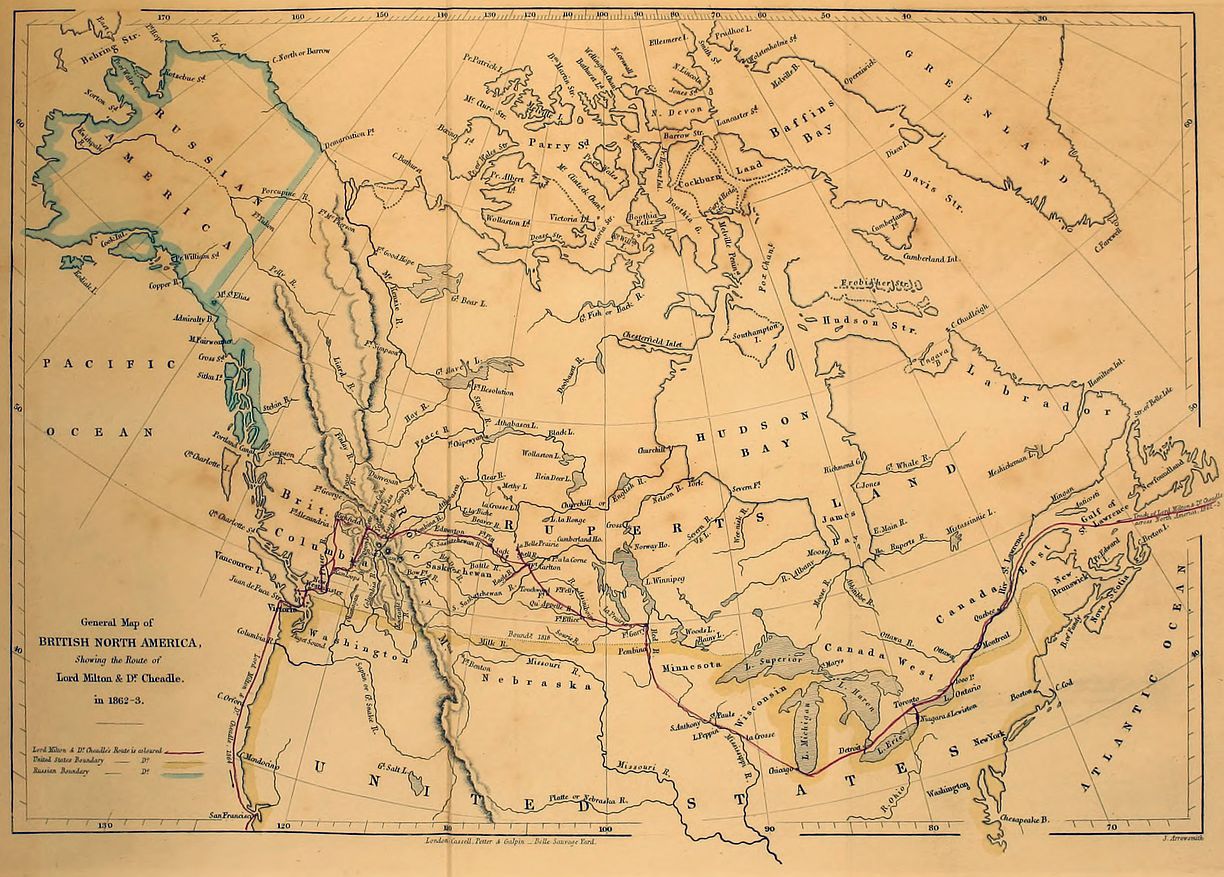
General Map of British North America, showing the Authors’ Route across the Continent(Bound with Volume.)
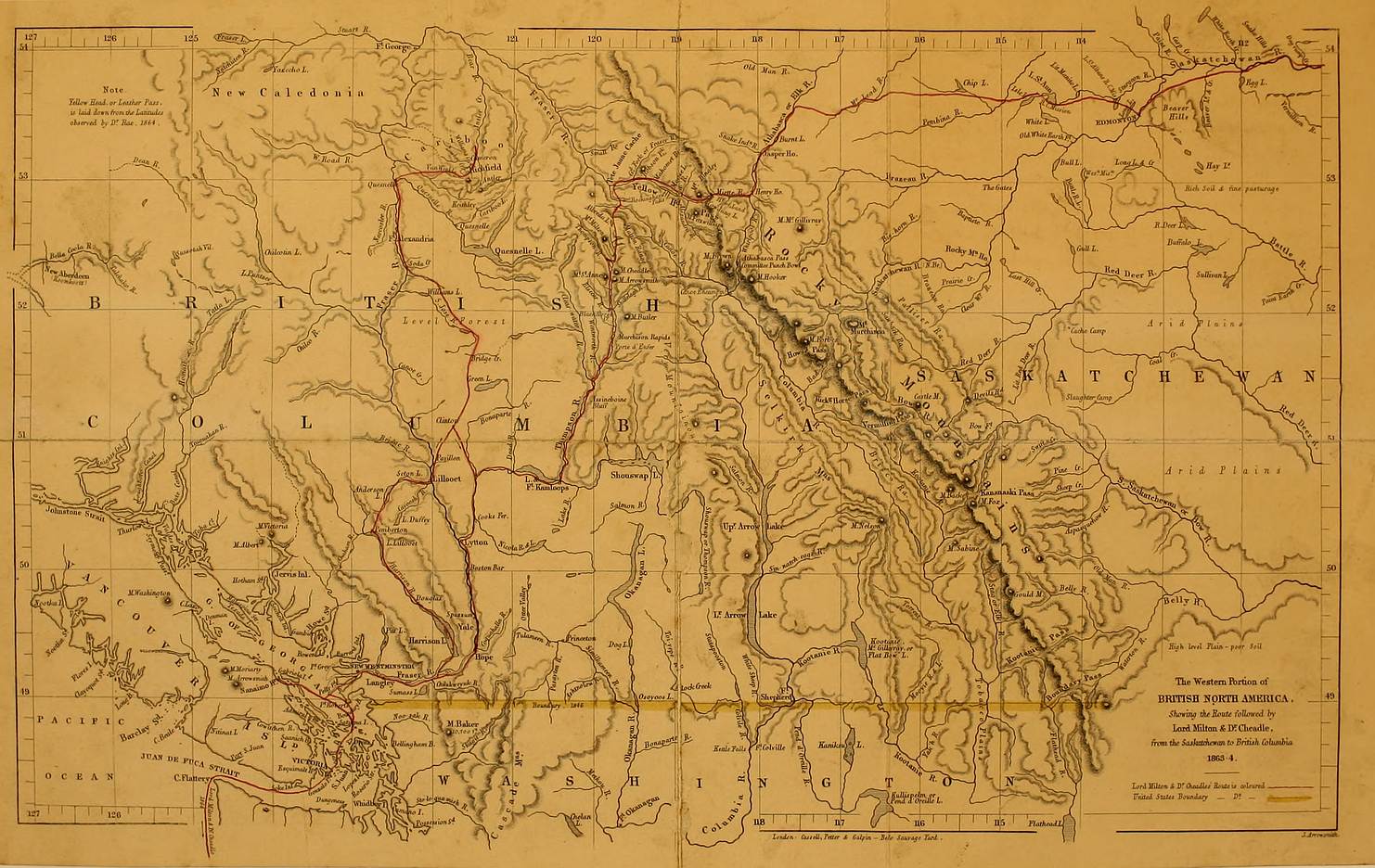
Map of the Western Portion of British North America, showing the Route across the Rocky Mountains by the Yellow Head, or, Leather Pass into British Columbia, on a larger scale.(In the Pocket.)
PREFACE.
The following pages contain the narrative of an
Expedition across the Continent of North America,
through the Hudson’s Bay Territories, into British
Columbia, by one of the northern passes in the
Rocky Mountains. The expedition was undertaken
with the design of discovering the most direct route
through British territory to the gold regions of
Cariboo, and exploring the unknown country on the
western flank of the Rocky Mountains, in the neighbourhood
of the sources of the north branch of the
Thompson River.
The Authors have been anxious to give a faithful
account of their travels and adventures amongst the
prairies, forests, and mountains of the Far West, and
have studiously endeavoured to preserve the greatest
accuracy in describing countries previously little
known. But one of the principal objects they have
had in view has been to draw attention to the
vast importance of establishing a highway from the
Atlantic to the Pacific through the British possessions;
not only as establishing a connection between
the different English colonies in North America,
but also as affording a means of more rapid and
direct communication with China and Japan.
Another advantage which would follow—no less
important than the preceding—would be the
opening out and colonisation of the magnificent
regions of the Red River and Saskatchewan, where
65,000 square miles of a country of unsurpassed
fertility, and abounding in mineral wealth, lies
isolated from the world, neglected, almost unknown,
although destined, at no distant period perhaps, to
become one of the most valuable possessions of
the British Crown.
The idea of a route across the northern part
of the Continent is not a new one. The project
was entertained by the early French settlers in
Canada, and led to the discovery of the Rocky
Mountains. It has since been revived and ably
advocated by Professor Hind and others, hitherto
without success.
The favourite scheme of geographers in this
country for the last three centuries has been the
discovery of a North-West Passage by sea, as the
shortest route to the rich countries of the East.
The discovery has been made, but in a commercial
point of view it has proved valueless. We have
attempted to show that the original idea of the
French Canadians was the right one, and that the
true North-West Passage is by land, along the
fertile belt of the Saskatchewan, leading through
British Columbia to the splendid harbour of Esquimalt,
and the great coal-fields of Vancouver Island,
which offer every advantage for the protection and
supply of a merchant fleet trading thence to India,
China, and Japan.
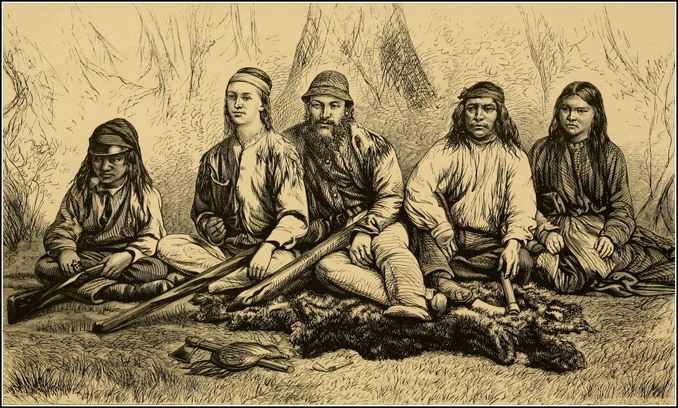
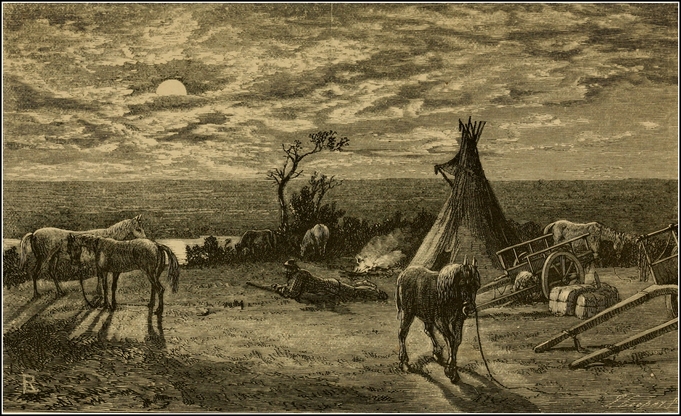
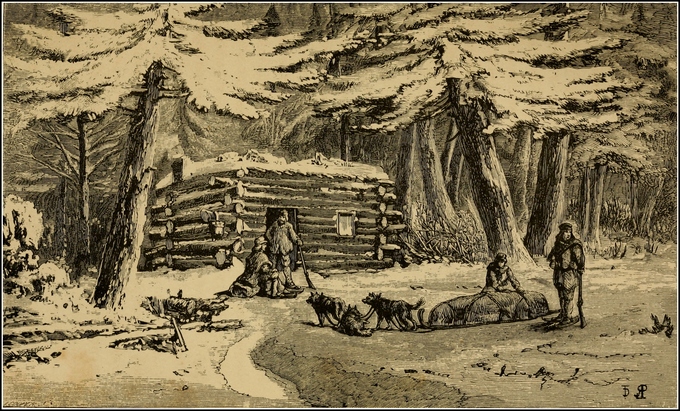
The Illustrations of this Work are taken almost
entirely from photographs and sketches taken on the
spot, and will, it is hoped, possess a certain value
and interest, as depicting scenes never before drawn
by any pencil, and many of which had never previously
been visited by any white man, some of them
not even by an Indian. Our most cordial thanks are
due to Mr. R. P. Leitch, and Messrs. Cooper and
Linton, for the admirable manner in which they
have been executed; and to Mr. Arrowsmith, for the
great care and labour he has bestowed on working
out the geography of a district heretofore so imperfectly
known. We also beg to acknowledge the
very great obligations under which we lie to Sir
James Douglas, late Governor of British Columbia
and Vancouver Island; Mr. Donald Fraser, of
Victoria; and Mr. McKay, of Kamloops, for much
valuable information concerning the two colonies,
and who, with many others, showed us the greatest
kindness during our stay in those countries.
The Western Portion of
BRITISH NORTH AMERICA. Showing the Route followed by
Lord Milton & Dr. Cheadle.
from the Saskatchewan to British Columbia
1863–4.
THE NORTH-WEST PASSAGE BY LAND.
CHAPTER I.
Sail for Quebec—A Rough Voyage—Our Fellow-Passengers—The
Wreck—Off the Banks of Newfoundland—Quebec—Up the St.
Lawrence—Niagara—The Captain and the Major—Westward
Again—Sleeping Cars—The Red Indian—Steaming up the Mississippi—Lake
Pippin—Indian Legend—St. Paul, Minnesota—The
Great Pacific Railroad—Travelling by American Stage-Wagon—The
Country—Our Dog Rover—The Massacre of the Settlers
by the Sioux—Culpability of the United States Government—The
Prairie—Shooting by the Way—Reach Georgetown.
On the 19th of June, 1862, we embarked in the
screw-steamer Anglo-Saxon, bound from Liverpool to
Quebec. The day was dull and murky; and as the
trader left the landing-stage, a drizzling rain began to
fall. This served as an additional damper to our
spirits, already sufficiently low at the prospect of
leaving home for a long and indefinite period. Unpleasant
anticipations of ennui, and still more bodily
suffering, had risen up within the hearts of both of
us—for we agree in detesting a sea-voyage, although
not willing to go the length of endorsing the confession
wrung from that light of the American
Church—the Rev. Henry Ward Beecher—by the
agonies of sea-sickness, that “those whom God
hateth he sendeth to sea.”
We had a very rough passage, fighting against
head winds nearly all the way; but rapidly getting
our sea-legs, we suffered little from ennui, being
diverted by our observations on a somewhat curious
collection of fellow-passengers. Conspicuous amongst
them were two Romish bishops of Canadian sees, on
their return from Rome, where they had assisted at
the canonisation of the Japanese martyrs, and each
gloried in the possession of a handsome silver medal,
presented to them by his Holiness the Pope for their
eminent services on that occasion. These two dignitaries
presented a striking contrast. One, very tall
and emaciated, was the very picture of an ascetic,
and passed the greater part of his time in the cabin
reading his missal and holy books. His inner man
he satisfied by a spare diet of soup and fish, gratifying
to the full no carnal appetite except that for snuff,
which he took in prodigious quantity, and avoiding
all society except that of his brother bishop. The
latter, “a round, fat, oily man of God,” of genial
temper, and sociable disposition, despised not the good
things of this world, and greatly affected a huge
meerschaum pipe, from which he blew a cloud with
great complacency. As an antidote to them, we
had an old lady afflicted with Papophobia, who
caused us much amusement by inveighing bitterly
against the culpable weakness of which Her Majesty
the Queen had been guilty, in accepting the present
of a side-board from Pius IX. A Canadian colonel,
dignified, majestic, and speaking as with authority,
discoursed political wisdom to an admiring and
obsequious audience. He lorded it over our little
society for a brief season, and then suddenly disappeared.
Awful groans and noises, significant of
sickness and suffering, were heard proceeding from
his cabin. But, at last, one day when the weather
had moderated a little, we discovered the colonel once
more on deck, but, alas! how changed. His white
hat, formerly so trim, was now frightfully battered;
his cravat negligently tied; his whole dress slovenly.
He sat with his head between his hands, dejected,
silent, and forlorn.
The purser, a jolly Irishman, came up at the
moment, and cried, “Holloa, colonel! on deck? Glad
to see you all right again.”
“All right, sir!” cried the colonel, fiercely; “all
right, sir? I’m not all right. I’m frightfully ill, sir!
I’ve suffered the tortures of the—condemned; horrible
beyond expression; but it’s not the pain I complain
of; that, sir, a soldier like myself knows how to
endure. But I’m thoroughly ashamed of myself, and
shall never hold up my head again!”
“My dear sir,” said the purser, soothingly, with a
sly wink at us, “what on earth have you been doing?
There is nothing, surely, in sea-sickness to be ashamed
of.”
“I tell you, sir,” said the colonel, passionately,
“that it’s most demoralising! Think of a man of my
years, and of my standing and position, lying for
hours prone on the floor, with his head over a basin,
making a disgusting beast of himself in the face of
the company! I’ve lost my self-respect, sir; and I
shall never be able to hold up my head amongst my
fellow-men again!”
As he finished speaking, he again dropped his
head between his hands, and thus did not observe the
malicious smile on the purser’s face, or notice the suppressed
laughter of the circle of listeners attracted
round him by the violence of his language.
The young lady of our society—for we had but
one—was remarkable for her solitary habits and
pensive taciturnity. When we arrived at Quebec
harbour, a most extraordinary change came over her;
and we watched her in amazement, as she darted
restlessly up and down the landing-stage in a state of
the greatest agitation, evidently looking for some one
who could not be found. In vain she searched, and
at last rushed off to the telegraph office in a state of
frantic excitement. Later the same day we met her
at the hotel, seated by the side of a young gentleman,
and as placid as ever. It turned out that she had
come over to be married, but her lover had arrived too
late to meet her; he, however, had at last made his
appearance, and honourably fulfilled his engagement.
A wild Irishman, continually roaring with laughter, a
Northern American, rabid against “rebels,” and
twenty others, made up our list of cabin passengers.
Out of these we beg to introduce, as Mr. Treemiss, a
gentleman going out like ourselves, to hunt buffalo on
the plains, and equally enthusiastic in his anticipations
of a glorious life in the far West. We soon struck
up an intimate acquaintance, and agreed to travel in
company as far as might be agreeable to the plans of
each.
Before we reached the banks of Newfoundland
we fell in with numerous evidences of a recent storm;
a quantity of broken spars floated past, and a dismasted
schooner, battered and deserted by her crew.
On her stern was the name Ruby, and the stumps of
her masts bore the marks of having been recently
cut away.
Off the “banks” we encountered a fog so dense
that we could not see twenty yards ahead. The steam
whistle was blown every five minutes, and the lead
kept constantly going. The ship crashed through
broken ice, and we all strained our eyes for the first
sight of some iceberg looming through the mist. A
steamer passed close to us, her proximity being betrayed
only by the scream of her whistle. Horrible
stories of ships lost with all hands on board, from
running against an iceberg, or on the rock-bound
coast, became the favourite topic of conversation
amongst the passengers; the captain looked anxious,
and every one uncomfortable.
After two days, however, we emerged in safety
from the raw, chilling fogs into clear sunlight at the
mouth of the St. Lawrence, and on the 2nd of July
steamed up the river to Quebec. The city of Quebec,
with its bright white houses, picked out with green,
clinging to the sides of a commanding bluff, which
appears to rise up in the middle of the great river so
as to bar all passage, has a striking beauty beyond
comparison. We stayed but to see the glorious
plains of Abraham, and then hastened up the St.
Lawrence by Montreal, through the lovely scenery of
the “Thousand Islands,” and across Lake Ontario to
Toronto.
We determined to spend a day at Niagara, and,
taking another steamer here, passed over to Lewiston,
on the American side of the lake, at the mouth
of the Niagara River. From Lewiston a railway
runs to within a mile of the Falls, following the
edge of the precipitous cliffs on the east side of the
narrow ravine, through which the river rushes to
pour itself into Lake Ontario. Glad to escape the
eternal clanging of the engine bell warning people to
get out of the way as the train steamed along the
streets, we walked across the suspension bridge to the
Canadian side of the river, and forward to the Clifton
House. We heard the roar of the cataract soon
after leaving the station, and caught glimpses of it
from time to time along the road; but at last we
came out into the open, near the hotel, and saw, in
full view before us, the American wonder of the
world. Our first impression was certainly one of
disappointment. Hearing so much from earliest
childhood of the great Falls of Niagara, one forms a
most exaggerated conception of their magnitude and
grandeur. But the scene rapidly began to exercise a
charm over us, and as we stood on the edge of the
Horseshoe Fall, on the very brink of the precipice
over which the vast flood hurls itself, we confessed
the sublimity of the spectacle. We returned continually
to gaze on it, more and more fascinated, and
in the bright clear moonlight of a beautiful summer’s
night, viewed the grand cataract at its loveliest time.
But newer subjects before us happily forbid any
foolish attempt on our part to describe what so many
have tried, but never succeeded, in painting either
with pen or pencil. On the Lewiston steamer we
had made the acquaintance of Captain ——, or,
more properly speaking, he had made ours. The
gallant captain was rather extensively got up, his
face smooth shaven, with the exception of the upper
lip, which was graced with a light, silky moustache.
He wore a white hat, cocked knowingly on
one side, and sported an elegant walking cane; the
blandest of smiles perpetually beamed on his countenance,
and he accosted us in the most affable and
insinuating manner, with some remark about the heat of
the weather. Dextrously improving the opening thus
made, he placed himself in a few minutes on the most
intimate terms. Regretting exceedingly that he had
not a card, he drew our attention to the silver mounting
on his cane, whereon was engraved, “Captain
——, of ——.” Without further inquiry as to who
we were, he begged us to promise to come over and
stay with him at his nice little place, and we should have
some capital “cock shooting” next winter. The polite
captain then insisted on treating us to mint-juleps at
the bar, and there introduced us with great ceremony
to a tall, angular man, as Major So-and-so, of the
Canadian Rifles.
The major was attired in a very seedy military
undress suit, too small and too short for him, and he
carried, like Bardolph, a “lantern in the poop,”
which shone distinct from the more lurid and darker
redness of the rest of his universally inflamed features.
His manner was rather misty, yet solemn and grand
withal, and he comported himself with so much
dignity, that far was it from us to smile at his peculiar
personal appearance. We all three bowed and
shook hands with him with an urbanity almost equal
to that of our friend the captain.
Both our new acquaintances discovered that they
were going to the same place as ourselves, and
favoured us with their society assiduously until we
reached the Clifton House.
After viewing the Falls, we had dinner; and then
the captain and major entertained us with extraordinary
stories.
The former related how he had lived at the Cape
under Sir Harry Smith, ridden one hundred and fifty
miles on the same horse in twenty-four hours, and
various other feats, while the “major” obscurely
hinted that he owed his present important command on
the frontier to the necessity felt by the British Government
that a man of known courage and talent should
be responsible during the crisis of the Trent affair.
We returned to Toronto the next day, and lost no
time in proceeding on our way to Red River, travelling
as fast as possible by railway through Detroit
and Chicago to La Crosse, in Wisconsin, on the banks
of the Mississippi.
We found the sleeping-cars a wonderful advantage
in our long journeys, and generally travelled
by night. A “sleeping-car” is like an ordinary
railway carriage, with a passage down the centre, after
the American fashion, and on each side two tiers of
berths, like those of a ship. You go “on board,”
turn in minus coat and boots, go quietly to sleep, and
are awakened in the morning by the attendant nigger,
in time to get out at your destination. You have had
a good night’s rest, find your boots ready blacked, and
washing apparatus at one end of the car, and have the
satisfaction of getting over two hundred or three hundred
miles of a wearisome journey almost without
knowing it. The part of the car appropriated to
ladies is screened off from the gentlemen’s compartment
by a curtain; but on one occasion, there being
but two vacant berths in the latter, Treemiss was, by
special favour, admitted to the ladies’ quarter, where
ordinarily only married gentlemen are allowed—two
ladies and a gentleman kindly squeezing into one
large berth to accommodate him!
At one of the small stations in Wisconsin we met
the first Red Indian we had seen in native dress. He
wore leather shirt, leggings, and moccasins, a blanket
thrown over his shoulders, and his bold-featured,
handsome face was adorned with paint. He was
leaning against a tree, smoking his pipe with great
dignity, not deigning to move or betray the slightest
interest as the train went past him. We could not
help reflecting—as, perhaps, he was doing—with
something of sadness upon the changes which had
taken place since his ancestors were lords of the
soil, hearing of the white men’s devices as a strange
thing, from the stories of their greatest travellers,
or some half-breed trapper who might occasionally
visit them. And we could well imagine the disgust
of these sons of silence and stealth at the noisy trains
which rush through the forests, and the steamers
which dart along lakes and rivers, once the favourite
haunt of game, now driven far away. How bitterly
in their hearts they must curse that steady, unfaltering,
inevitable advance of the great army of whites,
recruited from every corner of the earth, spreading
over the land like locusts—too strong to resist, too
cruel and unscrupulous to mingle with them in peace
and friendship!
At La Crosse we took steamer up the Mississippi—in
the Indian language, the “Great River,” but
here a stream not more than 120 yards in width—for
St. Paul, in Minnesota. The river was very low, and
the steamer—a flat-bottomed, stern-wheel boat, drawing
only a few inches of water—frequently stuck fast
on the sand bars, giving us an opportunity of seeing
how an American river-boat gets over shallows. Two
or three men were immediately sent overboard, to fix
a large pole. At the top was a pulley, and through
this a stout rope was run, one end of which was
attached to a cable passed under the boat, the other
to her capstan. The latter was then manned, the
vessel fairly lifted up, and the stern wheel being put
in motion at the same time, she swung over the shoal
into deep water.
The scenery was very pretty, the river flowing
in several channels round wooded islets; along
the banks were fine rounded hills, some heavily
timbered, others bare and green. When we reached
Lake Pippin, an expansion of the Mississippi, some
seven or eight miles long, and perhaps a mile in
width, we found a most delightful change from the
sultry heat we had experienced when shut up in the
narrow channel. Here the breeze blew freshly over
the water, fish splashed about on every side, and
could be seen from the boat, and we were in the
midst of a beautiful landscape. Hills and woods surround
the lake; and, about half way, a lofty cliff,
called the “Maiden’s Rock,” stands out with bold
face into the water. It has received its name from an
old legend that an Indian maiden, preferring death to
a hated suitor forced upon her by her relatives, leaped
from the top, and was drowned in the lake below.
Beyond Lake Pippin the river became more shallow
and difficult, and we were so continually delayed by
running aground that we did not reach St. Paul until
several hours after dark.
St. Paul, the chief city of the State of Minnesota,
is the great border town of the North Western States.
Beyond, collections of houses called cities dwindle
down to even a single hut—an outpost in the wilderness.
One of these which we passed on the road,
a solitary house, uninhabited, rejoiced in the name of
“Breckenridge City;” and another, “Salem City,”
was little better.
From St. Paul a railway runs westward to St.
Anthony, six miles distant—the commencement of
the Great Pacific Railroad, projected to run across to
California, and already laid out far on to the plains.
From St. Anthony a “stage” wagon runs through
the out-settlements of Minnesota as far as Georgetown,
on the Red River. There we expected to find a
steamer which runs fortnightly to Fort Garry, in the
Red River Settlement. The “stage,” a mere covered
spring-wagon, was crowded and heavily laden. Inside
were eight full-grown passengers and four children;
outside six, in addition to the driver; on the roof an
enormous quantity of luggage; and on the top of all
were chained two huge dogs—a bloodhound and Newfoundland—belonging
to Treemiss. Milton and Treemiss
were fortunate enough to secure outside seats,
where, although cramped and uncomfortable, they could
still breathe the free air of heaven; but Cheadle was
one of the unfortunate “insides,” and suffered tortures
during the first day’s journey. The day was frightfully
hot, and the passengers were packed so tightly,
that it was only by the consent and assistance of his
next neighbour that he could free an arm to wipe the
perspiration from his agonised countenance. Mosquitoes
swarmed and feasted with impunity on the helpless
crowd, irritating the four wretched babies into an
incessant squalling, which the persevering singing of
their German mothers about Fatherland was quite ineffectual
to assuage. Two female German Yankees
kept up an incessant clack, “guessing” that the
“Young Napoleon” would soon wipe out Jeff. Davis;
in which opinion two male friends of the same race
perfectly agreed. The dogs kept tumbling off their
slippery perch, and hung dangling by their chains at
either side, half strangled, until hauled back again
with the help of a “leg up” from the people inside.
This seventy mile drive to St. Cloud, where we stayed
the first night, was the most disagreeable experience
we had. There six of the passengers left us, but
the two German women, with the four babies they
owned between them, still remained. The babies were
much more irritable than ever the next day, and their
limbs and faces, red and swollen from the effects of
mosquito bites, showed what good cause they had for
their constant wailings.
The country rapidly became more open and level—a
succession of prairies, dotted with copses of wild
poplar and scrub oak. The land appeared exceedingly
fertile, and the horses and draught oxen most
astonishingly fat. Sixty-five miles of similar country
brought us, on the second night after leaving St.
Paul, to the little settlement of Sauk Centre. As it
still wanted half an hour to sundown when we
arrived, we took our guns and strolled down to some
marshes close at hand in search of ducks, but were
obliged to return empty-handed, for although we shot
several we could not get them out of the water without
a dog, the mosquitoes being so rampant, that
none of us felt inclined to strip and go in for them.
We were very much disappointed, for we had set our
hearts on having some for supper, as a relief to the
eternal salt pork of wayside houses in the far West.
On our return to the house where we were staying,
we bewailed our ill-luck to our host, who remarked
that had he known we were going out shooting, he
would have lent us his own dog, a capital retriever.
He introduced us forthwith to “Rover,” a dapper-looking,
smooth-haired dog, in colour and make like a
black and tan terrier, but the size of a beagle. When
it is known from the sequel of this history how important
a person Rover became, how faithfully he
served us, how many meals he provided for us, and
the endless amusement his various accomplishments
afforded both to ourselves and the Indians we met
with, we shall perhaps be forgiven for describing
him with such particularity. Amongst our Indian
friends he became as much beloved as he was hated
by their dogs. These wolf-like animals he soon
taught to fear and respect him by his courageous and
dignified conduct; for although small of stature, he
possessed indomitable pluck, and had a method of
fighting quite opposed to their ideas and experience.
Their manner was to show their teeth, rush in and
snap, and then retreat; while he went in and grappled
with his adversary in so determined a manner, that the
biggest of them invariably turned tail before his vigorous
onset. Yet Rover was by no means a quarrelsome
dog. He walked about amongst the snarling
curs with tail erect, as if not noticing their presence;
and probably to this fearless demeanour he owed
much of his immunity from attack. He appeared so
exactly suited for the work we required, and so
gained our hearts by his cleverness and docility, that
next morning we made an offer of 25 dollars for him.
The man hesitated, said he was very unwilling to
part with him, and, indeed, he thought his wife and
sister would not hear of it. If, however, they could
be brought to consent, he thought he could not afford
to refuse so good an offer, for he was very short of
money.
He went out to sound the two women on the
subject, and they presently rushed into the room; one
of them caught up Rover in her arms, and, both bursting
into floods of tears, vehemently declared nothing
would induce them to part with their favourite. We
were fairly vanquished by such a scene, and slunk
away, feeling quite guilty at having proposed to
deprive these poor lonely women of one of the few
creatures they had to lavish their wealth of feminine
affection upon.
As we were on the point of starting, however, the
man came up, leading poor Rover by a string, and
begged us to take him, as he had at last persuaded
the women to let him go. We demurred, but he
urged it so strongly that we at length swallowed our
scruples, and paid the money. As we drove off, the
man said good-bye to him, as if parting with his
dearest friend, and gave us many injunctions to “be
kind to the little fellow.” This we most solemnly
promised to do, and it is almost needless to state,
we faithfully kept our word.
A fortnight afterwards, these kindly people—in
common with nearly all the whites in that part of
Minnesota—suffered a horrible death at the hands of
the invading Sioux. This fearful massacre, accompanied
as it was by all the brutalities of savage
warfare, was certainly accounted for, if not excused,
or even justified, by the great provocation they had
received. The carelessness and injustice of the
American Government, and the atrocities committed
by the troops sent out for the protection of the
frontier, exasperated the native tribes beyond control.
Several thousand Indians—men, women, and children—assembled
at Forts Snelling and Abercrombie, at
a time appointed by the Government themselves, to
receive the yearly subsidy guaranteed to them in
payment for lands ceded to the United States. Year
after year, either through the neglect of the officials
at Washington, or the carelessness or dishonesty of
their agents, the Indians were detained there for
weeks, waiting to receive what was due to them.
Able to bring but scanty provision with them—enough
only for a few days—and far removed from
the buffalo, their only means of subsistence, they
were kept there in 1862 for nearly six weeks in
fruitless expectation. Can it be a matter of surprise
that, having been treated year by year in
the same contemptuous manner, starving and destitute,
the Sioux should have risen to avenge themselves
on a race hated by all the Indians of the
West?
Unconscious of the dangers gathering round, and
little suspecting the dreadful scenes so shortly to be
enacted in this region, we drove merrily along in
the stage. As we went farther west, the prairies
became more extensive, timber more scarce, and
human habitations more rare. Prairie chickens and
ducks were plentiful along the road, and the driver
obligingly pulled up to allow us to have a shot
whenever a chance occurred. On the third day we
struck Red River, and stayed the night at Fort Abercrombie;
and the following day, the 18th of July,
arrived at Georgetown. The stage did not run
beyond this point, and the steamer, by which we
intended to proceed to Fort Garry, was not expected
to come in for several days, so that we had every
prospect of seeing more of Georgetown than we
cared for.
CHAPTER II.
Georgetown—Minnesota Volunteers—The Successful Hunters—An
Indian Hag—Resolve to go to Fort Garry in Canoes—Rumours
of a Sioux Outbreak—The Half-breeds refuse to Accompany us—Prepare
to Start Alone—Our Canoes and Equipment—A Sioux
War Party—The Half-breed’s Story—Down Red River—Strange
Sights and Sounds—Our First Night Out—Effects of the Sun and
Mosquitoes—Milton Disabled—Monotony of the Scenery—Leaky
Canoes—Travelling by Night—The “Oven” Camp—Hunting
Geese in Canoes—Meet the Steamer—Milton’s Narrow Escape—Treemiss
and Cheadle follow Suit—Carried Down the Rapids—Vain
Attempts to Ascend—A Hard Struggle—On Board at last—Start
once more—Delays—Try a Night Voyage Again—The
“Riband Storm”—“In Thunder, Lightning, and in Rain”—Fearful
Phenomena—Our Miserable Plight—No Escape—Steering
in Utter Darkness—Snags and Rocks—A Long Night’s
Watching—No Fire—A Drying Day—Another Terrible Storm—And
Another—Camp of Disasters—Leave it at last—Marks of the
Fury of the Storms—Provisions at an End—Fishing for Gold-eyes—A
Day’s Fast—Slaughter of Wild-Fowl—Our Voracity—A
Pleasant Awakening—Caught up by the Steamer—Pembina—Fort
Garry—La Ronde—We go under Canvass.
The little settlement of Georgetown is placed under
cover of the belt of timber which clothes the banks of
the river, while to the south and east endless prairie
stretches away to the horizon. The place is merely
a trading post of the Hudson’s Bay Company, round
which a few straggling settlers have established themselves.
A company of Minnesota Volunteers was
stationed here for the protection of the settlement
against the Sioux. They were principally Irish or
German Yankees; i.e., emigrants, out-Heroding Herod
in Yankeeism, yet betraying their origin plainly
enough. These heroes, slovenly and unsoldier-like,
yet full of swagger and braggadocio now, when the
Sioux advanced to the attack on Port Abercrombie, a
few weeks afterwards, took refuge under beds, and
hid in holes and corners, from whence they had
to be dragged by their officers, who drew them out
to face the enemy by putting revolvers to their
heads.
On the day of our arrival two half-breeds came
in from a hunting expedition in which they had been
very successful. They had found a band of twenty
elk, out of which they killed four, desisting, according
to their own account, from shooting more from
a reluctance to waste life and provision!—a piece of
consideration perfectly incomprehensible in a half-breed
or Indian. We went down to their camp by
the river, where they were living in an Indian
“lodge,” or tent of skins stretched over a cone of
poles. Squatted in front of it, engaged in cutting
the meat for drying, was the most hideous old hag
ever seen. Lean, dried-up, and withered, her parchment
skin was seamed and wrinkled into folds and
deep furrows, her eyes were bleared and blinking,
and her long, iron-grey hair, matted and unkempt,
hung over her shoulders. She kept constantly
muttering, and showing her toothless gums, as she
clawed the flesh before her with long, bony, unwashed
fingers, breaking out occasionally into wild, angry
exclamations, as she struck at the skeleton dogs which
attempted to steal some of the delicate morsels strewn
around.
Finding upon inquiry that, in consequence of the
lowness of the water, it was very uncertain when the
steamer would arrive, if she ever reached Georgetown
at all, we decided to make the journey to Fort Garry
in canoes. The distance is above five hundred miles
by the river, which runs through a wild and unsettled
country, inhabited only by wandering tribes of Sioux,
Chippeways, and Assiniboines. After much bargaining,
we managed to obtain two birch-bark canoes from
some half-breeds. One of them was full of bullet
holes, having been formerly the property of some
Assiniboines, who were waylaid by a war party of
Sioux whilst descending the river the previous
summer, and mercilessly shot down from the bank,
where their enemies lay in ambush. The other was
battered and leaky, and both required a great deal of
patching and caulking before they were rendered
anything like water-tight. We endeavoured to engage
a guide, half-breed or Indian, but none would go with
us. The truth was that rumours were afloat of the
intended outbreak of the Sioux, and these cowards
were afraid. One man, indeed—a tall, savage-looking
Iroquois, just recovering from the effects of a week’s
debauch on corn whisky—expressed his readiness to go
with us, but his demands were so exorbitant, that we
refused them at once. We offered him one-half what
he had asked, and he went off to consult his squaw,
promising to give us an answer next day.
We did not take very large supplies of provisions
with us, as we expected not to be more than eight or
ten days on our voyage, and knew that we should
meet with plenty of ducks along the river. We
therefore contented ourselves with twenty pounds of
flour, and the same of pemmican, with about half as
much salt pork, some grease, tinder, and matches, a
small quantity of tea, salt, and tobacco, and plenty of
ammunition. A tin kettle and frying-pan, some
blankets and a waterproof sheet, a small axe, and a
gun and hunting-knife apiece, made up the rest of our
equipment.
Whilst we were completing our preparations,
another half-breed came in, in a great state of excitement,
with the news that a war party of Sioux were
lurking in the neighbourhood. He had been out
looking for elk, when he suddenly observed several
Indians skulking in the brushwood; from their paint
and equipment he knew them to be Sioux on the war-path.
They did not appear to have perceived him,
and he turned and fled, escaping to the settlement
unpursued. We did not place much reliance on his
story, or the various reports we had heard, and set out
the next day alone. How fearfully true these rumours
of the hostility of the Sioux, which we treated so
lightly at the time, turned out to be, is already known
to the reader. As we got ready to start, the Iroquois
sat on the bank, smoking sullenly, and showing
neither by word nor sign any intention of accepting
our offer of the previous day. Milton and Rover
occupied the smaller canoe, while Treemiss and Cheadle
navigated the larger one. At first we experienced
some little difficulty in steering, and were rather
awkward in the management of a paddle. A birch-bark
canoe sits so lightly on the water, that a puff
of wind drives it about like a walnut-shell; and
with the wind dead ahead, paddling is very slow
and laborious. But we got on famously after a
short time, Milton being an old hand at the work,
and the others accustomed to light and crank craft
on the Isis and the Cam. We glided along pleasantly
enough, lazily paddling or floating quietly down the
sluggish stream. The day was hot and bright, and
we courted the graceful shade of the trees which overhung
the bank on either side. The stillness of the
woods was broken by the dip of our paddles, the
occasional splash of a fish, or the cry of various
birds. The squirrel played and chirruped among
the branches of the trees, the spotted woodpecker
tapped on the hollow trunk, while, perched high on
the topmost bough of some withered giant of the
forest, the eagle and the hawk uttered their harsh and
discordant screams. Here and there along the banks
swarms of black and golden orioles clustered on the
bushes, the gaily-plumed kingfisher flitted past, ducks
and geese floated on the water, and the long-tailed
American pigeon darted like an arrow high over the
tree-tops. As night approached, a hundred owls
hooted round us; the whip-poor-will startled us with
its rapid, reiterated call; and the loon—the most
melancholy of birds—sent forth her wild lamentations
from some adjoining lake. Thoroughly did
we enjoy these wild scenes and sounds, and the
strange sensation of freedom and independence which
possessed us.
Having shot as many ducks as we required, we
put ashore at sundown, and drawing our canoes out
of the water into the bushes which fringed the river-bank,
safe from the eye of any wandering or hostile
Indian, we encamped for the night on the edge of the
prairie. It became quite dark before we had half
completed our preparations, and we were dreadfully
bothered, in our raw inexperience, to find dry wood for
the fire, and do the cooking. However, we managed
at last to pluck and split open the ducks into “spread-eagles,”
roasting them on sticks, Indian fashion, and
these, with some tea and “dampers,” or cakes of
unleavened bread, furnished a capital meal. We then
turned into our blankets, sub Jove—for we had no
tent;—but the tales we had heard of prowling Sioux
produced some effect, and a half-wakeful watchfulness
replaced our usual sound slumbers.
We often recalled afterwards how one or other of
us suddenly sat up in bed and peered into the darkness
at any unusual sound, or got up to investigate
the cause of the creakings and rustlings frequently
heard in the forest at night, but which might have
betrayed the stealthy approach of an Indian enemy.
Mosquitoes swarmed and added to our restlessness.
In the morning we all three presented an abnormal
appearance, Milton’s arms being tremendously blistered,
red, and swollen, from paddling with them
bare in the scorching sun; and Treemiss and Cheadle
exhibiting faces it was impossible to recognise, so
wofully were they changed by the swelling of mosquito
bites.
Milton was quite unable to use a paddle for several
days, and his canoe was towed along by Treemiss and
Cheadle. This, of course, delayed us considerably,
and the delight we had experienced during the first
few days’ journey gradually gave place to a desire for
change.
Red River, flowing almost entirely through prairie
land, has hollowed out for itself a deep channel in the
level plains, the sloping sides of which are covered
with timber almost to the water’s edge. The unvarying
sameness of the river, and the limited prospect
shut in by rising banks on either side, gave a monotony
to our daily journey; and the routine of cooking,
chopping, loading and unloading canoes, paddling,
and shooting, amusing enough at first, began to grow
rather tiresome.
The continual leaking of our rickety canoes
obliged us to pull up so frequently to empty them, and
often spend hours in attempting to stop the seams, that
we made very slow progress towards completing the
five hundred miles before us. We therefore thoroughly
overhauled them, and having succeeded in making
them tolerably water-tight, resolved to make an extra
stage, and travel all night. The weather was beautifully
fine, and, although there was no moon, we were
able to steer well enough by the clear starlight.
The night seemed to pass very slowly, and we
nodded wearily over our paddles before the first appearance
of daylight gave us an excuse for landing, which
we did at the first practicable place. The banks were
knee-deep in mud, but we were too tired and sleepy to
search further, and carried our things to drier ground
higher up, where a land-slip from a steep cliff had
formed a small level space a few yards square. The
face of the cliff was semi-circular, and its aspect due
south; not a breath of air was stirring, and as we slept
with nothing to shade us from the fiery rays of the
mid-day sun, we awoke half baked. Some ducks
which we had killed the evening before were already
stinking and half putrid, and had to be thrown away
as unfit for food. We found the position unbearable,
and, reluctantly re-loading our canoes, took to the river
again, and paddled languidly along until evening.
This camp, which we called “The Oven,” was by far
the warmest place we ever found, with the exception
of the town of Acapulco, in Mexico, which stands in
a very similar situation.
A week after we left Georgetown our provisions
fell short, for the pemmican proved worthless, and fell
to the lot of Rover, and we supplied ourselves entirely
by shooting the wild-fowl, which were tolerably
plentiful. The young geese, although almost full-grown
and feathered, were not yet able to fly, but
afforded capital sport. When hotly pursued they
dived as we came near in the canoes, and, if too hardly
pushed, took to the shore. This was generally a fatal
mistake; Milton immediately landed with Rover, who
quickly discovered them lying with merely their heads
hidden in the grass or bushes, and they were then
captured.
When engaged in this exciting amusement one
day, Milton went ahead down stream in chase of a
wounded bird, while Treemiss and Cheadle remained
behind to look after some others which had taken to
the land. The former was paddling away merrily after
his prey, when, at a sudden turn of the river, he came
upon the steamer warping up a shallow rapid. Eager
to get on board and taste the good things we had lately
lacked, he swept down the current alongside the overhanging
deck of the steamer. The stream was rough
and very strong, and its force was increased by the
effect of the stern-wheel of the steamer in rapid motion
in the narrow channel. The canoe was drawn under
the projecting deck, but Milton clung tightly to it, and
the friendly hands of some of the crew seized and
hauled him and his canoe safely on board. The others
following shortly afterwards, and observing the steamer
in like manner, were equally delighted, and dashed
away down stream in order to get on board as quickly
as possible.
The stern-wheel was now stopped, but as they
neared the side it was suddenly put in motion again,
and the canoe carried at a fearful pace past the side of
the boat, sucked in by the whirlpool of the wheel. By
the most frantic exertions, the two saved themselves
from being drawn under, but were borne down the
rapid about a quarter of a mile. Rover attempting a
similar feat, was carried down after them, struggling
vainly against the powerful current. Great was the
wrath of Cheadle and Treemiss against the captain for
the trick he had served them, and they squabbled
no little with each other also, as they vainly strove to
re-ascend the rapid. Three times they made the
attempt, but were as often swept back, and had to commence
afresh. By paddling with all their might they
succeeded in getting within a hundred yards of the
steamer; but at this point, where the stream narrowed
and shot with double force round a sharp turn in
the channel, the head of the canoe was swept round in
spite of all their efforts, and down they went again.
When they were on the eve of giving up in despair,
the other canoe appeared darting down towards them,
manned by two men whose masterly use of the paddle
proclaimed them to be old voyageurs. Coming alongside,
one of them exchanged places with Cheadle, and
thus, each having a skilful assistant, by dint of hugging
the bank, and warily avoiding the strength of the
current, they easily reached the critical point for the
fourth time. Here again was a fierce struggle. Swept
back repeatedly for a few yards, but returning instantly
to the attack, they at last gained the side of the steamer.
The captain kindly stopped half an hour to allow us to
have a good dinner. Finding the steamer would probably
be a week before she returned, we obtained a
fresh stock of flour and salt pork, and went on our
way again. Presently we found Rover, who had got
to land a long way down the stream, and took him on
board again.
After a few days’ slow and monotonous voyaging,
being again frequently obliged to stop in order to repair
our leaky craft, we decided to try a night journey
once more. The night was clear and starlight, but in
the course of an hour or two ominous clouds began to
roll up from the west, and the darkness increased.
We went on, however, hoping that there would be
no storm. But before long, suddenly, as it seemed to
us, the darkness became complete; then, without previous
warning, a dazzling flash of lightning lit up for
a moment the wild scene around us, and almost instantaneously
a tremendous clap of thunder, an explosion
like the bursting of a magazine, caused us to stop
paddling, and sit silent and appalled. A fierce blast of
wind swept over the river, snapping great trees like
twigs on every side; the rain poured down in floods,
and soaked us through and through; flash followed
flash in quick succession, with its accompanying roar of
thunder; whilst at intervals between, a dim, flickering
light, faint and blue, like the flame of a spirit lamp,
or the “Will-o’-the-wisp,” hovered over the surface
of the water, but failed to light up the dense blackness
of the night. With this came an ominous hissing,
like the blast of a steam pipe, varying with the wind,
now sounding near as the flame approached, now more
distant as it wandered away.
We were in the very focus of the storm; the whole
air was charged with electricity, and the changing
currents of the electric fluid, or the shifting winds,
lifted and played with our hair in passing. The smell
of ozone was so pungent that it fairly made us snort
again, and forced itself on our notice amongst the
other more fearful phenomena of the storm. We
made an attempt to land at once, but the darkness
was so intense that we could not see to avoid the
snags and fallen timber which beset the steep, slippery
bank; and the force of the stream bumped us against
them in a manner which warned us to desist, if we
would avoid being swamped or knocking holes in the
paper sides of our frail craft. We had little chance
of escape in that case, for the river was deep, and
it would be almost impossible to clamber up the
slippery face of the bank, even if we succeeded in
finding it, through the utter darkness in which we
were enveloped. There was nothing else for it but
to face it out till daylight, and we therefore fastened
the two canoes together, and again gave ourselves
up to the fury of the storm. We had some difficulty
in bringing the two canoes alongside, but by calling
out to one another, and by the momentary glimpses
obtained during the flashes of lightning, we at last
effected it. Treemiss, crouching in the bows, kept a
sharp look-out, while we, seated in the stern, steered
by his direction. As each flash illuminated the river
before us for an instant, he was able to discern the
rocks and snags ahead, and a vigorous stroke of our
paddles carried us clear during the interval of darkness.
After a short period of blind suspense, the next
flash showed us that we had avoided one danger to
discover another a few yards in front. Hour after
hour passed by, but the storm raged as furiously, and
the rain came down as fast as ever. We looked
anxiously for the first gleam of daylight, but the
night seemed as if it would never come to an end.
The canoes were gradually filling with water, which
had crept up nearly to our waists, and the gunwales
were barely above the surface. It became very doubtful
whether they would float till daybreak.
The night air was raw and cold, and as we sat in
our involuntary hip-bath, with the rain beating upon
us, we shivered from head to foot; our teeth chattered,
and our hands became so benumbed that we could
scarcely grasp the paddles. But we dared not take a
moment’s rest from our exciting work, in watching
and steering clear of the snags and rocks, although we
were almost tempted to give up, and resign ourselves
to chance.
Never will any of us forget the misery of that
night, or the intense feeling of relief we experienced
when we first observed rather a lessening of the
darkness than any positive appearance of light.
Shortly before this, the storm began sensibly to abate;
but the rain poured down as fast as ever when we
hastily landed in the grey morning on a muddy bank,
the first practicable place we came to. Drawing our
canoes high on shore, that they might not be swept off
by the rising flood, we wrapped ourselves in our
dripping blankets, and, utterly weary and worn out,
slept long and soundly.1
When we awoke, the sun was already high,
shining brightly, and undimmed by a single cloud,
and our blankets were already half dry. We therefore
turned out, spread our things on the bushes, and
made an attempt to light a fire. All our matches
and tinder were wet, and we wasted a long time
in fruitless endeavours to get a light by firing pieces
of dried rag out of a gun. Whilst we were thus
engaged, another adventurer appeared, coming down
the river in a “dug-out,” or small canoe hollowed out
of a log. We called out to him as he passed, and
he came ashore, and supplied us with some dry
matches. He had camped in a sheltered place before
sundown, on the preceding evening, and made everything
secure from the rain before the storm came
on. We soon had a roaring fire, and spent the
rest of the day in drying our property and patching
our canoes, which we did caulk most effectually this
time, by plastering strips of our pocket-handkerchiefs
over the seams with pine-gum. But our misfortunes
were yet far from an end. We broke the axe and the
handle of the frying-pan, and were driven to cut
our fire-wood with our hunting-knives, and manipulate
the cooking utensil by means of a cleft stick.
Our expectations of having a good night’s rest
were disappointed. About two hours before daylight
we were awakened by the rumbling of distant thunder,
and immediately jumped up and made everything as
secure as possible. Before very long, a storm almost
as terrible as the one of the night before burst over
us. Our waterproof sheets were too small to keep out
the deluge of water which flooded the ground, and
rushed into our blankets. But we managed to keep
our matches dry, and lighted a fire when the rain
ceased. Meantime, about noon, nearly everything we
had was soaked again, and we had to spend the rest of
the day in drying clothes and blankets as before.
On the third day after our arrival in this camp of
disasters, just as we were nearly ready to start, we
were again visited by a terrible thunder-storm, and once
more reduced to our former wretched plight. Again
we set to work to wring out trousers, shirts, and
blankets, and clean our guns, sulkily enough, almost
despairing of ever getting away from the place where
we had encountered so many troubles.
But the fourth day brought no thunder-storm, nor
did we experience any bad weather for the rest of the
voyage.
We paddled joyfully away from our dismal camp,
and along the river-side saw numerous marks of the
fury of the storm; great trees blown down, or trunks
snapped short off, others torn and splintered by lightning.
The storm had evidently been what is called a
“riband storm,” which had followed the course of the
river pretty closely. The riband storm passes over
only a narrow line, but within these limits is exceedingly
violent and destructive.
We had by this time finished all the provisions we
brought with us, and lived for some days on ducks
and fish. A large pike, of some ten or twelve pounds,
served us for a couple of days, and we occasionally
caught a quantity of gold-eyes, a fish resembling the
dace. Having unfortunately broken our last hook, we
caught them by the contrivance of two needles fastened
together by passing the line through the eyes, and
threading them head first through the bait. One
night found us with nothing but a couple of gold-eyes
for supper, and we were roused very early next morning
by the gnawing of our stomachs. We paddled
nearly the whole day in the hot sun, languid and
weary, and most fearfully hungry. Neither ducks
nor geese were to be seen, and the gold-eyes resisted
all our allurements. We knew that we must be
at least 150 miles from our journey’s end, and
our only hope of escaping semi-starvation seemed to
be the speedy arrival of the steamer. For be it remembered,
that for the whole distance of 450 miles
between Georgetown and Pembina, sixty miles above
Fort Garry, there are no inhabitants except chance
parties of Indians. We were sorely tempted to stop
and rest during the heat of the day, but were urged
on by the hope of finding something edible before
nightfall.
Our perseverance was duly rewarded, for shortly
before sundown we came upon a flock of geese, and a
most exciting chase ensued. Faintness and languor
were forgotten, and we paddled furiously after them,
encouraged by the prospect of a substantial supper.
We killed three geese, and soon after met with a
number of ducks, out of which we shot seven. Before
we could find a place at which to camp, we killed two
more geese, and were well supplied for a couple of days.
We speedily lit a fire, plucked and spitted our game,
and before they were half cooked, devoured them, far
more greedily than if they had been canvass-backs at
Delmonico’s, or the Maison Dorée. The total consumption
at this memorable meal consisted of two
geese and four ducks; but then, as a Yankee would
express it, they were geese and ducks “straight”—i.e.,
without anything else whatever. We slept very
soundly and happily that night, and at daybreak were
awakened by the puffing of the steamer; and running
to the edge of the river, there, sure enough, was the
International. The captain had already caught sight
of us, and stopped alongside; and in a few minutes
we were on board, and engaged in discussing what
seemed to us a most delicious meal of salt pork, bread,
and molasses. We had been sixteen days since leaving
Georgetown, and were not sorry that our canoeing was
over. On the following day we reached Pembina, a
half-breed settlement on the boundary-line between
British and American territory; and the next, being
the 7th of August, arrived at Fort Garry. Directly
we came to anchor opposite the Fort, a number of
people came on board, principally half-breeds, and
amongst them La Ronde, who had been out with
Milton on his previous visit to the plains. He indulged
in the most extravagant demonstrations of
delight at seeing him again, and expressed his readiness
to go with him to the end of the world, if
required.
He informed us that our arrival was expected.
Two men, who had left Georgetown after our departure
from that place, had arrived at Fort Garry some days
before by land, and from the unusually long time we
had been out, serious apprehensions were entertained
for our safety. Indeed, La Ronde had made preparations
to start immediately in search of us, in case we
did not arrive by the steamer. We pitched our tent
near his house, in preference to the unsatisfactory accommodation
of the so-called hotel, and had no
cause to regret having at once commenced life under
canvass.
CHAPTER III.
Fort Garry—Origin of the Red River Settlement—The First Settlers—Their
Sufferings—The North-Westers—The Grasshoppers—The
Blackbirds—The Flood—The Colony in 1862—King Company—Farming
at Red River—Fertility of the Soil—Isolated Position of
the Colony—Obstructive Policy of the Company—Their Just
Dealing and Kindness to the Indians—Necessity for a proper
Colonial Government—Value of the Country—French Canadians
and Half-breeds—Their Idleness and Frivolity—Hunters and
Voyageurs—Extraordinary Endurance—The English and Scotch
Settlers—The Spring and Fall Hunt—Our Life at Fort Garry—Too
late to cross the Mountains before Winter—Our Plans—Men—Horses—Bucephalus—Our
Equipment—Leave Fort Garry—The
“Noce”—La Ronde’s last Carouse—Delightful Travelling—A
Night Alarm—Vital Deserts—Fort Ellice—Delays—Making
Pemmican—Its Value to the Traveller—Swarms of Wild-Fowl—Good
Shooting—The Indian Summer—A Salt Lake Country—Search
for Water—A Horse’s Instinct—South Saskatchewan—Arrive
at Carlton.
Fort Garry—by which we mean the building itself,
for the name of the Fort is frequently used for the
settlement generally—is situated on the north bank of
the Assiniboine river, a few hundred yards above its
junction with Red River. It consists of a square
enclosure of high stone walls, flanked at each angle by
round towers. Within this are several substantial
wooden buildings—the Governor’s residence, the gaol,
and the storehouses for the Company’s furs and goods.
The shop, where articles of every description are sold,
is thronged from morning till night by a crowd of
settlers and half-breeds, who meet there to gossip and
treat each other to rum and brandy, as well as to
make their purchases.
The Red River settlement extends beyond Fort
Garry for about twenty miles to the northward along
the banks of Red River, and about fifty to the westward
along its tributary, the Assiniboine. The
wealthier inhabitants live in large, well-built wooden
houses, and the poorer half-breeds in rough log huts,
or even Indian “lodges.” There are several Protestant
churches, a Romish cathedral and nunnery, and
schools of various denominations. The neighbouring
country is principally open, level prairie, the timber
being confined, with a few exceptions, to the banks of
the streams. The settlement dates from the year
1811, when the Earl of Selkirk purchased from the
Hudson’s Bay Company and the Cree and Sauteux
Indians a large tract of land stretching along both
banks of the Red River and the Assiniboine. The
country was at that time inhabited only by wandering
tribes of Indians, and visited occasionally by the
employés of the North-West and Hudson’s Bay Companies,
who had trading posts in the neighbourhood.
Vast herds of buffalo, now driven far to the west of
Red River, then ranged over its prairies, and frequented
the rich feeding grounds of the present
State of Minnesota, as far as the Mississippi.
The first band of emigrants—Scotch families, sent
out under the auspices of Lord Selkirk—reached the
colony in 1812, and were reinforced by subsequent
detachments until the year 1815. Never did the
pioneers of any new country suffer greater hardships
and discouragements than were experienced by these
unfortunate people during the first seven or eight
years after their arrival. They were attacked by the
Canadians and half-breeds in the employ of the
North-West Fur Company, who looked on them with
jealousy, as protegés of their rivals of the Hudson’s
Bay Company, and were compelled to flee to Pembina.
Here they spent the winter living on the charity of
the Indians and half-breeds, and suffering the greatest
hardships from the scarcity of provisions, and want of
proper protection against the severity of the climate.
When they returned to the colony they were again
attacked by their persevering enemies, the North-Westers,
many of their number shot down, the
rest driven a second time into exile, and their homes
pillaged or burnt. They went back a third time, but
their attempts to live by the cultivation of the soil
were defeated by various misfortunes. Crops promising
to repay them a hundred-fold were devoured
by swarms of grasshoppers, which appeared two years
in succession, and all they were able to save was a
small quantity of seed collected by the women in their
aprons. These insects came in such armies that they lay
in heaps on the ground; fires lighted out of doors were
speedily extinguished by them, the earth stank, and
the waters were polluted with the mass of decomposing
bodies. The grasshoppers disappeared, and
have not since re-visited the colony; but they were
succeeded by myriads of blackbirds, which made
terrible havoc with the grain. It was not until the
year 1821, nine years after the first establishment of
the colony, that these unfortunate settlers succeeded
in reaping to any extent the fruits of their labours.
The North-West Company was at that time amalgamated
with the Hudson’s Bay Company, when the
colonists were left in peace, and have steadily, though
slowly, progressed up to the present time. The only
misfortune which has since occurred to them was a
disastrous flood, which swept away horses, cattle, and
corn-stacks, as well as several of the inhabitants.2
In 1862 we found them a very heterogeneous community
of about eight thousand souls—Englishmen,
Irishmen, Scotchmen, English Canadians, French
Canadians, Americans, English half-breeds, Canadian
half-breeds, and Indians. Nearly the whole population,
with the exception of a few storekeepers and free-traders,
live by the Company, and the Company is
king. The Company makes the laws, buys the produce
of the chase and of the farm, supplying in return
the other necessaries and the luxuries of life.
The farmers of Red River are wealthy in flocks,
and herds, and grain, more than sufficient for their own
wants, and live in comparative comfort. The soil is
so fertile, that wheat is raised year after year on the
same land, and yields fifty and sixty bushels to the
acre, without any manure being required. The pasturage
is of the finest quality, and unlimited in extent.
The countless herds of buffalo which the land has
supported are sufficient evidence of this. But, shut
out in this distant corner of the earth from any communication
with the rest of the world—except an uncertain
one with the young State of Minnesota by
steamer during the summer, and with England by the
Company’s ship which brings stores to York Factory,
in Hudson’s Bay, once a year—the farmers find no
market for their produce.
It is the interest and policy of the Company to
discourage emigration, and keep the country as one
vast preserve for fur-bearing animals. The colony has
therefore been recruited almost entirely from their own
servants, who settle at Fort Garry on their retirement
from the service. It is also their interest to prevent
any trading except through themselves. In 1849
they attempted to enforce their monopoly of the fur
trade, and four half-breeds were arrested for infringement
of the laws by buying furs from the Indians.
The half-breeds rose in arms, and a revolution was
imminent. The trial was not proceeded with, and
since that time they have been content to put every
obstacle in the way of free-trade, by tabooing the
offender, and refusing to furnish him with anything
out of their stores. This obstructive policy keeps
up a continual ill-feeling amongst the independent
population of the settlement, who naturally enough
have little belief in the justice of laws framed, as they
imagine, for the protection of the Company rather than
for the general good. The members of the Legislative
Council, the magistrates, and all other public officers,
are nominated by the Governor.
The Hudson’s Bay Company have, we believe,
exercised their almost absolute power well and justly,
in so far that they have administered with impartiality
the laws which they have made. They have gained
the affection and respect of the Indians by kindly
intercourse and just dealing. But the day of monopolies
has gone by, and it seems strange that the
governing power of this colony should still be left in
the hands of a trading company, whose interests are
opposed to its development. It is time the anomaly
should cease, and a proper colonial government be
established, whose efforts would be directed to the
opening out of a country so admirably adapted for
settlement.
From Red River to the Rocky Mountains, along
the banks of the Assiniboine and the fertile belt of the
Saskatchewan, at least sixty millions of acres of the
richest soil lie ready for the farmer when he shall be
allowed to enter in and possess it. This glorious
country, capable of sustaining an enormous population,
lies utterly useless, except for the support of a few
Indians, and the enrichment of the shareholders of the
Last Great Monopoly.
Since the time of our visit the Company has
passed into other hands. The fact that the new
directors sent out Dr. Rae to survey a route for a
telegraph line through their territories into British
Columbia, redounds greatly to their credit, and induces
a hope that their policy will be more liberal
than that of their predecessors.
The stationary condition of the Red River
colony is not, however, to be entirely attributed
to the despotic rule of the Hudson’s Bay Company,
but in some measure also to the incorrigible idleness
and want of thrift exhibited by the French Canadians,
and their relatives, the French half-breeds, who form
the largest section of the inhabitants. The latter,
the most numerous of the two, are also the most
unreliable and unprofitable members of society.
Desultory, fickle, mercurial, and passionately fond of
gaiety and finery, they have an utter distaste for
all useful labour, and rarely succeed in raising themselves
into any permanent position of comfort and independence.
They are so admirably delineated by Mr. Ross, in
his “History of the Red River Settlement,” that we
shall be excused for quoting his description. He says,
“The Canadians and half-breeds are promiscuously
settled together, and live in much the same way.
They are not, properly speaking, farmers, hunters, or
fishermen, but rather compound the three occupations
together, and follow them in turn, as whim and
circumstances may dictate. They farm to-day, hunt
to-morrow, and fish the next day, without anything
like system, always at a nonplus, but never disconcerted.
They are great in adventuring, but small in performing,
and exceedingly plausible in their dealings. Still, they
are oftener useful to themselves than others, and get
through the world as best they can, without much
forethought or reflection. Taking them all in all, they
are a happy people.” They spend much of their time
in singing, dancing, and gossiping from house to
house, getting drunk when the opportunity offers.
They are a merry, light-hearted, obliging race, recklessly
generous, hospitable, and extravagant. Dancing
goes on nearly every night throughout the winter,
and a wedding, or “noce” as it is called, is celebrated
by keeping open house, and relays of fiddlers are busily
employed playing for the dancers all through the night,
and often far on into the next day. By that time most
of the guests are incapacitated from saltatory exercise;
for rum flows freely on these occasions, and when a
half-breed drinks he does it, as he says, comme il faut—that
is, until he obtains the desired happiness of complete
intoxication. Vanity is another of their besetting
sins, and they will leave themselves and their families
without the common necessaries of life to become the
envied possessors of a handsome suit, a gun, a horse,
or a train of dogs, which may happen to attract their
fancy. Being intensely superstitious, and firm believers
in dreams, omens, and warnings, they are apt disciples
of the Romish faith. Completely under the influence
of the priests in most respects, and observing the outward
forms of their religion with great regularity, they
are yet grossly immoral, often dishonest, and generally
not trustworthy.
But as hunters, guides, and voyageurs they are unequalled.
Of more powerful build, as a rule, than the
pure Indian, they combine his endurance and readiness
of resource with the greater muscular strength and
perseverance of the white man. Day after day, with
plenty of food, or none at all, whether pack on back,
trapping in the woods, treading out a path with snow-shoes
in the deep snow for the sleigh-dogs, or running
after them at a racing pace from morning to night,
when there is a well-beaten track, they will travel
fifty or sixty miles a day for a week together without
showing any sign of fatigue.
The other division of the inhabitants of the Red
River settlement, the English and Scotch, with the
better portion of their half-breed relations, form a
pleasing contrast to their French neighbours, being
thrifty, industrious, and many of them wealthy, in
their way. Some of the more Indian of the English
half-breeds are, indeed, little better than the Canadians,
but these seem to be the exception, for we met but
few who equalled the French half-breeds in idleness
and frivolity.
These different classes have each their own quarter
in the settlement. The English and Scotch inhabit
the west bank of Red River, north of the Assiniboine,
while the French Canadians dwell on the east bank
of Red River, and along the south bank of the Assiniboine.
The Indian tribes who frequent Fort Garry
are the Sauteux and other branches of the great
Chippeway nation, and occasionally a few Crees, or
Assiniboines; the Sioux, the natural enemies of all the
former tribes, sometimes visit the colony in time of
peace.
The two great events of the year at Red River are
the Spring and Fall Hunt. The buffalo still forms one
of the principal sources from which provisions are
obtained. Pemmican and dried meat, like bacon with
us, are staple articles of food in every establishment.
At these seasons the whole able-bodied half-breed
population set out for the plains in a body, with their
horses and carts. Many of the farmers who do not
go themselves engage half-breeds to hunt for them.
These expeditions now assume very large proportions.
The number of hunters frequently exceeds 500, and
they are accompanied by the women and children,
to prepare the meat. The number of carts often
reaches 1,500 or 1,600. When the buffalo are found, the
horsemen are formed into line, and ride up as close as
possible before the herd takes flight at full speed.
Then the captain gives the word, and all charge,
as hard as horses can gallop, into the middle of
the herd. The fattest beasts are singled out and shot
down, and often more than 1,000 carcases strew the
ground.
We spent three weeks at Fort Garry very pleasantly.
The weather was beautifully bright and fine, without
a cloud in the sky, and although intensely hot, we
enjoyed our lazy life thoroughly for a time.
The Bishop, Dr. Anderson, showed us great kindness
and hospitality, and the Governor of Red River,
Mr. M‘Tavish, afforded us every assistance in fitting
out our expedition. The only drawback to our comfort
was the presence of armies of mosquitoes and
sand-flies, which attacked us every night. In order
to get any sleep, we were compelled to smoke out our
tent before turning in. This we effected by cutting a
hole in the ground at one end, and lighting a small
fire in the bottom, which we covered up with sods and
earth when it was well alight. The fire generally
continued to smoulder and smoke until morning, but
it frequently acted so effectually that we were awakened
in the night by a sense of suffocation, and were
compelled to rush out of the tent, to escape being
stifled.
During our stay, Lord Dunmore, and a party of
officers of the Guards stationed at Montreal, arrived
on their way to hunt buffalo on the plains. Their
preparations were soon completed, and they started
before us for Fort Ellice, on the Assiniboine.
We found, upon careful inquiry, that it was already
too late in the season to attempt crossing the mountains
before winter. We therefore decided to travel
westward, to some convenient point on the river
Saskatchewan, and winter there, in readiness to go
forward across the mountains the following summer.
We also learnt that several parties of emigrants,
about 200 in all, chiefly Canadians, had passed
through in the early part of the summer, on their
way to British Columbia.
By the evening of the 22nd of August we had
completed our arrangements, ready to start on the
morrow. We had engaged four men—Louis La Ronde,
our head man and guide, Jean Baptiste Vital, Toussaint
Voudrie, and Athanhaus Bruneau, all French
half-breeds. La Ronde had a great reputation as a
hunter and trapper, and was very proud of having been
out with Dr. Rae on some of his extraordinary journeys.
He was a fine, tall, well-built fellow, with a handsome
face and figure, and was reported to be quite irresistible
amongst the fair sex. Vital was a sinister-looking dog,
thick-set and bull-necked, surly and ill-conditioned.
He professed to have been out with Captain Palliser’s
expedition, and was eternally boasting of his skill and
bravery in encounters with Indians, and the extraordinary
number of grisly bears which he had slain.
Voudrie was a little, dark-complexioned fellow, very
loquacious and plausible, but making no pretensions
to any great knowledge of hunting or travelling.
Bruneau was the son of a Red River magistrate—a
tall, good-looking fellow, but very simple, and the butt
of all the others. Our conversation with the men was
carried on in Canadian French, for their knowledge
of English was very imperfect. Amongst themselves
they used a mixed patois of French and Indian, for a
long time perfectly incomprehensible to us.
We succeeded in obtaining very good saddle horses.
Treemiss bought the champion runner of the settlement,
and Milton had an old favourite of his and
La Ronde’s, the hero of a thousand runs. Cheadle’s
horse was, however, the most extraordinary-looking
animal in the whole cavalcade. Bucephalus stood
about fifteen hands, was straight in the shoulder, one
of his legs was malformed and crooked, his head was
very large, and his tail very long. On the road he
was continually stumbling; and when Cheadle rode
him about the settlement, he was at first nearly
pitched over every gate and fence he came to. When
the horse caught sight of one, he made for it, and
suddenly stopping, stood stock-still, as a hint for his
rider to dismount and tie him up—an illustration of
the gossiping habits of his late owner. But he turned
out the most useful horse of the whole number, galloped
over the roughest ground after buffalo without
ever making a mistake, or giving his rider a fall, and
eventually carried packs over the mountains into
British Columbia.
Our supplies consisted of pemmican, dried meat,
flour, tea, salt, tobacco, rum, a large quantity of ammunition,
blankets, and buffalo robes, and knives and
trinkets for presents or barter. These and a canvass
tent were carried in six of the small rough carts of
the country, which are made entirely of wood; and
although they break more readily than if iron were
used, yet they are easily repaired when travelling
where iron and blacksmiths are not found.
We discarded boots and coats, adopting the costume
of the country, viz., moccasins, and hunting-shirts
of the skin of the Cariboo deer. Our weapons
were a double-barrelled gun, hunting-knife, and a
revolver a-piece, which last we only carried when in
dangerous localities.
And here we would offer a word of advice to
any future traveller in the Hudson’s Bay territories.
If he intends merely to hunt buffalo on the plains
in the summer, when he can take carts along with
him, and ample supplies, let him take a rifle if he
will; but if he wishes to see wild life in every phase,
and rough it through the winter, as we did, let him be
content with a double-barrelled smooth-bore, which
will carry ball well. Carts cannot travel in the deep
snow, and everything has to be carried on dog-sleighs.
Every pound of weight is a consideration, and a gun
packed on a sleigh is almost certain to be bent or
broken. In the woods the hunter must carry all his
baggage and provisions on his back.
Two guns are, therefore, out of the question in
both cases. The hunter and trapper lives by the
feathered game which he kills, rather than by the
larger animals, which are only occasionally met with;
and although he may be a crack shot, he cannot kill
birds on the wing with a rifle, or two or three
at a time, as he must do if he would avoid starvation,
and economise his ammunition. A good
smooth-bore shoots well enough, up to sixty or
eighty yards, for all practical purposes, and during
our experience we never met with an instance where
we could not approach within that distance of large
game.
We left Fort Garry on the 23rd of August, in the
highest spirits, feeling free as air, riding alongside our
train of carts, which carried all we possessed on the
continent. We had several spare horses, and these
trotted along after us as naturally as Rover. The
road followed the left bank of the Assiniboine pretty
closely, passing through level prairie land, with here
and there patches of woodland and a few houses. As
we passed one of these hamlets, Voudrie informed us
that a cousin of his—the cousins of a half-breed are
legion—had been married that morning, and invited
us to the wedding festivities, which were then going
on at the house of the bride’s father close by. As we
had some curiosity to see a “noce,” we agreed, and
immediately camped, and walked to the house, where
we were duly introduced by Voudrie, and warmly
welcomed by the assembled company.
After we had discussed some meat, cakes, pasties,
tea, and whisky spread out on the ground outside, we
adjourned to the ball-room, the sitting-room of the
little two-roomed house. It was crowded with guests,
dressed in full half-breed finery. At one end were
two fiddlers, who worked in relays, the music being in
most rapid time, and doubtless very fatiguing to the instrumentalists.
The dance, in which about half a dozen
couples were engaged when we entered, appeared to be
a kind of cross between a Scotch reel and the “Lancers,”
a number of lively steps, including a double-shuffle
and stamp, being executed with great vigour. The
dancing was dancing, and no mistake, and both the
men and their fair partners were exceedingly hot and
exhausted when the “set” was finished. The figures
appeared so intricate, and the skill of the performers
so admirable, that we were deterred by our natural
diffidence from yielding to the repeated solicitations
of the M.C. to select partners and foot it with the rest.
At length, however, Milton, with a courage equal to
the occasion, and, it is suspected, strongly attracted by
the beauty of the bride—a delicate-featured, pensive-looking
girl of sixteen or seventeen, with a light
and graceful figure—boldly advanced, and led her out
amid the applause of the company. He succeeded in
interpreting the spirit of the music, if not with the
energy, certainly with a greater dignity and infinitely
less exertion than his compeers. His performance
was highly appreciated by all—including Treemiss
and Cheadle—who gazed with admiration, mingled
with envy, at a success they were unequal to
achieve.
Weary at length of the hot room, and the incessant
scraping of fiddles and stamping of feet, we
returned to camp and proposed to start again. La
Ronde, who had been in various stages of intoxication
ever since leaving Fort Garry, taking parting drinks
with his friends at every opportunity, had disappeared,
and the others endeavoured to persuade us that it was
too late to go further that night. We overruled their
objections, however, and set out. La Ronde made his
appearance before we had gone very far, considerably
sobered, and very penitent. He assured us he had had
his last drunk for many a long day, saying, “Je boive
pas souvent, messieurs, mais quand je boive, je boive
comme il faut, c’est ma façon voyez vous.” And so it
turned out, for we never had to complain of him
again, and although we frequently offered him
rum, he always refused it, declaring he did not
care for it unless he could have a regular carouse.
And thus it is with both half-breeds and Indians;
they do not drink from a liking for the taste of the
liquor, but simply to produce the happy state of
intoxication.
After leaving Portage La Prairie, fifty miles beyond
Fort Garry, and the western boundary of the settlement,
we entered a fine, undulating country, full of
lakes and marshes thronged with wild-fowl, and studded
with pretty copses of aspen. As we rode along we
continually came across the skulls of buffalo, whitened
by age and exposure. A few years ago buffalo were
plentiful along the road between Red River and
Carlton. The prairies were gay with the flowers
of the dark blue gentianella, which grew in great
profusion.
Each day was like the one before, yet without a
wearisome monotony. Sometimes we jogged dreamily
along beside the carts, or lay basking in the bright
sunshine. When tired of idleness, we cantered ahead,
with Rover in attendance, and shot geese and ducks
at the lakes, or prairie grouse in the copses. Feathered
game was so plentiful that we easily killed enough to
feed the whole party, and rarely had occasion to trench
on our stock of pemmican. A little before sundown
we camped by wood and water, hobbled the horses,
and then ate our suppers with appetites such as we
had never known before. At night, while smoking
our pipes round the camp fire, La Ronde amused us
with stories of his hunting adventures, of encounters
with the Sioux, or of his journey with Dr. Rae, after
which we turned into our blankets and slept soundly
till daybreak.
About midnight, however, on one occasion, when
all were sound asleep, the men under the carts, and ourselves
in the tent, Treemiss suddenly jumped up with a
great shout, and rushed, sans culottes, out of the tent,
crying, “Indians! Indians! Indians!” Awakened
thus rudely, we ran out after him, frightened and
half asleep, and Milton, observing a figure stealthily
moving near one of the carts, dashed at it, seized it by
the throat, and half strangled—Voudrie, who, hearing
the noise, had jumped up also to see what was
the matter. When we found there was no real cause
for alarm, we searched for Treemiss, and found him on
the top of a cart, busily engaged in unpacking one of
his boxes. He was still in a state of somnambulism,
and tremendously puzzled, when we awoke him, to find
himself where he was, shivering in his shirt in the
cold night air. We had a hearty laugh over the affair
next morning, and concluded that a mushroom supper,
and La Ronde’s wild stories together, were the cause
of the horrible nightmare. While we were talking it
over, the men told us Vital was missing. We had
remonstrated with him about his laziness the day
before, and he had taken it in high dudgeon, and
decamped in the night.
During the day we met a train of carts returning
to Red River, and engaged one of the drivers, a
loutish-looking youth, who rejoiced in the name of
Zear, in place of Vital. The man in charge was the
bearer of a note from Lord Dunmore, stating that he
was lying ill at Fort Ellice, and requesting Cheadle
to come to his relief as quickly as possible. The next
morning, therefore, we tied our blankets behind our
saddles, hung a tin cup to our belts, and taking
a couple of “gallettes,” or unleavened cakes, a-piece,
set out on a forced march to the Fort, leaving the
men to follow more slowly with the carts.
We rode hard, and reached our destination on the
evening of the third day, when we found that our
exertions had been useless, as Lord Dunmore had left
the day before. When the carts arrived two days
afterwards, several of them required repairs, which
delayed us two days longer. We were very kindly
entertained by Mr. Mackay, the officer in charge of
the Fort, and amused ourselves by visiting the half-breeds
and Indians, whose lodges were erected in considerable
numbers round the Fort. From one of
them we purchased a “lodge” in place of our canvass
tent, the former being far more comfortable during
the cold autumn nights, as it admits of a fire being
made in the centre.
The half-breed hunters had just been driven in by
the Sioux, who had killed four of their party, having
surprised them while cutting wood away from the
camp. The remainder of the half-breeds came up,
however, and drove them off, killing one, whose bow
and arrow they showed us. The Indians who frequent
the fort are Sauteux, Assiniboines, and Crees; and
the half-breeds, nearly all of whom are related to one
or other of these tribes, share their hostility to the
Sioux and Blackfeet, and occasionally join the war-parties
of their kinsfolk. The women were busily
engaged in making pemmican, which is prepared in
the following manner:—The meat, having been dried
in the sun, or over a fire in thin flakes, is placed
in a dressed buffalo skin, and pounded with a flail
until it is reduced to small fragments and powder.
The fat of the animal is at the same time melted
down. The pounded meat is then put into bags of
buffalo hide, and the boiling grease poured on to it.
The mass is well stirred and mixed together, and on
cooling becomes as solid as linseed cake. Although
we found pemmican decidedly unpalatable at first,
tasting remarkably like a mixture of chips and
tallow, we became very partial to it after a time.
A finer kind of pemmican is made by using only
marrow and soft fat, leaving out the tallow, and sometimes
adding berries of different kinds and some
sugar. The berry pemmican is much prized, and
very difficult to get hold of, and is really capital
eating.3
In a country where food is scarce, and the means
of transport very limited, pemmican is invaluable to
the traveller, as it contains a large amount of nourishment
in very small weight and compass. It is
uncommonly satisfying, and the most hungry mortal
is able to devour but a very small portion. Many a
time have we sat down half-famished, despising as
insignificant the dish of pemmican set before us,
and yet been obliged to leave the mess unfinished.
The voyageurs of the Hudson’s Bay Company, whose
power of enduring fatigue is probably unequalled, subsist
almost entirely upon this kind of food. It has,
however, one drawback: it is very difficult of digestion,
and a full meal of it is certain to cause considerable
suffering to an unaccustomed stomach. There are
few half-breeds who do not suffer habitually from
dyspepsia.
Having crossed the Assiniboine river above the
Fort, we now left it to the right, travelling for several
days through rich, park-like country, similar to that
we had previously traversed. Innumerable lakes and
pools, swarming with wild-fowl, supplied us with constant
shooting, and Rover with abundance of work.
Canada geese, white geese, mallards, canvass-backs,
large-billed ducks, various kinds of pochards, blue-winged
teal, and common teal, were the most common
of the different species which thronged the waters.
Occasionally the appearance of a new species of duck,
or a flock of white swans, gave fresh zest to the
sport. The ducks at this season are most delicious,
possessing much of the ordinary flavour of the wild
bird, with all the fatness and delicacy of the tame
one. The broods of prairie grouse were already full
grown, and very plentiful. When driven into the
little round copses of aspen which are such a prominent
feature of the “park country,” they afforded
capital sport.
We were now enjoying all the glory of the Indian
summer. The days were of that clear, unclouded
brightness almost peculiar to the country; the temperature
of a delightful warmth, except at night, when
it was slightly frosty, the water sometimes showing a
thin incrustation of ice by morning. The mosquitoes
and sand-flies had disappeared with the first cool
evening, and we slept in peace.
After passing the deserted old Fort at Touchwood
Hills, we came, in the course of a day or two, to a
long stretch of bare rolling prairie, destitute of tree or
shrub, and its hollows occupied by nothing but salt
lakes, where we were obliged to carry with us a
supply of fire-wood and fresh water. When we were
coming to the old park country again, one evening at
dark, Cheadle and La Ronde, who were out shooting
ahead of the train, came to a little skirt of wood on
the shores of a small lake, where they awaited the
arrival of the carts, in order to camp. These soon came
up, the horses were taken out and hobbled, and whilst
the camp was being prepared, La Ronde walked down
to the lake to try and get a shot at what he supposed
were ducks on the water. He crept cautiously up,
but when he peeped through the bushes which fringed
the shore, he found to his astonishment that what he
took for ducks were prairie hens. The lake was dry,
and the saline incrustation in its bed had in the
twilight, at a little distance, the most complete appearance
of water. Although it was nearly dark,
we had no choice but to harness up again, and go
forward until we did find water somewhere. La
Ronde and Cheadle were considerably chaffed for
the mistake they had made, and Milton galloped
off in search of a suitable camping ground. After
riding two or three miles, principally through thick
wood, without meeting with a sign of water, his
horse suddenly neighed and turned abruptly out of
the track into the bushes. The quacking of ducks
at a little distance induced his rider to dismount and
search, and there, sure enough, hidden amongst the
trees, was a fine sheet of water. The instinct of the
horse saved us many miles’ journey in the dark, for
we travelled far next morning before we found another
lake or stream.
On the 25th of September we reached the south
branch of the Saskatchewan, here a stream of about
eighty yards wide, flowing in a valley cut deep in the
plain level, the sides of which are steep and wooded.
The two branches of the river are only eighteen miles
apart at this point, and after crossing the south branch
on the morning of the 26th, we reached Carlton the
same day, having now accomplished about 500 out of
the 1,200 or 1,300 miles from Red River to the foot
of the Rocky Mountains.
CHAPTER IV.
Carlton—Buffalo close to the Fort—Fall of Snow—Decide to Winter
near White Fish Lake—The Grisly Bears—Start for the Plains—The
Dead Buffalo—The White Wolf—Running Buffalo Bulls—The
Gathering of the Wolves—Treemiss Lost—How he Spent the
Night—Indian Hospitality—Visit of the Crees—The Chiefs
Speech—Admire our Horses—Suspicions—Stratagem to Elude
the Crees—Watching Horses at Night—Suspicious Guests—The
Cows not to be Found—More Running—Tidings of our Pursuers—Return
to the Fort.
Carlton House, of which Mr. Lillie was in charge
at this time, like the other forts of the Hudson’s Bay
Company, consists of a few wooden buildings, surrounded
by a high square palisade, flanked at each
corner with small square towers. It stands on the
south side of the Saskatchewan, in the low ground close
to the river, and below the high banks which formed
the ancient boundary of the stream. The north
Saskatchewan is very similar in appearance to the south
branch, but of rather greater size. Situated between
the vast forest on the north and the prairie which
stretches away to the south, it was formerly a post of
very considerable importance. But as the fur-bearing
animals of the woods have decreased, and the buffalo
are often far distant, it has ceased to be one of the
most profitable establishments. When we arrived
there, however, we were gladdened by the news that
this year the buffalo had come up closer than usual,
the bulls being but one and the cows not more than
two days’ journey distant.
The night after our arrival snow began to fall
heavily, and continued most of the next day, covering
the ground to the depth of five inches. But Mr. Lillie
assured us that this could not be the commencement
of the winter, and would all rapidly disappear, to be
followed by several weeks of fine weather. And, in
accordance with this prediction, a thaw set in on the
following day.
We had now decided, by La Ronde’s advice, to go
into winter quarters amongst the peaceful Wood Crees
near White Fish Lake, about eighty miles N.N.W. of
Carlton, and situated on the borders of the endless
forest which stretches away to the northward. Here
we should find very good trapping grounds within
80 or 100 miles of the plains, and the buffalo, who
had already crossed the north Saskatchewan in great
numbers, might possibly advance within one or two
days’ journey of our position. We therefore transferred
our winter supplies to the Fort, and prepared for
an excursion on to the plains to run buffalo, before
finally establishing ourselves for the winter.
Milton started with the carts next day; but two
grisly bears having been seen the day before within
five or six miles of the place, Treemiss and Cheadle set
out at daybreak in search of them, intending to catch
up the carts, if possible, the same day. Directed by
some half-breeds, they rode on several miles, and then
came upon the tracks, which they followed for a considerable
distance. But the snow had rapidly melted
away, and their skill was unequal to following the trail
on the bare ground. They were therefore compelled,
very reluctantly, to relinquish the pursuit, and returned
to the Port grievously disappointed. The footprints
of one of the animals were of enormous size, and
showed in the snow with great distinctness. The
length was that of a man’s fore-arm, and the mark of
the claws like the impress of human fingers.
After dining with Mr. Lillie, they started after the
carts, which they regained at dark, after a hard ride of
some thirty miles. We all arose the next morning in
great excitement, knowing that we might expect
to see buffalo at any moment, for even Milton, who
was an old hand at “running,” and had been out with
the Great Fall Hunt, from Fort Garry, two years before,
could not conceal a certain inability to sit still, and a
restless, nervous impatience to be at the wild sport
again. La Ronde rode ahead to reconnoitre, and
Treemiss, too impatient to wait, followed him shortly
after. We remained with the carts, expecting La
Ronde’s report. He did not return, however, and we
presently came upon a buffalo bull lying dead close to
the track, a victim, doubtless, to La Ronde. Several
wolves were prowling about, and whilst the men were
engaged in cutting up the animal, we rode in chase of
a large white fellow. Milton led, and turned him
repeatedly, but missed him with both barrels, and
Cheadle took up the chase, but with no better success.
We rode over him time after time, but failed to hit
him, as he dodged about under our horses, snarling and
showing his teeth. The horses were at length
thoroughly blown, and the wolf gaining at every stride,
we gave up the chase. After riding seven or eight
miles, we arrived at the camp, long after dark, exceedingly
cold and hungry, and much vexed with La Ronde
for keeping all the sport to himself. Treemiss had
been more fortunate than we, and produced, with
great triumph, the tongues and marrow-bones of two
animals which he had killed.
We were under weigh very early on the following
morning, and Cheadle excited great merriment by the
ludicrous appearance which he made, bestriding a
little roan mare of fourteen hands, which looked
very unfit to carry his big frame of thirteen stone.
But Bucephalus was too sorely galled to bear a
saddle, and Cheadle, determined not to miss the
sport, despised ridicule, and went forth on the little
cart mare. After two or three miles’ travelling, the
carts which were in front of us suddenly stopped,
and Voudrie came running hastily back, crying in an
excited manner, but with subdued voice, “Les bœufs,
les bœufs, les bœufs sont proches!” We rode up
quietly, and saw a herd of nine bulls feeding about
a mile off, and other bands in the distance, about
sixty in all. Girths were now tightened, and guns
examined, and then we went forward at a foot’s pace,
feeling in much the same nervous condition as a
freshman at the university in his first boat-race,
waiting for the sound of the gun which gives the
signal to start.
We rode in line, with La Ronde as captain in the
centre. When we arrived within a quarter of a mile
of the largest band, they began to move slowly off;
and La Ronde, imitating the lowing of a buffalo, the
other groups looked up from their grazing, and then
trotted off to join the main body who were still
walking quietly along. We now went forward at a
canter, and the herd having collected together, broke
into a lumbering gallop; but we gained on them
rapidly, until within about 200 yards, when they
went off at speed. La Ronde gave the signal with a
wild “Hurrah! hurrah! allez! allez!” and away we
all went, helter-skelter, arms brandishing, and heels
hammering our horses’ ribs in true half-breed fashion—a
mad, wild charge, Milton leading on his old red
horse, and Cheadle bringing up the rear on the
little roan mare. As we closed with them, the herd
broke up into bands of three or four, and each person
selected the one lying most favourably for himself.
A succession of shots soon told that the slaughter had
begun; but we were all quickly separated, and each
knew nothing of the success of the rest, until the run
was over.
Buffalo running is certainly a most fascinating
sport. The wild charge together into the thick of
the herd, the pursuit of the animal selected from the
band, which a well-trained horse follows and turns as
a greyhound courses a hare; the spice of danger in it
from the charge of a wounded animal, or a fall from
the holes so numerous on the prairies, contrive to
render it extremely exciting. There is something
also very ludicrous in the appearance of the bulls as
they lumber along in their heavy gallop. Their
small hind-quarters, covered only with short hair,
seem absurdly disproportioned to the heavy front,
with its hump and shaggy mane; and as they gallop,
their long beards and fringed dewlaps sway from side
to side, whilst their little eyes roll viciously, as they
peep out of the forest of hair at the enemy behind them.
It was curious to see how the wolves seemed to
spring up, as it were, out of the ground, at the sound
of the first shot. Two or three appeared on every
little eminence, where they sat watching the progress
of the hunt. When we left one of the dead animals,
after cutting off the best meat from the carcase, they
began to steal towards it, and before we had got
many hundred yards, a dozen of them were tearing
at the body, and generally managed to pick the bones
clean before morning.
In this run all were successful. La Ronde killed
two, and the rest of us one a-piece, even Cheadle
making his appearance in due course on his diminutive
steed, with a tongue hanging to his saddle.
Whilst the men were engaged in cutting up the
animals nearest at hand, Treemiss, still unsatiated,
started again in search of game, and Cheadle set out
with Zear to the animal he had killed, which lay
above a mile away. It presently began to rain
heavily, and Milton went on with the train, to camp in
a grove of trees by the river-side. The rain changed
to sleet, and it became bitterly cold.
Evening began to close in, and still Treemiss and
Cheadle did not make their appearance. La Ronde
rode out in search of them, and guns were fired at
intervals, to signal the position of the camp. A little
after dark, however, Cheadle arrived with Zear,
drenched to the skin and miserably cold. They had
caught a glimpse of Treemiss several hours before, as
he passed them in full career after a band of buffalo.
A portion of the herd crossed about a hundred yards
in front, and Cheadle brought down the leader, to
the great admiration of Zear. This delayed them
cutting up the meat until darkness came on, and they
had some difficulty in finding the camp. We continued
to fire occasional shots until after midnight,
and raised a firebrand on one of the lodge poles as a
beacon, but were fain to retire to rest minus our companion.
At daybreak next morning all the men were
dispatched in search, but without success. Presently,
however, a group of horsemen were descried riding
towards us, and proved to be Treemiss and a party of
Crees. After wandering about, the night before, until
after dark, completely lost, he turned aside into a
clump of trees, and attempted to light a fire. But
matches, tinder, and wood were all wet, and he could
not succeed. Mounting his tired horse once more,
he rode along for several hours, drenched to the skin,
and almost numb with cold. At length, by a fortunate
accident, he came upon an Indian camp, and was
most hospitably received. He was taken into the
chiefs lodge, his clothes dried, meat and Indian tea
set before him, and as a cordial after, a mug of warm
water mixed with grease. Weary as he was, however,
he found it almost impossible to sleep that
night. Both men and squaws turned out continually
to cook meat, smoke, or beat presuming dogs, which
were seized as they rushed out of the lodge by others
lying in wait at the door, and a general fight ensued.
When morning came, he made his hosts understand
that he had lost his way, whereupon they saddled
their horses, and as if by instinct, led him straight to
our camp.
We shook hands with our visitors, and inviting
them into the lodge, passed round the calumet, according
to the rules of Indian politeness. For a long time
they sat round with legs crossed, smoking in perfect
silence. At last, after some preliminary conversation,
the chief, a fine-looking fellow, dressed in a spangled
shirt, a cap covered with many-coloured ribands, and
an elaborately-worked medicine-bag, rose and made an
oration in the Cree language. He delivered himself
with much dignity, his gestures were graceful and easy,
and his speech fluent. He said, “I and my brothers
have been much troubled by the reports we have heard
from the Company’s men, who tell us that numbers of
white men will shortly visit this country; and that
we must beware of them. Tell me why you come here.
In your own land you are, I know, great chiefs. You
have abundance of blankets, tea and salt, tobacco and
rum. You have splendid guns, and powder and shot
as much as you can desire. But there is one thing
that you lack—you have no buffalo, and you come
here to seek them. I am a great chief also. But the
Great Spirit has not dealt with us alike. You he has
endowed with various riches, while to me he has
given the buffalo alone. Why should you visit this
country to destroy the only good thing I possess,
simply for your own pleasure? Since, however, I feel
sure that you are great, generous, and good, I give
you my permission to go where you will, and hunt as
much as you desire, and when you enter my lodge you
shall be welcome.”
With this conclusion he sat down and resumed
the pipe, awaiting our answer. He had put the
case so truly and forcibly, that we really felt almost
ashamed of ourselves, and should have found some
difficulty in replying, had he not ended his speech
so graciously. As it was, we merely thanked him for
his courtesy, and made him and his companions what
we considered a very handsome present of knives,
ammunition, tea, salt, and tobacco. They did not
seem satisfied, and wanted a gun, blankets, and above
all, rum. These we refused, and at length they took
their departure, apparently in good humour, although
they intimated that they doubted whether we were
such very great people, after all, since we had no rum.
As they went out they viewed our horses with evident
admiration, and La Ronde became very uneasy, assuring
us that they were displeased with their reception, and
would certainly follow our trail and attempt to carry
them off. We accordingly took measures to evade
their pursuit, and save our property. Moving forward
three or four miles, we encamped close to the river, as
if about to cross, and kept watch during the night.
No alarm occurred, and the following morning we
turned off at right angles, travelling at great speed
some twenty miles, until we reached a small stream
called Eagle River, when we camped again. The
weather favoured our escape, a dense fog shrouding us
from the view of any who might be watching our
movements. This was followed in the afternoon by a
high wind, which, although it dispersed the mist,
raised the grass bent down by our passage, and thus
completely effaced our trail. At night we again kept
diligent guard, picketing all the most valuable horses
close to the lodge.
We spent the next day in looking for the cows, but
no sign of them could be seen. We therefore resolved
to spend a few days longer in running bulls, and then
return to the Fort. We were still obliged to keep
careful watch during the night, for the attempt on the
horses was more likely to be made after the lapse of
some days, according to Indian custom. Each took
his turn on guard, and it must be confessed we felt
somewhat uncomfortable as we crouched in the shade
of the bushes alone, while all the rest were asleep. It
was fortunately bright moonlight, but the loose horses
continually strayed out of view, and as we stole
round from time to time to drive them in, we half
expected to feel the hand of some ambushed Indian
laid upon our shoulder, when we passed through the
thick underwood.
One afternoon two Indians, youths of about seventeen,
came to our camp, and expressed their intention of
honouring us with their company till the morrow. We
had strong suspicions that they were spies, but invited
them to sleep in the lodge, and redoubled our vigilance
in keeping watch. But the night again passed without
alarm, and we concluded that we had succeeded in
throwing our pursuers off the trail. After hunting
several days more, with varied success, we made a rapid
journey back to the Fort, which we reached on the 8th
of October. On our way we overtook the Company’s
train of carts returning, laden with meat. Mr. Sinclair,
who was in charge, informed us that when first the
hunters went out on the fall hunt, they found buffalo
in extraordinary numbers. Vast herds covered the
ground in every direction, so that the earth fairly
shook again beneath their trampling, and at night
sleep was almost impossible from the constant lowing,
and the tumult of their passage. By the time he got
there the large bands had been broken up, and the
cows, who are much wilder than the bulls, driven far
to the south. He also told us that he had met the
party of Crees who had guided Treemiss to the camp
on the occasion when he lost his way. They related the
whole story to him, with the further information that
they had been much disappointed with us, and vastly
smitten with our horses, which they had made up
their minds to carry off. Accordingly, a large party
cautiously followed our trail the next day, but when
they arrived at our old camp by the river—the point
where we had turned off at right angles—they were
unable to trace us any further, and concluded that we
had crossed the river. We were greatly pleased to find
our suspicions were not groundless, and that the stratagem
we adopted had been so completely successful.
CHAPTER V.
The Ball—Half-Breed Finery—Voudrie and Zear return to Fort
Garry—Treemiss starts for the Montagne du Bois—Leave Carlton
for Winter Quarters—Shell River—La Belle Prairie—Riviere
Crochet—The Indians of White Fish Lake—Kekekooarsis, or
“Child of the Hawk,” and Keenamontiayoo, or “The Long Neck”—Their
Jollification—Passionate Fondness for Rum—Excitement
in the Camp—Indians flock in to Taste the Fire-water—Sitting out
our Visitors—A Weary Day—Cache the Rum Keg by Night—Retreat
to La Belle Prairie—Site of our House—La Ronde as
Architect—How to Build a Log Hut—The Chimney—A Grand
Crash—Our Dismay—Milton supersedes La Ronde—The Chimney
Rises again—Our Indian Friends—The Frost sets in.
The night after our return to Carlton, a ball was got
up by the half-breeds in honour of our visit. Mr.
Lillie gave up his best room for the purpose, and we
provided the refreshment, in the shape of rum; the
expectation that we should do so being no doubt one
of the greatest attractions the entertainment offered.
The men appeared in gaudy array, with beaded firebag,
gay sash, blue or scarlet leggings, girt below the knee
with beaded garters, and moccasins elaborately embroidered;
the women in short, bright-coloured skirts,
showing the richly-embroidered leggings, and white
moccasins of cariboo-skin, beautifully worked with
flowery patterns in beads, silk, and moose hair. Some
of the young girls were good-looking, but many of
them were disfigured by goitre, which is very prevalent
among the half-breeds at all the posts on the Saskatchewan,
although unknown amongst the Indians.
Sinclair, who acted as musician, was kept hard at
work, with but short respites for refreshment, and the
revelry continued far into the small hours.
As winter was now close at hand, we hastened our
departure for White Fish Lake. Treemiss had decided
to fix his residence at the Montagne du Bois, or
Thickwood Hills, about fifty miles N.W. of Carlton,
where large game was more abundant, and which was
nearer to the plains. The Montagne du Bois had
moreover the additional attraction of being the home
of Atahk-akoohp, or “Star of the Blanket,” the most
noted hunter of the district. La Ronde and Bruneau
accompanied us, to remain during the winter; Voudrie
and Zear returning to Fort Garry, in charge of the
most valuable horses and our letters for England.
On the 10th of October we transferred horses,
carts, and baggage to the north side of the Saskatchewan,
and in the evening bade good-bye to the people
of the Fort, and followed our train, camping for that
night on the bank of the river. Next morning we
said adieu to Treemiss, as from this point our roads
diverged.
We were now once more travelling through mixed
country. The weather was still beautifully fine, and
during the day pleasantly warm. The nights began
to be very keen, and the lakes were already partly
covered with a thin coating of ice.
The wild-fowl had taken their departure for the
south, only a few stragglers remaining from the later
broods. Many of the latter fall victims to their procrastination,
being frequently found frozen fast in the
ice. But this, the Indians assert, takes place in
consequence of their excessive fatness, which renders
them unable to rise on the wing, and they are thus
detained behind, to suffer a miserable death.
In four days we arrived at the Shell River, a
small tributary of the Saskatchewan; and here we
had all to jump into the stream and assist in helping
the heavily-laden carts down the steep bank, and up
the opposite slope. The water was cold as ice, and
we hardly enjoyed our compulsory bath, but the
noonday sun shone warmly, and a rapid walk soon
restored the circulation in our benumbed limbs.
The next day brought us to a lovely little spot,
a small prairie of perhaps 200 acres, surrounded by
low wooded hills, and on one side a lake winding
with many an inlet amongst the hills and into the
plain, while here and there a tiny promontory, richly
clothed with pines and aspens, stretched out into the
water. The beauty of the place had struck the rude
voyageurs, its only visitors, except the Indians, and
they had named it La Belle Prairie.
As we crossed it, we remarked to one another
what a magnificent site for a house one of the promontories
would be, and how happy many a poor
farmer who tilled unkindly soil at home would feel in
possession of the rich land which lay before us. The
same day we struck the river Crochet, a stream of
about the same size as Shell River, and assisted to
help the carts across, as we had done at the latter.
About half a mile beyond, we saw two small wooden
houses. We encamped in an open space at a little
distance, and then walked up to make the acquaintance
of the occupants. One of the huts had been
built by an enterprising free-trader, Mr. Pruden; the
other, at its side, by the Company, in opposition. Mr.
Pruden was at length induced to enter the Company’s
service as Chief Trader at Carlton, and presented his
dwelling to two families of Indians. The Company’s
establishment was dismantled, and remained untenanted.
A fishery was still worked occasionally at
White Fish Lake, close by. In the house we found
an old Indian engaged in mending a net, and his
squaw squatted by the hearth indulging in a pipe.
They shook hands with us very cordially, La Ronde
introducing us as a great chief and great medicine
man, who had travelled far for the pleasure of
making their acquaintance. The old fellow rejoiced
in the name of Kekekooarsis, or “The Child of the
Hawk,” in allusion to the beak-like form of his nose.
We smoked several pipes with him whilst answering
the numerous questions he addressed to us
through La Ronde, and were so delighted with his
urbanity, that in a weak moment we promised to
make him a present of a small quantity of rum.
Alas! mistaken generosity, fruitful of anxiety and
trouble! The old gentleman became all excitement,
said we were the best fellows he had met for many a
day, adding that if he might venture to offer a suggestion,
it would be that we should fetch the fire-water
immediately. We accordingly went back to the
lodge, sent off to him a very small quantity well
watered, taking the precaution to fill a small keg with
a weak mixture, and hiding the cask in the cart.
It does not answer, however, to dilute the spirits
too much. It must be strong enough to be inflammable,
for an Indian always tests it by pouring a few
drops into the fire. If it possesses the one property
from which he has given it the name of fire-water, he
is satisfied, whatever its flavour or other qualities
may be.
We had hardly covered up the cask, when Kekekooarsis
appeared, accompanied by his squaw, a
withered old hag, and Keenamontiayoo, “The Long
Neck,” his son-in-law. The men were already half
drunk, singing away the Indian song without words,
and clamorous for more rum. They produced a
number of marten and other skins, and all our explanations
failed to make them understand that we
had not come as traders.
After two hours’ continued discussion, we doled
out another small quantity, as the only way to get rid
of them. How they chuckled and hugged the pot!
exclaiming, “Tarpwoy! tarpwoy!” (It is true! it is
true!) hardly able to believe the delightful fact. At
the first dawn of day, they entered the lodge again,
bringing more furs for sale.
Boys rode off as couriers in all directions to carry
the welcome tidings to their friends in the neighbourhood.
Before long men came galloping up from
different quarters, and these were presently followed
by squaws and children, all eager to taste the pleasure-giving
fire-water, and our lodge was soon crowded with
importunate guests. To end the matter, we sent them
off with what remained in the little keg, all they
actually knew that we possessed, for we had kept the
cask in the cart hidden securely out of their sight. In
about two hours all returned, more or less intoxicated
and the infernal clamour re-commenced with tenfold
importunity. First one fellow thrust a marten
skin into our hands, another two or three fish, while
a third, attempting to strip off his shirt for sale, fell
senseless into the arms of his squaw. The demand
was the same with all, and incessant: “Isquitayoo
arpway! isquitayoo arpway!” (Fire-water! fire-water!)
Hour after hour we sat smoking our pipes with an air
of unconcern we did not feel, and refusing all requests.
Afternoon came, and the scene still continued. We
dared not leave the lodge, lest they should search the
carts and discover our store.
Wearily passed the time till darkness came on, and
still the crowd sat round, and still the same request
was dinned into our ears. But we were thoroughly
determined not to give way, and at last they began to
conclude we were inexorable, and dropped off one by
one, immensely disgusted with our meanness. In the
dead of night we stealthily arose, and La Ronde went
out to reconnoitre the position of the Indians. None
were near, and all was perfectly still. We now proceeded,
with the greatest caution, to remove the cask
from its hiding-place, and La Ronde and Bruneau
went off to cache it safely at some distance. They
returned before daylight, very cold and wet, having
crossed the river, and deposited the cause of our troubles
in the bush some miles away.
In the morning Keenamontiayoo came to our
lodge, but did not renew his importunities. Our firmness
the day before had produced a most salutary
effect. We were, however, so much disgusted with our
experience of the last two days, that we resolved to
give up the idea of fixing our winter residence here,
and retreat to La Belle Prairie, putting a distance of
nine or ten miles between our troublesome neighbours
and ourselves.
We retraced our steps accordingly the next day,
and set up our lodge on the banks of the lake of the
Beautiful Prairie. The site selected for our dwelling
was the middle of the wooded promontory which had
before attracted our admiration. As it was now the
end of October, it was necessary to use all speed in
putting up a house, lest the winter should set in before
our work was completed. And, moreover, we were
obliged, for the same reason, to be content with a
building of very small size, and the simplest construction.
La Ronde acted as architect, and proceeded to
work in the following manner.
A rude enclosure, fifteen feet by thirteen, was first
made of rough poplar logs, morticed together at the
corners of the building. The logs, however, did not
by any means lie in apposition, and the spaces between
them would admit of a hand being passed through.
As yet there was neither door, window, nor roof, and
the walls were but six feet high in front, and little
over five feet behind. These deficiencies were, however,
soon supplied by the ingenious La Ronde, in a much
simpler fashion than we had suspected. A doorway
and window was hewn through the solid walls; a door
constructed of boards from the carts; whilst a piece of
parchment supplied the place of window-glass. The
roof was covered in by straight poles of young, dry
pines, and over this was a thatch of marsh grass,
weighted down by loose earth thrown over. The lowness
of the building, externally, was remedied inside
by digging out the ground two feet, rendering the
building very much warmer. The interstices between
the logs were filled up with mud, mixed with chopped
grass, to give it tenacity. But we had still the most
important and difficult work of all—to build the
chimney. For a long time we were unable to discover
any clay wherewith to cement the boulders of which a
chimney is constructed in backwood fashion, and
began to be seriously afraid that the strong frost would
commence before our fire-place was ready. This would,
of course, have been exceedingly awkward, for it was
difficult enough to work with untempered mortar, and
if it were frozen, building would obviously be out of
the question.
At last, after digging through several feet of rich
loam, we discovered some clayey soil, with which we
made shift, and the fire-place rose rapidly. As it
approached completion, a fire was lighted, and we were
congratulating ourselves upon complete success—when,
crash! and down it tumbled. Great was our consternation,
and for some time we were completely
nonplused. An animated discussion took place as to
the manner of raising a more durable structure. La
Ronde and Bruneau were much chagrined at their
failure, declared the clay was worthless, and were too
sulky to set to work again at once. There was, however,
no time to be lost in repairing the damage, or we should
be left without a fire-place when the thermometer was
down below zero. Milton took upon himself to be
engineer, and built up a framework of green wood to
support the clay, and Cheadle, meanwhile, with horse
and cart, collected a stock of the most rectangular
stones to be found. By this means we built a substantial
fire-place, which stood bravely all the winter.
Whilst we were engaged in these labours we had
several visits from our Indian friends, but they had
ceased to be very troublesome. The hunter, Keenamontiayoo,
called on his way to the Fort for winter
supplies, and returned with the news that the buffalo
had already advanced within two days’ journey of La
Belle Prairie. This, however, proved to be without
foundation. We found old Kekekooarsis and the
squaws exceedingly useful to us. The former we
employed to make snow shoes and some dog-sleighs,
whilst the latter mended our moccasins, and made up
winter clothing.
On the 23rd of October the lake was completely
frozen over, and near two inches of snow covered the
ground. A partial thaw took place, however, on the
26th, after which the winter fairly commenced.
Our work was finished only just in time.
CHAPTER VI.
Furnishing—Cheadle’s Visit to Carlton—Treemiss there—His
Musical Evening with Atahk-akoohp—A very Cold Bath—State
Visit of the Assiniboines—Their Message to Her Majesty—How
they found out we had Rum—Fort Milton Completed—The Crees
of the Woods—Contrast to the Crees of the Plains—Indian
Children—Absence of Deformity—A “Moss-bag”—Kekekooarsis
and his Domestic Troubles—The Winter begins in Earnest—Wariness
of all Animals—Poisoning Wolves—Caution of the
Foxes—La Ronde and Cheadle start for the Plains—Little Misquapamayoo—Milton’s
Charwoman—On the Prairies—Stalking
Buffalo—Belated—A Treacherous Blanket—A Cold Night
Watch—More Hunting—Cheadle’s Wits go Wool-gathering—La
Ronde’s Indignation—Lost all Night—Out in the Cold again—Our
Camp Pillaged—Turn Homewards—Rough and Ready
Travelling—Arrive at Fort Milton—Feasting.
Our house now required flooring and furnishing, and
it was decided that Milton and La Ronde should
undertake this, while Cheadle, with Bruneau, made
a journey to Carlton, to obtain a stock of pemmican,
before the snow rendered the road impassable for carts.
Accordingly, on the 29th the horses were sought,
Bucephalus captured and harnessed, and the party set
out. A bitter north wind blew strongly, and at night
the snow began to fall fast. They travelled with great
speed, reaching the banks of the Saskatchewan by dusk
on the following day. At the crossing they found
a lodge erected, and two carts laden with provisions,
which they judged to belong to Treemiss, who had
probably come over on a similar errand. After firing
several shots in vain, they turned into the lodge and
made free with the provisions, their own stock being
exhausted. On the following morning, after much
shouting, and burning a great deal of powder, a party
appeared on the opposite bank, and proceeded to bring
over the barge. This was a work of much difficulty,
as the river was already half frozen over, a passage
being still open in the middle, down which great
masses of ice crashed and grated along. As the barge
approached, a loud whoop announced the presence of
Treemiss, who was hardly recognisable dressed in long
capote and cap, with band and lappets of fur, after the
half-breed fashion. The barge brought carts across
going to Fort Pitt, and whilst it was unloading,
Treemiss related his adventures since we parted from
him. He had nearly finished his house, which, like
ours, consisted of only one room, but in a far higher
style of architecture, being loftier, and having a high-pitched
roof. He too had met with great annoyance
from the possession of a little rum, and Atahk-akoohp
and his friends had let him have no peace
until they had obtained the whole of it. Their drunken
orgies lasted through the night, and a dirty Indian
crept in to share Treemiss’s bed. He was forthwith
turned out by the indignant owner, but quickly
returned, and after several repetitions of the same performance,
Treemiss took him by the shoulders and put
him out of doors. Atahk-akoohp at length alone
remained, sitting over the fire, singing the Indian song.
Treemiss now flattered himself that at last he should
be left to sleep in peace. Atahk-akoohp, however,
discovering that all his audience had departed, with
the exception of Treemiss, who appeared to be sound
asleep, proceeded to arouse the latter by digging him
in the ribs, repeating the operation through the night,
as often as his victim showed any want of attention
to his tuneful efforts.
In landing on the ice on the south side, two
unfortunate fellows broke through, and plunged overhead
in the water. They were soon rescued, but their
clothes instantly froze as stiff as boards, and they had
a most ludicrous appearance as they walked shivering
and covered with ice, swinging their legs stiffly as if
partially paralysed, the rigid case in which they were
enclosed preventing flexure of the knee joints. A
party had come into the Fort from Red River, but had
brought no letters for any of our party. We had as
yet received none since leaving England. Some old
newspapers furnished a little intelligence of the outer
world, containing, amongst other things, the news of
the massacre of the whites in Minnesota by the Sioux—the
first knowledge we had of the horrors we had
somewhat narrowly escaped.
A short time before Cheadle’s visit, Mr. Lillie
had been surprised by a band of 300 Assiniboines,
arrayed in gayest dress and full paint, who marched
up to the Fort in solemn procession. After the
calumet had been duly passed round, and proper
presents made, the chief arose, and, in a complimentary
speech, expressed the delight with which they had
received the news that the Company had come to a
better mind, and again provided the much-loved fire-water
for their Indian friends. Mr. Lillie assured
them they were mistaken, but without obtaining
belief, and they proceeded straightway to make a strict
search. Every corner of the building was visited
and turned out, and they even went down into the
ice-cellar, where the meat is kept. Failing to discover
anything, they expressed great regret that the good
news was not true, and requested Mr. Lillie to forward
a strong remonstrance from them to Her
Gracious Majesty Queen Victoria, for prohibiting that
which her Red Children loved so well, intimating that
they themselves were the best judges of what was
good for them.
The origin of their visit (the first they had made
for ten years) was as follows:—Whilst our party
were at the Fort on the previous occasion, a small
quantity of rum had been spilled upon the floor of
the store, in drawing some from the cask. Two
Assiniboines came in to trade, and smelt the delicious
odour their noses had not experienced for many a
year. Without giving the smallest sign that they
perceived anything unusual, or making any inquiry,
they hastened back to the tribe with all speed, and
communicated the joyful tidings. Instantly the
camp was all excitement, and preparations made for
the state visit to the Fort which has been related.
But they arrived too late. A few days before, we had
carried the treasure far beyond their reach.
After one day’s rest, Cheadle and Bruneau set
out on their return. The Saskatchewan was already
frozen over above and below the Fort, but an open
passage still existed at the usual crossing-place, and
the barge was the means of conveyance from one ice-bank
to the other.
The cart was loaded on the ice, and before it
reached the shore, broke through and upset, immersing
Bucephalus in the water. Fortunately it
was not very deep, and after some delay he was
lugged out. In a few minutes he appeared in a new
character, white as if made of frosted silver, and
bristling like a hedgehog with the long icicles which
formed on his shaggy coat as the water dripped off.
It took a long time to unload the cart, haul it out,
carry the things to the bank, and re-load; and the horse,
ice-clothed and shivering in the bitter north wind, was
a most pitiable object. However, a brisk march of
ten miles set him all right again, and the party
arrived at Fort Milton, as La Ronde had named our
hut, without further adventure, early on the third day.
During their absence Milton and La Ronde had
not been idle. A couple of bunks had been put up,
which, furnished with dry grass and buffalo robe,
were to us most luxurious sleeping-places. The door
and parchment windows were completed, and two
rough tables, one for the kitchen department, and another
for the dining end of our small, one-roomed hut.
On the 7th of November La Ronde started across
the lake, on which the ice was already four or five
inches thick, to explore the forest on the northern side,
and discover the most promising ground for trapping.
During his absence we were engaged in putting up
shelves, making candlesticks and chairs, &c., and
arranging our goods and chattels in their places; whilst
Bruneau erected a platform outside, raised on high posts,
on which to store our meat secure from wolves and dogs.
Our Indian friends paid us visits occasionally, but
were exceedingly well-behaved, and we felt quite at
ease, having safely cached the spirit cask some distance
from the hut, and it was now completely hidden by
the accumulating snow.
The Wood Crees are of different habits and disposition
to their relatives, the Crees of the Plains—a
race of solitary trappers and hunters on foot, contrasted
with a race of gregarious horsemen. They
are very peaceable, and pride themselves upon an
honesty unknown amongst their lawless brethren of
the prairies. During the six months we spent amongst
the Crees of the Woods, we had not occasion to complain
of a single theft. Three months of this time we
lived amongst them entirely alone, and, although they
often importuned us to give them different things to
which they took a fancy, they never offered to dispute
our right of ownership.
They are most expert trappers and hunters of
moose, and occasionally seek buffalo when they enter
the skirts of the woods in severe winters. They are
far better clothed and equipped than the Plains Indians,
being able to obtain what they may require at the
trading posts in exchange for furs. But they often
suffer severely from starvation, as moose are now becoming
scarce; while the Plains Crees, following the
buffalo, seldom lack food, although they possess little
marketable property wherewith to buy clothes and
luxuries at the Forts. These Indians, as indeed all
others we met with, managed their families admirably.
An Indian child is seldom heard to cry, and matrimonial
squabbles seem unknown. Our friend Keenamontiayoo
was a most affectionate husband and father,
and his wife and children obeyed him at a word,
evidently looking up to him as a superior being, to be
loved with respect.
Among the things which struck us when we became
more extensively acquainted with the Indians,
was the absence of deformity and baldness, or grey
hair, amongst them. The former may no doubt be
accounted for by the influence of “natural selection,”
and perhaps the careful setting of the infants’ limbs in
the “moss-bag,” or Indian cradle. This is a board
with two side flaps of cloth, which lace together up
the centre. The child is laid on its back on the board,
packed with soft moss, and laced firmly down, with its
arms to its side, and only its head at liberty. The
cradle is slung on the back of the mother when travelling,
or reared against a tree when resting in camp, the
child being only occasionally released from its bondage
for a few moments. The little prisoners are remarkably
good; no squalling disturbs an Indian camp, and
strict obedience is obtained without recourse to corporeal
punishment.
On one occasion Kekekooarsis arrived in a state of
great excitement from domestic troubles. He had sold
one of his daughters in marriage—after the Indian
fashion—for a horse, but his ungrateful son-in-law,
after carrying off his bride, returned in the night and
stole back the horse given in payment. Kekekooarsis,
indignant at such behaviour, retaliated by secretly
fetching his daughter home, and was now in considerable
fear of the disappointed bridegroom, whom he
anticipated might do him bodily injury, and begged
us to give him shelter for the night, lest he should be
waylaid on his return home in the dark. This we of
course granted, but his apprehensions appeared to have
been groundless, for the husband bore his loss with
perfect indifference, and made no attempt to regain
his wife.
On the 9th La Ronde returned, having found but
little sign of game until a day’s journey distant, when
marten tracks became tolerably plentiful, and he had
set a few traps. On the following day the frost set in
with great severity, and six inches of snow had fallen
during the night. The men now set to work to construct
a couple of horse sleighs, in readiness for a
journey to the plains in search of fresh meat. Whilst
they were thus engaged, we employed ourselves in
supplying the larder, with Rover’s assistance, and
rarely failed to bring in a supply of prairie grouse,
wood partridges, and rabbits. The latter were very
wary, and we saw so few that, until the snow fell, we
had no idea that they were numerous. When the
snow became deep, it was furrowed by their paths in
all directions, and we caught them by placing snares
across these runs.
With the exception of wolves and buffalo, wild
animals of any kind are rarely seen in the Hudson’s
Bay territories, unless they are carefully tracked up.
They are so constantly hunted by the Indians, and
whenever they encounter man are so invariably pursued,
that they are ever on their guard, and escape unseen
on the slightest alarm. It is only when the snow
betrays their numerous footprints, that a novice can
bring himself to believe there really is any four-footed
game in the country.
The tracks of wolves and foxes were numerous on
the lake, and the former regularly announced daybreak
and sunset by a chorus of howls. Being somewhat
afraid that our horses might be attacked by them, we
set baits, poisoned with strychnine, at different points
round the lake. The animals are so wary and suspicious,
that they will not touch a bait lying exposed,
or one which has been recently visited. It is necessary,
therefore, to cover the enticing morsel carefully with
snow, smoothing the surface evenly over it, and not
approaching the place afterwards, unless a distant view
shows that it has been dug out by a too hungry
victim. The foxes especially are exceedingly cautious,
frequently visiting the place for days and even weeks,
marching round, but not daring to enter in and
partake. For a long time we had no success; many
of the baits were taken, and we tracked the animals
for long distances, but the poison appeared to have
had no effect. At last we were rewarded by finding
an immense white wolf, the unusual size of whose
footprints had rendered him a particular object of
pursuit. He had a most magnificent skin, which was
carefully preserved, and his carcass used as a means of
destruction for his brethren. In a week all the large
wolves were destroyed, and our horses considered safe
for the winter.
When the sleighs were completed, La Ronde paid
a rapid visit to his traps, returning in two days with
a fisher and a few martens, and the following day
he set out with Cheadle for the plains, taking two
horses and sleighs to bring back the produce of their
hunt. They were accompanied by an Indian boy—the
son of the hunter, Keenamontiayoo—who brought a
very diminutive horse, a two-year-old colt, the size of
a Shetland pony, to carry his share of the spoils.
Misquapamayoo, or “The thing one catches a glimpse
of,” was an exceedingly active, clever youth of
fourteen, with very large black eyes, and an open,
merry face, very willing and obliging, and performing
all his duties with the dignity and importance of a
man. He became afterwards a devoted follower of
ours, and did good service on many occasions, often
amusing us by his insatiable curiosity and intense
enjoyment of anything which seemed to him strange
or ridiculous, falling into fits of laughter on the
slightest provocation. During the absence of this
party, Milton remained at home with Bruneau, to
attend to the traps and take care of house and property.
Being somewhat dissatisfied with Bruneau’s
performance of his duties as housemaid and laundress,
Milton took the opportunity afforded by the visit of
an Indian and his squaw, to engage the latter for a
general washing and house-cleaning. Although it
was night when they arrived, the woman set to work
immediately, diligently melting snow at a roaring fire
for hours, and when about midnight she had obtained
a sufficient supply of water, proceeded to scrub blankets
and clothes. Milton expostulated, and suggested she
should retire to rest, but in vain. The splashing and
scrubbing went on without cessation, and sleep was
impossible. At length Milton, driven to desperation,
jumped out of bed, threw away all the water, and put
out the fire. The squaw thereupon retired to rest in
much astonishment, and for a time all was still.
Presently, however, when she imagined Milton had
fallen asleep, she quietly got up, and re-commenced her
labours. The unhappy retainer of her services was
fairly beaten, and compelled to resign himself to his
fate, venting many maledictions on the untimely
industry of his servant.
The hunting party meanwhile pursued their way
to the plains, following an old Indian track to the
south-west for about eighty miles. Passing through
a hilly country, well wooded and watered, on the
morning of the fourth day they reached the brow of
a hill, whence they saw the prairie stretching away
before them. La Ronde quickly detected five buffalo,
grazing about a mile distant, and a camp was immediately
made. After a hasty meal of dry pemmican—a
fire being dispensed with for fear of frightening the
game—they prepared for the hunt. The day was
unusually warm, and in a weak moment La Ronde
and Cheadle both divested themselves of leather shirt
and capote before starting. After a great deal of
dodging and crawling on hands and knees through the
snow, they gained a point where, peering through a
little patch of scrub, they saw the five bulls within
twenty yards of them. La Ronde, in his excitement,
hurriedly whispered instructions to Cheadle in a most
unintelligible jargon of mingled French, English,
and Cree. The latter, equally excited, and bewildered
by directions he could not understand, hesitated to
fire. La Ronde, in despair, stealthily raised his gun,
when Cheadle, unwilling to be forestalled, raised his
also, and in so doing incautiously protruded his head
out of cover.
In an instant the whole band started off full speed,
saluted, as they went, by an ineffectual volley at their
sterns. Many were the mutual recriminations, and
fiercely did La Ronde “sacré.” The buffalo were gone,
no more to be seen, and small was the pemmican
remaining in the camp. Far away in the distance the
frightened bulls began to slacken their pace, and at
last commenced slowly walking and feeding along.
The only chance remaining was to try and come up
with them again, and the disappointed hunters set off
in pursuit at a run, carefully screening themselves
from observation. After about two hours’ hard work,
they succeeded in getting before them, and lying concealed
in their path, killed two as they passed slowly by.
It was now nearly dark, and the party were three
or four miles from camp. It was impossible to fetch
the horses and sleighs, and carry the meat back that
night, and if the carcasses were left, the wolves would
pick the bones clean by morning. There was, therefore,
no choice but to camp on the spot for the night.
But little shelter could be found, and the only wood
was a few dry poplar saplings.
The two dead buffalo lay some 200 yards apart,
and placing a gun and powder-horn against one to
scare away the wolves, they lighted a small fire near
the other, and proceeded to take off his hide, and
cook steaks for supper. By this time night had quite
closed in, and a strong north wind blew icily cold,
piercing the single flannel shirts of the unfortunate
hunters like gauze. Bitterly did they now repent
having left shirts and capotes behind; for the prospect
of spending the long winter night with the thermometer
below zero, and without shelter or proper
fire, was unpleasant enough.
All the wood that could be found—a very scanty
supply—was collected to replenish the tiny fire, the
snow scraped away, and willows cut and strewn for
a couch. The raw buffalo hide was divided into
two, and Cheadle made himself very small to creep
under one half, while La Ronde and Misquapamayoo
huddled together under the other. The reeking hide
was delightfully warm, and the weary travellers were
soon sound asleep. But their comfort was, alas! of
short duration. Before long, the sleepers awoke half
frozen and benumbed in every limb. The scanty
coverlet, so soft and warm at first, had quickly frozen
hard as stone, and formed an arch over the recumbent
bodies, through which the keen winter wind rushed
like the draught under the arch of a bridge.
Sleep was out of the question, and kicking aside
their deceitful protection, the shivering trio stamped
restlessly to and fro, cherishing with sparing hand the
miserable fire, or cooking strips of meat to while away
the dreary hours, watching anxiously the voyageur’s
clock, “Great Orion,” which “sloped,” as it seemed,
very, very “slowly to the west.” He did get through
his journey at last, however; and when the wolves
proclaimed the dawn with the usual chorus of howls,
La Ronde and the boy started back to fetch the
sleighs, whilst Cheadle went in pursuit of a buffalo
which had been severely wounded the night before.
After hunting several days with tolerable success,
the sleighs were loaded with meat, and the party
turned their faces homewards. But their adventures
were not yet over. Several bands of buffalo were
descried close at hand, and it was resolved to have
one more day’s hunting before returning to La Belle
Prairie. The character of the country, which was
undulating, with scattered patches of small timber,
was very favourable for stalking, and a small band
was successfully approached within some forty yards.
They were lying asleep in a little hollow, and Cheadle
agreed to wait ensconced behind a hillock, whilst
the other two crept round to approach them on the
opposite side.
Long he waited, peering over the brow of the hill
through the long grass, and anxiously watching in
vain for some sign that the others had reached their
post. Presently one of the bulls got up and stretched
himself, but did not appear disturbed. Cheadle,
unwilling to spoil the chance of the others, still
forbore to shoot, and as he lay and waited, began to
dream; thoughts of home, and old familiar scenes and
faces took possession of his brain;
“Old wishes, ghosts of broken plans,
And phantom hopes assemble;”
and La Ronde, buffalo and all, were completely forgotten.
Suddenly he was aroused from his reverie by
a great shouting of “Tir donc! tir, Docteur! tir-r,
sacré! tonnerre! tir-r-r!” and there were the buffalo
rushing by as hard as they could tear, with La Ronde
and Misquapamayoo running after them, blazing
away as rapidly as they could load. They fired
at random and without effect, but Cheadle, more
deliberate, wounded one badly in the body, which
pulled up for a moment, and then followed behind
the rest.
La Ronde, utterly disgusted, refused to follow
them, and vowed that never again would he lead the
absent-minded Cheadle up to buffalo. He declared that
he had waited a full half hour, expecting him to
shoot, and then being impatient, he whistled softly;
one of the bulls arose, presenting his broadside,
and he thought that surely that fine chance would be
taken. Again he waited a long time, and then waved
his cap as a signal to fire, but in vain. At last, in a
fit of despair and rage, he jumped up and shouted as
before related.
After a short rest, and having somewhat recovered
their equanimity, they again set out, and soon
observed a herd of twelve feeding, still undisturbed.
As they had already nearly enough meat, it was
agreed to give the boy a chance, and he accordingly
crept up to them alone, whilst the rest lay in wait for
a chance as they passed. But the young one missed
his mark, and the herd went off in the wrong direction,
out of reach of the two in ambush.
Ill luck ruled the day, but La Ronde said, “Try
it again;” and as the last herd had not fairly seen
their enemies, they pulled up about a mile distant,
and began to feed slowly along. After alternately
racing at full speed, when out of view, and crawling
stealthily over exposed places for miles, continually
finding the animals had moved off by the time the
place where they were last seen was reached, the
hunters succeeded in ensconcing themselves behind a
hillock on the other side of which the buffalo were
feeding, and moving on round the base towards them.
It was now La Ronde’s turn to have the first shot,
and as soon as the fore-quarters of the leader of the
band moved slowly into view, some twenty yards
off, he fired. As the animal did not drop instantly,
Cheadle, who was determined not to return empty-handed
after all, and had covered him carefully,
dropped him with a second shot behind the shoulder.
La Ronde was highly indignant at his conduct, and
declared it was unsportsmanlike, but was much chagrined
to find, on cutting up the animal, that his own
shot had merely passed through the shoulder-blade
without breaking it, and the animal would doubtless
have escaped but for the second bullet, which passed
through the heart. This beast proved a splendid
young bull, of three years old, with a magnificent
skin, and a mane with hair half a yard in length.
Before the animal was cut up, and the meat packed
on the horses, which they had this time brought with
them, night had already come on.
The chase had led them six or seven miles from
camp, and the young moon had nearly gone down. La
Ronde, however, pressed confidently forward, although
it seemed impossible to find the way in the dark
through a country of such uniform character. After
travelling several hours, he stopped all at once, and
began striking sparks with flint and steel, to enable
him to see the old track near the camp. It could not
be found, however, although La Ronde very positively
asserted that it must be close at hand, and the camp
itself within a few hundred yards of the place where
they stood. La Ronde had steered his course entirely
by the stars, and judged by the direction, and time,
and rate of travelling, that they must be close to their
destination. All were impressed with the idea that
the camp lay to the right, and a divergence was made
for a few hundred yards in that direction; but no
landmarks could be made out, and it was resolved to
camp for the night in a copse of small poplars. A
pack of wolves kept up a continual howling, snapping,
and growling at a little distance to the left, and
Cheadle was very anxious to move there, thinking it
probable that they were quarrelling over the meat that
had been left packed on the sledges in the camp.
But La Ronde dissuaded him, saying he was sure the
camp lay to the right, and the wolves would not dare
to enter so soon a place strewed with blankets and
other property of men.
The night was bright and very cold, and the fire
miserably small, the only dry wood to be found being
a few dead saplings of aspen, the size of pea-rods.
Blankets and buffalo robes had been left in the old
camp, and the hunters were little better off than they
had been a few nights before. The covering this time
was a large waterproof sheet, which had been brought
to roll up meat in, and was, if possible, less efficient
than the raw hide had been. The moisture of the
breath condensed and froze in cakes inside the sheet,
and all advantage from sleeping with head under the
covering was thus lost. As in the previous adventure,
sleep was not to be obtained, and the similar weary
watch for daylight, stamping about, mending the tiny
fire, observing the progress of Orion, and listening
to the snapping and growling of the wolves, seemed
interminable.
Since, however, it was nearly midnight when the
search for the camp was given up, the season of misery
lasted, in reality, little more than half as long as
before, although, for its duration, the hardship was
quite as severe.
At daybreak La Ronde reconnoitred, and discovered
that the camp was within 300 or 400 yards to
the left; and, when approached, showed ominous
marks of disorder. The wolves had been dividing the
spoils, as Cheadle shrewdly suspected. The whole
of Misquapamayoo’s little store, consisting of choice
morsels, which he had prepared and packed with
nicest care, was gone, and nearly the whole of our
sleigh load beside. The new supply, however, nearly
made up for the loss; and the horses were therefore
at once harnessed to the sleighs, and all speed made
for Fort Milton once more.
The journey home was slow and tedious. Although
there had been no regular thaw, the warm sun
had melted the snow on the hill sides and southern
slopes, and the labour of dragging the loaded sleighs
over the bare ground was so harassing to the horses,
that but short stages could be made, and those at a slow
pace. At one point the way lay across a large lake.
The snow on this had almost entirely disappeared, and
the horses fell so continually over the bare ice, that
the attempt to take them across was obliged to be
abandoned. Misquapamayoo’s Lilliputian steed in
particular, whose feet were small as those of a deer,
was utterly unable to stand on the slippery surface,
and for a long time it seemed as if the only chance of
getting him off again would be to drag him to terra
firma by the tail. The horses had now to be taken out
of the sleighs, which were drawn by hand across the
lake, and a road cut through the woods which skirted
the banks, whereby the horses were led round to the
further side. This operation occupied a whole morning,
and it was not until the evening of the fifth day
of travelling that the party reached La Belle Prairie,
after an absence of twelve days.
One little incident of the journey home serves to
illustrate the rough and ready manner of proceeding
characteristic of the voyageurs. One of the sleighs in
passing along the side of a steep hill, upset, overturning
with it the horse, who lay helplessly on his
back, with his legs kicking in the air. Cheadle was
proceeding to unharness him; but La Ronde cried,
“Ah! non, Monsieur, pas besoin;” and both lifting
together, they sent horse and sleigh rolling over and
over down the hill, until at last they came right side
up, and the train proceeded.
Great was the delight of Milton and Bruneau at
the happy return, and Keenamontiayoo and some
Indians who were at the house were not slow to assist
in the feast of fresh meat, which lasted far into the
night, the party from the plains enjoying, on their
part, the luxury of bread.
Truly the pleasures of eating are utterly unknown
in civilised life.
CHAPTER VII.
Trapping—The Fur-Bearing Animals—Value of different Furs—The
Trapper’s Start into the Forest—How to make a Marten Trap—Steel
Traps for Wolves and Foxes—The Wolverine—The Way he
gets a Living—His Destructiveness and Persecution of the
Trapper—His Cunning—His Behaviour when caught in a Trap—La
Ronde’s Stories of the Carcajou—The Trapper’s Life—The
Vast Forest in Winter—Sleeping Out—The Walk—Indians and
Half-breeds—Their Instinct in the Woods—The Wolverine Demolishes
our Traps—Attempts to Poison him—Treemiss’s Arrival—He
relates his Adventures—A Scrimmage in the Dark—The
Giant Tamboot—His Fight with Atahk-akoohp—Prowess of
Tamboot—Decide to send our Men to Red River for Supplies—Delays.
The supply of meat which we had obtained being
sufficient for some time, we stored it up on the platform
out of doors, to be preserved by the frost, and
turned our attention to trapping in the woods. Our
attempts had hitherto been confined to setting a few
small steel traps round the lake, and placing poisoned
baits for the wolves. But we were now desirous to
fly at higher game, and, far in the depths of the vast
pine forest, seek trophies sure to be gratefully received
when presented to dear friends of the fair sex at home.
The animals which furnish the valuable furs from this
region are the silver and cross foxes, the fisher, marten,
otter, mink, and lynx—whilst amongst those of less
worth are the wolverine, beaver, ermine, and musk-rat.
The beaver was formerly found in great numbers,
and its peltry highly prized; but from the assiduity
with which it was hunted, it has now become comparatively
scarce; and from the substitution of silk for
beaver skin in the manufacture of hats, the latter has
become almost worthless. Of all furs, with the single
exception of the sea-otter, which is found only on
the Pacific coast, the silver fox commands the highest
price. The fur of the silver fox is of a beautiful grey;
the white hairs, which predominate, being tipped
with black, and mixed with others of pure black. A
well-matched pair of silver fox skins are worth from
£80 to £100. The cross foxes, so called from the dark
stripe down the back, with a cross over the shoulders
like that on a donkey, vary in every degree between
the silver and the common red fox; and the value of
their skins varies in the same ratio. After the best
cross foxes come the fisher, the marten, and the mink.
These three are all animals of the pole-cat tribe, and
both in size and value may be classed in the order in
which they have been mentioned. The skin of a fisher
fetches from sixteen shillings to thirty shillings; a
marten, fifteen shillings to twenty-three shillings; and
a mink, from ten shillings to fifteen shillings. The
otter, which is less common than the two last named,
commands a price of one shilling an inch, measured
from the head to the tip of the tail. The ermine is
exceedingly common in the forests of the North-West,
and is a nuisance to the trapper, destroying the baits
set for the marten and fisher. It is generally considered
of too little value to be the object of the
trapper’s pursuit. The black bear is also occasionally
discovered in his winter’s hole, and his skin is worth
about forty shillings. The lynx is by no means uncommon,
and generally taken by snares of hide. When
caught, he remains passive and helpless, and is easily
knocked on the head by the hunter. The other denizens
of the forests are the moose, and smaller game,
such as the common wood partridge, or willow grouse,
the pine partridge, the rabbit, and the squirrel. By
far the most numerous of the more valuable fur
animals in this region are the marten and the mink,
and to the capture of the former of these two—the
sable of English furriers—the exertions of the trapper
are principally directed. At the beginning of November,
when the animals have got their winter coats, and
fur is “in season,” the trapper prepares his pack,
which he makes in the following manner:—Folding
his blanket double, he places in it a lump of pemmican,
sufficient for five or six days’ consumption, a tin
kettle and cup, and, if he is rich, some steel traps, and
a little tea and salt. The blanket is then tied at the
four corners, and slung on the back by a band across
the chest. A gun and ammunition, axe, knife, and
fire-bag, complete his equipment. Tying on a pair of
snow-shoes, he starts alone into the gloomy woods—trudging
silently forward—for the hunter or trapper
can never lighten the solitude of his journey by
whistling or a song. His keen eye scans every mark
upon the snow for the tracks he seeks. When he
observes the footprints of marten or fisher, he unslings
his pack, and sets to work to construct a
“dead fall,” or wooden trap, after the following
manner. Having cut down a number of saplings,
these are divided into stakes of about a yard in
length, which are driven into the ground so as to
form a palisade, in the shape of half an oval, cut
transversely. Across the entrance to this little enclosure,
which is of a length to admit about two-thirds
of the animal’s body, and too narrow to admit
of its fairly entering in and turning round, a short
log is laid. A tree of considerable size is next felled,
denuded of its branches, and so laid that it rests upon
the log at the entrance in a parallel direction. The
bait, which is generally a bit of tough dried meat,
or a piece of a partridge or squirrel, is placed on the
point of a short stick. This is projected horizontally
into the enclosure, and on the external end of it rests
another short stick, placed perpendicularly, which
supports the large tree laid across the entrance. The
top of the trap is then covered in with bark and
branches, so that the only means of access to the bait
is by the opening between the propped-up tree and
the log beneath. When the bait is seized, the tree
falls down upon the animal and crushes him to death.
An expert trapper will make forty or fifty traps
in a single day.
The steel traps resemble our ordinary rat-traps,
but have no teeth, and the springs are double. In
the large traps used for beavers, foxes, and wolves,
these have to be made so powerful that it requires
all the force of a strong man to set them. They
are placed in the snow, and carefully covered over;
fragments of meat are scattered about, and the place
smoothed down, so as to leave no trace. To the
trap is attached a chain, with a ring at the free extremity,
through which a stout stake is passed, and
left otherwise unattached. When an animal is caught—generally
by the leg, as he digs in the snow for the
hidden morsels—he carries off the trap for a short
distance, but is soon brought up by the stake getting
entangled across the trees and fallen timber, and is
rarely able to travel any great distance before being
discovered by the trapper.
The fur-hunter’s greatest enemy is the North
American glutton, or, as he is commonly called, the
wolverine or carcajou. This curious animal is rather
larger than an English fox, with a long body, stoutly
and compactly made, mounted on exceedingly short
legs of great strength. His broad feet are armed
with powerful claws, and his track in the snow is as
large as the print of a man’s fist. The shape of his
head, and his hairy coat, give him very much the
appearance of a shaggy brown dog.
During the winter months he obtains a livelihood
by availing himself of the labours of the trapper, and
such serious injury does he inflict, that he has
received from the Indians the name of Kekwaharkess,
or “The Evil One.” With untiring perseverance he
hunts day and night for the trail of man, and when it
is found follows it unerringly. When he comes to a
lake, where the track is generally drifted over, he
continues his untiring gallop round its borders, to
discover the point at which it again enters the woods,
and again follows it until he arrives at one of the
wooden traps. Avoiding the door, he speedily tears
open an entrance at the back, and seizes the bait with
impunity; or if the trap contains an animal, he drags
it out, and, with wanton malevolence, mauls it and
hides it at some distance in the underwood, or at the
top of some lofty pine. Occasionally, when hard
pressed by hunger, he devours it. In this manner he
demolishes the whole series of traps, and when once
a wolverine has established himself on a trapping-walk,
the hunter’s only chance for success is to change
ground, and build a fresh lot of traps, trusting to
secure a few furs before the new path is found out by
his industrious enemy.
Strange stories are related by the trappers of the
extraordinary cunning of this animal, which they
believe to possess a wisdom almost human. He is
never caught by the ordinary “dead fall.” Occasionally
one is poisoned, or caught in a steel trap; but
his strength is so great, that many traps strong
enough to hold securely a large wolf will not retain
the wolverine. When caught in this way, he does
not, like the fox and the mink, proceed to amputate
the limb, but, assisting to carry the trap with his
mouth, makes all haste to reach a lake or river, where
he can hasten forward at speed, unobstructed by trees
and fallen wood. After travelling far enough to be
tolerably safe from pursuit for a time, he devotes
himself to the extrication of the imprisoned limb, in
which he not unfrequently succeeds. The wolverine
is also sometimes killed by a gun, placed bearing on a
bait, to which is attached a string communicating
with the trigger. La Ronde assured us most solemnly
that on several occasions the carcajou had been far too
cunning for him, first approaching the gun and gnawing
in two the cord communicating with the trigger,
and then securely devouring the bait.
In one instance, when every device to deceive his
persecutor had been at once seen through, and utterly
futile, he adopted the plan of placing the gun in a
tree, with the muzzle pointing vertically downwards
upon the bait. This was suspended from a branch,
at such a height that the animal could not reach it
without jumping. The gun was fastened high up in
the tree, completely screened from view by the
branches. Now, the wolverine is an animal troubled
with exceeding curiosity. He investigates everything;
an old moccasin thrown aside in the bushes,
or a knife lost in the snow, are ferreted out and
examined, and anything suspended almost out of
reach generally offers an irresistible temptation. But
in the case related by La Ronde the carcajou restrained
his curiosity and hunger for the time, climbed the
tree, cut the cords which bound the gun, which
thus tumbled harmless to the ground, and then,
descending, secured the bait without danger. Poison
and all kinds of traps having already failed, La Ronde
was fairly beaten and driven off the ground.
For the truth of this particular story we, of course,
do not pretend to vouch, but would merely observe
that our own subsequent experience fully proved the
wolverine to be an animal of wonderful sagacity
and resource; and that, supposing the gun to have
been set, and afterwards found cut down as related,
there is little doubt that La Ronde interpreted the
mode of procedure with perfect correctness. An
Indian or half-breed reads the signs left behind as
easily and truly as if he had been present and witnessed
the whole transaction. In other instances,
where we have had ample opportunities of judging,
we never detected a mistake in their reading of the
language of tracks—marks left printed on that
book the hunter reads so well, the face of Nature.
Until nearly the end of December we employed
ourselves by accompanying La Ronde on his trapping
expeditions. We thus could distinguish the
track of every animal found in the forest, and learnt
much of their habits and peculiarities. Cheadle was
especially fascinated by this branch of the hunter’s
craft, and pursued it with such diligence and success,
that he was very soon able to make a trap and set it
almost as quickly and skilfully as his accomplished
preceptor, La Ronde. There is something strangely
attractive in the life, in spite of the hardships and
fatigues which attend it. The long, laborious march,
loaded with a heavy pack, and cumbered with a
quantity of thick clothing, through snow and woods
beset with fallen timber and underwood, is fatiguing
enough. The only change is the work of making the
traps, or the rest at night in camp. Provisions
usually fall short, and the trapper subsists, in great
measure, upon the flesh of the animals captured to
obtain the fur. But, on the other hand, the grand
beauty of the forest, whose pines, some of which tower
up above 200 feet in height, are decked and wreathed
with snow, and where no sound is heard, except the
occasional chirrup of a squirrel, or the explosions of
trees cracking with intense frost, excites admiration
and stimulates curiosity. The intense stillness and
solitude, the travelling day after day through endless
woods without meeting a sign of man, and rarely
seeing a living creature, strikes very strangely on the
mind at first. The half-breed trapper delights in
wandering alone in the forest; but Cheadle, who tried
the experiment for two days, found the silence and
loneliness so oppressive as to be quite unbearable.
The interest in the pursuit was constantly kept up
by the observation of tracks, the interpretation of their
varied stories, and the account of the different habits
of the animals as related by our companion. There is
also no small amount of excitement in visiting the
traps previously made, to see whether they contain
the looked-for prize, or whether all the fruits of hard
labour have been destroyed by the vicious wolverine.
At night, lying on a soft, elastic couch of pine
boughs, at his feet a roaring fire of great trees heaped
high, from which rises an enormous column of smoke
and steam from the melted snow, the trapper, rolled
up in his blanket, sleeps in peace. Sometimes, however,
when the cold is very intense, or the wind blows
strongly, a single blanket is but poor protection. The
huge fire is inadequate to prevent the freezing of one
extremity, while it scorches the other, and sleep is impossible,
or, if obtained, quickly broken by an aching
cold in every limb as the fire burns low. On these
winter nights the Northern Lights were often very
beautiful. Once or twice we observed them in the
form of a complete arch, like a rainbow of roseate
hues, from which the changing, fitful gleams
streamed up to meet at the zenith.
After we had been out a day or two, our provisions
generally came to an end, and we lived on partridges
and the animals we trapped. As soon as the skins of
the martens and fishers were removed, their bodies
were stuck on the end of a stick, and put to roast
before the fire, looking like so many skewered cats.
These animals not only smell uncommonly like a
ferret, but their flesh is of an intensely strong and disgusting
flavour, exactly corresponding to the odour,
so that a very strong stomach and good appetite is
required to face such a meal. The trapper’s camp in
the woods is always attended by the little blue and
white magpie, who, perched on a bough close by,
waits for his portion of scraps from the meal. These
birds invariably “turn up” immediately after camp is
made, and are so tame and bold that they will even
steal the meat out of the cooking-pot standing by
the fire.
The snow was at this time not more than eight
inches deep, and we did not as yet use snow-shoes in
the woods, where the brushwood and fallen timber
rendered them somewhat awkward encumbrances.
But the walking was consequently very fatiguing, and
we reached home, after five or six days’ absence, invariably
very much wearied and jaded. On these
excursions we were much struck, amongst other
things, with the great difference between the walk of
an Indian or half-breed and our own. We had before
observed that, when apparently sauntering quietly
along, they went past us with the greatest ease, even
when we flattered ourselves we were going at a very
respectable pace. This was now, in a great measure,
explained. In walking in the snow, in Indian file, we
observed La Ronde’s great length of stride; and
Cheadle, in particular, who prided himself upon his
walking powers, was much chagrined to find that he
could not tread in La Ronde’s footsteps without
springing from one to the next. Afterwards he discovered
that his longest stride was only just equal to
that of the little Misquapamayoo!
The superiority of the Indian in this respect
doubtless results from the habitual use of moccasins,
which allow full play to the elastic bend of the foot.
This is impeded by the stiff sole of an ordinary boot.
The muscles of an Indian’s foot are so developed, that
it appears plump and chubby as that of a child.
Misquapamayoo continually derided the scraggy appearance
of our pedal extremities, and declared there
must be something very faulty in their original construction.
The unerring fidelity with which our guide
followed a straight course in one direction in the
dense forest, where no landmarks could be seen, in days
when the sun was not visible, nor a breath of air
stirring, seemed to us almost incomprehensible. La
Ronde was unable to explain the power which he
possessed, and considered it as quite a natural faculty.
Cheadle, on the other hand, found it quite impossible
to preserve a straight course, and invariably began to
describe a circle, by bearing continually towards the
left; and this weakness was quite incomprehensible to
La Ronde, who looked upon it as the most arrant
stupidity.
Hitherto no wolverine had annoyed us, and we
succeeded in accumulating a nice collection of furs.
But at last, when starting to visit our walk, we
observed the tracks of one of very large size, which
had followed our trail, and La Ronde at once declared,
“C’est fini, monsieur; il a cassé toutes notres etrappes,
vous allez voir;” and sure enough, as we came to each
in succession, we found it broken open at the back,
the bait taken, and, where an animal had been caught,
it was carried off. Throughout the whole line every
one had been demolished, and we discovered the tails
of no less than ten martens, the bodies of which had
apparently been devoured by the hungry and successful
carcajou.
We had on a former occasion suspended small
poisoned baits, wrapped in old moccasins or other
covering, on the bushes at different points. One of
these the wolverine had pulled down, unwrapped it,
and bitten the bait in two. Terrified at the discovery
that it was poisoned, he had rushed away at full speed
from the dangerous temptation. It was useless to set
the traps again, and we thereupon returned home disconsolate,
La Ronde cursing, with all his might, “le
sacré carcajou.”
One day the crows, which always announced the
presence of any one on the lake by a tremendous
cawing, gave their usual signal of an arrival. Going
out on to the lake, we saw several sleighs advancing
across it, the bells on the harness jingling merrily in
the frosty air, as the dogs galloped along. Our
visitors proved to be Treemiss and a party from the
Fort, on a trading expedition amongst the Wood
Crees.
Treemiss had met with various adventures since
we had last seen him, and in one instance was in some
danger of losing his life. Atahk-akoohp, the hunter,
came one evening, with several others, into his hut, all
half drunk, and importuned him to trade for furs.
Vexed by Treemiss’s refusal to do so, he threw a
marten-skin violently into his face. Irritated by the
insult, Treemiss struck him with his fist. In an
instant all was uproar and confusion; knives flashed
out, the candle was kicked over and extinguished, and
all were groping and stabbing at Treemiss in the dark.
Summarily upsetting an Indian who opposed his
passage, he made for his gun, which lay near the door,
seized it, and made good his escape outside, not,
however, before receiving several slight cuts and stabs
through his clothes.
He waited, gun in hand, ready for his assailants,
listening with anxiety to a terrible commotion which
was going on inside. Atahk-akoohp, the aggressor,
a man of lofty stature and powerful build, he knew
to be savage in the extreme when aroused. But he
had a friend within. He had shown much kindness
to a half-breed named Tamboot, a man of still more
gigantic build and strength than Atahk-akoohp, and
this fellow now stepped forth in his might as the
champion of his friend. Seizing the huge form of
Atahk-akoohp, he raised him in his arms like a child,
and dashed him on the floor with such violence, that
he lay almost senseless, and was so much injured that
for above a week afterwards he was unable to leave his
bed; then, declaring he would serve each in turn in
the same manner, if they offered to lay a hand on his
benefactor, he made the rest sullenly retire. Tamboot
had previously killed two of his enemies by sheer
exertion of force, without using a weapon; and his
reputation for courage and strength stood so high,
that none dared to interfere, and thus peace was once
more restored.
Our stock of flour and tea having by this time
become exceedingly low, and as but a small quantity
of the latter only could be obtained at Carlton, we
decided to send the men back to Red River for a
supply of these necessaries, required for our journey
forwards in the spring. We accordingly engaged the
Indian hunter, Keenamontiayoo, and his boy, Misquapamayoo,
to assist us in hunting, and perform any
services we might require during their absence.
Some delay, however, occurred before this plan could
be put into execution, owing to the illness of La
Ronde. During this time we were all detained at
home, and the days passed by in somewhat dreary
monotony.
CHAPTER VIII.
Milton visits Carlton—Fast Travelling—La Ronde and Bruneau set
out for Fort Garry—Trapping with Misquapamayoo—Machinations
against the Wolverine—The Animals’ Fishery—The Wolverine
Outwits us—Return Home—The Cree Language—How an
Indian tells a Story—New Year’s Day among the Crees—To the
Prairies again—The Cold—Travelling with Dog-sleighs—Out in
the Snow—Our New Attendants—Prospect of Starvation—A
Day of Expectation—A Rapid Retreat—The Journey Home—Indian
Voracity—Res Angusta Domi—Cheadle’s Journey to the
Fort—Perversity of his Companions—“The Hunter” yields to
Temptation—Milton’s Visit to Kekekooarsis—A Medicine Feast—The
New Song—Cheadle’s Journey Home—Isbister and his
Dogs—Mahaygun, “The Wolf”—Pride and Starvation—Our
Meeting at White Fish Lake.
On the morning of the 24th of December, Milton
harnessed our three Indian dogs to the little sleigh,
and set out with Bruneau for the Fort. La Ronde
remained with Cheadle at the hut, engaging to join
the others at Carlton as soon as sufficiently recovered.
Misquapamayoo had also arrived, to commence his
service as attendant on Cheadle. We both spent
our Christmas Eve somewhat drearily—Milton camping
in the snow, half-way to Carlton, supping on pemmican
and gallette, and Cheadle, in the hut, faring
likewise; but the latter, feeling very dismal and
un-Christmaslike, he and La Ronde unearthed the
hidden rum cask, and established a weak conviviality
by the aid of hot punch.
Milton and Bruneau went merrily along on their
way to the Fort. The road had just been well beaten
by the passage of trains to La Crosse; a slight thaw
had followed, and the track was now frozen hard, so
that the dogs galloped away with the lightly-laden
sleigh at a tremendous pace over the ice. The two
followed at speed, occasionally jumping on to the
sleigh for a time, to gain breath again. But the cold
was too great to allow a very long ride, and running
was soon resumed. They travelled with such expedition
that although it was afternoon when they left the hut,
they travelled at least thirty miles before nightfall,
camping beyond the crossing of the Shell River.
Milton, eager beyond measure to arrive at the Fort
in time to share the Christmas festivities, arose in the
middle of the night, and succeeded in convincing
Bruneau that it was nearly daybreak. They therefore
harnessed the dogs and started again. To their
surprise, the moon rose instead of the sun, but they
kept on their way, and daybreak appeared after several
hours. They arrived at Carlton just in time to sit down
to Mr. Lillie’s Christmas dinner, having accomplished
the journey of eighty miles in the wonderfully short
time of twenty-six hours. Plum pudding and a bottle
of sherry graced the board, and were both done full
justice to by the company.
La Ronde came in on the 27th, and on the following
day set out with Bruneau on their distant journey.
They took with them two dog-sleighs, and the best
trains of dogs to be obtained at Carlton. The provision
they expected to bring was four sacks of flour
and thirty or forty pounds of tea; and the journey of
600 miles and back would occupy at least two
months. The snow was now so deep that a track
would require to be trodden out with snow-shoes to
enable the dogs to travel, and the undertaking was
certain to be very laborious. The route they intended
to take was by Touchwood Hills and Fort Pelly on
to the Manitobah Lake, and thence to Fort Garry.
Cheadle, now left with only the Indian boy,
went off into the woods to make another attempt to
circumvent his ancient enemy, the wolverine. With
pack slung on his back, gun on shoulder, and axe in
belt, little Misquapamayoo stalked along to lead the
way, with all the dignity and confidence of a practised
hunter. No track or sign escaped his observant eye,
and he made and set traps, arranged the camp, cut
wood, and cooked meals, with the readiness and skill
of an old trapper. The heavier work of wood-chopping
and the weightier pack fell, of course, to
Cheadle’s share; but Misquapamayoo was indefatigable
in performing everything in his power, and this was
by no means contemptible, for he could carry weights
and use an axe in a manner which would have surprised
an English boy of the same age. He assumed
an air of grave superiority over his companion in all
things relating to the hunter’s or voyageur’s craft
which was very amusing, although certainly justified
by the facts of the case.
The two spent their time in the woods merrily
enough, for it was impossible to be dull with such a
lively, light-hearted companion as Misquapamayoo.
This may perhaps be thought strange when it is stated
that Cheadle, when he set out, did not know more
than two or three words of the Cree language. Yet
this very circumstance was a prolific source of amusement,
and nothing delighted the boy more than to
instruct his companion, falling into fits of laughter at
his mispronunciations and mistakes. The easy manner
in which communication was carried on between
the two, each ignorant of the other’s language, was
very astonishing. But Misquapamayoo appeared to
divine by instinct what was required, and it seemed
difficult to believe at first that he really did not understand
a word of English. The perceptions of an
Indian are so nice, his attention so constantly on the
alert, and his conclusions so rapidly formed, that he
draws inferences from general signs with great readiness
and accuracy.
The wolverine had renewed his visits along the
line of traps, and broken all which had been reconstructed,
devouring the animals which had been
caught. Cheadle now adopted a device which he
flattered himself would catch the enemy in his own
toils. All the broken traps were repaired and set
again, and poisoned baits substituted for the ordinary
ones in the traps—not in every instance, but here and
there along the line.
The forest in which we hunted commenced on the
further side of our lake, stretching away to the north
apparently indefinitely. This was broken only by
numerous lakes and swamps, and patches of timber
which had been burnt. The lakes are always sought
by the trapper, not only because they enable him to
travel more rapidly, and penetrate further into the less
hunted regions, but also because the edges of the lakes,
and the portages between them, are favourite haunts
of the fox, the fisher, and the mink. On one of these
lakes a curious circumstance was observed. The lake
was about half a mile in length, and of nearly equal
breadth, but of no great depth. The water had seemingly
frozen to the bottom, except at one end, where
a spring bubbled up, and a hole of about a yard in
diameter existed in the covering of ice, which was there
only a few inches thick. The water in this hole was
crowded with myriads of small fish, most of them not
much larger than a man’s finger, and so closely packed
that they could not move freely. On thrusting in an
arm, it seemed like plunging it into a mass of thick stir-about.
The snow was beaten down all round hard and
level as a road, by the numbers of animals which flocked
to the Lenten feast. Tracks converged from every
side. Here were the footprints of the cross or silver fox,
delicately impressed in the snow as he trotted daintily
along with light and airy tread; the rough marks of
the clumsier fisher; the clear, sharply-defined track of
the active mink; and the great coarse trail of the ever-galloping,
ubiquitous wolverine. Scores of crows
perched on the trees around, sleepily digesting their
frequent meals. Judging by the state of the snow
and collection of dung, the consumption must have
gone on for weeks, yet the supply seemed as plentiful
as ever.
This circumstance afforded an explanation of the
fact that many of the rivers and fresh-water lakes in
this country are destitute of fish, as all but the
deeper ones freeze to the bottom, and therefore any
fish they contained would be destroyed.
When the trappers turned homewards they found
that the wolverine had followed them closely. On the
ground which they had passed over on the previous
day, every trap was already demolished and the
baits abstracted. Cheadle fondly imagined that at
last his enemy was outwitted and destroyed, but
Misquapamayoo’s sharper eyes discovered each of
the baits which had been poisoned, lying close at
hand, bitten in two and rejected, whilst all the
others had disappeared. The baits had been made
with great care, the strychnine being inserted into
the centre of the meat by a small hole, and when
frozen it was impossible to distinguish any difference
in appearance between them and the harmless ones.
It seemed as if the animal suspected poison, and bit
in two and tasted every morsel before swallowing it.
The baits had purposely been made very small, so
that in the ordinary course they would have been
bolted whole. That the same wolverine had frequented
our path from the first, we knew perfectly
well, for he was one of unusually large size, as
shown by his tracks, which were readily distinguishable
from the others we observed from time to time.
On the 28th of December, Milton left Carlton,
and resting one night at Treemiss’s hut, arrived the
following day at La Belle Prairie. Cheadle and Misquapamayoo
had come in just before, and a very pleasant
evening was spent in talking over all that had
happened during the separation.
Associating entirely with Indians until the return
of our men, we rapidly picked up the Cree language,
and in the course of a few weeks could speak it
fluently if not grammatically. Nothing is easier than
to get a decent smattering of Cree, although the
construction of the language is extremely intricate.
The name of many articles is the explanation of their
use or properties, the word being a combination of a
participle and noun, the latter generally the word
gun, “a thing;” as parskisi-gun, a “shooting thing;”
miniquachi-gun, a “drinking thing” or cup. This
also appears in their proper names, which are generally
descriptions of some personal peculiarity; as in
the names Kekekooarsis and Keenamontiayoo, which
have been mentioned before. The consonants d, f, and l
are not found in the Cree alphabet, and the Indians
find great difficulty in pronouncing the two first when
trying to use English words. The appropriate gestures
and expressive pantomime with which an Indian
illustrates his speech, render it easy to understand.
We soon learnt to interpret without much difficulty
the long hunting stories with which Keenamontiayoo
whiled away the evenings in our hut. The scene
described was partly acted; the motions of the game,
the stealthy approach of the hunter, the taking aim,
the shot, the cry of the animal, or the noise of its
dashing away, and the pursuit, were all given as the
tale went on.
We had arranged with Keenamontiayoo to
start with him in a few days for the plains, intending
to pay a visit to a small camp of Wood Crees, who
we had heard were hunting buffalo about eighty miles
off. We were, however, astonished on the evening of
the last day of the year, by the arrival not only of
the Hunter, but Kekekooarsis also, with their wives,
children, and relatives. They seemed very much
delighted with themselves, and were very complimentary
to us. All quietly settled down and began to
smoke. It was plain they intended to stay some
time with us. As our room was so extremely small,
we found it inconvenient to accommodate so many
visitors, but all our efforts to understand their explanations
were in vain, and we had to make the best
of it.
On the following morning we were somewhat
enlightened. At daybreak the men got up, and fired
off a great many shots in honour of the new year.
Then ensued a general shaking of hands all round,
and a kissing of the women and children. The
latter part of the ceremony we, however, very ungallantly
omitted. We subsequently learnt that it is
the custom for those who have nothing wherewith
to feast, to visit their friends who may be in greater
plenty; and our neighbours thought that they could
not do better than with us. As they had come, we
hastened our departure, and set out with Keenamontiayoo
and his son, leaving old Kekekooarsis and
the women in charge of the house until our return.
We took with us two dog-sleighs, and travelled in
snow-shoes, for the snow had now become far too
deep to move without them. We had used them for
short distances for some time, and had become
tolerably expert, but found marching all day long in
them very fatiguing at first. The Hunter led the
way, his son followed driving one train of dogs,
and we came next with the other.
After travelling a day and a half, we diverged
from the track that La Ronde had taken, and steered
a point or two more west. The country was, as
before, a mixture of woods, lakes, and patches of
open prairie, somewhat hilly, and difficult for sleighs.
The weather turned intensely cold—far more severe
than any we had before experienced. Light showers
of snow fell in minute particles, as it were frozen
dew, when the sun was shining brightly and the sky
without a cloud. Clothed in three or four flannel
shirts, one of duffel, and a leather shirt; our hands
encased in “mittaines,” or large gloves of moose-skin
lined with duffel, made without fingers, large enough
to admit of being easily doffed on occasion, and carried
slung by a band round the neck; our feet swathed in
bands of duffel, covered by enormous moccasins; and
our ears and necks protected by a curtain of fur, we
were yet hardly able to keep warm with the most
active exercise; and when we stayed to camp,
shivered and shook as we essayed to light a fire.
Masses of ice, the size of a man’s fist, formed on
Cheadle’s beard and moustache—the only ones in the
company—from the moisture of the breath freezing
as it passed through the hair. The oil froze in the
pipes we carried about our persons, so that it was
necessary to thaw them at the fire before they could
be made to draw. The hands could hardly be exposed
for a moment, except when close to the fire.
A bare finger laid upon iron stuck to it as if glued,
from the instantaneous freezing of its moisture. The
snow melted only close to the fire, which formed a
trench for itself, in which it slowly sank to the level
of the ground. The steam rose in clouds, and in
the coldest, clearest weather, it almost shrouded the
fire from view. The snow was light and powdery,
and did not melt beneath the warmth of the foot, so
that our moccasins were as dry on a journey as if we
had walked through sawdust instead of snow. The
parchment windows of our little hut were so small
and opaque, that we could hardly see even to eat by
their light alone, and were generally obliged to have
the door open; and then, although the room was
very small, and the fire-place very large, a crust of
ice formed over the tea in our tin cups, as we sat
within a yard of the roaring fire. One effect of
the cold was to give a most ravenous appetite for
fat. Many a time have we eaten great lumps of
hard grease—rancid tallow, used for making candles—without
bread or anything to modify it.4
When well sheltered by woods, and with an
enormous fire blazing at our feet, sleeping in the
open air was pleasant enough. Tents are not used
for winter travelling, as the huge fire could not be
made available. On arriving at the ground we selected
for a camp, every one set to work as quickly
as possible. One unharnessed the dogs and unpacked
the sleighs; another collected dry logs; a third cut
fine chips, and started the fire; whilst the fourth
shovelled away the snow in front of the fire with
a snow-shoe, and strewed the bare ground with pine
branches. Then all squatted down, smoking and
superintending the cooking of supper, the hungry
dogs seated round, waiting anxiously for their share.
A pipe and talk followed, and then each rolled
himself in his blankets or buffalo robe, covering
head and all, placed his feet as near to the fire
as he dare, and slept. All huddled together as
closely as possible, and when silence had reigned
some time, the dogs crept softly in towards the fire,
and lay between us, or at our feet. Before sleeping,
however, it was necessary to secure out of reach
of the dogs not only provisions, but snow-shoes,
harness, and everything with any skin or leather
about it. An Indian dog will devour almost anything
of animal origin, and invariably eats his own harness,
or his master’s snow-shoes, if left within his
reach.
Our new attendants showed us the greatest attention,
and indeed were extremely proud of serving
the Soniow Okey Mow, and the Muskeeky Okey
Mow, as they had named us, which, being interpreted,
signifies the “Great Golden Chief,” and
“My Master, the Great Medicine.” And we
found constant amusement over our camp-fire at
night in teaching them English words, and learning
Cree. The circumstance that there were some words
which were almost identical in the two languages—words
which had been adopted from one language
into the other—struck them as very ludicrous, and
they never tired of laughing over pemmicàrn, “pemmican;”
mùskisin, “moccasin;” shùgow, “sugar;” and
the like. And when we used wrong words for others
very similar, as we frequently did purposely—calling
the old man Kekekooarsis, Kekwaharkosis, or the
“Little Wolverine;” or an Indian named Gaytchi
Mohkamarn, or “The Big Knife,” Matchi Mohkamarn,
“The Evil Knife”—the joke was always irresistible,
and they rolled about and held their sides in
fits of laughter.
On the fourth day after leaving La Belle Prairie,
we reached the camping ground, where we expected
to meet Indians, but found the camp broken up,
and saw by the tracks that the party had dispersed
in various directions. We therefore kept on in a
straight line for the prairie. The weather had
become colder and colder, and as we passed over
a large lake just before dark, the wind blew so
keenly that our faces ached again, and our teeth
chattered, although we hurried over it into a little
wood as rapidly as the dogs could go. Milton’s nose
and cheeks were frost-bitten, and required careful
rubbing to restore them. On the morrow, by the
Hunter’s advice, we stayed in camp, while he went
out alone to reconnoitre, and try and kill a buffalo.
Our provisions were by this time reduced to a few
handfuls of flour, and a little pemmican—hardly
more than sufficient for that day’s consumption.
We had started with a fair supply of white-fish and
pemmican; but six dogs rapidly reduced it. Two
fish a day, or three pounds of pemmican, is the
regular allowance for a sleigh-dog when travelling;
and the quantity required to satisfy a man in
the cold winter is greater still. We therefore
spent an anxious day, waiting for Keenamontiayoo’s
return, wondering whether he would be successful
in obtaining meat. We put ourselves upon short
commons, and the dogs upon still shorter, and even
went to the length of fixing upon one useless, toothless
old fellow as a victim to our appetites, in case of
extremity.
The day wore on slowly and monotonously, the
cold was severe as ever, and we diligently cut and
stacked a large supply of wood for the night fire.
Night closed in around us, and we still watched in
vain for the Hunter, and speculated whether the
delay was a sign of his good luck or the reverse.
Hours of darkness passed away, and yet we listened
anxiously, expecting to hear the footfall of the
returning Indian. Misquapamayoo became very uneasy,
and sat silent and absorbed, listening intently
for his father’s step, and at last took to firing his
gun at short intervals, to signal our whereabouts. No
answering shot replied, but about midnight Keenamontiayoo
appeared, bending beneath a load which,
on nearer view, showed to our gloating eyes the
heart, tongue, and other tit-bits of buffalo. These
were soon cooked and eaten, and over our supper he
told us that he had hunted all day without resting,
but had not found a trace of buffalo. On his return,
however, just before dark, he discovered a solitary
bull, which he killed. The cold had so benumbed him
that he was quite unable to cut any meat until he
had made a large fire, and afterwards was detained a
long time covering up the carcase with timber and
snow, to protect it from the wolves.
The next morning we moved camp close to the
dead buffalo, and spent that day in cutting him up,
and collecting a good supply of dry wood, which was
scarce at this place.
The following day we found two more buffalo,
and succeeded in badly wounding one of them.
Darkness came on before we could overtake him,
but we found him next morning, having been pulled
down and partly eaten by the wolves during the night.
At this time Milton’s face, which had been frost-bitten
two days before, swelled up with erysipelas in
a most alarming manner. We were 80 or 100 miles
from home, without any protection from the
extreme severity of the weather. We decided to
cache a great part of the meat, and travel back to
La Belle Prairie as fast as the dogs could go.
The afternoon was spent in securing the meat
which we were compelled to leave behind, by enclosing
it in a pyramid of logs, against which we
heaped a high bank of snow. This, when well
beaten down and frozen, held the timber firmly in
position, and the Hunter declared it perfectly impregnable
to a whole army of wolves, although a wolverine
would certainly break it open if he found it.
The next morning a light load was placed on one
sleigh, and on the other Milton, smothered in buffalo
robe and blankets, was securely bound. Keenamontiayoo
led the way, the boy followed driving
one sleigh, and Cheadle brought up the rear, in
charge of his patient on the other. The journey
was very harassing and tedious. Our old track had
been completely snowed up, and the wretched dogs
were not equal to the emergency. Shushu, the
leader, was willing, but young, thin, and weak; the
middle one, Comyun, was aged and asthmatic; and
the shafter, Kuskitaostaquarn, lame and lethargic.
From morning to night the air resounded with
howling, and the cries of the drivers anathematising
Comyun and Kuskitaostaquarn. The
sleighs constantly upset, from running against a
stump or slipping over a hill-side; and when we
hauled and strained to right them, the dogs lay
down quietly, looking round at us, and not offering
to pull an ounce to help. When the driver, aggravated
beyond endurance, rushed up, stick in hand,
and bent on punishment, they made frantic exertions,
which only made matters worse, resuming
their quiescent attitude the moment he returned to
haul again at the sleigh; and all the time the unfortunate
Milton lay, bound and helpless, half buried
in the snow. In spite of all these hardships and
difficulties, he rapidly recovered, and by the time we
reached home, after three and a half days’ hard
travelling, was nearly well.
On our arrival we found, to our surprise, that the
women had made the hut very clean and tidy, but
had consumed all the provision we left behind, and
were, moreover, quite equal to a great feast on the
meat we had brought. We had providentially
locked up a little flour, and this was all that
remained except the buffalo meat.
The Indians now returned to their homes,
taking with them the greater part of the fresh
meat, the Hunter engaging to return in a week
to accompany us on a fresh expedition to the plains.
To our astonishment, however, he appeared on the
third day, in company with Misquapamayoo and
Kekekooarsis, and informed us that provisions were
exhausted. The meat they had carried away with
them three days before appeared to us to be enough
for a fortnight, but they assured us it was all eaten,
that the ice had become so thick that it was impossible
to catch any more fish, and that the only thing
to be done was to be off to the plains again immediately.
We were quite taken aback and disappointed,
for we had counted on a large quantity of
fish, with which old Kekekooarsis had promised to
supply us from his fishery at White Fish Lake.
Our whole store consisted of a few pounds of
meat, and a handful of flour. The Indians brought
twenty-two fish, and had left thirteen with their
families. This was, of course, absurdly insufficient
for a five days’ journey to the plains, and then have
the risk of not finding buffalo after all. We resolved
upon a surer means of avoiding starvation, by going
over to the Fort for pemmican.
Milton was still quite unfit to travel, and he was
therefore obliged to remain behind, while Cheadle went
to Carlton. We divided the food equally between us,
and the latter set off with the Indians at once.
They journeyed rapidly on for the first day, and
Cheadle confidently expected to reach Carlton on the
evening of the second. The cold, however, was so
severe, that the Indians refused to stir in spite of
all his entreaties, and sat cooking and eating the
few fish there were until afternoon, replying to all
his expostulations and suggestions that it would be
better to leave some food for the morrow, with the
eternal “Keyarm” (It’s all the same).
After they had consumed all but two, he prevailed
upon them to start, but after a few miles,
they declared it was “osharm aimun” (too hard),
alluding to the bitter cold, and camped again for the
night. They had not yet got half way. Now the
provisions were quite finished, and seeing the “Okey
Mow” was really angry, they rose before daylight,
not a whit uncomfortable or discontented with the
knowledge that they had forty miles to march with
empty stomachs, or pity for the unfortunate dogs
who had now not tasted a morsel of food for two
days. It was otherwise, however, with Cheadle.
Toiling away on snow-shoes until noon, he experienced
a wonderfully disagreeable sensation of
emptiness, and a tendency to bend double; and his
walking in this stooping attitude elicited frequent
ridicule from the boy, who was vastly delighted, and
kept crying, “Keeipah, keeipah” (Quickly, quickly).
There was no help for it but to keep “pegging
away,” and at dusk they gained the well-beaten
trail about five miles from the Fort. Snow-shoes
were doffed and tied on the sleighs; the dogs,
knowing the end of the journey was near, set off
at a gallop; and the “Muskeeky Okey Mow,” now
quite recovered, astonished his companions by running
ahead, and arriving first at the Fort.
The next day, when the provisions were ready
for the Indians to set out with at once to the relief
of Milton, Keenamontiayoo was discovered to be in
a state of intoxication. By noon he was sufficiently
sobered to start on the journey, and promised to
make all possible haste. He was very much
ashamed of himself, and penitent withal, more particularly
because he had parted with a valuable
hunting-knife, which he prized very highly, for a
teacupful of rum. It was one which the “Soniow
Okey Mow” had given him on our return from the
plains, as a reward for his good behaviour to us,
and he had vowed never to part with it. A little rum
offered to him by one of the half-breeds, who
coveted the knife, overcame his resolution at once.
The temptation is irresistible to an Indian.
After the departure of the party for the Fort,
Milton spent a few days in monotonous solitude,
eking out a scanty subsistence by the help of his
gun. Concluding, however, that the society of
Kekekooarsis even would be better than none, he
put on his snow-shoes and marched over to White
Fish Lake. But there food was even scarcer than
at home. The fish were soon eaten, and the only
supply then was an occasional marten, mink, or
otter, trapped by Kekekooarsis, and a few partridges
and rabbits, which Milton provided. But game
was beginning to be scarce in the immediate neighbourhood,
and the strait had become more than
unpleasant when the Hunter and his son returned
with the pemmican sent off by Cheadle.
After his return, Keenamontiayoo went out into
the woods to hunt moose. For several days he
had no success, and came back to perform a solemn
invocation to the “Manitou”5 to bless his next
attempt. Drums were brought out, and rattles
made of bladders with pebbles in them, “medicine”
belts of wolf skin donned, and other “medicine,”
or magic articles, such as ermine skins, and musk-rat
skins covered with beads. The Hunter and his
father-in-law drummed and rattled, and sang songs,
finishing, after some hours, by a long speech which
they repeated together, in which they promised to give
some of the best meat to the Manitou if he granted
success, and to compose a new song in his praise.
Before daylight Keenamontiayoo started, and at
night returned in high glee, for his prayer had
proved very efficacious, and he had killed two moose.
The moose is a sacred animal, and certain portions
of the meat—such as the breast, liver, kidneys, and
tongue—must be eaten at once, and the whole consumed
at a single meal. Women are not allowed to
taste the tongue, and all scraps are burnt, never
given to the dogs. The Hunter had brought the
best part home with him, and Milton had the
pleasure of joining in a great feast. Tit-bits were
cut off and cast into the fire, as the promised offering
to the Manitou, the men chanting and beating
drums and rattles the while. Then all feasted to
repletion, and Milton was kept from sleep by the
persistency with which Keenamontiayoo sang the
new song he pretended to have composed for the
occasion, which he continued to sing over and over
again without cessation till nearly daylight. As
he had been out hunting all day, and busily engaged
ever since his return, it is shrewdly suspected he
attempted to impose upon his Manitou, by making
shift with an old hymn, for he certainly could not
have had much opportunity for composing the new
one he had promised.
Cheadle had remained at the Fort to await the
arrival of the winter express from Fort Garry,
which comes once a year, bringing letters for
Carlton, and the more distant forts. Dog-sleighs
arrived from all quarters—Edmonton, La Crosse,
Norway House, &c.—bringing letters for England, in
return for those brought for them by the Red
River train. It was a time of great excitement at
the Fort, and when the tinkling of sleigh bells gave
warning of an arrival, all rushed out to greet the
new-comers and hear the latest news. We naturally
expected a large batch of letters, the arrears of all
sent from home since we left, for we had as yet
received none. Dreadful was the disappointment,
therefore, when the Fort Garry express came in,
and the box of letters was seized and ransacked,
to find not one for any of us. The only hope left
was that La Ronde might bring some when he
returned.
Cheadle was now anxious to return as soon
as possible, although without the pleasant intelligence
he had expected to carry with him. But
there was some difficulty in finding the means of
transport, and the cold was now so great that it
would have been dangerous to cross open country
without a sleigh on which to carry an ample supply
of robes and blankets. At last an English half-breed,
named Isbister, volunteered to accompany
him with his train of dogs, if he could travel rapidly,
so as to allow him to return to the Fort within three
days, in order to join a party of hunters going to
the plains.
The offer was gladly accepted, and at noon the
two set out. The north wind blew very bitterly, the
thermometer being down to thirty degrees below
zero. The track was tolerably good, although not
firm enough to allow snow-shoes to be dispensed
with, and now rapidly drifting up. Away went the
dogs with the lightly-laden sleigh, and Isbister and
Cheadle strained their utmost to keep up, tearing
along on their snow-shoes, with a motion and swinging
of arms from side to side, like fen-skaters.
In spite of all this exertion, a very great many
flannel shirts, a leathern shirt, duffel shirt, and thick
Inverness cape over all, Cheadle was frost-bitten
in many places—arms, legs, and face; and when
they pulled up to camp for the night in a clump
of pines, he was quite unable to strike a light,
and even Isbister with difficulty accomplished it.
With a roaring fire, sleeping fully clothed, with the
addition of two buffalo robes and two blankets, it
was impossible to keep warm, or rest long without
being admonished, by half-frozen toes, to rise and
replenish the fire. The dogs crept shivering up and
on to the bed, passing, like their masters, a restless
night. The thermometer on this night went down
to thirty-eight degrees below zero, the greatest cold
which was experienced during this winter—the
lowest ever registered being forty-five degrees below
zero.
The following morning they set forward again
at a racing pace, and reached the hut before dark—very
fast travelling indeed on snow-shoes, on a trail
that was not in first-rate order. A man can, indeed,
walk much faster on snow-shoes, with a fair
track, than on the best road without them; but
when the trail is frozen perfectly hard, the voyageur
casts them off, and runs behind the dogs, who are
able to gallop at great speed along the slippery path;
and in this manner the most extraordinary journeys
have been made.
On entering the hut it proved to be empty, Milton
being still at White Fish Lake. They had observed
strange footmarks leading to the hut as they crossed
the lake, and were puzzled whose they could be.
Some one had evidently visited the house that day,
for the chimney was not yet cold, nor the water in
the kettle frozen.
After feeding the dogs, and making a hasty
supper on raw pemmican and tea, Isbister set to
work to convert the sleigh into a rude cariole, or
passenger sleigh. Then wrapping himself in robe
and blanket, he seated himself therein, and in two
hours after his arrival was on his way back again to
Carl ton. The dogs ran in with him by eleven o’clock
on the following morning, having accomplished upwards
of 140 miles in less than forty-eight hours,
and the last seventy without stopping for rest or
food.
Cheadle meanwhile remained a prisoner at Fort
Milton, being so stiff and sore from his unusual
kind of exercise, and so lame from using snow-shoes,
that he crept about slowly and painfully, to perform
the necessary duties of cutting wood and cooking.
As he sat over the fire in the evening, alone, in
somewhat dismal mood, the door opened, and in
walked a French half-breed, of very Indian appearance.
He sat down and smoked, and talked for an
hour or two, stating that he was out trapping, and
his lodge and family were about five miles distant.
In due time Cheadle produced some pemmican
for supper, when the visitor fully justified the
sobriquet which he bore of Mahaygun, or “The
Wolf,” by eating most voraciously. He then mentioned
that he had not tasted food for two days. He
had visited our hut the day before, lit a fire, melted
some snow in the kettle, and waited for a long time,
in the hope that some one might come in. At last
he went away, without touching the pemmican which
lay upon the table ready to his hand. The story
was, doubtless, perfectly true, agreeing with all the
signs previously observed, and the fact that the
pemmican was uncut.
With the pangs of hunger gnawing at his stomach,
and viewing, no doubt, with longing eyes the food
around, he had yet, according to Indian etiquette,
refrained from clamouring at once for food, but sat
and smoked for a long time, without making the
slightest allusion to his starving condition. When,
in due course, his host offered him something to eat,
he mentioned the wants of himself and family. The
next day he left, carrying with him supplies for his
squaw. He was exceedingly grateful for the assistance,
and promised to return in a day with his wife,
who should wash and mend all our clothes, as some
acknowledgment of the kindness.
Cheadle, being now somewhat recovered from
his late severe journey, strapped on his snow-shoes,
and set out to seek Milton amongst the Indians at
White Fish Lake. He suffered so severely from snow-shoe
lameness, however, that he with difficulty accomplished
the nine or ten miles’ journey by
nightfall. Opening the door of the hut, he discovered
the old squaw—frying-pan in hand—engaged in
cooking the evening pemmican, and was warmly
received by all, Milton being quite tired of living
entirely amongst savage society, and the Indians
always ready to welcome the white man hospitably.
The Hunter and Misquapamayoo were absent, having
gone to bring in the meat of a moose, which the
former had killed. We returned home on the following
day, leaving word for the two Indians to join us
as soon as possible.
CHAPTER IX.
Our New Acquaintances—Taking it Quietly—Mahaygun Fraternises
with Keenamontiayoo—The Carouse—Importunities for Rum—The
Hunter asks for more—A Tiresome Evening—Keenamontiayoo
Renounces us—His Night Adventure—Misquapamayoo’s
Devotion—The Hunter returns Penitent—The Plains again—The
Wolverine on our Track—The Last Band of Buffalo—Gaytchi
Mohkamarn, “The Big Knife”—The Cache Intact—Starving
Indians—Story of Keenamontiayoo—Indian Gambling—The
Hideous Philosopher—Dog Driving—Shushu’s Wonderful Sagacity—A
Long March—Return to La Belle Prairie—Household
Cares—Our Untidy Dwelling—Our Spring Cleaning—The Great
Plum Pudding—Unprofitable Visitors—Rover’s Accomplishments
Astonish the Indians—Famine Everywhere.
When we reached the hut, we found “The Wolf” and
his wife already established there. The latter was a
pleasant, clean-looking woman, and she set to work
diligently to wash and mend our clothes, while we
lords of the creation, including her husband, looked
on, smoking and discussing the news brought from
the Fort, speculating on the cause of our not receiving
letters, and fixing our plans for the future.
The luxury of a day’s complete idleness after severe
exertion is immense, and we now fully appreciated it.
In the course of two days, Keenamontiayoo and
Misquapamayoo made their appearance with a sleigh-load
of moose meat, which we found very delicious,
especially after being so long restricted to pemmican,
and having no flour, and, greatest hardship of all, a
very small allowance of tea.
The Hunter and “The Wolf” recognised each
other as old friends who had not met for many years,
and they immediately fraternised tremendously.
The former at once put in a claim for half a pint of
rum which Cheadle had promised him as a reward
if he made the rapid journey when carrying back
the provisions for Milton at the time of emergency.
This was duly allowed, and the two friends proceeded
to make very merry indeed, breaking forth into
singing; and every now and then coming round to
shake hands with us, and proclaim what first-rate
“Okey Mows” we were. Keenamontiayoo shared
his liquor fairly with his comrade, and when this
was finished, Mahaygun got up and made a
speech to us, setting forth, in the most flattering
terms, the great obligations under which he felt
towards us for the hospitable manner in which we
had treated him, and stating that he really felt
ashamed to ask any further favour. Still, on the
other hand, here was his dear friend Keenamontiayoo—his
bosom friend and sworn comrade—whom he
had not met for so many years. He had with great
generosity treated him to rum, and how could the
kindness be properly acknowledged? There was
but one way—by treating him to rum in return, and
to do that he must beg some from us. He felt sure
we should excuse him, and comply with his request,
seeing there was no other solution to the difficulty
in which he felt himself to be placed.
Feeling much pleased with the man for his wonderful
honesty in not touching our provisions when
he visited our hut during our absence, we consented
to present him with the same quantity we had given
to the Hunter, extracting a solemn promise from
both that they would not ask us for more. And
now the revelry waxed furious. They sang and
talked, shook hands all round, and lauded us to the
skies. And, when the pot was drained, they importuned
us for more. We reminded them of the solemn
promise they had given to rest content with what
they had already received, and “The Wolf” acknowledged
the justice of our remonstrances. Keenamontiayoo,
however, was by this time beyond the
reach of argument or reason. He did not seem to
understand, indeed, that he had made any such engagement,
and, tin cup in hand, went from one to
the other, marking with his finger on the mug the
quantity with which he would be content. We
firmly refused to give a drop, and as he found we
were obstinate, and perceived his chance of succeeding
become less and less, his finger descended until
at last he vowed that he would be satisfied with the
veriest film of liquor which would cover the bottom
of the cup. Hours passed by, and he still importuned
us unwearyingly, and we as steadily denied
him. Cheadle at last rather warmly upbraided him
with his want of rectitude, when in a moment he
drew his knife from his belt, and seizing Cheadle
by the collar, pressed the point of the knife against
his breast, exclaiming, “Ah! if I were an Indian of
the Plains now, I should stab you to the heart if you
dared to say no.” “Yes,” said Cheadle, quietly,
and without moving, “that’s just the point of it;
you are not a Plains Indian, and therefore won’t do
anything of the kind. The Indians of the Woods
know better.” This touched the right string, and
he removed his hands immediately, saying, however,
that he was so much disappointed with us, of whom
he had previously formed so high an opinion, and so
disgusted with our meanness, that he would have no
more to do with us, and should return home forthwith.
And accordingly, in spite of the urgent
entreaties of Misquapamayoo, he staggered out of
the hut, and commenced harnessing the dogs to the
sleigh.
It was by this time about midnight, the snow
was falling heavily, and the cold intensely bitter.
Although the Hunter’s speech was tolerably articulate,
he walked with difficulty, and it was only by
the reluctant assistance of his son that he was able to
get the sleigh ready. He then sullenly took his
departure, accompanied by Misquapamayoo, who
was in the greatest distress at his father’s misbehaviour.
Their road lay across an arm of the lake,
and ere long Keenamontiayoo, overcome by the liquor
he had drunk, and benumbed by the intense cold,
became incapable of walking, and crawled along on
hands and knees. Before the lake was crossed he
completely collapsed, lay down in the snow, and fell
heavily asleep. Misquapamayoo, in utter terror and
dismay, yet with unfailing readiness of resource,
roused him violently, and half dragged, half led him
into a clump of trees at the side of the lake. Here
he immediately relapsed into a deep sleep, whilst his
son quickly collected wood and made a fire. Then,
wrapping his father in the blankets carried on the
sleigh, he laid him alongside the fire, and with
affectionate care sat out the wearisome hours of
night, sedulously feeding the kindly flame, and
though shivering and half frozen himself, disdaining
to deprive his helpless parent of a blanket. Dutifully
the boy watched whilst his father slept hour
after hour, until the sun was high in the heavens,
when the man at last awoke, sober and unharmed,
and the homeward journey was renewed.
After the departure of the Hunter and his boy,
we quietly retired to rest without further disturbance.
In the morning we dispatched “The Wolf”
to White Fish Lake, with a message for the erring
Keenamontiayoo, urging him to return to his duty.
The day passed without either of them making their
appearance, and at night we held council together as
to what course we should pursue if we were left
entirely to our own resources. The man had carried
back with him all the meat he had brought for us,
and our stock of pemmican was getting low. On
the following morning, however, we were much
relieved by the arrival of the delinquent Hunter, accompanied
by his son and “The Wolf,” and bringing
a sleigh load of moose meat as before. It appeared
that the two had not reached home until long after
“The Wolfs” arrival at the hut the day before—until
dark indeed—and were too exhausted to return at
once. Keenamontiayoo was exceedingly penitent,
shook hands with us fervently, exclaiming that he
had been “namooya quiusk, namooya quiusk” (not
straight, not straight); i.e., had not acted rightly,
but assured us that it was the only time he had ever
done so in all his life, and he would never do the like
again. We readily made peace, and all was serene
once more.
It was now the beginning of February, and we
might look for the return of La Ronde and
Bruneau in the course of another month. Our
scanty stock of provisions, however, necessitated
another excursion to the plains in search of buffalo,
and we accordingly arranged to set out in a day’s
time to fetch the meat we had been obliged to leave
behind in cache. Cheadle positively refused to
agree to Milton’s again facing the exposure and
hardship which had so severely affected him before,
and he was reluctantly persuaded to remain at home,
or rather take up his quarters for the time with our
Indian neighbours.
On the 10th of February Cheadle started with
the Indian and his boy, taking with them two
dog-sleighs. The old path had drifted up, and
was undistinguishable in the open, so that the
road again required to be trodden out with snow-shoes;
and the snow was now so deep—nearly
three feet—that it was necessary for both men
to walk in advance, before the track was beaten
firm enough to bear the weight of the dogs. In
spite of this heavy work, the party travelled so
industriously, that on the morning of the fourth
day they reached the old camp by the lake, where
we had spent such an anxious time waiting for
Keenamontiayoo.
On the present occasion also, as it happened, all
were frost-bitten in the face, though not very extensively,
and again were reduced to one day’s provisions.
At every part of the road where the old
track was visible, there were the footmarks of the
wolverine following it towards the plains. They
trembled for the cache, and as they found, day after
day, the wolverine had still followed the track, the
Hunter, pointing to the footprints, would exclaim,
“Kekwaharkess maryartis! namatagun weeash”
(That cursed wolverine again! we shall not find a
bit of meat).
They quite expected, therefore, to have a hard
time of it, for there was but a poor prospect of
finding many buffalo, and the only chance would
be to make a run for the Fort, which they might
reach in three days. However, as the Hunter
entered the little wood by the lake, his eyes
were rejoiced by the sight of the track of a buffalo.
The animal had been going at speed, probably pursued
by some hunter, and had passed the day before.
The party immediately halted by Keenamontiayoo’s
order, whilst he went forward to reconnoitre the
open prairie. He soon came back with the good
news that there were five bulls feeding close by.
As they were in an open place, difficult of
approach, and it was so very important to kill one,
it was decided that the Hunter should go after them
alone, whilst Cheadle and Misquapamayoo lay concealed
in the wood. They crawled to the edge of
the cover, and watched anxiously the movements of
the Hunter and the buffalo. The latter continued
to graze undisturbed, and presently a puff of smoke,
and the crack of the Indian’s gun, announced the
death of one, for but four went away.
As these galloped off, the spectators were
astonished to see another puff of smoke, and hear
the sound of a shot, evidently fired by some one
lying in wait as they passed, and presently a figure
appeared in full pursuit. Cheadle and the boy
now came out of their hiding-place, and drove the
sleighs to another copse near to the carcass, where
a camp was quickly made.
By dark the meat was all secured, and shortly
after our party was increased by the arrival of a
very wild-looking Indian clad in skins, and wearing
an enormous pair of snow-shoes. He proved to be
a Sauteur, by name Gaytchi Mohkamarn, or “The
Big Knife,” and informed us that he likewise had
only reached the plains that day from the Montagne
du Bois, and was stalking up to the five buffalo, the
only ones to be seen, when, before he could get
within shot, he observed Keenamontiayoo creeping
close to them. He had wounded two as they passed
him, but darkness came on before he could come up
with them, and he returned.
He had tasted no food for two days, and had left
his squaw and children a few miles off in a similar
condition. He feasted largely on our fresh meat,
and took his ease, without attempting to carry anything
back to his suffering family. He stated that
he had left the people at the Montagne du Bois in
distress for want of food. Atahk-akoohp had gone
out to the plains for meat a month before, and had
not since been heard of. He told us that Treemiss
had also suffered considerably, and could obtain
no provisions at the Fort, where he had now gone
in person; and he gave but small hope of finding
more buffalo, for reports from all quarters announced
their disappearance.
Next morning Gaytchi Mohkamarn went in pursuit
of the wounded bulls; Keenamontiayoo to look
at our old cache, and search for more game; whilst
the other two remained in camp, preparing meat
and cutting wood.
At night the Hunter returned, reporting that, to
his surprise, he had found the cache intact, the
wolverine having followed the track within half a mile
of the place, and then turned back, afraid to venture
into the open country; for these animals never stray
any great distance away from cover. The wolves had
attacked our storehouse with vigour, but although
they had gnawed the logs almost through in many
places, had not been able to effect an entrance.
Later on, Gaytchi Mohkamarn appeared, carrying a
tongue and covered with blood. He had killed all
the four buffalo, and did not believe there was
another within a hundred miles! Cheadle, with
commendable prudence, immediately bought two
animals, for which he paid a few pounds of ammunition
and some tobacco.
On the morrow Gaytchi Mohkamarn concluded
it was time to look after his wife, who had now
starved for nearly four days, and after breakfast
went off with some meat for her; the rest spent the
day in cutting up the animals bought the day before.
Next morning Gaytchi Mohkamarn turned up again,
with wife and dog-sleigh, with effects, moving to
camp by the animals he had killed, and reported that
a good many Indians would shortly arrive on their
way to join him. All were in a starving condition,
not having tasted food for several days, and their
prospects for the remainder of the winter were very
unpromising, for no buffalo could be found. It
seemed that our party, by the greatest good luck in
the world, struck exactly the place where the only
buffalo left in the district were at the time.
During the day family after family came in—a
spectral cavalcade: the men, gaunt and wan,
marching before skeleton dogs, almost literally skin
and bone, with hide drawn tightly and unpadded
over “crate and basket, ribs and spine;” dragging
painfully along sleighs as attenuated and empty of
provisions as themselves. The women and children
brought up the rear, who, to the credit of the men,
be it recorded, were in far better case, indeed
tolerably plump, and contrasting strangely with the
fleshless forms of the other sex. Although the
Indian squaws and children are kept in subjection,
and the work falls principally upon them, it is
erroneous to suppose that they are ill-treated, or
that the women labour harder or endure greater
hardships than the men.
The Indian is constantly engaged in hunting, to
supply his family with food; and when that is scarce,
he will set out without any provision himself, and
often travel from morning to night for days before
he finds the game he seeks; then, loaded with meat,
he toils home again, and whilst the plenty lasts, considers
himself entitled to complete rest after his
exertions. This self-denial of the men, and their
wonderful endurance of hunger, was illustrated by
the case of our Hunter, Keenamontiayoo, who, several
years ago, narrowly escaped death by starvation.
That winter buffalo did not come up to the woods,
and moose and fish were very scarce. After killing
his horses one after another when driven to the last
extremity, the family found themselves at last without
resource. The Hunter, leaving with his wife and
Misquapamayoo a scanty remnant of dried horse-flesh,
hunted for two days without success, and at
last, faint and still fasting, with difficulty dragged
himself home. All now made up their minds to
die, for the Hunter became unable to move, and his
wife and boy too helpless to procure food. After being
eight days longer without tasting food, and exposed
to the fierce cold of winter, they were fortunately discovered
by some of the Company’s voyageurs, and
the man tied on a sleigh and carried to Carlton.
The woman and boy had not starved completely
quite so long, nor gone through so much fatigue.
They were not, therefore, in quite such a desperate
case, and were left behind with a supply of food, and
in two or three days they were strong enough to
travel on foot to the Fort. Keenamontiayoo, however,
was with difficulty brought round. He refused
both food and drink, having lost the desire for it,
and his weakened stomach rejected all but the most
simple nourishment in minute quantity. His hair
fell off, and for weeks he lay helpless. He eventually
recovered, owing to the careful attention of Mr.
Pruden, who was in charge of Carlton at the time,
and who endeared himself to all the Indians by his
kindness and humanity.
As this miserable company came, they were invited
to sit down by the fire. Their cheerfulness
belied their looks, and they smoked and chatted
gaily, without appearing to covet the meat which lay
around, or making any request for food at once. No
time was lost in cooking some meat, and offering a
good meal to all, which they ate with quietness and
dignity; too well-bred to show any signs of greediness,
although they proved equal to the consumption
of any quantity that was put before them.
The Hunter was in his glory talking to his
guests, most of them old acquaintances, and after
giving them food he induced three young fellows, the
dandies of the company, highly painted, gay with
scarlet leggings and sash, embroidered pouch-straps,
and other Indian finery, to commence gambling with
him. This is conducted in very simple fashion.
Everything that each player intends to stake is
collected. The relative values are agreed on, and
compared and divided into so many stakes. An
Indian will often risk knife, gun, ammunition, and
indeed everything he possesses, except the clothes
he stands in. The lookers on assist at the performance
by beating frying-pans and tin kettles, and
singing the eternal “He he, hi hi, hay hay,” the
ordinary Indian song.
The players squatted opposite each other, with
legs crossed, and capote or blanket spread over their
knees. The game consisted in one of the players
hiding in his hands two small articles, as a ramrod
screw, or brass hair-wire, whilst the others endeavoured
to guess what was contained in either hand.
The holder did his best to deceive the others, by
continually keeping his hands in motion, now under
the blanket on his lap, now behind his back, or
clasped together. Between each change the hands
were held out for the choice of his opponent, who
watched eagerly, in great excitement, and generally
took a long time to make his guess.
All this time the drumming and singing never
ceased, and in time with it the players swayed their
bodies, and moved up and down in their seats. As
each gained or lost, the result was notched on a
stick, each notch representing a stake.
This went on for half the day, with unceasing
energy and unfailing interest to the players and
spectators, except Cheadle, who was weary of the
din and monotony of the amusement. At last the
Hunter cleaned out all the rest of everything but
guns and knives, and the visitors departed, not in
the least depressed by their bad fortune.
One Indian and his squaw still remained. He was
a gigantic fellow, of more than six feet high, and the
bones of his huge frame stood out conspicuous at
the joints and angles, and the muscles showed distinct
in his gaunt meagreness. His aspect was
positively hideous. His large nose had been driven
perfectly flat upon his face, over one eyeless orbit was
a black greasy patch, while in his gums two long
canine teeth alone remained. He had suffered this
in a fight with a grisly bear, a stroke of whose paw
had torn out one eye, smashed in his nose, and
knocked out his teeth. The man was in what
seemed a hopeless state of destitution. He had
gambled away literally every single thing he possessed,
with the exception of his wife, child, and a
miserable dog. A few ragged pieces of blanket were
all the protection they had from the cold, when the
thermometer stood at 25° below Zero, and the north
wind blew fiercely. They possessed not a mouthful of
food, nor had the man any gun, ammunition, knife,
snow-shoes, or other appliance required by a hunter.
For two days this fellow remained in Cheadle’s
camp, eating from morning till night. His toothless
gums were never at rest. He consumed not only
all they gave him, but quietly “annexed” all the
offal which was thawing at the fire for the dogs.
When the party started homewards two days
afterwards, they left him seated by the fire with his
squaw, perfectly contented, engaged in cooking the
buffalo’s head, his only provision. There seemed
every probability that he would be starved to death,
either by cold or hunger; but, to our surprise, he
made his appearance at our hut at the end of the
winter, hideous and gaunt as ever, but apparently
in his usual health and spirits.
There was now more meat than we required at
present, and the cache was therefore left undisturbed,
some given in charge of Gaytchi Mohkamarn, and a
small sleigh and two dogs hired in addition to the two
brought to carry the rest. These were loaded with
all they could carry, and the homeward journey commenced.
The track was tolerably good, but the travelling
very tedious, on account of the heavy loads.
One of the dogs in the borrowed sleigh was the skeleton
belonging to the hideous Indian; but it soon appeared
he was too weak to carry even himself with
ease, and was therefore dismissed by the Hunter, and
a puppy harnessed in his place, who pulled well, but
ceased not to howl until released from his bonds at
the end of the day. The work was hard for all,
each having a sleigh to look after, and the upsets
being more frequent than ever. The firm path
formed by the beating down of the snow was now a
considerable height above the ground, like a rail the
width of a sleigh, running along in the soft, floury
powder at the sides. At the turns, or on hill-sides,
the sleighs were apt to slip off and upset, and required
great strength and greater patience to replace
them on the “line.”
In going down hills it was necessary for the
driver to lie face downwards on the sleigh, with legs
projecting behind, and act as a drag by digging his
toes into the snow as hard as he could, thus also
guiding it in the descent. At one very steep place,
a descent of several hundred yards into a lake below,
Cheadle’s train got over the brow before he could
get up to act as drag. Away went the sleigh, overriding
the dogs, the whole rolling over and over in a
long succession of somersaults, until they reached
the bottom, where the dogs lay helpless, entangled in
the harness and held down by the heavy sleigh,
which seemed as if it must have broken every bone
in their bodies, as it thumped upon them in their
headlong fall. They were none the worse, however,
although it took a very long time to disentangle them,
and put them all right on the track again. The
day’s journey was attended by a constant succession
of difficulties and disasters; the snow was deep, the
loads heavy, the dogs weak and obstinate, cunningly
taking advantage of every opportunity to shirk,
refusing to pull when it was most required, and
showing wonderful speed and alacrity, rushing
off with the heavy sleigh when the distracted driver
came near to punish. Of all things in the world
calculated to ruffle the most even temper, driving a
worthless train of Indian dogs stands unequalled.
It may be doubted whether the most rigidly pious
evangelical would be able to preserve his equanimity,
or keep his lips free from language unbecoming his
profession, under circumstances trying almost beyond
human endurance; and indeed it is said that one of
the missionaries on the Saskatchewan, a most worthy
and pious man, when travelling with some of his
flock in the winter, astonished and horrified his companions
by suddenly giving vent, in his distraction,
to most dreadful anathemas against his dogs. They
were lying coolly down in the most aggravating
manner, with their heads turned round narrowly
watching him, but without making the smallest
effort to help themselves and him out of the difficulty
into which they had fallen.
After three days of this more than usually
harassing work, the party found themselves at dusk
about fifteen miles from La Belle Prairie. Finding
no suitable camping ground at the moment, they
went forward until night had quite closed in. A
young moon, already nearly down, lighted the
travellers for a time. Cheadle’s sleigh led the way,
and he continued on until the moon disappeared and
it became very dark. Yet still Shushu, the leading
dog, showed no hesitation, and kept the track unerringly,
although it was drifted up level and almost
imperceptible to the eye, even in broad daylight.
The only means of judging the line of the path was
by the feel of the firm footing beneath the snow-shoes,
contrasted with the light, powdery mass on
either side. Cheadle perceiving the sagacity of
the dog was equal to the occasion, determined to
reach the hut that night, and hour after hour kept
steadily on, followed by the two Indians with their
trains, wondering why the “Okey Mow” would not
camp. It became at last so dark that the drivers
could not see the dogs before them, but merely
followed glimpses of the retreating sleighs. Shushu,
however, went faster and faster as he neared
home, and made but one mistake, overturning the
sleigh in a deep snow drift on the banks of the river
Crochet, within half a mile of the hut. But this
delayed them some time, for they had to sound the
snow with poles for the lost line of road, which was
so deeply overlaid with drift snow that it was little
disgrace to Shushu to lose it there. At last the
sleighs were put on the “line of rail” again, and in
a few minutes a light streaming from the little parchment
window of Fort Milton greeted the eyes of the
jaded voyageurs. They were received by Milton
with vast delight, for he had spent the last few days
there alone, waiting anxiously for the return of the
expedition, which had been absent twelve days.
Being now tolerably supplied with meat, we both
remained at home, hoping daily for the return of our
men from Red River. Two months had elapsed
since their departure, the time they had estimated
would be required for the journey; but we of course
anticipated that they would somewhat exceed this.
We employed ourselves in shooting and trapping
in the immediate neighbourhood, and were occasionally
visited by the Hunter and Misquapamayoo, who
failed not to bring us a good supply of moose-meat
whenever they were fortunate enough to kill one.
This was a most delightful relief to our staple of
tough buffalo bull, and the only food we possessed,
except some of Chollet’s desiccated vegetables,
brought out only on the great feast days. Household
cares occupied much of our time. Milton presided
over the culinary department, in which he
displayed great skill and ingenuity, severely taxed
to make a variety of dishes out of such limited resources,
while Cheadle was hewer of wood and
drawer of water, or rather melter of snow and ice.
We got on tolerably well for a length of time;
but at last our small dwelling became so choked up
by the accumulation of chips, wood, and débris of
various kinds, and so disorderly by reason of our
untidy habit of leaving every article where last
used, instead of restoring it to its proper place,
that our domestic duties were seriously impeded.
We resolved to institute a new order of things,
commencing by a regular “spring cleaning” and
tidying. The sweeping out involved a difficulty,
since we had no brush, and the level of the floor
was some two feet lower than the ground outside.
However, we improvised besoms of pine boughs,
and for dust-pans used the tin dinner plates. Our
labours were frequently interrupted by fits of laughter
at the ludicrous appearance we presented, down
on our hands and knees, grubbing up the waste and
dust with our primitive contrivances. The result
was most satisfactory, and we viewed with the
greatest complacency the improved condition of our
establishment, which now presented a most comfortable
and orderly appearance.
Our triumphs were not confined, however, to
the housemaid’s department. Some months before,
Treemiss had kindly presented us with a few currants
and raisins wherewith to make a Christmas pudding.
From a modest distrust of his own skill, Milton had
hitherto hesitated to attempt so high a flight; but
encouraged by a series of successes in the savoury
branch of the culinary art, and urged by the eager
solicitations of Cheadle, he at length consented to
attempt a plum pudding.
Having discovered, some time before, that the
fruit was rapidly diminishing in quantity in an inexplicable
manner, Cheadle had taken the precaution
of securing it, together with a modicum of flour
and sugar, in his strong box. This likewise contained
stores of powder, shot, caps, tobacco, soap,
and various etceteras. When the materials for the
pudding were sought, it was found that they had
escaped from the paper in which they had been
enclosed, and were scattered about at the bottom
of the box, mixed with loose shot, caps, fragments
of tobacco, and other heterogeneous substances.
After eliminating all foreign bodies as carefully
as possible, the pudding was duly mixed, tied up in
the cloth after the established manner, and placed in
the pot. Many a time was it taken out and its state
examined by point of fork before it was at last—after
boiling nearly all day—pronounced thoroughly
cooked. We had a brace of prairie chickens also,
but all interest was centred in the pudding. No one
who has not been restricted entirely to one species of
food for a long time can form any idea of the greedy
eyes with which we viewed that plum pudding. It
proved delicious beyond all anticipation, in spite of
certain drawbacks in the shape of caps, buck-shot,
and fragments of tobacco, which we discovered in it.
We had fondly hoped to finish it at a sitting, but it was
a very Brobdingnagian pudding, and we were reluctantly
compelled to leave a portion unconsumed.
We passed the night somewhat restlessly, partly
caused perhaps by the indigestible character of our
evening meal, but principally from impatience for
the morning to arrive, that we might repeat the
delights of the previous evening. When day began
to break, each watched the movements of the other
with anxious distrust, and before it was fairly light
both jumped out of bed at the same moment, each
fearful he might lose his share of the delicious
breakfast. Never did schoolboy view with such
sincere regret the disappearance of his last morsel of
cake, as we did when sighing over the last mouthful
of that unequalled pudding.
The time wore on monotonously. The beginning
of March had arrived, and still La Ronde and
Bruneau had not returned. Our solitude was occasionally
enlivened by visits of Indians—invariably
starving—who seriously impoverished our scanty
larder. Rover also assisted us to while away some
of the dreary long winter evenings, which we partly
devoted to teaching him various additional accomplishments.
His performances were an unfailing
source of wonder and delight to our Indian visitors,
who never tired of watching him stand on his head,
walk about on his hind legs, or sit up in begging
attitude. But one of his feats elicited loud “wah!
wahs!” and “aiwarkakens!” their expressions of astonishment.
This was watching a piece of meat
placed on the floor, or sitting with it balanced on his
nose. They could not understand how a dog could
be taught to refrain from seizing it at once, instead
of waiting for the word of command. Their own
dogs, being never fed except when at work, are
always so lean and ravenously hungry, that they
steal everything they can get at. When meat is
being cut up, the squaw keeps a huge stick ready
to her hand, with which she thwacks unmercifully
the starving curs, which seize every opportunity of
abstracting a morsel unperceived.
During this period the only civilised person who
visited us was Mr. Tait, a half-breed in the Company’s
service at Carlton, who came over in a dog
cariole, to collect furs from the Indians in our neighbourhood.
He brought us a few cakes and potatoes,
luxuries we had not tasted for many weeks. From
him we learnt that almost everywhere there had been
great scarcity of food. At the Fort at Egg Lake the
people had been obliged to boil down buffalo hides
for subsistence. Two men, sent over to the nearest
port, Touchwood Hills, for succour, arrived almost
dead with famine; but there they found the inmates
at the last extremity, and unable to afford them any
assistance. At Fort La Come the men had been
half-starved for a long time; and even at Carlton the
hunters were sent out so scantily provided, that
they were driven to eating their dogs on the way.
We considered ourselves very fortunate in having
escaped so well from the general dearth.
The buffalo have receded so far from the forts,
and the quantity of white fish from the lakes, one of
the principal sources of supply, has decreased so
greatly, that now a winter rarely passes without
serious suffering from want of food. This deficiency
has become so urgent, that the Hudson’s Bay Company
contemplate the immediate establishment of
extensive farms in the Saskatchewan district, which
is so admirably adapted for agricultural and grazing
purposes.
The days when it was possible to live in plenty
by the gun and net alone, have already gone by on
the North Saskatchewan.
CHAPTER X.
La Ronde’s Return—Letters from Home—A Feast—The Journey to
Red River and back—Hardships—The Frozen Train—Three
Extra Days—The Sioux at Fort Garry—Their Spoils of War—Late
Visitors—Musk-rats and their Houses—Rat-catching—Our
Weather-glass—Moose Hunting in the Spring—Extreme Wariness
of the Moose—His Stratagem to guard against Surprise—Marching
during the Thaw—Prepare to leave Winter Quarters—Search
for the Horses—Their Fine Condition—Nutritious Pasturage—Leave
La Belle Prairie—Carlton again—Good-bye to Treemiss and
La Ronde—Baptiste Supernat—Start for Fort Pitt—Passage of
Wild-fowl—Baptiste’s Stories—Crossing Swollen Rivers—Addition
to our Party—Shooting for a Living—The Prairie
Bird’s Ball—Fort Pitt—Peace between the Crees and Blackfeet—Cree
Full Dress—The Blackfeet—The Dress of their
Women—Indian Solution of a Difficulty—Rumours of War—Hasty
Retreat of the Blackfeet—Louis Battenotte, the “Assiniboine”—His
Seductive Manners—Departure for Edmonton—A
Night Watch—A Fertile Land—The Works of Beaver—Their
Effect on the Country—Their Decline in Power—How we crossed
the Saskatchewan—Up the Hill—Eggs and Chickens—Arrive at
Edmonton.
On the 11th of March, as we were sitting in the hut
talking to two young Indians who had just arrived
from the plains with a message from Gaytchi Mohkamarn,
to the effect that he should be compelled, by
hunger, to eat the meat we had left in cache, if we
did not fetch it immediately, the door opened, and
in walked La Ronde. He was very emaciated, and
appeared feeble and worn-out. Bruneau arrived
soon after with a dog-sleigh, on which were a pemmican,
a sack of flour, a small chest of tea, and,
above all, letters from home. How eagerly we seized
them, and how often we read and re-read them need
hardly be told. We made a feast in honour of the
arrival; pancakes were fried in profusion, and
kettleful after kettleful of tea prepared. The latter
we had not tasted for many days, the former not for
weeks. We sat up until long after midnight listening
to La Ronde’s account of his journey, and the
news from Red River. They had accomplished the
journey of 600 miles to Fort Garry in twenty-three
days, and, after a week’s rest, set out on their return
on the last day of January. This and the 1st of
February were the two days on which Cheadle and
Isbister travelled from Carlton, the period of greatest
cold, when there was seventy degrees of frost.
The two sleighs were laden with four sacks of
flour, the tea, and pemmican for themselves and the
dogs. The snow was so deep, that they were frequently
obliged to tread out a track twice over with
snow-shoes, before it was firm enough to bear the
dogs, who were even then only able to drag the heavy
sleighs by the help of the men pushing behind with
poles. They travelled thus slowly and laboriously
for some 200 miles, when the pemmican gave out,
and they were obliged to feed the dogs upon the
precious flour.
When within two days’ journey of Fort Pelley,
the dogs were so exhausted, that one of the sleighs
had to be abandoned, and one miserable animal lay
down to die by the road-side. Soon afterwards they
passed a sleigh with a team of dogs standing frozen,
stark and stiff in their harness, like the people
suddenly turned to stone in the story of the Arabian
Nights. Some passer-by had found the deserted
sleigh, with its dead team, and placed them upright,
as if still drawing the load. Upon arriving at Fort
Pelley they found the inhabitants starving, with but
half a bag of pemmican left. Here they left a sack
of flour. After this La Ronde was attacked by
bronchitis, and had great difficulty in finishing the
journey, arriving in the weak and emaciated condition
described.
We found, to our surprise, that we had, somehow
or other, contrived to manufacture three days
since our last visit to the Fort six weeks before.
By our reckoning we made the day of their return
Saturday, the 14th of March, whereas it proved to
be Wednesday, the 11th.
We now heard the particulars of the Sioux
outbreak, and how the stage to Georgetown had
been attacked by them, the driver and passengers
scalped, and the wagon thrown into Red River.
This occurred only a few days after our journey by
it. Two thousand Sioux had come to Fort Garry for
ammunition, and the greatest terror and excitement
reigned in the settlement.
These Indians were rich in the spoils of war;
strings of twenty-dollar gold pieces adorned their
necks, and they had bags of coin, officers’ epaulettes,
and women’s finery, swords, rifles, revolvers, and
bowie-knives; horses, and even buggies were
amongst their trophies.
La Ronde also brought the provoking intelligence
that all the valuable horses we sent back to Fort
Garry, in charge of Voudrie and Zear, had perished
on the road through the carelessness of these worthless
fellows.
Shortly after we were all comfortably asleep, we
were aroused by the yelping of dogs, and presently
heard some one stealthily entering the hut. It was
pitch dark, and Milton hastily jumped out of bed
and struck a light, which disclosed the Hunter, his
father-in-law, and the whole family. They had heard
of La Ronde’s return from the two young Indians
who had visited us that day, and lost no time in
coming to welcome him, and share in the good things
which he had brought. We were very sulky at the
disturbance, and they slunk quietly to sleep on the
floor, dreadfully ashamed of themselves.
La Ronde continued seriously ill for several days,
but when he became convalescent, we resumed the
trapper’s life, varying it at times by spearing musk-rats,
now in full season, and although somewhat
strong flavoured, by no means despicable food. These
animals are very numerous on all the lakes, and their
houses of reeds dot the surface of the ice in winter like
so many haycocks. They build these as soon as the
water is frozen over, lining them with soft moss and
grasses, and storing them with the aquatic plants on
which they feed. A hole through the ice communicates
with the water beneath, and at various distances
breathing holes are kept open, covered with smaller
mounds of cut reeds, about the size of mole-hills.
As long as the frost remains severe the musk-rat’s
house is impregnable; but when the sun shines on it
with greater power, enemies force an entrance
through the softening walls. The fox, the wolverine,
and the mink prey upon the musk-rats towards the
end of winter; and the Indian, armed with a long,
slender spear, barbed at the point, approaches
stealthily the family dwelling, and plunging the
weapon through the middle of it, often impales two
or three at a single thrust.
When the skunk-skin which served us as a
weather-glass informed us through our noses that
the thaw was at hand,6 we looked eagerly forward
to the prospect of hunting moose. We had found
many tracks within a few miles of our house, and
expected to have some good sport with the assistance
of Rover. The surface of the snow thawed by the
sun during the day is frozen into a firm crust by the
night-frosts of the early spring. This is strong
enough to bear a man on snow-shoes, or a dog of no
great size, but breaks through beneath the small feet
and gigantic weight of the moose. When pursued
by a dog, the animal tries to escape; but sinking
through up to the hocks at every stride, and
wounded about the legs by the sharp ice, he soon
turns to bay, and is easily shot by the hunter when
he comes up. This is almost the only way, except
by watching their bathing-places in the rivers and
lakes in summer, that this wary animal can be killed
by any but the most skilful hunters. Few half-breeds,
and not every Indian, is expert enough to track and
kill a moose under ordinary circumstances, and it is
a saying amongst them that a man may follow moose
all his life, and never even catch sight of one.
Frequenting the thickest forests, where he can only
be seen when close at hand, his sense of hearing is
so acute that the snapping of the smallest twig or
the crackling of a dry leaf is sufficient to give him
warning. A windy day offers the best chance of
approaching him, when the noises of the woods
drown the sound of the hunter’s stealthy footsteps.
The moose adopts a cunning stratagem to guard
against surprise. When about to rest, he walks in a
circle and lies down within it, close to the commencement
of the curve. Thus the hunter following the
track unconsciously passes close beside him as he
lies concealed, and whilst his pursuer follows the
trail ahead, he dashes away on one side unseen.
This year, however, on the 30th of March, the thaw
set in suddenly and completely, so that no firm crust
formed on the snow, and our anticipations of sport
were altogether disappointed.
Cheadle was at this time far away in the woods
with Bruneau, and immediately started homewards.
They were only able to travel at night, when it was
frosty, for snow-shoes are useless in a thaw. On the
second evening these broke down, from being continually
wet, and they were obliged to flounder along
as they could without them. Nothing can be more
fatiguing than walking through deep snow at the
commencement of the thaw. The thin crust on the
surface will bear the weight of a man in some places,
and you walk on triumphantly for a few yards, and
then are suddenly shaken to pieces by crashing
through up to your middle. Struggling on, wading
through the mass until you come to another stronger
portion, you step on to it, and are again let down with
a run. Travelling like this all night brought them to
the edge of the lake, only two miles from the hut.
But they were too exhausted to proceed further, and
lighting a good fire, lay down and slept for several
hours, after which they were sufficiently restored to
be equal to the walk home across the lake.
We now prepared to leave our winter quarters,
as soon as the snow had disappeared sufficiently to
admit of travelling with carts. The first thing to do
was to find the horses, which had been turned loose
at the commencement of the winter. We had seen
them or their tracks from time to time, and knew in
what direction they had wandered. La Ronde followed
their trail without difficulty, and discovered
them about eight or ten miles away. We were very
much astonished at their fine condition when he
drove them back to La Belle Prairie. Although very
thin when the snow began to fall, and two of them
had been used for sleigh work in the early part of
the winter, they were now perfect balls of fat, and
as wild and full of spirit as if fed on corn—a most
unusual condition for Indian horses. The pasture is
so nutritious that animals fatten rapidly even in
winter—when they have to scratch away the snow to
feed—if they find woods to shelter them from the
piercing winds. No horses are more hardy or enduring
than those of this country, yet their only food
is the grass of the prairies and the vetches of the
copses. The milch cows and draught oxen at Red
River, and in Minnesota, feeding on grass alone,
were generally in nearly as fine condition as the
stall-fed cattle of the Baker Street Show.
On the 3rd of April we loaded our carts and
turned our backs on La Belle Prairie, not without
feelings of regret. Our Indian friends were all away,
and we reluctantly set out without saying good-bye to
either the Hunter or Misquapamayoo. On the 6th of
April we reached the Saskatchewan, which we found
still firmly frozen over, and crossed on the ice. At
Carlton we found Treemiss, on his way back to England,
and he started with La Ronde the next day for
Red River. We sent Rover with them, as we were
afraid of losing him after reaching British Columbia—a
mistake we have never ceased to regret. As our
guide forward we engaged Baptiste Supernat, a tall,
powerful, French half-breed, who professed to know
the route we intended to follow as far as Tête
Jaune’s Cache, on the western side of the main
ridge of the Rocky Mountains. After resting
three days at the Fort, we re-crossed the river on
the ice, already beginning to break up, and journeyed
quietly along the northern bank, towards
Fort Pitt. We took two carts and two horses with
us, and as Baptiste was our only attendant, one of
us drove, while the other walked ahead to look for
game. The weather was beautifully bright and fine,
and the snow had almost gone. Flocks of ducks
and geese passed continually, and the whistling
of their wings, as they flew overhead on their way
northwards, went on incessantly all night, almost
preventing sleep. The country we passed through
was of the usual rich character—mingled woods,
rolling prairies, and lakes and streams—except for
one day’s journey, when we crossed a bleak and
barren tract. This was a level plain, backed by an
amphitheatre of bare, rugged hills. But beyond this,
at a place called the Source, from a river which
springs out of the ground there, the country
resumed its former character.
Baptiste proved, like all his race, very talkative,
and told us many curious stories, in the truth of
which, perhaps, not very great faith could be placed.
One of these tales was the following:—Many years
ago, but within the memory of people still living,
an Indian found a piece of native iron in the neighbourhood
of Edmonton, which he carried out to the
plains, and placed on the top of a hill. Since that
time it had regularly increased in size, and was now
so large that no man could lift it! The only thing
which makes this tale worth mentioning, is that it
obtains universal credence amongst the half-breeds.
Many of them profess to have seen it, and one man
told us he had visited it twice. On the first occasion
he lifted it with ease; on the second, several
years afterwards, he was utterly unable to move it!
The man most solemnly assured us this was perfectly
true.
Baptiste also told us that many years ago a
nugget of gold was brought to Mr. Rowand, of
Edmonton, by an Indian, who stated he had found
it near the foot of the Rocky Mountains. The gold
was forwarded to the Company in England, and the
Indian strictly enjoined to tell no man, lest something
evil should happen unto him.
At Jack Fish Lake we met Gaytchi Mohkamarn
and some Wood Crees of our acquaintance. The
former apologised for eating our meat in the winter,
urging the dire necessity which compelled him.
After accompanying us for a day, they left us,
seeming really sorry that they would see us no more.
The principal difficulty we met with in this part of
our journey was the crossing of rivers, which were
now bank full from the melted snows. We generally
adopted the plan of making a small raft, on which
one of us crossed; then, with a rope from either
bank, we hauled the raft backwards and forwards,
until the baggage was all ferried over. The horses
were made to swim the stream, and the carts
dragged across. This we found rather miserable
work, standing up to our knees in the icy water,
sometimes in the chilly evening, or the raw cold of
early morning.
One river we crossed on a narrow bridge of ice
which had not yet broken up. A large fissure
extended down the middle, through which we could
see the waters boiling along beneath. Taking the
wheels off one of the carts, we pushed the body
before us on the ice, and placed it as a bridge across
the dangerous portion. As we removed the cart,
when everything had been brought over, the ice
broke up in great masses, which were whirled away
down stream, and in a few minutes the river was
open.
Some days before we reached Fort Pitt, we were
overtaken by a party of the Company’s men from
Carlton, who accompanied us for the rest of the
journey. They travelled on foot, and their baggage
was carried on “travailles,” drawn by dogs. A
“travaille” is an Indian contrivance, consisting of
two poles fastened together at an acute angle, with
cross-bars between. The point of the angle rests
upon the back of the dog or horse, the diverging
ends of the poles drag along the ground, and the
baggage is tied on to the cross-bars. The Indians
use these contrivances instead of carts. The new-comers
were out of provisions and ammunition, and
depended upon our liberality for subsistence. We
had little left, and had to work hard to kill a sufficient
number of ducks and prairie chickens, for ten
hungry men will eat a great many brace of birds.
A peculiarity of the prairie grouse enabled us
to procure a good supply of them. In the spring of
the year these birds assemble together at sunrise and
sunset, in parties of from twenty to thirty, at some
favourite spot, generally a little hillock, or rising
ground, and dance—yes, dance like mad! The
prairie grouse is a running bird, and does not ordinarily
progress by hopping; but on these festive
occasions, they open their wings, put both feet
together, and hop like men in sacks, or the birds in
a pantomime, or “The Perfect Cure,” up to one
another, waltz round, and “set” to the next! A
prairie chicken dance is a most ludicrous sight, and
whilst they are engaged in it, they become so
absorbed in the performance that it is easy to
approach them. Their places of rendezvous are
recognisable at once from the state of the ground,
the grass being beaten perfectly flat in a circular
patch, or worn away by the constant beating of
feet.
At the present juncture we took advantage of
their weakness for a social hop, and broke up the
ball in a most sanguinary manner, justified, we hope,
by the dire necessity. We never, however, took this
mean advantage of them except when driven by
actual hunger to obtain food in the best manner
we could.
The prairie was at this time very beautiful, being
covered with the large blue flowers of a species of
anemone. The grouse feed greedily upon them when
in bloom, and we always found their crops full of
them.
On the 20th we made a forced march, in order
to get in that night, travelling very fast and hard all
day, and we were very weary before we saw the
welcome stockade, and gained the hospitable quarters
of Mr. Chantelaine, who reigned at this time at
Fort Pitt.
Fort Pitt stands, like Carlton, on the flat below
the high old bank of the river Saskatchewan, and is a
similar building, but of smaller size. This establishment
furnishes the largest quantity of pemmican and
dry meat for the posts more distant from the plains.
The buffalo are seldom far from Fort Pitt, and often
whilst there is famine at Carlton and Edmonton, the
people of the “Little Fort,” as it is called, are
feasting on fresh meat every day.
The farming, although carried on in somewhat
primitive fashion, is very productive. Potatoes are
abundant, and attain an immense size; carrots and
turnips grow equally well, and wheat would no
doubt flourish as luxuriantly here as at Edmonton
or Red River, were there sufficient inducement to
sow it.
We stayed several days visiting the Indians who
were encamped around, and trading a few horses
from them. Cheadle was fully employed, for the
advent of a white medicine man is so rare an event,
that every one seized the opportunity to employ his
services, or ask his advice; and he was expected
not only to cure present ailments, and prophesy
concerning prospective ones, but also, with retrospective
view, declare what course ought to have
been pursued in various cases long gone by. The
little community in and around the hut was in a
state of intense excitement. Peace had just been
concluded between the Crees and the Blackfeet;
large camps of both nations were within a day or
two’s journey of the Fort. From these there was a
continual going and coming of visitors, all anxious
to avail themselves of the rare occasion of a peace,
generally only of very short duration. On these state
visits by the members of one tribe to those of the
other, the men adorned themselves in gaudiest finery
and brightest paint. Scarlet leggings and blankets,
abundance of ribbons in the cap, if any were worn,
or the hair plaited into a long queue behind, and two
shorter ones hanging down on each side the face in
front, each bound round by coils of bright brass
wire; round the eyes a halo of bright vermilion, a
streak down the nose, a patch on each cheek, and a
circle round the mouth of the same colour, constituted
the most effective toilet of a Cree dandy.
During our stay here a party of Blackfeet arrived
to trade. They were fine-looking fellows,
generally better dressed and cleaner than other
Indians. They appeared of a less stature than the
Crees, but still tall and well made. Their faces were
very intelligent, their features being strongly marked,
the nose large, well formed, straight or slightly
Roman, the cheek-bones less prominent, and the
lips thinner than in the Cree. The mouth was large,
and the teeth beautifully white, as in all Indians.
The dress of the men differed but little from that of
their ancient enemies, the Crees, except being generally
cleaner and in better preservation. The faces
of both men and women were highly painted with
vermilion. The dress of the latter was very singular
and striking. It consisted of long gowns of buffalo
skin, dressed beautifully soft, and dyed with yellow
ochre. This was confined at the waist by a broad belt
of the same material, thickly studded over with round
brass plates, the size of a crown piece, brightly
polished. These Indians were very dignified in
manner, submitting with great composure to the
gaze of an inquisitive crowd of half-breeds and
Crees, who looked with eager interest at a race
seldom seen by them, except when meeting on the
battle-field.
Although peace had been proclaimed, it was not
by any means improbable that some of the young
Cree braves might attempt to steal the Blackfeet
horses. Mr. Chantelaine, therefore, had them secured
for the night together with ours, within the Fort. On
the morrow a Cree came in from the camp on the
plains with the news that hostilities were imminent,
on account of a Cree woman having been killed in
the Blackfoot camp. She had gone there to be
married to a Blackfoot chief, but on her arrival
another took a fancy to her. A quarrel arose, and,
to put an end to the matter, one of them stabbed the
woman to the heart. Mr. Chantelaine immediately
communicated the news to the Blackfoot chief, and
advised him to be off at once. He agreed to this,
and in a few minutes they crossed the river. As
they landed on the other side, a Blackfoot runner,
stripped to his breech cloth, breathless and excited,
met them, having been sent to warn them of impending
danger. Eventually the alarm turned out
to be a false one, and the peace continued unbroken
for the few weeks we remained on the Saskatchewan.
At Fort Pitt we engaged another man, who, like
Baptiste, expressed his willingness to go with us as
far as we might require. Our new attendant, Louis
Battenotte, more generally known by the sobriquet
of “The Assiniboine,” from his having been brought
up in childhood by that tribe, was a middle-sized
though athletic man, of very Indian appearance.
His hair was long and black, and secured by a fillet
of silk, his nose prominently aquiline, his mouth
small, and with unusually thin and delicate lips.
His manner was very mild and pleasing, and the
effect of this was increased by the singular softness
and melody of his voice.
At the time we were at Fort Pitt, his youngest
child fell ill and died, and he and his wife became so
unhappy and unsettled on account of the loss, that
they became anxious to leave the scene of their
misfortune, and volunteered to accompany us. We
were willing enough, and indeed anxious, to secure
the services of the man, who had the reputation of
being the most accomplished hunter and voyageur of
the district, but demurred for a long time to his
proposal to take with him his wife and son—the
latter a boy of thirteen. We were, however, so
charmed with the fellow, that we at last agreed, not
without many misgivings as to the wisdom of allowing
what we thought would be supernumeraries on
a journey so difficult as ours would be across the
mountains, and through a country where food would
be difficult to obtain. But this arrangement, which
appeared of such doubtful wisdom at the time,
eventually proved our salvation.
“The Assiniboine,” although he possessed but
one hand—the left one having been shattered by the
bursting of a gun, which left but two fingers—was
as useful and expert as if he were unmaimed. His
gentle and insinuating manners, which had so fascinated
us, belied his character, for he was passionate
and violent, and although his countenance beamed
forth benevolent, and he cooed softly as any dove
when at peace, yet, when angry and excited, his
aspect became perfectly fiendish, and his voice
thundered like the roar of a lion. But he proved a
valuable servant in our many difficulties afterwards,
and we never regretted being misled by his seductive
manners. We learnt subsequently that he had
killed another half-breed in a drunken squabble, and
had been dismissed the Company’s service and excommunicated
by the priest in consequence. The
murdered man was, however, a notorious bully, the
dread and terror of all the half-breeds. Every one
agreed, moreover, that the provocation had been
excessive, and the deed done in a moment of
passion.
We left Fort Pitt on the 28th of April, choosing
the road on the north side of the river, as it was
not advisable to encounter the vast numbers of
Plains Indians now collected together on the south.
The first night after our departure we kept careful
watch over our horses, fearful lest the Indians from
whom we had purchased them might attempt to
steal them back. For it is common enough for them
to repent having parted with their horses, and ease
their minds by again taking possession of their
former property. The night passed quietly, and we
turned in with daylight for a few hours’ rest before
starting again.
We now entered a most glorious country—not
indeed grandly picturesque, but rich and beautiful:
a country of rolling hills and fertile valleys, of lakes
and streams, groves of birch and aspen, and miniature
prairies; a land of a kindly soil, and full of
promise to the settler to come in future years,
when an enlightened policy shall open out the wealth
now uncared-for or unknown.
Our live stock was increased before reaching
Edmonton by the birth of a foal, but this did not
delay us in the least. The foal was tied on to a
“travaille” for the first day, and thus drawn along
by its mother; and after that marched bravely all
day, swimming the rivers we had to cross in gallant
style.
On the way we frequently met with marks of the
labours of the beaver in days long gone by, when they
were a numerous and powerful race; and at one place
we found a long chain of marshes, formed by the
damming up of a stream which had now ceased to
exist. Their dwelling had been abandoned ages ago,
for the house had become a grassy mound on the dry
land, and the dam in front a green and solid bank.
On Dog River, a small tributary of the Saskatchewan,
a colony of these animals still survived.
We found fresh tracks along the bank, and a few
small trees cut down; and following these indications
up the stream, we came upon the dam. This
was a weir of trunks and branches, over which the
water poured gently, to resume a more rapid course
below. In the quiet pool above, and close to the
opposite bank, stood the beaver house, a conical
structure of six or seven feet in height, formed of
poles and branches plastered over with mud. We
watched long and silently, hid amongst the bushes
which fringed the stream, hoping for a sight of
some of the tenants, but in vain. This settlement
must have been in existence a very long time, for
we saw stumps of trees which had been cut down
by them, now moss-grown and rotten. Some of
these were of large size, one measuring more than
two feet in diameter. The beaver had fallen off
wofully from the glory of their ancestors, not only
in the number and size of the communities, but in
the magnitude of their undertakings.
The trees cut down more lately were all comparatively
small, and it would seem as if a number
of beaver worked at the same tree, and a weak
colony felt unequal to attempt one of the giants
which their forefathers would not have hesitated to
attack. Nor did we ever discover any considerable
stream dammed up by beaver of this present time—a
work requiring large timber, and numerous workmen;
yet we frequently met with the grass-grown
banks described, works of the golden age gone by,
stretched across what had been streams of thirty or
forty yards in width.
At a place called Snake Hills, we again struck
the banks of the Saskatchewan; and as the road on
the north side beyond this point was merely a pack
trail through the woods, we prepared to cross the
river, in order to follow the regular cart track along
the southern bank. We were at first rather puzzled
how to get over, for the river was deep and wide,
and we were unable to find any timber wherewith to
make a raft. But the ingenuity of “The Assiniboine”
was not long at fault. He built a slender framework
of green willows, tied together with strips of hide,
and covered this with a buffalo skin tightly
stretched and well greased at all the seams. This
frail canoe was but six feet long, two in breadth,
and about the same in depth. Baptiste acted as
ferryman, and transferred the baggage safely across.
Then came Cheadle’s turn, and his thirteen stone,
added to the weight of the ponderous Baptiste,
sunk the light craft to the water’s edge. A log of
wood was attached on one side to prevent the canoe
from capsizing, and the two pushed off on their
uncertain voyage. The slightest rocking caused
the boat to ship water, which also soaked rapidly
through the pervious skin, and Cheadle viewed
with some anxiety the gradual sinking of one of the
most fragile vessels mortal ever embarked in. The
leakage went on rapidly, and the water crept up
outside until it really appeared to overhang the
brim. It was already nearly dark, and the prospect
of immersion appeared so imminent that the passenger
became seriously uncomfortable. The bank was
reached only just in time, for the water was already
beginning to trickle over the side.
Milton was next brought over, and the rest
remained behind to superintend the passage of
the horses and carts in the morning. The latter
were brought over in a very easy and simple
manner. Each cart was attached by a rope from
one of the shafts to the tail of a horse, the animals
driven into the water, and the carts pushed
after them. Being built entirely of wood, these
floated in their proper position, and the horses
swam across with them without difficulty.
When the carts were again loaded, we found
the bank so steep that the horses were unable to
drag them up the ascent. We possessed no extra
harness by which to attach another horse, but made
shift after the fashion of the country, by a rope
from the shaft to a horse’s tail. It was necessary
to start gently, in order not to dislocate the caudal
vertebræ, but with Milton and the boy as postillions
on the leaders, and the rest of the party pushing
behind, we went bravely up the hill.
When we gained the level plain above, dense
clouds of smoke on every hand told that the prairie
was on fire, and we soon reached the blackened
ground which the fire had passed over. The only
pasture we found for our horses was a large marsh
where we encamped for the night.
Before we reached Edmonton, our stock of provisions,
as usual, began to fall short; but wild-fowl
were so plentiful, and we collected their eggs in
such quantity, that we were never short of food.
Baptiste and the Assiniboine family were indifferent
as to the condition of the eggs, or indeed rather preferred
those which contained good-sized chickens.
They would hold up the downy dainty by a leg
or wing, and drop it into their mouths, as we
should eat asparagus.
On the 14th of May we came in sight of the
Fort, prettily situated on a high cliff overhanging
the river on the northern side. We were quickly
fetched over in the Company’s barge, and took up
our quarters in the building, where we received
every kindness and hospitality from the chief trader,
Mr. Hardisty.
Edmonton—Grisly Bears—The Roman Catholic Mission at St.
Alban’s—The Priest preaches a Crusade against the Grislies—Mr.
Pembrun’s Story—The Gold Seekers—Perry, the Miner—Mr.
Hardisty’s Story—The Cree in Training—Running for Life—Hunt
for the Bears—Life at a Hudson’s Bay Fort—Indian
Fortitude—Mr. O’B. introduces Himself—His Extensive Acquaintance—The
Story of his Life—Wishes to Accompany us—His Dread
of Wolves and Bears—He comes into the Doctor’s hands—He
congratulates us upon his Accession to our Party—The Hudson’s
Bay People attempt to dissuade us from trying the Leather Pass—Unknown
Country on the West of the Mountains—The Emigrants—The
other Passes—Explorations of Mr. Ross and Dr. Hector—Our
Plans—Mr. O’B. objects to “The Assiniboine”—“The Assiniboine”
protests against Mr. O’B.—Our Party and Preparations.
The establishment at Edmonton is the most important
one in the Saskatchewan district, and is the
residence of a chief factor, who has charge of all
the minor posts. It boasts of a windmill, a blacksmith’s
forge, and carpenter’s shop. The boats
required for the annual voyage to York Factory in
Hudson’s Bay are built and mended here; carts,
sleighs, and harness made, and all appliances required
for the Company’s traffic between the different
posts. Wheat grows luxuriantly, and potatoes and
other roots flourish as wonderfully here as everywhere
else on the Saskatchewan. There are about
thirty families living in the Fort, engaged in the
service of the Company, and a large body of hunters
are constantly employed in supplying the establishment
with meat.
At Lake St. Alban’s, about nine miles north of
the Fort, a colony of freemen—i.e., half-breeds who
have left the service of the Company—have formed
a small settlement, which is presided over by a
Romish priest. Some forty miles beyond is the more
ancient colony of Lake St. Ann’s, of similar character,
but with more numerous inhabitants.
Soon after our arrival Mr. Hardisty informed us
that five grisly bears had attacked a band of horses
belonging to the priest at St. Alban’s, and afterwards
pursued two men who were on horseback, one
of whom being very badly mounted, narrowly escaped
by the stratagem of throwing down his coat
and cap, which the bear stopped to tear in pieces.
The priest had arranged to have a grand hunt on the
morrow, and we resolved to join in the sport. We
carefully prepared guns and revolvers, and at daylight
next morning rode over with Baptiste to St.
Alban’s. We found a little colony of some twenty
houses, built on the rising ground near a small lake
and river. A substantial wooden bridge spanned
the latter, the only structure of the kind we had
seen in the Hudson’s Bay territory. The priest’s
house was a pretty white building, with garden
round it, and adjoining it the chapel, school, and
nunnery. The worthy father, M. Lacome, was
standing in front of his dwelling as we came up, and
we at once introduced ourselves, and inquired about
the projected bear-hunt. He welcomed us very
cordially, and informed us that no day had yet
been fixed, but that he intended to preach a crusade
against the marauders on the following Sunday,
when a time should be appointed for the half-breeds
to assemble for the hunt.
Père Lacome was an exceedingly intelligent
man, and we found his society very agreeable.
Although a French Canadian, he spoke English very
fluently, and his knowledge of the Cree language
was acknowledged by the half-breeds to be superior
to their own. Gladly accepting his invitation to
stay and dine, we followed him into his house,
which contained only a single room with a sleeping
loft above. The furniture consisted of a small table
and a couple of rough chairs, and the walls were
adorned with several coloured prints, amongst which
were a portrait of his Holiness the Pope, another of
the Bishop of Red River, and a picture representing
some very substantial and stolid-looking angels,
lifting very jolly saints out of the flames of purgatory.
After a capital dinner on soup, fish, and dried meat,
with delicious vegetables, we strolled round the
settlement in company with our host. He showed
us several very respectable farms, with rich cornfields,
large bands of horses, and herds of fat cattle.
He had devoted himself to the work of improving
the condition of his flock, had brought out at great
expense ploughs, and other farming implements for
their use, and was at present completing a corn
mill, to be worked by horse power. He had built a
chapel, and established schools for the half-breed
children. The substantial bridge we had crossed
was the result of his exertions. Altogether this
little settlement was the most flourishing community
we had seen since leaving Red River, and it must be
confessed that the Romish priests far excel their Protestant
brethren in missionary enterprise and influence.
They have established stations at Isle à La
Crosse, St. Alban’s, St. Ann’s, and other places, far
out in the wilds, undeterred by danger or hardship,
and gathering half-breeds and Indians around them,
have taught with considerable success the elements
of civilisation as well as religion; while the latter
remain inert, enjoying the ease and comfort of the
Red River Settlement, or at most make an occasional
summer’s visit to some of the nearest posts.
In the evening we rode back to Edmonton, and
there found Mr. Pembrun, of Lac La Biche, who
had arrived to take command of the Company’s
brigade of boats going with the season’s furs to
Norway House, and Mr. Macaulay, of Jasper House,
who had come to fetch winter supplies. Mr. Pembrun
had crossed the Rocky Mountains several times
in years gone by, by Jasper House and the Athabasca
Pass, and on one occasion in the winter.
He related several stories of these journeys, and
amongst them one which bears a strong resemblance
to a well-known adventure of the celebrated Baron
Munchausen, but which will be readily believed by
those acquainted with the locality in which it
occurred.
The snow accumulates to a tremendous depth in
the valleys, and at his first camp in the mountains
he set to work to shovel away the snow with a snow-shoe,
after the usual manner of making camp in the
winter; but having got down to his own depth without
coming to the bottom, he sounded with a long
pole, when, not finding the ground, he desisted, and
built a platform of green logs, upon which the fire
and beds were laid. Passing the same place afterwards
in the summer, he recognised his old resting-place
by the tall stumps of the trees cut off twenty
or thirty feet above the ground, showing the level of
the snow at his former visit.
A party of miners came in from White Mud
Creek, about fifty miles further up the Saskatchewan,
where a number of them were washing gold. The
captain of the band, a Kentuckian, named Love,
brought with him a small bag of fine gold-dust as a
specimen, and informed us that they had already
made £90 a-piece since the beginning of the
summer. From what we heard from other sources
afterwards, however, there seems little doubt that
this statement was greatly exaggerated. Love had
been in California and British Columbia, and had
reached the Saskatchewan by ascending the Fraser
in a boat, and thence crossing the mountains on foot,
by the Leather Pass to Jasper House. He was very
sanguine of finding rich diggings on the eastern side
of the mountains, and three of his company had
started on an exploring expedition to the sources
of the North Saskatchewan. Nothing had been
heard of them since their departure, two months
before.
Mr. Pembrun told us that he had found gold in
a small stream near Jasper House, having been confirmed
in his discovery by Perry, the miner, a
celebrated character in the western gold regions, the
story of whose adventurous life he related to us.
Perry was a “down-east” Yankee, and at the time
of the gold fever in California, crossed the plains
and Rocky Mountains alone. His means being too
limited to enable him to purchase horses, he put all
his effects in a wheelbarrow, which he trundled
before him over the 2,000 miles to Sacramento.
Tiring of California, he returned to the Eastern
States, but on the discovery of gold on the Fraser
River, resolved to try a miner’s life once more. His
sole property on reaching Breckenridge, on the Red
River, consisted of a gun, a little ammunition, and
the clothes he wore. He borrowed an axe, hewed a
rough canoe out of a log, and paddled down the
river to Fort Garry, 600 miles. From thence he
proceeded on foot to Carlton, 500 miles further, supporting
himself by his gun. At Edmonton he joined
the party of miners about to cross the mountains,
and succeeded in reaching British Columbia, having
travelled about the same distance he had formerly
done with his wheelbarrow.
This story brought out another from Mr. Hardisty,
of an episode in frontier life at Fort Benton,
a trading post of the American Fur Company, on
the Missouri, in the country of the Blackfeet. One
day a solitary and adventurous Cree made his appearance
at the Fort on foot. Shortly after his
arrival, a body of mounted Blackfeet arrived, and
discovering the presence of one of the hostile tribe,
clamorously demanded that he should be given up
to them to be tortured and scalped. The trader in
command of the Fort was anxious to save the life of
the Cree, yet afraid to refuse to surrender him, for
the Blackfeet were numerous and well armed, and
had been admitted within the stockade. After much
discussion, a compromise was agreed to, the white
man engaging to keep the Cree in safe custody for a
month, at the end of which time the Blackfeet were
to return to the Fort, and the prisoner was to be
turned loose, with a hundred yards’ start of his
pursuers, who were bound to chase him only on foot,
and with no other arms but their knives.
The Blackfeet took their departure, and the Cree
was immediately put into hard training. He was
fed on fresh buffalo-meat, as much as he could eat,
and made to run round the Fort enclosure, at full
speed, for an hour twice every day.
At the expiration of the stipulated month, the
Blackfeet came to the Fort, according to their agreement.
Their horses were secured within the walls,
all their arms except their knives taken from them,
and then the expected victim was escorted to the
starting-place by the whole staff of the establishment,
who turned out on horseback to see fair play.
The Cree was placed at his post, 100 yards ahead of
his bloodthirsty enemies, who were eager as wolves
for their prey. The word was given, and away
darted the hunted Indian, the pursuers following
with frantic yells. At first the pack of Blackfeet
gained rapidly, for terror seemed to paralyse the
limbs of the unfortunate Cree, and his escape seemed
hopeless. But as his enemies came within a few
yards of him, he recovered his presence of mind,
shook himself together, his training and fine condition
began to tell, and, to their astonishment and
chagrin, he left them with ease at every stride.
In another mile he was far in advance, and pulling
up for an instant, shook his fist triumphantly at his
baffled pursuers, and then quickly ran out of sight.
He eventually succeeded in rejoining the rest of his
tribe in safety.
In the course of a few days we again went over
to St. Alban’s to look for the bears. M. Lacome
provided four half-breeds to accompany us, and
we spent the whole day in a fruitless hunt. We
found, indeed, places where the ground had been
turned up by the animals in digging for roots, but
none of the signs were very fresh.
The next day we made another search, assisted
by a number of dogs, but the bears had evidently
left the neighbourhood, and we returned to Edmonton
vastly disappointed.
We were obliged to stay some time longer at the
Fort, for the road before us lay through dense forest,
affording but little pasturage, and it was necessary
that the horses should be quite fresh and in the
highest condition before setting out on such a journey.
The time passed monotonously, the life in a Hudson’s
Bay fort being most uneventful and “ennuyant.”
We wandered from one window to another, or
walked round the building, watching for the arrival
of Indians, or the sight of some object of speculation
or interest. At dusk the scores of sleigh dogs
set up their dismal howling, and disturbed us in the
same manner at daybreak, from slumbers we desired
to prolong as much as possible, in order to shorten the
wearisome day. In this habit of howling in chorus at
sunset and sunrise, the Indian dogs present another
point of likeness to wolves, which they so closely
resemble in outward form. One of the pack commences
with short barks, and the others gradually
join in, and all howl with might and main for about
five minutes. Then they cease as gradually as they
began, and all is quiet again.
We found some amusement in visiting the tents
of the Indians and half-breeds who were encamped
near the Fort, and were much interested in a little
Cree girl, who was a patient of Cheadle’s. She had
been out to the plains with her family, and on the conclusion
of peace between the Crees and Blackfeet,
a party of the latter came on a visit to the Cree camp.
On taking leave, a Blackfoot playfully snapped his
gun at the child; the piece proved to be loaded
with two bullets, which, entering the thigh of the
unfortunate girl, shattered it completely. When we
saw her she was wan and deathlike, but bore with
wonderful fortitude the pain of the probe and knife.
The parents were greatly disappointed with the
Doctor’s skill, for common report had told them that
he would be able not only to remove the broken
bone, but also to replace it by an efficient substitute,
and thus restore the limb to its original condition.
At this time we made the acquaintance of Mr.
O’B., a gentleman of considerable classical attainments,
on his way to British Columbia, whither,
however, he progressed but slowly, having left Red
River twelve months before. Mr. O’B. was an
Irishman of between forty and fifty years of age, of
middle height and wiry make. His face was long
and its features large, and a retreating mouth,
almost destitute of teeth, gave a greater prominence
to his rather elongated nose. He was dressed in a
long coat of alpaca, of ecclesiastical cut, and wore a
black wideawake, which ill accorded with the week’s
stubble on his chin, fustian trousers, and highlows
tied with string. He carried an enormous stick,
and altogether his appearance showed a curious
mixture of the clerical with the rustic. His speech
was rich with the brogue of his native isle, and his
discourse ornamented with numerous quotations
from the ancient classics. He introduced himself to
us with a little oration, flattering both to himself
and us, remarking that he was a grandson of the
celebrated Bishop O’B., and a graduate of the University
of Cambridge; we should readily understand,
therefore, how delightful it must be for him,
a man of such descent and education, to meet with
two members of his own beloved university so intellectual
as ourselves. He informed us that he was a
man of peaceful and studious habits, and utterly
abhorred the wild and dangerous life to which he
was at present unfortunately condemned. He next
astonished us by telling us almost as much about
our relations, friends, and acquaintances as we knew
ourselves; their personal appearance, where they
lived, what property they had, their families, expectations,
tastes, peculiarities, and his opinion of them
generally. All his statements were correct, and a
rigid cross-examination failed to confound him. He
then proceeded to relate the history of his wandering
and eventful life.
After leaving the university, he studied for the
bar, and became connected with the press; then
went out to India and edited a paper at Lahore.
After a year or two he returned to England. Finding
it somewhat difficult to succeed in the old country,
by the advice of an old college friend, who had
settled in Louisiana, he went out to seek his fortune
there. Before long he obtained a situation as secretary
to a wealthy planter, and for a time lived in
happiness and ease. But the vicissitudes of his
career had as yet only commenced. The civil war
between the Northern and Southern States broke
out, and the peaceful Mr. O’B. was startled out of
his dream of rest and safety by the bustle and
din of warlike preparations. Although sufficiently
alarmed at the prospect of hostilities, he yet flattered
himself that he would be considered a non-combatant.
One day, however, his friend the planter
came up to him in a great state of delight and excitement,
and warmly shaking him by the hand,
said, “My dear O’B., allow me to congratulate you
most heartily on the compliment which has been
paid you; you have been unanimously elected
Captain of the Home Guard.”
The newly-elected captain was horror-struck—visions
of sharp-pointed bayonets directed against
his abdomen, and keen swords flashing in descent
upon his cranium, rose before his mental eye; the
roar of cannon and musketry, and the whistle of
bullets, seemed already to sound in his affrighted ears;
wounds, agony, and death to stare him in the face.
Stammering out thanks, less warm than seemed
appropriate to the warlike Southerner, he stole away
from his disappointed friend, and secretly made preparations
for escape. That night he took what little
money he had in hand, and, leaving all the rest of
his property behind, fled from the honour proposed
for him. He succeeded in getting across the lines
into the Northern States, and there obtained an appointment
as Classical Professor at one of the
colleges. This institution was, however, supported
by voluntary subscriptions, which failed under the
pressure of the war, the staff was reduced, and Mr.
O’B. again cast adrift. He next anchored for a
short time near St. Paul, in Minnesota, and thence
proceeded to Fort Garry, with the intention of
establishing a school in the Red River Settlement.
Classics were, however, at a discount amongst the
half-breeds, and consequently Mr. O’B.’s merits as a
pedagogue were not properly appreciated by the
colonists. The projected academy utterly failed, and
after spending some time in Red River, at a dead
lock, he was fitted out by the kindness of Archdeacon
Cockran, the veteran missionary of this
country, with necessaries for a journey across the
mountains, in search of a more congenial community
on the Pacific coast.
He set out with the band of Canadian emigrants
before alluded to, but they appear to have discovered
that he was helpless and requiring, and left him at
Carlton. From thence he was forwarded by the
Company’s boats going back to Edmonton. A prejudice
against him arose amongst the men, and they
refused to proceed with him further than Fort Pitt.
He was therefore left behind at that place, and afterwards
reached Edmonton by a train of carts. At
Edmonton he had remained nearly a year when we met
him, unable either to advance or to return, and in a
state of complete destitution. He had, however, received
every kindness from the officers of the Fort,
who supplied him with food and tobacco.
Having narrated his history, he propounded the
real object of his visit, which was to beg of us to allow
him to accompany our party to British Columbia.
Had it been an ordinary journey, or had we possessed
the means of obtaining a proper number of men and
horses, and plenty of provisions, we should not have
hesitated to take him with us, in spite of his helplessness.
But such an addition to our company was anything
but desirable, and we accordingly begged to
reserve our decision. Mr. O’B. had wintered with
some miners, who had built a cabin about a quarter
of a mile from the Fort. Left alone by their departure
in the spring, he lived a solitary and anxious
life, oppressed by fears of wolves, which howled close
by every night, and of grisly bears, reported to be in
the neighbourhood. He assured us that it was not
safe for him to remain longer at the cabin, since it
was built near some willows which were known to
be much frequented by these dangerous animals,
and he accordingly took up his quarters under one
of our carts.
He was now attacked by a number of ailments
which required the Doctor’s advice daily, and seized
these opportunities to urge his request. After submitting
unflinchingly to active treatment for several
days, he at last confessed that his malady was imaginary,
and merely assumed as an excuse for obtaining
private interviews. But Cheadle maliciously refused
to believe it, assured him he was really seriously
unwell, and compelled him to swallow a tremendous
dose of rhubarb and magnesia.
After holding out several days, we were overcome
by his importunity, and agreed that he should
form one of our party, in spite of the rebellious
grumbling of Baptiste and the Assiniboine. Mr.
O’B. thanked us, but assured us that we had in
reality acted for our own interest, and congratulated
us upon having decided so wisely, for he should be
very useful, and ask no wages.
Mr. Hardisty, and the other officers of the Fort,
tried earnestly to dissuade us from attempting to
cross by the Leather Pass, alleging that the season
was not yet far enough advanced, and the rivers
would be at their height, swollen by the melting of
the mountain snows. They assured us that many of
the streams were fierce and rocky torrents, exceedingly
dangerous to cross, except when low in
the autumn, and that the country on the West of the
mountains, as far as it was known, was a region
rugged and inhospitable, everywhere covered with
impenetrable forest; and even if we descended the
Fraser, instead of attempting to reach Cariboo, we
should find that river full of rapids and whirlpools,
which had often proved fatal to the most
expert canoemen. This pass, known by the several
names of the Leather, Jasper House, Cowdung
Lake, and Yellow Head Pass, had been formerly
used by the voyageurs of the Hudson’s Bay Company
as a portage from the Athabasca to the Fraser,
but had long been abandoned on account of the
numerous casualties which attended the navigation
of the latter river.
We were able to learn but little of the country
on the west of the mountains, nor could we obtain
any certain information of the course which the
Canadian emigrants intended to follow.
From Andrè Cardinal, the French half-breed
who had guided the party across, we learned that
on reaching Tête Jaune’s Cache, on the Fraser, at
the western part of the main ridge, the band divided,
part of them descending the Fraser in large rafts,
and the remainder turning south for the Thompson
River. Cardinal accompanied them until they reached
the main branch of the North Thompson, having been
guided thither by a Shushwap Indian from the Cache;
and he further stated that, from a lofty eminence, they
had, like the Israelites of old, viewed the promised
land, the hills of Cariboo being visible in the far distance.
But, in cross-examination, his answers proved
very contradictory and obscure. He acknowledged
that the Indian knew the gold country only by
vague report, and had never visited the region he
pointed out as the land they sought. And he was
uncertain whether the emigrants intended to try
and reach Cariboo direct, or steer for Fort Kamloops
on the Thompson. He furnished us, however, with a
rough outline of the road as far as he had gone, which,
except as to relative distances, proved tolerably correct.
In addition to the large band which Andrè Cardinal
had guided across the mountains, another party
of five had left Edmonton late in the autumn of
the same year, 1862, with the intention of procuring
canoes at Tête Jaune’s Cache, and descending the
Fraser to Fort George.
Of the ultimate fate of any of these men, nothing
whatever was then known; the only regular means of
communication between the eastern and western side
of the mountains being by the Company’s brigade,
which goes every summer from Fort Dunvegan on
Great Slave Lake, by the Peace River Pass, to Fort
McLeod; and news brought by this party on their
return would not arrive until next year.
With the exception of the Peace River Pass, which
lies far away to the north, all the other routes across
the Rocky Mountains, as yet known, lie south of the
Leather Pass, and lead to the valley of the Columbia.
The Kicking Horse Pass, Howse’s Pass, the Vermilion
Pass, the Kananaski Pass, and the Kootanie Pass
were all explored by Captain Palliser’s expedition, and
found to be practicable routes. But all these are
far to the south of the gold regions. The Athabasca
Pass, used occasionally by the Hudson’s Bay Company,
strikes the Columbia River where it is joined by
the Canoe River, supposed to take its rise in Cariboo.
But the latter river, and the head waters of the north
branch of the Thompson, were entirely unexplored.
Mr. Ross indeed reached Canoe River in one
of his daring expeditions, but finding the country
covered with the densest forest, he turned back at
once. And Dr. Hector, who appears to have been
the most enterprising of all the members of Captain
Palliser’s expedition, although he made a determined
attempt to reach the head waters of the North Thompson
from the sources of the North Saskatchewan, was
unable to get through. He encountered a forest-growth
so dense, and so encumbered with fallen
timber, that he had “neither time, men, nor provisions
to cope with it, and was nearly overtaken by the snows
of winter.” He expected to be obliged to abandon his
horses, and was thankful to escape by turning south
to the more open region of the Columbia valley.
We therefore determined to adhere to our original
design of taking the Leather Pass, following the emigrants’
trail as far as might seem desirable, and then
trusting to our imperfect maps and the sagacity of our
men, to reach either Cariboo or Fort Kamloops at the
grand fork of the Thompson, as circumstances might
render advisable.
Mr. O’B. utterly ignored the difficulties of the long
journey before him in his delight at the prospect of
escaping from the wilds of the Saskatchewan, so uncongenial
to his classical tastes and peaceful habits, to
the more civilised society of British Columbia. But
although insensible to the more obvious dangers of
penetrating through an unknown country, without road
or guide, his peace of mind was seriously disturbed by
the reflection that a man so savage as the Assiniboine
would form one of the party. He came to us one day,
with most serious aspect and lengthened visage, requesting
a private interview on business of great
importance. We immediately went aside with him,
and he began: “My lord, and Dr. Cheadle, I am sure
you will thank me for a communication which will
enable you to escape the greatest danger. I have been
credibly informed that this ‘Assiniboine’—the man
you have engaged—is a cold-blooded murderer, a
villain of the deepest dye, who has been excommunicated
by the priest, and is avoided by the bravest half-breeds.”
We assured him that we already knew all
about it, and as the deed had been done in a fit of
anger, and under the greatest provocation, we had
decided that we were not justified in depriving ourselves
of the services of a man so eminently qualified
for the undertaking we had in hand.
“What!” said Mr. O’B., “you don’t mean to tell
me that you really intend to trust your lives with such
a man?” We said we really did intend it. “Then,”
said he, “in the name of your families, I beg to enter
my most solemn protest against the folly of such a
proceeding;” and declared that, although he still intended
to go with us, it was with the firm conviction
that we should all fall victims to the bloodthirsty
Assiniboine.
The Assiniboine, on his side, had an equally strong
prejudice against Mr. O’B., for he had learnt from the
men who had travelled with him from Fort Pitt how
very helpless and troublesome he was, and protested
long and loudly against his being allowed to go with
us. We overruled all objections, however, and by the
beginning of June were prepared to set out. Our
party, a motley company, consisted of seven persons—viz.,
ourselves, Mr. O’B., Baptiste Supernat, the
Assiniboine, his wife (commonly called. Mrs. Assiniboine),
and the boy. We had twelve horses, six of
which carried packs. Our supplies comprised two
sacks of flour, of a hundred pounds each; four bags
of pemmican, of ninety pounds each; tea, salt, and
tobacco. These last were the only luxuries we allowed
ourselves, for as we could obtain no provisions
or assistance until we reached some post in British
Columbia, 700 or 800 miles distant, we sacrificed
everything to pemmican and flour. But little food
of any kind could be obtained from the country
through which we had to pass, and we were ignorant
how long the journey might take. We had calculated
on fifty days as the extreme limit, with what
accuracy will be seen hereafter.
We had some difficulty in procuring what we required
for the journey, having but little money left,
but by judicious barter we at length overcame the
difficulty, although, when we came to pay our bill
at the Fort, we were compelled to beg off 3s. 4d.,
by which it exceeded the contents of our purse! By
the kindness of the residents of the Fort, Mr. O’B.
was fitted out for the journey with horse and saddle,
forty pounds of pemmican, and some tea and tobacco.
The horses were by this time in fine condition, and
we resolved to set out at once, in order that we might
have plenty of time before us in case of unforeseen
delays, although we should thus encounter the rivers
at their highest flood, and the morasses in their
spongiest condition.
CHAPTER XII.
Set out from Edmonton—Prophecies of Evil—Mr. O’B.’s Forebodings—Lake
St. Ann’s—We enter the Forest—A Rough Trail—Mr. O’B.,
impressed with the Difficulties which beset him, commences the
study of Paley—Pembina River—The Coal-bed—Game—Curious
Habit of the Willow Grouse—Mr. O’B. en route—Changes wrought
by Beaver—The Assiniboine’s Adventure with the Grisly Bears—Mr.
O’B. prepares to sell his Life dearly—Hunt for the Bears—Mr.
O’B. Protects the Camp—The Bull-dogs—The Path through
the Pine Forest—The Elbow of the McLeod—Baptiste becomes
Discontented—Trout Fishing—Moose Hunting—Baptiste Deserts—Council—Resolve
to Proceed—We lose the Trail—The Forest
on Fire—Hot Quarters—Working for Life—Escape—Strike the
Athabasca River—First View of the Rocky Mountains—Mr.
O’B. spends a Restless Night—Over the Mountain—Magnificent
Scenery—Jasper House—Wild Flowers—Hunting the “Mouton
Gris” and the “Mouton Blanc.”
On the 3rd of June, 1863, we left Edmonton, amid the
good wishes of the kind friends we had made there.
But although they cheerfully wished us God speed,
we found from the men that public opinion at the Fort
had decided that our expedition would certainly end
most disastrously,7 for they considered that the party
was too small, and comprised too many ineffectives, to
succeed in overcoming the difficulties we must necessarily
encounter. We were not much disheartened
by these croakings, however, and started for St. Alban’s
in the afternoon. Here we were joined by our friend
Mr. O’B., who had walked on the night before to
see the priest, and suffered dreadful anxiety at our
non-appearance until dusk. The next day we stayed
at St. Alban’s, exchanging some lean horses for fatter
ones. Just before dark Mr. O’B. came to us, and
begged us to move on that evening, as the next day
would be the 5th of June, the anniversary of his departure
from Red River, in the first portion of his
journey to British Columbia, which had proved so unfortunate,
and he felt a superstitious dread of the
coincidence. However, it was already too late, and
Mr. O’B. had the opportunity of verifying the truth
of his presentiments.
The road to Lake St. Ann’s passed through a fertile
and park-like country for about fifty miles, but at St.
Ann’s the thick forest commences, which extends far
to the north, and westward to the mountains. St.
Ann’s was, doubtless, chosen as the site for a settlement
on account of the immense number of the core-gonus,
or white-fish, furnished by the lake, forming the
staple food of the inhabitants; but it is ill adapted for
farming, on account of the timber, which has been very
partially cleared away for little fields of potatoes and
grain. This disadvantage has already been felt by the
settlers, many of whom have migrated to the more
promising site of St. Alban’s. The lake is a pretty sheet
of water, several miles in length, its shores dotted on
the western side by forty or fifty houses, and a church.
Mr. Colin Fraser, the Company’s officer, treated us
very kindly, gave us milk, potatoes, and delicious fresh
white-fish, and amused us over our evening pipes by
stories of the good old times, when the wood buffalo
were found in plenty as far as Peace River, and game so
abundant that starvation was unknown. He had been
thirty-eight years in the country, seventeen of which he
had spent as the solitary host of Jasper House, and told
us that Cariboo deer and bighorns were so numerous
when he first went there, that a “green hand” and a
boy supplied the establishment with ample provision
during one winter, when the regular hunter had
died. Mr. Fraser had not seen Fort Garry for
thirty years, and for fifteen had not been further
than Edmonton, yet he was happy and contented as
possible.
When we left Lake St. Ann’s the track led us
immediately into the densest forest, where the ground
was boggy and rotten, thickly covered with fallen
timber. The horses sank in up to their girths, and
every few yards were obliged to jump over the obstruction
in the path. Mr. O’B. was now deeply impressed
with the difficulties he encountered, and
declared that, although he had visited many countries,
he had never known what travelling meant before.
His assistance was limited to good advice, for he
was afraid to approach a horse, and when his help
was required to load the animals, he was invariably
missing. We generally ferreted him out, and found
him, hidden in the bushes, quietly smoking his pipe,
and diligently studying the last remnant of his
library, the only book he took with him—Paley’s
“Evidences of Christianity.”
On the second day after we left Lake St. Ann’s,
the road became rather better, there being a few
patches of open country, and the timber smaller,
clustering in the swells of the low undulations. At
noon we reached a large lake, and travelled along
its banks for the remainder of that day. It appeared
to be well stocked with wild fowl and fish, the latter
lying basking in the shallows, hardly moving away
as our horses approached along the shore. The
mosquitoes were exceedingly troublesome, obliging
us to put up the Indian lodge we carried with us,
and we were frequently compelled to get up in the
night to light a fire, in order to smoke them out
before we were able to sleep.
On the 11th of June we struck the Pembina
River, a clear, shallow stream flowing to the N.E.,
over a pebbly bed, between perpendicular banks of
some eighty feet high. These showed the section of
a magnificent coal-bed, from fifteen to twenty feet in
thickness. We easily crossed the river by fording, and
on the further bank met a couple of half-breeds, who
were returning to St. Ann’s from trapping beaver.
We stayed an hour or two examining the coal, and
prospecting the sand of the river for gold.
The coal was not of first-rate quality, having
an earthy fracture, and burning with dull flame and
much smoke, yielding a quantity of yellowish-grey
ash. The piece we examined was not, however, a
fair specimen, being one we picked up from the
bed of the river, which was strewn with blocks and
fragments. Coal has also been discovered on the
McLeod, Athabasca, Smoky, Peace, and Mackenzie
Rivers to the north; and on the Saskatchewan, Battle,
and Red Deer Rivers to the south. A section of
it appears in the cliff of the river-bank at Edmonton,
where it is used for the forge. The lignite strata
have been thus observed at numerous points, scattered
over more than ten degrees of latitude, but
invariably in nearly the same longitude.
A line drawn from Mackenzie River to the point
where Red Deer River joins the South Saskatchewan
would give the line of coal formation observed with
tolerable accuracy. These coal-fields are of enormous
extent, and will doubtless one day form a large
element of wealth in this richly-endowed country
of the Saskatchewan.
After investigating the coal, we set to work to
wash for gold in the sand bars, and were rewarded
by finding what miners call “the colour,” i.e., a few
specks of the finest gold-dust which remain with the
black sand left behind when the rest of the “dirt” is
washed away.
For the next two or three days the country presented
the same slightly undulating character, thickly
wooded, with hardly a single break, and without
any eminence from which a view could be obtained.
The only sound ground was on the low narrow
ridges which separated the wider shallow valleys.
These latter are occupied by “muskegs,” or level
swamps, the surface of which is covered with a
mossy crust five or six inches in thickness, while
a thick growth of pines and the fallen timber add
to the difficulties of the road. No one but a Hudson’s
Bay voyageur would dream of taking horses into such
a region.
We met with occasional tracks of the moose and
black bear, and at first a few ducks on the streams
and lakes; but as we pierced further into the forest,
the waters were untenanted by wild fowl. Pigeons,
wood partridges, and pine partridges became very
plentiful, and we shot them at first in great numbers.
The wood partridge, or willow grouse, frequents the
thick woods and the low grounds, and is found on both
sides of the Rocky Mountains; when disturbed, it
generally flies up into a tree, and if there are several
together, they tamely sit to be shot, one after the
other. In the spring, the male bird exhibits himself
for the delight of the female in the following manner.
He sits upon a branch, and ruffling his feathers, and
spreading his tail like a turkey-cock, shuts his eyes,
and drums against his sides with his wings, producing
a sound remarkably like distant thunder.
When thus engaged, he becomes so absorbed in the
performance, that he will allow any one to approach
him near enough to snare him with a noose attached
to a short stick. By the middle of June, the partridges
were surrounded by broods of young, and we
ceased to hunt them. When we encountered them,
the hen bird, and often the cock also, would come
rushing up to within a couple of yards of us, with
wings spread, and feathers erect, just like a barn-door
hen protecting her chickens. The pine partridge
is rather larger than the willow grouse, darker-feathered,
like an English grouse, with a scarlet
patch over the eyes, and is found only in the “muskegs”
or pine swamps. The pigeon is the beautiful
long-tailed passenger pigeon, so common in the
American woods; we found this bird as far west as
the sources of the North Thompson.
A curious bird, which we met with only between
the Pembina and Athabasca, and which we called the
“booming swallow,” attracted our attention, but we
were never able to obtain a specimen of it. It was
about the size of a pigeon, with long, narrow wings,
like those of the swift. It careered about in the air
after the same fashion, apparently catching flies, and,
when at a great height, would dart down like an arrow,
making a strange booming sound, which can only be
compared to the swelling hum of a thrashing machine
at the time when a sheaf of corn is put into it. We
never saw this bird in any other part of America.
Mr. O’B. employed his time in increasing the
enmity which the men had conceived for him by his
dislike for work, and his imperative manner when
demanding their services. He did not attempt to
assist in packing his own horse, but required the help
of the men to roll up his blanket, or stow away his
pemmican. Obstinately persisting, in spite of all remonstrances,
in marching last of the single file in
which we travelled, he frequently lagged behind;
when he found that the party ahead were out of sight,
which was the case every few yards, from the closeness
of the trees, terror took possession of him, and
he sat down, without attempting to seek the path,
making the woods ring again with his cries for help.
The first time this occurred, we stopped the train in
some alarm, and Baptiste hurried back to see what
could have happened, when, to his disgust, he simply
found Mr. O’B., seated on a fallen tree, bawling with
all his might. After this, neither of the men would
go back for him, and the duty devolved upon us.
Mr. O’B. was a man of most marvellous timidity.
His fears rendered his life a burden to him. But of
all the things he dreaded—and their name was legion—his
particular horror was a grisly bear. On this
point he was a complete monomaniac. He had never
yet seen a grisly bear, but he was in the daily expectation
of meeting one of these terrible animals, and
a sanguinary and untimely end at the same time.
As he walked through the forest, the rustle of every
leaf and the creaking of the trunks seemed, to his
anxious mind, to herald the approach of his dreaded
enemy. The Assiniboine, taking advantage of his
weakness, cured him for a time of his carelessness in
losing sight of the party, by lying in wait, hid
amongst the trees close to the track, and as Mr. O’B.
passed by, set up a most horrible growling, which
caused him to take to his heels incontinently, and for
several days he kept near protection. As we sat round
the camp-fire one evening, a rustling in the bushes
attracted our attention, and we were startled for a
moment by the sight of a dark, shaggy object moving
along, which, in the dim, fitful fire-light, looked very
like a bear. Mr. O’B. rushed up to us in abject
terror, when the animal, passing into clearer view,
disclosed a foot clothed in a moccasin, and we recognised
the boy, enveloped in a buffalo robe, and creeping
on all fours, to practise on the fears of “Le Vieux.”
On the third day after leaving Pembina River,
we rested to dine at a marshy meadow formed by
the damming up of the stream by beaver, exactly
similar to those we noticed near Dog River and at
Edmonton. But now these places were of the greatest
value to us, for they afforded almost the only open
grassy spaces we found with pasturage for our horses
until reaching the mountains. They were very common
along our track, the grassy mound and bank
across showing the old beaver house and dam in most
cases. Nearly every stream between the Pembina and
the Athabasca—except the large river McLeod—appeared
to have been destroyed by the agency of these
animals. The whole of this region is little more than
a succession of pine swamps, separated by narrow
ridges of higher ground, and it is a curious question
whether that enormous tract of country, marked
“Swampy” in the maps, has not been brought to this
condition by the work of beaver, who have thus
destroyed, by their own labour, the streams necessary
to their existence.8
On the evening of this same day we encamped
early in a little open space on the bank of a small
stream, one of the very few we met with in this part.
Cheadle and The Assiniboine started up the river in
search of beaver, but the former, seeing some trout
rising, turned back in order to fish for them, and The
Assiniboine went on alone. The camp was made,
Cheadle came in at dark with some fish, and we had
supper. Mr. O’B. went to bed, and the rest sat
smoking and wondering what made The Assiniboine so
late, when the door of the lodge was lifted, and he
entered, literally trembling with excitement, and for
some time hardly able to explain the cause, merely
saying, in his French patois, “J’etais en pas mal de
danger. J’ai vu les ours gris, proche—proche!” and
devoted himself to smoking a pipe, which his son immediately
filled and handed to him. When sufficiently
calmed down by the composing weed, he
related his adventures. He had found beaver up the
stream and shot one, which sunk, and he was unable
to secure it. Wandering on for some time without
meeting with anything more, he turned back, just
before dusk, and retraced his steps. When he arrived
within a few hundred yards of the camp, he heard a
rustling in some underwood near by, and thinking
the horses had strayed there, turned aside into the
cover to drive them back. Instead of seeing the
horses he expected, he found himself face to face with
an enormous grisly bear, which was engaged in tearing
open a rotten trunk in search of insects. On the
appearance of The Assiniboine, the animal desisted
from its employment, and advanced towards him with
a terrible growling and lips upcurled, displaying her
great teeth and enormous mouth. The first bear was
now joined by two others of rather smaller size, who
came running up, attracted by the growling. The
Assiniboine, an old and practised hunter, stood his
ground firmly, and as the old bear came within two
or three yards, suddenly threw up his arms. This,
a usual device in hunting the grisly bear, caused
the animal to stop for a moment and sit up on her
hind legs, giving an opportunity for a steady shot.
The Assiniboine took a deliberate aim, and pulled the
trigger, but, to his dismay, the snapping of the cap
only followed. He pulled the second trigger, and
that missed fire also. Strange to say, the bear did
not attack him, and as he continued to show a firm
and immovable front, retired with the others, and
all three stood watching him. At every attempt
he made to move, one or other rushed towards him,
growling fiercely. This continued, for some time, but
at length they resumed their occupation of breaking
up the rotten logs, and he stole off unperceived. He
was not, however, content to leave them undisturbed
after his narrow escape. When well out of sight he
stopped, poured fresh powder into the nipples of his
gun, and re-capped it. He then crept cautiously round,
so as to approach them from an opposite quarter. He
found them still in the same place, occupied as before.
Crouching behind a natural barricade of fallen trees,
he took a fair deliberate shot at the old bear. Again
both barrels missed fire, and the three, aroused by the
snapping of the caps, looked round, and quickly perceiving
him, rushed up, growling and showing their
teeth, but stopped as they came to the barrier of trees,
which they fortunately made no attempt to pass. The
same scene previously described was now re-enacted,
the animals resenting any sign which the man showed
of retiring, but refraining from actual attack. At last
they all suddenly set off at speed, and after a time the
Assiniboine reached the camp without further molestation.
The man probably owed his life to his courageous
bearing, and the circumstance that his gun missed fire,
for had he wounded one of them, all three would certainly
have attacked and, undoubtedly, killed him.
Whilst The Assiniboine was relating his exciting
adventure, Mr. O’B. lay rolled in his blanket, quite
unconscious that anything unusual had occurred, not
understanding a word of the mixed patois of Cree and
French in which the Assiniboine spoke. Milton
therefore said in English, “Mr. O’B., The Assiniboine
has been attacked by three grisly bears, close to camp.”
At the word bears he sat bolt upright, his countenance
betraying the greatest anxiety, and eagerly asked if it
was really true, and how it happened. We told him
the story, and as he listened his jaw fell ruefully, and
his face assumed an agonised expression. “Doctor,” said
he, when we had finished, “we are in a very serious
position—in very great danger. This is a most terrible
journey; will you do me a great favour, and lend me
your revolver? for I am resolved to sell my life dearly,
and how can I defend myself if the bears attack us
in the night? I’m an unarmed man.”
“Oh, certainly,” replied Cheadle, producing the
pistol, and playfully working the hammer up and
down with his thumb; “with the greatest pleasure;
here it is: oh, yes, if you like: perhaps, under the
circumstances, you had better take it; but I ought to
tell you that you must be extremely careful with
it, for it is in the habit of going off of its own accord.”
Mr. O’B. hastily drew back his hand stretched out
to take the pistol, considered—hesitated—and at last
decided that perhaps he had better not meddle with so
dangerous a weapon. He contented himself with taking
the large axe to bed with him, although it may be
doubted whether he would have used it very effectually
if occasion had required. We were all much
excited at The Assiniboine’s story, and at once resolved
to go in pursuit of the bears at daybreak next morning.
As soon as it became light we prepared for the
hunt. The woman and boy were to accompany us
in order to search for the beaver which Assiniboine
had killed the night before, Mr. O’B., to his infinite
dismay, being left alone in charge of the camp. He
remonstrated strongly, and dilated upon the probability
of the bears taking advantage of our absence to attack
the undefended position. Finding we were inflexible,
“Delirant reges, plectuntur Achivi,” said Mr. O’B. disconsolately,
and immediately retired within the lodge,
let down the door, made up a tremendous fire to scare
away the enemy, and remained seated, with the axe by
his side, in anxious expectation until our return. We
proceeded under the guidance of The Assiniboine to the
scene of his adventure the previous evening. There
we found every detail of his narrative confirmed—the
rotten trunks torn asunder, the huge footprints of the
bears in the soft soil or long grass, worn into a beaten
track where they had so repeatedly charged up to
him, his own track as he took the circuitous route to
his second position behind the logs; and leading away
from the place, the marks of the three bears going
off at speed. It appeared, however, that they had
not left the neighbourhood until that morning, for
we found very fresh tracks crossing the stream, and
on the opposite bank, a wet line marked by the drippings
from the shaggy coats of the animals after
emerging from the water.
We followed on, The Assiniboine leading, at a great
pace, yet with wonderful stillness, through the thick
underwood, finding from time to time fresher and still
fresher signs—a rotten log newly torn open, a bees’ nest
just dug up, and footmarks in which the grass seemed
still rising after the removal of the pressure. We were
in a high state of excitement, stealthily advancing, with
guns cocked and bated breath, expecting every moment
to see their terrible forms close to us, when we came
upon a hard, grassless stretch of ground, where the
men were unable to follow the tracks, and, after a long
search, were, much to our chagrin, compelled to give
up the pursuit.
Milton and Baptiste returned to camp to pack up
and proceed on the journey, Cheadle and Assiniboine
being bent on following a fresh moose-track which we
had crossed. They rejoined the party before nightfall,
without having succeeded in finding the animal they
had followed.
When Milton arrived near the camp, he observed
Mr. O’B.’s head cautiously protruded from the lodge
door, taking an observation, and when he perceived
that human beings, and not bears, were approaching,
he ventured forth, welcoming them with great glee,
and discoursing on the dreadful suspense he had
endured during their absence.
On the following day, when Cheadle was about
to start ahead of the party, for the sake of meeting
with game, Mr. O’B. warned him to be very
careful, advising him to load both barrels with ball,
and carry his gun on full cock, ready for emergency.
Cheadle, however, told him it was necessary to have
one barrel loaded with small shot for the feathered
game, and marched off laughing, Mr. O’B. looking
after him with an expression of pity, and shaking his
head ominously. Milton and the rest travelled on
nearly the whole day, wondering that they did not
find Cheadle at mid-day, as usual, waiting for them in
some convenient camping ground. Cursing his folly
for leading them so far, they at last pulled up in
despair, and waited, in the belief that he must have
lost his way. Mr. O’B., however, took a different
view. “My lord,” said he to Milton, “you may
depend upon it the Doctor has met those bears. I’ve
warned him repeatedly against the rashness of walking
alone in this way. It was only this very morning, as
you heard, I advised him to be careful, and load both
barrels with ball. But he only laughed at me, and
walked off with his gun on half-cock, carelessly thrown
over his shoulder. And now you see the terrible consequences.
There is not the slightest doubt that he
has been surprised by those three bears, and torn to
pieces, poor fellow!” Mr. O’B.’s prophecies of evil
were, however, upset by the appearance of the missing
man. He had lost his way in a series of swamps, and
with some difficulty retraced his steps to the right
track. Then he had a long, stern chase to catch the
rest, who had, in the meantime, passed on before him.
A short stage in the afternoon, passing through
firmer ground, still thickly covered with pines, and
ankle-deep in a profusion of oak and beech fern,
brought us to the banks of the McLeod, where we
camped for the night.
The McLeod is a fine stream, about 150 yards
broad, flowing over a rocky, pebbly bed, and clear and
shallow like the Pembina. The channel of the latter
where we crossed it was clean cut through soft strata,
with perpendicular cliffs on either side; whilst the
banks of the McLeod are wider apart, rising steeply,
but not vertically, to a greater height, and richly
clothed with pine and aspen. The McLeod is subject
to great floods at certain seasons, as evidenced by the
great boulders strewn high along the shore, and the
collections of driftwood accumulated at different points
and turns of the river. On the following day we
forded it without difficulty, and sending the men forward
with the pack animals, hitched our horses to a
tree, and stopped to prospect for gold.
After washing two or three pans of “dirt,” we
found but slight and doubtful traces of the precious
metal, and re-ascended the bank to follow our party.
Our horses had, however, broken loose and disappeared,
but after a short distance, we discovered
Milton’s, pulled up by the bridle, which had caught
on a stump. The other horse was not to be found.
We came up with the train, resting at a beaver
swamp, and found that Cheadle’s horse had joined the
rest, but without bridle. The large axe, too, had
tumbled out of one of the packs, and we were compelled
to delay a couple of hours whilst the men went
back in search of the missing articles. The bridle
was found, but the axe—far more important, since it
was the only large one we possessed—we did not
recover.
The heat was very great, and the mosquitoes and
gad-flies—called “bull-dogs” by the half-breeds—tormented
the horses to such an extent that, in spite of the
large green-wood fire which we made for their benefit—the
smoke keeping off the insects—they were unable
to feed, and rushed madly about in their distress. The
“bull-dog,” or tabanus, is a large fly, about twice the
size of a “bluebottle,” with a long body, banded with
yellow, like that of the wasp, and its mouth is armed
with a formidable cutting apparatus of four lancets.
They are very numerous in wooded or swampy
country, and are very fierce and persistent in their
attacks on both men and animals. The “bull-dog”
settles lightly and unnoticed on any exposed portion
of the skin, and the first warning of his presence
is a sharp stab, like that of a needle, which makes
the sufferer wince again. There is, however, no
after-irritation or swelling, as is the case with the
sting of a mosquito. The horses suffer dreadfully
from these creatures in the summer, and their necks—a
part which they cannot reach with either head or tail
to brush off their tormentors—are covered with
great clusters of these vampires, and dripping with
blood.
After crossing the McLeod, we continued to follow
the western bank pretty closely, the road being worse
than any we had yet encountered, the ground very
boggy, and the pines closely set. The trail is merely
cut of sufficient width to allow of one horse with his
pack to pass, and this is encumbered with roots and
fallen trees, for the travellers in this region never delay
to remove any obstructions a horse can possibly be
forced to jump or scramble over. The mossy crust
having been broken through by repeated tramplings,
the horses sink up to their hocks in the boggy substratum,
while the thick wall of timber on either
side prevents any escape to firmer ground. A day’s
journey on the road to Jasper House generally consists
of floundering through bogs, varied by jumps and
plunges over the timber which lies strewn, piled, and
interlaced across the path and on every side. The
horses stick fast in the mire, tumble crashing amongst
the logs, or, driven to desperation, plunge amongst
the thickly-growing trees at the side, where they are
generally quickly brought up by the wedging of their
packs in some narrow passage between contiguous
trunks.
On the 16th we reached a point where the river
makes a great bend to the south, and the trail turns off
at right angles to avoid it. Here a small river enters
the McLeod, and the hills are seen swelling higher
towards the west. In the smaller stream we observed
some fish rising at the fly, and on the banks fresh
beaver “sign,” with here and there tracks of moose
and bear. As the horses had had little food for two
or three days, and some burnt ground offered better
pasturage than usual, we decided to rest for a day,
and try our luck in hunting and fishing. Cheadle
and The Assiniboine set out at daybreak in search of
moose, while Milton and the rest devoted themselves
to the trout. Mr. O’B. also, attracted by the prospect
of a meal on something more savoury than pemmican,
essayed to fish; but he splashed about so restlessly,
and met with so little encouragement, that he soon
wearied of his employment. Baptiste showed a most
discontented and rebellious spirit at this time, refusing
to put up the lodge where Milton directed him,
and, after some altercation, sulkily packed up his small
property, declaring he should leave at once. However,
he changed his mind, and took to fishing with the rest.
A nice dish of fish was caught before evening, amongst
which were two or three large white trout, from the
McLeod, several of the small banded trout, and some fish
resembling dace. Before dark Cheadle and The Assiniboine
came back again, without having met with any
large game. They had followed a fresh moose track a
long distance, found the place where the animal had
been recently lying down, and as he lay pulled the
twigs within his reach, the sap being still moist where
the bark had been abraded by his teeth. The sagacity
with which the hunter followed the tracks was very
wonderful. Without hesitation he passed rapidly
and noiselessly amidst the thick wood, and over the
thickly-piled fallen trunks, at a pace which his companion
found it difficult to keep up with, never overrunning
or neglecting the footprints, which to Cheadle’s
less instructed eye were quite invisible, except on the
closest scrutiny. The hunter has not only to keep
his eye on the trail, but also to look out constantly for
the animal he is following, which he may come upon
at any moment, and carefully avoid breaking a dry
twig, or making a rustling in the underwood through
which he passes. Amongst the few qualities of the
Red Indian, good or evil, which have not been
exaggerated are his power of sight, sagacity in following
a track, and interpreting the signs he meets with.
He will often follow a moose for days, and in winter,
when the sound of the breaking through of the crust
on the snow beneath his feet would betray his
approach, will carefully cut out each footstep with his
knife. The moose in this case had changed his
quarters, and the pursuit was given up.
Our dish of fish in the evening was an immense
treat, and but for the ominous taciturnity of Baptiste,
we should have been jolly enough. In the morning
affairs looked brighter, Baptiste cheerfully helped to
pack the horses, talked away as usual, and seemed
quite contented. Cheadle started in advance of the
party, and after an hour or two pulled up to await
the arrival of the train. When it came up, Baptiste
was missing, and Milton was the first to perceive
his absence. The Assiniboine declared he knew
nothing more than that he stayed behind after the
train started to light his pipe, as he said, and he
expected him to make his appearance very shortly.
We travelled on till noon, and then, as Baptiste did
not come, we felt convinced that he really had deserted,
and stopped to hold a solemn council on the
course to be taken under this change of circumstances.
Baptiste had probably never intended to go with us
further than this point, and had taken the opportunity
to raise a dispute in order to have some excuse for his
conduct. He had carried off one of the most valuable
horses, and a small amount of provision. It was
useless to attempt to follow him, unless we determined
to turn back to Edmonton. But we were
firmly resolved to proceed with our expedition, come
what might, although we could not conceal from ourselves
that the work would be very heavy. We had
thirteen horses to pack and drive through the thick
woods; the one-handed Assiniboine, with his wife and
boy, were our only assistants; and Mr. O’B. represented
a minus quantity. At least six or perhaps seven
hundred miles of the most difficult country in the
world lay before us, and not one of the party had
ever previously set foot in this region. But we
resolved to trust to The Assiniboine, if he would
give his solemn promise to stand by us in every
emergency, having confidence that his wonderful
sagacity would be sufficient to find the road. We
therefore at once proposed to him that he should
be raised to Baptiste’s position, and greater emoluments,
as guide—requiring only his solemn engagement
to go through with us to the end. We sent him
to consult his wife, and after a short conversation with
her, he came back to say that they were both determined
to stick to us faithfully, and he felt no doubt
about being able to find the emigrants’ track without
difficulty.
On the next morning we again struck the
McLeod, and continued to follow it for a couple of
days. In a small tributary we caught a few trout in
a somewhat novel manner. Whilst dinner was being
prepared, we went down to the stream with the boy,
to fish with some of the gad-flies which we caught
on the horses. A number of trout were lying in
the shade of a large overhanging willow, and we
disposed ourselves along the trunk, in order to drop
the tempting fly before the noses of the fish.
Cheadle, in his eagerness to accomplish this, fell
head first into the water with a tremendous splash,
and the boy, in his amusement at his companion’s
misfortune, slipped also, and splashed in after him.
Finding that the fish immediately returned to the
protecting shade, in spite of their fright, and were
even then too sleepy to take the bait, we set the
boy to manage the fly, whilst we stirred up the fish
judiciously with a long pole. They were then sufficiently
roused from their lethargic state to notice the
bait, and a good dish of them secured. Not one had
been taken before this device was adopted.
The trail now led along the bed of the river,
and, becoming fainter and fainter, The Assiniboine
began to suspect that we had strayed from the main
track to Jasper House, and were following some
casual hunter’s or miner’s path. We therefore encamped
at noon in the middle of a thick forest
of young pines. The trees grew very closely together,
and we were obliged to cut a clear space for the horses
and our own camp. The Assiniboine started off to
search for the proper path, the woman and boy to the
river to wash some clothes, and we remained behind
with Mr. O’B. The “bull-dogs” were very numerous,
and we built a large fire, for the benefit of the horses,
in the little open space we had cleared. We then
proceeded to make a smaller one for ourselves, and
were quietly seated round it cooking our pemmican,
Mr. O’B. having divested his feet of his boots, lying
at his ease, and smoking his pipe with great satisfaction.
Suddenly a louder crackling and roaring of
the other fire attracted our attention, and, on looking
round, we saw, to our horror, that some of the trees
surrounding the little clearing we had made had
caught fire. The horses, in their pushing and struggling
to supplant one another in the thickest of the
smoke, had kicked some of the blazing logs among
the closely-set pines, which, although green, burn
more fiercely than the driest timber. The moment
was critical enough. Cheadle, seizing an axe, rushed
to the place, and felled tree after tree, to isolate
those already fired from the rest, whilst Milton ran to
and fro, fetching water in a bucket from a little
pool, which was fortunately close at hand, and poured
it on the thick, dry moss through which the fire
was rapidly spreading along the surface of the ground.
We were, by this time, nearly surrounded by blazing
trees, and the flames flared and leapt up from branch
to branch, and from tree to tree, in the most appalling
manner, as they greedily licked up, with a crackle and
splutter, the congenial resin of the trunks, or devoured
with a flash and a fizz the inflammable leaves of the
flat, wide-spreading branches. The horses became
frightened and unmanageable, some of them burst
through the thick timber around, in spite of the flames,
and one, severely burnt about the legs, threw himself
down, and rolled in his agony in the very hottest of the
fire. We dropped axe and bucket, hauled at him by
the head and tail in vain, and at last, in desperation,
beat him savagely about the head, when he sprang up,
and bolted away. But the delay caused by this incident
had nearly been fatal. The fire had rapidly
gained head, the air became hot, and the smoke almost
stifling, the flames raged fiercely, with terrific roar,
and for a moment we hesitated whether we should not
abandon all, and make for the river. But we took
courage, snatched up hatchet and pail once more,
and as each tree fell, and patches of moss were extinguished,
we began to hope. While we were thus
busily engaged in our frantic exertions, it occurred to
us that our friend Mr. O’B. had hitherto given us no
assistance, and, looking round, descried him still
seated where we had left him, feebly tugging at a
boot which he appeared to have great difficulty in
pulling on. We shouted to him, for God’s sake, to
come and help us, or we should all be burnt to death.
He replied, in a doubtful, uncertain manner, that he
was coming directly, when he had got his boots on.
Roused at length by our fierce objurgations, and
struck by the suggestion that he would burn as easily
with his boots off as when properly shod, he ran up,
trembling and bewildered, bringing a tardy and ineffectual
assistance in the shape of half-pints of water
in his little tin mug! Gradually, however, we succeeded
in cutting off the fire, which still raged fiercely
away from us, recovered our horses, and found that
even the one which had caused us such anxiety was
not seriously injured, although singed all over, and
much burnt about the legs.
The Assiniboine came back soon after, having
found the road, and we therefore re-packed the horses,
rapidly retraced our steps to the point where the trails
diverged, and camped there for the night. Clouds
of smoke, visible during this and the following day
behind us, showed that the fire was still burning
furiously. The next day we turned off at right
angles from the McLeod, passing through the usual
routine of muskeg and pine forest, and before night
came were drenched through and through by the rain
of the most tremendous thunder-storm we ever encountered,
with the exception of the memorable one
on Red River. At our evening’s camping place we
found an inscription on a tree, to the effect that the
three miners who had left the party in the Saskatchewan
to find out the sources of that river, discovering
that they were close to the Athabasca, had
turned back to prospect the sources of the McLeod.
Heavy rain continued to fall without intermission
the following day, and we were obliged to remain
under shelter of our lodge. But the following morning
broke clear and bright, and a good trail of about
half a mile brought us to the banks of the Athabasca,
flowing like the Saskatchewan, in a channel cut in the
flat bottom of the wide river-valley, the steep sides
of which, 200 feet in height, were thickly clothed
with pine, spruce, and poplar, resembling those of the
McLeod. The river-valley of the Athabasca is, however,
deeper and wider, and its waters turbid, deep,
and rapid. At this time it was tremendously swollen—at
the height of the summer flood—and formed a
striking contrast to the clear, shallow stream we had
crossed before. Full to the overflowing of the present
banks, the stream, some 200 yards in breadth, rushed
along, swelling in great waves over the huge boulders
in its bed, and bearing along large pine-trees of five
or six feet in diameter, which played about like
straws in the powerful current. This river is called
by the Indians Mistahay Shakow Seepee, or the
“Great River of the Woods,” in distinction to the
Saskatchewan, the Mistahay Paskwow Seepee, or
“Great River of the Plains.” We viewed it in some
dismay, for there seemed little hope of rafting across
it in safety in its present condition. We were
relieved, however, by finding that the track still followed
the bank of the river, and from a little bare
and rounded knoll we had our first view of the Rocky
Mountains. The prospect was a glorious one, and
most exhilarating to us, who had lived so long in
level country, and for the last three weeks had been
buried in dense forest, which shut out every prospect,
and almost the light of day.
Ranges of pine-clad hills, running nearly north and
south, rise in higher and higher succession towards the
west, and in the further distance we could see parallel
to them a range of rugged, rocky peaks, backed by
the snow-clad summits of some giants which towered
up beyond. The snow which crowned the loftier
peaks, and still lingered in the hollows of the lower
hills, glittered in the brilliant sunlight through the
soft blue haze which mellowed the scene, and brought
the far-distant mountains seemingly close before us.
A cleft in the ridge, cut clean as if with a knife,
showed us what we supposed to be the opening of the
gorge through which we were to pass. The singular
rock on the left or eastern side of this gateway, somewhat
like the half of a sponge-cake cut vertically, we
knew must be one of which we had heard as La Roche
à Myette, close to Jasper House. Following the river-valley,
we travelled through thick timber, marshes,
and boggy ground, pleasantly varied occasionally by
beautiful park-like oases of an acre or two in extent,
and crossed several small streams, swollen into muddy
torrents.
In the evening we encamped on a tiny prairie,
rich with vetches in full bloom. The frost set in
keenly, so that water left standing in the cups overnight
showed an incrustation of ice one-eighth of an
inch thick in the morning; and Mr. O’B., who
persisted in wearing boots in preference to moccasins,
found them frozen so hard that we were compelled to
delay our start until they were thoroughly thawed.
The next day, at noon, we reached a very picturesque
little lake, circular in shape, and shut in on every side
by lofty mountains, with rugged, precipitous sides.
A solitary loon, resting alone on the surface of the
lake, sent forth its melancholy wail, and added to the
wildness of the place.
The flowers in the open glade were very gay;
tiger lilies, roses, the Gallardia picta, the blue borage,
the white and purple vetch, red orchis, and the marsh
violet were the most conspicuous. After leaving the
lake, tracks diverged in various directions, and the
one we followed ended at the river’s edge. We, however,
discovered an old, grown-up track, which also
came to an end very quickly, where was a rough log
structure, which appeared to have been used as a cache
for meat, for it was too small to have served as a dwelling.
The river here widened into a lake about a mile in
length, and some half a mile in breadth. We encamped
for the night, hoping to recover the right trail on the
morrow. The mosquitoes and gad-flies were more
tormenting than ever, and the horses wandered restlessly
about all night long. Mr. O’B., who chose to
make his bed in the open air, passed a wakeful time,
in expectation of being trampled to death by the
horses, who persisted in walking over him in spite of
the thumpings they received from a long pole which
he invariably kept beside his bed for the purpose, and
before daylight he crept into the lodge for safety.
Milton, dreaming at the time, woke up with a shout,
and Mr. O’B. cried out in terror, “Oh, dear! oh, dear!
this is perfectly horrible—what has happened? It’s
only me—O’B.—don’t shoot, my lord!” Every one then
woke up, and there was a general commotion; but
finding the alarm groundless, all returned to their
blankets, except the unhappy cause of the disturbance,
who remained sitting out the hours of darkness, too
discomposed for sleep.
On the morrow we remained in camp, mending
moccasins, and fruitlessly fishing, whilst The Assiniboine
searched for the right trail. He returned in the
evening, having found the path, still following the
river. The trail began to ascend the river bank, and
we presently encountered a thick smoke. A little
further we found the path completely obstructed by
fallen trees, and obliterated by the effects of a fire
which was still smouldering. Although this was encouraging,
as evidence of the recent presence of man,
we made very slow progress; now chopping through
the trees which barred the road, now descending to
seek the very brink of the river, now again ascending
the steep hill side, so as to avoid as much as possible
the difficulties which beset us. The Assiniboine
brought us out about noon where the path showed
clearly on a little open plateau, covered with wild
flowers, at the base of the “Roche à Myette,” which
rose perpendicularly above. Here we unpacked the
horses and stayed to rest.
In the afternoon we saw numerous fresh tracks of
the bighorn, or “mouton gris,” the wild sheep of the
Rocky Mountains,9 and The Assiniboine and Cheadle
scaled the steep sides of the mountains, which now
closely shut in the valley, in pursuit. The rest passed
on along a well-marked trail, which ascended abruptly,
to avoid a precipitous cliff overhanging the river at
this point. Higher and higher still it led them, along
rocky ledges or up steep, green, slippery slopes, until
it reached the point where vegetation ceased, separated
by a rocky precipice from the height of perpetual
snow. The horses frequently stopped, and tried to
turn back from their arduous task, and Mr. O’B.’s
steed, a powerful roan stallion, in high condition,
coolly lay down and refused to proceed. Mr. O’B.
slipped off with great celerity, remarking, “Poor fellow!
my weight is too much for him.” The horse took advantage
of the opportunity and began to descend, his
owner remarking, indifferently, that it was no use attempting
to fetch him, as he was far too exhausted to
proceed further. Milton and the boy, however, speedily
brought him back to the rest, and before long the
utmost height was reached. We were now fairly in the
Rocky Mountains, and even the woman and boy cried
out, “Aiwakarken!” with delight and admiration at
the magnificent scenery around. On every side a
succession of peaks towered up, of strange fantastic
shape. To the west, the Priest’s Rock, a pyramid of
ice, shone brightly above a dark pine-clad hill; to
the east, the remarkable Roche à Myette; in front
and behind, conical, pinnacled, and rugged mountains.
Hundreds of feet immediately beneath rushed the
torrent of the Athabasca. Emerging from the heart
of the mountains through a narrow gorge into the
wider valley, the river expands into a lake three or
four miles in length; then again narrowing, flows in
several channels round wooded islands, to open out
once more into a second lake, smaller than the first.
On the further bank of the river, between the two
lakes, they had the satisfaction of seeing, like a mere
speck in the valley below, the little wooden building
we had been so anxiously expecting to reach, for until
it lay actually in view, it was very uncertain that we
were really following the road to Jasper House, and
not some mere hunter’s track into the mountains.
Descending into the valley again by a similar path,
Milton and his party camped in a little sandy plain
opposite the Fort, to await the arrival of Cheadle and
The Assiniboine. Jasper House is a neat white building,
surrounded by a low palisade, standing in a perfect
garden of wild flowers, which form a rich sheet of
varied and brilliant colours, backed by dark green
pines which clustered thickly round the bases of the
hills. Above, a zone of light green shrubs and herbage
still retained their vernal freshness, and contrasted
with the more sombre trees below, and the terraced
rocks above with their snow-clad summits. In the
neighbourhood of Jasper House the flowers were
very beautiful and various. Here grew Cinerarias, in
the greatest profusion, of every shade of blue, an
immense variety of Composite, and a flower like the
lychnis, with sepals of brilliant scarlet, roses, tiger
lilies, orchids, and vetches.
While Milton, with Mr. O’B., the woman, and boy,
were taking the train of horses over the mountain,
Cheadle and his companion clambered up the crags
close to the Roche à Myette, following the tracks of
the mouton gris. Along narrow ledges of a precipice
of limestone rock, up to a giddy height, the hunters
struggled on—breathless, and their legs aching with
the exertion of climbing such as they had long been
strangers to—without catching sight of a bighorn.
When they had ascended 700 or 800 feet, they espied
a mountain goat—mouton blanc—feeding quietly, along
with a kid by its side, a few hundred yards in advance.
Making a long detour, and going higher yet,
to get above the animal, they crawled cautiously
along to the point where they had last seen the goat,
and, peering over the edge of a rock, saw its face
looking upwards, about twenty yards below. The
rest of the body was hidden by a projecting stone,
and Cheadle fired at the forehead. The animal
tumbled over, but got up again, bewildered, making no
attempt to escape. The Assiniboine now got a sight
of the shoulder and fired, when the animal scrambled
away, with difficulty, a short distance. They quickly
followed and found it almost dead. Having no
more ball, The Assiniboine killed the kid with a
charge of shot. On going up to the game, it appeared
that the first shot had merely struck the frontal bone,
close to the root of the horn, which it tore off without
further damage; but the shock had so stunned the
beast, that it was unable to move away. The hunters
pushed the goat and kid over the precipice, and
scrambled down after it. Looking up at the precipice
from below, it seemed as if not even a goat could find
footing, and Cheadle wondered he had ever dared
to venture there. They found also, now the excitement
of the chase was over, that their moccasins were
cut to shreds, and they had been walking nearly
barefoot over the sharp rocks, without noticing it
at the time. The best portions of the meat were cut
off, the goat slung, together with the kid, on a pole,
and each shouldering an end, the two started after
the rest of the party. They had now to ascend the
mountain-side, to which Mr. O’B.’s horse had so
objected—a very arduous task, with their heavy
load. Many a halt was made before they gained
the summit. It was nearly dusk, and far below,
two or three miles away, they saw the light of
the camp fire. Being thoroughly done, and feeling
almost unable to carry their prize much further, they
sat down and fired a number of signal shots for the
others to bring a horse for the meat. These were
presently answered, and the pair took up their load
again to descend, hoping to meet assistance before
long. This was almost more harassing than the
climbing up, the grass and “Uva Ursi,” on the lower
slopes, being very slippery; but at last they reached
the bottom, and coming to a stream, The Assiniboine,
thoroughly beaten, dropped the load, and plunged his
head in the water to refresh himself. Soon after,
Milton and the boy came up with a horse, to carry
the meat, and that night we all enjoyed the most delicious
supper we had eaten since leaving Edmonton.
Since that time—three weeks before—we had not
tasted any fresh meat, with the exception of a few
wood partridges, and the roast kid was an immense
treat, causing even Mr. O’B. to forget his troubles for
a time.
CHAPTER XIII.
Making a Raft—Mr. O’B. at Hard Labour—He admires our “Youthful
Ardour”—News of Mr. Macaulay—A Visitor—Mr. O’B. Fords a
River—Wait for Mr. Macaulay—The Shushwaps of the Rocky
Mountains—Winter Famine at Jasper House—The Wolverine—The
Miners before us—Start again—Cross the Athabasca—The
Priest’s Rock—Site of the Old Fort, “Henry’s House”—The
Valley of the Myette—Fording Rapids—Mr. O’B. on Horseback
again—Swimming the Myette—Cross it for the Last Time—The
Height of Land—The Streams run Westward—Buffalo-dung Lake—Strike
the Fraser River—A Day’s Wading—Mr. O’B.’s Hair-breadth
Escapes—Moose Lake—Rockingham Falls—More Travelling
through Water—Mr. O’B. becomes disgusted with his
Horse—Change in Vegetation—Mahomet’s Bridge—Change in
the Rocks—Fork of the Fraser, or original Tête Jaune Cache—Magnificent
Scenery—Robson’s Peak—Flood and Forest—Horses
carried down the Fraser—The Pursuit—Intrepidity of the Assiniboine—He
rescues Bucephalus—Loss of Gisquakarn—Mr. O’B.’s
Reflections and Regrets—Sans Tea and Tobacco—The Extent
of our Losses—Mr. O’B. and Mrs. Assiniboine—Arrive at the
Cache.
We arrived opposite Jasper House on the 29th of
June. The Fort was evidently without inhabitants,
but as the trail appeared to lead there only, we purposed
to cross the river at this point, and set to work
to cut timber for a raft. On the 30th we laboured
hard with our two small axes, felling the dry pine-trees,
while Mr. O’B. devoted himself to the study of
Paley, over a pipe. It was late in the afternoon before
sufficient timber was cut down, and it had then to be
carried several hundred yards to the river’s edge.
Mr. O’B. was required to assist in this, but he had
disappeared. We made diligent search for him, and
at last found him, squatted behind a bush, still enjoying
his book and pipe. We apologised for interrupting
his studies, and informed him that all hands were now
required in order to get the wood down to the river’s
edge as quickly as possible, so as to be able to cross
before dark. Mr. O’B. assured us that he had been
looking forward with eager impatience for an opportunity
of giving his assistance, but got up and
followed us with evident reluctance, and impressed
upon us that his weak and delicate frame was quite
unfit for heavy work. A few of the largest trunks
were carried with difficulty by the united strength of
our whole party, and we were then detailed into parties
of two, for the transport of the rest. Milton
paired off with O’B., Cheadle with The Assiniboine,
and the woman with the boy, for the lesser trees.
Mr. O’B. shouldered, with a sigh, the smaller end of
the log, his fellow-labourer the other, and they proceeded
slowly towards the shore. After the first few
steps O’B. began to utter the most awful groans, and
cried out, continually, “Oh, dear! Oh, dear! this is
most painful—it’s cutting my shoulder in two—not
so fast, my lord. Gently, gently. Steady, my lord,
steady; I must stop. I’m carrying all the weight
myself. I shall drop with exhaustion directly—triste
lignum te caducum.” And then, with a loud “Oh!”
and no further warning, he let his end of the tree
down with a run, jarring his unhappy partner most
dreadfully. A repetition of this scene occurred on
each journey, to the great amusement of every one
but the unfortunate sufferer by the schoolmaster’s
vagaries. At last, hurt repeatedly by the sudden
dropping of the other end of the load, Milton dispensed
with Mr. O’B.’s assistance, and dragged the
trunk alone. The Assiniboine coming up at the
moment, indignantly vituperated Mr. O’B., and,
shouldering the log, carried it off with ease. The
sun was setting when this portion of our task was
over, and we decided to defer crossing until the morning.
As we were engaged in discussing Mr. O’B.’s
delinquencies, and commenting rather severely upon
his pusillanimity, he overheard us, and came up, with
the imperturbable confidence which he always displayed
in all social relations, remarking it was all very
well for Cheadle, who had “shoulders like the Durham
ox, to treat gigantic exertion of this kind so lightly,
but I assure you it would very soon kill a man of my
delicate constitution.” Cheadle remarked that Milton
was of slighter build than himself, and he did his
share without complaint. “Ah! yes,” replied Mr.
O’B., “he is fired with emulation. I have been lost
in admiration of his youthful ardour all the day! but
you see I am older, and obliged to be cautious; look
how I have suffered by my exertions to-day!”—showing
us a small scratch on his hand. We exhibited
our palms, raw with blisters, which caused him to
turn the conversation by dilating on his favourite
topic—the hardships of the fearful journey we were
making.
Milton and the boy had volunteered to swim
across with horses, in order to carry ropes to the
other side with which to guide the raft—a somewhat
hazardous adventure, as the river was broad, and the
stream tremendously rapid; but before our preparations
were completed on the following morning, a
half-breed made his appearance in our camp—a welcome
sight after our solitary journey of three weeks.
He informed us that he was one of Mr. Macaulay’s
party who were out hunting. The party had divided
at McLeod River, and were to meet at the Fort that
day. He advised us to cross the river some miles
higher up, beyond the lake, where the stream was
more tranquil, and thereby avoid the River Maligne on
the other side, which it was very hazardous to attempt
to ford at this season.
We accordingly raised camp, and proceeded, under
his guidance, along the bank of the river for four
or five miles. On the way we forded several streams,
or more probably mouths of one river, flowing
into the Athabasca from the south, very swollen
and rapid. We crossed them on horseback without
much difficulty, by carefully following our guide;
but Mr. O’B., having taken a rooted dislike to
equitation, since his horse lay down with him when
ascending the mountain, perversely resolved to wade
across. We pulled up on the further side and watched
him, as he followed, cautiously and fearfully, steadying
himself by the stout stick which he invariably
carried. He went on with great success until he
gained the middle of the stream, when he suddenly
plunged into a hole, where the water was nearly up to
his arm-pits. He cried out wildly, “I’m drowning!
Save me! save me!” then, losing his presence of mind,
applied, in his confusion, the saying of his favourite
poet, “In medio tutissimus ibis,” and struggled into
deeper water still, instead of turning back to the
shallow part. He was in imminent danger of being
carried off, and Milton hastened to the rescue, and
brought him out, clinging to his stirrup. He was
dreadfully frightened, but gradually recovered composure
when assured we had no more rivers to ford
for the present.
In a short time we reached a sandy plain, richly
clothed with flowers, and camped close to a clear
shallow lake, communicating by a narrow outlet with
the upper Athabasca Lake. Here we decided to remain
until Mr. Macaulay arrived. On scanning the heights
beyond the lake with a glass, we saw a large flock of
bighorns on the loftiest crags, and The Assiniboine and
his son went out to hunt, but returned unsuccessful,
having been so enveloped in the mountain mists that
they found it impossible to proceed.
During the day several more half-breeds arrived
with their wives and families, and in the evening two
Shushwap Indians made their appearance, and set to
work to spear white-fish by torchlight. The few they
obtained they gladly sold us for a little ammunition and
tobacco. These were the first specimens of their tribe
which we had seen. They were lean and wiry men, of
middle stature, and altogether of smaller make than the
Indians we had met before; their features were also
smaller, and more finely cut, while the expression of
their faces was softer and equally intelligent. They
were clothed merely in a shirt and marmot robe,
their legs and feet being naked, and their long black
hair the only covering to their heads. These Shushwaps
of the Rocky Mountains inhabit the country in
the neighbourhood of Jasper House, and as far as
Tête Jaune Cache on the western slope. They are
a branch of the great Shushwap nation, who dwell
near the Shushwap Lake and grand fork of the
Thompson River in British Columbia. Separated from
the main body of their tribe by 300 or 400 miles of
almost impenetrable forest, they hold but little communication
with them. Occasionally a Rocky Mountain
Shushwap makes the long and difficult journey
to Kamloops on the Thompson, to seek a wife. Of
those we met, only one had ever seen this place. This
was an old woman of Tête Jaune Cache, a native of
Kamloops, who had married a Shushwap of the mountains,
and she had never re-visited the home of her
youth.
When first discovered by the pioneers of the
Hudson’s Bay Company, the only clothing used
by this singular people was a small robe of the skin
of the mountain marmot. They wandered barefoot
amongst the sharp rocks, and amidst the snow and
bitter cold of the fierce northern winter. When
camping for the night they are in the habit of
choosing the most open spot, instead of seeking the
protection of the woods. In the middle of this they
make only a small fire, and lie in the snow, with their
feet towards it, like the spokes of a wheel, each individual
alone, wrapped in a marmot robe, the wife
apart from her husband, the child from its mother.
They live by hunting the bighorns, mountain goats,
and marmots; and numbers who go out every year never
return. Like the chamois hunters of the Alps, some
are found dashed to pieces at the foot of the almost
inaccessible heights to which they follow their game;
of others no trace is found. The Shushwaps of
Jasper House formerly numbered about thirty families,
but are now reduced to as many individuals.
Removed by immense distances from all other Indians,
they are peaceable and honest, ignorant of
wickedness and war. Whether they have any religion
or not, we could not ascertain; but they enclose the
graves of their dead with scrupulous care, by light
palings of wood, cut with considerable neatness,
with their only tools—a small axe and knife. They
possess neither horses nor dogs, carrying all their
property on their backs when moving from place
to place; and when remaining in one spot for any
length of time, they erect rude slants of bark or
matting for shelter, for they have neither tents nor
houses. As game decreases the race will, doubtless,
gradually die out still more rapidly, and they are
already fast disappearing from this cause, and the
accidents of the chase.
The half-breeds who had arrived at our camp were
all short of provisions, and eagerly offered moose-skins
and various articles in exchange for small quantities
of pemmican and flour. We were very anxious to
husband our supplies, but could not see them want,
or refrain from asking them to share our meals.
On the 3rd of July Mr. Macaulay arrived, and set
up his tent close to our lodge. His hunt had not been
a very successful one, and as he had only a few days’
supply of bighorn mutton, would be compelled to set
out again almost immediately. He was therefore
quite unable to replenish our stock, but invited us to
sup on some delicious trout which he had caught in
one of the mountain lakes the day before. He informed
us that a winter rarely passed now without a
great scarcity of provisions at Jasper House, and their
being driven to horse-flesh as a last resource. From him
we also heard another anecdote of our old enemy, the
wolverine. When returning to the Fort from a hunting
expedition at the beginning of the previous winter,
Mr. Macaulay was surprised to find that all the windows
of the building, which are of parchment, were
gone. He fancied that some one had broken in to
rob the place. On entering he searched about, yet
found nothing; but hearing a noise in the room overhead,
he went up, and there discovered a wolverine,
which was chased and killed. He had lived on the
parchment windows in default of more usual food, and
had been so satisfied with his diet, that his natural
curiosity had slept, and strangely enough, he had not
investigated the packages of goods which lay about.
We learnt from Mr. Macaulay that the three
miners, of whom we had heard at Edmonton as having
gone to prospect the sources of the North Saskatchewan,
and whose notice we had seen on the tree when we first
struck the Athabasca, had already passed on their way
across the mountains to Cariboo. At Mr. Macaulay’s
suggestion, we engaged an old Iroquois half-breed to
accompany us as far as Tête Jaune Cache. As we had
no money, he was to receive one of our pack-horses
in payment. We tried to persuade him to go forward
to the end; but he did not know anything of the country
beyond The Cache, and would not venture further.10
At this point Mr. O’B.’s provisions came to an end.
His 40lbs. of pemmican, which he was very positive
would last him until the end of the journey, had rapidly
disappeared before his vigorous appetite. Mr. Macaulay
kindly furnished him with a little tea and tobacco, and
we supplied the necessary pemmican, with many exhortations
to him to use it carefully, for a prospect of
starvation was discernible even now.
On the 4th of July, we started again, under the
guidance of the Iroquois, and were accompanied by
Mr. Macaulay and two of his men to the point where
we were to cross the Athabasca. The path lay through
water, often up to the horses’ girths, or along the
steep sides of the narrowing valley, and it was already
dusk when we reached our destination. We camped
for the night by the river’s edge, at a place where was
plenty of dry timber, some of which had been already
cut down for a raft by the Canadian emigrants. On
one of the trees the names of those of whom we had
heard from Mr. Macaulay as being just before us, were
inscribed, and a statement that they crossed on the
16th June, or nearly three weeks before.
In the morning all set to work, cutting and carrying
timber, Mr. Macaulay working with the rest; but
Mr. O’B., as before, could not be found. As the last log
was carried down to the water, he suddenly came up
with—“Oh! dear, can I be of any use, my lord?—can
I help you, Doctor?” We expressed our sorrow that
he was too late, but The Assiniboine was very angry,
and vowed he should not come on board the raft. It
required the exercise of all our authority to overrule
his determination, and we saw in this occurrence signs
pregnant of future trouble. By noon the raft was
ready, and we drove our horses into the stream. When
we had seen them safely across, we rewarded our half-breed
friends by dividing the last remains of our rum
amongst them—a treat they appreciated above everything—and
bidding a hearty good-bye to Mr. Macaulay
and the rest, pushed off on our adventure. The stream
at this place was deep, wide, and tranquil, and we
crossed without difficulty or mishap. Before we were
fairly over we found that we had left one of our two
remaining axes behind; but we did not turn back to
regain it, since it was no light matter to navigate so
large a raft. Had we known how sorely we should
need this axe afterwards, we should not have spared
any trouble to obtain it.
We landed on a sparsely timbered flat, where the
trees had all been destroyed by fire, packed the horses,
and travelled a few miles before sundown. By noon
on the following day, still following the Athabasca,
we reached a beautiful little prairie, surrounded by
pine hills green almost to their summits, and overtopped
by lofty snow-clad peaks. One of these,
which has received the name of the Priest’s Rock,
was of curious shape, its apex resembling the top of a
pyramid, and covered with snow. The prairie was
richly carpeted with flowers, and a rugged excrescence
upon it marked the site of the old Rocky Mountain
Fort, Henry’s House.
The track, leaving the valley of the Athabasca
at this point, turned towards the north-west, and
entered a narrow rocky ravine, the valley of
the river Myette. The stream was not more than
thirty yards in width, but deep and rapid, and its
bed beset with great rocks and boulders. The path
was obstructed by large stones and fallen timber, lying
so thickly that our two men were kept hard at work
all the afternoon, and the horses progressed only by
a succession of jumps. We made but a short distance
with great labour, and camped for the night on the
banks of the stream.
For the whole of the next morning the road presented
the same difficulties, and our advance was as
slow as on the preceding day. At mid-day we reached
the place where we were to cross the river, and pulled
up to make a raft. After crossing by this means, we
toiled on through a ravine so narrow, and where the
mountains came down so close to the water’s edge, that,
in order to pass them, we were compelled to traverse
the stream no less than six times more before evening.
In each of these cases we crossed on horseback, the
river now being a succession of rapids, not more than
four or five feet deep. These passages of the river
were difficult, and many of them dangerous, for the
water was very high, and the current extremely
powerful.
At the last fording-place, the waters rushed down
a swift descent in a foaming cataract, raging and boiling
so fiercely round great rocks which studded the
channel, that we hesitated before we ventured to urge
our horses forward. But the Iroquois led the way, and
crossed safely, although his horse staggered about and
hardly held his own. We then drove the pack-horses
before us, and plunged in. The water streamed over
our horses’ shoulders, as they struggled against the
current, and slipped amongst the smooth boulders,
tumbling about and regaining their footing in the most
wonderful manner. Mr. O’B. was compelled to mount
his steed again for this occasion, and, judging from the
despairing expression of his countenance, he did so with
little hope of reaching the other side in safety. He
was exhorted carefully to follow the line taken by the
guide, and Milton and the woman rode on either side
of him. Clutching the mane with both hands, he did
not attempt to guide his horse, but employed all his
powers in sticking to the saddle, and exhorting his
companions, “Steady, my lord, please, or I shall be
swept off. Do speak to Mrs. Assiniboine, my lord;
she’s leading us to destruction; what a reckless woman!
‘varium et mutabile semper femina!’ Mrs. Assiniboine!—Mrs.
Assiniboine! oh, dear! oh, dear! what an
awful journey! I’m going! I’m going! Narrow escape
that, my lord! very narrow escape, indeed, Doctor.
We can’t expect to be so lucky every time, you know.”
And the moment he gained the shore, he scrambled off
and left his horse to its own devices.
Many of the pack-horses were carried off far down
the stream, and we fully expected some of them would
be lost, but they eventually all struggled ashore. The
only damage we suffered was the wetting of the flour
and pemmican, but by immediate care the injury was
in great measure repaired.
The next day we followed the south bank of the
Myette, the narrow strip of bank between the mountain
sides of the valley and the river being very boggy,
and much of it under water. A few hours of this
disagreeable travelling brought us to the last crossing
of this aggravating river, where we expected to have
to construct a raft. On reaching the place, however,
we observed a small “cajot,” or raft, moored by willows
to the opposite bank, left there doubtless by the
three Americans who had passed a few weeks before.
The boy volunteered to swim his horse over and
fetch it across, and, stripping to his shirt, mounted,
and rode into the water. The horse soon swam to the
other side, but the bank was steep, and he reared and
fell back in attempting to scramble up. The boy
slipped off, but regained his seat, and, becoming
frightened, turned the horse’s head and swam back
again to us, without accomplishing anything. The
Assiniboine now resolved himself to try and bring the
raft over, and by his direction we drove all the horses
across, with the exception of one. They all succeeded
in climbing up the bank at various points, and then
The Assiniboine, having tied the end of a long rope to
the tail of the remaining horse, stripped and drove
him in, holding on to the mane with his only hand.
They crossed and landed with little difficulty, but the
rope had become unfastened, and we were yet in a
quandary how to bring the raft across at once, for the
river was too deep for any pole, and too wide for the
rope to be thrown across. In this dilemma we fastened
one end of the rope round the body of the dog Papillon,
which The Assiniboine had brought with him, and
when called by his master he swam across with it.
We then ferried all the baggage over in a few voyages,
and bade final adieu to the unkindly Myette with
immense satisfaction. We pursued our way along the
base of the pine-clad hills, now beginning to diverge
more widely, and through scenery which bore a
strong likeness to the beautiful vale of Todmorden, in
Yorkshire. One of the snowy peaks closely resembled
the pyramidal Priest’s Rock, and white-topped mountains
rose up more thickly around us.
Extensive fires had swept over this portion of
country years before, and great trees lay fallen across
the path, tangled and interlaced on every side. We
had great difficulty in driving the horses along, for
they continually forked out of the track, to escape
the barriers across it, and hid themselves in the thick
wood. We met with many severe falls, in jumping our
horses over the fallen trees, which were often so close
together that there was barely standing room between
for the horse, from which to take a second spring over
the succeeding trunk. We camped that night on the
banks of a small stream, a source of the Myette, which
our Iroquois told us was named Pipestone River. The
place was very pretty, a tiny plain, covered with
flowers, and surrounded by the Rocky Mountains in
all their grandeur.
The path proved easier the next day, the 9th of
July, the fifth day after leaving Jasper House, and in
the course of our morning’s journey we were surprised
by coming upon a stream flowing to the westward.
We had unconsciously passed the height of land and
gained the watershed of the Pacific. The ascent had
been so gradual and imperceptible, that, until we had
the evidence of the water-flow, we had no suspicion
that we were even near the dividing ridge.
The next afternoon found us encamped at Buffalo-dung
Lake, which the Iroquois assured us was well
stocked with trout; and several Shushwap slants
of bark, and frames for drying fish, bore out his
assertion. The lake consists of two portions, connected
by a short, narrow channel. The mountains appeared
to rise immediately out of the water on the further
or southern shore of the lake, whilst close behind us
on the northern side, commenced verdant and swelling
hills, the bases of loftier heights, which rose up
further back in many a naked, ragged rock or ice-crowned
peak. Two of these on opposite sides of the
lake were particularly fine, one to the north-west, the
other to the south-west; and the Iroquois assured us
that they should be known from that time forth as
“Le Montagne de Milord” and “Montagne de Docteur.”
We, however, took the liberty of naming them Mount
Fitzwilliam and Mount Bingley. The lake was
drained by a small stream issuing from the western
extremity, and ultimately falling into the Fraser.
On the 10th we struck the Fraser River, sweeping
round from the south-west through a narrow gorge,
to expand some miles lower down into Moose Lake.
Our route now lay along the north bank of the
Fraser, and the travelling was exceedingly difficult
and harassing. The river had overflowed its banks
up to the almost perpendicular sides of the straitened
valley in which it is confined. The track was completely
under water up to the horses’ girths, and we
spent the greater part of the day in wading and the
rest in toiling through swamps beset with fallen
timber. It was impossible to stop, for there was
neither dry place in which to camp nor pasture for
the horses, and we therefore travelled on until dark,
very thankful to find a place of rest at last. All
agreed that it was the hardest day we had yet gone
through, and Mr. O’B. had two of his hair-breadth
escapes, which formed a text for him to discourse
about the perils and sufferings which he encountered
“on this most extraordinary journey.” Since his
successful crossing of the Myette, he had been somewhat
more reconciled to horseback, and on this day
mounted his steed rather than wade on foot.
Soon after we set out, he dropped behind the
rest of the cavalcade, and before long, Cheadle,
who was driving some of the hindmost horses,
was arrested by a most tremendous bawling for
help from the rear. He ran back in haste, and
found Mr. O’B., in rather muddy condition, and with
very disconsolate air, leading his horse by the bridle.
It appeared the horse had shied and pitched him off
amongst the logs and débris around, and he imagined
himself severely hurt. But no important injury
could be found, and, by dint of great persuasion, and
some assistance, Cheadle induced him to re-mount,
and exhorted him to keep close up to the rest. But
he was too much afraid of his horse to urge him on by
any but the most gentle, verbal persuasion, and tender
pattings on the neck. He was soon left behind again,
and the ears of the party saluted by another
succession of piteous cries from the rear. Cheadle
again went back to his assistance, in very unamiable
mood, but was unable to resist a burst of laughter
when he came upon the unfortunate Mr. O’B. He
was driving his horse before him, with the saddle
under its belly, and the bridle trailing on the ground.
He was covered with mud, his long visage scratched
and bleeding, and his clerical coat, split asunder to the
neck, streamed from his shoulders in separate halves.
“Very nearly killed, Doctor, this time. I thought
it was all over. ‘Semel est calcanda via lethi,’ you
know. My horse fell and rolled on to me, tearing
my coat, as you see. I’ve had a most providential
escape.” He could not be persuaded to mount again,
and had a wearisome time with his horse, which, if
he offered to lead it, hung back and refused to budge,
and when he drove it before him, persisted in going
the wrong way.
But if this 10th of July was a hard and harassing
day, the 11th was still worse. In the first place, we
were delayed a long time in starting, for Bucephalus
was not to be found. He was, at length, discovered
by The Assiniboine on the other side the Fraser, and
the man was obliged to strip and swim the ice-cold
river to fetch him back. Soon after we started, we
came to Moose River, which was somewhat difficult to
ford, for the water was high and rapid, pouring over
the horses’ shoulders in the deepest part. Mr. O’B.
lost nerve and steered badly, his horse lost its footing,
and nearly took a voyage into the Fraser; the rider,
however, gripped mane and saddle firmly, and both
got ashore together, adding another “hair’s-breadth
escape” to Mr. O’B.’s list.
We reached Moose Lake before noon, and travelled
along it until dark without finding any resting-place.
The lake was high, and the sides of its basin
mountains, up to the base of which the waters spread.
It was again a day of marching through water,
and the horses perversely wandered off into the deeps,
and floated about, soaking flour and pemmican.
Accumulations of driftwood barred the passage along
the shore in many places, and we were compelled to
scale the mountain-sides. Horse after horse rolled
back in the attempt, and we had to cut off their packs
in the water, and carry up the loads on our backs,
to enable the animals to scramble up the steep ascent.
We worked hard in the hope of reaching the end of
the lake before dark, but the sun went down when we
were still several miles distant, and we were compelled
to spend the night in a bare sand-pit, where there was
not a blade of grass for our hungry and tired animals,
who ranged restlessly to and fro until the morning.
Moose Lake is a fine sheet of water, about fifteen
miles in length, and not more than three miles in
breadth at the widest point. The scenery was very
wild and grand, and forcibly reminded us of Wast
Water. On the south side, the hills rose perpendicularly
out of the water for perhaps 2,000 feet,
beyond which was the usual background of rocky
and hoary peaks. Over the edge of this mighty
precipice a row of silver streams poured with unbroken
fall, the smaller ones dissipated in mist and spray ere
they reached the lake below. This beautiful series of
cascades we named the Rockingham Falls.
Continuing to follow the Fraser on the morrow,
we reached an open space a few miles beyond the end
of the lake, and stayed there the remainder of the
day. The place was rich in grass and vetches, and
our horses ate greedily after their long fast, whilst we
overhauled our provisions. The flour and pemmican
had been greatly injured by the repeated wettings of
the last few days, but the greater part of it we
rendered available by careful drying in the sun. Our
desiccated vegetables were, however, past redemption,
but we made the best of the misfortune by living
almost entirely upon them for the next few days.
Mr. O’B. was missing for some time after we arrived,
and we learnt from The Assiniboine that he had heard
frequent calls for help coming from “Le Vieux,” as he
called him, who had, as usual, fallen behind, but he
had utterly disregarded them. In course of time, Mr.
O’B. appeared in his shirt sleeves, carrying his coat,
blanket, and saddle, and most thoroughly disgusted
with his horse, which had driven him to the verge of
distraction by its vagaries, and the misfortunes into
which it led him. He told us he had come to the
conclusion that he should be much happier on foot,
and wished to lend him to us to use as a pack animal
for the rest of the journey.
The descent on the western slope was very rapid and
continual, although nowhere steep, and a change in
the vegetation marked the Pacific side. The cedar,
the silver pine, and several other varieties now first
appeared, and became more and more frequent. A
species of aralea, a tall prickly trailer, many kinds of
rosaceæ, and new deciduous shrubs, showed strangely
to our eyes. The timber was altogether of a larger
growth, and the huge trunks which barred the path
rendered our progress very laborious. The pack
horses wearied us by breaking away into the forest,
rather than leap over the obstructions in the way,
and from morning till night we were incessantly running
after them to drive them back. Then they
rushed about in every direction but the right one,
crashing and tumbling amongst the timber, and often
involving themselves in most serious embarrassment,
jamming their packs between adjacent trees, trying
to pass under an inclining trunk too low to admit
the saddle, or jumping into collections of timber
where their legs became helplessly entangled. On
the afternoon of the 13th we came to a place
where the trail passed along the face of a lofty cliff
of crumbling slate. The path was only a few inches
in width, barely affording footing for the horses, and
midway a great rock had slipped down from above,
resting on the narrow ledge by which we had to pass.
This completely barred the way, and the perpendicular
cliffs rendered it impossible for us to evade it by
taking any other route. We therefore cut down a
number of young pine trees, and using them as levers,
set to work to dislodge the obstacle. After an hour’s
toil, we succeeded in loosening it from its position,
and with a single bound it rolled down with sullen
plunge into the deep river, far below. We then led
the horses past, one by one, with the greatest caution.
The path was so narrow and dangerous, that we gave
it the name of Mahomet’s Bridge.
The scenery at this point was very fine; the mountains
shutting in the valley very closely on either
side, and the river below tearing and roaring along
over its rocky bed with great velocity. The cliff just
mentioned was the first slate-rock we met with,
joined with the carboniferous limestone, which indicated
the approach to the auriferous region. Slate is
the “bed-rock” with which gold is invariably found
associated in the Cariboo mines, and therefore this
first appearance of it, in passing from east to west,
is of considerable interest. Bearing upon this is the
curious fact, that east of the Rocky Mountains gold in
any quantity has only been found, we believe, in those
streams which rise on the western side of the main
ridge, as in the Peace River, which rises far to the
west, or those which come from the very heart of the
range, as the North Saskatchewan.
A few hours’ travelling in the morning of the 14th
brought us to the Grand Fork of the Fraser, where an
important branch from the north or north-east flows
by five separate mouths into the main body of the
Fraser, which we had been following thus far. Here
we pulled up, in order to search carefully for safe fords
by which to cross these numerous swollen streams.
This Grand Fork of the Fraser is the original Tête
Jaune Cache, so called from being the spot chosen by
an Iroquois trapper, known by the sobriquet of the
Tête Jaune, or “Yellow Head,” to hide the furs he
obtained on the western side. The situation is grand
and striking beyond description. At the bottom of a
narrow rocky gorge, whose sides were clothed with
dark pines, or, higher still, with light green
shrubs, the boiling, impetuous Fraser dashed along.
On every side the snowy heads of mighty hills
crowded round, whilst, immediately behind us, a giant
among giants, and immeasurably supreme, rose
Robson’s Peak. This magnificent mountain is of
conical form, glacier-clothed, and rugged. When we
first caught sight of it, a shroud of mist partially
enveloped the summit, but this presently rolled away,
and we saw its upper portion dimmed by a necklace
of light feathery clouds, beyond which its pointed
apex of ice, glittering in the morning sun, shot up far
into the blue heaven above, to a height of probably
10,000 or 15,000 feet. It was a glorious sight, and
one which the Shushwaps of The Cache assured us had
rarely been seen by human eyes, the summit being
generally hidden by clouds. After leaving the old
Cache, we entered upon fresh difficulties—deep streams
to cross, timber to jump every ten yards, and the
whole valley flooded. The horse which carried our
flour took to swimming about in deep water, and one
packed with pemmican wandered into the Fraser, and
was borne down the stream for some distance. However,
he managed to find foothold at last under the
bank, and we were able to haul him out with ropes.
The next day, the 15th of July, still found us
struggling through floods, logs, and débris, and was
signalised by the occurrence of an irremediable misfortune.
In order to prevent the possible loss or
damage of provisions by the horses disporting themselves
in deep water, we led those which carried flour
and pemmican. Two of the others, however, who
were running loose—a horse most aptly named Gisquakarn,
or “The Fool,” and Bucephalus—strayed over
the true river-bank into the stream, and were swept off
in a moment. They soon disappeared from our view,
and the Iroquois and boy went in pursuit, whilst we
followed with the rest of the horses. About a mile
down stream we caught sight of the animals, standing
in a shallow in the middle of the stream, and as we
came just at this time to one of the rare natural
gardens of the mountains, brilliant with flowers and
rich in strawberries, we camped in the open ground.
We were in full view of the two animals in the river,
and hoped they would be tempted to join their companions
on shore. Bucephalus began to neigh, and
eventually commenced swimming towards us; but
Gisquakarn, “The Fool,” instead of following in the
right direction, steered down mid-stream, and Bucephalus,
after a moment’s hesitation, turned away and followed
him into the fiercest strength of the irresistible
flood. Away both went, far outstripping our utmost
speed in pursuit, their packs only being visible in the
distance, bobbing about like corks in the rolling
waters.
The Assiniboine led the chase, and soon left all
the rest of us far behind, for he had a wonderful
facility in getting over obstructions, and the way in
which he vanished amidst the closely-set trunks, and
past the barriers of fallen timber, was marvellous.
He did not rush and tear along, but glided out of
sight, apparently unhindered by the obstacles which
opposed our progress. We struggled on far in the
rear, and occasionally caught a glimpse of the horses
like specks in the distance, still borne down the
middle of the torrent. About two miles below,
another shallow gave them resting ground for a
moment, and enabled The Assiniboine to come up.
The current was so strong, however, that they were
soon swept off again; but Bucephalus, observing The
Assiniboine, attempted to reach the shore. The place
was a fearful rapid, where the water poured madly in
rolling billows over immense boulders. As the horse
neared the land for an instant in passing, The Assiniboine
leaped in, threw his arms round the animal’s
neck, who neighed gratefully when he saw his deliverer
come to the rescue, and the two, mutually
supporting each other, eventually gained the shore.
The escape of The Assiniboine seemed marvellous, and
we did not fail amply to reward him for the intrepidity
he had displayed. Few men would have dared to
plunge into such a boiling torrent, and as we looked
at the huge rolling waves after it was over, we could
hardly believe it possible that the thing had in reality
occurred.
Having unpacked Bucephalus, and spread all the
soaked baggage out to dry in the sun, we started forward
again to learn the fate of the other horse Gisquakarn,
who had obstinately pursued the middle
course—in this case certainly not the safest. After
another mile’s run, we descried him under the opposite
bank, where it was too abrupt to climb, his head
buried in the bushes which fringed the shore, and
hardly able to stand against the rush of water. It
seemed madness to attempt to cross the stream on a
raft in its present swollen state, and we were reluctantly
compelled to abandon him to his fate for the
present. The Iroquois started immediately for Tête
Jaune Cache, which he calculated could not be more
than seven or eight miles distant, in order to obtain
the assistance of the Shushwaps there, who possessed
canoes in which the river might be crossed. The rest
of us returned to camp with our injured property, and
employed ourselves in investigating the extent of our
losses. Early the next morning the Iroquois returned
with two young Shushwaps, who crossed the river,
and proceeded to the place where the horse had
been last seen. From the marks on the bank it was
evident that the animal had made frantic but futile
endeavours to climb the bank, but had at last rolled
back and been carried off, nor did we ever find any
further traces of him.
This misfortune was no light one. We had now
neither tea, salt, nor tobacco, for our whole store of
these luxuries had been carried by the horse which
was lost. All our clothes, matches, and ammunition
were gone, except what we carried on our persons
at the time. All our papers, letters of credit, and
valuables, Milton’s buffalo robe and blanket, Cheadle’s
collection of plants, the instruments and watches, had
set out on their voyage towards the sea. But there
was much reason for congratulation as well as lamentation.
No actual necessaries of life had gone; we
had still the pemmican and flour. The journals,
too, without which the present valuable history
could never have been published, were saved with
Bucephalus.
Mr. O’B. lost his letters of introduction, his tin
kettle, and a pair of spectacles; but his Paley, carefully
carried in his breast-pocket, still remained to him.
The loss of the spectacles, however, obliged him to
pursue his studies under great disadvantages, for he
was now reduced to reading with one eye only, for the
only pair he had left boasted of but a single glass.
As we sat over the camp fire at night, talking about
our losses, drinking the last of our tea, and smoking
some of the last pipes we were destined to enjoy for
many weeks, Mr. O’B. improved the occasion with a
certain characteristic philosophy. He directed our
attention to the consideration of how much worse the
misfortune would have been if he, or one of us, had
been riding the animal which was lost. Then the loss
of his kettle was, after all, of little consequence, for the
tea to use in it was gone too. “No,” said he, “what
grieves me is the loss of your tobacco; it’s a very
serious thing to me, as well as you; for, do you know,
my own was just finished, and I was on the very point
of asking you to lend me some till we get through.”
Milton being the only man who had any tobacco left,
some four small plugs, smilingly took the hint, and
shared it with the rest of the party.
On the following day we moved on towards The
Cache with the Iroquois and Shushwaps, whilst The
Assiniboine and his son searched the river closely for
traces of the lost horse or baggage. As we were following
along the track with the train of horses, in
single file, Cheadle, who was driving some of the rearmost
pack-horses, heard loud cries behind—“Doctor,
Doctor! Stop, stop!” and was presently overtaken by
Mr. O’B., who came up out of breath, gasping out,
“Doctor, Doctor! You had better go back directly, something’s
happened; don’t you hear some one shouting
for assistance? I expect it is Mrs. Assiniboine with
one of the horses fast in a bog.” Anathematising
Mr. O’B. for not having himself gone back to help her,
and receiving in reply a tribute to the greater value of
his own aid, Cheadle ran hastily back a few hundred
yards, and there came upon the woman, endeavouring
perseveringly, but vainly, to extricate a horse, which
was almost buried in a morass, by first beating him
vigorously, and then hauling at his tail. By cutting
off the packs, and one hauling at the head and the
other the tail, the horse was at last got out, and then
Mrs. Assiniboine relieved her feelings by a torrent of
violent language in the Cree tongue, eminently abusive
of Mr. O’B., who she declared was close behind her
when the accident happened, but instead of coming
to her, took to his heels and bolted, afraid lest he
should be left behind with only a female protector!
She was very indignant, and declared she would never
lift a finger to help him in anything for the future;
and from that time neither the man, his wife, or son
could ever be induced to oblige “Le Vieux” in the
smallest matter, and were quite unable to understand
the considerations of humanity which prevented us
once from abandoning Mr. O’B. to his fate—far the
wisest course, they assured us, to take with so timid
and useless a member of the party.
In the evening we arrived at The Cache, and saw
the bark slants of the Shushwaps on the opposite side
of the river; but waited till next morning before
attempting to cross.
CHAPTER XIV.
Tête Jaune Cache—Nature of the Country—Wonderful View—West
of the Rocky Mountains—Rocky Mountains still—The “Poire,”
or Service Berry—The Shushwaps of The Cache—The Three
Miners—Gain but little Information about the Road—The Iroquois
returns to Jasper House—Loss of Mr. O’B.’s Horse—Leave
The Cache—The Watersheds—Canoe River—Perilous Adventure
with a Raft—Milton and the Woman—Extraordinary Behaviour
of Mr. O’B.—The Rescue—The Watershed of the Thompson—Changes
by Beaver—Mount Milton—Enormous Timber—Cross the
River—Fork of the North Thompson—A Dilemma—No Road to
be Found—Cross the North-west Branch—Mr. O’B.’s presentiment
of Evil—Lose the Trail again—Which Way shall we Turn?
Resolve to try and reach Kamloops—A Natural Bridge—We
become Beasts of Burden—Mr. O’B. objects, but is overruled by
the Assiniboine—“A hard Road to Travel”—Miseries of driving
Pack-horses—An Unwelcome Discovery—The Trail Ends—Lost
in the Forest—Our Disheartening Condition—Council of
War—Explorations of The Assiniboine, and his Report—A Feast
on Bear’s Meat—How we had a Smoke, and were encouraged by
The Assiniboine.
We reached Tête Jaune Cache on the 17th of July,
and on the morning of the 18th were ferried across
the Fraser by the Indians. The water rolled over the
bed of boulders at a great pace, swelling into large
waves, on which the light dug-out of the Shushwaps
tossed like a nutshell. Mr. O’B., at our suggestion,
lay on his back at full length at the bottom of the
canoe, for we were really afraid he might upset such a
very frail craft. When we reached the middle of the
stream, we saw his head suddenly rise up, and his
hands making frantic endeavours to loosen his cravat
and shirt collar. When we cross-examined him after
he had safely landed, it appeared that he suffered great
anxiety when rocking about on the waves, expecting
to be swamped, and had a misty idea that he could
swim ashore with greater ease without a necktie.
A few miles below Tête Jaune Cache the Fraser,
after running almost due west from Moose Lake, receives
a tributary from the south-east, then suddenly
turns almost due north; and, according to Indian
report, is joined a little lower down by an important
branch from the north-east. The Cache is situated in
a valley of triangular form, with the apex to the south,
and enclosed by lofty mountains. The valley is some
fifteen miles in length, and not more than five in
width at the broadest part. Across the base runs
the Fraser, from east to west, turning north, when it
meets the range of hills which forms the western side.
The commencement of a bold range of mountains,
running nearly north and south, and dividing the
watershed of the Columbia from that of the Thompson,
closes up the point of the valley. The main
chain of the Rocky Mountains forms the eastern
boundary. Part of the valley of The Cache appears
to be rich; but immediately to the south is a stretch
of sandy, undulating country, partially covered by
small spruce, and terminated by the range of hills
mentioned as dividing the watersheds. Then commence
the dense forests of the North Thompson.
The view from The Cache looking westward is,
we imagine, one of the most wonderful in the world.
Away as far as the eye can reach, north, south, and
west, are mountains packed behind mountains, separated
only by the narrowest valleys, most of them snow-clad,
and apparently stretching away to the Pacific.
Although we had crossed the main chain of the
Rocky Mountains, and were now in British Columbia,
we were surprised to find we were still really in the
midst of Rocky Mountains. For, in truth, the mountains
which rise like a wall from the prairies of the
eastern side extend to the western ocean. The exact
reverse of this view may be seen from the Bald
Mountain in Cariboo, and we were assured by Mr.
Fraser, of Victoria, who had visited both the Andes
and Himalayas, that nothing there could compare
with these hundreds of miles of mountains in British
Columbia.
As there was very good pasturage for the horses,
we resolved to rest a day here, in order to thoroughly
overhaul our provisions, after their recent wettings,
and obtain what information we could from the Shushwaps
concerning our future course. The Indians
brought in a plentiful supply of the poire, wild pear,
or service berry, which we purchased for some needles
and thread. This fruit grows on a shrub, two or three
feet in height, with leaves resembling that of a pear-tree,
but smaller, and it is said by the Hudson’s
Bay people that wherever it flourishes wheat
will also grow to perfection. The berry is about
the size of a black currant, pear-shaped, and of delicious
sweetness and flavour. They are much used
by the Indians on both sides the mountains, who dry
them for winter use. From these Indians also Milton,
who had lost his buffalo robe by the recent misfortune,
obtained a couple of marmot robes wherewith to cover
himself at night, some large cubes of iron pyrites
used instead of flints, and two curious stone pipes,
which they willingly parted with, being as destitute of
tobacco as ourselves. From them we learnt that there
were but two families of them at this place, and the two
old men of the society had three days before started in
their canoes down the Fraser, to convey the miners,
mentioned as having crossed the mountains just before
us, to Fort George. These men had arrived in very
destitute condition nine days before, without any
clothing but their shirts, and having lived for a long
time on partridges and squirrels. The Shushwaps could
give us no information about the party of emigrants
who had sought the Thompson valley the summer
before. Whether they intended to strike direct for
Cariboo or follow the river down to Kamloops, we
could not ascertain. They told us that it was but six
days’ journey on foot to the gold country—probably
meaning Cariboo—or not more than eighty or a hundred
miles, but that the country was very difficult. An
old squaw, a native of Kamloops, who had left there
as a girl to become the wife of a Rocky Mountain
Shushwap, assured us that we could reach that fort in
eight days, and traced a rude map of the route for us.
The correctness and value of her information will be
appreciated from the sequel.
On the 19th we prepared to start, but heavy rain
coming on, we remained until the following day.
With the exception of two thunder-storms, the weather
had been uniformly bright and warm since we left
Edmonton, seven weeks before. The next morning
proving fine, the Iroquois set out on his return to
Jasper House, and we shortly after went in search of
our horses, to prepare for the commencement of our
journey forward to Cariboo. But we were delayed for
several hours searching for Mr. O’B.’s horse, which
was nowhere to be found. The Assiniboine evidently
chuckled over the loss, although he declared he could
not for the life of him imagine what had become of
the horse. Mr. O’B. was indignant, and vituperated
the Iroquois and Assiniboine, but did not attempt to
assist in the search; and we abandoned it at length
with the conviction that the Iroquois was the thief,
and it was useless to pursue him.
One of the young Shushwaps agreed to accompany
us for a day’s journey, in order to show us the emigrants’
trail, and we determined to follow it as far as
practicable, hoping to reach Cariboo in the end. The
track led us through an easy country, sandy and undulating,
and lightly timbered with small spruce. We
crossed a small tributary of the Fraser, skirted the
shores of a small lake, and by evening had imperceptibly
passed the height of land between the watershed
of the Fraser and that of the Columbia. The Shushwap
stayed the night with us, put us on the trail of
the emigrants the next morning, and then returned.
We said good-bye, little knowing the long and weary
time we should pass before we again saw the face of
man.
The track here bore to the right, to enter the most
westerly of the two narrow valleys, into which that of
The Cache is divided by the line of hills to the
south marked Malton Range in the map. A mile
or so brought us to Canoe River, a tributary of
the Columbia, running towards the south-east. The
stream has worn a deep channel in the sandy ground,
and we descended a steep cliff to gain the valley of the
river, which we cut nearly at right angles. The waters
were at high flood, and the current very strong; the
banks were beset with driftwood and overhanging
trees, and we moved some way up the stream in search
of a place where it would be possible to raft across.
We found a small open space at last, near which stood
some dead pines, and where the opposite bank was for a
short distance more free than usual from fallen trunks,
rocks, and brushwood. We then drove the horses
across, and commenced cutting down wood for the
raft. By the loss of the two axes previously we were
now reduced to one small one, and had to work hard
in relays until afternoon before we had felled enough
timber for our purpose. Then came the task of carrying
it down to the edge of the river, and Mr. O’B.’s
services were called into requisition amongst the rest.
We arranged that on the present occasion he should
be put in for some really hard work, as Cheadle’s
partner. The sight was a most ludicrous one: Mr.
O’B. staggering along under one end of a heavy log,
with loud cries and fearful groans, trying to stop,
but driven forward by the merciless Cheadle, who
could hardly carry his load for laughter at the exclamations
and contortions of his companion. Mr. O’B.
sat down after delivering his load, and vowed he was
utterly incapable of any further exertion, but Cheadle
induced him to make another attempt, and managed
to find a tree as heavy as the first. Mr. O’B. entreated,
groaned, begged for mercy, and implored Cheadle to
stop for a moment, only one moment; but he was
obliged to push on to the end, where he sat down,
declaring he was regularly broken down. Yet he was
not too exhausted to talk and complain very loudly.
Finding, however, that too much time was lost by
keeping him at hard labour, we detailed him to
carry the light poles for the cross pieces of the raft.
When all the wood was brought down, the logs were
securely lashed together, and we prepared to cross.
The stream was so strong that it was with great
difficulty all got on board, and the raft had drifted
some distance before we fairly got to work with
the poles we all carried. Away we went down
stream at a fearful pace. At first it appeared certain
that we must run foul of some rocks, and a tree overhanging
the bank on the side we started from. Very
vigorous poling, urged on by the frantic shouts and
anathemas of The Assiniboine, barely saved us from
this danger. In avoiding Scylla, however, we fell
into Charybdis, for the current, setting in strongly at
this place toward the opposite side, almost before we
were aware, or could make any effort to prevent it,
carried us across into a billowy rapid. Over this we
passed like an arrow, and were helplessly borne
straight to what seemed certain destruction, a large
pine-tree, through the lower branches of which the
water rushed like the stream from a mill-wheel.
“À terre—à TERRE avec la line!” shouted The Assiniboine,
as we neared the bank for an instant, and making
a desperate leap into the water caught the bushes,
scrambled up the side, and whipped his rope round a
tree. Cheadle jumped at the same moment with the
other rope, and did likewise; but the cords, rotten from
repeated wettings, snapped like threads, the raft was
sucked under the tree, and disappeared beneath the
water. Milton and the woman were brushed off like
flies by the branches, but Mr. O’B., in some incomprehensible
manner, managed to stick to the raft, and re-appeared
above water further down, sitting silent and
motionless, sailing along to swift destruction with
seeming resignation. The Assiniboine and the boy—who
had leaped ashore with his father—rushed
along the bank in pursuit. Cheadle, however, who
was following, with a confused notion that everybody
was drowned but himself, heard a cry proceeding
from the tree, and looking in that direction,
observed Milton clinging to the branches, his body
sucked under the trunk, and his head disappearing
under water and rising again with the varying rush of
the current. The woman was in similar position, but
further out and on the lower side. Both were in imminent
danger of being swept off every moment, and
Cheadle, shouting to them for God’s sake to hold on,
clambered along the tree and laid hold of Milton, who
was nearest. He cried out to help the woman first,
but Cheadle, seeing the woman was more difficult to
reach, and Milton in the greater danger, helped him
out at once.
We then crawled carefully forwards to the rescue
of the woman. She was, however, so far below, that
it was impossible to lift her out, and we therefore
held her as well as we could, and shouted to The
Assiniboine to be quick with a rope.
He, in the meantime, had caught up the raft in
its swift career, and cried loudly to Mr. O’B., who sat
motionless in the stern, to throw the end of the
broken rope. Mr. O’B. responded only by a gentle
shaking of the head, and a “No, no; no, thank you,”
looking solemnly straight before him. The raft,
however, bringing up for a moment against another
overhanging tree, was arrested by The Assiniboine.
Mr. O’B. instantly seized the opportunity of escape,
darted on shore, and buried himself in the woods,
regardless of the entreaties of his deliverer, to help in
securing the raft.
After we had shouted some time, The Assiniboine
seemed to understand us, and hastened to unfasten a
rope. But this took time, and we began to fear we
should not be able to keep the woman up until he
came. Presently Mr. O’B. appeared on the bank,
gazing at us in a bewildered manner. We cried to
him to run down to The Assiniboine and tell him
to bring a rope quickly; but he did not seem to
comprehend, and untying his neckerchief, held
that out to us. The boy, coming up at the
moment, brought it to the tree, and with that and
Milton’s belt, passed round the woman’s waist, he
kept her above the water until her husband arrived
with a rope,—and Mrs. Assiniboine was saved. She
was, however, benumbed and nearly insensible, but
gradually recovered with warmth and a draught of
rum, which Cheadle had fortunately reserved for
emergencies, in his flask. We had great difficulty
in getting a fire, for the tinder was wet, and we had
lost our matches previously in the Fraser; but we
succeeded at last, dried our things, and investigated our
losses. Strange to say, the guns and powder-horns
had not been swept off, and the provisions were safe;
but the packs which contained the whole property of
the man and his family were gone.
In talking over the adventure afterwards, Mr.
O’B. assured us that he had not the slightest recollection
of anything which occurred after the raft sank
under the tree, until he found himself safe on shore.
Before we had rested very long, Mr. O’B. called
Cheadle aside, and requested him, as a special favour,
to induce Milton to agree to move on for a few miles.
“For,” said he, “you see, Doctor, I’m rather nervous.
I’ve had a terrible shock to-day—a terrible shock!
‘Mihi frigidus horror membra quatit.’ I’m trembling
with the recollection of it now. Ah! Doctor, Doctor,
you don’t know what I suffered. The sound of this
dreadful water in my ears is more than I can bear.
I want to know whether you think there will be any
more rivers to cross. But please move on a few
miles, please do, there’s a good fellow, just to oblige
me, out of hearing of this terrible noise. ‘Heu me
miserum! iterum iterumque, strepitum fluminum audio!’”
We agreed, and went forward a mile or two to better
feeding for the horses, and there camped for the night.
On the following day we made a long detour to the
right, to get round the range of hills to the south, and
entered the narrow valley on the west of it. The trail
was not very distinct, and passed amongst rocks and
burnt timber. At dinner-time we discovered that the
frying-pan and some of the tin plates were lost, and
thenceforward were driven to cook our pemmican and
bake our bread in the kettle. A small stream flowed
along the bottom of the ravine towards the north,
falling probably into either the Fraser or Canoe River;
but the next day we passed the height of land, and
gained the watershed of the Thompson. This was
occupied by a small marshy lake, marked Albreda
Lake in the map, filling the bottom of the ravine. It
appeared to have been drained formerly by a stream
flowing from either extremity, like the Summit lake
between Lake Lilloet and Anderson Lake, in British
Columbia; but the northern end was now blocked
up by an old grass-grown beaver-dam, and its waters
escaped only towards the south. We continued to
follow the stream thus formed, which was reinforced
by several branches from the westward, and saw before
us a magnificent mountain, covered with glaciers, and
apparently blocking up the valley before us. To this
Cheadle gave the name of Mount Milton. The trail
now entered thick pine forest, where the timber was
of enormous size. Two trunks of the giant cypress
(Thuja gigantea) or cedar, as it is commonly called,
which grew side by side, measured over six and a
half embraces, or thirty-nine feet; the other, five
embraces, or thirty feet in circumference, giving
diameters of thirteen feet and ten feet. Pines, of
almost equal girth, towered up to a height of over
300 feet. There was no open ground, and the horses
fed on twigs and mare’s-tail; the road was hilly,
swamps occupying the hollows.
On the fifth day after leaving The Cache we crossed
to the western bank of the river we were following,
and which we concluded to be a branch of the
Thompson. This had now become about thirty yards
in width, and so deep that we were compelled to carry
the horses’ packs on our shoulders as we rode across,
to prevent their being soaked. After crossing two
smaller streams from the west, we came to a deep arm
of the river, with banks of soft mud, which we crossed,
after long delay, by leading the horses over an old
beaver-dam. We were still in the midst of snowy
mountains, and steep pine-clad hills closely shut in the
valley on either side.
On the 25th July, the sixth day after leaving The
Cache, having passed Mount Milton to the right, we
were arrested by a large river flowing from the
north-west, which here joined the one which we
had followed from the north. This river was some
sixty yards in width, and bank-full with glacier-water.
At the angle formed by the junction of the
two rivers we camped, in order to search for the
emigrants’ trail forward. We found one of their
camps here, and more wood cut down than needed for
fires, leading us to suppose that they had made a raft,
and crossed to one bank or other of the main river
below the fork. We had expected that they would
have turned up the north-west branch without crossing
it, striking direct for Cariboo. But we could not
find any trail in that direction, and The Assiniboine
having failed to discover any traces of one on the
eastern bank of the main river, to which he crossed
on a tiny raft, we concluded that they must have gone
to its western shore, and began to prepare to cross
thither ourselves.
On a tree we found an inscription to the effect that
Andrè Cardinal, the guide, left the emigrants here to
return to Edmonton. This, then, was the place from
which, as he informed us, he had shown the emigrants
the hills of Cariboo in the distance. This circumstance,
and the statement of the old woman at The Cache, that
the journey either to Cariboo or Kamloops would take
us about eight days, put us quite at our ease, although
we had now but a very small quantity of provisions
left. We felt the want of tea very much, far more
than the loss of salt or vegetables, or indeed any
other luxury. Abstinence from all alcoholic stimulant
we had endured for above a year without the
slightest discomfort, but the craving for tea and
tobacco never left us. We had eked out our little
stock of the latter hitherto by mixing it with what the
Indians call “kinnikinnick,” the inner bark of the
dog wood. We had only enough for three or four
pipes left amongst us now, and we reserved them
for special need.
We fully expected to reach our destination in the
course of a few days, and set to work to prepare our
raft with great confidence. This occupied the whole
of the 26th, for we determined to use very large
timber, for greater safety. We worked away in relays,
and between the spells of labour washed for gold, but
did not succeed in finding any traces of it. The sand
at the side and in the bed of the river was full of innumerable
particles of shining talc, which glistened
very brightly in the sun, and The Assiniboine, believing
it to be gold, drew our attention to it as an encouraging
sign that we were approaching our destination. The
waters rose during the day, and were a foot higher by
evening, sinking to their former level during the night:
the alternate effect of the sun and night frosts on the
mountain snows. The weather was bright and oppressively
hot, and the mosquitoes and tiny sand-flies
so numerous that we could obtain little sleep. By
evening we had all the timber cut and carried down to
the water’s edge ready to tie together.
On the morning of the 27th, Mr. O’B., one of
whose good qualities was early rising, surpassed himself—whether
in consequence of being disturbed by mosquitoes,
or from anxiety for the public good, remains
uncertain—and turned out with the earliest peep of
dawn. Rousing Cheadle, with the request that he
would get up immediately, as he had something of
importance to communicate, he took him aside and
said, “In the first place, Doctor, I hope that you and
Assiniboine will be very careful indeed in crossing the
river, for you know I think you managed very badly
indeed last time, I may say disgracefully so. It was
a mercy we were not all drowned; look what an
escape I had! Now, if you will take my advice,
you will keep perfectly cool and collected—animosus
et fortis appare—but æquo animo, you know; not
shout at one another as you did before; Assiniboine
quite frightened me with his strong language.
But I have a very particular favour to ask, and
that is, that you and Lord Milton will agree to postpone
crossing the river until to-morrow, for I am oppressed
with a most fearful presentiment that if we
make the attempt to-day we shall all be lost—every
one of us drowned, Doctor. Think of the responsibility,
before it is too late; you and his lordship are
answerable for our lives.”
Cheadle explained that provisions were getting so
short, we could not afford to waste a day, and the
presentiment of evil was merely uneasiness arising
from the recollection of the late accident, which was
not likely to be repeated. Mr. O’B., however, shook
his head solemnly, unconvinced, gave us a quotation
about Cassandra, and embarked with most woful
misgivings. We crossed without mishap, and the
moment we neared the side, Mr. O’B., eager to get
safe on shore, jumped overboard into shallow water,
but was immediately collared and pulled back by The
Assiniboine, and obliged to wait till the raft was secured.
Mr. O’B’s presentiment was, happily, unfulfilled.
When we proceeded to search for the trail, we discovered,
to our dismay, that we were upon a small
island, instead of the west bank of the river, as we
supposed. The north-west branch entered the main
river by two mouths, and we were upon the spit of
land between the fork of these channels. There were
numerous traces of the emigrants’ visit, but what line
they had taken we could not make out, although we
searched diligently till night came on. Next morning
The Assiniboine was up betimes, and crossing
the west channel by a natural bridge, formed by the
accumulation of driftwood against a sand-bar, soon
discovered the trail leading up the north-west branch
in the direction of Cariboo. He followed this for about
a mile, when it came suddenly to an end. The ravine
was narrow, the sides steep and heavily timbered,
and lofty, limestone mountains loomed up ahead.
The emigrants had evidently found the work of
cutting a road to Cariboo so arduous that they had
abandoned the task, and turned their faces southward
to seek Kamloops; and agreeably to this surmise The
Assiniboine discovered another trail leading down the
river in that direction. The time had now come when
we must make our final decision whether to try and
reach Cariboo or follow the trail towards Kamloops.
We held a council, and after much discussion at last
agreed that it would be impossible, with our weakened
forces, worn-out horses, short supplies, and little axe,
to cut our way through the almost impenetrable
country to the west. It was with a feeling of bitter
disappointment that we gave up our cherished idea of
finding a road direct to the gold-fields, but the attempt
would have been madness, and we very sulkily commenced
transferring the packs to the mainland on the
west. The driftwood bridge saved us from the labour
of making another raft, but carrying the baggage on
our backs proved no light work. The footing on the
trunks, piled together so irregularly, was slippery and
uncertain, and the flood poured fiercely through the
weir, making our heads giddy with the rush of waters
and their deafening roar. When we had crossed this,
which was at least forty yards in width, we were obliged
to scramble with our loads as we could up a perpendicular
hill-side, through piles of fallen timber, in order
to reach the track. Mr. O’B. stole across quietly, without
troubling himself with even his own baggage, and
then sat down and took out his Paley—his pipe, alas!
was useless now—declaring he was sorry he had
omitted to bring his property, but that he would not
cross such a dangerous place again for the world: his
head would not stand it. He was afraid he should
become giddy and fall over, and therefore begged that
we would let him rest in peace. We left him there,
ourselves re-crossing for other loads; but as we returned
with them we were astonished to meet Mr.
O’B. scrambling over the logs with the most astounding
agility. The Assiniboine having discovered him
sitting idle, advanced towards him with so menacing
an air that he fled across the bridge with great celerity,
and took his share of work without complaint. Mr.
O’B. firmly believed that The Assiniboine intended to
murder him on the first convenient opportunity, and
viewed any offensive demonstration on his part with
unqualified terror. When we had taken the baggage
across, we proceeded to drive the horses into the
stream below the dam. They swam to a shallow in
the middle, and there remained. The day was exceedingly
sultry, and they enjoyed the coolness of the
water, and the comparative freedom from gad-flies and
mosquitoes. For above an hour they refused to move,
in spite of all we could do. We shied showers of
sticks and stones at them, shouted and stormed at
Bucephalus, the “Grand Rouge,” the “Petit Rouge”—then
tried the “Gris,” the “Sauvage,” the “Petit
Noir;”—all were of one mind. They had found a
cool and pleasant place, where were neither packs nor
hurtful rocks and trees. Blows they were tolerably
safe from, and angry words they regarded not. At
last the boy, by some well-directed missiles from
the driftwood bridge, rendered the place too hot for
them, and they abandoned the position, swimming
across as we desired.
The rest of the day was fruitful in difficulties and
mishaps. The trail had been made by the Canadians
when the river was low, and was now frequently lost
in deep water. At these points we were obliged to cut
a new line for ourselves, along steep, timber-strewn
hill-sides. The forest was as dense as ever, and the
trees of the largest. “Muskegs” occupied the hollows
between the pine-clad hills, which ran up at short
intervals with steep front towards the river. The
horses mired and were dragged out—walked into the
river, and were hauled back—entangled themselves in
fallen timber, and were chopped out—or hid themselves
in the thick wood, and had to be sought. At
night The Assiniboine was fairly done, and all of us
thoroughly tired out.
We met with similar country and the same difficulties
until the afternoon of the second day after
leaving the island, when we came upon two camps,
where were strewn pack-saddles and harness, and great
cedars cut down on every side, with heaps of chips
and splinters, showing that they had been used to
make rafts and canoes. An inscription in pencil on
a tree told us this was the emigrants’ “Slaughter
Camp.” We searched in every direction, but no trail
forward could be discovered.
The truth, serious enough, now plainly forced
itself upon our minds, that the whole band of emigrants
had given up in despair the idea of cutting
their way through forests so dense and encumbered,
abandoned their horses, killed their oxen for provisions,
and made large rafts in order to drop down the
river to Kamloops.
We were in a very disheartening position. Before
crossing the Fraser a fortnight before we had lost
nearly everything we possessed. Our provisions were
now reduced to about ten pounds of pemmican, and
the same of flour, or not three days’ rations for the six
persons. Game of all kinds—as is always the case in
vast forests—was exceedingly scarce, and if it had
been plentiful, we could have killed but little with
the few charges of powder we had left. Our clothes
were already in rags, and we were obliged to patch
our moccasins with pieces of the saddle-bags. The
horses were weak and in wretched condition, having
had little proper pasture since leaving Edmonton
two months before, and for the last fortnight had
subsisted upon leaves and twigs, with an occasional
mouthful of marsh grass, or equisetum.
We had only one small Indian axe with which
to cut our way through the encumbered forest
which surrounded us, and we knew not how long
or difficult the journey before us might be. The
Canadians—a party of fifty or sixty strong, all able-bodied
men provided with good axes, and expert in
the use of them—had, after a few days’ trial, failed
to make any satisfactory progress through the
obstructions which beset them, and had evaded the
difficulty by braving the dangers of an unknown river
full of rocks and rapids. We were a weak party,
our mainstay, The Assiniboine, having but one hand.
Even along the partially cleared trail we had followed
thus far, the work of making it passable had been
very heavy, and our progress slow and laborious.
We had been delayed and harassed every day by
the horses miring in muskegs, entangling themselves
amongst fallen timber, rolling down hills, or
being lost in the thick woods. The attempt to force
our way through the forest, therefore, seemed almost
a desperate one. On the other hand, to make a
proper raft with our small means and strength would
occupy many days, and necessitate the abandonment
of the horses, our last resource for food. In an
ordinarily tranquil stream our weak and motley
company was utterly incompetent to manage that
most unmanageable of all transports, a large raft.
In a stream swollen, rocky, and rapid as the
Thompson, the experiment was certain to prove
disastrous. We had been solemnly and earnestly
warned by the Shushwaps of The Cache against such
an attempt, as they said the river was impracticable
for a raft, and very hazardous even for canoes.
Cheadle went out and explored the country for some
distance ahead, but returned with the unwelcome
report that it seemed perfectly impossible for horses
to get through such a collection of fallen timber, and
along such precipitous hill-sides as he had encountered.
Every one looked very serious at this announcement,
and Mr. O’B. expressed his opinion that
we must make up our minds to meet a miserable end.
In the evening we held grave council over our camp-fire,
trying to increase philosophy by smoking kinnikinnick,
and, after careful deliberation, decided that
The Assiniboine should investigate the country on the
morrow, and if he thought it practicable, we would
endeavour to cut our way through the forest. We
calculated that Kamloops could not be more than
120 or 130 miles distant, and we should probably
enter upon more open country before long. It rained
heavily during the night, and until nearly noon the
next day, when The Assiniboine started on his voyage
of discovery. Soon after his departure we heard
a shot, and the barking of the dog Papillon, from
which we inferred that he had found game of some
kind, and as we had seen tracks of Cariboo deer, we
hoped that he might have met with one of these
animals. In the evening we were delighted by
his appearance, carrying a small black bear on his
shoulders, and reporting that he thought it possible
to get through, although our advance would necessarily
be very slow and laborious. From the summit
of the hill at the foot of which we were encamped,
he had seen, far to the south, mountains crowded
behind mountains, the everlasting pine-forest extending
in every direction, without a sign of open country;
the only favourable circumstance which he observed
being that the hills appeared to become lower,
and fewer of them were capped with snow. We
all set eagerly to work to skin and cut up the bear,
and had a great feast that night. This was the first
fresh meat we had tasted since the mountain sheep at
Jasper House, and we found it a great treat, although
we had neither bread nor salt to eat with it, tea to
drink with it, nor tobacco to smoke after it. We
invented a substitute for the latter on this occasion
by mixing the oil out of our pipes with the kinnikinnick
we smoked, but this was soon finished, and
we were reduced to the small comfort to be derived
from the simple willow-bark. We all felt happier
after the meal, and The Assiniboine exhorted us to be
of good courage, for we had now a week’s provisions
by using economy; “Nous arriverons bientôt.”
CHAPTER XV.
We commence to Cut our Way—The Pathless Primeval Forest—The
Order of March—Trouble with our Horses; their Perversity—Continual
Disasters—Our Daily Fare—Mount Cheadle—Country
Improves only in Appearance—Futile Attempt to Escape out of
the Valley—A Glimpse of Daylight—Wild Fruits—Mr. O’B.
triumphantly Crosses the River—The Assiniboine Disabled—New
Arrangements—Hopes of Finding Prairie-Land—Disappointment—Forest
and Mountain Everywhere—False Hopes again—Provisions
at an End—Council of War—Assiniboine Hunts without
Success—The Headless Indian—“Le Petit Noir” Condemned
and Executed—Feast on Horse-flesh—Leave Black Horse Camp—Forest
again—The Assiniboine becomes Disheartened—The
Grand Rapid—A Dead Lock—Famishing Horses—The Barrier—Shall
we get Past?—Mr. O’B. and Bucephalus—Extraordinary
Escape of the Latter—More Accidents—La Porte d’Enfer—Step
by Step—The Assiniboine Downcast and Disabled—Mrs. Assiniboine
takes his Place—The Provisions give out again—A Dreary
Beaver Swamp—The Assiniboine gives up in Despair—Mr. O’B.
begins to Doubt, discards Paley, and prepares to become Insane—We
kill another Horse—A Bird of Good Omen—The Crow
speaks Truth—Fresher Sign—A Trail—The Road rapidly Improves—Out
of the Forest at last!
On the 31st of July we left Slaughter Camp in a
pouring rain, and plunged into the pathless forest
before us. We were at once brought up by the steep face
of a hill which came down close to the water’s edge.
But the steepness of the path was not the greatest
difficulty. No one who has not seen a primeval forest,
where trees of gigantic size have grown and fallen
undisturbed for ages, can form any idea of the collection
of timber, or the impenetrable character of such
a region. There were pines and thujas of every size,
the patriarch of 300 feet in height standing alone, or
thickly clustering groups of young ones struggling
for the vacant place of some prostrate giant. The
fallen trees lay piled around, forming barriers often
six or eight feet high on every side: trunks of huge
cedars, moss-grown and decayed, lay half-buried in the
ground on which others as mighty had recently fallen;
trees still green and living, recently blown down,
blocking the view with the walls of earth held in their
matted roots; living trunks, dead trunks, rotten
trunks; dry, barkless trunks, and trunks moist and
green with moss; bare trunks and trunks with
branches—prostrate, reclining, horizontal, propped up
at different angles; timber of every size, in every stage
of growth and decay, in every possible position,
entangled in every possible combination. The swampy
ground was densely covered with American dogwood,
and elsewhere with thickets of the aralea, a tough-stemmed
trailer, with leaves as large as those of the
rhubarb plant, and growing in many places as high
as our shoulders. Both stem and leaves are covered
with sharp spines, which pierced our clothes as we
forced our way through the tangled growth, and made
the legs and hands of the pioneers scarlet from the
inflammation of myriads of punctures.
The Assiniboine went first with the axe, his wife
went after him leading a horse, and the rest of the
party followed, driving two or three horses apiece in
single file. Mr. O’B. had by this time been trained
to take charge of one pack-animal, which he managed
very well under favourable conditions. But although
it had been hard enough to keep our caravan in order
when there was a track to follow, it was ten times
more difficult and troublesome now. As long as each
horse could see the one in front of him, he followed
with tolerable fidelity; but whenever any little delay
occurred, and the leading horses disappeared amongst
the trees and underwood, the rest turned aside in
different directions. Then followed a rush and
scramble after them, our efforts to bring them back
often only causing them to plunge into a bog or
entangle themselves amongst piles of logs. When
involved in any predicament of this kind, the miserable
animals remained stupidly passive, for they had
become so spiritless and worn out, and so injured
about the legs by falling amongst the timber and
rocks, that they would make no effort to help themselves,
except under the stimulus of repeated blows.
These accidents occurring a dozen times a day, caused
the labour to fall very heavily; for we were so short-handed,
that each man could obtain little assistance
from the rest, and was obliged to get out of his difficulties
as well as he could, unaided. When this was
accomplished, often only to be effected by cutting
off the packs, most of the party had gone he knew not
whither, and the other horses in his charge had disappeared.
These had to be sought up, and a careful
cast made to regain the faint trail left by the party in
advance. Another similar misfortune would often occur
before he joined his companions, and the same exertions
again be necessary. The work was vexatious
and wearisome in the extreme, and we found our
stock of philosophy quite unequal to the occasion.
With a view of economising our provisions and
making more rapid progress, we reduced our meals to
breakfast and supper, resting only a short time at
mid-day to allow the horses to feed, but not unpacking
them. Our fare was what the half-breeds call
“rubaboo,” which we made by boiling a piece of pemmican
the size of one’s fist in a large quantity of water
thickened with a single handful of flour. The latter
commodity had now become very valuable, and was
used in this way only, three or four pounds being all we
had left. Occasionally we were lucky enough to kill a
partridge or skunk, and this formed a welcome addition
to the “rubaboo.” The mess was equally divided,
and two ordinary platesful formed the portion of
each individual. Under these trying circumstances
we had the advantage of Mr. O’B.’s advice, which he
did not fail to offer at every opportunity. When we
stopped for the night, and the work of unloading the
horses and preparing camp was over, he would emerge
from some quiet retreat, fresh from the solace of
Paley, and deliver his opinions on the prospects of the
journey and his views on the course to be pursued.
“Now, my lord; now, Doctor,” he would say, “I don’t
think that we have gone on nearly so well to-day as we
might have done. I don’t think our route was well
chosen. We may have done fifteen or twenty miles
(we had probably accomplished three or four), but
that’s not at all satisfactory. ‘Festina lente’ was
wisely said by the great lyric; but he was never lost
in a forest, you see. Now, what I think ought to be
done is this: the Doctor and The Assiniboine are
strong vigorous fellows; let them go five or six miles
ahead and investigate the country, and then we shall
travel much more easily to-morrow.” The two
“vigorous fellows” were, however, generally too
much jaded by hard work during the day to adopt
his advice, and declined the proposal.
The valley continued to run nearly due south,
and ranges of mountains separated only by the
narrowest ravines came down from the N.E. and
N.W. up to it on each side at an angle of 45°.
These proved serious obstacles to our progress, rising
almost perpendicularly from the water’s edge.
On the 1st of August we came in sight of a fine
snowy mountain which appeared to block up the valley
ahead, and we hoped this might be the second of
two described to us as landmarks by the old woman
at The Cache, which she stated was not far from Fort
Kamloops. To this Milton gave the name of Mount
Cheadle, in return for the compliment previously paid
him by his companion. The river also became wider
and less rapid, and at one point divided into several
channels, flowing round low wooded islands. Only
one snowy mountain could be seen to the right, to
which we gave the name of Mount St. Anne; but
the road was as encumbered as ever.
After cutting a path for two days, The Assiniboine
was almost disabled by thorns in his hands and legs,
and as we had not accomplished more than two or three
miles each day, we attempted to escape out of the narrow
valley in which we were confined, in the hope of finding
clearer ground above. But the mountain sides were
too steep; the horses rolled down one after another,
crashing amongst the fallen timber; and we were compelled
to imitate the example of the King of France,
and come down again. On the 3rd we reached a marsh
about 300 yards in length, scantily covered with timber,
the first open space we had met with for ten days; and
the change from the deep gloom of the forest to the
bright sunlight made our eyes blink indeed, but
produced a most cheering effect on our spirits. The
horses here found plenty of pasture, although of poor
quality—a great boon to them after their long course
of twigs and mare’s-tail. This was altogether a
brighter day than common, for we met with several
patches of raspberries, as large as English garden-fruit,
and two species of bilberry, the size of sloes,
growing on bushes two feet high. The woods were
garnished with large fern, like the English male fern,
a tall and slender bracken, and quantities of the oak
and beech fern. We had the luck, too, to kill four
partridges for supper; and although the day was
showery, and we were completely soaked in pushing
through the underwood, we felt rather jollier that
night than we had done since the trail ended.
Before evening we came to a rocky rapid stream
from the N.W. We all mounted our horses to
traverse it except Mr. O’B., who had never become
reconciled to riding since his dire experience along the
Fraser. What was to be done? Mr. O’B. obstinately
persisted that he dare not venture on horseback,
and the river was too deep and rapid to be safely
forded on foot. After some useless discussion with
him, we plunged our horses in, The Assiniboine and
his family having crossed already; but before
Cheadle’s horse had left the bank a yard, Mr. O’B.
rushed madly after, dashed in, and grasping the
flowing tail of Bucephalus with both hands, was
towed over triumphantly. After this great success,
his anxiety about prospective rivers was greatly
alleviated.
After leaving the little marsh above-mentioned, we
were again buried in the densest forest, without any
opening whatever, for several days, and worked away
in the old routine of cutting through timber, driving
perverse horses and extricating them from difficulties,
and subsisting on our scanty mess of “rubaboo.”
Tracks of bears were numerous, and we saw signs of
beaver on all the streams, but our advance was necessarily
so noisy that we had small chance of seeing
game, and we could not afford to rest a day or two
for the purpose of hunting.
On the 5th The Assiniboine’s single hand became
so swollen and painful from the injuries caused by
the thorns of the aralea, that he was unable to handle
an axe, and the task of clearing a path devolved upon
Cheadle. This misfortune retarded us greatly, for
he was, of course, not so expert a pioneer as The
Assiniboine, and his assistance could ill be spared by
the horse-drivers, who were now reduced to Milton and
the boy—with Mr. O’B., who began to afford more
active assistance than he had done hitherto. During
this day the valley appeared to open out widely a
few miles ahead, and we reached a rounded hill, from
which we could see some distance to the south. But
we were bitterly disappointed; vast woods were still
before us without a sign of open country, and in the
distance the hills closed in most ominously. At
the foot of this eminence we crossed a rapid stream,
flowing into the main river by two channels some
twenty yards in width, which Mr. O’B. crossed with
great success by his improved method.
The following day we struggled on from morning
to night without stopping, through difficulties greater
than ever; but on the 7th of August, the eighth
day of our being lost in the forest, we crossed
another stream, about thirty yards wide, clear and
shallow, and evidently not fed by mountain snows.
We named it Elsecar River. Soon after we were
greatly encouraged by entering upon a tolerably
level space, about a square mile in extent, the confluence
of five narrow valleys. Part of this was
timbered, some of it burnt, and the rest marshy
meadow, with a few stunted trees here and there. In
the burnt portion we found large quantities of small
bilberries, not yet ripe, on which we stayed and dined,
and then forced our way to the marshy open, where
we encamped.
The hopes of speedy escape which had sprung
up when we first observed the retreat of the hills to
the west, were quickly dispelled. The flat proved
to be a mere oasis in the mountains, surrounded
by steep, pine-clad hills, from which the narrow gorges
between the different ranges afforded the only means of
egress. On this evening we ate our last morsel of
pemmican, and the only food we had left was about
a quart of flour. The distance from Tête Jaune
Cache to Kamloops was, according to our map, about
200 miles; but this estimate might be very erroneous,
the exact latitude of either being probably unknown
when our map was made. Calculating that we had
travelled ten miles a day, or seventy miles, when the
road ended, and had done three miles a day, or thirty
altogether, since we began to cut our way, we had
still 100 miles to travel before reaching the Fort.
Nearly the whole of this distance might be country
similar to what we had already encountered. At any
rate, the prospect around gave us no hope of speedy
change for the better. We progressed so slowly, at
the best only five or six miles a day—often not one—that
it must take us many days yet to get in. There
seemed no chance of any assistance, for since leaving
Slaughter Camp we had seen no sign that man had
ever before visited this dismal region. No axe mark
on a tree, no “blaze” or broken twig, no remains of an
old camp fire had greeted our eyes. Animal life was
scarce, and the solemn stillness, unbroken by note of
bird or sound of living creature, and the deep gloom
of the woods—
“Nulli penetrabilis astro
Lucus iners,”
as Mr. O’B. quoted—increased the sense of solitude.
We had become so worn-out and emaciated by the
hard work and insufficient food of the last ten days,
that it was clear enough we could not hold out much
longer. We held a council of war after our last meal
was ended, and Mr. O.’B. laid down his one-eyed
spectacles and his Paley, to suggest that we should
immediately kill “Blackie,” as he affectionately denominated
the little black horse he usually took
charge of on the way. The Assiniboine and Cheadle
proposed to starve a few days longer, in the hope
of something turning up. Against this Mr. O’B.
entered a solemn protest, and eventually Milton’s
proposal was agreed to. This was that The Assiniboine
should spend the next day in hunting: if he
were successful, we were relieved; and if not, the
“Petit Noir” must die. There seemed some chance
for his life, for The Assiniboine had caught sight of a
bear during the day, and the dog had chased another.
Their tracks were tolerably numerous, and The Assiniboine
we knew to be the most expert hunter of the
Saskatchewan.
Early next day The Assiniboine set out on his
hunt; Cheadle and the boy went to a small lake
ahead to try to get a shot at some geese which had
flown over the day before; Milton gathered bilberries;
and Mr. O’B. studied; whilst the woman essayed to
patch together shreds of moccasins. The party was
not a lively one, for there had been no breakfast
that morning. Mr. O’B., wearied of his Paley, declared
that he was beginning to have painful doubts
concerning his faith, and would read no more. He
did not keep his resolution, however, but resumed his
reading the same evening, and brought out his book
afterwards at every resting-place with the same regularity
as ever. In the afternoon Cheadle and the boy
returned empty-handed. The Assiniboine arrived
about the same time, and, producing a marten, threw
it down, saying drily, “J’ai trouvé rien que cela et un
homme—un mort.” He directed us where to find the
dead body, which was only a few hundred yards from
camp, and we set off with the boy to have a look
at the ominous spectacle. After a long search, we
discovered it at the foot of a large pine. The corpse
was in a sitting posture, with the legs crossed, and
the arms clasped over the knees, bending forward over
the ashes of a miserable fire of small sticks. The
ghastly figure was headless, and the cervical vertebræ
projected dry and bare; the skin, brown and shrivelled,
stretched like parchment tightly over the bony framework,
so that the ribs showed through distinctly
prominent; the cavity of the chest and abdomen was
filled with the exuviæ of chrysales, and the arms and
legs resembled those of a mummy. The clothes, consisting
of woollen shirt and leggings, with a tattered
blanket, still hung round the shrunken form. Near
the body were a small axe, fire-bag, large tin kettle,
and two baskets made of birch-bark. In the bag
were flint, steel, and tinder, an old knife, and a single
charge of shot carefully tied up in a piece of rag. One
of the baskets contained a fishing-line of cedar bark,
not yet finished, and two curious hooks, made of a piece
of stick and a pointed wire; the other, a few wild
onions, still green and growing. A heap of broken
bones at the skeleton’s side—the fragments of a horse’s
head—told the sad story of his fate. They were
chipped into the smallest pieces, showing that the unfortunate
man had died of starvation, and prolonged
existence as far as possible by sucking every particle
of nutriment out of the broken fragments. He was
probably a Rocky Mountain Shushwap, who had been,
like ourselves, endeavouring to reach Kamloops, perhaps
in quest of a wife. He had evidently intended
to subsist by fishing, but before his tackle was completed,
weakness—perchance illness—overtook him, he
made a small fire, squatted down before it, and died
there. But where was his head? We searched
diligently everywhere, but could find no traces of it.
If it had fallen off we should have found it lying near,
for an animal which had dared to abstract that would
have returned to attack the body. It could not have
been removed by violence, as the undisturbed position
of the trunk bore witness. We could not solve the
problem, and left him as we found him, taking only
his little axe for our necessities, and the steel, fishing-line,
and hooks as mementoes of the strange event. We
walked back to the camp silent and full of thought.
Our spirits, already sufficiently low from physical
weakness and the uncertainty of our position, were
greatly depressed by this somewhat ominous discovery.
The similarity between the attempt of the
Indian to penetrate through the pathless forest—his
starvation, his killing of his horse for food—and our
own condition was striking. His story had been
exhibited before our eyes with unmistakable clearness
by the spectacle we had just left: increasing weakness;
hopeless starvation; the effort to sustain the
waning life by sucking the fragments of bones;
the death from want at last. We also had arrived
at such extremity that we should be compelled to
kill a horse. The Indian had started with one
advantage over us; he was in his own country—we
were wanderers in a strange land. We were in the last
act of the play. Would the final scene be the same?
Every one took a rather gloomy view when we
discussed our prospects that evening, and “Blackie”
was unanimously condemned to die at daybreak.
The marten, made into a “rubaboo,” with some bilberries,
formed our only supper that evening, the
stinking and nauseous mess being distasteful even to
our ravenous appetites, and poor Mr. O’B. had not
the satisfaction of retaining what it had cost him so
great an effort to swallow.
Early on the 9th of August “Blackie” was led
out to execution, but although all were agreed as to
the necessity of the deed, every one felt compunction
at putting to death an animal which had been our
companion through so many difficulties. The Assiniboine,
however, at last seized his gun and dispatched
him with a ball behind the ear. In a few minutes
steaks were roasting at the fire, and all hands were at
work cutting up the meat into thin flakes for jerking.
All day long we feasted to repletion on the portions
we could not carry with us, whilst the rest was drying
over a large fire; for although doubts had been
expressed beforehand as to whether it would prove
palatable, and Milton declared it tasted of the
stable, none showed any deficiency of appetite.
The short intervals between eating we filled up by
mending our ragged clothes and moccasins, by this
time barely hanging together. Before turning into
our blankets we crowned the enjoyment of the feast
by one last smoke. We had not had tobacco for
weeks, but now obtained the flavour of it by pounding
up one or two black and well-seasoned clays, and
mixing the dust with “kinnikinnick.” But this was
killing the goose with the golden egg, and as pure
“kinnikinnick” did not satisfy the craving, we laid
our pipes by for a happier day. We had tea, too—not
indeed the dark decoction of black Chinese
indulged in by unthrifty bachelors, or the chlorotic
beverage affected by careful, mature spinsters—but
the “tea muskeg” used by the Indians. This is
made from the leaves and flowers of a small white
azalea which we found in considerable quantities
growing in the boggy ground near our camp. The
decoction is really a good substitute for tea, and we
became very fond of it. The taste is like ordinary
black tea with a dash of senna in it.
By noon on the following day the meat was
dry. There was but little of it, not more than
thirty or forty pounds, for the horse was small and
miserably lean, and we resolved to restrict ourselves
still to a small “rubaboo” twice a day. As
we had now two axes, and The Assiniboine’s hand
was nearly well, he and Cheadle both went ahead
to clear the way, and we again entered the forest, still
following the Thompson Valley. The same difficulties
met us as before, the same mishaps occurred,
and the horses proved as perverse and obstinate as
ever. The weather was fine and exceedingly hot,
and the second evening after leaving “Black Horse
Camp”—as we named the scene of “Blackie’s” fate—The
Assiniboine, worn out by the continual toil,
became thoroughly disheartened, protesting it was
perfectly impossible to get through such a country,
and useless to attempt it. We anxiously discussed
the question, as on every evening, of how many miles
we had come that day, and whether it was possible
that the river we had struck might not be the
Thompson at all, but some unknown stream which
might lead us into inextricable difficulties. We got
out our imperfect map, and showed The Assiniboine
that according to that the river ran due south through
a narrow valley shut in by mountains up to the very
Fort, in exact correspondence, so far, with the stream
along the banks of which we were making our way.
This encouraged him a little, and he worked away
next day with his usual untiring perseverance. We
found our diet of dried horse-meat, and that in
exceedingly small quantity—for we still kept ourselves
on half-rations—very insufficient, and we were
frightfully hungry and faint all day long. We rarely
killed more than two partridges in the day, and sometimes,
though not often, a skunk or a marten, and
these were but little amongst six people. Cheadle at
this time discovered three fish-hooks amongst the
wreck of our property, and made some night lines,
which he set, baited with horse-flesh. These produced
three white trout the first night, one of which weighed
at least a couple of pounds, but, although they were
diligently set every night afterwards, we never had
such luck again, occasionally killing a fish, but not a
dozen in all during the rest of the journey. These
fish were marked like a salmon-trout, but with larger
heads. They were sluggish fish, lying at the bottom
of the deepest holes, and would not take a fly or
spinning bait, preferring, like the other barbarous fish
of the country, a piece of meat to more delicate food.
They had very much the flavour of ordinary trout,
but their flesh was whiter and less firm.
The aspect of the country now changed, and on the
12th of August we entered a region rocky and barren,
where the timber was of smaller size, but grew much
more thickly, and the surface of the ground was
covered only by moss and a few small lilies. The
ravine suddenly narrowed, its sides became precipitous,
and the river rushed over a bed of huge boulders,
a roaring, mighty rapid. The fallen timber lay as
thickly and entangled as the spiculæ in the children’s
game of spelicans; we had literally to force our way by
inches. We met with a godsend, however, in the
way of provisions, shooting a porcupine which had
been “treed” by the dog Papillon. We found it
delicious, although rather strong-flavoured, a thick
layer of fat under the skin being almost equal to that
of a turtle. The road at this point became so impracticable
from the steep, encumbered hill-sides which
came down to the water’s edge, that we were frequently
obliged to pull up and wait for hours whilst
The Assiniboine found a way by which it was possible
to pass. We expected every day to come to some
barrier which would completely prevent our further
advance. What course could we take then? Take
to a raft or abandon our horses and climb past on
foot? We feared the alternative, yet were unwilling
to confess the probable extremity. We had come too
far to turn back, even if we had been willing to
retreat.
After three days’ travelling along the bank of
this rapid, to which we gave the name of Murchison’s
Rapids, never out of hearing of its continual roar,
offensive to the ears of Mr. O’B., the valley
became narrower still, and we were brought to a
standstill by a precipice before us. We were shut
in on one side by the river, and on the other
by hills so steep and embarrassed that it seemed
hopeless to attempt to scale them, for we had tried
that before, and miserably failed. There was nothing
for it but to camp at once, and seek a way by which
to pass this barrier. The horses had not tasted
grass since leaving the marsh, four days ago, and for
the last three had fed upon the moss and lilies growing
amongst the rocks. They wandered to and fro
all the night, walking in and out between us, and
stepping over us as we lay on the ground. Mr. O’B.,
too, passed a restless night in consequence, and
aroused us continually by jumping up and whacking
them with his great stick. The poor animals
grubbed up the moss from the rocks, and everything
green within their reach had disappeared by
morning. The indefatigable Assiniboine started at
daybreak to search for a path, whilst the rest of us
packed the horses and awaited his return. He came
back in an hour or two with the news that the
country ahead grew more and more difficult, but that
we could, with care, lead the horses past the present
opposing bluff. This relieved us from the fear that
we might be compelled to abandon our horses
here, and have to make our way on foot. We
had to mount the hill-side by a zig-zag, over
loose moss-grown rocks, leading the horses past
one by one. The accidents which occurred, though
perhaps not so numerous as on some occasions, were
more extraordinary, and will serve to illustrate
what occurred daily. All the horses had safely
passed the dangerous precipice except one which
Cheadle was leading, and Bucephalus, in charge
of Mr. O’B., who brought up the rear. The length
of the zig-zag was about a quarter of a mile, and
when the former had got nearly over, he turned to
look for those behind him. They were not to be seen.
Cheadle, therefore, left his horse, and going back
to see what had happened, met Mr. O’B. climbing
hastily up the mountain-side, but minus Bucephalus.
“Where’s the horse?” said Cheadle. “Oh,” said Mr.
O’B., “he’s gone, killed, tumbled over a precipice,
Facilis descensus, you see. He slipped and fell
over—ἕπειτα πέδονδε κυλίνδετο ἽΠΠΟΣ ἀναιδής, you know,
Doctor, and I have not seen him since. It’s not
the slightest use going back, I assure you, to look
for him, for he’s comminuted, smashed to atoms,
dashed to a thousand pieces! It’s a dreadful thing
isn’t it?” Cheadle, however, sternly insisted that
Mr. O’B. should accompany him back to the
scene of the accident, and the latter reluctantly
followed.
The place where the horse had slipped and
struggled was easily found, for the bark torn off the
recumbent trunks marked the course of his headlong
descent. The place from which he fell was about 120
or 130 feet above the river, and the last thirty or
forty feet of this a perpendicular face of rock. Cheadle
crept down and looked over the edge, and on a little
flat space below saw Bucephalus, astride of a large tree,
lengthwise. The tree was propped up by others horizontally
at such a height that the animal’s legs hung
down on each side without touching the ground. The
two then descended, expecting to find him mortally
injured, but, to their astonishment, he appeared quite
comfortable in his novel position. The packs were
taken off, and Cheadle, by a vigorous lift—Mr. O’B.
declining the suggestion that he should haul at the
tail, on the ground of the dangerous nature of the
service—rolled the horse from his perch. He was uninjured,
and Mr. O’B. led him past the most dangerous
part, whilst his companion toiled after, carrying the
packs up the brow to safer ground. After the horse
had been re-loaded, the two pursued their way, but
before many yards were passed, the other horse slipped,
and rolled down the hill. He luckily brought up
against some trees, before reaching the bottom; but
again the pack had to be cut off, again carried up, and
the horse hauled on to his legs and led up the steep.
Soon after they joined the rest, another horse, refusing
to jump some timber in the path, bolted aside and fell
into a regular pit, formed by fallen trees and rocks;
every effort to extricate him was useless. We were
alone, for the rest of the party had gone on, and after
trying in vain for nearly an hour, Milton ran ahead,
caught them up, and brought back the axe. It was
another hour’s work to cut him out and re-pack, but
we found our companions not far before us, and indeed
there was little danger of their leaving us any great
distance behind.
The river still continued a grand rapid, and a short
distance more brought us to a place where the ravine
suddenly narrowed to about fifty feet, with high
straight-cut rocks on either side, through which, for
about 100 yards, almost at a right angle, and down a
swift descent, the waters raged so frightfully about
huge rocks standing out in the stream, that it was
instantly named by The Assiniboine the “Porte
d’Enfer.” No raft or canoe could have lived there
for a moment, and we thankfully congratulated
ourselves that we had decided to make our way by
land.
We camped for the night close to where we had
started in the morning, and The Assiniboine, having
cut his foot to the bone on the sharp rocks, amongst
which we walked nearly barefoot, was completely disabled.
That night he was thoroughly disheartened,
declared the river we were following was not the
Thompson at all, and we must make up our minds to
perish miserably. Mr. O’B. of course heartily concurred,
and it required all our powers of persuasion,
and an explanation by the map, to restore hope.
Another day similar to the last brought us to the
end of the rapid. The woman had bravely taken her
husband’s place ahead with an axe, and worked away
like a man. The last of the dried horse-flesh, boiled
with the scrapings of the flour-bag, formed our supper.
We had only three charges of powder left, and this we
kept for special emergency. The Assiniboine, however,
and his son had succeeded in “nobbling” a brace of
partridges, knocking the young birds out of the trees
with short sticks, missiles they used with great
dexterity. We had been cheered during the day by
observing the first traces of man—except the dead body
of the Indian—we had seen for sixteen days. These
were old stumps of trees, which bore marks of an axe,
though now decayed and mossed over. The next day,
however, was cold and wet, and we felt wretched
enough as we forced our way for hours through a
beaver swamp, where the bracken grew higher than
our heads, and tangled willows of great size required
cutting away at every step. Slimy, stagnant pools,
treacherous and deep, continually forced us to turn
aside. At last a stream, whose banks were densely
clothed with underwood, barred the path, and we
could not find a practicable ford. Drenched to the
skin, shivering, miserable, having had no food since
the previous evening, we felt almost inclined to give
way to despair, for we seemed to have gained nothing
by our labours. There was no sign of the end.
Our journey had now lasted nearly three months;
for five weeks we had not seen a human being, nor for
the last three had we seen the smallest evidence of
man’s presence at any time in the wild forest in
which we were buried.
After several futile attempts to cross the stream,
The Assiniboine sat down with his wife and son,
and refused to go any further. We did not attempt
to argue the matter, but, merely remarking that we
did not intend to give in without another struggle,
took the axes, and renewed the search for a crossing
place. Having at length discovered a shallow place,
and cut a path to it, we led the horses into the water,
but the mud was so soft and deep, and the banks
so beset with slippery logs, that they could not climb
up, and rolled back into the water. At this juncture
The Assiniboine, fairly put to shame, came to our assistance,
and we unpacked the animals and hauled them
out. We were quite benumbed by standing so long
up to our waists in the ice-cold water, and after we had
got the horses across, as the rain still poured down,
we camped on a little mound in the midst of the
dismal swamp. There was no chance of finding any
other provision, and we therefore led out another horse
and shot him at once. Another day was occupied in
drying the meat, and in mending our tattered garments
as before. Mr. O’B., who, it is only justice to say,
had improved vastly under his severe trials, was now
plunged in the depths of despair. He confided to us
that he loathed Paley, whom he looked upon as a
special pleader; that his faith was sapped to its foundations,
and—“curis ingentibus æger”—he was rapidly becoming
insane, adding that he should have lost his
wits long ago but for his book; and now, since he must
be deprived of that consolation, there could be but
one horrible result—madness. And in truth we had
noticed a remarkable change during the last week.
From being the most garrulous of men, he had lately
become the most taciturn; and although solemn and
silent in company, he muttered to himself incessantly
as he walked along. Revived, however, by a plentiful
meal of fresh meat, he became more cheerful, took a
more orthodox view of the “Evidences,” the one-eyed
spectacles again stole on to his nose, Paley again
came forth from the pocket of the clerical coat, and he
was presently absorbed in theology once more.
The rest of us discussed our prospects, and various
plans were proposed. It was certain that the horses,
already mere skeletons, could not hold out many days
longer, unless they found proper pasturage. For
a long time past indeed we had expected some of
them to lie down and die in their tracks. Their
bodies mere frames of bone covered with skin, their
flanks hollow, their backs raw, their legs battered,
swollen, and bleeding—a band for the knackers’ yard—they
were painful to look upon.
The project of rafting was renewed, for the river
now flowed with a tempting tranquillity; but the
recollection of the Grand Rapid and Porte d’Enfer
decided us against it, and doubtless we thus escaped
great disaster, for we afterwards met with several
dangerous rapids in the river below. We agreed to
stick to our horses as long as they could travel, then
kill some for provisions, and make for the Fort on
foot. The Assiniboine was utterly dispirited, and continued
gloomy and morose, dropping from time to time
hints of desertion, and reproaching us bitterly with
having led him into such desperate straits. He
camped apart from us, with his wife and boy, holding
frequent and significant consultations with them; and
it required all the forbearance we could command, to
prevent an open rupture with the man and his family.
On the morning of the 18th, before we started, our
ears were greeted by the cry of that bird of ill omen, a
crow—to us proclaiming glad tidings, for it was a sure
indication of more open country being at hand. Our
spirits were raised still more by observing during the
day’s journey signs of man’s presence as recent as
the preceding spring—a few branches cut with a
knife, as if by some one making his way through the
bushes.
A heavy thunder-storm which came on obliged us
to camp very early; but the next day we struck a
faint trail, which slightly improved as we advanced,
and towards evening we found the tracks of horses.
The path disappeared, and re-appeared again, during
the next two days, and was still very dubious and
faint, so that we were afraid it might be a deceptive
one, after all; but on the night of the 21st we came
to a marsh where horse tracks were very numerous,
and found on the further side, where we camped, a
large cedar felled, from which a canoe had been made.
On a tree was an inscription which was not legible,
although the words seemed to be English. To our
intense delight, the next morning we hit upon a trail
where the trees had been “blazed,” or marked with
an axe a long time ago, and old marten-traps at
intervals informed us that we had at last touched
the extreme end of an old trapping path from the
Fort. The valley began rapidly to expand, the hills
became lower, the trail continued to become more and
more beaten, and at noon on the 22nd we fairly
shouted for joy as we emerged from the gloom in
which we had so long been imprisoned, on to a
beautiful little prairie, and saw before us a free, open
country, diversified with rounded hills and stretches
of woodland. We stopped with one accord, and lay
down on the green turf, basking in the sun, whilst we
allowed our horses to feed on the rich prairie grass,
such as they had not tasted since leaving Edmonton.
The day was gloriously bright and fine, and the
delight with which we gazed upon the beautiful
landscape before us will be appreciated, if the reader
will reflect that we had travelled for more than eleven
weeks without cessation, and for the last month had
been lost in the forest, starving, over-worked, almost
hopeless of escape. Even Mr. O’B., who had resumed
the study of Paley with renewed zest, looked up
from his book from time to time, and ventured to
express a hope that we might escape, after all, and
offered his advice upon the course to be pursued in
the happier time at hand.
CHAPTER XVI.
On a Trail again—The Effect on Ourselves and the Horses—The
Changed Aspect of the Country—Wild Fruits—Signs of Man
Increase—Our Enthusiastic Greeting—Starving Again—Mr. O’B.
finds Caliban—His Affectionate Behaviour to Him—The Indians’
Camp—Information about Kamloops—Bartering for Food—Clearwater
River—Cross the Thompson—The Lily-Berries—Mr.
O’B. and the Assiniboine Fall Out—Mr. O’B. flees to the
Woods—Accuses the Assiniboine of an Attempt to Murder Him—Trading
for Potatoes—More Shushwaps—Coffee and Pipes—Curious
Custom of the Tribe—Kamloops in Sight—Ho! for the
Fort—Mr. O’B. takes to his Heels—Captain St. Paul—A Good
Supper—Doubts as to our Reception—Our Forbidding Appearance—Our
Troubles at an End—Rest.
The trail was well worn and cleared, and after we
reached the little prairie we were able to proceed at
a great pace; the horses as inspirited as ourselves
by the pleasing change, occasionally broke into a
trot, although, from their skeleton-like appearance,
we almost expected the shaking would cause them
to tumble to pieces. The river again became a rapid,
and a dark hill, running east and west, loomed up
ahead, as if closing in the valley. But the country
around had assumed a Californian aspect—the colour
of a lithograph—rolling swells, brown with bunch-grass,
and studded with scattered yellow pines. The
more sandy hills were covered with small spruce,
and there, too, grew quantities of bilberries as large as
English grapes, and of delicious flavour. Here and
there wild cherry-trees, or thorns loaded with large
black haws, supplied us with a grateful though
unsatisfying food. We were up before daylight on
the 23rd, eager to reach the Fort, and journeyed
through as pleasant a country and along as easy
a road as the day before, revelling in the broad sunlight.
At noon signs of man became more numerous.
We found the print of a moccasin in the sand of the
river-bank, and saw an old canoe on the opposite
shore. Presently we were startled by the rustling of
the bushes which closed in the track before us, and,
directly after, an Indian appeared, followed by a squaw
having a child upon her back. These were the first
human beings we had seen since leaving the Tête
Jaune Cache, and the man was immensely astonished
by the greeting we gave him, shaking hands with
him violently, laughing, and asking questions he
could not understand. He evidently knew the word
Kamloops, and we concluded from his signs that we
should meet more Indians shortly, and might reach
Kamloops that night. We hurried forward again for
another ten or twelve miles, but there was not a sign
of the Fort, nor did we meet more Indians. On this
evening we ate the last morsel of dried horse, but
resolved to trust now to obtaining food from the
Indians whom we expected to meet before long.
By mid-day on the 24th we reached another beautiful
little prairie, across which paths came into the
one we followed from all directions. We had just
crossed a clear shallow stream, which we named
Wentworth River, when we heard Mr. O’B. shouting
behind us, and calling loudly for Cheadle. We
stopped, and he came up, leading affectionately by
the hand a most hideously repulsive-looking Indian.
He wore nothing but a pair of ragged trousers, his
skin was dirty, and his face perfectly diabolical—a
vast expanse of visage, in the midst of which a
rugged, swollen nose stood out, a mouth which
yawned like the gates of Gehenna, and eyes with
a most malignant squint. Behind this monster,
whom we at once named “Caliban,” followed a
younger fellow of more prepossessing appearance; but
Mr. O’B. regarded him not, pulling Caliban along,
and crying out, “Look here, my lord! look here,
Doctor! I’ve been the means of saving us, after
all.” He chattered to his new-found friend incessantly,
patting him lovingly on the shoulder, and
looking in his face with most insinuating smiles.
The two men made signs to us to follow them, and
we went with them to a little open space. Two
squaws and some children were seated over a fire,
engaged in cooking berries in an iron pot. Directly
we mentioned Kamloops, they exclaimed, “Aiyou
muck-a-muck, aiyou tea, aiyou tobacco, aiyou salmon,
aiyou whisky, Kamloops!” from which we inferred
there were abundance of good things to be found
there. The Assiniboine inquired by signs how long
it would take us to reach Fort Kamloops, and the
younger man, in reply, imitated fast walking, and
then going to sleep four times in succession; meaning
thereby it would take us four days’ hard travelling to
get there. They offered us a portion of the berries,
which we ate very greedily, and then produced two
rabbits, for one of which Mr. O’B. gave a tattered
shirt, and the other we bought for some needles and
small shot. Presently the old Shushwap we had
encountered the previous day turned up, hot and
exhausted by his efforts to overtake us. He hurried
away again immediately, but returned in a few
minutes with some potatoes, to sell which he had
come back in such haste. Mrs. Assiniboine, to our
surprise, produced a nice clean linen shirt of Mr.
Assiniboine’s, which she had managed by some means
to save from the general wreck, offered it to the old
Indian, and the potatoes were ours. We ate some
raw at once, so famished were we; and when the
remainder and the rabbits were cooked, had a great
feast. The Indians agreed to raise camp and go with
us, the younger fellow accompanying us on foot, while
Caliban took charge of the women and children in
two canoes. We came to a large stream flowing into
the Thompson from the west (Clearwater River),
where we found Caliban awaiting us with the canoes,
by which we crossed to the southern bank, and there
camped for the night.
During our journey the following morning we
came upon the dead bodies of two Indians—a man
and woman—lying festering in the sun. They
were lying side by side, covered with a blanket,
and all their goods and chattels undisturbed
around. We saw several more of these ghastly
spectacles afterwards, and made out from our
Shushwap friends that there had been a fearful
mortality amongst the Indians, owing, as we subsequently
learnt, to the ravages of small-pox. At
mid-day we found Caliban and his ladies waiting
to transfer us to the eastern bank of the Thompson,
whither the trail now led. We dined with them
before crossing, our fare being the fruit of a kind of
lily, which tasted much like the berry of the yew
tree, and was exceedingly luscious. We ate freely of
it, both cooked and raw, and suffered horribly in
consequence.
When we had crossed the river, Milton and
Mrs. Assiniboine accepted the Indians’ invitation
to go with them in the canoes, whilst the rest
brought the horses along the bank. Cheadle was
shortly after seized with severe pains in the stomach,
accompanied by violent nausea and vomiting. He
was compelled to pull up and remain behind; and
after remaining some two hours, seated on a log
in most woful plight, crawled after the rest with
some difficulty. He came up with them at the
foot of a steep, rocky bluff—to which we afterwards
gave the name of Assiniboine Bluff, from an incident
which occurred there—up which the trail
passed by a tortuous zigzag.
Up this the others led the horses one by one,
the track, a mere ledge of rock, ascending the perpendicular
face of the bluff nearly to the summit,
and descending as rapidly by the other side. Last
of all Cheadle led his horse up the perilous path,
and when he gained the top, heard a great shouting
and commotion going on amongst the party who
had descended before him. All was soon quiet, and
by the time he got down every one had disappeared.
Darkness came on rapidly, the road lay through
thick wood, and Cheadle, hastening on, found The
Assiniboine and his boy at a standstill, unable to
distinguish the trail any longer. Although they
had no provisions, there was nothing for it but
to give up the idea of meeting the canoe-party,
as had been agreed, and camp on the spot. Before
very long it dawned upon Cheadle that Mr. O’B.
was wanting, and he inquired of the Assiniboine
what had become of him. The latter was evidently
rather disconcerted by the question, and answered
in some confusion, “Il est bête! il m’avait querellé,
et puis s’est sauvé.” On cross-examination The
Assiniboine confessed that he had lost his temper
with “Le Vieux” about his management of the
horses, and in his anger had struck him with his
fist, whereupon Mr. O’B. fled in terror, and disappeared
in the woods.
The night was pitch dark, the woods thick, and
the trail very indistinct. Mr. O’B. had the habit
of always losing a good track in broad daylight,
and Cheadle felt serious apprehensions for his fate
now. But it was useless to look for him until
morning, and the party turned in supperless—the
horses being in the same predicament. In the
meantime Milton had arrived in the canoe at a
little prairie, where were several Indian potato-gardens,
from which Caliban and his party provided
a plentiful supper, and after waiting in vain
for the arrival of Cheadle and The Assiniboine,
gave them up and sought their blankets. Shortly
before daylight Milton was awakened out of a
sound sleep by some one shaking him, and saying,
“My lord! my lord! you must get up directly; something
very serious has happened,” and Milton recognised
the quivering accents of Mr. O’B. Quite
at a loss to understand how he had got there alone
at that time, Milton sat up and listened to his
explanation.
“My lord,” said Mr. O’B., “I accuse The Assiniboine
of attempting to murder me. We had some
trouble with the horses, and as I stood by, not
knowing how to help, he came up to me with most
fiendish expression, and deliberately hit me a
tremendous blow on the head with the back of
his axe. I was stunned, but managed to run off
into the woods—hardly recollect anything more—wandering
about bewildered—‘Hic mihi nescio quod
trepido male numen amicum confusam eripuit mentem’—until
I caught sight of the fire, and found you here.
You know, my lord, I warned you and the Doctor
at Edmonton of the dangerous character you were
trusting yourselves with. He is a most wicked
man. I shall go on to Kamloops as soon as it is
light, and get out a warrant for the apprehension
of The Assiniboine immediately on his arrival.”
Milton could not help laughing at his earnestness
and fright, told him that he must be mistaken
as to the murderous intentions of The Assiniboine,
for had he struck him as described, Mr. O’B.
would not have wandered far. Cheadle’s party
arrived in the course of an hour or two, and we
examined both The Assiniboine and his victim. A
slight swelling on Mr. O’B.’s occiput was the only
injury to be discovered, and we came to the conclusion
that The Assiniboine’s account of the quarrel
was substantially correct. We rebuked the man
very severely, warning him of the danger of such
behaviour in the country we were now entering;
while to Mr. O’B. we represented the absurdity
of supposing any murderous intent. But the latter
was unconvinced. He dared not leave the side
of one of us for a moment, and it was most laughable
to observe how he watched every movement
of The Assiniboine, apprehensive of a renewal of
hostilities. From Caliban we purchased a bucketful
of potatoes, for Milton’s embroidered Indian
saddle and Mr. O’B.’s M.B. waistcoat, the last
article of trade he could rake up. Caliban and his
family bade us good-bye here, but the younger
man and his squaw agreed to guide us within sight
of Kamloops.
The following day we met some Indians, whom we
took at first for Mexicans, so little did they resemble
the Red Men of the eastern side. Their faces were
of Asiatic cast, rather than the European character
shown by the fine bold features of the true North
American Indian, the countenance broader and
rounder, the nose smaller and less prominent, and
the complexion darker and less transparent. Their
horses were equipped with Mexican saddles, and the
bridles garnished by numberless little bells. They
treated us to coffee and a smoke, and who will doubt
the luxury of it to us, after six weeks’ abstinence?
On the afternoon of the 28th our guide turned back,
after showing us a distant range of hills which
marked the position of Kamloops, and gave us to
understand that we should sleep there that night.
The man had treated us very kindly, and we presented
him with the Assiniboine’s gun. We heard
afterwards that he dared not visit the rest of the tribe
near the Fort, afraid of retribution for a grievous
offence against the Shushwap laws. It seems to be
the rule with them, as with the Jews, that should a
man die childless, his brother shall marry the widow.
Our friend had carried off a widow, and married her,
whereupon the injured brother-in-law vowed vengeance,
and the offender feared to encounter him.
We walked on in the hot sun, weary, weak, and
footsore, but at dusk could not see our destination.
We had not yet recovered from the effect of the
berries, and became so faint and exhausted that we
yielded at length to the request of The Assiniboine
to ride on ahead, and leave him to follow more
slowly. Fortunately the horses had revived so much
with the good pasture of the last few days, that two
were found able to carry riders; and away we went,
getting a canter out of our skeleton steeds with
much difficulty. Mr. O’B. had walked on before the
rest, in his eagerness to gain the protection of the
law, and when we passed him, began to run after us,
crying, “Don’t leave me, my lord!” “Do stop for
me, Doctor! Please let me come with you!” But
we had no compassion on him, and galloped on.
Whenever we looked behind us, we saw Mr. O’B.
still running at the top of his speed, afraid the bloodthirsty
Assiniboine might overtake him. We entered
on a sandy plain, on the further side of which were
hills running east and west. The Fort could not
be beyond them. On we went, hammering and
shouting at our flagging beasts, and ever and anon
looking behind, when Mr. O’B. could still be seen in
the dim twilight, tearing after us with undiminished
speed. At last, after it was quite dark, we caught
sight of a house, galloped up to it, jumped off, left
our horses to their own devices, and entered a sort
of yard, where were several half-breeds and Indians
just rising from their seats round a cloth spread on
the ground, with the remains of supper. An old
Indian came, introduced himself, in a mixed jargon
of French, English, and Chinook, as Captain St.
Paul, and inquired who we were. We told him we
had come across the mountains, and were starving,
begging him to give us some food as quickly as possible.
He said we should have abundance immediately,
but that we must pay “un piastre chaque.” We
recklessly assured him that if it cost 100 dollars each
we must have it; and before long we were devouring
a greasy mess of bacon and cabbage and some delicious
cakes, and drinking copiously the long-desired
tea. Before we had eaten many mouthfuls, Mr. O’B.
arrived breathless, but not the least exhausted, and
attacked the good things as savagely as ourselves.
He was the only one of the company who had the
strength to perform the feat of running three or
four miles, which he had just accomplished. In
about an hour The Assiniboine arrived with the
horses, and soon shared the delights of an unlimited
feed. The number of cakes we ate astonished even
the Indians, whose views on this subject are broad
enough. Presently Mr. Martin and several others
arrived from the Fort, to be present at a half-breeds’
ball which was to take place at St. Paul’s
that evening. Mr. Martin received us with great
kindness, and invited us to take up our quarters with
him the next day. We were surprised to meet with
such unquestioning hospitality, for in truth we were
as miserable and unprepossessing a company as ever
presented itself for approval: our clothes in tatters,
the legs of Milton’s trousers torn off above the
knees, and Cheadle’s in ribbons; our feet covered
only by the shreds of moccasins; our faces gaunt,
haggard, and unshaven; our hair long, unkempt, and
matted; and we had no means of proving our identity,
where our appearance was so little calculated to
inspire confidence or liking. But our story was
believed at once, and our troubles were over at last—at
last!
CHAPTER XVII.
Kamloops—We discover true Happiness—The Fort and surrounding
Country—The Adventures of the Emigrants who preceded us—Catastrophe
at the Grand Rapid—Horrible Fate of Three Canadians—Cannibalism—Practicability
of a Road by the Yellow Head Pass—Various
Routes from Tête Jaune Cache—Advantages of the
Yellow Head Pass, contrasted with those to the South—The
Future Highway to the Pacific—Return of Mr. McKay—Mr. O’B.
sets out alone—The Murderers—The Shushwaps of Kamloops—Contrast
between them and the Indians East of the Rocky Mountains—Mortality—The
Dead Unburied—Leave Kamloops—Strike
the Wagon Road from the Mines—Astonishment of The Assiniboine
Family—The remarkable Terraces of the Thompson and Fraser—Their
great Extent: contain Gold—Connection with the Bunch-grass—The
Road along the Thompson—Cook’s Ferry—The
Drowned Murderer—Rarity of Crime in the Colony—The most
Wonderful Road in the World—The Old Trail—Pack-Indians—Indian
mode of catching Salmon—Gay Graves—The Grand
Scenery of the Cañons—Probable Explanation of the Formation
of the Terraces—Yale—Hope and Langley—New Westminster—Mr.
O’B. turns up again—Mount Baker—The Islands of the Gulf
of Georgia—Victoria, Vancouver Island.
The sun was high when we turned out on the 29th
of August. After a substantial breakfast we crossed
over to the Fort, which is situated on the opposite
side of the river. Here we were most hospitably
received by Mr. Martin and Mr. Burgess, who were
in charge during the absence of the chief trader,
Mr. McKay. The first thing we did after our arrival
was to obtain a suit of clothes apiece from the store,
and proceed to the river, where we had a delightful
bathe. We threw our rags into the Thompson, donned
our new attire, and then enjoyed the otium cum dignitate
to our hearts’ content, and over grateful pipes
inquired the news—not of the day—but of the past
year. Great events had occurred during our seclusion
from the world. We heard for the first time of the marriage
of the Prince of Wales, the Polish insurrection,
the prospect of war between Denmark and Prussia,
the progress of the American contest. But although
this was delightful enough, it was not the greatest
pleasure we enjoyed. The height of happiness—we
say it advisedly, yet knowing the contempt which
must overwhelm us: it is true, oh, philosopher; it is
true, dear lady, with strong mind and spectacles,
wearer of cerulean hose—the height of happiness
was eating and drinking! Deal with us gently, sour
ascetics and stern divines abhorring the carnal, and
corpulent, virtuous magistrates who sit in judgment
on miserable creatures driven into sin by starvation—expertis
credite. Have we not thousands on our
side in this great city who daily hunger?—not to
mention a few aldermen and a well-fed bishop or two
to back us on principle? Talk not to us of intellectual
raptures; the mouth and stomach are the doors
by which enter true delight. Mutton chops, potatoes,
bread, butter, milk, rice pudding, tea, and sugar:
contrast dried horse-flesh and water, or martens, or
nothing at all, with these luxuries! The ordinary
bountiful meals of the Fort were quite inadequate for
our satisfaction, and we managed to interpolate three
more by rising early in the morning, before the good
people of the Fort were up, and breakfasting with
Mr. and Mrs. Assiniboine, who dwelt in the tent hard
by, secretly visiting them again between breakfast
and dinner, dinner and supper. We rested from
eating only from a sense of repletion, not from any
decrease of appetite. Under this active treatment
our meagre bodies rapidly waxed gross, and three
weeks afterwards Cheadle made the astounding discovery
that he had gained forty-one pounds since his
arrival at Kamloops!
The Hudson’s Bay Company’s Fort at Kamloops
is situated on the south bank of the Thompson, a
few hundred yards below the junction of the northern
with the southern branch. Opposite the Fort the two
streams flow distinct in a common channel, the
turbid, glacier-fed river from the north contrasting
with the limpid waters of the other, like the Missouri
after its junction with the Mississippi. The Shushwap
branch of the Thompson coming from the south
turns to the west, to enter the Shushwap lake, and
flows in the same direction to Kamloops, below
which its waters are rendered muddy by the accession
of the northern branch. Seven miles below, the river
expands into Lake Kamloops, and issues from thence
again clear and pellucid, to be lost at Lytton in the
muddy and turbulent Fraser.
The country round Kamloops is of the Californian
character before described. Rolling hills, covered
with bunch-grass and scattered pines, rise in every
direction. The pasturage is very rich and extensive,
and large bands of horses, herds of cattle, and flocks
of sheep, are kept here by the Hudson’s Bay
Company.
During our stay here, and in our subsequent
travels through British Columbia, we met some of the
emigrants who had crossed the mountains the year
before, and heard the history of their adventures.
It will be remembered that when the first and principal
body left Tête Jaune Cache, they divided, one
party making large rafts there to descend the Fraser,
whilst the others sought the head waters of the
North Thompson. Those who went down the Fraser,
after much suffering and many mishaps, eventually
arrived at the Mouth of Quesnelle, having lost
one of their number, who sank from disease induced
by hardship and exposure. The party who followed
the Thompson, about sixty in number, after vainly
endeavouring to cut their way to Cariboo, turned
south, in order to try and reach Kamloops.
In a few days their provisions gave out, and their
progress had been so slow and difficult that they
gave up in despair the design of making their way
by land. At “Slaughter Camp” they killed their
oxen and dried the meat; then built large rafts, on
which they embarked, abandoning all their horses,
amounting to between forty and fifty.
The Assiniboine had rightly interpreted the signs
of their trail. All went well with the voyageurs
until they reached the Grand Rapid. The men on
the leading rafts did not perceive the danger until
too late to avoid it. The rafts were sucked into the
rapids in spite of all their efforts, and many of the
unfortunate people drowned. Those who followed
were warned in time by the fate of their companions,
and succeeded in reaching the shore in safety. They
had now to cut their way along the precipitous banks
which proved so difficult to us, but as they landed
on the opposite side of the river, we did not come
across their trail. After reaching the end of the
Grand Rapid (Murchison’s Rapids) they again made
rafts, and, shooting the lower rapids safely, arrived
in wretched plight at Kamloops.
The third party, consisting of five Canadians—three
brothers named Rennie, and two others, Helstone
and Wright—crossed later in the autumn, and
obtained canoes at the Cache to descend the Fraser.
The Shushwaps there had informed us that they
had discovered the canoes lying bottom upwards,
and their property strewn along the shore, below
some rapids, and believed that the whole party had
been drowned. But three of their number met with
a far more horrible fate than this. We now learnt
that, in order to shoot the dangerous rapids with
greater safety, they had lashed the two canoes
together; but in spite of this precaution the boats
were swamped. Two of the Rennies succeeded in
reaching the shore, and the other three men a rock
in the middle of the stream. For two days and
nights the latter remained exposed to the bitter cold
of the commencing winter, without a morsel of food,
before their companions were able to effect their release.
A rope was at last passed to the rock, and
the men hauled ashore, half dead with hunger, and
fearfully frost-bitten. They were so helpless as to be
quite unable to proceed further, and the two Rennies,
having cut a quantity of fire-wood, and given them
almost the whole of their scanty stock of provisions,
set out on foot to seek assistance at Fort George,
which they calculated on reaching in six days. But
they had under-rated the distance; their path lay
through dense encumbered forests, and the snow had
fallen to considerable depth before they reached the
Fort, frost-bitten, and almost dead from hunger and
exhaustion, after twenty-eight days’ travelling.
Indians were immediately sent out to the assistance
of the unfortunate men left behind, but returned in
a few days, declaring the snow was too deep for them
to proceed. Other Indians, however, discovered the
party some time afterwards. Helstone and Wright
were still alive, but, maddened by hunger, had killed
Rennie. When they were found they had eaten all
but his legs, which they held in their hands at the
time. They were covered with blood, being engaged
in tearing the raw flesh from the bones with their
teeth. The Indians attempted to light a fire for
them, when the two cannibals drew their revolvers,
and looked so wild and savage, that the Indians fled
and left them to their fate, not daring to return.
The following spring a party of miners, on their way
to Peace River, were guided by Indians to the place
where these men were seen by them. The bones
of two were found piled in a heap, one skull had
been split open by an axe, and many of the other
bones showed the marks of teeth. The third was
missing, but was afterwards discovered a few
hundred yards from the camp. The skull had
been cloven by an axe, and the clothes stripped
from the body, which was little decomposed. The
interpretation of these signs could hardly be
mistaken. The last survivor had killed his fellow-murderer
and eaten him, as shown by the gnawed
bones so carefully piled in a heap. He had in turn
probably been murdered by Indians, for the principal
part of the dead men’s property was found in their
possession.
The fourth band of emigrants—the party of three
who preceded us by a few days in the journey across
the mountains, and descended the Fraser in canoes
under the guidance of the two old Shushwaps from
The Cache—reached Fort George without any serious
misadventure.
Whilst taking our ease at Kamloops it may be well
to consider the question of the practicability of a road
across the mountains by the Yellow Head, or Leather
Pass. The necessity for opening a communication
between the eastern and western sides of the Rocky
Mountains, and the advantages of a route across the
continent which passes through British territory,
will, we apprehend, appear clearly enough upon a
more intimate acquaintance with the resources and
requirements of British Columbia. At present we
wish merely to show that a road might be constructed
by the Yellow Head Pass without any great difficulty,
and that this route is in many respects superior
to others hitherto more generally known. In the first
place, then, we may safely state that, with the exception
of one or two rocky and precipitous bluffs—few
and trifling obstructions, compared with those which
have been so successfully overcome in making the
road along the Fraser—there are no engineering
difficulties of any importance. From the Red River
Settlement to Edmonton, about 800 miles, the road
lies through a fertile and park-like country, and an
excellent cart trail already exists. From Edmonton
to Jasper House, a distance of about 400 miles, the
surface is slightly undulating, the lower ground
universally swampy, and everywhere covered with
thick forest. There is little doubt that a better
trail than the one at present used might be found
for this portion of the way, by keeping to the higher
ground, for the pioneers of the Hudson’s Bay
Company sought the swamps in the first instance,
as offering fewer impediments to their progress,
on account of their being less heavily timbered.
From Jasper House to Tête Jaune Cache—the
pass through the main ridge of the Rocky Mountains,
about 100 or 120 miles in length—a wide
break in the chain, running nearly east and west,
offers a natural roadway, unobstructed except by
timber. The rivers, with the exception of the Athabasca
and the Fraser, are small and fordable; even at
their highest. The ascent to the height of land is
very gradual, and, indeed, hardly perceptible; the
level only 3,760 feet above the sea;11 and the
descent on the western slope, although more
rapid, is neither steep nor difficult. From The Cache
the road might be carried in almost a straight line
to Richfield, in Cariboo, lying nearly due west; the
western extremity of the pass, Tête Jaune Cache,
being in latitude 52 deg. 58 min.,12 and Richfield
in latitude nearly 53 deg. 3 min. 9 sec.13 The
region to be traversed is mountainous and densely
wooded, but the distance is not more than ninety
miles, according to the recent calculation of Dr.
Rae, which agrees with the six days’ journey, the
estimate given us by the Shushwaps of The
Cache; and a road has already been made from
the Mouth of Quesnelle, on the Fraser, to Richfield,
through similar country. This would, therefore,
complete the line of communication through
Cariboo to Victoria. An easier route might, perhaps,
be found by following the Canoe River, which is
situate about twenty miles south of The Cache,
to its source in the Cariboo district, but nothing
is known of the country between Tête Jaune Cache
and Cariboo, beyond the general view of mountain
and forest seen from Richfield and The Cache. A
third line offers itself by following the North Thompson
to the point where the Wentworth River enters it,
about eighty miles north of Kamloops. This stream,
the Shushwaps informed us, came from the Cariboo
Lake, and passed through a tolerably open region.
And lastly, a road could be made down the valley of
the Thompson to Kamloops, from whence the Shushwap,
Okanagan, and Kootanie districts—where diggings
of the richest kind have lately been discovered—and
the road on the Fraser, are easily accessible.
From The Cache to within eighty miles of Kamloops
the only way lies through a succession of narrow
gorges, shut in on each side by lofty and inaccessible
mountains. The whole of this is obstructed by
growing and fallen timber, generally of the largest
size; but the fact of our success in bringing our
horses through without any previous track being cut
open, proves sufficiently that there are no serious obstacles
in the way of an engineer. There are no
great ascents or descents, and no bluffs of solid rock
occur until the last forty miles, where the country is
otherwise open and unobstructed. The flooding of
the river by the melted snows from the mountains
does not interfere with the passage along the valley,
for we traversed it at the season when the waters are
at the highest. The most serious difficulty to the
adoption of a route by Jasper House would be the
want of pasturage for cattle. The patches of open
are few on the eastern side, and although larger
and more numerous within the mountains, on the
western side the forest is unbroken for above a
hundred miles.
Of the passes to the south, all, with the exception
of the Vermilion Pass,14 descend abruptly on the west
through rugged and difficult country. The Vermilion
Pass, which is the lowest, is 4,944 feet above the
level of the sea, or above 1,000 feet higher than the
Leather Pass; and although Dr. Hector states15
that a road might be constructed across it without
material difficulty, it is open to the same objection
as the rest, that it communicates with the valley of
the Columbia, far to the south of the gold regions
of Cariboo, passes through the battle-ground of the
Crees and Blackfeet, and is in unsafe proximity
to the American frontier.
The principal advantages to be urged in favour of
the southern passes, appear to be that they communicate
with more open country on either side,
that pasturage is plentiful along the road, and
that from their lower latitude they are liable to be
blocked up by snow for a somewhat shorter period.
Against these the claims of the route by Jasper
House may be briefly summed up as follows:—First,
it offers the most direct line from Canada to Cariboo,
communicating with the road on the Fraser by the
shortest route, since Tête Jaune Cache is in latitude
52 deg. 58 min., Richfield Cariboo in latitude
53 deg. 3 min. 9 sec.16 Secondly, it is the only
one which will afford easy communication with all
the gold districts of British Columbia. Thirdly,
it passes entirely through a country inhabited only
by peaceable and friendly Indians. Fourthly, it is
the easiest, lying only 3,760 feet above the sea,17
with a gradual slope on either side; and lastly,
it lies four degrees north of the American frontier.
These considerations will, we imagine, cause it to
be eventually selected as the British highway to the
Pacific; and it is satisfactory to be able to state
that Dr. Rae, who went out in the spring of 1864 to
discover the most suitable route for the telegraph
line which the Hudson’s Bay Company propose to
carry across the continent, decided upon taking it by
the Yellow Head Pass, which he surveyed as far as
Tête Jaune Cache. We are permitted to remark
that his observations fully bear out the conclusion
that there are no serious obstacles to the formation
of a road by this route from the fertile belt of the
Saskatchewan to British Columbia, as far as he investigated
it, viz., from Red River to The Cache.
After a day or two, Mr. McKay returned, and
very kindly engaged to find us horses and accompany
us as far as Yale, the head of navigation on
the Fraser, if we would remain at Kamloops a few
days longer. Mr. O’B., however, started at once
for Victoria, eager to enjoy the pleasures of a higher
civilisation there. We must confess to a certain
feeling of regret at this, the first breaking up of
the strange company who had shared so many
adventures together; and Mr. O’B. told us he bore
no ill-will, and would forgive and forget all his
sufferings on the journey. There were houses every
six or seven miles along the road from this point,
and he set out, pack on back, without much fear
of danger before him. Yet, had he known that
two men who had murdered another coming down
from the mines, were lurking in the neighbourhood,
he would have been very unhappy. One of these
men was taken, a few days afterwards, in the Bonaparte
Valley; the other was supposed to have crossed
the Thompson, and to be lying concealed near
Kamloops.
Our horses were so weak that we left them at
Old St. Paul’s to recruit for a few days, and then
brought them across the river. This was nearly
fatal to poor Bucephalus, who was too exhausted to
swim, and narrowly escaped drowning in the
passage. They soon improved on the rich bunch-grass,
and we made a present of them to The
Assiniboine, for his use in re-crossing by the
Kootanie Pass next spring.
Numbers of Shushwaps frequented Kamloops,
and their love of finery made them very conspicuous
amongst the roughly-dressed miners. The men
delighted in scarlet leggings, red sashes, and bright-coloured
ribbons in their caps; the women affected
the gaudiest skirts, and the most vivid-coloured
handkerchiefs on their heads. They are beginning
to appreciate the advantages of agriculture, and
grow potatoes with great success; are keen traders,
thoroughly acquainted with the value of money, and
by their labour alone as packmen, the miners were
supplied with necessaries for a long time, until a
mule trail was cut open. But although of superior
industry to the Indians of the eastern side of the
Rocky Mountains, they compare very disadvantageously
with them in physique and intelligence,
and presented many points of difference from their
relations we met at The Cache. They are of smaller
stature and less powerful build than the former;
their faces are broader and rounder; the cheek-bones
higher; the nose smaller, less prominent, and
the nostrils more dilated. Their complexion is
darker, and of a more muddy, coppery hue than that
of the true Red Indian, and their general appearance
so strange to our eyes when we first encountered
a party of them on our way down the North Thompson,
that we never suspected they were Indians,
but took them for Mexicans, or some immigrants
from the east.18 They are also talkative and mercurial,
and exhibit none of the dignity and conscious
power which marks the Red Indian of the plains.
The tradition of the origin of their tribes, existing
amongst some of the Indians of British Columbia,
appears to be a curious confusion of the Bible histories
taught them by the Romish priests, who have been
established amongst them for upwards of a century.
For the following version we are indebted to Mr.
Greville Mathew, registrar of the colony:—A race
of men existed upon the earth at the time when a
great flood came. It rained day and night week
after week. The waters rose rapidly, so that all
were drowned except one man. He made haste
to reach higher ground, and ascended a lofty
hill. Still it rained ceaselessly, the waters covered
the face of the land, and followed this last Indian
relentlessly as he retreated higher and higher up the
mountain side. At length he gained the very
summit, and as he sat and watched, the pursuing
floods continued to approach. In hopeless despair
he prayed to the Great Spirit, who responded to
his prayer by changing the lower half of his body
into stone, so that, when the advancing waters
surged up to him, he remained unmoved. They
rose to his waist, and then the rains ceased and the
floods began to subside. Although delighted with
his unexpected escape, the solitary Indian was
oppressed with dismay by the reflection that he
was the only survivor, and in his distress again
prayed to the Great Spirit to grant him a “Klootcheman,”
or squaw. He then fell asleep, and after
a time awaking, found his lower limbs restored to
flesh and bone, and a beautiful “Klootcheman” by
his side. From this pair sprang the Indian tribes
in British Columbia. This is a striking instance of
a fusion of the story of the creation with that of
the deluge; originally derived, no doubt, from the
early Romish missionaries, but by lapse of time
having passed into a tradition of the tribes, and
suggests a source of error affecting philology.
A fearful mortality has prevailed amongst them
since the advent of the whites, 300 having died in
the neighbourhood of Kamloops alone from small-pox
the previous year. Their curious custom of
leaving their dead unburied, laid out in the open
air, with all their property around them, we
observed on our journey to Kamloops, when, as
the reader may remember, we discovered many
victims to the ravages of the pestilence. Other
diseases have been almost equally fatal, and before
many years, the once numerous natives of this
country, although apparently easily susceptible of a
certain civilisation, will have diminished to a very
small company.
On the 8th of September we left Kamloops with
Mr. McKay, and accompanied by Mr. and Mrs.
Assiniboine, the boy, and another Indian. We had
determined to take our friends down to Victoria,
for, although The Assiniboine had once visited the
Red River Settlement, the woman and boy had never
seen anything more like a town than a Hudson’s
Bay Post. We crossed the Thompson at the foot
of Kamloops Lake, which is about twelve miles
long and not more than half a mile in breadth, and
surrounded by fine rocky hills; then, leaving the
river, we kept on to the valley of the Bonaparte,
where we struck the road from Cariboo to Yale,
as yet only partially completed. The Assiniboine
and his wife were both greatly astonished at the
Queen’s highway, but the boy became quite excited,
exclaiming, whenever any person appeared in sight,
“Aiwarkaken! mina quatuck!” (By Jove! there’s
another fellow!) But when we encountered a real
swell of the neighbourhood, driving a “buggy”
and pair, he was delighted beyond expression. We
now followed the valley of the Bonaparte until it
joins that of the Thompson, viewing with wonder
the curious terraces which strike the eye of a
stranger so oddly, and give such a peculiar character
to the scenery of the Thompson and the Fraser.
We first observed them on the North Thompson,
some thirty or forty miles above Kamloops, and they
are invariably present all along the main river until its
junction with the Fraser at Lytton. On the Fraser
they stretch from a little north of Alexandria to
the Cañons above Yale, a distance of above 300 miles.
These terraces—or benches, as they are called in this
district—are perfectly level, and of exactly the same
height on each side of the river. They differ from
the so-called “parallel roads” of Glenroy in their
enormous extent, being vast plains as compared
with the mere ledges of the Scottish terraces, and
are also free from the erratic boulders which mark
the latter. In most places there are three tiers,
each tier corresponding with a similar one on
the opposite side of the valley. The lowest of
the three, where the valley expands, presents a
perfectly flat surface of often many miles in
extent, raised some forty or fifty feet above
the level of the river bank, with a sloping front,
resembling the face of a railway embankment.
Higher still, the second tier is generally cut out of
the mountain side, seldom more than a few acres
in extent, and raised sixty or seventy feet above
the lower one; while, marked at an inaccessible
height along the face of the bluffs which run down
to the river, and probably 400 or 500 feet above it,
is the third tier. These “benches” are quite
uniform, and of even surface, entirely free from the
great boulders so numerous in the present bed of
the river, being composed of shale, sand, and gravel,
the detritus of the neighbouring mountains. They
are clothed with bunch-grass and wild sage, while
here and there a few scattered pines relieve the
yellow bareness so characteristic of the district.
Similar terraces were noticed by Dr. Hector on the
Athabasca, Kootanie, and Columbia Rivers, and they
have been also observed on some rivers in California
and Mexico; but in none of these instances do they
appear comparable in extent and regularity with
those of the Thompson and Fraser. It is worthy of
remark that in nearly every instance where these
terraces have been found, in various countries, they
occur in three successive tiers, as in these of
British Columbia; which would seem to mark as
many separate epochs when important geological
disturbances took place.
Gold is found in all these benches on the Fraser
in the state of the finest “flour gold,” but not in
sufficient quantities to satisfy the miner when the
richer diggings of Cariboo outrun all competition.
There seems to be some unexplained connection
between these terraces and the celebrated “bunch-grass,”
for where the terraces commence on the
north, the bunch-grass is also first found, and both
end together above Yale. The rolling country
between the two rivers is indeed clothed with this
grass, but it does not extend beyond the northern
limit of the terraces. In the valley of the Columbia,
to the south-west, it grows with great luxuriance, and
here again the curious terraces are found. The
probable explanation of this circumstance is that the
peculiar kind of soil formed by the disintegration of
the limestone, or soft volcanic rocks, found in this
district, is necessary to the growth of this peculiar
grass.
Soon after we again reached the Thompson, we
came to a place where a portion of the road was
not yet made, and led our horses over high rocky
bluffs, which at first sight appeared completely to
bar all passage. The trail was a mere ledge
of rock of a few inches in width, and conquered
the precipitous ascent by a succession of windings
and zig-zags. The path was so narrow that it was
quite impossible for horses to pass one another, and
as the river rushes hundreds of feet immediately
below, and even a slip would be certainly fatal, it
is necessary to ascertain that the road is clear
before venturing over the dangerous precipices.
Along this part of the road we met a number
of Chinamen at work levelling the road, and their
strange faces, large-brimmed hats, and pig-tails
caused intense amusement to our unsophisticated
Assiniboines. Further down a party of engineers
were engaged in blasting the rock where the road
was to pass round the face of a bluff, and eight
or ten miles more brought us to the point where
the road crosses to the eastern bank of the Thompson.
At this place, called Cook’s Ferry, we stayed
a night, and before we started in the morning some
Indians came in with the news that they had found
a dead body stranded on the shallows close by.
We went to look at it with Mr. McKay, and from
certain marks tattooed upon the arm, and a complete
correspondence with the published description,
we were satisfied that it was the body of the
murderer who had so long escaped pursuit. The
man had probably attempted to swim across the
river in the night-time, and been drowned in the
rapids. Thus the only two men who had ever
attempted highway robbery in this colony—as
far as we could ascertain—failed to escape. The
extraordinary rarity of crimes of violence in British
Columbia is owing, we believe, in great measure,
to the vigorous administration of the late Governor,
Sir James Douglas, and the stern justice meted
out by Mr. Justice Begbie; but also in part, no
doubt, to the nature of the country. Shut in on
every side by impassable mountain barriers, the
few outlets which exist are easily watched, and the
criminal has small chance of ultimate escape.
From Cook’s Ferry the road continues to follow
the eastern bank of the Thompson to its junction
with the Fraser at Lytton—twenty-three miles; it
is then continued along the same side of the Fraser
for thirty-eight miles, or within thirteen miles of
Yale, where it crosses the river by a beautiful suspension
bridge. The road from Cook’s Ferry to
Yale, especially the part below Lytton, is probably
the most wonderful in the world. Cut out of the
mountain-side of the gorge, it follows the hills as
they recede in “gulches,” or advance in bold, upright
bluffs, in constant windings, like an eternal letter S.
The curves of ascent and descent are as sinuous as
the lateral; the road at one time running down, by a
series of rapid turns, to the very bottom of the
valley, and then rising as quickly to pass the face
of some protruding bluff, apparently a complete
barrier to all advance, but past which it creeps,
looking from below like a mere line scratched on
the round front, 500 or 600 feet above the river.
At these points the road is partly blasted out of
the solid granite rock, and the width increased by
beams of rough pine, which project over the precipice;
but it is yet too narrow for vehicles to pass
each other, except at certain points. There is, of
course, no protecting wall; the road overhangs the
precipice, and nothing is to be seen supporting
the platform on which you stand—a terrible place
to drive along, as we afterwards found. The road
has been made, in this skilful and laborious manner,
from where it first strikes the Thompson to Yale,
a distance of nearly 100 miles.
The trail formerly ran up many hundred feet
higher, the barrier bluffs being passed by platforms
slung by the Indians from the top of the cliff by
cords of bark and deer-skin. These consisted of
a single long pole, supported by a cross-pole at
each end, the points of which rested against the
face of the precipice. There was nothing to lay
hold of, and a slip or hasty step, as the passenger
walked along the rail embracing the face of
the rock, would cause the pole to swing away,
and hurl the incautious climber into the abyss
below.
The Bishop of Columbia, in his Journal, gives
a very graphic description of his journey along the
old trail, in which he compares his position to a
fly upon the face of a perpendicular wall, in this
case between 2,000 and 3,000 feet high. Many a
miner lost his life at Jackass Mountain and Nicaragua
Slide—places of this kind. There was at
this time no other way to the mines except a
mule trail, little less difficult, passing high over
the mountain tops, and only available for a short
time in summer, on account of the snow. Supplies
were carried to the mines on the backs of the
miners themselves, or packed on Indians, who
carried from 100 to 150 pounds over this perilous
path.
On our way we met many Indians still competing
with the mule-trains. Some of the men
were loaded with 150 pounds, supporting them by a
strap across the forehead; the women carried 50 or
100 pounds; and one squaw we met had on her back
a fifty-pound sack of flour, on that a box of candles,
and on the top of the box a child. They seemed
very jolly and happy under their heavy labour,
and never failed to salute us with a friendly smile
and “Klahowya?” or “How do you do?” The
melody of their voices and soft intonation was
most pleasing, overcoming all the roughness and
uncouthness of the vile Chinook jargon.19
Between Lytton and Yale lie most of the bars,
or sandbanks, which yielded such an extraordinary
amount of gold when first discovered. They are
now deserted, except by a few Chinamen, who
make from one to ten dollars a day. As we
descended the Fraser, the vegetation began to
change. The terraces disappeared, and the flat
stretches, covered only with bunch-grass and scattered
yellow pine, gave place to an irregular formation
and a thicker growth of white pine, with
here and there a small birch, and a plentiful undergrowth
of deciduous shrubs.
On our way we passed many Indians engaged in
salmon fishing, which they practise in a very peculiar
manner. They select some point in the fierce rapids
where a quiet eddy forms under the lee of a projecting
rock. Over the rock they sling a little platform
of poles, within a convenient distance of the surface
of the water, and from this position grope untiringly
in the eddy with a kind of oval landing net. The
salmon, wearied by their exertions in overcoming
the torrent, rest for a time in the little eddy before
making the next attempt to mount the rapid, and are
taken in hundreds by these clever fishermen. Here
and there were Indian graves adorned with numerous
flags; and in many instances carved images, nearly
the size of life, and elaborately painted, were placed
around. The dead man’s gun and blankets, with
most of his other property, were generally suspended
to poles about the grave. Occasionally we passed
an Indian winter store for fish—a rough box, slung
in a tree high out of reach. Some tribes bury their
dead in the same manner.
About fifteen miles above Yale, the gorge
through which the Fraser runs, as it bursts through
the Cascade Range, becomes very narrow, and the
river flows in a succession of terrific rapids, called
the Cañons—or canyons, as the word is pronounced—for
the remaining distance. The mountains on
each side, 3,000 or 4,000 feet high, seem almost
to meet overhead, peak after peak rising in close
proximity. The Fraser, rarely anything but a
rocky rapid in any part of its course, here goes
utterly mad, and foams and rages down the
narrow and falling channel at the rate of twenty
miles an hour. The volume of water which passes
through this outlet, here not more than forty yards
in width, will be more readily conceived when it
is stated that the Fraser has already collected the
waters of over 800 miles, and amongst other rivers
receives the Thompson, of almost equal size with
itself. Several hundred miles above, each of these
rivers expands into a broad and deep stream, more
than a quarter of a mile in width; yet at the
Cañons the vast accumulation is confined in a
channel of less than fifty yards wide. Huge rocks
stand up in the middle of the stream in several
places, the waters escaping by a constricted passage
on either side.
The mass of the Cascade Range is grey granite,
and the sides of the chasm show beautiful sections
of the rock, plaided with protruding seams of white
quartz, the harder rock having been worn away by
the action of the water, which the soft quartz seems
to have resisted. In many cases the opposite walls
of the chasm correspond in a most remarkable
manner, so that they appear as if they would fit
accurately if placed in apposition, suggesting forcibly
that they had been portions of the same solid mass
violently rent asunder. As we looked on this and
wondered, an explanation of the formation of the
terraces occurred to our minds. At one time the
valleys of the Thompson and Fraser were occupied
by a succession of lakes, the Cascade Range being
the barrier which dammed in the enormous volume
of water, and the highest tier of terraces marking
the level to which it rose. The tops only of the
lower mountains appeared at this time as rounded
islands above the surface. By some means—perhaps
some grand convulsion of Nature—the embankment
of this huge reservoir broke down, the waters partially
escaped, and the lakes were drained down to
the level of the middle tier of benches. Twice more
must a similar catastrophe have occurred before the
waters were lowered into their present narrow and
rocky channel. Each of these accidents must have
been separated from the preceding one by an immense
lapse of time, during which the enormous
quantity of detritus accumulated to form the extensive
plateaux which have been described.
We arrived at Yale about four o’clock in the
afternoon, and immediately ordered the best dinner
they could give us at the Colonial Hotel. The house
was kept by a Frenchman, who excelled himself on
this occasion, and provided a meal which to us, who
had not eaten anything deserving the name of a
dinner for at least eighteen months, appeared perfection.
The champagne, however, and sundry drinks
with fraternising miners, caused us to wake with
most tremendous headaches next morning. Some of
the visitors to the bar amused us greatly. One tall
Yankee, considerably intoxicated, was possessed with
the idea that he was Lord Nelson, and associating
the great admiral in some way with cucumbers, ate
several in succession, to prove his identity.
The little town of Yale is merely a single row of
houses facing the river, which, having just escaped
through the Cañons, here sweeps to the west, a broad
and noble river. The town is built on a small flat,
backed on the north by lofty hills, and looking
down the widening valley to the south, where the
receding mountains still tower up grand and high.
The situation is exceedingly picturesque, and the
clean, white, wooden buildings were as gay with flags
as any Yankee could desire. Gold may be obtained
in the street of Yale, and a couple of Indians were
working with a “rocker” opposite the Hotel when
we were there.
The next morning we bade good-bye to our kind
friend, Mr. McKay, and embarked on the steamer
Reliance for New Westminster. The river expands
rapidly below Yale, flowing between low, richly-wooded
banks. On the way we passed Hope and
Langley, old stations of the Hudson’s Bay Company.
The site of the former is the most beautiful in
British Columbia—a wooded level shut in by an
amphitheatre of lofty mountains—Yale upon a
grander scale. Before the discovery of the Cariboo
mines, it was a place of considerable importance, but
has now “caved in,” and become desolate. Soon
after dark, we saw the lights of New Westminster
before us, and in the course of half-an-hour were
comfortably established at the Colonial Hotel.
The city of New Westminster, the capital of
British Columbia, stands in a commanding position,
on ground gradually rising from the river, which is
here three-quarters of a mile broad. The town has
been beautifully laid out by Col. Moody, R.E., the
late Commissioner of Lands and Works, and several
streets of good wooden houses already exist.
The great drawback to its situation is the dense
forest of timber of the largest size by which it is
shut in. The little clearing which has been already
done has been effected with great labour by the help
of the engineers quartered there for several years;
but, although the land is fertile enough, the expense
of clearing it is so heavy that but little farming has
been carried out. The place is still unsightly, from
the stumps of trees sticking up on every side. The
river is navigable to this point for vessels drawing
eighteen or twenty feet of water, and, should direct
communication be established with England, it may
eventually rival Victoria. As yet, however, it is
completely eclipsed by that more favoured city.
Staying only one night in New Westminster,
we took our passages on board the Enterprise for
Victoria, Vancouver Island, on the 19th of September.
We were presently surprised by encountering
Mr. O’B., who had come by way of Lilloet and
Douglas. He was wonderfully altered since we
parted from him a week before. He, like ourselves,
had become somewhat corpulent, and had quite
regained his spirits, and the loquacity which had
flagged so notably during our journey through the
forest.
On entering the Gulf of Georgia, Mount Baker,
a magnificent snow-clad peak, about 10,700 feet
in height, comes into view in the east, and the
thousand islands of the gulf, rocky or richly wooded,
offer a succession of beauties which render this
voyage to Victoria one of the most charming in the
world. We reached our destination about dark,
and immediately betook ourselves to the Hotel de
France. The proprietor, however, mistrusting our
leather shirts, and total want of luggage, declared
he had no room, and we moved off disconsolate.
Before we got far, a waiter came running after us to
say it was all a mistake, and requested us to go back,
having, no doubt, discovered that we were respectable,
although at first sight our appearance was
unpromising. But we turned a deaf ear, and continued
on our way to the St. George, where we
found capital accommodation, and having properly
refreshed ourselves, took the rough hint we had
received, and betook ourselves to the nearest tailor,
to obtain more civilised attire.
CHAPTER XVIII.
Victoria—The Rush there from California—Contrast to San Francisco
under Similar Circumstances—The Assiniboines see the Wonders
of Victoria—Start for Cariboo—Mr. O’B. and the Assiniboine are
Reconciled—The Former re-establishes his Faith—Farewell to the
Assiniboine Family—Salmon in Harrison River—The Lakes—Mr.
O’B.’s Triumph—Lilloet—Miners’ Slang—The “Stage” to
Soda Creek—Johnny the Driver—Pavilion Mountain—The Rattlesnake
Grade—The Chasm—Way-side Houses on the Road to the
Mines—We meet a Fortunate Miner—The Farming Land of the
Colony—The Steamer—Frequent Cocktails—The Mouth of
Quesnelle—The Trail to William’s Creek—A Hard Journey—Dead
Horses—Cameron Town, William’s Creek.
Victoria is very beautifully situated on the shores of
a small rocky bay—an indentation in the promontory
which is formed by the sweeping round of the sea
into the land-locked harbour of Esquimalt. The site
was originally chosen by Sir James (then Mr.)
Douglas, Governor of the Hudson’s Bay Company’s
territories west of the Rocky Mountains, for the
establishment of head-quarters, in place of Fort
Vancouver, when Oregon passed into the possession
of the United States in the year 1844. Fourteen
years afterwards, when the news of the discovery of
gold on the Fraser caused such excitement in California,
the only buildings were the Company’s Fort,
and one or two houses inhabited by their employés.
In the course of a few weeks 30,000 people were
collected there, waiting for the flooded Fraser to
subside, and allow them to proceed to the diggings.
Amongst this immense assemblage of people—the
majority of them the most desperate and lawless of
the Californian rowdies—Governor Douglas, without
the aid of a single soldier or regular police-force,
preserved an order and security which contrasted
most forcibly with the state of things in San Francisco
and Sacramento under similar circumstances. The
city wore a very thriving aspect when we visited it,
and could already boast of several streets. The
whole traffic to and from British Columbia passing
through it, has rapidly enriched its merchants,
and handsome brick stores are fast replacing the
original wooden buildings.
We had by no means relinquished our intention
of visiting Cariboo, although we had failed to reach
it by the direct route we had originally projected.
At Victoria we were more than 500 miles distant;
winter was fast approaching, and there was therefore
no time to be lost in setting out. We stole a day or
two, however, to introduce the friends we delighted
to honour—Mr. and Mrs. Assiniboine, and their
son—to the wonders of civilisation to be found
in Victoria. To this end, we clothed them in
gorgeous apparel, seated them in a “buggy” drawn
by a pair of fast-trotting horses, and mounting the
box ourselves, drove them in state to Esquimalt.
They sat inside with great gravity, occasionally
remarking on the difference between bowling
along a capital road at the rate we were going,
and advancing only two or three miles a day, by
hard labour, through the forest. Having shown
them a live Admiral, and a 100-pounder Armstrong
on board H.M.S.S. Sutlej, and completed
the round of sights by showing them the principal
stores and the theatres, we left The Assiniboine
to take notes of what he had seen in a diary of
hieroglyphics, which he had instituted for the
record of the wonders of Victoria.
On the 29th of September we put a pair of socks,
a flannel shirt, and toothbrush apiece into our blankets,
rolling them into a pack, miners’ fashion, inserted
our legs into huge jack boots, “recommended
for the mines,” and went on board the steamer Otter,
for New Westminster. The Assiniboine family accompanied
us on their way back to Kamloops, where
they were to winter, intending to re-cross the mountains
in the spring by the Kootanie Pass. They
were rather reluctant to leave their new-found
pleasures behind them, having been especially fascinated
by the ballet, and the delicacies provided for
them by the pastry-cook. Mr. O’B. remained in Victoria,
re-establishing, under the worthy clergymen
of that city, the faith which had been staggered
by his over-dose of Paley. He had signalised his
return to Christianity by shaking hands with his
ancient enemy, The Assiniboine, and the two buried
their former animosities for ever; for they are little
likely to meet again. At New Westminster we
bade good-bye to the Assiniboine family, who went
forward to Yale, whilst we took steamer by the
Harrison River to Douglas, in order to see the
rival route by the Lakes and Lilloet. In spite
of The Assiniboine’s cool confession that it had been
his design at first to desert us at Jasper House,
when he had solemnly promised to go through to
the end, he had served us so well, and led us so ably
in a time of doubt and hardship, that we were sincerely
sorry to part with him and his family. They
sailed up the Fraser, and we stood watching them
out of sight, wondering whether any of the odd
chances of life would ever bring us across them
again. We heard before leaving Victoria that, on
his arrival at Kamloops, the man was employed as a
shepherd by Mr. McKay, and expected to return to
Fort Pitt in the following year, with a goodly string
of horses.
In the shallows of the Harrison River we saw
many thousands of spent salmon wriggling and flopping
about, half-stranded, and pursued by a number
of Indians, who were engaged in spearing them.
Passing through Douglas and Pemberton by the lakes
and portages between them, we struck the Fraser
again at Lilloet, about 265 miles from New Westminster,
and 300 from Victoria. The scenery on
this route, especially on Lakes Anderson and Seton,
is exceedingly wild and grand. Mountains rise
abruptly from the shores of the lakes on each side,
steep, rugged, and barren; and when we saw them
their beauty was increased by the brilliant tints of
the American autumn. At various places on our
way to Lilloet we heard of our friend Mr. O’B.,
who had followed this route on his journey down
from Kamloops, instead of the one by Yale. He had
found favour with every one, for he knew the history
family, friends, property, and expectations of each,
and the latest news of the neighbourhood from
which they came. At a certain town on the road, a
number of new-found friends and admirers, with
whom he was spending a social evening, observing
the astonishing facility with which he imbibed his
native whisky, determined to see him under the
table, and plied him vigorously. But if their heads
were hard, Mr. O’B.’s was harder, and although he
had not tasted any intoxicating liquor for two years,
and drank glass for glass with his entertainers without
shirking, he proved invincible. One after another
the conspirators subsided helpless on the floor, while
Mr. O’B. remained sitting, smiling and triumphant,
and calmly continued to smoke his pipe, superior
and alone!
The town of Lilloet is situated on a grand plateau,
one of the terraces of the Fraser, which are here
more than ordinarily extensive and well-marked.
The place was full of miners, on their way down to
Victoria for the winter. Drinking and card-playing
went on until long after midnight, amid a constant
string of oaths and miners’ slang. Our ears became
familiarised with such phrases as “bully for you,”
“caved in,” “played out,” “you bet,” “you bet
your life,” “your bottom dollar” or “your gumboots
on it,” “on the make,” “on the sell,” “a big
strike,” “can’t get a show,” “hit a streak,” and so
on. We slept in a double-bedded room, and towards
morning there was a tremendous crash, and Milton
heard an angry growling proceeding from Cheadle,
whose bed had come down with a run. At daybreak
we were aroused by a number of fellows outside
our door laughing, and shouting, “Who is this —— fellow
putting on frills?” In a weak and absent
moment Cheadle had mechanically put his boots
outside the door, as if expecting them to be cleaned,
and this had properly excited their derision.
Pavilion Mountain, British Columbia; Altitude, 4,000 feet.
We now abandoned the idea of travelling forward
on horseback, for we were assured by several persons
who had just arrived from Cariboo that it would be
impossible to take horses into William’s Creek on
account of the snow, which had begun to fall before
they left the mines. We therefore took our places in
the “stage” running from Lilloet to Soda Creek on
the Fraser, 175 miles distant. A steamer plies between
the Creek and the Mouth of Quesnelle, a
distance of sixty miles, and from thence a pack trail
runs to Richfield, in William’s Creek, the centre of
the Cariboo mines. The “stage” was a light open
wagon, and besides ourselves and one other passenger,
carried nearly a ton of freight. But we
started with a team of five horses, two wheelers and
three leaders, and for the first day went along
famously. “Johnny,” the driver, was a capital whip,
and quite a character. He was a regular Yankee,
and his Californian hat of hard felt, with a low
steeple crown, and immensely broad brim, gave him
a ludicrous appearance in our eyes. He was like all
his race, a most unquiet spirit, always engaged in
talking to us or the horses, chewing, spitting,
smoking, and drinking, and at the last he was especially
great; not a house did he pass without two or
three drinks with all comers. But in justice to
Johnny, who was a very good fellow in his way, it
must be stated that he assured us that he was generally
a “total abstainer,” but occasionally drank for
a change, and then “went in for liquor bald-headed.”
He was in the latter phase during our brief acquaintance.
The road, well made and smooth, and in many
places eighteen feet wide, crosses the Fraser by a
ferry a short distance beyond Lilloet, and then winds
along steep hill-sides up the valley of the Fraser to
the north for twenty miles. At Pavilion Valley it
turns to the north-east, to the foot of Pavilion
Mountain, where it ascends 1,500 feet by a rapid
zigzag. Here our team, now reduced to four, were
quite unequal to the task before them, and we clambered
up the steep on foot. From the top we had a
good view to the south-east, and the curious formation
of the hill-side opposite attracted our attention.
Near the top of the hill was a hollow, and the surface
below a succession of waving swells, growing larger
and larger towards the bottom. It seemed as if
the hollow was an extinct crater, from which the
molten lava had long ago flowed down in a billowy
stream, and as if this, arrested at the instant of its
passage, had now become the grass-grown slope
before us. We had no time to go across and
examine it carefully, but continued our way over
the grassy table-land on the top of Pavilion Mountain,
for six or eight miles. The road then went
up rapidly, and brought us to the top of the famous
“Rattlesnake Grade.” We found ourselves on the
brink of a precipitous descent of 2,000 feet, and in
full view below saw the road following the configuration
of the hill, with the numberless windings
and zigzags which had given rise to its name. Cut
out of the mountain side, and resting for several feet
of its width on overhanging beams, it was not broad
enough to allow two vehicles to pass in safety,
except at the points of the turns, nor was there any
railing to guard the edge of the precipice.
Every one immediately volunteered to ease the
poor horses by walking down, but Johnny negatived
the proposition at once, and drove us down at a
furious rate, the heavily-laden wagon swinging
round the sharp turns in a most unpleasant manner.
The giving way of the break, or of a wheel, or the
pole, must have been fatal; but all held together, as
of course it was likely to do, and we reached the
bottom safely.
After leaving Clinton, where the road from Yale
comes in, the road began to ascend, and on the right
we passed an extraordinary chasm. Commencing by
a gradual depression at the northern end, it became
a deep fissure in the rocks about a quarter of a mile
in length, ending abruptly in the valley to the south.
The depth of the gulf is some 400 or 500 feet,
and its width about the same. The sides of the
chasm were perpendicular and smooth, as if the
rocks had been split asunder. The road still went
up, and after a few miles we reached table-land,
with a barren sandy soil, thickly covered with small
spruce, and intersected by numerous lakes. The
accommodation along the road was everywhere
miserable enough, but after leaving Clinton it became
abominable. The only bed was the floor of the “wayside
houses,” which occur every ten miles or so, and
are named the “Fiftieth” or “Hundredth Mile
House,” according to the number of the nearest
mile-post. Our solitary blankets formed poor padding
against the inequalities of the rough-hewn boards, and
equally ineffectual to keep out the cold draughts which
whistled under the ill-fitting door of the hut. A wayside
house on the road to the mines is merely a rough
log hut of a single room; at one end a large open
chimney, and at the side a bar counter, behind which
are shelves with rows of bottles containing the vilest
of alcoholic drinks. The miners on their journey up
or down, according to the season—men of every
nationality—Englishmen, Irishmen, and Scotchmen,
Frenchmen, Italians, and Germans, Yankees and
niggers, Mexicans and South Sea Islanders—come
dropping in towards evening in twos and threes, divest
themselves of the roll of blankets slung upon their
backs, and depositing them upon the floor, use them
as a seat, for the hut possesses few or none. The next
thing is to have a “drink,” which is proposed by
some one of the party less “hard up” than his
friends, and the rest of the company present are
generally invited to join in.
After supper and pipes, and more “drinks,” each
unrolls his blankets, and chooses his bed for the
night. Some elect to sleep on the counter, and
some on the flour sacks piled at one end of the
room, whilst the rest stretch themselves on the
floor, with their feet to the fire. Occasionally
a few commence gambling, which, with an accompaniment
of drinking and blasphemy, goes on for
the greater part of the night.
Descending from the high land, we came to the
“Hundred Mile House,” at Bridge Creek. This is
the commencement of a tract of country more fertile
than any we met with, except that of the Delta of
the Fraser; and yet the amount of good land is of
but small extent. Here and there a rich bottom,
a consolidated marsh, or the lowland on the banks
of some stream, had been converted into a productive
farm, and the low hills afford plenty of
pasturage; but the whole of the rising ground is
merely sand and shingle, and nothing but bunch-grass
flourishes there. On the road we met a small
bullock-wagon, escorted by about twenty armed
miners on foot. This proved to contain 630 pounds
weight of gold, the profits of a Mr. Cameron, the
principal shareholder in the noted Cameron claim.
This gold, worth about £30,000, had been amassed
in the short space of three months, and represented
probably less than one-half the actual produce of
the mine during that time.
At Soda Creek we took the steamer for Quesnelle.
Captain Done, the commander, was a jolly,
red-faced, portly fellow, of exceeding hospitality.
He invited us to his cabin—the only furnished room
on board—and bringing out a box of cigars, and
ordering a whole decanter full of “brandy cocktail”
to be made at once, desired us to make ourselves
happy. Every quarter of an hour we were called
out by the nigger “bar-keep” to have a drink with
the Captain and the “crowd,” as the general company
is termed. A refusal would have, been considered
grossly rude, and we had to exercise great ingenuity
in evading the continual invitations. The only
excuse allowed is that of having just had a meal,
for a Yankee always drinks on an empty stomach,
and never after eating; and American manners and
customs rule in the mines. The steamer cost no
less than 75,000 dollars, or £15,000; the whole
of the machinery and boiler-plates having been
brought 200 miles on the backs of mules.
At Quesnelle Mouth we slung our roll of blankets
on our backs, and started on foot for William’s
Creek. The road was very rough, a narrow pack-trail
cut through the woods; the stumps of the felled
trees were left in the ground, and the thick stratum
of mud in the spaces between was ploughed into
deep holes by the continual trampling of mules.
The ground had been frozen, and covered with
several inches of snow, but this had partially melted,
and rendered the surface greasy and slippery. We
stumbled about amongst the hardened mud-holes,
and our huge jack-boots soon blistered our feet so
dreadfully, that by the second day we were almost
disabled. Fortunately we picked up a pair of
“gumboots”—long boots of India-rubber, used by
the miners for working in the water—which had
been cast away by the road-side, and substituting
these for our cumbrous riding-boots, struggled
on less painfully afterwards. The trail, gradually
ascending, passed along the sides of pine-clad hills
closely packed together, and separated only by the
narrowest ravines; we had indeed entered the same
region of mountain and forest which we had formerly
encountered on the upper part of the North Thompson.
By the road-side lay the dead bodies of horses
and mules, some standing as they had died, still
stuck fast in the deep, tenacious mud. We passed a
score of them in one day in full view; and hundreds,
which had turned aside to die, lay hidden in the
forest which shut in the trail so closely. Martens
and wood-partridges were numerous, and a tall
Yankee, from the State of Maine, who had joined
our company, greatly distinguished himself, knocking
them over with his revolver from the tops of
the high pines in a manner which astonished us.
As we approached William’s Creek, the ascent
became more rapid and the snow deeper, for the
frost at this height had been unbroken.
On the evening of the third day’s march
we reached Richfield, sixty-five miles from the
Mouth of Quesnelle; but, acting on the advice of
our friend from Maine, walked on through Barkerville
to Cameron Town, lower down the same creek,
where the richest mines were being at this time
worked. It was already dark, and we had a rough
walk of it—along the bottom of the narrow ravine
through which runs William’s Creek, scrambling
over “flumes,” logs, and heaps of rubbish for about
two miles, before we doffed our packs at Cusheon’s
Hotel. We had reached Cariboo at last, although
by a much more roundabout way than we originally
intended.
CHAPTER XIX.
William’s Creek, Cariboo—The Discoverers—The Position and Nature
of the Gold Country—Geological Features—The Cariboo District—Hunting
the Gold up the Fraser to Cariboo—Conjectured Position
of the Auriferous Quartz Veins—Various kinds of Gold—Drawbacks
to Mining in Cariboo—The Cause of its Uncertainty—Extraordinary
Richness of the Diggings—“The Way the Money
Goes”—Miners’ Eccentricities—Our Quarters at Cusheon’s—Price
of Provisions—The Circulating Medium—Down in the Mines—Profits
and Expenses—The “Judge”—Our Farewell Dinner—The
Company—Dr. B——l waxes Eloquent—Dr. B——k’s Noble Sentiments—The
Evening’s Entertainment—Dr. B——l Retires, but
is heard of again—General Confusion—The Party Breaks Up—Leave
Cariboo—Boating down the Fraser—Camping Out—William’s
Lake—Catastrophe on the River—The Express Wagon—Difficulties
on the Way—The Express-man prophesies his own
Fate—The Road beyond Lytton—A Break Down—Furious
Drive into Yale—Victoria once more.
William’s Creek takes its name from one of its
discoverers, William Dietz, a Prussian, who, with his
companion, a Scotchman, named Rose, were amongst
the most adventurous of the pioneers of the Cariboo
country. Neither of them ever reaped any reward
from the discovery of perhaps the richest creek in
the world. When a crowd of miners rushed to the
place, they left in search of fresh diggings. The
Scotchman disappeared for months, and his body
was found at length by a party of miners in a journey
of discovery, far out in the Wilds. On the branch of
a tree hard by hung his tin cup, and scratched
upon it with the point of a knife was his name,
and the words, “Dying of starvation.” William
Dietz returned unsuccessful to Victoria, and, struck
down by rheumatic fever, was dependent on charity
at the time of our visit.
The broken-up and irregular western flank of the
Rocky Mountains appears to be the true gold-bearing
region of British Columbia. Gold has indeed been
found in nearly every part of the colony where it
has been looked for, but never in large quantities,
except on the streams issuing from this district,
as the Eraser and Columbia with their tributaries.
It has been found also on the eastern slope, on the
North Saskatchewan and Peace Rivers. But the
amount obtained on the Saskatchewan has been
inconsiderable; and it is worthy of remark that,
while this river takes its rise just to the west of
the middle line of the main ridge, Peace River, on
which rich prospects have been discovered, has its
origin fairly on the western side, flows through the
auriferous tract for a considerable distance, and
then turning east, passes through a wide rent in
the Rocky Mountains. In crossing by the Yellow
Head Pass, we met with carboniferous limestone,
then Devonian, and near Robson’s Peak, on the
western slope, saw for the first time the dark slates
and schistose rocks, with veins of quartz—probably
of the upper Silurian strata—which mark the
auriferous tract. West of this, an extensive region
of what appears to be eruptive trap commences, and
probably continues up to the Cascade, or coast range,
to the westward; while to the south-east it stretches
across the valleys of the Fraser and Thompson to
that of the Columbia. The Cascade Range consists
of granitic and plutonic rocks, and in places clay-slate
and semi-crystalline limestones occur.
The district of Cariboo is the richest portion of
the British Columbian gold field, and here the
geologic disturbance has been the greatest. Cariboo
is a sea of mountains and pine-clad hills, the
former rising to a height of 7,000 or 8,000 feet,
surrounded by a confused congeries of the latter.
Everywhere the surface has been disturbed, so that
hardly a foot of level ground can be found, except
at the bottom of the narrow gullies running between
these hills. Strata are tilted on end, and beds of
streams heaved up to the tops of hills. Round
this centre of wealth poured up from the depths
below, the main branch of the Fraser wraps itself
in its semi-circular course, and has received from
thence, by numerous tributaries, the gold found in
its sands.
Gold was first discovered on the sand-bars of the
Lower Fraser, in the state of the finest dust. The
old miners of California traced it up the river, and
followed it as it became of coarser and coarser grain
400 miles along the Fraser, and then up the small
affluents from Cariboo. Here were found nuggets,
and lumps of auriferous quartz. The hunted metal
was almost run to earth. But the exciting pursuit
is not yet quite over. The veins of auriferous
quartz have not, so far, been discovered, although conjecture
points to their probable position. Lightning,
Antler, Keighley’s, William’s Creek, and many
others, all take their rise in a range known as the
Bald Mountains, and most of them radiate from
one of them, the Snow-Shoe Mountain. Here the
matrix is presumed to lie, and although it may have
been denuded of its richest portion, carried down
as the drift gold of the creeks, fortunes still lie hid
in the solid rock; and when the quartz-leads are
discovered, British Columbia may emulate California
in wealth and stability. The hundreds of mills in
that country, crushing thousands of tons of gold
and silver quartz per day, have proved that this
branch of mining is far more paying and reliable
than the uncertain and evanescent surface diggings,
which formerly there, as now in Cariboo, furnished
all the gold obtained. Several different qualities
of gold are found in Cariboo. In William’s Creek
alone, two distinct “leads” are found; one where
the gold is alloyed with a considerable proportion
of silver, the other higher coloured and much purer.
All the gold of this creek is battered and water-worn,
as if it had been carried some distance from the
original bed. At Lowhee, only three miles distant,
it is found in larger nuggets, less altered by the
action of water, and almost pure. On Lightning
Creek the gold is smaller, much more water-worn,
but of the first quality.
The great drawbacks to the mining in this district
are, the nature of the country, the mountains and
dense forest forming great obstacles to proper investigation,
and rendering the transport of provisions
and other necessaries exceedingly costly; the long
and severe winter, which prevents the working of
the mines from October until June; and the great
geological disturbances which have taken place,
although they doubtless are one cause of its
exceeding richness, render the following of the
“leads” very difficult and uncertain. The two
former disadvantages will be removed ere long by
the clearing of the country, the formation of roads,
and the employment of steam power to drain
the shafts. The difficulties encountered in tracing
the course of the gold are more serious; but more
accurate knowledge of the geological formation will
give greater certainty to the search. At present the
changes which have taken place in the face of the
country continually upset the most acute calculations.
The drift gold carried down the streams
settled on the solid “bed rock,” or in the blue clay
immediately above it, and has been covered by the
gravel accumulated in after times. Now, if the streams
ran in exactly the same channels as they did when
the gold came down, the matter would be simple
enough. But great changes have taken place since
then. At one point an enormous slide has occurred,
covering in the channel, and forcing the stream to find
a new course. At another, some convulsion appears
to have upheaved a portion of the old bed high and
dry. In the first case the “lead” is found to run
into the mountain side; in the other it scales the hill.
But these eccentricities are only discovered by experiment,
and many a miner works for weeks to sink
his shaft of thirty or forty feet, to find nothing at the
end of his labour. His neighbour above or below
may perhaps be making £1,000 a day, but the creek
ran not through his claim in these past ages when
it washed down the auriferous débris. More fortunate
men, however, who, in mining phrase, “hit
a streak,” often make large fortunes in Cariboo in
an incredibly short space of time.
The extraordinary yield of the Cariboo mines
may be inferred from the fact that in 1861 the
whole of the colonies of British Columbia and
Vancouver Island were almost entirely supported
by the gold obtained from Antler Creek alone; and
from that time to the present year, or for four years
in succession, William’s Creek has also alone sustained
more than 16,000 people, some of whom
have left the country with large fortunes. And yet
William’s Creek is a mere narrow ravine, worked for
little more than two miles of its length, and that
in the roughest manner. The miners are destitute
of steam power, and many requisites for efficient
mining; and all that has been done hitherto has
been mere scratching in the dark.
Out of many instances of the wonderful richness
of these diggings it may be mentioned that Cunningham’s
Claim yielded, on an average, nearly 2,000
dollars, or £400 a day, during the whole season;
and another, Dillon’s Claim, gave the enormous
amount of 102 lbs. of gold, or nearly £4,000 in one
day. One hundred feet of the Cameron Claim, held
in the name of another man, produced 120,000
dollars.
The wealth thus rapidly obtained is generally
dissipated almost as quickly. The lucky miner
hastens down to Victoria or San Francisco, and sows
his gold broadcast. No luxury is too costly for him,
no extravagance too great for the magnitude of his
ideas. His love of display leads him into a thousand
follies, and he proclaims his disregard for money by
numberless eccentricities. One man who, at the end
of the season found himself possessed of 30,000 or
40,000 dollars, having filled his pockets with twenty-dollar
gold pieces, on his arrival in Victoria proceeded
to a “bar-room,” and treated “the crowd” to
champagne. The company present being unable to
consume all the bar-keeper’s stock, assistance was
obtained from without, and the passers-by compelled
to come in. Still the supply held out, and not
another “drink” could any one swallow. In this
emergency the ingenious giver of the treat ordered
every glass belonging to the establishment to be
brought out and filled. Then raising his stick, with
one fell swoop he knocked the army of glasses off
the counter. One hamper of champagne, however,
yet remained, and, determined not to be beaten, he
ordered it to be opened and placed upon the floor,
and jumping in, stamped the bottles to pieces beneath
his heavy boots, severely cutting his shins, it is said,
in the operation. But although the champagne was
at last finished, he had a handful of gold pieces to
dispose of, and walking up to a large mirror, worth
several hundred dollars, which adorned one end of
the room, dashed a shower of heavy coins against
it, and shivered it to pieces. The hero of this story
returned to the mines in the following spring without
a cent, and was working as a common labourer at
the time of our visit. A freak of one of the most
successful Californians may be appended as a companion
to the story just related. When in the height
of his glory he was in the habit of substituting
champagne bottles—full ones, too—for the wooden
pins in the bowling alley, smashing batch after batch
with infinite satisfaction to himself, amid the applause
of his companions and the “bar-keep.”
Our quarters at Cusheon’s Hotel were vile. A
blanket spread on the floor of a loft was our
bedroom, but the swarms of lice which infested the
place rendered sleep almost impossible, and made us
think with regret on the soft turf of the prairie, or
a mossy couch in the woods. The fare, limited to
beefsteaks, bread, and dried apples, was wretchedly
cooked and frightfully expensive. Beef was worth
fifty cents or two shillings a pound, flour the same,
a “drink” of anything except water was half a
dollar, nor could the smallest article, even a box of
matches, be bought for less than a “quarter”—one
shilling. Before we reached William’s Creek we
paid a dollar and a quarter, or five shillings, for a
single bottle of stout.
Coin of any kind is rarely seen, gold-dust being
the circulating medium, and each person carries a
small bag of it, from which the requisite quantity is
weighed out for each payment.
In the mines we visited at Cameron Town the
“pay-dirt,” as the stratum of clay and gravel above
the “bed-rock” in which the gold lies is called, was
from thirty to fifty feet below the surface. A shaft
is sunk to the required depth, and the “dirt”
carried up by a bucket raised by a windlass. This
is emptied into a long box, called the dump-box or
“long tom,” having a false bottom of parallel bars,
with narrow spaces between them, raised a few
inches above the true bottom, across which several
cross pieces are placed. A stream of water, brought
in a series of troughs called “flumes,” sometimes for
a considerable distance, pours into the dump-box
at one end, and runs out by another series of
troughs at the other. As the dirt is emptied
in, a man armed with a large many-pronged fork
stirs it up continually, and removes the larger stones.
The smaller particles and the clay are carried down
the stream, while the gold, from its greater weight,
falls through the spaces between the parallel bars
of the false bottom, and is arrested by the transverse
ones or “riffle” of the true one. The “pay-dirt”
is generally not more than from three to five feet
thick, and the galleries of the mine are consequently
very low, the roof being propped up by upright
timbers, and cross beams wedged in above. The
water is pumped out of the mines by a water wheel
and chain pump, but these are quite useless in
winter, and become covered with enormous icicles.
One or two were still kept working, even at this
late season, by help of fires and roofing over. The
Cameron, Raby, and Caledonian Claims, three of
the richest in William’s Creek, were, by good luck,
still in full swing, and we frequently went down
with some of the happy proprietors, and crept about
the low dripping galleries, washed for gold, or picked
out the rich “pockets” formed under some arresting
boulder. In many places we could see the glistening
yellow, but generally it was imperceptible, even in
the richest dirt. Mr. Steele, of the Cameron Claim,
kindly showed us the Company’s books, from which
it appeared that the yield varied from 40 to 112 oz.
a shaft in the day, and there were three shafts,
making £2,000 to £5,000 per week altogether.
But the expenses were very heavy, averaging 7,000
dollars a week, or about £1,500. Eighty men
were employed, at wages ranging from ten to sixteen
dollars a day, or £2 to £3, and this alone
would reach £1,208.
At noon, each day, the dump-boxes are emptied,
and the gold separated from the black sand which
is always mixed with it. At the “washing-up”
of one shaft of the Raby Claim, which we saw,
the gold filled one of the tin cases used for preserved
meats, holding nearly a quart, the value of about
£1,000 for fifteen hours’ work! Amongst the gold
were several shillings and quarter dollars, which
had dropped out of the men’s pockets, and turned
up again in the dump-box.
After going through the mines on William’s
Creek, we walked over the hill to Lowhee, a smaller
creek, lying about three miles off in a yet narrower
ravine. The workings were very similar, but the
gold was richer and brighter, the pieces more
jagged and angular, as if they had not been carried
very far from the original quartz reef. The Lowhee
gold is very pure, being ·920 against ·830 of William’s
Creek.
Before taking leave of Cariboo, we must not
forget to mention glorious “Judge” Cox, magistrate
and gold commissioner there, prime favourite of all
the miners, and everybody’s friend. The “judge,”
as he is invariably called, after Yankee fashion,
decides the cases brought before him by common
sense; and, strange to say, both winners and losers,
fascinated by the man, appear to be equally delighted
with his judgments. We received much kindness
from him, and spent many pleasant hours in his
genial society.
Nor would it be just to leave unnoticed the
sumptuous dinner at which we were entertained
on the eve of our departure. The giver of the
feast, Dr. B——k, selected the ward of the
hospital as an appropriate dining-room, the single
unfortunate patient in at the time being veiled
from sight by a sheet of green baize suspended
from the wall. We had soup, roast beef, boiled
mutton, and plum pudding, with abundance of
champagne. The company was somewhat mixed,
yet all fraternised with easy cordiality. We had
Mr. C——, manager of the Cariboo branch of the
—— Bank, a gentleman of solemn aspect, and with
a large bald head, who wore spectacles, dressed
in frock-coat, represented respectability, and spoke
on all points with authority; Mr. B. ——, an old
Hudson’s Bay man, highly convivial, delighting in
harmony; Dr. B——l, a medical gentleman, afflicted
with the “cacoethes bibendi,” as well as “loquendi”—a
lean little fellow, with a large mouth, who appeared
in the full glory of a swallow-tailed coat, and was
perpetually smiling, yet, in reality, taking a gloomy
view of things in general; Mr. C——, a young
lawyer, Irish and impressionable; Billy Ferren, a successful
miner, from his loquacity nicknamed “Billy
the Bladge,” rough, noisy, breaking forth into
shouts and laughter; Dr. B——k’s assistant, quiet
and generally useful; and lastly, the lady of the
party, Mrs. Morris, more generally known by her
Christian name of Janet, fair, fat, and forty, and
proprietor of a neighbouring house of refreshment.
She had kindly come in to cook the dinner, and
when that was duly set forth, she yielded to popular
clamour, and joined us at the table.
Before the cloth was drawn—metaphorically—i.e.,
whilst we were still occupied with plum pudding,
Dr. B——l, who had shown symptoms of restlessness
for some time, could repress the flood of
eloquence rising within him no longer, and having
succeeded in catching the president’s eye, and
received a permissive nod in return, rose cautiously
on his legs. A vigorous rapping on the table procured
silence, and Dr. B——l, steadying himself
by the table with one tremulous hand, and waving
the other gracefully towards ourselves, while the
ever-beaming smile irradiated his countenance, proposed
Milton’s health in most glowing terms,
winding up his panegyric with a request for three-times-three,
and “He’s a jolly good fellow.” These
were given uproariously—the Hudson’s Bay man
leading, and Janet bringing in an effective soprano.
The eloquent Dr. B——l again rose, and proposed
the health of the other visitor in similar eulogistic
terms, and that was drunk with all the honours.
When thanks had been returned by the honoured
guests in an appropriate manner, the irrepressible
Dr. B——l rose for the third time, and with grave
countenance reproached the host for his reprehensible
neglect in omitting to propose the health of
Her Most Gracious Majesty the Queen. Dr. B——k
felt humiliated; and although urging in extenuation
the precipitation with which his friend had proposed
the other toasts, fully acknowledged the
gross disloyalty of which he had been unintentionally
guilty. He trusted the circumstance
might never come to Her Majesty’s knowledge;
and he could assure the company that the spark
of loyalty never burnt brighter in any breast than
his. From his childhood he had been ready—nay,
he might say wishful—to die for his Queen and
country. Animated by that desire, he had gone
out with the British army to the Crimea, and now,
marching in the van of civilisation in Cariboo, he
was ready to die in the cause.
When Her Majesty’s health had been drunk
amidst hearty applause, we adjourned to the
kitchen. More healths were drunk. Janet made
a very pretty speech, and presented Milton with
a handsome nugget; Billy Ferren followed suit with
a second. Then each gave one to Cheadle with
similar ceremony. The irrepressible Dr. B——l
rose every few minutes to propose anew the health
of one or other of the “illustrious travellers,” and
was remorselessly sung down by the equally indefatigable
Hudson’s Bay man, who always had
“Annie Laurie” ready for the emergency, and all
joined in the chorus, and the obtrusive speaker was
ultimately overpowered. At last his eyes became
glassy, his smile disappeared, and he sat in his
chair gloomily silent. All at once, however, he
got up, and rushing across the room, made ineffectual
attempts to force an exit through the
mantelpiece, bobbing against it very much after the
fashion of a bird trying to escape through a pane of
glass; whereupon he was seized by the assistant,
and led off into a bedroom. Cards were now introduced,
and we were initiated into “High, Low, Jack
and the Game,” and “Pitch seven up,” but were
presently disturbed by a tremendous crash in the
bedroom adjoining; the assistant ran out, and found
Dr. B——l on the floor, having rolled off the bed
into a miscellaneous collection of pots, pans, brushes,
and etceteras which had been put there out of the
way.
After this interruption conviviality reigned
again. We played “Pitch seven up” till we were
too sleepy to see the cards; the Hudson’s Bay
man tuned up indiscriminately, Janet sang “Auld
Robin Gray” five or six times, “Billy the Bladge”
carried on a fierce argument with the manager of
the bank on colonial politics, everybody talked
at the same time, smoked and drank whisky
until far on towards daylight, when we turned
out into the cold night with the thermometer
standing at five degrees, and made our way back
to Cusheon’s.
On the 30th of October, having spent ten days
in William’s Creek, we resumed our packs, and bade
adieu to Cusheon’s, Cameron Town, and Judge Cox,
and started for the Mouth of Quesnelle. The snow had
fallen to the depth of six or seven inches, but this
had been well beaten by previous passengers. We
reached the banks of the Fraser in three days, with
far greater ease than we had walked the same distance
on our way in. To our dismay, we found that
the steamer to Soda Creek had stopped running for
the winter; but were relieved to learn that an open
boat would start for that place on the following day,
in which we took our passages. The owner of the
boat, Mr. McBride, was one of a party which had
ascended the Fraser, and crossed to Peace River by
Stuart’s and McLeod’s Lakes, during the summer.
They had followed the Peace River right through
the Rocky Mountains, and as far as Fort Dunegan,
on the eastern side. He described the country on
the west of the mountains as resembling the ordinary
Fraser River country; but that to the east of
them a mixture of fine woods and fertile prairies,
abounding in game. On the banks of Smoky River,
one of the tributaries of Peace River, numerous
craters were observed, emitting dense volumes of
smoke and sulphurous gases from upwards of
thirty funnel-shaped apertures, the size of ordinary
stove-pipes. The banks were in many parts
covered with a deposit of pure sulphur. On Tribe
or Nation River, another tributary, they found
slate-rock and quartz veins, and very good diggings
on some of the bars.
The boat in which we embarked was a large,
strongly-built one, constructed on purpose for the
journey to Peace River. Forty passengers were
crowded into it, packed close as negroes in a slaver.
The day was very cold, and the snow fell heavily,
wetting us through before long; and the pools of
“slush,” which formed at the bottom of the boat,
made our feet ache again with cold. A little below
Quesnelle Mouth is a rather dangerous “riffle,” or
rapid, of lumpy water, where the whirlpool is said
to have sucked down canoes head foremost. We
shot this safely, although we shipped some water,
and continued to run down the stream at a great
pace, until just after passing Alexandria, when we stuck
fast on a shallow rapid. The boat could not be got
off by any amount of pushing, and McBride called
for volunteers to jump overboard, and lighten the
boat. Five or six fellows at once responded, and as
the boat was still immovable, each took another on
his back, and proceeded towards the shore. One
little fellow, carrying a huge six-feet Yankee, stumbled
and fell, with his rider; both were soused overhead,
and essayed several times in vain to gain their
legs, for the current was so powerful that it swept
them down at each attempt. The lookers-on roared
with laughter, but it was no joke to the sufferers to
be immersed in the icy waters of the Fraser on such
a day. The boat was now lifted off the shallow,
the waders re-embarked, and we continued our
course until nearly dark, when McBride proposed to
land and camp for the night, as we were still many
miles from Soda Creek, and there were several
awkward rapids before us. A few daredevils voted
for going forward, but the majority decided against it,
and we pulled in to the bank, at a place where there
were some large stacks of wood, cut for the use of
the steamer. Every one now tried to strike a light,
but Milton was the first to succeed, and we were
soon surrounded by a circle of roaring fires, at the
expense of the owners of the Quesnelle steamboat.
McBride produced some loaves and a flitch of bacon,
which very soon disappeared before the fierce attacks
of the hungry party, and we then turned in on
couches of pine boughs. It snowed fast all night,
and we woke up in the morning under a thick white
counterpane. There was nothing for breakfast, and
as soon as the morning mists cleared away from the
river we took to the boat again, and reached Soda
Creek safely in about a couple of hours. We had
taken our places in the “express wagon,” running
between this place and Yale with letters and gold;
but, as the express-man had not yet returned from
Cariboo, we walked on fourteen miles to Davidson’s,
near William’s Lake. The farm here is, perhaps,
the finest in British Columbia, comprising several
hundred acres of low land on the borders of the
lake, the delta of a small stream which enters at
this point. Potatoes and other vegetables, barley
and oats, flourish wonderfully. Wheat had been
sown for the first time that year, and was already
above ground, but looked rather starved and yellow.
The scenery of William’s Lake is very beautiful;
bold, rugged hills rising up grandly on the west.
The day after our arrival at Davidson’s a large
party of miners came in with the intelligence that a
boat which left the Mouth of Quesnelle the day after
we did had been swamped in the rapids below. Seven
or eight persons were drowned, and one of the lucky
survivors was a man who carried several pounds’
weight of gold in a belt round his waist. The
force of the current literally threw him ashore, and
he managed to scramble out.
In two or three days the express arrived, and we
started for Yale once more. When we reached the
bottom of the ascent to the high table-land, we found
the road covered with a thick sheet of ice, and all
hands had to get out and push behind the wagon.
The horses fell frequently, and had to be unharnessed
and put on their legs again; but, after many delays,
we got to the top, where the snow was deeper, and
the horses travelled better.
We carried 170 pounds’ weight of gold with us
in the express wagon, and the fact that this, worth
about £8,000, could be thus forwarded without any
escort, is the strongest possible testimony to the
orderly state of the country. In addition to the
driver, there was one other passenger and ourselves,
yet the former was the only one armed. He told us
that he frequently travelled in charge of the treasure
quite alone, and had made up his mind that he should
be attacked some time. The temptation would be too
great, and the opportunities plentiful enough along
the lonely 400 miles, where the houses were ten or
twenty miles apart, and passengers rare except at
certain seasons. He looked upon “The Chasm” as
the most suitable and probable place of attack; its
yawning gulf, hidden from the road by bushes, and
its bottom covered by débris and underwood, offering
every convenience for the disposal of his body. He
was by no means nervous, or in any way unhappy,
but laughed and talked about his anticipated fate
with careless indifference.
Five days’ driving brought us to the terrific road
between Lytton and Yale, and as we sat in the
wagon, within a few inches of the unguarded edge
of the precipice of 700 or 800 feet, running up and
down the steeps, and along the narrow portions,
winding round the face of the bluffs, we could not
help an uneasy consciousness that a very trifling accident
might eject us from our lofty position into the
depths below. And what made matters look worse
was, that our carriage was gradually coming to pieces.
First one spring broke, and then another, and we
bumped about on the axles. Next the splinter-bar gave
way, and had to be tied up with a piece of rope. All
these would have been trifling accidents had the road
been of a different character, but when, to crown all,
the pole snapped in its socket, and the wagon ran into
the horses, we had good cause to be thankful that this
had happened in the middle of a flat, just after
crossing the suspension bridge. Had it occurred a
few minutes sooner, we should doubtless have been
precipitated headlong into the Roaring Cañons. The
pole was past mending, so the driver took the horses
out and led them back to a house about half a mile
distant, the rest of us remaining behind to guard the
treasure by the light of a large bonfire, for it was
already quite dark. In about an hour the driver re-appeared,
accompanied by a friend, bringing a large
covered wagon, drawn by two fine Californian horses.
The fresh horses were put in as leaders, and we soon
started with our four-in-hand, rattling along at a
headlong gallop, for we had now two drivers, one
who managed the reins, while the other vigorously
plied the whip. The express-man had brought a
bottle of whisky back with him, and he and his
friend devoted themselves assiduously to it in the
calmer intervals of their joint occupation. After a
time it was discovered that the reins of the leaders
were not crossed, and consequently useless for
guiding purposes; but the two Californians led the
way admirably, sweeping round every curve with
great precision. Much of the road was as dangerous
as any we had passed before, but the men shouted
and whipped up, the horses galloped furiously, the
wagon whisked round the precipitous bluffs, and tore
down the steep descents in mad career. We reached
Yale before midnight, having been little more than
an hour doing the last fifteen miles of this fearful
road.
Leaving this picturesque little town for the
second and last time the following morning, we took
steamer down the Fraser once more, and landed in
Victoria again on the 25th of November.
CHAPTER XX.
Nanaimo and San Juan—Resources of British Columbia and Vancouver
Island—Minerals—Timber—Abundance of Fish—Different
Kinds of Salmon—The Hoolicans, and the Indian Method of Taking
them—Pasturage—The Bunch-grass—Its Peculiarities and Drawbacks—Scarcity
of Farming Land—Different Localities—Land in
Vancouver Island—Contrast between California and British Columbia—Gross
Misrepresentations of the Latter—Necessity for
the Saskatchewan as an Agricultural Supplement—Advantages of
a Route across the Continent—The Americans before us—The
Difficulties less by the British Route—Communication with
China and Japan by this Line—The Shorter Distance—The Time
now come for the Fall of the Last Great Monopoly—The North-West
Passage by Sea, and that by Land—The Last News of Mr.
O’B.—Conclusion.
After our return to Victoria we received a kind
invitation from Captain Lascelles to accompany him in
H.M. gunboat Forward on a cruise to San Juan and
Nanaimo. The cruise was most enjoyable; we inspected
the coal-mines of the future Newcastle of the Pacific,
and enjoyed most thoroughly the hospitality of
Captain Bazalgette and his officers on the noted
island of San Juan.
We had now seen a great portion of British
Columbia and Vancouver. We had travelled through
the former from Tête Jaune Cache by the Thompson
to the mouth of the Fraser, and again through the
heart of the country to Cariboo. We found the
country abounding in mineral wealth. The extent
and richness of the gold fields, added to every month
by fresh discoveries, would alone be sufficient
to render the colony one of our most valuable possessions.
But the indications that many other of the
most valuable minerals will be found in British
Columbia, as in the neighbouring state of California,
are strong. At present, however, every other pursuit
is put aside for that of gold, and the real mineral
wealth of the country is little known. Coal, however,
crops out at Alexandria, Similkameen, and Burrard’s
Inlet. In the sister colony of Vancouver are the
magnificent beds of coal, which have been already
extensively and most successfully worked at Nanaimo
for the last four or five years.
The timber of British Columbia is, of its kind,
unequalled. The Douglas pine, with its straight
uniform trunk, exceedingly tough and flexible,
furnishes the finest masts and spars for the largest
vessels. These trees often attain a height of upwards
of 300 feet, with a diameter of ten feet. The white
pine and the gigantic cypress, the latter exceeding
even the Douglas pine in size, grow together with it
in vast forests, yielding an almost inexhaustible supply.
But perhaps the most striking feature in the resources
of British Columbia and Vancouver Island is the extraordinary
number and variety of the fish, which frequent
the shores and swarm in all the rivers. In the spring
two kinds of salmon ascend the Fraser, millions of
“hoolicans” crowd into its mouth, and shoals of
herrings enter every inlet. The hoolican is like a
sprat, but a little larger, and is a very delicious fish,
rich in oil. Flocks of gulls hovering over the shoals
announce the arrival of these fish; and their extraordinary
numbers may be imagined from the way
in which the Indians take them. The river is
literally alive with fish, and the native fisherman
carries a long piece of wood, armed with sharp-pointed
wires on each side, like the teeth of a rake. This
he sweeps through the water as he sits in his canoe,
after the fashion of a paddle, and at each stroke brings
up a row of hoolicans impaled upon the spikes. Three
fresh species of salmon continue to ascend the river in
succession during the summer and autumn, and in
the winter a fifth variety makes its appearance in the
harbours and inlets along the coast. We saw some of
fifteen to twenty pounds each caught in the harbour of
St. Juan in the month of December. Salmon of some
kind is thus in season all the year round. Trout
abound in the mountain streams and lakes, and the
sturgeon frequents the deeps of the Fraser. In
Burrard’s Inlet oysters are found in great abundance;
and, in fact, everything good in the way of fish seems
to be collected in this, so far, highly favoured country.
From the richness and extent of its pasturage,
and the dryness of its soil and climate, British
Columbia offers great advantages to the breeder of
stock. But there are certain drawbacks, the principal
of which is that an immense extent of country would
be required by each stock farmer. The only grass
is the “bunch-grass.” It covers the terraces of the
Fraser, and the rolling swells and mountain-sides of
the central region. Growing in the separate “tufts”
from which it has taken its name, it fixes but a
slight hold upon the light, powdery soil with its
slender roots. Horses and cattle pull much of it up
in grazing, and sheep, which thrive equally upon it,
crop the delicate plant so closely that it frequently
does not recover. In this way the Lilloet flats, which
were once celebrated as rich feeding grounds, have
now become bare, dusty plains, on which a few scattered
plants of wild sage and absinthe still remain,
where the bunch-grass has been destroyed. The
facts, too, that the bunch-grass requires three years
to come to perfection, and fully recover after being
eaten down, and that, from its mode of growth in
distinct tufts, the ground is really but scantily
covered with herbage, confirm the belief that, for a
stock farm to be successful, its range of pasturage
must be very extensive. But there is room enough
now, and any who may devote themselves to the
raising of sheep and cattle will certainly reap a rich
harvest of profit. Strange to say, from some cause—either
want of capital, or the prospect of more
rapid profit from other pursuits—it has been little
followed hitherto, and the land lies open to the first-comer.
The extent of agricultural land in British Columbia
is very limited indeed. With the exception of a
small district between the south end of the Okanagan
Lake and the Grand Prairie, on the road from thence to
the Thompson River; a few other patches of good land
in the interior; and the delta of the Fraser, which is
covered almost entirely with dense forest, and exposed
to the summer floods, it is a country of rocks, gravel,
and shingle. The surface of the country east of the
coast range of mountains consists, principally, of a
high table-land, from which rise up mountains and
hills, and indented by the valleys of the Thompson
and Fraser, and their countless tributaries. These
valleys are deep and narrow, and their sides generally
steep. On the table-land the night-frosts, prevalent
throughout the summer, preclude the cultivation of
almost every description of produce. In the valleys
the land is generally very dry and sandy, or stony, and
unless some very perfect system of irrigation and
manuring is adopted, would yield a wretched return.
In all the instances we saw where attempts had
been made to raise crops of cereals on the terraces of
the Thompson and Fraser, or, indeed, anywhere in the
region of shingle and gravel, they had failed. Cabbages,
and vegetables of similar kind, if well watered,
seemed to flourish very well; but the oats and barley
were short in the ear, and the straw weak, stunted, and
miserable. Water is sufficiently abundant, but the
soil of the irrigated tracts is so extremely light, and in
most parts underlaid by such a depth of gravel and
shingle, that the water percolates through as through
a sieve, and the streams disappear without spreading
over the surface. The decay of the sparsely-growing
bunch-grass cannot have rendered the land rich in
vegetable mould. Occasional fertile spots, of a few
acres in extent, occur on the margin of the rivers, as
along the north and south branches of the Thompson
above Kamloops. There are also patches of good land
in the vicinity of William’s Lake, Beaver Lake, and
Alexandria, which have proved very productive. But
these rich bottoms and alluvial lowlands are striking
exceptions to the general character of the country.
British Columbia, rich beyond conception in many
ways, is not an agricultural country. Vancouver
Island, too, is merely a huge rock, in the hollows
of which vegetable mould has collected. But this
is often too shallow to be worked with the plough,
and these fertile oases are generally of small extent—fit
for gardens rather than farms.
In consequence, therefore, of the deficiency of
the two colonies in this respect, their population
is still supplied with provisions from California,
and their gold goes into the pockets of Americans.
California is probably the richest country
in the world. Possessing every valuable mineral
in inexhaustible abundance—except coal, which has
not been yet found in any quantity—she has also
a soil of extraordinary fertility. Her mountains are of
gold and silver, and her valleys as the land of Goshen.
Wheat grows so luxuriantly that “volunteer crops”—the
produce of the second and even third year
from the seed shaken out in the gathering of the previous
harvest—spring up without the labour of man.
Fruits of every kind, from the apples, pears, and
grapes of temperate climes, to the pine-apples and
bananas of the tropics, come to perfection within her
limits. Oats grow wild on the slopes of the Sierra
Nevada; and in the alluvial plains, besides the ordinary
cereals, flourish maize, tobacco, and cotton.
It is far otherwise with British Columbia. She
probably equals California in mineral wealth, but,
being as it were a mere continuation of the Rocky
Mountains to the Pacific, a sea of hills, a land of
mountains and forests, or shingly swells and terraces
covered with bunch-grass, the former looks in vain for
rich alluvial valleys. No colony has been more misrepresented
than this.
In former times, when a preserve for fur-bearing
animals under the sway of the Hudson’s Bay Company,
it was reputed to be “little better than a
waste and howling wilderness, wherein half-famished
beasts of prey waged eternal war with a sparse
population of half-starved savages; where the cold
was more than Arctic, and the drought more than
Saharan;” and that—to quote the words of the
Chancellor of the Exchequer in the House of Commons
a few years ago—“these territories were bound
by frost and banked by fog, and woe betide any
unfortunate individual who might be so far diverted
from the path of prudence as to endeavour to settle
in those parts.”20
But the accounts sent to this country soon after
the first rush of emigrants to the land of gold, differed
widely from the old story. It was now as
much the interest of speculators and property-holders
to attract emigration by exaggerated praise of the
colony, as it had formerly been that of the Hudson’s
Bay Company to repel it, and keep their possession
intact by representing it as a barren wilderness.
The most glowing reports were sent home, and were
published in the leading newspapers. The new
colony was represented as a very paradise for the
farmer, and many men went out believing this, to
find bitter disappointment in the reality. Neither of
the two accounts is correct; the truth lies, as is usually
the case in like matters, between the two extremes,
and we have been induced to set forth the truth somewhat
fully, from a desire to do away with the injurious
misconception which has prevailed on this subject.
Although there is little land fit for agricultural
purposes within the boundaries of British Columbia,
the fertile belt of the Saskatchewan is separated from
it only by the barrier of the Rocky Mountains. Of
the beauties and resources of this pleasant land, we
have already made mention in these pages. The
rich prairies, with from three to five feet of alluvial
soil, are ready for the plough, or offer the luxuriant
grasses, which, in the old time, fattened countless
herds of buffalo, to domesticated herds. Woods,
lakes, and streams diversify the scene, and offer
timber, fish, and myriads of wild fowl. Yet this
glorious country, estimated at 65,000 square miles,
and forty million of acres of the richest soil, capable
of supporting twenty millions of people, is, from
its isolated position, and the difficulties put in the
way of settlement by the governing power, hitherto
left utterly neglected and useless, except for the
support of a few Indians and the employés of the
Hudson’s Bay Company. And this rich agricultural
country lies but a step as it were from the gold
fields. It is the very supplement required to
British Columbia. That communication could be
easily established has been already demonstrated.
Why, then, should not the miners be supplied with
provisions from British territory, instead of from
California, and the gold of British Columbia enrich
British subjects rather than Americans?
We would not, however, stop here. The advantages
of a route across the continent of America,
which passes entirely through British territory, seem
palpable enough. The Americans, ever in advance
of us in like enterprises—not from individual superiority
perhaps, but having a more liberal and less
lethargic government—have constructed a road, and
laid a telegraph line across the continent to California,
and have commenced a Pacific Railway.
Greater difficulties had to be encountered in carrying
a road over more barren prairies, where wood and
water are scarce, and which are infested by hostile
Indians. The pass through the mountains in American
territory is abrupt and high, unlike the easier gradients
of the Vermilion and Jasper House passes. But all
these obstacles were overcome, and San Francisco is
now in daily communication with the Atlantic States
by both post and telegraph; the latter having paid
the cost of its construction in a single year. The
principal obstacle to be overcome in carrying a road
across the continent which shall pass entirely through
British territory, appears to be in the district between
Lake Superior and Fort Garry. This region consists
in great measure of swamp and forest, and considerable
outlay and labour would be required to render it
passable. But Professor Hind21 has satisfactorily
proved that the difficulties are far from insuperable,
and not worthy of consideration in view of the magnificent
results which would follow its successful
accomplishment. In California and British Columbia,
where far greater obstacles have been successfully
overcome, such objections would be considered light
indeed.
Nearly 200 years have elapsed since Cavalier
de la Sale conceived the project of opening a communication
between the Atlantic and Pacific by a
route across the continent, and in pursuit of this
scheme, in 1731, the French Canadians were the
first to reach the Rocky Mountains. Since then the
subject has been repeatedly brought before the notice
of the Government and the public.
The dream of the old enthusiasts, of thus reaching
China and Japan, is on the point of being
realised—not by Frenchmen or Englishmen, but
by Americans. They have already made the road
across the continent from the Atlantic to the Pacific,
and as we write, the intelligence has arrived that
a bill has passed the United States Congress, granting
a subsidy for the establishment of a line of
steamers between San Francisco and Hongkong.
Victoria, with the magnificent harbour of Esquimalt,
offers far superior advantages, for the coal-mines
of Vancouver Island are the only ones on the
Pacific coast of North America. Victoria is but
6,053 miles from Hongkong, or about twenty-one
days’ steaming; and if a railway were constructed
from Halifax to some point in British Columbia,
the whole distance to Southampton would be accomplished
in thirty-six days—from fifteen to twenty
days less than by the Overland Route viâ Suez.22
At the present time this subject acquires additional
interest from the projected Federation of the
British North American Colonies, and the uncertain
condition of our relations with the Northern States
of America.
The time seems to have come when the Hudson’s
Bay Company, having done good service by a
beneficent rule over the territories granted it, which
contrasts strongly with that of the American Fur
Companies, should share the fate of all the great
monopolies which have fallen before it. Lord
Wharncliffe has lately brought this question before
the House of Lords, proposing the formation of the
north-west territory into a separate colony, and inquiring
whether any steps had been taken in the
matter. But of course the Government had done
nothing, and apparently has no intention of moving.
Millions of money and hundreds of lives have
been lost in the search for a North-West Passage by
Sea. Discovered at last, it has proved useless. The
North-West Passage by Land is the real highway to
the Pacific; and let us hope that as our countrymen
gained the glory of the former brilliant achievement,
valueless to commerce, so they may be the first to
establish a railway across the continent of America,
and reap the solid advantages which the realisation
of the old dream has failed to afford.
The cacoethes scribendi is upon us, and we would
fain run on through many pages, to describe our
sojourn in the fair land of California, fruitful in
strange scenes and curious adventures. But the
reader, wearied perchance by the dull details and
prosings of this last chapter, will agree with us that
the book is already long enough, and we dare not
gratify our wish to write more. He might ask,
however, what became of our friend, Mr. O’B. That
migratory gentleman, like the Wandering Jew, or
the soul of the celebrated John Brown, is doubtless
still “marching on.” When we returned to Victoria,
after our journey to Cariboo, Mr. O’B. had departed,
and his portrait is therefore wanting in the Frontispiece.
He had “moved on” to San Francisco. When we
arrived in that city, he had “moved on” to Melbourne,
Australia. From there he has probably “moved
on” to New Zealand, or again reached India, to
circle round to England in due course, happy in any
country free from wolves, grisly bears, and Assiniboines.
The many kindnesses we received from Sir James
Douglas, and numerous other friends in Victoria,
must remain undetailed, though not forgotten. We
sailed in the S.S. Pacific, on the 20th of December,
for San Francisco; were caught in a white squall off
Neah Bay; the boiler burst; and Christmas Day
came off before we reached our destination.
The glories of the Golden City; the pleasures enjoyed
in the society of Mr. Booker, and the other
kind members of the Union Club there; the wonders
of the Big-tree Grove in the Mariposa Valley, where
grow Wellingtonias (called Washingtonias in the
States), upwards of 400 feet high—higher than St.
Paul’s—on the stumps of which are built ball-rooms,
and on the prostrate trunks bowling alleys; the
beautiful ladies of “Frisco,” as the Californians
playfully denominate San Francisco, and the fraternising
rowdies of “Copperopolis” and Columbia
City, must remain undescribed. These things, and
how we dreamed through the voyage down the
smooth Pacific, with the languid carelessness of
lotos-eaters; how we escaped the wiles of the
grass-widow,23 and quarrelled with argumentative
Northerners on board the steamer Golden City, are
they not recorded in our journals?
We reached Liverpool by way of Panama and
New York, on the 5th of March, 1864, and entered
at once into the pleasures of a return home in the
company of old friends, who welcomed us as we
disembarked from the China.
LONDON:
CASSELL, PETTER, AND GALPIN, BELLE SAUVAGE WORKS,
LUDGATE HILL, E.C.
FOOTNOTES
1 Mr. Ross, the author of the “Fur Hunters of the Far West,” in
his “History of the Red River Settlement,” makes mention of a storm
very similar to the one described above. In that instance the party
were camping out on the plains; three tents were struck by the
lightning, and two men, a woman, and two children killed. Several
horses and dogs were also killed. The rain fell in such torrents,
that in the course of a few minutes the flood of water was so
great that two small children narrowly escaped being drowned. A
summer rarely passes in Red River without the loss of several lives
by lightning.
2 About the year 1835 the colony passed into the possession of
the Hudson’s Bay Company, by purchase from Lord Selkirk’s executors.
This, however, made but little change in its condition, the
government having been exercised by the Company, for Lord Selkirk
and his executors, from the first foundation of the colony.
3 The pemmican used in the Arctic expeditions was manufactured
in England of the best beef, with currants, raisins, and sugar;
very different to the coarse stuff which is the staff of life in the
Hudson’s Bay territories.
4 Fat seems to be the summum bonum in everything, according
to Indian and half-breed tastes. They say, “What a fine horse! he’s
as fat as possible!” “What a fine woman! how fat she is!” and the
same of men, dogs, and everything. And fat is very important in
that country. It is the most valuable part of food in winter, and
horses and dogs will not stand work in the cold, unless fat.
5 These Indians believe in one “Great Spirit,” or more literally
“Perfect Spirit,” the Manitou proper, and a great number of
inferior spirits, or lesser Manitous. They appear to address their
invocations principally to the latter.
6 The skin of a skunk, which had been thrown aside near our
hut, gave out no scent when the frost was very severe, but on the
least abatement of the cold, its odour was perceptible. From the
variations in the intensity of the smell we could judge very closely
of the warmth of the weather. The scent is by no means so disagreeable
as it is generally represented, and only when very powerful
is it at all disgusting. The Indians use the gland which furnishes the
secretion as a cure for headache, and other maladies.
7 From Dr. Rae, who crossed by the same pass the following
summer, we learnt that a report had reached Edmonton to the effect
that we had all been murdered by the Assiniboine, who was returning
rich in the possession of our horses and property.
8 Hugh Miller explains the formation of peat-mosses in Scotland
in a similar manner. The timber felled by the Romans to make
roads through the forest dammed up the watercourses; pools were
thus formed, which were gradually converted into mosses by the
growth and decay of aquatic plants.
9 The bighorn is something like an ordinary sheep, but with
very large head, and curling horns of enormous size. The “mouton
blanc” resembles the common goat, but has soft, white hair, more
like wool. The Indians of British Columbia weave beautiful blankets
of this material. Both the “mouton blanc” and “gris” frequent the
highest crags, and are active as the chamois.
10 The Iroquois are Canadian Indians, so celebrated in our war
with the French in Canada. They are perhaps the most expert canoemen
in the world, and were employed by Sir George Simpson and
other governors of the Hudson’s Bay Company, in their journeys
from Canada through the Hudson’s Bay territories, most of which were
performed by water. Many stayed behind at the different forts, and
at this day Iroquois half-breeds are met with at the Company’s forts
even in British Columbia.
11 According to the observations of Dr. Rae, with small aneroid
barometer.
18 There is a most striking difference, however, between the
general physique and features of the two sexes amongst the true
Red Indians. The men are tall, and their features bold and prominent,
the nose being generally Roman. The women are generally
rather short, their faces rounder, and the nose squat. This
difference was well shown in the case of The Assiniboine and his
wife, of whom excellent portraits are given in the Frontispiece.
19 Chinook is a jargon which was invented by the Hudson’s Bay
Company for the purpose of facilitating communication with the
different Indian tribes. These were so numerous, and their languages
so various, that the traders found it impossible to learn them
all, and adopted the device of a judicious mixture of English, French,
Russian, and several Indian tongues, which has a very limited vocabulary;
but which, by the help of signs, is readily understood by all
the natives, and serves as a common language.
20Vide “Prize Essay on British Columbia,” by the Rev. R. C. L.
Brown, M.A., Minister of St. Mary’s, Lilloet.
21Vide “Overland Route to British Columbia,” by Henry Youle
Hind, M.A., F.R.G.S., and “Narrative of Canadian Exploring Expedition,”
by the same Author; also Captain Palliser’s Report in the
“Journal of the Royal Geographical Society for 1860.”
22Vide Dr. Rathray, “Vancouver Island, and British Columbia.”
23 A grass-widow in America is a woman who has separated or
been divorced from her husband.
Punctuation, hyphenation, and spelling were made
consistent when a predominant preference was found
in the original book; otherwise they were not changed.
Simple typographical errors were corrected; unbalanced
quotation marks were remedied when the change was
obvious, and otherwise left unbalanced.
Illustrations in this eBook have been positioned
between paragraphs and outside quotations. In versions
of this eBook that support hyperlinks, the page
references in the List of Illustrations lead to the
corresponding illustrations.
Footnotes, originally at the bottoms of pages, have been collected,
renumbered, and moved to the end of the book.
“Andrè” was accented that way consistently.