Topography—Rivers—Floods and rainfall—Climate—Soil—Animal and
vegetable life—Birds—Flowers—Forest scenery—Tracks—Bridges—Insect
pests—Reptiles—Silence in the forest—Travelling in the bush—Depressing
effects of the forest—Lost in the forest—Starvation.
Although the Amazons have been known to Europe for
fully four hundred years, exploration has been confined
almost entirely to the main river and its great tributaries.
Little addition has been made to the information possessed
by Sir Walter Raleigh in the three hundred years that
have elapsed since his death. The rivers certainly are
known and charted, yet the land beyond their banks is
almost as much a land of mystery in the twentieth century
as it was in the days of Queen Elizabeth. It is possible to
spend a lifetime in navigating the Amazon,[6] and to know
nothing more of its 2,722,000 square miles of basin than can
be peered at through the curtain of vegetation which drapes
the main streams. Behind that veil lies the fascination of
Amazonian travel.
We are not here concerned with the scanty records
history offers of these vast regions, nor, for our immediate
purposes, is it needful to inquire into the conditions and
features of the Amazon watershed as a whole, except in so
far as they differ from or resemble those of my field of
exploration, the tracts between the middle Issa and Japura
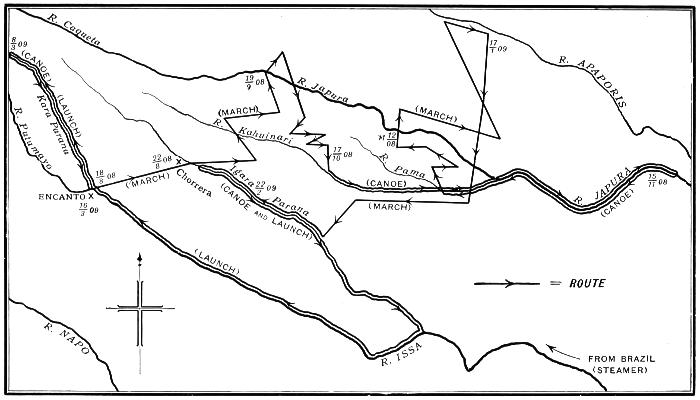
Rivers, and in their vicinity. Roughly speaking, this lies
in that debatable land where the frontiers of Brazil meet
those of Peru, Colombia, and—perhaps—Ecuador, a country
claimed in part by the three latter, but administered by
none. Here the dead level of the lower Amazonian plains
imperceptibly acquires a more decided tilt, the trend of
the land from the great Andean water-parting on the west
and north-west being south-east to the mighty river on
the south, consequently these north-western affluents of the
Amazon flow in more or less parallel lines from the north-west
to the south-east. It is the rivers that dominate this
country, the mountains, those primal determinants, are
only distant influences, snow-topped mysteries but dimly
imagined on the far horizon from some upstanding outcrop,
a savannah where momentarily a perspective may be gained
over and beyond the illimitable forest.[7]
On the south of the tracks here dealt with the Amazon
slowly sweeps its muddy yellow waters, 500,000 cubic feet
per second, towards the ocean. On the north the Uaupes
River flows to join the Rio Negro. Between the Uaupes
and the Amazon the Rio Caqueta, or Japura River, runs
south-east, due east, and south to the main stream, and
almost parallel with it the Putumayo, or Issa, gathers the
waters of the Kara Parana and the Igara Parana, both
on its northern, that is to say its left bank, and joins
the Amazon where the main river turns sharply south
471 miles below Iquitos. West again, the Napo drains
down to join the great water-way 2300 miles from the
sea. Of the Napo much has been written since Orellano
sailed down it from Peru, homeward bound to Spain in
1521, and it may be left outside the bounds of our
inquiry. With the Issa and Japura we must deal in some
detail, but of the Uaupes and Rio Negro a few words will
suffice.
Rapids and cataracts bar the navigation of the Uaupes,
the chief tributary if not, as some would have it, the main
stream of the Negro, until it is, according to Wallace,
“perhaps unsurpassed for the difficulties and dangers of
its navigation.”[8]
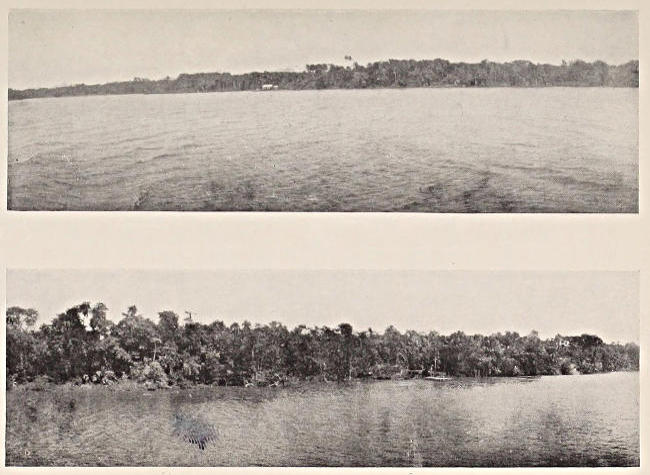
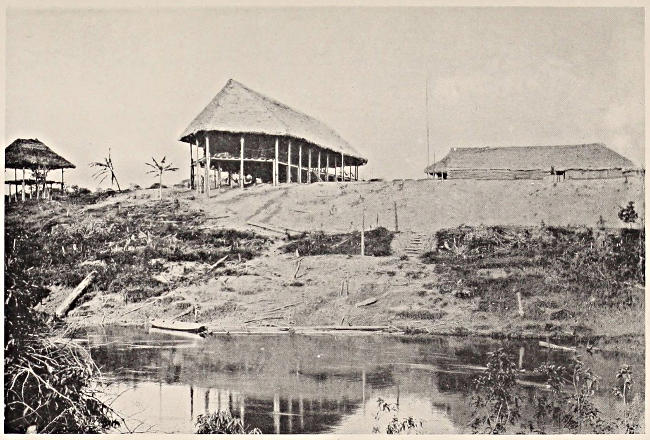
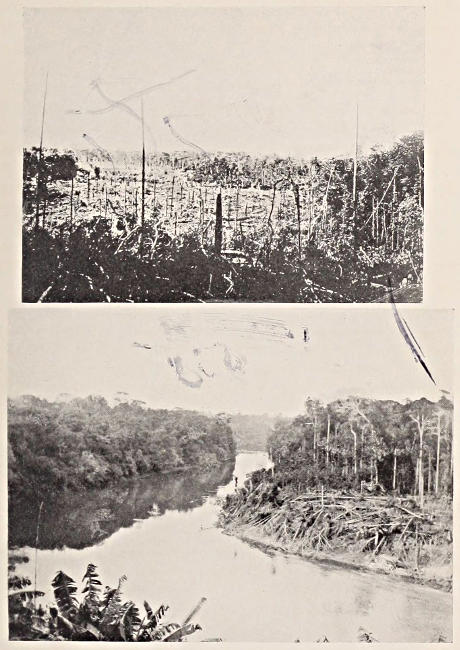
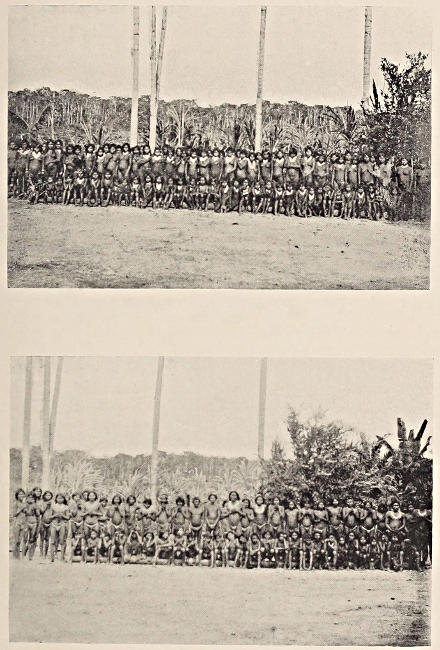
PLATE III.
TYPICAL RIVER VIEW BELOW THE MOUTH OF THE NEGRO RIVER
BANK OF MAIN AMAZON STREAM IN THE VICINITY OF THE MOUTH OF THE JAPURA RIVER
Wallace estimated the country to be not more than
1000 feet above sea-level. I should judge it to be considerably
less, by the trend of the country to the south of
it. But even here I may be mistaken, as my aneroid was
useless, for undiscovered reasons, and my opinion is based
simply on the force of the currents of the rivers, the number
and depth of the rapids, and the distances to the main
river and thence to the sea. The height above sea-level
cannot be great, for the tides are felt at Obydos, more
than half-way from the ocean to the mouth of the Rio
Negro, and there is no abrupt rise from the Obydos levels;
indeed the slope of the land is so slight that in the middle
reaches of the main river during wet seasons the floods
spread for twenty miles, and there is no visible current.
The Uaupes, though lighter than the majority of southern
tributaries of the Negro, is what is known as a black water
river, while most of the rivers flowing in on the northern
bank are white water rivers. This peculiarity, which may
be as marked as the difference between ink and milk, is due
apparently to the variety of soil in the country drained by
the rivers. The chief tributaries of the Uaupes, the Itiya
and the Uniya, are both white water streams. Spruce
notes that fish are scarcer in black than in white water
streams,[9] and attributes it to the absence of vegetation.
This may be true in part of the Negro, but it is not true,
I think, of other rivers. Certainly these have some sort of
fish, for I have seen them rise. One species is known to
feed on a variety of laurel berry very plentiful on some of
the river-banks.
The Rio Negro itself, the waters of which are dead black,
is navigable for more than a third of its course to vessels
of a 4 feet draught even in the dry season, and communication
is possible from its upper waters with the great northern
artery of the Orinoco, through the Casiquiari, the most
important of the natural canals that abound throughout
the Amazon regions.
The Issa, or Putumayo—the Peruvian name is perhaps
better known than the Brazilian, the true geographical
one—is the first tributary of importance to join the Amazon
after it has entered Brazilian territory. Of its 1028 miles
only 93, according to the Brazilian Year-Book, are not
navigable by steamers. This exceeds the truth, for there
is practically no communication with Colombia or Ecuador
by this route, as the statement would imply. In the upper
reaches of the Issa rock and shingle are to be found, while
300 miles down stream hardly a stone is to be seen. The
water is very muddy, and the current variable as the
depth. Now it will be a swirling storm-fed torrent, the
turbid water burdened with a wild flotsam of forest trees
and matted vegetation, cutting into the soft layers of
vegetable mould that form its banks, and rise above it as
much as 25 feet in places; anon it is a sluggish stream
that spreads oilily nowhither, with scarce a ripple over the
deep alluvial deposits of its bed. This river is at its
lowest in February and March. At its juncture with the
Amazon looking upstream from the main water-way, the
Issa is the more imposing of the two, for its course lies
wide and fully exposed, while the Amazon bends sharply,
and gives the impression that it and not its affluent is the
tributary stream. Robuchon calculated that its breadth
there was 600 metres, the depth 8, and the current 2½
miles an hour. He states very truly that landslides often
occur on the banks of these rivers, and that such destruction
of the bank, together with the quick rise and fall of the
streams, may so alter the appearance of any stretch as to
render it quite unrecognisable, even within a few hours.
Special mention is made by him of the Papunya River, that
enters on the left bank of the Issa. Forty miles from the
Papunya is the Parana Miri,[10] a river with very black water
and a large group of islands at its mouth. Many of the
islands in these rivers are not stationary, they are floating
masses of soil and vegetation, torn away from the banks
when the river is in spate. They may be as much as a
hundred yards from bank to bank, and birds are to be found
living upon them.
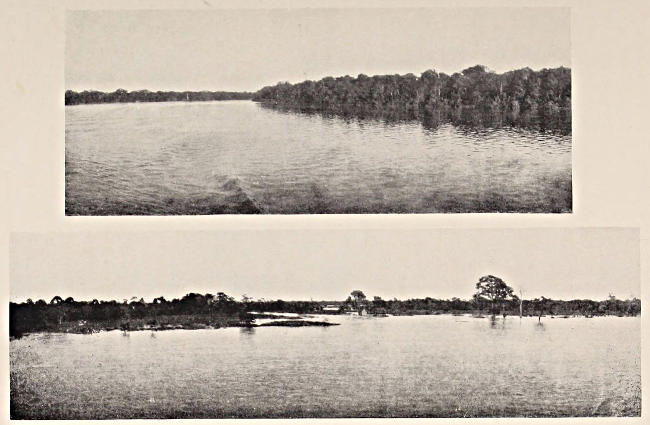
PLATE IV.
1. RIVER VIEW ON MAIN STREAM NEAR ISSA RIVER
2. LANDSCAPE ON UPPER AMAZON MAIN STREAM
The Igara Parana runs into the Issa where that river
makes a horse-shoe bend,[11] the junction being on the inner
side of the horse-shoe. The breadth of the stream at its
mouth is 161 metres. The water is clearer than that of
the Issa, and the current slower, never more than 3 miles
an hour. Some 220 miles upstream there is an important
waterfall, known as La Chorrera, or the Big Falls. The
Igara Parana becomes vary narrow and most tortuous as
it nears them, and is only 30 metres wide at its exit from
Big Falls Bay. This is a huge pool almost as wide as
it is long, with a narrow exit at one end, and a succession
of cascades at the other. These falls are impassable in boats,
and traffic with the upper river can only be carried on by
land portage. Much debris of rocks and river-borne tree-trunks
obstructs the narrow passage above the falls, which
are given by Robuchon as having a total length of 120
metres and a width of 18 metres. The waters descend over
a series of wide rocky steps, worn flat and smooth by
the ceaseless friction. Masses of stone line the right bank,
and rise perpendicularly from the water. This is the only
part of the country where I have seen rocks and stones
in any quantity.
The upper reaches of the river are distinctly more picturesque
than its lower waters. The almost level banks, with
their monotonous succession of forest trees, grow gradually
steeper, till the sandstone cliffs rise like a fortification
above the fringe of vegetation that encroaches on the high-water
mark. Presently the river winds in and out between
shelving hills, tree-clad to the very margin of the water.
Between the Igara Parana and the Kara Parana the country
is a perfect switchback of hills and ridges, with a stream in
every gully. The steepness of these valleys, with a pitch
perhaps of 25° or 30°, does not permit the surface water to
lodge and form swamp or morass, in contrast to the waterlogged
plains of the lower rivers. Immediately on the left
bank of the Igara Parana, and in the vicinity of the Big
Falls, the country continues to be hilly, but to the north-east
it is more open, and the bush is less obstructive, though
its density varies immensely. Similar diversified scenery
is to be found on the upper waters of the Japura.
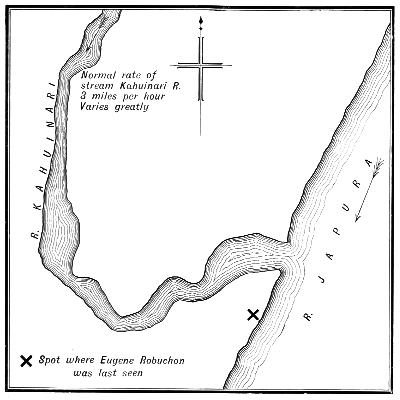
The Kahuanari, a considerable tributary on the south
bank of the Japura, drains the divide that intervenes between
that river and the Igara Parana. It is subject to
sudden floods, which wash down large quantities of forest
debris. I have seen it rise twenty feet in a day, and
afterwards subside as quickly.
The floods are not to be wondered at when the tremendous
rainfall of these regions is considered. The question is
never if it will rain, but when and for how long it will be
fine. Rain is certain in a land which has but a few days
clear of it in every twelve months. Five days, a fortnight,
that, all told, is the extent of dry weather to be looked for
in this country. The dry season is but a name. It is dry
only in comparison with the wetter months from March to
August. The upper valley of the Amazon has a three-day
winter at our midsummer—June 24, 25, 26—so it is said,
and certainly I noted a very decided drop in the temperature
of these days in 1908. Snow is unknown, and hail not
common. Despite the daily rain the turquoise blue of the
sky is seldom long hidden, though from March to June
leaden skies portend rain, and seldom fail to make good
their portent. During the dry season the rain if it be
frequent is never continuous. Almost every day, between
three and four in the afternoon and two and five in the
morning, heavy clouds will roll up, a preliminary breeze
rustle through the leaves, shake the trees, and increase
till suddenly there comes a deluge of big drops. Such
storms last but half an hour, yet the rain will soak through
everything, and the wet bushes drench the passer-by for
hours afterwards. Nothing is ever really dry, things are
in a constant state of saturation, and it is possible at
all times to wring moisture out of any of one’s belongings.
So great and incessant is the evaporation that at night the
dew is as heavy as rain, while the marshy low-lying lands
and the rivers are shrouded by mist both morning and
evening. With such humid air lichens and Hepaticæ
flourish on all the tree-trunks, though I have never seen
them, as described by Spruce, covering the very leaves of
the trees.[12]
Electric disturbances are numerous, and a sharp and
sudden thunder-shower often occurs about three in the
afternoon, or in the night, though rain at night without
thunder is common. These storms come up in the dry
season especially, and the worst storms may be expected
in February, at the breaking of the dry weather. Sometimes
the electric storm will consist of an uninterrupted
display of lightning with little or no thunder, and the
sizzle of light makes the landscape appear as in a cinematograph
picture. This continued on one occasion all
through the night, and from the amount of interest the
Indians evinced I judged it to be an unusual occurrence.
It is always possible to tell when rain will come because
of the preliminary breeze, hardly felt below the tree-tops,
followed by a dead calm that precedes the downpour.
The prevailing wind for nine months of the year will be
from the east or south-east, from June to August it will be
north and north-west. In January the prevailing wind is
from the Atlantic, north-east, veering to south-west; in
July from the Pacific, south-west, round to north-east.
Fitful and uncertain local whirlwinds will, without warning,
swoop down on the clearings round the houses, play havoc
in forest and plantation, uproot trees, and destroy habitations.
In spite of the continual rain, of the universal humidity;
the climate is not unhealthy. The heat, though a damp
heat, is never excessive, the enormously great evaporation
brings in a succession of fresh breezes to moderate the
temperature;[13] and so, despite apparently trying conditions,
the climate is not injurious. The low watersheds between
the large rivers appear to be quite healthy, and if there be
fever its prevalence varies locally to an extraordinary
degree. It has been observed that where the soil is first
turned up fever not infrequently follows, a fact noted in
other parts of the world, and by no means a condition
peculiar to the Amazons.
The soil of the vast Amazonian basin is mainly the
alluvial deposit of decomposed vegetable life for centuries
past. This sea of Pampean mud stretches from the ocean
marshes up to the very heels of the mountains that stand
outpost to hold the southern continent from the Pacific.
Black and rich it lies in layer after layer twenty, thirty, forty
feet beneath the great pall of vegetation that flourishes
above during its little day, to die and drop for successive
generations of arboreal life to thrive upon in their turn.
And in all this vastness is never a stone. Vegetable mould
and water-borne mud, but stone does not exist for thousands
upon thousands of miles. Only in the upper waters of the
Amazonian system are rock formations reached; in the
particular district under consideration nothing is to be
found harder than a soft, friable sandstone. On parts of
the Issa, as on the Napo, the deep banks show strata of
shingle, with perhaps red or white clay, that alternate with
the dark humus and decaying wood.
It is the ceaseless activity of all vegetable life that
renders these regions fit for human habitation at all. There
is no period, as with us, of bare branches overhead and
decaying matter below. Decomposition is there, but for
every dead leaf a virent successor is ready to absorb the
gases engendered by decay. The soil may be water-logged,
but evaporation, combined with the constant rain,
the frequent inundations, and the endless operations of an
immeasurable insect world, militate against stagnation.
Dank it may be, but there is no iridescent scum upon the
water, no fœtid smells to warn of lurking poisons. These
natural danger-signals are unneeded, for the poisons are
self-destructive. Processes of corruption are coexistent
with those of purification. So extraordinary is this that I
never hesitated to drink any water, nor is any evil resultant
from water-drinking within my knowledge.
In this struggle it is the weak who go under, the feeble
who support the strong. This holds good for vegetable and
animal kingdom alike, and even with man there is no place
for the helpless. Those who fail by the way, who cannot
fulfil their functions in the toiling world, and have ceased to
be of practical utility, must make way for the more capable.
Altruism is not bred of the forest, it is a virtue born in cities.
Here it would be suicide. The growing leaf must push off
the fading leaf, or the latter will stunt and imperil its growth.
In fact it does so, and growth is thus continual. There are
no seasons to correspond with our spring nor with our fall
of the leaf. From the lower Amazon’s maze of water-ways
up to the foothills of the western mountains reigns perpetual
summer; the same leafy veil hides the mysteries of the great
expanse, eternally dying, eternally renewed.
As one passes onwards, however, nearer where the great
cloud-banks gather over the mountain giants of the west, a
perceptible change is to be noted, the scenery of the upper
Amazon differs in certain essential particulars. It is not
only that the great river thoroughfare, first spread on either
side beyond the farthest horizon,[14] becomes a thin black line
that grows nearer and deeper. Other features besides the
river-surface contract. The majestic forest trees give way
to timber not so towering. Plant life is not less prolific, but
it is on a smaller scale. The bush has the air of being
younger. It suggests that it has been dwarfed by perpetual
inundations. Nor is the stunted growth limited to the
vegetable world; the animals themselves, as if Nature
insisted that all be in keeping, are on a lesser scale than their
congeners of the eastern plains. No alligators of immense
size lurk in the upper waters, even the fish and the turtles
are smaller, as though their inches were limited in proportion
to the streams.
It is not easy to convey any true notion of the scenery
of the Montaña, the vast forest regions spreading eastwards,
down from the lower Andean slopes. Here and there the
dense forest gives place to an open savannah, an outcrop
of rock with but a shallow stratum of soil. These have none
of the deep vegetable mould of the lower-lying forests, and
the poorer and thinner soil harbours flora of many totally
distinct varieties. Often the great fan leaves of the Aeta are
matted into a dense roof over the black swamp of the valleys.
Sometimes these water-loving palms are seen by the river-side,
interlopers in the fringe of fern and thickets of feathery
bamboo; or, again, they will grow in a regular belt with
little or no other vegetation.
Life is more evident on the rivers than in the forest.
Fish are there in plenty—eighteen hundred species are
known in the Amazonian waters. Birds, often conspicuous
by their apparent absence in the bush, flock on the sand-banks
and marshes of the bank. Herons and ducks abound.
Egrets haunt the sandy spits that rise from the water, and
in the marshy swamps numbers of these beautiful creatures
may commonly be seen hunting for the tiny fish, animals,
and insects on which they feed. Another enemy of the
small denizens of the stream and marsh is the kingfisher.
More than one variety abound on all the Amazon water-ways,
but none of them can compare with the English bird in
brilliancy of colour. Probably this is an instance of protective
colouring, one of Nature’s methods of defence, for
on these dark waters the gorgeous blue of our Alcedo ispida
would be even more conspicuous than it is on our clearer
streams.
One pictures this tropical garden, this paradise of the
naturalist, as a blaze of gorgeous colour, a profusion of
exquisite forms. But, in proportion to one’s imaginative
anticipation, I have never seen such a monotonous, flowerless
wilderness as this bush appears. Still there are flowers,
and flowers of showy colouring, the pinks and yellows of the
bignonias, the white and crimson of the chocolate-tree, the
crimson of the hibiscus, the scarlet blaze of the passion-flower,
the snowy beauty of the inga; all these and a thousand
more are there, with the rarest blue and all the myriad
shades of mauve and orange, yellow, pink, brown, violet
of uncounted orchids. But orchids, though common, grow
at the very top of the trees, and unless they are searched
for they are not seen, except such varieties as are found on
the savannahs.
The whole is on a scale so gigantic, the immense forest,
the great rivers, that details are lost in the vast expanse,
and the total effect is one of absolute sameness. Yet the
individual variety is enormous. Though uniform in the
mass, twenty-two thousand species of plants have been
differentiated; thousands more remain undescribed. Only
a botanist could attempt to deal with these even superficially.
The uninitiated, like myself, can but look and
wonder.
Many of the units of this mighty aggregate are of a surpassing
loveliness; flowers unequalled for beauty, birds and
insects that are living jewels, outrivalling inanimate gems.
Such palms and ferns as would be rare treasures in a Kew
Gardens hothouse riot unheeded in tangled profusion above
the dark marshy soil, over a screen of parasites and epiphytes.
Forest giants, those immense monarchs of the woods Californian
advertisements depict for the edification of the
populace, are not there; certainly they are never to be
found in the Montaña. Nor, perhaps, in consequence of
the lower growth, is there that intense gloom mentioned by
writers on more easterly districts. The idea that you look
up but can never see the sky is fiction to me. The foliage is
certainly too dense for the sunlight to penetrate down to
the damp soil and matted underbush, but patches of the sky
are always more or less visible through the interlocked
branches overhead. Light and air are to be had freely
only on the tree-tops, and it is there that birds, insects, and
flowers mass their glories out of human ken. Even the
animals are climbers, and most of them spend more than
half of their existence on the trees.
There are no long dark avenues beneath this leafy canopy
that hides all the life and colour of the forest world from
the traveller, painfully cutting his path through the intricate
confusion of roots and creepers below. These parasitic
creepers are of many kinds, rooting down to the dark soil,
intertwining with themselves, pushing boldly to the tree-tops,
strong as withes, in wild festoons, knotted, tangled,
of every thickness from a giant cable to a narrow thread.
I have seen parasite on parasite. They loop from tree to
tree, bind the underwood into impenetrable thickets, and
trail over the track-way, ready to strangle or trip the heedless
passer-by. But track-way is a misnomer. The only
thoroughfares, where water is as abundant as dry land, are
the water-ways. The bed of a stream is the only track. No
other line of communication is intelligible to the Indian.
Even in the vicinity of civilised centres, hundreds of miles
away from these wild fastnesses of Nature, the exuberant
vegetation rapidly encroaches upon a roadway. Paths in
the forest there are none. A forest track consists in following
the line of least resistance. If this should be stopped by any
obstacle, a fallen tree, a sudden inundation, it would never
be removed or surmounted. There is no choice but to
climb over or go round. The ordinary Indian wayfarer
would go round; and so the road deviates increasingly;
it becomes inconceivably twisted, until the actual ground
covered is enormous compared with the distance from
point to point.
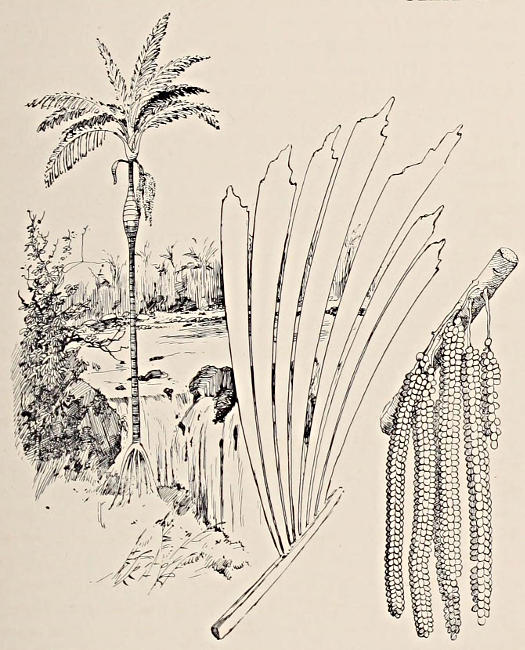
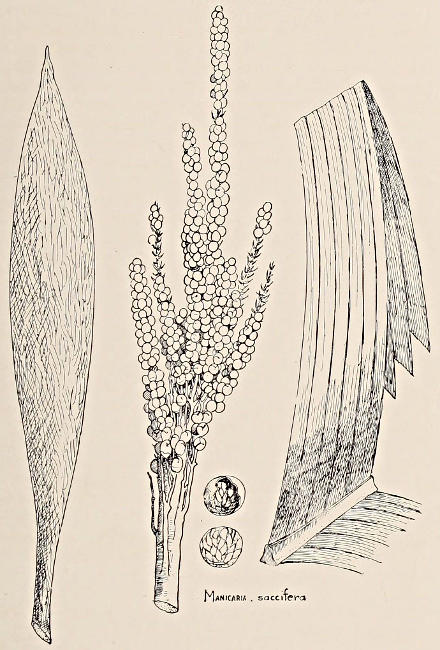
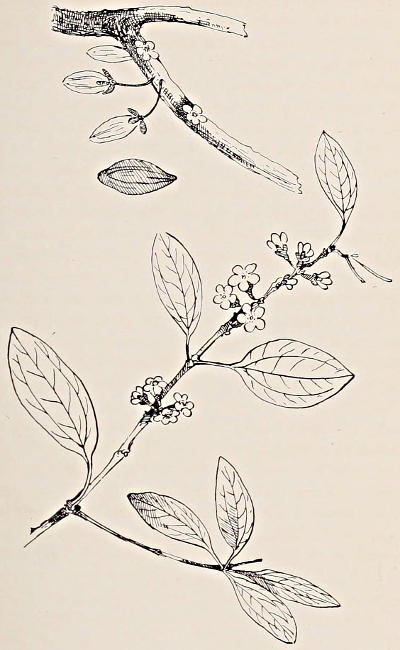
PLATE V.
THE BULGE-STEMMED PALM, IRIARTEA VENTICOSA,
SHOWING PORTION OF LEAF AND FRUIT
Where a stream has to be crossed there is rarely any
bridge more stable than a small tree cut down and thrown
across just when and where it may be wanted. Frequently
such impromptu bridges are under water. They are invariably
of the slightest; a branch no thicker than a man’s
hand suffices to span a deep chasm, and over this an Indian
will pass more unconcernedly than an Englishman over
London Bridge. The worst penance of all in forest journeyings
is to cross a river or a gully full of great fallen trees,
on such flimsy foothold. The drop at times may be 40 to
50 feet, and there will be but the one tree across without
any attempt at a hand-rail to steady the traveller. Nor
can you grasp an Indian’s shoulder for aid in the perilous
transit, for to do so is to lose once for all every trace of
prestige and authority. The man who cannot get over a
river unaided, the man who is not man enough to walk and
must be carried in a hammock, is but a poor creature in the
eyes of the South American Indian. Still it is more than
a test of nerve. In the middle of such a bridge you feel
yourself swaying, and it is only with a fearful concentration
of will-power and a bitten lip that you arrive safely on the
other side, having leapt the last three feet. In the first
month of forest journeying I bit my lip through time and
again. It is not the torrent below that frightens, it is the
rotten trees in the gully. A fall may possibly be a broken
neck, more probably it would be a broken leg. Of the two
in country of this description a broken neck is preferable.
Where a stream has to be crossed that is too deep to be
forded and cannot be bridged over in this elementary
fashion, there is little difficulty in the construction of a
raft or a temporary canoe. The bulging-stemmed palm
furnishes an almost ready-made one. This palm, Iriartea
ventricosa, is readily known by the peculiar swelling on
the upper part of the trunk. It will attain the height of
100 feet, and the swollen portion is big enough to form
the body of an improvised canoe.
Forest bridges are not the only terrors to confront the
traveller; lurking dangers are many, and imagination is
but too quick to multiply the risks. Peril from wild beasts
does not loom largely in the picture, though the jaguar is a
savage brute, and the experienced traveller will never sleep
without a weapon at hand in case one of these daring creatures
should venture to attack. But of animals more anon.
There is one danger by no means imaginary, the danger of
falling trees. A sudden crack, startlingly noisy in the all-pervading
stillness, will give warning of a fall, but there is
nothing to guide to safety. It may be the nearest tree that
is coming down, or one at some distance; yet the deceptive
noise will not determine which may be the doomed one,
beyond the fact that a palm gives the sharpest crack.
Indians when they hear such a sound are invariably frightened,
and often will run backwards and forwards in terrified
uncertainty, to try and discover whence came the danger
signal.
Then there are plants that injure more directly. One
palm, an Astrocaryum, has spines six inches in length up its
stem. These spines, black in colour, hard, unbreakable,
fall in the bush and spike the foot of the unfortunate who
may tread on them. On the palm-stem itself they will
wound the unwary hand incautiously or involuntarily thrust
in the thicket. Many of the climbing plants have thorns or
hook-like prickles, and perhaps the worst are the many kinds
of twining river-side palms, whose barbed leaves will tear
both flesh and clothing.[15] But trying as these vegetable
torments may be, they are outclassed in the eyes of the tyro
by the more active evil of perils from snakes and insects.
Creeping through dense bush is an agony at first. Poisonous
reptiles may lie concealed all about one, virulent insects
surround in their myriads. If imagination has painted a
floral paradise it has also run riot over a profusion of deadly
snakes, an uninterrupted purgatory from creeping things
innumerable, and winged pests before which the plague of
flies in ancient Egypt sinks to insignificance. And there
is some excuse for imagination if it be fed on travellers’
tales. As a matter of fact, if these were true life would in
all verity be insupportable. But the fear of snakes passes
in two weeks, never to return, and mercifully the most
pestilent creatures exist only in limited spheres, and seldom
or never in the same. Places that are troubled with the
pium will be found free of mosquitoes at night; in a belt of
country where the mosquito abounds the pium will be
absent, and in any case the two are never active together.
The pium, a most vile little fly, comes out at sunrise. It is
an intolerable pest, will attack any exposed part of the
body, and draws blood every time. The traveller is forced,
when journeying through a pium-infested country, to don
guarded boots, gauntlets, and a veil. It is impossible to
eat, drink, or smoke, till sunset puts a period to the troubling.
Fortunately, piums are only found within a few hundred
yards of the rivers. This is also the case as a rule with
mosquitoes. There is a bad belt of pium country on the
Issa, at the Brazilian frontier. It takes two days to get
through on a steamer, and during the forty-eight hours life
is a long-drawn torture. But once through you are rid of
them. Robuchon noted that the Culex mosquito disappears
on entering this river: but there are others; one, a kind of
Tabano in miniature, is called the Maringunios. I found
piums on the Kahuanari at low river, but a light breeze would
suffice to sweep them away, and both mosquitoes and piums
are practically non-existent in the middle Issa-Japura
valley, though mosquitoes are found in certain parts of
tracts of flatter country, but are not bad enough to make
a net a necessary adjunct for comfort. There is also a tiny
sand-fly that occasionally appears at sunset, when the river
is low, and though minute in size, causes a very painful
wound. It is known in Brazil as the Maruim.
A most annoying little insect that is very common in
the bush is a kind of harvest bug. This almost invisible
“red tick” must not be confused with another parasite that
is only obtained from contact with Indians. The forest
tick lives on the leaves of plants and bushes, and when
shaken off creeps everywhere, and will burrow under the
skin, which gives rise to maddening irritation.
Wasps and wild bees—the bee of these regions is a waspish
creature—are frequently a nuisance. Often in a forest path
I have come upon a huge black overhanging nest pendant
from a tree. It looks like a tarred lobster-pot full of black
pitch, and it is necessary to rush past to avoid the stings of
the easily-roused inhabitants. Some of the wasps are
exceedingly handsome fellows, noticeable even among
Amazonian winged beauties, unsurpassed in any other
land for gorgeous colouring. Among other fine insects
of the Montaña are the huge Morphos, a dazzling blue
butterfly many sizes bigger than a humming-bird; dragonflies
with iridescent wings and jewelled bodies, fireflies and
glow-worms with their living lights, so brilliant that I have
often in a moment of forgetfulness mistaken them for
distant lights from some human dwelling-place. But the
butterflies, the most resplendent of all, frequently illustrate
the proverb that beauty is but skin deep. Exquisitely
graceful in flight, marvellous in subtle colourings, I have
found them to be the dirtiest possible feeders. The sight
of one now fills me with repugnance, for it calls to mind
pictures of these so apparently dainty and aerial beings
fluttering about some mass of offal, actually eating manure.[16]
They will congregate in thousands round a spot of blood, so
absolutely fearless that it is not possible to drive them
away. They will actually smother the kill during the
disembowelling process after hunting. The contrast of their
ethereal loveliness and their gross habits is revolting—Psyche
and putrid filth, an inconceivably horrible combination.
Butterflies and moths exist in great numbers and varieties.
The most ordinary kind is a large bright sky-blue; other
common ones are tiger-marked and yellow, like our sulphur
butterfly but larger. Most of them are strong fliers. If
the perfect insects themselves inflict no injury, the same
cannot always be said of them in the caterpillar stage, for
very many have hair that stings quite painfully.
Ants are the greatest curse. They are everywhere, of
all kinds, of varied colours, and almost invariable viciousness.
They drop from the overhanging foliage. They may come
singly or in battalions—army corps rather. The traveller
pushing through the thicket will knock them off the bushes,
and they will proceed to crawl down the neck or up the
sleeves. They swarm over the bare feet. And then they
sting. The worst kind is a small stinging ant not more than
the size of a pin’s head. In many places the earth is broken
up and transformed into irregular heaps, the late habitations
of some gregarious ant, such as the Ecodema cophelotos,
or it may be built into cones to the height of 4 or 5 feet
by the termites. It needs but short experience of the
bush to endorse very heartily Spruce’s comment that they
“deserve to be considered the actual owners of the Amazon
valley.”[17] On more than one occasion stinging ants drove
me from dry land to water. In inundated country these
insects forced me to take refuge off the higher points of land,
which, turned into temporary islands, form the natural
resting-place for the traveller exhausted by the wading, the
swimming, and the stumbling through the unseen undergrowth.
Unfortunately the ants, too, are driven to take
the same refuge. The traveller may find that choice lies
between torture on land or again seeking the comparative
peace of the water in perhaps an exhausted condition.
Happily ants, like the pium, keep in belts, and of these it can
only be said that discreet avoidance is better than valour.
With regard to the reptiles, though these abound, they
seek rather to avoid than to court notice, and are by no
means the danger to life that the ignorant imagine. Naturally
the naked Indian is more exposed to any peril there
may be than the better protected white man, and if a snake
be trodden on it will promptly turn and bite the unshod
foot of the aggressor. But no snake, so far as I have observed,
will attack a human being unmolested, not even the boa
constrictor; nor would the anaconda, the great water snake,
though all Indians are very afraid of it. I do not think that
even the venomous labarria ever bites a man unless first
disturbed.
Alligators in the Issa and the Japura are small, rarely
seen, and never formidable. The dangerous jacare, that
huge monster of the lower rivers, is unknown here. But
of fierce and poisonous fish I shall have somewhat to say
later. Curiously enough, despite the swampy nature of
the ground, I never met with any leeches, though Bates
mentions a red, four-angled species he found to be abundant
in the marshy pools at the juncture of the Japura and
the Amazon.[18] Frogs and toads are the most abundant
reptiles. They exist in thousands and are of all sizes,
though I have never seen any of dimensions that Spruce
speaks of—“as big as a man’s head.”[19] At night near
any stream huge frogs keep up a constant and fearful
noise, and even at midday, when a silence that may be
felt enfolds the tropical woodland, their chorus is only
subdued, not stayed.
This silence of the forest is a very real thing, a quality
that does not lessen by acquaintance. On the contrary it
grows more real and more oppressive. A strange gloom
and a strange stillness hold the bush. They give the impression
that there is nothing animate in all the vastness,
no life other than that of the overwhelming, all-triumphant
vegetation. It is possible to journey for days and never
see a human being. A sound, be it but the cracking of a
twig, startles in the forest. Then, suddenly, the vibrant
quiet will be broken by a shrill scream. Some creature has
been done to death. The cry dies to a moan, and the low
murmur that is hardly sound, the drone of the unseen but
abundant life, once more makes up the silence that pulses
tormentingly on ear and brain, till night again wakens the
birds and the beasts of the wild, and the murmur grows
and deepens to the full volume of confused sound made by
the forest’s busy life.
At the break of day, and again at the going down of the
sun, the howling monkeys, if they be in the neighbourhood,
startle the echoes with their raucous yelps. Sunrise is,
indeed, the signal for absolute pandemonium. Toucans
start an endless chattering that rises now and again to a
far-reaching scream. The trumpeter birds make extraordinary
noises. With them may be joined in a chorus
of discord the macaws and the parrots of the district, and
the chorus is punctuated at night by the mournful cry of a
large night-jar.
But, for the most part, the birds and the beasts go about
their business silently. They seek neither to disturb their
victims nor to advertise their own doings and so attract
those with sinister designs against themselves. In the
bush silence is a better policy than honesty.
Picture all this, and try to understand the bush life in
Amazonia. It will explain much of the unwritten and
unwritable story of the inhabitants of these wilds. For the
traveller the day is easily summarised: the awakening at
sunrise, followed by a bath in the nearest stream, and a
meal of what was left over-night; the trail, the worst in the
world; the slow progress that jars on the nerves; the
never-ending, impenetrable forest; the narrow path that
has to be widened; the stumbles, the falls, the whipping of
the face and arms by innumerable twigs; the ever-ready
liana that catches the foot of the careless walker; the stinging
ants that shower down on face and neck when a tree is
accidentally shaken; the greenheart and other rods that
pierce the feet and legs; the thorns innumerable, and the
fine palm-spines on which a hand is transfixed when put
out to save a fall; the end of the trek, a bath to get rid
of the litter of mud and vegetable filth; dinner, of sorts;
and a hammock under a shelter so poor that it will not prevent
the driving and inevitable rain from chilling the sleeper
to the bone. Imagine the state of fatigue to mind and body
when one cries, “Thank God, I have got so far to-day. I
could not repeat to-day’s labours. I could not go back
on my own open trail, or go through the same to-morrow.”
And so crying one knows that to-morrow and the trail must
come. Even in fancy you will feel the pressure on your
chest, the pressure behind you. It demoralises utterly.
There is a gruesome depression that is almost physical,
produced by solitude on a small island, when all other land
is out of sight. The bush to me is worse. The oppression
is as of some great weight. A light heart is impossible in
an atmosphere which the sunshine never enlivens, that is
beaten daily back to earth by rain, where the air is heavy
with the fumes of fallen vegetation slowly steaming to
decay. The effect of the impenetrable thickets around, the
stifling of the breath, is all mental, doubtless; but it must
react physically on the neurotic subject.
This depression, this despondency, may seem incredible
to those who have never experienced anything similar, who
are ignorant of the innate malevolence of the High Woods.
But in truth there is nothing in Nature more cruel than the
unconquered vegetation of a tropical South American
forest. The Amazonian bush brings no consolation. It is
silent, inhospitable, cynical. It has overcome the mastodon
and the megatherium, the prehistoric camel and the rhinoceros.
It has reduced its rivals of the animal kingdom to
slimy alligators and unsightly armadilloes, to sloths and
ant-bears. The most powerful tenant of its shades is the
boa constrictor, the most majestic the jaguar. Man is a
very puny feature in the Amazonian cosmos.
The sense of one’s insignificance is the first lesson of
travel in the bush. In the beginning the discovery amuses
the adventurer. Later, he resents the implied superiority
of the fixed and nerveless plants which barricade his progress.
In the end, he hates the bush as though it were a
sentient being. Yet the component parts of the bush are
familiar to all at home: we coddle them in our gardens, and
nurse them tenderly in our glass-houses. But in the
Amazons they unite to form a horrible, a most evil-disposed
enemy. They obscure the sun from the earth, condemn one
to existence in a gloomy, stifling half-light. They constrict
the world to a path laboriously hacked through jealous
undergrowth. They stab with hidden snags, and strangle
with deftly poised lianas. In their most hurtful mood they
poison with a touch.[20]
The Amazonian forest is no glorified botanic garden.
Its units are not intelligently isolated and labelled. There
is but a monotonous tangle of vegetation through which
the traveller cuts his way to daylight and perspective in a
river-channel. One rarely sees a blossom or a fruit. Within
that tangle, however, is the whole varied life of the tropical
jungle. It may be difficult to distinguish specimens through
the superimposed mass of extraneous vegetation; it may
be impossible to catch a glimpse of a living creature throughout
a day’s march; but the flowers are there in their
thousands, and a myriad of eyes have noted each blundering
movement of the wayfarer. It is no part of the philosophy
of the bush to force even the most reckless of animals into
needless publicity.
It is simple for the traveller to pull the canoe to the
bank of one of the upper tributaries of the great river, to
land, to part the screen of bushes, and to pass beyond—into
the obscurity of barbarism. It is a simple feat, yet
eventful. A thousand yards away from the safe thoroughfare
of the main stream the explorer is lost, overwhelmed
in the extravagance of vegetation. Denied a pathway,
a landmark, a horizon, or a sky, he has less to guide him
than the castaway on the ocean or the wanderer in the
Sahara. His most definite course can only be from river-bed
to river-bed. To direct him on his way the trees offer
no aid to help him, the forest provides but little sustenance.
Every traveller in the bush lives in the constant dread
of being lost. Desertion, unexpected, unforeseen, is common
with the Indians. They leave without ascertainable cause
at the cost of their pay, at the risk of their lives. In a
watch of the night they depart, and although the country
be swarming with their blood-enemies, they vanish into the
forest and are no more seen.
In time the civilised man, with no other than such barbaric
companions, turns at the thought of them, is nauseated
by their bestiality, longs for relief from their presence.
Then he wanders away, ever so little a distance into the
bush, to be alone and to think. He happens upon a stream—that
is so simple a by-path, so obvious a guide. He wanders
light-footedly up its bed in search of that ego which had
begun to elude him. The surroundings interest him. The
water comforts his feet. The silence casts him back upon
himself. He thinks, computes, and the solitude assists his
introspection. He recovers his perspective, replaces the
comrades of his bush-life in their proper places—the glass-fronted
cupboards of an anthropological museum. His self-respect
regained, he pauses to admire his new-found horizon.
Trees hem him in on every side. A little way up the
stream is a narrow slit of sunlight, a little way down a
narrow canopy of sky. All else is vegetation. The solitude
no longer tempts him, but mocks as he contemplates his
surroundings. Yet to doubt is to be ridiculous. It is all
so simple; it took so long to come here up the stream;
the same number of hours or minutes will take him back
again to the spot he marked, and so to the camp.
The difficulties begin with the return journey. He
questions the hour of leaving the bearers, the rate of march,
the time spent in lazy consideration. One tree is so like
another tree, one river vista but the duplicate of the last.
Reeds, weeds, and bush now offer nothing distinctive;
their former individuality appears to be lost. The trail
must have been passed. He shouts, diffidently at first,
eventually with hysteria. He fires a rifle, and the bush but
re-echoes the sound. The hundreds of miles of forest on
every side press together, and the signal is shuttlecocked
between. The very echoes seem to him muffled, like the
drums at a soldier’s funeral. The traveller is lost.
The realisation is a strange psychological phenomenon.
It forces the self-reliant European on his knees to pray;
drags him to his feet to blaspheme; throws him on his face
to weep. This admission may come strangely to the well-housed
British ratepayer. It may sound like a confession
of unfathomable cowardice. It is far easier for the arm-chair
philosopher to imagine the stoicism of the Indians
than to reproduce the neuroticism of his European counterpart.
Things are so different when the conception of the
Amazonian bush is the memory of the tropical houses in
Kew Gardens.
One day I was lost alone. When I realised it I shouted,
then fired half-a-dozen rounds from my rifle, and laughed.
It was the laugh that brought me to my senses—that way
lay madness. The reaction to calm was stupendous. Life
was dependent upon self-control and clarity of judgment.
I counted my rounds, remembered all I had eaten that day,
and settled myself to think. We had crossed a stream, and
my boys had been left quenching their thirst. I took the
lie of the land, and found a path leading downwards. It
must go to water. It did in fact take me to a stream, and
I trudged wearily in the bed of it; then, after two fruitless
hours of growing despondency, turned and went down,
to find, as darkness was closing in, Brown and his party.
That night I had fever, and talked in my sleep. And John
Brown was lost for five and a half months. Good God!
There is one last experience of the bush—starvation.
The man who has not starved can never enter into the
feelings of his brother who, with blood-shot eyes and shaking
fingers, has groped about the fallen leaves for a lizard or a
frog. I can answer for it that those who have starved
never again may express the sensation. It has become the
memory of a nightmare.