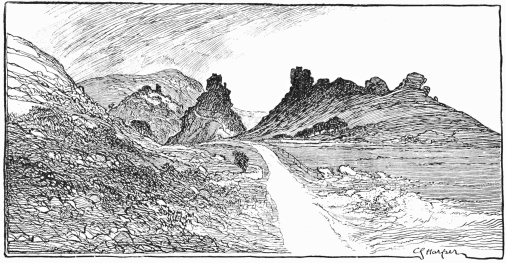
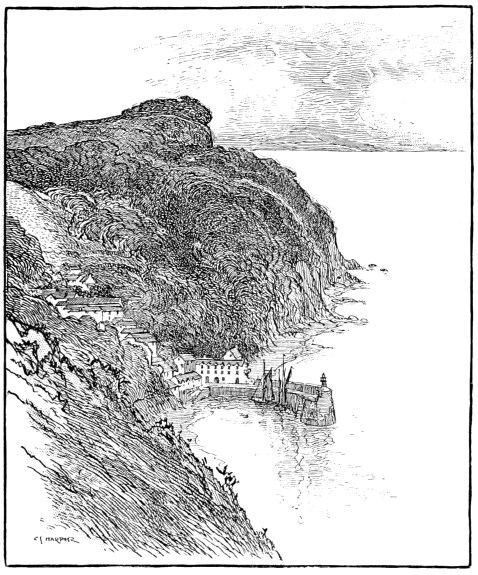
Ilfracombe occupies one of the strangest sites on
this strangely contorted coast. Down upon it,
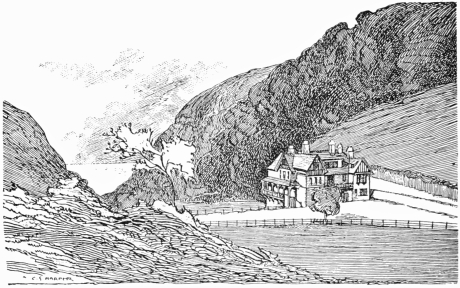
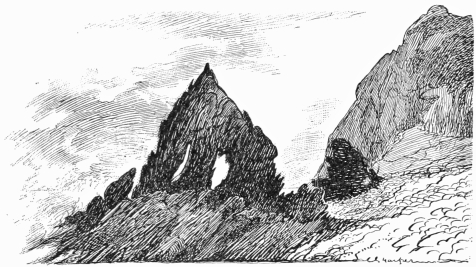
on either hand, look the great rocky hills of Hillsborough
and the razor-backed, spiny ledges of
the Runnacleaves, and the Tors; while amidst the
winding roads of the town itself run smaller hills
and vales, and down by the sea, where other seaside
resorts usually have a conventional flat
parade running by the shore, there are the Lantern
Hill, overlooking the harbour, and the Capstone
Hill, placed just where the usual sea-front would
be, if the site of Ilfracombe were other than it is.
Fortunately it is not. Between the two is Compass
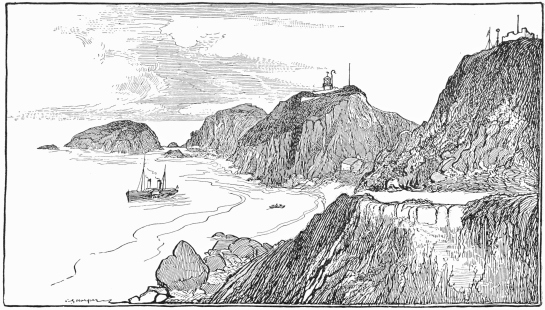
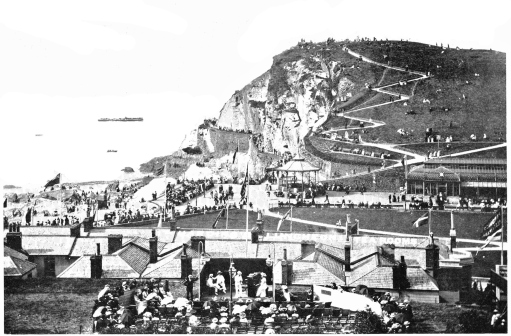
Hill. The Capstone Hill—it was formerly, and
should still be, “Capstan”—runs up towards the
sea from the town, and presents, as it were, a lawn,
inclined at an angle of something like forty-five
degrees. When people most furiously do make
holiday, in August, this expanse is covered over,
day by day, with hundreds of figures, looking quite
tiny in the scale of things. Sometimes, when
Sunday Schools, or other institutions, come to
Ilfracombe for their annual day out, they display
their massed forces in living devices or letters of
the alphabet, on the hillside, in view of the whole
town.
E. D. Percival]
[Ilfracombe.
CAPSTONE HILL AND THE CONCERT PARTIES.
There is not, it has already been shown, any
conventional front; and indeed at one time it was
only possible to approach the shore at Ilfracombe
at infrequent and isolated spots, such as Wildersmouth,
or Chain Beach. That was in the times
before seaside holidays were invented, and when
Ilfracombe was only a small port. When the
modern town began to rise, it was felt that a little
more of the sea would be thought desirable, and
consequently the present “Capstone Parade” was
constructed in 1843, in the more or less perpendicular
face that Capstone Hill presents to the waves.
It is a semicircular roadway carved out of the
rock, with rocky cliff above and more beneath,
and beneath that, the sea, dashing in violently.
The Capstone “Parade” has after all, you see,
the conventional name; but, happily, it is not the
conventional thing.
Since we cannot treat of Ilfracombe without
touching upon its ancient history, it had better
be done at once, and an end made of it forthwith.
To begin with, it is not certain how the name
derived. In Saxon times it was “Alfreincombe,”
and from that has been hazarded the theory of its
having once belonged to Alfred the Great. Then
stepped in that eternal factor of the letter H, and
it became “Halfrincombe.” I wonder if any
contemporary, uncertain in his aspirates, ever
called the great monarch, “Halfred”? It is a
fearful thought.
Then the place, having been crowned with an
H, of course those who should have kept the letter,
vulgarly elided it, and the name became “Ilfardcombe,”
or “Ilfridecombe,” and so remained until,
with the introduction of printing, the style became
irrevocably fixed at what it is now.
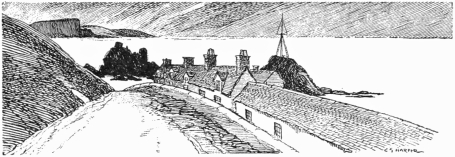
The town was then nothing more than a few
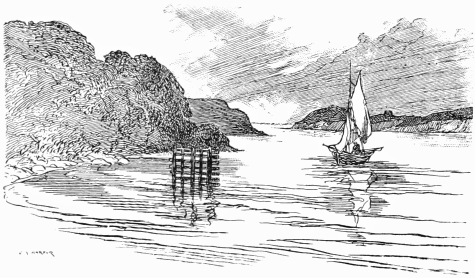
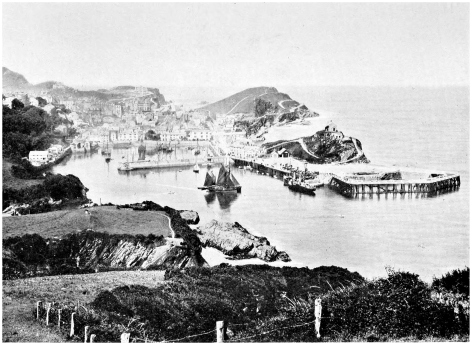
waterside houses down by the harbour, that
curious, almost pool-like inlet intended by nature
for the purpose, but the place speedily prospered,
chiefly by reason of this natural haven, and in 1346
the port was sufficiently wealthy and populous to
be able to assist Edward the Third with a contingent
of six ships and ninety-six seamen, to
help in the French war and the reduction of Calais.
That appears to have been the high-water mark of
Ilfracombe’s old-time prosperity, for thenceforward
Barnstaple and Bideford took up the position of
rivals, and wrested away much of its trade.
Little is heard of the town until the beginning
of the Civil War. The sentiment of the townsfolk
was strongly anti-Royalist, and it occurred, therefore,
to Sir Francis Doddington, a Royalist commander
who had helped his cause well at Appledore,
that it would be the properest thing to teach
them a lesson while the success of his party there
was still fresh, to serve as a moral lesson here.
What happened we may read from a contemporary
account, in the Kingdom’s Weekly Intelligencer,
September 3rd, 1644. It is couched something in
the sarcastic vein: “At a town called Ilford-combe
in Devonshire, that saint-like Cavalier, Sir Francis
Doddington, set that town on fire, burnt 27 houses
in the town, but was beaten out by the townsmen
and sailors, and lost many of his men.”
So the teacher was taught, but the Roundhead
success was not lasting, for, before the end of the
month, Doddington had captured the town,
together with twenty pieces of ordnance, twenty
barrels of powder, and two hundred stand of arms.
The Royalists then held Ilfracombe until April
1646.
The port continued to decline, and is described
by Blackmore, speaking of the eighteenth century,
in the “Maid of Sker,” as “a little place lying in a
hole, and with great rocks all around it, fair enough
to look at, but more easy to fall down than to get
up them”—the laws of gravity being no more
suspended here than elsewhere.
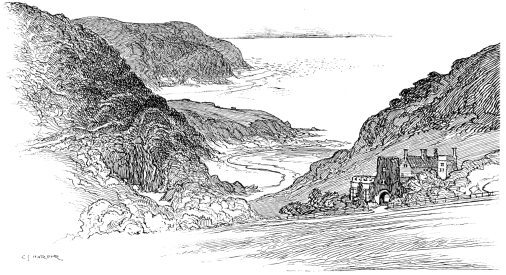
One of the many inlets here deserves particular
note. This is Rapparee Cove, opening out just
beyond the harbour.
Rapparee Cove is known to have borne that
name certainly as far back as 1598, when it appears
to have originated in some obscure connection
with the Earl of Tyrone’s rebellion in Ireland,
where the bulk of the rebels were armed with a
species of small pike, called “raparys.” North
Devon seems to have been in general a refuge for
the fugitives from Ireland, and Ilfracombe, as a
recognised port for the south of Ireland, to have
been particularly favoured by them. Neighbouring
Combemartin retained until 1837 an odd
reminiscence of that time, suggested, no doubt,
by the refugees. This was an annual pageant,
or merry-making, the hunting of the Earl of
“Rone”; in which hobby-horses, much rough
music, and a considerable deal of drunkenness
figured.
Rapparee Cove was in 1782 the scene of the
disastrous wreck of a large vessel, variously stated
to have been a prize captured from the Spanish
by Rodney, or a Bristol slave-ship. For long
afterwards, following storms, the beach was a
happy hunting-ground for gold and silver coins,
and for the less desirable relics of the many
drowned, in the shape of skulls and bones.
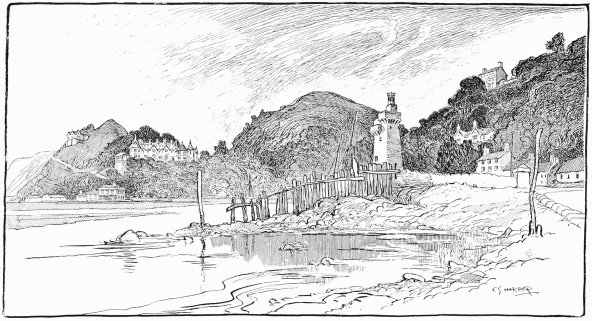
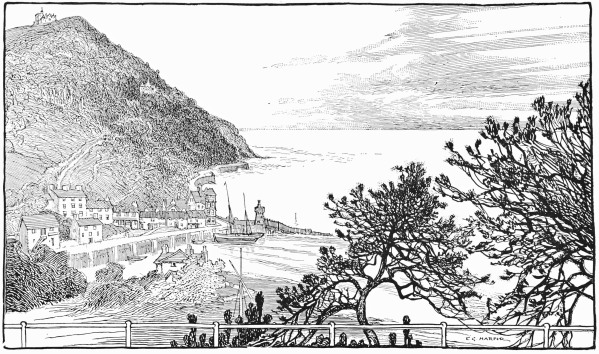
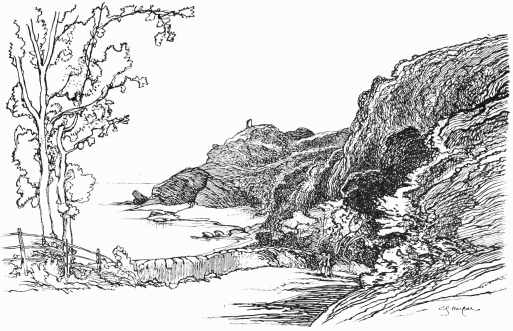
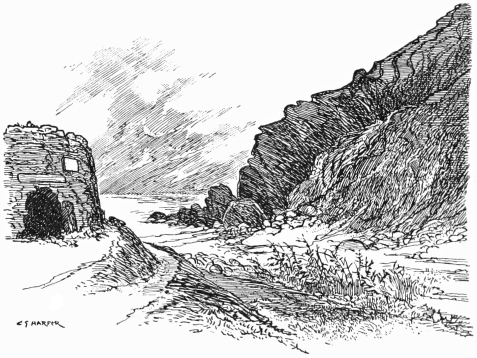
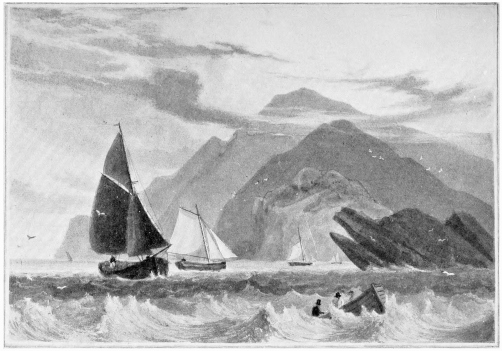
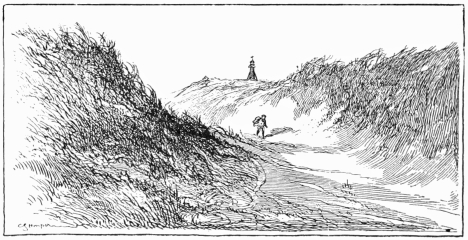
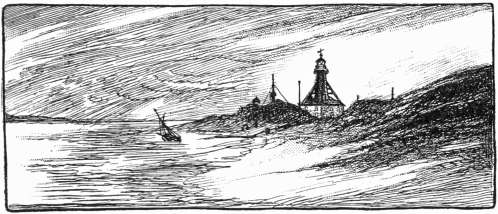
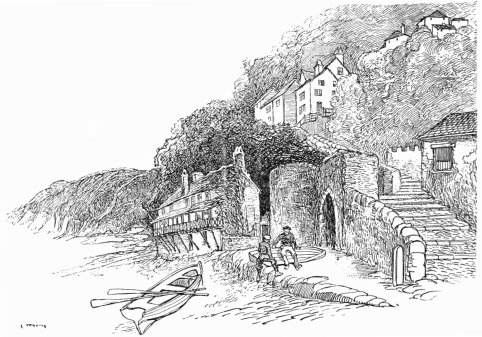
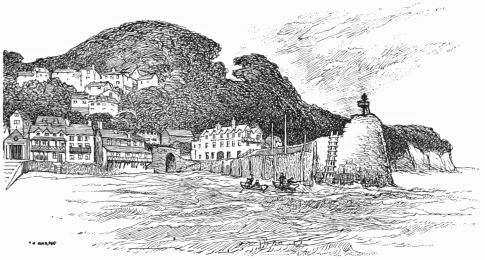
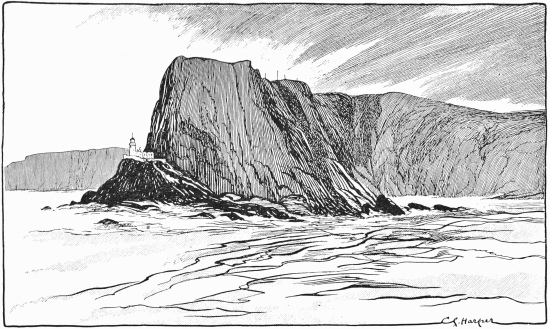
The entrance to Ilfracombe harbour has been
lighted from the earliest times by a beacon on the
hill overlooking it, called, from that friendly gleam
for the incoming mariner, “Lantern Hill.” Whose
care it was, thus to befriend the sailor, we are not
told; but, from the old-time readiness of the
Church to perform such-like good deeds, and from
the undoubted fact that the building on the hilltop
was once a chapel dedicated to St. Nicholas, it
would seem that those who tended the light were
no mere secular lighthouse men.
Whatever may have been the character of the
old chapel in past ages, the interior is no longer of
any interest, disclosing only a plain whitewashed
room. The time-worn exterior, partly overgrown
with ivy, and the lantern, crowned with a fish for
weather-vane, afford more satisfaction. A light
is still shown at nights, from the end of September
until the beginning of May.
The harbour, long, like Ilfracombe in general,
the manorial property of the Bourchiers, Earls of
Bath, in succession to the Champernownes, Bonvilles,
Nevilles, and others, and then of the
Bourchier Wreys, now belongs, together with
Lantern Hill, to the Corporation.
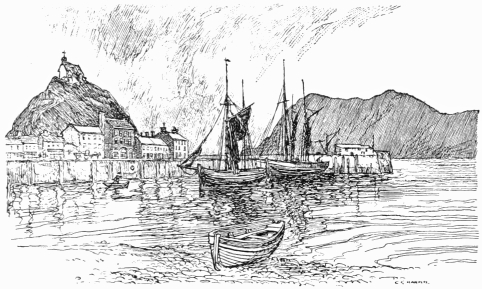
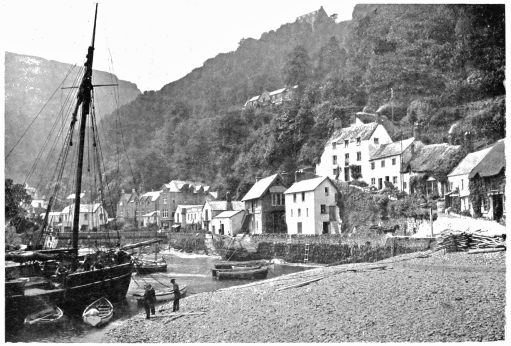
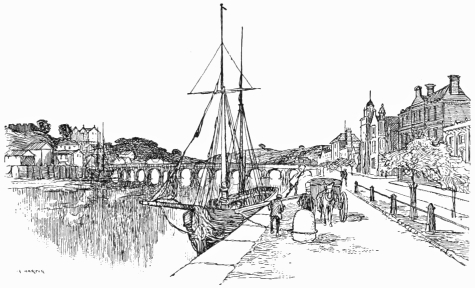
IN THE HARBOUR, ILFRACOMBE.
Now let us turn to a consideration of Ilfracombe
to-day. People with a passion for comparisons
and parallels—dear, good people who would trace
a family likeness between an elephant and a
dromedary—seek in conversation to find points
of resemblance between Ilfracombe and (say)
Torquay, Hastings, Brighton; half-a-dozen other
seaside resorts. They are mostly amateurs at the
art of discovering likenesses where they do not
exist, and may be excused. But there have been
those who in cold print have instituted resemblances.
For these there is no excuse, acceptance,
or encouragement. Ilfracombe is—just Ilfracombe,
and not only does Ilfracombe insist upon
its own individuality and declares “I am I,” but
every other among the half-dozen naturally demands
the like justice.
The nearest parallel is, of course, to be found
in this same county of Devon; but that is sufficiently
remote, geographically, and in most other
ways. A superficial likeness, in its hilly site,
(and in its lack of sands) may be discovered to
Torquay, but that is all. Torquay is in greater part
residential and quietly aristocratic, with a tendency
to pious works and clerical tea-fights: Ilfracombe
is a “popular resort,” and becomes ever more so;
with what it would be a mere inadequacy to term
a “tendency” to open-air concerts and amusements
for the crowd. We who stay, communing
with nature, elegantly housed in the more refined
hotels of Lynmouth, or the even yet primitive
Clovelly, shudder at the August crowds at Ilfracombe,
and recount across the dinner-tables, what
time the tender evening closes in upon the quiet
harbour, how we adventured there for half a day
and watched the trippers at their strenuous
tripping. Indeed, those who people Ilfracombe
so numerously in the height of the season go
there determined to have a “good time,” and
expend a considerable amount of energy during
the day in securing that desirable consummation;
but when evening is come they unanimously
clamour to be amused: hence the entertainments
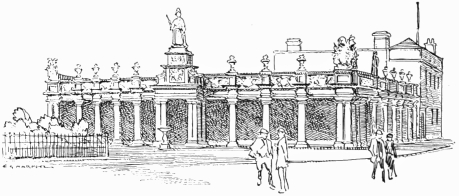
in the conservatory-like structure, known officially
as the “Victoria Pavilion,” and unofficially and
shamefully as the “Cucumber Frame”; and
hence also the open-air concerts on the “Montebello
Lawn,” and elsewhere: “Montebello” being
a name, the most unprejudiced must agree, as
little characteristic of Devon as are the “pierrots,”
who make alleged fun for the aimless crowd. The
days are indeed past when we were “insular.”
We have, instead, become more than a thought too
cosmopolitan. “Ods bodikins!” as Sir Richard
Grenville might have said, “beshrew me, but these
things like me not.”
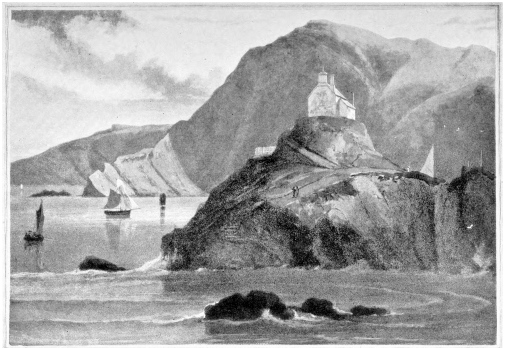
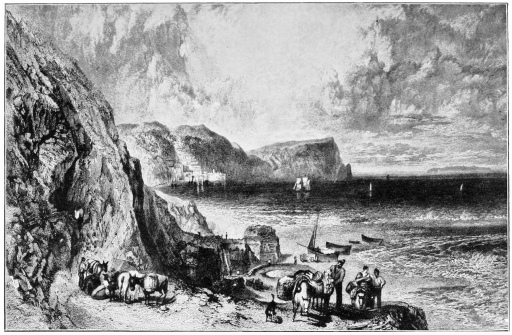
[After W. Daniell, R.A.
LANTERN HILL, ILFRACOMBE.
The study of seaside “holiday amusements,”
from the time when the sea and the countryside
themselves palled, and the holiday-maker ceased
to be able to amuse himself, might form an interesting
theme for the social philosopher. Here we
can but glance at the subject, and slightly trace
the first footsteps of the nigger-minstrel and the
barrel-organist, down to the German bands who extract
unwilling tribute from a long-suffering public,
and the piano-organ men, the immediate precursors
of the “pierrots” aforesaid. It should not
be difficult to become a “pierrot.” You procure a
silly suit of white linen clothes, of no particular fit,
that might have been made for a person four times
your own size, whiten your silly face, place on your
idiotic head a foolish sugar-loaf white felt hat, and,
with a garnish of red or black balls, according to
fancy, there you are, plus a little native impudence,
fully equipped. I do not love the old burnt-cork
nigger minstrel more, I only dislike him less than
this ostensibly French importation that is already
so hackneyed; but I declare I could welcome the
return of even his extravagant figure, beery breath,
and untutored banjo, by way of relief.
But these are, doubtless, the views of an unreasonable
recluse. They are not shared by the
holiday crowds, nor by the ruling powers that
control the destinies of Ilfracombe. Entertainers
fill a “felt want,” felt very acutely by the class
of people who most resort to the town in these
days, and the governing body of the town
develops it along these lines of least resistance.
Only, as I stand, when darkness has fallen over
the summer evening, a little aloof, and look
down from some convenient height upon the
garish lights and the blatant merriment, the black
hills seem, to this observer, to frown reproachfully
upon the scene, and the twinkling stars seem like
so many bright tear-drops for the folly of it all.
In short, the romantic natural setting of Ilfracombe
is utterly unsuited to this sort of thing. One may
deplore, yet not resent, it at Yarmouth or at Blackpool,
where Nature is at her tamest, but found
amid the bold rocks and frowning cliffs of North
Devon, one does both. Nor is there any easy
escape anywhere within the town. The brilliantly-lighted
Pavilion glitters across the lawns,
under the Capstone Hill, and across the intervening
space you dimly see, maybe, a jigging figure
within, executing a clog-dance. You may even
hear the clatter of his clogs, drowned at last in a
very hurricane of applause.
If you remain, you must, perforce, listen to
the celebration of mysterious sprees, in this wise:
(Confidentially)
“I went out on the tiddly-hi.
Oh, fie!
On the sly!
I came home with a head;
I put me boots in the bed
An’ slep’ on the mat instead;
Yus (proudly) I’d bin out on the tiddly-iddly,
twiddly, fiddly, hi, hi, HI. (Crescendo).
“When you’ve bin out on the tiddly-hi.
Oh, my!
(You try!)
You feel confoundedly cheap, and dry.
‘You’ve bin on the bend,’ the guv’nor said,
‘You’ve bin painting it red.’
I’d bin wanting a rise,
But ’e giv me a nasty surprise;—
For (dolefully, dimuendo) I got the push instead;
An’ that’s the result of goin’ out-on-the-blooming—
tiddly, iddly (but, with returning confidence,
fortissimo) HI, TI-HI.”
But, wearying for local colour, rather than for
more of this sort of thing, which, after all, is done
very much better in the London music-halls, you
resort to the harbour. There indeed—if anywhere—you
look for something characteristically
Devonian. But even there the streets are brilliant
till late at night with dining-rooms and the like—merciful
powers, how every one must eat and
drink at Ilfracombe—and the fishermen, if the
samples heard by the present auditor are representative,
are pre-eminently the foulest-mouthed
to be found on many a varied coast-line.
I know not what the quiet holiday-maker may
find to do at night at Ilfracombe. He may, at
any rate, go to bed, but even there he is pursued
by sounds of revelry. He undresses to the refrain
of tiddly-iddly, diddy-dum-dey, or something
equally intellectual, and his first dreams mingle
with the distant, but distinctly audible,
“I ’eard the pitter-patter of ’er feet,
Oh, so neat!
Pitter-patter on the pyvement of the street.
On ’er fyce I tried to look,
An’—good grycious, ’twas the cook!”—
And thus, in the Cockney celebration of mean
intrigue, the melody merges into the mesh of
visions.
What, indeed, shall the lonely visitor to Ilfracombe
do with himself in the evenings? He may
wander around the walks of the Capstone Parade
or the Tors, and feel himself reduced to a singular
loneliness amid the amorous couples who there
most do congregate; or feel not less lonely in
exploring the endless “gardens,” “terraces,” and
“crescents,” where every house is a boarding-house;
or, in the finer flavour of euphonious avoidance
of the commonplace truth, “an establishment
for the reception of visitors.” There, alas! he
feels himself lonely indeed, as, passing the endless
array of lighted rooms with open windows, he
sees the holiday-making families assembled.
But morning in Ilfracombe is more endurable
for such an one. Bustling, democratic Ilfracombe
has, then, none of that illuminated vulgarity and
would-be, shop-soiled wickedness that characterise
it overnight. Nature gets her chance again in
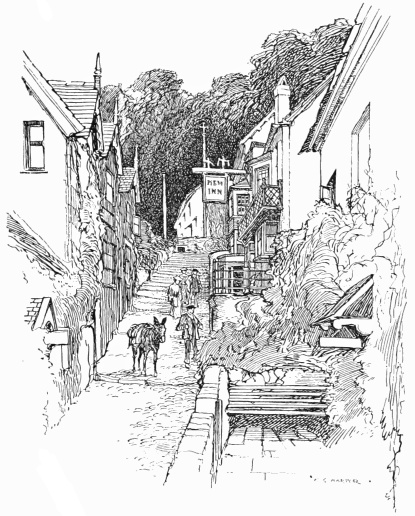
the light of day, and in the long, narrow High
Street you see the crowds in pursuit of natural
enjoyments. Some are shopping, some are making
for the bathing-coves; others are going on one
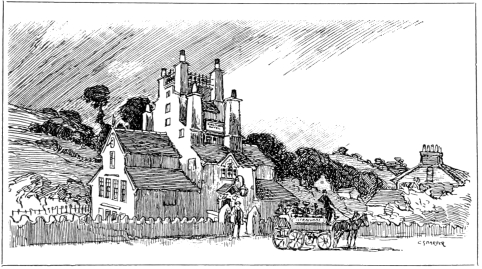
or other of the many coaching excursions to
“places of interest in the adjacent country,” as
the notices have it. It may be observed that not
yet have motor waggonettes and the like replaced
the coaches and other horsed vehicles at Ilfracombe,
and that drivers and guards still affect
the traditional red-coats associated of old with
coaching. More than ever are there popular joys
attendant upon one of these coaching-trips to
Berrynarbor, to Combemartin, or Lynton; for
in these fiercely enterprising times the local
photographers take views, day by day, of the
laden coaches as they prepare to set out; and so,
at trifling cost, you have a permanent pictorial
voucher as to the way in which you fleeted the
sunny hours at Ilfracombe. Not, by any means,
that all hours are sunny, this especial spot in
North Devon being notoriously rainy; but it is
at worst but an April-like raininess, and even as
the showers come down, the sun that is to dry
them up smiles through the watery sky. Thus,
no one minds the “soft weather” of Ilfracombe.
It is many, many years since Charles Kingsley
wrote of Ilfracombe in this manner: “Be sure,
if you are sea-sick or heart-sick, or pocket-sick
either, there is no pleasanter place of cure than
this same Ilfracombe, with quiet nature and its
quiet luxury, its rock fairyland and its sea walks,
its downs and combes, its kind people, and, if
possible, its still kinder climate, which combines
the soft warmth of South Devon with the bracing
freshness of the Welsh mountains.” The climate
is the only thing that has not suffered change
since that description was penned. The kind
people are, doubtless, at bottom, as kind as of old—such
of them as are Devonshire folk—but they
are now urban (which, despite the etymology of
the word, does not now indicate what is in these
times understood by “urbanity”)—and to be
urban in these days is to be, colloquially, “on the
make.” Ilfracombe, in fact, like any other large
seaside resort, has turned its scenery and its
climate to commercial account, and, as the local
Urban District Council frankly acknowledges,
exists for, and on, the visitor. It is a town of
hotels, lodging-houses, and boarding-houses, few
of whose proprietors can be natives. All the
natural features are exploited, and, lest the visitor
be in doubt what there is to see and do, the
Council has taken in hand the task of placing
notices in prominent places, indicating the things
to be seen and to be done. Thus, kindly shepherded,
you lose all personal enterprise, and do,
like an obedient fellow, what you are bidden.
From these official productions you learn instantly
the features of the place, as thus:
“Capstone Parade and Hill. Bands. Free.
Victoria Pavilion. Concerts. Morning and Evening. Free.
Cairn Top. Pleasure Grounds. Free.
Hillsborough Hill Pleasure Grounds. Free.
Hele Bay and Beach. Free.
Chamberscombe and Score Woods. Ideal Picnic Spots. Free.”
There are, however, in this list so many things
that, obviously, could not be anything else but
free, that the ordinary stranger stands struck
with astonishment at the moderation which has
not included on the “free” list such items as the
Bristol Channel, the air, and the roads. But
where so many things are trumpeted as “free,”
the suspicious person looks for others that are
not; and, sure enough, he discovers them, in—
“Pier, and Lantern Hill. Toll, 2d.
Tors Walks. Toll, 2d.”
It is not, of course, the fault of the local
authority that the Tors Walks are subject to toll,
for the place is private property; but the fact is
especially unfortunate in a place like Ilfracombe,
lacking sands or foreshore, except the one tiny
beach of Wildersmouth Bay.
Nor can you well bathe in the sea without
paying for the “privilege.”
The present circumstances of Ilfracombe are
largely conditioned (to use for once a horribly
illegitimate verb) by its nearness to the great
manufacturing and seaport towns of Bristol and
South Wales. Cardiff, Swansea, Barry, are all
within easy reach by steamboat, only twenty
miles across Channel, and the excursion to Ilfracombe
from all these places is a favourite one.
At any time in the summer, from four to six very
large steamers from these places, lying in the
harbour, form a familiar sight, and the “white
funnel” and the “red funnel” steamers are very
fine, commodious and well-found boats. They
bring an immense concourse of people into the
town, some to stay, but the majority for only a
few hours. Compared, of course, with such
places as Margate or Ramsgate, these numbers
would not be remarkable, but then you have to
remember the difference in the sizes of the respective
places. Margate has a reputation for vulgarity.
All classes resort there, and so they do
here. Ilfracombe has hotels as expensive on
the one hand, or as cheap on the other, as you
could wish, and, I doubt not, there are cultured
visitors to be discovered in them. “Discovered”
is, indeed, precisely the word, for they would
require some seeking amid the mass. It is the
commonest of errors to think vulgarity is the especial
attribute of the poorer, or even of the middle
classes. It is rather a condition of mind than of
pocket, and resides in every social stratum. It
is only the snob who thinks the poor are by
reason of their poverty, vulgar, or the rich, by
favour of their wealth, refined. There are vulgar
millionaires and cultured crossing-sweepers, for
all the world to see. But the intellectually
vulgar seem to select Ilfracombe, above all places
on the North Devon coast, as their habitat. Originally
a very delightful place, they are reducing
it to their own level, aided and abetted by the
local building fury, in which landowners are unwittingly,
in destroying the natural beauties of
the locality, engaged in the antique game of
killing the goose that lays the golden eggs. To
descend from the language of hyperbole, they are
erecting tall terraces of houses on all the outskirts,
with the result, already seen, of shutting out the
views over sea and cliffs; and with other results,
presently to accrue, that the town will be overbuilt
and even the vulgarian miss the vanished
rustic graces.
It is amusing to note how antipathetic are
those who resort by choice to Lynmouth and
Clovelly to those others who find in Ilfracombe
everything to satisfy them. To make excursion
from Ilfracombe to Lynton or Clovelly and back
in half a day forms an easy and delightful trip,
but to see those places and look upon them with
an amused and indulgent eye is sufficient for your
typical Ilfracombe visitor. Such an one would
consider it impossible to stay there. I heard such
a critic describe Lynmouth as an ’ole (or was it “a
nole”?). Geographically, of course, she was correct,
for Lynmouth, by the seashore, is several
hundred feet below the summit of Holiday Hill;
but of course we all know that a ’ole (or even a
hole) is more, in this conjunction, than a mere
geographical expression. It was a term of contempt,
in this instance, for a place without open-air
concerts and minstrels, a place where you are
reduced to amusing yourself; a horrible fate when
you find yourself so empty of entertainment to
yourself. Per contra, those who stay by choice at
Clovelly and Lynmouth, and adventure for half
a day to sample Ilfracombe, have been known to
describe it, in their way, as “vulgah.” But,
since they cannot stay to see Ilfracombe at night,
if they wish to return that day to the place of their
choice, they cannot know how vulgar it can be.
This is not to say that Ilfracombe has lacked
due recognition. It has been patronised by the
most distinguished, and it is in recognition of this
fact that what was once the “Britannia” Hotel,
down by the harbour, is now nothing less than
the “Royal Britannia.”
E. D. Percival]
[Ilfracombe.
ILFRACOMBE.
There are great numbers of amiable, but
characterless, people, who have so little individuality
or so much exaggerated loyalty for Royal
personages and reverent respect for the aristocracy,
that the well-advertised fact of those bright
and shining ones having visited this resort, that,
and the other is sufficient to make the fortune of
those places. Many years ago, the then Prince of
Wales made holiday at Ilfracombe, and the local
guide-books have never allowed visitors to forget
the fact, even although it was when he was a boy.
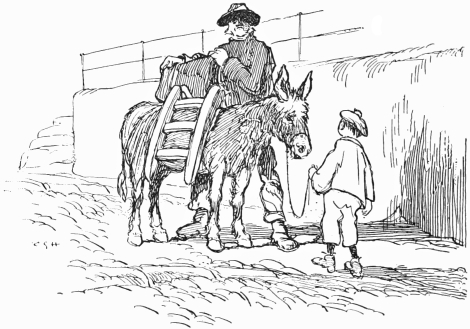
He went out riding a pony known afterwards to
fame as “Bobby.” Alas! poor Bobby. As the
guide-books have cleverly discovered, even “the
fact of having carried a Royal personage did not
render Bobby immortal, and his death deprived
Ilfracombe of an attraction to its visitors, and a
large income to its owner.” It was a sorry thing
for Bobby that ever he carried a Prince of Wales,
for, ever afterwards, he was condemned to the
drudgery of long, long days carrying the children
of the lower middle (and super-loyal) classes.
To seat little Frankie or little Cissie upon that
sanctified pony was, in some vague way, to come
into touch with the Royal family; to give him
a carrot was equivalent to (but less expensive
than) presenting a purse to a Princess at a charity
meeting. Bobby was transfigured, like the objects
sung by the satirist:
“A clod—a piece of orange-peel—
An end of a cigar—
Once trod on by a princely heel,
How beautiful they are!”
But the poor animal’s glory was hardly earned.
Loyalty, expressed in terms of an unending burden
of children, at last wore him out, and he died.
For a loving list of the great who have visited
the town, you must please to look in those guide-books
for yourselves, but we learn that “no year
passes without some distinguished personage
treading the ground of beautiful Ilfracombe, and
giving another start to a new chapter of the town’s
progress as a fashionable resort.” That remains
true; I, myself, was there last year.
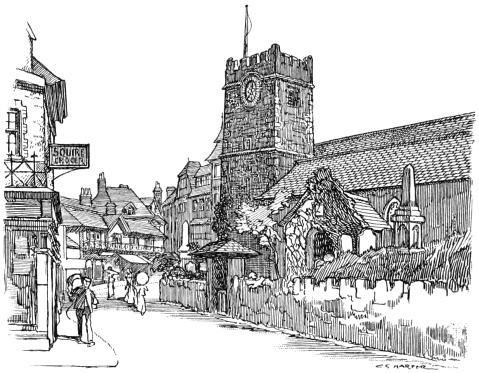
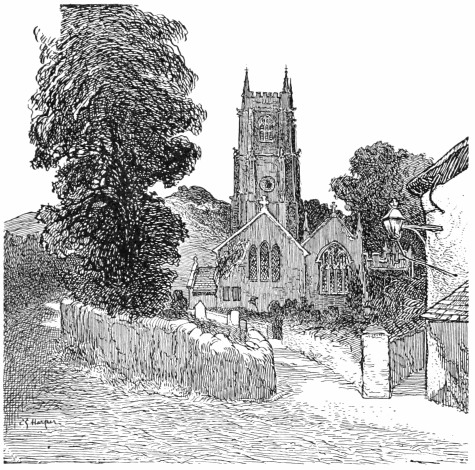
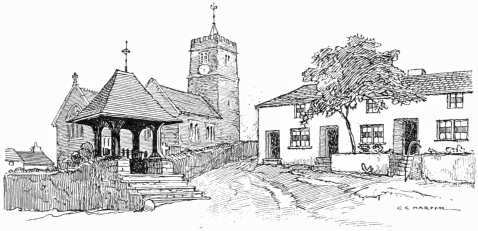
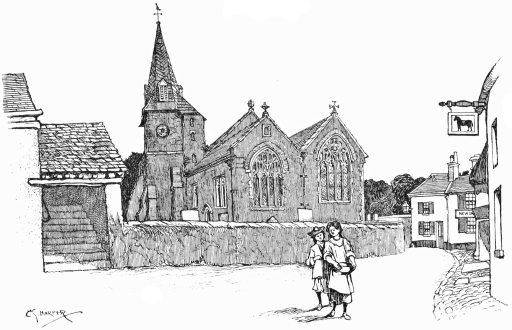
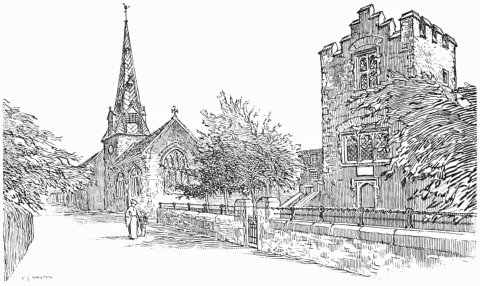
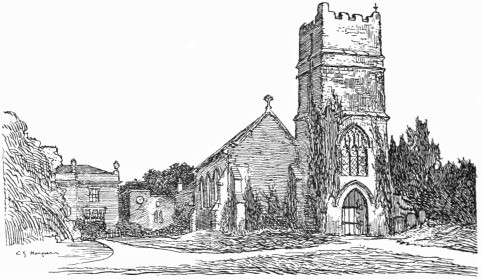
The old parish church has of late been little
altered. It stands high at the west end of the principal
street, midway between the deeps of the harbour
and the alpine heights on which the railway
terminus is placed, and its approach is by a steep
flight of stone stairs.
There is something of almost every architectural
period in Ilfracombe church, but the workmanship
was ever of so homely a character that
the styles all blend into one rude mass. The tower
ascends in a singular diminishing fashion. In the
large and crowded churchyard you notice most
distinctly, as you are indeed intended to do, a
stone recording no fewer than nine centenarians
who lived and died at Ilfracombe between 1784
and 1897. This by way of advertisement of the
astonishing salubrity of the place; but an inhabitant
of Brighton chancing this way would be
amused. At Brighton there are generally to be
found half a dozen hale and hearty centenarians.
Odd names are not infrequent; for example,
“Humphrey Rottenberry,” and Ann of the same
name, who died aged 94, and thus nearly became
one of those witnesses to the supreme value of the
Ilfracombe air. Herapaths, too, abound.
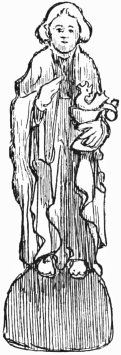
The interior of the church is something of an
architectural puzzle, owing to the additions made
in succeeding ages. The grotesque thirteenth-century
stone corbels supporting the waggon-roof
and its array of wooden angels, are particularly
interesting. They form a strange assemblage of
monsters, in which some see only a freakish
imagination; but many of them are illustrations
of legends once current in this romantic shire.
Prominent among them are the lean cow, Chiche-vache,
and the well-conditioned cow, Bycorn: the
first in so sorry a condition because her only food,
according to the old story, was good women; the
second so plump by reason of her diet being exclusively
good and long-suffering husbands—and
such, we all know, abound.
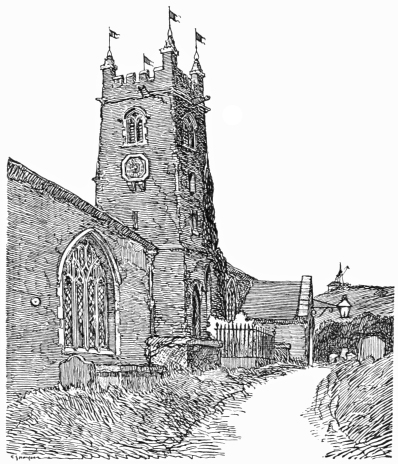
ILFRACOMBE CHURCH-TOWER.
Among the curious monuments of the Parmynter
family is a tablet with an epitaph little, if anything,
less than blasphemous in modern thought,
to Katherine Parmynter. Of her we read:
“Scarce ever was Innocence and Prudence so lovely: But
had you known her conversation, you would have said she was
the daughter of Eve before she tasted the apple. A servant of
Christ Jesus sought her to wife; but his master thought
him unworthy, and soe tooke her unto Himself.”
With much more to the same effect. This
crown and glory of her sex died in 1660.
The monument of Captain Richard Bowen,
who fell at Teneriffe, in the service of his country,
has a lengthy inscription, which is, however, not
unworthy of being copied here, as a very full-blown
example of the florid patriotic style that
once obtained:
Sacred to the Memory
of Richard Bowen, Esq.,
Captain of His Majesty’s Ship, the Terpsichore
This Monument was erected by his afflicted Father.
Of Manners affable and liberal, in private Life:
He was beloved by his Family, and respected by his Friends
He was generous, humane, and modest,
And they who knew him best esteemed him most
By the vigorous Exertion of superior Abilities
with which Providence had blest him,
He overcame Difficulties surmountable by no common Powers:
And raised himself to Eminence in a Profession where Eminence
is most difficult.
Amongst distinguished Characters he was himself distinguished
In the Service of his King and Country he was faithful, vigilant,
and zealous:
In the Day of Peril he gave Proofs
of the most daring Intrepidity corrected by the coolest Judgment.
Full of Resources, Spirit, and the most decisive Activity, he at
once humbled the Foe and saved the Friend.
The Post of Danger, to which he was so often appointed,
unequivocally attests his superior Courage, Abilities, and
Patriotism,
Of a life thus spent, and spending, in the sacred Cause of his
King and Country
The Career was stopt, in the unfortunate Enterprize at Teneriffe,
(under the Command of Rear-Admiral Sir Horatio Nelson, K.B.)
where he fell!
Yet full in the Path of his Duty and of Glory,
at the Head of his own Ship’s Company;
on the 24th of July 1797; in the 37th Year of his Age.
Of such a Man and such a Relation it were unjust to say less:
whilst his Friends are soothed by the pleasing Reflection
that as long as private Worth or public Virtue command Respect
and Veneration,
He will live in the Remembrance of his Family
and the Regret of a grateful Country.
... Usque post era
Crescet laude recens ...