The earlier writers on the subject of the Wineland voyages based their
theories very largely on the Flatey version, and indeed accepted its
authority as in every way preferable to the alternative rendering of
the story. Laing, for example, in his preface to the Heimskringla,
laments the fact that any other document besides the Flatey Book should
come into the discussion at all: and Hauk’s version is dismissed by
a writer in the Cornhill Magazine for 1872 (vol. xxvi) as ‘a
later manuscript ... full of the most marvellous impossibilities’.
In a slashing and sceptical paper on the subject in vol. VII of
the Proceedings of the Royal Geographical Society, by R. G.
Haliburton, the same view is emphasized. This writer had but little
faith in any of the stories, but he treated the Flatey account as at
all events preferable to that of the Saga of Eric the Red.
Perhaps none of the writers cited above can be considered as of very
high authority, but their attitude is typical of the older school of
thought, and the Flatey Book has as great a critic as Vigfusson on its
side. They are quoted to show how widely the opinions of students can
vary. For since Gustav Storm in 1887 published his Studier over
Vinlandsreiserne[72], his views, which have found very general
acceptance and still hold the field, have completely reversed the
relative status of the different versions. To-day it is the Flatey
Book which is criticized, and on all points where it joins issue with
the rival version the evidence of the latter is preferred. With great
deference to those whose learning has contributed to such a result,
it seems to me that such criticism has gone a great deal too far. Let
us endeavour impartially to consider the main points wherein there is
variance, and thus form our own conclusion as to which story is the
more correct.[73]
Herjulf, Bjarni’s father, was undoubtedly a real person, whose name
and pedigree occur in Landnáma, and it appears to be historically
established that he was one of Eric’s companions when Greenland was
colonized in a.d. 985 or 986. A well-known headland in
Greenland was named after him, and in fact no one hitherto has ventured
to question Herjulf’s existence, or his emigration to Greenland.
We start then from the certain fact that Herjulf, Bjarni’s father,
has sailed to Greenland about the summer of 986. If he had a sailor
son, absent in Norway on a trading voyage, that son on his return to
Iceland would almost certainly endeavour to rejoin his parent in the
new colony. All the best available pilots are gone, neither Bjarni
nor his crew have any clear knowledge of the seas they will have to
traverse, and it is with a knowledge of their risk, clearly stated,
that they start sailing west in the direction of Greenland, separated
from them by a distance imperfectly known, and also, if there is the
slightest deviation to the south of Cape Farewell, in the direction of
America. To America we are accordingly informed that they came, driven
thither by suitable winds and weather. From America, without landing,
without any information to impart as to these strange countries, they
returned to Greenland, and Iceland saw no more of Bjarni thenceforward.
As fiction, it is a pointless and barren narrative, whatever may
be its historical interest to persons of a post-Columbian age. It
was evidently disappointing to those who heard and to those who
subsequently wrote the story. So far from being treated as a hero,
as Professor Fischer would have us believe, we are told that Bjarni
received nothing but blame for his lack of enterprise and curiosity on
the occasion which chance and unsuccessful navigation had thrown in his
way. These were not circumstances favourable to the perpetuation of
a story devoid of incident in itself and redounding in no way to the
credit of the chief actor in it. It would not be surprising to find
that even in Greenland Bjarni’s adventure was not long remembered. The
disappearance of the tale from Iceland is a fortiori immensely
more probable. The interest of narrator and audience alike were in that
country exceptionally domestic. It is the rarest possible exception to
hear in Icelandic sagas of the exploits of anyone who had permanently
left the country, and whose life never again threw him in contact with
Icelanders. Bjarni, from the time he set sail from Eyrarbakki, was,
short of a miracle, ‘out of the story’, as the Icelandic narrators
would have put it. That the popular account of the voyages of
Karlsefni and his predecessors should contain no mention of Bjarni is
in accordance with every probability. The alternative appears to me to
violate everything that experience teaches us of the development of
tradition here and elsewhere. A person, possibly it is said fictitious,
at best wholly devoid of interest for Icelandic audiences, is credited
with an extremely featureless voyage, from which he derives no sort
of kudos, the effect of which is—if anything—to some extent to impair
the glory of the Icelander Karlsefni. Such inaccuracy as characterizes
tradition has, it may be said with the utmost confidence, the effect
of merging the exploits of the less well known with those of the more
popular hero: the creation of a fictitious hero in addition to the real
one is, I submit, the reverse of the normal process.
Thus, the legends which grew up about Charlemagne endowed that hero
with the achievements of earlier Frankish kings and chieftains, and
in particular absorbed and confused with Charlemagne his ancestor,
Charles Martel. The national traditions of centuries were annexed and
grouped round Charlemagne and his circle. On a smaller scale, much the
same sort of process can occasionally be traced in saga literature.
For instance, the earlier versions of the Landnámabók mention a
certain Helgi Thorbrandson, who sailed with Eric to Greenland, and was
accordingly less known in Iceland than his brothers, who figure largely
in the Eyrbyggja Saga. This saga, therefore, ignores Helgi, and does
not mention him among the sons of Thorbrand of Alptafjord. Similarly
later editions of Landnáma substitute for Helgi’s name that of his
brother Snorri, who went out later to Greenland, and was better known
in Iceland. The less-known figure disappears and his history becomes
absorbed in that of the better-known character. Such is the normal and
natural working of tradition.
Prof. Gustav Storm, in his Studier over Vinlandsreiserne, makes
a great point of the fact that though Bjarni’s voyage is represented
as taking place about a.d. 986 nothing was done in the nature
of further exploration for a period of about sixteen years. I fail
to see the force of this argument. It was not till about a century
had elapsed from the time when Gunnbjörn, son of Ulf Kráka, sighted
an unknown coast to the west of Iceland, that Eric the Red, having
made his adopted country too hot to hold him, followed in his track
to Greenland. The battered and storm-tossed remnant who successfully
accomplished the emigration to Eric’s new colony had little motive,
in Bjarni’s bald description of unattractive coasts sighted from
shipboard, to induce them to tempt Providence again. Leif, Eric’s son
and the explorer of the future, was born in Iceland after the death of
his grandfather, and was in all probability still a child. He is the
only son of Eric mentioned in Landnámabók, which is concerned with the
Icelandic pedigrees only.
On coming of age, and accomplishing the remarkable voyage from
Greenland to Norway, having next carried out the difficult task of
converting his countrymen to Christianity, it was time for him to look
about for fresh worlds to conquer. The old story was recalled, the ship
was manned, and the first real discovery and exploration of the new
countries was effected, an exploit for which, in the Flatey Book as
elsewhere, Leif receives the entire credit, just as his father, and
not Gunnbjörn, is everywhere described as the ‘discoverer’ of Greenland.
Next it is said that whereas, in the Flatey version, Leif’s discovery
is represented as the result of an expedition deliberately equipped
to investigate Bjarni’s reports, it is uniformly described in every
other account as an accidental episode of his return voyage from the
court of Olaf Tryggvason in Norway. Here again it must be remembered
that Leif was by this time a Greenlander, as to the exact details of
whose exploits Iceland was likely to be imperfectly informed and but
little interested. The main facts of his career might be known: that
he was a son of Eric the Red, that he sailed to Norway and introduced
Christianity to Greenland, that he rescued a crew of shipwrecked
persons—more especially if, as related in the Flatey Book, one of these
was the Icelandic heroine Gudrid—that he discovered somehow and at some
time Wineland the Good, and thereby gave rise to Karlsefni’s subsequent
expedition. More exact knowledge was not necessary as a prelude to the
story of the adventures of the Icelandic hero Karlsefni; in fact, in so
far as there is likely to have been any conscious interference with the
truth, it may be observed that the less Leif’s voyage was dwelt on the
greater would be the credit attaching to the later explorer, in whom
alone Icelanders were likely to be generally interested. Such a state
of things was eminently calculated to produce the fusion by tradition
of two voyages into one, which was likely to be more generally known
for two obvious reasons. In the first place, Leif’s voyage to Norway
and his return with Olaf Tryggvason’s mission to Greenland was an
important fact in the history of that proselytizing king. In the
second, it was of interest to the priests who became the historians
both of Iceland and Norway. As I have urged already, merger rather than
expansion is the normal trend of tradition. The ‘man in the street’
at the present day might well be acquainted, for example, with an
incident in the career of Captain Cook, without being able accurately
to assign it to the correct voyage of the navigator, or indeed without
being certain as to the exact number of the voyages for which he was
distinguished. It is far more likely, in my opinion, that such a merger
took place in Leif’s story as usually summarized in Iceland than
that an imaginary and distinct voyage should have been invented and
described with much circumstance and detail.
But, it is said, the Flatey Book’s account stands alone, while that
of Hauk, short as it is, is corroborated elsewhere, by a body of
independent evidence. On examination, however, this body of evidence
shrinks to the dimensions of a single passage, repeated in one context
with unimportant verbal variations in a number of different manuscripts.
The oldest extant version of this passage, that occurring in the Friis
codex of the Book of the Kings of Norway, will be found included in
the Appendix to our translation (p. 74). Another example, from the
great Olaf Tryggvason Saga, may be usefully given here, for purposes of
comparison:
‘That same spring when Olaf the King sent Gizur and Hjalti to
Iceland, as has already been written, he also sent Leif Ericson to
Greenland, to preach Christianity there. The King got him a priest
and other holy men, to baptize the people there and teach them the
right faith. Leif went that summer to Greenland. He took at sea a
ship’s crew, who were then in misfortune, and lay on a completely
broken wreck of a ship, and on that voyage he found Wineland the
Good, and came at the end of that summer to Greenland, and went home
to Brattahlid to his father Eric. Men called him afterwards Leif the
Lucky. But Eric his father said that the account was balanced, since
Leif had preserved and given life to the men of the ship’s crew, and
had brought the hypocrite to Greenland, so he called the priest.’
A similar passage in the Heimskringla may also be compared.
Besides these we have also a shorter passage in the Kristni Saga, which
has been preserved for us in Hauk’s Book. This last, translated in
the same baldly literal manner, may also be found in the Appendix of
Supplementary Passages, p. 75.
Now the first thing noticeable about all these passages is that
they occur in exactly the same context, the history of King Olaf
Tryggvason’s missionary enterprises. We have further the authority of
Vigfusson for saying that both the Kristni Saga and the Book of Kings,
though in their present shape they have passed through the hands of
various editors, were in their original form products of the pen of
Ari the Learned. We have therefore in all these cases one author, one
context, and substantially one phraseology.
And, setting aside for the moment the exact form of words used, we
may fairly say that the essential meaning of these various passages
is as follows:—Olaf Tryggvason also brought about the conversion of
Greenland. For this purpose he found an excellent agent in Leif, the
son of the founder of that colony, a man who attained distinction in
many ways, for he not only introduced the faith into those benighted
regions but he also earned the title of ‘Lucky’ by the discovery of
Wineland, and a brave and sensational rescue of a crew of shipwrecked
men. It will be observed that Leif’s career is only relevant in this
context in so far as it comes in contact with that of Olaf Tryggvason,
with whom the writer is principally concerned, and all that it was
necessary for him to know, and possibly all that he did know, was the
fact that Leif was Olaf’s missionary and that he had various other
claims to distinction. The when or the how of these various adventures
of Leif were altogether beside the point, and did not need to be
closely investigated. In this way, without any blame attaching to the
original chronicler, even if he was responsible for the present order
of the words, a false idea of the circumstances of Leif’s discovery may
easily have been started in Iceland.
Between the two ‘thættir’ or episodes which make up our story as
incorporated in the Flatey Book Saga of Olaf Tryggvason, the passage
already quoted from other texts appears, slightly edited into
conformity with the Wineland story of the book by the omission of any
reference to that country (see Appendix of Supplementary Passages, p.
75). The editing is incomplete, for the rescue of the crew remains, to
be repeated under different circumstances later on; but inasmuch as
the whole passage is obviously derived from the same source as the
others which have been mentioned, no point can legitimately be made
of this other than that the scribes of the Flatey Book did not carry
the interference with their sources very far, which on the whole only
goes to indicate that the Wineland story as they copied it suffered no
alteration in the process, a fact in favour of this version rather than
otherwise.
It also shows that the thættir were drawn from an independent source.
We may sum up the argument on this branch of the case as follows:
1. Leif was a person who came within the range of Icelandic interest
not because of his exploits in themselves, which rather concerned
Greenland, but because they had a bearing on the history of an
Icelandic hero, Karlsefni, and of a Norse king, Olaf Tryggvason.
2. For this purpose the precise circumstances and date of his Wineland
voyage were quite irrelevant.
3. The accounts therefore which appear of this voyage, both in Hauk’s
account of Wineland and in the sagas of Olaf Tryggvason, are, as we
should expect, extremely short and superficial.
4. The account of Leif given in the Flatey Book, on the other hand, is
extremely circumstantial and detailed and appears to have been written
from a more intimate knowledge of the facts.
5. The normal course of tradition is rather to blend many voyages into
one than to expand one voyage, in one and the same story, into many.
One other point may be mentioned.
Part at all events of the Flatey Book version is accepted by the
majority of those who have studied the subject, especially the
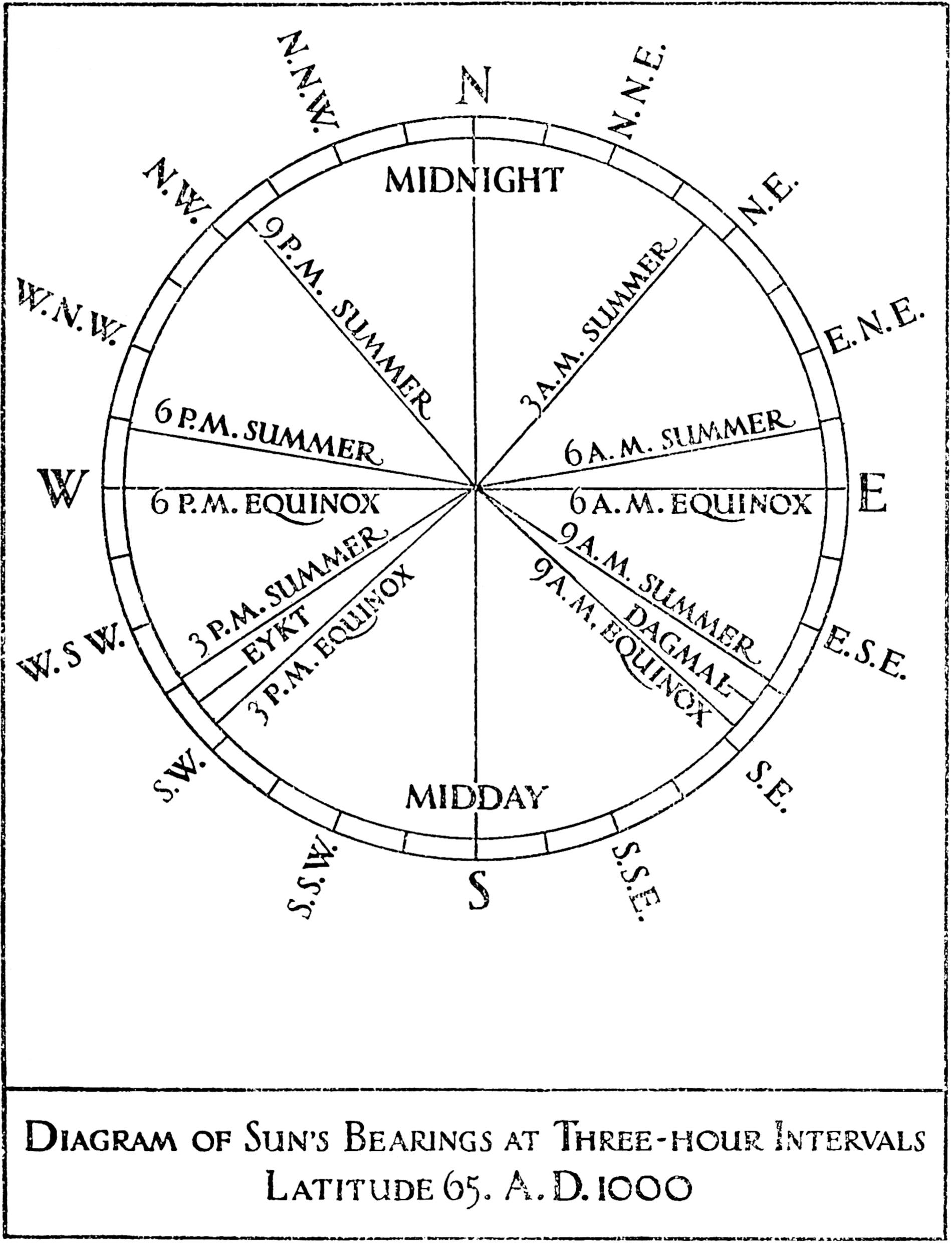
observation recorded of the length of the shortest day, which is indeed
one of the most circumstantial points to be found in any of these
stories. Now assuming this observation to be correctly attributed to
Leif, and it is recorded of no one else, then it is plain that Leif
must have wintered in the new country, and at the most southerly point
in it to which he penetrated. The alternative accounts are one and all
wholly inconsistent with any such idea. According to these, Wineland
was discovered by Leif while endeavouring to return from Norway to
Greenland in the summer of the year 1000. In the first place, at least
two of the texts giving this version of the story state distinctly, and
the others imply, that he arrived in Greenland in the year in which
he set sail. (Cf. Fríssbók: ‘He came in the autumn to Greenland’, and
the passage occurring in the body of the Flatey Book’s Saga of Olaf
Tryggvason: ‘He came at the end of that summer to Greenland.’)
But apart from these statements we may ask ourselves,—is it likely that
Leif would have passed the winter in Wineland, unless he came there on
a definite voyage of exploration? On the hypothesis of accident he had
come, and knew he had come, a tremendous distance out of his way by the
time he made land on the coast of America. Would he have had either the
supplies or the inclination to stay the winter in the newly discovered
land? Supposing that—as the Flatey Book tells us—he arrived first
at Helluland, why should he have sailed south across open sea from
that point if his destination was Greenland? If he followed the coast
he would arrive in the Gulf of St. Lawrence, and would come across
nothing resembling the Wineland of the story.[74] And it is incredible
that he should have put directly to sea in the direction opposite
to his objective and happened by chance upon the two more southerly
‘lands’. Again, if we suppose him to have gone through the experience
recorded of Bjarni, is it not still more unlikely that he would have
elected to pass the whole autumn and winter in the very first place
at which he touched, without provisions and so very far from home?
Would he not at least have sailed for Greenland after a very cursory
examination of the country, however much he might have contemplated
returning thither on another occasion? Even if we reject the
circumstantial version of the Flatey Book altogether and attribute the
observation of the sun to Karlsefni, of whom it is nowhere recorded, it
seems to me that the delay necessary to collect the samples of local
products mentioned in Eric’s Saga and Hauk’s Book is most unlikely to
have taken place if the discovery of the country was accidental and the
party desirous of returning to Greenland. For these reasons, therefore,
in addition to those given above, it seems to me that we are justified
in taking the Flatey version as authentic.
Storm, in his Studier over Vinlandsreisrne, urges that it was
more likely that Leif, returning from Norway to Greenland, should have
been driven out of his course to America than that Bjarni should have
met the same fate on the shorter journey from Iceland. In the state of
navigation at the time it is course by no means incredible that either
captain should have missed his destination by the necessary margin.
There were practically no limits to the possible deviation in those
days. Thorstein, sailing to Wineland, is said to have been driven by
contrary gales to the neighbourhood both of Iceland and Ireland, and
whether this be true or no it clearly cannot have struck an Icelandic
audience as at all improbable. It has however to be remembered that
Leif, assuming the discovery to have been made on the voyage from
Norway, was retracing a known course, and traversing a known distance;
and if we follow the only version which supplies information on the
point, he, like Karlsefni, was carried first to Helluland, which seems
to argue a direction of the wind which could not be very unfavourable
for his projected destination, Greenland; Bjarni, on the other hand,
set out on a voyage of uncertain length across an unknown sea, and his
landfall in America is stated to have been so far to the south as to
point to really contrary winds. Subject to these remarks I do not think
that there is much in the point, either one way or the other.
The next difference to be noted is with regard to the fate of Thorvald
Ericson. The Flatey Book assigns to him an independent voyage, and
a reasonable death at the hands of the savages. The details of this
voyage are given at length, and substantially in a natural and credible
form. The other version of his death is clearly incredible, for it
introduces the agency of a ‘uniped’, fabulous creature, not unknown to
classical legend.
Hauk’s story, moreover, makes Thorvald a companion of Karlsefni, not
an independent explorer. It has further to be noticed that until the
episode of his death it is not certain that the original wording of
this text recognizes Thorvald Ericson at all. Up to the point of
Karlsefni’s expedition the only reference to Eric’s family in either
of the companion texts reads as follows: ‘At that time Eric had a wife
named Thjodhild, and by her two sons, one called Thorstein
and the other Leif’: Thorvald, it will be observed, is not mentioned
at all. In the list of those accompanying Karlsefni, the purer text
of Eric’s Saga again contains no reference to this son of the house.
‘There was a man named Thorvald’, it runs, ‘who was a connexion by
marriage of Eric the Red.’ Thorvald, the connexion by marriage,
is obviously not Eric’s son, but, as Hauk correctly so far amends
the passage, a slip for ‘Thorvard, who married Freydis, an
illegitimate daughter of Eric the Red’. Hauk then interpolates ‘and
Thorvald Ericson’ in conformity with the story of his death which is
subsequently introduced. This, the uniped episode, seems to be later in
origin than the main body of the saga. The melodramatic death-speech of
Thorvald is borrowed almost verbatim from the death-scene of Thormod
Kolbrunarskald, as given in the Heimskringla; so that a Greenlander
in Wineland is here represented as intelligently anticipating the
utterance of an Icelander in Norway. Then again the uniped, as has
already been pointed out, is a borrowed conception: it is not a
creature typical of the normal superstitions of early Scandinavia. The
passage, as will be seen on a reference to the text, where it has
been omitted, is in no way necessary to the story, and the sense is
not affected by its absence. It would seem therefore as if the author
of the text on which Hauk’s version is founded, having derived from
another source an exaggerated and romanticized account of Thorvald’s
death in Wineland, interpolated it in the saga without taking the
trouble to make his account of Eric’s family or Karlsefni’s companions
tally with the final form of the story.
Two of the arguments which I have already used apply with equal force
to this part of the question. Thorstein, as the husband of Gudrid,
who subsequently became by her marriage with Karlsefni an Icelandic
heroine, was a person necessary to an Icelandic version of the story.
So was Leif, because his voyage, however and whenever accomplished, was
the reason of Karlsefni’s subsequent exploration. But Thorvald was a
person in no way interesting to Icelanders; he had gone to Greenland
with his father, probably as a child, and was ‘out of the story’. The
other point is the normal trend of tradition. The important voyage, to
Icelanders, was Karlsefni’s, and it was likely in the ordinary course,
like Aaron’s serpent, to swallow up all minor rivals, whose continued
existence was not necessary to its own. The Flatey Book version of
Thorvald’s adventures and death appears to me therefore infinitely more
satisfactory than the other, and the objections to it seem to have but
little weight.
All that has been said hitherto applies to the second voyage of
Freydis. After Karlsefni’s return to Iceland his interest in Greenland
and in Wineland ceased, and with his own ceased naturally the interest
of the normal Icelandic historian and audience. ‘And that is the end
of this story’, says the author of Eric the Red’s Saga, as he lays
down his pen, having got Karlsefni safe at home, and his Icelandic
descendants duly chronicled. What happened in Greenland later on is no
concern of his. But life in Greenland went on, and it cannot in any way
be said to follow that nothing happened in the family of Eric because
nothing has been recorded in a saga dealing mainly with a different
person. Those who would attack the authenticity of this voyage must
take other ground, and show from the story itself that it is inherently
impossible. The task has no doubt been attempted, but it seems to me
that the saga emerges successfully from the ordeal. The conduct of
Freydis and her husband as described in the Flatey Book is entirely
consistent with their characters as delineated in the rival version.
I am wholly unable to follow the reasoning of Laing, who considers
this incident in itself incredible, though others seem to share his
view. The independence and power for evil possessed by an Icelandic
wife of the saga period are well illustrated in the Njál Saga, where
the wives of Njál and Gunnar respectively carry on a bloody vendetta
with complete immunity to themselves, but at no inconsiderable expense
to their reluctant but powerless husbands, who, though on terms of
complete amity, are continually forced to pay each other compensation
for the murder of members of their households perpetrated by third
parties on the instigation of these women.
Of course the interview between Freydis and Finnbogi cannot be
authentic, as no witness was left but Freydis herself, whose version
would naturally be different, and the details of the story may well
have been worked up by a later hand.
But consider the facts apart from this: Freydis, a woman everywhere
represented as of masculine temper, is married to a wealthy nonentity
named Thorvard. From the contemptuous vituperation which Freydis pours
upon her panic-stricken companions in the skræling fight in Hauk’s Book
we get a fine insight into her character. She and her husband sail to
Wineland with Helgi and Finnbogi, whom she swindles and bullies at
every turn. The crews of the two ships are soon not on speaking terms;
a very little more will lead to a violent encounter. The brothers have
a much better ship than Freydis, and on this ship she, who has got her
way in every other respect, has set her heart. She makes a fruitless
attempt to bargain for the coveted vessel, as Ahab treated first for
Naboth’s vineyard. Her overtures repulsed, she returns in a rage to
her miserable and helpless husband, to whom she represents the conduct
of Helgi and Finnbogi as an insult only to be wiped out in blood. The
henpecked Thorvard is screwed to the sticking-place, he turns out
his men, between whom and the rival crew there is already a quarrel,
smouldering under the cover of an armed neutrality. The camp of the
brothers is attacked, and the men are assassinated. The women remain,
damning witnesses of the outrage, whom nevertheless male chivalry would
spare. ‘Hand me an axe’, says Freydis (‘Infirm of purpose, give me
the daggers’). The coup is not to be ruined by humanitarian scruples:
dead men (and women) tell no tales. The massacre is completed. Surely
it is all consistent with our experience of women of this type in
history and even in modern life. Man draws the line, he is ruled by
convention, there are ‘things no fellow can do’. Woman is a law to
herself, and as a result there are heights to which she climbs where
no man’s ideals will follow, and depths to which she falls from which
men are fortunately protected. With men, treachery and cowardice go
hand in hand; in women a masculine bravery seems merely to kill their
natural delicacy and horror of blood, they can be brave and yet sink
to the lowest excesses of meanness and cruelty. Judith, Jezebel, Lady
Macbeth—how brave they are, and yet how disgracefully treacherous! It
is of course a matter for individual judgement: the touchstone for such
a tale is not to be found among the canons of criticism. To me this
dreadful story reads as one of the most natural, consistent, and human
episodes in history; and though of course such characterization is not
beyond the powers of a brilliant writer of fiction, it seems to me far
more reasonable to accept it as authentic history. Why should this
awful libel disfigure the annals of the distinguished house of Eric the
Red, if there were nothing in it? Who would dare to invent it, if it
were not true?
I contend, then, that on main lines, where the two stories are in
conflict, it is preferable throughout to adopt the version of the
Flatey Book, and that the alleged discrepancies come to nothing more
than this, that the natural development of tradition in Iceland led,
to a great extent, to the ignoring of some elements in the story and
the fusion of others in what, to Icelanders, were the more important
episodes. Some slight additional support to the view which has been
here put forward is supplied by Adam of Bremen’s reference to Wineland,
which has been referred to in another chapter. For he states that this
country has been ‘a multis repertam’, that is to say, discovered
or explored by many. This, so far as it goes, is in favour of the
Flatey Book, for a country visited on but two occasions, one of which
was accidental, could hardly be so described.
Even where the narratives are in closer agreement, the Flatey Book
appears to me on the whole the more reliable version.
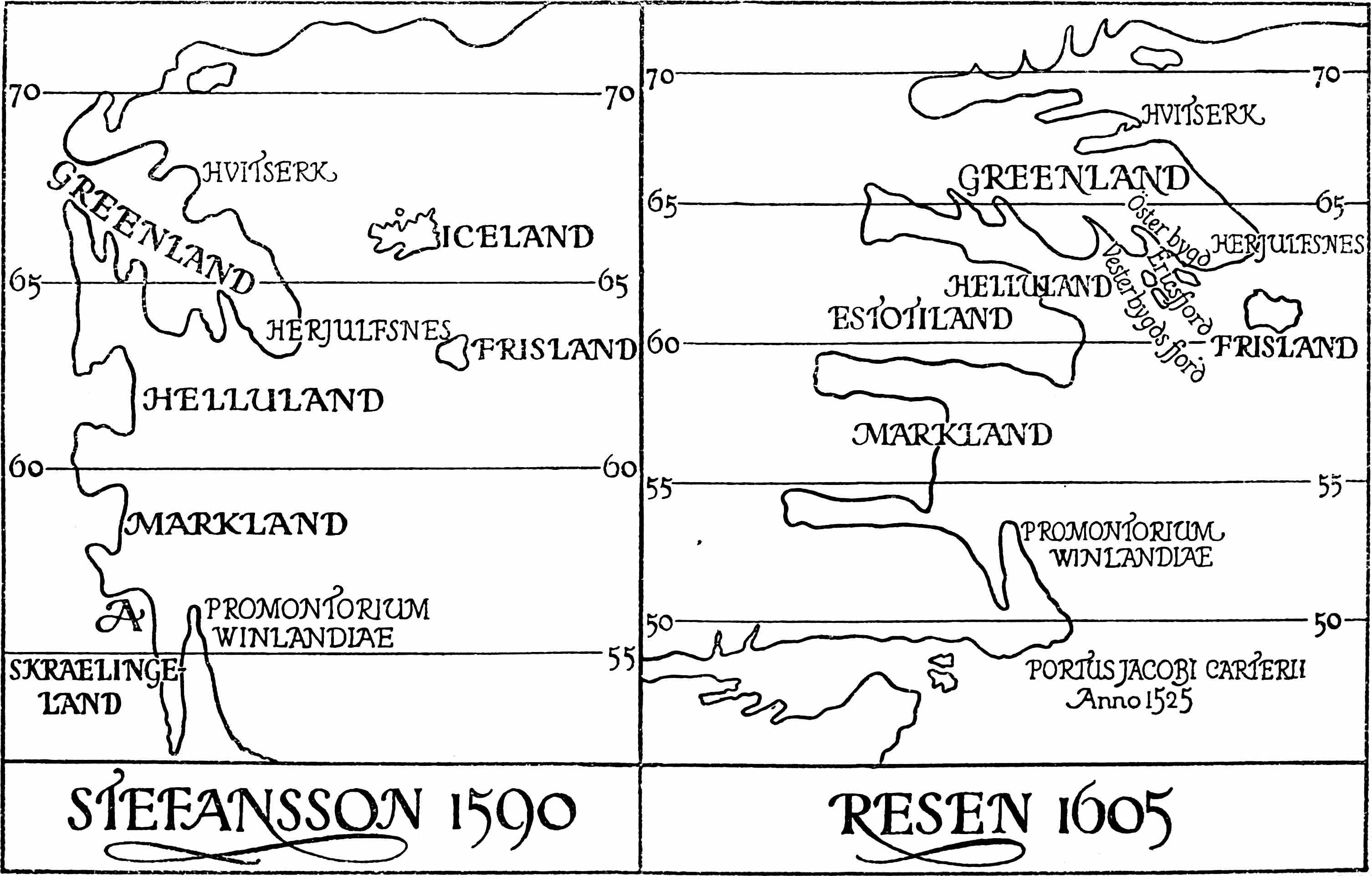
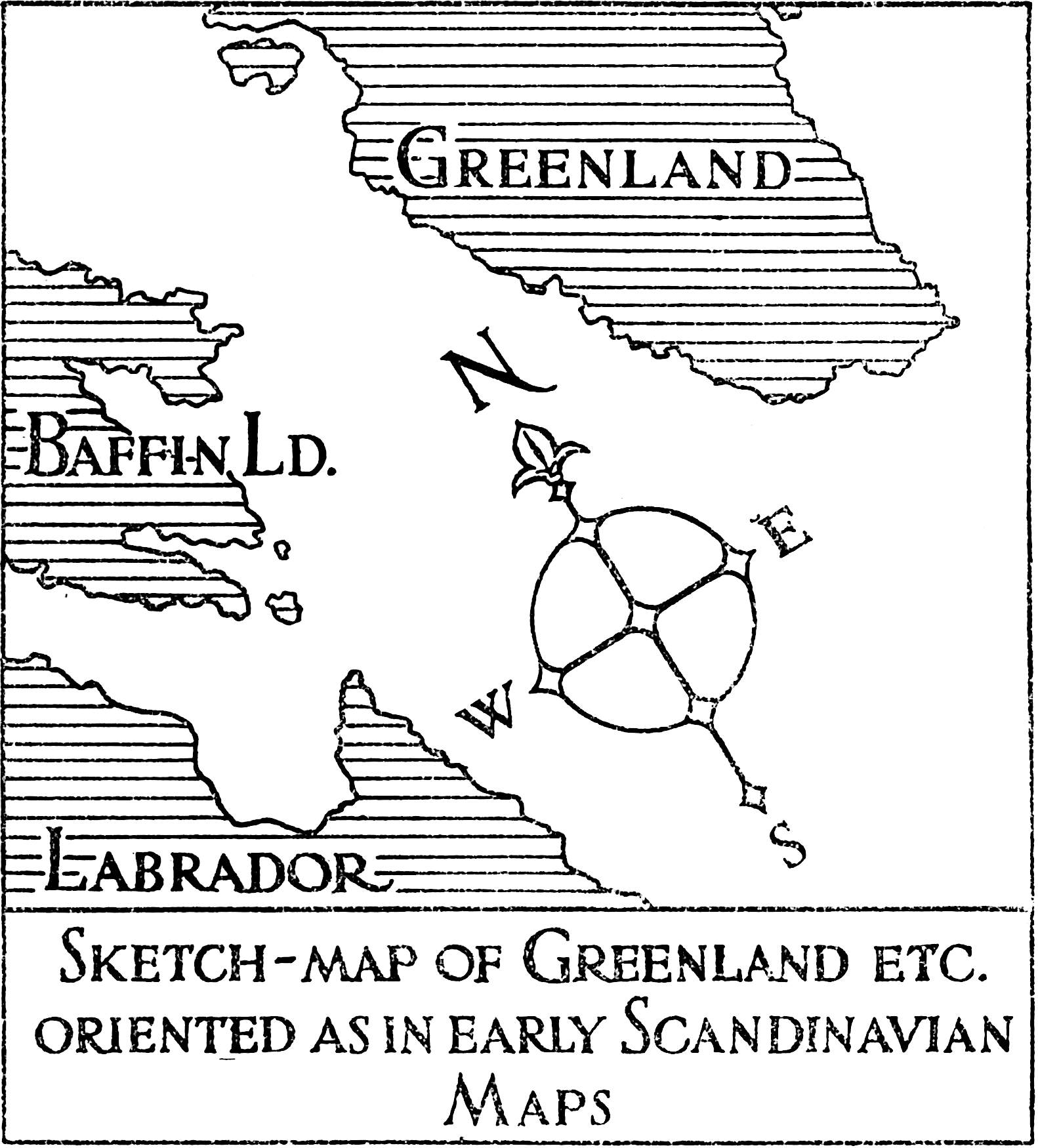
Especially is this the case with the courses given in the narrative.
According to the Saga of Eric the Red and Hauk’s Book, Karlsefni rarely
sailed in any direction except south. Thus, Greenland to Helluland is
south; Helluland to Markland either south or south-east; Markland to
Keelness south according to Hauk, the companion version being silent;
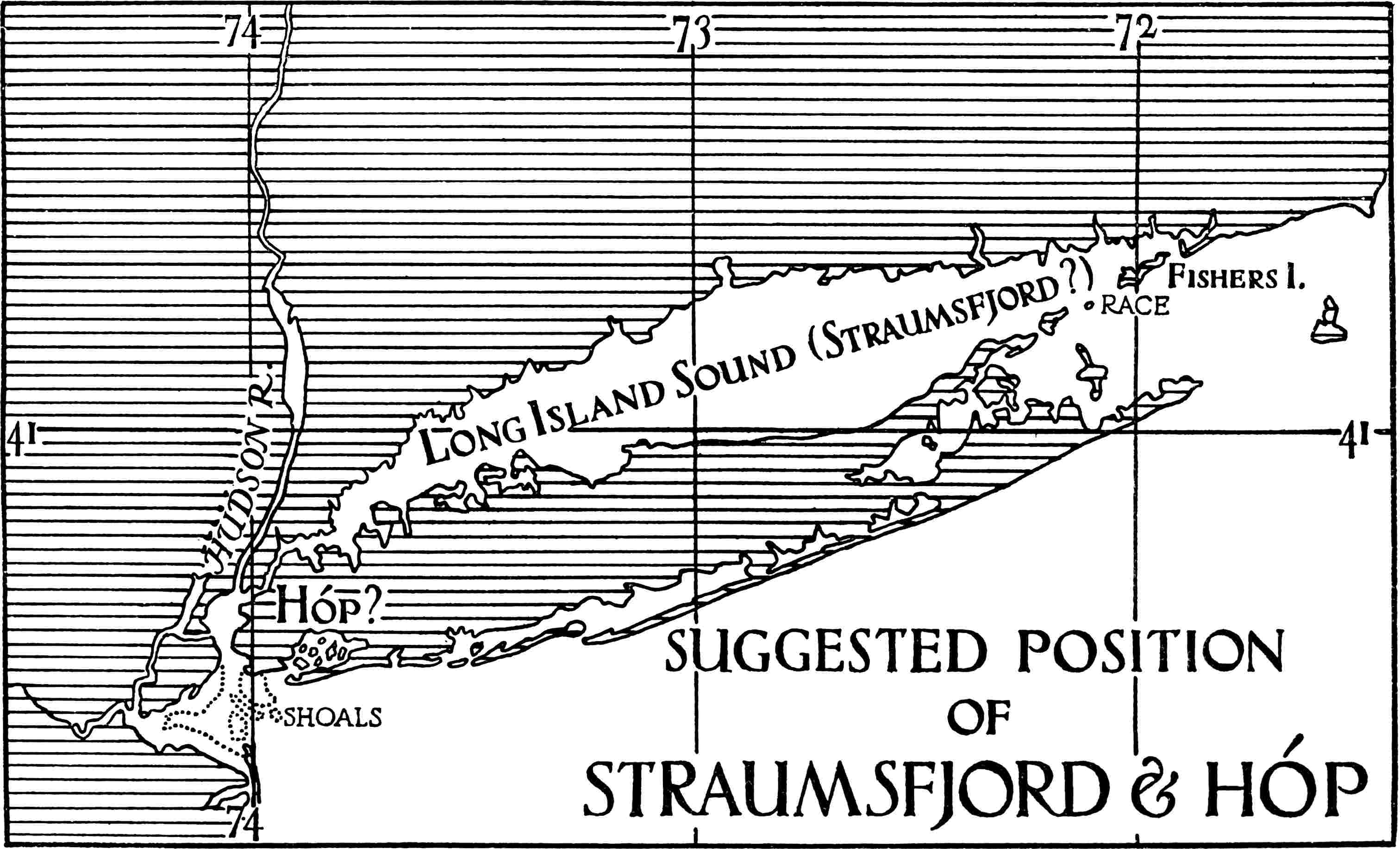
Straumsfjord to Hóp, once more, south. Now, wherever we place the lands
discovered in America, the situation really calls for a great deal more
west than south for a large part of the voyage. In a statement which
is only approximate, the bearing we need is south-west. This occurs
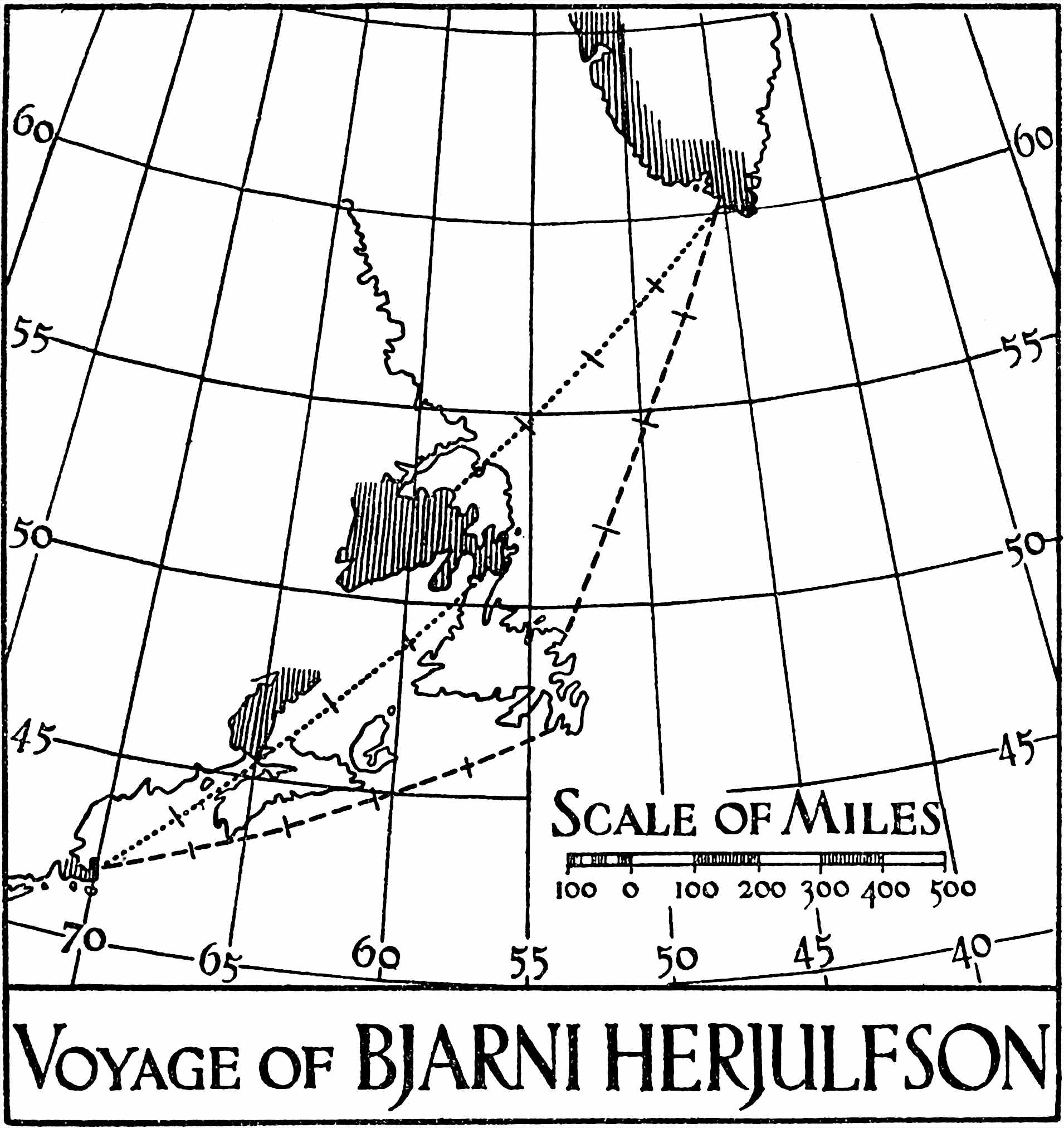
nowhere in the synoptic versions. Now compare the Flatey Book. Bjarni’s
return is all north-east; the lands therefore lie, as they do in fact,
on a south-westerly line. Leif sails south-west from Markland to
Wineland, and it is implied that his course elsewhere corresponded with
Bjarni’s. This gives us at any rate good foundation for supposing the
data in the Flatey Book to be the more authentic. At the very least
these statements go far to establish the entire independence of the
Flatey version, and to demolish the suggestion already dealt with that
this narrative is merely a perverted embroidery of hints contained in
the other.
It is astonishing to find that Storm and his school prefer the courses
set out in the rival version, and seem to evince great difficulty in
making anything of the Flatey Book’s geography. They even say that the
latter conveys to them the idea of a coast facing north or north-east.
How this is arrived at it is difficult to see. When Bjarni turned in a
north-easterly direction to search for a way home, we are told that he
‘left the land on the port side’. This clearly indicates that the coast
lay to the north of him and faced south, trending away to the north
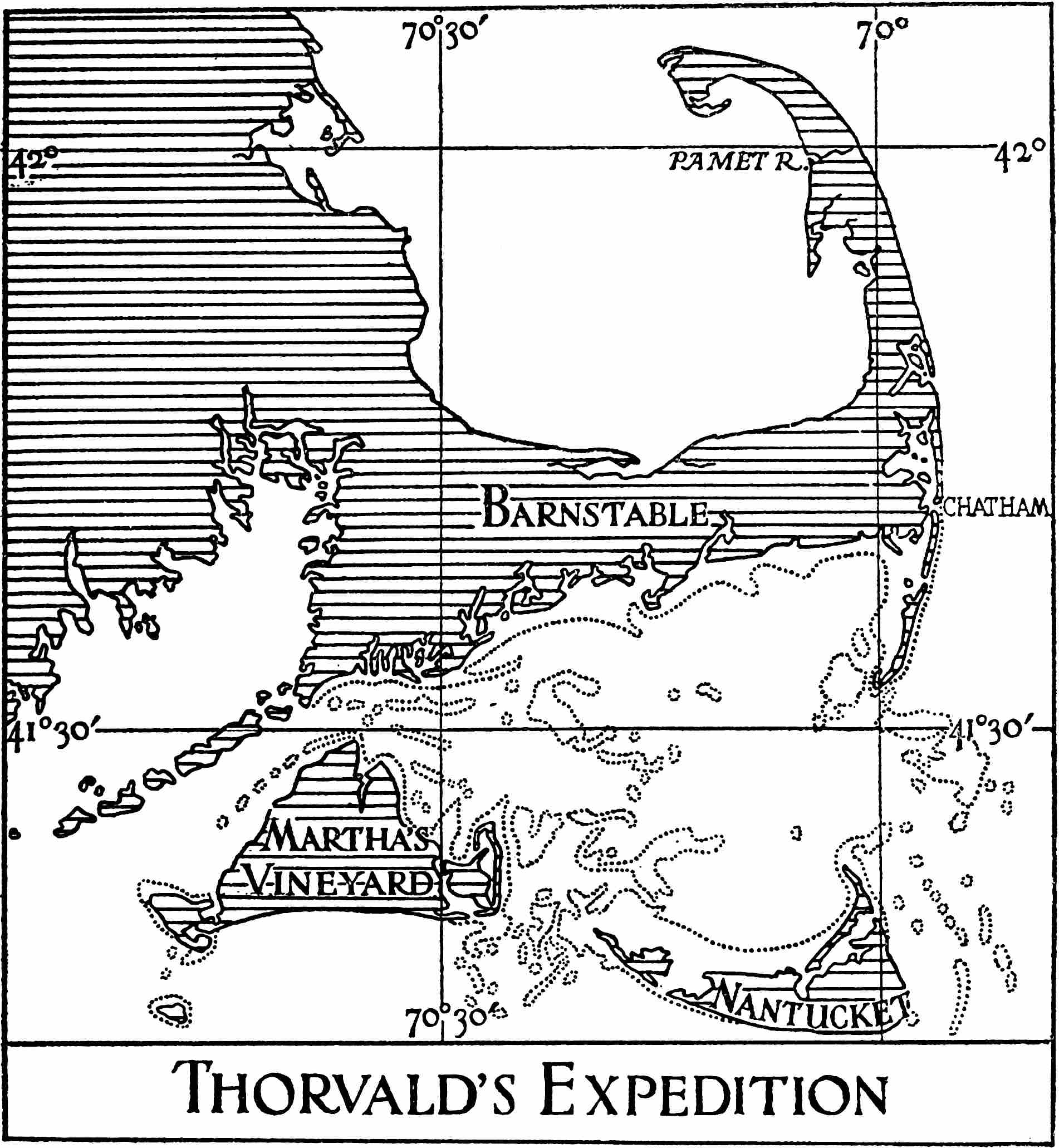
in a little while so as to disappear from sight. So again Thorvald
from his base in Wineland can go east or west, but to reach ‘the more
northerly part of the country’ he has first to turn east. This conveys
the same idea as Bjarni’s voyage, a south-facing coast, turning to the
north at its eastern extremity. True, there is a word in this voyage
which seems to imply an easterly course after leaving Keelness; this
will be discussed later, but in any case, if it had to be rejected, it
would not justify the views expressed by Storm and his followers as to
the Flatey Book’s geography as a whole.
I have incorporated the rival version of Karlsefni’s voyage in the
story as I have rendered it, as the differences are but small, and the
version adopted is less condensed and therefore fuller of information.
I will however give an instance to show that here also the Flatey
version is the more likely to be accurate. Undoubtedly the oldest parts
of the text of either authority are the verses ascribed to Thorhall
the Hunter in the saga adopted by Hauk. These are admitted by the most
exacting critics to bear all the indications of a date corresponding
with their ascribed origin. Even Dr. Nansen allows their genuineness.
Now it will probably have struck the careful reader that the second of
these two poems bears no sort of relation to its context. The verses,
either expressly or by necessary implication, convey the following
facts:
1. They are the utterance of a person who is leaving the New World
behind, to return to his own country.
2. Those whom he is leaving behind him are at Furdustrands.
3. These people are satisfied with a diet of boiled whale, which the
poet considers unattractive.
The text, on the other hand, conveys a totally different set of facts:
1. The verses are composed by a person who is proposing to coast
northwards in search of Wineland.
2. The explorers are at Straumsfjord, far to the south of Furdustrands,
and the main body are proposing to go even further away from that
locality. (I do not, however, attach much importance to this
discrepancy, believing as I do that the name Furdustrands was applied
broadly to a large district in which Straumsfjord may well have been
included.)
3. The one person who appeared pleased with the whale, and indeed
claimed the credit for its appearance, was the author of the poem.
The rest were made ill by it, and on hearing of its supposed origin
refused altogether to eat it.
These differences are clearly quite irreconcilable, and, the poem
being the more reliable authority, the version in the text at this
point must be abandoned. As Storm says, the fact that the author has
plainly misunderstood the verses quoted is in itself evidence of the
greater age of the latter. But in the Flatey Book, though, the account
being much condensed, no mention is made of Thorhall or his verses,
the whale is given a perfectly natural origin, and is eaten without
any contretemps by the whole body of the explorers. We may, however,
reasonably assume that such fare would not be relished by a fastidious
person, and might well provoke the utterance of the sentiments embodied
in the old song. There is at all events no inconsistency between the
text of the Flatey Book and the poem.
There are one or two minor discrepancies which must now be considered.
Leif’s visit to Norway is said in the Flatey Book to have taken place
sixteen years after Eric’s colonization of Greenland. This would date
his arrival after Olaf’s death in September 1000. But Eric had explored
Greenland with an eye to the colony three years before it was actually
inaugurated, and if we take it that the date of the first visit is
referred to as part of the same transaction this point disappears.
In no other account in Icelandic literature do we find Gudrid mentioned
as the widow or wife of Thori Eastman, i.e. the Norwegian, whom Leif
rescued from the wreck. It is still not improbable that she was
so. Gudrid apparently arrived in Greenland about the time that Leif
was absent on his voyage of discovery, and Thori, from his remarks
as reported in the Flatey Book, seems to have been acquainted with
Brattahlid before his shipwreck, which was not far from the coast of
Greenland. Supposing him to have married Gudrid about this time, we are
told that he died the same winter, and Gudrid would almost immediately
be free to be married, as we are told she was, to Thorstein Ericson;
consequently when Karlsefni married her, which was the important
incident in her career from the point of view of the saga genealogists,
she would be, as all accounts make her, Thorstein’s widow, and the
brief episode of her marriage with the comparatively insignificant
Thori would soon be forgotten, particularly as Thori was a Norwegian,
and therefore of no interest to Icelanders.
A more important question arises in connexion with various conflicting
statements as to the ultimate religious faith of Eric the Red, and the
precise time of his death. On these points the Flatey Book is not quite
consistent with itself, for in the body of the Olaf Tryggvason Saga,
chap. 352, it states that Eric was converted. This passage, however,
is evidently from a different source, and speaking broadly we have the
statement in the Flatey Book that Eric died in the winter following
Leif’s return from Wineland, which would hardly give time for his
admittedly slow conversion to Christianity, while in Hauk’s version
Eric lives on to the time of Karlsefni. The repeated statements in
other authorities as to Eric’s low opinion of the priest, whom he
described as a humbug or hypocrite, give colour to the theory that he
died unconverted. The priestly chronicler of his achievements, on the
other hand, would doubtless favour any rumour of the final conversion
of his hero. It would hardly do, if it could be avoided, to leave
this pioneer of colonial enterprise in the hell which the belief of
the period would inevitably assign to him if he refused to the end to
abandon his old creed.
I am inclined to think, on the whole, that the Flatey Book is correct
in saying that Eric was dead when the later voyages took place.
If we glance at the chronology we find that Eric, by 981 or 982 (date
of first Greenland voyage), had been long enough in Iceland to have
made many friends as well as enemies. Before he came to Iceland he
was old enough to be implicated in homicide with his father.[75] He
married, and one son was born before his three years’ exile from
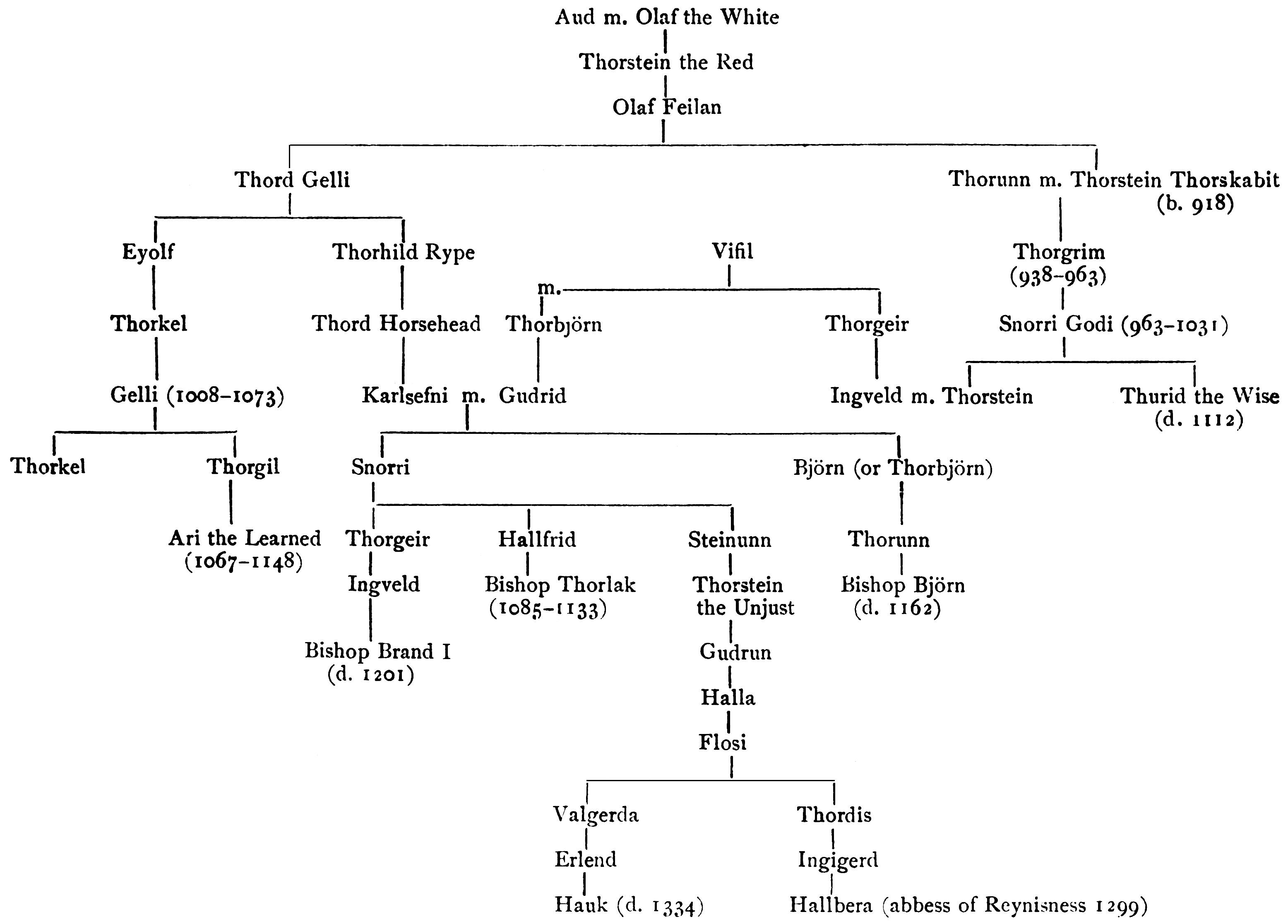
Iceland. The sons of Thord Gelli, brothers, that is, of Karlsefni’s
grandmother, were among his active enemies. The father of Gudrid,
Thorbjörn Vifilson, was among his contemporaries, as was Herjulf,
who had a grown-up son who had owned a ship for some years in 985–6.
True, Snorri Godi, born 963, and the sons of Thorbrand of Alptafjord,
were among those who participated in his quarrels, but they must have
been among his younger contemporaries. In 985 or 986 Eric had an
established position as a leader of men; at the date of Leif’s voyage
he considered himself an old man. If we put his birth midway between
that of Snorri Godi (963) and his father (938), we shall not then be
far wrong. Eric, therefore, would be born about 950.
Now Karlsefni’s voyage, in spite of some statements to the contrary in
the sagas, cannot have taken place till about a quarter of a century
after Leif’s, whether we date the latter from a.d. 1000,
following Hauk, or 1002, accepting the Flatey Book. This, though not
generally recognized, is clear from the known dates of the descendants
of Karlsefni’s Wineland-born son. Snorri’s grandson, Bishop Thorlak,
was born, as we find in the Annals, in 1085; Bishop Brand the first,
Snorri’s great-grandson, died in 1201. Brand’s mother therefore, of
the same generation as Thorlak, can hardly have been born so early as
1085. Putting the mean date of the birth of Snorri’s children at thirty
years before 1085, which is making a liberal allowance, we get the date
1055. Snorri therefore cannot have been born much before 1025. If the
Flatey Book is correct, Gudrid was married in 1003, and she certainly
was of a marriageable age before leaving Iceland, and was a widow when
Karlsefni married her. Karlsefni’s voyage and the birth of Snorri
should accordingly be placed rather earlier than 1025, say 1020. At
this time Eric would be about 70 years old, and, especially if he was
ageing in 1002, it is most improbable that he survived so long amid the
hardships of life in Greenland.
Again, when King Olaf the Holy, about 1018, wished to get rid of the
troublesome blind king Rörek, and commissioned Thorar Nefjolfson to
take him to Greenland, it was Leif Ericson, and not his father, whom
he designated as consignee. (Vide Heimskringla, Saga of Olaf the Holy,
c. 85.)
Finally, it seems strange that Leif should not have accompanied
Karlsefni on his voyage if there was nothing in particular for him
to do in Greenland, whereas if the management of Brattahlid and the
control of the colony had devolved on his shoulders by his father’s
death, the position is quite intelligible.[76]
There is accordingly abundant reason to conclude that on this point
also the Flatey Book is right, and Hauk is wrong.
Other small discrepancies which have not escaped the vigilance of
commentators can be explained as clerical slips, and consequently do
not go to the root of the matter. The alleged improbability of certain
details in both narratives will fall to be discussed hereafter.
It seems to me, however, that too much importance may easily be
attached to the fruits of this sort of microscopic criticism. The
broad fact that we have two quite independent versions telling to all
intents and purposes the same story—at any rate providing material for
a substantially consistent and circumstantial history collated from
both sources—is much more important than the existence of any number
of minor discrepancies. By placing ourselves as far as possible in the
positions both of the actors and chroniclers of these adventures we are
likely, I think, to get a fuller appreciation of the facts as they
were and of the truth with which they have been related than if we pore
with a too studious eye over every line and every word, with a view, if
it be possible, to establish an inevitable but trivial inconsistency.
The reader who has carefully followed the argument so far will at this
point probably be disposed to make some such observation as follows:
You argue that the story is more likely to have lost the additional
facts given in the Flatey Book than to have invented them by the
natural operation of tradition. Well and good. You also point out, with
a certain amount of plausibility, that the probable state of interest
and knowledge in Iceland was just such as to produce precisely those
alterations and omissions from what you consider the true course of
the story, which, according to you, have taken place in what we may
call Hauk’s version. You appear to forget, however, that both texts
are Icelandic, and that this argument ought therefore to apply with
equal force to the Flatey version, where the parts uninteresting to
Icelanders are notwithstanding retained.
My first answer to this would be that it is quite possible that actual
facts might be retained in one version in Iceland, even though not
of great interest to the people of that country, but it is highly
improbable that an Icelandic chronicler would be at the pains to supply
by invention precisely those points in which his audience would feel
the least concern.
My own private conviction, however, is that the Flatey version is in
the main drawn from a Greenland source. Here we are embarking upon
conjecture, a conjecture, by the way, which has been made before, but
it may be interesting shortly to consider the grounds upon which such a
theory is based.
It is in the first place improbable that in the narrow confines of
Iceland two quite independent versions of the same story should
exist side by side. The original story-tellers in this country were
peripatetic, there was a close intercourse between families residing in
different parts of the island, and it would be strange if the tradition
of one district had remained unaffected by that of another. But the
point most universally admitted with regard to these two versions is
that, except for certain introductory and genealogical points derived
from a common source, the Landnámabók, while on the whole the facts
correspond, the stories are obviously independent.
This curious circumstance is at once explained if we suppose the
historian of the Flatey Book to have had access to a saga composed in
Greenland.
Next, it is a marked and unique characteristic of the Flatey manuscript
considered as a whole that the library from which it was derived was
evidently rich in literature treating of the Scandinavian colonies
which existed outside the confines of Iceland. This feature has been
noticed by Vigfusson in his preface to the Orkney Saga in the Rolls
Series (p. xxxii). ‘Its pages’, he writes of the Flatey Book, ‘preserve
more than half of all we know of the older history of the Orkneys,
the Faroes, Greenland, and Vineland (America). Indeed John Haconson
and his two scribes seem for some reason, now unknown, to have paid
particular attention to gathering up every scrap relating to these
neighbour-lands of Outer, or Colonial, Scandinavia.’ It is therefore
precisely in such a work as the Flatey Book that we might expect to
find incorporated a saga derived from an outlandish source such as I
have suggested. We know, too, that the practice of saga-telling went
on in the new colony as in the old, as indeed was a priori
probable. In the Saga, of Eric the Red such a form of entertainment
is expressly mentioned as a means whereby the nights of the Arctic
winter were enlivened during the visit of Karlsefni to Brattahlid.
The stock-in-trade of these Greenland story-tellers must inevitably
have included a detailed account of the founder of the colony, thus
supplying a rival ‘Eric’s Saga’ such as I have argued (supra,
p. 108) that the Flatey Book is referring to in the passage where
‘Eric’s Saga’ is mentioned. Now, on turning to internal evidence, we
shall find that corroboration of the theory advanced is by no means
wanting. Not only does the Flatey Book, as has been remarked already,
supply precisely those episodes in which Greenland rather than Iceland
would be interested, e.g. Bjarni’s voyage, the circumstances, date,
and details of Leif’s, and the full description of Eric’s family, but
conversely, where Greenland interest would naturally cease, the Flatey
Book is far less rich in detail than its rivals. Take, for example,
the case of Gudrid. To Icelanders this lady was a most important
character, the ancestress of many distinguished men. To Greenlanders
she was a girl who paid a temporary visit to the colony, and was for a
few months the wife of a son of the house of Brattahlid who met with
an early death, before the promise of his youth was fulfilled. She
then married the Icelander, Karlsefni, and disappeared from their
ken. Consequently, though the Icelandic scribe of the Flatey Book has
been able to supply some facts about her descendants in the concluding
paragraphs of the story, we find an extraordinary lack of information
on the subject of Gudrid in this version as compared with the other.
In the Flatey Book she is subordinate in importance to the truculent
Freydis and her henpecked husband. Besides the principal adventures of
this couple we are given a summary of their characters, the mercenary
nature of their union, and the exact place of their abode, which is
described in a phrase of more interest, one would think, to a Greenland
than an Icelandic audience, as ‘Garda, where the cathedral is
now’. Of Gudrid’s origin we are told nothing. She appears suddenly
in the Flatey Book as the wife of the Norseman Thori, who was rescued
at sea by Leif. Of this marriage, which is only recorded in this one
source, I have spoken already. Whether it is to be accepted as a fact
or no is not for the moment material, the point is that Gudrid comes
abruptly into the story as a person whose previous history is of no
importance. In the rival versions she is the principal character,
who holds the stage from start to finish. The saga opens with a
passage—otherwise irrelevant—explaining the origin of her family in
Iceland, in the days of her alleged grandfather, Vifil. Next, after
Eric the Red has migrated to Greenland, we have another interlude
devoted to explaining the reasons which brought about her emigration
with her father to the new colony, followed by a description of the
sibyl’s séance in which Gudrid played so important a part, which is so
vivid and real as to give rise to the suspicion that it may have been
derived from the description of Gudrid herself.
Now the usually accepted explanation of the Flatey version is that,
being composed in the north of Iceland, in close proximity to the
religious establishment associated with Gudrid’s piety, and in the
district where Karlsefni’s family were settled, the story is derived
from the reports of the Icelandic explorer. And indeed, the final
paragraphs, wherein the descendants of the pair are duly recorded, may
well be ascribed to a local origin. That some combination of different
sources takes place at this point is indicated by the fact that the
statement ‘many men are descended from Karlsefni’ occurs twice over
in separate places towards the end of the saga. It reads, in fact,
exactly as if the final passage beginning ‘and when Karlsefni was
dead’ was an addition from local sources. But is it not in the last
degree surprising, if the accepted theory be true of the whole story,
that here alone we should be imperfectly informed as to the career and
descent of the local heroine?
Again, if this story is the result of the full report which we are told
that Karlsefni left of his adventures, is it not remarkable that in the
description of this voyage alone the Flatey Book gives place, in point
of circumstance and detail, to the rival account? Not a word is said
of the Icelandic co-adventurers, Bjarni Grimolfson and Snorri; nay, we
are given to understand that Karlsefni had come from Norway, without
stopping on his way in Iceland to join forces with any such companions.
And the whole story of the voyage, unlike the other expeditions
detailed in the Flatey Book, is, when compared with the alternative
account, quite sketchy and meagre. It may well be accurate as far as it
goes, for Karlsefni evidently returned to Greenland before proceeding
home, and many of his companions were Greenlanders, but it is, as one
would expect of a Greenland version of this story, compressed into the
briefest summary.
If the account of the Wineland voyages to be found in the Flatey Book
originated in Greenland, it is evident that it was far less exposed
than the Icelandic sagas to literary and other influences derived from
communication with other countries. Intercourse between Greenland and
the outside world must always have been rare, and the effect of the
edict issued by the King of Norway in 1294 creating trade relations
with Greenland a crown monopoly led very speedily to the decline and
disappearance of the colony, which appears to have been completed about
a.d. 1400. In particular, the edict cut off communication from
Iceland. Only in one respect should we expect to find a Greenland saga
affected by modern developments. And this is just what we actually do
find in the present case.
As Dr. Storm has pointed out in the preface to his excellent edition
of the Saga of Eric the Red, the Flatey narrative contains an
extraordinary number of direct voyages between Greenland and Norway.
Apart from Bjarni Herjulfson, there is first Karlsefni’s arrival,
which is here stated to be from Norway; there is his return, direct to
Norway, where he sells his ‘húsa-snotra’ to a German from Bremen; and
finally there is the arrival of the brothers, Helgi and Finnbogi, from
Norway, in the story of Freydis’s expedition.
Now Dr. Storm sees in all this merely an additional count in his
indictment against the Flatey Book. This talk of direct voyages between
Greenland and Norway smacks of the days of the royal monopoly; Germans
from Bremen suggest a date subsequent to the establishment of the
Hanseatic League in Bergen. I think these anachronisms are established
with some degree of certainty; but it also occurs to me that the
mistake is more suggestive of a Greenland than an Icelandic source.
It is difficult to suppose that the infrequent ships which sailed to
Greenland under the royal monopoly in the thirteenth and fourteenth
centuries did not in fact call at Iceland, which lay directly in their
track. If they did so, they would not suggest to an Icelander the idea
of direct voyages between Norway and Greenland; if they did not, they
would not be present to the Icelandic mind at all. To a Greenlander of
about the period of the Flatey Book’s composition, or even earlier, any
ship which arrived off Greenland would, on the other hand, be ‘a ship
from Norway’; i.e. a ship bringing his necessary supplies from the only
available source. And, as the original sagas handed down to him would
hardly be concerned very much with the origin or destination of the
ships which came to Greenland, the error of introducing Norway might
easily creep in.
So too with the episode of the Bremen merchant. It smacks of the
fourteenth century, and it is obvious that the doings of Karlsefni
after leaving Greenland would not be accurately known to an inhabitant
of that country. But it seems not improbable that the Greenlanders,
being without timber, continued to visit the new lands to obtain
such commodities, especially for use in ship-building, and indeed the
Icelandic Annals for 1347 contain an allusion to a ship coming from
Markland. It must be remembered that ‘mösur’ wood is not elsewhere
specifically mentioned in the Flatey Book account, which makes it
probable that this passage is from a different source from the main
narrative. But, at a later date, some anonymous Greenlander may well
have sold a ‘húsa-snotra’, which appears to have been something
connected with a ship, to a German at Bergen or elsewhere, and, in
conformity with the tendency to which allusion has been made of
attributing the actions of lesser-known characters to those more
distinguished, the transaction may easily have come to be associated
with Karlsefni, as the principal hero of the Wineland tradition, and
the only one who after his return left the coasts of Greenland.
All this points to Greenland as the country where the Flatey Book
version of the story originated, and if this be so it not only accounts
for several inconsistencies in the rival versions, but renders it
likely that the account here preserved escaped the contamination which
affected the later Icelandic sagas, through the influence of foreign
literature.