For trailer and tent campers, attractive Rock Creek
Campground, less than a mile from the mouth of Madison
Canyon, was a favored site. So much so that it was full
most of the summer season. Campers who pulled into the
canyon too late to find campsites in the formal, or improved,
area just pulled off the road and overnighted on any level
spot they could find along the road.
Two vacationing families, the Osts and the Fredericks, felt
lucky when they found adjacent campsites at Rock Creek on
Monday, August 17. Rev. Elmer Ost, who teaches psychology
at Biblical Seminary in New York City and doubles as pastor
at Bethany Congregational Church in Corona, Queens, his
wife, Ruth, youngsters, Larry, 14, Geraldine, 13, Joan, 11,
and Shirley, 6 had been enjoying a leisurely camping vacation
in the Northwest.
The Melvin Fredericks family (he’s a biscuit salesman
for B & B from Elyria, Ohio) included Mrs. Laura, Melva,
16, Paul, 15, and George Whitmore, 15, who lives with the
Fredericks in Elyria, Ohio, while his folks are missionarying
in Brazil.
The two families met in Columbia Falls, Montana, at the
home of Rev. Ralph Werner, who was a relative of the
Fredericks and a college chum of the Osts. They’d both
toured Glacier National Park and were headed for Yellowstone
Park and the Black Hills, and decided to camp together
the next night. Ost told Fredericks that if you didn’t
make it to Yellowstone Park before noon, the campsites
would all be filled. But, he knew of camping areas in the
Madison Canyon, near West Yellowstone, and not too far outside
the park where they’d be more likely to find room. The
Osts got to Rock Creek Campground at 6 o’clock Monday,
August 17, found a site, and stationed Larry by the road to
stop the Fredericks.
The two families chose a small open area near the stream
and pleasant evergreen trees at the east end of the camp
near the entrance.
17
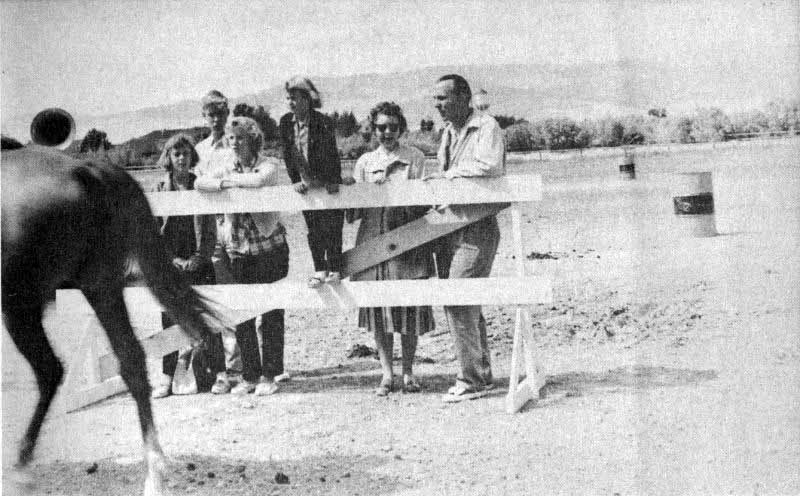
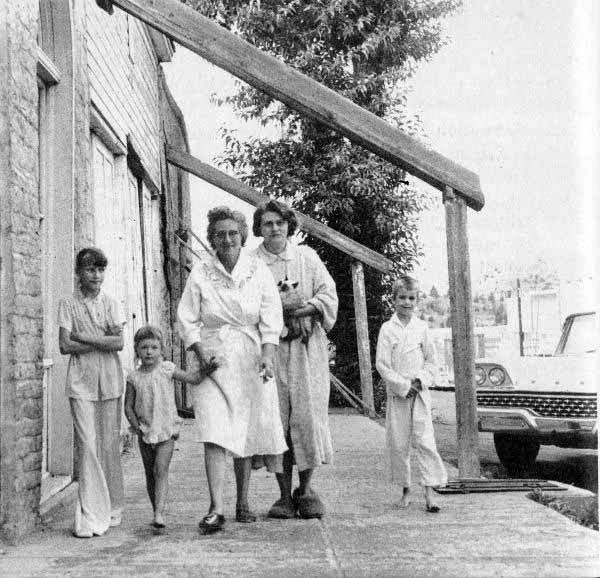
The Elmer Ost family were special guests at the Madison County Fair at
Twin Bridges, five days after their earthquake ordeal.(Christopherson)
They set up camp, ate together, socialized, and made plans
to get up at 6 o’clock next morning, breakfast on dry
cereal, and get an early start for Yellowstone. They swapped
stories about their vacations, joked about the bear that was
supposed to be scavenging around the campground, and decided
to walk down to the highway where they’d be away
from the trees and able to see the moon, which lit the mountain
behind them. But the mountain that looked high on
the south side of the canyon kept them from seeing the moon
directly.
They turned in early—at 9 o’clock. The two younger
Ost girls, mildly concerned about the bear, decided to sleep
in the car, a 1950 Buick. Larry and Geraldine and their
parents all slept in their tent. Mrs. Fredericks and Melva
slept in their station wagon, while the men stretched out in
a tent.
Everyone was nicely settled by 11:37, when a thunder-like
commotion outside awakened them. Ruth and Gerry
Ost shouted something about bears as they jumped out of
the tent.
“It’s a cyclone!” Mrs. Ost was screaming in half-wakened
terror as Rev. Ost emerged from the tent.
The sky was clear, the moon bright, as Rev. Ost looked
up and to the west. There were no clouds or wind.
18
But terror ran through the whole party as they saw tents
swaying, trees shaking as though torn in a violent wind.
Then the Osts’ 1950 Buick began to rock from front to rear
as if men were jumping energetically on the bumpers. The
brake lights went on as one of the gals jumped on the brake.
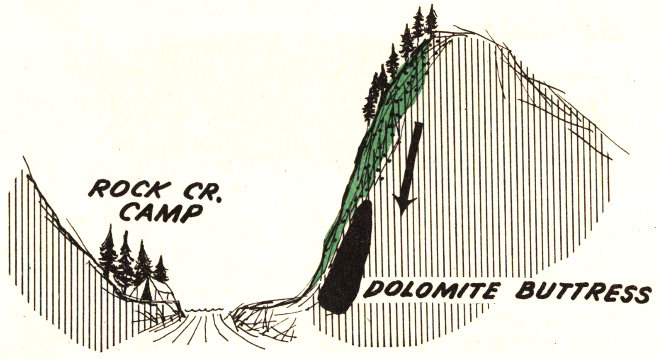
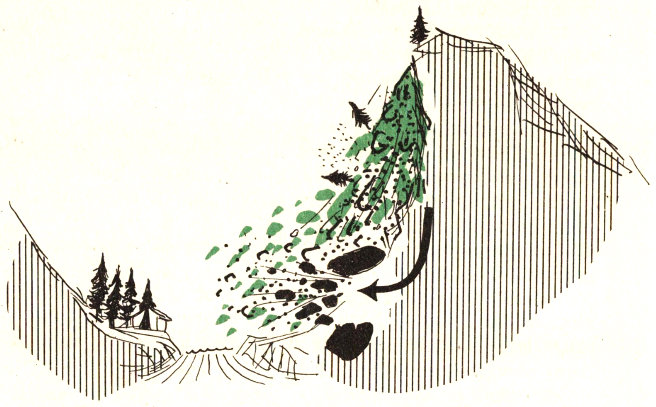
Then came a tremendous roar, like several express trains
passing right through the camp. The trees shut off their
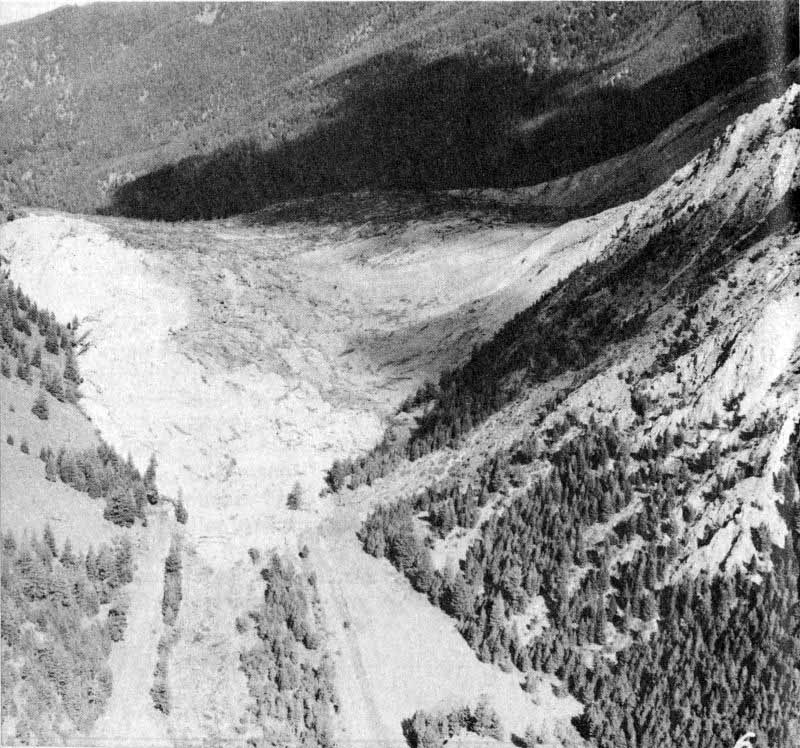
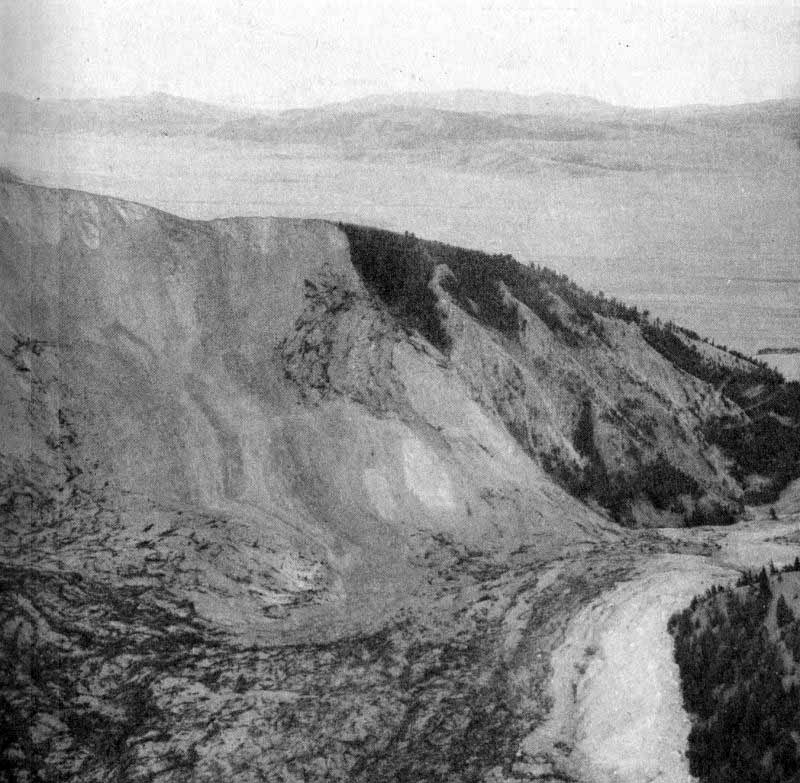
view of the huge, 7,600 ft. mountain falling, of the huge
boulders, big as houses, hurtling down one side of the canyon
and up the other side, a mile away, throwing sparks and dust
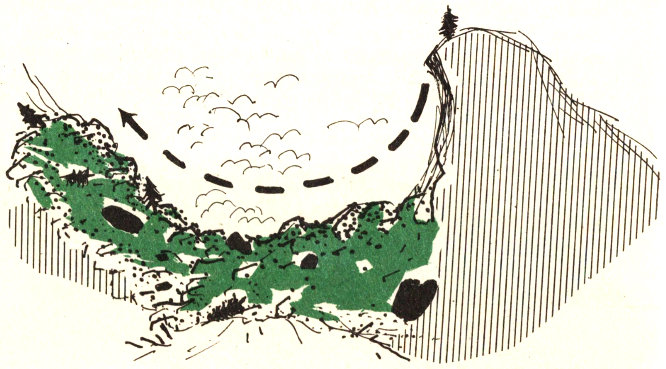
as they fell. Rev. Ost sensed the rushing of the wind and
water trapped by the avalanching mountain, and thrown back
at the dazed campers—at tornado speeds—from under the
slide. “Hang onto a tree!” he shouted. Mrs. Ost ran for the
car as she saw the wave of water coming. Larry was caught
in the tent when the wall of water, mud, and trees hit them
with such violence that it crumpled trailers and hurled the
Osts’ 4,000 pound car thirty feet and smashed it against a
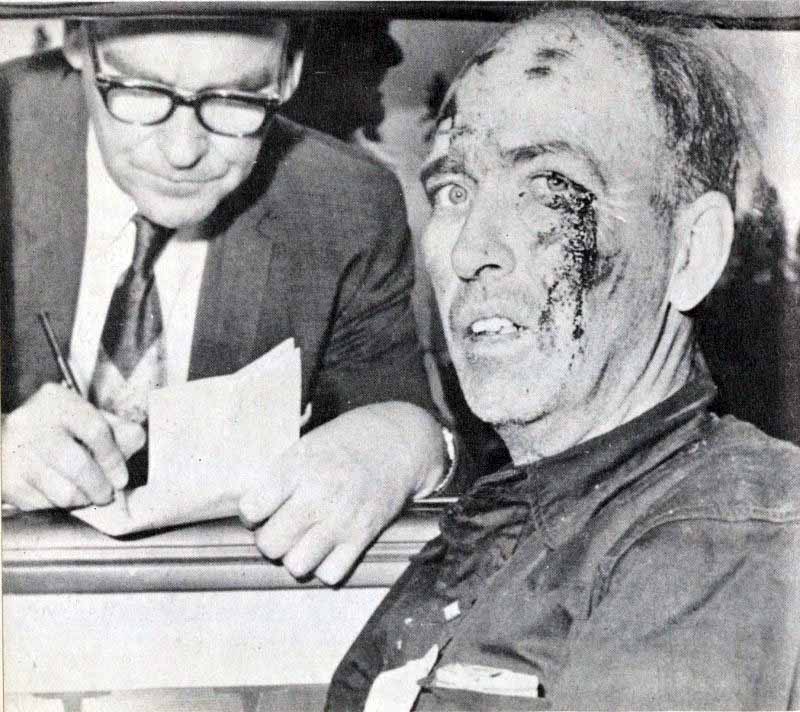
row of trees. Although Mrs. Ost was holding onto the steering
wheel, the violence of the surging water threw her
against the side of the car so violently that it made a pulp
out of the right side of her face. In the midst of the mud,
water, and floating and flying debris, Larry managed to
tear his way out of the tent.
Dust from the slide obscured the moon and heightened
the sense of tragedy and terror.
The tent was gone. The deluge of water had jammed
cars and trailers together. The rocks had covered the site
of a trailer where a family had been playing earlier in the
day.
The night rang out with the bewildered crying out for
lost relatives. Stunned like the others, Rev. Ost shouted for
“Fran.” After hitting the brake pedal she’d jumped out of
the car and scampered, like a deer, to higher ground.
19
He found Gerry, unharmed, except for being wet and an
injury to her hand. Sloshing through water to his knees, he
found Ruth still in the car. After several minutes hunting
and shouting “Larry” he found his son, soaked, clad only in
shorts.
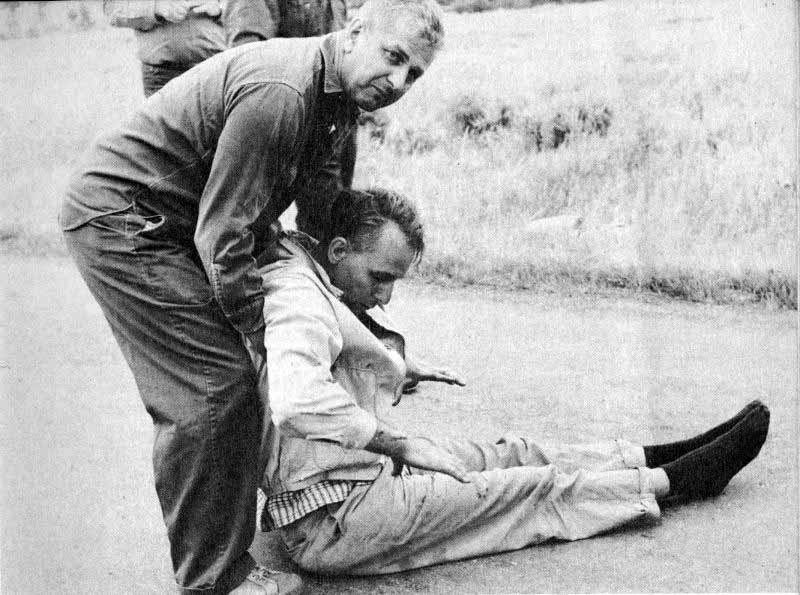
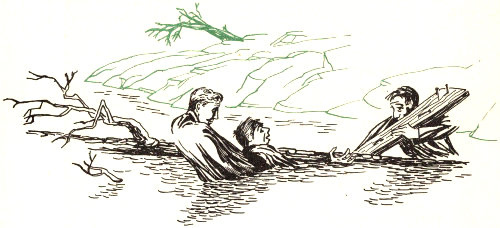
Mel Fredericks, lifting Rev. Elmer Ost, shows how he tried to free his
trapped son, Paul.(Montana Highway Commission)
The screams of the lost and losing continued. A woman
handed a baby to Melva Fredericks, saying, “Comfort him.”
One dazed man walked around crying out for his missing
wife. From the wet and dark came the cry of another woman
calling out, “It’s safe here!”—hoping to attract someone to
help or keep her company.
The Ost women and Mrs. Fredericks struggled to higher,
safer ground. When the Fredericks men didn’t show up, Ost
left the women praying while he went to look for them. He
heard Mr. Fredericks call for help for his son, Paul. With a
flashlight he borrowed, he was able to see the difficulty. The
surge of water and trees had caught 15-year-old Paul and
pinioned him in a sitting position in the water, with one
log across the small of his back and another across his lap.
The ends of the log were jammed between a smashed trailer
and the Ost car, so solidly they wouldn’t budge.
20
Paul cried out with pain as the two men tried to pull him
loose. The water kept rising as the men tried to pry the
logs apart with sticks. A 2 × 12 plank, ten feet long, even
though full of spikes, seemed a promising tool to pry with,
but with it they were only able to gain an inch or so further
separation of the logs that held Paul prisoner.
The men felt Paul’s and their own helpless panic as
the water swelled up to his chest, his neck, his chin. Raised
in a soundly religious family, Paul bravely faced the realization
that he was gasps from death. In desperation, Ost called
on Mel Fredericks to pull as hard as he could, not to care if
Paul cried, or if they pulled his arms or legs out of joint. In
this last, desperate straining try they found that miraculously
they could raise him six inches. The rising water had buoyed
the trailer. In their next few feverish tries they were able
to pull him loose and helped him to walk to high, dry ground.
One stranded group, calling for help, included a wheelchair
case, and, mucking shoeless through the water, they
portaged him out, chair and all. George Whitmore had a
badly injured eye—from running into a rope, and it looked
like he might lose its sight.
They all moved to the highway, which was still dry. A
motley crew they were, in pajamas, or almost unclothed, some
shoeless. By this time the water had covered their cars.
Some of the wounded were taken by car toward Hebgen
Dam—away from the slide.
Marooned, without their cars, in a strange, shaking canyon—prisoners
of a night in which everything seemed mad,
somehow word reached them that their ordeal might not be
over. There was possibility that a dam several miles upstream,
which they’d never seen, was likely to give way any
minute. So they scrambled up the sagebrush hillside and
built a fire on a level and fairly open site.
Others joined the two families. One group, whose car
hadn’t been flooded so suddenly, managed to save groceries,
a camp stove, sleeping bags, pans and a 9 × 12 ft. plastic
tarp.
Without worrying about modesty, they dried themselves
around the fire. There were 17 in the party. It cleared, and
then clouds obscured the moon. The ground kept shaking.
21
With almost every new tremor came sparks and puffs of
dust, and the terrifying, crashing echoes of another avalanche
across the valley, and the realization that the valley
side above them might go any time. The air was full of
dust and the sickening smell of mud and torn fir trees. All
through the night they heard the haunting cries of “Help,
help—we’re freezing,” from the Grover Maults, who’d been
marooned on top of their trailer and by this time were hanging
onto a tree.
They worried about forest fires, and sang hymns to keep
up their courage.
At 3:00 A. M. there was a thunderstorm and a light, continuing
rain. They huddled under the plastic tarp—all 21 of
them—and wondered what would happen next.
An elderly couple, the Grover C. Maults, a 72-year-old
retired decorator and his wife, Lillian, 68, of Temple City
Calif., had parked their trailer at the scenic Rock Creek
Campground for a week before the especially beautiful, bright
moonlight night of August 17th. There were lots of bears in
the area, and like many other campers, when the first jolt
hit them, they figured that the bears were trying to get into
their trailer.
22
“No, it must be an earthquake,” Mrs. Mault said.
Looking out through the trailer window, the moon made it
seem like daylight. Everything was going upside down. An
instant later their trailer was tossed end over end, landing,
miraculously, on its wheels. Then it seemed as though something
picked the trailer up and hurled it into the water.
Mault got his “nightie-clad missus” out of the trailer and
lifted her on top, and went back into the trailer to get sweaters
or something. It suddenly turned dark. The moon disappeared
in dust. The water had risen to Mault’s chin by
the time he got out of the trailer.
By the time he’d crawled on the trailer roof, put on
trousers, a shirt and sweater, and wrapped clothing around
his wife’s legs, the water was beginning to cover the trailer
roof and rising fast. They prayed that the trailer would
drift toward a nearby tree. It did. The first branch broke
as Mault grabbed it. He barely had time to get one arm
around the tree and hold onto his wife with the other when
the trailer was swept out from under them.
“It was horrible,” he says. “As I tried to pull the missus
up the limbs kept breaking off. I tried to grab higher limbs
and cling to the missus with my legs. The limbs still kept
breaking off. Finally we found a limb that would hold.
“We were surrounded by deep water. Through the night
we hollered and hollered for help. People tried to get to us
with ropes, couldn’t reach us, and yelled that we should hang
on, they were going for a boat.
“While we struggled to hold on, we could see the mountains
sliding and falling every few minutes. There’d be a
terrific roar, followed by more slides. I thought the world
was coming to an end. It turned hazy, with thunder, lightning,
then began to rain.
“As we clung to the tree, with water up to our necks,
my wife slipped under three or four times. The last time
she was gasping for breath, I managed to pull her out.
“‘Let me go and save yourself,’ she begged. ‘If you go,
I’ll go, too,’ I told her.
“About 8:00 or 8:30 in the morning they came for us in
a boat. It was just in time. We couldn’t have held out for
another ten minutes. The water was rising so fast that the
23
rescuers had to move their truck three times before they
could unload the boat.
“At first, when rescued, we could see lights, then everything
went black. We couldn’t hear anything over the roar
of the tumbling mountains. We were froze stiff from hanging
on so long. We couldn’t move our legs. The men had to
help us into the boat.”
In contrast to those who stood around and wondered was
L. D. Smith, of Greeley, Colorado, who with his family was
camped in a trailer at the Beaver Creek Campground a couple
of miles downstream from Hebgen Dam. The loud noise
and rumbling woke him. Outside the trailer, he found the
water rising. The ground was shaking violently. He didn’t
know what was causing it, but his first thought was that
the dam had broken. The steep-walled canyon didn’t seem
like a safe place for his family. As soon as the shaking subsided
temporarily, he loaded his wife and two youngsters
into the car and drove away from the dam, the collapse of
which he instinctively felt was the greatest danger, as fast
as he could.
A mile or two before he reached the slide, he ran into
heavy dust. Still fearful of what the dam’s collapse would
mean for those trapped in the deep canyon, when the slide
blocked his path he turned off the road and drove up the
north side of the canyon wall to a point where he couldn’t
get any more traction. He then got his family out of his car
and moved them to still higher ground.
Later in the evening his family joined the Osts and
Fredericks around the fire on the hillside.
24
At about 8:00 o’clock on the same gorgeous moonlight
night of August 17, the Purley Bennett family of Coeur
d’Alene, Idaho, pulled their trailer off alongside the road on
the flat at the mouth of the Madison Canyon Gorge. They
didn’t plan to set up camp—just to rest for a few hours before
continuing to the park. They talked a bit with others
camped in the same informal area, then turned in. Purley,
a 43-year-old truck driver, and his wife, Irene, slept in the
trailer. The youngsters—Carole, 17; Phillip, 15; Tom, 10, and
Susan, 5, stretched out in bedrolls outside on the ground.
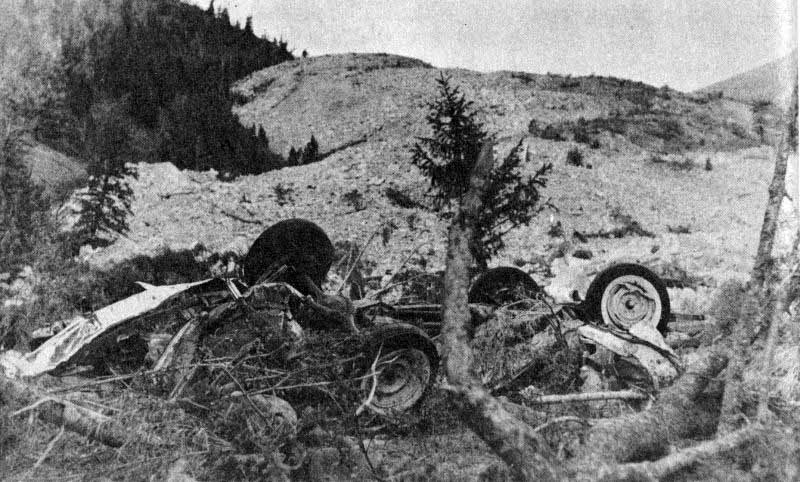
“A car blew past, rolling over and over.”(Christopherson)
They were awakened a little before midnight by a loud
rumbling noise. They wondered what it was, but weren’t
concerned enough to get up or move their equipment. Some
time later, in response to a much louder noise, Bennett left
the trailer to see about the children. Mrs. Bennett was right
behind him. As she stepped out of the trailer, she felt a
strong wind coming up. There was a great rumbling, whooshing
sound, and as the wind reached hurricane velocity she
saw her husband grab a small tree for support. The wind
swept him off his feet—he hung on like a flag tied to a mast.
After a little bit he let go and was blown away. She never
25
saw him again. She couldn’t see her children, except one
flying through the air. A car was blown by, rolling over
and over, and she found herself swept along with the trees,
the rocks, and water.
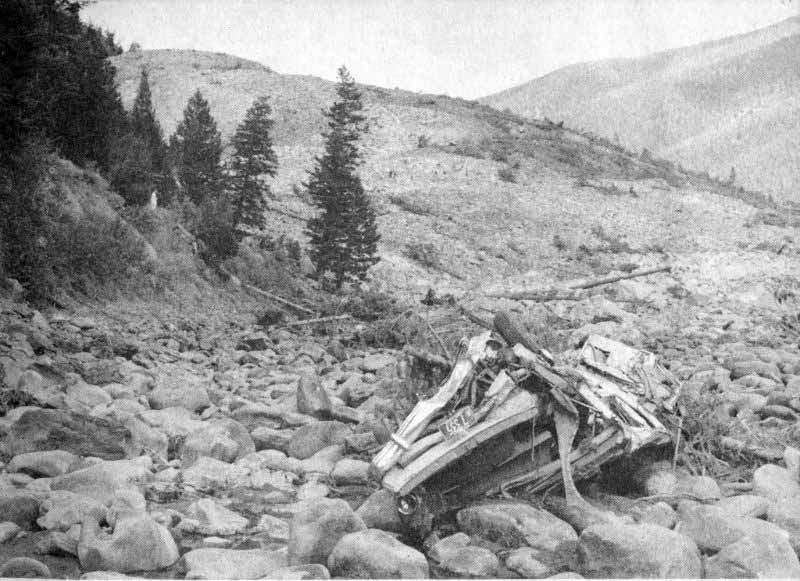
The Bennett car—thrown out from under the huge slide onto the dried-up
stream bed below.(U. S. Forest Service)
“When I came to,” she said, “I was jammed against a tree
with a log on my back. I don’t know how I got out. I
thought I was the only one of my family still alive.”
Then, over the awful moaning of the boulders grinding
and crashing and the sound of the tree trunks howling
through the air, she heard the voice of her son, Phillip,
calling.
Slowly, painfully, in spite of crippling injuries, they dragged,
an inch at a time, toward one another over the rocky,
oozy bed of the river which the huge slide had instantaneously
stopped. Highway Patrolman Stevens, who found them
several hours later, noticed how torn their hands were from
this agonizing crawl.
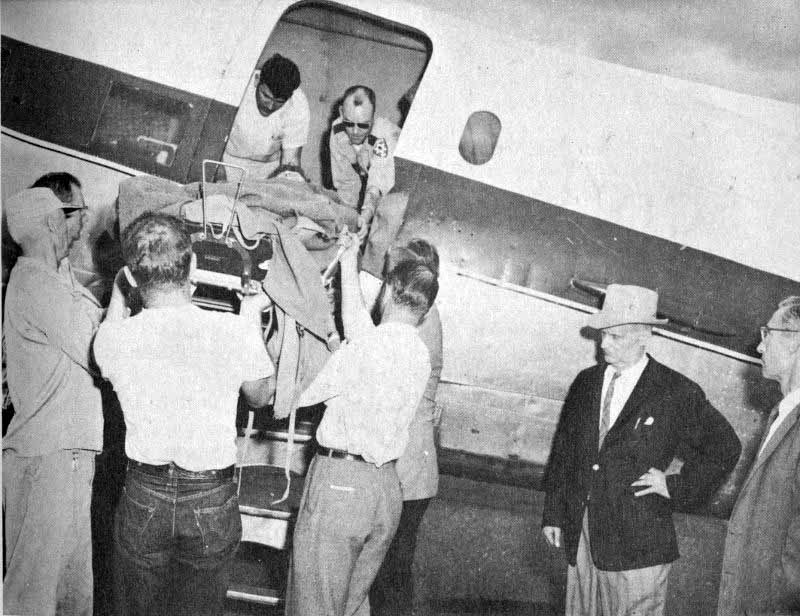
That morning, in the hospital at Ennis, Mrs. Bennett told
reporters, “They say my husband and my boys are dead, but
I have faith. I know they will be found.”
They already had been—dead.
26
OUTSIDE WORLD
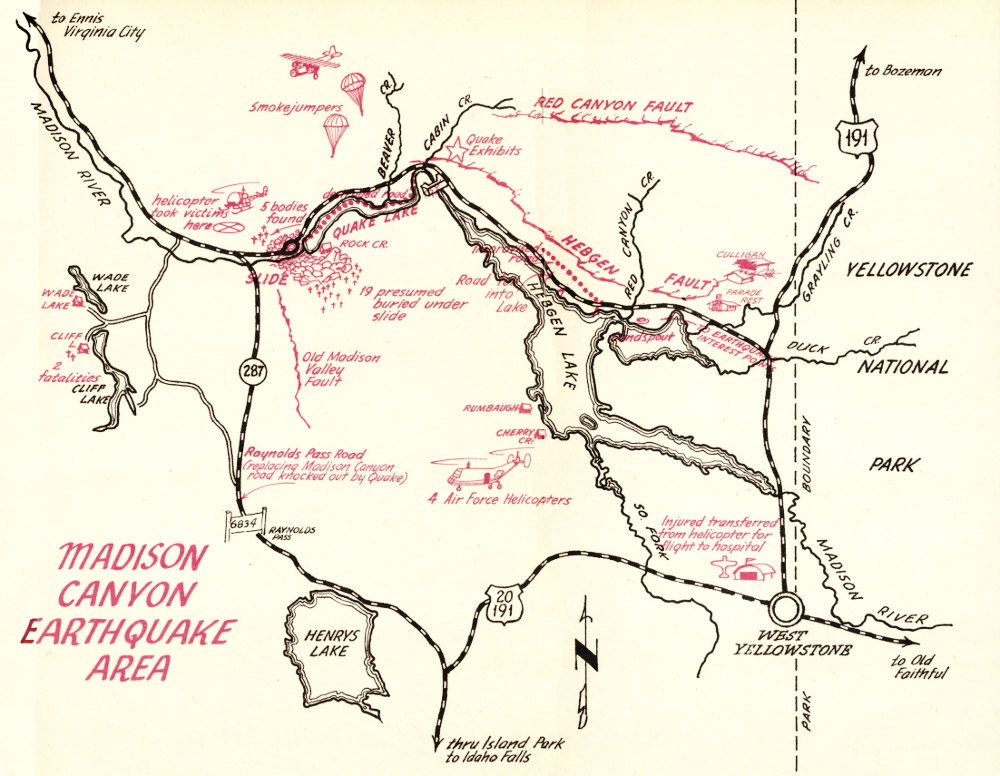
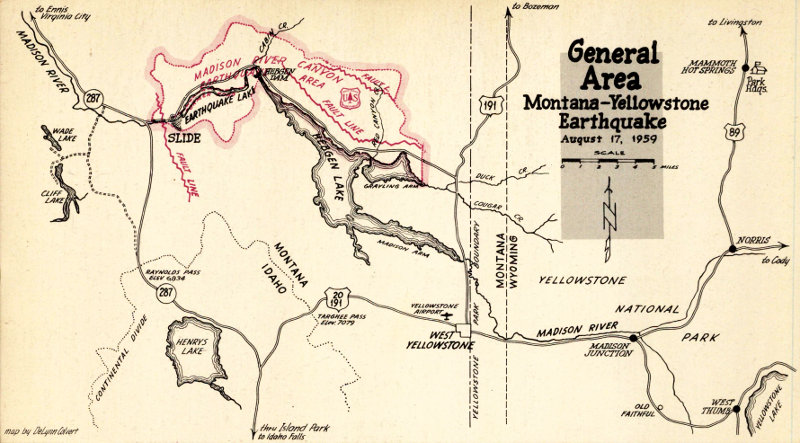
The Montana-Idaho, Wyoming area where the quake hit
is a big, sprawled-out area where it’s easy to get the feeling
of isolation when everything’s normal—the roads open, the
phone lines and lights working.
In one shattering blow, the earthquake cut most of this
area’s access and communication. Big sections of the Yellowstone
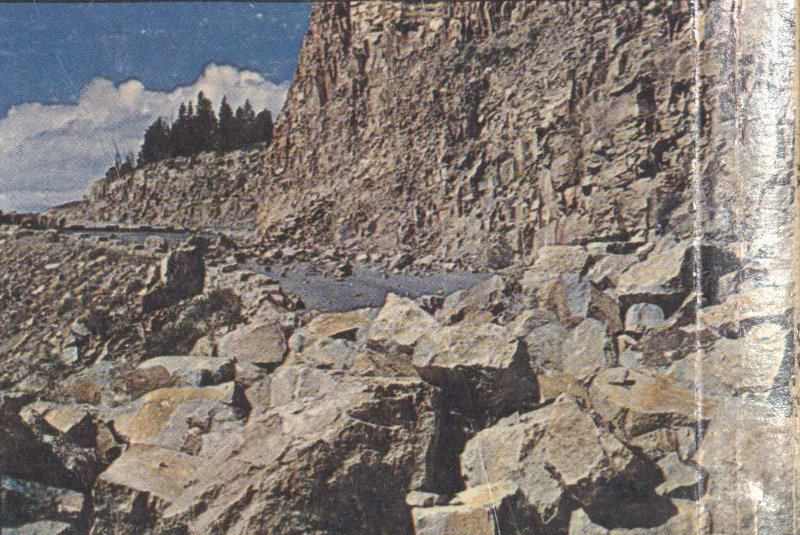
Park roads were blocked by slides and boulders. The
road north of West Yellowstone was impassable. Big hunks
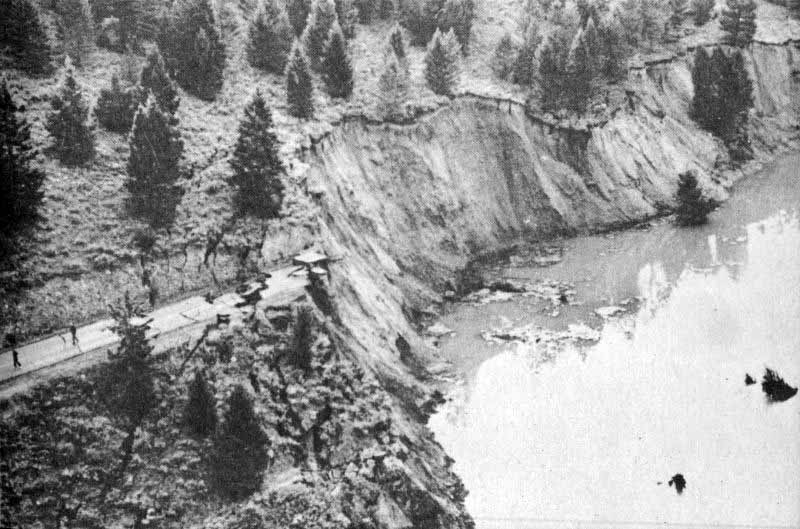
of the road between the Duck Creek Y and Hebgen Dam had
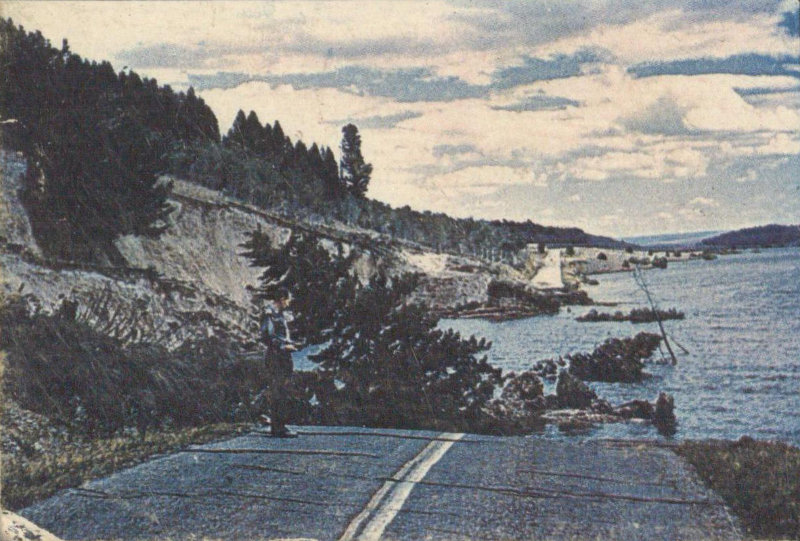
crumbled and slipped into the lake causing four major breaks
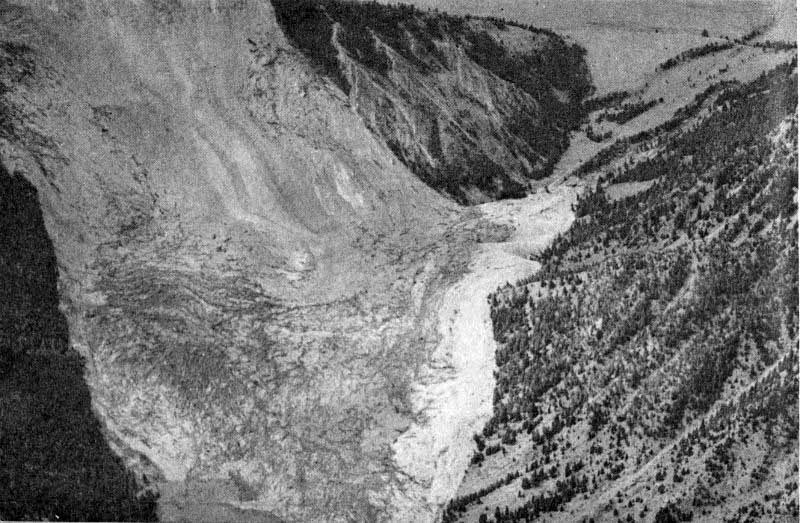
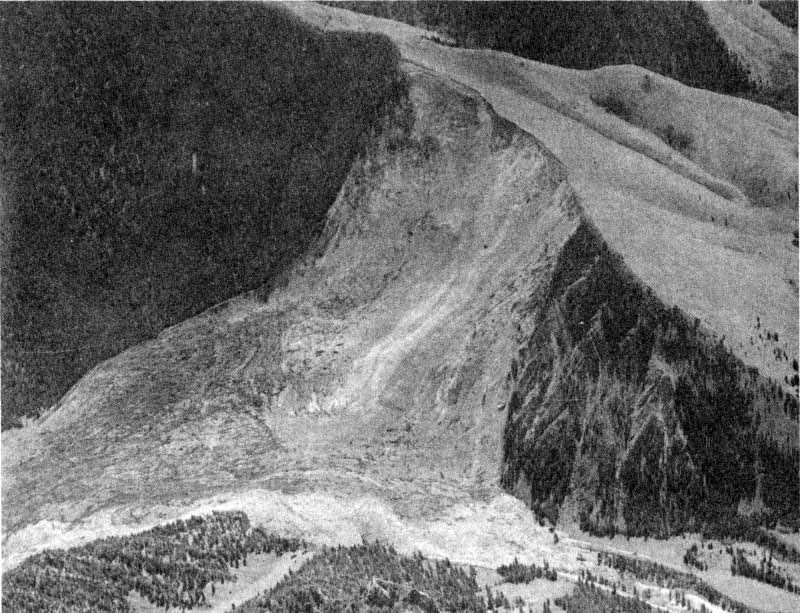
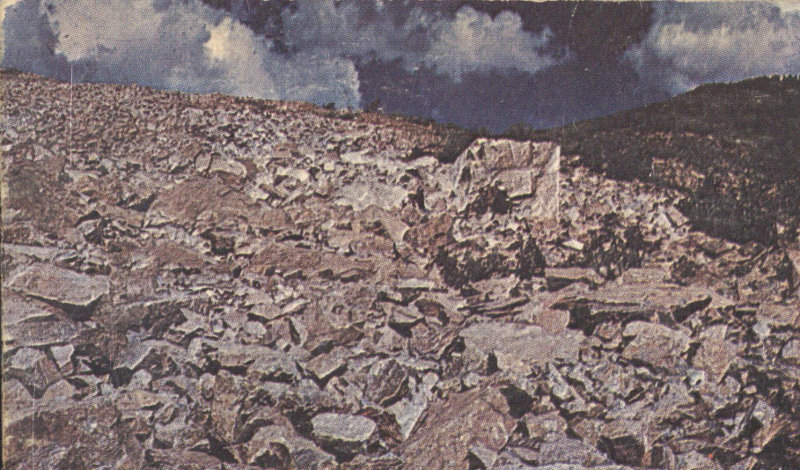
and several minor ones. The big slide formed an 80 million
ton block at the west exit of the canyon, and at Wade Lake,
road breakup had immobilized another group of terrified
campers.
For the first few hours after the quake, one of the biggest
problems for the trapped was to get word out, and for those
outside to get some idea of just what had happened.
At the instant of the quake, the Berkeley seismograph
showed shock in the West Yellowstone area.
The first man to get word out was amateur radio operator
Warren Russell, who operates station K7ICM from his
trailer house in West Yellowstone, who began broadcasting
news of the quake at 11:43 P. M.
At 11:50, another ham, Fr. Francis A. Peterson of St.
Anthony, Idaho, contacted Idaho State Police, who relayed
the word to HQ in Boise, and thence to the National Warning
System at Battle Creek, Michigan.
At 12:25 A. M. on the first detail report from the Western
Section of the Alert System it was reported that Hebgen
Dam was demolished and that there were 6 feet of mud and
water at the town of Ennis.
27
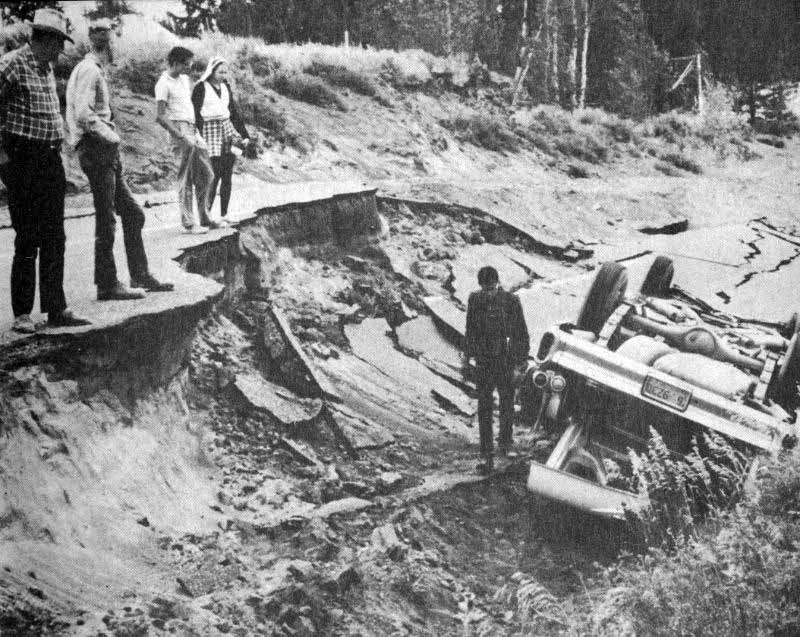
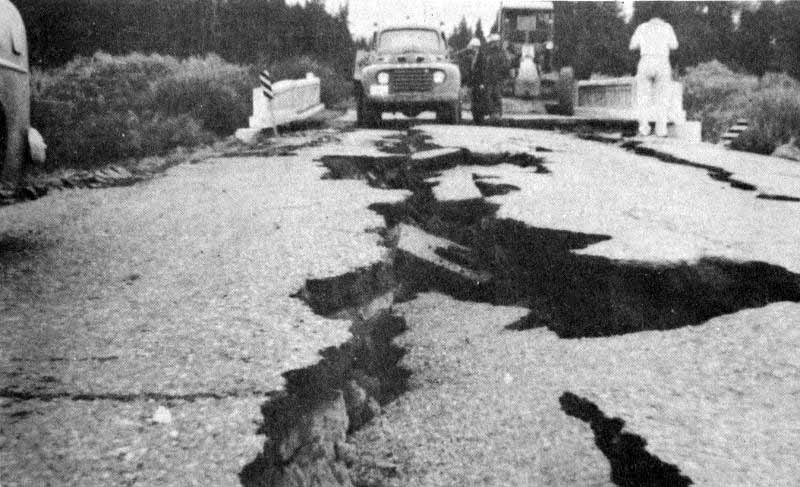
This upside-down Cadillac and the shook-up-road between West Yellowstone
and the Duck Creek Y are typical of quake damage.(Montana Highway Commission)
28
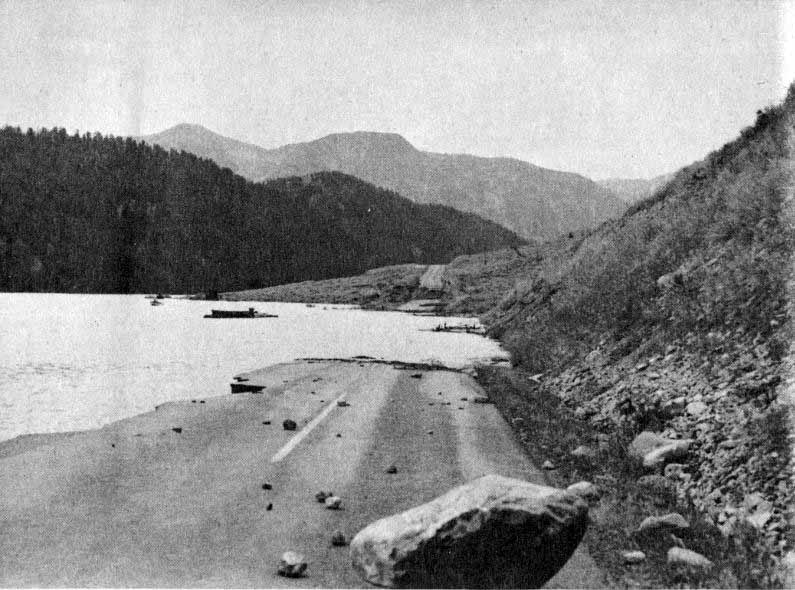
Several sections of road along the north shore of Hebgen Lake just slumped
into the lake.(U. S. Geological Survey)
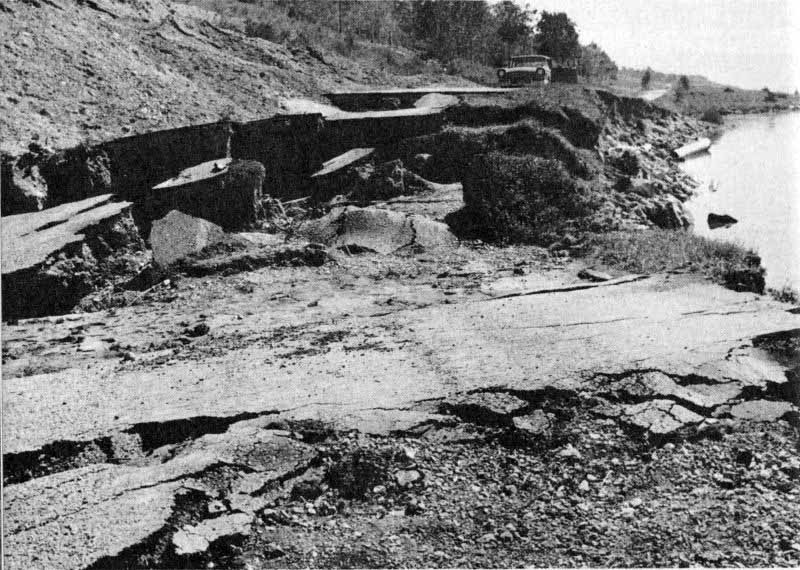
(Montana Highway Commission)
29
When the quake hit at 11:37 P. M., it woke Austin Bailey,
resident maintenance man for the Montana Highway Department
at Duck Creek Junction—where the road takes off along
the north side of Hebgen Lake and through Madison Canyon.
He noticed the light overhead jumping, furniture moved
from the wall, the lights weren’t working. Realizing that such
a shaking would topple rocks onto the highway, he knew
that he should get out and clear the roads before the heavy
tourist traffic got underway next morning.
Outside everything seemed normal. He got into his own
station wagon to make an initial check, started out, and 30
feet later drove over the 15 feet high scarp embankment—the
main earthquake fault that had dropped off between the
maintenance shed and the highway.
Shaken, but not hurt, he crawled out of the car, aware
that something was seriously haywire, and that he had to
call for outside help.
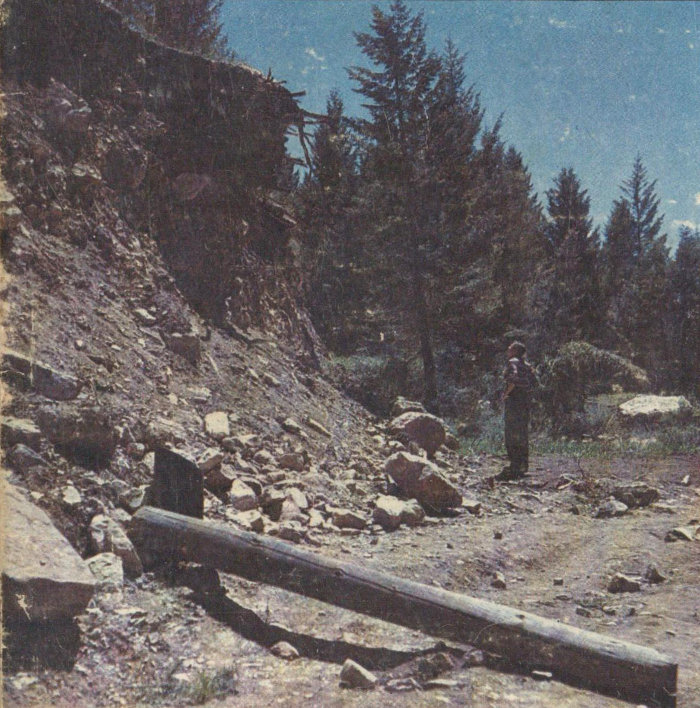
He went a mile to the nearest telephone. It was out. In
the maintenance shed, where the heavy equipment and trucks
are stored, he found the 16-ton rotary snowplow had been
jolted eight feet out of its position the night before.
The radio transmitter in his pickup either wasn’t working,
or couldn’t reach the area Highway Department HQ in
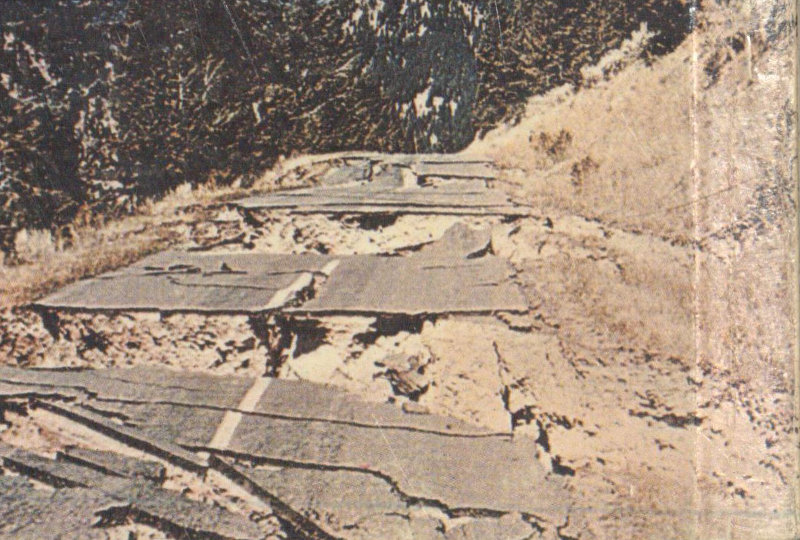
Bozeman. The road, when he managed to reach it, was shredded
by long cracks, running along the length of the road.
He loaded up his family and started north to get the word
out that they needed help on the roads in the West Yellowstone
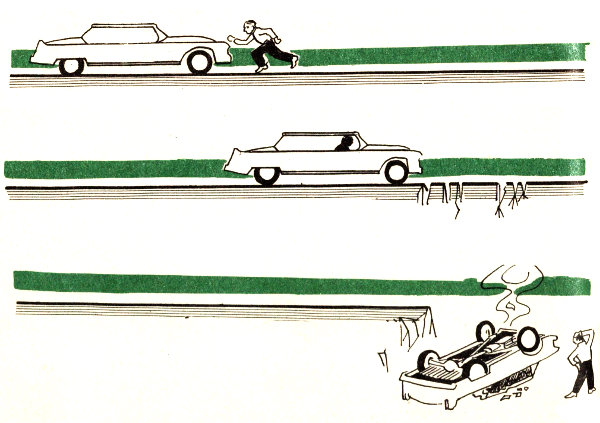
area. At the Y he found an overturned Cadillac that
had flipped coming over a continuation of the same scarp
which ran through his own yard. Driving carefully—at times
it was like straddling a grease rack—he finally found a phone
that worked at Almart Lodge, 40 miles north of West Yellowstone.
Highway District Engineer George Barrett logged
Bailey’s call at 1:50 A. M.
The quake caught Montana’s Civil Defense Director Hugh
K. Potter in bed. Potter, a grizzled former Montana Highway
Patrol Captain and Helena Police Commissioner, had
lived through Helena’s 1935-6 earthquake. This earlier quake
had logged some 3,000 recorded tremors, killed 4 people and
destroyed several buildings, including Helena’s City Hall.
Potter wasn’t greatly impressed by the somewhat diminished-by-distance
initial shock, and went back to sleep.
30
At 1:30 A. M., the Helena Police rousted out city fireman
Ed Cottingham and reported that fragments of information
about an earthquake which had caused severe damage in the
state were coming in on police radio. At 1:32 Cottingham
called Potter, and they went down and set up state Civil
Defense HQ in Helena’s City Hall, an Arabic-style former
Shriners’ building which also houses the capital city’s fire
and police department.
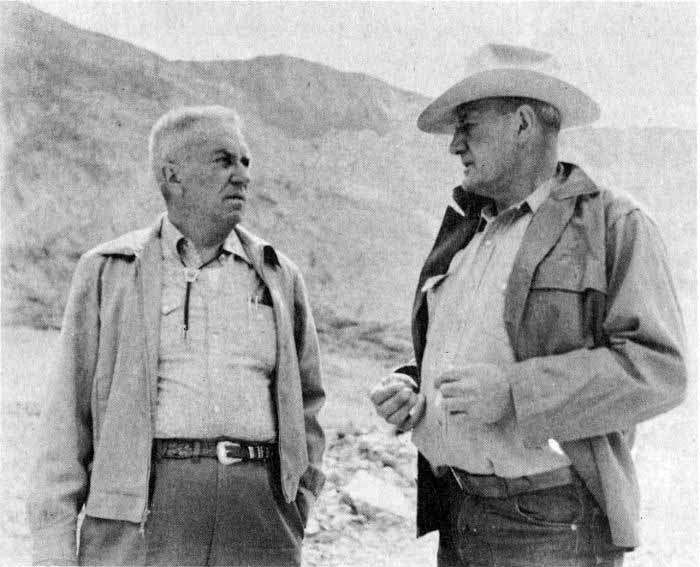
Standing on top the slide, with the fallen mountain as a backdrop, Civil
Defense Director Hugh Potter and Madison County Sheriff Lloyd Brooks
discuss problems created by the quake.(Christopherson)
For the next two hours, their life was a turbulence seething
with rumors. The steep walled canyons and high mountains
which obstructed normal police short wave radio added to
the problem of already disrupted communications in getting
information out of the quake area.
Trying to piece together just what had happened, the damage,
and what help was needed was like a horror movie
about “THE THING,” with the exact nature of the horror
emerging through the confusion and hysteria in small clues
and fragments.
31
At CD HQ, Potter realized the possibility of Hebgen Dam’s
collapse, bursting, shattering, breaking in the quake. It’s an
un-reinforced concrete-core earthfill dam 721 feet long, built
in 1913 by the Montana Power Co. to regularize the flow of
the Madison for downstream power generation. Its failure
would threaten the tourists in the valley, and the sleepy
600 population town of Ennis, 65 miles below the canyon
mouth.
Conflicting rumors filled the air—that the dam was destroyed.
By 2:00 A. M., the police and Highway Department
radio frequencies were zinging with these and other unconfirmed
reports leaking in about the plight of the dam and
the canyon. In Helena, Potter struggled with a vision of a
smaller re-enactment of the Johnstown Flood in Ennis if the
dam did, or had, let go.
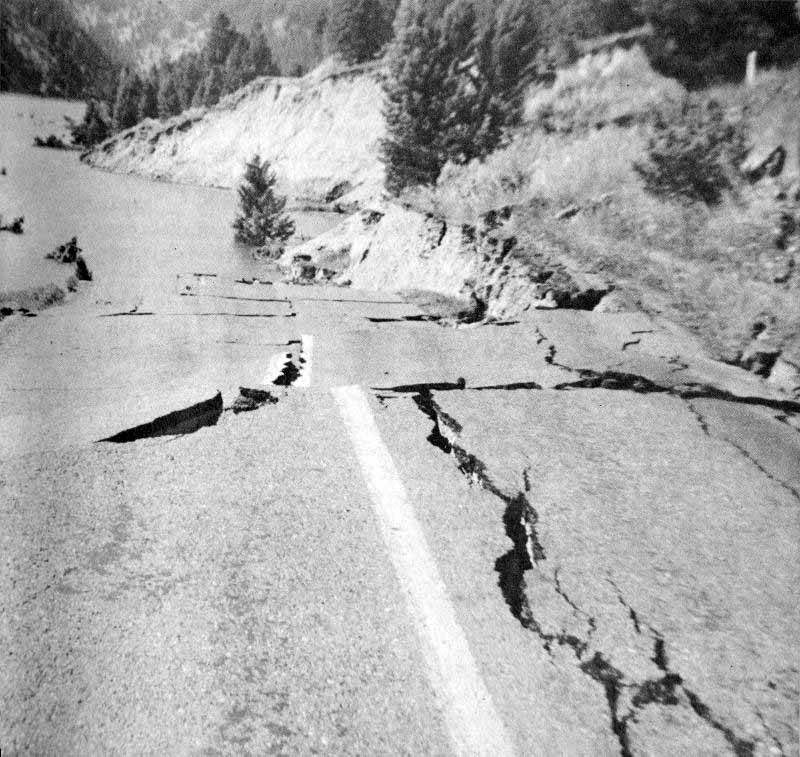
(Montana Highway Commission)
32
FIRST PATROL
Montana Highway Patrolman Glen Stevens made the first
probe up the Madison Valley after the quake. In response to
a request for help from Madison County Sheriff Lloyd
Brooks in Virginia City, Stevens and Deputy Sheriff “Dutch”
Buhl wheeled down to Ennis, arriving at about 2:30 o’clock.
The telephone lines were out. It seemed important to warn
people farther up the valley of the danger they were in.
Some of the folks had already fled. One ranch family was
still in bed. There were three groups of sleeping campers.
They didn’t argue or waste time. When Stevens suggested
they get out, they just left.
As Stevens and Buhl proceeded up the valley, they radioed
in at frequent intervals that everything seemed normal.
They reported rock on the road at various intervals from
26-mile hill on south to the place above Hutchins Bridge,
where boulders tumbling from a rock cliff made the road
impassable. Cabin camp operator Otto Kirby had got his
people out, but there were two house trailers parked farther
up, near the river. Stevens warned the occupants, and got
them started out. They gassed up at Kirby’s ranch. It was
cloudy and dark. At 3:15 o’clock Stevens radioed in that the
water was muddy but otherwise seemed OK, and that he
planned to cross the bridge and drive up along the river on
an old road on the south side. Sheriff Brooks tried to discourage
them, shouting via radio—“Don’t do it, you crazy
bastards, the dam’s broke, and you’ll get killed too. Come
back!”
It was this message which, picked up on other radios, and
relayed to Helena, sparked CD director Hugh Potter to order
the evacuation of Ennis.
With Sheriff Brooks’s warning fresh in mind, Stevens says,
“Every turn we got off that bench, I thought we were going
to meet swimming water.”
33
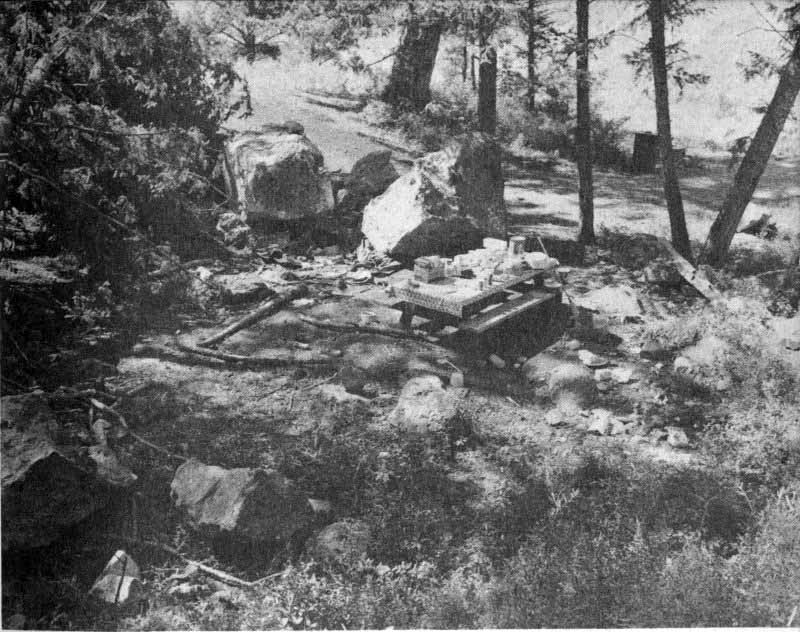
These huge boulders crashed down onto Cliff Lake Campground killing the
Lloyd Strykers of San Mateo, California, without disturbing the food on
their campsite table.(U. S. Forest Service)
As they moved up the valley, they got the message that
a couple of people had been killed in the campground at Cliff
Lake, to the south of the Madison, so when they hit the Raynolds
Pass road, they headed that way.
They got there at daybreak, about 4:45 A. M. They found
that a rock cliff had fallen across the road which ran along
the lake, marooning the campers.
At the campground they found two campers dead, killed
in a bizarre and gruesome accident. The E. H. Strykers of
San Mateo, California, were camped on an improved campsite,
with a fire site, a picnic table, and a place to park their
car. Their three youngsters slept in a tent 100 feet away.
The quake dislodged huge, eight-ton chunks of rock, and set
them bounding downwards in a freakish, crescent shaped
path, tearing the ground, and toppling 60-year-old fir trees
in their downward rush. Nimbly, two of these boulders
bounded over the picnic table, stacked with food, and landed
squarely on top of the sleeping bags in which the Stryker
parents slept.
34
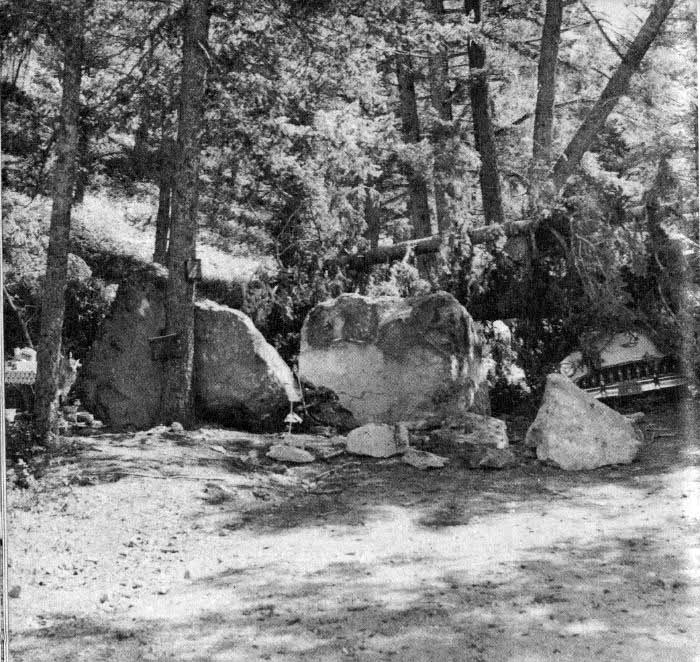
Cliff Lake tragedy—another view.(U. S. Forest Service)
“It wasn’t pretty,” Stevens said. “But there wasn’t anything
we could do. The rocks were too big to move, so we
went down toward the Shaw Ranch and got Frank Shaw to
take his 4×4 truck up and move the rocks off them.
“We drove back down to the highway to continue up to
the canyon. In the freshening daylight on the way down
from the high bench back into the valley we could see a
couple of trailers down the highway near the mouth of the
canyon. A Fish and Game Commission plane flew over, radioing
something about an obstruction across the lower end of
the canyon, and having two to three hours to get the people
out. We had no idea what they meant. We got to the trailers.
They wanted to know how to get out—the next section of the
highway was blocked with rocks and boulders. We routed
them across the river and out Raynolds Pass way into Idaho.
35
“One of the guys said he thought there were a couple of
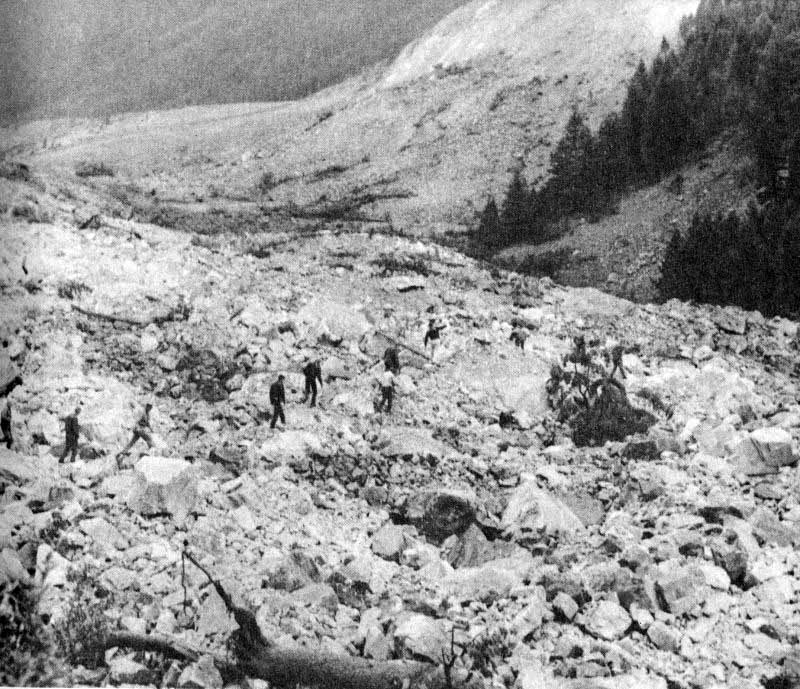
people still alive across the river. We got to the slide about
5:45 o’clock—the huge pile of millions of tons of rock where
the highway used to be. You couldn’t believe what you were
looking at.
“Somebody said something about a ‘little slide’.
“‘Little!’ I said to Dutch, ‘I’d hate like hell to see a big
one!’
“The after-shocks that kept happening—with rocks crashing
down and dirt and dust blowing up—didn’t contribute to
our peace of mind, either. But we didn’t have much time to
look.
“We struggled across the river—the slide had stopped the
water, but left a muddy ooze and some water lying around
in pools as much as three feet deep. We found Mrs. Irene
Bennett lying in the rocky stream bed. She was cold and
shivering. She didn’t have a stitch on. Neither did her son,
Phillip, who was lying near her. Both of them were bruised
and bashed. The Bennett boy had a broken right leg, shoulder,
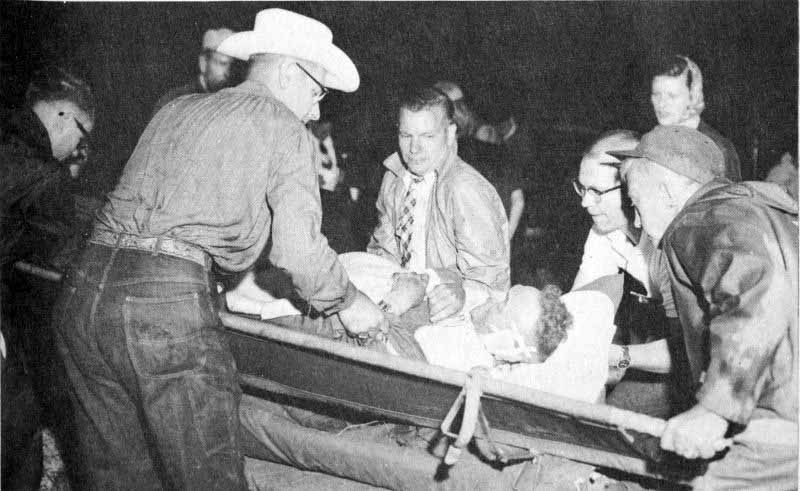
etc. We put Mrs. Bennett on an old wooden frame canvas
cot and started across the slippery river bed with her. She
must have weighed 180. As we struggled through the slippery
muck she kept apologizing for causing us so much trouble,
and told us about her husband and three other children,
the other folks who were camped near her, and the tremendous
spurt of wind and mud that threw them out from under
the slide. She told how she’d come to—believing herself the
only one of her family who’d survived. Despairing, she heard
Phil calling from a spot 75 feet away where the water had
thrown him. Their torn hands gave the story of the agonizing
effort these crippled survivors had made to drag themselves
together over the rocky stream bed.
“By radio we asked the Fish and Game Commission plane
flying overhead to go to Ennis and get Dr. Losee and fly
him back, and land him on the highway nearby. We didn’t
want to disturb Mrs. Bennett by moving her off the cot, so
we put her into a station wagon. Morris Staggers, who lives
nearby, showed up with an old iron bedstead, older than anyone
there, and heavier, too. I’ll never forget the struggle we
had carrying the Bennett boy across on it.
36
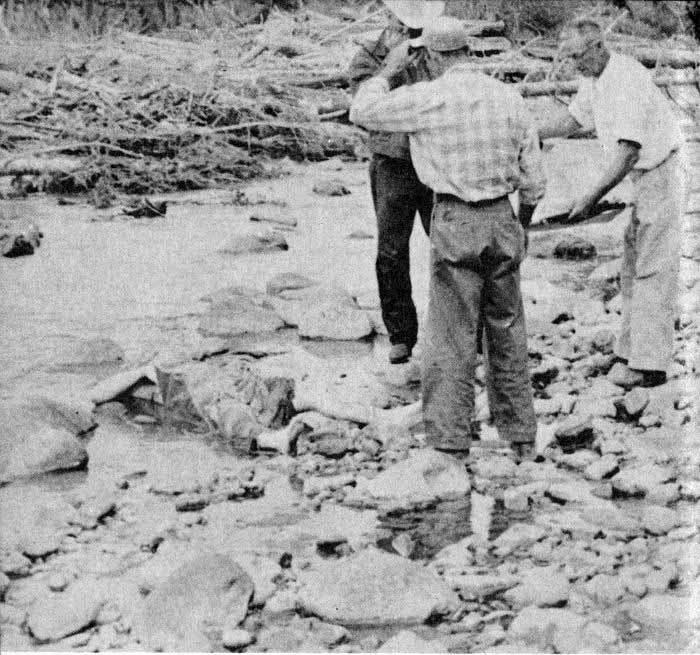
Rescuers prepare to move body of T. Mark Stowe of Sandy, Utah, who
perished as he was thrown out from under the slide. Note tremendous
water damage and dry river bed.(United Press International)
“We took the Bennetts up to where the plane landed on
the highway and turned them over to the doctor. Returning
to the slide area, the increasing light made the slide seem
even more formidable. That morning, working with Fish &
Game Commission, etc., we found all of the people Mrs. Bennett
had told us about except one. Like Mrs. Bennett and
her son, all of these bodies had been stripped of their clothing
and showed the effects of being beat to hell by wind
and water. The coroner said all five of them died by drowning.
We never did find Mrs. Marilyn Stowe, wife of Sandy,
Utah elementary school music teacher T. Mark Stowe, whose
body we did find—she must still be under the slide.
“I just don’t care to go through any more mornings like
that,” Stevens said.
37