"Our train will start at half-past six," said Miss
Lincoln, when tea was finished, and the girls were
standing in little groups in the hotel garden,
wondering what to do next. "All who like may
go on to the beach again, or on to the cliffs, but
no one must walk farther than the white farm
near the flagstaff. You must return immediately
you are told, and be at the station by a quarter
past six."
The girls dispersed, some to wander along the
shore to find a few more shells, mermaids' purses,
or strips of ribbon seaweed; some to climb to the
top of the cliff by the flagstaff; and others to
play games on a piece of common near the white
farm that Miss Lincoln had appointed as a
boundary beyond which they must not venture.
Patty, who was hunting for sea anemones in the
small pools among the rocks, noticed Muriel and
her friends, Maud, Vera, and Kitty, hurrying as
fast as they could along the beach in the opposite
direction from the village.
"Where are you going?" called Phyllis
Chambers, who was engaged in taking down
the bathing tent.
"Oh! nowhere in particular," they replied,
stopping as if they had been rather caught;
"only just for a little stroll, to say good-bye to
the waves."
"You mustn't go beyond the next point of
rock; Miss Lincoln said so."
"Miss Lincoln said nothing about the shore.
She said the white farm on the cliff," replied
Maud, rather sulkily.
"Well, that rock is exactly underneath the
farm."
"We were only going to peep round the point.
It wouldn't take five minutes," said Muriel.
"I can't allow it, all the same," said Phyllis,
firmly.
"I'm sure Miss Lincoln never meant——"
began Kitty Harrison, but she was interrupted
by Phyllis.
"Miss Lincoln has put me in authority for
this afternoon. I have her orders, and I tell
you you're not to go."
Looking very cross and disconsolate, the four
girls sat down on the sand a little distance away,
to grumble and discuss the situation.
"I don't believe Miss Lincoln meant exactly
what she said," declared Kitty.
"I'm sure she didn't. It's only Phyllis who's
so proud of being prefect, and likes to show her
authority," agreed Maud.
"I don't see why we should do as she tells
us; she's only a schoolgirl like ourselves," said
Vera.
"I expect she wanted to be nasty, and pay
us out for what happened last week in the
gymnasium," said Muriel.
"It's too bad!"
"It's an absolute shame!"
"Suppose we were to go after all," suggested
Vera tentatively.
"But Phyllis would stop us."
"She won't see. She's taking the tent poles
and walking up that path towards the hotel.
She'll be round the corner in half a minute."
"Why, so she is!"
"If we're quick we could be beyond the point
before she comes back."
"Then come along at once."
"Yes, don't let us waste a moment."
The four girls jumped up, and, hurrying off,
went away round the rock with such record speed,
that by the time Phyllis returned to fetch the
remainder of the tent they were well out of sight.
Imagining that they must have walked down the
beach towards the village, Phyllis did not trouble
to go and look for them, so the only person who
knew the real direction they had taken was Patty,
who happened to have overheard most of the
conversation, and to have seen their hasty flight.
Having examined as many sea anemones as she
cared to, Patty climbed up a steep little track
on to the cliff again, and spent a blissful half-hour
by herself, lying in the sunshine on a bed
of purple heath, watching the white sails of the
boats in the distance, and a steamer far out on
the horizon. From her point of lookout she had
a very good view over the whole of the large
bay. How fast the tide was flowing in! The
sandbanks, which only ten minutes ago had
gleamed yellow in the sunshine, were now
covered with water, and a huge white wave
appeared at the mouth of the estuary, advancing
with threatening speed.
"It must be the tidal wave that Phyllis spoke
about," thought Patty. "She told us how dangerous
it is on this coast, how it comes in with
a great rush, as fast as a man can run, and floods
all the bay quite suddenly. I expect that was
the reason Miss Lincoln wouldn't let us go far
along the beach this afternoon. Why! Surely
that cannot be Muriel and the others such a
long way out upon the sands! I thought they
would have been back before now. Yes, it is!
And their backs are turned to the sea! They're
sauntering along as calmly as if the tide were
going down instead of rising. Oh, why don't
they look round and hurry?"
Patty sprang to her feet and waved her handkerchief
frantically, but the girls were not looking
in her direction, and took no notice. What was
she to do? She felt, at all costs, they must be
warned. She would be obliged to disregard
Miss Lincoln's orders, and to go along the beach
and tell them of their danger. There was not
time to run back and ask permission. Nobody
else was in sight, so she must decide on her own
authority that it was expedient for once to disobey.
Scrambling quickly on to the shore by
an even more precipitous path than the one by
which she had ascended, Patty made what haste
she could along the sands towards her companions.
She shouted to them while she was still a considerable
distance off, but though they waved
their hands in reply, they did not come any the
faster.
"How stupid they are!" thought Patty. "Can't
they see the water behind them? They walk as
if they were strolling round the quad."
With an extra effort she hurried on, and reached
them out of breath and panting.
"Why don't you make haste?" she gasped.
"Didn't you hear me call?"
"It's all very well to say 'Make haste!'" replied
Maud. "We can't get Muriel along."
"I've hurt my foot," said Muriel. "I slipped
on a stone, and I think I must have sprained
my ankle. It hurts dreadfully when I lean any
weight upon it. Let me have your arm, Patty."
"Don't you see how fast the tide's rising?"
said Patty, giving the asked-for assistance. "If
we're not very quick we shall be surrounded."
"Why, so we shall!" exclaimed Vera. "I
didn't notice it before. Come along at once.
We must run."
"I can't run," said Muriel fretfully, "you
know I can't. I can scarcely even limp as it
is."
"You must," said Maud, taking her other
arm; "that is, if you don't want to be
drowned."
"Don't pull me, Maud," cried Muriel, "you're
hurting me. Oh, I can't go any faster! My
foot will give way underneath me."
"What are we to do?" said Kitty blankly.
"The water's rushing round on both sides of us!
If we don't get across that piece of sand in front
directly, we shall be on an island."
"Let us make a chair of our hands," suggested
Patty, "and try to carry Muriel. See, Maud!
Clasp my wrists like this, and I'll clasp yours.
Muriel, sit down! Now, then; one, two, let's
step together."
"She's too heavy; I can't manage it!" exclaimed
Maud, dropping her burden on to the
sands.
"Then you try, Kitty."
"No, no! I'm not so strong as Maud. Oh,
look at the water!"
"Come along, girls," shouted Vera, "we
must run for our lives! It's no use our all being
drowned."
"Maud! Kitty! Vera! You don't mean to
leave me?" shrieked Muriel.
"Quick! Quick!" was the sole reply she received,
as her three friends took to their heels,
and, without even turning to look at her, dashed
across the narrow belt of dry land which led between
two channels to the safer bank of shingle
beyond.
"The cowards! The mean cowards!" cried
Muriel, white with anger and alarm. "Patty,
are you going too?"
"Not without you," replied Patty, sturdily.
"Here, I'll help you up, Muriel, and we must
push on, even if we have to wade. Catch hold
of my arm again, and try to walk."
"It hurts so; my foot won't hold me. Oh,
the pain is so bad, I must stop for a minute!"
Patty looked round desperately. Their situation
was indeed most dangerous. The one path
to safety was already covered, and even if they
were able to hurry on fast, it was doubtful
whether they would be able to wade to the
shore. They were cut off on every side, and
their little island was each moment diminishing
in size.
"We must climb on to these rocks," she exclaimed.
"Let us scramble up the tallest; perhaps
it may be above high-water mark. Put
your arms round my neck, Muriel, and I'll carry
you as well as I can."
Almost sinking under her cousin's weight,
Patty staggered along till she reached the jagged,
seaweed-covered rock, which she hoped might
afford them a temporary place of security.
Groaning with pain, Muriel managed with
Patty's help to drag herself slowly to the
summit.
"Why did I come?" she said. "It was all
Vera's fault. She persuaded us to go, and then
kept taking us a little farther and a little farther
every time we wanted to turn back. We shall
be drowned; I know we shall."
"I don't think so," returned Patty hopefully.
"The top of the rock is quite dry, as if it weren't
covered at high tide. I believe we shall be safe,
only we may have to stop here for a very long
while."
"Let us call for help," suggested Muriel.
Both girls shouted at the pitch of their voices
again and again, but there was no response,
except from the sea birds which they disturbed
on the adjacent cliffs.
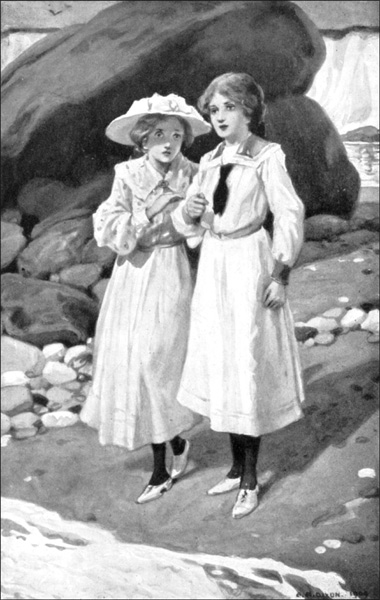 "THEY WERE CUT OFF ON EVERY SIDE"
"How long shall we have to stay here?" enquired
Muriel presently.
"Why, until the water goes down again."
"When will it go down?"
"What time is it now?" asked Patty.
Muriel consulted the little watch which she
wore in a strap on her wrist.
"Exactly six o'clock," she replied.
"Then it will be high tide about eight or nine,
I suppose, and I don't think it will be low again
until nearly midnight, or early in the morning."
"How dreadful! Won't anybody come to
fetch us off?"
"I don't see how they could reach us. Look
at the sea! It's rushing between the rocks like
a mill-race. Any ordinary boat would be dashed
to pieces, and there's no lifeboat at Moorcliffe."
Muriel shuddered. The water had indeed
overflowed the whole of the sandbank, and
now swirled in a foaming current round the
foot of their retreat, rising every moment a
little nearer to them. Following the tide had
come a dense sea fog, that drifted down the bay,
veiling the sun, and, creeping round the rock,
wrapped the girls in its clammy, concealing folds,
cutting them off effectually from all possibility
of being seen from the neighbouring cliff. In
a few minutes the whole prospect was blotted
out; they seemed in a world of white mist, as
absolutely isolated and alone as if they were in
mid-ocean. Trembling with fear, Muriel turned
to Patty.
"Do you think anybody knows where we
are?" she asked.
"I can't say. Vera and the others would, of
course, tell Miss Lincoln, but she wouldn't know
exactly where to look, and no one could find us
in this fog."
"Do you think the sea'll rise any higher?"
"Yes, a little. It can hardly be full tide yet."
"Patty! I don't know whether I shall be
able to swim with my hurt foot. Suppose the
water comes right over the rock, you won't
leave me like the others did, will you?"
"Never!" said Patty, putting her arm round
her cousin. "We'll either both get safely to
land, or both go down together."
"Will you promise?"
"Faithfully."
"Thank you. I know you always keep your
promises," said Muriel.
She did not speak again for a long time, but
sat holding Patty's hand tightly, and gazing
under a horrible fascination at the green, foam-flecked
water that was creeping so stealthily
nearer to them. How cold it looked, and how
cruel! How easily it could swirl away their
light weights, and dash them against those
jagged points opposite, or sweep them out into
the midst of those long waves, the white crests
of which were just dimly visible through the
wall of fog! Inch by inch it rose; it was only
a foot now from the top of the rock, far above
the line which they had supposed was high-water
mark.
"I think we had better both take off our
tennis shoes," said Patty. "If we're obliged to
swim, you could perhaps manage to float, and
I could pull you along."
"Patty, aren't you terribly afraid?"
"No, not very. Not so much as I thought I
should be."
There was silence for a few minutes, and then
Muriel said:
"I can't think how it is you're not afraid."
"Because God can take care of us here as well
as anywhere else," answered Patty, quietly.
"Do you really think He will?"
"I'm going to ask Him now."
"Then so will I," said Muriel, kneeling by her
side on the rock.
"Lighten our darkness, we beseech Thee, O
Lord, and by Thy great mercy defend us from
all perils and dangers of this night."
How often they had repeated the familiar
collect in church or at evening prayers in the
big schoolroom at The Priory, sometimes with
little thought for its meaning; and how different
it sounded now in the midst of the real peril and
danger that surrounded them! A great wave
came suddenly dashing up and poured over
their feet, and the two trembling girls looked
with white faces as the shoes, which they had
taken off and laid beside them, were swept
away and lost in the depths below. Many
fresh thoughts came to Muriel then—thoughts
such as had rarely troubled her before. In
the mist and the rushing water her old standards
seemed to be slipping from her; wealth
and position felt of slight value compared to
those better things about which she had hitherto
cared so little: and I think, with the surging
tide, some of her old self passed away, and left
a new self born in its place.
"It's going down!" cried Patty at last. "That
one wave was the high-water mark. Look! It's
certainly lower than it was."
"Then we're saved!" exclaimed Muriel; and,
breaking down utterly, she covered her face with
her hands, and burst into a storm of tears.
The tide was undoubtedly on the turn; each
wave seemed less forceful than the last, and
though they were still surrounded by water,
and likely to be kept prisoners for many hours
yet, they could consider themselves free from
danger, and feel that their lives had been
spared. Time crept slowly on; fortunately,
owing to the length of the July day, it was
not yet dark, but the fog had not lifted, and
they were not able to see even so far as the
adjoining rocks. Their clothes were wet through
with spray, and they felt damp, and chilly, and
forlorn. Both girls had been tired out with their
long day's pleasure before they were caught by
the tide, and the hours of waiting seemed interminable.
Muriel, exhausted with fright and
exposure, clung piteously to Patty, crying
quietly, and the latter gave her what comfort
she had to offer.
"The water's halfway down the rock already,"
she said. "In another hour we may be able to
reach the shore, if only the mist would clear."
"My foot still hurts," said Muriel. "I don't
believe I shall be able to limp a step."
"Perhaps a boat will come to find us, now the
tide's not so high. I'm sure Miss Lincoln would
send somebody to look."
"You don't think she would go home without
us, then?"
"Oh, no! I'm quite certain she wouldn't.
Someone would miss us, and then she would
ask who had seen us last."
"Do you think Kitty and Maud and Vera
would tell? Perhaps they'd be ashamed of
having left us."
"They'd be obliged to tell. I expect if it
hadn't been for the fog we should have been
found before. If you leant your head against
me, could you go to sleep?"
"No, not with the water still so near," said
Muriel, shuddering. "I must just sit still, and
wait, and wait, and wait."
Half an hour more passed; the girls were too
weary to care to talk, but at last Muriel spoke
again.
"Patty," she said, suddenly, "I want to tell
you a secret. It's something I ought to have
told long ago, only I didn't dare. That Cæsar
translation belonged to me."
"I thought it did," said Patty, calmly.
"You thought so! Oh, Patty! How did you
know?"
"Because I saw you slip it into your desk that
afternoon I came so unexpectedly into the schoolroom.
I recognized the green cover the moment
Miss Harper held it up."
"And yet you never said anything about it?"
"No."
"Not to anybody? Not even to Enid?"
"No, not even to Enid. I wasn't certain, and
if I had been I wouldn't have told."
"I've been wretched about it!" said Muriel.
"I never intended you to get blamed, but I
daren't confess it was mine."
"Who gave you the book?" asked Patty.
"Horace. He used it himself once, and those
were his initials in it, H. P. for Horace Pearson;
and of course everyone believed it meant Patty
Hirst, because the two letters were interlaced,
and could be read either way."
"I'm sorry it was Horace's. I thought better
of him," groaned Patty.
"I'm afraid we're neither of us as conscientious
as you," said Muriel. "I used to prepare
my Latin with it. I don't know how I could be
so silly as to leave it lying about."
"Perhaps it's as well you did," said Patty,
gravely, "or it might never have been found
out."
"I'm dreadfully sorry now," said Muriel. "I
wouldn't do it again. I'm so glad Miss Harper
burnt it. It was most unfortunate it should be
fixed upon you. I always told the girls you
were innocent."
"I don't think many of them believed it was
mine."
"A few did, or at any rate pretended they
did. Well, I'll set it all straight when I get
back to school. It'll be hateful to tell Miss
Harper, but it's the one thing I can do to make
up, and I will."
Another half-hour had passed, and a slight
breeze blowing from the sea began at length
to disperse the fog, which, thinning a little, revealed
the outline of the cliffs on the landward
side. The sun had long ago set, but
still showed such a bright glow on the western
horizon, that it was light enough to see that the
sandbank was almost clear, and the water flowing
from it in broad channels.
"I think we might leave our rock now," said
Patty. "Perhaps if we wade we could reach
the shore before it gets quite dark. Can you
manage if I help you?"
Muriel climbed painfully down, and taking
Patty's arm, began to limp her way over the
sands.
"It's half-past ten," she said, "and our train
was to leave at half-past six. All the others
will have gone home ages ago. I don't know
what we must do, even if we get to land."
"Somebody's sure to be waiting for us," said
Patty. "Why, I believe I can see a boat over
there in the distance. Look! To your left,
where the mist is blowing away."
"It is!" exclaimed Muriel, in much excitement.
"A fishing boat, with three men in it. Let us
call as loudly as we can."
The two girls joined in a wild "Halloo!" and
to their great relief were at once answered by a
shout in reply. The boat turned her course and
made for the sandbank, and in a few minutes a
bronzed old seaman had leaped over the gunwale
and waded through the channel to their rescue.
"Why, little misses, you've got yourselves in
a fine fix!" he said, by way of greeting. "Here
we've bin a-lookin' for you for a matter of four
hours; just hangin' about in the fog, we was, and
shoutin' every now and then on the off chance of
your hearin' us. I ne'er thought we'd find you
safe and sound, I didn't. Bin up the rock, you
say? Ay, them rocks is never covered. If I'd
only knowed you was there! We'd a' seen you
long since, if it hadn't a' bin for the fog."
He lifted Muriel in his arms, and, carrying
her as easily as if she had been a baby, waded
with her to the boat, returning afterwards for
Patty.
"You're nigh dead beat, both on you," he said,
sympathetically. "It's give you a rare fright,
I'll be bound, and us too! Your teacher's half
crazed after you, poor thing! She'll be main
glad to see you back, she will that!"
It was indeed with a feeling of intense relief
and thankfulness that Miss Lincoln welcomed
the missing pair as the boat drew up on the
beach at Moorcliffe. The hours of their absence
had been a time of such anxiety and suspense as
she had not experienced before with any of her
pupils. One look at her face showed them what
she had suffered on their behalf.
"Thank God you are safe!" she cried, as she
took them in her arms and kissed them.
All the school had returned to The Priory,
only Miss Harper remaining with Miss Lincoln;
and as the last train had left, the latter made
arrangements to spend the night at the hotel.
The girls were cold and wet, and much in need
of food and rest; so they were only too thankful
to be put to bed at once, instead of starting on
a railway journey. The headmistress would
allow very little talk that night about what
had happened, reserving what she had to say
for a future occasion; and Muriel, who knew
there was a painful explanation in store for
her, was not sorry that it should be deferred.
"I shall be in dreadful trouble to-morrow,"
she said to Patty as they lay in bed, "and I
deserve it, I know. I'm going to make a clean
breast of everything, the Cæsar translation and
several other things, and then perhaps I shall
feel better, and make a fresh start. I haven't
said 'Thank you' to you, Patty, because I really
don't know how; but you've been an absolute
trump, and I shall tell Miss Lincoln so. I shan't
ever forget it. Good-night!"

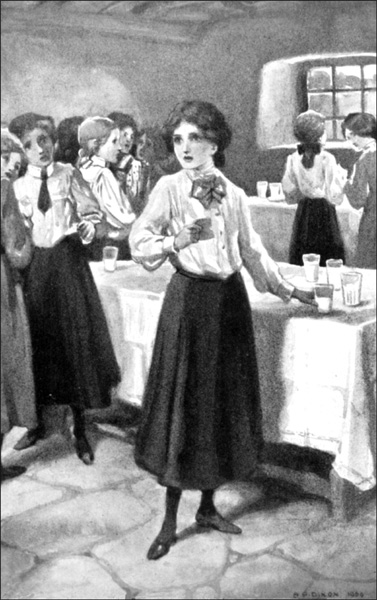
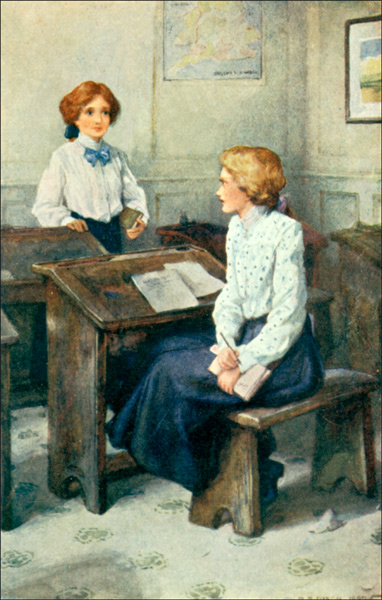 "SHE STARTED GUILTILY AT HER COUSIN'S ENTRANCE"